

HIGH COURT OF AUSTRALIA
GLEESON CJ,
McHUGH, GUMMOW, KIRBY, HAYNE, CALLINAN AND HEYDON JJ
APLA LIMITED & ORS PLAINTIFFS
AND
LEGAL SERVICES COMMISSIONER OF NEW SOUTH
WALES & ANOR DEFENDANTS
APLA Limited v Legal Services Commissioner (NSW)
[2005] HCA 44
1 September 2005
S202/2004
ORDER
Questions asked in the special case answered as follows:
(1) Q. Is Part 14 of the Regulation invalid in whole or in part by reason that it:
(a) impermissibly infringes the freedom of communication on political and governmental matters guaranteed by the Constitution;
(b) impermissibly infringes the requirements of Ch III of the Constitution and of the principle of the rule of law as given effect by the Constitution;
(c) impermissibly infringes the freedom of interstate intercourse or alternatively trade and commerce guaranteed by s 92 of the Constitution;
(d) exceeds the legislative powers of the State of New South Wales by virtue of the nature of its extra-territorial operation;
(e) exceeds any powers to make regulations under the Legal Profession Act, by virtue of the nature of its extra-territorial operation;
(f) is inconsistent with the rights, duties, remedies and jurisdiction conferred, regulated or provided for by:
(A) ss 39(2), 39B, 55A, 55B, 55D, and 78 of the Judiciary Act 1903 (Cth);
(B) Divisions 1 and 2 of Part III and Part IVA of the Federal Court of Australia Act 1976 (Cth);
(C) ss 52, 53(a), 74B, 74D, 75AD, 82, 86 and 87 of the Trade Practices Act 1974 (Cth);
(D) Parts II, IV, V and VI of the Safety, Rehabilitation and Compensation Act 1988 (Cth), together with Parts IV and IVA of the Administrative Appeals Tribunal Act 1975 (Cth);
(E) Parts 4, 6 and 7 of the Superannuation (Resolution of Complaints) Act 1993 (Cth), together with Parts 27 and 28 of the Superannuation Industry (Supervision) Act 1993 (Cth).
A. No.
(2) Q. If yes to any part of (1), does Part 14 of the Regulation validly prohibit:
(a) the First Plaintiff from publishing an advertisement in the form of Annexure A to the Amended Statement of Claim;
(b) the Second Plaintiff from publishing:
(i) an advertisement in the form of the three advertisements which are Annexure B to the Amended Statement of Claim;
(ii) on its website, material substantially in the form of the material contained in Annexures C and D to the Amended Statement of Claim;
(iii) a letter in the form of Annexure E to the Amended Statement of Claim to group members of the group on behalf of whom proceedings are brought in Federal Court proceedings N932 of 2001.
(c) the Third Plaintiff from publishing an advertisement in the form of Annexure F to the Amended Statement of Claim?
A. Does not arise.
(3) Q. If yes to any part of (2), ought the declaratory relief sought in the Amended Statement of Claim be withheld in the discretion of the Court by reason of the facts set out in paragraph 17 in relation to the advertisements which the plaintiffs say they wish to publish but which have not in fact been published?
A. Does not arise.
Representation:
S J Gageler SC with J K Kirk and P K Cashman for the plaintiffs (instructed by Maurice Blackburn Cashman)
No appearance for the first defendant
M G Sexton SC, Solicitor-General for the State of New South Wales with M J Leeming for the second defendant (instructed by Crown Solicitor for New South Wales) at the hearing on 5 and 6 October 2004
M G Sexton SC, Solicitor-General for the State of New South Wales with A M Mitchelmore for the second defendant (instructed by Crown Solicitor for New South Wales) at the hearing on 7 December 2004
Interveners:
D M J Bennett QC, Solicitor-General of the Commonwealth with R G McHugh and B D O'Donnell intervening on behalf of the Attorney-General of the Commonwealth (instructed by Australian Government Solicitor)
R J Meadows QC, Solicitor-General for the State of Western Australia with S J Wright intervening on behalf of the Attorney-General for the State of Western Australia (instructed by Crown Solicitor for Western Australia)
C J Kourakis QC, Solicitor-General for the State of South Australia with J C Cox intervening on behalf of the Attorney-General for the State of South Australia (instructed by Crown Solicitor for South Australia) at the hearing on 5 and 6 October 2004
C J Kourakis QC, Solicitor-General for the State of South Australia with A Rao intervening on behalf of the Attorney-General for the State of South Australia (instructed by Crown Solicitor for South Australia) at the hearing on 7 December 2004
P M Tate SC, Solicitor-General for the State of Victoria with S G E McLeish intervening on behalf of the Attorney-General for the State of Victoria (instructed by Victorian Government Solicitor)
P D T Applegarth SC with G R Cooper intervening on behalf of the Attorney-General of the State of Queensland (instructed by Crown Solicitor for Queensland)
J Basten QC with G J Williams and R A Pepper for Combined Community Legal Centres' Group NSW Inc and Redfern Legal Centre Ltd as amici curiae (instructed by Public Interest Advocacy Centre) at the hearing on 5 and 6 October 2004
J Basten QC with R A Pepper for Combined Community Legal Centres' Group NSW Inc and Redfern Legal Centre Ltd as amici curiae (instructed by Public Interest Advocacy Centre) at the hearing on 7 December 2004
Notice: This copy of the Court's Reasons for Judgment is subject to formal revision prior to publication in the Commonwealth Law Reports.
CATCHWORDS
APLA Limited v Legal Services Commissioner (NSW)
Constitutional law (Cth) – Legal profession – Advertising of legal services – Validity of the Legal Profession Regulation 2002 (NSW), Pt 14 ("the Regulations") which prohibits advertising of legal services relating to claims in respect of personal injuries.
Legal profession – Barristers and solicitors – Whether the Regulations are designed to restrict advertising which promotes the use of a particular barrister or solicitor or any barrister or solicitor.
Constitutional law (NSW) – Extra-territorial power of the State of New South Wales – Whether Regulations aimed at the advertising of legal services in New South Wales which also apply to advertising that takes place outside New South Wales are valid.
Constitutional law (Cth) – Implied freedom of communication on government or political matters – Whether the restriction on advertising legal services relating to claims in respect of personal injuries effectively burdens the implied freedom of communication on government or political matters – Whether the implied freedom extends to prevent burdens by State law on communications related to the operation of the courts provided for in Chapter III of the Constitution.
Constitutional law (Cth) – Chapter III – Rule of law – Whether Chapter III of the Constitution implicitly prohibits any law of the Commonwealth or of a State or Territory which effectively burdens the capacity of litigants or potential litigants to receive information and assistance as may be necessary for them to assert their legal rights and approach courts exercising federal jurisdiction – Whether the Constitution supports a freedom to receive advice or information about the possible exercise of judicial power.
Constitutional law (Cth) – s 92 – Freedom of interstate trade and commerce, and interstate intercourse – Distinction between interstate trade and commerce, and interstate intercourse – Whether, where a law burdens interstate intercourse that occurs in or in relation to interstate trade and commerce, it is the trade and commerce limb of s 92 which applies – Whether the restriction on advertising by the Regulations imposes a discriminatory burden of a protectionist kind on interstate trade and commerce – Whether any impediment to interstate intercourse imposed by the Regulations is greater than reasonably required to achieve the object of the Regulations.
Constitutional law (Cth) – s 109 – Inconsistency between certain Commonwealth Acts and the Regulations – Whether the Regulations impair or detract from a Commonwealth scheme of legislation and the rights, remedies and jurisdiction contained in such legislation.
Constitution, Ch III, ss 92, 109.
Legal Profession Act 1987 (NSW), ss 38J, 216.
Legal Profession Amendment (Personal Injury Advertising) Regulation 2003 (NSW).
Legal Profession Regulation 2002 (NSW), Pt 14.
1 GLEESON CJ AND HEYDON J. The plaintiffs challenge the validity of regulations, made under the Legal Profession Act 1987 (NSW) ("the Legal Profession Act"), which prohibit the advertising of legal services relating to claims for damages, compensation, or other legal entitlements arising out of personal injuries. Such services are described compendiously in the regulations as "personal injury services". In Australia, as in the United States of America, the legal profession is organized and regulated primarily on a State or Territory basis, but such regulation must conform to the requirements of the Commonwealth Constitution[1]. The plaintiffs contend, on a number of grounds, that the New South Wales regulations are contrary to the Constitution and therefore invalid or, alternatively, are inconsistent with federal laws, and, by virtue of s 109 of the Constitution, are inoperative to the extent of the inconsistency.
The regulations
2 The regulations in question were made with effect from 23 May 2003. At the time, the Legal Profession Act, in s 38J, provided that a barrister or solicitor may advertise in any way that the barrister or solicitor thinks fit. That permission was qualified by reference to advertising that was false, misleading or deceptive, that contravened certain specified Commonwealth or State legislation, or that contravened any regulations made under the Legal Profession Act. Legislative removal of earlier professional restrictions on advertising by lawyers was partly related to National Competition Policy Agreements between the Commonwealth and the States. In 2002, however, New South Wales modified its policy on advertising by lawyers and, in Pt 14 of the Legal Profession Regulation 2002, made under the general regulation-making power contained in s 216 of the Legal Profession Act, imposed restrictions on the advertising by barristers or solicitors of personal injury services. Those restrictions were tightened by the Legal Profession Amendment (Personal Injury Advertising) Regulation 2003, also made under s 216 of the Legal Profession Act, which amended Pt 14, and which contains the provisions the subject of the present proceedings.
3 The Explanatory Note to the amending regulations of 2003 said:
"Existing provisions of the Legal Profession Regulation 2002 place restrictions on the content and method of advertising by barristers and solicitors of personal injury services.
The object of this Regulation is to broaden the current restrictions so as to prohibit a barrister or solicitor from publishing or causing or permitting publication of an advertisement that makes any reference to or depicts:
(a) personal injury, or
(b) matters related to personal injury, such as an activity, event or circumstance that suggests personal injury or a cause of personal injury, or
(c) legal services relating to the recovery of money for personal injury.
Existing exceptions to advertising restrictions are retained and additional exceptions are provided for.
A contravention of the new provisions will be an offence and will also constitute professional misconduct.
The new provisions are not intended to prevent legitimate public comment in good faith about personal injury and are not intended to interfere with the delivery in good faith of legal education to the legal profession or the ordinary use of business cards or letterheads."
4 The principal operative provision of the new regulations is cl 139 which relevantly provides:
"(1) A barrister or solicitor must not publish or cause or permit to be published an advertisement that includes any reference to or depiction of any of the following:
(a) personal injury,
(b) any circumstance in which personal injury might occur, or any activity, event or circumstance that suggests or could suggest the possibility of personal injury, or any connection to or association with personal injury or a cause of personal injury,
(c) a personal injury legal service (that is, any legal service that relates to recovery of money, or any entitlement to recover money, in respect of personal injury).
Maximum penalty: 10 penalty units.
(2) A contravention of this clause by a barrister or solicitor is declared to be professional misconduct."
5 Clause 138 defines "advertisement" to mean any communication of information that advertises or otherwise promotes the availability or use of a barrister or solicitor to provide legal services, whether or not that is its only purpose or effect. The clause also contains a wide definition of "publish" which includes publication in the print media, broadcast by radio or television, and display on an Internet website. There are a number of exceptions to the prohibition in cl 139, but they are not presently relevant.
6 There was argument as to the meaning of the expression "a barrister or solicitor" in the above regulations. For the reasons given by Gummow J, we agree that it means "any barrister or solicitor", and not merely some particular barrister or solicitor whose services are advertised or promoted.
7 In 2002, the Premier of New South Wales, in the New South Wales Parliament, made a Ministerial Statement which was accepted by the parties to these proceedings as indicating the general policy behind the 2002 regulations and the 2003 amendments. The Statement was on the topic of "Public Liability Insurance Premiums". It began:
"Mudgee Council was recently forced to cancel its annual Christmas carols because it could not afford the $5,000 public liability insurance premium. The Hawkesbury River bridge-to-bridge waterskiing race was cancelled for the first time in 40 years for the same reason. Public liability insurance premiums are causing serious difficulties for the community. Small businesses and community groups are having difficulty obtaining affordable public liability insurance. In addition to the problems with public liability, builders are having difficulty obtaining compulsory home warranty insurance, and professionals cannot obtain professional indemnity insurance."
8 The Premier referred to a number of causes of the problem, and possible solutions. He went on:
"Today I am pleased to announce another sensible initiative aimed at pushing down the pressure on rising insurance costs. I mentioned earlier that one of the many factors leading to rising costs is the increase in personal injury claims and the size of compensation payouts when those claims are contested. The trend has been driven by an increasing trend towards litigation in our society. Australia is adopting a culture of blame even when the damage suffered might be minor and temporary. Elements in the legal profession have encouraged a view that someone else must always pay; that litigation is the way to resolve disputes. All it does is increase costs for insurance customers and the wider community.
So today I can announce that the Government is introducing restrictions on lawyers advertising for personal injury matters to take effect from 1 April. I have discussed this with members of the Law Society of New South Wales and they are supportive of these changes. I give them credit for that and I thank them for their sympathetic approach to the problem that this represents for the Government of New South Wales. The rules that we propose will stop lawyers advertising personal injury services on television, on radio and in hospitals. For example, patients and visitors will no longer see those offensive advertisements for lawyers in hospital lifts.
The new rules will also restrict the kinds of statements that lawyers can make about personal injury work in printed advertisements or advertisements on the Internet. The rules will prevent lawyers engaging in ambulance chasing advertising. This advertising encourages people to claim for every slip and fall, regardless of the merits of the case or their genuine need for compensation. The new rules will counteract the trend to excessive litigation which is evident in parts of our society. On the broader question of public liability insurance the Government is holding discussions with the Insurance Council of Australia, the New South Wales Council of Social Service, arts and sporting organisations, small business and tourism operators and local government representatives."
9 Included in the materials put before the Court by the parties was a letter from the Attorney-General for New South Wales explaining the 2003 amendments:
"The [amendments were] made because the Government was concerned that lawyers were ignoring or circumventing the previous restrictions on personal injury advertising and that this could have a detrimental impact on the court system and on the availability of affordable public liability insurance."
10 For completeness, it should be added, although it is not of direct present relevance, that in December 2003, and in September 2004, the Legal Profession Act was amended by the inclusion in s 38J and s 38JA of regulation-making powers specifically related to advertising by legal practitioners. The regulations with which we are concerned were made before that legislation was enacted, but, subject to an argument about extra-territoriality, the plaintiffs do not contend that the regulations were not supported by the Legal Profession Act in the form it then took.
The proceedings
11 The first plaintiff, whose name is an acronym for an association of plaintiffs' lawyers, is a company limited by guarantee, registered in New South Wales. Its members are lawyers. Its objectives include protecting and promoting the rights of the injured, and promoting proper and adequate compensation for injured people. The second plaintiff is an incorporated legal practitioner registered under the Legal Practice Act 1996 (Vic), and carries on business as a firm of solicitors under the name "Maurice Blackburn Cashman" in Victoria, New South Wales and Queensland. The third plaintiff is a solicitor who practises in New South Wales as a sole practitioner.
12 The first defendant holds an office established under the Legal Profession Act and has functions which include enforcing regulations made under that Act. The second defendant is the State of New South Wales.
13 To their Further Amended Statement of Claim, the plaintiffs have annexed an advertisement which the first plaintiff wishes to place in the Sydney Yellow Pages directory and in various newspapers circulating within New South Wales. The advertisement, directed to people who may have suffered personal injuries, offers the services of members of APLA. The second plaintiff says that, in the past, it advertised, and wishes to continue advertising, in newspapers printed and circulating within New South Wales, in terms of a document annexed to the pleading. The second plaintiff also has a website on the Internet, the material for which is uploaded onto a computer server in Victoria and can be downloaded in New South Wales, Queensland and elsewhere. Documents illustrating the content of the material placed on the website are annexed to the pleading. The second plaintiff also regularly acts as solicitor for group members in representative proceedings involving personal injuries, including proceedings under Pt IVA of the Federal Court of Australia Act 1976 (Cth). One such action involves claims under ss 52, 53(a), 74B, 74D, 75AD, 82 and 87 of the Trade Practices Act 1974 (Cth). The second plaintiff wishes to communicate with potential parties to such proceedings. The third plaintiff wishes to advertise in trade union journals circulating within New South Wales.
14 The plaintiffs claim that the regulations are invalid on the following grounds:
1. They infringe the freedom of communication on political and governmental matters guaranteed by the Constitution.
2. They infringe the requirements of Ch III of the Constitution and the principle of the rule of law as given effect by the Constitution.
3. They infringe s 92 of the Constitution.
4. Because of their extra-territorial operation they exceed the legislative powers of the State of New South Wales or they exceed the regulation-making powers in the Legal Profession Act.
5. They are inconsistent with specified federal legislation.
15 The federal legislation referred to in the Further Amended Statement of Claim is:
(a) the Judiciary Act 1903 (Cth), ss 39(2), 39B, 55A, 55B, 55D, and 78;
(b) the Federal Court of Australia Act 1976 (Cth), Pt III Divs 1 and 2;
(c) the Trade Practices Act 1974 (Cth), ss 52, 53(a), 74B, 74D, 75AD, 82, 86 and 87;
(d) Parts II, IV, V and VI of the Safety, Rehabilitation and Compensation Act 1988 (Cth), together with Pts IV and IVA of the Administrative Appeals Tribunal Act 1975 (Cth);
(e) Parts 4, 6 and 7 of the Superannuation (Resolution of Complaints) Act 1993 (Cth), together with Pts 27 and 28 of the Superannuation Industry (Supervision) Act 1993 (Cth).
16 Pursuant to O 35 r 1 of the High Court Rules 1952 (Cth) the parties have concurred in stating questions of law arising in the proceedings for the opinion of the Full Court.
17 The questions of law are as follows:
"(1) Is Part 14 of the Regulation invalid in whole or in part by reason that it:
(a) impermissibly infringes the freedom of communication on political and governmental matters guaranteed by the Constitution;
(b) impermissibly infringes the requirements of Ch III of the Constitution and of the principle of the rule of law as given effect by the Constitution;
(c) impermissibly infringes the freedom of interstate intercourse or alternatively trade and commerce guaranteed by s 92 of the Constitution;
(d) exceeds the legislative powers of the State of New South Wales by virtue of the nature of its extra-territorial operation;
(e) exceeds any powers to make regulations under the Legal Profession Act, by virtue of the nature of its extra-territorial operation;
(f) is inconsistent with the rights, duties, remedies and jurisdiction conferred, regulated or provided for by:
(A) ss 39(2), 39B, 55A, 55B, 55D, and 78 of the Judiciary Act 1903 (Cth);
(B) Divisions 1 and 2 of Part III and Part IVA of the Federal Court of Australia Act 1976 (Cth);
(C) ss 52, 53(a), 74B, 74D, 75AD, 82, 86 and 87 of the Trade Practices Act 1974 (Cth);
(D) Parts II, IV, V and VI of the Safety, Rehabilitation and Compensation Act 1988 (Cth), together with Parts IV and IVA of the Administrative Appeals Tribunal Act 1975 (Cth);
(E) Parts 4, 6 and 7 of the Superannuation (Resolution of Complaints) Act 1993 (Cth), together with Parts 27 and 28 of the Superannuation Industry (Supervision) Act 1993 (Cth).
(2) If yes to any part of (1), does Part 14 of the Regulation validly prohibit:
(a) the First Plaintiff from publishing an advertisement in the form of Annexure A to the Amended Statement of Claim;
(b) the Second Plaintiff from publishing:
(i) an advertisement in the form of the three advertisements which are Annexure B to the Amended Statement of Claim;
(ii) on its website, material substantially in the form of the material contained in Annexures C and D to the Amended Statement of Claim;
(iii) a letter in the form of Annexure E to the Amended Statement of Claim to group members of the group on behalf of whom proceedings are brought in Federal Court proceedings N932 of 2001.
(c) the Third Plaintiff from publishing an advertisement in the form of Annexure F to the Amended Statement of Claim?
(3) If yes to any part of (2), ought the declaratory relief sought in the Amended Statement of Claim be withheld in the discretion of the Court by reason of the facts set out in paragraph 17 in relation to the advertisements which the plaintiffs say they wish to publish but which have not in fact been published?"
18 In relation to question (3), paragraph 17 of the Amended Special Case states that there is no pending prosecution and there are no pending disciplinary proceedings against any plaintiff under or in relation to the regulations and there is no current threat of any such prosecution or disciplinary proceedings save for such threat as may be implicit in a letter in which the first defendant expressed a view that certain proposed advertising by the first plaintiff would be contrary to the regulations. If the regulations are invalid, in whole or in part, then there is no discretionary reason why this Court should not make a declaration to that effect. It is unnecessary to say anything further about this point.
19 The advertising material and other matter referred to in question (2) is set out in the reasons of other members of the Court. The questions asked about that material only arise if an affirmative answer is given to any part of question (1).
20 We shall deal with the issues raised by question (1) in the order in which they appear. By way of general background, however, it is desirable briefly to expand upon the scheme of regulation of legal practice in Australia.
The regulation of legal practice
21 Legal practitioners are admitted to practise by the Supreme Court of a State or Territory. Each State or Territory has its own regulatory regime, commonly involving a principal statute[2] and rules made pursuant to that statute. There is a substantial, and increasing, degree of uniformity and reciprocity in those regulatory regimes. Generally speaking, the right to practise, and the right of audience in a State or Territory court, depends upon admission by a State or Territory Supreme Court and the holding of a current practising certificate. Practising certificates, which must be renewed periodically, are normally issued by the Law Society or Bar Association of a State or Territory, although that pattern is not universal[3]. The detail of the requirements for obtaining a practising certificate is presently irrelevant. Complaints against legal practitioners are dealt with pursuant to State or Territory legislation which establishes bodies with disciplinary powers. In each State or Territory, the inherent power of the Supreme Court to discipline legal practitioners is preserved[4]. A legal practitioner is an officer of the Supreme Court of the State or Territory which admits that person to practise. The Supreme Court maintains a roll of practitioners. The Supreme Court holds out those whose names are on its roll of practitioners as fit and proper persons to be entrusted with the duties and responsibilities of a legal practitioner[5].
22 This Court is described in the Constitution as the Federal Supreme Court[6], but it does not admit people to practise as legal practitioners. Section 86 of the Judiciary Act 1903 (Cth) ("the Judiciary Act") envisages the possibility of Rules of the High Court providing for the admission of persons to practise as barristers or solicitors in any federal court. There are no such rules. Rather the Judiciary Act, in ss 55B and 55C, accommodates the State and Territory based scheme of admission and regulation in the following manner. Section 55B(1) provides that, subject to s 55B(3), a person who is for the time being entitled to practise as a barrister or solicitor or both in the Supreme Court of a State or Territory has the like entitlement to practise in any federal court. Section 55B(3) provides that such entitlement depends upon a person's name appearing in the Register of Practitioners kept in accordance with s 55C. Section 55C requires that a Register of Practitioners shall be kept at the Registry of the High Court. It is to be kept by the Chief Executive and Principal Registrar of the High Court. Entry in the Register is determined by reference back to s 55B, which, in effect, means entitlement to practise in the Supreme Court of a State or Territory. Section 55B(4) provides that a person who is entitled to practise in a federal court has a right of audience in any State or Territory court exercising federal or "federal-type" jurisdiction. Section 55C(5) empowers the High Court to order that the name of a person be struck off the Register of Practitioners if it is proved to the satisfaction of the Court that the person has been guilty of conduct that justifies that course.
23 Moves towards uniformity and reciprocity have resulted in what is described as a national legal profession. A State and Territory based system of admission and regulation operates in a practical environment that includes national law firms, individuals with Australia-wide legal practices, an expanding federal court system, and the exercise by State and Territory courts of federal or "federal-type" jurisdiction. In that context, if one State, such as New South Wales, decides to regulate legal practice in a certain respect, it is likely, and perhaps inevitable, that such regulation will have consequences for the conduct of disputes involving the exercise, or potential exercise, of federal judicial power. The Legal Profession Act contains provisions which prohibit a person who does not hold a current practising certificate from acting as a barrister or solicitor, which subject practice as a barrister or solicitor to the barristers or solicitors rules, and which, directly or indirectly, govern, in a variety of ways, the conduct of barristers and solicitors in and out of court[7]. The entire system of State regulation of the provision of services which include representing people in courts exercising federal jurisdiction, a system that has operated since the time of Federation, assumes that such regulation is not of itself inconsistent with the Constitution or with federal law. Whether such inconsistency exists in the present case is a question to be decided, but it is important to keep the question in perspective. State regulations which restrict certain forms of advertising by legal practitioners operate in a wider regulatory context that governs the provision of legal services.
24 Any State regulation of the provision of legal services is likely to have an effect upon the supply of services in relation to rights and obligations under federal law, or claims brought in courts exercising federal jurisdiction. Whatever system exists in relation to the structure, organization and regulation of the legal profession, it forms part of the context in which federal laws operate, and in which the judicial power of the Commonwealth is exercised.
25 Regulation of the supply of legal professional services has always included, and continues to include, self-regulation, reinforced by the supervisory role of the State and Territory Supreme Courts, of which legal practitioners are officers, and which maintain the rolls of practitioners. Historically, being "struck off" a Supreme Court's roll of practitioners was the ultimate sanction for professional misconduct. Professional misconduct was conduct that would reasonably be regarded as disgraceful or dishonourable by members of the profession of good repute and competency[8]. The status of legal practitioners as officers of a court, developing and maintaining, in co-operation with the judiciary, their own standards of conduct, and owing their right to practise to the court's continuing willingness to hold them out as fit and proper persons, is a system of professional accreditation that has applied in Australia since colonial times[9]. The profession's own standards of behaviour are not immutable, and have been influenced or overridden in certain respects by legislation. One such respect concerns the matter of advertising. In A History of the New South Wales Bar, published in 1969, and produced by a committee chaired by Sir Victor Windeyer, it is said[10]: "The Council from its inception was much concerned with questions of advertising; it being fundamental to the Bar's code of ethics that all forms of personal advertisement be prohibited." Solicitors also had a long history of discountenancing "anything which may reasonably be regarded as touting [or] advertising"[11]. Legislation at a State and Territory level, in relatively recent times, has intervened to override those professional standards. The previous existence of those standards explains the need for s 38J of the Legal Profession Act. Evidently, the New South Wales legislature has had second thoughts. Whatever the policy merits of these changes to the regulatory environment in which lawyers practise, the restraints on conduct effected by the regulations in issue in this case are not significantly different from restraints that applied by virtue of professional self-regulation throughout most of the twentieth century. All that is new is the limitation of those restraints to personal injury services.
Freedom of communication on government or political matters
26 Restrictions on the advertising of goods and services limit freedom of communication. Such restrictions are not unfamiliar. Advertising of tobacco[12], therapeutic goods[13] and films of certain kinds[14], for example, is restricted by Commonwealth legislation. In Cunliffe v The Commonwealth[15], this Court upheld the validity of restrictions imposed by the Migration Act 1958 (Cth) upon the giving of immigration assistance to aliens or the making of representations on their behalf, and rejected an argument that those restrictions infringed the implied freedom of communication on government and political matters which results from the requirements of the system of representative government established by the Constitution. The restrictions in question included a restriction on advertising services by way of immigration assistance.
27 The freedom of communication relevant to this case was said, in Lange v Australian Broadcasting Corporation[16], to be a requirement of freedom of communication imposed by ss 7, 24 and 64 and 128 of the Constitution. The source of that requirement throws light on the content of the expression "freedom of communication about government or political matters", which was the expression used in the following sentence in Lange. The meaning of that expression is imprecise[17]. Even so, we are concerned with a freedom that arises by necessary implication from the system of responsible and representative government set up by the Constitution, not a general freedom of communication of the kind protected by the First Amendment to the United States Constitution[18]. The nature and extent of the freedom is governed by the necessity which requires it. For a law to infringe the freedom it must effectively burden that freedom either in its terms, operation or effect[19].
28 The possibility that an advertisement of the kind prohibited by the regulations might mention some political or governmental issue, or might name some politician, does not mean that the regulations infringe the constitutional requirement. The regulations do not, in their terms, prohibit communications about government or political matters. They prohibit communication between lawyers and people who, by hypothesis, are not their clients, aimed at encouraging the recipients of the communications to engage the services of lawyers. Such communications are an essentially commercial activity[20]. The regulations are not aimed at preventing discussion of, say, "tort law reform", or some other such issue of public policy. They restrict the marketing of professional services.
29 Restrictions on the marketing of legal services are not incompatible with a system of representative and responsible government, or with the requirements of ss 7, 24, 64 and 128 of the Constitution. If they were, such incompatibility has passed unnoticed for most of the time since Federation. The professional work of lawyers involves them in advising citizens about their legal rights and obligations, and helping them to enforce their rights. In recent years, legislatures decided that it was in the public interest that lawyers should be encouraged to adopt a more mercantile approach to the provision of their services. Some lawyers responded with enthusiasm. Authorities appear to have been surprised to discover that, when lawyers promote their services, litigation increases. Some lawyers may be aggrieved at the recent cooling of official mercantilist ardour. They are, however, drawing a long bow when they claim that restricting their capacity to advertise for business is incompatible with the requirements of responsible and representative government established by the Constitution.
Chapter III and the rule of law
30 The rule of law is one of the assumptions upon which the Constitution is based[21]. It is an assumption upon which the Constitution depends for its efficacy. Chapter III of the Constitution, which confers and denies judicial power, in accordance with its express terms and its necessary implications, gives practical effect to that assumption[22]. The effective exercise of judicial power, and the maintenance of the rule of law, depend upon the providing of professional legal services so that citizens may know their rights and obligations, and have the capacity to invoke judicial power. The regulations in question are not directed towards the providing by lawyers of services to their clients. They are directed towards the marketing of their services by lawyers to people who, by hypothesis, are not their clients.
31 The question for this Court is not whether the uninhibited promotion of legal services will increase what is sometimes described as access to justice. There are policy arguments for and against allowing lawyers to advertise. One argument in favour of such advertising is that it makes legal services more accessible to some citizens, and thereby increases awareness of rights and assists enforcement of rights. We are concerned, however, not with such questions of policy, but with a legal question which is to be resolved, not as a matter of opinion or personal preference, but as a matter of judgment upon a defined issue.
32 State and Territory schemes of regulation of the legal profession form part of the context in which federal jurisdiction is exercised, and have an impact upon the practical circumstances in which the rule of law is maintained. Examples include the division of functions between barristers and solicitors, the recognition of senior counsel, and requirements of practical legal training and continuing legal education. The justification for such regulation is that it is in the public interest. The primary responsibility for deciding where the public interest lies is with the State and Territory legislatures. It is not self-evident that the public interest requires an unrestricted capacity on the part of lawyers to promote their services. More to the point, it is not required by the Constitution. It is a topic on which the Constitution has nothing to say in express terms. If it is said to be a matter of implication, then it is necessary to identify, with reasonable precision, the suggested implication. This has not been done.
33 There is nothing in the text or structure of the Constitution, or in the nature of judicial power, which requires that lawyers must be able to advertise their services. It may or may not be thought desirable, but it is not necessary.
34 The regulations in question do not impede communications between lawyers and their clients. Nor do they restrain or inhibit the provision of legal services, or require lawyers to conceal their existence or their identities. Professional directories, and telephone books, inform the public of the availability of legal services.
35 The effective exercise of the judicial power conferred by Ch III of the Constitution does not depend upon unrestricted communication between the public and anyone willing to provide advice or assistance in enforcing claims or rights. If it did, the laws which confer upon lawyers what amounts to a practical monopoly in the provision of legal services would be invalid. The practitioners who now complain that they cannot advertise as freely as they wish appear to overlook the fact that the regulatory system, of which the advertising restrictions are a part, imposes much wider restrictions on the providing of advice and assistance by people (who may or may not be lawyers) who are not legal practitioners. If Ch III required unrestricted communication, then people like the migration agents considered in Cunliffe[23] would also be able to advertise, and provide, legal services.
Section 92
36 The regulations should be understood as dealing with advertising in relation to the providing of legal services in New South Wales[24]. They are not aimed at interstate communications, and they certainly do not discriminate against them. Even so, their effect would extend to advertising by way of interstate communications. Indeed, if it were not so, evasion of the regulations, especially by means of electronic communications, would be simple.
37 The form of question (1)(c) directs primary attention to that part of s 92 which concerns intercourse, and then to the part that concerns trade and commerce. The reasoning in Cole v Whitfield[25] denied that the guarantees of freedom of intercourse and of freedom of trade and commerce were co-extensive, raising the problem of where that leaves intercourse which is part of trade and commerce. In the present case, there being nothing discriminatory or protectionist about the regulations, if it is the test applicable to trade and commerce that operates then the argument for the plaintiffs clearly fails. It is unnecessary to decide whether, as the Commonwealth submitted, the provision of legal services for reward is trade and commerce. It is sufficient to accept the alternative submission that the promotion of legal services by way of paid advertising is trade and commerce for the purposes of s 92. The application to such trade and commerce of the Cole v Whitfield test does not lead to a conclusion of invalidity.
38 The regulations would also prohibit advertising of legal services which may not be part of trade and commerce. Communication is intercourse, and covers advertising which is not part of trade and commerce. Let it be assumed that at least some of the advertising covered by the regulations is in that category. The object of the regulations is not to impede interstate intercourse. The test to be applied therefore is whether the impediment to such intercourse imposed by the regulations is greater than is reasonably required to achieve the object of the regulations[26]. The object of the regulations is to restrict the advertising of legal services to be provided in New South Wales. That object can only be achieved by a general restriction on the advertising of such services. The impediment to interstate intercourse is no greater than is reasonably required to achieve the object of the regulations.
39 This is not a case in which the application of one test would produce a result different from that produced by the application of another. The Commonwealth argued that where a law burdens interstate intercourse that occurs in or in relation to interstate trade or commerce, the trade and commerce limb of s 92 applies and the validity of the law is to be tested by reference to Cole v Whitfield. This may be correct, but it is unnecessary to decide the point.
Extra-territoriality
40 Questions (1)(d) and (e) refer to the extra-territorial operation of the regulations. The regulations are aimed at the advertising of legal services to be provided in New South Wales, but they apply to such advertising even if it takes place outside New South Wales, for example, on the Internet. It is the provision in New South Wales of the advertised services that provides the necessary connection, both with the regulation-making power conferred by s 216 of the Legal Profession Act and with the power of the State Parliament to make laws for the peace, order and good government of New South Wales. That power requires a relevant territorial connection but the test of relevance is to be applied liberally, and even a remote or general connection will suffice[27]. Here the connection is direct and substantial.
Inconsistency with federal legislation
41 The inconsistency relied upon by the plaintiffs for their argument based on s 109 of the Constitution was of the kind identified in Australian Mutual Provident Society v Goulden[28], that is to say, impairment of or detraction from a Commonwealth scheme of legislation, and of rights, remedies and jurisdiction confirmed by such legislation.
42 Australian Mutual Provident Society v Goulden arose out of a claim that a life insurer's refusal to provide a certain disability benefit to a blind man upon the same terms and conditions as such a benefit would be provided to a person with unimpaired vision contravened State anti-discrimination legislation. There was no material from which an actuary could determine how much more likely a blind person was to suffer an incapacitating occurrence than a person who was not blind[29]. This Court held that the State legislation, insofar as it required the insurer to take on the risk, was inconsistent with the Life Insurance Act 1945 (Cth) ("the Life Insurance Act").
43 The Court noted that the Life Insurance Act was framed on the basis that it would operate in the context of local laws in the various States and Territories[30]. For example, at the time, State or Territory company laws governed corporate insurers. The same may be said of the federal laws relied on in this case in relation to the structure and regulation of the legal profession. However, the Court also pointed out that the Life Insurance Act made detailed provision for supervising and regulating the statutory funds of life insurers, such supervision and regulation being aimed at protecting policy holders. It said[31]: "Central to the practices of the insurance companies which the provisions of the Act are designed to regulate and control are the classification of risks and the setting of premiums." It would alter, impair or detract from the Commonwealth scheme of regulation if a registered life insurance company was prevented by State legislation from classifying different risks differently or from setting different premiums for different risks[32]. Discrimination in that sense is of the essence of life insurance. If State anti-discrimination legislation prevented life insurers from differentiating between sick or disabled persons and others, then the federal scheme of regulation would be set at naught. That was the context in which reference was made to impairment of a federal scheme of legislation.
44 Preventing lawyers from advertising does not impair the federal legislation referred to in the case stated. Indeed, most of the legislation was originally enacted at a time when restriction on advertising by lawyers was the generally accepted professional standard. None of the federal legislation depends for its efficacy upon the unrestricted promotion of legal services. The rights, powers, and jurisdictions created have full legal effect and operation regardless of whether, at any given time, the States or Territories permit or restrict advertising by lawyers.
45 The argument for the plaintiffs appears to be based upon the motive of the New South Wales Parliament, or of the regulation-making authority. That is irrelevant. If the regulations are inconsistent with federal legislation, then they are inoperative to the extent of the inconsistency. It does not matter why they were promulgated. If they are not inconsistent with federal legislation, then they are not inoperative. Again, it does not matter why they were promulgated. Inconsistency between a State law and a federal law does not spring from the political motives of the respective law-making authorities. Section 109 is concerned with inconsistency of laws, not inconsistency of political opinion. Different legislative policies might, or might not, result in inconsistent laws. There is nothing to show that restrictions on advertising by lawyers conflict with any federal legislative scheme. As has been noted, most of the federal laws in question were enacted at a time when such restrictions were normal.
Conclusion
46 The questions should be answered as follows:
(1) No.
(2) Does not arise.
(3) Does not arise.
47 McHUGH J. The ultimate issue in this case is whether the Legal Profession Regulation 2002 enacted under the Legal Profession Act 1987 (NSW) ("the Act") is contrary to the Constitution. Broadly, the Regulation prohibits barristers and solicitors from advertising their availability to perform legal work in respect of personal injury matters. The plaintiffs[33] and amici curiae contend that the prohibition offends the Constitution in several ways. They contend that it:
. violates the implied freedom of political communication recognised in Lange v Australian Broadcasting Corporation[34];
. violates an implied freedom of communication arising from Ch III of the Constitution;
. offends the freedom of interstate trade, commerce and intercourse guaranteed by s 92; and
. conflicts with federal legisation and is inoperative by reason of s 109.
48 They also contend that the Regulation is invalid because it has an extra‑territorial operation and is not a law for the peace, welfare and good government of New South Wales.
49 The Regulation, in its relevant form[35], came into effect on 23 May 2003. Clause 139 provides:
"(1) A barrister or solicitor must not publish or cause or permit to be published an advertisement that includes any reference to or depiction of any of the following:
(a) personal injury,
(b) any circumstance in which personal injury might occur, or any activity, event or circumstance that suggests or could suggest the possibility of personal injury, or any connection to or association with personal injury or a cause of personal injury,
(c) a personal injury legal service (that is, any legal service that relates to recovery of money, or any entitlement to recover money, in respect of personal injury).
Maximum penalty: 10 penalty units.
(2) A contravention of this clause by a barrister or solicitor is declared to be professional misconduct.
..."
Clause 138 defines "advertisement" as:
"any communication of information ... that advertises or otherwise promotes the availability or use of a barrister or solicitor to provide legal services, whether or not that is its purpose or only purpose and whether or not that is its only effect."
50 There is an extensive definition of "publish". It relevantly includes:
"(a) publish in a newspaper ...
(d) display on an Internet website ...
(f) display on any document ... gratuitously sent or gratuitously delivered to any person ..."
51 Clause 140 contains a limited exception for advertising an accredited specialty. It permits listings in a practitioner directory or the display of signs in a practitioner's office.
52 In my opinion, cl 139 is invalid because its object and its effect, as evinced by its terms and setting, is to reduce litigation in respect of personal injury in the courts including courts exercising federal jurisdiction. By necessary implication, Ch III of the Constitution prohibits the States from enacting such legislation. Because the invalid operation of cl 139 is not severable from the rest of the Regulation, that clause and the Regulation are invalid. Clause 139 is also invalid because it prevents litigants and potential litigants from obtaining information about their rights in respect of certain federal causes of action and about the legal practitioners who might provide appropriate advice and representation in respect of those rights. It therefore impairs the capacity of courts exercising federal jurisdiction to hear and determine "matters" that Ch III of the Constitution authorises. Consequently, it violates the principles that inhere in or underlie that Chapter of the Constitution.
Construction
53 The federal Solicitor-General contends that in cll 139 and 140 the phrase "a barrister or solicitor" refers only to particular barristers or solicitors, and not to barristers or solicitors in a general sense[36]. Throughout its provisions, however, the Regulation employs the phrase, "barrister or solicitor", suggesting that it is directed to legal practitioners in general. Moreover, one object of the legislation was to reduce the number of personal injury suits. That object would not be served if the Regulation permitted general advertisements, enticing members of the public to find a lawyer. Given that neither the ordinary meaning of the words nor the legislative intent supports the limited construction for which the Solicitor-General contends, the broader construction is the preferable construction. Thus, the Regulation prohibits advertising with respect to personal injury services by any lawyer, and not just by the particular lawyer whose services are being promoted.
54 The Solicitor-General also contends that a difference exists between advertising the availability of legal services and informing the public of their legal rights. He relies upon the word "availability" in the definition of "advertisement" in cl 138 to support the distinction. He contends that any publication that linked communication of legal rights in relation to personal injury with the availability of a barrister or solicitor to act in that connection would offend the Regulation but the mere communication of the existence of that right would not[37]. While it is true that the definition of advertising includes the promotion of the availability of a barrister or solicitor, the Solicitor-General's submission is inconsistent with cl 139(1)(b), which prevents the advertisement of "any circumstance in which personal injury might occur, or any activity, event or circumstance that suggests or could suggest the possibility of personal injury ...". This clause extends, for example, to the publication by Community Legal Centres of materials relating to domestic violence or sexual abuse.
Alleged bases of invalidity
Freedom of communication
55 The plaintiffs make two submissions with respect to an implied freedom of communication. First, they contend that the type of communication prohibited by the Regulation falls within the protection of political and governmental communication recognised by this Court in Lange[38]. Second, they contend that Ch III contains an implied freedom of communication about legal rights, as distinct from government or political matters.
The communications in question do not come within the Lange protection
56 The extent to which communications concerning political and governmental matters are protected by the Australian Constitution can be understood only by reference to the provisions of the Constitution that give rise to the implied freedom. The protection is different in origin and scope from the protection afforded by the First Amendment to the Constitution of the United States. While the case law from that jurisdiction may sometimes provide useful illumination of the Australian freedom of communication doctrine, it does not assist in determining the scope of its protection in a case such as the present. That is because the protection of communications concerning government and political matters in Australia arises by necessary implication from the text of certain sections of the Constitution that do not mention speech or communication. It does not arise from any general notion of representative government or the value of freedom of expression or a constitutional declaration, as in the First Amendment, that "Congress shall make no law ... abridging the freedom of speech, or of the press".
57 The seminal case in Australia is Lange v Australian Broadcasting Corporation[39] where this Court defined the scope of the implied freedom for the purpose of the Australian Constitution. In the Court's unanimous judgment, it emphasised that the scope of the freedom from interference with communication is grounded in and consequently must be defined by particular provisions of the Constitution. It "is limited to what is necessary for the effective operation of that system of representative and responsible government provided for by the Constitution."[40]
58 Since the decision of this Court in Coleman v Power[41], the test for determining whether a law infringes the freedom recognised in Lange is[42]:
When a law of a State or federal Parliament or a Territory legislature is alleged to infringe the requirement of freedom of communication imposed by ss 7, 24, 64 or 128 of the Constitution, two questions must be answered before the validity of the law can be determined. First, does the law effectively burden freedom of communication about government or political matters either in its terms, operation or effect? Second, if the law effectively burdens that freedom, is the law reasonably appropriate and adapted to serve a legitimate end in a manner which is compatible with the maintenance of the constitutionally prescribed system of representative and responsible government and the procedure prescribed by s 128 for submitting a proposed amendment of the Constitution to the informed decision of the people. If the first question is answered "yes" and the second is answered "no", the law is invalid.
59 The first question then is whether the communication falls within the protected area of communication. That is, is it a communication concerning a government or political matter? If the answer to that question is "No", then the question of whether the law is reasonably appropriate and adapted does not arise.
The communications in question are not "political or governmental"
60 The plaintiffs provided the Court with a number of proposed publications concerning the provision of legal services by legal practitioners. The judgment of Callinan J refers to them in detail. It is unnecessary for me to set them out. The parties accepted that, if published, each publication would contravene the Regulation. But the plaintiffs contend that the communications concern political or governmental issues, are within Lange's protection and the Regulation cannot apply to them. One publication, for example, refers to efforts of "Premier Bob Carr and Senator Helen Coonan" to stop the recipient of the publication from accessing "legal rights to compensation for" injuries "at work, by a defective product or on defective premises"[43]. The plaintiffs contend that this communication and communications of this nature concern political or governmental matters.
61 The freedom of political or governmental communication, identified in Lange, is tied to the specific provisions of the Constitution that deal with the requirement for free and direct elections of the Houses of Parliament, executive responsibility to Parliament and the referendum procedure for amending the Constitution. The freedom is necessary to give effect to the requirements of direct elections for the Senate and the House of Representatives in ss 7 and 24 respectively, the involvement of electors in a referendum under s 128, the exercise of executive power by Ministers who are members of the House of Representatives or Senate and thus responsible to the electorate under ss 62 and 64, the control of supply to the Executive by the Parliament in s 83 and the sittings of Parliament protected by parliamentary privilege under ss 6 and 49 of the Constitution.
62 These provisions of the Constitution necessarily imply a freedom from legislative, executive and common law interference for "[c]ommunications concerning political or government matters between the electors and the elected representatives, between the electors and the candidates for election and between the electors themselves"[44].
63 Lange refers to "political or government matters". But those words must be read in the context of the decision. That context leaves no doubt that the term "government" is used to describe acts and omissions of the kind that fall within Chs I, II and VIII of the Constitution. It refers to representative and responsible government. In a broad sense, "government" includes the actions of the judiciary as the third branch of government established by the Constitution. But the freedom of communication recognised by Lange does not include the exercise of the judicial power of the Commonwealth by courts invested with federal jurisdiction or, for that matter, the judicial power of the States.
64 Nothing in Lange or the subsequent decision of this Court in Coleman v Power[45] supports the proposition that the exercise of judicial power is within the freedom recognised by Lange. Lange concerned the conduct of a politician. Coleman concerned criticism of a police officer who was alleged to be corrupt. That case was determined on the basis, conceded by the respondents[46], that the criticism was a communication on a political or governmental matter. That concession was correct because the police officer was part of the Executive Government of Queensland[47]. But the mere fact that communications concerning the conduct of police officers are within the scope of the Lange freedom does not mean that communications concerning the courts or judges or the exercise of judicial power are also within the scope of that freedom.
65 There is a difference between a communication concerning legislative and executive acts or omissions concerned with the administration of justice and communications concerning that subject that do not involve, expressly or inferentially, acts or omissions of the legislature or the Executive Government. Discussion of the appointment or removal of judges, the prosecution of offences, the withdrawal of charges, the provision of legal aid and the funding of courts, for example, are communications that attract the Lange freedom. That is because they concern, expressly or inferentially, acts or omissions of the legislature or the Executive Government. They do not lose the freedom recognised in Lange because they also deal with the administration of justice in federal jurisdiction. However, communications concerning the results of cases or the reasoning or conduct of the judges who decide them are not ordinarily within the Lange freedom. In some exceptional cases, they may be. But when they are, it will be because in some way such communications also concern the acts or omissions of the legislature or the Executive Government.
66 The distinction between communications concerning the administration of justice that are within the Lange freedom and those that are not may sometimes appear to be artificial. But it is a distinction that arises from the origins of the constitutional implication concerning freedom of communication on political and government matters. The Lange freedom arises from the necessity to promote and protect representative and responsible government. Because it arises by necessity, the freedom is limited to "the extent of the need."[48] Courts and judges and the exercise of judicial power are not themselves subjects that are involved in representative or responsible government in the constitutional sense. Accordingly, the advertisements that the Regulation prohibits are not themselves communications concerning government for the purpose of the freedom identified in Lange.
67 Nor are they communications concerning "political" matters in the sense referred to in Lange. That term admits of no ready definition. As Gleeson CJ remarked in Coleman v Power[49], in many cases "there may be a degree of artificiality involved in characterising conduct for the purpose of deciding whether a law, in its application to such conduct, imposes an impermissible burden upon the protected kind of communication." It may be impossible to formulate an exhaustive definition of the term "political" for the purpose of the constitutional freedom. Indeed, the plaintiffs did not attempt to do so. But the methodology employed by the Court in Lange assists in determining whether a communication is "political" for the purposes of the Constitution.
68 Lange confined the scope of freedom of communication by requiring a relationship of necessity between the provisions giving rise to the freedom and the communication to be protected. The provisions that the Court identified as giving rise to an implied freedom of communication necessitate some level of communicative freedom in Australian society about matters relevant to executive responsibility and an informed electoral choice. The ends required the means. The requirement of necessity indicates that the communication must bear a close relationship to the Ch I, II and VIII sections from which the protection flows.
69 Reliance on the implied freedom, identified in Lange, requires the opposite approach to that involved when a party in the United States relies on the freedom conferred by the First Amendment to the United States Constitution[50]. In Australia, if the regulatory measure affecting the communication is otherwise within the power of the relevant State or federal government, it is the communicator who must establish the necessity of the communication. A State or federal government whose regulatory measure is impugned is not required to demonstrate the necessity of the measure that burdens the communication.
70 No doubt communications about the desirability of regulations prohibiting or curtailing the ability of lawyers to advertise their services ensure that voters are informed about government policies that affect their access to such information. They are communications for the purpose of the Lange doctrine. So also are communications that inform the public about government policies affecting the capacity and opportunity of individuals to enforce their legal rights. I did not understand the State and federal governments to dispute that cl 139(1) cannot validly apply to communications of these types[51]. But so far as the communications relied on in this case are concerned, only that part of the advertisement referring to "Premier Bob Carr and Senator Helen Coonan" concerns political or governmental matters within the meaning of Lange. The rest of that advertisement concerns matters that fall outside the protection of Lange. That part of the advertisement which concerns political matter is not so intertwined with non-protected matter that it cannot be severed from it.
71 Accordingly, although cl 139 cannot apply to part of one advertisement, it can apply to the rest of the advertisement, which contravenes the terms of the Regulation. The remaining communications – which are set out in the judgment of Callinan J – are not concerned with government or political matters.
The communications fall within an implied freedom of communication arising from Ch III of the Constitution
72 The plaintiffs contended that Ch III of the Constitution contains an implied freedom that they defined as follows[52]:
"Chapter III, in particular sections 71, 73, 75, 76 and 77, requires for its effective operation that the people of the Commonwealth have the capacity, ability or freedom to ascertain their legal rights and to assert those legal rights before the courts there mentioned. The effective operation of that capacity, ability or freedom requires that they have the capacity or ability or freedom to communicate and particularly to receive such information or assistance as they may reasonably require for that to occur.
The prohibition, in our submission, is one that extends to any law of the Commonwealth or of a State that burdens the assertion of legal rights before the courts, including the correlative communication to which we have referred, and does not – and here we adopt the formulation of Justice Deane in a section 92 context adopted by three members of this Court in AMS v AIF – go beyond what is necessary or appropriate and adapted for the preservation of an ordered society or the protection or vindication of legitimate claims of individuals in an ordered society."
73 Just as the particular provisions of Chs I, II and VIII give rise to certain implications, so too does Ch III – which deals with the federal judiciary and federal jurisdiction. In Ch III, those implications provide a shield against any legislative forays that would harm or impair the nature, quality and effects of federal jurisdiction and the exercise of federal judicial power conferred or invested by the Constitution or laws of the Parliament of the Commonwealth.
74 In Quick and Garran's great work on the Constitution[53], the learned authors said:
"As there is no necessity for specially declaring that the privileges and immunities of the people of the Commonwealth may not be abridged by the States, so there is no necessity for specifying any procedure by which they may be enforced. They may be described as self-executing. Every privilege or immunity conferred by the Constitution implies a prohibition against anything inconsistent with the free exercise or enjoyment thereof. Any law passed by a State, in violation of any constitutional privilege or immunity, would be null and void; the courts would not enforce it."
75 In an earlier passage, the authors gave examples of violations of these constitutional privileges and immunities. In respect of federal courts, they said[54]:
"The people of the Commonwealth having a right to sue in the Federal courts in the prosecution of causes specified by the Constitution, a State could not obstruct the citizens of other States in suing its own citizens in the Federal courts."
76 Chapters I, II and III – in particular, ss 1, 61 and 71 – of the Constitution embody the doctrine of separation of powers[55]. Section 1 vests the legislative power of the Commonwealth in a Federal Parliament. Section 61 vests the executive power of the Commonwealth in the Queen and declares that it "is exercisable by the Governor-General as the Queen's representative". Section 71 declares that the judicial power of the Commonwealth shall be vested in "the High Court of Australia, and in such other federal courts as the Parliament creates, and in such other courts as it invests with federal jurisdiction."
77 The doctrine of separation of powers itself gives rise to certain implications. It follows irresistibly from the separation of legislative, executive and judicial functions and powers and the vesting of judicial power in the s 71 courts, for example, that the Parliament of the Commonwealth cannot usurp the judicial power of the Commonwealth by itself exercising that power. Nor can it legislate in any manner that would impair the investiture of judicial power in the courts specified in s 71 of the Constitution. Thus, the Parliament of the Commonwealth cannot usurp the judicial power of the Commonwealth by declaring that no federal court can release a person who is unlawfully detained under a federal law[56] or by enacting Bills of Attainder[57]. It need hardly be said that, if the Constitution prohibits the federal Parliament from usurping or interfering with the judicial power of the Commonwealth, it necessarily prohibits the States from doing so. Thus, the States, with or without the consent of the Parliament of the Commonwealth, cannot invest federal courts with jurisdiction[58].
78 Nor can the States enact legislation that attempts to alter or interfere with the working of the federal judicial system set up by Ch III. Thus, this Court held that Queensland could not legislate to refer questions or matters concerning Queensland to the Judicial Committee of the Privy Council[59]. That was because Ch III "enabled the Parliament by appropriate legislation to achieve the result that all of the matters mentioned in ss 75 and 76 of the Constitution (except possibly inter se questions) should be finally decided in this Court"[60]. The Queensland legislation was invalid because it was "designed to enable the decision of the Judicial Committee to be obtained on questions whose decision, by the Constitution and legislation enacted thereunder, is the responsibility of this Court"[61] (emphasis added). Hence, the Queensland law infringed the judicial structure established by Ch III itself and the legislation passed in accordance with it. Similarly, the States cannot enact legislation that compromises the institutional integrity of State courts that exercise or could exercise federal jurisdiction[62]. To permit the States to do so would infringe the principles upon which Ch III is built.
79 The plaintiffs pointed out that their advertisements and communications are not confined to matters of State law. They concern "matters" that arise under federal law. Indeed, one communication of the plaintiffs concerns representative proceedings in the Federal Court of Australia brought under Pt IVA of the Federal Court of Australia Act 1976 (Cth). Moreover, a cause of action which, when commenced, is in a State jurisdiction, may by reason of a later pleading or argument become a matter in federal jurisdiction[63]. Under the "autochthonous expedient"[64] of our Constitution, State courts may be invested with federal jurisdiction. That jurisdiction is not confined to determining federal causes of action in accordance with express grants of federal jurisdiction; it arises and transforms all causes of action being heard in a State court into causes of action in federal jurisdiction whenever, in the course of determining one of the causes of action, it is necessary to determine a federal issue. As a result, cl 139 prohibits advertisements concerning causes of action – "matters" – that involve or could involve the exercise of federal jurisdiction and the exercise of federal judicial power. Indeed, the argument for New South Wales candidly conceded that the Regulation was part of a package of legislative reforms whose object was to reduce litigation in respect of personal injury.
80 So the questions of constitutional principle that arise in this part of the case are whether, consistently with Ch III, a State can legislate to reduce litigation in federal jurisdiction or legislate to impair the capacity or opportunity of a person to receive offers of legal assistance concerning the availability or enforcement of causes of action in federal jurisdiction. In determining those questions, three subsidiary constitutional principles must be applied. First, as The Commonwealth v Queensland[65] shows, in determining whether State legislation infringes the principles inhering in or the scheme of Ch III, it is proper to take into account not only that that Chapter permits the Parliament of the Commonwealth to legislate on certain subjects but also that it has done so. Hence, the existence of such legislation may not only raise a s 109 question but may provide a factum that gives content to the scheme of and the abstract principles that inhere in Ch III. In The Commonwealth v Queensland, no s 109 question arose because there was no conflict between the Commonwealth laws prohibiting appeals to the Judicial Committee in respect of decisions made in federal jurisdiction and the Queensland law permitting matters concerning Queensland law to be referred to the Judicial Committee. However, the existence of the Commonwealth legislation was an important factor in this Court holding that the Queensland law violated the principles that underlie Ch III of the Constitution. Second, in determining whether legislation infringes a constitutional principle or prohibition, "[o]ne must look for the burden or restriction not only in the language of the legislation but in the operation of the legislation."[66] It is therefore "necessary to examine the nature and quality of the restriction in the light of the known and proved economic social and other circumstances of its imposition and of the community in which it is imposed."[67] To ignore the practical effect of the legislation would be "to reduce the constitutional prohibition to a legal formulation which may be readily circumvented."[68] Third, in determining where a State can validly affect matters of federal concern, it is necessary to bear in mind that State legislative power[69]:
"consists in the undefined residue of legislative power which remains after full effect is given to the provisions of the Constitution establishing the Commonwealth and arming it with the authority of a central government of enumerated powers. That means, after giving full effect not only to the grants of specific legislative powers but to all other provisions of the Constitution and the necessary consequences which flow from them." (emphasis added)
81 Once these subsidiary principles are applied in the present case, the invalidity of the Regulation is apparent. In accordance with its powers under ss 75, 76 and 77 of the Constitution, the Parliament of the Commonwealth has legislated for causes of action, advertising in respect of which the Regulation prohibits. That is to say, the State of New South Wales seeks to prohibit certain communications concerning the existence or potential existence of certain classes of federal causes of action with the object of reducing litigation in respect of personal injury. In my view, a State has no more power to interfere with such communications – with or without that object – than it has to prevent newspapers reporting cases in federal courts or lawyers acting for parties in federal jurisdiction or to abolish legal professional privilege in respect of federal matters. In Cunliffe v The Commonwealth[70], Mason CJ said that the freedom of communication necessary to sustain representative and responsible government extended to the provision of advice and information by lawyers in relation to matters and issues arising under the Migration Act. But, for the reasons I have given, the provision of legal advice and information concerning federal law should be seen as indispensable to the exercise of the judicial power of the Commonwealth and protected by Ch III rather than the freedom identified in Lange.
82 It may be sufficient answer to the claim of the State in this case to say that a State simply has no power to legislate in respect of or in relation to "matters" that arise in federal courts or concern the exercise of federal jurisdiction. In Uther[71], Dixon J pointed out that in a federal system, "you do not expect to find either government legislating for the other." Similarly, in the absence of a specific head of power, you do not expect either government to legislate in respect of or in relation to the courts of, or the causes of action created by, another government. But, however that may be, the present case goes beyond the abstract question whether the States can legislate in respect of matters concerned with federal courts or jurisdiction. Acting under the powers conferred in Ch III of the Constitution, the Commonwealth has vested courts – including State courts – with federal jurisdiction to determine "matters" concerning personal injury that arise under laws of the Commonwealth or otherwise give rise to federal jurisdiction. The plaintiffs point to ss 39(2), 39B, 55A, 55B, 55D and 78 of the Judiciary Act 1903 (Cth); Divs 1 and 2 of Pt III and Pt IVA of the Federal Court of Australia Act 1976 (Cth); ss 52, 53(a), 74B, 74D, 75AD, 82, 86 and 87 of the Trade Practices Act 1974 (Cth); Pts II, IV, V and VI of the Safety, Rehabilitation and Compensation Act 1988 (Cth), together with Pts IV and IVA of the Administrative Appeals Tribunal Act 1975 (Cth); Pts 4, 6 and 7 of the Superannuation (Resolution of Complaints) Act 1993 (Cth), together with Pts 27 and 28 of the Superannuation Industry (Supervision) Act 1993 (Cth).
83 These provisions can be divided into two thematic groups: "those conferring substantive rights, remedies, powers and jurisdiction; and those conferring rights to legal representation"[72] including those conferring upon barristers or solicitors rights of audience in courts exercising federal jurisdiction. The Parliament has enacted the above laws in the knowledge that most litigants and potential litigants will be advised and represented by legal practitioners and that the functioning of courts exercising federal jurisdiction will be more efficient if those litigants are advised and represented by lawyers. Law – particularly federal law – is now so complex that few persons, untrained in the law, can know their legal rights and obligations without advice from a qualified legal practitioner. Long ago, the Parliament recognised the central part that legal practitioners play in enforcing federal rights and obligations by legislating to give legal practitioners entitled to practise in a State or Territory jurisdiction the right to practise in any State or federal court exercising federal jurisdiction[73]. And, as the argument for New South Wales conceded – by implication if not expressly – prohibiting legal practitioners from advertising will reduce the number of actions brought in federal jurisdiction as well as State jurisdictions.
84 Communications between legal practitioner and client, between legal practitioners, and between judges and practitioners, are critical to the administration of justice in Australia. They make up part of the essential elements of judicial processes required under the Constitution, without which proceedings in federal jurisdiction would become a mockery of the judicial system contemplated by Ch III[74]. And, without communications between legal practitioners and potential litigants, the number of actions brought in federal jurisdiction would be greatly reduced. It is impossible to accept therefore that Ch III raises no barrier to State legislation interfering with or impairing such communications. The argument of New South Wales and others appeared to accept that the States could not interfere with these communications. But they contended that the Regulation operated before any relationship of practitioner and client had formed and Ch III had been engaged.
85 This was an argument that might have appealed 40 years ago when this Court tested constitutional validity by examining only the legal operation of impugned legislation and ignoring its social and practical effect. But at least since the decision in North Eastern Dairy Co Ltd v Dairy Industry Authority of NSW[75] the Court has consistently rejected that approach. It rejected it in 1975 in relation to s 92 of the Constitution in North Eastern Dairy Co Ltd itself. It rejected it in relation to s 90 of the Constitution in 1989 in Philip Morris Ltd v Commissioner of Business Franchises (Vict)[76], if not earlier. The legal criteria of liability expressed in impugned legislation do not determine its constitutional validity. Validity is determined after examining "the nature and quality of the restriction in the light of the known and proved economic social and other circumstances of its imposition and of the community in which it is imposed."[77]
86 To hold that Ch III protects a communication between a lawyer and a lay person immediately after the lawyer was retained to act but not one made immediately before the formal retainer was created would allow form to triumph over substance. Moreover, in practice the formal client‑lawyer relationship is frequently created only after the lawyer has had a preliminary consultation with the client. The protection that Ch III gives to communications between litigants and potential litigants and lawyers does not depend on the existence of retainers but on communications made by lawyers to persons with potential federal rights or obligations. Nor does it depend on the lay person seeking out the lawyer. The communications protected by Ch III are not limited to those made after a retainer has been created or the lay person has consulted the lawyer.
87 Clause 139 prevents potential litigants from obtaining information about their rights in respect of certain federal causes of action and about the legal practitioners who might provide appropriate advice and representation (even on a pro bono basis) concerning those rights. It thus impairs the capacity of courts exercising federal jurisdiction to hear and determine "matters" that Ch III authorises and for which the Parliament has legislated in the expectation that those "matters" will be determined in federal jurisdiction. It is beside the point that Ch III only authorises determination of those "matters" by virtue of "appropriate legislation" enacted under its provisions[78]. Clause 139 therefore violates the principles that inhere in Ch III[79]. It also violates the principle inherent in Ch III that persons who have rights under federal law may enforce them in federal jurisdiction with the advice and assistance of qualified legal practitioners in accordance with the traditional judicial process. It does so because cl 139 impairs the capacity of persons with federal rights in respect of certain matters to obtain legal advice and representation in respect of those rights, if indeed it does not prevent them from doing so. State legislation that has these effects is "contrary to the inhibitions which, if not express, are clearly implicit in Ch III."[80] Moreover, the object and the effect of the Regulation is to reduce litigation in respect of personal injury. The Regulation does not differentiate between litigation in State jurisdiction and litigation in federal jurisdiction. Its object and its effect is to reduce litigation in respect of personal injury whatever the source of the right to sue for such injury and whatever the court that has jurisdiction to enforce the right. Thus the Regulation has the object and the effect of reducing litigation in federal jurisdiction. In my opinion, the implications to be drawn from Ch III make it clear that the States have no power to interfere in federal jurisdiction by legislation that has the effect or the object of reducing litigation in that jurisdiction. For these reasons, the Regulation cannot constitutionally apply to all advertisements that fall within its terms.
88 It is no answer to the plaintiffs' case on Ch III that, for a long period and until comparatively recently, State laws prohibited legal practitioners from advertising any of their services. Perhaps, State legislation having that effect could validly have applied to advertising concerning the availability of legal services in respect of federal matters on the ground that it was a general law necessary to protect State residents and that it only incidentally had an impact on federal jurisdiction. But, however that may be, a blanket prohibition on lawyers' advertising in respect of all causes of action and legal matters stands in a different category to legislation that permits advertising by lawyers but prohibits the advertising of services in respect of a narrow class of federal and State rights. A narrow law of that type has an impact only on some available federal causes, is intended to have an impact on them and cannot be justified on the basis that the community needs protection from all advertising by lawyers. No doubt the Parliament of the Commonwealth, acting under the powers conferred by Ch III and s 51(xxxix), may regulate advertising by lawyers in respect of "matters" arising in federal jurisdiction. But what is open to the Parliament under powers expressly granted to it is not open to the States so far as federal jurisdiction is concerned.
89 Nor is the validity of cl 139 saved by cl 140 which provides an exception to the prohibition in cl 139. Clause 140 permits:
"the publication of an advertisement that advertises a barrister or solicitor as being a specialist or offering specialist services, but only if the advertisement is published by means of:
(a) an entry in a practitioner directory that states only the name and contact details of the barrister or solicitor and any area of practice or accredited specialty of the barrister or solicitor ...".
90 Clause 140 allows the Law Society of New South Wales, for example, to maintain its lists of accredited specialists in personal injury matters. For those who are already aware of their rights or sufficiently informed to make enquiries, this exception to cl 139 enables those persons to obtain advice concerning their federal rights. But to say the least it seems highly unlikely that more than a small percentage of those who have federal rights would be aware of practitioners' directories. And even those who know of them may not be aware that the accredited specialists can assist them. One of the purposes of some of the advertisements of the plaintiffs is to inform citizens that they may have rights of which they are unaware. The enactment of cl 139 is itself eloquent testimony that, without advertisements of the kind that the plaintiffs wish to use, many persons will remain ignorant of their rights and their causes of action will not be enforced.
91 It follows that the Regulation cannot validly apply to advertisements that concern causes of action in federal jurisdiction.
Severability
92 The question then is whether the invalid part of the Regulation is severable. New South Wales contends that the Regulation should be read down in accordance with s 31 of the Interpretation Act 1987 (NSW) and the "fundamental rule of construction that the legislatures of the federation intend to enact legislation that is valid and not legislation that is invalid."[81] However, severability will only save legislation if the Court is able to uphold certain parts of that legislation without itself being required to legislate. When a court applies a severability provision and declares that so much of an invalid enactment is valid, it does so by a process of construction. It determines whether the law would be valid if it had been enacted without that part of it that is invalid. And it determines, as a matter of construction, that what remains after the severance gives effect to what the legislature intended to be the law on the subject. Expressly or by inference, therefore, the enactment must contain "a standard or test that can be applied so as to confine the enactment within constitutional power."[82] For a court to give effect to its own ideas of how a valid law should operate would require the court to legislate.
93 On its face, cl 139 prohibits any advertisement by a barrister or solicitor that refers to or depicts in any way personal injury or circumstances in which personal injury might occur or refers to a legal service relating to the recovery of money in respect of personal injury. It applies to all advertisements concerning personal injury and legal services relating to personal injury irrespective of whether an injury gives rise to any right of action. In prohibiting these advertisements, it does not distinguish between kinds of personal injury or the sources or nature of any rights, claims or privileges that might arise in respect of those injuries. Nor does it refer to the courts where any right of action concerning personal injury may be enforced.
94 In these circumstances, I do not think that it is possible to read down the Regulation so that it can operate validly. In Victoria v The Commonwealth[83],five members of this Court said:
"Where a law is expressed in general terms, it may be more difficult to determine whether Parliament intended that it should, nonetheless, have a partial operation. And there is an additional difficulty if it 'can be reduced to validity by adopting any one or more of a number of several possible limitations'[84]. It has been said that if, in a case of that kind, 'no reason based upon the law itself can be stated for selecting one limitation rather than another, the law should be held to be invalid'[85]."
95 There is no term or provision in cl 139 that can be excised so as to give it validity. The Regulation is expressed in general terms. There are a number of limitations that could be used to give it validity. They include inserting words such as "other than federal rights" or "other than rights that involve or may involve federal jurisdiction" or "consistently with Chapter III of the Constitution" or "which concern State law or State courts". No doubt other limitations can be identified that would arguably save the Regulation. But to insert any of these limitations would recast the Regulation and give it a meaning and effect very different from what it has. And, notwithstanding s 31 of the Interpretation Act 1987, it is by no means clear that, if the Regulation cannot validly apply to all advertisements, its makers intended it to have a partial operation. The Regulation is expressed "in a form and with a completeness and definitiveness that give neither place nor means for the application of the general intention in favour of severance."[86]
96 Accordingly, in my opinion the Regulation is invalid. This makes it unnecessary to determine the other questions in the special case.
Orders
97 The questions in the special case should be answered:
(1) (a) No.
(b) Yes.
(c) Unnecessary to answer.
(d) Unnecessary to answer.
(e) Unnecessary to answer.
(f) Unnecessary to answer.
(2) No.
(3) Unnecessary to answer.
98 GUMMOW J. By action commenced by writ of summons and statement of claim in the original jurisdiction, the plaintiffs seek declaratory relief against the Legal Services Commissioner of New South Wales ("the Commissioner") and the State of New South Wales ("the State"). The plaintiffs either provide legal services in relation to compensation and other claims arising out of cases of bodily injury, or are representative bodies whose members are engaged in the provision of such services. They challenge the validity of Pt 14 (cll 138-140D) of the Legal Profession Regulation 2002 (NSW) ("the Regulation"). The Regulation was made under the Legal Profession Act 1987 (NSW) ("the Act") and prohibits the publication of certain forms of advertising offering legal services in relation to personal injury.
99 The State emphasises that the Regulation was designed as one of a number of measures, including the Civil Liability Act 2002 (NSW), to reduce the volume of personal injury litigation and to reduce the growth in the cost of public liability insurance premiums. The plaintiffs seek to turn this purpose of the State to their own account, as will appear later in these reasons.
100 Part 14 of the Regulation took the form in which it is challenged by operation of the Legal Profession Amendment (Personal Injury Advertising) Regulation 2003 (NSW) ("the Amendment Regulation"). The Amendment Regulation stated that it "amended" Pt 14 by omitting the Part and inserting instead the Part in the form now under challenge. There is no attack upon Pt 14 in its original form.
101 The parties concurred in stating the questions of law arising in the proceeding in the form of a special case for the opinion of the Full Court under O 35 r 1 of the High Court Rules 1952 (Cth)[87]. From the facts and documents stated in the special case, the Court may draw any inference of fact or law which might have been drawn from them if proved at trial (O 35 r 1(4)).
The amended special case
102 The critical questions presented in the amended special case filed on 6 October 2004 are raised by question 1 which indicates the various bases upon which invalidity is asserted.
103 The Regulation is delegated legislation. The question poses issues of both lack of State legislative power and invalidity by reason of inconsistency with federal laws. The text of the question assumes the application of the Constitution directly to Pt 14. While this approach has been taken in various cases, including Levy v Victoria[88] to which reference was made in argument, it compresses a more complex process of reasoning.
104 The regulation-making power contained in the Act, pursuant to which the Governor, with the advice of the Executive Council, made the Regulation, must be regarded as itself limited by the Constitution. To adapt what was said by Fullagar J in O'Sullivan v Noarlunga Meat Ltd[89]:
"The question therefore resolves itself into whether the regulations are within the constitutional power of the [State]. If Parliament had enacted them directly, would they be valid?"
105 In so far as issues are raised of inconsistency and invalidity by reason of the operation of s 109 of the Constitution, the question resolves itself somewhat differently. The term "invalid" in s 109 means, not beyond power, but "inoperative"[90]. Further, the phrase in s 109 "a law of a State" in numerous cases has been treated as including regulations made under the authority of a State statute and there has been a direct comparison between the regulations and the relevant Commonwealth law (or award given force by Commonwealth law).
106 The text of question 1 is as follows:
"(1) Is Part 14 of the Regulation invalid in whole or in part by reason that it:
(a) impermissibly infringes the freedom of communication on political and governmental matters guaranteed by the Constitution;
(b) impermissibly infringes the requirements of Ch III of the Constitution and of the principle of the rule of law as given effect by the Constitution;
(c) impermissibly infringes the freedom of interstate intercourse or alternatively trade and commerce guaranteed by s 92 of the Constitution;
(d) exceeds the legislative powers of the State of New South Wales by virtue of the nature of its extra-territorial operation;
(e) exceeds any powers to make regulations under [the Act], by virtue of the nature of its extra-territorial operation;
(f) is inconsistent with the rights, duties, remedies and jurisdiction conferred, regulated or provided for by:
(A) ss 39(2), 39B, 55A, 55B, 55D, and 78 of the Judiciary Act 1903 (Cth);
(B) Divisions 1 and 2 of Part III and Part IVA of the Federal Court of Australia Act 1976 (Cth);
(C) ss 52, 53(a), 74B, 74D, 75AD, 82, 86 and 87 of the Trade Practices Act 1974 (Cth);
(D) Parts II, IV, V and VI of the Safety, Rehabilitation and Compensation Act 1988 (Cth), together with Parts IV and IVA of the Administrative Appeals Tribunal Act 1975 (Cth);
(E) Parts 4, 6 and 7 of the Superannuation (Resolution of Complaints) Act 1993 (Cth), together with Parts 27 and 28 of the Superannuation Industry (Supervision) Act 1993 (Cth)."
107 Questions 2 and 3 only fall to be answered if question 1 is answered "yes". Question 2 asks whether, if an affirmative answer is given to question 1, the Regulation validly prohibits the publication of any or all of a number of examples of proposed communications which the plaintiffs wish to publish, included as annexures to the further amended statement of claim. Question 3 then asks whether, given an affirmative answer to question 2, the declaratory relief sought by the plaintiffs should nevertheless be withheld in the discretion of the Court.
108 Before turning to consider the answer given to these questions, it is necessary to consider first the State legislative scheme controlling the advertising of legal services, then the organisation of the plaintiffs and the amici curiae, and the detail of the proposed communications.
The legislation
109 In New South Wales, the advertising of legal services is governed by the Act and the Regulation[91]. At the time the Amendment Regulation was made, s 38J of the Act was headed "Advertising". This provides:
"(1) A barrister or solicitor may advertise in any way the barrister or solicitor thinks fit.
(2) However, an advertisement must not be of a kind that is or that might reasonably be regarded as:
(a) false, misleading or deceptive, or
(b) in contravention of the Trade Practices Act 1974 of the Commonwealth, the Fair Trading Act 1987 [(NSW)] or any similar legislation, or
(c) in contravention of any requirements of the regulations.
(3) A contravention by a barrister or solicitor of subsection (2) is capable of being professional misconduct or unsatisfactory professional conduct, whether or not the barrister or solicitor is convicted of an offence in relation to the contravention."
110 It will be readily apparent that to a significant degree the provision of legal services by barristers and solicitors in New South Wales, as elsewhere in Australia, includes work respecting rights and liabilities arising under federal law as well as under common law and State law. Section 38J appears to operate so that as a matter of State law advertisements complying with that section and which relate to matters of federal law are permitted.
111 Provisions of the type alluded to in s 38J(2)(c) are contained in Pt 14 of the Regulation[92]. Part 14, headed "Advertising of personal injury services", places restrictions on the broad licence granted to solicitors and barristers by s 38J(1) to advertise their legal services in matters relating to personal injury. The central provision of Pt 14 is cl 139. This provides:
"(1) A barrister or solicitor must not publish or cause or permit to be published an advertisement that includes any reference to or depiction of any of the following:
(a) personal injury,
(b) any circumstance in which personal injury might occur, or any activity, event or circumstance that suggests or could suggest the possibility of personal injury, or any connection to or association with personal injury or a cause of personal injury,
(c) a personal injury legal service (that is, any legal service that relates to recovery of money, or any entitlement to recover money, in respect of personal injury).
Maximum penalty: 10 penalty units.
(2) A contravention of this clause by a barrister or solicitor is declared to be professional misconduct.
(3) Evidence that a barrister or solicitor has been convicted of an offence under this clause or under clause 73D of the Workers Compensation (General) Regulation 1995[[93]] is sufficient evidence of a contravention of this clause by the barrister or solicitor for the purposes of any proceedings under Part 10 (Complaints and discipline) of the Act."
There are certain limited exceptions to cl 139 in cll 140 and 140A. These are discussed below.
112 "Advertisement", for the purposes of Pt 14, is defined to mean "any communication of information (whether by means of writing, or any still or moving visual image or message or audible message, or any combination of them) that advertises or otherwise promotes the availability or use of a barrister or solicitor to provide legal services, whether or not that is its purpose or only purpose and whether or not that is its only effect"[94]. The reference to "publish" in cl 139 is defined in cl 138 to mean:
"(a) publish in a newspaper, magazine, journal, periodical, directory or other printed publication, or
(b) disseminate by means of the exhibition or broadcast of a photograph, slide, film, video recording, audio recording or other recording of images or sound, either as a public exhibition or broadcast or as an exhibition or broadcast to persons attending a place for the purpose of receiving professional advice, treatment or assistance, or
(c) broadcast by radio or television, or
(d) display on an Internet website or otherwise publicly disseminate by means of the Internet, or
(e) publicly exhibit in, on, over or under any building, vehicle or place or in the air in view of persons in or on any street or public place, or
(f) display on any document (including a business card or letterhead) gratuitously sent or gratuitously delivered to any person or thrown or left on any premises or on any vehicle, or
(g) display on any document provided to a person as a receipt or record in respect of a transaction or bet."
113 The term "personal injury" is defined to include "pre‑natal injury, impairment of a person's physical or mental condition, and disease"[95]. Significantly, the definition of personal injury is not restricted to injury tortiously inflicted, nor is the restriction on advertising imposed by cl 139 limited to advertisements for legal services relating to the recovery of money. While the definition of "personal injury legal service" in cl 139(1)(c) fixes upon legal services to recover money in respect of personal injury, the restrictions imposed by pars (a) and (b) of cl 139(1) are wider and are sufficient to catch a range of legal services unrelated to claims for monetary compensation. That is so because an act causing "personal injury" may have legal consequences that are distinct from any liability to pay monetary compensation. For example, advertisements for legal services in relation to domestic violence and child abuse may also be caught by the Regulation.
114 Reference has been made above, when dealing with s 38J, to advertising with respect to what were described as federal matters. The prohibition upon advertising imposed by Pt 14, on its face, applies indifferently to the provision of personal injury legal services involving rights and liabilities arising under federal, State and common law. The relationship with federal law is critical in understanding the plaintiffs' case, particularly that under pars (b) and (f) of question 1 in the amended special case. It should be added that, as is well illustrated by cases such as Felton v Mulligan[96], federal jurisdiction may be engaged in the course of adjudication of a case which, at the outset, disclosed no federal element.
115 Two consequences flow from a breach of cl 139. First, cl 139(1) provides that a contravention of the clause is a criminal offence punishable by fine[97]. Secondly, cl 139(2) operates such that a contravention also constitutes "professional misconduct" as provided for by s 127(1)(c) of the Act. Under the complaints and discipline procedure established by Pt 10 of the Act, the sanctions imposed for cases of professional misconduct may include the removal of the legal practitioner's name from the roll of legal practitioners in the Supreme Court of New South Wales (or the corresponding roll in another State or Territory in the case of "interstate legal practitioners"[98]), the cancellation of the legal practitioner's practising certificate (or interstate practising certificate) and the imposition of a fine of up to $50,000[99]. The effect of cl 139(3) is that a conviction under cl 139(1) is, in any later professional misconduct proceedings against a legal practitioner, sufficient evidence of a contravention.
116 No suggestion is made in the present litigation that any of the three plaintiffs have breached the Regulation. Nor is it suggested that any of the plaintiffs (or their employees) face prosecution under the Regulation for any conduct in which they have previously, or are currently, engaged. Nor do they face any disciplinary proceedings under the Act. However, to found the claims the plaintiffs make in this Court, it is sufficient that they wish to engage in conduct as part of their ordinary business practices for which they may encounter prosecution under the law, the validity of which is in question[100]. There was no challenge to the standing of the several plaintiffs.
The parties
117 The first plaintiff, APLA Limited ("APLA"), is a company limited by guarantee and registered in New South Wales pursuant to the Corporations Act 2001 (Cth) ("the Corporations Act"). APLA's membership is restricted to lawyers (some of whom hold practising certificates as solicitors issued under the Act) who subscribe to, and advocate, the objectives of the company. Those objectives are stated as including "to promote access to justice", "to protect and promote the rights of the injured", "to preserve and promote proper and adequate compensation for those who suffer injury or loss as a result of the acts or omissions of others" and "to facilitate the exchange of information between members of the company". As already indicated, no argument was advanced against APLA that, as a corporate body which itself is not a legal practitioner, it lacked a sufficient material interest which would be prejudiced by the operation of the Regulation to support its standing to attack the validity of the Regulation[101].
118 The second plaintiff, Maurice Blackburn Cashman Pty Ltd ("MBC"), is registered in Victoria pursuant to the Corporations Act. MBC is registered as an incorporated practitioner in Victoria pursuant to Pt 10 (ss 289‑297) of the Legal Practice Act 1996 (Vic). It carries on business as solicitors in Victoria, New South Wales and Queensland under the name "Maurice Blackburn Cashman". MBC has offices in Melbourne, Sydney and Brisbane, and its employees include persons who hold practising certificates as solicitors issued pursuant to the Act.
119 MBC is subject to the same restrictions imposed by the Regulation as are individual solicitors. MBC is entitled to provide legal services in New South Wales under Pt 3 Div 2A (ss 47B‑47T) of the Act, as an "incorporated legal practice"[102]. Section 47I provides that any restriction imposed by or under the Act (and hence by the Regulation) in connection with advertising by solicitors also applies to advertising by an incorporated legal practice. Every incorporated legal practice is required to have at least one director who holds a practising certificate (or interstate practising certificate) as a solicitor (a "solicitor director")[103]. The effect of s 47I(2) is that a breach of the advertising restrictions imposed by the Act or the Regulation by an incorporated legal practice is taken to have been authorised by that practice's solicitor directors for the purposes of any disciplinary proceedings under the Act. For this reason, both MBC and its solicitor directors are bound by the provisions of the Regulation[104].
120 The third plaintiff, Robert Leslie Whyburn ("Mr Whyburn"), is a solicitor, practising in New South Wales as a sole practitioner under the name "Whyburns Legal" (formerly "R L Whyburn & Associates"). Mr Whyburn holds a practising certificate as a solicitor issued pursuant to the Act.
121 The first defendant, the Commissioner, is charged with receiving complaints about professional misconduct by solicitors and barristers, investigating such complaints and instituting disciplinary proceedings under the Act[105]. For that reason, it is within the Commissioner's responsibilities to investigate and prosecute breaches of the Regulation. Following the joinder of the State as second defendant, the Commissioner filed a submitting appearance and took no active part in the proceedings.
The amici curiae
122 Combined Community Legal Centres' Group NSW Incorporated ("CCLCG") and Redfern Legal Centre Ltd ("RLC") sought, and were granted, leave to be heard as amici curiae in the proceedings by way of written and oral submissions. CCLCG and RLC made no application to intervene in the proceedings[106]. (The Commonwealth and the States of Victoria, Queensland, Western Australia and South Australia intervened and presented arguments generally in support of New South Wales.) The amici's arguments were, in general terms, in support of those raised by the plaintiffs and favoured the relief sought by them.
123 What follows is drawn from the unchallenged evidence in support of the application for leave. CCLCG is the "peak organisation" for community legal centres ("CLC") in New South Wales. It has 41 members, which include RLC. They are independent community organisations which provide free legal advice and information, as well as legal education for organisations and community groups in that State[107]. Each member of CCLCG has a principal solicitor who is responsible for that centre's legal practice[108]. The principal solicitor presumably has some control over the information and material published by the centre.
124 CLC do not ordinarily act in personal injury cases, but do so where they consider that the litigation is in the public interest. In that capacity, CLC have acted in cases on behalf of indigenous clients, clients with physical and mental disabilities, and prisoners and asylum seekers who claimed that they suffered mistreatment while in care or custody. CLC also provide advice in areas touching on personal injury; for example, in relation to victims' compensation cases and social security cases.
125 The amici apprehend that several publications published by them or their members may breach Pt 14 of the Regulation. First, a number of the CLC publish brochures which identify the areas in which those centres offer legal advice. Secondly, some CLC publish newsletters with current information about the cases being run by the centres, including accounts of the various legal rights being asserted. Thirdly, several CLC maintain websites on which they provide details of the services which they provide, information sheets as to individuals' legal rights and accounts of the cases previously run by the centres. Finally, at least one centre publishes an annual report which includes information about the cases in which it has acted in the past year.
126 This material would have been of assistance in an application to intervene, but that application was not made. In Levy v Victoria, Brennan CJ said[109]:
"The hearing of an amicus curiae is entirely in the Court's discretion. That discretion is exercised on a different basis from that which governs the allowance of intervention. The footing on which an amicus curiae is heard is that that person is willing to offer the Court a submission on law[110] or relevant fact[111] which will assist the Court in a way in which the Court would not otherwise have been assisted[112]."
127 In oral submissions, and without opposition by the parties and interveners, counsel for the amici skilfully sought to draw the above material respecting the particular circumstances of the amici into the general consideration of the issues of validity presented by the amended special case. But no application was made (and, absent the status at least of an intervener, it is not apparent how it could have been made by the amici) further to amend the amended special case. It will be necessary to return to the significance of this state of the record later in these reasons.
The proposed communications
128 Annexed to the further amended statement of claim is a series of "communications" (to use a neutral term) which the plaintiffs wish to place in various media and formats in New South Wales and in other States. Those communications can broadly be classed into three categories: print media communications, website material, and material contained in letters sent directly to individuals.
129 It appeared in argument that all parties were content to accept that a barrister or solicitor would breach cl 139 of the Regulation by publication of any of the communications in the annexures in the formats proposed. So much is clear from the manner in which the questions of law are framed in the amended special case, with question 2 (concerning the application of the Regulation to the proposed communications) only arising if the plaintiffs succeed in their constitutional arguments. Nevertheless, it is convenient first to set out the proposed communications, before turning to consider the Regulation.
The print media communications
130 Each of the plaintiffs wishes to place some form of communication in print media in relation to the legal services they, or their members, offer. Annexure A to the further amended statement of claim is a communication which APLA wishes to place in the Sydney Yellow Pages and in various New South Wales newspapers ("the APLA communication"). The body of the text of the communication reads:
"Have you been injured at work, by a defective product or on defective premises?
Despite the best efforts of Premier Bob Carr and Senator Helen Coonan to stop you, you may still have legal rights to compensation for such injuries at law or under the Trade Practices Act (Cth).
For information as to your legal rights to compensation contact APLA and we will refer you to one of our members who are lawyers who specialise in bringing such claims to the courts.
If you are short of money, we will find you a lawyer who will not seek payment from you unless and until you receive some compensation."
The communication goes on to give APLA's postal address and phone, fax, email and web address details.
131 On or about 24 February 2004, APLA wrote to the Commissioner seeking advice as to whether the APLA communication would breach the terms of the Regulation. The Commissioner replied on 2 March 2004 that, while he could not give a definitive answer, he was of the opinion that the APLA communication would constitute an "advertisement" within the meaning of cl 138 of the Regulation, and that the quoted portion of the communication "potentially" breached cl 139 of the Regulation. As a result of this advice, APLA has not placed the proposed communication in either the Sydney Yellow Pages or in any newspaper.
132 Annexure B to the further amended statement of claim is a series of three communications which the predecessor of MBC (a partnership trading under the name "Maurice Blackburn Cashman") ran in newspapers printed and circulated in New South Wales prior to 23 May 2003 ("the MBC newspaper communications"). One of the MBC newspaper communications bears a symbol indicating that the firm is an accredited specialist in personal injury law and comprises the bare statement "ASBESTOS & DUST DISEASES INJURIES" with contact details and a toll free number.
133 The other two communications are more detailed. The first is in the following terms:
"Disability
Pensioners
Super Lump Sums
Did you have to stop work because of an injury or illness?
If so you could get a superannuation lump sum even if you have already been paid your superannuation or workers compensation.
FOR FREE ADVICE CALL".
The communication goes on to give a toll free number and the name of a contact person.
134 The last of the MBC newspaper communications states:
"SERIOUSLY INJURED?
Maurice Blackburn Cashman
Provides legal advice in the following areas:
. Workers Compensation
. Motor Vehicle Accident claims
. Public Liability claims
. Medical Negligence
. Superannuation
. Insurance disputes
No matter who you are up against, Maurice Cashman will fight to protect you".
The communication once again notes that the firm is an "Accredited Specialist in Personal Injury", and gives contact details and a toll free number.
135 Mr Whyburn wishes to publish a communication similar to the MBC newspaper communications. Before 9 May 2003, Mr Whyburn advertised in trade union journals circulating within New South Wales in a form reproduced as Annexure F to the amended statement of claim ("the Whyburn communication"). The communication relevantly reads, "R L Whyburn & Associates provides a wide range of legal services", and proceeds to list a number of practice areas including "Workers' compensation", "Motor vehicle, Property and Personal injury claims" and "Industrial Accident Claims". In addition to contact details for Mr Whyburn's offices, the communication includes a logo for "PeopleLaw" and the statement, "PeopleLaw is an Australasian-wide network of established law firms who share a goal to provide affordable legal services to people." As with MBC, Mr Whyburn has refrained from publishing the communication because of the apprehended operation of Pt 14 of the Regulation.
136 All of these proposed communications are advertisements for the purposes of Pt 14. Each is intended to advertise or otherwise promote "the availability or use of a barrister or solicitor to provide legal services" and each has that as its purpose and likely effect. Each of the proposed communications involves unambiguous references to one or more of the subject-matters in pars (a)-(c) of cl 139(1). The printing of the print media communications and formats proposed would fall within par (a) of the definition of "publish" in cl 138.
The website material
137 In addition to its proposed newspaper communications, MBC also wishes to publish information on its website in relation to the legal services it offers. The information published on the website is uploaded onto a computer server situated in Victoria, and is available to be accessed, viewed or downloaded without charge by any person with access to the Internet, regardless of where they are situated. For this reason, material uploaded in Victoria will nevertheless be accessible by persons in New South Wales.
138 Annexures C and D to the further amended statement of claim are printouts of the material MBC wishes to publish on its website ("the MBC website material"). Annexure C is information relating to Comcare, the Commonwealth workers' compensation scheme established by the Safety, Rehabilitation and Compensation Act 1988 (Cth) ("the Commonwealth Compensation Act") for Commonwealth employees who suffer injury or illness in the course of their employment. In addition to providing information in relation to how to make claims under the Comcare system, the MBC website material explains the interaction of the scheme with common law damages:
"In circumstances where injuries have been caused or contributed to by the fault or negligence of a Commonwealth employer, the Comcare system requires that a worker make a final and binding election between pursuing either a Common Law claim for damages or alternatively accepting a lump sum permanent impairment benefit. It is vital that you obtain legal advice before proceeding with this election.
… It is very important to note that strict time limits apply to a Common Law claim for damages. You should obtain legal advice as early as possible."
139 The material contained in Annexure D is headed "Superannuation". It includes information relating to superannuation disability benefits and death benefits, and details the process by which such benefits can be claimed. There is an explanation of how to appeal to the Superannuation Complaints Tribunal or the Federal Court if the claim is rejected, and of the time limits that apply in relation to such appeals. The material contains similar information in respect of insurance disability benefits, the Victorian State superannuation scheme and the Commonwealth superannuation scheme, and in respect of the way in which a superannuation or insurance benefit may affect Centrelink payments. The material concludes by providing a contact name and phone number for persons seeking further information.
140 In considering the application of Pt 14, the MBC website material is, generally speaking, susceptible to the same analysis applied to the print media communications above. The one qualification is with respect to the meaning of "publish" in cl 138. Paragraph (d) in the definition of "publish" includes within that term, "display on an Internet website or otherwise publicly disseminate by means of the Internet". There may be a question as to whether, in respect of Internet publications, "publish" refers to the place of upload or to the place of download. However, leaving aside the issues respecting the geographical scope of Pt 14 raised by pars (d) and (e) of question 1 of the amended special case, no separate argument was advanced by the plaintiffs (or any other party) respecting construction. In that context, it may be accepted that, in its terms, Pt 14 prohibits the publication of the MBC website material as proposed.
The letter communication
141 The third form of communication which MBC wishes to make is in relation to representative proceedings in the Federal Court. These are provided for by Pt IVA of the Federal Court of Australia Act 1976 (Cth) ("the Federal Court Act"). MBC is currently acting in Pt IVA proceedings N932 of 2001 pending in the New South Wales District Registry of the Federal Court in a claim under the Trade Practices Act 1974 (Cth) ("the Trade Practices Act") for damages and other remedies for personal injury suffered, or potentially suffered, as a result of faulty heart pacemakers. MBC acts for Mr Darcy (described as the "lead applicant") in those proceedings, and acts for many but not for all other group members. MBC wishes to write to those group members who have not retained MBC or any other solicitors in relation to the claim and, inter alia, offer its legal services.
142 Annexure E to the further amended statement of claim is the letter which MBC wishes to send ("the MBC letter"). That letter states an understanding that the addressee has decided not to "opt out" so that "the case continues to affect your legal rights". The letter continues:
"It may be in your interests to obtain legal representation. You are entitled to choose your own lawyer to act on your behalf (or to choose not to have any lawyer at all). If you want this firm to act for you for purposes of assessing your individual claim for compensation you will need to enter into a fee & retainer agreement with us. If you would like to obtain a copy of our fee & retainer agreement to consider, please write to us or contact us by telephone."
MBC has not sent, and does not currently intend to send, the letter because of a concern that to do so may breach the terms of Pt 14.
143 In relation to the MBC letter, the parties appeared once again to be in general agreement that, in its terms at least, the Regulation operates to prohibit its publication. There was some dispute as to whether the letter would fall within the catch‑all phrase, "other printed publication" in par (a) of the definition of "publish" in cl 138. However, even if it would not, the letter appears to be a publication by par (f) of that definition.
144 The Solicitor-General for New South Wales suggested that the letter may not fall within the definition of "advertisement" in Pt 14. It is difficult to see the basis for such a submission. The purpose of the letter is to promote "the availability or use of a barrister or solicitor to provide legal services", both in general terms and specifically with respect to MBC. There is nothing in the broad and general terms of the definition of "advertisement" to suggest that communications to group members in representative proceedings are, as a class, incapable of being advertisements. It may be accepted, then, that, on its face, Pt 14 would prohibit the sending of the MBC letter to the group members as proposed.
"A barrister or solicitor"
145 One further issue of construction of Pt 14 of the Regulation should be considered before turning to the questions posed by the amended special case. The Solicitors-General of the Commonwealth and for Victoria submitted that the use of the indefinite article in the phrase, "the availability or use of abarrister or solicitor" in the definition of "advertisement" is to be read as limiting the advertising restriction imposed by the Regulation to those communications identifying "a specific" or "a particular" barrister or solicitor. The consequence of accepting that submission would be that the restriction imposed by cl 139 would be limited to prohibiting advertisements which promote the use of a particular legal practitioner and which are published (or caused to be published) by that practitioner. That construction would greatly narrow the scope for any complaint of invalidity; the Regulation would not impede discussion or communication about individuals' legal rights, absent any promotion of a particular legal practitioner.
146 In support of that construction, the Solicitor-General for Victoria drew attention to the exceptions to cl 139 in cl 140A. That clause relevantly provides:
"This Part does not prevent the publication of any advertisement:
(a) to any person who is already a client of the barrister or solicitor (and to no other person), or
(b) to any person on the premises of a place of business of the barrister or solicitor, but only if the advertisement cannot be seen from outside those premises". (emphasis added)
It may be accepted that, whatever otherwise the scope of Pt 14, a barrister or solicitor may advertise to that lawyer's existing clients. But the Solicitor‑General seeks to turn cl 140A to further account. The submission is that the phrase "the barrister or solicitor" as it appears in pars (a) and (b) of cl 140A must be construed as a reference to the phrase "a barrister or solicitor" where it appears in the definition of "advertisement" in cl 138. It is said to follow that, within that definition in cl 138 (and so in cl 139), "a barrister or solicitor" means "a particular barrister or solicitor", being the particular barrister or solicitor whose clients and premises are referred to in cl 140A(a) and (b). Applying the exception provided by cl 140A to the term "advertisement" as prohibited in cl 139 would produce the result that Pt 14 of the Regulation prohibits only the publication of advertisements which promote the particular barrister or solicitor responsible for their publication.
147 That construction of cl 139 should not be accepted. The legislative history of the current Pt 14 demonstrates that it was designed to restrict the publication by a barrister or solicitor of communications which advertise or promote the use of any barrister or solicitor, not simply those promoting the services of that particular barrister or solicitor.
148 The current Pt 14 is the progeny of amendments made to the Legal Profession Regulation 1994 (NSW) ("the 1994 Regulation") by the Legal Profession Amendment (Advertising) Regulation 2002 (NSW) ("the 2002 Amendment"). The 2002 Amendment inserted a new Pt 7B into the 1994 Regulation, headed "Advertising of personal injury services", which was then substantially reproduced as Pt 14 of the Regulation, when it replaced the 1994 Regulation in 2002.
149 Clause 139 of the Regulation, as enacted, placed restrictions on the advertising of legal services in relation to personal injury, but advertisements published in printed publications or publicly exhibited in buildings or on any street or public place were generally permissible. Clause 140 provided the meaning of "advertise" for the purposes of Pt 14:
"(1) For the purposes of this Part, a person advertises personal injury services when the person publishes or causes to be published a statement that may reasonably be thought to be intended or likely to encourage or induce a person:
(a) to make a claim for compensation or damages under any Act or law in respect of a personal injury, or
(b) to use the services of a barrister or solicitor in connection with the making of any such claim.
(2) It does not matter that the statement also relates to other matters." (emphasis added)
Paragraphs (a) and (b) in cl 140(1) were alternatives. By dint of cl 140(1)(a), it was sufficient that the published statement might encourage a person to make a claim for compensation or damages in respect of personal injury for it to constitute an advertisement, even where that statement made no reference to the availability or use of a barrister or solicitor in relation to that claim. Statements which had that effect, but which did not promote the services of particular barristers or solicitors, would nevertheless be prohibited.
150 The Amendment Regulation was designed to go further than the restrictions implemented by the 2002 Amendment, and reproduced in the Regulation as made. The Explanatory Note to the Amendment Regulation stated that the new amendments were intended to "broaden the current restrictions", but not so as to prevent "legitimate public comment in good faith about personal injury [or] to interfere with the delivery in good faith of legal education to the legal profession or the ordinary use of business cards or letterheads". Leaving aside the difficulties associated with the opaque phrase, "legitimate public comment", it is clear from the narrow exceptions particularised in the Explanatory Note that the purpose of the Amendment Regulation was to extend the restrictions to conduct not previously prohibited.
151 It would be surprising, then, if the changes effected by the Amendment Regulation rendered permissible conduct previously prohibited. It is unlikely that the change in the definition of "advertisement" in Pt 14 was designed to permit advertisements promoting the use of barristers or solicitors generally in personal injury cases, where such advertisements had previously been prohibited. The better view is that, subject to the introduction of some specific new exceptions referred to in the Explanatory Note, conduct previously caught by the old Pt 14 was also prohibited under the new Pt 14.
152 The result is that the preferred construction of the phrase "a barrister or solicitor" in the definition of "advertisement" in Pt 14 is that the phrase means "any barrister or solicitor". That in turn means that the conduct proscribed by cl 139 is the publication of an advertisement promoting the use of any barrister or solicitor, not simply one that promotes the use of the barrister or solicitor responsible for the advertisement's publication.
153 I turn now to consider the issues of validity posed in the various paragraphs of question 1. It is convenient to take them out of their stated order.
Extra-territorial operation
154 Paragraphs (d) and (e) of question 1 may be considered together. They ask whether "by virtue of the nature of its extra-territorial operation" Pt 14 of the Regulation exceeds the legislative powers of the State and the powers under the Act (which is to be read as a reference to s 216(1)) to make regulations.
155 Section 216(1) is a generally expressed regulation-making power in familiar form[113]. Subject to the presence of a contrary intention, the reference therein to "any matter" is to be read as "any matter ... in and of New South Wales". Section 12(1) of the Interpretation Act 1987 (NSW) ("the Interpretation Act") so provides. Likewise, and by operation of the same provision, references in the Regulation are to be read in the same fashion. Section 12 applies not only to statutes but to instruments made under statute (s 3(1)).
156 It may be conceded for present purposes that material uploaded onto a computer server outside New South Wales but available to be displayed in New South Wales on an Internet website and to be downloaded there nevertheless is not published in New South Wales within the meaning of the definition of "publish" in cl 138. It is unnecessary to decide the point[114].
157 What is apparent is that the legal services, the provision of which is the subject of an advertisement as defined in cl 138, are legal services to be provided in New South Wales. Such a construction agrees with s 12(1) of the Interpretation Act and with the general subject, scope and purpose of the Act, the regulation of the admission and practice in New South Wales of solicitors and barristers.
158 In any event, as Gleeson CJ pointed out in Mobil Oil Australia Pty Ltd v Victoria[115]:
"There is nothing either uncommon, or antithetical to the federal structure, about legislation of one State that has legal consequences for persons or conduct in another State or Territory."
In the same case, Gaudron, Gummow and Hayne JJ said[116]:
"It is clear that legislation of a State parliament 'should be held valid if there is any real connection – even a remote or general connection – between the subject matter of the legislation and the State'[117]. This proposition has now twice been adopted in unanimous judgments of the Court[118] and should be regarded as settled. That is not to say, however, that there may not remain some questions first, about what is meant in a particular case by 'real connection' and, secondly, about the resolution of conflict if two States make inconsistent laws[119]."
In the present case, there is no conflict between laws of several States. Nor can it be denied that there is the requisite "real connection". Further, no question arises of the nature of that reserved by Hayne J in BHP Billiton Ltd v Schultz[120].
159 It follows that pars (d) and (e) of question 1 respecting extra-territoriality should be answered adversely to the plaintiffs and, thus, "no".
Section 92 of the Constitution
160 Paragraph (c) asks whether Pt 14 impermissibly infringes the freedom of interstate intercourse, or that of trade and commerce, each being "guaranteed" by s 92. The alternative formulation of the question is significant.
161 In Buck v Bavone[121], Murphy J identified an "almost absolute" freedom to move across State borders, which arose not from s 92 but from a "fundamental implication of the Constitution". Thereafter, in Miller v TCN Channel Nine Pty Ltd[122], Mason J said of this statement that he could not "find any basis for implying a new s 92A into the Constitution". The plaintiffs do not go outside the text of s 92, but seek to construe it in the light of Cole v Whitfield[123].
162 The Solicitor-General of the Commonwealth accurately submitted that one consequence of the reasoning in Cole v Whitfield has been an appreciation that the text of s 92 reflects two distinct notions, the first being concerned with laws discriminating against interstate trade and commerce in a protectionist sense and the second with intercourse in the sense of freedom to pass among the States "without burden, hindrance or restriction"[124].
163 No application was made in the present case for leave to re‑open Cole v Whitfield. Nothing in these reasons should be read as encouraging such an endeavour. However, there are some difficulties remaining in dealing with the consequences of Cole v Whitfield. In Nationwide News Pty Ltd v Wills[125], Deane and Toohey JJ said that there was "obvious force" in a submission which they described as follows[126]:
"[O]nce it was recognized that the guarantee of interstate intercourse was not confined by the construction given to the guarantee of freedom of interstate trade and commerce, it is necessary to construe it as inapplicable to any intercourse in the course of trade or commerce. Otherwise, it was said, the Court's insistence, in Cole v Whitfield, that s 92 was not intended to operate and did not operate as a source of unfair and potentially divisive preference of interstate trade over intrastate trade would be unavailing."
Their Honours went on to say that the submission went too far and that the true resolution of the tension within s 92 was to be found "in the relevant characterization of the particular law"[127].
164 However, as was emphasised by Western Australia, the solution proposed by Deane and Toohey JJ assumes a result from the process of characterisation which places the challenged law in one or the other, but not both, limbs of s 92. Yet it is readily apparent that in applying the Constitution a single law can possess more than one character[128].
165 The solution which should be accepted is that proposed by the interveners and adopted by the State[129]. This is that, in determining the validity of a law relating to activities which have the character of "trade, commerce ... among the States" in s 92 which also involve "intercourse among the States", validity is to be assessed exclusively by reference to the first-mentioned character of that law. In this way there is supported the Court's insistence in Cole v Whitfield that s 92 does not operate as a source of unfair and potentially divisive preference of interstate trade over intrastate trade.
166 It is convenient now to consider the application to the Regulation of what might be called the first limb of s 92. It yet has to be settled by this Court whether either or both the expressions "trade and commerce" in s 51(i) of the Constitution and "trade, commerce" in s 92 apply to the provision of legal services, whether by barristers or solicitors or legal practitioners in "fused" jurisdictions, or by lawyers working for incorporated practitioners such as MBC.
167 In Boland v Yates Property Corporation Pty Ltd[130], the matter was considered but not determined by Gaudron J[131] and Callinan J[132]. Earlier, in Street v Queensland Bar Association[133], Dawson J favoured the view that the practice of the profession of a barrister had not changed sufficiently since federation to support an argument that, in providing services, a barrister was engaged in trade or commerce. That view was expressed by Dawson J at a time when advertising of the availability of legal services, particularly those of barristers, in the various jurisdictions in Australia was anathema, if not also illegal.
168 The present case arises at a later time and presents the question not whether the provision of legal services has the character of engagement in trade or commerce, but whether the advertising, now otherwise permitted by law, of those services is an activity in trade or commerce. To that the answer must be in the affirmative. The contrary was not seriously suggested in argument. However, this conclusion respecting advertising of legal services does not sufficiently assist the plaintiffs to support any case on the first limb of s 92. That is because Pt 14 cannot be characterised as a protectionist measure within the sense established by Cole v Whitfield and Bath v Alston Holdings Pty Ltd[134].
169 There remains the reliance by the plaintiffs upon the second limb. When dealing earlier in these reasons with the submissions respecting the extra-territorial operation of Pt 14, it was explained that a particular advertisement might still fall within the prohibition imposed by Pt 14 where there was some degree of interstate communication, although the legal services in question would be provided in New South Wales. For example, the proposed communications by the plaintiffs include website material uploaded in Victoria but accessible in New South Wales.
170 In Bank of NSW v The Commonwealth[135], Dixon J, when dealing with what then was seen as the composite expression "trade, commerce, and intercourse", said that it covers the transmission of electric current as an obvious extension of the movement of physical goods and that it covers communication by such means as broadcasting and visual signals. In the present case, there was no real dispute that the "intercourse" referred to in s 92 includes communication by means of the Internet and other electronic methods. However, the intercourse in which the plaintiffs, in particular MBC, wish to engage through the provision of website material is advertising in the nature of "trade, commerce" identified in the first limb of s 92. The circumstance that intercourse also would be involved does not displace the primary and exclusive operation of the first limb of s 92.
171 There is nothing in the definition of "advertising" in Pt 14 which limits to services for reward the provision of legal services by a barrister or solicitor and excludes the provision of gratuitous services by such persons or by non‑profit organisations employing them. In those circumstances, counsel for the amici emphasised that the prohibition imposed in Pt 14 may apply to activities outside the potential operation of the first limb of s 92; that being so, those non‑trading and non‑commercial activities might nevertheless, given the necessary interstate element, attract the operation of the second limb of s 92 as involving "intercourse".
172 That Pt 14 may have such an operation should be accepted. The amici are, as has been indicated, not parties and cannot and do not seek any declaratory relief in respect of proposed communications. Nevertheless, having regard to the detailed arguments that were presented without objection, it is convenient to consider the bearing of the "intercourse" limb of s 92 upon interstate communications advertising or promoting the provision without charge of legal services in New South Wales by non‑profit bodies. This is on the assumption, which it is unnecessary to test, that such communications are not in trade or commerce.
173 In Nationwide News[136], and later in Cunliffe v The Commonwealth[137], Brennan J indicated that discrimination in the protectionist sense understood for the first branch of s 92 was not an indicium of invalidity of a law said to burden interstate intercourse. Rather, as he said in Nationwide News[138]:
"The general criterion of invalidity of a law which places a burden on interstate intercourse is that the law is enacted for the purpose of burdening interstate intercourse. If the law is enacted for some other purpose then, provided the law is appropriate and adapted to the fulfilment of that other purpose, an incidental burdening of interstate intercourse may not be held to invalidate the law. A law may be found to be enacted for the prohibited purpose by reference to its meaning or by reference to its effect."
174 In Australian Capital Television Pty Ltd v The Commonwealth[139], Dawson J also considered what was involved in the freedom of intercourse provided by s 92. His Honour said[140]:
"In so far as it includes the passage of persons and things, tangible or intangible, to and fro across State borders, intercourse obviously extends beyond the realm of protectionism. Nevertheless, it is still necessary, as with freedom of trade and commerce, to ask in relation to freedom of intercourse: free from what? From the beginning it has been recognized that, as with the freedom of trade and commerce, the freedom of intercourse guaranteed by s 92 is not freedom from all restriction; it is not a prescription for anarchy."
His Honour went on[141] to conclude that laws which "have the object of restricting movement across State borders will offend s 92". He instanced the laws in question in Gratwick v Johnson[142] and in R v Smithers; Ex parte Benson[143] as laws of that kind.
175 It cannot be fairly suggested that the legislation under challenge in this litigation has the purpose or object of erecting State borders as barriers to the advertising of the forbidden material.
176 However, as had Brennan J in Nationwide News, Dawson J also considered[144] that a law which did not have the object of restriction of movement across State borders nevertheless might offend s 92. This could be so if the restriction of movement occurred incidentally but the means adopted to achieve the object of the legislation were inappropriate and disproportionate. His Honour instanced traffic regulations as laws which did impede interstate intercourse but did not deny the freedom guaranteed by s 92.
177 More recently, in AMS v AIF[145], Gleeson CJ, McHugh and Gummow JJ said that, in working out the measure of freedom from interference which s 92 now is to be taken to provide in respect of interstate intercourse, the question becomes one whether the impediment imposed on that intercourse is greater than that reasonably required to achieve the objects of the legislation in question. Their Honours pointed out that the circumstance that the order made by the State Family Court in exercise of jurisdiction conferred by State legislation had a practical operation of hindering or restricting movement by the mother (by reason of the requirement that she not change the principal place of residence of the child) was not necessarily fatal to validity. Hayne J said in the same case[146]:
"I agree that custody and guardianship legislation may present a question whether the statute empowers the making of orders that have a practical effect of imposing upon freedom of intercourse an impediment greater than reasonably required to achieve the object of the legislation."
This approach should be accepted as the doctrine of the Court.
178 It is apparent, particularly from the remarks of Brennan J in Nationwide News[147], that, in speaking in this context of the object or purpose of the law in question, what is posited is an objective inquiry answered by reference to the meaning of the law or to its effect. Moreover, in speaking of an effect which imposes an impediment upon freedom of intercourse which is greater than reasonably required to achieve that object or purpose, no conundrum is presented. It is true that, at one level of analysis, an object or purpose of all legislation is that it operate according to its terms. But it does not follow that any law which has an adverse operation or effect upon interstate intercourse necessarily fails the constitutional criterion of validity under s 92. The level of characterisation required by the constitutional criterion of object or purpose is closer to that employed when seeking to identify the mischief to redress of which a law is directed or when speaking of "the objects of the legislation". The point is illustrated in the paragraph which now follows.
179 In the present case, on the assumption that the prohibition imposed by Pt 14 may apply to interstate communication which answers the description of "intercourse" in s 92, nevertheless, in that operation, Pt 14 is not invalid. This is because the effect of the prohibition on interstate communications is no greater than is reasonably required to achieve the object of Pt 14. That object could not be fully achieved if legal practitioners were permitted to direct from outside New South Wales to persons in New South Wales advertisements promoting the provision in New South Wales of the particular legal services with which the legislation is concerned. Likewise, in Cunliffe, Dawson J had expressed his conclusion as follows[148]:
"The achievement of the object of the legislation in question – the protection of aliens seeking advice or assistance with regard to permanent entry to the country – necessarily interferes with communication. Upon the assumption that some of that communication is between States, the legislation necessarily interferes with interstate communication. But it is clearly not the purpose of the law to impede interstate communication and the extent to which it does so is no more, in my view, than is reasonably required to achieve the purpose of the legislation. Any scheme which would seek to protect aliens against advice of an unsuitable kind must necessarily inhibit communication to some extent. The extent to which Pt 2A of the Migration Act [1958 (Cth)] does so is fairly incidental to the object of the legislation."
180 The result is that par (c) of question 1 which asks whether Pt 14 is invalid in whole or in part by reason that it impermissibly infringes the freedom of interstate intercourse or, alternatively, that of trade and commerce guaranteed by s 92 of the Constitution should be answered "no".
Inconsistency
181 Paragraph (f) of question 1 asks whether Pt 14 is invalid in whole or in part by reason of its inconsistency "with the rights, duties, remedies and jurisdiction conferred, regulated or provided for" by any one of some five enumerated groups of federal legislation.
182 Group (A) lists ss 39(2), 39B, 55A, 55B, 55D and 78 of the Judiciary Act 1903 (Cth) ("the Judiciary Act"). Section 39(2) is the well-known provision investing the several courts of the States with federal jurisdiction. Section 39B is a law made pursuant to s 77(i) of the Constitution; it confers original jurisdiction upon the Federal Court with respect to some of the matters within the scope of ss 75(iii), (v) and 76(ii) of the Constitution. Section 78 of the Judiciary Act provides:
"In every Court exercising federal jurisdiction the parties may appear personally or by such barristers or solicitors as by this Act or the laws and rules regulating the practice of those Courts respectively are permitted to appear therein."
183 In Western Australia v Ward[149], Hill and Sundberg JJ said of s 78 that it did not confer on a party the right to counsel of the choice of that party; rather, s 78 confers on a party who does not wish to appear in person the right to the services of lawyers who are admitted to practice.
184 Sections 55A and 55D are contained in Pt VIIIA (ss 55A-55H), which is headed "Legal practitioners". Sections 55A and 55D provide for the entitlement of barristers and solicitors to practise in this Court and other federal courts, in State courts exercising federal jurisdiction and in certain Territory courts. Section 55C establishes a Register of Practitioners to be kept at the Registry of this Court.
185 In De Pardo v Legal Practitioners Complaints Committee[150], the Full Court of the Federal Court held that there was no inconsistency between the provisions of the Legal Practitioners Act 1893 (WA) and Pt VIIIA of the Judiciary Act; to the contrary, the legislative scheme apparent in Pt VIIIA is complementary to the provisions of the State legislation regulating the admission and control of legal practitioners. Thus, s 55B assumes the existence of provisions of State law entitling a person to practise as a barrister and solicitor in State Supreme Courts and s 55D assumes the existence of provisions in State law for the suspension or removal of that entitlement. Further, s 55E assumes the existence of State laws imposing rights, duties or obligations on legal practitioners in relation to their clients or to the courts, and providing for disciplinary proceedings.
186 In De Pardo[151], French J explained that the power in a federal court to regulate the conduct of legal practitioners appearing before it to the extent necessary to ensure the observance of their duties to the court and the integrity of its procedures is an implied incidental power, with its source in Ch III of the Constitution. In that regard, his Honour referred to what had been said in this Court respecting the power to deal with contempts in Re Colina; Ex parte Torney[152]. His Honour added[153]:
"All that having been said, the implied incidental powers thus exercisable by federal courts do not impinge in any way upon the legislative frameworks for disciplining practitioners under the supervision of the Supreme Courts of the States and Territories."
187 Group (B) of the legislation listed in par (f) of question 1 goes further. It identifies particular provisions of the Federal Court Act, in particular Divs 1 and 2 of Pt III, together with Pt IVA. Divisions 1 and 2 of Pt III are concerned with the original and appellate jurisdiction of the Federal Court. Part IVA deals with representative proceedings. It will be recalled that Annexure E to the further amended statement of claim is a letter which MBC wishes to send to group members in proceedings under Pt IVA currently pending in the New South Wales District Registry of the Federal Court and in which MBC is acting for the "lead applicant". The subject-matter of this pending proceeding is claims to which Group (C) pertains.
188 Group (C) lists various provisions in Pt V of the Trade Practices Act. Part V is headed "Consumer protection" and contains ss 52, 53(a), 74B and 74D. Group (C) also lists s 75AD, which is in Pt VA, and deals with liability for certain defective goods causing injuries. Group (C) also includes certain of the remedy provisions in Pt VI, namely ss 82, 86 and 87.
189 Group (D) lists Pts II, IV, V and VI of the Commonwealth Compensation Act. Part II provides that Comcare is liable to pay compensation under the statute in respect of certain injuries suffered by certain employees of the Commonwealth, a Commonwealth authority or a "licensed corporation"[154] if the injury results in death, incapacity for work or impairment. Part IV is concerned with the relationship between claims under the Commonwealth Compensation Act and other legislation and under the common law. Part V deals with the necessary procedures for claims to compensation and Pt VI with reconsideration and review of determinations. Group (D) also identifies Pts IV and IVA of the Administrative Appeals Tribunal Act 1975 (Cth) ("the AAT Act"). These are concerned respectively with reviews by the Administrative Appeals Tribunal ("the AAT") of decisions under various statutes, and appeals and references of questions of law to the Federal Court. Section 32 of the AAT Act states that, at hearings before the AAT, "a party to the proceeding may appear in person or may be represented by some other person".
190 The significance for the facts of this litigation of Group (D) appears from the proposed MBC website material which is Annexure C to the further amended statement of claim.
191 Finally, Group (E) identifies Pts 4, 6 and 7 of the Superannuation (Resolution of Complaints) Act 1993 (Cth) ("the Superannuation Complaints Act") and Pts 27 and 28 of the Superannuation Industry (Supervision) Act 1993 (Cth) ("the Superannuation Supervision Act"). The Superannuation Complaints Act establishes the Superannuation Complaints Tribunal to deal with, to put it shortly, certain complaints respecting the administration of regulated superannuation funds and approved deposit funds and with a system of "appeals" to the Federal Court. Parts 27 and 28 of the Superannuation Supervision Act set out the powers of the courts exercising jurisdiction under that Act and related matters. The proposed publication to which Group (E) applies is that in Annexure D to the further amended statement of claim.
192 Writing extrajudicially in 1955, Sir Owen Dixon pointed to what would have been a wrong turning in the interpretation of the Constitution if the High Court had read s 109 as only engaged by "flat contradiction" between the federal and State laws in question[155]. He regarded that as being "a pedantic construction drawn rather from a verbal formalism than essential conceptions of federalism"[156]. In the present case, the plaintiffs rely upon these remarks as a caution against too ready an acceptance of the arguments against them that the prohibition in State law against certain advertising by barristers and solicitors respecting pursuit of rights under common law, State law and federal law does not trespass upon any essential conception of federalism which underpins s 109 of the Constitution.
193 The plaintiffs primarily directed their submissions on inconsistency to the federal laws identified above in Groups (A), (B) and (C). It is convenient first to consider together the submissions respecting these Groups.
194 Reference has been made above to assumed concurrent operation of State law regulating the conduct of the legal profession with the provisions of federal law (particularly Pt VIIIA of the Judiciary Act) respecting legal practitioners.
195 In the Trade Practices Act, the Parliament has (pursuant to s 51 of the Constitution) created norms of conduct with respect to the protection of consumers and created remedies for breach, and (pursuant to ss 76 and 77 of the Constitution) has conferred federal jurisdiction on a range of courts. In particular, s 75AD of the Trade Practices Act[157] imposes liability in respect of injuries suffered by an individual because of a defect in certain goods. Other contraventions also may be asserted in circumstances relating to personal injury. An example is the representative proceeding in which MBC presently acts in the Federal Court. Special provision respecting proceedings of that character is made by Pt IVA of the Federal Court Act, which is listed in Group (B).
196 The plaintiffs submit that Pt 14 is a State law which, within the meaning of the authorities, impairs the exercise or enjoyment of the rights and remedies created by the federal law. The plaintiffs correctly emphasise that it would be no answer to their case merely to demonstrate that the subject-matters of the two laws are not co‑incident[158].
197 The plaintiffs go on to submit that the "impairment" doctrine applies because it is "in practical terms" essential to the investment of federal jurisdiction to resolve matters arising under the provisions of the Trade Practices Act that potential claimants have the ability to communicate about such matters with persons qualified to provide legal advice and representation. Those steps in the argument may be accepted for present purposes without ruling upon them. But they do not take the plaintiffs far enough. (In any event, publication of advertisements to existing clients is protected by cl 140A.)
198 The plaintiffs then take the further step that (a) the prohibition in Pt 14 "aims to impede the creation" of relationships between potential claimants and lawyers in relation to claims under federal law and, as a result, (b) there is by that State law an impairment of the enjoyment of federally created rights and s 109 operates. Further, with specific reference to laws made under ss 76 and 77 of the Constitution and conferring or investing federal jurisdiction, the plaintiffs submit that it is essential "in practical terms" to that conferral or investment of federal jurisdiction that potential claimants have the right to seek legal assistance and representation. The prohibition in Pt 14 has as its "practical effect" the impairment of the operation of laws based in ss 76 and 77 of the Constitution.
199 The plaintiffs point to the acceptance by the State that the purpose of the State has been to reduce, through the operation of the prohibition in Pt 14, the volume of personal injury litigation. Why then, the plaintiffs ask, should the Court hesitate to hold that this is the "practical effect" of Pt 14[159]?
200 Then the plaintiffs submit that, by reason of the indifferent application of Pt 14 to federal and other claims, the whole of Pt 14 is "a completely interdependent and inseparable legislative provision"[160] and falls within the phrase in s 109 "the extent of the inconsistency".
201 In response to the submissions by the plaintiffs respecting "practical effect", detailed submissions were made, particularly by the interveners. It did not appear to be disputed that questions of the practical operation of a federal law may arise in dealing with cases of alleged "operational inconsistency", of which Victoria v The Commonwealth ("the Kakariki")[161] is the leading example. However, it is submitted, particularly by Victoria, that in applying s 109 attention otherwise is paid purely to the legal operation of the federal and State laws in question.
202 That submission puts the matter too broadly. Questions of characterisation arise in various ways in the s 109 cases. In Stock Motor Ploughs Ltd v Forsyth[162], the question, as Dixon J saw it in his dissenting judgment, was whether the Moratorium Act 1930 (NSW) impaired, in the sense of suspending subject to a discretionary relaxation thereof, the enforcement of existing liabilities incurred unconditionally under the Bills of Exchange Act 1909 (Cth). On the other hand, Evatt J (one of the majority) said[163] that the rights of the plaintiff had been suspended by the State law not because he was payee of the defendant's promissory note, but because the plaintiff and defendant were parties to a hire purchase transaction, a subject with which the State law was concerned. Thus, the outcome in Forsyth depended upon the question of characterisation.
203 Where questions of characterisation are involved, it is likely that there will be consideration of the "practical effect" of the laws in question. For example, in Bayside City Council v Telstra Corporation Ltd[164], the Court considered, but did not determine, the question whether a federal law on its face supported by s 51 of the Constitution nevertheless may not answer the description of "a law of the Commonwealth" for the purposes of s 109 of the Constitution if it be "aimed at" preventing the exercise of State legislative power rather than dealing with the subject-matter assigned to the Parliament by s 51.
204 New South Wales v The Commonwealth and Carlton[165] concerned State and federal legislation respecting the provision of hospital benefits. The legislation of New South Wales and Victoria imposed a monthly levy on organisations providing hospital benefits; the levy was based on the total amount of contributions received from contributors. Mason J said[166] that, while the levy was not expressed to be payable out of a fund maintained under the federal legislation and it could be paid out of other resources where the organisation carried on some other business, nevertheless the "practical effect" of the State legislation in most cases was that the levy would be paid out of that fund. The question then became whether a payment out of that fund of the State levy was permitted by a special provision in the federal law allowing payment of certain outgoings. The Court held that the payment was permitted so that the State legislation was not inconsistent with the federal law.
205 In Australian Mutual Provident Society v Goulden, the Court stated[167]:
"In the words of Dixon J in Victoria v The Commonwealth[168], it 'would alter, impair or detract from' the Commonwealth scheme of regulation established by the [Life Insurance Act 1945 (Cth)] if a registered life insurance company was effectively precluded by the legislation of a State from classifying different risks differently, from setting different premiums for different risks or from refusing to insure risks which were outside the class of risk in respect of which it wished to offer insurance." (emphasis added)
206 Against this background, the Commonwealth put a submission more narrowly expressed than that of Victoria and its supporters. The Commonwealth met the plaintiffs' contention that s 109 is engaged if, in the light of the practical operation of the State law, there is anything more than a de minimis impairment of the enjoyment of a federal right by saying that the question is always one of fact and degree. This approach should be adopted.
207 One may conjecture State laws respecting lawyers which have such an immediate impact on the practical exercise of federal claims of the kind under consideration as to amount to an impairment in the Forsyth sense and so attract s 109. Examples may be State laws denying to legal practitioners their engagement in matters arising under federal law, whether by provision of advice or court or tribunal appearance. Indeed, the Solicitor-General for New South Wales in oral argument appeared to accept that this could not be done. The Solicitor-General of the Commonwealth, accepting this possibility, distinguished a State law which impeded the exercise of a right to sue from one which sought to impede the formation of a wish to sue (or to make a claim before suit). The State law in question here was in the latter category and would achieve its objective indirectly by restraining the advertising of services apt to encourage the formation of a wish to make a claim under federal law.
208 That proposition should be accepted. The present case falls on the other side of the line drawn by Dixon J in Forsyth. The enjoyment of rights arising under the Trade Practices Act listed in Group (C) is not "directly impaired by State law" in the sense identified there by Dixon J[169]. It cannot be said of Pt 14 as it was in Goulden[170] of the impact of the Anti‑Discrimination Act 1977 (NSW) upon the Life Insurance Act 1945 (Cth):
"[S]uch legislation would undermine and, to a significant extent, negate the legislative assumption of the underlying ability of a registered life insurance company to classify risks and fix rates of premium in accordance with its own judgment based upon actuarial advice and prudent insurance practice upon which ... the stringent controls and requirements which the [federal] Act imposes in respect of life insurance business of registered life insurance companies are predicated." (emphasis added)
209 In Forsyth[171], Dixon J identified as "large" the area within which State law might operate to affect the operation of rights arising under negotiable instruments[172], but was influenced by the "peculiar nature" of the moratorium legislation. So, in the present case, a State law which regulates advertisements by lawyers has been made in a federal milieu which, as explained in outlining the legislation in Group (A), assumes the continued existence of State laws regulating the conduct of the legal profession. The State law operates to discourage the wish to make a claim and does so indifferently with respect to personal injury cases of all descriptions; it is not "aimed at" the pursuit of federal claims under, for example, the Trade Practices Act.
210 The same conclusion follows with respect to the federal laws identified in Group (D) and Group (E).
211 Before parting with this section of the special case, two further points should be noted. The first is that the plaintiffs did not rely upon those authorities which expound the notion of "covering the field"[173]. The second is that no specific argument was directed to Annexure E, the MBC letter which it wishes to send with respect to the Pt IVA proceeding pending in the Federal Court. Were there in force any direction or order by the Federal Court permitting or requiring the despatch of Annexure E, then a question of "operational" inconsistency akin to that considered in P v P[174] may have arisen for consideration.
212 The claims by the plaintiffs respecting inconsistency are not made good. The result is that par (f) of question 1 in the amended special case should be answered "no".
Implied freedom of political communication
213 The plaintiffs also rely upon the restraint upon legislative power propounded in Lange v Australian Broadcasting Corporation[175]. The doctrine for which Lange is authority, as reformulated in Coleman v Power[176], is as follows. Where a law of a State or federal Parliament or a Territory legislature is alleged to infringe the requirement of freedom of communication imposed by ss 7, 24, 64 or 128 of the Constitution, two questions are to be answered. The first question was stated in Lange as follows[177]:
"First, does the law effectively burden freedom of communication about government or political matters either in its terms, operation or effect[178]?"
The second question, as reformulated in Coleman, asks[179]:
"[I]f the law effectively burdens that freedom, is the law reasonably appropriate and adapted to serve a legitimate end [in a manner] which is compatible with the maintenance of the constitutionally prescribed system of representative and responsible government"?
214 For the reasons that follow, the plaintiffs do not establish that Pt 14 is a law which satisfies the first limb of Lange.
215 An initial question in dealing with the first limb is presented by the term "communication". One issue on which the Court divided in Mulholland v Australian Electoral Commission[180] was whether a ballot paper constituted a communication on political or government matters for the purposes of the first limb. Gleeson CJ, McHugh J and Kirby J were of the view that it did[181]; Gummow and Hayne JJ, Callinan J and Heydon J were of the opinion that it did not[182]. In the present case, there is no dispute that the advertisements with which Pt 14 is concerned are communications.
216 The next question is to identify those whose freedom is said to be effectively burdened. The plaintiffs' submission is that the direct legal operation of Pt 14 is to impose a prohibition upon legal practitioners and the practical operation of the prohibition is to inhibit the would‑be recipient of the communication from receiving legal advice and from going on to assert legal rights. That may be accepted for the purposes of argument, but there remains the necessity for the first limb that the communication be about government or political matters.
217 In this respect, the submissions for the State emphasised the importance of distinguishing those communications burdened by Pt 14 from those which are not. First, there is no burdening of freedom to communicate about Pt 14 itself or to utilise all available means to criticise the policy implemented by Pt 14 and to seek its amendment or repeal. The plaintiffs make specific complaint that Pt 14 burdens communication of legislative and executive policy concerning matters connected with personal injury. However, this characterisation gives insufficient attention to the limited definition of "advertisement" in Pt 14.
218 Secondly, a communication within the first limb of Lange might be combined with an advertisement proscribed by Pt 14, but it would be the material promoting the availability of legal services, not the communication about government or political matters, which attracted the prohibition. An example of such a mixture of materials may be the references to the New South Wales Premier and a federal Minister in the APLA communication which is Annexure A of the further amended statement of claim. However, the addition of such further material in a proposed publication does not deny to the balance the character of an advertisement which may validly be proscribed by Pt 14.
219 These submissions by the State should be accepted. So also should be the reliance by the State upon what was said in Cunliffe. One of the provisions in Pt 2A of the Migration Act 1958 (Cth), the validity of which was upheld in Cunliffe, was s 114K. This forbad a person (not being a lawyer) from advertising that he or she gave immigration assistance unless that person was a registered agent under the legislation. Such a provision was not expressed as a restriction on political discussion, nor in its practical operation did it do so. Brennan J observed in Cunliffe (in a judgment which was influential in the formulation later adopted in Lange)[183]:
"To control the giving of immigration assistance or the making of immigration representations is not to impose a restriction on political discussion. The immunity from legislative control which the Constitution implies in order to secure freedom of political discussion does not preclude the making of laws to control any activity the control of which might be politically controversial."
His Honour added[184]:
"To some extent, Pt 2A may inhibit communications between a citizen and an alien but the freedom to be implied from the terms of the Constitution is not a general freedom of communication."
220 Accordingly, the plaintiffs' case fails at the stage of the first limb of Lange. Neither in its terms, operation or effect does Pt 14 burden freedom of communication about government or political matters. Therefore, par (a) in question 1 of the amended special case should be answered "no".
221 Perhaps with an awareness of these difficulties in the path of this branch of the argument, the plaintiffs in oral (and later in written) submissions reformulated their attack by focusing not upon the system of representative and responsible government to the operation of which Lange was directed, but upon Ch III of the Constitution. To this, par (b) of question 1 in the amended special case, I now turn.
Chapter III of the Constitution
222 The plaintiffs began with the proposition that Ch III authorises the bringing before courts exercising federal jurisdiction of controversies about existing legal rights, including common law rights, to be quelled in the exercise of the judicial power of the Commonwealth. The submission proceeds that this requires that the people of the Commonwealth have the capacity, ability or freedom to ascertain their legal rights and to assert them by approaching courts exercising federal jurisdiction. It is then submitted that this requires the same people, litigants or potential litigants, to have the capacity or ability to receive such information and assistance as may be necessary in a practical sense for them to assert their legal rights and approach courts exercising federal jurisdiction. Then it is said that Ch III implicitly prohibits any law of the Commonwealth or of a State or Territory which unjustifiably, in the sense of the second limb of Lange, burdens that freedom.
223 The above was later in argument identified by the plaintiffs as "the broader implication". The second and "narrower implication" was then defined as posing the question whether in its substantial operation the State law alters, detracts from or impairs the effective exercise of rights in federal jurisdiction or the effective exercise of federal jurisdiction. The plaintiffs accept that the well‑established State schemes respecting the prudential regulation of the legal profession do not offend that narrower implication; rather, they enhance the effective exercise of federal jurisdiction. However, Pt 14 is said to go beyond such notions of reasonable regulation.
224 There are several constitutional conceptions involved here. In their application they may overlap, but they are distinct. This became apparent as the argument developed.
225 Counsel for the plaintiffs took the position that the existence and ambit of the narrower implication was "not greatly" affected by consideration of the exclusivity of federal legislative power. However, counsel for the amici curiae identified that exclusivity as a question anterior to any issue of the scope of protections or immunities implied by the structure and text of the Constitution, particularly from Ch III.
226 This case concerns the validity of a State law. To the extent that Pt 14 falls within the zone of exclusive federal legislative power, then, as the amici curiae put it, it follows immediately and without the intrusion of further considerations that Pt 14 is invalid. With that in mind the following propositions respecting the exclusivity of federal legislative power may be noted.
227 First, no part of the judicial power of the Commonwealth can be conferred other than by virtue of, and in accordance with, the provisions of Ch III of the Constitution. This was settled in the Boilermakers' Case[185]. Secondly, no State legislature may deny the operation of any of the provisions of Ch III. Thus, a State law which curtailed (or expanded) the scope of the appellate jurisdiction conferred on this Court by s 73 of the Constitution would be invalid[186]. A State law which sought to withdraw from this Court (or to supplement) the original jurisdiction directly conferred by s 75 of the Constitution would be repugnant to Ch III and be beyond the competence of the State legislature[187].
228 Thirdly, the Parliament is authorised by provisions in Ch III to create further federal courts (a power necessarily implied by s 71[188]), to prescribe the number of Justices of this Court above the original three members (s 71), to fix remuneration (s 72(iii)), to fix retirement ages at less than 70 years for courts created by the Parliament (s 72), to prescribe exceptions and regulations to appellate jurisdiction (s 73), to limit Privy Council appeals (s 74), to confer, define and invest federal jurisdiction (s 77), to confer certain rights to proceed (s 78), and to prescribe numbers of judges for the exercise of federal jurisdiction (s 79) and the places of certain trials (s 80). These grants of legislative power would, in accordance with general principles, carry within them "everything which is incidental to the main purpose of [the] power"[189]; the extent of this incidental power "will be affected by the nature of the subject matter of the express grant which is in question"[190]. Thus, it was held in Residual Assco Group Ltd v Spalvins[191] that the Parliament had conferred on the Federal Court authority to decide whether or not it had jurisdiction.
229 Fourthly, the powers of the Parliament just mentioned are necessarily exclusive of those of the legislatures of the States[192]. (It is unnecessary here to enter upon any question of the interrelation between s 52(iii) of the Constitution and the Ch III powers just listed[193].)
230 Fifthly, the exclusivity of the powers of the Parliament with respect to the conferring, defining and investing of federal jurisdiction (found in s 77 and supported by ss 78, 79 and 80) has the consequence, well recognised in the authorities[194], that the laws of a State with respect to limitation of actions and other matters of substantive and procedural law which are "picked up" by s 79 of the Judiciary Act[195] could not directly and of their own force operate in the exercise of federal jurisdiction. This generally results from an absence of State legislative power rather than the operation of s 109 of the Constitution with respect to the exercise of concurrent powers[196].
231 However, as Gaudron J explained in Re Macks; Ex parte Saint[197], a State law providing that the rights and liabilities of parties were to be other than as established by the order of a federal court established by the Parliament, and made within its grant of jurisdiction, would be invalid by operation of s 109 as altering, impairing or detracting from the operation of the law under s 77(i) defining the jurisdiction of that federal court.
232 Further, a law supported by s 77 may render "inoperative"[198] State laws under which State courts would otherwise exercise the jurisdiction spoken of in s 77(ii) as "belonging" to them. Here, s 109 operates upon those State laws[199]. There is the further consideration respecting the investment of State courts with federal jurisdiction that "the Commonwealth must take the courts as it finds them, notwithstanding the differences that exist from State to State"[200]. This is the language of a restraint upon or limit to the scope of the federal legislative power under s 77(iii). Nevertheless, as Kable v Director of Public Prosecutions (NSW)[201] indicates, when exercising that federal jurisdiction, State courts are part of the Australian judicial system created by Ch III.
233 Sixthly, the powers of the Parliament which are found in Ch III, and are exclusive of those of the States, themselves have a particular relation to the other legislative powers of the Parliament set out in ss 51 and 52. Those sections are expressed to be "subject to this Constitution" and thus to Ch III[202]. Further, the constitutional conception of "[t]he judicial power of the Commonwealth" which is found in s 71 speaks of "the function of a court rather than the law which a court is to apply in the exercise of its function"[203]. Hence the development of the constitutional doctrines associated with the separation of judicial power of the Commonwealth from the federal legislative and executive powers.
234 Reference has been made earlier in these reasons to the limited provisions made by the Judiciary Act with respect to legal practitioners. The State concedes that it will be competent for federal law to make more extensive provisions in this field, including with respect to advertising by legal practitioners. But two questions arise. The first concerns the source of the power to make such a federal law. The second assumes a source of that federal legislative power, but then asks what restraints upon that power are imposed by the doctrines attending the conception of the judicial power of the Commonwealth.
235 As to the source of federal legislative power to regulate the conduct of activities of legal practitioners respecting matters in federal jurisdiction, in argument candidates were found in the implied element of the grants of legislative power in Ch III, and in the express grant in s 51(xxxix). The relationship between the two was discussed in Le Mesurier v Connor[204] by Knox CJ, Rich and Dixon JJ but has yet to be fully settled[205]. In the Boilermakers' Case, Dixon CJ, McTiernan, Fullagar and Kitto JJ said[206]:
"Section 51(xxxix) extends to furnishing courts with authorities incidental to the performance of the functions derived under or from Ch III and no doubt to dealing in other ways with matters incidental to the execution of the powers given by the Constitution to the federal judicature. But, except for this, when an exercise of legislative powers is directed to the judicial power of the Commonwealth it must operate through or in conformity with Ch III."
For that reason, s 51(xxxix) cannot support a federal law for the exercise of State jurisdiction by a federal court[207].
236 The Solicitor-General of the Commonwealth supported the provisions respecting legal practitioners which are made by the Judiciary Act as laws made in exercise of incidental powers of either or both species. He did not contend that the power exercised in this way was exclusive to the Commonwealth; rather, the submission was that here incidental power enabled the Parliament to "extend into" areas of concurrent powers with the States. The submission by the Solicitor-General for Victoria was that there was a measure of exclusive Commonwealth power and a measure of concurrent power and that Pt 14 is an exercise of that concurrent power.
237 Counsel for the amici curiae submitted that (a) the incidental power found within the legislative grants in Ch III must be exclusive; (b) that incidental power derived from s 51(xxxix) cannot be of a different nature when attached to Ch III powers; and (c) the power to make Pt 14 was within the exclusive federal power because there is a real and sufficient connection with the powers to create federal courts and confer federal jurisdiction. If propositions (a) and (b) were accepted, there would be a very real question as to the reality and sufficiency of the connection postulated in proposition (c).
238 However, in any event and as indicated above, the plaintiffs do not put their case in either of its formulations upon exclusivity of federal legislative power. The Commonwealth does not assert that power. The Court should be cautious in entering further upon that question where it is possible to decide the case on grounds that assume that legislative power is concurrent.
239 Thus, it is necessary to return to the implications which would support the restraints upon legislative power, federal and State, which in this case are said by the plaintiffs to lead to the invalidity of Pt 14 in its operation with respect to federally created justiciable rights. Part 14 then is said wholly to fail because it is inseverable.
240 Something first must be said here respecting implications. In McGinty v Western Australia[208], Brennan J adopted what had been said by Mason CJ in Australian Capital Television[209]:
"It may not be right to say that no implication will be made unless it is necessary. In cases where the implication is sought to be derived from the actual terms of the Constitution it may be sufficient that the relevant intention is manifested according to the accepted principles of interpretation. However, where the implication is structural rather than textual it is no doubt correct to say that the term sought to be implied must be logically or practically necessary for the preservation of the integrity of that structure."
241 The doctrines respecting the judicial power of the Commonwealth are derived from the actual terms found in Ch III. In the joint judgment in the Boilermakers' Case, their Honours said[210]:
"No part of the judicial power can be conferred in virtue of any other authority or otherwise than in accordance with the provisions of Ch III. The fact that affirmative words appointing or limiting an order or form of things may have also a negative force and forbid the doing of the thing otherwise was noted very early in the development of the principles of interpretation[211]. In Ch III we have a notable but very evident example."
Nevertheless, the formulation of principle in that joint judgment also involved "very general considerations" which "explain the provisions of Ch III of the Constitution"[212]. Accordingly, the body of authority concerned with judicial power does not readily observe any dichotomy that may have been posited by Mason CJ in Australian Capital Television.
242 However that may be, it cannot be said that the implicit prohibitions which the plaintiffs contend flow from Ch III are, within the meaning of the second limb of Mason CJ's statement, logically or practically necessary for the preservation of the integrity of the structure of the Constitution. In so far as the inhibitions upon legislative power for which the plaintiffs contend fall outside that second limb, it likewise is not required as necessary or proper to render effective the exercise of the judicial power, within the meaning of statements in the Boilermakers' Case[213].
243 There are two significant passages in the Boilermakers' Case. The first[214] is that "[t]he judicial power, like all other constitutional powers, extends to every authority or capacity which is necessary or proper to render it effective". The second reads[215]:
"What belongs to the judicial power or is incidental or ancillary to it cannot be determined except by ascertaining if it has a sufficient relation to the principal or judicial function or purpose to which it may be thought to be accessory."
So it later was held in R v Murphy[216] that the committal proceedings, provided for in State and Territory courts by s 68(2) of the Judiciary Act, "have the closest, if not an essential, connexion with an actual exercise of judicial power".
244 The State legislation considered in Re Macks[217] conferred rights and imposed liabilities by reference to judgments of federal courts rendered "ineffective" as a result of the reasoning, concerning the cross-vesting scheme, in Re Wakim; Ex parte McNally[218]. In the course of rejecting a submission that the State legislation was repugnant to Ch III of the Constitution, Gaudron J emphasised "what those Acts do not do"[219]. Her Honour continued[220]:
"They do not and do not purport to interfere with the appellate jurisdiction of this Court, the Federal Court or the Family Court. The appellate jurisdiction of this Court and of those Courts may be exercised to set aside an order that was made without jurisdiction. Moreover, the [State statutes] do not and do not purport to interfere with this Court's jurisdiction under s 75(v) of the Constitution."
"Once it is appreciated that the [State statutes] do not interfere with the jurisdiction of this or other federal courts, the argument that they are, on that account or to that extent, repugnant to Ch III of the Constitution must be rejected."
245 The question then becomes, as so often in constitutional law, one (in the language of the Boilermakers' Case[221]) of "sufficient relation"; here, to the exercise of the judicial power of the Commonwealth. It may be conceded, without deciding, that a law requiring legal representation (albeit not necessarily of the choice of the party) before a court exercising the judicial power of the Commonwealth would have that "sufficient relation", whilst a law denying or forbidding such legal representation would have a "sufficient relation" but one obnoxious to the exercise of the judicial power of the Commonwealth. Other examples may be given.
246 The plaintiffs' opponents stress that, at the time of federation and thereafter, advertising by lawyers was discouraged or forbidden. Nevertheless, that was before the present time when federal statutes reach into many aspects of daily life. The federal legislation identified in Groups (C), (D) and (E) of question 1(f) of the amended special case provides examples. The reliance upon legal and social history provides insufficient support for a denial of the plaintiffs' case.
247 However, the effective exercise of the judicial power of the Commonwealth does not require an immunity of legal practitioners from legislative control (as exemplified in Pt 14) in promoting their availability to perform personal injury legal services. It is to be accepted that a law may not validly require or authorise the courts in which the judicial power of the Commonwealth is vested to exercise judicial power in a manner which is inconsistent with the essential character of a court or with the nature of judicial power. The extent to which this prohibition protects aspects of "due process" is a matter of debate[222]. What is presently significant is that involved in these aspects of "due process" is the actual exercise of federal jurisdiction.
248 It is neither of the essential nature of a court nor an essential incident of the judicial process that lawyers advertise. Part 14 operates well in advance of the invocation of jurisdiction. It does not prevent prospective litigants from retaining lawyers, nor prevent lawyers or others from publishing information relating to personal injury legal services and the rights and benefits conferred by federal law.
249 On this aspect of the case, as with that dealing with s 109 of the Constitution, the plaintiffs refer to the avowed purpose of the State to reduce, by means of Pt 14, the volume of personal injury litigation. It is apparent that personal injury litigation may attract the exercise of federal jurisdiction. If the objective includes the reduction of personal injury litigation in federal jurisdiction why should this Court not attribute to Pt 14 the attainment of that objective as the "practical effect" of Pt 14? The reduction of litigation undertaken in federal jurisdiction is then said to be no part of State legislative power and to be obnoxious to Ch III.
250 Much of what is said earlier in these reasons respecting "practical effect" and s 109, in particular the line drawn by Dixon J in Forsyth[223] as to the affection of federal rights by State law, by analogy is applicable to the identification of the "sufficient relation" spoken of in the Boilermakers' Case[224].
251 Many State laws may operate in a practical sense which is apt to reduce overall the volume of litigation in federal jurisdiction. The ascription of that outcome as an objective of a particular State law does not necessarily entail acceptance of a particular outcome, at least where, as here, other imponderables attend the formation by individuals of a wish to sue or to make a claim before suit.
252 It may well be, to adapt considerations drawn from the notions of federalism considered recently in Austin v The Commonwealth[225], that a State law which placed a particular disability or burden upon the operation of the federal judicial power would be obnoxious to Ch III. The distinctions drawn by Gaudron J in her judgment in Re Macks[226] would be illuminating. However, the operation of Pt 14 does not impose a particular disability or burden in the sense identified in Austin and the earlier authorities referred to in that case.
253 The plaintiffs do not make out their case based upon Ch III.
Conclusions
254 Question 1 in the amended special case should be answered "no". Questions 2 and 3 do not arise. The special case does not ask any question of costs. This will be for decision by the Justice disposing of the action.
255 KIRBY J. Three hundred years ago, in Ashby v White[227], Lord Chief Justice Holt remarked:
"If the plaintiff has a right, he must of necessity have a means to vindicate and maintain it, and a remedy if he is injured in the exercise or enjoyment of it; and indeed it is a vain thing to imagine a right without a remedy; for want of right and want of remedy are reciprocal."
256 These proceedings, in the original jurisdiction of this Court, are concerned with an attempt by the Executive Government of the State of New South Wales to prevent activities of the plaintiffs in such a way as to injure members of the public in the exercise or enjoyment of rights conferred by federal law and in the access of persons to federal courts and tribunals for the vindication of such rights.
257 Because, conformably with the Constitution, such injury is impermissible, the State law so providing is of no effect. Because it is impossible, and in the circumstances inappropriate, for this Court to attempt severance of the law with respect to its burdens on federal rights and entitlements, the State law wholly fails. It is therefore unnecessary for this Court to decide the other complaints made by the plaintiffs with respect to the validity of the State law. The plaintiffs are entitled to succeed. They should have the relief that they claim.
The facts, legislation and common ground
258 The facts: APLA Limited (the first plaintiff) ("APLA"), Maurice Blackburn Cashman Pty Ltd (the second plaintiff) ("MBC") and Mr Robert Whyburn (the third plaintiff), for their respective interests, commenced proceedings in this Court to challenge the validity of Pt 14[228] of the Legal Profession Regulation2002 (NSW), as substituted by the Legal Profession Amendment (Personal Injury Advertising) Regulation2003 (NSW) with effect from 23 May 2003. It is the validity of the contested provisions of the Regulation, as so amended ("the Regulation"), that is the concern of the plaintiffs' constitutional challenge.
259 The terms of the amended special case and the contents of the statement of claim, as amended during the proceedings, are explained in the reasons of other members of the Court[229]. Set out there is the text of the questions in the special case[230] and a description of the respective interests of the three plaintiffs[231] and also of Combined Community Legal Centres' Group (New South Wales) Inc and Redfern Legal Centre Ltd which (over the opposition of the State of New South Wales) were granted leave to make submissions in support of the plaintiffs[232]. I will not repeat these descriptions.
260 My acceptance of the foregoing material is limited to the factual descriptions set out. Thus, I would not myself draw a distinction between the essential way in which the amici curiae expressed their arguments on the suggested constitutional invalidity of Pt 14 of the Regulation and the way in which the plaintiffs presented their arguments. The amici were concerned to illustrate the extraordinary reach of the challenged law. They did so, amongst other ways, by reference to some of their own activities. However, this was by way of elaboration and submission. It did not necessitate amendment of the special case, beyond the amendment which the plaintiffs had sought, and which was granted by the Court[233].
261 The detailed way in which others have described the respective "communications" of APLA and MBC[234], both in print and in electronic media[235], and of Mr Whyburn in trade union materials[236], means that there is no need for me to set them out again. It is enough that these descriptions demonstrate the ways in which, if it be valid, the Regulation reaches into communication amongst many persons in the Australian community. It impinges on hard copy, letters, informative articles and communications in electronic form. It operates in New South Wales and in other States, indeed world-wide. It purports to restrict the entitlement of the plaintiffs and many others (such as the amici) to inform people who have, or may have, entitlements to various legal rights that they might enjoy and to tell these people of the steps which they might take to investigate, clarify, consider and (if so desired) pursue those rights in the courts of the Australian Judicature, including federal courts, and also before federal tribunals. Subject to the terms of the Regulation, all affected communications are, and are intended to be, swept up into its extensive ambit.
262 The relevant legislation: Other reasons contain the applicable provisions of the Legal Profession Act 1987 (NSW) ("the LPA"), s 38J, establishing a general rule that "[a] barrister or solicitor may advertise in any way the barrister or solicitor thinks fit"[237]. This was a significant change from the earlier restrictions of law and professional ethics and practice that had limited advertising to potential or current clients and the public by legal practitioners[238]. Such change came about following inquiries and official reports conducted in Australia, the United Kingdom and elsewhere. It followed alteration of social perceptions and professional practices.
263 The rule permitting advertising by barristers and solicitors, stated in s 38J of the LPA, was subject to an express qualification forbidding advertisements of a kind that were, or might reasonably be regarded as, "false, misleading or deceptive", in contravention of federal and State trade practices law or "in contravention of any requirements of the regulations".
264 It is the last-mentioned exception that gives the provisions of the Regulation, impugned in these proceedings, their potential force, raising the concern that the plaintiffs express about it. To this concern is added the provision of the LPA which gives the Regulation its teeth, namely s 38J(3). By that sub-section, a contravention by a New South Wales legal practitioner of s 38J(2) of the LPA "is capable of being professional misconduct or unsatisfactory professional conduct".
265 It was their anxiety to avoid risking, or placing New South Wales legal practitioners at risk of, professional disciplinary and criminal proceedings (and the potentially serious outcome of any such proceedings for those practitioners) that led APLA in the present case to seek a ruling from the Legal Services Commissioner of New South Wales (the first defendant) concerning the consequences of publishing its proposed communication. In turn, it was his response that led to the proceedings naming the Commissioner as defendant and seeking the relief now under consideration by this Court[239].
266 Other reasons set out the provisions of the applicable clauses of the amended Regulation[240]. They describe the history of the Regulation and the changes to its contents[241]. Except to the extent that it is necessary for my reasons to expand on this material, I am content to accept these descriptions as the basis for my opinion.
267 Two other categories of legislation in addition to the LPA need to be appreciated in deciding the questions reserved in the special case. First, it is important to notice the Civil Liability Act 2002 (NSW) ("the Civil Liability Act"). That is a law, enacted by the Parliament of New South Wales, with the stated object of reducing the costs of insurance premiums by altering, in the several respects enacted, the rights of plaintiffs to recover damages from defendants (and hence from defendants' insurers). Both sides were keen to invoke this legislation in support of their respective arguments. The State of New South Wales urged that Pt 14 of the Regulation was to be understood as part of a comprehensive package of State laws addressing a legitimate concern of the State lawmakers, namely a suggested "epidemic" of excessive and unjustifiable claims for personal injuries, unmeritorious recovery by plaintiffs and prohibitive cost burdens imposed on the public and on private insurance[242]. To respond to these purported excesses (albeit that they may have had more to do with perception than reality[243]), and to their consequent economic burdens, it was open to the lawmakers, so the State of New South Wales submitted, to take remedial action by enacting and making laws in the way that had been done, including by Pt 14 of the Regulation.
268 With the support of the amici, the plaintiffs complained of the serious overreach of the Regulation. They suggested that the constitutionally valid way to reduce allegedly excessive and unmeritorious claims was the way adopted in the Civil Liability Act. This was, where available, by altering the substantive rights of plaintiffs in personal injuries claims and changing the procedures by which such rights might be vindicated at law. It was not to do what the State had attempted in Pt 14 of the Regulation, namely to acknowledge the existence or possible existence of legal rights, but to place severe impediments upon communication with those who potentially enjoyed those rights concerning the ways in which such persons could ascertain, and pursue, any rights at law that they might be found to have. Still less where some relevant rights arose under federal law, was it permissible for State law, by over-broad provisions, to impede the maintenance and vindication of such federal rights and access to the remedies necessary to make the exercise and enjoyment of such federal rights a reality.
269 In the circumstances of the actual and potential political controversy that had followed the enactment of the Civil Liability Actand the amended Regulation, the plaintiffs also argued that the over-broad and undiscriminating terms of Pt 14 of the Regulation intruded into legitimate communications within Australian society about the justice, politics, proportionality and constitutionality of the inhibitions so placed on legal practitioners, and communications necessary to the effective operation of the Judicature established by the Constitution in the manner that the Constitution envisaged.
270 Secondly, a further series of laws must be mentioned. Such laws were specifically identified amongst the federal legislation invoked by the plaintiffs to support their arguments of inconsistency between the State Regulation and federal laws. Such laws were mainly elaborated after the first hearing before this Court. The federal laws in question afford federal rights and privileges to persons potentially affected by the Regulation (as well as access both to federal and State courts as expressed by, or implied in, Ch III of the Constitution) and to federal tribunals. In support of their constitutional contentions, the plaintiffs invoked the principle of the rule of law to which the Constitution in its entirety gives effect[244].
271 The plaintiffs specifically referred to, and relied on, provisions of the Judiciary Act 1903 (Cth) ("the JA"), the Federal Court of Australia Act 1976 (Cth) ("the FCA"), the Trade Practices Act 1974 (Cth) ("the TPA"), the Safety, Rehabilitation and Compensation Act 1988 (Cth) ("the SRCA") together with procedural entitlements granted under the Administrative Appeals Tribunal Act 1975 (Cth) ("the AAT Act") and under the provisions of the Superannuation (Resolution of Complaints) Act 1993 (Cth) and the Superannuation Industry (Supervision) Act 1993 (Cth)[245].
272 I accept the general description of this legislation, and of the way the parties advanced their respective submissions, as described by Gummow J. However, it will be necessary to add some further references to this federal statutory material. When it is elaborated, and more fully understood, the undiscriminating and impermissible operation of the State laws in relation to the intended operation of applicable federal law sustains the plaintiffs' complaints that the impugned provisions of the Regulation are inconsistent with the federal laws in the sense that inconsistency is used in the Constitution. This conclusion requires the vindication by this Court of the federal rights asserted by the plaintiffs. The Regulation amounts to an impermissible attempt of State law to impede effective access to Ch III courts and to State courts exercising federal jurisdiction (and to federal tribunals). This attempt cannot stand with the text, structure and implications of the Constitution.
273 The common ground: There is a measure of common ground in these proceedings. It helps to identify the point of departure of my approach from that of other members of this Court on the constitutional questions[246].
274 First, and for the reasons given by Gummow J, there can be no dispute about the standing of each of the plaintiffs to mount their constitutional challenges[247]. It is enough that each of them wishes to engage (or in the case of APLA has members who wish to engage) in conduct that would be impermissible under the Regulation. This attracts standing to bring the proceedings for constitutional purposes[248]. It leaves open the question whether, if the effect on the individual plaintiffs were too remote, theoretical or de minimis, relief would eventually be refused. That is an issue raised by the third question reserved. But it presents no obstacle to the presentation of a constitutional matter, the resolution of which engages the jurisdiction of this Court.
275 The amici curiae would also have enjoyed standing, had they brought proceedings or wished to intervene or to be added as plaintiffs. Doubtless in order to minimise their exposure to risks of a costs order, the amici confined their submissions to those designed to assist the Court. Like Gummow J, I pay tribute to the assistance provided by their submissions[249]. Such assistance bears out the need, in large and complex legal (and especially constitutional) concerns, for this Court to be ready to receive submissions from non-parties that have substantive arguments to the issues which fall for decision[250].
276 Secondly, in evaluating the contested issues of fact, I agree with Gummow J that all of the proposed communications propounded by the plaintiffs would, if published, be "advertisements" for the purposes of Pt 14 of the Regulation[251]. Each had the purpose, and the likely effect, which the Regulation set out to proscribe. Whether intended to be published by the plaintiffs in the form of a letter, by hard copy print material or in electronic form, each item of propounded communication would fall within the definition of "published" in cl 138 of the Regulation. Thus, each would, according to its terms, attract the purported operation, and sanctions, of the Regulation[252]. Like Gummow J, I accept that the language, and intention, of Pt 14 of the Regulation was to prohibit the publication of website material as specifically proposed by MBC, and, inferentially, the several texts propounded by APLA and by Mr Whyburn[253].
277 Thirdly, I agree in the conclusion expressed by Gummow J concerning the dispute over the meaning of cl 139 of the Regulation, and whether that clause is to be construed as limited to prohibiting advertisements that promote the use of a particular legal practitioner, published by that practitioner. This construction of the Regulation should not be accepted. The Regulation is addressed not only to such communications but to those communications that promote the use of any legal practitioner[254]. The contrary argument should be rejected. It is incompatible with an accurate analysis of the language of the Regulation, taking into account its obvious and declared purposes.
278 Fourthly, it should also be accepted that the Regulation is within the regulation-making power afforded in the LPA. Whilst there is a disharmony between the broad ambit of the freedom of legal practitioners to advertise "as they think fit", stated in s 38J(1), and the highly restrictive provisions made by the Regulation, as amended, the plaintiffs disclaimed any argument that such inconsistency represented an invalid attempt by the Executive Government (through the power to make regulations) to deny or undermine the operation of the broad freedom enacted by the State Parliament[255]. I am content to accept the common view, accepted by the parties, of the interrelationship of the LPAand the Regulation, given the concurrence of the plaintiffs and the explicit enactment by Parliament, in the context of advertisements, of provisions contemplating derogations from the freedom to advertise set out in "any requirements of the regulations"[256].
279 Save for the plaintiffs' argument that the Regulation exceeded the powers to make regulations "by virtue of the nature of its extra-territorial operation"[257], the plaintiffs agreed that the Regulation, as amended, fell within the regulation-making power afforded by the LPA[258]. I shall proceed on that footing.
280 Fifthly, I also agree with the remarks of Gummow J that the effective exercise of the judicial power of the Commonwealth – and I would add the vindication and maintenance of the federal rights and privileges relied on in this case – do not require a general immunity of legal practitioners from legislative control (or from subordinate legislation such as the Regulation) in promoting their availability to perform legal services as such, or to particular categories of legal services such as those to assist, advise and represent persons who have suffered personal injury[259].
281 However, as I shall show, that is not the real issue in these proceedings. That issue is whether the LPA and the Regulation, defended by the State and challenged by the plaintiffs, are within relevant State lawmaking power or whether, because they are inconsistent with the Constitution or with valid laws made under it, they exhibit constitutional infirmity such as to invalidate the Regulation and thus to relieve the plaintiffs from its purported burdens.
The issues
282 Restricting the essential issues: Having cleared away the foregoing details and the identified measure of common ground that exists between my reasons and those of other members of this Court, I now come to the issues that, in my view, are determinative of the outcome of these proceedings.
283 It is a rule of prudence, and a common practice of this Court in disposing of constitutional questions, ordinarily to confine the consideration of constitutional arguments to those that need to be decided in order to reach orders that dispose of the proceedings[260]. In this way, immaterial consideration of constitutional issues is avoided. The solemn responsibility of this Court, of deciding arguments of constitutional invalidity, is thereby confined to those cases where such questions must be decided in order to reach dispositive orders.
284 In a sense, this practice is the counterpart to this Court's approach, where arguments of constitutional invalidity are raised, first to consider contested questions of statutory interpretation[261]. Sometimes, the resolution of such questions obviates the necessity to decide constitutional challenges; although not infrequently, in other cases, it will prove impossible, or unhelpful, to consider the meaning of a law disjoined from its constitutional context[262].
285 In the present case, the rule supporting the prior consideration of issues of interpretation is of no assistance. In so far as there were disputes over the meaning and ambit of the Regulation, these are resolved in favour of the interpretation urged by the plaintiffs, which confirms the very large ambit of the disputed law, as indicated by its text and obvious purposes. Questions of constitutional invalidity cannot, therefore, be avoided in this case. However, consideration of them should be confined to those that need to be decided so as to arrive at a disposition of this case.
286 In their reasons, Gleeson CJ and Heydon J, Gummow J, Hayne J and Callinan J are obliged to decide each of the objections raised by the plaintiffs. This is because, if upheld, any one of those objections was sufficient, in whole or part, to invalidate the impugned regulations, leading to consequential questions of severance and relief. Each of their Honours concludes that none of the challenges succeeds. That is not my conclusion.
287 In my view, it is possible to reach a decision of invalidity of the Regulation by a comparatively direct route. This involves consideration of the two ways in which, ultimately, the plaintiffs asserted that the Regulation was invalid as incompatible with federal laws and specifically with the plaintiffs' express or implied rights of access for the enforcement of such laws, including by access to the Judicature established by the Constitution. As I have reached a firm view that the plaintiffs succeed on each of these arguments, it becomes superfluous (and would be contrary to prudent practice) to decide additional grounds of attack relied on by the plaintiffs. Those grounds become immaterial, and thus hypothetical for the purpose of deriving orders. I will therefore avoid that course.
288 Observing the same rule of convenience that has led Gummow J and Callinan J severally to approach the questions otherwise than in the order in which they were stated in the paragraphs of question 1 in the special case[263], I will take first questions 1(b) and 1(f). For convenience, I will deal first with question 1(f). Because I see that question as interrelated to question 1(b), I will then deal with the issue presented by the latter question. Doing so will render it unnecessary for me to answer the other issues presented in the remaining paragraphs of question 1. This will permit me to proceed directly to questions 2 and 3 and so to discharge the issues presented by the special case.
289 The issues for decision: In the logic of the foregoing analysis, the issues for decision by this Court are, in my opinion, as follows:
(1) The inconsistency with federal rights issue: Whether Pt 14 of the Regulation is invalid, in whole or in part, by reason that it is inconsistent with the rights, duties, remedies, powers and jurisdiction conferred, regulated or provided for by identified provisions of federal statute law (or any of them).
(2) The infringement of Ch III issue: Whether Pt 14 of the Regulation is invalid, in whole or in part, by reason that it impermissibly infringes the requirements expressed or implied in Ch III of the Constitution and the principle of the rule of law as given effect by the Constitution.
(3) The remaining invalidity issues: Whether, in light of the answers to issues (1) and (2), it is necessary to answer any of the other questions presenting constitutional challenges on the part of the plaintiffs to the validity of Pt 14 of the Regulation.
(4) The severance issue: Whether, in the light of the answers to the foregoing questions, Pt 14 of the Regulation can be read down so as to escape invalidity, by confining its operation solely to permissible subject matters of State law so as to avoid inconsistency with the vindication and maintenance of federal rights under federal laws in courts of the Judicature provided in Ch III (and also in federal tribunals).
(5) The consequential effect and relief issues: Whether, in light of the answers to the foregoing issues, the Regulation validly prohibits the publication of any, or all, of the proposed communications which the plaintiffs severally wish to publish and, even if it does, whether the relief sought by the plaintiffs should be withheld in the discretion of the Court. Or whether relief should be granted so as to vindicate the Constitution and federal laws validly made under it.
The inconsistency with federal rights issue
290 Resulting ambit of the Regulation: As a result of the conclusions about the scope of the Regulation set out above, there can be no doubt that Pt 14 of the Regulation applies (and is intended to apply) to an extraordinarily broad range of activities. This conclusion is of immediate concern because cl 139 of the Regulation creates both a criminal offence and a disciplinary offence involving professional misconduct, the latter obviously foreshadowed by the LPA, s 38J(3).
291 Moreover, whilst the offence might only be committed by a "barrister or solicitor", conduct of other parties, which is caused or permitted by a practitioner, may also be within its terms. The conduct addressed by cl 139 is identified as publication. The definition of "publish" is so broad that it includes virtually every means of communication, including by displaying or publicly disseminating materials over the Internet. Only communication by a legal practitioner to an already existing client is excluded from the operation of the Regulation where it otherwise applies[264].
292 Although the subject of a publication must be an "advertisement", that term is defined so that it includes the communication of a broad range of matters that involve providing general information about the law, its operation and legal rights. There is no need for a commercial element to be involved to engage the Regulation. Nor is a purposive element required to attract the Regulation, such as the promotion, or the availability or use, of a barrister or solicitor as a legal adviser or representative. A reference to any legal service that relates to the recovery of, or entitlement to recover, money in respect of personal injury is sufficient to be caught. Even this is not an essential element. It is sufficient that there should be a reference to, or depiction of, an activity or circumstance which "suggests or could suggest the possibility of personal injury" or which has "any connection to or association with" a cause of personal injury[265].
293 In so far as there are categories of communication explicitly placed outside the Regulation, they are extremely confined. Apart from publication to an existing client, a publication that relates to the provision of legal aid or other assistance will be excluded. Yet this too will only be excluded where that publication is "by an agency of the Crown"[266]. Whilst publication in the course of legal education for members of the legal profession is also excluded, this exception is likewise strictly confined. It extends only to protect a "provider of legal education"[267]. It would not protect a person whose intermittent or honorary activities of public communication left him or her outside the ambit of that phrase.
294 The inhibition on communication is therefore quite remarkable. It would appear to put a legal practitioner in peril of criminal and professional offences were he or she to make a public statement suggesting to an individual, community group or service organisation that legal services might be available to assist a woman subject to domestic violence to obtain an apprehended violence order[268]; to provide advice to a child in relation to sexual abuse; to afford assistance to a person seeking relief for disability discrimination; to aid a woman seeking a visa on the basis of marriage to an Australian citizen where she has suffered domestic violence at the hands of her husband; to provide immigration assistance to persons who might have suffered persecution in their country of nationality; to speak on such subjects to students in a high school legal studies class; to talk to a meeting of community organisations about changes to the law with respect to workers' compensation; to write a letter to a newspaper referring to difficulties faced by lawyers in visiting clients in prisons or mental hospitals; or to submit an article to a legal journal proposing an increase in legal aid in the areas of domestic violence, sexual abuse, disability discrimination and immigration assistance.
295 Whilst some of these instances might be contentious (and whilst criminal and professional prosecution might be unlikely in some of the suggested cases) the exceptional ambit of the prohibitions in the Regulation cannot be gainsaid. The chilling effect of the Regulation on communications by legal practitioners with potential clients and with civil society was correctly described in argument as extraordinary. No relevant express exceptions are allowed by the Regulation in respect of any rights or privileges conferred by federal legislation. Although the Regulation was amended after the commencement of these proceedings, the opportunity of the amendment was not taken to withdraw from the purported operation of the Regulation, communications otherwise within its ambit that concerned rights and privileges afforded by federal law[269].
296 In short, the Regulation is not the delicate work of a master drafter, seeking by filigreed language to avoid any risks of overreach into constitutional areas where State angels might fear to tread, an option that was open to the Parliament and about which it had been advised[270]. The Regulation is, instead, a legal blunderbuss. It fires its shots at everything within range and beyond. It does so with a scattergun effect – indifferent to any distinction that might exist by reference to rights, privileges and procedures afforded by, and under, federal law. It is this ambit of the Regulation that should alert this Court to the constitutional inconsistency of which the plaintiffs complain.
297 As the plaintiffs correctly put it, Pt 14 of the Regulation is "an extraordinarily crude instrument to achieve the claimed end". Leaving aside its indifference to the distinction between State and federal rights, privileges and procedures affecting persons made subject to its terms and the draconian sanctions it imposes, it does not trouble to differentiate between general information concerning access to justice and the courts and the pursuit of proper claims about legal rights and duties (on the one hand) and ill-timed[271], unmeritorious promotion of illegitimate and unreasonable claims having no relevant merit (on the other)[272]. It ignores numerous expert reports suggesting the ineffectiveness of such overreaching prohibitions to secure their proclaimed objectives[273]. Whilst such considerations relate to the merits, not the lawfulness, of the Regulation, they underline the indifference of those who made the Regulation to a nuanced, carefully targeted law, such as would be attentive to limitations deriving from the Constitution. In making, and maintaining, the Regulation, the State lawmaker was not troubled by any such delicacies.
298 The applicable inconsistency test: It is the duty of this Court to uphold the federal concerns that the plaintiffs have raised in these proceedings. The Court has no higher duty. The supremacy of federal law, within the ambit of its valid operation, is a central feature of the Constitution. Even if s 109 had not been included in the Constitution, such supremacy would have existed for there would otherwise be no way to resolve conflicts between federal and State laws. But it is given emphasis by the express provisions of s 109.
299 For the suggested inconsistency of Pt 14 of the Regulation with the federal laws nominated by them, the plaintiffs disclaimed any reliance upon that aspect of constitutional inconsistency commonly described by use of the metaphor of "covering the field"[274]. Instead, they relied on suggested instances of "textual collision" between the operation of the State Regulation and the operation of the various federal laws which the plaintiffs nominated.
300 So far as this form of inconsistency is concerned, the test to be applied is that expressed by Dixon J in Victoria v The Commonwealth[275]. It is a test that has been applied in many cases, both old[276] and new[277]. In the test, Dixon J describes the way that a court should approach a complaint of such inconsistency[278]:
"When a State law, if valid, would alter, impair or detract from the operation of a law of the Commonwealth Parliament, then to that extent it is invalid. Moreover, if it appears from the terms, the nature or the subject matter of a Federal enactment that it was intended as a complete statement of the law governing a particular matter or set of rights and duties, then for a State law to regulate or apply to the same matter or relation is regarded as a detraction from the full operation of the Commonwealth law and so as inconsistent."
301 During argument attempts were made by some of the governmental representatives, who resisted the submissions of the plaintiffs, to impose on the constitutional notion of "inconsistency" rigid classifications, most of them derived from past judicial attempts to explain the features inherent in the notion. Thus, it was urged that, contrary to the submission of the plaintiffs, there was no category for inconsistency explained by reference to the "practical operation" of the respective federal and State laws. According to this view, the words "alter, impair or detract from", when used by Dixon J in the foregoing passage in Victoria v The Commonwealth, applied only in relation to operational inconsistency and did not address considerations such as the "practical operation" of the two laws, in the way urged by the plaintiffs. I would reject such a rigid approach.
302 This Court has repeatedly emphasised the danger of elevating judicial explanations of legal texts to a status where they risk replacing the texts themselves. It is not permissible to over-refine the constitutional concept of "inconsistency". There are no rigid judge-made categories that define when an inconsistency does, or does not, arise under s 109 of the Constitution[279]. In every case, it is necessary to ascertain the operation of the federal law; then to ascertain whether the operation of the State law, as interpreted, would alter, impair or detract from that operation; and then to make a judgment and reach a conclusion as to whether the constitutionally impermissible alteration, impairment or detraction has occurred.
303 In a federation such as Australia, laws are commonly written against the background of a legal system in which the lawmaking power is shared (relevantly) by federal and State lawmakers. Often, but not always, it will be inferred that the federal law may operate together with a State law. Each is addressed to a different subject matter but the treatment of that subject in each may have some consequences for the way the federal law applies within its own sphere. Thus, since federation, the regulation of the legal profession has continued to be a general responsibility of State lawmakers as it was in colonial times. To a large extent, although not exclusively[280], the Federal Parliament, in creating federal courts and providing for the exercise by State courts of federal jurisdiction, has assumed (and sometimes expressly provided) that legal practitioners, regulated by State law, will enjoy rights of audience before federal courts[281]. This form of interaction between federal and State laws, with their normally harmonious operation together, is part of the genius of the Constitution[282].
304 Sometimes, the constitutionally permissible interaction of federal and State law will be replaced by impermissible inconsistency. Various formulae are then deployed by judges to explain the nature and extent of such incompatibility. These formulae frequently address attention to synonyms imputing alteration to, impairment of, or detraction from the operation of a federal law by the operation of the State law concerned. However, in the end, constitutionally speaking, the question is always the same. Relevantly, it is: is the State law inconsistent with the federal law? That question is not answered by reference to the nomenclature of the respective laws[283]; nor to considerations that are purely formal or textual[284]. What is required is a judgment "concerned with the reality of contemporaneous inconsistency"[285]. Where the conclusion of such real inconsistency is reached, s 109 of the Constitution applies. At that point its "terms are unqualified and self-executing"[286].
305 Inconsistencies with the TPA: When, therefore, the question of inconsistency with the various federal Acts nominated by the plaintiffs, posed by s 109 of the Constitution, is presented in respect of the operation of the Regulation in question here, the issue becomes whether the practical impediments presented by the operation of the Regulation, worded as it is in such general and far-reaching terms, as such, alter, impair or detract from the federal rights, remedies, duties, powers and jurisdiction severally expressed, or inherent, in the federal laws in question. In my view, the necessary inconsistency, in this sense, is established. It is established in numerous cases which the plaintiffs have instanced. This can be seen by reference to occasions where the inconsistency with federal law appears.
306 The inconsistencies demonstrated by the plaintiffs fall into either, or both, of two categories. First, there are instances of inconsistency of Pt 14 of the Regulation with federal laws involving substantive rights, remedies, duties, powers and jurisdiction. Secondly, there are instances of inconsistency with federal laws conferring rights to legal representation. In each case, the State law "detracts from or impairs" the operation of the federal laws in question.
307 The first kind of inconsistency may be illustrated by the intended operation of ss 52, 75AD, 82 and 86 of the TPA, s 39(2) of the JA and Divs 1 and 2 of Pt III of the FCA. I will explain what I mean by this conclusion. First, take the TPA.
308 By ss 52(1) and 82(1) of the TPA, the Federal Parliament created a cause of action for loss or damage caused in defined circumstances by misleading or deceptive conduct. Of its nature, such loss or damage could include personal injury. By s 75AD of the TPA, the Parliament created a cause of action enabling an individual who "suffers injuries", because of a defect in goods supplied by a corporation, to obtain compensation[287]. By s 86 of the TPA, the Parliament conferred jurisdiction and powers to determine matters involving such claims on the Federal Court of Australia[288], on the Federal Magistrates Court and on State courts within the limits of their jurisdiction[289]. By the FCA, Pt III, Divs 1 and 2, the Federal Parliament has conferred on the Federal Court all functions and powers necessary to hear and determine such matters.
309 In this way, the Federal Parliament has enacted provisions intended to create real rights, privileges and remedies that are enforceable, as a practical matter, in the nominated federal courts and in State courts exercising federal jurisdiction. In some instances, the causes of action contemplated by the TPA will concern personal injury. One instance, expressly referred to in the amended special case, par 14 was a proceeding in which MBC is acting on behalf of a client, Mr Darcy. Indeed, s 75AD is an explicit example of a federal law entitling those who fall within its terms to compensation for personal injuries. It clearly says as much.
310 No doubt, as the plaintiffs conceded, the federal provisions, and causes of action, were "intended to operate within the setting of other laws", including State laws[290]. However, the recognition of this fact is only the beginning of the constitutional analysis. The question remains whether any State law, enacted or made, is inconsistent with the federal provisions because its operation would "alter, impair or detract from the operation of a law of the Commonwealth Parliament"[291].
311 In deciding whether there is such an inconsistency, it is necessary first to be clear on what the federal provisions authorise or prohibit[292]. Thus, this Court held that there was no inconsistency between a provision of a federal law granting a licence lifting a prohibition otherwise applicable on broadcasting and a State planning provision which might impede the building of a radio transmitting aerial. The Court held that the two laws could operate together. However, that was because the federal law was intended only to have a limited effect in authorising what would otherwise be conduct prohibited by federal law. It left the federal law to apply within the context of other laws, including, for example, State planning and defamation laws. It did not address whether or not a radio licensee could construct a transmitter without complying with relevant State laws. So construed, there was no operational conflict between the federal and State laws in question[293].
312 The federal causes of action provided for in ss 52, 75AD and 82 of the TPA are in a different class. Obviously, those causes of action are, and are intended to be, enforceable in the specified federal and State courts. Clearly, the Federal Parliament's purpose was to create new rights, remedies, duties and powers in order to carry into effect the objectives identified in the TPA. Those objectives were, relevantly, twofold: to modify conduct of the specified corporations judged to be antisocial and to provide remedies to individuals harmed as a consequence of any breach. It cannot be imagined that the Parliament, in enacting such federal laws, regarded it as sufficient to put them on the federal statute book as a pure symbol or hollow injunction to good conduct. Clearly, the laws were intended to operate in practice. This is where the words of Holt LCJ, with which I began these reasons, become critical. As in that case, so in this[294]. By enacting as it did, in terms of the nominated provisions of the TPA, it is clear that the Federal Parliament intended that persons falling within the class of those injured by the breach of the TPA were intended to have "the exercise or enjoyment" of those rights, not the "vain thing" of "a right without a remedy".
313 Unless persons affected may be informed about the existence of such rights, and how they may go about enforcing them, the rights will in many cases be entirely theoretical. They will be unknown or, if known, unenforced because of ignorance, uncertainty or fear of the costs and other difficulties of attempting to turn the rights into remedies. Adapting the words of Dixon J in Stock Motor Ploughs Ltd v Forsyth[295], a State law purporting to impede the provision of information supportive of those affected in some cases, useful in others and essential in still others for enforcement of the law, would "impair the enjoyment of that right" afforded by the Federal Parliament. Such Parliament could, in support of the effectiveness of its law, have enacted provisions empowering identified persons (such as qualified legal practitioners) to convey knowledge of the federal causes of action to those who were, or might be, affected. Indeed, at least one expert panel had recommended that the Federal Parliament legislate, to the extent of its constitutional power, to remove restraints on advertising by lawyers, in default of State laws so providing[296]. In the event, such laws were not enacted to render the federal provisions effective. But that was so for the reason that the Parliament would have assumed that its law would operate in a community where free discussion of such matters is possible and is uninhibited by disproportionate State restrictions.
314 I agree with the plaintiffs' submission that many non-lawyers have little, if any, detailed knowledge of what their legal rights, privileges and remedies may be; of what courts (or tribunals) may provide a forum for the pursuit of such rights, privileges and remedies; and of the consequences, risks and costs which may accompany their pursuit. This assertion is borne out by common experience of any member of the legal profession who has had dealings with poor and disadvantaged clients. Typically, their legal needs are quite different from those of corporations, the wealthy, or criminal accused and others entitled to public legal aid. These facts are readily illustrated by the reports of public inquiries conducted in Australia concerning the practical constraints that exist on access to legal rights, privileges and remedies[297].
315 In this social context, appropriate advertising by the legal profession plays an important role in informing such individuals of their legal rights and effectively enabling their recourse to the professionals and resources necessary for the exercise of such rights[298]. The importance of this advertising is such as to outweigh the negative consequence of a marginal increase in vexatious claims. In its report on legal advertising, the New South Wales Law Reform Commission concluded[299]:
"Some opponents of advertising fear that it would stir up unmeritorious or unnecessary litigation, thus harming members of the public and the judicial system. We do not consider that any significant increase in the incidence of such litigation is likely to occur. In any event, a possibility of a slight increase cannot justify preservation of restrictions which, in our view, substantially impede access to appropriate lawyers, and to justice, for many people who have problems calling for judicial resolution. This is especially so since the restrictions particularly affect the information available to people who are socio-economically disadvantaged."
316 Likewise, in 1994, when the Trade Practices Commission released its final report on the legal profession, the Commission noted that advertising by solicitors was permitted in all States and Territories, subject to various restrictions[300]. It concluded that "restrictions on advertising can limit the flow of valuable market information to consumers with adverse consequences for competition"[301]. The Commission recommended that "[l]awyers in all jurisdictions should have the freedom to inform their clients and to attract business by means of advertising and promotion and related forms of information disclosure, subject only to rules which prevent false, misleading and deceptive representations and conduct"[302]. A 1998 report by the New South Wales Attorney-General's Department found only limited evidence of harm to the public as a result of the removal of restrictions on advertising, and expressed the view that any such harm is outweighed by the public benefit conferred by freedom to advertise[303]. It concluded that "reintroduction of controls on advertising [by lawyers] does not appear to be justified", that disciplinary proceedings and other remedies were "already adequate"[304] to control inappropriate advertising and that such controls "could be justified only if ... the public benefit outweighed their anti-competitive effect"[305].
317 In 1975, the Commission of Inquiry into Poverty published its report Legal Aid in Australia[306]. That report identified barriers to the pursuit and enforcement of legal entitlements that extended far beyond the lack of financial resources. They included lack of information about the legal system, inability to identify a need for legal assistance, language barriers, and various cultural obstacles that still exist[307]. In 1975, Professor Ronald Sackville, for that Commission, noted one outcome in words that remain applicable[308]:
"Unless all interest groups have access to legal resources to press their claims, the less powerful will find their interests ignored or suppressed. It is no accident that groups which have not had legal assistance readily available to them such as poorer welfare beneficiaries, consumers and tenants have not been able to secure changes that markedly improve their collective position."
318 I am obliged to mention these self-evident propositions because of the contrary conclusion reached in this case by the majority. Unless potential claimants including those who have suffered personal injuries, with entitlements under federal law, such as the TPA, enjoy an ability to communicate about such matters with those who can inform them (usually legal practitioners), the exercise of the rights, duties, remedies, powers and jurisdiction afforded by federal law is impeded, detracted from and undermined.
319 The prohibition in Pt 14 of the Regulation sets out to impede the creation of relationships between potential clients and solicitors or barristers in relation to specified legal problems, including in respect of personal injuries, and thus including potential federal claims under ss 52, 75AD and 82 of the TPA. That is the purpose and effect of the Regulation. Because the State law so provides, it is directly inconsistent with the identified provisions of the federal law. It is therefore invalid under the Constitution.
320 Burdens on predicated federal rights: In some ways the position in the present case is akin to that which arose in Australian Mutual Provident Society v Goulden[309]. There, a State law purported to prohibit discrimination on the basis of physical disability. However, that State law was held inconsistent with "the essential scheme" of the Life Insurance Act 1945 (Cth) which contemplated differential premium rates, including by reference to the criterion nominated in the State law. This Court there stated of such a State law that, in its application to insurance premiums, it[310]:
"would undermine and, to a significant extent, negate the legislative assumption of the underlying ability of a registered life insurance company to classify risks and fix rates of premium in accordance with its own judgment based upon actuarial advice and prudent insurance practice upon which, as has been mentioned, the stringent controls and requirements which the Act imposes in respect of life insurance business of registered life insurance companies are predicated."
321 The fact that the State law was not explicitly targeted at the operation of the federal law in that case was held immaterial. The fact that the subject matter of the federal law affected by the State law was but a small and particular instance of the operation of the State law was likewise held irrelevant. The fact that the State law addressed a subject matter considered by the State Parliament to be socially important, and even arguably admirable and desirable, was, likewise, held beside the point.
322 If such an intersection of a particular State law and a general federal law was inconsistent with the Constitution in a defined and well-intentioned field of State lawmaking, it is difficult, with respect, for this Court, acting consistently, to uphold the present blunderbuss of State prohibitions when they directly impinge upon the effectiveness of rights conferred by remedial federal legislation. This Court should be as vigilant to protect the rights of vulnerable people like Mr Darcy, as it proved to be in Goulden, in protecting the rights and interests of a large insurance corporation.
323 Inherent in the oft-repeated references of this Court to notions of "operational inconsistency" for the purposes of s 109 of the Constitution is a search for something more than verbal or theoretical intersection of laws[311]. It is an inquiry into the practical operation of the State law that is impugned and whether, if it operates as its language provides and its purpose appears to intend, it would alter, impair or detract from the operation of the federal law[312]. In the present case, the answer to that question is, so far as the nominated provisions of the TPA are concerned, made easier because of the undiscriminating overreach of the Regulation and the muzzling effect it seeks to impose on all communications of the kind that might otherwise occur in our society to inform those affected of the legal rights, privileges and remedies they enjoy, or might enjoy, under the TPA.
324 The plaintiffs conceded that a State law having minimal effect on the impairment of the ability of those concerned to pursue legal rights, remedies, duties, powers and jurisdiction arising under federal law would not give rise to a material inconsistency. Thus, State traffic laws might sometimes impinge upon the activities of a person pursuing federal rights. Such restrictions would fall outside a constitutional test addressed to whether, in substance and practicality, the State law operated to undermine the achievement of the purposes of the federal law.
325 Similarly, State laws that did no more than to regulate in some particular way the procedures of State courts in which federal jurisdiction might be vested, if otherwise valid, would not give rise to constitutional inconsistency on this ground. This is because, generally speaking, the Commonwealth must accept State courts as it finds them[313]. Thus, a State law providing for the payment of a filing fee to commence proceedings in a State court would not ordinarily be judged inconsistent with the intended operation of federal laws in such courts providing for relevant rights, remedies, duties, powers and jurisdiction. On the other hand, a State law that applied to matters in federal jurisdiction a discriminatory fee or one that was prohibitively large might well present an inconsistency question[314]. Borderline cases invoke a judgment. They must be decided by reference to the nature of the polities created by, and the approach to "inconsistency" expressed and implied in, the Constitution.
326 In the present case, the prohibition on communication imposed by Pt 14 of the Regulation does not purport to provide for the procedures or constitution of State courts as such. Its purported purpose and justification was said to be to reduce the volume of personal injury litigation[315]. It was thereby to reduce the cost of public liability insurance and to increase the availability of such insurance[316]. Because it was not competent to the State Parliament to abolish, amend or modify the federal rights conferred by the TPA, the course adopted in the Regulation, accepting the existence and continuance of such federal rights, privileges and remedies, was to attempt to prevent communications about them by those in the best position to make such communications. By attempting to inhibit or prevent the formation of relationships between New South Wales legal practitioners and potential clients, the Regulation plainly impedes the communication of information (otherwise normally available) about the rights, remedies, duties, powers and jurisdiction necessary or useful to the enforcement of the entitlements provided in the TPA. The purpose and presumed effect of the prohibition, so far as it affects the operation of federal law, is thus to impede, impair and detract from the pursuit by the poor and vulnerable of their entitlements under the identified federal rights, remedies, duties, powers and jurisdiction. Such purpose and effect is not incidental or peripheral to the intended operation of the prohibition imposed by the Regulation. Nor is it minimal or insubstantial. It is central, deliberate, significant and burdensome. It has a particular operation on many of those who fall within the class of persons whose situation the TPA was designed to advance.
327 To the extent of this impediment, the prohibition on communication in Pt 14 of the Regulation is inconsistent with the provisions of the TPA. It is also necessarily inconsistent with the provisions of s 39(2) of the JA and Pt III, Divs 1 and 2 of the FCA.
328 Inconsistencies with the Judiciary Act: The foregoing is sufficient to enliven a constitutional right to relief in favour of the plaintiffs. However, because reference has been made to the JA, it is appropriate to add further grounds by which the plaintiffs establish constitutional inconsistency on the basis of other provisions of that Act.
329 By ss 55A, 55B and 55D of the JA, barristers and solicitors throughout Australia are afforded entitlements under federal law to practise in federal courts and in State courts exercising federal jurisdiction. Separate provision is afforded by other federal laws whereby rights to be represented "by some other person" before federal tribunals have been enacted. Within such laws, these rights can extend to barristers and solicitors[317].
330 By s 55B(1) of the JA, a person who is entitled to practise as a barrister or solicitor in the Supreme Court of a State (or Territory) of the Commonwealth has like entitlements to practise in any federal court. Such a person also has a "right of audience" in any court of a State in relation to the exercise by that court of federal jurisdiction[318]. By s 78 of the JA a correlative right is enacted, permitting litigants in every court exercising federal jurisdiction to appear in person or by "barristers or solicitors as by this Act or the laws and rules regulating the practice of those Courts respectively are permitted to appear therein".
331 The plaintiffs accepted that these provisions of federal law were "intended to operate within the setting of other laws"[319]. Relevantly, they were intended to operate in conjunction with State laws. Nevertheless, the foregoing provisions of the JA explicitly confer rights both on litigants and on legal practitioners as defined. The existence of such statutory rights necessarily charts a boundary that marks the extent to which, relevantly, any State law may affect the operation of the rights, privileges and remedies conferred by federal law. Thus, whilst the State law affords the general prescription of the regulation of the legal profession in that State, such State law may not validly alter, impair or detract from the operation of the conferral of any federal entitlements, such as those afforded by or under the JA.
332 The plaintiffs fully accepted that the foregoing provisions of the JA did not constitute a guarantee that barristers or solicitors in Australia would gain work in federal jurisdiction or in federal courts or tribunals. However, they submitted, correctly, that the provisions of the JA manifest a recognition by the Parliament that legal representation, as such, is a necessary, and usually desirable, aspect of the operation of federal courts, courts exercising federal jurisdiction and, sometimes, federal tribunals. Against the assumptions inherent in the identified provisions of the JA, a blanket prohibition, such as that appearing in Pt 14 of the Regulation, on communications between legal practitioners and potential clients, the public and civil society impedes in highly practical ways the formation of relationships between practitioners and potential litigants and clients that are essential if the federal rights of representation are to be a reality and not an empty vessel.
333 By impeding the fulfilment of the federally provided rights to legal representation appearing in the JA, Pt 14 of the Regulation, in its intersection with the federal law, injures litigants and potential clients in the exercise and enjoyment of those rights and the privileges and remedies they entail. Specifically, the State law chooses as a target of its operation, communications essential, or at least useful, to the formation of the kind of relationships that the federal law assumes will exist. It deters the formation of such relationships. To that extent, it alters, impairs or detracts from the operation of the federal law as the Federal Parliament envisaged. It is important to understand that what is in issue, in this analysis, is not, as such, the rights and privileges of legal practitioners. It is the right and privilege of a litigant or potential litigant, under federal law, to be legally represented in the pursuit of any claim which that person might have in a federal court, in a State court exercising federal jurisdiction or before a federal tribunal.
334 The effect of the prohibition in the State law is, and was intended to be, undifferentiating in its impact on federally conferred rights, privileges and remedies. It was not incidental or minimal in its effect. It did not fall within the operation of State law specifically envisaged under the terms of the relevant provisions of the JA. The assumptions upon which ss 55A, 55B, 55D and 78 of the JA were written are directly challenged by the operation of Pt 14 of the Regulation. Once again, therefore, the Constitution operates to render the inconsistent State law invalid to the extent of its inconsistency with the language, purposes and assumptions of federal law.
335 A United States analogy: Although there is no explicit provision in the United States Constitution equivalent to s 109 of the Australian Constitution, and although inconsistency doctrine has developed in the Supreme Court of the United States along somewhat different lines, the similarity of the federal character of the constitutions of Australia and the United States makes it helpful to compare the resolution of instances of inconsistency said to be analogous.
336 When regard is had to the cases before the United States Supreme Court, decisions may be found that bear useful comparison with the problem presented in the present case by the intersection of the purported State Regulation and federal laws conferring rights, privileges and remedies. Thus in Nash v Florida Industrial Commission[320], the Supreme Court of the United States held invalid a State provision that denied State unemployment benefits to a person because that person had made a complaint against an employer to the National Labor Relations Board. The target of the State law was the exercise by a person of rights, privileges and remedies afforded by federal law.
337 The Supreme Court concluded in Nash that "[i]t appears obvious to us that this financial burden which Florida imposes will impede resort to the [federal] Act and thwart congressional reliance on individual action"[321]. The Supreme Court viewed its decision, in such a case, as no more than the application of an old constitutional rule, invoked in Australia almost as often as it has been in the United States[322]:
"In McCulloch v Maryland[323], decided in 1819, this Court declared the States devoid of power 'to retard, impede, burden, or in any manner control, the operations of the constitutional laws enacted by Congress to carry into execution the powers vested in the general government.' In Davis v Elmira Savings Bank[324], decided in 1896, this Court declared that a state law cannot stand that 'either frustrates the purpose of the national legislation or impairs the efficiency of those agencies of the Federal government to discharge the duties, for the performance of which they were created.'[325] And again in Hill v Florida[326], decided in 1945, this Court struck down a labor regulation saying it stood '"as an obstacle to the accomplishment and execution of the full purposes and objectives of Congress … "'[327]."
338 In the instant case, the prohibition in Pt 14 of the Regulation undermines and negates the assumption of efficacy and availability implied in the identified provisions of the TPA, the JA, and other federal laws affording substantive rights and procedural remedies to individuals in Australia and beyond. The federal provisions identified provide for the creation of legal rights, privileges and remedies intended to be meaningful and exercisable in federal courts, State courts exercising federal jurisdiction and, sometimes, federal tribunals. If "it sufficiently appears that the purpose of the Federal law is to bring about the consequences, a State law which defeats them must be regarded as inconsistent"[328].
339 In particular, where conduct is made subject to overlapping federal and State laws and the State law imposes upon a person acting lawfully in pursuance of rights, privileges and remedies conferred by, or implied in, the federal law, such overlap is conventionally treated by this Court as constitutionally inconsistent[329]. Such is the case here because, in its over-enthusiastic determination to stamp out all designated communications, the State law imposed both criminal and professional sanctions. To place such burdens upon communications necessary or useful to, and implied in, enacted federal rights is impermissible under the Constitution. It is as much so in this country as it has been held to be in the United States of America.
340 Conclusions as to inconsistency: The result is that the plaintiffs have established inconsistency between the provisions of the federal laws nominated by them and the State law that they challenge, namely Pt 14 of the Regulation. This demonstration of inconsistency enlivens consideration of the issue of severance and remedies the plaintiffs seek under the Constitution. But first it is appropriate to turn to an additional, supplementary, but connected way in which the plaintiffs supported their submission of constitutional invalidity.
The infringement of Ch III issue
341 Impeding the judicial branch: Much of the plaintiffs' attack on the validity of Pt 14 of the Regulation was expressed in terms of the burden which that law was said to cast on communication relevant to legislative and executive policy, that is, "communication [on] matters which enables the people to exercise a free and informed choice as electors"[330]. Thus, reference was made to the interrelationship of issues relevant to electors of the Federal Parliament and of the State Parliaments provided for in the Constitution[331].
342 It is true that most of the consideration by this Court of the free expression implication in the Constitution has been directed to that subject as it is relevant to the operation of the legislatures of the representative democracy which the Constitution establishes (Ch I) and the accountable executive government for which it provides (Ch II). No doubt, to some extent, the extremely wide prohibition expressed in the Regulation, and the broad net that it casts, amount to a burden to some degree upon the freedom of communication about government or political matters. It thus passes the first test laid down by this Court in Lange v Australian Broadcasting Corporation[332]. This may be said without paying any regard to the somewhat contrived way in which APLA, in the text of its proposed communication, makes explicit reference to named politicians, State and federal, who are there alleged to be impeding the pursuit of "legal rights to compensation"[333]. I will not pause to consider the possible application of this constitutional implication in this case. In my view it is not the implication that is most relevant here. Unlike McHugh J, I find the inclusion of the names of politicians in the APLA communication somewhat unconvincing as a trigger for constitutional protection[334].
343 But just as the Constitution contains implications defensive of the legislature provided for, or envisaged, in its terms (Ch I), so it contains a protected freedom of communication extending to "information concerning the conduct of the executive branch of government"[335] (Ch II). And as a matter of basic legal principle, such implications also arise to protect the integrity and operation of the judicial branch of government (Ch III).
344 This Court has repeatedly found implications defensive of the integrated Judicature mentioned in Ch III, derived by necessary inference, from the language, purpose and structure of the Constitution[336]. If a zone of freedom exists defensive of communications essential to give reality and effectiveness to the legislatures and the executive mentioned in the Constitution, in terms of principle, a similar implication must arise defensive of the reality and effectiveness of the Judicature there provided for. The effective operation of each branch of government is equally vital to achievement of the constitutional design.
345 Scope of the implied freedom: In Cunliffe v The Commonwealth[337], Mason CJ addressed the part played by communication as it concerns the Judicature provided for in the Constitution. He did so by reference to the role of freedom of communication in sustaining the representative democracy and government envisaged in the Constitution[338]:
"That freedom necessarily extends to the workings of the courts and tribunals which administer and enforce the laws of this country. The provision of advice and information, particularly by lawyers, to, and the receipt of that advice and information by, aliens in relation to matters and issues arising under the [Migration] Act falls clearly within the potential scope of the freedom."
346 Although other members of the Court in that case did not expressly refer to the freedom essential to the efficient operation of the courts and tribunals, as a matter of principle, the existence of the implication cannot be doubted. In the United States, the Supreme Court has held that "collective activity undertaken to obtain meaningful access to the courts is a fundamental right within the protection of the First Amendment"[339]. The Australian Constitution does not contain a provision equivalent to the First Amendment. However, as Lange[340] and the cases that have followed it[341] demonstrate, our Constitution is written on an assumption of a high level of unimpeded communication. Restrictions may exist under both the common law and statute. Where those restrictions impinge upon the assumed operations of the branches of government, a constitutional question is presented. That question is answered, in each case, by reference to the tests expressed in Lange, as clarified most recently in Coleman v Power[342],by reference to what I said in Levy v Victoria[343]. The test is the same whether the purported restriction or burden on communication concerns the operation of the legislature or executive government contemplated by the Constitution (Ch I and Ch II) or, as here, the operation of the Judicature (Ch III).
347 In terms of principle and legal concept it could not be otherwise. In this, I respectfully disagree with McHugh J[344]. Lange is not a constitutional add-on, limited to the law of defamation or political speech. It is not a looseleaf supplement to those legal topics. It is a decision that states a constitutional implication and a methodology for its application. By its nature, that application could not be confined to protecting Chs I and II of the Constitution. Necessarily, the principle – and the holding – in Lange also extend to protecting Ch III and the Judicature for which it provides. In constitutional doctrine above all, this Court must avoid a bits and pieces approach. It should adhere to consistent principles and established methodologies. Communication about access to courts is communication about governmental and political matters. The courts are part of government. They resolve issues that are, in the broad sense, political, as this case clearly demonstrates.
348 Applying the Lange methodology in each case two questions are presented[345]. First, does the impugned law effectively burden the operation of the relevant parts of the Constitution, either in its terms, operation or effect[346]? Secondly, if the law does effectively burden the freedom inherent in, and necessary to, the operation of that part of the Constitution, is the law reasonably appropriate and adapted ("proportional") to serve a legitimate end in a manner which is compatible with the maintenance of the constitutionally prescribed system of government[347]? A high level of unimpeded communication is essential to the contemplated operation of Ch I and Ch II of the Constitution. But it is also essential, and for the same reasons, to the contemplated operation of Ch III. In principle, there can be no distinction in the applicable constitutional rule.
349 The foregoing analysis provides the reason why it would be inconsistent with the operation of Ch III of the Constitution for a State law to be enacted that prohibited, or disproportionately impeded, the publication or availability of federal statutory or subordinate legislation. Similarly, a State law attempting to interfere with, or restrict, the availability of judicial reasons of federal courts or rulings of federal tribunals would trigger the twofold test. So would a State law purporting to impose restrictions on the open performance by the courts of their functions, or on communications by news media, civil society organisations and individuals of information on all such courts (or tribunals) and their doings. In every case, laws of such a kind, to the extent that they effectively burdened freedom of communication about the Judicature, its performance and the laws it applies, would have to run the dual constitutional gauntlet. They would have to pass the tests of compatibility with the constitutional prescription and the proportionality of any burden imposed.
350 Additionally, any such burden would have to conform to the constitutional hypothesis of the rule of law[348]. That hypothesis lies at the heart of the Judicature provided for in the Constitution. Attempts by law to alter, impair or detract from that hypothesis immediately invite consideration of the prescriptions necessarily implied in Ch III of the Constitution. In short, just as lawmakers (including judges expressing the common law) cannot impede communication disproportionately so as to undermine the contemplated operations of a representative democracy and accountable executive expressed and implied in the institutions referred to in Ch I and Ch II of the Constitution, so they cannot impede the level of communication essential to the operation of the Judicature provided for in Ch III. Even if this Court were to confine Lange to a principle protective of communications about the legislature and the executive[349], a separate implication of similar or identical scope would arise to protect communications necessary to the operation of the Judicature provided for in Ch III of the Constitution. That operation cannot validly be obstructed by State or federal law. To this extent, I agree with what McHugh J has written[350].
351 Application of the implied freedom: The State of New South Wales resisted the operation of a constitutionally protected freedom of communication in this case. In this, it was supported by other governmental interveners. It suggested that Pt 14 of the Regulation was no more restrictive than the traditional laws and practices that had previously constrained "touting" by legal practitioners and advertising by them, either for individual services or more generally.
352 It is true that such restrictions existed in Australian law and that their removal is a relatively recent development. If the legal system, and the Judicature, could survive with such restrictions, it was suggested, Pt 14 of the Regulation was perfectly compatible with the Constitution. It did not amount to a State burden on federal law in the relevant sense. If it did, it was one adapted, or proportional, to serving legitimate purposes of State government in a manner that was compatible with the constitutionally prescribed system of independent courts. So went the State's arguments. In my view, they should be rejected.
353 First, it is important to realise that, so far as the written law was concerned, the "traditional restrictions on advertising", relied on by the State, were only recently included in Australian legislation. To the extent that there were earlier restrictions, most were unwritten and many derived from social norms observed by a "gentlemanly profession". Professional rules restricting direct self-promotion by barristers were of an older provenance than those governing solicitors[351]. So far as solicitors were concerned, the first rules introducing prohibition on advertising were made by the Law Society of England and Wales in 1934[352]. The making of those rules probably explains the introduction of similar statutory rules in Australia soon after[353]. What had previously been little more than "professional etiquette" was translated into law[354]. However, it was a comparatively recent legal development. Previously, the existence of "a certain amount of advertisement", without danger of proceedings for professional misconduct, was acknowledged[355]. In the United States, the practice was variable[356]. As in Australia, legal prohibitions on advertising were comparatively recent developments. In these circumstances, the assertion that legal restrictions on communications by lawyers are ancient is historically incorrect.
354 Secondly, even were it otherwise (or if rules of practice and etiquette are taken into account) the existence of past norms cannot control the application of constitutional principles, once they are invoked. The Constitution must be applied as it is understood today. This is so, irrespective of contrary past assumptions[357]. It sometimes takes decades, and the presentation of particular cases, to reveal the implications and other requirements of the Constitution, including those derived from Ch III. The Constitution is a living document. It speaks from age to age. It responds to the challenges of new times. Some such challenges would not have been attempted in earlier years because of shared assumptions. The Regulation in question here is such a case.
355 Thirdly, the emergence of new constitutional doctrine is stimulated today by the fact that we read the constitutional text with eyes alive to new insights provided by the context in which the Constitution operates. In my view, that context includes developments of international law as that law expresses the principles of human rights and fundamental freedoms[358].
356 The right of freedom of expression has repeatedly been described by courts of high authority as a primary right. For example, the House of Lords has said that "without it an effective rule of law is not possible"[359]. Reading the Australian Constitution today, in the context of such developments, we can be confirmed in deriving an implication about a high level of unrestricted communication essential to the operation of the institutions of government as envisaged in the Constitution from the central place that freedom of expression holds in the international law of human rights and fundamental freedoms[360].
357 Many of the governmental interveners urged extreme restraint in the derivation and application of constitutional implications. Some urged that Pt 14 of the Regulation was to be characterised as dealing with a "discrete" State issue upon which the Constitution was wholly silent. However, that argument is factually and legally erroneous. Indeed, the propounded justification for the relevant law was that it addressed a "complex national issue"[361]. It was an issue, aspects of which had been investigated by a federal committee[362]. In any case, the attempt to mark out "discrete" areas of State lawmaking, immune from the operation of the Constitution, is contrary to the basic doctrine of this Court, at least since 1920[363]. In this area of discourse, it is also inconsistent with the clear recognition by this Court of the interconnected nature of substantially unimpeded communication and of the effective operations of government today[364]. The interconnections are reinforced by the contemporary media of communications. They are essential to the contemporary operation of the Constitution as it is designed to work.
358 It may be true that re-expressing the Lange rule as I would favour, so that it applies to the judicial branch of government as much as to the legislative and executive, would involve a new step. However, it is one inherent in the principle that Lange expresses. And, in any case, it has long been recognised in this Court that State laws cannot stultify the exercise of federal jurisdiction[365]. Commonly, such issues are resolved (as may also be done in this case) by reference to constitutional principles of inconsistency which prohibit attempts by State laws to "alter, impair or detract from" the operation of federal laws, including those that engage the Judicature[366]. In addition to the express invalidation stated in s 109 of the Constitution in respect of cases of inconsistency of laws, there are essential implications that derive, of necessity, from the language and structure of the Constitution, including as it establishes in Ch III an integrated Judicature which is intended to operate effectively as such.
359 To the extent that some governmental parties urged an approach of deference to State lawmaking because of what was said to be the "political" nature of the objection raised by the plaintiffs, I cannot agree. Many, perhaps most, issues about lawmaking powers that are presented by the Constitution are political in a general sense[367]. That fact does not release the courts from performing their constitutional function. It does not provide a zone of immunity, whether to State or federal lawmakers, from any freedom necessarily inherent in the constitutional design. Once the requisite burden on the constitutional freedom is found and once it is decided that such burden is not adapted to serve a legitimate end of lawmaking but is disproportionate to that end in the manner attempted, the law in question is invalid. It will be invalid on that ground. It will be invalid whether or not the court whose powers are invoked can point to operational inconsistency with specific federal laws or intrusion by the State law into a field of operations that the federal lawmaker has marked out as its own. This Court must then say so.
360 Conclusion: invalid burden on Ch III: When the foregoing analysis is applied to Pt 14 of the Regulation, it leads to a conclusion that the Regulation is invalid as infringing the necessary implications of Ch III and as obstructing its operation as the Constitution envisages.
361 Clearly, the Regulation, in its terms, operation and effect, burdens the freedom of communication about the integrated Australian Judicature in ways relevant to the purpose, functions and utility of the courts in Australia[368]. The burdens that are imposed by Pt 14 of the Regulation, upon the central functions of the Judicature to determine matters as envisaged by the Constitution, have already been explained in the analysis of the impediments which the Regulation places in the path of communications often essential, and commonly useful, to turn the provision of legal rights, privileges and remedies into a reality[369]. By placing obstacles in the way of communications concerning the existence of federal causes of action, their availability in particular cases, how advice might be obtained about their application and support given to render them a reality, the lawmaker has impermissibly intruded into communications essential to the operation of federal courts and tribunals. This has been done in a way that limits the freedom of communication essential to the operation of the judicial branch of government. In this way, the first of the tests adapted from this Court's decision in Lange is satisfied.
362 When it comes to the re-worded second test in Lange[370], the answer is also clear. The impugned law is not "reasonably appropriate and adapted" to serve a legitimate end in a manner which is compatible with the maintenance of the constitutionally prescribed system of courts, nor proportional to the operation of such courts as Ch III implies they will operate. Part 14 of the Regulation is undiscriminating as between federal and State causes. It overreaches what might have been reasonably appropriate and adapted to serve the declared end of this particular State lawmaking. It is seriously disproportionate to any legitimate purposes of State law. It accepts that causes of action exist, including under federal law, affording individuals rights, privileges and remedies including in respect of personal injuries. It then attempts to forbid the defined legal practitioners and others from telling those affected about such entitlements and how, in proper cases, they can be pursued in courts of the Australian Judicature, or in federal tribunals. The "manner" in which the State law is made is not compatible with the constitutionally prescribed system of courts (and the constitutionally authorised system of federal tribunals). It deliberately attempts to prevent, or reduce, access to such courts (and tribunals). To this end, it imposes a special burden on the poor, the disadvantaged and the vulnerable who rely on a level of freedom of communication for knowledge and pursuit of their legal rights. It is all very well for corporations and the wealthy to see a lawyer if they wish to ascertain their legal rights. Many Australians cannot afford to do this. They do not know where to start. This Court should not turn its back on the rights of such people to have real access to federal courts and other courts exercising federal jurisdiction by gaining knowledge about their rights under federal law.
363 The State law satisfies the second limb of the test expressed in the adapted Lange formulation. In the result, it contravenes the implied freedom of communication about the Judicature inherent in Ch III of the Constitution and, so far as federal tribunals are concerned, the freedom of communication inherent in Ch II.
364 In any event, quite apart from communication about the Judicature and federal rights, the Regulation imposes a direct burden upon the exercise of rights of access to federal courts. It is not competent to State lawmakers to place such barriers in the way of the discovery and effective pursuit of rights, privileges and remedies accorded by federal law[371]. They lack any lawmaking power to do so. For them to try may also be incompatible with the hypothesis of the rule of law itself, but it is unnecessary to decide this point.
365 It follows that a second basis of constitutional invalidity of Pt 14 of the Regulation is established. The Regulation conflicts with the implications inherent in, and necessary to, the operation of Ch III of the Constitution.
Remaining invalidity, severance and relief issues
366 The remaining invalidity issues: Having identified two clear bases for holding that Pt 14 of the Regulation is invalid under the Constitution, it is unnecessary for me to decide whether the plaintiffs have also established other grounds for the same conclusion. In respect of those other grounds, the Court should respond that it is unnecessary to answer the further questions in the special case. An affirmative answer to those questions could not alter the outcome of the Court's disposition of the proceedings.
367 The severance issue: The State of New South Wales argued that Pt 14 of the Regulation should be read down so as to avoid invalidity. At common law there was a presumption against the severance of invalid parts appearing in a coherent legal document[372]. It was this presumption that led to the enactment of statutes, permitting and enjoining courts to read and construe contentious laws so as to uphold their validity and to avoid excess of power, whether statutory[373] or constitutional[374].
368 The principle to be applied in all cases within such statutory prescriptions is that, wherever possible, conformably with the legislative declaration, a law should operate on "so much of its subject matter as Parliament might lawfully have dealt with"[375].
369 A difficulty arises where the impugned law affords no textual foundation for applying a "blue pencil" to the offending parts "so that the valid portion could operate independently of the invalid portion"[376]. Such is the case here. Assuming for present purposes that Pt 14 of the Regulation could operate validly upon communications in the State of New South Wales in respect of rights and privileges afforded exclusively by that State's law, the Regulation does not attempt to differentiate such subject matters from its purported, and invalid, operation on federal rights, privileges and remedies and their prosecution in federal courts, State courts exercising federal jurisdiction and before federal tribunals.
370 Given the stated object of the lawmakers to impose a comprehensive overarching prohibition of communications about personal injuries and their litigation (evident in any case in the terms of the Regulation) and given that such object, in the generality of its expression, impinges on federal law and the protected freedom, defensive of Ch III, contained in the Constitution, no question of reading down arises. Clearly, the Regulation was intended to operate in an undifferentiating way. To attempt surgery on its language would be to create a law different from that now appearing. Given particularly the opportunities that have arisen for the federal concerns to be cured but without repair, it would be contrary to this Court's judicial function to attempt severance. It cannot be said with any degree of certainty that the maker of this Regulation intended it to operate in some more limited and truncated or nuanced version[377]. To attempt to convert a blunderbuss into a precision rifle is not a judicial task. The Regulation in question was "either good or bad" in its totality[378]. In my view, it is bad. It is wholly invalid under the Constitution.
371 Consequential effect and relief issues: There is no reason why, in the discretion of this Court, relief should be withheld from the plaintiffs, or any of them. They have acted prudently and with due speed to defend relevant legal rights, privileges and remedies and the asserted freedom of communication protected by the Constitution. This is not a case of minimal impact of a State law on insignificant federal entitlements, nor of trivial State intrusion into federal legal prescription. It is true that it took the plaintiffs a time to formulate this aspect of their claim in full detail. But when they did, it was not conceded. It was contested. In my view the State of New South Wales has lost the contest. The plaintiffs should have the relief they have sought.
Orders
372 The following orders should be made:
The questions in the special case should be answered as follows:
(1) (a) Yes.
(b) Yes.
(c) Unnecessary to answer.
(d) Unnecessary to answer.
(e) Unnecessary to answer.
(f) Yes. The State law is inconsistent with each of the named federal laws and with the rights, duties, remedies, jurisdiction and powers conferred, regulated or provided by those laws.
(2) No. The State law does not validly prohibit any of the plaintiffs from publishing the identified communications.
(3) Unnecessary to answer.
373 Because the special case does not ask any questions in relation to costs, I agree with Gummow J that the costs of the proceedings will be for the decision of the Justice disposing of the action[379].
374 HAYNE J. Part 14 of the Legal Profession Regulation 2002 (NSW) ("the Regulation"), made under the Legal Profession Act 1987 (NSW) ("the Act"), makes it both a criminal offence and professional misconduct for a barrister or solicitor to publish an advertisement that includes any reference to personal injury, or to any legal service that relates to an entitlement to recover money in respect of personal injury. The relevant text of the Regulation and the Act is set out in the reasons of other members of the Court[380].
375 The plaintiffs contend that some or all of the regulations contained in Pt 14 ("the impugned regulations") are invalid. They give six grounds for that contention, namely, that the impugned regulations:
(a) impermissibly infringe the freedom of communication on government or political matters guaranteed by the Constitution ("the Lange point"[381]);
(b) impermissibly infringe the requirements of Ch III of the Constitution and of the principle of the rule of law as given effect by the Constitution ("the Ch III point");
(c) impermissibly infringe the freedom of interstate intercourse or alternatively trade and commerce guaranteed by s 92 of the Constitution ("the s 92 point");
(d) exceed the legislative power of the State of New South Wales by virtue of the nature of their extraterritorial operation ("the extraterritoriality point");
(e) exceed any powers to make regulations under the Act by virtue of the nature of their extraterritorial operation ("the regulation‑making power point"); and
(f) are inconsistent with one or more identified laws of the Commonwealth[382] and to the extent of the inconsistency are invalid ("the s 109 point").
The parties have joined in stating a special case for the opinion of the Full Court on questions of law which they identify as arising from these contentions. Each of the contentions advanced by the plaintiffs should be rejected and the questions of law answered accordingly. I agree with the reasons given by Gummow J for rejecting the extraterritoriality point, the regulation‑making power point and the s 109 point. These reasons deal with the remaining issues.
The Lange point
376 The impugned regulations do not inhibit communications on government or political matters.
377 It may be accepted that, in recent years, questions associated with the nature and extent of liability for negligently caused personal injury and death have been the subject of political controversy and debate at all levels of government in Australia. The special case refers to several reports considered by State or Commonwealth governments in this connection: the review of the law of negligence conducted by Ipp J and others in 2002[383], a report to the Insurance Issues Working Group of Heads of Treasuries submitted in 2002[384] and the report entitled Reform of Liability Insurance Law in Australia[385] submitted to the Commonwealth Minister for Revenue and Assistant Treasurer in 2004. In addition, States and Territories have enacted various pieces of legislation over the last five years, the evident aim of which has been to change the nature and extent of that liability[386]. And no less importantly, the ministerial statement made when regulations restricting advertisements by lawyers in personal injury matters were
first introduced in New South Wales[387] said that the new rules would "counteract the trend to excessive litigation which is evident in parts of our society". It is thus apparent that whether the impugned regulations should be made was as much a matter of controversy as whether, and what, changes should be made to the law relating to liability for personal injuries.
378 No doubt it may also be accepted that some particular personal injury litigation will concern matters likely to generate political controversy. This Court's decision in Graham Barclay Oysters Pty Ltd v Ryan[388] provides a ready example. There claims were made against the State of New South Wales for damages for personal injury suffered as a result of eating oysters contaminated with hepatitis A virus.
379 Accepting that there are these connections between political controversy or debate and some questions about personal injury litigation or some particular pieces of litigation does not mean that the impugned regulations effectively burden the freedom of communication about government or political matters whether in their terms, operation or effect[389]. What the impugned regulations preclude is the publication, by a lawyer, of an advertisement including:
(a) any reference to or depiction of personal injury;
(b) any circumstance in which personal injury may occur or any activity, event or circumstance that suggests or could suggest the possibility of personal injury or any connection to or association with personal injury or a cause of personal injury; or
(c) a personal injury legal service.
That is, the impugned regulations take as the legal (and practical) focus of their operation the publication of communications about events that have happened or might happen, and have caused or might cause personal injury, and the rights and remedies of individuals. Save in extraordinary circumstances, the rights and remedies in respect of which a personal injury legal service might be engaged will be rights and remedies existing under the law as it stood at the time an injury was sustained. A communication about any of these subjects is not a communication about government or political matters[390].
380 As Brennan J pointed out in Cunliffe v The Commonwealth[391], it is necessary to distinguish between laws controlling an activity and laws restricting political discussion about whether that activity should be controlled. The impugned regulations are of the former type, not the latter. They control an activity – lawyers' advertising. They are directed at communications about events (actual or hypothetical) and about rights and remedies. They are not directed at communications about whether the happening of events should be regulated differently or whether available rights and remedies should be changed. These are reasons enough to conclude that the impugned regulations do not inhibit the freedom of communication about government or political matters.
381 There is, however, a further point to be made. The implied freedom of political communication is a limitation on legislative power; it is not an individual right. It follows that, in deciding whether the freedom has been infringed, the central question is what the impugned law does, not how an individual might want to construct a particular communication or (in this case) advertisement.
382 As the Further Amended Statement of Claim in this matter reveals, it is possible to devise an advertisement which combines reference to one or more of the prohibited subjects identified in the impugned regulations with some reference to a matter of political comment or controversy. The draft advertisement appended to the Further Amended Statement of Claim says, among other things, that "[d]espite the best efforts of Premier Bob Carr and Senator Helen Coonan to stop you, you may still have legal rights to compensation" for personal injury. That would be an advertisement which was to be understood as also making a political point. But demonstrating that an advertisement which contravenes the impugned regulations can be constructed in a way that contains political commentary, does not show that the regulations constitute a burden on the freedom of communication about government or political matters. The political point can be made if it is shorn of reference to the subjects with which the impugned regulations deal.
383 In the course of oral argument, the focus of the plaintiffs' attention shifted from the contention that the impugned regulations infringed the implied freedom of political communication to a contention that the regulations infringed an implied freedom derived from Ch III said to be analogous to the implied freedom recognised in Lange v Australian Broadcasting Corporation.
The Ch III point
384 The plaintiffs contended that a constitutional implication should be recognised to the effect that the States' legislative powers do not enable the States to make a law impinging upon the freedom of persons to receive advice or information which may lead those persons to engage the judicial power of the Commonwealth. The plaintiffs submitted that the impugned regulations impermissibly infringed that freedom. These contentions should be rejected. Neither the text nor the structure of the Constitution supports such an implication.
When is an implication to be drawn?
385 There may be room for debate about the way in which to express the test that is to be applied in deciding whether an implication is to be drawn from the Constitution's text or structure. The better view may be that no single formula will fully capture the circumstances in which an implication has been identified in the past decisions of the Court. What is clear, however, is that account must be taken of both the text and the structure of the Constitution.
386 In R v Kirby; Ex parte Boilermakers' Society of Australia[392], it was said that "to study Chap III is to see at once that it is an exhaustive statement of the manner in which the judicial power of the Commonwealth is or may be vested" and that it therefore followed that "[n]o part of the judicial power can be conferred in virtue of any other authority or otherwise than in accordance with the provisions of Chap III". "[A]ffirmative words appointing or limiting an order or form of things" were read as "hav[ing] also a negative force and forbid[ding] the doing of the thing otherwise"[393]. Although described as a form of textual implication long recognised in the law[394], the drawing of the negative implication identified in Boilermakers took account of, and at least in part depended upon, consideration of the Constitution's structure. So much is apparent from the statement, earlier in the joint reasons in Boilermakers[395], that "[i]n a federal form of government a part is necessarily assigned to the judicature which places it in a position unknown in a unitary system or under a flexible constitution where Parliament is supreme", and that because it cannot be left to the judicial power of the States to determine either the ambit of federal power or the extent of the residing power of the States, "[t]he powers of the federal judicature must therefore be at once paramount and limited".
387 A like approach is to be seen as underpinning the decision in Melbourne Corporation v The Commonwealth[396], a case usually considered to depend more on structural than textual considerations. There Dixon J said that "the efficacy of the system [of government for which the Constitution provides] logically demands that, unless a given legislative power appears from its content, context or subject matter so to intend, it should not be understood as authorizing the Commonwealth to make a law aimed at the restriction or control of a State in the exercise of its executive authority". And what has since come to be known as the Melbourne Corporation doctrine depends upon an implication drawn from the recognition that "[t]he foundation of the Constitution is the conception of a central government and a number of State governments separately organized"[397]. Even so, it is clear from the reference to the content, context and subject‑matter of powers that the conclusion to be derived from structural considerations is reached only having first started by considering the relevant text.
388 In Australian Capital Television Pty Ltd v The Commonwealth[398], Mason CJ considered the cases concerning constitutional implications and suggested[399] that "[i]t may not be right to say that no implication will be made unless it is necessary". But the possible exception he identified[400] was where an implication is sought to be derived from the actual terms of the Constitution. He suggested that in such a case "it may be sufficient that the relevant intention is manifested according to the accepted principles of interpretation". His Honour concluded[401] that, where the implication is structural rather than textual, "it is no doubt correct to say that the term sought to be implied must be logically or practically necessary for the preservation of the integrity of that structure".
389 It need not be decided in this case whether it is necessary to show logical or practical necessity in every case where the structure of the Constitution is said to carry an implication. Nor is it necessary to decide whether attempting to distinguish between structural and textual bases for an implication (for the purpose of articulating different tests for when an implication is to be drawn) has difficulties that are insuperable. The critical point to recognise is that "any implication must be securely based"[402]. Demonstrating only that it would be reasonable to imply some constitutional freedom, when what is reasonable is judged against some unexpressed a priori assumption of what would be a desirable state of affairs, will not suffice. Always, the question must be[403]: what is it in the text and structure of the Constitution that founds the asserted implication?
Does the text or structure of the Constitution support the asserted implication?
390 The implication alleged in this case concerns what is said to be a freedom to receive advice or information about the possible exercise of the judicial power of the Commonwealth; it is not an implication concerned with the invocation or exercise of that judicial power.
391 The way in which the alleged implication is described is important. It is said to be a freedom to receive advice or information. The subject of the advice or information which it is said that the legislatures may not inhibit is advice or information which maylead the recipient to engage the judicial power of the Commonwealth. There is, therefore, a wide gap between the subject of the alleged freedom and the matters with which Ch III of the Constitution deals: judicial power and Courts (s 71), judges' appointment, tenure and remuneration (s 72), appellate jurisdiction of this Court (s 73), appeal to Queen in Council (s 74), original jurisdiction of this Court (ss 75‑77), proceedings against Commonwealth or State (s 78), number of judges to exercise federal jurisdiction (s 79), and trial by jury (s 80).
392 The implication which the plaintiffs seek to have drawn in this case is one which was said to be necessary to permit the "effective" exercise of resort to federal jurisdiction. The plaintiffs submitted that only if citizens were informed of the possibility that they may have rights which could be vindicated in federal jurisdiction would they seek to enforce those rights. And, so the argument proceeded, because the avowed aim of the impugned regulations was to "counteract the trend to excessive litigation"[404], the impugned regulations interfered with or inhibited the vindication of rights by resort to federal jurisdiction.
393 If the premise for this argument is valid, the subsequent steps in reasoning may follow. But these subsequent steps would follow just as much from a premise expressed in terms of what is desirable, as distinct from necessary, to permit "effective" exercise of federal jurisdiction. What must be tested is the validity of the premise from which the argument proceeds, namely, that the implication is necessary. What aspect of constitutional text or structure supports the asserted implication of a freedom to receive advice or information which may lead the recipient to engage the judicial power of the Commonwealth? The plaintiffs point only to matters that may make the asserted freedom desirable. They point to no matter making it a necessary consequence of constitutional text or structure.
394 That is most easily demonstrated by pointing to what the impugned regulations do not do. The impugned regulations do not preclude the seeking of advice or information about whether to invoke the judicial power of the Commonwealth. They concern only a prior step of conveying information (which is either unsolicited or not addressed to any particular recipient) which may provoke a recipient to seek advice or information.
395 The plaintiffs did not contend that the impugned regulations trespass upon any exclusive legislative powers of the Commonwealth conferred by Ch III. The impugned regulations do inhibit the publication of an advertisement referring to the provision of legal services in connection with litigation that would invoke federal jurisdiction or which ultimately turns out to invoke federal jurisdiction[405]. But Commonwealth legislative power with respect to the subject‑matter of advertisements of that kind was not said to be found in the exclusive legislative powers that are conferred by Ch III (powers to create other federal courts[406], to prescribe the number of "other Justices" of this Court[407], to fix remuneration[408], to fix retirement ages for judges of other federal courts[409], to prescribe exceptions and regulations to appellate jurisdictions[410], to limit Privy Council appeals[411], to confer, define and invest jurisdiction[412], to confer rights to proceed[413], and to prescribe numbers of judges[414] and the manner and places of trial[415]).
396 The impugned regulations focus on steps that are at least one step removed from seeking to engage the judicial power of the Commonwealth. The implication which it is sought to draw from the Constitution, and Ch III in particular, must, therefore, be one that is itself removed a similar distance from the subject‑matter of Ch III. That is why it is expressed as an implied freedom to receive (as distinct from give) advice or information that may (but need not) lead a recipient to engage the judicial power of the Commonwealth. But that mode of expression reveals the distance that lies between the content of Ch III and the content of the asserted implication. There is no basis in constitutional text or structure to bridge that gap.
Section 92
397 The plaintiffs contended that the impugned regulations impermissibly burden trade, commerce and intercourse between the States contrary to s 92 of the Constitution. Accepting that the regulations are not protectionist measures, principal focus fell upon whether the regulations impermissibly burden interstate intercourse. These arguments concerning the application of s 92 presented several issues. Is freedom of interstate intercourse a distinct and separate limb of s 92? Is interstate intercourse restricted to non‑commercial intercourse, that is, intercourse which is not trade or commerce between the States? Do the impugned regulations impermissibly burden interstate intercourse?
Cole v Whitfield
398 The arguments of the parties and the interveners all took the Court's decision in Cole v Whitfield[416] as their starting point. That is neither surprising nor a matter for criticism. The decision in Cole v Whitfield was intended to be the beginning of a wholly new approach to s 92. No party or intervener submitted that the Court should reconsider Cole v Whitfield. Rather, the arguments centred upon what follows from that new approach, and upon what guidance is to be had from the Court's subsequent decisions in Cunliffe[417] and AMS v AIF[418].
399 In Cole v Whitfield the Court held that s 92 prohibits laws that discriminate against interstate trade and commerce in a protectionist sense. But the Court said[419] that "neither the history of the clause nor the ordinary meaning of its words require that the content of the guarantee of freedom of trade and commerce be seen as governing or governed by the content of the guarantee of freedom of intercourse". And in Cunliffe, a majority of the Court decided[420] that the freedom of interstate intercourse is not limited to freedom from discriminatory burdens of a protectionist kind.
400 It may readily be accepted that the three words, "trade", "commerce", and "intercourse" are not synonyms. It has long been recognised, however, that "many transactions which constitute interstate trade and commerce equally constitute interstate intercourse"[421]. Yet a distinction is drawn in Cole v Whitfield,and the cases that have come after it, between interstate trade and commerce, and interstate intercourse. The content of the guarantee of freedom of interstate intercourse has been treated as being different from the content of the guarantee of freedom of interstate trade and commerce.
The text of s 92
401 The text of s 92 does not readily yield a distinction between interstate trade and commerce, and interstate intercourse. The constitutional expression is "trade, commerce, and intercourse among the States, whether by means of internal carriage or ocean navigation". "[T]rade" and "commerce" may be grouped together and distinguished from "intercourse" if some economic criterion is adopted. But such a distinction can have purpose and utility only if it leads to some different content being given to the freedom for which s 92 provides in relation to interstate trade and commerce from that for which it provides in relation to interstate intercourse.
402 Nothing in the text of s 92 reveals why that should be so. In particular, the text does not readily reveal any basis for treating one of the three elements of a composite expression ("trade, commerce, and intercourse among the States") which forms the subject of an imperative ("shall be absolutely free") as connoting, let alone requiring, the application of some different test from the test to be applied to the other elements. Yet that is the accepted premise from which the determination of the present case must proceed.
403 How, then, is the distinction between interstate trade and commerce, and interstate intercourse to be drawn?
Characterisation and practical effect
404 In Nationwide News Pty Ltd v Wills, Deane and Toohey JJ said[422] that:
"The true resolution of tension between s 92's guarantee of freedom of interstate trade and commerce and the guarantee of freedom of interstate intercourse must ultimately be found, not in removing all intercourse which happens to take place in the course of trade or commerce from the reach of the guarantee of freedom of interstate intercourse but in the relevant characterisation of the particular law."
Their Honours then characterised[423] the provision at issue in Nationwide News as "a law with respect to the use or publication of words, regardless of whether that use or publication be in trade or commerce" and concluded that the provision at issue was to be judged against the requirement that interstate intercourse be absolutely free.
405 Characterising a law as one with respect to interstate intercourse rather than interstate trade and commerce may be thought to assume that the relevant law can be assigned only one character and that the two categories of reference which are to be considered are distinct. Such an assumption, if made, would not be well founded[424]. And even if the underlying assumption were not cast in absolute terms but depended instead upon assigning a "principal" or "chief" character to the law, an assumption of that kind would not fit easily with the recognition that many transactions that constitute interstate trade and commerce equally constitute interstate intercourse.
406 Moreover, if the character of a law turns upon the rights, duties, powers and privileges which it changes, regulates or abolishes[425], to take the character of the law, identified in this way, as the starting point for subsequent analysis would be at odds with two critical steps that underpin the decision in Cole v Whitfield. First, the Court said[426] that the concept of discrimination (with which the constitutional guarantee of freedom of interstate trade and commerce is centrally concerned) embraces factual discrimination as well as legal discrimination. Secondly, the Court rejected[427] the criterion of operation test developed and applied in cases like O Gilpin Ltd v Commissioner for Road Transport and Tramways (NSW)[428], Hospital Provident Fund Pty Ltd v State of Victoria[429], Grannall v Marrickville Margarine Pty Ltd[430] and Mansell v Beck[431].
407 If, as Cole v Whitfield holds, the practical effect of a law is relevant in deciding whether it impermissibly discriminates against interstate trade or commerce, how is the law's character (or principal or chief character) to be determined? The particular facts of a case may reveal that the law does have a practical consequence in the circumstances of that case. But if the inquiry is how is that law to be characterised, what is the nature of the process being undertaken? In particular, how is practical effect to be measured?
408 If a distinction is to be drawn between interstate trade and commerce and interstate intercourse, the distinction cannot be found by assigning a single character to the impugned law. A law may have more than a single legal character. Its practical effects will ordinarily be many and varied. Rather, the distinction must lie elsewhere than in an exercise in characterisation which is founded on a classification into two wholly separate categories. And if that is so, the only candidate for consideration in drawing a distinction between interstate trade and commerce and interstate intercourse is an economic criterion. That is, trade and commerce is to be understood as referring to transactions having a commercial content or purpose, and intercourse is to be understood as referring to other interstate movements or transactions. Any law dealing with interstate intercourse that is a part of interstate trade or commerce would fall to be determined according to whether the law discriminated against trade and commerce in a protectionist sense.
409 As pointed out earlier, the drawing of a distinction between two separate limbs or applications of s 92 can have purpose and utility only if different tests are engaged. The content of those different tests must be related to the distinction that is drawn and it is, therefore, useful to turn now to the examination of what has been said about the relevant test for laws affecting interstate intercourse.
Interstate intercourse – what is an impermissible burden?
410 The Court divided in opinion in Cunliffe. The majority (Brennan, Dawson, Toohey and McHugh JJ) concluded that the law in question did not infringe s 92; Mason CJ, Deane and Gaudron JJ were of the view that the law was invalid, not because it contravened s 92, but because it infringed the implied freedom of political communication. All members of the Court in Cunliffe accepted that the constitutional injunction "trade, commerce, and intercourse among the States ... shall be absolutely free" does not mean what it says. Despite what s 92 says, the freedom is not absolute[432]. The content of the freedom was expressed in various ways and each should be mentioned. Chief Justice Mason said[433] that a law which applied in terms to interstate intercourse and imposed a burden or restriction would be invalid but that a law which imposed an "incidental burden or restriction" on interstate intercourse "in the course of regulating a subject matter other than interstate intercourse" would not fail "if the burden or restriction was reasonably necessary for the purpose of preserving an ordered society under a system of representative government and democracy and the burden or restriction was not disproportionate to that end".
411 Similarly, Deane J, with whom Gaudron J agreed[434], said[435] that a law which incidentally affected interstate intercourse in a non‑discriminatory way "in the course of regulating some general activity" would not contravene s 92 "if its incidental effect ... does not go beyond what is necessary or appropriate and adapted for the preservation of an ordered society or the protection or vindication of the legitimate claims of individuals in such a society".
412 Justice Brennan reiterated[436] the view he had expressed in Nationwide News[437] that interstate intercourse is not "immune from the operation of laws of general application which are not aimed at interstate intercourse". In his Honour's view, s 92 is directed to laws which impose a burden on the crossing of the border.
413 Justice Dawson said[438] that a law which does not have as its object "the erection of State borders as barriers against freedom of intercourse" may incidentally restrict interstate movement as long as the means adopted are not inappropriate or disproportionate. His Honour explained that the means adopted would be inappropriate or disproportionate where the burden to freedom of interstate intercourse is greater than is reasonably required to achieve the legislation's object[439].
414 Justice Toohey was of the view[440] that s 92 had nothing to say about the law in question. It was a law of general application which neither in its terms nor in its operation imposed any burden on interstate intercourse which it would not impose, absent State borders.
415 By contrast, McHugh J[441] concluded that the use of the term "absolutely free" does not mean that interstate intercourse must be free from all regulation, but that the freedom should be impaired only by laws that are necessary "for the government of the nation or its constituent parts". His Honour amplified[442] this by stating that a law is necessary in the relevant sense only if there is a "real social need" for the law, and the burden on freedom of interstate intercourse is no more than is proportionate to the legitimate aim pursued.
416 It is clear that a law which has no purpose or effect other than to impede interstate intercourse is contrary to s 92. Parallels can evidently be drawn between this operation of the intercourse limb of s 92 and understanding s 92 as anti‑protectionist in relation to trade and commerce between the States. In both cases, s 92 may be understood as striking down laws aimed at interstate trade, commerce, or intercourse. It is no less evident, however, that the interstate intercourse limb has not been understood as confined to striking down laws aimed at impeding intercourse (whether that "aim" is to be deduced by reference only to legal operation or by reference to the practical operation and effect of the law).
417 Each of the several tests stated in Cunliffe appealed to notions of what is necessary, reasonably necessary, or appropriate and adapted to either an ordered society or to the objects of the relevant legislation. The formulae used in Cunliffe to describe the limitation on the freedom prescribed by s 92 for interstate intercourse differed in their specification of the relevant criterion. Three members of the Court, Mason CJ, Deane and Gaudron JJ, whose views on the application of s 92 in the case did not prevail, referred to the needs of an ordered society. By contrast, Dawson and McHugh JJ referred to the needs or purpose of the law in question; Brennan and Toohey JJ concluded that s 92 does not strike down laws of general application not aimed at interstate intercourse.
418 The proposition that the application of the interstate intercourse limb of s 92 requires reference to a standard external to the law in question (the needs of an "ordered society") was not taken up by any member of the Court in AMS v AIF[443]. Nevertheless, something more should be said about the proposition and a fundamental question which may be masked by the expression "ordered society". Reference to the needs of an "ordered society" invites examination of the nature of the society to which reference would be made. In particular, would it be a society in which there was to be regulation of the subject‑matter with which the impugned law deals? Or would an inquiry about the needs of an ordered society be an inquiry which focused only upon the impugned law and the purposes of that law? So, in the context of the present matter, would it be for the Court to say whether banning certain forms of advertising by lawyers is "necessary" for, or appropriate and adapted to the needs of, an ordered society, or would that be a judgment which was to be treated as having already been made by the legislature? Upon what bases would the Court form a judgment about the needs of such an ordered society if the judgment of the legislature were to be treated as either irrelevant or not determinative?
419 It is difficulties of this kind which are to be seen as underpinning the rejection of reference to a standard external to the law in question and the adoption by the majority in Cunliffe and in AMS v AIF of a test that looks to the objects of that law.
420 In AMS v AIF, Gleeson CJ, McHugh and Gummow JJ said[444] that where a law, by its practical operation rather than by its terms, imposes a burden or restriction on interstate intercourse, the law will be valid if the burden or restriction imposed is not greater than that reasonably required to achieve the law's objects. Leaving aside, then, laws which are specifically aimed at interstate intercourse, the test stated in the joint reasons in AMS v AIF invites attention to consideration of the objects of the law in question. And as Gummow J concludes in his reasons in the present matter, the principles stated in AMS v AIF should now be accepted as the applicable doctrine. Appeal to a standard external to the law in question (the needs of an ordered society) should be rejected. It is not a view that commands assent in the decided cases. It is a view which presents questions that find no ready answer.
421 There is then one consequence of the conclusions reached in AMS v AIF which should be noticed. Expressing the relevant test by reference to consideration of what is necessary or appropriate and adapted to fulfilment of the purposes of the law in question, entails that few laws not directly aimed at interstate intercourse would fail such a test. And if that is so, the utility of distinguishing between interstate trade and commerce on the one hand, and interstate intercourse on the other, is much reduced.
422 Since Cole v Whitfield the freedom of trade and commerce between the States is to be understood as freedom from a particular kind of law aimed at that activity – protectionist laws. Likewise, the freedom of interstate intercourse is a freedom from laws aimed at that activity. The qualification to the freedom with respect to interstate intercourse (which would strike down laws not aimed at that activity but travelling beyond what is necessary, or appropriate and adapted, to the purposes exhibited by the law in question) is, however, an amplification whose content is problematic. That is because the ambit of the qualification is governed by the purpose of the impugned law. No matter whether practical effect or legal operation is considered, the purpose of the impugned law will include a purpose of regulating the activity in question. To explain why that is so, it is necessary to say something further about what is meant by the expression "the purpose of a law".
423 To attribute "purpose" to a law runs the risk of eliding a useful legal concept expressed in the metaphor of "intention", and the results of some attempted exercise in psychoanalysis of those associated with the making of the law. In the familiar language of the law, there is a risk that an objective concept is turned into a subjective inquiry about the purpose of an individual or the purposes of some group of individuals. Identifying the purpose of a law is an exercise in construction. That task must begin with the words in which the law is expressed but, as has been repeatedly noticed[445], that is a task that requires more than sitting with the words of the Act in one hand and a dictionary in the other. Determination of the meaning to be given to a law requires consideration of various sources. Although the inquiry must begin and end with the words that are used, account must be taken of the whole of the context in which those words were and are used and, in appropriate cases, account must be taken of the various extrinsic sources to which relevant interpretation legislation permits, and in some cases requires, recourse.
424 In undertaking that task, equal care must be exercised to avoid two errors. First, it is to beg the question to begin by identifying, a priori, some desirable social end as being the relevant legislative purpose and then construe the legislation to accord with that assumption. Secondly, references to legislative intention or purpose must never be permitted to obscure the essentially objective nature of the inquiry. Especially is that so when it is recognised that often, perhaps too often, the search for a single legislative purpose must fail because the relevant statutory formula represents a compromise between competing considerations or competing pressures. But in the end, a court called on to construe the legislation must choose the meaning and operation that the words are to be given in the particular case. And one aspect of the "purpose" of the law in question must be to give effect to that particular operation of the law.
425 Thus, when an appeal is made, as it has been in connection with the freedom of interstate intercourse, to any consideration of what is necessary or appropriate and adapted to the purpose of the impugned law, the test becomes one which, at least in large measure, is self‑defining in its operation. By hypothesis, the impugned law is one which has an adverse effect (either legally or in its practical operation) on interstate intercourse. Yet equally, it follows from the task of construction which the court has necessarily had to undertake, that a part of the purpose of the law that is challenged is to have that effect. The ordering of society for which the law provides includes the relevant adverse effect on interstate intercourse.
426 The corollary of these conclusions may very well be that the step taken in Cole v Whitfield to undo the law which had developed in relation to s 92 confines the operation of s 92 in connection with interstate intercourse rather more closely than may be thought to have been anticipated in Cole v Whitfield or in Cunliffe. Whether or not that is so is not a question that needs to be determined. It is sufficient to say that the impugned regulations, in their effect on interstate trade, commerce, and intercourse do not contravene s 92.
427 The impugned regulations are not protectionist measures. In so far as they would inhibit certain interstate communications by persons or bodies, like the amici curiae, who do not pursue commercial ends and whose communications do not form a part of interstate trade and commerce, the impugned regulations do not infringe the freedom of interstate intercourse. First, the impugned regulations are not aimed at impeding interstate intercourse. Secondly, the inhibition which the impugned regulations work on interstate intercourse is no greater than is necessary to achieve their purpose of preventing the advertisement, in New South Wales, of the legal services with which they deal.
428 Question 1 in the amended special case should be answered "No". Questions 2 and 3 do not arise.
429 CALLINAN J. In these proceedings, commenced by writ and statement of claim in the original jurisdiction of the Court, the plaintiffs challenge the validity of Pt 14 of the Legal Profession Regulation2002(NSW) (cll 138-140D)[446]. The action arises out of particular proposals by the three plaintiffs to advertise in various, not dissimilar ways, but the questions asked go beyond them. The relevant facts and issues have been reduced to facts stated, and questions set out in a special case in which the parties have concurred pursuant to O 35 of the High Court Rules 1952. Because they are essentially constitutional questions the Attorneys-General of the Commonwealth and all of the mainland States have intervened, and the Combined Community Legal Centres' Group (New South Wales) Inc and Redfern Legal Centre Limited, which provide useful legal services on a non-profit basis, sought and were granted leave to appear as amici curiae. They are concerned that matter that they disseminate from time to time might render their staff liable to sanctions under the contested provisions. After hearing argument the Court informed the parties that it would be helpful to hear further argument with respect to possible inconsistency between the contested provisions and federal law. Additional questions were accordingly formulated and argued. The questions in their amended form are as follows:
"(1) Is Part 14 of the Regulation invalid in whole or in part by reason that it:
(a) impermissibly infringes the freedom of communication on political and governmental matters guaranteed by the Constitution;
(b) impermissibly infringes the requirements of Ch III of the Constitution and of the principle of the rule of law as given effect by the Constitution;
(c) impermissibly infringes the freedom of interstate intercourse or alternatively trade and commerce guaranteed by s 92 of the Constitution;
(d) exceeds the legislative powers of the State of New South Wales by virtue of the nature of its extra-territorial operation;
(e) exceeds any powers to make regulations under the Legal Profession Act [1987 (NSW)], by virtue of the nature of its extra-territorial operation;
(f) is inconsistent with the rights, duties, remedies and jurisdiction conferred, regulated or provided for by:
(A) ss 39(2), 39B, 55A, 55B, 55D, and 78 of the Judiciary Act 1903 (Cth);
(B) Divisions 1 and 2 of Part III and Part IVA of the Federal Court of Australia Act 1976 (Cth);
(C) ss 52, 53(a), 74B, 74D, 75AD, 82, 86 and 87 of the Trade Practices Act 1974 (Cth);
(D) Parts II, IV, V and VI of the Safety, Rehabilitation and Compensation Act 1988 (Cth), together with Parts IV and IVA of the Administrative Appeals Tribunal Act 1975 (Cth);
(E) Parts 4, 6 and 7 of the Superannuation (Resolution of Complaints) Act 1993 (Cth), together with Parts 27 and 28 of the Superannuation Industry (Supervision) Act 1993 (Cth).
(2) If yes to any part of (1), does Part 14 of the Regulation validly prohibit:
(a) the First Plaintiff from publishing an advertisement in the form of Annexure A to the Amended Statement of Claim;
(b) the Second Plaintiff from publishing:
(i) an advertisement in the form of the three advertisements which are Annexure B to the Amended Statement of Claim;
(ii) on its website, material substantially in the form of the material contained in Annexures C and D to the Amended Statement of Claim;
(iii) a letter in the form of Annexure E to the Amended Statement of Claim to group members of the group on behalf of whom proceedings are brought in Federal Court proceedings N932 of 2001.
(c) the Third Plaintiff from publishing an advertisement in the form of Annexure F to the Amended Statement of Claim?
(3) If yes to any part of (2), ought the declaratory relief sought in the Amended Statement of Claim be withheld in the discretion of the Court by reason of the facts set out in paragraph 17 in relation to the advertisements which the plaintiffs say they wish to publish but which have not in fact been published?"
430 The special case had annexed to it some hundreds of pages of documents of uncertain evidentiary status or value, many of which contain unresolved argumentative matter. It would be difficult therefore for the Court to draw any inferences from them despite the discretion to do so conferred by O 35 r 1(4)[447] of the Rules.
The parties and the facts
431 The first plaintiff, APLA Limited ("APLA"), is a company limited by guarantee the members of which are legal practitioners. Membership is restricted to lawyers who subscribe to, and advocate the objectives of the company, which include the promotion of access to justice, protection of the rights of injured persons, the promotion of proper and adequate compensation for injured persons, the promotion of workplace health and safety in product manufacture, marketing of legal services, and the facilitation of the exchange of information among members of the company, most of whom claim expertise in personal injuries litigation. The objective with which this case is principally concerned appears to be marketing of legal services rather than the altruistic ones stated in the company's charter.
432 APLA wishes to place an advertisement in a Sydney telephone directory and in various newspapers. I will set it and the other proposed advertisements and solicitations out in full because otherwise the true nature and purpose of them may not be readily apparent.

433 In February 2004, APLA wrote to the Legal Services Commissioner of New South Wales, the first defendant, seeking advice whether the proposed advertisement[448] would infringe the contested provisions. The Commissioner is an office holder under the Act whose responsibilities include the investigation and prosecution of complaints against legal practitioners under that Act. In response, the first defendant advised that the advertisement "constitutes a communication of information that would advertise or promote the availability or use of your members to provide legal services for work injury and personal injury claims arising out of work accidents". APLA has not published the advertisement.
434 Appropriately, and in accordance with this Court's decision in R v Australian Broadcasting Tribunal; Ex parte Hardiman[449], the Commissioner elected to submit to the jurisdiction of this Court, leaving active participation as the contradictor to the State of New South Wales which was joined as a defendant. The members of the first plaintiff and the other plaintiffs wish to solicit as clients, persons who may have suffered personal injuries, and to encourage them to sue for damages for personal injuries: their motivation and purpose, as are those of the major communicators they would employ, the commercial media, is profit.
435 In Victoria a group of legal practitioners may practise as a corporation[450]. The members of the second plaintiff, Maurice Blackburn Cashman Pty Ltd ("MBC"), have chosen to do so, and conduct a legal practice in Victoria, New South Wales and Queensland. MBC has proposed to advertise in three ways.
436 The first proposal consists of three advertisements that appeared in newspapers printed and circulated in New South Wales prior to 23 May 2003. These advertisements are set out below:
 |
 |
 |
MBC wishes to continue advertising in such terms but has ceased to do so because of concern that they may infringe the contested provisions.
437 MBC's next proposal is to display the following material on its website to be uploaded on to a computer server in Victoria. The first appears under the heading "Comcare" and is as follows:
"Comcare is the workers' compensation scheme for Commonwealth employees who suffer injury or illness in the course of their employment. Employees of employers including Telstra, Australia Post, Commonwealth Government Departments and the Australian Defence Forces are entitled to compensation under the scheme.
Comcare benefits include payment of medical and associated expenses relating to work-related injuries, an entitlement to weekly payments of compensation while an injury-related incapacity for employment exists and lump sums of compensation if the effects of your injury are permanent.
If your injuries occurred as a consequence of the negligence or fault of another person, you may also be able to sue for compensation.
The law relating to Comcare compensation entitlements can be complicated. Circumstances in which you should contact [MBC] for advice include:
. If Comcare or your employer reject your claim for compensation or decide to stop payment of some or all of your Comcare benefits;
. Where you have suffered an injury which is not of a temporary nature. If this occurs you may be able to pursue a lump sum compensation claim or to sue for compensation.
If these circumstances apply to you, or if you have any queries in relation to any aspect of your Comcare entitlements, you should contact solicitors at our Melbourne, Brisbane or Sydney offices for advice."
The second appears under the heading "Superannuation" and is as follows:
"Since 1992, work superannuation has been compulsory. Employers must pay contributions, increasing to 9% of salary into a superannuation fund for their employees if they earn at least $450.00 per month.
Many superannuation funds also have disability and death benefits. So do many insurance policies such as life insurance, sickness and accident insurance, income protection and mortgage insurance.
Many people on workers' compensation or Centrelink payments will be able to claim.
In order to be paid a superannuation disability benefit, you usually have to show you are totally and permanently disabled. You don't have to be unfit for all work – only for your old job or any other suitable work that fits your education training and experience.
Many insurance policies pay benefits if you can't perform your usual job. Others will pay if you suffer from specified illnesses, such as cancer, or a stroke.
Most people don't know about their superannuation or insurance rights. If you want to find out, please contact [MBC] for free advice."
438 MBC also wishes to send to people within and outside New South Wales, capable of benefiting from a representative action in the Federal Court of Australia in which various forms of relief under the Trade Practices Act 1974 (Cth) are claimed, in respect of the provision of potentially faulty heart pacemakers, the following letter:
"Dear Sir/Madam
META 1256 PACEMAKER CLASS ACTION
FEDERAL COURT OF AUSTRALIA N932 OF 2001
We are writing to update you on the progress of this class action in which you are a group member. You will recall that this case relates to potentially faulty Meta 1256 pacemakers.
Unless you have contacted us in the meantime, the last you probably heard about this case was when an opt out notice was sent to you in mid 2002. We understand that you decided not to opt out and therefore the case continues to affect your legal rights.
The lead applicant, Mr Darcy, is claiming damages and other legal remedies against the respondents, not only for himself, but on behalf of you and the other group members who have suffered personal injury or other loss or damage as a result of having had a potentially faulty Meta 1256 pacemaker.
The Federal Court has indicated that the trial in this matter is likely to take place in October this year. The trial will be a trial of the case of the lead applicant, Mr Darcy. Once the outcome of Mr Darcy's case is known, and if it is successful, group members including you will be in a position to consider whether or not to make a claim for compensation. In order to obtain compensation you will need to prove that you suffered loss or damage. It may be in your interests to obtain legal representation. You are entitled to choose your own lawyer to act on your behalf (or to choose not to have any lawyer at all). If you want this firm to act for you for purposes of assessing your individual claim for compensation you will need to enter into a fee & retainer agreement with us. If you would like to obtain a copy of our fee & retainer agreement to consider, please write to us or contact us by telephone.
We have been acting in another, similar class action seeking compensation on behalf of Mr Kevin Courtney and other group members who have suffered losses as a result of their potentially faulty Tempo pacemaker. In that action, Mr Courtney sued Medtel Pty Limited and Pacesetter Inc, who are the respondents in this case.
The Federal Court determined that case on 5 February 2003. The respondents appealed against the decision of the Federal Court, then the full Federal Court. In December 2003 the High Court refused the respondents' application for special leave, which means that the decision in favour of Mr Courtney cannot be appealed any further. Although the Tempo pacemaker case is not identical to this case, it is very similar and the decisions of the Federal Court and the appeal courts are encouraging.
The Federal Court awarded Mr Courtney $9,988.20 compensation plus $1,304.19 interest. The compensation was made up of:
$7500 for pain and suffering;
$2420 for care provided by Mr Courtney's wife; and
$68.20 for past expenses (such as taxi fares and prescription medication).
Given that it is unlikely that your individual claim will be considered until at least early next year it is important that you gather together details of your potential claim as soon as you can. A lawyer can do this on your behalf, or you can do it yourself. If you are gathering information about your claim yourself you should gather the following information:
1. Details of any additional medical appointments or hospitalisation that you underwent because of the potential fault in the Meta 1256 pacemaker (such as when the Hazard Alert was issued, if you had surgery to remove the pacemaker, follow up appointments after surgery).
2. How many days you spent in hospital (if you had surgery to remove the pacemaker).
3. Whether you had a local or general anaesthetic (if you had surgery to replace the pacemaker).
4. Whether you were taking anti-coagulant medication (such as Warfarin) that had to be adjusted before any surgery to replace the pacemaker.
5. Whether you suffered any complications as a result of any surgery to replace the pacemaker and the nature of those complications (such as infection, operation, and haematoma).
6. How you travelled to and from any additional medical appointments and, if you incurred expenses in connection with that travel, please keep the receipts.
7. If you had to purchase any additional medication or pay for services (for example, lawn mowing, or cleaning) as a result of any surgery to have the pacemaker replaced.
8. Details of any care provided to you by your family or friends for free that you needed as a result of the potential fault in the pacemaker. For example, if you had surgery to have the pacemaker removed, care provided following that surgery.
If you have any questions about any aspect of this letter please contact [the author].
Yours faithfully
[MBC]"
The letter is intended to be sent to persons who are group members within the meaning of s 33A[451] of the Federal Court of Australia Act 1976 (Cth), and who have no current relationship with MBC.
439 The third plaintiff, Robert Leslie Whyburn ("Whyburn"), has previously advertised and seeks to continue to advertise in trade union journals circulating within New South Wales, the following matter.
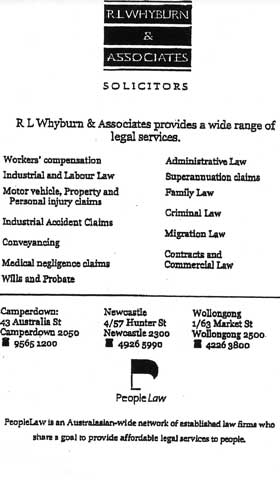 |
The Regulations
440 The contested provisions in their current form commenced operation on 23 May 2003 and have two principal objectives: to reduce insurance premiums and the volume of personal injury litigation in the courts of New South Wales. Clause 139(1) is stated in comprehensive terms and makes it a criminal offence for a barrister or solicitor to publish an advertisement soliciting or encouraging people to engage him or her to act for them in claims for personal injuries.
441 Clause 140 states an exception in respect of practitioners who advertise a speciality service.
442 The contested provisions should be set out in full:
"138 Definitions
In this Part:
advertisement means any communication of information (whether by means of writing, or any still or moving visual image or message or audible message, or any combination of them) that advertises or otherwise promotes the availability or use of a barrister or solicitor to provide legal services, whether or not that is its purpose or only purpose and whether or not that is its only effect.
personal injury includes pre-natal injury, impairment of a person's physical or mental condition, and disease.
publish means:
(a) publish in a newspaper, magazine, journal, periodical, directory or other printed publication, or
(b) disseminate by means of the exhibition or broadcast of a photograph, slide, film, video recording, audio recording or other recording of images or sound, either as a public exhibition or broadcast or as an exhibition or broadcast to persons attending a place for the purpose of receiving professional advice, treatment or assistance, or
(c) broadcast by radio or television, or
(d) display on an Internet website or otherwise publicly disseminate by means of the Internet, or
(e) publicly exhibit in, on, over or under any building, vehicle or place or in the air in view of persons in or on any street or public place, or
(f) display on any document (including a business card or letterhead) gratuitously sent or gratuitously delivered to any person or thrown or left on any premises or on any vehicle, or
(g) display on any document provided to a person as a receipt or record in respect of a transaction or bet.
solicitor includes a firm of solicitors, solicitor corporation and incorporated legal practice.
139 Restriction on advertising personal injury services
(1) A barrister or solicitor must not publish or cause or permit to be published an advertisement that includes any reference to or depiction of any of the following:
(a) personal injury,
(b) any circumstance in which personal injury might occur, or any activity, event or circumstance that suggests or could suggest the possibility of personal injury, or any connection to or association with personal injury or a cause of personal injury,
(c) a personal injury legal service (that is, any legal service that relates to recovery of money, or any entitlement to recover money, in respect of personal injury).
Maximum penalty: 10 penalty units.
(2) A contravention of this clause by a barrister or solicitor is declared to be professional misconduct.
(3) Evidence that a barrister or solicitor has been convicted of an offence under this clause or under clause 73D of the Workers Compensation (General) Regulation 1995 is sufficient evidence of a contravention of this clause by the barrister or solicitor for the purposes of any proceedings under Part 10 (Complaints and discipline) of the Act.
140 Exception for advertising specialty
(1) This Part does not prevent the publication of an advertisement that advertises a barrister or solicitor as being a specialist or offering specialist services, but only if the advertisement is published by means of:
(a) an entry in a practitioner directory that states only the name and contact details of the barrister or solicitor and any area of practice or accredited specialty of the barrister or solicitor, or
(b) a sign displayed at a place of business of the barrister or solicitor that states only the name and contact details of the barrister or solicitor and any accredited specialty of the barrister or solicitor, or
(c) an advertisement on an Internet website operated by the barrister or solicitor the publication of which would be prevented under this Part solely because it refers to personal injury or personal injury legal services in a statement of accredited specialty of the barrister or solicitor.
(2) In this clause:
accredited specialty of a barrister or solicitor means a specialty in which the barrister or solicitor is accredited under an accreditation scheme conducted or approved by the Bar Council or Law Society.
practitioner directory means a printed publication, directory or database that is published by a person in the ordinary course of the person's business (and not by the barrister or solicitor concerned or a partner, employee or member of the practice of the barrister or solicitor).
140A Other exceptions
This Part does not prevent the publication of any advertisement:
(a) to any person who is already a client of the barrister or solicitor (and to no other person), or
(b) to any person on the premises of a place of business of the barrister or solicitor, but only if the advertisement cannot be seen from outside those premises, or
(c) in accordance with any order by a court, or
(d) pursuant to a disclosure made by a barrister or solicitor under Division 2 of Part 11 of the Act, or
(e) to the extent that it relates only to the provision of legal aid or other assistance by an agency of the Crown and is published by or on behalf of that agency, or
(f) to the extent that it relates only to legal education and is published to members of the legal profession by a person in the ordinary course of the person's business or functions as a provider of legal education, or
(g) that is required to be published by or under a written law of the State.
140B Responsibility for employees and others
For the purposes of this Part, evidence that a person who is an employee of a barrister or solicitor, or a person otherwise exercising functions in the barrister's or solicitor's practice, published or caused to be published an advertisement is evidence (in the absence of evidence to the contrary) that the barrister or solicitor caused or permitted the publication of the advertisement.
140C Double jeopardy
A person who has been convicted of an offence under Part 19B of the Workers Compensation (General) Regulation 1995 is not, if that offence would constitute an offence under this Part in respect of the publication of an advertisement, liable to be convicted of an offence under this Part in respect of that publication.
140D Transitional – finalised publications
This Part does not prevent the publication of an advertisement in a printed publication the contents of which were finalised (by the publisher of that publication) before the date of publication in the Gazette of the Legal Profession Amendment (Personal Injury Advertising) Regulation 2003."
The arguments
443 It is unnecessary for me to deal with the arguments as to the proper construction of the contested provisions. I agree with the construction adopted by Gummow J and his Honour's reasons for it. The plaintiffs in this Court argue that the contested provisions are invalid for these reasons:
1. they infringe the freedom of communication on political and governmental matters guaranteed by the Constitution;
2. they infringe Ch III of the Constitution and "the principle of the rule of law as given effect by the Constitution";
3. they infringe the freedom of interstate intercourse or, alternatively, trade and commerce guaranteed by s 92 of the Constitution;
4. they exceed the legislative powers of the State of New South Wales by virtue of the nature of their extra-territorial operation;
5. they exceed any powers to make regulations under the Legal Profession Act by virtue of the nature of their extra-territorial reach; and
6. they are inconsistent with laws of the Commonwealth, within the meaning of s 109 of the Constitution because in their practical operation, they detract from or impair the operation of Commonwealth laws falling into either or both of two broad categories.
444 I put aside until later the questions raised about the possible effect of ss 92 and 109 of the Constitution, the operation of the contested provisions upon the representative action started in the Federal Court referred to in the pleadings, actions instituted, or to be instituted in federal courts, the impeding of access to the courts (a right said to be implied in the Constitution) and the other matters raised by the plaintiffs, and deal first with the asserted fetter upon the implied freedom of communication.
Do the provisions infringe the implied freedom of communication in relation to political and governmental matters? (Question 1(a))
445 The plaintiffs submitted that the contested provisions impermissibly restrict communications between a barrister or solicitor and the public in relation to:
1. legislative or executive policy, or governmental acts or omissions, relating to personal injuries;
2. legal rights and remedies against New South Wales or its agencies relating to personal injuries;
3. legal rights and remedies against other States and Territories of Australia or their agencies relating to personal injuries;
4. legal rights and remedies against the Commonwealth of Australia or its agencies relating to personal injuries;
5. decisions handed down by courts relating to personal injuries, including decisions handed down by federal courts or by courts exercising federal jurisdiction;
6. proposed legal proceedings relating to personal injuries, including representative proceedings pursuant to court rules or to Pt IVA of the Federal Court of Australia Act;
7. actual representative proceedings relating to personal injuries, including communication with actual or potential group members in the proceeding;
8. legal rights and remedies available under federal legislation relating to personal injuries;
9. limitation periods in relation to legal rights and remedies connected with personal injury; and
10. legal duties connected with personal injuries, or the prevention thereof.
446 It is unnecessary for me to repeat what I have said in earlier cases[452] in relation to the inference by the Court in Lange v Australian Broadcasting Corporation[453] of an implied constitutional freedom of communication. I adhere to that. For present purposes I will proceed, as I did in those cases, upon the assumption that the decision in Lange accords with the Constitution and that I am bound to apply it.
447 In Lange[454]the Court said this:
"First, does the law effectively burden freedom of communication about government or political matters either in its terms, operation or effect? Second, if the law effectively burdens that freedom, is the law reasonably appropriate and adapted to serve a legitimate end the fulfilment of which is compatible with the maintenance of the constitutionally prescribed system of representative and responsible government and the procedure prescribed by s 128 for submitting a proposed amendment of the Constitution to the informed decision of the people (hereafter collectively 'the system of government prescribed by the Constitution'). If the first question is answered 'yes' and the second is answered 'no', the law is invalid." (footnotes omitted)
448 The test as propounded in that passage really raises I think these questions: what is a "government or political matter"; how is the communication in question to be characterised; and if the communication is of a government or political matter, is it nonetheless appropriate and adapted to serve a legitimate purpose, the fulfilment of which is compatible with the maintenance of the constitutionally prescribed system of representative and responsible government, and the holding of a referendum under s 128 of the Constitution.
449 In a modern democratic community such as Australia there will always be many self-interest, single, and multiple issue groups pressing governments, both State and federal, to legislate for, and regulate practically every form of temporal Utopia imaginable. Some would seek to make every wish and hope, however personal or idiosyncratic, a government or political matter[455]. But there must, in the practical world, be some limits.
450 Take as one example discourse on religion. In Australia compulsory secularity in government and other affairs is confined to the affairs of the Commonwealth Government. It is possible that a State might seek to make laws of the kind that s 116[456] of the Constitution prohibits the Commonwealth from making. Perhaps even religion could therefore be, or come to be regarded as a political matter. The expression "government or political matter", which is not part of the text of the Constitution and lacks therefore any contextual anchor in it, has nonetheless to be given content. If there were no practical limits to the freedom expounded in Lange the concept of government or political matters would be absolute and unbounded, as wide as, or even wider in operation than, the First Amendment[457] to the Constitution of the United States.
451 The form in which this Court posed what the Justices described as the second question in the passage quoted from Lange bears upon, by qualifying, the concept earlier referred to, of a government or political matter. The qualification is that, for the purposes of the freedom, a government or political matter must, in effect, be of real significance to the election of parliamentarians, or the maintenance of responsible and representative government, or the conduct of a referendum pursuant to s 128 of the Constitution.
452 This follows also from the emphasis that this Court put elsewhere in Lange[458] upon those provisions in the Constitution that govern the election of senators and members of the House of Representatives, and for the need for protected communications to be ones having a real and practical capacity to interfere with politicians, their free election, and the exercise of their constitutional rights and powers.
453 None of the communications proposed, or indeed anything like them, answer any acceptable practical description or definition of a government or political matter. It would be fanciful to suggest otherwise. It is unimaginable that they could possibly interfere with electors, free elections or an open referendum, or the legitimate exercise of elected politicians' rights and powers.
454 I questioned during argument the status and relevance of a document annexed to the special case, and therefore before the Court, and described as a Report to the National Competition Council on the Application of National Competition Policy in New South Wales made in March 2003. The plaintiffs insisted that the Court could and should have regard to it, even though it is, in my view, adverse to them. It is not of course a document that can be used for the purpose of construing the contested provisions, but it does give some insight into the intention, and intended reach of the contested provisions, and the perceived problem which the New South Wales legislature sought to overcome. The report said this:
"The New South Wales restrictions on advertising personal injury services were introduced in response to the problem of reduced access to affordable public liability insurance.
The New South Wales Government is moving to strengthen these restrictions as a number of practitioners have sought to circumvent these restrictions.
While the causes of this are complex (including the size of compensation claims, the pricing and investment practices of insurance companies including under-pricing in the past, lower investment returns for insurers and rising reinsurance costs) one of the factors that led to increasing premiums appears to have been the sharp rise in the number of public liability claims.
Evidence of the growth in such claims was provided in last year's report to the NCC. Further evidence has since been presented to the national Ministerial meetings on public liability insurance and to a joint sitting of the New South Wales Parliament. The cost of such claims is also a significant issue. At the meeting of Ministers on 15 November 2002, PriceWaterhouseCoopers Actuarial advised that claims up to $100,000 comprised approximately 45% of the cost of claims overall.
At the joint sitting of the New South Wales Parliament on 18 September 2002, Trowbridge Consulting noted the disproportionate impact that claims in the $20,000 to $100,000 bracket had on the costs flowing from public liability claims. Trowbridge also noted that there had been a significant increase in public liability litigation in New South Wales when compared with other jurisdictions.
The New South Wales Government considers that one of the reasons for the growth in small claims is that advertising by some lawyers encourages people to make personal injury claims. Some of this advertising may have encouraged people to make a claim, regardless of the seriousness of their injury, their genuine need for compensation or the real merits of their claim.
Given limits to the capacity of the justice system and the growth in the number of claims, advertising restrictions may also regulate demand for litigation relative to that for other less costly forms of settling disputes or resolving grievances. This will assist to limit the negative externalities arising from increasing numbers of filed claims, in particular non-meritorious claims, which can contribute to log jams in court administration and impose efficiency costs that are ultimately borne by the wider community.
Any restrictive impact of the advertising rules in New South Wales is outweighed by the potential for a future positive impact on levels of litigiousness in the personal injury area. On balance, the public interest is best served by imposing reasonable restrictions on this type of advertising.
The Prime Minister of Australia also described the original removal of advertising restrictions on lawyers as a 'disastrous mistake' to the Commonwealth Parliament on 14 March 2002. The Prime Minister made this statement in the context of answering a question regarding the public liability crisis. The Prime Minister stated that the removal of restrictions has contributed to the 'growth of a litigious mentality in our society'. He also noted more generally in relation to restrictions on litigation that '[w]e cannot have it both ways, and society has got to decide where the balance is struck'.
If pressure on insurance premiums and rates of litigation are alleviated by the national process of reform presently underway, including tort law reforms at New South Wales level, the need for these advertising restrictions can then be reviewed. The New South Wales Government considers, however, that the restrictions imposed are critical at this time in the broader interest of the New South Wales community."
455 The contested provisions do not, subject to one matter, on their proper construction, go beyond the solution of the problems identified, New South Wales State problems, of the proliferation of expensive and economically inefficient litigation, as the legislature saw it, in the courts of that State. Some of the language of the contested provisions is general, but it manifests no intention to reduce or obstruct the conduct of other litigation.
456 The restriction in cl 139 applies to any barrister or solicitor practising in New South Wales. The restriction is upon a communication which refers to, or is connected with personal injury but the restriction is not absolute. Exceptions to it are stated in cl 140.
457 Those matters have little or nothing to do with, or say about electors and their choice of potential representatives, or the conduct of responsible and representative government by elected politicians. And even if they did, they in no way interfere with them, and accordingly impose no burden upon communications of the kind which the implication seeks to protect. The contested provisions in any event, pass the other test posed in Lange. They are, in language, clear intent, and effect, reasonably appropriate and adapted to the legitimate end of stemming what the Parliament of New South Wales considers to be an unacceptable tide of litigation of a particular kind in that State.
458 True it is that the courts may be described as the third arm of government and that access to them is fundamental to democracy. But that does not mean that any person may litigate every difference or dispute in any court at any time. Legislatures both State and federal regulate, indeed restrict access to courts in many ways. The number of judges and courts are matters ultimately of legislative mandate, as are the causes, statutory or otherwise, of action which may be pursued, the jurisdictions in which they may be pursued, the ways, according to the practice rules, in which they must be pursued, and the limitation periods within which they must be brought. Legislatures also frequently restrict or limit access to courts of appeal. The need for special leave to appeal to this Court is an obvious case in point.
459 It may be accepted that communications about the desirability or otherwise of restrictions upon the right to litigate to which I have just referred may be communications about government or political matters, but that in general is not characteristic of the communications here. Rather, they are communications primarily (but not of course exclusively) aimed to encourage, indeed on one view, to incite people to sue for personal injuries. It is difficult to see why, if legislatures may restrict access to the courts, they may not equally restrict advertising designed to encourage people to go to court. The proper characterisation of the contested provisions is as laws to restrict lawyers from soliciting clients, by communications to the public, inviting or encouraging them to sue in the courts. I do not confine the characterisation to suits for damages for personal injuries because, as the plaintiffs and the Attorneys-General correctly point out, the invitations to sue, can be read as invitations to sue for other than damages for personal injuries, and the contested provisions may also restrict communications about those other.
460 There is also this. As I said in Coleman v Power[459] the constitutional implication which this Court propounded in Lange and the freedom to which it is said to give rise should be invoked only when it is necessary to do so, and when the burden can be seen to be a burden upon what is necessary for the effective operation of the system of responsible and representative government. It is not irrelevant that the targeted publications here are not exclusively but substantially commercially motivated. This Court in Theophanous v Herald & Weekly Times Ltd[460] said that speech "which is simply aimed at selling goods and services and enhancing profit-making activities will ordinarily fall outside the area of constitutional protection. Commercial speech without political content 'says nothing about how people are governed or how they should govern themselves'."
461 By any of the criteria stated in, and according to any available formulation of the tests in Lange, the contested provisions do not offend any constitutional implication from the principles stated in that case.
Does Pt 14 infringe the freedom of interstate intercourse or, alternatively, trade and commerce guaranteed by s 92 of the Constitution? (Question 1(c))
462 The question whether the contested provisions infringe s 92 of the Constitution is barely, if at all, arguable and falls to be answered on the basis propounded in Cole v Whitfield[461] which was squarely concerned with the operation of s 92 of the Constitution and the correctness of which was not challenged here. The Regulations are not aimed any more at interstate trade, commerce, and intercourse than they are at the effective operation of representative and responsible government. They are, as cl 139 makes clear, aimed at preventing a barrister or solicitor, that is a lawyer in, or practising in New South Wales, from advertising legal services for the pursuit of claims for personal injuries in that State. This follows from the ordinary limits upon the extra-territoriality of State legislation and the narrow and precise definition of barristers and solicitors for the purposes of the contested provisions:
"(a) a legal practitioner who holds a current practising certificate as a barrister, or
(b) an interstate legal practitioner who practises as a barrister in this State"
and,
"(a) a legal practitioner who holds a current practising certificate as a solicitor and barrister, or
(b) an interstate legal practitioner who practises as a solicitor and barrister in this State".
463 It is not suggested that the contested provisions are incapable of having some conceivable effect on advertisements originating, or read outside the State of New South Wales. They are however laws which have as their real object, the prescription or proscription, in a non-discriminatory way, of a particular kind of professional conduct in, or in relation to litigation in the courts of New South Wales[462].
464 Even if the advertisements were sought to be published interstate in any relevant sense, their prohibition would not be an impediment to or a burden upon any freedom of interstate trade, commerce or intercourse. Nothing in the contested provisions prohibits or restricts the provision of legal services in New South Wales by personal injury practitioners, wherever situated. At most, they regulate the manner in which clients may be solicited by persons practising as solicitors or barristers in New South Wales. And nothing in them would operate to prevent the free passage of lawyers to and from other places in the Commonwealth to New South Wales. The position is the same whether the communications are made by profit or non-profit organisations and people, and whether they are involved in trade and commerce or not.
Does any extra-territorial operation of them render the contested provisions invalid? (Questions 1(d) and (e))
465 This question also admits of one answer only, a negative one. Dixon J in Broken Hill South Ltd v Commissioner of Taxation (NSW)[463] said this[464]:
"[I]t is within the competence of the State legislature to make any fact, circumstance, occurrence or thing in or connected with the territory the occasion of the imposition upon any person concerned therein of a liability to taxation or of any other liability. It is also within the competence of the legislature to base the imposition of liability on no more than the relation of the person to the territory. The relation may consist in presence within the territory, residence, domicil, carrying on business there, or even remoter connections. If a connection exists, it is for the legislature to decide how far it should go in the exercise of its powers."
Recently, in Mobil Oil Australia Pty Ltd v Victoria[465] Gleeson CJ reiterated the liberality of the test of territorial legislative competence[466]:
"The history, rationale and scope of territorial limitations on the legislative competence of State Parliaments was explained in Union Steamship Co of Australia Pty Ltd v King[467]. What was there described as a 'new dispensation' in s 2(1) of the Australia Act 1986 (Cth)[468] was said perhaps to do no more than recognise what had already resulted from judicial decisions. Typical of such decisions was that of Gibbs J in Pearce v Florenca[469], who pointed out that a power to make laws for the peace, order and good government of a State is not limited to laws which operate or apply only to persons or events within the State. Such a power requires a relevant territorial connection between the law and the State, but the test of relevance is to be applied liberally, and even a remote or general connection will suffice."
466 The contested provisions here have much more than a remote or a general connexion with New South Wales. Their concern is with those who do, or would seek to practise in the regulated professions, and who therefore owe special duties to the courts of New South Wales, of solicitors and barristers of that State. The connexion is direct and close. The plaintiffs' arguments with respect to invalidity on the basis of any excessive extra-territorial operation also fail.
Do the contested provisions infringe Chapter III of the Constitution or the principle of the rule of law? (Question 1(b))
467 Question 1(b) asks whether the contested provisions infringe Ch III of the Constitution and "the principle of the rule of law as given effect by the Constitution".
468 There is no express provision of Ch III of the Constitution which in any way deals with, or even remotely touches upon advertising by lawyers (whether engaged in practice for profit or upon a non-profit basis) to solicit clients.
469 In construing Ch III of the Constitution, and in particular, in accepting invitations from parties before it to search for implications from the Chapter it is as well for this Court to keep these matters in mind. The objects of Ch III are essentially these and these only: to establish this Court as a Federal Supreme Court; to ensure the independence and security of tenure of federal judges; to define the original and appellate jurisdiction of this Court; to recognise and necessarily thereby to "constitutionalise" the continued existence of, the State Supreme Courts; to confine appeals to the Privy Council; to empower the Parliament to make laws conferring rights to proceed in federal matters in the State and other federal courts; and to entrench trial by jury for federal indictable offences. The provisions of Ch III are, on their face, ample, explicit, concrete and clear, complete, and not such as to necessitate amplification by implication or otherwise. In Kable v Director of Public Prosecutions (NSW)[470] this Court took the view that legislation detracting from the integrity, independence and impartiality of the Supreme Court of New South Wales as a court invested with federal jurisdiction, was incompatible with Ch III. That was tantamount to a holding that there should be inferred from Ch III an implication that non-judicial powers of a particular kind could not be exercised by any court which might exercise federal jurisdiction. That seems to me, with respect, to require the drawing of a very long bow. I would be unwilling to stretch the bow any further, as the plaintiffs here seek to have the Court do. In an essay, "The Interpretation of a Constitution in a Modern Liberal Democracy"[471], Sir Anthony Mason acknowledged, in citing the following passage from the Engineers case, that there is in this country a judicial history of hostility to the making of constitutional implications except on a very restricted footing[472].
"The doctrine of 'implied prohibition' finds no place where the ordinary principles of construction are applied so as to discover in the actual terms of the instrument their expressed or necessarily implied meaning."
Sir Anthony Mason went on, in the same essay, to say "implication is an essential and commonplace incident of orthodox interpretation"[473]. But that undoubtedly correct observation can, with respect, provide no foundation for a departure from the well-understood rules relating to implications, one of which has at least the same operation in statutory, and constitutional interpretation particularly, as in the interpretation of contracts as to which Mason J in Codelfa Construction Pty Ltd v State Rail Authority of NSW said[474]:
"Accordingly, the courts have been at pains to emphasize that it is not enough that it is reasonable to imply a term; it must be necessary to do so to give business efficacy to the contract. So in Heimann v The Commonwealth[475]Jordan CJ, citing Bell v Lever Brothers Ltd[476], stressed that in order to justify the importation of an implied term it is 'not sufficient that it would be reasonable to imply the term ... It must be clearly necessary'. To the same effect are the comments of Bowen LJ in The Moorcock[477]; Lord Esher MR in Hamlyn & Co v Wood & Co[478]; Lord Wilberforce in Irwin[479]; Scrutton LJ in Reigate v Union Manufacturing Co (Ramsbottom)[480]." (emphasis added)
470 The particular, indeed rigorous, application of the "necessity rule" to the Australian Constitution is required by reason of a number of features unique to our Constitution and its composition: the prolonged and fully recorded debates and deliberations preceding it to which modern lawyers have ready access and which show clearly, in most instances, why proposals were adopted or discarded; the substantial public acceptance in Australia of the Constitution before its passage through the Parliament of the United Kingdom; its generally comprehensive and explicit language; the availability of one, and one only mechanism for its amendment, a referendum under s 128; the reluctance, in many referenda of the people of Australia to change it; and, despite the last its enduring efficacy.
471 A case of this kind, in which the question posed, among other things, as to the expansiveness of the power of the Court itself, and the impact of its decisions upon the respective polities of the Federation, is an occasion for especial caution and restraint.
472 In substance, the plaintiffs seek to set up in respect of Ch III an implication of the kind found by this Court in Lange. When it came to the point they had even more difficulty in formulating the implication contended for and in defining the sorts of circumstances attracting its application, than the courts have had in the cases since Lange[481]. In the end, the plaintiffs put the matter extraordinarily broadly in this way:
"Chapter III, in particular sections 71, 73, 75, 76 and 77, requires for its effective operation that the people of the Commonwealth have the capacity, ability or freedom to ascertain their legal rights and to assert those legal rights before the courts there mentioned. The effective operation of that capacity, ability or freedom requires that they have the capacity or ability or freedom to communicate and particularly to receive such information or assistance as they may reasonably require for that to occur.
The prohibition ... is one that extends to any law of the Commonwealth or of a State that burdens the assertion of legal rights before the courts, including the correlative communication to which we have referred, and does not ... go beyond what is necessary or appropriate and adapted for the preservation of an ordered society or the protection or vindication of legitimate claims of individuals in an ordered society."
473 I cannot imagine that the prohibition of advertisements or letters of the kind proposed could in any way impair or inhibit the effective operation of Ch III of the Constitution. Restriction upon them does nothing to prevent the recognition and enforcement of rights under federal law or against the Commonwealth Executive. The contested provisions deal with a different topic, the banning or regulation of a particular form of advertising by particular people. They apply to barristers and solicitors only. Absent the prohibited communications the work of the courts will continue to be done in an uninhibited way and in the ordinary course. People with federal claims will remain free to pursue them and to engage whom they wish to do so on their behalf. The contested provisions do nothing to detract from the effective operation of Ch III of the Constitution. Their enactment is within the powers of New South Wales to make laws for the peace, order and good government of that State.
Are the contested provisions inconsistent with various federal laws? (Question 1(f))
474 The plaintiffs argue that there are two categories of federal law, with which the contested provisions are in conflict, laws conferring substantive rights and remedies, and those that confer rights to legal representation. It follows, they say, that the contested provisions (which may not be sensibly read down) are invalid by reason of the operation of s 109[482] of the Constitution. They point first to ss 52, 75AD, 82 and 86 of the Trade Practices Act 1974 (Cth) ("the TPA"), and then to ss 39(2) and 39B of the Judiciary Act 1903 (Cth) and Divs 1 and 2 of Pt III of the Federal Court of Australia Act 1976 (Cth) ("the FCA").
475 By ss 52(1) and 82(1) of the TPA the Commonwealth Parliament has legislated for a right of action for loss or damages caused by misleading or deceptive conduct. Section 75AD of the TPA creates a cause of action for "injuries" suffered because of a defect in goods supplied by a corporation. By s 86 the Commonwealth Parliament has conferred jurisdiction in the causes of action on the Federal Court, the Federal Magistrates Court and State courts within the limits of their own jurisdiction. The Federal Court is vested with all the powers and functions necessary to hear and determine them pursuant to Divs 1 and 2 of Pt III of the FCA. The causes of action created by the enactments referred to may be relied on in claims for damages for personal injury, as in the representative proceeding brought by the second plaintiff on behalf of Mr Darcy (see in particular s 75AD). The plaintiffs do accept however that the Commonwealth certainly did not intend to cover the field in relation to claims for personal injuries in State courts, or in relation to communications about claims for damages for personal injuries. They also accept that the federal laws are intended to operate in the setting of other laws, including State laws. Nonetheless, they argue that the contested provisions in their operation alter, impair or detract from the Commonwealth laws to which they have referred.
476 I have already identified what I consider to be the correct characterisation of the contested provisions. That identification alone almost forecloses the plaintiffs' case based on inconsistency (s 109). There is no federal law, let alone any federal law covering this field, of the, or, an aspect of, the advertising of legal services for or in personal injuries cases, or other cases in which personal injury or the threat or risk of it may be a factor, in New South Wales.
477 The notion that a restriction upon advertising by solicitors soliciting personally injured or other clients, alters, impairs or detracts from the pursuit of remedies made available under federal legislation is, I think, far-fetched. People pursuing them are in no way impeded from doing so because lawyers may be subject to State rules about the way in which they may promote themselves or offer their services. Indeed, a restrictive rule about advertising is much less likely to have an obstructive effect upon the making of federal claims, than a rule that the plaintiff must pay a filing fee, or that a plaintiff in a remote area must file his or her process in a metropolitan registry, or that in an action in a State court exercising federal jurisdiction, the rules of court may impose more onerous procedural obligations on plaintiffs than in a federal court.
478 The Commonwealth may well be able to legislate partially, or exhaustively if it wishes, for the advertising of federal causes of action, rights to pursue them, and rules relating to, legal practice in federal courts, and, arguably, in State courts exercising federal jurisdiction, but it has not done so here.
479 The provisions of the TPA to which the plaintiffs point create causes of action. A rule about non-advertising cannot defeat, or indeed in any way even impinge upon those causes of action or remedies. And ss 39(2) and 39B(1A)(c) of the Judiciary Act, which do no more than invest federal jurisdiction in State courts and confer jurisdiction upon federal courts are similarly unaffected. The functions of these courts will be unaffected by the proscription of relevant communications and their like.
480 There are some further points which are made, correctly in my opinion, by the Commonwealth. The contested provisions do not inhibit communications between lawyers and their current clients. Nor do they prevent prospective litigants from retaining lawyers. The provisions do not prevent lawyers from advertising their services generally. The contested provisions prohibit only the advertising of personal injury legal services by particular lawyers. In no real sense does the prohibition render persons who may have rights enforceable in federal jurisdiction incapable of being informed about them.
481 The plaintiffs also say that ss 55A, 55B, 55D and 78 of the Judiciary Act are in conflict with the contested provisions. Section 78 of the Judiciary Act does no more than give litigants in all courts exercising federal jurisdiction the right to be represented by such legal practitioners as "by this Act or the laws and rules regulating the practice of those Courts respectively are permitted to appear therein". Representation is one thing, soliciting people to engage particular representation is another. Section 55A permits persons admitted to legal practice in the High Court to practise in any federal court. Section 55B entitles persons who are entitled to practise in the Supreme Court of any State or Territory to practise in any federal court (sub-s (1)), any courts of a State in relation to the exercise by that court of federal jurisdiction (sub-s (4)(a)), and in any court of any internal Territory in relation to the exercise of "federal-type jurisdiction" (sub-s (4)(b)). And s 55D has the effect of entitling persons on the roll of practitioners of the High Court, a State Supreme Court or a Territory Supreme Court to practise in any Territory that does not have a system of admitting practitioners to practice before that Territory's Supreme Court.
482 The plaintiffs further argue that ss 55A, 55B and 55D of the Judiciary Act have expressly provided the extent to which State/Territory law may affect their operation; relevantly, in creating a register of interstate practitioners under s 55B. That argument should be rejected. The entitlement to practise stated in ss 55A, 55B and 55D operates, as the Commonwealth submits, upon a range of legislative schemes which from time to time regulate the right to practise in State and Territory courts: the Commonwealth provisions are supplementary to or cumulative upon State laws regulating the legal profession. Furthermore, a right to practise is by no means the same as a right to advertise that a practitioner wishes to practise in a particular area.
483 Sections 55A, 55B and 55D of the Judiciary Act operate upon, and assume the existence of, the State and Territory laws regulating the legal profession. Accordingly, provisions such as the contested provisions, which apply equally to State and federal matters, are not inconsistent with those Commonwealth provisions.
484 The same reasoning leads to the same conclusion with respect to the other Commonwealth enactments to which the plaintiffs point, the Safety, Rehabilitation and Compensation Act 1988 (Cth),the Administrative Appeals Tribunal Act 1975 (Cth), the Superannuation (Resolution of Complaints) Act 1993 (Cth) and the Superannuation Industry (Supervision) Act 1993 (Cth). None of the provisions of these refer to or relate directly or indirectly to advertising of services by lawyers. The contested provisions present no obstacles to their operation. Whether lawyers can or cannot communicate that they wish to undertake the pursuit of claims under these enactments does not alter, impair or detract from the operation or objects of them, or the pursuit of federal claims or rights to which they give rise.
485 The contested provisions pass both of the tests stated by Mason J in New South Wales v The Commonwealth and Carlton[483]:
"[The 'alter, impair or detract from'] test may be applied so as to produce inconsistency in two ways. It may appear that the legal operation of the two laws is such that the State law alters, impairs or detracts from rights and obligations created by the Commonwealth law. Or it may appear that the State law alters, impairs or detracts from the object or purpose sought to be achieved by the Commonwealth law. In each situation there is a case for saying that the intention underlying the Commonwealth law was that it should operate to the exclusion of any State law having that effect."
486 That and other statements[484] indicate that a slight or marginal or insignificant impact of a State law upon a federal law will not give rise to a constitutional inconsistency. The impact must be one of some significance and such as would have the effect, if the State law were valid, of precluding, overriding or rendering ineffective an actual exercise of federal jurisdiction[485]. But as I have said, I do not think that even a marginal impact is made here by the contested provisions.
487 I would answer the questions as follows.
(1) Is Part 14 of the Regulation invalid in whole or in part by reason that it:
(a) impermissibly infringes the freedom of communication on political and governmental matters guaranteed by the Constitution;
No.
(b) impermissibly infringes the requirements of Ch III of the Constitution and of the principle of the rule of law as given effect by the Constitution;
No.
(c) impermissibly infringes the freedom of interstate intercourse or alternatively trade and commerce guaranteed by s 92 of the Constitution;
No.
(d) exceeds the legislative powers of the State of New South Wales by virtue of the nature of its extra-territorial operation;
No.
(e) exceeds any powers to make regulations under the Legal Profession Act, by virtue of the nature of its extra-territorial operation;
No.
(f) is inconsistent with the rights, duties, remedies and jurisdiction conferred, regulated or provided for by:
(A) ss 39(2), 39B, 55A, 55B, 55D, and 78 of the Judiciary Act 1903 (Cth);
(B) Divisions 1 and 2 of Part III and Part IVA of the Federal Court of Australia Act 1976 (Cth);
(C) ss 52, 53(a), 74B, 74D, 75AD, 82, 86 and 87 of the Trade Practices Act 1974 (Cth);
(D) Parts II, IV, V and VI of the Safety, Rehabilitation and Compensation Act 1988 (Cth), together with Parts IV and IVA of the Administrative Appeals Tribunal Act 1975 (Cth);
(E) Parts 4, 6 and 7 of the Superannuation (Resolution of Complaints) Act 1993 (Cth), together with Parts 27 and 28 of the Superannuation Industry (Supervision) Act 1993 (Cth).
No.
(2) If yes to any part of (1), does Part 14 of the Regulation validly prohibit:
(a) the First Plaintiff from publishing an advertisement in the form of Annexure A to the Amended Statement of Claim;
(b) the Second Plaintiff from publishing:
(i) an advertisement in the form of the three advertisements which are Annexure B to the Amended Statement of Claim;
(ii) on its website, material substantially in the form of the material contained in Annexures C and D to the Amended Statement of Claim;
(iii) a letter in the form of Annexure E to the Amended Statement of Claim to group members of the group on behalf of whom proceedings are brought in Federal Court proceedings N932 of 2001.
(c) the Third Plaintiff from publishing an advertisement in the form of Annexure F to the Amended Statement of Claim?
Unnecessary to answer.
(3) If yes to any part of (2), ought the declaratory relief sought in the Amended Statement of Claim be withheld in the discretion of the Court by reason of the facts set out in paragraph 17 in relation to the advertisements which the plaintiffs say they wish to publish but which have not in fact been published?
Unnecessary to answer.
There is no question of costs raised in the special case. That issue should be determined by the Justice disposing of the action.
[1] See In re Primus 436 US 412 at 440 (1978) per Rehnquist J.
[2] Legal Profession Act 1987 (NSW); Legal Practice Act 1996 (Vic); Legal Profession Act 2004 (Q); Legal Practice Act 2003 (WA); Legal Practitioners Act 1981 (SA); Legal Profession Act 1993 (Tas); Legal Practitioners Act 1970 (ACT); Legal Practitioners Act (NT). The Legal Profession Act 2004 (NSW) and the Legal Profession Act 2004 (Vic) each received Royal Assent following conclusion of oral argument in this case. These reasons refer to the statutes in force at the relevant time.
[3] cf Legal Practitioners Act 1981 (SA), s 16; Legal Practice Act 2003 (WA), s 39.
[4] Legal Profession Act 1987 (NSW), s 171M; Legal Practice Act 1996 (Vic), s 172; Legal Profession Act 2004 (Q), s 579; Legal Practice Act 2003 (WA), s 161; Legal Practitioners Act 1981 (SA), s 89(3); Legal Profession Act 1993 (Tas), s 93; Legal Practitioners Act 1970 (ACT), s 73; Legal Practitioners Act (NT), s 52(3).
[5] A Solicitor v Law Society of New South Wales (2004) 216 CLR 253.
[6] Constitution, s 71.
[7] Legal Profession Act 1987 (NSW), ss 38G, 38H, 38I, 38K, 38L, 48B, 48C.
[8] Myers v Elman [1940] AC 282 at 288-289.
[9] The operation of the system in New South Wales was examined in A Solicitor v Law Society of New South Wales (2004) 216 CLR 253.
[10] Bennett (ed), A History of the New South Wales Bar, (1969) at 170.
[11] Cordery on Solicitors, 5th ed (1961) at 436, quoting Solicitors' Practice Rules 1936 (UK). See also Solicitor's Practice Regulation 1940 (NSW), reg 29(2), made pursuant to the Legal Practitioners Act 1898 (NSW); Atkins, The New South Wales Solicitor's Manual, 3rd ed (1975) at 159, 226-237.
[12] Tobacco Advertising Prohibition Act 1992 (Cth).
[13] Therapeutic Goods Act 1989 (Cth), Ch 5, Pt 5-1.
[14] Classification (Publications, Films and Computer Games) Act 1995 (Cth).
[15] (1994) 182 CLR 272.
[16] (1997) 189 CLR 520 at 567.
[17] Coleman v Power (2004) 78 ALJR 1166 at 1173 [28]; 209 ALR 182 at 191.
[18] Coleman v Power (2004) 78 ALJR 1166 at 1184 [89]; 209 ALR 182 at 206.
[19] Lange v Australian Broadcasting Corporation (1997) 189 CLR 520 at 567.
[20] cf Theophanous v Herald & Weekly Times Ltd (1994) 182 CLR 104 at 124-125.
[21] Australian Communist Party v The Commonwealth (1951) 83 CLR 1 at 193 per Dixon J.
[22] In re Judiciary and Navigation Acts (1921) 29 CLR 257.
[23] (1994) 182 CLR 272.
[24] Interpretation Act 1987 (NSW), s 12; Solomons v District Court of New South Wales (2002) 211 CLR 119 at 130 [9].
[25] (1988) 165 CLR 360.
[26] AMS v AIF (1999) 199 CLR 160 at 178-180 [41]-[48], 232-233 [221].
[27] Mobil Oil Australia Pty Ltd v Victoria (2002) 211 CLR 1 at 22-26 [7]-[16].
[28] (1986) 160 CLR 330.
[29] (1986) 160 CLR 330 at 331.
[30] (1986) 160 CLR 330 at 335.
[31] (1986) 160 CLR 330 at 336.
[32] (1986) 160 CLR 330 at 337.
[33] APLA Limited (first plaintiff, then trading as "Australian Plaintiff Lawyers Association", now trading as the "Australian Lawyers Alliance"); Maurice Blackburn Cashman Pty Ltd (second plaintiff); and Robert Leslie Whyburn (third plaintiff).
[34] (1997) 189 CLR 520.
[35] Legal Profession Amendment (Personal Injury Advertising) Regulation 2003.
[36] Transcript 6 October 2004.
[37] Transcript 6 October 2004.
[38] (1997) 189 CLR 520.
[39] (1997) 189 CLR 520.
[40] Lange v Australian Broadcasting Corporation (1997) 189 CLR 520 at 561.
[41] (2004) 78 ALJR 1166 at 1185 [92], [94], 1201 [196], 1203-1204 [211], 1207 [228]; 209 ALR 182 at 207-208, 229-230, 233, 238-239.
[42] (1997) 189 CLR 520 at 567-568.
[43] See reasons of Callinan J at [432], where the publication is set out in full.
[44] Lange v Australian Broadcasting Corporation (1997) 189 CLR 520 at 560.
[45] (2004) 78 ALJR 1166; 209 ALR 182.
[46] (2004) 78 ALJR 1166 at 1181 [78]; 209 ALR 182 at 202.
[47] (2004) 78 ALJR 1166 at 1182 [80]; 209 ALR 182 at 203.
[48] Board of Fire Commissioners (NSW) v Ardouin (1961) 109 CLR 105 at 118 per Kitto J.
[49] (2004) 78 ALJR 1166 at 1173 [28]; 209 ALR 182 at 191-192.
[50] For example, Central Hudson Gas v Public Service Commission 447 US 557 at 561-566 (1980) where the Supreme Court laid down a four part test for the valid regulation of commercial speech. The fourth limb is a requirement that the regulation be "not more extensive than is necessary" to serve the government interest.
[51] Transcript 6 October 2004.
[52] Transcript 6 October 2004.
[53] The Annotated Constitution of the Australian Commonwealth (1901) at 959.
[54] The Annotated Constitution of the Australian Commonwealth (1901) at 959.
[55] Attorney-General of the Commonwealth of Australia v The Queen (1957) 95 CLR 529 at 537-538, 539-540; [1957] AC 288 at 311-312, 314-315.
[56] Chu Kheng Lim v Minister for Immigration, Local Government and Ethnic Affairs (1992) 176 CLR 1.
[57] Polyukhovich v The Commonwealth (1991) 172 CLR 501 at 536 per Mason CJ, 648-649 per Dawson J, 686 per Toohey J, 721 per McHugh J.
[58] Re Wakim; Ex parte McNally (1999) 198 CLR 511.
[59] The Commonwealth v Queensland (1975) 134 CLR 298.
[60] The Commonwealth v Queensland (1975) 134 CLR 298 at 314.
[61] The Commonwealth v Queensland (1975) 134 CLR 298 at 315.
[62] Kable v Director of Public Prosecutions (NSW) (1996) 189 CLR 51.
[63] Austral Pacific Group Ltd (In liq) v Airservices Australia (2000) 203 CLR 136 at 142 [11], 153-155 [50]-[52].
[64] R v Kirby; Ex parte Boilermakers' Society of Australia (1956) 94 CLR 254 at 268.
[65] (1975) 134 CLR 298.
[66] North Eastern Dairy Co Ltd v Dairy Industry Authority of NSW (1975) 134 CLR 559 at 622 per Jacobs J.
[67] North Eastern Dairy Co Ltd v Dairy Industry Authority of NSW (1975) 134 CLR 559 at 624 per Jacobs J.
[68] North Eastern Dairy Co Ltd v Dairy Industry Authority of NSW (1975) 134 CLR 559 at 607 per Mason J.
[69] In re Richard Foreman & Sons Pty Ltd; Uther v Federal Commissioner of Taxation (1947) 74 CLR 508 at 530 per Dixon J.
[70] (1994) 182 CLR 272 at 298.
[71] In re Richard Foreman & Sons Pty Ltd; Uther v Federal Commissioner of Taxation (1947) 74 CLR 508 at 529.
[72] Plaintiffs' Further Submissions at [6].
[73] Sections 55A, 55B, 55D and 78 of the Judiciary Act 1903 (Cth).
[74] Polyukhovich v The Commonwealth (1991) 172 CLR 501 at 607 per Deane J. See also R v Quinn; Ex parte Consolidated Food Corporation (1977) 138 CLR 1 at 11.
[75] (1975) 134 CLR 559.
[76] (1989) 167 CLR 399 at 432, 450-451, 492.
[77] North Eastern Dairy Co Ltd v Dairy Industry Authority of NSW (1975) 134 CLR 559 at 624 per Jacobs J.
[78] The Commonwealth v Queensland (1975) 134 CLR 298 at 314.
[79] The Commonwealth v Queensland (1975) 134 CLR 298 at 315.
[80] The Commonwealth v Queensland (1975) 134 CLR 298 at 315.
[81] Residual Assco Group Ltd v Spalvins (2000) 202 CLR 629 at 644 [28].
[82] Re Dingjan; Ex parte Wagner (1995) 183 CLR 323 at 372; see also Pidoto v Victoria (1943) 68 CLR 87 at 109.
[83] (1996) 187 CLR 416 at 502.
[84] Pidoto v Victoria (1943) 68 CLR 87 at 111.
[85] Pidoto v Victoria (1943) 68 CLR 87 at 111.
[86] Bank of New South Wales v The Commonwealth (1948) 76 CLR 1 at 373 per Dixon J.
[87] The case was instituted prior to the commencement of the High Court Rules 2004 (Cth). The new Rules contain equivalent provisions in r 27.08.
[88] (1997) 189 CLR 579.
[89] (1954) 92 CLR 565 at 594.
[90] Butler v Attorney-General (Vict) (1961) 106 CLR 268 at 274.
[91] The present proceeding was instituted and heard before the commencement of the Legal Profession Act 2004 (NSW). After the reservation of judgment, the Regulation was amended by the Legal Profession Amendment (Advertising) Regulation 2005 (NSW) ("the 2005 Regulation") which commenced on 1 July 2005. These reasons deal with the attack upon the validity of the Regulation in the form it took before the 2005 Regulation.
[92] The Explanatory Note to the Amendment Regulation states that it was made under ss 38J, 127 and 216 of the Act. The Act was later revised by the Legal Profession Legislation Amendment (Advertising) Act 2003 (NSW) which amended s 38J and inserted in s 38JA a specific power to make regulations with respect to the marketing of legal services. The plaintiffs accepted in argument that the general regulation-making power in s 216 of the Act was itself sufficient to support the Amendment Regulation. The plaintiffs also accepted that, leaving aside any arguments based on the Constitution, the Amendment Regulation fell within the regulation-making power conferred on the Governor by the Act. The result is that there is no need to consider the change later effected by the amendment to s 38J and the insertion of s 38JA.
[93] The Workers Compensation (General) Regulation 1995 (NSW) was repealed by operation of s 10(2) of the Subordinate Legislation Act 1989 (NSW) with effect from 1 September 2003. It was replaced by the Workers Compensation Regulation 2003 (NSW) ("the Workers Compensation Regulation") which commenced on that date. Part 19B of the Workers Compensation (General) Regulation 1995, which contained cl 73D, is reproduced as Pt 18 of the Workers Compensation Regulation. Part 18 imposes restrictions on the advertising of legal services relating to work injury which appear to be substantially similar to those imposed with respect to personal injury advertising by Pt 14 of the Regulation. No challenge was made to the validity of Pt 18 of the Workers Compensation Regulation.
[94] cl 138.
[95] cl 138.
[96] (1971) 124 CLR 367.
[97] Clause 140C operates to prevent double jeopardy by providing that a person convicted of an offence under Pt 19B of the Workers Compensation (General) Regulation 1995 (NSW) is not liable for a conviction under Pt 14 of the Regulation in respect of the same publication.
[98] "[I]nterstate legal practitioner" is defined in s 48N of the Act to mean a natural person who is admitted to legal practice in another State or Territory, who holds an interstate practising certificate issued or given by a regulatory authority in that State or Territory and whose sole or principal place of legal practice is that State or Territory.
[99] s 171C.
[100]Toowoomba Foundry Pty Ltd v The Commonwealth (1945) 71 CLR 545 at 570; Croome v Tasmania (1997) 191 CLR 119 at 127‑128, 137‑138.
[101]cf British Medical Association v The Commonwealth (1949) 79 CLR 201 at 257.
[102]An "incorporated legal practice" is defined in s 47C as "a corporation that provides legal services" for fee, gain or reward, other than purely in‑house legal services.
[103]s 47E(1).
[104]The same effect is achieved by cl 138 of the Regulation which expands the definition of the term "solicitor" beyond the definition of that term under s 3 of the Act so that it includes "firm of solicitors, solicitor corporation and incorporated legal practice". The result is that the restriction imposed by cl 139 on individual solicitors is also imposed upon incorporated legal practices.
[105]Pt 5A (ss 59B-59I).
[106]cf Re McBain; Ex parte Australian Catholic Bishops Conference (2002) 209 CLR 372 at 392-393 [14]; see also Levy v Victoria (1997) 189 CLR 579 at 600-605, 650‑652.
[107]The existence of CLC is contemplated by s 48H of the Act which sets out the key characteristics of a centre and makes special provision for such bodies. Nothing in s 48H or any other part of the Act or in the Regulation exempts CLC from Pt 14 of the Regulation.
[108]Section 48H(1)(c) of the Act provides that a centre must have at least one solicitor or barrister with a current practising certificate who is generally responsible for the provision of legal services by the centre.
[109](1997) 189 CLR 579 at 604.
[110]See, eg, David Grant & Co Pty Ltd v Westpac Banking Corporation (1995) 184 CLR 265 where the Australian Securities Commission appeared as amicus curiae in a case involving the interpretation of sections of the Corporations Law.
[111]eg, a matter of fact relevant to a question of constitutional validity: see South Australia v Tanner (1989) 166 CLR 161 at 179‑180.
[112]eg, where the parties or one of them declines to address the issue for determination as in R v Tomkins [1985] 2 NZLR 253 at 254; Highland Council (formerly Ross and Cromarty District Council) v Patience, Times Law Reports, 9 January 1997.
[113]Section 216(1) states:
"The Governor may, on the recommendation of the Attorney General, make regulations not inconsistent with [the] Act for or with respect to any matter that by [the] Act is required or permitted to be prescribed or that is necessary or convenient to be prescribed for carrying out or giving effect to [the] Act."
[114]cf Dow Jones & Co Inc v Gutnick (2002) 210 CLR 575.
[115](2002) 211 CLR 1 at 26 [16].
[116](2002) 211 CLR 1 at 34 [48].
[117]Pearce v Florenca (1976) 135 CLR 507 at 518 per Gibbs J.
[118]Union Steamship Co of Australia Pty Ltd v King (1988) 166 CLR 1 at 14; Port MacDonnell Professional Fishermen's Assn Inc v South Australia (1989) 168 CLR 340 at 372.
[119]Port MacDonnell Professional Fishermen's Assn Inc v South Australia (1989) 168 CLR 340 at 374; State Authorities Superannuation Board v Commissioner of State Taxation (WA) (1996) 189 CLR 253 at 285‑286 per McHugh and Gummow JJ.
[120](2004) 79 ALJR 348 at 380 [179]; 211 ALR 523 at 566.
[121](1976) 135 CLR 110 at 137.
[122](1986) 161 CLR 556 at 579.
[123](1988) 165 CLR 360.
[124]Gratwick v Johnson (1945) 70 CLR 1 at 17.
[125](1992) 177 CLR 1 at 83.
[126](1992) 177 CLR 1 at 83.
[127](1992) 177 CLR 1 at 84.
[128]Re F; Ex parte F (1986) 161 CLR 376 at 387.
[129]See also the judgment of Spigelman CJ in Cross v Barnes Towing and Salvage (Qld) Pty Ltd [2005] NSWCA 273 at [38], [40].
[130](1999) 74 ALJR 209; 167 ALR 575.
[131](1999) 74 ALJR 209 at 229 [105]; 167 ALR 575 at 602.
[132](1999) 74 ALJR 209 at 256‑257 [238]-[239]; 167 ALR 575 at 638.
[133](1989) 168 CLR 461 at 538‑539.
[134](1988) 165 CLR 411.
[135](1948) 76 CLR 1 at 381.
[136](1992) 177 CLR 1 at 53‑61.
[137](1994) 182 CLR 272 at 333.
[138](1992) 177 CLR 1 at 57.
[139](1992) 177 CLR 106 at 191‑196.
[140](1992) 177 CLR 106 at 192.
[141](1992) 177 CLR 106 at 194.
[142](1945) 70 CLR 1.
[143](1912) 16 CLR 99.
[144](1992) 177 CLR 106 at 195.
[145](1999) 199 CLR 160 at 178‑179 [43]-[45].
[146](1999) 199 CLR 160 at 233 [221]. See also at 249 [278] per Callinan J.
[147](1992) 177 CLR 1 at 57.
[148](1994) 182 CLR 272 at 366‑367.
[149](1997) 76 FCR 492 at 501.
[150](2000) 97 FCR 575.
[151](2000) 97 FCR 575 at 595‑596.
[152](1999) 200 CLR 386 at 394‑396 [15]-[19].
[153](2000) 97 FCR 575 at 596.
[154]See the definition in s 4.
[155]Dixon, "Marshall and the Australian Constitution", (1955) 29 Australian Law Journal 420 at 427.
[156]Dixon, "Marshall and the Australian Constitution", (1955) 29 Australian Law Journal 420 at 427.
[157]Section 75AD states:
"If:
(a) a corporation, in trade or commerce, supplies goods manufactured by it; and
(b) they have a defect; and
(c) because of the defect, an individual suffers injuries;
then:
(d) the corporation is liable to compensate the individual for the amount of the individual's loss suffered as a result of the injuries; and
(e) the individual may recover that amount by action against the corporation; and
(f) if the individual dies because of the injuries – a law of a State or Territory about liability in respect of the death of individuals applies as if:
(i) the action were an action under the law of the State or Territory for damages in respect of the injuries; and
(ii) the defect were the corporation's wrongful act, neglect or default."
[158]Telstra Corporation Ltd v Worthing (1999) 197 CLR 61 at 78 [32].
[159]cf North Eastern Dairy Co Ltd v Dairy Industry Authority of NSW (1975) 134 CLR 559 at 588‑589, 606‑607.
[160]Wenn v Attorney-General (Vict) (1948) 77 CLR 84 at 122.
[161](1937) 58 CLR 618.
[162](1932) 48 CLR 128 at 136.
[163](1932) 48 CLR 128 at 150.
[164](2004) 216 CLR 595 at 628-629 [36]-[37].
[165](1983) 151 CLR 302.
[166](1983) 151 CLR 302 at 328.
[167](1986) 160 CLR 330 at 337.
[168](1937) 58 CLR 618 at 630.
[169](1932) 48 CLR 128 at 137 (emphasis added).
[170](1986) 160 CLR 330 at 337.
[171](1932) 48 CLR 128 at 140.
[172]cf Commercial Radio Coffs Harbour v Fuller (1986) 161 CLR 47 at 50, 56‑58.
[173]cf Telstra Corporation Ltd v Worthing (1999) 197 CLR 61 at 76‑77 [28].
[174](1994) 181 CLR 583 at 603, 635‑636.
[175](1997) 189 CLR 520.
[176](2004) 78 ALJR 1166 at 1185 [93], 1201 [196], 1203‑1204 [211]; 209 ALR 182 at 207‑208, 229‑230, 233.
[177](1997) 189 CLR 520 at 567.
[178]cf Cunliffe v The Commonwealth (1994) 182 CLR 272 at 337.
[179](2004) 78 ALJR 1166 at 1201 [196]; 209 ALR 182 at 229.
[180](2004) 78 ALJR 1279; 209 ALR 582.
[181](2004) 78 ALJR 1279 at 1288 [30], 1302 [94], 1335 [281]‑[282]; 209 ALR 582 at 592, 610, 657‑658.
[182](2004) 78 ALJR 1279 at 1318 [185]-[186], 1348 [337], 1351‑1352 [355]; 209 ALR 582 at 633, 674, 679.
[183](1994) 182 CLR 272 at 329.
[184](1994) 182 CLR 272 at 329.
[185]R v Kirby; Ex parte Boilermakers' Society of Australia (1956) 94 CLR 254 at 270.
[186]Gould v Brown (1998) 193 CLR 346 at 424 [124], 446 [195]; BHP Billiton Ltd v Schultz (2004) 79 ALJR 348 at 359 [55]; 211 ALR 523 at 536‑537.
[187]Australian Securities and Investments Commission v Edensor Nominees Pty Ltd (2001) 204 CLR 559 at 591 [68]; cf the limited scope of the State laws upheld in Re Macks; Ex parte Saint (2000) 204 CLR 158 at 179 [30]-[31], 191‑193 [74]-[82], 205 [122], 233 [209].
[188]Re Governor, Goulburn Correctional Centre; Ex parte Eastman (1999) 200 CLR 322 at 346 [57].
[189]Le Mesurier v Connor (1929) 42 CLR 481 at 497. See also Re Wakim; Ex parte McNally (1999) 198 CLR 511 at 580 [122] where various formulations of the principle are collected.
[190]Russell v Russell (1976) 134 CLR 495 at 530.
[191](2000) 202 CLR 629 at 638 [8].
[192]Re Wakim; Ex parte McNally (1999) 198 CLR 511 at 558 [59], 559 [61]; Re Macks; Ex parte Saint (2000) 204 CLR 158 at 187 [58].
[193]Section 52(iii) provides that the Parliament shall, subject to the Constitution, have exclusive power to make laws with respect to "other matters declared by this Constitution to be within the exclusive power of the Parliament".
[194]Northern Territory v GPAO (1999) 196 CLR 553 at 575 [33], 628 [195]; Residual Assco Group Ltd v Spalvins (2000) 202 CLR 629 at 642 [21]; Solomons v District Court (NSW) (2002) 211 CLR 119 at 134 [21].
[195]And by s 68: see R v Gee (2003) 212 CLR 230 at 255‑256 [65]-[67].
[196]Re Wakim; Ex parte McNally (1999) 198 CLR 511 at 558 [58]; cf Macleod v Australian Securities and Investments Commission (2002) 211 CLR 287 at 297 [27].
[197](2000) 204 CLR 158 at 186 [54]. Gaudron J also explained at 186 [55] that s 109 also would invalidate a State law purporting to authorise a State court to make a contrary determination of such rights and liabilities established by federal court order.
[198]The term used by Walsh J in Felton v Mulligan (1971) 124 CLR 367 at 412.
[199]Australian Securities and Investments Commission v Edensor Nominees Pty Ltd (2001) 204 CLR 559 at 591‑592 [68].
[200]Leeth v The Commonwealth (1992) 174 CLR 455 at 469.
[201](1996) 189 CLR 51.
[202]Deputy Commissioner of Taxation v Richard Walter Pty Ltd (1995) 183 CLR 168 at 205; Darling Casino Ltd v NSW Casino Control Authority (1997) 191 CLR 602 at 631‑632.
[203]Leeth v The Commonwealth (1992) 174 CLR 455 at 469.
[204](1929) 42 CLR 481 at 497‑498.
[205]See R v Murphy (1985) 158 CLR 596 at 614; Re Macks; Ex parte Saint (2000) 204 CLR 158 at 185 [51], 211 [139], 235‑236 [216], 277 [337].
[206](1956) 94 CLR 254 at 269‑270.
[207]Re Wakim; Ex parte McNally (1999) 198 CLR 511 at 546 [24], 555 [52], 561‑563 [68]-[71], 579-581 [118]-[122].
[208](1996) 186 CLR 140 at 168‑169.
[209](1992) 177 CLR 106 at 135.
[210](1956) 94 CLR 254 at 270.
[211]Townsend's Case (1554) 1 Plow 111 at 113 [75 ER 173 at 176].
[212](1956) 94 CLR 254 at 268.
[213](1956) 94 CLR 254 at 278.
[214](1956) 94 CLR 254 at 278.
[215](1956) 94 CLR 254 at 278.
[216](1985) 158 CLR 596 at 616.
[217](2000) 204 CLR 158.
[218](1999) 198 CLR 511.
[219](2000) 204 CLR 158 at 191 [74].
[220](2000) 204 CLR 158 at 191‑192 [74], [77].
[221](1956) 94 CLR 254 at 278.
[222]Wheeler, "Due Process, Judicial Power and Chapter III in the New High Court", (2004) 32 Federal Law Review 205.
[223](1932) 48 CLR 128 at 140.
[224](1956) 94 CLR 254 at 278.
[225](2003) 215 CLR 185.
[226](2000) 204 CLR 158 at 191-192 [74]-[77].
[227](1703) 2 Ld Raym 938 at 953 [92 ER 126 at 136] (citation omitted).
[228]cll 138-140D.
[229]Reasons of Gleeson CJ and Heydon J at [11]-[15]; reasons of McHugh J at [47]-[48]; reasons of Gummow J at [102]-[105]; reasons of Hayne J at [374]-[375]; reasons of Callinan J at [429].
[230]Reasons of Gleeson CJ and Heydon J at [17]; reasons of Gummow J at [106]; reasons of Callinan J at [429].
[231]Reasons of Gleeson CJ and Heydon J at [11]-[12]; reasons of Gummow J at [118]-[120]; reasons of Callinan J at [431], [435], [439].
[232]Reasons of Gummow J at [122]-[124].
[233]cf reasons of Gummow J at [127].
[234]Reasons of Gummow J at [130], [132]-[134]. The same descriptions are adopted as appear in those reasons. See also reasons of Gleeson CJ and Heydon J at [19]; reasons of Callinan J at [432], [436]-[439].
[235]Reasons of Gummow J at [137]-[139].
[236]Reasons of Gummow J at [135].
[237]s 38J(1). See reasons of Gleeson CJ and Heydon J at [2]; reasons of Gummow J at [109].
[238]In New South Wales, the position that formerly obtained is described in New South Wales Law Reform Commission, Advertising and Specialisation, Legal Profession Discussion Paper No 5 (1981) at 89-91. As there described, the Legal Practitioners Act 1898 (NSW) and the Solicitors (General) Regulation at that time imposed restrictions on solicitors touting or attracting business unfairly. Regulation 29(2) forbade any solicitor publishing an advertisement without consent in writing of the council of the professional body. Barristers were regulated by the Rules of the Bar Association, Rules 72 and 73. The changes in New South Wales began in 1979, effected by regulations made at that time.
[239]As Gummow J has explained, upon the joinder as second defendant of the State of New South Wales, the Commissioner submitted to the orders of the Court, leaving the carriage of the defence of the State law to the State of New South Wales: see reasons of Gummow J at [121].
[240]Reasons of Gleeson CJ and Heydon J at [4]; reasons of Gummow J at [111]-[112]. See also reasons of Callinan J at [442].
[241]Reasons of Gleeson CJ and Heydon J at [7]-[10]; reasons of Gummow J at [148]-[150].
[242]See New South Wales Government, Report to the National Competition Council on the Application of National Competition Policy in New South Wales, (2004) at 23.
[243]See Cousins (Commissioner, Australian Competition and Consumer Commission), "Recent ACCC Involvement in Public Liability Insurance Issues", paper delivered at Public Liability Insurance Summit, Sydney, 13-14 June 2002 at 13:
"[S]trong links have not been demonstrated between the provision of 'no win no fee' services by legal practitioners or the advertising of legal services and the reported increases in the payout of claims and increases in premiums for public liability insurance."
See also Wright and Melville, "Hey but Who's Counting? The Metrics and Politics of Trends in Civil Litigation", in Prest and Anleu (eds), Litigation: Past and Present,(2004) 96 at 96-97, 110-117.
[244]Australian Communist Party v The Commonwealth (1951) 83 CLR 1 at 193 per Dixon J. See also Plaintiff S157/2002 v The Commonwealth (2003) 211 CLR 476 at 513-514 [103]-[104].
[245]The relevant provisions of question 1 in the special case are set out in the reasons of Gummow J at [106]. Reference to the terms of the federal statutes appears in some of the propounded website materials of MBC: see reasons of Gummow J at [138]-[139]. Some of them are also mentioned in a proposed letter of MBC: see reasons of Gummow J at [141]. As to other provisions of the federal Acts, see reasons of Gummow J at [182], [187]-[189], [191].
[246]Concluding that all of the plaintiffs' constitutional attacks on the Regulation fail. See reasons of Gleeson CJ and Heydon J at [46]; reasons of Gummow J at [254]; reasons of Hayne J at [375]; reasons of Callinan J at [428].
[247]Reasons of Gummow J at [116].
[248]Croome v Tasmania (1997) 191 CLR 119 at 127-128, 137-138.
[249]See reasons of Gummow J at [126]-[127].
[250]cf Levy v Victoria (1997) 189 CLR 579 at 651-652. In Attorney-General (Cth) v Breckler (1999) 197 CLR 83, the Association of Superannuation Funds of Australia Ltd was, by a majority, refused leave to appear as amicus curiae: see (1999) 197 CLR 83 at 134-137 [102]-[109]; cf Mason, "Interveners and Amici Curiaein the High Court: A Comment", (1998) 20 Adelaide Law Review 173.
[251]Reasons of Gummow J at [136].
[252]Reasons of Gummow J at [129].
[253]Reasons of Gummow J at [140].
[254]Reasons of Gummow J at [152]. See also reasons of Gleeson CJ and Heydon J at [6]; reasons of McHugh J at [53].
[255][2004] HCATrans 373 at 169.
[256]LPA, s 38J(2)(c).
[257]Question 1(e) in the special case.
[258]Reasons of Gummow J at [111] fn 92.
[259]cf reasons of Gummow J at [247].
[260]Attorney-General for NSW v Brewery Employés Union of NSW (1908) 6 CLR 469 at 590; Universal Film Manufacturing Co (Australasia) Ltd v New South Wales (1927) 40 CLR 333 at 347. See also Chief Executive Officer of Customs v El Hajje [2005] HCA 35 at [27]-[28] per McHugh, Gummow, Hayne and Heydon JJ, [59]-[60] of my own reasons. The practice of the Court and individual views about the relevance of constitutional issues are necessarily variable: see R v Hughes (2000) 202 CLR 535 at 585 [125]; Residual Assco Group Ltd v Spalvins (2000) 202 CLR 629 at 666-667 [95]-[96].
[261]Bank of NSW v The Commonwealth (1948) 76 CLR 1 at 187; Hughes (2000) 202 CLR 535 at 565-566 [65]-[66]; Residual Assco (2000) 202 CLR 629 at 662 [81].
[262]Chief Executive Officer of Customs v El Hajje [2005] HCA 35 at [74]-[76]. See also Symes v Canada [1993] 4 SCR 695 at 794; Bato Star Fishing (Pty) Ltd v Minister of Environmental Affairs 2004 (4) SA 490 at 521-522 [72].
[263]cf reasons of Gummow J at [153]; reasons of Callinan J at [444].
[264]Regulation, cl 140A(a). See also Regulation, cl 140A(b)-(g).
[265]Regulation, cl 139(1)(b).
[266]Regulation, cl 140A(e).
[267]Regulation, cl 140A(f).
[268]The Legal Profession Amendment (Advertising) Regulation 2005 (NSW) inserted cl 139A into the Regulation, which provides an exception for advertising by a community legal centre in connection with domestic violence or discrimination. This amendment commenced on 1 July 2005.
[269]In fact, the Legal Profession Amendment (Advertising) Regulation 2005 (NSW) increases the ambit of Pt 14 of the Regulation by imposing restrictions on advertising upon non-lawyers.
[270]Trowbridge Consulting, Public Liability Insurance: Practical Proposals for Reform, Report to the Insurance Issues Working Group of Heads of Treasuries, (2002) at 29-34.
[271]Florida Bar v Went For It Inc 515 US 618 (1995).
[272]cf LPA, ss 198J, 198N.
[273]Cousins (Commissioner, Australian Competition and Consumer Commission), "Recent ACCC Involvement in Public Liability Insurance Issues", paper delivered at Public Liability Insurance Summit, Sydney, 13-14 June 2002 at 12, 13, 15; National Competition Council, 2002 Assessment of Governments' Progress in Implementing the National Competition Policy and Related Reforms,(2002), vol 1 at 7.7-7.8; National Competition Council, Assessment of Governments' Progress in Implementing the National Competition Policy and Related Reforms: 2003, (2003), vol 2 at 4.9, 4.13-4.14, 4.16; Legal Services Commissioner comments to Legal Profession Advisory Council, reproduced in letter from Vernon Winley on behalf of the Legal Profession Advisory Council to the Attorney-General of New South Wales, 2 August 2001 at 3. See also the report noted by Callinan J in his reasons at [454].
[274]See Clyde Engineering Co Ltd v Cowburn (1926) 37 CLR 466 at 491-492 per Isaacs J; Ex parte McLean (1930) 43 CLR 472 at 483.
[275](1937) 58 CLR 618.
[276]eg Colvin v Bradley Brothers Pty Ltd (1943) 68 CLR 151 at 158, 160, 161-162, 163; Australian Broadcasting Commission v Industrial Court (SA) (1977) 138 CLR 399 at 406; Ansett Transport Industries (Operations) Pty Ltd v Wardley (1980) 142 CLR 237 at 260.
[277]eg Telstra Corporation Ltd v Worthing (1999) 197 CLR 61 at 76 [28].
[278](1937) 58 CLR 618 at 630.
[279]Harrison Moore, The Constitution of the Commonwealth of Australia,2nd ed (1910) at 410.
[280]JA, ss 55A, 55B, 55C, 55D, 55E, 55F, 55G, 55H and s 86 providing for the Rules of the High Court. See also JA, Pt VIIIC.
[281]See specifically JA, s 55B.
[282]Re Wakim; Ex parte McNally (1999) 198 CLR 511 at 599 [185], 601-602 [192].
[283]Tasmanian Steamers Pty Ltd v Lang (1938) 60 CLR 111 at 133 per Dixon J (in dissent).
[284]Ha v New South Wales (1997) 189 CLR 465 at 498.
[285]University of Wollongong v Metwally (1984) 158 CLR 447 at 478 per Deane J.
[286]Metwally (1984) 158 CLR 447 at 478.
[287]Section 75AD and related sections were inserted in the TPA by the Trade Practices Amendment Act 1992 (Cth), which commenced on 9 July 1992.
[288]See also JA, s 39B(1A)(c).
[289]JA, s 39(2).
[290]Commercial Radio Coffs Harbour v Fuller (1986) 161 CLR 47 at 57. See also Ansett Transport Industries (1980) 142 CLR 237 at 246.
[291]Victoria v The Commonwealth (1937) 58 CLR 618 at 630. See also Stock Motor Ploughs Ltd v Forsyth (1932) 48 CLR 128 at 136; Wallis v Downard-Pickford (North Queensland) Pty Ltd (1994) 179 CLR 388 at 396-397; Telstra Corporation (1999) 197 CLR 61 at 76 [28]; Re Macks; Ex parte Saint (2000) 204 CLR 158 at 186 [54]; cf at 257 [277]-[278].
[292]Ansett Transport Industries (1980) 142 CLR 237; Commercial Radio Coffs Harbour (1986) 161 CLR 47 at 49-50, 56; Dobinson v Crabb (1990) 170 CLR 218 at 232.
[293]Commercial Radio Coffs Harbour (1986) 161 CLR 47.
[294]Ashby v White (1703) 2 Ld Raym 938 [92 ER 126], above these reasons at [255]. See also R v Macfarlane; Ex parte O'Flanagan and O'Kelly (1923) 32 CLR 518 at 541-543.
[295](1932) 48 CLR 128 at 136. Dixon J was in dissent in the result in this case.
[296]Australia, Access to Justice Advisory Committee, Access to Justice: An Action Plan, (1994) at 129-137, see esp at 137. The proposed law would still have prohibited false, misleading and deceptive advertising.
[297]Australia, Commission of Inquiry into Poverty, Legal Aid in Australia: A Report by the Commissioner for Law and Poverty, Professor Ronald Sackville, (1975). See also Australian Law Reform Commission, Managing Justice: A Review of the Federal Civil Justice System, Report No 89, (2000) at 299-304 [5.1]-[5.11].
[298]On the importance of legal advertising, see United Kingdom, The Monopolies Commission, A Report on the General Effect on the Public Interest of Certain Restrictive Practices so far as they Prevail in Relation to the Supply of Professional Services, (1970) Cmnd 4463, Ch 6; United Kingdom, Monopolies and Mergers Commission, Services of Solicitors in England and Wales: A Report on the Supply of Services of Solicitors in England and Wales in Relation to Restrictions on Advertising, (1976) at 31-34; New South Wales Law Reform Commission, Advertising and Specialisation, Legal Profession Discussion Paper No 5(1981) at 122-124; New South Wales Law Reform Commission, Third Report on the Legal Profession: Advertising and Specialisation, Report No 33, (1982) at 95-97.
[299]New South Wales Law Reform Commission, Third Report on the Legal Profession: Advertising and Specialisation, Report No 33, (1982) at 100 [11.27].
[300]Australia, Trade Practices Commission, Study of the Professions: Legal: Final Report, (1994) at 171 ("Trade Practices Commission Final Report").
[301]Trade Practices Commission Final Report at 171.
[302]Trade Practices Commission Final Report at 178.
[303]New South Wales, Attorney-General's Department, National Competition Policy Review of the Legal Profession Act 1987: Final Report, (1998), question 8.2.
[304]New South Wales, Attorney-General's Department, National Competition Policy Review of the Legal Profession Act 1987: Final Report, (1998), question 8.3.
[305]New South Wales, Attorney-General's Department, National Competition Policy Review of the Legal Profession Act 1987: Final Report, (1998), question 8.4.
[306]Australia, Commission of Inquiry into Poverty, Legal Aid in Australia: A Report by the Commissioner for Law and Poverty, Professor Ronald Sackville, (1975) ("Poverty Inquiry Report into Legal Aid").
[307]Poverty Inquiry Report into Legal Aid at 145-146 [5.67]-[5.71]; see eg Burns, "The Joy Williams Case in the High Court", (2001) 2 Unsolicited 6 at 6-7.
[308]Poverty Inquiry Report into Legal Aid at 2 [1.4].
[309](1986) 160 CLR 330.
[310](1986) 160 CLR 330 at 337.
[311]See eg The Commonwealth v Western Australia (1999) 196 CLR 392 at 417 [61]-[62], 441 [145]; cf at 449-450 [170]-[171].
[312]See eg P v P (1994) 181 CLR 583 at 603.
[313]Le Mesurier v Connor (1929) 42 CLR 481; cf Kable v Director of Public Prosecutions (NSW) (1996) 189 CLR 51 at 102.
[314]Kable (1996) 189 CLR 51 at 102-103, 111, 139-143.
[315]New South Wales Government, Report to the National Competition Council on the Application of National Competition Policy in New South Wales,(2004) at 23.
[316]Written submissions of the State of New South Wales, par 8.2.
[317]AAT Act, s 32. Under the SRCA, Pt VI, rights of appeal to the Administrative Appeals Tribunal are provided in relation to certain decisions about claims for compensation under that Act. See also Superannuation (Resolution of Complaints) Act 1993 (Cth), s 23 in relation to rights to representation before the Superannuation Complaints Tribunal.
[318]Pursuant to the JA, s 55B(4). This right is subject to qualifications expressed in s 55B(2), (3), (6) and (7).
[319]Commercial Radio Coffs Harbour (1986) 161 CLR 47 at 57.
[320]389 US 235 (1967).
[321]389 US 235 at 239 (1967). See also City of Burbank v Lockheed Air Terminal Inc 411 US 624 (1973); Jones v Rath Packing Co 430 US 519 (1977); Xerox Corp v County of Harris, Texas 459 US 145 (1982).
[322]Nash 389 US 235 at 240 (1967).
[323]4 Wheat 316 at 436 (1819).
[324]161 US 275 (1896).
[325]161 US 275 at 283 (1896).
[326]325 US 538 at 542-543 (1945).
[327]325 US 538 at 542 (1945).
[328]In re Foreman & Sons Pty Ltd; Uther v Federal Commissioner of Taxation (1947) 74 CLR 508 at 532 per Dixon J.
[329]Ex parte McLean (1930) 43 CLR 472 at 483; Viskauskas v Niland (1983) 153 CLR 280.
[330]Lange v Australian Broadcasting Corporation (1997) 189 CLR 520 at 560.
[331]Australian Capital Television Pty Ltd v The Commonwealth (1992) 177 CLR 106 at 142, 168-169, 215-217; Theophanous v Herald & Weekly Times Ltd (1994) 182 CLR 104 at 122; Lange (1997) 189 CLR 520 at 571-572; Coleman v Power (2004) 78 ALJR 1166 at 1181 [77]-[80], 1201 [195], 1207 [229]; 209 ALR 182 at 202-203, 229, 239.
[332](1997) 189 CLR 520 at 567-568.
[333]See reasons of Gummow J at [130].
[334]Reasons of McHugh J at [70].
[335]Lange (1997) 189 CLR 520 at 561.
[336]See eg Waterside Workers' Federation of Australia v J W Alexander Ltd (1918) 25 CLR 434 (appointment for life of Justices); R v Kirby; Ex parte Boilermakers' Society of Australia (1956) 94 CLR 254 (separation of administrative and judicial powers); Dietrich v The Queen (1992) 177 CLR 292 (legal representation); Wilson v Minister for Aboriginal and Torres Strait Islander Affairs (1996) 189 CLR 1 (non-participation of judges in inconsistent functions); Kable (1996) 189 CLR 51 (conferral of powers and functions inconsistent with the exercise of federal jurisdiction); Re Wakim (1999) 198 CLR 511 (investing federal courts invalidly with State jurisdiction).
[337](1994) 182 CLR 272.
[338](1994) 182 CLR 272 at 298-299.
[339]United Transportation Union v Michigan Bar 401 US 576 at 585 (1971); In re Primus 436 US 412 at 426 (1978).
[340](1997) 189 CLR 520.
[341]Australian Broadcasting Corporation v Lenah Game Meats Pty Ltd (2001) 208 CLR 199 at 280 [193]; Roberts v Bass (2002) 212 CLR 1; Coleman v Power (2004) 78 ALJR 1166; 209 ALR 182.
[342](2004) 78 ALJR 1166 at 1185-1186 [95]-[96], 1201 [196], 1203-1204 [211]; 209 ALR 182 at 208, 229-230, 233.
[343](1997) 189 CLR 579 at 646.
[344]Reasons of McHugh J at [63]-[66].
[345]Lange (1997) 189 CLR 520 at 567; Cunliffe (1994) 182 CLR 272 at 337.
[346]Lange (1997) 189 CLR 520 at 567.
[347]Lange (1997) 189 CLR 520 at 567; Coleman (2004) 78 ALJR 1166 at 1201 [196]; 209 ALR 182 at 229-230; cf Cunliffe (1994) 182 CLR 272 at 300, 324, 339, 387-388.
[348]Australian Communist Party (1951) 83 CLR 1 at 193; The Commonwealth v Mewett (1997) 191 CLR 471 at 545-552; Kartinyeri v The Commonwealth (1998) 195 CLR 337 at 381 [89]; Plaintiff S157/2002 (2003) 211 CLR 476 at 513-514 [103]-[104]. See also Golder v United Kingdom (1975) 1 EHRR 524 at 535.
[349]As McHugh J favours: see reasons of McHugh J at [63].
[350]See reasons of McHugh J at [72]-[91].
[351]Golder (1975) 1 EHRR 524 at 535-536.
[352]Pursuant to Solicitors Act 1933 (UK). The rules came into force in 1936. See Attanasio, "Lawyer Advertising in England and the United States", (1984) 32 American Journal of Comparative Law 493 at 495-496; Birks, Gentlemen of the Law,(1960) at 275.
[353]Solicitor's Practice Regulation 1940 (NSW), reg 29; Solicitors (Professional Conduct and Practice) Rules 1948 (Vic), r 2; Statutory Rules of the Queensland Law Society 1940 (Q), r 89.
[354]Goldberg v Law Institute of Victoria [1972] VR 605 at 606.
[355]In re A Solicitor [1915] 1 IR 152 at 165 per O'Brien LC.
[356]Attanasio, "Lawyer Advertising in England and the United States", (1984) 32 American Journal of Comparative Law 493 at 502-504.
[357]Boilermakers (1956) 94 CLR 254 at 292-296.
[358]Newcrest Mining (WA) Ltd v The Commonwealth (1997) 190 CLR 513 at 657-658; Kartinyeri (1998) 195 CLR 337 at 417-418 [166]; Al-Kateb v Godwin (2004) 78 ALJR 1099 at 1128-1136 [152]-[190]; 208 ALR 124 at 163-173.
[359]R v Secretary of State for the Home Department; Ex parte Simms [2000] 2 AC 115 at 125 per Lord Steyn.
[360]cf Roper v Simmons 161 L Ed 2d 1 at 27 (2005) per Kennedy J.
[361]New South Wales, Legislative Assembly, Parliamentary Debates (Hansard),27 February 2002 at 54, 55-56 (The Hon R J Carr, Premier).
[362]Australia, Review of the Law of Negligence: Final Report (Justice D A Ipp, Chairman), (2002).
[363]Amalgamated Society of Engineers v Adelaide Steamship Co Ltd (1920) 28 CLR 129; (1921) 29 CLR 406.
[364]Coleman (2004) 78 ALJR 1166 at 1182 [80]-[81], 1201 [197], 1207-1208 [228]-[232], cf at 1221 [298]; 209 ALR 182 at 203-204, 230, 238-239, 257.
[365]Commissioner of Stamp Duties (NSW) v Owens [No 2] (1953) 88 CLR 168 at 169; John Robertson & Co Ltd v Ferguson Transformers Pty Ltd (1973) 129 CLR 65; Australian Securities and Investments Commission v Edensor Nominees Pty Ltd (2001) 204 CLR 559 at 588 [59], 591 [68], 613 [141].
[366]Victoria v The Commonwealth (1937) 58 CLR 618 at 630 per Dixon J. See above these reasons at [300].
[367]The Commonwealth v Bank of NSW (1949) 79 CLR 497 at 639-640; [1950] AC 235 at 309-311.
[368]Constitution, s 77.
[369]See above these reasons at [326]. See also reasons of McHugh J at [52].
[370]Lange (1997) 189 CLR 520 at 567. See reasons of McHugh J at [58].
[371]Reasons of McHugh J at [80].
[372]R v Commonwealth Court of Conciliation and Arbitration; Ex parte Whybrow & Co (1910) 11 CLR 1; Owners of SS Kalibia v Wilson (1910) 11 CLR 689; Harrington v Lowe (1996) 190 CLR 311 at 326, 346; cf Director of Public Prosecutions v Hutchinson [1990] 2 AC 783.
[373]eg Acts Interpretation Act 1901 (Cth), s 46(1). See also Interpretation Act 1987 (NSW), ss 31, 32.
[374]eg Acts Interpretation Act 1901 (Cth), s 15A; cf Interpretation Act 1987 (NSW), s 12(1).
[375]Newcastle and Hunter River Steamship Co Ltd v Attorney-General (Cth) (1921) 29 CLR 357 at 369. See also Re Dingjan; Ex parte Wagner (1995) 183 CLR 323 at 335, 347-348, 366-367, 371-372.
[376]Harrington (1996) 190 CLR 311 at 328.
[377]Bread Manufacturers of NSW v Evans (1981) 180 CLR 404 at 414; Harrington (1996) 190 CLR 311 at 346.
[378]Evans (1981) 180 CLR 404 at 441. In this, I agree with what McHugh J has written on severability: see at [92]-[95].
[379]Reasons of Gummow J at [254].
[380]As is explained in other reasons, the Regulation has since been amended. These reasons deal with the Regulation as it stood at the time the special case was stated by the parties.
[381]Lange v Australian Broadcasting Corporation (1997) 189 CLR 520.
[382]Judiciary Act 1903 (Cth), ss 39(2), 39B, 55A, 55B, 55D, 78; Federal Court of Australia Act 1976 (Cth), Pt III, Divs 1 and 2, Pt IVA; Trade Practices Act 1974 (Cth), ss 52, 53(a), 74B, 74D, 75AD, 82, 86, 87; Safety, Rehabilitation and Compensation Act 1988 (Cth), Pts II, IV, V and VI, together with Pts IV and IVA of the Administrative Appeals Tribunal Act 1975 (Cth); Superannuation (Resolution of Complaints) Act 1993 (Cth), Pts 4, 6 and 7, together with Pts 27 and 28 of the Superannuation Industry (Supervision) Act 1993 (Cth).
[383]Australia, Review of the Law of Negligence Final Report, September 2002.
[384]Australia, Trowbridge Consulting Ltd, Public Liability Insurance Practical Proposals for Reform, May 2002.
[385]Australia, Reform of Liability Insurance Law in Australia, February 2004.
[386]See, for example, Civil Liability Act 2002 (NSW); Wrongs Act 1958 (Vic) as amended by Wrongs and Other Acts (Law of Negligence) Act 2003 (Vic); Wrongs (Liability and Damages for Personal Injury) Amendment Act 2002 (SA); Personal Injuries Proceedings Act 2002 (Q); Civil Liability Act 2002 (WA); Civil Liability Act 2002 (Tas); Personal Injuries (Liabilities and Damages) Act 2003 (NT); Civil Law (Wrongs) Act 2002 (ACT).
[387]New South Wales, Legislative Assembly, Parliamentary Debates (Hansard), 27 February 2002 at 54‑55.
[388](2002) 211 CLR 540.
[389]Lange (1997) 189 CLR 520 at 567.
[390]Lange (1997) 189 CLR 520 at 571; Coleman v Power (2004) 78 ALJR 1166 at 1201 [196]; 209 ALR 182 at 229‑230.
[391](1994) 182 CLR 272 at 329.
[392](1956) 94 CLR 254 at 270.
[393](1956) 94 CLR 254 at 270.
[394](1956) 94 CLR 254 at 270 citing in this connection Townsend's Case (1554) 1 Plow 111 at 113 [75 ER 173 at 176].
[395](1956) 94 CLR 254 at 267‑268.
[396](1947) 74 CLR 31 at 83.
[397]Melbourne Corporation v The Commonwealth (1947) 74 CLR 31 at 82. See also Austin v The Commonwealth (2003) 215 CLR 185.
[398](1992) 177 CLR 106 at 133‑135.
[399](1992) 177 CLR 106 at 135.
[400](1992) 177 CLR 106 at 135.
[401](1992) 177 CLR 106 at 135.
[402]Australian Capital Television Pty Ltd v The Commonwealth (1992) 177 CLR 106 at 134 per Mason CJ.
[403]Lange (1997) 189 CLR 520 at 556, 567.
[404]New South Wales, Legislative Assembly, Parliamentary Debates (Hansard), 27 February 2002 at 55.
[405]Felton v Mulligan (1971) 124 CLR 367.
[406]s 71.
[407]s 71.
[408]s 72.
[409]s 72.
[410]s 73.
[411]s 74.
[412]ss 76, 77.
[413]s 78.
[414]s 79.
[415]s 80.
[416](1988) 165 CLR 360.
[417](1994) 182 CLR 272.
[418](1999) 199 CLR 160.
[419](1988) 165 CLR 360 at 388.
[420](1994) 182 CLR 272 at 307 per Mason CJ, 346 per Deane J, 392 per Gaudron J, 395 per McHugh J.
[421]Nationwide News Pty Ltd v Wills (1992) 177 CLR 1 at 59 per Brennan J.
[422](1992) 177 CLR 1 at 83‑84.
[423](1992) 177 CLR 1 at 84.
[424]cf Actors and Announcers Equity Association v Fontana Films Pty Ltd (1982) 150 CLR 169 at 192‑193.
[425]Fairfax v Federal Commissioner of Taxation (1965) 114 CLR 1 at 7.
[426](1988) 165 CLR 360 at 399‑400.
[427](1988) 165 CLR 360 at 400‑407.
[428](1935) 52 CLR 189 at 205‑206.
[429](1953) 87 CLR 1 at 27‑28.
[430](1955) 93 CLR 55 at 77‑78.
[431](1956) 95 CLR 550 at 564‑565.
[432](1994) 182 CLR 272 at 307 per Mason CJ, 333 per Brennan J, 346 per Deane J, 366 per Dawson J, 384 per Toohey J, 392 per Gaudron J, 395 per McHugh J.
[433](1994) 182 CLR 272 at 307‑308.
[434](1994) 182 CLR 272 at 392.
[435](1994) 182 CLR 272 at 346.
[436](1994) 182 CLR 272 at 333.
[437](1992) 177 CLR 1 at 58‑59.
[438](1994) 182 CLR 272 at 366.
[439](1994) 182 CLR 272 at 366.
[440](1994) 182 CLR 272 at 384.
[441](1994) 182 CLR 272 at 395‑396.
[442](1994) 182 CLR 272 at 396.
[443](1999) 199 CLR 160.
[444](1999) 199 CLR 160 at 179 [45]. See also at 233 [221] per Hayne J.
[445]See, for example, Re Refugee Review Tribunal; Ex parte Aala (2000) 204 CLR 82 at 93‑94 [25] per Gaudron and Gummow JJ and Judge Learned Hand in Cunard SS Co v Mellon (1922) 284 F 890 at 894.
[446]Part 14 of the Legal Profession Regulation2002 (NSW) was substituted by the Legal Profession Amendment (Personal Injury Advertising) Regulation2003 (NSW) with effect from 23 May 2003.
[447] Rule 1(4) provided:
"The Court may draw from the facts and documents stated in the special case any inference, whether of fact or law, which might have been drawn from them if proved at a trial."
[448]It is common ground that Mr Carr is the Premier of New South Wales and Ms Coonan, a Minister in the Commonwealth Government.
[449](1980) 144 CLR 13.
[450]Legal Practice Act 1996 (Vic), s 291.
[451]Section 33A defines "group member" as "a member of a group of persons on whose behalf a representative proceeding has been commenced".
[452]Australian Broadcasting Corporation v Lenah Game Meats Pty Ltd (2001) 208 CLR 199 at 338-339 [348]; Roberts v Bass (2002) 212 CLR 1 at 101-102 [285]; Coleman v Power (2004) 78 ALJR 1166 at 1219 [289]; 209 ALR 182 at 255; Mulholland v Australian Electoral Commission (2004) 78 ALJR 1279 at 1345 [322]; 209 ALR 582 at 670.
[453](1997) 189 CLR 520.
[454](1997) 189 CLR 520 at 567-568.
[455]The Dutch theologian, H M Kuitert, developed the theme, "everything is politics but politics is not everything" in Kuitert, Everything is Politics but Politics is not Everything, (1985).
[456]"The Commonwealth shall not make any law for establishing any religion, or for imposing any religious observance, or for prohibiting the free exercise of any religion, and no religious test shall be required as a qualification for any office or public trust under the Commonwealth."
[457]"Congress shall make no law respecting an establishment of religion, or prohibiting the free exercise thereof; or abridging the freedom of speech, or of the press; or the right of the people peaceably to assemble, and to petition the Government for a redress of grievances."
[458](1997) 189 CLR 520 at 559-562.
[459](2004) 78 ALJR 1166 at 1219-1220 [290]-[293]; 209 ALR 182 at 255-256.
[460](1994) 182 CLR 104 at 124-125 per Mason CJ, Toohey and Gaudron JJ.
[461](1988) 165 CLR 360.
[462]See Cole v Whitfield (1988) 165 CLR 360.
[463](1937) 56 CLR 337.
[464](1937) 56 CLR 337 at 375.
[465](2002) 211 CLR 1.
[466](2002) 211 CLR 1 at 22-23 [9].
[467](1988) 166 CLR 1.
[468]See also Australia Act 1986 (UK), s 2(1).
[469](1976) 135 CLR 507 at 517-518.
[470](1996) 189 CLR 51.
[471]Mason, "The Interpretation of a Constitution in a Modern Liberal Democracy", in Sampford and Preston (eds), Interpreting Constitutions, (1996) 13 at 24.
[472]Amalgamated Society of Engineers v Adelaide Steamship Co Ltd (1920) 28 CLR 129 at 155 per Knox CJ, Isaacs, Rich and Starke JJ.
[473]Mason, "The Interpretation of a Constitution in a Modern Liberal Democracy", in Sampford and Preston (eds), Interpreting Constitutions, (1996) 13 at 25.
[474](1982) 149 CLR 337 at 346.
[475](1938) 38 SR (NSW) 691 at 695.
[476][1932] AC 161 at 226.
[477](1889) 14 PD 64 at 68.
[478][1891] 2 QB 488 at 491-492.
[479]Liverpool City Council v Irwin [1977] AC 239 at 256.
[480][1918] 1 KB 592 at 605-606.
[481]Coleman v Power (2004) 78 ALJR 1166; 209 ALR 182; Del Vecchio v Couchy [2002] QCA 9.
[482]Section 109 of the Constitution provides:
"109 Inconsistency of laws
When a law of a State is inconsistent with a law of the Commonwealth, the latter shall prevail, and the former shall, to the extent of the inconsistency, be invalid."
[483](1983) 151 CLR 302 at 330.
[484]Australian Mutual Provident Society v Goulden (1986) 160 CLR 330 at 339.
[485]P v P (1994) 181 CLR 583 at 603.


