

FEDERAL COURT OF AUSTRALIA
Ross on behalf of the Cape York United #1 Claim Group v State of Queensland (No 40) (Massy and Breakfast Creeks boundary dispute) [2026] FCA 980
File number(s): | QUD 673 of 2014 |
Judgment of: | MORTIMER CJ |
Date of judgment: | 23 July 2026 |
Catchwords: | NATIVE TITLE – separate question – boundary dispute – where disputed area lies between consent determination areas for Umpila and Lama Lama native title holding groups – evidence not sufficient to support finding solely in favour of one group – evidence supports finding that native title held communally by descendants of certain named apical ancestors |
Legislation: | Evidence Act 1995 (Cth) ss 63, 191 Native Title Act 1993 (Cth) ss 86, 87, 87A, 223, 225 Federal Court Rules 2011 (Cth) r 30.01 Aboriginal Land Act 1991 (Qld) Parliament of Queensland Act 2001 (Qld) s 8 |
Cases cited: | Akiba on behalf of the Torres Strait Islanders of the Regional Seas Claim Group v State of Queensland (No 2) [2010] FCA 643; 204 FCR 1 Blucher on behalf of the Gaangalu Nation People v State of Queensland [2025] FCAFC 177; 314 FCR 213 Bodney v Bennell [2008] FCAFC 63; 167 FCR 84 Coe v Commonwealth of Australia (1993) 118 ALR 193 Commonwealth of Australia v Yarmirr [2001] HCA 56; 208 CLR 1 Currie v Dempsey (1967) 69 SR (NSW) 116 Daniel v State of Western Australia [2003] FCA 666 Dempsey on behalf of the Bularnu, Waluwarra and Wangkayujuru People v State of Queensland (No 2) [2014] FCA 528 De Rose v State of South Australia (No 2) [2005] FCAFC 110; 145 FCR 290 Drill on behalf of the Purnululu Native Title Claim Group v State of Western Australia [2020] FCA 1510 Drury on behalf of the Nanda People v State of Western Australia [2020] FCAFC 69 Fejo v Northern Territory of Australia (1998) 195 CLR 96 Fortescue Metals Group v Warrie on behalf of the Yindjibarndi People [2019] FCAFC 177; 273 FCR 350 Friends of Leadbeater’s Possum Inc v VicForests (No 4) [2020] FCA 704 Guy v Crown Melbourne Limited (No 2) [2018] FCA 36 Henderson v State of Queensland [2014] HCA 52; 255 CLR 1 Ho v Powell [2001] NSWCA 168; 51 NSWLR 572 Lardil, Kaiadilt, Yangkaal and Gangalidda Peoples v State of Queensland [2004] FCA 298 Mabo v State of Queensland (No 2) (1992) 175 CLR 1 Members of the Yorta Yorta Aboriginal Community v State of Victoria [2002] HCA 58; 214 CLR 422 Minister for Environment, Heritage and the Arts v PGP Developments Pty Ltd [2010] FCA 58; 183 FCR 10 Neowarra v State of Western Australia [2003] FCA 1402 Nona on behalf of the Badulgal, Mualgal and Kaurareg Peoples (Warral & Ului) v State of Queensland (No 5) [2023] FCA 135 Northern Territory of Australia v Alyawarr, Kaytetye, Warumungu, Wakaya Native Title Claim Group [2005] FCAFC 135; 145 FCR 442 Oobagooma on behalf of the Big Springs Claim Group and Others v State of Western Australia [2025] FCA 592; 309 FCR 515 Powell v McFarlane (1979) 38 PCR 452 Ross on behalf of the Cape York United #1 Claim Group v State of Queensland (No 2) (Kuuku Ya’u determination) [2021] FCA 1464 Ross on behalf of the Cape York United #1 Claim Group v State of Queensland (No 5) [2022] FCA 763 Ross on behalf of the Cape York United #1 Claim Group v State of Queensland (No 7) (Southern Kaantju determination) [2022] FCA 771 Ross on behalf of the Cape York United #1 Claim Group v State of Queensland (No 9) (Lama Lama determination) [2022] FCA 773 State of Western Australia v Commonwealth of Australia (Native Title Act Case) (1995) 183 CLR 373 State of Western Australia v Sebastian [2008] FCAFC 65; 173 FCR 1 State of Western Australia v Ward [2002] HCA 28; 213 CLR 1 State of Western Australia v Ward [2000] FCA 191; 99 FCR 316 Ross on behalf of the Cape York United #1 Claim Group v State of Queensland (No 17) (Umpila determination) [2023] FCA 734 Sampi v State of Western Australia [2005] FCA 777 Seltsam Pty Ltd v McGuiness [2000] NSWCA 29; 49 NSWLR 26 Smirke on behalf of the Jurruru People v State of Western Australia (No 2) [2020] FCA 1728 Stuart v State of South Australia [2025] HCA 12; 99 ALJR 731 Stuart v State of South Australia (Oodnadatta Common Overlap Proceeding) (No 4) [2021] FCA 1620 Wandarang, Alawa, Marra and Ngalakan Peoples v Northern Territory of Australia [2000] FCA 923; 104 FCR 380 Yanner v Eaton [1999] HCA 53; 201 CLR 351 Yarmirr v Northern Territory of Australia (No 2) (1998) 82 FCR 533 |
Division: | General Division |
Registry: | Queensland |
National Practice Area: | Native Title |
Number of paragraphs: | 872 |
Date of hearing: | 1-12 September, 10-12 November 2025, 19-20 March 2026 |
Counsel for the applicant | Mr D M Yarrow SC |
Solicitor for the applicant | Cape York Land Council Aboriginal Corporation |
Counsel for the first respondent | Mr D Freeburn |
Solicitor for the first respondent | Crown Law Queensland |
Counsel for the fifty seventh to sixty second respondents | Mr A McAvoy SC |
Solicitor for the fifty seventh to sixty second respondents | Chalk & Behrendt |
Counsel for the sixty third to sixty seventh respondents | Mr C Athanasiou |
Solicitor for the sixty third to sixty seventh respondents | P&E Law |
Table of Corrections | |
11 August 2026 | At paragraph 24, “Dr” appearing before “Kate Waters” has been replaced with “Ms”. At paragraphs 29, 686, 750, 755, 756, 757, 758, 759, 760, 761 and 774, “Dr” appearing before “Waters” has been replaced with “Ms”. |
ORDERS
QUD 673 of 2014 | ||
| ||
BETWEEN: | MICHAEL ROSS, SILVA BLANCO, JAMES CREEK, JONATHAN KORKAKTAIN, REGINALD WILLIAMS, WAYNE BUTCHER, CLARRY FLINDERS, PHILIP PORT, HS (DECEASED) Applicant | |
AND: | STATE OF QUEENSLAND First Respondent COMMONWEALTH OF AUSTRALIA (and others named in the Schedule) Second Respondent | |
order made by: | MORTIMER CJ |
DATE OF ORDER: | 23 July 2026 |
THE COURT ORDERS THAT:
1. The questions reserved for consideration be answered as follows:
But for any question of extinguishment of native title and the determination of matters required by sub-sections 225(c), (d) and (e) of the Native Title Act 1993 (Cth), are native title rights and interests (as defined in section 223 of the Native Title Act 1993 (Cth)) held in the Disputed Area by:
(a) the Lama Lama People under their traditional laws and customs; and if so:
(i) in which part or parts of the Disputed Area?; and
(ii) what is the nature and extent of their rights and interests in each part or parts of the Disputed Area identified at 2(a)(i)?; and/or
Answer
As this question is expressed, the answer to the first part of this question is “no”, and so it is unnecessary to answer (i) and (ii)
(b) the Umpila People under their traditional laws and customs; and if so:
(i) in which part or parts of the Disputed Area?; and
(ii) what is the nature and extent of their rights and interests in each part or parts of the Disputed Area identified at 2(b)(i)?; and/or
Answer
As this question is expressed, the answer to the first part of this question is “no” and so it is unnecessary to answer (i) and (ii).
(c) both the Lama Lama People and the Umpila People under relevant traditional laws and customs; and if so:
(i) in which part or parts of the Disputed Area?; and
(ii) what is the nature and extent of each group’s rights and interests in each part or parts of the Disputed Area identified at 2(c)(i)?
Answer
As this question is expressed the answer to the first part of the question is “no”; so it is unnecessary to answer (i) and (ii).
However, the Court finds that:
A. native title (as defined in section 223 of the Native Title Act 1993 (Cth)) is held in the Disputed Area by the group of people who (whether by birth or by adoption in accordance with the traditional laws acknowledged and the traditional customs observed by the group) are descendants of the apical ancestors listed in Annexure A to these orders, such group membership being determined in accordance with the regional system of traditional law and custom which covers the Disputed Area and surrounding areas; and
B. the native title is held communally between those members of the group over the whole of the Disputed Area.
2. The proceeding be listed for case management hearing at a date and time to be fixed in consultation with the parties.
3. On or before 4 pm AEST two (2) working days before the case management hearing, the parties are to propose further orders they consider appropriate to give effect to the Court’s reasons for judgment, including any proposed order relating to how the native title rights and interests in the Disputed Area should be described in any determination, resolution of tenure issues, filing of a proposed minute of native title determination, and timeline for nomination of a prescribed body corporate, together with any other orders the parties consider appropriate to enable final orders to be made about native title over the Disputed Area.
4. The parties have leave to approach Senior Judicial Registrar McGregor to mediate any aspect of their compliance with Order 3 of these orders.
5. On or before 4 pm AEST on 6 August 2026, any Active Party who wishes to do so has leave to file submissions of no more than two pages, addressing why the Court should not make an order extending time for any application for leave to appeal from Order 1 of these orders to a date which aligns with a date 21 days after the orders of the Court finally determining native title in the Disputed Area.
Note: Entry of orders is dealt with in Rule 39.32 of the Federal Court Rules 2011.
ANNEXURE A
The native title (as defined in s 223 of the Native Title Act 1993 (Cth)) is held in the Disputed Area by the group of people who (whether by birth or by adoption in accordance with the traditional laws acknowledged and the traditional customs observed by the group) descend from the following apical ancestors:
(a) Frank Port (Nangkayunumu)
(b) Peter (Ko’ayi)
(c) The unnamed sister of Peter (Ko’ayi) (mother of Ko’omithya)
(d) Kaputhana
(e) Mary Ann Kamanmutu
REASONS FOR JUDGMENT
MORTIMER CJ:
INTRODUCTION
1 These are the Court’s reasons for the orders made on a “separate question” stated for the Court’s determination. A “separate question” process is used to determine issues which arise in a proceeding but are capable of being decided separately and so resolving a material aspect of the dispute between the parties. Separate question proceedings are used as a more cost, time and resource effective way of determining critical issues between parties in a dispute. They are sometimes used in native title proceedings to determine what might be described as “connection” issues, with the expectation that other issues such as tenure can subsequently be resolved by agreement.
2 The separate question arises within a much larger proceeding, which has become known as the Cape York United #1 claim. The separate question is about a particular area of country within the wider CYU#1 claim. A description of the nature and circumstances of the CYU#1 claim can be found in a series of consent determinations the Court has made in this proceeding. See for example: Ross on behalf of the Cape York United #1 Claim Group v State of Queensland (No 2) (Kuuku Ya’u determination) [2021] FCA 1464.
3 In the CYU#1 claim disputes between neighbouring groups about country have arisen and as the Kuuku Ya’u determination reasons above explain, the Cape York United #1 claim applicant has worked with the Cape York Land Council to resolve those disputes through a boundary identification and negotiation process. Largely, that process has resulted in agreement making about country and about boundaries.
4 The Umpila and Lama Lama Peoples have not been able to reach agreement through that process, nor through the extensive separate mediation processes which have been conducted, including during the course of this trial. The Court recognises there are strong and long held views on both sides.
5 The area in dispute lies on the eastern side of Cape York Peninsula, southeast of Coen and north of Port Stewart. The country lies generally between Breakfast and Massy Creeks, to the south of the Umpila native title consent determination area (see Ross v State of Queensland (No 17) (Umpila determination) [2023] FCA 734), and to the north of the Lama Lama native title consent determination area (see Ross on behalf of the Cape York United #1 Claim Group v State of Queensland (No 9) (Lama Lama determination) [2022] FCA 773). In the separate question proceeding, the parties referred to this as the “Disputed Area”, and I will do the same in these reasons.
6 A map of the Disputed Area, and the surrounding existing consent determinations (all made in the CYU#1 claim) is Annexure 1 to these reasons.
7 For the reasons set out below, the Court has decided that native title exists in the Disputed Area and is held by a group comprising the descendants (whether through birth or traditional adoption) of the elders named in Annexure A to the Orders answering the separate question. However, the Court has decided that it is not possible on the balance of probabilities, nor appropriate on the evidence as adduced, to ascribe to the country, or to the group who hold the communal title, a label of either “Umpila” or “Lama Lama”. The Court has also decided it has not been proven that the communal title is held beyond the group of descendants identified.
THE SEPARATE QUESTION
8 By the Court’s orders made on 12 February 2025, the following questions were stated for the determination by the Court:
Pursuant to Rule 30.01 of the Federal Court Rules 2011 (Cth), the following question is to be decided separately from other questions in the proceedings:
But for any question of extinguishment of native title and the determination of matters required by sub-sections 225(c), (d) and (e) of the Native Title Act 1993 (Cth), are native title rights and interests (as defined in section 223 of the Native Title Act 1993 (Cth)) held in the Disputed Area by:
(a) the Lama Lama People under their traditional laws and customs; and if so:
(i) in which part or parts of the Disputed Area?; and
(ii) what is the nature and extent of their rights and interests in each part or parts of the Disputed Area identified at 2(a)(i)?; and / or
(b) the Umpila People under their traditional laws and customs; and if so:
(i) in which part or parts of the Disputed Area?; and
(ii) what is the nature and extent of their rights and interests in each part or parts of the Disputed Area identified at 2(b)(i)?; and / or
(c) both the Lama Lama People and the Umpila People under relevant traditional laws and customs; and if so:
(i) in which part or parts of the Disputed Area?; and
(ii) what is the nature and extent of each group’s rights and interests in each part or parts of the Disputed Area identified at 2(c)(i)?
9 In order to facilitate the determination of the separate question by orders made on 13 November 2024, six members of the CYU#1 claim group who identify as Umpila People and five members of the CYU#1 claim group who identify as Lama Lama People were joined as respondents to the proceeding.
10 The Umpila people were:
(a) Gregory Pascoe;
(b) Malcolm Congoo;
(c) Dawn Kyle;
(d) Julie Warradoo;
(e) Lorraine Warradoo; and
(f) Gary Warradoo.
11 The Lama Lama People were:
(a) Elaine Liddy;
(b) Karen Liddy;
(c) Gordon Peter;
(d) Robert Spratt; and
(e) Gavin Bassani.
12 These individuals are described in the material as the Umpila respondents and the Lama Lama respondents. Sometimes in these reasons I also simply say “Umpila” and “Lama Lama” when describing the contentions made or positions taken. The purpose of joining these individuals as respondents was to make them parties to the CYU#1 claim and able to represent the interests of the Umpila People and the Lama Lama People in the resolution of the separate question.
13 The hearing of the separate question commenced on 1 September 2025 and was conducted in several stages. From 1 September 2025 to 4 September 2025, the hearing was conducted on country in Coen at the Wunthulpu Cultural Centre and on various sites around the Disputed Area, as described below. The following week, 8 September 2025 to 12 September 2025, further witness evidence was taken in Cairns. Expert evidence was heard in Cairns on 10 to 12 November 2025. Written submissions were then provided in the course of February and March 2026, and a final oral hearing was conducted on 19 and 20 March 2026. The final hearing was originally planned to be conducted in person in Cairns, but due to the potential impacts of Cyclone Narelle, the final oral hearing was conducted remotely by audiovisual link.
Acknowledgments
14 The conduct of a trial of this type is a challenging logistical exercise. Each of the Umpila respondents, the Lama Lama respondents, the CYU#1 applicant, the State of Queensland (collectively, the Active Parties), and their representatives, have worked cooperatively to try to ensure that the trial ran as smoothly as it could. Counsel and their instructors were managing a lot of material and, for those representing Lama Lama and Umpila, some longstanding tensions between the two groups. They conducted themselves with respect and professionalism, and the Court is grateful. Efforts have been made to ensure claim group members have been able to attend the hearings, whether in person, or remotely. Particular thanks must go to the CYLC and its staff, both in its capacity as representative body and as the solicitor for the CYU#1 applicant. The Court is grateful to them.
15 I express my own gratitude to the staff of the Court, and in particular the Court’s Native Title team, who have used all of their expertise and dedication to this work to manage the on country hearings, and the hearings in Cairns.
16 The Court also expresses its gratitude to Transcript Australia for the care taken in preparing the transcript of the on country evidence, the expert evidence, and the parties’ closing submissions.
VARIOUS INTRODUCTORY MATTERS
Spelling
17 Where words are given different spellings in either the source materials, lay or expert evidence, and also appear in prior judicial decisions, I have generally chosen the spellings consistent with prior judicial decisions. There were many other variations in spelling in the documentary evidence in particular and I have generally used the spelling used by the author, or the expert who was discussing the material.
18 Where a witness gave evidence about an elder, family member or ancestor, I have either adopted the spelling used by the Active Parties, or by the witness, as appropriate to the context.
19 “Massy Creek” is the spelling agreed between the Active Parties for the watercourse sitting on the northern extent of the Disputed Area. It is sometimes spelled “Massey Creek”. Like many water courses in this region, it is named after a colonial settler and is not an Indigenous name. Both Umpila and Lama Lama respondents’ witnesses also often refer to the “Massy River” or simply “Massy”. In her 2017 report, Dr Natalie Kwok says this in a footnote about the name:
Although named after the Massey family who founded Lalla Rookh Station, Massy Creek appears in the Australian Government Geoscience Australia NATMAP series Coen 1:250,000 map with the latter spelling. Most authors have adopted the spelling Massey, variably referring to Massey Creek, Massey River or the Massey. This report will use the official name except where the reports of others are being cited or discussed.
20 I use the spelling “Massy”, as agreed.
Named individuals
21 A number of the ancestors referred to in this proceeding have both European and language names. In some of the documents in this proceeding, these are appended in such a way that it might appear to a reader that the language name is a surname – such as Peter Ko’ayi, and Mary Ann Kamanmutu. For consistency, where an individual’s names are recorded in the Umpila or Lama Lama determinations, I adopt the orthography used in those determinations. Most relevantly, this includes:
Monkey Port Stewart (Aakurru Yintyingka);
Peter (Ko’ayi) and sister (mother of Ko’omithya);
Frank Port (Nangkayunumu); and
Mary Ann Kamanmutu.
22 Where an individual is not named in those determinations, I follow the approach most often taken in them of using the individual’s European name, followed by their language name in brackets, such as “Nellie Liddy (Tapilmuta)”.
23 In relation to the ancestor referred to as the “sister (mother of Ko’omithya)” in the Lama Lama determination, the Umpila dispute both that this individual was Peter (Ko’ayi)’s sister, and that she was Ko’omithya’s mother. Nevertheless, I refer to her as the “sister” of Peter (Ko’ayi), or sometimes the “unnamed sister” of Peter (Ko’ayi).
Genealogies
24 A variety of genealogical charts are contained in the evidence filed by the parties in this proceeding. The earliest appear to be rough pen and pencil sketches in the 1927 journals of Norman Tindale. From around the same time, there are also sketched genealogies of the “Ompelä Tribe” in Dr Donald Thomson’s 1928 report on his expedition to Cape York. A more recent set of partial genealogies prepared by Professor Bruce Rigsby for the 2007 proceeding were admitted under s 86(1) of the Native Title Act 1993 (Cth), as well as several other Professor Rigsby genealogies. What appear to be later 2012 revisions of some of this work were also included. Also provided were genealogical charts prepared by the anthropologist Ms Kate Waters, who has had substantial involvement in the broader CYU#1 claim. The experts engaged in this proceeding also often either reproduced the genealogies of others or created their own genealogies. The Lama Lama outlines had genealogies attached to them which for the most part were not admitted at least in part because it emerged some of the witnesses did not compile them. Finally, the Umpila handed up a bundle of witness genealogies in the course of the trial, which were not ultimately filed or admitted to evidence, and marked only for identification.
25 The descent lines from the various apical ancestors, both those agreed and those in dispute, are important because they will determine (taking into account traditional adoption) the people who hold communal rights in the Disputed Area, and who will become the native title holding group. The plethora of genealogies were not helpful to the Court resolving this aspect of the proceeding.
26 By the end of the trial, and in final submissions, the Lama Lama referred to three pages of genealogies produced by Dr Anna Kenny. I asked if they were agreed: TS1374:20ff. The response from the Umpila was that they were largely agreed, save for a few important matters: TS1374:24ff. I enquired whether it would be possible for the Umpila to annotate the genealogies to indicate areas of disagreement, which the Court would treat as an aide memoire, on the basis that all the sources for the annotations were available in the evidence in other places referred to above: TS1376:28-1377:08. Counsel for the Umpila respondents was content to proceed on this basis: TS1377:10. The annotated genealogies were provided by the Umpila to the other Active Parties and my chambers by email on 7 April 2026.
27 Although during final submissions I did indicate that I considered these genealogies did not need to be tendered because they were summarising other evidence and therefore could be treated as an aide, once the Umpila objections were lodged, it seems to me that these three pages, complete with the Umpila corrections, should be admitted into evidence because they are now reflecting a combination of sources and the extent of agreement and disagreement between the parties on genealogies. Accordingly, I have made an order admitting them. In these reasons they are described as the annotated Kenny genealogies.
28 The order admitting the three pages as Exhibit 10 is made in a separate set of orders to the separate question orders, as there are some other orders which need to be made to complete the Court record.
29 The annotated Kenny genealogies are what I have used in my findings about apical ancestors and descent lines, taking into account evidence about traditional adoption and “growing up”. I have done so by going back to other sources in the evidence where necessary, including historical sources such as Tindale’s notes, but also contemporary sources such as the work of Ms Waters.
“Tribes” and “tribal”
30 In these reasons, I use the words “tribes” and “tribal”. The expert witnesses, and some of the documentary material, sometimes used the term “modern day tribe” to describe a phenomenon of modern First Nations people identifying a group by a language label – a matter that is discussed in these reasons. Several lay witnesses, particularly Umpila witnesses, also used the term “tribe” to describe their own group and that of others. For example (at TS949:20), Gary Warradoo, in describing the situation at Lockhart River said as follows:
You got Kaanju tribe, Kuuku Ya'u tribe, Umpila tribe. Yeah, we were all living in the same place, Lockhart River, one - so.
31 I have found the terms useful descriptions in some contexts in these reasons. They are intended to be respectfully used.
THE PARTIES’ CONTENTIONS IN SUMMARY
32 The summary below is substantively based on the final summary outline of submissions filed by the Umpila and Lama Lama respondents, and the summaries in the final written submissions of the State and the CYU#1 applicant.
33 Those contentions were refined and developed in written and oral submissions. Where I deal in these reasons with why the Court has made the findings it has, I refer to the more detailed submissions where necessary. The Umpila and Lama Lama parties’ written and oral submissions ranged far and wide over a large number of factual matters, often forensically selecting which aspects of the evidence they would rely upon. I do not say that critically, simply as an observation. I have read and re-read, and considered all their submissions, written and oral. The fact that in these reasons I do not advert to every submission, or every piece of evidence does not mean I have not considered them: I have. Rather, what appears in these reasons is what I consider necessary to explain why the Court has made the orders that it has. Inherent in those orders and inherent in the explanation given in these reasons will be rejection of some positions put in their submissions. These reasons are already long, and detailed. In my view they were in danger of becoming indigestible if the Court tried to address expressly the detail of every argument made, or the detail of all the evidence relied upon. It was neither necessary nor appropriate to do so in order to explain why the Court has made the orders it has.
Lama Lama case
34 The Lama Lama contend the whole of the Disputed Area is Lama Lama country, held by people who identify as Lama Lama under their traditional law and custom, and who are the same group constituting the native title holders in the Lama Lama consent determination. While their case appeared to accept that the Lama Lama identity (and the larger grouping that is now recognised as native title holders under their consent determination) is a post-colonial development, in the way their case was put on the separate question, they contend the Court should expressly find it is people now identified as Lama Lama ancestors who held rights and interests in the land before effective sovereignty. There were two aspects to their case.
The “at effective sovereignty” argument
35 This is what I might describe as the more orthodox Lama Lama case; namely that at effective sovereignty the traditional law and custom of people who should be identified as Lama Lama people gave rise to them holding rights and interests in the Disputed Area. They submit that at effective sovereignty, the Disputed Area was held by two or possibly three estate groups – the Breakfast Creek clan, the Lower Massy Creek clan and possibly another group on the Upper Massy. By “Upper Massy”, the Lama Lama appear to mean an area further inland along the Massy Creek.
36 There was some slippage in the use of language terms throughout the Lama Lama case. In their concise statement, the putative Breakfast Creek clan is referred to by the language name Mangulthananhu (Lama Lama concise statement at [7]). The evidence of Dr Kenny was that Mangulthananhu was the name for the group in Umpithamu, a local language (TS1146:01-10). Her evidence was that it was also known as Morrokoyinbama in Umbuygamu, which appears to be distinct from Umpithamu. In closing submissions, the Lama Lama respondents referred to the group by the Umbuygamu name (Lama Lama closing reply submissions at [2], Lama Lama closing submissions at [90](b)).
37 Similarly, the Lama Lama concise statement refers to the putative Lower Massy Creek clan by what Dr Kenny says is the Umpithamu name, Uukinhu (Lama Lama concise statement at [7]), while the Lama Lama closing submissions refer to Morrindhinma, said by Dr Kenny to be the Umbuygamu name for the same estate (TS1146:01-10). Dr Kenny notes that this estate is “reportedly traditionally associated with the Kuuku Yani (Yini) language / dialect”, citing Professor Rigsby. There is evidence that Kuuku Yani is an Umpila dialect, or related to Umpila language.
38 The third putative group, the Upper Massy group, is referred to as Mapun.gumu in the Lama Lama closing submissions (at [91]). Dr Kenny says that this is the Umpithamu name, with the Umbuygamu name being Mapon.komo and the Lamalamic name being Mbapun.gumu.
39 Again, the Lama Lama case appears to accept that there is no reference at all in the early ethnography or anthropology to “Lama Lama” people, but what their case sought to do was to use language terms and clan names that they contended in substance could be traced through to the modern day group that is identified as Lama Lama. They also sought to rebut the suggestion that the early material demonstrated these ancestors were more accurately described as Umpila people.
The transmission or succession argument
40 Somewhat inconsistently with their primary case, the Lama Lama also contend that as a group they have succeeded to the land in the Disputed Area, because of events that occurred after colonisation, and after effective sovereignty. This argument centred on the removal of Umpila people to the Lockhart River Mission and an asserted loss of connection by them, a vacuum said to be filled by Lama Lama who occupied Silver Plains station; and secondly an express “handover” of traditional rights and interests by an Umpila elder.
41 The Umpila pointed out the inconsistency in their closing reply submissions at [21]-[24], and correctly pointed out it formed no part of the Lama Lama case as set out in their concise statement. However the Umpila dealt with the argument in a substantive way, so I made no ruling that the Lama Lama should not have been permitted to advance such a contention. I have rejected the various ways in which this aspect of the Lama Lama case is put.
Umpila case
42 The Umpila case was, with respect, easier to follow. They say that at effective sovereignty there was a single landholding group for the whole of the Disputed Area, which was known as the Kuuku Yani or Massy estate. This is the way Dr David Thompson, an expert anthropologist called by the Umpila, sees the situation.
43 The Umpila also have an alternative case, based in large part on the work of Professor Athol Chase. That case is that at effective sovereignty there were possibly three estates in the Disputed Area. They include one straddling Massy Creek, one straddling Breakfast Creek and one inland estate. All of these estates were part of the Kuuku Yani group which was, in turn, part of a larger Umpila society. While after colonisation these estates may not have survived as landholding groups in the form they existed at effective sovereignty, the Umpila say that these landholding groups coalesced or merged together to form one Umpila group. The Massy estates shared laws, customs, ceremony and language with the wider Umpila group whose country was to the north, and had and have an Umpila identity. They do not share traditional law and custom with the Lama Lama.
44 The responsive Umpila case is that what is seen since the mid-20th century as the occupation and use of the Disputed Area by people who identify as Lama Lama (especially the occupation and use of the Silver Plains pastoral station) has no basis in the traditional law and custom under which people at effective sovereignty held title to the Disputed Area.
The State of Queensland
45 While the State adopted a fairly open position at the start of the trial, with the Court’s encouragement, once the evidence was adduced and arguments were made, the State adopted a particular position. It submits that the evidence demonstrates that the Umpila and Lama Lama Peoples hold a “society-wide” native title over part, though not the entirety, of the Disputed Area. It contends that native title has not been proven to exist in the “inland area” of the Disputed Area, although it has been proven to exist in the coastal areas. The consequence is the State submits the Court should not make any finding recognising native title in the inland area “somewhere west of the longitudinal line between Top and Bottom Crossings (on Massey and Breakfast Creeks)”.
46 Otherwise, the State submits the Court should find native title exists in the rest of the Disputed Area, and is a native title held by the native title holders identified in the Umpila consent determination, and the native title holders identified in the Lama Lama consent determination. In other words, all Lama Lama People should be recognised as native title holders in the Disputed Area and all Umpila People should be recognised as native title holders in the Disputed Area.
The CYU#1 applicant
47 The CYU#1 applicant did not take a position on who has native title in the Disputed Area. Throughout the separate question hearing, the CYU#1 applicant sought to assist the Court on various issues such as tenure history, the circumstances of surrounding determinations, some of the objectively relevant historical facts and legal submissions.
48 In final closing submissions, the CYU#1 applicant focussed on what it described as an important legal issue, namely whether:
the common law of Australia can recognise distinct and overlapping native titles which are both exclusive (save as again[st] the native title holders of each other native title group).
49 The CYU#1 applicant did not expressly contend for an outcome of joint or shared native title, but did submit this legal issue is relevant if the Court concludes, as the State submits it should, that both the Lama Lama and Umpila Peoples hold exclusive native title in the Disputed Area (or some of it).
50 It is fair to say that neither the Umpila nor Lama Lama enthusiastically embraced this submission, because its premise was a state of affairs contrary to their respective binary cases.
Apical ancestors
51 As is common in many native title claims where native title under traditional law and custom is based on descent (by birth and traditional adoption), both the Umpila and the Lama Lama say they can identify their apical ancestors, being people who were part of the landholding groups for the Disputed Area at or before effective sovereignty. There is some common ground between them, but each side seek to label the apical ancestors differently, as either Umpila or Lama Lama.
52 These elders will be mentioned throughout these reasons, so it is appropriate to summarise here how I refer to them. The starting points are the two existing determinations in favour of the Lama Lama and the Umpila, and the apical ancestors already recognised by Australian law under those determinations. Below are the individuals listed as apical ancestors under the Umpila and Lama Lama determinations, with the ancestors who are also nominated as holding rights and interests in the Disputed Area identified in bold.
53 The apical ancestors listed in the Umpila determination are:
(a) Charlie Captain;
(b) Puyalkuupi (first husband of Emma Clarmont);
(c) Ampulukuupi and his wife Wukaaka;
(d) Annie Wapun Matty;
(e) Jimmy (father of Douglas Ropeyarn);
(f) Tommy Clarmont;
(g) Topsy Clarmont;
(h) Charlie Clarmont;
(i) Lizzie of Night Island;
(j) Chaaminchinyu (aka Tommy Thompson and Tommy Nebo (Nipu));
(k) Yi’alma;
(l) Mother of Charlie Bezai;
(m) Emma (later Woodward);
(n) Kaputhana;
(o) Mary Ann Kamanmutu;
(p) Frank Port (Nangkayunumu);
(q) George Rocky 1 (Marrakañtyinhu aka Old Jack Rocky);
(r) George Rocky 2;
(s) Johnny (father of Johnny Tayku Clarmont); and
(t) George Clarmont and his sister Miriam Clarmont.
54 The apical ancestors listed in the Lama Lama determination are:
(a) Ayu’uwa;
(b) George Balclutha;
(c) Frank Balser;
(d) Paddy Bassani;
(e) Billy (Kuparranyanhu) (father of Harry Coutts);
(f) Old Man Billy/Willy (Waarrathu/Nangayurrkumu);
(g) Charcoal and his sister Aangkaykuupi;
(h) Johnny Coast and Jinny (parents of Sandy Bassani);
(i) Jerry Crowbar (aka Kingie Jerry);
(j) Dyatu (spouse of Kuwarwar);
(k) Echo Hart;
(l) Jimmy Jealous;
(m) Frank Kerr;
(n) Kuwarwar (spouse of Dyatu);
(o) Harry Liddy Snr (Ngaakamburu);
(p) Maurice (Thowandya) (father of King Armstrong and Old Lady Possum aka Possum Maurice and Jack Whip);
(q) Monkey Port Stewart (Aakurru Yintyingka);
(r) Nellie Frank Salt;
(s) Rosie Parker (spouse of Johnny Tableland);
(t) Peter (Ko’ayi) and sister (mother of Ko’omithya);
(u) Pompey Port Stewart (aka Bambi);
(v) Willy (Purrwal);
(w) Frank Salt Snr (Rawangawal);
(x) Albert Tableland;
(y) Jack Tableland;
(z) Jenny Tableland;
(aa) Old Tommy Tableland Snr and sisters Nydyi and Minnie Peter (Dhuymalana);
(bb) Wariy (aka Paddy Wharf aka Paddy Port Stewart);
(cc) Minnie Whitewood (wife of Charlie Whiteford/Whitefoot/Whitewood); and
(dd) Frank Port (Nangkayunumu).
55 The Umpila case as initially put was that the correct ancestors for the Disputed Area are Kaputhanu, Nangkayunumu (Frank Port) and Mary Ann Kamanmutu. That is consistent with the people listed on the Umpila consent determination, although the name “Kaputhanu” is recorded as “Kaputhana” and the name “Nangkayunumu (Frank Port)” is recorded as “Frank Port (Nangkayunumu)”. I shall use the spelling Frank Port (Nangkayunumu) and Kaputhana, consistently with the Umpila consent determination. The Lama Lama say that Kaputhana’s descendants lost their connection to the Disputed Area after their removal to Lockhart River by the 1930s, and he should not remain as a named apical, and his descendants should not be recognised as native title holders: Lama Lama concise statement at [22].
56 During the trial Umpila amended their case to include Peter (Ko’ayi) and possibly, with reservations, his sister (the mother of Ko’omithya), because of evidence discovered during the trial and Peter (Ko’ayi)’s Umpila lineage on his mother’s side: see TS1300-1302. They are listed on the Lama Lama consent determination.
57 This is a good example of the binary focus of each side – only if there was a way to apply an Umpila or Lama Lama label to an individual should they be considered a native title holder.
58 Lama Lama say the correct apical ancestors for the Disputed Area are Peter (Ko’ayi) and his sister (the mother of Ko’omithya) of the Mangulthananhu clan, and Frank Port (Nangkayunumu) of the Uukinhu clan. These three ancestors are also named on the Lama Lama determination as apical ancestors.
59 Therefore, the common ground between the Lama Lama and Umpila on the correct apical ancestors is Frank Port (Nangkayunumu) and Peter (Ko’ayi).
60 There is no dispute, for practical purposes, about Mary Ann Kamanmutu, even though the Lama Lama do not identify her as an apical ancestor, because by the end of the trial it was agreed between the Active Parties that Mary Ann Kamanmutu was the wife of Peter Dinner Creek (Noraami), who was the son of Peter (Ko’ayi). In turn, it was agreed (see the annotated Kenny genealogies) that these two people are the parents of Emma Clarmont (Yalmarraka), from whom some of the Liddy and Peter families are descended. In other words, Mary Ann Kamanmutu is a generation closer, but in the same descent group as Peter (Ko’ayi).
61 Therefore, the primary dispute in terms of apical ancestors is about Kaputhana and the unnamed “sister” of Peter (Ko’ayi).
62 There are a number of Umpila identifying families who come in only through Kaputhana. This includes the Kyle, Pascoe and Warradoo families.
63 Conversely on the Umpila case some Lama Lama identifying families would not come in because they are descended from the unnamed “sister” of Peter (Ko’ayi). The Umpila contend that even if Peter (Ko’ayi) did have a biological sister, they do not concede the descent lines for which the Lama Lama contend. This argument affects the claims of Gavin Bassani and some of the Liddy family.
THE COURT’S FINDINGS IN SUMMARY
64 The Disputed Area is now an artificial creation of the native title system. It is bounded by three consent determinations, for the Umpila to the north and for the Lama Lama to the south, as well as by a determination for the Southern Kaantju to the west.
65 This meant the Umpila and Lama Lama each had to assume a burden to prove their case. Each acknowledged this and sought to prove their own, binary, case centred on the labels Umpila and Lama Lama. No-one assumed the burden of proving – for example – the conclusion the State now submits should be reached, of “society-wide” title. Each group sought to prove their binary case for the whole Disputed Area. Those being the forensic choices made, there was a risk that if neither Umpila nor Lama Lama prove the cases they advanced, no other hypothesis or outcome would be proven. During the trial, I reminded the Umpila and Lama Lama parties this was a risk. As it turns out, I am satisfied there is an outcome which the facts establish on the balance of probabilities, although it comprises only aspects of the various outcomes advanced by the State, the Lama Lama and the Umpila.
Key findings
66 I accepted what was at least the general position of the Active Parties (and the express position of the State) that there is a single system of traditional law and custom across several of the determination areas in this region. I consider there is on the balance of probabilities a single normative system of traditional law and custom that connects people to country, and is the source of their communal native title. There might be variations in how it was practised or applied, different levels of how much knowledge about it has been retained, but the normative system is the same. That same system gives rise to native title rights and interests in different groups, in different areas.
67 In my opinion, a consideration of the evidence as a whole supports the inference that there were local estate holding groups which are likely to have had both Massey Creek and Breakfast Creek as central and important to the country over which they held native title. How many such groups existed is unclear on the evidence. Their title ran up into the ranges where it met the title of the Southern Kaantju People, who have not asserted native title to the east of the top of the McIlwraith range. Membership of those estate groups included the people I have found to be apical ancestors for this country. Those who descend by birth from these people, or have been accepted through traditional adoption, are the native title holders for the Disputed Area.
68 As the extract from Dr Kwok’s report quoted later in the reasons shows, in post-colonial times and as a direct result of colonial policies and actions, people from the Disputed Area were moved, or themselves moved, in at least three different directions; some to the north to Lockhart River, some even further to Bamaga, and some to Port Stewart. Those who moved north, especially to Lockhart, moved into core Umpila country. Those who moved to Port Stewart moved to the northern reaches of what later became clearly identified as Lama Lama country. From there tribal allegiances, with these two language labels, cemented.
69 The fact that Silver Plains station was established very early on in the colonial period, becoming a location for employment and for residence, and eventually for a source of income and a chance to connect or reconnect to country, has pulled people from the northern and southern regions back into the area. The existence of the station over a large part of the Disputed Area, its economic, social and cultural value, has been a major driver for the dispute and an impediment to resolution.
70 The movement of people, and the presence of the station, have coloured the post-colonial picture so thoroughly that it is not possible to give answers to the separate question on the balance of probabilities in the way that either the Umpila or Lama Lama contend for.
Native title exists over the whole Disputed Area
71 It is clear on the balance of probabilities that there were landholding groups occupying the Disputed Area at effective sovereignty.
72 They were Sandbeach people – typically mostly actually inhabiting areas close to the coast, using the sea and the islands offshore, and moving inland where necessary on a seasonal basis and also for ceremony. The evidence demonstrates, and the experts accepted, that the river or creek systems in this region were not necessarily boundaries between the estates of different groups, but rather central parts of the country of different groups. That is likely because of factors such as the resources which came with and alongside the rivers and creeks, the areas for camping, and the provision of access to the open sea.
73 There are traditional stories about inland areas, and there is some knowledge about sites. The topography and geography of the inland areas mean it was unlikely to be used traditionally in the same way as the coastal and river system areas. However the Court heard evidence about a waterfall and stories associated with it, that were much further inland up the Massy Creek. There is also evidence that the people who are neighbours to this area, the Southern Kaantju, have country which traditionally stops “up top”, that is, on the top of the mountain range. This kind of evidence, while not coming from direct experience, does support a connection by traditional law to the areas further inland. The need for inference in relation to inaccessible areas is recognised in the authorities. In Akiba on behalf of the Torres Strait Islanders of the Regional Seas Claim Group v State of Queensland (No 2) [2010] FCA 643; 204 FCR 1 at [551]-[552], Finn J said (referring to previous authorities):
… In [Bodney v Bennell [2008] FCAFC 63; 167 FCR 54] comments were made (at [175] and [178]) that are of particular importance in this matter. The Court observed:
… the connection inquiry can have what may be described as a particular topographic focus within the claim area, the perimeter of which must itself be specified with reasonable precision: NTA, s 62(1)(b), (2)(a) and (b); Daniel [v State of Western Australia] [2003] FCA 666 at [113]-[117]. This focus has been apparent, for example, in those cases where the claim area includes within its boundaries portions of land or waters for which there is no evidence of use by the claimants, or which are inaccessible. In such cases the courts have shown a distinct propensity to infer such connection as was practicable with such land or waters from Aboriginal activities in the surrounding areas which were supportive of a connection to the general area within which those apparently unused or inaccessible areas were located: see [Western Australia v Ward [2000] FCA 191; 99 FCR 316] at [262] and also [240]; [Yarmirr v Northern Territory (1998)] 82 FCR 533 at [91]-[98]; see also Daniel [v State of Western Australia] [2003] FCA 666 at [412] ff.
…
It is not uncommon for the traditional laws and customs of a community to connect that community to a claim area by connecting groups within the community both to each other (often in complex ways) and, respectively and immediately, to their own particular portions of the claim area (in the latter case by granting rights to, and imposing responsibilities on, each such group in respect of its portion). In such cases, it is entirely appropriate that the connection inquiry consider not merely evidence of the general connection of the claimant community to the claim area, but also the evidence of the particular connection of the particular groups and their members to their respective portions of the claim area: see [Neowarra v State of Western Australia] [2003] FCA 1402 at [353]-[356]. The latter evidence, we would suggest, will ordinarily be necessary in some degree if the claimants’ assertion of connection is to be sufficiently manifest over the claim area as a whole – the more so, in communal claims, if rights and interests are held differentially across the community – though there can be cases where, because of long-standing occupancy of the claim area, the s 223(1)(b) inquiry (as distinct from that under s 223(1)(a)) will not loom large: cf [Griffiths v Northern Territory [2006] FCA 903; 165 FCR 300] at [561]-[562].
I would emphasise these two quotations. As to the first, there are significant areas within the claim area where there is no or little evidence of at least contemporary use but where there is evidence of activities in surrounding areas which can be used to support connection to the general area within which the unused areas are located. As to the second of the quoted paragraphs, given that marine estates are held and shared at the community level, establishing continuing connection at the community level is important. It is primarily for this reason that I have later sought to identify in an indicative way – it is impossible to be precise – what appear to be the exclusive and shared marine estates of the respective island communities.
74 There is no suggestion that there are other apical ancestors, and certainly no suggestion that there are other people today who claim native title over this area by descent from ancestors other than in the Court’s orders. In particular the Southern Kaantju People have a consent determination that ends at the western boundary of the Disputed Area: see Ross on behalf of the Cape York United #1 Claim Group v State of Queensland (No 7) (Southern Kaantju determination) [2022] FCA 771. They do not claim native title over any of the Disputed Area. The arguments over the Disputed Area are well known and publicised in the Cape York region. I am comfortably satisfied there are no other people, or groups of people, who assert native title in the Disputed Area.
75 The Court is satisfied that the native title held extends inland to the borders with the Southern Kaantju People. Accordingly, I have rejected the State’s submissions that the inland part of the Disputed Area should not be recognised as subject to native title.
Apical ancestors finding
76 I have found on the balance of probabilities that the individuals nominated by the Umpila and Lama Lama who held native title in the Disputed Area at effective sovereignty are:
(a) Kaputhana;
(b) Frank Port (Nangkayunumu);
(c) Mary Ann Kamanmutu; and
(d) Peter (Ko’ayi) and his unnamed sister (the mother of Ko’omithya).
77 My reasoning around Frank Port (Nangkayunumu) is straightforward as there was no real dispute, other than identity labelling.
78 On the other four ancestors, I have had to make findings based on the evidence adduced. An important consideration is the difference between a contested trial and a consent determination. Where there is a negotiated agreement and the State need only be satisfied of a “credible basis” for the title connections that are to be recognised, that is one matter. However, in a contested hearing there must be sufficient evidence for the Court to make findings on the balance of probabilities, as I explain elsewhere in these reasons. On the disputed apical issues this distinction came to the fore.
79 For Kaputhana, all three experts accept Kaputhana as an apical ancestor, and identify him as the brother of Frank Port (Nangkayunumu).
80 The debate around Kaputhana revolves around the Lama Lama arguments on succession or transmission of rights away from Umpila. I reject the Lama Lama contentions on these issues, and therefore there is no remaining dispute about the reliability of Kaputhana as one of the apical ancestors for the Disputed Area, along with his brother Frank Port (Nangkayunumu).
81 Mary Ann Kamanmutu is the wife of Peter (Ko’ayi)’s son, Peter Dinner Creek (Noraami), so one generation lower than Peter (Ko’ayi). Her daughter is agreed to be Emma Clarmont (Yalmarraka) and her granddaughter is agreed to be Nellie Liddy (Tapilmuta).
82 While the Umpila and Lama Lama submissions differ on how the descendants should be identified – for example, whether Emma Clarmont (Yalmarraka) should be described as Umpila or Lama Lama – there is no dispute that these elders formed part of the native title holding group for the Disputed Area. Like many other families, the descendants of Mary Ann Kamanmutu (such as Maggie Tableland) have connections into both Lama Lama and Umpila identifying parts of their families. Therefore, I find that Mary Ann Kamanmutu is on the balance of probabilities a person who held native title in the Disputed Area, likely shortly after effective sovereignty, since she is one generation below Peter (Ko’ayi).
83 My conclusions about Peter (Ko’ayi) are straightforward as by the end of the trial he was an agreed apical ancestor although each side insisted he should be labelled as “Umpila” or “Lama Lama”.
84 The debate about his unnamed “sister” (the mother of Ko’omithya), is more complicated.
85 The evidence suggesting Peter (Ko’ayi) had a sister was thin. There was other evidence she may be a different person altogether. There was conflicting evidence whether she had a daughter called Ko’omithya.
86 Ultimately, I have concluded there is no sufficient probative basis to disturb the recognition of “Peter (Ko’ayi)’s sister (mother of Ko’omithya)” in the Lama Lama determination. Such a disturbance would have flowed from accepting the Umpila submissions about the “unnamed sister”. Therefore, she should be recognised as an apical ancestor.
87 The absence of agreement about the way individual apical ancestors themselves identified, and the fact that some appear on the Umpila determination and some on the Lama Lama determination means, in the context of a contested hearing, the Court is not satisfied on the balance of probabilities about any particular identity they had at effective sovereignty. It seems plausible they could have identified in a number of ways, which may or may not have included Umpila and one of the clan groups from which the Lama Lama identity has arisen. But we just do not know, and the Court cannot speculate.
88 The Court is however satisfied on the balance of probabilities that these individuals were members of the landholding groups who under traditional law and custom of the time held the native title to the Disputed Area.
Who is the native title holding group?
89 My conclusions lead to the question whether the descendants of the apical ancestors are the only native title holders? Or, since these descendants are a mixture of Umpila and Lama Lama identifying people, can the Court be satisfied on the balance of probabilities that the Disputed Area is held communally by all Umpila and Lama Lama People? This was the State’s contention.
90 The binary focus of the Umpila and Lama Lama cases has led to there being a paucity of evidence about how the normative regional system of traditional law and custom, as operating at effective sovereignty, could have given rise to title in the Disputed Area being held any more widely than the descendants of the elders who were members of the local estate owning groups in the Disputed Area.
91 It would have taken quite a different focus in terms of evidence to establish how a wider native title holding group could have been proven, on the balance of probabilities, rather than just on a “credible basis” approach in an agreement making context.
92 Therefore the conclusion I have reached is that the group which holds native title in the Disputed Area is the group of people descended (whether by birth or traditional adoption) from the apical ancestors set out in the Court’s orders. The native title is held communally between the members of this group for the whole of the Disputed Area.
EVIDENCE RELIED UPON
93 Following the hearing of oral evidence in September 2025, the Court made orders on 11 November 2025 giving effect to the parties’ agreement that certain paragraphs of the witness outlines would stand as evidence in chief.
94 These arrangements also extended to certain individuals who did not, for one reason or another, give evidence in the proceeding. These were William (“Billy”) Pratt, whose affidavit (dated 7 July 2025 on its first page, but undated in the jurat) was filed in the proceeding, Father Brian Claudie, whose witness statement dated 22 February 2019 was filed in the proceeding, and Rodney Accoom, whose witness statement dated 12 March 2019 and supplementary affidavit dated 24 July 2025 were also filed in the proceeding.
Reasons for ruling on Rodney Accoom’s evidence
95 Mr Accoom’s material was originally tendered subject to further ruling, as the Court had not yet made a ruling in relation to the admissibility of the material under s 63 of the Evidence Act 1995 (Cth). On 25 March 2026, I made orders refusing the application for Mr Accoom’s affidavit to be read and admitted. The following are my reasons for doing so.
96 Section 135 of the Evidence Act provides:
135 General discretion to exclude evidence
The court may refuse to admit evidence if its probative value is substantially outweighed by the danger that the evidence might:
(a) be unfairly prejudicial to a party; or
(b) be misleading or confusing; or
(c) cause or result in undue waste of time.
97 Mr Accoom describes himself as a Kaanju man. From the content of both his witness outline and his affidavit, the latter having been sworn much more recently, it is apparent he could have given relevant evidence.
98 There was a lot of content to this evidence. He deposes that he knew many Umpila old people who told him about the Disputed Area and whose country it was. His witness statement has a lot of information, including about having rights in country, how rights are acquired and passed on, permission, access, protecting country, cosmology stories and story places, how the old rules are learned, and others who have the same kinds of rules. The witness statement was prepared for the wider CYU#1 claim proceeding. I accept Mr Accoom is a respected Kaantu elder and the refusal to admit his evidence in this proceeding is not intended to be disrespectful of his position.
99 Rather, it would be unfair to the Lama Lama to admit it when he could not be cross examined. That is the main reason I refused the application for his affidavit and annexed witness statement to be read and admitted.
100 The Lama Lama indicated they wished to cross examine Mr Accoom. The fact is he is a senior man from a neighbouring clan to both Umpila and Lama Lama, whose country borders on the Disputed Area, meant his evidence could have different weight to the Umpila and Lama Lama witnesses. This is a proceeding where there has been significant cross examination of lay witnesses, which has ranged over a variety of topics. Counsel have clearly made forensic decisions about who to cross examine on what, in circumstances where each of Umpila and Lama Lama had a binary case on the facts, directly opposed to the case of the other. The content of Mr Accoom’s affidavit and witness statement made it clear that the Lama Lama would seek to challenge some key aspects of his evidence. There were several attempts to fit Mr Accoom into the hearing schedule, none of which succeeded. His inability to appear to give evidence (even remotely) was explained only in the most general of terms. The hearings had been planned a long time in advance and I am satisfied there was sufficient accommodation provided to the Umpila, as there was to the Lama Lama, to plan to call the witnesses they wished to call.
Umpila witnesses
101 The Umpila respondents relied on the evidence of 11 lay witnesses.
Dennis Benjamin (“Ben”) Pascoe
102 Dennis Benjamin Pascoe was born on Thursday Island and was in his seventies when he gave evidence. He goes by “Ben”. Mr Ben Pascoe’s evidence was that his country is Massy. His totem is the saltwater crocodile. He gave evidence at a number of sites. These were Breakfast Creek, Kuuthinjirri, Top Crossing and the Breakfast Creek boat ramp. He also gave evidence in Cairns.
103 He was adopted by his mother’s sister, Ivy Warradoo, and her husband, Billy Warradoo, when he was 1 or 2 years old. He grew up at Old Lockhart Mission and went to primary school there. He went to All Souls High School in Charters Towers. After school, he worked as a mechanic in Lockhart. He has lived in Lockhart almost all of his life. He did live in Coen for a while, where some of his brothers, sisters, and his Old Fellas (his father’s brothers) live.
Gregory Pascoe
104 Gregory Pascoe was in his fifties when he gave evidence. He lives at Lockhart River in Cape York. He is also known as “Jux”. He self-identifies as an Umpila person, and his evidence is that he comes from the Massy people. He says that his country is from north of Massy River down to Breakfast Creek. His totem on his father’s side is the humpuu – the ringtail possum. His totems on his mother’s side are the saltwater crocodile and the short neck turtle. Mr Gregory Pascoe gave evidence at a number of sites. These were Breakfast Creek, Kuuthinjirri, Top Crossing, Bottom Crossing and the Breakfast Creek boat ramp. He also gave evidence in Cairns.
105 Mr Gregory Pascoe’s mother is Ina Warradoo, whom he describes as an Umpila woman from Massy people. His father was Richard O’Brien, a northern Kuuku Ya’u man who lived at Lockhart River. He was adopted and raised by Old Martin Pascoe and Olive Pascoe (née Platt). He was “given” to Old Martin because Old Martin did not have any sons, only daughters. Mr Gregory Pascoe explained that in Umpila culture, it is common for people to give away their children, whether it is for cultural reasons, or other social reasons.
106 He grew up at Lockhart River and in Cairns. He also spent some years at Aurukun with Wik people. His first year at school was at Bamaga, then down south at Warwick. He went to boarding school at Warwick for five years.
107 Since completing school, Mr Gregory Pascoe has mostly been in Lockhart. He has held a variety of positions, including being on the Lockhart River Aboriginal Shire Council as a Councillor, and also as coordinator for the justice group. He has worked in the post office and doing returns and ticketing for Skytrans. His main role, however, has been supporting the land claims and native title claims for his family.
108 Mr Gregory Pascoe is a member of the Board of Directors of the Ngana Malngkanichi Pama (CNCRM) Aboriginal Corporation, the corporation established to look after Umpila land and culture.
Lorraine Warradoo
109 Lorraine Warradoo identifies herself as an Umpila person from Massy River, through her mother and her mother’s father. She was born at Cairns Hospital and was in her fifties when she gave evidence. Her family was living at Lockhart River at that time. She gave evidence at Top Crossing and the Breakfast Creek boat ramp. She also gave evidence in Cairns.
110 Ms Warradoo grew up in Lockhart. She attended primary school in Lockhart and then went to Bamaga for years 8 and 9 and Normanton State High School for year 10. She then moved to Cairns and attended Wangetti High School for years 11 and 12.
111 Ms Warradoo is the Coordinator at the Lockhart Community Library and Archive. The library is part of the Queensland network of Indigenous Knowledge Centres. Ms Warradoo is also the Chair of Ngana Malngkanichi Pama (CNCRM) Aboriginal Corporation, a position she has held since 2024. Prior to her appointment as Chair, Ms Warradoo was a director of the corporation, a position she held since the corporation was started.
Gary Warradoo
112 Gary Warradoo was born in Cairns and was in his forties when he gave evidence. People call him “Ninja”. He identifies as an Umpila person from the Massy people, through his mother and grandfather. Mr Warradoo gave evidence at Bottom Crossing. He also gave evidence in Cairns.
113 Mr Warradoo grew up in Lockhart River and went to school there up to year 7. He attended St Augustine’s boarding school in Cairns for years 8 to 10, before returning to Lockhart River. Mr Warradoo went through Bora in Lockhart about 20 years ago. He lives in Lockhart River and works for the Lockhart River Aboriginal Shire Council as an Environmental Health Officer.
Jyren Kyle
114 Jyren Kyle was born in Cairns and was in his thirties when he gave evidence. Mr Kyle identifies as Umpila through his father and his evidence is that he belongs to the Massy people. He gave evidence at Breakfast Creek, Kuuthinjirri, Top Crossing, Bottom Crossing, the Breakfast Creek boat ramp, and in Cairns.
115 Mr Kyle grew up in Cairns and went to Smithfield High School in Cairns. He is a carpenter by trade. He began working with Aboriginal and Torres Strait Islander Housing in Cairns and then shifted over to QBuild for about 10 years. After his time at QBuild, Mr Kyle began his own business, which he has run since 2015.
116 After leaving school, Mr Kyle travelled regularly up to Lockhart River for his work. He began living in Lockhart for the first time in 2005. He also spent periods of time living in Lockhart in 2012 to 2013 and 2019 to 2021. Outside of that, he would come and go for meetings and funerals and would stay for a week or so to visit with family.
Evelyn Omeenyo
117 Evelyn Omeenyo (née Accoom) was born at Old Lockhart Mission, south of New Lockhart. She was into her eighties when she gave evidence, making her the oldest lay witness. She gave evidence in Cairns.
118 Ms Evelyn Omeenyo grew up at Old Mission and married and had children there. When she lived at the Old Lockhart Mission, she did not move around much. She described how at this time, women mostly had to stay home and do all the housework. While at Old Lockhart, Ms Omeenyo looked after her mother-in-law who was disabled.
119 When Lockhart Mission moved, Ms Evelyn Omeenyo was the last to leave. She was taken by the navy ship, Paluma, to the new site.
Lucy Hobson
120 Lucy Hobson (née Pascoe) was also born at the Old Lockhart Mission. She was in her seventies when she gave evidence. Ms Hobson gave evidence at the Breakfast Creek boat ramp, and in Cairns.
121 Ms Hobson’s evidence is that she is Umpila through her maternal grandfather. She identifies as a Kuuku Ya’u Elder and says that she is Kuuku Ya’u on her father’s side. Ms Hobson mostly follows Kuuku Ya’u.
Johanne Omeenyo
122 Johanne Omeenyo was born in Cairns and was in her forties when she gave evidence. Ms Johanne Omeenyo identifies as Umpila through her maternal grandfather’s side and as belonging to the Pathaku Chester River people. Her totem is the black headed python, Miiku. She gave evidence in Cairns.
123 Ms Johanne Omeenyo grew up in Lockhart River at Iron Range. She went to primary school at Lockhart and attended St Mary’s Catholic College in Charters Towers for two years of high school. She then went to Woodleigh Residential College and attended the public school as a day student. She left school early in 1994 to care for her mother.
124 Ms Johanne Omeenyo’s first job while at school was at the community kindergarten centre. She worked a number of short-term jobs after leaving school and then joined the Lockhart River Aboriginal Shire Council.
125 Ms Johanne Omeenyo was previously the Coordinator of Ngana Malngkanichi Pama (CNCRM) Aboriginal Corporation, which she describes as having been established to look after Umpila land and sea country, including caring for country and cultural heritage programs. In around 1996 or 1997 she went to work for Queensland Parks and Wildlife Service as a trainee Ranger, later becoming a full-time Ranger for Iron Range National Park.
Deborah Kyle
126 Deborah Kyle was in her sixties when she gave evidence. She identifies as Umpila through her father and her father’s mother. She also identifies as having connections to Kuuku Yalanji and Birri Gubba. Ms Kyle gave evidence at Breakfast Creek and in Cairns.
127 Ms Kyle was born in Ingham in Far North Queensland, where she grew up and went to primary and high school. She lived between Ingham, Townsville and Cairns. After high school, Ms Kyle joined the Royal Australian Air Force, spending time at bases in Victoria, South Australia and Western Australia. She left the Air Force around 1983 and then returned to live in Cairns in 1987. In the late 1990s, she moved back to Western Australia.
128 Ms Kyle works in child protection as a cultural advisor, counsellor and clinical holistic healer for families and children. She is also an artist and illustrator.
William (“Billy”) Pratt
129 Mr Pratt lives in Coen and is employed by the Cook Shire Council. He goes by “Billy”. As mentioned, Mr Pratt did not give evidence in the proceeding, although his affidavit was read and admitted into evidence by consent. Mr Pratt is an Ayapathu board member of the KULLA Land Trust. Since 2015, he has also been its chairperson.
Fr Brian Claudie
130 Fr Claudie was born at Old Lockhart Mission. In 2019, when he gave his witness statement, he was in his sixties. He identifies as being connected to Umpila country through his maternal grandmother. He is a priest.
131 Fr Claudie also did not give evidence, but his witness statement was read into evidence and tendered by consent. Fr Claudie is a member of the CYU#1 claim group. He grew up near Old Lockhart. After leaving school, Fr Claudie went to work on a boat in the Torres Strait. He now lives in New Lockhart and conducts smoking ceremonies to welcome visitors to country.
Lama Lama witnesses
132 The Lama Lama respondents relied on the evidence of nine lay witnesses.
Jenny Lawrence
133 The Lama Lama respondents’ first lay witness was Jenny Ella Lawrence. She was born at a bush camp at Running Creek. At this time, both of her parents were working at Annie River, loading and unloading the barge. She was in her seventies when she gave evidence, making her one of the oldest lay witnesses. Mrs Lawrence gave evidence in Coen only, as she was unable to travel to any of the other sites easily. Her evidence was that her father, Walter Peter, and mother, Maggie Tableland (née Liddy) were both Lama Lama People.
134 Mrs Lawrence grew up in Silver Plains and started working there when she was 10 years old. She did not go to school and instead worked digging out trees and levelling the airstrip in Silver Plains. Mrs Lawrence married Alfie Spratt, a Kuuku Thaypan and Olkola man, and had two children while living at Silver Plains station. Around 1970, Mrs Lawrence moved to Coen and lived at the reserve so that her son could go to school. Mr Spratt passed in 1978, and Mrs Lawrence remarried in 1986.
135 Mrs Lawrence’s evidence is that she moved to Lilyvale Station (also known as “Lily Vale Station” and which is now inside the Lama Lama determination area) just after handover, when the Lama Lama People got Port Stewart back. She returned to Coen in 1994 and has lived there ever since.
Gavin Bassani
136 Gavin Bassani was in his fifties when he gave evidence. He identifies as a Lama Lama person through his father, Paddy Bassani. He says that his mother was a Guugu Yimidhirr woman from around Hopevale. Mr Bassani gave evidence at a number of sites. These were the Silver Plains homestead, Top Crossing, Bottom Crossing, Alligator Hole, Kuuthinjirri, Smiley Camp. He also gave evidence in Cairns.
137 Mr Bassani lived in Coen in his early years. In the early 1970s, he and his family left Coen and moved to Cooktown, where he attended primary school. Mr Bassani attended secondary school in Brisbane, and later Ravenshoe. After finishing school, he joined the army for 3 years. He then moved to Cape Flattery and worked as a supervisor at Mitsubishi’s silica mine for about 8 years.
138 Mr Bassani moved to Cooktown in the late 1990s, where he worked with the Cook Shire Council. He then worked at the Century Zinc Mine for a year. After that he did road work at Lockhart River and then moved to Coen and worked on the installation of the town’s sewerage system. Mr Bassani then became the deputy CEO of Coen Regional Aboriginal Corporation.
139 After the handback of Silver Plains station in 2000, Mr Bassani worked on fixing up the Silver Plains homestead. He has worked as a ranger in and around the Disputed Area since 2009. He lived at Silver Plains homestead from 2011 until 2020. He now lives mostly in Coen.
Karen Liddy
140 Karen Liddy identifies as a Lama Lama person through her father, Freddy Liddy, and her mother, Ethel Liddy (née Bassani). Ms Karen Liddy was born at Cairns. She was in her fifties when she gave evidence, which she did at the Silver Plains homestead, Top Crossing, Bottom Crossing, Alligator Hole and Smiley Camp. She also gave evidence at Cairns.
141 Ms Karen Liddy grew up in Coen but went away to Rockhampton and Atherton for secondary school. She has lived in Coen most of her life. These days, she lives between Coen and Port Stewart. Ms Karen Liddy has worked as a Lama Lama ranger for about 15 years, through the Yintjingga Aboriginal Corporation. Ms Liddy’s paternal grandfather is Harry Liddy, the traditional owner for Yintjingga, which is the Stewart River and Port Stewart area. Her maternal grandparents are Bob Bassani and Alice Webb.
Alison Liddy
142 Alison Liddy was also born at Cairns. She was in her fifties when she gave evidence. She and Ms Karen Liddy are sisters. Like Ms Karen Liddy, Ms Alison Liddy identifies as a Lama Lama person through her father and mother. She gave evidence at Bottom Crossing, Kuuthinjirri, and in Cairns.
143 Ms Alison Liddy grew up in Coen, but went away for secondary school, attending Herberton State High School and Atherton State High School. She has lived in Coen most of her life. She is the Lama Lama coordinator of the Lama Lama TUMRA, which is an agreement between the Lama Lama and the Great Barrier Reef Marine Park Authority in relation to the management of sea country in Princess Charlotte Bay.
Robert Spratt
144 Robert Spratt was in his fifties when he gave evidence. He identifies as a Lama Lama person through his mother, Jenny Ella Lawrence. His father’s name was Alfie Spratt, who was an Olkola man. Mr Spratt gave evidence at the Silver Plains homestead, Top Crossing, Bottom Crossing, Alligator Hole, Kuuthinjirri, and in Cairns.
145 Mr Spratt grew up and attended primary school in Coen. For secondary school, he boarded at St Barnabas College at Ravenshoe, where he completed year 11. After Mr Spratt finished school, he went to work at Artemus Station. He later worked on stations such as Musgrave, Lilyvale, and Running Creek. When he was not working on the stations, he lived back in Coen.
146 From 2001 to around 2007, Mr Spratt worked on and off at Silver Plains during the Dry season. When in Silver Plains he mustered cattle the old way (with horses) and worked on fixing up Silver Plains. In 2007, he moved to Hopevale to be with his wife’s family.
Gordon Peter
147 Gordon Peter identifies as a Lama Lama person through his father, Peter Peter, and his grandparents, Nanna Maggie Tableland and Grandad Walter Peter. He says that he is a descendant, through his father, of Ko’ayi/Old Man Peter. Mr Gordon Peter was born in the Coen Hospital. He was in his fifties when he gave evidence. He gave evidence at the Silver Plains homestead, Top Crossing, Alligator Hole, Kuuthinjirri, and Smiley Camp. He also gave evidence in Cairns.
148 Mr Gordon Peter grew up and went to primary school in Coen. He went to St Barnabas in Ravenshoe from years 8 to 10. After Mr Peter left school, he worked on Silver Plains for Des Taylor, the manager, doing mustering work. In 1991, he joined the army and was stationed in Weipa. He stayed in the army until about 1998. Afterwards, Mr Peter worked on various cattle stations around Cape York as a stockman. In 2001, Mr Peter moved back to Silver Plains with his family. Today, Mr Peter works as a Lama Lama ranger at Silver Plains, looking after the country and teaching young people.
149 Mr Gordon Peter’s mother was Kathleen Peter (née Coleman) who passed away when Mr Peter was young. She was from Edward River near Pormpurraw and she was an Olkola woman. Mr Peter was brought up by his mother’s eldest daughter, Dorris Harold, in Coen.
Maureen Liddy
150 Maureen Liddy identifies as a Lama Lama person, through her father, Harry Liddy, and her mother, Mabel Liddy (née Peter). Her father’s father, who was also called Harry Liddy, was the senior traditional owner for Port Stewart. Ms Maureen Liddy gave evidence in Cairns. She was born at Cairns Hospital. When she gave evidence, she was in her sixties.
151 Ms Maureen Liddy left Coen in 1973 and lived at Hope Vale with Pastor George Rosendale. She went to school at Hope Vale and Cairns and completed secondary school at St Peters Lutheran College in Brisbane. In 1984, Ms Liddy graduated from the Townsville College of Advanced Education with a Graduate Diploma in Teaching. She commenced work as a teacher at Cairns West State School in 1985, before moving to Coen State School in 1986 and 1987. In 1988, Ms Liddy became the Principal at Hope Vale State School. She later worked at Cooktown as a Transition Support Officer and then as the Acting Principal at Bloomfield River State School.
152 Ms Maureen Liddy has been the Coen Commissioner for the Families Responsibility Commission since 2015. She is currently the Coen Coordinator of O-Hub, Community Services, Cape York Partnerships.
Walter Peter
153 Walter Andrew Peter was in his twenties when he gave evidence. Mr Walter Peter identifies as a Lama Lama person through his father, Gordon Peter. He also identifies as a Gudang man through his mother, Leah Charlie. Mr Walter Peter gave evidence at Coen.
154 He attended high school at St Peter’s Lutheran College in Brisbane from years 7 to 10 and then attended Peace Lutheran College in Cairns for years 11 and 12.
155 Since finishing school, Mr Walter Peter has worked as a Lama Lama ranger. He first started work as a ranger in 2015, although he took some time off in early 2025 to look after his son. His ranger work was mostly on Lama Lama country at Silver Plains, but he also did some work at Running Creek, Lama Lama National Park (Lilyvale) and Rinyirru (Lakefield National Park).
Seppi Bassani
156 Seppi Bassani identifies as a Lama Lama person through her father, Sunlight Bassani, and her mother, Florrie Bassani (née Liddy). Ms Bassani was born at Cairns. She was in her fifties when she gave evidence, which she did in Cairns. She has lived almost all of her life in Coen.
157 Ms Bassani attended primary school in Coen. She attended high school in Rockhampton, Herberton and Atherton. Ms Bassani worked for the CYLC in Cairns for some years in the early 1990s. She returned to Coen after having children. She has also worked in administration for the Coen Regional Aboriginal Cooperative and Cape York Partnerships. In those roles, she helped Aboriginal groups and organisations with managing land and business and provided family support for people in and around Coen.
Site evidence
158 On country evidence was taken at each of the following sites. Smoking ceremonies were conducted by representatives of each of the Umpila and Lama Lama respondents prior to the taking of evidence at each site.
Breakfast Creek crossing
159 This site is located at the southern end of the Disputed Area. It was the western-most of the sites visited along Breakfast Creek. At this site, evidence was given on 2 September 2025 by Gregory Pascoe, Ben Pascoe and Jyren Kyle.
160 In the course of the oral evidence, it became apparent that the site at which evidence was given was located near a women’s business site or story place. Deborah Kyle then gave evidence in relation to her knowledge about the site.
Kuuthinjirri
161 This site is located at the east of the Disputed Area, on the coast, looking out towards several islands.
162 The Court visited this site on two occasions. On the first occasion, on 2 September 2025, evidence was given by the Umpila witnesses Ben Pascoe, Gregory Pascoe, and Jyren Kyle. On this occasion, evidence was first given by Mr Kyle alone on the coast. Then, back towards the tree line evidence was given by all three Umpila witnesses.
163 On the second occasion, on 4 September 2025, evidence was given by Lama Lama witnesses at three separate locations. Gavin Bassani, Alison Liddy and Robert Spratt gave evidence at the first location, on the coast. Gavin Bassani alone gave evidence at the second location, a beach to the south of the first location. At the third location, to the north side of an estuary, evidence was given by Gordon Peter, Alison Liddy and Gavin Bassani.
Silver Plains homestead
164 This site is located towards the southern boundary of the Disputed Area (that is, Breakfast Creek). It was frequently passed through by the Court on the way to other sites and was also used by participants in the separate question hearing as a base. Evidence was given at this site on 2 September 2025 by Gordon Peter, Gavin Bassani, Robert Spratt and Karen Liddy.
Top Crossing
165 This site is located at the north of the Disputed Area. It was the westernmost site at which evidence was taken along the Massy Creek. Evidence was given here by both Umpila and Lama Lama witnesses on 3 September 2025. The Umpila witnesses at this site were Gregory Pascoe, Ben Pascoe, Jyren Kyle and Lorraine Warradoo. The Lama Lama witnesses at this site were Robert Spratt, Karen Liddy, Gavin Bassani and Gordon Peter.
Bottom Crossing
166 This site is located at the north of the Disputed Area along the Massy Creek, to the east (that is, downstream) of Top Crossing. Evidence was given here by both Umpila and Lama Lama witnesses on 3 September 2025. The Umpila witnesses at this site were Gary Warradoo, Greg Pascoe and Jyren Kyle. The Lama Lama witnesses at this site were Alison Liddy, Robert Spratt, Karen Liddy and Gavin Bassani.
Alligator Hole
167 This site is located in the east of the Disputed Area, to the north of Breakfast Creek and upstream from the mouth of the Creek. Evidence was given here on 3 September 2025. The witnesses at this site were Gordon Peter, Karen Liddy, Robert Spratt and Gavin Bassani, for the Lama Lama.
Breakfast Creek boat ramp
168 This site is located in the southeast of the Disputed Area, towards the mouth of Breakfast Creek. Evidence was given here on 4 September 2025. The witnesses who gave evidence at this site were Gregory Pascoe, Ben Pascoe, Jyren Kyle, Lorraine Warradoo and Lucy Hobson.
Evidence given in Cairns
169 Further witness evidence was taken over five days between 8 and 12 September 2025 in Cairns.
170 The Lama Lama witnesses were Gavin Bassani, Robert Spratt, Karen Liddy, Seppi Bassani, Gordon Peter, Maureen Liddy and Alison Liddy. The Umpila witnesses were Gregory Pascoe, Ben Pascoe, Lorraine Warradoo, Lucy Hobson, Evelyn Omeenyo, Johanne Omeenyo, Deborah Kyle, Jyren Kyle and Gary Warradoo.
Audio visual recordings
171 Both the Umpila and the Lama Lama tendered evidence in the form of audio-visual recordings throughout the hearing.
172 Specifically, the Umpila tendered the video of an interview with Peter Kyle on the occasion of the Silver Plains handover in 2000 (U-4), the audio of an oral message to Senator Fred Chaney from “the Lockhart River men” in 1979 (U-5), and a video (taken by Court staff during the hearing) of a group of ladies singing the “Massy Creek Song” (U-14), while the Lama Lama tendered a video of Sunlight Bassani speaking at the Silver Plains handover ceremony (L-2).
173 On 9 February 2026, after the close of evidence, the Lama Lama made an interlocutory application in relation to a document known as “Audio 90”. That document is the audio of a conversation in which Billy Clarmont, Professor Peter Sutton, John von Sturmer and Norman Tuckandidgee discuss sites within the Disputed Area. Part of the audio was played during the hearing of expert evidence on 12 November 2025. While the audio was not itself tendered, counsel made reference to (what was described as) a “transcript” of the audio that was in evidence. In their interlocutory application, the Lama Lama essentially sought leave to adduce their own transcript of relevant parts of the audio, on the basis that the “transcript” referred to during the hearing of the expert evidence was not an accurate transcript.
174 After hearing oral argument on this issue, by orders dated 11 March 2026, the Court allowed the interlocutory application in part, admitting the audio (EXH-4), the Lama Lama’s transcript of the audio (EXH-6) and another transcript of parts of the audio prepared by the Umpila (EXH-5). The parties ultimately agreed on a transcript of the relevant parts of the audio, which was received into evidence during the hearing of closing submissions. The Umpila played a short part of the audio as part of their closing submissions. The transcript of the oral argument sufficiently reflects the reasons for the ruling made.
Expert evidence
175 The four experts who were called by the parties were Dr Kenny (for Lama Lama); Dr Kingsley Palmer (for Umpila); Dr Thompson (for Umpila) and Professor Jean-Christophe Verstraete (for Lama Lama).
176 The four experts participated in a joint expert conference convened by Judicial Registrar McGregor. Professor Verstraete participated remotely and only on linguistic issues. The joint report from the experts was tendered.
177 One feature which has struck me in considering all the evidence, and reflecting on the parties’ submissions, is that Professor Sutton has not been called as an expert witness by any party. Professor Sutton is one of Australia’s most renowned and experienced native title anthropologists. Critically, the evidence shows that he has for a long time been closely involved in working with First Nations people in this region. Much of the documentary evidence refers to papers of which he is an author or co-author, including some of the field work undertaken by Professor Chase. Both Professor Chase and Professor Rigsby have passed away.
178 The Court can take judicial notice from the many native title decisions where Professor Sutton has been an expert witness, and the many publications, that he is no longer a young man. Perhaps there were objective reasons why he was not called as a witness. However, in working through the vast amount of material that the parties invited the Court to consider, and all the forensic fact finding issues the parties’ submissions threw up, I could not help but wonder how many of them might have been given much more clarity by the evidence of Professor Sutton.
179 Another feature of the forensic choices made by the parties about the expert evidence they relied upon is that neither Umpila nor Lama Lama called Dr Kwok, an experienced anthropologist who has been one of the principal anthropologists on the CYU#1 claim. The Disputed Area forms part of a very large region that in case management over more than 5 years has been described by the CYU#1 applicant as “the Kwok Report Area” and “the Thompson Report area” (after Dr Thompson, who was called by the Umpila). Dr Kwok’s 2017 report was tendered, as were reports by her from 2011 (unpublished), 2012, 2013 (unpublished), 2016, and 2019. It was referred to in submissions. But she was not called. Since the CYU#1 applicant did not take an active part in the evidentiary side of the dispute, the Court would not have expected the CYU#1 applicant to call Dr Kwok. But it is curious, to say the least, that neither Umpila nor Lama Lama called her. The role of an expert witness is to assist the Court, and I consider the Court was likely to have been considerably assisted by Dr Kwok giving evidence.
180 There were various submissions made about the weight to be attributed to the written and oral evidence of the experts, and submissions made about which opinions the Court should prefer. The Lama Lama submitted that the Court should attribute little or no weight to the evidence of Dr Thompson, on the basis that he was partisan towards the Umpila. I do not accept that submission in the terms in which it was put.
181 Where necessary in my reasoning, I explain why I have preferred some of the expert evidence over others, and some of the sources relied on by the experts over others. However I make some general observations below.
Dr Kingsley Palmer
182 Dr Palmer is an experienced native title anthropologist. As well as his more recent work as an independent consultant, he has worked in a variety of anthropological roles, including as head of the anthropology program at the Northern Land Council between 1982 and 1985, and Director of Research and later Deputy Principal at the Australian Institute of Aboriginal and Torres Strait Islander Studies in Canberra, between 1985 and 2001. He has prepared expert reports and conducted research in a number of native title claims across the country, beginning in the 1990s.
My approach to Dr Palmer’s evidence
183 I generally found Dr Palmer’s evidence to be persuasive. His emphasis on early ethnographic works, and information given in those accounts by elders and ancestors, from times before land claims and the native title system, is rational. Dr Palmer correctly, in my opinion, gives weight to the accounts of elders and ancestors who were often either still living in fairly traditional ways or who had been brought up in traditional ways and on country. He observes that the information they gave to the early ethnographers was direct. He also correctly observes that those early ethnographers and anthropologists were working in the field, spending considerable amounts of time with their informants and directly experiencing the country they were writing about and describing.
184 Dr Palmer’s work is careful to acknowledge details which might not have support in objective material, or might be inconsistent. He approaches the formation of his positions with a sense of reality and pragmatism that I found persuasive – his comments about Florrie Bassani and how removed Florrie was from some of the people she was describing stand out as an example. I found he had, no doubt because of his long experience, a solid appreciation of the effect of colonisation on peoples’ narratives about connection to country, and I felt especially that his opinion about modern day tribes disclosed much about his depth of experience in working on native title claims. I found he also has a good conceptual framework about the objectives and purposes of the NTA – not in a legal sense, but in a sense of what matters in establishing connection under s 223, and to the anthropological perspective. I also found his report rationally set out and straightforward to follow, with a great deal of insightful observations which I have used in these reasons.
185 Like any reliable expert, he distinguished clearly where he did not have enough information to express an opinion, and he qualified his opinions where appropriate. He was measured and never given to sweeping generalisations.
Dr David Thompson
186 Dr Thompson has a long association with Cape York, and with the Umpila People. He was the Anglican chaplain at Lockhart River from 1969 to 1977, at which time he began to conduct research in the area, having been trained by the Australian Board of Mission and the Summer Institute of Linguistics. His professional work in this region began as a linguist, but he subsequently trained and qualified as an anthropologist. He worked extensively in the Lockhart area, and extensively with Professor Chase. He also worked with Professor Rigsby. I say a little more about their professional relations at various points in these reasons.
187 Dr Thompson states that his report in this proceeding is “to be regarded as an addendum” to his earlier connection report made in 2017, as part of the CYU#1 claim. As I have noted, he was responsible for the region in which the Disputed Area is located, which was called “the Thompson report area”.
188 Dr Thompson’s 2017 report stated (at [687]ff):
The current membership of the four Lockhart River native title language-named groups is determined primarily through the principle of cognatic descent. That is, descent is traced from either male or female Wuthathi, Kuuku Ya’u, Uutaalnganu and Umpila ancestors through either paternal or maternal links. Members trace descent from a limited set of persons recognised in the regional Aboriginal community as having been Wuthathi, Kuuku Ya’u, Uutaalnganu and Umpila occupants of the Lockhart River claim region at the time of, or soon after, the first European occupation of the region. These in turn are descended from unknown forbears whose traditional occupation of the Report Area extends back beyond the arrival of the first Europeans to a period, which the claimants consider to be a time when Aboriginal humans and the biophysical world were first created.
These cognatic descent groups (commonly referred to by both the region’s Aboriginal population and anthropologists as “families”) are listed below (as currently known) by their main surnames, together with the apical ancestors from whom they trace their descent.
The evidence for these ancestors and their descendants has been compiled over a long period of time, primarily in the researches of Professor Chase beginning with his PhD research in the 1970s and further research in the 1980s and 1990s when preparing for land claims, facilitating access to each of the Wuthathi, Kuuku Ya’u, Uutaalnganu and Umpila groups’ traditional country, and recording sites for these four language-named groups. Genealogical information provided by elders in that period has been a foundation for further detailed research with families and archival records.
I undertook further genealogical research for the Kuuku Ya’u Land Claim to Iron Range National Park in 1995 and subsequent research for the successful native title claims for Kuuku Ya’u (QC99/38), Wuthathi (QG150/98) and Bromley (QUD 6023/02). I carried out further research on Uutaalnganu and Umpila genealogies in 2015 based on Professor Chase’s records and confirmed with descendants and at meetings of these two groups. Useful information was also provided by Professor Rigsby from his researches with Lamalama and Umpila groups.
(Italics in original.)
189 It is clear that in forming his opinions about the correct sets of apical ancestors, Dr Thompson drew on early sources (such as Professor Chase), as well as later sources (such as Professor Rigsby) and saw no incompatibility in doing so. This reflects what I have apprehended to be the respectful and professional working relationship of all the anthropologists who have worked in this region, in contrast to the adversarial positions of the Umpila and Lama Lama as they appeared in the separate question proceeding.
190 On a map at [33] of the 2017 report, he showed his Umpila research area as extending down to Breakfast Creek. However at [29] of the report he acknowledged “an unresolved boundary issue between Umpila and Lama Lama groups in the region of Breakfast Creek north to Massey Creek”. At [45] Dr Thompson presented what essentially has remained his opinion during the separate question proceeding:
Research by Professor Chase and myself with elders and neighbouring groups in the 1970s and since 1990 has established that the Umpila group of claimants identify themselves and are identified by other Aboriginal people of north-eastern and northcentral Cape York Peninsula as the group of people whose native title rights and interests under traditional law and custom are to that area of land and sea (including islands, reefs, cays and sandbars) associated with the Umpila language, which extends from a point approximately two km north of Friendly Point, southward along the coast. The Lockhart-based Umpila families maintain their southernmost boundary is at Yalmaraka at the mouth of Breakfast Creek, although this is disputed by Lamalama people who assert that their boundary with the Umpila lies further north near the Massey Creek (see Rigsby and Chase (1998). The Umpila claim is supported by Dr Donald Thomson’s description of the Umpila from his 1928-1930 research:
The Ompela of eastern Cape York occupy a narrow strip of coastline extending from Breakfast Creek, at the north of Princess Charlotte Bay, to Cape Sidmouth (1972:3).
(Italics in original.)
191 In an earlier interlocutory application for joinder in the CYU#1 claim proceeding, the Court made certain findings about Dr Thompson’s closeness to the Umpila People: Ross on behalf of the Cape York United #1 Claim Group v State of Queensland (No 5) [2022] FCA 763 at [22]-[32].
192 The Lama Lama made a sustained challenge to the credibility of Dr Thompson. In writing, this challenge included the following (at [141] of the Lama Lama respondents’ closing submissions):
Similarly, Dr Thompson reveals his partiality to the Umpila, in his answers to propositions 4, 5, 9 and 12 of the Joint Report (pp 6, 7, 14, 18), which he qualifies regarding his views on Lama Lama laws and customs, about which Dr Thompson says he either can’t give a view on, is uncertain, or cannot give a definitive answer. Drs Kenny and Palmer were able to provide answers to the propositions without such qualifications. … His failure to form views about the Lama Lama regarding four of the propositions considered in a conference of experts displays a lack of independence on his part.
193 Then referring to the Court’s findings in the CYU#1 Claim (No 5) decision, the Lama Lama submitted (at [142]-[143]):
… The above examples show that Dr Thompson has repeated this conduct in giving his evidence in the experts’ hearing and his opinions should be given little weight. This extends to the material Dr Thompson has extracted from the recordings of Umpila People from the 1970s where it is more likely than not that Dr Thompson has selectively drawn upon such material. That material also presents issues of interpretation and accurate transcription by Dr Thompson. He appeared to give evidence at the hearing that the document titled “Chase, A. Transcript of Billy Clarmont and Charlie Omeenyo describing country from Chester River” was an “exact transcription”. Both Drs Palmer and Kenny gave evidence that had not had sufficient time to consider all the basis material for CB84 – CB90. The Transcript of Billy Clarmont contains a series of selected pieces, the correctness and context of which had not been tested by the other experts at the time.
On a number of occasions, Dr Thompson appeared to lower his engagement with the matters being dealt with.
(Citations omitted.)
194 The Umpila in reply at [93]-[95] submitted the Court should reject this challenge. There are aspects of the Umpila response with which I agree, and I set those out below.
My approach to Dr Thompson’s evidence
195 I found a great deal of Dr Thompson’s evidence and opinions – in his oral evidence, his supplementary report and in his original connection report – of considerable assistance. There is no denying the depth of his knowledge of the traditional owners, their law and custom, the country and the post-colonisation history of what he describes in his 2017 report as the “Lockhart River coastal region”. This is the country of the four language-named groups of Wuthathi, Kuuku Ya’u, Uutaalnganu (“Night Island”) and Umpila Peoples. Paragraphs [4]-[10] of that report illustrate the range of materials with which he is familiar, and has been over the course of a long career working in the region, first as a linguist and later as an anthropologist. I reject the Lama Lama contentions which seek to cherry pick parts of the work on which Dr Thompson has relied and extrapolate from what they contend as asserted errors or failures some generalised unreliability in his work. What is apparent in the Lama Lama submissions on this issue is nothing more than selective preferencing of material that suits their case, amongst a much larger body of material which also tends in other directions. In reverse, this is of course how the Umpila have approached the huge volume of material adduced on this separate question hearing as well.
196 Dr Thompson engaged in no more selectivity than Dr Kenny, nor the parties. I did find Dr Palmer to be less selective, and that is another reason I have placed weight on his opinions and analysis. Contrary to the Lama Lama contentions and as the Umpila submit, the position that Dr Thompson took regularly in the oral evidence about Lama Lama law and custom was not an indication of bias, it was an appropriate acknowledgment of matters outside his expertise, as I accepted during the hearing.
197 There were times in his oral evidence when Dr Thompson spoke plainly and emphatically. I took those occasions to be no more than an expression of opinion about how clear he considered the position was. Ultimately I have not agreed with his opinion about how clear the position is, but I do not see the way he approached his evidence as disclosing any more than plain speaking about his views. There were times when he did appear tired. He is not a young man, as he admitted himself. It was also the case, as the transcript shows, that Dr Thompson has some caring responsibilities which are, no doubt, matters which weigh heavily on him and made participation in the expert evidence sessions more tiring and challenging for him. The Lama Lama submissions failed to recognise this aspect of his participation.
198 Another insight Dr Thompson could provide at various points in the evidence, and which is also reflected in his reports, arose from his close connections to Professor Rigsby and Professor Chase, which I accept as a fact. The evidence demonstrates in many places the close connections between them. They were colleagues, and they were working in sometimes challenging conditions, all with a passionate dedication to contributing to supporting First Nations people of the Cape and preserving their knowledge and culture. In a 1995 publication Dr Thompson states:
I also acknowledge with great appreciation the guidance and wisdom of my supervisors, Bruce Rigsby of the University of Queensland and Athol Chase of Griffith University.
199 It is true that in the CYU#1 Claim (No 5), I made some findings that were critical of Dr Thompson, on the particular application being brought at that time by a subset of Umpila People, led by Ms Johanne Omeenyo. I found his genuine desire to assist Ms Johanne Omeenyo and those who supported her, in a boundary dispute with Southern Kaantju, meant he had become an advocate for some Umpila People and had departed from his independent position as an expert. This was part (but not all) of the reasons why I did not find the Court could rely on his opinions on that particular application about a boundary issue, especially because he had not spoken to the Southern Kaantju People nor to all relevant Umpila People, including Umpila elders. I found his opinions were properly described as incomplete, likely clouded by his newer position as an advocate for some Umpila People, and based on a limited range of sources.
200 I have taken my findings in CYU#1 Claim (No 5) into account in assessing the reliability of Dr Thompson’s opinions and his evidence in the separate question proceeding. It is obvious I was aware of them when I was listening to his evidence. However, the position on the separate question hearing was quite different and much of the material that Dr Thompson was basing his positions on was work completed some time ago, including in his 2017 connection report. I found in this hearing Dr Thompson was careful not to stray into areas where his independence might be compromised, nor to stray into areas outside his expertise. I find he is likely to have also taken into account what occurred in CYU#1 Claim (No 5).
201 As I said, ultimately I have not reached a conclusion consistent with Dr Thompson’s opinion, but I have generally found his evidence and opinions of assistance in the separate question hearing, in the way indicated elsewhere in these reasons.
Dr Anna Kenny
202 Dr Kenny is an anthropologist with considerable experience in native title claims across the Northern Territory, Queensland and Western Australia. She has also authored a number of articles and books in her areas of expertise.
My approach to Dr Kenny’s evidence
203 I found aspects of Dr Kenny’s work of great assistance, often on the technical side, if I may put it that way. For example, I have relied on her genealogies, as annotated by the Umpila. The tables in her report were a useful way to collate available information. She was clear when she could not go further than whatever position she had adopted.
204 Overall I found Dr Kenny tended to take a less practical and a more theoretical approach to forming her opinions. No doubt she was careful and measured in her oral evidence. But for example, she goes through such detailed analyses of Professor Rigsby’s written work, and the work of others she documented in her tables, to arrive at her three estates theory, but then when it came time to articulate boundaries for these estates she could not do this. I felt this highlighted her theoretical approach. I was not able to derive from her report, or from her oral evidence, an assurance that she was approaching the questions she was being asked to consider with the same kind of conceptual lens I found apparent in Dr Palmer’s approach. In particular, as the Umpila submit, Dr Kenny’s focus on Professor Rigsby’s work failed to take account of the lack of field work, on country, undertaken by Professor Rigsby, and tended to overlook the fact that a lot of his work focussed on linguistic analysis. I find generally Dr Kenny did not give appropriate weight to the importance of field work, and I find this emerged in her cross examination during the expert evidence. I also found her criticisms of Professor Chase’s work tended to ignore the practical realities of the context in which Professor Chase was working, and tended to adopt (perhaps unconsciously) the antagonism to Professor Chase’s work that permeated the Lama Lama case. Opinions expressed in the following kind of way seemed to me to be something of an unconscious adoption of the bias in the Lama Lama case against Professor Chase and his work:
They did a rushed trip down from the Massy towards Port Stewart and I would imagine there they would have hopped onto the coast and maybe gone a little bit in.
205 I use the terms “bias” and “antagonism” because there were times during the hearing when counsel for Lama Lama made what I considered to be quite unfounded allegations against Professor Chase.
206 As Dr Kenny noted, Professor Rigsby spent time at Silver Plains, but my impression of his work is that much of that time was interviewing people, rather than actually conducting field work. Therefore when Dr Kenny describes this as “Rigsby undertook considerably more detailed research within the Disputed Area than did Chase” (at [90]), again I do not consider she was factoring in precisely what Professor Rigsby was doing when he was at Silver Plains. In oral argument, the Umpila tested the basis on which Dr Kenny formed this view, noting that Professor Chase visited the Disputed Area on more occasions than Dr Kenny had been aware of in preparing her report: TS1126:35-45 ff. The approach taken in the Lama Lama closing submissions (at [94]) that Professor Chase’s work was “carried out without participation by any authoritative [Lama Lama] people”), did fail to take proper account (as did Dr Kenny, I find) of the involvement of members of the Liddy family in one of Professor Chase’s field trips. I deal with this field trip elsewhere in these reasons.
Professor Jean-Christophe Verstraete
207 Professor Verstraete is a Professor in the Department of Linguistics at the University of Leuven in Belgium, and an Honorary Senior Lecturer at the Australian National University. He has undertaken fieldwork in what he describes as the “Middle Paman and Lamalamic” languages of Cape York, having visited annually since 2003, except during the recent pandemic. In 2015, he published a grammar and lexicon of the local language Yintyingka, with Professor Rigsby, and published dictionaries of other local languages: Umpithamu in 2020, and Morrobolam in 2025. He lectures in the areas of general linguistics, language typology, language documentation, and phonetics. He gave evidence remotely, as an expert linguist.
My approach to Professor Verstraete’s evidence
208 Both the Umpila and Lama Lama relied on aspects of Professor Verstraete’s evidence in dealing with the relevance of language groups and language identification to working out, for each of their binary cases, whether the Disputed Area was Lama Lama country or Umpila country at effective sovereignty.
209 Professor Verstraete’s oral evidence was insightful and straightforward in the areas he was asked about. Ultimately they have not been a major factor in my reasoning, but where appropriate I have relied on aspects of his opinions.
Documentary evidence
210 The Court had a range of documentary evidence before it, which I summarise here. Where necessary to my reasoning, I refer to this evidence elsewhere in my reasons.
Maps
211 The CYU#1 applicant tendered: a map showing all of the determined areas within the CYU#1 claim (A-1); a group of historic maps of the Disputed Area and its surrounds (A-2); survey plans and related documents showing the original Silver Plains holding boundary and later KULLA land trust and related boundaries (A-3); a map published by the Great Barrier Reef Marine Park Authority in December 2012 showing the boundaries of the Lama Lama People’s Traditional Use of Marine Resources Agreement (A-4); and a bundle of pastoral lease documents relating to the Silver Plains station (A-5).
212 The Umpila respondents initially tendered three maps prepared by the National Native Title Tribunal: a satellite map of the Disputed Area; a topographic map of the Disputed Area; and a map of the Umpila determination (U-1).
213 The Lama Lama respondents also tendered three NNTT maps: a map of the Disputed Area and several related, surrounding determinations; a closer map of the Disputed Area and the Lama Lama determination; and a topographic map of the Disputed Area (L-1). Those three maps were marked individually as LL1, LL2, and LL3, respectively.
214 The Umpila respondents subsequently tendered copies of map LL3 and map LL2 that were marked up by Gavin Bassani during the hearing of lay evidence (U-2 and U-3, respectively).
Photographs
215 A number of photographs were taken by the Court during the hearing of lay evidence. The Umpila respondents and the Lama Lama respondents each tendered a selection of those photographs (U-17 and L-5).
Tender bundles
216 The parties also filed two large tender bundles, one in advance of opening submissions (EXH-2) and the other in advance of closing submissions (EXH-3), which contained a range of other secondary sources in addition to those mentioned above. These included a number of earlier ethnographic and anthropological reports which featured in submissions, and feature in my reasoning. There were also many articles and secondary sources by, in particular, Professor Rigsby, Dr Thomson, Professor Chase and Dr Thompson. As these reasons make clear, another source in the tender bundles I have found especially useful is the work of Dr Kwok, and her reports produced as part of the CYU#1 claim process.
Evidence tendered under s 86 of the NTA
217 In this proceeding, both the Umpila and the Lama Lama rely on evidence from earlier proceedings or hearings.
218 Section 86 of the NTA provides that:
(1) Subject to subsection 82(1), the Federal Court may:
(a) receive into evidence the transcript of evidence in any other proceedings before:
(i) the Court; or
(ii) another court; or
(iii) the NNTT; or
(iv) a recognised State/Territory body; or
(v) any other person or body;
and draw any conclusions of fact from that transcript that it thinks proper; and
(b) receive into evidence the transcript of evidence in any proceedings before the assessor and draw any conclusions of fact from that transcript that it thinks proper; and
(c) adopt any recommendation, finding, decision or judgment of any court, person or body of a kind mentioned in any of subparagraphs (a)(i) to (v).
(2) Subject to subsection 82(1), the Federal Court:
(a) must consider whether to receive into evidence the transcript of evidence from a native title application inquiry; and
(b) may draw any conclusions of fact from that transcript that it thinks proper; and
(c) may adopt any recommendation, finding, decision or determination of the NNTT in relation to the inquiry.
219 Following discussion between the parties, the Court, by orders of 5 November 2025, received the transcript of the preservation of evidence hearing before Greenwood J at Coen and Port Stewart on 14-16 July 2007 in the native title determination application Jennifer Joan Creek & Ors on behalf of the Kaanju, Umpila, Lamalama & Ayapathu Peoples # 2 and State of Queensland & Ors (QUD 6117 of 1998). I will describe this as the Kulla #2 proceeding. The claim was discontinued by the applicant on 23 March 2010.
220 Also admitted were the following affidavits tendered in the claim:
(a) the Affidavit of Professor Rigsby filed 28 June 2007 and marked as Exhibit #1 in that proceeding;
(b) the Affidavit of Sunlight Bassani filed 28 June 2007 and marked Exhibit #2 in that proceeding;
(c) the Affidavit of Florrie Bassani filed 28 June 2007 and marked Exhibit #4 in that proceeding;
(d) the Affidavit of Bobby Stewart filed 28 June 2007 and marked Exhibit #5 in that proceeding; and
(e) the Affidavit of Daisy Stewart filed 28 June 2007 and marked Exhibit #6 in that proceeding.
221 The affidavit material above became a prominent source for the parties’ contentions and submissions on various matters, and also feature in my reasoning. Various photographs, maps and genealogical charts were also admitted.
222 Certain parts of the transcript of evidence of the Land Tribunal established under the Aboriginal Land Act 1991 (Qld) in the hearing of Aboriginal Land Claims to Lakefield National Park and Cliff Islands National Park were also received into evidence:
(a) transcript of evidence heard on 10 August 1994, pages 1716-1743;
(b) transcript of evidence heard on 13 August 1994, pages 1867-1878;
(c) transcript of evidence heard on 14 August 1994, pages 1910-1932; and
(d) transcript of evidence heard on 15 August 1994, pages 2075-2080.
223 The people who gave evidence to this inquiry (as far as those parts of the transcript show) were Florrie Bassani, Sunlight Bassani, Bobby Stewart, Daisy Stewart, Paddy Bassani, Albert Lakefield, Norman Tableland, McGinty Salt, Allan Salt and Tommy George.
Treatment of information from several key elders
224 In the documentary evidence, there was a considerable amount of material upon which the parties invited the Court to place weight. The key divisions between the parties in their contemporary evidence emerged in a similar manner in relation to this category of evidence. That was especially so in relation to the information in documents which was recorded as coming from some key elders who have passed away.
225 Assessing evidence of elders who have passed away can be challenging, but there are often contextual factors that support reliability – see for example my findings in Smirke on behalf of the Jurruru People v State of Western Australia (No 2) [2020] FCA 1728 at [367]-[381].
226 The approach I have taken, where I make findings I consider need to be made, is to explain the weight I have given to evidence in this category, and why. However, in this section I explain my approach to the parties’ submissions about three key elders. These three elders, along with Bobby Stewart’s wife Daisy Stewart, gave preservation evidence in the Kulla #2 proceeding. The secondary sources refer to them as informants as well, and Professor Rigsby’s work often relies on information from Florrie Bassani.
Florrie Bassani
227 The debate over what kind of weight the Court should give to evidence about Florrie Bassani’s accounts of landholding, apical ancestors and Lama Lama identity reflected the division between Umpila and Lama Lama over the work of Professor Rigsby. Since Professor Rigsby placed a lot of reliance on Florrie Bassani’s information, and since his work was championed by the Lama Lama in this proceeding, inevitably the debate turned to the reliability of the information given by Florrie Bassani.
228 In oral submissions, counsel for the Lama Lama described Florrie Bassani’s evidence as “highly reliable” and much more reliable than Tindale’s conversation with Peter (Ko’ayi) in 1927. In contrast Umpila contend the Court should not accept Lama Lama submissions on the importance of Florrie Bassani, and instead urge the Court to rely on Dr Palmer’s report, and within that sources such as Tindale’s records.
229 While Florrie Bassani’s information has been gathered by several non-Indigenous people working with Lama Lama, and not only Professor Rigsby, one difficulty I have with aspects of the information said to have come from her is that it has been sourced and used in a time where the disputation about the Disputed Area was a live one, a time where the land claims of Lama Lama People (a relatively recently formed tribal affiliation) were being actively prosecuted, whether at State level or in disputation for native title claims. By this time, the tribal identities had become entrenched, as was the dispute over the occupation and running of Silver Plains station. Florrie Bassani was being asked to give information at a time when this dispute had become an economic one, as well as a social and cultural one.
230 Take for example the recordings of Florrie Bassani made by Professor Verstraete. These date from 2008. This was during the currency of the Kulla #2 proceeding. In these recordings Florrie Bassani uses the tribal language identity labels that were, by 2008, well entrenched in this region.
231 In these recordings, I accept that Florrie Bassani’s description of country, through a sequence of place names, is – as Professor Verstraete observes in his transcription introduction – a common way for First Nations people to identify the extent of their country and its features, often associated with stories or important places. The recitation by Florrie Bassani is consistent with the findings I have made about who are the correct apical ancestors for this country. For example where Florrie Bassani says:
from there Kootintyirri; like he, inatha na [Bobby Stewart], home, mother home na, aakurru amithumun inguna [Umpithamu for ‘his mother’s home’] [JC Kootyintyirri] yeah Koointyirri
(Square brackets in original.)
232 Bobby Stewart is the grandson of Frank Port (Nangkayunumu), one of the apical ancestors I have identified for the Disputed Area.
233 However, as I say, the labels used by Florrie Bassani are the modern tribal labels. For example, immediately after the above description, Florrie Bassani says:
from there Massey blang im from mother’s side; all that way na, from mother’s side [JC that’s Umpila country] yeah Umpila country that one, but he still got a mother, mother home, mother and grandfather home [JC and all of those are ...] this all there na, that all Lamalama [JC all Lamalama country on the bottom side] yeah bottom top, from Breakfast Creek, all Lamalama
(Square brackets in original.)
234 The initials “JC” is Professor Verstraete.
235 The way that elders like Florrie Bassani applied tribal labels back into generations before those tribal labels existed was a matter on which Dr Palmer expressed an opinion, which I found persuasive. The topic of cross examination was what was recorded in 1994 in an email from Dr Diane Hafner to Professor Rigsby, containing information said to be from Florrie Bassani.
236 The email concerned the composition of genealogies for Emma Claremont (spelled “Clarmont” elsewhere in these reasons, and also known as “Yalmarraka”). The Lama Lama accept this material was being generated “out of the preparations for the Lakefield and Cliff Islands Land Claims”: Lama Lama closing reply submissions at [18]. Emma Clarmont (Yalmarraka) is now agreed to be the granddaughter of Peter (Ko’ayi), who it is now accepted had an Umpila identifying mother and a father from Balcutha, in the Lama Lama determined area. The email appears in Dr Palmer’s report and also separately in another document in the evidence. In this other document, authored by Professor Rigsby and Dr Hafner, this is how Emma Clarmont (Yalmarraka) is described:
Emma Claremont and her brother, Sandy Captain, were members of the Coastal Ayapathu-speaking Morrokoyinbama clan. They were also first-generation members of the emergent Port Stewart Lamalama people, and Emma Claremont was removed as a very old woman with other Port Stewart Lamalama to Bamaga in 1961.
(Emphasis added.)
237 In her email, Dr Hafner says:
I called Florrie today and asked her for teh Emma Claremont’s and Tapilmuta’s clan. She said that Emma was morrokoyinbama, [***This is a new clan name, and I’ll need to hear Florrie pronounce it to get it straight. For now, use your own spelling.] and that her country was Silver Plains, Dinner Creek (wherte Kane Liddy was born) and Breakfast Creek. She said she had language like mbarimandaynma [***Spell this as Mbarimandayma, but the older name is Mbarrundayma, which is the way we have it in our clan listing] , like Ayapathu [***Yes, their language is an Ayapathu variety]. SHe said she was lamalama [*** in the sense of Port Stewart Lamalama, the new consolidated group], but Tapilmuta was Umpila [***Yes, hers and her father’s language would have been Umpila], and that she was (something like) manjennanama [***Spell this as Manydynanama – it’s the Umpithamu version of what in Lamalama is Mbanydyananama.
(Typographical errors in original.)
238 As I understand it, Lama Lama asked the Court to place weight on this information from Florrie Bassani as demonstrating that Emma Clarmont (Yalmarraka) was a Lama Lama person, and the area Florrie Bassani described – “Silver Plains, Dinner Creek (wherte Kane Liddy was born) and Breakfast Creek” – was Lama Lama country. In closing submissions at [150], the Lama Lama put their reliance in this way:
Florrie Bassani’s description of Emma Claremont’s Morrokoyinbama clan to Hafner in May 1994 put a name to what was already in existence. The lay evidence establishes that the interests of the descendants of Emma Claremont and Willie Webb in the Breakfast Creek (Morrokoyinbama) estate. Florrie Bassani simply drew on her knowledge to name it.
239 And in their closing reply submissions at [19]:
It was Florrie who identified Emma Claremont as Lama Lama – Rigsby’s response is his understanding as to the basis for that identification. Assuming, as Rigsby did, that Florrie Bassani’s material was correct, the transformation from an Ayapathu language identity to being Lama Lama is consistent with the amalgamations which are the basis for the entire Lama Lama group.
240 This was Dr Palmer’s response when cross examined about this issue during the trial:
DR PALMER: Are you talking about the contribution which Florrie Bassani has made through the communication with Hafner and subsequently with Rigsby?
MR ATHANASIOU: That’s correct.
DR PALMER: Well, I weighed all that up. There’s a fact here, okay. Florrie Bassani was talking about a man, Peter Ko’ayi, who was her father’s mother’s brother’s wife’s father’s father. Now, my colleague earlier on stated that it is normal in genealogical memory to only have an understanding of, normally two, very occasionally three, ascending generations. In this particular case, we have an individual who is not only talking about multiple ascending generations but also lateral and a finial relationship within that genealogical matrix. And I am relying in this on Dr Kenny’s genealogy.
…
… I’m in no way suggesting that – that Rigsby’s informant was being insincere or did not hold these views strongly. This is what – this is my whole argument. That – about the successionary process to a deceased’s estate which is well attested in the literary [literature] about the way people reconstruct the relationship to country.
241 I respectfully agree. These elders, speaking at a time where native title and land claims were their reality, and where newer tribal affiliations were still emerging, were seeking to look backwards to their ancestors through the lens of these new tribal affiliations. While the sincerity of those giving information is not doubted, this kind of evidence is not persuasive for ascertaining native title, in my view.
242 I have gone into detail with this one example, but the contentions of the Umpila and Lama Lama, and the evidence specified in their submissions in footnotes, were often at this granular level, although highly selective on each side.
243 The level of detailed analysis that the Umpila and Lama Lama submissions invite the Court to engage in is simply not possible on the mass of evidence before the Court. It invites the Court to descend well into the realm of speculation and guesswork. The passage of time has removed the possibility of direct evidence, and of testing of the evidence, so as to clarify what is being said. That now includes any direct evaluation of Professor Rigsby’s approach, and for that matter Professor Chase’s. Instead, what occurs is the use of historical accounts and then invitations to speculate or draw inference. Compare for example what is contended in the Umpila further closing reply submissions at [20] in relation to the extract I have given as an example above from Professor Verstraete’s work:
The LLSR [28] allege that Florrie Bassani told Verstraete that ‘all the country from Breakfast Creek to Massy Creek was Lama Lama’. The recording is as follows:
from there Kootintyirri; like he, inatha na [Bobby Stewart], home, mother home na…
from there Massey blang im from mother’s side; all that way na, from mother’s side… yeah Umpila country that one… this all there na, that all Lamalama [JC all Lamalama country on the bottom side] yeah bottom top, from Breakfast Creek, all Lamalama
and top side na. from Silver Plains. Marampa…aakurru Marampa
The UR submit that the correct interpretation of the recording is that Florrie Bassani describes Bobby Stewart’s country as inclusive of Kuuthinjirri and Massy, from his mother side and as Umpila country. The meaning of the phrase ‘that all Lama Lama country … bottom top from Breakfast Creek’ is unclear and cannot support the proposition which is put at LLSR [28].
244 The Court simply is not equipped to draw the inferences, or make the forensic choices sought of it. Interpreting a transcript of a recording in this way is fraught with speculation and guesswork, the risk of overlooking other information and the like. More critically, the point the Umpila and Lama Lama parties seek to make is one I have rejected, which is that there are tribal language labels capable of applying to the country in the Disputed Area in a way that is capable of establishing native title.
245 Thus, where relevant to the findings I consider the Court does need to make, I have been willing to evaluate material from elders such as Florrie Bassani. However I am not prepared to accept the attribution of title in the Disputed Area to Lama Lama in the wholesale way that some of her narratives have been used for. Indeed, such an attribution is not necessarily consistent with Florrie Bassani’s own perspective, as expressed in her preservation evidence in the Kulla #2 proceeding. She was asked about how much she came down to Port Stewart from where she was living with her husband Sunlight Bassani at Coen. She was asked which other people were there at Port Stewart and who she mixed with, and whether she saw people who were not Lama Lama people there. Mrs Bassani said:
FLORRIE BASSANI: Lamalama people alright, and Umpila people.
MR WATERS: Okay.
FLORRIE BASSANI: They alright, they come here. For Massey people they together the Massey people and Port Stewart people they're together.
246 In other words, while Florrie Bassani had a firm Lama Lama identity and knew much about family histories, she was also quite ready to acknowledge the mixed traditional ownership in and around the Disputed Area.
Bobby Stewart
247 Mr Stewart identified as a Lama Lama man, but in the Kulla #2 proceeding he readily identified with, and spoke about his Umpila connection through his maternal grandfather Frank Port (Nangkayunumu). In his preservation evidence Bobby Stewart spoke about northern parts of the Disputed Area (to Kuuthinjirri) that he described as Frank Port’s country, as well as parts north of the Disputed Area. He described this as “all in the one there”. This is the kind of mixed picture which I consider is the better view of the whole of the evidence.
248 The Umpila rely on the evidence of Bobby Stewart during the Kulla #2 proceeding such as the following:
BOBBY STEWART: Yes, Frank Port.
MS PHILLIPS: Frank Port; thank you. Now, Frank Port, he’s Umpila?
BOBBY STEWART; Yes, for Umpila.
MS PHILLIPS: Yes. And he talk for which country?
BOBBY STEWART: For Massey.
MS PHILLIPS: For Massey. And he live at Massey?
BOBBY STEWART: Oh yes, he been - been born that place.
MS PHILLIPS: He been born there too?
BOBBY STEWART: Yes.
MS PHILLIPS: Okay. But he come here to Port Stewart?
BOBBY STEWART: Yes, he come over here, Port Stewart.
MS PHILLIPS: And - but he was main man for Massey Creek, Frank Port?
BOBBY STEWART: Yes, (fom liratu) for Massey.
249 It may well be correct to describe Frank Port (Nangkayunumu) as an Umpila man and as part of the Massy estate group: see UCS [94]. The Umpila submissions however then move from pieces of evidence like this to the overall conclusion that
all known apical ancestors who held rights and interests in the land and waters of the Disputed Area were members of the Massy estate group.
250 In my opinion, evidence such as the evidence of Bobby Stewart in the Kulla #2 proceeding (or for that matter, the other witnesses in that proceeding) provided a mixed picture of the traditional ownership of the Disputed Area, being the conclusion which I have found to be factually more probable. Other parts of Bobby Stewart’s evidence associated other parts of the Disputed Area (especially in the south of it) with Port Stewart people, by this stage people he and others described as Lama Lama.
251 The Umpila and Lama Lama cases both extrapolated from pieces of evidence from individual elders about part of the Disputed Area, where a language label of Umpila or Lama Lama might have been used, to the whole of the Disputed Area. This is not a method of reasoning that I am prepared to adopt. It relies on selectivity, and the selectivity cuts both ways, as the closely footnoted submissions of the Umpila and Lama Lama amply demonstrate.
Sunlight Bassani
252 Sunlight Bassani’s father was Bob Bassani, a Lama Lama man from Dinner Hole. His mother was Maudi Frank, a daughter of Frank Port (Nangkayunumu), the brother of Kaputhana. As Mr Bassani relates in his 2005 affidavit, Maudi Frank died in childbirth giving birth to Sunlight. Sunlight Bassani’s father Bob Bassani remarried to Alice Webb, who grew Sunlight up.
253 In his 2005 affidavit, Sunlight Bassani says this about his family (at [4]):
My mother was Maudie Frank who came from Massey River. never seen her. She died when I was born, and two old ladies Jenny Costello Lamalama) and Molly Shephard, grew me up till my dad married my stepmother, Alice Bassani, in Coen. My mother’s mother, Emily Port, was from Port Stewart and Three Mile Creek. She was removed about 1940 to Palm Island where she died. My mother’s father, Frank Port, was from Massey River, but he lived mainly at Port Stewart. He was removed in 1929 to Palm Island where he died.
(Typographical errors in original.)
254 Mr Bassani then states (at [7]):
My father used to take me back to my mother’s father’s Massey Creek country also. We would sleep out and he would tell me the names for country and about Stories. He told me how to go onto country singing out to the Old People before we went into the country.
255 And at [13]:
I understand Lamalama language. I understand my father’s language, Morrabalama, and my wife’s language, Umpithamu. Mickey Thompson, my mother’s brother, would also talk to me in the Massey Creek Umpila language when I was a kid and I understood him.
256 In his oral evidence in the Kulla #2 proceeding, Sunlight Bassani was clear about his heritage:
My father was - my mum was a Umpila lady, so I’m in both ways. I’m in Umpila; I’m in Lamalama.
257 But he was also clear about which side he identified with:
Really, I was grown up with the Lamalama all my time till today. So never grow up with Umpila people.
258 When he spoke about Massy Creek however, he associated this with his mother, while explaining that his father told him about Massy Creek (since his mother had died when he was born):
SUNLIGHT BASSANI: I got the history from - from Dad and the rest of the old people were still - still in Massey Creek mucking around.
MS PHILLIPS: Yes. So - - -
SUNLIGHT BASSANI: Yes.
MS PHILLIPS; ---- when you go to Massey Creek, those old people, they’re there at Massey Creek.
SUNLIGHT BASSANI: Yes, they was there. They telling me, “This your home”, you know, “That’s where your mother come from”.
MS PHILLIPS: Yes?
SUNLIGHT BASSANI: Mm.
259 And he put this later in another way, when asked where his “homeland” was:
SUNLIGHT BASSANI: Yes. Bit - well, two way there for myself. Like, the Lamalama over to Port Stewart, that’s my father come from, right down to Lakefield National Park. And - and Massey Creek, round Silver Plain area, that’s where my mother come from, and that’s how we call it – that’s our homeland. Yes.
MS PHILLIPS: So “homeland” for you is your father’s country and your mother’s country.
SUNLIGHT BASSANI: Yes.
(Emphasis added.)
260 A key theme running through this proceeding was the “claiming” of Sunlight Bassani by the Lama Lama. That is understandable given his activism in having Silver Plains returned, and his closeness to Professor Rigsby and the work of Professor Rigsby for the Lama Lama People, to assist them to gain rights over their country. Sunlight Bassani’s own affidavit and oral evidence was given at a time when tensions were apparent between Umpila and Lama Lama over the Disputed Area, although the Kulla #2 proceeding was brought jointly by them, with other groups. Yet he readily acknowledges both Umpila identifying interests in the Disputed Area, and his own Umpila heritage.
261 By the time of the separate question proceeding, in my opinion a gloss was sought to be placed by the Lama Lama contentions on the position of Sunlight Bassani, essentially inviting the Court to ignore his Umpila heritage. That gloss is too extreme in terms of his own acknowledgment of his connection to different parts of country in the Disputed Area, by traditional law and custom, through both his biological parents.
262 In summary, there are certainly parts of the direct evidence of Sunlight Bassani that I have relied on in my reasoning. What I do not accept however, are the respective attempts to extrapolate from his direct evidence propositions about the whole of the Disputed Area which paint the country as either only Umpila country or only Lama Lama country.
MY APPROACH TO THE DETERMINATION OF VARIOUS LEGAL AND FACTUAL ISSUES RAISED BY THE EVIDENCE AND THE PARTIES
263 There are several legal issues which have arisen on the separate question proceeding, and several debates about the correct way for the Court to approach the evidence. In this section I set out my conclusions on those matters.
Effective sovereignty
264 For native title rights and interests to be recognised by the common law, and under the NTA, they must have their origin in laws and customs existing before the Crown acquired sovereignty over the relevant part of what is now Australia: see, eg, Members of the Yorta Yorta Aboriginal Community v State of Victoria [2002] HCA 58; 214 CLR 422 at [43]-[44] (Gleeson CJ, Gummow and Hayne JJ), and [190] (Callinan J).
265 Legally speaking, the first assertion of sovereignty over eastern Australia occurred in 1788: Mabo v State of Queensland (No 2) (1992) 175 CLR 1 per Deane and Gaudron JJ at 78-80. However, to have native title recognised under the NTA, there must exist probative material that is capable of meeting the requirements of the NTA, in particular s 223. Where a long time has passed between the formal assertion of sovereignty in 1788 and the colonial settlement of an area (which might not have occurred until well into the second half of the 19th century), evidence of laws and customs at “formal” sovereignty in 1788 is likely to be virtually impossible to find. This pragmatic forensic consideration is not adverted to in the authorities establishing the general principle explained in Yorta Yorta.
266 What has developed in native title jurisprudence is a recognition of the need to draw inferences that the traditional law and custom at formal sovereignty were more likely than not the same as those operating at the time of colonial settlement in the particular area. The latter date – the date at which there was colonial settlement in a particular area and so for all intents and purposes at that time an assertion of sovereignty by the Crown – has come to be described as “effective sovereignty”.
267 See for example, Fortescue Metals Group v Warrie on behalf of the Yindjibarndi People [2019] FCAFC 177; 273 FCR 350 at [197]-[202].
268 For this reason, a majority of the High Court in Stuart v State of South Australia [2025] HCA 12; 99 ALJR 731 described “effective sovereignty” as “a practical measure by which a court may establish the position of [the relevant] society and the [the relevant area] at the time of actual sovereignty”: see Stuart at [29], and the analysis of White J at first instance in Stuart v State of South Australia (Oodnadatta Common Overlap Proceeding) (No 4) [2021] FCA 1620 at [65].
269 As White J set out at [65], this Court has taken a variety of approaches to the identification of the date of effective sovereignty:
…the term “effective sovereignty” has generally been taken to be a reference to the time of first European observation ([Lake Torrens Overlap Proceedings (No 3) [2016] FCA 899] at [212]) or the time of first contact between the Aboriginal people and European settlers (Ashwin on behalf of the Wutha People v State of Western Australia (No 4) [2019] FCA 308 at [276]; Banjima People v State of Western Australia (No 2) [2013] FCA 868, (2013) 205 ALR 1 at [82]), or “the period from which the claim area was progressively exposed to European settlement” (Croft on behalf of the Barngarla Native Title Claim Group v State of South Australia [2015] FCA 9, (2015) 325 ALR 213 at [209]).
270 In my opinion, the last of the descriptions given by White J is, with respect, the most appropriate. The reason for this adaptation is a forensic one, recognising the real challenges on claimants of adducing evidence about traditional law and custom that existed many, many generations ago. To advance the objective in the Preamble of the NTA, Australian law should not erect unnecessary forensic hurdles. In any given area, a date, or date range, for effective sovereignty should be taken as the point at which the Court should assess the existence, and content of traditional law and custom and should – subject to any reason in a given case to the contrary – infer that the traditional law and custom as proven at that time represented the traditional law and custom existing at the time of formal sovereignty in 1788.
271 Consistently with the last of these approaches, the Statement of Agreed Facts filed on 4 April 2025 by the Active Parties to this proceeding states at [4](d):
effective sovereignty means the point in time from which an area of land or waters was progressively exposed to European settlement, with the result that Aboriginal life and customary practice observed at or soon after that time may safely be inferred to be as it was on 26 January 1788
272 As well as, when appropriate, assisting the Court to draw backwards-looking inferences about the position at actual sovereignty, effective sovereignty also serves another, forward-looking purpose in determining the contemporary content of traditional law and custom. As the plurality said in Stuart at [28], by reference to the Arabana People:
Adopting and adapting what was said by this Court in Yorta Yorta [at [85]-[86]], the first inquiry is about present possession of rights or interests which are possessed under traditional laws acknowledged and customs observed by the Arabana, recognising that some change to, or adaptation of, traditional law or custom is not necessarily fatal because the traditional laws and customs must be expressed at a level of generality appropriate to the rights and interests they reflect. As the following analysis, drawn from the reasons of the primary judge, reveals, in order to answer that first inquiry, it is necessary to consider Arabana society at effective sovereignty, Arabana country at effective sovereignty, the transformation of Arabana society and Arabana society’s connection with Arabana country in order to make findings about the contemporary content of the traditional laws and customs of the Arabana.
(Emphasis added).
273 The precise date of effective sovereignty in the Disputed Area is somewhat contested, however the experts Dr Kenny and Dr Thompson did substantially agree with Dr Palmer’s understanding of effective sovereignty, set out at [13] of his report (TS1097):
The term ‘effective sovereignty’ means the approximate date prior to which the Indigenous occupants of the area in question acknowledged and observed customary laws, beliefs and practices substantially unaffected by the presence of activities of non-Aboriginal people.
274 While this approach does not focus directly on the time of “progressive exposure to European settlement”, I accept it does so indirectly by assuming that customary law and practice was generally affected by progressive exposure to European settlement. On that basis I am prepared to consider the approach taken by the experts.
275 Dr Kenny’s view was that effective sovereignty occurred in the mid to late 1880s. She formed this view on the basis that:
… pastoral expansion and prospecting activities impacted the region by the 1880s; luggers operated along the coast of Cape York employing local people and the sandalwood industry emerged in the 1890s in the region; in 1895 Port Stewart was surveyed and a Native Police camp was established in Coen; and in 1900 Silver Plains Station was taken up by Charlie Silver.
276 Dr Palmer considered that effective sovereignty occurred between the late 1870s and the early 1890s. He based this view on work by Dr Ros Kidd and Professor Chase. Dr Kidd documents numerous pre-1890 encounters between Indigenous inhabitants and explorers, as early as 1846. Both Professor Chase and Dr Kidd state that prospectors visited limited parts of the region in 1879, with Dr Kidd noting some limited hostile encounters with Indigenous inhabitants. On Dr Kidd’s account, the discovery of gold in the Coen area led miners to traverse the region more widely from the 1890s.
277 Dr Thompson’s view aligned with Dr Kenny, namely that effective sovereignty occurred between the late 1880s and the early 1900s. He expressed some different views about the date being later for Lockhart River, but I do not consider that qualification is of any material relevance to deciding the date for the Disputed Area. Expressed marginally differently, both the Umpila and Lama Lama contended effective sovereignty was at some point between the 1880s and 1900s.
My conclusion
278 There is a general consensus between the experts and the contentions of the Umpila and Lama Lama that it is not possible to fix a particular date for effective sovereignty in the Disputed Area, or its surrounds. European settlement was gradual, somewhat opportunistic, and geographically dispersed because it was related either to marine activities, pastoral activities, mining or the creation of centres like Port Stewart. The evidence before the Court supports as reliable an inference that the last two decades of the 19th century were the time when activities arising from European settlement were taking place in and around the Disputed Area and were capable of affecting the observance and practice of traditional law and custom. There is little, if any evidence from these decades about traditional law and custom of the elders who were members of landholding groups in and around the Disputed Area. Some of the apical ancestors were alive during this period. Accounts from the earliest informants to people such as Tindale will reach back to this period.
279 Accordingly, in my reasoning where I refer to effective sovereignty, I mean the period from 1880 to 1900.
“Proving” native title exists and should be recognised
280 In Nona on behalf of the Badulgal, Mualgal and Kaurareg Peoples (Warral & Ului) v State of Queensland (No 5) [2023] FCA 135 I said at [69] ff:
[69] This separate question trial occurs within an adversarial system of justice. The Court is not conducting an inquiry, but resolving a dispute between parties, and so the Court relies on the evidence and arguments presented by the parties. The parties make forensic decisions about what evidence to adduce. For example, what lay witnesses to call, and what documents to tender. They make forensic choices about what questions to ask of witnesses, and what not to ask. They choose what to emphasise, and not to emphasise.
[70] The moving party – the applicant – has the burden of proof. An applicant party must give the Court enough evidence to persuade the Court on the balance of probabilities about what are the correct and relevant facts, and the conclusions to draw from them. This means the Court is deciding which facts are more likely than not to be the correct material facts.
[71] In this proceeding, the applicant has the burden of proving the shared ownership claim. The Badulgal respondents do not have a legal burden of proof. Nor do the State or the Commonwealth. The Badulgal respondents correctly accepted they do have an evidentiary burden – that is, if they seek to persuade the Court that the applicant’s shared ownership case is wrong, and the islands belong only to Badulgal, they will need to persuade the Court of those propositions through the evidence.
281 In Nona, the sea claim was made by an applicant constituted by representatives from three differently identifying groups – Badugal, Mualgal and Kaurareg. That three way claim was disputed by a separate group of Badugal People. Nevertheless, the applicant as constituted remained the moving party.
282 Here questions of onus or burden of proof are a little more complicated. The applicant in the CYU#1 claim is not a moving party in the separate question dispute. It is a relatively neutral party, participating in the separate question hearing only to assist the Court. The CYU#1 applicant contends, as it has from the start, that native title exists in the Disputed Area, but in this separate question hearing it makes no contentions about who holds the native title.
283 Instead, we have two language identifying groups with their own consent determinations to adjoining country, which each make claims of native title that exclude the other. Their respective contentions can be found in their concise statements (as amended). Those concise statements contain the “essential facts” or “essential ingredients” alleged by each of the Lama Lama and Umpila. In our adversarial system, it is the advancement of these essential facts or ingredients, as part of a positive case designed to result in orders of the Court favourable to that case which gives rise to a burden of proof falling on the party contending for those essential facts or essential ingredients.
284 See for example Walsh JA in Currie v Dempsey (1967) 69 SR (NSW) 116 at 125-126:
the burden of proof in the [sense of establishing a case] lies on a plaintiff, if the fact alleged (whether affirmative or negative in form) is an essential element in his cause of action, e.g., if its existence is a condition precedent to his right to maintain the action. The onus is on the defendant, if the allegation is not a denial of an essential ingredient in the cause of action, but is one which, if established, will constitute a good defence, that is, an “avoidance” of the claim which, prima facie, the plaintiff has.
…
[Quoting Phipson on Evidence (10th ed, Sweet and Maxwell, 1963), referring to Viscount Maugham’s speech in Joseph Constantine Steamship Line Ltd. v. Imperial Smelting Corporation Ltd [1942] AC 154 at 174:] “… It is an ancient rule founded on considerations of good sense and it should not be departed from without strong reasons.” But in par. 93 the author states: “The true meaning of the rule is that where a given allegation, whether affirmative or negative, forms an essential part of a party’s case, the proof of such allegation rests on him”, and he gives examples and cites authorities for that statement.
285 There are various expressions of the application of these principles in a native title context, often around the question of which party bears an onus of establishing extinguishment of native title. Generally, the authorities support the proposition that the moving party for orders recognising native title bears the onus of proving title has not been extinguished by inconsistent Crown grant, but in an adversarial context, absent proof of any executive act, the Court would have no basis for finding extinguishment. In that sense, the party asserting extinguishment carries an evidential onus of proving the nature and content of the executive act relied upon: see State of Western Australia v Ward [2000] FCA 191; 99 FCR 316 at [120], and see also Coe v Commonwealth of Australia (1993) 118 ALR 193 at 206.
286 It is trite to repeat that the discharge of the burden depends on proof of facts, or the drawing of inferences from facts, but in the current context, and the challenges of the historical evidence, that proposition bears repeating, by reference to the observations of Gageler J in Henderson v State of Queensland [2014] HCA 52; 255 CLR 1 at [89]:
Generally speaking, and subject always to statutory modification, a party who bears the legal burden of proving the happening of an event or the existence of a state of affairs on the balance of probabilities can discharge that burden by adducing evidence of some fact the existence of which, in the absence of further evidence, is sufficient to justify the drawing of an inference that it is more likely than not that the event occurred or that the state of affairs exists. The threshold requirement for the party bearing the burden of proof to adduce evidence at least to establish some fact which provides the basis for such a further inference was explained by Kitto J in Jones v Dunkel [(1959) 101 CLR 298 at 305)]:
“One does not pass from the realm of conjecture into the realm of inference until some fact is found which positively suggests, that is to say provides a reason, special to the particular case under consideration, for thinking it likely that in that actual case a specific event happened or a specific state of affairs existed.”
287 Inherent in the task of assessing what has been proven in a given case is the possibility that neither of the opposing parties’ factual contentions have been established to the requisite standard. In Ho v Powell [2001] NSWCA 168; 51 NSWLR 572, Hodgson JA at [14] (Beazley J agreeing) said:
… in deciding facts according to the civil standard of proof, the court is dealing with two questions: not just what are the probabilities on the limited material which the court has, but also whether that limited material is an appropriate basis on which to reach a reasonable decision.
(Emphasis added.)
288 The Umpila submissions referred to my observations in Drill on behalf of the Purnululu Native Title Claim Group v State of Western Australia [2020] FCA 1510 at [13], which bear repeating here, if only because of the existence in this separate question hearing of similar levels of conviction in the Umpila and Lama Lama as those groups in Drill:
the Court’s answers to the separate questions depend on reaching a view about what, on the evidence before it, are more likely than not to be the facts. That is what the civil standard “balance of probabilities” means. The Court does not decide what the “truth” is in any absolute sense. The Court is not in that sense the arbiter of history. The Court decides whether the party who must prove the necessary facts has shown the facts it contends for are more likely than not to have existed. In circumstances which involve the level of historical reconstruction that these separate questions do, that is not only all that is required; it is all that can reasonably be expected. This exercise is carried out on the basis of the evidence adduced, and inferences which can reasonably be drawn from that evidence. The Court must assess what, reasonably and rationally, can be made of the evidence before it. It does so from a more objective perspective than that brought by the parties, and for that reason, it may well see some evidence as persuasive although one party does not. Conversely, it may see other evidence as unpersuasive, although a party, its expert or the claim group members find that evidence persuasive. Even where the task is challenging, and the evidence pulls in different directions (as it does in many of the factual issues to be resolved in these separate questions), the Court’s function is to make a decision, and to decide if the party with the onus of proof has discharged it.
289 It bears repeating, as I do regularly in these reasons, that this is an entirely different process from in the process which leads to a consent determination.
290 The parties agreed a fact pursuant to s 191 of the Evidence Act about the existence of native title in the Disputed Area. That fact was:
Native title exists in the Disputed Area.
291 The Court is not bound to accept any facts agreed by the parties under s 191. That a fact is agreed might mean the Court is more likely to accept it, but whether or not the Court does accept such a fact will depend upon the Court’s consideration and evaluation of other evidence: Minister for Environment, Heritage and the Arts v PGP Developments Pty Ltd [2010] FCA 58; 183 FCR 10 at [35].
292 As it turned out, the Court has found that native title exists in the Disputed Area, but not on the basis for which either the Umpila or Lama Lama contended.
Inference versus speculation
293 I have written previously about the important distinction between inference and speculation, relying on the observations of other judges.
294 In Friends of Leadbeater’s Possum Inc v VicForests (No 4) [2020] FCA 704 at [1087] I extracted sections of Spigelman CJ’s instructive reasons in Seltsam Pty Ltd v McGuiness [2000] NSWCA 29; 49 NSWLR 26:
Spigelman CJ also explained (at [84] and [87]-[88]) the difference between a reasoning process which can properly only be described as “speculation” or “conjecture” and the drawing of inferences from other evidence:
It is often difficult to distinguish between permissible inference and conjecture. Characterisation of a reasoning process as one or the other occurs on a continuum in which there is no bright line division. Nevertheless, the distinction exists.
…
As Lord Wright put it in a frequently cited passage in Caswell v Powell Duffryn Associated Collieries Ltd [1940] AC 152 at 169-170:
“Inference must be carefully distinguished from conjecture or speculation. There can be no inference unless there are objective facts from which to infer the other facts which it is sought to establish. In some case the other facts can be inferred with as much practical certainty as if they had been actually observed. In other cases the inference does not go beyond reasonable probability. But if there are no positive proved facts from which the inference can be made, the method of inference fails and what is left is mere speculation or conjecture.”
The test is whether, on the basis of the primary facts, it is reasonable to draw the inference: see, eg, Luxton v Vines (1952) 85 CLR 352 at 358.
295 See also my similar observations in Dempsey on behalf of the Bularnu, Waluwarra and Wangkayujuru People v State of Queensland (No 2) [2014] FCA 528 at [807].
296 The distinction between inference and speculation is an important one in answering the separate question. The competing submissions of the Umpila and Lama Lama descended into detail on qualitatively slim forensic bases, selectively relied on fragments of documentary evidence, sought to set aside inconsistencies and gaps in the documentary material, and invited the Court to then make global findings in favour of one or the other group. In their detail, those respective submissions often invited the Court to engage in speculation rather than draw an available inference from proven facts. That is not a permissible form of reasoning for the Court to adopt.
“Society” and native title in this proceeding
297 As I observed in Nona at [455], the term “society” is not found in the NTA. In native title jurisprudence it originates in the reasons for judgment in Yorta Yorta. Finn J made the same point in Akiba at [162].
298 Although there are references to “Meriam society” in Mabo (No 2) (see eg at 18 – “The findings show that Meriam society was regulated more by custom than by law”), this is a colloquial use of the word, rather than the creation or introduction of a term of art, which is what “society” in native title jurisprudence appears to have become. Deane and Gaudron JJ used the noun society together with the adjective “civilized” in discussing the attitude of colonial law to conquered territories, but not in the sense it came to be used in Yorta Yorta.
299 I remain of the view that too ready a focus on the society concept tends to distract from the questions asked by the NTA.
300 In Blucher on behalf of the Gaangalu Nation People v State of Queensland [2025] FCAFC 177; 314 FCR 213 at [69], the Full Court said:
In many respects the present appeal illustrates the issues that can arise where there is an oversized emphasis on the concept of “society”: converting it into almost an integer of the claim itself. We join with earlier decisions that have expressed concern at the way in which the concept of “society” sometimes operates in the context of this aspect of the NTA, noting its capacity to distract from the true issues required by the statute for determination.
301 As Finn J also noted in Akiba, the dangers of too ready a resort to the concept of “society” is best expressed by reference to the Full Court’s decision in Northern Territory of Australia v Alyawarr, Kaytetye, Warumungu, Wakaya Native Title Claim Group [2005] FCAFC 135; 145 FCR 442 at [78]. The term “society” may be:
a conceptual tool for use in its application. It does not introduce, into the judgments required by the NT Act, technical, jurisprudential or social scientific criteria for the classification of groups or aggregations of people as “societies”. The introduction of such elements would potentially involve the application of criteria for the determination of native title rights and interests foreign to the language of the NT Act.
302 Therefore, although the submissions in this case encouraged the Court to make findings about whether the Umpila and Lama Lama Peoples were part of the same “society”, I respectfully do not consider the making of any such findings would assist the resolution of the separate question. While I accept submissions such as those made on behalf of the State that there is a single body of traditional law and custom relevant to the region, and to the Disputed Area, it is that proposition which is the material proposition for the purposes of the task in s 225, read with s 223.
303 Categorising peoples as members (or not) of a “single society” may not advance the task. This is one reason why I was not persuaded by the State’s “society-wide” characterisation of the native title for the Disputed Area.
The role of previous adjoining determinations in answering the separate question
304 In this proceeding, both the Umpila and the Lama Lama rely on their separate native title determinations, which have occurred within the context of the CYU#1 claim proceeding. Where necessary throughout these reasons, I explain the weight or relevance of these determinations.
305 On occasions, the Active Parties’ submissions referred to “findings” in the reasons accompanying the determinations as if they were findings of fact, or inferences, drawn in a contested proceeding after an adversarial process. The observations made in the reasons accompanying the consent determinations do not bear that character. Instead, they reflect the character of the process under s 87 and s 87A of the NTA; a process founded on negotiation and agreement where each party may accept there is a credible basis for what they have agreed to being recognised by the Court.
306 I do not consider the Court’s reasons in either determination can appropriately be used in the current adversarial contest. Of course, the orders made, and the content and effect of those orders, are highly relevant, as these reasons explain, especially in relation to apical ancestors.
What can relevantly be taken from the High Court’s decision in Stuart
307 The decision in Stuart is of relevance to the determination of the separate question. Stuart also concerned overlapping claims, in circumstances where one group of claimants (the Arabana) previously had native title recognised in an adjacent area by a consent determination. In the Overlap Area, the Arabana claim was contested by the Walka Wani People. Justice Jagot summarised the outcome from the trial, and the consequences for the appeal before the High Court, in this way (at [154]):
In this case, the claim of the Walka Wani Group foundered on the requirement of establishing their connection with the land by their traditional laws and customs at the time of sovereignty. In contrast, the claim of the Arabana People foundered on the requirement of establishing the continuity of their connection with the land by their traditional laws and customs at the time of determination of their claim. The Arabana People alone applied for and obtained special leave to appeal to this Court. Accordingly, the order of the Full Court of the Federal Court of Australia dismissing the claim of the Walka Wani Group remains unchallenged in this Court. The challenge is solely that of the Arabana People to the Full Court’s order dismissing their appeal against the primary judge’s dismissal of their claim.
308 All of the High Court, except Steward J, decided the Arabana People’s appeal should be allowed. The issues confronting both groups in obtaining recognition of native title were summarised by Jagot J at [157]:
As will be explained, the case confronting the courts below involved the operation of the “tide of history” in which there were undoubted significant effects on the Arabana People and the Walka Wani Group from European settlement, but also, based on the primary judge’s unchallenged findings, significant effects on both the Arabana People and the Walka Wani Group from environmental pressures before and after European settlement — particularly drought — causing a substantial southward migration of the ancestors of members of the Walka Wani Group towards and into the traditional country of the Arabana People.
309 In Stuart, the plurality reasons at [27] explained that the trial judge had not sufficiently addressed what the plurality described as:
the two inquiries required by s 223(1): the identification of the rights and interests possessed under traditional laws and customs of the Arabana and, then, the connection with the land by those traditional laws and customs of the Arabana.
310 Then at [28] the plurality explained the first inquiry as being:
about present possession of rights or interests which are possessed under traditional laws acknowledged and customs observed by the Arabana, recognising that some change to, or adaptation of, traditional law or custom is not necessarily fatal because the traditional laws and customs must be expressed at a level of generality appropriate to the rights and interests they reflect.
311 This is said to be an adoption and adaptation from Yorta Yorta. No doubt that is one way to express the task required by s 223. With great respect to the plurality, describing the “first inquiry” in this way might not always be of assistance to a trial judge in a native title trial. Starting with “present possession” of rights and interests is fraught with the kind of danger that was immediately apparent in the separate question hearing. It encourages a preliminary focus on what the present group members assert, with all the overlay that contemporary and post-colonial assertions of rights and interests in country have.
312 The “second inquiry” is framed as being about “connection”. At [53] the plurality said:
The proper approach to s 223(1)(b) is to ask whether there is a “connection” with the claim area “by [the] laws and customs” for the purposes of s 223(1)(a). This does not necessarily require that there be physical acts of acknowledgment or observance in the claim area. If, as here, the laws and customs include that the Arabana have a collective right to Arabana country, “connection” may arise from knowledge of the Overlap Area as Arabana country, together with “spiritual” or “cultural” connection to Arabana country that is not necessarily demonstrated by acts of “acknowledgment” or “observance”.
313 At [62], the plurality reasons identified an error in the trial judge’s approach, through an “incorrect” focus on “whether there were physical acts of acknowledgment and observance of the traditional laws and customs in the Overlap Area, rather than connection of the Arabana by their traditional laws and customs with the Overlap Area”. This error is identified in several places in the plurality’s reasons, by reference to different witnesses.
314 In the present separate question hearing, a great deal of lay evidence did focus on proving how each of Lama Lama and Umpila could demonstrate their knowledge and observance of traditional law and custom through physical acts taking place within the Disputed Area. However, I do not consider that focus stemmed from any legal misapprehension that such a physical connection must be established. Rather, it was a forensic result of the binary cases put by each side: this is not your country, it is ours.
315 Lastly, it is appropriate to briefly refer to the reasons of Jagot J in Stuart, especially at [181] where her Honour emphasised that the central issue confronting the trial judge in Stuart, in the context of the findings the trial judge had made about the situation at sovereignty, was whether the Arabana People had a connection to the Overlap area by their traditional law and custom, as they had been found by the earlier consent determination to have to the land north, south and east of the Overlap area. In other words, the earlier determination, combined with the finding of the trial judge that the Overlap area was Arabana country at sovereignty meant the only real factual issue was substantial continuity of connection (see [185]).
316 I mention the approach taken by Jagot J because it is helpful in understanding the task before the Court here. In the present case, I have not made a finding that either the Umpila People (as defined in their consent determination) or the Lama Lama People (as defined in their consent determination) had by their respective traditional law and custom a connection at sovereignty to the Disputed Area. That is the real distinction between the current situation and Stuart.
317 The two consent determinations here mean, as Jagot J pointed out in Stuart, that there is no need for the Umpila or the Lama Lama to prove that they do have a normative system of traditional law and custom by which they have connection to country. In this case the existence and vitality of their traditional law and custom, and its capacity to confer native title, can be taken as a starting point. The real question here is: what does that traditional law and custom say about who has title to the Disputed Area?
318 That leads me to discuss several previous cases where there have been arguments about how a group is or is not connected by traditional law and custom to a particular area of country.
Assessing the connection of groups to country
319 The fact that the Disputed Area lies between country recognised as subject to the native title of the Umpila in the north, and subject to the native title of the Lama Lama to the south, together with the binary cases advanced by the two groups, brings into focus how differently native title might be found to be held, depending on the factual circumstances.
320 In Alyawarr, the Full Court dealt with an appeal by the Northern Territory about a native title determination over an area southeast of Tennant Creek which was the traditional country of Aboriginal people comprising seven landholding estate groups; the Arrawatyen, Antarrengeny, Keranty, Lyentyawel, Tyaw, Warwepenty and Kelatnyerrang. The native title application claimed each of these seven “land holding groups” was particularly affiliated with land and waters located in different parts of the application area. The claim area covered only a small proportion of the country of the seven landholding groups; six of the seven groups had already been found to be traditional owners of country in the vicinity.
321 A central issue on the appeal was how the seven estate groups held their native title: did they hold it as one community or severally in respect of their various estate areas? The trial judge had found it as the former, the Northern Territory contended it was the latter. The Full Court held the trial judge was correct, and the applicants held their native title as a community embracing the seven estate groups. It found that the intramural distribution of native title rights and interests comprising that native title is a matter of allocation according to traditional law and custom. At [26], the Full Court explains the Northern Territory’s contentions and why the trial judge rejected then, finding them to be one community operating under a common set of laws and customs, albeit with particular subgroups with particular responsibilities under those laws and customs. To give a flavour of how the trial judge made these findings, the Full Court at [30] extracts anthropological evidence accepted by the trial judge (and, inferentially, by the Full Court):
This [operating as a single community] is evidenced in that the applicants claim kinship relatedness (both through descent and intermarriage) and regard themselves as “one mob” with “one law” (over and above localised territorial affiliations); they share in common a wide variety of social and religious customs and beliefs; many applicants habitually reside together in the same locations and exist in a common social universe, both historically and currently. These communal interrelationships are not inhibited in any sense by language differences, since multilingualism in the application area is quite widespread and the local form of “Aboriginal English” is ubiquitous.
322 The Full Court considered the effect of a number of important decisions of the High Court and this Court, namely: Mabo (No 2), State of Western Australia v Commonwealth of Australia (Native Title Act Case) (1995) 183 CLR 373, Fejo v Northern Territory of Australia (1998) 195 CLR 96, Yanner v Eaton [1999] HCA 53; 201 CLR 351, Wandarang v Northern Territory of Australia [2000] FCA 923; 104 FCR 380, Commonwealth of Australia v Yarmirr [2001] HCA 56; 208 CLR 1 and the first instance decision Yarmirr v Northern Territory of Australia (No 2) (1998) 82 FCR 533, State of Western Australia v Ward [2002] HCA 28; 213 CLR 1, Daniel v State of Western Australia [2003] FCA 666, Neowarra v State of Western Australia [2003] FCA 1402, Lardil, Kaiadilt, Yangkaal and Gangalidda Peoples v State of Queensland [2004] FCA 298, Sampi v State of Western Australia [2005] FCA 777, De Rose v State of South Australia (No 2) [2005] FCAFC 110; 145 FCR 290.
323 The following points emerge from Alyawarr of relevance to resolving the separate question:
(a) The Preamble to the NTA “declares the moral foundation upon which the [NTA] rests”: [63]. Despite the inclusion of provisions in the Act about extinguishment of native title, the Full Court returned to the first of the main objects of the NTA which is:
to provide for the recognition and protection of native title
(b) The “idea of recognition” operates in a “universe of legal discourse” but derives from the human act by which “one people recognises and thereby respects another”: [64]. I interpolate here of course that the term in the Preamble “the people of Australia” includes First Nations people, but it seems to me the point being made by the Full Court is that the people who comprise the Commonwealth of Australia (including First Nations people) are able, through the act of recognition sanctioned by their laws (both the common law and statutory) to recognise and thereby respect the people who comprise Indigenous societies, their laws and customs and through those laws, their rights and interests in land.
(c) The use of the word “recognition” links this process to the “normative framework established by the common law and by the Act itself”: [64].
(d) Albeit in a context dealing with common law recognition of native title, the framework set out in Mabo (No 2), and later cases such as Yanner applies to the task committed to the Court by s 225 of the NTA, read with s 223. That framework includes an emphasis on the communal nature of native title, and the nature of connection through law and custom having spiritual, cultural and social dimensions: [66]-[73].
(e) Flowing from the ensuing applicability of the principles in Mabo (No 2) to the task under s 225 of the NTA, the communal character of native title does not preclude native title giving rise to individual rights, nor does the inability for native title to be bought and sold preclude the transmission of native title from one group to another “according to law and customs”: [66].
(f) It may well be the case that a single claimant application is brought by members of a number of estate or landholding groups, who assert traditional rights in respect of discrete areas of land and sea, but the members see themselves as a single community. This was the case in Yarmirr, and the Court made a “global determination” that native title was held by the members of several clans: [82]. In Alyawarr, as in several of the other authorities referred to by the Full Court (Wandarang, Neowarra), the evidence of the estate group members themselves about their shared customs and traditions, and that they regarded themselves as all part of one community, was important: [83]-[84].
(g) While the source of the native title rights and interests must be traditional law and custom which have a normative content (in that sense, an identifiable system), this assessment does not require fine distinctions between “legal rules” and “moral obligations”: [75].
(h) Assessing what the position was at sovereignty (or, I interpolate, effective sovereignty) is critical. One reason for this is because after sovereignty a “system of traditional law and custom could not validly create new rights or interests cognisable by the common law (Yorta Yorta at [43])”: [76]-[77].
(i) This is a different proposition to the one at (e) above about transmission. It is also different to the well-established propositions that traditional law and custom may significantly adapt after sovereignty, because of (for example) the effects of colonisation. The adaption from patrifilial to cognatic descent in many systems of traditional law across Australia is a common example.
(j) The term “connection” in s 223 is applied in the NTA somewhat out of context, as it has been taken from Brennan J’s reasons for judgment in Mabo (No 2): [88]. Considered in the context from which it was drawn, “connection”
is descriptive of the relationship to the land and waters which is, in effect, declared or asserted by the acknowledgment of laws and observance of customs which concern the land and waters in various ways. To observe laws and acknowledge customs which tell the stories of the land and define the rules for its protection and use in ways spiritual and material is to keep the relevant connection to the land. There is inescapably an element of continuity involved which derives from the necessary character of the relevant laws and customs as “traditional”. The acknowledgment and observance, and thereby the connection, is not transient but continuing.
(k) Absence of evidence of recent use will not preclude a finding of the connection required by s 223: [87]. See also [92] where the Full Court explains that continuity of observance of traditional law and custom that connects people to particular country can be sufficient. These propositions were reaffirmed in Stuart at [23]-[26] (Gageler CJ, Gordon, Edelman, Gleeson and Beech-Jones JJ). These propositions are especially relevant because of the emphasis in the Lama Lama evidence about the virtual monopolisation of the Silver Plains station by Lama Lama identifying family groups, and the corresponding evidence from Umpila witnesses about having had access to the Disputed Area challenged by Lama Lama identifying family groups.
(l) Evidence about use of land might be indicative of connection existing under traditional law and custom, but “the absence of evidence of recent use does not lead necessarily to the conclusion that there can be no relevant connection”: [73]. These propositions about absence of use also have some relevance for the inland country in the Disputed Area.
324 A contrasting decision in a situation where the claimants were members of different estate holding groups was Lardil. At [86], the Full Court in Alyawarr described the situation in that claim and the Court’s decision:
By way of contrast in [Lardil] Cooper J made a determination of native title held severally by each of four groups in respect of discrete defined areas of land. His Honour found that the original Lardil, Yangkaal, Kaiadilt and Gangalidda peoples each occupied part of the claim area at sovereignty: (at [69]). He said (at [140]):
At sovereignty, there was no over-reaching communal system of traditional law acknowledged or customs observed with respect to the land and waters within the claim area by the applicant group as a whole, or by the groups separately, which gave any constituent group rights or interests in the traditional territories of the other constituent group. Any cross-grouping rights were held at an individual level under the specific traditional laws and customs of the constituent group in whose territory the particular land and waters were located. Any agreement made post-sovereignty by the four claimant groups to treat the determination area as a single communal area held by them jointly with four internal areas which they each held separately, is not one recognised by the Act: Yorta Yorta at [43]-[44].
(Emphasis added.)
325 In considering the argument made by the Northern Territory for separate native title held by seven separate landholding groups, the Full Court examined the evidence before the trial judge concerning whether the members of those groups operated as a single “community”: see, eg, [103].
326 From [104]-[108], the Full Court described the findings by the trial judge that enabled him to conclude that “the claim group as asserted by the applicants does constitute an identifiable community, that its members identify and recognise those persons within the description as members of the broader community notwithstanding their different estate groups, and that the community as described lives under a common set of laws and customs”. The trial judge also found that the claim group “could collectively assert against non-members the right to enforce its native title rights and interest”.
327 This, of course, is not the position on the separate question hearing. There is no single claim group. There are no positive contentions that all those descended from the apical ancestors who held rights and interests in the Disputed Area at effective sovereignty under traditional law and custom identify and recognise each other as part of a single group. Despite considerable agreement about apical ancestors, the cases as presented on the separate question hearing for Umpila and Lama Lama only contemplate recognition of the rights of those apical ancestors and their descendants with a particular tribal imprint placed on them.
328 One of the important matters that emerges from the analysis in Alyawarr is that connection by traditional law and custom is not only to the country concerned, but also to other people, as members of a group connected the country concerned. This is the aspect from Mabo (No 2) of a group “united” in their observance of traditional law and customs which give them title to country. It is also inherent in the concept of mutual recognition explained by Brennan J in Mabo (No 2) at 70.
329 In the present situation, there is limited mutual recognition. I say “limited” because the evidence does disclose, at least to some extent, a recognition that (most of) the apical ancestors nominated are the people who held title to various parts of the Disputed Area at effective sovereignty. However, any recognition is tempered as I say by an insistence that either the identity of “Umpila” or “Lama Lama” be ascribed not only to the apical ancestors, but to their descendants. Both sides contend current descendants take rights in the Disputed Area “as Umpila People” or “as Lama Lama People”.
Conclusion on how Alyawarr conceptually applies
330 I consider that the approach taken by the trial judge in Alyawarr, and endorsed by the Full Court, is available here.
331 While none of the Umpila or Lama Lama witnesses today identify as a single community, because of the post-colonial phenomenon of language and tribal identity emerging not as a uniting feature but as a dividing one, the evidence clearly reveals that at sovereignty there was a communal or group title to the Disputed Area held by the nominated apical ancestors (amongst other people who lived with them no doubt, of which the evidence does not speak). A single normative system of traditional law and custom was responsible for the relationship to the land and waters. To adapt the description from Alyawarr extracted above, the observation of laws and acknowledgement of customs which tell the stories of the land and define the rules for its protection and use in ways spiritual and material is what provided the connection of the ancestors identified in the Court’s orders to the Disputed Area, and also provides the connection for their current descendants.
332 To adapt what is said by the Full Court in Alyawarr at [112], the evidence of “extensive connections across” the family groups who descend from these ancestors supports the characterisation of them as one native title holding community. That is so in my respectful view, even if the present day members of that community struggle to acknowledge this, because of their deep adherence to their language and tribal identity labels and because of the significant political and social divisions between the descendants which have occurred over the last several decades.
Comparisons with other decisions
333 One regional system of traditional law and custom can give rise to different native titles being held in different country. The separate Umpila and Lama Lama consent determinations illustrate that proposition. Or for that matter, the Southern Kaantju and Uutaalnganu determinations.
334 In Akiba, Finn J held there was one normative system of traditional law and custom across the Torres Strait, but it gave rise to localised native titles, held by distinct groups.
335 At [164], Finn J made the point this way:
What is to be noted in this is that, while it is the society whose laws and customs are to be acknowledged and observed, that society as such may not hold communal native title rights and interests under those laws: see [Alyawarr] at [79]-[80]; [Bodney v Bennell [2008] FCAFC 63; 167 FCR 84] at [149]-[153]. All depends on the body of normative rules of the society which gives rise to native title rights and interests: De Rose v South Australia (No 2) (2005) 145 FCR 290 … at [31].
336 Justice Finn’s conclusions in Akiba demonstrate his Honour found that native title was held in the sea at the island community level, despite the normative system which gave rise to that title being a single system across the Torres Strait: see, for example, at [638] and [641]. At [170], his Honour found:
As will be seen, I have concluded that the relevant society in this matter can appropriately be analogised to a quilt of united parts. While each island community appears to be largely autonomous, they belong to a larger whole. The laws and customs that regulate the internal workings, practices and processes and relationships of members of each largely replicate those of the other communities, though they are not entirely uniform in all respects. There are many factors which would appear to account for such differences as there are. The communities themselves are each linked one to the others not only by these largely common “domestic” laws and customs, but also by common laws and customs which govern the relationship of one community’s members to the members of another, both within and beyond the former’s own land and waters. This view, I would note in passing, appears to reflect what I understand to be that of Professor Beckett as enlarged upon in oral evidence.
337 In substance, this is what I have found: common laws and customs across the Sandbeach people of this eastern coast of Cape York which approximate to the “quilt” found in Akiba. Under those laws and customs, title to different areas arises in different groups of people.
Various forms of shared or “society-wide” native title over the same area
338 Although the Lama Lama and the Umpila did not put any such argument, both the State and the CYU#1 applicant advanced contentions that proceeded from a view that the Disputed Area could be subject to some kind of shared, joint or “society wide” native title held by both Lama Lama and Umpila Peoples. In both cases, the native title holding group was assumed to be the whole of the Lama Lama People and the whole of the Umpila People.
339 Later in these reasons I explain my findings of fact that led to my rejection of the “society-wide” native title position advanced by the State in final submissions.
340 In this section I deal with what I consider would in any event have been a precondition to such a position being accepted; that is, some level of mutual recognition.
341 I then deal with the contentions made by the CYU#1 applicant, premised on the Court finding two native titles over the Disputed Area. That is a different premise from the State’s position.
The absence of mutual recognition in the Disputed Area
342 The State submitted that there is (State closing submissions at [6]):
a single, unified system of traditional law and custom observed by both the Umpila and Lama Lama peoples. The Umpila and Lama Lama peoples are, in this sense, constituents of the same society.
343 And that (State closing submissions at [10]):
In the State’s view, there is clear foundation in the evidence for a finding that there exists society-wide ownership of the native title to the coastal area. The native title holders recognised in a determination should extend to all Umpila and Lama Lama peoples, including those whose rights are held elsewhere.
344 Relevant to the State’s argument is the following passage from Brennan J’s judgment in Mabo (No 2) at 61:
But so long as the people remain as an identifiable community, the members of whom are identified by one another as members of that community living under its laws and customs, the communal native title survives to be enjoyed by the members according to the rights and interests to which they are respectively entitled under the traditionally based laws and customs, as currently acknowledged and observed.
(Emphasis added.)
345 At 70, in a passage Brennan J described (at 69) as part of a statement “in summary form what I hold to be the common law of Australia with reference to land titles”, Brennan J also said:
Native title to particular land (whether classified by the common law as proprietary, usufructuary or otherwise), its incidents and the persons entitled thereto are ascertained according to the laws and customs of the indigenous people who, by those laws and customs, have a connexion with the land. It is immaterial that the laws and customs have undergone some change since the Crown acquired sovereignty provided the general nature of the connexion between the indigenous people and the land remains. Membership of the indigenous people depends on biological descent from the indigenous people and on mutual recognition of a particular person’s membership by that person and by the elders or other persons enjoying traditional authority among those people.
(Emphasis added.)
346 While I agree with the State that there is a single regional system giving rise to native title across all these eastern coastal areas of Cape York, the difficulty with the State’s “society-wide ownership” submission for the Disputed Area is that first, it is not consistent with the lay evidence, in terms of mutual recognition between putative native title holders. Second, the way in which the normative system creates rights in the Disputed Area for all Lama Lama and all Umpila Peoples was not proven, because of the quite different binary approaches in the cases of the Umpila and the Lama Lama. The second difficulty is also a difficulty for the CYU#1 applicant’s “two exclusive native titles” argument.
347 The evidence in this case does not permit the Court to reach a conclusion that the Umpila and Lama Lama communities as described in their respective consent determinations are, together, “an identifiable community, the members of whom are identified by one another as members of that community”. That level of mutual recognition does not exist between the members of the two claim groups; the opposite was apparent from the lay evidence.
348 The situation can be contrasted with the consent determinations for the surrounding areas, where there was clear mutual recognition amongst the respective Southern Kaantju, Umpila and Lama Lama Peoples as groups capable of holding native title communally, but who also agreed their boundaries with their neighbours in accordance (I find) with likely the same regional system of traditional law and custom. This is also a form of mutual recognition.
349 I remain of the view that in a dispute over country between groups who now identify quite distinctly, as the Umpila and Lama Lama Peoples do, and especially a boundary dispute over country sitting between two areas where native title is already recognised to exist, for the Court to find any kind of shared native title will very much depend on the evidence adduced.
350 In some cases, there may well be evidence of shared ownership and belonging, and evidence of recognition under traditional law and custom by one group of the rights of the other. No party on the separate question set out to prove any such case. As I explain elsewhere, I do not consider the evidence establishes any such situation on the balance of probabilities. Nor do I consider the evidence establishes that the same system of traditional law and custom operating across the Disputed Area and the areas to the north and the south gave rights and interests in the Disputed Area to all Lama Lama and Umpila identifying people.
351 In my respectful opinion, this was the point of distinction highlighted by Jagot J in Stuart at [181]:
In these four critical circumstances, the relevant question was only that arising under s 223(1)(b) of the Native Title Act. That is, in these circumstances, the relevant question was not whether the Arabana People possessed native title rights and interests in accordance with an acknowledgement of their respective traditional laws and an observance of their respective traditional customs which extended to the Overlap Area; it was whether by the traditional laws and customs determined by the 2012 Arabana Determination to be the traditional laws acknowledged, and the traditional customs observed, by the Arabana People by which the Arabana People did have a connection with the land to the north, south and east of the Overlap Area, they also had a connection to the Overlap Area.
(Emphasis added.)
The two exclusive native title argument by the CYU#1 applicant
352 The CYU#1 applicant advanced an argument in its closing written submissions, developed further orally, that the common law of Australia is capable of recognising overlapping and exclusive native titles, arising from the same normative system of traditional law and custom.
353 Candidly, counsel for the CYU#1 applicant conceded that the submissions on these points would be relevant only if there was a finding by the Court of multiple native titles, each conferring exclusive rights except in relation to the holder of the other title: TS1388:06-17.
354 As the CYU#1 applicant framed it, the question is whether the concept of overlapping exclusive native titles is one which is inconsistent with fundamental principles of the common law, and which it will therefore not recognise: Yarmirr at [94]; Mabo (No 2) at 62; and see NTA s 223(1)(c): CYU#1 applicant’s closing submissions at [11]. The particular concern of the common law in this case was said to be with the concept of unity of possession, citing Powell v McFarlane (1979) 38 PCR 452. In that case, Slade J said, at 470-1:
Factual possession signifies an appropriate degree of physical control. It must be a single and conclusive possession, though there can be a single possession exercised by or on behalf of several persons jointly. Thus an owner of land and a person intruding on that land without his consent cannot both be in possession of the land at the same time. The question what acts constitute a sufficient degree of exclusive physical control must depend on the circumstances, in particular the nature of the land and the manner in which land of that nature is commonly used or enjoyed.
355 The CYU#1 applicant sought to distinguish this by a contention that the right to “possession” which is at issue in a native title proceeding is not a reference to common law possession strictly understood. In this context, counsel noted the observation of a majority of the High Court in Western Australia v Ward (2002) 213 CLR 1 at [95] that:
the rights and interests in relation to land which an Aboriginal community may hold under traditional law and custom are not to be understood as confined to the common lawyer’s one-dimensional view of property as control over access …
356 The CYU#1 applicant drew support from Drury on behalf of the Nanda People v State of Western Australia [2020] FCAFC 69 at [76], where the majority found that non-exclusive overlapping native titles could coexist, at least where “the native title for the land comprises rights and interests that are possessed under distinct traditional laws recognised and customs observed that give rise to separate sources of connection to the same land or waters”.
357 The CYU#1 applicant submitted the same approach could be taken where two distinct native titles arose out of the same traditional law and custom: TS1387:32-36.
358 Counsel referred to the Court’s decision in Oobagooma on behalf of the Big Springs Claim Group and Others v State of Western Australia [2025] FCA 592; 309 FCR 515. In that case, as O’Bryan J set out at [3], an application was:
brought jointly on behalf of two separate claim groups … who each claim separate and distinct native titles in the claim area.
359 At [93], the Court accepted:
the submission made by the applicant and the State that it is within the power of the Court to make a determination of native title in the terms of para 4 of the proposed consent determination. Paragraph 4 makes clear that, in respect of the areas described in Sch 3, the Warrwa Native Title Holders and the Worrora Native Title Holders “conjointly” are entitled to possession, occupation, use and enjoyment of the area to the exclusion of other people. The adverb “conjointly” means joined together, united or combined (Macquarie Dictionary). The necessary meaning of para 4 is that the exclusive rights of possession, occupation, use and enjoyment of the areas described in Sch 3 are held jointly by the Warrwa Native Title Holders and the Worrora Native Title Holders. The common law would be unable to recognise exclusive rights in the area held by each of the Warrwa Native Title Holders and the Worrora Native Title Holders separately, because there would be no means of resolving conflicts between them with respect to the possession, occupation, use and enjoyment of the area. However, the common law is able to recognise such rights held jointly by them.
360 Counsel for the CYU#1 applicant described this decision as “the epitome of overlapping exclusive native titles”: TS1401:04.
361 Counsel for the CYU#1 applicant accepted that a finding of overlapping exclusive native titles would require: TS1395:14-17:
a finding that each group’s rights in an area accommodate or acknowledge the neighbour. So, it would have to be evidence that supports a finding of shared country.
362 Counsel for the CYU#1 applicant fairly acknowledged that an obstacle in engaging with this argument on the separate question is the absence of any acknowledgement or recognition by one group (Lama Lama) of the title of the other group (Umpila), and vice versa.
363 In my view, evidence about some kind of acknowledgment or recognition, or the potential for it, would need to be visible on both sides. In the present case, there is none at all. To the contrary each group denies the rights of the other group entirely. In those circumstances, the Court should not express any opinion on the contention of the CYU#1 applicant. The Court has gone as far as it can on the probative evidence, by concluding that there is a (differently defined) group who hold native title in the Disputed Area, even if they do not agree on the contemporary language label that should attach to that title.
KEY EVIDENCE AND FINDINGS
Introduction to this section
364 Since the evidence is large and wide ranging, in this section I have grouped my findings under topics or themes which I consider ran through the evidence and/or the parties’ submissions and about which I consider the Court should make findings of fact to explain the answers the Court has given to the separate question.
365 One observation I make at the outset is based on an opinion expressed by Dr Palmer in his report at [223], in relation to his consideration of the combined sources of site recording and mapping expeditions into or around the Disputed Area. He expressed this view:
The accounts reviewed are complex and extensive. They do not lend themselves to simple and unambiguous conclusions. Importantly, they are not consistent. I think it reasonable to assume that these variations reflect the data collected. That is, the information provided by the various informants shows differences, likely reflecting the perspectives of those from whom the data were collected and changes through time as to how the various estates were projected onto the landscape. This, in my opinion, is reflective of an emerging disagreement that relates to proprietary interests in country.
366 I accept Dr Palmer’s opinion as expressed in this paragraph. There is a significant level of inconsistency in aspects of the evidence adduced. Dr Kenny has also noted this feature of the material. The lack of consistency likely has several explanations – the fact that the material was produced for purposes other than the current purposes for which it is being deployed, the differing perspectives and objectives of those who gathered the information originally, and for information sourced from First Nations individuals, the effects of colonisation on their lives and their understanding of their family histories. Added to this is the more recent, and in this separate question hearing, pivotal determined faithfulness to language identity labels which accompany how rights to country, and belonging to groups, are to be navigated. At times it is difficult to disentangle the positions lay witnesses express between what might be sourced to traditional knowledge, and what is information affected by these other considerations.
367 Much of the more contemporary evidence (not just given in this proceeding but also in contexts such as the Kulla #2 proceeding) is fundamentally affected by the tensions over access to and control of the Silver Plains station. In turn, the more contemporary evidence is also affected by what might be described as the determination of Professor Rigsby to assist Lama Lama People to secure the traditional ownership and other cultural recognition he clearly genuinely believed they deserved.
368 In a proceeding such as this, the Court should not make more findings of fact than it needs to, to explain the orders it has made. That is because the factual picture is patently incomplete and likely always to remain so. So much is lost to history. Parts of the evidence are devoid of sufficient context. Other parts are unable to be tested or properly forensically evaluated. The Court was not taken to large portions of the material adduced in evidence, likely because the parties’ representatives were also defeated by its sheer volume, complexity and regular inconsistency. Finally, so much of the evidence concerns peoples’ family histories, their lived experiences, and their very personal identity with particular tribal groups. The Court should tread as lightly as possible on these matters.
369 I start this section with a series of topics that have informed the ultimate views I have formed about the correct answers to the separate question; in particular why I consider neither of the language identity-based cases put respectively by the Umpila and Lama Lama are capable of being established on the balance of probabilities.
370 I then move to the early ethnographic and anthropological work in the region, which I consider reliable and which has informed my rejection of some of the extreme positions put on behalf of the Lama Lama about that early work.
371 I next address the regional system of traditional law and custom which I find has existed and continues to exist across the region, including in the Disputed Area. These findings inform my ultimate conclusion about who are the correct native title holders.
372 Then I consider what findings are able to be made about how title was held to the Disputed Area at effective sovereignty. Surprisingly, this was not an area of great debate, if one can remove the language identity labels from the discussion.
373 I then move to consider two key arguments, one put by the State and one put by the Lama Lama. I reject both of them. I then express some factual conclusions before moving on to what is the most important fact finding to the answers the Court has given to the separate question; namely the decision about who the correct apical ancestors for the Disputed Area are.
374 The reader might wonder why in many parts of these reasons the Court is focussing so much on non-Indigenous accounts, when there were a considerable number of First Nations witnesses who gave evidence. There are at least three points to be made about the reason for this.
375 First, in an oral tradition, knowledge (including about rights to country, ancestry, resources, beliefs, creation narratives and the like) is passed from one generation to another, and often only in detail to select individuals in each generation. Too often, and this separate question proceeding is yet another example, most of the older generations who had the detailed knowledge and had held onto it despite colonisation, have passed away.
376 Second, knowledge about genealogical details does not extend far back. Dr Kenny made this point in an extract I quote elsewhere. Therefore, a written tradition like that of the British colonisers in Australia assumes a default prominence in the absence of direct evidence from First Nations people. The reliability of the written record can be highly variable, depending on why information was recorded, who recorded it, and the circumstances in which it was recorded. As any forensic exercise in an adversarial judicial system establishes, just because information is reduced to writing does not make it reliable. More needs to be established. On the other hand, early ethnographic records can sometimes be the closest source to direct accounts, where early ethnographers took down information from elders, because those elders were speaking about times at, prior to, or just after effective sovereignty, and these matters were part and parcel of their day to day existence.
377 Third, as a consequence of the way the separate question proceeding was conducted by the Active Parties, (particularly because of the State’s concession and the parties’ agreed fact that native title exists in the Disputed Area), the focus in this proceeding was primarily not whether a First Nations group had a connection under traditional law and custom to the Disputed Area, but rather which First Nations group had that connection. For that reason, the lay evidence did not focus so much on explaining how people were connected by traditional law and custom to the Disputed Area, as might be the case in many native title trials. Rather the lay evidence focussed on who knew about the country of the Disputed Area, what they knew and where they obtained that knowledge from, for the forensic purpose of proving that only their group held title, and the other did not.
378 This focus was apparent in the Lama Lama opening submissions at [48]:
It is an agreed fact that native title exists in the Disputed Area i.e. in the whole of that area. The question of overriding importance is which group or groups of people hold native title in the Disputed Area.
(Emphasis added.)
An insight into the dispute
379 In reviewing and evaluating the considerable body of material in the separate question proceeding, the work of Dr Kwok has impressed me. The context in which Dr Kwok performed her work lends it a level of objectivity and reliability which I have found persuasive.
380 Recalling that this was written in 2013, 13 years ago, it is worth quoting her perspective on the Disputed Area and the arguments between the Lama Lama and Umpila, from her September 2013 report (Kwok 2013, 50-53):
There is presently a dispute between the Umpila and the Lamalama people’s over a stretch of country between the Massey River and the mouth of Breakfast Creek and adjacent inland territory.
The Lamalama claim their country extends northward to Kuuthinjirri not far south of Massey Creek. The Umpila claim ownership to Yalmarraka on the northern side of Breakfast Creek (Hafner and rigsby 2007:3). Inland, both groups lay claim to Silver Plains homestead area (Hafner and rigsby 2007:4).
Chase bases his support for the Umpila claims to the disputed territory on his mapping work with Lockhart-based Umpila and Kuuku Yani families who he says have consistently placed their southern boundary at the mouth of Breakfast Creek (Chase 1999:7).
Chase also brings Thomson’s 1972 boundary description, which names Breakfast Creek, as the southern limit in support. This argument is perhaps further bolstered by the fact that Thomson’s 1933 description, includes an additional reference ‘Breakfast Creek near Claremont Point’ (Thomson 1933:458) - Claremont Point lies to the south of Breakfast Creek - although it may simply have been a means of situating Breakfast Creek.
The reference to Claremont Point is deserving of further attention. During the time of Laade’s visit to the old Lockhart Mission, the Umpila seem to have been generally referred to as the Claremont people (Laade 1970:273, 296).
The name Claremont has multiple references in the area. As well as Claremont Point, there are also the Claremont Isles off the coast running from the vicinity of the point up to around Rocky River. Parry-Okeden also records that the Umpila were early involved in the transport of stores from the Clermont Lightship to the Chester and then on to gold diggers at Rocky River (Parry-Okeden 1897:8).The name was also borne by some Umpila people, including Thompson’s informant Billy Clarmont (Thompson 1976).
Thomson said that Claremont Point marked the division between northern groups who used the double outrigger canoe and southern groups who employed canoes with a single outrigger (Thomson 1952:2). He also used the ‘Claremont type’ as a reference to double outrigger canoes.
Laade recorded a mythical account of the assignation of country to the Umpila totem Wappun (logger-head turtle). Charlie Oomnio, his ‘Claremont’ informant tells of Wappun being directed by the crocodile,
You take this lingo right up on Claremont. You use that language…You must use that lingo right up from here to right up there…You sing all way…right up Rocky… You make him Bora. Then you come right up Nesbit. Where you find a home, well, you can stop there. You belong there…’ (Laade 1970:288).
In their commentary on the dispute, Rigsby and Hafner provide detail on three classical clans in the immediate vicinity. A number of alternative language names, derived from surrounding languages are provided. For simplicity’s sake they are identified respectively as the Stewart River clan, the Breakfast Creek clan and the Lower Massey Creek clan (Hafner and rigsby 2007:4).
Rigsby and Hafner maintain that the Stewart River and Breakfast Creek clans were traditionally speakers of coastal Ayapathu dialects, while the Lower Massey Creek clan were associated with the language known as Kuuku Yani, Kuuku Yin or Kuuku Yini, a variety of Umpila (Hafner and rigsby 2007:5). They provide detailed information on apical ancestors associated with the three estates and histories of continuing connection for various descendants now apparently encompassed under the umbrella Lamalama grouping. They also note the drift of some families northward to Lockhart (Hafner and rigsby 2007:5-7).
Rigsby and Hafner argue that the difficulty can in part be explained by the lack of complete social closure between the contemporary Lamalama and Umpila groups, ie. there are families and individuals who may claim or be qualified for membership in both groups (Hafner and rigsby 2007:3). The identification of particular individuals may have depended on their settlement history, hence some members of the group moved north to settle at Lockhart and some south to Port Stewart.
They show that descendants of a set of six siblings associated with the Lower Massey Creek have for historical reasons become alienated from each other. With their respective forbears settling differentially at Lockhart River and at Port Stewart knowledge of their common bonds of descent have been lost. Hafner and Rigsby observe,
Their contemporary descendants do not form a unitary self-aware and self-conscious descent group, but compose several named Umpila ‘families’, the Kyles, Tucandidgees, Warrodoos and, among the Lamalama, people describe them as the descendants of Frank Port/Nangkayunumu (and his older brother Aarripuku) (Hafner and Rigsby 2007:5).
Both sets of kin can lay legitimate claim to the country but they do not appreciate the common basis to their claims.
The fortunes of Kuuku-Yani at Port Stewart may be traced to some extent through the literature. Hafner and Rigsby point out that Hale and Tindale found a camp of Umpila people from the Lower Massey River area - including Frank Port and Norman Tuckandidgee - camped on the northside of the Stewart River. At this time the group were camped separately from their Yintjingga hosts. When Thomson arrived in 1928 the two groups had merged although Frank Port was still to be counted amongst their number (Hafner and Rigsby 2007:6).
Later, however, as the 1975 testimony of Billy Clarmont reveals, Norman Tucundidgee had come to reside, perhaps as the result of a forced removal, at Lockhart. In a passage which confirms the association between Massey Creek and Kuuku-Yani and also establishes it as a dialect close to but not identical to Umpila, Thompson records,
Billy Clarmont says that south of his Umpila dialect there was the closely related Kuuku-Yani in the Massey Creek region. He has some knowledge of it while the lone descendant of that region (Norman Tucundidgee) has no knowledge of it having left there at an early age. This is evidently the dialect referred to by West as Kuuku-Yin. I have recorded a brief word list from Billy Clarmont comparing Kuuku-Yani with Umpila (Thompson 1976 in Thompson and Chase 1997:62).
It is not difficult to see how separated from each other and ensconced in different social environments, the descendants of this family came to be entrained in disparate processes of postclassical identity formation.
While the roots of the conflict then are easily understood it is unsurprising that the Umpila, who likely associate the Lamalama group firmly with the country about southern Princess Charlotte Bay, would regard claims on the part of the broader Lamalama group as aggressively expansionist.
The matter would seem to require the airing of available information and efforts to reach a joint sharing arrangement.
(Emphasis added.)
381 I find this perspective persuasive, and it is consistent with the conclusions I have reached, and the findings I have made.
Factual topics relevant to my approach
The Lama Lama People in contemporary times
382 In a joint 1998 book chapter (“The Sandbeach People and dugong hunters of Eastern Cape York Peninsula: Property in land and sea country”, in N Peterson and B Rigsby (eds), Customary Marine Tenure in Australia (Oceania Publications, University of Sydney, 1998) 307), Professor Rigsby and Professor Chase described how the group had emerged, in terms that no party has sought to cast doubt on:
The Lamalama are a language-named tribe: see endnote 3. Their identity as a distinct people or tribe is based upon their ownership of particular land in the region (Chase et al., 1995), upon common close genealogical relationships, upon a common cultural heritage and upon a common history over the past century. The Lamalama emerged as a distinct group over the past century through the amalgamation of people from upwards of forty patriclans, perhaps five indigenous languages, an unknown number of local groups and their transformation into a language-named tribe made up of over a dozen cognatic descent groups.
383 How the Lama Lama came to adopt what was at effective sovereignty the name of the Paman (Kenny report at [37]) language belonging to the very southern part of what is now recognised as Lama Lama country was not a matter the experts could answer.
384 Dr Kenny’s evidence was that a number of sources placed the emergence of the Lama Lama language group label as occurring in the 1930s (TS1201:06-14). There was no dispute about that aspect of her evidence and I am prepared to accept it, even though in her 2017 connection report Dr Kwok suggests (at [712]) the name was in use in the pre-sovereignty period. That may have been a reference to Koko Lamalama as a language. In general terms however, it does appear that the emergence of a larger group identifying in this way is a 20th century phenomenon, and the identification of “Lama Lama People” as a social grouping has developed in post-colonial times. The Lama Lama closing submissions described that evolution in the following way at [69]:
Dr Kenny identifies the settlement of the region which heavily depleted the local populations of five of the language groups traditionally associated with the Princess Charlotte Bay area (Yintyingka / Yintjingga, Umpithamu, Morrobolam / Umbuygamu, Rimanggudinhma and Lama Lama) as the cause of their amalgamation into the Lama Lama People as their collective identifier and the coalescence of the local clan countries into a single, collectively owned Lama Lama territory, which Dr Kenny describes as a “language-named group” because it is a social territorial group rather than a linguistic group. Dr Kenny adopts Dr Kwok’s opinion that the coalescence process is attributable to:
…a diminution in numbers across all groups, a pattern of historical convergence about the settlement of Port Stewart, commensurate cultural features, close genealogical and kinship ties and traditional successionary processes…
385 No witness, lay or expert, questioned the importance of a group of First Nations people in contemporary times self-identifying by a language name as a group which is, for native title purposes (and perhaps for other purposes) united by a normative system of law and custom that connects them to country and through kinship relationships to each other.
386 And for each of the protagonists in this separate question hearing, Australian law now recognises their contemporary identification through a language named group for the purposes of the holding of native title in country to the north and south of the Disputed Area.
387 That position however, reached through the negotiation of consent determinations, is not one that has assisted in answering the native title question for the Disputed Area.
The terms “Yintyingka” and “Kuuku Yani”
388 Dr Kenny’s view, based on Professor Rigsby’s, is that a “Breakfast Creek estate” in the Disputed Area was traditionally associated with the Yintyingka language (see her report at [70] and see also [140] where she indicates she prefers Professor Rigsby’s views.) Dr Kenny identifies Peter (Ko’ayi) and his “unnamed sister” as the apical ancestors for this estate at [70].
389 It is perhaps worth pausing to note that the term Yintyingka (variant spellings include Yintjingga, Yintjingka, Yintjinnga, Yindyingga, Yinchinja and in the earliest material, Enchinga) is used in a variety of ways in the secondary sources in evidence. In his report Professor Verstraete describes it as one of “at least five different languages” associated with the modern day Lama Lama (at [3.3]). On occasions in her report, Dr Kenny appears to associate the term Yintyingka with a defined territory, or one or more particular clans, with statements such as “Yintyingka/Yintjingga territory was owned by “Sandbeach People” of five coastal clans” (see [38] and [62]):
A well-documented case of territorial succession occurred in the first half of the 20th century, when the Yintyingka clan, who owned Port Stewart, “died out in the male line”.
390 The term is also used by others in ways suggesting a territorial identity. Tindale, in some of the earliest anthropological material, describes the “Enchinga” as one of three constituent groups of the “Pt. Stewart Barunguan Tribe”, alongside the “Ompeila, and Apowuna”.
391 Dr Thomson, writing in the 1930s, similarly describes the “Yintjingga” as one of the “distinct tribes” making up the Kawadji, or “sandbeach” people, occupying the coastal regions:
The Kawadji, who are discussed in the present paper, comprise a number of distinct tribes: the Koko Ompindamo, the Yintjingga, the Ompela, the Koko Ya’o and the Wutati. These sandbeach natives speak of the people of the Koko Ai’ebadu, and Kanju tribes with whom they are more or less in contact, as Kanidji; all those beyond their immediate experience, i.e. with whom they do not come into actual contact, are simply Kan’ganda – foreigners or outsiders. The distinction drawn by the natives between the inlanders and the sandbeach men is an apt one, and a glance at the map … shows that the little group of tribes constituting the Malnkanidji occupies a narrow strip of country on the sea coast lying to the eastward under the range of mountains that runs parallel with the coast line for almost the ·entire length of the Peninsula. This mountain range appears to have acted to some extent as a natural barrier, shutting off the Malnkanidji from any considerable contact with the inland natives.
392 In his notes from a 1928 expedition, Dr Thomson described the Yintyingka as:
A small tribe, very disorganised and almost extinct. The last of these natives are encamped on the Stewart. Probably not more than fifteen or twenty still survive. An influenza epidemic wiped out a very large number in recent years.
(Emphasis added.)
393 Dr Thompson picks up this description in his 2017 connection report for the CYU#1 claim:
Most of Thomson’s writings deal with the Kuuku Ya’u, the Umpila and the Yintjingga of Port Stewart.
(Emphasis in original.)
394 At least at one point, Professor Rigsby, doubted that “Yintyingka” was properly a name to be applied to a group, or a landholding group. In a note to a 1999 article, Professor Rigsby says that:
Yintyingga is the coastal Ayapathu word for ‘boxwood tree’, and it is also the proper name of a site inside behind the mangroves on the south side of the river. Aboriginal people also use the name for the general area as the indigenous language equivalent of Port Stewart. I have never heard Aboriginal people use Yintyingga as a group name.
(Emphasis added.)
395 Professor Rigsby’s writings may reflect Sunlight Bassani’s use of the word as a place name. For example, in his Kulla #2 proceeding affidavit in 2007, under the heading “Yintjingka (Port Stewart)” Sunlight Bassani stated:
At Port Stewart I am at home because my Dad brought me here. It is his country. There is a tree that grows from Silver Plains to Port Stewart. It is boxwood country called Yintjingka. When we are talking to government people we can put it back in your language and call it Port Stewart. It is Florrie’s camp down here at Yintjingka. They would come here for a couple of months. My Dad would bring me down here too.
396 Professor Rigsby suggests that Dr Thomson was unaware that:
… what he labelled as Yintjingga was in fact a coastal variety of Ayapathu, a language known earlier only to have an inland distribution. I made that connection in 1990 when I worked with Rosie Ahlers at Coen. We went through Thomson’s … listing of Yintjingga kin terms: she confirmed they were the same as the inland Ayapathu terms. She pronounced them for me and I transcribed them.
397 It is possible that Dr Thomson may have been more aware of the relationship between Yintjingga and Ayapathu than Professor Rigsby suggests. In a 1928 report on an expedition to Cape York, not cited by Professor Rigsby, Dr Thomson had described the Ayapathu as:
A tribe whose language I believe is allied to that of the Yinchinja, with whom it was formerly friendly. From this Tribe (and from the Koka lama lama of Roth) the Yinchinga obtained their stone mills, axes and adzes and their red and white pigments …
(Emphasis added.)
398 Dr Palmer, in his expert report, said:
Rigsby (1992) added an additional aspect of naming practice, relying on data from the later 1920s. He reported that there had been a tendency to use place or area names to identify people and gave the example of Yintjingga, the name for Port Stewart area while, ‘Both Tindale and Thomson observed an Umpila variety to be the main language of daily public life at Port Stewart (Rigsby 1992, 359). Yet by the 1960s the term ‘Port Stewart Lamalama’ had gained currency (ibid.). The changes in the use of names was also noted by Thompson (2017a), commenting on data first collected by Donald Thomson in the 1930s.
Thomson found that some of the residents used it [Yintjingga] as a self-name when he was there. Others called themselves Lamalama. From sometime in the 1930s, the community there no longer identified as Yintjingga people, but as Lamalama people. Thomson described Willie Webb in 1928 as Lamalama, even though his mother was a member of the Stewart River clan and his mother’s mother a member of the Breakfast Creek clan.
Thompson 2017a, 32 (footnote)
399 To this collection of uses may also be added Florrie Bassani’s description, in her 2007 Kulla #2 proceeding affidavit, of her father’s uncle’s Language name:
My father’s father came to live with his wife’s people at Port Stewart and my father grew up very close to his mother’s younger brother there. His uncle was named Monkey Port Stewart in English and in Language his name was Aakurru Yinchingga which means Yintjingga country. He had that name because he was the main man for the Port Stewart country. They were all Lamalama people.
(Emphasis added.)
400 By this time, 2007, it appears the term Yintyingka had become part of the battle between Lama Lama and Umpila.
401 Other less adversarial but still contemporary sources use the term as describing a landholding group. Dr Kwok states:
McConnell places the Yindyingga [Thomson’s Yintjingga] to the immediate north of the Stewart River, differing from Thomson who has them straddling both sides. The Umpila [Thomson’s Ompela] seem slightly displaced to the north but there is agreement with Thomson in their extension to Cape Sidmouth. Between Cape Sidmouth and Cape Direction are the Yankonyu, while the Koko-Yao occupy country between the Pascoe River and the lower reaches of Temple Bay. It is to the north of the Kuuku Ya’u that McConnell diverges significantly from Thomson.
402 I find that the weight of the evidence suggests over time the term did become identified with a landholding group, around the Port Stewart area. I find the use of this term to identify a landholding group is one of the facts that supports my findings about the native title holders as including descendants of people now identified as Lama Lama. Otherwise, I have generally taken into account that its meaning can be quite context dependent.
403 Like Yintyingka, the term “Kuuku Yani” is recognised as also describing a language, or a dialect. As the separate question case progressed, the term became a larger part of the Umpila case. The Umpila respondents’ case is that the Disputed Area falls within what they call “Kuuku Yani dialect territory”: Umpila closing submissions at [24]. They say that:
Kuuku Yani is an Umpila dialect which belongs to the country, and to the Massy people. The country, the language and the people are inextricably bound and that bond has a spiritual dimension, ordained by the laws and customs from time before time.
404 The earliest anthropological material does not refer to a “Kuuku Yani” language: Umpila closing submissions at [28]. When Tindale was in Port Stewart, for example, he described the presence of the Umpila and Enchinga but made no reference to any group or language by the name of Kuuku Yani.
405 In the early 1960s, however, anthropologist Dr Lamont West Jr wrote, in what the Umpila say is the first ethnographic reference to the language:
South of Night Island, Umpila was spoken along the coast as far as the Massie River. In the Massie Valley Kuku-Yin, now apparently extinct, was spoken. South of Massey, ‘Umpintamu’ was spoken on the coast as far as the Stewart River, where it was succeeded by the Lama-Lama type languages.
406 In 2006, Professor Chase wrote:
… the lands classified as “Umpila” as recorded in my work extend from just north of Friendly Point to Breakfast Creek in the south. This classification of “Umpila” people and country includes one family estate which is known to Umpila (and other) Aboriginal people as Kuuku Yani (sometimes referred to as well, as Kuuku Yin, or Kuuku Yina) and which forms the southernmost territory of the Umpila, i.e. from Roberts Point (north of the Massey Creek mouth) to the mouth of Breakfast Creek.
407 It is the Kuuku Yani language that Professor Chase associates the estate numbers 31 and 32 in his 1980 PhD thesis entitled “Which Way Now? Tradition, continuity and change in a north Queensland Aboriginal community” (University of Queensland, February 1980). Estate number 31 broadly covers the southern half of the Disputed Area, while estate number 32 extends further south to Port Stewart.
408 Dr Kwok described Professor Chase’s work in this way, including Kuuku Yani in the regional grouping that included Umpila People but excluded Lama Lama People:
As noted, Chase’s widest regional territory encompassed both coastal and hinterland groups, sharing closely related dialects, common systems of kinship and marriage, common named moiety divisions, joint participation in initiation ceremonies, internal trade, mutual visiting and together representing a major pool of kin.
Chase posited a high degree of commensurability between the contemporary Lockhart community and what he regards as a locally recognised traditional sociocultural bloc incorporating the Kuuku Ya’u, Uutaalnganu, Umpila, Kuuku Yani and Kaanju language groups. There was the suggestion that this happenstance was not coincidental. The original siting of the Lockhart mission was arguably dependent upon the pre-existing voluntary agglomeration of ‘Lockhart’ people at Giblet’s Lloyd Bay camp. Although some outsiders were originally drawn or forced to settle at the early mission and settlement they tended to drift away or, it seems, to have quickly succumbed to sickness and death, in what was to them a strange environment. Chase concludes that over time the Lockhart community has been comprised of ‘a population bounded by traditional perspectives of inclusiveness’ (Chase 1980:211).
Chase gave definite boundaries to his notion of the ‘widest regional association’ which took in the territorial interests of the kuuku-yani, umpila, uutaalnganu, kuku ya’u and the southern and northern kaanytyu (Chase 1980:210). He details the geographic limits of the area,
These areas of association form a compact section of northeast Cape York Peninsula which extends along the coastline from Massey Creek at the north of the Stewart River, to the Olive River in Temple Bay. Inland it extends from the present township of Coen northwards to the Wenlock River, and the west-boundary falls approximately along the present telegraph line between these two points. Overall, the area encompasses the beach zone and the outlying islands, fringe reefs and cays, the narrow coastal plain (averaging some 10km) and the easterly slopes of the coastal ranges, all of which were the territories of the beach-dwelling groups… The inland mountain area belonged to the upland-dwellers. All of this region is seen by present Lockhart people as comprising their homelands. Beyond it were the outsiders: to the south the groups who belonged to Princess Charlotte Bay and its hinterland, to the north those who grouped on the flatlands of the Peninsula tip, and to the west the people of the large river systems who oriented themselves westwards towards the Carpentarian side of the Peninsula (Chase 1980:15)
409 At [101] of his report, Dr Palmer extracts from the ethnographic materials a number of propositions:
• Some land is classified as Umpila.
• Within the Umpila classification is land identified as Kuuku Yani;
• The Kuuku Yani/Umpila estate is the most southernly of the set, the whole extending from Roberts Point (north of Massy Creek mouth) to Breakfast Creek.
• The Umpila together (including the Kuuku Yani) comprise the ‘Umpila people’;
• By one account the Kuuku Yani are culturally and socially as one with the Umpila but by another they are ‘distinctive’.
• South of Breakfast Creek is a group known as Ayapathu who were/are ‘close up’ (that is, closely related culturally and socially) but who are not Umpila. There is not suggestion that they are/were anything other than distinctive.
410 When Dr Palmer refers to differing accounts by which the Kuuku Yani are variously “as one with the Umpila” and contrastingly “distinctive”, he is comparing an unpublished 2006 article by Professor Chase with a 1998 article by both Professor Rigsby and Professor Chase.
My conclusions
411 As with “Yintyingka”, the evidence also suggests the term “Kuuku Yani” did become identified with a landholding group, around Massy Creek. I find the use of “Kuuku Yani” to identify a landholding group is one of the facts that supports my findings about the native title holders as including descendants of people now identified as Umpila. Otherwise, I have generally taken into account that, like Yintyingka, the meaning of Kuuku Yani in the evidence can be quite context dependent.
412 The evidence is too mixed to link one term with the proposition the Disputed Area was Lama Lama country and the other term with the proposition the Disputed Area is Umpila country. The most that can be said is that the weight of the evidence does suggest:
(a) the term “Yintyingka” is associated with people, country and language in the south of the Disputed Area and outside the Disputed Area around Port Stewart; and
(b) the term “Kuuku Yani” is associated with people, country and language in the north of the Disputed Area, and outside the Disputed Area into the Umpila determined area.
413 Neither of these findings take either the binary cases of the Umpila or the Lama Lama, as advanced, very far. They do support the overall conclusions I have reached.
Language is not a reliable indicator of title
414 A principal challenge in this separate question proceeding is unpicking what Dr Palmer described as the “modern day tribe” labels – Umpila and Lama Lama – and trying to work out what the evidence actually says about the position at effective sovereignty. The role of language identifiers in that process is also challenging.
415 On the one hand, the Umpila language identifier has solidified in contemporary times as the principal descriptor for all those people who are now recognised as holding native title to the north of the Disputed Area. Some of those people descend from the apical ancestors I have found held title and rights in the Disputed Area at effective sovereignty. But in contemporary terms, they all describe themselves as Umpila, and Umpila is the language they also now generally identify with this overall grouping. The claim as made by the Umpila for the Disputed Area seeks to have the entire group who now identify as Umpila People recognised as holding native title in the Disputed Area. The language name Umpila has become the general descriptor for the whole group.
416 On the other hand, “Lama Lama” is not of itself a traditional language name, as I explain elsewhere. Nevertheless the Lama Lama contentions very much revolved around identifying languages used in and around the Disputed Area at effective sovereignty, and then linking those languages to people who now identify as Lama Lama, and who trace their descent back to the apical ancestors nominated by Lama Lama on this claim. That in my opinion was not a persuasive exercise, because of the speculation involved in figuring out how all the older languages fitted in with each other, who spoke them and then the attempts to link them to country.
417 Again, in my opinion Dr Palmer captured some of these challenges in the following evidence, with which I agree:
you have to be really careful about how you regard these language names because they’re slippery little things, and they have a different set of reference. And that’s one of the reasons why I continually come back to the point that even at sovereignty, although I agree that the landholding group was - that the language relationship to country was significant, that today - and so now I’m moving on to 17 - that today because of the attenuated nature of many of these language styles, and I’m being careful in my words - because linguists have special names for things like “language” and “dialect” and so forth. So I’m going to use the word “language style” meaning the way people speak according to a traditional system
But because there is an attenuation of those, and they’ve tended to become siloed into one of two categories in this case - Umpila, Lama Lama - that use of language today has become, if you like, simplified so that one group is saying the Disputed Area is Umpila, the other is saying the Disputed Area is Lama Lama.
Finding a relationship between the contemporary use of language identity and that which pertained at sovereignty becomes, I think, quite complex. And is obfuscated by the changes which have occurred as a consequence of European settlement, pastoralisation and the mission. So that’s in relation to 17.
418 Despite this, and in part because of the level of attention given by the Umpila and Lama Lama submissions to these issues, here I make some discrete findings about how language does or does not relate to rights under traditional law and custom to the Disputed Area.
419 During the expert evidence, and after Professor Verstraete had given evidence, the question of the role of language in the answers to the separate question emerged. Both Dr Palmer and Dr Kenny were of the view that language was not relevant, or barely relevant, to ownership of country at effective sovereignty (TS1071-1073).
420 Dr Palmer said (TS1072:28-35):
I’ll repeat my position is that this is - this is not a fruitful avenue of inquiry when one seeks to answer what I call the “Native Title question”; that is, who at sovereignty held rights to this country, where was that country, and who are the people who through a process of legitimate succession have now acquired those rights through customary processes?
And the language thing is, to my mind, something of a distraction in that primary task …
421 Dr Kenny put it this way (TS1073:01-13):
Well, my short comment is that the ethnography of this area says that a language is not relevant in ownership. It’s very explicit, and that it’s on the level of clan estate groups, and this is – it’s the main anthropologists and who are also partial linguists and who have said that so - and that has been Sutton - Sutton and Rigsby with Verstraete and Chase himself - well, and also Rigsby and Hafner.
And then Sharp in 1950 is very explicit about that. He says, “The clan is the only corporate entity found among the Yir Yoront and the neighbours, and it is the clan which is the only landholding unit,” so they are really explicit on this issue. Language is important in different ways, but language itself does not determine ownership; it’s on the level of the clan.
422 I then asked counsel for all four Active Parties to explain their cases on landholding at effective sovereignty, and where if at all language fitted into their analysis.
423 Counsel for Umpila said (TS1073:37-1074:13):
MR McAVOY: Your Honour, the Umpila respondents’ case, the primary case is that there is a Kuuku Yani estate. And that estate is comprised of smaller groups but the underlying title sits with Kuuku Yani and that’s the – I think that that notion of underlying title was accepted by Dr Thompson and Dr Kenny. Dr Palmer doesn’t – hasn’t, I think, gotten completely onboard with that notion.
HER HONOUR: And what’s Kuuku Yani on your case?
MR McAVOY: Kuuku Yani is a language group of Southern Umpila.
HER HONOUR: That existed at sovereignty.
MR McAVOY: At sovereignty. The secondary case is that the clan estate case, that there’s two or three clan estates, that all are Kuuku Yani or Umpila in form.
HER HONOUR: Who spoke those languages but what languages they spoke isn’t determinative of rights in country.
MR McAVOY: No, your Honour, but that’s a way of describing them so that what we say is that the, and what the evidence shows I think on our case, is that there is a spiritual relationship with the country. There are people who identify and were known as Umpila or Kuuku Yani people present on the country and that the present day Umpila people are descended from those people and have acquired rights by descent.
(Emphasis added.)
424 The part in bold is the case I have accepted, shorn of the language labels.
425 Counsel for the Lama Lama said (TS1074:18-32):
MR ATHANASIOU: Your Honour, essentially the position of the Lama Lama respondents is that there is a Lama Lama identity. We have never said that it is the Lama Lama language itself of the Koko Lama Lama on the southernmost part of the Lama Lama grouping, that has any relevance to the land. The identity of the Lama Lama people is one thing. It is the estate groups, the Breakfast Creek Estate and Lower Massy Estate which are determinative of rights and the basis for the - - -
HER HONOUR: But where does Professor Verstraete’s evidence fit in on your case?
MR ATHANASIOU: I think Professor Verstraete yesterday tried to clarify just that position, that language was not determinative of rights and it is, as he said, the patrilineal clan that is the basis, the fundamental basis for land ownership. With that comes language. But it is the clan that comes first.
426 This submission appears to deny the relevance of language to title at effective sovereignty.
427 Counsel for the applicant said:
MR YARROW: Yes, your Honour. The applicant doesn’t understand that the simple dichotomy of Umpila, Lama Lama existed at effective sovereignty. The position was much more complicated and it’s the trajectory by which rights were inherited from effective sovereignty to now, that is the enquiry. You can call them different language units. The coalescence of people, language is part of social organisation but it is the inheritance of rights that is the primary enquiry. So language might assist with that but the ultimate question is how contemporary rightful owners, rightful - rights holders inherit the land from their forebears or by a sanctioned process under traditional law.
428 This is consistent with the findings I have made.
429 Counsel for the State submitted:
MR FREEBURN: Yes, I just echo what Mr Yarrow said. The only thing I would add would be tacked onto that issue is the issue of communal ownership and we agree that it’s an issue of descent-based rights and local group based rights. But there’s also the issue of who the Native Title holder groups should be. Should it be only the - should it be only done on a local group basis, that is group rights or should it extend or is the communal ownership held more widely. For example, to people in Lockhart who aren’t descended from people from the local group who occupied the Disputed Area at sovereignty, do they also hold rights in this area.
430 This is also consistent with findings I have made, save for the way I have determined the communal title issue. I have explained elsewhere why I have taken that approach.
431 In short, the considerable amount of the evidence about language that was adduced in this separate question hearing, and especially the attempts to link older languages with either the Umpila or the Lama Lama in their modern tribal grouping, is of no real assistance in answering the separate question. That is not to diminish the importance to current First Nations people of an identity they have for themselves which is described by reference to a language name. It is only to focus more directly on the task of the Court under the NTA.
Identity and “modern tribes”
432 This topic flows naturally from my findings above.
433 The State submitted by reference to Dr Palmer’s evidence that, in essence, while languages or dialects were, before effective sovereignty, associated with particular estates, in modern times language identifiers have “become untethered from their traditional foundations”: State closing submissions at [33]-[34]. I agree.
434 Dr Palmer’s opinion in his report (at [117]) was that:
in past times different languages or dialects were identified with particular estates (or estate clusters). Consequently, the language or dialect name could be used to identify a particular tract of land as well as those who held rights to it. Similarly, a tract of land was synonymous with a language identity as well as those who held rights within it. By the same inter-dependence of this triad, rights holders can be equated with land and language. In summary, there was a correlation between language, land and people, such that each entity could be understood to be mutually referential. The assertion of a right to an estate was then, according to this customary normative arrangement, one that necessarily evoked a language designation. The person who belonged to the estate and held rights to it also belonged to the language of that estate. Identification with a language (dialect or language style) other than that intrinsic to that estate proscribed assertion of any right to it.
(Emphasis added.)
435 I note here the use of the word “correlation”. In my opinion, what Dr Palmer is describing here, taking into account the other opinions he holds and that I have extracted elsewhere, is that in examining very early sources, at or shortly after effective sovereignty, one might well encounter accounts that linked language or dialect name with particular tracts of land as well as those who held rights to it. However, where disputes arise especially on the edges of core country (such as the current one) these accounts may or may not be clearly carried through to contemporary times, and – as in this proceeding – are likely then to be conflated with more contemporary identifiers which have lost this close and traditional three way connection described by Dr Palmer.
436 I understand this to be the point made by the State in its closing written submissions at [34]:
The situation is different now. Language identifiers have, in modern times, become untethered from their traditional foundations. Claimants now adopt a ‘modern-day tribe’ identity. The labels ‘Umpila’ and ‘Lama Lama’ are employed, not as a reference to localised groups of language speakers, but as a reference to ‘a corporate body’ far larger in scale. There is consensus amongst the experts that this is a recent development. As Palmer states: ‘The adoption of a single language name as an umbrella term for a set of people as now coalesced local groups, into what might be called a ‘modern-day tribe’, is not an equivalent of a customary formation, but a recent manifestation’.
437 Professor Verstraete elaborated at [3.1]-[3.3] of his report:
The patriclan is the classic land-holding unit in Cape York Peninsula. The relation between language and clan is such that one language is usually associated with several clans. …
A contemporary language-named ‘tribe’ can be associated with clans of more than one language, and conversely, the clans associated with a single language can be divided over different such ‘tribes’. The first case is illustrated by the Lama Lama, which are a post-classical unit consisting of descendants of more than 30 clans, associated with at least five different languages (Umpithamu, Umbuygamu/Morrobolam, Lamalama/Mbarrumbathama, Rimanggudinhma, Yintyingka). The second case is illustrated by the Ayapathu/Yintyingka language, which is associated with clans that belong to two quite distinct contemporary units: the Lama Lama people (for the coastal clans), and the Ayapathu people (for the inland clans).
(Citations removed.)
438 The State’s key submission is that “language identity plays no role in determining rights to land”, in that it:
neither defines, dictates, nor even reliably indicates a person’s entitlements to country. In the region, land rights have always been, and continue to be, allocated on a local group basis. A person’s tribe identity is downstream to their rights to country, rather than the reverse. As Palmer puts it, ‘groups are named not names are groups’.
439 To similar effect, Dr Palmer in his report also characterised the system of social organisation as being defined by the “institution of a local group, recruited by descent, that held rights to individual estates”: at [114]. In this sense, “[n]either the ‘Umpila People’ nor the ‘Lama Lama People’ can be regarded as being a customary formation but rather ones of the relatively recent past”: at [113]. I accept this opinion.
440 As I observed in the course of the expert evidence hearing, there were numerous examples in the lay evidence hearing where a witness would simply assert that the Disputed Area was either Lama Lama or Umpila country: TS1086:20-36. Dr Palmer described this as “aspirational ascription”, a “speech act, whereby a person is asserting a relationship to country and legitimating it through … an asserted family connection or a duration of time”: TS1087:30-32.
441 Subsequently, counsel for the State put squarely to the experts that “in modern times … the Umpila and Lama Lama labels have no roles to play in actually giving someone rights?”: TS1089:37-43. Dr Kenny’s view was that “they do normally in the contemporary situation. If everybody agrees on this issue”, but that in a situation like the Disputed Area, sitting on the boundary between two groups it is necessary to “go back to the family associations”: TS1089:34-1090:03. Dr Thompson considered that it is not possible to “separate the families and their connections with language and country”, admitting that it is a “complicated context”: TS1090:23-27. Dr Palmer’s view, with which Dr Kenny concurred, was that (TS1090:31-35):
the people who potentially are capable of being recognised under the Native Title Act as those with rights to the Disputed Area, are the people who through descent or some other successionary process trace back to those who at the time of effective sovereignty or before, held rights to that country.
442 This is the approach I have ultimately decided is the only reliable approach in answering the separate question. However, and this cannot be emphasised enough, the practical application of s 223 of the NTA looks at the situation at the time of “effective sovereignty”. In a contested application like this, constant invocation of the “modern day tribes” of Lama Lama and Umpila clouds the picture rather than clarifies it.
Missions and removals
443 Dr Kwok, in her 2017 report reflects on the policies underlying removals:
From the turn of the 19th century, Government policies and missionary activity saw a thrust toward centralisation of Aboriginal people in institutional settings, although such efforts were keenly resisted. Missions established on the western side of the Peninsula, including those at Mapoon, Weipa, Archer River (Aurukun) and Edward River (Pormpuraaw) received Aboriginal people from the report area in the late 1800s to early 1900s. After 1924, the Lockhart River Mission was a major locus for resettlement. The removal of ‘troublesome’ individuals, purportedly diseased persons and children - particularly those of mixed descent – and families to distant settlements including Yarrabah, Palm Island and Woorabinda has resulted in the creation of a significant diasporic population. … Meeting significant resistance from the local populations such efforts were neither wholly nor permanently effectual …
Lockhart Mission
444 Dr Thompson’s 1995 master’s thesis entitled “Bora Belonga White Man: Missionaries and Aborigines at Lockhart River Mission” (University of Queensland, January 1995) concerns in large part the establishment of the Lockhart River Mission, in the context of earlier and later mission work in Queensland and Australia more generally. He draws on the work of Professor Chase. Again, drawing on the work of Professor Chase and Dr Thomson amongst others, Dr Thompson describes the establishment and operations of the mission from the early 20th century onwards again in his Anthropological Report made as part of the CYU#1 claim, and tendered on the separate question hearing. The focus of this report was not historical, but rather on an analysis of the maintenance of traditional law and custom amongst the Wuthathi, Kuuku Ya’u, Uutaalnganu and Umpila Peoples, despite their removal to Lockhart Mission.
445 In his 1980 thesis, Professor Chase describes the people in the Lockhart River community in the following way, which is relevant to the Court’s consideration of the eastern/inland extent of the traditional country in the Disputed Area:
Some three-quarters of the community see themselves as pama malngkana (“beach people”) who properly belong to the coastal plain, while the remainder are pama kanityi (“on top people”) associated with the uplands behind the plain.
446 This description of “on top” peoples featured in the lay evidence and the secondary sources, and explains why the Great Dividing Range, and the “top” of that range is seen as a traditional boundary for country. I return to this elsewhere in these reasons.
447 The history of the Lockhart River Mission is canvassed in detail in Dr Thompson’s 2017 connection report, in many of the materials by Professor Chase in evidence and in Dr Thompson’s 1995 thesis. In his connection report for the CYU#1 claim at [343], Dr Thompson quotes what he describes as a “grim prognosis” by Dr Thomson on what the removals to Lockhart Mission have done to traditional culture in that region:
In 1928 and 1929 Eastern Cape York from Princess Charlotte Bay to Lloyd Bay was still peopled by the sandbeach men, who were living under natural conditions. Food was abundant. With real protection and the cessation of all recruiting [for lugger crews] these fine sea-faring tribes could have been saved. But they were rounded up by missionaries and police – who in Queensland also act as “protectors” – and concentrated in the Lockhart River Mission. Their little children- the children of happy, nomadic seafarers – were taken away and herded into barracks called dormitories. … On many of the reserves, nominally inviolable sanctuaries for the people to whom they really belonged, the natives have lived for years under conditions of unbelievable misery and tyranny. … Each mission organisation had its own methods and policy. But all agreed in one regard – that they set out to destroy the native culture – because they did not understand it (Thomson 1946:5-6).
448 Dr Palmer similarly notes the impact of the establishment of the Lockhart River Mission at [114] of his report:
The establishment of the Lockhart River Mission … had the effect of removing some of the owners of the country in the disputed area and beyond to the mission, some distance from their ancestral country.
449 In contrast, Dr Thompson goes on to report a narrative of history at the Lockhart Mission which – as the general thesis of his connection report implies – discloses the retention of traditional law and custom and connection to country:
I note as well, that anthropologists sometimes see themselves as recording the end of one kind of era or another. In the 1930s and 1940s, anthropologists like Thomson saw Aboriginal people as inevitably succumbing both culturally and physically to the inevitable destructive forces of European influence. They were placed at a time when Aboriginal people like the Kuuku Ya’u, Wuthathi, Uutaalnganu and Umpila were either still being brought in from the bush, or very recently had been forced in. The excesses of the lugger industry were also seen as fatally influential through removal of men from their communities. That luggers may have given older men a chance to educate culturally their young men, in situ within their country contexts was not seen then as a possibility. The same possibilities were also not recognised in the cattle station areas. In any case, following World War II the lugger industry collapsed as plastics took over from pearl shell and trochus shell, and through the destruction in war of the Asian trepang markets.
At Lockhart River, the wartime superintendent, H E Johnson, laboured under a high Mission debt, and he and his wife were the only white people there in 1941. He accepted a welcome to their new child by the people “dressed in their corroboree dress” (Johnson 1942:84). To counter the decline on traditional skills in the younger generation, he later encouraged use of language, bushcraft and sea hunting, and allowed families to take extended holidays (Johnson 1948, quoted in Chase 1980:118). When the Johnsons went on furlough for 4 months in March 1942, the people were dispersed to bush camps for at least six months (Davies 1942:103; Chase 1980:117). This was a significant period in which people were able to camp in their own country and reinforce traditional practices.
During the benign nine years of Superintendent Warby in the 1950s, the Lockhart River Mission attempted a Christian Cooperative with the operation of luggers, and attempted to make money at the tail end of the trochus market. But the luggers they operated were frequently used to allow people to take “holidays” in their origin countries, as far away as Shelburne Bay (see Appendix 5: 5.6.3), thus giving older Kuuku Ya’u, Wuthathi, Uutaalnganu and Umpila a continuing chance to educate younger people within their countries. Warby also approved the performance of Bora ceremonies during his superintendency (Warby 1999:76-77).
450 From this point onwards, Dr Thompson charts the continuation of many aspects of traditional law and custom as observed by various non-Indigenous anthropologists and to some extent facilitated by the mission superintendents, then moving into the period of the work of Professor Chase as reported in his thesis and into Dr Thompson’s own residency at Lockhart mission from the 1970s onwards. He concludes (at [391]) that there is “strong anthropological research support for the proposition that traditional systems of law and custom had continued beyond the period of Dr Thomson, until the 1980s at least”. However, his ultimate conclusion in his 2017 report is consistent with the general evidence in this separate question proceeding, namely that there is:
an unbroken line of cultural continuance, albeit with some obvious adjustments to the continuing European presence. While many material items of claimants’ cultures have altered, and while language may have changed, it is argued that there are certain underlying cultural and social structures which represent a core cultural system, and which have sufficient flexibility to provide adjustment, but at the same time provide a continuous and unbroken normative system. This is most clearly seen in the ceremonial activities, which, uniquely to the entire eastern coast of Australia, have continued to be performed throughout the European presence. While clothing may have changed, and while some ceremonial equipment may now incorporate European materials, the core performance values have remained unchanged, providing the Kuuku Ya’u, Wuthathi, Uutaalnganu and Umpila with the unbroken continuity of belief about the important normative rules for their lives.
451 Dr Thompson’s connection report was an important source for the negotiation and agreement of several consent determinations, including the Umpila determination. It also fortifies the conclusions I have reached about the continued observance of traditional laws and customs by those who, by that law, are connected to the Disputed Area.
The removal of people from Port Stewart
452 Another shameful episode in the post-colonial history of Cape York was recounted by elders such as Florrie and Sunlight Bassani in the Kulla #2 proceeding, as well as being recounted in some of the documentary evidence.
453 The forced removal of people from Port Stewart has some relevance to more contemporary events, from the 1980s onwards, that are relied on by the Lama Lama as part of their case about continuing connection to the Disputed Area.
454 Florrie Bassani was born in 1934. Her father was Harry Liddy; in the evidence sometimes described as “Harry Liddy No 2”, as her grandfather was also called Harry Liddy, and so was sometimes described in the evidence as “Harry Liddy No 1”. When she was in her twenties, she describes being removed from Port Stewart:
All of us were taken away from Port Stewart in 1961. They took us by boat to Thursday Island. The police came on horseback from Coen and had guns. We don’t know why we were taken but they told us we needed to go for medical check. We saw the smoke of our houses being burnt when we were on the boat. They shot our dogs too. We stayed there for a short while and then the Department sent us to Cowal Creek.
In the early years at Cowal Creek my dad tried to escape and walk home along the telegraph line back to Port Stewart. But the police track him and bring him back. We lost our old people and none of them was ever allowed to come back to Port Stewart. My dad died and was buried at Cowal Creek. Jimmy Kulla Kulla and his wife Minne also died and are buried there too. My Mum and her sister, Nellie and Rosie, also died and are buried there too.
455 Jenny Lawrence, a witness who lived through this period, alluded briefly to the episode in her witness outline:
Dad got sick while we were living at Silver Plains. Mum looked after him until he died there in 1961. I remember he died just after the police took our people away from Port Stewart and burnt the place down. My father is buried near the Silver Plains homestead. That is an important place for my family.
456 Dr Kwok’s 2017 report also describes the forced removal of people from Port Stewart. They were removed to Bamaga, which is right at the very northwest tip of Cape York, a distance estimated by Professor Rigsby to be about 400km from Port Stewart, and in the days before there was any motorised transport freely available, or indeed any public transport, a lifetime away. A more inaccessible place to peoples’ country could not have been chosen. Significant elders and ancestors discussed in this separate question proceeding were said to have died and been buried there, such as Emma Clarmont (Yalmarraka).
457 The Port Stewart Yintyingka/Lama Lama community was, in 1961, a small community. That is something Dr Thomson had observed much earlier in 1928, when he befriended Harry Liddy there:
Yinchinga: A small tribe, very disorganised and almost extinct. The last of these natives are encamped on the Stewart. Probably not more than fifteen or twenty still survive. An influenza epidemic wiped out a very large number in recent years.
458 Professor Rigsby and Dr Lesley Jolly narrate that:
In June 1961, the Queensland native affairs department had the Port Stewart Lamalama community removed, and twenty three people were exiled north to Bamaga, about 400 km away.
(Emphasis added.)
459 Another source in the evidence about the forced removal of people from Port Stewart is the 2007 affidavit of Sunlight Bassani.
In 1961 the people got moved away from Port Stewart. I was up in Coen with my Dad then. That government fella, Mr Killoran up on Thursday Island said he was taking the kids up for the clinic and we already had a clinic in Coen. We found out the people from Port Stewart had been taken on the boat from Bamaga. I asked the police at Coen “Have the people done something bad or they been pinching cattle from the Station?” Lamalama people was working then at the Station at Silver Plains pulling weeds and things like that. We asked the police “Why they been moved from Port Stewart?” I asked at the clinic. They couldn’t tell us why. They didn’t tell us Aboriginal people and the policeman told me off and told me I was cheeky. I’m not cheeky but I’ve got to find out and it was my time to talk for my Dad because it was his family that was taken away too.
So I thought I had to go up and see the big boss, see Mr Killloran and ask what did he do with our people from Port Stewart. So I went up to Thursday Island and I asked. They said kids were sick but they weren’t. They said “We’ll send them back” but they didn’t. I was talking to them old people and they were counting the moons since they had left — how many moons were dying off since they were taken. They told me “We want to go back, we left our gear and our dogs”. When we checked Port Stewart the police had burnt the gear and the homes and shot the dogs.
Some old people started to try and walk back and the Aboriginal Police would go and get them and bring them back up — for 2 years they kept going and getting them and bringing them back.
When I got back to Coen they still didn’t answer me about what those people done that meant they took them. They hadn’t killed any cattle or anyone. They told me I’m a cheeky fella but they took my relations, all moved away without saying good bye. They took Florrie and her family. Some of the sons and daughters of people wanted to go and see their old people but the Coen police would not give them permission to go. Some of them said “Make me a prisoner too, we want to go up or we don’t think we will see them again” but they were told no, they were not allowed to go.
Later some other police came up to Coen and the new police said we could go any time. By the time we went there were none of the old people left except one old bloke Jimmy Kulla Kulla who came down for a visit but was not allowed to stay in Coen and had to go back. So they are still up there today because that is where they all died. If they was back here they would still be with us today. This is where their home is and where their blood is. Their spirits did not come back here — I’m real sad on that. That was a big catch for the government and for the Station owner at Silver Plains. Me and my Dad we were fighting hard to get them to come back and we kept looking for them to come back.
Florrie’s brother brought her down back from up there for me. My brother had come up there with me “sneaking behind” and we knew Florrie. She came down and we got married and lived here in Coen.
460 The anthropologists who wrote an article about the history of the Silver Plains station, which was tendered, connect the occupation of Silver Plains station with the forced removals from Port Stewart:
The most dramatic event in Lamalama interaction with Silver Plains station happened when the lessees of Silver Plains had those Lamalama not directly employed on the station removed entirely from the area. From the mid-1950s, the lessees of Silver Plains lobbied the Queensland Government to remove the Lamalama, who, they claimed, were spearing cattle and were involved in prostitution. These claims played into the hands of bureaucratic authorities who at the time were concentrating Aboriginal people in larger communities for administrative convenience. In June 1961, a boat duly appeared in the Stewart River and policemen informed the Lamalama that they were to be taken to Bamaga (750km to the north) for health checks. Everyone in the camp was taken but the dogs were left behind, later shot by the police. All possessions and houses left behind were burned. As some of the Lamalama people were not in camp at the time of the removal but were employed on surrounding stations; this meant families were split up. Those taken away were not allowed to return for about 15 years. A number of the older folk died in Bamaga and great social disruption and distress resulted.
461 In her affidavit, Florrie Bassani describes that her people moved back to Port Stewart in 1987, and that she had lived with her husband Sunlight in Coen since not long after the forced removal.
My conclusions
462 The material above, considered collectively along with many of the other sources in evidence, demonstrates that the forced removal of people who had connections through traditional law and custom to the Disputed Area broke apart families, and made it challenging for people to maintain connection to the Disputed Area. There had already been movements to Port Stewart out of the Disputed Area, reported as early as Tindale’s work. The removals in 1961 away from Port Stewart, while a travesty, also on the evidence created a determination in those who now identify as Lama Lama, to return to their homelands.
463 The removals to, and concentration of people around, Lockhart River Mission had the same effect, in my opinion, on other groups of elders who had connections to the Disputed Area. They in turn came to entrench their identity as Umpila People, and as Dr Thompson reported, did their best to keep their customary practices alive with visits to country.
464 Nevertheless, my assessment of the lay evidence of both Umpila and Lama Lama is that strong connections to the Disputed Area were indeed maintained.
Silver Plains station: history and contemporary circumstances
465 The development since the late 19th century of pastoral activities on the Silver Plains station, and the connection between that station and Port Stewart, also naturally then drew those who now identify as Lama Lama People back onto country in the Disputed Area.
466 It is appropriate to make findings about Silver Plains at this point, because it features in much of the evidence on the separate question hearing, including the site visits. When the witnesses spoke of “Silver Plains”, it is necessary to understand what they are referring to. While it was established very early in colonial times, the Silver Plains station and the pastoral lease comprising the station changed and moved over time in terms of the area it covered, both inside and outside the Disputed Area. The location of the homestead also changed.
Early post-colonial history
467 The following brief history is drawn primarily from an affidavit of the anthropologist Professor Rigsby, made for the purpose of the 2007 Kulla #2 proceeding, and admitted into evidence in this proceeding; as well as a 1997 article by Dr Lesley Jolly and Mr Paul Jolly. I do not have any difficulty relying on the narrative provided by Professor Rigsby in this context.
468 Silver Plains station was first established around 1900 by Charles Silver, who obtained an occupation licence for land along the Stewart River (outside the Disputed Area). Professor Rigsby writes that the initial Silver Plains homestead, at a different location to the present one, was built by Silver at a location known as “Two Mile” near the Stewart River. The anthropologists Dr Lesley Jolly and Mr Paul Jolly, writing in 1997, were by contrast unsure as to the timing of the original homestead’s construction, but were certain that its construction was complete by 1926.
469 Around 1915, a bank acquired the property from Silver. This was a time of general economic hardship in the area.
470 In 1916, the Queensland Government took over Silver Plains, consolidating the original lease into a larger State-owned property. The apparent intention was to supply meat for government-run butcher shops. Professor Rigsby’s evidence suggests that while originally only non-Indigenous labour was intended to be used, in reality First Nations people provided much of the labour.
471 In the 1920s (Professor Rigsby says about 1923, while the Jollys say 1926), the Silver Plains pastoral lease was purchased by a Herbert Thompson. This is the time by which the Jollys were sure that a homestead existed on the station. They provide more information than Professor Rigsby as to the site of the original homestead: the Jollys write that it was located 500 metres north of the Stewart River, just west of Port Stewart on the road to Coen (that is, some distance away from the present Disputed Area).
472 In 1927, Tindale is recorded as visiting the site, and Dr Thomson was in the region between 1929 and 1931.
473 A 1943 map handed up by the CYU#1 applicant and marked as part of the Exhibit A-2 bundle shows the original Silver Plains homestead still on the Stewart River outside of the Disputed Area and close to Port Stewart.
474 The Jollys say that the original homestead site was occupied until 1957, when the station was taken over by Herbert Thompson’s daughter, Eileen Wassell, and a Dr Lee. They moved into a “brand new house about 20 kilometres to the north”. In so saying, it is unclear whether the Jollys are referring to the site of the current Silver Plains homestead.
475 A 1965 map handed up by the CYU#1 applicant and forming part of the same Exhibit A-2 bundle shows the Silver Plains homestead at its present location
476 The Jollys write that the Lama Lama have “provided most of the labour on Silver Plains station since it began”. Dr Kenny picks this up, via Dr Hafner, and Table 4 of her report contains an entry against the year 1914 stating:
With the decline in mining at Coen and Ebagoolah, by the time of World War I, there was little white presence and activity at Port Stewart and it was the Lama Lama who provided most of the labour on Silver Plains station whilst also maintaining their connection to their country.
477 She also says, at [134A] of her report, that:
The present Lama Lama claimants can trace up to five generations of direct forebears who have lived and worked on Silver Plains Station and who have thus collectively maintained close physical and spiritual contact with the Disputed Area over the past century or thereabouts.
478 There is no basis to doubt the accuracy of this narrative, but as I explain elsewhere, this kind of post-colonial occupation is of limited value in answering the separate question, even if of great personal family history value to Lama Lama identifying people.
479 The fact that the Silver Plains pastoral lease, and its homestead, originally were near Port Stewart and then moved north into the Disputed Area, in my opinion assists in understanding some of the witness evidence.
480 Two examples suffice of evidence that is likely to refer to areas including the old homestead, outside the Disputed Area. When Ms Seppi Bassani was being cross examined about her father Sunlight’s childhood, and the evidence that Willie Webb grew him up, there was the following exchange:
MR McAVOY: And you’re saying Alice Webb had country in that area that the Court’s hearing about now, between Massy Creek and - - -
SEPPI BASSANI: No. Alice Webb is from down - sorry, I did say that earlier but she is from - she was - down that Cape Melville area.
MR McAVOY: So it’s Willie - - -
SEPPI BASSANI: Cape Melville. Yeah, that’s Alice Webb.
MR McAVOY: So Willie?
SEPPI BASSANI: Willie Webb’s from Port Stewart - Silver Plains.
MR McAVOY: Do you know where Willie Webb gets his country from?
SEPPI BASSANI: No.
MR McAVOY: Do you know who his parents were?
SEPPI BASSANI: No.
(Emphasis added.)
481 Where Seppi Bassani spoke of Silver Plains in this extract, in my opinion she may have been speaking of where the original Silver Plains homestead was, near Port Stewart. I consider this because, on the evidence, Willie Webb died in 1962, likely very shortly after the homestead moved to its new location. I find many Lama Lama witnesses used “Silver Plains” to describe a wider area than just the Disputed Area. That is in part explained by the fact the station extended outside the Disputed Area and down towards Port Stewart.
482 Perhaps because of the removals from Port Stewart, there is something of a lacuna in available information in the 1970s and 1980s about Silver Plains, although during this period some of the maps tendered by the CYU#1 applicant appear to show the homestead in the current location. Certainly the Lama Lama lay evidence spoke of Lama Lama identifying people working and living on the station during this time.
483 Similarly, the 2007 Kulla #2 proceeding transcript records Bobby Stewart giving evidence that “I been working Silver Plains. I been (bred) there. I been start work when I 16.” Bobby Stewart was born in 1929 on the evidence, and accordingly, when he says that he was “bred” on Silver Plains, this is likely a reference to the earlier site nearer Port Stewart. This is consistent with his affidavit deposing he was “born in 1929 near the old Aboriginal camp at Port Stewart”.
484 In Jenny Lawrence’s witness outline (parts of which were as tendered as part of her evidence in chief), she provides evidence of growing up on Silver Plains station. Ms Lawrence was born in 1948, at Running Creek: [2]. Running Creek is well to the south into the Lama Lama determined area. Her father was Walter Peter, and her mother was Maggie Tableland: [1]. Ms Lawrence’s evidence is that her parents moved to Silver Plains when she was very young, and lived there in the stockman’s quarters: [25]. She says that Herbert Thompson was the owner of Silver Plains back then, and he lived in the homestead: [25]. If the Jollys are correct, Herbert Thompson was the owner of Silver Plains until 1957, when his daughter took over. The Jollys also say that the new homestead was built at this time, and so it may be that the homestead Ms Lawrence is referring to here is the old homestead.
485 However, Ms Lawrence’s evidence suggests that, at least later, she lived at the new homestead location. Ms Lawrence says that she grew up at Silver Plains and started working there when she was 10 years old: [26]. Before the removals from Port Stewart, she said sometimes Port Stewart people and Silver Plains people would have a corroboree on the north side of Breakfast Creek on Sundays: [28]. It is clear from Ms Lawrence’s evidence that she was living north of Breakfast Creek, as she says that the trip to Port Stewart with her father would be by “the old road to Port Stewart that crossed Breakfast Creek at Bottom Crossing”: [39]. This suggests, and is consistent with other evidence, that the current location of the Silver Plains homestead has existed since the late 1950s or early 1960s.
486 Ms Lawrence also says her father Walter Peter got sick and died in 1961 while they were living at Silver Plains, just after the removals occurred from Port Stewart: [43]. I note that the annotated Kenny genealogies say that Walter Peter died in 1951, which may be a typographical error. Ms Lawrence states that her father is buried near the Silver Plains homestead: [43]. The Court visited this gravesite during the course of the on country hearing. On any view, given that Walter Peter is buried where he is, I infer the Silver Plains homestead was in its current location when he passed away. This chronology matters only to try and ascertain with more clarity for how long Lama Lama identifying people have been living and working on the Silver Plains station, including at the current location of the homestead.
487 Ms Lawrence describes building fences at Silver Plains in the 1960s, and notes that Bobby and Daisy Stewart were still working at Silver Plains at the time: [44]-[45]. Other evidence also suggests that Lama Lama People were working at Silver Plains around this time. In his affidavit evidence in the Kulla #2 proceeding, Sunlight Bassani said that at the time of the 1961 removals, “Lama Lama people was working then at the Station at Silver Plains pulling weeds and things like that”. In Gordon Peter’s witness outline in this proceeding, he says that his father worked on many stations, including Silver Plains: [12].
488 In 1980, when Professor Chase drew his maps which became such a prominent feature of the separate question hearing, there is a dot indicating “Silver Plains” just outside the estate labelled “30(ku)”, but well north of what appears to be Breakfast Creek (though not labelled), and a long way north of the Stewart River. This is also consistent with the lay evidence.
489 Elders identifying as Umpila People also used the term “Silver Plains” to refer to parts of the Disputed Area, but also areas to the south of the Disputed Area, including Port Stewart.
490 In evidence was an initially disputed but eventually agreed transcript of recordings undertaken by Professor Sutton and Professor Chase, which featured three elders, Billy Clarmont, Norman Tuckandidgee and Charlie Omeenyo. In another section of these reasons, I explain what the evidentiary dispute was and how it was resolved. Charlie Omeenyo was an Umpila man from Lockhart River, and it is not disputed that his country is north of the Disputed Area. Billy Clarmont was also an Umpila elder with country north of the Disputed Area. Norman Tuckandidgee is a descendant of Kaputhana and Mick Tuckandidgee but is identified with Umpila.
491 At [66] in the Umpila closing submissions, the Umpila explain why this evidence is reliable:
Audio recordings were taken in the field of Umpila men and women (all now deceased) sharing their detailed knowledge about country from Cape Sidmouth in the north, to Breakfast Creek (and down to Port Stewart) in the south. Some of these recordings are before the Court, providing a unique opportunity for the Court to hear directly from this generation of Umpila people. The most compelling of these recordings is Norman Tuckandidgee, Billy Clarmont and Charlie Omeenyo calling names of places in the country of the Disputed Area, identifying the sites, moieties and language.
492 I accept that submission. These three men were speaking to two highly experienced anthropologists, who were adept and experienced at eliciting information. In the recording, the men do more than list places, although as other evidence before the Court indicates, the practice of reciting places and sites on country is a well-established traditional method of explaining title to country, and location of various groups. However, in this recording the men also do appear to identify sites of significance, and resources (such as Kaapuy – dog fruit). Further as the Umpila submissions point out, Billy Clarmont lived at Port Stewart and was married to a Port Stewart Lama Lama person: fn 178 and Dr Thompson’s report referred to.
493 In this recording, Billy Clarmont describes a wallaby story, near a place he calls Piwumuta, and then the transcript is:
BC: Yeah, You got wallaby story somewhere there, I no been look. Piwumuta. From there Yintjingga.
PS: Yintjingga, Port Stewart?
BC: Port Stewart
PS: Yeah, from there?
BC: That is far as I know.
494 Professor Sutton then asks, a little later in the recording:
Peter Sutton (PS): What about where that new Silver Plain, where that Silver Plain homestead there now? He got name?
Billy Clarmont (BC): Where?
PS: That Country there.
BC: What place?
JVS: Where that planes leave now, where that airstrip.
PS: Where we been go. Where you and me been go that time.
BC: Oh yeah Silver Plains.
PS: Yeah Station, new one.
BC: Yeah that new one, this side no? [unclear]
PS: Yeah, What country, that one? What name for that place?
BC: I don’t know that name.
PS: Yeah.
BC: He belong Kuuku Yani that place, everywhere, blo this place, everything long time, long time.
495 This evidence does indicate that at the time the recordings were made – 1976 – there was in existence a “new” Silver Plains homestead, and it was also known to Umpila identifying people. Other evidence suggested Umpila identifying people also referred to the Disputed Area as “Silver Plains”.
496 Jyren Kyle says in his witness statement that his grandfather, Kenny, told him that his own mother, Malambi, was removed from Silver Plains (at [19]):
Nana Malambi was removed from Massy to Yarrabah because she was light skinned. My grandfather Popeye Kenny told me the story of when she was taken, she ran away and walked all the way back to Silver Plains. They caught her took back to Yarrabah. She attempted to return for the second time and when they caught her, they sent her to Palm Island. That is where she met my great grandfather, Danny Kyle.
The more recent Lama Lama occupation of Silver Plains
497 The State of Queensland acquired the Silver Plains pastoral holding, including the Silver Plains station, in 1994 from the Princess Charlotte Pastoral company for $4.5m. Then in December 2000, the State of Queensland announced the formation of the KULLA Land Trust in which 193,000 hectares of the former Silver Plains station would be vested. The remainder of the station land would become the McIlwraith Range National Park. “KULLA” is an acronym, standing for Kaanju, Umpila, Lama Lama and Ayapathu. A media release announcing the formation of the Trust and the creation of the National Park, and various other documents evidencing both the establishment of the Trust and of the National Park were tendered.
498 Gavin Bassani’s witness outline explains the modern reoccupation of Silver Plains homestead by the Lama Lama from [24]. I accept Mr Bassani’s narrative as set out here:
After the handback of Silver Plains station to the KULLA Land Trust at the end of 2000, Pinya Sunlight told me that he wanted me to take on responsibility for the Lama Lama side of that place, which he said was the country south of the Massy River. He and Dad had been talking and Pinya Sunlight said he had done his bit in getting the land back and now others needed to take over.
When the Wet finished yaiin 2001, I went with Gordon Peter, Peter Liddy and Robert Spratt over to the Silver Plains Homestead. It had been neglected for years. Animals were living in the homestead. It had been stripped. The sheds had been removed. Not a single fence was standing. The grass and the weeds around the place had grown above our heads.
We went to work fixing the place up. Gordon Peter, Peter Liddy and Robert Spratt all stayed out at the Silver Plains Homestead with their families, while I would come out on the weekends because I was working for CRAC. I arranged for Gordon, Peter and Robert to transfer their Community Development Employment Project (CDEP) work to Silver Plains. That was for 2 days a week and for the rest of the week they were working voluntarily. Pinya Sunlight would come and go. Karen and Elaine Liddy would bring us things we needed, like equipment, from Port Stewart.
Dad retired in 2000. He really wanted to get back to his country, so he and Mum came up from Cape Flattery in 2001 and moved into the Silver Plains Homestead and they started fixing the place as well. After that, he would come and go during the Dry seasons.
Pinya Sunlight helped us by going to Cairns and organising funding through Balkanu to repair and develop the Silver Plains Homestead, fencing and infrastructure. Pinya Sunlight got Skilling Queensland to support us with replacing the fencing from Goanna Creek to the homestead, which allowed us to keep cattle close to the homestead. We did it with young Lama Lama people and Dad was the supervisor. Balkanu organised for the Centre for Appropriate Technology (CAT) to come over and we negotiated with them to get solar power at Silver Plains in 2007. We have recently arranged with CAT for the system to upgraded this year.
We did a cleanskin muster and sold the cattle to pay the Cook Shire contractors working in the area to come in on the weekends and fix the roads. Parks and Wildlife also upgraded the road that they use to go north of the Massy River.
Once we had the place operational, people like Pinya Bobby and Aunty Daisy, Pinya Sunlight, Aunty Florrie, Aunty Joan Liddy, Uncle Keith Liddy, Aunty Mabel Liddy, Aunty Ella Lawrence and Uncle Lindsay Bassani would come out to Silver Plains and fish at places like Massy River, Breakfast Creek and Kuuthinjirri. Sometimes they would stay for the day. Sometimes they would camp. At this time, Pinya Bobby, Aunty Daisy, Pinya Sunlight and Aunty Florrie were mainly living at Port Stewart so it was easy for them to come over.
While my children were growing up, I made sure that they came to Port Stewart and Silver Plains Homestead every school holidays so that I could teach them about our country, the Story Places, where to fish and hunt, and what you can and can’t do on country.
Pinya Bobby and Aunty Daisy, Pinya Sunlight, Aunty Florrie, and Aunty Joan organised with Balkanu to make signs with language names for places on Massy, Breakfast and Dinner Creeks and at the Silver Plans homestead. They wanted people to know those names. We put the signs up at:
(a) Pi’althi, which is also called Bottom Crossing, on the Massy River
(b) Yaangkuna, which is also called Melanie Camp, a camping place on Massy the River;
(c) Kaykarra, which is also called Clean Skin or Top Crossing, on the Massy River;
(d) Ngaachi Maramba, which is the place around the Silver Plains Homestead;
(e) Miltini, which is the place we call Smiley Camp, on Breakfast Creek.
Pinya Sunlight died in January 2008. Aunty Florrie died in 2009. Aunty Daisy died in 2013 and Pinya Bobby died in 2014.
I worked with Balkanu to set up the Lama Lama land and sea rangers program so we could look after Lama Lama country. It started in July 2009. We renovated the Silver Plains Homestead and the houses around the homestead as a place for the rangers to stay.
In 2009 I started as the senior ranger for Queensland Parks and Wildlife at Coen. We looked after the KULLA Land Trust and the national parks in the area. I was still going out to Silver Plains almost every weekend, fishing, camping and helping to keep the place running.
499 This evidence is a good example of where lay witnesses were discussing more contemporary events, it was apparent when they were referring to the Silver Plains homestead and lease area where it is currently situated.
My findings about Silver Plains
500 There is a telling historical account about Silver Plains. An original Silver Plains was established outside Port Stewart, near the heart of what is now Lama Lama country. Labourers at the station were primarily (but not exclusively) those who now identify as Lama Lama People. Over time, the station expands northwards, and the homestead also relocates northwards. According to the Jollys, it continued to be worked primarily by those who now identify as Lama Lama People. Since around 2000 it is clear there has been a more formalised or wholesale occupation by people who identify as Lama Lama. This may provide an explanation for how those affiliated with the broader Lama Lama language group, and not just those descendants from the apical ancestors for the Disputed Area, feel affiliated with first, the area of Silver Plains station, and then also to the homestead area, including when the homestead was moved further north and into the Disputed Area.
501 There is no doubt that the evidence shows many other elders, including those who identify as Umpila, colloquially referring to the Disputed Area, or parts of it, as “Silver Plains”. “Silver Plains” did become a colloquial descriptor for peoples’ country.
502 What is clear is that after the “handover” of Silver Plains in 2000, and the formation of the KULLA Land Trust, Lama Lama identifying people continued to occupy the homestead and run the station. There has clearly been a lot of work and dedication put in by the Lama Lama identifying families since that time. The evidence also indicated the tension with Umpila identifying families, and the demarcations that were more or less observed around the Massy Creek because of those tensions. The lay evidence at one point sought to cast blame in various directions for this, and sometimes strayed into trying to paint various individuals in a poor light. None of that is relevant to the issues the Court must decide, I make no findings about those matters and say no more about them.
503 This recent, post-colonial history is not relevant to the answers to the separate question. Lama Lama identifying people may be in present occupation of Silver Plains, and may have been the predominant group there since – I am prepared to find – the late 1950s – but that is not factually or legally relevant to the determination of who are the correct native title holders. Rather that fact is the result of an accumulation of post-colonial events.
504 Nevertheless, the reality of the current situation is that there is considerable economic, social and cultural investment in Silver Plains as it currently exists. It has become a source of income and a way of life principally for the Lama Lama, and it is no wonder that they have sought to defend the contemporary position. The reality is that the contemporary dominance of Lama Lama identifying people at Silver Plains (and thus in much of the accessible part of the Disputed Area) does not reflect what I consider to be the correct native title picture.
505 Finally, it should be noted that the parties tendered by agreement, or at least without objection, extracts from the Hansard reports of the Queensland Parliament, apparently to prove some of the history of Silver Plains. The document was not referred to in final submissions, written or oral, but it is apparent that it should not have been tendered as its tender to prove the truth of facts asserted in it (which could be the only forensic purpose in this context) is contrary to s 8 of the Parliament of Queensland Act 2001 (Qld): see my observations in Guy v Crown Melbourne Limited (No 2) [2018] FCA 36 at [398], and the cases there cited.
Early non-Indigenous work in the region of and around the Disputed Area
506 Considerable historical, ethnographic and anthropological material was adduced in evidence. In her 2017 report at [26], Dr Kwok described in a useful summary the work by non-Indigenous people that had been carried out in the area:
Government enquiries conducted by Meston (1896) and Police Commissioner Parry-Okeden (1897) mark the first attempts to identify local Aboriginal tribal groupings. Roth, appointed Northern Protector of Aborigines in 1898, conducted detailed ethnographic research in areas adjoining the report area. Cape York became a focus for academic research from the late 1920s through the 1930s, with the work of Hale and Tindale, Thomson, McConnel and Sharp key. In the 1970s a new wave of anthropological and linguistic researchers, including von Sturmer, Sutton, Chase and Rigsby commenced their research under the auspices of the University of Queensland. While Thomson and Rigsby have conducted some research with respect to the Princess Charlotte Bay coastal areas, the broader report area had not been the focus of protracted academic ethnographic study until the 1990s when researchers Jolly, Hafner and Smith turned their attention to the contemporary Coen – Port Stewart communities … .
507 While I do not do so uncritically or in any wholesale manner, I give weight to the early ethnographic sources. Where there are obvious mistakes or inconsistencies, the weight must be reduced or removed, but generally in my opinion the early ethnographic sources adduced in the separate question hearing present a relatively consistent picture of the landholdings in the Disputed Area, the people who held title, their traditional law and custom. The people who did this work were there to observe and gather information, but not because of any particular objective like land claims.
508 Two non-Indigenous people working in this region were Dr Thomson and Professor Chase. Others are mentioned in the evidence – such as Ursula McConnell, who was apparently based in the region during (at least parts of) the 1920s and 1930s, but her work is not featured in the evidence, apart from one 1939 article. Other examples include William Parry-Okeden and Archibald Meston, who carried out work for the colonial authorities in Queensland.
509 Then there were other well-established ethnographers like Tindale and Herbert Hale, who worked across many regions in Australia, and who spent some time in and around the Disputed Area. Dr Kwok describes their work in this way:
Hale and Tindale, spent several weeks at Port Stewart in 1927 as part of a South Australian Museum expedition and recorded the names and locations of a number of local and neighbouring groups. The mouth of the Stewart was known locally as Entjinga and was associated with a clan or local group of the same name (Hale and Tindale 1933-36:70). This group were reported to be one of a number of clans comprising a tribe which Hale and Tindale called the Baranguan, whose country extended from Running Creek in the south nearly to Cape Direction. Five ‘clans’ comprising the Baranguan were listed as the Yuinbata of Balclutha Creek, the Entjinga of the Stewart River, the Apowuna of the Massey and the Ompeila from the Rocky River to the Nisbet (sic) and northward of them the Night Island group (Hale and Tindale 1927:70). The various clans are said to have spoken closely related if distinct dialects.
510 In Dr Kwok’s work (for example her 2013 report), she focusses on the work of Dr Thomson and Professor Chase in describing the foundations of traditional law and custom in the region. I accept their work in the region was considerable.
Dr Thomson
511 Dr Thomson undertook considerable field work in Cape York Peninsula in the 1920s and 1930s. In 1928, he undertook a seven-month expedition, travelling primarily on the east coast of Cape York, journeying from Port Stewart to Lockhart River and back, as well as inland to Coen and Westwards to the Gulf of Carpentaria. However, Dr Thomson found that “a very considerable time was occupied” in locating local people and in “making arrangements for equipments and stores”, and owing to this and an “attack of dysent[e]ry”, and fever, Dr Thomson’s time when he was actually able to work in camps with local people, was “reduced to a comparatively few weeks”.
512 On this trip, Dr Thomson was accompanied by an Umpila man throughout, with whom he appeared to form a close relationship. Dr Thomson says that this man had:
given me a place in the kinship system of his tribe, and called me mampa (sister’s son) and I called him by the reciprocal term kala. On reaching the East Coast he was responsible for my admission to the initiation ceremonies which took place in the weeks during which I was awaiting a vessel to return south. This was due to the bond that I had established with him in the trek to the Gulf [of Carpentaria], where he regarded all the people he met as strangers.
513 A second expedition occurred in 1929, in which Dr Thomson conducted “detailed work, commenced on the first expedition … among the four principal tribes of the East Coast, the Yintjingga, the Ompela, the Yankonyu, and the Koko Ya’o”.
514 Some of Dr Thomson’s early work that is in evidence includes: a 1928 report on his first expedition to Cape York, a 1934 article entitled “The Hero Cult, Initiation and Totemism on Cape York”, and a 1934 article “The Dugong Hunters of Cape York”.
515 Dr Kwok describes Dr Thomson’s work in this way:
Anthropologist Donald Thomson conducted extended field research on the North East Cape in 1928 and 1929. Based alternately at Port Stewart and Lockhart River, his research focused on the social and cultural features of life among the Sandbeach people who occupied the coastal strip from Princess Charlotte Bay to Margaret Bay. Thomson’s published papers provide insights into group distributions and language, kinship and marriage systems, hero cults and totemism, economic and material culture and ceremonial life. As well as his written work, Thomson left a legacy of photographs, genealogies and collected objects.
516 I generally agree with Dr Palmer reliances on Dr Thomson’s work. While Dr Thomson’s work involved a study of “language identity” his work did identify tribes and their estates, if not with mapping precision, then certainly in a descriptive way. And he sought to describe people in their environment, and as they were living on their country, practicing their traditional laws and customs. He worked in the field with the people he was describing.
517 Dr Palmer also describes some mapping Dr Thomson did in the 1930s (although not published until 1972) of various tribes in the region of the Disputed Area. I reproduce those two maps here. It is agreed that the word “Koko” denotes language.
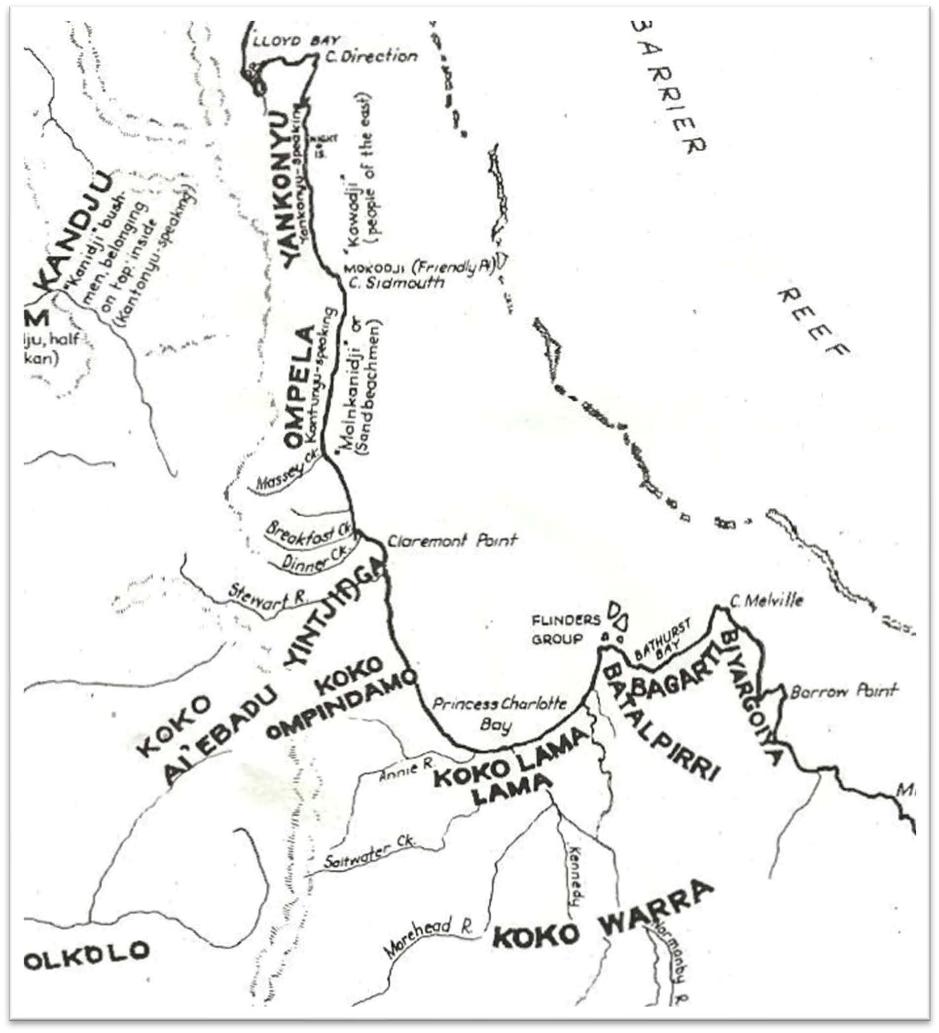
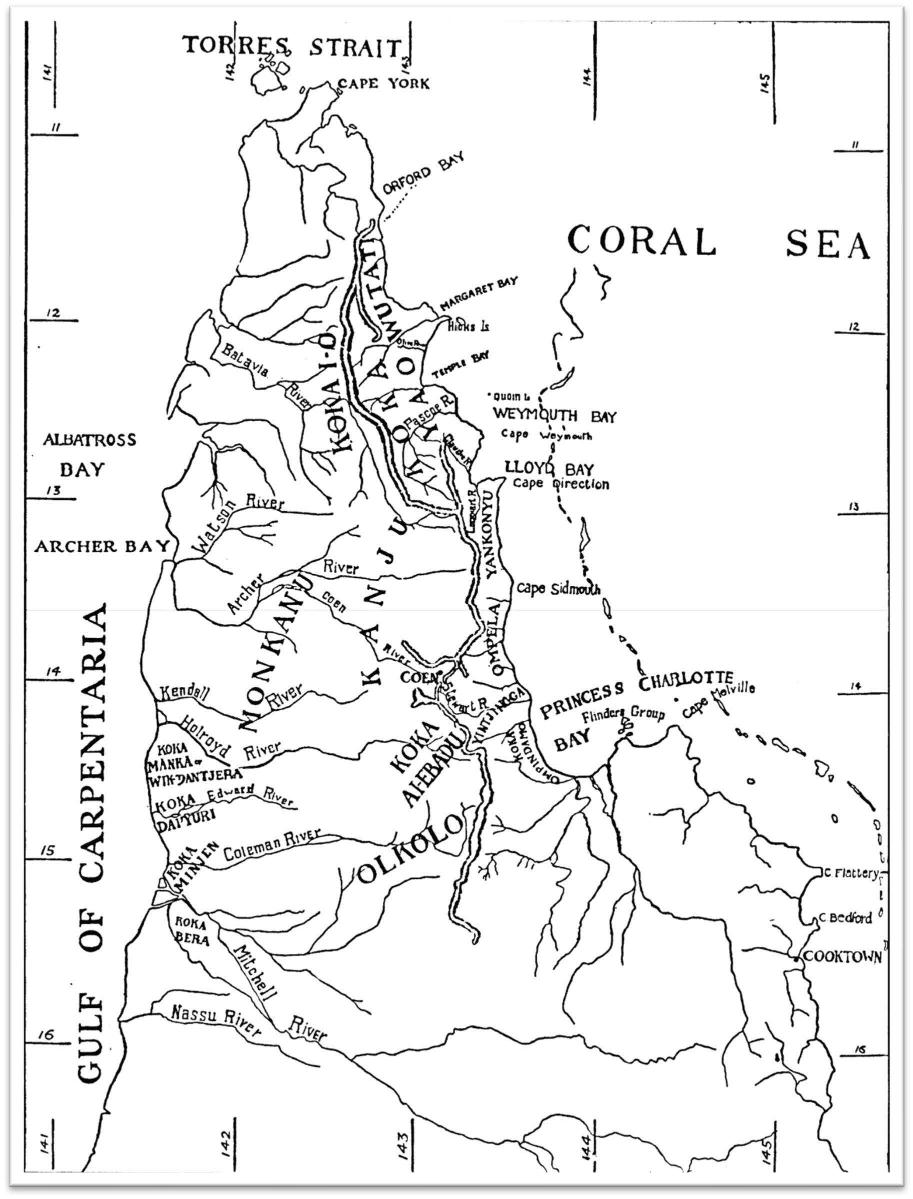
518 Dr Palmer’s description of Dr Thomson’s work and his own opinion of these maps is:
In Appendix B I reproduce two ‘maps of tribes’ relevant to the research area. The first, reproduced in the 1972 edited account of Thomson’s work but based on his research in the 1930s, shows the ‘Ompela’ extending from Cape Sidmouth in the north to Massy Creek (Thomson 1972, vi; Appendix B Map 1). The area between Massy and Dinner Creek lacks an annotation. The area south of Dinner Creek, including the Stewart River, is identified as Yintjingga. Further south again are marked the Koko Ompindamo and the Koko Lama Lama at the southern extent of Princess Charlotte Bay on the Kennedy, River.
A similar map, published in 1933, shows the Ompila extending south of Cape Sidmouth to the creek north of the Stewart River. This creek, according to the maps, equates to Breakfast Creek. South of Breakfast Creek and including the Stewart River, Thomson has annotated, Yintjingga and south of them, Koko Ompindamo (Thomson 1933, 455; Appendix B, Map 2).
In his 1933 article, Thomson writes of the ‘Ompela or Kantanyu’,
whose territory extends from Breakfast Creek near Claremont Point to Cape Sidmouth …
Thomson 1933, 458.
In his edited 1972 account Thomson writes that,
The Ompela of eastern Cape York occupy a narrow strip of coastline extending from Breakfast Creek, at the north of Princess Charlotte Bay, to Cape Sidmouth. The Ompela and neighbouring tribes, such as the Kandju to the west and the Yankonyu and the Koko Ya’o to the north are so closely related in language and culture that the people are obliged to resort to quite minor differences to distinguish one another.
Thomson 1972, 3.
Opinion
Donald Thomson reported what he understood to be ‘tribes’ identified by reference to their speech or language ‘koko’. He consistently reported that the Umpila were associated with country extending from Cape Sidmouth or a short distance south of that place to Breakfast Creek to the south. I do not understand his lack of annotation on his 1972 map for the area between Massy and Dinner Creeks to imply that it was the country of the Yintjingga. Thomson’s account of the extent of Umpila country to Breakfast Creek is unambiguously stated in the same publication, as I have recorded above.
As far as I have been able to ascertain, Thomson did not make mention of the Kuuku Yani.
519 Accepting this does not mean I accept the Umpila labelling as applied by the Umpila in their submissions and in their case in the separate question hearing. To the extent Dr Palmer adopts that labelling, I do not agree. However, the opinion and evidence above is important because it makes clear that the Lama Lama case, in its denial of the Disputed Area being associated at all with Umpila-speaking tribes at sovereignty, is far too absolute.
520 As I explain below, making these findings is not to deny the likely presence to the south of the Disputed Area, and likely in and around Breakfast Creek, of Yintyingka-speaking people, who were ultimately to become identified as Lama Lama People. There is good evidence to support findings of their presence in and ownership of the Disputed Area as well. There is less evidence to suggest that at or in the few decades after effective sovereignty, Yintyingka-speaking people were estate holders as far up as the Massy Creek, but as the findings on the apical ancestors demonstrate, there was intermarriage between Umpila and Yintyingka or other more southern peoples early on.
521 My findings on the apical ancestors are consistent with what is related by Dr Thomson, and with which Dr Palmer agrees. At or around effective sovereignty, there were Umpila-speaking tribes living in traditional ways in and around the Disputed Area, just as there were in the country further to the north. The absolute primary case of the Lama Lama must be rejected. This leaves their alternative “transmission/succession” case, which I discuss below.
522 Those Umpila-speaking tribes were not recorded as traditionally living in and around country to the south of Port Stewart. On any view the area around Breakfast Creek and Port Stewart does appear traditionally to have marked a change in estate holdings, and probably also in the languages spoken by those estate group members, recalling that language dominance is not necessarily indicative of title to country.
523 Generally speaking then, I accept that Dr Thomson’s early work has a degree of reliability and makes the absolute case put by Lama Lama unpersuasive. It does not establish, whether by itself or in combination with other evidence, that the whole of the Disputed Area should be recognised as Umpila country.
Professor Chase
524 There is a great deal of material in evidence authored by Professor Chase, or part authored by him. He was an important non-Indigenous researcher in this area. At times there were quite robust attacks by counsel for the Lama Lama on Professor Chase and his work, and I should make it clear that I reject those attacks. The irony in them is that just as both Dr Thompson and Professor Chase worked with predominantly Umpila People, Professor Rigsby worked predominantly with Lama Lama People. Each no doubt developed levels of familiarity, and empathy and support, from decades of working with particular groups of people.
525 From this historical distance at least, I do not see the work of Professor Chase as involving any impermissible and inappropriate level of advocacy for Umpila such as to compromise the objectivity of what he was attempting to describe and understand.
526 As Dr Palmer notes, Dr Kwok in her 2013 report provides a summary of Professor Chase’s work:
Chase’s extended history of research at Lockhart River dates back to the commencement of his PhD field studies in 1971. Between 1971 and 1979 he spent several lengthy periods immersed in the local Lockhart community carrying out research according to the anthropological method of participant observation (Chase 1980:7; Chase and Thomson 1994:65). His research focused on issues of continuity and change and highlighted the ongoing importance of kinship and traditional identity formations in contemporary socio-political organisation. Chase saw the emergent Lockhart identity as underlain by traditionally recognised cultural commonalities between the predominant Kuuku Ya’u, Night Island, Umpila and Kaanju groups, but pointed as well to the fierce retention and practical application of ‘countrymen’ identities based on shared loyalties to homelands (Chase 1980).
Chase produced an important model of territorial associations in the classical era, identifying levels of identity ranging through clan estate, countrymen estate clusters, dialect territories, regional territories to the ‘widest regional territory’, a category representing ‘identifiable human beings’ – (Chase 1980; Thompson and Chase 1997:31). Cross-cutting ways of marking affinity and distinction based on directional markers, environs, proximity, linguistic difference, patterns of intermarriage and ceremonial cooperation were also signalled (eg. 1980:x).
Between 1974 and 1977 Chase conducted significant on-the-ground survey work, recording the locations, names and significance of estates and sites in the company of knowledgeable elders. Chase’s 1980 ‘map 7’ shows the boundaries – provisional in some cases - of 32 coastal and 22 inland estates. Chase identifies sites 1-12 as belonging to the Kuuku Ya’u; sites 13-22 as belonging to the Uutaalnganu; and sites 23-30 as belonging to the Umpila. The remaining 23 sites appear to have been associated with Kaanju language speakers (Chase 1984:104).
Estates were named by the addition of the suffix –thampanyu to a mythical, ancestral or place based identifier (Chase 1980:139). Chase found that all estates contained myth sites. Detailed maps of significant sites are provided for Cape Direction and the Pascoe River mouth, both being noted as exhibiting high site densities (Chase 1980:145-146). Chase’s original mapping and site documentation work has been supplemented by additional academic and land-claim related investigations.
Chase found that typically a small number of estates and their associated owners were “boxed up” - perceptually and practically - around a common ecological niche. ‘They were formed from affiliation to a major environmental feature: a long beach, a major river mouth, or a headland’ (Chase 1984:115). Such groups shared wet-season camps and cooperated in fights. At the time of his writing, Chase identified 14 coastal and 9 inland ‘box-up countries’ or countrymen clusters at Lockhart (two were unrepresented). The following table (derived from Chase 1980:214) provides a list of these identity grouped together under their linguistic affiliations with corresponding English language ‘tribe’ name.
LANGUAGE’ | ‘TRIBAL NAME’ | ‘BOX-UP COUNTRIES’ |
“Flinders Lingo” | “Flinders” | Flinders |
Lama-lama | “Lama-lama” | Port Stewart |
Kuuku-yani | “Massey” | Massey |
Umpila | “Umpila” | Rocky-Clarmont |
Nesbit | ||
Cape Smith (Cape Sidmouth) | ||
Uutaalnganu | “Night Island” | Night Island |
Rocky Point | ||
Kuuku-ya’u | “Pascoe” | Claudie |
Pascoe | ||
Stoney Point [unrepresented] | ||
Temple Bay | ||
Olive River | ||
Wuthathi | “Macumboy” | Macumboy |
Kaantyu | “Kaantyu southside” | Coen |
Nesbit on-top | ||
Blue Mountain | ||
Lockhart River | ||
“Kaantyu northside” | Sefton | |
Wenlock | ||
Pascoe on-top | ||
Moreton | ||
Kuuku-iyu | “MacDonnell” | MacDonnel |
In the main Chase sustained a coastal perspective but he worked with Kaanju informants as well and was interested in the maintenance of connections between the Lockhart-based Kaanju and the broader Kaanju population. In a 1972 report Chase reported on the significance of the annual Coen races as an opportunity for Aboriginal people, drawn from the various settlements and pastoral stations of the wider region, to visit and renew social ties. He gives account of the local Coen Aboriginal community, and provides particulars of kinship ties between Coen and Lockhart amongst other places. The extension of kinship ties, both immediate and vicarious, is show to facilitate social interaction across the broader region.
As well as his investigations into kinship networks and group identities, Chase’s thesis and various published articles provide detail on economy and land use, indigenous botanical knowledge, traditional maritime pursuits, ceremony and post-settlement history (Chase 1980b; Hynes and Chase 1982; Chase and Sutton 1988; Rigsby and Chase 1998).
527 This description of Professor Chase’s work is consistent with the evidence, and I accept it as a useful and objective summary of his work. Contrary to the Lama Lama submissions, there is no reason to reject Professor Chase’s work outright, or view all his work with suspicion. As I expand on below, Dr Kwok clearly considered it important, and I agree with her use of it.
528 I have found Professor Chase’s thesis, and the maps contained within it, useful in understanding the position prior to the commencement of the NTA and any land claims. There was no material of this kind relied upon by the Lama Lama. Professor Rigsby’s work is simply not in the same category.
529 At the time Professor Chase was writing, he estimated the Aboriginal population of the Cape to be a “permanent Aboriginal population of approximately 3,500”, mostly located in the communities designated by government authorities.
530 Professor Chase then added (at p 15):
There can be little doubt that the history of mission formation as refuge centres and, additionally, the concentration of non-Aboriginal activities along the eastern side of the Peninsula, is reflected in the present distribution of Aboriginal populations. Along the 600 km of eastern coastline north of Cooktown (and its satellite settlements of Hopevale and Bloomfield), there is only one Aboriginal settlement, Lockhart River, with a population of about 300. Two-thirds of this number, together with perhaps another 100 Aborigines scattered elsewhere along the towns and stations of the eastern Peninsula, represent the total remnant population of the eastern seaboard from Cape Melville to Cape York.
531 In describing the traditional country of the people of Lockhart with whom he was working for his thesis, Professor Chase stated:
These areas of association form a compact section of northeast Cape York Peninsula which extends along the coastline from Massey Creek at the north of the Stewart River, to the Olive River in Temple Bay. Inland it extends from the present township of Coen northwards to the Wenlock River, and the western boundary falls approximately along the present telegraph line between these two points. Overall, the area encompasses the beach zone and the outlying islands, fringe reefs and cays, the narrow coastal plain (averaging some 10 km) and the easterly slopes of the coastal ranges, all of which were the territories of the beach-dwelling groups (see Map 2). The inland mountain area belonged to the upland-dwellers. All of this region is seen by present Lockhart people as comprising their homelands. Beyond it were the outsiders: to the south the groups who belonged to Princess Charlotte Bay and its hinterland, to the north those who grouped on the flatlands of the Peninsula tip, and to the west the people of the large river systems who oriented themselves westwards towards the Carpentarian side of the Peninsula.
532 He also included a map, which makes it clear in my opinion that when he said “Massey Creek at the north of the Stewart River”, he was including the Disputed Area as a whole. This map is also one of the few sources to show both the original Silver Plains homestead and station, and the more contemporary location of it.
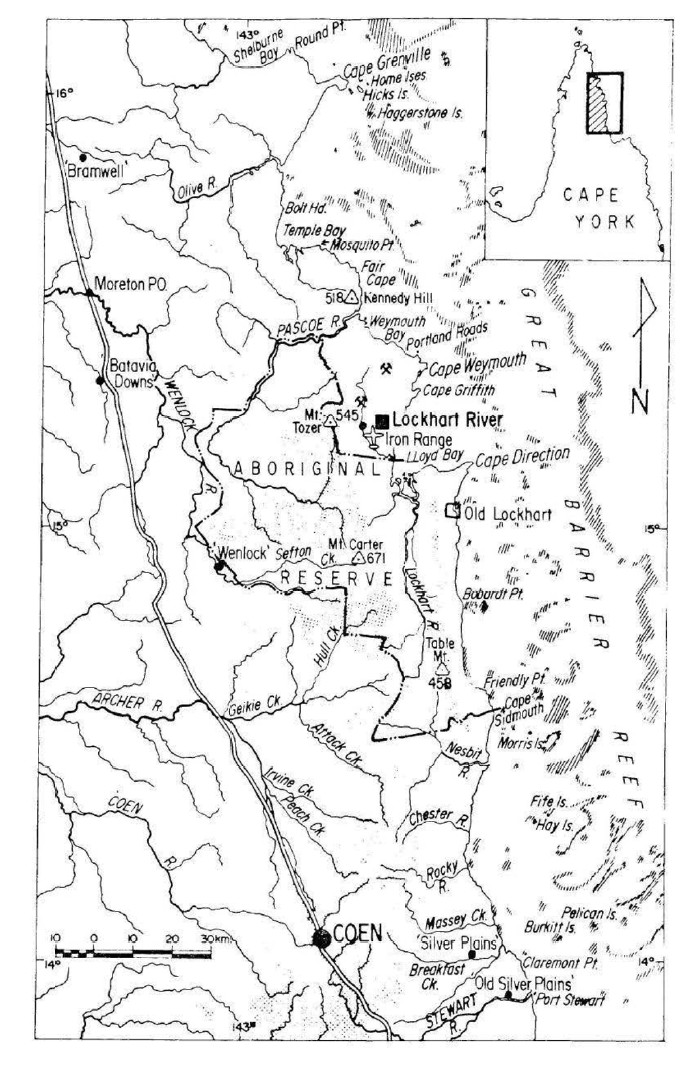
Professor Chase’s field work informs and adds weight to his opinions
533 I accept the following submission made by the Umpila. The footnotes are omitted but the footnotes are important because they accurately reflect the evidence.
Chase’s primary focus was on recording the diversity of territorial associations, and on the mapping of individual clan estates. Chase and Umpila Elders visited all of the Umpila coastal territories and most of the inland territories, mapping sites and boundaries with the use of aerial photos, large topographical maps and audio recordings. Places that could not be visited on the ground were flown over. The group established large camps, including one at Massy Creek mouth, from which they travelled extensively. Thompson recalls that ‘Chase and von Sturmer and a group of knowledgeable Umpila elders including Norman Tucandidgee, travelled by boat down the coast to Breakfast Creek (in the Disputed Area) and walked in to record and name significant sites’.
534 In the preceding paragraph, the Umpila submissions extract another important explanation from Professor Chase, which he recognised increased the reliability of what he was being told:
Most of [the participants in the field work] were bush-reared in Umpila country and they know the country and its resource in intimate detail.
535 This is the factor to which I referred earlier; the generation who were speaking to Professor Chase has the advantage of understanding country through growing up on it.
536 One of Dr Kenny’s key criticisms of the early and extensive field work undertaken by Professor Chase was that he did not include Lama Lama identifying people in much of his field work, and conducted it only with Umpila identifying people. That is mostly correct, and in a practical sense stems from the fact that Professor Chase was based at Lockhart River, and the people of Lockhart had been the focus of his early research and his PhD work, which included a huge amount of time and effort in living and spending time with the people who contributed to his work. I can understand why Dr Kenny and the Lama Lama legal representatives sought to make much of this, because it was the only way to try and invite the Court to set aside what was otherwise a powerful body of evidence, based on long term field work in the Disputed Area.
537 In her report, when making this criticism, Dr Kenny does acknowledge that Professor Chase’s 1990 trip included Freddie Liddy, Ethel Liddy and their daughter Karen Liddy. Karen Liddy’s evidence was that she was aged about 18, and had her baby son with her. In cross examination she denied knowledge of information Professor Chase reported he gathered from Freddie Liddy in particular, where the report suggests part of the Disputed Area (at least) was traditionally held by the Tuckandidgee family. I accept that when she gave evidence she did not feel able to recall this level of detail, so that neither she nor any other witness could explain how and why the Liddy’s came to be on this trip. Perhaps in 1990 there were less brick walls between the two groups. After all, as the genealogies demonstrate, these families are interconnected.
538 Professor Chase clearly regarded Fred Liddy as a knowledgeable person about country, including of the Disputed Area. I consider Dr Kenny and the Lama Lama arguments sought to downplay the inclusion of the Liddy family in this fieldwork. The Umpila are correct to at least some extent to submit that various Lama Lama identifying elders corroborated other information to the effect that Umpila identifying people had rights in parts of the Disputed Area.
539 The Umpila submissions are made, of course, from the perspective of trying to persuade the Court to make findings which label the country in the Disputed Area as held only by Umpila People, as being part of Umpila native title. I have rejected that approach. But what remains persuasive and important about this submission is that the Liddy family members who are now described as “Lama Lama People” did provide information to Professor Chase that is consistent with the findings the Court has made about the apical ancestors for the Disputed Area. In other words, the Lama Lama People who came on the field trip were not proposing any different narrative to Professor Chase about who were the correct ancestors for the country they were speaking about. Furthermore, I infer that these Lama Lama identifying people went on this field trip willingly. This was also their country. There is no evidence whatsoever to support an inference these senior Lama Lama People were there to dispute the fieldwork or put a different kind of “case” for who held title to the areas they were visiting and being asked about. That again is consistent with the findings the Court is making, shorn of the language labels which have caused so much heartache.
How I have weighed the contentions about the work of Professor Chase and Professor Rigsby
540 In summary, the early work of Dr Thomson, Tindale and Hale, and Professor Chase is probative of the primary fact I find, which is that the apical ancestors identified in the Court’s orders were, at effective sovereignty, part of the landholding group for the Disputed Area and their rights in this respect arose from the regional system of traditional law and custom in operation in this area.
541 I was not persuaded by the efforts of Dr Kenny and the Lama Lama legal representatives to diminish the significance of Professor Chase’s work. Nor was I persuaded by their efforts to elevate Professor Rigsby’s work beyond what I consider is a fair assessment of it. The Lama Lama case was simply too extreme. The early material well establishes that there were elders now identified with Umpila, who at effective sovereignty were connected by their traditional laws and customs to the Disputed Area. The exclusivity of the Lama Lama case must be rejected.
542 That does not mean, as these reasons make clear, that I have accepted the Umpila case as it was put. But the weight and significance of fieldwork in the Disputed Area is considerable. That is the best and most reliable way of understanding and ascertaining how traditional laws and customs are said, by those who observe them, to give rise to rights and interests in particular tracts of country. That proposition is in my opinion undeniable.
Professor Rigsby’s work is of a different character
543 The Lama Lama contentions, and Dr Kenny’s opinions, tended to give insufficient consideration to at least two countervailing factors affecting some of the work in which Professor Rigsby participated, and on which the Lama Lama case, and Dr Kenny’s opinions, relied.
544 First, as Dr Palmer pointed out, Professor Rigsby’s training and focus was as a linguist and was on linguistics. His field work was not field work mapping country, sites and the like. While he did visit places like Silver Plains to speak to his various informants, I did not understand there to be any direct evidence about actual field work – that is, visiting sites and having people connected to sites explain them, or explain features of country. That was the work that Dr Thomson, Professor Chase and Dr Thompson did do.
545 I accept Dr Palmer’s opinion (TS1125:47-1126:15):
… Rigsby was primarily a linguist. He was also interested in a number of other things, that’s true, but the anthropological method of going onto country and specifically visiting places and recording where they were as Chase did, to my mind is a significant piece of field work data which helps particularly when we’re talking about boundaries and extent and limitations. Chase did that. Rigsby didn’t.
546 Thus the extensive notes of place names, language names and asserted territories I did not find as persuasive as the material based on field work.
547 Second, the documentary evidence which contains accounts from Lama Lama identifying elders, said to prove the whole of the Disputed Area is Lama Lama country, needs to be approached with caution because of the manner of Professor Rigsby’s involvement in the provisions of that information. Looking at the Lakefield transcripts, and also the Kulla #2 proceeding transcripts, it is apparent that Professor Rigsby sometimes led witnesses to answers re-affirming Lama Lama identity and country, or provided links to that conclusion. Here is but one example from the Lakefield transcript where he asked Florrie Bassani about Maggie Tableland:
PROF RIGSBY: And all them children, all them family come from them two Maggie now, they can come in with Lamalama.
FLORRIE BASSANI: Yes. We all Lamalama.
548 In any contested forensic setting, evidence of this kind is unlikely to be given any real weight. Professor Rigsby is in substance giving the evidence. There are acknowledgments in the Kulla #2 proceeding transcripts by counsel that effectively this is what is occurring. Similar kinds of conclusionary assertions were prevalent in the Lama Lama evidence during the separate question hearing. They are not helpful to providing a sound factual basis for any conclusions by the Court. The above extract is not an isolated example from the material tendered under s 86 of the NTA, and some of the documentary sources as well. None of this is to impugn the objectives of Professor Rigsby’s work. It is clear much of what he did stemmed from a belief of the justice in the recognition of land rights for people he considered could be brought under the umbrella of Lama Lama. It does mean material of this kind needs to be approached with caution.
549 There are many aspects of Professor Rigsby’s work, as revealed in the evidence, which are not affected by these considerations. And much of the general thrust of his work, as I explain elsewhere, can be accepted. However in the granular way the Lama Lama sought to use his notes, and the earlier evidence admitted under s 86, I consider the two factors I have mentioned here – his linguistic focus and his advocacy – limit the use of much of this material.
Commonalities between Professor Chase and Professor Rigsby: the Sandbeach People
550 Professor Chase’s work with the Umpila People was not undertaken alone, and he was the first to acknowledge this. In the preface to his PhD thesis, he stated:
Several times I was assisted in the field by my Brisbane colleagues John von Sturmer, Peter Sutton, Bruce Rigsby and Chris Anderson when mapping operations needed more than two hands. All of them were generous in their help and advice. Bruce Rigsby took on the task of supervision and his guidance in the preparation of this work is very much appreciated.
551 These people, including Professor Rigsby, were very much as Professor Chase describes them – colleagues. They were not competitors. Each was working in their own field of interest, but in the same regions and in a cooperative and collaborative way. At times during the separate question hearing, the Umpila and Lama Lama arguments turned the work of these two men into some kind of competition, and that is not an approach I embrace. I do not find that is how the men themselves saw their work.
552 Some of Professor Rigsby’s work relied on by the Lama Lama also demonstrates the level of commonality between him and Professor Chase. Their joint 1998 chapter is a prime example. The Lama Lama sought to deploy this chapter forensically as an attack on Professor Chase and the Umpila case, but in my opinion, their submissions ignore the common ground and consensus this chapter reveals. For example, the chapter commences in this way:
Thomson (1933:457) described the Sandbeach People of eastern Cape York Peninsula as ‘a very distinct type of Australian [A]borigine … essentially fishermen and dugong hunters, and … often great seafarers … skilled canoe builders and navigators … [who] make adventurous voyages among the coral reefs and sand banks of the Great Barrier Reef, in search of dugong and turtle, and the eggs of turtles and sea birds’. Thomson (1933, 1934) made much of their marine orientation and he wrote of their outrigger canoes, harpoon technology and beach-based camps in which they spent much of the annual seasonal round.
In their indigenous languages, they indeed describe themselves with phrases such as Umpila pama malngkanichi and Uuk-Umpithamu ma-yaandhimunu ‘people who own the sandbeach’. Thomson (1934:238) noted that their homelands extended from ‘the shallow waters of Princess Charlotte Bay almost to Cape York’, and he (Thomson 1933:458, 1934:237) identified them as the tribes which he called ‘the Koko Ompindamo, the Yintjingga, the Ompeila, the Koko Ya’o and the Wutati’ (in south to north order). Together, these ‘tribes’ of Thomson’s Sandbeach People account for over 300 km of coastline and associated waters, northward from the bight of Princess Charlotte Bay. We too write of the cultural bloc of Sandbeach People, but building upon Thomson’s work, we identify them somewhat differently and we distinguish their contemporary social organisation from its classical antecedent. As well, it is plain that there were and are many similar maritime-orientated Aboriginal groups along the coasts of the continent.
553 This is consistent with the evidence before the Court, viewed as a whole, and it is consistent with the conclusions I have reached. It also illustrates how important the early work of Dr Thomson was.
554 Key to understanding what follows in this chapter is that Professor Rigsby and Professor Chase say they are identifying the Sandbeach people “somewhat differently” and distinguishing “their contemporary organisation from its classical antecedent”. This is a joint exercise by Professor Rigsby and Professor Chase in describing the people from 5 coastal groups that together they call “the Sandbeach People”, as a way of contributing to a larger picture of customary marine tenure in various parts of Australia. Neither Professor Rigsby nor Professor Chase are pitting these groups against each other, they are seeing them as a larger group with common characteristics, and contiguous country, both on land and at sea. I do not detect in the joint voices of the authors themselves any of the adversarial battle now deployed relying on a small part of a much more deep and nuanced chapter.
555 Indeed in this 1998 chapter, Professor Rigsby had no difficulty recognising the knowledge retention and the regular visits to country of Umpila identifying people, and contrasting it with the Lama Lama. Professor Rigsby and Professor Chase wrote:
The Lamalama are a language-named tribe: see endnote 3. Their identity as a distinct people or tribe is based upon their ownership of particular land in the region (Chase et al., 1995), upon common close genealogical relationships, upon a common cultural heritage and upon a common history over the past century. The Lamalama emerged as a distinct group over the past century through the amalgamation of people from upwards of forty patriclans, perhaps five indigenous languages, an unknown number of local groups and their transformation into a language-named tribe made up of over a dozen cognatic descent groups.
The Umpila, Uutaalnganu, Kuuku Ya’u and Wuthathi peoples are also organised as language-named tribes, but the first three groups, as contrasted with the Wuthathi and the Lamalama, have retained strong knowledge of the more distinctive clan estates which comprise the language territories. This is no doubt in part due to their long residence at the Lockhart River Mission (the ‘Old Site’ at Bare Hill), in Uutaalnganu territory. From there, people travelled constantly up and down the coast while employed on lugger boats and for bush ‘holidays’ away from the Mission from 1924 until the late 1960s, as outlined below. Throughout the period, the Umpila, Uutaalnganu and Kuuku Ya’u people were never out of visiting range for their countries. They now live mainly at Lockhart Aboriginal Community, near Iron Range in the Lloyd Bay area, but some Wuthathi people live at Injinoo, formerly Cowal Creek, in the Northern Peninsular Region (Sharp 1992).
(Emphasis added.)
556 I return to this 1998 chapter later in these reasons. For now, it is enough to emphasise that Professor Chase and Professor Rigsby may have had more in common than they had differences. Their work has been too selectively used by both the Umpila and Lama Lama in this proceeding.
Dr Kwok’s opinions and use of this material
557 In reviewing the considerable body of opinion evidence before the Court, including opinion evidence built up during the currency of State land claims, and claims under the NTA, I have concluded that it is appropriate to give some weight to the work of Dr Kwok. I do that because at the time Dr Kwok was engaged in producing the several reports and documents adduced in evidence, she was doing so as an independent expert retained by the CYLC to assist the Land Council, and various claimant groups, in negotiating and concluding agreements about traditional ownership of country. She was not engaged to do so in any adversarial way, but in a cooperative, measured and objective way. I have found in reading her material a level of detachment from particular groups which is material to my consideration of the findings that need to be made on the separate question.
558 I have given some weight to the fact that Dr Kwok has had no difficulty in relying on the work of Professor Chase in preparing her connection reports.
559 Her report for the Lama Lama determination said (at [464]):
Chase’s model (see figure 1 below) as developed in his 1980 thesis, provides a valuable guide to relevant societal formations. Although the model is derived from and particularly reflects the perspective of the sandbeach peoples and their neighbours, including the Kaanju, on the eastern coast of Cape York, the divisions and principles have broader applicability. His analysis gives insight into local emic divisions and the cultural factors which are employed locally in asserting unity and difference.
560 Thus, in preparing her opinions for the Lama Lama connection report, Dr Kwok saw no incompatibility in relying on Professor Chase’s work.
561 This is how Dr Kwok described the work of Professor Rigsby, in her September 2013 report for CYLC:
Rigsby has contributed significantly to elucidating the traditional configurations of language groups and territorial associations in the broader Port Stewart and lower Princess Charlotte Bay areas. Apropos the dispute between the Lamalama and Umpila groups over traditional ownership of lower Massey Creek, Rigsby’s fine-grained research has led him to conclude that the traditional landholders of the Lower Massey Creek clan were speakers of an Umpila dialect known as Kuuku Yani, Kuuku Yin or Kuuku Yini, while the Breakfast Creek and Stewart River estates were traditionally associated with coastal varieties of the Ayapathu language (Hafner and Rigsby 2007:5). Importantly Rigsby and Hafner have pointed to the origins of the present dispute over Silver Plains Station in the disparate settlement histories of the original inhabitants. Those of the Kuuku Yani who moved northward, joining the Lockhart Mission settlement, came to identify themselves under the broader Umpila identity. Others, who joined the various groups congregating about Port Stewart, came to be incorporated under the Lamalama umbrella. Because of their closer proximity, the latter group were able to maintain physical contact with the country, to uphold custodial responsibilities over it and to exercise rights and interests (Hafner and Rigsby 2007:5-8).
562 I consider Dr Kwok’s description captures at an appropriate level the effect of Professor Rigsby’s work, and I accept this was the general outcome of his work. This outcome, and Dr Kwok’s summary, is also consistent with the approach I have taken to identifying who are the native title holders for the Disputed Area.
563 Shorn of the advocacy and partisanship which attended some of Professor Rigsby’s communications, and his evidence as it is recorded in the materials before the Court, I consider this is a fair and measured summary of the considerable achievements of his work, and a fair and objective summary of the conclusions he reached. It is not attended with the focus on a level of detail that attended the Umpila and Lama Lama submissions in this matter, which would require the Court to descend into speculation about particular communications, or particular documents.
564 What Dr Kwok’s summary demonstrates, in my opinion, is that the post-colonial pushes and pulls of people to centres such as Port Stewart and Lockhart, and the realities of accessing country, have been responsible for contemporary divisions between people essentially descended from a very small number of ancestors.
What the work of Tindale, Dr Thomson, Professor Chase and Professor Rigsby does not prove
565 The collection of work produced largely by these men is illuminating in the ways I have described in this section. It assists in understanding the place of the ancestors of the Disputed Area as Sandbeach people, and their place in the smaller landholding groups which existed closer to effective sovereignty. It establishes comfortably that the members of the landholding group who are set out in the Court’s orders as apical ancestors had connections to the north and the south. This material demonstrates that the Disputed Area was not, at or around effective sovereignty, either held only by people who might now be identified as Lama Lama, nor held only by people who might now be identified as Umpila. The ancestors, whose descendants would ultimately entrench themselves in one or other tribal group, were a mixture.
566 So much can be found by reliance on the material at a higher level of generality than the parties’ contentions and evidence invited. However, the detail is fractured, the sources are piecemeal, uncertainties of interpretation abound. In the context of the binary cases run respectively by the Lama Lama and Umpila, it is not possible for the Court to descend into the labyrinth of the work of these men to try and piece together any series of findings on the balance of probabilities that could support either the “the Disputed Area is all Umpila country” argument or the “the Disputed Area is all Lama Lama country” argument. To do so would involve inappropriate levels of selectivity with an insufficient objectively rational basis for the selections, and far too much guesswork and speculation. I give examples elsewhere in these reasons.
The regional system of traditional law and custom at effective sovereignty
567 One of the propositions that was put to the experts was whether, at the time of effective sovereignty, there was a regional system of law and custom relating to land which included the gaining of rights by descent (including adoption or growing up) and succession. The experts generally agreed with that proposition.
568 In particular, Dr Palmer and Dr Kenny appeared to take similar views. Dr Palmer stated that “the customary processes of succession to rights in country” included “descent”, “traditional adoption” and “a process of succession to the estate of another local group whose members had become extinct”. Dr Kenny stated that “descent, succession or other processes of transmission were part of the regional system at effective sovereignty”, and that it “may be reasonably inferred that adoption and growing up were elements of this system”. In reaching these views, Dr Palmer relied heavily on the earlier works of Professor Rigsby and Professor Chase, as well as those of Dr Kwok ([44]-[53]). Dr Kenny referred to the works of Professor Rigsby and Professor Chase and Dr Kwok, as well as those of Professor Rigsby and Dr Hafner, Professor Verstraete and Professor Rigsby, McConnel, Sharp, Dr Thomson, Professor Chase, Anderson, Sutton and Roth ([46]-[47]).
569 Relevantly, both Dr Palmer and Dr Kenny were of the view that the regional system of law at the time of effective sovereignty provided for the ownership of country through patrifiliation.
570 While Dr Thompson agreed that the system of law included provision as to the gaining of rights by descent, he made clear that he felt able to express a view on succession to vacant estates only in relation to the practices of the Umpila, and not those of the Lama Lama. His view was that Umpila practice allowed succession to vacant estates only in relation to “neighbouring Umpila estates or related Umpila persons”.
571 The existence of a regional system of traditional law and custom was at the forefront of the State’s submissions and a key reason why the State submitted there was one shared native title over the Disputed Area. As on many substantive issues in the proceeding, the CYU#1 applicant did not adopt an express position, however counsel for the CYU#1 applicant made it clear in oral submissions that its contentions about recognition of two exclusive native titles over the Disputed Area did not involve a proposition that rights were held under two different normative systems. Counsel submitted the two exclusive native titles could arise under the same normative system.
572 The Lama Lama accepted that the system of traditional law and custom at effective sovereignty was a regional one.
573 The only party which contended for a different finding was the Umpila. As far as I could tell this was based on their contentions about the moiety system, alongside some references to use of fishing bait, discussed further below. The latter is in my respectful view not capable of indicating a different normative system.
The Moiety argument by the Umpila
574 In the present context, a moiety is a western description of a traditional cultural phenomenon in many First Nations belief systems. A moiety is a share, often a half share, but in the Indigenous context the term is applied to all features of the world in which people live, physical and non-physical. The two halves are mirrors of each other, and together form the whole of the physical and non-physical universe. Because they complement each other and together form a whole, there are rules and traditions around which moiety people are given at birth, and then how they relate to people with a different moiety. Again, I found Dr Kwok’s report helpful on this issue, citing Professor Chase:
According to Chase, within the local view, moiety divisions are seen, much like the division between the sexes as a simple fact of nature – ‘just like man and woman, always been like that’ (Chase 1984:110). In the local view, differences between the two types were visibly discernible. Morphological characteristics or even atmospheric nuances were said to distinguish moieties in the geographic context, whereas qualities of the eyes, skin or hair might be regarded as markers in the human case (Chase 1984:110-111, 140-141; Thomson 1933:460).
575 Dr Palmer’s evidence is that under a moiety system, the world and people are split into two sides, which are exogamous – that is, people may not marry a member of the same moiety: TS1100:06ff. Under the “customary system”, moieties follow the patriline, whereby each individual possesses their father’s moiety.
576 The Umpila submit (closing reply submissions at [102]) that a normative “cultural boundary” separates Umpila People from Lama Lama People, shown by “most significantly”, the moiety system. The Umpila contend that they observe a moiety system, while the Lama Lama do not. The non-observance or lack of knowledge about moieties in the Lama Lama is said by the Umpila to be “such that despite commonalities in some laws among the Cape York groups, Umpila and Lama Lama are distinct in their acknowledgement and observance of different systems of laws and customs”: Umpila closing reply submissions at [101]. As I understood it, the submissions about two distinct normative systems was seen by the Umpila as advancing their case to title over the whole Disputed Area to the exclusion of Lama Lama.
577 At [64] Dr Palmer described how Professor Chase used moieties in his early ethnographic work in and around the Disputed Area:
Estates were in Chase’s ethnography assigned to a moiety so that, ‘the landscape is segmented at one level of resolution into alternate moiety territories, and these can be used as formal references for areas’ (ibid., 141). This applied to both inland and coastal estates (ibid., 142).
578 Dr Palmer appears to agree with Professor Chase that, traditionally, estate group membership carried with it a language identity, shared by others, but language was not a property of the land itself, whereas moiety affiliation was: Palmer at [88]; [136], and in oral evidence:
DR PALMER: … language owned a moiety. Chase recorded this and reported on it. That it was inscribed by a mythic ordination on the country. So, in terms of a succession of rights, however, it is inscribed – sorry, however, it is up to be understood, the moiety goes with the patriline.
579 Especially at this historical distance, and with the acknowledged patchwork of information about pre-colonial traditional systems, in my opinion there is no requirement in Australian law (whether common law or as developed under the NTA) that traditional laws and customs observed by one group should be virtually identical to that of another group before a conclusion can be reached that the system of traditional law and custom being described is the same normative system.
580 At [84] in State of Western Australia v Sebastian [2008] FCAFC 65; 173 FCR 1 the Full Court said:
There does not appear to be any prescription in Yorta Yorta at [47]-[55] (the particular paragraphs addressed by the State) that all the same traditions and customs of each clan be observed and acknowledged by the two clans for them to operate under the one normative system. Yorta Yorta consistently refers to “a body of law and customs” rather than “the identical body and law and customs”, for example at [49] and [39].
(Citations removed.)
581 Here, there is evidence from Professor Chase and Professor Rigsby’s joint 1998 chapter (at 197) about the existence of moiety systems at regional level. What is said there, with Professor Rigsby as one of the authors, is an unqualified statement about moieties forming part of the traditional regional system, and then some post-colonial positions by Lama Lama which, in the authors’ words, are “perplexing”.
People and (thus also) clans belonged to named moieties … The moieties were still operative at Port Stewart when Thomson worked there, but contemporary Lamalama people say that they are a feature of Lockhart people’s law and custom, not of theirs ... The absence of moieties and moiety names among people of the Lamalama-, Morrabalama- and Rimanggudinhma-speaking clans is perplexing because most, if not all, of their neighbours have or had moieties in the past.
582 Dr Kenny notes in her report that the Yintyingka were recorded by Dr Thomson as adhering to a moiety system.
583 Writing in 1928, Dr Thomson said:
The Ompela Tribe, like the Yinchinga Tribe of the Stewart River area, and the Ko-ka Minjen of the Coleman-Mitchell Rivers on the West Coast, is divided into two exogamous moieties, the only groups which I was able to find for the regulation of marriage.
(Emphasis added.)
584 He made the same observation in 1933:
The opposition between moieties is strongly marked on Cape York and is an important factor in the social life of the people. This is well shown at the boundary between the Koko Ya’o and the Yankonyu tribes near Lloyd Bay. Here the linguistic distinction is not an important one, and the question of whether a horde on the border line belongs to the Koko Ya’o or the Yankonyu tribe is regarded as of less importance than whether it belongs to Koiyana or Karpeya moiety. The actual names of the moieties, Koiyana and Karpeya, extend beyond the bounds of these tribes, through the Ompela and Kanju, and are found in only, a slightly altered form, as Koiya and Karpi in the Yintjingga and Ai’ebadu tribes.
(Emphasis added.)
585 I infer that some of the other clan or tribe names in this extract are likely to be some of the peoples who now identify as Southern Kaantju and Ayapathu.
586 Recognition of moiety systems being common across most (but not all) of Cape York is also explained by Dr Kwok in her 2016 report:
Thomson found the division into patrilineal moieties was a feature common to most of the tribes of Cape York Peninsula; the major exception he noted being the Wik Mongkan (Thomson 1972:1). For the Ompela, and by extension at least the Koko Ya’o [Kuuku Ya’u] and Yankonyu [Uutaalnganu], these divisions were named as Koiyana [Kuyan] and Karpeya [Kaapay]. The same divisions, rendered as caapai and cayen, had been recorded in shipwreck survivor Pelletier’s account of his sojourn amongst the Uutaalnganu in the mid 1850s (Anderson 2009:162). Thomson also noted that the names extended beyond the bounds of the Kuuku Ya’u and Yankonyu [Uutaalnganu], to the ‘Ompela [Umpila] and Kanju [Kaanju], and are found in only a slightly altered form, as Koiya and Karpi in the Yintjingga and Ai’ebadu tribes’ (Thomson 1933:459). Amongst the Wutati [Wuthathi], the equivalents were O’garra and O’waiya (Thomson 1972:3,24).
587 Dr Kwok also said this (again in the less adversarial context of her connection work for consent determination negotiations):
Although Sharp’s conclusion that the Princess Charlotte Bay groups did have moieties is denied by the contemporary Lamalama population, Hale and Tindale do provide moiety names for one group. In the Lakefield claim report Rigsby and Hafner report that moiety names were in use at Port Stewart when Thomson was there and that there was evidence of their presence amongst the Umpithamu. There was no evidence they said that the Umbuygamu, Lamalama and others of the southern Bay had moieties, although in personal conversation Rigsby has suggested they might have (Rigsby and Hafner 1994:84; Rigsby pers. comm). Sharp has only indirect evidence to suggest the existence of maternal personal totems at Princess Charlotte Bay, noting that the practice of tooth avulsion amongst the Mutumui could be indicative. In sum, Sharp’s assessment of the similarities between groups to the north and those of southern Princess Charlotte Bay was made on thin ground but there may not be sufficient evidence available at the present time to affirm or deny his findings.
588 Thus, the wider picture for the southern parts of what is now Lama Lama determined country is less clear but in my opinion that is far from determinative in a dispute such as that which exists on the separate question.
589 While the Umpila seek to elevate this kind of evidence into a contention about a factual absence of moiety beliefs and practices in the normative systems observed by the Lama Lama at effective sovereignty, in my opinion these kinds of observations do not go as far. While some of these secondary sources record denials by Lama Lama of moiety systems, in the separate question proceeding there was no such strenuous denials and no such positive contentions of a different normative system on behalf of the Lama Lama.
590 What the various secondary sources demonstrate in my opinion, is that non-Indigenous researchers were struggling to obtain consistent accounts or evidence from their informants, the further south they go there being less living or handed down memories of such systems. While it may be true that the moiety system remains more strongly observed and in use more amongst Umpila identifying people in the present day, a difference like this does not point to two normative systems. Rather it could just as easily point in my opinion to the disparate effects of colonisation on the perseveration and practice of particular laws and customs.
591 Such evidence as it exists is certainly not strong enough to deny the overwhelming weight of evidence to confirm that there is one regional system of traditional law and custom across these parts of Cape York.
My conclusion: there is a regional system of traditional law and custom covering the Disputed Area
592 The evidence supports a finding that the normative system governing country on the eastern part of Cape York, including the Lama Lama and Umpila determined areas and the Disputed Area, is a single regional system.
593 I accept the State’s submissions as set out in its closing submissions on this point, and I accept the evidence to which the State refers supports this conclusion. In particular I accept:
(a) At effective sovereignty, the peoples of the region (including the Disputed Area and the previous determination areas) observed a unified system of law and custom; and the appropriate inference from the evidence is that this regional system has continued to the present day;
(b) The traditional laws about tenure and social organisation are the same as those operating to the north and the south of the Disputed Area: local groups were and are associated with a specific territory, and rights to speak for, use and exercise control over and access to that territory inhere in the local group. Membership of the local group, and therefore acquisition of these rights in territory occurs through descent, originally likely patrifilial but in post-colonial adaptions cognatic. People traditionally adopted into the local group are included;
(c) Under this system, at effective sovereignty there were likely several local groups in the Disputed Area, and there were local groups to the north and the south, and also to the west;
(d) There were common customs about fishing, hunting, gathering, and camping on land, with common normative rules regulating some of these practices, on the evidence especially fishing and hunting;
(e) Beliefs, and the rules about behaviour and social interaction because of those beliefs were common to regional local groups and included beliefs about totems, ancestral spirits, creation of the land and people, how to approach country and introduce oneself and those who come with you (for example, by sharing an underarm smell). It is not necessary to describe these as spiritual or religious, it is enough to say they are foundational to the identity and lives of people who observe this system of traditional law and custom;
(f) Common to the Disputed Area and its surrounding country, some sites are given traditional significance, whether as places for ceremony or as places to be avoided because of danger. Witnesses from both groups spoke of a “boss man” said to inhabit or move through parts of the Disputed Area, and could describe rituals or practices that needed to be observed to avoid harm from the boss man, or to avoid angering them, which was commonly acknowledged to be likely to produce dangerous consequences; and
(g) There are normative practices around healing, and who is expert in healing – described by many witnesses as people who are “Murri doctors”, with particular powers.
594 Some minor variations highlighted by the Umpila about initiation practices, and contended differing rules about baits to be used for fresh and salt water fishing are in my opinion no more than the kinds of variations which might be expected in an oral tradition. Especially one which has been significantly disrupted by post-colonisation practices such as removals, and where in contemporary times identification with more recent language based groups may have diluted interactions across the family groupings which were, at effective sovereignty, more involved with each other and therefore more likely to have shared understandings of the details of some rules and practices.
595 As the State submits, there was some variance between Umpila and Lama Lama witnesses in accounts about sites of significance in the Disputed Area. It is fair to say in my opinion that the Umpila witnesses spoke in greater detail and breadth about such sites, such as the location of bora (ceremonial) grounds in the Disputed Area, the ancestral narratives about areas upstream on Massy Creek and women’s sites.
596 It is not necessary to make factual findings about any of those accounts other than to make it clear that I do not consider any witnesses in this proceeding gave unreliable evidence in the sense of giving accounts that they knew to be untrue or that they did not care whether they were true or not. All witnesses gave evidence on these avowedly sensitive factual issues from what I observed to be genuine conviction. Some of the details may have been emphasised in ways that were more emphatic than they needed be, but this is understandable in the present circumstances. My observation was that witnesses genuinely felt that their entire connection to country, country they feel belongs to them, and they to it, was under attack. It is not unusual for people in these circumstances also to decide to reveal knowledge they have which they might not have spoken about before in any open way, to non-Indigenous people. That can occur, in my experience, where the reality of the adversarial context becomes very apparent and people feel the need to reveal more to ensure that they are believed, that their understanding of their traditional law and custom and how it connects them to the country at issue, is truly understood by the non-Indigenous audience to whom they are compelled to speak through the NTA process. It can also be the case that this imperative to persuade can lead to exaggeration.
597 In my opinion these were the kinds of forces at work in the separate question hearing, on both sides. However, on both sides of the lay evidence, it was clear that this group of descendants know their country. They know the rules to be observed, the places to be avoided, the stories associated with places. By these rules and customs, they are connected to the Disputed Area.
How was title held at effective sovereignty?
598 There was basic agreement that title was held at a local estate level. The following propositions emerge from the joint expert report, as explained in the expert evidence:
(a) estates were held in strips of land, generally extending to the coast and then also extending inland;
(b) they were small in modern terms, perhaps 5 km along the coast (the experts may have derived this kind of distance differently but this is about where they all ended up);
(c) boundaries were marked by topographic or naturally occurring features;
(d) at least in coastal areas, estates were oriented around the main rivers or creek; the rivers and creek not so much operating as boundaries as being integral parts of the estates; whereas inland a creek might become a boundary; and
(e) there were ceremony and story sites, mostly along the coast but not entirely.
599 Beyond this, the parties descended into the labyrinth of detail that I found impracticable to disentangle without engaging in speculation. There was no clear agreement about the westward or inland extent of the estates, and little information about the nature and extent of any inland estate. Both Dr Kenny and Dr Palmer identified three groups, but described them quite differently. Dr Thompson’s view is that there was only one group, which he described as Kuuku Yani and as a now Umpila identifying group. The role of language identification in the way landholding groups operated was ultimately disavowed by the experts and as I understood it by the parties.
600 Dr Palmer’s evidence was that the inhabitants of the region were “sandbeach people”, whose estates extended out into the ocean, and had a marine economy with rights going out into the reef country. The focus of estates was in the coastal area, because it was convenient and economically valuable to have access to fresh water in order to conduct a marine economy, as well as having access to the internal hinterland of the estates. There are many references in the early ethnographic material to this description of “sandbeach people”, some of which I have extracted elsewhere in these reasons.
601 I did not understand any of the other experts to dissent from the description of “sandbeach people”, nor for any of the lay evidence to contradict it. Indeed much of the lay evidence supported this characterisation, because of the focus on landmarks in and around the tidal areas, the fresh water sites in the tidal areas, the large body of evidence about fishing, about the use of offshore resources and islands, and the way the lay witnesses oriented themselves largely by coastal features of the landscapes where they were referring to navigating through country and identifying sits of significance.
Rejecting the State’s submissions about inland areas
602 In its closing submissions at [8] and [9] the State submits that while the evidence discloses a system of traditional law and custom connecting people to the coastal portion of the Disputed Area, the evidence does not disclose any such connection to the inland areas. Therefore, the State submits there can be no finding that native title exists to what it describes as the inland areas.
603 In my view the State’s submissions, especially as to the evidence, tended to lead towards the error identified in Stuart, and essentially require evidence of continuing physical occupancy, at least by visiting. That is not what is required and I am satisfied that there is sufficient evidence of a connection via traditional law and custom to the “inland areas”. I consider there is a sufficient evidentiary foundation in the expert evidence read with some of the early ethnographic sources, and in aspects of the lay evidence.
604 The starting point ought to be the geography of the Disputed Area. From the map annexed to these reasons, it is apparent that the native title now recognised to the north and south of the Disputed Area is concentrated in country along the coast, but the topography of the areas demonstrate that the country runs back into the Great Dividing Range, and more locally, the McIlwraith Range. This pattern of landholding is repeated in the areas where native title is already recognised. I will return below to the finding that this is consistent with lay evidence, both directly in this separate question hearing and indirectly through other evidence, about traditional rights to country often being divided amongst neighbours according to country that is “on top” – that is country in mountain ranges, and country that descends from mountain ranges into valleys, river and creek systems and then into coastal areas.
605 A similar starting point is the generally accepted position that for these coastal estate holding groups, their native title to their country runs out into the sea. I say a little more about this later in the reasons, by reference to some evidence from Dr Palmer. While the precise extent of sea country for all the coastal groups along this part of Cape York is yet to be determined, there is no dispute that for all of them their traditional country does run out into the sea for some considerable distance. Country is more than only where people might reside.
606 Finally, on geography and topography, some other evidence from Dr Palmer should be recalled. During the expert panel process, Dr Palmer was being cross examined by the Lama Lama counsel about likely boundaries for some of Professor Chase’s mapping. In his answer, he made the following point (TS1112:08-20):
DR PALMER: Well, there’s estates from 28 down extend considerably further and, therefore, would have been larger in square kilometres than those further to the north, say 19. But, you know, in order to do justice to this question, one would have to have available, data in relation to specific areas. I mean if you look at the air photos - you know, Google Maps of this - you can see that they’re large areas which would have been - which would be, and still are uninhabitable, say in the middle of the wet season.
You will recall that you and the other party took the Court to Kuuthinjirri, and that’s basically bog country to get there. We had to go to extraordinary lengths in order to get ourselves there and imagine what that would be like as a living area after a bit of - even a light shower. So, you know, you’re asking me to draw, abstract and generalise the views about the size of country.
607 My impression on the views undertaken by the Court accords with the opinion of Dr Palmer. It is apparent that large tracts of country in the Disputed Area would be inaccessible, or unusable during certain seasons. The reality of the differences in country over the Disputed Area is not apparent from a map but is apparent from seeing the country. The likely need for people to have access to a range of different country – higher foothills, where there may be permanent water and shelter, easily accessible areas for fishing like Top Crossing, coastal parts like Kuuthinjirri, also contributes to my satisfaction that the land estates at effective sovereignty in the Disputed Area ran from the ranges right down to the sea and then out into marine areas.
608 While these patterns of landholding are far from determinative where, as I have found here, there is a regionally operating system of traditional law and custom it is relevant to bear in mind the more regional geographic context. Prior to effective sovereignty, the features of topography, geography, existence of resources, soils, waterways, flora and the fauna that lived in different areas were all of great importance to the survival and the lives of First Nations people in these areas. The creation of all those features, the stories, customs and rules which accompany their use and how people move and navigate around land and waters, need always to be considered in a holistic manner. Looking at the Disputed Area in its wider regional context is therefore important.
609 The evidence reveals the following early ethnographic information about inland areas.
610 Professor Chase observed (extracted in Palmer at [58]):
Behind the beachfront, coastal estate boundaries become less precise. Sometimes they are marked by one of the many creeks or braided streams, but more often they are general lines of direction where neighbouring estates are said to merge, or to ‘box-up’. These boundary areas are considered ‘half-and-half’ (kutu-kutu), open to either estate group; the first named sites in the boundary area redefine the territory. Rear boundaries are defined by the crest of the coastal ranges. The western falls of the ranges are allocated to inland estates. Inland estates generally take a watercourse as one of their boundaries, or where drainage basins are clearly they follow a watershed for at least one of their boundaries.
(Emphasis added.)
611 Again, Professor Chase emphasised the differences between the precision of boundaries at the coastal land areas (I infer, where resources of food and water were the most concentrated and where areas were the most accessible), and explains how countrymen from neighbouring estates were likely to interact in pre-colonial times:
The pattern of estate boundaries can be described as one of exact recognition at the centre, the beachfront, and less exact recognition away from this critical living area to the east and west. Only at the rear of the land segment where the range crest is seen as a marker, does a precision reinstate itself, though the presence of passes, low hills and occasional tablelands reintroduces areas ‘boxed-up’ with inland estates.
612 Dr Palmer at [63] of his expert report gives his opinion about what “boxed up” means in this context:
Elsewhere in his thesis Chase makes further comment on the concept of being ‘boxed up’. He explains that those ‘boxed up’ regarded themselves as ‘countrymen’ and in precontact times, camped together (ibid., 219). He also described ‘boxed up’ as being ‘half-and-half in social interaction patterns’ (ibid., 1375), which included joint participation in ceremony (ibid., 164). By my reading, ‘boxed up’ as Chase recorded it, referred to social and ritual relationships, not to joint ownership of country. Presumably, however, those who recognised social and cultural commonality would willingly extend permission to the members of groups where commensality was recognised to access and use their country – and perhaps would be expected to do so. However, the issue of a licence does not amount to the bestowal of a right.
613 This was not challenged and I accept it.
614 The expert evidence includes the following.
615 Dr Palmer at [59]-[60], endorsing Professor Sutton’s opinions, says:
Sutton, writing generally about northern Queensland, explained how features of the landscape may define a group’s country.
There are different degrees of boundedness about the edges of even a single Aboriginal estate in the tropical north, where such things have been mapped on the ground in fine detail. It is quite typical for there to be fine and clear demarcation of the edge of an estate at points along a beach or river frontage, where one creek entering the water body is in one estate, and a creek a few score metres away is in the next estate; or where mangrove stands, for example, mark the point where the beachfront sector of an estate comes to an end.
Sutton, 1995, 51.
The situation in the hinterland, however, was very different.
The very same estate, however, may have their hinterland stretching back into a set of watercourses arising in hills or in relatively monotonous sclerophyll forest uplands, where the watercourses are the bones or structural definers of the insides of estates, but where the edges of estates are heavily blurred.
Sutton 1995, 51.
616 Dr Palmer’s opinion about the inland estate in the Disputed Area is as follows (at [228]):
There are no additional data relating to the inland estate. There are no detailed data relating to the boundaries of this estate, beyond Chase’s 1980 map, and indications that inland boundaries generally lacked topographic reference points (Chase 1980, 137-8). We might assume that coastal estates extended inland some 20 – 25 kms for the disputed area and can further assume that they were differentiated by some sort of inland boundary, details of which are now lost.
617 There is also evidence about the extent of Kaantju country, this being relevant as at least an indicator of where neighbouring native title holders treat their country as ending. Dr Kwok, writing in a 2017 connection report prepared for the CYU#1 claim, summarises the views of two academics on the extent of Kaantju country generally as follows:
… Smith and Claudie, present a different focus for Kaanju cosmogeny. According to their account volcanic activity served as the driving force behind the creation of the landscape and the origin of life. ‘These eruptions’, they write, ‘churned out what would become the people, flora and fauna of the region’, leaving behind the peaks that now form the high country or ‘on-top’ country that constitutes the domain of the Kaanju people (Smith and Claudie 2003:3).
(Emphasis added.)
618 Elsewhere in the same report, Dr Kwok provides the following quote from the work of Professor Chase:
Chase offers a description of the full extent of Kaanju country in his report on Southern Kaanju connections to the Silver Plains holding (1999), drawing the limits:
From a line, at the bottom, approximately from the southern end of the McIlwraiths across to Coen, and northward on its eastern extremity along the crests of the McIlwraith, the upper Nesbit River valley, the upper Lockhart River valley, and the upper Pascoe and Wenlock River drainage systems. Kaanju speaking territories finish around the old Moreton Post Office on the Wenlock, and the western boundary is several km west of the development road (Chase 1999:1).
(Emphasis added.)
619 In a 2017 document prepared by Dr Thompson, he summarises Professor Chase’s views as follows:
The Kaanju linguistic territory extends from Coen in the south, northward to approximately the old Moreton Telegraph Station where the development road crosses the Wenlock River. Its eastern boundary is in the coastal uplands of the Macrossan, McIlwraith, Tozer and Janet Ranges, and it extends westward to the western margins of the hill country, to the west of the development road between Coen and Moreton (Chase et al. 1998:95).
(Emphasis added.)
620 In his PhD thesis Professor Chase makes the same point at p 144:
People of the coastal estates as Thomson noted (1933, 1934) can be referred to (irrespective of dialect) as pama malngkana (“beach people”). Those from the inland neighbouring estates are pama wutpa (“hill people”). These are always kaanytyu speakers.
Another opposition can also be used to distinguish coastal people from inlanders: pama kanityi (“up on top people”) and pama pakaytyi (“down below people”).
621 Here in my opinion the clear inference of these two paragraphs read together is that Professor Chase is speaking of, on the one hand the Sandbeach peoples whose estates run up to the ranges, and the people of the ranges – “on top”.
622 There is some lay evidence which also supports the inference that those apical ancestors I have identified in these reasons held title that went inland as far as the eastern edge of the ranges, meeting up with Kaantju country at that point. While the amount of evidence about the inland areas was substantially smaller, that is in my opinion in large part explained by the inaccessibility of these areas, and as some of the lay evidence suggested, it being relatively inhospitable country.
623 At the Top Crossing site, evidence was given by Umpila witnesses of a location, or locations, upstream further inland. Lorraine Warradoo explained that her miimi (grandmother) Ivy Warradoo had told her about a waterfall, upstream, where a woman spirit was present (TS198:35ff):
… she said up there where waterfall, only woman can go there, and she - because there’s a woman awu there, yeah.
624 Gregory Pascoe explained that only certain people could go up to the waterfall, and to a nearby location referred to as Hot Rock. Mr Pascoe said (TS199:30-34):
Hot Rock is just up here. You can see the hot heat, and yeah, it bubble up, you know, like New Zealand have it, they squirt up, but ours here it bubble from the ground, you know. It’s like a spring come down follow Massy River. That’s why we always say there’s big boss here, and we got - got to respect. We always do respect our plants, animal, people.
625 Jyren Kyle, one of the next generation of Umpila identifying witnesses, explained that, before his grandfather passed he had told him about (TS218:01):
that waterfall and that Hot Rock up there. When it is still, late in the afternoon and early hours of the morning, you can hear water fall. You can hear it from up here. You can hear ships, barges coming through from the coast here. That’s how quiet and still it gets. You can hear it.
626 Jyren Kyle estimated that the site might be three or four kilometres further inland from the location at Top Crossing (TS200:09-15). He said:
we have been told that it’s up naturally from the hills, from the foot of the mountain, you are going to have waterfalls coming down. That is where this water comes from. Springs on top of the mountain. Water falls all the way down and it levels off.
627 Gregory Pascoe also gave evidence in Cairns about his views on the inland extent of what he described as Massy country. His evidence was that it extended inland to a waterfall, but terminated at the top of the McIlwraith Range (TS650:25-42):
MR McAVOY: What about towards the range, how far towards the ranges does - - -
GREGORY PASCOE: McIlwraith Range got a waterfall - - -
MR McAVOY: Sorry?
GREGORY PASCOE: McIlwraith Range where the waterfall is?
MR McAVOY: Yes. And so how far towards the range does it go, Massy country?
GREGORY PASCOE: Just where the waterfall - waterfall there.
MR McAVOY: To the waterfall. Does it go up to the top of the range or to the foot?
GREGORY PASCOE: No. There’s different tribe.
(Emphasis added.)
628 Some of the lay evidence explained the inaccessibility challenges which might not be as apparent to an outsider looking at maps or topographical information.
629 Having given the evidence extracted above about Hot Rock and the waterfall, Jyren Kyle was cross examined about whether he had been to the places he was talking about. He explained that he had not, in part because of the dangers the area posed (TS218:34-5):
Yeah. You can’t walk this way, too much leaf litter – dangerous – snakes. That way – that side, when you burn, it’s all clean through there.
630 Gavin Bassani also gave evidence suggesting there were potential dangers in parts of the country, if not cared for (TS360:21-43):
GAVIN BASSANI: We burn every year in the cool, that it’s not too hot, you don’t have wildfires, you have a cool burn come through, it doesn’t damage, you know, too much vegetation.
MR ATHANASIOU: Okay. Do you know any of your elders who would burn this country.
GAVIN BASSANI: Yes, Aunty Florrie was the main one that had a lighter on there that would light the place with matches.
MR ATHANASIOU: So this country, by that I mean Silver Plains between Breakfast and Massy Creeks.
GAVIN BASSANI: Yes, after, after the company finished here, we’d come and we’d clear bits of area so you didn’t – you know for snakes and stuff, that it was always clear for everyone to get around and see what they’re doing.
MR ATHANASIOU: Okay. Was there any other reason that she wanted to burn the country?
GAVIN BASSANI: Just to show that that’s how we care for country as well. That’s how we look after country. You got to keep, keep, you know, the weeds down and yeah, just keep it all nice and cool and, yeah.
(Emphasis added.)
631 Jenny Lawrence, the oldest witness to give evidence, was asked in cross examination about the country of Harry Liddy No 1, her grandfather.
632 This was her evidence:
MR McAVOY: ... And did Harry Liddy No.1, does his country go back towards the Range as well or was it just on the coast?
JENNY LAWRENCE: Yes, and the Range as well.
MR McAVOY: And the Range as well.
JENNY LAWRENCE: Yeah.
MR McAVOY: All the way back to the Range?
JENNY LAWRENCE: Yeah.
MR McAVOY: Past Dinner Creek?
JENNY LAWRENCE: Yeah.
MR McAVOY: So all that country up the Range there?
JENNY LAWRENCE: Yeah.
MR McAVOY: Is that country Ayapathu country?
JENNY LAWRENCE: Yeah, it was on top.
MR McAVOY: Sorry?
JENNY LAWRENCE: On top.
MR McAVOY: On top?
JENNY LAWRENCE: Yeah.
MR McAVOY: Thank you. And is Ayapatha next door to Harry Liddy No.1’s country?
JENNY LAWRENCE: Yes.
633 While Ms Lawrence’s evidence is likely referring to neighbouring country rather than the Disputed Area, her references to “on top”, meaning country running up to the top of a range but not on top of it, are consistent with other evidence.
634 In relation to the inland estate configuration at effective sovereignty, the Umpila rely on Professor Chase’s mapping, which did show an entirely western, inland estate at effective sovereignty, adjacent to two coastal estates falling at least partially within the Disputed Area (as well as at least two more estates to the north and south of the Disputed Area), which ran parallel to each other along the coast.
635 A key part of Professor Chase’s PhD thesis focussed on mapping territory, as his introduction to chapter 5 of his thesis explains:
This chapter describes the various levels of territoriality which related people to specific tracts in the environment, the identification of groups with these territories, and the patterns of local organization and land use.
636 Professor Chase then went on to describe the mapping exercises he undertook, and how difficult this was for some of the inland areas because they could not be visited easily, and what he relied on instead:
Between 1974 and 1977, I conducted several mapping expeditions, accompanying Aboriginal people on visits to their homelands. Map 7 shows the 32 coastal and 22 inland territories that were mapped during the work. All of the coastal territories were visited, as also were most of the inland territories. Along the coast, access was relatively easy, and I was able to record in detail the many named sites and the boundaries between territories. However, the inland terrain made mapping difficult and I was unable to map those territories in detail. Accordingly, the boundaries of territories 33, 34, 35, 36, 37, 39, 40 and 45 are provisional. For information on these, I relied on informants’ discussions and the aid of airphotos, maps, and overflight in light aircraft.
Despite long contact, there is detailed knowledge of territories and named sites among the present Lockhart population. This knowledge is now confined to older people who in their younger days either lived in the bush, or else kept in touch with the coastal areas while employed on the luggers. While people sometimes disagreed over inheritance to particular territories, nevertheless there was firm agreement over the division of the landscape and the location of named sites.
637 The inland area 33 which Professor Chase mapped as being named “taway-thampanyu (“moon”)” is the inland area of the Disputed Area, adjacent to two estates Professor Chase mapped as coastal estates, 31 “pataku-thampanyu (place name)” and 32 “yinytyingka-thampanyu (place name)”.
638 The Umpila contend that a recording made by Dr Thompson in 1976 of Billy Clarmont provides evidence of a connection between the giving of the Kuuku Yani language to this inland area, through the Moon Story:
BC: Well that Kuuku Yani you know, he give-i thempla language, tawaya (moon) give-im. That two place now. That two place, nother one nother side Port Stewart, nother one this side. From Breakfast Creek this side, Kuuku Yani again. Them two place. That one now tawaya bin give-i that language.
DT: He got place blongim there?
BC: Im be putti track that’s all, track blongim, there nother side, nother Kuuku Yani there.
Yalawangka callim that place, Yalawangka. He putti track come, only track that’s all, no got story blongim.
That kuuku now he give-im thempla – Kuuku Yani. Nother one Kuuku Yani nother side. Come this side now, Kuuku Yani. This Kuuku Yani this side Massey. That one Umpila now. Umpila go right through Cape Smith (Sidmouth). Finish there, from there, nother side.
639 None of the experts appeared to me to wish to commit to an interpretation of this recording, and how it might link to estate 33, the inland estate, in the way Umpila contend. What Dr Palmer was prepared to venture was the opinion that this story described the way “that the Dreaming Being [here, the moon] travelled and put the language on to the country”. But I do not consider any of the experts quite drew the clear connections the Umpila submissions might suggest.
640 What we do clearly have though, is Professor Chase’s ascription of estate 33 as inland territory with the estate name “moon” that he gives it. It is another factor, not determinative.
641 While I recognise the connection for which the Umpila contend – through the Kuuku Yani label – is an Umpila connection, for reasons I have explained elsewhere my findings do not go that far. The approach I consider best supported by the evidence is a connection of certain individuals at effective sovereignty by traditional law and custom. This connection is one about which more recent elders can testify. These descendants have been taught, or know to, describe their ancestors’ country through terms such as Kuuku Yani, but I am not persuaded this entirely correlates only with those who now describe themselves as Umpila, and does not correlate at all to those who now describe themselves as Lama Lama. What this evidence does confirm is sufficient to establish title to the inland area which Professor Chase labelled “33”, through traditional law and custom, taken alongside the agreed ancestors who held that title.
The adjacent consent determinations
642 What is known, in terms of a factual and legal position, is that the native title holders whose native title is recognised over the mountain ranges behind the Disputed Area – the Southern Kaantju People – do not claim the inland areas. The boundaries they maintain, and have had recognised, for the native title stop at essentially the top of the range. The mutual recognition of a boundary in this way is a factor the Court may take into account.
Conclusion
643 The evidence to which I have referred, the complete recognition of native title around the Disputed Area, the pattern of the coastal native title determinations to the north and the south of the Disputed Area, as well as the absence of any other claim over the inland areas of the Disputed Area all combine to contribute to an inference that I consider can be drawn that the people who at effective sovereignty held rights and interests in the more frequently mentioned parts of the Disputed Area (being the apical ancestors I make findings about in these reasons) were also people who at effective sovereignty held rights and interests under traditional law and custom to the inland area of the Disputed Area up to the boundaries with the Southern Kaantju determined areas.
644 As I have explained, there were plausible and reasonable explanations in the evidence, either directly or by inference, for why the areas were not visited as frequently, which is supported by the objective facts about the geography of the inland areas.
Succession and/or transmission of rights
645 There are some arguments about succession that I do not need to make findings about because I have concluded that it is not possible to disentangle the various threads of facts presented to the Court to attribute to the Disputed Area a character as either Umpila or Lama Lama country. This means that I do not need to make findings about arguments such as those made at [13A] of the Umpila Concise Statement.
646 However it is necessary to deal with arguments put on behalf of the Lama Lama, which as I apprehend have two substantive parts. The first part relies on what the Lama Lama appear to characterise as a change of mind by Professor Chase about the extent of Umpila country south of Massy Creek (and then, the Lama Lama contend, a change back). Sitting with these arguments is the proposition that the view expressed in a joint article with Professor Rigsby in 1998 is the correct position.
647 The second concerns events in a presently unclear period of time around 1950 which are said to have established that Umpila elders in effect “handed over” title to the Disputed Area to Lama Lama.
648 As I noted during oral argument, these two lines of argument are mutually inconsistent and incompatible. That is because one relies on proof that the Disputed Area always was Lama Lama country under traditional law and custom; and the other relies on a handover of title in the recent past, but said to be in accordance with traditional law and custom. This point is also made in the Umpila closing reply submissions: see [22] and [23]. The additional points made in those submissions also have force, about the handover of ownership not being put to Umpila witnesses, but also that the contention contains an admission that “Mick Tuckandidgee had lawful authority in relation to Massy estate”.
649 In this section I deal with both arguments, and reject them.
The Lama Lama contentions about Professor Chase’s later work and the thesis of the Disputed Area as traditional Lama Lama country
650 Having summarised Dr Kenny’s opinions about the existence at effective sovereignty “and today” of two clan estates in the Disputed Area (the Breakfast Creek estate (Morrokoyinbama) and the Lower Massy Creek estate (Morrindhinma)), the Lama Lama contend at [93] that the work of Professor Rigsby and Professor Chase in 1998 was “broadly in accord” with Dr Kenny’s views, including the “the passing of the estates between the Normanby River and Massy Creek into “Lamalama tribal ownership””.
651 I note here that the Normanby River is the southern border of the Lama Lama determined area, at the southern end of Princess Charlotte Bay.
652 This is Dr Kenny’s description (at [72] of her report) of what in her opinion was the correct position at effective sovereignty:
As can be gleaned from Table 1, Rigsby appears to have formed a view about the territorial distribution of estates in the Disputed Area only in the 1990s, although he had been collecting data about estates since the 1970s. He explicitly articulated his view on this matter in 1998 in a co-authored article with Chase. In that article, both authors unequivocally maintain that all of the estates between the Normanby River and Massy Creek have “passed into Lamalama tribal ownership through the operation of traditional law and custom”. They also acknowledge the contemporary Lama Lama – Umpila land dispute, while at the same time identifying the former existence of two ‘classical’ clans in the area between Breakfast Creek and Massy Creek. Based on this perspective, most of the current Disputed Area was associated with the Morrokoyinbama clan (Ayapathu language variety), subsequently a Lama Lama associated group, while the Morrindhinma, (Umpila language variety) was situated on the Lower Massy.
653 Dr Kenny reiterates this passage in her concluding remarks (in bold) at [138], describing it as a “key point”. As I explain below, I do not agree with Dr Kenny’s characterisation of this passage in the 1998 article as reflecting anything about the position at effective sovereignty.
654 Table 1 is a compilation by Dr Kenny which she describes as “a selection of published work, reports and notes by Professor Rigsby, his informants and co-authors that gradually formed the basis of Professor Rigsby’s views about estates in and ownership of the Disputed Area”. She also accepts the list is a “non-exhaustive sample [that] may seem contradictory at times”. Nevertheless, it was her opinion the progression of Professor Rigsby’s research led to the conclusion she expressed at [72], which she accepted in her expert evidence in the separate question hearing.
655 The first entry is in 1972, referring to what appears to be a single field note by Professor Rigsby, of a small piece of information from a person who has not featured in the evidence.
656 The next is a field note of a conversation with Bobby Stewart in 1978. Bobby Stewart made an affidavit in the Kulla #2 proceeding, with the help of Professor Rigsby (he deposes) and in that he describes himself as a senior Lama Lama man. I infer this comes through his father’s side, his grandfather being George Balclutha. He is descended on his mother’s side from Frank Port (Nangkayunumu), whom he identifies as an Umpila man.
657 The field note of the conversation with Bobby Stewart is in evidence. This record was taken in 1978, well before native title claims. The field note comprises, as is customary, lists of important places and associations with people, but not all of those lists appear to move from north to south or the reverse.
658 In this record Bobby Stewart appears to identify part of the Disputed Area as his country as Dr Kenny indicates in her entry in Table 1, but also ascribes the country in a variety of ways to a variety of named groups. For example, to “yalmaraga Umpila +Umbidh[amu] Breakfast creek on Silver Plains”. I note here that Dr Kenny has copied “on” but the handwriting indicates it could be “or”; it is hard to tell. Elsewhere, Dr Kenny suggests that Umbindhamu refers to what is often called the Umpithamu language. Both Umpithamu and Umbuygamu speakers are said by Dr Kenny to be two of the language groups that came together to form the modern Lama Lama.
659 As Dr Kenny also extracts in her Table 1, Bobby Stewart describes that:
Bobby’s ngatyi [MF] begins here + runs.” “yenumunu, red kangaroo story here” “oyindir, Umbuy[gamu] name Massey R[iver], has Umpila name too. Bobby’s ngatyi [MF] country finish here.”
660 The annotation “MF” means “Mother’s father”. I infer Bobby Stewart is speaking here about Frank Port, his mother’s father.
661 In Table 1 there is some information gathered from Florrie Bassani in 1995, ascribing the clan membership of Peter (Ko’ayi) to Morrokoyinbama, which the Lama Lama contend is one of the language groups that came together to form the modern Lama Lama.
662 Dr Kenny is correct to concede in my opinion that what is in this table is non-exhaustive and can be contradictory. A full reading for example of the Bobby Stewart note, reveals other references to “yalmaraga” which Dr Kenny has not picked up, presumably because Professor Rigsby did not pick them up. That is not meant critically, only as an example that reviewing these sources with an eye to a hypothesis (which Professor Rigsby clearly had), is prone to omission of material not favourable or consistent with the hypothesis. Of course, none of this can be explored with Professor Rigsby. Kulla #2 proceeding was a joint claim and these issues were not explored in that hearing so far as I can see.
663 However there is one entry in Table 1 which assumed a great deal of prominence in the separate question hearing and it is that entry I will focus on, because it appears to be the source of the first Lama Lama contention about transmission or succession. This entry extracts part of a piece by Professor Rigsby and Professor Chase published in 1998, to which I have referred earlier. This was a chapter in a book entitled “Customary Marine Tenure in Australia”. The entire book is not in evidence, only the title page, table of contents and then this particular chapter. The table of contents reveals contributions from many well-established native title anthropologists, including Dr Palmer.
664 In Dr Kenny’s Table 1, and in the Lama Lama case and submissions, the sentence which was given prominence over all others was the following:
The estates of all the clans from the Normanby River to Massey Creek have passed into Lamalama tribal ownership through the operation of traditional law and custom (but see next paragraph).
665 Dr Kenny quite correctly extracted the next paragraph, which in substance adverts to the current territorial dispute.
666 However, to understand my reasoning it is important to see the passage above in its proper context. That requires the reproduction of the entire page of the chapter in which it appears. It requires attention to be paid to the subheading, and its two different focuses.
Classical and contemporary social organisation
In the classical social organisation of the Sandbeach People, the land-owning groups were patricians, exogamous and perpetual corporations of people who acquired membership by patrifiliation. The clans were named; in fact, they often had names in several languages. The clan names often identify the group as having a particular Story or totem or as owning or coming from a particular country; in some cases, the clan names are those of human ancestors. As well as property in land and sea country, the clans also owned particular ceremonial and religious knowledge, songs and bodypaint designs. While the old clan-based organisation has virtually disappeared among the Wuthathi and the Lamalama, the other tribal groups have retained it for much of their coastal estates. This retention has been, in part, a function of anthropological recording. Chase and others carried out detailed territorial mapping work with Umpila, Uutaalnganu and Kuuku Ya’u people during the 1970s when considerable numbers of older bush-born people were still alive. Young people and children accompanied them on these visits which took place at a critical time in the history of the Lockhart River community. Active older people were much [concerned] about the possible loss of knowledge, and they were anxious to have it recorded. In May 1997, the Umpila people drew upon Chase’s recorded information when they revisited Umpila territory in order to reacquaint themselves with specific estates and their sites.
While people’s knowledge of their families’ estates may be very attenuated in parts of the Sandbeach Region, some people know that they are primarily connected to particularly well-known sites and locations. The vagaries of survival among older knowledgeable people is clearly a factor in the retention of knowledge, as also are the historical facts of settlement and residence at the Lockhart River Mission and at Port Stewart. Among the Wuthathi, all knowledge of clan estates has disappeared, and they regard themselves as a single land-owning ‘tribe’ (Chase 1996).
The estates of all the clans from the Normanby River to Massey Creek have passed into Lamalama tribal ownership through the operation of traditional law and custom (but see next paragraph). In at least one case, a sisters’ sons’ clan inherited the estate of their mother’s fathers’ and brothers’ clan, and the combined estates have passed to tribal ownership. More commonly, the estates of clans that otherwise died out without obvious heirs were looked after by members of neighbouring clans and became part of the larger tribal estate.
These same processes of succession sometimes give rise to disputes about land where two modern tribes border each other, for example the Lamalama and the Umpila contest which of them owns the land between Massey and Breakfast Creeks (and similar potential disputes can be found around language border areas further north). In the classical system, say, of 1930, the estates of two clans covered this area. The estate of the Morrokoyinbama clan (whose indigenous language was a coastal Ayapathu variety) included Dinner Creek, Breakfast Creek, the Silver Plains homestead area and the upper Massey Creek, while the Morrindhinma clan (whose indigenous language is an Umpila variety) clan estate centred on the lower Massey Creek and adjacent coast. It is unclear how the Lamalama and the Umpila will resolve their differences at the tribal level, but the senior descendants of the two clans recognise one another’s rights and interests in their respective estates.
(Emphasis added.)
667 While the Lama Lama would wish attention to be focussed almost entirely on the passage in bold, the rest of this page illustrates the substantial agreement between Professor Rigsby and Professor Chase on many core aspects of the traditional customs, country and social organisation of the Umpila and Lama Lama Peoples, and the others who make up what they describe as “Sandbeach People”. The page also illustrates the acknowledgment (and incorporation) by Professor Rigsby of Professor Chase’s work.
668 The experts held different views about the likely weight of contributions to this chapter from Professor Rigsby and Professor Chase respectively.
669 One example is the following during the expert panel evidence (TS1103-4):
MR ATHANASIOU: You had attached to your report a fairly lengthy list of references from – of Professor Rigsby’s work, haven’t you? I think there are 13 specific documents that you refer to in your report. It’s at page 47 and 48 of your 2025 Report as well as the 1998 Article that Professor Rigsby co-wrote with Professor Chase.
DR THOMPSON: You need to be careful of the “co-wrote”.
DR PALMER: I agree. I agree.
DR KENNY: It’s his signature on there.
670 In closing submissions, the Lama Lama invite the Court to disregard this debate and take the statement literally, as one with which Professor Chase should be taken to have entirely agreed, and which represents the factual position. I found that submission again to invite the Court to be overly selective on its reliance on small parts of various sources, and to disregard the fuller picture. I consider Dr Palmer’s evidence about the 1998 chapter better contextualises the fuller picture (TS1129:14-46):
MR McAVOY: Thank you. Dr Palmer, you’ve heard Dr Kenny speak about the 1998 Rigsby and Chase article. Do you have any view as to the weight that ought to be attributed to that piece?
DR PALMER: Yes, I do. I think the first thing to bear in mind is that this is a work – according to anthropological convention and this is found elsewhere – if you have two people involved in an article, the person who is the senior author is listed first. If it’s joint authorship, then they’re represented in alphabetical order. The system of course has a flaw that if the alphabetical order and the primary authorship correlate, then it’s not possible to know which is which.
But in this case, fortunately, we know that Rigsby is the senior author, and by that I take it to mean that this is largely a work of Rigsby. Chase obviously had some involvement in it, and at one particular point in the report, the relationship can be deconstructed. It’s the bit in the report – I don’t have the report in front of me but I can take you to it if you want me to – they’re talking about succession to country, particularly in terms of Breakfast Creek Estate, including Silver Plains. You can see the first paragraph is, in my view Rigsby talking. In the first line, there’s (but see below) – I think that’s the words, and then when you get to the next paragraph, you can sort of see that that’s probably where Chase put something in.
So, I take that article – I think it’s a very useful summary, the early parts of it in particular. So that’s turning now to a more positive point of view – I think that there are aspects of it which are very helpful in terms of the summary of the traditional laws and customs of that area. It’s in a volume in an Oceania monograph which was devoted to the idea of sea tenure. And at that date that was of particular interest because there had been almost no recognition of indigenous rights beyond – really beyond the high watermark. So, the article is helpful from that point of view, but I do – when I read it, I evaluate it in terms of Rigsby’s perspective, particularly in the more controversial areas where he’s talking about the dispute because he does raise that, mentions it.
671 I accept this evidence, both as to the explanation of lead authoring (no other expert dissented about this) and then whose voice was prominent in the key passages relied on by Lama Lama. I formed my own view to that extent from matters such as the title to the map at the start of the article – “Lamalama and related peoples, sea country”; and the prominence given to Lama Lama on p 194, where they are described first and separately, with the other four groups then described collectively. In my view Dr Palmer is correct to see Professor Rigsby as the primary author of this chapter, and the emphasis and expression in parts such as the bolded passage to be properly attributed to Professor Rigsby.
672 Dr Thompson expressed a more personally based opinion about the bolded passage (TS1130ff). I accept Dr Thompson’s evidence that he knew both men well, and I take his description of the particular passage as “outrageous” to reflect his knowledge about Professor Chase’s long expressed opinions about the Disputed Area, with this passage standing as an anomaly to those opinions. While Dr Thompson was, in my respectful opinion, sometimes given to plain speaking in his evidence, I accept the tenor of his description, in the sense that this passage is completely out of kilter with the considerable body of work by Professor Chase that is in evidence. I find that passage represents the opinion of Professor Rigsby, which – for reasons undisclosed and unexplained in evidence – Professor Chase allowed to be published in this joint chapter.
673 Counsel for the Umpila made a similar point by reference to a 2006 article by Professor Chase, also in evidence. This was a report to the CYLC in relation to the Kulla #2 proceeding. It reinforces Professor Chase’s position as expressed prior to 1998, but also throws some light on the basic reasoning behind the 1998 chapter. In the section on Umpila in this 2006 report, Professor Chase refers to the foundational work of Dr Thomson and then states:
It was Thomson who first brought attention to the amalgamation of coastal beach people along the northeast coastline of CYP (including the current Lamalama people) into a category of “sandbeach people” (pama malngkana = “people of the beach”; pama kawaychi = “east side people”).
(Emphasis in original.)
674 He goes on to state (relevantly to present issues):
The Umpila are, for the most part, a well-defined group associated with this linguistic area, which included the “Kuuku Yani” or “southern Umpila” as Rigsby had called this dialect.
….
The major problem here is the ongoing and serious dispute between the key Umpila families and the Lamalama, over a section of the coastline and inland, from the Massey River south to the mouth of Breakfast Creek. Clearly this is in part due to various movements of people and families in the contact period when populations were largely drawn in to the Port Stewart area, and later, to Lockhart River.
My recordings with Lockhart-based Umpila and Kuuku Yani families have consistently placed the southern Umpila/Yani boundary at the mouth of Breakfast Creek, a position which agreed with Donald Thomson’s last – and to my mind his most knowledgeable - mapping information (see Thomson/Scheffler 1972: 3). Bruce Rigsby has carried out extensive work on Thomson’s genealogical records and other unpublished material, and has a different opinion [than] mine on this matter. However, the important thing here is what the various claimants themselves believe, and not necessarily anthropologists’ opinions. There is no simple way of interpreting the data on this matter, and in my opinion the only chance of resolving this matter prior to lodging a land claim, is for the lawyers to obtain a clear statement of joint sharing over the disputed area, in terms of traditional attachment.
(Emphasis added.)
675 While Professor Chase’s hope for a joint sharing arrangement did not come to pass, these passages fortify my view that Professor Chase had not changed his mind, as the Lama Lama suggest. As I have found, for reasons unexplained in the evidence, Professor Chase chose to allow at least a single assertion favouring Professor Rigsby’s view to appear in the 1998 jointly authored chapter. At times, the Lama Lama submissions went as far as to impugn the honesty or motivations of Professor Chase, without any proper basis, and I should make it clear I reject any such imputation.
676 After this exchange between the experts, I then asked the three experts about the last sentence of the key passage in the 1998 chapter, which states “[i]t is unclear how the Lama Lama and the Umpila will resolve their differences at a tribal level, but the senior descendants of the two clans recognise one another’s rights and interests in their respective estates”. I asked them what they understood the authors to mean by this, at the time they were writing.
677 Dr Thompson’s view was that the authors meant the senior descendants recognised that each side had their own claims, their own descent connections to the Disputed Area. Dr Kenny was initially unable to give a clear answer to my question but did ultimately say it meant that the old people who were at the time alive would have recognised “ each other – each other’s rights” in the Disputed Area. Dr Palmer described it as a possible “panacea” kind of statement.
678 When all this material, and the experts’ answers to my question, are taken together, in my opinion it is very clear that while Professor Chase and Professor Rigsby held divergent views about which of Umpila and Lama Lama held title in the Disputed Area, each anthropologist recognised that both groups were Sandbeach people, with many shared characteristics, and a shared system of law and custom. I find there was a level of recognition by each anthropologist that the Disputed Area was an area where post-colonial events had interfered with the mutual recognition of traditional title by those concerned, but they also recognised elders (especially for example in the last part of the extracted in the 1998 chapter), at least at the generation before the present one, could have reached an agreement.
679 There is no objective support for the assertion made (I find) by Professor Rigsby in the 1998 chapter about a transfer of “tribal ownership” in the Disputed Area to the Lama Lama. Aside from the factual events I discuss below, a statement of this kind is just as conclusory as all the statements during the separate question hearing that the Disputed Area was Lama Lama country. I accept that Dr Kenny in her report had a section on succession where she described in general terms how succession might operate, relying (ironically) on Professor Chase’s work. However, most of this section, in its application, goes to succession within Lama Lama and to a shift from patrilineal to cognatic inheritance of rights, a feature of adaption of traditional laws and customs in this region which is well established and accepted. Dr Kenny does no more than conclude in general terms, that (at [64]):
In my opinion, the succession mechanisms of the kinds described in this section of the report, very likely influenced contemporary territorial relations, to the Disputed Area.
680 I note here that even if the “passed into tribal ownership” assertion were given the weight the Lama Lama seek to attribute to it, all it might be capable of proving is a succession to title in a post-colonial era, in accordance with traditional law and custom. Little or no evidence was adduced by the Lama Lama about what was the content of the traditional law and custom about succession, let alone how anything which occurred in the post-colonial era occurred in accordance with that traditional law and custom. Instead, the Lama Lama sought to rely on a mere assertion by Professor Rigsby, submit that Professor Chase should be deemed to have agreed with it, and ask the Court to deny the weight of the rest of Professor Chase’s work. It was an unsustainable and unpersuasive argument and I reject it.
681 My consideration of these sources, and the others in Dr Kenny’s Table 1, also leads me to reject the central plank of her opinion, insofar as it contends that at effective sovereignty title to the Disputed Area was held in a way that can, in contemporary terms, be described as a communal title vesting in the Lama Lama People. The sources relied on show no such thing. What they do support is the findings I have made about particular apical ancestors. I also do not accept Dr Kenny’s opinion (see [85] and [90]) that by 2006 Professor Chase had “developed a new position” that the whole of the Disputed Area was exclusively Umpila country. The work I have referred to in my reasoning demonstrates Professor Chase was well aware of the dispute; he had his own views, as did Professor Rigsby. Insofar as this appears to be another attempt to discredit the work of Professor Chase, I reject it.
The Lama Lama traditional handover argument
682 In the 1998 chapter extract above, the reader will see this statement:
More commonly, the estates of clans that otherwise died out without obvious heirs were looked after by members of neighbouring clans and became part of the larger tribal estate.
683 In substance, this again is Professor Rigsby’s thesis, adopted by Dr Kenny in her evidence in the separate question proceeding, and the Lama Lama case to the Court.
684 The Lama Lama put this aspect of their argument in their written outline of closing submissions at [11]-[12]:
Dr Kenny’s opinion that succession mechanisms very likely influenced contemporary territorial relations in the Disputed Area should be accepted.
Prior to the 1961 removals from Port Stewart, Mick Tuckandidgee (aka Mickey Port Stewart) arranged for Sunlight Bassani and Bobby Stewart to have and take care of Massy Creek country on his death. Mick Tuckandidgee’s son, Norman, made a similar arrangement. These arrangements were an acknowledgment that Umpila people could not look after that country and they were not limited to any particular point in time or the happening of any event.
685 I do not consider Dr Kenny goes quite so far as the linking of these two sentences suggests. Her report only speaks of general succession concepts.
686 The timing of the arrangement alleged by Lama Lama is difficult to piece together from the evidence. The Lama Lama case is “prior to 1961”, but Mick Tuckandidgee died in the “1950s” according to Dr Kenny. There is more specific evidence than this from Ms Waters’ work. I accept the more specific evidence that Mick Tuckandidgee was born around 1892-4 and died in September 1950. Dr Thompson’s report confirms this date.
687 Notwithstanding the evidence about when Mick Tuckandidgee died, Sunlight Bassani’s 2007 affidavit deposes to this “handover of full responsibility and ownership of Massy country”, as the Lama Lama describe it in their written closing submissions.
688 For such a remarkable and momentous event, Sunlight Bassani’s affidavit deals briefly with what happened. He deposes:
Muka means a big uncle. My old uncle Mickey Port Stewart was with all this mob, Florrie’s father and uncles and aunties. He said “If I go you blokes, (me and Bobby), you can have that country and take care of it. Everything is there for you. That water belong to you, your fish and your goanna — it’s yours.” He died up there, might be around Nesbitt.
So Lamalama are still going here because their old blokes take them around till today and there are young kids that we still take around and show. The kids say to me “Let’s go to Massey Creek and get some fish” so 1 gotta come when they say it and get their own line and help them catch the fish. Lamalama are responsible for Massey Creek — we come from here. We wouldn’t come here if that old Muka didn’t tell me that.
You should sing out when you come here otherwise you will only get one fish.
This is homeland. It means you can do everything on your own country. When I am here I am always thinking about those old people because they are still here. They be here all the time. I know my Dad is still here and he knocks on my door to let me know someone is coming. Because I am talking about something so big, when I am talking about my homeland, that is why he keeps coming back — to help me.
689 In his attached 2005 affidavit, Sunlight Bassani deposes that he was born in August 1934. Mick Tuckandidgee died in September 1950, so Sunlight would have been around 15 years old, a very young man to be given the kind of responsibility to which he deposes.
690 Bobby Stewart, according to his affidavit, was 5 years older than Sunlight, so still a very young man at this time. His affidavit, as the Umpila submitted, is silent on this “handover” of “ownership” of country.
691 On Sunlight Bassani’s account, this “handover” only concerned the Massy Creek area, with no further details about how much of the Disputed Area this included, and whether it only included areas to the south of Massy Creek. I note that the Lama Lama did not rely on this “handover” to object to the consent determination in favour of Umpila of all land immediately to the north of Massy Creek.
692 In the Kulla #2 proceeding, as I have noted elsewhere in these reasons, Professor Rigsby essentially navigated and interpreted the oral evidence of Sunlight Bassani, Florrie Bassani and Bobby Stewart, sometimes leading it out of them, sometimes putting his own interpretation on it, and consistently interrupting their evidence.
693 A stark and relevant example from the Kulla #2 proceeding transcript is the following (extracted in the Lama Lama closing submissions at [111]):
BOBBY STEWART; My mother and my grandfather, all the families, that’s - like the Massey now, they’re from Massey. That’s my grandfather home, yes, and my mother home, all that way. My mother, my uncle, that’s all the really own that country like a full father.
MS PHILLIPS: Yes.
BOBBY STEWART: Yes.
PROF RIGSBY: That’s all - really they’re really owners for this country.
BOBBY STEWART: Yes, for this country.
MS PHILLIPS: Yes.
BOBBY STEWART: That’s - like nowadays. Sunlight, that’s also from grandfather home from mother side.
(Emphasis added.)
694 I note the key piece of evidence is not given by Bobby Stewart at all, but through an interruption by Professor Rigsby. This is his theory.
695 As far as I can see, the whole topic of this “handover” is not addressed by Dr Kenny in her amended report, and her report provides no foundation for the submissions by the Lama Lama I have extracted above.
696 The Lama Lama contention is implausible, given the chronology above, and also the absence of substantial evidence either in all the documentary evidence prior to the separate question hearing, including the Kulla #2 proceeding, and the absence from all the anthropological sources of what would have been quite a remarkable succession event if true.
697 The contention also lacks any evidentiary foundation to link it to the application of any traditional laws and customs supporting such a “handover of ownership”.
698 Nevertheless, the Umpila make the following submission:
The Umpila Respondents acknowledge that Norman Tuckandidgee gave Sunlight Bassani caretaker responsibilities for the Massy estate for which he was boss, including the whole of the Disputed Area, because he was away.
(Emphasis added.)
699 Note this is a statement based on conduct of Mick Tuckandidgee’s son, Norman. This is a more rational factual narrative. The footnote to this submission refers to the evidence of Greg Pascoe and Gary Warradoo.
700 This is the evidence given by Mr Pascoe:
MR McAVOY: Did you do a special trip with Sunlight in the air?
GREGORY PASCOE: Yeah, we had a chopper flight looking at them boundaries.
MR McAVOY: Where did flight leave from?
GREGORY PASCOE: It left from Homestead right up to Nesbit River.
MR McAVOY: Which Homestead?
GREGORY PASCOE: Silver Plains.
MR McAVOY: Can you remember who was in the chopper?
GREGORY PASCOE: Ian Tuckandidgee, Horace Rocky, Abraham Omeenyo, so basically every Elders from each river system.
MR McAVOY: Were there any Lama Lama People?
GREGORY PASCOE: No.
MR McAVOY: Do you remember if Sunlight was on that trip?
GREGORY PASCOE: Yeah, I remember. Clear, I can see his face.
MR McAVOY: On that chopper flight you don’t remember?
GREGORY PASCOE: I remember.
MR McAVOY: You remember.
GREGORY PASCOE: Yeah.
MR McAVOY: He wasn’t there?
GREGORY PASCOE: He was.
MR McAVOY: He was there?
GREGORY PASCOE: Yeah.
MR McAVOY: In the chopper?
GREGORY PASCOE: In the chopper.
MR McAVOY: And did you have any discussion with him or - - -
GREGORY PASCOE: We talked. He my grandfather too, like I talk, we make fun. He like to make fun with grandkids.
MR McAVOY: And did he say anything about where Massy country or Lama Lama country was?
GREGORY PASCOE: Yes, he did.
MR McAVOY: Now, I would ask you to say what you heard him say? What did you hear him say about it?
GREGORY PASCOE: “Your country here from Massy River to Breakfast Creek. I’ll caretake Homestead until all the Umpila Massy River People come back take over.” At that time when we had that deed of grant pass it down from the Goss Government, that’s when he caretake the Homestead.
MR McAVOY: Did you say anything, do you remember, when he said that?
GREGORY PASCOE: I just said, “Yes, that’s good. Look after it because we can’t - we up there in Lockhart.” One year I went there to occupy the place. There was Lama Lama People there occupying it.
701 This evidence is clear, and it is a direct account of something said to the witness by Sunlight Bassani.
702 Mr Warradoo’s evidence was less direct. He admitted he had never met Sunlight Bassani but heard of him. All Mr Warradoo spoke of was a “written agreement” “for the old fella the caretaker”. This might be inferred to be a reference to Sunlight Bassani. This evidence is insufficiently clear to be reliable.
703 The footnote also accepts there is no record of when this conversation took place “but Sunlight told Rigsby about it on two occasions, in 2005 and 2007”. The reference here is to Dr Palmer’s report at [295]-[311].
704 The entries to which Dr Palmer refers say the following:
SB (assume Sunlight Bassani) told Rigsby that Kaputhana (Mick Tuck’s father) and Frank Port were the ‘bosses’,
for the Massy Ck area, not the Lamalama until later when they died – and Norman Tuck was absent at Lockhart. Norman Tuck told SB that he couldn’t look after the Massy country from Lockhart, so SB and Pt Stewart people should look after the country.
Rigsby 2005 & 2007, 24/11/2005.
…
Sunlight told Rigsby that,
Peter Kyle and family are at the Silver Plains Homestead by agreement with Sunlight and the Lamalama. Peter’s DH [daughter’s husband] is there, and Peter is mainly in Cairns.
They all agree that the Lamalama can go to Massy to fish etc without permission and the Umpila likewise to Port Stewart. Also they both share Breakfast Creek.
Sunlight had an argument with one young Umpila man who said that Tucks go far inside on the Massy. Sunlight says Old Mick Tuck was a saltwater man aka ‘Micky Salt’.
Sunlight reckons they have a good agreement with Umpila now.
Rigsby 2005 & 2007, 15/06/2007.
The entry continues (page 4 of collation) with comments about the ‘agreement’ that was made principally with Peter Kyle, Ian Tuckandidgee, Grace Warradoo and Clarence Tuckandidgee, first in Cairns and then ‘on the country’. Sunlight wanted no ‘trouble with his Massey relations’ and was happy to go ‘more than halfway to reach agreement’ with the Tuckandidgee and Kyles. Rigsby continues,
Old Norman Tuck told Sunlight that he was to take over and look after the land as the Lamalama had been looking after the Massy country all those years.
Rigsby 2005 & 2007, 15/06/2007.
705 Dr Palmer’s conclusion (relevantly) is at [307]:
Sunlight’s mother’s father was Frank Port. Frank was brother to Kaputhana. Kaputhana was father to Mick Tuckandidgee. Sunlight’s mother and Mick were then first cousins and Mick was in the first ascending generation to Sunlight. It is evident, in my view, that Sunlight deferred to Mick (and Norman his son) as holding rights to the Massy estate. However, they had reportedly stated that Sunlight should ‘look after’ the Massy country and later ‘take over and look after’ that country.
706 In his supplementary report, Dr Thompson puts his rejection of the Lama Lama argument in ways that I consider are supported by the evidence before the Court:
There is evidence to suggest that in the later Mission period, when Umpila People had reduced and difficult access to the Disputed Area, Norman Tucandidgee requested Sunlight Bassani to ‘look after’ the Disputed Area on behalf of Umpila People. However, there is no evidence to suggest that either he or other Umpila People have ever conceded traditional ownership of the region to Lamalama People. Rather, the evidence shows that they continue to maintain their traditional ownership of the Disputed Area.
707 The incongruity with traditional law and custom was pointed out in cross examination to Gavin Bassani:
MR McAVOY: I am, your Honour. At para 62 of your statement, Mr Bassani, you say:
We can’t sell our country or give it away. We are born into our country and it isn’t ours to sell. We have to pass on.
You see that?
GAVIN BASSANI: Yes.
MR McAVOY: Now I’ll ask you to assume that Umpila have the same law, that they can’t give away or sell their country. Okay? And if that’s correct, do you agree that Sunlight Bassani, even if he had authority to speak for Umpila, couldn’t give away any Umpila land to the Lama Lama people?
GAVIN BASSANI: I don’t know.
MR McAVOY: You say he could give away land to Lama Lama?
GAVIN BASSANI: I don’t know. That is just what they told us, and that’s what we’re sticking to.
708 This evidence is consistent with my impression of the Lama Lama witness evidence throughout the trial, and with the substance of much of the accounts collected by Professor Rigsby. Since the establishment and the occupation and working of the Silver Plains station in particular, the Lama Lama have been taught, and have believed, with the encouragement of Professor Rigsby, that only they have traditional rights in the Disputed Area. Narratives have been developed consistently with this. Even if those narratives are known or suspected not to be consistent with traditional law and custom.
709 That in my opinion was the explanation for the answer given by Gavin Bassani. I found Mr Bassani to be a genuine and careful witness, and an intelligent person. I watched him carefully during this part of his cross examination. It was clear to me he was, contrary to the demeanour through most of his evidence, uncomfortable at this point. He did not wish to make a concession that might tend against the Lama Lama case. I find the obvious answer to counsel’s question was that it would not be in accordance with traditional law and custom for Sunlight Bassani to have “handed over” in the way narrated, traditional ownership of the Disputed Area from Umpila to Lama Lama. I find Mr Bassani did not wish to admit this, but the inference from his reliable evidence about traditional law and custom as he understands it, is clear.
710 I accept the Umpila submissions that other evidence presents quite a different picture of the “arrangement” that Sunlight Bassani considered he had reached, and was content with, bearing in mind his Umpila ancestry and the evidence he gave during the Kulla #2 proceeding about the Disputed Area being his mother’s (Umpila) country. As the Umpila submit at [143]:
In 2005, Sunlight Bassani reached agreement with his Massy relatives about the exercise of rights and interests in relation to country from Port Stewart to Massy. Rigsby recorded:
They all agree that the Lamalama can go to Massy to fish etc without permission and the Umpila likewise to Port Stewart. Also they both share Breakfast Creek. …Sunlight reckons they have a good agreement with Umpila now.
The evidence suggests that this agreement did not have support of Paddy Bassani and an interim agreement was reached in 2006, which provided for Lama Lama people to continue to graze cattle and caretake the homestead and provided Umpila free access to the Homestead until an agreement could be reached to resolve the dispute about the traditional boundary.
711 This is a fair summary of what was occurring in the 2000s, as a matter of history, in the context of the ongoing debate about the Disputed Area. It is consistent with the evidence relied upon by the Lama Lama in their closing submissions around [115] and onwards where, in Gavin Bassani’s recollection
Pinya Sunlight and that old man Peter was talking there together, and Pinya Sunlight said to him, “Brother, you me two brothers and you from that side, I’m from this side”, and old man Peter said, “Yes, I know that brother. I know that.” That’s the exact words that came out of their mouths right there beside me.
712 This sort of evidence illustrates consciousness of the mixed interests in the Disputed Area, and at least at that stage, some willingness to share and abide each other in its use and occupation.
713 The “handover” contentions became a large part of the Lama Lama case. They have no bearing on the answers to the separate question. This is all the very contemporary working out of the post-colonial disruption to the landholding groups in this area, and – on one view – no more than the genuine attempts of people in leadership positions in the two groups to try and reach an accommodation.
The contemporary situation is irretrievably affected by post-colonisation events
714 In my opinion the long-standing arguments in the present and the immediate past generations of Lama Lama and Umpila People over the Disputed Area are irretrievably affected by post-colonisation events.
715 In a report prepared for CYLC around 2006, Professor Chase succinctly expressed what I consider to be what the evidence taken as a whole reflects about this dispute:
The major problem here is the ongoing and serious dispute between the key Umpila families and the Lamalama, over a section of the coastline and inland, from the Massey River south to the mouth of Breakfast Creek. Clearly this is in part due to various movements of people and families in the contact period when populations were largely drawn in to the Port Stewart area, and later, to Lockhart River.
716 Professor Chase goes on to note his own opinion, and the contrasting view of Professor Rigsby:
My recordings with Lockhart-based Umpila and Kuuku Yani families have consistently placed the southern Umpila/Yani boundary at the mouth of Breakfast Creek, a position which agreed with Donald Thomson’s last – and to my mind his most knowledgeable - mapping information (see Thomson/Scheffler 1972: 3). Bruce Rigsby has carried out extensive work on Thomson’s genealogical records and other unpublished material, and has a different opinion [than] mine on this matter.
717 Presciently, Professor Chase then says:
However, the important thing here is what the various claimants themselves believe, and not necessarily anthropologists’ opinions. There is no simple way of interpreting the data on this matter, and in my opinion the only chance of resolving this matter prior to lodging a land claim, is for the lawyers to obtain a clear statement of joint sharing over the disputed area, in terms of traditional attachment.
718 Despite the very best efforts on all sides and what I am sure was as much goodwill as could be mustered by the Umpila and Lama Lama representatives, no negotiated agreement has been possible. This is the tragedy of the separate question proceeding. But Professor Chase’s opinion remains an accurate summary in two critical respects:
(a) Post-colonisation (or post contact he calls it) movement, mostly forced, away from country and to Lockhart River and Port Stewart, and Port Stewart to Bamaga, with some separation along modern language lines (Umpila on the one hand and Lama Lama on the other) have meant the unity of country shared by people with only a handful of apical ancestors between them (and some with common apical ancestors) has been lost;
(b) There is, as Professor Chase plainly states the matter, no simple way of interpreting the data to support either of the binary cases put by the Umpila and by the Lama Lama. To that I would add, no reliable way to the standard of the balance of probabilities.
My findings on the contested apical ancestors
719 The anthropological experts were in agreement that beginning at some point after effective sovereignty, regional traditional law and custom had changed from a predominantly patrifilial mode of rights acquisition to a cognatic one: see Dr Thompson’s report at [113]-[114]; Dr Kenny’s report at [46]-[48]; Dr Palmer’s report at [53]. Under patrifiliation, rights are taken in country through a person’s father, while under cognatic descent, rights may be taken through either a person’s mother or their father.
720 Therefore, the parties’ approach accepted that rights to the Disputed Area could come through either a person’s father’s or mother’s lines. This agreement is of some significance for several families, as I explain below.
721 It is not necessary for the Court to decide as many of the granular factual issues about apical ancestors, and their descent lines, as the parties urged upon the Court. However, where some fact finding is required, my general approach has been to give more weight to what is in the early records, where the records are either tolerably clear on their face, are consistent with other later material, or have been interpreted by subsequent experts in a way which I consider reliable, and not speculative.
722 Early records such as those made by Tindale are well before any form of land claims, and where they are tolerably clear, in my view they have the advantage of having been collected when there was not any reason for either the informants or those collecting the records to have in mind consciously or unconsciously, the critical nature of genealogies for property rights at that point a long way off being recognised. The phenomenon I discuss elsewhere in these reasons of “modern day tribes” was also less developed, or not developed at all.
723 To make that finding is not to cast any aspersions on the genuine attempts by more contemporary experts and claimants to reconstruct, from memory, family narratives and very piecemeal post-colonisation evidence, a picture that they genuinely believe represents their account of their country and the ancestors who belong to it. Rather it is to acknowledge that, in the Court’s difficult task of fact finding on the balance of probabilities, these earlier sources have a significant place in the Court’s task.
724 These records are usually first hand hearsay. To say as much is not to impose some literal rule of evidence: it is to acknowledge that underlying the hearsay principles is a more fundamental principle of reliability; namely that accounts which are closer to the people who observed or experienced events or factual circumstances are, at least as a starting point, likely to be more reliable. They are records written down by those who sat with, and listened to, the elders who – much closer to effective sovereignty – were sharing with these white people their own knowledge of their country and their family connections. They were people who, as Professor Chase observed were “bush-reared”. There was no objective other than information gathering. Insofar as that is relevant, the character of these records as first hand hearsay does tend to give the accounts a level of reliability which I have taken into account.
725 Dr Kenny does not place as much weight on some of Tindale’s records, or other early records, as she does on oral accounts from elders such as Florrie Bassani as recorded by Professor Rigsby: see for example her comments at [127] of her report. I have dealt elsewhere with the challenges of information provided by Lama Lama identifying elders whose accounts were guided and steered by Professor Rigsby.
726 Finally, as Dr Kenny herself notes – and I accept:
generally genealogical memory among Aboriginal people only rarely extends to the third ascending generation and cultural principles tend to obscure the exact genealogical links.
The Lama Lama written reply submissions
727 At this point it is necessary to say something about the controversy which arose during the trial because of the way the Lama Lama approached their written submissions in reply. Instead of the submissions being responsive, as a reply is intended to be, the Lama Lama reply went into an extended and new analysis of a great deal of historical material which had not previously been referred to, and about which the experts were neither asked, nor cross examined. Much of this concerned who were the correct apical ancestors for the Disputed Area. While the material referred to was in the evidence, it had not received any prominence in submissions or as I say in how the Lama Lama in particular had adduced expert evidence, until it was set out in great footnoted detail in these reply submissions. This was unfair to the Umpila, to the State, and to the CYU#1 applicant. It placed the Court in a difficult position in assessing the weight to be given to a wide range of evidence where all these historical details had not been raised with the experts, or with lay witnesses.
728 The Umpila correctly objected to these reply submissions. After some debate, the Umpila were given leave to file further responsive material.
729 Other forensic issues emerged more strongly because of some of the particular material elevated by the Lama Lama in their reply. For example, the reply submissions urge the Court to place determinative weight on the accounts given by Florrie Bassani, either to Professor Rigsby, or in her affidavit material in the Kulla #2 proceeding. However, Mrs Bassani’s affidavit begins with the following:
I had help from Bruce Rigsby with the words in this paper. I have known Bruce for a long time now. My first language is Uuku Umpithamu, Bruce understands the way I talk English.
730 The role of Professor Rigsby in helping Florrie Bassani to prepare her affidavit had not been discussed with the experts, nor to this point featured much in any submissions. That is because, I infer, her Kulla #2 proceeding evidence had not featured prominently to this point. In particular, the experts had not been given an opportunity to assist the Court to understand what it should make of this statement and Professor Rigsby’s role.
731 The Umpila further closing submissions in reply responded, unsurprisingly, with a similar level of detail. Together those two sets of submissions amplified what was inherent in the original closing submissions and the cases as put to the Court; namely how speculative and selective the task was that the Umpila and Lama Lama invited the Court to embark upon. In making findings of fact, while the Court can draw inferences, those inferences must be based on probative material in the evidence. Speculation is not inference: see the extracts earlier in these reasons.
732 On the approach I have taken to resolving the separate question, it is not necessary to descend into the detail these two sets of reply submissions invited, but I have considered them and adopted parts where appropriate.
Frank Port (Nangkayunumu)
733 Dr Kenny’s evidence is that the descendants of Frank Port (Nangkayunumu) include members of the Bassani and Thompson families. The Umpila respondents do not dispute this, or Frank Port (Nangkayunumu)’s status as an apical ancestor for the Disputed Area.
734 Dr Palmer does not dispute this conclusion either.
735 Therefore, I find that Frank Port (Nangkayunumu) is on the balance of probabilities a person who held native title in the Disputed Area at effective sovereignty. I further find that through cognatic descent, or any adoption or growing up in accordance with the regional system of traditional law and custom operating in the Disputed Area, as well as its surrounds, his descendants hold native title in the Disputed Area today.
Peter (Ko’ayi) and his family
736 The various genealogical factual disputes around Peter (Ko’ayi), his “unnamed sister” and their descent lines are important. If the “unnamed sister” is not found to be a sister of Peter (Ko’ayi) (and/or a member of an estate group for the Disputed Area at effective sovereignty); and/or if contended descendants on the Lama Lama side from these people (Ko’omithya or Willie Webb) are not part of any agreed descent line, this may mean at least some Lama Lama individuals, including Gavin Bassani are not recognised as members of the native title holding group: Lama Lama opening submissions at [67]. On biological descent, Karen Liddy and Alison Liddy, both of whom identify as Lama Lama and also gave evidence, could also be in this category.
737 By the end of the trial both Umpila and Lama Lama contended that Peter (Ko’ayi) was on the balance of probabilities a person who held native title in the Disputed Area at effective sovereignty, and should be included as an apical ancestor.
738 Each of Umpila and Lama Lama gave different reasons for reaching this position. For Lama Lama, Peter (Ko’ayi) had always been included as an apical ancestor because he and his unnamed sister are said to be the earliest known ancestors in the Breakfast Creek clan. They are also apical ancestors on the Lama Lama determination.
739 Nevertheless, the mixed heritage of Peter (Ko’ayi) was acknowledged by Dr Kenny. She accepted that Peter (Ko’ayi)’s mother was from Massy country:
HER HONOUR: But the mother’s side you accept?
DR KENNY: Yes, that seems to be uncontested.
HER HONOUR: But why is that not persuasive for you?
DR KENNY: Because I don’t know if it’s his substitute father or his father who came from south of Balclutha.
HER HONOUR: No, sorry, why is the mother’s side not persuasive for you?
DR KENNY: No, that is persuasive. I said that’s fine. I do – there doesn’t seem to be anything to the contrary there in regards to the mother of Peter Ko’ayi coming from the Massy although - - -
HER HONOUR: And that’s relevant in a cognatic, in an adaptation to cognatic descent or is - - -
DR KENNY: Yes, that would be – that would be relevant but it’s already relevant at the time if – because this is at a time when already there was some disruption and population loss so already then I believe it would have been also relevant to people.
One has to also remember that with estate, our famous estate No.30, that it is also not that clear if the – that sibling set, Kaputhana and Frank Port, were – their father was from the Massy – or the mother. From what I take from Chase, he said that it was allocated through matrifiliation which would mean it’s through a woman, like Peter Ko’ayi. So that’s what I want to say about the Tindale material here for the moment.
740 During the joint expert evidence, Dr Thompson was also quite clear about the effects of Tindale’s notes:
MR McAVOY: And your opinions are that Peter Ko’ayi’s mother was from Massy and his father was from south of Balclutha?
DR THOMPSON: That’s the natural reading of it, I think.
MR McAVOY: And the answer to (b) is that he held rights in the Kuuku Yani estate?
DR THOMPSON: Yes.
MR McAVOY: Or one, one Kuuku Yani estate?
DR THOMPSON: Yes.
MR McAVOY: What do you mean by one Kuuku Yani estate?
DR THOMPSON: Well, from Massy Creek to Breakfast Creek.
MR McAVOY: Okay, thank you.
HER HONOUR: So you don’t refer, Dr Thompson, to those smaller estates of Chase. When you say one Kuuku Yani estate, you’re talking about the whole country?
DR THOMPSON: Yes.
HER HONOUR: From Massy to Breakfast.
DR THOMPSON: That’s what people, people think, yeah.
741 For the Umpila, acceptance of Peter (Ko’ayi) came later, and was based on this kind of evidence.
742 In oral evidence, Dr Palmer expressed a view that a “shift to cognation” was beginning after the year 1900, during the lifetime of Peter (Ko’ayi), because of the “huge disruptions” that had taken place in the region: TS1273:07-36. When asked by counsel for the CYU#1 applicant to explain the change that occurred during Peter (Ko’ayi)’s lifetime, Dr Palmer said:
DR PALMER: And the cognatic system is the one which is, as far as today, and my view would be that that is founded on customary principles. The date at which this started to happen is not really documented and it’s not something that I’ve given great thought to but in that evidence that I gave, I suppose, at the back of my mind was that, by this stage, because of the huge disruptions which had taken place, which was one of the causes of a shift to cognation, and the fact of inter-marriage, that it was probably well in – well in swing by then.
HER HONOUR: And just remind me, Dr Palmer, what was, say, during his lifetime, what’s that in years? Like, between what date and what date?
DR PALMER: Well, - - -
HER HONOUR: Peter Ko’ayi.
DR PALMER: Peter Ko’ayi. Well, he was 70. Tindale estimated him to be 75 and that was in 1927.
HER HONOUR: Okay.
DR PALMER: So, I suppose, that’s a helpful comment. So, when you say during his lifetime, I think it’s probably correct to say that during the “latter period” of his lifetime. But I’m reluctant to put a date on it, but I think we’re probably looking at a period post 1900 when these major shifts were beginning to happen.
743 On Dr Palmer’s opinion, which I am prepared to accept (and with which Dr Kenny did not disagree), this shift supported the apparent expression by Peter (Ko’ayi) in 1927 to Tindale that Peter (Ko’ayi)’s country was Massey; that is, the country of his mother not his father.
744 Therefore, in respect of Peter (Ko’ayi) himself, I find on the balance of probabilities that he was a person who held native title in the Disputed Area at effective sovereignty, and should be included as an apical ancestor.
745 There remained disputes about who Peter (Ko’ayi)’s descendants are. It is at this level that the Umpila and Lama Lama cases still diverge. As I explain, especially when one puts the issue of contemporary tribal identification to one side, as I have, those disputes may not be material.
746 The dispute over his descendants also overlaps with the disputes about whether he had a sister (whose name is unknown), and if he did, who might be descended from that sister.
747 I will in this section break down these various disputes into the aspects that in my opinion are material, and about which findings of fact need to be made, and those which are not as material.
The dispute about Nellie Liddy (Tapilmuta) (Peter (Ko’ayi)’s great-granddaughter)
748 Dr Kenny’s evidence is that descendants of Peter (Ko’ayi) include members of the Peter, Spratt, Liddy and Lawrence families. She says that they take rights in the Disputed Area through Peter (Ko’ayi)’s great-granddaughter Nellie Liddy (Tapilmuta) who on the Lama Lama case is the daughter of Emma Clarmont (Yalmarraka), and Mungi or Monkey Port Stewart (Aakurru Yintyingka).
749 The Umpila dispute this, and say that Nellie Liddy (Tapilmuta)’s father is in fact Puyalkupi, said to be an Umpila person (while not disputing that Emma Clarmont (Yalmarraka) was her mother): TS1376:40-47. The Umpila say that this dispute is material, because on the Lama Lama case, Nellie Liddy (Tapilmuta)’s descendants were fathered by a Port Stewart Lama Lama man (Monkey Port Stewart (Aakurru Yintyingka)), while on the Umpila case they are descended from an Umpila person (Puyalkupi): TS1376:40-47. This is an example of the post-colonial tribal identification of the two groups driving the parties’ arguments, even though this issue is not material to the actual findings about cognatic descent.
750 All parties accept that Emma Clarmont (Yalmarraka) is the mother of Nellie Liddy (Tapilmuta). This is also confirmed in Ms Waters’ genealogical work, which is in evidence. Ms Waters was not required as a witness, and therefore was not cross examined. Neither Umpila nor Lama Lama sought to challenge her work. Ms Waters has been undertaking genealogical work across the CYU#1 claim, and her work has been regularly relied upon, and endorsed by the Court, in many consent determination decisions.
751 Thus, if the question is confined only to whether the individuals had under traditional law and custom rights to country in the Disputed Area by cognatic descent or traditional adoption, rather than by reference to any contemporary language or tribal label, the dispute about Nellie Liddy (Tapilmuta)’s father is not material. The descendants take rights in the Disputed Area through Emma Clarmont (Yalmarraka) as the mother of Nellie Liddy (Tapilmuta), and back ultimately to Peter (Ko’ayi). That includes Jenny Lawrence, whose mother was Maggie Tableland, the daughter of Nellie Liddy (Tapilmuta). It also includes members of the Peter and Liddy families, as shown on the “Breakfast Creek Group Overview Genealogy” produced by Dr Kenny.
752 It is unnecessary to make findings about whether Peter (Ko’ayi) or his descendants should now in 2026 be ascribed with an Umpila or Lama Lama identity. The descent lines set out in the annotated Kenny genealogies under the heading “Breakfast Creek Group Overview” are reliable, although of course I do not accept that the descriptor “Breakfast Creek Group” should be used.
The “unnamed sister” of Peter (Ko’ayi) and her descendants
753 This dispute arises because several Lama Lama families, and several of the key Lama Lama witnesses, trace their ancestry back to a person they contend was the sister of Peter (Ko’ayi). The genealogical work to support this contention has been carried out in the more recent past, and much of it is connected to the work of Professor Rigsby.
754 There is little evidence, or opinion, about this unnamed sister.
755 Ms Waters’ genealogical reports emphasise the need for further research and come to no firm conclusion.
756 In her report entitled “Peter (Ko’ayi) and Unnamed Sister Working Document: Subject to Revision”, Ms Waters makes the following statement about the oldest [highest] generational level she is describing:
1. Unknown
Unknown had the following children:
+2 Peter (Ko’ayi) ( - dec )
+3 Unknown (mother of Ko’omithya) ( - dec) [See Aankgaykuupi and Charcoal (siblings) Report]
757 At the second generation, the level of Peter (Ko’ayi), Ms Waters states:
Further research: consideration of Thomson, Rigsby and Tindale materials to clarify Aangkaykuupi, Charcoal, Peter
Ko’ayi and his unnamed sister (mother of Ko’ominthya) kin relationships, specifically if Aangkaykuupi is the same individual as the unnamed sister of Peter Ko’ayi.
(Emphasis added.)
758 As far as I can see, the parties did not take the Court to Ms Waters’ work on this person identified as Aangkaykuupi. There is a separate genealogical report in evidence from Ms Waters about Aangkaykuupi. It only becomes prominent in the Lama Lama reply submissions, which I deal with above. There is some reference to Aangkaykuupi in the joint experts’ report, the answer to proposition 18.2, but so far as I am aware there was no development of this in oral evidence.
759 However, in her report on Aankgaykuupi, Ms Waters identifies her as the sister of a different elder, a person called “Old Man Charcoal”. Ms Waters states:
Aangkaykuupi is deceased.
Note: Identified as the sister of Old Man Charcoal and the mother of Tommy Thompson. Old Man Charcoal is noted to have been alive at the time of Donald Thomson’s visit to Port Stewart in May 1928 but to have died later that year.
Further research: consideration of Thomson, Rigsby and Tindale materials to clarify Aangkaykuupi, Charcoal, Peter Ko’ayi and his unnamed sister (mother of Ko’omithya) kin relationships, specifically if Aangkaykuupi is the same individual as the unnamed sister of Peter Ko’ayi.
760 What these materials reveal is the level of uncertainty about the identity of this “unnamed sister”, and they also reveal that Ms Waters considers it is possible there is some mixing of this person with the woman Ms Waters identifies as Aangkaykuupi. These kinds of uncertainties are hardly surprising given we are dealing with people who lived in the mid-19th century.
761 Dr Kenny’s views about the reliability of the work done by Professor Rigsby appear to have led her to accept Professor Rigsby’s opinion that there was such an unnamed sister, but it is unclear how much consideration she gave to Ms Waters’ work on this issue. In Dr Kenny’s report at [112], fn 164 and after describing Peter (Ko’ayi) as having an “unnamed sister”, Dr Kenny states:
Bruce Rigsby and Diane Hafner spent a considerable amount of time over many years analysing Norman Tindale’s and Donald Thomson’s genealogies and information against their Lamalama informants’ knowledge (e.g. Florrie Bassani, Bobby Stewart or Jimmy Peter) to produce genealogies for land claims and native title applications. These genealogies have been accepted in previous land claim findings and native title determinations.
762 In the rest of this part of her report, Dr Kenny really focusses on the generations below these elders. Her tables in places such as [71] of her report are conspicuous for the absence of references to this “unnamed sister”.
763 The almost singular reference that seems to be available is reproduced in Dr Kenny’s report at [127]:
In 1995 Florrie, informed Rigsby that “Willie’s mother’s mother’s brother was Old Man Ko’ayi, a member of the Morrokoyinbama clan [whose country is on the coast from Breakfast Creek north to Koothinjirri and runs inland to Silver Plains homestead at Ngaachi Maramba]”.
764 The description “Willie’s mother’s mother’s” is contended to be a reference to this unnamed sister. Professor Rigsby’s original notebooks are in evidence, and it is clear that there is no elaboration by Florrie Bassani, or Professor Rigsby, about this particular piece of information. Also the document Dr Kenny relies upon draws no links to country, that is all Dr Kenny’s own inference as I understand it.
765 But the rest of [127] describes the Tindale records and then prompts Dr Kenny at [128] to express the caution she repeated in oral evidence, which I accept:
This example shows that the exact genealogical connections between the apical ancestors and their immediate descendants were and are not clearly remembered by their descendants, which is not unusual among Aboriginal people. As mentioned above, generally genealogical memory among Aboriginal people only rarely extends to the third ascending generation and cultural principles tend to obscure the exact genealogical links.
766 Most of the Lama Lama lay witnesses were understandably and correctly reluctant to give evidence about elders this many generations back, and where they did so, they generally attributed the source of their knowledge as Florrie Bassani. An example is the evidence of Alison Liddy:
MR McAVOY: Okay. And did anybody say anything to you about old man Peter Ko’ayi?
ALISON LIDDY: Again, like I just said to the question before. I would hear those names from the old people like Auntie Florrie, Muka Bobby, Aunty Daisy, Uncle Jimmy, and all those people. They would talk about that old man but not going back to.
767 I accept the evidence of many Lama Lama witnesses that Florrie Bassani was well known for her knowledge of family histories and family connections. I accept in particular the evidence of her daughter Seppi on this point. But with a single observation such as the one relied on by Lama Lama, a one line comment from 1995 given to an anthropologist who sadly is no longer living and unable to throw any further light on this particular factual issue, it is difficult to make a positive finding that Peter (Ko’ayi) had a sister, whose name is not known.
768 The remaining arguments concern a woman called Ko’omithya and a man called Willie Webb. On the Lama Lama case, both descend from the unnamed sister of Peter (Ko’ayi).
769 Ko’omithya is said by Lama Lama, through the evidence of Dr Kenny, to be the daughter of the unnamed sister of Peter (Ko’ayi). This seems to be based largely on what Florrie Bassani told Professor Rigsby. Nevertheless, this description has been included in the Lama Lama consent determination: the entry is “Peter (Ko’ayi) and sister (mother of Ko’omithya)”.
770 Willie Webb is said by the Lama Lama to be Ko’omithya’s son. Several Lama Lama families trace their family back to Willie Webb, including members of the Bassani and Liddy families.
771 The Umpila contend that it may be doubted whether Ko’omithya had rights in the Disputed Area. They also dispute how the Lama Lama trace the ancestry of Willie Webb. They say it is possible he was the son of Peter (Ko’ayi).
772 As I understand it, at least one purpose of the Umpila making this submission was to imprint on all descendants of Peter (Ko’ayi) an Umpila identity. For example at [112(c)] of the Umpila submissions:
There is insufficient evidence to find that an unnamed sister of Peter Ko’ayi, or her descendants, Ko-omithya or Willie Webb, held rights and interests in the Disputed Area at effective sovereignty. If they did so, it was as a member of the Massy estate group and as an Umpila person in the same way as Peter Ko’ayi.
(Emphasis added.)
Ko’omithya
773 The descent lines from Ko’omithya, as set out in the Lama Lama case in this separate question proceeding, have been implicitly accepted in the consent determination, and (I infer), the Prescribed Body Corporate arrangements which followed it. In other words, people such as Gavin Bassani are accepted as native title holders through these two apical ancestors, including the description of Ko’omithya as the daughter of the unnamed sister of Peter (Ko’ayi). This was Mr Bassani’s own evidence in the separate question hearing (TS403):
MR McAVOY: Just an additional question in relation to the existing Lama Lama Determination. Is there any particular country in that Determination Area that you are connected to?
GAVIN BASSANI: Me?
MR McAVOY: Yes.
GAVIN BASSANI: Yes.
MR McAVOY: Can you just describe that area.
GAVIN BASSANI: The Yalmarraka area.
MR McAVOY: Sorry?
GAVIN BASSANI: Dinner Creek.
MR McAVOY: Yes.
GAVIN BASSANI: Yalmarraka.
MR McAVOY: Yes.
GAVIN BASSANI: Breakfast Creek.
MR McAVOY: Yes. So, at the very top of that Determination Area is your country?
GAVIN BASSANI: It takes in the area up to the Massy including Silver Plains to the foot of the foothills of the McIlwraith Range.
MR McAVOY: I’m just asking about your country in the Lama Lama existing Determination Area.
GAVIN BASSANI: It comes to the Breakfast Creek.
MR McAVOY: It comes to the Breakfast Creek from Dinner Creek?
GAVIN BASSANI: Is that the Determination we did a couple of years ago?
MR McAVOY: Yes.
GAVIN BASSANI: Yes. It finishes at Breakfast Creek until we sort out the Disputed Area.
MR McAVOY: Yes, but how much of that Determination Area is country that you’ve got particular responsibility for?
GAVIN BASSANI: All of it.
MR McAVOY: All of it. You don’t have – and do you have particular connection to any of that area?
GAVIN BASSANI: Yes.
MR McAVOY: What area?
GAVIN BASSANI: Dinner Creek and Breakfast Creek.
MR McAVOY: Breakfast Creek. So not Port Stewart?
GAVIN BASSANI: No. I’m north of Port Stewart.
MR McAVOY: North of Port Stewart. And definitely not further south – Running Creek or Balclutha Creek or down towards the bottom of Princess Charlotte Bay?
GAVIN BASSANI: I’ve – my grandmother is from Cape Melville. Granddad Willie Webb’s wife is Lena Webb, from Cape Melville.
MR McAVOY: Yes. But for this – for this area that’s the Disputed Area now, is it correct to say that you rely upon the connection between Willie Webb’s grandmother and Peter Ko’ayi as the basis for your connection to the Disputed Area?
GAVIN BASSANI: Yes.
MR McAVOY: And your understanding is that she’s a sister to - - -
GAVIN BASSANI: Yes.
MR McAVOY: To Peter Ko’ayi?
GAVIN BASSANI: Yes, and it was told to us by our Elders.
(Emphasis added.)
774 Dr Kenny’s evidence about Ko’omithya in her report is based predominantly on the work of Professor Rigsby (whether alone or with Dr Hafner), which in turn relies mostly on the accounts given to them by Florrie Bassani. Ms Waters’ genealogies mention Ko’omithya, but as I have explained, they offer various possibilities about her ancestry, and identify the need for revision.
775 Dr Palmer does not discuss Ko’omithya in his report.
776 Some Lama Lama witnesses were cross examined about Ko’omithya. She appeared in a genealogy attached to some witness outlines. Counsel for Lama Lama then indicated they did not propose to rely on the genealogy. I suggested to counsel that the knowledge of each witness about genealogy was relevant, which he accepted. Eventually, this was the evidence from Gavin Bassani:
MR McAVOY: I’ll withdraw that and I’ll put it another way. Do you know the name, Ko’omithya?
GAVIN BASSANI: All I know is through my Dad’s side, from my grandmother Alice, and my great-grandfather, Willie. That’s what I’ve been told. Between there and the unknown sister. Like that was all done probably through the anthropologist.
….
MR McAVOY: No. And you didn’t mention the name Ko’omithya in your 2019 affidavit for the Lama Lama Determination either, did you?
GAVIN BASSANI: No.
MR McAVOY: So, it’s something that’s come to your attention recently?
GAVIN BASSANI: Yes.
777 And this evidence from Karen Liddy:
MR McAVOY: Okay. Thank you. Do you – do you see on that document there’s also the name of Ko’omithya. Do you see that?
KAREN LIDDY: Yes.
MR McAVOY: And did somebody tell you that Ko’omithya’s mother was sister to Peter Ko’ayi or do you not know that?
KAREN LIDDY: No.
MR McAVOY: You don’t know that? Do you know whether Ko’omithya is the same country as Peter Ko’ayi?
KAREN LIDDY: Not sure.
MR McAVOY: Okay.
KAREN LIDDY: Because I don’t really know who he is.
778 This kind of evidence confirms Dr Kenny’s opinion that knowledge in present day witnesses about their ancestors does not go back this many generations. That is not a criticism of the witness, but the absence of such knowledge makes the Court’s task more challenging.
779 At [106] of their closing submissions, the Umpila submit:
Three of the Lama Lama witnesses assert claims to the Disputed Area through an ‘unnamed sister of Peter Ko’ayi’. The Umpila Respondents say evidence in relation to the sister of Peter Ko’ayi or her interest in the claim area is based on a great deal of speculation. In particular:
a. She does not appear in Tindale’s genealogical record.
b. The LLCS [7(a)] posits the unnamed sister as the mother of Ko’omithya who, in turn, is said to be the mother of Willie Webb. However, Tindale records Willie Webb as the son of Ko’ayi, albeit there is reason to query if that is a biological or classificatory relationship.
c. Kwok 2017 and Waters 2025b record Ko’omithya as a sister of Chaaminchinyu Tommy Thompson; they also record her as being sister to Alma Otonggono Frank and Emily Chaanu Frank, both of whom were wives to Frank Port. Tommy Thompson is recorded as Umpila from Rocky River, whose mother was Yintjingga. Alma Otonggono Frank and Emily Chaanu Frank are recorded as from three mile. Without further genealogical information, this data casts doubt on the filiation of the mother of Ko’omithya with Peter Ko’ayi and any known basis for rights in the Disputed Area.
d. Neither Willie Webb or Ko’omithya were associated with the Disputed Area in catalogues of clans from 1994–2014. Willie Webb had been associated with the Mbarrithinma clan at Dinner Hole, south of Port Stewart. Tindale notes that ‘Sandy [Clicko Webb]’s father [Willie Webb] is from [South] of Pt Stewart’. Ko’omithya herself was included by Rigsby in the Mbarrundayma (Port Stewart) clan in 2014.
e. The Court is not assisted by the evidence of the descendants of Willie Webb whose genealogical knowledge was limited to two or three generations antecedent (grandparents and great grandparents). They did not know the parents of grandparents of Willie Webb).
(Emphasis and square brackets in original.)
780 The Lama Lama reply submissions at [32] contend:
The UR also submit that the material of Kwok and Waters casts doubt on the filiation of Willie Webb’s mother, Ko’omithya, with Peter Ko’ayi and her rights in the Disputed Area. At [1401] of Kwok 2017, Ko’omithya is described as Willie Webb’s mother and a child of Aangkaykupi, Old Man Charcoal’s sister, both of whom were members of the “Ayapathu/Yintjingka-speaking Mbarrundayma clan whose estate included land about Port Stewart, including the Cliff Islands”. In her working document, Waters writes that Ko’omithya is a child of Aangkaykupi, who was Old Man Charcoal’s sister, but that further research is required regarding the materials of Thomson, Rigsby and Tindale to clarify whether Aangkaykuupi is the unnamed sister of Peter Ko’ayi. Waters lists Chaaminchinyu (Tommy Thompson (aka Nebo or Nipo)), Ko’omithya, Alma Otonggono Frank and Emily Chaanu Frank as Aangkaykupi’s children and not descendants of Charcoal. Kwok adds Jack Ulu ‘Captain’, Old Man Monkey Port Stewart (Aakurr Yintjinngga) and Old Man Neddie/Ned to the list of Aangkaykupi’s children and suggests that Yu’awa, Monkey Port Stewart’s sister, may also have connections. Neither Kwok nor Waters provide a basis for their views about Ko’omithya and Waters makes it clear that her material is “subject to revision”.
The UR refer at US1 [106(d)] to other documents which they submit indicates that Willie Webb had been associated with the Mbarrithinma clan and Ko’omithya with the Mbarrundayma clan. The UR rely, inter alia, on a restricted compilation of clan groups produced by Sutton, Chase and Rigsby in 1993, which Dr Thompson introduced to the Conference of Experts on 20 and 21 October and which was not the subject of any of the experts’ reports filed in the hearing of the separate question. Dr Palmer described that document as:
…insufficient as to detail, exegesis and opinion for me to provide a concluded view or any view at all at this time. It is a source that I have not thoroughly examined at this time.
It remains untested and the reference is unreliable. The UR also rely on an undated document produced by Rigsby, in which his description of the members of the Mbarrundayma clan (clan 1 at p 1) includes “Ko’omithya (Willie Webb’s mother)”. This description coincides with what Hafner and Rigsby wrote in 2007 as the outcome of their research on Tindale’s 1927 and Thomson’s 1928 primary field documents. Having considered that research, in the paragraph that follows, Hafner and Rigsby describe the Breakfast Creek clan to include, “Willie Webb, whose mother’s mother was evidently Old Man Peter’s sister”. In a note to that document, Hafner and Rigsby discuss the development of the Lama Lama group with reference to Willie Webb being described by Thomson in 1927 as Lama Lama despite his mother being a member of the Stewart River clan and his mother’s mother being a member of the Breakfast Creek clan.
Ko’omithya’s association with the Mbarrundayma clan was therefore likely through her father, which is not inconsistent with her mother being Peter Ko’ayi’s sister and a member of the Morrokoyinbama clan. Similarly Rigsby’s inclusion of Willie Webb as a member of the Morrthinima clan was likely on the basis that it was his father’s clan, which is not inconsistent with Peter Ko’ayi being Willie Webb’s MMB and with Willie Webb also being a member of the Morrokoyinbama clan.
781 Both sets of submissions point out that the other’s information is often without a source, or without any clear basis, or tentative. Where a source might be named for some of it (eg Florrie Bassani) there is only limited information, and no source given by Florrie Bassani for the knowledge. The historical picture is too obscured and piecemeal for any detailed findings to be made on the balance of probabilities.
782 Dr Kwok’s genealogies in her 2017 report on the Lama Lama apical ancestors and their families also provide some information, not entirely consistent with either the Umpila or Lama Lama cases.
783 This is Dr Kwok’s opinion:
Old Man Billy (Waarrathu/Nangayurrkumu) – forebear of the Webb, Rocky families et. al. Morrithinma clan. Between Thenerr and Repmana ‘Dinner Hole’. Umbuygamu language. Old Man Billy’s wife was named Ko’omithya from Port Stewart, Mbarrundayma clan. Their children were Willie Webb, father of Alice Webb; Emma Woodward, wife of George Rocky; and Minnie Young (alanganhdhayi). Willy Webb and Minnie Young were recorded as the children of Old Man Peter by Tindale at Port Stewart in 1927. Informants suggested to Rigsby that Old Man Peter may have been related to Willy through his mother’s mother. Willie Webb married Lena, of the Barrow Point tribe, and had Alice Webb and Clicko Webb. The family appears in a genealogy collected by Tindale in 1928 where Willy is recorded as a saltpan [person] of the Yeteneru group. This is the designation that Hale and Tindale applied to the people of Saltwater Creek and Annie River, south of Goose Creek. Alice Webb married Bob Bassani. The two had seven children and serve to forebears of a large number of present claimants. Emma Woodward had no children. Minnie Young’s son to Old Matty was Matty Young whose son Stephenson Young was adopted. There do not appear to be any descendants from this branch of the family. Key representatives: Seppi Bassini (Coen); David Claudie (Chuulangan homeland); Karen Liddy (Port Stewart).
784 So the link to notice here is that Old Man Billy is said to have married Ko’omithya, and that is how the two descent lines (from Old Man Billy and from Old Man Peter (Ko’ayi)) are described as coming together. This is yet another theory, not embraced by either Lama Lama or Umpila, but in the material.
785 If the arguments backwards and forwards based on various pieces of historical information stopped there, the Court could not possibly make any findings on the balance of probabilities without engaging in guesswork and speculation.
786 However, the following submission by the Umpila is important (Umpila closing submissions at [107]):
There is no sound evidentiary basis for concluding that the unnamed sister of Peter Ko’ayi is an apical ancestor for the Disputed Area. However, if the Court accepts that Peter Ko’ayi had a sister, and further assumes that they shared the same mother, then it could be speculated that the sister would have rights and interests in the Disputed Area on the same basis as Ko’ayi.
(Emphasis added.)
787 In substance, this was where Dr Palmer ended up on this issue (TS1248):
DR PALMER: Yes. Well, okay, if we were to take one step back. I mean the question relates to the sister of Peter Ko’ayi who is the mother of Ko’omithya. So the question we’re trying to say is well, where was her country. Well, if she’s the sister of Peter Ko’ayi and she shares therefore the same parents, then her country is going to be the same – or her choice of country, if you’re going to say there is a choice in a developing cognitive system. Pretty simple, isn’t it.
788 It is true that there is no written record (eg in Tindale) expressly stating that the unnamed sister of Peter (Ko’ayi) was his biological sister. It is correct there are other pieces of historical information that place her as the sister of other elders, or as the wife of another elder. That is why I say it is difficult to make a positive finding on the state of the evidence that Peter (Ko’ayi) had a sister.
789 In contrast, what is certain is that the Lama Lama determination names an apical ancestor as the sister of Peter (Ko’ayi) and the mother of Ko’omithya. This is a determination against the world (in rem), from which communal property rights to the people who have been accepted as her descendants are recognised as flowing. The Umpila contention that she and anyone who claims through her, should be excluded therefore goes squarely against the outcome of the Lama Lama consent determination. This is a stark example of the differences between a negotiated outcome, struck at a level of “credible basis” and then a contested claim involving the same groups of claimants where matters addressed in the negotiated outcome can become hotly contested.
790 In my opinion, unless there is a very strong probative basis and therefore an objective imperative to depart from the recognition given in a consent determination to the genealogical history of a current native title holder, the Court should not depart from what has been agreed. That is because the Court’s findings could upset and dislodge the acquisition of rights against the world which the Court has recognised. That would be a significant step.
791 Here there is no strong, or very strong, probative basis for the Umpila contentions. They are one of at least three different hypotheses, each based on different pieces of historical information, and each attended with a degree of speculation. In resolving the separate question the Court should not depart from the terms of the Lama Lama consent determination on this issue.
792 The appropriate conclusion is to find that the unnamed sister of Peter (Ko’ayi) should be identified as an apical ancestor for the Disputed Area, with the description “(mother of Ko’omithya)”. In that sense, the descent link from Ko’omithya should be confirmed by the Court’s findings, so as to remain consistent with the Lama Lama determination.
Willie Webb
793 Several members of the Liddy family claim to have native title in the Disputed Area through Willie Webb. For example, Karen and Alison Liddy are the daughters of Freddy Liddy and Ethel Liddy (née Bassani). Through their mother Ethel, they claim to hold native title in the Disputed Area. Ethel’s mother was Alice Webb, who is said by the Lama Lama to be the daughter of Willie Webb. Gavin Bassani also claims native title in the Disputed Area through Alice Webb, and her father Willie Webb.
794 The place of Willie Webb as a son of Ko’omithya is also, by implication at least, recognised in the Lama Lama consent determination. The genealogy provided by Dr Kenny as the “Breakfast Creek Group overview”, insofar as the descendants of the unnamed sister of Peter (Ko’ayi) are concerned, is as I understand it the descent line negotiated and accepted for the purposes of identifying the native title holders in the Lama Lama determination area. Gavin Bassani explained what parts of the Lama Lama determination he can speak for, on the basis of his descent through Willie Webb, in the extract of his evidence above.
795 The Umpila submit that it be doubted that Willie Webb was Ko’omithya’s son, but the alternative hypothesis they propose is that he was the son of Peter (Ko’ayi): Umpila closing submissions at [106]-[107].
796 Either way, whether he sits one or two generations below Peter (Ko’ayi) the outcome is the same. Willie Webb should be accepted as a person who held rights and interests in the Disputed Area, and therefore his descendants should be recognised in the same way. This retains consistency with the Lama Lama consent determination.
The Country of Peter (Ko’ayi) (and, by extension, his unnamed sister)
797 Reflecting again their insistence on tribal identification, there is also a dispute about which estate group Peter (Ko’ayi) was affiliated with. The Lama Lama People say that he was affiliated with the Yintjingka Breakfast Creek estate: Lama Lama closing submissions at [4] and [90](a). The Umpila instead assert that he identified with the Kuuku Yani Massy estate: Umpila closing submissions at [105] (and see [99]-[105] generally).
798 Given the approach I have taken, it is not necessary for any specific findings to be made about which part or parts of the Disputed Area at effective sovereignty was the “country” of any one of them, in the sense that the parties appeared to invite the Court to decide. As with other determinations, after native title is recognised communally in a group identified by reference to apical ancestors, how decision making, speaking for, and looking after country is managed is an intramural issue for the group concerned.
Kaputhana
799 The descendants of Kaputhana include the Warradoo, Tuckandidgee, Kyle and Pascoe families. Kaputhana is listed as apical ancestor on the Umpila consent determination. It is not disputed that Kaputhana was a male ancestor.
800 In the long list of Umpila apical ancestors, Dr Thompson in his 2017 report for the consent determination negotiation process includes the following:
b) The descendants of Puyalkuupi, first husband of Emma Clarmont (both deceased).
…
o) The descendants of Kaputhana (deceased) including Charlie Long, Billy Warradoo, Mick Tucandidgee and Emily Kyle.
p) The descendants of Mary Ann Kamanmutu (deceased), and her daughter Emma Clarmont (deceased).
q) Subject to mediation with Lamalama: The descendants of Nangkayunumu Frank Port (deceased), being the families of Rosie Bassani, Bobby Stewart and Mickey Thompson.
801 I have noted elsewhere that Frank Port was in fact named as an apical ancestor on the Umpila determination.
802 In a section of his report discussing “Ancestors, descent families and estates”, Dr Thompson states:
Umpila people have also retained detailed knowledge of family-estate connections within the broader Umpila territory. Sixteen ancestors are recognised as being connected to six estate regions. The last two ancestors listed, Kaputhana and Kamanmutu, connect to the disputed Massey Creek estate, also known as Kuku Yani or southern Umpila. These two ancestors have connection to the Lamalama people who also claim this estate.
803 I infer these last sentences are a reference to the Disputed Area.
804 Then, at [703] Dr Thompson states:
An additional ancestor, Nangkayunumu Frank Port, is also associated with the disputed estate area and is considered by Professor Bruce Rigsby (2009) to have a traditional sibling relationship with Kaputhana above. Umpila people have not confirmed recognition of this descent group as Umpila, pending mediation between Lamalama and Umpila groups.
805 Again, Kaputhana did become a listed apical ancestor on the Umpila determination.
806 Dr Thompson in his supplementary report explains what occurred in this way:
A major basis of this dispute over the years has been about which ancestors and descendant families have rights and interests in the Massey Creek-Breakfast Creek Disputed Area. The main difference in previous years has been that, while Umpila and Lamalama groups agreed that the ancestor of the Warradoo, Kyle and Tucandidgee families, namely Kaputhana, held rights and interests in the area, Lamalama also asserted that the additional ancestor Frank Port (Ngankayunuma) held rights and interests in the area who at that stage Umpila did not accept.
Professor Bruce Rigsby’s meticulous research on the Lamalama side eventually established that the ancestors Kaputhana and Frank Port were related as part of a six-sibling set (2010:1-8). When I put forward this evidence to the Umpila group, they were reluctant initially to accept the evidence. However, during meetings in preparation for the Cape York #1 Native Title application in 2021, they agreed to accept Frank Port (Ngankayunuma) as an Umpila ancestor.
It now follows that all the descendants of the sibling set of Kaputhana and Frank Port are considered to have Umpila connection to the Disputed Area. Emma Clarmont, as a descendant of Mary Ann Kamanmutu and Ngorraami, is viewed in the same light [58-64].
807 A feature of these passages is the description of Professor Rigsby’s work. Unlike the parties, before the embedding of the separate question process, the experts did not pit themselves against each other, or against the work of their anthropological colleagues from times past.
808 In the joint expert report, Dr Kenny is recorded as accepting Kaputhana as an apical ancestor for at least part of the Disputed Area:
The Massy Creek estate is held by descendants of Kaputhana and Nangkayunumu Frank Port. See Kenny 2025: 6.3.1.
809 In Section Seven of the joint expert report, all three experts accept Kaputhana as an apical ancestor, and identify him as the brother of Frank Port. While the Lama Lama acknowledge this in their closing submissions at [153], they nevertheless submit that there was a “transmission of all ownership in the Lower Massy estate south of Massy Creek” from the descendants of Kaputhana (notably Mick Tuckandidgee) to the Lama Lama People, notably to Sunlight Bassani. That is how they seek to remove Kaputhana, and all his descendants from the native title holding group for the Disputed Area.
810 In the section entitled “Succession and/or transmission of rights”, I have rejected the Lama Lama contentions on this issue.
811 With that rejection, there is no remaining dispute about the place of Kaputhana as one of the apical ancestors for the Disputed Area, along with his brother Frank Port. That is my finding.
Mary Ann Kamanmutu
812 The descendants of Mary Ann Kamanmutu, who is the grandmother of Nellie Liddy (Tapilmuta) are, according to the annotated Kenny genealogies, the same group of individuals as the living descendants of Nellie Liddy (Tapilmuta). Mary Ann Kamanmutu is listed (and agreed) to be the wife of Peter Dinner Creek (Noraami), the son of Peter (Ko’ayi). According to these genealogies, there is no individual who might take rights from Mary Ann Kamanmutu who does not take rights from the agreed apical Peter (Ko’ayi). It appears Mary Ann Kamanmutu had a son (named by Dr Kenny as Sandy Captain) from with another man, but there is no descent line from that son.
813 While the Umpila and Lama Lama submissions differ on how the descendants should be identified – for example, whether Emma Clarmont (Yalmarraka) (Mary Ann Kamanmutu’s daughter with Peter Dinner Creek (Noraami)) should be described as Umpila or Lama Lama – there is no dispute that elders such as Emma Clarmont (Yalmarraka) formed part of the native title holding group for the Disputed Area.
814 This descent line was one of the few where a living witness could give reasonably clear evidence of her descent line back to an apical ancestor. This is what Mrs Jenny Lawrence could do in respect of Mary Ann Kamanmutu: see TS35-36.
MR ATHANASIOU: Harry Liddy. Okay. I think he sometimes appears Number 3, your Honour. Your mother you said was Maggie Tableland.
JENNY LAWRENCE: Yes.
MR ATHANASIOU: Do you know who her mother was?
JENNY LAWRENCE: Nellie.
MR ATHANASIOU: And did you get to meet Nellie?
JENNY LAWRENCE: No.
MR ATHANASIOU: What happened to her?
JENNY LAWRENCE: She been sent away.
MR ATHANASIOU: She was taken away?
JENNY LAWRENCE: Yeah.
MR ATHANASIOU: And did she ever come back?
JENNY LAWRENCE: No.
MR ATHANASIOU: So who raised up your mother? Who looked after your mother when - - -
JENNY LAWRENCE: Old lady Emma.
MR ATHANASIOU: Old lady Emma?
JENNY LAWRENCE: Yeah.
MR ATHANASIOU: Is that Emma Claremont?
JENNY LAWRENCE: Claremont, yeah.
10 MR ATHANASIOU: Is she relation to your mother?
JENNY LAWRENCE: Yes.
MR ATHANASIOU: What sort of relation?
JENNY LAWRENCE: Grandmother.
MR ATHANASIOU: Grandmother. Can you remember, did your mother ever tell you who old lady Emma’s mother was?
JENNY LAWRENCE: Kamanmutu.
MR ATHANASIOU: Kamanmutu; okay. Can you remember who Kamanmutu was married to?
JENNY LAWRENCE: No.
815 Like many other families, the descendants of Mary Ann Kamanmutu may have connections into both Lama Lama and Umpila identifying parts of their families.
816 Therefore, I find that Mary Ann Kamanmutu is on the balance of probabilities a person who held native title in the Disputed Area at effective sovereignty. I further find that through cognatic descent, and any adoption or growing up in accordance with the regional system of traditional law and custom operating in the Disputed Area, as well as its surrounds, her descendants hold native title in the Disputed Area. Strictly, she does not need to be identified as an apical ancestor as she is a generation below Peter (Ko’ayi), but the Umpila have nominated her in their Concise Statement, so I propose to include her, to try to avoid any further debates.
CONCLUSIONS ON THE NATIVE TITLE HOLDERS
817 In this section I set out my reasoning on the answers to the separate question, largely by reference to my findings and reasoning in other parts of the judgment.
Do the Lama Lama hold native title in the Disputed Area?
818 For the reasons I have explained, the answer to this question is “no”, as the question is expressed. On the evidence the Court is unable to make findings on the balance of probabilities that native title is held by those who identify as Lama Lama People, or are descended from apical ancestors that the Lama Lama identify as Lama Lama ancestors.
819 The Court is not persuaded that a communal title is held only by those who comprise the Lama Lama native title holders for the Court’s determination made in the Lama Lama determination.
820 This finding does not involve any denial of the Lama Lama identity as currently expressed by the lay witnesses, and in the documentary evidence. The Court accepts that the individuals and families who today identify as descendants of the apical ancestors discussed in this separate question hearing and who also identify as Lama Lama People feel passionately connected to the Disputed Area, including because of the occupation of the Silver Plains station, and comparatively recent developments like the ranger program. The Court accepts their sense of connection is genuine, and strongly held. As far as the descendants of the identified apical ancestors are concerned, the Court’s findings do not deny that connection, they recognise it. They do not however label that connection for the purposes of Australian law as a “Lama Lama” connection.
Do the Umpila hold native title in the Disputed Area?
821 For the reasons I have explained, the answer to this question is “no”, as the question is expressed. On the evidence the Court is unable to make findings on the balance of probabilities that native title is held by those who identify as Umpila People, or are descended from apical ancestors that the Umpila identify as Umpila ancestors.
822 The Court is not persuaded that a communal title is held only by those who comprise the Umpila native title holders for the Court’s determination made in the Umpila determination.
823 This finding does not involve any denial of the Umpila identity as currently expressed by the lay witnesses, and in the documentary evidence. The Court accepts that the individuals and families who today identify as descendants of the apical ancestors discussed in this separate question hearing and who also identify as Umpila People, feel as passionately connected to the Disputed Area as those who identify as Lama Lama People, even if they feel that their ability to be present on all parts of the Disputed Area has been compromised by the more recent occupation and use of Silver Plains station by Lama Lama identifying families. The Court accepts those individuals and families who identify as Umpila, descended from ancestors they also identify as Umpila, feel a sense of connection to the Disputed Area that is genuine, and strongly held.
824 As far as the descendants of the identified apical ancestors are concerned, the Court’s findings do not deny that connection, they recognise it. The Court’s findings do not however label that connection for the purposes of Australian law as an “Umpila” connection.
Do both the Umpila and Lama Lama hold native title to the Disputed Area?
825 This was, after the close of the evidence and consideration of submissions, the position put by the State, at least as to the coastal regions of the Disputed Area.
826 I have accepted parts of the State’s submissions, and found them helpful, especially as to the way the evidence discloses a regional system of traditional law and custom. I have also agreed with some of the State’s other submissions, such as the one made at [54] of its closing submissions, that some of the factual controversies about the connection of various apical ancestors to particular parts of the Disputed Area need not be resolved. While the terminology I have used in these reasons do not rely on the descriptors of “Massy Creek Local Group” or “Breakfast Creek Local Group” used by the State, the basic point made by the State is one with which I agree – membership of either descent based group is sufficient to ground rights to the Disputed Area. I also agree nothing turns on succession between various apical ancestors, or whether the boundary between these clans was or is located at Kuuthinjirri or elsewhere in the coastal area.
827 At [15] of its closing written submissions, the State made the following submission:
… the identity of those with rights to the disputed area does not necessarily dictate the composition of any native title holding group. It may be that, though a particular subset holds rights to the disputed area, the relevant system(s) of law and custom contemplates ownership of title amongst a broader cohort. In those circumstances, the title holders for this disputed area may not be limited to those who are allocated rights to it.
828 This submission was developed later in its closing and oral submissions.
829 As a general proposition, this submission may be correct. However, what must be proven, in a contested situation such as this, is that the relevant legal system does “contemplate ownership amongst a broader cohort”. In my view there was no persuasive evidentiary case made for how the regional system gave rise to “shared title” in the Disputed Area, but not north of it, and not south of it. Nor was there a persuasive evidentiary case made for how the regional system gave rise to title in the Disputed Area being held by all Umpila People and all Lama Lama People. This was the discussion I had with counsel for the State at TS1419-1424. There was no persuasive evidentiary case because the forensic focus of the Umpila and Lama Lama cases was quite different.
830 While I have found there to be a single regional system of traditional law and custom, I have also found there is insufficient evidence for the Court to be satisfied on the balance of probabilities that the regional system responsible for conferring rights on the individuals who are apical ancestors in the Disputed Area operated in a way that also conferred those rights on much broader groups of people, who now identify as Umpila and Lama Lama, but who have no descent connection to the Disputed Area.
831 The State at [84] of its closing written submissions relies on the structure established by the Lama Lama and Umpila consent determinations, and the fact that these determinations contemplate an intramural allocation of rights. That is not evidence capable of proving on the balance of probabilities the specific proposition about traditional law and custom contemplating ownership amongst a broader cohort. The Umpila and Lama Lama determinations arose from negotiated agreements applying the “credible basis” approach on behalf of the State. The fact of the consensus demonstrated by the agreement is critical, including the consensus that this reflects the position under traditional law and custom.
832 The very fact of the separate question hearing and the inability to agree on the Disputed Area illustrates there is no such consensus under the normative systems the parties contend apply to this area. I accept there is some incongruity because this area lies between the Umpila and Lama Lama determinations. However, one matter the evidence does establish clearly is that the Disputed Area had something of an indeterminate character, an area where the Sandbeach people of Princess Charlotte Bay mixed with the Sandbeach people of the four more northern groupings described by Professor Rigsby and Professor Chase in their joint 1998 chapter.
833 To view the Disputed Area in this way is not incompatible with the consent determinations and the material upon which they were based, which is some of the same material tendered in the separate question hearing, especially the earlier anthropological and ethnographic material.
834 The State relied on the following extract from Drury at [17]:
There is a coherent and collective character to native title which derives from a common physical and spiritual connection manifested in the acknowledgment of laws and the observance of customs by the members of a society who share that connection. Therefore, it may be expected that usually there will be a necessary and direct correlation between the extent of that common connection and the extent of the native title.
835 However, and critically, that passage was followed by this in the same paragraph:
However, it may be the case that the common laws and customs as observed by a society have a character that means that it is inapt to treat all members of the society as possessing a particular right or interest in all parts of the land with respect to which they share a common connection. In such cases, even the extent of communally possessed rights and interests may be confined to particular individuals or groups with no overarching communal possession pertaining to all members of the society. Nevertheless, the title remains a communal native title that is an incident of the common connection of all members of the society observing the body of laws and customs from which the native title is derived.
836 This second part of the passage is apposite to the present circumstances.
837 The situation in this separate question hearing is neither the one described in Bodney v Bennell [2008] FCAFC 63; 167 FCR 84, nor the one described in Alyawarr (cf State’s closing submissions at [69]). On the evidence, this is not a situation of a group (at or near effective sovereignty) which otherwise observes the same traditional law and custom as a wider group, dispersing or separating from a wider group. This is a situation where all the peoples along this coastline (and possibly back into the ranges as well) observe the same system of traditional law and custom, but their rights and interests in land have arisen in quite different circumstances prior to effective sovereignty, given the kind of country involved, the usages of land and sea, the resource richness of the area and the way in which groups interacted with each other (or did not). Subsequently, those traditional groupings and arrangements were affected by the overlay of post-colonisation events such as removals to missions, the incursion of pastoral stations and the creation of colonial economic and social centres like Port Stewart.
838 On the evidence as adduced, it is more likely than not that those individuals I have identified as apical ancestors for the Disputed Area were members of estate groups along this stretch of coastline and reaching back into the foothills of the ranges. The composition of these groups is now mostly lost. How large those groups were, how many other people were in those estate groups other than the named apical ancestors, are details lost to time. How these estate group members, or their countrymen, understood the effect of that system on the interests (if any) of people from far to the north or to the south of the Disputed Area is also lost.
839 As Brennan J said in Mabo (No 2) in a passage cited next in Drury at [18],
Australian law can protect the interests of members of an indigenous clan or group, whether communally or individually, only in conformity with the traditional laws and customs of the people to whom the clan or group belongs …
(Emphasis added.)
840 Conformity depends on the evidence. Here, on the evidence the protection can only extend to the title of those descended from the apical ancestors for the Disputed Area. To adapt the language of Drury, the extent of communally possessed rights and interests is confined to particular individuals or groups which the evidence establishes on the balance of probabilities to have been members of the estate holding groups in the Disputed Area at effective sovereignty. There is insufficient evidence of any overarching communal title extending to all members of the very much larger groups of Sandbeach people who now identify as Umpila and Lama Lama.
841 That is not to deny, as Dr Palmer recognised in his report and in his oral evidence that the wider groups might have enjoyed at effective sovereignty, as between the country of each other, some kind of usage licence. At [63] Dr Palmer describes this in the following way, building on Professor Chase’s work:
Elsewhere in his thesis Chase makes further comment on the concept of being ‘boxed up’. He explains that those ‘boxed up’ regarded themselves as ‘countrymen’ and in precontact times, camped together (ibid., 219). He also described ‘boxed up’ as being ‘half and- half in social interaction patterns’ (ibid., 1375), which included joint participation in ceremony (ibid., 164). By my reading, ‘boxed up’ as Chase recorded it, referred to social and ritual relationships, not to joint ownership of country. Presumably, however, those who recognised social and cultural commonality would willingly extend permission to the members of groups where commensality was recognised to access and use their country – and perhaps would be expected to do so. However, the issue of a licence does not amount to the bestowal of a right.
842 The existence of the dispute between Umpila and Lama Lama itself renders any “society” analysis inapt for ascertaining who holds native title in the Disputed Area. In a way this reveals the problems with the whole society concept, in its application to intra-Indigenous disputes in particular.
843 Where wider regional outcomes can occur by negotiation and consent, and there is a credible basis, it may well be not only appropriate but pragmatic and forward looking to rely on intramural allocation to sort out issues at a local level. Where, as here, there is a real dispute about what the position was at effective sovereignty, and it is not characterised as only an intramural issue but as a live argument about how title has been held from effective sovereignty forward, the Court needs to ensure it resorts to the first principles of the NTA, and not to glosses such as “society”.
Does anyone hold native title in the Disputed Area?
844 In the course of closing submissions, I put to counsel for the State a hypothetical example relating to an individual who might choose not to identify by either the Umpila or Lama Lama labels (TS1414:05-16):
HER HONOUR: For example, take this as a hypothetical. You could have – I don’t think we do, but you could have a person who’s descended from one of the agreed apical ancestors in this disputed area who rejects the labels and says, I’m not going to identify as Umpila. I’m not going to identify as Lama Lama. But, my traditional law, and the system that prevails in this area, makes me a native title holder because I’m descended from – insert agreed apical. That is – could be – entirely possible and legitimate in the native title context, couldn’t it?
MR FREEBURN: Yes. Yes. That would certainly be our position, your Honour. At least on the basis of the evidence we’ve heard – particularly the lay evidence.
845 I agree with the State’s position on this issue. As counsel for the applicant observed, and as the expert evidence accepted, the identity labelling of groups has come much later in the post-colonisation world. It does not itself say anything about how rights and interests in land under traditional law and custom are acquired and passed on. Identity is valued and critical in a wider cultural sense, and may be used in a native title context, but its use must not obscure the task under the NTA in recognising title.
846 I accept, as the State submits, that to “confine the native title” to persons who are descended from the apical ancestors I have identified, appears to be at odds with the structure of the previous determinations. However, this is the distinction between a negotiated outcome and a contested one. I do not accept the State’s submission that this outcome denies or removes intramural allocation of rights. All the evidence in this proceeding establishes quite clearly that some families and individuals know they can speak for parts of the Disputed Area, and others know they can speak for other parts, depending on their descent line. These matters will remain to be worked out intramurally, as is the case often with consent determination outcomes as well.
Is the title communal, and to what extent?
847 For the same reasons, I am unable to conclude that any kind of shared native title in the Disputed Area is held communally by all members of the groups who are identified in the Lama Lama determination on the one hand, and the Umpila determination on the other hand.
848 The two respondent groups focussed so much on winning the contest between the Umpila and Lama Lama identity that there was little focus on the communal holding of title. There were no real explanations and submissions about how it was that title to the Disputed Area could be established on the balance of probabilities, in accordance with traditional law and custom, to be held communally by all those Lama Lama People who had connections to country all the way down to the Normanby River at the southern end of Princess Charlotte Bay and all those Umpila People who had connections to country all the way north past Cape Sidmouth.
849 Neither the applicant (who adopted a basically neutral position, understandably) nor the State could have been expected to lead evidence or deal with this proactively. Both conducted appropriately responsive cases to those presented by the Umpila and Lama Lama.
850 However, counsel for the applicant did make this submission, which I consider had force. It followed from some exchanges about the role of language in ascertaining title to country, but it is apposite to the issue here:
The applicant doesn’t understand that the simple dichotomy of Umpila, Lama Lama existed at effective sovereignty. The position was much more complicated and it’s the trajectory by which rights were inherited from effective sovereignty to now, that is the enquiry. You can call them different language units. The coalescence of people, language is part of social organisation but it is the inheritance of rights that is the primary enquiry. So language might assist with that but the ultimate question is how contemporary rightful owners, rightful - rights holders inherit the land from their forebears or by a sanctioned process under traditional law.
(Emphasis added.)
851 That is, it could have been established by admissible evidence (including opinion evidence) that the kind of coalescence counsel spoke of had occurred, and rights and interests in the Disputed Area became recognised by adaptations of traditional law and custom after effective sovereignty to be held more widely than only those descended from the apical ancestors who were the landholders in the Disputed Area. It is understandable that the forensic task was not approached in this way because each of the Umpila and Lama Lama had a single minded case theory that did not even accommodate sharing title over the Disputed Area.
852 Forensic choices were made, no doubt on instructions carefully sought and considered, to put all eggs in one basket, so to speak. From before the hearing right up until the end of it, the Court continued to remind those Umpila and Lama Lama People giving instructions that there were risks the Court would not find either of their cases proven. That is what has occurred.
853 It can be readily accepted that an outcome recognising communal native title held by all Lama Lama or all Umpila (or shared by all Lama Lama and all Umpila) could have been negotiated under the flexible arrangements for which s 87A of the NTA provides. In that situation other parties such as the State need only be satisfied about a “credible basis” for the holding of title in that way. However, in the case of the Disputed Area, there must now be proof on the balance of probabilities.
854 Given the conclusions I have reached about there not being at effective sovereignty any clear picture of either a Lama Lama identity or an Umpila identity present in landholdings in the Disputed Area under traditional law and custom but there being a sufficiently clear picture about who were likely to have been some of ancestors who held title, the Court is unable to make any findings about the communal nature of the title beyond the group who are the descendants (by birth or traditional adoption) of those ancestors.
855 Within that group, it is appropriate to find the title was communally held. There was no evidence at all to suggest the title was held individually. All the evidence suggests title was held by groups of people, generally related to each other and generally in family groups. That is how the regional system of traditional law and custom operated.
WHICH PARTS OF THE DISPUTED AREA CAN BE RECOGNISED?
856 In earlier sections of these reasons, I have rejected the State’s submissions about the inland parts of the Disputed Area not being capable of recognition as subject to native title. I find there is a sufficient probative basis in the lay evidence, and in the documentary evidence, to support a finding that at or around effective sovereignty the apical ancestors who held title in the Disputed Area had a title under traditional law and custom that extended from the coast up to the foothills of the ranges to “up top” where it met the country of the inland clans; relevantly here, the Southern Kaantju People.
857 This conclusion means the Court does not have to resolve the debates between the parties about whether various and complicated hypotheses about the landholding groups at effective sovereignty could (or could not) be mapped onto the Disputed Area. In any event none of the experts were prepared to “draw lines on maps” about where any such boundaries might have been, and there was no suggestion from either Umpila or Lama Lama that internal boundaries within the Disputed Area should be drawn for the purpose of any determination. That is because of the binary nature of their cases.
858 Accordingly, the part of the separate question concerning which parts of the disputed area are subject to native title is answered by my finding that the whole of the Disputed Area is subject to native title.
HOW SHOULD THE NATIVE TITLE HOLDERS BE IDENTIFIED?
859 I have made my conclusion clear on this above.
860 One consequence of the Court’s conclusion is that there will need to be a new registered native title body corporate nominated to hold the native title for the native title holders in the Disputed Area: see, as to the reverse situation Drury at [74]. In other words, this native title is distinct from the native title recognised in the Umpila and Lama Lama determinations.
WHAT IS THE NATURE AND CONTENT OF THE RIGHTS AND INTERESTS?
861 The evidence suggests that the elders who held title to the Disputed Area at sovereignty also held marine title. Dr Palmer made this point in oral evidence, speaking about Professor Chase’s maps (TS1106:22-35):
…his data provided to him by the people with whom he worked with at the time, was that the estates went westward from the coast to the range - to the ranges, or whatever - and of course, they also went eastward out on to the reef. So, this is not a matter that’s been discussed very much, but I think it should be on the record that what we’re talking about is half the estates, probably just talking about the landed area.
These were Sandbeach People. They had a marine economy, and their rights went right out into the reef country. That was their estate, and the focus on the coast was because, you know, people want to live on dry land, obviously with water, fresh water, and that was a convenient and presumably economically valuable place to live in order to conduct a marine economy as well as having access to a hinterland of the sort that you have just outlined for me, and of which I have just clarified where the boundary was.
862 Thus, in this decision the Court is only dealing with the nature of the rights and interests in title to the land of the Disputed Area. Whether there is also a dispute over the marine area is not before the Court, and no claim to the marine area is before the Court.
863 In terms of the nature and content of the native title rights and interests, this issue at least is relatively straightforward for the Court to make findings about, as it was the subject of agreed facts. While the Court is not bound by facts agreed between the parties pursuant to s 191 of the Evidence Act, (PGP Developments at [35]), in relation to the agreed facts about the nature and contents of native title rights and interests, I accept that the following non-exclusive rights and interests, as agreed, are supported by the evidence adduced:
(a) access, be present on, move about on and travel over the area;
(b) live and camp on the area and for those purposes to erect shelters and other structures thereon;
(c) hunt, fish and gather on the land and waters of the area;
(d) take the natural resources from the land and waters of the area;
(e) take the water of the area for personal, domestic and non-commercial communal purposes;
(f) be buried and to bury native title holders within the area;
(g) maintain places of importance and areas of significance to the native title holders under their traditional laws and customs on the area and protect those places and areas from harm;
(h) teach on the area the physical and spiritual attributes of the area and the traditional laws and customs of the native title holders to other native title holders or persons otherwise entitled to access the area;
(i) hold meetings on the area;
(j) conduct ceremonies on the area;
(k) light fires on the area for cultural, spiritual or domestic purposes including cooking, but not for the purpose of hunting or clearing vegetation; and
(l) be accompanied on to the area by those persons who, though not native title holders, are:
(i) Spouses of native title holders;
(ii) people who are members of the immediate family of a spouse of a native title holder; or
(iii) people reasonably required by the native title holders under traditional laws and customs for the performance of ceremonies or cultural activities on the area.
864 There are other agreed facts relating specifically to water, and to circumstances where native title rights and interests may be exclusive in the Disputed Area.
865 The Court was only briefly addressed about whether the whole of the Disputed Area is “Aboriginal freehold” or national park, so that the terms of ss 47, 47A or 47B of the NTA might apply. This is how it was put to the Court by counsel for the CYU#1 applicant (TS1391:28-1392:37):
That portion of the disputed area that has the diagonal hatching is Aboriginal freehold, but it is a National Park. The eastern part of the disputed area which does not have the diagonal stripe is Aboriginal freehold with no National Park. Your Honour, there are – there’s a Deed of Grant and two title searches in the Court Book. I’ll give your Honour the references. It’s Court Book, Tab 131, Tabs 183 and 184. But I only need to take your Honour to Tab 183.
….
It’s enough to make the submission that the existence of these Aboriginal freehold grants – the Aboriginal freehold – are obviously grants of freehold under legislation for the particular benefit of Aboriginal people. That’s a qualifying factor for engaging s 47A. And therefore, if your Honour was otherwise satisfied that connection was established, and the content of law and custom made out that there was exclusive native title, your Honour would be entitled to disregard extinguishment. I don’t understand occupation, the other qualifying factor in 47A. I don’t understand that that’s disputed by any party. I should, in that context, your Honour, note that connection is disputed by the State for the western portion of the Claim Area but that’s a different question from occupation.
866 Given the different focus during the separate question hearing, even if some of these matters are covered by evidence adduced on the separate question hearing, the Court was not fully addressed about them. I do not consider the Court has been sufficiently addressed about these to make conclusive findings at this stage, and certainly no party addressed these matters in a context reflecting the conclusions the Court has now reached. These matters are better addressed by the parties in the processes subsequent to the publication of these orders and reasons.
867 This matter should form part of the further orders proposed to the Court, as the Court’s orders made today contemplate. The parties will be given a fair opportunity to make such submissions as they consider appropriate on this and other consequential matters.
NEXT STEPS
868 The Orders made today reflect the Court’s answers to the separate question, as well as the next steps the parties will be required to take.
869 The objective of the orders about the next steps is to enable the Court to finalise completely a determination of native title over the Disputed Area. The parties will be expected to work cooperatively and efficiently together to achieve this outcome, in accordance with the substantive answers to the separate question. That will mean, for example, resolving issues around tenure, around the proposal of a new body corporate to hold the native title and preparing a final version of a proposed determination for the Court to review. The actual determination of native title, once ready, can be made on the papers if that is what the parties submit is appropriate.
870 In my view a final determination of native title should be made as soon as practicable. This advances the objective of bringing finality to disputes, which is an important objective of the administration of justice. Especially in a dispute of long standing, spanning generations.
871 I accept the Court also needs to allow for consideration of any application for leave to appeal. The most effective and efficient course in the present circumstances may be to make an order extending the time in which any party can apply for leave to appeal from the Court’s orders answering the separate question. The extension of time could align with the time provided in the Federal Court Rules 2011 (Cth) for any appeal from the final orders determining native title in the Disputed Area. This avoids fragmenting the dispute any further.
872 I will give the parties an opportunity to be heard on whether this is an appropriate course for the Court to take. The parties will have a period of 10 working days to make submissions, limited to two pages, if they wish to submit the Court should not take the course foreshadowed above.
I certify that the preceding eight hundred and seventy-two (872) numbered paragraphs are a true copy of the Reasons for Judgment of the Honourable Chief Justice Mortimer. |
Associate:
Dated: 23 July 2026
ANNEXURE 1
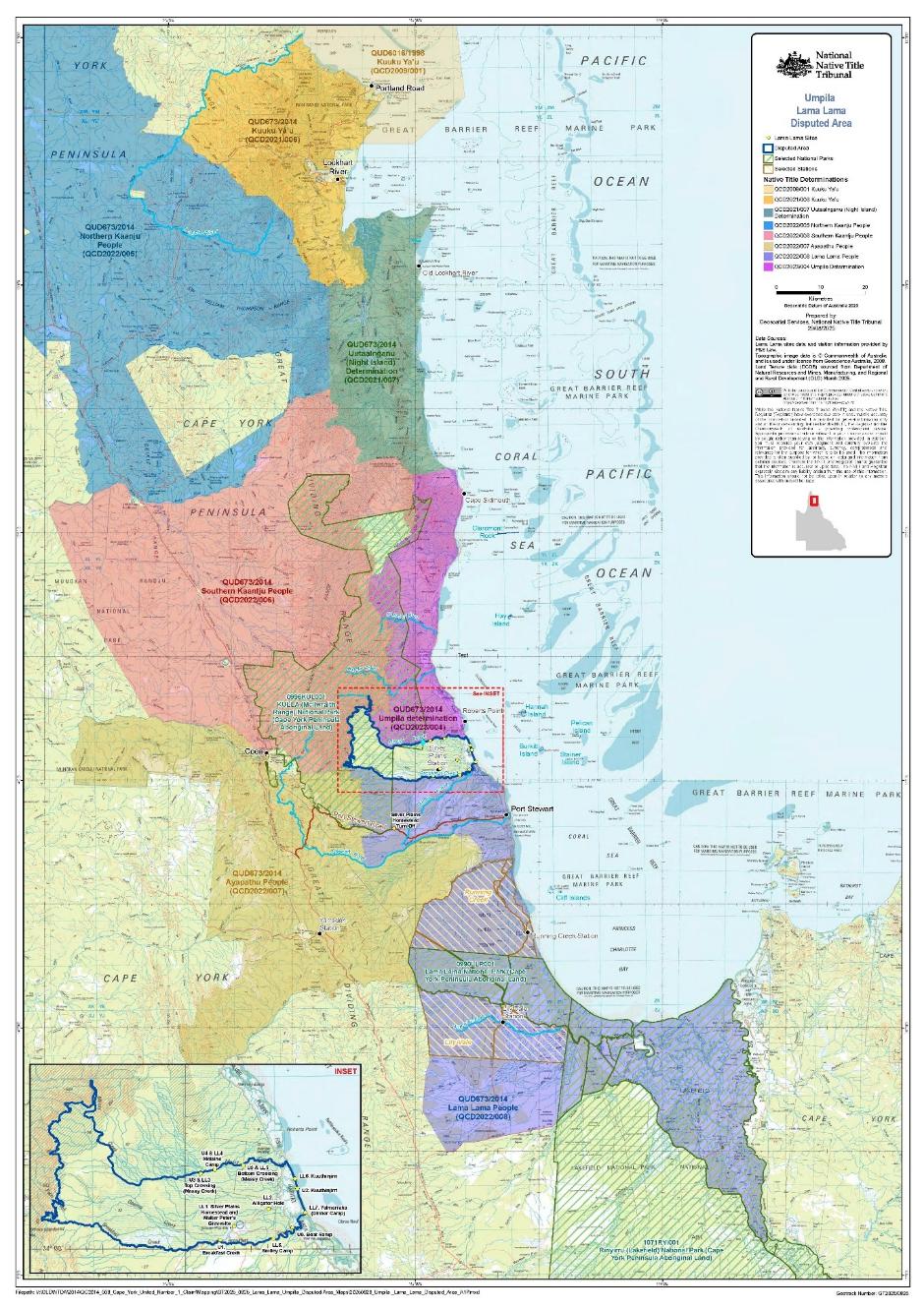
SCHEDULE OF PARTIES
QUD 673 of 2014 | |
Respondents | |
Third Respondent | AURUKUN SHIRE COUNCIL |
Fourth Respondent | CARPENTARIA SHIRE COUNCIL |
Fifth Respondent | COOK SHIRE COUNCIL |
Sixth Respondent | DOUGLAS SHIRE COUNCIL |
Seventh Respondent | KOWANYAMA ABORIGINAL SHIRE COUNCIL |
Ninth Respondent | PORMPURAAW ABORIGINAL SHIRE COUNCIL |
Tenth Respondent | WUJAL WUJAL ABORIGINAL SHIRE COUNCIL |
Eleventh Respondent | ERGON ENERGY CORPORATION LIMITED ACN 087 646 062 |
Twelfth Respondent | FAR NORTH QUEENSLAND PORTS CORPORATION LIMITED (TRADING AS PORTS NORTH) |
Thirteenth Respondent | TELSTRA CORPORATION LIMITED |
Fourteenth Respondent | ALCAN SOUTH PACIFIC |
Fifteenth Respondent | BRANDT METALS PTY LTD |
Nineteenth Respondent | LANCE JEFFRESS |
Twentieth Respondent | RTA WEIPA PTY LTD |
Twenty Fifth Respondent | GRAHAM EDWARD ELMES |
Twenty Eighth Respondent | MARGARET ANNE INNES |
Twenty Ninth Respondent | COLIN INNES |
Thirtieth Respondent | KIM KERWIN |
Thirty First Respondent | WENDY EVA KOZICKA |
Thirty Second Respondent | CAMERON STUART MACLEAN |
Thirty Third Respondent | MICHELLE MARGARET MACLEAN |
Thirty Fourth Respondent | BRETT JOHN MADDEN |
Thirty Fifth Respondent | RODNEY GLENN RAYMOND |
Thirty Sixth Respondent | EVAN FRANK RYAN |
Thirty Seventh Respondent | PAUL BRADLEY RYAN |
Thirty Eighth Respondent | SUSAN SHEPHARD |
Thirty Ninth Respondent | SCOTT EVAN RYAN |
Fortieth Respondent | BARBARA JOAN SHEPHARD |
Forty First Respondent | NEVILLE JAMES SHEPHARD |
Forty Second Respondent | THOMAS DONALD SHEPHARD |
Forty Fifth Respondent | MATTHEW TREZISE |
Forty Sixth Respondent | BOWYER ARCHER RIVER QUARRIES PTY LTD ACN 603 263 369 |
Forty Ninth Respondent | GAVIN DEAR |
Fiftieth Respondent | SCOTT ALEXANDER HARRIS |
Fifty Fifth Respondent | ESTHER RUTH FOOTE |
Fifty Sixth Respondent | AMPLITEL PTY LTD AS TRUSTEE OF THE TOWERS BUSINESS OPERATING TRUST (ABN 75 357 171 746) |
Fifty Seventh Respondent | GREGORY PASCOE |
Fifty Eighth Respondent | GARY WARRADOO |
Fifty Ninth Respondent | LORRAINE WARRADOO |
Sixtieth Respondent | JULIE WARRADOO |
Sixty First Respondent | DAWN KYLE |
Sixty Second Respondent | MALCOLM CONGOO |
Sixty Third Respondent | GAVIN BASSINI |
Sixty Fourth Respondent | ROBERT SPRATT |
Sixty Fifth Respondent | GORDON PETER |
Sixty Sixth Respondent | KAREN LIDDY |
Sixty Seventh Respondent | ELAINE LIDDY |


