FEDERAL COURT OF AUSTRALIA
Ross on behalf of the Cape York United #1 Claim Group v State of Queensland (No 40) (Massy and Breakfast Creeks boundary dispute) [2026] FCA 980
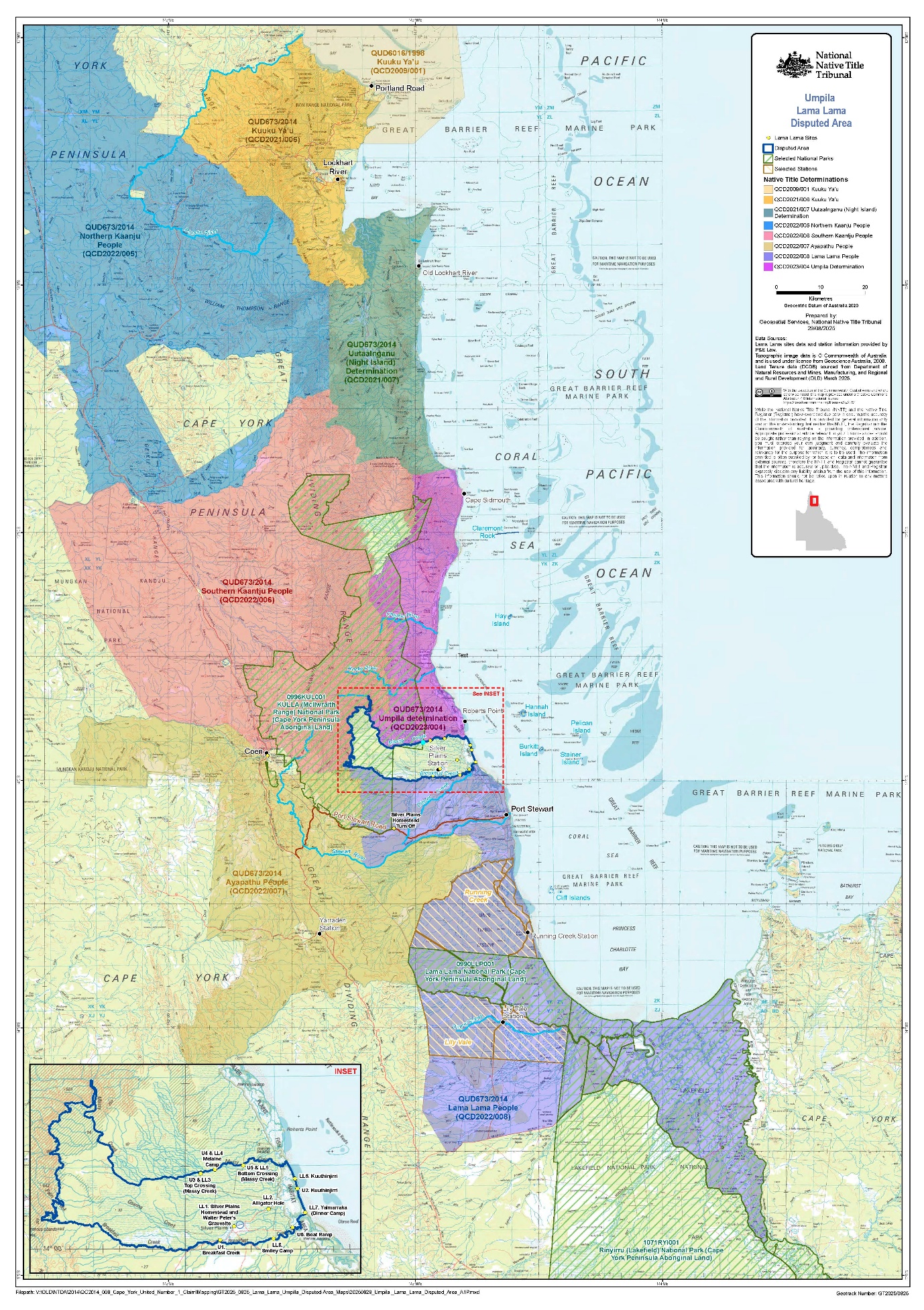
Summary
In accordance with the practice of the Federal Court in some cases of public interest, importance or complexity, the following summary has been prepared to accompany the reasons for judgment and orders made today. This summary is intended to assist in understanding the outcome of this proceeding and is not a complete statement of the conclusions reached by the Court. The only authoritative statement of the Court’s reasons is that contained in the published reasons for judgment which will be available on the internet at www.fedcourt.gov.au together with this summary.
1 Today the Court has made orders to resolve a dispute between two groups of native title holders over an area of country on the eastern coast of the Cape York Peninsula.
2 The area is located southeast of Coen and north of Port Stewart. The country lies generally between Breakfast and Massy Creeks, to the south of the Umpila native title consent determination area (see Ross on behalf of the Cape York United #1 Claim Group v State of Queensland (No 17) (Umpila determination) [2023] FCA 734), and to the north of the Lama Lama native title consent determination area (see Ross on behalf of the Cape York United #1 Claim Group v State of Queensland (No 9) (Lama Lama determination) [2022] FCA 773). The parties referred to this as the “Disputed Area”.
3 A map of the Disputed Area, and the adjoining consent determination areas, is attached to this summary.
4 The dispute is between the Lama Lama People and the Umpila People. Since this dispute arises within the wider Cape York United #1 claim proceeding, it was necessary for some individuals to be joined to the CYU#1 claim proceeding as respondents, to represent the Lama Lama People and the Umpila People. In November 2024, six members of the CYU#1 claim group who identify as Umpila People and five members of the CYU#1 claim group who identify as Lama Lama People were joined as respondents to the proceeding. In the Court’s judgment and in this summary, they are described as the Umpila respondents and the Lama Lama respondents.
5 Resolving who holds native title in the Disputed Area is quite different to achieving a determination of native title by consent, and agreement. For their consent determinations mentioned above, the Lama Lama People and the Umpila People were each able to negotiate and reach agreement amongst their own community, with their First Nations neighbours and countrymen, with the State of Queensland and with other parties with proprietary interests in the areas. They reached agreement on key aspects of each determination over their country such as where the boundaries should be, and who the apical ancestors are for the area of the determination. Apical ancestors are the elders who are recognised by the Court as having been the traditional owners of an area at the time the British Crown asserted sovereignty over the land and waters in Australia.
6 For the Disputed Area, no such agreement could be reached. No neighbouring groups claim native title in the Disputed Area, but the Lama Lama People say the Disputed Area is all Lama Lama country, and the Umpila People say the Disputed Area is all Umpila country. There were many attempts at mediation and agreement making, but none of them succeeded. That meant the Court had to resolve the disagreement. It also meant the Lama Lama respondents had to prove, by evidence, that the Lama Lama People and only the Lama Lama People were the correct native title holders for the Disputed Area. The Umpila respondents also had to prove, by evidence, that the Umpila People and only the Umpila People were the correct native title holders for the Disputed Area. Each of them had to persuade the Court that it was more probable than not that the facts supported what they said.
7 The process agreed on for resolving this dispute is called a “separate question” process. Under that process, after consultation with the parties, the Court made orders setting out a series of questions which needed to be answered. This process is used by the Court when answering one or more separate questions is likely to resolve the main issues in dispute between parties to a proceeding. That is why, in the Court’s orders, the reader will see a series of questions and, in bold, the answers the Court has given to those questions. The parts in bold in the Court’s orders are the outcome which will bind the parties, including the Umpila and Lama Lama respondents, as representatives for the Umpila and Lama Lama Peoples.
8 The Cape York Land Council arranged for each of the Umpila and Lama Lama respondents to have separate legal representation. The CYU#1 claim applicant did not take an active part in the hearing except to assist the Court. The State of Queensland took an active part in the hearing, initially without adopting any position about who had native title to the Disputed Area, but by the end of the hearing and at the Court’s request, the State did adopt a position on the dispute.
9 The hearing of the separate question commenced on 1 September 2025 and was conducted in several stages. From 1 September 2025 to 4 September 2025, the hearing was conducted on country in Coen at the Wunthulpu Cultural Centre and on various sites around the Disputed Area. The following week, 8 September 2025 to 12 September 2025, further witness evidence was taken in Cairns. Expert evidence was heard in Cairns on 10 to 12 November 2025. Written submissions were then provided in the course of February and March 2026, and a final oral hearing was conducted on 19 and 20 March 2026.
10 By the orders made today, the Court has decided that native title exists in the Disputed Area and is held communally by a group comprising the descendants (whether through birth or traditional adoption) of the ancestors named in Annexure A to the Court’s Orders. The Court has accepted all of the apical ancestors nominated to it by the Umpila respondents, and by the Lama Lama respondents. The Court’s orders identify the apical ancestors as: Frank Port (Nangkayunumu); Peter (Ko’ayi); the unnamed sister of Peter Ko’ayi (mother of Ko’omithya); Kaputhana and Mary Ann Kamanmutu.
11 However, the Court has decided that it is not possible or appropriate on the evidence to describe the country, or the group who hold the communal title, as either “Umpila” or “Lama Lama”. The Court has found in substance that after colonisation in this region, and as a result of tragedies like forced removals of people from their country and the collapse of local populations, some of the traditional owners and families became more associated with Umpila People to the north, and others became more associated with Lama Lama People to the south. Those identities are now entrenched, but the situation in the Disputed Area traditionally for the apical ancestors was not like that. The apical ancestors and the elders before them were Sandbeach people living in local clans or estate groups, connected to the Disputed Area through the operation of a common regional system of traditional law and custom.
12 The facts do not clearly support tracing their identity from before colonisation to the present day only to Umpila People as recognised today, or only to Lama Lama People as recognised today. The facts show the picture was more mixed than that. Therefore, the only people in the present day that the Court can be satisfied are connected to the Disputed Area by their traditional law and custom are the descendants of the five apical ancestors. This group will comprise a mixture of Lama Lama identifying people and families, and Umpila identifying people and families.
13 The Court’s conclusion means the communal title is held only by this group of descendants. Only the people who are descended (whether through birth or traditional adoption) from the apical ancestors named in the Court’s orders will be the native title holders for the Disputed Area. The wider group of Lama Lama and Umpila people, as described in their respective consent determinations, will not be native title holders for the Disputed Area.
14 After such a long and difficult period of dispute, from this point onwards the Court will focus on achieving a core objective of our justice system; namely bringing finality to disputes between parties. Finality means bringing parties’ disputes to an end. The Court must do that where parties have not been able to agree on an outcome. Therefore, the Court has also made procedural orders today requiring the Active Parties to work together cooperatively to propose a timetable and set of orders for the next steps necessary for the Court to make final orders determining and recognising native title in the Disputed Area, in the terms the Court’s decision today has found that native title to exist. The parties will have the assistance of a Judicial Registrar of the Court to help them work out these orders and next steps.
MORTIMER CJ
23 JULY 2026