FEDERAL COURT OF AUSTRALIA
JOHNNY JANGO, JUDY TRIGGER, MANTATJARA WILSON, NGOI NGOI DONALD AND WINDLASS ALURTIJA
v
NORTHERN TERRITORY OF AUSTRALIA, GPT MANAGEMENT LIMITED AND
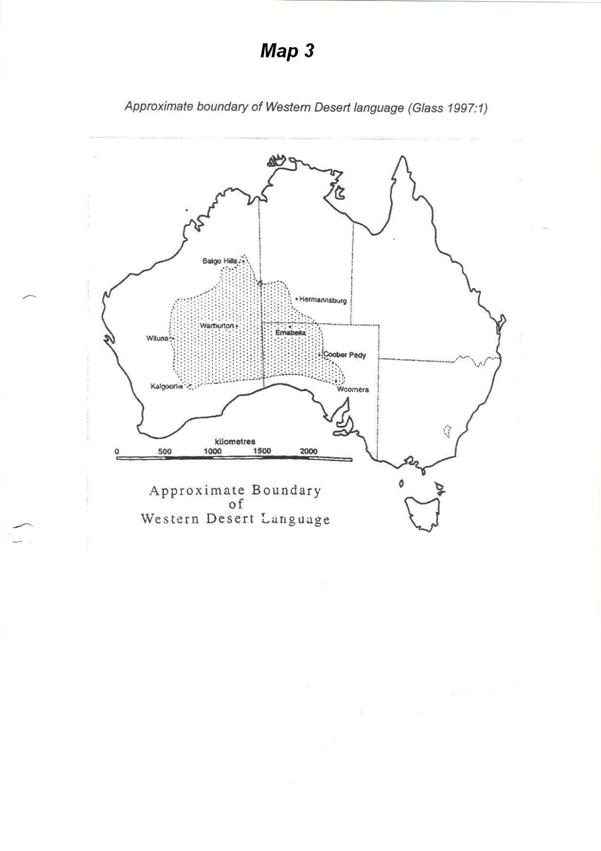
COMMONWEALTH OF AUSTRALIA
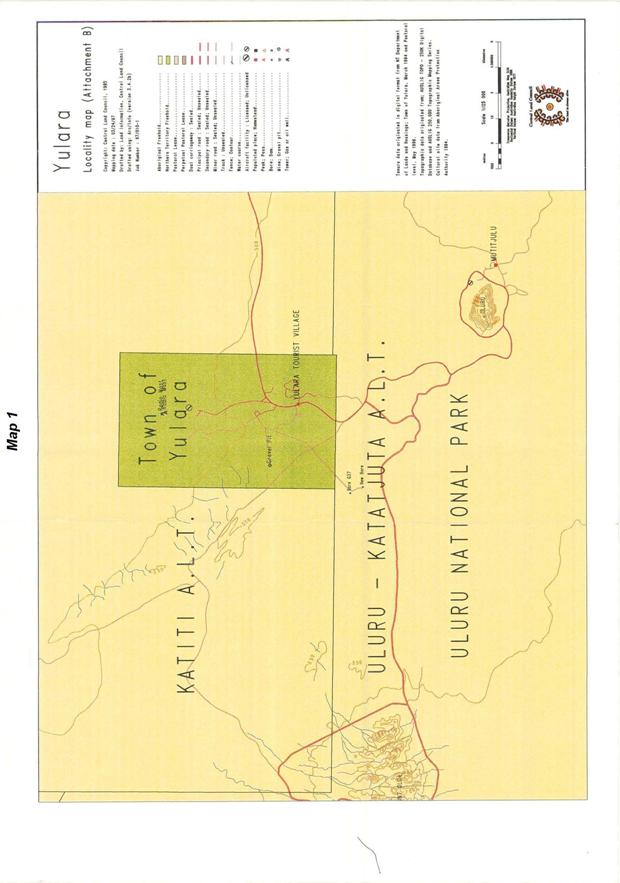
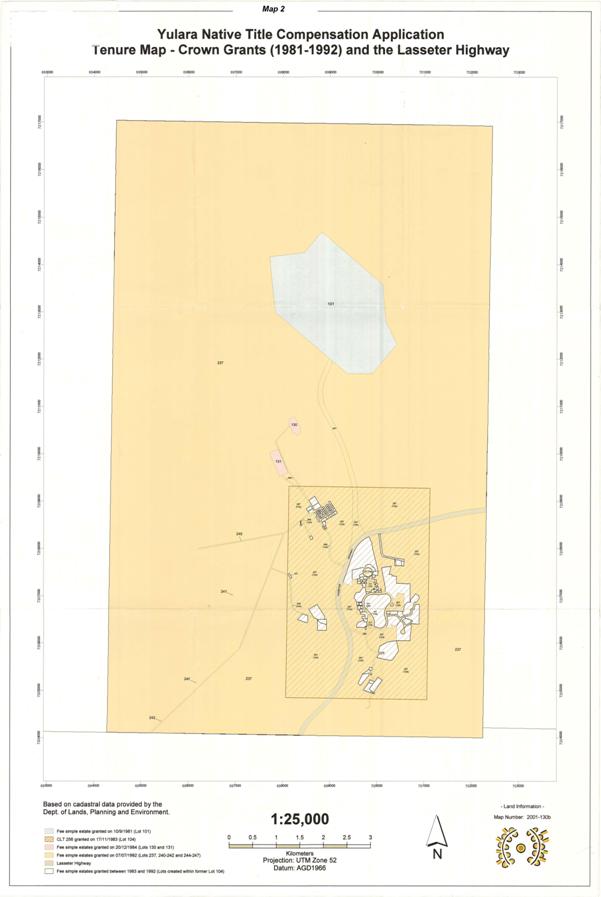
NTD 6023 of 1998
summary
In accordance with the practice of the Federal Court in certain cases of public interest, the Court has prepared a Summary to accompany the judgment that is to be delivered today. However, it must be emphasised that the Summary forms no part of the judgment. The only authoritative statement of the Court’s reasons is the judgment itself.
This Summary is intended to assist in understanding the principal conclusions reached by the Court, but is necessarily incomplete. The published Reasons for Judgment and this Summary will be available on the internet www.fedcourt.gov.au.
Jango v Northern Territory of Australia [2006] FCA 318
1. This is the first case in the Federal Court in which Aboriginal applicants have sought a determination of compensation as the result of extinguishment of native title over land. The proceedings have been brought by the applicants under the Native Title Act 1993 (Cth) (‘NTA’) on behalf of the members of a ‘compensation claim group’.
2. The applicants seek a determination in respect of the Town of Yulara in the Northern Territory (‘the Application Area’), which comprises an area of 104 square kilometres. The members of the compensation claim group are almost exclusively Yankunytjatjara or Pitjantjatjara people who, according to the applicants, held native title rights and interests in the Application Area and are entitled to compensation because their rights and interests were extinguished by certain ‘compensation acts’ that occurred over the period 1979 to 1992. The applicants say that the Northern Territory is liable under the NTA to pay compensation.
3. The Application Area incorporates the Yulara Tourist Village, which provides accommodation and other services for the tens of thousands of tourists who visit Ayres Rock (Uluru) and the Olgas (Kata Tjurta). The Application Area also incorporates Connellan Airport, which is the point of arrival for tourists travelling by air to visit the area.
4. The Application Area is located in the far south of the Northern Territory, just north of the South Australian border. It is in the eastern part of a large area generally described as the Western Desert, which encompasses parts of South Australia, the Northern Territory and Western Australia.
5. The applicants say that they and their predecessors held native title, as defined in s 223(1) of the NTA, over the Application Area under the traditional laws and customs of the Western Desert bloc. They say that native title has existed from the time the Crown asserted sovereignty over the eastern Western Desert in 1824 until the remaining native title rights and interests were extinguished by the compensation acts.
6. It is agreed that the only acts prior to 1979 that could have extinguished any pre-existing native title rights and interests over the Application Area were two pastoral leases granted over the land in the late nineteenth century. The applicants accept that the leases, both of which were determined after a short period, extinguished the most extensive native title rights and interests which had survived the acquisition of sovereignty by the Crown. But they say, and I agree, that the pastoral leases left most native title rights and interests unaffected.
7. The compensation acts which extinguished native title included grants of freehold and leasehold estates over some lots on the Application Area and the construction of public works, notably Connellan Airport, certain roads and a series of water bores. The applicants say that the native title rights and interests were not necessarily extinguished at the time the compensation acts took place. Rather, their argument is that the extinguishment actually came about as a result of the operation of complicated provisions of the NTA and corresponding provisions of the Validation (Native Title) Act (NT).
8. On the applicants’ case, native title over the Application Area was finally extinguished on 10 March 1994, the date the Validation Act came into force. One consequence of the applicants having selected this date is that, if their arguments are accepted, members of the compensation claim group may be entitled to compensation for the value of improvements that were erected on the land before 1994. These improvements, of course, include Connellan Airport.
9. The Northern Territory and the Commonwealth (‘the respondents’) have raised many arguments in opposition to the applicants’ claims. The respondents’ principal defence, however, is that the applicants have not established, on the evidence, that members of the compensation claim group held traditional native title rights or interests in the Application Area at the times the compensation acts occurred. They say that it is essential to focus on the case actually pleaded in the Points of Claim and to which the applicants expressly adhered in final submissions. On that basis, the respondents say that the applicants have failed to establish that members of the compensation claim group acknowledged and observed the laws and customs pleaded in the Points of Claim.
10. In any event, so the respondents argue, the laws and customs pleaded by the applicants have not been shown to be the traditional laws and customs of the Western Desert bloc for the purposes of s 223(1) of the NTA. Accordingly, they say, the applicants have not made out an essential element of their claim to compensation.
11. I have made the following findings on these crucial submissions:
(1) In my opinion, the applicants have not shown, on the evidence, that the indigenous witnesses, or members of the compensation claim group, acknowledged and observed the laws and customs of the Western Desert bloc as pleaded in the Points of Claim. Unfortunately for the applicants, the evidence does not reveal a consistent pattern of observance and acknowledgement of laws and customs relating to rights and interests in land. In particular, the evidence does not support acknowledgement and observance of the particular set of laws and customs pleaded and relied on by the applicants.
My finding does not necessarily imply that none of the indigenous witnesses could make out a case that he or she is ngurraritja (traditional owner) for sites in the Uluru-Kata Tjurta area under laws and customs currently observed by people of the Western Desert. My finding is that the applicants have not made out the particular laws and customs that they have chosen to plead and to rely on when presenting their case.
(2) In any event, I am not satisfied that any laws and customs relating to rights and interest in land that may have been acknowledged and observed by the Aboriginal witnesses are the traditional laws and customs of the Western Desert bloc, within the meaning of s 223(1) of the NTA. The evidence has not established that any laws and customs now observed and acknowledged are sufficiently related to those observed and acknowledged by people of the Western Desert at sovereignty. In particular, I find that the traditional laws and customs of the Western Desert bloc followed a principle of patrilineal descent, which is largely absent from the practices described in the evidence.
12. Either of these findings is sufficient to defeat the applicants’ claim for a determination of compensation.
13. In the second part of the judgment I address the issues relating to extinguishment of native title that would have arisen had the applicants, contrary to my findings, succeeded on the threshold question. On that assumption, I have concluded that the native title rights and interests of members of the compensation claim group would not have been validly extinguished prior to the compensation acts taking place, although some interests would have been extinguished by the pastoral leases granted in the nineteenth century.
14. Thus, if I had reached a different conclusion on the question of traditional laws and customs, at least some members of the compensation claim group would have been entitled to compensation. However, contrary to the applicants’ submissions, I conclude that any such entitlement would have arisen at the time major construction works on the Application Area commenced. Thus any compensation would not have included the value of any buildings or works subsequently completed on the Application Area.
15. Finally I make this point. I have addressed the compensation case the applicants have chosen to put forward. My conclusions do not necessarily imply that none of the applicants, or members of the compensation claim group, could have established the existence of native title rights and interests over the Yulara Block before the compensation acts occurred, had their case been conducted differently. I do not intend this comment as a criticism of the manner in which the applicants’ case was presented as there may be many reasons why they chose to present the case they did. However, I am not entitled to consider some alternative or different case that the applicants might conceivably have advanced, perhaps on behalf of a smaller group of people. I must consider the actual case presented on their behalf, which was the one the respondents were required to meet.
16. The result is that the applicants have not established that the Territory is liable to pay compensation to any member of the compensation claim group. The compensation application must therefore be dismissed. I intend to give the parties an opportunity to make submissions on costs and any consequential orders that may be required.
Sydney
31 March 2006
FEDERAL COURT OF AUSTRALIA
Jango v Northern Territory of Australia [2006] FCA 318
NATIVE TITLE – compensation claim – applicants seek a determination of compensation for extinguishment of native title over the Town of Yulara in the Northern Territory (‘Application Area’) – any surviving native title rights and interests extinguished by grants of tenure and the construction of public works (‘compensation acts’) – separate trial on liability (if any) of the Northern Territory to pay compensation – Native Title Act 1993 (Cth) (‘NTA’), s 61(1)
NATIVE TITLE – whether applicants have established that native title rights and interests existed over Application Area at the time the compensation acts took place
NATIVE TITLE – whether Western Desert bloc is a ‘society’ having traditional laws and customs – whether the society continued in existence until the compensation acts occurred – whether the eastern Western Desert is a sub-region of the Western Desert
NATIVE TITLE – whether applicants have established that members of the compensation claim group acknowledged and observed the laws and customs pleaded by the applicants – whether the applicants have shown that the pleaded laws and customs are the ‘traditional’ laws and customs of the Western Desert bloc
NATIVE TITLE – extinguishment – effect of Northern Territory pastoral leases on native title – ‘previous non-exclusive possession acts’ – extent of inconsistency between native title rights and interests and the rights of pastoral lessees
NATIVE TITLE – extinguishment – whether any surviving native title rights and interests were validly extinguished before commencement of the NTA – whether grants of tenure and construction of public works were invalid to any extent – Racial Discrimination Act 1975 (Cth) (‘RD Act’), s 10(1)
NATIVE TITLE – extinguishment – effect of registration of Crown grants under the Torrens system – whether principle of indefeasibility applies to validate grants that would otherwise be invalid – whether registration of Crown grants has a discriminatory effect on native title under the law of the Northern Territory
NATIVE TITLE – extinguishment – construction of public works – whether effect of construction is to discriminate against native title holders by extinguishing native title – whether construction was invalid to any extent by reason of the RD Act
NATIVE TITLE – entitlement to compensation – ‘previous exclusive possession act’ which is also a ‘past act’ – whether entitlement arises under s 17 or s 23J of the NTA – when entitlement to compensation arises by reason of grants of tenure or construction of public works
Constitution,ss 51(xxxi), 51(xxix), 109, 122
Aboriginal Land Rights (Northern Territory) Act 1976 (Cth), ss 3(1), 50(1)(a)
Evidence Act 1995 (Cth), s 79
Judiciary Act 1903 (Cth), s 78B
Native Title Act 1993 (Cth), ss 3, 6(1), 7, 10, 11, 13(2), 13A, 14, 15, 16, 17, 19, 20, 23A, 23B, 23C, 23D, 23DA, 23E, 23F, 23G, 23H, 23HA, 23I, 23J, 23JA, 45, 49, 50, 51, 53(1), 61, 62(3), 81, 82, 84(4), 94, 94A, 200(1), 213(2), 223, 225, 226, 228, 229, 230, 231, 232, 237A, 238, 239, 240, 248, 248A, 248B, 251D, 253, Pt 2 Div 2, Pt 2 Div 2B, Pt 2 Div 3, Pt 2 Div 5
Native Title Amendment Act 1998 (Cth), Table A, Sch 5, Items 6, 36
Northern Territory Acceptance Act 1910 (Cth), ss 7, 10
Northern Territory (Administration) Act 1910 (Cth), ss 4U, 4V, 4W, 13
Northern Territory (Self-Government) Act 1978 (Cth), ss 5, 6, 13, 31, 35, 50(1), 57
Racial Discrimination Act 1975 (Cth), ss 6, 10(1), 10(2)
Northern Territory (Self-Government) Regulations,reg 4
Federal Court Rules, O 29 r 2
Mining Act 1906 (NSW)
Northern Territory Crown Lands Act 1890 (SA)
Northern Territory Land Act 1872 (SA), ss 12, 74, 78, 93, 94, 95, 96, 97, 100
Northern Territory Land Act 1876 (SA), s 3
Real Property Act 1886 (SA), ss 25, 27, 39, 52, 69, 80, 86 191, 220(4)
Northern Territory Pastoral Regulations 1881 (SA), regs 2, 8
Mining Act 1978 (WA), s 123(2)
Transfer of Land Act 1893 (WA), ss 30, 68, 137
Control of Roads Act (NT), ss 8(1), 7
Control of Waters Act (NT)
Crown Lands Act 1931 (NT), ss 5, 14, 15(2), 93(2), 111
Crown Lands Act 1992 (NT), s 9(1)
Land Titles Act 2000 (NT)
Lands Acquisition Act 1978 (NT)
Planning Act 1979 (NT), s 99
Validation (Native Title) Act (NT) ss 3(2), 3A, 3B, 3C, 4, 4D, 5, 6, 8, 9, 9G, 9H, 9J, 9JA, 9JB, 9K, 9L, 9M, 9N, 9NA, 11, Pt 3, Pt 3A, Pt 3B, Pt 3C, Sch 1, Sch 2, Sch 3
Validation of Titles and Actions Act 1994 (NT)
Validation of Titles and Actions Amendment Act 1998 (NT)
Crown Lands Ordinance 1931 (NT), s 103
National Parks and Gardens Ordinance 1955 (NT), s 13
International Convention on the Elimination of All Forms of Racial Discrimination, art 5
Attorney-General (NT) v Ward (2003) 134 FCR 16 discussed
Bodney v Bropho (2004) 140 FCR 77 cited
Breskvar v Wall (1971) 126 CLR 376 cited
Browne v Dunn (1893) 6 R 67 cited
Bulstrode v Trimble [1970] VR 840 cited
Capital Duplicators Pty Ltd v Australian Capital Territory (1992) 177 CLR 248 cited
Clissold v Perry (1904) 1 CLR 363 cited
Commonwealth v Yarmirr (2001) 208 CLR 1followed
Daniel v Western Australia [2003] FCA 666 distinguished
De Rose v South Australia [2002] FCA 1342 discussed
De Rose v South Australia (2003) 133 FCR 325 followed
De Rose v South Australia (No 2) (2005) 145 FCR 290 followed
Dobbie v Davidson (1991) 23 NSWLR 625 cited
Elkington v Shell Australia Ltd (1993) 32 NSWLR 11 cited
Ellis v Wallsend District Hospital (1989) 17 NSWLR 553 cited
Fejo v Northern Territory (1998) 195 CLR 96 cited
Fejo v Northern Territory (1998) 152 ALR 477 cited
Frazer v Walker [1967] 1 AC 589 cited
Gerhardy v Brown (1985) 159 CLR 70 followed
Hillpalm Pty Ltd v Heaven’s Door Pty Ltd (2004) 220 CLR 472 cited
Jango v Northern Territory (No 2) [2004] FCA 1004 cited
Koowarta v Bjelke-Petersen (1982) 153 CLR 168 cited
Kruger v Commonwealth (1996) 190 CLR 1 cited
Lardil Peoples v Queensland [2004] FCA 298 distinguished
Mabo v Queensland (1988) 166 CLR 186 followed
Mabo v Queensland (No 2) (1992) 175 CLR 1 discussed
Members of the Yorta Yorta Aboriginal Community v Victoria (2002) 214 CLR 422 followed
Members of the Yorta Yorta Aboriginal Community v Victoria [1998] FCA 1606 discussed
Neowarra v Western Australia [2003] FCA 1402 distinguished
Newcrest Mining (WA) Ltd v Commonwealth (1996) 190 CLR 513 cited
Northern Territory v Alyawarr, Kaytetye, Warumungu, Wakaya Native Title Group (2005) 145 FCR 442 followed
Paulette v The Queen [1977] 2 SCR 628 cited
Precision Plastics Pty Ltd v Demir (1975) 132 CLR 362 cited
Saraswati v The Queen (1991) 172 CLR 1 cited
Skeetschestn Indian Band v British Columbia (Registrar of Land Titles) [2001] 1 CNLR 310 cited
Uukw v British Columbia (1987) 37 DLR (4th) 408 cited
Wade v New South Wales Rutile Mining Co Pty Ltd (1969) 121 CLR 177 discussed
Western Australia v Commonwealth (1995) 183 CLR 373 followed
Western Australia v Ward (2002) 213 CLR 1 followed
Wik Peoples v Queensland (1996) 187 CLR 1 discussed
Williams v State Transit Authority of NSW (2004) 60 NSWLR 286 cited
Wilson v Anderson (2002) 213 CLR 401 followed
Yarmirr v Northern Territory (1998) 82 FCR 533 discussed
J D Heydon, Cross on Evidence (6th Aust ed, 2000)
D Pearce and R Geddes, Statutory Interpretation in Australia (5th ed, 2001)
Report of the Aboriginal Land Commissioner (Maurice J), Lake Amadeus Land Claim (Report No 28, 1989)
Report of the Aboriginal Land Commissioner (Toohey J), Uluru (Ayers Rock) National Park and Lake Amadeus/Luritja Land Claim (Report No 4,1980)
R M Berndt, ‘Tribal Migrations and Myths Centring on Ooldea, South Australia’(1941) 12 Oceania 1
R M Berndt, ‘The Concept of the Tribe in the Western Desert of Australia’ (1959) 30 Oceania 81
J C Carruthers, Triangulation of NW Portion of South Australia (SA Parl Pap 179, 1892)
W H Edwards, ‘Patterns of Aboriginal Residence in the North-West of South Australia’ (1992) 30 Journal of the Anthropological Society of South Australia 2
A P Elkin, ‘The Social Organization of South Australian Tribes’ (1931) 2 Oceania 44
A P Elkin, ‘Kinship in South Australia’ (1939) 10 Oceania 196
A P Elkin, ‘Kinship in South Australia’ (1940) 10 Oceania 295
E Giles, Geographic Travels in Central Australia From 1872 to 1874 (1875)
E Giles, Australia Twice Traversed: The Romance of Exploration (1889)
A Glass, Cohesion in Ngaanyatjarra Discourse (Summer Institute of Linguistics, 1997)
A Hamilton, ‘Descended from Father, Belonging to Country: Rights to Land in the
Australian Western Desert’ in E Laycock and R Lee (eds), Politics and History in Band Societies (1982)
D Mackay, ‘The Mackay Exploring Expedition, Central Australia, 1926’(1929) 73 Geographical Journal 258
M H McLelland, ‘Colonial and State Boundaries in Australia’ (1971) 45 ALJ 671
N D Munn, A Report on Field Research at Areyonga 1964-1965 (1965)
F R Myers, Pintupi Country, Pintupi Self: Sentiment, Place and Politics among Western Desert Aborigines (Australian Institute of Aboriginal Studies, 1986)
W B Spencer (ed), Report on the Work of the Horn Scientific Expedition to Central Australia (1896)
B Spencer and F J Gillen, Across Australia (1912), vol 1
P M Sutton, Native Title in Australia: An Ethnographic Perspective (2003)
W H Tietkins, Journal of the Central Australian Exploring Expedition, 1889 (1891)
N B Tindale, ‘Preliminary Report on Fieldwork Among the Aborigines of the North West of South Australia’ (1933) 4 Oceania 99
N B Tindale, ‘Totemic Beliefs in the Western Desert of Australia’ (1957) 13 Records of the South Australian Museum 305
N B Tindale, ‘Totemic Beliefs in the Western Desert of Australia – Part I’ (1959) 13 Records of the South Australian Museum 305
N B Tindale, ‘The Pitjandjara’ in MG Bicchieri (ed), Hunters and Gatherers Today (1972)
N B Tindale, Aboriginal Tribes of Australia: Their Terrain, Environmental Controls, Distribution, Limits and Proper Names (Uni of California, 1974)
JOHNNY JANGO and ORS v NORTHERN TERRITORY OF AUSTRALIA and ORS
NTD 6023 of 1998
SACKVILLE J
31 MARCH 2006
SYDNEY
| IN THE FEDERAL COURT OF AUSTRALIA |
|
| NEW SOUTH WALES DISTRICT REGISTRY | NTD 6023 of 1998 |
| BETWEEN: | JOHNNY JANGO, JUDY TRIGGER, MANTATJARA WILSON, NGOI NGOI DONALD AND WINDLASS ALURTIJA APPLICANTS
|
| AND: | NORTHERN TERRITORY OF AUSTRALIA FIRST RESPONDENT
GPT MANAGEMENT LIMITED SECOND RESPONDENT
COMMONWEALTH OF AUSTRALIA THIRD RESPONDENT
|
| JUDGE: | SACKVILLE J |
| DATE OF ORDER: | 31 MARCH 2006 |
| WHERE MADE: | SYDNEY |
THE COURT ORDERS THAT:
1. The applicants be granted leave to amend par B1.8 of the Third Further Amended Points of Claim, subject to the qualifications referred to in pars 237, 238 and 239 of the Judgment herein.
- The application for determination of compensation be dismissed.
- The first and second respondents file brief written submissions within 14 days on costs and on such further orders (if any) they seek in the proceedings.
- The applicants file brief written submissions within a further 14 days in response to the respondents’ submissions.
Note: Settlement and entry of orders is dealt with in Order 36 of the Federal Court Rules.
| IN THE FEDERAL COURT OF AUSTRALIA |
|
| NEW SOUTH WALES DISTRICT REGISTRY | NTD 6023 of 1998 |
| BETWEEN: | JOHNNY JANGO, JUDY TRIGGER, MANTATJARA WILSON, NGOI NGOI DONALD AND WINDLASS ALURTIJA APPLICANTS
|
| AND: | NORTHERN TERRITORY OF AUSTRALIA FIRST RESPONDENT
GPT MANAGEMENT LIMITED SECOND RESPONDENT
COMMONWEALTH OF AUSTRALIA THIRD RESPONDENT
|
| JUDGE: | SACKVILLE J |
| DATE: | 31 MARCH 2006 |
| PLACE: | SYDNEY |
TABLE OF CONTENTS
Par
| 1. THE PROCEEDINGS | 1 |
| 2. SECTION 78B NOTICES | 20 |
| 3. TRANSITIONAL PROVISIONS | 23 |
| 4. THE GENERAL SCHEME OF THE NTA | 29 |
| 5. THE COMPENSATION REGIME UNDER THE NTA | 39 |
| 5.1 PART 2, DIVISION 1 | 40 |
| 5.2 PART 2, DIVISION 2 | 42 |
| 5.3 PART 2, DIVISION 2B | 50 |
| 5.4 PART 2, DIVISION 4 | 54 |
| 5.5 PART 2, DIVISION 5 | 56 |
| 5.6 PART 4, DIVISION 3 | 62 |
| 6. THE VALIDATION AND EXTINGUISHMENT PROVISIONS OF THE NTA AND THE VALIDATION ACT | 65 |
| 6.1 THE VALIDATION REGIME UNDER THE NTA | 65 |
| 6.2 THE VALIDATION REGIME UNDER THE VALIDATION ACT | 73 |
| 6.3 THE NTA EXTINGUISHMENT REGIME FOR VALID OR VALIDATED ACTS | 79 |
| 6.3.1 Previous Exclusive Possession Acts | 80 |
| 6.3.2 Previous Non-Exclusive Possession Acts | 86 |
| 6.4 THE TERRITORY EXTINGUISHMENT REGIME FOR VALID OR VALIDATED ACTS | 93 |
| 6.4.1 Previous Exclusive Possession Acts | 93 |
| 6.4.2 Previous Non-Exclusive Possession Acts | 99 |
| 7. RACIAL DISCRIMINATION ACT 1975 (CTH) | 101 |
| 8. A CHRONOLOGY OF EVENTS | 106 |
| 8.1 SOVEREIGNTY | 107 |
| 8.2 THE ERA OF EXPLORATION | 110 |
| 8.3 THE FIRST HALF OF THE TWENTIETH CENTURY | 124 |
| 8.4 THE PARK AND THE DEVELOPMENT OF TOURISM | 136 |
| 8.5 SITE CLEARANCE AND HANDBACK | 152 |
| 9. THE APPLICANTS’ CASE ON NATIVE TITLE: THE PLEADINGS | 165 |
| 9.1 THE NATIVE TITLE HOLDERS | 166 |
| 9.2 THE WESTERN DESERT PEOPLE | 171 |
| 9.3 THE LAWS AND CUSTOMS GOVERNING NATIVE TITLE | 174 |
| 9.4 THE TJUKURRPA | 180 |
| 9.5 OTHER LAWS AND CUSTOMS | 182 |
| 9.6 THE RIGHTS AND INTERESTS THAT WERE EXTINGUISHED | 183 |
| 9.7 CONNECTION WITH THE APPLICATION AREA | 187 |
| 9.8 OTHER MATTERS | 190 |
| 10. THE APPLICANTS’ CASE ON NATIVE TITLE: THE SUBMISSIONS | 191 |
| 10.1 PRINCIPLES GOVERNING NATIVE TITLE | 192 |
| 10.2 THE CLAIMANTS’ SOCIETY | 194 |
| 10.3 ARNANGU LAWS AND CUSTOMS | 196 |
| 10.3.1 Tjukurrpa | 200 |
| 10.3.2 Social Organisation | 201 |
| 10.3.3 Relationship with Country | 202 |
| 10.3.4 Ngurraritja | 203 |
| 10.3.5 Claimants are a ‘Person-Set’ | 206 |
| 10.3.6 Language Identification | 207 |
| 10.4 BASIS FOR HOLDING RIGHTS IN COUNTRY | 208 |
| 10.4.1 The Written Submissions | 208 |
| 10.4.2 The Final Formulation | 216 |
| 10.5 THE COMPENSATION CLAIM GROUP | 225 |
| 10.6 THE NATIVE TITLE RIGHTS AND INTERESTS CLAIMED BY THE APPLICANTS | 241 |
| 10.6.1 Nature of the Rights and Interests | 241 |
| 10.6.2 Interests under Traditional Laws and Customs | 246 |
| 10.6.3 Connection with the Application Area | 247 |
| 11. THE COMMONWEALTH’S SUBMISSIONS ON NATIVE TITLE | 250 |
| 12. THE TERRITORY’S SUBMISSIONS ON NATIVE TITLE | 263 |
| 13. AN OVERVIEW OF THE APPLICANTS’ EVIDENCE | 271 |
| 13.1 THE INDIGENOUS WITNESSES | 271 |
| 13.2 DR JON WILLIS | 276 |
| 13.3 NON-INDIGENOUS LAY WITNESSES | 281 |
| 13.4 THE EXPERTS | 284 |
| 13.5 THE RELATIONSHIP BETWEEN THE INDIGENOUS AND EXPERT EVIDENCE | 287 |
| 14. AN OVERVIEW OF THE COMMONWEALTH’S EVIDENCE | 302 |
| 15. THE EXPERT REPORTS | 304 |
| I5.1 THE SUTTON REPORT | 304 |
| 15.2 MS VAARZON-MOREL’S REPORT | 339 |
| 16. REASONING ON THE WESTERN DESERT BLOC | 343 |
| 16.1 THE WESTERN DESERT CULTURAL BLOC: AN ANTHROPOLOGICAL CONSTRUCT? | 345 |
| 16.1.1 Professor Sutton’s Views | 345 |
| 16.1.2 The Evidence | 348 |
| 16.2 DID THE WESTERN DESERT CULTURAL BLOC CONTINUE IN EXISTENCE AS A SOCIETY? | 353 |
| 16.2.1 The Principles: Yorta Yorta (HC) | 353 |
| 16.2.2 Continuity of the Society | 354 |
| 16.3 THE EFFECT OF MIGRATION WITHIN THE WESTERN DESERT | 367 |
| 16.4 THE EASTERN WESTERN DESERT | 379 |
| 16.4.1 Professor Sutton’s Analysis | 379 |
| 16.4.2 The Aboriginal Evidence | 384 |
| 16.4.3 Conclusion | 389 |
| 17. REASONING ON NATIVE TITLE: TRADITIONAL LAWS AND CUSTOMS | 391 |
| 17.1 THREE ISSUES | 391 |
| 17.2 THE NORMATIVE QUESTION | 393 |
| 17.3 THE LAWS AND CUSTOMS DESCRIBED IN THE EVIDENCE | 398 |
| 17.3.1 A Lack of Congruence: The Pleaded Case and Proposition 7 | 398 |
| 17.3.2 The Applicants’ Approach | 402 |
| 17.3.3 The Evidence | 405 |
| 17.3.3.1 Indigenous Witnesses | 410 |
| 17.3.3.2 Dr Willis’ Evidence | 433 |
| 17.3.3.3 Identification of Ngurraritja | 438 |
| 17.3.4 The Applicants’ Pleaded Case is Not Made Out | 440 |
| 17.4 THE CONCEPT OF TRADITIONAL LAWS AND CUSTOMS | 452 |
| 17.5 ARE THE LAWS AND CUSTOMS TRADITIONAL? | 460 |
| 17.5.1 A Difficulty with the Expert Evidence | 462 |
| 17.5.2 The Scope of the Expert Evidence | 465 |
| 17.5.3 The Reworking of Tindale’s Data | 475 |
| 17.5.4 The Anthropological Evidence | 477 |
| 17.5.5 Conclusions | 497 |
| 17.5.5.1 Patrilineal Descent and Clusters of Sites | 497 |
| 17.5.5.2 In Any Event, the Laws and Customs Are Not Traditional | 502 |
| 18. TWO SUBSIDIARY ISSUES | 508 |
| 18.1 THE 1974 SITE CLEARANCE | 508 |
| 18.2 THE KUNGKA KUTJARRA SITE | 515 |
| 19. THE PASTORAL LEASES | 521 |
| 19.1 THE PROVISIONS OF THE LEASES | 524 |
| 19.1.1 PL 456 | 524 |
| 19.1.2 PL 1804 | 533 |
| 19.2 THE EFFECT OF THE LEASES: COMMON GROUND | 536 |
| 19.3 THE EFFECT OF THE LEASES: SUBMISSIONS | 541 |
| 19.3.1 The Applicants’ Submissions | 541 |
| 19.3.2 The Commonwealth’s Submissions | 545 |
| 19.4 REASONING | 550 |
| 19.4.1 The Legislation | 550 |
| 19.4.2 The Authorities | 552 |
| 19.4.3 The Application of Principles | 565 |
| 20. THE TENURE HISTORY: FROM 1976 | 572 |
| 20.1 GRANTS OF TENURE | 574 |
| 20.2 PUBLIC WORKS | 591 |
| 20.2.1 Connellan Airport | 592 |
| 20.2.2 The Bores | 594 |
| 20.2.3 Lasseter Highway | 595 |
| 20.2.4 Roads | 597 |
| 21. THE APPLICANTS’ CASE ON EXTINGUISHMENT | 602 |
| 21.1 THE PLEADINGS | 602 |
| 21.2 THE APPLICANTS’ SUBMISSIONS ON EXTINGUISHMENT | 603 |
| 21.2.1 Overview | 603 |
| 21.2.2 Connellan Airport | 611 |
| 21.2.3 Construction of the Bores | 619 |
| 21.2.4 Construction of the Roads | 621 |
| 22. THE RESPONDENTS’ CASE ON EXTINGUISHMENT | 628 |
| 22.1 THE TERRITORY’S SUBMISSIONS | 628 |
| 22.2 THE COMMONWEALTH’S SUBMISSIONS | 634 |
| 22.2.1 Overview | 634 |
| 22.2.2 Public Works | 640 |
| 22.2.2.1 Connellan Airport | 640 |
| 22.2.2.2 The Bores | 648 |
| 22.2.2.3 The Roads | 649 |
| 22.2.3 Grants of Tenure | 653 |
| 22.2.3.1 CL 256 | 653 |
| 22.2.3.2 Fee Simple Grants Over Lots 127 and 130-131 to Yulara Nominees (20 December 1984) | 656 |
| 22.2.3.3 Fee Simple Grant Over Lot 237 to Resort Nominees (26 June 1992) | 658 |
| 22.2.3.4 Fee Simple Grants After the Construction of Public Works | 659 |
| 23. OPERATION OF THE RD ACT | 660 |
| 24. REGISTRATION OF TITLE UNDER THE REAL PROPERTY ACT | 675 |
| 24.1 THE COMMONWEALTH’S SUBMISSIONS ON INDEFEASIBILITY | 675 |
| 24.2 THE APPLICANTS’ RESPONSE ON INDEFEASIBILITY | 680 |
| 24.3 REASONING ON INDEFEASIBILITY OF TITLE | 683 |
| 24.3.1 The Approach of Callinan J in Ward (HC) | 683 |
| 24.3.2 The Effect of the Real Property Act | 690 |
| 25. REASONING: PUBLIC WORKS AND EXTINGUISHMENT | 706 |
| 25.1 THE SELF-GOVERNMENT ACT AND REGULATIONS | 707 |
| 25.2 COMMON GROUND | 715 |
| 25.3 APPLICATION OF PRINCIPLES | 721 |
| 25.3.1 The Invalidity of the Public Works | 721 |
| 25.3.2 Roads | 737 |
| 26. REASONING: THE TIMING OF EXTINGUISHMENT | 741 |
| 26.1 PAST ACTS AND PREVIOUS EXCLUSIVE POSSESSION ACTS | 743 |
| 26.1.1 A Preliminary Question of Construction | 744 |
| 26.1.2 The Compensation Acts | 747 |
| 26.1.3 The Legislative History | 750 |
| 26.1.4 The Relationship Between Div 2 and Div 2B | 763 |
| 26.2 AN ACCRUED RIGHT TO COMPENSATION? | 775 |
| 26.3 THE CONSTITUTIONAL VALIDITY OF THE NTA, S 23E | 778 |
| 27. SUMMARY ON EXTINGUISHMENT AND COMPENSATION | 783 |
| 28. CONCLUSION | 788 |
| IN THE FEDERAL COURT OF AUSTRALIA |
|
| N EW SOUTH WALES DISTRICT REGISTRY | NTD 6023 of 1998 |
| BETWEEN: | JOHNNY JANGO, JUDY TRIGGER, MANTATJARA WILSON, NGOI NGOI DONALD AND WINDLASS ALURTIJA APPLICANTS
|
| AND: | NORTHERN TERRITORY OF AUSTRALIA FIRST RESPONDENT
GPT MANAGEMENT LIMITED SECOND RESPONDENT
COMMONWEALTH OF AUSTRALIA THIRD RESPONDENT
|
| JUDGE: | SACKVILLE J |
| DATE: | 31 MARCH 2006 |
| PLACE: | SYDNEY |
REASONS FOR JUDGMENT
1. THE PROCEEDINGS
1 In these proceedings, five members of a ‘compensation claim group’ seek a determination of compensation on behalf of members of the group, pursuant to s 61(1) of the Native Title Act 1993 (Cth) (‘NTA’). The determination is sought in respect of a block of 104 square kilometres (10,400 hectares), which was constituted as the Town of Yulara in the Northern Territory by a proclamation made on 29 July 1976 and published in the Gazette on 10 August 1976 (the ‘Application Area’). The members of the compensation claim group are almost exclusively Yankunytjatjara or Pitjantjatjara people who, according to the applicants, held native title rights and interests in the Application Area and are entitled to compensation by reason of the extinguishment of those rights and interests.
2 The proceedings were commenced on 12 June 1997 by six applicants, one of whom has since died. The applicants concede that one of the five remaining applicants, Mantatjara Wilson, does not satisfy the criteria for holding native title rights in the Application Area.
3 The Application Area incorporates the Yulara Tourist Village, which provides accommodation and other services for the tens of thousands of tourists who visit Ayres Rock (Uluru) and the Olgas (Kata Tjurta). (The spelling of Kata Tjurta varies; I have adopted this form rather than Kata Tjuta, except where the latter is used in a name, such as the Uluru-Kata Tjuta National Park.) The Application Area also incorporates Connellan Airport, which is the point of arrival for tourists travelling by air to visit the area.
4 The Application Area is located in the far south of the Northern Territory, just north of the South Australian border. It is in the eastern part of a large area generally described as the Western Desert, which encompasses northern parts of South Australia, southern parts of the Northern Territory and eastern parts of Western Australia.
5 Because the Application Area is ‘land in a town’ it has not been available for a claim under the Aboriginal Land Rights (Northern Territory) Act 1976 (Cth) (‘Land Rights Act’): see s 50(1)(a) and the definition of ‘unalienated Crown land’ in s 3(1). The Application Area is bounded on three sides by land held by the Katiti Aboriginal Land Trust, pursuant to a grant made under the Land Rights Act. On the south, it abuts the Uluru-Kata Tjuta National Park, which includes within its boundaries Uluru and Kata Tjurta. The location of the Application Area is shown on Map 1 by reference to Uluru and Kata Tjurta. The precise co-ordinates are recorded in the proclamation constituting the Town of Yulara. Map 2 is a Tenure Map which shows, among other things, the current location of the Yulara Tourist Village, the Lasseter Highway and Connellan Airport (Lot 101) within the Application Area, together with lot numbers.
6 No native title determination has been made in relation to the whole or any part of the Application Area. There is no dispute that all native rights and interests that otherwise might have existed over the Application Area have been extinguished, although the parties disagree as to whether any native title rights and interests existed at the relevant times and, if they did, precisely when and how the extinguishment took place. It is agreed, however, that the acts extinguishing native title were, in the language of the NTA, ‘acts attributable’ to the Northern Territory. The applicants seek compensation from the Northern Territory in respect of the acts extinguishing native title rights and interests over the Application Area (the ‘compensation acts’). They do so on behalf of holders of native title rights and interests who were alive when the various compensation acts took place.
7 The applicants accept that native title rights and interests over the Application Area were extinguished as the result of the compensation acts, which took place from 1979 to 1992. These acts included grants of freehold and leasehold estates over parts of the Application Area and the construction of public works on the Application Area, notably Connellan Airport, certain roads and a series of water bores. On the applicants’ case, native title rights and interests were not necessarily extinguished by the compensation acts themselves when they were done, but in consequence of the provisions of the NTA and of the Validation (Native Title) Act (NT) (‘Validation Act’). (The latter comprises the Validation of Titles and Actions Act 1994 (NT), as subsequently amended, and was enacted by the Legislative Assembly of the Northern Territory under the authority of the NTA.) The applicants say that until the statutory extinguishment, the members of the compensation claim group held native title rights and interests over the Application Area under the traditional laws and customs of the Western Desert bloc observed and acknowledged by them. They contend say that members of the compensation claim group are entitled to compensation under the NTA in respect of the extinguishment of their native title rights and interests. The applicants characterise the claim as a group claim, the group comprising those who are able to establish that they held native title rights and interests immediately prior to the extinguishment of those rights and interests by the compensation acts.
8 The cornerstone of the applicants’ case is that they and their predecessors held native title rights and interests over the Application Area under the traditional laws and customs of the Western Desert bloc, from before the time the Crown asserted sovereignty until the time the compensation acts extinguished native title. It is common ground that the only acts prior to 1979 that could have extinguished any subsisting native title rights and interests over the Application Area were two pastoral leases granted over the land, respectively, in 1882 and 1896. The applicants accept that the leases (both of which were determined after a short period) extinguished the most extensive of the native title rights and interests which survived the acquisition of sovereignty over the area by the Crown in 1824 or 1825. They contend, however, that the pastoral leases left most native rights and interests unaffected.
9 It is no part of the applicants’ case that the claimants themselves are a cohesive or discrete community. They rely on the traditional laws and customs of the Western Desert bloc to which they say they adhere. They contend that the people of the Western Desert can be regarded as a society with traditional laws and customs that have remained intact and have been observed since sovereignty. The applicants say that those traditional laws and customs apply to the people of the eastern Western Desert, of which the Application Area forms part.
10 The evidence adduced by the applicants did not appear to be directed at establishing the existence of native title rights and interests at any particular date. For the most part, the evidence did not distinguish between the position at the date of the trial and the position at any particular earlier date. In final submissions, it became clear that the applicants’ preferred position is that, generally speaking, the native title rights and interests over the Application Area were extinguished on 10 March 1994, the date the Validation Act came into force, and that, accordingly, the claim group’s right to compensation accrued on that date. One consequence of selecting this date is that, if the applicants’ arguments are accepted, members of the compensation claim group are entitled to compensation for the improvements erected on the Application Area before 1994. These improvements presumably include Connellan Airport, the construction of which was completed in 1981.
11 Later in this judgment I explain the compensation regime established by the NTA. It is enough at this stage to note that the Court has jurisdiction to determine a compensation application: NTA, ss 50(2), 61(1), 81, 213(2).
12 The applicants seek compensation from the Northern Territory, the first respondent to the proceedings (‘the Territory’) (see NTA, s 84(4)). They do not seek relief against the third respondent (‘the Commonwealth’). However, it appears that the Commonwealth has a practical interest in the proceedings, because it has agreed to provide financial assistance to the Territory to enable it to satisfy any liability to pay compensation for acts affecting native title: see NTA, s 200(1). In any event, the Commonwealth has been a party to the proceedings and has played an active role throughout, without objection from the applicants.
13 The second respondent (‘GPT’) has interests in the Application Area as a freeholder and leaseholder. The applicants seek no relief against GPT and it has not played an active part in the proceedings. Accordingly, when I refer to ‘the respondents’ in this judgment I intend, unless the context indicates otherwise, to refer only to the Territory and the Commonwealth.
14 Although the respondents raise many issues, their primary submission is that, regardless of the dates of the compensation acts relied on by the applicants, they have failed to establish that members of the compensation claim group held traditional native rights or interests in the Application Area when the compensation acts occurred. They say that it is essential to focus on the case pleaded by the applicants in the Third Further Amended Points of Claim (‘Points of Claim’), to which the applicants adhered in final submissions. On that basis, the respondents contend that the applicants have not established that members of the compensation claim group acknowledged and observed the traditional laws and customs pleaded in the Points of Claim. In any event, the respondents contend that the laws and customs so pleaded have not been shown to be the traditional laws and customs of the Western Desert bloc, as required by s 223(1) of the NTA.
15 In addition, the respondents dispute many of the applicants’ contentions relating to extinguishment of native title by reason of the compensation acts. They do so on the assumption (contrary to their primary submissions) that the applicants can establish that they held native title rights and interests in the Application Area in accordance with the traditional laws and customs of the Western Desert bloc when the various compensation acts took place. The respondents submit that, even on that assumption, the applicants’ claim for compensation must fail. Although the arguments of the Commonwealth and the Territory are not identical, they say that native title rights and interests were extinguished prior to the NTA coming into force, in circumstances not giving rise to any rights to compensation under the NTA. In the alternative, they say that the extinguishment of native title is taken to have occurred earlier than the applicants suggest and that, therefore, members of the compensation claim group are not entitled to compensation for the value of buildings or works constructed on the Application Area.
16 This judgment is not concerned with the amount of compensation payable to, or for the benefit of, members of the compensation claim group, should the applicants’ claim ultimately succeed. An order was made in the proceedings, pursuant to the Federal Court Rules (‘FCR’), O 29 r 2:
‘that the trial of issues relating to the liability (if any) to pay compensation under the [NTA] and the determination of what (if any) native title rights existed in the claim area before the alleged extinguishing acts be heard and determined separately from and before the trial of issues relating to the quantum of compensation to be awarded if such liability is established’.
17 To prevent duplication in the taking of evidence, the orders also provided that lay evidence as to the impact or effect of the alleged extinguishing acts upon the compensation claim group should be given at the trial on the issues relating to liability. Although that evidence has been received, this judgment does not make findings concerning the impact of the compensation acts on individual members of the compensation claim group.
18 In his final submissions, Mr Basten QC, who appeared with Mr Parsons SC, Ms Keely and Mr Blowes for the applicants, emphasised that although the applicants seek compensation on behalf of the compensation claim group, they had not yet made a final decision as to whether they wish to press for monetary compensation. Mr Basten pointed out that s 51(6) of the NTA permits a person claiming to be entitled to compensation to request that the whole or part of the compensation should consist of the transfer of property or the provision of goods or services. In such a case, the Court may recommend that the person liable to pay compensation transfer property or provide goods or services in accordance with the recommendation.
19 The applicants’ written submissions state that at this stage of the litigation, assuming they succeed, they are not asking the Court to identify each person entitled to compensation. The applicants say that they would be satisfied with a description of the class or classes of persons who are entitled to compensation, framed with reference to the particular laws and customs of the eastern Western Desert. However, in final submissions, Mr Basten applied to amend the pleadings to incorporate an alternative case whereby the compensation claim group consists of a number of identified persons. I deal with that application later (section 10.5, below).
2. section 78B notices
20 The Commonwealth issued notices under s 78B of the Judiciary Act 1903 (Cth), on the ground that the proceedings present matters arising under the Constitution or involving its interpretation. The matters were said to arise because of the applicants’ arguments that:
· the extinguishment of native title over the Application Area by the construction of public works, the grant of a fee simple estate or of a Crown lease constituted an acquisition of property otherwise than on just terms, in contravention of s 50(1) of the Northern Territory (Self-Government) Act 1978 (Cth)(‘Self-Government Act’);
· insofar as the Real Property Act 1886 (SA)(‘Real Property Act’), as in force in the Northern Territory, conferred an indefeasible title on the registered proprietors which operated to defeat pre-existing unregistered interests in the land (including native title), it was a law with respect to the acquisition of property otherwise than on just terms, contrary to s 50(1) of the Self-Government Act; and
· s 23E of the NTA, which leaves open the field to the States and Territories to confirm the extinguishment of native title by ‘previous exclusive possession acts’ attributable to the State or Territory, would be constitutionally invalid if it operated to extinguish the pre-existing right to compensation created by s 20 of the NTA.
21 I doubt whether the arguments founded on s 50(1) of the Self-Government Act present matters arising out of the Constitution or involving its interpretation. The mere fact that s 50(1) of the Self-Government Act is expressed in similar terms to s 51(xxxi) of the Constitution would not seem to raise a question involving the interpretation of the Constitution. As events transpired, the third argument was not developed in any detail.
22 Whether or not they were necessary, the notices were duly served. No Commonwealth, State or Territory Attorney-General sought to intervene in the proceedings.
3. TRANSITIONAL PROVISIONS
23 The native title compensation application was lodged with the Native Title Registrar on 12 June 1997. This was well before the commencement, on 30 September 1998, of certain provisions of the Native Title Amendment Act 1998 (Cth) (‘NTAA 1998’) which amended the NTA in important respects.
24 Section 61(1) of the NTA, as it stood in 1997, provided that a compensation claim under s 50(2) of the NTA could be made to the Native Title Registrar by:
‘[a] person or persons claiming to be entitled to the compensation either
alone or with others’.
Section 61(3) stated that an application made by persons claiming to be entitled, with others, to compensation had to describe or otherwise identify those persons, but did not have to name them or say how many there were. Section 50(2) of the NTA at that time provided that an application could be made to the Native Title Registrar under Part 3 for a determination of compensation.
25 The NTAA 1998 amended the NTA to provide that an application for a determination of compensation under Part 3 of the NTA could be made to the Federal Court. Section 61(1) of the NTA was amended to provide that a compensation application under s 50(2) can be made (relevantly) by:
‘[a]person or persons authorised by all the persons (the compensation claim group) who claim to be entitled to the compensation, provided the person or persons are also included in the compensation claim group’.
Section 61(4), as amended, requires a compensation application to name the persons authorising the claim, or to describe them sufficiently clearly so that it can be ascertained whether any particular person is one of those authorising the claim.
26 The NTAA 1998 contains transitional provisions addressing the case where a compensation application has been lodged before the amending legislation commenced, but not resolved by that time. The effect of these provisions is that an application notified to the Native Title Registrar before the date of commencement ‘is taken to have been made to the Federal Court’ and ‘ is to be treated as if it were made to the Federal Court under the relevant provisions of the new Act’: NTAA 1998, Table A, Sched 5, Items 6, 36.
27 The applicants filed an amended application on 1 September 2003 (the ‘Application’). The Application states, in apparent compliance with s 61(1) of the NTA (as amended), that the applicants were authorised by the compensation claim group to make the compensation application. Some affidavit evidence was apparently directed to establishing this proposition, presumably in purported compliance with s 62(3) of the NTA (which now requires a compensation application authorised by a compensation claim group to be accompanied by an affidavit attesting to certain matters).
28 However, a Full Court of this Court has held that the transitional provisions of the NTAA 1998 do not require a claim made before the commencement of that Act to comply with the new authorisation requirements, at least in the absence of a material change in the composition of the compensation claim group: Bodney v Bropho (2004) 140 FCR 77, at [84], per Stone J; De Rose v South Australia (2003) 133 FCR 325 (‘De Rose (FC) (No 1)’), at [26]-[28], per curiam. The respondents do not suggest that the Application changed the compensation claim group in a manner that required the applicants to comply with s 61(1) and s 61(3) of the NTA (as amended). Nor has any suggestion been made that the applicants’ attempt in final submissions to further amend the Points of Claim requires compliance with s 61(1) and s 00061(3) of the NTA. Accordingly, no issue arises concerning authorisation of the compensation claim.
4. THE GENERAL SCHEME OF THE NTA
29 The preamble to the NTA contains what a Full Court of this Court has recently described as the ‘moral foundation’ on which the legislation rests: Northern Territory v Alyawarr, Kaytetye, Warumungu, Wakaya Native Title Group (2005) 145 FCR 442 (‘Alyawarr Case’), at [63]. The preamble recites the factors that led Parliament to enact the NTA. These include the following:
· the Aboriginal peoples and Torres Strait Islanders were the inhabitants of Australia before European settlement;
· they have been progressively dispossessed of their lands, largely without compensation; and
· as a consequence, they have become, as a group, the most disadvantaged in Australian society.
30 The intention of the people of Australia is said to be:
‘(a) to rectify the consequences of past injustices by the special measures contained in this Act, announced at the time of introduction of this Act into the Parliament, or agreed on by the Parliament from time to time, for securing the adequate advancement and protection of Aboriginal peoples and Torres Strait Islanders; and
(b) to ensure that Aboriginal peoples and Torres Strait Islanders receive the full recognition and status within the Australian nation to which history, their prior rights and interests, and their rich and diverse culture, fully entitle them to aspire.’
31 The Court in the Alyawarr Case observed (at [63]) that the legislative intention to recognise, protect and support native title stands despite the inclusion in the NTA of substantive provisions which are adverse to native title rights and interests and indeed provide for their extinguishment and for the validation of past acts. The competing policies are reflected in the objects of the NTA, stated in s 3 as follows:
‘The main objects of this Act are:
(a) to provide for the recognition and protection of native title; and
(b) to establish ways in which future dealings affecting native title may proceed and to set standards for those dealings; and
(c) to establish a mechanism for determining claims to native title; and
(d) to provide for, or permit, the validation of past acts … invalidated because of the existence of native title.’
32 The competing policies are also reflected in the terms of s 7 of the NTA. Section 7(1) states that the NTA is intended to be read and construed subject to the provisions of the Racial Discrimination Act 1975 (Cth) (‘RD Act’). Section 7(3) qualifies this statement, however, by providing that s 7(1) does not affect the validation of past acts in accordance with the NTA.
33 Native title is recognised and protected in accordance with the NTA: s 10. Section 11, which was described in Commonwealth v Yarmirr (2001) 208 CLR 1(‘Yarmirr (HC)’), at [7], as perhaps the most important of the NTA’s protection provisions, provides that:
‘native title is not able to be extinguished contrary to this Act.’
34 In Western Australia v Commonwealth (1995) 183 CLR 373 (‘Native Title Act Case’), the High Court observed (at 453) that s 11 removes the vulnerability of native title to:
‘defeasance at common law by providing a prima facie sterilisation of all acts which would otherwise defeat native title. By that prima facie sterilisation, s 11(1) ensures that the exceptions prescribed by other provisions of the Act which permit the extinguishment or impairment of native title constitute an exclusive code. Conformity with the code is essential to the effective extinguishment or impairment of native title. The Native Title Act thus governs the recognition, protection, extinguishment and impairment of native title.’
However, the Court also said (at 454) that an:
‘act which was wholly valid when it was done and which was effective then to extinguish or impair native title is unaffected by the Native Title Act. Such an act neither needs nor is given force and effect by the Act’.
This comment suggests that s 11(1) is intended to have a prospective effect only, a view supported by the Court’s observation (at 468) that the effect of the provision is that:
‘any future State law which purports to extinguish native title contrary to the Act is inoperative by reason of s 109 of the Constitution’. (Emphasis added.)
35 The Native Title Act Case was decided before the NTA was extensively amended in 1998. The amendments include the insertion of Div 2B of Part 2 into the legislation, which provides for confirmation of past extinguishment of native title. In its original form, s 11(2) provided that legislation enacted after 1 July 1993 by the Commonwealth, a State or a Territory, could only extinguish native title in accordance with Div 3 of Part 2 (which deals with future acts) or by validating past acts in relation to native title. Following the 1998 amendments, s 11(2) provides that legislation enacted in accordance with Div 2B of Part 2 of the NTA is one of the permissible means by which native title can be extinguished after 1 July 1993.
36 In any claim for determination of native title, or for compensation for loss or impairment of native title rights and interests, the NTA is ‘determinative’: Members of the Yorta Yorta Aboriginal Community v Victoria (2002) 214 CLR 422 (‘Yorta Yorta (HC)’), at [32], [70]. Accordingly, even if native title was extinguished under common law rules which are taken to have applied prior to the commencement of the NTA, it is still necessary to consider the application of the statute (and its State and Territory counterparts) to any act said to have extinguished native title: Wilson v Anderson (2002) 213 CLR 401, at [45]-[47], per Gaudron, Gummow and Hayne JJ.
37 The key concept under the NTA is ‘native title’, which is defined and described in s 223: Yorta Yorta (HC), at [75]. Section 223 relevantly provides as follows:
‘Common law rights and interests
(1) The expression native title or native title rights and interests means the communal, group or individual rights and interests of Aboriginal peoples or Torres Strait Islanders in relation to land or waters, where:
(a) the rights and interests are possessed under the traditional laws acknowledged, and the traditional customs observed, by the Aboriginal peoples or Torres Strait Islanders; and
(b) the Aboriginal peoples or Torres Strait Islanders, by those laws and customs, have a connection with the land or waters; and
(c) the rights and interests are recognised by the common law of Australia.
Hunting, gathering and fishing covered
(2) Without limiting subsection (1), rights and interests in that subsection includes hunting, gathering, or fishing, rights and interests.’
38 Prior to 1998, the applicants in native title claims or other litigation under the NTA were not constrained by the rules of evidence. Until the NTAA 1998 substituted a new s 82 for the original version, s 82(3) provided that the Court, in conducting proceedings under the NTA, was not bound by ‘technicalities, legal forms or rules of evidence’. Section 82(1) of the NTA now provides that the Court is bound by the rules of evidence, except to the extent it otherwise orders. Regrettably, as I observed in an interlocutory judgment in the present case, the applicants paid insufficient attention to the laws of evidence, especially in relation to the so-called Yulara Anthropology Report prepared by Professor Peter Sutton and Ms Petronella Vaarzon-Morel: see Jango v Northern Territory (No 2) [2004] FCA 1004 (‘Jango (No 2)’), at [8]. Among other consequences, this has led to an unnecessary increase in the costs of conducting the case.
5. the compensation regime UNDER THE nta
39 The validation and extinguishment regime established by the NTA, of which the compensation provisions form part, is extraordinarily complex. In this section of the judgment I outline the compensation regime, referring to the validation and extinguishment provisions only to the extent necessary to understand that regime.
5.1 pART 2, division 1
40 Section 13(2) of the NTA provides that if the Court is making a determination of compensation in accordance with Div 5 of Part 2, and an approved determination of native title has not previously been made in relation to the whole or part of the area concerned, the Court:
‘must also make a current determination of native title in relation to the whole or the part of the area, that is to say, a determination of native title as at the time at which the determination of compensation is being made’.
41 As Mr Basten pointed out, s 13(2) is a somewhat curious provision, at least in a case where there is no dispute that all native title rights and interests over the relevant land have been extinguished. In any event, the parties agree that if a determination of compensation is made, the appropriate determination for the purposes of s 13(2) of the NTA is that all native title rights and interests in respect of the Application Area have been extinguished.
5.2 PART 2, Division 2
42 Division 2 of Part 2 of the NTA validates or allows the States and Territories to validate certain acts (known as ‘past acts’) that took place before 1 January 1994 and that otherwise would be invalid because of native title: NTA, ss 13A(1), (2), 228. Division 2 also sets out the effect of such validation on native title: s 13A(3). The past act regime is based on the assumption, which the authorities have established is correct, that some past acts were invalid when done because they were inconsistent with native title rights and interests and thus would have extinguished native title in a discriminatory fashion in contravention of s 10(1) of the RD Act.
43 Division 2 provides that if a ‘past act’ is an act ‘attributable to the Commonwealth’, the act is valid and is taken always to have been valid: s 14(1). Division 2 also provides that certain past acts attributable to the Commonwealth extinguish native title: s 15(1)(a), (b), (c). ‘Past acts’, generally speaking, include (see ss 13A(2), 228(2)):
(a) acts that took place before 1 January 1994, when native title existed in relation to particular land or waters; and
(b) apart from the NTA, the acts were invalid to some extent, but would have been valid to that extent if the native title did not exist.
An example of a ‘past act’ is a lease by a State or Territory of land in respect of which native title existed, where the lease was invalid because it extinguished native title rights and interests in contravention of s 10(1) of the RD Act.
44 Section 17(1) of the NTA provides, inter alia, that if the past act attributable to the Commonwealth is a ‘category A past act’ (such as the grant of certain freehold estates or pastoral leases), native title holders are entitled to compensation for the act. In the case of other past acts, s 17(2) of the NTA provides for compensation if certain conditions are satisfied. The compensation is payable by the Commonwealth: s 17(4).
45 Section 19(1) of the NTA permits a law of a State or Territory, if it contains provisions corresponding to ss 15 and 16 of the NTA, to provide that ‘past acts’ attributable to the State or Territory are valid and are taken always to have been valid. In effect, s 19 of the NTA carves out an exception to the blanket protection accorded to native title by s 11(1) of the NTA (which provides that native title cannot be extinguished contrary to the NTA): Native Title Act Case, at 456, 469. As such, it is a valid law of the Commonwealth.
46 Section 20(1) of the NTA provides that if a law of a State or Territory validates a past act attributable to that State or Territory:
‘the native title holders are entitled to compensation if they would be so entitled under subsection 17(1) or (2) on the assumption that section 17 applied to acts attributable to the State or Territory’.
The native title holders may recover the compensation from the State or Territory concerned:s 20(3).
47 Section 20(4) of the NTA provides that a State or Territory may create additional rights to compensation for a past act or the validation of a past act. The Territory has not legislated to create any such entitlement.
48 The Territory has enacted legislation of the kind permitted by s 19(1) of the NTA. That legislation is the Validation Act which is authorised by s 19 of the NTA, but is an exercise of the legislative power of the Territory. Section 4 of the Validation Act provides that every past act attributable to the Territory is valid and is taken always to have been valid.
49 As I have noted, two pastoral leases were granted over the whole of the Application Area, the first in 1882 (which was forfeited in 1886) and the second in 1896. Neither of these leases was affected by Div 2 of Part 2 of the NTA, since they pre-dated the RD Act and each was valid when granted by the Crown. Division 2 is, however, relevant to certain acts that were done after the enactment of the RD Act and that affected any native title rights and interests then existing over the Application Area.
5.3 Part 2, Division 2B
50 Division 2B of Part 2 of the NTA was inserted by the NTAA 1998 and came into force on 30 September 1998. Division 2B is intended to confirm past extinguishment of native title by certain acts which were valid and which were not struck at by the RD Act: Western Australia v Ward (2002) 213 CLR 1 (‘Ward (HC)’)at [8]. Such acts include those which predated the RD Act, such as the pastoral leases over the Application Area, and those which have been validated by the NTA (including by the operation of Div 2 of Part 2 and its State and Territory analogues). Division 2B confirms that certain acts attributable to the Commonwealth that were done before 23 December 1996 completely or partially extinguished native title: s 23A(1). The acts having that effect may be:
(a) ‘previous exclusive possession acts’ (involving, for example, the grant of freehold estates or leases conferring exclusive possession); or
(b) ‘previous non-exclusive possession acts’ (involving, for example, grants of non-exclusive pastoral leases): s 23A(2), (3).
51 Division 2B allows the States and Territories to legislate, in respect of ‘previous exclusive possession acts’ and ‘previous non-exclusive possession acts’ attributable to them, for the extinguishment of native title in the same way as is done under Div 2B for acts attributable to the Commonwealth: s 23A(4). The Territory has enacted such legislation: Validation Act, Parts 3B, 3C.
52 Section 23J of the NTA (within Div 2B) provides as follows:
‘Entitlement
(1) The native title holders are entitled to compensation in accordance with Division 5 for any extinguishment under this Division of their native title rights and interests by an act, but only to the extent (if any) that the native title rights and interests were not extinguished otherwise than under this Act.
Commonwealth acts
(2) If the act is attributable to the Commonwealth, the compensation is payable by the Commonwealth.
State and Territory acts
(3) If the act is attributable to a State or Territory, the compensation is payable by the State or Territory.’ (Emphasis added.)
53 In Wilson v Anderson, Gaudron, Gummow and Hayne JJ observed (at [51]) that s 23J(1) of the NTA:
‘has the effect of conferring upon native title holders an entitlement to compensation only where the statutory extinguishment exceeds the extinguishment that would have occurred at common law. The evident purpose of s 23J is to limit, so far as possible, the entitlement to compensation under s 23J, to cases where the “act” is invalid by reason of the Racial Discrimination Act 1975 (Cth) … and is subsequently validated by s 14 of the NTA or s 8 of the State Act [equivalent to s 4 of the Validation Act]. However, s 23J also may be attracted in respect of a valid “act” which, although satisfying the definition of “previous exclusive possession act”, would not completely extinguish native title at common law. That a different result may be reached under Div 2B of Pt 2 of the NTA or Pt 4 of the State Act [equivalent to Parts 3B and 3C of the Validation Act] emphasises the point that it is the statutory criteria provided for by those provisions which are to be applied when determining issues of extinguishment.’ (Emphasis added.)
5.4 part 2, DIVISIOn 4
54 Section 10(1) of the RD Act (the terms of which are reproduced at par 102, below) may operate to confer a right to compensation upon native title holders where a State or Territory law has failed to make the right universal by denying it to the native title holders. For example in Ward (HC), the High Court held (at [253]) that s 10(1) of the RD Act conferred a right to compensation on native title holders for the loss of their rights by the creation of a reserve pursuant to a State statute. The RD Act conferred a right to compensation because under State law the only interests that were destroyed without compensation by the creation of the reserve were those of the native title holders. In such circumstances, the creation of the reserve was valid and could not be a ‘past act’ validated by legislation corresponding to Div 2 of Part 2 of the NTA. The effect of s 10(1) of the RD Act, however, was that the native title holders were entitled to compensation.
55 Section 45 of the NTA is concerned with a right to compensation which arises in such circumstances. It provides as follows:
‘(1) If the Racial Discrimination Act 1975 has the effect that compensation is payable to native title holders in respect of an act that validly affects native title to any extent, the compensation, in so far as it relates to the effect on native title, is to be determined in accordance with section 50 as if the entitlement arose under this Act.
Recovery of compensation
(2) If the act took place before 1 January 1994 and is attributable to the Commonwealth, a State or a Territory, the native title holders may recover the compensation from the Commonwealth, the State or the Territory, as the case requires.’
5.5 PART 2, Division 5
56 Division 5 of Part 2 of the NTA (ss 48-54) deals with compensation for acts affecting native title. Section 48 provides that compensation payable, inter alia, under Div 2 or 2B in relation to an ‘act’ is only payable in accordance with Div 5. Section 50(1) reiterates that a determination of compensation may only be made in accordance with Div 5. Section 49 provides that compensation under the NTA is only payable once for acts that are essentially the same.
57 An application for compensation may be made to the Federal Court under Part 3 (which includes s 61) for a determination of compensation: s 50(2); see, too, ss 81 and 213(2) of the NTA, each of which confers jurisdiction on the Federal Court to hear and determine matters relating to native title. As I have noted, the present compensation claim was instituted pursuant to s 61 of the NTA, as it stood before the NTAA 1998.
58 Section 51 of the NTA specifies the criteria for determining compensation. Section 51 relevantly provides as follows:
‘Just compensation
(1) … the entitlement to compensation under Division [2 or 2B] is an entitlement on just terms to compensate the native title holders for any loss, diminution, impairment or other effect of the act on their native title rights and interests.
…
Compensation where similar compensable interest test satisfied
(3) If:
(a) the act is not the compulsory acquisition of all or any of the native title rights and interests; and
(b) the similar compensable interest test is satisfied in relation to the act;
the court, person or body making the determination of compensation must, subject to subsections (5) to (8), in doing so apply any principles or criteria for determining compensation (whether or not on just terms) set out in the law mentioned in section 240 (which defines similar compensable interest test).’
…
Monetary compensation
(5) Subject to subsection (6), the compensation may only consist of the payment of money.
Requests for non-monetary compensation
(6) If the person claiming to be entitled to the compensation requests that the whole or part of the compensation should consist of the transfer of property or the provision of goods or services, the court, person or body:
(a) must consider the request; and
(b) may, instead of determining the whole or any part of the
compensation, recommend that the person liable to give the compensation should, within a special period, transfer property or provide goods or services in accordance with the recommendation.’
59 Section 240 provides that the ‘similar compensable interest test’ is satisfied in relation to a past act if:
‘(a) the native title concerned relates to an onshore place; and
(b) the compensation would, apart from this Act, be payable under any law for the act on the assumption that the native title holders instead held ordinary title to any land or waters concerned and to the land adjoining, or surrounding, any waters concerned.’
60 Section 226(2) provides that an ‘act’ includes the following:
‘(a) the making, amendment or repeal of any legislation;
(b) the grant, issue, variation, extension, renewal, revocation or suspension of a licence, permit, authority or instrument;
(c) the creation, variation, extension, renewal or extinguishment of any interest in relation to land or waters;
(d) the creation, variation, extension, renewal or extinguishment of any legal or equitable right, whether under legislation, a contract, a trust or otherwise;
(e) the exercise of any executive power of the Crown in any of its capacities, whether or not under legislation;
(f) an act having any effect at common law or in equity.’
An ‘act’ may be done by the Crown in any of its capacities, or by any other person: s 226(3).
61 Section 53 of the NTA, within Div 5 of Part 2,deals with ‘just terms compensation’ as follows:
‘Entitlement to just terms compensation
(1) Where, apart from this section:
(a) the doing of any future act; or
(b) the application of any of the provisions of this Act in any particular case;
would result in a paragraph 51(xxxi) acquisition of property of a person other than on paragraph 51(xxxi) just terms, the person is entitled to such compensation, or compensation in addition to any otherwise provided by this Act, from:
(c) if the compensation is in respect of a future act attributable to a State or Territory – the State or Territory; or
(d) in any other case – the Commonwealth;
as is necessary to ensure that the acquisition is made on paragraph 51(xxxi) just terms.
Federal Court’s jurisdiction
(2) The Federal Court has jurisdiction with respect to matters arising under subsection (1) and that jurisdiction is exclusive of the jurisdiction of all other courts except the High Court.’
The expression ‘paragraph 51(xxxi) acquisition of property’ is defined by s 253 to mean ‘an acquisition of property within the meaning of paragraph 51(xxxi) of the Constitution’. Similarly, s 253 defines ‘paragraph 51(xxxi) just terms’ to mean ‘just terms within the meaning of paragraph 51(xxxi) of the Constitution’.
5.6 Part 4, Division 3
62 Section 94 of the NTA, provides as follows:
‘If the Federal Court makes an order that compensation is payable, the order must set out:
(a) the name of the person or persons entitled to the compensation or the method for determining the person or persons; and
(b) the method (if any) for determining the amount or kind of compensation to be given to each person; and
(c) the method for determining any dispute regarding the entitlement of a person to an amount of the compensation.’
63 The Commonwealth submits that if an award of compensation is ultimately made, s 94 requires the Court to identify each individual who is a member of the group entitled to compensation, or at least a means of identifying those individuals. However, Mr Hughston SC, who appeared with Dr Perry for the Commonwealth, accepted in argument that even if the applicants succeed in establishing that the members of the compensation claim group are entitled to compensation, it is not necessary to comply with s 94 at this stage of the litigation.
64 Section 94A states that an order in which the Federal Court makes a determination of native title must set out the details of the matters mentioned in s 225. The applicants’ position is that s 225 of the NTA is not relevant to the present proceedings, because they seek compensation and not a determination of native title.
6. the validation and extinguishment provisions of the Nta AND THE VALIDATION ACT
6.1 The Validation Regime under the NTA
65 I have explained the general operation of the ‘past acts’ regime established by Div 2 of Part 2 of the NTA (section 5.2, above). As I have noted, s 14(1) provides that:
‘if a past act is an act attributable to the Commonwealth, the act is valid, and is taken always to have been valid.’
The expression ‘valid’ is defined in s 253 to include ‘having full force and effect’.
66 Section 15(1) of the NTA provides for the extinguishing effect of past acts attributable to the Commonwealth, as follows:
‘(1) If a past act is an act attributable to the Commonwealth:
(a) if it is a category A past act other than one to which subsection 229(4) (which deals with public works) applies – the act extinguishes the native title concerned; and
(b) if it is a category A past act to which subsection 229(4) applies:
(i) in any case – the act extinguishes the native title in relation to the land or waters on which the public work concerned (on completion of its construction or establishment) was or is situated; and
(ii) if paragraph 229(4)(a) applies – the extinguishment is taken to have happened on 1 January 1994; and
(c) if it is a category B past act that is wholly or partly inconsistent with the continued existence, enjoyment or exercise of the native title rights and interests concerned – the act extinguishes the native title to the extent of the inconsistency; and
(d) if it is a category C past act or a category D past act – the non-extinguishment principle applies to the act.’
The term ‘extinguish’ in relation to native title is defined to mean ‘permanently extinguish the native title’: s 237A. The term ‘act’ is defined very broadly in s 226 (see par 60, above).
67 Both ss 14 and 15 use the expression ‘attributable to the Commonwealth’. That and analogous expressions are defined in s 239 of the NTA, as follows:
‘An act is attributable to the Commonwealth, a State or a Territory if the act is done by:
(a) the Crown in right of the Commonwealth, the State or the Territory; or
(b) the Parliament or Legislative Assembly of the Commonwealth, the State or the Territory; or
(c) any person under a law of the Commonwealth, the State or the Territory.’
68 Section 16 of the NTA provides as follows:
‘If:
(a) the act attributable to the Commonwealth contains a reservation or condition for the benefit of Aboriginal people or Torres Strait Islanders; or
(b) the doing of the act would affect rights or interests (other than native title rights and interests) of Aboriginal peoples or Torres Strait Islanders (whether arising under legislation, at common law or in equity and whether or not rights of usage);
nothing in section 15 affects that reservation or condition or those rights or interests’.
69 Section 228 defines ‘past act’. Section 228(2) provides that, subject to a presently irrelevant exception:
‘if:
(a) either:
(i) at any time before 1 July 1993 when native title existed in relation to particular land or waters, an act consisting of the making, amendment or repeal of legislation took place; or
(ii) at any time before 1 January 1994 when native title existed in relation to particular land or waters, any other act took place; and
(b) apart from this Act, the act was invalid to any extent, but it would have been valid to that extent if the native title did not exist;
the act is a past act in relation to the land or waters.’
Section 228 makes special provision for certain acts taking place after 1 January 1994. In the present case, no acts of extinguishment are said to have occurred after that date.
70 Past acts are divided into four categories, identified respectively in ss 229 to 232 of the NTA. Only category A and category D past acts are relevant to the present case. Section 229 relevantly defines a ‘category A past act’ as follows:
‘Grant of certain freehold estates
(3) A past act consisting of the grant of a freehold estate is a categoryA past act if:
(a) either:
(i) the grant was made before 1 January 1994 and the estate existed on 1 January 1994; or
(ii) …; and
(b) the grant is not:
(i) a grant by a Crown in any capacity to the Crown, or to a statutory authority of the Crown, in any capacity; or
(ii) a grant made by or under legislation that grants freehold estates only to or for the benefit of Aboriginal peoples or Torres Strait Islanders; or
(iii) …
Grant of certain leases
(3) A past act consisting of the grant of:
(a) a commercial lease, an agricultural lease, a pastoral lease or a residential lease; or
(b) …
is a category A past act if:
(c) either:
(i) the grant was made before 1 January 1994 and the lease was in force on 1 January 1994; or
(ii) …; and
(d) the grant is not:
(i) a grant by the Crown in any capacity to the Crown, or to a statutory authority of the Crown, in any capacity; or
(ii) a grant made by or under legislation that grants leases only to or for the benefit of Aboriginal peoples or Torres Strait Islanders; or
(iii) …
Construction of public works
(4) A past act consisting of the construction or establishment of any public work isa category A past act if:
(a) the work commenced to be constructed or established before 1 January 1994 and the construction or establishment had not been completed by that day; or
(b) the work was constructed or established before 1 January 1994 and still existed on that day; or
…’
71 The expressions ‘Aboriginal peoples’ and ‘statutory authority’, both of which are used in s 229(2)(b) and (3)(d), are defined in s 253 of the NTA, as is the term ‘public work’, which appears in s 229(4).
72 Section 230 of the NTA defines a ‘category B past act’ to include certain non-mining leases in force on 1 January 1994. A ‘category C past act’ is a past act consisting of grant of a mining lease: s 231. A ‘category D past act’ is any past act that is not a category A, category B or category C past act: s 232.
6.2 the validation regime under the validation act
73 The Validation Act states that unless a contrary intention appears, a word or expression used in the Validation Act has the same meaning as it does in the NTA: s 3(2). As I have noted, s 4 of the Validation Act was enacted in reliance on s 19(1) of the NTA. There is no dispute that the Validation Act was enacted in conformity with the requirements of the NTA.
74 Section 4, which is the counterpart to s 14(1) of the NTA, provides that every past act attributable to the Territory is valid and is taken always to have been valid. Section 3C of the Validation Act, which has no counterpart in the NTA, states that to avoid doubt native title or native title rights and interests may have been extinguished otherwise than by the Validation Act.
75 Part 3 of the Validation Act applies to past acts attributable to the Territory, being past acts to which Parts 3B and 3C do not apply. (As will be seen, Parts 3B and 3C of the Validation Act contain the Territory legislation corresponding to Div 2B of Part 2 of the NTA.)
76 Part 3 of the Validation Act contains provisions corresponding to s 15 of the NTA (which applies to past acts attributable to the Commonwealth). The relevant provisions are as follows:
‘5. Category A past acts that are not public works
A category A past act, that is not a past act to which section 229(4) (which deals with public works) of the Commonwealth Act applies, extinguishes native title concerned.
6. Category A past acts that are public works
(1) A category A past act to which section 229(4) of the Commonwealth Act applies extinguishes native title in relation to the land or waters on which the public work concerned (on completion of its construction or establishment) was or is situated.
(2) …
…
8. Category C and D past acts
The non-extinguishment principle applies to all category C and D past acts.
9. Extinguishment not of itself a right to eject from certain pastoral land
An extinguishment effected by this Part does not of itself confer a right to eject or remove an Aboriginal person who resides on or who exercises access over land or waters covered by a pastoral lease the grant, re-grant or extension of which is validated by Part 2.’
77 Section 6 of the Validation Act refers to land on which a public work ‘is situated’. Section 251D of the NTA states that a reference to land on which a public work is constructed, established or situated includes:
‘a reference to any adjacent land or waters the use of which is or was necessary for, or incidental to, the construction, establishment or operation of the work’.
78 The effect of the non-extinguishment principle, referred to in s 8 of the Validation Act, is set out in s 238 of the NTA. Where an act affects native title but the non-extinguishment principle applies, native title is not extinguished, either wholly or in part: NTA, s 238(2). In such circumstances, native title continues to exist in its entirety, but the rights and interests have no effect in relation to the particular act: s 238(3). If the act or its effects are later removed, or otherwise cease to operate, the native title rights and interests again have full effect: s 238(6), (7). In Ward (HC), the non-extinguishment principle was explained (at [7]) as follows:
‘In general terms it involves the suspension of what otherwise would be native title rights and interests so that, whilst they continue to exist, to the extent of any inconsistency (which may be entire) they have no effect in relation to the “past act” in question. The native title rights and interests again have full effect after the “past act” ceases to operate or its effects are wholly removed.’
6.3 The NTA extinguishment regime for valid or validated acts
79 As I have explained, Div 2B of Part 2 of the NTA specifies that ‘previous exclusive possession acts’ attributable to the Commonwealth completely extinguish native title, while ‘previous non-exclusive possession acts’ attributable to the Commonwealth extinguish native title to the extent of any inconsistency. Division 2B allows States and Territories to legislate, in respect of certain acts attributable to them, to extinguish native title in the same way as Div 2B provides for acts attributable to the Commonwealth.
6.3.1 Previous Exclusive Possession Acts
80 Subject to certain exceptions, s 23B of the NTA defines ‘previous exclusive possession act’ to include the following:
81 ‘Grant of freehold estates or certain leases etc. on or before 23.12.1996
(2) An act is a previous exclusive possession act if:
(a) it is valid (including because of Division 2 or 2A of Part 2); and
Note: As at the commencement of this section, acts such as grants before 1 January 1994 that were invalid because of native title have been validated by or under Division 2.
(b) it took place on or before 23 December 1996; and
(c) it consists of the grant or vesting of any of the following:
(i) ...
(ii) a freehold estate;
(iii) …
(iv) an exclusive agricultural lease (see section 247A) or an exclusive pastoral lease (see section 248A);
(v) a residential lease;
(vi) ...
(vii) ...
(viii) any lease (other than a mining lease) that confers a right of exclusive possession over particular land or waters.
Vesting of certain land or waters to be covered by paragraph (2)(c)
(3) If:
(a) by or under legislation of a State or a Territory, particular land or waters are vested in any person; and
(b) a right of exclusive possession of the land or waters is expressly or impliedly conferred on the person by or under the legislation;
the vesting is taken for the purposes of paragraph (2)(c) to be the vesting of a freehold estate over the land or waters.
…
Construction of public works commencing on or before 23.12.1996
(7) An act is a previous exclusive possession act if:
(a) it is valid (including because of Division 2 …); and
(b) it consists of the construction or establishment of any public work that commenced to be constructed or established on or before 23 December 1996.’
82 The definition of ‘previous exclusive possession act’ is subject to a number of exceptions. These include the following:
‘Exclusion of Crown to Crown grants etc.
(9C) If an act is the grant or vesting of an interest in relation to land or waters to or in the Crown in any capacity or a statutory authority, the act is not a previous exclusive possession act:
(a) unless, apart from this Act, the grant or vesting extinguishes native title in relation to the land or waters; or
(b) if the grant or vesting does not, apart from this Act, extinguish native title in relation to the land or waters—unless and until the land or waters are (whether before or after 23 December 1996) used to any extent in a way that, apart from this Act, extinguishes native title in relation to the land or waters.’
83 In order to avoid doubt, s 23DA provides that if an act is a previous exclusive possession act because of s 23B(9C)(b), the use of the land or waters concerned is valid.
84 Section 23C of the NTA confirms that previous exclusive possession acts attributable to the Commonwealth extinguish native title in relation to the land affected by the acts. As I later set out the corresponding provisions of the Validation Act (par 97, below), it is not necessary to set out the terms of s 23C. Section 23D provides that nothing in s 23C affects a reservation contained in a previous exclusive possession act where the reservation is for the benefit of Aboriginal people.
85 Section 23E of the NTA states that if a law of a State or Territory contains a provision to the same effect as s 23D or s 23DA, the law of the State or Territory:
‘may make provision to the same effect as section 23C in respect of all or any previous exclusive possession acts attributable to the State or Territory’.
6.3.2 Previous Non-Exclusive Possession Acts
86 Section 23F of the NTA defines ‘previous non-exclusive possession act’ to include the following:
‘(2) An act is a previous non-exclusive possession act if:
(a) it is valid (including because of Division 2 or 2A of Part 2); and
Note: As at the commencement of this section, acts such as grants before 1 January 1994 that were invalid because of native title have been validated by or under Division 2.
(b) it takes place on or before 23 December 1996; and
(c) it consists of the grant of a non-exclusive agricultural lease (see section 247B) or a non-exclusive pastoral lease (see section 248B).’
87 A ‘pastoral lease’ includes a lease that states that it is granted solely or primarily for pastoral purposes: s 248. An ‘exclusive pastoral lease’ includes a pastoral lease that confers a right of exclusive possession over the land covered by the lease: s 248A. A non-exclusive pastoral lease is a pastoral lease that is not an exclusive pastoral lease: s 248B.
88 Section 23G(1) of the NTA confirms what the heading describes as the ‘partial extinguishment’ of native title by previous non-exclusive possession acts attributable to the Commonwealth. Section 23G(1)(a) provides that if the act involves the grant of rights and interests that are not inconsistent with native title rights and interests in relation to the leasehold land:
‘the rights and interests granted, and the doing of any activity in giving effect to them, prevail over the native title rights and interest but do not extinguish them.’
89 Section 23G(1)(b) provides that to the extent that the act involves the grant of rights and interests that are inconsistent with native title rights and interests:
‘(i) if, apart from this Act, the act extinguishes the native title rights and interests – the native title rights and interests are extinguished; and
(ii) in any other case – the native title rights and interests are suspended while the lease concerned, or the lease as renewed, re-made, re-granted or extended, is in force.’
Any extinguishment under s 23G(1) ‘is taken to have happened when the act was done’: s 23G(1)(c).
90 Section 23G(2) provides that if the act is the grant of a pastoral lease to which s 15(1)(a) applies (that is, a category A past act attributable to the Commonwealth, other than a public work), s 23G does not apply to the act. The purpose of this provision, according to the Explanatory Memorandum to the Native Title Amendment Bill (‘1997 Explanatory Memorandum’), at par 5.24, is to ensure that ‘the effect of the confirmation provisions is not to undo extinguishment that has already occurred under the NTA’.
91 Section 23H preserves a reservation or condition for the benefit of Aboriginal peoples contained in a previous non-exclusive possession act and does so in similar terms to s 16.
92 If a law of a State or Territory contains provisions to the same effect as ss 23H and s 23HA (which are not presently relevant), the law of the State or Territory may make provision to the same effect as s 23G of the NTA in respect of all or any previous non-exclusive possession acts attributable to the State or Territory: s 23I.
6.4 the territory extinguishment regime FOR VALID OR VALIDATED ACTS
6.4.1 Previous Exclusive Possession Acts
93 The Validation of Titles and Actions Act 1994 (NT) was amended by the Validation of Titles and Actions Amendment Act 1998 (NT) (the ‘Amendment Act (NT)’)to include provisions to the same effect as ss 23D and 23DA of the NTA:see now Validation Act, ss 9JA, 11. The Amendment Act (NT) came into force on 1 October 1998. The enactment of these provisions allows the Territory to legislate to the same effect as s 23C of the NTA in respect of previous exclusive possession acts attributable to the Territory: NTA, s 23E.
94 The Validation Act adopts the meaning of ‘previous exclusive possession act’ given in s 23B of the NTA, ‘which meaning in so far as it relates to the Territory is set out in Schedules 1 and 2 to the [Validation Act]’: s 3A(1). In the event of any inconsistency between the Schedules to the Validation Act and s 23B of the NTA, the latter prevails: s 3A(2).
95 Schedule 1 to the Validation Act provides that an act is a ‘previous exclusive possession act’ if ‘it is valid (including because of Division 2 … of Part 2 of the Commonwealth Act’). This definition is identical to s 23B(2)(a) of the NTA, except for the addition of the bolded words. It will be seen that Schedule 1 does not refer to an act which is valid because of the operation of s 4 of the Validation Act. According to the applicants, it follows that a past act which was invalid because of the existence of native title, but was validated by s 4 of the Validation Act, is not a previous exclusive possession act. The respondents take a different view of the effect of the definition in Schedule 1 (see section 26.1.1, below).
96 Part 3B of the Validation Act applies to all previous exclusive possession acts attributable to the Territory: s 9G. For the purposes of Part 3B, if a previous exclusive possession act took place before the establishment of the Territory and the act affected land or waters now within the Territory, the act is taken to be attributable to the Territory: s 9JB. Thus if the previous exclusive possession act took place before the Northern Territory Acceptance Act 1910 (Cth) (‘Acceptance Act’) came into force, it is nonetheless an act attributable to the Territory for the purposes of Part 3B.
97 Part 3B of the Validation Act contains provisions which correspond with s 23C(1) and (2) of the NTA. They are as follows:
‘9H Grant of freehold estates, schedule interests, &c.
(1) A previous exclusive possession act under section 23B(2) of the Commonwealth Act … including because of section 23B(3) of the Commonwealth Act … extinguishes any native title in relation to the land or waters covered by the freehold estate, … or lease concerned.
(2) The extinguishment is take to have happened when the act was done.
9J Public works
(1) A previous exclusive possession act under section 23B(7) of the Commonwealth Act (which deals with public works …) extinguishes native title in relation to the land or waters on which the public work concerned (on completion of its construction or establishment) was or is situated.
(2) The extinguishment is taken to have happened when the construction or establishment of the public work began.’
98 Part 3A of the Validation Act does not include any equivalent to s 23C(3) of the NTA (which provides that if s 23C applies to a previous exclusive possession act, s 15 (in Part 2, Div 2) does not apply). However, as has been noted, s 4D of the Validation Act provides that Part 3 of the Validation Act (which corresponds to Div 2 of Part 2 of the NTA) applies to past acts to which Parts 3B and 3C do not apply.
6.4.2 Previous Non-Exclusive Possession Acts
99 Part 3C of the Validation Act contains provisions to the same effect as ss 23H and 23HA of the NTA: see ss 9N, 11. Accordingly, the Validation Act may make provision to the same effect as s 23G in respect of previous non-exclusive possession acts attributable to the Territory: NTA, s 23I.
100 The Validation Act adopts the definition of ‘previous non-exclusive possession act’ in s 23F of the NTA: see Validation Act, s 3B and Schedule 3. The effect of previous non-exclusive possession acts on native title is dealt with in ss 9K to 9M, which are to the same effect as s 23G(1) of the NTA. Those sections are as follows:
‘9K Application
(1) Subject to subsection (2), this Part applies to all previous non-exclusive possession acts attributable to the Territory.
(2) This Part does not apply to the grant of a pastoral lease or an agricultural lease to which section 5 applies.
9L Rights and interests that are not inconsistent with native title
To the extent that a previous non-exclusive possession act involves the grant of rights and interests that are not inconsistent with native title rights and interests in relation to the land or waters covered by the lease concerned -
(a) the rights and interests granted by the act; and
(b) the doing of any activity in giving effect to them,
prevail over the native title rights and interests but do not extinguish them.
9M Rights and interests that are inconsistent with native title
(1) To the extent that a previous non-exclusive possession act involves the grant of rights and interests that are inconsistent with native title rights and interests in relation to the land or waters covered by the lease concerned -
(a) if, apart from this Act, the act extinguishes the native title rights and interests – the native title rights and interests are extinguished; and
(b) in any other case – the native title rights and interests are suspended while the lease concerned, or the lease as renewed, re-made, re-granted or extended, is in force.
(2) The extinguishment under subsection (1)(a) is taken to have happened when the act was done.
7. racial discrimination act 1975 (Cth)
101 The applicants rely on s 10(1) of the RD Act to support their contention that certain compensation acts relating to the Application Area were invalid when done. On the applicants’ case, these acts were subsequently validated by s 4 of the Validation Act. The members of the compensation claim group, according to the applicants, are entitled to compensation under the NTA insofar as the compensation acts extinguished native title rights and interests.
102 Section 10 of the RD Act relevantly provides as follows:
‘(1) If, by reason of, or of a provision of, a law of the Commonwealth or of a State or Territory, persons of a particular race, colour or national or ethnic origin do not enjoy a right that is enjoyed by persons of another race, colour or national or ethnic origin, or enjoy a right to a more limited extent than persons of another race, colour or national or ethnic origin, then, notwithstanding anything in that law, persons of the first-mentioned race, colour or national or ethnic origin shall, by force of this section, enjoy that right to the same extent as persons of that other race, colour or national or ethnic origin.
(2) A reference in sub-section (1) to a right includes a reference to a right of a kind referred to in Article 5 of the Convention.’
103 The Convention referred to in s 10(2) of the RD Act is the International Convention on the Elimination of All Forms of Racial Discrimination (‘Convention’). Article 5 of the Convention relevantly provides as follows:
‘In compliance with the fundamental obligations laid down in article 2 of this Convention, States Parties undertake to prohibit and to eliminate racial discrimination in all its forms and to guarantee the right of everyone, without distinction as to race, colour, or national or ethnic origin, to equality before the law, notably in the enjoyment of the following rights:
…
(d) …
(v) The right to own property alone as well as in association with others;
(vi) The right to inherit;
…’
104 Section 10 of the RD Act was enacted to implement art 5 of the Convention: Mabo v Queensland (1988) 166 CLR 186 (‘Mabo (No 1)’). The legislation, at least in large measure, is an exercise of the power of the Commonwealth Parliament to make laws with respect to external affairs pursuant to s 51(xxix) of the Constitution (Koowarta v Bjelke-Petersen (1982) 153 CLR 168), although its application to the Territories is supported by s 122 of the Constitution: Ward (HC), at [129].
105 The RD Act binds the Crown in right of the Commonwealth and of each of the States and Territories: s 6. The RD Act is not intended to exclude or limit the operation of a law of a State or Territory that furthers the objects of the Convention and is capable of operating concurrently with the RD Act: s 6A(1).
8. A CHRONOLOGY OF EVENTS
106 In this section I outline the major events affecting the Application Area from the date sovereignty was acquired by the Crown until the various compensation acts took place. I deal later with the tenure history of the Application Area from and after the proclamation of the Town of Yulara in 1976, including the construction of public works on the land (see section 20, below).
8.1 sovereignty
107 According to the Commonwealth’s submissions, Great Britain acquired sovereignty over the land mass now constituting the Northern Territory on 20 September 1824. On that date, Captain John Bremer, Commander of HMS Tamar took possession of the ‘North Coast of New Holland or Australia’ between longitude 129°E and 135°E: see M H McLelland, ‘Colonial and State Boundaries in Australia’ (1971) 45 ALJ 671, at 672-673; Yarmirr (HC), at [54], per Gleeson CJ, Gaudron, Gummow and Hayne JJ.
108 The Territory’s submissions date the acquisition of sovereignty to 16 July 1825, when Governor Darling received his commission as Governor of New South Wales by letters patent. The letters patent substituted 129°E for 135°E as the western boundary of New South Wales. As the Solicitor-General for the Territory pointed out, Captain Bremer had merely claimed the ‘North Coast of New Holland or Australia’, while Governor Darling’s commission extended the northern and southern prolongations of New South Wales to the 129th meridian. Although the Solicitor-General’s point has force (see Alyawarr Case, at [22]),nothing turns on whether Great Britain acquired sovereignty in 1824 or 1825. It is common ground that at the date of sovereignty the rights and interests held by Aboriginal people in the Application Area and nearby land, in accordance with their traditional laws and customs, were recognised by and became enforceable under the common law.
109 As explained in Ward (HC), at 187-188, the land mass that was later to become the Northern Territory was annexed to the Colony of South Australia in 1863. It remained under the control of the Colony and, subsequently, the State of South Australia until surrendered to the Commonwealth in 1911.
8.2 the era of exploration
110 The earliest European explorations of the Uluru region were in 1873, by the explorers William Gosse and Ernest Giles. They were competing for the honour of being the first European to cross the western half of the continent, from the overland telegraph line to the west coast of Australia. Gosse saw and named Ayres Rock on 19 July 1873 (after Sir Henry Ayres). Thereafter, Gosse travelled west along the Mann and Tomkinson Ranges before turning back. Giles entered the Musgrave Ranges in September 1873 and proceeded further west until forced to return when one of his travelling companions, Gibson, disappeared. In the following year, John Forrest led the first successful expedition across central Australia from west to east, but he does not seem to have passed by Uluru.
111 The day after naming Ayres Rock, Gosse ‘discovered’ a strong spring coming from the centre of the Rock. He also recorded his impressions of Aboriginal occupation of the area:
‘This seems to be a favourite resort of the natives in the wet season, judging from the numerous camps in every cave. These caves are formed by large pieces breaking off the main rock and falling to the foot. The blacks make holes under them, and the heat of their fires causes the rock to shell off, forming large arches. They amuse themselves covering these with all sorts of devices – some of snakes, very cleverly done, others of two hearts joined together; and in one I noticed a drawing of a creek with an emu track going along the centre. … The rock is certainly the most wonderful feature I have ever seen.’
112 In 1889, Ernest Giles published a two volume account of his expeditions into Central South Australia and Western Australia over the period 1872 to 1876: E Giles, Australia Twice Traversed: The Romance of Exploration (1889). In that book, he related an encounter in late March 1874 with hostile Aboriginals, when he was camping about sixty miles to the west of Mt Olga. According to Giles (vol 2, at 8) the:
‘wretches now seem determined to destroy us, for, having considerably augmented their numbers, they swarmed around us on all sides.’
Giles and his companion discharged their revolvers whereupon the ‘assailants’ left them alone. No doubt the Aboriginal people formed as unfavourable a view of Giles and his companions as Giles did of the local ‘wretches’.
113 In an earlier publication, Giles recorded his first visit to Ayres Rock itself on 9 June 1874. He found a ‘fine, deep and shady cave’ which was ‘ornamented in the usual aboriginal fashion’. The ornaments included:
‘two marks upon the walls three or four feet long of parallel lines, with spots between them. I considered that these marks were the native representations of their notions of depicting Mr Gosse’s dray-track… though they may have been there when Mr Gosse visited this mount’.
E Giles, Geographic Travels in Central Australia From 1872 to 1874 (1875), at 202-203.
114 Pastoralists began to move into central Australia relatively soon after the explorers. Erldunda, which is about 200 kilometres to the east of the Application Area, had been established by the late 1880s and Tempe Downs, slightly closer to the northeast, existed in 1885: Report of the Aboriginal Land Commissioner (Toohey J), Uluru (Ayers Rock) National Park and Lake Amadeus/Luritja Land Claim (Report No 4, 1980) (‘Uluru Land Claim Report’), at [48].
115 On 20 June 1882, Pastoral Lease 456 (‘PL 456’) was granted by the Crown to the Musgrave Range and Northern Territory Pastoral Land Co Ltd. The lease commenced on 1 January 1882 and was expressed to be for a term of 25 years. The lease was of an area of 289 square miles and included the whole of the Application Area and a small portion of what is now the Uluru-Kata Tjuta National Park. PL 456 was subject to an exception, in favour of the ‘present Aboriginal Inhabitants’, the terms of which are reproduced in par 530, below.
116 PL 456 was forfeited for non-payment of rent on 21 January 1886. There was no evidence that any development or pastoral activities took place on the leasehold land prior to forfeiture of the lease.
117 In 1889, W H Tietkins, who had accompanied Giles on his 1874 expedition, undertook another expedition to central Australia. In early July 1889, Tietkins spent some time at Mt Olga. He recorded the following:
‘Noticed several blacks’ fires close by, and I thought we should have had the pleasure of their company, but none came within sight’.
On 13 July 1889, while travelling between Ayres Rock and Mt Conner to the east, he noted that:
‘several fresh tracks of blacks were passed this morning, and their fires were quite close to us’.
Tietkins also saw ‘several native encampments in the vicinity’: W H Tietkins, Journal of the Central Australian Exploring Expedition, 1889 (1891), at 55, 57.
118 From May 1888 to February 1890, Surveyor J Carruthers ‘triangulated’ an area of about 16,000 square miles. The party travelled to the southeast of Ayres Rock and surveyed an area which included the Everard, Musgrave, Mann and Tomkinson Ranges: J C Carruthers, Triangulation of NW Portion of South Australia (SA Parl Pap 179, 1892). Norman B Tindale, the long-serving curator of Ethnology at the South Australian Museum, reported in 1957 that field work he had conducted in 1934 among older Yankunytjatjara people indicated that the Carruthers survey had resulted in the first effective contact between Aboriginal people and Europeans in the area surveyed, other than the brief encounters with earlier explorers: N B Tindale, ‘Totemic Beliefs in the Western Desert of Australia’ (1957) 13 Records of the South Australian Museum 305, at 307. This tends to reinforce the conclusion that no steps were ever taken to occupy the land included in the grant of PL 456.
119 Carruthers reported in his account of the survey expedition (at 2-3) that:
‘The blacks are numerous throughout the whole country. The Musgrave tribes made friends with us early, and as they had been in communication with whites before our arrival they were not so much to be feared as the tribes farther south and west. There have been as many as a hundred in the Ernabella depot at one time, and although I left only two men to look after the camp, they experienced no difficulty in keeping order. Quarrels among themselves were of frequent occurrence …
The tribes in the Musgrave and Everard Ranges have communication with those to the eastward, and we (through our interpreter) could converse with them, but Tommy was unable to understand the natives farther west.
All the tribes we have seen are similar in appearance, habits, and customs. Their only weapons consist of the spear and wommera; they use the yamstick and cooleman to dig out the honey ant and edibles. The hair which is worn in the form of a chignon, is allowed to grow very long, and is fastened in position by long bone (kangaroo) hair pins.
The custom of tattooing and mutilation is identical with that of other tribes I have seen in different parts of South Australia and Queensland.’
120 In 1895, Baldwin Spencer, the Professor of Biology at the University of Melbourne, participated in an extensive scientific expedition to central Australia. In the published report of the expedition, edited by Spencer, he recorded seeing a ‘family of the native sandhill blacks making their way around the base of the mountain [Ayres Rock] towards our camp’. None of these people had ever seen a white man before and:
‘the women were in a state of great fright when they saw us, but the man soon became accustomed to us and when the first shyness had worn off proved to be the most loquacious individual I have ever met’.
W B Spencer (ed), Report on the Work of the Horn Scientific Expedition to Central Australia (1896), at 90.
121 The next day members of the expedition located Tietkin’s old camping ground at Mt Olga. They reported (ibid,at 91-92) that while riding between Mt Olga and Ayres Rock they:
‘came upon a small camp of blacks living in their “wurlies”, each of which was simply a lean-to made of branches which served as a protection from the weather. These sandhill blacks had never seen a white man before, and in their alarm one or two of the men seized their spears and poised them on their woomeras or spear-throwers, but fortunately Lungkartitukukana’s powerful voice was heard just in time’.
Back at Ayres Rock, Spencer saw that Aboriginals had killed some kangaroos and he observed their detailed preparations for cooking the animals. He thought this to be ‘by no means an appetising sight’: ibid, at 94.
122 In a book published sixteen years later, Spencer recounted the same events. In this account, he noted that:
‘clear evidence of the presence of natives was afforded in the shape of numerous drawings made on the walls of shallow caves around the base of the rock …
Close to our camp there were several shallow caves … These had evidently been used for shelter by the natives for long years. Their roofs were darkened in parts with the smoke from small camp fires, and their walls were thickly covered with drawings …’
B Spencer and F J Gillen, Across Australia (1912), vol 1, at 116, 120. Spencer’s account includes a detailed description of cave paintings at Ayres Rock.
123 On 25 March 1896, the Crown granted Pastoral Lease 1804 (‘PL 1804’) to J C Lovely pursuant to the Northern Territory Crown Lands Act 1890 (SA). The lease was for a term of 42 years from 1 April 1896 and covered a leasehold area of approximately 3,136 square miles. Remarkably enough by modern standards, PL 1804 included not only the whole of the Application Area but all of Uluru and Kata Tjurta. PL 1804 contained in substance the same terms, conditions and exceptions as PL 456. The parties accepted that the grant of PL 1804 had no greater effect on then existing native title rights and interests than did the grant of PL 456.
8.3 the first half of the twentieth century
124 In 1911, the Acceptance Act came into force. The effect of the surrender of the Northern Territory by South Australia and its acceptance by the Commonwealth was to confer on the Commonwealth Parliament exclusive power to make laws for the government of the Territory: Constitution, s 122; Kruger v Commonwealth (1996) 190 CLR 1, at 49-50, per Dawson J; Ward (HC), at [390]. The Acceptance Act continued all laws in force in the Territory at the time of the acceptance, but provided that all such laws could be altered or repealed under any law of the Commonwealth: s 7. All estates and interests held by any person from the State of South Australia within the Northern Territory continued to be held from the Commonwealth on the same terms and conditions: s 10.
125 The Northern Territory (Administration) Act 1910 (Cth) (‘Administration Act’) empowered the Governor-General to make ordinances having the force of law in the Northern Territory, although either House of Parliament could disallow an ordinance: s 13. This was essentially the position until 1947, when the Administration Act was amended to create a Legislative Council for the Northern Territory. The Legislative Council was given power to make ordinances for the peace, order and good government of the Territory, subject to the assent of the Administrator and a power of disallowance vested in the Governor-General: Administration Act, ss 4U, 4V, 4W. In 1978, the Northern Territory was established as a body politic under the Crown and the Legislative Assembly was given power to such laws for the peace, order and good government of the Territory: Self-Government Act, ss 5, 6.
126 In 1914, according to Mr Tindale, a vast area of South Australia extending north-west from the Victorian border for over 3,200 kilometres, was in a severe drought that lasted until mid-1915. However, because of local summer thundershowers, the situation in the eastern Musgrave Ranges was nearly normal. The drought forced Pitjantjatjara people to the west to shift eastward. By 1916 they had usurped the territory of some Yankunytjatjara people in the eastern Musgraves, in turn forcing them southwards: N B Tindale, Aboriginal Tribes of Australia: Their Terrain, Environmental Controls, Distribution, Limits and Proper Names (Uni of California, 1974), at 69.
127 In March 1920, the Application Area was included in a reserve for Aboriginal people. Part of the reserve, including that part covering the Application Area, was revoked in October 1940. It is common ground that the creation of the reserve did not extinguish native title rights and interests to any greater extent than the 1882 and 1896 pastoral leases.
128 In 1926, an expedition was undertaken to ‘fill in a blank that remained in the south-western corner of the map of the Northern Territory’: D Mackay, ‘The Mackay Exploring Expedition, Central Australia, 1926’(1929) 73 Geographical Journal 258, at 258. Just north of Mt Olga, the members of the expedition were joined by 35 Aboriginal people who accompanied them to Kulipurra Hills and showed them a water-hole. Two of the Aboriginal men accompanied the expedition to the Petermann Ranges, but refused to go further. The men rejoined the expedition when the members returned to the Pottoyu Hills, to the west of Mt Olga, and guided the members to another water-hole. Later, several parties of Aboriginals arrived, including some old men in charge of boys about to undergo an initiation rite. The Aboriginals were sullen and the expedition members thought that trouble was brewing. Hence the expedition kept watch during the night and left the next day, followed by a few of the Aboriginals: ibid, at 261-263.
129 Mr Tindale reported that in 1928-1929 drought was again intense in the Western McDonnell Ranges, including the Lake Amadeus area. This drought drove Aboriginal people eastwards and in August 1929 they appeared for the first time at the Hermannsburg Mission settlement. Their arrival coincided with a visit of the University of Adelaide Anthropological Expedition to the area.
130 In 1930, Professor A P Elkin carried out extensive field work in order to study ‘the social organization of the remaining tribes of South Australia’. For the first six months he was based at Oodnadatta, but travelled widely. His travels included camping at what he termed the ‘Ernabella Soak’ in the Musgrave Ranges, at a time before the Ernabella Mission had been established. Although Professor Sutton appears to have accepted that Professor Elkin spent seven weeks at the Ernabella Soak, it seems that he may have actually spent a shorter time at that specific location: A P Elkin, ‘The Social Organization of South Australian Tribes’ (1931) 2 Oceania 44, at 44-46.
131 From May to July 1933, Mr Tindale undertook an anthropological expedition to the Musgrave and Mann Ranges under the auspices of the University of Adelaide and the South Australian Museum: see N B Tindale, ‘Preliminary Report on Fieldwork Among the Aborigines of the North West of South Australia’ (1933) 4 Oceania 99. Mr Tindale collected data from Yankunytjatjara and Pitjantjatjara men and made a ‘first attempt … to learn the language of the Western Desert people and to collect their stories’: N B Tindale, ‘Totemic Beliefs in the Western Desert of Australia – Part I’ (1959) 13 Records of the South Australian Museum 305, at 306.
132 In late 1934, Mr Tindale continued his field work at Ooldea. He worked, among others, with Yankunytjatjara people whose memories went back to the times preceding the Carruthers survey of 1888 to 1890.
133 In 1934 or 1935, Paddy Uluru’s brother was shot and killed at Murtitjulu or Angus Downs (the evidence is not clear) by a police expedition. (Paddy Uluru was Reggie Uluru’s father.) This event led Paddy Uluru, who was born in the late 1890s, to leave the area and live elsewhere for many years. When he left Uluru he took with him sacred objects from caves at Uluru and hid them at a location in the Everard Ranges. He died in 1979 and was buried at Mutitjulu. Both Aboriginal and non-Aboriginal witnesses reported that Paddy Uluru and his brother had been regarded by Aboriginal people as ‘the Number One man’ for the country around Uluru.
134 In 1937, the Ernabella Mission was established as a direct result of efforts by Dr Charles Duguid, the then Moderator of the Presbyterian Church of Australia. According to Mr Edwards, the former Superintendent of the Mission, Aboriginal members of the Mission community were encouraged to maintain links with their traditional lands and to use their own languages. Dr Duguid recorded in 1939 that at that time there were about 150 people at Ernabella Mission and that contact had been made with about 500 people during the year: see W H Edwards ‘Patterns of Aboriginal Residence in the North-West of South Australia’ (1992) 30 Journal of the Anthropological Society of South Australia 2 (‘Patterns of Aboriginal Residence’), at 8-9. A school was opened at Ernabella in 1940.
135 In 1939, R M Berndt, later Foundation Professor of Anthropology at the University of Western Australia, visited Ooldea as a junior member of an anthropological research expedition. Two years later Professor Berndt and his wife, Dr Catherine H Berndt, also an anthropologist, conducted more intensive field work at the same location. This field work, together with later extensive field work with other Western Desert peoples, provided the basis for a large segment of their published works.
8.4 the park and the development of tourism
136 By proclamation dated 23 January 1958, the Governor-General reserved an area of land for the purposes of a national park, to be known as the Ayers Rock-Mount Olga National Park. The reservation was made pursuant to s 103 of the Crown Lands Ordinance 1931 (NT). The care, control and management of the reserved land was committed to the Northern Territory Reserves Board, pursuant to s 13 of the National Parks and Gardens Ordinance 1955 (NT): Uluru Land Claim Report, App 1, at 34.
137 At about this time, Bill Harney was appointed the first Curator of the Ayres Rock-Mount Olga National Park, apparently on a part-time basis. Initially he was the only officer employed by the Board at the Park and he remained the sole Curator until the end of the 1962 season. During this period, Barbara Tjikartu (one of the Aboriginal witnesses) and her husband, Nipper Winmati, worked with tourists at Bill Harney’s camp. They were ‘paid’ with tea and sugar. Previously Barbara Tjikartu had worked at Ayres Rock for a man whom she identified as Len Tuit. The evidence suggests that Len Tuit conducted tour groups to Ayres Rock from Alice Springs.
138 According to several Aboriginal witnesses, Bill Harney told the Aboriginal people not to hunt rabbits, goannas and kangaroo in the Park. He also forbade them from cutting trees in the area. These Aboriginal witnesses, however, were unanimous in reporting that they would ignore Bill Harney’s strictures about hunting and would go out bush to cut quandong trees and mulga.
139 Also at about this time, Reggie Uluru first came to Uluru with his father, Paddy Uluru. He was then a ‘big boy just starting to grow a beard’. He and his father hunted in the area, including Yularra Purlka and Kata Tjurta. Reggie Uluru was taught the stories for the country by his father.
140 By 1960, approximately 4,300 tourists visited Ayers Rock each year although there were very limited and basic tourist facilities in the area. The Ayers Rock Chalet accommodated 12 guests, while the Red Sands Motel, operated by Len Tuit, accommodated 25. Other motels were built later.
141 In 1961, the South Australian Aborigines Protection Board established a settlement known as Musgrave Park in South Australia, about 80 kilometres to the south of Uluru. The intention was to give a few Aboriginal men from Ernabella the opportunity to train for work on nearby cattle stations. The more or less permanent Aboriginal population at Musgrave Park (later renamed Amata) increased to 150 by 1962 and 300 by 1968: Patterns of Aboriginal Residence, at 14.
142 Shortly after Amata was established, Fregon (to the southwest of Amata) was set up as an outstation of Ernabella. Again the intention was to provide training for Aboriginal men in cattle management.
143 In 1963, Bob Gregory was appointed the first full-time Curator of the Park. At about this time, according to the evidence of Ian Cawood (who set up the Ayers Rock Chalet), a small number of Aboriginal people started to live at Ayers Rock permanently. Initially they camped in the public camp ground, but later they moved to an area just behind the chalet. The members of this group included Captain No 1 and his family, Harry Bigfoot, Toby Nangina and his wife, Ada. Later, Captain No 2 and his wife, Mavis, joined them, as did Nipper Winmati and his wife, Barbara Tjikartu, and Nyinga Stuart. The Aboriginal camp remained at the chalet until about 1970 when it moved to a site near the base of Ayers Rock. At that time, the camp had about 30 permanent residents, although numbers fluctuated
144 In 1968, Derek Roff became the Curator (later Senior Ranger) at the Ayers Rock - Mount Olga National Park, a position he held until 1985. He was joined shortly afterwards by Ian Cawood, who took up duties as the Assistant Ranger at the Park. According to Derek Roff’s evidence, by 1968 the Park was attracting some 14,000 visitors per annum. (Mr Cawood’s estimate was somewhat higher.) At about this time, construction of the Docker River settlement commenced. Mr Roff’s recollection was that in 1968 the only Aboriginal person resident at Ayres Rock was Nui Minyintirri, who worked as a yardman at the motels.
145 Shortly after Derek Roff’s appointment, the Northern Territory Reserves Board, in co-operation with Aboriginal members of an Advisory Committee, investigated establishing a program of Aboriginal Rangers. Reggie Uluru became a Ranger, as did Toby Nangina and Nyinga Stuart. At about this time (the early 1970s), Reggie Uluru returned to Uluru with his father, Paddy, and camped at Bore No 29, where the Mutitjulu cemetery is now located. Derek Roff was told by a number of Aboriginal people that Paddy Uluru was the rightful owner of Ayers Rock (although not the only owner) and that he was the person able to speak for the place more than others.
146 Ian Cawood’s recollection was that both before and after he became a Ranger, hunting in the National Park by Aboriginal people was ‘commonplace’. This continued until the early 1970s when it became obvious that hunting was having an impact on wildlife, much to the disappointment of tourists.
147 In 1970-1971, Professor Annette Hamilton carried out field work with Yankunytjatjara people at the Everard Park cattle station (now known as Mimili).
148 In 1971, the Northern Territory Reserves Board called for tenders to establish a store and other facilities for campers and visitors to the Ayres Rock area. The call was made after a meeting attended by Aboriginal people, including Captain No 1 from Ayres Rock, Toby Nangina from Docker River and an old man, Proku (or Lankey) from Ayres Rock. The successful tenderer was the Docker River Social Club, which set up the Ininti Store. At the time, the facilities near Ayres Rock were essentially limited to the Red Sands Hotel, the Inland Hotel, a Ranger’s house and a tourist camping ground. There was also a small Aboriginal camp.
149 On 12 or 13 February 1972, extensive men’s ceremonies were held in Kantju Gorge at Ayres Rock. Paddy Uluru led about 20 to 30 Aboriginal participants in dancing and other ceremonies. Derek Roff, Ian Cawood and Bill Edwards (among other non-indigenous men) attended by invitation. The event included a Mala (rufous hare wallaby) ceremony.
150 By the early 1970s most of the Aboriginal people in the extreme northwest of South Australia (to the south, southeast and southwest of Ayres Rock) lived in one of five settlements: Ernabella (about 350 people); Fregon (about 200); Amata (about 330); Indulkana (about 200); and Everard Park (about 80): Patterns of Aboriginal Residence, at 16. In 1973, the lease of Everard Park station was purchased by the Aboriginal Land Fund Commission and transferred to the local people, who renamed the property Mimili. In 1974, control of Ernabella and Fregon was handed over to Aboriginal community councils by the missions which had previously run the settlements. At about the same time, the South Australian Government transferred control of Amata and Indulkana to community councils.
151 In 1973, a cemetery was opened at Ernabella. Before this development, it was usual for deceased Aboriginal people associated with Ernabella to be buried in unmarked graves, in accordance with traditional customs.
8.5 SITE Clearance and handback
152 In March 1974, the Minister for the Northern Territory established the Ayres Rock Advisory Committee (‘ARAC’). The function of ARAC was to advise the Northern Territory Reserves Board on the management of the Ayres Rock-Mount Olga National Park. ARAC, as originally established, included only one Aboriginal representative, Yami Lester, a nephew of Paddy Uluru and a Yankunytjatjara man.
153 ARAC met formally on nine occasions between 13 March 1974 and 25 February 1977, although its activities were not confined to those formal meetings. Apparently at Mr Lester’s suggestion, Aboriginals ‘with personal involvement in the Ayres Rock area’ were invited to attend some of the meetings. These people included Paddy Uluru, who is recorded in a file note prepared for the Department of Environment and Conservation as having been recognised by his people (the Yankunytjatjara) as the ‘Keeper of the Rock’.
154 In early 1974, a meeting took place between Derek Roff, Ian Cawood and Nicholas Browning (a Project Officer with the Department of Aboriginal Affairs) and Paddy Uluru, Toby Nangina and Reggie Uluru. The purpose of the meeting, according to the evidence of Mr Browning, was to introduce the idea of establishing a village and airstrip at Ayres Rock, but away from sacred sites. In about August 1974, a small group of Aboriginal men, including Paddy Uluru and Toby Nangina, was shown proposed sites for the airstrip and village. Shortly thereafter, a meeting took place at Ayres Rock, involving a large group of Aboriginal men, to discuss the proposal. The men were taken to the site for an inspection and for what was described in the evidence as ‘consultations’ about the proposed development.
155 In early 1975, Paul Browning took Paddy Uluru (whom Mr Browning understood to be the main person for Ayres Rock) to the Everard Ranges where he retrieved certain sacred objects. The two returned to Uluru, where Paddy placed the objects in a cave and performed a ceremony. As I have noted, Paddy Uluru died in 1979, aged about 82, and was buried at Uluru.
156 On 23 September 1975, the Central Land Council advised ARAC that it had endorsed a proposal to close off certain sites of significance at Uluru and that it supported a recommendation to adopt ‘Yulara’ as the name of the new village.
157 On 29 July 1976, the Application Area was proclaimed as the Town of Yulara. The proclamation was published in the Gazette on 10 August 1976.
158 At the final ARAC meeting, held on 25 February 1977, it was agreed that a new tourist village was required to service visitors to the Ayres Rock – Mount Olga National Park ‘because of the extent of environmental damage being caused by the increasing number of visitors to the Park’. The village was to be located in the proclaimed Yulara town site within the general area previously selected by ARAC. The minutes note that the site was acceptable to the Aboriginal community and that the environmental effects of constructing a new village were ‘tolerable’. It was resolved that the Australian Government be requested to provide in principle support for the concept of a new tourist village.
159 On 1 December 1978, the Central Land Council lodged what was then described as the Lake Amadeus/Luritja Land Claim under the Land Rights Act. The claim was to an area of unalienated Crown land southwest of Alice Springs, which was bounded by Tempe Downs to the north and Mulga Park to the south. The claim was later amended to include the Uluru (Ayres Rock - Mount Olga) National Park, but the Aboriginal Land Commissioner (Toohey J) held that the Park was not ‘unalienated Crown land’ and was therefore outside his jurisdiction. The witnesses before the Commissioner included Barbara Tjikartu and Cassidy Uluru, both of whom gave evidence in the present proceedings, and Nipper Winmati, Tjikartu’s husband. The Commissioner reported in 1979 (although the report was published in 1980) and found that there were ‘traditional Aboriginal owners’ for the purposes of the Land Rights Act for most of the unalienated Crown land covered by the report. The report identified the traditional owners: Uluru Land Claim, at [117]. For what was described as the ‘Ayres Rock estate’ the traditional owners included Nipper Winmati and his son Colin Nipper, Reggie Uluru, Cassidy Uluru and Ngoi Ngoi Donald.
160 On 26 October 1985, the Handback/Leaseback Ceremony took place at Uluru, in the presence of the Governor-General and some 4,000 people. The ceremony, which was universally described by the Aboriginal witnesses as the ‘Handback’, involved the ceremonial transfer of the title to the Park to the traditional owners and the leaseback of the Park by them. Yami Lester became the Chairman of the first Uluru-Kata Tjuta Board of Management. Members of the first Board included Reggie Uluru, Barbara Tjikartu, Nellie Patterson and Tony Tjamiwa.
161 On 25 February 1986, the Central Land Council requested an inquiry into claims to certain land which had been excised from the Uluru (Ayers Rock) National Park and Lake Amadeus/Luritja Land Claim. The claim area covered about 2246 square kilometres southwest of Alice Springs, and was bounded on the north by Kings Canyon National Park. The claimants included Nipper Winmati and an elderly lady known as Tjintjiwarra, to whom reference was made in the evidence in the present case. The witnesses included Yami Lester, Barbara Tjikartu, Nellie Armunta, Bessie Liddle, Julie Clyne and Ngoi Ngoi Donald, all of whom gave evidence in the present case. The Commissioner (Maurice J) found that there were ‘traditional owners’ within the meaning of the Land Rights Act for two small portions of the claim area, but not for the balance: Report of the Aboriginal Land Commissioner (Maurice J), Lake Amadeus Land Claim (Report No 28, 1989), at [430].
162 On 1 January 1994, the NTA came into force; the Validation Act came into force on 10 March 1994. As I have noted, each enactment was substantially amended in 1998.
163 On 14 June 1996, the Construction Agency of the Department of Transport and Works applied to the Aboriginal Areas Protection Authority for a clearance certificate in relation to the proposed extension of the runway and other works at Connellan Airport. On 26 August 1996, Ms Julia Munster, a Native Title Anthropologist with the Central Land Council, wrote to the Authority advising that consultations for the clearance request had been completed. The accompanying report noted that ‘custodians’ Reggie Uluru, Alec Forrester, Millie Okai and Barbara Tjikartu had inspected the affected areas. It also recorded the following:
‘Those present stated that they had the authority to make decisions about the proposed works on behalf of all custodians. Moreover, the absence of tjukurrpa and sites in the area meant that the clearances sought were non-contentious and did not require consideration by a greater number of custodians.
…
Custodians consent to all upgrading works specified in the Applicant’s request, subject to environmental rehabilitation of the two sandhills to be excavated at each end of the runway. Rehabilitation to involve revegetation of area, under supervision of custodians.’
164 On 12 June 1997, the present proceedings were commenced by the filing of a native title compensation application.
9. the applicants’ case on native title: the pleadings
165 Because of the way the case was conducted and argued it is necessary to pay careful attention to the applicants’ pleadings. In this respect there are some disparities between the Application and the Points of Claim. It is convenient to refer principally to the Points of Claim, since the case pleaded there appears to be closer to the case actually presented by the applicants in their final submissions.
9.1 the native title holders
166 The applicants make the application on behalf of all persons who claim to be entitled to compensation (‘the compensation claim group’):
‘for any loss, diminution, impairment or other effect of the acts of extinguishment on the native title rights and interests of the native title holders’.
167 The applicants plead that native title existed in relation to the Application Area immediately prior to the extinguishment of all native title rights and interests effected by the compensation acts. (The holders of native title at the time of extinguishment are referred to in the Points of Claim as the ‘native title holders’.) The compensation acts are pleaded in detail in Parts 5 and 6 of the Points of Claim. For present purposes it is enough to note that the applicants’ preferred position, as pleaded, is that the native rights and interests of the compensation claim group were extinguished either on 1 October 1998 (the date of commencement of ss 9H and 9J of the Validation Act) or 10 March 1994 (the date of commencement of the Validation Act, as originally enacted by the Territory).
168 The native title holders are said to be:
‘the people of the eastern Western Desert who were living at the time when all native title rights and interests were extinguished in relation to parts of the [A]pplication [A]rea (“the relevant time”) and who at that time met at least one of the conditions set out in paragraph B1.10 in relation to the [A]pplication [A]rea’.
I shall return to par B1.10 of the Points of Claim shortly (par 178, below).
169 The Points of Claim allege (par B1.9) that it is not appropriate, practicable or necessary to determine who the native title holders are by reference to a definitive list of named individuals. This is said to be because:
- the application of indigenous laws acknowledged and customs observed is a matter for the members of the relevant society;
- it is not practicable to identify all the people of the eastern Western Desert who were living at the relevant time and to apply in relation to each of them the conditions set out in par B1.10 by reference both to the person’s own claims and to ‘the views of relevant others’; and
· in any event, it is sufficient for the Court merely to set out in its orders a method for determining the person or persons entitled to compensation.
170 The applicants plead (par B1.8) that the native title holders include a number of identified persons who were living when the compensation acts were done. In their final submissions, the applicants adhered to the contention that it is sufficient for the Court merely to set out a method for determining the persons entitled to compensation. However, as an alternative they sought to amend par B1.8 to substitute a definitive list of members of the compensation claim group. I deal with the application to amend later (section 10.5, below).
9.2 the western desert people
171 The Points of Claim identify the people of the Western Desert as follows:
‘B1.1 (1) The people of the Western Desert are those Aboriginal persons who identify with varieties or dialects of the one language that is associated with the land and waters of the Western Desert but has no single indigenous name. The dialects of the language of the Western Desert include Yankunytjatjara and Pitjantjatjara.
(2) The main other indicia of the people of the Western Desert are their association with a particular kinship system not found elsewhere in Aboriginal Australia, an emphasis on generational moieties in ritual and marriage organisation, a distinctive approach to male initiation, the strong rôle of an “accidental” factor of birth or conception in land tenure, and an absence of certain kinds of local and social organisational institutions found elsewhere in Australia.
(3) The people of the Western Desert are a set of overlapping networks of kin the members of which, in most cases live in the Western Desert, and most of whose antecedents lived in the Western Desert.
(4) Sub-regions of the Western Desert correspond to social, cultural and linguistic variations, including variations in the way that the relationships of people to land and waters are reckoned and recognised. The eastern Western Desert is one such sub-region. The people of the sub-regions are not readily separable from the people of their neighbouring sub-regions. They interact, intermarry and share most cultural features.
B1.2 The people of the Western Desert acknowledge and observe a body or system of indigenous laws and customs in relation to land and waters that does not identify country as aggregates of discrete bounded areas or “estates”. Nor do those laws and customs identify “clans” or other discrete bounded territorial groupings of people. Personal choice and a level of unpredictability, negotiability and contestation are features of the indigenous laws acknowledged and customs observed by the people of the Western Desert.’
172 The Points of Claim plead (par B1.6) that the people of the eastern Western Desert are people who by the laws acknowledged and customs observed by them ‘have a connection with an area of the eastern Western Desert’. It is said that the people of the eastern Western Desert were, at sovereignty and at all times since:
‘a body of persons united in and by their acknowledgment and observance of laws and customs, which at all such times has been continuously and is acknowledged and observed in its application to the eastern Western Desert, subject to adaptive change’.
173 The pleadings do not allege that the members of the compensation claim group are descended from the people of the eastern Western Desert. Rather, the particulars to par B1.6 allege that the present day people of the eastern Western Desert are ‘the biological and socially recognised descendants of people of the Western Desert at sovereignty’. The body of laws and customs is said to have been passed down through the generations of the people of the eastern Western Desert by word of mouth and common practice, from the society at sovereignty until the time the compensation acts occurred and thereafter.
9.3 the laws and customs governing native title
174 According to the Points of Claim (par 2.8), the indigenous laws acknowledged and customs observed by the native title holders prior to the compensation acts were the same as those acknowledged and observed by the people of the eastern Western Desert at sovereignty, subject to adaptive change. It is also pleaded (par 2.10(1)) that pursuant to those laws and customs the relationship between eastern Western Desert people and particular areas of land involves rights, powers, privileges, obligations and responsibilities which collectively define the relationship between individuals and particular areas. These elements of connection are said (par 2.10(2), (3)) to be inalienable and indestructible, while the body of persons having a connection with particular land is said to have a fluctuating membership over time. Moreover, the ‘elements vested in any particular person will change over time’ (par 2.10(5)).
175 Section 2 of the Points of Claim provides more detail of the laws and customs of native title holders. The only substantive reference to ‘adaptive change’ in Section 2 (par 2.5) is as follows:
‘Adaptive change … has occurred over time principally to take account of the increasing numbers of births in Alice Springs and surrounding communities and the gradual decline of frequent nomadism. This adaptation has led to a greater emphasis being placed on parental and grandparental connections to country, and on long association with an area’.
176 The applicants plead (par B1.4) that under the indigenous laws acknowledged and customs observed by people of the eastern Western Desert, a person holds rights and interests in relation to an area:
· as an individual, if he or she fulfils at least one of the conditions set out in par B1.10 in relation to the areas;
· with others, as aggregates or sets of people, where each fulfils at least one of the conditions in relation to the area.
177 The applicants also say (par B1.5) that under those indigenous laws and customs:
· the nature and extent of rights and interests held by a person in relation to an area; and
· the seniority and authority of a person holding such rights and interests relative to other such persons,
are dependent on the closeness of the person’s connection to the area. Closeness of connection is in turn said to be:
‘dependent upon the nature and extent of the conditions fulfilled by the person, and on the nature and extent of the additional factors set out in [par] B1.11 (additional factors) that apply to the person’.
178 The criteria for being a native title holder are addressed in pars B1.10 and B1.11. The conditions specified in par B1.10 are one or more of the following:
‘(a) having a “borning place” on or in close proximity to the area;
Particulars
A borning place is a socially recognised place of birth which may be the place where the person was born, where the baby’s umbilical cord became detached, where the placenta was buried, where ritual “smoking” of the baby occurred, or the place of conception. It may not be the exact place where the event occurred but rather the closest site to the event, or even a bigger site on the same Dreaming track.
(b) having a borning place, or that of a parent or grandparent, at a place on the track of a Dreaming which travels through the area, particularly if that place is upstream along the narrative site sequence and not overly distant in geographical and mythological terms;
(c) having kin links to the area;
Particulars
People can claim interests in the places with which various of their kin have been identified, including antecedents, offspring, siblings, spouses and in-laws. For example, descent from a parent or grandparent recognised as having rights in the area because of his or her birth, knowledge, or long association with the area. The more close relatives one has who are identified with an area, the stronger is the case for claiming an interest, or a particular set of interests in the area. There is some tendency for men to have a special relationship to their father’s father’s places, and for women to have a similar connection to those of their mother and mother’s mother.
(d) having close kin such as a parent or grandparent who died or was buried in the area;
(e) having given birth to a child in the area.’
In final submissions Mr Basten indicated that no reliance would be placed on subpar (e). Accordingly, I proceed on the basis that par B1.10 of the Points of Claim contains only four criteria.
179 The additional factors identified in par B1.11 are these:
‘(a) taking responsibility for the area;
Particulars
This includes the maintenance and protection of sacred knowledge about the area and places on it, passing on that knowledge under approved circumstances, looking after sacred objects relating to those places, being actively present at ritual engagements relating to the places, acceptance and assertion of roles of cultural heritage protection, landscape management and site custodianship.
(b) having religious, sacred, ritual, practical and historical knowledge of the area, being known by the spirits and dreamings of the area and having authority in respect of those matters, particularly in relation to a Dreaming that travels through the area or sufficiently close to it to be of significance to the area;
(c) personal identification with the linguistic identification of the area;
Particulars
This is not a matter of speaking the dialect with which the area is identified (though a person may speak that dialect) but of being identified with that dialect through an identification with country that is regarded as being identified with that particular linguistic variety.
(d) long association with the area by occupation or use by oneself and relevant kin;
(e) generation or time depth of identification with the area and history of social interaction with others who are identified with the area; and
(f) asserting connection with the area and, if necessary, the defence of it against denials of others.’
In final submissions Mr Basten said that subpar (f) was intended to be ‘dependent’, in the sense that a person could not successfully assert a connection with land unless another specific factor had been satisfied.
9.4 the tjukurrpa
180 Section 2 of the Points of Claim pleads (par 2.1) that the fundamental concept in the belief system of the people of the eastern Western Desert is that of the Tjukurrpa. This concept explains the creation of the land and is evidenced by particular features of the landscape. Importantly, it is said to lay down the rules or principles by which people both relate to and conduct themselves in relation to land and by which they otherwise conduct themselves. The Points of Claim identify (par 4.3) a large number of Tjukurrpa ‘associated with the area’.
181 The applicants say (par 2.2) that the indigenous laws acknowledged and customs observed by the people of the eastern Western Desert are given normative force by the widespread commitment to the Tjukurrpa, and the fear of punishment or ostracism in the event of breach of the laws or customs. The laws and customs are said to include rules and principles for recognition of a person as the holder of rights and interests in relation to an area and for determining the nature and extent of those rights and interests.
9.5 other laws and customs
182 Section 2 of the Points of Claim also identifies (par 2.6) a number of laws and customs in relation to land. They include laws and customs:
· conferring principal responsibility to care for an area on persons with a close connection to sites in that area and who are recognised as having knowledge and authority;
· providing that a person can claim a close connection with an area if he or she can invoke several of the conditions in par B1.10 and the additional factors in part B1.11;
· allowing persons with a close connection to an area and who are recognised as having knowledge and authority to speak for the area and make decisions about its use; and
· restricting access to some sites and areas on the basis of gender, age and ritual knowledge.
Section 2 refers (par 2.7) to other laws and customs relating, for example, to ceremonies, foraging for and distributing food, restricting access to or knowledge of songs, stories and ceremonies and imposing sanctions on strangers whose presence on or use of country is wrongful.
9.6 the rights and interests that were extinguished
183 The applicants say (par 2.11) that the rights and interests in the Application Area extinguished by the compensation acts were the rights and interests recognised by the common law as the elements of connection that were enforceable under the general law. The rights and interests are said to have comprised the total of all available rights and interests exercisable in relation to the land from time to time. Although the Points of Claim suggest (par 2.11(4), (5)) that the applicants seek the establishment of a body corporate to receive compensation payments, particulars subsequently provided by them indicate that they do not ask the Court to establish such a body.
184 Section 3 of the Points of Claim pleads that prior to the occurrence of any compensation acts, the native title holders had a right as against all others to possess, occupy, use and enjoy the land (‘original native title’). After the grants of the pastoral leases in 1882 and 1896, it is alleged that many ‘elements’ of the original native title remained unextinguished. These unextinguished elements are said to have continued in existence until the compensation acts occurred.
185 The unextinguished interests in relation to the Application Area are said (par 3.2) to be the following:
‘(a) the right to occupy, use and enjoy the land and waters of the [A]pplication [A]rea, including as incidents of that entitlement –
(i) the right to hunt and fish the land and waters of the area, to gather and use its natural resources, and to have access to and use of the natural waters of the area;
(ii) the right to live on the [A]pplication [A]rea, to camp, to erect shelters and other structures, and to move about the area;
(iii) the right to engage in cultural activities on the [A]pplication [A]rea, to conduct ceremonies, to hold meetings, to teach the physical and spiritual attributes of places, and to participate in cultural practices relating to birth and death;
(b) the right to have access to, maintain and protect places of significance to the native title holders under their traditional laws and customs on the [A]pplication [A]rea;
Particulars
(1) In the belief system of the native title holders Tjukurrpa travelled through the landscape, making or shaping features of it. They left signs of their presence and something of their spiritual essence. The features of the landscape made or shaped by the Tjukurrpa, and the places where they left signs of their presence or essence were (and remain) sacred to the native title holders. They include places such as rockholes, soakages, rock shelters, sources of ochre, particular trees, patches of vegetation, boulders.
(2) The right, interest and obligation of the native title holders under their traditional laws and customs was (and is) to ensure that such places and features are not physically damaged, to ensure that customary restrictions concerning access to such places are observed, to act in accordance with customary protocol when visiting such places, and to ensure that knowledge of the mythology and ritual associated with such places is not disclosed other than in accordance with traditional law and custom.
(3) In practice, the right involved maintaining such places, protecting them from environmental degradation, unwitting damage or disturbance by animals or people, or visitation otherwise than in accordance with traditional law and custom, and when required, undertaking restoration work.
(c) the right to control access to the [A]pplication [A]rea by people (including Aboriginal people subject to or who acknowledge the traditional laws and customs of the eastern Western Desert) other than those exercising a right conferred by or arising under a law of the Northern Territory or the Commonwealth in relation to the use of the land and waters;
Particulars
(1) The right to control access derives from the right under traditional law and custom to speak for the area. ...
(2) A person entitled to speak for the land could make public claims of traditional connection to the land and waters; speak about the welfare of the land, and the use of it, including its waters, animals, plants and other resources; speak about the sacred places on the land, their spiritual significance and their preservation and use and speak and make decisions about the use of the land or its resources.
(3) The right to make decisions about the use of the land is a concomitant of the right to conduct traditional activities on the land. It extends to use of the land by other Aboriginal people who acknowledge the laws and customs of the eastern Western Desert and also people who do not have rights conferred by or arising under statute.
(d) the right to control access to places on the [A]pplication [A]rea from time to time so as to protect the secrecy, and prevent the disclosure otherwise than in accordance with traditional laws and customs, of tenets of spiritual beliefs and practices (including designs, songs, narratives, rituals and ceremonies) which relate to the [A]pplication [A]rea, or places on the [A]pplication [A]rea;
(e) the right to make decisions about the use and enjoyment of the resources of the [A]pplication [A]rea by people (including other Aboriginal people subject to or who acknowledge the laws and customs of the eastern Western Desert) other than those exercising a right conferred by or arising under a law of the Northern Territory or the Commonwealth in relation to the use of the land and waters;
Particulars
(1) Resources referred to include, but are not limited to all forms of plant and animal life and plant and animal products, natural waters and soil or rock obtained on or from the land. Minerals are not included.
(2) This right includes the right to make decisions about the management of land and waters for production, including the right to create productive patches of country by burning spinifex country, and the right to use stupefying agents in waterholes to assist in the capturing of game, and the right to represent the land and its cultural features on boards and councils.
(f) the right to share, exchange or trade resources obtained on or from the [A]pplication [A]rea;
Particulars
(1) The resources involved include subsistence and other resources of the kind identified in sub-paragraph (a)(i) of this paragraph.
(2) The right includes the right to own Aboriginal businesses established on the area, and to share in the profit of such businesses.
(g) the right to use and enjoy the [A]pplication [A]rea and its natural resources for the purposes of teaching, communicating and maintaining cultural, social, environment, spiritual and other knowledge, traditions, customs and practices of the native title holders in relation to the [A]pplication [A]rea;
(h) the right to be acknowledged as the owners of the [A]pplication [A]rea in accordance with traditional laws and customs.
Particulars
The right to assert and to be acknowledged as the Aboriginal owners of the land encompasses the rights enumerated in sub-paragraphs (a) to (g) above, and recognises the status and underlying entitlement of the native title holders to ownership of the land and waters in accordance [with] their traditional laws and customs and the attendant right to speak for the land.
(i) the right to transmit and to acquire, by inheritance and other means according to the laws and customs of the people of the eastern Western Desert, native title rights and interests.’
186 It is then pleaded (par 3.4) that the native title was held by the native title holders for their respective rights and interests according to the traditional laws acknowledged and customs observed by them. The particulars state that:
‘The rights and interests comprising the native title were not all held, and not held jointly or equally, by all native title holders. Rather, the rights and interests held by a native title holder were dependent upon the application of the conditions and additional factors.’
It is also alleged that the exercise of the rights and interests would vary according to gender, age, knowledge, authority and ritual status in accordance with the traditional laws acknowledged and customs observed by them.
9.7 connection with the application area
187 Section 4 of the Points of Claim is concerned with the native title holders’ connection with the Application Area. It pleads (par 4.1) that:
‘The native title holders, by the traditional laws acknowledged and customs observed by them, had a connection to the [A]pplication [A]rea viewed in isolation and in its context in a wider area or areas of which, under those laws and customs, it forms an undifferentiated part … That connection involved spiritual, physical, historical, (customary) legal, economic and social elements.’
The balance of Section 4 provides details of the alleged spiritual, physical, historical, economic and social elements of the connection.
188 The spiritual elements of the connection are said (par 4.2) to include the beliefs of the people of the eastern Western Desert that the Tjukurrpa are responsible for the existence and form of the landscape and that the Tjukurrpa continue to be a presence or influence in the area. They also include the ceremonial and ritual life of the native title holders celebrating the Tjukurrpa associated with the area and the responsibility to prevent improper disclosure of beliefs and practices covering such matters as mythic narrative events, song verses and ceremonial actions. The Points of Claim identify (par 4.3) 31 separate Tjukurrpa associated with the area.
189 The physical elements of the connection are alleged (par 4.4) to have comprised the native title holders’ physical presence in the area, their use of the resources of the area and their actions to protect places in the area. The historical elements comprised the considerable time depth of the spiritual, physical, legal, economic and social elements of connection maintained by the native title holders (par 4.5).
9.8 other matters
190 Sections 5, 6 and 7 of the Points of Claim deal with the compensation acts, while Section 8 identifies the substantive orders sought by the applicants. The orders sought are:
· a determination that native title does not exist in relation to the Application Area; and
· an order for payment of compensation and non-monetary relief.
10. the applicants’ case on native title: the submissions
191 The applicants’ case as presented appeared not always to conform precisely to the pleadings. Certain matters only became clear in the course of final submissions. Accordingly, it is convenient to outline in some detail the submissions made on their behalf.
10.1 principles GOVERNING NATIVE TITLE
192 The applicants accept that the principles which govern whether title exists in relation to land are to be found in the definition of ‘native title’ in s 223(1) of the NTA. They therefore accept, on the authority of Yorta Yorta (HC), that they must show that:
· the claimed native title rights and interests had their origin in the body of norms or the normative system that existed before sovereignty;
· the laws and customs of the indigenous people that existed at sovereignty constituted a body of normative rules that could give rise (and did give rise) to interests in land; and
· the pre-sovereignty normative system has had a continuous existence and vitality since sovereignty.
193 The applicants point out, by reference to De Rose (FC) (No 1), at [267]-[268], that account can be taken of post-sovereignty alterations to traditional laws and customs, at least if they are of a kind contemplated by those traditional laws and customs. They warn against the notion that indigenous societies are essentially static, contending that such societies have often been characterised by an ability to adapt to changing circumstances. They also rely on the recognition by the High Court in Yorta Yorta (HC), at [84]-[85], that interruption to the use and enjoyment of native title rights and interests is not necessarily fatal to establishing present (or in this case recent) possession of such rights and interests under the traditional laws acknowledged and customs observed by the relevant people.
10.2 The Claimants’ society
194 The applicants say that it is common ground that there is a large area of central Australia that is referred to in the anthropological and linguistic literature as the Western Desert. They particularly rely on an expert report prepared by Professor Peter Sutton (‘the Sutton Report’) to support the pleaded case that the people of the Western Desert share certain cultural characteristics, such as dialects based on a single language, a particular kinship system, a distinctive approach to male initiation and an emphasis on place of birth or conception as the source of rights and interests in land.
195 The applicants also rely on the Sutton Report to support their contention that the Western Desert has sub-regions corresponding to social, cultural and linguistic variations, including variations in the way that the relationships between people and country are recognised. They submit that the eastern Western Desert is one such sub-region. Somewhat optimistically, they also suggest in their written submissions that the proposition is not controversial.
10.3 arnangu laws and customs
196 According to the applicants, the evidence shows that all laws and customs of the compensation claim group have a bearing on relationships between people and relationships between people and country:
‘In a very real sense, all of the laws and customs of the claimant group are “in relation to land”. It is a largely artificial exercise to separate laws and customs in relation to country from laws and customs in relation to people. It is also a largely artificial exercise to attempt to demarcate or neatly separate each law or custom from each other law or custom. They are closely interrelated and inextricably linked – forming a body or system.’
197 Making a virtue out of necessity, the applicants acknowledge that they have not ‘slavishly followed’ the categorisation of laws and customs in the pleadings. They attribute the departure from the pleadings to the difficulty of placing traditional laws and customs in discrete categories. They explain that their intention, guided by the analysis in the Sutton Report, is to ‘identify a model that better reflects the evidence’.
198 Anticipating criticism by the respondents of the probative force of evidence as to the actual conduct of Aboriginal people in recent times, the applicants submit that a pattern of observable behaviour may ‘provide normative force in the form of social pressure or expectation’. Evidence of such behaviour, so they argue, need not be supported by ‘articulated prescription’. Nor is it realistic to expect ‘unwavering consistency in articulation of law and custom’.
199 The applicants, once again anticipating a line of attack by the respondents, submit that the existence of non-conforming behaviour does not mean that there has been a substantial change in, or a breakdown of, traditional laws and customs. This, so they argue, is particularly the case where the society has always accepted a substantial level of choice, contestation and disputation and where the unwritten law is held in ‘many people’s heads’.
10.3.1 Tjukurrpa
200 The applicants submit that the evidence establishes that the fundamental concept in the belief system and the laws and customs of the people of the eastern Western Desert is the Tjukurrpa. It is the Tjukurrpa that not only explains the creation of the land and features on the landscape, but lays down the principles by which people relate to land and provides a framework for country through constellations of sites associated with particular Tjukurrpa. It pervades every aspect of the laws and customs of the people of the eastern Western Desert and of their everyday life. The notion of Tjukurrpa is so pervasive that it facilitates travel around country.
10.3.2 Social Organisation
201 The applicants submit that the evidence shows that the laws and customs of the eastern Western Desert include a distinctive kinship system. The system is said to include an emphasis on ‘alternative generation moieties’, whereby a person’s own moiety is that of his or her siblings and other persons classified as such, along with the children of those classified as siblings and the person’s own grandkin. The opposite moiety is that of the remaining alternate generations. The kinship system includes marriage rules and incest taboos.
10.3.3 Relationship with Country
202 The applicants support Professor Sutton’s proposition that the people of the eastern Western Desert do not identify country as aggregates of discrete bounded areas or estates. Similarly, they urge adoption of Professor Sutton’s contention that groupings of people associated with country cannot be described as ‘clans’ or other discrete bounded traditional groupings of people. Notwithstanding references in the anthropological literature to local traditional groups or ‘hordes’, they argue that the population of the eastern Western Desert has never been subdivided into named landholding descent-based groups. According to the applicants, this has:
‘the consequence that “the country” of the members of the claim group is not necessarily a single discrete area but is rather a set of partially overlapping tracts of country each of which reflects the particular set of sites to which a particular member is affiliated through the Tjukurrpa. The (arbitrary) location of the claim area merely draws attention to a point in the landscape at which these tracts overlap.’
10.3.4 Ngurraritja
203 In this context, the applicants adopt the expression ‘ngurraritja’ as the word used by Aboriginal people to connote the traditional owners of country. However, they describe the term as ‘label’ which is used to describe a relationship to country that may have a variety of bases. They accept that the people who are ngurraritja for an area of the eastern Western Desert are not a group united by common descent from a particular ancestor. Nor is any country to which the ngurraritja relate to be regarded as a ‘neatly bounded area recognisable for all purposes as a unit of country’.
204 The applicants also assert that there is no simple equivalence between ngurraritja and the holding of all native title rights and interests in land. They maintain that being ngurraritja for land involves having powers and responsibilities in relation to the land, but that others may also have some powers or responsibilities ‘by virtue of a lesser relationship or by delegation or permission’.
205 The applicants emphasise the differences in the perspectives of the claimants and non-indigenous people. The latter would regard the Application Area as a geographically and legally discrete entity. From the claimants’ perspective, however, ‘non-indigenous notions of place, area and country do not represent adequate translations of the spatial distribution of people and landscape’. According to the applicants, the evidence shows that the claimants usually identify themselves as ngurraritja for an area embracing a number of sites or areas of land. The evidence also shows that:
· one person’s or family’s country may not precisely or entirely overlap with another’s country, notwithstanding that they include some places in common; and
· from the claimants’ perspective, country includes not only particular sites and tracks which are associated with Tjukurrpa and have particular spiritual significance, but the ‘entire country’.
10.3.5 Claimants are a ‘Person-Set’
206 The applicants urge acceptance of Professor Sutton’s contention (Proposition 11) that the people who belong to the Application Area are a ‘person-set’ rather than a social group of unitary structure. They argue that the composition of the set rests on individuals asserting one or more relevant significant forms of connection to the Application Area and the manner in which such assertions are received by others. The applicants maintain that:
‘The set itself does not lack structure. Its composition is systematic and derived on the basis of the application of law and custom, though individuated pathways to the holding of rights and to the achievement of authority and status as against other members of the set are involved.’
10.3.6 Language Identification
207 In reliance on Proposition 6 formulated by Professor Sutton, the applicants submit that the following statements relating to language affiliation should be accepted:
‘(a) laws and customs of the eastern Western Desert include affiliation with and use of an eastern dialect of the Western Desert language and the identification of land areas with the dialect variety of the people associated with that land (the linguistic identity of country);
(b) the most consistent linguistic identification of the application area is as “Yankunytjatjara” country;
(c) linguistic identity labels of the region at the earliest recorded period did not refer to well-bounded “societies” or to populations restricted to the exploitation only of lands of a single linguistic identity;
(d) linguistic identity groups were not central to the tenure system of the region in classical times and play a relatively broad-brush role in characterising landed identities today; [and]
(e) customary rights and interests in a particular locality do not derive automatically from possession of a particular linguistic identity, nor are one’s rights and interests confined to the geographical area associated with one’s named dialect.’
10.4 basis for holding rights in country
10.4.1 The Written Submissions
208 As the applicants acknowledge, the laws and customs governing the acquisition and holding of rights and interests in country are central to the controversy between the parties. The applicants adopted what they describe in their written submissions as ‘the notion of multiple and accretive factors’ which, they claim, was accepted by the Full Court in De Rose (FC) (No 1), at [280].
209 In the written submissions they identify eleven factors as:
‘the principal bases for regarding any individual as having a strong connection to and rights in an area’.
The eleven factors reflect the criteria identified in Professor Sutton’s Proposition 7 and are said to be ‘relevant to the identification of the set of people who share the communal rights in country’.
210 The eleven factors identified in the applicants’ written submissions (at par 5.114) are as follows:
‘(a) having a “borning place” on or in close proximity to the area;
(b) having a borning place, or that of a parent or grandparent, at a place on the track of a Dreaming which travels through the area, particularly if that place is upstream along the narrative site sequence and not overly distant in geographical and mythological terms;
(c) having kin links to the area;
(d) having generation or time-depth of identification with the area and history of social interaction with others who are identified with the area;
(e) personal identification with the linguistic identification of the area;
(f) having religious, sacred, ritual, practical and historical knowledge of the area, being known by the spirits and Dreamings of the area and having authority in respect of those matters, particularly in relation to a Dreaming that travels through the area or sufficiently close to it to be of significance to the area;
(g) long association with the area by occupation or use by oneself and relevant kin;
(h) taking of responsibility for the area, including involvement in the maintenance and protection of sacred knowledge about the area and places on it, passing on that knowledge under approved circumstances, looking after sacred objects relating to those places, being actively present at ritual engagements relating to the places, acceptance and assertion of roles of cultural heritage protection, landscape management and site custodianship;
(i) asserting of connection with the area, and if necessary, the defence of it against denials of others;
(j) giving support for asserted connections; and
(k) having recorded supportive evidence.’
211 The applicants frankly acknowledge in the written submissions that their reliance on eleven ‘accretive factors’ departs from their pleaded case. As has been noted, the Points of Claim identify in par B1.10 five conditions (ultimately reduced to four) and plead that the presence of at least one is a necessary precondition for holding rights in country. The presence of one or more of the ‘additional factors’ identified in par B1.11 is said to activate or strengthen the extent of the rights holder’s personal authority in relation to country. The written submissions abandon the distinction between ‘conditions’ and ‘additional factors’ on the ground that:
‘it is important not to over-analyse the conditions and additional factors as “categories” or regard them as being entirely discrete.’
212 The applicants’ reformulated case is put in the written submissions (at par 5.119) as follows:
‘the factors operate so that the following persons are holders in the following ways, of native title rights in relation to a particular area at a particular time (in this case the particular area being the claim area and the relevant times being when the compensation entitlement arose and when findings about compensation [are] made):
(a) a person who was alive at the particular time and who had at least one link to the claim area through their own birth place or through the birth place of, or descent from, close kin [par 5.114(a)-(d)] – shared communally in the native title rights along with other such persons as a holder of those rights whether or not that person, as against the other such persons and any person referred to in (b), had acquired (by reference to any of the factors) a position of seniority and authority in relation to the claim area, except to any extent that that person had disavowed their interests in the claim area; and
(b) any other person who was alive at the particular time and who had acquired at least one link to the claim area through “additional factors” [par 5.114(e)-(k)] – shared communally in the native title rights along with other such persons as a holder of rights dependent upon the existence of native title rights held by persons referred to in (a) whether or not that person, as against the other such persons and any person referred to in (a), had acquired a position of seniority and authority in relation to the claim area, except to any extent that that person had disavowed their interests in the claim area.’
213 The applicants say in their written submissions that it is possible to assess the claimants’ evidence against the eleven-factor template set out in par 5.114 with a view to identifying individuals who satisfy the criteria. However they remain:
‘cautious about … making … any pronouncement in terms of individuals in relation to a particular time that purports to be definitive, exhaustive or binding as between members of the traditional society’.
214 The applicants’ written submissions also state that it is no part of their case that each person is associated with only one place or country. They assert that the
‘multiple pathways make it inevitable that people of the eastern Western Desert will have associations with multiple places or areas and may actively assert and be involved in various ways in all or only some of them’.
For example, given the traditional requirement for marriage to a ‘distant’ person, the consequence of kin links being a dominant factor in determining rights in country is said to be that a given person is likely to have links to a number of areas.
215 Moreover, the applicants maintain that a ‘definitive and exhaustive application of the template’ would generally be regarded ‘as an artificial or hypothetical exercise’:
‘Day to day, the starkness of the hypothetical question is buffered by a certain amount of ongoing negotiation, politicking, and unremarkable adjustment to ordinary demographic change – as people are born and die, move from place to place, seek to increase or relinquish their place in relation to a particular area and so on.’
10.4.2 The Final Formulation
216 There was a good deal of discussion in the course of final oral submissions about the different ways in which the applicants had formulated the criteria for acquiring or holding rights in country under traditional laws and customs. With some justification, the respondents complained that it was unclear how far, if at all, the applicants were departing from their pleaded case.
217 As I have noted, the applicants frankly acknowledge that their written submissions depart from their pleaded case. The major point of departure appears to be that the eleven criteria set out in par 5.114 of the written submissions, unlike pars B1.10 and B1.11 of the Points of Claim, do not distinguish between ‘conditions’ and ‘additional factors’. On the contrary, those eleven criteria, which broadly correspond to the ‘conditions’ and ‘additional factors’ specified in pars B1.10 and B1.11, are said in the written submissions to be the ‘principal bases’ for regarding any individual as having a strong connection with and rights in an area. This approach would seem to imply that a person who satisfies one or more of the eleven criteria may acquire rights and interests in land, although the nature and extent of those rights may depend on the number and significance of the criteria that are satisfied. The approach appears to be consistent with that of Professor Sutton, who does not divide the criteria specified in Proposition 7 into ‘conditions’ and ‘additional factors’. His view is that ‘the capacity to assert a relationship of belonging to an area is accretive’ – that is, a person with several ‘bases of claim’ has a stronger case for asserting rights in land than a person with only one basis.
218 On the other hand, the formulation in par 5.119 of the applicants’ written submissions, while hardly a model of clarity, seems to revert to the primacy of the first four criteria specified in par 5.114. Even so, par 5.114 appears to contemplate that a person satisfying at least one of the ‘additional factors’ (that is, those specified in par 5.114 (e)-(k)) can acquire rights and interests in land under the traditional laws and customs of the Western Desert. The somewhat opaque qualification is that such rights and interests are ‘dependent upon the existence of native title rights’ held by persons who satisfy one of the four primary criteria. (A further complication is that the fourth criterion specified in par 5.114(d) seems to incorporate one of the ‘additional factors’ identified in par B1.11(e) of the Points of Claim. It seems therefore to have been elevated by par 5.119 of the written submissions to a position of primacy.)
219 Faced with these confusing, if not conflicting, ways of presenting the applicants’ case, Mr Basten attempted to restore order in his final oral submissions. He said that the applicants’ position is (and, he implied, always had been) that pleaded in the Points of Claim. It would seem to follow that the ‘additional factors’ identified in par B1.11 of the Points of Claim become relevant to the applicants’ case only when a connection to land has been established by reason of a claim satisfying at least one of the four conditions in par B1.10. In other words, the additional factors are relevant only to the ‘closeness’ of the connection to land, while the existence of a connection depends on satisfying one of the four conditions in par B1.10.
220 Towards the end of the final submissions the following exchange occurred:
‘HIS HONOUR: Then the way it was pleaded was that B1.10 contained, as it were, the primary conditions ---
MR BASTEN: Yes.
HIS HONOUR: --- and B1.11 had additional factors which could, if the primary conditions were satisfied, would then strengthen them.
MR BASTEN: Yes.
HIS HONOUR: Is that the way you still put it?
MR BASTEN: Yes, yes …’
221 It is important to appreciate that the applicants do not invite me to select only one or two of the criteria identified in the Points of Claim as embodying the traditional laws and customs of the eastern Western Desert governing the holding of rights and interests in land. The following exchange, although referring to Proposition 7 in the Sutton Report, confirms the point:
‘HIS HONOUR: You are not inviting me, I judge, to try and pick and choose, as it were, between Professor Sutton’s criteria.
MR BASTEN: No.
HIS HONOUR: You’re presenting them as a package.
MR BASTEN: Yes, yes, that’s so, and the reason for that is that when one goes to the evidence of the various people ---
HIS HONOUR: Yes.
MR BASTEN: --- they will rely on these criteria. I mean, it’s said that nobody articulated these rules as such, but if one goes to the material in the annexure, one finds people citing precisely these criteria. They include father’s country, they include mother’s country and they include place of birth as explanations of why they are Ngurraritja for a particular country or this is their ngurra. So that in one sense, the debate is between the level of flexibility which we are told was not there at sovereignty and between the flexibility which appears to be here today rather than, as it were, between one factor and another.’
222 It follows that the applicants’ case is that the traditional laws and customs of the eastern Western Desert relating to rights and interests in land are as pleaded in pars B1.10 and B1.11 of the Points of Claim. The applicants do not put forward, for example, an alternative case that the only criterion under traditional laws and customs for acquiring rights and interests in land is whether the claimant has a ‘borning place’ on or in close proximity to the relevant area (par B1.10(a)). Their case is based on the ‘package’ of ‘conditions’ and ‘additional factors’. Accordingly, the applicants’ contention is that a person acquires native title rights and interests in land if he or she satisfies one or more of the four criteria identified in par B1.10 of the Points of Claim and pressed by the applicants. (The applicants say that these criteria correspond to subpars (a), (b) and (c) of Proposition 7 in the Sutton Report.) The nature and extent of the rights and interests held by the person, and his or her seniority and authority in relation to others, depends on the number of conditions satisfied and the extent to which the additional factors pleaded in par B1.11 are also satisfied.
223 One consequence of the applicants’ approach is that they reject the hypothesis that the acquisition and recognition of rights and interests in land under the traditional laws and customs of the eastern Western Desert are governed by a patrilineal system of land tenure, whereby a person takes interests in his father’s or father’s father’s country. They expressly reject the hypothesis advanced by Mr Norman B Tindale (and supported by other anthropologists), that the people of this area historically followed a patrilineal system. Indeed, Professor Sutton devoted considerable effort to reanalysing Tindale’s surviving fieldwork data from his 1933 expedition to the Mann and Musgrove Ranges in order to refute the latter’s hypothesis.
224 The important point for present purposes is that the applicants accept that, if the evidence supports the proposition that the traditional laws and customs of the eastern Western Desert adopt a patrilineal model of land tenure, their claims cannot succeed. This is despite the fact that some members of the compensation claim groups might well be able to establish that they hold rights and interests in the Application Area in accordance with a patrilineal model of land tenure, as expounded by Tindale. Mr Basten acknowledged in final submissions that not only did the applicants not run their case in this way, but the effect of the evidence is that the indigenous witnesses do not claim rights to country on the basis of a patrilineal model.
10.5 The Compensation claim Group
225 As I have explained, the applicants’ Points of Claim assert that it is neither appropriate, practicable nor necessary to determine the native title holders by reference to a definitive list of named individuals (par B1.9). For much of the trial the applicants maintained this stance. The respondents complained from time to time that the applicants’ refusal to identify the members of the compensation claim group hindered their ability to understand and meet the case against them. Whether to meet that complaint or for other reasons, the applicants ultimately retreated from the stance taken in the Points of Claim, although they continue to maintain that it is not necessary at this stage of proceedings (assuming that they succeed in establishing an entitlement to compensation) to identify the members of the compensation claim group. To understand the position ultimately taken by the applicants it is necessary to follow a somewhat twisting path.
226 The Points of Claim (par B1.8) plead that the native title holders include those of the following persons who were living at the time of the compensation acts:
‘● the applicants, namely Johnny Jango, Judy Trigger, Mantatjara Wilson, Ngoi Ngoi Donald, Windlass and Tony Tjamiwa (deceased);
· people who claim to be descended from a son or daughter of Wati Ngiyari (which people include Johnny Jango and Judy Trigger);
· the children and grandchildren of Nellie Armunta and Windlass Aluritja and those of their deceased siblings Toby Witjiti and Stanley Kunmanara;
· Reggie and Cassidy Uluru;
· Colin, Arnold, Dennis, Dawn and Bessie Nipper, whose father was the late Nipper Winmati;
· Children of the late Ben Clyne, namely Stephen, Julie, Linda, Ben Jr (deceased) and Brian and a number of the next generation;
· Kunmanara (Bruce) Breaden;
· Malya Teamay’.
227 It will be seen that par B1.8 is expressed to include the named people and, in some cases, their descendants. Mr Basten accepted in the course of his final submissions that the language of par B1.8 is ‘infelicitous’ in a number of respects. The list of native title holders does not include, for example, Nellie Armunta who gave evidence as a claimant, although it includes her children and grandchildren. The list also refers to people who claim to be descended from Wati Ngiyari, rather than those who are actually descendants.
228 The applicants address the definition of the compensation claim group in Annexure 2 to their written submissions in chief. Annexure 2 contains a chart which lists, on my count, the names of 115 persons (plus unnamed offspring of some of those people). The chart includes, in respect of each named person, a very brief summary of the evidence concerning his or her relationship with country; a notation of those factors advanced in par 5.114 of the applicants’ written submissions that the person is said to have satisfied; and transcript and exhibit references to the evidence relating to that person. Of the 115 named persons, only 24 gave substantive evidence.
229 According to Mr Basten, some 96 of the 115 named persons are included in the categories of claimants identified in par B1.8 of the Points of Claim, although he acknowledged that cross-referencing is not always easy. He accepted that the remaining 19 persons (of whom 7 gave evidence) have not been expressly incorporated within par B1.8, although at least one (Nellie Armunta) was apparently intended to be included. Mr Basten also accepted that if these 19 people (or some of them) were to be included among the members of the compensation claim group, it would be necessary to amend the pleadings.
230 In the end, the applicants chose not to seek an amendment that would accommodate the additional 19 persons. Instead Mr Basten applied to amend par B1.8 to substitute for the bullet points appearing therein a list of 55 named persons, of whom eight are said to have died (in each case after the compensation acts took place). In addition, the list includes the unnamed children of some of the named persons. The proposed amendment, together with three explanatory columns (that do not form part of the amendment itself and the purpose of which is explained in par 231, below), is set out below:
‘1. The relevant descendents of Wati Ngiyari (now deceased).
| Application (Par 5) | Points of Claim (Par B1.8) | Addition to Application and Points of Claim | ||
| (a) | Mary Miyarinyi (deceased 1997) | Yes | ||
| (b) | Bill Katakura (deceased 2001) | Yes |
2. People descended (biologically or socially) from Mary Miyarinyi (deceased 1997) Mick Wilyarti (deceased before 1979), Ivy Kalykulya (deceased 1974), Robert Whiskey and Bill Katakura (deceased 2001) being the children of Wati Ngiyari and his two wives Tjintjiurra and Witjawara, namely:
| (c) | Millie Okai | Dot 2 | Dot 2 | No |
| (d) | Nipper Breaden | Dot 2 | Dot 2 | No |
| (e) | Johnny Jango | Dot 1&2 | Dot 1&2 | No |
| (f) | Judy Trigger | Dot 1&2 | Dot 1&2 | No |
| (g) | Frank Djana | Dot 2 | Dot 2 | No |
| (h) | Biddy Conway | Dot 2 | Dot 2 | No |
| (i) | Alex Forrester (deceased 2001) | Dot 2 | Dot 2 | No |
| (j) | Kitty Collins | Dot 2 | Dot 2 | No |
and their children:
| (k) | Rita Jango | Dot 2 | Dot 2 | No |
| (l) | Todd Jango | Dot 2 | Dot 2 | No |
| (m) | Nicola Forrester | Dot 2 | Dot 2 | No |
| (n) | Grace Forrester | Dot 2 | Dot 2 | No |
| (o) | Fiona Forrester | Dot 2 | Dot 2 | No |
| (p) | Cedric Derek (Trigger) | Dot 2 | Dot 2` | No |
3. The descendants of Charlie Aluritja:
| (a) | Nellie Armunta and her three children (Wendy, Iris and Ivan Dickie and their children) | Dot 3 | Dot 3 | Yes |
| (b) | Windlass Aluritja and his five children (Alison, Pantjiti, Ikuta, Robert and Raymond and their children) | Dot 3 | Dot 3 | No |
| (c) | Stanley Kunmanarra (deceased after 1994) and his two children (Renita and Linda Stanley) | Dot 3 | Dot 3 | No |
| (d) | The child of Toby Witjiti (deceased prior to 1979) (Clem Toby) | Dot 3 | Dot 3 | No |
4. The descendants of Paddy Uluru (deceased 1979), namely:
| (a) | Reggie Uluru | Dot 4 | Dot 4 | No |
| (b) | Cassidy Uluru | Dot 4 | Dot 4 | No |
| (c) | Andrew Uluru (deceased 13 December 2000) | Yes | ||
| (d) | Nellie Wilson (deceased 2000) | Yes | ||
| (e) | Sandra Uluru | Yes | ||
| (f) | Sammy Wilson | Yes |
| 5. | (a) | Nipper Winmarti (deceased 1988) | Yes |
and his children:
| (b) | Colin Nipper | Dot 5 | Dot 5 | No |
| (c) | Arnold Nipper | Dot 5 | Dot 5 | No |
| (d) | Dennis Nipper | Dot 5 | Dot 5 | No |
| (e) | Dawn Nipper | Dot 5 | Dot 5 | No |
| (f) | Bessie Nipper | Dot 5 | Dot 5 | No |
and their children, and the daughter of Lively Number One (deceased 1976) and:
| (g) | Ngoi Ngoi Donald and her children | Yes |
| 6. | (a) | Ben Clyne (deceased 2001) | Yes |
through his step‑father Arrapi (deceased 1945) and Ben Clyne’s children:
| (b) | Julie Clyne | Dot 6 | Dot 6 | No |
| (c) | Steven Clyne | Dot 6 | Dot 6 | No |
| (d) | Linda Clyne | Dot 6 | Dot 6 | No |
| (e) | Ben (jnr) Clyne | Dot 6 | Dot 6 | No |
| (f) | Brian Clyne | Dot 6 | Dot 6 | No |
| (g) | Louis Clyne | Dot 6 | Dot 6 | No |
| 7. | (a) | Malya Teamay | Dot 8 | Dot 8 | No |
| (b) | His children (Nola Teamay, Freda Teamay and Arnold Teamay) | Yes |
| 8. | Bessie Liddle | Yes |
| 9. | Nellie Patterson | Yes’. |
231 The first explanatory column relates each proposed member of the compensation group to par 5 of the Application (a blank space indicates that the person is not covered by par 5). Similarly, the second column relates each proposed member to par B1.8 of the Points of Claim. The third column simply states whether the person (or persons) has or has not been added to those mentioned in par 5 of the Application and par B1.8 of the Points of Claim.
232 It is important to appreciate that, although the proposed amendment does not alter the introductory words to par B1.8 of the Points of Claim, Mr Basten made it clear that the proposed amendment is intended to be an exhaustive statement of the membership of the compensation claim group. Thus, although the applicants’ preferred position is that any order at this stage of the proceedings should merely set out criteria for identifying persons entitled to compensation, the amendment would facilitate the formulation of a complete list of such persons should the view be taken that such a list is required.
233 It must be said that it is a pity that the proposed amendment was not put forward earlier in the proceedings, since it may have narrowed the issues and encouraged the applicants to focus more closely on the critical questions. Given that the amendment was proposed on the last day of the trial it is perhaps not surprising that the respondents opposed leave being granted. In view of the short notice of the proposed amendments, I gave the respondents the opportunity to file further written submissions elaborating on their grounds of opposition. The Territory took advantage of that opportunity, but the Commonwealth chose not to file any further submissions on the question.
234 The Territory correctly points out that there is an inconsistency between par B1.9 of the Points of Claim and the proposed par B1.8. Paragraph B1.9 asserts that it is neither appropriate, practicable nor necessary to determine who the native title holders are by reference to a defined list of individuals. Nonetheless, the proposed par B1.8, as explained by Mr Basten, provides such a list. The Territory also says that there is no evidence that the proposed list is likely to be an exhaustive statement of all those who, at the appropriate time, met one or more of the criteria stated in par B1.10.
235 I interpret the proposed amendment as putting an alternative to the applicants’ preferred position. Their primary submission, reflecting par B1.9 of the Points of Claim, is that it is not appropriate, at least at this stage of the litigation, to specify the native title holders by name. (Their view of s 94 of the NTA is that it does not require any definitive list of names to be prepared.) However, they also wish to say that if, contrary to their primary submission, a list is required, the proposed amendment sets out the names of the persons who are the native title holders.
236 Subject to three matters to which I refer below, I do not consider that the proposed amendment would cause the respondents to suffer any significant prejudice. It seems to me that it is a matter for the applicants to determine the members of the claimant group on whose behalf the compensation claim is advanced. Section 94(a) of the NTA contemplates that an order for compensation might set out the name of each person entitled to the compensation. Therefore I do not think that it is inconsistent with the structure of the NTA for applicants to prepare a definitive list of those said to be entitled to compensation.
237 The three matters are these. First, I think that the amendment should reflect Mr Basten’s assurance that par B1.8 is intended to be a complete list of persons entitled to compensation. Thus the word ‘include’ in the opening line of par B1.8 should be replaced by ‘comprise’.
238 Secondly, the relationship between pars B1.8 and B1.9 should be clarified. This can be done by reversing the order of the two paragraphs and inserting the words ‘In the alternative to par B1.8’ at the commencement of what is now B1.8 (but will become par B1.9 if the order of the paragraphs is reversed).
239 Thirdly, in my opinion, leave should not be granted to amend par B1.8 to include the deceased persons who were not included in the unamended version of par B1.8. I put to one side the difficulty that, as Mr Basten accepted, it seems that only the estate of each deceased person could be part of the compensation claim group. More importantly, as Mr Basten also acknowledged, there is no evidence that the traditional laws and customs of the eastern Western Desert make any provision for the award or allocation of compensation to a deceased person or his or her ‘estate’. Accordingly, the applicants cannot establish that the ‘estates’ of the deceased persons are entitled to share in any compensation that might be awarded. Although Mr Basten did not abandon an alternative submission that the estates of these persons might be entitled to a share of the compensation under the general law of probate and succession, no argument to that effect was developed and no application was made to join the legal personal representatives of the deceased persons.
240 The result is that I am prepared to grant leave to the applicants to amend par B1.8 of the Points of Claim as they propose, subject to the qualifications I have mentioned. I shall proceed on the assumption that the applicants wish to amend their pleadings in this manner. Of course the proposed amendment becomes significant only if the applicants can make out their case that members of the compensation claim group, at the time the compensation acts occurred, had native title rights and interests in the Application Area under the traditional laws and customs of the Western Desert bloc.
10.6 THE NATIVE TITLE RIGHTS AND INTERESTS CLAIMED BY THE APPLICANTS
10.6.1 Nature of the Rights and Interests
241 In the Application filed in June 1997, the applicants claim that the compensation claim group held native title rights and interests in the Application Area which:
‘conferred upon them the possession, occupation, use and enjoyment of all such land and waters in accordance with their complex of laws, social, economic and cultural practices, customs, usages and beliefs, subject to any valid inconsistent act or grants’.
242 The ‘Points of Claim’, filed on 10 December 2004, plead what the applicants described in argument as a ‘single comprehensive right’. This is said to be
‘a right as against all others to possess, occupy, use and enjoy the land and waters (original native title)’.
243 In their written submissions, the applicants acknowledge that this ‘portmanteau’ expression of the native title rights and interests claimed by them could not have survived the grant of the first pastoral lease over the Application Area in 1882. They also doubtless have in mind the warning in Ward (HC),at [94] against beginning the examination of native title from the common law expression of those rights and interests (as distinct from their expression under traditional laws and customs). The applicants accept that the 1882 pastoral lease was similar to the Northern Territory pastoral leases dealt with in Ward (HC). As to these, the joint judgment in Ward (HC) said (at [417]) that:
‘the grants of the respective pastoral leases were inconsistent with the continued existence of the native title right to control access to and make decisions about the land. Those rights were inconsistent with the right of the pastoral lessee to use the land for pastoral purposes’.
244 The applicants put forward an alternative case involving what they describe as the ‘unbundling of the comprehensive right into component parts’. They identify 28 traditional rights, the existence of which (so they argue) is supported by the evidence. They contend that the rights were possessed under the traditional laws acknowledged and the customs observed by the compensation claim group for the purposes of s 223(1)(a) of the NTA. They also contend that the native title rights and interests survived, other than the exclusive rights to possession, occupation, use and enjoyment, until extinguished by the various compensation acts which, as I have noted, took place between 1979 and 1992.
245 Although the rights are said to be ‘distinct’, there is considerable duplication and overlap among them. The applicants’ submissions explain the overlap on the basis that some rights are more general than others. In addition, it is said that the list:
‘addresses both the primary and alternative cases of the applicants in relation to traditional rights as well as material that may be necessary to address questions of extinguishment and the nature and extent of the native title as it existed immediately prior to the doing of the compensation acts’.
10.6.2 Interests under Traditional Laws and Customs
246 The applicants’ written submissions appear to acknowledge that the emphasis upon ‘multiple pathways to holding rights in country’ implies some change in practice over time. However, the applicants contend that changing circumstances on the ground led to ‘some shift in the application of the factors [identified by them as traditional]’. It was the circumstances that had changed, not the laws and customs themselves. The applicants place considerable reliance on the opinions expressed by Professor Sutton and Ms Vaarzon-Morel to support the proposition that the ‘multiple pathways’ identified by individual witnesses reflect the traditional laws and customs of the Western Desert. However, they also rely on the evidence of individual Aboriginal witnesses who cite one or more of the eleven factors identified in par 5.114 as the bases for claiming traditional rights and interests in country.
10.6.3 Connection with the Application Area
247 The applicants’ submissions in chief do not explicitly devote a great deal of attention to establishing that the compensation claim group had a connection with the application area (as distinct from nearby areas) under the traditional laws and customs of the Western Desert. This approach seems to reflect Professor Sutton’s contention that the body of laws and customs observed by people of the eastern Western Desert do not include notions of discrete bounded areas or ‘estates’, nor any territorial grouping of people (Proposition 5.3).
248 Under the heading of ‘Use and enjoyment of country’, however, the applicants identify evidence relating to the use and enjoyment, by the compensation claim group and their predecessors, of country in and around the Application Area. This includes evidence about travel over and use of the Application Area in historic and recent times. Some of that evidence, for example the testimony of Frank Djana, concerns hunting and gathering on the Yulara block. But most evidence of this kind concerns the site known as Katartitja, which is located next to the Connellan Airport runway. Katartitja is said by a number of witnesses to be a sacred women’s site on the Kungka Kutjarra (Two Sisters) Dreaming Track.
249 The applicants’ evidence as to the spiritual significance of Katartitja is vigorously disputed by the respondents. The applicants do not seek to refute seriatim the respondents’ criticisms of the evidence relating to the status of Katartitja under traditional laws and customs. They respond to the criticisms by submitting that even if the respondents’ submissions are factually correct, they do not prevent the applicants from successfully claiming that the laws and customs recognised and observed by the compensation claim group give rise to a connection with the Application Area. According to the applicants, the respondents’ criticisms perhaps might raise questions about ‘the nature and extent of particular forms of connection’ with the land. But once it is accepted that a ‘my country’ relationship is founded on the laws and customs of the relevant society (so the applicants argue), no more is needed.
11. The commonwealth’s submissions ON NATIVE TITLE
250 The Commonwealth does not dispute the genuineness of the beliefs held by Aboriginal witnesses, particularly the older people, in the Tjukurrpa and inthe significance of the Tjukurrpa to their daily lives. Nor does the Commonwealth dispute that for many of the Aboriginal people, the practices they were taught by their parents and grandparents remain alive and of importance to them. Indeed, the Commonwealth expressly acknowledges that the older people, in particular, continue to maintain, observe and teach many of the traditional customs and beliefs. Nonetheless, the Commonwealth says that the evidence is insufficient to support the applicants’ claim that native title rights and interests existed when the compensation acts occurred.
251 The Commonwealth’s detailed written submissions closely analyse the applicants’ evidence with a view to identifying gaps and inconsistencies. The Commonwealth submits that the applicants have failed to establish their pleaded case that members of the compensation claim group acknowledged and observed traditional laws and customs of the Western Desert at the relevant dates. Mr Hughston stressed in oral argument that this submission does not necessarily mean that native title claims to other parts of the Western Desert, even claims involving some members of the compensation claim group, cannot succeed. Indeed, so he implied, the Commonwealth’s position does not necessarily mean that some members of the compensation claim group might not have been able to establish native title rights and interests in the Application Area had they conducted their case differently. But, he said, the Court’s task is to determine the applicants’ case on the terms on which it has been advanced. On this basis, so he argued, the evidence adduced by the applicants fails to satisfy the requirements of s 223(1) of the NTA.
252 The Commonwealth’s written submissions are structured as a response to the applicants’ submissions in chief. Although the Commonwealth makes some concessions, it takes issue with many of the applicants’ contentions. The principal arguments, as I understand them, are briefly summarised below.
253 First, the Commonwealth submits that the concept of a Western Desert cultural bloc, on which the applicants rely heavily, is ‘an anthropological, and not an Aboriginal, construct’. Furthermore, the evidence does not support the concept of the ‘eastern Western Desert’, either as a geographical area or a discrete cultural bloc. Accordingly, so it is argued, the foundation for the applicants’ case that members of the compensation claim group acknowledged and observed the traditional laws and customs of the Western Desert, is lacking.
254 Secondly, the Commonwealth says that even if the Western Desert society did exist at one stage, it has not enjoyed a continuous, uninterrupted existence since sovereignty. On the contrary, it has ‘fractured’. This contention appears to rest on two independent propositions:
· There is a disconformity between the laws and customs of the Western Desert identified by the older Aboriginal witnesses and the practices followed by younger people. The disconformity indicates that the Western Desert society had ceased to exist at the relevant times as a body of people acknowledging traditional laws and customs, especially those relating to interests in land.
· European settlement of the Western Desert, especially the establishment of the missions in the early years, caused Aboriginal people to leave their traditional countries. This in turn led to depopulation or the displacement of the original people by newcomers. The consequence was that the traditional Western Desert society had been supplanted by a new society or, alternatively, by an unstable social order and a mixing of hitherto largely separate populations.
255 In relation to the latter proposition, the Commonwealth submits that the advent of white settlement in central Australia and the creation of missions caused Aboriginal people to leave their traditional countries for the relative security of reliable rations and permanent shelter. This in turn led to the establishment of permanent communities at places such as Ernabella, Amata, Docker River and Mutitjulu. These communities comprised people from many different traditional countries and language groups.
256 According to the Commonwealth, patterns of migration were noted by the early observers, such as Tindale, Elkin and Berndt, who described the region as being in a state of flux. What they had described was not a picture of orderly or traditional migratory movements, nor of a traditional transfer of rights in land. The migratory patterns amounted to a dislocation and dispersal of Aboriginal people away from their traditional lands. It follows, so the Commonwealth argues, that if there were a society that existed at sovereignty, it had ceased to exist by the time the compensation acts occurred.
257 Thirdly, the Commonwealth submits that the laws and customs under which members of the compensation claim group are said to have possessed rights and interests in, and to have had a connection with the Application Area, cannot be described as ‘traditional’ laws and customs within the meaning of s 223(1) of the NTA. The Commonwealth contends that the applicants’ reliance on the expert evidence is misplaced. Professor Sutton and Ms Vaarzon-Morel had merely undertaken a statistical analysis of the practices followed recently by people of the region. In effect, the experts had described ‘observable patterns of behaviour’, not normative principles derived from traditional laws and customs. They had failed to consider, or at least consider adequately, whether the practices they had described reflected the traditionallaws and customs of the Western Desert.
258 The Commonwealth’s submissions devote much attention to criticising Professor Sutton’s reworking of Tindale’s field data, compiled during the latter’s 1933 expedition to the Mann and Musgrave Ranges. Mr Hughston submitted that, for a number of reasons, Professor Sutton had failed in his attempt to demonstrate that Tindale was wrong to rely on the data as showing that the people of the Western Desert followed a system of patrilineal descent for totems and country:
· the materials analysed by Professor Sutton were incomplete and consequently the conclusions based on the reanalysis were essentially speculative;
· the exercise ignored the fact that Tindale based his conclusions not merely on his 1933 data, but on information obtained from later expeditions;
· Tindale’s data, when properly analysed, actually provided support for his conclusion that the people he had studied followed a system of landholding based on patrilineal descent; and
· the work of other anthropologists, such as Berndt, Elkin, Tonkinson, Munn and Layton, was consistent with the conclusions reached by Tindale.
259 The Commonwealth submits that the evidence justifies a finding that under the traditional laws and customs of the Western Desert the landholding unit is a local group consisting of persons united by common patrilineal descent, who share relatively discrete bounded areas of land (‘estates’) including particular sites or constellations of sites. Mr Hughston pointed out that the applicants’ case is that the laws and customs followed by the people of the eastern Western Desert do not identify country as aggregates of bounded areas or ‘estates’ and do not identify ‘laws’ or other discrete territorial groupings of people. It follows, so he argued, that this position represents a break from the laws and customs of the past, as evidenced by the published works of anthropologists and the evidence of senior Aboriginal witnesses.
260 Fourthly, even if the applicants establish that they observe and acknowledge the traditional laws and customs of the Western Desert, they have not shown that any members of the compensation claim group had any connection with the Application Area under those traditional laws and customs. The evidence as to the persons who were ngurraritja for the Application Area (so the Commonwealth submits) is both incomplete and contradictory. According to Mr Hughston, the applicants had assumed that it was sufficient to adduce evidence that some people are ngurraritja for, or have rights or interests in areas near the Application Area. But the evidence does not explain why that is so. For example, with two possible exceptions (leaving aside the evidence relating to Katartitja) none of the witnesses had said that they or any of their ancestors had actually been born in the Application Area or on a Tjukurrpa track passing through the Application Area.
261 The Commonwealth submits that the evidence of association or occupational history, except in the case of Katartitja, relates almost exclusively to places or areas outside the Application Area. The witnesses who visited the areas as children generally went to Uluru, Kata Tjurta and nearby sites, but not the Application Area itself. Furthermore, the movement of people to Uluru or Mutitjulu was in order to obtain work with people like Bill Harney, Derek Roff or Ian Cawood, or as a result of the 1985 Handback.
262 The Commonwealth relies on the site clearance conducted by ARAC in the 1970s to support its submission that the applicants have not shown that members of the compensation claim group had a connection to the Application Area by their traditional laws and customs. The evidence establishes, so it is argued, that the Aboriginal people, in particular Paddy Uluru, were content for the Airport and tourist complex to be erected on the Application Area and that they had accepted that no sacred sites would be affected by the proposed development. For this and other reasons, the Commonwealth invites me to find that the applicants have not established that Katartitja was a site of significance to members of the compensation claim group prior to its excavation in 1996 for the purpose of extending the runway at Connellan Airport.
12. THE territory’s submissions on native title
263 Generally speaking, the Territory adopts the Commonwealth’s submissions. For the most part, the Solicitor-General and Ms Kelly confined themselves in argument to emphasising or elaborating on a few critical issues. The following summary omits reference to certain arguments that the Territory does not press.
264 The Territory contends that the applicants have failed to address the correct question, namely the identification of the laws acknowledged and the customs observed by the compensation claim group which connect them to the Application Area and which confer on them rights and interests in the land at the relevant time. Instead (so the Territory argues), the applicants have attempted to produce an ‘anthropological model’ which describes the social behaviour of people in the region surrounding the Application Area. Indeed, according to the Solicitor-General, the applicants’ evidence does not even address the question of who held native title rights and interests when the compensation acts occurred (on the applicants’ preferred case, either in 1994 or 1998). Instead their evidence was directed to establishing that certain people held native title rights and interests in the Application Area at the time of the hearing.
265 The Territory repeats the Commonwealth’s contention that the anthropologists have merely described the actual behaviour of the people they interviewed in the course of preparing their reports. This description, so the Territory argues, is of little or no assistance to the Court. Merely observing behaviour gives no indication of whether the people concerned feel compelled to behave in a particular way; nor does the analysis explain or elucidate the beliefs of the people about the legitimacy of their conduct. Professor Sutton’s Proposition 7 comprises ‘descriptive’ rules, not ‘legal’ norms acknowledged by the claimants as prescribing the legitimate bases for claims to rights and interests in country.
266 The Territory submits that the evidence of the aboriginal witnesses is of little assistance because they were generally not asked to identify the laws governing interests in land nor to specify who is entitled to rights and interests in land. The Territory argues that the fact that people assert claims to country on a variety of bases does not establish that the society as a whole acknowledges that all these methods are legitimate pathways to acquiring rights in country. The Territory also submits that not one of the Aboriginal witnesses has given evidence that under Arnangu law the proper ways to acquire interests in land are those set out in Proposition 7 or in pars B1.10 and B1.11 of the Points of Claim. There is therefore no evidence that the ‘rules’ identified by the applicants are laws and customs acknowledged and observed by members of the compensation claim group. The evidence shows, in essence, a ‘chaotic’ set of practices which is not rule-governed.
267 The Territory submits that the proper conclusion on the evidence is that, whatever the situation in the past, the applicants have failed to show that the members of the compensation claim group observe and acknowledge laws and customs which connect them to the land. The Solicitor-General suggested that this conclusion is hardly surprising, since people have retained their language and much of their culture, but have neither been born on nor lived on the traditional country of their ancestors. According to the Solicitor-General, belief in the Tjukurrpa cannot, of itself, constitute a sufficient connection to the Application Area for the purposes of s 223 of the NTA.
268 The Solicitor-General pointed out in his final address that if a finding is made that the practices relating to rights and interests in land are not ‘normative’, it is not necessary to determine whether the practices identified in the evidence can be regarded as ‘traditional’. Nonetheless, the Territory submits that any laws and customs acknowledged and observed by the Aboriginal witnesses are not ‘traditional’, in the sense of having their genesis in the laws and customs observed by indigenous people of the region at sovereignty.
269 The Territory does not dispute that the Western Desert comprises a cultural bloc of people speaking mutually intelligible dialects and adhering to broadly similar beliefs and customs. It submits, however, that the weight of evidence favours the view that the people of the Western Desert followed either a patrilineal system of land ownership or acquired rights to land by virtue of their birthplace. According to the Solicitor-General, it is of no moment which view is correct. There is simply no evidence, whether from Mr Tindale’s cards or otherwise, that the traditional laws and customs of the Western Desert allow people to acquire rights and interests in land by the multiple pathways identified by the applicants.
270 The Territory also submits that the present ‘system’ cannot be described as an adaptation of traditional laws and customs. According to the Solicitor-General, the developments described by the anthropologists are not of a kind contemplated by those traditional laws and customs. Indeed, so the Territory submits, the evidence suggests that the traditional laws and customs cannot be changed by any human agency. Be that as it may, the Territory says that none of the witnesses put forward any mechanism to explain how traditional laws and customs can be adapted to the changed circumstances of settled living and births in hospitals.
13. an overview of the applicants’ evidence
13.1 the indigenous witnesses
271 The applicants adduced evidence from 27 Aboriginal people. Of these, three (Jacob Puntaru, Kunmarnarra Nyukurti and Richard Kulitja) did not provide a statement and gave oral evidence of only tangential relevance to the proceedings. Each of the remaining 24 indigenous witnesses prepared a written statement of his or her evidence, but the respondents required any contentious material to be led orally. Mr Parsons led the evidence from the male witnesses, while Ms Keely led the evidence from the female witnesses. Each of the 24 witnesses was cross-examined on behalf of one or both respondents.
272 The Aboriginal witnesses ranged greatly in age and seniority, although there were relatively few younger indigenous people among them. Only four of the Aboriginal witnesses (Bessie Liddle, Donald Fraser, Nicola Forrester and Peter Wilson) gave oral evidence without the assistance of an interpreter. The remainder gave their evidence in either the Yankunytjatjara or Pitjantjatjara dialect. A female interpreter, Ms Lena Taylor assisted the female witnesses, while Mr Leroy Lester interpreted for the male witnesses.
273 Most of the evidence from the Aboriginal witnesses was given at the Yulara Education Centre, which became a temporary courtroom for the purposes of the proceedings. However, some evidence was taken from the Aboriginal witnesses ‘on-site’. This procedure had the advantage that the Aboriginal witnesses could point out important features of the landscape or describe their Tjukurrpa in a familiar environment and, subject to the necessary constraints involved in recording evidence, in a setting in which they felt relatively comfortable. Taking evidence on-site also had the advantage of enabling me to observe both the physical characteristics of the country and the so-called ‘demeanour’ of the Aboriginal people. This was particularly useful as the people described or demonstrated their attachment to and knowledge of the land, including their spiritual association with particular sites or tracks.
274 The on-country sites visited for the purpose of taking evidence included Mantarurr, an amphitheatre and rockhole about 60 kilometres to the southwest of Yulara (Day 10); Yularra Purlka Outstation and nearby sites close to Kata Tjurta (Day 11); Ampiyarra and other sites on the Application Area itself (Days 11 and 19); Katartitja, the site adjacent to Connellan Airport (Days 12 and 13); and a number of sites at or very close to Uluru (Day 20). In addition, the Court was taken to the Uluru Cultural Centre (Day 3). Curiously enough, I was not taken to Mutitjulu, the settlement where most members of the local indigenous community now live. It appears from the evidence that Mutitjulu is afflicted with social problems of the kind that unfortunately affect many indigenous communities.
275 I set out below the names and brief biographical information concerning the Aboriginal witnesses, based primarily on their own evidence. I refer to these witnesses by their preferred names or by the names used by counsel for the applicants. All but four of the witnesses are identified by the applicants in their proposed amendment to the pleadings as members of the compensation claim group (see par 230, above). The four witnesses who have not been included in the group are Barbara Tjikartu, Dora Haggie Walkabout, Pantjiti Mckenzie and Donald Fraser. I also include some information relating to Yami Lester, a knowledgeable and senior Aboriginal man, who was called as a witness by the Commonwealth.
· Johnny Jango (Jingo). Mr Jango was Chairperson of the Mutitjulu community at the time of the hearing. He was born between 1939 and 1944 at Maratjurra (Lyndavale Station), roughly 150 kilometres to the east of the Application Area. Mr Jango speaks both Yankunytjatjara and Pitjantjatjara, but also understands a number of other dialects. His father, Mick Wilyarti, was a Yankunytjatjara man, born near Yularra Purlka in the Kata Tjurta area. (Professor Sutton acknowledged that he had received contradictory information from Aboriginal people on Mick Wilyarti’s birthplace.) Mick Wilyarti’s father (Mr Jango’s tjamu (father’s father)) was Ngiyara and Mick’s mother (Mr Jango’s kami (grandmother)) was Tjintjiwarra. According to Mr Jango, his mother was born at Kulal, northeast of Docker River, approximately 200 kilometres to the west of the Application Area. His sisters are Millie Okai and Judy Kunmarnarra (Trigger), both of whom gave evidence. Mr Jango met his wife, Elsie Wunatjura, at Areyonga, where he went to school and lived for some time. Mr Jango and Elsie married according to Arnangu law. They have two surviving children, Todd and Rita. (Rita gave evidence, but Todd did not.) Mr Jango first visited Uluru as an unmarried wati (initiated man), when he travelled there with a group of watis. At the time there was no community, but Ian Cawood was operating the Ayres Rock Chalet. Mr Jango left Uluru and worked at many stations in the region, including Erldunda, Jay Creek and Docker River. He returned to Uluru before the 1985 Handback with his wife and two children. At one point in his evidence Mr Jango said that he was ngurraritja for Mutitjulu through his grandmother and also because he had lived there for some time. Later, however, he said that he was ngurraritja for Lyndavale Station and was ‘local’ for Mutitjulu.
· Judy Kunmarnarra (Trigger). Judy Kunmarnarra (Trigger) is Johnny Jango’s sister. She was born in 1954 on the old Palmer Valley Station, which was located near the Stuart Highway east of the Application Area. She grew up on the new Palmer Valley Station, but later moved with her parents to Tempe Downs Station. Like Johnny Jango, she said that her mother, Eunice Nyunitju Intjipati, was born near Docker River and was a Pintjantatjara woman. Her father, Mick Wilyarti, was sometimes called Mintjwarra because he carried a long spear. Judy speaks Pitjantjatjara from her mother and Yankunytjatjara from her father. She married Derek Trigger (deceased), a Luritja man from Haasts Bluff whom she met at Areyonga. Judy has one son, born in 1976, and one grandchild. Judy moved to Mutitjulu in 1985, at about the time of the Handback. She worked for a long time at the Mutitjulu Primary School.
· Millie Okai. Millie Okai is Johnny Jango’s ‘big sister’. She was born at Lyndavale Station when her parents were working there. Her father, Johnny Nyukarli, was born at Karlaya, near Docker River. Her mother, Wirrika, was born at Pulari (Uluru) and grew up in that area (encompassing Yularra Purlka, Pirurrpa Karla and Ampiyarra). Wirrika was Mick Wilyarti’s sister. Millie’s maternal grandmother, Tjintjiwarra, was a Yankunytjatjara woman who was born at a place between Mantarurr and Pirurrpa Karla. Tjintjiwarra’s first husband was Ngiyarri. After Ngiyarri’s death, Tjintjiwarra married Mirruwanti (Ngiyarri’s brother). Millie speaks Yankunytjatjara from her mother’s side and Pitjantjatjara from her father’s side. Millie’s first husband was Nelson Okai. Nelson Okai’s father was Hawkeye, who had two brothers, Minawara and Carbine. According to Millie, the three brothers’ country was at Uluru. Millie first came to Uluru with her first husband. After he died, Millie moved eventually to Mutitjulu, where she married her second husband, Pastor Ezekiel, a Pitjantjatjara man from the Docker River area.
· Rita Jingo. Rita Jingo is Johnny Jango’s daughter. Rita was born in 1971 in Alice Springs Hospital. At the time her parents were living at Jay Creek. Rita regards herself as a Yankunytjatjara woman through her father and paternal grandfather, Mick Wilyarti. Rita grew up speaking Pitjantjatjara because people around her spoke that language, but she can still speak Yankunytjatjara. Rita came with her family to Mutitjulu when she was about nine years of age. She attended school at Alice Springs, but visited her parents at Mutitjulu and Yularra Purlka during school holidays. She left school at 15 and has resided at Mutitjulu ever since. Rita’s first husband (deceased), with whom she had two children, came from Snake Well in Western Australia. She is now married to Ashley Paddy from the Amata region and they have two children. Rita has worked as a Ranger in the National Park for several years.
· Reggie Uluru. Reggie was born in the late 1930s or early 1940s at Parramita, northwest of Indulkana, in South Australia, on what are now the Arnangu Pitjantjatjara Lands. Reggie’s mother, Nancy, was a Yankunytjatjara woman, born at Mimili (Everard Park), to the south of Fregon (which itself is southeast of the Application Area). His father, Paddy Uluru, a Yankunytjatjara man, appears to have been born near Ernabella in South Australia, to the southeast of the Application Area. Reggie’s paternal grandfather, Lungkarta, was born at Uluru and is buried there. Reggie’s first language is Yankunytjatjara, but he also speaks Pitjantjatjara, Luritja and Arrernte. Reggie’s siblings include his younger brother, Cassidy Uluru. Reggie met his wife, Sarah Goodwin, when she was working at Ernabella. Reggie has three children of whom the oldest is Sandra. (Sandra did not give evidence although she is named as a member of the compensation claim group.) From the time he was a young child, Reggie worked at stations with his father. He first went to Uluru as a boy, in the company of his family who hunted and collected food in the area. At that time Bill Harney was working as a Ranger. Reggie returned to Uluru to live long before the Handback, for which he signed many important papers. He worked with Derek Roff as a Ranger for a time. Reggie was a member of the first Board for the Uluru-Kata Tjuta National Park and has served as a member of the Mutitjulu Council.
· Cassidy Uluru. Cassidy Uluru, Reggie’s brother, was born in about 1949 at Tjinawakanta, south of Wallatinna in South Australia. Cassidy’s father was Paddy Uluru. His mother, Munyi (Molly) Breaden, was born at Mimili in South Australia. Like Paddy Uluru, Munyi Breaden spoke Yankunytjatjara. Cassidy grew up at Mimili where his parents were working, but he attended school for brief periods at Ernabella and Fregon. He first visited Uluru with his family when he was about five years old. At that time, Bill Harney lived in a tent at Uluru and tourists visiting the area overnight stayed in tents. Cassidy met his wife, Tiku, when both were camping at Murtitjulu as children. Tiku was born in Alice Springs and her first language is Pitjantjatjara. Cassidy’s language is Yankunytjatjara but he also speaks Pitjantjatjara at home. As a young man and as an initiated man, Cassidy worked on cattle stations including Mimili, where he worked with his father. Cassidy moved to Uluru to live after his mother’s death at Mimili, but before his own marriage. At the time, Derek Roff was the Ranger and Cassidy worked with him for wages. Cassidy participated in the Handback ceremonies and still works with the National Park.
· Bessie Liddle. Bessie Liddle was born at Iltjiltjarri near Tempe Downs Station. Her maiden name was Bessie Breaden. Her father, Jason Breaden, was born at Henbury Station. Jason Breaden’s father was Alan Breaden, a white man. Bessie’s mother, Tjanguwa Okai (also called Glenda Breaden), was born near Tempe Downs Station. Tjanguwa Okai’s father was Kanakana Hawkeye, whose main language was Yankunytjatjara. Hawkeye’s siblings included Mick Minawara and Carbine, both of whom were born around Uluru, and Ngui Ngui Tjalumi. Hawkeye got his name because he worked as a police tracker. Bessie’s family moved around a lot when Bessie was young, as her father was a stockman. Bessie had some schooling at Alice Springs and Hermannsburg. Her father died when Bessie was about 14. After her father’s death, Bessie’s uncle, Bob Buck, took the family to his station at Mt Quinn. Bessie first visited Uluru in the 1960s with her husband, an Arrernte man (now deceased) who was raised in Alice Springs. Bessie’s first language is Luritja, but she speaks Yankunytjatjara from her mother’s side and Arrernte from her father’s side. However, she gave her evidence without the assistance of an interpreter. In the 1970s Bessie and her family formed the Luritja Land Association to try to regain traditional Luritja lands.
· Nellie Armunta. Armunta was born in the late 1920s at Cave Hill in South Australia, about 100 kilometres south of the Application Area. Her father, Charlie Aluritja, was born at Mantarurr and was a Yankunytjatjara man. (Armunta told Professor Sutton that her father was born at Pirurrpa Karlarrinytja, a short distance to the northeast of Mantarurr.) Charlie Aluritja grew up in the Mantarurr area and around Kata Tjurta and Uluru. Armunta’s mother, Murika, was a Yankunytjatjara woman, born at Apu Tjirlpi, near Mulga Park, about 80 or 90 kilometres to the southeast of the Application Area. Armunta’s maternal and paternal grandparents were all Yankunytjatjara people. Her paternal grandfather, Purpartu, was born at Pirurrpa Karla, which is close to Mantarurr, and grew up in that area. Her paternal grandmother, Nyapatjarriny, was born and grew up at Ullkiya, to the south of the Application Area in South Australia. Armunta grew up at Mantarurr with her extended family group. The group lived in a traditional manner and hunted for food in many places in the area. Armunta married Dickie Minyintiri, who was born near Piipalyatjarra in Pitjantjatjara country. Although the sequence of events is not entirely clear, Armunta and Dickie lived for a long time at Ernabella and Armunta gave birth to five children in the bush near Ernabella. She also lived with her family at some stage at Mutitjulu, but they left there because they were upset at not getting a house. Armunta now apparently lives at Cave Hill. She has three surviving children, fourteen surviving grandchildren and six great grandchildren. Armunta is a custodian of the site at Katartitja which is registered with the Aboriginal Areas Protection Authority. None of Armunta’s children gave evidence.
· Windlass Kunmarnarra (Aluritja). Windlass is Armunta’s brother. He was born at Wintawarta, west of Amata, close to Cave Hill in South Australia. Windlass’ language, like that of his parents, is Yankunytjatjara. He agreed with Armunta that their father, Charlie Uluritja, was born at Mantarurr. According to Windlass, his mother, Murika, was born at Kajikuta, near Amata. Windlass also said that his paternal grandfather, Pupartu, had been born to the east of Docker River at Urilpila. Windlass’ wife, who died long ago, was from Karnypi and worked at the Mission School at Ernabella for a long time. All five of Windlass’ children were born at Ernabella. As a child, Windlass walked around the Kata Tjurta and Uluru area with his family, although they appear to have spent most of their time at Mantarurr. They camped at different sites in the area including Yularra Purlka, Kurlpi Taltja, Kata Tjurta and Uluru. At some stage, the family travelled to Ernabella where Windlass attended school. After becoming a wati at Ernabella, Windlass hunted for dingo scalps around Mantarurr. As a man, Windlass worked at many stations in the region. He seems to have spent time at Uluru in the 1960s and 1970s, since he worked with Derek Roff and assisted ARAC with some of its work. Windlass said that he took his wife ‘back to Mantarurr and [the] Kata Tjurta area’, but it is not clear when this happened. Of Windlass’ five children only one (Alison Carroll) gave evidence.
· Alison Carroll (Windlass). Alison Carroll’sparents are Windlass Aluritja and Tjuwilyi, a Pitjantjatjara woman born southwest of Ernabella. Alison herself was born at Ernabella in 1958 and still lives there. She identifies as both a Yankunytjatjara and Pitjantjatjara woman, but speaks mainly the latter dialect. Alison grew up at Ernabella and went to school there. She visited Kurlpi Tjarta as a very young girl for a short period in the company of her family. She would also travel to Mantarurr and Uluru with her father and siblings. As a 15 year-old she visited Uluru. She also visited Mantarurr as an adult in order to learn about the important places. Alison married Pipeye Carroll from ‘Papunya, Haast’s Bluff Areyonga side’. She and her husband have five children and two grandchildren, all of whom live at Ernabella. Alison serves on the Board of the National Park and also accompanies her father to other meetings.
· Nellie Patterson. MrsPatterson was born and ‘smoked’ in about 1938, at Piipalyatjarra, in the Tomkinson Ranges near the Western Australian border. Her Arnangu name is Nula. As a child, she lived mostly around Mantarurr, but the family returned to Piipalyatjarra in order for Mrs Patterson’s mother, Mary Angili, to give birth to children. Mrs Patterson’s language is Pitjantjatjara, but she speaks Yankunytjatjara and understands Warlpiri and Pintupi. Mrs Patterson’s father, Tommy Mungurin, was also born at Piipalyatjarra but lived at Ernabella and Mulga Park. He was a Pitjantjatjara man, as was his father, Katanya (Mrs Patterson’s paternal grandfather). Mrs Patterson’s mother, Mary Angili was born at or near Umutju, near the Mann Ranges to the southwest of the Application Area. Mary’s mother, Mitjunitja, grew up near Umutju. Mrs Patterson married her promised husband Tommy Wongin (deceased) from Karnpi, near Amata. His language was Yankunytjatjara which he got from his father, but he also spoke Pitjantjatjara from his mother’s side. Mrs Patterson’s son, Matthew, was born in 1983, apparently at Alice Springs. He was smoked in the bush near Amata, where the family was living at the time. As a child, Mrs Patterson walked with her extended family around Mantarurr, Kata Tjurta, Uluru, Yularra Purlka and other places in the area. Sometimes she would travel with Charlie Aluritja and his wife and her (Mrs Patterson’s) maternal grandmother, Mitjunitja. Mrs Patterson lived at Mutitjulu with her husband for about 20 years and in the 1980s and 1990s she worked as a Park Ranger. She now lives in Alice Springs for health and family reasons. Mrs Patterson was a member of the Board of Management of the National Park for a long time. She was a founder of the Ngaanyatjarra Pitjantjatjara Yankunytjatjara Women’s Council.
· Barbara Tjikartu. Tjikartu was born in about 1938 at Nyira in the Mann Ranges in South Australia, near the Western Australian border. Tjikartu’s father, Wangili, was a Pitjantjatjara man who was born at Anumarra Pirti in Western Australia. Her mother was a Pitjantjatjara woman from the Puka Puka area near Piltarti, in the Mann Ranges. Tjikartu’s language is Pitjantjatjara. Her maternal grandmother was Pantjiti, whose birth place was Piipalyatjarra in Pitjantjatjara country. Tjikartu married Nipper Winmati (deceased), a Yankunytjatjara man who was born near Docker River. (Millie Okai said that Nipper Winmati in fact was a Pitjantjatjara man.) Because of her marriage, Tjikartu is sometimes known as Barbara Nipper. Tjikartu is the mother of Colin Nipper, who gave evidence, and five other children. Tjikartu is a member of the Board of Management of the National Park. She has been actively involved in the development and operations of the Uluru Cultural Centre. (At an early stage in the proceedings, Mr Parsons said that Tjikartu, although not expressly named in par B1.8 of the Points of Claim, had interests in the area. However, he also suggested that Tjikartu had ‘primary central interests elsewhere’ and that her main interest in this area was as the mother of children who were members of the compensation claim group. During final submissions, Mr Basten handed up a document indicating that Tjikartu was indeed intended to be a member of the compensation claim group. For some unexplained reason, Tjikartu was excluded from the ‘exhaustive’ list of claimants embodied in the proposed amendment to par B1.8 of the Points of Claim.)
· Colin Nipper. Colin Nipper is the eldest child of Tjikartu and Nipper Winmati. He was born at a creek near Areyonga in the mid-1950’s. At the time, his parents were living in Areyonga and had been for some time. Colin takes his surname from his late father. He speaks Pitjantjatjara, the language he learned at school in Areyonga, but he also speaks Luritja and Arrernte. Colin, whose Arnangu name is Antama, is married to Teresa Nipper, a Pitjantjatjara woman. Her country is Umutju in the southwest corner of the Northern Territory. Teresa has two children by her first husband Billy Wilson (deceased) and four children with Colin. One of Teresa’s children by Billy Wilson is Peter Wilson.
· Peter Wilson. Peter Wilsonwas born in Alice Springs Hospital in 1973. His mother is Teresa Nipper, a Pitjantjatjara speaker from Areyonga. Peter’s father, Billy Wilson, left the family when Peter was very young and Peter was raised by his stepfather, Colin Nipper. Peter’s paternal grandparents (through his stepfather) are Nipper Winmati and Barbara Tjikartu. Peter was raised as a young child in Areyonga, but was educated in Ballarat (Victoria), Alice Springs and Darwin. After leaving school, he completed a Land Management course at Batchelor College. Peter commenced work in 1994 as a trainee Ranger at the National Park and at the time of the hearing was a Ranger whose responsibilities included the Mala (rufous hare wallaby), Kuniya (python) and Lirru (brown snake) walks at Uluru. Peter’s first language is Pitjantjatjara, but he is fluent in English and gave his evidence in that language. Peter is married to an Arrernte woman from the ‘right side’ and they have three daughters, all of whom were born in Alice Springs Hospital. Peter said in evidence that he would ‘lean towards’ Docker River (where his ‘ancestors’ came from) and Areyonga (where he grew up) as his traditional country.
· Malya Teamay. Malya Teamay was born in 1947 at Tjulu (Curtin Springs), which is now located on the Lasseter Highway, east of the Application Area. Malya’s mother, Amanyi, came from the Blackstone area in Western Australia. Her language was Ngaatjatjara. Malya’s father, Willy Kuntjurmini, was born near Lake Wilson on the borders of Northern Territory, Western Australia and South Australia. Willy Kuntjurmini spoke Yankunytjatjara and Pitjantjatjara. Malya himself grew up speaking Pitjantjatjara, Luritja, Arrernte and Ngaatjatjarra. Malya has been married twice and has four children. He lived in a number of places with his first wife, Mona, and together they conducted a tourist business at Tjulu, on the way to Uluru. Malya first visited Uluru in about 1961, before he had completed wati ceremonies. This was in Bill Harney’s time, when Malya’s uncle, Snowy Minyintiri, was also working at Uluru. In 1983, Malya was living with his family at Docker River, but took up an opportunity in that year to move to Uluru. He has lived in the area ever since, apart from one period when he lived in Alice Springs. Malya currently resides at Mutitjulu and has served as Chairman of the Mutitjulu Community Council. Malya Teamay is Chairman of the Indigenous Heritage Committee set up by the Park Rangers and has served on the Board of Management for the National Park.
· Kitty Impana (Collins). Kitty Impana was born at Areyonga in 1953, when her parents, Snowy Minyintiri and Mary Tjingapa, were living there. Impana is a step-sister to Barbara Tjikartu because Tjikartu’s mother married Snowy Minyintiri when Impana was small. Snowy Minyintiri was a Nyakatatjara man who also spoke Pitjantjatjara. He grew up near Docker River, where his mother was born. Impana’s mother, Mary Tjingapa, a Yankunytjatjara woman, was born at Yulara and is buried at Mutitjulu. Mary Tjinjapa’s father (Impana’s maternal grandfather) was a Yankunytjatjara man from Kata Tjurta and Titirarra. Impana’s first husband died many years ago. Her second husband, Des Kunoth was born at Tjunti and grew up at Angas Downs. He is the father of Impana’s two children, one of whom (Raelene) was born on a sandhill near Murtitjulu.
· Frank Djana. Frank Djana is Kitty Impana’s brother. The name ‘Djana’ was given to him by the missionaries at Areyonga, where he was born. He is also known as ‘Dr Frank’ because he worked in health care for a long time. According to Dr Frank, his mother, Mary Miyarini, was born at Pirurrpa Karlarrinytja, near Kata Tjurta, and spoke Yankunytjatjara. Dr Frank’s father, whom he called Nui Minyintiri, was born west of Docker River, but died at Mutitjulu in 1985. Dr Frank himself was born at Areyonga and became an initiated man there. He first went to Uluru as a married man with children. He moved to Mutitjulu at about Handback time. Dr Frank at one time was the Chairperson of the Mutitjulu Community Council.
· Ngoi Ngoi Donald. Ngoi Ngoi was born in the bush at Wartarrka (Kings Canyon), at a time when her mother was travelling across country by camel. She received the special name ‘Ngoi Ngoi’ from her paternal grandmother. Her father was Lively No 1 Palyinjka, Nipper Winmati’s brother. Lively No 1 was a Yankunytjatjara man who was born at a women’s site near Murtitjulu Springs (Uluru) and grew up at Uluru and Kata Tjurta. Ngoi Ngoi’s mother, Imanturra, was born near Docker River and spoke Pitjantjatjara. Ngoi Ngoi grew up speaking that dialect, but says that she identifies as a Yankunytjatjara person notwithstanding that she was born on Luritja country. As a child, Ngoi Ngoi lived with her parents at Areyonga because they could get rations there. She would travel to Mutitjulu by camel ‘for holidays’. At that time Bill Harney was living there in a tent. Ngoi Ngoi worked at a motel at Uluru for a short period during Bill Harney’s time. She then appears to have lived at Areyonga, although after the Handback she lived with Tjikartu and Nipper Winmati at Ampiyarra. She then went to Mutitjulu where she stayed for a long time before finally returning to Areyonga. Ngoi Ngoi married William Donald, who was born at Waralla, near Angas Downs, and whose language is Pitjantjatjara. Ngoi Ngoi has three children and one grandchild. Although the children were included in the compensation claim group, they did not give evidence.
· Dora Haggie Walkabout. Dora Walkabout was born at Urrampinyi, on Tempe Downs Station, where her parents were living at the time. Her mother was a Pitjantjatjara woman who was born at Mantapalyka, near Mantarurr Itjinpi. Dora’s father, Wintjin Walkabout, was born and grew up near Docker River. Dora’s mother died when Dora was young and she was brought up by Tjintjiwarra, who was married to the younger brother of Dora’s father. Dora’s language is Pitjantjatjara, but she also speaks Arrernte. Dora’s first husband was Don Okai, a Yankunytjatjara man born at Maratjarra (Lyndavale). They had six children together. After Don Okai’s death, Dora became a co-wife of Stanley Kunmarnarra (deceased) and they had one child together. Stanley Kunmarnarra was born at Urlayipa, near Mulga Park. He was the youngest brother of Nellie Armunta and Windlass Aluritja. Dora has served on the Board of Management for the National Park. In her evidence, Dora claimed to be ngurraritja for Mantarurr, Itjinpi, Mutitjulu, Kata Tjurta, Yularra Purlka and Yulara. Nonetheless, she is not included in the compensation claim group put forward by the applicants in their proposed amendment to par B1.8 of the Points of Claim.
· Pantjiti McKenzie. PantjitiMcKenzie was born and grew up near Blackstone in Western Australia. Pantjiti’s father was from the same place, while her mother was a Pitjantjatjara woman from the Lake Wilson area. Pantjiti’s main language is Pitjantjatjara from her mother, but she also speaks Ngaatjatjara from her father’s side. Pantjitji is married to Simon Mckenzie, who was born at Pulkurru near Mount Conner, about 100 kilometres to the east of the Application Area. The evidence is somewhat unclear, but it appears that Pantjiti and her husband lived in Mutitjulu for many years from the mid 1950s. Pantjiti’s son, Jacob, was born at Mutitjulu and lived there until he was aged three. Pantjiti now lives in Alice Springs because of her husband’s ill-health. (As I have noted, Pantjiti is not said to be a member of the compensation claim group. Ms Keely explained that Pantjiti was giving evidence because her son, Jacob, is a claimant. However, Jacob did not give evidence and the list of claimants ultimately put forward by the applicants in their proposed amendment to the Points of Claim does not include him.)
· Betty (Biddy) Conway. Betty Conway was born at Tempe Downs in 1956 and grew up at Areyonga where she attended school. Her father, Alec Conway, was born at Tempe Downs, but she was brought up by her stepfather, Big Foot Tjamulmalyi (also called Tjinapulka). Big Foot had two wives, the second of whom was Betty’s mother, Ivy Kalykulya, a Yankunytjatjara woman born at Pirurrpa Karla. Big Foot’s sister, Eunice, was married to Mick Wilyarti and their children were Johnny Jango and Judy Kunmarnarra (Trigger). Ivy Kalykula’s mother was Witjiwarra and her aunt (Witjiwarra’s sister) was Mary Miyariny, whose children were Frank Djana and Kitty Impana. Betty does not appear ever to have lived in the Uluru-Kata Tjurta area, having moved from Areyonga to Alice Springs in 1979. However, as a child Betty went to Uluru to visit her brother, Alex Forrester (now deceased), and in more recent times she has visited the area ‘a couple of times each year’. Betty had one child with her first husband in 1974. After her first husband’s death when their son was a little baby, she married Billy Armstrong, a Pertame man, with whom she had four children. One of their children, Selissa, is a Senior Ranger at the National Park and has lived at Mutitjulu since the age of 16. Betty can speak Yankunytjatjara but has not spoken it a great deal recently. She also speaks Pitjantjatjara and Luritja.
· Nicola Forrester. Nicola Forrester was born in Alice Springs in 1972. She lives in Victoria for family reasons and gave her evidence in English. Ms Forrester’s father was Alec (or Alex) Forrester (deceased), a Pitjantjatjara man from the Western Desert. Her mother is Nola Armstrong, an Arrernte woman from Alice Springs whose country is around Finke River. Ms Forrester has five children. She grew up speaking Pitjantjatjara and indeed is an accredited interpreter in that language. She also learned Arrernte from her mother. Ms Forrester lived at Finke and Jay Creek when she was very young and later attended school in Alice Springs, Adelaide and Darwin (Batchelor College). The family visited Uluru often. When Ms Forrester’s parents separated, her father moved to Uluru, but the children stayed with their mother. After her marriage at a young age, Ms Forrester lived for a time at Yularra Purlka and thereafter at Mutitjulu. Ms Forrester worked at the National Park for a total of nine years, in the course of which she learned the Tjukurrpa stories from older Aboriginal people and Park staff.
· Donald Fraser. Donald Fraser was born in 1947 or 1948 at Ernabella. His father, Tommy Minyungu, was born at Kurlpi Tjarta and spoke Yankunytjatjara as his main language. Mr Fraser’s paternal grandfather, Warawarra, was born at Uluru and thus his country included Uluru and Kata Tjurta. Mr Fraser’s mother, Inyalangka, is a Pitjantjatjara woman. Donald lives at Yunyaryni, east of Ernabella (formerly Kenmore Park Pastoral Lease) and has done so since 1978. As a child Mr Fraser moved around with his parents. He started school at age 10 or 11 at Ernabella and became a wati at Areyonga. Mr Fraser visited Kulpi Tjarta when he was very small, travelling on foot or by camel from Ernabella. He later visited Uluru as a wati. Mr Fraser’s wife is from Walytja Tjarta in the Mann Ranges. He and his wife have four children. Mr Fraser has been the Chairperson of the Uluru-Kata Tjuta National Park since 2003. He gave his evidence in English. Mr Fraser was not put forward as a member of the compensation claim group, either in the original pleadings or in the proposed amendments to par B1.8 of the Points of Claim. Nonetheless, Mr Fraser claimed that he could speak for Uluru because it was his father’s and grandfather’s country. He also maintained that he is next in line after Windlass Aluritja and Jim Nyukuti, who was said by Dr Willis to be recognised as ngurraritja for an area to the west of Kata Tjurta, as a senior man for Uluru.
· Julie Clyne. Julie Clyne was born in Alice Springs in 1958. Her father, Ben Clyne, was born in the 1930s, also in Alice Springs. Ben Clyne had a white father but he was raised by Arrapi, a man from the Kata Tjurta area, as Arrapi’s son. Ben Clyne’s sister was Tintjiwarra. Julie Clyne’s mother, Daisy Clyne, was born at Mt Cavenagh Station. As a child, Julie travelled to different stations with her father. When she was 11 years of age she was taken to Amoonguna to go to school. She first visited Ulpanyali (Kings Canyon) as a teenager and later went to live there. Julie now lives at Ulpanyali Outstation, east of the Ulpanyali sacred site of which she is the custodian. Julie has two children who also live at Ulpanyali. She has never lived around the Uluru-Kata Tjurta area and, as she agreed in cross-examination, does not know the laws or Tjukurrpa for this country.
· Yami Lester. Yami Lester was called as a witness by the Commonwealth but the applicants relied on some of his evidence to support their case. It is fair to say that Mr Lester is a remarkable man. He was born in 1941 at Wallatinna Station in South Australia, in what he described as Yankunytjatjara country. He is now the owner of the station and lives there. Mr Lester’s mother was a Pitjantjatjara woman and his stepfather was a Yankunytjatjara man. Mr Lester’s stepfather’s sister, Munyi, was married to Paddy Uluru. As a child, Mr Lester had no education in the ‘white man’s way’ and he grew up speaking only Yankunytjatjara. His stepfather worked on various stations and the family travelled to those places. People would walk in family groups from one station to another and on these travels Mr Lester heard the Dreaming stories from Paddy Uluru. At the age of 16 Mr Lester became blind, a condition he attributes to radiation from the atomic tests at Maralinga in the early 1950s. He then went to Adelaide for about 14 years, where he lost touch with his people. While in Adelaide he learned English and he returned to central Australia to act as a translator for Western Desert languages. He also received training in welfare and social work. Mr Lester was involved in the establishment of the Central Land Council and of the Institute for Aboriginal Development. He also participated in the work of ARAC in the mid-1970s. At the time he gave evidence Mr Lester, among other positions held by him, was the Chairperson of the Yankunytjatjara Council and a Board Member of the South Australia Aboriginal Housing Authority. Mr Lester’s country is his birthplace, Wallatinna, and Iltur (Coffin Hill) through his mother’s side. He does not claim that the area around Uluru-Kata Tjurta is his country.
13.2 Dr jon willis
276 Dr Willis is a Senior Research Fellow in Sex, Health and Society at the Australian Research Centre, La Trobe University, Victoria. Although born of European-Australian parents in New South Wales, for most of his adult life Dr Willis has worked for and with Pitjantjatjara and Yankunytjatjara people. He speaks both dialects. In 1991, Dr Willis became a Pitjantjatjara man through an initiation ceremony which took place at Docker River. Since becoming a wati, he identifies himself as a Pitjantjatjara/Yankunytjatjara man and as an Arnangu.
277 In 1997, Dr Willis completed studies towards the award of a Doctorate of Philosophy by the University of Queensland. His thesis examined the social construction of Pitjantjatjara and Yankunytjatjara masculinity and sexuality through Walpurku inma and the Tjilkatja cycle of ceremonies. For several years, Dr Willis worked with the Pitjantjatjara Council as an anthropologist. In that capacity, he assisted at the Handback in 1985, where he first met a number of the claimants. He also participated in site clearances, including one for a gravel quarry at Impumpu, some forty kilometres west of Kata Tjurta. From 1989 to 1997, Dr Willis worked with some of the indigenous witnesses as a Community/Park Liaison Officer at Uluru-Kata Tjuta National Park. His primary role was to assist the traditional landowners of the National Park to carry out their responsibilities as co-managers of the Park with the Australian National Parks and Wildlife Service (now Parks Australia).
278 Dr Willis has learned Arnangu laws and customs in general, and the laws and customs of the Uluru-Kata Tjurta area in particular, in ‘a similar way to most other Arnangu men’. He has learned the laws and customs of the Uluru-Kata Tjurta area from a series of knowledgeable men, including Reggie and Cassidy Uluru, Johnny Jango, Windlass Aluritja, Malya Teamay, Nipper Winmati and Yami Lester. Dr Willis has also acquired information from women who occupy the position of ‘mother’ to him, including Nellie Patterson, Nellie Armunta and Rita Jango, as well as from women who occupy the position of ‘sister’ and ‘grandmother’, such as Barbara Tjikartu. Dr Willis emphasised that he has learned different classes of information from different groups of Arnangu.
279 Dr Willis has given evidence as an expert anthropologist in other proceedings, including De Rose v South Australia [2002] FCA 1342 (‘De Rose (FCA)’). Initially, the applicants indicated that they wished to rely on Dr Willis’ report as that of an expert containing the opinions of an anthropologist with specialist knowledge of the people of the eastern Western Desert. Ultimately, however, the applicants did not persist with that approach and tendered his statement simply as an account of his own observations and experiences as an initiated Pitjantjatjara man. This approach had the necessary consequence that some opinions expressed by Dr Willis were not admitted into evidence, since he was not put forward as a person having specialised knowledge based on his training, study or experience for the purposes of s 79 of the Evidence Act.
280 A number of points should be made about Dr Willis’ evidence:
· First, there was no attack on Dr Willis’ credit. I accept him as a witness of truth. I also accept that, generally speaking, his statement constitutes a careful description of events and conduct that he has observed over many years, as well as his observations on other matters within his own knowledge.
· Secondly, Dr Willis’ evidence is very useful on the issues with which he deals because of his unique perspective as an observer of and an adherent to the laws and customs of the Yankunytjatjara and Pitjantjatjara people of the eastern Western Desert. It is hardly surprising that most indigenous witnesses, particularly if they must speak through an interpreter, experience difficulty in explaining or describing the content of their traditional laws and customs in the alien environment of a courtroom (even if the proceedings are relatively informal). This in no way denigrates the importance or cogency of their evidence, but merely reflects the fact that there are cultural and conceptual barriers to effective communication between indigenous and non-indigenous people on sensitive issues. Dr Willis’ training and research experience, coupled with his own experiences as a wati, equip him to convey the concepts embodied in traditional laws and customs in a manner that, to some extent at least, overcomes the communication barriers that otherwise exist.
· Thirdly, despite the length of his statement, Dr Willis’ evidence was limited in important respects. He explained in detail such matters as the concept of Tjukurrpa; the significance of ceremonies and rituals to Pitjantjatjara and Yankunytjatjara people; behavioural rules and prohibitions; belief systems, such as the belief that human bodies are the transformation of the kurunitja (spirit or essence) of Tjukuritja (ancestral beings); ceremonial transformations reflecting those beliefs; initiation rituals; and restrictions on information. However, because the applicants did not press sections of Dr Willis’ statement in the face of objections, or perhaps for other reasons, his evidence paid little attention to the laws and customs governing the acquisition and recognition of rights and interests in land. Accordingly, his evidence was largely peripheral to one of the critical issues in the case, namely whether the laws and customs relied on by the applicants can be regarded as ‘traditional’ in the sense required by s 223(1) of the NTA.
· Fourthly, Dr Willis’ evidence does not always fully support the case presented by the applicants. Indeed, in some respects, as the respondents contend, his evidence is difficult to reconcile with the applicants’ contentions.
· Fifthly, any judicial observations made in relation to Dr Willis’ evidence in other cases are quite irrelevant to the current proceedings: cf De Rose (FCA),at [22], [332]-[346], per O’Loughlin J.
· Sixthly, I reject the Commonwealth’s submission that the applicants’ decision not to call Dr Willis as an expert witness gives rise to an inference that his expert testimony would not have assisted their case. However, Dr Willis is an initiated man who is both knowledgeable about the laws and customs of the Western Desert and able to articulate his views clearly. In these circumstances, the fact that his otherwise detailed evidence does not explain in any depth his understanding of the laws and customs of the Western Desert relating to rights and interests in land is a significant omission in the applicants’ case.
13.3 non-indigenous lay witnesses
281 The applicants tendered statements from three non-indigenous lay witnesses (other than Dr Willis). Only one, Derek Roff, gave oral evidence. Mr Roff took up a position in 1968 as Curator of what was then the Ayres Rock - Mount Olga National Park. He remained in the area until 1985 and in the mid-1970s attended meetings of ARAC. The applicants submit that Mr Roff’s evidence confirms ‘much of the general picture of the lives and ways of the claimants as given in their evidence’. The Commonwealth, by contrast, contends that Mr Roff’s evidence does ‘not greatly advance the applicants’ case’ and indeed supports the Commonwealth’s submissions as to the efficacy of the site clearance conducted in respect of the Yulara town site in 1974.
282 Paul Josif provided a statement which was admitted without objection and without Mr Josif being required for cross-examination. Mr Josif was the Joint Management Co-ordinator of the Uluru-Kata Tjuta National Park from 1997 until 2001. However, his evidence is of peripheral significance to this case.
283 The statement of Rev William Edwards was also admitted into evidence without Rev Edwards being required for cross-examination. Reverend Edwards worked as a missionary at Ernabella from 1958 to 1972. He has a Masters degree in anthropology from the University of Adelaide and has lectured in Aboriginal Studies. Reverend Edwards appended to his statement his article, Patterns of Aboriginal Residence, to which I have previously referred (see par 134, above). The applicants make no reference in their submissions in chief to this article. However, the Commonwealth submits that Rev Edwards’ description of traditional land ownership and patterns of Aboriginal migration is more consistent with the views of anthropologists such as Tindale, Berndt and Munn than with those of Professor Sutton.
13.4 the experts
284 The applicants base many of their submissions on the expert report of Professor Peter Sutton, an anthropologist who has impressive qualifications. They also rely, although to a lesser extent, on a report by Ms Petronella Vaarzon-Morel, a consultant anthropologist. I refer to their evidence, particularly that of Professor Sutton, in section 15, below.
285 Both reports in turn rely heavily on information provided by Aboriginal informants, only some of whom gave evidence in the proceedings. I admitted the reports into evidence on the basis that those parts of the reports which contain or refer to previous representations by persons are not evidence of the truth of the facts asserted therein, but are admitted only for the purpose of disclosing the basis of the author’s opinions. An exception was made in the case of previous representations made by certain deceased persons, as follows: Alex Forrester, Andrew Uluru, Ben Clyne, Bill Katakura, Tony Tjamiwa and Walter Pukutiwara.
286 The applicants tendered a substantial volume of published works by anthropologists who had undertaken research in the Western Desert region. These included publications by Norman Tindale, Ronald and Catherine Berndt, Adolphus Elkin, Charles Mountford, Nancy Munn and Aram Yengoyan. This evidence was admitted without restriction and indeed much of it is relied on by the Commonwealth in its submissions.
13.5 THE RELATIONSHIP BETWEEN THE INDIGENOUS AND EXPERT EVIDENCE
287 There is a degree of common ground as to the significance of the evidence of Aboriginal witnesses. The applicants submit that it:
‘is the history of Arnangu preserved in the minds of their senior men and women, demonstrated by them and recounted orally, to which primary attention will be given in order to reach a proper understanding of the claimants and of connections to country at relevant times … Their accounts … are a record of Arnangu life going back well into the nineteenth century’.
288 The Commonwealth also accepts that the evidence of the Aboriginal witnesses provides the most important evidence in a native title case. It points out that trial Judges dealing with native title claims in this Court have consistently stated that what really matters in such cases is the evidence of the Aboriginal claimants: Yarmirr v Northern Territory (1998) 82 FCR 533 (‘Yarmirr’), at 562, per Olney J; De Rose(FCA), at [342], [351], per O’Loughlin J.
289 The Commonwealth submits that there are inconsistencies between the evidence of Aboriginal witnesses and the expert evidence given by Professor Sutton and Ms Vaarzon- Morel. Both experts describe the information provided to them by Aboriginal people (many of whom were witnesses in the proceedings) as ‘folk models’ that can be at odds with the actual behaviour of people. In the words of Professor Sutton:
‘The old rules persist in the minds of older people and may be stated in a simple or conservative form that does not describe at all richly the various solutions younger people have been reaching in practice.’
290 The Commonwealth further submits that expert anthropological evidence, even if unchallenged, cannot overcome significant gaps in the evidence given by indigenous witnesses. Thus in Yarmirr at first instance, Olney J declined to accept a claim that the Aboriginal applicants, by their traditional laws and customs, enjoyed exclusive possession, occupation and enjoyment of the waters of the claimed area, notwithstanding that the claim had been supported by the virtually unchallenged anthropological evidence: Yarmirr, at563, 585. In the light of these authorities, the Commonwealth submits that the evidence of Professor Sutton and Ms Vaarzon-Morel cannot be used to rectify deficiencies in the evidence of the Aboriginal witnesses.
291 It is plainly correct that expert anthropological evidence is unlikely to cure certain kinds of gaps or deficiencies in evidence adduced from Aboriginal witnesses. If, for example, indigenous witnesses consistently disclaim a suggestion that their traditional laws and customs allow interests in country to be acquired in a particular manner, evidence to the contrary by an anthropologist is unlikely to carry a great deal of weight. This will be so even if the anthropologist’s evidence is not directly challenged in cross-examination, since evidence from indigenous witnesses is normally regarded as providing the most reliable account of traditional laws and customs of the relevant people.
292 Depending upon the circumstances, however, anthropological evidence might well supplement the testimony of indigenous witnesses and, in that sense, fill in some evidentiary gaps. In the present case, for example, the applicants submit, with some force, that most of the Aboriginal witnesses experienced difficulty in providing full and coherent accounts of their customary practices in relation to country. This was by no means because they lacked knowledge or understanding of those practices. Rather, it reflected the fact that they were not accustomed to expressing the underlying concepts in a manner suited to a courtroom (even a ‘courtroom’ conducted on-country). The barriers to effective communication were compounded by the difficulty of translating questions and answers relating to those concepts to and from the dialects of the Western Desert.
293 In these circumstances, the anthropological evidence, if otherwise reliable, might assist in explaining the nature of the practices adopted in relation to country and the people who acknowledge and observe similar practices. An example concerns the evidence given by the Aboriginal witnesses as to the people who acknowledge and observe laws and customs similar to their own. Perhaps not surprisingly, most witnesses who were asked to address this topic had difficulty in identifying what the anthropologists described as the people of the Western Desert or of the eastern Western Desert. (An exception was Peter Wilson, a younger man educated at State schools who gave his evidence in English. He gave evidence of the extent of the Pitjantjatjara and Yankunytjatjara lands, the people of which share ceremonies and the Tjukurrpa stories.) Anthropological evidence might assist in completing the picture left unfinished by the Aboriginal witnesses, or at least enable the Court better to understand the extent to which laws and customs are shared by people identifying with different tracts of country.
294 The applicants submit that in assessing the evidence of the Aboriginal witnesses, account should be taken of the cultural barriers to effective communication in a courtroom setting. I accept that there are such barriers and that they must be given due consideration. They include the obvious difficulties of translating observations about traditional customs and practices from Pitjantjatjara and Yankunytjatjara into English and vice versa (notwithstanding the conscientious efforts of the skilled interpreters); the unwillingness of some witnesses, particularly the older people, to speak about certain sensitive topics; a tendency for the witnesses to give what non-indigenous observers might regard as incomplete answers to questions (particularly to the non-leading questions that are ordinarily required in examination-in-chief); and, on occasion, a refusal for no apparent reason to respond when pressed for answers to particular questions. The barriers to communication in the present case were compounded by the physical infirmities endured by some witnesses who, clearly enough, found it a strain to concentrate and answer questions, even for relatively short periods.
295 An example of the difficulty of communication occurred when Ms Kelly, for the Territory, asked Reggie Uluru an apparently simple question in cross-examination. Mr Uluru provided what appeared to be an unresponsive answer:
‘MS KELLY: Is there a law, an Arnangu law, that says how a person becomes ngurraritja for a country?
THE INTERPRETER [Discussion in language] Yes.
MS KELLY: Can you tell us what that law is?
THE INTERPRETER:[Discussion in language] When the people stay with the people in the area, the local area, then that person – [Discussion in language] when the people might pass away from the local group here, pass away and I might go, go away and come back and visit and find that person is no longer here.
MS KELLY: It doesn’t appear that I can take that any further your Honour’.
I did not attribute Mr Uluru’s apparent unresponsiveness, at the time his evidence was given, to his unwillingness to co-operate with the questioner. Rather, I thought that the answer reflected his imperfect understanding of the question asked or, perhaps, a difficulty in translating his response adequately.
296 The contrast between the demeanour of witnesses when testifying in the courtroom and when giving evidence more informally on-country was sometimes striking. Nellie Armunta, for example, appeared uncomfortable in the courtroom and required frequent breaks. Her state of health was not good and giving evidence in that setting was clearly a strain for her. Yet when Armunta joined the entourage on-country at places such as Mantarurr (her father’s country) and Katartitja, she showed remarkable energy and stamina for an elderly person whose health was clearly fragile. At one point during the site visit to Mantarurr, which involved some exertion in warm conditions, Armunta volunteered this comment: ‘I can’t see too well but … I’m really happy today’.
297 The applicants go so far as to submit that the obvious cultural obstacles to effective communication justify disregarding certain evidence unfavourable to the applicants’ case. Their written submissions illustrate the contention by reference to Reggie Uluru’s assent in cross-examination to a series of propositions concerning the consultative processes undertaken by ARAC in the 1970s, when that body was considering the appropriate location for the planned airport and tourist accommodation. The applicants submit that Mr Uluru’s assent to the propositions reflected the phenomenon of ‘gratuitous concurrence’ – that is, agreement to false propositions without an adequate understanding of the content of those propositions.
298 Acknowledging the need to take account of barriers to communication in assessing evidence is one thing. Disregarding the evidence of indigenous witnesses unfavourable to the applicants’ case because of what is said to be the phenomenon of ‘gratuitous concurrence’ is quite another. Of course, if I am satisfied from my own observations or from the evidence as a whole that a particular witness has not understood questions, or has incorrectly assented to propositions put to him or her, I would regard the evidence on that topic as of little or no probative value. As it happens, I would not regard the site clearance conducted by ARAC as an insuperable obstacle to the applicants succeeding, provided that they can otherwise establish the essential elements of their case (see section 18.1, below). But I do not reach that conclusion on the ground that I should simply disregard Mr Uluru’s evidence as an example of ‘gratuitous concurrence’.
299 The Commonwealth seeks to impugn a good deal of the evidence given by indigenous witnesses on a quite different ground. It contends that the applicants cannot rely on the lay Aboriginal evidence because the applicants’ own experts have acknowledged that the witnesses were often prepared to manipulate memories for their own purposes and have accepted that there were often contradictions between the claims made by particular individuals and records of which the experts were aware. In response to the applicants’ contention that the evidence of the indigenous witnesses was generally not challenged in cross-examination, the Commonwealth submits that the absence of cross-examination on a given subject cannot make up for gaps in the applicants’ case. In any event, so Mr Hughston argued, courts are not bound to accept evidence that has not been challenged in cross-examination.
300 A failure to cross-examine a witness on contentious issues may have at least two consequences: Ellis v Wallsend District Hospital (1989) 17 NSWLR 553, at 587, per Samuels JA (with whom Meagher JA agreed). First, the so-called rule in Browne v Dunn (1893) 6 R 67, which reflects a principle of procedural fairness, may prevent the cross-examining party asking the court not to accept the evidence of the witness on that particular issue: J D Heydon, Cross on Evidence (6th Aust ed, 2000), at [17460]. Secondly, the failure to cross-examine may provide a cogent reason for accepting the witness’s evidence, particularly if it is not contradicted: Precision Plastics Pty Ltd v Demir (1975) 132 CLR 362, at 371. However, there is no rule that evidence which is unchallenged in cross-examination must be accepted by the trier of fact, especially if it appears to be inherently incredible or is contradicted by other credible evidence: Bulstrode v Trimble [1970] VR 840, at 849, per Newton J; Ellis v Wallsend District Hospital, at 586-588, per Samuels JA; Elkington v Shell Australia Ltd (1993) 32 NSWLR 11, at 17, per Kirby ACJ.
301 These authorities demonstrate that, subject to the operation to the rule in Browne v Dunn, a failure to cross-examine a witness does not necessarily mean that the Court is bound to accept the evidence of that witness. Nonetheless, general observations of the kind expressed by Professor Sutton about the reliability of some of his informants cannot substitute for an evaluation of their evidence given on oath or affirmation in open court. Generally speaking, if particular features of the evidence given by indigenous (or other) witnesses have not been challenged in cross-examination, there need to be cogent reasons for rejecting that evidence. An example might be where two Aboriginal witnesses have given contradictory evidence in relation to the same issue, in which case it may be necessary to choose between the two versions. However, the question still remains as to whether the evidence adduced by the applicants is sufficient to establish the essential elements of their case.
14. an overview of The commonwealth’s Evidence
302 The Commonwealth tendered statements from seven witnesses as follows:
· Yami Lester, who gave evidence concerning, among other topics, his role as a member of ARAC in 1974-1975, including his participation during that period in site inspections and in consultations with the traditional owners of Uluru.
· Kane Hardingham, who was an Environment Manager with Voyages Hotels and Resorts Pty Ltd, based at Yulara. Mr Hardingham gave evidence that in June 2001 a number of Aboriginal women showed him a site located in a pit within the boundaries of Connellan Airport. He was told that the Two Sisters sat at this site.
· Colin French, a Project Manager with Geoscience Australia, who gave evidence as to whether the sites for a possible airport and town marked on drawings prepared in 1974 corresponded to the sites at which Connellan Airport and the tourist facilities were ultimately constructed.
· Ian Cawood, formerly an Assistant Ranger at Ayres Rock - Mt Olga National Park, who gave evidence of his experiences in the course of his extensive involvement with the area, including his participation in the work undertaken by ARAC from 1974 to 1976. Ian Cawood first arrived at Uluru in 1960 in order to work in the family business, the Ayres Rock Chalet. He remained at Uluru until 1982. For the last 14 years of his stay Mr Cawood worked with Derek Roff as Assistant Ranger at the Ayres Rock-Mount Olga National Park.
· Nicholas Browning, who worked with the Australian Presbyterian Board of Missions at Fregon and Everard Park (Mimili) for various periods from 1966-1974 and thereafter with the Department of Aboriginal Affairs in Alice Springs (1974-1981). Mr Browning gave detailed evidence of his work with ARAC and his involvement in consultations undertaken through that body in order to identify and locate Aboriginal people with interests in and around Uluru. Mr Browning knew Paddy Uluru and Reggie Uluru during his time at Fregon and Mimili. Mr Browning acquired fluency in the Yankunytjatjara, Pitjantjatjara and Luritja languages.
· Ivan Cebelo, who was employed in the construction of Connellan Airport from December 1995 until December 1996. Mr Cebelo gave evidence that the registered site now known as Katartitja was excavated in 1996. Mr Cebelo also authenticated contemporary photographs of the site and the surrounding area.
· Creed Lovegrove, who was Director of Welfare in the Northern Territory (1972-1974) and subsequently Director of Aboriginal Affairs (NT) (1974-1977). Mr Lovegrove gave evidence of his role in the consultations carried out under the auspices of ARAC in 1974 and 1975.
Three of these witnesses, namely Messrs Lester, Browning and Cawood, were cross-examined.
303 The Commonwealth submits that the evidence of the seven witnesses who provided statements is supported by contemporary documentary evidence (such as the records of ARAC) and corroborated by a number of witnesses called on behalf of the applicants, including some senior Aboriginal people. According to the Commonwealth, the evidence establishes the following propositions:
· the Commonwealth’s decision to establish the Town of Yulara was made in deference to Aboriginal concerns over the presence of tourist facilities in close proximity to Uluru;
· the site for the Yulara township and airstrip was decided upon following extensive consultations with local Aboriginal people and with other senior Aboriginal people from the region;
· the site for the Yulara township and airstrip was agreed upon and approved by the Aboriginal people who were consulted;
· particular care was taken to ensure that the site for the proposed township and airstrip did not contain any culturally sensitive areas, such as sacred sites;
· at the date when Aboriginal approval was obtained for the location of the proposed township and airstrip, the Application Area did not contain any culturally sensitive areas, such as sacred sites; and
· at the time Julia Munster and Kevin Murphy (both of whom were anthropologists engaged by the Central Land Council) carried out a cultural survey in 1996 of the proposed extensions to the airstrip and associated works, there were no culturally sensitive areas or sacred sites within the airport and, in particular, within the site of the proposed works.
15. the expert reports
15.1 the sutton report
304 The applicants place considerable reliance on the Sutton Report. At the time he gave evidence, Professor Sutton was a Professorial Fellow in the School of Social Sciences at the University of Adelaide and an Honorary Research Fellow at the Institute of Archaeology, University College, London. His fields of specialist expertise include social anthropology and linguistic anthropology. Professor Sutton has published widely in these and related fields and it appears that his publications are well regarded.
305 Professor Sutton has long experience in preparing reports and giving evidence in land rights and native title claims. He has prepared reports or provided advice in relation to many claims under the Lands Rights Act and has also prepared about a dozen reports in relation to claims under the NTA. From 1991 to 2003, Professor Sutton acted as ‘self-employed consultant anthropologist’, although he also held some part-time academic appointments during this period. Thus in addition to his academic attainments, he has had extensive forensic experience.
306 Professor Sutton’s instructions, as recorded in the Sutton Report, were to consider a number of ‘Propositions’ and to:
· state whether the Propositions involved subjects in relation to which his specialised knowledge enabled him to express an opinion;
· state whether each Proposition, in his opinion, was correct;
· identify the facts upon which he relied for that opinion; and
· demonstrate the reasoning process by which the opinion was reached.
The Propositions on which the Sutton Report comments were formulated by Professor Sutton himself. They reproduce verbatim some (although not all) of the ‘criteria for being a native title holder’ pleaded in the Points of Claim.
307 The Sutton Report identifies a total of twelve Propositions, each of which has a number of components. Perhaps the most central of these is Proposition 7, which sets out the ‘bases for holding rights in country’. Proposition 7 is as follows:
‘The laws and customs of people of the eastern Western Desert include rules and principles for recognition of a person as having a strong connection to and holding rights and interests in relation to an area. Under those rules and principles the following eleven factors are the principal bases for regarding any individual as having a strong connection to and rights in an area:
(a) having a “borning place” on or in close proximity to the area;
(b) having a borning place, or that of a parent or grandparent, at a place on the track of a Dreaming which travels through the area, particularly if that place is upstream along the narrative site sequence and not overly distant in geographical and mythological terms;
(c) having kin links to the area;
(d) generation or time depth of identification with the area and history of social interaction with others who are identified with the area;
(e) personal identification with the linguistic identification of the area;
(f) having religious, sacred, ritual, practical and historical knowledge of the area, being known by the spirits and Dreamings of the area and having authority in respect of those matters, particularly in relation to a Dreaming that travels through the area or sufficiently close to it to be of significance to the area;
(g) long association with the area by occupation or use by oneself and relevant kin;
(h) taking of responsibility for the area; including involvement in the maintenance and protection of sacred knowledge about the area and places on it, passing on that knowledge under approved circumstances, looking after sacred objects relating to those places, being actively present at ritual engagements relating to the places, acceptance and assertion of roles of cultural heritage protection, landscape management and site custodianship;
(i) the assertion of connection with the area, and if necessary, the defence of it against denials of others;
(j) support for asserted connections;
(k) recorded evidence.’
308 It will be seen that Proposition 7 omits two conditions pleaded in par B1.10 of the Points of Claim, namely having close kin, such as a parent or grandparent buried in the area (subpar (d)), and having given birth to a child in the area (subpar (e)). However Proposition 7 adds two elements not pleaded in the Points of Claim, namely ‘support for asserted connections’ (subpar (j)) and ‘recorded evidence’ (subpar (k)).
309 Professor Sutton expresses the view that Proposition 7 is true. He adds the comment that in the eastern Western Desert (which includes the Application Area):
‘the capacity to assert a relationship of belonging to an area is accretive – that is, a person with several bases of claim has a stronger case for asserting rights and interests, cumulatively speaking, than someone who has only a single basis of claim’.
It follows, as Professor Sutton recognises, that people can become identified with land independently of descent from others who have previously identified with the same land. To that extent ‘membership involve[s] individual choice’ (at [331], citing F R Myers, Pintupi Country, Pintupi Self: Sentiment, Place and Politics among Western Desert Aborigines (Australian Institute of Aboriginal Studies, 1986), at 138).
310 The respondents are content to adopt some of the opinions expressed in the Sutton Report. For example, they do not dispute Professor Sutton’s view that there is a disconformity between the traditional laws and customs in relation to interests in country, as expressed by the more senior Aboriginal people, and the behaviour and practices of the less senior members of the community. Nor do they dispute Professor Sutton’s view that the senior people sometimes differ in their understanding of the means by which interests in land can be acquired under traditional laws and customs. Otherwise, the respondents vigorously challenge the evidentiary value of much of the Sutton Report. In order to evaluate that challenge some background is necessary.
311 Professor Sutton and Ms Petronella Vaarzon-Morel, who describes herself as an independent consultant anthropologist, were engaged by the applicants in late 1998 to undertake a number of tasks connected with the litigation. As I observed in Jango (No 2), at [13], their instructions were wide-ranging and vague. The tasks to be performed by them included the preparation of an expert anthropological report based on their research and fieldwork. Unfortunately, it was not until February 2003, some four years after the initial instructions, that Professor Sutton and Ms Vaarzon-Morel received supplementary instructions designed to direct their attention to particular questions that were thought to be relevant to the issues in dispute in these proceedings. Even then it appears that they were not informed of the requirements of the Evidence Act governing the admissibility of expert evidence.
312 Professor Sutton commenced field work in March 1999. In March 2003, he and Ms Vaarzon-Morel completed a joint report (the ‘Yulara Anthropology Report’). During the four years between their engagement by the applicants’ solicitors and the completion of the Yulara Anthropology Report, Professor Sutton and Ms Vaarzon-Morel undertook, between them, at least 398 days of ‘desk research’ and ‘non-ethnographic interviews’ and 99 days of ‘ethnographic field work’. The Yulara Anthropology Report itself comprised 364 pages and some 6,000 pages of appendices.
313 The respondents took many objections to the admissibility of sections of the Yulara Anthropology Report. In a ruling on evidence delivered on 3 August 2004, shortly before resumption of the trial after twenty-eight hearing days, I rejected much of the Yulara Anthropology Report: Jango (No 2). I pointed out that the Report had been prepared with ‘scant regard for the requirements of the [Evidence Act]’. I attributed the defects of the Report from an evidentiary perspective, at least in part, to the vagueness of the instructions provided to the authors and the failure to inform them of the requirements of the Evidence Act. I also observed (at [15]) that it was not clear to me why it was thought necessary for the anthropologists to carry out such extensive interviews of witnesses and potential witnesses for the purposes of preparing their report.
314 The Sutton Report was completed on 27 October 2004, some three months after the ruling on evidence given in Jango (No 2). The Sutton Report, as the evidence revealed, was in effect compiled by the applicants’ legal representatives, essentially by selecting and recasting material derived from the Yulara Anthropology Report. It appears that Professor Sutton’s involvement in the process was limited to perusing the revised draft with a view to correcting factual or typographical errors. When asked about the reason for the omission of some apparently relevant material from his revised Report, Professor Sutton attributed the removal to the ‘lawyers’ Occam’s Razor’. Even taking into account time pressures, it must be said that this is an odd way for an expert to prepare the final version of a report which is to be tendered in legal proceedings and which is said to be central to the applicants’ case.
315 There is no doubt that Professor Sutton is very well qualified and has extensive experience as a social anthropologist and linguistic anthropologist. Although in recent years he has spent much of his time preparing reports or giving evidence in Aboriginal land claims and native title cases, he has published extensively in his fields and, as I have noted, his publications are highly regarded. Moreover, it is clear that he has spent a great deal of time undertaking research and field work for the purposes of the present case. Some of the opinions expressed in the Sutton Report reflect careful analysis of the available material. Even so, in my opinion, there are a number of significant difficulties with the Sutton Report that affect the cogency of certain conclusions reached by Professor Sutton.
316 First, despite Professor Sutton’s qualifications, he readily acknowledged in evidence that he is not an expert in the traditional laws and customs of the Western Desert region and indeed had not been briefed in the present proceedings as such an expert. He agreed that his role was to acquire knowledge over a period of time sufficient to enable him to express an opinion on the issues ultimately identified in the Sutton Report. Indeed in the Yulara Anthropology Report, in a passage not repeated in the Sutton Report, Professor Sutton expressed the view that he and Ms Vaarzon-Morel had ‘learned enough to enable us to reach the conclusions set out in the report’. Professor Sutton also acknowledged in evidence that:
‘ideally [the expert’s work] should have been done by someone who is in the same position as I am in relation to the Wik case; in other words, someone who’s lived in the bush for months or years and has that intimate knowledge and … the experience of dealing with the legal arena to take it through a complex and difficult test case’.
317 The evidence suggests that several anthropologists who have apparently undertaken extensive field work with Western Desert people either refused to accept or withdrew from the role of expert witness for the applicants. The evidence does not reveal the reasons for their inability or unwillingness to perform that role. The point for present purposes is that there are anthropologists in Australia with greater expertise and field work experience in the Western Desert region than Professor Sutton.
318 The second difficulty is related to the first. Because Professor Sutton lacks expertise and experience in relation to the traditional laws and customs of the Western Desert people, he had to spend a great deal of time acquiring sufficient knowledge to enable him to express opinions on the matters identified in the Sutton Report. This required him not only to familiarise himself (to the extent he was not already familiar) with the anthropological literature, but also to interview a large number of people who claimed to have ties to the Application Area or nearby country. To this end Professor Sutton spent 245 days of desk research and 52 days of field work on the tasks prior to completion of the Yulara Anthropology Report. Thereafter he spent a further 187 days on work connected with the case, some of which apparently involved addressing objections to the Yulara Anthropology Report.
319 Having regard to the provenance of the Sutton Report, its conclusions are necessarily dependent in part on information derived from indigenous informants. It is significant, in my opinion, that the field work designed to gather that information was undertaken in the context of the very litigation in which the claims of many of the informants were formulated and assessed. Professor Sutton did not have the opportunity to carry out field work among peoples of the eastern Western Desert in an environment divorced from their pending claims to compensation. Much less did he have the opportunity to study and describe the traditional laws and customs of these peoples as part of what might be described as a disinterested academic endeavour. Many, if not all of Professor Sutton’s informants were aware that a compensation claim was pending at the time they spoke to him and were also aware that their observations might be used for the purposes of the litigation. While I do not doubt that Professor Sutton attempted to maintain his independence from the claimants, the fact is that he undertook the field work and other research for the purposes of preparing a report in support of their case and did so while the claim was pending.
320 The number of days Professor Sutton devoted to field work demonstrates clearly enough that he took his responsibilities seriously. But it is equally clear that the process of interviewing informants was fraught with difficulties. These included the following:
· Despite allotting over 400 days to research and field work, Professor Sutton operated under time constraints which, as he acknowledged, affected the quality of information that he was able to obtain from his informants.
· The eastern Western Desert is one of the most difficult regions of Australia in which an anthropologist can work. This is partly because, in Professor Sutton’s words:
‘the regional cultural tradition militate[s] most strongly against a rapid imparting of information relating to the sacred domain and to the interests of persons in places’.
For this and other reasons (including an understandable reluctance to be questioned by yet more anthropologists), informants were often reticent about providing the information sought by Professor Sutton. Their reticence extended to information concerning the persons said to hold traditional interests in the Application Area and nearby country.
· Professor Sutton was frequently unable to secure a ‘reliable interpreter’ and thus ‘in general’ was forced to work without one. It is true that Professor Sutton has had some formal training in the Pitjantjatjara language and, as he said in evidence, was on a ‘fast learning curve’ while conducting his field work. Even so, his inability to obtain a reliable interpreter prevented him from acquiring a full understanding of what some of his informants were endeavouring to convey. In his evidence, Professor Sutton tended to minimise this difficulty and suggested that many informants spoke ‘English adequate to basic day to day purposes of communication’. However, having seen a large number of indigenous witnesses give evidence, including many of those interviewed by Professor Sutton, I cannot accept that their knowledge of English was generally adequate to overcome gaps in an interviewer’s knowledge of their own language. This is particularly the case insofar as the communications related to their traditional laws and customs.
· Professor Sutton readily accepted that some of the information provided by his informants was unreliable. He said that he adhered to the following view expressed in the Yulara Anthropology Report:
‘The people of the study area have demanding obligations towards close kin, and at times we recorded statements supporting the assignment of strong local country connection to relatives who, on objective grounds, had rather tenuous connections to that place. At times it was difficult to be sure whether these statements were genuine attempts to include those kin or perhaps at times genuflections designed to discharge duties of loyalty, but without too serious an intent. At other times it seems clear that the inclusions were firmly intended. Some people who supported such inclusions of close kin, who had marginal connections were also recorded as being prepared to deny the claims of those who are connection [sic] to a comparable depth but who were the relatives of other people.’
Moreover, he acknowledged that some indigenous people from this area of the Western Desert ‘manipulated’ their place of birth in order to enhance their prospects of succeeding in a compensation claim. He gave as an example Nipper Winmati, who had given or been provided with a number of alternative birthplaces between 1962 and 2003. Professor Sutton opined that what he described as a ‘cultural difference’ about telling the truth was linked to the fact that:
‘sheer survival in the Western Desert in the past demanded a highly opportunistic strategy for gaining access to resources’.
· Professor Sutton accepted that in the course of his research he came across a number of apparent factual contradictions regarding individuals and their interests in country as recorded in earlier records for the study area. He agreed that there is a ‘high level of contestation of claims’ in this area and that the:
‘contradictions [among Aboriginal informants] were never easy to separate into mere differences of opinion or memory as against differences engendered by competition and politicking’.
He accepted that individuals would occasionally move their birthplaces to ‘an area of great interest’, such as the focus of a land claim, quite deliberately in order to obtain financial benefits. In re-examination, Professor Sutton observed that in his research with Aboriginal people he had come to expect a ‘range of variation’ in the factual materials but that ‘this is the highest point on that range I have experienced’.
321 Despite the contradictions and disputation to which he referred and his ‘strong sense’ that people were sometimes ‘fictionalising’, Professor Sutton, understandably enough, did not see it as part of his role to make judgments as to the veracity or reliability of the information on which he acted. It is fair to say (as the Commonwealth argues) that, in effect, Professor Sutton carried out a form of parallel inquiry to that undertaken by the Court, but without many of its advantages (such as the opportunity for cross-examination) and without having to make judgments as to the reliability of the information provided.
322 Thirdly, I formed the view that Professor Sutton played an active part in formulating and preparing the applicants’ case and that this participation influenced both the way in which their case was presented and Professor Sutton’s approach in giving evidence. I understand and accept that in the peculiar circumstances of a native title claim (including a compensation claim) it may be difficult for an anthropologist to remain as aloof from the parties as might be the case with, say, an expert economist or accountant in other kinds of litigation. Anthropologists might be expected to have had close contact with the peoples about whose laws and customs they are asked to comment and to have genuine affection and respect for the peoples whose laws and customs they have studied. I also accept that Professor Sutton was conscious of the problems that can arise from too close an identification with the claimants on whose behalf he is preparing a report. In particular, I do not doubt the sincerity of his claim to have been at pains to maintain his independence while conducting field work and preparing reports.
323 But the fact remains that the applicants’ case, as Professor Sutton was aware, closely follows the framework he created. Of course, the circumstance that a pleaded case closely corresponds with the evidence of an expert witness may simply reflect the expert’s independent analysis of the objective facts. In this case, however, my strong impression was that the presentation of evidence by the applicants was heavily influenced by the approach taken by the two anthropologists. Professor Sutton acknowledged, for example, that he had spent considerable time commenting on draft witness statements. He denied that he ‘settled’ the statements, maintaining that his role was limited to ‘comment[ing] on factual accuracy’, including pointing out disagreements with the genealogical connections he had prepared. Nonetheless, Professor Sutton and, I infer, Ms Vaarzon-Morel, clearly played a significant part in shaping witness statements. It would have been very difficult for them to comment on witness statements without taking into account their understanding of the applicants’ case and the approach taken in their own reports.
324 Professor Sutton’s role in framing and presenting the applicants’ case went beyond these matters. He rejected the original version of the Points of Claim, which had relied on the concept of ngurraritja as the foundation for the existence, prior to extinguishment, of native title rights and interests in relation to the Application Area. Professor Sutton said in evidence that he found that version to be ‘so at variance with my own findings, that I said I couldn’t possibly work with it or its author’. He took this view notwithstanding that the ngurraritja model was similar to that advanced in the Tempe Downs Land Claim, the applicants in which included some members of the compensation claim group in the present proceedings. Professor Sutton was, however, apparently satisfied that the Points of Claim as ultimately drafted were ‘compatible with [his] approach’.
325 Professor Sutton also acknowledged that he had given advice concerning informants whom he considered would be good witnesses, although he denied that he gave advice as to who would be ‘a bad witness in terms of the facts’. Moreover, Professor Sutton and Ms Vaarzon-Morel were present at most of the hearings at which evidence was taken. Professor Sutton usually sat in close proximity to counsel for the applicants and, as I observed (and he acknowledged), suggested questions to counsel from time to time.
326 In these circumstances, it is perhaps not surprising that I detected a tone of defensiveness in Professor Sutton’s evidence while being cross-examined. This tone cannot be attributed to any undue aggression or combativeness in the cross-examination. Mr Hughston and Mr Pauling QC (the Solicitor-General for the Territory) conducted their questioning in a restrained and courteous fashion. Rather I thought that Professor Sutton’s defensiveness was a product of his realisation that his role in the case had not been limited to that of a wholly objective expert observer and commentator. An illustration of Professor Sutton’s defensiveness occurred when he was being cross-examined about the grounds for his disagreement with the conclusions reached by the late Norman Tindale, who conducted a number of significant expeditions to the Western Desert and wrote many papers, reports and books arising out of his work and received honorary doctorates from two universities. Professor Sutton commented disparagingly on Tindale’s qualifications, offering the observation that ‘his big field was really insects’.
327 Fourthly, Professor Sutton’s approach, while it may conform to what he described as the ‘anthropological method’, departs from the assumptions underlying the definition of ‘native title’ in the NTA and is therefore of limited assistance in applying the criteria specified in that section. Early in the Sutton Report the author says this:
‘46. I have made a number of records of informants’ statements about how one rightfully may belong to a place, or how one should behave according to customary rules to do with sites, country, marriage, religious matters and so on. These are useful guides as to how people formulate principles. Such statements do not, however, alone account for or predict how people relate systematically to places or how they in practice allocate rights and interests in them. They are “folk models’ – usually fragments of them – that contribute important subjective knowledge to the record. An anthropological model, on the other hand, has to take into account what can be learned from people’s actual behaviours, including other statements, as well. A senior man may say, for example, that strong interests in a country can only come from having a birthplace there or a father from that place, but it is apparent that there are many cases which do not conform to this “rule”.
47. For these reasons, anthropologically, it would be both unsophisticated and counterproductive to reduce the category of evidence for traditional “laws and customs,” for example, to verbal formulations that might be elicited from particular Aboriginal informants or witnesses. The “normative” covers not only explicit rules but also the reflection of the assumption of a norm, and average or typical behaviour as well as ideal norms. I take as an accepted fact that this is a cultural tradition in which it would be abnormal, perhaps even inconceivable, for people to produce explicit, full and objective articulations of how their social order works. Anthropologists rely on the combined informant evidence along with documentary evidence in order to gradually form a systematic picture of topics such as customary ways of recognising rights in country’. (Emphasis added.)
A little later Professor Sutton observes that:
‘50. … The old rules persist in the minds of older people and may be stated in … a simple or conservative form that does not describe at all richly the various solutions younger people have been reaching in practice. Even if an older person may disagree with some such developments, and may even consider them less than lawful in the customary sense, the fact that these shifts occur mainly in a rather organised fashion and as an extension rather than a reversal of tradition means that one can reduce them to systematic generalisations’. (Emphasis added.)
328 In par 47, Professor Sutton makes it clear that he regards ‘normative’ behaviour as including ‘average or typical behaviour’. He therefore interprets the concept of normative behaviour as including conduct other than that which conforms to accepted rules or standards. Professor Sutton acknowledged the point in cross-examination:
‘Mr Hughston: You see a distinction, don’t you, between what you consider to be the anthropological approach to what may be normative and the legal approach to what may be normative?
Prof Sutton: Yes, absolutely.
Mr Hughston: And what you’ve addressed in your report is the anthropological as opposed to the legal?
Prof Sutton: Yes.
His Honour: What do you understand to be the difference, Professor Sutton?
Prof Sutton: One I know about, and the other I don’t claim I know about, is the basic difference. I have read … legal material where the term crops up. But I’ve tried to be as scrupulous as possible in this report to restrict my use of that term, and also of the terms “rights and interests” and “laws and customs” to purely anthropological …’
329 Professor Sutton was also questioned in cross-examination about the significance of the last sentence of par 50 of his Report, reproduced at par 327, above. He explained it as follows:
‘It’s my experience generally that old people will tend to have … an ossified view of what the rules are for acquiring interests in places. They may even disagree with young people who say, well look my father was a white man, I’ve got no other choice than to take country through my mother. The old man might say, well you’ve got to take it through your father, and so you’re all lost or whatever; I’ve heard people say things like that.
That’s not the only view available to the anthropologist or I guess to the legal system; there are younger people whose views matter and exist, but also what they actually do, if you interview enough people you’ll find quite often there are a range of solutions people have come to; they don’t all just take it through the mother …’.
330 Professor Sutton’s approach is difficult to reconcile with the applicants’ submission that the laws and customs of the eastern Western Desert include acknowledgement of and respect for the authority of senior and knowledgeable people. It also gives rise to the question of whether ‘the various solutions younger people have been reaching in practice’ are consistent with the traditional laws and customs of the Western Desert.
331 In this connection, Professor Sutton was asked to explain what he intended to convey by the expression ‘an extension rather than a reversal of tradition’ in par 50 of the Sutton Report. He said that an extension of tradition:
‘would be something like giving greater recognition to other ancestors than one particular one, if that had been the rule. In this case I think it’s giving greater attention to factors other than place of birth, in other words it’s shifting the balance.
His Honour: Are you intending to convey that the more flexible, if that’s the right word, approach of the younger generation can be accommodated within traditional rules; is that the point you’re making?
Prof Sutton: Yes, I believe so, because a reversal would involve, for example, a shift into something like a market economy, or private personal ownership and those would be fundamental shifts or reversals. What I’m talking about is a movement of emphasis from a clear primacy being given to birthplace to more [of] a constellation approach, including birthplace’.
332 In response to a question from me, Professor Sutton accepted that these observations reflected an implicit value judgment, namely that the ‘shift’ or ‘movement of emphasis’ he identified is consistent with the traditional norms and customs of the eastern Western Desert and does not amount to a new construct or norm. Professor Sutton described the value judgment as ‘ultimately a political question and therefore a legal question in this case’.
333 The question of ‘continuity’ is dealt with in Part 7 of the Sutton Report. Proposition 10, which is in Part 7, is as follows:
‘10.1 The people of the eastern Western Desert were at sovereignty and are today a body of persons united in and by their acknowledgement and observance of laws and customs, which at all such times without interruption, but subject to adaptive change, have been and are acknowledged and observed in their application to the inner study area.
10.2 The body of laws and customs has been passed down through the generations of the people of the eastern Western Desert by word of mouth and common practice from the society at sovereignty until today.’
334 The reasoning in Part 7 of the Sutton Report is important for certain aspects of the case. It does not explain in any detail, however, why the ‘solutions’ reached by younger people can be described as ‘adaptive’, in the sense that they conform to the traditional laws and customs of the eastern Western Desert. Part 7 focuses instead on whether people of the eastern Western Desert:
‘today observe certain social laws and customs that were also practised in the nineteenth century and earlier.’
In the course of that analysis, Professor Sutton opines that in several respects there have been significant continuities in certain social laws and customs. But his analysis does not address whether the elements identified in Proposition 7 are consistent with the traditional laws and customs of the Western Desert. Indeed, Professor Sutton agreed in evidence that the Report does not specifically address or answer that question.
335 Some of the difficulties to which I have referred can be exemplified by reference to an opinion expressed by Professor Sutton. Part 6 of the Sutton Report deals with eastern Western Desert laws and customs. In the course of addressing that topic, Professor Sutton says this:
‘193 In the eastern Western Desert, Aboriginal Law – that is, the religious system of knowledge and behaviour – is the foundation of rights in country (as well as the other rules by which people conduct themselves.) This term “Law” glosses one of the main senses of the terms Tjukurr(pa) or Waparr. The assumption of that Law is that proper modes of behaviour in relation to country and for claiming interests in country are in essence or ultimately laid down in the Dreaming by ancestral legendary figures.
…
198 In relation to the opinion expressed in paragraph 193, the people among whom Ms Vaarzon-Morel and I conducted field work continually emphasised Aboriginal Law as the foundation of rights in country and other rules of behaviour. I rely on what I was told by my informants as assumed fact. Talk about such things was repetitive. I recall, but did not always record conversations in which traditional Law was the focus of assertions of rights in land. However, see my conversations with people, including Windlass Aluritja, Donald Fraser, Tony Tjamiwa, Malya Teamay, Johnny Jingo, Timothy Wood, Walter Pukutiwarra, Reggie Uluru, Judy Trigger, Nellie Armunta and others.’
The last sentence in this extract is supported by a footnote reference to 23 separate pages of the field notes taken by Professor Sutton.
336 Mr Pauling took Professor Sutton to each of those pages and invited him to identify the entries that supported the matters recorded at par 198 of the Sutton Report. At the outset of this exercise Professor Sutton somewhat defensively volunteered the remark that the proposition in the Report:
‘is not in a sense a simple reflection of every note that is referred to in the footnotes. The material in the footnotes cumulatively adds up to a gradually pieced together picture of the system’.
Scrutiny of the notes cited in the relevant footnote provides scant support for the conclusion that the notes recorded conversations in which traditional law was the focus of assertions of rights in land. Many of the notes (as one might expect) are cryptic and therefore difficult to interpret. But on their face the words recorded do not appear to justify the proposition that the informants ‘continually emphasised Aboriginal Law as the foundation of rights in country’.
337 Two particular examples help make the point. One note (as deciphered by Professor Sutton) reads as follows:
‘Old men pointing to the Yulara Block. Especially Mick using the word “kurnta” make all the watis shame, no 50/50 nothing’.
The cross-examination on this entry speaks for itself:
‘MR PAULING: Well, what’s that got to do with the foundation of rights in country?
PROF SUTTON: I think this is an assertion that the Dreaming content of the country is the foundation of the assertion of the right to expect some kind of compensation: 50/50 as it’s put.’
Another note (again as deciphered by Professor Sutton) records an informant stating that the Marlu (Red Kangaroo) Tjukurrpa went through the airstrip area on the western side. This note is accompanied by a rough sketch. Nothing on the page supports Professor Sutton’s hypothesis.
338 These criticisms of Professor Sutton’s approach do not justify rejecting all the opinions expressed in his Report. Some are supported by careful analyses of the available material and are consistent with other evidence. Other opinions, however, require careful scrutiny of the reasoning process underlying them, particularly where the opinions have been challenged in cross-examination. Not all command acceptance.
15.2 ms vaarzon-morel’s report
339 Ms Vaarzon-Morel was the joint author with Professor Sutton of the Yulara Anthropology Report. In consequence of the rejection of much of that Report, Ms Vaarzon-Morel prepared (or was said to have prepared) a further report that was admitted into evidence. In my opinion, Ms Vaarzon-Morel’s report and evidence adds nothing of substance to Professor Sutton’s evidence insofar as she supports the applicants’ case. In any event, I can place little weight on her opinions to the extent that they have been challenged.
340 Ms Vaarzon-Morel’s formal qualifications as an anthropologist are modest. Prior to undertaking work in connection with this case, she had only very limited research experience in relation to Western Desert people. Ms Vaarzon-Morel acknowledged that she was not a specialist in the anthropology of the Western Desert region. She also acknowledged that the Western Desert region is the most difficult part of Australia in which to work as an anthropologist investigating traditional land relationships.
341 Key elements of Ms Vaarzon-Morel’s report simply reproduce Professor Sutton’s views and indeed replicate verbatim sections of his report. For example, Ms Vaarzon-Morel reproduces in her report several of the Propositions, including Proposition 7, found in the Sutton Report. A number of other passages in the Sutton Report are also reproduced verbatim. When asked about the appropriateness of an expert taking this course, she said that she had ‘adopted’ Professor Sutton’s words and had not considered it necessary to use her own language. She also said that the report she ultimately signed had been ‘largely prepared by lawyers based on what we had written in previous reports’. She had time only to read ‘her’ report quickly before signing it.
342 Ms Vaarzon-Morel was cross-examined at some length as to the basis for the opinions she endorsed in her report. The Commonwealth submitted, in my view correctly, that Ms Vaarzon-Morel was not only prepared to lend her name to conclusions she had not formulated, but was frequently prepared to do so on the basis of little more than her expressed agreement with Professor Sutton’s views. On a number of issues, it was difficult to discern in the source materials cited by Ms Vaarzon-Morel substantial support for the opinions or conclusions she was expressing. She was forced to acknowledge that her views on some of these issues rested on general impressions she had gained from her informants. In certain instances, such as Ms Vaarzon-Morel’s support for Proposition 7(b) (relating to ‘borning places’), her opinions rested in large measure on conversations with Aboriginal people who might have given evidence in the proceedings but did not do so.
16. REASONING ON the western desert bloc
343 The High Court observed in Yorta Yorta (HC) (at [49]) that:
‘Law and custom arise out of and, in important respects, go to define a particular society. In this context, “society” is to be understood as a body of persons united in and by its acknowledgement and observance of a body of law and customs.’
The question in this case is, therefore, whether there is (and was) a body of people united in and by its acknowledgement and observance of a body of law and customs and whether that body of people can be characterised as the Western Desert bloc or society.
344 In this section of the judgment I address the following issues:
· Is the Commonwealth correct in its contention that the Western Desert bloc is merely an anthropological construct, divorced from an underlying reality?
· Did the Western Desert bloc continue in existence as a society until the compensation acts occurred?
· Can the eastern Western Desert be regarded as a sub-region of the Western Desert?
16.1 THE western desert cultural bloc: An anthropological construct?
16.1.1 Professor Sutton’s Views
345 It is common ground that there is a large geographical area or region in central Australia that is referred to in the anthropological and linguistic literature as the ‘Western Desert’. Professor Sutton identifies the ‘established sense’ of the term as follows:
‘a chain of mutually intelligible dialects whose speaker-owners’ lands are roughly contained within the area between Balgo, Kalgoorlie, Ooldea, Coober Pedy, Erldunda and Papunya’.
Professor Sutton supports his opinion by reference to numerous published sources and points out that Norman Tindale was the first anthropologist to adopt the expression in 1936. Professor Sutton takes as representative of the boundaries of the Western Desert those recorded in a map prepared by Amee Glass, Cohesion in Ngaanyatjarra Discourse (Summer Institute of Linguistics, 1997). (The map is reproduced as Map 3.)
346 Professor Sutton expresses the view (Proposition 2.1) that in the anthropological literature the ‘Western Desert’ is associated with Aboriginal people who share, although not uniformly, certain cultural characteristics. He identifies those characteristics as follows:
‘(a) identification with varieties or dialects of the one language, which in turn is associated with the Western Desert, but has no single indigenous name. The dialects of the language of the Western Desert include Yankunytjatjara and Pitjantjatjara;
(b) association with a particular kinship system not found elsewhere in Aboriginal Australia;
(c) an emphasis on generational moieties in ritual and marriage organisation;
(d) a distinctive approach to male initiation;
(e) the strong role of an “accidental” factor of birth or conception in land tenure; and
(f) an absence of certain kinds of local and social organisational institutions found elsewhere in Australia.’
Given that the Commonwealth criticises the applicants’ use of the Western Desert as amounting merely to an ‘anthropological … construct’, it is important to appreciate that Professor Sutton expresses the following opinion:
‘The cultural and linguistic unity of the Western Desert is recognised by Aboriginal people of the region. The “Western Desert bloc” as it is known among scholars is not merely an analytical construct arrived at by non-Aboriginal academics, but the academic recognition of a pre-existing unity of a striking nature, given its size relative to other cultural blocs in Aboriginal Australia.’
347 Professor Sutton justifies this opinion by reference to his own experience in ‘studying the regional features of Aboriginal Australia’, as well as his examination of the relevant anthropological literature. In particular, he states that the self-recognition by Western Desert people themselves of their cultural unity is not surprising once it is accepted that:
‘the Western Desert is linguistically a single language, consisting of a chain of mutually intelligible dialects, with for the most part considerable differences, amounting to mutual unintelligibility, in relation to its neighbours.’
He also opines that the absence of any internal label for the Western Desert, such as a tribal name, is of no moment anthropologically and does not vitiate the social and cultural unity of the bloc.
16.1.2 The Evidence
348 Neither of the respondents cross-examined Professor Sutton on this aspect of his evidence. For the reasons I have given, the absence of any such challenge does not necessarily compel acceptance of his views. However, they seem to me to be supported by the material to which Professor Sutton refers in his report. Furthermore, I see no reason why the fact that Aboriginal people do not adopt a particular expression to describe a given group of people (or indeed use no expression at all) negates the proposition that the group is capable of constituting a society, the members of which acknowledge and observe a body of laws and customs. The absence of a word or expression in the Yankunytjatjara or Pitjantjatjara dialects to describe the Western Desert bloc does not determine the answer to the question posed in Yorta Yorta (HC).
349 The Commonwealth submits that the evidence of Aboriginal witnesses gives no support to Professor Sutton’s analysis. For example, the Commonwealth cites Yami Lester’s evidence that he first heard the expression ‘Western Desert’ while working for the Institute of Aboriginal Development in Alice Springs in the early 1970s. However, immediately after Yami Lester gave that evidence, the following exchange took place:
‘MR PARSONS: Alright. So what about when you were growing up, was there some way that you referred to that area that white fellas now call the Western Desert?
YAMI LESTER: Yes, they had a different form of that [sic] Dreaming sites, the story it went on the – in creation days where animal travelled and where it used to come from and which way it’s gone, and the language that animal travelled I understand he create a language along the way, food, and they follow like that and they relate it to people right across the Desert people.
MR PARSONS: So when you talk about the Desert people, are you talking about what people now talk about the Western Desert mob?
YAMI LESTER: Yes.’
Mr Lester then went on to describe boundaries of the Western Desert and to identify the languages of the area (Yankunytjatjara, Pitjantjatjara, Ngaatjatjara, Luritja and Pintupi). He also confirmed the evidence of other witnesses that the first three languages of the Western Desert identified by him have such close similarities that a speaker of one is able to understand the others.
350 Peter Wilson gave evidence that people of the area he understood as the Western Desert shared the ‘law, Tjukurrpa, the Creation’. He explained that the Tjukurrpa constitutes an Aboriginal person’s identity, notwithstanding that there are different Tjukurrpa for different sites or tracks. It is true, as Mr Hughston pointed out, that Peter Wilson accepted that, subject to some variations, the Tjukurrpa also forms part of the law for certain people such as the Warlpiri, whose country is outside the Western Desert. But that fact is not inconsistent with the existence of the Western Desert bloc as a society whose people are united in their acknowledgement of particular laws and customs.
351 The evidence of Aboriginal witnesses, although not extensive on this question, therefore lends some support to Professor Sutton’s views. They also receive some support from the report of the Carruthers survey expedition in 1889 that all the ‘tribes’ seen by the members of the expedition in a large area of the Western Desert were similar in ‘appearance, habits, and customs’. The anthropological literature (some of which is referred to in the Sutton Report) also contains references to the similarities of the customs of Western Desert people. The anthropologist, Professor Annette Hamilton, pointed out in 1982 that:
‘mutual intelligibility of language makes the situation of the Western Desert unusual, if not unique in Aboriginal Australia. If the boundaries of the tribe “are the boundaries of intelligibility, then the Western Desert itself is the ‘tribal unit’ and this involves a pre-contact population of as many 10,000 people” (Berndt 1966:32).’
A Hamilton, ‘Descended from Father, Belonging to Country: Rights to Land in the Australian Western Desert’ in E Laycock and R Lee (eds), Politics and History in Band Societies (1982), at 96.
352 For these reasons, I do not think that the concept of the Western Desert bloc, in the sense of a society whose members acknowledge and observe a body of laws and customs, can be rejected on the ground that it is an anthropological construct divorced from an underlying reality. The evidence supports the conclusion that the Western Desert bloc can be regarded as a society in that sense. Whether members of the compensation claim group have acknowledged and observed the traditional laws and customs of the Western Desert bloc, specifically those relating to native title rights and interests, is a separate question requiring independent consideration. But the applicants’ case does not come to grief at the first obstacle.
16.2 DID the western desert cultural bloc continue in existence AS A SOCIETY?
16.2.1 The Principles: Yorta Yorta (HC)
353 The joint judgment in Yorta Yorta (HC) establishes a number of important principles on which the Commonwealth relies in order to deny the continued existence of the Western Desert bloc as a society until the compensation acts occurred. The principles include the following:
· The rules which together constitute the traditional laws acknowledged and traditional customs observed, and under which rights or interests in land are possessed, must be rules having ‘normative content’. Without that quality ‘there may be observable patterns of behaviour but not rights or interests in relation to land’: at [42].
· For a law or custom to be ‘traditional’ in the sense required by s 223(1) of the NTA, it must have its origins in the normative rules of the Aboriginal societies that existed before the British Crown acquired sovereignty. It is only those normative rules that can be ‘traditional’ laws and customs: at [46], [79], [86].
· The normative system must be one that has had ‘a continuous existence and vitality since sovereignty’. If the normative system has not existed throughout that period, the rights and interests which owe their existence to that system will have ceased to exist: at [47]. Similarly, if the society which gives rise to the body of laws and customs ceases to exist as a group which acknowledges and observes the laws and customs, those laws and customs cease to have a continued existence and vitality: at [50].
· Identifying a society that can be said to continue to acknowledge and observe customs may be very difficult. But if the relevant society ceases to acknowledge and observe those customs, s 223(1) of the NTA cannot be satisfied.
16.2.2 Continuity of the Society
354 As Professor Sutton points out, there is no direct observational evidence as to the kind of society that existed in the eastern Western Desert prior to the acquisition of sovereignty by the Crown in 1824 or 1825. However, on the basis of archaeological, biogenetic and comparative linguistic data, he suggests that by about 1000 AD a society of Western Desert speakers had probably become established on the south-western fringes of the Arrernte region. He also suggests that the Western Desert languages have been differentiating internally over a period of between 500 and 1000 years. In his view, the high proportion of shared basic vocabulary between Yankunytjatjara and Pitjantjatjara (about 80 per cent):
‘is strong evidence that a Western Desert-type society organised principally on the basis of particular structural principles of classificatory kinship and affinity has been operating in the wider study area for at least a few centuries’.
There was no challenge to the evidence and I accept it. I infer that the position as described by Professor Sutton remained intact until the first contact between Europeans and Aboriginal people.
355 The chronology of events (section 8, above) shows that in the 1870s the early European explorers had brief encounters with Aboriginal people around Uluru and Kata Tjurta and nearby country. Although the first pastoral lease over the Application Area was granted in 1882, Tindale’s field work in the 1930s suggests that the first major contact with Aboriginal people in the Uluru-Kata Tjurta area did not take place until the late 1880s, when the Carruthers survey reached the area. Since Tindale’s field included older Yankunytjatjara people, it is a reasonable inference that the initial major contact was primarily with people speaking that language. This conclusion is certainly consistent with Windlass Aluritja’s insistence that the country around Yulara is traditionally Yankunytjatjara country, a view echoed by Yami Lester and others.
356 The evidence also establishes that contact between Aboriginal people in the area and Europeans occurred at intervals until Tindale’s 1933 expedition to the Musgrave and Mann Ranges. Some population movement also occurred. The severe drought of 1914-1915, for example, forced some Pitjantjatjara people to the east. As late as 1926, the Mackay expedition came across tribal Aboriginal people about to participate in initiation rites near Kata Tjurta. There can be little doubt that there was a continuous presence of Aboriginal people in the area until the time of the Tindale expedition, although of course the nature and extent of the presence was dictated by the extremely harsh environment. Professor Sutton’s analysis of Tindale’s case material supports the proposition that Tindale’s informants followed cultural practices, including belief in the Tjukurrpa and adoption of a system of generational moieties, that were consistent with practices that (in the recollections of the informants) extended back to the middle of nineteenth century.
357 Professor Sutton undertook a detailed analysis of a variety of materials in order to demonstrate that there has not been any ‘long term full hiatus’ in people’s connection with the study area. The source material includes, but is by no means limited to, information provided to Professor Sutton or Ms Vaarzon-Morel by the Aboriginal people they interviewed. However, the information cited by Professor Sutton is often supported by the direct evidence of Aboriginal witnesses. None of that evidence was seriously challenged. The direct evidence includes the following:
· evidence that Tjamiwa (a relatively recently deceased man who gave instruction in Arnangu ways, among others, to Dr Willis) was a Mala man born at Ulkiya on the Mala track, south of Uluru; that Tjamiwa made his first visit to the Uluru-Kata Tjurta area before any development had taken place; that he stayed in the area for many years; that he was extremely knowledgeable about the laws and customs of the area; and that he was regarded by Dr Willis and Yami Lester (among others) as a very important man for Uluru;
· evidence that Paddy Uluru was widely regarded as having authority over the Tjukurrpa stories for the area; that Yami Lester was told the stories by Paddy when he (Yami Lester) was a child; that Mr Lester knew that Paddy was the ‘number one man’ for Uluru; that Paddy lived at Uluru until he left because of a shooting incident in the 1930s; that thereafter he would come and go to and from the area; that Paddy showed Mr Lester in 1971 all the important places around Uluru and that he (Paddy) was recognised by the other Aboriginal men as the main owner; that Paddy was a source of knowledge and instruction for traditional laws and customs; and that he ultimately returned to the area and was buried at Mutitjulu in 1979;
· Armunta’s evidence that her father, Charlie Aluritja, was born and grew up at Mantarurr; that she grew up in that area in the traditional way; that when she was a child she and her family walked around Kata Tjurta and Uluru gathering food in the traditional way; that her Dreamings are Kungka Kutjarra, Seven Sisters and Mala; that she was taught the Tjukurrpa by her father and his mother; and that throughout her life she has learned of and adopted traditional practices;
· Ngoi Ngoi Donald’s evidence that her father, Lively No 1, was born near Mutitjulu and grew up in the area; that as a child in the 1950s she travelled by camel with her family to Uluru for holidays; that she lived at Ampiyarra and Mutitjulu for a long time after the Handback; that Ngoi Ngoi learned of the Tjukurrpa around Uluru from her grandmother (Tjintjiwara) and her father; that she participated in the Kuniya inma as a child; that she holds the Kuniya Tjukurrpa; and that she has followed traditional practices relating to gathering of food, the use of bush medicines and ‘sorry business’;
· Reggie Uluru’s account of travelling with his family to Uluru in the 1940s, before he became a wati; that he is an initiated man and had become wati tjirlpi (a senior initiated man); that he returned to Uluru to look after the area, see what his father taught him and to oversee the whole area; that he lived and worked at Uluru for a long time; that he is knowledgeable about and follows traditional Arnangu law relating, for example, to hunting, food-gathering, traditional implements and sorry business; that he has both the Mala and Kuniya Tjukurrpa derived from his father, mother and grandfather; and that he knows the Tjukurrpa andthe sites for the Uluru-Kata Tjurta area;
· Barbara Tjikartu’s evidence that she walked with her family around the Uluru-Kata Tjurta area as a child; that she worked at Uluru from Bill Harney’s time; that her husband (Nipper Winmati) grew up at Uluru which was his country and his father’s country; and that she is ninti (knowledgeable) about the Tjukurrpa for Uluru and has taught her children about the Tjukurrpa;
· Yami Lester’s evidence that when he first went to Uluru in 1971 he met Aboriginal people living there; and that those people included Captain No 1 and his wife Mary and daughter Tiku, Captain No 2 (Captain No 1’s brother), Nui Minyintiri (who was Frank Djana’s father and had been at Uluru in 1968 when Derek Roff arrived) and Toby (apparently Windlass Aluritja’s brother) and his wife Ada; and
· Windlass Aluritja’s evidence that he took his country at Kata Tjurta from his father, Yaluritja; that as a child he walked through the Uluru-Kata Tjurta area with his family and camped at a number of places; that he worked and lived at Uluru for some time; that he was an initiated man; that he learned about his country and the Tjukurrpa from hisfather (and others)after he was initiated; that his Dreaming is the Honey Ant which travels from his birthplace through Mantarurr and Mutitjulu; and that he knows all the traditional ways and as a senior initiated man teaches his children and the younger people.
358 The evidence to which I have referred suggests that, notwithstanding periods of interruption, a small number of Aboriginal people maintained a physical association with the country around Uluru-Kata Tjurta from the 1930s. It also suggests that in the five decades leading to the Handback some of these people acknowledged and observed important elements of the traditional laws and customs of the Western Desert.
359 This conclusion is reinforced by the evidence given by Aboriginal witnesses as to how they learned of the Tjukurrpa stories and other aspects of traditional laws and customs. Thus Windlass Aluritja said this about the stories relating to calling out for the Warnampi (Water Serpent) at Mantarurr:
‘THE INTERPRETER: Right. Yes, my grandfather, his grandfather and his grandfather all told me the story, my tjamu.
WINDLASS KUNMARNARRA: Uwa.
MR PARSONS: And that story keep [sic] going?
WINDLASS KUNMARNARRA: [Aboriginal language spoken]
THE INTERPRETER: Yes, those stories here forever now, continue forever, and the water stays, you saw the water there; that water will be there forever.
MR PARSONS: And your own kids, do you tell that story, pass that story on?
WINDLASS KUNMARNARRA: [Aboriginal language spoken]
THE INTERPRETER: Yes, my father told me to say the same story, pass it down, the same story, same story line; I change nothing, the same story.’
360 Dr Willis explained that the Arnangu with whom he dealt distinguished between the dictates of law (as in Tjukurrpa) and the example of customs (which is described as tjaka, or typical or routine). In speaking of Tjukurrpa:
‘we typically emphasise that we learnt it from the elders such as grandfathers, who learnt it from their grandfathers, and that the laws were established by Tjukuritja at the creation of the world, which certainly suggests a continuous existence and vitality since sovereignty and for a long time before.’
361 Malya Teamay said that he was knowledgeable about Arnangu law. When asked in cross-examination about the ceremonies for making boys into watis he said that they were part of Arnangu law:
‘THE INTERPRETER: [Discussion in language] Yes, that’s my grandfather’s law. That’s our law. From nyiirnka we go through manhood for many many generations. That’s our law.
MS KELLY: And you’re knowledgeable about that law?
THE INTERPRETER: [Discussion in language] Yes, I know that law. I was brought up for many times go through generations, learning through, and to take over from when the elders pass on. You have to take over.
MS KELLY: And there are some parts of that ceremony that you’re not allowed to talk about, aren’t there?
THE INTERPRETER: [Discussion in language] Yes, we have to keep secret.
MS KELLY: And that comes from the law, too?
THE INTERPRETER: [Discussion in language] Yes, that’s the law.’
362 Many of the other older or more senior Aboriginal people gave evidence that they had learned the laws and customs from older people. Johnny Jango, for example, was asked about the rule that the place of a person’s birth was his or her country:
‘MR PARSONS: … where does that rule come from?
THE INTERPRETER: [Discussion in language] Yes, that was passed down from grandfathers to grandfathers, passed down to me by all the elders.
MR PARSONS: Right. And when it comes from grandfather to grandfather to grandfather, where does it start from? Where does that whole law come from?
THE INTERPRETER: [Discussion in language] That’s – that comes from our – our Tjukurrpa.
…
MR PARSONS: Yes. I was going to ask Mr [Jango], when you talk about Tjukurrpa, can you explain to the Judge, please, what you mean by Tjukurrpa; what’s that mean?
THE INTERPRETER: [Discussion in language] That’s what my grandfathers and that always talk about, the Tjukurrpa, just like that Tjukurrpa.’
363 It is also relevant that the respondents do not dispute that for many of the Aboriginal people the ways that they were taught by their parents and grandparents remain alive and of importance to them in their daily lives. Nor do they dispute that the claimants, particularly the older people, believe in the Tjukurrpa and its relevance to matters affecting their lives, such as kinship and mourning practices. There is also no issue that a number of important Dreaming tracks are connected to sites, including Uluru and Kata Tjurta, within the larger region in which the Application Area is located.
364 The Commonwealth’s submission that there is a disconformity between the rules acknowledged by the older witnesses and the practices followed by the younger witnesses may be very important in relation to other issues in these proceedings. But any such disconformity does not demonstrate that the Western Desert society has ceased to exist, nor that the traditional laws and customs of that society have altogether ceased to exist. On the contrary, subject to the significance of patterns of migration within the Western Desert, the evidence suggests that the Western Desert bloc has existed as a society at all times since sovereignty and that there have been some members of that society who have acknowledged and observed its laws and customs in the eastern Western Desert, including the area around Uluru and Kata Tjurta.
365 Since the Commonwealth’s submissions rely heavily upon Yorta Yorta (HC), it is worth observing that the facts of that case were very different from those of the present case. Factual findings were made by the trial Judge in that case (see Yorta Yorta (HC), at [95]) to the effect:
‘that the society which had once observed traditional laws and customs had ceased to do so and, by ceasing to do so, no longer constituted the society out of which the traditional laws and customs sprang’.
The trial Judge found that the traditional way of life of the indigenous people had been suppressed and that, as a consequence, their observance of traditional practices had disintegrated. There was also positive evidence, emanating from the Aboriginal people themselves, to the same effect. This included a petition by Aboriginal people in 1881 to the Governor of New South Wales, which lamented the fact that all land within tribal boundaries had been taken by the Government and white settlers. The petitioners expressed a desire to change their ‘old mode of life’ in favour of ‘settling down to more orderly habits of industry’: Yorta Yorta, at [117]-[120], per Olney J. No comparable evidence has been adduced in the present case.
366 I emphasise that the conclusion I have reached does not determine the separate question of whether the applicants have shown that the members of the compensation claim group acknowledged and observed the laws and customs relating to native title rights and interests pleaded in the Points of Claim. Nor does it determine whether the pleaded laws and customs are the traditional laws and customs of the Western Desert bloc. These issues require separate consideration (section 17, below).
16.3 THE EFFECT OF MIGRATION WITHIN THE WESTERN DESERT
367 Before I can conclude that the Western Desert bloc continued as a society until at least the time of the compensation acts, it is necessary to consider the effect of migratory patterns within the Western Desert. The evidence in the present case suggests that population movements in the Western Desert occurred well before European settlement. Professor A P Elkin, for example, observed in his 1939 study of ‘Kinship in South Australia’ that:
‘[t]he Aborigines of western South Australia have been in a continuous state of migration southwards for some decades; a movement which I believe was in progress before the coming of the white man’.
(1939) 10 Oceania 196, at 203. In the same study, Professor Elkin noted that the major population movement had been from the Musgrave and Everard Ranges to the south, but seldom to the north ‘until in quite recent decades’:
‘Under pressure of droughts and at best constant desert conditions the groups pressed towards the south, seldom if ever to return, lengthening the mythological tracks and cutting themselves off from the spread of new forms and social and kinship organization and terminology’.
(1940) 10 Oceania 295, at 305.
368 These observations are consistent with Professor Sutton’s own opinion, recorded in his published works, that the Western Desert is the region of Australia that seems to have experienced the greatest demographic instability at the time of colonisation. He attributes this state of affairs to the ecological uncertainty that people faced, before the water bores were introduced and imported food became available. Professor Sutton also accepts that ‘incursive movements’ to the east and southeast of the Western Desert occurred during the earliest colonial phase: P M Sutton, Native Title in Australia: An Ethnographic Perspective (2003), at 143.
369 In 1930, Elkin conducted a ten month study of ‘The Social Organization of South Australian Tribes’. For most of that period he was based at Oodnadatta, which is a considerable distance south of Uluru, although it appears that he ventured as far north as Ernabella. Elkin reported that he had seen ‘natives in this region … living in a totally uncivilised manner’. He noted that these people had experienced ‘a specially hard time during the past ten years on account of a severe drought’ and that as a result migration into the areas of white settlement had increased. Further investigations east, west and south (but not north) had shown that:
‘the depopulation of this region is very far advanced, and that the causes are on the one hand, the low rainfall and poverty of the country, and, on the other hand, the comparative attractiveness of life in proximity to white settlement’.
(1931) 2 Oceania 44, at 46. Professor Elkin also noted that his investigations around Ooldea (on the southern fringes of the Western Desert) suggested that Aboriginal people had travelled there from the direction of the Everard Ranges.
370 In unpublished notes prepared in 1933, during his expedition to the Mann and Musgrave Ranges, Mr Tindale noted that population movements had occurred in those areas. Pitjantjatjara people had drifted eastwards and the Yankunytjatjara had ‘virtually abandoned the western end of their country’ (which Tindale identified as the western Musgrave Ranges, to the south of Uluru). Tindale also noted that there had been some further eastward penetration by the Pitjantjatjara, but that this movement had occurred very recently. He attributed the drift mainly to the release of population pressures by movement to less crowded country on the fringes of European settlement and to the demand for Aboriginal labour on stations, although the sporadic effects of drought upon the indigenous population also played a part.
371 In a subsequent publication, Tindale referred to the great drought of 1914-1915 as the stimulus for the eastward movement of the Pitjantjatjara and their ‘usurping’ of country as far east as Ernabella. However, he noted that as Europeans penetrated the area some Yankunytjatjara people returned to the Ernabella region: N B Tindale, ‘The Pitjandjara’ in MG Bicchieri (ed), Hunters and Gatherers Today (1972) (‘The Pitjandjara’), at 219.
372 Professor R M Berndt undertook field work with Western Desert people at Ooldea in 1939. He observed that Yankunytjatjara people had congregated there, having travelled from their ‘rightful countries’ in the Everard Ranges to the northeast. He expressed the view that as the Pitjantjatjara moved eastward, the Yankunytjatjara had moved south: R M Berndt, ‘Tribal Migrations and Myths Centring on Ooldea, South Australia’(1941) 12 Oceania 1, at 1, 4. In a well-known 1959 article, Berndt noted that the population of the Western Desert had decreased to about 3,200 people, compared to an estimated population of some 18,000 before European contact. He considered that ‘alien pressures’ had been at work for a long time and had accounted for the displacement of certain groups, although there had always been ‘some territorial flexibility’: R M Berndt: ‘The Concept of “the Tribe” in the Western Desert of Australia’ (1959) 30 Oceania 81 (‘Concept of “the Tribe”’), at 86.
373 Professor Sutton anticipated that the respondents would rely on these studies to dispute the argument that the people of the Western Desert were, at sovereignty and in more recent times, a body of people united in and by their acknowledgement of traditional laws and customs. He contended that Tindale had been incorrect to suggest, in effect, that there had been large scale tribal movements in the Western Desert. Professor Sutton re-examined Tindale’s 1933 field data and concluded that the evidence suggests a
‘pattern of multiple small-scale movements of individuals and families, many to the east, but some in fact to the west, and with some other people apparently remaining more or less in their original areas.’
374 In my opinion, Professor Sutton’s attempt to rework Tindale’s 1933 data is not a particularly helpful exercise for the purposes of this case. No doubt there is a legitimate academic interest in reconsidering the views of the early anthropologists by reassessing such primary materials as may have survived. But Tindale’s views on migratory patterns were not based solely on the data compiled from his 1933 expedition. In any event, much of Professor Sutton’s reassessment rests on assumptions that are impossible to verify at this distance in time. In particular, as Professor Sutton’s evidence in cross-examination shows, it is by no means clear that Tindale’s views, insofar as they were derived from his 1933 expedition, were based exclusively on the material re-analysed by Professor Sutton.
375 Nonetheless, I consider that the Commonwealth’s submissions overstate the significance of the anthropological literature relating to migration within the Western Desert, insofar as the submissions rely on that literature to challenge the continued existence of the Western Desert bloc as a society. It is necessary to bear in mind that none of the anthropologists appears to have regarded the movement of people in the Western Desert as a novel phenomenon. For obvious environmental and survival reasons, population shifts predated European settlement of central Australia. The ‘displacement’ of some people from their traditional lands, either temporarily or permanently, is inconsistent neither with the survival of Western Desert bloc as a society nor the continued existence of at least some of its traditional laws and customs.
376 It is also necessary to bear in mind that none of the studies relied on by the Commonwealth focuses on population shifts to and from the Uluru-Kata Tjurta area. Professor Berndt’s field work, for example, was concerned with an area on the southern fringes of the Western Desert. Moreover, the published papers (and Tindale’s unpublished observations) describe in general terms, rather than exhaustively, migratory patterns over different periods and over a vast area of land. They do not address the extent to which particular groups of Aboriginal people may have maintained an intermittent association with country from which they had moved or been displaced. Nor do the studies consider the extent to which such people may have continued to observe, as best they could, their traditional laws and customs.
377 While I do not think that Professor Sutton’s reworking of Tindale’s data is helpful on the question of migratory patterns, I think that there is more force in the distinction he draws between ‘residential migration’ (physical relocation) and ‘tenurial migration’ (a shift of ‘primary abstract ties’ from one country to another). There is no doubt that the apparent attractions of the missions and the opportunities for work and accommodation in the wake of European settlement led to the relocation of many people of the eastern Western Desert to places like Ernabella and Mutitjulu. The Commonwealth correctly points out that many of the Aboriginal witnesses and their families have chosen to live in settlements, sometimes (but not always) far from their traditional lands.
378 However, there is also no doubt that throughout the period from the 1930s to the 1980s or 1990s, some eastern Western Desert people maintained a physical association with the Uluru-Kata Tjurta area, even though they might not have lived there continuously. More importantly for present purposes, it is clear that throughout that period there were always people who maintained their commitment to some of the traditional laws and customs of the Western Desert. As I have observed, a real question arises as to whether the members of the compensation claim group acknowledged and observed traditional laws and customs in relation to rights and interests in land a manner that satisfies s 223(1) of the NTA. But the evidence, in my opinion, provides no warrant for concluding that, by reason of patterns of migration, the Western Desert bloc, and its traditional laws and customs, ceased to exist before the compensation acts occurred.
16.4 THE EASTERN WESTERN DESERT
16.4.1 Professor Sutton’s Analysis
379 According to Professor Sutton (Proposition 3), the sub-regions of the Western Desert correspond to social, cultural and linguistic variations, including variations in the ways in which the relationships of people to land are recognised. Professor Sutton acknowledges that the people of such sub-regions are not readily separable from the people of neighbouring sub-regions with whom they interact, intermarry and share most cultural features. Nonetheless, in his view, the eastern Western Desert is characterised by ‘high dialectal unity, a common kinship system and mostly similar religious organisations’.
380 Professor Sutton identifies the fundamental concept in the belief system and the laws and customs of the people of the eastern Western Desert as that of the Tjukurrpa (Proposition 4). It is the Tjukurrpa that:
‘(a) explains the creation of the land;
(b) is evidenced by the particular features of the landscape;
(c) lays down the rules or principles by which people both relate to and conduct themselves in relation to land and waters;
(d) lays down rules or principles by which people otherwise conduct themselves; and
(e) provides a framework for country through constellations of sites associated with particular Tjukurrpa.’
381 Professor Sutton also expresses the following views (Proposition 5):
‘5.1 Laws and customs of the eastern Western Desert include a kinship system. An integrated section or subsection is absent. In this part of the Western Desert there is no integrated system of sections and subsections.
5.2 Laws and customs of the eastern Western Desert include an alternate generational moiety system. This system involves marriage rules and incest taboos. Patrimoieties and matrimoieties are absent. There are no patrilineal or matrilineal moieties in the region.’
382 He explains that like other Aboriginal people with a ‘classical or “traditional” orientation’, people of the eastern Western Desert class all other Aboriginal people with whom they interact in terms of genealogical categories or kinship. Accordingly, people tend to emphasise the reality of nurturing and responsibility over the so-called facts of physical parentage. Moreover, a single term is used for both grandfathers (tjamu) and another for both grandmothers (kami). Hence it is sometimes difficult, for example, to ascertain whether a kami is a person’s paternal grandmother or maternal grandmother.
383 Professor Sutton explains the alternate generational moiety system this way:
‘One’s own moiety is that of one’s siblings, and those classed as such, along with the children of those classed as one’s parents’ siblings, and that of one’s grandkin …. One’s own moiety is referred to as nganantarrka (“we-bone”). The opposite moiety is that of the remaining, alternate, generations: one’s parents and their siblings, one’s own and one’s siblings’ children, and one’s great-grandkin. The opposite moiety is referred to as tjanamilytjan(pa) (probably from “they-flesh”).’
16.4.2 The Aboriginal Evidence
384 Although the Commonwealth criticises what it submits is the lack of evidence from Aboriginal witnesses to support Professor Sutton’s opinions on some of these matters, in my view the evidence supports the Propositions to which I have referred. In particular, there is a great deal of evidence to support the pervasive role of the Tjukurrpa in everyday life in the eastern Western Desert. Dr Willis gave a detailed account of the Tjukurrpa, the substance of which is as follows:
‘34. In simplest terms, Tjukurpa is a narrative about the creation of the world and everything in it. The Pitjantjatjara and Yankunytjatjara believe, as do the Pintupi, that Tjukurpa actually constitutes the world, by relating and describing the “given condition of ‘what there is’”, as well as defining a framework for human action (Myers 1986). The creative process usually consists of the eruption from the earth of Tjukuritja, a noun literally meaning “pertaining to Tjukurpa” or “of Tjukurpa”, which is sometimes glossed as ancestral beings. There were many of these beings, who began their activity at locations all over the country. Many of the beings travelled from their place of appearance, and their travels and activities left marks on the surface they travelled over. They encountered and interacted with other Tjukuritja, again leaving marks on the landscape. At the end of their travels, many of them died, or became “tired”, and went back into the ground, turned into objects in the landscape, or ascended into the sky and became stars.
35. There are a number of features of interest in the structure of Tjukurpa as narrative, particularly the fact that Tjukurpa narratives are episodic, but the episodes of the journey of an ancestor tend to be thematically linked. So the activities of Malu, Kanyala and Tjurki (Red Kangaroo, Euro and Nightjar) who travel together throughout the Western Desert, are generally associated by the Pitjantjatjara and Yankunytjatjara, with senior initiation. Tjitji Kutjara, the Two Boys, sketch the theme of pre-adolescent behaviour and yearning for manhood in the activities of their journey – they are continually stumbling across or overhearing men’s ceremonies. Mala, the Rufous Hare Wallabies, seem to be concerned always with the correct way of doing ceremonies, and particularly with gender responsibilities in the conduct of ceremonies. Kuniya, the Woma or Children’s Python, seems to embrace thematically strong emotions including just anger, revenge, love and homesickness. The nature of these thematic links may be on a number of levels: for example, Lungkata Tjukurpa at Uluru concerns the theft by the Blue Tongue Lizard of an emu originally speared by a pair of Panpanpalala (Crested Bellbird) brothers. The brothers retaliate by tracking the lizard down and burning him to death. The main thematic links between this event and other parts of Lungkata’s journey include the fact that when Lungkata came from the north he was chasing two brothers (his sons) who had offended him. So there is a thematic link of pursuit, and of conflict with pairs of brothers. Secondly, as Lungkata came south, he burned the country as a means of flushing out his sons. So fire is a recurrent image throughout his story.
36. Within these broad themes, the narratives are episodic, and individual episodes on the journeys of ancestors may deal in quite detailed ways with particular aspects of the broad themes or with other events apparently unrelated to these themes except in terms of recurrent imagery.
…
38. … Strehlow notes, reflecting a similar insight to which I agree, that Tjukurpa:
“… often describe[s] at considerable length the simple everyday occupations of the natives (sic) themselves and the habits of their totem animals. To us passages which relate how a native woman gathers and prepares … seed may seem unimportant and over-lengthy; the native listener takes pleasure in the fact that his own supernatural ancestors carried out their daily tasks in exactly the same routine fashion that has become accepted in his own life. The native, again, has had to study the ways of animals very closely in his own hunting existence; and accurate descriptions of the habits of animals never fail to arouse great and appreciative interest on the part of native listeners. …”
39. … Tjukurpa also contains rules and guides to correct procedure for dealing with and judging problems. It sets out for us all the nature of possible problems, as well as penalties for transgressing rules. And as with laws in nature, we perceive the rules of possibility that govern our choices as immutable, although our choices within the huge body of oral tradition that constitutes Tjukurpa are always the result of interpretation.’
385 The evidence of the indigenous witnesses is consistent with that of Dr Willis, although they expressed their adherence to the Tjukurrpa in different language. For example, Armunta said that:
‘For Arnangu, Tjukurrpa is really big; it is for everything. I learned from my grandmother over and over again so I can be really ninti (knowledgeable). My kami said, “You don’t walk around and listen to other people’s ideas, you do what I’m telling you because that comes from the Tjukurrpa” … Tjukurrpais really big, important, on top, first before everything.’
Nicola Forrester, when asked why Arnangu women perform ceremonies or inma replied that they do so:
‘because of Tjukurrpa of how it was – how they were brought up. It was part of their daily life and through Tjukurrpa they performed daily … inma ceremony songs, story dance. It was part of their [way] of life’.
386 There was also much evidence of the presence and activities of various Tjukurrpa at places close to the Application Area including Kalaya (Emu); Kungka Kutjara (Two Women Dreaming); Kuniya (Python); Lungkata (Blue-tongued lizard); Mala (Rufous hare wallaby); Malu (Kangaroo); and Warnampi (Water snake).
387 A number of witnesses gave evidence of kinship relationships in this area of the Western Desert. Ngoi Ngoi Donald, for example, explained the terminology used in relation to what Professor Sutton described as the alternate generational moiety system:
‘I call my mother ngunytju. I call my mother’s sister ngunytju. I call my mother’s brother kamuru. I call my father mama. I call my father’s brother mama. I call my father’s sister kurntili. I call my daughter urntalpa. I call my son katja. My daughter calls her older brother kurta. My son calls his older sister kangkuru, and the youngerone marlanypa. I call my sister’s daughter urntalpa. I call my sister’s son katja. I call my brother’s daughter ukari. I call my brother’s son ukari. I call my daughter’s daughter kami. I call my daughter’s son tjamu. I call my son’s daughter kami. I call my son’s son pakarli. I call my mother’s mother kami. I call my mother’s father tjamu. I call my father’s mother kami. I call my father’s father tjamu.
My grand-daughters, sisters, cousins and grandmothers are on my side. I call my side Nganarnamiri (lit. we-skin) or another word Nganarntarrka (lit. we-skin). These people on the sun side - tjirntu Itulwakalpa (sun-side). They have skin like me.
The other side is my mother’s side and my daughter’s side. It is inyurrpa (of the opposite generation moiety) or tjanamilytjan (“they-flesh” their side, people belonging to the other moiety group from yourself). These people are on the shade side - wiltjalyuru (“shade” side).’
388 Nellie Patterson explained the system as applied to marriage:
‘I can’t marry anyone from inyurrpa (the other generation moiety) “marriage-wiya” (wiya-no). I must marry someone from my skin, ngananamirri. If someone marries wrong way, they tell them it’s shame for them, and they’ll growl at them. A big fight will come up. Kami, tjamu, father and mother all tell them – all the older generation. … You can’t marry close up because they are your family, you must marry long way family. Parrarri (from a long way) family, not close.’
Yami Lester, too, said that Yankunytjatjara and Pitjantjatjara people use the ‘sunny side’ (siblings, brothers and sisters-in-law, grandparents and grandchildren) and the ‘dark side’ (mother and father, uncles, aunts, parents-in-law, sons-in-law, nieces and nephews) in their relationships.
16.4.3 Conclusion
389 The Commonwealth submits that the ‘concept of the eastern Western Desert, whether as a geographic area or a separate cultural bloc’ does not emerge with any clarity from the anthropological evidence. It also contends that the evidence of Aboriginal witnesses does not support the concept of an eastern Western Desert sub-region. However, as the applicants make clear in their submission in reply, they do not put forward the eastern Western Desert as a separate cultural bloc or society. Their case rests on the compensation claim group’s acknowledgement and observance of the traditional laws and customs of the Western Desert.
390 The concept of the eastern Western Desert as a sub-region of the Western Desert may not add a great deal to this case, beyond perhaps identifying an area whose people are more closely linked to each other than they are to the people of other areas within the Western Desert. As Professor Sutton points out, they share adherence to the Tjukurrpa with other people of the Western Desert and interact, intermarry and share most cultural features with them. But, in my opinion, the concept cannot be dismissed as one that simply reflects the preconceptions of anthropologists and bears no relationship to the actual beliefs and practices of the people of the region.
17. Reasoning on native title: traditional laws and customs
17.1 three issues
391 Three issues arise in relation to the applicants’ contention that the laws and customs pleaded in the Points of Claim are traditional laws and customs of the Western Desert. They are the following:
· Have the applicants established that they and members of the compensation claim group have followed the laws and customs pleaded in the Points of Claim?
· If so, can the laws and customs be characterised as ‘normative’ in the sense required by s 223(1) of the NTA as interpreted by the High Court in Yorta Yorta (HC)?
· Assuming affirmative answers to the first two questions, are the laws and customs ‘traditional’ within the meaning of s 223(1) of the NTA?
392 The parties’ submissions, so it seems to me, do not clearly identify and address these three questions. In particular, the respondents’ submissions appear to merge the first and second questions, while the applicants’ submissions pay considerably less attention to the third question than I think it deserves. I propose to comment briefly on the second question (the ‘normative’ issue), albeit out of strict logical order, and then to address the remaining questions.
17.2 the Normative question
393 The respondents’ submissions seize on what they describe as the ‘chaotic practices’ followed by Aboriginal people in relation to the acquisition of rights and interest in land in the eastern Western Desert. The respondents’ contention that the ‘practices’ (to use the respondents’ word) described by the Aboriginal witnesses are not normative rests on a distinction drawn by the High Court in Yorta Yorta (HC). In discussing the requirements in s 223(1)(a) of the NTA that the rights and interests be ‘possessed under the traditional laws acknowledged, and the traditional customs observed by, the Aboriginal peoples’, the joint judgment observed (at [42]) that:
‘Because the subject of consideration is rights or interests, the rules which together constitute the traditional laws acknowledged and traditional customs observed, and under which the rights and interests are said to be possessed, must be rules having normative content. Without that quality, there may be observable patterns of behaviour but not rights or interests in relation to land or waters’. (Emphasis added.)
394 In applying the distinction drawn by the High Court, it is important to bear in mind the factual context in which these observations were made. As I have noted (par 365, above), the trial Judge in Yorta Yorta found, among other things, that the traditional way of life of the claimants’ ancestors had been suppressed and that, in consequence, their observance of traditional practices had disintegrated. As the joint judgment records (Yorta Yorta (HC), at [95]), these were not findings about the content of or changes in law and custom, but ‘about interruption in observance of traditional law and custom’. The findings were to the effect that the society that had once observed traditional laws and customs had ceased to do so and thus no longer constituted a society out of which traditional laws and customs sprang. The findings were therefore inconsistent with a key element of the claimants’ case.
395 For reasons I have explained, the present case is different. I have found that the Western Desert cultural bloc is a society that has continued in existence since sovereignty. I have also found that members of that society have maintained their acknowledgment and observance of certain traditional laws and customs of the Western Desert as applied to the eastern Western Desert (including the country on which the Application Area is located). Even so, the findings made in the present case do not necessarily mean that the applicants have established that members of the compensation claim group acknowledge and observe rules relating to rights and interests in land that can be said to have a normative content. It is no doubt possible for people to acknowledge and observe certain traditional laws and customs, yet merely engage in ‘observable patterns of behaviour’, as opposed to following normative rules, when allocating or recognising ‘entitlements’ to rights and interests in land.
396 On the other hand, the mere fact that the rules or practices governing the asserted entitlements to rights and interest in land are formulated in vague and imprecise terms, at least by the standards of the common law, does not necessarily mean that these rules and practices lack ‘normative’ content. As was pointed out in Yorta Yorta (HC), at [39], a ‘normative system’ is not to be understood as confined to a system that has ‘all the characteristics of a developed European body of written laws’. The fact that rights and interests under traditional laws and customs reflect different conceptions of ‘property’ or ‘belonging’ does not of itself deny that the laws and customs have the requisite normative quality: Yorta Yorta (HC), at [40]. Similarly, the fact that there is some disagreement among Aboriginal people as to the ‘true’ nature of traditional laws and customs does not necessarily mean that those laws and customs lack normative content. The disagreement may do no more than give rise to disputed factual issues requiring resolution by the Court.
397 As will appear, there is not only a lack of consistency in the evidence of the Aboriginal witnesses, but their evidence does not support the way in which the applicants have pleaded and presented their case. In these circumstances, it may well be difficult to characterise the various customs and practices followed or described by the witnesses as ‘normative’ in the sense required by Yorta Yorta (HC). However, it is not necessary for the purposes of the present case to determine whether the laws and customs described in the evidence can be said to have normative content and I do not propose to do so.
17.3 the laws and customs described in the evidence
17.3.1 A Lack of Congruence: The Pleaded Case and Proposition 7
398 It will be remembered that after a number of twists and turns, the applicants finally reverted to the case pleaded by them in pars B1.10 and B1.11 of the Points of Claim. Their case is that under the traditional laws and customs of the Western Desert, satisfaction of one of the four ‘conditions’ specified in par B1.10 (leaving aside a fifth condition which the applicants do not press) is a necessary pre-requisite to showing that a person has rights and interests in country. To reiterate, the four pleaded conditions are these:
· having a ‘borning place’ on or in near proximity to the area;
· having a borning place, or that of a parent or grandparent, at a place on the track of a Dreaming which travels through the area, particularly if that place is ‘upstream’ and not overly distant in geographic and mythological terms;
· having kin links to the area; and
· having close kin, such as a parent or grandparent, who died or was buried in the area.
On the applicants’ case, the presence or one or more of the ‘additional factors’ identified in par B1.11 strengthens the closeness of the person’s connection with the land and may affect the nature and extent of that person’s rights and interests in the land. (The additional factors are reproduced in par 179, above).
399 One difficulty facing the applicants is that there is a lack of congruence, if not an inconsistency, between their pleaded case (to which they adhered) and the way in which they presented their evidence and arguments. The lack of congruence is apparent from the evidence of Professor Sutton, on which the applicants place heavy reliance. In contrast to the case pleaded in the Points of Claim, Professor Sutton’s Proposition 7 (reproduced in par 307, above) identifies eleven ‘rules and principles’ for determining whether an individual has ‘a strong connection to and rights in an area’ under the laws and customs of the Western Desert. Professor Sutton states that a person’s capacity to assert a ‘strong traditional connection’ with land is ‘accretive’, in the sense that a person with several bases for a claim has a stronger case for asserting rights and interests than someone with only a single basis. The applicants’ written submissions follow the structure adopted by Professor Sutton in Proposition 7 and reproduce in substance the eleven rules and principles identified by him.
400 Professor Sutton does not explain in any depth the interrelationship between the eleven criteria he identifies. He appears to acknowledge that land ownership in the Western Desert is an ‘elusive matter’ (citing Professor F R Myers) and involves an element of ‘individual choice’. In cross examination, Professor Sutton accepted the proposition that a person who satisfies only one of the eleven criteria does not necessarily have a strong connection with country. He was not, however, invited to elaborate on this evidence.
401 Neither Professor Sutton’s written nor oral evidence supports the applicants’ pleaded contention that under the traditional laws and customs of the Western Desert a person must satisfy one of four specific conditions in order to acquire and hold rights and interests in country. Nor does Professor Sutton’s evidence support the concept of additional (but subordinate) factors that, of themselves, do not create a connection with country, but can determine the strength of a connection that is independently established. For these and the other reasons I have set out in detail earlier in this judgment (section 15.1, above), Professor Sutton’s evidence is of limited value in supporting the applicants’ case.
17.3.2 The Applicants’ Approach
402 The applicants’ submissions pay little attention to these difficulties. However, they do point to evidence suggesting that a given person might satisfy several distinct criteria for becoming or being recognised as ngurraritja for particular country. They cite Reggie Uluru as an example. Although neither Reggie nor his father was born particularly close to Uluru, he gave several reasons why Uluru was his country: the ngurra came from his father and his grandmother (although there appears to be no evidence as to why Uluru was his grandmother’s country); his father grew up at Uluru; Reggie Uluru himself ‘grew up around the water’; Reggie’s father and mother had the Mala Tjukurrpa; and his father had passed on knowledge to him. Although Reggie did not say so expressly, his evidence is said to demonstrate that an accumulation of factors enhances a person’s role within the class of those holding rights in country.
403 The applicants also suggest that:
‘multiple pathways make it inevitable that people of the eastern Western Desert will have associations with multiple places or areas and may actively assert and be involved in various ways in all or only some of them’.
They give as an example the evidence of Millie Okai, who identified herself as ngurraritja for country around Uluru, as well as Maratjurra near Lyndavale Station and Karlaya near Docker River. They also cite Malya Teamay, who gave evidence that his children would ultimately be able to choose among the various areas with which they are associated. Malya said that there were three ways to become ngurraritja:
‘one is ngurraritja from the Tjukurrpa, the story lines across the country … The second one from the grandfather’s line, story line in the grandfather’s area where they roamed and number 3 ngurraritjais where they were born’.
404 The applicants then refer to evidence supporting the particular criteria identified in Proposition 7 in the Sutton Report. In summary, their contentions are as follows:
· Borning place. The applicants cite numerous examples of witnesses stating that they, or a relative (usually a parent or grandparent), had become ngurraritja for country by virtue of being born there, although the witnesses sometimes also relied on other factors such as being put through the smoke at that place.
· Borning place nearby on Dreaming track. The applicants support this criterion by reference to the evidence of several witnesses who suggested, in various ways, that they (or others) had become ngurraritja for country by virtue of their association with a Tjukurrpa track. For example, Dora Walkabout claimed to be ngurraritja for Mantarurr and Uluru, among other places, because she was born at Urrampinyi (Tempe Downs Station) on the Kungka Kutjarra (Two Women) track. (Urrampinyi is some 200 kilometres from Uluru.) Johnny Jango claimed to be associated with Uluru by reason, among other factors, of his birth at Maratjurra (about 150 kilometres from Uluru) on the Kuniya Tjukurrpa track. Malya Teamay, who claimed to be ngurraritja for several different areas, said that his country included Uluru through the Kuniya (Python), Mala (Rufous hare wallaby), Lirru (Brown Snake) and Kurrpany (Devil Dog) Tjukurrpa tracks.
· Kin links. The applicants cite evidence, for example from Frank Djana, Barbara Tjikartu and Windlass Aluritja, that a person can take the country of his or her father or grandfather. However, they also refer to evidence from other witnesses, including Bessie Liddle, that country may be taken through a mother or grandfather or indeed other relatives. This evidence, so the applicants submit, shows that there is not and never has been a ‘strictly patrilineal system of acquiring rights in country’. The applicants rely on Donald Fraser’s evidence for the proposition that there are factors limiting the extension of country through kin links. The only two factors identified are the need for an ‘important Dreaming’ and ‘choice’.
· Generation or time depth of identification with the area. The only evidence to which the applicants refer on this point is that of Donald Fraser. However, the evidence merely consists of a remark that a person’s country is where his or her family has lived for hundreds of years.
· Linguistic identification. The applicants point to evidence from Frank Djana, Judy Trigger and others suggesting that the area around Uluru and Kata Tjurta is Yankunytjatjara country. Oddly enough, however, it is only in their reply that the applicants address the difficulty that some of the people within the compensation claim group appear not to be Yankunytjatjara people, but people whose first language is Pitjantjatjara or, in some instances, another language of the Western Desert.
· Religious and ritual knowledge. The applicants cite the evidence of Peter Wilson (a wati, but a relatively junior man) as support for the contention that ritual knowledge is more concerned with status among rights holders than an independent basis for holding rights. However, they acknowledge that some witnesses (Rita Jango, Pantjitji McKenzie and Donald Fraser) gave evidence suggesting that knowledge of Tjukurrpa, of itself, confers rights in land.
· Long association. The applicants submit that the evidence (principally that of Donald Fraser) shows that a person cannot become ngurraritja for a place only by living there for a very long time. However, it can be a factor in activating a condition or in improving one’s position in relation to others. Moreover, so they argue, a person can have a long association with a place without physically residing there.
· Taking responsibility. The applicants cite only the evidence of Peter Wilson to support this criterion. They accept that it ‘involve[s] extensive overlap with others’ since it is difficult to take responsibility without knowledge and it is also difficult to acquire knowledge without long association.
· Assertion and support. The applicants state that it is not part of their case that assertion is a sufficient basis for holding rights and interests in land. They say that active assertion of and support for a claim ‘may be involved in the activation of an “automatic” factor’ and may improve the status of the person making the assertion against other rights holders. The applicants do not suggest that any of the Aboriginal witnesses gave evidence to this effect. They appear to deduce the principle from the fact that most witnesses made assertions about their own rights and interests and those of other people.
· Caring for country. The applicants refer to evidence from witnesses to the effect that a person who becomes ngurraritja for country is expected to look after it. None of the passages cited by the applicants, however, suggests that caring for country confers the status of ngurraritja on a person.
17.3.3 The Evidence
405 As the Territory points out, the applicants’ written submissions adopt what might be described as a cumulative approach. That is, they support each of the various elements of their pleaded case (or of Proposition 7) by reference to the evidence of one or, perhaps, several witnesses. The assumption appears to be that the particular combination of laws and customs upon which the applicants rely can be pieced together like a mosaic, using selected elements from the evidence of individual witnesses.
406 A major difficulty with this approach is that none of the Aboriginal witnesses gave evidence that the traditional laws and customs of the Western Desert relating to rights and interests in land correspond to the case pleaded by the applicants. Indeed the applicants’ submissions do not suggest otherwise. It is true that the evidence of the indigenous witnesses, taken overall, provides some support for specific aspects of the pleaded case. In particular, the evidence suggests that having a borning place on or in close proximity to a specific site of itself ordinarily suffices to create rights and interests in that site, although even on this point different views were expressed. But the evidence does not support the dichotomy between ‘conditions’ (satisfaction of any one of which suffices to create native title rights and interests) and ‘additional factors’ relied on by the applicants. Nor does it support the combination of criteria pleaded in the Points of Claim or, for that matter, the combination of criteria set out in Professor Sutton’s Proposition 7. Perhaps not surprisingly, the evidence of individual witnesses tended to be framed in a way that favouredtheir own claims or those of close relatives.
407 I accept that Aboriginal witnesses cannot be expected to recount their laws and customs with anything like the precision that might reasonably be expected of a lawyer expounding common law principles. I also accept that the fact that there may be disagreement among witnesses as to the relevant rules and practices is not, of itself, surprising and certainly not fatal to the applicants’ contentions. Understandably enough, the Aboriginal witnesses are not accustomed to conceptualising their laws and customs in a manner that enables them to respond directly and clearly to the kinds of questions asked by counsel.
408 Even so, it might be thought that some of the witnesses would have explained the relevant laws and customs in terms that more or less correspond to the way in which the applicants present their case. That is, it might have been expected that some of the witnesses would have given an account of traditional laws and customs of the Western Desert bloc relating to native title rights and interests that broadly matched the laws and customs pleaded in the Points of Claim. No doubt the absence of such evidence owes something to the manner in which the applicants’ case was prepared and presented. But the lack of correspondence between the evidence of the indigenous witnesses and the applicants’ formulation of the laws and customs does little to advance the applicants’ claims that members of the compensation claim group acknowledge and observe a particular body of laws and customs relating to rights and interests in land and that those laws and customs can be regarded as ‘traditional’ in the sense required by Yorta Yorta (HC).
409 The limitations of the evidence can be illustrated by referring to the testimony of seven of the more senior Aboriginal witnesses and also to that of Dr Willis. The account also illustrates some of the more significant variations in the evidence of the various witnesses.
17.3.3.1 Indigenous Witnesses
410 The applicants frequently refer to Donald Fraser’s evidence in their submissions, although he is not said to be a member of the compensation claim group. Mr Fraser said that a person could become ngurraritja for country in four different ways: by reason of birthplace; and by taking country from one’s father, one’s mother or one’s grandmother. (These criteria are different, for example, from those put forward by Malya Teamay which are also cited in the applicants’ submissions.) Mr Fraser said that his own country was:
· Kurlpi Tjarta and Uluru (his father’s birthplace), both of which came to him through his father and his grandfather;
· Walytja Tjarta (his mother’s birthplace) and certain country in Western Australian, both coming to him through his mother; and
· Ernabella, his own birthplace.
Mr Fraser said that there was a link between the Tjukurrpa and rights in country, although he also asserted that under Aboriginal law there must be somebody who is ngurraritja for every part of a given country, even if that country is devoid of significant Tjukurrpa sites.
411 Mr Fraser downplayed the significance of his own birthplace, on the ground that one’s place of birth is important only if there is a substantial family connection: ‘[h]is right is really where his family lived for hundreds of years’. Mr Fraser considered that Ernabella was less important to him than other places because ‘[t]hat’s a little Tjukurrpa [there]’. He indicatedthat he had a right to speak for Uluru because:
‘it’s belonged to my family, my family tree, generations ago, and I have the right to talk for this country about everything. They only moved away from here because of the flour, tea and sugar probably’.
This evidence suggests that birth on or near a particular place does not necessarily make one ngurraritja for that place.
412 It is hardly surprising that Mr Fraser’s account of the laws and customs of the Western Desert does not correspond precisely to the language used in the applicants’ Points of Claim. Moreover, there is some degree of overlap between the criteria identified by the applicants and the laws and customs identified by Mr Fraser. However, he said nothing about a division between ‘conditions’ (one of which must be satisfied in order for a person to obtain rights or interests in land) and ‘additional factors’ (determining the extent of such rights and interests) along the lines advanced by the applicants. Nor did Mr Fraser say anything about the significance of having close kin who have died or have been buried in the area (Points of Claim, par B1.10(d)), or of personally identifying with the linguistic character of the area (par B1.11(c)). (According to his affidavit, Mr Fraser’s language is Pitjantjatjara, derived from his parents, although he suggested in his oral evidence that his father’s major language had been Yankunytjatjara.)
413 Mr Fraser specifically rejected a suggestion (which was supported by other witnesses) that a person can become ngurraritja for an area simply by growing up there or by living there for a long time (par B1.11(d)). Indeed, it seems that Mr Fraser’s view was that merely living in a place like Mutitjulu since childhood cannot strengthen one’s claim to be ngurraritja for that place. Mr Fraser also rejected the idea that a person who is born at a place on a Dreaming track which runs through an area of land becomes ngurraritja for that area. In his view, for example, someone born on the Kuniya Tjukurrpa track at Maratjurra (Lyndavale Station), about one hundred kilometres to the east of Uluru, is not ngurraritja forUluru, notwithstanding that the Kuniya track passes through Uluru (cf par B1.10(b)).
414 Johnny Jango was not asked to explain or expound the laws or customs of the Western Desert relating to interests in land. However, Mr Jango said that his father (Mick Wilyarti) was ngurraritja for Yularra Purlka and Kata Tjurtabecause he (Mick) wasborn there and because he ‘roamed around’ the area. (I note that it is by no means clear that Mick Wilyarti in fact was born in that area.) Mr Jango also said that his own country was Lyndavale Station because he had been born there: ‘It’s my place’. He attributed this ‘law’ to the Tjukurrpa, about which his grandfather had told him.
415 In his evidence in chief, Mr Jango also claimed to be ‘associated’ with Uluru by reason of the Kuniya Tjukurrpa storyline, which passes from Lyndavale Station through Uluru. The word he used, which was translated as ‘associated’ was ‘tjukurritja’. He explained that he used that word because the Kuniya story is part of the Tjukurrpa. This evidence might be thought to imply that Mr Jango claimed to be ngurraritja for Uluru.
416 However, the following exchange suggests that Mr Jango was equivocal on the point:
‘MR PAULING: Mr Jingo, are you ngurraritja for any country?
THE INTERPRETER: [Discussion in language] Yes, ngurraritja mean where – where we living – where we living. That’s, like, our – our place, where we’re living, and come from our grandmother’s side. That’s where we living. That’s our – our place.
MR PAULING: And is that Mutitjulu?
THE INTERPRETER: [Discussion in language] Yes, Mutitjulu for all the young people that grow up in Mutitjulu today. That – that’s their water, their place.
…
MR PAULING: Mr Jingo, I just wanted to ask whether you are a local for Mutitjulu? Are you a local man for Mutitjulu?
THE INTERPRETER: [Discussion in language] No, I’m not ngurraritja. I’m from Lyndavale Station, but my kids grew up here and that makes us local because we’re living here today.’ (Emphasis added.)
Later in cross-examination Mr Jango seemed to reiterate that he was not ngurraritja for ‘Mutitjulu’ (by which he appears to mean Murtitjulu Springs), but said nonetheless that he was a ‘local’.
417 The distinction between being a ‘local’ and being ngurraritja was not clarified in the evidence. (Previously, Mr Jango had used the word ‘local’ to describe his father’s links to Uluru.) Mr Jango’s evidence, although not easy to follow, suggests that a person can become ngurraritja for an area simply by ‘sit[ting] down there’. He said that his mother’s country was around Docker River because she ‘roamed around and gathered’ food there, although Mr Jango also said that she ‘might be associated with the Tjukurrpa, big story there’.
418 Mr Jango’s evidence provides support for particular aspects of the case pleaded by the applicants. He plainly regarded birthplace (par B1.10(a)) as important, but also gave weight to a person’s long association with an area (par B1.11(d)), apparently disagreeing with Mr Fraser on this score. He also referred, in general terms, to following his father in relation to becoming ngurraritja for country, but this point was not taken further in the evidence. He did not suggest that a person could take country through relatives other than a father or grandfather, although he made a passing reference to ‘grandmother’s side’.
419 Millie Okai was asked, in the course of her evidence in chief, what the word ‘ngurraritja’ means to her. The following discussion ensued:
‘THE INTERPRETER: [Discussion in language] Ngurraritja means - ngurraritja means where you were born.
MS KEELY: Okay. Does it mean anything else?
THE INTERPRETER: [Discussion in language] From grandmother and grandfather.
MS KEELY: Okay. From anybody - any other - any other way you can be ngurraritja?
THE INTERPRETER: [Discussion in language] In other words, where a lot of people are sitting, or lot of people are staying, or sitting.
MS KEELY: What do you mean by that?
THE INTERPRETER: [Discussion in language] There’s lot of people’s ngurra - it’s just that some have passed away.
420 Like other witnesses, Millie emphasised birthplace as a basis for claiming rights and interests in country. Accordingly, she said that she was ngurraritja for Maratjurra, since she was born there. However, her answer also suggests that a person becomes ngurraritja for an area or site simply by growing up at that place or by being there for a long time, a proposition not advanced by the applicants in their Points of Claim. In addition, Millie indicated that a person can take rights and interests in country from a variety of relatives or kinfolk. She claimed to be ngurraritja for Uluru, Pirurrpa Karla, Yularra Purlka, Ampiyarra and Mantarurr since they were the places of her grandmother (Tjintjiwara), her uncle (Mick Wilyarti) and her grandfather (Mirruwanti, her mother’s stepfather). She also claimed to be ngurraritja for Karlaya (near Docker River) because that was her father’s place.
421 It will be apparent that on Millie Okai’s evidence, a person might have rights to and interests in many different areas or places depending on his or her family history or the associations with country of his or her relatives. This understanding of laws and customs, if anything, seems to be considerably more generous to a potential claimant than the criteria put forward by the applicants. On the other hand, Millie did not say that having a borning place on a Tjukurrpa track that travels through or to a site is an independent basis for claiming rights and interests in country (cf par B1.10(b)). Like the other witnesses, she said nothing that indicated that there is a dichotomy between ‘conditions’ and ‘additional factors’ of the kind pleaded in the Points of Claim.
422 I have already referred to Reggie Uluru’s evidence (par 402, above). It is not easy to deduce from that evidence the nature of any laws and customs concerning rights and interests in land. However, Reggie appears to support the idea that a person’s place of birth may make him or her ngurraritja for that place, since Reggie said that his mother was ngurraritja for Mimili, where she was born. (Curiously enough, Reggie appears not to have relied on the fact that his grandfather, Lungkarta, was said to have been born at Uluru in order to support his (Reggie’s) claim to be ngurraritja for that place. Nor does Reggie appear to suggest that he is ngurraritja for Mimili, his mother’s birthplace.)
423 Reggie also seems to suggest that growing up in, or long association with, an area may suffice of itself to make a person ngurraritja for that area, although, as I have noted, this is not a contention that the applicants advance. It is also possible to read Reggie’s evidence as consistent with the proposition that a person can acquire rights and interests in country which is on the Tjukurrpa track of the person’s birthplace. This is because Reggie gave evidence that his birthplace, Paramita, is on the ‘Kuniya line’ which travels to Mutitjulu. But he does not expressly identify this connection as a reason why he was ngurraritja for Uluru. There is nothing in Reggie’s evidence to support the division between ‘conditions’ and ‘additional factors’ adopted in the Points of Claim.
424 Nellie Patterson appears to accept that a person can become ngurraritja for country by being born there. According to Mrs Patterson, both she and her father were ngurraritja for Piipalyatjarra, since that was their birthplace (and the place where Mrs Patterson was put through the smoke). She added that in recent times a child who is born at a hospital can become ngurraritja for his or her own Tjukurrpa by going through the smoke (presumably at an important site on the track, although the point was not developed).
425 Mrs Patterson claimed to be ngurraritja for the country around Uluru, despite acknowledging that it was Yankunytjatjara country and that her language was Pitjantjatjara (she apparently speaks or understands other languages, including Yankunytjatjara). She said that the basis of her claim was that ‘ngurra … means where you are sitting down’. Although it is not entirely clear, it appears that Mrs Patterson’s understanding of laws and customs was that long residence in, or occupation of, an area may be sufficient of itself to confer rights and interests in the land. This was not the understanding of other witnesses and was not the position taken by the applicants in the Points of Claim.
426 Mrs Patterson was not asked about and did not address other criteria specified in the Points of Claim and in Proposition 7. Her evidence does not positively support, for example, the contention that a borning place of a parent or grandparent on a Dreaming track that travels through particular country will create rights and interests in that country.
427 Nellie Armunta, when asked what the word ‘ngurra’ means replied ‘where you were born’. This answer is consistent with her evidence that her maternal grandmother (Intjipati) was ngurraritja for Murtitjulu Springs because she was from there; that her father (Charlie Aluritja) had his country at Mantarurr, where he was born; that Armunta herself was ngurra for Cave Hill because she was born there and because her (umbilical) cord fell off nearby at Amata; that her husband, Dickie Minyintirri, is ngurra for Mt Davies, his birthplace; and that her children’s country is Ernabella because they were born there. Armunta gave evidence that in several cases a person born in a particular area had also grown up in that area, but she does not appear to suggest that this factor was critical to their entitlement to hold rights and interests in the land.
428 Armunta was somewhat less forthcoming about the basis of her own claim that Murtitjulu Springs was ‘her place’. When asked why it was her place she said:
‘Before when my father used to go hunting, we used to go for emus, kangaroos and we used to stay at Kapiya where the tourists are walking around today.’
Armunta was asked to elaborate but firmly said that she did not want to talk about the subject any more. She gave no other evidence explaining the basis for people acquiring rights and interests in land under the laws and customs of the Western Desert.
429 Ngoi Ngoi Donald was born at Watarrka (Kings Canyon). She indicated that she was ngurraritja for Watarrka since it was her birthplace. She also claimed to be ngurraritja for Mutitjulu, Yulara, Ampiyarra and Yularra Purlka. She explained her claim on the ground that her father (Lively No 1) had been born near Murtitjulu. However, she did not explain why she had rights and interests in all the places near Uluru that she mentioned, beyond asserting that they are ‘together as one place’. Ngoi Ngoi said that she had the Kuniya Tjukurrpa through her father and by virtue of Murtitjulu being her country.
430 Ngoi Ngoi stated that Barbara Tjikartu (whose husband was Lively No 1’s brother) was ngurraritja for Uluru because she (Tjikartu) had worked there with the tourists. Insofar as this evidence suggests that a person can acquire rights and interests in land by working on the site, it is not consistent with the applicants’ case and appears not to be supported by other evidence. (Tjikartu herself claimed that her country included Uluru through her husband, Nipper Winmati. Nipper was a Pitjantjatjara man born at Docker River, who grew up at Uluru). Ngoi Ngoi did not suggest other criteria by reference to which a person can claim to be ngurraritja for land.
431 A number of indigenous witnesses gave evidence that the country around Uluru is Yankunytjatjara country. Windlass Aluritja said that Pitjantjatjara people cannot be ngurraritja for Yulara because they come from ‘other country, different place’. In his statement Yami Lester said this:
‘Although Ayres Rock is close to the “boundaries” of the [Yankunytjatjara] people, the Pitjantjatjara, the Luritja and Western Arrernte people, it belongs to the [Yankunytjatjara]. Nobody else owns it. The Pitjantjatjara from Docker River have an affiliation with Ayres Rock because their story lines come in to it but Paddy Uluru told me “It’s [Yankunytjatjara] land - mula jatjatjara.” – meaning it’s a [Yankunytjatjara] place.
…
Those stories don’t make Ayres Rock their place, the Pitjantjatjara from South Australia or Docker River. It’s still [Yankunytjatjara] and Paddy Uluru was then the traditional owner.’
In his cross-examination Mr Lester explained what he understood were the limits of Yankunytjatjara country. The area around Uluru was within Yankunytjatjara country.
432 In their reply, the applicants seem to accept the concept of the ‘linguistic identification’ of country but suggest that the ‘linguistic identity’ of a person is a less clearcut concept. However, the applicants do not point to evidence that would allow persons whose first language is Pitjantjatjara, rather than Yankunytjatjara, to be regarded as Yankunytjatjara for the purpose of holding rights in Yankunytjatjara country. The point is not (as the applicants seem to contend) that rights in such country ‘cannot be held by any person who has anything that may identify them in any way with a language other than Yankunytjatjara’. It is that the evidence does not explain how, under the laws and customs of the Western Desert, those who were not originally Yankunytjatjara speakers could become eligible to acquire rights in Yankunytjatjara country.
17.3.3.2 Dr Willis’ Evidence
433 Dr Willis’ evidence was not affected by the difficulties of communication that I have taken into account in considering the evidence of the indigenous witnesses. However, in my opinion, Dr Willis’ evidence does not substantially advance the applicants’ case on the existence and content of laws and customs relating to rights and interests in land. Indeed, to the extent that his evidence bears on the question, it appears to be inconsistent in some respects with that of Professor Sutton.
434 One point of inconsistency concerns the following statement by Professor Sutton:
‘Unlike some other regions it appears that in this region it is not always or even often the case that sets of sites on a Dreaming track are sorted into songline segments that are relatively fixed in extent. This scarcity of evidence of fixed and objectified songline segments correlating with localised “countries” is a major reason why it is difficult to apply the construct of “estates” to strings of Dreaming sites in this case, and why the notion of more of [sic] less constantly fixed claimant subgroups based on shared interests in such strings is also therefore inapplicable.’
By contrast, Dr Willis explained the position this way:
‘Regions contain discrete clusters of sites, which means that, at least at the level of narrative, we think of country being divided up in terms of the stories that run through it – so a stretch of country might be thought of as a discrete chapter in a much larger book. Tjukurpa stories make up narrative blocks, or episodes, that run across a stretch of country, and I believe that these clusters are bounded by breaks in country that are mirrored in narrative breaks in associated stories. Because of the nature of the activities of ancestral beings, and the variations in the signs of their activities in the landscape, there is no general and simple “narrative rule” that can be articulated for the general case (for example, to determine the boundary of a story, count three sites distant from the tjukurpa site in each direction along the track), however I believe that narrative clusters can be articulated by Anangu for each story in a particular region. Despite the fact that such a rule does not exist in an abstract form that can be generalised to every case, there does appear to be a kind of geographical syntax to the boundaries of these clusters that could be thought of as a general rule (although there are no doubt many exceptions to this general rule): for example, many stories include geographic “breaks”, long travels underground or through the air, or long stretches of country where there are no sites associated with inma verses.
An alternative metaphor for understanding how the narrative breaks in country may relate to the division of responsibility for stories between Anangu with close ties to bordering countries is the image suggested to me in 2000 by a senior Yankunytjatjara man, Yami Lester, of a “college” that is responsible for a bounded section of story, with each “college” having a principal. Anangu appear to be only able to belong to one “college” by virtue of their birthplace and/or that of their parents and grandparents.’
435 In his cross-examination, Dr Willis agreed with a suggestion put to him that both an Arnangu and an anthropologist undertaking field work could identify the boundary points where each particular cluster of sites ends and a new cluster begins. Although Professor Sutton suggested in the course of his cross-examination that there was a ‘fair area of overlap’ between his analysis and Dr Willis’ description, it is difficult to avoid the conclusion that their views on this issue are quite different.
436 Professor Sutton apparently intends the passage I have quoted (par 434, above) to support Proposition 5.3, which asserts that the people of the Western Desert do not identify country as discrete bounded areas or ‘estates’. It seems not to be put in support of Proposition 7. Nonetheless, if Dr Willis’ views are correct (and I prefer his evidence on this point), they seem to have a direct bearing on the correctness of Professor Sutton’s Proposition 7(b) (that one basis for rights and interests in particular country is having a borning place, or that of a parent or grandparent, ‘upstream’ on a Dreaming track which travels through the country.) Although Dr Willis was not asked directly about Proposition 7(b), his evidence suggests that he would not have supported it or the equivalent proposition stated in the Points of Claim (par B1.10(b)).
437 Dr Willis’s evidence supports the contention that the laws and customs of the eastern Western Desert recognise birthplace as a basis for asserting what he described as ‘ownership’ of land. But he does not appear to support the idea that long association with a region, in the absence of ‘genealogical relationships with land’, suffices to establish ‘ownership’, although he does suggest that ‘adjacency’ confers ‘a degree of ownership and authority, particularly when supported by long-term local residence and knowledge’. Consistently with this proposition, Dr Willis reports that Tjamiwa never asserted ‘ownership’ of Uluru:
‘as neither he nor his parents were born at Uluru, and his association with the region, although long, was established during his lifetime’.
17.3.3.3 Identification of Ngurraritja
438 Perhaps not surprisingly in view of the disparities in the evidence, the indigenous witnesses did not give consistent or complete accounts on the question of which people were ngurraritja for the Application Area or nearby country. Some witnesses were either not asked for this opinion or, when asked, gave little information. For example, neither Johnny Jango nor Nellie Armunta was asked, while Reggie Uluru simply said in response to a question that he and Cassidy Uluru were ngurraritja for the country.
439 While there tended to be a modest degree of common ground among those who were asked, they gave significantly different answers. For example:
· Judy Trigger was asked to name the ngurraritja for Uluru or Yularra Purlka. In addition to herself, she named Johnny Jango, Rita Jango, Todd Jango, Windlass Aluritja, Colin Nipper and the Nipper family, Ngoi Ngoi Donald, the Uluru family, Millie Okai, Nellie Armunta, Nicola Forrester, Kitty Impana and Hawkeye. (Neither Colin Nipper nor Nicola Forrester seem to be a Yankunytjatjara person.)
· Alison Carroll gave evidence that those who were ngurraritja for the Yulara block, apart from herself, were Windlass Aluritja, Nellie Armunta, the Jango family and Barbara Tjikartu and her husband, Colin Nipper. When asked whether there were any other families, she replied: ‘I only know this mob.’ Alison’s evidence that Barbara Tjikartu was ngurraritja is inconsistent with the evidence of Donald Fraser. It also seems to be inconsistent with the evidence of Windlass and Yami Lester that only Yankunytjatjara people can be ngurraritja for the Uluru-Kata Tjurta area and with Pantitji McKenzie’s evidence that a woman from one country who marries a man who is ngurraritja for another does not acquire her husband’s country. (Several other people who are apparently not identified as Yankunytjatjara claimed to have rights and interests in the area or to speak for the country.)
· Pantitji McKenzie did not herself claim an interest in the Uluru-Kata Tjurta area, but said that her husband, Simon McKenzie, and her children were ngurraritja. (They do not, however, appear to be named by other witnesses who identified holders of rights and interests in that land.) Pantitji also named the Jango family, Windlass Aluritja, Nellie Armunta, Colin Nipper, Lively No 1 and his children, Lively No 1’s siblings and their children, Mille Okai and her first husband. In addition, she identified certain other people, such as Nancy Paddy and Nunjima Robinson, who were not mentioned as native title holders by other witnesses.
· Kitty Impana at first named the following as ngurraritja: Johnny Jango (whom she described as her brother), Frank Djana (who is her brother), Cassidy Uluru and Cassidy’s nephew, Sammy Wilson. Later in her evidence she also named a number of people living near Yulara as ngurraritja including her sister, Elsie Malbungka. It appears that no other witnesses identified any people in the second category as ngurraritja, while only Peter Wilson referred in evidence to Sammy Wilson as someone who might speak for the country. Apart from Frank Djana himself, Betty Conway and Rita Jingo, Impana appears to be the only witness to have nominated him as a native title holder for the Uluru-Kata Tjurta area.
17.3.4 The Applicants’ Pleaded Case is Not Made Out
440 As I have explained, the applicants ultimately adhered to the case pleaded in the Points of Claim. The case that they seek to make out, therefore, is the combination of ‘conditions’ and ‘additional factors’ to which I have referred. These are said to be the laws acknowledged and customs observed by the people of the Western Desert, including members of the compensation claim group, at the time the compensation acts occurred.
441 In Yorta Yorta (HC), as I have noted, the joint judgment pointed out (at [49]) that laws and customs do not exist in a vacuum, but derive from all forces that go to make society. In that case, the content of the laws and customs was known, but there was no society which continued to acknowledge and observe them (at [50]). Here it is the content of the laws and customs that is in issue.
442 I have found that there is (and was) a society now known as the ‘Western Desert bloc’ and that the society continued to exist at least until the time the compensation acts occurred. But these findings do not establish that the applicants have made out their case: that is, that at the time the compensation acts took place, the laws and customs of the Western Desert bloc relating to rights and interests in land were those pleaded in the Points of Claim.
443 It is important to appreciate that the applicants do not invite me to select one or two criteria from the eleven pleaded conditions or additional factors as representing the laws and customs of the Western Desert. For example, the applicants do not advance an alternative case to the effect that the relevant laws and customs recognise as ngurraritja only those who:
· have a borning place in or near the particular country; or
· derive country from male ancestors who have satisfied the ‘borning place’ criterion or (perhaps) have otherwise generally been recognised as ngurraritja for that country.
444 I am not being critical of the applicants for not advancing a more limited alternative case. There are doubtless many reasons for not doing so, not least the fact that such a submission would have attracted vehement objections from the respondents on the ground that had such a case been pleaded they would have conducted the proceedings differently. But the evidence adduced on behalf of the applicants must be assessed against the case that they have pleaded and to which they have adhered.
445 By this I do not mean that an unduly rigid view should be taken of the pleadings or that any departure from them is necessarily fatal to the applicants’ case. The applicants, for example, abandoned their pleaded contention that a woman giving birth to a child on particular country thereby becomes ngurraritja for that country. The respondents do not submit that what amounts to an amendment to the pleadings prevents the applicants succeeding, if the evidence supports the balance of their claims. Similarly, I would not regard as necessarily fatal the apparent absence of evidence to support the claim that the laws and customs observed and acknowledged by members of the compensation claim group include the principle that a person acquires rights or interests in country if a close relative died or is buried on the land (par B1.10(d)).
446 However, even if a reasonably flexible interpretation of the pleadings is adopted, the applicants face very serious difficulties in making out their case. The most fundamental problem is that the evidence does not reveal a consistent pattern of observance and acknowledgement of laws and customs, or even practices, relating to rights and interests in land. Consequently, the evidence falls short of establishing the existence of a body of laws and customs relating to rights and interests in land that was acknowledged and recognised by members of the Western Desert bloc at the relevant time or times. A second major difficulty is that the evidence of virtually none of the senior Aboriginal witnesses supports the distinction between ‘conditions’ and ‘additional factors’ underpinning the applicants’ pleaded case.
447 The pleaded case seems to have been deliberately framed in very wide terms in order to accommodate the range of views and practices expressed or described by the indigenous witnesses. This is most clearly illustrated by the criterion of ‘kin links’ (par B1.10(c)), which allows people to
‘claim interests in the places with which various of their kin have been identified, including antecedents, offspring, siblings, spouses and in-laws’.
The respondents complain that a ‘law’ or ‘custom’ framed in such vague and open-ended terms cannot be characterised as ‘normative’. Be that as it may, the breadth of the criterion tends to obscure the fact that the indigenous witnesses expressed very different views as to the content of the laws and customs that they recognised and observed and that determined who became ngurraritja for sites within the Uluru-Kata Tjurta area.
448 Some witnesses were adamant that the area was Yankunytjatjara country. Others claimed that Pitjantjatjara or other non-Yankunytjatjara speaking people can be and are ngurraritja for that country. Some said that a person can take country from either a grandfather or grandmother. Other witnesses appeared to limit the principle to male ancestors. Some supported the principle that country can be taken through a wide range of relatives and indeed claimed that a person can choose his or her country from among the various possibilities. Others recognised a more limited principle of descent and seemed to reject the notion that people can choose to be ngurraritja for country. Some seemed to accept that birth on a Tjukurrpa track travelling to or through a particular site can make the person ngurraritja for that site. Others disputed that proposition. Some thought that long residence, or even working in an area for a long period, is sufficient to constitute the person concerned ngurraritja for the area. Others denied that there is or was any such custom.
449 I reiterate that I appreciate and accept the need for some leeway in interpreting the indigenous evidence. If most witnesses gave evidence broadly compatible with the pleaded case, it perhaps would be open to disregard minority or idiosyncratic views or practices. But this is not the state of the evidence. It reflects such a variety of opinions, practices and assertions that it cannot be taken as establishing that the indigenous witnesses or members of the compensation claim group observed and acknowledged at the relevant times laws and customs of the Western Desert bloc as pleaded in the Points of Claim.
450 At the risk of repetition, I stress that I was not invited to pick and choose among the laws and customs relied on by the applicants. I should also observe that my finding does not necessarily imply that none of the indigenous witnesses is ngurraritja for sites in the Uluru-Kata Tjurta area under laws and customs currently observed and acknowledged by them. My finding is that the applicants have not made out the particular case on law and custom that they have chosen to plead and to press in their final submissions.
451 I have commented that some of the evidence relating to the laws and customs of the Western Desert appeared to me to be self-serving. This does not necessarily mean that the people who gave evidence of this kind lack a genuine belief in the validity or legitimacy of the ‘laws’ and ‘customs’ that they identified, or the claims that they advanced. But in my opinion the evidence as a whole does not support the applicants’ contention that the laws and customs acknowledged and observed by the indigenous witnesses or the compensation claim group correspond in substance to those identified in the Points of Claim.
17.4 THE CONCEPT OF TRADITIONAL LAWS AND CUSTOMS
452 In view of the conclusion I have reached, it is not strictly necessary to consider whether the applicants have established that any laws and customs acknowledged and observed by members of the compensation claim group are ‘traditional’ in the sense required by s 223(1) of the NTA. Indeed, addressing that question presents some problems. The gaps and inconsistencies in the evidence, when assessed against the applicants’ pleaded case, make it difficult to identify a particular body of laws and customs for the purpose of determining whether the laws and customs are ‘traditional’.
453 Nonetheless, since the respondents have raised the issue, I shall deal with it. For this purpose I propose to assume, contrary to my findings, that the applicants have shown that members of the compensation claim group acknowledged and observed laws and customs to the effect of those pleaded in the Points of Claim. The issue is then whether the applicants have established that those laws and customs are the traditional laws and customs of the Western Desert, within the meaning of s 223(1) of the NTA.
454 Native title rights and interests derive from traditional laws and customs, not from the common law. The role accorded to the common law is that stated in s 223(1)(c) of the NTA, namely the recognition of native title rights and interests: Ward (HC), at [20]. The rights and interests asserted by the compensation claim group must therefore find their origins in a normative system that existed before the Crown acquired sovereignty over the claimed land: Yorta Yorta (HC) at [38]. Upon the Crown acquiring sovereignty:
‘[t]he normative or law-making system which then existed could not thereafter validly create new rights, duties or interests. Rights or interests in land created after sovereignty and which owed their origin and continued existence only to a normative system other than that of the new sovereign power, would not and will not be given effect by the legal order of the new sovereign’. (Emphasis in original.)
Yorta Yorta (HC), at [43].
455 In an important passage, the joint judgment in Yorta Yorta (HC) at [44], explained the operation of these principles:
‘That is not to deny that the new legal order recognised then existing rights and interests in land. Nor is it to deny the efficacy of rules of transmission of rights and interests under traditional laws and traditional customs which existed at sovereignty, where those native title rights continue to be recognised by the legal order of the new sovereign. The rights and interests in land which the new sovereign order recognised included the rules of traditional law and custom which dealt with the transmission of those interests. Nor is it to say that account could never be taken of any alteration to, or development of, that traditional law and custom that occurred after sovereignty. Account may have to be taken of developments at least of a kind contemplated by that traditional law and custom. Indeed, in this matter, both the claimants and respondents accepted that there could be “significant adaptations”. But what the assertion of sovereignty by the British Crown necessarily entailed was that there could be no parallel law-making system in the territory over which it asserted sovereignty. To hold otherwise would be to deny the acquisition of sovereignty and as has been pointed out earlier, that is not permissible. Because there could be no parallel law-making system after the assertion of sovereignty it also follows that the only rights or interests in relation to land or waters, originating otherwise than in the new sovereign order, which would be recognised after the assertion of that new sovereignty are those that find their origin in pre-sovereignty law and custom’. (Emphasis added.)
456 Their Honours noted that a ‘traditional’ law and custom is one that has been passed from generation to generation of a society: Yorta Yorta (HC), at [46]. However, the word also conveys an understanding of the age of the traditions:
‘the origins of the content of the law or custom concerned are to be found in the normative rules of the Aboriginal … societies that existed before the assertion of sovereignty by the British Crown. It is only those normative rules that are “traditional laws” and customs’. (Emphasis added.)
In other words, the rights and interests must be ‘rooted in pre-sovereignty traditional laws and customs’ – that is, the body of law and customs observed by the claimants’ ancestors at the time of sovereignty: at [79], [86].
457 The joint judgment recognised (at [82]) that:
‘demonstrating the content of pre-sovereignty traditional laws and customs may be especially difficult in cases, like this, where it is recognised that the laws or customs now said to be acknowledged and observed are laws and customs that have been adapted in response to the impact of European settlement. In such cases, difficult questions of fact and degree may emerge, not only in assessing what, if any, significance should be attached to the fact of change or adaptation but also in deciding what it was that was changed or adapted. It is not possible to offer any single bright line test for deciding what inferences may be drawn or when they may be drawn, any more than it is possible to offer such a test for deciding what changes or adaptations are significant. Indeed, so far as the second of those issues is concerned, it would be wrong to attempt to reformulate the statutory language when it is the words of the definition to which effect must be given.’ (Emphasis added.)
458 As appears from the passages already cited, the joint judgment in Yorta Yorta (HC) accepted (at [83]) that:
‘demonstrating some change to, or adaptation of, traditional law or custom or some interruption of enjoyment or exercise of native title rights or interests in the period between the Crown asserting sovereignty and the present will not necessarily be fatal to a native title claim’. (Emphasis in original.)
Their Honours observed (at [83]), however, that:
‘both change, and interruption in exercise, may, in a particular case, take on considerable significance in deciding the issues presented by an application for determination of native title. The relevant criterion to be applied in deciding the significance of change to, or adaptation of, traditional law or custom is readily stated (though its application to particular facts may well be difficult). The key question is whether the law and custom can still be seen to be traditional law and traditional custom. Is the change or adaptation of such a kind that it can no longer be said that the rights or interests asserted are possessed under the traditional laws acknowledged and the traditional customs observed by the relevant peoples when that expression is understood in the sense earlier identified?’ (Emphasis added.)
459 In De Rose (FC) (No 1), a case involving the laws and customs of the Western Desert, the Full Court explained (at [231]-[234]) the position in the light of Yorta Yorta (HC) and Ward (HC):
‘As Ward (HC) makes clear (at [18]), in any given case it is necessary for the claimants to identify the traditional laws and customs under which native title rights and interests are said to be possessed. The appellants did this by identifying the traditional laws and customs as those of the Western Desert Bloc.
…
[T]he appellants contended that the original holders of native title rights and interests in relation to the claim area held their interests by virtue of the traditional laws and customs of the Western Desert Bloc and that they (the appellants) were acknowledged by those traditional laws and customs as the successors to the original native title holders by virtue of their status as Nguraritja for sites and tracks in the claim area.
Ward (HC) also makes it clear that it is necessary for native title claimants to identify the rights and interests in relation to land or waters possessed under the traditional laws and customs acknowledged and observed by them. In this case, the appellants asserted that they possessed rights and interests in relation to the claim area by virtue of being recognised under the traditional laws and customs of the Western Desert Bloc as Nguraritja for sites or tracks on the claim area. They identified the rights and interests as those that flowed from the status of Nguraritja under the traditional laws and customs of the Western Desert Bloc.
To satisfy s 223(1)(a) of the NTA the appellants had to show that under the traditional laws and customs of the Western Desert Bloc they possessed rights and interests in relation to the claim area. It was not enough for them to show that they purported to acknowledge or observe the traditional laws or customs of the Western Desert Bloc. If, for example, the appellants had been “usurpers” of the claim area, who were not recognised under the laws and customs of the Western Desert Bloc as capable of possessing native title rights and interests, their claim could not succeed. This would be so even though they might have genuinely been attempting to act in conformity with their understanding of the traditional laws and customs of the Western Desert Bloc.
…
Similarly, the appellants would fail if their claim to be Nguraritja for the claim area was founded on rules or norms that never formed part of the traditional laws and customs of the Western Desert Bloc. If, for example, the appellants’ forebears had formulated new and expanded Nguraritja rules in the 1920s or later specifically in order to accommodate unprecedented population shifts, and this form of accommodation did not form part of, or was not recognised by, the traditional laws and customs of the Western Desert Bloc, the appellants would be unable to satisfy the requirements of s 223(1)(a) of the NTA. This would be so even if the appellants were regarded by other members of the Western Desert Bloc as part of that society, although in practice the two issues (membership of the society, and recognition by the traditional laws and customs of that society of the broader Nguraritja rules) are likely to be closely related.’ (Emphasis added.)
17.5 ARe the laws and customs traditional?
460 The key question identified by Yorta Yorta (HC) is whether the laws and customs relied on by the applicants can still be seen to be traditional law and customs. Virtually all the indigenous witnesses who gave evidence about their laws and customs referred to them as being derived from the Tjukurrpa, or handed down by their parents, grandparents or other ancestors. Of course, as I have explained, the witnesses usually gave this evidence in relation to the particular laws and customs identified by them, rather than by reference more generally to the laws and customs relied on by the applicants. However, even if the limited evidence given by the witnesses is taken as indicating their belief that the laws and customs pleaded by the applicants derive from the Tjukurrpa or from ancestors, the evidence does not, of itself, establish that those laws and customs are traditional in the sense required by Yorta Yorta (HC).
461 The evidence does not necessarily have this effect even if it is accepted (as for the most part I do) that the beliefs expressed by the witnesses were genuinely held. People may believe that the laws and customs they currently acknowledge and observe are those followed by their ancestors or laid down by the Tjukurrpa. Nonetheless, the content of those laws and customs may have expanded or altered so much over time that they can no longer be regarded as being founded on the laws and customs of the relevant society at the date the Crown asserted sovereignty (in this case, 1824 or 1825). Such a conclusion may be appropriate even if due account is taken of the High Court’s express acknowledgement in Yorta Yorta (HC) that developments of a kind contemplated by traditional laws and customs may themselves be characterised as ‘traditional’. As the High Court has said, difficult questions of fact and degree may be involved.
17.5.1 A Difficulty with the Expert Evidence
462 Claimants in native title litigation suffer from the disadvantage that, in the absence of a written tradition, there are no indigenous documentary records that enable the Court to ascertain the laws and customs followed by Aboriginal people at sovereignty. While Aboriginal witnesses may be able to recount the content of laws and customs acknowledged and observed in the past, the collective memory of living people will not extend back for 170 or 180 years. In the ordinary course, claimants adduce anthropological evidence to establish the link between current laws and customs (or those observed in the recent past) and the laws and customs acknowledged and observed by the claimants’ predecessors at the time of sovereignty. So it is in the present case that the applicants rely to a considerable extent on the evidence of Professor Sutton to establish the necessary link with the laws and customs of the Western Desert bloc at sovereignty.
463 There is, however, a serious difficulty in relying on this evidence to show that the pleaded laws and customs can be regarded as ‘traditional’. Professor Sutton’s approach may well conform to what he describes as the ‘anthropological method’. But the Sutton Report does not address the question of whether the principles Professor Sutton identifies (which, in any event, are not identical to those pleaded by the applicants) are ‘traditional’. On the contrary, the Propositions on which Professor Sutton comments, specifically Proposition 7, do not purport to describe behaviour conforming to long-standing norms or rules. Rather they describe what Professor Sutton characterises as ‘average or typical behaviour as well as ideal norms’. His analysis does not address the question, crucial to these proceedings, as to whether the ‘behaviour’ is in conformity with, or dictated by, the rules and norms that formed part of the traditional laws and customs of the Western Desert.
464 As I have noted, Yorta Yorta (HC) recognises that some adaptation of traditional laws and customs may be consistent with a conclusion that the adaptation derives from the normative system in force at the date of sovereignty. But, as Professor Sutton accepted in cross examination, his Report does not consider whether the changes that have occurred can be regarded as adaptive in the required sense. Indeed, although the Report touches on the question of ‘continuity’ and although Professor Sutton recognises that there have been changes from the ‘ossified view’ of the rules held by older people, the Report does not systematically explore the extent to which the principles identified in Proposition 7 incorporate changes to the traditional laws and customs acknowledged and observed at sovereignty.
17.5.2 The Scope of the Expert Evidence
465 These observations are not intended to suggest that the Sutton Report ignores the research and opinions of anthropologists who have studied Western Desert people over the years. In fact, the Report frequently refers to such material and indeed has a section describing aspects of the work of a number of anthropologists and ethnographers. In addition, there are two particular sections of the Sutton Report that, although not expressly considering whether the laws and customs identified by Professor Sutton can be described as traditional, nonetheless contain material that might be thought to bear on that question.
466 In the first of the two sections, Professor Sutton seeks to support his opinion (Proposition 5.3) that the people of the Western Desert:
‘do not identify country as aggregates of discrete bounded areas or “estates”. Nor do they identify “clans” or other discrete bounded territorial groupings of people’.
In the second he seeks to justify Proposition 10.1, which asserts that the people of the eastern Western Desert since sovereignty have been a body of persons united by their acknowledgement and observance of laws and customs, subject only to adaptive change.
467 Professor Sutton, in dealing with the question of clans or estates, rejects the view that the population of the Western Desert was divided into named land-holding descent-based groups. He accepts that much of anthropological literature, including works by Professor R M Berndt and Mr Tindale, contains references to local territorial groups. However, Professor Sutton asserts that these works should not be accepted as correct, at least insofar as they suggest that traditional Western Desert society was characterised by land-holding descent-based groups. Professor Sutton supports this claim by arguing that the anthropological literature, properly understood, suggests that birth in a particular area is a ‘privileged pathway’ for strong identification with and thus rights in the land and sites of that area.
468 Professor Sutton recognises that Tindale, in particular, was a strong proponent of the view that Western Desert society was divided into small groups (clans) founded on patrilineal descent. The following passages from Tindale’s 1972 paper, The Pitjandjara, at 223–224, illustrate the point:
‘The basis of their clan organization is a ceremonial one and is linked with a patrilineal and patrilocal inheritance of the totem of a specific locality, and inheritance shared by all men who are directly descended from a common paternal ancestor. …
The normal living unit or local group likely to be found exploiting the area around an important totemic locality is a different one than the clan and is to be known as a horde. It tends to be composed of male members of the clan minus the older girls and women who have been sent away as wives to other clans, but plus the girls and women who have been brought in as brides for local clansmen. To these persons may be added a few casual visitors and some odd persons who for one reason or another have become attached to the local group from other clans. Such persons through the passing of time may become a part of it. Thus the local group or horde constitutes the usual agglutinative group which traverses a hordal territory in the seasons favourable for such activities.’
469 To counter Tindale’s view, Professor Sutton reanalysed the personal data cards compiled by Tindale in the course of the latter’s 1933 expedition to the Western Desert. The purpose of the re-examination of the cards was to investigate:
‘the question whether people’s territorial origins were anchored more firmly in the places where their parents or grandparents were born as against the places where they themselves were born’.
Professor Sutton explains that he re-examined those personal data cards which contained entries for both parents of the subject concerned and which showed the parents’ places of birth and ‘Totems’. Of the 190 data cards, 97 (slightly more than half) recorded this information.
470 Professor Sutton says that a common birth country and totem between parent and child could be found in only a minority of the sample of 97 cards. Sixty of the subjects appeared to have a principal totem that differed from the totems of both parents; six had the same totem as their fathers (but not their mothers); and seven had the same totem as both parents. Thus only 13 shared a totem with their father.
471 Professor Sutton comments that:
‘[t]his is the sort of base data which naturally gives rise to the common statement that in the Western Desert there is a bias toward patrifiliation or patriliny. But it is not consonant with Tindale’s sweeping claim of a patrilineal system for totems and countries, combined, in this area’.
Professor Sutton also makes the following observation:
‘In a system of predominantly patrilineal descent, or even merely one which showed a preference for patrifiliation, anthropologically one would expect as a rough rule of thumb at least half of the individuals would share a principal totem with their father and with those of the siblings who were fathered by the same man. One would also expect a large number of cases where three generations of consistent transmission of the same “totem” were visible, from father to offspring, and from male offspring to their offspring. Analysis of the Tindale data, which contain genealogical data on several hundred people, reveals only … nine cases … where there are totems or birthplaces common to three generations of kin’.
472 Professor Sutton says that he also undertook an ‘elementary analysis’ of Professor Elkin’s 1930 fieldnotes and a similar analysis of the genealogies of T G H Strehlow on the basis of their ‘geographical relevance’ to the present case. Since only a small minority of the records containing the necessary information showed that the subject and the father shared a totem, Professor Sutton concludes that:
‘[t]his region of the eastern Western Desert did not have a system of patrilineal totemic descent groups and Tindale was wrong on this point’.
473 Professor Sutton further supports his rejection of the concept of landholding descent-based groups by criticism of the data or findings of some of the earlier anthropologists. He says, for example, that Professor R M Berndt’s data for asserting (in 1959) that local groups at Ooldea were united by common patrilineal descent have never been made available for checking. Professor Robert Layton’s finding (in 1983) that descent groups existed in the Ayres Rock region is said to be doubtful because his data show that a person’s own estate was the one in respect of which the person most frequently exercised his or her ‘inchoate rights’. Tindale’s reliance on the ‘horde’ is said to lack support in the literature and to have been based upon a misunderstanding of information supplied to him. Professor Sutton recognises that Professor Nancy Munn ‘leant [in her studies] more towards an essentially patrilineal group model’, but says that she, in effect, modified the model by accepting recruitment through birthplace and loss of identification with father’s country ‘under appropriate conditions’.
474 Professor Sutton finds comfort for his views in the work of Professor Annette Hamilton who in 1982, according to Professor Sutton:
‘flatly denied a principle of patrilineal descent for land rights and stressed birthplace instead’.
In addition, Professor Sutton says that Myers’ studies of the Pintupi people in the northern Western Desert support:
‘an array of bases on which people claimed country to be theirs, none of them involving membership of a well defined genealogical subgroup.’
17.5.3 The Reworking of Tindale’s Data
475 Cross-examination of Professor Sutton revealed a number of difficulties with his reworking of Tindale’s 1933 personal data cards, at least for the purpose Professor Sutton had in mind. The difficulties include the following:
· Professor Sutton interpreted the concept of ‘patrilineal descent’ in a manner different from Tindale. This led Professor Sutton to exclude from his analysis cases that Tindale is likely to have regarded as supporting his (Tindale’s) thesis.
· Tindale’s views, as outlined in his 1972 article, were not based solely, or even primarily, on the data collected in the course of the 1933 expedition. Tindale undertook at least seven further expeditions to the Western Desert between 1934 and 1965. His views were based on the totality of his research, not merely information gathered in 1933.
· In any event, Tindale’s surviving 1933 field data do not constitute a complete record of the notes he compiled during the expeditions. Some of the raw information gathered by Tindale was therefore not available to Professor Sutton. That information may well have influenced the outcome of Professor Sutton’s reanalysis of the data cards.
· Professor Sutton’s methodology led him to exclude cards that did not contain information identifying the country of both parents of the subject. The result was to exclude some cards containing information that supported Tindale’s thesis.
· Despite making certain disparaging remarks about Tindale’s status as a scholar, Professor Sutton acknowledged that other experienced anthropologists regarded Tindale’s work highly. Professor Sutton himself conceded that Tindale was a ‘careful and meticulous scholar’, although adding the qualification ‘at his ethnographic level’.
476 In my opinion, Professor Sutton’s analysis of Tindale’s 1933 personal data cards does not justify concluding that Tindale lacked data to support his claim that the Western Desert had a patrilineal system for determining rights and interests in country. This is not to say that Tindale’s views are unchallengeable, nor that his approach would necessarily survive rigorous anthropological re-evaluation. But, on the evidence in this case, Professor Sutton’s reanalysis of the data cards is of little probative value in challenging Tindale’s hypothesis.
17.5.4 The Anthropological Evidence
477 Professor Sutton’s rejection of the view that the eastern Western Desert was subdivided into land-holding descent-based groups is at odds not only with Tindale’s views, but with the opinions expressed by other anthropologists who worked closely with Western Desert people. As the Commonwealth submits, the earlier anthropologists, generally speaking, identified a system whereby local groups of people, recruited on a principle of patrilineal descent, had rights or interests in relatively bounded estates, which were largely defined by clusters of spiritually significant sites. Professor Sutton criticises this body of literature by suggesting that the anthropological accounts, prior to the work of Myers in the 1970s and 1980s, were:
‘coloured by some bias towards the search for order and structure and tended, for example, to give too much emphasis to the ideological statements of older men in contrast with the attention given to the messier realities of the case material’.
478 This observation implies that there is a disparity between the claims of older Aboriginal men, as recorded by the anthropologists, and the ‘messier realities of the case material’. As I have noted, Professor Sutton expresses a preference for an approach which includes within the ‘normative’, behaviour that is average or typical, as well as behaviour that conforms to ideal norms. This approach is much less concerned with historical continuity, in particular with whether current rules or practices can be regarded as ‘traditional’, than with simply describing and recording contemporary practices and ‘case material’. It is perhaps therefore not surprising that Professor Sutton sees the anthropological literature in a somewhat different light than might a person considering whether current land-holding practices can fairly be regarded as conforming to the traditional laws and customs of the Western Desert.
479 What might be characterised as the conventional view of the land-holding unit of Western Desert society is reflected in Professor R M Berndt’s paper, ‘The Concept of “the Tribe”’. This paper, which Professor Sutton agreed is a ‘seminal paper on Western Desert society’, was based in part on research conducted by Berndt among Pitjantjatjara and Yankunytjatjara people of the eastern Western Desert. Berndt also reviewed the earlier anthropological literature, including the work of Tindale and Elkin.
480 Professor Berndt pointed out that the whole Western Desert
‘is criss-crossed with the meandering tracks of ancestral beings, mostly though not invariably following the known permanent and impermanent waterhole routes’.
He continued as follows:
‘Because of the wide area covered by some ancestral or totemic beings, and because each is linked with a number of waterholes, several waterholes and their immediate vicinity will therefore have associated with them the same ancestral being. Although the “country” in which a person is born is in a sense unique, and is connected (ideally) with all members of the patrilineal descent group, the totemic associations are not – although the actions performed by that particular ancestor, either alone or in conjunction with others, are. It is the ancestor and his actions which are enshrined by that group and which, when viewed in relation to the whole chain of sites connected with him or her, constitute the total mythology. Each group holds in custody part of this myth and the ritual relevant to it.
Those persons united by common patrilineal descent, who share a given site or constellation of sites, constitute the local group;* this is the land-owning group, with special spiritual and ritual ties, of which the land itself represents the most obvious, most enduring, and most consistently visible, tangible focus. Executive powers are almost entirely in the hands of initiated males, who control, and possess the right to perform, the major totemic rituals relevant to that group and various other religious activities. The female members of such a group move out of it at marriage, but are expected to maintain spiritual and emotional ties with their “country”; they do not relinquish their totemic affiliations. We may therefore speak of this local unit as a patrilineal descent group. Its male members have the most active associations with their country and all it stands for, and with their wives form a relatively closely knit body.
The local group is associated with one or more ancestral beings; and this fact entitles its members to participate in the system of ritual and myth (totemic cult lodge) which is connected with such a being(s), and which a number of local groups hold in common in virtue of their “ownership” of certain sites along the track(s) of that being(s). This system of ritual and associated beliefs is usually referred to as patrilineal cult totemism.
*[It is territorially based; but the local group country is defined not by boundaries explicitly demarcating it from similar units, but by the actual sites connected with the ancestral being and his acts. Such territory is, ideally, unalienable; but members of other local groups are not debarred from entry, or from hunting game or collecting food within its precincts, although they may be denied access to a sacred site where objects of ritual use are stored.]’ (Emphasis added.)
481 Having identified the local group as the land-owning group, Professor Berndt, in the concluding section of the paper, observed that the term ‘tribe’ was not entirely applicable to any social unit within the Western Desert social and cultural bloc. He recorded that he had isolated for discussion a number of social units. These were: the dialectical unit; the local group (which he and others regarded as of basic importance); the horde; the religious cult unit; and the wider unit formed seasonally by a number of hordes coming together to perform sacred rituals. Berndt emphasised, however, that ‘conditions in this region [were] changing quite rapidly’. As Aboriginal people had moved into settlements, the ‘sense of community’ appeared to be ‘much weaker than in the traditional context’.
482 Professor Nancy D Munn conducted research among Aboriginal people at the Areyonga settlement during the period 29 March 1964 to 2 February 1965. She published the results of that research: A Report on Field Research at Areyonga 1964-1965 (1965). Munn reported that there were about 200 adults who ‘closely associate[d]’ with Areyonga, of whom 87 per cent were Pitjantjatjara and only 2 per cent were Yankunytjatjara. However, Munn’s informants included Nipper Winmati and the people living at Areyonga at the time included Barbara Tjikartu and Ngoi Ngoi Donald.
483 Professor Munn commented that the Pitjantjatjara people at Areyonga were much less traditionally oriented than she had previously realised. Most had come originally from the Petermann Ranges and nearby areas. She explained that:
‘The population of the Petermanns area consisted of small local groups each of which linked itself with a particular locality made up of a few contiguous, named sites. (I use the term local group to refer to the land-owning group). The name of the main site of the locality was the one generally given by an informant asked for the name of the country (ngura) from which he or she came. I will call the home country the local group’s estate.’
Professor Munn said this about the composition of the local groups:
‘The land-owning unit, the local group, has rights (exercised primarily by the men of the unit) over the “sacred resources” of the estate. No part of the country – neither the design-marked sacred boards and stones lodged in crevices and caves, nor any of the ordinary stones of the country, which might be metamorphosed forms of the ancestors or Dreamings – should be “touched” (removed or molested) without their approval. An estate ordinarily includes a few Dreamings, but one of these is treated as the dominant or representative one.
Although the land-owning unit is essentially patrilineal both in ideology and actual composition, there were also … other recognized means of affiliating with it. There also were certain conditions under which an individual might lose his rights in his father’s home country.’
484 The reference by Professor Munn to other means of affiliating with the land-owning unit appears to be concerned with certain limited circumstances in which a ‘basically agnatic unit’ (that is, a unit whose connection is traceable exclusively through males) can include members affiliated through females. The example Munn gives is of a man who remained with his wife’s family after marriage, and whose son grew up in the wife’s country rather than the man’s country. In that situation, the son had no right in his father’s country, but was considered a member of his mother’s and her brothers’ land-owning group.
485 Professor Robert Tonkinson of the University of Western Australia has undertaken extensive field work with Western Desert people since the 1960s, mainly in the Jigalong region of Western Australia. In a passage quoted in the evidence, Tonkinson found that the
‘estate is the traditional heartland of what is most often some kind of patri-lineal descent group. It consists of a limited number of important waterholes and sacred sites to which the members of the group are intimately related through bonds that imbue them with strongly felt sentiments of attachment and belonging.’
Professor Sutton acknowledges that while Tonkinson may have accepted that there could be multiple criteria for attachment to an estate, he was positing:
‘the existence of estates which are relatively bounded areas, based upon clusters of sites, and of a group of people which has at its core a patrilineal group who are the holders or the owners of that estate.’
486 Professor Robert Layton spent approximately eleven months over the period 1977 to 1979 carrying out research at Uluru with Pitjantjatjara and Yankunytjatjara people. At that time, Professor Layton was a post-doctoral research fellow at the Australian Institute of Aboriginal Affairs. The primary purpose of his work was to study local traditions, particularly rights in land. The study was in part prompted by a request that Professor Layton prepare the claim book for the Lake Amadeus Land Claim. Layton’s main informants included Nipper Winmati and Paddy Uluru.
487 Professor Sutton accepted in cross-examination that the claim book prepared by Layton
‘provides very strong support to justify the view that the population of the region was subdivided into landholding, descent-based or similar sociological groups’.
Professor Sutton also said that he regarded Layton’s work as ‘systematic and internally well documented’.
488 Layton expressed the view that, in common with other Australian Aborigines, the Pitjantjatjara and the Yankunytjatjara recognised named areas of land corresponding to ‘estates’ as defined by Professor Stanner. Under that definition an estate is
‘the traditionally recognised locus, country, home ground, Dreaming place, of a patrilineal descent group’.
Layton identified four estates within the claim area and recorded that Pitjantjatjara and Yankunytjatjara people used the terms ‘ngurra’ and ‘country’ to refer to these estates. He found that each estate was associated with a limited number of descent groups: that is, groups of people united by ties with a specified locality, in which membership was normally transmitted from parent to child. Although Layton did not say that the groups were exclusively patrilineal, he found that there was a strong preference for patrilineal descent. In subsequent published figures, Layton recorded that of the 114 cases he studied in the region, 69 per cent claimed to have become a member of the relevant land-owning group through their fathers, while 20 per cent claimed through their mothers and eight per cent through the sibling of a parent.
489 Dr Lee Sackett is an anthropologist who has carried out field work with Western Desert people since 1972 and has published a number of papers on the relationship between Western Desert people and the land. Dr Sackett prepared the anthropologist’s report tendered in evidence in the Tempe Downs and Middleton Ponds/Luritja Land Claim (‘Tempe Downs Land Claim’) in 1994. The Tempe Downs Land Claim involved several claimants who are or have been claimants in the present proceedings, such as Bessie Liddle and members of the Walkabout family. Sackett’s report, which Professor Sutton described as carefully researched, clear and reliable, was in evidence in the present proceedings.
490 Dr Sackett identified four countries or ngurra within the Tempe Downs claim area. In each instance:
‘these are defined and delimited not by encircling boundaries, but by constituent sites on the land. That is, claimants speak of country not as neatly demarcated and enclosed blocks of land, but as clusters of sites, Dreamings and Dreaming lines or “tracks” and surrounding stretches of terrain’.
491 The people with whom Sackett worked referred to those holding rights and interests in country as ngurraritja. Sackett found that
‘the core or entirety of each ngurraritja are members of the local descent group [who] have common and primary ritual responsibility for the sites on their land’.
The claimants had indicated that
‘a person is “properly” a member of the same local descent group as his or her tjamu (grandfather) and mama (father), and “takes country”, ie inherits rights to country from these men. In line with this, many simultaneously assert their group membership and their privileges with respect to country by saying that they are in fact following their tjamu and their mama.’
492 In her evidence, Ms Vaarzon-Morel accepted that Sackett was describing what anthropologists call ‘patrilineal descent’, although Sackett pointed out that the term ‘tjamu’ embraces a person’s father’s father and his or her mother’s father. Sackett also acknowledged that a small number of claimants traced their descent group links in other ways. However, in each case this was because of an inability to follow the descent of upper generational non-Aboriginal men.
493 In addition, links to ngurra could be mediated not by descent but by ‘borning’ on country:
‘If the rule of virilocal residence were strictly adhered to, everyone would be born in or on the same country as their father (and father’s father) with birth and inheritance rights coalescing. Given the harsh uncertainties of desert life, such a state of affairs is unlikely to have occurred in the traditional past. And certainly today some claimants who take country from their fathers were not born in their fathers’ countries, while a number of people whose parents’ countries lie outside the claim area nonetheless were, as a consequence of migration, station work, etc, born within its boundaries.
There is a view that it is a person’s birthright to learn about the site of his or her delivery, to be taught its stories and granted access to its secrets. To realise this prospect, a person must have his or her potential claims recognised and accepted by others – specifically, by those who have already had their own claims affirmed.’
494 Professor Sutton describes the work of Professor Myers as ‘the deepest and most insightful of the various anthropological treatments of Western Desert land relations’. However, Myers’ work has been primarily among the Pintupi people of the northern Western Desert and is relatively recent, having been undertaken in the 1970s and 1980s. Professor Sutton, who acknowledges that Myers ‘considered Pintupi land tenure to be an elusive matter’, does not attempt in his Report to relate to Myers’ findings to the laws and customs of the Western Desert at the date of sovereignty or prior to the influence of European settlement.
495 Finally, reference should be made to the work of Professor Annette Hamilton. Like Myers, Hamilton carried out her field work with the Western Desert relatively recently, most pertinently with Yankunytjatjara people at Mimili (Everard Park) in the early 1970s and subsequently with Yankunytjatjara and Pitjantjatjara people in the Northern Territory for the purposes of the Lake Amadeus Land Claim.
496 Professor Sutton argues that Hamilton ‘flatly denied a principle of patrilineal descent for land rights and stressed birthplace instead’. This rather overstates the position, since Hamilton recognised that patrilineal descent was involved in the acquisition of rights in country. However, she attributed primary force to birth at a particular place: A Hamilton, ‘Descended from Father, Belonging to Country’ in Politics and History in Band Societies (1982), at 101. In addition, as Professor Sutton acknowledges, Hamilton denied the existence of any settled system of land tenure in the Western Desert, apparently even at sovereignty. This is not a view that has commanded widespread acceptance in the anthropological literature.
17.5.5 Conclusions
17.5.5.1 Patrilineal Descent and Clusters of Sites
497 It is not an easy task for a court to assess anthropological evidence on issues as complex and sensitive as the laws and customs of Aboriginal societies. Nonetheless, it seems to me that the weight of the anthropological evidence in this case, which includes the published work of distinguished researchers who have studied the people of the Western Desert, points clearly to a particular conclusion. This is that under the traditional laws and customs (understanding that expression in the sense required by Yorta Yorta (HC)) of the Western Desert bloc:
· the landholding units comprised small local groups;
· each group consisted of people principally recruited or united on the basis of common patrilineal descent; and
· members of the group had rights and interests (to use the language of the NTA) on a particular site or a particular cluster of sites connected with the Tjukurrpa.
The evidence, although more equivocal on the point, tends to suggest that the traditional laws and customs of the Western Desert also recognised that in certain circumstances a person could become a member of the local group by being born at a place of significance to the group, at least where the person’s claim was acknowledged and accepted by other members of the group.
498 For the reasons I have given, I am not persuaded by the evidence of Professor Sutton (or Ms Vaarzon-Morel), to the extent that it suggests otherwise. This does not imply that I think that further debate among anthropologists is foreclosed. On the contrary, there may well be room for further scholarly inquiry on the issues canvassed in the evidence in the present case. However, I am bound to decide factual questions on the evidence presented to me. That evidence does not dislodge or rebut the views consistently expressed by the early scholars who carried out field work among Aboriginal people in the Western Desert, including the eastern Western Desert.
499 The findings I have made about the content of the traditional laws and customs of the Western Desert are inconsistent with the applicants’ case. The applicants repudiate an emphasis on patrilineal descent as a key element in the acquisition of rights and interests in land under traditional laws and customs. They also reject the concept of ‘discrete bounded areas or “estates”’ and assert that ‘unpredictability, negotiability and contestation’ are features of the laws acknowledged and customs observed by the people of the eastern Western Desert. Yet the anthropological literature (and the evidence of Dr Willis) recognises that ‘estates’ are an element of traditional laws and customs. The evidence does not support the applicants’ assertion that the laws and customs are unpredictable or subject to contestation in the manner suggested by them.
500 It is true that there is a modest overlap between the principles governing rights in land identified in the anthropological literature and the various ‘conditions’ and ‘additional factors’ advanced by the applicants as reflecting modern laws and customs. But the nature and scope of the conditions and additional factors go far beyond the circumscribed principles of traditional laws and customs articulated in the anthropological literature. This is particularly so in relation to the applicants’ wide-ranging proposition that ‘kin links’ can suffice to constitute a person ngurraritja for country.
501 The applicants do not suggest that the substantial differences between the two sets of criteria can be accommodated under the rubric of traditional laws and customs of the Western Desert. Specifically, the applicants do not contend that if the content of the traditional laws and customs was as I have described, those laws and customs contemplated the virtual abandonment of patrilineal descent and the acceptance of an ill-defined and far-reaching ‘kin links’ principle identifying ngurraritja for country. In any event, there is nothing in the evidence (once the views of Professor Sutton and Ms Vaarzon-Morel bearing on this issue are put to one side) to suggest that the pleaded criteria can be classified as ‘adaptations’ of traditional laws and customs.
17.5.5.2 In Any Event, the Laws and Customs Are Not Traditional
502 Even if I were not to make the findings I have as to the content of traditional laws and customs, I would not be satisfied that any laws and customs relating to rights and interests in land that may have been acknowledged and observed by the Aboriginal witnesses are the traditional laws and customs of the Western Desert. In this respect, it is necessary to remember that the applicants bear the onus of establishing that the laws and customs on which they rely are ‘traditional’ in the required sense. As I have noted, it is appropriate, when determining whether the onus has been satisfied, to take into account the difficulties of proof inevitably confronting indigenous claimants. It is also necessary to bear in mind that Yorta Yorta (HC) accords applicants some leeway in accommodating post-sovereignty alterations to laws and customs within the framework of traditional laws and customs. Nonetheless, the onus remains with the applicants.
503 I have approached the question of whether the laws and customs put forward by the applicants are traditional on the assumption, contrary to my findings, that the applicants have shown that the Aboriginal witnesses acknowledged and observed those laws and customs at the relevant times. Virtually all of the Aboriginal witnesses attributed the binding force of the laws and customs they described to the Tjukurrpa and to the teachings of their ancestors. Many, including Dr Willis, gave evidence that the laws and customs, being handed down by ancestral beings, are unchanging and thus cannot be modified by human intervention. However, I do not regard these beliefs as incompatible with adaptation of traditional laws and customs, any more than the widespread nineteenth century belief that the common law was constant and unalterable prevented judge-made law adapting to meet changed social and economic circumstances.
504 If the indigenous evidence consistently favoured a particular set of laws and customs, an inference might well be available that the laws and customs described by the witnesses have remained substantially intact since sovereignty, or at least that any changes have been of a kind contemplated by pre-sovereignty norms. The evidence is not, however, consistent. Accordingly, the force of any inference that might otherwise be available is much reduced. Indeed, the fact that in modern times people apparently have adhered to such different versions of law and custom rather suggests that the changes that have occurred since sovereignty are not mere ‘adaptations’.
505 The anthropological evidence must also be considered. Even if it does not warrant the findings I have made as to the content of traditional laws and customs, the evidence at least suggests that the criteria for acquiring rights and interests in land under pre-sovereignty norms were substantially more restrictive than the laws and customs said to be currently acknowledged and observed. In particular, it suggests that patrilineal descent played an important role in pre-sovereignty norms. It is significant, too, that Professor Sutton implicitly accepted that the ‘messier realities of the case material’ relating to current practices reflect norms that are different from the criteria articulated by older and more senior people.
506 Moreover, some of the indigenous evidence seems to support, or at least to be consistent with, the opinions expressed by the early anthropologists. Some witnesses, such as Windlass Aluritja, gave evidence suggesting that there was a close correlation between the country of a person’s male forebears and the person’s own country and Tjukurrpa. Others referred to the importance of a ‘borning’ taking place on the father’s country. Several witnesses, including Judy Trigger and Rita Jango, not only said that rights and interests were acquired through male ancestors, but gave examples of claims through female relatives being rejected by ngurraritja. Evidence of the kind referred to in this paragraph is consistent with the emphasis on patrilineal descent identified in much of the anthropological literature discussed earlier.
507 The applicants seek to fill the gaps in the evidence by relying on the Sutton Report. But as I have explained, that Report does not directly address the critical question. Insofar as the contents of the Report touch on that question, the analysis does not assist the applicants to establish that the current laws and customs relating to rights and interests in land represent an adaptation of pre-sovereignty norms. The result, in my opinion, is that the evidence is simply insufficient to enable me to conclude that the laws and customs pleaded by the applicants, to the extent that they were acknowledged and observed by the Aboriginal witnesses at the relevant times, are the traditional laws and customs of the Western Desert.
18. two subsidiary issues
18.1 the 1974 site clearance
508 In its submissions, Commonwealth places considerable reliance on evidence of a site clearance conducted by ARAC relating to the proposed development of the Yulara block. It argues that the site clearance conducted in 1974 demonstrates that at that time there were no places or sites of significance to Aboriginal people within the Application Area:
‘Rather, it shows that a careful and thorough clearance was conducted, and that the site was positively cleared for sites or places of significance by Aboriginal elders identified only after extensive inquiries to identify the relevant people to speak for the area, or who might have an interest in it, and by the Central Land Council.’
509 It is not necessary, in view of the findings I have made, to express a final opinion as to the significance of the site survey. However, I think it appropriate to make several observations concerning the evidence on this topic.
510 First, I have no doubt that the persons authorised by ARAC to conduct the site clearance believed that they were undertaking extensive consultations with Aboriginal people and that these were designed to ensure that any sites of significance were identified and that the wishes of Aboriginal people were ascertained and given due consideration. The evidence of Mr Browning and Yami Lester supports that finding.
511 Secondly, despite the efforts to ensure that the site clearance was undertaken thoroughly, I have serious doubts as to whether the Aboriginal people fully appreciated what they were being asked to approve. Some of the Aboriginal people, particularly Paddy Uluru, were anxious to remove tourists and the infrastructure servicing them from the sacred and ceremonial places at or near Uluru itself. The actual site visits undertaken through ARAC were relatively brief (Mr Browning said that the crucial visit took about two hours). It would be surprising if the Aboriginal people fully understood, from what they were told, either the scale of the proposed development (let alone what has in fact occurred) or the consequences for any claims that might later be made by them in relation to the land.
512 Thirdly, the responses of the Aboriginal people consulted was by no means unequivocal so far as the assertion of rights and interests in the Yulara Block was concerned. Yami Lester, who acted as interpreter on the site visit, recalled Paddy Uluru saying during the visit:
‘nearby here is a little place called Yulara, and there’s another one, Yularra the big one, called Yularra Purlka. It’s okay to build houses here but it’s still, and I remember this clearly, it’s still our land, Aboriginal land, but you’re welcome to put houses here, all the tourist place and all that and the same for the airstrip.’
Yami Lester also recalled that Paddy Uluru, with the assent of other men present said this:
‘No, no damage. Palya, Okay. But it’s still our land. We used to go hunting all over this part. There’s a water point here (at the site of Yulara, the small one) and we used to go hunting for kangaroos here. But you’re welcome to put the houses here.’
513 Fourthly, no women were invited to participate in the consultations. No doubt, as the Commonwealth submits, this omission reflected attitudes of the time and ‘things would be done differently now’. But the failure to consult Aboriginal women hardly engenders confidence in the thoroughness or exhaustiveness of the process.
514 For these reasons, if I had taken a different view as to the sufficiency of the evidence adduced by the applicants in support of their pleaded case, I would not have regarded the site clearance undertaken in 1974 as an insuperable obstacle to them succeeding in their claim. I would have reached this conclusion notwithstanding the evidence of Reggie Uluru to which I have previously referred (par 298, above).
18.2 the Kungka Kutjarra Site
515 A subsidiary factual issue concerns whether the Kungka Kutjarra (Two Women) Tjukurrpa track passed through the Application Area and whether Katartitja, a site located very close to what is now the runway at Connellan Airport, was of particular significance to that Tjukurrpa. Several senior women gave evidence that the Kungka Kutjarra track travels from Mantarurr to Katartitja and then northeast to Ulpanyali. Evidence was given, for example by Armunta, that the two women, Nyarapai and Anyankirri, ‘sat down’ at Katartitja and that the site had ‘a big, big Tjukurrpa there’. Armunta said that as a child she had visited the site, which included a soakage, with her parents.
516 The Court visited Katartitja and women’s ceremonies and inma were performed in my presence. The inma were said to include the name of Katartitja.
517 The claim that Katartitja has long been recognised by Aboriginal women as a site of significance bears on the quantum of compensation payable, should the applicants establish that members of the compensation claim group had native title rights and interests that were extinguished as a result of the compensation acts. Since the applicants have failed to establish that native title existed at the material times, the Katartitja claim is now of little or no significance to the outcome of these proceedings. Nonetheless, in view of the evidence and submissions addressing the issue, it is appropriate that I should record a finding.
518 In assessing the applicants’ claim, a critical fact is that the site identified as Katartitja was excavated only in 1996, as part of major works extending the runway at Connellan Airport. Prior to the excavation, as Armunta accepted in her evidence, the site identified by the Aboriginal witnesses was buried under a very large volume of sand. In view of this and other evidence, I am not satisfied that the site now known as Katartitja was of spiritual significance to Aboriginal women before the excavation took place. I do not accept the applicants’ submission that there were always physical features at the site, such as a soakage and trees, that made the site important.
519 Among the factors, other than the timing of the excavation, that lead me to this conclusion are the following:
· Several witnesses who claimed familiarity with the site either acknowledged that they had learned of its existence only recently or, in my view, sought to avoid answering straightforward questions about when they first became aware of Katartitja.
· Armunta and Tjikartu gave detailed evidence in the Lake Amadeus Land Claim about the track of the Kungka Kutjarra, including preparing a map, but made no mention of Katartitja as a site of significance.
· Bessie Liddle, who claimed to be the ‘boss’ for the Kungka Kutjarra, gave evidence in the Tempe Downs Land Claim about the Tjukurrpa, but said nothing about the Two Sisters stopping anywhere on the Yulara block. Indeed, in evidence in the present case Bessie said that she was not told about Katartitja until very recently.
· In 1996, the Central Land Council’s anthropologist, Ms Munster, prepared a site clearance report for the Aboriginal Area Protection Authority. The report was prepared following consultations with senior Aboriginal people, including women who claimed to be knowledgeable about the Kungka Kutjarra. The report recorded the custodians’ consent to all upgrading works at the Airport, subject to environmental rehabilitation of two sandhills. The report did not indicate that there was any site within the Yulara block of particular spiritual significance.
520 The finding I have made does not necessarily imply that the Aboriginal witnesses fabricated their evidence as to the significance of Katartitja. It is possible that they have come to believe that the site is important. Perhaps, too, there has been some confusion about the historical location of sites on the Kungka Kutjarra track. Be that as it may, the applicants have failed to satisfy me that the site at Katartitja had any particular spiritual significance prior to 1996.
19. the pastoral leases
521 Thus far I have not considered whether any native title rights and interests that may once have existed over the Application Area were extinguished. Extinguishment can occur by the express grant of estates or interests in the land or other exercises of power by the new ‘sovereign’ that are inconsistent with the continued existence of native title. In the present case, the extinguishing acts to consider are:
· the pastoral leases granted, respectively, in 1882 and 1896; and
· the various compensation acts which occurred between 1979 and 1992.
522 The conclusions I have already reached make it unnecessary to consider the effect of the extinguishing acts on native title or on the right to compensation for any loss of native title rights and interests. Nonetheless, the parties have addressed these matters and I propose to deal with them.
523 In this section, I consider the effect of the pastoral leases on native title. I do so on the assumption that the applicants can establish that when the first lease was granted (1882), their predecessors acknowledged and observed traditional laws and customs of the Western Desert bloc as pleaded in the Points of Claim. The significance of the leases is that they were the only grants made prior to the enactment of the RD Act that could have extinguished any native title rights and interests that may have existed in respect of the Application Area. It is common ground that neither of the leases wholly extinguished pre-existing native title rights and interests. The parties differed, however, as to the extent of the extinguishment.
19.1 the provisions of the leases
19.1.1 PL 456
524 As has been noted, on 20 June 1882, the Governor of the Province of South Australia granted PL 456 over an area of 289 square miles, including the Application Area. The lease was granted pursuant to the Northern Territory Land Act 1872 (SA) (‘1872 Act’) (as amended by the Northern Territory Land Act 1876 (SA) (‘1876 Act’)) and was for a term of twenty-five years, commencing on 1 January 1882. PL 456 was expressed to be for ‘grazing and other pastoral purposes’.
525 The 1872 Act empowered the Governor to demise waste lands for grazing and other pastoral purposes, for a period not exceeding 25 years: 1872 Act, s 74; 1876 Act, s 3. Non-payment of rent was to work a forfeiture of the lease: s 12. The legislation provided a procedure for recovery of possession from a person in possession under colour of a forfeited lease: ss 93-97. Unauthorised occupation of waste lands attracted pecuniary penalties: s 100.
526 The regulations provided that the leased land had to be stocked and kept stocked with cattle: Northern Territory Pastoral Regulations 1881 (SA), regs 2, 8. Regulation 8 provided that the leases were to be subject to:
‘… such conditions as the Governor in Council shall think necessary to insert therein for the protection of the aborigines, or for the securing to the public the right of passing over any part of the said land, and to the Crown the right of authorising by permit, licence, or lease persons to enter upon the land for the purpose of searching for gold or other minerals, or for any purpose of public defence, safety, improvement, convenience, or utility.’
527 The 1882 lease, read with the regulations, expressly conferred the following rights on the lessee:
(i) to use the land for grazing and other pastoral purposes;
(ii) to stock the land with a specified minimum number of cattle or sheep per square mile; and
(iii) to construct, use and maintain permanent improvements on the land, including wells, dams and reservoirs.
528 The applicants accept that, certain other rights, although not explicitly conferred by PL 456, were necessarily incidental to the exercise of the other rights expressly granted by the lease. They identify these rights as follows:
(iv) to fell trees and use timber on the land (although the lease excepted all trees standing on the land and reserved liberty to the Crown to enter the land in order to fell and remove trees);
(v) to use the natural pastures for grazing stock;
(vi) to use surface and subterranean waters for stock watering and domestic purposes;
(vii) to travel over the land and make roads, paths or ways associated with pastoral activities on the land; and
(viii) to occupy and live on the land (with the lessee’s dependants, employees and agents).
529 The applicants also accept that, although the lease did not expressly confer a right to control the entry of others or to make decisions about access to the land, the lessee was entitled to control entry and make such decisions in the exercise of rights conferred by the lease and for the purposes specified by the lease. However, they say that this entitlement was subject to any reserved rights or other restrictions imposed by the lease or pursuant to statute.
530 The applicants point out that none of the rights of the lessee was completely unqualified. In particular, the PL 456 was subject to an exception in favour of Aboriginal people, as follows:
‘Reserving … and Excepting … for and on account of the present Aboriginal Inhabitants of the Province and their descendants during the continuance of this demise full and free right of ingress egress and regress into upon and over the said Waste Lands of the Crown hereby demised and every part thereof and in and to the springs and surface water thereon and to make and erect such wurlies and other dwellings as the said Aboriginal Natives have been heretofore accustomed to make and erect and to take and use for food birds and animals ferae naturae in such manner as they would have been entitled to do if this demise had not been made.’
The lease also required the lessee to:
‘comply with do perform and carry into effect all and every the regulations which the Governor for the time being shall at any time hereafter or from time to time see fit to make order and promulgate either regulating the tenure or occupation of the Waste Lands of the Crown in the said Northern Territory or for the governance of the Aboriginal Inhabitants of the said Province in so far as such regulations may affect the Lessees in respect of the reservation hereinbefore contained and the rights of entry and other rights which it is the intention of these presents that such Aboriginal inhabitants shall from time to time have use and exercise …’
531 In addition, the lessee could not:
· alter or obstruct roads or paths used by the public for passage over the land, or hinder or prevent the use by the public of such roads or paths;
· prevent authorised persons entering and constructing additional roads and paths for public use;
· prevent the travelling of stock over the land in accordance with regulations in force from time to time; or
· interfere with the rights of a licensee to cut and remove timber, or remove salt, stone, gravel or other material from the land (1872 Act, s 78).
532 The 1882 lease was forfeited in January 1886 for non-payment of rent.
19.1.2 PL 1804
533 On 25 March 1896, the Governor of the Province of South Australia granted PL 1804 over an area of 3136 square miles, to J C Lovely. The lease incorporated the whole of the land subject to the 1882 lease and thus included the Application Area. Extraordinarily enough, at least to modern observers, the lease also incorporated the whole of the land within what is now the Uluru-Kata Tjuta National Park.
534 The lease was granted ‘for pastoral purposes’ pursuant to the Northern Territory Crown Lands Act 1890 (SA) (‘1890 Act’), for a term of forty-two years commencing on 1 April 1896. The 1896 lease was determined on 21 May 1898, although the evidence does not reveal the reason for the termination.
535 The provisions of the 1896 lease were similar although not identical to those of the 1882 lease, and included a reservation in same terms in favour of Aboriginal people. It is not suggested that the 1896 lease conferred greater rights on the lessee than the 1882 lease, nor that it extinguished native title rights and interests to any greater extent than the earlier lease. Accordingly, it is not necessary to examine in detail the terms of the 1890 Act or of the 1896 lease. The major provisions of the 1890 Act and the regulations made thereunder are outlined in Ward (HC), at [397]-[401].
19.2 the effect of the leases: common ground
536 The parties agree as to certain matters concerning the effect of the two pastoral leases on any native title rights and interests that previously existed over the Application Area. The following records the common ground.
537 The leases were valid when granted. They were ‘pastoral leases’ as defined in s 248 of the NTA. Since each lease contained a reservation in favour of Aboriginal people, it did not confer a right of exclusive possession on the lessee and was not an ‘exclusive pastoral lease’ as defined in s 248A of the NTA: Ward (HC), at [415]. The leases were, therefore, non-exclusive pastoral leases within the meaing of s 248B of the NTA.
538 A valid non-exclusive pastoral lease entered into before 23 December 1996 is a ‘previous non-exclusive possession act’ as defined in s 23F(2) of the NTA and s 3B of the Validation Act. Part 3C of the Validation Act applies to all previous non-exclusive possession acts attributable to the Territory: Validation Act, s 9K. The grants of the pastoral leases, notwithstanding that they were made before the Acceptance Act came into force in 1911, are acts attributable to the Territory: Validation Act, s 9NA; NTA, s 23JA. The effect of the leases on native rights and interests is therefore to be determined by ss 9L and 9M of the Validation Act. These provisions are set out in par 100, above.
539 Sections 9L and 9M of the Validation Act require the Court to determine the extent to which a previous non-exclusive possession act involves the grant of rights that are inconsistent with native title in relation to the leasehold land. To the extent that the grant of rights and interests is not inconsistent with native title, the rights and interests so granted and the doing of any activity giving effect to them prevail over the native title rights and interests, but do not extinguish them: s 9L. To the extent that the act involves the grant of rights and interests that are inconsistent with native title:
· if, apart from ‘this Act’, the act extinguishes the native title rights and interests, the rights and interests are extinguished (s 9M(1)(a)); and
· in any other case, the native title rights and interests are suspended while the lease is in force (s 9M(1)(b)).
The extinguishment effected by s 9M(1)(a) is taken to have happened when the act was done: s 9M(2).
540 As I have noted, the applicants accept that what was described as the ‘portmanteau’ expression of a single, comprehensive right to exclude all others could not survive the grant of the pastoral leases. However, they contend that other native title rights and interests possessed under traditional laws and customs were not inconsistent with the rights granted by the pastoral leases and thus had not been extinguished by those leases. The parties’ submissions are directed to that issue.
19.3 The effect of the leases: Submissions
19.3.1 The Applicants’ Submissions
541 The applicants point out that s 11 of the Validation Act provides that nothing in Part 3C affects a reservation for the benefit of Aboriginal people contained in an act attributable to the Territory. They also point out that in Ward (HC) it was held (at 417) that a reservation of the kind included in the pastoral leases in this case ‘did not define or confine the rights that native title holders could exercise’. In other words, the reservation did not necessarily have the effect of preserving only those rights specifically referred to in the reservation itself.
542 In any event, so it is argued, the reservation contemplated and preserved native title rights and interests, including activities incidental to those rights and interests. This means, so the applicants contend, that the reservation effectively preserved at least the following native title rights and interests (the symbols refer to the applicants’ classification of the rights and interests):
· to enter and travel over all parts of the land (TR9, TR10, TR11);
· to remain on the land (TR9);
· to live on the land and erect shelters (TR9, TR10, TR11, TR19);
· to access and use springs and natural surface waters on the land (TR12, TR18);
· to hunt for food (TR12, TR13, TR16, TR17, TR18, TR21);
· to take such resources of land and waters as may be used for or in connection with sustenance and shelter (TR6, TR7, TR12, TR13, TR21, TR22);
· to control the use of cultural knowledge and symbols (TR8);
· to visit, maintain and protect places of importance (TR14, TR20);
· to conduct ceremonies and undertake other cultural practices (TR20, TR22, TR23);
· to share, exchange and trade resources obtained from the land and waters (TR12, TR13); and
· to invite onto the land others who traditionally participated in these activities and use of the land (TR24, TR25).
543 The applicants acknowledge the significance of the holding in Ward (HC) (at [417]) that the grant of a Northern Territory pastoral lease in that case was inconsistent with the continued existence of the native title right to control access to and make decisions about the land. They also acknowledge the holding in Ward (HC) (at [422]), that the native title right to be asked permission to use or to have access to the land was inconsistent with the rights asserted under the various pastoral leases. The applicants accept that any native title rights and interests of this kind were extinguished by the grant of the leases in the present case.
544 The applicants argue, however, that not every right relating to control of access to land or to the making of decisions about the use of the land was extinguished by the grant of the leases. They say that it was only the absolute right to control the use of, or access to the land that was extinguished – that is, the right to exclude all others. The native title holders could still make decisions among themselves as to how, when and for what purpose they, and each of them, could have access to and use particular land. This was a matter internal to the traditional laws and customs of the native title holders and the rights concerned had not been extinguished by the pastoral leases. The rights could be exercised against other Aboriginal people who acknowledge or are otherwise subject to the traditional laws and customs. The rights also extended to the control of access to the extent necessary to protect significant Aboriginal sites.
19.3.2 The Commonwealth’s Submissions
545 The Commonwealth submits that even if (contrary to its contentions) the evidence establishes that the applicants’ predecessors had the traditional right to the exclusive possession, occupation, use and enjoyment of the Application Area, that right could not be ‘unbundled’ in the manner suggested by the applicants. There may have been a ‘core’ right under traditional laws and customs to be asked for permission to enter upon or use land and to speak for country. If so, that core right had been extinguished by the grant of the pastoral leases, since the grant involved an assertion by the Crown of control over access to and use of the leasehold land. There could be no question of that right being ‘unbundled’ into non-exclusive rights.
546 The Commonwealth submits that the ‘other expressions of an exclusive right’ identified by the applicants (TR2, TR3, TR4, TR5, TR6, TR7 and TR8), would have been extinguished by the grants of the pastoral leases. The right to speak for country (TR2), to look after country (TR3) or to control access to and use of country or resources (TR6, TR7) were simply aspects of the claimed core right to exclusive possession which could not survive the grant of the pastoral leases. The claimed right to control the use of cultural knowledge and symbols (TR8) could not be recognised as a native title right or interest in relation to the land or waters.
547 The Commonwealth says that the claimed rights to use and enjoy country and to take resources (TR11, TR12) are ‘too broad and lacking in specificity’ to be recognised as native title rights and interests. The Commonwealth also contends that two of the ‘non-exclusive’ rights claimed by the applicants are inconsistent with the rights of the lessees under the pastoral leases:
· the claimed right to take resources from the land (TR12), such as timber and vegetation, and to sell or trade them (TR13) is inconsistent with the lessees’ right to use the land for pastoral purposes; and
· the claimed right to protect places of importance (TR14), if it is intended to encompass a right to control access to particular sites, contradicts the holding in Ward (HC) that any right to control the access of others to the land is inconsistent with the rights of the lessee under a pastoral lease.
548 The Commonwealth recognises that if the right to protect sites is merely intended to encompass a right to control the ceremonial activities of other Aboriginal people, Attorney-General (NT) v Ward (2003) 134 FCR 16 (‘Ward (FC) (No 2)’)supports the proposition that the right could survive the grant of a pastoral lease. Mr Hughston formally submitted that, in this respect, Ward (FC)(No 2) was incorrectly decided.
549 Otherwise the Commonwealth appears to accept that the non-exclusive rights claimed by the applicants, if they existed as native title rights and interests, were not extinguished by the grant of the pastoral leases.
19.4 reasoning
19.4.1 The Legislation
550 Sections 9L and 9M of the Validation Act correspond to s 23G of the NTA. Section 23G was introduced by the NTAA 1998, but was amended in the course of its passage through Parliament. The Supplementary Explanatory Memorandum to the Native Title Amendment Bill 1997 (No 2) (‘Supplementary EM’), circulated with the authority of the Prime Minister, explained the provision as follows:
‘Paragraph 23G(1)(a) in the [existing] Bill provides that native title is partially extinguished by a previous non-exclusive possession act attributable to the Commonwealth. This reflects the Government’s view that at common law the grant of an interest by the Crown extinguishes any native title the continuance of which is inconsistent with the grant: see Wik Peoples v Queensland (1996) 187 CLR 1 at 243. That is, native title is extinguished to the extent of any inconsistency with the Crown grant. Of course, it is for a court to determine to what extent native title rights and interests are inconsistent with the grant.
This is still the Government’s understanding of the common law. There is however an opposing view of the common law. That view is that the grant of a non-exclusive possession title, such as a non-exclusive pastoral lease of the kind involved in Wik, does not extinguish native title rights and interest [sic] that are inconsistent with the grant; rather, the inconsistent native title rights are merely suspended while the non-exclusive possession title is in force. This is not the Government’s understanding of the common law.
However, the Government has agreed to leave this issue to be finally determined by the common law.
Paragraph 23G(1)(b) confirms that the grant of a non-exclusive possession agricultural or non-exclusive possession pastoral lease will extinguish any native title rights and interests that are inconsistent with the grant if that is the position at common law. If however the position at common law is that a non-exclusive possession agricultural lease or non-exclusive possession pastoral lease does not extinguish any inconsistent native title rights and interests, but merely suspends them while the lease is in existence, then subparagraph 23G(1)(b)(ii) ensures that the inconsistent native rights and interests are suspended for the duration of the lease (including as renewed etc).’
551 Section 23G(1)(b) of the NTA gives effect to the Government’s intention. It applies to the extent that a previous non-exclusive possession act (in this case, the pastoral lease) involves the grant of rights and interests that are inconsistent with native title rights and interests. If, apart from the NTA, the act extinguishes native title rights and interests, those interests are extinguished (s 23G(1)(b)(i)). However, if the act, apart from the NTA, does not extinguish native title rights and interests, those rights and interests are nonetheless suspended for the duration of the lease (s 23G(1)(b)(ii)). Section 9M(1)(a) of the Validation Act corresponds to s 23G(1)(b)(i) of the NTA, while s 9M(1)(b) corresponds to s 23G(1)(b)(ii).
19.4.2 The Authorities
552 Insofar as the applicants contend that they have native title rights to control access to the land and the use and enjoyment of the land, and that those rights survived the grant of the pastoral leases, they must confront the reasoning adopted in Ward (HC). The starting point for present purposes is the determination made by the Full Federal Court in that case (reproduced in Ward (HC), at [47]). The determination declared (par 5) that the native title rights and interests over a part of the determination area included:
‘(a) a right to possess, occupy, use and enjoy the land; [and]
(b) a right to make decisions about the use and enjoyment of the land’.
The rights and interests were said (par 9) to be ‘not exclusive of the rights and interests of others’.
553 The joint judgment in Ward (HC) noted (at [49)] that there was a tension between pars 5(b) and 9 of the determination. Their Honours said that:
‘[i]dentifying the content of a right to make decisions about use and enjoyment of land that is not exclusive of the rights of others in that regard is not easy. Providing that, to the extent that any inconsistency exists, native title rights and interests must yield to the rights of others does not help in identifying the content of a non-exclusive right to make decisions about use and enjoyment.’
Their Honours also pointed out (at [52]) that without a right as against the whole world to possession of land:
‘it may greatly be doubted that there is any right to control access to land or make binding decisions about the use to which it is put’.
554 In considering whether the rights granted by the Western Australian pastoral leases were inconsistent with claimed native title rights and interests, the joint judgment in Ward (HC) reached the following conclusions (at [192], [194], [422]):
‘These [pastoral leases] were acts involving the grant of rights and interests inconsistent with so much of the native title rights and interests as stipulated for control of access to the land the subject of the grants. The pastoral leases were acts attributable to the State which denied to the native title holders the continuation of a traditional right to say who could or who could not come onto the land in question. That consequence flowed apart from the provisions of the State Validation Act. It followed that to that extent the grants of pastoral leases extinguished native title rights and interests within the meaning of par (b)(i) of s 12M(1) [the equivalent to the Validation Act, s 9M(1)(a)].
…
The right to control access apart, many other native title rights to use the land the subject of the pastoral leases probably continued unaffected. For example, the native title right to hunt or gather traditional food on the land would not be inconsistent with the rights of the pastoral leaseholder although, as stated in par (a) of s 12M(1) [the equivalent to the Validation Act, s 9L], the rights of the pastoral leaseholder would “prevail over” the native title rights and interests in question. On the other hand, for the native title holders to burn off the land probably would have been inconsistent with the rights granted to the pastoral leaseholder, so as to bring about extinguishment as identified in par (b)(i) of s 12M(1).
…
The right to be asked permission to use or have access to the land was inconsistent with the rights asserted under the various pastoral leases. Therefore, independently of any operation of the Territory Validation Act, the consecutive pre-RDA grants of the pastoral leases extinguished this native title right. Paragraph (a) of s 9M(1) of the Territory Validation Act thus was attracted and the relevant native title right extinguished.’
555 These conclusions accord with the approach taken in the Yarmirr (HC). In that case, it was held that there was a ‘fundamental inconsistency’ between the asserted native title right to exclude all others from the waters of the claim area, on the one hand, and the common law public rights of navigation and fishing, on the other (at [98]). An assertion of sovereignty which conceded the public rights was:
‘not consistent with the continuation of a right in the holders of a native title right to the area for those holders to say who may enter the area’ (at [99]).
The inconsistency lay not merely in the competing claims to control entry to the claim area, but in the expression of that control:
‘by the sovereign authority in a way that is antithetical to the continued existence of the asserted exclusive rights’ (at [100]).
556 The inquiry must commence with the question of fact posed by the NTA:
‘what are the rights and interests in relation to land or waters which are possessed under the traditional laws acknowledged and the traditional customs observed by the relevant peoples?’
Yarmirr (HC), at [15]; Ward (HC), at [94]. The rights and interests are those capable of being possessed under traditional laws and customs and need not correspond with common law conceptions of property: Yorta Yorta (HC), at [40]. Such rights and interests owe their origins to a normative system other than the legal system of the new sovereign power (the Crown). That is, native title rights and interests owe their origins to the traditional laws acknowledged and traditional customs observed by the relevant indigenous peoples: Yorta Yorta (HC), at [37].
557 It is therefore a mistake to assume that native title rights and interests are to be expressed in common law terms. For example, it is productive of error to speak of native title rights and interests in terms of ‘possession’. As was said in Ward (HC), at [89]:
‘to speak of “possession” of the land, as distinct from possession to the exclusion of all others, invites attention to the common law content of the concept of possession and whatever notions of control over access might be thought attached to it, rather than to the relevant task, which is to identify how rights and interests possessed under traditional law and custom can properly find expression in common law terms’.
558 Although the right to be asked for permission to enter or use the land and to speak for country is a core concept in traditional laws and custom, it is not an exhaustive description of the rights and interests in relation to land that exists under those laws and customs:
‘It is wrong to see Aboriginal connection with land as reflected only in concepts of control of access to it. To speak of Aboriginal connection with “country” in only those terms is to reduce a very complex relationship to a single dimension. It is to impose common law concepts of property on peoples and systems which saw the relationship between the community and the land very differently from the common lawyer’.
Ward (HC), at [90].
559 Curiously enough, it is this core concept of a right to be asked permission and to speak for country that made native title ‘inherently fragile’ before the enactment of the NTA. As was said in Ward (HC), at [91]:
‘The assertion of sovereignty marked the imposition of a new source of authority over the land. Upon that authority being exercised, by the creation or assertion of rights to control access to land, the right to be asked for permission to use or have access to the land was inevitably confined, if not excluded. But because native title is more than the right to be asked for permission to use or have access (important though that right undoubtedly is) there are other rights and interests which must be considered, including rights and interests in the use of the land’.
The joint judgment also observed (at [94]) that there is particular scope for error:
‘if a portmanteau expression used to translate those rights and interests (“possession, occupation, use and enjoyment … to the exclusion of all others”) is severed into its constituent parts and those parts are then treated as they would be in the description of some common law title to land.’
It is doubtless for this reason that the applicants do not contend that their pleaded right against the whole world to possession, occupation, use and enjoyment of the claim area is consistent with the rights granted by the pastoral leases.
560 A number of other propositions were endorsed in Ward (HC). They were recently summarised in De Rose v South Australia (No 2) (2005) 145 FCR 290 (‘De Rose (FC) (No 2)’), at [145], as follows: (the references are to paragraphs in Ward (HC)).
‘(i) Native title rights and interests are properly to be seen as a bundle of rights, the separate components of which can be extinguished separately (at [76]-[77]).
(ii) Where a grant of rights in land is made pursuant to statute, the question (so far as extinguishment is concerned) is whether the rights are inconsistent with native title rights and interests in respect of the land [(at [214])]. This is an objective inquiry which requires identification of and a comparison between two sets of rights, one deriving from traditional laws and customs and the other from ‘the new sovereign authority that came with settlement’ (at [78], [82]). Reference to the use of land is relevant only to the extent that it focuses attention upon the rights pursuant to which the land is used (at [78]).
(iii) Rights held under an interest in land less than a fee simple estate, such as a lease, can be inconsistent with the continued existence of native title rights and interests and therefore can extinguish them (at [80]).
(iv) There is no such thing as degrees of inconsistency of rights:
“Two rights are inconsistent or they are not. If they are inconsistent, there will be extinguishment to the extent of the inconsistency … Absent particular statutory provision to the contrary, questions of suspension of one set of rights in favour of another do not arise” (at [82]). (Emphasis added.)
(v) Section 23G(1)(b)(i) of the NTA contemplates that a previous non-exclusive possession act, such as a pre-RD Act pastoral lease, may grant rights and interests that are inconsistent with native title rights and interests and extinguish the latter (at [192]; see, too, Wilson v Anderson, at [46]). Where that occurs, no question of suspension of native title arises.
(vi) Section 23G(1)(b)(ii) of the NTA addresses the case where there is an inconsistent grant of rights which, apart from the NTA and its State [or Territory] counterpart, would not extinguish native title rights and interests. The example given is a post-1975 grant which, by operation of the RD Act, was ineffective to extinguish native title rights and interests (at [82]). (This seems to involve reading the expression “the grant of rights” in s 23G(1)(b) as including a purported grant, given that the RD Act would, apart from the NTA, presumably render the grant invalid.)’
To these six propositions derived from Ward (HC) two others can usefully be added:
(vii) Reference to the use of land in the context of extinguishment may distract attention from the true inquiry, namely whether rights have been created in third parties that are inconsistent with native title rights and interests. Use of land may suggest, or even demonstrate, that such rights have been created, but the basic inquiry is about inconsistency of rights, not use (at [215]).
(viii) The metaphor of a ‘bundle of rights’ is useful in two respects:
‘It draws attention first to the fact that there may be more than one right or interest and secondly to the fact that there may be several kinds of rights and interests in relation to land that exist under traditional law and custom’ (at [95]). (Emphasis added.)
561 In the Alyawarr Case, decided after argument in the present case had concluded, a Full Court considered the extinguishing effect of pastoral leases that had been granted over the claim area, a large tract of land near Tennant Creek in the Northern Territory. Most of the leases contained reservations in favour of Aboriginal people in terms similar to those contained in PL 456 and PL 1804 in the present case. None of the pastoral leases remained in force at the time the Alyawarr proceedings were commenced.
562 The following was common ground before the Full Court in the Alyawarr Case:
· The pastoral leases were previous non-exclusive possession acts attributable to the Territory (at [123]).
· The right to exclude all others from the claim area was extinguished by the grant of pastoral leases conferring rights inconsistent with the native title right to control access (at [42]).
· The applicants retained the rights to hunt, fish and gather on the land, to use the resources of the land (such as food, plants, trees, charcoal, ochre and stone) and to have access to and the use of water on the land (at [121]).
563 The Full Court held that the following rights of the applicants had not been extinguished by the grant of the pastoral leases:
· To live on the land, to camp, to erect shelters and other structures and to travel over and visit any part of the land and waters (at [133]). The Court rejected the Territory’s contention that a native title right of permanent settlement was inconsistent with the rights of a pastoral lease holder (at [131]).
· To engage in cultural activities, conduct ceremonies and participate in cultural practices on the land. The Court held that this right included the right to teach people on the land about the physical and spiritual attributes of places and areas of importance (at [135]).
· To have access to, maintain and protect places and areas of importance on or in the land (at [138], [140]). The Court held that the word ‘protect’ was appropriate, since it did not imply that the applicants were entitled to exclude others entirely from the relevant places and areas (at [139]-[140]).
· To share or exchange subsistence and other traditional resources obtained on or from the land. The Court rejected the applicants’ contention that they had a right to trade in the resources of the land, on the ground that the evidence fell short of establishing the existence of any such traditional right (at [157]).
564 The Full Court also held in the Alyawarr Case that the native title determination to be made should not include the following rights:
· To make decisions about the use and enjoyment of the claim area, even if such a right was exercisable only against Aboriginal people governed by the traditional laws and customs observed by the native title holders (at [148]). The Court acknowledged that a determination in the more limited form had been made in Ward (FC) (par 5(e)). However, their Honours pointed out (at [151]) that in the Alyawarr Case there were no persons, other than the native title holders themselves, who were bound by the traditional laws and customs.
· To control the disclosure, otherwise than in accordance with traditional laws and customs, of spiritual beliefs or practices relating to any part of, or place on, the land (at [163], [164]). The Court held (at [162]) that the propounded right was not a right ‘in relation to land’.
19.4.3 The Application of Principles
565 It is not necessary to attempt to formulate precisely or exhaustively the native title rights and interests that would not have been extinguished by the pastoral leases (assuming those rights and interests previously existed). Speaking generally, however, it would seem that the following rights identified by the applicants would not have been extinguished:
· to enter and travel over all parts of the Application Area;
· to live on the land, camp and erect shelters;
· to hunt for and gather food and to take traditional resources of the land as may be used for sustenance and shelter;
· to gain access to and use water on the land;
· to visit, maintain and protect places of importance on the land;
· to share and exchange (but not trade) traditional resources obtained from the land; and
· to conduct ceremonies and undertake other traditional practices on the land.
566 As I have noted, the applicants accept that any native title rights to control exclusively the use of or access to the Application Area would have been extinguished by the grant of the pastoral leases. However, they argue that Ward (HC) should be interpreted as holding only that a pastoral lease extinguishes an absolute native title right to control the use of or access to land, as distinct from a right to control access by other Aboriginal persons in accordance with traditional laws and customs. There is authority to support this view.
567 In De Rose (FCA), O’Loughlin J rejected (at [553])a submission that the grant of a pastoral lease by the Crown necessarily extinguishes any native title right to control access to the land or to decide how the land is to be used. His Honour concluded that although the rights and obligations contained in pastoral leases gave superior rights to the lessee with respect to matters of access and use, that did not mean that all native title rights of access and control were necessarily extinguished. His Honour acknowledged the comment made by the majority in Ward (HC), at [417] that:
‘the grants of the respective pastoral leases were inconsistent with the continued existence of the native title right to control access to and make decisions about the land’.
However, he took that observation:
‘to constitute a statement of the position between the native title claimants on the one hand and the pastoralist on the other. I do not see that it necessarily takes away the residual rights of control of access and use as between the holders of native title themselves and any other Aboriginal people who seek access or use of the claim area in accordance with the traditional laws and customs’.
568 An appeal from O’Loughlin J’s judgment was allowed, but no challenge was made to his Honour’s ruling on this point. The native title determination ultimately made in De Rose (FC) (No 2) (at [171]) included a native title right to:
‘make decisions about the use and enjoyment of the determination area by Aboriginal people who recognise themselves to be governed by the traditional laws and customs acknowledged by Nguraritja [traditional owners]’ (par 3(l)).
The determination also acknowledged a native title right to maintain and protect sites and places on the determination area of significance to nguraritja (to use the spelling adopted in De Rose (FC) (No 2))under their traditional laws and customs (par 3(j)). Both native title rights were expressed to be subject to the rights and interests granted by the pastoral leases. The latter prevailed over the native title rights and interests, but did not extinguish them (par 10).
569 Paragraph 3(l) of the determination made in De Rose (FC) (No 2) follows closely the corresponding provision in par 5(e) of the determination made in Ward (FC) (No 2). At one point in the present case, the Commonwealth seemed to suggest that par 5(e) of the determination in Ward (FC) (No 2) had been made by consent and therefore had no value as a precedent. However, the Full Court in that case specifically said this (at [27]):
‘The argument is that the right to make decisions about the use and enjoyment of the area cannot be recognised because the right to control access was extinguished by the grant of the pastoral leases. However, there is a clear distinction between a right to control access, generally and as a matter of law, and a right to make decisions about the use and enjoyment of land by Aboriginal people who will recognise those decisions and observe them pursuant to their traditional laws and customs. The continued existence of the former right is incompatible with a pastoral lease entitling the pastoral lessee to determine who has access to the land; the latter is not. We think subcl (e) should remain’.
It was presumably this paragraph in the judgment that prompted the Commonwealth to submit formally that Ward (FC) (No 2) had been incorrectly decided.
570 The Commonwealth cites several first instance decisions as authorities to the contrary of Ward (FC) (No 2). Leaving aside the fact that I am bound by Ward (FC) (No 2), each of these cases is distinguishable. In Lardil Peoples v Queensland [2004] FCA 298, Cooper J was concerned with native title rights over certain waters which rights were expressed to be good against all the world other than people exercising public rights of fishing, navigation or innocent passage, or other rights lawfully conferred by statute. Cooper J, with respect, correctly considered that a formulation in these terms amounted to an attempt to control access to and use of the land in a manner that was inconsistent with the reasoning in Ward (HC): see at [188]. Lardil Peoples v Queensland did not involve any native title right of the kind dealt with either in para 5(e) of the determination in Ward (FC) (No 2) or in the determination made in De Rose (FC) (No 2). Similarly, the passages cited from Daniel v Western Australia [2003] FCA 666, at [134]-[136], and Neowarra v Western Australia [2003] FCA 1402, at [475], do not directly bear on a native title right to make decisions about the use and enjoyment of land by Aboriginal peoples bound by traditional laws and customs.
571 The Full Court in the Alyawarr Case suggested that par 5(e) of the determination in Ward (FC) (No 2) is ‘not without difficulty’ (at [151]). However, their Honours seemed to accept that a determination in that form would be justifiable ‘where the native title holders were found to be a subset of a society comprising the Western Desert Bloc’. Since that is the (hypothetical) position in the present case, I would conclude that any native title rights to make decisions about the use or enjoyment of the Application Area by Aboriginal people who are governed by the traditional laws and customs of the Western Desert bloc were not extinguished by the pastoral leases.
20. THE TENURE HISTORY: FROM 1976
572 The question of extinguishment of native title rights and interests in respect of the Application Area arises only if the applicants establish that members of the compensation claim group had such rights and interests at the date or dates on which the compensation acts occurred. I have found that the applicants have not established that members of the compensation claim group had rights and interests in the Application Area under the traditional laws and customs of the Western Desert, as pleaded in the Points of Claim. Therefore the effect of the compensation acts on subsisting native title rights and interests is not an issue that need be examined in the present proceedings.
573 Nonetheless, the issue has been argued at some length before me. For that reason and in case the matter goes further, it is appropriate to address the novel questions that have been addressed by the parties. First, however, it is necessary to outline the transactions and actions that affected the Application Area from the date the Town of Yulara was proclaimed.
20.1 GRANTS OF TENURE
574 On 29 July 1976, the Application Area, comprising 104 square kilometres, was proclaimed, pursuant to the Crown Lands Act 1931 (NT) (‘CL Act 1931’), s 111, as the Town of Yulara. All Crown land within the boundaries was set aside as Town lands. The CL Act 1931 was previously known as the Crown Lands Ordinance 1931, which was continued in force after self-government by operation of s 57 of the Self-Government Act. The Crown Lands Act 1992 (NT) (‘CL Act 1992’), which came into force on 26 June 1992, repealed and replaced the CL Act 1931.
575 On 27 April 1981, the relevant Minister of the Territory gave notice of a determination made under of s 15(2) of the CL Act 1931 to grant a fee simple estate to the Territory over Crown land comprising an area of 495.9 hectares, being Lot 101 Townsite of Yulara. The grant was made for the purpose of developing an airport. In September 1981, the Minister granted to the Territory an estate in fee simple in Lot 101 (see Map 2). The grant was made under s 14 of the CL Act 1931 and was registered under the Real Property Act on 10 September 1981. (The Real Property Act, subject to certain irrelevant exceptions, was continued in force in the Northern Territory by the Self-Government Act. The Real Property Act was repealed by the Land Titles Act 2000 (NT)).
576 Lot 101 is the site of Connellan Airport. Nothing turns on whether (as the Commonwealth submitted) the giving of the notice on 27 April 1981 effected a grant of the fee simple estate, or whether the grant was not made until September 1981.
577 Section 14(1) of the CL Act 1931 empowered the Minister, in the name of the Territory, to grant a fee simple estate in, or a lease of, Crown land. The power included a power to grant a fee simple estate to the Territory, in which case the estate so granted was not to merge with the radical title to the land: s 14(2). The expression ‘Crown land’ was defined to mean ‘all lands of the Territory’, but did not include reserved or dedicated land.
578 On 17 November 1983, the Minister granted Crown Lease 256 (‘CL 256’) over Lot 104 on the application area (being the shaded area on Map 2, excluding roads) to Yulara Development Co Ltd (‘Yulara Development’). The lease was granted under s 14(1) of the CL Act 1931 for a term of four years (subsequently extended to 15 November 1993) and was for the purpose of ‘Tourist Village and Ancillary’. The area of land comprised in the lease was approximately 1,250 hectares. The lease excluded the original town roads that had already been constructed by November 1983.
579 CL 256 was registered under the Real Property Act on 17 November 1983. It is an agreed fact that Yulara Development cannot be classified as either the Crown or a statutory authority of the Crown. CL 256 was assigned to Yulara Nominees Pty Ltd (‘Yulara Nominees’) on 21 December 1984. Yulara Nominees changed its name to Ayres Rock Resort Nominees Pty Ltd (‘Resort Nominees’) in March 1992.
580 CL 256 required the lessee to erect improvements on the land in accordance with specified plans. On completion of the development in compliance with the lease, the lessee was entitled to surrender the whole or part of the lease in exchange for estates in fee simple over developed portions of the lease in the name of the lessee, or as the lessee directed.
581 Freehold grants over land within Lot 104 before 20 December 1984 were made to Yulara Development and subsequently transferred to Yulara Nominees. Freehold grants on or after that date were made directly to Yulara Nominees.
582 On 20 December 1984, the Minister granted an estate in fee simple over Lots 127, 130 and 131 to Yulara Nominees. These grants were made under the CL Act 1931 and were registered under the Real Property Act on 4 January 1985. Lots 130 (5.99 hectares) and 131 (10.87 hectares) were wholly outside the boundaries of Lot 104 (see Map 2). Lot 127 (0.36 hectares) was partly within Lot 104 (0.025 hectares) and partly outside (0.335 hectares), although this does not appear clearly on Map 2.
583 Between 17 November 1983 and 29 June 1992, grants in fee simple were made over the following subdivided lots within Lot 104 (see Map 4):
· Lot 105 (later subdivided into Lots 213 and 214);
· Lots 106-126, 128;
· Lots 132-161;
· Lots 163-200;
· Lots 202-211;
· Lots 213-214 (Lot 214 was later subdivided into Lots 218, 224, 227-230 and 235);
· Lot 219; and
· Lots 238-239 (created by subdivision of Lot 123).
584 At the request of Resort Nominees, the Northern Territory Government agreed in 1992 to grant a freehold estate over the whole of the Town of Yulara, other than the Lasseter Highway, to the company. A survey was undertaken to enable this agreement to be implemented. The balance of Lot 104 was consolidated with Lot 221 (said to be ‘an administrative parcel only’) to form that part of Lot 237 within Lot 104.
585 On 26 June 1992, the Minister granted a fee simple estate over Lots 237 and 243-247 to Ayres Rock Nominees. Lots 243-247 were roads in existence at the time of the grant. The company immediately executed a dedication of the roads to the public.
586 Lot 237 comprised an area of 94.2 square kilometres. It included the whole of the Application Area, other than:
· the subdivided lots within Lot 104 surrendered by the lessee, which had been the subject of fee simple grants;
· Lot 101, part of Lot 127 and Lots 130 to 131;
· new lots created in the area formerly covered by Lot 104 (Lots 218, 220, 222-230, 232-236, 243 and 244-247 (part)), all of which were granted in fee simple;
· new lots created outside Lot 104 (Lots 240-242 and 244-247 (part)); and
· the Lasseter Highway.
587 At about the same time, a road reserve for the entire length of the Lasseter Highway within the Town of Yulara was created. Until this was done, no road reserve had been created for that part of the Lasseter Highway located outside Lot 104. The reserve for the Lasseter Highway, insofar as it was located within Lot 104, had been created in 1983.
588 On 26 June 1992, the Minister granted an estate in fee simple over Lots 240-242 to the Power and Water Authority of the Territory (now the Power and Water Corporation), a statutory authority of the Crown in right of the Territory. Lots 240-242, which were Crown land when the grants were made comprised the land on which three bores had been constructed in 1980. The grants were made, pursuant to s 9(1) of the CL Act 1992. Section 9(1) was in substantially the same terms as s 14(1) of the CL Act 1931 and ‘Crown lands’ was given the same definition as in s 5 of the CL Act 1931.
589 The parties agree that the grants of tenure referred to above cumulatively cover the entire Application Area, other than the Lasseter Highway. They also agree that prior to the grants of tenure referred to above, neither the Commonwealth nor the Territory took any steps compulsorily to acquire the land subject to the grant or to acquire any native title rights and interests in that land under a law providing for the compulsory acquisition of land by the Commonwealth or the Territory.
590 It is common ground that each of the interests created after 31 October 1975 was validly granted, except to the extent of any invalidity by reason of the existence of native title rights and interests at the date of the grant.
20.2 PUBLIC WORKS
591 The expression ‘Public Works’ was employed by the parties to refer collectively to works comprising Connellan Airport, the Lasseter Highway and the roads and bores located on the Application Area. It is common ground that:
· the construction of the Public Works was undertaken by or on behalf of the Territory and that the commencement of construction of all the Public Works took place after 31 October 1975;
· prior to the construction of the Public Works, neither the Commonwealth nor the Territory took any steps to acquire the land on which the works were constructed under any law for the compulsory acquisition of land by the Commonwealth or the Territory; and
· subject to the question of validity, the Public Works are all ‘public works’ within the meaning of s 253 of the NTA and are therefore ‘public works’ within the meaning of the Validation Act.
20.2.1 Connellan Airport
592 The construction of Connellan Airport commenced on 14 January 1980. At that time, the land in question was ‘Crown land’, as defined in s 5 of the CL Act 1931. The airstrip itself was sealed by 30 June 1980 and a temporary terminal building was completed by 9 January 1981. By June 1981 the access road had been completed and the Airport works were reported to be in good condition. In the same month the Airport received its current name. As has been noted, the fee simple estate in Lot 101, on which the Airport is constructed, was granted to the Territory on 10 September 1981. It was common ground that the land on which the ‘public work’ is situated is the whole of Lot 101 (cf NTA, s 251D).
593 There was no specific statutory authorisation for the construction of Connellan Airport. However, the respondents contend that the construction was authorised under the Self-Government Act and the Northern Territory (Self-Government) Regulations (‘Self-Government Regulations’).
20.2.2 The Bores
594 In March and April 1980, construction of three bores commenced on land that was later designated as Lots 240, 241 and 242. Construction commenced on Lot 240 on 21 April 1980, on Lot 241 on 21 March 1980 and on Lot 242 on 25 March 1980. At the time the construction began, the land in question was ‘Crown land’ as defined in s 5 of the CL Act 1931. There is agreement that the ‘public works’ on which the bores are constructed comprise the whole of Lots 240, 241 and 242.
20.2.3 Lasseter Highway
595 Construction of that part of the Lasseter Highway (now designated as the Uluru Road) from the junction with Coote Road south to the boundary of the National Park commenced in about September 1979 and was completed in January 1980. In April 1981, construction commenced on that part of the Lasseter Highway running from the eastern boundary of the Application Area to the intersection of Coote Road.
596 It is agreed that the land on which the Lasseter Highway is constructed or situated is the corridor along its length that is the subject of a road reserve and is 100 metres in width.
20.2.4 Roads
597 The expression ‘Roads’ was used by the parties to refer to roads on the Application Area other than the Lasseter Highway. In 1980 and 1981, some Roads were constructed within the area that later became Lot 104. These Roads, however, were excluded from Lot 104 when it was created and were therefore also excluded from the subsequent grant of CL 256.
598 The exclusion took place by the registration of a plan of subdivision of Lot 104 on 8 August 1983 of subdivision (Survey Plan s 82/15). The plan of subdivision, the first in respect of Lot 104, indicated the width of the Lasseter Highway (100 metres) and of the Roads. As will be seen, the Commonwealth contends that registration of the plan of subdivision vested the Lasseter Highway and the Roads marked on the plan in the Territory for public road purposes, pursuant to s 99 of the Planning Act 1979 (NT) (‘Planning Act’) as then in force.
599 Between January 1980 and June 1992, a number of Roads were constructed outside the boundaries of Lot 104. These Roads and the Roads excluded from Lot 104 were referred to by the parties as ‘Schedule 2 Roads’. The Schedule 2 Roads were ultimately designated in 1992 as Lots 243-247. Until fee simple grants were made in respect of each of these lots in June 1992, the Roads had not been the subject of any grants of tenure.
600 Following the grant of CL 256 in 1983, Roads were constructed within the boundaries of Lot 104. These were designated by the parties as ‘Schedule 1 Roads’ and were also included within Lots 243-247. (In some cases, Roads were constructed along a route both inside and outside Lot 104. In these cases, part of the Road was classified as a Schedule 1 Road and the other part as a Schedule 2 Road.) The parties agree that the areas on which the Roads are constructed or situated comprise the reserve for each Road, as set out in Schedules 1 and 2 to the applicants’ submissions.
601 Survey plans were registered on 18 September 1984 in respect of Lots 130 (s 84/50) and 131 (s 84/51). A further subdivision of Lot 104 was registered on 24 October 1984 (s 85/73). Later subdivisions of other lots in the Application Area were registered in 1986 and 1992.
21. the applicants’ case on extinguishment
21.1 THE PLEADINGS
602 The applicants plead in the Points of Claim that all existing native title rights and interests in the Application Area were extinguished or permanently rendered of no effect by the following acts:
(i) (a) The construction of Connellan Airport on the land within the Application Area that later became Lot 101. Although it is pleaded that the construction commenced in 1979, it in fact commenced on 14 January 1980 and was completed by about June 1981.
(b) Alternatively, the grant on 10 September 1981 to the Territory of the fee simple estate in Lot 101, which was duly registered on the same date under the Real Property Act.
(ii) CL 256, granted on 17 November 1983 to Yulara Development over Lot 104 on the Application Area. Lot 104 comprises an area of about 12 square kilometres on which the Yulara Tourist Village is now constructed.
(iii) Construction by the Territory in March and April 1980 of bores on three small sites on the Application Area, which were subsequently designated as Lots 240, 241 and 242.
(iv) (a) Grants in fee simple of Lots 130 and 131, made in December 1984 to Yulara Nominees. These lots are outside Lot 104 and comprise about 17 hectares.
(b) Grants in fee simple of Lots 237 and 244-247, made in July 1992 to Resort Nominees. In effect, these grants covered all of the Application Area, other than lots which had already been the subject of freehold grants and the Lasseter Highway.
(v) Grants in fee simple made on 26 June 1992 to the Territory Power and Water Authority over Lots 240-242 (created out of Lot 237).
(vi) The construction of the Lasseter Highway between 1979 and 1981.
21.2 THE APPLICANTS’ SUBMISSIONS ON EXTINGUISHMENT
21.2.1 Overview
603 The applicants contend, contrary to my findings, that native title rights and interests subsisted over the Application Area in accordance with traditional law and custom immediately before the grants of tenure were made or the Public Works were undertaken. They say that the native title rights and interests were not extinguished by any of the grants of tenure or the Public Works at the time the grants were made or the Public Works undertaken. They submit that while the grants of freehold estates would have extinguished native title under the general law, the grants (all of which were made after the RD Act came into force) were invalid by reason of the operation of s 10(1) of the RD Act. Similarly, they submit that the Public Works were invalid when undertaken on Crown land by reason of the RD Act.
604 The applicants’ position, as finally formulated, is that native title rights and interests in respect of the Application Area were extinguished by operation of the Validation Act on 10 March 1994, the date of commencement of that Act. They submit that on that date the native title holders acquired a right to compensation under s 20 of the NTA for the extinguishment of their native title rights and interests.
605 The foundation for the applicants’ compensation argument appears to be that the NTA and the corresponding provisions of the Validation Act each make mutually exclusive provision for the past act regime (Div 2 of Part 2 of the NTA and Parts 2 and 3 of the Validation Act) and the confirmation of past extinguishment regime (Div 2B of Part 2 of the NTA and Parts 3B and 3C of the Validation Act). The applicants point out that an act attributable to the Territory that was invalid when done by reason of the existence of native title, provided it comes within the definition of ‘past act’, is validated by s 4 of the Validation Act. The applicants maintain that a ‘past act’ attributable to the Territory cannot also be a ‘previous exclusive possession act’ for the purposes of the Validation Act.
606 They rely on the definition of ‘previous exclusive possession act’ in Sched 1 to the Validation Act which adopts the definition in s 23B(2) of the NTA, with the addition of several words. The opening part of the definition in the Validation Act is as follows:
‘An act is a previous exclusive possession act if –
(a) it is valid (including because of Division 2 or 2A of Part 2 of the Commonwealth Act) …’
The Validation Act adds the bolded words to the definition found in s 23B(2) of the NTA.
607 According to the applicants, a past act attributable to the Territory (bearing in mind that all ‘past acts’, by definition, were invalid when done) is validated under s 4 of the Validation Act, not under s 14 of the NTA (which is confined to past acts attributable to the Commonwealth). Thus, so they argue, a past act attributable to the Territory, cannot be a ‘previous exclusive possession act’ for the purposes of the Validation Act since it is not rendered valid ‘because of Div 2 … of Part 2 of the Commonwealth Act’ – that is, because of the NTA. On the applicants’ argument, the native title holders’ entitlement to compensation arises under s 20 of the NTA, since that section applies, inter alia, where a law of a Territory validates a past act attributable to the Territory in accordance with s 19 of the NTA. The entitlement does not arise under s 23J of the NTA, since the extinguishment of native title takes place under ss 5 and 6 of the Validation Act (within Part 3), not under Parts 3B and 3C of the Validation Act enacted in conformity with Div 2B of Part 2 of the NTA. The applicants accept that if the entitlement to compensation arises under s 23J of the NTA, the effect of s 23J(1) is that any right to compensation is available only to the extent that the relevant native title rights and interests were not extinguished otherwise than under the NTA.
608 In his final address, Mr Basten put an alternative argument to support the proposition that the past act and confirmation of extinguishment regimes are mutually exclusive. He pointed out that neither s 5 nor s 6 of the Validation Act (the counterparts to s 15(1)(a) and (b) of the NTA) specifies the date from which the extinguishment of native title by reason of category A past acts takes effect. He also pointed out that, by contrast, Part 3B of the Validation Act (corresponding to s 23C of the NTA) specifies that a previous exclusive possession act is taken to extinguish native title when the act was done: Validation Act, ss 9H(2), 9J(2). This demonstrates, so he contended, that ss 5 and 6 of the Validation Act are not intended to have retrospective effect. Instead, they should be construed as providing for the extinguishment of native title by a category A past act as from the date of commencement of the Validation Act.
609 It follows, so the applicants argue, that any native title holders whose rights and interests were extinguished by a past act validated by Part 2 of the Validation Act obtained an accrued right to compensation under s 20 of the NTA on 10 March 1994. Part 3B of the Validation Act (which was enacted in 1998) cannot be read as intended to interfere with an accrued right. The applicants acknowledge that s 4D of the Validation Act states that the extinguishment provisions of Part 3 apply to past acts to which Parts 3B and 3C of the Validation Act do not apply (cf NTA s 23C(3)). However, they submit that this does not mean that Part 3B of the Validation Act is intended to destroy or impair the native title holders’ accrued right to compensation.
610 The applicants seek to apply this analysis to the various compensation acts. I shall outline the specific arguments upon which the applicants rely in relation to each of the major compensation acts.
21.2.2 Connellan Airport
611 It is convenient initially to outline the applicants’ arguments as to the effect of the construction of the Public Works by reference to their submissions concerning Connellan Airport.
612 The applicants accept that if native title did not exist in respect of Lot 101, on which Connellan Airport is now situated, the construction of the Airport would have fallen within the scope of the authority of Territory Ministers to construct public works. They also accept that construction of the Airport involved an assertion by the Territory of rights in respect of Lot 101 that were wholly inconsistent with the continued existence of native title rights and interests. They contend, however, that the construction of Connellan Airport was a ‘past act’ as defined in s 228(2) of the NTA since:
· the act took place on 1 January 1994, at a time when native title existed in relation to Lot 101 (s 228(2)(a)(ii)); and
· apart from the NTA the act (the construction work) was invalid, but would have been valid if the native title did not exist (s 228(2)(b)).
613 The applicants also say that the construction of Connellan Airport:
· was attributable to the Territory (NTA, s 239(a));
· was a category A past act, since the work was constructed before 1 January 1994 and still existed on that date (NTA, s 229(4)(b));
· was validated by s 4 of the Validation Act; and
· extinguished native title in relation to land on which the public work, on completion of its construction, was situated (Validation Act, s 6(1)).
614 As I have explained, the applicants submit that the extinguishment of native title rights and interests in respect of Lot 101 took effect on 10 March 1994, the date the Validation Act commenced, and that the right to compensation under s 20 of the NTA therefore arose on that date.
615 The applicants put forward two bases for the contention that the construction work on Connellan Airport was invalid. The first rests largely on the proposition that the extinguishment of native title rights and interests constituted an ‘acquisition of property’ by the Territory otherwise than on just terms. They submit that the construction work had this effect because the extinguishment of native title gave the Territory a title to what is now Lot 101 freed from the burden of native title rights and interests. In other words, the extinguishment of native title produced a commensurate expansion of the Territory’s title to the land. Since the native title holders (in the absence of statute) were not entitled to compensation for the loss of their rights and interests, their property had been acquired otherwise than on just terms.
616 The applicants submit that the executive authority of the Territory to carry out public works did not incorporate a power to acquire property rights (such as native title) otherwise than on just terms. They give two reasons for this contention:
· The Lands Acquisition Act 1978 (NT) (‘Acquisition Act’) deals comprehensively with the acquisition of land in the Territory. In particular, the legislation sets out procedures for acquiring land for the purpose of constructing public works which require just terms to be provided in the event of a compulsory acquisition. There is therefore no room for additional executive powers to acquire land for the purpose of constructing public works without affording the affected landholders just compensation.
· Section 50(1) of the Self-Government Act prevents the Legislative Assembly from making laws with respect to the acquisition of property otherwise than on just terms. Any incidental executive authority to acquire interests in land compulsorily without compensation would be inconsistent with the clear intent of s 50(1) of the Self-Government Act that property should not be acquired by the Territory save on just terms.
It follows, so the applicants argue, that the construction work on Connellan Airport was not authorised and was ‘invalid’ for the purpose of the definition of ‘past act’ in the NTA.
617 The second argument rests on the proposition that it is necessary to read the Self-Government Act (a Commonwealth law) consistently with the terms of the RD Act (also a Commonwealth law). The applicants contend that if the practical operation and effect of the Self-Government Act and the Self-Government Regulations (by authorising the construction of public works) is to extinguish without compensation only native title rights and interests, while leaving intact the rights of holders of other forms of title, s 10(1) of the RD Act would be engaged. The construction of a public work in these circumstances would have a discriminatory effect upon the right of native title holders to own and inherit property. The RD Act would not render the Self-Government Act invalid (as would be the case if there were an inconsistency between a State law and the RD Act, a Commonwealth law). However, the Self-Government Act should be read as not authorising conduct having a discriminatory effect upon native title rights and interests.
618 The applicants accept that if, contrary to their argument, the construction work at Connellan Airport constituted a ‘previous exclusive possession act’, Part 3B of the Validation Act would apply. In these circumstances, they also accept that by reason of s 9J(2) of the Validation Act, extinguishment occurred when the construction of the Public Work began (that is, on 10 January 1980).
21.2.3 Construction of the Bores
619 The applicants contend that construction of the bores on Lots 240-242 was undertaken without statutory authority and was therefore invalid. Insofar as that question depends on the terms of the Self-Government Act and the Self-Government Regulations, the issues are the same as those raised by the construction of Connellan Airport.
620 In their written submissions, the applicants point out that the Control of Waters Act (NT) (‘Control of Waters Act’) provides another possible source of authority for construction of the bores. However, they also point out that there is no evidence that the Controller of Waters authorised construction of the bores within the Town of Yulara. They therefore submit that the Control of Waters Act cannot be invoked as a source of authority for the construction of the bores. Since the respondents do not challenge this analysis, there is no need to address it further.
21.2.4 Construction of the Roads
621 In their submissions in chief, the applicants identify two sources of authority for the construction of the Lasseter Highway and the Roads. The first is s 35 of the Self-Government Act and reg 4(1) of the Self-Government Regulations. The latter confers executive authority on Territory Ministers in relation to ‘surface transport regulation (including … roads and bridges …)’ and ‘public works’. The second is s 8(1) of the Control of Roads Act (NT) (‘Control of Roads Act’), which confers power on the Minister, inter alia, to:
‘form, pave, drain, level and repair roads and footpaths … [and] erect or construct bridges …’.
622 The applicants submit that the Self-Government Act and Self-Government Regulations cannot be interpreted as authorising construction of the Lasseter Highway or the Roads for the same reasons as those provisions cannot be read as authorising construction of Connellan Airport.
623 The applicants also submit that the Control of Roads Act does not authorise construction of the Lasseter Highway or the Roads. They point out that there is no evidence that the procedures laid down in Part IV of the Control of Roads Act for the opening of roads were followed. They also point out that an entitlement to compensation under the Control of Roads Act arises only where a road is opened in accordance with that procedure. Nor does the Control of Roads Act provide for the acquisition of land prior to construction of a road.
624 The applicants say that the Territory, by constructing the Lasseter Highway and the Roads, asserted rights that were inconsistent with any subsisting native title rights and interests over the land. Accordingly, if the construction of the Lasseter Highway and the Roads was valid, it would have resulted in the Territory taking full title to the land on which they were constructed.
625 According to the applicants, this is not a case where the law provides for the extinguishment of land titles but affords compensation only for non-native interests in land. (The applicants seem to accept that in such a case, s 10(1) of the RD Act would supplement the Territory law by providing a right to compensation, but would not invalidate the acquisition (see section 25, below). It is a case where only native title rights and interests could have been extinguished by the construction work and the native title holders would have had no rights to compensation. Accordingly, the construction of the Lasseter Highway and the Roads had a discriminatory operation and effect on native title rights and interests. It follows that the Control of Roads Act cannot be read as authorising such works.
626 In their submissions in reply, the applicants seek to answer the Commonwealth’s contention that it was not the physical construction of the Lasseter Highway and the Roads that extinguished any native title rights and interests over those portions of the Application Area. According to the Commonwealth, either s 7 of the Control of Roads Act (which provides that all ‘roads’ in the Territory are the property of or are vested in the Territory) or s 99 of the Planning Act (which vests in the Territory public roads marked as such on the registered survey plan) had the effect of vesting the Lasseter Highway and the Roads in the Territory.
627 The applicants argue that the application of the relevant statutory provisions requires reference to the order in which the acts affecting native title rights and interests actually occurred. Since the Lasseter Highway and the Roads were constructed before the registration of any survey plan, s 99 of the Planning Act has no relevance. Moreover, s 7 of the Control of Roads Act did not extinguish native title rights and interests. The extinguishment therefore occurred by the physical construction of the Lasseter Highway and the Roads.
22. THE RESPONDENTS’ CASE ON EXTINGUISHMENT
22.1 the territory’s submissions
628 The Territory makes the following submissions concerning the extinguishment of native title rights and interests over the Application Area:
· Construction of Connellan Airport was a previous exclusive possession act, which extinguished any remaining native title rights and interests over the whole of Lot 101: NTA, s 23B(7). This is so regardless of whether the construction was ‘valid’ or was ‘invalid’ by reason of the existence of native title and had been subsequently validated by s 4 of the Validation Act. Any remaining native title rights and interests over Connellan Airport were extinguished when construction commenced on 14 January 1980: Validation Act, s 9J. It is therefore not necessary to consider the subsequent grant of freehold title over Lot 101.
· The same analysis applies to construction of the bores on Lots 240-242. Any remaining native title rights and interests over the bores were extinguished on the dates when construction of each bore commenced (March and April 1980).
· The same analysis also applies to the construction of the Lasseter Highway. Accordingly, any remaining native title rights and interests over the Lasseter Highway were extinguished on the dates when construction began (that is, in September 1979 (Stage 1) and 22 April 1981 (Stage 2)).
· The Schedule 1 Roads were constructed on land previously included within CL 256. The construction of those Roads had no extinguishing effect, as any remaining native title rights and interests had been extinguished by the grant of CL 256.
· The Schedule 2 Roads were constructed on land outside Lot 104. The Schedule 2 Roads identified in Part A of the Schedule were constructed before the grant of a fee simple estate over Lot 243. The construction of these Roads was a previous exclusive possession act which extinguished any remaining native title rights and interests over the land on which they were constructed: NTA, s 23B(7): Validation Act, s 9J. The dates of extinguishment of any remaining native title rights and interests over the Schedule 2 Part A Roads were the respective dates of commencement of construction of those Roads as set out in Schedule 2: Validation Act, s 9J. The Schedule 2 Part B Roads were constructed after the grant of the fee simple estate over Lot 243. Accordingly, the construction of those Roads had no extinguishing effect.
· The grant of CL 256 was a previous exclusive possession act which extinguished any remaining native title rights and interests in relation to the whole of Lot 104: NTA, s 23B(2). Any remaining native title rights and interests over Lot 104 were extinguished on 17 November 1983, the date of the grant: Validation Act, s 9H. It is therefore not necessary to consider the subsequent grant of freehold estates over numerous subdivided lots and Roads within Lot 104. This is so even if the applicants’ argument is correct since, on their approach, any extinguishment as a result of those grants would have occurred at precisely the same time as the extinguishment effected by CL 256 – that is, on 10 March 1994.
· The grant of a fee simple estate over Lot 237 was a previous exclusive possession act which extinguished any remaining native title rights and interests over the whole of Lot 237: NTA, s 23B(2); Validation Act, s 9H. The date of extinguishment of any remaining native title rights and interests over Lot 237 (except for the Schedule 2 Part A Roads) was the date of the grant, namely 26 June 1992: Validation Act, s 9H. The same analysis applies to the fee simple grants over Lots 127, 130 and 131. Accordingly, the date of extinguishment of any remaining native title rights and interests over those lots was the date of the grants, namely 20 December 1984.
629 The Solicitor-General’s oral submissions concentrated on challenging the applicants’ approach to the construction of the past act and confirmation of past extinguishment regimes. The Territory disputes that each enactment consists of two distinct elements, one dealing with the validation of past acts and the other with the confirmation of past extinguishment of native title. It argues that the correct starting point is the text of the NTA and the Validation Act, including the 1998 amendments, and that the correct approach to construction is to read each enactment as a whole.
630 On this approach it is said to be quite clear that a ‘past act’ can also be a ‘previous exclusive possession act’ for the purposes of both the NTA and the Validation Act. For example, the definition of ‘previous exclusive possession act’ in s 23B(2) and (7) of the NTA specifically contemplates that an act which is valid because of Div 2 of Part 2 (that is, a past act which had been validated by Div 2), can also be a previous exclusive possession act. Moreover, so the Territory argues, Div 2B of Part 2 of NTA specifically addresses the relationship between the past act extinguishment provisions and those confirming past extinguishment of native title. In particular, s 23C(3) provides that if the extinguishment provisions of s 23C apply to a previous exclusive possession act, s 15 does not apply to that act. There is an equivalent provision in the Validation Act, namelys 4D, which provides that Part 3 (dealing with validation of past acts) applies to the past acts to which Parts 3B and 3C do not apply.
631 The Territory says that s 23C(3) establishes the primacy of Div 2B in relation to a previous exclusive possession act which is also a past act. It does so by excluding s 15 (which can only apply to a past act) from consideration when dealing with the extinguishing effect of a previous exclusive possession act. The result is that where native title is extinguished by a previous exclusive possession act, the extinguishment takes effect from the dates identified in s 23C and the right to compensation arises under s 23J. The same analysis is said to apply to the equivalent provisions of the Validation Act.
632 The Territory maintains that this construction of the legislation does not give rise to any difficulties of the kind identified by the applicants. It points out that if the result of applying Div 2B of Part 2 of the NTA, or the equivalent provisions of the Validation Act, in accordance with their plain terms is that a native title holder loses an ‘accrued’ right under Div 2 to compensation, s 53(1) of the NTA ensures that just compensation will be afforded for the loss of that property right.
633 In any event, the Territory also disputes the applicants’ construction of Div 2 of Part 2 of the NTA. It submits that s 15 of the NTA must be read together with s 14. The direction in s 14 that a past act is taken ‘always to have been valid’, so it is argued, is a clear indication that s 15, when it provides for the extinguishment of native title by a past act, intends the extinguishment to take effect from the date of the validated act. It follows that s 23C(1)(b) and (2)(b) in Div 2B, which expressly identify when the extinguishment is taken to have happened as the result of previous exclusive possession act, merely make explicit what is implicit in Div 2 in relation to a past act.
22.2 The COMMONWEALTH’S submissions
22.2.1 Overview
634 The Commonwealth points out that Mabo v Queensland (No 2) (1992) 175 CLR 1 (‘Mabo (No 2)’), decided that the extinguishment of native title by a valid exercise of sovereign power inconsistent with the continued right to enjoy native title rights and interests does not entitle the native title holders to compensation. It follows, so it is said, that any general right to compensation must be created by statute. The mere fact that native title has been extinguished does not create a right to compensation. The Commonwealth also says that an act which occurred prior to the enactment of the NTA, which at the time was both valid and effective to extinguish native title, is not affected by the NTA (although the NTA confirms the extinguishment of native title by a valid ‘previous exclusive possession act’).
635 Assuming (contrary to the Commonwealth’s principal submissions and my findings) that the applicants have established the existence of native title rights and interests over the Application Area at the date of the compensation acts, the Commonwealth submits that compensation is payable to them only if:
· the act in question was valid, but a right to compensation was created by s 10(1) of the RD Act so as to confer upon the native title holders the same rights as the holders of other forms of title (NTA, s 45);
· the act in question was invalid by reason of the existence of native title (being a ‘past act’ as defined in the NTA, s 228), but was validated by the NTA or equivalent State or Territory legislation (NTA, s 20); or
· the act was a ‘previous exclusive possession act’ within s 23B of the NTA which extinguishes native title under Div 2B of the NTA, but only to the extent that native title rights were not extinguished otherwise than under the NTA (NTA, s 23J).
636 The Commonwealth accepts that the grants of fee simple estates over Crown land within the Application Area do not of themselves extinguish any native title rights and interests that may have survived the grant of the nineteenth century pastoral leases. The same concession is made in relation to CL 256. The concessions are said to be dictated by reasoning in Ward (HC), based on s 10(1) of the RD Act, in relation to certain leases of Crown land in the Territory. The Commonwealth accepts that the circumstances in Ward (HC) cannot be distinguished from those of the present case.
637 Nonetheless, the Commonwealth contends that any surviving native title rights and interests over the Application Area (other than the Lasseter Highway) were extinguished before the NTA or the Validation Act came into force. This result is said to flow from the operation of the so-called indefeasibility provisions of the South Australian Torrens system statute, the Real Property Act which, as amended by Territory laws, was then in force in the Territory. According to the Commonwealth, the Real Property Act conferred an indefeasible title on each grantee which title validly extinguished any surviving native title rights and interests. There was no inconsistency with s 10(1) of the Real Property Act, so it is argued, because the Real Property Act treats unregistered native title rights and interests in the same way as other unregistered interests in land brought under the Real Property Act. I deal with this argument later (see section 24.3, below).
638 The Commonwealth submits that, in these circumstances, native title holders are not entitled to compensation for the extinguishment of their rights and interests over the Application Area. Neither s 20 nor s 23J confers any right to compensation, since the extinguishment took place independently of the NTA and the Validation Act. The Commonwealth also submits that the construction of the Public Works by the Territory validly extinguished any surviving native title rights and interests independently of the operation of the NTA or the Validation Act. Thus no entitlement to compensation arises under the NTA in respect of the extinguishment of those rights and interests.
639 If, contrary to the Commonwealth’s submissions, native title rights and interests were extinguished by the Validation Act, the Commonwealth effectively adopts the Territory’s submissions on the relationship between the past act regime and the confirmation of past extinguishment regime. The Commonwealth says that the date of extinguishment of native title in consequence of a previous exclusive possession act is determined by s 23C of the NTA, regardless of whether the act is also a past act. The native title holders’ right to compensation therefore arises under s 23J of the NTA and is to be assessed at the date native title is taken to have been extinguished. Section 20 of the NTA is said to be irrelevant to the applicants’ claim although it continues to apply to past acts that are not also previous exclusive possession acts.
22.2.2 Public Works
22.2.2.1 Connellan Airport
640 In relation to the construction of Connellan Airport, the Commonwealth makes the following submissions:
· The construction of Connellan Airport validly extinguished any native title rights and interests in existence over the land at the time the acts were done. Accordingly, the native title holders have no entitlement to compensation under the NTA in respect of those acts. Section 23J of the NTA confers no right to compensation since the native title rights and interests were extinguished otherwise than under the NTA – that is, they were extinguished under the general law stated in Mabo (No 2).
· If, contrary to the Commonwealth’s contentions, the construction of the Airport was invalid by reason of its effect on native title, it was a ‘previous exclusive possession acts’ for the purposes of Part 3B of the Validation Act (even though it was also a ‘category A past act’). Section 9J of the Validation Act confirms the extinguishment of native title rights and interests over the land on which the Airport was situated as from the date construction of the public work commenced. Any entitlement to compensation therefore arises under s 23J of the NTA, subject to the question of the effect of registration of the grants in fee simple.
641 The Commonwealth submits that s 50(1) of the Self-Government Act should be read simply as a constraint on legislative power, not on the scope of the executive power of the Territory. The Commonwealth argues that the Court should be reluctant to imply limitations on executive power from a ‘quasi-constitutional instrument’ such as the Self-Government Act. The executive power of the Territory flows from the Self-Government Act and the Self-Government Regulations. The Self-Government Regulations confer executive authority in terms that authorise both the construction of the Public Works (including Connellan Airport) on land in respect of which native title existed and the assertion of rights inconsistent with the continued enjoyment of native title rights and interests over that land.
642 The Commonwealth submits that, in any event, the extinguishment of native title does not constitute an ‘acquisition of property’ for the purposes of s 50(1) of the Self-Government Act. The extinguishment of native title by the construction of the Airport is merely the consequence of the inherent defeasibility of native title to extinguishment at common law. The extinguishment of native title, in these circumstances, cannot constitute an acquisition of property for the purposes either of s 51(xxxi) of the Constitution or s 50(1) of the Self-Government Act. It follows, according to the Commonwealth, that even if the executive power of the Territory is subject to a limitation equivalent to that imposed on legislative power by s 50(1) of the Self-Government Act, this does not affect the capacity of the Executive Government to extinguish native title by undertaking the Public Works on Crown land.
643 The Commonwealth further submits, for the same reason, that even if (as the applicants contend) the Acquisition Act constitutes an exclusive code for the acquisition of land in the Northern Territory, it does not prevent the extinguishment of native title by the construction of the Public Works on Crown land. The Acquisition Act is inapplicable because the Public Works do not involve the ‘acquisition’ of any property.
644 The Commonwealth also argues that s 10(1) of the RD Act is not engaged by the extinguishment of native title as the result of the construction of the Public Works. It points out that both the RD Act and the Self-Government Act are laws of the Commonwealth Parliament and it is therefore necessary to attempt to give both enactments an effective operation. The Commonwealth says that neither the Self-Government Act nor the Self-Government Regulations makes any distinction on the basis of race. The provisions merely confer ‘bare executive power’ on the Territory in respect of certain subject matters. Accordingly, the provisions have no discriminatory operation or effect and s 10(1) of the RD Act does not apply to them.
645 The result, according to the Commonwealth, is that the construction of Connellan Airport was carried out by the Territory pursuant to lawful authority. Even if native title rights and interests existed over Lot 101 at the time the Airport was constructed, those rights and interests were validly extinguished and required no validation by the NTA. The extinguishment of native title is confirmed by s 9J of the Validation Act, but no right to compensation arises under the NTA in respect of that confirmation.
646 In the alternative, if the construction of Connellan Airport did not extinguish native title rights and interests the Commonwealth accepts that the later grant of the fee simple estate over Lot 101 was invalid by reason of s 10(1) of the RD Act, but contends that registration of the fee simple estate under the Real Property Act on 10 September 1981 validly extinguished native title rights and interests.
647 If, contrary to the Commonwealth’s principal submissions, construction of Connellan Airport was invalid, the Commonwealth accepts that the construction was a past act attributable to the Territory. Accordingly, the act is valid and taken always to have been valid by s 4 of the Validation Act. Any native title rights and interests are therefore taken to have been extinguished at the date the construction of the airport commenced (14 January 1980). This result is brought about by s 9J(2) of the Validation Act, which applies to the exclusion of s 4 of the Validation Act. The right to compensation in these circumstances arises under s 23J of the NTA.
22.2.2.2 The Bores
648 The Commonwealth submits that the analysis applicable to the construction of Connellan Airport also applies to construction of the bores on the Application Area.
22.2.2.3 The Roads
649 The Commonwealth does not dispute that neither the Lasseter Highway nor any of the Roads was opened in accordance with the statutory procedures specified in Part IV of the Control of Roads Act. However, the Commonwealth submits that Part IV is not the only mechanism for establishing roads and vesting them in the Territory. Section 7 of the Control of Roads Act can have that effect, as can registration of an authorised survey plan in accordance with s 99 of the Planning Act. The Commonwealth relies upon the registration of a survey plan in respect of Lot 104 which excluded the original town roads and the Lasseter Highway and showed them as road reserves. The Commonwealth contends that it is a mistake to concentrate on the physical construction of Lasseter Highway and the Roads. Rather, it is necessary to focus on the operation of s 99 of the Planning Act and common law principles governing the dedication of roads.
650 The Commonwealth submits that the statutory scheme, understood in this way does not discriminate against native title rights and interests. It accepts that an estate in fee simple can co-exist with a public road: CL Act 1931, s 93(2). But that does not mean that ‘lesser rights’, such as the right to use the road, can co-exist with the public’s right to use the highway. Since all such ‘lesser’ interests are extinguished by the dedication of a road, there is no relevant discrimination against native title rights and interests.
651 In any event, so the Commonwealth argues, the public’s right to use the Lasseter Highway and the Roads arises under the common law, not under Territory legislation. Section 10(1) of the RD Act therefore does not apply, as any extinguishment had not occurred by operation of the ‘laws’ of the Territory.
652 The Commonwealth also repeats its argument that the Self-Government Act and the Self-Government Regulations, if read independently of s 10(1) of the RD Act, do not discriminate against native title rights and interests.
22.2.3 Grants of Tenure
22.2.3.1 CL 256
653 In relation to CL 256, the Commonwealth accepts that the grant of the lease is indistinguishable from the grant of Crown Lease Perpetual 581 (‘CLP 581’) which the High Court in Ward (HC) held invalid (at [439]-[441]). The Commonwealth’s concession is apparently prompted by the fact that in the present case CL 256 was granted under the power in s 14(1) of the CL Act 1931 to make grants of Crown land. This is the same provision pursuant to which CLP 581, discussed in Ward (HC), was granted by the Territory. The Commonwealth accepts that a power in these terms discriminates against native title rights and interests, since they can be extinguished by a grant of Crown land while other titles, such as freehold or leasehold estates, cannot be so extinguished.
654 Accordingly, the Commonwealth accepts that, subject to the effect of registration, under the Real Property Act, the grant was validated by s 4 of the Validation Act and, being a previous exclusive possession act, s 9H of the Validation Act confirms the extinguishment of native title. Again subject to the effect of registration, it accepts that the claimants are entitled to compensation for the extinguishment of native title rights and interests pursuant to s 23J of the NTA.
655 However, the Commonwealth contends that registration of the grant pursuant to the Real Property Act validly extinguished native title prior to the enactment of the NTA. Since s 23J provides for compensation only to the extent that the native title rights and interests were not extinguished otherwise than under the NTA, the Commonwealth submits that the claimants are not entitled to any compensation in respect of extinguishment effected by CL 256.
22.2.3.2 Fee Simple Grants Over Lots 127 and 130-131 to Yulara Nominees (20 December 1984)
656 The Commonwealth takes the same position with respect to the fee simple grants over Lots 127 and 130-131 as it does in relation to the grant of CL 256. The Commonwealth accepts, on the authority of the reasoning in Ward (HC) relating to CLP 581, that the grants were invalid when made. Subject to its argument based on registration of the grants under the Real Property Act, the Commonwealth agrees that the invalid grants were validated by s 4 of the Validation Act. According to the Commonwealth, the acts were also previous exclusive possession acts and their extinguishing effect has been confirmed by s 9H of the Validation Act. Any entitlement to compensation for the loss of native title rights and interests therefore arises under s 23J of the NTA.
657 The Commonwealth maintains its argument that the registration of the fee simple grants under the Real Property Act validly extinguished native title under the general law before the NTA had come into force. For this reason, the Commonwealth contends that no compensation is payable in respect of the extinguishment of native title over Lots 127 and 130-131 under s 23J of the NTA.
22.2.3.3 Fee Simple Grant Over Lot 237 to Resort Nominees (26 June 1992)
658 The Commonwealth submits that the consequences of the fee simple grant over Lot 237 on 26 June 1992 are indistinguishable from those flowing from the fee simple grant over Lots 127 and 130-131.
22.2.3.4 Fee Simple Grants After the Construction of Public Works
659 Apart from the Lasseter Highway, which has not been the subject of a fee simple grant, the areas on which the Public Works have been constructed have each been the subject of a grant in fee simple. The Commonwealth’s principal contention is that the construction of the Public Works validly extinguished native title under the general law before the NTA came into force. If that contention fails, the Commonwealth’s position is that:
· the fee simple grants were invalid when made;
· the grants were validated by s 4 of the Validation Act;
· the grants were also previous exclusive possession acts;
· the extinguishment of native title as the result of the validated acts was confirmed by s 9H of the Validation Act; and
· any entitlement to compensation arises under s 23J of the NTA.
The Commonwealth’s position is again subject to its contention that registration of each fee simple grant under the Real Property Act validly extinguished native title prior to the commencement of the NTA and that, accordingly, no entitlement to compensation arises under s 23J of the NTA.
23. operation of the rd act
660 Section 10(1) of the RD Act bears on the issues relating to the extinguishment of native title rights and interests. For convenience, I again reproduce that provision:
‘If, by reason of, or a provision of, a law of the Commonwealth or of a State or Territory, persons of a particular race, colour or national or ethnic origin do not enjoy a right that is enjoyed by persons of another race, colour or national or ethnic origin, or enjoy a right to a more limited extent than persons of another race, colour or national or ethnic origin, then, notwithstanding anything in that law, persons of the first-mentioned race, colour or national or ethnic origin shall, by force of this section, enjoy that right to the same extent as persons of that other race, colour or national or ethnic origin’.
661 The operation of s 10 of the RD Act has been considered in some detail by the High Court in Gerhardy v Brown (1985) 159 CLR 70, Mabo (No 1), the Native Title Act Case, and Ward (HC). The propositions set out below are derived from those cases.
662 1. The ‘rights’ referred to in s 10(1) of the RD Act are human rights, not necessarily legal rights enforceable under municipal law: Mabo (No 1), at 217, per Brennan, Toohey and Gaudron JJ. The human rights protected by s 10(1) include those referred to in art 5 of the Convention, notably the right to own and inherit property. That right encompasses an immunity from arbitrary deprivation of property and for this purpose ‘property’ includes native title rights and interests: Ward (HC), at [116].
663 In the Native Title Act Case the High Court pointed out (at 437) that s 10(1) of the RD Act, confers equality of enjoyment of the human right to own and inherit property on ‘persons of a particular race’. Their Honours continued:
‘The [RD Act] does not alter the characteristics of native title, but it confers on protected persons rights or immunities which, being recognised by “the tribunals and all other organs administering justice”, allow protected persons security in the enjoyment of their title to property to the same extent as the holders of titles granted by the Crown are secure in the enjoyment of their titles. “Property” in the context of the human rights with which we are concerned includes land and chattels as well as interests therein. Where, under the general law, the indigenous “persons of a particular race” uniquely have a right to own or to inherit property within Australia arising from indigenous law and custom but the security of enjoyment of that property is more limited than the security enjoyed by others who have a right to own or to inherit other property, the persons of the particular race are given, by s 10(1), security in the enjoyment of their property “to the same extent” as persons generally have security in the enjoyment of their property. Security in the right to own property carries immunity from arbitrary deprivation of the property. Section 10(1) thus protects the enjoyment of traditional interests in land recognised by the common law’. (Emphasis added.)
664 2. Section 10(1) of the RD Act applies in two different situations, insofar as State laws are concerned. If a State law omits to make a right universal, for example, by failing to confer that right on a person of a particular race, s 10(1) operates to confer the right on a person of that race. In this situation, the right conferred by the RD Act (a Commonwealth law) complements the right created by the State law. Because the RD Act shows no intention to occupy the field for the purposes of s 109 of the Constitution, the provisions of the State law remain unaffected: Gerhardy v Brown, at 98; Ward (HC), at [106]. Thus if a State law provides for the extinguishment of land titles, but provides compensation only in respect of titles other than native title rights and interests, the extinguishment remains valid, but the right to compensation is extended by operation of s 10(1) of the RD Act to the native title holders: Ward (HC) at [108].
665 The second situation is where the State imposes or authorises a discriminatory burden or prohibition, for example a law forbidding people of a particular race from enjoying a human right enjoyed by persons of another race. In this situation, as was pointed out by Mason J in Gerhardy v Brown, at 98-99:
‘s 10 confers a right on the persons prohibited by State law to enjoy the human right or fundamental freedom enjoyed by persons of that other race. This necessarily results in an inconsistency between s 10 and the prohibition contained in the State [or Territory] law’.
If a State law, for example, extinguishes only native title rights and interests and leaves other titles intact, s 10(1) operates to remove the discriminatory burden of extinguishment. The reason is that the State law, to that extent, is inconsistent with s 10(1) of the RD Act and is rendered invalid by s 109 of the Constitution: Ward (HC), at [108].
666 3. Section 10(1) of the RD Act is directed to the case where some people enjoy rights but others do not enjoy those rights, or do so to a more limited extent. Rights may be enjoyed unequally even if the laws concerned do not have a purpose that can be identified as discriminatory: Ward (HC), at [105]. It follows that s 10(1) does not require that the relevant law, or an act authorised by that law, be ‘aimed at’ native title rights and interests. Nor does it require the law to make an explicit distinction based on race.
667 Instead, s 10(1) of the RD Act is directed at ‘the practical operation and effect’ of the impugned legislation and is ‘concerned not merely with matters of form but with matters of substance’: Ward (HC), at [115] citing Mabo (No 1), at 230, per Deane J and Gerhardy v Brown, at 99, per Mason J. Consequently, if a power is conferred by legislation which is non-discriminatory on its face and the power is exercised in a manner that is discriminatory as a matter of fact, s 10(1) is engaged: Ward (HC), at [126].
668 4. Because native title is held by members of a particular race, interference with the enjoyment of native title is capable of amounting to discrimination on the basis of race. In Ward (HC), it was held (at [122]) that Mabo (No 1) and the Native Title Act Case should be taken as having rejected the proposition that native title can be treated differently from other forms of title simply because it has characteristics different from other property rights and derives from different sources. As was said in Ward (HC), at [121]:
‘the [RD Act] must be taken to proceed on the basis that different characteristics attaching to the ownership or inheritance of property by persons of a particular race are irrelevant to the question whether the right of person of that race to own or inherit property is a right of the same kind as the right to own or inherit property enjoyed by persons of another race. In this respect the [RD Act] operates in a manner not unlike most other anti-discrimination legislation which proceeds by reference to an unexpressed declaration that a particular characteristic is irrelevant for the purposes of that legislation.’
669 It follows that in considering whether the holders of native title do not enjoy the same rights, or enjoy them to a more limited extent, than the holders of other forms of title, s 10(1) of the RD Act does not require a comparison between the content of native title rights and interests and the content of non-native title rights to determine whether they are equivalent. The fact that native title has unique characteristics, including its vulnerability to extinguishment by legislative or executive action, is not a basis for denying the application of the RD Act to native title.
670 This point can be illustrated by the treatment of the Keep River Leases in Ward (HC). In 1980 (after the RD Act commenced), a lease (SPL 475) was granted to the Conservation Land Corporation for conservation purposes. The lease was granted pursuant to a statutory power to grant Special Purposes Leases over unleased Crown land. The land comprised in SPL 475 had previously been subject to pastoral leases which had been surrendered. The Court held (at [417]) that the pastoral leases were inconsistent with the native title rights to control access and make decisions about the land. However, not all native title rights and interests had been extinguished, although it was not possible to determine which of those rights and interests had survived the grant of the pastoral leases (at [425]).
671 The Court considered that SPL 475 conferred a right of exclusive possession on the lessee and therefore, subject to the RD Act, extinguished the remaining native title rights and interests. The Court decided, however, that the effect of s 10(1) of the RD Act was to protect the surviving native title rights and interests by invalidating the grant of the lease, although the lease had subsequently been validated by s 4 of the Validation Act. For present purposes the significant point is that s 10(1) was held to apply, notwithstanding that it was not possible to ascertain the extent of the native title rights and interests that had survived the grant of the pastoral leases, let alone assimilate those rights and interests to property rights recognised under the general law or created by statute.
672 The Court did not explain in detail why s 10(1) of the RD Act applied to the grant of SPL 475. It would seem, however, that since a Special Purposes Lease could be granted only over unleased Crown land, the only property rights that could be extinguished by SPL 475 were surviving native title rights and interests over the land. Since the holders of non-native title property rights could not be affected by the grant of leases over unleased Crown land, the grant of SPL 475 discriminated against the holders of native title.
673 I should observe, that, as the Commonwealth points out, the principle applied in relation to SPL 475 in Ward (HC) does not mean that the precise content of native title rights and interests is necessarily irrelevant when determining the effect of legislative or executive acts upon native title. In Ward (HC) itself, for example, the Court considered whether native title holders had been treated differently than the holders of other interests by reason of the grant of mining leases under the Mining Act 1978 (WA) (‘Mining Act’) (at [316]). It ultimately proved unnecessary to decide whether the native title holders had the same entitlement under the Mining Act as other title holders to compensation for the loss of their rights. Had it been necessary to do so, the Court would have had to decide whether the native title holders were ‘occupiers’ or ‘owners’ of the land within the meaning of s 123(2) of the Mining Act. That inquiry would have required the Court to ascertain the precise nature of the native title rights and interests that existed over the land at the time the mining leases were granted.
674 5. Since s 10(1) of the RD Act confers on native title holders security of enjoyment of title to the same extent as the holders of other forms of title have security of enjoyment, it is necessary to compare the effect of the provisions of Commonwealth, State or Territory laws on the two forms of title: Native Title Act Case, at 438. If under those provisions native title holders do not have the same security of enjoyment of their rights as do the holders of other forms of title, there is an inconsistency between s 10(1) of the RD Act and the other provisions: Native Title Act Case, at 438. The consequences of the inconsistency may depend on whether the provisions are in the laws of the Commonwealth, the State or the Territory.
24. registration of title under the real property act
24.1 THE COMMONWEALTH’S SUBMISSIONS ON INDEFEASIBILITY
675 As I have noted, the Commonwealth (without the support of the Territory) invokes the principle of indefeasibility of title under the Real Property Act. The Commonwealth relies on the indefeasibility principle to support the proposition that even though the original grants in fee simple over Crown land within the Application Area were invalid when made (as the Commonwealth accepts), registration of the fee simple estates under the Real Property Act extinguished any surviving native title rights and interests over each of the lots concerned. Thus, so the Commonwealth argues, native title rights and interests were validly extinguished before the NTA came into force and the applicants are not entitled to any compensation under the NTA for the loss of their rights and interests.
676 Dr Perry, who argued this aspect of the case for the Commonwealth, pointed out that upon registration of an estate or interest under the Real Property Act, the registered proprietor becomes entitled:
· to an ‘absolute and indefeasible’ title that prevails ‘notwithstanding the existence… in any person of any estate or interest whatever’, subject only to estates and interests notified on the register and to interests protected by the statutory exceptions to indefeasibility (s 69);
· to rely on the certificate of title as ‘conclusive evidence’ that the proprietor is ‘seized of or entitled to’ the registered estate or interest (s 80, replaced by s 52 in 1991); and
· not to have the certificate cancelled or corrected except in the limited circumstances described in the Real Property Act itself, for example in the case of misdescription or error (ss 60, 220(4)).
677 Dr Perry relied on authorities that establish that a registered proprietor under the Real Property Act of an estate or interest in land acquires an indefeasible title to that estate or interest notwithstanding that the dealing pursuant to which registration was obtained was void: Breskvar v Wall (1971) 126 CLR 376 at 385-386, per Barwick CJ; Hillpalm Pty Ltd v Heaven’s Door Pty Ltd (2004) 220 CLR 472, at [52], per McHugh ACJ, Hayne and Heydon JJ. Dr Perry submitted that the fact the grant of the fee simple estate or lease (in the case of CL 256) was invalid by reason of the operation of s 10(1) of the RD Act does not prevent the grantee obtaining an indefeasible title upon the estate or interest being brought under the Real Property Act, just as a person registering a forged transfer obtains an indefeasible title to the registered estate provided he or she acts without fraud: Frazer v Walker [1967] AC 589; Breskvar v Wall, at 385-386, per Barwick CJ.
678 Dr Perry anticipated and sought to rebut two possible counter-arguments. She submitted that native title rights and interests cannot constitute an exception to the indefeasibility provisions of the Real Property Act. She argued that the legislation evinces no intention to recognise any such exception. Similarly, the so called in personam exception to indefeasibility cannot avail the holders of native title, since that principle only protects claims founded upon the conduct of the registered proprietor himself or herself.
679 Dr Perry also anticipated an argument that the indefeasibility provisions of the Real Property Act, if they operate as she contended, discriminate against native title holders for the purposes of s 10(1) of the RD Act and therefore cannot validly extinguish native title rights and interests. She submitted that the indefeasibility provisions do not operate in a discriminatory manner, since under the Real Property Act a registered estate or interest prevails over all unregistered interests, save for those protected by the statutory exceptions to indefeasibility. Moreover, so she argued, the holders of native title can lodge a caveat under s 191 of the Real Property Act to protect their interests against the registration of an inconsistent estate or interest in the same way as any other holder of an unregistered interest.
24.2 THE APPLICANTS’ RESPONSE ON INDEFEASIBILITY
680 The applicants advance two major reasons for rejecting the Commonwealth’s argument founded on indefeasibility of title.
681 First, if the Territory enacted legislation empowering it to grant a title free of encumbrances to a party to a void transaction, the law could be characterised as one with respect to the acquisition of property. Such a law would extinguish pre-existing interests over the land and, to the extent that it did not provide compensation on just terms, would be inconsistent with s 50(1) of the Self-Government Act. It is not clear whether this submission is intended to be limited to the case where the first registered proprietor is the Territory or its instrumentalities, or whether the submission is intended to have a wider scope.
682 Secondly, the Real Property Act, insofar as it purports to grant indefeasibility to registered titles, thereby extinguishing pre-existing native title rights and interests, is inconsistent with s 10(1) of the RD Act. Just as the CL Act 1931 would be inconsistent with s 10(1) of the RD Act ifit authorised grants that would extinguish native title but not other forms of title, so the Real Property Act extinguishes native title but not other interests. The applicants submit that if the Territory cannot legislate to confer on its officers a power to grant interests extinguishing native title, it cannot (in the absence of enabling Commonwealth legislation) enact separate legislation purporting to validate the invalid grants. Such a law, they argue, would be inconsistent with s 10(1) of the RD Act, even if it does not have a discriminatory operation on its face.
24.3 REASONING ON INDEFEASIBILITY OF TITLE
24.3.1 The Approach of Callinan J in Ward (HC)
683 The Commonwealth’s submissions seem to be based, or at least to derive support from, what was in substance the dissenting judgment of Callinan J in Ward (HC) (with which McHugh J agreed). In that case, Callinan J addressed (at [864]-[876]) the effect of registration of Crown leases under the Transfer of Land Act 1893 (WA) (‘TL Act’). The TL Act implemented the Torrens system of title registration in Western Australia and was similar in structure to the Real Property Act. In Western Australia, however, it has been possible to register Crown leases under the TL Act since 1909: Ward (HC) at [865].
684 In Ward (HC), the State of Western Australia argued that if (contrary to its earlier submissions) pastoral leases granted by the Crown had not already extinguished all native title rights and interests, registration of the leases under the TL Act had that effect. The State contended that s 68 of the TL Act, which provided for the indefeasibility of registered title, extinguished any surviving native title rights and interests over pastoral leases registered under the TL Act: Ward (HC), at [867]. It was not necessary for Callinan J to address this argument, since he had previously concluded that the pastoral leases had extinguished native title rights and interests in any event: at [699], [720]. Nonetheless, his Honour made some observations on the State’s contentions and the responses of the Ward claimants to them.
685 First, Callinan J rejected the Ward claimants’ argument that s 68 of the TL Act was effective only in relation to interests that might otherwise have ‘priority’ or be ‘paramount’. Callinan J (at [869]) saw no reason to restrict s 68 in this way. Accordingly, in his view it applied to any estate or interest in land, whether or not that estate or interest would have had priority but for the TL Act. In any event, he considered the native title rights and interests did have a degree of ‘paramountcy’, in the sense that unless and until a grant conferred a right to exclusive possession, native title rights and interests were capable of subsisting over the land.
686 Secondly, Callinan J expressed the view, contrary to the Ward claimants’ submissions, that there appeared to be no reason why native title rights and interests (assuming they were capable of being recognised and protected by the common law) could not be protected by the lodging of a caveat under the TL Act. His Honour pointed out that the caveat provisions (ss 30 and 137) were framed broadly. For example, s 137 enabled any ‘person claiming any estate or interest in land under the operation of [the TL Act]’ to lodge a caveat forbidding the registration of any person as transferee or proprietor of the land until notice of the intended registration or dealing was given to the caveator. His Honour considered that the language appeared ‘to extend naturally to native title rights’ (at [870]).
687 Callinan J acknowledged that there were Canadian authorities to the effect that caveats could not be lodged to protect Aboriginal title under the Torrens system. However, the decision of the Supreme Court of Canada in Paulette v The Queen [1977] 2 SCR 628, turned on the fact that the land had never been granted by the Crown and was not the subject of any registered title (see Paulette v The Queen, at 630). The decision therefore said nothing about whether native title rights and interests could be protected by caveat after a Crown grant had issued in respect of the land. His Honour considered that other Canadian decisions turned on the particular provisions of the Torrens statutes in force: see Uukw v British Columbia (1987) 37 DLR (4th) 408, followed in Skeetschestn Indian Band v British Columbia (Registrar of Land Titles) [2001] 1 CNLR 310 (both decisions of the British Columbia Court of Appeal).
688 Thirdly, Callinan J expressed the view that because native title rights and interests were inalienable, except to the Crown, they could not be registered under the TL Act. His Honour pointed out (at [874]) that the TL Act contemplated dealings that were registrable and which were in respect of interests capable of being transferred.
689 Fourthly, his Honour made some comments about the possible application of the RD Act to pastoral leases registered under the TL Act. In this respect, it appears that all the pastoral leases under consideration in Ward (HC), except one, predated the RD Act: at [396] ff. However, the Newry Lease was granted in 1979 and, as the joint judgment noted (at [418]), might have attracted the operation of the RD Act. Callinan J expressed the view that if native title rights and interests could be protected by caveats lodged under the TL Act, ‘no question of the operation of the [RD Act] would arise’ even if they could not be registered, at [875]. Native title rights and interests could not be regarded as outside the TL Act. While they would be extinguished by the registration of a title under the TL Act, they would be ‘treated no differently in this respect from other unregistered interests’.
24.3.2 The Effect of the Real PropertyAct
690 Although I have had the benefit of detailed written submissions on many issues, I was not taken to all the provisions in the Real Property Act that seem to me to bear on the relationship between the RD Act and the indefeasibility sections of the Real Property Act. In my view, the provisions discussed below must be taken into account.
691 Part IV provided a procedure whereby land alienated by the Crown in fee before the Real Property Act came into force (1886) could be brought under the Real Property Act: s 27. All land alienated in fee after that date became ‘immediately on alienation’ subject to the provisions of the Real Property Act: s 25.
692 The only grants of tenure in the present case which pre-dated the RD Act were the two pastoral leases, PL 456 (1882) and PL 1804 (1896). The first of these pre-dated the enactment of the Real Property Act. The second did not involve a grant in fee, but the grant of a leasehold estate. Therefore neither grant brought the Application Area under the Real Property Act.
693 At the times fee simple Crown grants were made over lots within the Application areas, s 39 of the Real Property Act provided that any person having or claiming an estate or interest in any land ‘sought to be brought under the provisions of this Act’ could lodge a caveat with the Registrar-General forbidding the bringing of such land under the provisions of the Act. Assuming that native title rights and interests can be regarded as estates or interests in land, it would seem that s 39 would not have authorised a native title holder to lodge a caveat to prevent an initial grant of Crown land in fee simple. By s 25, such a grant would have had the immediate effect of bringing the land concerned under the Real Property Act and would have attracted the protection of the indefeasibility provisions to the registered estate.
694 It is necessary, however, to note the express exceptions to indefeasibility under the Real Property Act. Section 69 provided for exceptions in the case of fraud (s 69(I)) and in the case of a certificate or other instrument of title obtained by forgery or from a person under legal disability, subject to protecting the title of a registered proprietor who had taken bona fide and for valuable consideration s 69(II).
695 Of greater significance for present purposes are the following statutory exceptions to indefeasibility of title:
· if any portion of land was erroneously included by wrong description of parcels or boundaries in the certificate of title of the registered proprietor, the rights of the person who would be entitled to the land but for the error prevailed over the title of the registered proprietor (s 69(III));
· any right of way or other easement not barred by legislation which had been ‘omitted’ from or misdescribed in any certificate of title prevailed over the title of the registered proprietor (s 69(IV));
· any certificate of title issued on the first bringing of land under the RP Act and every certificate of title issued to a person claiming through the first registered proprietor was void as against the title of ‘any person adversely in actual occupation of, and rightfully entitled to, such land’ at the time the land was brought under the Real Property Act and who continued in such occupation at the time that any subsequent certificate of title issued (s 69(VI));
· the title of a tenant in actual occupation of the land under an unregistered lease or agreement for a lease for a term not exceeding one year prevailed over the title of the registered proprietor (s 69(VIII)); and
· public rights of way or other easements enjoyed by the public over land the title to which was vested in the registered proprietors (s 86).
696 There may be a question as to whether the holders of native title rights and interests can be described as ‘persons adversely in actual occupation of, and rightfully entitled to, such land’. If the answer is yes, then native title holders are not adversely affected by the indefeasibility provisions of the Real Property Act upon registration of a fee simple estate granted by the Crown. Whether native title rights and interests fall within the exception to indefeasibility in s 69(VI) would seem to depend on the precise native title rights and interests in existence at the time the particular land was brought under the Real Property Act. Given the observations in the joint judgment in Ward (HC) at [317], it is unlikely that native title holders who had lost the right to control access to the land (for example because pastoral leases had been granted over the land) could come within s 69(VI) of the Real Property Act. If this is correct (as I think it is), the interests of native title holders who did not have the right to control access to the land were not protected by s 69(VI) of the Real Property Act.
697 The effect of the statutory exceptions to indefeasibility was that a wide range of unregistered interests in land received protection from what otherwise would be the indefeasible title conferred on the first registered proprietor of the fee simple estate, by virtue of s 69 of the Real Property Act. The following interests were protected from s 69 of the Real Property Act: the interest of any person in adverse possession of the land (or part of it); an ‘omitted’ easement (which expression encompasses an easement which is simply not on the register: Dobbie v Davidson (1991) 23 NSWLR 625, at 627; Williams v State Transit Authority of NSW (2004) 60 NSWLR 286 at [105]–[109], per Mason P); the interest of a proprietor of land included in a certificate of title by wrong description; public rights of way and easements enjoyed by the public; and a short-term lease held under an unregistered instrument or agreement.
698 At the times the fee simple estates were granted over lots within the Application Area and were brought under the Real Property Act, no holders of any unregistered interest could have lodged a caveat to prevent the Crown grants. Thus neither native title holders nor the holders (if any) of other interests over the Crown land could have lodged a caveat for this purpose. But the consequences flowing from this inability varied as between native title holders and the holders of other unregistered interests.
699 Since native title holders were unable to lodge a caveat but were not protected from the indefeasibility provisions of the Real Property Act, on the Commonwealth’s approach their interests would have been extinguished upon the registration of the grant in fee simple. This would be so notwithstanding that the Crown grant of the fee simple estate might have been void or ‘invalid’ by reason of the operation of s 10(1) of the RD Act. On the other hand, unregistered interests protected by the statutory exceptions as to indefeasibility would not have been extinguished upon registration of the Crown grant in fee simple.
700 It is true that not all unregistered non-native title rights and interests would necessarily have been protected by the statutory exceptions to infeasibility when the first Crown grant in fee simple was made. It is also true that a native title right to control access to the relevant land may have been protected from the consequences of indefeasibility by s 69(VI) of the Real Property Act. However, it is not easy in practice to envisage what native title rights and interests, apart from a right to control access, would have been protected from extinguishment, where the grant of a fee simple estate in Crown land was registered under the Real Property Act. It must be remembered that pastoral leases covered vast tracts of the Territory, especially if account is taken of pastoral leases which (like those in the present case) were long ago surrendered or forfeited. Those leases almost invariably would have extinguished the native title right to control access to land (a right that otherwise might have been protected by s 69(VI) of the Real Property Act). If the Crown land concerned was then the subject of a grant in fee simple, which was registered under the Real Property Act, any surviving native title rights and interests (assuming the Commonwealth’s argument to be correct) would have been wholly extinguished.
701 The Commonwealth’s position is that s 69 of the Real Property Act has the effect of extinguishing native title rights and interests over Crown land which has been the subject of a fee simple grant, even if the grant itself was void or ‘invalid’. If this is so, the practical operation and effect of the Real Property Act, in my view, would be to deny the holders of native title rights and interests security and enjoyment of their title to the same extent as the holders of other forms of title ultimately derived from the Crown have security and enjoyment of their title. This remains the case even allowing for the possibility that a native title right to control access to the land may be protected by the exception to indefeasibility contained in s 69(VI) of the Real Property Act. Unlike many forms of title under the general law, native title rights and interests (with perhaps one exception) were liable to extinguishment in consequence of s 69 of the Real Property Act by the registration of a grant in fee simple of Crown land. As I have explained, the authorities establish that the inherent vulnerability of native title rights and interests to extinguishment is not a factor to take into account in determining whether laws discriminate against native title and so are inconsistent with s 10(1) of the RD Act.
702 Given that the Real Property Act, as the Commonwealth accepts, must be construed consistently with s 10(1) of the RD Act, s 69 of the Real Property Act in my opinion cannot be read as extinguishing native title rights and interests that were in existence over Crown land at the time of registration of the first grant in fee simple. I would therefore reject the Commonwealth’s argument based on indefeasibility of title under the Real Property Act.
703 It will be seen that I have rejected the Commonwealth’s argument on grounds that perhaps go beyond those developed by the applicants. Their principal contention is that s 69 of the Real Property Act cannot take the matter any further along the extinguishment route than the initial fee simple grants made under the CL Act 1931 and the CL Act 1992. They say that as the Crown grants were invalid because s 10(1) of the RD Act limits the scope of the powers under Territory law to make Crown grants, any purported ‘validation’ of the Crown grants by the Real Property Act canbe no more effective.
704 The Commonwealth’s submissions suggest that the issue cannot be resolved so neatly. On its argument, the comparison required by s 10(1) of the RD Act is between the treatment accorded by the Real Property Act to unregistered native title rights and interests and the treatment accorded to unregistered interests under the general law. I accept that this is the appropriate comparison, subject to one important qualification. In my view, the comparison does not require a general analysis of the operation of the indefeasibility provisions of the Real Property Act. Rather, what is required is an examination of their specific application to a fee simple grant of Crown land. That is the point at which the Real Property Act affects native title rights and interests that would otherwise subsist over the land.
705 In my opinion, s 10(1) of the RD Act requires the effect of the indefeasibility provisions of the Real Property Act to be considered in relation to fee simple grants of Crown land, not in relation to transactions that may take place after the land has been brought under the Real Property Act. This, in turn, requires a comparison between the effect of the indefeasibility provisions on unregistered native title rights and interests over Crown land and their effect on unregistered interests acquired in accordance with the general law. For the reasons I have given, the indefeasibility provisions of the Real Property Act, if they are intended to work in the way suggested by the Commonwealth, would have a discriminatory impact on unregistered native title rights and interests over Crown land and the Territory. It follows that if the original fee simple grants over lots within the Application Area were invalid when made, registration of the grants under the Real Property Act did not extinguish any surviving native title rights and interests over the lots concerned. The Real Property Act, to the extent that it otherwise would have had this effect, was inconsistent with s 10(1) of the RD Act.
25. Reasoning: PUBLIC WORKS AND EXTINGUISHMENT
706 In considering whether, when and in what manner the Public Works extinguished surviving native title rights and interests over the Application Area, it is convenient to commence with the applicants’ argument based on s 10(1) of the RD Act. It will be recalled that the applicants submit that the Public Works were not authorised by the Self-Government Act or the Self-Government Regulations since both must be read consistently with the RD Act. According to the applicants, when the Self-Government Act is read in this way it did not authorise, for example, the construction of Connellan Airport on Crown land, if the effect of the construction work was to extinguish native title rights and interests over the land on which the Airport is now located. Thus the Public Works were invalid when done, although they were subsequently validated by s 4 of the Validation Act. The applicants say that they are entitled under the NTA to compensation for the loss of their native title rights and interests, since those rights and interests had not been extinguished before the NTA came into force, but were extinguished by the combined operation of the NTA and the Validation Act.
25.1 THE SELF-GOVERNMENT ACT AND REGULATIONS
707 The Self-Government Act was enacted pursuant to s 122 of the Constitution, which empowers the Commonwealth Parliament to ‘make laws for the government of any territory …’: Capital Duplicators Pty Ltd v Australian Capital Territory (1992) 177 CLR 248, at 265-266, per Mason CJ, Dawson and McHugh JJ. The Self-Government Act came into force on 1 July 1978, as did the Self-Government Regulations.
708 Section 5 of the Self-Government Act established the Northern Territory of Australia ‘as a body politic under the Crown’. Subject to the Self-Government Act, the Legislative Assembly has power with the assent of the Administrator or the Governor-General, to make laws for the peace, order and good government of the Territory: ss 6, 13.
709 Section 57(1) of the Self-Government Act gives all laws of the Territory in force on 1 July 1978:
‘the same operation as they would have had if [the Self-Government] Act had not been enacted, subject to alterations or repeal by or under an enactment’.
710 Section 50(1) of the Self-Government Act provides that:
‘The power of the Legislative Assembly conferred by section 6 in relation to the making of laws does not extend to the making of laws with respect to the acquisition of property otherwise than on just terms’.
Section 50(1) is designed to impose a statutory restriction on the Legislative Assembly similar to the restriction imposed on the Commonwealth Parliament by s 51(xxxi) of the Constitution: Newcrest Mining (WA) Ltd v Commonwealth (1996) 190 CLR 513, at 542-543, per Brennan J. It follows that a law passed by the Legislative Assembly which provides for the acquisition of property otherwise than on just terms will be ultra vires the Legislative Assembly.
711 Part IV of the Self-Government Act is headed: ‘The Administration’. Section 31 provides as follows:
‘The duties, powers, functions and authorities of the Administrator, the Executive Council and the Ministers of the Territory imposed or conferred by or under this Part extend to the execution and maintenance of this Act and the laws of the Territory and to the exercise of the prerogatives of the Crown so far as they relate to those duties, powers, functions and authorities.’
Section 31 must be read with s 35 of the Self-Government Act, which states that:
‘The regulations may specify the matters in respect of which the Ministers of the Territory are to have executive authority.’
712 At all material times, reg 4(1) of the Self-Government Regulations has provided that, subject (relevantly) to subreg (4), the Ministers of the Territory are to have executive authority in respect of a number of matters including the following:
‘Matters in respect of which duties, powers, functions or authorities are imposed or conferred by or under another Act in force in the Territory on a Minister or the Territory
…
Land, public and private (including internal waters)
…
Surface transport regulation (including … roads and bridges …)
…
Public works.’
Regulation 4(3) states that the inclusion of any matters in subreg (1) ‘does not derogate from or affect the generality of any other matter specified in that subregulation’.
713 Regulation 4(4) provides as follows:
‘A matter specified in subregulation (1) shall be construed subject to the provisions of this regulation, the [Self-Government] Act and any other Act and regulations under another Act in force in the Territory, and so as not to be inconsistent with those provisions, to the intent that, where such a matter would, but for this subregulation, have been construed as being so inconsistent, it shall nevertheless be a matter for executive authority under section 35 of the Act to the extent to which it is not so inconsistent.’
714 Regulation 4(5) provides that the Territory Ministers are also to have executive authority under s 35 of the Self-Government Act in respect of a number of matters including the following:
‘(b) matters in respect of which duties, powers, functions or authorities are expressly imposed or conferred by or under another Act in force in the Territory or by or under an enactment … on the Administrator or a Minister or officer of the Territory;
…
(e) matters under an enactment (including the making of regulations, rules, by-laws and other instruments) made for the purposes of, and to the extent provided by, such another Act that expressly provides for the making of such an enactment;
…
(h) matters incidental to the execution of any executive authority vested in the Ministers of the Territory’.
25.2 COMMON GROUND
715 There is a good deal of common ground among the parties. First, the respondents accept the applicants’ contention that the Self-Government Act (an enactment of the Commonwealth Parliament) must be read consistently with the RD Act (an earlier enactment of the Commonwealth Parliament). This concession reflects the principle of construction stated by Gaudron J in Saraswati v The Queen (1991) 172 CLR 1, at 17:
‘It is a basic rule of construction that, in the absence of express words, an earlier statutory provision is not repealed, altered or derogated from by a later provision unless an intention to that effect is necessarily to be implied. There must be very strong grounds to support that implication, for there is a general presumption that the legislature intended that both provisions should operate and that, to the extent that they would otherwise overlap, one should be read as subject to the other’.
716 Secondly, s 10(1) of the RD Act continues to speak in respect of Territory laws after the Self-Government Act came into force. This is because s 57 of the Self-Government Act excludes from the power of alteration conferred on the Territory any Commonwealth enactment in force immediately before the commencement of the Self-Government Act: Ward (HC), at [130]-[133].
717 Thirdly, the parties agree that acts done by the Executive of the Territory before the NTA came into force could extinguish native title rights and interests over land. Extinguishment would occur if the acts were validly done pursuant to statutory authority and involved an assertion of powers over the land inconsistent with the continued existence of some or all of the surviving native title rights and interests: Ward (HC), at [26], [151], [214].
718 Fourthly, the executive power of the Territory extends to the construction of an airport and other public works on Crown land. The applicants identify the source of authority as reg 4(1) of the Self-Government Regulations, insofar as it confers authority on Ministers to carry out ‘public works’. I do not understand the respondents to dissent from this view.
719 Fifthly, all parties accept that the construction of Connellan Airport on what was then Crown land, if done pursuant to statutory authority, involved an assertion by the Territory of rights in respect of land, or powers over land, inconsistent with any then existing native title rights and interests. Assuming the acts undertaken by the Minister were valid, the construction of Connellan Airport resulted in the Territory taking ‘full title or plenum dominium’ to the land (Ward (HC), at [151]), thereby extinguishing all native title rights and interests over that land.
720 Sixthly, the parties accept that, for the same reason, the construction of the bores and the Lasseter Highway would have had the same extinguishing effect on any surviving native title rights and interests over the areas of land on which those Public Works were constructed.
25.3 APPLICATION OF PRINCIPLES
25.3.1 The Invalidity of the Public Works
721 The present case does not involve an inconsistency, or alleged inconsistency, between s 10(1) of the RD Act and a law of the Territory. The applicants’ contention is that although the Territory has executive power under the Self-Government Regulations to construct public works, that power does not include the construction of public works that would extinguish native title rights and interests. They say that if the power did extend that far, the Self-Government Regulations would effectively authorise the imposition of a discriminatory burden on the holders of native title rights and interests. A purported conferral of power of this breadth would be inconsistent with s 10(1) of the RD Act and so the Self-Government Regulations must be read down so as not to include such a power.
722 The executive power of the Territory flows from ss 31 and 35 of the Self-Government Act and from sub-regs 4(1) and (5) of the Self-Government Regulations promulgated pursuant to the regulation-making power conferred by s 35. The matters in respect of which the Territory has executive power include ‘land’ and ‘public works’. As the parties agree, in the absence of any issue arising by reason of Commonwealth legislation such as the RD Act, the executive power of the Territory extends to the construction of ‘public works’ on Crown land. There is no dispute that the construction of Connellan Airport, the bores and Roads on the Application Area constitute ‘public works’ for the purposes of reg 4(1) of the Self-Government Regulations.
723 The executive power of the Territory is, however, subject to two limitations relevant to the present case, although in practice their effect may be co-extensive.
724 First, as the respondents accept, the Self-Government Act must be read so as to operate consistently with the RD Act, an earlier enactment of the Commonwealth Parliament. Thus the Self-Government Act cannot be read as authorising the exercise by the Territory of legislative or executive powers that would impair the security of enjoyment of native title rights and interests to a greater extent than other forms of title. To do otherwise would be to allow the Self-Government Act to operate in a manner inconsistent with s 10(1) of the RD Act.
725 Secondly, reg 4(4) of the Self-Government Regulations specifically states that the matters specified in reg 4(1) as the subjects of executive authority are to be construed as subject to the provisions not only of the Self-Government Act, but of any other Act in force in the Territory. This includes the RD Act. The express intent of reg 4(4) is that any matters identified in subreg (1) are not to be read as inconsistent with the provisions of other Commonwealth enactments. It follows, for example, that reg 4(1), insofar as it authorises a Territory Minister to undertake ‘public works’, cannot be read as authorising activities that would be inconsistent with s 10(1) of the RD Act.
726 But for s 10(1) of the RD Act, the construction of the Public Works on the Application Area would have extinguished surviving native title rights and interests. The Public Works would have been carried out by or on behalf of the Territory Ministers pursuant to the authority conferred by reg 4(1) of the Self-Government Regulations. As I have noted, it is common ground that the construction of the Public Works involved an assertion of rights or powers over the areas on which the Public Works were constructed that was inconsistent with then existing native title rights and interests. The consequence is that those rights and interests would have been extinguished without the native title holders having any entitlement to compensation. This result reflects the vulnerability of native title under the general law to extinguishment by legislation or by the lawful actions of the executive.
727 Unlike the legislation considered in Ward (HC) in relation to the Keep River National Park, reg 4(1) of the Self-Government Regulations is not confined to authorising activities on Crown land, much less unleased Crown lands. The Ministerial power to carry out public works is not, in terms, confined to any particular type of landholding. Even so, but for s 10(1) of the RD Act, reg 4(1), on its proper construction, would have had the practical operation and effect, prior to the enactment of the NTA, of discriminating against native title holders.
728 To see why this is so, it is necessary to consider the scope of the general powers conferred by ss 31 and 35 of the Self-Government Act and reg 4(1) of the Self-Government Regulations. In particular, it is necessary to consider whether these provisions would have been construed to authorise the construction of public works on freehold or leasehold land in the Territory, regardless of the consent of the freeholder or leaseholder and without providing adequate compensation for any interference with their property rights. The answer to this question depends upon the application of well-established principles of statutory construction.
729 In one of its earliest decisions, the High Court applied a longstanding rule of construction that statutes ‘are not to be construed as interfering with vested interests unless that intention is manifest’: Clissold v Perry (1904) 1 CLR 363, at 373, per Griffith CJ. In that case, the High Court held that a person who had a mere possessory interest in land, having entered as a trespasser, nonetheless had a statutory right to compensation upon the land being resumed. The principle stated in Clissold v Perry has subsequently been applied in many cases. As Professors Pearce and Geddes point out (Statutory Interpretation in Australia (5th ed, 2001), at [515]-[517]), the principle has two aspects. Legislation is presumed not to authorise the acquisition of property rights without adequate compensation; and legislation is presumed not to interfere with vested property rights.
730 The latter proposition is illustrated by Wade v New South Wales Rutile Mining Co Pty Ltd (1969) 121 CLR 177. The High Court held there that the Mining Act 1906 (NSW) should be construed, in the circumstances of the case, not to interfere with a landowner’s right to carry on mining operations on his own land. Barwick CJ (at 181) applied
‘the fundamental principle that if Parliament intends to derogate from the common law right of the citizen it should make its law in that respect plain … The courts are not entitled, and ought not, to eke out a derogation of such private rights by implications not rendered necessary by the words used by Parliament but merely considered to be consistent with the policy which the courts conclude or suppose the Parliament intended to implement’.
See, too, at 182 per Menzies J.
731 In the light of this rule of construction, the Self-Government Act and the Self-Government Regulations cannot be interpreted as empowering a Territory Minister to undertake public works on freehold or leasehold land (held by persons other than the Crown or its instrumentalities) without consent and without affording adequate compensation. If a Minister purported to authorise such works to be undertaken, his or her conduct would be inconsistent with the rights of the freeholder or leaseholder and would fall outside the executive powers of the Territory. If works were carried out on the freehold or leasehold land without permission, they could not extinguish or impair the title of the freeholder or leaseholder in the absence of specific legislation making provision to that effect. (Such legislation, if enacted by the Legislative Assembly, might also raise issues of compatibility with s 50(1) of the Self-Government Act.)
732 If this reasoning is correct, the Self-Government Act and the Self-Government Regulations would have the practical operation and effect of discriminating against native title holders. In the absence of s 10(1) of the RD Act, those provisions would authorise Territory Ministers to undertake public works on Crown land, including land in respect of which Aboriginal people hold native title rights and interests. If the works were inconsistent with the continued existence of native title rights and interests, those rights and interests would be extinguished and no compensation (leaving the NTA to one side) would be payable in respect of the extinguishment. But the Self-Government Act and the Self-Government Regulations, construed in the manner I have explained, would not authorise the Territory Ministers to undertake public works that could extinguish or interfere with other titles, such as freehold or leasehold estates carrying the right to exclusive possession.
733 As I have explained, the Self-Government Act and the Self-Government Regulations must be read consistently with s 10(1) of the RD Act. They therefore cannot be construed as authorising actions that would have a greater impact on native title rights and interests than on other forms of title. Such a construction would result in native title holders not having the same security of enjoyment of their rights as other title holders. Accordingly, the Self-Government Act and the Self-Government Regulations cannot be construed as authorising the construction of public works in circumstances that would extinguish native title rights and interests without adequate compensation.
734 The applicants submit that once the conclusion is reached that the construction of the Public Works was undertaken on the Application Area without lawful authority, the act of construction can be properly described as having been ‘invalid to any extent’ for the purposes of the definition of ‘past act’ in s 228 of the NTA. The applicants acknowledge that ordinarily one would not describe a Public Work as being either valid or invalid. Nonetheless, so they argue, if the construction of a Public Work was unauthorised, it cannot have had ‘full force and effect’ (see the definition of ‘valid’ in s 253 of the NTA), in the sense that it could not have extinguished the interests of the native title holders over the land on which the Public Work was constructed. On that approach, the construction of the Public Works on the Application Area without lawful authority was invalid and required validation under s 14 of the NTA or equivalent State or Territory legislation.
735 The respondents do not challenge the applicants’ approach on this issue. I think it is correct. I would add that the NTA plainly contemplates that a ‘past act’ can consist of the construction or establishment of a ‘public work’ (a term that itself is broadly defined): s 229(4) (which includes the construction or establishment of certain public works within the definition of ‘category A past act’). An ‘act’ includes ‘the exercise of any executive power of the Crown … whether or not under legislation’ (s 226(2)(e)) and ‘an act having any effect at common law or in equity’: s 226(2)(f). An act can only be a ‘past act’ if it is one that ‘apart from [the NTA] was invalid to any extent’: s 228(2). Section 14 of the NTA provides for the validation of a ‘past act’ attributable to the Commonwealth. Clearly enough, the statutory scheme contemplates that a past act consisting of the construction or establishment of public works can be invalid ‘to any extent’ and thus require validation under s 14 of the NTA or equivalent State or Territory legislation.
736 It follows, to the extent that this reasoning is correct and applies to the construction of the Public Works, that the construction of each of the Public Works on the Application Area was an invalid act when done. However, since the construction in each case constituted a ‘past act’ attributable to the Territory, s 4 of the Validation Act has the effect that the act ‘is valid and is taken always to have been valid’.
25.3.2 Roads
737 Thus far, I have not distinguished between the construction or creation of the Roads and other Public Works. The Commonwealth says, if I understand its position correctly, that even if the above reasoning is broadly correct, some of the Roads were lawfully constructed or reserved under Territory law and these acts validly extinguished any native title rights and interests over the affected land prior to the enactment of the NTA.
738 I must confess that I found the Commonwealth’s arguments on this point somewhat elusive. Its submissions canvass at some length the operation of the Control of Roads Act. However, it appears to be common ground that the procedure for the dedication or opening of a road under the Control of Roads Act was not followed in relation to any of the Roads. Indeed the evidence is that the procedure is not normally followed in the Territory when it is proposed to construct a new road.
739 Reference was also made to s 99 of the Planning Act, which provides, relevantly, that upon registration of a survey plan for a subdivision, land marked as a ‘public road’ vests in the Territory for public road purposes. Survey plans relating to various lots within the Application Area were registered with the Registrar-General from time to time between 1983 and 1992. It appears that registration of the plans was effected in accordance with the procedure contemplated by s 99 of the Planning Act. In each case, however, subject to one minor exception, construction of the Road commenced and indeed was completed before registration of the applicable survey plan. It is therefore difficult to see the relevance of s 99 of the Planning Act to the present case. (I should add that CL 256, which was granted over Lot 104 on 17 November 1983, predated the construction of the Schedule 1 Roads on Lot 104.)
740 The Commonwealth seems to argue that the construction of, or perhaps the intention to construct, the Roads, even if not authorised by any Territory statute, may have constituted a valid dedication of the Roads at common law. The Commonwealth also argues that s 10(1) of the RD Act does not affect the operation of common law principles. This is said to be so because the provision is concerned only with the ‘laws’ of a State or Territory, in the sense of statute law. But the construction of a road in the Territory by the Executive Government, if not otherwise authorised by statute, is an exercise of the powers conferred by ss 31 and 35 of the Self-Government Act and reg 4(1) of the Self-Government Regulations. The analysis I have put forward in relation to Public Works seems to me applicable to the construction of the Roads on the Application Area.
26. reasoning: thE timing of extinguishment
741 It follows from what I have said that the construction of the Public Works on the Application Area was invalid and therefore did not, independently of the NTA and the Validation Act, extinguish any native title rights and interests then subsisting over the land. As I have noted, it was common ground that the fee simple grants over Crown land within the Application Area and the grant of CL 256 also did not, independently of the NTA and the Validation Act, extinguish native title rights and interests over the land. The grants and the construction of the Public Works were validated by s 4 of the Validation Act.
742 This conclusion gives rise to three further questions:
· Which provisions had the effect of extinguishing the native title rights and interests?
· When is the extinguishment taken to have occurred?
· Under which provisions are native title holders entitled to compensation?
26.1 Past Acts and Previous Exclusive Possession Acts
743 If the compensation acts were previous exclusive possession acts for the purposes of the Validation Act, the next question is whether the extinguishing effect of, and compensation entitlements flowing from, an act which is both a ‘category A past act’ for the purposes of Part 3 of the Validation Act (cf NTA, s 15) and a ‘previous exclusive possession act’ for the purposes of Part 3B of the Validation Act (cf NTA, ss 23B, 23C) are to be determined by:
· Parts 2 and 3 of the Validation Act and Div 2 of Part 2 of the NTA; or
· Part 3B of the Validation Act and Div 2B of Part 2 of the NTA.
The applicants say that the former is the case, while the respondents contend that Part 3B of the Validation Act and Div 2B of Part 2 of the NTA govern issues of extinguishment and compensation.
26.1.1 A Preliminary Question of Construction
744 It will be recalled that the applicants say that by adopting the substance of the definition of ‘previous exclusive possession act’ in s 23B(2) of the NTA, the Validation Act has failed, apparently inadvertently, to include acts validated not by the NTA, but by the Validation Act itself. This is said to have come about because the definition in Schedule 1 to the Validation Act provides that an act is a ‘previous exclusive possession act’ if (inter alia) it is ‘valid (including because of Division 2 or 2A of Part 2 of the Commonwealth Act)’. It is the addition of the bolded words, so the applicants argue, that creates the difficulty.
745 In my view it is quite clear that the definition in the Validation Act is intended to embrace acts validated by the operation of Part 2 of that Act. The contrary view would create significant gaps in what is plainly intended to be an integrated legislative scheme.
746 The short textual answer to the applicants’ submission is that the words in parentheses in the definition are words of inclusion and are not intended to limit the ordinary meaning of the word ‘valid’. There is no difficulty, in my opinion, in regarding that word as apt to embrace acts validated by legislation, including Territory legislation. In any event, past acts attributable to the Territory (rather than to the Commonwealth) can properly be described as valid ‘because of Division 2 or 2A of Part 2 of the Commonwealth Act’. It is true that the validation provisions of the Validation Act are an exercise of the Territory’s legislative power. But s 19(1) of the NTA does not merely authorise the enactment of the validation provisions but specifically contemplates their enactment. The Territory laws are part of what is clearly envisaged to be a co-ordinated legislative package, the terms of which are effectively dictated by the NTA.
26.1.2 The Compensation Acts
747 In the present case, the compensation acts are attributable to the Territory. The extinguishing effects of those acts are determined by Parts 2, 3 and 3B of the Validation Act. Any entitlements to compensation in respect of those acts arise under s 20 or s 23J of the NTA. It is convenient, however, to address the question primarily by reference to the provisions of Divs 2 and 2B of the NTA, rather than their counterparts in the Validation Act.
748 If the applicants’ construction argument relating to the definition of ‘previous exclusive possession act’ in the Validation Act is put to one side, I do not understand there to be any dispute that the various compensation acts satisfy that definition. The freehold and leasehold grants in respect of the Application Area satisfy the definition because:
· they were valid (either at the time of the grants or in consequence of the validation effected by s 4 of the Validation Act);
· they were made before 23 December 1996; and
· they consisted of the grant of a freehold or leasehold estate.
749 Similarly, the Public Works (that is, Connellan Airport, the Lasseter Highway, the Roads and the bores) satisfy the definition because:
· the acts were valid (either at the time they were done or in consequence of the validation effected by s 4 of the Validation Act); and
· they each consisted of the construction of a ‘public work’ as defined in the NTA, that commenced to be constructed or established before 23 December 1996.
26.1.3 The Legislative History
750 As I have noted, prior to the 1998 amendments, the NTA did not affect an act that was valid when done and which was effective at the time it was done to extinguish or impair native title. In Mabo (No 2), the High Court recognised that in Australia native title to land survived the Crown’s acquisition of sovereignty (at 69, per Brennan J). From the outset, however, the High Court accepted that native title rights and interests:
‘are extinguished by an unqualified grant of an inconsistent estate in the land by the Crown, such as a grant in fee or a lease conferring the right to exclusive possession. They can also be terminated by other inconsistent dealings with the land by the Crown’.
Mabo (No 2) at 110, per Deane and Gaudron JJ; Fejo v Northern Territory (1998) 195 CLR 96 (‘Fejo’), at [42]-[48].
751 The position was summarised by the High Court in the Native Title Act Case as follows (at 452-453):
‘Under the common law, as stated in Mabo [No 2], Aboriginal people and Torres Strait Islanders who are living in a traditional society possess, subject to the conditions stated in that case, native title to land that has not been alienated or appropriated by the Crown. The content of native title is ascertained by reference to the laws and customs of the people who possess that title, but their enjoyment of the title is precarious under the common law: it is defeasible by legislation or by the exercise of the Crown’s (or a statutory authority’s) power to grant inconsistent interests in the land or to appropriate the land and use it inconsistently with enjoyment of the native title’.
752 Nonetheless, as the Court also pointed out in the Native Title Act Case (at 453), native title was substantially protected against extinguishment on and after 31 October 1975 by the operation of the RD Act. This is so because the RD Act, as a paramount Commonwealth law, renders inconsistent State and Territory laws inoperative or requires them to be read down, including laws and other acts which discriminate, albeit unintentionally, against native title holders: Native Title Act Case, at 454.
753 The point of Div 2 of Part 2 of the NTA when enacted, so far as acts attributable to a State or Territory were concerned, was to permit the State or Territories to enact laws in the future:
‘to give full force and effect to earlier acts which purported to extinguish or impair native title but which were ineffective at the time when the acts were done’.
Native Title Act Case, at 454. To this end, s 19 of the NTA, when read with what is now s 7(3), removed any invalidating inconsistency between a future State or Territory law that validated past acts attributable to the State or Territory, on the one hand, and the RD Act or any other law of the Commonwealth, on the other: Native Title Act Case, at 455.
754 In Wik Peoples v Queensland (1996) 187 CLR 1 (‘Wik’), a majority of the High Court held that certain pastoral leases in Queensland did not confer a right to exclusive possession on the lessees and thus did not necessarily extinguish all incidents of native title. The decision in Wik was thought by many to be inconsistent with the assumptions underlying the NTA. In particular, the recitals to the NTA recorded that the High Court in Mabo (No 2) had:
‘held that native title is extinguished by valid government acts that are inconsistent with the continued existence of native title rights and interests, such as the grant of freehold or leasehold estates’. (Emphasis added.)
755 On 8 May 1997 the Government announced a ‘10 Point Plan’ as its response to Wik. The Native Title Amendment Bill 1997 (‘NTA Bill 1997’), which was introduced into the House of Representatives on 4 September 1997, was designed to implement the 10 Point Plan.
756 The NTA Bill 1997 was passed by the House of Representatives on 29 October 1997. The Senate subsequently passed the Bill but amended it extensively. The Bill was reintroduced into the House on 9 March 1998. Many of the Senate’s amendments were accepted by the House of Representatives and the NTA Bill 1997 was amended to incorporate these changes. It was this version of the NTA Bill 1997 to which the 1997 Explanatory Memorandum was directed.
757 I note in passing that at the time the 1997 Explanatory Memorandum was circulated (9 March 1998), litigation was under way to challenge the apparently clear proposition that the grant of a freehold estate in land necessarily extinguished all native title rights and interests in that land. The challenge had failed in the Federal Court on 27 February 1998 (Fejo v Northern Territory (1998) 152 ALR 477), but in early March 1998 an appeal from this decision was apparently in contemplation. Part of that appeal was ultimately removed to the High Court and the challenge was finally rejected by the High Court on 10 September 1998, shortly before the NTAA came into force.
758 The 1997 Explanatory Memorandum stated (par 5.1) that Div 2B was to be inserted in Part 2 of the NTA in order to achieve points 2 and 4 of the 10 Point Plan. Those points relevantly provided as follows:
‘Point 2 Confirmation of extinguishment of native title on “exclusive” tenures
States and Territories would be able to confirm that ‘exclusive’ tenures such as freehold, residential, commercial and public works in existence on or before 1 January 1994 extinguish native title. Agricultural leases would also be covered to the extent that it can reasonably be said that by reason of the grant or the nature of the permitted use of the land, exclusive possession must have been intended. Any current or former pastoral lease conferring exclusive possession would also be included.
…
Point 4 Native title and pastoral leases
As provided in the Wik decision, native title rights over current or former pastoral leases and any agricultural leases not covered under [Point] 2 above would be permanently extinguished to the extent that those rights are inconsistent with those of the pastoralist.
All activities pursuant to, or incidental to, “primary production” would be allowed on pastoral leases…’
759 The 1997 Explanatory Memorandum noted that Div 2B confirmed the effect on native title of various types of Commonwealth acts done before 23 December 1996 and that the legislation attempted to reflect the Government’s understanding of the common law of native title after Wik (par 5.1). It also noted that Div 2B permitted the States and Territories to confirm the effect of acts they had done prior to 23 December 1996. The 1997 Explanatory Memorandum continued as follows:
‘5.2 Generally speaking, the existing NTA only provides a framework for dealing with native title. The NTA currently says little about whether or where native title may still exist in Australia, and apart from the very limited validation provisions in Division 2 of Part 2, says nothing about whether native title may or may not have been extinguished. The NTA generally leaves these issues to be determined by the common law. This has given rise to significant uncertainty for native title claimants and the holders of other interests in land.
5.3 The purpose of the proposed amendments dealing with confirmation of extinguishment of native title is to limit this uncertainty. The effect will be to confirm that the native title is extinguished on exclusive tenures (such as freehold and residential leases) and extinguished to the extent of any inconsistency on non-exclusive agricultural and pastoral leases. Consistent with the Wik decision, the rationale for such confirmation is that the rights conferred and/or the nature of the use of the land is such that the exclusion of others (including native title holders) must have been presumed when the tenure was granted. The amendments will put the matter beyond doubt.’
760 Paragraph 5.28 of the 1997 Explanatory Memorandum addressed the effect of confirmation of extinguishment on the provisions dealing with past acts, as follows:
‘If native title has been extinguished by a previous exclusive possession act or a previous non-exclusive possession act, the provisions that deal with the effects of past acts… on native title do not apply [subsections 23C(3) and 23G(3) …]. These provisions [included] existing section 15 of the NTA … Subsections 23C(3) and 23G(3) ensure that there is no overlap between the provisions that extinguish native title. For example, the non-extinguishment principle applies to the grant by the Commonwealth of freehold validated under Division 2 if it was no longer in existence on 1 January 1994 (see subsection 229(2) and section 232) but by reason of s 23C(1), the native title will now be taken to have been extinguished by that grant.’ (Emphasis in original.)
761 The example given in the last sentence of par 5.28 refers to s 15(1)(d) of the NTA, which provides that the non-extinguishment principle applies to a category D past act. A category D past act includes the grant of a freehold estate, where the grant was made before 1 January 1994 but the estate did not exist on 1 January 1994: s 229(2)(a), (4). Section 23C(1) provides that a previous exclusive possession act (which includes the grant of a freehold estate validated under Div 2) extinguishes native title and does so from the date the act was done. As par 5.28 implies, the effect of s 23C(3) is to exclude s 15 of the NTA from applying to the previous exclusive possession act notwithstanding that it was also a past act. Thus the non-extinguishment principle does not apply to the category D past act.
762 The 1997 Explanatory Memorandum also addressed the question of compensation for confirmation of extinguishment, as follows
‘5.41 If native title has already been extinguished otherwise than under the NTA (e.g. in accordance with common law principles that [sic] other legislation has extinguished native title), compensation is not payable under the NTA. However, if Division 2B does extinguish native title to a greater extent than otherwise would have been the case without the NTA, compensation is payable to that extent [subsection 23J(1)]. This ensures that Division 2B does not create a right to compensation for acts where it would not be payable without Division 2B.
5.42 As discussed in paragraph 5.3, Division 2B is intended to reflect the common law. Therefore it is not expected that section 23J will need to operate. It is included as a safeguard in the event that a court finds that extinguishment under Division 2B goes further than the common law.’ (Emphasis in original.)
26.1.4 The Relationship Between Div 2 and Div 2B
763 The 1997 Explanatory Memorandum suggests that Div 2B was inserted into Part 2 of the NTA in order to specify the extinguishing effects of all previous exclusive possession acts, regardless of whether such acts were also past acts for the purposes of Div 2. Paragraph 5.28 emphasises that if native title has been extinguished by a previous exclusive possession act, the provisions that deal with the effects of past acts do not apply. More particularly, par 5.28 makes it clear that there is to be no overlap between the provisions that extinguish native title. The example given by par 5.28, to which I have referred, reinforces the point.
764 The language of Div 2B gives effect to the objectives outlined in the 1997 Explanatory Memorandum. Section 15 of the NTA, which provides for the extinguishing effects of pasts acts, does not apply if an act is a previous exclusive possession act attributable to the Commonwealth: NTA, s 23C(3). Whatever the position before the 1998 amendments to the NTA, the extinguishing effect of such an act is determined by s 23C and by no other provision in the NTA. Section 23C(1) provides that an act other than a public work, being a previous exclusive possession act under s 23B(2), extinguishes native title in relation to the land concerned. Section 23C(2) provides that if an act is a previous exclusive possession act under s 23B(7) (which deals with public works), the act also extinguishes native title in relation to the land concerned. Section 23C(1)(b) expressly states that the extinguishment effected by a previous exclusive possession act under s 23B(2) of the NTA ‘is taken to have happened when the act was done’. Similarly, s 23C(2)(b) states that the extinguishment effected by a public work ‘is taken to have happened when the construction or establishment of the public work began’.
765 The fact that Div 2B specifies the consequences for extinguishment of native title by previous exclusive possession acts does not necessarily mean that the native title holders’ entitlement to compensation is created by Div 2B rather than Div 2. In the case of an act attributable to the Commonwealth, s 17(1) (in Div 2) simply provides that if the act is a category A past act, the native title holders are entitled to compensation for the act. However, s 17 has to be read with s 15, which states (relevantly) that a category A past act attributable to the Commonwealth extinguishes the native title concerned. The entitlement to compensation created by s 17(1), although said to be ‘for the act’, assumes that the past act has extinguished native title in accordance with s 15. In other words, s 17 creates an entitlement to compensation because s 15 provides that the past act extinguishes native title.
766 Following the 1998 amendments to the NTA, Div 2B specifies the extinguishing effects on native title of previous exclusive possession acts, including those that are also past acts for the purposes of Div 2. The consequences of a previous exclusive possession act for native title rights and interests are determined by s 23C of the NTA (in Div 2B) and not by s 15 (in Div 2). It follows, in my opinion, that the extinguishment of native title by reason of a previous exclusive possession act takes place ‘under [Div 2B]’ for the purposes of s 23J of the NTA. Thus the entitlement to compensation for the extinguishment arises under s 23J and not s 17 of the NTA.
767 I appreciate that par 5.2 of the 1997 Explanatory Memorandum states that it is not expected that s 23J will need to operate and that it is only included as a ‘safeguard’ in the event that a court finds that Div 2B goes further than the common law. However, I interpret par 5.42 as intended to convey that s 23J will not create any greater entitlement to compensation than the NTA provided before the 1998 amendments, unless Div 2B is found to have extinguished native title to a greater extent.
768 In any event, par 5.42 of 1997 Explanatory Memorandum cannot control the meaning of Div 2B. For reasons I have given, s 23J of the NTA, in my view, creates an entitlement in native title holders to compensation for the extinguishment of native title effected by a previous exclusive possession act. This is so notwithstanding that the previous exclusive possession act is also a past act for the purposes of Div 2.
769 This view receives support from the observations concerning s 23J made by Gaudron, Gummow and Hayne JJ in Wilson v Anderson. Their Honours said this (at [51]):
‘Sub-section (1) of s 23J has the effect of conferring upon native title holders an entitlement to compensation only where the statutory extinguishment exceeds the extinguishment that would have occurred at common law. The evident purpose s 23J is to limit, so far as possible, the entitlement to compensation under s 23J, to cases where the “act” is invalid by reason of the Racial Discrimination Act 1975 (Cth) … and is subsequently validated by s 14 of the NTA or [equivalent State or Territory legislation]. However, s 23J also may be attracted in respect of a valid “act” which, although satisfying the definition of “previous exclusive possession act”, would not completely extinguish native title at common law. That a different result may be reached under Div 2B of Pt 2 of the NTA or Pt 4 of the State Act emphasises the point that it is the statutory criteria provided for by those provisions which are to applied when determining issues of extinguishment’.
Their Honours’ observations proceed on the basis that s 23J of the NTA creates an entitlement to compensation in cases where an act is invalid by reason of the RD Act but is subsequently validated by s 14 of the NTA or a State or Territory counterpart. Such an act presumably would be a ‘past act’ as defined in s 228(2) of the NTA as well as a ‘previous exclusive possession act’ as defined in s 23B of the NTA.
770 This construction of Div 2B of the NTA does not leave Div 2 without any work to do. Not all past acts are previous exclusive possession acts for the purposes of Div 2B of the NTA. For example, the grant of an estate is not a previous exclusive possession act if the grant involves the establishment of a national park for the purpose of preserving the natural environment: s 23B(9A). Yet such a grant may vest a right of exclusive possession in the grantee which is capable of extinguishing native title rights and interests: Ward (HC), at [258]. If the grant was invalid under the RD Act by reason of its effect on native title, it could be a past act (s 228(2)) and could be validated by s 14 of the NTA. The effect on native title of the grant would be determined by s 15 of the NTA and the entitlement to compensation would arise under s 17.
771 As Mr Hughston pointed out, this construction of Div 2B accords with what will often be the practical realities and avoids what otherwise would be strange consequences. Previous exclusive possession acts include grants of fee simple estates or leases and the construction of public works. Some of these acts may have been invalid when done by reason of the RD Act (and thus would have been ‘past acts’), but this would not have been known at the time. The practical consequences of these acts usually would have included the de facto loss or impairment of native title rights and interests. It makes sense that any right to compensation in respect of the validation of those acts is to be determined as at the date the acts took place.
772 The contrary view could lead to the statutory entitlement to compensation including compensation for the added value of public works and other improvement to the land after the extinguishing acts took place. For example, in the present case members of the compensation claim group would be entitled to compensation for the value of Connellan Airport, the construction of which was completed in 1981. Presumably, this would be in addition to other heads of compensation for the loss of native title rights and interests over the land on which the Airport was constructed. While it may well be appropriate (as the Commonwealth appears to accept) that native title holders should receive interest if compensation is assessed at the date of statutory extinguishment of their rights and interests, it is difficult to imagine that the compensation regime in the NTA is intended to provide the windfall benefits to claimants that are implicit in the applicants’ arguments.
773 Thus far I have referred to the position under the NTA in respect of previous exclusive possession acts attributable to the Commonwealth. A similar analysis applies to previous exclusive possession acts attributable to the Territory. Section 9H(1) of the Validation Act provides that such an act, other than a public work, extinguishes native title in relation to the land concerned. Section 9H(2) of the Validation Act, which is the analogue to s 23C(1)(b) of the NTA, states that the extinguishment is taken to have happened when the act was done. Section 9J of the Validation Act contains provisions in relation to public works attributable to the Territory corresponding to those in s 23C(2) of the NTA.
774 It follows from what I have said that any right of the native title holders to compensation ‘for any extinguishment … of their native title rights and interests’ by an act attributable to the Territory arises under s 23J(1) of the NTA. When s 23J(1) of the NTA is read with ss 9H(2) and 9J(2) of the Validation Act, any such right to compensation arises (or is taken to arise) when the extinguishment is taken to have happened. In the case of acts other than public works, this is the date the act was done; in the case of public works it is the date the construction or establishment of the public work began.
26.2 An Accrued Right to Compensation?
775 One of the arguments advanced by the applicants against the ‘primacy’ of Div 2B of the NTA isthat this construction could deprive a native title holder of an accrued right to compensation under s 17 of the NTA. This could occur, so it is said, because the entitlement to compensation for a past act under s 17 arose when the NTA came into force (1994), while the entitlement to compensation under s 23J is taken to have arisen when the relevant act was done. A person whose native title rights and interests came into existence after a past act took place, but before 1994 (for example, a native title holder born between those two dates), might be deprived of an ‘accrued right’ to compensation.
776 This argument appears to assume that a person whose native title rights and interests came into existence after the past act took place has a right to compensation under s 17. I doubt that the assumption is correct. Section 14 of the NTA provides that if a past act is attributable to the Commonwealth, the act is valid and is taken always to have been valid. Section 15 provides that, in the case of a category A past act, the act extinguishes native title. Although s 15 does not expressly state when native title is extinguished, reading ss 14 and 15 together the intent would appear to be that the extinguishment is to be taken as having occurred at the time the validated act took place. After all, that act must be taken ‘always to have been valid’. Since the entitlement to compensation provided by s 17 of the NTA is ‘for the act’, the better view would seem to be that the only persons or groups entitled to compensation are those who held native title rights and interests at the date the past act occurred.
777 In any event, if the effect of inserting Div 2B into the NTA was to deprive some native title holders of an accrued right to compensation, it would be necessary to take s 53(1) of the NTA into account. This subsection provides that if the application of any of the provisions of the NTA would result in a ‘paragraph 51(xxxi) acquisition of property’ otherwise than on just terms, a person is entitled to such compensation as is necessary to ensure that just terms are provided. The loss of an ‘accrued right’ to compensation in respect of the extinguishment of native title rights and interests may well constitute an acquisition of property otherwise than on just terms, attracting the protection s 53(1). It is not necessary to consider that possibility further in the present case.
26.3 The Constitutional Validity of NTA, s 23E
778 The applicants’ written submissions suggest that s 23E of the NTA, insofar as it authorises the States or Territories to legislate for the acquisition of property otherwise than on just terms, contravenes s 51(xxxi) of the Constitution. The suggestion was not developed in oral argument.
779 Nonetheless, Dr Perry on behalf of the Commonwealth responded to the suggestion. She pointed out that s 23E is analogous to s 19 of the NTA. The latter allows a law of a State or Territory to provide that past acts attributable to the State or Territory are valid and are taken always to have been valid. Section 23E allows a law of a State or Territory to make provision to the same effect as s 23C in respect of previous exclusive possession acts attributable to the State or Territory (that is, to provide that previous exclusive possession acts extinguish native title).
780 In the Native Title Act Case, the High Court upheld the validity of s 19 of the NTA. The Court observed (at 468) that s 11(1) of the NTA protects native title from extinguishment. Section 19 merely:
‘define[s] the area within which State and Territory laws have a field of operation with respect to native title. Those provisions are exceptions to the general sterilisation of extinguishing acts declared by s 11(1)’.
Accordingly, so the Court held (at 469) the term ‘valid’ in s 19:
‘must be taken to mean having, or not having, (as the case may be) full force and effect upon the regime of protection of native title otherwise prescribed by the Act. In other words, those terms are not used in reference to the power to make or to the making of a State or Territory law but in reference to the effect which a State law, when validly made, might have in creating an exception to the blanket protection of native title by s 11(1). In using the terms “valid” and “invalid”, the Act marks out the areas relating to native title left to regulation by State and Territory laws or the areas relating to native title regulated exclusively by the Commonwealth regime.’
781 A similar analysis applies to s 23E of the NTA. Like s 19, it defines the areas within which State and Territory laws can extinguish native title. It, too, is an exception to the general sterilisation of extinguishing acts declared by s 11(1). Viewed in this way, its constitutional validity is not in doubt.
782 In any event, s 53(1) of the NTA ensures that if the application of any provision in the NTA, including s 23E, would result in an acquisition of property within the meaning of s 51(xxxi) of the Constitution, the person affected is entitled to just terms. Section 53(1) is clearly intended to ensure, in the event of any doubt, that provisions such as s 23E do not fall foul of s 51(xxxi) of the Constitution. If, therefore, the applicants intend to challenge the validity of s 23E of the NTA, that challenge fails.
27. SUMMARY ON EXTINGUISHMENT AND COMPENSATION
783 I have addressed the related questions of extinguishment of native title and the entitlement of the compensation claim group to compensation in respect of that extinguishment on the basis of an assumption that is contrary to the findings I have made earlier. The assumption is that the applicants have established that native title rights and interests subsisted over the Application Area in accordance with the traditional laws and customs of the Western Desert bloc, until extinguished by the compensations acts.
784 On that assumption, I reject the Commonwealth’s submission that all surviving native title rights and interests were validly extinguished before the NTA came into force. In particular, having regard to the operation of s 10(1) of the RD Act, I reject the Commonwealth’s contentions that native title rights and interests were validly extinguished before the commencement of the NTA by:
· the registration under the Real Property Act of the first grants of fee simple estates over lots on the Application Area; or
· the construction of the Public Works by the Territory on land within the Application Area.
It follows that I do not accept the Commonwealth’s submission that members of the compensation claim group would not be entitled to compensation under the NTA in respect of the extinguishment of native title rights and interests over the Application Area. I do not accept that those interests would have been validly extinguished prior to the commencement of the NTA.
785 On the other hand, I reject the applicants’ submission that any entitlement to compensation under the NTA arose onlyon 10 March 1994, the date the Validation Act commenced. The applicants’ submission is largely based upon the proposition that a ‘past act’ attributable to the Territory cannot be a ‘previous exclusive possession act’ for the purposes of the NTA and the Validation Act. For the reasons I have given, in my view that proposition is not correct. Accordingly, any right to compensation in respect of the extinguishment of native title rights and interests arises under s 23J of the NTA, not under s 20 of the NTA. On the correct construction of s 23J, when read in conjunction with ss 9H and 9J of the Validation Act, the entitlement to compensation is taken to have arisen at the time the extinguishment acts were done or, in the case of public works, when the construction or establishment of the particular public work began. Accordingly, if the compensation claim group were entitled to compensation for the extinguishment of native rights and interests, the quantum of compensation would be assessed without reference to any improvements on the land the construction of which post-dated the relevant extinguishing acts or events.
786 The answers to the three questions I posed (par 742, above) are as follows:
(i) If there were any native title rights and interests subsisting over the Application Area immediately before the compensation acts occurred, they were extinguished by previous exclusive possession acts attributable to the Territory, as provided for in Part 3B of the Validation Act.
(ii) In the case of previous exclusive possession acts affecting the Application Area, insofar as they consist of the grant of freehold estates or leasehold estates conferring rights to exclusive possession, any extinguishment of native title rights and interests is taken to have occurred at the time the grants were made: Validation Act, s 9H(2). In the case of Public Works constructed on the Application Area, the extinguishment is taken to have happened when the construction or establishment of the Public Works began: Validation Act, s 9J(2).
(iii) Any entitlement to compensation in respect of the extinguishment of native title rights and interests over the Application Area arises under s 23J of the NTA. The entitlement is taken to have arisen on the date or dates the extinguishing acts or events occurred. Thus members of the compensation claim group would not be entitled to compensation in respect of improvements to the land effected after those acts or events occurred.
787 Since I have found that the applicants have not established the existence of native title rights and interests over the Application Area immediately prior to the compensation acts, it is not necessary to identify each act or event that is taken to have extinguished native rights and interests over the various lots within the Application Area. My present view, however, is that the analysis advanced by the Territory (summarised in par 628, above), generally speaking, accurately reflects the reasoning I have adopted.
28. conclusion
788 The question to be resolved in this judgment is whether the applicants have established that the Territory is liable to pay compensation to members of the compensation claim group by reason of the extinguishment of native title rights and interests over the Application Area. The threshold issue is whether the applicants have shown that at the time the compensation acts occurred (no earlier than 1979), any native title rights and interests subsisted over the Application Area. If there were no such rights and interests, the compensation acts could not have extinguished them.
789 On my findings, the applicants have not succeeded on the threshold issue, for two independent reasons:
· First, the applicants have not shown, on the evidence, that the indigenous witnesses, or members of the compensation claim group, acknowledged and observed at the relevant times the laws and customs of the Western Desert bloc as pleaded in the Points of Claim.
· Secondly, I am not satisfied that any laws and customs relating to rights and interests in land that may have been acknowledged and observed by the Aboriginal witnesses are the traditional laws and customs of the Western Desert bloc, within the meaning of s 223(1) of the NTA.
790 In the second part of the judgment I address the issues relating to extinguishment of native title that would have arisen had the applicants (contrary to my findings) succeeded on the threshold question. On that assumption, I have concluded that the native title rights and interests of members of the compensation claim group would not have been validly extinguished prior to the compensation acts taking place (although some interests would have been extinguished by the pastoral leases granted in 1882 and 1896). Thus at least some members of the compensation claim group would have been entitled to compensation. However, contrary to the applicants’ submissions, I conclude that any such entitlement would have arisen at the time major construction works on the Application Area commenced (that is, before any substantial works had been undertaken on the land). Accordingly, any entitlement to compensation would not include the value of any building or works on the Application Area.
791 I emphasise, as I have elsewhere in this judgment, that I have addressed the compensation case the applicants have chosen to put forward. My conclusions do not necessarily imply that none of the applicants or members of the compensation claim group could have established an entitlement to native title rights and interests over the Yulara block had the case been conducted differently. However, I am not entitled to consider some alternative or different case that the applicants perhaps might have advanced in the light of the anthropological literature and the evidence of indigenous witnesses. Indeed I was not asked to do so.
792 I reiterate that this comment is not intended as a criticism of the manner in which the applicants’ case was presented. There may have been very good reasons why the applicants chose to proceed in the manner they have. But they are bound by the conduct of their case.
793 The result is that the applicants have not established that the Territory is liable to pay compensation to any member of the compensation claim group. The compensation application must therefore be dismissed. I shall give the parties an opportunity to make submissions on costs and on any consequential orders that may be required.
| I certify that the preceding seven hundred and ninety-three (793) numbered paragraphs are a true copy of the Reasons for Judgment herein of the Honourable Justice Sackville. |
Associate:
Dated: 31 March 2006
| Counsel for the applicants: | Mr J Basten QC with Mr D Parsons SC, Mr R Blowes SC and Ms A Keely |
| | |
| Solicitor for the applicants: | Central Land Council |
| | |
| Counsel for the first respondent: | Mr T Pauling QC with Ms J Kelly |
| | |
| Solicitor for the first respondent: | Solicitor for the Nothern Territory |
| | |
| Solicitors for the second respondent: | Ward Keller Lawyers |
| | |
| Counsel for the third respondent: | Mr V Hughston SC with Dr M Perry QC |
| | |
| Solicitor for the third respondent: | Australian Government Solicitor |
| | |
| Dates of hearing: | 21–24, 27–31 October, 3–7 November 2003, 19–23, 26–28 April, 17–20, 24–25 May, 9 August, 22–26 November, 6–7 December 2004, 2 February, 7–8, 11–13 April 2005 |
| | |
| Date of judgment: | 31 March 2006 |