

FEDERAL COURT OF AUSTRALIA
Visa International Service Association v Reserve Bank of Australia
[2003] FCA 977
ADMINISTRATIVE LAW – judicial review – credit card schemes – determination by Reserve Bank – access regime – no surcharge standard – interchange fee standard – designation of credit card systems for regulation – alleged uncertainty – alleged failure to take account of relevant considerations – failure to investigate – methodology – Wednesbury unreasonableness – lack of proportionality – wrongful delegation of power
STATUTORY INTERPRETATION – payment system – funds – funds transfer system – circulation of money – standards – access regime – relates to – means and includes – have regard to – competition – efficiency – market – legislative history – extrinsic materials
EVIDENCE – expert economic evidence – admissibility – use – discretion – relevance to judicial review – expert accounting evidence – uncertainty – alleged bias
BANKING – money – funds – transfer of funds – payment systems – Australian payments system – risk – clearing – settlement – payment instruments
Payment Systems (Regulation) Act 1998 (Cth) ss 7, 8, 11, 12, 18
Reserve Bank Act 1959 (Cth) ss 10, 10B, 87
Judiciary Act 1903 (Cth) s 39
Administrative Decisions (Judicial Review) Act 1977 (Cth) s 11
Financial Sector Reform (Amendments and Transitional Provisions) Act 1998 (Cth)
Associated Provincial Picture Houses Ltd v Wednesbury Corporation [1948] 1 KB 223 referred to
Attorney-General (NSW) v Quin (1990) 170 CLR 1 referred to
Corporation of the City of Enfield v Development Assessment Commission (2000) 199 CLR 135 referred to
Minister for Immigration & Multicultural Affairs v Jia Legeng (2001) 205 CLR 507 referred to
Browne v Dunn (1893) 6 R 67 referred to
Libyan Arab Foreign Bank v Bankers Trust Co [1989] 1 QB 728 discussed
A/S Awilco of Oslo v Fulvia SpA Di Navigazione of Cagliari [1981] 1 WLR 314 discussed
National Australia Bank Ltd v KDS Construction Services Pty Ltd (1987) 163 CLR 668 discussed
Re Charge Card Services Ltd [1987] 1 Ch. 150 discussed
Deputy Commissioner of Taxation v Conley (1998) 158 ALR 229 discussed
Zickar v MGH Plastic Industries Pty Ltd (1996) 187 CLR 310 referred to
O’Grady v Northern Queensland Co Ltd (1990) 169 CLR 356 cited
Collector of Customs v Agfa-Gevaert Ltd (1996) 186 CLR 389 cited
Helvering v Gregory (1934) 69 F.2d 809 referred to
Strathfield Municipal Council v Poynting (2001) 116 LGERA 319 referred to
Herald-Sun TV Pty Ltd v Australian Broadcasting Tribunal (1985) 156 CLR 1 discussed
Australian Broadcasting Tribunal v Saatchi & Saatchi Compton (Vic) Pty Ltd (1985) 10 FCR 1 discussed
R v Galvin; Ex parte Metal Trades Employers’ Association (1949) 77 CLR 432 referred to
Re Bolton; Ex parte Beane (1987) 162 CLR 514 discussed
Lowy v The Land and Environment Court of New South Wales (2002) 123 LGERA 179 referred to
Warringah Shire Council v KVM Investments Pty Ltd (1981) 45 LGERA 425 referred to
North Sydney Municipal Council v PD Mayoh Pty Ltd [No 2] (1990) 71 LGRA 222 cited
Conroy v Shire of Springvale and Noble Park [1959] VR 737 discussed
King Gee Clothing Co Pty Ltd v The Commonwealth (1945) 71 CLR 184 discussed
Television Corporation Ltd v The Commonwealth (1963) 109 CLR 59 referred to
Vardon v The Commonwealth (1943) 67 CLR 434 discussed
Bendixen v Coleman, Scott and Croft (1943) 68 CLR 401 discussed
Fraser Henleins Pty Ltd v Cody (1945) 70 CLR 100 referred to
Conley v Commissioner of Taxation (1998) 81 FCR 24 cited
Television Corporation Ltd v The Commonwealth (1963) 109 CLR 59 cited
Federal Commissioner of Taxation v F H Faulding & Co Pty Ltd (1950) 83 CLR 594 referred to
Warringah Shire Council v Pittwater Provisional Council (1992) 26 NSWLR 491 referred to
Dainford Ltd v Smith (1985) 155 CLR 342 referred to
Van Gorkom v Attorney-General (NZ) [1977] 1 NZLR 535 referred to
Racecourse Co-operative Sugar Association Ltd v Attorney-General of the State of Queensland (1979) 142 CLR 460 discussed
Telstra Corporation Ltd v Seven Cable Television Pty Ltd (2000) 102 FCR 517 followed
RG Capital Radio Ltd v Australian Broadcasting Authority (2001) 113 FCR 185 discussed
Buck v Bavone (1976) 135 CLR 110 referred to
Minister for Immigration and Ethnic Affairs v Teo (1995) 57 FCR 194 cited
Minister for Immigration and Ethnic Affairs v Wu Shan Liang (1996) 185 CLR 259 cited
Australian Heritage Commission v Mount Isa Mines Ltd (1997) 187 CLR 297 cited
Minister for Immigration and Multicultural Affairs v Eshetu (1999) 197 CLR 611 referred to
R v Connell; Ex parte Hetton Bellbird Collieries Ltd (1944) 69 CLR 407 applied
Sean Investments Pty Ltd v MacKellar (1981) 38 ALR 363 referred to
Elliott v Southwark London Borough Council [1976] 1 WLR 499 referred to
The Queen v Toohey; Ex parte Meneling Station Pty Ltd (1982) 158 CLR 327 referred to
Minister for Aboriginal Affairs v Peko-Wallsend Ltd (1986) 162 CLR 24 referred to
Turner v Minister for Immigration and Ethnic Affairs (1987) 35 ALR 388 cited
Tobacco Institute of Australia v National Health and Medical Research Council (1996) 71 FCR 265 cited
NIB Health Funds Ltd v Private Health Insurance Administration Council (2002) 115 FCR 561 cited
The Council of the City of Parramatta v Pestell (1972) 128 CLR 305 referred to
Coal Miners’ Industrial Union of Workers of Western Australia v Amalgamated Collieries of Western Australia Ltd (1960) 104 CLR 437 cited
Western Stores Ltd v Orange City Council [1971] 2 NSWLR 36 cited
Minister for Natural Resources v New South Wales Aboriginal Land Council (1987) 9 NSWLR 154 cited
Prasad v Minister for Immigration and Ethnic Affairs (1985) 6 FCR 155 discussed
Tickner v Bropho (1993) 40 FCR 183 cited
Luu v Renevier (1989) 91 ALR 39 cited
Parramatta City Council v Hale (1982) 47 LGRA 319 distinguished
Currey v Sutherland Shire Council (1998) 100 LGERA 365 distinguished
Franklins Ltd v Penrith City Council [1999] NSWCA 134 distinguished
Jones v Dunkel (1959) 101 CLR 298 not applied
Collector of Customs v Agfa-Gevaert Ltd (1996) 186 CLR 389 referred to
Makita (Australia) Pty Ltd v Sprowles (2001) 52 NSWLR 705 cited
Evans Deakin Pty Ltd v Sebel Furniture Ltd [2003] FCA 171 cited
Ancher, Mortlock, Murray & Woolley Pty Ltd v Hooker Homes Pty Ltd [1971] 2 NSWLR 278 referred to
Re Dr Ken Michael AM; Ex parte Epic Energy (WA) Nominees Pty Ltd [2002] WASCA 231 referred to
Allstate Life Insurance Co v Australia and New Zealand Banking Group (No 6) (1996) 64 FCR 79 cited
South Australia v Tanner (1989) 166 CLR 161 referred to
Williams v Melbourne Corporation (1933) 49 CLR 142 referred to
Pearce and Geddes, “Statutory Interpretation in Australia” 5th ed. 2001
Mann, “The Legal Aspects of Money” 5th ed. 1992
Lave, “Benefit-Cost Analysis: Do the Benefits Exceed the Costs? in A. Ogus (ed), Regulation, Economics and the Law
Aaronson and Dyer, “Judicial Review of Administrative Action” 2nded. 2000
VISA INTERNATIONAL SERVICE ASSOCIATION (ARBN 007 507 511)
v RESERVE BANK OF AUSTRALIA
N973 OF 2002
AND
MASTERCARD INTERNATIONAL INCORPORATED
v RESERVE BANK OF AUSTRALIA
N987 OF 2002
TAMBERLIN J
SYDNEY
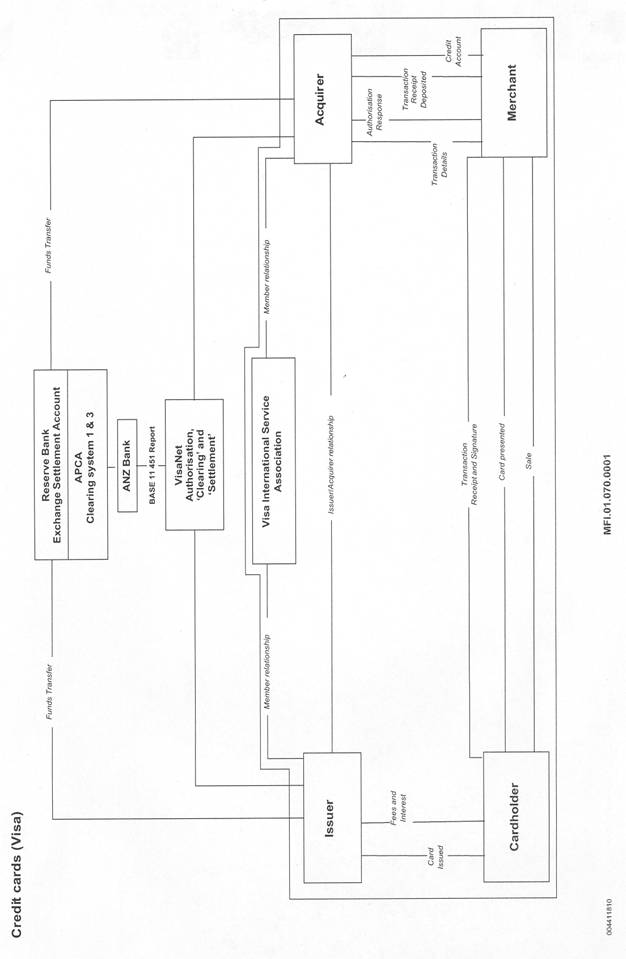
19 SEPTEMBER 2003
| IN THE FEDERAL COURT OF AUSTRALIA |
|
| NEW SOUTH WALES DISTRICT REGISTRY | N 973 OF 2002 N 987 OF 2002
|
|
|
|
| BETWEEN: | VISA INTERNATIONAL SERVICE ASSOCIATION (ARBN 007 507 511) APPLICANT
|
| AND: | RESERVE BANK OF AUSTRALIA RESPONDENT
|
| BETWEEN: |
MASTERCARD INTERNATIONAL INCORPORATED APPLICANT |
| AND: |
RESERVE BANK OF AUSTRALIA RESPONDENT
|
| TAMBERLIN J | |
| DATE OF ORDER: | 19 SEPTEMBER 2003 |
| WHERE MADE: | SYDNEY |
THE COURT ORDERS THAT:
1. An extension of time is granted to each of the applicants to file applications for review under the Administrative Decisions (Judicial Review) Act 1977 (Cth).
2. The applications for review are dismissed.
3. The question of costs is stood over to a date to be fixed with my associate.
Note: Settlement and entry of orders is dealt with in Order 36 of the Federal Court Rules.
| IN THE FEDERAL COURT OF AUSTRALIA |
|
| NEW SOUTH WALES DISTRICT REGISTRY | N 987 OF 2002 |
| BETWEEN: | VISA INTERNATIONAL SERVICE ASSOCIATION (ARBN 007 507 511) APPLICANT
|
| AND | RESPONDENT
|
| BETWEEN: | MASTERCARD INTERNATIONAL INCORPORATED APPLICANT
|
| AND: | RESERVE BANK OF AUSTRALIA RESPONDENT
|
| JUDGE: | |
| DATE: | 19 SEPTEMBER 2003 |
| PLACE: | SYDNEY |
TABLE OF CONTENTS pars
INTRODUCTION..................................................................................................................................................................... 1
DECISIONS CHALLENGED................................................................................................................................................. 2
JUDICIAL REVIEW................................................................................................................................................................ 8
PARTIES................................................................................................................................................................................. 13
1998 LEGISLATION............................................................................................................................................................ 19
APPLICANTS CASE IN OUTLINE.................................................................................................................................... 34
RBA RESPONSE................................................................................................................................................................... 50
THE HEARING....................................................................................................................................................................... 64
TERMINOLOGY.................................................................................................................................................................... 69
IMPORTANCE OF INTERCHANGE FEES....................................................................................................................... 79
VISA CARD SCHEME PROFILE....................................................................................................................................... 91
MASTERCARD SYSTEM - PROFILE............................................................................................................................ 103
RELATIONSHIPS IN CARD SCHEMES........................................................................................................................ 113
BACKGROUND TO 1998 LEGISLATION.................................................................................................................... 121
EVENTS AFTER 1998 LEGISLATION........................................................................................................................... 154
DESIGNATION DECISION – APRIL 2001................................................................................................................... 191
POST DESIGNATION....................................................................................................................................................... 212
DECISION ON STANDARDS AND ACCESS REGIME IN AUGUST 2002............................................................ 226
FIRST QUESTION: IS EACH OF THE VISA AND MASTERCARD SYSTEMS A PAYMENT SYSTEM?....... 245
INTERPRETATION............................................................................................................................................................ 267
MEANS AND INCLUDES.................................................................................................................................................. 284
RELATES TO....................................................................................................................................................................... 296
LEGISLATIVE HISTORY AND EXTRINSIC MATERIALS....................................................................................... 306
CREDIT CARD SYSTEM RULES AND PROCEDURES............................................................................................. 336
PAYMENT SYSTEM – OTHER CONSIDERATIONS................................................................................................. 352
WAS THE DESIGNATION TOO EXTENSIVE – INTERNATIONAL EFFECT....................................................... 373
WHAT IS A STANDARD? DO THE DECISIONS IMPOSE STANDARDS?........................................................ 374
ARE STANDARDS LIMITED TO TECHNICAL AND OPERATIONAL MATTERS............................................. 394
CAN A PROHIBITION BE A STANDARD.................................................................................................................... 412
ARE THE STANDARDS TOO UNCERTAIN?.............................................................................................................. 423
THE CASE LAW ON UNCERTAINTY............................................................................................................................ 426
THE COST ACCOUNTING EVIDENCE......................................................................................................................... 462
INTERCHANGE - UNAUTHORISED DELEGATION................................................................................................... 506
ACCESS REGIME – INTERPRETATION...................................................................................................................... 523
ACCESS – CONSULTATION.......................................................................................................................................... 548
ACCESS – COMMERCIAL BASIS – FAIR AND REASONABLE TERMS............................................................ 555
RELATIONSHIP BETWEEN PAYMENT SERVICE REGULATION ACT AND THE RESERVE BANK ACT.. 560
INTERPRETATION – RB ACT – S 87........................................................................................................................... 586
RELEVANT ADMINISTRATIVE LAW PRINCIPLES................................................................................................. 588
ADMINISTRATIVE DECISION....................................................................................................................................... 589
REVIEW OF OPINIONS.................................................................................................................................................... 597
THE ROLE OF THE RBA.................................................................................................................................................. 605
ALLEGED ERROR IN APPROACH – DETERMINATION OF INTERCHANGE STANDARD........................... 608
HAVE REGARD TO............................................................................................................................................................ 612
DUTY TO INQUIRE AND INVESTIGATE...................................................................................................................... 622
WHAT WAS CONSIDERED IN THE DECISION MAKING PROCESS.................................................................. 630
HASTY DECISION............................................................................................................................................................. 642
EXPERT EVIDENCE........................................................................................................................................................... 649
THE ECONOMIC EVIDENCE........................................................................................................................................... 670
CONCLUSIONS ON EXPERT ECONOMIC EVIDENCE............................................................................................ 739
DESIGNATION – NO PRIOR OPINION – ALLEGATION OF FOUR FLAWED FINDINGS IN JOINT STUDY748
TRANSPARENCY.............................................................................................................................................................. 777
VISA’S FOUR CENTRAL ISSUES.................................................................................................................................. 788
UNREASONABLENESS AND PROPORTIONALITY................................................................................................ 829
STANDARDS AND ACCESS – FIVE ALLEGED PATENT ERRORS...................................................................... 837
CONCLUSIONS ON CLAIMED PATENT ERRORS................................................................................................... 860
CONCLUSIONS.................................................................................................................................................................. 861
REASONS FOR JUDGMENT
INTRODUCTION
1 The Court has before it applications by Visa International Service Association (“Visa”) and MasterCard International Incorporated (“MasterCard”) for judicial review. Both applications are brought against the Reserve Bank of Australia (“RBA”) to set aside five decisions of the Payment Systems Board (“the PSB”) of the RBA made under the Payment Systems (Regulation) Act 1998 (Cth)(“the PSR Act”). The decisions are part of a regulatory regime imposed by the RBA on what are known as four-party credit card schemes in Australia. The schemes, the subject of the regulations, include issuers (which are financial institutions such as banks that issue credit cards and extend credit to their customers), cardholders (who are purchasers of goods and services from merchants and customers of the issuers), merchants (who accept credit cards and claim on issuers for payment and satisfaction for transactions between merchants and customers, for example, stores, utilities and airlines) and acquirers (financial institutions such as banks that “acquire” merchants’ claims against issuers) which agree to pay the merchant under the credit card schemes.
decisions challenged
2 The first two decisions challenged were taken on 11 April 2001 and gazetted on 12 April. They designated each of the Visa and the MasterCard schemes as “a payment system”. The consequence of these designations was to bring each of the schemes within the reach of the RBA’s powers under the PSR Act as a designated system.
3 The second set of decisions challenged were made on 20 August 2002 and gazetted on 27 August 2002. Those decisions were to determine an “Interchange Standard”, which imposed a limit on “interchange fees”, sometimes described as wholesale fees, which are charged by issuers of four-party credit scheme cards to acquirers participating in the schemes and which are required by the Standard not to exceed a cost-based benchmark to be calculated with reference to eligible costs as defined by the Standard and set in accordance with the methodology prescribed in the Standard.
4 The third set of decisions challenged were also made on 20 August and gazetted on 27 August 2002. They established a “Surcharge Standard”, which permits merchants who use the schemes to impose a charge to customers who use a credit card for their transactions, notwithstanding the rules of the Visa and MasterCard schemes.
5 The fourth set of decisions challenged were also made on 20 August 2002, but had not yet been gazetted and were not operative at the time these two proceedings were heard. These involve the imposition on the applicants of an “Access Regime” which provides for access to the schemes to be available to a greater number of potential participants. These decisions were communicated to the applicants on 27 August 2002. The consequence of this Regime is that scheme operators are required to admit any “authorised deposit-taking institution” (“ADI”) as a participant in the schemes on the same basis as other financial participants. It is designed to prohibit differential treatment by participants in the schemes as between those who wish to become participants only as either issuers or acquirers. In practice participants are both issuers and acquirers.
6 The fifth decision challenged was the RBA’s decision not to revoke the designation of the applicants’ schemes. This challenge has not been pressed and is not an issue in this proceeding.
7 In this case it is particularly important from the outset to keep in mind the function of the Court on a judicial review application. This is because much of the subject matter includes controversial economic issues which, as the evidence demonstrates, are the subject of strong and sharp differences of opinion between economic experts. In such circumstances the danger of sliding into a consideration of the relative merits of economic theories is substantial, especially where, as is the case in these proceedings, claims of Wednesbury unreasonableness are raised: see Associated Provincial Picture Houses Ltd v Wednesbury Corporation [1948] 1 KB 223. It is therefore helpful to refer to those principles at this point.
judicial review
8 The nature of judicial review proceedings before the Court has a bearing on the approach and the matters for consideration by the Court and the limited scope of review. On judicial review the Court does not reconsider the merits of the RBA decisions, but is confined to examining decisions sought to be challenged in order to determine whether the decision-maker complied with the required legal process for decision-making. That is to say that it is not for the Court to perform the function assigned to the RBA by the legislation. The Court on review must not substitute its own conclusion for that of the decision-maker simply because it would have been minded to reach a different conclusion in circumstances where it was reasonably open to the decision-maker to reach that conclusion.
9 The function of the Court on an application for judicial review was described by Brennan J in Attorney-General (NSW) v Quin (1990) 170 CLR 1, at 35-36:
“The duty and jurisdiction of the court to review administrative action do not go beyond the declaration and enforcing of the law which determines the limits and governs the exercise of the repository’s power. If, in so doing, the court avoids administrative injustice or error, so be it; but the court has no jurisdiction simply to cure administrative injustice or error. The merits of administrative action, to the extent that they can be distinguished from legality, are for the repository of the relevant power and, subject to political control, for the repository alone.”
10 The focus by the Court is directed to the legality of the decision-making process taken by the RBA and that must be distinguished from a re-examination of the merits of the decisions made. At 37, his Honour sounded the following caution:
“If it be right to say that the court’s jurisdiction in judicial review goes no further than declaring and enforcing the law prescribing the limits and governing the exercise of power, the next question immediately arises: what is the law? And that question, of course, must be answered by the court itself. In giving its answer, the court needs to remember that the judicature is but one of the three co-ordinate branches of government and that the authority of the judicature is not derived from a superior capacity to balance the interests of the community against the interests of an individual. The repository of administrative power must often balance the interests of the public at large and the interests of minority groups or individuals. The courts are not equipped to evaluate the policy considerations which properly bear on such decisions, nor is the adversary system ideally suited to the doing of administrative justice: interests which are not represented as well as interests which are represented must often be considered. Moreover, if the courts were permitted to review the merits of administrative action whenever interested parties were prepared to risk the costs of litigation, the exercise of administrative power might be skewed in favour of the rich, the powerful, or the simply litigious.”
11 To similar effect are the observations of Gleeson CJ, Gummow, Kirby and Hayne JJ in Corporation of the City of Enfield v Development Assessment Commission (2000) 199 CLR 135, esp. at 152-153, which recently followed and applied the above remarks of Brennan J in Quin.
12 It is not a function of the Court on judicial review to form its own independent opinion in relation to issues on which reasonable minds may differ. That consideration is equally applicable when the ground of unreasonableness is relied on in the application for review, where the Court may be required to examine the decision-maker’s state of satisfaction in evaluating the opinions formed. To similar effect is the decision of the High Court in Minister for Immigration & Multicultural Affairs v Jia Legeng (2001) 205 CLR 507, at 532, where Gleeson CJ and Gummow J described the approach as follows:
“The question then on judicial review is whether the decision‑maker could have attained that satisfaction reasonably, in the sense explained in numerous authorities in this Court. In Foley v Padley, Brennan J emphasised that the question on judicial review is not whether the court would have formed the opinion in question, and that an allegation of unreasonableness in the formation of the opinion by the decision‑maker may prove to be no more than an impermissible attack on the merits of the decision.”
By way of illustration, diametrically opposed views have been expressed by economists as to the advantages and disadvantages of the interchange fee in credit card transactions. It is not the function of the Court in these proceedings to decide which of the two views is correct or preferable. That is a question for the RBA under the legislation.
parties
13 Visa is an incorporated association of members which operates throughout the world. Its business includes the administration and development of credit card services to members. The Visa credit card is one of the activities in Australia. Another is the Visa debit card which is also widely used. There are over 140 Australian members of Visa. Throughout the world there are many thousands. Visa members are issuers who issue Visa cards to cardholders and acquirers who acquire Visa credit card transactions form merchants who accept Visa credit cards. The members of Visa in Australia provide card services to cardholders and to merchants. The network of members that provide those services is administered pursuant to a series of by-laws, regulations and rules. These are referred to later in greater detail.
14 MasterCard is a subsidiary of MasterCard Incorporated and the shares in that company are held by the participants who are issuers and inquirers. It operates a number of payment cards. Its business is managed by a global Board of Directors and regional boards, including one in the Asia-Pacific region. The Australian subsidiary is called MasterCard Australia Limited. It provides administrative services to the scheme’s members. The MasterCard credit card system in Australia has thirteen principal Australian members and thirty-three affiliate members. The principal members are financial institutions which participate directly in card activities. Like Visa, they both issue and acquire. Affiliate members participate indirectly through a principal member under that member’s supervision. MasterCard is governed by a series of by-laws, regulations and rules which are discussed below. The four-party credit card scheme operated by MasterCard in Australia involve the cardholder, the merchant, the issuer and the acquirer. Eight of MasterCard’s principal members are acquirers and all principal members and affiliate members are issuers.
15 The RBA is a body corporate established under the Commonwealth Bank Act 1911 (Cth) and continues in existence under the Reserve Bank Act 1959 (Cth) (“RB Act”). It has two Boards, the Reserve Bank Board (“RBB”) and the Payments System Board (“PSB”). The RBB is responsible for the RBA’s monetary and banking policy and the Bank’s policy on all matters except for its payments system policy. The PSB is responsible for the Bank’s payments system Policy. This division of functions came into existence as a consequence of amendments made to the RB Act in 1998. The Bank is managed by a Governor and there is a Deputy-Governor. Membership of the RBB includes the Secretary of the Department of Treasury and six other members appointed by the Treasurer. The PSB consists of the Governor, one representative of the RBA appointed by the Governor, a representative of the Australian Prudential Regulation Authority (“APRA”) and five other members.
16 More specific powers with respect to payment systems are conferred on the RBA pursuant to the PSR Act which was also enacted at the time the amendments were made to the RB Act. The PSR Act is entitled “an Act to provide for the regulation of payment systems and purchased payment facilities and for related purposes”. These more specific powers provided for by the PSR Act, including those the subject of the present challenge, are conferred on the RBA.
17 Under the RB Act, ss 8A(3) and 10B(1), the PSB is assigned the functions of the RBA in respect of the formulation and implementation of RBA policy concerning the payments system. The payments system is the overall Australian system for the effecting of payments and comprises individual payment systems.
18 It is common ground that decisions of the PSB with respect to the payments system and payment systems are made by the RBA.
1998 legislation
19 Under the RB Act, s 10B, entitled “Functions of Payments System Board” describes the functions of, and empowers, the PSB to determine the RBA’s payments system policy and to take whatever action is necessary to ensure that it gives effect to the policy that it determines. Subsection (3) is of central importance to the present dispute. It provides:
“(3) It is the duty of the Payments System Board to ensure, within the limits of its powers, that:
(a) the Bank’s payments system policy is directed to the greatest advantage of the people of Australia; and
(b) the powers of the Bank under the Payment Systems (Regulation) Act 1998 and the Payment Systems and Netting Act 1998 are exercised in a way that, in the Board’s opinion, will best contribute to:
(i) controlling risk in the financial system; and
(ii) promoting the efficiency of the payments system; and
(iii) promoting competition in the market for payment services,
consistent with the overall stability of the financial system; and
(c) the powers and functions of the Bank under Part 7.3 of the Corporations Act 2001 are exercised in a way that, in the Board’s opinion, will best contribute to the overall stability of the financial system.”
20 Section 5 of the RB Act unhelpfully defines payments system policy in these terms:
“payments system policy means policy for the purposes of the Bank’s functions or powers under:
(a) the Payment Systems (Regulation) Act 1998; and
(b) the Payment Systems and Netting Act 1998; and
(c) Part 7.3 of the Corporations Act 2001”
21 The PSR Act does not define payments system policy, but in s 7, “payment system” is defined as:
“… a funds transfer system that facilitates the circulation of money, and includes any instruments and procedures that relate to the system.”
22 This definition gives rise to a central dispute, namely, whether the Visa and MasterCard credit card systems are payment systems which can be designated in their entirety as the RBA has done.
23 The power of the RBA to designate a payment system is conferred by s 11 of the PSR Act in these terms:
“11. Reserve Bank may designate payment systems
(1) The Reserve Bank may designate a payment system if it considers that designating the system is in the public interest. The designation is to be by notice in writing published in the Gazette.
(2) The designation has effect until it is revoked.
(3) The Reserve Bank may revoke the designation if it no longer considers that it is in the public interest that the system be designated. The revocation is to be by notice in writing published in the Gazette.”
24 The content of the expression public interest is set out in s 8 which provides that:
“8. Meaning of public interest
In determining, for the purposes of this Act, if particular action is or would be in, or contrary to, the public interest, the Reserve Bank is to have regard to the desirability of payment systems:
(a) being (in its opinion):
(i) financially safe for use by participants; and
(ii) efficient; and
(iii) competitive; and
(b) not (in its opinion) materially causing or contributing to increased risk to the financial system.
The Reserve Bank may have regard to other matters that it considers are relevant, but is not required to do so.”
25 The expression “participant” is defined to mean:
“(a) a constitutional corporation that is a participant in the system in accordance with the rules governing the operation of the system; or
(b) a constitutional corporation that is an administrator of the system.”
26 The power to impose an access regime is conferred by s 12 of the PSR Act which provides:
“12. Imposition of access regime
(1) The Reserve Bank may impose an access regime on the participants in a designated payment system.
(2) The access regime imposed must be one that the Reserve Bank considers appropriate, having regard to:
(a) whether imposing the access regime would be in the public interest; and
(b) the interests of the current participants in the system;
(c) the interests of people who, in the future, may want access to the system; and
(d) any other matters the Reserve Bank considers relevant.
(3) The Reserve Bank must not impose the access regime unless it has first consulted in accordance with section 28.
....”
27 Under subs (3) the RBA must not impose the access regime unless it is has first consulted in accordance with s 28. By subs (4) the decision must be in writing and must set out the access regime.
28 The word “access” is defined in s 7 in these terms:
“access, in relation to a payment system, means the entitlement or eligibility of a person to become a participant in the system, as a user of the system, on a commercial basis on terms that are fair and reasonable.”
29 The expression “access regime” in relation to a designated payment system is defined to mean an access regime:
“(a) that has been imposed by the Reserve Bank under section 12; and
(b) that is in force.”
30 This definition is circular, but specifies that it must be a regime that has come into force. Otherwise, the expression is quite open and extends beyond the concept of “access” which is specifically defined.
31 The power to determine “standards” for designated systems is conferred by s 18(1) of the PSR Act which provides that:
“(1) The Reserve Bank may, in writing, determine standards to be complied with by participants in a designated payment system if it considers that determining the standards is in the public interest.”
32 The expression “standard” is unhelpfully defined in s 7 to mean a standard in force under s 18.
33 In these reasons, where necessary, reference will be made to other parts of the legislation but the above provisions are those which are most pertinent for the purpose of the applications before the Court.
applicants case in OUTLINE
34 In broad outline the principal contentions of the applicants are as follows.
35 The applicants submit that each of the decisions made by the RBA is administrative in character and is thus susceptible to judicial review. It is further submitted that even if the RBA’s decisions are not administrative they are still open to challenge. The applications are brought for relief pursuant to s 39B(1A) of the Judiciary Act 1903 (Cth) (“Judiciary Act”) and s 5(1) of the Administrative Decisions (Judicial Review) Act 1977 (Cth)(“ADJR Act”).
36 The applicants first contend that the “designations” on 12 April 2001 were outside the RBA’s power to designate conferred by the PSR Act because their credit card schemes or systems and their governing rules and procedures cannot be described as a payment system, ie, a “funds transfer system that facilitates the circulation of money” or procedures that relate to such a system, within s 7 of the PSR Act. The power to designate is in respect of a “payment system” as defined by that section.
37 It is said that because the designation was not in respect of a payment system it was beyond the power to designate conferred by s 11(1) of the PSR Act, and was therefore invalid because the power provided under the PSR Act was only to designate a payment system and this is a jurisdictional fact.
38 The grounds of challenge to the Interchange and Surcharge Standards are as follows. First, it is said, that under s 18 of the PSR Act, the PSB is exercising the functions of the RBA and can only determine standards which are “technical or operational” in nature. This power does not extend to imposing price controls as the Interchange Standard purports to do. Nor does the power extend to the regulation of commercial relationships between scheme members and merchants as the Surcharge Standard purports to do. Second, there is said to be such a lack of clarity and precision as to the terms and operation of the Interchange Standards imposed that they are not within the description of a standard as provided for under the PSR Act. More specifically, it is said that the Interchange Standard, for example, does not provide any clear and certain measure to fix Interchange fees. It is also said that the power to determine a standard has been delegated to an independent expert. The applicants further submitted that the Standard requires the expert to engage in a vague and uncertain process of assessment and discretionary evaluation, to such a degree that different benchmarks can be determined in the same circumstances according to the approach adopted by the expert charged with that function. The process, so it is said, is inherently uncertain due to the lack of guidance on central matters such as “eligible costs” which are described in the Interchange Standards.
39 The applicants further contend that the proposed Access Regime, which had not yet been gazetted, is invalid because the RBA failed to have regard to preconditions to the exercise of the power under s 12 of the PSR Act. It is said that it failed to consider the interest of current participants in the system and failed to address other relevant considerations.
40 The applicants also submit that other conditions precedent to the decision to impose an access regime were not met, including a failure to consult as required, a failure to consider the impact on the applicants of the proposed Access Regime and a failure to provide sufficient information to participants to enable proper submissions to be made for consideration of such impact. There is a further contention that the terms of the Access Regime traverse the limits of a provision for access, entitlement, or eligibility to participate, by seeking to control conduct after admission as a participant by the imposition of conditions governing later conduct.
41 Additionally, there is a submission that certain paragraphs of the terms of the Access Regime prohibit the rules of participants imposing controls on the issuing and acquiring business of scheme participants. It is said that this goes beyond s 12 of the PSR Act. Further, it is said the broad, unqualified terms and blanket nature of the prohibition on differentiation results in the imposition of terms that are not fair and reasonable commercial conditions. It is submitted that the blanket prohibition does not have regard to the possibility that differences in value or number of a participant’s issuing and acquiring transactions have commercial significance, including the burden cast on other participants who have a higher proportion of issuing transactions. The commercial imperative requiring the avoidance of an imbalance is said to justify the scheme rules requiring participants to maintain a balance in meeting the relative costs as between issuing and acquiring businesses and the imposition of fair and reasonable fees from participants who conduct no issuing business. The latter is said to be necessitated in order to compensate for the additional burden cast on participants as a consequence of being an issuer.
42 A further line of attack is based on the manner in which the decision-making process was implemented and a claimed failure to take into account relevant considerations and acting in a manner that was grossly unreasonable and which breached principles of proportionality.
43 Under this line of attack, it is said that the RBA did not properly consult or consider submissions made to it with an open mind and thereby breached s 28(2) of the PSR Act, which requires consultation prior to the implementation of a proposed action, because the PSB had a fixed position by October 2000 and was not prepared to consider moving from this. This conduct on the part of the RBA is said to invalidate the Standards and the proposed Access Regime.
44 The applicants also contended that the RBA did not have regard to “the public interest” and to the economic concepts of “competition” and “efficiency” as it was bound to do under s 10B of the RB Act and s 8 of the PSR Act.
45 It is also submitted that the RBA did not form the required opinions in relation to the public interest criteria in accordance with the requirements of the PSR Act and the RB Act. Because the formation of such opinions were jurisdictional facts on which the exercise of power was conditioned, the decisions as to the Standards and the Access Regime were invalid.
46 It is submitted that the RBA did not have regard to the criteria in s 8 of the PSR Act and s 10B of the RB Act. Nor did it ask itself the essential preliminary questions required by those provisions in order to form such opinions.
47 Criticism is also levelled at the methodology used by the RBA because the approach adopted was such that it did not form the necessary opinion as to whether the exercise of its powers would best contribute to efficiency and operation where there was a duty to ensure that in the RBA’s opinion the exercise would so operate.
48 Further specific criticisms made are that the RBA:
· did not define and analyse the market for payment services, which was essential to a consideration of the concepts of competition and efficiency;
· did not consider the role which the four-party credit scheme played in the financial system, the payments system and the market for payment services;
· did not consider the impact of its determinations;
· did not form an opinion as to efficiency but was concerned with transaction costs;
· did not form an opinion about whether its actions would promote competition in the market for payment services;
· did not adopt a proper methodology to enable it to consider the promotion of efficiency and competition; and
· did not consider the necessity for action nor the net benefit or detriment of the existing regimes compared with the proposed regimes.
49 The applicants also say that the decisions by the RBA are so unreasonable/or lacking in proportionality that no reasonable regulator could have made them. For these reasons, among others, the applicants say that the determinations were invalid.
RBA response
50 The RBA points to the broad, high level statutory functions with which it is entrusted and in particular, the management of national economic and financial policy, and to the composition and functions of the PSB and the RBA. It also points to the accepted principles relating to the limited nature of judicial review of administrative action, the core of which have been referred to above. It refers to the wide discretionary powers conferred on the RBA and to the extensive consultation process which it engaged in throughout the three year period before making its final decisions relating to standards and access. Furthermore, it refers to the principle that administrative decisions such as those made in this case should not be approached with any predisposition to seek out error, where a fair and reasonable examination would not disclose such error. Particular emphasis is placed on the well-settled principles that the role of the Court in a judicial review application is not to encroach upon the merits of the decision, but to decide purely on the basis of limited administrative review grounds. Furthermore, reference is made to the context of the legislative history and provenance of the 1998 legislative amendments pursuant to which the designations were made, access provided for and standards imposed.
51 As to designation, the RBA states that each of the Visa and MasterCard systems are within the description of “payment system” as defined in s 7 of the PSR Act. This is said to provide for a wide discretion. It submits that the definition of “funds transfer system” must be considered having regard to the whole card system in each case as set out in their governing rules and procedures and that there is no basis to segregate out particular parts of either system and contend that only those parts comprise such a system.
52 The RBA submits that the definition of payment system is and was intended to be broad and includes procedures that relate to the system and those that relate to any instruments and the transfer of funds and that this description is wide enough to include the entire Visa and MasterCard systems.
53 As to the power to make standards, the RBA says that the unqualified language of s 18 of the PSR Act does not confine the RBA power to technical or operational matters. The expression “determine standards” in s 18 in a practical sense is at large and is extensive enough to include a reference to a benchmark which provides for a price to be calculated.
54 With respect to the Access Regime it submits that the Regime provides for access on a commercial basis on terms, which are fair and reasonable. The Regime is within the concept of a standard. The RBA can have regard to the interests of applicants for future access.
55 With respect to the Surcharge Standard, the RBA submits that a “prohibition” can be a “standard” in the ordinary sense of that term and the fixing by an independent expert of an interchange fee ceiling is not an unauthorised delegation of power to the expert because the Standard is made by the RBA and it fixes the criteria and methodology in advance to determine the benchmark with which the participant must comply. The function of the expert is not to determine the Standard, because that is done by the RBA, but rather to apply those fixed specific criteria in order to set the benchmark in a particular case.
56 The criteria set out in the Standards are not uncertain having regard to the authorities. The meaning of the criteria is reasonably precise within current accepted accounting practice and the criteria satisfy that requirement so that the provisions are not invalid for uncertainty. In the present case, the requirement is not to fix a price but to determine a standard. Even if there is any uncertainty in the determination of “eligible costs” in the process, the only uncertainty is in the application of the Standard in a particular context and does not arise as a consequence of uncertainty in the Standard
57 The RBA submits that the power in s 18 has been exercised by the RBA so as to ensure that participants know with certainty the cost-based benchmark they must meet prior to being required to comply with the Standard. The benchmark, it is submitted, must be arrived at prior to any obligation being imposed to calculate the interchange fee.
58 Criteria for calculating the cost-based benchmark do not have to be totally non-subjective. The test to be applied is whether criteria in the Standards are sufficiently certain. It is not necessary that there should be unequivocal precision. The requirement is one of sufficiency namely, that there be sufficient clarity and reasonable precision and this will vary according to legislation and context. It is necessary to adopt a fair and reasonable approach to the construction of the Standard. The wartime decisions relied on by the applicants are based on the fixing of a price which is different from determining a standard. Even in such cases, it is accepted that terms such as substantially or principally can be used without making the process “uncertain” to such a degree that the determination is invalid.
59 In relation to the Access Regime, the RBA says it appreciated its obligations and points to material which was before it, which in its submission, takes account of the interests of current participants. Specifically, it refers to the chapter on Impact Analysis in the Final Reforms and Regulation Impact Statement (“RIS”). It points out that there was ample opportunity on interested parties to make submissions to the RBA. The RBA received more than ninety-five written submissions from October 2000 to August 2002 and held fifty-two meetings, fifteen of which were with the designated card schemes. There is no reason to doubt its statement that it considered the matters raised in these meetings and submissions. In response to the claim that the RBA did not comply with s 28 of the PSR Act because the relevant APRA prudential standards had not been finalised, the RBA says that it complied with s 28(2) by its notice in the Gazette of 14 December 2001. Draft APRA standards had been formulated and had been the subject of consultation. There was no obligation on it to summarise the content of those prudential standards or to have them in final form.
60 The RBA contends that the definition of “access” in s 7 of the PSR Act does not limit the definition of “access regime” in s 12 of that Act. Even if there were such a limitation, there is no basis to import a restriction that an access regime may not deal with matters other than entitlement or eligibility to participate in a scheme. On a proper construction of pars 10-12 of the Access Regime, they are concerned with access because they permit specialist acquirers to participate, they remove burdens on specialist acquirers and they allow merchants to participate as acquirers of their own transactions. The rules of the systems can be regulated to ensure that there is no discrimination after admission in order to prevent evasion of the access rules. The RBA says that the proposed Access Regime provides for access on terms that are fair and reasonable.
61 In relation to the applicants’ attack on its decision-making process, the RBA points to material before it which it says demonstrates that it complied with its obligations under s 10B(3), to have regard to “efficiency” and “competition” and where it considered three available options. The RBA referred specifically to its “mandate” under s 10B throughout various material exhibiting its decision-making process including the Consultation Document, published on 14 December 2001 (“Consultation Document”).
62 As to the RBA’s consideration of the provisions PSR Act, s 8, and the RB Act, s 10B, it is submitted that there is nothing in the legislation which requires the RBA to adopt any particular methodology as to the way in which to form its opinions. The legislation makes it clear in terms that this was solely for the RBA and also that the RBA has complete discretion as to the most appropriate methodology. The RBA says that the approach taken was within a range of reasonably appropriate and available methodologies. The allegations based on manifest unreasonableness and lack of proportionality, it says, are answered by the above submissions.
63 As to the alleged failure to revoke the designations there was no basis shown to warrant revocation on either of the designations. The revocation raises questions of public interest and these are matters for the RBA. It also contemplates that the RBA is to form its own opinion whether the designation is no longer in the public interest.
the hearing
64 The applications brought by Visa and MasterCard were heard together over a period of six weeks. There were three parties represented by thirteen counsel. The proceedings involved discovery and inspection of thousands of documents. Some of these documents exceeded hundreds of pages. There were approximately 1700 pages of transcript and over 1000 pages of written submissions and responses.
65 Much of the evidence focused on the decision-making process undertaken by the RBA over the period August 1998 to August 2002 when the decisions to designate were made and the Standards and Access Regime were determined. Documents in evidence were not limited to those directly relating to the parties to the litigation, but also included correspondence and material concerning submissions and information provided to the RBA by numerous institutions which were not party to the actions brought by Visa and MasterCard. A strict confidentiality regime was implemented by the Court based on agreement reached between the parties to the proceedings, following various consultations with the authors of third party material sought to be tendered.
66 The Court had before it affidavits sworn by bank officers and employees of the applicants. The RBA elected not to call any lay witnesses but tendered three expert reports. Two of the reports, by Professors Katz and Farrell, both eminent experts in their field of economics, provided evidence in relation to the economic theory and application underlying credit card networks. The RBA’s third expert was Associate Professor Briers, who was called to provide the Court with his expert opinion on accounting issues relating to the method of calculation of the interchange fee.
67 Expert reports pertaining to the economic principles underpinning the operation of credit card schemes were also tendered by the applicants. MasterCard called two expert witnesses, Professor von Weizsacker and Dr Veljanovski. Visa called one economic expert, Dr Pleatsikas, an economist with some experience in the field of network and regulatory economics. Two accounting experts were called by the applicants to give evidence in relation to the accounting issues, namely Mr Teer who was retained by MasterCard and Mr Bryant, who was called by Visa.
68 Having regard to the vast amount of material and the complexity of the matter the Court indicated to the parties, and they accepted, that the nature of the proceedings was such that the rule of practice in Browne v Dunn (1893) 6 R 67 would not be applied to require an express challenge to every statement made, provided that there was no unfairness in failing to do so. That approach was followed especially in relation to the expert evidence where a vast array of literature rendered it impracticable for counsel to put to the expert witness every issue that emerged from the literature. Counsel proceeded on that basis in advancing their final submissions to the Court and no Browne v Dunn point was taken.
terminology
69 To appreciate the issues raised on these applications it is necessary to understand the instruments and procedures by which the four-party credit card schemes operate in practice and also the relevant terminology in the context of the provision of payment services.
70 A credit card provides a payment service and a credit facility. The latter will usually provide for an interest-free period before the account needs to be settled by the cardholder and a pre-approved line of credit, often termed a ‘revolving’ line of credit, on which a rate of interest is payable by users. The cardholder pays their credit card account some time after the transaction, according to an established billing cycle. Approximately twenty-five per cent of those who use credit cards pay within the allocated interest-free period and do not incur interest payments. They are known as “transactors”. They derive maximum benefits from the schemes. The remaining portion of credit card users take advantage of the credit facility and as a consequence they incur relatively high interest rates. They are referred to as “revolvers” as users of the revolving line of credit.
71 Visa and MasterCard provide services in what is typically described as a “four-party card scheme” or an “open loop credit card network”because there are four main parties who are involved in the operation of the scheme: the cardholder, their financial institution (the issuer) which issues the card, the recipient of the funds (the merchant) and its financial institution (the acquirer). The cardholder uses the credit card issued by their financial institution to acquire goods and services. They agree to pay fees to the issuer of the credit card together with any interest when they take advantage of the revolving line of credit. In using their credit card, cardholders present their cards to merchants, to whom payment is ultimately made. The merchant’s financial institution, the acquirer, is reimbursed by the issuer for the value of goods or services and the acquirer in turn agrees to pay the issuer an interchange fee. The acquirer will pay to the merchant the full value of an authorised credit card transaction, less any relevant fee charged by the acquirer to the merchant. This amount, payable by the merchant, is known as the merchant service fee. It includes the interchange fee. The expression merchant services includes the acceptance of credit card transactions, collection of the value of transactions from the issuer and reimbursement of the merchant, the provision of electronic terminals, card imprinters, sales vouchers, signage and promotional material and the provision of a call processing centre for authorisation of transactions.
72 Four-party schemes are operated by system administrators. In the present case, Visa and MasterCard administer the credit card network and provide issuers and acquirers, who are members of the scheme, with network administration services, including, for example, the right to use intellectual property. In administering the credit card network, Visa and MasterCard also provide their members with authorisation and settlement services and facilitate the interchange transactions between those members. The payment process involves a flow of information and payment instructions between parties to ensure that payment is made by the cardholder to the merchant. In the case of the Visa scheme, payment processing is completed by using a system known as VisaNet. The MasterCard network uses a similar system knows as BankNet. In some instances in a four-party credit card transaction the issuer and the acquirer are the same entity. These are known as “on us” transactions and there is no interchange fee payable.
73 By contrast, closed loop card networks, which are also known as three-party card schemes, such as those provided by American Express and Diners Club, consist of a network under which a single entity performs all issuing and acquiring functions, in addition to administering the card network. These schemes involve three parties, namely cardholder, merchant and the scheme administrator, which issue cards to cardholders. Cardholders use the card to purchase goods and services, and will usually agree to pay their account in full by the end of the billing cycle if they are issued with a charge card, or interest and fees if they hold a credit card issued by three-party card schemes operators. A charge card does not usually provide for the extension of credit facilities. In a typical three-party card transaction, the merchant receives payment following authorisation of a transaction, with the acquiring function being completed by the same entity which issued the card, namely the scheme administrator, such as American Express or Diners Club. The merchant is bound to pay a service fee in return for the acquiring services provided. However, no interchange fee is paid as part of a three-party card network.
74 In addition to three and four-party schemes, several other card networks exist in Australia, including store cards which are issued by or on behalf of retailers for use by customers within their own store. Store cards, like credit cards, offer an interest-free period and a revolving line of credit. Examples of these include cards issued by large retailers such as Coles Myer and David Jones. The store card issuer issues the card to its customer who is able to use the card to make purchases of goods or services offered by the issuer. The cardholder receives a monthly account from, for example, the retailer, which must be paid in accordance with the billing cycle or incur fees and interest charges. Finance for store cards will either be provided by a third party or, in some instances, a company related to the store card issuer. Thus, GE Capital Finance Australia provides financial services to users of the Coles Myer store card while David Jones Financial Services Limited is the credit provider for store cards issued by David Jones.
75 Other types of payment cards do not extend credit facilities. A debit cardholder for example, has the amounts purchased using the card deducted from his or her designated deposit account by the card issuer on a transaction basis. Unlike credit cards, debit cards usually provide no credit facility to cardholders. Funds to cover debit card transactions are deducted directly from cardholder accounts with little, or no, delay. Debit card transactions that are processed via the Electronic Funds Transfer/Point of Sale (“EFTPOS”) network require the cardholder to verify the transaction by using a keypad to enter a PIN (personal identification number) and result in an interchange fee paid by the card issuer to the merchant’s acquiring institution. These costs are often (at least in part) recovered through transaction fees levied on cardholders.
76 Debit cards are usually combined with Automatic Teller Machine (“ATM”) functions in a single card, so that cardholders can be provided with access to cash and the ability to perform certain banking functions (such as balance inquiries and balance transfers between/among accounts) electronically through ATMs. Under current arrangements, holders of debit cards will typically face a transaction fee for using a debit card (usually after a number of fee-free transactions). As at June 2002, there were more than 16,000 ATMs in Australia as compared with fewer than 9,000 in 1997.
77 A smart card is a plastic payment card fitted with a microchip, as opposed to a magnetic strip, thus allowing for greater security by reducing the prospect of fraudulent use of the card. A smart card can be programmed so that stored monetary value in the form of digital information can be loaded onto the card. Conversely, the ‘electronic value’ can be deducted or transferred onto other cards using the appropriate hardware. The cardholder is then able to use the card to for the purchase of goods or services by the electronic transfer of the digital information from the microchip on the card to a merchant’s microchip. An example of a smart card is a prepaid telephone card.
78 One feature of four-party credit schemes in Australia is the interchange fee payable as part of payment processing by the acquirer to the issuer. In credit card payment networks, interchange fees are set collectively by members and are paid by the acquirer to the cardholder’s financial institution (the issuer). These fees are said to be justified on the basis that they allow the acquirer to recoup costs of the card infrastructure and processing. The interchange fee is passed by the acquirer to the merchant who can then bear it or pass it onto all customers, both cardholders and non-cardholders, by way of a general price increase.
IMPORTANCE OF INTERCHANGE FEES
79 There are currently in excess of ten million credit and charge cards on issue in Australia. According to the RBA, consumers use credit cards to finance thirty-six per cent of their spending. The debt on card transactions exceeded $24 billion as at June 2003. On a global comparison Australia ranks third after the United States and New Zealand in credit card usage. Credit card transactions have increased more than twenty-four per cent per annum over the past five years. In 2001, there were on average forty-three card transactions for every person in Australia.
80 Interchange fees generate substantial income for issuers and acquirers as a consequence of the use of credit cards. The Consultation Document states that:
“…. interchange fees currently generate revenues of around $775 million a year to issuing banks). Revenue from this source accounted for about one-third of total issuing revenues …. The other two-thirds of total issuing revenues is generated by cardholders who make use of the revolving line of credit (‘revolvers’), that is, who do not pay off their accounts by the end of the interest-free period. Preliminary data from the Reserve Bank’s new payments system collection indicate that about three-quarters of credit card outstandings are interest-bearing. Credit cardholders who use the credit card purely as a payment instrument (‘transactors’), that is, who pay off their balance by the end of the interest-free period, make only a very small contribution to total issuing revenues, mainly through annual fees.
The Joint Study found that interchange fees in Australia are not reviewed regularly by credit card scheme members on the basis of any formal methodologies. It also found that the fees are higher than the costs incurred by issuers in providing credit card payment services to merchants and that – because of barriers to entry to the schemes - competition does not seem to be bringing these fees into line with costs. The Joint Study concluded that credit card interchange fee arrangements in Australia are contributing to a structure of incentives that has encouraged the growth of the credit card network at the expense of more economical payment instruments.” (Emphasis added)
81 The RBA estimate is that its proposed reforms to credit card schemes will reduce credit card interchange fee amounts by approximately $350 million annually.
82 Interchange fees have been an integral part of the pricing structure in card schemes. They have a strong influence on (i) the revenue flows associated with card transactions, (ii) the costs ultimately borne by merchants and cardholders, (iii) the incentives to use and accept debit and credit cards and (iv) the terms on which financial institutions and other providers of payment services can gain access to some card networks.
83 Visa by far has the greatest share of the credit card market, which is then followed by MasterCard and Bankcard. The shares of the market by Diners Club and American Express schemes are substantially less than those of Visa and MasterCard.
84 The costs incurred by the issuer are said to be in the order of five times the costs that are incurred by the acquiring bank, in a credit card transaction. If all of the costs incurred by the issuing bank are met by the issuing bank’s customers, then the system may not function properly. This is therefore seen to be a justification for an interchange fee from the acquirer to the issuer in order to provide a balancing mechanism for the efficient operation of a credit card scheme.
85 In a typical credit card transaction, the payment of an interchange fee is acknowledged by the RBA to perform a useful function in meeting the discrepancy in costs as between issuer and acquirer. The problem, in the view of the RBA, resides in the lack of transparency arising from the absence of any specific transparent methodology, data input, or monitoring on a systematic basis, and the fact that the level of interchange fees are determined between close competitors in a tightly controlled market.
86 The remedial measures implemented by the RBA after designation of the card schemes, namely the Access Regime and the two Standards are closely inter-related and must be considered as part of a single regulatory scheme largely centred around monitoring and setting interchange fees. At the heart of the regulatory focus in the present reforms is the setting of the interchange fee by reference to specified costs, data and a methodology using review by an independent expert to arrive at a suitable benchmark, with the objective of introducing transparency to the process. This is said to enable interested parties to make more informed economic choices with respect to selection of payment mechanisms, including the use of credit cards.
87 In Australia interchange fees do not apply when customers make payments by cheque, direct credit or direct debit. In those cases, financial institutions seek to recover their costs directly from their customers. One rationale for interchange fees is that they encourage the growth of payment networks by redistributing revenues between participants to induce them to join. In this way the benefits of the payment network may be maximised. Despite the fact that the networks have reached a high level of maturity, pricing is still based on interchange fees set by financial institutions removed from the cardholders and merchants that ultimately bear these fees. The end users of card services do not have any direct influence on the price setting process. This is perceived by the RBA and its advisers to be a distortion of normal market discipline which has implications for efficiency and equity, both of which need to be weighed against potential network benefits.
88 In Australia over ninety per cent of debit and credit card transactions are processed by a relatively small group of financial institutions. The four major banks account for the processing of over ninety-three per cent of credit card transactions.
89 Total fees payable per annum by merchants to acquirers is in the order of $1.5 billion. The RBA estimates that transactors alone receive a benefit in the order of $90 million per annum, being the amount by which revenues received from transactors fall short of the costs of providing the interest-free period together with loyalty points. However, this estimation of $90 million only relates to transactor benefits and does not take account of the substantial benefits to revolvers which have not been quantified in the material. It appears that these total benefits to cardholders must fall somewhere within the range of between $90 million each year and the $1.5 billion in merchant fees, so that benefits are substantially in excess of the $90 million. Although in relative terms to the total revenue generated by credit card transactions these figures may not be a high proportion, nevertheless they are significant amounts in their own right. It is common ground that approximately only twenty-five percent of the credit card users are transactors and that the seventy-five percent majority of persons using four-party credit card schemes are revolvers who pay the relatively high interests rates attracted to these transactions.
90 The interchange fee is at present collectively set by the members of the schemes. Neither the applicants nor their members have provided any significant detail disclosing current procedures and data input explaining the way in which interchange fees in Australia are set. MasterCard asserts that competition among different payment mechanisms ensures that there cannot be a problem with the setting of interchange fees. Visa states that the setting of interchange fees is a complex matter that requires commercial judgment. It is said that this judgment is shaped by the realities of market place competition, which is then tested in the negotiating process over interchange between members and that this process elicits information about the likely outcomes with alternative fee levels.
visa card scheme PROFILE
91 Visa’s international operation includes a world-wide electronic financial processing authorisation clearing and settlement system or service known as VisaNet. This is comprised of a comprehensive network of computers and telecommunication systems that link Visa processing centres to issuers, acquirers and third party processors. VisaNet enables members of Visa to exchange information, both financial and non-financial, reliably, quickly and efficiently.
92 VisaNet provides services to participants which include the following:
(a) an authorisation service, which permits the issuer of a card to approve or decline a transaction before a transaction is completed (that is, before a sale is completed or cash disbursed). Visa also provides various kinds of authorisation services whereby it makes authorisation decisions on behalf of issuers – these are known as “stand in processing services”;
(b) a clearing service which involves the collection of financial information about a transaction form an acquirer and the delivery of that data to the relevant issuer. The issuer is able to use the information to post the transaction to the cardholder’s account; and
(c) a settlement service which involves the calculation of the net financial position of each member for all transactions that are cleared within a particular time period.
93 VisaNet systems provide services of online and offline transaction processing. One of these systems is know as the BASE I System which supports online authorisation processing for relevant transactions. There is also a BASE II System which clears and settles previously authorised transactions, that is to say, authorisation and subsequent clearing and settlement. BASE II processing occurs by way of “batches”, that is, it is not undertaken online, but data is compiled during a collection period and processed at specific settlement times. This system also calculates fees, charges and settlement totals and produces reports to help with reconciliation.
94 Set out below is a diagrammatic illustration of the Visa credit card procedures.
95 The process, in simplified terms, by which transactions are processed through VisaNet in relation to authorisation is generally as follows:
(a) The cardholder wishing to make a purchase or obtain a service presents the Visa credit or debit card to the merchant.
(b) The merchant swipes the card through a point-of-sale terminal and an authorisation request is sent from the terminal to the acquirer via the electronic link between the merchant and its acquirer.
(c) The acquirer’s processing system reads the Bank Identification Number (“BIN”) of the message sent from the merchant terminal. The BIN is the first six digits of the card number and is unique to the cardholder’s issuing bank. That number also indicates whether the transaction is a Visa card transaction or some other card brand. The acquirer’s processing system separates Visa card transactions from other transactions.
(d) The acquirer’s processing system identifies whether or not the acquirer is also the issuer of the card by comparing the BIN on the card to the acquirer’s BIN. If it is, (this transaction is called an “on-us” transaction) the acquirer’s own processing system determines whether the transaction should be authorised. An authorisation request does not go to the VisaNet service.
(e) If the transaction is not “on-us”, the acquirer’s processing system formulates an authorisation request.
(f) The authorisation request is transmitted to the issuer of the card. The issuer’s processing centre determines by reference to conditions set between the issuer and the cardholder whether authorisation for the transaction should be granted.
(g) A response to the authorisation request is formulated by the issuer’s processing centre and that is communicated via the issuer’s system and routed back to the acquirer.
(h) The acquirer forwards the response to the authorisation request to the merchant who is then able to proceed with or decline the transaction.
(i) The authorisation process occurs almost instantaneously over telecommunication lines. The process is “online”. The process described generally takes about six seconds.
(j) VisaNet sometimes provides “stand in” processing services to a participant on request, whereby VisaNet makes authorisation decisions of behalf of an issuer. This is based on parameters previously supplied to Visa by the relevant issuer.
96 The clearingprocess generally occurs as follows:
(a) At a time that is fixed between the merchant and the acquirer, the merchant delivers all of its Visa card transactions for a particular period to the acquirer. This usually occurs automatically at the end of each business day as part of the closing out procedure for the merchant’s terminal. Visa card transactions are generally delivered along with all transactions using any type of card.
(b) The acquirer pays to the merchant the amount reflected by the Visa transactions in accordance with the agreement between the merchant and the acquirer. Payment is usually made within twenty-four hours within Australia. The merchant service agreement usually provides for payment of a fee known as a “merchant service fee” which is deducted from the amount otherwise payable from the acquirer to the merchant on account of the Visa card transactions.
(c) The acquirer’s processing centre collects all of the information concerning Visa card transactions that have been acquired from each of the acquirer’s merchants (except for “on-us” transactions). That information is used by the acquirer to compile an interchange transaction file.
(d) At a pre-determined time, VisaNet sends a message to each acquirer’s interchange transaction file.
(e) VisaNet collects and sorts the information that is transmitted to VisaNet by all acquirers in Visa from around the world. An interchange file is compiled for each issuing BIN, which lists the transactions for that issuer’s cardholders.
(f) VisaNet delivers the second interchange transaction file to each issuer so that the issuer can post the transaction to the cardholder’s account.
(g) As part of the clearing process, VisaNet calculates the fees that are payable as between issuers and acquirers and fees that are payable to Visa for any processing services used by the members.
97 The process of settlement within Australia generally occurs as follows:
(a) VisaNet calculates the net position of each member of Visa in relation to cleared transactions. Some members will owe money and others will be owed money, depending on the amount the member has acquired from merchants compared with the amount debited to the account of the member’s cardholders. That is, members are owed money in respect of transactions that have been acquired but owe money where one of the member’s cardholders has used a Visa card to obtain goods or services.
(b) This information is consolidated and sent to members.
(c) A report is sent by the VisaNet system known as the VSS 451 Report daily to the ANZ Bank which has been appointed by Australian members of Visa to act as the “local settlement bank”. This report summarises the net settlement amounts due from and to all Australian members arising from Australian transactions. It corresponds to the information contained in the Australian members domestic settlement position reports.
98 The final steps in the procedure are as follows:
(a) ANZ has authority from members to debit and credit funds from and to the respective Australian members Exchange Settlement Accounts (“ESAs”) that are held with the RBA.
(b) ANZ undertakes a number of steps to process the debits and credits from and to the ESAs in accordance with the VSS 451 Report.
(c) Settlement then occurs on the same day that the VSS 451 Report is sent to ANZ or if the RBA is closed, on the next day that it is open.
99 It is helpful to elaborate on the final steps.
100 As a general description of the procedure at the ANZ, there is a record made daily in the books of ANZ, which is designed to enable the resolution of a multiplicity of debts arising from individual Visa credit card transactions involving members as issuers and acquirers, into a simple net movement of funds between each member and ANZ. This is expressed in ANZ records as a credit or debit between ANZ and each member. The process of calculating a net daily position between each Australian member and ANZ is effected pursuant to the rules of Visa. The calculation is made by the VisaNet system. The Visa rules contemplate that the credits or debits are aggregated with all other inter-bank indebtedness for the day, arising from a range of transactions. These include indebtedness and credits arising from transactions that include the use of cheques, direct debits and credits, ATMs, EFTPOS and credit cards. This aggregation finally results in a single overall debit or credit in each bank’s ESA at the RBA which leaves each member having a zero balance with ANZ each day with respect to domestic Visa credit card transactions.
101 The steps which occur at the settlement bank level are as follows. After the daily VSS 451 Report from VisaNet is received by ANZ, which shows the daily net position for each of the Australian member’s domestic transactions, the figures are transposed onto an ANZ sheet. For those members of Visa who are members of what is known as the CS3 clearing stream, the net daily position is shown as a debit or credit between each member and the ANZ. ANZ then confirms to each member that the account will be debited or credited by a specific amount. When ANZ submits its figures to the RBA by way of an exchange summary, the credit to the member from Visa domestic transactions is aggregated with other credit cards, ATM and EFTPOS for the purpose of CS3. These figures are then aggregated with figures for cheques and direct debits and credits and an overall figure is posted to the ESAs. All movements of funds for Visa domestic transactions and all other transactions are aggregated into an overall movement of funds in the ESAs at the RBA.
102 ANZ is also a member of Visa and a user of the VisaNet system and it follows a similar procedure in relation to its own position as issuer and acquirer. Several other institutions, namely, Adelaide Bank and HSBC, settle their daily position by crediting or debiting their settlement accounts at the ANZ. There are two other variations in the case of SunCorp-Metway and CUSCAL, but they are not material for present purposes.
mastercard system - profile
103 MasterCard originated from the activities of a series of banks in the United States during the 1950s and 1960s. They were issuing their own credit and charge cards, but eventually consolidated their activities to form an inter-bank card association which eventually became MasterCard. The shares in MasterCard’s holding company are held by the members who are the participants, issuers and acquirers.
104 Under the by-laws of MasterCard, in order to be eligible for membership as a principal member, it is necessary to have authorisation to engage in financial transactions under the laws of the relevant jurisdiction and be regulated by a governmental authority or agency with respect to their financial position. In Australia that would be by APRA. MasterCard by-laws allow the Board of Directors to dispense with regulatory supervision so that there is some degree of flexibility, but the general position is that in order to be a member it is necessary to be subject to prudential supervision. The rules of MasterCard require any application for membership to be accompanied by evidence of financial responsibility. This is because MasterCard itself is liable for the financial obligations of any defaulting member. Each MasterCard member has a liability to indemnify MasterCard for any loss that may arise as a result of default.
105 In Australia MasterCard also operate a four-party credit card scheme which is split into a number of distinct programmes. For the most part, those schemes offer a revolving line of credit although some programmes offer a non-revolving line of credit, which means that the outstanding balance has to be paid in full monthly. A useful diagram to illustrate the MasterCard process in a typical transaction is set out below.
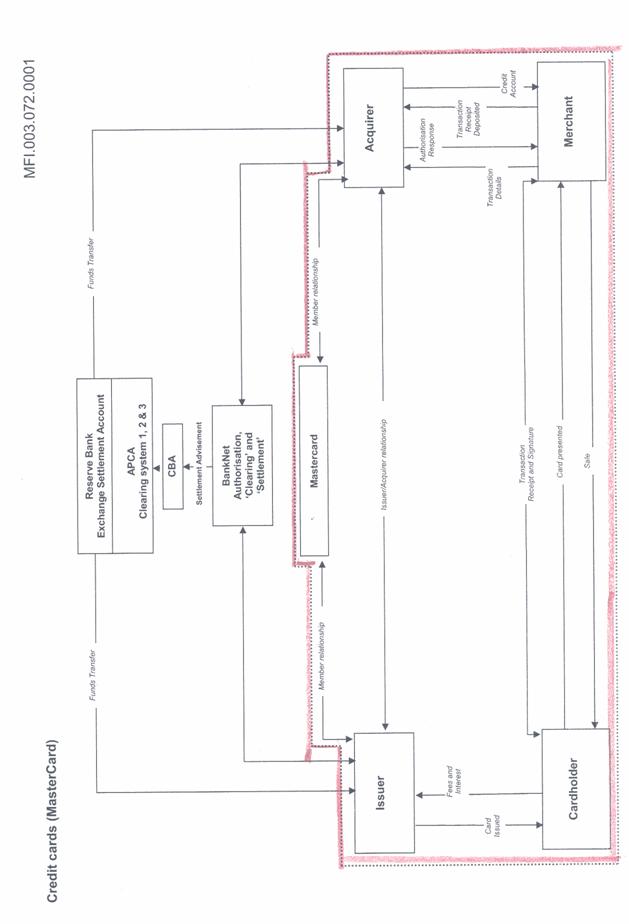
106 The relevant steps in a typical MasterCard credit card transaction are as follows.
107 First, as with Visa, the cardholder presents the card to a merchant at the time when the purchase is made. This is the authorisation stage. The merchant, or more accurately, the acquirer on behalf of its merchant, then seeks authority through a system operated in Australia called the Australian Processing Centre (“APC”). There are protocols in force for the processing of authorisation.
108 The next stage is the stage of clearing transactions where financial transaction details are exchanged between the acquirer and the issuer in order to facilitate posting to the cardholder’s account and reconciliation of the member’s settlement position. This involves the transmission of data through a MasterCard system in the United States using a telecommunications system developed by MasterCard called the Global Clearing Management System (“GCMS”). This facilitates for the transmission of data from the acquirer through MasterCard to the issuer. The issuing institution then posts the relevant transactions to the cardholder’s account. There is a record of the transaction having been made as a consequence of the acquirer transmitting the information to the issuer and the issuer recording the information on the cardholder’s account. MasterCard operates a network which corresponds to VisaNet, which is known as BankNet.
109 The next step is settlement, which is the process by which funds are exchanged or transferred. This transfer represents the net equivalent of monetary value resulting from clearing and billing of transactions, as between issuers and acquirers. This comprises the transfer of the net amount owing between issuer and acquirer since in many instances, on the same day, there will be transactions in which particular members of MasterCard are both issuers and acquirers. There will therefore be debits and credits which are netted off and the net amounts are transferred across the exchange settlement accounts of the RBA.
110 The above diagram is used by MasterCard to illustrate why it says it is not a payment system within s 7 of the PSR Act. It submits that the payment system in the sense of a “funds transfer system which facilitates the circulation of money” only begins at the RBA and BankNet level and that the area below that as outlined from and including the box entitled “MasterCard” is not a payment system. It says that because the RBA designation included the area which is not engaged in clearing, settlement and transfer of money, such that it was an invalid designation because it is not possible to sever that part of the MasterCard system which constitutes a payment system from the part above the boundary shown in the MasterCard diagram at [105] above, which might be described as a funds transfer system. Put another way the designation of the whole system was too wide and severance is not legally possible. MasterCard does not contend that the payment system only extended to the transfers which took place at the RBA level across the ESAs.
111 The MasterCard clearing facility in the United States captures information from each transaction and several times a day, the information relating to each of those transactions is consolidated and clearing files are sent to issuers and acquirers in Australia in the form of consolidated information. At the close of each day, another system operated by MasterCard, called the Settlement Account Management (“SAM”) system (which produces similar reports to the VSS Report in the Visa system), consolidates the daily information and transmits that information in the form of a settlement advisement to each relevant issuer and to each acquirer and to the Commonwealth Bank of Australia (“CBA”), which is the selected settlement bank for MasterCard in Australia. The detailed information is incorporated into a single file called a Settlement Bank Advisement.
112 The CBA, as the MasterCard settlement bank, then communicates with each issuer and acquirer to confirm that the data that it is processing is accepted by issuers and acquirers. The CBA, having confirmed or resolved the position with the issuer and the acquirer, prepares a schedule which sets out the net position of each issuer and acquirer for that day in respect of MasterCard credit transactions. This represents a netting of the various movements, credits and debits, as between issuers and acquirers. This information is communicated to the RBA where there is then a settlement as between issuers and acquirers. Those figures are aggregated with any other amounts that need to be credited or debited to take account of other financial transactions. The settlement of the MasterCard credit card debits or credits as between issuers and acquirers is part of an overall aggregated settlement which may include cheques and credit card transactions. The RBA effects the daily settlement by the movement of funds between accounts maintained with the RBA by members and the transfer reflects the information provided to the RBA by the CBA which is received from MasterCard.
relationships in card schemes
113 The illustrations of the scheme processes disclose a number of relationships giving rise to contractual rights and obligations with respect to a variety of services and functions. Visa contends that none of these relationships below the level of VisaNet were intended by the legislation to be the subject of regulatory control and could not be designated as a funds transfer system because they do not form part of a system for the transfer of funds which facilitates the circulation of money nor do they involve procedures which relate to such a funds transfer system.
114 The first relationship is that between the applicant credit card organisation and its members. That is embodied in the membership and trademark licence agreement. It grants a member a licence to use Visa’s marks in connection with the programmes offered. This relationship includes a guarantee of payment by the card organisation and its members in the event of default.
115 The second is the relationship between the bank that issues the card and its cardholders. This is an aspect of banker-customer relationship which is said to be governed by various terms and conditions.
116 The third relationship is between the bank that acquires a transaction effected through the use of a credit card and that bank’s customer. This can also be characterised as a banker-customer relationship governed by detailed stipulations concerning procedures, times for payment, currency, charge backs and other terms and conditions.
117 The fourth relationship is between the cardholder and the merchant and that is the agreement relating to the acquisition of goods and services. It may contain implied terms, warranties and statutory protections.
118 The fifth relationship is between the issuing bank and the acquiring bank concerning payment for purchases, said to be governed by the Visa rules.
119 Visa submits that none of those steps in the Visa system which take place before the stage of clearing, settlement and transfer, which have been designated by the RBA, constitutes a funds transfer system. It is said that the clearing process supplied by VisaNet, together with the Australian Paper Clearing System, which is used by VisaNet and the exchange of debits and credits across the RBA’s exchange settlement accounts constitute the funds transfer system.
120 The significance attached to the different relationships which exist between participants is in support of a submission that the power of designation power in s 11 of the PSR Act was not intended to reach to all these relationships. Therefore, the expression “payment system” should not be read in such a way as would control these relationships. The applicants say this would be a consequence of the designations of the whole of the schemes which the RBA has purported to make. In particular, having regard to extrinsic material, it is said that such an extensive reach would “intrude into these relationships” contrary to Parliament’s intention as borne out in the extrinsic material. These include, for example, relationships between customer and issuer and merchant and acquirer. It is said that the Access Regime and the two Standards intrude into these relationships.
BACKGROUND to 1998 legislation
121 In order to appreciate the context of the dispute, it is helpful to consider some key events which provide a background against which the issues can be considered and the way in which the determinations under challenge were arrived at. They were not decisions made swiftly but rather at the end of a long and detailed process. In order to determine whether the RBA fell into a reviewable error it is necessary to examine the process in substantial detail, because many of the submissions and much of the evidence were directed to the inadequacy of the alleged process of decision-making.
122 The reform of the financial services sector brought about by the 1998 legislation is a consequence of this history. The legislation was enacted in the context of the inquiries and analyses undertaken by the government and independent bodies.
123 The principles underlying the regulatory reforms have been implemented in Australia as part of the Government response to the recommendations made in several reports. In response to the report of the Independent Committee of Inquiry into National Competition Policy (“Hilmer Report”), which emphasised the importance of competition, the State and Federal Governments adopted the National Competition Policy in April 1995. This subjected governments to a “guiding principle” of cost-effective regulation that is least restrictive in order to address the particular matter sought to be made subject to regulation. It also introduced the concept of “access regimes” with respect to “essential facilities”.
124 The Financial System Inquiry (“the Wallis Inquiry”), was set up in 1996. Its task was to provide “a stocktake of the results arising from the financial deregulation of the Australian financial system since the early 1980s”.
125 The resulting Report (“the Wallis Report”), published on 18 March 1997, made recommendations in respect of, inter alia, regulatory arrangements that would best promote efficiency, stability and the minimisation of costs in Australia’s financial system. Those included particular recommendations affecting the payments system in Australia. In addition, it made a number of key findings in relation to the operation of payment systems in the Australian financial system, which formed the basis of the recommendations ultimately made to the government and regulatory authorities.
126 Chapters 6 and 9 of the Wallis Report are particularly relevant in that specific findings and recommendations pertaining to the payments system in Australia are made. Among the findings made, the following provide a short summation of the matters underpinning the recommendations in the Report:
· Although there has been a rapid uptake of some forms of electronic payment instruments, such as EFTPOS, the Australian financial system still depended heavily on cheques as a payment instrument, with the consequence that Australia’s total payments system costs were relatively high, constituting between $5 billion and $7.5 billion annually.
· The payments system was a particular area of the overall financial system which would benefit “from a redesign of regulation, to remove impediments and stimulate competition”.
· There was “considerable potential for increased efficiency in the payments system, especially from substituting electronic forms of clearing and settlement cheques”.
· The RBA had “primary responsibility for management of the payments system”, including the operation of Exchange Settlement Accounts held by various banks and the provision of settlement accounts to special service providers for the building and credit union industry.
127 In discussing the principle of efficiency, the Wallis Report described the concept as involving allocative efficiency, technical efficiency and dynamic efficiency.
128 In the context of its findings, the Wallis Report made the following key recommendations:
· The RBA should retain responsibility for the regulation of the payments system and that a new subsidiary board, the Payments System Board be formed, with responsibility for “implementing policies to improve payments system efficiency, including the adoption of the most efficient technology platforms, and enhancing the competitive framework, consistent with overall systemic stability. The PSB should also have general oversight of the clearing streams”.
· The PSB in consultation with market participants and payments clearing houses, should establish targets for the implementation of efficiency benchmarks for each part of the payments system with costs.
· The PSB should also ensure that new technologies are implemented to advance the efficiency and soundness of the financial system.
· The PSB should have the necessary resources focus and powers to influence, or if necessary mandate, standards.
· Access to clearing systems should be expanded to include institutions fulfilling objective criteria set by the PSB and the payments clearing streams should be liberalised and be made subject to rules which are transparent and, where appropriate, approved by the Australian Competition and Consumer Commission (“ACCC”).
· Interchange arrangements should be reviewed by the PSB and the ACCC.
· The PSB should consider whether interchange pricing arrangements are appropriate for credit and debit cards. A review of the arrangements by the ACCC is warranted where such arrangements are priced contrary to efficiency principles.
129 On 2 September 1997, the Treasurer made a statement in the House of Representatives (Hansard, House of Representatives, 2 September 1997, at 7518-7519) announcing the Government’s response to the findings and recommendations made by the Wallis Report. The Treasurer expressed the Government’s acceptance of the Wallis Report’s recommendations and outlined the initiatives the Government had decided to undertake, including those in respect of the payments system:
“The government has accepted recommendations for further measures to promote efficiency and competition, as well as safety and confidence, in the payments system. The payments system is a particularly important, yet little understood, part of the economy. It is the infrastructure that enables resources to be traded and goods to be exchanged. The smooth functioning of the economy relies on confidence in the payments system.
The Wallis report concluded that there is considerable scope to increase efficiency in the payments system without compromising its safety. The government accepts there is a need for greater oversight of the payments system. A Payments System Board and new regulatory powers will be established within the Reserve Bank to regulate clearing and settlement systems, to control risk in the financial system and to promote efficiency and competition.
The Reserve Bank will have the power to ensure that clearing stream bodies provide access to their facilities to third parties on reasonable terms. Access to clearing streams and settlement accounts would be liberalised on the basis of clear and open guidelines determined by the PSB. These guidelines will ensure there is no compromise in safety and stability objectives.
Greater competition in payments services will be possible from new types of players processing payments on behalf of their customers. The development and application of new payment technologies also have the potential to reduce considerably the costs of financial services.”
130 The Government’s response to the Wallis Report was implemented by the introduction of a legislative reform package which was enacted in various stages in the middle of 1998. The legislative package included eleven Bills introduced between March and April of 1998, amongst which were the following three Bills:
· Financial Sector Reform (Amendments and Transitional Provisions) Bill 1998;
· Payment Systems (Regulation) Bill 1998; and
· Payment Systems and Netting Bill 1998.
131 The Financial Sector Reform (Amendments and Transitional Provisions) Bill 1998 (“FSR Bill”) amended the RB Act and created the PSB. The Treasurer, in his Second Reading Speech (Hansard, House of Representatives, 26 March 1998, at 1656), emphasised that the FSR Bill established the PSB within the RBA as a body independent of the RBA’s main Board:
“This bill introduces legislation amending the Reserve Bank Act 1959 to establish the Payments System Board within the Reserve Bank. The Payments System Board will be independent of the bank’s main board, which will no longer have powers to make payment system policies for the bank. Rather, the Payments System Board will operate as the policy making board of the bank in relation to payments system matters. In particular, it will be responsible for ensuring that the bank’s powers are utilised so as to improve the efficiency of the payments system, to promote competition in the market for payment services and to control risk in the financial system.
The PSB will operate on a basis that is very similar to that applying to the main board of the Reserve Bank. For example, similar procedures will apply for the resolution of any disagreement between the policies of the government and the Payments System Board. The Governor of the Reserve Bank will chair the Payments System Board. It will also include another Reserve Bank member, one from APRA and up to five others.
The Payments System Board and the Reserve Bank will be given explicit regulatory powers in the payments system.” (Emphasis added)
132 The reference to the responsibility of the PSB for ensuring that the RBA’s powers are utilised in particular ways is a reference to subs 10B(3) of the RB Act.
133 In his Second Reading Speech, the Treasurer made the following comments in relation to the purpose and operation of the provisions in the Payment Systems (Regulation) Bill 1998 (“PSR Bill) (Hansard, House of Representatives, 26 March 1998, at 1657):
“This bill details the proposed new regulatory framework for the payments system which is being introduced consistent with the recommendations of the financial system inquiry….
The payments system plays a central role in the financial system. The government has decided to strengthen, and make more transparent and accountable, the regulation of the payments system undertaken by the Reserve Bank. Until now, the Reserve Bank has played a substantial regulatory role in the payments system as a direct participant and through the use of its banking powers.
Payments system regulation is to be separated from the prudential regulation of banks because an increasing number of non-bank participants in the payments system are emerging to increase competition in the system. More direct means for achieving effective regulation are required for this purpose. Such direct means are also necessary to ensure that the payments system retains its high standard of safety while adapting to the demands of new technologies and globalisation in the payments system.
The Reserve Bank will be the regulator of the system, given the importance of the payments system to the overall stability of the financial system and given the central role of the Reserve Bank itself in the core areas of the payments system, particularly settlement. As with all the other reforms I have announced, this decision highlights the government’s commitment to encouraging innovation and competition while not, in any way, jeopardising the stability and soundness of the financial system. The payments system covers payment instruments such as cash, cheques and smart cards, their delivery, the exchange or clearance of payment messages and the final settlement of value between intermediaries providing payment services.
This bill proposes a new regulatory framework for the payments system. While existing industry self-regulatory arrangements will be retained wherever these are performing satisfactorily, the bill provides powers to the Reserve Bank to enable it to undertake more direct regulation by designating payment systems as subject to the law where it is considered in the public interest to do so.
Once a payment system is designated, the bill provides that it may be subject to the imposition of rules of access for participants on commercial terms, the determination of standards, the giving of enforceable directions, or the voluntary arbitration of disputes on technical standards. The development of access regimes and standards will be undertaken, as far as possible, in conjunction and consultation with the private sector. This approach ensures that formal regulation will be imposed on the payments system only to the minimum extent necessary to achieve the public interest.” (Emphasis added)
134 It should be noted that this speech refers to several important concepts, namely, the payments system, a payment system, payment instruments and payment services, which found expression in the legislative provisions referred to earlier.
135 The Explanatory Memorandum (“EM”) accompanying the PSR Bill included a reiteration of the Bill’s introduction as “part of a package of legislation to implement the Government’s response to the recommendations of the Financial System Inquiry as announced by the Treasurer, the Hon. Peter Costello, MP, in the House of Representatives on 2 September 1997”. It summarised the objectives of the legislative package being introduced by the Government as follows:
“The fundamental goals of the Government in introducing this package of legislation are to increase competition and improve efficiency in the financial system, while preserving its integrity, security and fairness.”
136 The EM proceeded to describe the payments system in Australia:
“The payments system covers the system of payment instruments (cash, cheques, smart cards among others), their delivery, the exchange or clearance of payment messages, and the final settlement of valuebetween intermediaries providing payment services.” (Emphasis added)
137 The role of the RBA was described in the paragraphs following, the Government outlining its intention to provide the RBA with the necessary powers to achieve the regulation sought to be implemented:
“The payments system plays a central role in the financial system. The Government has decided to strengthen, and make more transparent and accountable, the regulation of the payments system undertaken by the Reserve Bank of Australia.”
138 The EM also made reference to the continuing role of the ACCC in supervising “existing industry self-regulatory arrangements” in providing a summation of the powers conferred on the RBA by the PSR Bill:
“While existing industry self-regulatory arrangements will be retained wherever these are performing satisfactorily (and thus may be subject to authorisation by the Australian Competition and Consumer Commission - the ACCC), the Bill provides powers to the Reserve Bank to enable it to undertake more direct regulation of designated payment systems (which are a subset of the payments system) where it is in the public interest. These powers include the imposition of rules of access for participants on commercial terms, the determination of standards for the operation of payment systems, the giving of enforceable directions, and the voluntary arbitration of disputes relating to financial safety, efficiency, competitiveness and/or systemic risk.” (Emphasis added)
139 Note the reference to payment systems being a subset of the payments system.
140 The EM emphasised the Government’s cognisance of the parameters of the proposed new regulatory framework, referring to the Government’s recognition of:
“… the importance of relationships between businesses and their customers. This legislation will not intrude into these individual relationships but will be the basis for encouraging the development of more efficient and safe payment systems that have the potential to benefit both customers and the providers of payment services.” (Emphasis added)
141 The EM incorporates a heading “Regulation Impact Statement”, the first paragraph of which identifies two “particularly important” features of the payments system which were said to underpin the need for the legislative reform:
“There are two particularly important features of the payments system which,… give rise to the need for regulation.
(a) First, inherent to the functioning of the payments system in a modern market economy is the need for providers of most payment services to cooperate with one another in order to provide a comprehensive service to their customers.
(b) Second, the process of clearing and settling depends to a large extent on the standing and the integrity of the instructions delivered and exchanged and the ability of participants to honour their commitments.… Hence, there is the need to screen participants in the payments system.” (Emphasis added)
142 The existing powers of the RBA and their inadequacy were discussed in these terms:
“At present, the Reserve Bank of Australia (RBA) has only general powers as a central bank and prudential supervisor in the regulation of the payments system. In many cases, in the absence of explicit regulatory powers, its influence over the system is achieved through direct participation in industry-based arrangements and moral suasion. In the case of settlement, an important power is that achieved through determining access to exchange settlement accounts with the RBA. However, the RBA has relatively limited direct regulatory powers in the areas of clearing and payment instruments. Regulation of the issuance of cheques is provided separately under the Cheques and Payments Orders Act 1986, however, there is no explicit regulation of most card-based and other electronic systems nor of instruments which are based on pre-payments of value (such as travellers’ cheques, smart cards and electronic cash provided on the internet).” (Emphasis added)
143 The EM explains the payment clearing systems in use in Australia and the role of the Australian Payments Clearing Association (“APCA”) and the ACCC:
“There are four multilateral payment clearing systems in use in Australia which are progressively being brought under the management of the Australian Payments Clearing Association (APCA), an industry owned, limited liability company. APCA was formed to oversee new entry to important parts (although not all) of the payments system and to manage and coordinate the effective operation of the major payment clearing systems. Individual institutions, which are providers of payment services that wish to operate in the four major clearing systems, must operate according to APCA’s rules as set out for each system. These rules are subject to authorisation by the Australian Competition and Consumer Commission (ACCC). Under APCA’s rules, only providers of payment services are allowed to participate fully in clearing. The practical effect of the rule so far has been to restrict full membership of all clearing streams to banks and Special Service Providers for building societies and credit unions. Current members thereby enjoy market power that could be anti-competitive. There are a number of provisions in the Trade Practices Act 1974 (TPA) that aim to promote access to third parties to certain essential services on fair and reasonable terms. However, these provisions apply to the payments system only in very limited circumstances…
While the ACCC provides broad oversight of the trade practices of the industry, there is a need for further specialised independent and continuous policy oversight of the payments system in view of its highly technical nature, the rapid rate of technological progress in this area, and its importance to the safety and efficiency of the financial system. The Financial System Inquiry (FSI) Report recommended that the RBA should carry out the role of independent and specialist regulator for the payments system, not just to ensure fair and competitive practices, but also to promote innovation and efficiency and to control risk.
The FSI [Wallis Report] identified considerable scope for increasing the efficiency of the payments system. While international comparisons of the efficiency of payments systems are unavailable, it examined proxy measures and concluded that Australia is in the middle of the field in terms of efficiency. One measure is to compare the relative use of various payment instruments given that certain instruments are more cost effective than others. An alternative is to compare the cost per payment transaction of operating in different countries as provided by internationally active participants. Evidence provided to the FSI suggested that the security of the Australian consumer electronic system was world class but that current industry arrangements imposed unnecessary costs. The FSI Report also provided analysis that emphasised the importance of the payments system for the overall efficiency of the banking system and the importance of further developing electronic channels.” (Emphasis added).
144 As can be seen from this extract, the EM makes reference to the findings and recommendations made by the Wallis Report that served to provide the underlying basis for the introduction of the legislative package by the Government. The major objective, according to paragraph 3.12 of the EM is:
“… to achieve a regulatory framework that would best promote efficiency and competition in the payments system without compromising financial stability.”
145 The EM dealt with the need for greater access to the payments system on more reasonable terms and conditions, especially for non-traditional participants who acquire the capacity to participate by virtue of the evolving technology and innovation in the provision of financial services:
“Technology and other developments are providing a new range of participants, many from outside the financial services industry, with the capacity to play an active role in the provision of financial services. Non-traditional participants might include:
(a) utilities, which could potentially use considerable physical and communications infrastructure for the delivery of transaction services; and
(b) retail organisations, or consumer product companies, which could potentially lever-off strong brand names, large customer networks and well-developed marketing and segmentation capabilities to offer a wide range of financial services.
Non-traditional participants will benefit from greater access to the payments system on more reasonable terms and conditions. Entry into the clearing system will give these new participants a greater say on issues such as standards setting, which in turn would allow them to participate more broadly in the payments system”. (Emphasis added).
146 The summary of key measures proposed by the PSR Bill pointed to the following issues as an important feature of the regulatory package:
“The role of the RBA as regulator of the payments system will be strengthened. While existing industry self regulation will be retained where it is operating satisfactorily, the RBA will be given additional legislative power to regulate payment systems, to control risk in the financial system and to promote efficiency, competition and stability, where necessary in the public interest.” (Emphasis added)
147 This underlines the intention to increase the power of the RBA in respect of payment systems.
148 The EM includes a section which provides a summary of the definitions in Part 2 of the PSR Act, which relevantly for present purposes, sets out the following discussion of the term “payment system”:
“Payment system is defined broadly to mean a funds transfer system that facilitates the circulation of money. This is not meant to refer merely to bilateral transactions, or mechanisms established for them, but rather to systems for funds transfers used by third parties, generally in arrangements held open to use on commercial terms by a diverse range of users.” (Emphasis added)
149 The Payment Systems and Netting Bill 1998 (“Netting Bill”) was introduced at the same time as the PSR Bill. Its purpose identified in the Second Reading Speech (Hansard, House of Representatives, 1 April 1998, at 2064) as being to provide legal certainty for multilateral netting by ensuring that multilateral netting arrangements in the payment system that are approved by the RBA will survive the insolvency of a participant in the arrangement.
150 The Speech says (at 2065):
“The Australian payment system currently comprises a number of separate systems for transferring funds in Australia between banks, other financial institutions and their customers.”
151 The reference to the Australian payment system is a reference to the overall payments system. The reference to banks and their customers is important because it indicates that the concept of payment systems was seen to extend to relationships between banks with merchants and cardholders who are properly described as “customers”.
152 The EM to the Netting Billmakes reference to the transfer of funds in the context of the payments system in Australia as follows:
“The Australian payments system currently comprises a number of separate and distinct instruments and systems for transferring funds in Australia between payers and payees, between banks, and between banks and other financial institutions. It links the Reserve Bank to the domestic banks and enables banks to settle for payments made to, and received from, other banks using accounts held with the Reserve Bank.” (Emphasis added)
153 The reference to “payers” and “payees” emphasises the breadth of the transactions seen to involve participation in the payments system.
events after 1998 legislation
154 The first meeting of the PSB was held on 18 August 1998. Among others in attendance were the Chairman of the RBA, Mr Macfarlane (also Chairman of the PSB), Mr Laker (Deputy Chairman of the PSB), Mr Thompson, Ms Bullock and Dr Veale. These PSB members continued to serve until the challenged decisions of August 2002 were made some four years later and they were engaged in the steps and process which led to those decisions. The August minutes record that the PSB endorsed the draft Memorandum of Understanding between the RBA and the ACCC, which aimed to make transparent the basis for policy coordination and information sharing between the RBA and the ACCC in relation to competition and access issues.
155 The PSB held its second meeting on 17 November 1998. A key document prepared for discussion at that meeting was a memorandum entitled “Payments System Efficiency - The Issues”, dated 11 November 1998. The paper set out various matters relating to the concepts of competition and efficiency. On the first page, under the heading “What is efficiency?”, it is pointed out that:
“In economics, ‘efficiency’ is said to be achieved when it is not possible to make someone better off without making others worse off. A number of conditions need to be satisfied to achieve this goal:
· output should be produced using the minimum feasible volume of resources. If the payments system is using more resources than it needs to produce the desired volume of payments services, a reorganisation of production would reduce costs. Someone is potentially better off – if the lower costs are reflected in prices, it is the consumer, or it may be the shareholders of the payments providers;
· the mix of outputs produced should coincide with consumers’ preferences. If, for example, consumers prefer to use higher-cost paper-based instruments and are willing to pay their price, forcing them to use electronic instruments will be inefficient. This leads, however, to a third condition;
· the relative prices of the outputs should reflect their relative production costs. For example, if certain payment instruments are more costly to produce than others but their prices do not reflect this, consumers will tend to use more of the relatively costly instrument and less of the lower cost instrument than they would if the prices reflected relative costs. The cost of the payments system will therefore be higher than it needs to be.
Within the general framework, minimising production costs does not, of itself, imply efficiency in the payments system. The ‘output’ of the payments system has a number of attributes of value to consumers, and cost reductions on their own may compromise these.
One of these attributes is risk ...
An efficient payments system is one in which the trade-off between risk and cost reflects society’s preferences.”
156 The memorandum proceeded to identify ‘performance’ as an attribute of the payments system and outlined the characteristics associated with the concept. Within this general framework, the memorandum provided an overview of the difference between production costs and total resource costs.
157 Under the heading “Measuring payments system efficiency” the following information was provided to the members of the PSB in relation to efficiency:
“The Financial System Inquiry (the Wallis Committee) argued that there was potential for large cost savings in the Australian payments system. The Inquiry’s conclusions were based very heavily on the observation that paper payment instruments are more expensive than electronic instruments. Hence, the best way to improve the efficiency of Australia’s payments system, and banking system more broadly, would be to reduce the use of cheques. The cross-country relationship between cheque use and banking system costs was presented as evidence in support of this recommendation…”
158 This was followed by a brief discussion and analysis of the difficulties relating to the cross-country relationship between cheques and banking system costs, “…beyond the usual problems of cross-country comparisons of banking costs.”
159 The memorandum proceeded to point out that:
“… the Inquiry’s interpretation of efficiency was very narrow. As discussed above, cost minimisation does not necessarily imply efficiency because it takes no account of consumers’ preferences. If the price for using cheques reflected the costs involved (an assumption that needs to be tested), forcing consumers to use electronic payment methods when they would rather use cheques would be inefficient, despite the cost savings. An efficient payments system is one in which prices reflect relative costs and society’s chosen combination of risk and performance in the payments system is produced at minimum cost.” (Emphasis added)
160 The memorandum acknowledged the practical difficulties of establishing a quantitative measure of efficiency:
“In practice, this broad concept of efficiency is difficult to quantify. Although costs can be measured, the other attributes are often qualitative. The following sections discuss how efficiency might be measured by introducing a series of benchmarks for cost, performance and risk. We see little prospect of developing a meaningful aggregate benchmark.” (Emphasis added)
161 The memorandum concluded by stating that further studies were needed to identify those aspects of the payments system most in need of improvement. This, according to the memorandum, would allow more robust judgments about the efficiency of the Australian payments system. Thus:
“On the limited evidence available Australia’s payments system compares well with major countries in some aspects but offers no cause of complacency in others. However, we need substantially more information to identify those aspects of the payments system most in need of improvement. An early priority is a comprehensive study of production costs of payment services in Australia, along the lines of the Norwegian studies. Second, we need a fuller understanding of the pricing of payment services in Australia and overseas, and the responsiveness of demand to relative price signals. Third, we need to develop measures of the total resource costs of payment streams, including the costs for payees and payers. All up, this information would enable the development of meaningful benchmarks for the cost, riskiness and performance of different parts of the payment system, which would allow more robust judgements about the efficiency of the Australian payments system. This is an ambitious work program which will take some years to complete.” (Emphasis added)
162 The PSB met again on 18 May 1999 in Sydney. The minutes of the fourth meeting indicate that there were various discussions by Board members relating to matters concerning access and pricing arrangements. The minutes also reveal that the PSB considered the role of the RBA and ACCC in relation to the question whether interchange pricing arrangements should be regulated in any way. It is recorded that the PSB “endorsed the recommendation that if the ACCC decided to pursue this course, the Bank be prepared to participate in a joint inquiry ...”.
163 An information paper prepared on 11 August 1999 provided an overview of the “Inquiry into Interchange Fees for Debit and Credit Cards”, which the RBA had agreed to conduct jointly with the ACCC. A brief explanation of the role of interchange fees was provided in the paper, which also included a summary of the objectives of the Inquiry.
164 The minutes of the fifth PSB meeting, held on 17 August 1999, show that the information paper was considered by the Board members in attendance. “It was accepted that a ‘joint study’ was appropriate, and the Bank would take note of the matters raised by the members in explaining the study to payments system participants.”
165 On 16 September 1999, the ACCC and RBA, in a joint media release, announced that they would undertake a joint study into interchange fees for credit and debit cards and membership criteria for credit cards (“the Joint Study”). On 8 March 2000, the ACCC informed various financial institutions and the three credit card organisations, Visa, MasterCard and Bankcard, that it had formed the view that the setting of interchange fees was likely to be in breach of s 45 of the Trade Practices Act 1974 (Cth) (“TPA”) and that the ACCC required that they cease engaging in this conduct or seek authorisation from the ACCC under Part VII of the TPA.
166 The PSB’s next meeting on 16 November 1999 followed on from the announcement by the RBA and ACCC of the Joint Study. The minutes record that there were various deliberations relating to confidentiality concerns associated with parties who would be partaking in the conduct of the Joint Study. It is recorded in the minutes that there were discussions “…about whether information on merchant service fees should be requested at this stage…. The Bank’s view was that the information was not necessary at present, though it might form part of any follow up to the study.”
167 The responses received from the institutions approached are discussed in an information paper dated 9 February 2000. The paper summarised what the RBA’s officers had “…learnt from our questionnaire and some initial follow-up visits.” Under the broad heading “Interchange fees”, the paper presented an analysis of the interchange fee arrangements in relations to debit cards and credit cards. However, it is noted in the paper that the information “… provided on the determination of interchange fees has been inadequate. Costs were universally quoted as an important input but no respondent provided any details on methodology.”
168 The paper concludes by giving an indication of the steps to be taken over the forthcoming period:
“The process is proving a slow one. We are currently visiting financial institutions and expect to see all of the major retail banks by the end of February ….”
169 The seventh meeting of the PSB was held on 15 February 2000, where Ms Bullock is recorded as having introduced the information paper of 9 February. According to the minutes, there was “…considerable discussion of the data obtained so far and about the difficulties in gaining information. …”. The next steps to be taken by the RBA in relation to the progression of the Joint Study were also outlined to the Board.
170 Prior to the next PSB meeting on 16 May 2000, an information paper was compiled, outlining the key issues and questions which were to be addressed by the Joint Study, including network industries, interchange fees in the context of the characteristics of networks, and access to networks. ATMs, EFTOPS and credit cards were the specific networks addressed in the information paper.
171 Again, that paper was presented to the PSB at its meeting on 16 May 2000. The minutes record that: “…the Board was interested particularly in the preliminary judgement that competitive pressures were not sufficient to drive interchange fees down towards underlying costs.”
172 On 31 August 2000, the ACCC commenced proceedings against the National Australia Bank (“NAB”) alleging that the setting of the interchange fee was in breach of the price fixing prohibition and served to substantially lessen competition under s 45A of the TPA.
173 Six weeks later, on 10 October 2000, the Joint Study was published by the RBA and the ACCC. The objectives, as enunciated in the Joint Study included the following:
· to obtain information on interchange fees paid by financial institutions;
· to clarify the basis on which interchange fees are set, looking particularly at the role of costs;
· to assess whether current interchange fees are encouraging efficient provision of debit and credit card services; and
· to obtain information on current restrictions on credit card scheme membership.
174 The Joint Study involved a:
“… study into one aspect of the Australian payments system – the networks for automated teller machines (ATMs), credit cards and debit cards. The study concentrates on two aspects of these card networks, namely, interchange fees and the condition of entry into the industry.”
175 It recorded as one of its main concerns:
“... the economic efficiency of these networks. Most importantly, are they delivering the best possible service at the lowest cost to end-users?”
176 According to the Joint Study:
“The incentives in an economy should ensure that the lowest cost and most efficient payment instruments thrive at the expense of the more expensive or less efficient ones.”
177 The conclusions reached by the Joint Study in relation to credit card schemes draw attention to credit card issuing, interchange fees, and the no surcharge rule in these terms:
“• Credit card issuing in Australia generates revenue well above the average cost of providing these services. The margin between revenues and average cost, on a percentage basis, is wider for credit card acquiring. Only part of these margins appears to be attributable to the need to earn a competitive return on capital.
· Interchange fees account for around one-third of revenue from credit card issuing. The major contribution to revenue comes from cardholders who make use of the line of credit.
· Interchange fees are not reviewed regularly by the card schemes on the basis of any formal methodology. Application of a formal cost-based methodology would suggest an interchange fee well below current levels.
…
· Cardholders who use credit cards purely as a payment instrument contribute least to the cost of credit card schemes and, in some cases, are effectively paid to use credit cards. A greater contribution from such cardholders would reduce the subsidy they receive from other consumers.
· The study can see no convincing reason for the ‘no surcharge’ rule preventing merchants passing on their costs for accepting credit cards.
· Current restrictions by card schemes on which institutions can enter the acquiring business are unjustified. Restrictions on access to card issuing may also be overly limiting and need to be reviewed.” (Emphasis added)
178 The Joint Study identified interchange fees as a “unique feature of card payment networks”, such as debit and credit cards. It stated that the rationale for interchange fees is to encourage a payment network to grow beyond a size it would attain if the financial institutions involved earned revenues solely from direct charges on their customers. According to this line of reasoning, absent interchange fees, direct charges might have to be set in the formative stages of a payment network at a level which discourages participation, and therefore fails to signal the network’s overall benefits to society. In these circumstances, an interchange fee, which overrides the usual price mechanisms and redistributes revenues between participants, may be one means of expanding the network and realising network benefits.
179 The Joint Study found that although this consideration provides a generalised basis, economic analysis does not indicate the direction an interchange fee should flow or how it should be calculated. It does not assist in determining what is the optimal level of an interchange fee. According to the findings of the Joint Study, issues which needed to be addressed were within the circumstances of individual payment networks. The Joint Study considered that there were two broad tests which any interchange fee regime should be expected to meet if it is to contribute to efficient resource allocation. Particularly, interchange fees should:
“• not overcompensate financial institutions for the costs that they incur; and
• be subject to regular review as costs and other conditions in the relevant payment network change.”
180 Following on from this analysis, the Joint Study made four main findings concerning credit card schemes:
“•Credit card interchange fees are significantly above levels suggested by cost-based methodologies and contribute to margins of revenues over average costs of around 39 per cent for card issuers. Margins over average costs earned by acquirers are around 67 per cent. Interchange fees have not been regularly reviewed by the card schemes using any formal methodology.
· In ‘card not present’ transactions, where merchants are unable to verify signatures, credit card issuers do not usually guarantee payments to merchants. Even so, such transactions are charged at the higher interchange fee of 1.2 per cent for transactions that do not qualify as electronic but attract a payment guarantee. There is no logical basis for this practice.
· ‘No surcharge’ rules in credit card schemes prevent purchasers from confronting the cost of this payment instrument vis-a-vis lower cost payment instruments such as debit cards. It means that other consumers subsidise credit cardholders and financial institutions which are card scheme members. An alternative arrangement would have merchants exercising discretion to charge customers prices that are net of the cost of the payment instrument, and add a surcharge to cover that cost.
· Competition in credit card issuing and acquiring is limited by restrictions on access to credit card schemes. Excluding all institutions other than authorised deposit-takers from access to acquiring, in particular, is difficult to justify on risk grounds.”
181 Following release of the Joint Study on 10 October 2000, the PSB met on 21 November 2000 to discuss various matters, including an information paper prepared entitled “Interchange Fees and Access: The Next Steps”. The minutes record that there were lengthy discussions relating to the PSB’s powers under the relevant legislation, including those which are concerned with standards. Consideration was also given to the developments which would take place over the ensuing three month period, in relation to which “…the Governor said he expected that much of the time would be taken up analysing the responses from financial institutions and he did not anticipate that there would be a need for any major initiatives over the period.”
182 An information paper prepared in February 2001 for the PSB analysed the various responses received from interested parties in relation to the findings and matters raised by the Joint Study. The paper concluded by stating that it “….appears increasingly likely that reform of current credit card arrangements … will require intervention by the Bank …… the Bank will probably need to designate the credit card schemes …”.
183 During its eleventh meeting on 20 February 2001, the minutes record that the PSB “…discussed what its involvement might be between now and the next scheduled meeting. Recognising that the point of designation was moving closer, it was agreed that the Governor would consult with each Board member if a decision needed to be made.” The minutes also record that there “…was general discussion of the economic principles relevant to the analysis of competition and efficiency in the payments system.”
184 Professor Katz was retained by the RBA on 27 February 2001, and subsequently was commissioned with the task of analysing the economics of credit card schemes.
185 On 9 March 2001, Professor Allan Fels, the ACCC Chairman, wrote to the Governor of the RBA stating:
“…
As you are aware, the ACCC and the RBA have been working closely to ensure that a consistent approach is taken to regulatory policy in the retail payments system to promote competition and efficiency.
Following recent meetings with the Review Banks and subsequent correspondence, the Commission has come to the view that the RBA may wish to consider whether action under the Payment Systems (Regulation) Act 1998 will provide the most effective means for promoting the efficiency and competitiveness of the credit card payments systems.
…
The Commission considers that it should be feasible to develop alternative membership rules and policies that achieve these legitimate objectives while also enabling:
· Non-deposit taking institutions to offer merchant acquiring services and issue credit cards. The Commission recognises that membership restrictions on card issuing may need to be tighter than membership restrictions on merchant acquiring.
· The participation of acquirer-only members on terms that do not adversely affect their ability to compete with other acquirers in the scheme.
In addition, the Commission is not yet convinced that the restriction on self-acquiring is justified.
In its letter to the Review Banks of 21 February 2001, the Commission also provided its preliminary view on the key features necessary to ensure that a methodology for the collective setting of interchange fees would be likely to result in a net public benefit and, therefore, be capable of authorisation by the Commission.
The Commission requested that the Review Banks advise the Commission by 7 March 2001 as to whether they intended to lodge an application for authorisation that was consistent with the Commission’s preliminary views. At a meeting attended by the Commission, the RBA and representatives of the Review Banks on 27 February 2001, the Commission made it clear to the Review Banks that without a commitment to address the Commission’s concerns in this respect, I intended to write to you advising you that the RBA may wish to consider whether action under the Payment Systems (Regulation) Act 1998 would provide the most effective means for promoting the efficiency and competitiveness of the credit card payments systems.
On 7 March 2001, the Review Banks advised the Commission in a letter copied to you that they were unable to provide a response to the Commission by 7 March 2001 because:
1. the Review Banks are assessing the Frontier model and alternative models against the key features expressed in the Commission letter of 21 February 2001 and assessing if alternative models may satisfy all participants; and
2. all of the Review Banks have had to receive reports of the 27 February meeting and take them into account.
The Review Banks advised that they would endeavour to respond by 16 March 2001 and confirmed their intention to reform the setting of domestic interchange fees for credit cards by applying for authorisation.
… I note that the Review Banks did not express any commitment to reform their interchange fee arrangements in a manner that would address the competition and efficiency concerns raised by the Commission and ensure that the arrangements for setting domestic interchange fees would result in a net public benefit, as discussed in the Commission’s letter of 21 February 2001.
The Commission is concerned that this process is not progressing in a manner that is likely to provide any certainty that the Commission’s concerns will be satisfactorily addressed or that this can be done in an appropriate timeframe.
In light of the Review Banks’ response, I am therefore writing to you to ask you to consider whether action by the RBA under the Payment Systems (Regulation) Act 1998 may provide the most effective means for promoting the efficiency and competitiveness of Australia’s credit card payments systems.
…”
186 On 21 March 2001, the RBA wrote to the credit schemes, their members and other interested parties in order to consult in relation to designation.
187 On 12 April 2001, after considering twenty-two written submissions, the RBA designated as a payment system under the PSR Act the three credit card schemes.
188 On 12 April 2001, the RBA wrote to interested parties in relation to its decision to designate, noting that a number of issues have been raised by various organisations in recent consultations and in submissions made to the RBA in response to the Joint Study, and indicated that the RBA would take the opportunity to consider carefully all points of view over the coming months through further consultation.
189 The RBA’s consultation continued in the period 12 April 2001-15 November 2001, during which the RBA received forty-five written submissions.
190 The ACCC discontinued its actions against the NAB and other parties, including Visa and MasterCard, on 20 April 2001. The RBA instructed Professor Katz to commence writing his commissioned report on 26 June 2001.
designation decision – april 2001
191 During its meeting on 11 April 2001, when the decision to designate the three credit card schemes was made, the PSB considered a memorandum prepared by the RBA’s Payments Policy Department, “Designation of the Australian Credit Card System”, dated 10 April 2001. As the title suggests, the focus of the memorandum was on credit card schemes.
192 It begins by recording that, by February 2001, the PSB had been advised that “…credit card developments in Australia were coming to a head” and that the “…authorisation process that had been under negotiation for almost a year between the ACCC and the group of ‘review banks’... was floundering, and it appeared increasingly likely that reform of current credit card arrangements would require intervention by the Bank.”
193 The memorandum outlined the “current state of play” and recommended that the PSB use its powers under the PSR Act to designate credit card schemes, with the PSB to deal with interchange fees and access in the first instance.
194 The memorandum then proceeded to summarise the main findings of the Joint Study, and made reference to the letter from the Chairman of the ACCC to the Governor of the RBA of “20 March” asking the “…Bank to consider whether action using its powers might be the most effective means for promoting efficiency and competitiveness in Australia’s credit card system.” The matters relevant to the exercise of powers under the PSR Act are identified in the following section of the memorandum, headed “The Bank’s powers”.
195 The findings made by the Joint Study are then summarised, culminating in the statement that:
“On the basis of the Study’s findings, we believe we have established a strong case to designate the credit card system in Australia in public interest grounds.”
196 The memorandum refers to the consultations with the relevant parties over the period leading up to the meeting and discusses the scope of the designation, and the question whether the American Express and Diners Club schemes should be designated.
197 Under the heading “Recommendation and next steps” the memorandum records that although “… the time period has been limited, we believe we have met the broad expectation to consult before a decision to designate is taken.” The memorandum then recommends:
“… that the Board agree that the Bank designate, as payment systems pursuant to Section 11 of the Payment Systems (Regulation) Act 1998, the credit card systems operated within Australia known as:
· the Bankcard scheme;
· the Visa system or the Visa network card system; and
· the MasterCard system or MasterCard network card system.”
198 The memorandum concludes by outlining the steps to be taken after designation, whereby the RBA:
“… would enter a period of extensive consultation with a wide range of participants on a possible standard for interchange fees and a regime for more liberal access to the card schemes. … Our intention is that the consultation process be as extensive and public as possible.”
199 The twelfth meeting of the PSB, at which the designations were made, was held by telephone on 11 April 2001. The minutes record that present at the meeting were the Chairman of the PSB, I J Macfarlane, as well as J F Laker, G J Thompson, J I Gersh, S McCarthy and J H Poynton. The PSB Secretary D H Emanuel, Ms M L Bullock and Dr J M Veale were also present at the meeting. The minutes record that J G Thom was unable to participate “but spoke subsequently to Dr Veale.”
200 Under the heading “Designation of the Australian Credit Card System”, the minutes record that the “…Governor referred to the Board’s discussions at its February 2001 meeting, where it had been agreed that a special meeting would be held if a decision on designation needed to be made before the next scheduled meeting of the Board.”
201 Dr Laker then “… outlined the consultative processes which the Bank had undertaken with a range of interested parties and explained what processes would be involved if the Board decided to take the decision to designate.” Various issues were raised by members of the PSB in the discussion ensuing, according to the minutes, including:
“• whether there was a case to start the designation process by focussing on the no surcharge rule which would have the advantage of including the ‘three party’ credit card schemes;
…
• whether the focus on membership restrictions in the credit card schemes would also extend to issuers, while recognising that the prime area for attention was in respect of acquirers; and
• what additional resources would the Bank need to devote to this function on an ongoing basis.
In summarising the Board’s discussions, the Governor said that this was an important decision involving the first use of the Bank’s powers under the legislation enacted in 1998.”
202 Towards the end of the minute of 11 April 2001, it is recorded that the:
“… Board unanimously agreed to the recommendation that the Bank designate, as payment systems pursuant to section 11 of the Payment Systems (Regulation) Act 1998, the credit card systems operated within Australia known as:
· the Bankcard scheme;
· the Visa system or the Visa network card system; and
· the MasterCard system or the MasterCard network card system.”
203 Following the decision taken by the PSB on 11 April 2001, the RBA issued a media release, which was relevantly in these terms:
“DESIGNATION OF CREDIT CARD SCHEMES IN AUSTRALIA
Following a decision by the Payments System Board, the Reserve Bank has today brought credit card schemes in Australia under its regulatory oversight. It has formally ‘designated’ as payment systems subject to its regulation under the Payment Systems (Regulation) Act 1998, the credit card systems operated in Australia by Bankcard, MasterCard and VISA. Designation is the first step in establishing standards and access regimes for a payment system to deal with public interest issues. The decision to designate was taken after consultations with a range of interested parties.
The credit card systems designated by the Bank have two unique characteristics that raise public interest questions about efficiency and competition:
· the systems have wholesale fees (known as interchange fees) set collectively by the financial institutions that are members of these systems, but that are otherwise competitors in providing credit card services to cardholders and merchants. Interchange fees are an important determinant of the fees facing cardholders and merchants in credit card systems; and
· membership of the international card systems (MasterCard and VISA), either for credit card issuing or acquiring, is restricted in Australia to authorised deposit-taking institutions. Such membership rules based on institutional status may be more restrictive than necessary to protect the safety and integrity of the systems. Bankcard is currently reviewing its membership rules.
The Financial System Inquiry (the Wallis Committee) highlighted interchange fee arrangements and restrictions on access to credit card systems as areas of concern, to be followed-up by the Payments System Board and the Australian Competition and Consumer Commission (ACCC). These same characteristics of credit card schemes are also currently the focus of competition regulators in other countries.
After an investigation, the ACCC in March 2000 formed the view that the collective setting of credit card interchange fees was a breach of the Trade Practices Act 1974. Accordingly, it advised the credit card systems and their members that they should seek authorisation of the interchange fee agreements if they could demonstrate that those arrangements were in the public interest. Discussions between the ACCC and a group of banks continued from that date. Recently, however, the Chairman of the ACCC reached the conclusion that the authorisation process was unlikely to meet the ACCC’s competition and efficiency concerns, within an appropriate time-frame, and wrote to the Governor recommending that the Bank consider using its powers to achieve reform of the credit card systems in Australia.
With its mandate to promote efficiency and competition, the Payments System Board has also been taking a close interest in the operation of credit card systems in Australia. It has undertaken a detailed study of card schemes, and has set out its findings in a booklet, Debit and Credit Card Schemes in Australia: A Study of Interchange Fees and Access, published jointly with the ACCC in October 2000. The study identified a number of shortcomings in competition in the provision of card services, which have raised the cost to the community of the retail payments system. In the case of the credit card systems, the study found:
· interchange fees are not reviewed regularly by system members on the basis of any formal methodologies;
· interchange fees are higher than can be justified by costs, and system members lack clear incentives to bring these fees into line with costs;
· price signals are encouraging the growth of credit card usage at the expense of other payment instruments, particularly debit cards and direct debits, that consume fewer resources; and
· restrictions by credit card systems on which institutions can enter the acquiring business were unjustified and restrictions on access to card issuing needed to be reviewed.
The Bank will now proceed to establish, in the public interest, standards for the setting of interchange fees and a regime for access to the credit card systems. However, the standards will not cover the setting of credit card fees and charges to cardholders and merchants, or interest rates on credit card borrowings. In developing its approach, the Bank envisages an extensive consultation process, leading to the publication of a consultation document which will explain the public interest issues and outline the Bank’s proposed standards and access regime. Interested parties will have a further period for comment before the Bank’s regulatory framework is finalised. As set out in their Memorandum of Understanding, the Bank and the ACCC will ensure that credit card systems and their members would not be at risk under the Trade Practices Act 1974 as a result of complying with the Bank’s requirements.
The Board considered whether the ‘three party’ card schemes in Australia — American Express and Diners’ Club — should be brought under its regulatory oversight at this point. These schemes compete with Bankcard, MasterCard and Visa for card members and merchants, but have quite different characteristics. They do not have collectively determined interchange fees, nor access rules that discriminate on the grounds of institutional status. The Board will take into account the competitive dynamics of the industry in any decisions it takes, but sees no case on public interest grounds to designate the ‘three party’ card schemes to deal with issues relating to collective fee setting and access restrictions.
The RBA/ACCC study was also critical of ‘no surcharge’ rules in card schemes that prevent merchants passing on to cardholders the cost of using their payment cards. In the study’s view, such rules — which are imposed by the credit card systems as well as American Express and Diners’ Club — suppress price signals that guide the efficient allocation of resources. The Bank will review whether the imposition of ‘no surcharge’ rules by card schemes is in the public interest. Any decisions taken by the Bank in this area would, of course, apply to both credit card systems and ‘three party’ systems.
The Bank hopes to have its regulatory framework in place, after full public consultations, by the end of 2001.” (Emphasis added)
204 Following the decisions to designate the three credit card schemes, the RBA undertook its consultation process over the period April 2001 to November 2001. The PSB also met on several occasions during that period, where consideration was given to the various matters pertaining to the formulation of the Interchange Standard, the Surcharge Standard and the terms of the Access Regime.
205 The PSB held its first post-designation meeting on 15 May 2001. The minutes record that the Board considered a memorandum entitled “A Regulatory Framework for Credit Cards” and an information paper discussing “Payment Instrument Costs – the Merchant’s Perspective.” The former gave a brief overview of the existing economic literature relating to credit card networks and the implications of interchange fees in credit card schemes. The memorandum also analysed the various arguments in relation to access, to issuing and acquiring and the no surcharge rule and proceeded to recommend that the “... Board endorse the general approach we are taking and our preliminary assessment of the public interest issues. Our current expectation is that a draft of the consultation document … would be ready to present to the Board at its August meeting”.
206 The minutes record that PSB members “…had an extensive discussion about the role and implications of interchange fees in the credit card schemes, particularly the claims that regulation of the schemes would give a boost to the ‘three party’ schemes …”. Other matters “…that were discussed extensively were ‘no surcharge’ rules and the loyalty points programs provided by both the credit schemes and the ‘three party’ schemes. … Members endorsed the recommendation in the Memorandum which sought approval for the general approach the Bank is taking, and its preliminary assessment of the public interest issues”.
207 The PSB also considered the various issues raised in the information paper. It was pointed out to the PSB that “… the relative cost of payments instruments to merchants was an important question for the overall efficiency of the payments system”. The minutes record that members “… recognised that data on these relative costs were relevant to aspects of the study on credit cards, in particular the issue of surcharging. They thought the data provided to the Bank by certain retailers and billers were quite persuasive and encouraged the staff to press ahead in extending the data-gathering exercise as quickly as possible.”
208 The next meeting of the PSB was held on 21 August 2001, where the Board was presented with a memorandum entitled “Reform of Credit Card Schemes” which “… examined in depth the main issues, including public policy concerns, that have been raised in previous papers for the Board on credit card schemes and set out the Bank’s preliminary views on whether current arrangements could be defended as being in the ‘public interest’”. The minutes record that “… there was extensive discussion of the justifications advanced in support of [intra-regional] fees in credit card schemes and the views of retailers and others to the contrary, the arguments that the setting of interchange fees should be left to the credit card schemes and their members, the various proposals put to the Bank for setting an interchange fee, the essential elements of a standard for interchange fees in terms of the Payment Systems (Regulation) Act 1998 and the potential impacts of such a standard.” Members also considered arguments for and against the ‘no surcharge’ rule and the draft access regime outlined in the memorandum prepared. It is recorded that members “… endorsed, as being in the public interest, the general approach to reform of credit card schemes which was outlined in the paper…”
209 The fifteenth meeting of the PSB was held on 13 November 2001, during which there were “wide-ranging discussions” in relation to the expected impact of reform and the efficiency and transparency of prices in the payments system, and on overall costs. A draft of the Consultation Document was before the PSB during the meeting and was considered in detail. The PSB was also provided with the commissioned report by Professor Katz. The minutes record that the PSB formally and unanimously approved the recommendations in the memorandum prepared for the meeting, that it:
“• endorse the approach the Bank has taken in analysing the regulations of the credit card schemes, as set out in the draft Consultation Document;
• approve use of the Bank’s powers under the Payment Systems (Regulation) Act 1998 to establish for the designated card schemes:
- a standard for setting wholesale fees (interchange fees);
- a standard for merchant pricing; and
- an access regime
in the draft forms provided in the Consultation Document …”
210 On 14 December 2001, the RBA issued its Reform of Credit Card Schemes in Australia, Volume I: Consultation Document, Volume II: Commissioned Report by Michael L Katz and Volumes III (1) and III (2): Submissions received. On the same date, the RBA published a notice in the Gazette inviting submissions to the two draft Standards concerning the interchange fee and the “no surcharge” rule and the Access Regime.
211 In the RBA’s media release dated 14 December 2001, the Governor made the following statement:
“In releasing the Consultation Document, the Governor of the Reserve Bank, Mr Ian Macfarlane, said: ‘The Reserve Bank has been reviewing credit card schemes for over two years now and has heard submissions from all the major participants – the credit card schemes, the banks and other deposit-taking institutions, consumers, retailers and small business. It has weighed up the views and come to a judgment that some of the main restrictions imposed by the credit card schemes do not serve the public interest.’ The Consultation Document concludes that the cost to the community of the credit card network is higher than it would be if more competitive conditions prevailed.” (Emphasis added)
post designation
212 The Consultation Document made a number of findings in relation to the operation of credit card schemes, following the RBA’s consideration of the various submissions put forward by parties partaking in the consultation process. Primarily, these findings and the conclusions reached can be summarised as follows:
“Revenues from interchange fees allow credit card issuers to ‘subsidise’ cardholders to use their credit cards, by charging them less than the cost of the credit card payment services they use or even offering rebates in the form of loyalty points. The burden of this subsidy falls initially on merchants, which are charged more than the costs incurred by their acquirers, but it ultimately falls on the community as a whole through higher prices for goods and services in general.”
213 Further:
“… while there may be a case for issuers to pass some of their costs onto merchants through interchange fees, there is presently no ‘science’ in determining the level of such fees.
…
Restrictions on merchant pricing imposed by MasterCard and Visa prevent merchants recovering from cardholders the costs of accepting these credit cards. Merchants therefore have … no alternative but to recover their credit card costs by passing them through to all their customers in the form of higher prices of goods and services. These restrictions are defended as the means of preserving the subsidy to credit cardholders made possible by interchange fee revenues”.
214 This, according to the Consultation Document, leads to the conclusion that:
“Restrictions on merchant pricing are a restraint on trade. … For consumers who do not use credit cards, the restrictions are harmful because such consumers pay higher prices for goods and services than they would otherwise; in this way, they contribute indirectly to the costs of the credit card schemes.
Credit card schemes impose minimum entry standards that are intended to ensure the safety of the schemes … The card schemes also prevent their members specialising in credit card acquiring, or impose financial penalties on members whose main activity is acquiring, in the interests of ‘balanced development’ of the schemes …”.
215 The Consultation Document also concluded that:
“The Reserve Bank acknowledges that some minimum entry standards can be justified because credit card issuing and acquiring does generate risks. … In seeking to promote safety, however, scheme restrictions deny access to non-financial institutions that may have the skills, financial substance and distribution networks to become effective competitors in the credit card market … The additional scheme restrictions on credit card acquiring in the interests of ‘balanced development’ are particularly difficult to defend in a market that, on a number of indicators, needs a spur to competition. …”
216 According to the Consultation Document, the RBA formed the opinion:
“… that the main regulations established by the credit card schemes in Australia do not meet the public interest test. The regulations suppress or distort the normal market mechanisms in ways that work against…the community’s welfare. The pricing of credit card services is sending consumers a quite misleading signal about the cost to the community of different payment instruments, while barriers to entry are quarantining the credit card schemes from the competitive pressures that non-financial institutions of substance could bring to bear. Overall, the community is paying a higher cost for its retail payment system than is necessary.”
217 In reaching the various conclusions in the Consultation Document, the RBA detailed its consideration of the factors pertaining to the operation of credit schemes in the context of the relevant statutory provisions and discussed the arguments advanced in the submissions received during the consultation period. At page 11 of the Consultation Document, the RBA makes reference to the Hilmer Report’s identification of the three aspects of economic efficiency as “relevant to markets for payment services as they are to other markets for goods and services” – namely, allocative, productive and dynamic efficiency.
218 The Consultation Document states that if:
“… it is to meet the broad objectives of competition policy, the payments system in Australia needs to give maximum rein to the workings of the price mechanism and the free movement of resources, provided the safety of the system is not compromised. For this reason, the Reserve Bank sees the following competition ‘benchmarks’ as underpinning the public interest test in the payments system:
· relative prices charged by financial institutions to consumers who use payment instruments should reflect the relative costs of providing these instruments as well as demand conditions;
· merchants should be free to set prices for customers that promote the competitiveness of their business;
· prices of payment instruments should be transparent;
· any restrictions on the entry of institutions to a payment system should be the minimum necessary for the safe operation of that system; and
· competition within the market for a payment instrument, and between different payment instruments, should be open and effective.” (Emphasis added)
219 The issues of competition and efficiency are referred to by the RBA at various points in the Consultation Document. Thus:
“Interchange fees in credit card schemes play a pivotal role in determining the incentives for consumers to use, and merchants to accept, credit cards. Interchange fees are a type of transfer payment that enables credit card issuers to recover some of their costs from acquirers and, in turn, from merchants through the merchant service fee. Revenues from interchange fees allow credit card issuers to ‘subsidise’ cardholders to use their credit cards, by charging them less than the cost of the credit card payment services they use or even offering rebates in the form of loyalty points. The burden of this subsidy falls initially on merchants, which are charged more than the costs incurred by their acquirers, but it ultimately falls on the community as a whole through higher prices for goods and services in general.
…
Credit card schemes and their members have also argued that interchange fees set collectively are efficient for the community as well as for the schemes. Their claim is that competition between credit card schemes, and between credit cards and other payment instruments, prevents interchange fees going too high or too low. There is no strong support for this argument in the emerging economic literature in this area, while the practical counter is the reality of interchange fee setting in Australia. Interchange fees have been rigid – rates have not changed at all in 27 years in the Bankcard scheme and only once in the past decade in the MasterCard and Visa schemes (when, in the latter case, they rose) – and the fee-setting process itself has lacked transparency and any objective benchmarks. The ‘checks and balances’ that would be provided if there were robust competition in the payments system do not seem to have operated. Overlapping governance arrangements mean that the four major banks dominate the credit card schemes in Australia and are also the main providers of competing payment instruments; because there are no other large credit card acquirers, merchants have not had a strong and independent voice in interchange fee setting. This environment provides no assurance that the current level of interchange fees passed onto merchants, and ultimately onto the community, is in the community’s interest. When merchants have limited ability to resist credit cards, the risk is that interchange fees can be pushed above the efficient level, allowing issuers to further subsidise credit cardholders and resulting in the overprovision of credit card services and underprovision of alternative payments instruments.” (Emphasis added)
220 Discussion of competition between credit schemes, charge cards and debit cards is undertaken at pages 36 – 38 of the Consultation Document, relevantly in these terms:
“Although the card schemes assert otherwise, there appears very limited competition between the designated credit card schemes in Australia…. In brief, competition between the credit card schemes appears limited to advertising that is funded by the schemes themselves to promote the brand to cardholders.
…
Competition between payment instruments is critical to the claim that interchange fees cannot rise above ‘efficient’ levels because such competition will keep them in check. If a particular scheme dominates credit card payments or has a sufficiently strong card base, merchants would find it difficult to opt out of that scheme and scheme members would be able to set the interchange fee above the efficient level.
Though supportive of the collective setting of interchange fees, Baxter himself concluded that ‘antitrust and banking authorities should be alert to ensure that the number of payment systems is as large as the attainment of scale economies permits. Though unbridled autonomy within a system cannot be attained, unbridled rivalry between a multiplicity of systems should be encouraged’.
In Australia, the designated credit card schemes appear to have a dominant market position. Visa alone accounts for around 53 per cent of all credit and charge cards on issue in Australia. If MasterCard and Bankcard are included, cards issued by members of the three designated credit card schemes account for around 92 per cent of credit and charge cards on issue. American Express and Diners Club have a higher share of transaction values than of cards on issue, although preliminary data collected by the Reserve Bank suggest that the three designated credit card schemes still account for around 85 per cent of the value of credit and charge card transactions.
Nonetheless, the designated credit card schemes claim that the three party schemes, American Express and Diners Club, remain their closest competitors. However, according to the ARA, merchant service fees for the three party schemes are around 100 basis points above those charged by the designated credit card schemes. The three party schemes also have much smaller cardholder and merchant bases, raising the question about the degree of competitive pressure that these schemes can apply. Visa itself has claimed that ‘… the fact that there are more VISA cardholders makes accepting VISA cards more attractive to merchants than accepting AMEX cards, even if the terms and conditions of accepting these cards were identical’.” (Emphasis added)
221 The Consultation Document makes it clear that the RBA was of the view that current interchange fee arrangements were not in the public interest and that the alternative methodologies suggested by credit card schemes and their members do not “… meet the principles which the Reserve Bank believes are needed to promote efficiency and transparency in fee setting … For these reasons, the Reserve Bank has concluded that a standard is needed, in the public interest, that would enshrine its principles for interchange fees setting.”
222 The RBA also dealt with the issue of restriction on merchant pricing. Relevantly:
“Scheme restrictions on merchants’ ability to recover costs are prima facie a restraint on trade. They deny merchants the freedom to set prices that promote the competitiveness of their business. No other supplier of goods or services to merchants seeks – or is legally able – to restrain them from passing on the costs of these services to customers who use them. The anti-competitive nature of these restrictions was a major factor in the decisions of competition authorities to prohibit them in the three European countries noted above. In the Netherlands, for example, the authorities judged that merchant pricing freedom was essential for safeguarding effective price competition within and between payment systems.
Scheme restrictions on merchant pricing inhibit the normal market mechanisms and have two important economic effects. The first is that the general level of prices is higher than it otherwise would be, and consumers who do not use credit cards pay more than they would otherwise. The second is that by distorting the relative prices of payment services to consumers, the restrictions do not promote efficient resource allocation and maximum community welfare.
….
In the Reserve Bank’s opinion, the focus on this technical definition of cross-subsidy does not address the public interest concern that consumers who do not use credit cards are harmed by scheme restrictions on merchant pricing. This harm arises because those consumers pay higher retail prices because other consumers - facing distorted price signals - choose to use a relatively costly payment instrument.”
223 Further, the Consultation Document records the RBA’s opinion that restrictions on the freedom of merchants to set their own prices is not in the public interest. The RBA reached the conclusion that if:
“… overseas experience is a guide, the removal of scheme restrictions may not have a large impact on the pricing strategies of merchants….However, that is not an argument for denying merchants the right to charge differential prices for different payment instruments…For these reasons the Reserve Bank has concluded that a standard on merchant pricing is needed, in the public interest, to promote efficiency and competition in the payments system.”
224 The position favoured by the RBA is enunciated as follows:
“No convincing reasons have been provided why private-sector regulations in the dominant credit card networks are to be preferred, in the public interest, to publicly-determined standards that promote efficiency and lower costs in the payments system. The way in which competitive forces will play out between credit cards, charge cards and other payment instruments will depend on how cardholders and merchants react to more efficient price signals. Credit cardholders faced with fees more closely aligned to the costs … can be expected to make a more efficient choice between payment instruments; as well, lower merchant service fees…will give merchants a stronger negotiating position in their negotiations with the three party schemes. Such responses will promote a more efficient allocation of resources and a reduction in overall costs in the Australian payments system.
…
The Reserve Bank acknowledges that measures to promote efficiency and competition in the credit card market in Australia will have important implications for the pricing of other payment instruments, particularly debit cards. … Several submissions to the Reserve Bank have argued that debit card interchange fees should be reformed at the same time as those for credit cards, so that consumers and merchants can face more efficient prices for both payment instruments. The Reserve Bank agrees that this is a desirable objective, but it has not been prepared to slow the timetable for reform of the credit card market.” (Emphasis added)
225 By 15 March 2002, the RBA had received detailed submissions in response from 28 organisations including Visa, MasterCard, the four major banks, St George Bank and retailers. Further submissions were received and consultation was undertaken in the period 18 March 2002-20 August 2002. The RBA also conducted fifty-two meetings between March and August 2002 with organisations who had made formal submissions in response to the RBA’s proposed reforms. Also during this period, the RBA wrote to Bankcard, MasterCard and Visa seeking comments on a draft Guidance Note.
decision on standards and access regime in august 2002
226 Leading up to the meeting where the PSB approved the adoption of the relevant Standards and Access Regime, a memorandum headed “Reform of Credit Card Schemes in Australia” was prepared for the PSB on 15 August 2002. The memorandum notes that, since the previous meeting of the PSB (on 23 May 2002), the RBA had received additional submissions and had further meetings with interested parties to discuss the proposed reform of credit card schemes in Australia.
227 The memorandum discussed the material:
“… considered since the last Board meeting and our assessments of that material. It then summarises the views we have reached following our extensive consultations with interested parties, and seeks the Board’s approval for the proposed course of action. Further details are in the draft Regulation Impact Statement which is attached.”
228 The memorandum refers to a study by Julian Wright submitted by Visa in January 2001, which “… estimated welfare under an assumption of no surcharging and used this as a benchmark to estimate how much welfare would decline if all merchants surcharged.” The memorandum records that the “... Bank commissioned an international expert in network economics [Professor Joseph Farrell] to review the Wright paper and the response to Professor Katz’s critique. We also asked staff in the Bank’s Economic Research Department with relevant backgrounds to review the material.” It concluded that “…our assessment is that the model is very limited in its application and its results cannot be taken to provide any reasonable approximation to reality. The model does not provide any guidance for policy.” It is evident from the memorandum that the RBA considered modelling on this aspect and rejected it as unrealistic.
229 The memorandum proceeds to deal with a study submitted by MasterCard in June 2002, which was prepared by PricewaterhouseCoopers. According to the memorandum, the study used market research techniques to simulate the behaviour of cardholders to changes in credit card fees. The findings of the study were criticised, the memorandum noting that an external consultant who had reviewed the document concluded, that the study “… was neither reliable nor relevant”. The memorandum states that:
“Aside from demonstrating that consumers will substitute between payment instruments in response to their price, the results of the study, and in particular the forecast impacts on the credit card market, lack plausibility in our view. The study has methodological problems including sampling techniques, modelling and interpretation of results, and would not likely withstand the scrutiny of external review for publication in a reputable journal. An external expert commissioned by the Bank to assess the merits of the study concluded that it was neither reliable nor relevant. ….
The findings of the study are also not supported by actual experience.
…
In summary, our assessment is that the PwC study does not provide a reliable basis for making inferences about the likely impact of the Bank’s proposed reform measures.”
230 The memorandum also discussed another study submitted by MasterCard relating to the cost of cash. That study was also identified as having “ significant flaws.”
231 A separate study provided to the RBA by Visa on “Subsidies between and within payment mechanisms: fact or fiction”, was also referred to. The memorandum observes that that study was based on an argument “… which confuses the particular with the general, [and] continues the fallacy of composition in Visa’s earlier submissions, to which the Consultation Document drew attention. Visa provides no evidence that either total sales have risen or that the costs of accepting credit cards are lower than for other forms of payment. One or both are necessary for Visa’s claims to be valid in aggregate.”
232 The memorandum proceeds to outline the arguments put forward by interested parties in relation to the “unintended consequences of the Bank’s proposed reforms”. Under the sub-heading “Four party vs three party schemes” the memorandum notes that the:
“…Consultation Document argued that if interchange fees in the designated credit card schemes were to fall as a result of compliance with the standard on interchange fees, merchant service fees charged by acquirers in these schemes would also be expected to fall. Because their cards are close substitutes from both the cardholder and the merchant perspective, the three party schemes would be forced by competitive pressures to respond. In reaching that view, we took careful account of views that had been put to us on this matter, including a submission from Visa. …”
233 Reference is then made to concerns raised about regulating credit cards in isolation from three party credit schemes. The memorandum states, in answer to that concern:
“Once merchants experience lower merchant service fees for four party schemes they will quickly demand fee reductions from the three party schemes; as explained in the Consultation Document, merchants have the option of refusing to accept the cards from the latter schemes if their demands are not met because most cardholders in these schemes also have a four party scheme card.”
234 The memorandum also addresses other arguments advanced, including the submission that credit card reforms will benefit large merchants at the expense of small merchants and the contention that the abolition of restrictions on merchant pricing will adversely affect rural and regional customers.
235 The memorandum then concludes that:
“Having taken into account the material received in the consultation process, both oral and written, and the views put to us by interested parties, we have not changed our fundamental view that reform of credit card schemes in Australia, along the lines proposed in the Consultation Document, is necessary in the public interest. Our reasoning is set out in detail in the draft Regulation Impact Statement. The intent of the standards and access regime therefore remains unchanged, although their form is slightly different, reflecting some of the comments received.”
236 This is followed by an analysis of the Interchange Standard as well as the Surcharge Standard and the Access Regime.
237 Under the heading “Guidance Notes” the memorandum states:
“Following consultation with the industry, we have prepared a set of guidance notes to facilitate schemes’ compliance with the standard on interchange fees. While the Guidance Note will not have legal force, we expect participants in the designated credit card schemes to use them to ensure consistency in the collection of data and to assist them in carrying out the steps required to comply with the standard. We will amend and re-issue them in the light of experience.”
238 The memorandum ends by recommending that the PSB:
“1. approve the adoption of the standards and access regime as attached to this memorandum, subject only to such drafting variations as senior counsel may advise, and authorise their publication in the Gazette;
2. approve the Guidance Note with such drafting changes as determined to be necessary by the Deputy Chairman;
3. authorise the Bank to enter into formal undertakings in the form attached with American Express International and Diners Club at the time the standard on merchant pricing for the designated credit card schemes is gazetted; and
4 approve the Regulation Impact Statement substantially in the form attached, subject to meeting the requirements of the Office of Regulation Review, and authorise its publication.”
239 The PSB met for the eighteenth time on 20 August 2002. Those recorded as present were the Chairman, I J Macfarlane, J F Laker, G J Thompson, J I Gersh, S McCarthy, J H Poynton and J G Thom. The PSB Secretary D H Emanuel, Ms M L Bullock, Dr J M Veale, B M Egan and H Richards were also in attendance.
240 Under the heading “Reform of Credit Card Schemes in Australia”, the minutes record that the “…Governor introduced the discussion, providing background on developments since the Board’s meeting in May.” Reference is then made to the material received by the RBA during the consultation process as well as the discussions that ensued in relation to the various arguments put forward by a number of parties:
“… including the relative position of the ‘four party’ schemes versus the ‘three party’ schemes; the arguments being made by small retailing associations, sponsored by one of the international card schemes, that small merchants would be disadvantaged against large retailers; and the impact of the removal of restrictions on merchant pricing on rural and regional customers.”
241 The minutes then record that:
“Overall, the staff advised that the additional material [submissions received after March 2002] did not lead them to change their view that reform of credit card schemes in Australia, along the lines proposed in the Consultation Document, were necessary in the public interest. The Board endorsed this view ...
…
The Board moved on to discuss further the three components of the reform package viz, the standard on interchange fees, the standard on merchant pricing and the access regime.
…
The Board then formally and unanimously approved the recommendations in the Board paper that it:
(a) approve the adoption of the standards and access regime as attached to the Board paper and amended following discussions at this meeting, subject only to such further drafting variations as senior counsel may advise, and authorise their publication in the Gazette;
(b) approve the Guidance Note with such drafting changes as determined to be necessary by the Deputy Chairman;
(c) authorise the Bank to enter into formal undertakings in the form attached to the Board paper with American Express International and Diners Club at the time the standard on merchant pricing for the designated credit card schemes is gazetted; and
(d) approve the Regulation Impact Statement substantially in the form attached to the Board paper, subject to meeting the requirements of the Office of Regulation Review, and authorise its publication.”
242 The final volume of Reform of Credit Card Schemes in Australia Volume IV: Final Reforms and Regulations Impact Statement (“RIS”) was issued on 27 August 2002 and this included the final form of the Access Regime to be imposed under s 12 of the PSR Act and the final form of the standards determined under s 18 of the PSR Act in relation to interchange fee and the no surcharge rule. On that date the RBA published a notice in the Gazette in relation to the Standards and published a “Guidance Note” concerning the implementation of the Interchange Standard.
243 On 11 September 2002, Visa’s solicitors wrote to the solicitors for the RBA requesting that the RBA revoke the designation of the Visa credit card scheme. The RBA’s solicitors responded on 16 September 2003, informing them of the RBA’s decision not to revoke its decision to designate.
244 Visa filed this proceeding in the Federal Court on 19 September 2002. MasterCard followed suit on 20 September. In the light of the above background I now consider the issues raised by the parties.
First Question: is each of the visa and mastercard systems a payment system?
245 Visa submits that the RB Act and the PSR Act are directed only to the final step or steps in the payment systems process by which promises to pay (choses in action) are transformed into the delivery of value at the RBA level. The legislation, it is submitted, is limited to eliminating risk in the settlement and payments system. Hence the need to screen participants in the payments system. A payment system is restricted to clearing, settlement and transfer of money or pecuniary value as the means by which promises to pay are settled by financial intermediaries.
246 As a consequence, it is said that when a credit card is used in a transaction with a merchant there are commensurate promises between issuer and acquirer to pay the price but these precede and are outside any “funds transfer system”. At those points in the process, there is no transfer of money effected. There are also other promises outside the system, including the promises by the cardholder to pay the issuer and the promises by the acquirer to pay the merchant and the merchant to pay the service fee to the acquirer.
247 Visa submits on the basis of extrinsic material that the legislation was never intended to reach or “to intrude” into these “promissory” relationships, at least those below the level of the commencement of the clearing, settlement and transfer process. The regulatory power, it is said, was aimed to operate at the point where the clearing and settlement process begins through to the final transfer of money. In the Visa diagram at [94] this payment system only comes into operation at the level below the box containing the word “VisaNet”. This implied immunity of relationships, which is not seen in the language of the legislation, is said to be derived from the established banking background in force prior to the legislation where there was a settled concept of what amounts to funds transfer. The submission is also said to be supported by legislative history and extrinsic material. Having regard to these matters, the expression “funds transfer system” is to be given a limited construction and cannot extend to include the whole of the Visa or MasterCard systems and was not so extended in the legislation.
248 Visa says that it is only at the RBA level where the funds transfer takes place and the money is circulated because it is only at that point that debits and credits across exchange settlement accounts at the RBA level can be regarded as cash or funds. The system which facilitates the circulation of money is exclusively the clearing, settlement and transfer of funds leading to the transformation of the promises into value at the RBA. The definition of payment system as a funds transfer system does not refer to any facility for the circulation of promises but rather to the circulation of money in the sense of cash or unconditional commitments at the RBA level to pay value.
249 In support of this, it is said that promises to pay, because of their inchoate nature, are not “money” in legal terms but are promises or rights of action. Visa refers to Mann, “The Legal Aspects of Money” 5th ed. 1992 at 5-6, where it is said:
“It should be made clear at the outset that a distinction must be drawn between money in its concrete form and the abstract conception of money. It is with respect to the former that we ask: What are the characteristics in virtue of which a thing is called money? It is with regard to the latter that we inquire: What is the intrinsic nature of the phenomenon described by the word ‘money’?
In answering these two questions economic theory is unlikely to assist the lawyer to any appreciable extent. Lawyers, it is true, accept that, among all the functions of money which economists have analysed, the basic function is that of serving as a universal medium of exchange, and will take this into account when defining money in the legal sense. Yet such problems as monetary policy, the management and supply, the quantity and soundness of money are no concern of the lawyer. He will benefit more from the economist’s view that postal giro accounts, bank accounts, treasury bills, perhaps even bankers’ drafts, bills of exchange and cheques, certainly credit cards (‘plastic money’), are characterized as money, for in the presence of a special context such as ‘bank money’ …, let it be emphasized, may well be treated by the law as money. As a rule, however, the economist’s view that everything is money that functions as money is unacceptable to lawyers. Bank accounts, for instance, are debts, not money, and deposit accounts are not even debts payable on demand. Similarly, bills of exchange are not money; on the contrary, they require the drawee to pay ‘a sum certain in money’. Debts are contracted in terms of money, not in terms of bank accounts or bills. In the absence of the creditor’s consent, express or implied, debts cannot be discharged otherwise than by the payment of what the law considers as money, namely legal tender. Nor can the important consequences of tender be achieved except by the offer of unlawful money. Money is not the same as credit. Nor is the law of money identical with the law of credit. Nor does the fact that ‘bank money’ largely functions as money prove that in law it necessarily and invariable is money.” (Emphasis added)
250 Further support for the proposition that money is not to be read narrowly is also said to be found in several cases which concern the payment of money or cash (pecuniary value). These decisions indicate that payment of cash or money is a restricted concept and does not include promises to pay or conditional payments.
251 The first judgment referred to by Visa in respect of this submission is that of Staughton J in Libyan Arab Foreign Bank v Bankers Trust Co [1989] 1 QB 728, where his Honour considered whether funds had been transferred to the Libyan bank by the defendant American Bank prior to the effectuation of a Presidential Executive Order freezing funds in American bank accounts. In the judgment, his Lordship considered the nature of a bank’s obligations and said at 748:
“It is elementary … that the customer does not own any money in a bank. He has a personal and not a real right.”
252 Later his Lordship said in relation to the means of transfer, at 750:
“The credit balance of the Libyan Bank with Bankers Trust constituted a personal right, a chose in action. At bottom there are only two means by which the fruits of that right could have been made available to the Libyan Bank. The first is by delivery of cash, where the dollar bills or any other currency, to or to the order of the Libyan Bank. The second is the procuring of an account transfer. …
An account transfer means the process by which some other person or institution comes to owe money to the Libyan Bank or their nominee, and the obligation of Bankers Trust is extinguished or reduced pro tanto. ‘Transfer’ may be a somewhat misleading word, since the original obligation is not assigned … ; a new obligation by a new debtor is created.
Any account transfer must ultimately be achieved by means of two accounts held by different beneficiaries with the same institution. In a simple case the beneficiaries can be the immediate parties to the transfer. If Bankers Trust held an account with A Bank which was in credit to the extent of at least $131m., and the Libyan Bank also held an account at the A Bank, it would require only book entries to achieve an account transfer. But still no property is actually ‘transferred’. The obligation of Bankers Trust is extinguished, and the obligation of A Bank to Bankers Trust extinguished or reduced; the obligation of A Bank to the Libyan Bank is increased by the like amount.
…
Sooner or later, if cash is not used, there must be an in-house transfer at an institution which holds accounts for two beneficiaries, so that the credit balance of one can be increased and that of the other reduced. In the example of a complex account transfer which I have given that institution is the New York Fed., which holds accounts for C Bank and D Bank.” (Emphasis added)
253 His Lordship held in that case that although the plaintiffs had demanded a banker’s draft on the defendants’ London office, a draft for the sums demanded would not have been eligible in the circumstances for London dollar clearing and, therefore, the defendants were not obliged to comply with the demand for a banker’s draft, but that a demand for cash was an assertion of a customer’s fundamental right and delivery by the defendants of cash in London of the sums claimed would not have involved illegal action in New York. Therefore, since the plaintiffs had made a demand for cash, they were entitled to receive payment in dollars and accordingly the defendants were liable to the plaintiffs for breach of their obligation to provide cash on the plaintiffs’ demand. This decision is relied on for the proposition that when an acquirer credits the account of the merchant in a credit card transaction, there is no funds transfer or fund transfer system involved. The submission is that the money remains with the bank and its debt to the merchant is increased.
254 Visa accepts that the expression “money” may include deposits with banks to which the depositer has an “unconditional right to immediate use” and refers to the decision in A/S Awilco of Oslo v Fulvia SpA Di Navigazione of Cagliari [1981] 1 WLR 314 at 320, where Lord Bridge (with whom the other Lords agreed) said:
“The underlying concept is surely this, that when payment is made to a bank otherwise than literally in cash, ie in dollar bills or other legal tender (which no one expects), there is no ‘payment in cash’ within the meaning of clause 5 unless what the creditor receives is the equivalent of cash or as good as cash.
…”
255 That case concerned the right of a shipowner to withdraw a vessel from a charterparty failing punctual payment. Their Lordships held that an irrevocable credit transfer which made funds available to the owners, but which was on the basis that interest on the funds would not begin to run until four days later, was not payment in cash because it was conditional. In other words, it was not money or “as good as money”. Visa’s submits that a promise to pay is not, without more, the equivalent of money. It submits that a cheque is not money but is a conditional payment because when it is deposited in the payee’s account, the credit entry in the account is provisional only and the payee is not entitled to draw against the proceeds before the cheque is cleared through the clearing system. Counsel for Visa refers to National Australia Bank Ltd v KDS Construction Services Pty Ltd (1987) 163 CLR 668, at 676-678, for the proposition that a cheque does not assume a quality equivalent to money or cash until it is cleared and processed through the Australian payment system because until this is accomplished, the payee does not have an unconditional right to the immediate use of the proceeds of the cheque. The same analysis is said to apply to a credit transfer from the account of a payer at one bank to the account of a payee at another bank. It is said that an equivalence to money does not arise unless the payee has an unconditional right to the immediate use of the funds and this occurs at the RBA level across the exchange settlement accounts in the present case. It is said that a credit card transaction and debits and credits as between different banks which occur below the VisaNet level do not amount to a transfer of money. It is submitted that the function of payment systems is to facilitate the circulation of money by clearing, settling and issuing payment instructions.
256 Visa also referred to the decision of Millett J in the case of Re Charge Card Services Ltd [1987] 1 Ch. 150 where it was held that an agreement to purchase supplies by means of a credit card was not an independent contract but an agreement as to the method of payment under the contract of supply, the true consideration for which was the price, and that upon the customer using a card in payment for goods where the merchant had agreed to accept the card, the merchant had no recourse against the cardholder for payment. In describing a credit card transaction his Lordship said at 169:
“The essence of the transaction,… is that the supplier and the customer have for their mutual convenience each previously arranged to open an account with the same company, and agree that any account between themselves may, if the customer wishes, be settled by crediting the supplier’s and debiting the customer’s account with that company. That process does not depend on the company’s solvency, and the customer must be discharged, at the latest, when the supplier’s account with the company is credited not when the supplier is paid. But once that point is reached, there is no logical place to stop short of the customer signing the vouchers.
The features I have described are normally present whenever payment is made by means of a credit or charge card, and they are all present in the case before me. In my judgment, they are sufficient not only to displace any presumption that payment by such means is a conditional payment only, but to support a presumption to the contrary.”
257 Counsel for Visa also referred to the Full Court decision in Deputy Commissioner of Taxation v Conley (1998) 158 ALR 229 which concerned the bank accounts denominated in US currency in Sydney and New York. A notice was served asserting that specified amounts were owed in respect of unpaid tax and requiring payment of the money held on deposit. One of the respondents sought a declaration that the contents of the two accounts being in US currency did not constitute “money” for the purpose of the Income Tax Assessment Act 1936 (Cth), s 218. The Courtagreed and dismissed the appeal. The rationale for the decision was that due to the possibility of variations in exchange rates, a party served with a notice would not know during the period from receipt of the notice to the time when the money was payable or how much of the foreign currency was subject to a charge and restriction created by service of the notice. This lack of certainty as to amount was sufficient take the funds held in US currency out of the description of “money” as used in the Act.
258 Visa says that there is no transfer of funds which facilitates the circulation of money as between customer and merchant as a consequence of the use of a credit card. The above decision is relied on to rebut a contention by RBA that there is a funds transfer system in operation at the point when the underlying purchase transaction takes place between the cardholder and the merchant.
259 It is said, in the present case, that there is no promise at the merchant-customer level to pay the merchant because at that point, after the card has been authorised and accepted by the merchant, the merchant cannot sue the cardholder for debt. There is no transfer of funds but rather a discharge of a debt.
260 In my view, the authorities referred to by Visa are not inconsistent with the conclusion that the Visa card system is a payment system within the definition as outlined below. This is because both the Visa and MasterCard systems provide payment instruments and procedures which operate from at least the authorisation stage. These instruments and procedures can be said to “relate” to a transfer of funds which facilitates the circulation of money and this circulation takes place at the final stage of settlement at the RBA level. It is therefore not necessary to decide the question whether there is a transfer of funds at the earlier stages. In my opinion, there is no transfer of funds at the merchant-cardholder stage, but the question is not so narrowly confined. Having regard to the breadth of the definition of payment system, in my view, the “lower level” relationships are within the broad description of instruments and procedures which relate to a funds transfer system which facilitates the circulation of money. The flaw in the approach proposed by Visa is that it segregates the concepts of payment and money as the central consideration and fails to give weight to the fact that the definition is framed as a comprehensive, composite expression.
261 Counsel for RBA submitted that there a number of separate transfers of funds in the course of a credit card transaction as set out in the Visa diagram at [94]. These include the purchase transaction where the cardholder proffers the card to the merchant as the means of payments; the merchant then makes a payment to the acquirer of the merchant service fees, the issuer then makes payment to the acquirer, the acquirer pays the interchange fee to the issuer and the cardholder in due course pays the issuer. All these are, it is said, transfers of funds and occur below the VisaNet clearing level and the instruments and procedures whereby these payments are effected can be said to amount to a system for the transfer of funds which facilitates the circulation of money.
262 Visa responds by saying that there is no transfer of funds in any of these transactions but rather there are promises made which do not give rise to an act of transfer until the debits and credits are set off at the RBA level in the books of the RBA through the exchange settlement accounts held at the RBA. A promise to pay is only a right of action and does not amount to a transfer. Visa says that no part or parts of the Visa credit card scheme is a funds transfer system and therefore neither the scheme as a whole nor any part of it or steps in the procedure are capable of designation as part of a funds transfer system. Alternatively, it is said that if some part of the scheme, namely that part which appears at and above the VisaNet level, is a funds transfer system, then that part has not been designated and for this reason there is no valid designation in force with respect to the Visa credit card scheme.
263 The RBA submits that there is a transfer of funds at the point in time when the credit card is presented and authorised. The transfer system then comes into operation and effects the transfer of funds. This transfer system does not occur as a single act or step, but it is a process which continues through a series of steps leading up to the RBA level. The RBA says there are four essential steps in this process, namely authorisation, clearance, settlement and debiting of monies at the RBA. The transfer is the process, not any discrete act which must occur at a particular point in time.
264 The RBA also contends that the broad expression “funds” is used in a sense which includes pecuniary resources and which can include the delivery of a cheque or presentation of a credit card. The RBA argues that in the procedures, there may be a number of intermediate steps that effect the transfer of funds from the issuing to the acquiring bank and the corresponding credits and debits, but it is the Visa system that effects the transfer. The RBA says that the reference to the expression “facilitates” in the definition of payment system is sufficiently broad to include initiation of the steps which eventually bring about a transfer of funds at the RBA level.
265 On the authorities referred to, in my view, there is no transfer of money at the cardholder merchant level. The case of Re Charge Card establishes that there is a discharge of the obligation as regards the cardholder to the merchant at the point when the card is authorised and accepted by the merchant as payment. While there is some force in the proposition that some particular steps taken in isolation do not effect a transfer of money, when considered cumulatively from the authorisation step to final settlement at the RBA level, each of the schemes as designated amounts to a payment system within the definition.
266 Consideration of this central issue calls for a detailed interpretation of the statutory requirements in the light of the language used, the legislative history, and the extrinsic materials and the framework in which the designation was made.
interpretation
267 The interpretation of the expression “payment system” can be approached by applying accepted principles of statutory interpretation in the context of the legislative history and other extrinsic material.
268 The Visa designation on 12 April 2001 was in these terms:
“The Reserve Bank of Australia designates as a payment system pursuant to Section 11 of the Payment Systems (Regulation) Act 1998 the credit card system operated within Australia known as the VISA system or the VISA Network card system.” (Emphasis added)
269 The designation of the MasterCard system was relevantly in similar terms.
270 Section 7 of the PSR Act provides:
“payment system” means a funds transfer system that facilitates the circulation of money and includes any instruments and procedures that relate to the system.” (Emphasis added)
271 This definition comprises a number of elements.
272 The Visa and MasterCard diagrams illustrate the operation of each system.
273 Visa and MasterCard each submit that the designation of their system is invalid because they cannot be described as a “funds transfer system”. They submit that this is a jurisdictional fact and that since it did not exist, the designation is ineffective. I accept the basis on which the submission was advanced, a point not strongly contested by the RBA.
274 Visa points out that a number of mechanisms are used to facilitate payment for goods or services in the payments system, such as cash, cheque or other negotiable instruments, debit cards, credit cards, charge card, store cards and electronic instruments such as direct debits and credits. Apart from cash, no transfer of funds occurs upon use of such mechanisms at the point of sale, although their use enlivens rights and obligations arising out of contractual arrangements between participating parties. The only steps in the four-party credit card system which can properly be described as a funds transfer system are the final steps in the process which effects the actual transfer of funds from the payer’s bank to the payee’s bank at the RBA level. It is the instruments and procedures by which the ultimate transfer is effected which answers the description of a funds transfer system that facilitates the circulation of “money” within the purview of the PSR Act. Clearing and settlement are part of such a system. It is not every antecedent arrangement or process connected with the use of the payment mechanism that constitutes the funds transfer system which may be amenable to regulation by the RBA under the PSR Act. If that were not so, the Act would have far reaching effects, well beyond what Parliament intended.
275 Visa puts its case in two ways. First, it submits that no part of the Visa system as designated comprises any part of a funds transfer system. In the case of Australian domestic Visa credit card transactions, the Australian Visa members currently use two funds transfer systems, namely Australian Paper Clearing System (“CS1”) and Consumer Electronic Clearing System (“CS3”) under APCA to settle credit card transactions by the transfer of funds between issuers and acquirers. Secondly, and alternatively, Visa says that it may be possible to identify a discrete service provided by Visa, namely VisaNet, which together with the CS1 and CS3 clearing and payment procedures leading to exchange of value at the RBA level across ESAs, might be a funds transfer system. There is no doubt that VisaNet provides clearing services for Australian members of Visa. VisaNet, together with CS1 and CS3, effects the clearing and settlement and, ultimately, payment in relation to domestic Visa card transactions. Clearing by itself does not involve any transfer of funds; rather, clearing is a precursor to the transfer of funds. The clearing process identifies the amount of funds that needs to be transferred. If it is held that VisaNet together with CS1 and CS3, and the debits and credits in the RBA exchange settlement accounts, comprise a funds transfer system, then that system has not been nor was it intended to be subject to the controls as a discrete system. This system was not the subject of any separate consideration at the time the designation power was exercised and therefore the designation is invalid.
276 Visa submits that it is not appropriate or possible for the designation to be read down so as to encompass that part of the Visa procedures which might come within its version of a payment system, or for there to be any kind of severance so as to give any effect to the designation of this higher level “system”.
277 Visa concludes its submissions by stating that the credit card system operated in Australia known as the Visa system or the Visa network card system is a global system made up of many parts, has a variety of functions and encompasses many relationships. But it is not a payment system within the meaning of the PSR Act. It is said that while its rules contemplate the use of various payment systems, the Visa scheme does not constitute such a system. Visa argues that the RBA has no power to designate a scheme as a payment system when it is not a payment system in fact and does not comport with the statutory definition of “payment system” so as to attract the regulatory power. It therefore follows that the RBA has no power to designate the credit card system operated within Australia known as the Visa system. The designation, the Standards and the Access Regime are all invalid for this reason.
278 The submissions of MasterCard are that the expressions “MasterCard system” and “MasterCard Network system” have no status or meaning within the MasterCard network nor do they specifically identify any one or more of MasterCard’s credit programmes or services. That identification is made solely by the RBA designation. It reiterates that the issue and use of MasterCard credit cards creates several distinct relationships, including those between MasterCard and its members which are governed by the by-laws and rules of MasterCard. The relationships that are subject to the by-laws and rules include the relationships between the issuing bank and the customer which is a banker-customer relationship, between the bank that acquires the transaction and the merchant customer being a banker-customer relationship, between the issuing bank and the acquiring bank which is a relationship governed by the MasterCard by-laws and rules, between MasterCard and the banks concerning the processing of transactions through the MasterCard BankNet service owned and operated by MasterCard and finally, between the merchant and customer involved in particular transactions which is a relationship governed by contract and statutes. MasterCard submits that a typical MasterCard transaction in Australia involves three discrete processes, namely, authorisation, clearing and settlement.
279 It submits that exchange of value or funds between members is effected through one of Australia’s payment clearing systems administered by APCA. That association is notified of the accounts to be debited or credited to each MasterCard member by the CBA which is appointed by MasterCard as the settlement bank for this purpose. The MasterCard settlement of account is then netted off against other amounts to be settled for each member that day through one of the APCA clearing systems. It is therefore said that the “system” by which funds are transferred or value exchanged between MasterCard Australian members is a separate and distinct system operated by a third party.
280 MasterCard submits that the designation of the MasterCard system operates to bring within the scope of the RBA regulatory power all aspects of the arrangements between MasterCard and its members, the issuing bank and its customers and the other relationships referred to above. The RBA power did not so extend because Parliament did not intend to vest the RBA with power to regulate a diverse array of commercial arrangements separate and distinct from any funds transfer system that facilitates the circulation of money.
281 MasterCard also submits that the RBA, when making the designation, did not identify any particular part of the credit card scheme operated in Australia under MasterCard auspices that might be a funds transfer system that facilitates the circulation of money. It is said that this omission was sufficient to vitiate the designation because the system that the RBA designated was not a payment system. The RBA did not have power to designate every aspect of the credit card scheme in the expectation that at least some unidentified aspect of it may be “payment system” within the definition under s 7 of the PSR Act. In these circumstances there is no room for the operation of the doctrine of severance and the whole designation must fall.
282 In the submissions of both Visa and MasterCard, extensive reference is made to extrinsic material including the Wallis Report, the Explanatory Memoranda and the Second Reading Speeches, together with detailed reference to the rules and regulations of MasterCard and Visa. Specifically, MasterCard submits that the part of the MasterCard system that deals with clearing and settlement of obligations arising as between issuers and acquirers may be characterised as a payment system, but the designation was not so limited.
283 It is necessary when considering the legislation to keep in mind the distinction between the concepts of the payments system, which is a reference to the various payment systems in Australia and which is not the subject of designation, and a payment system which can be designated under the PSR Act. The former refers to the overall system within Australia for effecting payment and includes particular payment systems in Australia. The individual “payment systems” are a subset of the “payments system”. The subject matter for designation purposes is not the whole assemblage which constitutes the payments system, but a particular type of system within that concept which fits the definition of a “payment system”. There is no real dispute between the parties on this point. The question arises as to whether the Visa system or the MasterCard system comes within the definition. This in turn first requires consideration of the effect of the expressions “means” and “includes” which is the structure on which the definition is based.
MEANS AND INCLUDES
284 Generally, when a definition is framed “exclusively” in the sense that the defined term is said to “mean” a particular form of words, then that is the only meaning that can be assigned and there is little or no room for elaboration or development. This task is then to determine the meaning of the definition
285 In contrast, where the definition uses the expression “includes”, then it is generally open to use other appropriate definitions to supplement the defined term by reference to them.
286 The use of the composite expression “means and includes” is considered by Pearce and Geddes, “Statutory Interpretation in Australia” 5th ed. 2001, at [6.56]. They suggest that the correct approach to the understanding and effect of this composite expression is that the expression “means” is used where the definition is intended to be exhaustive, while the expression “includes” is used where it is intended to enlarge the meaning of the term defined. In [6.60], they strongly counsel against the use of the expression “means and includes”, because it is based on terms which, to some extent, are incompatible with one another in the sense that one limits and the other extends.
287 In relation to the process of statutory definition by using the composite expression “means and includes”, counsel for MasterCard referred to Zickar v MGH Plastic Industries Pty Ltd (1996) 187 CLR 310. In that case the High Court had to consider s 4 of the Workers Compensation Act 1987 (NSW) which provided relevantly:
“In this Act:
“injury” –
(a) means personal injury arising out of or in the course of employment;
(b) includes – (i) a disease which is contracted by a worker in the course of employment and to which the employment was a contributing factor; and …” (Emphasis added)
288 The Court held that pars (a) and (b) of s 4 are not mutually exclusive. At 329 (in the joint judgment of Toohey, McHugh and Gummow JJ), their Honours said:
“That par (a) begins with the word ‘means’ and par (b) begins with the word ‘includes’, suggests that par (b) is designed to give an extended meaning to ‘injury’ by going beyond personal injury and to a disease in the circumstances prescribed. In particular, there is no rule of construction which requires inclusive words to be read as exclusive of any elements which otherwise fall within the meaning of the word or expression being defined, and no occasion with this legislation for the imposition of such a construction.”
289 These observations, in my view, support the proposition that the inclusion in the definition of “payment system” of the words “and includes” any instruments and procedures that relate to the system (namely the funds transfer system), operates to extend the first part of the definition.
290 In particular, the word “relates” is an expression of wide import which covers matters which relate directly or indirectly to the funds transfer system: see O’Grady v Northern Queensland Co Ltd (1990) 169 CLR 356, at 365. The words are capable of describing a continuum of relationships from the direct and immediate, to the tenuous and remote. However, context is a central consideration in determining the outer boundaries of the expression.
291 It is also important to observe that the definition uses the expression “facilitates” the circulation of money and not the expression “which effects” the transfer. The reference to the word “system” is also important and, as counsel points out, this does not simply refer to a single act, but rather to a series of elements arranged in a particular way. For instance, the Shorter Oxford English Dictionary 5th ed. defines “system” as:
“1. gen. A group or set of related or associated material or immaterial things forming a unity or a complex whole.”
292 In addition, the word “facilitates” is not equivalent to “effects”, but is wider in the sense that it includes matters which could contribute to assisting the circulation of money. The expression “funds” is also defined in the Shorter Oxford English Dictionary to mean:
“4a A stock or sum of money, esp. as set apart for a particular purpose;
b. In pl. The money at a person’s disposal; financial resources.”
293 In interpreting the definition of “payment system” it is also important to bear in mind that an unduly analytical approach in the sense of analysing each word separately and then seeking to reconstruct the terms used by reference to the definitions can often lead to an artificial interpretation. It is necessary to bear in mind that the definition is a collocation of words selected as a whole and that sense must be given to the expressions read together as an entirety rather than to individual words added to each other: cf Collector of Customs v Agfa-Gevaert Ltd (1996) 186 CLR 389, at 398-401. To similar effect is the observation by Learned Hand J in, Helvering v Gregory (1934) 69 F.2d 809, at 810-811, where his Honour stated, with elegance and precision, that:
“… the meaning of a sentence may be more than that of separate words, as a melody is more than the notes, and no degree of particularity can ever obviate recourse to the setting in which all appear, and which all collectively create.”
294 In the present case the definition directs attention to the nature of the system. The definition does not use expressions such as payment in money or payment in cash. It must be a system which is directed to effecting a transfer of funds and that system must facilitate the circulation of money. It is important, therefore, to determine what is the system which produces that effect. This must be determined having regard to the inclusion in the definition of the words of extension referring to the inclusion of instruments or procedures which relate to the system.
295 In my view, this definition, as a matter of construction, and without recourse to extrinsic material, indicates on its face that a broad meaning should be given to the expression and the question is whether there is a funds transfer system provided for in the instruments and procedures of the credit card systems that facilitates the circulation of money and if this is so one must then ask what is meant by “instruments and procedures” that relate to such a system.
relates to
296 The question can be asked at each level of the transaction outlined in the Visa and MasterCard diagrams as to whether the instrument used or procedure followed can be said to relate to a funds transfer system which facilitates the circulation of money. For instance, the question could be asked whether at the authorisation level, where authority is sought to proceed with the transaction, there is a procedure which relates to the system of transferring funds which facilitates the circulation of money.
297 The question posed under s 7 of the PSR Act, which defines “payment system”, is whether the credit card procedures below the level of clearing, settlement and final exchange settlement at the RBA stage can be said to relate to the instruments and procedures at the lower, earlier level of a card transaction as illustrated in the above diagrams. The word “relate” is a term of extension and includes both direct and indirect relationship. In my view, the procedures and instruments concerning authorisation of the transaction, the guarantees by the credit card organisations and the payment obligations which are constituted and apply in relation to obligations between banks, between banks and merchants and between cardholders and issuers are “related” to and operate in conjunction with the later procedures which are illustrated by reference to the higher levels in the diagrams.
298 The relationship consists of the following four elements, assuming, for the purposes of the analysis, that a line of demarcation exists between the higher level and lower level of procedures and actions attaching to a credit card transaction.
299 The first aspect of the relationship between the instruments and procedures at the lower level to those at and above the clearing and settlement operation of VisaNet, for example, arises from the fact that the procedures and instruments at the lower level activate the clearing, settlement and final payment of the funds at the RBA level. On presentation of the card and acceptance by the merchant after authorisation, it can be said that a system involving procedures and instruments comes into operation. This causal relationship which initiates the whole systemic process is in my view sufficient on its own to extend the definition to the transaction sought to be regulated.
300 The second aspect of the relationship is that the rules, regulations and procedures governing the applicants’ systems are an integrated whole. They are not drawn up and do not operate as discrete severable and unrelated parts. The instruments, rules and regulations and procedures operate in unison in an integrated way and there is no basis to isolate particular sections so that one set of procedures is treated in a manner separate to and independent of the others. The procedures envisage the use of a national central bank and of local settlement banks which operate through local clearing systems receiving data and information as a consequence of procedures followed at earlier stages. They are therefore dependent on those stages.
301 Thirdly, the purpose and effect of the Visa and MasterCard systems is that, according to their rules, and in the normal course, once the initial purchase transaction is made, the rest of the procedures resulting in transfer of funds inexorably follow as a consequence of the rules and regulations from the underlying transaction at the merchant customer level.
302 Fourthly, the suggested separation of the lower and upper levels of the system has a strong flavour of artificiality and that indicates that the submission was custom made to avoid the consequences of the Standards and Access Regimes. My attention was not drawn to any evidence to the effect that prior to designation, Visa or MasterCard or their advisers ever submitted that their scheme did not constitute a payment system and could or should not therefore be so designated.
303 The above considerations, in my view, are sufficient to constitute, at least, an indirect relationship between the instruments and procedures at the lower level of transactions with those at the higher level, even on the interpretation advanced on behalf of the applicants, (which I do not accept) that at the lower level, there is no funds transfer system.
304 In particular, I am not persuaded that the system for the transfer of funds only commences at the clearing level and above. The expression “transfer of funds” is broad like the term “system” and is not confined to transfer of “money”. The expression, which refers to facilitation of the ultimate circulation of money, is likewise not confined to the act of transfer of money at the final stage of the process across the books of the RBA. The definition extends to the process leading up to that stage and in my view applies “below” the operation at the VisaNet or BankNet levels.
305 For these reasons I am persuaded that the instruments (credit cards, records and forms) and procedures at the issuer, acquirer and merchant level are within the definition “payment system” as a matter of interpretation.
legislative history and extrinsic materials
306 It is apparent from the legislative history that in introducing the package of proposed legislation in 1998, Parliament intended to give effect to the issues raised in and the recommendations of the Wallis Report. A consideration of that Report shows that to varying degrees, it lends support to the contentions of all parties. However, the matters to which I now refer are of particular relevance in considering the proper manner to approach and interpret the definition of “payment system”.
307 The Government proposed to implement the recommendations of the Wallis Report in order to increase competition and efficiency (which has been emphasised in the earlier Hilmer Report) in the financial system while preserving its integrity, security and fairness. In particular, it pointed out that payment services can be provided through notes and coins and through credit cards backed by lines of credit. It is evident from the Wallis Report that the expression “payments system” comprised cash and non-cash payment instruments and the payment streams through which the promise is made by means of those instruments were settled. The Wallis Report noted that the key regulators in the payment system were the RBA, APCA and the Australian Payments System Council (“APSC”). There is no dispute between the parties that credit card systems are a type of “payment service”. In referring to Bankcard, MasterCard and Visa credit cards, the Report noted that these transactions were cleared and settled outside the APCA framework. There is express reference in the body of the Report to the interchange arrangements for debit and credit card transactions. It is noted that the fees for credit card transactions are based on the value of transactions and are payable to the card issuer and that the merchant service fee paid by the retailer incorporates the interchange fee. It is said that the Report is in error in relation to some assertions concerning credit card transactions. Nevertheless, the Wallis Report referred to the specific interchange arrangements. The Report stated:
“While interchange fees should continue to be a matter of bilateral negotiation, free and open competition for switching revenues will be the most appropriate means of ensuring efficient pricing.” (Emphasis added)
308 A specific recommendation was made in the Wallis Report that:
“The PSB should consider whether interchange pricing arrangements are appropriate for credit and debit cards. A review of arrangements by the ACCC is warranted where such arrangements are priced contrary to efficiency principles.” (Emphasis added)
309 Although there is a reference to review by the ACCC, the recommendation is clear that it is for the PSB to consider whether the interchange pricing arrangements are appropriate for credit cards. This would be a futile exercise if the PSR Act was not intended to empower the PSB to regulate with respect to such interchange arrangements. The fact that the ACCC is also to consider the arrangements and review them does not detract from the force of this consideration.
310 The Wallis Report also considered competition in credit cards and was of the view that the banks, which issue Visa and MasterCard cards, continue to dominate the credit card market. There was a concern with the rules of the card systems in relation to restriction of membership and again the Report saw a need for ACCC oversight of the rules and membership rights. A further recommendation in the Wallis Report was that:
“Given the likely importance of the credit card companies in the emerging smart card business, the ACCC should maintain a watching brief over the membership arrangements and rules of the international credit card associations.”
311 The Wallis Report recommended that access to clearing systems should be widened to include all institutions fulfilling objective criteria set by the regulator, the PSB. This is consistent with a perceived need to monitor the access arrangements to participate in the credit card schemes
312 The applicants, however, point to other extracts from the Wallis Report which demonstrate that credit card schemes as a payment service were not intended to be the objects of any regulation of the payments system, and that the Wallis Inquiry was not concerned to make recommendations for regulations of payment systems, but rather focussed attention on problems at the transfer of funds stage involving clearing, settlement and transfer only.
313 By way of illustration, reference is made to passages in the Wallis Report where terms of the recommendation relate to the final transfer process and not any purported scheme as such.
314 Visa refers to the Wallis Inquiry’s discussion of the role of each of the regulators in the payments system. Under the heading “Role of RBA”, the Report said:
“The RBA has primary responsibility for management of the payments system. It ensures that banks meet prudential standards, conducts the exchange settlement accounts of banks and provides settlement accounts to special service providers (SSPs) for the building society and credit union industries.
In addition to this prudential role, the RBA participates in a number of other regulatory and commercial activities. The RBA provides the Secretariat to the APSC and is the main banker to the Commonwealth Government, some State governments and some government instrumentalities. As a participant in, and regulator of, the payments system, the RBA therefore has a number of potentially conflicting roles.” (Emphasis added)
315 Relying on this extract, Visa argues that it was never intended that the RBA should be responsible for management or supervision of any part of the credit card networks or any services provided by them because these networks were never regarded as being part of the payments system. It acknowledges that the credit card networks provide certain kinds of payment services, but submits that they did not form part of the “payments system” as generally understood, or as understood by the Wallis Inquiry and that they are not payment systems.
316 Reference was also made to the examination by the Wallis Inquiry of APCA’s role following on from the description of the RBA’s position in the Australian payments system. Relevantly:
“APCA was formed to oversee new entry to the payments system and to manage and coordinate the operation of effective payments clearing and settlement systems. APCA does not process payments but provides the regulatory and procedural frameworks for clearing and, in cooperation with the RBA, settlement. Individual institutions which are ‘providers of payment services’ must operate according to APCA’s rules as set out for each system. APCA’s memorandum and articles of association, as well as the rules for the paper and bulk electronic clearing streams, have been authorised by the Australian Competition and Consumer Commission (ACCC). An application for authorisation of the consumer electronic clearing stream is currently being considered by the ACCC.
Under APCA’s rules, only ‘providers of payment services’ are allowed to participate fully in clearing. In theory, this definition covers any organisations which provide their customers with the means of transferring value to third parties, rather than only to customers of the same organisation. The practical effect of the rule so far has been to restrict full membership to all clearing streams to banks only.”
317 It is submitted by Visa that the credit card networks did not themselves participate in APSC or APCA, and that APCA did not manage any aspect of the credit card networks. Moreover, Visa submits that the subject matter under discussion was “clearing and settlement systems” and that this is consistent with a “funds transfer system that facilitates the circulation of money”, as provided for under the definition.
318 Visa also cited various paragraphs from the EM to the PSR Act in support of its position. It is said that paragraph 1.5 of EM reinforced the submission that a payment system was never intended to reach beyond the levels of settlement and clearing. That paragraph is as follows:
“1.5 The Reserve Bank of Australia will be the regulator of the system, given the importance of the payments system to the overall stability of the financial system and given the central role of the Reserve Bank itself in the core areas of the payments system.”
319 It is argued that the passage provides a description of what was intended to be the payment system. Visa submits that it was envisaged that a payment system encompasses the ultimate settlement between payers and receivers, passing funds from one to the other in accounts held with the RBA.
320 The Visa submission that support for its contention can be found in par 1.5 is unsound. That paragraph makes reference to the payments system rather than a payment system, the latter of which is under consideration in relation to the construction of the operative provisions of the PSR Act, and in particular, s 11.
321 Visa submits that an intention to avoid intrusion into the relationships between private individuals and corporations is made clear in paragraph 1.7 of the EM. That paragraph is in these terms:
“1.7 The Government recognises the importance of relationships between businesses and their customers. This legislation will not intrude into these individual relationships but will be the basis for encouraging the development of more efficient and safe payment systems that have the potential to benefit both customers and the providers of payment services.” (Emphasis added)
322 According to Visa, the extract demonstrates that the government is disavowing any intention to intrude upon the individual relationships between businesses and their customers. The submission is undermined when regard is had to other parts of the EM and the extrinsic material which make explicit reference to the regulations affecting participants and their customers.
323 Visa says that further support is said to be found for the argument in paragraphs 3.2 and 3.3 of the EM as follows:
“3.2 The combination of these factors has a number of implications. Competitive forces may be blunted through limits on the number of participating firms thereby giving them the opportunity to restrict supply, charge higher prices, and to stifle innovation. Moreover, if the firms currently in the market have the power to dictate access to that market, then it is clearly often in their interest to restrict entry and thereby, through barriers to entry, further limit competition. Government regulation may thus be justified so as to prompt participants to take certain actions such as liberalising access, or bringing forward investment and innovation in the interest of improving the efficiency and stability of the system.
3.3 At present, the Reserve Bank of Australia (RBA) has only general powers as a central bank and prudential supervisor in the regulation of the payments system. …”
324 Visa submits that the above extracts illustrate that the reference to participants in the system is to financial intermediaries and not to the cardholders or merchants. It says that the conclusion is reinforced by the focus on the role of the RBA as the Central Bank and prudential regulator, with which the financial institutions hold accounts for settlement.
325 The problem with this submission is that the extract above relied on by Visa, refers to the payments system. The remaining portion of paragraph 3.3 does not warrant the reliance Visa seeks to place on it. It is important to note that the remainder of paragraph 3.3 provides:
“In many cases, in the absence of explicit regulatory powers, its influence over the system is achieved through direct participation in industry-based arrangements and moral suasion. In the case of settlement, an important power is that achieved through determining access to exchange settlement accounts with the RBA. However, the RBA has relatively limited direct regulatory powers in the areas of clearing and payment instruments. Regulation of the issuance of cheques is provided separately under the Cheques and Payments Orders Act 1986, however, there is no explicit regulation of most card-based and other electronic systems nor of instruments which are based on pre-payments of value (such as travellers’ cheques, smart cards and electronic cash provided on the internet).” (Emphasis added)
326 The Court was also taken by Visa to paragraph 3.14 of the EM, which is as follows:
“3.14 The RBA could be given additional legislative powers to regulate clearing and settlement systems, to control risk in the financial system, and to promote efficiency and competition in the public interest. In particular, it could be given powers to:
(a) designate a particular payment system as being subject to RBA direction;
(b) determine the rules for participation in clearing streams, including to ensure access to new participants; and
(c) arbitrate and make determinations on disputes over matters relating to financial safety, competitiveness and systemic risk.” (Emphasis added)
327 Visa contends that the terms of this paragraph provide support for the proposition that the power conferred on the RBA was only directed to regulate clearing and settlement systems, and this was to be implemented by designation and determining rules for participation in clearing, settlement and payment streams so as to ensure access to those streams, in addition to arbitrating disputes. However, these passages must be read in the context of other concerns expressed in the Wallis Report and matters discussed in the Explanatory Memorandum and Second Reading Speeches.
328 Notwithstanding extensive discussion in the Wallis Report in relation to clearing, settlement and final payment of funds, the analysis does not diminish the concern expressed in the Report with respect to the perceived problems associated with interchange fees and the need for greater access to participation in the card schemes. These concerns are consistent with an intention to address those problems and support a broader view of the legislation. When the Wallis Report is considered as a whole, it provides cogent support for the RBA submission that the expression “payment system” was intended to extend to enable regulation of those aspects of the schemes which relate to the calculation, manner and quantum of interchange fees and access to the schemes and such regulation would include the consequential provision whereby a prohibition is made to the no surcharge rule.
329 Further support is found in the EM to the PSR Bill, which described the meaning of payments system in these words:
“The payments system covers the system of payment instruments (cash cheques, smart cards among others), their delivery, the exchange or clearance of payment messages, and the final settlement of value between intermediaries providing payment services.” (Emphasis added)
330 The reference to the system of payment instruments supports the RBA submission that credit cards were intended to be included in the regulatory regime along with cash, cheques and smart cards, including the process by which they were delivered, cleared and exchanged and final settlement of value is effected. There is no limitation indicated in the terms of the EM to the payment system only as applying to the final settlement of value between intermediaries as contended for by the applicants. The EM referred to the relatively limited regulatory powers of the RBA in the areas of clearing and payment instruments, and also pointed out that there is no explicit regulation of most card-based and other electronic systems. Credit cards are clearly payment instruments. This indication of a perceived lack of regulatory power lends support to the submission that the legislation was designed to confer direct regulatory power to control credit card schemes. The EM referred to the definition of “payment system” and emphasised that the definition is a “broad one” which is not meant to refer merely to bilateral transactions or their mechanisms, but to systems for funds transfer used by third parties generally. There is no indication that the term “payment system” should be limited or read down so as to cover only settlement and clearing and final transfer of money.
331 More specifically and importantly, the EM refers to the powers conferred on the RBA to enable it to undertake “more direct regulation of designated payment systems (which are a subset of the payment system) where it is in the public interest”. The powers referred to included the imposition of rules of access for participants on commercial terms, the determination of standards for the operation of payments systems, the giving of enforceable directions, and the voluntary arbitration of disputes relating to financial safety, efficiency, competitiveness and risk. It refers to the recognition of the importance of relationships between businesses and their customers. It is stated that the legislation “would not intrude into individual relationships” but would be a basis for encouraging the development of more efficient and safe payment systems. This latter comment is strongly relied on by the applicants to disclose an intention to limit the intended scope of the regulation so that it must not be read so as to permit intrusion into relationships between businesses and their customers. There is no justification for such a reading down where the language is clear. The EM emphasised the concern that the RBA had only general powers to regulate the payments system and that there was no explicit regulation of most card-based or other electronic systems nor of instruments based on pre-payments of value such as travellers cheques or smart cards. This observation is consistent with an intention to confer broader powers on the RBA.
332 In summarising the measures proposed by the Bill, the Second Reading Speech emphasised the role of the RBA as regulator of the payments system and the need for additional power and pointed out that the RBA would be given additional legislative power to regulate payment systems, to control risk in the financial system, and promote efficiency, competition, and stability. These remarks are consistent with the intention of conferring an extensive power on the RBA.
333 The EM to the Netting Bill is also of importance. In particular, it refers to a number of separate and distinct instruments and system for transferring funds in Australia between payers and payees, between banks and other financial institutions. It is said that the Australian payments system links the RBA to the domestic banks and enables banks to settle for payment made to and received from other banks using accounts held with the Reserve Bank. The use of the expressions “transferring funds between payers and payees and between banks” is consistent with controls of particular payment systems reaching into the areas of the Visa and MasterCard systems which relate to, and provide for, those matters. It is to be observed that the expression “payers and payees” is not limited to transferring funds between banks and other financial institutions, but can extend to buyers and sellers, as well as purchasers and suppliers. This observation supports the conclusion that these relationships were seen as an integral part of payment systems for the transfer of funds which called for regulation as systems within the overall payments system.
334 The above legislative history and extrinsic material is helpful in understanding and clarifying terms used in legislation, but it is only a tool of interpretation, which must be approached with considerable caution bearing in mind the need to give paramount significance to the language used in the legislation. While it is important not to over-emphasise the significance of the extrinsic materials, in my view, the predominant effect of this material, considered as a whole, is that it supports a broad interpretation of the expression “funds transfer system” and confirms that the expression was intended to cover relationships between banks under such systems and as between banks and merchants. This being so, it is difficult to justify the insertion into the expression “payment system” an implied limitation to include only those levels of the card systems at and above the operation of VisaNet or BankNet as illustrated in the diagrammatic illustrations of the credit card systems.
335 I now turn to consider the relevant rules and regulations of the credit card systems.
credit card system rules and procedures
336 The rules of each credit card scheme, operated by visa and MasterCard, reinforce the above considerations. They are substantially similar for present purposes and it is therefore only necessary to refer in detail to the Visa rules and procedures.
337 The Visa rules and procedures are contained in a number of separate documents, which provide for a hierarchy of Visa regulatory provisions. Generally, the Visa International Operating Regulations (“International Regulations”) usually govern in the event of any inconsistency, although the rules for domestic transactions may supersede these for clearing and settlement in some circumstances. The International Regulations deal with risk management and security and include rights to visit the premises of members and merchants, to prohibit or limit a merchant’s participation in the Visa system and to require an acquirer to take action against a merchant. There are various standards in relation to issuers, including payment service standards imposed on issuers with respect to authorisation, clearance and settlement. There are also acquirer standards which control requirements for acquirer-merchant contracts, including provisions concerning the no surcharge rule, the honour all cards rule, authorisation limits and prompt payment by the acquirer to the merchant. The International Regulations relating to the contractual relationship between acquirers and merchants ensure reliability and efficiency of the Visa system as a whole. There are detailed provisions as to the obligations of acquirers concerning authorisation.
338 Chapter 6 of the International Regulations is concerned with specific requirements for payment processing, including authorisation, clearing and settlement. These obligations include a requirement by members to maintain a settlement account with a settlement bank for each currency and the obligation of members to maintain sufficient funds in the settlement account to complete settlement at the required time.
339 Where a member is owed funds, the Visa settlement bank (the ANZ in the present case) transfers collected funds to an account in the member’s name at the settlement bank. These requirements are specified in the Visa Settlement Funds Transfer Guide. Where the member owes funds, the ANZ requests the member’s settlement bank transfer collected funds and the member’s settlement bank transfers funds to the Visa settlement account. The provisions deal with the final payment by Visa of amounts due in settlement and with final amounts due by the member. The International Regulations provide that each issuer must pay the acquirer the amount due for transactions occurring with the use of a valid card. This payment is guaranteed by Visa.
340 In Australia, the ANZ has been selected by Visa as the local settlement bank and the Australian Domestic Rules (“Domestic Rules”) require Visa to provide a daily report to summarise the net settlement amounts due from and to all Australian members arising from local transactions. The settlement is required to take place each evening with the RBA or the next available day. Australian members authorise the ANZ to process appropriate debits or credits to Australian member accounts. The ANZ, as local settlement bank, is responsible to perform debits and credits in accordance with the report received from Visa. Claims that Australian members have with respect to debits and credits must be resolved directly with the Australian member. The Domestic Rules contemplate that settlement will take place via the RBA. There is therefore an overlap between the Visa Domestic Rules and the RBA procedures concerning the operation of the ESAs which the member bank holds with the RBA.
341 The ANZ is authorised as settlement bank to process debits and credits to Australian members by a series of funds movements between ANZ and members. Although the Domestic Rules contemplate formal settlement accounts held by each Australian members at the settlement bank, the evidence from the ANZ indicates that in practice, there has been a departure in respect of most major members, although this has not been treated as of any practical significance because debits and credits are entered showing the relevant movements of funds as between ANZ and each Australian member and these are recorded in the books of ANZ. The Domestic Rules list the interchange fees for domestic credit card transactions which are applied by Visa and require six weeks prior notification of change by the Australian Visa domestic Operations Committee if there is to be any amendment. The Domestic Rules provide for minimum credit limits for cards.
342 The VisaNet Settlement Service User’s Guide (“Visa Settlement Guide”) sets out the settlement process of Visa transactions as they apply to Visa domestic transactions. It deals with funds transfers specifically, which, the RBA submits, is express recognition that the transfer of funds is integral to the Visa credit card system as whole. The Visa Settlement Guide states that:
“The final step in the settlement process is funds transfer, during which funds are collected from settlement entities with a net debit position and paid to settlement entities with a credit position.
Funds transfer refers to the movement of funds between the member’s settlement bank and Visa’s settlement bank for the purpose of settlement. Funds transfers are a net of the member’s credits and debits.” (Emphasis added)
343 There is provision that funds transfers will occur within two days after the processing date of a settlement transaction, except in the case of holidays and it is contemplated that funds transfers occur through the local clearing system of the country of the designated settlement currency.
344 Mr Steel, who was employed by Visa over an eleven year period, accepted a description of the settlement process, as being:
“… the process by which Visa debits the issuer and credits the acquirer for cleared transactions. In essence issuers pay acquirers through Visa for transactions completed by their cardholders ….” (Emphasis added)
345 Mr Steel observed that in practice, Visa does not actually make the payments to members, but advises them whether they are in debit or credit with respect to other members.
346 Both systems provide for a guarantee of payment by the Visa and MasterCard organisations of the moneys owed to participants in the event of default by a participant.
347 Section 6.5.B of the Visa International Regulations, headed “Clearing and Settlement” relevantly provides as follows:
“6.5.B.1 Reimbursement for Interchange Transactions
Each Issuer must pay the Acquirer the amount due for Transactions occurring with the use of a valid Card. This includes Transactions resulting from restricted Card use outside the country of issuance.”
348 Under Chapter 1 of the Visa International By-Laws (“Visa By-Laws”), Section 9.01 specifies the guarantee of payment provided for in the operation of the Visa credit card scheme:
ARTICLE IX
Indemnification of Members and Guarantee
of Cheques
Section 9.01 Coverage
Except as otherwise provided … any member of the corporation, or an owner or member of a member described in Section 2.01(b) or 2.01(f), shall be indemnified and reimbursed by the corporation for Settlement Loss suffered by it by reason of the failure of any other member … properly to honor [sic] any draft or other instrument processed in accordance with the Visa International Operating Regulations.”
349 These guarantees at the level of acquirer and issuer, which are a central feature of the scheme, can be seen to facilitate the circulation of money by ensuring that payment will be made.
350 There is a corresponding guarantee in the MasterCard International Rules in pars 2.17 and 2.18. For present purposes there is no material difference between the MasterCard rules and regulations and those of Visa.
351 In my view, the provisions of the rules of the Visa system and of the MasterCard system supports the conclusion that the schemes are integrated systems which prescribe, as an entirety, for all the steps from the issuing and presentation of the card through authorisation, to clearing, settlement and ultimate transfer of value at the RBA level. The system in each case contemplates a transfer of funds taking place through the ESAs with the RBA. That process is initiated and enlivened by the presentation of the credit card and proceeds through a series of steps from presentation of the card and authorisation in such a way as to effect, through the system of which those activities form part, a transfer of funds by means of the credit card schemes and with the consequence of facilitating the circulation of money. The rules show that the schemes as designated contemplate, relate to and provide for procedures which facilitate the circulation of money.
payment system – other considerations
352 In addition to the above matters, three other matters point to a conclusion that the Visa and MasterCard systems are each a payment system for designation purposes.
353 The first is the clear view expressed by Mr Murray of the CBA who assumed that the credit card schemes of the applicants were payment systems. The CBA submission to the RBA on 6 April 2001 included the following:
“ …
Dear Governor,
DESIGNATION OF THE AUSTRALIAN CREDIT CARD SYSTEM
… This letter sets out the Commonwealth Bank’s views on a number of key issues that should be considered by the PSB prior to taking a decision whether to designate. …
…
2. Scope of Designation
The scope of any proposed designation is fundamental to the consideration of public benefits, since the scope determines the extent to which subsequent actions under the PSRA will affect the safety, efficiency and competitiveness of payment systems. Your letter of 21 March, confirmed in discussion with your officers as part of the consultation process, indicates that the PSB is considering designation of ‘the Australian credit card system’. This was described in discussions by Dr Laker as encompassing the Australian operations of the Bankcard, MasterCard and Visa schemes and possibly some aspects of the operations of American Express.
This raises two key issues regarding the scope of the designation. Firstly, the expression ‘the Australian credit card system’ appears to lack clarity in relation to the requirements of the PSRA. Secondly, if the scope of the designation is largely limited to the open credit card systems, it raises questions of the efficiency and competitive effects of the designation.
(a) Definition of Payment Systems
Under the PSRA, the PSB has the power to designate payment systems. The word ‘system’ appears to be undefined, but the definition in s.7 of the Act of a ‘participant’ in a payment system implies that a payment system has ‘rules governing the operation of the system’ or has a ‘system administrator’. There does not appear to be a set of rules governing the operation of ‘the Australian credit card system’ nor is there a system administrator. The individual card associations do, however, have sets of rules for the operation of their schemes, and would therefore appear to be, individually, potential targets for designation. The claim that the individual card schemes form separate payment systems is reinforced by the observation that their operators utilise different processing systems, communication networks and authorisation and clearing systems.
…
In summary, the Commonwealth Bank’s view is that the use of a phrase such as ‘the Australian credit card system’ to define a payment system for the purposes of a designation would not only lack clarity but would not meet the requirements of the PSRA. It is our view that, to minimise the potential for unintended consequences and confusion, it would be appropriate to frame the designations around the sets of rules that define the individual card systems.
…
Yours sincerely
D V Murray” (Emphasis added)
354 It is evident from contents of this submission that, in the view of Mr Murray, the individual credit card systems of Visa and MasterCard were payment systems which could be designated within the definition. This is not in any way determinative of what is a payment system within the meaning of the PSR Act, but it indicates that to the observation of an important banking institution directly involved with and playing a central role in the operation of the credit card schemes, there was a perception that the rules of Visa and MasterCard were within the concept of a payment system. Such a statement, which is consistent with the RBA position, provides further background against which to consider the definition. The gist of the CBA submission was that the description “the Australian credit card system” was unclear and that designations should be based on individual card systems, which is what in fact took place.
355 Secondly, there is evidence of a broadly consistent view held by Visa that it is the operator of payment system, albeit in a wider and international context. There are in evidence two letters from Visa to the Committee on Payment and Settlement Systems at the Bank for International Settlements in Basel, Switzerland. The first letter is dated 17 March 2000, which refers to a draft of Core Principles for Systemically Important Payment Systems being considered at that time. The letter provides a useful overview of the global Visa system, outlines the Visa submission and relevantly reads:
“…
Visa is made up of nearly 21,000 financial institution members (‘Financial Institution Members’) from around the world that issue Visa brand cards. There are more than 880 million Visa cards held by consumers globally, which are accepted at more than 18 million worldwide merchant locations and 530,000 automated teller machines in the Visa Global ATM Network. In addition, Visa also provides through its Financial Institution Members a variety of other products and services, such as its more than 80 smart card programs in 35 countries and on the Internet, with 23 million Visa chip cards including over 8 million Visa cash cards
…”
356 The letter also stated that:
“Visa does not believe that Visa transactions pose systemic risk. While the aggregate U.S. dollar volume of all Visa transactions per year exceeds $1.4 trillion US, this amount is comprised of billions of transactions spread across over 21,000 different financial institutions. The average size of a Visa card transaction is approximately $65 US (as compared to the average size of a CHIPS transaction of approximately $5.2 million US, and the average size of a Fedwire transaction of approximately $3 million US). On any given day, these Visa transactions represent no more than .5 percent of the capital and surplus of any Visa Financial Institution Member. As a result, the failure of one or more Financial Institution Members to settle these Visa transactions, or even the failure to settle any of these Visa transactions, will not in and of itself result in the insolvency of any Visa Financial Institution Member.”
357 The letter also argued:
“It is important not to include payment systems that are not systemically important within the scope of the Core Principles Report. To do so imposes costs and inefficiencies on such non-systemically important systems, without the attendant systemic risk reduction.”
358 The letter continued:
“No matter how the Core Principles Report defines ‘systemically important payment systems,’ there will necessarily be great variations among the different payment systems subject to the core principles. Given the differences among these systems, Visa submits that it would be impossible to attempt to define one standard set of risk management measures for all of these systems. If for no other reason, the factors discussed above (nature of participants, size of transactions, number of participants, settlement credit relative to participant capital and surplus, transaction velocity, and the nature of the transactions) mandate differences in risk management measures.
Beyond these factors, additional differences in the nature of the systems and the transactions they settle necessitate different treatment under the core principles. For example, bilateral limits, while certainly appropriate for certain systems, are not practicable for a system with a large number of participants. For example, a system with 21,000 participants (the number of Visa Financial Institution Members) would result in over 400 million Member-pair bilateral limits. These bilateral limits would rarely come into play as on average there are a very small number of transactions between any two participants on a given day (for example, there is only about one Visa transaction each day for every 10 Visa Financial Institution Member pairs). Another example: in a retail system (such as Visa’s), any holding or rejecting of user (consumer) transactions at the point of sale or afterward because of systemic risk considerations would undermine the very confidence and trust in the system that the Core Principles Report is designed to promote. This is less of a concern for a system that settles corporate-to-corporate wholesale payments.”
359 The thrust of this letter of 17 March is that while the Visa scheme is a payment system, it is not one which should be considered as giving rise to systemic risk, unlike the CHIPS transactions or Fedwire transactions, and that as a result, the failure of one or more financial institution members to settle Visa transactions would not, in and of itself, result in the insolvency of any Visa Financial Institution Member.
360 In a subsequent letter from Visa to the Committee on Payment and Settlement Systems on 6 September 2000, Visa states:
“This section could further indicate that the Visa payment system is an example of one such payment system that is not for the purposes of the Core Principles ‘a systematically important payment system’.
…
As indicated in the Visa March 2000 Comment, given Visa’s perspective as an operator of a payment system that operates in virtually every country, Visa believes it is imperative that central banks around the world apply the core principles in a consistent manner.” (Emphasis added)
361 This letter emphasises the Visa view that although the Visa system is a payment system it is not a systematically important payment system.
362 In the “Core Principles for Systemically Important Payment Systems” (“the Core Principles”), issued by the Bank for International Settlements in January 2001, a “payment system” is described as:
“... a set of instruments, procedures and rules for the transfer of funds among system participants. It is typically based on agreement among the participants in the system and the system operator, and the transfer of funds is effected using an agreed technical infrastructure. Participants can be direct or indirect ...” (Emphasis added)
363 The description of “systemically important payment systems” in the Report of the Committee is that:
“A payment system is systemically important where, if the system were insufficiently protected against risk, disruption within it could trigger or transmit further disruptions among participants or systemic disruptions in the financial system …” (Emphasis added)
364 There is a definition in the Core Principles which refers to “payment system” in the context of the Report as being “a set of instruments, procedures and rules for the transfer of funds among system participants” (Emphasis added). This is a narrower description than that in s 7 of the PSR Act which uses the expression “relates to”.
365 The fact that a conclusion by the Court, to the effect that the Visa scheme is a “payment system” within the meaning of the legislation, would not be considered surprising to important and experienced members of the banking community, is a consideration which it is appropriate to take into account. In a commercial context, it is desirable that the conclusion reached by the Court should accord, so far as possible, having regard to the language used, with the expectations and usage of the particular section by the commercial community concerned. In the present case, the views of the CBA and the position taken by Visa and other bodies in submissions, coupled with the absence of any suggestion that the scheme was not a payment scheme, lends support to a conclusion that the scheme is a payment system, as understood in the industry.
366 Thirdly, it is in my view significant that the Court was not taken by Visa or MasterCard to any specific reference in the correspondence from Visa or MasterCard in submissions to the RBA, prior to the decisions to determine the Standards and impose the Access Regime, which contended that the Visa or MasterCard card system was not a payment system and therefore could not be designated.
367 Some material before the Court indicates that the basis on which most, if not all interested parties, including the applicants and their solicitors, proceeded prior to gazettal was that the Visa and MasterCard schemes were payment systems in at least a general sense within the meaning of the PSR Act.
368 For example, in a letter dated 30 March 2001, written in response to a letter sent by the RBA on 21 March 2001, regarding the proposed designation of the “Australian Credit Card System”, the solicitors for Visa, Freehills, make the following comments in relation to “The scope of the proposed designation”. They say that the RBA letter “…does not provide clear guidance to VISA as to what it is that the Reserve Bank might designate.” In proceeding to register concerns in relation to the RBA’s proposals, they say that “VISA is concerned that the Reserve Bank has in fact already failed to have regard to the implications of competition between VISA and other open payment systems and the closed American Express and Diners Club payment schemes.” (Emphasis added) This tends to support the conclusion that Visa and its advisers regarded its scheme as a payment system.
369 Further, in submissions to the RBA by Visa in January 2001, as part of the pre-designation consultation process, various attachments from expert consultants to Visa make specific reference to “Visa’s payment system”. Attachment 2 to the January submissions, relied on by Visa in support of arguments advanced to the RBA, states:
“This paper provides a model of a four-party card payment system and uses it to address the social welfare effects of the rules that govern the payment system. A four-party card system (such as the ones offered by MasterCard and VISA) …” (Emphasis added)
370 In submissions made to the RBA in August 2001, after designation, Visa’s economic consultants state:
“Open card systems such as Bankcard, MasterCard and Visa are often called four-party payment systems, since a typical card payment involves four parties …
…
In an open card system, the overall level of fees (in other words, the sum of merchant and cardholder fees) is primarily determined by the underlying costs of the payment system …” (Emphasis added).
371 The extrinsic material provides an indication that the applicants and their advisers participated in the consultation process undertaken by the RBA over the period October 2000 to August 2002 on the basis that their systems were ‘payment systems’ as provided for in the PSR Act.
372 The above matters, in my view, are a significant part of the background against which the Court can approach the definition of “payment system”. This background and context strongly points away from the restrictive interpretation advanced by the applicants.
WAS THE DESIGNATION TOO EXTENSIVE – INTERNATIONAL EFFECT
373 Visa suggests that the designation of the Visa scheme was too extensive and therefore invalid because the Visa business is a global one, which includes many different products with the consequence that the designation will encompass every issuer and acquirer throughout the world according to the terms of the designation and make them subject to regulation by the RBA. Such a result could never have been contemplated. In my view, there is no force in this submission. Contrary to Visa’s contention, I consider that the terms of the designation which refer to “the credit card system operated within Australia” on a fair reading are appropriate to confine the scope of the designation to relevant activities within Australia and indicate that the descriptions were not intended to regulate activities unconnected with Australia.
what is a standard? do the decisions impose standards?
374 The applicants submit that the determinations in relation to the Interchange Fee and the no surcharge rule are not “standards” within s 18 of the PSR Act. Therefore they are invalid.
375 Visa refers to the statement of Young CJ in Eq in Strathfield Municipal Council v Poynting (2001) 116 LGERA 319 at 346 where his Honour stated that the term “standard” is well known to the law. The question is what meaning is to be given to the term in the particular context of the legislation now under consideration.
376 The applicants submit that a “standard” must fix a degree or quality to be achieved by the participant in the designated system. A participant must be able to assess whether its own conduct complies with the standard. They say that neither the Interchange or the Surcharge Standards are “standards” within the meaning of the law. The principal attack in this respect is on the Interchange Standard. It is said that the Interchange Standard does not itself impose a standard; rather it is the independent expert who imposes the standard. The expert must be asked to review matters in order to determine the cost-based benchmark. The benchmark is external to the Standard itself. It is further said that the power to make a standard with respect to interchange fees is not a power to fix prices and that what is proposed by the RBA is, in substance, the fixing of a price because there is a determination of an average interchange fee which is not to be exceeded.
377 The Interchange Standard relevantly provides:
“Interchange fees
9. On each of the dates specified in paragraph 10, the average of interchange fees implemented in the Scheme in Australia, calculated in accordance with paragraph 15 below, must not exceed the cost-based benchmark calculated in accordance with paragraphs 11-14 below.
10. For the purposes of paragraph 9, the dates are:
(i) the thirtieth day after the date by which the cost-based benchmark must be calculated; and
(ii) the day any interchange fee is introduced, varied, or removed.
Methodology
11. The cost-based benchmark is calculated as the aggregate value of eligible costs of the nominated Scheme participants for the financial year prior to the date by which the cost-based benchmark must be calculated, divided by the aggregate value of credit card transactions for the same period undertaken using credit cards issued by the nominated Scheme participants, and expressed as a percentage. Eligible costs are:
(i) issuers’ costs incurred principally in processing credit card transactions, including the costs of receiving, verifying, reconciling and settling such transactions;
(ii) issuers’ costs incurred principally in respect of fraud and fraud prevention in connection with credit card transactions;
(iii) issuers’ costs incurred principally in providing authorisation of credit card transactions; and
(iv) issuers’ costs incurred in funding the interest-free period on credit card transactions, calculated using the average of the cash rate published by the Reserve Bank of Australia over the three financial years prior to the date by which the cost-based benchmark must be calculated.
12. Data on eligible costs must be drawn from accounting records of the nominated Scheme participants, prepared in accordance with generally accepted accounting principles and Australian accounting standards.
13. Data on eligible costs of each nominated Scheme participant must be provided by that participant to an independent expert agreed to by the Reserve Bank of Australia. The expert must review the data to determine if the costs included are eligible costs and must use the data on eligible costs to calculate the cost-based benchmark.
14. The cost-based benchmark must be calculated by the end of the third month after the date this Standard comes into force and by the end of the third month of every third year after the date this Standard comes into force. If the Reserve Bank of Australia agrees in writing, a recalculation of the cost-based benchmark may be undertaken at another date if changes in eligible costs or other factors warrant. In such a case, the cost-based benchmark must be calculated by the date specified in writing by the Reserve Bank of Australia.” (Emphasis added)
378 The role of the independent expert is not to make a standard but to review data, decide if costs are eligible, then make a calculation. That is only a part of the Standard, albeit a central one.
379 Visa submits that the “standard” in this case is derived from the independent expert’s review of eligible costs and the expert’s calculations of the benchmark. It is submitted that the Interchange Standard is a general control and not a standard.
380 It is also said that the Surcharge Standard does not satisfy the requirements of a standard.
381 Relevantly, the requirement in the Surcharge Standard reads:
“Merchant pricing
8. Neither the rules of the Scheme nor any participant in the Scheme shall prohibit a merchant from charging a credit cardholder any fee or surcharge for a credit card transaction.
9. Notwithstanding paragraph 8, an acquirer and a merchant may agree that the amount of any such fee or surcharge charged to a credit cardholder will be limited to the fees incurred by the merchant in respect of a credit card transaction.” (Emphasis added)
382 Visa refers to the decision of the High Court in Herald-Sun TV Pty Ltd v Australian Broadcasting Tribunal (1985) 156 CLR 1, at 4, and of the Full Federal Court in Australian Broadcasting Tribunal v Saatchi & Saatchi Compton (Vic) Pty Ltd (1985) 10 FCR 1 at 4-5, 7 and 16.
383 In Herald-Sun the Court was concerned with s 16(1) of the Broadcasting and Television Act 1942 (Cth) (“BT Act”) which gave power to the Australian Broadcasting Tribunal (“ABT”) to determine standards to be observed by licensees in respect of the broadcasting or televising of programmes. In that case the Court was concerned with a requirement that went to the quality of a television programme. The relevant dictionary meaning adopted by the Court was that in the Shorter Oxford English Dictionary, namely:
“A definite level of excellence, attainment, wealth or the like, or a definite degree of any quality, viewed as a prescribed objective of endeavour or as the measure of what is adequate for some purpose.”
384 The Court said at 4:
“ A standard determined for a television programme must fix the quality or nature of the programme in such a way that both the licensee required to observe the standard and the court or other body called upon to decide whether it has done so can determine whether the programme answers the criteria set by the standard. That is not to say that the test should be entirely objective, for it may involve questions of taste, but it does mean that the standard is to be found in the determination itself. The power to fix a standard which is to be generally applied is quite different from a power to decide ad hoc, from case to case, whether a particular programme may be televised. A power of the latter kind is not a power to fix standards.” (Emphasis added)
385 In Saatchi & Saatchi, the issue before the Court related to s 100of the BT Act which provided that “a licensee shall comply with such standards as the Tribunal determines in relation to … advertisements.” Beaumont J, at first instance, (1984) 5 FCR 431, said, at 436:
“In my opinion, the ordinary meaning of ‘standards’ and its context suggest that it is the quality of the product, rather than its quantity, that is the subject matter of the Tribunal’s power of determination … the Tribunal may regulate the content of the advertised material in terms of its quality in the sense of what is regarded as socially desirable or acceptable.” (Emphasis added)
386 His Honour referred to the Macquarie Dictionary, the third edition of which defines the word “standard” as:
“1. anything taken by general consent as a basis of comparison; an approved model … 6. a grade or level of excellence, achievement, or advancement: a high standard of living … 7. a level of quality which is regarded as normal, adequate or acceptable … 9. (usu. pl.), behaviour, beliefs etc., regarded as socially desirable or acceptable … 22. serving as a basis of weight, measure, value, comparison or judgment.” (Emphasis added)
387 In the present case the last mentioned definition (22) appears pertinent. In the particular context of the quality of television programmes, Beaumont J was of the view that the ninth definition which relates to behaviour and beliefs regarded as socially desirable or acceptable, was the appropriate standard. This illustrates that in Saatchi & Saatchi, the context in which the term standard was used carried a strong qualitative connotation.
388 The range of diverse descriptions of the term “standard” in relation to different subject matters illustrates the overriding importance of context when determining whether a provision is a standard or not.
389 The appeal to the Full Court was dismissed: see Australian Broadcasting Tribunal v Saatchi & Saatchi Compton (Vic) Pty Ltd (1985) 10 FCR 1. In his judgment on the appeal, Fox J said at 17:
“The purpose of this particular power … is to enable the Tribunal to establish firm guidelines concerning what is or is not to be shown on television having due regard to the acceptability of the presentation and its impact on viewers. The standard as determined may of course have to touch directly on some matters immediately antecedent to presentation. The power under consideration was not however intended to give a general control over the commercial or industrial activities of licensees. Just how far the Tribunal can go cannot be stated in the abstract. One notes in passing that it was thought desirable, if not necessary, to give it, separately, the function of determining hours of telecasting… ” (Emphasis added)
390 His Honour went on to point out that the clarity and precision required of a standard is related to the level of compliance required. Therefore, more precision is required where strict compliance is necessary, compared with a requirement that there be “compliance so far as practicable”. In the present case, the requirement for compliance is not qualified by words such as “so far as practicable”.
391 See also the decision in R v Galvin; Ex parte Metal Trades Employers’ Association (1949) 77 CLR 432, at 447 where the Court considered in the context of working hours in an industry, that:
“The primary idea which the word [standard] expresses is that of a measure of quantity or quality fixed or approved by some authority. …The general provisions for normal hours must be regarded as fixing the standard hours of work.” (Emphasis added)
392 In its written submissions Visa cites various authorities where standards were considered, including standards for the composition, strength limits, and quality of foods, prescribed standards for medical examinations, standards for nursing home care, standards for education or training and standards in relation to the carrying out of developments.
393 Caution should be exercised when considering the case law sought to be relied on. As counsel for RBA points out, the cases concerning ABT requirements were considered in the light of a particular, specified context, namely, standards concerning the broadcasting or televising of programmes. The standards are designated by reference to peculiar considerations. These cases are, in my view, clearly distinguishable from the present case where the power is concerned with requirements to be complied with by participants in a designated payment system. In the context of television programmes and advertising, the standards are concerned with questions of social acceptability determined in the context of specified subject matter. In contrast, s 18 of the PSR Act leaves open a wide range of subject matters that could concern participants in a designated payment system, including the regulation of interchange fees. In my view, the regulation of interchange fees by reference to a determined benchmark, calculated on a specified basis, can be said to prescribe a definite level of conduct which must be complied with by participants in that system. It is a standard. One cannot derive from the wording of s 18 any justification for a submission that such a matter cannot be a proper subject for control under a designated payment system. While the Surcharge Standard prohibits a course of conduct by the imposition of a rule, it nevertheless prescribes particular conduct by acquirers in relation to merchants.
are standards limited to technical aNd operational matters
394 The duty of the Court is to interpret the language used by Parliament and there is nothing in the wording which restricts the term “standard” to matters of a technical or operational nature. There is therefore no basis in the language used for confining the power conferred.
395 Accepting that the word “standard” is well-known to the law, Visa seeks to enlist support for an implied restriction from the context of the PSR Act and extrinsic material which requires reading words into the provision to narrow the ordinary and natural meaning of the expression.
396 The Court should apply the language of the Act rather than to resort to dubious and general implications sought to be constructed from passing references extracted from extrinsic materials as to what is a “standard”. A warning as to the need for the exercise of caution in the use of extrinsic materials to contradict express statutory language rather than to clarify an ambiguous expression, was sounded in Re Bolton; Ex parte Beane (1987) 162 CLR 514, at 518, where Mason CJ, Wilson and Dawson JJ, in relation to the Minister’s Second Reading Speech, said:
“That speech quite unambiguously asserts that Pt III relates to deserters and absentees whether or not they are from a visiting force. But this of itself, while deserving serious consideration, cannot be determinative; it is available as an aid to interpretation. The words of a Minister must not be substituted for the text of the law. Particularly is this so when the intention stated by the Minister but unexpressed in the law is restrictive of the liberty of the individual. It is always possible that through oversight or inadvertence the clear intention of the Parliament fails to be translated into the text of the law. However unfortunate it may be when that happens, the task of the Court remains clear. The function of the Court is to give effect to the will of Parliament as expressed in the law.” (Emphasis added)
397 A similar view was expressed by Deane J at 532, where his Honour said:
“A legislative provision should not be construed as effecting such a derogation from fundamental principle relating to the freedom of the subject in the absence of a clear legislative intent that it should be so construed. No such clear legislative intent is to be discerned in the provisions of the Act and, notwithstanding s.15AB of the Acts Interpretation Act, the second reading speech of the responsible Minister cannot supply this deficiency.” (Emphasis added)
398 Whilst it is true that Bolton was concerned with a derogation from basic rights affecting individual liberty, nevertheless the observations expressed by their Honours in relation to the need for primary regard to be had to the legislative language are apposite to the present circumstances.
399 Visa submits that “standards” must relate to a particular subject matter and Parliament cannot have intended to give the RBA power to determine standards in respect of any activity whatsoever undertaken by an entity which participates in a designated payment system. In my view, this is not what the RBA has done and the language used does not provide a basis for reading into the PSR Act the restriction sought. The subject matter proscribed is the conduct of the participant concerning the payment system. The exercise of power is not at large and the language discloses no basis for confinement to technical or operational matters only.
400 Visa claims support for the implied limitation from the Wallis Report, from which several statements are cited in respect of this submission.
401 One specific reference is made to the statement which is said to be the crux of the Wallis Report and which reads:
“The Inquiry accepts that existing members of APCA have concerns about risks to the system should access be widened to allow broader membership. However, this risk is manageable if appropriate and transparent operational standards are set.” (Emphasis added)
402 The second extract cited from the Wallis Report reads as follows:
“Disputes over technical standards in clearing should be referred to the PSB for final arbitration and determination.” (Emphasis added)
403 These are particular isolated statements taken out of context in a voluminous report dealing with many matters involving the financial system in Australia.
404 The third quotation which is said to indicate that the focus in the Wallis Report was on operational and technical matters is as follows:
“[APCA] should continue to be the coregulatory body responsible for the operational and technical efficiency of the various clearing streams.”
405 These quotations do not, in my view, lend any support to a conclusion that the power conferred by s 18 should be read down to comprise only matters of an operational, technical, or mechanical nature. They are properly to be seen as statements concerning one particular segment of the payments system in question and do not provide a basis for supplementing the language used by s 18. Visa’s submissions are based on the mistaken and unduly narrow view of what is a payment system, which I have rejected. They do not account for the other indications in the extrinsic material that there were concerns as to the lack of power to regulate matters such as the interchange fee and the no surcharge rule.
406 The applicants assert by way of a general conclusion that the Wallis Report did not contemplate that the RBA should be given power to determine standards in order to enable it to regulate interchange fees or to deal with the no surcharge rule. The reason is said to be that it was contemplated that the PSB would simply consider interchange pricing and facilitate overview of the matter at some later point in time. Reinforcement for this view is sought to be derived from the fact that the ACCC commenced proceedings against the NAB and discontinued them. In my view, this circumstance does not warrant the reading down contended for. Moreover, as indicated above in relation to the question of designation, the Wallis Report expressly recommended that interchange arrangements should be reviewed by the PSB and the ACCC and that the PSB should consider whether interchange pricing arrangements are appropriate for debit and credit cards. This concern with a particular perceived problem is consistent with a broad view of standards which provide the means to implement the elimination, control or alleviation of those concerns. The mandate of the Wallis Inquiry was to make recommendations on regulatory arrangements that would best promote efficiency, while retaining stability and fairness in Australia’s financial system. This supports a broad construction of the expression “standard”.
407 The EM to the PSR Bill does not support such a limited view. As Visa points out this material was more concerned with access than standards.
408 The EM to the PSR Bill refers to the fact that the RBA should be given power to determine standards for the operation of payment systems and the need for innovation in improving the efficiency and stability of the payment system. But the expression “operation” here is one of wide import and if a broader view is taken of what constitutes a payment system for the purpose of designation, then it is consistent with such power being read so as to confer a broad means of control. The references to the operation of the payment system do not warrant a limitation to technical or mechanical matters. It may be true that operational or technical considerations may be included in the considerations informing the exercise of the power, but nevertheless, the power is conferred in broad terms to determine standards of conduct which are to be complied with. The expression is at large and is only limited by the consideration that the standards must go to the way in which participants conduct themselves within the payment system. The power is not conferred as a basis on which to regulate every aspect of a participant’s behaviour at large, but only in relation to the conduct of the participant in the payment system. It is not open to imply from the concern with efficiency and financial safety of the payments system that only technical or operational or mechanical aspects of participation are included within the scope of the power. This is particularly so in the context of the express indications in the Wallis Report that the PSB should consider whether interchange pricing is appropriate for credit cards.
409 Visa repeats the submission that the PSR Act was not intended to intrude into relationships between business and customers. But it should be noted that the reference in the EM to the PSR Bill, which is relied on by Visa, is to businesses and the customers of those businesses who acquire goods or services and it is not limited to relationships between financial institutions. The expression “customer” would be quite inappropriate to a relationship simply between financial institutions and to exclude relationships between a merchant and its customers.
410 Moreover, the generalised assertion by Visa that the legislation read as a whole was not intended to intrude into or affect contractual relationships is contradicted by the provisions of the PSR Act relating to the imposition of an access regime where reference is made in the definition of “access” to considerations whether access is to be provided to a payment system on terms that are on a commercial basis and which are fair and reasonable. The terms are wide ranging and reinforce the view that the term “standard” is not limited to matters of a technical or operational character only and indicate that the legislation contemplated some regulation of terms and conditions of a contractual nature. The assertion that the legislation contained an implicit requirement that contractual terms should not be affected is simply too sweeping.
411 For these reasons there is no justification for limiting the content of the standards to technical or operational matters in the manner suggested.
CAN A PROHIBITION BE A STANDARD
412 It was submitted that a complete prohibition on conduct or an activity could not amount to a standard. As a consequence both the Interchange Standard and the Surcharge Standard are said to be invalid.
413 In support of this proposition, reference was made to a number of town planning cases which considered the question whether controls which were expressed to be development standards, were in law correctly so characterised.
414 The obvious difficulty with placing reliance on these authorities is that they turn on specific definitions of “development standards” which impose restrictions on the carrying out of development. The outcome in those cases was not surprising having regard to the fact that the definition of “development standard” assumed that there would in fact be some form of development, but that such development would be controlled by reference to specific restrictions such as height, set back from boundaries, set back from high water marks, site cover ratio, plot density and building envelope restrictions. In my view, these cases do not provide any support for the broad proposition that as a general matter, a prohibition cannot constitute a standard.
415 By way of illustration in Lowy v The Land and Environment Court of New South Wales (2002) 123 LGERA 179, the Court held that a fixed foreshore building line which prohibited the erection of a building between the building line and the high water mark was a development standard and not a prohibition. At 187, Handley JA, dissenting, observed that:
“The problem is that every regulation involves some prohibition. A legislative provision which would be categorised as a regulation provides in substance that a person may do something in a particular way, or to a particular extent, but may not do the thing in any other way or to any greater extent …. Almost invariably regulation will be part permission and part prohibition.” (Emphasis added)
416 Giles JA with whom Mason P agreed said at 204:
“If the provision does not prohibit the development in question under any circumstances, and the development is permissible in circumstances expressed in the provision (whether positively or negatively …), in most instances the provision will specify a requirement or fix a standard in respect of an aspect of the development. In the absence of control, and subject for example to the private law of nuisance, a landowner may develop his land as he sees fit. Control by complete prohibition on the development in question will not leave room for requirements or standards. But anything less than complete prohibition means that there can be the development in question, and provided a relevant aspect of the development is identified the control will be by the imposition of a development standard.” (Emphasis added)
417 In Warringah Shire Council v KVM Investments Pty Ltd (1981) 45 LGERA 425, Reynolds JA, said at 432:
“I would regard the provisions of the definition [of development standards] as being related to something against which the proposed building and associated matters may be measured.”
418 See also the Court of Appeal’s decision in North Sydney Municipal Council v PD Mayoh Pty Ltd [No 2] (1990) 71 LGRA 222 at 234–236.
419 In Poynting at 343, (supra) Giles JA pointed out that:
“Control by complete prohibition on the development in question will not leave room for requirements or standards. But anything less than complete prohibition means that there can be the development in question, and provided a relevant aspect of the development is identified the control will be by imposition of a development standard.”
420 In the present case the fixing of a benchmark provides a reference as to the way in which controls can be implemented and conduct carried out and do not amount to a complete prohibition of conduct. The interchange fee limitation concerns an aspect of the conduct of the participants in the scheme. It can, in my view, be reasonably considered as a means of controlling conduct as opposed to prohibiting the conduct.
421 The position is best articulated for present purposes in Conroy v Shire of Springvale and Noble Park [1959] VR 737. In that case, a council by-law was made which required that, except with written permission of the council, no person should keep more than two dogs on any property situated within residential or commercial areas or more than three dogs in other areas. The empowering provisions permitted the council to make regulations in respect of regulating the keeping of animals or birds, with a power to limit the number of any such animals or birds kept on any property and under the Health Act 1928. The council also had power to make by-laws for regulating the keeping of any animals and the regulating or prohibiting of the keeping of any place or the storage of anything which in the opinion of the council may be offensive, injurious to health or dangerous. The Judge at first instance and the Victorian Supreme Court on Appeal held that the by-law was invalid because it was a total prohibition in respect of all persons who wanted to keep more than two or three dogs and this was not within the power given to the council. The by-law making power assumed that the by-law would be to regulate the keeping of animals and therefore the by-law in question would not be a regulation but a prohibition. In that context, the decision is not surprising. Adam J at first instance neatly encapsulated the discretion when he said at 741:
“Although no doubt a power to regulate will, where appropriate to the subject matter, confer a power to prohibit in part, the essential difference between a power ‘to regulate’ and one ‘to prohibit’ is that the former implies ‘a continued existence of that which is to be regulated’, …
Applied to the subject matter of the keeping of animals a mere power to regulate would presumably warrant a prohibition of the keeping of diseased animals, or animals of a type which were inherently dangerous or otherwise objectionable, but I would think it clear that a prohibition against the keeping of dogs as such of all types could not be justified under a mere power to regulate the keeping of animals. … I consider that to prohibit the keeping of dogs as such could not fairly and reasonably be regarded as a means of regulating the keeping of animals.” (Emphasis added)
422 In the present case the Standards are framed in terms of controlling conduct in the operation of the credit card schemes and do not prohibit the operation of the schemes. They contemplate that fees will be set and applied from time to time. In this respect, they are regulatory, not prohibitory, although they restrict conduct in the course of the operations. As counsel for RBA pointed out, in any event, in respect of the no surcharge rule, there is no complete prohibition because par 9 of the Surcharge Standard permits a surcharge in the event of agreement between acquirer and merchant. In my view this submission should not be accepted.
ARE the standards too uncertain?
423 The interchange standard provides for the fixing of a benchmark to be determined by reference to a decision of an expert who takes into account a defined number of factors that provide a basis for determining “eligible cost” by reference to which the benchmark is set. Those costs are described in the Standard as quoted above.
424 The Interchange Standard is effectively a control on the setting of the fee. The question raised is the extent to which it can be set aside on the ground of uncertainty. This is considered in the light of authorities on the invalidity of subordinate legislation.
425 The applicants submit that the Standard is invalid for uncertainty because the factors which must be taken into account are individually and cumulatively too uncertain in their content and application. In support of the need for precision in the determination of the Standard, they point to the severe consequences that can follow on breach of a direction by the RBA to comply with a standard and submit that this underlines the need for certainty. The uncertainties are said to arise from the need of the expert to exercise personal judgment, estimation and assessment in fixing the benchmark arising from lack of precision in the language of the Standard. Some of the expressions, to which Visa specifically refers, are terms such as “eligible costs” and its content in par 11 and expressions such as in “costs incurred principally”. Visa says that the fact that a guidance note was considered necessary indicates that there was perceived to be a lack of guidance in the language. Paragraph 5 of the Standard, which requires each participant to do all that is necessary to ensure compliance, is also said to be confusing and too uncertain.
The case law on uncertainty
426 The questions as to the whether delegated legislation may be invalid as a consequence of uncertainty and as to what degree of uncertainty is required have been considered in a number of cases.
427 A useful starting point giving an overall view of the relevant principles is the High Court decision in King Gee Clothing Co Pty Ltd v The Commonwealth (1945) 71 CLR 184 which concerned wartime regulations in relation to fixing of maximum prices. In that case, Dixon J made it clear that there was no general principle of invalidating legislation for uncertainty and rejected the contention that the courts had adopted as a general rule of law the proposition that subordinate or delegated legislation can be held invalid on this ground: see 194-195.
428 At 197, when considering the terms of the price fixing order, his Honour said:
“It needs no imagination to see that in drafting an order for the fixing of prices for an important trade many difficulties must be encountered and it would be impossible to avoid ambiguities and uncertainties which are bound to arise both from forms of expression and from the intricacies of the subject. But it is not to matters of that sort that I refer. They depend upon the meaning of the instrument and they must be resolved by construction and interpretation as in the case of other documents. They do not go to power. But it is another matter when the basis of the price, however clearly described, involves some matter which is not an ascertainable fact or figure but a matter of estimate, assessment, discretionary allocation, or apportionment, resulting in the attribution of an amount or figure as a matter of judgment. When that is done no certain objective standard is prescribed; it is not a calculation and the result is not a price fixed or a fixed price. That, I think, means that the power has not been pursued and is not well exercised.” (Emphasis added)
429 This quotation recognises the difficulty inherent in drafting an order fixing prices because of the intricacy of the process and in the formulation of language in order to spell out with accuracy the constituent elements in the fixing of a price. One principal difficulty in that case was the need to determine “the value of manufacturing labour paid for in three months less the amount not applicable to men’s, youths’ and boys’ outerwear”. This consideration was coupled with other vague criteria which compounded the lack of precision found to exist by the Court.
430 These observations of Dixon J indicate that the decision was concerned with the fixing of a price and not with the determination of a standard. Furthermore, the last sentence in the above quotation indicates that the Court was concerned with the issue of power and whether the exercise of power pursuant to which the instrument was made had miscarried. The statutory and conceptual framework for the war-time price fixing in that case was quite different from the present case where a benchmark is to be determined. This concept of a standard is wider and more general than the specific act of fixing a price. Moreover, there is evidence in the present case that modern accounting methods refined over the last twenty years are designed to isolate costs by reference to activity-based costing to an acceptable degree.
431 In King Gee Rich J said at 189:
“If a sum of money is not expressly specified as the price, then it is obviously necessary that the money sum forming the price should be ascertainable with certainty, and this means that the elements from which it is calculated must be definite. The powers given by reg. 23(1A) cannot be duly exercised unless a definite criterion or standard is stated, or a process of calculation is prescribed proceeding from some certain basis and avoiding in its course all standards which are solely subjective.”
432 A similar approach was taken by Kitto J in Television Corporation Ltd v The Commonwealth (1963) 109 CLR 59, at 71, where his Honour confirmed that there was no general ground of uncertainty in executive instruments which leads to invalidity:
“Judged by this test, the so-called conditions set out in the Minister’s notices to the plaintiffs are in my opinion unsupportable as conditions which the Minister has power to impose. The point is not that the proposed conditions offend against a general principle that uncertainty in executive instruments spells legal invalidity, for there is no such general principle.…” (Emphasis added)
433 Section 18 of the PSR Act does not require the fixing by an order of the price of specified goods. It empowers the making of standards without reference to fixing any specific price. The concept of “fixing” considered in the war-time cases is more specific and narrowly focused than a requirement to “determine a standard” of conduct by reference to a benchmark.
434 Prior to the decision in King Gee, in Vardon v The Commonwealth (1943) 67 CLR 434, the High Court held that a notice given by the Commonwealth Prices Commissioner that the maximum price was “fixed at the costs of … goods … plus 20% thereof”, was invalid since the meaning of the word “cost” was uncertain and therefore the notice did not fix a price. At 443 Latham CJ explained the necessity to fix a specific price under the order. His Honour observed that:
“… the Commissioner may fix ‘maximum prices on landed or other cost, together with a percentage thereon or a specified amount, or both.’ ‘Landed cost’ is defined in reg. 33. In the present case the Commissioner has fixed prices at ‘the cost of the goods or services plus 20% thereof.’ It will be observed that the Commissioner has not specified landed cost of materials, nor has he specified any other cost. He has simply fixed the price at ‘the cost’ plus 20%. In my opinion this provision is so vague that it is not possible to regard it as a notice fixing a price within the meaning of the regulation. It does not specify a price. But neither does it prescribe a clear method of fixing a price.”
435 The difficulty in that case was in the amorphous concept of “landed cost” which was not defined. At 444, his Honour continued:
“The cost of a suit of clothes may be ascertained in different ways for different purposes – for example, it may mean factory cost only or may include also costs of distribution and merchandising. The production of a suit of clothes involves not only the cost of materials an making up, but also the cost of measuring, parcelling and transport, and overhead charges such as rent, and clerical, advertising, and management expenses. If it became necessary to ascertain in the most accurate manner the cost of a particular suit of clothes, these charges (some of which could be ascertained over some conventional period) would necessarily be distributed according to some principle over the varying products of the business. … The notice does not fail to comply with the regulation because it fails to specify an actual money price in the case of all the products of the plaintiff. It fails to comply with the regulation because it is not a notice which fixes any price within the meaning of the Regulations, either by specifying a price, or by prescribing a method the application of which would result in the ascertainment of a price which would be ‘fixed’ accordingly.” (Emphasis added)
436 Rich J, at 445, observed that the expression “cost”, not being defined, was an ambiguous and uncertain term, the general idea of which covered a number of different meanings. A similar view was expressed by Starke J at 448.
437 Williams J at 454 concluded:
“The Commissioner must therefore fix and declare some other cost, to which the twenty per cent can be added. Simply to state that it is to be added to cost without defining what is meant by cost is not to fix and declare what cost is intended, nor indeed to fix and declare any cost at all.” (Emphasis added)
438 In the present case the expression “eligible costs” is defined.
439 Another price fixing case, Bendixen v Coleman, Scott and Croft (1943) 68 CLR 401, emphasises the importance which context and subject matter can make. That case involved the expressions “bottle” and “whisky” in relation to a Prices Regulation Order made under the National Security (Prices) Regulations. The Court held that those expressions were not so vague and uncertain as to make the order invalid. The question turned on the alleged ambiguity in the words “bottle” and “whisky”. The Order in that case set the price of a bottle of imported brand whisky at 24 shillings. The question was whether the Order was invalid because there was no definition of “bottle” nor of “whisky” in the Order. At 416, Latham CJ, with whom Rich J agreed, said after referring to the question whether a particular liquid was or was not whisky:
“Similar considerations apply to the word ‘bottle’. The meaning of the word, as already stated, is clear enough, but there may be difficulties in applying it. There are vessels such as demi-johns and other vessels with necks or spouts as to which there might be doubt and room for argument whether they should be regarded as bottles. If the evidence for the prosecution left it in doubt whether or not a particular vessel was a bottle, the result would be that the prosecution would fail, not that the order referring to bottles was void for uncertainty.”
440 Accordingly, the question was one of evidence and his Honour adverted to the evidence, which in his view, showed that the bottles of whisky, nominally at least, contained 26 fluid ounces. He pointed out that some bottles contained 25 ounces and some contained 27 ounces, but those facts would not make the Order uncertain. His Honour considered that the Order could be applied validly simply because they were “bottles” in the accepted ordinary sense of the word. He then proceeded to consider the expression “cost” and found the case to be distinguishable from Vardon. At 417, his Honour said:
“In the present case the term ‘cost’ must be read in relation to the subject matter to which it is applied. The terms of clause 4 show that the order is dealing with sales of liquor by retail. It provides that the price is to be the costs of the liquor plus twenty-five per cent of that cost. Is there any difficulty in ascertaining the cost of liquor to a retailer? In my opinion there is no difficulty. The only thing that has to be ascertained is what he has paid, or is liable to pay, for the liquor to the person from whom he buys it.” (Emphasis added)
441 Rich J, at 419, also contrasted the case with Vardon and said:
“In the present case ‘cost’ is used in relation to the sale of liquor by publicans. And in this connection it means the cost of liquor to the retailer as received by him at the place where he sells it – including price, insurance and all freights. As to the word ‘bottle’, that is a word in the vernacular which needs no proof …”
442 Williams J adverted to the use that could be made of evidence in rendering the application of the expression certain at 426:
“In one group of cases evidence was given that it meant a bottle of twenty-six fluid ounces. This evidence was admissible to assist the magistrate in determining this meaning by showing what the expression meant to the purchasers and sellers concerned in those cases. In the other group of cases the evidence shows that the purchasers when they ordered a bottle of whiskey knew what they expected to buy, and that the sellers when they accepted the order also knew what they were expected to deliver. There is no uncertainty, in my opinion, in the meaning of a bottle of whiskey as an ordinary English expression, so that the order is not uncertain when it refers to the price of such a bottle.”
443 These cases show that there is no unanimity as to what will amount to uncertainty. It is largely a question of fact and degree. The authorities indicate the importance of the general subject matter, context, evidence, and the specific factors which have to be taken into account in relation to particular goods or services. For example, “cost” in one context, may be regarded as uncertain, whereas in another it is not. The complexity of the subject matter and the inherent difficulty and intricacy of the task of imposing controls in respect of a particular statutory context are important considerations in reaching a conclusion as to whether the provision is too vague or uncertain.
444 The different complexities and considerations of dealing with the control of a payment system are readily apparent from a consideration of the evidence in this case. Importantly, it is clear from the evidence before the Court that accounting techniques have become more sophisticated over the past sixty years since King Gee was decided in response to commercial and regulatory pressures which have emerged over that period.
445 The authorities indicate that even in the statutory context of war-time price fixing, the exercise to be carried out can legitimately involve some degree of judgment and estimation and that there are significant differences of opinion as to the application of the ground of uncertainty.
446 An illustration of a broader approach is the decision in Fraser Henleins Pty Ltd v Cody (1945) 70 CLR 100, where it was decided that the expressions “substantially identical goods” and “terms and conditions substantially identical”, in relation to the sale of goods, were not so uncertain as to make the relevant Order invalid on the ground that it did not fix a price. The expressions were used in relation to the sale of goods as used in the definition of “ceiling date”. That definition was “a date” of prior sale of such goods on “substantially” the same terms and conditions.
447 Latham CJ, at 114, made the important observation that:
“It is true that it may be difficult in some cases to determine whether goods or terms and conditions are substantially identical with other goods or other terms and conditions. But this argument only shows that questions of degree may arise in the application of the provisions in question, not that the meaning of those provisions cannot be ascertained. It is often a difficult thing to determine whether a particular set of facts falls within a particular description, but that fact does not in itself show that the description is uncertain. … In many cases, the legal liability of an individual depends upon whether his acts were what the law regards as ‘reasonable’ in the circumstances. In such a case, there will be room for difference of opinion, but it does not follow that no criterion of conduct is provided in such a case.” (Emphasis added)
448 His Honour also considered that the expression “customarily”, as used in the phrase “where a seller … has customarily allowed a difference in price or rate”, was not too uncertain. Nor did he consider that the expression “perishable primary products” was so vague as to be incapable of application. At 116, Latham CJ said:
“It is urged that the term ‘primary products’ is so vague as, in effect, to be incapable of application. Here again there is no difficulty in determining that certain things are primary products. There may be much argument as to whether other things are or are not primary products, but once again, in my opinion, any difficulty in the application of the term does not affect the question whether or not the provision is so vague as to be incapable of forming a basis for legal rights or duties.” (Emphasis added)
449 Dixon J, referring to the words “substantially identical” where used in relation to the term “goods” and the words “terms and conditions” said at 128:
“It was said that they imparted an inadmissible vagueness to the whole clause. It may be conceded, and, indeed, it appears to have been decided, that a bare power to ‘fix’ a price cannot be validly exercised without naming a money sum, or prescribing a certain standard by the application of which it can be calculated or ascertained definitely. Otherwise the price is not ‘fixed’. But I am unaware of any principle relating to the interpretation of statutory powers or the judicial examination of their exercise which would disable the Commissioner from introducing this very natural qualification of the epithet ‘identical’ in describing commodities or terms of sale in an Order made in pursuance of powers in the form of those conferred upon him by reg. 23. In my opinion the material parts of the Order are valid and effectual.”
450 See also the observations of Starke J at 123, McTiernan at 131 and Williams J at 137-138.
451 The method of calculation in the present case does not suffer from the vice that it will cause a recipient to be uncertain as to the obligation imposed: see Conley v Commissioner of Taxation (1998) 81 FCR 24 at 33-34; Television Corporation Ltd v The Commonwealth (1963) 109 CLR 59. It is true that there will be some limited judgment or discretion involved in the application of the Interchange Standard but this does not render it void for uncertainty as a matter of either interpretation or application.
452 In the present case, once the Standard has been fixed, there can be no question as to uncertainty in the perception of those required to comply with the Standard as to what is the standard with which they must comply. The standard is the cost-based benchmark calculated in accordance with pars 11-14 of the Interchange Standard. The requirement is that the average of interchange fees implemented in the particular scheme in Australia calculated in accordance with the Standard shall not exceed the cost-based benchmark. It is evident that those affected by the Interchange Standards will know their position because a specific figure is set.
453 The present case is distinguishable from price fixing cases which involve elements of “cost”. In this case, the expression “eligible costs” which forms the basis for the calculation of the cost based-benchmark, is defined.
454 In three of the sub-pars in par 11 reference is made to the word “principally”. It is said that this contributes to the uncertainty. However, having regard to the decisions in relation to terms such as “substantially”, this does not, in my view, render the Standard invalid.
455 The Courts have not had undue difficulty in giving content to expressions such as “principally” although the meanings assigned vary according to the context in which the term is used. Two cases cited illustrate this.
456 In the first case Federal Commissioner of Taxation v F H Faulding & Co Pty Ltd (1950) 83 CLR 594, the High Court had to consider the expressions “essences, consisting wholly or principally of juices of Australian fruits.” This was in relation to non-alcoholic beverages, such as cordials, in the context of sales tax exemption. In that case the Court (Latham CJ, Webb and Fullaghar JJ) decided that the expression referred to quantity, such that cordials which contained less than fifty per cent by volume or weight of Australian fruits did not fall within the exemption.
457 That case was cited in Warringah Shire Council v Pittwater Provisional Council (1992) 26 NSWLR 491 in relation to redundancy payments for employees as a consequence of the separation of two shire councils. The particular expression in that case was “every employee who … was wholly or principally employed on … any work … transferred to … the council of the new area.” (Emphasis added)
458 In that context, the Court of Appeal reached the conclusion that the expression “wholly” or “principally” extended to circumstances where an employee only spends less than fifty per cent of work time on a particular task and the balance on other small matters, occupying less than that period of time. Clarke JA (who agreed with the reasons of Kirby P) said at 523:
“In that context I would conclude that a person who had been employed for instance, primarily to clean a beach in A riding and otherwise to do odd jobs for the Council was principally employed on or in connection with the cleaning of that beach whether or not that task took 50 per cent or less of his or her time. The fact that he or she only spent about 30 per cent of her time on the task of cleaning the beach and the balance of the working week on odd jobs would not, in my opinion, detract from the conclusion that he or she was principally involved in connection with the cleaning of the beach. The question is, in my opinion, one of fact to be determined on the circumstances of each case.” (Emphasis added)
459 Kirby P, at 506, referred to the decision in Faulding and expressed the view that:
“I do not believe that Federal Commissioner of Taxation v F H Faulding and Co Ltd, dealing with the measurement of the composition of orange juice, is so readily transferred into the nature of employment duties of an employee of a local government authority. Such duties have to be characterised for the purpose of the section. That purpose is protective of the rights of an employee claiming an entitlement by force of law to be transferred.”
460 The above two cases indicate that courts are able to assign meanings to broad expressions, such as “principally”, involving a degree of subjective judgment without undue difficulty, but the meaning to be assigned in each case is dependent and will vary according to the statutory and factual matrix in which the question is raised. A meaning to the expression in the context of sales tax on beverages should not be automatically transposed to a case concerning employment entitlements. Because the court can assign a certain meaning as a matter of interpretation, this leads to the conclusion that the provision is not invalid for uncertainty.
461 Applying those principles to the present case, they provide support for the view that the word “principally” used in the definition of eligible costs is not so uncertain as to be incapable of interpretation and they indicate that the uncertainties which arise are often in the application of the expression used and not in the meaning of the expression itself, which is similar to the position contended for by the RBA in the present case.
THE COST ACCOUNTING EVIDENCE
462 Evidence in relation to cost accounting was given by Dr Briers, who was called by the RBA. He has considerable commercial and academic experience in relation to cost accounting. In particular, his experience included involvement in commercial cost measurement and benchmarking projects, broadly similar to that required by the Interchange Standard. This included cost-benchmarking programmes conducted for the Australian Financial Markets Association, which comprises twenty-one wholesale banks and seven state treasury corporations, in 1996 and 1998. This work is a continuing project and has involved the development of a standardised activity cost reporting framework in consultation with the participants, together with the determination and reporting of cost data consistent with the framework of the participants and the analysis of the data by the Securities Industry Research Centre of Asia-Pacific Ltd, which is an independent research company comprising twenty-five Australian and New Zealand Universities that specialise in financial service-based research, including cost benchmarking.
463 In addition to this experience Dr Briers has twenty years of study, teaching, researching and consulting in design and implementation of cost management and benchmarking systems and has published a text book together with case studies and academic research articles on the subject.
464 He paid regard to a number of sources of information which he outlines in his statement in addition to the assumptions which he made in compiling his report.
465 He points out that most cost accounting work involves some judgment and discretion. By this he means that the practice of accountants is constrained by the application of accounting standards and general accepted accounting principles. He indicates that these concepts of judgment and discretion are not open ended. His conclusion is that the Interchange Standard is sufficiently clear and that a competent accountant advising the nominated scheme participants together with the independent expert would be able to ascertain whether the Interchange Standard is being complied with by the scheme participants.
466 His evidence is that costing systems comprise the accumulation, categorisation and apportionment or allocation of costs to costs objects. These cost objects can include products or services, activities, functions, customers and distribution channels depending on the organisational need and decision context. The degree of cost systems sophistication relates to the extent to which costs are systematically coded, accumulated and recorded at the individual transaction level and whether the objects can be flexibly adapted to a specific decision context. Systems sophistication also depends on the extent to which apportionment or allocation of indirect cost is based on sound cause and effect principles reflecting resource consumption patterns. He elaborates these methods by indicating that sophisticated costs systems have a high degree of automation and integrity so that reliance can be placed on the data. He also says that costing systems flexibly utilise cost categories that assist internal resource allocation and related decision-making. The quality of these allocation decisions relies heavily on the availability of properly formulated data.
467 He refers to the way direct costs, which comprise about seventy-five per cent of the relevant costs in the benchmark exercise, can be identified with a cost object, but points out that indirect costs cannot be directly and wholly associated with a particular cost object. Indirect costs are costs which are shared and which require apportionment. He states that the materiality of judgments as to indirect costs depends on the relative magnitude of the direct and indirect cost accumulated at the cost object. Thus, where for example, shared costs are minor compared to direct costs, judgments as to the appropriate allocation basis will only have a marginal impact on the total cost.
468 Dr Briers says that judgments in relation to indirect costs have become relatively routine for cost accounting professionals in the light of Activity-Based Costing (“ABC”), which is a system first articulated in the early 1980s and which has undergone a great deal of further sophistication since that date. He says that these costing principles are widely considered by management accounting professionals to be the most accurate way of measuring and managing resources consumed by organisational activity, such as credit card transaction processing. They are based on the premise that organisational resources are consumed by particular activities and indirect costs are allocated to activities on the basis of what causes them.
469 In a credit card transaction, some activities underlying the process are driven by the number of transactions processed, that is to say, the greater the number of transactions, the more resources are required and therefore the more costs are consumed, whilst others may be driven by transaction value, such as for example, some credit card fraud management related activities, where the higher the dollar value of the transaction is involved, the higher the resources expended and costs incurred. In his view, this widely accepted management accounting practice is the most appropriate basis on which to make internal resource allocation decisions and is the reason why banks expend substantial sums and time to refine them. He refers to accounting studies to the effect that activity-based costing is a highly developed form of cost accounting. Although there was some criticism in relation to sources which he referred to as justifying these observations, I do not think these criticisms are of significance. He points out that a number of the largest banks, which he assumes are the most likely nominated scheme participants, are known to have ABC systems. He is familiar with this fact as a consequence of work he has carried out.
470 He refers to data concerning costs supplied to the RBA by the four major banks in the year 2002. He appreciates that this data had some shortcomings, but he points out that the banks were able to provide the necessary kinds of data for determination of a cost-based benchmark. With the exception of one bank, namely the ANZ, which aggregated its transaction processing costs with its authorisation costs, all banks were able to separately identify costs associated with processing fraud, authorisation and interest-free period, as well as the aggregate value of transactions. He pointed to differences within the broad categories across the four banks reflecting a variation in costs classification in their costing systems.
471 Dr Briers accepts that it is inevitable that different costs systems will classify costs in different ways and aggregate them at different levels and that the higher the level of cost aggregation, the less reliance on cost allocation and judgment is involved. His view is that banks with sophisticated and flexible ABC systems can and have adapted them for the purpose of determining the costs of relevant activities such as those required by the Interchange Standard, including for example, fraud investigation and prevention. He considers that reporting detailed costs under consistent categories would be achievable so as to enable an independent expert to make an assessment about the appropriateness of the costs included and to analyse the data for anomalies and errors in relation to the broad cost category levels. In his view scheme participants would be able to progressively adapt their systems to the requirements of the Interchange Standard. They could fine-tune their ABC system to provide what he refers to as “more granular and consistent costs sub-categories” and such a process would be ongoing. For the purposes of his report, Dr Briers reconstructed a work sheet taking cost data provided by various Banks to the RBA to approximate the relative magnitude of the costs categories for the banks. He considered this was a useful guide to the readiness with which the banks are able to provide relevant cost-based data. He was able to identify one particular error. His view was that Mr Bryant and Mr Teer, who gave expert accounting evidence for the applicants, overstated the likely impact of professional judgment and estimation upon the final cost-based benchmark. This was because some of their examples were irrelevant or unlikely and there had been an overstating of the magnitude of cumulative exercises of discretion required to materially impact on the final cost-based benchmark. He considered that the applicants’ experts had underplayed the use of existing ABC systems in the provision of cost data and had ignored the prudent use of sensitivity analysis to detect irregularities. He rejects the suggestion by Mr Teer that there is insufficient clarity, precision or prescriptive guidance in the Interchange Standard to allow an independent expert to determine the cost-based benchmark without the use of professional judgment. On Dr Briers’ view, the accounting question posed is not whether the discretion is required, but whether the discretion falls within the bounds of a competent professional’s routine judgment and what the likely impact is of such judgment.
472 There was some concern about problems with respect to the Guidance Note issued by the RBA, but this was resolved at an early stage. These perceived problems were raised in cross-examination by counsel for Visa. Dr Briers deposed that the data supplied by the four major banks to the RBA “… indicated that all 4 banks were able to provide the necessary kinds of data for the determination of a cost-based benchmark (recognising that the data provided does not correspond exactly to that required for the final standard)” and that further, there “… was no evidence of this calculation being problematic for the 4 banks participating in the RBA’s consultation process”
473 However, in cross-examination, Dr Briers conceded that he may not have included this statement in his evidence had he been familiar with the contents of the letter from Edgar Dunn to the RBA, dated 17 March 2003. That letter made it clear that MasterCard’s nominated scheme participants (“NSPs”) believed that:
“….they can comply with the Interchange Standard in respect to the cost of funding the interest free period but have indicated substantial difficulty in making the calculation as proscribed in the Guidance Note……some NSPs have indicated that the calculation as specifically proscribed in the Guidance Note may not be possible at all.”
474 Relying on this concession, Visa made the submission that the evidence of Dr Briers in relation to the absence of any difficulty on the part of the major banks in calculating the interchange fee should be regarded with caution and that this concession serves to reinforce the difficulties encountered by the various financial institutions in relation to the Interchange Standard.
475 However, the RBA was also informed in the letter of 17 March that:
“We believe that a simpler approach would comply with the Interchange Standard and would ensure consistency in the collection of cost data. However, at least two NSPs have indicated that they would be very reluctant to adopt any approach other than as proscribed in the Guidance Note without some reassurance from the RBA that the proposed approach would be satisfactory.
Therefore this letter seeks acknowledgement from the Reserve Bank that the approach described below …would be acceptable for the calculation of the cost of funding the interest-free period and would be consistent with the Interchange Standard and the intent of the Guidance Note”.
476 Subsequent correspondence from the RBA indicates that the matter was resolved ultimately to the satisfaction of the parties. On 7 April 2003, Dr Veale, in his response to the Edgar Dunn letter, made it clear that the RBA had no objections to the proposed approach, which was deemed to accord with the Interchange Standard, and which produced an outcome consistent with the calculation described in the Guidance Note. The RBA points out that none of the institutions which will be responsible for providing the data to be used for the calculation of the benchmark gave evidence in relation to the “hypothetical” problems raised by the applicants’ experts.
477 In theory, Dr Briers agreed with Mr Teer that different independent experts could determine different calculations. However, in practice, his view, to which he adhered in cross-examination, was that the feasibility of potential material differences can be measured by assessing the relative limits of discretion. In his “conservative” estimation, at least 75 per cent of total eligible costs are direct in nature. These include interest-free period costs (45.5 per cent), all net fraud write offs (7.5 per cent) and at least 22 per cent from the combined transaction processing, authorisation, fraud investigation and prevention costs categories. This left 25 per cent of the numerator value of the benchmark ratio potentially subject to reasonable discretion.
478 He used the cost data, made available by the four banks, and provided to him, to gauge the extent of discretion or change required in the underlying data to materially impact on the final cost-based benchmark. His conclusion on this analysis was that if one took, for example, the CBA’s authorisation costs as the category for the greatest percentage impact on the final result, these costs would need to be more than doubled for a material difference to the final cost-based benchmark to occur. Also, he concluded that the fraud prevention costs of the NAB would need to be 2,421 per cent higher to make any material difference. In his view, these figures were very conservative in that they assume all costs within the categories require discretion.
479 From his experience of ABC systems at Australian banks, he concluded that variations of the above order are unlikely to occur in practice, except by way of clearly recognisable error. He concluded that variations, in his view, as a competent accountant acting as the independent expert, would be likely identified by undertaking a sensitivity analysis to detect irregularities and possible errors in the data supplied. He agrees that some cost apportionment would be necessary for the calculation of eligible costs, but that much of the discretion involved in cost allocation is embodied in existing cost systems used for internal purposes. His considered that while discretion cannot be completely removed, compliance with the Interchange Standard can be achieved with routine professional judgment, substantial adherence to the Guidance Note, reliance upon credible and flexible costs systems and appropriate safeguards involving sensitivity analysis of the data. Where discretion is required, in his view, the exercise of such discretion is unlikely to materially impact on the final benchmark figure. He considered that the Interchange Standard was sufficiently clear and that a competent accountant advising the nominate scheme participants and the independent expert would be able to ascertain whether the Standard was being complied with by due cooperation between the scheme participants and the expert pursuant to the Standard.
480 Having regard to Dr Briers’ qualifications, in relation to bank accounting practices, his experience and, in particular, the evidence given by him as whole, I consider that Dr Briers’ evidence is to be preferred to the other accounting witnesses called by the applicants and I accept his evidence in preference to theirs in cases of conflict.
481 Mr Teer is a chartered accountant and a partner with KPMG. He was called by MasterCard.
482 He had no specific experience or study in relation to ABC accounting. However, he said that his experience allowed him to obtain a sound knowledge of the operational frameworks of banks and financial institutions and that his opinions were based on his own knowledge of accounting and reporting frameworks adopted by banking institutions, as well as his understanding and interpretation of the requirements of the Interchange Standard.
483 He did not perform any field work during the course of preparing his expert report and his responses to the questions posed. He agreed that if specific field work had been carried out, it may have been possible to quantify more specifically the impact of the issues raised. He stated that in addressing the relevant matters he was requested not to have regard to the Guidance Note.
484 Mr Teer agreed that, apart from experience with some financial institutions and as auditor of the St George Bank, he had no direct experience with the accounting systems of the major banks, although he claimed to have some indirect experience with them as clients of KPMG. He agreed that his experience was dependent on his knowledge of the accounting systems of St George Bank, predominantly as an audit partner of that bank. He thought that the St George Bank systems might be similar to the major banks, but agreed that he had no basis to assume that.
485 The substance of his evidence was that, overall, there was not sufficient clarity, precision and prescriptive guidance in the Interchange Standard to allow an independent expert to determine the cost-based benchmark with the use of professional judgment and discretion.
486 He set out his view in relation to each of the four areas of eligible cost as well as his opinion in respect of the nature and extent of professional judgment generally required in determining the cost-based benchmark. He pointed out that there was no quantitative guidance in the Interchange Standard to determine what is meant by the word “principally”, particularly in relation to salaries and information technology infrastructures referable to credit card operations. Although he referred to areas where it is necessary to distinguish between transactions processing and those relating to other credit card activities, he had not given consideration to whether participants’ systems in fact distinguished between those. In relation to wages and salaries he referred to difficulties of apportionment. By way of example, he said that the Interchange Standard did not specify whether issuers are required or allowed to apportion costs of providing the services of a call centre staff. Mr Teer also saw the need for judgment in relation to the apportionment of investment in information technology services in order to determine the reasonableness of the basis of apportionment and the assumptions underlying the determination. Different issuers in his view could have different bases for undertaking any apportionment calculation and this could result in significantly different answers in his respect of cost apportionment. He expressed reservations of a similar nature in relation to costs incurred principally in respect of fraud prevention in connection with credit card transactions. He agreed in cross-examination that if the banks separated costs in relation to fraud prevention concerning credit cards, from other areas of fraud from the outset, then the need for judgment and discretion would be very limited. He was not aware to what extent it was possible for a financial institution to do this, with the exception of St George Bank. He agreed that major financial institutions probably have systems to reconcile credit card transactions to ensure their own records are correct and to make appropriate adjustments between issuers and acquirers to prevent fraud. Mr Teer also agreed that it would be possible to devise a system which isolated those costs from the general forms of reconciliation in respect of other banking transactions. He conceded that his experience only related to St George bank.
487 In relation to costs incurred principally in providing authorisation, he considered some use of discretion would be required. He stated that the Interchange Standard provided only limited guidance in relation to how the costs incurred to fund the interest-free period on credit card transactions would be calculated. He opined that unless specific guidance is provided as to how the average cash rate was to be applied, discretion would pervade the calculation of the funding of the interest-free period. He conceded that he had no material to suggest that calculating the cash rate for this purpose either daily, weekly or monthly would make any material difference. In relation to the question whether particular transactions would be excluded from the calculations, he changed his opinion and eventually agreed that a reading of the Standard did properly inform what would be excluded from consideration in calculating the cost of the interest-free period.
488 Mr Teer expressed doubts whether the accounting records of scheme participants would provide sufficient detail to separately identify eligible costs required by the Interchange Standard and he said that there would be a need to undertake discretionary cost allocation and apportionment. Mr Teer also said that each financial institution has differing accounting systems to meet individual specifications and this could be a further source of uncertainty.
489 In relation to apportionment of costs, Mr Teer said the need to adopt cost appointment to arrive at a benchmark figure often led to ambiguity and uncertainty and that it was likely that issuers would use different bases for arriving at appropriate apportionment and that this would give rise to inconsistency. He agreed that in taking this view, he was unaware of how it was proposed to furnish material by nominated service providers in the MasterCard system. He considered that issuers who may not have extensively developed ABC systems, would be required to make a large number of judgmental decisions leading to vastly different views on the reasonableness of those decisions. Because of his lack of familiarity with ABC accounting, he could not assist with a view as to the effect of using this system. In reaching this conclusion, he agreed in cross-examination that he had done no field work, had no experience, apart from being an auditor with St George Bank, and that he did not conduct field work in relation to any of the scheme participants, including the St George Bank. He further agreed that he had no academic background to equip him to consider issues in that area. He said he had the relevant experience, but the evidence is strongly to the contrary.
490 Mr Teer gave other evidence in relation to the claimed uncertainty and ambiguity of the Interchange Standard and the difficulties in making discretionary assessments.
491 However, Mr Teer agreed that the ABC system of the major banks could differ in material respects from that of St George Bank. He could not suggest, without speculating, that the other bank systems were similar to St George. He noted that it was necessary to distinguish transaction processing and those related to other credit card activities, but agreed that he gave no consideration to whether any other participants did in fact distinguish these activities. He was unaware of the systems of other institutions for the prevention of fraud, or the costs associated with them in relation to credit cards. He agreed that if allocation of costs were known from the outset, this would limit the need for judgment. He was unsure whether it was possible to devise a system for costs related to credit card fraud prevention separate from that of general reconciliation. Although he was unaware of the appropriate basis on which to calculate the cost of interest-free periods, Mr Teer agreed that the Interchange Standard provided sufficient guidance as to what was excluded from the calculation.
492 Generally, in my view, Mr Teer’s assertions were substantially undermined in cross-examination and in view of the concessions made as to his lack of experience in this particular, narrow field of expertise and the absence of any academic qualifications specifically tailored to this area and having regard to the limited knowledge of Mr Teer as to the activities of the four major banks, as stated earlier, I prefer the evidence given by Dr Briers and the conclusions reached by him.
493 The cost accounting expert called by Visa was Mr Bryant. He is a Chartered Accountant and a partner with Ernst & Young. He has had considerable litigation experience as an expert witness. He has been responsible for the world-wide audit of a number of companies including News Corporation. Mr Bryant has never audited any of the four major Australian retail banks, nor has he had occasion to consider their costing systems.
494 Mr Bryant was asked to review aspects of the Interchange Standards. In summary, his opinions were that judgment will need to be exercised at the review stage having regard to constraints of time and costs, the meaning of review and of materiality and engagement risk. He was of the view that there is difficulty interpreting and applying the definition of eligible costs and in conducting the review.
495 The material Mr Bryant was asked to consider did not include information from any of the four major banks or financial institutions concerning their costing systems. He has used hypothetical data for the examples which he discusses. He accepted that to form a view with respect to the operation of the Interchange Standard, it was necessary to form a view in relation to the costing system of the major banks. He has not conducted any ABC studies nor undertaken any examination of these principles which have developed since early 1980s.
496 In cross-examination, it emerged that his hypothetical examples raised a number of issues which indicated a lack of familiarity with the terms of the Interchange Standard and the factual material. More specifically, he regarded cash advances as relevant to the calculation of the interest-free period, but was not aware of any credit cards which carry an interest-free period for cash advances and did not assume that there were any. In his expert report, Mr Bryant had raised, as a potential problem, the requirement that the cost-based benchmark be calculated within three months from the end of the financial year. However, he acknowledged that this timing difficulty could depend on when the expert received the information, the comprehensiveness and reliability of the information and the extent of experience which the expert had in the area. Further, although he questioned whether a cash or accrual accounting method was required by the Interchange Standard, Mr Teer acknowledged that the Standard clearly refers to accrual accounting. He agreed that if an expert searched for material from accounting records prepared in accordance with generally accepted accounting principles, there would be no difficulty. He raised hypothetical situations where issuers charge different interchange fees in respective of the same credit card scheme to illustrate the uncertainty on calculating the cost-based benchmark. However, Visa’s Domestic Rules, for example, indicate that there is a uniform interchange fee known as the “Issuer’s Reimbursement” fee applied centrally by the Visa Domestic Operations Committee and the hypothetical situation would not arise.
497 Consequently, criticism is levelled at his evidence by the RBA that his hypothetical examples are of little or no assistance. In relation to the alleged limitations of the RBA’s 2002 Cost study relating to the interchange fee using information from the banks, Mr Bryant was not aware what the four banks were asked to do nor what they could have done if they had been asked. He wrongly believed that “on us” transactions were excluded from the calculation of the cost-based benchmark. He also considered that international purchases were of significance, despite indications of evidence to the contrary. He gave an example of an apparent discrepancy in data in relation to fraud “write-off”, but accepted that an expert would be put on enquiry if such data was provided in practice. He expressed concern about the use of the word “principally”, but having regard to decided authorities, I am satisfied that the use of such a term does not require a conclusion that the expression is incapable of having a clear meaning
498 Mr Bryant accepted the field study by the RBA demonstrated that the banks considered they were able to apportion the costs incurred by them. He did not know whether they were asked to separate their costs with respect to each of the Visa, MasterCard, and Bankcard systems and did not know whether they could have done this if they had been asked to do so.
499 In the light of the expert evidence, I am not persuaded that the attack on the Interchange Standards on the ground of uncertainty has been made out having regard to modern accounting practices and in particular the evidence of Dr Briers. I reach this conclusion independently of the Guidance Note.
500 Moreover, when the Standard relating to interchange fees is read as a whole, it is clear that it is prescribing a level of behaviour by reference to costs which, on accepted activity-based accounting principles, can be reasonably applied to provide a figure. The fact that individual judgments may differ, and that there are professional discretions and assessments to be made, is not, on the authorities, sufficient to render the determination invalid. This is not a case where there is a requirement that a specific price “be fixed” but rather, the Standard requires conformity to a level of charges which can be made taking into account defined elements which, on the accounting evidence, I accept can be applied without undue material variation. It is true that minds may differ on the precise figures to be derived from concepts such as “principally” in circumstances where apportionment has to be made between costings, but on the evidence relating to activity-based costings this, in my view, is a feasible exercise which can be carried out without significantly material differences between expert accountants. I accept the evidence that implementation of benchmark calculations involve a process which requires the banks to adjust their data and information collection in such a way as to produce the figures required for the Standard and that this may call for some adjustment in the application of this information to enable determination of the benchmark. This does not mean that the Standard itself is so uncertain that it must be considered invalid.
501 The definition of “eligible costs”, in my view, descends to a level of specificity which is reasonably adapted, having regard to the evidence, to the ascertainment of figures in circumstances where the subject matter is complex and intricate. The concept and its components in my view are not unclear but its application as indicated can give rise to differences of opinion. This does not mean that there can be no valid determination of a benchmark in such circumstances. The nominated expert is, one must assume, an expert in cost accounting capable of determining if the costs are eligible costs and will apply modern sophisticated accounting techniques.
502 Paragraph 5 of the Standard requires each participant to do all things “necessary” to ensure compliance with the Standard. This is an incidental power and is not invalid on the ground of uncertainty. The ability of the major banks, who are participants in the schemes, to provide information without (with one exception) registering any major problem, affords some indication that from a practical viewpoint, the possible calculation problems envisaged are not as substantial as represented by the applicants.
503 It should not be overlooked in considering the Standard that it is to be interpreted in accordance with its objective and by looking beyond form to substance.
504 While there may be difficulties for institutions using their present accounting categories and methods of collating information to determine with precise accuracy what is called for, the evidence does not persuade me that this cannot be done and these suggested difficulties do not render the exercise uncertain to warrant the striking down of the Standard for uncertainty. I note that no evidence was adduced from the banks who provided the initial information to support the view that the obtaining of information was either impracticable or impossible. It was left to external accounting witnesses called, on their part to speculate as to possible problems they may encounter.
505 For the above reasons I reject the submission that the Interchange Standard is invalid on the ground of uncertainty.
INTERCHANGE - unauthorised delegation
506 The applicants further submit that the Interchange Standard is an invalid delegation of the standard making power to the independent expert. In effect it is said that there was an abdication of the power to make standards rather than a valid delegation. It is said that there was no supervisory control by the PSB over the decision of the independent expert.
507 The first point to note is that the Interchange Standards fix and define the criteria with which participants must comply. These involve a specific method of calculating a cost-based benchmark, having regard to eligible costs. Under the Standards, the role of the independent expert is to review the data of the participants and to determine whether the costs are eligible costs and to calculate the benchmark by reference to a methodology. The independent expert does not make the Standard, but performs a task in relation to its implementation, namely, review the data, decide if the costs are eligible according to the definition and then make a calculation.
508 The independent expert must be a person, by definition, with suitable qualifications and experience, be able carry out the function. The role assigned is to apply the criteria set out and fixed in advance by the Standard to the data in order to calculate the benchmark. The expert is not fixing the specific criteria but is involved in the function of applying the specified criteria. The expert is not given power to determine the Standard, nor has the RBA abdicated its power in that regard. It is the RBA which has exercised the power to determine a standard.
509 On this aspect, reference is made by the RBA to the High Court decision in Dainford Ltd v Smith (1985) 155 CLR 342. That case involved the question whether a by-law of a body corporate was invalid as being an unauthorised delegation of power. The Court did not accept that the by-law gave rise to an unauthorised delegation of legislative power. At 349, Gibbs CJ said:
“I am not convinced that recourse to the maxim delegatus non potest delegare is of much assistance in deciding upon the validity of an exercise of statutory powers. It is simpler to ask directly whether the power has been exercised by the person upon whom it has been conferred and whether it has been exercised in the manner and within the limits laid down by the statute conferring the power. However, by-law 40 does not delegate to anyone else the power which s.30(7) of the Act gives to the body corporate to make a by-law conferring on the proprietor of a lot the exclusive use and enjoyment of part of the common property. Under by-law 40 the vendor cannot make a by-law, but may give a notice upon which the provisions of the by-law operate. The by-law itself confers … the right to exclusive use and enjoyment, although it allows the vendor by notice to fix the car space in respect of which the right is conferred on the proprietor of an individual lot.” (Emphasis added)
510 Wilson J at 358, said:
“Section 30(7) does not require the by-law made pursuant to its provisions to contain a detailed description of the part of the common property which is to be the subject of the special rights …[w]hat is essential is that the by-law itself be the authority for the exercise over a part of the common property of the rights that are granted in respect of it. In my opinion by-law 40 satisfies such a requirement. It confers on each proprietor the right to exclusive use of such part of the common property as is to be identified … by notification to the council of the body corporate within the stated time. It is the by-law and not the notification that is the source of the right to exclusive use. Similarly, the authority which the by-law confers on the council to vary the initial allocations on the written request of the proprietor of any lot involved merely completes the administrative structure by which the exercise of the power conferred on the body corporate by s.30(7) is to be implemented. The power to include in the by-law such authorizations as are necessary… to its implementation is clearly to be implied from the grant of the primary power.” (Emphasis added)
511 In my view these observations are apposite to the present case. The Standard is made by the PSB, but its application involves input by using review by the independent expert furnished by the participants.
512 In Van Gorkom v Attorney-General (NZ) [1977] 1 NZLR 535, Cooke J upheld the validity of a regulation made under the Education Act 1964 (NZ), stating at 540:
“ … it is clear that the mere fact that regulation delegates discretionary authority is not an objection to its validity. I do not read … reg 16 as purporting to authorise the taking away or cutting down of the rights to actual and reasonable expenses given by earlier subclauses; but its wording shows, in my view, that it does give the minister authority to settle the kinds of expenses to be treated as reasonable. ...” (Emphasis added)
513 In that case, the Governor-General was given power to make regulations prescribing rates of allowances that might be paid towards the cost of, or incidental to, the removal of teachers on transfer from one school to another and to prescribe other matters relating to the conditions of employment of teachers as might be necessary for the administration of the Education Act.
514 In the present case, the RBA has determined the entire Standard and it is that determination, and not the setting of a particular benchmark by the independent expert, which is the exercise of the power to make a standard. The independent expert is given a specific, discrete, albeit central, role to perform the task of carrying the Standard into effect by arriving at a figure which enables the Standard to be applied. It is the determination of the Standard and not the fixing of the benchmark which is the power that must be exercised by the RBA.
515 The applicants relied on the High Court decision in Racecourse Co-operative Sugar Association Ltd v Attorney-General of the State of Queensland (1979) 142 CLR 460. In that case, the Court struck down as invalid one of a series of proclamations made by the Sugar Board. The Sugar Board was required to estimate, within its sole discretion and in a final and conclusive manner, the net proceeds and net values of exportable sugar, taking into account certain matters. The Court held that the delegation to the Sugar Board of the power to determine the value or price of acquired sugar, was invalid. The power was exercisable by reference to terms which were vague and broad. The terms were not certain or objective. The delegation gave a wide discretion to the Board. The Court held that the Governor in Council had not determined and declared the value of the acquired sugar or fixed its prices as required by Sugar Acquisition Act of 1915 because there was an unlawful delegation.
516 Section 6 of the Sugar Acquisition Act provided that in any proclamation, the prices of raw sugar acquired might be different having regard to different qualities or to market conditions or localities of delivery or to circumstances or conditions of production or manufacture or to any other fact or circumstance which the Governor in Council thought it proper to take into consideration. The Governor was given power to make a proclamation which determined and declared the price to be paid for acquired sugar. The question was whether this power had been unlawfully delegated to the Sugar Board.
517 Clause 12 of the third proclamation prescribed a procedure to be followed in arriving at the prices for sugar quotas. It was this pressure which lay at the centre of the challenge. The Sugar Board was required to determine as a first step, the amount of sugar which it deemed to have been required for home consumption up to a specified date, excluding sugar retained in Australia for purposes, which in the opinion of the Board, were special purposes. The Board had to pay due regard, in its sole discretion, to the normal amount deemed necessary by it to be held in stock on a specified date to safeguard continuity of delivery. A second matter was that the amount so determined would be deducted from the total of the sugar required and the balance called the exportable sugar. The third step was that the total excess sugar was to be deducted from exportable sugar and the remainder was called surplus sugar. The Board was then to determine the proportion that the amount of the sugar deemed to be required for home consumption bore to the total amount of sugar produced. The fifth step was that the Sugar Board must estimate the net proceeds and net values of exportable sugars of surplus and excess sugars taking into consideration unsold sugar or sugar reserved for stocks or special purposes or for later sale together with all known factors and possible markets and risks. The sixth step was that the Sugar Board must determine the net values per tonne of such surplus sugar and of excess sugar. The seventh step was that an adjustment of payments was to be made. It can be seen that the procedure was strongly charged with broad discretionary evaluations.
518 At 479, Gibbs J said:
“The conclusion that I have so far expressed would be enough to dispose of the appeal. However, there are other reasons … The procedure which I have endeavoured to describe is not a mere matter of calculation from objective data. Some of the steps to be taken are mechanical, but others require the Sugar Board to exercise a discretionary judgment.” (Emphasis added)
519 His Honour proceed to examine in detail the steps required to be followed when determining the price and after referring to the war-time price fixing cases which have been referred to earlier in these reasons, he said at 481:
“When a discretionary power is conferred by statute upon the Executive Government, or indeed upon any public authority, the power can only be validly exercised by the authority upon whom it was conferred. Its exercise cannot be delegated to someone else, unless the statute, upon its proper construction, permits such delegation. … A power given to one person to determine a value or fix a price will not be validly exercised by allowing another to exercise a wide and unreviewable discretion in determining that price, although the person upon whom the power is conferred may, instead of actually fixing a money sum himself, ‘lay down a method of finding it which will produce the same result whoever applies it, so long as he uses it correctly.’
It is clear that, by the provisions of the third proclamation, the Governor in Council did not either directly fix the price or lay down an objective standard which could be applied by the Sugar Board certainly and mechanically. It left to the Sugar board a discretion so wide that there hardly seems room to doubt that the price, when fixed, was fixed by the Sugar Board and not by the Governor in Council.
It would therefore be clear that the prices fixed in accordance with the third proclamation were not validly fixed for the purposes of the Act…” (Emphasis added)
520 The Racecourse case was, of course, an extreme case as indicated by his Honour’s reference to the expression “hardly seems room to doubt”. In that case the power vested in the Governor was to fix a price. Further, the cumulative vagueness and breadth of the estimates and assessments to be made by the Sugar Board at several stages were of a far higher order than in the present case. In the present case, the PSR Act does not require the fixation of a price, but empowers the determination of a standard. Moreover, on the evidence, the Standard in the present case provides a sufficiently certain, objective set of criteria, which, using accepted accounting practices, can be applied with sufficient certainty, albeit there is the need for some evaluation and judgment. Accordingly, in my view, this decision does not advance the argument of the applicants. The decision in Dainford is of greater relevance to the present circumstances and having regard to the accounting evidence, I consider that the exercise to be performed by the independent expert in this case is more restricted and specifically delineated than the power exercised by the Sugar Board in the Racecourse case. I am persuaded that, in the present case, there was no unlawful delegation of a power to make a standard. In the present case, there is a definition of the expression “eligible costs”.
521 Further, on the question of unlawful delegation, it is worth noting that, under par 17 of the Interchange Standard, the administrator and the scheme participants must provide to the RBA details of the benchmark and the data used by the independent expert to calculate the benchmark prior to the date on which the benchmark must be calculated. This indicates an involvement by the RBA in considering and monitoring the cost-based benchmark from time to time. Otherwise, there would seem little point in furnishing the RBA with the eligible costs which the independent expert used to calculate the benchmark.
522 For these reasons I do not consider that there has been an unlawful delegation of power to impose the Interchange Standard.
ACCESS REGIME – INTERPRETATION
523 Section 12 of the PSR Act provides the source of power for the imposition of an access regime. It provides:
“12 Imposition of access regime
(1) The Reserve Bank may impose an access regime on the participants in a designated payment system.
(2) The access regime imposed must be one that the Reserve Bank considers appropriate, having regard to:
(a) whether imposing the access regime would be in the public interest; and
(b) the interests of the current participants in the system; and
(c) the interests of people who, in the future, may want access to the system; and
(d) any other matters the Reserve Bank considers relevant.”
524 “Access” is defined in s 7 of the PSR Act to mean an entitlement or eligibility of a person to become a participant as a user of the system on a commercial basis on terms that are fair and reasonable. “Participant” is defined to mean a constitutional corporation that is a participant or that is an administrator of the system. The expression “regime” is at large and not defined. It is more extensive than the concept of “access” and covers a set of conditions under which a system is maintained.
525 Visa submits that an access regime may impose rules of access or entry for participants as users of the system, but may not impose rules in relation to the ongoing operation of the system or which generally prescribe the general scheme rules. The rules must be commercial, fair and reasonable, but it is said the power is confined to imposing conditions of entry. An access regime cannot intrude into the ongoing relationships between participants. Support for this is said to be found in the extrinsic material.
526 The Access Regime has been applied to the three designated card schemes, but will not come into force until consultation processes undertaken by APRA are complete. Nevertheless, Visa submits that the terms of the Access Regime have now been finalised and that its challenge to validity is not premature.
527 The relevant provisions of the Access Regime for present purposes are:
“Eligibility for participation
8. Any person who is an authorised deposit-taking institution is eligible to apply to participate in the Scheme in Australia. Subject to paragraph 9, any criteria may be applied by the Scheme in assessing applications for participation in the Scheme in Australia.
9. Neither the rules of the Scheme nor any participant in the Scheme shall discriminate between specialist credit card institutions as a class and other authorised deposit-taking institutions as a class in relation to any of the criteria applied in assessing applications for participation or in relation to the rights and obligations of participants in the Scheme in Australia.
Terms of participation
10. Neither the rules of the Scheme nor any participant in the Scheme shall prevent a participant in the Scheme in Australia from being:
(i) an issuer only; or
(ii) an acquirer only; or
(iii) both an issuer and an acquirer.
11. Neither the rules of the Scheme nor any participant in the Scheme shall impose on a participant in the Scheme in Australia any fee, charge, loading or any form of penalty as a consequence of, or which is related in any way to, that participant’s activity as an acquirer relative to its activity as an issuer in the Scheme.
12. Neither the rules of the Scheme nor any participant in the Scheme shall prohibit a participant in the Scheme in Australia from being a self acquirer if the participant can reasonably establish in accordance with the rules of the Scheme that, as a self acquirer, it has the capacity to meet the obligations of an acquirer.”
528 Visa submits that distinction must be drawn between a regime that concerns entitlement or eligibility on the one hand and a regime that governs or purports to control the terms upon which a person participates in a payment system on the other. The RBA does not have any power in relation to regulating the terms of participation by participants.
529 Visa submits that pars 10-12 of the Regime are in substance contractual terms of participation which the RBA has no power to impose. Visa refers to the specific definition of “access” and says that the concept of “access regime” must be understood with that specific definition in mind. It is said that the definition of access gives content to the expression of “access regime”.
530 The third matter raised by Visa is that s 7 of the PSR Act refers to power to impose rules of access for participants on commercial terms. It says that extrinsic material recognises that an access regime will give access rights and that those rights are circumscribed by the definition of access. The access regime provisions are concerned with who is entitled or eligible to participate, rather than with “how” participants conduct themselves. It is said that the Regime, as formulated, is concerned with the conduct of the participants in the scheme, whereas the power conferred is concerned with establishing an access regime and that there are inherent limitations flowing from this distinction between a standard which relates to conduct, and the imposition of a regime. Visa accepts that an access regime may include provisions that serve to ensure that a person who has access does not face practical exclusion by means of discriminatory terms of participation.
531 It is pointed out for RBA that the Access Regime at this point has not come into force and that its formal imposition is awaiting the completion of consultation with APRA on draft prudential standards relating to risk management. Therefore, because it is not yet in force, it is not an “access regime” within the definition of s 7 of the PSRA. Therefore, the consultation process has not yet been established and it cannot yet be challenged. I consider this to be a cogent submission.
532 It is to be noted that there is an express definition of “access regime” in the PSR Act which provides that an access regime is a regime that has been imposed under s 12 and that is in force. This definition is not limited by the definition of “access”. The concept of an access regime travels beyond the fact of access and involves a method or system of control relating to access. The power granted is to impose an access regime and not simply to prescribe entry rights into the designated payment system.
533 It can be noted that in s 12 of the PSR Act, the reference to access is to entitlement to become a participant. However, that reference does not circumscribe the ambit of the controls which can be imposed. Under s 12, it is for the RBA to determine what it deems to be appropriate after considering the matters referred to in that section. The interests of persons who may want access in the future is one of those factors. However, that is not the only consideration.
534 In my view the definition of “access” does not confine the ambit of the regime which may be imposed as submitted by the applicants. The concept of an “access regime” is clearly broader than the concept of “access” and includes the formulation of a set of rules designed to provide effective access having regard to the matters set out in s 12 of the PSR Act.
535 The language of s 12 does not suggest any restriction or any prohibition in the Access Regime dealing with matters other than entitlement or eligibility to become a participant. The rigid distinction sought to be drawn between regulation of entitlement or eligibility and provisions with respect to matters after entry is an artificial one.
536 Particular reliance is placed by the applicants on the provisions of pars 10, 11 and 12 of the Access Regime which relate to terms of participation.
537 With respect to par 10, in my view, this is directly related to the ability of an issuer only or an acquirer only or person or entity that is both an issuer and acquirer being admitted to the system. In so far as the provision is focused on the entitlement of participants having those characteristics, it provides directly for entitlement or eligibility to enter. There is no basis for implying a restriction whereby control of post-entry discrimination cannot be exercised to ensure that the entry requirements are not rendered futile by subsequent action.
538 Paragraph 11, which provides that the rules of the scheme shall not impose on a participant any fee, charge, loading or form of penalty, in my opinion can be correctly described as incidental and appropriate to ensure that the entitlement and eligibility rights are not rendered ineffective by reason of subsequent discrimination by reference to the type of application.
539 An argument was raised that in some circumstances it may be, as a reasonable commercial matter, that a fee charged or loading may be commercially appropriate and that therefore the prohibition on any fee charged, loading or penalty being imposed could amount to terms that are not fair and reasonable. This may be so but it is not the subject of the present judicial review application. It may be a matter for possible future determination if in fact such a situation arises. It is not appropriate or necessary to decide this question at this point in time. The submission does not go to the validity of the Regime’s requirements. This aspect of the matter is further discussed below.
540 With respect to par 12, the reference to the rules of the scheme and the conduct of participants is directed to ensuring that the eligibility entitlement is not frustrated in relation to a participant being a self acquirer and thereby preventing participation.
541 A further argument was mounted by the applicants to the effect that the provisions of pars 8 and 9 of the Access Regime are perverse in the sense that they have the effect of restricting the participants to authorised deposit taking institutions. This is said to be because the RBA has entrenched an unsatisfactory state of affairs by imposing the Regime and only permitting for an Authorised Deposit Taking Institution (“ADI”) to become a member. There is no substance in this point. The draft APRA guidelines, as at August 2002, extend the entitlement to become an ADI, to, for example, specialist credit card institutions and relax restrictions on such institutions becoming ADIs.
542 Paragraph 3 of the Access Regime makes it clear that a specialised credit card institution is an ADI which has been approved by APRA as a specialist credit card institution. The Access Regime provides that members of the class of specialist credit card institutions supervised by APRA are eligible to apply for membership in the designated credit card schemes on the same basis as other ADIs.
543 The extension of prospective participants is by way of allowing specialist credit card institutions to perform credit card issuing and, or, acquiring and any other services directly related to credit cards. They must not hold themselves out as an ADI or as having authority to act as bank in the sense of carrying on the general business of taking deposits. The draft APRA guidelines are designed to enable these specialist credit card institutions to carry on credit card issuing and acquiring businesses in Australia as a type of ADIs
544 In the Australian Consumers Association submission of 15 March 2002, it is pointed out that:
“There a number of institutions, including retailers, utilities and telecommunications companies, as well as other financial institutions, which would be able to meet the prudential and operational standards required to enter the market, and ACA looks forward to some of these taking up the opportunity this reform will provide.”
545 The submission in relation to perversity, in my view, has no substance. I do not see any perversity or gross unreasonableness in this circumstance. I do not agree that there is a greater restriction on potential entrants than was previously the case.
546 Paragraph 5 of the Access Regime provides for severance of any invalid part of the Access Regime without invalidating the remaining parts. If I were of the opinion that pars 10, 11 and 12 were invalid as travelling beyond the reach of an “access regime” within the meaning of the legislation, then in my view, these provisions could be severed without destroying the whole scheme.
547 It was further submitted that par 5 of the Access Regime was invalid because of its uncertain operation, but in my view there is no substance in this submission. The severance provision is in terms which are standard in delegated legislation and the meaning of severance provisions similarly expressed is well settled by authority. In the present case, if there is invalidity in pars 8, 9 and 11, it is clear that they can be eliminated and allowing meaningful work to be performed by the remaining provisions of the Access Regime quite independently of those provisions.
Access – COnsultation
548 MasterCard contends that there has been no proper consultation in accordance with s 28 of the RB Act.
549 The Access Regime is a proposal and will not be formally imposed until after completion of consultation with APRA on draft prudential standards. Accordingly, the proposal cannot be described as an “access regime” within the definition of s 7 of the PSR Act which refers to an access regime “that is in force”. One consequence of this is that it cannot be said at this point that there has been a failure to consult prior to the Regime being imposed, because it is not yet in force and therefore the applicants’ submission on this point is premature. There is still an opportunity for further consultation.
550 Section 28(2) sets out the consultation requirement in these terms:
“(2) If this subsection applies to a proposed action, the Reserve Bank must, before taking the action:
(a) cause a notice to be published in the Gazette:
(i) advising of the proposed action; and
(ii) summarising its purpose and effect; and
(iii) inviting people to make submissions within a specified
time to the Reserve Bank on the proposed action; and
(b) consider any submissions that are received within that time
limit.”
551 In the present context the action to be taken is the imposition of the access requirement.
552 In fact, the required notice was gazetted on 14 December 2001 and it satisfied the requirements of par 28(2)(a). There is no requirement to set out the contents of the APRA standards which will apply and the notice makes it quite clear that the interests of existing participants will be taken into account so as to ensure that all the participants in the designated credit card schemes have the necessary competence and financial standing to meet prudential standards as determined by APRA. It is clear from this language that the APRA prudential standards will vary from time to time, as that body considers appropriate with the passage of time.
553 It should be noted that the applicants had an opportunity to make submissions to APRA on its proposed guidelines and prudential standards. Draft Guidelines are set out as an attachment to the RIS and the APRA media release of 27 August 2002 invited submissions on its proposed prudential standards by 31 October 2002.
554 In my view, the notice was adequate to provide a sufficient and proper basis for informed submissions to be made by the applicants. I reject this submission.
access – commercial basis – fair and reasonable terms
555 Visa submits that pars 9, 10 and 11 of the Access Regime are manifestly unfair and unreasonable because they seek to interfere in the rules of a scheme without recognising the commercial interests of current participants. By way of example, Visa states that it is not commercial, fair or reasonable for a scheme member to be prohibited from imposing a fee on a sole acquirer as this would adversely impact on the “balance” required in a credit card network in order to promote both issuing and acquiring. Visa cannot negotiate in the interests of the network as a whole in the face of such a prohibition.
556 The difficulty with this submission is that the argument goes to the merits of what is commercial, fair or reasonable, and it must be based on a particular factual context, rather than to a general ground of judicial review. The question of what is commercial, fair and reasonable is for the RBA in considering whether the Access Regime as a whole is appropriate having regard to the three specified considerations and the general right to take into account any other matters it considers relevant, as set out in s 12(2) of the PSR Act.
557 In considering the terms of the Regime in pars 10, 11 and 12, the RBA in the consultation process received many detailed submissions including analyses and discussions at meetings from most banks either not opposing or supporting the proposed access reforms. This material indicates that there was therefore a significant basis for the RBA to consider that the terms were appropriate and, in particular, commercial, fair and reasonable. Reference to submissions and records of meetings indicates that the NAB, Westpac, ANZ and St George banks did not oppose the rules and in the case of St George, NAB and ANZ banks, there was express support. The RBA notes in its submissions that the Chief Executive Officer of MasterCard, Mr Selander, stated that “MasterCard and the RBA were not far apart” in relation to the question of access.
558 In these circumstances it cannot be said that there was a failure to take into account any significant factor or that the RBA, after consulting with interested parties, was not entitled to conclude that the grounds were commercial, fair and reasonable.
559 Accordingly, this submission is rejected.
RELATIONSHIP BETWEEN payment service regulation act and the reserve bank act
560 The following section of these reasons concern the challenges raised by the applicants to the process undertaken by the RBA on administrative law grounds in making the decision to designate and to impose the Access Regime and the Standards. Before addressing these matters in detail it is necessary to consider a number of preliminary matters.
561 One important matter which calls for early consideration is the relationship between the provisions of the RB Act and the PSR Act and the nature of the obligations imposed by those Acts in relation to empowering the PSB to make decisions in respect of payment systems. Submissions will be considered later to the effect that the RBA did not form the necessary opinions under these provisions or formed invalid opinions because proper processes were not followed in accordance with the requirements of the two Acts. The principal focus in this exercise is the relationship between s 10B(3) of the RB Act and s 8 of the PSR Act.
562 An examination of s 10B of the RB Act, which sets out the functions of the PSB, illustrates that, under that section, the PSB is charged with a broader and more generalised function than the designation and control of particular payment systems. Its primary function under the RB Act is to determine the RBA’s payments system policy. Having determined that policy, the PSB then must take whatever action it considers necessary to ensure that the policy determined by it is implemented.
563 Under s 10B(3) the PSB has a duty to ensure, within the limits of its powers, that its payments system policy is directed to the greatest advantage of the people of Australia. It is difficult to conceive a broader objective.
564 It is also required that the PSB must form an opinion that the exercise of its power under the PSR Act and the Netting Act are carried out in a way that will best contribute to controlling risk in the overall financial system and promoting efficiency of the overall payments system. Again, these are very generalised objectives. The PSB must also act consistently with the overall stability of the financial system. This is a further broad generalised concept. It is entrusted to the PSB Board exclusively to form the opinion as to the way in which the power is exercised to accomplish the specified objectives.
565 The applicants submit that the RBA did not properly examine alternatives and therefore it was not in a position to form an opinion as to what way would best contribute to the pursuit of the objectives. There are several difficulties with this submission.
566 The first is that it is for the applicants to establish that the RBA did not form such an opinion having regard to the fact that it has made the determinations. This is a substantial burden. It is not required that the RBA must assume the onus of justifying its position unless some proper basis for requiring it to do so has been laid. No such basis has been established in this case.
567 A further difficulty is that consideration of the material indicates that the RBA was aware of and considered alternative courses of action, but it decided not to adopt them and in so doing it made the comparative evaluation, which is implicit in the expression “best”. This can be illustrated by reference to several examples. In the RIS, Chapter 4 is entitled “Options” and in that chapter the RBA canvasses three alternative courses of action with respect to the proposed measures. It then evaluates those proposed courses of action. Another illustration is in the submissions made to the RBA on 20 July 2002 by MasterCard, where the issue of alternatives is raised and addressed by specific submissions from MasterCard. There is no suggestion that the RBA did not consider the alternatives set out in the submission. In addition, there is in evidence a memorandum of 2 May 2001 which contains proposed questions to be addressed by the applicants. This memorandum calls for consideration of alternatives in relation to access. Further, in a memorandum prepared for the RBA August 2001 meeting, six alternative methodologies for determining an interchange fee are examined. There are a number of other examples where alternatives are raised and considered by the RBA. The material demonstrates that over the lengthy period of its deliberations, the RBA took into account alternative measures. There is therefore no substance in the submission that the RBA failed to do so or failed to make a proper determination as to what it considered was the “best way” to pursue the statutory objectives.
568 Within the broad general obligation to act consistently with the overall stability of the financial system, it is necessary for the PSB to form an opinion to the effect that the exercise of power in the way it proposes will best contribute to promoting competition in the market for payment services. It is apparent that the reference to promoting competition in the market for payment services is one of a series of goals expressed in broad, generalised language. Section 10B does not specifically refer to the concept of “payment system”. That is the subject matter of the PSR Act.
569 The broad framework of action is provided for by par 10B(3)(a) which is indefinite in its nature. It does not spell out any specific or particular task to be carried out. It leaves wide room for judgment in respect of an extremely general objective.
570 Subparagraph (3)(b)(i) has a somewhat more specific focus, but it is still general in its reference to the overall financial system. It emphasises that it is for the PSB in its own opinion to determine the way in which this broad power of the Board is to be implemented. That power is the power to determine the RBA’s payments system policy and to implement it. The opinion is one for the RBA but it must be subject to the limitation imposed by the requirement of Wednesbury unreasonableness. Within this limitation it is for the PSB to determine the weight and importance of the considerations.
571 Both the “way” and what will “best contribute” are matters for the PSB’s opinion. The criteria in subpars (3)(b)(i) and (ii) are directed to the overall financial system and to efficiency in the payments system which comprises all individual payment systems.
572 While in subpar (3)(b)(iii) the focus is more specific, the controlling consideration is stability of the overall financial system which is a repetition of the notion of financial system in subpar (i). The preliminary words in subpar (3)(b)(iii) are concerned with contributing to “promoting” competition in the market for “payment services”.
573 Section 10B reflects, to a substantial extent, the broad, generalised conferral of powers and objectives in s 10 of the RB Act which assigns powers to the RBB and sets forth generalised objectives and criteria in relation to the RBB’s functions other than those relating to its payments system policy. For example, s 10(1) is reflected in the language of ss 10(B)(1) and (2). The language of s 10(2) is substantially mirrored in s 10B(3). The definition of functions by reference to broad, generalised objectives is illustrated in s 10(2), which, after applying essentially the same language as s 10(B)(3), refers to the stability of the currency of Australia, maintenance of full employment and economic prosperity and welfare of the people of Australia. These are objectives of the most extensive and generalised character and cannot be said to assign any exact meaning or impose any specific methodology on the RBB. In my view, the parallel generalised wording of s 10 and s 10B lends some support to the submission that the reference to the “market” as used in s 10(B)(3) is descriptive in nature and does not require any particular methodology or definition to be selected in order to form an opinion as to what will best contribute to promoting competition.
574 The scheme of the Acts is that within the broad generalised framework of the objectives set out in the RB Act, the duties conferred on the PSB under the PSR Act are to be considered.
575 It should be noted that there is some overlap between the key provision s 8 of the PSR Act and s 10B, particularly in relation to the notions of efficiency and competition.
576 In contrast to the broad scope of ss 10 and 10B of the RB Act, s 8 of the PSR Act, which defines the central concept of “public interest”, is concerned with the position where particular action concerning designation, access and the delineation of standards in respect of specific payment systems and it is the more specific obligations under that Act which, in my view, are more significant.
577 Within the broad framework of the requirement that particular action must not, in the RBA’s opinion, materially cause or contribute to increased risk to the financial system, the provision requires the RBA to form an opinion as to the safety of particular payment systems used by participants as being efficient and competitive. None of these requirements necessarily involve an analysis of “market”. The concept of being competitive goes to the quality or nature of an action rather than necessarily requiring any close quantitative or close market analysis.
578 By way of example, s 12 of the PSR Act, which concerns access, refers to the public interest in s 8 as one of the required elements to be considered together with other matters which the RBA considers relevant. Section 18 which deals with the making of standards, and s 11, which deals with designation, are principally concerned with the public interest criterion. The public interest is also important in s 12 as one of the matters to which the RBA must take into account and consider appropriate.
579 Having regard to the language of the legislation and the differing functions assigned to the RBA through the RBB and the PSB, I am of the opinion that the language of s 10B(3) is intended to be general and descriptive and directed to broad goals.
580 The RBA submits that s 10(B) of the RB Act provides an overarching macroeconomic constraint on the PSB and that this does not mean that determinations as to market have to be directly addressed in order to comply with that section, where the PSR Act itself, in respect of particular payment systems, specifies the matters the Board is to take into account. In my opinion, the scheme of the two Acts is that within the broad general framework of the objectives set out in the RB Act, the opinions required under the PSR Act are to be conferred before determinations are made.
581 Considered in the context of the RB Act and the width of s 10B, there is much to be said for the submission by RBA that subpar 10B(3)(b)(iii), refers to “the market for payment services” in a descriptive sense or in the sense of “field” or “area” where payment services are provided and acquired rather than to a narrow technical sense which requires the delineation of the parameters of the field in which payment services are provided. The word “market” can be read in this context as meaning akin to the expression “in the provision of payment services”. On this approach the word “the” refers to the field or area in which payment services are provided. The word “market” is used simply as an apposite, descriptive term for the word “field” or “area”. Such an interpretation of the expression “competition in the market” is consistent with the generalised nature of the conferral of power under s 10B not only as to means, but also as to general policy. I agree with this approach.
582 In Telstra Corporation Ltd v Seven Cable Television Pty Ltd (2000) 102 FCR 517, the Full Court addressed the question whether the ACCC was bound to take into account and make findings with respect to the size of markets for niche programming in relation to television broadcasting, including the size of the market and the existing state of competition in the market. It was urged in that case that the ACCC was bound to make an assessment of the nature and extent of the market. The Full Court considered this and said at 552:
“We cannot accept the argument which … seeks impermissibly to substitute a different statutory scheme. There was no obligation imposed on the ACCC under this legislation to make any specific finding on any particular market or sub-market. Rather, the statutory function was expressed in the more general language of the extent of the achievement of the objective stated in s 152AB(2)(c). Although this provision mentions ‘market’, the central idea there expressed is the achievement of the objective of the promotion competition in this area. This is a far more generalised notion than the specific issue of market definition. Clearly, ‘competition’ and ‘market’ are related concepts, and as has been said, it can be expected that in performing its function here, the ACCC would, and did, refer to the market, but in a general way. In our view, the ACCC’s approach accorded with the provisions of the statutory scheme. Put differently, there was nothing in the legislation which bound the ACCC to make the specific findings on market definition, especially in connection with niche programming, contended for by FOXTEL.
In short, in our opinion, this aspect of FOXTEL’s challenge is, in truth, an impermissible attempt to obtain judicial review by an attack of the ACCC’s process of reasoning on the facts or the merits …” (Emphasis added)
583 These observations are apt in the present case. This statement underlines the importance of having regard primarily to the statutory language rather than erecting a superstructure on the language used in the legislation for which there is no solid foundation.
584 It is true that in Telstra, the ACCC had actually carried out an analysis of the market and that in the present case, the contention is that no analysis of the market was made by the RBA. Nevertheless, the principles expressed in the extract support the conclusion in this case that the expression “market” in par 10B(3)(b) is used in a general descriptive sense. Section 10B in terms imposes a duty to form opinions but the content of that duty to form an opinion is based on broad generalised objectives.
585 Visa seeks to distinguish the decision in Telstra on the basis that, in the circumstances of that case, there had been an analysis of the concept of market, but it was said to be a flawed analysis and therefore the investigation was alleged to be invalid. In the present case Visa contends that there has been no attempt to analyse the market at all. It is therefore said the case is quite different. However, in my view, this does not render inapposite the observations of the Court in the context of that case to the effect that there was no obligation to make a specific finding on any particular market or sub-market. It is important to note in this respect that the Full Court took the view that the notion of competition was a far more generalised notion than the specific issue of market definition and that it could be expected that the determining body, in that case, the ACCC, would refer to the market but in a general way. Those remarks support the view that in the present case when considering the concept of “market” in s 10B(3), reference or regard need be made only in a general way and that there is no prescription to analyse in detail the elements and constituents of that market as contended for by Visa. I accept that it is mandatory for the RBA to have regard to and consider as a general matter the market for payment services. In my opinion, for reasons given later, regard was paid to competition between payment services by the RBA.
INTERPRETATION – RB ACT – s 87
586 Section 87 of the RB Act as it stood both before and after the 1998 legislation provides:
“The validity of an act or transaction of the Bank shall not be called in question in any legal proceeding on the ground that any provisions of this Act has not been complied with.”
587 The RBA seeks to extract support from this section in relation to the interpretation of s 10B which was introduced in 1998 by the Financial Sector Reform (Amendments and Transitional Provisions) Act 1998 (Cth). The RBA submits that the section supports a view that s 10B should be given a broad, general interpretation by the Court as stating generalised objectives, rather than prescribing any specific duty. It points out that ss 10(1) and (2) remain in the RB Act unaltered after the amendments and submits that this section mirrors to large extent the wording of s 10B and sets out broad objectives. As a consequence, it is said that it would be an odd result if the new provision, s 10B, were to be read in a narrow prescriptive manner where the RB Act read as a whole indicates that it was not intended to impose any prescription as to the way in which the RBA should achieve its objectives. It is not put that s 87 immunises the RBA from any jurisdictional challenge but rather, the submission is that it informs the interpretation of the expressions “promotion of efficiency and competition” and the reference to a market for payment services, as being desirable broad goals towards which the actions of the RBA should be directed. They do not require any technical or specific analysis. In my view, while s 87 does not provide any conclusive support for the submission advanced by the RBA, it provides some indication as to the way in which the expressions used in s 10B should be approached.
Relevant administrative law principles
588 In considering whether RBA formed the required opinions and had regard to the necessary considerations, it is important to bear in mind the relevant principles concerning judicial review in the present context. These principles are set out below.
ADMINISTRATIVE DECISION
589 The applicants contend that the RBA decisions under challenge are administrative in character and can therefore be the subject of judicial review under the ADJR Act. It is common ground that due to s 39B(1A) of the Judiciary Act the practical significance of the “legislative” or “administrative” characteristic may be either non existent or slight.
590 The Standards and Regime under challenge are directed to those particular nominated payment systems which have been designated by nomination of three specific four-party credit schemes. The designation was not of “payment systems” generally and the Standards are not directed to all credit card schemes, but only to those which have been selected by name by the RBA and designated pursuant to s 11 of the PSR Act as appropriate for the application of regulation.
591 The designation of the schemes calls for consideration of the characteristics of the individual payment systems proposed to be designated in order to consider whether the designation of the specific payment system is in the public interest. It is the focus on the specific named systems which, in my view, imparts an administrative character to the decisions. It is true that the Standards and the Regime apply in respect of a class, namely those payment systems which have been designated, but it is this concentration on the particular payment systems which is important. The Standards and the Regimes carry through this specific application.
592 In RG Capital Radio Ltd v Australian Broadcasting Authority (2001) 113 FCR 185, the Full Court pointed out that there is no simple rule for determining whether a decision is of an administrative or legislative character. The Court proceeded to consider some of the matters discussed in the authorities and had regard to those considerations. The Court considered the characterisation question taking a cumulative approach to various considerations. The particular matters which the Court took into account included the following:
- Whether the decisions determined rules of general application or whether there was an application of rules to particular cases.
- Whether there was Parliamentary control of the decision.
- Whether there was public notification of the making of the regulation.
- Whether there has been public consultation and the extent of any such consultation.
- Whether there were broad policy considerations imposed.
- Whether the regulations could be varied.
- Whether there was power of executive variation or control.
- Whether provision exists for merits review.
- Binding effect.
593 The Court considered that it was necessary to take into account all of these considerations and no single one was determinative. Their Honours came to the conclusion in the context of that case, the determination of a licence area plan under the Broadcasting Services Act 1992 (Cth) was a decision of a legislative and not of an administrative character.
594 In my view, in the present case the most important considerations are:
- The designation was directed to particular nominated schemes.
- There was no power of Parliamentary disallowance of the decision.
- The controls are directed only to those designated schemes and to specific aspects of those schemes, namely interchange, no surcharge and access.
- There is a power of revocation by the RBA.
595 These matters point to a conclusion that the Standards and access requirements in the present case are of an administrative character. The decision to designate is not a disallowable instrument. There is an express power to revoke the particular designation. The task on which the RBA was engaged in formulating the Standards and in designating the payment schemes and applying the Standards was in execution of a law of the Commonwealth. This is an executive act and not a legislative act.
596 The consequence of the decision to designate specific entities is to enable an access regime and standards to be imposed on those schemes. As indicated earlier the characterisation as legislative or administrative is not of central importance in this case so far as review is concerned because the challenge is made on the basis that there has been non-compliance with duties imposed on the RBA by the RB Act and the PSR Act and s 39(B)(1A) of the Judiciary Act, as does the ADJR Act.
REVIEW OF OPINIONS
597 Under s 10B of the RB Act, the PSB must ensure, within the limits of its powers, that the powers are exercised in away that in the board’s opinion will best contribute to the specified objects.
598 It is settled law that where a statute requires the formation of an opinion as a condition of the exercise of power, the fact that an opinion must be formed does not immunise the decision from judicial review. In Buck v Bavone (1976) 135 CLR 110 at 118-119, Gibbs J, speaking of a provision that action may be taken if the decision-maker is satisfied of the existence of certain matters, stated:
“Whether the decision …under such a statute can be effectively reviewed by the courts will often largely depend on the nature of the matters of which the authority is required to be satisfied. In all such cases the authority must act in good faith; it cannot act really arbitrarily or capriciously. Moreover, a person affected will obtain relief from the courts if he can show that the authority has misdirected itself in law or that it has failed to consider matters that it was required to consider or has taken irrelevant matters into account. Even if none of these things can be established, the court will interfere if the decision reached by the authority appears so unreasonable that no reasonable authority could properly have arrived at it. However, where the matter of which the authority is required to be satisfied is a matter of opinion or policy or taste it may be very difficult to show that it has erred in one of these ways, or that its decision could not reasonably have been reached. In such cases the authority will be left with a very wide discretion which cannot be effectively reviewed by the courts.”
599 In the present case, the nature of the matters to which the opinion relates, namely, the promotion of efficiency of the payments system and promoting competition in the market for payment services, consistent with overall stability of the financial system, are matters in respect of which different minds can reach different conclusions. It is to be noted that the power of the PSB is to be exercised under par 10B(3)(b) is “in a way that, in the Board’s opinion, will best contribute to …”. It is for the PSB to form the opinion as to what will best contribute to the objectives of subs 10B(3).
600 The observation in Bavone has been applied in subsequent cases: see Minister for Immigration and Ethnic Affairs v Teo (1995) 57 FCR 194 at 198; Minister for Immigration and Ethnic Affairs v Wu Shan Liang (1996) 185 CLR 259 at 275-6; and Australian Heritage Commission v Mount Isa Mines Ltd (1997) 187 CLR 297 at 303.
601 An opinion can be a jurisdictional fact: see Minister for Immigration and Multicultural Affairs v Eshetu (1999) 197 CLR 611 at 651.
602 The position was summarised by Latham CJ in R v Connell; Ex parte Hetton Bellbird Collieries Ltd (1944) 69 CLR 407, at 430 where his Honour observed:
“Thus, where the existence of a particular opinion is made a condition of the exercise of power, legislation conferring the power is treated as referring to an opinion which is such that it can be formed by a reasonable man who correctly understands the meaning of the law under which he acts. If it is shown that the opinion actually formed is not an opinion of this character, then the necessary opinion does not exist …”
603 His Honour proceeded to explain, at 432, that:
“What the court does do is to inquire whether the opinion required by the relevant legislative provision has really been formed. If the opinion which was in fact formed was reached by taking into account irrelevant considerations or by otherwise misconstruing the terms of the relevant legislation, then it must be held that the opinion required has not been formed. In that event the basis for the exercise of power is absent, just as if it were shown that the opinion was arbitrary, capricious, irrational, or not bona fide.”
604 These principles apply in this case. It is important to note that it is solely for the PSB to form an opinion as to what will best contribute to promoting efficiency in the payment system and promoting competition in the market for payment services, consistent with the overall stability of the financial system. This is reinforced by subs 10B(3)(c) which refers to the manner of exercise being in a way that in the Board’s opinion will best contribute to the overall stability of the financial system. The words “in the Board’s opinion” are central to the determination as to what will best contribute to achieving the objectives. Section 10B is silent as to the methodology which is to be used to ascertain whether the proposed actions will best contribute to those objectives.
THE role of the RBA
605 When considering the exercise of power by the RBA it is important to keep in mind the role of that body in the administrative and economic hierarchy of the nation and the nature and scope of the discretions exercised by it. The RBA is the Central Bank of Australia and is the principal regulator of the Australian economy. Its functions, powers and discretions are not only to formulate broad economic policy but also to select, as it considers appropriate, and implement that policy in such a way to achieve the statutory objectives.
606 The RBA discretions are delineated by a wide set of parameters within which to make its decisions as to both policy formulation and implementation. This is evident from the broad terms of s 10 of the RB Act which are echoed, to a large extent, in s 10B. Section 10B describes the role of the RBA when making decisions in relation to payment services and with respect to the payments system generally. Both the PSB and the RBB formulate policy having regard to general objectives. The importance and level of operation of the decision-making body is significant when construing the extent of powers conferred. The challenged decisions are an exercise of the RBA power by officers at the highest level of the RBA including the Governor, the Deputy-Governor and other senior officials. Throughout the formulation of the decisions during the decision-making process, the minutes record that a small key core of participants were directly involved with those decisions over a period of four years. It is important to bear this in mind when considering the question whether relevant considerations were taken into account. The ultimate decisions are a result of the cumulative considerations of materials, reports and discussions over a long period.
607 This is not a case, however, where the Court must or should defer to the qualifications, expertise or economic experience of the RBA. The Court must ensure that the statutory process, correctly interpreted, has been undertaken in accordance with law. Nevertheless, in so doing, the approach of the Court is not the same as that which would be appropriate if the Court were considering decisions of, for example, a junior official in the administration of a closely prescribed regulatory scheme. The Court should recognise that it is evident from the legislation describing the functions of the PSB and the RBB that both Boards were intended to exercise functions and powers which embody a broad range of discretion, leaving extensive room for movement within the parameters of reasonableness, without travelling beyond the statutory limits.
ALLEGED ERROR IN APPROACH – DETERMINATION OF interchange standard
608 It is common ground that the applicants must establish reviewable error on the part of the RBA in making the decisions under challenge. The onus is on the applicants. Nevertheless, Visa submits that in forming the required opinions as to regulation concerning the interchange fee, the RBA adopted a wrong approach. The error is said to arise as a consequence of the assumption by the RBA of the role which had previously been performed by the ACCC. The ACCC, prior to relinquishing the responsibility for monitoring the credit card schemes, had been engaged in a consideration of an authorisation process. In that process, it was the banks which were required to demonstrate that the interchange fee was for the public benefit.
609 When the RBA embarked on the formulation of the Interchange Standard, for example, it was incumbent on it to form opinions under the PSR Act and the RB Act and it was not sufficient to discharge these duties by simply proceeding on the basis that it was for the banks to convince the RBA why it should not impose such a standard.
610 The RBA was not, in the submission of Visa, in the same position as the ACCC in the authorisation process. It was constrained by the provisions of the PSR Act and the RB Act. Visa submits that the evidence indicates the RBA considered that it was in the same position as the ACCC and proceeded on the assumption that it was for the credit card schemes to demonstrate that their practices met a net public benefit test. In law, the question for the RBA was not whether the banks or credit card schemes could demonstrate to the Bank that the interchange fee setting resulted or was likely to result in a net public benefit but whether the RBA was satisfied, by forming the requisite opinions, that its actions would meet the objectives and requirements of the legislation. Visa says that the RBA did not ask itself the necessary questions or form the requisite opinions. This incorrect approach is said to have led the RBA to ask the wrong questions and form the wrong opinions and therefore its exercise of discretion in making the decisions miscarried.
611 In my view, these submissions have not been made good for the detailed reasons set out below where there is a consideration and examination of the submissions that the RBA did not form the required opinions or have material before it on which it was open to it to form the required opinions.
have regard to
612 Section 12 of the PSR Act requires the RBA to form an opinion whether the access regime imposed is appropriate having regard to certain factors, including whether imposing the regime would be in the public interest. The public interest is defined in s 8 of that Act and requires the RBA to have regard to the desirability of payment systems, in its opinion, meeting the stated requirements. Moreover, the RBA may have regard to other matters that it considers relevant.
613 In relation to the determination of standards, the RBA is to have regard to whether the determination of standards is in the public interest and that in turn requires it to have regard to the desirability of payment systems satisfying the criterion set out in s 8.
614 In the well-known passage, from Sean Investments Pty Ltd v MacKellar (1981) 38 ALR 363, at 375, Deane J considered the effect of a failure to take a relevant consideration into account in exercising a power as a permissible ground for attacking a decision. His Honour said at 375:
“This does not, however, mean that a party affected by a decision is entitled to make an exhaustive list of all the matters which the decision-maker might conceivably regard as relevant and then attack the decision on the ground that a particular one of them was not specifically taken into account.”
615 His Honour referred to the comments of the Court of Appeal in Elliott v Southwark London Borough Council [1976] 1 WLR 499 at 507 as being apposite. At that reference their Lordships said:
“It is clear that the matters which the local authority should consider …vary from case to case. It is not for the court to prescribe a list of matters which must always be considered or to prescribe which factors should be given more weight than others. It is worth repeating that the function of the court, where such issues are raised, is not to substitute its own opinion or decision on matters which Parliament has left to the judgment of the local authority but to decide whether the local authority in reaching its decision has acted in accordance with the statutory provisions.”
616 In the present case, it is clear that the relevant sections require the RBA to take specified matters into account. The formula used to prescribe this requirement is that the RBA is bound to have regard to these matters under the PSR Act.
617 In The Queen v Toohey; Ex parte Meneling Station Pty Ltd (1982) 158 CLR 327, at 333, Gibbs CJ, in relation to a requirement that a commissioner is to “have regard to the strength or otherwise of the traditional attachment by the claimants to the land” said:
“ … [It] requires him to take those matters into account and to give weight to them as a fundamental element in making his recommendation. …” (Emphasis added)
618 Speaking in relation to a challenge based on a failure to take into account a relevant consideration, Mason J in Minister for Aboriginal Affairs v Peko-Wallsend Ltd (1986) 162 CLR 24, at 41, stated:
“It follows that, in the absence of any statutory indication of the weight to be given to various considerations, it is generally for the decision-maker and not the court to determine the appropriate weight to be given to the matters which are required to be taken into account in exercising the statutory power. … I say ‘generally’ because both principle and authority indicate that in some circumstances a court may set aside an administrative decision which has failed to give adequate weight to a relevant factor of great importance, or has given excessive weight to a relevant factor of no great importance. The preferred ground on which this is done, however, is not the failure to take into account relevant considerations or the taking into account of irrelevant considerations, but that the decision is ‘manifestly unreasonable’…. However, in its application, there has been considerable diversity in the readiness with which courts have found the test to be satisfied. …” (Emphasis added)
619 Other authorities concerning the requirement to take matters into account refer to the need for regard being paid to specified matters in a “real” sense as opposed to mere assertion or allusion and to the need for genuine consideration: see Turner v Minister for Immigration and Ethnic Affairs (1987) 35 ALR 388 at 392; Tobacco Institute of Australia v National Health and Medical Research Council (1996) 71 FCR 265; and NIB Health Funds Ltd v Private Health Insurance Administration Council (2002) 115 FCR 561 at 598-599. It is necessary to look at the substance of what was done. In some circumstances, the decision on its face may be such as to indicate that it was made on a manifestly unreasonable basis: see The Council of the City of Parramatta v Pestell (1972) 128 CLR 305 at 314, 326 and 332. That case concerned the imposition of a local rate on the basis that the land rated received a special benefit. It was clear in that case that an error must have been made having regard to the terms of the decision. The terms of the Council decision, on their face, indicated that Council acted on a wrong basis because rates were imposed on some premises and not on others, although the parcels were adjacent and identical in all relevant respects. In the present case it cannot be said that the decisions were manifestly unreasonable.
620 Where the question is one as to the weight or degree of importance to be attached to particular factors, then that is usually solely for the determination of the decision-maker, subject to the observations of Mason J in relation to Wednesbury unreasonableness. If it can be shown that the decision-maker has misconstrued the statutory language, then this may also constitute a failure to take into account a relevant consideration and may be sufficient to invalidate the decision, depending on the circumstances and statutory context. In such a case the grant of power may be construed as not extending to the formation of an unchallengeable opinion until a correct interpretation is put on the statutory language: see Coal Miners’ Industrial Union of Workers of Western Australia v Amalgamated Collieries of Western Australia Ltd (1960) 104 CLR 437 at 475.
621 Reference was made in argument to the role, if any, in the present case, of the presumption of regularity: see Western Stores Ltd v Orange City Council [1971] 2 NSWLR 36 at 46. This is a presumption of fact. In the present case the necessity does not arise to consider the operation of this principle. This is not a case where the presumption applies because the relevant evidence is before the Court and on that evidence it is for the Court to make a determination as to whether there has been a failure to take into account a relevant consideration: see Minister for Natural Resources v New South Wales Aboriginal Land Council (1987) 9 NSWLR 154, at 163-165, per McHugh JA.
DUTY TO INQUIRE and investigate
622 Visa submitted that although RBA undertook consultations with interested parties after designation, it failed to obtain necessary data which the RBA itself considered important and it failed to carry out essential empirical analysis to reach an informed conclusion. It is said that no further data or analysis was carried out in the Consultation Document beyond that which was in the Joint Study. The report of Professor Katz, it is said, for example, was simply based on facts in the Joint Study and did not involve any fresh investigation.
623 The extent of the duty on the part of administrative decision-makers to make enquiries was considered by Wilcox J in Prasad v Minister for Immigration and Ethnic Affairs (1985) 6 FCR 155, where his Honour considered the existence and extent of a duty to investigate and enquire in the context of a complaint of gross unreasonableness. After pointing out that at one extreme, the Court would assess “unreasonableness” only on the basis of material actually or constructively before the decision-maker and at the other extreme, the Court should consider all relevant material, including all material available to the decision-maker, his Honour adopted an intermediate position, and said at 169-170:
“The circumstances under which a decision will be invalid for failure to inquire are, I think, strictly limited. It is no part of the duty of the decision-maker to make the applicant’s case for him. It is not enough that the court finds that the sounder course would have been to make inquiries. But, in a case where it is obvious that material is readily available which is centrally relevant to the decision to be made, it seems to me that to proceed to a decision without making any attempt to obtain that information may properly be described as an exercise of decision-making power in a manner so unreasonable that no reasonable person would have so have exercised it. It would follow that the Court, on judicial review, should receive evidence as to the existence and nature of that information.” (Emphasis added)
624 In Prasad, the question was whether a marriage was a sham and his Honour considered that it was unreasonable for the decision-maker not to have sought explanations, but he did not think that the obligation extended so far as to impose a duty to make enquiries of the applicant’s brother to see if he could corroborate one aspect of the applicant’s interview. In that case it would have been a simple matter to make the inquiry.
625 His Honour’s remarks were qualified. Although his Honour made the observations in the context of a Wednesbury unreasonableness claim, the existence of a duty, in some circumstances, to make further enquiries can be accepted, but such a duty can also be founded on the ground of a duty to take into account relevant considerations: See the observations of Black CJ in Tickner v Bropho (1993) 40 FCR 183, at 197-199 and also Luu v Renevier (1989) 91 ALR 39 at 50.
626 In the Tickner case the Full Court took the view that a simple inquiry by the Federal Minister would have disclosed the true position in circumstances where the Minister had assumed that state laws were offering an impediment to works proceeding and that the situation was not urgent.
627 In order for the Prasad principle to be enlivened, it must be reasonably apparent that material is readily available which is centrally relevant to the decision to be made and that there has been no attempt to obtain that information. In my view, these limitations are apt in the present case. It has been suggested that further investigations ought to have been carried out by the RBA by way of constructing a methodology and gathering empirical data in order to assess effects on competition and efficiency and to analyse the concept of markets. Further, it is said that the RBA erred in not even addressing the question whether it should make any further enquiries as opposed to simply not making enquiries.
628 As can be seen from the summary of the conflicting economic evidence in this proceedings, this is not a case where it could be said to be obvious that material was readily available which was centrally relevant to the decision to be made or that it was a case of a simple short enquiry. Moreover, in undertaking the consultation process and other investigations made, as disclosed in the evidence, there has been an attempt to obtain relevant information. In my view, it cannot therefore be said that there was a duty to make any further enquiries or carry out further work so that failure to do so could be said to be so unreasonable as to render the decision nugatory or to such an extent that it would be said there had been a failure to take into account relevant considerations in the exercise of the decision-making powers. The likely existence of available relevant data has not been established. Furthermore, no specific appropriate or practical model has been indicated by the economists.
629 It should be noted that Aaronson and Dyer in “Judicial Review of Administrative Action” 2nded, 2000 at 229, point out that the argument that decision-makers are under an implied obligation to make inquiries before coming to their decision rarely succeeds and that the normal rule is to allow decision-makers to do no more than react to material provided to them. The normal rule is of course subject to exceptions. The authors indicate that the obligation is often said to be either a component of or consequence of the duty to take into account all relevant considerations.
WHAT was CONSIDERED in the decision making process
630 Mr Hanks QC, for MasterCard, sought to segregate as the critical documents in the making of the decisions to designate and impose the Access Regime and the Standards, the documents before the RBA at the time the decisions were made, including the RIS and the Memorandum of 15 August 2002. The submission was to the effect that in the absence of any evidence being called by the PSB from any officer to indicate what had occurred at the meeting when the decision was made, the documents which must be considered are the two documents referred to as being before the PSB at that time and no other documents.
631 MasterCard submits that if there is no reference to the required opinions being formed or to material being considered in these documents, then the Court should proceed on the basis that the opinions were not formed or that the PSB did not take such matters or materials into account. In support of this proposition MasterCard refers to several authorities.
632 The first is the decision of the NSW Court of Appeal in Parramatta City Council v Hale (1982) 47 LGRA 319 where the Court held the evidence established that the council had failed to take into account matters required to be considered under the Environmental Planning and Assessment Act 1979 (NSW). The Court considered that the council, as a collegiate body, did not have reasonable opportunity to understand the significance or complexity of the proposed extensive changes and conditions relating to traffic implications and the council lacked any assistance as to the consequences of their discarding of conditions recommended by their officers on advice from traffic authorities and the Department of Main Roads. The case largely turned on the shortage of time for council to properly digest and consider the material before it. Moffitt P canvassed in some detail the manner in which a court should approach the question whether the council, as a collegiate body, had taken matters into account and what opinion had been formed. At 345, the President said:
“Where it is a collegiate body which makes the s.91 determination, s.90 requires that the collegiate mind in granting its approval shall have considered the s.90 matters. Proof of the state of mind whether of a person or collegiate body may be a matter of difficulty, but the person, who seeks … to bring down a decision, must discharge that onus however difficult that may be and he must do so in accordance with proper legal requirements and by inference not suspicion. … A conclusion by a court finding a breach of s.90 by way of inference is one to be come to only after anxious consideration, but when the inference is available and ought to be drawn, the court should, in service of the policy which underlies the Act, not hesitate to give effect to the inference it has drawn.”
633 At 346, his Honour developed the principle in this way:
“While it is the collegiate body which must take the matters into consideration and accordingly must be aware of such matters to enable it to do so, that body may rely on the inquiry, advice and recommendations of its officers. Accordingly, it is open to it to adopt such a recommendation, provided in doing so it is aware from the report or from some other source, for example its general knowledge, of all the relevant s.90(1) matters, as earlier discussed. By adopting the recommendations it takes such relevant matters into consideration. The simple adoption even without debate, of a recommendation made by the council’s officers in a report which refers to the relevant s.90(1) matters, would without more, leave no room for an inference that the collegiate body had not taken such matters into consideration. As earlier appears, of course, the case may be otherwise.”
634 In the later case of Currey v Sutherland Shire Council (1998) 100 LGERA 365, the court gave further consideration to these remarks. In that case, the Court of Appeal decided that an inference should be drawn that the council failed to address a pre-condition in a local environmental plan and therefore the decision was invalid. At 373 Stein JA, with whom Mason P and Handley JA agreed, said:
“His Honour noted … that the court was being asked to draw the inference that in the absence of written reference in the reports considered by council of certain matters, such matters were not taken into account. Hemmings J said that there was no duty to refer specifically to all matters to be considered or assessed but it is usually sufficient ‘to refer only to the most important matters or those having determining weight’. His Honour then noted that the consideration by the council is not limited to the written reports before it. ‘Each member of council may be assumed to bring individual expertise and local knowledge to the consideration of the application’.
Accepting … Hemming’s J mention of councillor’s ‘individual expertise and local knowledge’, two remarks pertinent to this appeal may be made. First, other than the report and its appendices, there was no evidence of what occurred at the council meeting or what other knowledge any councillor might have brought to the application. Secondly, while it may be reasonable to assume that councillors will have a general knowledge of their principal planning instrument, there is no reason to assume that such knowledge will extend to the detail of provisions such as cl 19 of the LEP or the processes to be traversed …
In my opinion, the part which a councillor’s inferred knowledge can properly play in this case is small, save for an understanding of some of the history of the site and the earlier subdivision and appeal heard by Talbot J.”
635 At 374, Stein JA continued:
“In my opinion, a council can take account of a relevant consideration by reference to a previous decision. But this does not mean that it does not have to address the issue itself. The previous decision may have great relevance but it needs to be enlivened in the consideration of the application before it for decision.”
636 His Honour pointed out that in that case the council had before it a summary of the history of the site and a judgment of Talbot J. The Court of Appeal considered that the council simply relied on the decision of Talbot J and failed to make its own determination in respect of the application before it.
637 The Court of Appeal considered the question whether a council had taken a planning provision into account in Franklins Ltd v Penrith City Council [1999] NSWCA 134. The relevant submission was that in granting planning consent, the council failed to consider a requirement that it be satisfied that not less than sixty per cent of the goods sold from the premises would be resold by retail after removal from the premises. Stein JA, with whom Powell and Giles JJA agreed, said at [26]:
“… local knowledge is irrelevant. What is needed is actual knowledge of the pre-condition of satisfaction to be held by Council. While it may be reasonable to presume … that councillors may have a general knowledge of their principal planning instrument and, given the history and the documents before Council, even general knowledge of the LEP as submitted to the Minister … there is no reason to infer knowledge and understanding of Council’s role under cl 32(2) … unless it was drawn to its attention. It is common ground that the precise requirement of the Council to form a satisfaction as to the 60% requirement as a pre-condition to consent was never before the Council in the documentation.”
638 His Honour continued at [28]:
“In my opinion, the presumption of regularity has no place in a case such as this. What is here involved is a question of power. If the pre-condition in cl 32(2) was not satisfied, then Council had no power to grant consent. The existence of the mental state of satisfaction is an ‘essential condition’ or preliminary to the exercise of power … Accordingly, the Land and Environment Court and this court on appeal can review whether the Council held the requisite satisfaction. The presumption of regularity has no part to play in this consideration.”
639 His Honour proceeded to consider whether the inference of failure to consider a relevant fact should be drawn and said at [29]:
“The inference may more readily be drawn in the absence of any evidence from Council officers with knowledge of the facts. In addition, no member of the Council was called, nor any of the authors of the reports before the Council. One might have thought that if the requirement of satisfaction had been reached by Council, but not recorded in writing, oral evidence would have been called. …”
640 This decision is relied on by the applicants in support of a proposition that a general awareness of what has occurred in the past is not sufficient to provide a proper basis for forming an opinion and that all important matters must be specifically drawn to the attention of the decision-maker when making the decision.
641 In my view, the observations of the court in those authorities are not applicable in the present case. The statutory context, the decision-making process and the subject matter are quite different. In the present case the process of decision-making was one where the decisions were made as a consequence of a lengthy and detailed process designed to inform the decision-maker in order to enable a decision to be made as to a regulatory regime. In the present circumstances, there has been extensive investigation and consultation over several years prior to the decision being finally arrived at. The membership of the PSB, in its central core of decision-makers, consisted of the same members who can be taken to be familiar with the previous history of the matter and the issues canvassed at meetings and discussions and in earlier reports leading up to the making of the decision. In my opinion, it is unrealistic to approach the decisions made on 20 August 2002 or even the earlier designation decision in April 2001 on the basis that it was only the written material before the PSB at those points in time which could be taken into account. In the local government cases relied on by MasterCard, the council was concerned with specific applications for approval of a particular building or development application and not with the formulation and imposition of a regulatory regime decided upon after several years of extensive investigation and consultation.
HASTY DECISION
642 MasterCard sought to add support to its submission that the RBA failed to make necessary investigations and to obtain essential empirical data by alleging that the RBA acted with undue haste in an attempt to impose a regulatory scheme as soon as possible after the ACCC had discontinued its consideration of interchange fees. Mr Hanks QC, for MasterCard, submitted that haste arose as a consequence of the ACCC decision in March 2001 which in effect transferred responsibility for monitoring credit card schemes to the RBA. He said that it was the imminent failure of the ACCC action as at early March 2001 that led to the sense of urgency because up to that stage, the ACCC had taken the front running after the Joint Study was released in October 2000. He noted that the designation of the card schemes occurred at a meeting of the PSB on 11 April. He referred to a timetable produced on discovery by the RBA, dated 13 March 2001, which sets out a schedule of events that contemplated the early release of the Consultation Document and thereafter the final Standards. He said the timetable indicated that there was a programme of action which involved a series of steps proceeding through designation (which at that point had not occurred) to the stage of draft Standards and final Standards within a six month period. The timetable contemplated the release of the final Standards by 17 September 2001, which it envisaged would come into force on 19 November of that year.
643 MasterCard says that because of the pressure on the part of the RBA to quickly formulate and implement a regulatory scheme, relevant issues and methodologies were not investigated and major questions, such as a proper market analysis and issues relating to competition and the concept of efficiency, together with the gathering of necessary empirical data, were either ignored or dealt with hastily and inadequately.
644 In one sense these submissions do not carry the matter any further, since the question for the Court is whether relevant considerations were taken into account and proper procedures were followed. In view of the conclusion which I have reached that there was no failure on the part of the RBA to take relevant matters into account, the submission is not, at the end of the day, significant. But when regard is paid to the whole of the detailed background set out elsewhere in these reasons, it cannot be said that the designation, the Standards and the Regime were formulated in an unduly short period or that they were so superficial as not to amount to a real consideration of the issues raised by the legislation.
645 The fact that consultations were undertaken, reports obtained and detailed submissions were made so that the proposals were considered by all interested parties is one method of ensuring that all relevant issues are canvassed. Widespread consultation in this matter with all affected parties and the consideration of submissions from them by the RBA does not of course relieve the RBA from exercising its powers so as to form the required statutory opinions. Nevertheless, the obtaining of the opinions of those opposed to and supportive of the proposals is a useful and customary way to ensure that data is presented and competing approaches are considered in a comprehensive way.
646 In the present case, the consultation of various aspects of the proposals and consideration of them extended over several years and in these circumstances the suggestion that there was some intense overwhelming pressure which caused the RBA proceed with undue haste and to overlook or fail to give any weight to relevant matters, is not made out.
647 I do not consider that the principle in Jones v Dunkel (1959) 101 CLR 298 at 308, concerning the effect of an omission to call a witness is applicable. The applicants point to the absence of evidence from any members of the PSB or from senior officers from the PSB either oral or written. That principle however, is concerned with the strengthening of an inference which is otherwise available. For reasons given in this judgment, I do not consider that any inference to enliven the operation of this principle was available. The principle does not itself warrant an inference other than that it can be taken, in the absence of an explanation, that the evidence of the prospective witness who was not called would not assist the case of the party who might have been expected to call that witness in support.
648 For these reasons it is my view that there is no substance in the submission by MasterCard that the Court should only take into account the documents before the PSB at the point in time when the decision was finally made and the minutes of the meeting at which the decision was made. It is essential and appropriate to look at the whole process in order to ascertain whether required opinions were formed and what material was before the PSB.
expert evidence
649 At an early stage of the hearing, before expert evidence was led, extensive submissions were made as to whether expert evidence was admissible from expert economists on the meaning and applications used in the legislation, in particular, the terms which referred to “market”, “competition”, “efficiency” and “competitive”, as provided for in s 10B of the RB Act and s 8 of the PSR Act. I made a series of rulings at an early point in the proceedings after hearing extensive argument indicating that I would give my reasons subsequently. I now do so.
650 The relevant principles concerning the admission of expert evidence in relation to words which have a special or technical meaning in specialist activities were considered in Collector of Customs v Agfa-Gevaert Ltd (1996) 186 CLR 389 at 401-402. In that case their Honours said:
“No doubt there are cases where a court or tribunal must interpret a composite phrase by reference to the ordinary meaning of the words taken as a whole without recourse to the trade meaning that one or more of its words may have. Much depends on the subject matter and context of the phrase. In the area of statutory interpretation and construction, courts must be wary of propounding rigid rules. Even the use of general rules carries dangers in this area because of the tendency for such rules to be given an inflexible application. Nevertheless, when construing a composite phrase which does not have a trade meaning, it will ordinarily make sense for a court or tribunal to take notice of the trade meaning of a word or words within that expression, provided such an interpretation does not lead to a result which is absurd ,… inconvenient, anomalous or illogical, futile or pointless, or artificial. Consideration of the trade meaning of individual words in such cases is more likely than not to lead to the interpretation that the makers of the instrument had in mind.
Further, contrary to Agfa’s submission, using the trade meaning of individual words in a composite phrase having no special meaning as a whole does not involve a failure to construe the phrase ‘as a whole’. It simply does not follow, as a matter of logic or commonsense, that the division of a composite expression into parts which are interpreted by reference to their trade meaning, ordinary meaning or a combination thereof necessarily means that a court or tribunal has failed to construe an expression by reference to its meaning as a whole.” (Emphasis added)
651 The RBA submission was that the evidence was not admissible because the terms in question were not used in the legislation in any special sense, as opposed to their use as ordinary expressions in everyday language which were capable of being understood and applied by the Court without the need for expert assistance.
652 It was submitted for RBA that it is not appropriate in the context of judicial review to evaluate and adjudicate between differing views of experts, notwithstanding their experience and qualifications, in order to determine whether their position as to the meaning of the terms is correct. Counsel identified four principal problems underpinning the expert reports sought to be tendered by the applicants.
653 The first was that although an economist may be able to express a view on a set of assumed or proven facts as to matters which should be taken into account in determining whether a particular regulatory action promotes competition and efficiency, such evidence may only be provided if it is done by a transparent process on the basis that facts either presumed or assumed are clearly identified and the reasoning derived from those facts is apparent and this was not done in relation to a number of paragraphs in the statements of the witnesses. Reference was made to the judgment of Heydon J in Makita (Australia) Pty Ltd v Sprowles (2001) 52 NSWLR 705 and to the judgment of Allsop J in Evans Deakin Pty Ltd v Sebel Furniture Ltd [2003] FCA 171 at [668]-[680]. The objection in the present case, it is said, is that there was no transparent process of identifying the assumed facts and bases on which the testimony was based and from which the reasoning in relation to those facts was based.
654 The secondsubmission was that an expert cannot undertake an interpretation of the legislation and that much of the material in the expert evidence of the applicants was concerned with interpretation of the legislation. It was agreed that an expert may provide an opinion as to whether competition existed in particular markets in the context of providing content to a word in the statute in an appropriate case, but it was said that the applicants’ experts went far beyond this.
655 The third objection raised was that the expert witnesses in the proceedings expressed views as to what in fact the RBA did in the process of reaching its decisions and determinations. The experts purported to indicate what had been done by the RBA and then to make a judgment as to whether that was in accordance with the requirements of the relevant Act as interpreted by them.
656 The fourth submission was that it is not permissible for an expert to express a view, even on assumed or proven facts, as to whether action taken by the RBA as a regulator complied with the relevant statutory requirements. It was agreed that it may be permissible in some circumstances for an expert to provide an opinion as to what matters should be taken into account when considering special concepts, but evidence could not be given as to the merits of the actions taken.
657 More specific objections were raised in relation to parts of the evidence of individual witnesses in respect of these grounds. The RBA also objected to the admission of the expert evidence on the basis that the conclusions were manifestly wrong and that the process of reasoning was illogical to the extent that the evidence should not be admitted. There was also particularised a large number of instances where it was pointed out that the assumptions had not been properly specified and where the expert evidence amounted to no more than an expression of opinion on the merits of the issue in question. There were criticisms as to the value and weight of such economic analysis as was carried out by the experts on the basis that many of the statements were purely argumentative and were merely a series of assertions without any reasons to underpin them so as to permit proper evaluation. In a number of instances objections were raised on the basis that the statements went beyond expertise in reaching a conclusion as to what the RBA did or omitted to do.
658 In Telstra Corporation Ltd v Seven Cable Television Pty Ltd (2000) 102 FCR 517, the Full Court upheld the decision of Wilcox J in relation to his Honour’s rejection of expert evidence from an economist, Dr Williams, in relation to evidence of an opinion that he had formed regarding various matters, including market definition.
659 Wilcox J ruled that Dr Williams’ opinion evidence was inadmissible as irrelevant, essentially for the reason, that by virtue of the terms of the applicable statutory provision: “… it was for the ACCC (not a hypothetical economist) to determine what steps it needed to undertake in order to consider those matters and achieve satisfaction.”
660 At 549-550 the Full Court said:
“So far as Dr Williams’s opinion on market definition was concerned, in the absence of a claim of Wednesbury perversity (and that claim was not advanced before us), Wilcox J ruled that ‘it was for the ACCC to determine the facts pertinent to its exercise of statutory power’. Nor, in his Honour’s opinion, was market definition itself an issue in this proceedings because it was not an operative part of the ACCC process of reasoning.
We are not persuaded that his Honour erred in principle in declining to accept this evidence as not relevant to an issue in a claim for judicial review such as this. This is not to deny that, in other statutory contexts, expert economic opinion evidence may be admissible as capable of illuminating the issues for decision. Clearly, in some cases, it can especially if the meaning of a technical term is involved. But here the essential question for his Honour, as was explicitly recognised in his reasons, was whether the ACCC had erred in law (not fact) in addressing the statutory issue, namely, whether the ACCC is satisfied that declaration will promote the LTIE, as there defined. It is true that this definition picks up several concepts, for instance the notion of competition, which are complex. But none of them has any special technical meaning or trade usage that requires explication by an expert economist.
In our opinion, the question whether the views of Dr Williams on these matters would assist the Court … was essentially a matter for his Honour’s assessment at the hearing. Wilcox J had to make an assessment, during the proceeding, whether FOXTEL had demonstrated the nexus necessary to establish the adjectival relevance of the material tendered. As the trial judge, his Honour’s views are entitled to respect, particularly in this area. Moreover, we are now concerned with the question at the level of substantive relevance – a more difficult threshold for FOXTEL to pass; and there still remains the question whether rejection of the evidence had any material consequence in terms of his Honour’s overall approach.
We are not persuaded that his Honour erred in ruling that the opinions of Dr Williams would not assist in the determination of the legal issues before his Honour.” (Emphasis added)
661 In the present case, there is a claim of Wednesbury perversity and the statutory context is different to that in the Telstra case. In my view these differences are significant. The present case is concerned with economic regulation by the RBA and it would be unrealistic to ignore the guidance afforded by economic experts as to whether the terms have a meaning in the field of economics and as to the way in which the concepts have been applied and operate in practice.
662 The evidence in this case was that the expressions “competition”, “market” and “efficiency” had a meaning in the area of economics.
663 Having regard to the context in which the question arises, I consider the appropriate approach to the expert evidence is to allow it on the basis discussed by Street J in Ancher, Mortlock, Murray & Woolley Pty Ltd v Hooker Homes Pty Ltd [1971] 2 NSWLR 278, at 286, where his Honour, speaking of expert evidence sought to be led from architects in a case relating to copyright infringement, said:
“In view of the volume of expert evidence, and the differing views expressed by the expert witnesses, I should state the use that can properly be made of that evidence in reaching a decision in a suit such as this. The decision upon the issue of similarity is an original decision for the court itself. It is to be reached upon an assessment of such similarities and dissimilarities as appear to the court between the plans or buildings under consideration. The fact that one particular expert of the highest authority and unimpeachable credit is permitted to swear to an opinion on similarity or dissimilarity does not relieve the court of the responsibility of forming its own opinion on this issue. In this sense the expert evidence in a suit such as the present fulfils a somewhat unusual role. It is almost as if each side calls an expert to argue out with counsel in examination-in-chief and cross-examination the similarity or dissimilarity which that particular expert sees between the plans and houses. By attending to the progress of this argumentative process … the court is enabled to perceive and more readilyto appreciate the points of similarity and dissimilarity. In this way the tendering of expert evidence is of value in exposing the facets of the ultimate question to which the expert opinion evidence is directed. But the important point is that, in distinction for the judicial process in relation to expert evidence such as is encountered in litigation, a court in the present type of litigation is entitled, and, indeed, bound, to form and act on its own original opinion.” (Emphasis added)
664 A not dissimilar approach was recently adopted in the Western Australia Court of Appeal’s decision in Re Dr Ken Michael AM; Ex parte Epic Energy (WA) Nominees Pty Ltd [2002] WASCA 231, where at [107], Parker J, with whom Malcolm CJ and Anderson J agreed, made the following observations:
“While the evidence does not establish that particular terms in issue had uniform, accepted and certain meanings, it does establish that some words or phrases used in the Act and the Code are in common use in that field of economics which is concerned with competition policy, or more particularly with the regulation of essential infrastructure. In this context the words or phrases convey a meaning to those familiar with this field of economics which differs from that which the words themselves suggest in ordinary everyday usage. As the subject matter is by nature conceptual there is no uniform, accepted and certain meaning, but there is a principle or theory, the essential tenets of which are widely understood, though there need not be uniform acceptance of them. In my view, expert evidence may relevantly and usefully inform the Court as to this specialised usage, of which the Court would otherwise be unaware, so that the Court can determine whether the Act and Code is using particular words or phrases in their ordinary everyday usage, or in the specialised usage among those versed in this field of economics. Further, the expert evidence provides an appreciation of the nature and objectives of competition policy in the field of economics, and, in particular, of the regulation of essential infrastructure, so that the policy and objectives of the Act can be discerned with a greater and more reliable appreciation of the possibilities. In addition, the potential relevance of some concepts and provisions in the Act and Code can be more readily understood.” (Emphasis added)
665 The emphasis in these cases is on informing and assisting the Court with a view to illuminating an understanding of the terms used in relation to the issues raised.
666 In the present matter I am satisfied that the expert evidence was admissible on the basis that it is of assistance in understanding more fully the relevance and practical content of the concepts of “competition”, “efficiency” and “market”, so far as they are relevant to the present proceedings. In the particular context of a central bank charged with the regulation of the Australian economy where it is necessary to interpret terms which have a particular meaning in the art of economics, it would be inappropriate to shut out consideration of such evidence as being inadmissible, irrelevant or unnecessary.
667 I agree with the observation referred to by Lindgren J in Allstate Life Insurance Co v Australia and New Zealand Banking Group (No 6) (1996) 64 FCR 79, that, generally, it is not for an expert to give evidence as to the application of the legislative provision, as opposed to furnishing evidence from the viewpoint of an economist with respect to what factors can or should be taken into consideration or ignored.
668 The evidence which was not admitted by me of an expert nature during the hearing was rejected on a number of grounds, including considerations that the evidence did not disclose assumptions; the fact that in some instances the evidence of the expert travelled beyond the boundaries of expertise and that various parts of the evidence were simply not relevant to judicial review, but rather were the subject of intense economic debate focussing on the merits of the case and not to issues raised on judicial review.
669 In ruling on the admissibility of the expert evidence at an early stage of the hearing, I was conscious that there can be substantial difficulties particularly in relation to issues of relevance and appreciating the overall context against which to properly or fully consider admissibility. The general approach which I took was to err on the side of admitting evidence which was on or close to the borderline, on the basis that such evidence, if admitted, could be evaluated as to substance and weight in final submissions. An opportunity was given to the parties to address these rulings in submissions at the close of the hearing but no specific submissions were made in relation to any of the rulings which I made at the early stage. It is to be noted that the parties acted on the basis of the early set of rulings to select material from which further evidence was either not read or not pressed in evidence. As a consequence there was a substantial saving in hearing time.
The economic evidence
670 Much of the attack on the RBA in respect of the economic issues related to the concept of “competition”. Dr Pleatsikas, who was called by Visa, considered that an economist would analyse competition, in the context of a market, by referring to the structure of the market and the level of entry barriers. He considered that competition was a fundamental economic concept which necessarily called for consideration of the relevant market. He considered that the relevant market is to be defined with reference to the products that impose a constraint on a firm from raising the price of goods or services above a benchmark level for a significant period of time. In his view, these products comprise the economic substitutes which must to be considered. He observed that the task of defining relevant markets and identifying the products was an appropriate step in assessing how regulatory changes might affect actual competitive conditions. He considered it was an essential task. In his view the minimum economic requirements for having regard to efficiency and competition required a methodology that included five basic analytical elements which all have to be satisfied. These elements do not require perfect information, but they do require sufficient empirical research to provide confidence that competition and efficiency would be promoted by the regulations being proposed. He agreed that there was no economic consensus on these matters. He asserted that the competition assessment framework which he considered necessary for identifying and qualifying the effects on competition was non-controversial among economists. This process involves identifying the products of interest, defining relevant markets, assessing market structure, assessing market power and then assessing how regulatory changes would affect actual and potential competitive conditions. Dr Pleatsikas then discussed the detailed manner in which this methodology should be implemented
671 In applying the suggested five minimum economic concepts, Dr Pleatsikas considers that it is essential to undertake a market definition and also a cost-benefit analysis using empirical evidence. In my view, it is not established that these economic requirements are generally accepted by economists or a majority of them. Nor did Dr Pleatsikas’ evidence establish that such a process is essential to an adequate analysis of competition and efficiency. He fairly acknowledged that there is scope for disagreement among economists concerning the importance of the competition and efficiency effects of specific credit card issues identified by the RBA and he accepted that some economists may agree with the Bank’s view about competition and efficiency consequences. He accepted that there was no one single method by which all economists would measure the concepts of competition and efficiency in relation to credit card schemes. His five economic requirements are extracted from his own experience and are not specifically identified in any authorities as a cumulative group of essential requirements. He accepted that there is no established body of literature relating to the field of credit card regulation which claims that there is a requirement for the development of specific economic assessment methods to estimate impacts.
672 Dr Pleatsikas agreed in cross-examination that an economist could reach a view that regulation was beneficial in relation to credit cards without carrying out the exercise he suggested in order to determine whether the regulations would promote competition and efficiency. Specifically, he said that some prominent economists have reached a view that interchange fees should be regulated or prohibited totally. In practice, he accepted that economists have reached firm conclusions about the regulation of credit card networks without carrying out the minimum requirements. Indeed, Dr Frankel, a respected economist engaged in economic consulting with Dr Pleatsikas, had formed views concerning the undesirability of a no surcharge rule as a matter of economics without carrying out the empirical analysis which Dr Pleatsikas referred to. Dr Pleatsikas did not doubt that Dr Frankel believed that the conclusions he advocated, in relation to the no surcharge rule and interchange fees, would be pro-competitive. He also acknowledged that a number of economists have come to views contrary to those held by Dr Frankel in equally definitive terms. His position was that it would be necessary to have regard to his five minimum economic requirements to “settle” the question. However, that is not the exercise posed by the statutory language. What the Act refers to is the formation of an opinion by the PSB. It must be acknowledged that the Cruikshank Report (Competition in UK Banking – A Report to the Chancellor of the Exchequer, 20 March 2000) produced in the United Kingdom suggested that regulating interchange fees could improve efficiency and competition, but Dr Pleatsikas considered that the Cruikshank Report was framed at a high level of generality. He agreed that the RBA had material from responsible economists concerning substitutability and that there was economic material which argued that there would not be an undue shift from four-party to three party credit cards arising from the regulation of interchange fees. In particular, he agreed that economist from both sides of the argument had not identified or performed the work necessary to satisfy the minimum economic requirements identified by him in order to reach their conclusions. In effect, Dr Pleatsikas agreed that Visa, MasterCard and the other parties who made submissions to the RBA did not go through the process which he said is essential to make an informed judgment. The economists making these submissions did not feel constrained to adopt his requirement. Dr Pleatiskas did not formulate any specific methodology for assessing the effect of regulation and he acknowledged that the RBA, on the material he had seen, was aware of and adverted to the lack of empirical evidence. In acknowledging the lack of consensus among economists in relation to his suggested minimum economic requirements the following exchange occurred in cross-examination:
“Q. Doctor, what I want to suggest is that no-one, apart from you, appears to have any difficulty in coming to conclusions in this area without applying your minimum economic principles.
A. Oh, I mean the old joke is, if you ask nine economists a question, you will get 10 opinions. I have no doubt that you can get opinions from economists on a wide variety of issues, even if they haven’t studied the issue thoroughly.”
673 A similar acknowledgement as to the lack of unanimity between economists in many areas was expressed by Professor Katz, who was called by the RBA. One common thread that emerged from the economic expert evidence in this case is that, at least in the area of credit card regulation of the type involved in this case, there is a lack of conclusive data, methodology and of consensus among economists on many of the central issues raised by the applicants.
674 An important premise for Dr Pleastsikas was that market definition was an essential part of carrying out the minimum economic requirements. However, he agreed that market definition was not universally necessary and that views differed as to when and how it should be carried out. He accepted that in some instances, it may be sufficient for the purpose of defining a market to have regard to products which are substitutable for the product which is being regulated, without delineating the outer bounds of the market. He agreed that in some cases one would only need to perform a limited market analysis. He also accepted that in any particular analysis of a specific market there may be a wide range of views.
675 Dr Pleatsikas said that the RBA had erred in considering only transaction costs in its measurement of efficiency, but in cross-examination agreed with the position that while the RBA focused on costs, it took into account benefits. He agreed that on his reading of the material, the RBA reviewed submissions and concluded that the benefits merchants received in general did not correspond to the costs being imposed on them. He also accepted that the RBA took into account some of the costs and benefits of its reforms, but said that it had not measured and determined other benefits and costs. He did not suggest that experimental models of the nature he proposed were essential to determine efficiency. Nor did he point to any specific model.
676 A major difficulty in Dr Pleatsikas’ evidence was that he did not identify any specific method for taking into account other costs and benefits which he contended should be taken into account but he suggested that data should be collected. He could not assist specifically as to how that could be done. He suggested that there be experimental methods, but accepted that none were suggested by those economist who provided reports during the consultation process undertaken by the RBA. He could not specify an appropriate experiment to be carried out and was not aware that anyone had actually designed any reliable experiment of the type he referred to in the context of credit card regulation. He was unaware whether anyone had been asked to do it or had been commissioned to do it.
677 In the absence of any detailed identification or analysis by Dr Pleatsikas of the costs and the effort required to collect data that he suggested should be gathered, it is difficult to give great weight to his proposal. A major difficulty with his evidence was that he was unable to be specific as to how data should be collected, what particular data should be collected and how it should be analysed.
678 He considered that empirical estimates of cross-elasticities of demand need not be precise, but need to be more than simply qualitative. He also said that qualitative assessments may be sufficient in some circumstances to determine whether efficiency has been improved if the results are relatively unambiguous. He agreed that economists would have differing views on the extent to which empirical analyses would be required and accepted that on the material that he has seen, the RBA had reached a conclusion notwithstanding the absence of empirical analysis.
679 By way of empirical analysis, he suggested that it was appropriate to investigate substitution elasticities by collecting data, conducting a survey and conducting an economic experiment. However, he agreed that in relation to credit cards, such empirical techniques had not produced reliable results. He referred to attempts by MasterCard to obtain an empirical analysis in the form of a survey conducted by PricewaterhouseCoopers but in his view this was problematic. It was regarded by one economic expert, Dr Glaser, as being methodologically unsound and flawed. So far as he was aware, the only survey which had been done in relation to credit cards concerned merchant attitudes with respect to surcharging in Sweden, the United Kingdom and the Netherlands and he agreed that those surveys were referred to in the Consultation Documents. He asserted that the questionnaires could be reliably used to predict behaviour, but acknowledged that there was considerable difficulty in survey design and that is not a subject in respect of which he could claim expertise. He had seen no empirical analysis of the nature he suggested could be conducted by Visa or MasterCard apart from the PricewaterhouseCoopers analysis.
680 At one point he took what appears to me to be a surprising position by suggesting that it may be better to rely on an unreliable technique, rather than no specified technique at all. But eventually he agreed with the proposition that economists must acknowledge that available estimate of benefits and costs can be so uncertain that they are unlikely to enlighten.
681 Dr Pleatiskas could not give details of any specific empirical analysis of competition between credit cards networks based on innovation and he had not seen any empirical analysis dealing with the effect on competition of innovation in relation to credit cards. He accepted that the RBA had available information from surveys on consumer and merchant preferences and that the Australian Retailers’ Association was a body which could be approached for the purpose of obtaining information about merchant preferences. He proffered no basis for doubting that the RBA analysed and considered the information it received from Visa and MasterCard, as well as issuing and acquiring banks, to the extent they were capable or providing useful information.
682 In substance, Dr Pleatsikas’ evidence reinforced the conclusion that there is considerable room for differences of opinion on many central issues concerning the regulation of credit cards among economists and that none of the empirical studies he suggested as desirable had been identified or carried out in this area. Nor had any been funded or formulated of which he was aware.
683 In my view, Dr Pleatsikas’ evidence does not establish or substantially assist to establish the conclusion that there is an obligation on the RBA to follow the methodology which he suggested or to gather the empirical data which he indicated ought be obtained. It falls far short of establishing any error in failing to perform exercises or gather possible data which might be useful or reasonably appropriate to make the determinations under challenge, particularly having regard to the practice which economists have adopted in formulating views with respect to the regulation of credit card systems.
684 MasterCard called two expert witnesses Professor von Weizsacker and Dr Veljanovski. Professor von Weizsacker’s evidence can be summarised as follows.
685 Professor von Weizsacker was concerned with an examination of competition and efficiency and the need for formal market definition together with the likely impact of the no surcharge rule and the need for interchange fees. He had impressive academic qualifications and experience as a regulator over many years in the field of economic regulation.
686 In cross-examination he accepted that price competition among payment systems was not a matter he had investigated, particularly in any Australian market for payment systems and he had no empirical basis for his assertions. Specifically, he accepted that he, himself had carried out no empirical analysis about the question of whether a cost-based interchange fee would lead to a possibility of four-party credit card systems ceasing to be viable. He did not recall any submissions made by issuing or acquiring banks or other participants in the credit card systems as expressing a view that the cost-based interchange fee would threaten the viability of the system. Underlying his evidence was a view that there was likelihood of entry into the credit card market by retailers acting alone or collectively, although he had not investigated the likelihood of this in Australia.
687 One central difficulty with adopting the evidence of Professor von Weizsacker was that he was committed to a particular, idiosyncratic view that favoured a relatively unique “replacement test” for defining a market. He agreed that market definition was a tool and viewed the credit card market as being evolutionary. In Australia this conclusion is open to doubt. His preferred replacement test has not been accepted among economists generally. He believes that if an economist came to a conclusion that the market in credit cards is not evolutionary but has matured or stabilised, a different measure to that in his replacement test might be appropriate. The replacement test he suggests involves an extremely broad field of analysis including matters such as tourism and developments overseas. He said that his replacement test was not a standard test anywhere. Additionally, he was of the view that if issues are complicated, experts can disagree and one could expect disagreement among experienced and eminent experts.
688 In relation to the no surcharge rule, he considered that removing the rule might be pro-competitive. His criticism of the Interchange Standard was that there was sufficient pressure on merchant service fees and in his view, as a matter of policy, there was no need to regulate interchange fees.
689 In my view, taken overall, the evidence of Professor von Weizsacker clarified to some extent the discussion of the concepts of competition and efficiency, but his views were by no means conclusive in relation to the matters under consideration and did not substantially assist the applicants’ case.
690 MasterCard also called Dr Veljanovski. It became evident during his cross-examination that his experience and expertise was limited to a consideration of the concepts of competition and efficiency and the need for formal market definition. The evidence of Dr Veljanovski was largely theoretical. He had not carried out the work which he suggested ought to have been done. Nor could he express a view whether such work had ever been attempted anywhere in the world. In particular, with respect to the claimed failure of the RBA to measure total surplus in relation to its reforms, despite his assertions, it was not part of his brief to investigate the task, nor review the literature on the matter.
691 In relation to his assertion that the RBA had simply dismissed the relevance of network effects and failed to subject them to serious economic or factual investigation, he accepted that the RBA was aware of the existence of the potential justification of the interchange fees. He did not have regard to the submissions made to the RBA and made no attempt to determine whether it would be possible to obtain empirical information. Nor did he conduct any empirical analysis. He was aware that Professor Katz had prepared a report canvassing and analysing the various economic issues, but did not rely on it because he was not instructed to do so. He took a relatively narrow view of his instructions and fell back on this narrow view as a basis for not taking into account a number of important matters which were put to him in cross-examination. He retreated to this position on several occasions under cross-examination. There are significant deficiencies in his evidence.
692 Although he did not consider whether the report of Professor Katz, who was called by the RBA, amounted to a serious economic investigation concerning the interchange fee, Dr Veljanovski had not conducted any inquiry which might assist him in forming a definitive view that the RBA had failed to examine the interchange fee.
693 A large part of his criticism of the RBA process was based on the approach that market definition, as is commonly carried out under Part IV of the TPA, was essential to an analysis of competition. However, he agreed in cross-examination that market definition was an analytical tool and he accepted that it was appropriate to analyse competitive effects. He accepted that it is not essential in all cases for a market definition analysis to be conducted when seeking to ascertain, from an economic viewpoint, whether a particular action will be pro-competitive. Under cross-examination, he agreed that he had expressed the view in a published article that in relation to the relevance of markets in European Community competition law, economists do not generally pay much attention to the definition of a market as most advanced text books would readily show. Rather he considered that those texts usually proceed directly to discuss and identify market power. His view was that market definition was only essential in regulatory and competition proceedings. In summary, this aspect of his claims was based on the assertion that the approach in the present case should be analogous to proceedings for breach of the TPA in relation to the analysis of competition law.
694 He rejected the competition benchmarks suggested by the RBA as being necessary or sufficient for the public interest, but in cross-examination accepted that they were related to questions of competition or efficiency. He agreed, in particular, that an important feature of a competitive market was that consumers would have sufficient information to enable them to make an informed choice and that if prices are distorted or not clear, consumers could make wrong consumption decisions. That is to say he accepted the desirability of transparency. He did not dispute that merchants should be free to set prices for customers that promote the competitiveness of their business. He was unaware of network effects in Australia in relation to credit cards and did not know whether network effects existed, but spoke in terms of a substantial or high degree of probability that they do exist. He agreed that prices charged by financial institutions to consumers who use payment instruments should reflect the relative costs of providing those instruments, as well as demand conditions and agreed with the proposition that less restrictive barriers to entry are more likely to produce a competitive market in the absence of any supervening factor. He accepted that any restrictions on the entry of institutions to a payment system should be the minimum necessary.
695 In my view, the evidence of Dr Veljanovski does not materially advance the applicants’ case and, whether taken either alone or cumulatively with the evidence of the other experts, his evidence does not support a conclusion that, from an economic point of view, the RBA had fallen into reviewable administrative error or had failed to perform its functions under the legislation.
696 The RBA called two expert economists to give evidence in relation to the questions of competition and efficiency and other economic considerations.
697 The first was Professor Katz. His evidence was to the following effect.
698 He agreed that the word “efficiency” has a particular meaning for economists and that in his opinion, the expert witnesses for the applicants expressed the somewhat narrow view that “efficiency” was to be measured by application of the concept of total surplus. This concept was frequently, but not always, used in economic modelling and empirical studies generally. He agreed that the term “total surplus” meant the sum of consumer surplus and producer surplus. By consumer surplus, economists mean the difference between what a consumer is willing to pay for a good or service and what he or she actually pays. Producer surplus refers to the amount of income a producer receives in excess of what it would require in order to supply a given number of units of goods or service. In this way, total surplus can be regarded as a consumption benefit measured in dollars minus the cost of production. Such an approach requires that costs and benefits be taken into account.
699 Professor Katz also referred to the concept of Pareto efficiency in discussion pointing to the concept of efficiency as central to economic theory. Pareto efficiency in particular, was an optimal situation and was an important part of modern theory. This concept was considered in the material obtained or produced by the RBA.
700 Professor Katz is an eminent economist with advanced academic qualifications and considerable practical experience. He had substantial experience of credit card systems. His specialty is in the economics of industrial organisations, which includes the study of antitrust and regulatory policies. He has co-written a standard text on Microeconomics. He is recognised as one of the pioneers in extending the theory of network effects to competitive settings. His practical experience consists of consulting on the application of economic analysis to the issues of the antitrust and regulatory policy and he has served as the consultant to the US Department of Justice and the Federal Communications Commission in relation to antitrust and regulatory policy in telecommunications, especially with respect to network effects. From January 1994 through to January 1996, he was the chief economist of the Federal Communications Commission and from September 2001 to January 2003, he was Deputy Assistant Attorney-General for Economic Analysis at the US Department of Justice. He has written numerous articles and has carried out extensive research into network effects. After reviewing relevant documentation and reading reports of the experts of the applicants, he reached the following conclusions.
701 Professor Katz considered that the expert material raised a number of questions about the magnitude of economic effects. He has not identified any errors in the economic logic that underlies the RBA’s central conclusion that industry practices may lead to the use of credit cards even in instances where it would be more efficient to use alternative payment mechanisms. He does not consider that the economic evidence demonstrates that the policies proposed to be implemented would harm competition and efficiency. He saw the experts as raising numerous objections to the process which the RBA used to analyse and choose among policy options, but he does not agree that the alleged flaws in the process make it difficult, or impossible, to predict that the measures will, on balance, significantly promote competition and efficiency.
702 Professor Katz does not consider that formal delineation of the relevant market is essential to making economic projections regarding the competitive and efficiency effects of policy options. Nor does he consider that the policy analysis undertaken by the RBA is not economically valid because it does not develop explicit numerical estimates of certain economic parameters and projections of competitive and efficiency effects. He disagrees with the proposition that relevant issues have not been raised or considered by the RBA as part of its policy design and assessment process. He refers to the RBA’s extensive consultations.
703 In relation to the Surcharge Standard, Professor Katz considers that there is general agreement among economic experts and the RBA that the extent of surcharging is likely to be limited and that the Standard includes a mechanism to limit the potential for merchants to set inefficiently high surcharges. With respect to the Access Regime, he says that in his view, the applicants’ experts do not identify actual problems with policy towards access to the schemes, but simply raised concerns about problems that could possibly arise under what they consider to be potential interpretations of the Regime.
704 With respect to the Interchange Standard, Professor Katz considers that the applicants’ economists have used an unrealistic and idealised method of maximising the economic efficiency as measured by total surplus which makes use of complete and perfect information about the consumer and merchant benefits derived from the use of payment mechanisms.
705 Professor Katz prepared a commissioned report for the RBA in relation to the economics of credit cards and prior to preparing his expert report in these proceedings he prepared a number of statements in proceedings brought by the United States Department of Justice against Visa and MasterCard. He was involved in consultations with the RBA during the consultation and formulation process of the measures under challenge in these proceedings.
706 Professor Katz’s evidence is attacked on the basis that he was partisan to the case of the RBA because of his prior consultancy work and, in particular, his involvement in the action brought by the United States Department of Justice and that the whole of his evidence should be rejected. There is no substance in this submission.
707 The applicants point to the role of Professor Katz in assisting the RBA in relation to his instructions and his performance of systematic economic analysis and examination of the broader issues identified by the RBA. They refer to the empirical work which he considered in his report to the Department of Justice in the United States proceedings and also refer to an empirical analysis to which he had regard in preparing that report. There was a suggestion of indirect economic interest. Specific reference is made to steps taken by Professor Katz in considering data with respect to industry personnel, consumer preferences, merchant acceptance, long term trends in the use of payment instruments and data on the structure of credit card and charge card industry in relation to market power. Professor Katz gave some evidence as to when it is appropriate for governments to act or regulate payment instruments.
708 I found Professor Katz to be a frank and open witness who made concessions where it seemed appropriate in cross-examination and I could see nothing in his evidence which indicated a pre-commitment, prejudgment, bias or entrenchment in a particular position as distinct from having relatively firm views in relation to some issues, based on his own opinions and substantial experience. Having regard to the content of his evidence and his responses under cross-examination, I am not satisfied that the submission that his evidence should be rejected in the basis of bias or unreliability has been made out.
709 Professor Katz indicated that he would rely on the tools of economic decision theory that governments should only act when they believe that the expected benefits are greater than the expected cost. In his view, the effect of economic decision-making theory is that the government does not require definite evidence, but it should have the expectation that benefits are greater than cost. Professor Katz expressed what he said is a widely held view among American economists that regulation costs may often exceed the costs of the problems the regulation is trying to address. Visa raised the fact that he expressed an opinion that government intervention is usually only warranted in situations of market power and that in the absence of market power there is limited rationale for government intervention. Professor Katz was of the opinion that in the context of regulation, the question is not whether the pricing methodology is optimal, but whether that method is likely to lead to better bargaining results in the absence of guidelines. He also expressed some concern with regulation and its effects.
710 Professor Katz points out that total surplus is not the only appropriate measure of efficiency. He expressed the view of the use of total surplus as a measure of efficiency assumed that the distribution of income is socially optimal. The applicants pointed to the fact that in preparing his commissioned report and his expert report to the Court, Professor Katz examined economic effects that can go beyond competition and efficiency. For instance, his commissioned report dealt with the distributional concern that non-credit card users would be paying for credit cards.
711 Professor Katz considered that economists recognised the fact that market definition is not necessary or sufficient to understand the competitive effect of various policy questions.
712 Professor Katz referred to the concept of market power as being the market share of a participant in the market and the number of substitutes that exist for a firm’s products. He agreed that there was debate among economists in relation to credit cards concerning the identification of externalities in credit card networks and whether the credit card market is competitive or whether certain participants were able to earn excessive amounts. He said there was also debate as to whether the no surcharge rule or its abolition is welfare enhancing and as to the purpose, effect and magnitude of interchange fees.
713 In relation to interchange fees, he agreed that it was not possible to conclude definitively that interchange fees are harmful based on the fact that literature in the area is ambiguous and any firm conclusion requires important assumptions. He also agreed that at the time of the Joint Study, there was only a small body of economic literature on the role of interchange fees in payment systems and that the literature on the economics of credit card associations was limited.
714 Professor Katz accepted that the RBA needed to obtain information to assess the efficiency and competition impact of its proposals and to base its analysis on facts so far as possible. He also considered that it was important to take into account the costs of obtaining information in relation to the benefits that might accrue from such information. Professor Katz was not aware whether the RBA had attempted to quantify the impacts of its regulations and could not recall seeing any quantification of the costs in consumer benefits associated with the use of credit cards, or the regulatory costs, including the administrative and compliance cost.
715 Professor Katz considered that the methodology of the RBA was based on the conclusion that competition between three and four-party schemes would force the three party schemes to lower their interchange rates, but did not evaluate any underlying studies. He could only point to limited data to indicate that the RBA had made any attempt to quantify the impact of its reforms.
716 In relation to the no surcharge rule, Professor Katz accepted that the market outcomes may not be fully optimal, although he had concluded that economic theory provided reasons to believe surcharges can serve as an important means of internalising network externalities, but the market outcome may not be fully optimal in the presence of frictionless surcharging.
717 Professor Katz accepted that studies in some countries had shown that there was relatively little impact from the abolition of the no surcharge rule, but pointed out that the RBA thought that one of the reasons for such a lack of impact was the interchange fee. He accepted that there could be indirect impacts from the abolition of the no surcharge rule. In his commissioned report, he recognised that the no surcharge rule may have no effect and may not matter and that this should be considered in coming to a conclusion whether it ought to be prohibited. He agreed that one of the RBA’s concerns was that non-cardholders would pay higher prices because merchants would be passing to them the costs of credit cards, but he did not disagree that if the merchants were to charge differential prices for different payment instruments the costs of administration would be exorbitant.
718 Professor Katz agreed that the overall benefits were an important factor in the setting of interchange fees and concluded in his commissioned report that in some circumstances, it is optimal to use interchange fees to rebalance the costs and benefits enjoyed by the two sides of a card-based transaction.
719 Both in Professor Katz’s commissioned report and in his statement filed in the proceedings, he agreed that rebate expenditures are economic costs from the issuers’ perspective and that they should be taken into account in determining issuing margins. He also agreed that loyalty programmes should be included when calculating the profit or margin of the issuer. This view has an impact on the calculations made by the RBA, although the RBA had a different view as to the way loyalty points should be treated. It did not consider they were a resource cost and therefore decided not to include them in the definition of eligible costs.
720 Professor Katz considered that if the result of the regulation was a shift from credit cards to charge cards, there may be some negative efficiency effects. He considered that in the United States, one of the closest economic substitutes to credit cards were charge cards and agreed that in Australia charge cards are probably the closest economic substitutes for credit cards, but he did not carry out the relevant study to enable him to finally commit to that as an expert. He was of the opinion that the analysis offered by some experts was incomplete. Because of his specific experience and speciality in network economics I found his evidence of greater assistance than that of the experts called for the applicants.
721 Professor Farrell was also called by the RBA to give expert evidence on the issues of efficiency and competition. He is Professor of Economics at the University of California at Berkley and an Affiliate Professor of Business and chair of the Competition Policy Centre. His view was that no rigidly defined methodology is necessary for an economist to undertake a proper economic consideration of the concepts of efficiency and competition.
722 I found Professor Farrell to be a frank, open and measured witness and given his practical experience and excellent economic qualifications I found his evidence to be most helpful.
723 Professor Farrell’s academic qualifications were of the highest order (indeed as were the qualifications of other expert witnesses), and he had considerable practical experience and expertise in econometrics and this was apparent from his evidence. He adopted a careful, measured approach to questioning and made appropriate concessions where necessary. He was assiduous to ascertain the assumptions behind questions and did not simply respond off the cuff. He was not defensive or argumentative. In instances of conflict with other witnesses I prefer his evidence. Although, he agreed with some matters put to him in cross-examination, he remained firm in his opinions regarding central issues such as the absence of a need for market definition and the absence of a requirement for a formally structured methodology in the context of credit card regulation. He also adhered to his view with respect to the absence of any compelling data to establish the applicants’ case and also the practical desirability or perceived necessity of taking action without ascertaining all possible data which might be gathered. He emphasised the range of differences of opinion between economists on the relevant issues. His approach struck me as realistic and well-reasoned and his conclusions were reached after careful thought. There was no suggestion of bias towards the RBA.
724 Professor Farrell’s view was that no specific, defined methodology was mandated as a matter of economic principle and in particular, he saw no basis for requiring adherence to the five element methodology favoured by Dr Pleatsikas or the defined process of Dr Veljanovski. He considered it likely that no two witnesses would be in complete agreement on any particular methodology as being essential. He also considered that the economic issues raised by the rules and practices of Visa and MasterCard were complex and “subtle”. He pointed out that economists routinely analyse difficult issues relating to competition and efficiency using whatever evidence and methodologies are appropriate to the task at hand and considered that there was no obvious reliable way to collect some of the quantitative information that was claimed to be essential, such as elasticities with respect to interchange fees and pass-through rates.
725 Professor Farrell adhered to his view that in order to make the challenged determinations, it was not essential to define a market because he considered market power was the critical concept, which according to Professor Farrell, is the ability of a firm or groups to harm consumer welfare and economic efficiency through its actions. In his view, a firm lacks market power in circumstances where, if it fails to offer consumers a fully competitive level of benefits, consumers will readily turn elsewhere for such benefits. He considers that an assessment of market power is often used as a proxy to reduce the necessity for investigations of firms’ behaviour in cases, for example, of a proposed merger. In his view, when assessing whether market power exists, an important consideration is the elasticity of demand in respect of the firm’s products or services. This is a measure of the strength with which demand responds when price or some other aspect of the product changes. In a case of high demand elasticity, consumers will go elsewhere at the onset of a price increase. Despite extensive cross-examination, Professor Farrell remained firm in the view that it was not necessary as a matter of economics for the present exercise to delineate the parameters of the market for payment services. His view was that a precise market definition is not warranted because there is, in his view, a continuum in which some products are relatively close substitutes, contributing a good deal of demand elasticity and others which are relatively distant substitutes, contributing only a little. He pointed out that the relationship between market power and market share is most straightforward in markets for homogenous goods such as gold or particular types of wheat, for example, in which competitors’ strategies largely amount to decisions relating to the level of production. This can make market definition relatively simple. However, it is technically more complex and more intuitive to consider differentiated product competition where the products are imperfect substitutes for each other. In his view, there are imperfect links between measures of market share and market power and it is common in competition policy to apply tentative presumptions or rules of thumb based on market share which requires market definition. However, good economic practice requires an awareness that, in some cases, these presumptions are only a pointer where fuller examination is more or less likely to define market power. In his view, Professor von Weizsacker’s discussion of the replacement test suggests that a departure from the standard market definition approach may, in some instances, be appropriate and the fact that Professor von Weizsacker makes the argument is seen to cast doubt on the claims of Dr Pleatsikas and Dr Veljanovski that conventional market definition is essential.
726 Professor Farrell also points out the complexity of market analysis when he says that even a firm with a small market share may be able to exercise significant unilateral market power in certain industries. He refers to the difficulties which arise if one tries to define a market in the context of the present case. These include the issue of the strongly overlapping membership and governance of four-party schemes in Australia and whether those schemes are to be treated as competitors in defining a market and identifying competitors in the market. Conventional market definition demands “yes and no” answers and these issues illustrate the difficulty of doing this.
727 Professor Farrell refers to the contention that interchange fees serve what may be described as a balancing role. He agrees that in certain circumstances they can fulfil both this role and the closely related function of improving incentives for card holding and card use. However, he considered that the discussion and analysis of this issue by Professor von Weizsacker was incomplete because he did not properly address the harm to non-credit card customers from paying interchange fees since they may ultimately share the cost as a consequence of general price increases to all purchasers.
728 In his view, no surcharge rules lead to economically inefficient systems in two ways. First, when a merchant has reason to charge different prices for different payment methods but does not, the common price he will choose is likely to be a compromise price, with the result that the no surcharge rule has the effect of raising the price to the group that would otherwise have faced the lower price. The second inefficiency to which he points that may stem from the no surcharge rule is a socially unacceptable incentive for customers to use credit cards as the means of payment. He points out that Professor von Weizsacker recognises the argument that card schemes may increase prices to cash customers and reduce prices to card customers, but Professor von Weizsacker does not investigate this question.
729 Professor Farrell considers that the adverse effect on non-card customers of merchants as a consequence of the no surcharge rule is a negative externality. He considers, but does not affirmatively assert, or conclude, that prohibition of the no surcharge rule can address harm to non-credit card users and thus produce some possible efficiency improvements. In relation to interchange fees, he explains why limiting interchange fees may address the harm to non-credit card users if prohibiting no surcharge rules does not and goes on to explain why interchange fees set by Visa and MasterCard are unlikely to be socially optimal.
730 Professor Farrell rejects the notion that formal empirical studies should be carried out. The general proposition that it is better to know more rather than less may be accepted, but questions arise as to the purpose for which a specific empirical investigation project is needed and whether it is feasible and whether the results are likely to be trustworthy. In his opinion, Dr Pleatsikas has given no reason to expect that any study could convincingly disentangle, statistically or econometrically, the effects of changes on the four-party scheme interchange fees from other variables. Professor Farrell is concerned as an expert in econometrics with the difficulty of avoiding statistical bias. He considers that such a study would have little precision and would not be useful. He agrees that there is a compelling reason to study cross-elasticities with respect to interchange fees, but points out that no good opportunity is evident and none is suggested by Dr Pleatsikas. In this case, to insist that the RBA should not act without such a study amounts to insisting that the RBA should not act at all. In his view, the economics of choice and taking action under conditions of uncertainty compels no such result. He also takes a similar view with respect to Dr Veljanovski’s suggestion that the RBA should have investigated the translation of merchant service fees into retail prices. In his view it would be desirable to know this. He disagrees with the suggestion by Dr Pleatsikas that the RBA should have studied the sources of consumer and merchant heterogeneity with respect to the use of payment mechanisms. He considers that this lacks any compelling reason. In his view, it is not optimal for regulators to rely on an approach which implies that they should not act if they lack information that would be nearly impossible to obtain.
731 In the view of Professor Farrell, a fundamental insight of microeconomics is that when incentives are misaligned, economic inefficiencies are likely to result and economists can conclude that outcomes will be inefficient and can infer which incentives should be adjusted even without explicit cost-benefit analysis or a structured empirical investigation along the lines suggested by the expert witnesses for the applicants.
732 In cross-examination Professor Farrell agreed that usually, one needs to consider substitutable products when dealing with issues of competition. That is to say other products that in ordinary usage and, potentially in technical usage, could be in the same market. What requires a great deal of information is quantifying the substitutability. Thus to make an accurate prediction of price impact of a merger you would need data about substitutable products and about the degree of substitutability.
733 Professor Farrell considers there is good reason to think that the no surcharge rule, while it may not in the usual sense increase or decrease competition, could have an effect of distorting competition and causing firms to compete not on overall value, but on some other criteria such as the differential price they offer to card holders. There is no need for an exact understanding of who are the other players or products in the market to reach that conclusion. The access regime is essentially a matter of intervening to create more competition and that would be much more likely to be desirable if there was not adequate competition from other payment schemes.
734 According to Professor Farrell, one of the matters the RBA ought to have considered was whether changing the price signals for credit cards required change in the price signals for other payment instruments, including charge cards. It may be helpful to have an idea of the quantum of shift away from credit cards to debit cards if that was the purpose, but he added that perhaps this is not necessary.
735 Professor Farrell agreed that, in theory, there was level of interchange fee which could be included in the price for all customers which would not harm non-credit card customers, namely, where level of interchange was equal or proximate to the level of merchant transaction benefits. An empirical study would need to be conducted to determine whether merchant service fees exceed convenience benefits to merchants. He did not agree however, that it must follow that non-card users would not be harmed so long as interchange fees do not exceed convenience benefits to merchants.
736 Professor Farrell’s evidence is that it is very difficult to ascertain the level of the merchant transaction benefits to perform this comparison. It will vary considerably across merchants. Benefit in economics is not necessarily determined by the cost.
737 Professor Farrell said that these elements are fundamentally different. He agreed that if the merchant service fee does not exceed or is equal to the merchant convenience benefit relative to the alternative payment mechanism, there will not be a pass-through to customers because there is no additional cost. He repeated that there were problems with obtaining an accurate estimate having regard to the variation among merchants, making it extremely difficulty to gauge. That was not an approach taken by the RBA because of its difficulty. The position as to the merchant benefit is a fairly complex question and it cannot be simplified.
738 The import of the discussion by Professor Farrell is that if the regulation seeks to effect a move from credit cards to debit cars or charge cards, then it would be useful to have a quantitative figure. There is no evidence that any attempt has ever been made to make such a quantitative assessment and none was pointed to by the applicants in the hearing. The applicants simply relied on the qualitative assertion that if a hypothetical balance were achieved there would be no need to pass through additional cost. In my view, this submission of the applicants does not advance the applicants’ case in relation to the no surcharge rule or the interchange fee.
CONCLUSIONS ON EXPERT ECONOMIC EVIDENCE
739 Much of the economic evidence in this case went to issues as to what should be the correct regulatory regime and methodology to be adopted as a matter of policy according to the particular economic principles accepted by the expert economist called rather than to the question whether there was a body of accepted economic principles which was sufficiently coherent and widespread such that the RBA could not have properly proceeded in the manner in which it did to make its determinations.
740 There is no basis for concluding on the economic material in evidence, that there is any methodology accepted by any substantial body of economists as being the formal minimum economic requirements which must be followed by the RBA in deciding on appropriate economic regulation in order to perform its functions pursuant to the legislation. This is no doubt due to the relative scarcity of material which refers to any comprehensive formulation of a methodology to obtain useful economic data in the area of payment systems.
741 There is no particular method by which the general body or a majority of economists would measure the concepts of competition and efficiency in the context of the regulation of credit card schemes. This was conceded by Dr Pleatsikas. No satisfactory basis has been established for accepting that there is any other prescription as to any minimum economic requirements which was to be satisfied. The legislation is silent as to this aspect and the economic evidence does not support such a requirement.
742 The conclusion was open to the RBA, on economic grounds, that regulation may be beneficial in the area of credit cards without the necessity of implementing the suggested methodology or obtaining the suggested data, in order to form opinions with respect to matters such as efficiency, total surplus, competition and materiality. It is important to appreciate that the RBA is not faced with the task of “settling” the issue, but rather with forming an opinion required in accordance with the legislation, particularly in s 8 and other provisions of the PSR Act and s 10B of the RB Act. It is evident from the economic evidence that the differing views of economists are varied and firmly held in this area and that there is a lack of material which would support the conclusion that it is necessary to apply any particular economic method in order to make the decisions required by the legislation. With respect to the need for a definition of a market for payment services, in particular, I am not persuaded that this is necessary to enable the RBA to properly consider “competition”. I prefer the views of Professor Farrell on this aspect. The fact that highly qualified and experienced experts reach such a view indicates that the question is far from settled. I accept that a body of economic experts do not find market definition necessary for an appropriate economic analysis of competition. I agree with the conclusion of Professor Farrell that:
“In view of the pitfalls and presumptions in the market definition approach, it is incorrect to say that the RBA omitted an ‘essential’ step by addressing questions of competition without the formal use of this approach.”
743 I do not accept that the evidence of Dr Veljanovski or other expert economic witnesses establishes that market definition of the kind familiar under the TPA is essential for the RBA to perform its functions under the legislation. The statutory context in the present case is quite different from that in Part IV of the TPA. Professor von Weizsacker was prepared to accept that market definition was simply a “tool”and he viewed the market as evolutionary. The evidence does not establish that the market is in an “evolutionary”, as opposed to a well developed, stage in Australia.
744 It is worth noting that Dr Pleatsikas accepted that in some cases, it may be sufficient to have regard to products that are substitutable for products which are being regulated. There are circumstances where the definition of the market is not critical to the analysis. In my view it was not obligatory on the RBA to define the market for payment services in this case.
745 I am also satisfied that there is no accepted principle among economists or a majority of economists which compels the conclusion that certain types of empirical evidence can or must be collected before the RBA can form the opinions required under the legislation. The RBA is required “to have regard” to certain, broadly described matters and to form opinions and is not confined to particular methods or data. The evidence shows that in practice, economists reach conclusions on the basis of imperfect data and that in the present case, it has not been shown that there is specific data which can be obtained to enable the relevant task to be carried out. The evidence before the Court demonstrates that the RBA considered a substantial body of available empirical evidence prior to making its decisions, much of which was made available during the consultation process. Importantly, the RBA was conscious it did not have all possible data prior to making its decisions and no doubt took this lack of information into account. It sought information from Visa and MasterCard but no such data was forthcoming.
746 MasterCard claims that the RBA did not examine the question of economic efficiency by reference to “total surplus”. It submits that total surplus must be quantified. This submission cannot be sustained in light of the evidence. For example, the Consultation Document deals specifically with the issues of total surplus in the context of interchange fees at page 29. Nor do I accept the criticism made by the applicants with respect to the alleged lack of cost-benefit analysis. The evidence is that the RBA considered the issues throughout. Thus, at page 27, the Joint Study identified the net social benefits of the proposed reforms as being the total benefit to cardholders, merchants, issuers and acquirers less their costs. The RBA also referred to the difference between costs and a broader measure of efficiency when it expressed concern with inefficiently high interchange fees.
747 More importantly, it should be noted that there are no requirements in the legislation for a cost-benefit or total surplus analysis to be conducted and this requirement is sought to be read by the applicants into the legislation. It is not said that there is any readily available evidence of costs or benefits which would have led the RBA to form an opinion different from that which, in fact, it formed. It is abundantly clear that the RBA considered and analysed efficiency throughout its decision-making process.
Designation – no prior opinion – allegation of four flawed findings IN JOINT STUDY
748 The exercise of the power to designate a payment system is conferred by reference to the PSR Act and the RB Act. By s 11 of the PSR Act, the RBA may designate a payment system if it considers it to be in the public interest. The expression “in the public interest’ is defined and described in s 8 so that the PSB must comply with these requirements. Because the designation is an exercise of the powers of the RBA under the PSR Act, the PSB, which is performing the functions of the RBA, must form the opinion required by s 10B of the RB Act as to the way in which the powers are to be exercised in carrying out the action so as best to contribute to the objectives set out in s 10B.
749 Visa submits that the RBA did not prior to designation form the requisite statutory opinion. Alternatively, if it did form an opinion prior to designation, it did not have any rational basis for considering or forming the opinion that designation would best contribute to promoting and would be desirable for efficiency and competition.
750 The designation was gazetted on 12 April 2001. Prior to that date there had been extensive consultation by the RBA. Visa contends that two basic documents contained the principal reasons of the RBA for the decision to designate. The first was the Joint Study, published in October 2000. It is said that the Joint Study made four main findings concerning credit cards, each of which had fundamental flaws.
751 The first finding which was said to be flawed was that interchange fees contributed to margins of revenues over average costs of around thirty-nine per cent for issuers and sixty-seven per cent for acquirers. I have set out earlier my reasons for rejecting this as a significant factor which could give rise to a miscarriage of the exercise of the power to designate. Visa argues that if all allowances are made in favour of the applicants in respect of loyalty costs and the interchange fee is added to the costs, the margins in respect of issuing and acquiring would be lowered to 15.5 per cent and 19.4 per cent respectively and could reduce further if cost of capital costs were included. These are still significant figures. It has not been established that, even if this was an error, it precluded the RBA from reasonably reaching its conclusions.
752 Professor Katz agreed that from the perspective of issuers, the cost of loyalty schemes was an economic cost. This does not mean that the RBA view, that such schemes are not a resource cost to society but a transfer from one party to another, was incorrect. There is ample scope for reasonable differences of opinion in relation to this issue as to whether loyalty points could properly be included as a cost to issuers. The issue was dealt with at pages 44-46 of the Joint Study. On the evidence I do not consider that a case has been made out that the RBA erred in taking the view that in calculating gross margin differences, loyalty points should not be treated as a cost.
753 The second finding, said to be flawed, was that the RBA considered that in “card not present” transactions, where merchants are unable to verify signatures, credit card issuers do not usually guarantee payment to merchants. Such transactions were, in the RBA view, unjustifiably charged at the higher interchange fee of twelve per cent. This finding was said to be contrary to evidence obtained by the RBA that “card not present” transactions presented higher risks to issuers. This finding was dropped as a basis for the RBA recommendations and assumes no importance.
754 The third flawed finding is said to be the erroneous view of the RBA that the no surcharge rule in credit card schemes disguises from purchasers the true costs of the payment instrument in comparison with lower cost payment instruments such as debit cards. In the RBA’s view, this meant that other consumers subsidised credit cardholders and financial institutions which are credit scheme members. It is said that the view that non-cardholders “subsidise” cardholders is incomplete or inaccurate as a matter of economic principle. Visa refers to Professor Farrell’s evidence that the “subsidy”, if any, was not commensurate with the full extent of the merchant service fees or the interchange fee, but was “subsidy” only to the extent that such a fee exceeded merchant convenience benefits. This question is addressed earlier where the difficulties of assessing merchant convenience benefit are discussed.
755 This submission by Visa does not address the RBA finding that in Australia interchange fees were excessive, exceeded merchant benefits and imposed significant costs on the wider community. The position of the RBA was that it could not quantify the value of the benefits, but concluded that the level of merchant convenience benefits due to credit cards was overstated. The evidence of Professor Farrell was directed to a hypothetical proposition that if the level of merchant benefits could be quantified, and if the level of interchange fees corresponded precisely with that benefit, then the merchant service fee could form part of the retail price for goods and services charged by merchants to all customers without harming non-credit cardholders. The impossibility of ascertaining with any precision what the merchant benefit is likely to be undermines Visa’s submission. Visa concedes that transactors, who make up twenty-five per cent of all outstandings on credit cards, do receive a benefit above other members of the community in the order of $90 million.
756 Nevertheless, it is submitted by Visa that the Joint Study did not examine whether the “subsidy” was provided by non-cardholders or by cardholders who were revolvers. It is evident from the RBA documents, including the Consultation Document and the RIS, that these matters were considered at length, with the RBA coming to the view that there is a substantial redistribution towards cardholders as a result of the no surcharge rule. While the RBA did not quantify the redistribution from non-cardholders to cardholders, it concluded that the costs of credit cards to merchants were $1.5 billion per year, which in the RBA’s view, was harmful to non-cardholders. There is no obligation on the RBA to find precisely who was obtaining the advantage, considering that the convenience benefit to merchants was unknown.
757 Whether the benefit to cardholders, which is not obtained by non-cardholders is in technical economic language a “subsidy” is not critical. The important fact is that the redistribution from non-cardholders to cardholders as part of the payment system was a legitimate concern for the RBA as having a distorting effect which could be seen to weaken competition and reduce efficiency.
758 Visa submits that the amount of the benefit derived by transactors is in the order of $90 million which is a tiny proportion of non-cash payments of $210 billion, with credit and debit card turnovers of $91 billion, of which $50 billion relates to credit card transactions.
759 The argument that $90 million is miniscule is not to the point. The discussion and findings by the RBA with respect to the $90 million figure are in relation to the shortfall in the cost of credit cards that was borne by transactors and not the overall benefits as between cardholders and non-cardholders. The RBA estimates that transactors contribute 3.5% of the total revenue derived on issuing, compared to 61% from revolvers.
760 The fourth alleged flawed finding was that competition in credit card issuing and acquiring is limited by restrictions on access to credit card schemes. The exclusion of all institutions other than authorised deposit takers from access is difficult to justify on risk grounds. It is said this is contrary to evidence before the RBA that acquirers, like issuers, face substantial financial risks.
761 It is to be noted that the statement is a generalised one and clearly, if proper screening methods and monitoring are used, risks can be minimised. There is no substance in the suggestion that this was a defect which could invalidate the decision.
762 Accordingly, I find there is no substance in the argument that as a consequence of any or all of these four matters the exercise of power to designate miscarried. I now deal with other submissions alleging an absence of opinion or fatal error on the part of the RBA in respect of its decisions to designate.
763 A document in relation to designation, is the memorandum before the PSB of 10 April 2001. Visa contends that there is no reference in the memorandum to the duty of the PSB under s 10B(3) of the RB Act to form the opinion that designation would best contribute to promoting the efficiency of the payments system and competition in the market for payment services. It is said that no such opinion is recorded in the memorandum as having been formed.
764 The memorandum sets out the provisions of s 11 of the PSR Act and the need to have regard to the desirability of payment systems being financially safe, efficient and competitive. It refers to the requirement that designating the system must be in the public interest and identifies a number of public interest concerns. The recommendation is that there is a strong case to designate the credit card system in Australia on public interest grounds. The memorandum stated that there was an expectation that the RBA will only designate after consideration of alternative regulatory approaches and voluntary arrangements have been exhausted. It is clear from the minutes of the meeting of 11 April 2001, that the PSB was aware that the decision to designate was an important decision involving the first use of the RBA’s powers “under the legislation enacted in 1998.”
765 Although there is no specific reference to s 10B(3) in the memorandum of 10 April 2001, it is to be observed that it is necessary to look at the substance of the decision-making process and not focus on any single document which forms part of the continuum of consideration. References to the substance of s 10B(3) were contained in the information paper prepared for the August 1998 meeting, the PSB Annual Report for 1999 and the PSB Annual Report for 2000 in relation to the exercise of the Board’s functions under s 10B(3). It is unlikely, in my view, that the PSB in exercising its power, after considering the memorandum of 10 April 2001, was not cognisant of its powers and their terms on that date. Moreover, the substance of the considerations of risk, efficiency and competitiveness are inherent in the requirements of the RB Act which are referred to by the RBA.
766 It is not essential that an opinion should be recorded as having been formed in terms of the section in circumstances where the substance of the memorandum and the action taken indicate that this is so. It cannot be suggested, in my view, having regard to the terms of the memorandum of 10 April 2001, that the RBA did not form the opinion that the express requirements of s 10B of the RB Act were satisfied. Put another way, it can reasonably be inferred that in deciding to designate the schemes, the RBA was cognisant of and intended to and did in fact form the opinions required by the legislation to make its decision.
767 It is worth noting that Messrs Freehills, solicitors for Visa, in a submission of 30 March 2001, although referring to s 8 of the PSR Act, did not address the requirements of s 10B of the RB Act as a reason for not making a designation.
768 It is said by Visa that the authors of the memorandum of 10 April and the RBA misunderstood the nature of the RBA’s duties by overlooking or ignoring s 10B(3). I do not accept this submission.
769 It is submitted that the authors of this memorandum had no reasonable conception of the specific content of any proposed standards or access regime which might alleviate the concern about access, interchange fees and surcharge, because they regarded designation as simply the first step in a process. Therefore, they could not have formed the requisite opinions that designation would promote efficiency and competition. In view of the extensive consultation process which had taken place prior to the memorandum and the decision to delegate, I do not accept this proposition.
770 The memorandum of 10 April 2001 refers to a number of matters, including the public interest grounds. It outlines the meetings and consultations which had taken place prior to designation, the meetings, consultations and discussions among PSB members and with the three card schemes prior to designation. It records that there were twenty-four meetings and that there was a number of parties providing further written submissions.
771 In my view there was sufficient material before the PSB to decide to designate the card schemes.
772 It is said that this memorandum does not refer to issues of efficiency of the payments system or of competition in the market or competitiveness of the schemes in the market. This submission is misconceived having regard to the fact that these concerns had previously been referred to in the continuum of documents and consultations, meetings and communications leading up to designation. For example, competition pressures in card payment networks were expressly considered in the Joint Study, at pages iv-v. The Study also dealt with competition between different payment instruments, specific reference to which is made on the same pages. It is said that no opinion was recorded in the minutes of the PSB meeting on 11 April 2001 that designation would promote efficiency of the payments system. For reasons given above, I am of the view that on a fair and reasonable reading of the substance of the minutes in conjunction with preceding documents and discussions, the opinion was formed and applied in the making of the determination. It is said that it is plain that the RBA had no reasonable conception about what form the regulation would take. This is not correct having regard to the extensive earlier documentation and communications.
773 Reference is made to a memorandum from Ms Bullock of the RBA on 20 March 2001, recording that the ACCC asked the RBA to consider draft standards and access regimes. This was three weeks before the decision to designate was made. Moreover, there is no express requirement that there must be draft standards and access regimes formulated at the time of designation. The degree of specificity to which the contents of the proposed regimes are formulated is a question of fact and degree for determination by the RBA and there is no sufficient ground to challenge the RBA’s determination in the present case.
774 It was argued that after designation, the RBA was in the early process of formulating the approach it would take. In my view, there is nothing in this course of conduct which would support a submission that there has been a miscarriage of the exercise of power. The fact that detailed regimes were drawn up after designation is what is contemplated by the legislative procedure. It is not necessary at the designation stage to have any detailed form of control formulated. In the RBA press release of 12 April 2001, it is said:
“The Bank will now proceed to establish, in the public interest, standards for the setting of interchange fees and a regime for access to the credit card systems.”
775 The RBA’s press release indicated that it envisaged an extensive consultation process leading to the publication of a consultation document before formulating the Access Regime and Standards.
776 For the above reasons, in my view, the evidence is that the RBA did form the necessary opinion prior to designation.
TRANSPARENCY
777 The applicants accepted that in principle, interchange fees should be set on the basis of an objective, transparent and cost-based methodology, but did not agree with the RBA proposal. Transparent fee setting, on the evidence, is directed to enabling parties to make properly informed decisions when selecting a payment mechanism.
778 MasterCard proposed to the RBA an interchange fee methodology that it had used in other countries which included the cost of credit losses. The RIS document states that in Australia, as a consequence of paying relatively high interest rates above those which apply to other secured or personal loans, credit cardholders are covering credit losses. If card scheme members included these credit losses in interchange fee calculations, issuers would be recovering the cost of credit losses twice. Such a methodology would have the effect of charging merchants and the community credit card costs that arise out of the provision of specific credit card services to cardholders. This was a cost-based proposal that had some attraction for the RBA, which eventually settled on a cost-based methodology to set the interchange fee.
779 Visa did not adopt a cost-based approach but rather preferred a “balancing” method in respect of which it would not give details. Visa provided the RBA with a listing of cost and revenue categories on which it collects information from participants, but there were no details given as to methodology or how it was applied. This methodology therefore did not meet a basic test of transparency. Both applicants stated that they used their undisclosed methodologies only as a guide to setting interchange fees and that they exercised commercial judgment in determining the level at which the fees were to be set. Counsel for the RBA submitted that these methods probably meet the “absolute test of opaqueness”. While that is an overstatement, it is evident that the present system of setting interchange fees is far from transparent and that the public is not given access to all the information necessary to make an informed decision with respect to payment mechanisms.
780 The MasterCard rules provide that the interchange fee is aimed, along with other fees, at compensating members for expenses incurred by the issuer or acquirer member as the result of interchange transactions. In sale transactions, for example, various elements of expense go to make up the fee and these involve the cost of processing, the cost of money and increased risk due to the use of MasterCard cards in interchange transactions.
781 Cardholders and merchants using the schemes have no direct influence over the setting of interchange fees but rather, as pointed out in the Joint Study, they must rely on financial institutions to represent their interests. These institutions have the dominant influence on interchange fee settings. Since they are both issuers and acquirers who benefit from the revenue generated, the Joint Study concluded that they have little incentive to press for lower interchange fees. This is compounded by the fact that the financial institutions can readily pass interchange fees onto merchants in credit card transactions so that there is less pressure for interchange fees to be lowered. This was considered, in effect, to be a distortion of accurate price signals and the competitive responses that could normally be expected to put pressures on margins in card payment networks. The Joint Study saw these difficulties as being reinforced by restrictions on entry to the card networks, both explicit and informal, and by the “no surcharge” rules in credit card schemes.
782 The Joint Study concluded that even though the credit card networks had reached a high level of maturity, pricing was still based on interchange fees set by financial institutions removed from cardholders and merchants. Concern was expressed as to the non-transparency of the interchange fee setting process, having regard to the fact that the fees are agreed jointly by financial institutions that are members of each of the card schemes and within each scheme, the same fee structure applies to all credit card transactions so that while participants in the scheme know the interchange fees, the details are not more widely known.
783 The precise basis and manner of fixing the fees has never been disclosed by the applicants. When asked to give details, the applicants declined to give any precise basis or methodology. The evidence shows that the interchange fees which presently prevail were fixed approximately ten years ago and there has been no change in those fees over that period, notwithstanding substantial advances in technology designed to increase efficiency, accuracy and speed of processing the transactions with consequent effects on processing costs.
784 There appears to be a general consensus that an efficient market is one in which all relevant information is clearly disclosed and is available so that informed choices can be made by participants. There was some demur as to whether transparency was a term of “art” in the field of economics, but there was agreement among witnesses that it is an expression “widely used” in considering competition and efficiency.
785 Dr Veljanovski agreed that transparency was a feature of a competitive market. The Wallis Report specifically pointed to the lack of transparency in the rules of the Card Associations and to the perception that it was unclear whether non-deposit taking institutions would be eligible to join as members in Australia. The Report also observed that the risk to the clearing system would be manageable if appropriate and transparent operational standards are set, thereby emphasising the importance of transparency as being a desirable objective.
786 Some evidence was led that transparency at the interchange fee level was not necessary for a consumer to make an informed choice because the critical price was that at the consumer level. Nevertheless, the thrust of the evidence was that transparency is a desirable objective to provide the basis for an informed choice. It was clear from the evidence that transparency in relation to the fixing of price was a worthwhile and proper objective in that it could improve the negotiating position of merchants and suppliers of services in respect of the fees charged to them.
787 In my view, there was no error or failure on the part of the RBA in having regard to and attaching importance to the desirability of transparency in relation to the fixing of the interchange fee in the light of the current opaque and ill-defined basis on which such fee is presently fixed. It was open to the RBA to assign importance to this consideration in reaching its conclusions and when considering whether the matters set out in the legislation had been analysed in a proper manner.
VISA’S FOUR central issues
788 Visa submits that the RBA under the RB Act and the PSR Act was required to ask itself four questions before forming its opinion to designate and determine the Access Regime and the two Standards and did not do so. The questions are framed relevantly as follows:
“Whether the RBA was satisfied, by forming the requisite opinions, that its own actions – that is to say the decision to designate and to determine the access regime and the standards:
(a) would best contribute to promoting the efficiency of the payments system (s 10B RB Act);and
(b) were desirable for the efficiency of the designated systems (s 8 PSRA); and
(c) would best contribute to promoting competition in the market for payment service (s 10B); and
(d) were desirable for the competitiveness of the designated system in the market for payment service or in the market in which they operated; (s 8 PSRA)”
789 MasterCard joined in this submission.
790 The RBA did not accept that these were the questions that had to be addressed but nevertheless made submissions in response to them. These questions, in my view, do not properly or fully capture all the elements of the provisions but nevertheless, for the purpose of consideration of the submissions made on this aspect, the above summary will suffice. In my view, the opinions were formed and there was a proper basis on which the opinions could reasonably have been reached.
791 For reasons given above, I do not consider that s 10B(3) necessitates any detailed delineation of the market for payment services. Section 10B(3) sets out broad objectives. However, even on the basis that an opinion as to the market in a narrower sense was necessary, for the reasons given below, I am satisfied that the RBA addressed the required questions and that on the material before it, the opinions which it formed were open to it.
792 The specific submission of the applicants is that RBA did not approach its task on this footing. It did not ask itself these questions. Nor did it form the required opinion. Visa says that the RBA’s approach ignored the questions it was obliged to address and the opinions it was required to form under the RB Act and the PSR Act.
793 In order to make good this submission, Visa makes reference to some parts of the documents both prior to and after designation leading to the determinations of August 2002.
794 In detailed written submissions by the RBA, which I will not repeat at length here, it sets out references to those documents in evidence from which it can be seen or inferred that it addressed these issues and that it formed the necessary opinions in relation to them.
795 In considering this material it is necessary to look at the subject and substance of the material to see whether it addresses the questions posed by Visa and it is not necessary to search for detailed reference to the specific statutory provisions.
796 By way of illustration, prior to the decision to designate on 11 April 2001, the PSB had before it an information paper in November 2000, which stated:
“In determining if a particular action is in the public interest, the Act requires the Bank to have regard to the desirability that payment systems be efficient and competitive, as well as financially safe for use by participants. … Any actions the Bank took would be aimed at improving resource allocation and allowing competition to work more effectively and, in our view, would be clearly in the public interest.”
797 The reference to the “public interest” is to s 8 of the PSR Act, as is evident from the reference to the words “efficient” and “competitive” as well as “financially safe”.
798 The next document referred to is the minutes of the 20 February 2001 PSB meeting where it recorded that:
“There was general discussion of the economic principles relevant to the analysis of competition and efficiency in the payments system.”
799 It is evident from the reference to payments system that the PSB was aware of the requirements in s 10B of the RB Act. It cannot be said that s 10B was overlooked in the RBA consideration.
800 The memorandum of 10 April 2001, entitled “Designation of the Australian Credit Card System” begins by quoting the power given by s 11 of the PSR Act. That memorandum also refers to membership restrictions on entry to the credit card schemes as being more restrictive than necessary to control the risks generated in the schemes, particularly with respect to acquiring. The reference to controlling risks uses the language of s 8 of the PSR Act. That document concludes that:
“On the basis of the Study’s findings, we believe we have established a strong case to designate the credit card system in Australia on public interest grounds.”
801 The reference to public interest grounds is to s 8 of the PSR Act.
802 The memorandum of 10 April 2001 is an important document. The reference to public interest in that memorandum is to the requirements of s 8 and the reference uses the language of that section.
803 After designation in April 2001, there are a considerable number of documents which draw attention to and use the language of s 10B and s 8. In a PSB memorandum of 9 May 2001, it is stated:
“In announcing the designations, the Bank identified three characteristics of credit card schemes that raise public interest questions about efficiency and competition.
…
Accordingly, we recommend that the Board endorse the general approach we are taking and our preliminary assessment of the public interest issues …”
804 This is a reference to s 8.
805 There are throughout the subsequent documents in evidence up to August 2002, extensive and numerous repeated references to public interest issues and to the public interest which must be taken into account, as well as express reference to the public interest as set out in s 8 of the PSR Act, bearing in mind that the public interest is in connection with the proposed exercise of the PSB’s power under that provision.
806 Another example is found in the PSB minutes of 21 August 2001 which refer to:
“Members endorsed, as being in the public interest, the general approach to reform of credit card schemes outlined in the paper…”
807 Reference to the relevant sections posing the questions are to be found throughout the Consultation Document of December 2001. By way of example, at pages 8 and 9, the specific powers of RBA under the PSR Act are set out together with the mandate under the RB Act. There are additional references to ss 7, 12, 18, and 28.
808 On page 42 of the Consultation Document it is stated:
“In the absence of a vigorous competitive environment, the Reserve Bank believes that the public interest requires a transparent and objective methodology for the setting of credit card interchange fees in Australia, and that the fee-setting process be open to public scrutiny. … In the Reserve Bank’s view, any methodology for determining an interchange fee should be consistent with a set of principles that would promote more efficient and transparent pricing of credit card services to both merchants and cardholders.”
809 The language of promoting more efficient pricing is to s 10B and the reference to public interest in s 8. Throughout this document there are references to the public interest in relation to the need for a standard and to the promotion of efficiency and transparency in fee setting. From the latter reference to transparency, in the light of the economic evidence, I would read that as referring indirectly to competitiveness.
810 In a PSB minute of 13 November 2001, prior to the publication of the Consultation Document, there is a reference to:
“Dr Veale then took the Board through the [draft] Consultation Document in detail, outlining the draft regulations of the credit card schemes relating to the collective setting of wholesale (interchange fees), restrictions on merchant pricing and restrictions on entry, the various arguments about whether these regulations were in the public interest, and how the Bank proposed to promote efficiency and competition in the payments system through use of its payments system powers.
[T]he focus was on the expected impact of reform and the efficiency and transparency of prices in the payments system, and on overall costs; …”
811 The references to payments system and to the public interest and to the promotion of efficiency and competition in the payments system is a reference to s 8 and also to s 10B.
812 It is important generally to bear in mind that s 10B of the RB Act is concerned with promoting the efficiency of the payments system and promoting competition in the market for payment services, consistent with overall stability of the financial system. This concern relates to a wider area of economic control than the PSR Act which is concerned with payment systems, which is a narrower range of activity. For example s 12 of the PSR Act is concerned with access regimes in a designated payment system. It is not concerned with the control of the payments system. Likewise, s 18 which confers power to make standards is a power with respect to a payment system and not the payments system. This distinction appears to be applied throughout the documents in evidence emanating from the RBA and the PSB.
813 Again, in the PSB minutes of 20 August 2002, shortly before the gazettal of the Access Regime and Standards, the minutes record:
“Overall, the staff advised that the additional material [submissions received after March 2002] did not lead them to change their view that reform of credit card schemes in Australia, along the lines proposed in the Consultation Document, were necessary in the public interest. …”
814 This again can be taken as a shorthand form of reference to s 8 of the PSR Act.
815 In the RIS, the objective of the implementation of the reforms is set out in the language of s 10B of the RB Act. It refers in substance to the promotion of efficiency and competition in the payments system.
816 In relation to the Access Regime, the PSB memorandum of August 2001 uses the language of s 12 of the PSR Act. It also refers to increasing competition in the provision of credit card services and increasing efficiency of the payments system without compromising safety. This is the language of s 10B. In the Consultation Document, the language of s 10B is used in relation to access with references to a regime of access to the credit card schemes that will promote competition and efficiency without compromising the safety of credit card schemes.
817 There is also discussion of the public interest viewpoint, which is a reference to s 8. There are also references to efficiency and to the RBA’s conclusion that a more liberal access regime imposed under its payments system powers is needed in the public interest to promote competition and efficiency in the provision of credit card services in Australia. There are numerous references to promoting competition and efficiency without comprising safety and in the public interest in the Consultation Document with respect to access.
818 In respect of access, the RIS refers to increasing competition and lowering costs and to the removal of barriers to entry to the designated credit card schemes for non-financial corporations, but without compromising the safety of the schemes. Safety is a concept used in the definition of public interest in s 8 of the PSR Act.
819 The objective of the Access Regime itself, as outlined in the RIS, is to promote efficiency and competition in the Australian payments system which is the language of s 10B. There is also reference to the public interest and to the language used in s 12 concerning interests of current participants, people who in the future may want access to the system and the financial stability of the designated credit card system.
820 In relation to the Surcharge Standards, there are references to the language of s 8 and s 10B in the PSB memorandum of May 2001 with respect to the “public interest issue”. In the PSB minutes of 13 November 2001, there is reference to the focus being on the expected impact of reform and the efficiency and transparency of prices in the payments system which is a reference to par 10B(3)(b)(ii). In the Consultation Document, where the no surcharge rule is discussed, there are numerous references to the language in s 10B and s 8. For example, at page 62 it is noted:
“In the Reserve Bank’s judgment, restrictions on merchant pricing are not consistent with the promotion of efficiency and competition in the Australian payments system.”
821 In the Consultation Document, at page 74, there is a reference to the fact that the RBA is required to act in the public interest to promote efficiency as well as competition, which is a reference to s 8 and s 10B. There are numerous other references to the language of those provisions in the remainder of the Consultation Document. In relation to the information paper of May 2002, there is reference to the language of s 8 and in a memorandum prepared for the PSB meeting on 20 August 2002, there is a reference to efficiency and competition issues with respect to the designated card schemes.
822 More generally, the documentary material indicates a lively awareness by the PSB of the requirements of the PSR Act. Specific examples include the Consultation Document at page 9 which sets out the task of the RBA. As noted earlier, there are references to ss 7, 12 and 18 of the PSR Act. At 10-12 there is reference to the public interest test as being critical. This incorporates s 8. There is specific quotation of that section on page 10 of the Consultation Document.
823 At page 116 it is stated that:
“In the Reserve Bank’s opinion, this package of measures will promote a more efficient and lower-cost payments system in Australia, from which the community as a whole will benefit. The reform measures have been endorsed by the Payments System Board of the Reserve Bank.” (Emphasis added)
824 This indicates that the RBA was conscious of the provisions of s 10B in its reference to the payments system.
825 The RIS addressed the requirements of s 8 of the PSR Act in its reference to the arguments being preferred, in the public interest, for the freeing up of normal market mechanisms to promote competition and efficiency in the Australian payments system.
826 In addition there are other references to s 10B in the RBA information paper of August 1998 which sets out the requirements and responsibilities of the PSB. The Annual Reports for 1999 and 2000 refer to the PSB’s mandate and responsibilities, including s 10B.
827 In evidence before the Court was a memorandum relating to the role of the PSB, which refers to controlling risks in the financial system and promoting efficiency of the payments system and promoting competition in the market for payment services. This express consideration of s 10B is again repeated in the Consultation Document, where there is specific reference to the language of s 10B, namely controlling risk in the financial system, promoting efficiency of the payments system and promoting competition in the market for payments services consistent with the overall stability of the financial system. At pages 37-39 of the Consultation Document, the RBA expressly analyses competition between payment instruments.
828 Having regard to the above, I do not accept that in the designation decisions or the determination of the Access Regime or either of the Standards, the RBA failed in substance to address and form an opinion on any of these four central questions said to be essential by Visa. Nor do I accept that there was insufficient material before the RBA on which it was open to it to form such opinions.
UNREASONABLENESS and proportionality
829 The applicants submit that each of the RBA measures is beyond power because each was so unreasonable, that no reasonable person could have made the decision and each decision goes beyond the limits of proportionality. This is said to be so particularly having regard to the approach taken by the RBA in relation to issues of efficiency and competition.
830 The principle of lack of proportionality was considered by the Court in South Australia v Tanner (1989) 166 CLR 161.
831 In that case, the question was whether a regulation was a valid exercise of power conferred by statute. In their joint judgment, Wilson, Dawson, Toohey and Gaudron JJ referred to the reasonable proportionality test as raising the question (at 165):
“… whether the regulation is capable of being considered to be reasonably proportionate to the pursuit of the enabling purpose. …”
832 The same test in relation to a power limited to regulation was expressed by Dixon J in Williams v Melbourne Corporation (1933) 49 CLR 142 at 156, as being in substance, whether the regulation goes beyond any control which could be reasonably adopted for the prescribed purpose.
833 At 167-168, their Honours continued:
“As we have said, the parties are agreed that the test of validity is whether the regulation is capable of being considered to be reasonably proportionate to the end to be achieved. … [a] court must exercise care not to impose its own untutored judgment on the legislator …. It is not enough that the court itself thinks the regulation inexpedient or misguided. It must be so lacking in reasonable proportionality as not to be a real exercise of the power. Nor is it enough to point … to other provisions in the Waterworks Regulations which impose only qualified prohibitions as a step leading to a conclusion that a total prohibition of the kind contained in reg. 37.2.1 is unjustified. To do that is again to substitute the judgment of the court for that of the legislator.
In our opinion the regulation is a valid exercise of the power. …” (Emphasis added)
834 The way in which the submission is framed is that the RBA has made errors as follows:
· The RBA did not define the market or did not make assessments of the cross-elasticities of demand;
· The RBA adopted a wrong measure of assessing efficiency and did not have regard to costs. Rather it only had regard to benefits;
· The RBA only had regard to some relevant costs and not all of them;
· The RBA adopted an arbitrary approach to eligible costs;
· The RBA erred in relation to the interest-free period;
· The RBA erred in considering debit cards were closer economic substitutes for credit cards than charge cards;
· The RBA has irrationally entrenched collective setting of interchange fees;
· The RBA’s approach was irrational in not taking action in respect of charge cards;
· The perception of a perceived problem by the RBA does not of itself justify intervention because further consideration needs to be given; and
· The Access Regime is perverse.
835 There is a further list of assertions which are said to cumulatively demonstrate the manifest unreasonableness and lack of proportionality. These contentions are largely based on assertions by Dr Pleatsikas which I do not accept in the face of countervailing evidence from experts called by the RBA and also in the light of the cross-examination of Dr Pleatsikas himself.
836 These assertions are not warranted on the evidence for reasons which I have given elsewhere. They largely go to the merits of the decisions rather than to judicial review grounds. They represent points of disagreement among economists and as between the RBA and some of the economists and predominantly concern issues on which reasonable minds could come to a different view. In respect of many of the assertions, there are contrary views expressed in the expert reports so that the applicants’ submissions are founded to a considerable extent on highly controversial economic views which cannot be said to mandate any specific result. When analysed, they amount to no more than the expression of a different opinion to that formed by the RBA and do not, even when taken cumulatively, provide a basis for asserting that either the process or the result was manifestly unreasonable or that the measures adopted lacked proportionality, in the sense that they were grossly excessive having regard to the mischief sought to be addressed. The assertions, when considered in the light of the evidence, and the more detailed discussion elsewhere in these reasons fall far short of providing any proper basis for the submissions advanced on behalf of the applicants in these proceedings.
standards and access – five ALLEGED patent errors
837 In its submissions, Visa claims that RBA made a series of fundamental and patent errors in its determination on standards and access.
838 First it says that the RBA did not undertake “a comprehensive study of production costs of payment services in Australia along the lines of the Norwegian studies”, as recommended in a memorandum of 11 November 1998. It is also said that two other matters referred to in that memorandum were not undertaken. The first is that the RBA did not obtain a further understanding of the pricing of payment services in Australia and overseas, and the responsiveness of demand to relative price signals as recommended in that memorandum. The second is that the RBA did not develop measures of the total resource costs of payment streams, including the costs for payees and payers as recommended in that memorandum.
839 The first point to note is the date of the memorandum, which was produced more than three years before the publication of the RIS in August 2002. During the ensuing period there was the Joint Study and extensive examination, investigation and consultation involving the publication of the proposals and discussion, together with consultation with expert advisers as to the appropriate course.
840 The input of the memorandum of 11 November 1998 is that at an early stage, the Board considered that certain specific investigations should be carried out. Subsequently, extensive examination and studies were engaged in and considered. The memorandum indicates that from the outset, the RBA, focused on relevant questions. The precise manner in which it obtained information concerning production costs of payment services in Australia and the pricing of payment services and the development of measures of total resource costs of payment streams are matters for the Board in the light of subsequent consideration.
841 Most importantly, following the November paper, a work programme was identified and pursued. The first important product of that programme was the publication of the Joint Study with the ACCC in October 2000. In that Study, there was consideration of the pricing process and conditions of entry to card payment networks, empirical data was gathered and network effects and benefits were noted. Costs and benefits were considered in detail from the viewpoint of cardholders merchants, acquirers and issuers, and these were analysed in assessing competition and efficiency. Empirical data was gathered in relation to the costs of issuing and acquiring credit cards and the conclusion drawn that credit card issuing and acquiring generates revenues well above costs.
842 It should be noted that this submission is narrowly framed to suggest not that the subject matter was not studied but rather that the precise manner “as recommended in the memorandum” was not adopted. In my view there is no substance in the submission that these matters were not considered as recommended in the memorandum. The subsequent studies and consultations indicate that the substance of the matters referred to were the subject of investigation and consideration.
843 It is contended that the RBA did not undertake a substantial portion of the studies and analysis set out in the terms of reference for the economic review of domestic credit card interchanges. Again, the RBA was not tied to its preliminary view as to the precise way and extent to which it ought investigate relevant matters. The terms of reference were dated 13 October 2000 and were clearly proposed terms of reference as at that point in time. They preceded the final reforms by more than eighteen months and in the meantime, the RBA had gathered information and carried out investigations over that period. The degree to which the studies and analyses set out in the terms of reference should be followed up are matters within the discretion and judgment of the RBA unless it can be shown that the RBA did not satisfy the statutory requirements. There is nothing in the legislative provisions to mandate this exercise. It is of no great significance that some particular investigations contemplated in the course of forming its ultimate opinions were not undertaken. Views as to what is appropriate can change from time to time as new material becomes available.
844 Another complaint made by Visa is that the RBA did not collect data or undertake a study of the cost of payment instruments to merchants of the kind described in the information paper of 9 May 2001, entitled “Payment Instrument Costs – the Merchant’s Perspective”. The suggestion is not that the RBA failed to study the cost of payment instruments to merchants but only those of a particular kind. Again, that memorandum was fifteen months before the final reforms were announced and there is evidence of detailed consideration of the merchants’ position in relation to the costs of payment both before and after May 2001.
845 When considering this issue it should be noted that the Australian Retailers Association made four detailed submissions on the merchant perspective. Woolworths made a confidential submission and Coles Myer also made four confidential submissions and sent a letter. The Shell Company also made a submission. Most of these submissions were made some time after 9 May 2001, although some were made before that date. There was therefore a substantial input to fill in the perceived gaps in information. The retailers themselves in submissions and responses could reasonably be expected to fully express the merchants’ perspective and the attaining of these submissions by way of consultation and discussions can be described as a substantial exercise in data gathering after the date of the memorandum. There is a chapter in the Consultation Document of December 2001, at 61-83, specifically on merchant pricing restrictions which considers these submissions on merchant pricing and the impact. These matters are also dealt with in the RIS of August 2002 in a number of sections.
846 In the light of the material considered by the RBA there is no substance in this first allegation of patent errors.
847 The second patent and fundamental error alleged is that the RBA did not identify substitutable products for credit cards whether by formal or informal market definition or by any other means. The submission is made that the RBA made no attempt to identify the products that compete in the payment services market.
848 This submission is quite contrary to the evidence. Substitutability of three-party schemes was analysed in the Consultation Document, for example, at pages 38 and 39. There is a heading specifically dealing with “Competition with other payment instruments”, pp 37-38. Debit cards were expressly considered as substitutes.
849 The third patent error alleged is that the RBA proceeded on the footing of erroneous facts or assumptions. Examples were given in the written submissions. The errors alleged cannot be said to be purely established errors.
850 For example it is said that the RBA assumed that credit cards had grown faster than debit cards when there was some data to the contrary. The data relied on hand written notes on a typed memorandum and it is by no means clearly established that there was such an error. In any event, it is not an error of any significance.
851 A second example given is that it was wrongly assumed that issuers and acquirers were deriving super profits or margins of around thirty-nine per cent and sixty-seven per cent respectively, when the data and the advice demonstrated that the assertion was fallacious. This difference arises as a consequence of the non-inclusion of loyalty points and capital costs. There is some debate as to whether loyalty points should be included. Even if loyalty points were to be included then the margins would still be significant in the order of fifteen per cent and nineteen per cent. There is no indication that this error would have made any difference.
852 A third example is the assumption that consumers subsidise credit cardholders and financial institutions by bearing the burden of the merchant service fee, when in fact the only subsidy is to transactors, and only to the extent of the excess of the merchants service fee over the convenience benefits to merchants. On the evidence, the underlying basis of the assumption is valid, that transactors are getting an advantage over other purchasers as a consequence of the system. Moreover, it is not established that the excess of the merchant’s service fee over convenience benefits to merchants is not substantial, particularly having regard to the absence of any transparency and the failure to reduce fees over many years in circumstances where technological advances have reduced costs considerably.
853 A fourth example is the inclusion of loyalty points in the interchange fees when they should not be. It is true that Professor Katz considered that loyalty points should be included. However, the inclusion of loyalty points is not shown to be likely to have had any material affect on the outcome.
854 The final example is said to be that the RBA assumed that efficiency was synonymous with costs when it is not. This is without foundation because the Consultation Document, for example, identifies three dimensions of economic efficiency including dynamic efficiency, which is the need to make timely changes to technology, productive efficiency, which is concerned with goods being produced at minimum costs and allocative efficiency, where resources are allocated to their highest valued user to achieve the greatest benefit relevant to costs. There is extensive discussion in the Consultation Document which makes it clear that efficiency is not equated with costs.
855 Accordingly, the third alleged patent error is not made out.
856 The fourth error claimed is that RBA conducted no cost-benefit analysis of its regulations. There is no requirement for a cost-benefit analysis to be conducted. The way in which the decision is to be made is expressly left to the RBA. Moreover, there is no consensus among the economists that a cost-benefit analysis is essential prior to forming a view about competition or efficiency. Nor is there any suggestion that there is any available evidence of costs or benefits which could have led the RBA to form an opinion different to the one it formed. No cost-benefit analysis was carried out by any of the economists who provided reports to the RBA during the consultation process. Dr Pleatsikas could not design such an experiment and was not aware that anyone had actually designed any reliable experiment to carry out a comprehensive cost-benefit analysis. Professor von Weizsacker agreed that in the real world, any cost-benefit analysis would be very difficult if not virtually impossible. In fact, evidence adduced before the Court pointed to the inherent difficulties pervading cost-benefit analysis in practice. Professor Lave makes the following observations in his paper, “Benefit-Cost Analysis: Do the Benefits Exceed the Costs?”, in A. Ogus (ed), Regulation, Economics and the Law, p 104, at 120:
“…
We economists lose our credibility and risk ridicule by requiring analyses we know will have major flaws and by insisting that the option with the greatest measured net benefit is the optimal choice.
Myriad other problems occur in practice. We assume that market prices reflect a purely competitive market, even in concentrated industries. We assume that tastes do not change over time. We assume that many ‘small’ externalities do not need to be included in the analysis because they are unimportant.
A benefit-cost analysis will reveal legions of uncertainties and gaps in knowledge. If they are displayed to the reader, they might create a bias toward concluding that the analysis is unworthy of confidence and would certainly lead to a long, unreadable report. If they are not highlighted, the public might have more confidence in the analysis than is warranted. In practice, what decision makers learn from benefit-cost analysis comes from the executive summary. But no one- or two-page summary can indicate the range of uncertainties and other qualifications that a decision maker must know to use the analysis intelligently. …”
857 Professor Farrell indicated that often, economists can conclude outcomes would be inefficient and can infer the direction in which incentives should be adjusted even without explicit cost- benefit analysis or a structured empirical investigation.
858 In the light of the expert evidence it cannot be said that an absence of a cost-benefit analysis was a fundamental or patent error. I have referred elsewhere in these reasons to material where the RBA dealt expressly with the issue of cost-benefit analysis.
859 The fifth patent error alleged is that the RBA failed to adopt a rational economic framework relevant to the situation of a network industry. It assumed it was in the first best world and not a second best world. The expert evidence indicates that there is no rigid methodology which can be imposed. The legislation does not require the adoption of any particular rational economic framework relating to network industries. I prefer the evidence of Professor Farrell in relation to the lack of any necessity for a rigid methodology of any specific kind. In my opinion, the approach taken by the RBA was rational; it had regard to the economic framework and took into account the position of a network industry. There is no substance in this ground. It is said that the RBA assumed it was in a first best world and failed to have a proper appreciation that competitiveness and efficiency in a second best world required departures from Pareto efficiency. It is said that it failed to consider that a partial solution is one that does not take into account the likely market reactions. The second best world is said to require a sophisticated analysis aimed at particular competitors. In fact, what the RBA has done in considering the issues of competition and efficiency in my view meets such a description.
CONCLUSIONS ON CLAIMED PATENT ERRORS
860 In my view none of the matters raised under this line of attack can be said to be patent errors or indeed errors of any material significance such that they could impact on the validity of the determinations made by the RBA in relation to access and standards.
conclusions
861 Both applicants were out of time for filing an application for review under s 11 of the Administrative Decisions (Judicial Review) Act 1977 (Cth). Applications were made by both applicants for an extension of time and these were supported by affidavits. There was no opposition to the grant of an application for extension of time. Accordingly, I grant the application by each party for an extension of time.
862 I note that no objection was taken to the standing of either of the applicants to bring the present proceedings. It is apparent that they each have sufficient interest in the proceedings to afford standing.
863 None of the grounds raised by the applicants as to invalidity have been made out.
864 Each of the applications are dismissed. I will hear the parties on costs at a suitable time to be arranged with my associate after they have had an opportunity to consider these reasons for judgment. If there is no dispute in relation to this matter, consent orders can be filed.
I certify that the preceding eight hundred and sixty-four (864) numbered paragraphs are a true copy of the Reasons for Judgment herein of the Honourable Justice Tamberlin |
Associate:
Dated: 19 September 2003
| Counsel for the Applicant Visa: | J Karkar QC A Robertson SC J Halley P Brereton K Sainsbury |
|
|
|
| Solicitors for the Applicant Visa: | Freehills |
|
|
|
| Counsel for the Applicant MasterCard:
| P Hanks QC I E Davidson J Jagot |
|
|
|
| Solicitors for the Applicant MasterCard: | Coudert Brothers |
|
|
|
| Counsel for the Respondent:
| T F Bathurst QC J E Griffiths SC I M Jackman SC A J Payne K Barrett |
|
|
|
| Solicitors for the Respondent:
| Clayton Utz |
|
|
|
| Dates of Hearing: | 19-22 May, 26-29 May, 2-5 June, 10-13 June, 16-19 June, 23-27 June 2003 |
|
|
|
| Date of Last Written Submissions: | 22 July 2003 |
|
|
|
| Date of Judgment: | 19 September 2003 |


