

FEDERAL COURT OF AUSTRALIA
TRADE PRACTICES – claim that respondents engaged in misleading or deceptive conduct in contravention of s 52 of the Trade Practices Act 1974 (Cth) – applicant purchased a small shopping centre from the first respondent – applicant claimed the respondent represented that the centre was tenanted by tenants with sound businesses – whether failure to disclose incentive payments to tenant under the contract of sale constituted misleading or deceptive conduct – whether remaining silent about poor rent history of tenants was misleading or deceptive conduct – significance of description of tenant as a “high quality tenant” – significance of vendor not electing to obtain a notice of assignment of unpaid rent – whether applicant suffered loss or damage as a result of conduct contravening s 52 – cross-claim against solicitor alleging tortious and contractual negligence – failure of purchaser to investigate the financial strength of the tenants.
Trade Practices Act 1974 (Cth) ss 52, 75B, 82, 87
Fraser v NRMA Holding Limited (1995) 55 FCR 452
Eighth SRJ Pty Ltd v Merity, unreported, Supreme Court of New South Wales, Young J, 25 March 1997
Smith v Land and House Property Corporation (1884) 28 Ch D 7
RAIA Insurance Brokers Limited v FAI General Insurance Company Limited (1993) 41 FCR 164
Hughes Aircraft Systems International v Air Services Australia (1997) 76 FCR 151
Wardley Australia Ltd v Western Australia (1992) 175 CLR 514
Janssen-Cilag Pty Ltd v Pfizer Pty Ltd (1992) 37 FCR 526
Ricochet Pty Ltd v Equity Trustees Executors and Agency Company (1993) 41 FCR 229
Henderson v Amadio (No 1) (1995) 62 FCR 1
Demagogue Pty Ltd v Ramensky (1992) 39 FCR 31
HANAVE PTY LTD v LFOT PTY LIMITED (formerly JAGAR PTY LIMITED) (Cross Claimant), PAUL EWEN MITCHELL TRESSIDER (Cross Claimant), JOSEPH RAYMOND GLEW (Cross Claimant), ROBERT BURKE (Cross Respondent)
NG 721 of 1995
MOORE J
SYDNEY
31 AUGUST 1998
|
IN THE FEDERAL COURT OF AUSTRALIA |
|
|
BETWEEN: |
HANAVE PTY LIMITED Applicant
|
|
|
AND: |
LFOT PTY LIMITED (formerly JAGAR PTY LIMITED) First Respondent/CROSS CLAIMANT
PAUL EWEN MITCHELL TRESSIDER Second Respondent/CROSS CLAIMANT
JOSEPH RAYMOND GLEW Third Respondent/CROSS CLAIMANT
ROBERT BURKE CROSS Respondent
|
|
|
DATE OF ORDER: |
||
|
WHERE MADE: |
||
THE COURT ORDERS THAT:
1. The application is dismissed.
2. The parties to file and serve written submissions on the question of costs within 14 days of today.
Note: Settlement and entry of orders is dealt with in Order 36 of the Federal Court Rules.
|
IN THE FEDERAL COURT OF AUSTRALIA |
|
|
JUDGE: |
|
|
DATE: |
|
|
PLACE: |
REASONS FOR JUDGMENT
In September 1995 Hanave Pty Limited (“Hanave”) commenced proceedings against the respondents, Jagar Projects Pty Ltd (“Jagar”) and Mr Paul Tressider and Mr Joseph Glew, who were directors of Jagar. The proceedings related to the sale by Jagar to Hanave of a property in Leichhardt in mid 1994. The property can, for present purposes, be described as a small shopping centre though the proper characterisation of the property was an issue in the proceedings. Hanave alleged that Jagar had engaged in misleading and deceptive conduct in contravention of s 52 of the Trade Practices Act 1974 and sought consequential relief including orders voiding the sale and damages. It also alleged that Tressider and Glew had aided and abetted Jagar and had been directly and knowingly concerned in the contraventions of the Act.
The application was also founded on the tort of deceit and in contract though no claim in contract was pursued. In due course a cross-claim was brought by each respondent against Mr Robert Burke who was a director of Hanave and the principal of a firm of solicitors, Gilbert Mane, which acted for Hanave on the purchase. The ambit of the firm’s retainer was an issue in the proceedings. The cross-claim alleged tortious and contractual negligence on Burke’s part when acting as solicitor for Hanave.
The matter was listed for trial for five days in April 1997. As the matter proceeded on those days it became apparent that the time that had been set aside for the trial was insufficient by a wide margin. The trial resumed in September 1997 and the evidence, in substance, concluded in October 1997. On 22 December 1997 oral submissions were made supplementing extensive written submissions which had been earlier filed.
Background
The following is an account of events leading to the sale of the property to Hanave. I have endeavoured to refer, at this point in the judgment, to uncontentious facts. I will deal later and in more detail with contentious factual issues.
In 1992 Jagar purchased land with an address of 21 Lords Road, Leichhardt on which it built a building comprising seven shops though one shop came to be separately occupied by two tenants and two other shops were, for a period, occupied by the one tenant. The property is on the corner of Lords Road and Flood Street. By May 1993 Jagar had secured tenants for all the shops. The lessee of shops 1 and 2 was Barbara’s Storehouse Pty Limited (“Barbara’s Storehouse”) and the lease was for ten years. Shop 3 was leased to Jenny’s Handbags Pty Limited (“Jenny’s Handbags”), shop 4a to Orrefors Kosta Boda Pty Ltd (“Orrefors”) and shop 4b to Table Eight Pty Limited (“Table Eight”). Each of these leases was for three years. Shop 5 was leased to Talk the Ted Pty Limited (“Talk the Ted”) for a period of four years. Shop 6 was leased to Finmar Pty Ltd (“Finmar”) for three years which was also the term of the lease of shop 7 to Just Jeans Pty Ltd (“Just Jeans”). Broadly described the merchandise sold by Barbara’s Storehouse was homewares and furnishings; by Jenny’s Handbags - handbags and clothing accessories; by Orrefors – glassware, china and crockery; by Table Eight - women’s fashion clothing; by Talk the Ted – women’s fashion and assorted jewellery; by Finmar - manchester and related home furnishing products and by Just Jeans - jeans and related clothing. Each of these retailers presented their stock as bargains and it was often discounted stock, out of season stock or second quality merchandise. Indeed, at a prominent point on the building was displayed a sign describing the premises as “Factory Outlet - Headquarters”. This was the description often used by Jagar and adopted by others to describe the complex.
By early 1994 a decision had been made to sell the property. By early May 1994 Jagar was in discussions with the selling agent, Laing & Simmons, about the manner in which the property should be sold. Laing & Simmons advised that the best result would be achieved by auctioning the property and selling all shops in one line. On 25 June 1994 the following advertisement appeared in the Sydney Morning Herald:
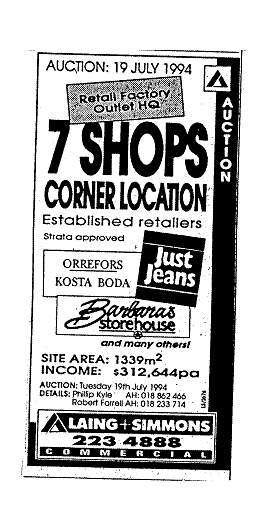
The advertisement was seen by Burke who was then looking for an investment property on behalf of Hanave. Hanave was trustee of a family trust of which Burke was a beneficiary. On Monday, 27 June 1994 Burke rang Mr Kyle of Laing & Simmons and enquired about the property. Under cover of a letter dated 28 June 1994, Kyle sent Burke a property report on the property prepared by Laing & Simmons. The report of eleven pages dealt with the location of the property, the description of the land, the land area, the particulars of title, the zoning, a description of the building and a description of the property. It contained two annexures including a tenancy schedule. It also contained a disclaimer. The description of the property was in the following terms:
“4.00 Property Description
This recently constructed, high exposure, single level, corner retail location, with 7 established high quality tenants including Barbara’s Storehouse, Orrefors Kosta Boda and Just Jeans amongst others.
These 7 shops have a net lettable area of 929 square metres, situated on a site area of 1338.73 square metres.
Known as the Leichhardt Factory Outlet Headquarters all retailers use these premises as an outlet for factory goods, and thus becoming [sic] a destination for consumers who want quality goods at discounted prices.”
(emphasis added)
The disclaimer was in the following terms:
“DISCLAIMER
Laing & Simmons Commercial for themselves and the vendors of this property, give notice that:
(i) The particulars are set out as a general outline only for the guidance of intending purchasers and do not constitute an offer or contract;
(ii) All descriptions, dimensions, references to conditions and necessary permission for use and occupation and other details are given in good faith and are believed to be correct but any intending purchaser should not rely on them as statements or representations of fact or as predictions, but must satisfy themselves by inspection or otherwise as to the correctness of each of them.
(iii) No person in the employ of Laing & Simmons Commercial has any authority to make or give any representation or warranty whatsoever in relation to this property.”
The tenancy schedule identified the gross annual income from the property as $322,704 and the net annual income as $304,558. It took the form of a table summarizing features of each lease and was headed “Tenancy Schedule”. The property went to auction on 19 July 1994 though did not sell at auction. Hanave was the highest bidder. Later that day Kyle sent Burke a facsimile containing what was described as a “correct tenancy schedu(l)e” showing a gross annual income of $333,789 and net annual income of $315,644. It also contained columns headed “gross income” and “net income” setting out an amount for each shop and another headed “lease term” setting out the duration of the lease. Prior to the auction Burke had been sent a draft contract (which included copies of the leases), had inspected the property and had been sent further particulars about the outgoings. The day after the auction, contracts were exchanged with Hanave for the sale of the property for $2,555,000. Settlement was on 17 August 1994. Prior to settlement Burke was informed there were no guarantees which supported any lease.
The contentious evidence and the issues concerning contravention of s 52
In order to place in context a consideration of some of the evidence in greater detail, it is convenient to identify the central issues arising from the pleadings. The gravamen of the case of Hanave is that the respondents, principally by means of the advertisement for the property and the property report, conveyed an impression about the financial status or worth of the property having regard to the tenants and tenancies which was false. This was because the businesses conducted at the Leichhardt property of three of the tenants, Barbara’s Storehouse, Table Eight and Talk the Ted were, to varying degrees, failing and their future as tenants capable of paying the rents described in both the advertisement and the report was doubtful. To the extent that Jagar knew the true position, it did not tell Hanave but should have. In doing so, it was contended, Jagar engaged in conduct in contravention of s 52 of the Trade Practices Act 1974. This occurred in the context of Hanave wanting to buy a property with a reliable rent stream providing it with future income. The first issue is whether this is borne out by the evidence which I will now refer to in the context of the pleadings. To the extent that what follows is only a narrative of events or a bare summary of conversations or documents it represents findings of fact I have made.
(i) Barbara’s Storehouse
In its further amended statement of claim Hanave contended, in developing a case under the Trade Practices Act 1974, that the advertisement represented (para 5):
“(i) a tenant in the retail outlet was Barbara’s Storehouse which was an established retailer;
(ii) that having Barbara’s Storehouse as a tenant was a significant feature of the retail outlet;
(iii) that having Barbara’s Storehouse as a tenant was an attraction to a potential purchaser of the retail outlet;
(iv) that Barbara’s Storehouse was a substantial tenant to have in the retail outlet;
(v) the retail outlet would provide an income of $312,644 per annum from the tenants thereof.”
As to the report it was contended (para 9):
“(i) Barbara’s Storehouse was an established high quality tenant of the retail outlet;
...
(iii) the gross income from shops 1 and 2 occupied by the tenant carrying on the business of Barbara’s Storehouse was $108,150 per annum with a net income of $102,815 per annum;
(iv) that the lease term for Barbara’s Storehouse was 10 years;
...
...
(vii) that the gross income from the tenants was $322,704 per annum with a net income per annum of $304,558.”
It was then contended that these representations were false in the following respects (para 11):
“(i) The tenant Barbara’s Storehouse was not a substantial tenant and was not an attraction for potential purchasers;
(ii) The business of Barbara’s Storehouse was doing badly;
(iii) The principal of the said Barbara’s Storehouse had told the second and third respondents as directors of the first respondent that the business of Barbara’s Storehouse would need assistance by way of reduction in rent if it was to survive as a tenant in the said retail outlet;
(iv) The first respondent through the second and third respondents had offered to the said principal of Barbara’s Storehouse to waive the rental for the months of August and September 1994 because of the poor trading of the tenant in the said retail outlet;
(v) The first respondent through the second respondent had offered to assist the said principal of Barbara’s Storehouse to obtain a rent reduction from the applicant in the event that the applicant purchased the retail outlet;
(vi) The said Barbara’s Storehouse had not since February 1994 complied with its rent obligations contained in clause 4.1 of its lease with the first respondent [particulars of payments are then set out].
(vii) The first respondent advanced the sum of $8,000 by way of loan to Barbara’s Storehouse to allow it to pay rent for the month of September to the applicant.
(viii) The first Respondent on or about May 1993 paid the sum of $60,000 to the tenant Barbara’s Storehouse (‘the tenant’) and that notwithstanding the said payment the tenant from February 1994 did not pay the rent in accordance with the lease but as set out in particular iv.”
It was further contended that the lease summary provided on 19 July 1994 had represented (para 11A):
“(viii) the tenant in shops 1 and 2 being Barbara’s Storehouse was a tenant for a term of 10 years;
(ix) the rent payable by Barbara’s Storehouse was to be increased annually by the increase in the CPI;
(x) the rent payable by Barbara’s Storehouse was to be subject to market review at the end of 3 yearly periods;
(xi) that the first respondent would receive a gross income of $111,150 and a net income of $105,815 from Barbara’s Storehouse in respect to shops 1 and 2;”
It was contended that Jagar did not have reasonable grounds for making this representation (as to a future matter) and it was misleading (para 11C).
It was also contended that by remaining silent about the matters referred to in paragraph 11, Jagar had engaged in conduct which was misleading or deceptive or likely to mislead or deceive (para 13).
It also engaged in such conduct, it was contended, by remaining silent about (para 14):
“(iii) that Barbara’s Storehouse had requested a rent reduction due to poor trading;
(iv) that the first respondent through the second respondent had informed the said Barbara’s Storehouse that the retail outlet was for sale and that the tenant should approach the new owner if it was sold to negotiate a rent reduction but if the retail outlet was not sold the first respondent would negotiate further with Barbara’s Storehouse for a rent reduction;”
This was said to be conduct which was misleading or deceptive or likely to mislead or deceive (para 15).
Three issues were raised concerning the contract for sale. One related to the provision of guarantees which was a matter that was not pursued in submissions (paras 20(I), 22, 22A, 23). Another concerned clause 9.2 of the special conditions for the contract for sale which allowed for an adjustment for unpaid rent on settlement and the assignment of debt by the purchaser to the vendor for the unpaid amount.
As to the rent for August 1994 it was contended (para 26):
“Further the applicant says that the first respondenton or about 14 August 1994 represented that the said Barbara’s Storehouse had paid rent in full for the month of August 1994 in advance.
PARTICULARS
(i) The applicant refers to a letter from Hunt & Hunt, Solicitors for the first respondent dated 15 August 1994 and a settlement statement attached to the said letter.
(ii) The applicant also refers to clause 9.2 of the said special conditions of the contract.
It was contended that this was untrue and constituted misleading and deceptive conduction “within s 52” (para 27). It was further pleaded that no rent was paid and that (para 28):
“... by not disclosing that Barbara’s Storehouse had not paid rent for the month of August prevented [the applicant] from having the opportunity of making enquiries and to ascertain the true position in relation to the tenancy of Barbara’s Storehouse.”
The third issue concerning the contract arose from what was said to be an incentive payment of $60,000 paid to Barbara’s Storehouse in two payments in April and May 1993. It was contended that clause 8.3 of the special conditions of the contract of 20 July 1994 required disclosure of the payment and (para 29D):
The first respondent failed to disclose the said payment in clause 8.3.
By failing to disclose the said payment the first respondent represented that there were no such payments made to the tenant.
Clause 8.3 provided:
8.3 The vendor warrants that all incentives for the benefit of the tenant under or in connection with the Lease are either disclosed in the Lease or are as set out below:
[This is blank in the original]
It was pleaded that had Hanave known of, inter alia, the payment it would not have entered the agreement to purchase on 20 July 1994.
One further matter concerning Barbara’s Storehouse was raised in the pleadings. It related to a coffee shop located in the area occupied by that business. It was contended (para 16):
(i) the first respondent through the second respondent requested Barbara’s Storehouse not to close down a coffee shop which was part of the said Barbara’s Storehouse business so as not to alert prospective purchasers of which the applicant was one that it was trading poorly;
This issue was not pursued in final submissions.
I will not detail the pleaded case based on the common law but it repeats much of the case based in the Trade Practices Act 1974.
The terms of the lease with Barbara’s Storehouse, when it was initially executed, provided for the leasing of shops 1 and 2 for a base rent of $105,000 per annum payable by equal calendar monthly instalments in advance of $8,750. That rent accounted for approximately a third of the rental income for the entire property. The lease provided that the rent was to be paid on the first day of each month. The term of the lease was ten years and it provided for a rent review resulting in an increase of 8 per cent in the base rent on the anniversary of the commencement of the lease with a market review every three years. The lease commenced on 19 May 1993. In about May 1994, the lease was assigned to Adelights Pty Ltd (“Adelights”). However, except in relation to my discussion of one issue concerning clause 8.3 of the special conditions in the contract for sale, I have dealt with events leading to and following the sale to Hanave as if Barbara’s Storehouse was, at all times, the lessee.
Prior to Barbara’s Storehouse entering the lease, negotiations took place between Mr Harvey Slatyer, who for present purposes ran the business conducted by Barbara’s Storehouse, and Glew and Tressider. By letter dated 3 November 1992, Glew wrote to Slatyer confirming the terms of the agreement under which Barbara’s Storehouse would lease shops in the property. The letter dealt with matters such as rent, rent review, legal costs and work to be done by the lessor and lessee. As to the work to be done by the lessee, the letter noted that “You will be responsible for your individual signage and all internal fit-out work including ceilings and floor coverings, if any, lights and internal decoration.” The letter concluded with the following three paragraphs:
In addition to the lessors works listed above we will pay a fee of $60,000 on the day that the new store commences trading. This fee may take the form of a consultancy fee for assistance in the design process, a fit-out allowance or in such other form as the parties may agree.
I understand that we are to exchange contracts by the end of next week and to meet this programme I have taken the liberty of instructed [sic] our solicitors to prepare appropriate documents but I would appreciate you confirming the agreement by signing where indicated below and returning a copy on fax 929 8540.
I trust this outline is consistent with your discussions with Paul but if there are any problems please do not hesitate to call.
Paul is a reference to Tressider. The copy of the document in evidence had been signed by Slatyer, consistent with the penultimate paragraph. Slatyer had earlier been offered an interest in the trust for whose benefit the shopping centre was built but declined the offer.
In evidence was a letter dated 24 February 1993 from Glew to Mr George Geshos. It read:
BARBARA’S STOREHOUSE
This letter is to confirm that upon Barbara’s Storehouse taking up occupation of shops 1&2 in our development on the corner of Lords Rd & Flood St, Leichhardt a fee of $60,000 will be payable as directed by Barbara’s Storehouse Pty Ltd.
I confirm that Barbara’s Storehouse Pty Ltd has directed that we pay the fee directly to you.
We expect to hand over shops 1&2 to Barbara’s Storehouse for fitout mid April 1993 and that the fee will be payable mid May 1993.
By letter dated 20 April 1993 Slatyer wrote to Glew saying:
This letter serves to confirm the telephone conversation regarding the $60,000 fitout contribution to be received from your company.
Contrary to our previous correspondence please make this amount payable to Barbara’s Storehouse Pty Ltd and not Mr George Geshos.
Barbara’s Storehouse Pty Ltd is responsible for any payments of funds to Mr Geshos or his company Buyers Emporium.
The sum of $60,000 was paid to Barbara’s Storehouse by two cheques drawn on the account of R S M Property Group Pty Limited, a company associated with Glew and Tressider, one for $15,000 on 29 April 1993 and the other for $45,000 on 12 May 1993.
It was contended by counsel for Hanave that this payment constituted an incentive payment of the type referred to in the contract for sale between Hanave and Jagar which should have been disclosed. There can be no issue that clause 8.3 of the special conditions of the contract for sale required disclosure of an incentive payment either directly by disclosure in the contract or indirectly by disclosure in the lease. Evidence concerning this payment was given by Slatyer, Glew and Tressider.
I should briefly say something about my impressions of each of them. Neither Slatyer nor Tressider particularly impressed me as witnesses. As will be apparent shortly, Slatyer was an unprincipled businessman who appears to have conducted his business in an entirely opportunistic way. I would approach with scepticism any fact asserted by him that was not consistent with facts otherwise established. Slatyer was giving evidence in circumstances where he had revealed to Burke some of what had transpired between Barbara’s Storehouse and Jagar in order to curry favour with Burke. That occurred when Slatyer was negotiating on behalf of Barbara’s Storehouse to secure favourable terms in its dealings with Hanave as landlord. Slatyer’s appearance as a witness was the culmination of his earlier attempts to ingratiate himself. Slatyer has, in my opinion, been motivated to recount events in a way that assisted Hanave and harmed Jagar.
Tressider, when giving evidence, appeared to me often evasive in the sense that he sought to answer questions in a way entirely favourable to his case and, in so doing, deliberately avoid giving an answer that might in some way damage his case. My impression of Glew, unlike that of Tressider and Slatyer, was that he generally endeavoured to answer questions in a straightforward way and honestly. He was a credible witness.
The amendments to the pleadings raising the issue about the payment of the $60,000 arose on the first day of the hearing in April 1997. The following day the amendment was agreed to. The payment was not a matter Slatyer had referred to in any of his affidavits. It was not a matter raised with him in evidence in chief. During cross-examination he accepted the payment of $60,000 was a fitout contribution. It was not a matter about which he was re-examined. Slatyer was not asked questions about the identity of Mr Geshos to whom the payment was originally to be made. The only evidence concerning his identity was given by Tressider in cross-examination to the effect that Slatyer had told him Geshos had lent Slatyer the money to fitout the store. During cross-examination Tressider accepted the $60,000 had been paid as an incentive and as part of a package to Slatyer to induce him to sign the lease. Plainly it was.
There was a suggestion in cross-examination of Tressider that the purpose of the payment at the point when the lease was to commence, was to enable Slatyer to pay rent due under the lease. I am not affirmatively satisfied this was so. I accept that the payment was an inducement promised to Slatyer, and ultimately paid to Barbara’s Storehouse, for him to take up space in the complex. The offer was originally in vague and flexible terms, but it ultimately became, in terms, an offer and in due course a payment, to defray the costs of fitting out the shops to be occupied by Barbara’s Storehouse. However I accept having regard to evidence of both Glew and Tressider in cross-examination, that there remained at the time it was paid, a measure of indifference on the part of both of them about how the payment should be characterized and whether or not it was used for the purpose for which it was paid. Whether it was used for that purpose I do not know. Hanave led no evidence from Slatyer about how the $60,000 was disbursed and whether the fitout costs were less than, the same as or exceeded the sum paid. Indeed there was no evidence whether any of the $60,000 was actually allocated to expenses incurred in the fitout of the shops. It may be accepted that the payment was made in two amounts and the first was marginally more than the first payment due under the lease. Both amounts had been paid or were in the process of being paid at the time the first payment under the lease was made by Barbara’s Storehouse (which was, in fact, paid into an account of RSM Property Group Pty Ltd). However that was a logical time for the payments to Barbara’s Storehouse to be made if they were to be applied to defray the cost of fitout and it would also have been a logical time even if it had been a bare inducement. I do not infer that the payments were made for the purpose contended by Hanave’s counsel.
I turn to consider the conduct of Barbara’s Storehouse under the lease. Between the period 19 May 1993 and 17 August 1994 there was only one occasion on which the full amount due under the lease was paid in full and on time. That was the first payment made under the lease on 12 May 1993. Thereafter only two payments were made which constituted the entire rent reserved under the lease, one on 12 July 1993 and the other on 12 April 1994. All other payments of rent were for a lesser sum and the general pattern of payments was that during the month for which the rent should have been paid at the beginning of the month, two or three smaller amounts were paid which, in total, constituted the rent due. This was certainly the pattern until February 1994 when the payments being made in any one month no longer satisfied the amounts due. The balance outstanding at any time fluctuated between a little over $2,000 to a figure exceeding $17,000, though generally the outstanding balance ranged between $4,000 and $8,000 approximately. At the end of the months of April, May, June and July 1994 the balance outstanding was approximately $5,000, $2,000, $2,000 and $3,000 respectively. There is an element of imprecision in this description. The actual position is summarized in the following table:
|
Leichhardt Tenant Record |
|
Barbara’s Storehouse - Total |
|||||
|
Date |
Comments |
Payment Due Due |
Payment Received |
Bank Ref |
Balance Outstanding
|
|
12-May-93 19-May-93 1-June-93 1-Jul-93 12-Jul-93 1-Aug-93 19-Aug-93 26-Aug-93 1-Sep-93 2-Sep-93 9-Sep-93 1-Oct-93 6-Oct-93 20-Oct-93 27-Oct-93 1-Nov-93 19-Nov-93 26-Nov-93 1-Dec-93 1-Dec-93 3-Dec-93 10-Dec-93 1-Jan-94 4-Jan-94 18-Jan-94 1-Feb-94 4-Feb-94 14-Feb-94 1-Mar-94 1-Apr-94 12-Apr-94 18-Apr-94 26-Apr-94 1-May-94 10-May-94 16-May-94 16-May-94 23-May-94 30-May-94 1-Jun-94 6-Jun-94 14-Jun-94 20-Jun-94 28-Jun-94 1-Jul-94 5-Jul-94 21-Jul-94 25-Jul-94 29-Jul-94 1-Aug-94 5-Aug-94 24-Aug-94 15-Sep-94 23-Dec-94 3-Jan-95 11-Jan-95 17-Jan-95
|
Lease Start
Rubbish & Marketing
Rubbish & Marketing Loan Loan Repayment Loan Repayment Loan Repayment Loan Repayment
|
$3,669.35 $8,750.00 $8,750.00
$8,750.00
$8,750.00
$8,750.00
$8,750.00
$222.29 $8,750.00
$8,750.00
$8,750.00
$8,750.00 $8,750.00
$8,750.00
$9,012.50
$9,984.21
$9,012.50
$220.50 $8,000.00
|
$12,419.35
$8,750.00
$4,375.00 $4,375.00
$4,375.00 $4,375.00
$2,000.00 $2,375.00 $4,375.00
$4,000.00 $4,750.00
$4,000.00 $4,750.00
$4,750.00 $4,000.00
$4,250.00 $4,731.29
$8,750.00 $2,000.00 $2,000.00
$2,750.00 $2,187.50 $2,000.00 $2,187.50 $2,187.50
$2,187.50 $2,253.13 $2,253.13 $2,253.13
$2,253.13 $2,253.13 $2,253.13 $2,253.13
$2,253.13
$2,000.00 $2,000.00 $2,000.00 $2,000.00
|
Adv Bk Acct
BB 1
BB 2 BB 3
BB 4 BB 5
BB 6 BB 7 BB 8
BB 9 BB 10
BB 11 BB 12
BB 13 BB 14
BB 15 BB 16
BB 17 BB 18 BB 19
BB 20 BB 21 BB 22 BB 23 BB 24
BB 25 BB 26 BB 27 BB 28
BB 29 BB 30 BB 31 BB 32
BB 33
BB 34 BB 35 BB 36 BB 37
|
($12,419.35) ($8,750.00) $0.00 $8,750.00 $0.00 $8,750.00 $4,375.00 $0.00 $8,750.00 $4,375.00 $0.00 $8,750.00 $6,750.00 $4,375.00 $0.00 $8,750.00 $4,750.00 $0.00 $222.29 $8,972.29 $4,972.29 $222.29 $8,972.29 $4,222.29 $222.29 $8,972.29 $4,722.29 ($9.00) $8,741.00 $17,491.00 $8,741.00 $6,741.00 $4,741.00 $13,491.00 $10,741.00 $8,553.50 $6,553.50 $4,366.00 $2,178.50 $11,191.00 $9,003.50 $6,750.37 $4,497.24 $2,244.11 $12,228.32 $9,975.19 $7,722.06 $5,468.93 $3,215.80 $12,228.30 $9,975.17 $10,195.67 $18,195.67 $16,195.67 $14,195.67 $12,195.67 $10,195.67
|
|
Totals |
|
$145,121.35 |
$134,925.68 |
|
$10,195.67 |
This pattern of payment is consistent with evidence of Tressider that he had to go to Slatyer on many occasions to see him about the rent. Indeed, Tressider accepted that one of his jobs was to hound Slatyer to get the rent. On occasions Slatyer gave Tressider post-dated cheques and in April, May and July 1994 rental cheques provided by Slatyer were initially dishonoured though subsequently honoured.
There was an issue about whether Slatyer was unable to pay the rent in accordance with the lease because he was required to pay suppliers by means of cash in advance. Slatyer was the first witness called by Hanave. During cross-examination he gave evidence touching this issue though it was limited. The highest the evidence of Slatyer can be put is that in the first three or four months of 1994 he was experiencing difficulties in paying both suppliers and Jagar. During cross-examination Tressider conceded on a number of occasions that he had gained the impression that Slatyer was paying suppliers, which Tressider believed had to be paid in advance, in preference to paying Jagar rent in accordance with the terms of the lease. Tressider gave evidence that Slatyer had told him that he was required to pay suppliers in advance though no direct evidence was given by Slatyer on this precise question. The evidence does not establish that the reason why Slatyer was paying the rent other than in accordance with the terms of the lease was because he was obliged to pay suppliers in advance and they were being preferred to Jagar when money was available to Barbara’s Storehouse to make payment. However I do accept that there was a measure of preferential payment in the sense that Slatyer would pay suppliers and, in so doing, did not pay the rent in accordance with the lease.
In a statement filed in the proceedings and later adopted, Slatyer said that he had had numerous discussions with Tressider about the state of the business of Barbara’s Storehouse and on a number of occasions prior to May 1994. Slatyer said that he had told Tressider that the business was not going well, the rent was too high and that he would not be able to both continue to pay the rent and stay in business. Tressider accepted that he had discussed with Slatyer that the business was not going well though denied that Slatyer had said that he could not continue in business and pay the high rents. I should note that the respondents called an expert valuer, Mr John Howse, who gave evidence that, in his opinion, the rent being paid for shops 1 and 2 exceeded the market rent by over $70,000 per annum. That is, the rent paid was a little under three times the market rent. This was not in issue and, indeed, was also the evidence of a valuer called by Hanave. To the extent that Tressider accepted he had discussions with Slatyer about the business not going well, Tressider said it was in the context of problems being created by construction work, near the property, of a car park for another shopping complex nearby between January and August 1994. The effect of that construction work was that potential customers were unable to park their cars near the property.
Counsel for Hanave pointed to several factors that rendered it likely that Slatyer and Tressider did discuss the inability of Barbara’s Storehouse to pay the rent at the level agreed because of trading difficulties. The first was the fact that Slatyer was paying rent in the pattern I have earlier discussed. However that can be explained by his opportunistic approach to business. In circumstances where Jagar was exhibiting a measure of flexibility in terms of the time at which and the amounts in which rent could be paid, Slatyer did not hesitate in exploiting that position. While the rent was considerably in excess of the market rent, it was nonetheless generally paid though with the qualifications I earlier made about the time and manner of payment and the fact that there was an ongoing deficit in the amount owing from March 1994 onwards.
Another was Jagar’s agreement in May 1994 to a variation of the lease the effect of which was to reduce the rent by $5,000 per annum. However that occurred in circumstances where Slatyer gave a specific reason which was accepted by Tressider and Glew. The reason given, according to Tressider, was that Slatyer wanted to sell the business and the variation was one that was requested by a prospective purchaser. The lease was varied so as to remove a provision in clause 5.1 that the rent in the Schedule would increase by 8% annually and substitute a provision that the rent would increase annually by the consumer price index. At that stage the lessee was Adelights and not Barbara’s Storehouse. Adelights was a company controlled by Slatyer and his wife and the business continued to be conducted under the name Barbara’s Storehouse. Glew’s evidence was that Slatyer had said the increases had the potential to be unfair and that he would not be able to sell the business or part of the business with increases of the type contained in the lease. I accept that the reason given for the request for the variation and why it occurred was as recounted by Slatyer and Glew. I do not accept that Slatyer said to Tressider that the rent was too high and that he would not be able to continue to pay the rent and stay in business.
In this context it is also necessary to consider in some detail evidence of events that occurred in August 1994. Slatyer’s evidence was that he became aware the property was being sold. Thereafter he met Tressider and Glew at their offices in Milsons Point. He told them that his business was not likely to survive much longer and that he was aware the property was being sold. He asked Tressider and Glew for $100,000 to enable him to stay in business or he would think it necessary to go to the purchaser to tell him how badly everything was going. Slatyer’s account is that Glew then said they would not give him the money and that all that would happen if he went to the buyer would be that the sale would fall through and they would find another buyer at a lower price. Slatyer’s evidence was that Tressider said that Glew would go with Slatyer to the purchaser with a view to securing a rent reduction and that in the meantime they would give him August and September 1994 rent free. Slatyer explained in advance that the reason he sought the $100,000 was because he believed the rental of space in the complex by Barbara’s Storehouse had assisted in its establishment and had facilitated its sale.
Slatyer gave evidence that in the week following the meeting he sent a letter by facsimile to Tressider dated 22 August 1994. The letter read:
Dear Paul,
This letter confirms the arrangements made at last weeks meeting, attended by you, me and Seph Glew.
It was understood by both you and Seph that business at Leichhardt was down and I was in need of assistance to survive in that location. It was agreed by Seph that our rent was on the high side and the purchaser of the centre most likely knew this as the rental return was high. (11.5% I believe)
To assist Barbara’s Storehouse to survive you would waive rent for August and September and at an appropriate time would approach the new owners to assist me to negotiate a new lower rental.
It was an undisputed fact that on 15 September 1994 a cheque was drawn on the account of Jagar for $8,000 payable to Adelights and signed by Glew.
Slatyer also gave evidence that after he sent the facsimile letter he received a phone call from Tressider who said that it did not reflect what had been agreed and that he wanted Slatyer to destroy the letter. Tressider said he had destroyed his copy and noted that if it fell into the wrong hands it could cause major problems. Slatyer’s evidence was that he then said that the letter represented was what had been agreed. Tressider responded that it was probably better for him, Slatyer, to see the new owner without Glew. He said he would deny that what was in the letter reflected what had been agreed. Slatyer’s evidence was that he did not pay the August rent as had been agreed.
Slatyer’s evidence was that he met with Tressider on many occasions after that phone call and at one such meeting Tressider said that he could not let Slatyer off the September 1994 rent but would give him the money to pay the rent. Slatyer said he agreed with that. Slatyer’s evidence was that at a later meeting with Tressider he was told by him that he would be given an amount that did not exactly match up with the rent and that he should not say anything about it to the new purchaser. Slatyer said that at some stage after this conversation with Tressider he was given the cheque by Glew at the office of Jagar in Milsons Point. His evidence was that at some stage before he had gone to collect the cheque, Tressider had told him that they would not give him money but would give him a loan that he would have to repay when he sold the shop or had good Christmas trading.
This version of events was put in issue by both Glew and Tressider though their evidence about what had occurred at the meeting (that it took place was not disputed) diverged slightly. Tressider denied several elements of Slatyer’s account. He denied that Slatyer demanded $100,000 or that he advised him and Glew that other tenants in the complex were in trouble and unable to survive. Tressider denied saying that the sale would fall through and they would find another purchaser at a lower price. He also denied saying that all that would happen if Slatyer were to talk to the new purchaser would be to cause a reduction in the purchase price to them. He denied offering to approach the new owner or saying that he knew Slatyer was paying a particularly high rent and that it was because of his rental that the complex was able to get off the ground. Tressider’s account of what was said was that Slatyer indicated that he was having short term cashflow and capital problems because they were in the process of opening up a shop at Batemans Bay. Slatyer indicated that he was looking for a buyer for the Leichhardt shop and that if Tressider and Glew did not help him with some capital he would go to the purchaser. Tressider recalled that an amount of money was requested in the vicinity of $12,000 to $15,000 though he could not recall the precise amount. Tressider said there was further discussion at the conclusion of which Glew said that they would lend Slatyer $8,000 which was to be paid back prior to Christmas, provided that he and Tressider got the personal guarantee of Slatyer and his wife. Tressider denied receiving the facsimile letter that Slatyer said was sent and denied the various conversations Slatyer said had occurred prior to the payment of the $8,000. He gave evidence of a letter he sent to Slatyer and his wife which is in evidence. The typed portion of the letter is dated 2 September 1994. It reads:
Dear Harvey & Barbara,
Further to our recent conversation regarding the possibility of a short term loan of $8,000.00, we advise the following.
As we have had a long standing and harmonious business relationship, we wish to confirm our agreement to forward the above amount on the following basis.
Should the business at Leichhardt be sold entirely, or in part, the loan is to be repaid in full. Should you decide not to sell, or a sale has not taken place, the outstanding amount owed to Jagar is to be paid in full prior to 8th December 1994. No interest is to be charged provided the loan is repaid in full. If payment is not received by the due date, an interest coupon of 25 percent per annum will be attached until the full debt is extinguished.
The letter was signed by Tressider and contained provision for Slatyer and his wife to signify their agreement to the terms of the letter. This was done on 5 September 1994 by both Slatyer and his wife and a copy of the letter was returned by facsimile to Jagar on that day. Tressider said the meeting occurred in early August and was attended by not only Slatyer but his wife. Slatyer denied that his wife attended the meeting.
In Glew’s account of the meeting, he denied that Slatyer told him that Slatyer or Barbara’s Storehouse was in trouble, that most of the other tenants in the complex were in trouble or that his business was not able to survive much longer as it was losing money. Slatyer said he was aware the complex had been sold and referred to his intention to sell the Leichhardt business and move to Batemans Bay where he was opening a new business. Slatyer said that because of past financial problems they could not borrow from the banks and needed capital to open the new store. He said that turnover at Leichhardt had dropped because of the construction of the carpark next door though he was confident that when the carpark was complete turnover would return to previous levels. Slatyer then said that he knew Jagar was making a substantial profit on the sale of Leichhardt and that if Glew and Tressider could not help him he would go and see the buyer. Glew responded by asking what would be the point of doing that. He also told Slatyer that to do so would cause problems for all of them and it would not fix his problem. After further discussion Glew said to Slatyer that what he, Slatyer, was telling them was that he had a short term cashflow difficulty because he was opening a new business and he had not sold the Leichhardt one. Glew then suggested they talk about a loan. Slatyer agreed and the terms of the loan were discussed. The amount agreed upon was $8,000, guaranteed by Slatyer and his wife to be repaid at the end of the year. Glew accepted in cross-examination that he did not want Slatyer to go to the purchaser as it may have resulted in the purchaser seeking to renegotiate the purchase price and might have led to litigation. He also accepted that he said he would go with Slatyer to see the purchaser of the property (Hanave) on the condition that Slatyer had a purchaser for the business. Glew accepted that one of the possible outcomes of that discussion was a reduction in the rent.
In the context of considering what was discussed and the purpose of the payment of the $8,000, it is necessary to consider several documents and related evidence. The first was an entry made by Glew in a settlement assessment he prepared on 15 August 1994 for investors who had an interest in the property. In it there is a reference to “allowance for bad debts” and an entry of $14,539. Glew accepted that this included an amount of $9,975.17 then owed by Barbara’s Storehouse which included rent of $9,012.50 payable on 1 August 1994. Glew rejected the suggestion that it involved, at the time, an acceptance that the August rent would not be paid by Barbara’s Storehouse consistent with the agreement Slatyer said had earlier been reached. Glew’s explanation was that he was making allowance for a bad debt, not as a formal accounting exercise, but as a conservative estimate of the likely distribution. He was thereby making allowance for the possibility that the August 1994 rent would not be paid and he accepted that there was a risk it would not. He pointed to the fact that once settlement was effected, Jagar would no longer be able to take action to secure the payment in the same way it could were it to remain the landlord. He instanced the capacity of a landlord to move in, lock the doors and keep the tenant out.
Clause 9.2 of the contract for sale was raised with him in cross-examination. That clause provides:
9.2 If a tenant has not made a payment for a period preceding or current at the adjustment date:
(a) for the purposes of clause 14.2, the amount is to be treated as if it was paid; and
(b) the purchaser assigns the unpaid amount (‘the debt’) to the vendor on completion and will:
(i) deliver to the vendor on completion a notice of the assignment of that debt which complies with the requirements of Section 12 of the Conveyancing Act; and
(ii) sign such further documents (at the vendor’s expense) as the vendor considers reasonably necessary or desirable to assist the vendor to recover the debt from the tenant;
(c) the purchaser acknowledges that the purchase price excludes the debt.
The adjustment figures provided by Jagar did not refer to the fact that Barbara’s Storehouse had not paid the August 1994 rent nor was a notice of assignment of debt sought or provided on settlement in relation to Barbara’s Storehouse. Glew said he did not specifically raise the outstanding debt with Barbara’s Storehouse with the solicitors acting for Jagar on the sale. He also did not complain that a notice of assignment of debt had not been given to Jagar or that provision had not been made for him to be paid the $9,975 owing. Glew said that his attitude then was that they intended to collect the rent themselves, though accepted that they did not take legal steps to do this either then or at any later time. An invoice for the rent was, however, sent after settlement. Glew gave evidence that the sale of that property was not, at the time, a particularly large transaction.
While others may have not shown the comparative indifference that Glew did to the amounts outstanding from Barbara’s Storehouse, I accept his explanation as to the reason why he made the entry in the report to the investors and why he had approached the debt of Barbara’s Storehouse in the way he had. The matters referred to in the preceding two paragraphs do not, in my opinion, support Slatyer’s account of the agreement in its original form, namely, that the August and September 1994 rents would be waived.
It is also necessary to consider the letter of 22 August 1994 from Slatyer to Tressider. August 22 was a Monday. The letter refers to a meeting last week. That is, the week commencing 15 August 1994. If the letter had been written when it purports to have been written, the events, both as to time and what was discussed, would have been fresh in Slatyer’s mind. It is to be recalled that settlement took place on 17 August 1994 and that this arose as a result of a proposal made by Burke in a letter dated 12 August 1994 to Jagar’s solicitors, Hunt & Hunt. It is probable that both Glew and Tressider knew, before the week commencing 15 August 1994, that settlement would take place in that week. It was on Monday of that week that Glew prepared the settlement assessment about which he was cross-examined. If, by the beginning of the week of 15 August 1994, both knew settlement would take place within a day or two then it is highly unlikely that at any meeting with Slatyer in that week, they would offer to waive not only rent for August 1994 but rent due to the purchaser for the month of September 1994. They would have had no capacity to waive rent for that latter month. Moreover on 17 August 1994 two letters were sent to the secretary of Adelights, one from Burke and the other from Hunt & Hunt, informing Adelights that Hanave had become the registered proprietor of the property. At one point in his cross-examination Slatyer appeared to accept that he would have received the letter a few days after 17 August 1994 though later adverted to the possibility of him having been in Batemans Bay at the time the letter was sent. It is probable, in my opinion, that by 22 August 1994 it had come to Slatyer’s attention that the registered proprietor of the property and Barbara’s Storehouse’s landlord was Hanave and no longer Jagar. If so, it is at least curious that Slatyer was then seeking to confirm an agreement which involved a person other than the landlord waiving future rent.
The matters I have just referred to raise real questions in my mind about the authenticity of the letter dated 22 August 1994. By that I mean that I entertain real doubt about whether as contended by Slatyer any such document was created on or about the time it is dated and sent to Tressider. This doubt is reinforced by the fact that the document was sent by Slatyer to Burke by facsimile in January 1995 when Slatyer was being pressed by Hanave for unpaid rents. I do not view this document as providing any real support for the version of events given by Slatyer and which were denied by Tressider and Glew. Moreover $5,000 of the September 1994 rent was paid by Slatyer and in December 1994 and January 1995 the loan of $8,000 was repaid. Slatyer’s explanation for these matters is that the arrangements he had with Glew and Tressider continually changed. A simpler, and in my view, more credible explanation is that the agreement was as recounted by Glew and Tressider and confirmed in the letter of 2 September 1994.
I accept there are a number of curious aspects to this whole transaction. However, it is relatively clear that Slatyer was seizing the opportunity created by the impending sale of the property to seek a commercial advantage from Jagar. He did so by demanding the payment of money. It is also relatively clear that both Slatyer and Glew were prepared to accede to Slatyer’s demand in order to pacify him, in the sense of offering him a sufficient inducement not to speak to the purchaser of the property. An element in pacifying Slatyer was Glew’s offer to see the purchaser with Slatyer if Slatyer had a purchaser for the business. I do not infer that the offer was made because Glew knew that Barbara’s Storehouse could not pay the rent. Glew and Tressider were anxious to ensure that Slatyer did not say anything which would deter the purchaser from buying the property. It is not entirely clear why there was a delay of nearly a month between the time of the meeting in early August and the confirmation of the arrangement in the letter of 2 September 1994. Glew’s evidence was that he had no idea and Tressider was not asked directly about the issue. Tressider did say, however, that after the arrangement was reached he gave thought to how he could avoid paying Slatyer the money.
There is also the delay between the time of the agreement (probably early August 1994) and the time of the payment of the cheque on 15 September 1994. However the money was, in a sense, being extorted by Slatyer. I accept that having secured Slatyer’s silence, there was no enthusiasm on Glew or Tressider’s part to finalize the arrangement by confirming it in writing and actually making the payment even if only by way of loan. I reject the evidence of Slatyer and accept that of Glew, and that of Tressider to the extent that it is consistent with Glew, as to what was discussed and agreed to at the meeting between them in early August 1994.
(ii) Table Eight
In its further amended statement of claim Hanave contended that the property report revealed (para 9):
(v) the gross income from shop 4b occupied by the tenant carrying on the business known as Table Eight was $42,804 per annum with a net income of $40,772 per annum;
It was not pleaded that this representation was false. However in relation to a lease summary provided by Laing & Simmons on 19 July 1994 Hanave contended that it was represented that (para 11A):
(xii) the tenant in shop 4b being Table Eight was a tenant for a term of 3 years;
(xiii) that the first respondent would receive a gross income of $38,085 and a net income of $36,797 per annum from Table Eight in Shop 4b;
It was contended that the respondents did not have reasonable grounds for making the representations which were misleading for the purposes of s 52 of the Trade Practices Act 1974 (para 11C). Further it was contended that the respondents knew (para 14):
(i) that a rebate of $1800 had been allowed to the tenant in shop 4b being known as Table Eight for the purposes of the tenant advertising its business due to poor trading at the said retail outlet;
(ii) the tenant in the said shop 4b was to cease to trade and to vacate the said shop leaving it vacant;
As to this and similar matters it was then contended (para 15):
Further in the premises the first respondent by remaining silent on the matters in paragraph 14 above which it knew would affect the amount of net rentals from the retail outlet and the decision of potential purchasers to purchase the retail outlet engaged in conduct that was misleading or deceptive or likely to mislead or deceive.
It was also contended that (para 16):
(ii) the first respondent through the second respondent requested the tenant in shop 4b to remove closing down sale signs as it was attempting to sell the retail outlet and the presence of such signs would make it difficult to sell.
and that this was conduct which was misleading or deceptive or likely to mislead or deceive Hanave.
It was further contended (para 17):
The applicant says and the fact is that the first respondent made the said requests to the said tenants in paragraph 16 above for the purposes of misleading or deceiving potential purchaser including the applicant as to the commercial viability of the retail outlet as a whole and in particular to the financial strength of the said tenants referred to in paragraph 16 above.
The evidence in relation to Table Eight was as follows. On 16 May 1994 a letter was sent to Tressider by the financial controller of what was described as the UTT Group of Stores. It was effectively written on behalf of Table Eight. The letter read:
RE: CLOSURE LEICHHARDT
Please be advised that we intend to cease operations at the Leichhardt Location. We envisage that we will have vacated the premises before the 1 June, 1994.
The decision has been made due to the continued unprofitability of the location. We are presently losing in excess of our fixed costs. This situation has been exacerbated due to seasonal cashflow difficulties.
If you require any further information please feel free to contact the undersigned.
The events leading to and following this letter were the subject of evidence by Mr Jonathan Baral who was a director of Galavini Pty Ltd. That company and another company, Fromern Holdings Pty Ltd, formed a partnership which traded under the name “Under the Table”. That partnership provided services to Table Eight which operated a chain of approximately 90 retail stores around Australia using the name “Table Eight”. Baral had been approached by Tressider in the early 1990s to become a tenant in the complex being built at Leichhardt. Ultimately a lease was signed commencing 19 May 1993.
Baral gave evidence that until what he described as the time Table Eight had to terminate the lease (which I take to be a reference the period preceding May 1994), business in the shop was reasonable. However, he also said that the letter of 16 May 1994 was written because trading was so poor as to warrant the writing of the letter. He said in a written statement he adopted in evidence that shortly after he wrote the letter, he had a conversation with Tressider in which he said that they were not doing well and he wished to talk to Tressider about what could be done. Baral also said in the written statement that shortly after that conversation, Tressider came to him with a cheque for $1,800. Tressider said he would call it an advertising subsidy because it was more convenient for his books to describe it as that rather than a rental rebate. Tressider went on to say that it was not in his interests to have Baral close the shop because he knew that there were other tenants who were unhappy and he would not want them to know that he was giving Baral a rental rebate. He asked Baral to keep quiet about the whole matter.
Baral said that shortly after he sent the letter of 16 May 1994, he made a decision to cease trading from the shop and, if necessary, to continue to pay rent until a subtenant could be obtained. In this context he recalled giving instructions to have the words “Closing Down Sale” printed on the shop window. He shortly after received a call from Tressider who asked him to remove the sign. Baral said that Tressider said they were endeavouring to sell the shop and that if he left the sign there it would be difficult. Baral said he was prepared to do so because Tressider might have been able to find a tenant who could take over the lease of Table Eight.
Tressider put some of this evidence in issue. On 28 April 1994 he received a letter from the financial controller of the UTT Group of Stores. It adverted to trading difficulties and proposed that in relation to increases in their turnover figures they receive a reduction on the turnover rent. Part of the rent payable by Table Eight was referrable to its turnover. The specific proposal was that for each increase of the turnover figures of 5 percent they would receive a reduction of the turnover rent of .2 percent with a maximum reduction of 1.2 percent. The letter adverted to the possibility of the turnover increasing with increased advertising by Table Eight in a local newspaper. In a letter to Galavini dated 10 May 1994, Tressider indicated his preparedness to agree to this proposal for a trial period of six months.
Tressider accepted that he gave Baral a cheque for $1,800 in May 1994. Tressider said the cheque was to encourage Baral to conduct advertising the shop to attract further business to the centre. Tressider denied that he described it as an advertising subsidy for convenience rather than a rental rebate or that he gave the explanation to Baral in the terms Baral described. Tressider also denied that he was then aware that other tenants in the centre were unhappy or that he asked Baral to keep the whole matter quiet. In cross-examination Baral was asked several questions about the provision of a cheque though the amount involved was identified as $1,279.50. He agreed that the cheque was given to him as an advertising rebate and the idea was that it would be used to advertise the shop to get people to come in and purchase. While there was no direct challenge to his evidence concerning the conversation, Baral’s answers in cross-examination were consistent with Tressider’s version of the conversation and inconsistent with the account Baral originally gave in his written statement. I am satisfied that the payment was not a rental rebate. I accept Tressider’s account of what was said about the purpose of the payment.
As to the conversation concerning the sign, Tressider’s account was that he said to Baral that the sign had to be taken down. His evidence was that he said to Baral that he had a lease and had to honour it though if he, Tressider, could find an appropriate retailer of similar standing to take Table Eight’s place Jagar would look at it. I think it more likely that the conversation was as described by Baral. Indeed Tressider accepted in cross-examination that he had earlier spoken to a Mr Warwick Susskind of Table Eight about the letter of 16 May 1994 and sought to persuade him that the closure should not go ahead. Tressider accepted that one reason for doing so was that he did not want a potential purchaser to know a tenant had left or was going to leave the property. Tressider also accepted that this was a reason why he asked for the sign to be taken down.
Glew responded to the letter of 16 May 1994 with a letter dated 20 May 1994 expressing surprise and disappointment and an exhortation that Table Eight continue to honour its obligations under the lease. He said that Jagar would be willing to endeavour to secure a suitable assignee. As a matter of fact Table Eight continued to pay rent in accordance with the lease and the store did not close on 1 June 1994 but continued to trade till the beginning of September 1994. Baral said, and I accept, that Table Eight continued trading because it was persuaded to do so by Tressider. It is probable this occurred before the property was advertised for sale in late June 1994. In September 1994 Table Eight sought Hanave’s consent for another trader to trade from the shop. Hanave wrote to Table Eight in late October 1994 indicating it did not consent to the subletting of the premises without being able to consider the financial standing and trading experience of the “transferee”. The shop was nonetheless occupied by another trader for a period.
(iii) Talk the Ted
In its further amended statement of claim Hanave contended in relation to Talk the Ted that the property report revealed (para 9):
(vi) the gross income from shop number 5 occupied by the tenant which carried on the business of Unlimited Factory Outlet was $39,200 with a net income of $37,277;
It was not pleaded that this representation was false or constituted conduct which was misleading or deceptive. However in relation to a lease summary provided by Laing & Simmons on 19 July 1994, Hanave contended that it was represented that (para 11A):
(xiv) the tenant in shop 5 being Unlimited Factory Outlet was a tenant for a term of 4 years;
(xv) that the rent payable by Unlimited Factory Outlet was to be increased annually by the increase in the CPI;
(xvi) that the first respondent would receive a gross income of $39,200 and a net income of $32,277 from Unlimited Factory Outlet in respect of shop 5.
Talk the Ted traded at the Leichhardt property as the Unlimited Factory Outlet. It was contended that the respondents (para 11C) did not have reasonable grounds for making the representations (as to a future matter) and they were misleading for the purposes of s 52 of the Trade Practices Act 1974. Further it was contended that the respondents knew (para 14):
(v) that the tenant of shop 5 known as Unlimited Factory Outlet paid rent for the month of May 1994 of $2,500 instead of the base rental of $3,267;
(vi) the said tenant of shop 5 had complained to the first respondent that it was trading poorly and wanted to negotiate a rent reduction.
As to this and similar matters it was then contended (para 15):
Further in the premises the first respondent by remaining silent on the matters in paragraph 14 above which it knew would affect the amount of net rentals from the retail outlet and the decision of potential purchasers to purchase the retail outlet engaged in conduct that was misleading or deceptive or likely to mislead or deceive.
The monthly rental payable by Talk the Ted was $3,267. In both May 1994 and, it appears, August 1994 the rent paid was only $2,500. The deficiency in the payment in May 1994 was made up by the payment of $4,033 in June 1994. That is, payment was made of the May 1994 shortfall of $767 and the June 1994 rent of $3,267. There was no direct evidence why the full rent was not paid. Glew could not recall the reasons why the underpayment had occurred but speculated there may have been some disagreement about a charge levied by Jagar for what he described as “ancillary bits and pieces” such as repairs.
However the pattern of rental payments after Hanave acquired the property show an ongoing underpayment of the rent at least until March 1995 with payments of only $2,500 per month and later only $1,000 per month. Moreover, the rent paid in July 1994 was only $2,957. Indeed, in March 1995 an administrator was appointed for the business of Talk the Ted. It can be inferred, in my opinion, that the underpayment in May 1994 and August 1994 did not relate to a dispute about a matter of the type referred to by Glew. Tressider denied that Ms Trish Hill, the principal of Talk the Ted, sought rental relief though accepted it was likely he had conversations with her about the outstanding balances. Tressider said he was aware that she was running two other businesses in, it appears, newly opened shopping centres and he implied that this may have impacted on her short payments of rent to Jagar.
On 20 May 1994 Tressider had written to Leichhardt Municipal Council about parking. The letter read:
RE: ONE HOUR PARKING - FLOOD AND LORD STREETS, LEICHHARDT
As the owner of a property on the corner of Flood and Lord Streets, Leichhardt, I wish to restate our concern as to the lack of street parking around our premises for the customers of our retailers.
As a result of Leichhardt Market Town’s problem with not enough parking on their site, staff who are employed by the retailers of this centre are parking all day in the surrounding streets.
To add to the seriousness of this problem, all our retailers are complaining of a significant drop in trade, resulting in one of our retailers advising us of his intent to vacate (Table Eight) as of the 1st June due to primarily customers’ inability to park.
Our request is that a one hour parking restriction be placed along Lord Road to Tebbutt Street, and part of Flood Street between Marion and Albert Street enabling a turnover of vehicles (local residents would have parking permits).
We would hope that this request be treated with utmost urgency as each week goes by our retailers are facing major trading losses.
I await your earliest reply.
Leichhardt Market Town was a large established suburban shopping centre adjacent to the premises to which these proceedings relate.
Tressider was cross-examined about this letter and he was not sure whether it related to Talk the Ted. He did say it did refer to Barbara’s Storehouse and Table Eight. The clear import of the letter is that all retailers, which would have included Talk the Ted, were complaining of a significant drop in trade. However, evidence of turnover of two of the tenants, Orrefors and Kosta Boda, in the period January 1994 to June 1994 inclusive, indicates there was no significant drop in turnover in that period other than a significant drop from the turnover in December 1993 which would have included Christmas trade. There was thus an element of hyperbole in the letter which was a proposition put to Tressider in cross-examination and accepted by him. Nonetheless it is probable, in my opinion, that Tressider would have been told by Hill that she was experiencing trading problems in her business generally given the time at which she started to pay the lesser amount of rent and the role Tressider had in collecting it. However, in the absence of evidence from Hill (who was not called), I am not prepared to infer that in May and August 1994 Talk the Ted was actually unable to pay its rent or that Tressider knew it was unable to pay its rent or it sought or would seek a reduction in the rent. A letter from Hill dated 9 October 1994 to Hanave dealing with some of these matters is in evidence but not as proof of the truth of its contents.
Has the applicant established conduct in contravention of s 52?
It is convenient to deal firstly with the position concerning Talk the Ted as the facts are comparatively straightforward. However they raise legal issues that have relevance to Table Eight and Barbara’s Storehouse. I will review separately the circumstances of each of these tenants and what is alleged in relation to them. It is a convenient way of considering the material though plainly it is necessary to consider all relevant material in its entirety to ascertain whether there has been conduct which contravened s 52.
The first matter of substance raised in relation to Talk the Ted was whether the representation in the updated tenancy schedule was a representation as to a future matter and, if so, whether it was false. It is possible for an actionable representation to be made about the future rental income of a property and an example is found in Ting & Anor v Blanch & Anor (1993) ATPR 41-282. The respondents contended that the lease summary was a representation of existing terms contained in the leases. The table in the updated schedule provided on 19 July 1994 containing the gross income and net income from each shop (and the property as a whole) and contained a range of other information which constituted a summary of information in each lease. Indeed, the entire table was headed “Lease Summary”, plainly indicating that information in it was a summary of what was contained in the lease. It must be accepted, however, that it contained additional information not in the leases such as outgoings.
Bourke said in evidence that he had sent the updated lease summary after having had a conversation with Kyle. In that conversation, according to Burke, they discussed the appropriate price for the property, Burke’s desire to obtain a return of 12%, and the need to take this into account in formulating a price that might be offered. While, as I discuss later, I approach Burke’s evidence with real reservations, his evidence about this conversation is not put in issue by Kyle and I accept it. I nonetheless view the contents of the document, in so far as it refers to matters such as income and the duration of the lease, as a representation as to existing facts, namely what was contained in the subsisting leases of the shops, rather than a positive representation as to income that might be derived from the property in the future. It would, in the context in which it was said, have been nothing more than a representation as to existing facts. Thus, the information concerning the lease with Talk the Ted was true.
Hanave’s case as it concerned Talk the Ted raises two additional matters. The first was the fact that only $2,500 was paid as rent during May 1994 and the other was that Talk the Ted had complained that it was trading poorly and wanted to negotiate a rent reduction. The second matter is not established on the evidence. However, the first matter is. In relation to that matter it is contended by Hanave that Jagar, by remaining silent about the underpayment of the May 1994 rent, engaged in conduct which was misleading or deceptive or likely to mislead or deceive.
The question of whether a corporation, by remaining silent about a matter, has engaged in misleading or deceptive conduct is an issue that has been considered on a number of occasions recently. In Fraser v NRMA Holding Limited (1995) 55 FCR 452 the Full Court made plain that s 52 did not give rise to a duty to provide information. As to silence, the Full Court said (at 467):
Where the contravention of s 52 alleged involves a failure to make a full and fair disclosure of information, the applicant carries the onus of establishing how or in what manner that which was said involved error or how that which was left unsaid had the potential to mislead and deceive.
It is necessary for an applicant to identify circumstances “such as to give rise to the reasonable expectation that if some fact exists it would be disclosed”: see Kimberley NZI Finance Limited v Torero Pty Ltd (1989) ATPR 46-054 and Demagogue Pty Ltd v Ramesky (1993) 39 FCR 31 at 32. It may be accepted that the obligation is a continuing one in the sense that a change in circumstances may give rise to the reasonable expectation: see Tantipech and P O & Sons Pty Limited v IOOF Australia Trustees (NSW) Limited (1998) ATPR 41-614.
The lease summary was forwarded to Burke on 19 July 1994. It may be accepted that in May 1994 there had been an underpayment of Talk the Ted’s rent of $767. However that was remedied in June 1994 by the payment of both the June rent and the arrears in rent. Thus by 19 July 1994, in relation to the May 1994 rent, the underpayment had been satisfied. Moreover Hanave has not established that Talk the Ted was actually unable to pay its rent or that Tressider knew it was unable to pay its rent or was seeking a reduction in rent. For these reasons, in my opinion, there could have been no reasonable expectation that the underpayment in May 1994 would be disclosed in the circumstances in which Hanave was negotiating to purchase the premises.
The position in relation to Table Eight is much the same as Talk the Ted. The provision of information concerning Table Eight in the updated tenancy schedule provided on 19 July 1994 did not constitute misleading or deceptive conduct. Hanave identified two matters that it said should have been disclosed to it but were not. The first was a payment of $1,800 to enable Table Eight to advertise to promote its business and the other was the steps taken by Table Eight to give effect to its decision to cease trading. That involved the placement of the closing down sale sign. It is probable these events occurred in late May 1994. Hanave’s case was that these matters should have been disclosed and the failure of Jagar to do so constituted misleading and deceptive conduct.
Hanave also contended that the request to remove the sign was itself conduct proscribed by s 52. However I do not see how it is. The sign was placed in the shop shortly after a letter had been sent on behalf of Table Eight indicating it intended to cease trading by 1 June 1994. However shortly after the intimation by Table Eight that it proposed to cease trading, it was persuaded not to by Tressider who said he would try and find another tenant. All this occurred before the property was advertised for sale. Thus the request to remove the sign was superseded by a decision by Table Eight to continue trading. Hanave has not established that had no request been made to remove the sign, by the time any prospective purchaser inspected the property the sign would have been there notwithstanding the decision of Table Eight to continue trading. The request to remove the sign could, in my opinion, only conceivably be conduct contravening s 52 if it was established that a prospective purchaser would have seen the sign but for the request to remove it.
As to the alleged failure to disclose the payment of the $1,800 and the steps taken by Table Eight to cease trading the fundamental difficulty with Hanave’s case is that Table Eight was not a small retailer. It operated a chain of approximately 90 stores. It may be accepted that it made a commercial decision to cease trading at Leichhardt from 1 June 1994 and took some steps to give effect to that decision though, of some significance, it nonetheless continued to trade after the nominated day. Having communicated its intentions to Jagar it was informed by Glew that there was an expectation it would continue to meet its obligations under the lease. There is nothing in the evidence to suggest that Table Eight would not meet those obligations or that Jagar had reason to believe it would not. Thus the position in June, July and August 1994 was that Table Eight was trading and meeting its obligations under the lease and Jagar, correspondingly, was deriving the benefit of the rental income. In my opinion, circumstances did not then exist in which there would have been a reasonable expectation that Jagar would disclose to Hanave the fact that Table Eight had earlier evinced an intention to cease trading, even though it did not close down and it continued to trade until the promotion of the property for sale and after its sale.
I turn now to consider the position of Barbara’s Storehouse. The first issue relates to the advertisement which, fairly construed, describes Barbara’s Storehouse as an established retailer contributing to rental income for the property of $312,644 per annum. What is comprehended by the expression “established retailer” is, in my opinion, of no great moment. I view the advertisement as nothing more than a device to attract the attention of potential purchasers of the property. If the description of Barbara’s Storehouse as an established retailer mis-stated the position in any respect it has no relevant legal consequence. I say that because I accept the submission made on behalf of the respondents that an advertisement of this type in those terms can properly be viewed as puffery. Reference was made to Eighth SRJ Pty Ltd v Merity, unreported, 25 March 1997, Supreme Court of New South Wales, Young J. His Honour said:
Under the general law, there is a real distinction between a representation and a mere puff. Under the Trade Practices Act, the law also understands that ‘in the ordinary course of ‘commercial’ dealings, a certain degree of ‘puffing’ or exaggeration is to be expected. Indeed puffery is part of the ordinary stuff of commerce.” (General Newspapers Pty Ltd v Telstra Corporation (1993) 45 FCR 164, 178). However, as Professor Harland says in his article, from which I have already quoted, at p 112, ‘The commentators generally believe that the defence that a seller’s claim is only puffing, not to be taken seriously and not attracting liability, is less likely to succeed under the statutory prohibition than at common law. This is no doubt generally true, especially in cases of advertising and other promotional activity, and, given the public policy goals underlying the statute, any other result would be surprising.’ The learned professor then goes on to say that recent cases may be reversing that trend and continues, ‘The question of just where to draw the line in this context will clearly remain one of debate’.
When looking at the conduct of the alleged infringer of s 52, one must look at the whole of the conduct not the particular matter on which the plaintiff has focused attention in isolation: Parkdale Custom Built Furniture Pty Ltd v Puxu Pty Ltd (1982) 149 CLR 191, 199 and Pappas v Soulac Pty Ltd (1983) 50 ALR 231. In that lastmentioned case at 234, Fisher, J said, in the context of an agent making statements about the ‘commercial’ viability of a shopping centre which the agent was selling, ‘... Many of the statements ... were also essentially the type of introductory comments, in the nature of puffery, made at the start of negotiations, for the purpose of attracting the interest of a possible ‘purchaser’. As such they became irrelevant or of little, if any, significance when detailed information is subsequently given a fortiori, to a potential ‘purchaser with commercial’ experience. To the extent that they are essentially puffery, it is proper to be reluctant to elevate them to the status of potentially misleading conduct.’
With these thoughts in mind, one must examine the various matters pleaded as false or misleading conduct under the statute.
The first matter is the newspaper advertisement. It seems to me very difficult to allege that a newspaper advertisement which is designed primarily to tell people that a house is open for inspection should be construed as giving information other than preliminary information upon which a person should rely in order to enter into a contract. If one expects puffery anywhere it would be in such a newspaper advertisement. Although Lee, J in Paper Sales (Australia) WA Pty Ltd v PSA Pty Ltd (1991) ATPR 41-142 at 53,051, left open the possibility that ‘an ordinary member of the class of persons to whom the conduct is directed may fail to discern that representations about the advertised product are to be disregarded, I think ordinarily an advertisement which merely directs someone to enquire about the product is not expected in trade or commerce to be relied upon as a quasi representation.
However different considerations arise in relation to the property report provided to Burke on 28 June 1994. It describes Barbara’s Storehouse as one of a number of “established high quality tenants”. While the tenancy schedule in the property report may be treated as a description of the terms of existing leases in much the same way as the tenancy schedule provided on 19 July 1994 (though it was not headed “lease summary”), the information in that schedule is coloured by the description of Barbara’s Storehouse as an established high quality tenant. Even though the rent identified in the property report can be treated as a description of the rent payable under the lease, the reference to “high quality” involves, in my opinion, a representation about the experience of the vendor in relation to the historical operation of the lease. That is, the tenant has been, in relation to its obligations under the lease, an extremely satisfactory tenant.
A similar point was considered over a century ago in Smith v Land and House Property Corporation (1884) 28 Ch D 7. That case concerned the sale in 1882 of a hotel leased by Mr Frederick Fleck. Particulars were provided to potential purchasers which described Fleck as a most desirable tenant. The purchaser of the property, the Land & House Property Corporation, undertook some investigations prior to purchasing the property at auction. The board of the Corporation received a report in which it was revealed that from discussions with Fleck it was apparent that the amount of business he was doing made it difficult to pay the rent with rates and taxes. Evidence was given by the chairman of the committee of the Corporation that while the committee members were aware of the contents of the report, they acted on the assurance that Fleck was a most desirable tenant. The annual rent was £400 and Fleck had been in occupation from 1880. The payment of rent had been irregular and not on the due date. At the time of the sale Fleck was in arrears. Smith (supra) has been comparatively recently considered by a Full Court of this Court in RAIA Insurance Brokers Limited v FAI General Insurance Company Limited (1993) 41 FCR 164. It is convenient to set out a passage from the joint judgment of Beaumont and Spender JJ which contains a relevant extract from the judgment of Bowen LJ in Smith (supra). Their Honours said at 172-173:
In Smith v Land and House Property Corporation (1884) 28 Ch D 7, the vendors of a property stated that it was ‘let to Mr Frederick Fleck [a most desirable tenant] ...’. In fact, the tenant’s rent was in arrears and he was not a desirable tenant. It was held that this was not a mere expression of opinion, but contained an implied assertion that the vendors knew of no facts leading to the conclusion that he was not; and that, in the circumstances, there was a misrepresentation.
Bowen LJ said (at 15):
‘In considering whether there was a misrepresentation, I will first deal with the argument that the particulars only contain a statement of opinion about the tenant. It is material to observe that it is often fallaciously assumed that a statement of opinion cannot involve the statement of a fact. In a case where the facts are equally well known to both parties, what one of them says to the other is frequently nothing but an expression of opinion. The statement of such opinion is in a sense a statement of a fact, about the condition of the man’s own mind, but only of an irrelevant fact, for it is of no consequence what the opinion is. But if the facts are not equally known to both sides, then a statement of opinion by the one who knows the facts best involves very often a statement of a material fact, for he impliedly states that he knows facts which justify his opinion. Now a landlord knows the relations between himself and his tenant, other persons either do not know them at all or do not know them equally well, and if the landlord says that he considers that the relations between himself and his tenant are satisfactory, he really avers that the facts peculiarly within his knowledge are such as to render that opinion reasonable. Now are the statements here statements which involve such a representation of material facts? They are statements on a subject as to which prima facie the vendors know everything and the purchasers nothing. The vendors state that the property is let to a most desirable tenant, what does that mean? I agree that it is not a guarantee that the tenant will go on paying his rent, but it is to my mind a guarantee of a different sort, and amounts at least to an assertion that nothing has occurred in the relations between the landlords and the tenant which can be considered to make the tenant an unsatisfactory one. That is an assertion of a specific fact. Was it a true assertion?’
In my opinion the observations of Bowen LJ are an apt description of the circumstances arising in these proceedings: as to descriptions of tenants see also Pappas v Soulac Pty Ltd (1983) 50 ALR 231 and Como Investments Pty Ltd (In Liquidation) v Yenald Nominees Pty Ltd (1997) ATPR 41-550. Jagar knew that the rental payments of Barbara’s Storehouse, and later Adelights, had been irregular and rarely in accordance with the terms of the lease. Moreover at the time the representation was made in the property report and until the time the property was sold at auction, Barbara’s Storehouse and Adelights were in arrears in the sense that there was always a balance outstanding in the rental account. This had been the case since March 1994. A tenant with that history of rental payment could not, in my view, be reasonably described as a high quality tenant and a description in those terms misrepresented the position to intending purchasers including Hanave. It was a representation that was false. In describing Barbara’s Storehouse in this way Jagar engaged in conduct which was in contravention of s 52 of the Trade Practices Act 1974.
Two further matters need to be considered. They both concern the contract for sale. I earlier indicated that the payment of $60,000 to Barbara’s Storehouse in April and May 1993 was an incentive to enter the lease. Clause 8 of the special conditions of the contract for sale provided:
8. SALE SUBJECT TO COMMERCIAL LEASE OR LEASES
8.1 Lease Incentives
The Land is sold subject to the Lease or Leases particularised in Schedule 1 (“the Lease”).
8.2 The vendor warrants that the details of every guarantee given in support of the Lease are as set out below, provided that any guarantee, the terms of which are incorporated in the Lease, need not be particularised.
8.3 The vendor warrants that all incentives for the benefit of the tenant under or in connection with the Lease are either disclosed in the Lease or are as set out below:
[This is blank in the original]
(The bold type appears in the original document)
Schedule 1 referred to in cl 8.1 was, relevantly, in the following terms:
SCHEDULE ONE
|
Shop No |
Tenant |
Term |
Annual Base Rent
|
Dealing |
|
1&2 |
Barbara’s Storehouse Pty Limited |
Expires 18/5/2003 |
$108,150.00 |
U58319 |
|
3 …… |
Transfer of Lease to Adelights Pty Limited
|
|
|
U170608
|
The memorandum of transfer of the lease was not annexed to the contract though the executed transfer is in evidence. There was, however, annexed to the contract the original lease with Barbara’s Storehouse, numbered U58319, which identified the leased property as shops 1 and 2 and Barbara’s Storehouse as the lessee. Also annexed to the contract was an undated and unexecuted variation of the lease in relation to shops 1 and 2 identifying the lessee as Adelights. The variation concerned, inter alia, the rent payable from 19 May 1994. In my opinion, on a fair reading of the contract as a whole, it was representing that at the time of sale, Adelights was the lessee of shops 1 and 2 which had formerly been leased by Barbara’s Storehouse. In my opinion Adelights was the tenant for the purposes of clause 8.3. Indeed Burke understood Adelights was the tenant. It was to the secretary of that company that he wrote on 17 August 1994 notifying a change of ownership of the premises. Hunt & Hunt did likewise. Moreover all correspondence between Hunt & Hunt and Gilbert Mane after exchange and before settlement referred to Adelights as the tenant.
Earlier in this judgment I said that the lease was transferred from Barbara’s Storehouse to Adelights in about May 1994. That was a finding of fact. It was the evidence of Glew which was not challenged. Indeed it appeared to be common ground. I refer to this matter again because the executed transfer of the lease to Adelights is a photocopy where some critical information stamped on the transfer identifying dates is not clear. However the transfer bears a handwritten date that appears to be “30 August 1993”. No explanation was given in evidence of this date. Of present relevance however is that when contracts were exchanged on 20 July 1994 Adelights was the tenant.
No reference was made to the payment of the $60,000 in the space provided in clause 8.3 nor was it referred to in the lease. Hanave contended the failure to disclose the payment of the $60,000 constituted a positive representation that no incentive payments were made to Barbara’s Storehouse. Counsel for the respondents put in issue whether the failure to disclose the payment constituted a representation of the type pleaded because, inter alia, at the time of exchange Adelights was, and Barbara’s Storehouse was not, the tenant. No payment had been made to Adelights and the $60,000 had been paid to Barbara’s Storehouse. Clause 8.3 requires disclosure of incentives for the benefit of “the tenant”.
In order to consider the issue raised by counsel for the respondents it is necessary to refer again to the pleadings. In doing so I repeat some of what I have earlier set out. The non disclosure of the payment of the $60,000 was first raised in a further amended statement of claim filed on 2 May 1997. As I noted earlier it was first adverted to in the opening days of the hearing. The further amended statement of claim referred on a number of occasions to “Barbara’s Storehouse” as both “the tenant” (see eg. para 5(i)) and as the business carried on by the tenant of shops 1 and 2 (see para 9(iii)). The payment of the $60,000 was first adverted to paragraph 11 as a particular of misleading or deceptive conduct undertaken by Jagar. It was pleaded:
(viii) The first Respondent on or about May 1993 paid the sum of $60,000 to the tenant, Barbara’s Storehouse (“the tenant”) and that notwithstanding the said payment the tenant from February 1994 did not pay the rent in accordance with the lease but as set out in particular (iv).
In the defence the Respondents admitted that Jagar paid an amount of $60,000 to the tenant, Barbara’s Storehouse, as a fitout allowance but otherwise denied what is alleged in paragraph 11. The payment was raised again in the further amended statement of claim in the following paragraphs:
29A. Further the Applicant says in May 1993 the first Respondent paid the sum of $60,000 to the tenant, Barbara’s Storehouse (“the tenant”).
29B. The said payment was a cash incentive for the tenant to take up the lease of Shops 1 & 2.
29C. By clause 8.3 of the special conditions in the agreement of 20 July 1994 the first Respondent agreed to disclose payments made as incentives to the lessees to enter into leases.
29D. The first Respondent failed to disclose the said payment in clause 8.3.
29E. By failing to disclose the said payment the first Respondent represented that there were no such payments made to the tenant.
29F. The applicant says if it had been aware of the said payment of $60,000 and if it had been aware of any of the matters in paragraph 11 and any of the matters in paragraph 14 and any of the matters in paragraph 27 it would not have entered into the said agreement or would not have completed the said agreement.
It was not expressly pleaded that the conduct of Jagar referred to in paragraphs 29D and 29E was conduct contravening s 52 though, in relation to the case pleaded against Tressider and Glew, it was alleged that they aided and abetted the first respondent in engaging in conduct (including that pleaded in paragraphs 29D and 29E) in contravention of s 52. It is relatively clear that the conduct referred to in paragraphs 29D and 29E is alleged to be conduct engaged in by Jagar in contravention of s 52.
In the defence these paragraphs were dealt with in the following way:
29A Paragraph 29A
The First Respondent says that it paid the sum of $60,000 to Barbara’s Storehouse as a fitout allowance and otherwise does not admit this paragraph.
29B Paragraph 29B
The Respondents deny the matters referred to in this paragraph.
29C Paragraph 29C
The Respondents do not admit the matters in this paragraph, and rely on the entire agreement between the Applicant and the First Respondent.
29D Paragraph 29D
The Respondents do not admit the matters referred to in paragraph 29D, and say that the Applicant has suffered any loss or damage it was caused by the failure of the Applicant to take reasonable steps to protect its own interests and was not caused by any conduct alleged against the Respondents.
The pleaded defence to paragraphs 29E and 29F was in substantially the same terms as paragraph 29D.
Burke knew, and therefore Hanave knew, that at the time of exchange and after exchange the tenant was Adelights and not Barbara’s Storehouse. In the statement of claim no attempt was made to draw any distinction between Barbara’s Storehouse (the company) and Adelights. However the way the case is pleaded is consistent with the facts in the sense that it was to the tenant, Barbara’s Storehouse (the company) that the payment was made. What is pleaded is that the failure to disclose the payment was a positive representation that no incentive payments were made to Barbara’s Storehouse. A finding that such a representation was made would itself be made, in my opinion, only if it was established that there had been a legal obligation imposed on Jagar by clause 8.3 to disclose the payment. It would be in those circumstances that the failure to disclose the payment, when obliged to do so, constituted a representation that the payment or payments of that character were not made. This is not a case like Krakowski v Eurolynx Properties Ltd (1995) 183 CLR 563 where the clear terms of the contract coupled with the fact of non disclosure established, without more, the false or fraudulent representation.
The first matter that needs to be considered in ascertaining whether the pleaded conduct has been established is the meaning of clause 8.3. It can be seen that clause 8.3 does not speak of incentives paid to the tenant but rather “all incentives for the benefit of the tenant under or in connection with the lease”. Thus an incentive payment made to someone other than the tenant could constitute a payment which inures to the benefit of the tenant. Was there a payment “for the benefit of the tenant” in the present case? Even accepting, which is not established on the evidence, that none of the $60,000 was used to defray the costs incurred by Barbara’s Storehouse in fitting out the shop but rather for the purpose of satisfying Barbara’s Storehouse’s rental obligations under the lease, it would have been expended, at least notionally, after seven monthly payments of the base rent of $8,750. That is, by November 1993. At least prima facie, Adelights would have received no benefit from the incentive payment. On the other hand, the matter might be approached on the footing that at least part of the $60,000 was used by Barbara’s Storehouse to defray the cost of the fitout of the shop and to create and install shelving, counters, cupboards and the like. Thus the property in all or some of these fittings might constitute tenants’ fixtures in which Adelights gained an interest on the transfer of the lease. Adelights may in such circumstances have derived a benefit from the payment.
It is to be recalled that Slatyer was a witness called by Hanave. No attempt was made to establish through him whether Adelights derived any benefit from the payment of the $60,000. It must, of course, be accepted that Barbara’s Storehouse and Adelights were both companies controlled by the Slatyers. However their separate legal existence is recognized in the contract for sale and bears upon the obligations imposed by clause 8.3. Given the fact that the payment of the $60,000 was to Barbara’s Storehouse and not Adelights, it is necessary for Hanave to have demonstrated that Adelights derived a benefit from the payment of the $60,000 earlier made to Barbara’s Storehouse. Only in those circumstances would there have been a contractual obligation on Jagar to disclose the payment. No benefit is demonstrated from the evidence. Accordingly I am not satisfied that Jagar was obliged to disclose the payment and thus I am not satisfied that the pleaded representation was made.
It may be that the view I have taken about the scope of clause 8.3 and its application to the facts of this case is an unduly narrow one. However a broader approach would not ultimately lead to a different result. I say that because I do not accept Burke’s evidence to the effect that had he been aware of the payment of $60,000 it would have raised doubts in his mind about the capacity of Barbara’s Storehouse to pay rent in accordance with the lease and he may have sought advice about rescinding the contract. Causation is something I deal with in more detail later in these reasons.
In an affidavit sworn on 2 June 1997, Burke said of the $60,000:
I was unaware of the payment until 28 March 1997.
This statement is untrue and Burke would have known it was untrue when he made it. Burke knew about the payment as a result of a discussion he had with Slatyer in February 1995. He conceded as much in cross-examination. What he did not have until March 1997 was, as Burke would have it, evidence (in the sense of documentary evidence) of the payment. In my opinion, if the payment of the $60,000 and the failure of Jagar to disclose it, had been an issue of substance that might have influenced Burke’s decision to purchase then it would have been relatively prominent in Burke’s mind and would have formed part of the case as originally pleaded and filed in September 1995. Proof of the payment did not depend on documentary evidence and, in any event, it could have been reasonably anticipated that some documents evidencing payment would have materialized during the process of discovery. The emergence of the payment of $60,000 as an issue on the first day of the trial some 18 months later was an attempt to raise a factor, if it had been known to Burke at the time of purchase, that would have had no bearing on the decision to purchase. It was merely a matter identified by Burke as adding an additional and positive gloss to the case that had, to that point, been articulated in the pleadings.
The other matter concerning the contract for sale related to clause 9.2 which relevantly provided:
9.1 Clause 20.12 of the contract does not apply to the extent that it is inconsistent with the following conditions.
9.2 If a tenant has not made a payment for a period preceding or current at the adjustment date:
(a) for the purposes of clause 14.2, the amount is to be treated as if it was paid; and
(b) the purchaser assigns the unpaid amount (‘the debt’) to the vendor on completion and will:
(i) deliver to the vendor on completion a notice of the assignment of that debt which complies with the requirements of Section 12 of the Conveyancing Act; and
(ii) sign such further documents (at the vendor’s expense) as the vendor considers reasonably necessary or desirable to assist the vendor to recover the debt from the tenant;
(c) the purchaser acknowledges that the purchase price excludes the debt.
9.3 If a tenant has paid in advance of the adjustment date any periodic payment in addition to rent, it must be adjusted as if it was rent for the period to which it relates.
9.4 …
It is to be recalled that at the time of settlement Adelights had not paid all rent due under the lease and was $9,975.17 in arrears. Before and at settlement no notice of the assignment of debt was sought by Jagar or provided by Hanave in relation to this debt. Prior to settlement a letter dated 12 August 1994 was sent by Burke, as the principal of Gilbert Mane, proposing settlement figures for a settlement on 17 August 1994. It allowed $4,070.16 to the purchaser for the monthly rent of $9,012.50 for the lease of shops 1 and 2 by Adelights. Hunt & Hunt responded on behalf of Jagar indicating general agreement with the proposed figures but with some qualifications. One concerned the rents. Hunt & Hunt said:
5. We agree with the rent adjustments but has [sic] been instructed to advise that in relation to Just Jeans (and despite the terms of the lease) the tenant pays rent in advance.
A schedule to the letter from Hunt & Hunt repeated the adjustment figure proposed by Burke in relation to shops 1 and 2.
It can be seen from clause 9.1 that clause 9 was intended to displace the operation of clause 20.12 to the extent that they were inconsistent. Clause 20.12 rendered applicable clauses A1-A6 of the most recent version of the Law Society of NSW and Real Estate Institute of NSW standard contract. Clauses A1-A6 were, as a matter of fact, included in the contract for sale of the premises. Clause A2 dealt with tenancies. It was in substantially the same terms as clause 9 of the special conditions except that clause 9, unlike clause A2, required the purchaser to deliver to the vendor on completion a notice of assignment of debt complying with s 12 of the Conveyancing Act 1919 (NSW). Clause A2.1.2 provided that a further assignment had to be provided by the purchaser if required and appears to be drafted on the assumption that an assignment is effected by the contract itself. Clause 14.2 provided that the vendor was entitled to rents up to and including the day of settlement. Clause 9 provided a mechanism where an adjustment was made in relation to unpaid rent and the rent was treated as having been paid. However the purchaser could then assign to the vendor the debt and confer the right to sue for it. This procedure avoids difficulties of the type discussed in Ashmore Developments Pty Ltd v Eaton (1992) 2 Qd R 1.
In the present case the rental adjustments were made as if the unpaid rent had been paid. Accordingly Jagar notionally paid Hanave a proportion of the rent it had received or should have received for August 1994. The proportion notionally paid was $4,070.16 for the remaining 14 days of August 1994. The adjustment of $4,070.16 would have been made if the rent had been paid. However it would also have been made to give effect to the scheme in clause 9 if it had not been paid. Thus the adjustment actually made was entirely consistent with the circumstances existing at the time of settlement.
However what Jagar did not do was notify Hanave of the unpaid rent and thus, unambiguously, trigger the operation of clause 9.2 which would have resulted in the delivery by Hanave to Jagar of a notice of assignment as required by clause 9.2(b)(i). It is unnecessary to determine whether, without notice of the unpaid rent being given to the purchaser, an assignment of the unpaid rent is effected by operation of 9.2(b) above. I say that because without notice of the unpaid rent the operation of clause 9.2(b)(i) would be frustrated. Plainly a notice of assignment can only be provided on completion by the purchaser if the purchaser is on notice of the unpaid rent. While counsel for Jagar raised the issue of equitable assignment, that appears to me beside the point. A vendor wishing to secure an assignment of the debt would, it could be expected, invoke the mechanism provided for in clause 9.2 to effect the assignment. That would involve giving notice of unpaid rent and being provided with a notice of assignment. The critical question, in my opinion, is whether by not giving notice and thus not acquiring all rights that might arise from the operation of clause 9.2, Jagar engaged in conduct which was misleading or deceptive or likely to mislead or deceive.
I should refer to the evidence of Tressider and Glew on this question. Tressider said he was aware at the time of settlement that there was a mechanism that would result in the apportioning of rent between Jagar and Hanave. However he did not recall giving instructions to Hunt & Hunt to the effect that Barbara’s Storehouse had not paid the August 1994 rent. He said he did not believe he did. He had assumed at the time that if the rent had not been paid there would be some set-off. However he also said that clause 9.2 had only come to his attention through these proceedings. He denied not telling Hunt & Hunt that Slatyer had not paid the August 1994 rent because he had earlier agreed to waive payment. Glew’s evidence was that he was not familiar with clause 9.2 of the contract at the time of settlement. He did say that he told Jagar’s solicitors before settlement that Jagar had rents to collect though he did not specifically refer to Barbara’s Storehouse.
The contention of counsel for Hanave was that Glew and Tressider had agreed with Slatyer to waive payment of the August 1994 rent and had then embarked upon a scheme to disguise that transaction. Part of the scheme involved not notifying Hanave of unpaid rent as might be expected in order to facilitate the operation of clause 9.2. I have already made a finding that there was no agreement to waive the August 1994 rent. I accept the evidence of Tressider and Glew that, at the time of settlement, they had no real appreciation of the way in which clause 9.2 might operate. The evidence does not sustain a finding that Jagar’s solicitors invited Glew and Tressider to identify any unpaid rent for the purpose of giving notice in the way just discussed and that they then refrained from doing so. The failure to give notice arose from the combined effect of Glew and Tressider’s not understanding how clause 9.2 might operate, lack of substantial concern on their part about the failure of Slatyer to pay the August 1994 rent and an intention on Glew’s part to attempt to pursue Slatyer for it though with the knowledge that it might not be paid.
One can readily conceive of situations where a vendor might elect not to obtain a notice of assignment for the purposes of s 12 of the Conveyancing Act 1919 (NSW). One such situation would be where a vendor recognized the tenant would not voluntarily pay the arrears of rent and would have to be sued for it. The vendor might view the pursuit of it by legal proceedings as costly, uncertain and probably ultimately unproductive. The vendor might be quite prepared, and understandably so, to abandon in advance the pursuit of the arrears by litigation. The fact that a vendor does not notify a purchaser of unpaid rent and thereby forgoes the opportunity of securing a notice of assignment of the debt would not, in my opinion, justify a purchaser concluding that there was, at the time of settlement, no unpaid rent. I am not satisfied that the failure of the solicitors acting for Jagar to give notice to Hanave that the August 1994 rent was unpaid for the purposes of securing a notice of assignment of clause 9.2 constituted a representation that the August 1994 rent had been paid in full and in advance.
Apart from the conduct of Jagar in describing Barbara’s Storehouse as an established, high quality tenant in the property report, Hanave has not established conduct, as pleaded, in contravention of s 52. Hanave also advanced its case on the basis that Jagar’s conduct of remaining silent about the circumstances of Barbara’s Storehouse was conduct proscribed by s 52. Situations can arise where a representation is made which is false and the representor ought to correct it. Both the making of the representation and the failure to correct it by remaining silent can together constitute conduct of the type to which s 52 is directed. Such a situation arose in Demagogue v Ramesky (supra). However, in the present case, the misleading statement concerning Barbara’s Storehouse involving a description of it as a “high quality” tenant had no material influence on Hanave’s decision to purchase. This is a matter I discuss in more detail shortly. In those circumstances I do not view any failure on Jagar’s part to correct the false impression it may have created generally in the property report as conduct on which s 52 would operate. Jagar’s failure to disclose its prior poor experience with Barbara’s Storehouse as a tenant was not itself conduct which was misleading or deceptive or likely to mislead or deceive if, as a matter of fact, the relevant parts of the property report were not being relied on by Hanave (and they were not).
The circumstances in these proceedings are to be contrasted with the situation discussed by Finn J in Hughes Aircraft Systems International v Air Services Australia (1997) 76 FCR 151 at 200 where representations about the representor’s instructions and further conduct were made which were false but their significance was not appreciated. In those circumstances, disclosure of the intention of the representor was necessary. In the present case the representor, Hanave, would not be reasonably entitled to expect disclosure if, in fact, the false representation was not being relied upon. There would be no expectation of full disclosure of the matter in respect of which the full disclosure might be made, was not influencing the conduct of the representee.
The aiding and abetting allegations
I should say something about the case against Glew and Tressider dependent on the operation of s 75B of the Trade Practices Act 1974. However, I will do so briefly because Hanave has not made out a case against Jagar for damages under s 82. Thus whatever operation s 75B might otherwise have had, it has no legal consequences creating liability for damages in the present case. The case against both of them, as it relates to the conduct of Jagar I have found contravened s 52, proceeded on the basis that each knew of the contents of the property report. That is, they knew it described Barbara’s Storehouse as a high quality tenant. Glew said he did not know that description had been used in the property report. I accept his evidence. Tressider’s evidence was to the effect that he did know but believed the description was appropriate. He believed this because while a description of a tenant as a high quality one conveys, he accepted, that the tenant would pay the rent, it did not convey, he thought, that the tenant paid on time in accordance with the lease.
However, aiding and abetting specified conduct is established by proof of the knowledge of the essential elements of the conduct: see Yorke v Lucas (1985) 158 CLR 661. Tressider knew of Barbara’s Storehouse’s record of payment, knew of its description as a high quality tenant and knew the property report would be provided to intending purchasers. Tressider’s conduct satisfies the precondition to personal liability created by s 75B.
Did Hanave suffer loss and damage by the contravening conduct?
To obtain a remedy under s 87 or damages under s 82 of the Trade Practices Act 1974 an applicant must establish that, relevantly, they have suffered loss or damage by conduct which contravened s 52. Thus it is necessary to consider whether the contravening conduct of Jagar discussed in the preceding part of this judgment led to Hanave suffering loss or damage.
In Wardley Australia Ltd v Western Australia (1992) 175 CLR 514, the majority comprising Mason CJ and Dawson, Gaudron and McHugh JJ, made clear at 525 that the word “by” expresses the notion of causation and s 82(1):
should be understood as taking up the common law practical or common-sense concept of causation recently discussed by this Court in March v Stramare (E & MH) Pty Ltd (1991) 171 CLR 506, except in so far as that concept is modified or supplemented expressly or impliedly by the provisions of the Act.
See also Janssen-Cilag Pty Ltd v Pfizer Pty Ltd (1992) 37 FCR 526 at 530 in which Lockhart J said:
The use of the preposition ‘by’ in s 82(1) is important; it indicates the requirement that there be a sufficient cause or link between the respondent’s conduct and the recoverable loss or damage: Brown v Jam Factory Pty Ltd (1981) 53 FLR 340 at 350-351; Elna Australia Pty Ltd v International Computers (Aust) Pty Ltd (No 2) (1987) 16 FCR 410 at 418. ‘By’ is used in s 52(1) in the sense of ‘by reason of’ or ‘as a result of’: Munchies Management Pty Ltd v Belperio [1989] ATPR 50,026 at 50,037. Loss or damage must directly result from or be caused by the respondent’s conduct. The respondent’s conduct must be the real or direct or effective cause of the applicant’s loss; it must have been ‘brought about by virtue of’ the conduct which is in contravention of s 52: Elders Trustee & Executor Co Ltd v EG Reeves Pty Ltd (1988) 20 FCR 164.
Further, as Deane J said in March, at 524:
Nonetheless, the question of whether conduct is a ‘cause’ of injury remains to be determined by a value judgment involving ordinary notions of language and common sense.’
Moreover it is necessary to determine whether, as a matter of fact, the contravening conduct caused or contributed to a decision and subsequent action. As the Full Court said in Ricochet Pty Ltd v Equity Trustees Executors and Agency Company (1993) 41 FCR 229 at 235:
A finding that a misrepresentation might have induced the decision will not of itself establish as a matter of probability that it did. Consistently with that finding, it may be that, on the balance of probabilities, a party was induced to make a decision by a combination of factors including the misrepresentation. Assuming a non trivial contribution to the causative process by the misrepresentation, then it may be actionable.
Ultimately, the ‘causative threshold’ beyond which liability attaches to a misrepresentation which is one of a number of factors inducing a decision that produces loss, will be a question of judgment. This is a familiar process adverted to in various related contexts ... But the mere possibility that a misrepresentation might have induced a course of action by the representee can never of itself attach liability under s 82 to the making of it.
In order to consider this question it will be necessary to further review the evidence and in particular the conduct of Burke prior to the auction and before settlement.
In the first affidavit sworn by Burke in these proceedings he made several statements about his reaction to what he was told and read about the property. The specific statements he made in the affidavit about Barbara’s Storehouse were in the context of him understanding at the time of purchase that a good shopping centre could return around 10-12% on capital investment. He also understood that from the rental income of $312,644 per annum referred to in the advertisement, the purchase price would be in the order of $2.5m to $3m.
In relation to the reference in the property report to “high quality tenants” Burke said (para 13):
I looked at the tenancy schedule ... I noted that Barbara’s Storehouse was the major tenant because it had a 10 year lease. It was attractive to me to have such a high profile and well known tenant for such a long period of time as a tenant. I noted that Barbara’s Storehouse was roughly one-third of the annual net income of the centre and that was important to me to have a substantial well known tenant providing an anchor for the rental income and the tenant which had a long term commitment to the centre.
He went on to state (para 31):
I certainly would not have purchased the shopping centre or retail outlet if I had been aware that there was a likelihood that Barbara’s Storehouse would not be able to continue to pay the level of rental that its lease showed and for the period of the lease which remained.
Burke had earlier said (para 7) when he noticed the name “Barbara’s Storehouse” in the advertisement:
I also noticed the name of Barbara’s Storehouse. I had seen a Barbara’s Storehouse shop in Bondi Junction and one in Randwick and I understood that there were about 5 or 6 scattered around suburbs in the metropolitan area. The name ‘Barbara’s Storehouse’ was well known to me as a shop which sold homewares and furnishings. I certainly was aware that Barbara’s Storehouse had a number of outlets as I have said around the metropolitan area and I considered it to be an attractive tenant to have in any shopping centre or retail outlet.
The words in the advertisement ‘established retailers’ fitted my understanding and my concept of Just Jeans, Orrefors and Barbara’s Storehouse being substantial tenants which would because of their name attract other tenants and shoppers and make a successful retail outlet.
In a later affidavit filed 18 November 1996 Burke said (para 7):
Had I known that Barbara’s Storehouse had not been complying with its rental obligations as contained in clause 4.1 of its lease I would have asked Harvey Slatyer why he was not able to meet the said rental obligations.
I should, at this stage, say something about my impressions of Burke as a witness. Relatively clearly, Burke felt aggrieved over the purchase of the property which, since Hanave acquired it, has proved to be a failure in relative commercial terms. It is unnecessary now to discuss all the reasons why this might be so though at least some concerned the way Hanave managed the property. The impression I have, however, is that Hanave’s possible causes of action relating to the purchase of the property have been identified and Burke has tailored much of his evidence, and certainly his evidence in chief, to best fit those causes of action.
A stark example arose in relation to the cross claim. Hanave’s application and statement of claim was filed on 19 September 1995. The respondents’ cross claim was not filed until 3 June 1996 in which an allegation was made that Burke acted as solicitor for Hanave on the purchase and breached a contractual and tortious duty to use reasonable care and skill. Before the cross claim was filed, Burke had sworn an affidavit on 25 March 1996 which was filed on 28 March 1996. In it he had stated:
I am a solicitor and a principal in the firm of Messrs Gilbert Mane, Solicitors. That firm acted for the purchase of the retail outlet. Messrs Hunt and Hunt were solicitors for the first respondent on the sale.
A further affidavit was sworn by Burke on 12 June 1996 and filed on 13 June 1996 responding to the cross claim. In it he stated:
I say that I am the principal of Gilbert Mane, Solicitors, which carries on practice at 61-65 Wentworth Avenue Sydney NSW 2000.
I am the only professional staff with the firm. I carried out the task of conveying the title in the property at corner Flood and Lord Street, Leichhardt (‘the property’) to the Applicant and generally matters incidental to completing the contract.
In this affidavit he sought to draw a distinction between conveying title and acting on the purchase in a sense that might imply advising on the contract prior to exchange. Gilbert Mane never received instructions in writing from Hanave.
It is to be recalled that the contracts were exchanged on 20 July 1996, a day after the auction. The draft of the contract had been sent to Burke on 11 July 1994. When giving evidence Burke was quite emphatic that when he attended the auction and prior to that, he had been acting in his capacity as director of Hanave, and not as its solicitor, as he had also been at the time of exchange. There are some objective signs that this is so. The letter of 28 June 1994 from Laing & Simmons forwarding him a copy of the property report was directed to “Mr Robert Burke, Hanave Pty Ltd”. On 18 July 1994 Kyle sent Burke a fax addressed to “Hanave Pty Ltd” and a letter of 20 July 1994 to Laing & Simmons enclosing the deposit was on Hanave letterhead and signed by Mr Burke above the typed description “Director”.
However on 19 July 1994, shortly after the auction but before exchange, Burke was sent a facsimile from Kyle addressed to “Gilbert Mane”. The fax was the one enclosing the revised tenancy schedule. Burke’s explanation for the fax being addressed to him at “Gilbert Mane” was that he must have given Kyle a Gilbert Mane business card at the auction because he did not have any Hanave business cards. In the contracts which were exchanged on 20 July 1994 the purchaser’s solicitor was identified as “Gilbert Mane” and next to the typed “Ref” there was written “Robert Burke”.
During the course of his evidence Burke said that when he read the draft contract he did so as a director of Hanave. The clear import of his evidence was that he thought about the matter at the time and consciously elected to act as director and not as a solicitor. I have not found his evidence on these matters at all convincing. In my view Burke simply acted as himself. He was a solicitor conducting a legal practice in which he regularly acted for Hanave in a comparatively informal way. For example, no register was kept of when files on Hanave matters were opened. He was also a director of that company. In my opinion, he would generally have given no thought to the capacity in which he acted in situations such as when he was reading the draft contract. The fact that he gave Kyle a Gilbert Mane business card simply exemplifies that, at any given time, he was not drawing the comparatively rigid distinction which he sought to maintain when giving evidence. The following appears in Burke’s cross-examination:
[Counsel for the respondents]: If I could just clarify this, as I understand it the evidence that you have given yesterday and confirmed today is that there was no solicitor acting for Hanave prior to exchange? ---Yes.
And you did not tell Hanave that it would be prudent for them to retain a solicitor prior to exchange, did you?---Tell myself?
Or your brother or Mr Vogel who happened to be the other directors?---I knew there was a solicitor available at very close call.
Who was that?---Me.
Well if that was the case why did you not act, your firm act prior to the exchange?---There was no need for a solicitor prior to exchange.
In other conveyances that you have acted on can you recall any occasion when you have acted as a solicitor on a purchase but only after exchange?---Yes.
How many times have you done that?---When clients come to me and say they have bought something on auction, can I look at this contract.
Would it be correct to say that in most cases you have actually been retained to act for a purchaser on a purchase for the entirety of matter, that is prior to exchange?---That’s the normal transaction.
Well, if this is not the normal transaction what I do not understand is why you did not act or offer to act for Hanave prior to exchange?---Wasn’t required.
That is a view that you formed?---That was a view that I formed.
This evidence is disingenuous. In my opinion, the distinction constantly drawn by Burke about acting as director on the one hand and solicitor on the other is one of convenience only, designed to answer the cross claim. I approach with the same scepticism the evidence in his affidavits, some extracts of which I set out earlier, about why he did certain things having regard to the representations by or conduct of the respondents.
Burke was cross examined extensively about the reasons why he purchased the property on behalf of Hanave and what steps he undertook to assess whether it was likely the rental income he was seeking to secure would be generated by the property. During his cross-examination on 16 September 1997 he was asked why he did not do certain things which had been identified in an affidavit of Mr Donald Burnett as steps a prudent purchaser would take (though the relevant parts of the affidavit were not ultimately admitted). He was asked what steps he took to investigate the financial strength of the tenants. Burke said he was satisfied with the reputations of the retailers. He spoke of the number of stores the various retailers had and what he perceived to be their “vast retail reputations”. This view had been formed from his own knowledge of them. Burke accepted that there was nothing that prevented him either talking to the tenants or asking for the tenancy files of Jagar and asking for further information from Glew or Tressider or from Laing & Simmons. As to the property report itself, he conceded in cross-examination that he read the disclaimer in the property report and having done so did not rely on the statements in the property report but rather called for a draft of the contract. He then verified the information in the property report by reference to the contract.
The following appears in his cross-examination:
Now I understand what you are saying in your affidavit because you say next, what you did is you got the draft contract that is what you wanted see. So, you had the property report first, you read the disclaimer and said, well OK, I am now going to get the draft contract. Now, can I understand this, are you saying that you got the draft contract because in accordance with the disclaimer, you were taking steps to satisfy yourself as to the correctness of the statements in the property report? ... That’s correct.
And a little later Burke was asked specifically about the reference to “high quality tenants”. The following appears:
Did you take any steps in paragraph 4 to check out the tenants who were in the premises to see if they were high quality tenants? ... Yes, I went out there and inspected it and I saw the Barbara’s Storehouse was in the shop and Orrefors was in the shop and Just Jeans actually was in the shop, yes.
So it would be correct to say it was the - sorry to reconstruct what happened you gave a kind of tick to high quality tenants because of two things, that is, you had your own knowledge of their reputation and secondly you went and had a look at them? ... That’s right.
He was further cross examined about these matters on 23 September 1997. The following appears:
… when you read the advertisement and in the property report and you saw discussion about established retailers and high quality tenants, that was in relation to the Leichhardt outlet? Put it this way, when you read the advertisements where it said established retailer at the Leichhardt outlet, you did understand that as being at that outlet? ... No that’s not what I understood by established retailer.
What did you understand that to be? ... Someone with a reputation.
Everywhere? ... Everywhere
When you get the property report and it talked about seven high quality tenants at the particular outlet, did that tell you that they were talking about those people at that outlet? ... Those people at the outlet with their broader reputation.
In re-examination (and elsewhere in his evidence) Burke sought to retreat from some of this evidence but I do not accept as credible the evidence he gave in re-examination. It was tailored evidence.
In my opinion, Burke did not rely on the reference to “high quality tenants” in the property report as a statement about whether Barbara’s Storehouse or Adelights had paid rent in accordance with the lease during the period Jagar was the registered proprietor of the property. Indeed he did not rely on the property report at all.
Hanave, as trustee of the family trust, owned property valued in excess of $25m. The precise figure never emerged in the hearing. Burke was intimately involved in the management of the property portfolio and in the purchase and sale of property within it. It may be accepted that he had never before purchased a shopping centre or a property with the characteristics of the property to which this litigation relates. However Burke, in my opinion, did not purchase the property because of the conduct which I have concluded contravened s 52 nor was that conduct a factor leading to the decision to purchase. Rather Burke proceeded with the sale unaware of the true position in relation to the circumstances of Barbara’s Storehouse because of a combination of complacency and careless disregard for matters of detail and his reliance on his own knowledge and perfunctory inquiries.
Counsel for Hanave invited me to infer that the contravening conduct of Jagar caused Hanave loss and damage and referred to passages from the judgment of Heerey J in Henderson v Amadio (No 1) (1995) 62 FCR 1 at 166:
Claims based on contravention of s 52(1) in the form of misleading and deceptive conduct constituted by misrepresentations are governed by the same concept of causation. Acts done by the representee in reliance upon the misrepresentation constitute a sufficient connection to satisfy the concept of causation; Wardley Australia Limited v Western Australia (1992) 175 CLR 514 at 515.
If a material representation is made which is calculated (in the sense of being objectively likely) to induce the representee to enter into a contract and the person in fact enters into the contract, there arises a fair inference of fact that he or she was induced to do so by the representation: Gould v Vaggelas (1985) 157 CLR 215 at 236.
See also Como Investments Pty Ltd (in liquidation) (supra) and the cases cited in that judgment.
However whatever inferences might be drawn in other circumstances, this is a case where direct evidence Burke gave makes the drawing of any such inference inappropriate. In my view there is no relevant connection between any damage Hanave may have suffered as a result of purchasing the Leichhardt property and the conduct of Jagar which contravened s 52.
Conclusion
Given the conclusion I have reached about causation, no basis exists for orders under either ss 87 or 82 of the Trade Practices Act 1974 against Jagar. Similarly no orders against Glew and Tressider should be made. No different conclusion arises in the proceedings to the extent that they are based on the tort of deceit.
The cross claim against Burke was one in which the cross applicants sought indemnity and/or contribution. It was pleaded in terms that assumed liability on the respondents’ part. In view of the finding I have made on this question, it is unnecessary to deal with the cross claim. The only order I propose to make is to dismiss the application. At various points in the proceedings comments were made by counsel for the respondents indicating that costs would be sought on an indemnity basis. I presently doubt that this is a case warranting a departure from the ordinary costs rule and the payment of costs on a party party basis. However if no agreement is reached about costs, the parties should file and serve written submissions on the question of costs (including costs of the cross claim) within 14 days of today.
|
I certify that this and the preceding fifty-eight (58) pages are a true copy of the Reasons for Judgment herein of the Honourable Justice Moore |
Associate:
Dated: 31 August 1998
|
Counsel for the Applicant: |
Mr G McVay |
|
|
|
|
Solicitor for the Applicant: |
Hunt & Hunt |
|
|
|
|
Counsel for the Respondents: |
Mr C Hodgekiss |
|
|
|
|
Solicitor for the Respondents: |
Gilbert Mane |
|
|
|
|
Counsel for Cross-Respondent: |
Mr G McVay |
|
|
|
|
Solicitor for Cross-Respondent: |
Diana Perla & Associates |
|
|
|
|
Dates of Hearing: |
15-26 September 1997, 21, 23, 24, 27, 29 October 1997, 22 December 1997 |
|
|
|
|
Date of Judgment: |
31 August 1998 |


