

Federal Court of Australia
Hanson v Faruqi [2026] FCAFC 96
Appeal from: | Faruqi v Hanson [2024] FCA 1264 |
File number: | NSD 1698 of 2024 |
Judgment of: | PERRY, KENNETT AND BENNETT JJ |
Date of judgment: | 27 July 2026 |
Catchwords: | HUMAN RIGHTS – where the primary judge correctly held that a tweet that told the respondent to “piss off back to Pakistan” was reasonably likely to offend, insult, humiliate and intimidate the respondent – where the primary judge correctly admitted and relied upon evidence relevant to the statutory task required by s 18C of the Racial Discrimination Act 1975 (Cth) (RDA) – where the primary judge correctly characterised the tweet as conveying three central messages – where the primary judge correctly held that it was reasonably likely that a reasonable hypothetical person in the respondent’s position, and a reasonable hypothetical member of the identified groups, would be offended, insulted, humiliated or intimidated by the appellant’s tweet – where the appellant had sufficient notice of the groups identified by the primary judge for the purpose of s 18C of the RDA – where the respondent was a member of the groups identified by the primary judge – where the tweet was published because of the respondent’s race, colour, national or ethnic origin – where the exemption under s 18D of the RDA must be construed having regard to the normative considerations which inform s 18C of the RDA – where the primary judge correctly held that the tweet was not published reasonably and in good faith CONSTITUTIONAL LAW – constitutional validity of s 18C of the RDA – where s 18C of the RDA is properly authorised by a constitutional head of power – where s 18C of the RDA does not impermissibly burden the implied freedom of political communication – where s 18C is constitutionally valid |
Legislation: | Constitution, ss 51(xxix), 51(xxvi), 51(xxvii) Australian Human Rights Commission Act 1986 (Cth), ss 3, 46P(2)(a)(i)-(ii), 46PH(1B)(b), s 46PO, s 46PO(2A) Evidence Act 1995 (Cth), ss 79, 97(1) Judiciary Act 1903 (Cth), s 23(2)(a) Racial Discrimination Act 1975 (Cth), ss 18B, 18C, 18C(1)(a), 18C(1)(b), 18D, 18D(a), 18D(a)-(c), 18D(c)(ii), 18E Racial Hatred Act 1995 (Cth) Federal Court Rules 2011 (Cth), r 36.01(2) Explanatory Memorandum, Racial Hatred Bill 1994 (Cth) International Convention on the Elimination of all Forms of Racial Discrimination, opened for signature 21 December 1965, 660 UNTS 195 (entered into force 4 January 1969), arts 1–7 International Covenant on Civil and Political Rights, opened for signature 19 December 1966, 999 UNTS 171 (entered into force 23 March 1976), arts 2, 4, 20 |
Cases cited: | Aristocrat Technologies Australia Pty Ltd v Commissioner of Patents [2025] FCAFC 131; 311 FCR 493 Ashby v Slipper [2014] FCAFC 15; 219 FCR 322 Attorney-General (SA) v Adelaide City Corporation [2013] HCA 3; 249 CLR 1 Australian Broadcasting Commission v Lenah Game Meats Pty Ltd [2001] HCA 63; 208 CLR 199 Australian Capital Television Pty Ltd v Commonwealth (1992) 177 CLR 106 Australian Communist Party v Commonwealth (1951) 83 CLR 1 Australian Competition and Consumer Commission v Coles Supermarkets Australia Pty Ltd [2026] FCA 598 Australian Competition and Consumer Commission v TPG Internet Pty Ltd [2013] HCA 54; 250 CLR 640 Babet v Commonwealth [2025] HCA 21; 99 ALJR 883 Bed Bath 'N' Table Pty Ltd v Global Retail Brands Australia Pty Ltd [2025] HCA 50; 100 ALJR 57 Bharatiya v Antonio [2022] FCA 428 Bropho v Human Rights and Equal Opportunity Commission [2004] FCAFC 16; 135 FCR 105 Brown v Tasmania (2017) 261 CLR 328 Browne v Dunn (1893) 6 R 67 BTQ16 v Minister for Immigration, Citizenship, Migrant Services and Multicultural Affairs [2020] FCA 72 Cassuto v Kostakidis [2025] FCA 1226 Catch the Fire Ministries Inc v Islamic Council of Victoria Inc [2006] VSCA 284; 15 VR 207 Clarke v Nationwide News Pty Ltd [2012] FCA 307; 201 FCR 389 Clubb v Edwards [2019] HCA 11; 267 CLR 171 Coleman v Power [2004] HCA 39; 220 CLR 1 Comcare v Banerji [2019] HCA 23; 267 CLR 373 Comcare v Martinez (No 2) [2013] FCA 439; 212 FCR 272 Commonwealth v Tasmania (Tasmanian Dam Case) (1983) 158 CLR 1 Constantinou v Australian Federal Police [2024] FCA 123 Creek v Cairns Post Pty Ltd [2001] FCA 1007; 112 FCR 352 CRI026 v Republic of Nauru [2018] HCA 19; 92 ALJR 529 Dowling v Bowie [1952] HCA 63; 86 CLR 136 Eatock v Bolt [2011] FCA 1103; 197 FCR 261 Farm Transparency International Ltd v New South Wales [2022] HCA 23; 277 CLR 537 Faruqi v Hanson (Costs) [2024] FCA 1389 Faruqi v Hanson (evidence rulings) [2024] FCA 225 Faruqi v Hanson [2024] FCA 1264 Fisher v Commonwealth [2023] FCAFC 106; 298 FCR 543 Fox v Percy [2003] HCA 22; 214 CLR 118 G Global 120E T2 Pty Ltd v Commissioner of State Revenue [2025] HCA 39; 425 ALR 443 Gerlach v Clifton Bricks Pty Ltd [2002] HCA 22; 209 CLR 478 Hagan v Trustees of the Toowoomba Sports Ground Trust [2000] FCA 1615 Jardein Pty Ltd v Stathakis [2007] FCAFC 148 Jones v Scully [2002] FCA 1080; 120 FCR 243 Jones v Toben [2002] FCA 1150 Kaplan v Victoria (No 8) [2023] FCA 1092 Kelly-Country v Beers [2004] FMCA 336; 181 FLR 352 King-Ansell v Police [1979] 2 NZLR 531 Lange v Australian Broadcasting Corporation (1997) 189 CLR 520 LibertyWorks Inc v Commonwealth of Australia [2021] HCA 18; 274 CLR 1 Mabo v Queensland (No 2) (1992) 175 CLR 1 Maloney v The Queen [2013] HCA 28; 252 CLR 168 Mandla v Dowell-Lee [1983] 2 AC 548 (HL) McCloy v New South Wales [2015] HCA 34; 257 CLR 178 McGlade v Lightfoot [2002] FCA 1457; 124 FCR 106 Michael Wilson & Partners Ltd v Nicholls [2011] HCA 48; 244 CLR 427 Minister for Immigration and Border Protection v SZVFW [2018] HCA 30; 264 CLR 541 Minister for Immigration, Citizenship, Migrant Services and Multicultural Affairs v FAK19 [2021] FCAFC 153; 287 FCR 181 Monis v The Queen [2013] HCA 4; 249 CLR 92 National Exchange Pty Ltd v Australian Securities and Investments Commission [2004] FCAFC 90; 49 ACSR 369 Nationwide News Pty Ltd v Wills (1992) 177 CLR 1 NZYQ v Minister for Immigration, Citizenship and Multicultural Affairs [2023] HCA 37; 280 CLR 137 Pallas v Lendlease Corporation Ltd [2024] NSWCA 83; 114 NSWLR 81 Prins v News Corp Australia Pty Ltd [2018] FCCA 3597 Prior v Queensland University of Technology (No 2) [2016] FCCA 2853 R v Burgess; ex parte Henry (1936) 55 CLR 608 Richardson v Forestry Commission (1988) 164 CLR 261 Sydneywide Distributors Pty Ltd v Red Bull Australia Ltd [2002] FCAFC 157; 234 FCR 549 SZTAL v Minister for Immigration and Border Protection [2017] HCA 34; 262 CLR 362 Tajjour v New South Wales [2014] HCA 35; 254 CLR 508 Toben v Jones [2003] FCAFC 137; 129 FCR 515 Toltz v Riemer [2025] FCA 1385 Unions NSW v New South Wales [2013] HCA 58; 252 CLR 530 Unions NSW v New South Wales [2019] HCA 1; 264 CLR 595 Vanderstock v Victoria [2023] HCA 30; 279 CLR 333 Victoria v Commonwealth (1996) 187 CLR 416 Vines v Djordjevitch (1955) 91 CLR 512 Wertheim v Haddad [2025] FCA 720; 311 FCR 263 White Industries (Qld) Pty Ltd v Flower & Hart (a firm) [1998] FCA 806; 156 ALR 169 Windoval Pty Ltd v Donnelly [2014] FCAFC 127; 226 FCR 89 Wotton v Queensland [2012] HCA 2; 246 CLR 1 |
Division: | General Division |
Registry: | New South Wales |
National Practice Area: | Administrative and Constitutional Law and Human Rights |
Number of paragraphs: | 434 |
Date of last submissions: | 17 December 2025 |
Date of hearing: | 17-19 November 2025 |
Counsel for the Appellant: | Ms S Chrysanthou SC with Mr P Herzfeld SC, Mr T Smartt and Mr R Harvey |
Solicitor for the Appellant: | Gillis Delaney Lawyers |
Counsel for the First Respondent: | Mr S Holt KC with Ms J Taylor, Mr J Underwood and Mr J Teng |
Solicitor for the First Respondent: | Marque Lawyers |
Counsel for the Second Respondent: | Mr C Lenehan SC with Mr C Tran |
Solicitor for the Second Respondent: | Australian Government Solicitor |
Counsel for the Amicus Curiae: | Ms S Mirzabegian SC with Ms E Dunlop |
Solicitor for the Amicus Curiae: | Australian Human Rights Commission |
ORDERS
NSD 1698 of 2024 | ||
| ||
BETWEEN: | PAULINE HANSON Appellant | |
AND: | MEHREEN FARUQI First Respondent ATTORNEY-GENERAL OF COMMONWEALTH Second Respondent | |
order made by: | PERRY, KENNETT AND BENNETT JJ |
DATE OF ORDER: | 27 July 2026 |
THE COURT ORDERS THAT:
1. The appeal be dismissed.
2. Costs are reserved.
3. If the parties are unable to agree an order as to costs, then:
(a) any party who seeks an order as to costs must within 10 business days of these orders being made, file submissions of no longer than 3 pages and any affidavit on which they seek to rely in support of the proposed costs order;
(b) any party opposed to the costs order sought must within 5 business days of receiving the above submissions, file submissions of no longer than 3 pages in response, along with any affidavit on which they seek to rely.
4. The Court will determine any question of costs on the papers.
Note: Entry of orders is dealt with in Rule 39.32 of the Federal Court Rules 2011.
REASONS FOR JUDGMENT
THE COURT:
1. INTRODUCTION
1 Queen Elizabeth II died in September 2022. In response, Senator Faruqi, the respondent, published the following tweet on the social media platform known then as Twitter (now X) (the Faruqi Tweet):
Condolences to those who knew the Queen.
I cannot mourn the leader of a racist empire built on stolen lives, land and wealth of colonised peoples.
We are reminded of the urgency of Treaty with First Nations, justice & reparations for British colonies & becoming a republic.
2 Senator Hanson, the appellant, published a tweet in response (the Hanson Tweet). The Hanson Tweet said:
Your attitude appalls and disgusts me. When you immigrated to Australia you took every advantage of this country. You took citizenship, bought multiple homes, and a job in a parliament. It’s clear you’re not happy, so pack your bags and piss off back to Pakistan. – PH
3 The Hanson Tweet was published by quoting the Faruqi Tweet. This meant that the response appeared with at least part of the tweet to which it was responding, as follows:
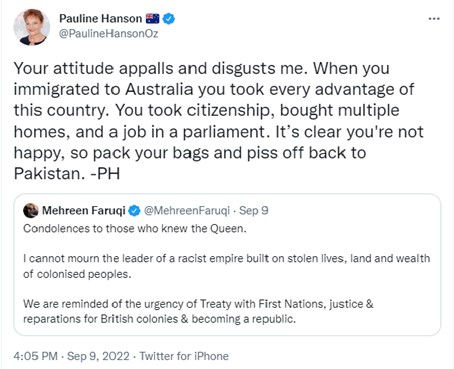
4 Senator Faruqi made a complaint about the Hanson Tweet to the Australian Human Rights Commission. Senator Hanson declined to participate in that process, and the complaint was terminated under s 46PH(1B)(b) of the Australian Human Rights Commission Act 1986 (Cth) (AHRC Act) on the basis that a delegate was satisfied there was no reasonable prospect of the matter being settled by conciliation. Senator Faruqi then commenced proceedings in this Court under s 46PO(1) of the AHRC Act alleging unlawful discrimination under s 18C of the Racial Discrimination Act 1975 (Cth) (RDA). Questions concerning the admissibility of certain evidence were dealt with prior to the trial of the proceeding: Faruqi v Hanson (evidence rulings) [2024] FCA 225 (ER).
5 For reasons explained in Faruqi v Hanson [2024] FCA 1264 (PJ or Primary Judgment), the Court made a declaration in the following terms:
1. The conduct of the respondent in publishing a tweet on the messaging platform then known as Twitter under the handle @PaulineHansonOz at 4.05pm on 9 September 2022 in terms that included telling the applicant to “piss off back to Pakistan”:
a. is unlawful under s 18C of the Racial Discrimination Act 1975 (Cth) in that it:
i. was reasonably likely in all the circumstances to offend, insult, humiliate and intimidate the applicant and groups of people, namely people of colour who are migrants to Australia or are Australians of relatively recent migrant heritage and Muslims who are people of colour in Australia;
ii. was done by the respondent because of the race, colour or national or ethnic origin of the applicant; and
b. is not exempted under s 18D(c)(ii) as it was not done reasonably and in good faith as a fair comment on a matter of public interest.
6 The Court also made orders that the Hanson Tweet be deleted, and that Senator Hanson pay Senator Faruqi’s costs of the proceeding. An appeal was commenced in this Court by which Senator Hanson argued that there were various errors in the approach that his Honour took to the issues before him. The grounds of appeal were substantially amended in the lead up to the hearing. In the course of the hearing, some arguments were advanced that were not encompassed within the grounds of appeal. It was not acknowledged that arguments were being proffered that were not encompassed within the grounds of appeal, and no leave was sought to amend, or to otherwise dispense with the requirement in the Federal Court Rules 2011 (Cth) (Rules) to set out the grounds of appeal within the notice of appeal (r 36.01(2)). We have dealt with each such instance in the course of our analysis, below.
7 For the reasons that we have explained below, we have concluded that Senator Hanson has not established any of the errors alleged in her Further Amended Notice of Appeal.
2. THE JUDGMENT BELOW
2.1 The framing of the case below
8 The proceeding below proceeded by way of concise statement, concise response, and concise reply. There are undoubtedly advantages to such a process in certain circumstances, including brevity, focus and concision. However, concise statements are not the same as statements of claim, and the rules which have developed in the context of pleadings do not necessarily apply mutatis mutandis to concise documents. This can lead to a degree of uncertainty that can be relevant to adducing evidence and to whether a certain case was relevantly “pleaded”. In highly contested cases where technical issues are likely to arise, the benefits of concise statements can be somewhat undermined.
9 The concise statement set out the Faruqi Tweet, and the Hanson Tweet in sequence. It identified the Hanson Tweet as “the act” by which Senator Hanson had engaged in unlawful behaviour because of race, colour or national or ethnic origin under Part IIA of the RDA. The originating application accompanying the concise statement more particularly focuses upon the words “pack your bags and piss off back to Pakistan” as constituting unlawful conduct under s 18C of the RDA.
10 The “group” that was said to be relevant to the analysis in s 18C was identified as one that “includes people” who have the following attributes:
(a) Persons of colour;
(b) Migrants to Australia;
(c) Persons with migrant heritage, born in Australia;
(d) Persons who by virtue of their appearance have been incorrectly identified as migrants;
(e) Muslim people;
(f) Persons with visible signs or expressions of religion;
(g) Persons who have been told to “go back to where they came from” or variations of that phrase due to their race, colour or national or ethnic origin; and/or
(h) Persons who have experienced racism,
(the Group Attributes).
11 Senator Hanson accepted in her concise response that “persons of colour” were a group protected by s 18C of the RDA, without any apparent assertion that this group could not be identified or was too broad to be protected (save that it was said that the group should be limited to Twitter users). Senator Hanson otherwise denied that any other group identified by Senator Faruqi is protected by s 18C of the RDA.
12 Senator Faruqi said in her concise statement that to establish her claim, it was necessary to establish that the act occurred otherwise than in private, that it was reasonably likely that Senator Faruqi, and members of the group (or some of them) were offended, insulted, humiliated or intimidated by the act, and that the act was done by Senator Hanson, including because of the race, colour or national or ethnic origin of Senator Faruqi or of the members of the group. Senator Hanson accepted that these were the elements necessary to establish the claim, save that it was said that it was also necessary to establish that the relevant group is protected under s 18C of the RDA.
13 Senator Faruqi asserted that she was offended, insulted, humiliated and intimidated, and further asserted that the act was reasonably likely to offend, insult, humiliate or intimidate “members of the group”. It was alleged that the Hanson Tweet was done because of the race, colour or national or ethnic origin of Senator Faruqi.
14 The concise statement identified harm alleged to have been suffered by Senator Faruqi and members of the group (or some members of the group).
15 In addition to denying the bulk of the allegations of Senator Faruqi, Senator Hanson sought to rely on the exemption under s 18D of the RDA, asserting that the Hanson Tweet was done reasonably and in good faith in making a fair comment on an event and/or matter of public interest that was an expression of a genuine belief held by Senator Hanson. Senator Hanson otherwise asserted that ss 18C and 18D of the RDA infringed the implied freedom of political communication in the Commonwealth Constitution (Constitution) and were therefore invalid either in full or in part.
16 The matter was heard over a period of four days. The issues raised by the parties were carefully and thoughtfully considered by the learned primary judge. His Honour identified three issues that had to be decided (PJ[27]):
(1) Was Senator Hanson’s tweet reasonably likely, in all the circumstances, to offend, insult, humiliate or intimidate another person (relevantly, Senator Faruqi) or a group of people (which group needs to be identified)? These are the para (a) requirements.
(2) Did Senator Hanson publish the tweet in the terms that she did because of the race, colour or national or ethnic origin of the other person (again, Senator Faruqi) or of some or all of the people in the group (again, to be identified)? These are the para (b) requirements.
(3) If the para (a) and para (b) requirements are satisfied, was the tweet published, in the terms that it was:
(a) reasonably and in good faith;
(b) as an expression of a genuine belief held by Senator Hanson; and
(c) as a fair comment on an event or matter of public interest?
These are the elements of the s 18D(c)(ii) defence relied on by Senator Hanson
2.2 The evidence
17 It is useful to briefly introduce the evidence. Where it is relevant to a ground of appeal, it is considered in further detail in that context.
2.2.1 Senator Faruqi
18 Senator Faruqi gave evidence and was cross examined. The primary judge concluded that she was an “impressive witness” who retained her composure despite significant provocation in cross examination (PJ[54]). His Honour considered her evidence to have been unshaken in cross examination, and he accepted it (PJ[59]).
19 His Honour recorded that Senator Faruqi’s evidence was that the impact of the Hanson Tweet had made her reflect like never before on the impacts of “‘telling it like it is’ for someone like her in Australian politics”, and said that it had a silencing effect on her and that she moderated herself when speaking about colonialism or racism because of the hate generated (PJ[48]). Senator Faruqi accepted that it was acceptable for Senator Hanson to object and respond to her comments about the Queen, but asserted that being told to “piss off back” to where she came from was insulting, offensive and humiliating (PJ[51]).
2.2.2 The autobiographical witnesses
20 Senator Faruqi called evidence from nine witnesses who were referred to as “autobiographical witnesses”. They were each identified as witnesses through a public invitation by Senator Faruqi to document how the Hanson Tweet made them feel (described at ER[35]). Each deponent gave evidence as to the demographic characteristics with which they identify, for example, “person of colour”, “person of migrant heritage”, “Muslim”, “culturally Jewish” and so on. In broad terms, each of the nine individuals gave evidence about their reaction to the Hanson Tweet, or how it made them feel – including whether they were offended, insulted, humiliated, or intimidated by the Hanson Tweet. The witnesses came from a variety of backgrounds, were between 25 and 50 years of age and were of different faiths. They also gave evidence about their lived experiences of racism, or other forms of discrimination or prejudice. The evidence of the autobiographical witnesses was summarised in some detail (PJ[60]-[118]). His Honour accepted the evidence of the autobiographical witnesses, noting that none of them were required for cross examination (PJ[61]).
21 Senator Hanson challenged the affidavits of the autobiographical witnesses on the basis that they were irrelevant, inadmissible opinion evidence, and that the probative value of the evidence was outweighed by it being prejudicial, misleading and a waste of time. There was also a parliamentary privilege objection to part of one of the autobiographical witness affidavits which is not presently relevant. The objections were heard by his Honour, who explained his reasons for admitting the evidence (ER[35]-[59]).
22 Senator Hanson’s first ground of appeal contends not only that the primary judge erred in failing to exclude the evidence, but also that his reliance upon it led to an erroneous decision.
2.2.3 The expert witnesses
23 Senator Faruqi called and relied upon the evidence of three expert witnesses, being:
(1) Professor Paradies, who holds the Chair in Race Relations in the Faculty of Arts and Education at Deakin University. His qualifications are many and varied, including a PhD in social epidemiology from the University of Melbourne. In addition, Professor Paradies conducts research on the health, social and economic effects of racism as well as anti-racism theory, policy and practice across diverse settings, including online, in workplaces, schools, universities, housing, the arts, sports and health. Professor Paradies’ evidence was to the effect that the Hanson Tweet was a “common form of racism”, described as “go back to where you came from” (PJ[127]). His evidence also traversed concepts about racism itself, how it arises, and how it operates. That opinion was said to be supported by research that he had undertaken. He further gave evidence about factors that might exacerbate the impact of racism. Professor Paradies was cross examined, and his Honour concluded that he was overall unshaken in cross examination, and his evidence was accepted (PJ[139]).
(2) Professor Reynolds, a Professor of Psychology and Learning at the Faculty of Education at the University of Melbourne, and an expert in the areas of group processes (leadership, influence, norms) and intergroup relations (stereotyping, prejudice, conflict, cohesion) from social identity perspectives. Her evidence included an explanation of prejudice, discrimination and racism as topics that have been central to social psychology over the last 80 years. Her evidence concerned the nature and impact of racism and prejudice. She was cross examined and his Honour concluded that her evidence was “unscathed” in that cross examination. His Honour accepted her evidence (PJ[149]).
(3) Associate Professor Wingard, a tenured Associate Professor in the English Department at the University of Houston, Texas with a PhD in Composition and Cultural Rhetoric from Syracuse University. Her research focuses on political and legal rhetoric, including how politicians and news media use repetitive phrases and memes to impact public opinion and voting practices. Her evidence concerned the understanding of the phrase “go back to where you came from” and its place in anti-immigrant and nativist sentiment in Western countries since nation-states commenced limiting immigration. She expressed the opinion that the Hanson Tweet implies that Senator Faruqi was “gifted” Australian citizenship, has enjoyed all the nation state has had to offer, but now is ungrateful and should therefore “go back to where she came from” (PJ[154]). Associate Professor Wingard was not required for cross examination.
24 The evidence of all three experts was subject to challenge. The challenge was rejected by the primary judge (see ER[60]-[108]) and Senator Hanson now asserts there was an error in failing to exclude some of the evidence. That error is said to have resulted in erroneous findings in the Primary Judgment overall, and these issues are canvassed in ground 1 of this appeal.
2.2.4 The tendency evidence
25 A solicitor for Senator Faruqi affirmed two affidavits setting out the details of internet research carried out by her and others directed at collating evidence of historical statements made by Senator Hanson which were said to be relevant to the issues in the case. The product of that research was used to support notices of intention to adduce tendency evidence under r 30.31 of the Rules for the purposes of s 97(1) of the Evidence Act 1995 (Cth) (Evidence Act). The alleged tendency was that Senator Hanson tended to make public statements (or endorse the public statements of other people that have been made) because of the race, colour or national or ethnic origin of a person that has, or a group of people that have, one or more of the Group Attributes.
26 In addition, it was said that Senator Hanson had a tendency to engage in commentary consistent with Senator Hanson holding white supremacist views, including by making hateful remarks about a person who has, or a group of people who have, one or more of the Group Attributes.
27 His Honour accepted that Senator Hanson’s repeated expression of the views and attitudes evidenced by the publication extracts set out in the tendency notice (summarised at PJ[198]) justified the finding which his Honour made, that Senator Hanson had a tendency to make negative, derogatory, discriminating or hateful statements in relation to, about or against groups of people relevantly identified as persons of colour, migrants to Australia and Muslims, and to do so because of those characteristics (PJ[199]). A challenge to the evidence referred to in the tendency notices, and findings made in reliance upon it, were not pressed in the course of this appeal.
2.2.5 Ms Gasparini
28 Ms Gasparini is a solicitor acting for Senator Faruqi. She affirmed an affidavit in support of an application to reopen Senator Faruqi’s case to adduce further evidence relevant to whether Senator Hanson knew at the time that she published the Hanson Tweet that Senator Faruqi was Muslim. The gist of that evidence was the substance of various internet searches performed by Ms Gasparini which tended to the conclusion (in Senator Faruqi’s submission) that Senator Hanson was aware at the time of publishing the Hanson Tweet that Senator Faruqi was Muslim. Ultimately his Honour had regard to all of this evidence, and concluded that it was not credible that Senator Hanson did not know at the time of the Hanson Tweet that Senator Faruqi was Muslim (PJ[206]).
2.2.6 Senator Hanson
29 Senator Hanson gave evidence and was cross examined. Her evidence canvassed her personal and public life, including her reaction to the death of Queen Elizabeth II, and the circumstances in which she came to draft, and cause to be published, the Hanson Tweet. Her evidence also canvassed her perception of Senator Faruqi’s hypocrisy and insincerity. Senator Hanson’s evidence was that there is nothing about Senator Faruqi’s race, colour or ethnic origin that means she should not be in Australia – it was her attitude that was said to be the reason that Senator Hanson told her to “pack your bags and piss off back to Pakistan” (PJ[176]). She said that she believed that what she said in her tweet was true and that it was an honest expression of her beliefs and that she thought that Senator Faruqi would “take my criticism on the chin” (PJ[177]).
30 His Honour said that he was “left with the distinct impression that Senator Hanson would say anything that came to mind if she thought that it would suit her at that time; she had little regard to whether what she said was true or false”. His Honour concluded that her evidence was generally unreliable (PJ[187]).
2.3 The elements of s 18C
2.3.1 Section 18C(1)(a): reasonably likely to offend, insult, humiliate or intimidate
31 It was common ground that the Hanson Tweet was an act done “otherwise than in private”. Therefore, his Honour identified as the first inquiry, whether the Hanson Tweet was likely, in all the circumstances, to offend, insult, humiliate or intimidate another person or a group of people (PJ[218]).
32 His Honour held that the requirement that the assessment of what was reasonably likely to offend, insult, humiliate or intimidate be made by reference to “all the circumstances” requires consideration of the social, cultural, historical and other circumstances attending the person or people in the group who are said to be likely to be offended, insulted, humiliated, or intimidated (PJ[219], relying on Eatock v Bolt [2011] FCA 1103; 197 FCR 261 (Eatock) at [257] (Bromberg J)). Those circumstances included:
(1) the death of the Queen on the day of both tweets (PJ[220]);
(2) the identities of both Ms Faruqi and Ms Hanson as Senators (PJ[220]);
(3) the content of the Faruqi Tweet to which the Hanson Tweet responded (PJ[220]);
(4) the medium of the publication of both tweets being Twitter, a forum well-known for harsh and unconsidered comments that readily “go viral” in the sense of being reproduced, spread and republished multiple times (PJ[220]);
(5) that the Hanson Tweet was a “reply” to the Faruqi Tweet which therefore contained the Faruqi Tweet within it (PJ[220]);
(6) that Senator Hanson had a very substantial following on Twitter (PJ[220]); and
(7) the content of the Hanson Tweet itself (PJ[221]-[223]).
33 The manner and extent to which his Honour took contextual matters into account is ventilated in ground 3 of this appeal.
34 As to the content of the Hanson Tweet itself, his Honour concluded that it had three central messages that were all directed to Senator Faruqi’s status as being from somewhere else. They were said to be:
(1) First: that as an immigrant, Senator Faruqi “took” advantage of Australia – she “took” citizenship, bought several houses and she took a job in the Parliament, yet she has the hypocrisy to be critical. His Honour said that this was a message that Senator Faruqi is, as an immigrant, a second-class citizen, and that she should be grateful for what she has and keep quiet. His Honour found it to be “othering and exclusionary” (PJ[221]).
(2) Secondly: that Senator Faruqi should “piss off back to Pakistan”. His Honour observed that this was accepted by Senator Hanson as a variant of the slogan “go back to where you came from”: a slogan which his Honour accepted to be a racist trope with a long history.
(3) Thirdly: the tweet was said to be targeted at Senator Faruqi herself, to convey an “anti-Muslim” message that was “Islamophobic” in that it “target[ed] a prominent Muslim and command[ed] her to go back to Pakistan” (PJ[223]).
35 The correctness (or otherwise) of his Honour’s conclusion in relation to these three central messages is at the core of the second ground of appeal in this case.
36 Having identified the messages of the Hanson Tweet as one of the circumstances requiring consideration in the analysis, his Honour went on to identify the likely effect of it upon a “person or a group of people”. It was necessary, his Honour said, to identify the group in s 18C(1)(a) by reference to the characteristics listed in s 18C(1)(b), i.e. by reference to race, colour or national or ethnic origin. His Honour said that the identification of the group or groups is not straightforward (PJ[225]). Having considered the authorities relevant to the task, his Honour concluded the most appropriate groups for consideration were (PJ[233]):
(1) people of colour who are migrants to Australia or who are Australians of relatively recent migrant heritage; and
(2) Muslims who are people of colour in Australia.
37 Those two groups have combinations of the pleaded characteristics extracted at [10(a)], [10(b)], [10(c)] and [10(e)] above. The identification of groups of this breadth in circumstances where the Hanson Tweet was, on its face, directed only at Senator Faruqi is the subject of ground 5(a) of this appeal. His Honour’s approach to the identification of the groups (and whether Senator Hanson received sufficient notice of the groups identified) is the subject of ground 5(b), while ground 5(c) raises the question of whether Senator Faruqi was, or needed to be, a member of the groups to sustain a complaint under s 18C. His Honour did not restrict the groups to users of Twitter, and this is said by Senator Hanson to constitute an error (ground 5(d)).
38 His Honour then turned to consider the likely reaction of the groups that he had identified to the Hanson Tweet. In doing so, his Honour said that the requirement that the relevant act is “reasonably likely” to have the requisite effect is satisfied if there is a “real” and “not fanciful or remote… chance” of the relevant outcome, that outcome being that the act would “offend, insult, humiliate or intimidate” (PJ[240], citing Eatock at [260]). In identifying acts that fell within that scope his Honour noted that s 18C(1)(a) only applies to conduct that has “profound and serious effects, not to be likened to mere slights” (PJ[239], citing Creek v Cairns Post Pty Ltd [2001] FCA 1007; 112 FCR 352 (Creek) at [16]; Bropho v Human Rights and Equal Opportunity Commission [2004] FCAFC 16; 135 FCR 105 (Bropho) at [70]; Eatock at [268]; Kaplan v Victoria (No 8) [2023] FCA 1092 (Kaplan) at [506]; Constantinou v Australian Federal Police [2024] FCA 123 at [21] (Constantinou)). His Honour did not consider evidence that some users of Twitter regarded the Faruqi Tweet as controversial and/or offensive to be relevant to the perspective of the “relevant reasonable group member or reasonable targeted person”, and so it was not a factor that would alter the impact of the Hanson Tweet upon that person or group (PJ[246]). His Honour also rejected the suggestion that the relevant hypothetical reader would see hypocrisy in the Faruqi Tweet because Senator Faruqi had sworn allegiance to the Queen (PJ[247]).
39 The inquiry was recognised by his Honour as an objective one (PJ[252]). Ground 3(b) argues that while his Honour identified the task as objective, it was an error to consider evidence of Senator Faruqi’s personal reaction to the Hanson Tweet.
40 In analysing the impact of the Hanson Tweet, his Honour accepted that it was a direct response to the Faruqi Tweet, but did not consider that context detracted from the “nature and strength” of the three messages which his Honour had identified (PJ[244]). Moreover, his Honour identified the content of the Faruqi Tweet to be concerned with Australian colonial history, and the role and place of race and racism in that history – acknowledging these to be contested issues, along with the question of whether Australia should become a republic, or have a treaty with First Nations people (PJ[244]). Although confronting to some people, even the characterisation of the British empire as “a racist empire built on stolen lives, land and wealth of colonised peoples” was not, his Honour found, an expression of fringe or revisionist historiography (PJ[245]). His Honour concluded that these contextual factors “would not be seen by the relevant hypothetical reader to justify or lessen the effect of the targeted, racist, anti-immigrant and anti-Muslim response from Senator Hanson” (PJ[244]-[245]).
41 His Honour found that the expert evidence of Professor Paradies and Professor Reynolds established the harmful effects of racism on an individual and societal level, and that racism is experienced vicariously (PJ[251]).
42 His Honour concluded that both groups of people in Australia that he identified (set out at [36] above) were reasonably likely, in all the circumstances, to have been offended (i.e. profoundly and seriously), insulted, humiliated and intimidated by the Hanson Tweet (PJ[242]). His Honour considered humiliation and intimidation to be at the more serious end of the spectrum of conduct prohibited by s 18C and thus more difficult to prove (PJ[252]). In relation to those two aspects of his Honour’s analysis, there was therefore some further emphasis, his Honour finding that:
(1) it was “seriously humiliating” to be told as an immigrant person of colour that you are a second-class citizen and unworthy (PJ[252]); and
(2) it was intimidating to be publicly attacked in the way that occurred, and to be subjected to the racist trope to go back to where you came from. His Honour said that this conclusion flowed “at least in part” because of the silencing effect of such conduct, explained by Professor Paradies, Professor Reynolds, Senator Faruqi, and some of the autobiographical witnesses, and the license it grants others to do the same. These are matters which, his Honour said, engender fear not only of being subjected to similar verbal racist abuse but also fear of being physically attacked. His Honour said it makes members of the relevant groups “feel that their place in Australia is vulnerable” (PJ[252]). That effect was found to have been exacerbated by the fact that Senator Hanson is a person in a position of power with an amplified voice and a work colleague of Senator Faruqi.
43 Thus, his Honour was satisfied that the likely effects of the messages in the Hanson Tweet rise “to and above” the “necessary gravity or severity inherent in the prohibition” in s 18C, and that they were “profound and serious” and could not be “likened to mere slights” (PJ[258], citing Kaplan at [30] and Constantinou at [21]). His Honour was therefore satisfied that the requirements in s 18C(1)(a) were established. This conclusion is challenged by grounds 4 (finding in respect of a hypothetical reasonable person in the circumstances of Senator Faruqi) and 5(e) (finding in respect of hypothetical reasonable members of the relevant groups) in this appeal.
2.3.2 Section 18C(1)(b): done because of race etc
44 His Honour then turned to the question of whether the Hanson Tweet was published “because of” a relevant attribute. His Honour noted that for an act to have been done “because of” a relevant attribute, it suffices that it be “a factor” in deciding to do the act (PJ[259], citing Creek at [28]; Toben v Jones [2003] FCAFC 137; 129 FCR 515 (Toben) at [37] (Carr J), [62] (Kiefel J) and [152] (Allsop J)). His Honour observed that the requisite causal connection is between the conduct on the one hand, and the relevant attribute of the person or group reasonably likely to be offended, insulted, humiliated or intimidated on the other (PJ[261], citing Eatock at [307]; Bharatiya v Antonio [2022] FCA 428 (Bharatiya) at [19]; Kaplan at [524]). In this sense, his Honour considered that it was necessary that there be a connection between the offensive conduct and the race, colour or national or ethnic origin of the person or group reasonably likely to be offended, insulted, humiliated or intimidated (PJ[261]).
45 His Honour then considered the expression “race, colour or national or ethnic origin”. His Honour noted that it was contentious whether Muslims or Muslims in Australia constituted a protected group because of a “shared ethnic origin” and that expression required “particular attention” (PJ[264]). After careful analysis of the authorities, his Honour concluded that it was appropriate to adopt the approach to formulation of a group with common ethnic origins from King-Ansell v Police [1979] 2 NZLR 531 and Mandla v Dowell-Lee [1983] 2 AC 548 (HL) (Mandla v Dowell-Lee) (PJ[273], i.e. that “[f]or a group to constitute an ethnic group in the sense of the Act of 1976, it must, in my opinion, regard itself, and be regarded by others, as a distinct community by virtue of certain characteristics” (Mandla v Dowell-Lee at 562)). His Honour noted that the RDA does not seek to protect people on the basis of their religious beliefs per se – but common religious beliefs, customs, practices or rituals may form an important component of ethnic identity arising from common ethnic origins (PJ[274]). On that basis, his Honour acknowledged that there was a case to be made that Muslims in Australia are an ethno-racial group and not merely a religious group (PJ[278]). Nonetheless, his Honour ultimately declined to make a finding that Muslims in Australia were an ethnic or ethno-racial group within the meaning of s 18C(1)(b) (PJ[278]-[280]). His Honour did, however, leave open the possibility that in a particular case if one reason the act was done is because a person (or group of people) is Muslim, it may be that the act was also done because of the race or colour or ethnic origin of the person (or the group). Such a case would depend on the intersectionality between the relevant person’s (or group’s) identity as Muslim and their identity with reference to race, colour or national or ethnic origin (PJ[280]). Senator Hanson alleges that his Honour fell into error in this analysis in ground 6(b).
46 Having then analysed the evidence carefully, his Honour concluded that the reasons that Senator Hanson proffered as being the reasons for which she published the Hanson Tweet did not exclude a prohibited factor from being a factor or reason (PJ[284]-[285]). Indeed, his Honour went on to conclude that there was no “satisfactory explanation” for the messages of the Hanson Tweet other than that they were conveyed because of the colour, national origin and Muslim identity of Senator Faruqi. This, his Honour concluded, constituted a “racist and nativist attack… made because of the race, colour or ethnic or national origin of the person targeted” (PJ[286]). This conclusion is challenged in a number of ways, including in ground 6(a), which asserts that his Honour erred by failing to accept Senator Hanson’s evidence relevant to whether she published the Hanson Tweet because of the race, colour or national or ethnic origin of Senator Faruqi and that she did not know that Senator Faruqi was Muslim, and ground 6(c) which asserts that a finding that an act was done because of the race, colour or national or ethnic origin of a group had to be because of the race etc of that group as formulated for the purposes of s 18C(1)(a), and not the race etc of a single person.
2.4 Section 18D
2.4.1 Section 18D(c)(ii): fair comment
47 His Honour then went on to consider whether the exemption in s 18D(c)(ii) of the RDA applied, noting that reasonableness in s 18D is ultimately an objective question (PJ[295], citing Bropho at [79]; Comcare v Martinez (No 2) [2013] FCA 439; 212 FCR 272 (Martinez) at [82] (Robertson J)) while the good faith requirement has both an objective and subjective element (PJ[296], citing Clarke v Nationwide News Pty Ltd [2012] FCA 307; 201 FCR 389 (Clarke) at [133]; Eatock at [346]-[348]).
48 As to reasonableness, his Honour concluded that there was no rational relationship between what was said and the proclaimed purpose or reasons for the Hanson Tweet, nor was it done in a manner calculated to advance that purpose or reason (PJ[305]).
49 In relation to good faith, his Honour concluded that there was no conscientious approach to advancing the exercise of Senator Hanson’s freedom of speech in a way that was designed to minimise the offence, insult, humiliation or intimidation suffered by people affected by it, finding instead that Senator Hanson carelessly disregarded or was wilfully blind to its effect upon people who would be hurt by it (PJ[305]). As a result, Senator Hanson failed to establish that the exemption under s 18D applied. His Honour’s approach to the defences in s 18D is challenged in grounds 7(a)–(e) of the present appeal.
2.5 The implied freedom of political communication
50 Senator Hanson contended before the primary judge that, in the event that his Honour found that her tweet was unlawful under s 18C(1) (and not exempt under s 18D(c)), he should also find that s 18C as read with s 18D was invalid as being in conflict with the implied freedom of political communication recognised in Lange v Australian Broadcasting Corporation (1997) 189 CLR 520 (Lange) and elaborated in a series of subsequent High Court decisions. The primary judge rejected this argument.
51 Briefly, his Honour’s reasoning proceeded in the following way.
52 First, it was noted that this issue had been decided in favour of validity by Hely J in Jones v Scully [2002] FCA 1080; 120 FCR 243 at [239]-[240] (Jones v Scully). The question was therefore approached on the basis that it was necessary for Senator Hanson to establish that the resolution of the point in Jones v Scully was plainly wrong. Despite that being the proper starting point, his Honour also recognised that the jurisprudence of the High Court had developed over the 22 years since Jones v Scully and this needed to be taken into account.
53 The following basic and largely uncontroversial propositions were then noted.
(1) The implied freedom is a limitation on legislative power to ensure that the people of the Commonwealth can “exercise a free and informed choice as electors” (Lange at 560 (Brennan CJ, Dawson, Toohey, Gaudron, McHugh, Gummow and Kirby JJ)). It “extends only so far as is necessary to preserve and protect the system of representative and responsible government mandated by the Constitution” (Comcare v Banerji [2019] HCA 23; 267 CLR 373 at [20] (Kiefel CJ, Bell, Keane and Nettle JJ) (Banerji)).
(2) The inquiry as to whether legislation infringes the implied freedom (and is therefore invalid) can be expressed in three questions which are set out in Clubb v Edwards [2019] HCA 11; 267 CLR 171 at [5] (Kiefel CJ, Bell and Keane JJ) (Clubb) and extracted below. The issues had originally been framed in this way in McCloy v New South Wales [2015] HCA 34; 257 CLR 178 at [2] (French CJ, Kiefel, Bell and Keane JJ) (McCloy) and we will refer to them as the “McCloy questions”.
1. Does the law effectively burden the implied freedom in its terms, operation or effect?
2. If “yes” to question 1, is the purpose of the law legitimate, in the sense that it is compatible with the maintenance of the constitutionally prescribed system of representative and responsible government?
3. If “yes” to question 2, is the law reasonably appropriate and adapted to advance that legitimate object in a manner that is compatible with the maintenance of the constitutionally prescribed system of representative and responsible government?
54 His Honour observed that the first question is a qualitative rather than a quantitative one and is to be answered by reference to the legal and practical operation of the law (PJ[318]). A law which prohibits or limits political communication to any extent will usually be found to impose an effective burden and therefore require the second and third questions to be addressed (PJ[320]). The question requires consideration of the impact of the law on political communication generally rather than how it applies to the particular communication in which an applicant wishes to engage (PJ[321]).
55 There was agreement between Senator Hanson and the Attorney-General that s 18C did effectively burden the implied freedom. Senator Faruqi resisted this conclusion but accepted that it was supported by a holding, directly on point, in Jones v Scully at [239]. As to the extent of the burden, Senator Hanson submitted that it was significant while the Attorney-General submitted that it was slight. The primary judge referred to statements supportive of the view that legislation designed to prevent one group of people being silenced by another can enhance freedom of communication overall even while restricting the freedom of the latter group, and also had regard to limits on the applicability of s 18C (including those arising from s 18D) which indicated that it was likely to affect only a narrow class of political communications. His Honour concluded that Part IIA of the RDA effectively burdened political speech “but only slightly” (PJ[338]).
56 As to the second question, compatibility involved consideration of whether the purpose served by the law was one that “does not impede the functioning of” the system of representative and responsible government “and all that it entails” (PJ[340], referring to McCloy at [31] and Farm Transparency International Ltd v New South Wales [2022] HCA 23; 277 CLR 537 at [29] (Kiefel CJ and Keane J) (Farm Transparency)). The primary judge accepted the Attorney-General’s statement of the purpose of Part IIA and agreed that it was a legitimate purpose in the relevant sense. That was “to deter and eliminate, and thus protect members of the public from, racial hatred and discrimination” (PJ[342]).
57 The third question was treated, by reference to the recent High Court cases, as involving in effect three sub-inquiries: suitability, necessity and adequacy in balance. This threefold inquiry is referred to in the authorities as “structured proportionality”.
(1) Suitability looks to whether there is a rational connection between the impugned provisions and the statute’s legitimate purpose, such that that purpose is furthered. This question was readily answered in the affirmative (PJ[350]).
(2) Necessity looks to whether there is an alternative measure that is equally practicable having regard to the purpose being pursued, but less restrictive of the communication protected by the implied freedom. This inquiry accepts that it is a matter for the legislature to select the means by which a statutory purpose may be achieved, and does not invite an assessment of the relative merits of competing legislative models. Thus, a law will not normally fail at this stage unless there is an “obvious and compelling alternative which is equally practicable and available and would result in a significantly lesser burden on the implied freedom” (PJ[352], citing Banerji at [35]). The primary judge held that the “necessity” requirement was satisfied by Part IIA of the RDA (PJ[360]). His Honour rejected a submission of Senator Hanson that the legislative purpose could be achieved to the same extent by a version of the provisions that expressly exempted political communication (PJ[355]). Plainly, legislation drafted in that way would reduce the coverage of, and thus the protection provided by, s 18C. His Honour was also not persuaded that it would impose a significantly lesser burden on the implied freedom, because the provisions of Part IIA as they stood imposed only a “slight burden”.
(3) As to adequacy in balance, a law is “regarded as adequate in its balance unless the benefit sought to be achieved by the law is manifestly outweighed by its adverse effect on the implied freedom” (PJ[361], citing Banerji at [38]; LibertyWorks Inc v Commonwealth of Australia [2021] HCA 18; 274 CLR 1 at [85] (Kiefel CJ, Keane and Gleeson JJ), [292] (Steward J) (LibertyWorks) and Farm Transparency at [55]). In this connection, the primary judge accepted four propositions advanced by the Attorney-General which emphasised the importance of Part IIA’s proscription of harmful racist conduct: that racial vilification has been and remains a real problem in Australia (PJ[363]); that racial vilification and discrimination have harmful effects at both individual and societal levels (PJ[369]); that other jurisdictions have sought to regulate the incitement of racial hatred (PJ[372]); and that the object pursued by the legislation arises from Australia’s ratification of the International Convention on the Elimination of all Forms of Racial Discrimination, opened for signature 21 December 1965, 660 UNTS 195 (entered into force 4 January 1969) (ICERD) (PJ[373]). His Honour further accepted that the provisions do not prohibit people from expressing ideas or holding beliefs, no matter how unpopular they might be (PJ[375]); that the purpose of the provisions was not to restrict political communication, but to regulate acts that have serious effects and are not necessarily political in nature (PJ[376]); and that the terms of the provisions were (contrary to a submission of Senator Hanson) not uncertain or vague (PJ[377]). Although the conclusion is not stated in such terms, it is clear that the primary judge regarded Part IIA as adequate in its balance.
58 For these reasons the primary judge held, at PJ[378] that the conclusion as to validity in Jones v Scully was not plainly wrong and that Part IIA of the RDA was not invalid. This conclusion is challenged by ground 9 of the appeal.
2.6 A Constitutional Head of Power?
59 In ground 8, Senator Hanson raises a further challenge to the Constitutionality of ss 18B, 18C and 18D of the RDA, by asserting that they are not authorised by a head of legislative power in the Constitution. In raising this argument, we are asked to overturn the long-standing authority in Toben which found that those provisions were reasonably appropriate and adapted to give effect to international conventions to which Australia was a party, specifically the ICERD and the International Covenant on Civil and Political Rights, opened for signature 19 December 1966, 999 UNTS 171 (entered into force 23 March 1976) (ICCPR).
2.7 Remedy
60 His Honour therefore considered that a breach of s 18C was established, and the exemption under s 18D(c)(ii) was not engaged. Because the law was constitutionally valid, his Honour went on to consider appropriate remedies, noting that the power to fashion an appropriate remedy is “obviously broad” (PJ[380]). His Honour considered it was “appropriate and justified” that a declaration be made to the effect that the conduct in question was unlawful and in contravention of s 18C and not exempted under s 18D (PJ[382]) and to require Senator Hanson to delete the Hanson Tweet (PJ[384]). His Honour declined to make orders requiring Senator Hanson to “pin” a tweet to her Twitter page recording the declaration of unlawful conduct and to maintain it for three months (PJ[385]), or to restrain Senator Hanson from using phrases such as “piss off back to Pakistan” or “go back to where you came from” in public (PJ[383]). Similarly, his Honour declined to make orders for the payment of any donation (PJ[388]), or requiring Senator Hanson to undertake “anti-racism training” (PJ[389]). Costs were, however, ordered to be paid by Senator Hanson (PJ[390]; see also Faruqi v Hanson (Costs) [2024] FCA 1389).
3. THE STATUTORY FRAMEWORK
61 Section 18C is the central provision of the statutory regime relevant to this proceeding. By way of overview, s 18C makes it unlawful to do an act otherwise than in private which is reasonably likely, in all the circumstances, to offend, insult, humiliate or intimidate a person or a group of persons, and which is done because of the race, colour or national or ethnic origin of the person or people in the group. Section 18B provides, for this purpose, that an act is done “because of” a person’s race, colour or national or ethnic origin if that is one of the reasons why it is done. Section 18D exempts statements and acts of certain kinds that are said or done “reasonably and in good faith” in certain circumstances. Section 18E imposes vicarious liability on an employer for contraventions of s 18C by its employees.
62 The relevant provisions provide:
18B Reason for doing an act
If:
(a) an act is done for 2 or more reasons; and
(b) one of the reasons is the race, colour or national or ethnic origin of a person (whether or not it is the dominant reason or a substantial reason for doing the act);
then, for the purposes of this Part, the act is taken to be done because of the person’s race, colour or national or ethnic origin.
18C Offensive behaviour because of race, colour or national or ethnic origin
(1) It is unlawful for a person to do an act, otherwise than in private, if:
(a) the act is reasonably likely, in all the circumstances, to offend, insult, humiliate or intimidate another person or a group of people; and
(b) the act is done because of the race, colour or national or ethnic origin of the other person or of some or all of the people in the group.
Note: Subsection (1) makes certain acts unlawful. Section 46P of the Australian Human Rights Commission Act 1986 allows people to make complaints to the Australian Human Rights Commission about unlawful acts. However, an unlawful act is not necessarily a criminal offence. Section 26 says that this Act does not make it an offence to do an act that is unlawful because of this Part, unless Part IV expressly says that the act is an offence.
(2) For the purposes of subsection (1), an act is taken not to be done in private if it:
(a) causes words, sounds, images or writing to be communicated to the public; or
(b) is done in a public place; or
(c) is done in the sight or hearing of people who are in a public place.
(3) In this section:
public place includes any place to which the public have access as of right or by invitation, whether express or implied and whether or not a charge is made for admission to the place.
18D Exemptions
Section 18C does not render unlawful anything said or done reasonably and in good faith:
(a) in the performance, exhibition or distribution of an artistic work; or
(b) in the course of any statement, publication, discussion or debate made or held for any genuine academic, artistic or scientific purpose or any other genuine purpose in the public interest; or
(c) in making or publishing:
(i) a fair and accurate report of any event or matter of public interest; or
(ii) a fair comment on any event or matter of public interest if the comment is an expression of a genuine belief held by the person making the comment.
63 Much of the task of this Court in this appeal is the construction of the relevant terms of the RDA, having regard to their text, context and purpose (SZTAL v Minister for Immigration and Border Protection [2017] HCA 34; 262 CLR 362 (SZTAL) at [14]). Context should be regarded at this first stage and it should be regarded in its widest sense (SZTAL at [14]) as follows:
The starting point for the ascertainment of the meaning of a statutory provision is the text of the statute whilst, at the same time, regard is had to its context and purpose [citing Project Blue Sky with approval]. Context should be regarded at this first stage and not at some later stage and it should be regarded in its widest sense. This is not to deny the importance of the natural and ordinary meaning of a word, namely how it is ordinarily understood in discourse, to the process of construction. Considerations of context and purpose simply recognise that, understood in its statutory, historical or other context, some other meaning of a word may be suggested, and so too, if its ordinary meaning is not consistent with the statutory purpose, that meaning must be rejected.
64 When considering the context in this case, it is important to have regard to the legislative purpose to which the provision is directed. A single Judge of this Court in Eatock set out an overview of the legislative history and the purpose and policy that underpin Pt IIA of the RDA (at [195]-[240]). That policy is summarised in Eatock at [207]-[210] as follows:
Both the words utilised in s 18C and the legislative context in which Pt IIA was enacted, demonstrates that the mischief which those provisions seeks to address is broader than conduct inciting racial hatred and extends to conduct at a lower level of transgression to the objective of promoting racial tolerance. Whilst Pt IIA is headed “Prohibition of Offensive Behaviour based on Racial Hatred”, the phrase “racial hatred” should, for the reasons given by Allsop J in Toben (and followed by French J in Bropho at [68]), be seen to have been used as a “convenient short-hand” for a broader concept: Toben at [130]-[131] and [137].
The use of the word “hatred” in the heading to Pt IIA is not to be “seen as a control upon otherwise clear words that were deliberately chosen, as a departure from previous models” (Toben at [137] (Allsop J)) or as creating a separate test confined to racial hatred (Creek at [18] (Kiefel J)). No member of the Full Court in Toben was of the view that s 18C was to be read down as applying only to cases of racial hatred. No member of this Court has adopted that view in any other case. A number of judges of this Court have construed Pt IIA as extending beyond the limits or boundaries of the prohibitions contemplated by Art 4 of CERD and thereby encompassing conduct extending beyond expressions of racial hatred and as “intended to pursue a policy of eliminating racial discrimination and promoting understanding among races”: Toben at [136] (Allsop J) and see [19], [20] (Carr J) and [50] (Kiefel J); Bropho at [68] (French J).
Other judicial statements have identified the underlying purpose of Pt IIA as intending to regulate conduct which stimulates contempt or hostility between groups of people within the community by lowering regard for, and demeaning the worthiness of, the person or persons subjected to the conduct: Bropho at [138] (Lee J); or as seeking to control “socially corrosive conduct”: Bropho at [138] (Lee J); or as seeking to eliminate racial discrimination: Scully at [240] (Hely J); and as seeking to promote racial tolerance: McGlade v Lightfoot (2002) 124 FCR 106 at [90] (Carr J).
That all Australians should be able to live their lives free from the harm caused by the dissemination of racial prejudice is not, however, the only value that Pt IIA of the RDA seeks to promote and protect. The terms of s 18D together with the Explanatory Memorandum and the Second Reading Speech to the 1994 Bill (“the Second Reading Speech”) make it abundantly clear that freedom of expression was also regarded as an important value which Parliament intended should, in the circumstances defined by s 18D, be balanced against the objective of promoting racial tolerance and proscribing inappropriate racially based behaviour. The Second Reading Speech described the provisions of Pt IIA as balancing free speech against the rights of Australians to live free of fear and racial harassment: see further Creek at [32] (Kiefel J); and Bropho at [3] and [62] (French J).
65 As such, it is well established by authority that the underlying purpose of Pt IIA is not limited to addressing racial hatred as the title to Part IIA might suggest. Nor, as the Full Court held in Toben, is s 18C to be read down so as to be limited to proscribing racial hatred in order to be within legislative power, as we later explain. It extends more broadly to eliminating racial and certain other kinds of discrimination and promoting understanding among races. Conversely, s 18D was included in the RDA because freedom of expression was also regarded by Parliament as an important value. Although the balance between the two concepts inevitably necessitates the making of evaluative judgments, the need to strike a balance is recognised in Pt IIA by s 18D, which renders lawful, certain racially motivated acts that would cause offence (or otherwise contravene s 18C) if the act falls within the circumstances identified (Eatock at [210], Creek at [32], Bropho at [3] and [62]). We respectfully agree with the statement of Bromberg J in Eatock (at [211]) that:
A proper understanding of what Pt IIA seeks to achieve requires an understanding of the two foundational values upon which the Part is founded. Whilst to some extent those values are complementary of each other, Pt IIA puts them in contest and then seeks to identify a point of balance at which harmony between them is to be found.
66 These two foundational values of Pt IIA have come into sharp focus in the age of almost unrestricted, instantaneous mass communication over social media platforms like X.
3.1 The objective test in s 18C(1)(a)
67 Section 18C(1)(a) requires determination of whether the act complained of is reasonably likely, in all the circumstances, to offend, insult, humiliate or intimidate another person or a group of people. This task requires:
(1) identification of the person or group; and
(2) assessment of the reasonably likely reaction(s) of that hypothetical reasonable person or the group (i.e. be offended, insulted, humiliated or intimidated) to the act in question and whether it meets the definition of offence, humiliation, insult or intimidation required by s 18C.
68 As Bromberg J explained in Eatock (at [241]), therefore:
It is thus the risk of a person or one or more people within a particular group of people being offended, rather than the actuality of offence that is being assessed. Proof of actual offence for particular person or group is neither required nor determinative, although evidence of subjective reaction is relevant to whether offence was reasonably likely…
(Citations omitted.)
3.1.1 The identification of the group
69 The person or group referred to in s 18C(1)(a) is the person or group who is reasonably likely to be offended, insulted, humiliated or intimidated by an act done otherwise than in private. The identification of the group is, in some instances, straightforward, and in others, less so. The principles applied in the context of misleading and deceptive conduct have provided some assistance to the way in which identification of the group should be approached (Eatock at [243]). The way in which an applicant chooses to run their case may be relevant. Examples of how previous cases have identified the group are instructive:
(1) In Kaplan, no group was expressly identified or pleaded (see Kaplan at [508]). Chief Justice Mortimer considered that, since the speech was not broadcast, made through the media or published to the world, the group who it was reasonably likely could be offended, insulted, humiliated or intimidated must have been the persons who could hear the speech (Kaplan at [510]-[511]). Her Honour determined that there were two relevant groups in respect of which findings should be made, being (a) Jewish students of the school in the audience, and (b) non-Jewish students of the school in the audience (Kaplan at [509]). Teachers and staff present, and those to whom the speech was later re-broadcast, were not part of the relevant group because the “making of this speech, in person, to BSC students”, was the act said to contravene s 18C (Kaplan at [507], [512]).
(2) The defined group may include discernible sub-groups. For instance, in Jones v Toben [2002] FCA 1150 (Jones), Branson J identified Australian Jewry as a group, as well as “members of the Australian Jewish community vulnerable to attacks on their pride and self-respect by reason of youth, inexperience or psychological vulnerability” (Jones at [95]-[96]; see also Clarke at [63]; Eatock at [252]).
70 Throughout this appeal, issues arose as between what Senator Hanson characterised as the “group case” and the “individual case”. At the level of statutory framing, it is convenient to observe that s 18C(1)(a) is aimed at conduct “other than in private” that has a particular impact on either a person or a group of people. The potential for overlap between a case concerning an individual or a group was identified in Clarke as a difficult issue, including because the conduct could be “directed to both the individual and the group” (Clarke at [61], citing Eatock at [248]). In Eatock, Mr Bolt published articles that conveyed offensive messages to the effect that there are fair-skinned people in Australia with essentially European ancestry but with some Aboriginal descent, of which Ms Eatock and other individuals were examples, who were not sufficiently Aboriginal so as to genuinely identify as Aboriginal persons but who chose to identify as Aboriginal so that they could access career opportunities or for political activism (see Eatock at [37], [55], [284]). The articles at issue were directed at individual fair-skinned Aboriginal people and impacted the wider group of which the individuals were a part (see Eatock at [248], [287]). It was pleaded as a broader group case, and his Honour rejected an argument that it could be considered a group claim by the applicant and the eight other witnesses who had supported her because the “pleadings have not stated with reasonable clarity that a case based on the personal offence of the nine witnesses was being pressed” (Eatock at [274]) and was not identified until closing submissions (Eatock at [276]). This was not to suggest that the proceeding could not have been put as a case on behalf of those individuals (cf Eatock at [300]-[301]), simply that it had not been done in that way.
71 There are therefore a range of ways that a claim under s 18C(1)(a) can be constituted. It can be a case commenced by an individual, in which the conduct done “other than in private” was likely to impact upon them in a proscribed way. It might be that such a case is a purely “individual” case.
72 Alternatively, or in addition, an individual can commence an action where the relevant offence was reasonably likely to be experienced by a group of people, including an applicant. Such a claim is not commenced as a group proceeding as that concept is understood in this Court – it is not a class action. It is a statutory cause of action, the metes and bounds of which follow from the identification of the reasonably likely response to the action done otherwise than in private. This issue is explained in further detail in addressing ground 5(c) below.
73 Section 18C(1)(a) does not identify the persons or group of people who should be considered for the purposes of determining whether the impugned act was reasonably likely to cause offence (Eatock at [243]). This is a question of fact to be determined in the individual case and can be limited by the way that an applicant elects to run their case.
74 In both Eatock and Clarke, the Court spoke of conduct being “directed to” either an individual or a group. That language has been taken up by Senator Hanson in this case as laying down a criterion for the identification of the group. That approach is not consistent with the statutory language, which directs attention to the reasonably likely reaction of the group, and not to the intention of the person who committed the act. While the person or group that an act or communication was directed to will generally be relevant (and sometimes dispositive) of who is reasonably likely to be offended, insulted, humiliated or intimidated, that will not always be the case. The guiding principle must be the words of the statute: those words direct attention to what is “reasonably likely, in all the circumstances”. Where it can be shown that it is reasonably likely in all the circumstances that a person or group would be offended, insulted, humiliated or intimidated by an act done otherwise than in private, then the requirements in s 18C(1)(a) will be satisfied.
75 Taken together, we consider that a claim that an act is reasonably likely to offend, insult, humiliate or intimidate a group of people involves:
(1) First: identifying those who it is reasonably likely could be affected by the act done otherwise than in private. This means identifying the reasonably foreseeable reach of the act at the time it is done. In Kaplan, the fact that the speech was made at an assembly of school children and was not otherwise likely to be broadly published was relevant to the confined scope of the groups identified. In many instances, the group affected will be the group at whom the act was directed. However, we do not consider that must be the case in all circumstances, particularly where the act is published broadly.
(2) Secondly: of those who could be affected by the act, identify the attributes of the ordinary or reasonable members of that group.
(3) Thirdly: assess the reasonably likely reaction of the group having regard to those attributes, excluding the extreme or atypical reactions (Eatock at [251]).
76 Because they are relevant to different grounds raised in this appeal, we have made some preliminary observations in relation to each step.
3.1.2 The assessment of the reaction of the group
77 Section 18C(1)(a) directs attention to what is “reasonably likely” to be the reaction (e.g. offend, insult, humiliate or intimidate) “in all the circumstances”. The focus in this part of the inquiry is upon the effect of the act on a reasonable person in the shoes of the victim and not the intention of the person who committed the act (Eatock at [206]; Creek at [18]). We respectfully agree with the observation made in Clarke at [51] that the adoption of the perspective of the “reasonable victim” is important because, among other things, if the Court were not to adopt that perspective, there would be a real risk that the standard of some other, different person or group would be adopted without any sensitivity to cultural differences between groups in the community. However, to focus upon the victim’s feelings irrespective of their reasonableness would potentially make it very difficult, if not impossible, for individuals to determine whether their conduct was or may be in breach of the RDA and thereby have a potentially chilling effect on free speech.
78 An act will be “reasonably likely” to have the relevant consequence where there is a “real” and “not fanciful or remote” chance of the requisite outcome (Eatock at [260]). That must be proved by the applicant on the balance of probabilities.
79 The words “in all the circumstances” are significant, as they ask the Court to take into account a broad range of matters that are capable of impacting on, or informing, the reaction that is reasonably likely to be had by hypothetical representatives of the group, as constituted. As a result, extreme or atypical reactions are disregarded (Eatock at [251]). Furthermore, and importantly, this does not mean that only one reasonable response in particular circumstances may be postulated. Rather, as Dowsett J explained in National Exchange Pty Ltd v Australian Securities and Investments Commission [2004] FCAFC 90; 49 ACSR 369 at [24]: “[f]requently, different persons, acting reasonably, will respond in different ways to the same objective circumstances. The test of reasonableness involves the recognition of the boundaries within which reasonable responses will fall, not the identification of a finite number of acceptable reasonable responses”. Thus, as Bromberg J explained in Eatock at [252], by way of elucidating upon Dowsett J’s point:
…it is necessary to bear in mind that conduct may be directed at a diverse group of people. A diverse group will likely comprise discernible sub-groups. Reactions to the same conduct may vary as between sub-groups. That may be because of an extra attribute common to the sub-group.
80 While the scope of conduct captured by s 18C(1) is broader than conduct inciting racial hatred and embraces conduct that is less serious, it is well established that s 18C(1)(a) is intended to deal with profound and serious effects, rather than “mere slights” (Creek at [16]; Bropho at [70]; Jones at [92]; Eatock at [207] and [268]; Clarke at [70]). In Kaplan, Mortimer CJ noted that the words “offend, insult, humiliate or intimidate” are open textured: all connote a negative, adverse effect, more than fleeting, but need not be at the extreme level of “racial hatred” (at [506], citing Bropho at [67]-[68]).
81 It is also important to note that s 18C is not concerned with hate or incitement of hatred (contrast with Catch the Fire Ministries Inc v Islamic Council of Victoria Inc [2006] VSCA 284; 15 VR 207 at [140] (Neave JA)). The motive and feelings of the person who committed the act are not relevant to the assessment of the reaction of the group (Eatock at [206]; Creek at [18]), although who they are and the circumstances of the act can be matters relevant to the reaction of the group.
3.2 Identifying causation: s 18C(1)(b)
82 If the Court is satisfied that the act is reasonably likely in all of the circumstances to have the proscribed effect, then it is necessary to determine if the act was done “because of” race, colour or national or ethnic origin (Creek at [17]-[18]; Eatock at [206]).
83 Section 18B makes clear that an impugned act (that is, one which is said to be reasonably likely to cause offence, insult, humiliation or intimidation to a person or a group of people) is done “because of” the race, colour or national or ethnic origin of the person or members of the group if one of those attributes is a factor in the respondent’s decision to do the act. The expression “because of” makes the issue one of causation rather than subjective motivation, although evidence about motivation may well be critical in deciding that issue.
84 In Eatock, Bromberg J collected the various ways that the requirement in s 18C(1)(b) has been expressed (at [308]):
• “whether anything suggests race as a factor in the respondent’s decision to publish”: Creek at [28] (Kiefel J); Scully at [114] and [116] (Hely J); Jones at [99] (Branson J);
• Did considerations of race actuate or motivate the conduct?: Creek at [28] (Kiefel J);
• Was the act “plainly calculated to convey a message about” or concerned with the racial group?: Jones at [99]-[100] (Branson J); Toben at [38] (Carr J), [65] (Kiefel J), [154] (Allsop J); Scully at [117]-[118] and [224] (Hely J); McGlade at [66] (Carr J).
85 In Kaplan, Mortimer CJ explained causation between s 18C(1)(a) and (b) in the following way (at [524], emphasis in original):
By the terms of s 18C(1)(b) itself, and on the authorities (see Eatock at [307] and the authorities there cited), the requisite causal connection is between (relevantly) the remarks and the race of the person or group reasonably likely to be offended, insulted, humiliated or intimidated. My findings above are that the group reasonably likely to be offended, insulted, humiliated or intimidated by the particular words and phrases used in Mr Minack’s speech were Jewish students at BSC present in the audience during the speech, and no wider group than that. Therefore, the question is whether there is a causal connection between Mr Minack’s remarks and the Jewish students at BSC who were in the audience.
86 A core argument of Senator Hanson in this appeal is that there is a disconnect between the group identified by the primary judge for the purpose of s 18C(1)(a) and the race, colour or national or ethnic origin of the individual which it is said actuated the conduct. This issue is considered in greater detail in relation to ground 6 below.
3.3 Section 18D
87 The onus of proof in relation to s 18D lies on the respondent and the requirement that an act is said or done “reasonably and in good faith” is necessary to establish each of the exemptions provided for in that section.
88 Reasonableness, for the purpose of s 18D, is an objective question. It requires that there be a rational connection between the purpose or activity referred to in the relevant paragraph of s 18D on the one hand, and the doing of the impugned act on the other. The concept of reasonableness is also informed by the “normative aspects” of ss 18C and 18D and a recognition of the competing values protected by those sections (Bropho at [79] (French J)). Necessarily, we are speaking here of an act that contravenes the norm in s 18C. We therefore take the statement of French J to mean that if the act is done in a way that is rationally connected with the purpose of the exemption, then it is done “reasonably”. Thus, a scientific paper which is relevantly offensive, insulting, humiliating or intimidating might nonetheless be exempt if it is discussed at a scientific conference (Bropho at [80]).
89 Good faith for the purpose of s 18D requires both subjective honesty and legitimate purpose, and “a conscientious approach to the task of honouring the values asserted by the Act … assessed objectively” (Bropho at [96]; see also [101]-[102]). We do not understand this to mean that a person who does an act or thing must necessarily demonstrate conscious advertence to s 18C. However, what it does require is sensitivity to the values embodied in that section. An act ostensibly within the scope of one of the paragraphs of s 18D will not engage the exemption if that purpose is simply a pretext for engaging in racist speech, or if the act is done with wilful blindness of its effect on people who will be hurt by it.
90 The “fair comment” exception in s 18D(c)(ii) applies to comments, not statements of fact. To be “fair”, a comment must be based upon “true facts” and those facts must be “expressly stated, referred to or notorious” (Eatock at [355]). The view expressed must be genuinely held (Eatock at [357]). Where the comment is made in response to another person’s statement, the earlier statement is part of the context in which the fairness of the comment is to be evaluated. Issues connected with the exemption are examined in more detail in connection with ground 7 below.
4. THE GROUNDS OF APPEAL
91 There are nine grounds of appeal, each containing numerous sub-grounds which fall into five broad categories. They can be summarised as follows:
(1) Grounds concerned with evidentiary rulings and their impact on the outcome on the final decision (ground 1).
(2) Grounds concerned with the construction of s 18C(1)(a) of the RDA, and whether the Hanson Tweet fell within it (grounds 2-5).
(3) Grounds concerned with the construction of s 18C(1)(b) of the RDA (ground 6).
(4) Grounds concerned with the construction of the exemption in s 18D(c)(ii) of the RDA (ground 7).
(5) Grounds concerned with the Constitutional validity of ss 18B, 18C and 18D of the RDA (grounds 8-9).
92 In approaching our task, we have had the considerable advantage of substantial factual findings made by the primary judge. Where those findings relate to impressions of the credibility of witnesses, the trial judge enjoys very considerable advantages over an appellate court. It is commonly said in those circumstances that the appellate court will not depart from the trial judge’s conclusions unless they are shown to be wrong by reference to “incontrovertible facts or uncontested testimony” or otherwise “contrary to compelling inferences” (Fox v Percy [2003] HCA 22; 214 CLR 118 (Fox v Percy) at [28]-[29] (Gleeson CJ, Gummow and Kirby JJ)). However, where the evidentiary findings are not related to credibility, we are at no disadvantage. Correctness is the general standard of appellate review, as articulated in Minister for Immigration and Border Protection v SZVFW [2018] HCA 30; 264 CLR 541 at [41]-[49] (Gageler J), and we take that approach.
93 It is appropriate to first consider the constitutional challenges to the validity of s 18C, before turning to consider other grounds of appeal.
5. A CONSTITUTIONAL HEAD OF POWER (GROUND 8)
5.1 The issues
94 As earlier noted, by ground 8 of her Further Amended Notice of Appeal, Senator Hanson contends that the primary judge erred in proceeding on the basis that ss 18B, 18C and 18D of the RDA are authorised by a head of legislative power under the Constitution. Before the primary judge, Senator Hanson challenged the validity of these provisions on this ground only formally because she correctly accepted that the primary judge was bound to follow the Full Court’s decision in Toben which held that s 18C is supported by the external affairs power in s 51(xxix) of the Constitution. Section 51(xxix) provides that “The Parliament shall, subject to this Constitution, have power to make laws for the peace, order, and good government of the Commonwealth with respect to: … (xxix) external affairs”.
95 The decision in Toben is authority directly against Senator Hanson’s contention that ss 18B, 18C and 18D are invalid on the ground that they are not supported by a constitutional head of power. Where, as here, a Full Federal Court is asked to depart from an earlier decision of the Full Federal Court, it will do so “only where there is a compelling reason to do so. What constitutes a compelling reason will depend on the particular issue and circumstances of the case”: Aristocrat Technologies Australia Pty Ltd v Commissioner of Patents [2025] FCAFC 131; 311 FCR 493 at [114] (the Court (Beach, Rofe and Jackman JJ)). In so holding, the Court in Aristocrat further explained at [114] that “it is generally better to speak to the quality and cogency of the case made out for departure from the earlier decision, rather than the egregiousness of the Court’s error” (endorsing Leeming JA’s approach in Pallas v Lendlease Corporation Ltd [2024] NSWCA 83; 114 NSWLR 81 at [140]; see also Bell CJ at [22] (with whose reasons Stern JA agreed) accepting that there is “much force” in Leeming JA’s approach). One reason for this approach, as Leeming JA explained in Pallas at [140], “is that the court’s reasons will typically be a response to the parties’ submissions, and it is not unknown for the point which is now sought to be departed from not even to have been contested before the earlier court.”
5.2 Relevant principles
96 The legal principles for determining whether Part IIA of the RDA is constitutionally valid as an exercise of legislative power under s 51(xxix) of the Constitution are articulated in Victoria v Commonwealth (1996) 187 CLR 416 (Industrial Relations Act Case) on which the Court in Toben relied and may be summarised as follows.
97 First, not all treaties will potentially engage the legislative power conferred by s 51(xxix) even though their subject matter is a matter of international concern. As Brennan CJ, Toohey, Gaudron, McHugh and Gummow JJ held in the Industrial Relations Act Case at 486 (Dawson J agreeing):
When a treaty is relied on under s 51(xxix) to support a law, it is not sufficient that the law prescribes one of a variety of means that might be thought appropriate and adapted to the achievement of an ideal. The law must prescribe a regime that the treaty has itself defined with sufficient specificity to direct the general course to be taken by the signatory states. But, as Judge Dillard observed in his opinion in the Appeal Relating to the Jurisdiction of the ICAO Council [[1972] ICJ Rep 46 at 107n], the point at which ideals merge into legal obligations “constitutes one of the most delicate and difficult problems of law and especially so in the international arena where generally accepted objective criteria for determining the meaning of language in light of aroused expectations are more difficult to ascertain and apply than in domestic jurisdictions”. However, Deane J has pointed out in the Tasmanian Dam Case [(1983) 158 CLR 1 at 261-262]:
“[A]bsence of precision does not, however, mean any absence of international obligation. In that regard, it would be contrary to both the theory and practice of international law to adopt the approach which was advocated by Tasmania and deny the existence of international obligations unless they be defined with the degree of precision necessary to establish a legally enforceable agreement under the common law.”
(Emphasis in bold italics added.)
98 Secondly, the High Court in Industrial Relations Act Case at 487 held with respect to the requisite connection that must exist between the law and the treaty when reliance is placed upon s 51(xxix) to sustain the law:
To be a law with respect to “external affairs”, the law must be reasonably capable of being appropriate and adapted to implementing the treaty. Thus, it is for the legislature to choose the means by which it carries into or gives effect to the treaty provided that the means chosen are reasonably capable of being considered appropriate and adapted to that end.
99 In other words, as Dawson J explained in Richardson v Forestry Commission (1988) 164 CLR 261 at 326:
The implementation of treaties falls within the power because it is a subject-matter covered by the expression ‘external affairs’. And the purpose of legislation which purports to implement a treaty is considered not to see whether it answers a requirement of purpose to be found in the head of power itself, but to see whether the legislation operates in fulfilment of the treaty and thus upon a subject which is an aspect of external affairs.
100 Thus, after expressing agreement with this passage from Dawson J’s reasons in Richardson, the Court in the Industrial Relations Act Case at 487 explained that “[i]n this context, purpose is not something found in the head of power. Rather, it is a test for determining whether the law in question is reasonably capable of being considered as giving effect to the treaty and therefore as being a law upon a subject which is an aspect of external affairs.”
101 Thirdly, as French CJ explained in Attorney-General (SA) v Adelaide City Corporation [2013] HCA 3; 249 CLR 1 at [57], “it [is] not necessary for the Court to be persuaded that the particular provisions [are] in fact appropriate and adapted to the designated purpose or object. That [is] a matter for the Parliament” (emphasis added). In so holding, his Honour agreed with the approach adopted by five members of the Court in Richardson. For example, Mason CJ and Brennan J held in Richardson at 296, that it is not for the Court to impugn the bona fides of Parliament’s judgment but rather “[i]t is enough that the legislative judgment could reasonably be made or that there is a reasonable basis for making it”: see also at 289 and 300 (Mason CJ and Brennan J), 304 (Wilson J) (holding that it is sufficient for the law to “fall within the range of the discretion conceded to the Parliament” in carrying out the international obligation), 311-312 (Deane J), 342 (Gaudron J); Commonwealth v Tasmania (Tasmanian Dam Case) (1983) 158 CLR 1 at 232 (Brennan J); R v Burgess; ex parte Henry (1936) 55 CLR 608 at 659-660 (Starke J).
102 Fourthly, it is not essential to the validity of a law that it complies with or implements all of the obligations under the treaty and, therefore, “[d]eficiency in implementation of a supporting Convention is not necessarily fatal to the validity of a law”: Industrial Relations Act Case at 489 (Brennan CJ, Toohey, Gaudron, McHugh and Gummow JJ). However, as their Honours continued:
[A] law will be held invalid if the deficiency is so substantial as to deny the law the character of a measure implementing the Convention or it is a deficiency which, when coupled with other provisions of the law, make it substantially inconsistent with the Convention.
103 Similarly, for example, in the Tasmanian Dam Case at 234 Brennan J (as his Honour then was) held that:
Where a treaty obligation gives rise to a legislative power in the Commonwealth to perform the obligation fully and the Commonwealth chooses to exercise the power only to a limited extent, the validity of the law it chooses to make is not affected by its failure to exercise its powers and to perform Australia’s obligation more fully. Unless such a law, on its true construction, could not fairly be regarded as “sufficiently stamped with the purpose of carrying out the terms of the convention” (R. v Burgess; Ex parte Henry, per Evatt and McTiernan JJ), it would be a valid law.
(See also ibid at 268 (Deane J)).
104 This was recently confirmed by the High Court in a unanimous judgment in G Global 120E T2 Pty Ltd v Commissioner of State Revenue [2025] HCA 39; 425 ALR 443 at [49].
5.3 Relevant provisions of the ICERD and ICCPR
105 The preamble to the RDA states that it relies on all relevant powers of the Parliament including the external affairs power in s 51(xxix), the race power in s 51(xxvi) and the power to make laws with respect to immigration in s 51(xxvii). As we shortly explain, the Full Court in Toben held that the provisions of Part IIA were supported by the external affairs power by reference to Arts 2, 4, 6 and 7 of the ICERD and Art 20(2) of the ICCPR.
106 Article 2 of the ICERD relevantly provides:
1. States Parties condemn racial discrimination and undertake to pursue by all appropriate means and without delay a policy of eliminating racial discrimination in all its forms and promoting understanding among all races, and, to this end:
…
(d) Each State Party shall prohibit and bring to an end, by all appropriate means, including legislation as required by circumstances, racial discrimination by any persons, group or organization;
(e) Each State Party undertakes to encourage, where appropriate, integrationist multiracial organizations and movements and other means of eliminating barriers between races, and to discourage anything which tends to strengthen racial division.
(Emphasis added.)
107 Article 4 of the ICERD states:
States Parties condemn all propaganda and all organizations which are based on ideas or theories of superiority of one race or group of persons of one colour or ethnic origin, or which attempt to justify or promote racial hatred and discrimination in any form, and undertake to adopt immediate and positive measures designed to eradicate all incitement to, or acts of, such discrimination and, to this end, with due regard to the principles embodied in the Universal Declaration of Human Rights and the rights expressly set forth in article 5 of this Convention, inter alia:
(a) Shall declare an offence punishable by law all dissemination of ideas based on racial superiority or hatred, incitement to racial discrimination, as well as all acts of violence or incitement to such acts against any race or group of persons of another colour or ethnic origin, and also the provision of any assistance to racist activities, including the financing thereof;
(b) Shall declare illegal and prohibit organizations, and also organized and all other propaganda activities, which promote and incite racial discrimination, and shall recognize participation in such organizations or activities as an offence punishable by law;
(c) Shall not permit public authorities or public institutions, national or local, to promote or incite racial discrimination.
(Emphasis added.)
108 Article 6 of the ICERD provides:
States Parties shall assure to everyone within their jurisdiction effective protection and remedies, through the competent national tribunals and other State institutions, against any acts of racial discrimination which violate his human rights and fundamental freedoms contrary to this Convention, as well as the right to seek from such tribunals just and adequate reparation or satisfaction for any damage suffered as a result of such discrimination.
109 Article 7 of the ICERD provides:
States Parties undertake to adopt immediate and effective measures, particularly in the fields of teaching, education, culture and information, with a view to combating prejudices which lead to racial discrimination and to promoting understanding, tolerance and friendship among nations and racial or ethnical groups, as well as to propagating the purposes and principles of the Charter of the United Nations, the Universal Declaration of Human Rights, the United Nations Declaration on the Elimination of All Forms of Racial Discrimination, and this Convention.
110 Finally, Art 20(2) of the ICCPR provides:
Any advocacy of national, racial or religious hatred that constitutes incitement to discrimination, hostility or violence shall be prohibited by law.
111 The obligation upon Australia and the other State parties to the ICCPR to take the necessary steps, in accordance with their constitutional processes and the ICCPR, to adopt such legislative and other measures as may be necessary to give effect to the rights recognised in the ICCPR and provide effective remedies, in turn, is found in Art 2 of the ICCPR.
5.4 The Full Court decision in Toben
112 In Toben, Carr J (with whose reasons Kiefel J relevantly agreed) held that ss 18B, 18C and 18D were supported by the external affairs power by reference to Arts 2-7 of the ICERD and Art 20(2) of the ICCPR. First, while these provisions did not comply with the obligation to create criminal offences as provided for in Art 4(a) of the ICERD, his Honour held that this deficiency in Part IIA of the RDA was not a deficiency of the kind identified in the Industrial Relations Act Case as being so substantial as to deny the law the character of a measure implementing the ICERD; nor, when coupled with other provisions, as to be substantially inconsistent with the ICERD.
113 Secondly, Carr J rejected the proposition that it was necessary to read into s 18C(1) a requirement that the act in question be done because of racial hatred in order for ss 18B, 18C and 18D to be within the power conferred by s 51(xxix): see also Kiefel J at [50]. Specifically, Carr J held (at [19]-[20]) that:
I accept the Commonwealth’s submission that acts done in public which are objectively likely to offend, insult, humiliate or intimidate and which are done because of race, colour or national or ethnic origin are likely to incite other persons to racial hatred or discrimination or to constitute acts of racial hatred or discrimination. In my view, the Convention can be seen to be directed not only at acts of racial discrimination and hatred, but also to deterring public expressions of offensive racial prejudice which might lead to acts of racial hatred and discrimination.
In my opinion it is clearly consistent with the provisions of the Convention and the ICCPR that a state party should legislate to “nip in the bud” the doing of offensive, insulting, humiliating or intimidating public acts which are done because of race, colour or national or ethnic origin before such acts can grow into incitement or promotion of racial hatred or discrimination. The authorities show that, subject to the requisite connection …, it is for the legislature to choose the means by which it carries into or gives effect to a treaty – Victoria v Commonwealth [(the Industrial Relations Act Case)] at 487.
114 Similarly, Allsop J (as his Honour then was) rejected the proposition that the words of s 18C must be read down so as to encompass only the expression of racial hatred – a proposition based relevantly for present purposes on the premise that Part IIA is intended to implement Art 4 of the ICERD and Art 4 alone. In the first place, his Honour held at [135] that:
[T]he fact that the offence contemplated by Art 4 was of the character described in para (a) of Art 4 does not, in terms, require civil provisions such as ss 18B, 18C and 18D, set in a framework of conciliation in cognate legislation, to be so limited.
(Emphasis in the original.)
115 That proposition is, in our view, self-evidently correct. This is particularly so where, as his Honour then held, Art 4(a) is not the only obligation in the ICERD to which Part IIA is directed. Rather, as Allsop J explained (at [136]):
The context and aim of the Convention were, as I have sought to explain, racial discrimination and its elimination, in all its forms. Sections 18B, 18C and 18D can be seen as intended to assist in the endeavour of eliminating racial discrimination in all its forms, including by dealing with racial hatred. Many acts comprehended by ss 18B, 18C and 18D will involve an expression of racial hatred, though other acts may not. The provisions can also be seen as intended to pursue a policy of eliminating racial discrimination and promoting understanding among races (Art 2), prohibiting and bringing to an end by an appropriate means, including legislation, as required by circumstances in Australia, racial discrimination by any person (Art 2, para (d)), eliminating barriers between races and discouraging anything which tends to strengthen racial division (Art 2, para (e)), adopting positive measures designed to eradicate all incitement to, or acts of, racial hatred and discrimination in any form (Art 4), assuring everyone in Australia effective protection and remedies through competent tribunals against any acts of racial discrimination which violate human rights and fundamental freedoms contrary to the Convention (Art 6), and adopting an effective measure to combat prejudices which lead to racial discrimination and to promote tolerance and friendship among racial or ethnic groups (Art 7). This is how the Attorney-General and the Explanatory Memorandum explained it. Such explanation was in conformity with the genesis, structure and terms of the Convention.
(Emphasis added.)
116 Thus at [143], Allsop J held that Part IIA and in particular s 18C, “is and are more than a means of achieving an ideal” (emphasis added), but can be seen as an attempt to implement Australia’s obligations under the chapeau to Art 2, Art 2(d) and (e), the chapeau to Art 4 and Art 4(a), and Arts 6 and 7 even though the attempt to implement the obligations in Art 4(a) falls short of what was called for. His Honour concluded at [144] that Pt IIA, s 18C, and 18C(1)(b), in their statutory context, are reasonably capable of being considered as appropriate and adapted to implement these obligations, and to meet the objectives of condemning racial discrimination, and propaganda and organisations based on superiority of particular races, in Arts 2 and 4 respectively. This was so, even though his Honour accepted at [144] that it could be argued that the law was only one means of achieving an ideal given that:
[i]t is sufficient for me to conclude that there exists the relevant perceived connection with the obligations under the Convention and to conclude, as I do, that there is no apparent inconsistency of Part IIA with the Convention.
5.5 No compelling reason has been established to depart from the Full Court decision in Toben
117 Senator Hanson did not contend that there was any error in the legal principles applied by the Full Court in Toben which followed the Industrial Relations Act Case. Those principles are well established, as set out above.
118 Senator Hanson’s argument is, therefore, that there are compelling reasons for departing from the manner in which the Full Court applied those principles in holding that the provisions of Part IIA of the RDA were validly enacted under the external affairs power. In our view, no such compelling reason has been established. This is not a case, such as that described by Leeming JA in Pallas, where the issue (relevantly, the constitutional validity of ss 18B, 18C and 18D under s 51(xxix)) was not contested in the earlier decision sought to be departed from, or where the arguments raised here have not already been the subject of careful consideration by the earlier Full Court. Each of the substantive arguments on which Senator Hanson relies to challenge the validity of these provisions was the subject of submissions in Toben and was carefully considered and rejected by a unanimous Full Court. In particular:
(1) The issue of validity under s 51(xxix) was fully argued before the Full Court in Toben, including the question of whether s 18C must be read down so as to be limited to cases of racial hatred.
(2) The articles of the ICERD and the ICCPR which Senator Hanson submits fail to afford a sufficient connection between ss 18B, 18C and 18D and the head of power in s 51(xxix) are the very same articles which the Full Court in Toben held were not merely aspirational and were sufficient to engage the head of power.
(3) The academic article by Egon Schwelb, “The International Convention on the Elimination of All Forms of Racial Discrimination” (1966) 15(4) International and Comparative Law Quarterly 996, on which Senator Hanson places weight, particularly in support of her contention that certain articles of the ICERD are too imprecise to impose obligations, was before the Full Court in Toben and considered by Allsop J. It casts no new light upon the issues.
(4) While ss 18B to 18D have been applied in multiple cases in the decades since Toben, no doubt has been cast upon the correctness of that decision in holding that s 18C(1)(a) does not require the act to have an effect at the extreme level of racial hatred, or as to the constitutional validity of the provision so construed as a law with respect to external affairs: see e.g. Bropho at [68] (French J); Eatock at [194] and [206]-[210] (Bromberg J); Kaplan at [506] (Mortimer CJ); Wertheim v Haddad [2025] FCA 720; 311 FCR 263 at [183] (Stewart J); Cassuto v Kostakidis [2025] FCA 1226 at [10] (McDonald J); Prins v News Corp Australia Pty Ltd [2018] FCCA 3597 at [31] (Judge Jarrett); and Prior v Queensland University of Technology (No 2) [2016] FCCA 2853 at [30] (Judge Jarrett). The need for caution, and sound and convincing reasons, before a Full Court will depart from earlier Full Court authority is heightened where, as here, the earlier decision has been applied and assumed to be correct in multiple subsequent decisions: Minister for Immigration, Citizenship, Migrant Services and Multicultural Affairs v FAK19 [2021] FCAFC 153; 287 FCR 181 at [9]-[22] (Allsop CJ) (Kerr and Mortimer JJ agreeing at [104]).
119 In addition, we would highlight the following considerations which bear out the quality and cogency of the Full Court’s decision in Toben.
120 First, “racial discrimination” is defined in Art 1(1) of the ICERD to mean “any distinction, exclusion, restriction or preference based on race, colour, descent, or national or ethnic origin which has the purpose or effect of nullifying or impairing the recognition, enjoyment or exercise, on an equal footing, of human rights and fundamental freedoms in the political, economic, social, cultural or any other field of public life”. The Attorney-General correctly submits, in common with Allsop J in Toben at [136], that conduct proscribed by s 18C, when read with ss 18B and 18D, is fairly described as a form of racial discrimination as defined in Art 1 of the ICERD. It is no answer to say that s 18C does not use the word “discrimination” where the conduct proscribed by that section is the same as the conduct which Australia and the other State parties to the ICERD have condemned and undertaken to prohibit and bring to an end.
121 Secondly, Senator Hanson contends that the words “undertake to adopt immediate and positive measures designed to eradicate all incitement to, or acts of, such discrimination” in the chapeau to Art 4 of the ICERD are too vague and imprecise to impose any obligation on State parties. However, as Carr J held in Toben at [19], the relevant part of Art 4 uses language (“undertake”) which is apt to create an obligation under international law: see by analogy Tasmanian Dam Case at 132 (Mason J).
122 Nor does a lack of precision as to the measures to be taken entail an absence of international obligation. As Deane J explained in the Tasmanian Dam Case at 261-262:
International agreements are commonly “not expressed with the precision of formal domestic documents as in English law”. The reasons for this include the different importance attributed to the strict text of agreements under different systems of law, the fact that such agreements are ordinarily “the result of compromise reached at the conference table” and the need to accommodate structural differences in official languages … Australia would, in truth, be an “international cripple” if it needed to explain to countries with different systems of law and completely different domestic rules governing the enforceability of agreements that the ability of its national government to ensure performance of “obligations” under an international convention would depend upon whether those obligations were or were not held by an Australian court to be merely “illusory” …
123 Such observations are especially pertinent in the present context where prescribing a detailed or precise regime for its implementation in domestic law by State parties would jeopardise the intention (as stated in the preamble to the ICERD) “to promote and encourage universal respect for and observance of human rights and fundamental freedoms for all, without distinction as to race”. Thus, Allsop J explained in Toben at [98] that:
The unexpected recrudescence, in the winter of 1959-1960, of some of the most recent and horrific manifestations of racist behaviour enlivened the world community to act swiftly and (with an inevitable degree of variation in political perspective) unanimously, to take steps towards the elimination of the perceived evil. The perceived evil was all forms of racial discrimination and racial prejudice, the manifestation of which had been, in recent generations, at times horrifically violent and strident, at times overt, and at times less overt and less brutal, but nevertheless insidiously pervasive. In any form, it was recognised, by all nations in the international community, to strike at the dignity and equality of all human beings.
(Emphasis in bold and italics added.)
124 More specifically, the fact that there was no intention to limit the measures which State parties may adopt in order to give effect to the obligation in Art 4 to those specified in Art 4(a), (b) and (c) is apparent from the words “inter alia” (i.e. among other things) in the chapeau of Art 4 immediately before subparagraphs (a), (b) and (c).
125 As such, it does not follow that the prohibition created by s 18C is not reasonably capable of being considered as giving effect to the obligation in Art 4 only because s 18C does not create a criminal offence (as required by Art 4(a)) but is enforceable by effective remedies (as required by Art 6 with respect to any acts of racial discrimination which violate an individual’s human rights). Rather, as Carr J held in Toben at [20], in legislating to “nip in the bud” conduct falling within s 18C (read with ss 18B and 18D) before such acts can grow into the promotion or incitement of acts of racial hatred and discrimination, these provisions can readily be seen to operate in fulfilment of the obligations imposed by Art 4 of the ICERD (as well as Art 20(2) of the ICCPR) and, therefore, upon a subject which is an aspect of the external affairs power. It is not, as Carr J also held, for the Court to go further in order to determine whether the provisions of Part IIA of the RDA are in fact appropriate and adapted to that purpose.
126 Art 2(1) of the ICERD similarly uses the language of obligation and, in particular, at (d), provides that State parties “shall prohibit and bring to an end by all appropriate means, including legislation as required by circumstances” racial discrimination (emphasis added). There is no foothold in the ICERD for reading down the general obligation to prohibit racial discrimination in Art 2(1)(d) because a specific obligation to legislate a criminal offence concerning the dissemination of ideas is found in Art 4(a). In any event, the significance of any overlap between Arts 2(1)(d) and 4(a) of the ICERD for the validity of s 18C is minimal given, as we have held, that subparagraphs (a), (b) and (c) of Art 4 do not exhaustively state the measures which State parties may take in implementing the obligation in the chapeau of Art 4.
127 Equally, in providing that State parties “undertake to adopt immediate and effective measures, particularly in the fields of teaching, education, culture and information, with a view to combating prejudices which lead to racial discrimination”, Art 7 uses the language of obligation. Furthermore, contrary to Senator Hanson’s submission, it is clear from the word “particularly” that the obligation on State parties is not limited to measures in the identified fields.
128 In each case therefore these articles impose obligations which direct “the general course to be taken” by the State parties (applying the Industrial Relations Act Case at 486). It is then for the Parliament, as it has done here, to choose the means by which it gives effect to those obligations, as it has in fact done in Part IIA of the RDA. It follows that Art 4 is not the only provision which ss 18B, 18C and 18D can be seen to implement, as the Full Court held in Toben. To the extent that Senator Hanson’s arguments were premised on these provisions operating in fulfilment only of Art 4(a) of the ICERD, those arguments must fail and need not be further considered. This includes the submission that Australia’s reservation to Art 4(a) lodged on 30 September 1975, in some unarticulated manner, supported Senator Hanson’s argument as to the invalidity of Part IIA.
129 Thirdly, by focusing on the fact that Part IIA and, in particular, s 18C fall short of giving effect to the obligation in Art 4(a), Senator Hanson (in common with the appellant in Toben) commits the error identified by the High Court in G Global at [50] where their Honours explained that:
The application of this principle does not involve a simple comparison of particular provisions of the impugned Commonwealth law against a particular provision of a treaty and the invalidation of so much of the former that does not fully implement the latter. Instead, it involves determining whether, overall, the Commonwealth law’s implementation of the treaty was so deficient as to preclude the law being characterised as a measure implementing the relevant treaty and thus a law with respect to external affairs.
130 When this approach is applied, in our view it cannot be said that the attempt to implement the ICERD by Part IIA is so deficient as to preclude Part IIA from being characterised as a measure implementing the ICERD; nor that it is inconsistent with the ICERD. To the contrary, for the reasons given above, it plainly gives effect to Australia’s obligations under the ICERD in furtherance of the objects of the Convention by means that are reasonably appropriate and adapted to that end and the Full Court in Toben was right to so hold.
131 Finally, Senator Hanson relies on the fact that the Full Court’s judgment in Toben does not refer to two aspects of the drafting history of the ICERD, being the input of the United States’ representatives in negotiating the language of “due regard” in Art 4 with respect to the rights in Art 5, and the removal of the words “racial discrimination resulting in or likely to cause acts of violence” from Art 4. However, it is apparent that the Full Court in Toben had before it the drafting history of the ICERD, given Allsop J’s references to the works of Lerner and Schwelb on which Senator Hanson relies: see, e.g., Toben at [105], [109] and [111]. It is unsurprising that these aspects of the drafting history were not referred to in Toben. They shed little light on whether, as a matter of legislative judgment, s 18C of the RDA (read with ss 18B and 18D) is reasonably capable of being considered appropriate and adapted to implementing the final text of the ICERD.
5.6 Conclusion on whether Part IIA is a law with respect to external affairs
132 For the reasons set out above, Part IIA of the RDA is a law with respect to external affairs for the purposes of the head of power in s 51(xxix) of the Constitution.
6. THE IMPLIED FREEDOM OF POLITICAL COMMUNICATION (GROUND 9)
6.1 The issue in this Court
133 By ground 9 of her Further Amended Notice of Appeal, Senator Hanson maintained her position that Part IIA infringes the implied freedom and is therefore invalid. The Attorney-General made detailed submissions supporting the validity of the provisions. Senator Faruqi adopted the submissions of the Attorney-General, and made brief supplementary submissions. She did not press her submission (advanced below) that Part IIA does not burden the implied freedom at all.
134 This Court is not required to accord any particular deference to the decision of Hely J in Jones v Scully. His Honour’s analysis was brief and a significant body of additional High Court authority has accumulated since. There does not appear to be any authority at appellate level considering whether Part IIA infringes the implied freedom (the issue not having been raised in Toben: see at [147] (Allsop J)). We therefore approach the question by reference to our own understanding of the principles drawn from the High Court cases, to which we will refer in more detail below.
135 The meaning and operation of the relevant provisions of Part IIA have been discussed at [61]-[90] above.
136 In this part of the reasons, we proceed on the basis that ss 18C and 18D apply to Senator Hanson’s post in the way found by the primary judge. That is to say:
(a) the tweet was reasonably likely to have effects on an individual in Senator Faruqi’s position, and members of the groups that his Honour identified, so as to come within s 18C(1)(a) (PJ[257]-[258]);
(b) the act of making the tweet was done “because of” the race, colour or national or ethnic origin of Senator Faruqi and therefore came within s 18C(1)(b) (PJ[291]);
(c) the tweet was neither “reasonable” nor made in “good faith” in the senses required by s 18D (PJ[305]) and nor was it a “fair comment” (PJ[306]), so that the exemption under s 18D did not apply (PJ[307]).
137 As noted above, the primary judge approached the issue whether Part IIA infringes the implied freedom of political communication by reference to the McCloy questions (set out at [53] above) and used structured proportionality as a method for answering the third of those questions. This constituted an orthodox approach in the light of the authorities to which the primary judge referred. In Babet v Commonwealth [2025] HCA 21; 99 ALJR 883, decided after his Honour’s judgment was handed down, a majority expressed the view that structured proportionality was best seen as a “tool of analysis” which need not be invoked in every case (at [49]-[50] (Gageler CJ and Jagot J), [72] (Gordon J), [242] (Beech-Jones J)). However, it is a useful tool of analysis in the present case. In what follows, we break down the issues in broadly the same way as his Honour did.
6.2 Does the law effectively burden the implied freedom in its terms, operation or effect?
138 No party submits that this question should be answered in the negative. Clearly, Part IIA inhibits political communication at least in the sense that some public comments on controversial issues of public policy may cause deep offence to groups of persons and may be found to have been made in part for reasons relating to the race, colour or national or ethnic origin of those persons or some of those persons.
139 An example is provided by the Hanson tweet. Accepting that the tweet conveyed the messages identified by the primary judge at PJ[221]-[223], and that it was actuated at least in part by Senator Faruqi’s race, colour or ethnic or national origin, that is not inconsistent with it having the character of a communication about governments and political matters. It was a response to the Faruqi tweet, which concerned the death of Australia’s Head of State, and a sharp rejoinder to statements about the Head of State’s position as head of a “racist empire”. It was an attack on the attitude and character (and thus the suitability) of an elected representative. Such communication is close to, if not at, the core of the implied freedom; and it was found (we assume, for present purposes, correctly) to contravene s 18C. If Part IIA operates according to its terms, public statements of this kind are unlawful unless made in a way that avoids causing offence (or else made “reasonably and in good faith”). That conclusion, of course, does not by any means answer the ultimate question of whether Part IIA is invalid; however, it serves to emphasise the point that Part IIA effectively burdens the implied freedom of political communication. It also means that it is not possible to avoid deciding the question whether Part IIA infringes the implied freedom by severing the application of s 18C in respect of political communication from its other applications (cf Clubb at [131]-[148] (Gageler J), [327]-[336] (Gordon J), [413]-[414] (Edelman J)).
140 This conclusion is sufficient to require that we proceed to the second and third of the McCloy questions. Obviously, there is more that needs to be said about the extent of the burden that Part IIA places on the implied freedom. We will address this when we come to the issues of proportionality that arise under the third of those questions.
6.3 Is the purpose of the law legitimate, in the sense that it is compatible with the maintenance of the constitutionally prescribed system of representative and responsible government?
141 Senator Hanson accepted that the purpose identified by the primary judge — “to deter and eliminate, and thus protect members of the public from, racial hatred and discrimination” — was a legitimate one in the relevant sense. However, she submitted that his Honour’s identification of the purpose was incorrect. The terms of Part IIA are, according to this submission, “untethered from any such purpose” (Senator Hanson’s written submission [94]). Senator Hanson identifies the legislative purpose of Part IIA as seeking to prevent offensive, insulting or humiliating speech made because of a person’s race and submits that this is not a legitimate purpose in the relevant sense.
142 The following points should be noted in connection with the concept of a legitimate purpose.
143 First, the High Court observed in NZYQ v Minister for Immigration, Citizenship and Multicultural Affairs [2023] HCA 37; 280 CLR 137 at [40] (Gageler CJ, Gordon, Edelman, Steward, Gleeson, Jagot and Beech-Jones JJ), in a different context but referring to two cases on the implied freedom (Brown v Tasmania (2017) 261 CLR 328 at 392 [209] (Brown) and Unions NSW v New South Wales [2019] HCA 1; 264 CLR 595 at 657 [171] (Unions NSW)), that “the purpose is that which the law is designed to achieve in fact”. Analysis of the reasons in cases such as McCloy and Clubb indicates that the purpose of a law is identified by analysis of its provisions and their practical operation, rather than solely by reference to objects clauses or statements in Parliament.
144 Secondly, it is not clear to us that a law must necessarily have a single purpose. A statute may be designed to achieve more than one thing; and, if one of those purposes is legitimate, the analysis can move to whether (taking into account all of its effects) the law is appropriate and adapted to achieving that purpose.
145 Thirdly, as explained in relation to ground 9, the purpose (or at least a purpose) of Part IIA can be identified as fulfilling Australia’s obligations under the ICERD. This was how Hely J described the “legitimate end” of Part IIA in Jones v Scully at [239]. However, to describe the purpose in this way does not help to answer any question concerning legitimacy of purpose in the context of the implied freedom. Implementation of a treaty obligation may or may not be consistent with the maintenance of the system of representative government mandated by the Constitution; it depends on the content of the obligation. To put it another way, the stream would be rising above its source (cf Australian Communist Party v Commonwealth (1951) 83 CLR 1 (Australian Communist Party) at 258 (Fullagar J)) if the Executive could convert an improper purpose into a “legitimate” one by signing a treaty.
146 Fourthly, Hely J also observed in Jones v Scully at [239] that the end sought to be attained by the RDA could be stated more broadly as “the elimination of racial discrimination”. This redirects attention from the plane of international obligations to that of domestic social policy. The elimination of racial discrimination is what Australia undertook to attempt when it ratified the ICERD and it is difficult to argue that it is either illegitimate as a policy objective or incompatible with the Constitution’s system of representative democracy. However, describing the purpose of Part IIA at this level of generality makes the assessment of proportionality impossibly unfocused.
147 Fifthly, at a more focused level, we agree that the purpose proposed by the Attorney-General and accepted by the primary judge (“to deter and eliminate … racial hatred and discrimination”) does not reflect the terms of s 18C and therefore does not adequately capture the purpose of Part IIA. Section 18C does not address the differential conferral or enjoyment of rights, in the sense referred to in (for example) Art 1 of the ICERD; nor does it limit its prohibition to acts motivated by racial hatred or by concepts or assumptions of racial superiority. We would describe the purpose Part IIA is designed to achieve as protecting people against harm (in the form of serious offence, humiliation or intimidation) inflicted because of their race. This description may not be materially different from the purpose ascribed to Part IIA in Senator Hanson’s submissions. It is consistent with the purpose of the Racial Hatred Act 1995 (Cth) (which inserted Part IIA into the RDA), as described in the Explanatory Memorandum to the Bill for that Act (at 1):
The Bill is intended to strengthen and support the significant degree of social cohesion demonstrated by the Australian community at large. The Bill is based on the principle that no person in Australia need live in fear because of his or her race, colour, or national or ethnic origin.
148 In support of her submission that Part IIA does not pursue a legitimate purpose, Senator Hanson referred to statements in Monis v The Queen [2013] HCA 4; 249 CLR 92 at [67], [72] and [74] (French CJ, Heydon J agreeing at [236]) and [97] (Hayne J) (Monis). The impugned law in Monis prohibited the use of a postal or similar service in a way that reasonable persons would regard as being menacing, harassing or offensive. At [73]-[74], French CJ held that the purpose of this law was properly identified as the prevention of the conduct it prohibited, and that this could not be regarded as a legitimate end because “its very breadth is incompatible with … the maintenance of that freedom of communication which is a necessary incident of the system of representative government prescribed by the Constitution”. Earlier, at [67], his Honour had observed:
Based on a broad imputed awareness of the nature of Australian political debate and communications, reasonable persons would accept that unreasonable, strident, hurtful and highly offensive communications fall within the range of what occurs in what is sometimes euphemistically termed “robust” debate. That does not logically preclude the conclusion that a communication within that range is also one which is likely or calculated to induce significant anger, outrage, resentment, hatred or disgust. There may be deeply and widely held community attitudes on important questions which have a government or political dimension and which may lead reasonable members of the community to react intensely to a strident challenge to such attitudes.
149 Hayne J said (at [97]):
These reasons conclude that, in its legal and practical operation, the relevant part of the section protects mail recipients and others from offence. This is not a legitimate object or end. It is not compatible with the maintenance of the constitutionally prescribed system of government and its necessary incident the freedom of political communication. The section goes no further than maintaining the civility of discourse carried on by means of a postal or similar service. Section 471.12 does not protect the “integrity of the post”. It makes no real or substantial contribution to keeping the peace. And it was not shown to be directed to achieving any further social good other than penalising, and so protecting against, conduct that is offensive.
150 These statements indicate that restricting communications so as to prevent the causing of offence is not in itself a “legitimate” purpose in the sense presently being considered. However, Crennan, Kiefel and Bell JJ reasoned to the contrary (at [348]-[349]). The Court (having been constituted by six Justices) was evenly divided both on this issue and on the ultimate question whether the impugned provision was valid, with the result that the judgment under appeal was affirmed pursuant to s 23(2)(a) of the Judiciary Act 1903 (Cth). Monis therefore does not have a binding ratio. Gageler J touched on the issue in Clubb at [190]-[192], rejecting both an argument that protecting people’s psychological wellbeing or dignity against political communication was not a legitimate purpose and an argument directly to the contrary.
151 Both Monis and Clubb concerned laws that sought to protect people against unwanted communications (unsolicited mail in the former case and harassment by anti-abortion protesters in the other). That is somewhat different from a law that demands civility or moderation in a sphere of public discussion populated by willing listeners or readers. The present case is closer to Coleman v Power [2004] HCA 39; 220 CLR 1 (Coleman v Power), where the appellant, who had described the respondent as a “corrupt police officer”, appealed against a conviction for using insulting words to a person in a public place. The majority held that the conviction should be set aside, but three of its members (Gummow, Kirby and Hayne JJ) did so by construing the relevant statutory provision narrowly. Only McHugh J rested his reasoning squarely on the implied freedom. His Honour said at [81]:
It is beside the point that those words were insulting to Constable Power. Insults are as much a part of communications concerning political and government matters as is irony, humour or acerbic criticism. Many of the most biting and offensive political insults are as witty as they are insulting.
152 Kirby J observed that, if the statutory provision had been given a broader meaning, it would be “difficult or impossible to characterise such a law as one achieving its ends in a manner that is consistent with the system of representative government envisioned by the Constitution” (at [237]). His Honour continued at [239]:
One might wish for more rationality, less superficiality, diminished invective and increased logic and persuasion in political discourse. But those of that view must find another homeland. From its earliest history, Australian politics has regularly included insult and emotion, calumny and invective, in its armoury of persuasion. They are part and parcel of the struggle of ideas. Anyone in doubt should listen for an hour or two to the broadcasts that bring debates of the Federal Parliament to the living rooms of the nation. This is the way present and potential elected representatives have long campaigned in Australia for the votes of constituents and the support of their policies. It is unlikely to change. By protecting from legislative burdens governmental and political communications in Australia, the Constitution addresses the nation’s representative government as it is practised. It does not protect only the whispered civilities of intellectual discourse. ‘‘Insulting’’ therefore requires a more limited interpretation in order for s 7(1)(d) to be read so as not to infringe the constitutional freedom defined in Lange.
(Footnote omitted.)
153 These observations appear to have been directed at least primarily to making the point that communications do not cease to be political merely because they are uncivil (and that, therefore, mandating civility imposes a burden on the freedom). They do not assist very much in determining whether a legislative purpose of protecting people against offence, humiliation and intimidation of particular kinds in all areas of discourse (i.e., not specifically addressing political communication) is a purpose “compatible with the maintenance of the constitutionally prescribed system of representative and responsible government” (which is how the issue has been framed in more recent cases). They are of even less assistance where the legislative purpose is to promote equality by protecting people against offence, humiliation and intimidation arising from acts that are based on race.
154 Our view is that such a purpose is compatible with that system, and consideration of the law’s validity will turn on issues of proportionality (i.e., the third McCloy question). Accepting that freedom of political communication must allow room for insult and invective, it does not follow that any limit on those features is invalid. It is difficult to imagine, for example, that a law prohibiting incitement to violence in the course of political debate would be held to be invalid on the ground that its purpose was illegitimate and without requiring consideration of its proportionality. Indeed it can be persuasively argued that the free flow of ideas that is essential to a system of representative government is actually enhanced by restricting the use of insulting, offensive, humiliating or intimidatory language, on the basis that such language tends to silence the voices of those who are insulted, offended, humiliated or intimidated (a point to which we return below).
155 Even a law specifically directed at political communications will not necessarily infringe the implied freedom. The High Court considered a law of this kind in Australian Capital Television Pty Ltd v Commonwealth (1992) 177 CLR 106 (Australian Capital Television), one of the earliest cases in which the implied freedom was recognised. On the issue of infringement, Mason CJ said at 142-143:
The guarantee does not postulate that the freedom must always and necessarily prevail over competing interests of the public. Thus, to take an example, Parliament may regulate the conduct of persons with regard to elections so as to prevent intimidation and undue influence, even though that regulation may fetter what otherwise would be free communication ...
A distinction should perhaps be made between restrictions on communication which target ideas or information and those which restrict an activity or mode of communication by which ideas or information are transmitted. In the first class of case, only a compelling justification will warrant the imposition of a burden on free communication by way of restriction and the restriction must be no more than is reasonably necessary to achieve the protection of the competing public interest which is invoked to justify the burden on communication. Generally speaking, it will be extremely difficult to justify restrictions imposed on free communication which operate by reference to the character of the ideas or information. But, even in these cases, it will be necessary to weigh the competing public interests, though ordinarily paramount weight would be given to the public interest in freedom of communication. So, in the area of public affairs and political discussion, restrictions of the relevant kind will ordinarily amount to an unacceptable form of political censorship.
On the other hand, restrictions imposed on an activity or mode of communication by which ideas or information are transmitted are more susceptible of justification. The regulation of radio and television broadcasting in the public interest generally involves some restrictions on the flow and dissemination of ideas and information. Whether those restrictions are justified calls for a balancing of the public interest in free communication against the competing public interest which the restriction is designed to serve, and for a determination whether the restriction is reasonably necessary to achieve the competing public interest. If the restriction imposes a burden on free communication that is disproportionate to the attainment of the competing public interest, then the existence of the disproportionate burden indicates that the purpose and effect of the restriction is in fact to impair freedom of communication. In weighing the respective interests involved and in assessing the necessity for the restriction imposed, the Court will give weight to the legislative judgment on these issues. But, in the ultimate analysis, it is for the Court to determine whether the constitutional guarantee has been infringed in a given case. And the Court must scrutinize with scrupulous care restrictions affecting free communication in the conduct of elections for political office for it is in that area that the guarantee fulfils its primary purpose.
(Citations omitted; emphasis added.)
156 In a similar vein, Deane and Toohey JJ said at 169:
The implication of freedom of communication about the government of the Commonwealth is not an implication of an absolute and uncontrolled licence. It is an implication of freedom under the law of an ordered and democratic society. In determining whether a purported law conflicts with the implication, regard must be had to the character of the impugned law. In particular, a law whose character is that of a law with respect to the prohibition or restriction of communications about government or governmental instrumentalities or institutions (“political communications”) will be much more difficult to justify as consistent with the implication than will a law whose character is that of a law with respect to some other subject and whose effect on such communications is unrelated to their nature as political communications. A law prohibiting or restricting political communications by reference to their character as such will be consistent with the prima facie scope of the implication only if, viewed in the context of the standards of our society, it is justified as being in the public interest for the reason that the prohibitions and restrictions on political communications which it imposes are either conducive to the overall availability of the effective means of such communications or do not go beyond what is reasonably necessary for the preservation of an ordered and democratic society or for the protection or vindication of the legitimate claims of individuals to live peacefully and with dignity within such a society.
(Citations omitted; emphasis added.)
157 See also at 157 (Brennan J) and 217-218 (Gaudron J).
158 Accordingly, if the purpose of Part IIA is understood to be to limit communications in the public sphere by imposing requirements of reasonableness or civility, it does not follow that its purpose is not “legitimate” in the relevant sense. Such a purpose is inconsistent with the existence of an absolute freedom, but it does not follow that it is also inconsistent with maintenance of the system of representative government mandated by the Constitution.
159 For these reasons, we answer the second McCloy question in the affirmative.
6.4 Is the law reasonably appropriate and adapted to advance that legitimate object in a manner that is compatible with the maintenance of the constitutionally prescribed system of representative and responsible government?
160 As noted earlier, we will address this question by reference to the three sub-inquiries around which the primary judge’s reasoning was organised: suitability, necessity and adequacy in balance.
6.4.1 Suitability
161 If the purpose of Part IIA is as we have described it above, the question of suitability is readily answered in the affirmative.
6.4.2 Necessity
162 As noted earlier, the necessity question is generally answered in the affirmative unless there is an “obvious and compelling alternative which is equally practicable and available and would result in a significantly lesser burden on the implied freedom”. There is no such obvious and compelling alternative here. The whole point of Part IIA is to limit a category of conduct which, by having the capacity to offend, insult, humiliate or intimidate, is necessarily communicative. The burden that it imposes on freedom of political communication could be lessened only by exempting such communications from its coverage or widening the exemptions in s 18D, which would make Part IIA less effective in achieving its purpose.
6.4.3 Adequacy in balance
163 This stage of the inquiry has been described as concerned with whether “the benefit sought to be achieved by the law is manifestly outweighed by its adverse effect on the implied freedom” (Banerji at [38] (Kiefel CJ, Bell, Keane and Nettle JJ) and the cases cited there). Another formulation of the question is “whether the law imposes a burden on the implied freedom that is ‘manifestly excessive by comparison to the demands of legitimate purpose’” (Clubb at [69] (Kiefel CJ, Bell and Keane JJ); see also Brown at [290] (Nettle J)). The plurality in Clubb also observed at [72]:
It is important to be clear that what is involved is not a comparison of the general social importance of the purpose of the impugned law and the general social importance of keeping the implied freedom unburdened. Rather, what is to be balanced are the effects of the law – in terms of the benefits it seeks to achieve in the public interest and the extent of the burden on the implied freedom.
(Emphasis in original.)
164 The benefits that a law seeks to achieve and the burden it imposes on the implied freedom are likely to be incommensurable and thus impossible to “balance” in any mechanical or arithmetic sense. The question is not whether the law strikes “some ideal balance between competing considerations” (Clubb at [69] (Kiefel CJ, Bell and Keane JJ)) but whether it can be “seen to be irrational in its lack of balance in the pursuit of its object” (Clubb at [66]). Thus, in Banerji at [38], Kiefel CJ, Bell, Keane and Nettle JJ observed that a law will be regarded as adequate in its balance unless the benefit sought to be achieved is “manifestly outweighed by its adverse effect on the implied freedom”. Referring to this observation (and others in the same vein), Steward J concluded in LibertyWorks at [292] that a “manifestly” excessive burden on the implied freedom was one which “cannot, in any sensible way, be justified”. A manifestly excessive burden on the freedom, in comparison with the benefits that an impugned law seeks to achieve, points to the law having the character of an attack on freedom of political communication rather than the faithful pursuit of a legitimate purpose and results in the law not being “appropriate and adapted” in the relevant sense. But, as Edelman J noted in Clubb at [492]-[493], a judgment by a court that a law goes too far and is therefore invalid, despite the legitimacy of its purpose, “could have large consequences”. The other statements cited in this and the previous paragraph indicate that that is a conclusion that will only rarely be reached.
165 It is at this stage that it becomes necessary to consider in more detail the nature of the burden on the implied freedom imposed by Part IIA. The following aspects of Part IIA need to be noted in this connection.
166 First, the prohibition in s 18C is directed at acts that are done in public and that have the potential to insult, offend, intimidate or harass others. In order to have this potential, the acts must explicitly or implicitly convey ideas or opinions. The prohibition is thus directed at communication in the public sphere.
167 Secondly, the prohibition captures acts that are “reasonably likely, in all the circumstances” to offend, insult, humiliate or intimidate others. “Reasonably likely” entails a “real” and “not fanciful or remote” chance of the relevant outcome: Eatock at [260] (Bromberg J). It is not necessary for offence, insult, humiliation or intimidation to be proved. Reasonable likelihood is an objective test, but the assessment is to be made from the point of view of a reasonable person in the position of the victim or a reasonable member of the relevant group. Thus, for example, if words are used that have a particular connotation for members of the group, that connotation will be important even if the speaker did not understand the words in that way.
168 Thirdly, the acts caught by s 18C are acts done “because of” the race, colour or national or ethnic origin of the person or members of the group that is potentially offended, insulted, humiliated or intimidated. As noted earlier, this is a question of causation rather than subjective motivation. Thus, the prohibition is not limited to acts motivated by racial hatred or by concepts or assumptions of racial superiority. It could in principle be infringed by a misguided attempt to express solidarity or affection.
169 Taken together, these second and third points mean that (subject to s 18D, which is discussed below) s 18C casts a wide net. It does not limit its coverage to hate speech or to acts that actually cause (or are intended to cause) insult, offence, humiliation or intimidation. Further, while “insult” has been held to involve more than “mere slights” (see e.g. Kaplan at [506] (Mortimer CJ)), it is nevertheless a broad expression that sets a relatively low bar for the imposition of liability. The same point may be made about “offend”. Thus, although we have accepted that the effectiveness of Part IIA in pursuing its objective would be lessened by any attempt to reduce its impact on political communications, it is also true that the prohibition in s 18C is at the outer end of what might be thought to be reasonably necessary to protect people against the harmful effects of racially motivated acts. Meanwhile, as the statements in Coleman v Power and Monis (quoted above) illustrate, insults and the causing of offence are an everyday feature of political communications in Australia. A prohibition on such conduct thus has a real effect.
170 Fourthly, the prohibition is not properly described as content-specific. It is clearly not directed at communications on a particular topic. Because inequalities of economic opportunity, health and life expectancy arising from race are persistent in Australia (see e.g. Fisher v Commonwealth [2023] FCAFC 106; 298 FCR 543 at [7]-[10] (Mortimer CJ, Katzmann, Charlesworth, Abraham and Kennett JJ)), there is a wide range of potential subject matters for legislative or executive action (in addition to the obvious examples of immigration policy and external affairs) that might be debated in ways that refer to issues of race.
171 Fifthly, in its practical operation the prohibition is not viewpoint-neutral. A prohibition on the expression of an opinion that is reasonably likely to cause offence to people because of their race burdens the expression of that opinion but does not (or at least does not necessarily) affect the expression of the contrary view. This is significant because the implied freedom of political communication protects the expression of views that are unpopular or mistaken as well as those that are widely supported and wise (see e.g. Nationwide News Pty Ltd v Wills (1992) 177 CLR 1 at 75 (Deane and Toohey JJ)).
172 We have referred above to statements in Australian Capital Television to the effect that a law whose purpose is the restriction of political communication by reference to the character of ideas or information will be “extremely difficult to justify”. That was an early decision which predated the solidification of doctrine in Lange and later cases. In some later cases a distinction has been drawn between laws which incidentally restrict political communication on the one hand and laws which prohibit or regulate communications that are inherently political or a necessary ingredient of political communication on the other (see Wotton v Queensland [2012] HCA 2; 246 CLR 1 at [30] (French CJ, Gummow, Hayne, Crennan and Bell JJ)). In Brown, explaining his preference for a “calibrated scrutiny” analysis rather than the more ordered structured proportionality approach, Gageler J observed at [164] that:
not every law which effectively burdens freedom of political communication poses the same degree of risk to the efficacy of electoral accountability for the exercise of legislative and executive power. For that reason not every law which effectively burdens freedom of political communication in pursuit of a legitimate purpose demands the same degree of justification, and concomitantly not every law which effectively burdens freedom of political communication needs to be subjected to the same intensity of judicial scrutiny.
173 The proposition that there might be a “class of laws that under Australian constitutional law automatically attract stricter scrutiny” was rejected in LibertyWorks at [49] by Kiefel CJ, Keane and Gleeson JJ (with whom Steward J generally agreed). Their Honours referred to passages in Tajjour v New South Wales [2014] HCA 35; 254 CLR 508 where it was noted that United States jurisprudence involving distinct levels of “scrutiny” had not been adopted in Australia. However, we do not read this rejection as denying that the nature of the burden imposed on political communication by an impugned law has a bearing on whether it can be characterised as reasonably appropriate and adapted to achieve a legitimate object. A law that targets particular ideas or information, so as to limit the capacity for them to be conveyed to electors, poses a different and generally more serious challenge to the constitutionally mandated system of representative government than a law that regulates communications generally. Consideration of “adequacy in balance” must, in our view, be able to take account of this. This is why we regard it as significant, in the present case, that Part IIA is not viewpoint-neutral in its effect on political communication. That significance is not diminished by the fact (if it be the fact) that the ideas in question are regarded by most people as reprehensible.
174 Sixthly, s 18D goes some way to moderating the burden that Part IIA imposes on the implied freedom. Section 18D exempts from the prohibition in s 18C, relevantly here, things done in the course of any “statement, publication, discussion or debate” made for any “genuine purpose in the public interest” (subparagraph (b)) and in making “a fair comment on any event or matter of public interest” (subparagraph (c)). However, these exemptions only apply to things that are “said or done reasonably and in good faith”. We have referred above, in the course of summarising the primary judge’s reasoning, to how this requirement has been understood in the authorities.
175 Senator Hanson submitted that, in its operation and effect, s 18D is “close to a dead letter” and pointed out that it has not been successfully relied on since Kelly-Country v Beers [2004] FMCA 336; 181 FLR 352. The absence of decided cases involving successful reliance on s 18D is likely to be a reflection of the kinds of cases that reach the courts. Proceedings for contravention of s 18C can only be commenced after a complaint has been dealt with by the Australian Human Rights Commission (AHRC Act s 46PO) and, because the relief granted may amount to little more than an expression of disapproval (cf Stone A, “The Ironic Aftermath of Eatock v Bolt” (2015) 38 MULR 926 at 938-939), it may well be that applicants have been prepared to incur the costs of litigation only in relatively serious cases. Results of decided cases may therefore not be an accurate guide to the effectiveness of s 18D. It is correct, however, that s 18D places the onus of proof on the respondent (Clarke at [116] (Barker J)) and that, at least if the analysis by French J in Bropho is correct, the requirements of reasonableness and good faith are significant hurdles to overcome. French J in Bropho read the words “reasonably” and “in good faith” in their context and concluded that they required the maker of the offending statement to have had due regard to the societal value embodied in s 18C (at [79]-[102]). Lee J (dissenting in the result) expressed a similar view at [144]. Bromberg J treated their Honours’ views as correct in Eatock at [340]-[350]. As a matter of statutory construction, these statements are at least not obviously wrong. While we would not go so far as to conclude that this understanding makes it impossible lawfully to express some opinions that people may genuinely hold, we accept that in some (perhaps many) cases it will impose a difficult test. Sensitivity to the potential effect of one’s statement on other people might be hard to achieve, let alone demonstrate, if the opinion expressed in the statement is that those people are inferior.
176 On any view, by imposing requirements of reasonableness and good faith, s 18D leaves a category of political communications vulnerable to sanction for contravention of s 18C. We have referred above to statements in Monis and Coleman v Power that emphasise the ubiquity of what Kirby J termed “insult and emotion, calumny and invective” (at [239]) in political debate. We would add humour and sarcasm to this list. A requirement for reasonableness and good faith is incompatible with these familiar and arguably important features of Australian political debate. Part IIA imposes that requirement only on a small subset of political communications — those that are made because of a person’s or a group’s race and have the potential to offend, insult, humiliate or intimidate — but this is an aspect of the viewpoint-specific operation of Part IIA referred to earlier.
177 Seventhly, the effect of Part IIA on political communication is not limited to the communications that actually contravene s 18C. By prohibiting comment that is “reasonably likely” to offend, with exemptions only for comment that is made “reasonably”, Part IIA creates a penumbra in which comment is likely to be chilled because its lawfulness is uncertain.
178 We therefore consider that the primary judge was wrong to proceed on the basis that Part IIA burdened political communication only slightly (PJ[332], [338]). The burden is significant, at least if the implied freedom is conceived as an individual freedom (a point to which we will return). It is true that only a small segment of political communication is affected, but in a sense this is the point. As we have sought to explain above, Part IIA is not viewpoint-neutral in its operation; it burdens the expression of some opinions and not others. For this reason it is not accurate to say, as the primary judge did at PJ[332], that its burden applies only to the way ideas are expressed and not to the content of those ideas. A law that is selective as to the opinions or ideas whose expression it restricts requires substantial justification, even if the opinions or ideas in question are unpopular ones.
179 However, it does not follow that Part IIA is not “adequate in its balance”. As noted earlier, that conclusion is available only where the effect of the impugned law on the freedom is “manifestly” excessive by reference to the benefits that the law achieves. Part IIA cannot be characterised in this way, for the following reasons.
180 First, although Part IIA has the potential to affect debate on a range of issues and is not viewpoint-neutral in its operation, only a relatively narrow segment of political communication is affected: acts that have the potential to cause harm to people and that are done because of those people’s race.
181 Secondly, most if not all instances of genuine political communication that prima facie contravene s 18C will come within the exemption in s 18D if done “reasonably and in good faith”. Although these stipulations create significant hurdles, we do not accept that they are impossible to overcome or that they are so stringent as to make Part IIA manifestly excessive. Their effect is in substance that some ideas or opinions whose expression has the capacity to be seriously hurtful must be articulated with care and with some effort not to cause more hurt than is necessary. This may call for self-censorship, with the result that some notions that are simply off-the-cuff expressions of prejudice do not see the light of day. However, that would not be a significant loss to Australia’s system of representative government. Insult and invective are a normal feature of political debate, but it does not follow that they are so central to the free flow of ideas that complete freedom must be preserved.
182 Thirdly, as Edelman J noted in Unions NSW at [155], “[a]bsolute freedom for the pike is death for the minnow”. If one person’s freedom of communication is strictly protected, other people’s freedoms may be affected at least in a practical sense. As Adrienne Stone put it (in a passage quoted by Callinan J in Australian Broadcasting Commission v Lenah Game Meats Pty Ltd [2001] HCA 63; 208 CLR 199 at [261] (Lenah Game Meats)),
Some American commentators, who value freedom of speech for its capacity to promote public deliberation, have argued that the current American approach is not consistent with that ideal. In particular, it neglects the distorting effect of existing inequalities in access to information and the capacity to communicate. Consequently, protecting speech from regulation may hinder rather than advance public debate by excluding the voices of some and emphasising the voices of others. A truly full and fair discussion of public affairs may actually require government intervention.
(Emphasis in original.)
183 Professor Stone returned to this theme in the article to which we have referred at [175] above, observing (at [940]) that:
libertarian conceptions of freedom of speech are themselves contested both in theory and exceptional in practice. So those campaigning to amend s 18C cannot simply claim to be defending freedom of speech against those who disregard it or prefer other values or interests. They are defending a particular, rather unusual, and strongly contested version of freedom of speech and they are doing so in the face of alternative conceptions that [are] powerfully defended in theory and widely adopted in practice.
184 The primary judge referred to Callinan J’s observation in Lenah Game Meats at PJ[358]. Earlier, at PJ[325], his Honour referred to an article by Justice Patrick Keane (writing extrajudicially) which noted the tendency of intimidatory conduct to exclude people from public debate and observed that “the constitutional protection of free speech is not so much a matter of holding the ring between competing views, as a means of facilitating equal participation in the democracy”.
185 It is important here to keep in mind that the implied freedom is a limitation on legislative and executive power. To this extent, its operation is libertarian. It is not in itself a source of power to make laws attempting to facilitate the participation of some people by restricting the behaviour of others. However, where legislative power exists, the capacity of such laws to enhance the free flow of ideas (including by helping those who might otherwise be silenced to find their voices) is a significant factor in any assessment of proportionality for the purpose of determining whether the implied freedom is infringed. That is because the freedom is not a personal right (see e.g. Unions NSW v New South Wales [2013] HCA 58; 252 CLR 530 at [36] (French CJ, Hayne, Crennan, Kiefel and Bell JJ)): it is a constitutional implication flowing from the establishment of a system of representative government that requires the free flow of ideas concerning government and political matters; and infringement is measured by reference to a law’s impact on political communication generally rather than on individuals. The promotion of unrestricted individual freedom is not the ultimate end in view.
186 The primary judge referred to evidence of Senator Faruqi, and some of the witnesses called by her, of having felt “silenced” by Senator Hanson’s tweet. There was also uncontradicted expert evidence before his Honour (referred to at PJ[356]) that the experience of racism can cause exclusion from public life, marginalisation, restriction, exclusion, inhibition and self-censorship, all of which can cause the victims of racism to be marginalised and disengaged from the political process. The capacity of racist language to exclude those who are its targets from full participation in public life is for present purposes a question of constitutional fact and the Court is therefore not limited to considering admissible evidence adduced by the parties (see e.g. Maloney v The Queen [2013] HCA 28; 252 CLR 168 at [351]-[353] (Gageler J); Vanderstock v Victoria [2023] HCA 30; 279 CLR 333 at [406]-[409] (Gordon J), [924] (Jagot J)). However, we see no reason to doubt that the evidence referred to by the primary judge is correct in pointing, at the very least, to a tendency for the use of racist language in public discussion to discourage or hinder participation in that discussion. Where a law that restricts individual freedom of communication also works against that tendency, that is a factor that weighs strongly in favour of regarding the law as “adequate in its balance”.
6.4.4 Conclusion
187 For these reasons, we answer the third McCloy question in the affirmative.
6.5 Conclusion on the implied freedom
188 Part IIA is not invalid by reason of its effect on the implied freedom of political communication.
189 We turn therefore to consider the balance of the grounds raised by Senator Hanson.
7. ADMISSIBILITY OF EVIDENCE (GROUND 1)
190 By ground 1, Senator Hanson argues that the primary judge erred in admitting into evidence the autobiographical affidavits (ground 1(a)), the report of Associate Professor Wingard (ground 1(b)), and the reports of Professor Paradies and Professor Reynolds for a purpose other than for proof of constitutional facts (ground 1 (c)) and certain tendency evidence (ground 1(d)) and then making findings based on this evidence which led to the Primary Judgment. The challenge to the receipt of tendency evidence in ground 1(d) was abandoned prior to the hearing. This ground does not identify specific findings which were based on the evidence said to be inadmissible. Senator Hanson submits that the autobiographical affidavits and reports of Associate Professor Wingard and Professor Paradies were inappropriately admitted into evidence in support of the identification of the three central messages which his Honour attributed to the Hanson Tweet. The objection to the evidence of Professor Reynolds was not pressed in the course of this appeal.
191 The evidence the subject of ground 1 was objected to prior to the trial of the proceeding before the primary judge and ruled upon in ER. Those grounds of objection included parliamentary privilege, relevance, inadmissible opinion evidence, and an objection based on s 135 of the Evidence Act. On appeal, objections based on parliamentary privilege and s 135 were not pressed. The core of the complaint in this Court was that the evidence was not relevant to an issue in dispute between the parties, although there was also a challenge to the expert report of Associate Professor Wingard based on the notion that it contained inadmissible opinion evidence.
7.1 Evidence relevant to the three central messages
192 Senator Hanson points to the primary judge’s findings regarding the central messages conveyed by the Hanson Tweet at PJ[221]-[223] as the findings that were made based upon the erroneously admitted evidence.
193 The first central message was one which his Honour found to have been conveyed in the context in which it appeared based upon the text of the offending tweet itself, and the evidence of Senator Hanson as to what “she meant to convey” (PJ[221]). There is no apparent use of the impugned evidence in reaching this conclusion.
194 The third message was similarly identified by his Honour based on the text of the tweet itself and the fact that it targeted Senator Faruqi, a person that his Honour found is publicly identified as a person of colour, an immigrant from Pakistan and a prominent Muslim and told her to return to Pakistan (a Muslim country) (PJ[223]). This finding is not impacted by the impugned evidence.
195 His Honour’s identification of the second message, however, was impacted by the impugned evidence, in particular:
(1) In concluding that the phrase “piss off back to Pakistan” was a variant of the slogan “go back to where you came from”, the primary judge relied upon the evidence of Associate Professor Wingard (PJ[222]). However, given this conclusion was also accepted by Senator Hanson in the course of her cross examination, it is difficult to see how it could be objected to as an integer in his Honour’s overall analysis. Nor could it be said that the conclusion arose solely from the acceptance of Associate Professor Wingard’s evidence.
(2) In concluding that “go back to where you came from” is a “racist trope with a long history” and a “palimpsest” that carries anti-immigrant and nativist beliefs that it has carried (and gathered) through history, his Honour relied upon the evidence of Associate Professor Wingard (PJ[222]). Senator Hanson argues this was an error, and that the meaning of “go back to where you came from” is context specific, and that the evidence of Associate Professor Wingard, a rhetorician in Texas, as to the historical connotations of the phrase, ought not have been a part of the analysis of the meaning of the Hanson Tweet to the relevant hypothetical reader in Australia today. It was said that this evidence was inadmissible because it was both irrelevant and an inadmissible opinion that was not based on a relevant area of specialised knowledge as required by s 79 of the Evidence Act, admitted in breach of ss 56(2) and 76 of the Evidence Act respectively.
(3) In concluding that the second message constituted a “fairly strong form of racism”, his Honour relied upon the evidence of Professor Paradies that the phrase “go back to where you came from” was “a fairly strong form of racism…very exclusionary, and it’s very much about who belongs and who doesn’t belong” (PJ[222]). Senator Hanson submits that this finding was made in error because Professor Paradies’ evidence as to the construction of the Hanson Tweet is similarly irrelevant and his report should not have been admitted (other than as proof of a constitutional fact), as it relates to the effects of racism generally, on a population as a whole, rather than the effect of one tweet on the relevant hypothetical reader, and was therefore irrelevant.
(4) His Honour found that the evidence of the autobiographical witnesses gave “real-world lived experience credibility” to the characterisations of the phrase “go back to where you came from” proffered by Associate Professor Wingard and Professor Paradies (PJ[222]). Senator Hanson submits that the primary judge erred in making that finding because the deponents of the autobiographical affidavits were not representative of any relevant group, and therefore, their “real-world lived experience” was not relevant to the meaning of the Hanson Tweet from the perspective of a hypothetical reasonable group member.
7.1.1 Expert evidence
196 The question raised by this aspect of ground 1 relates to whether expert evidence can shed light on what would be understood by a hypothetical reasonable member of the group being considered for the purpose of s 18C, and whether it can assist in forming a view as to whether the relevant act was reasonably likely, in all the circumstances, to offend, insult, humiliate or intimidate people within that group.
197 The inquiry in s 18C(1)(a) is an objective one that is directed to the perspective of the reasonable person or persons who might be offended, insulted, humiliated or intimidated by the relevant act. The adoption of this perspective when applying the objective test has been viewed as important to eliminating a systemic barrier to complaints by ensuring that complainants are not subject to the views of the dominant group concerning the types of comments that are in fact offensive, insulting, humiliating or intimidating to other groups or sub-groups in the community (Clarke at [51] (Barker J)). It may also be important in ensuring that implicit or unconscious bias does not prevent the operation of the provision.
198 The statute directs focus to the reaction of a reasonable person or members of a group and whether it is reasonably likely that they would be offended, insulted, humiliated or intimidated by the act “in all the circumstances”. These two factors, taken together, permit evidence as to cultural, historical or linguistic contextual matters that could impact upon the understanding of the relevant act. In Bharatiya, Colvin J observed (at [55]) that:
The lexicon of racist insults is not closed. Many words may take on that character, depending upon matters such as context, tone and allusion to historical events or cultural practices or beliefs.
199 On its face, this appears to be a matter about which the Court could be appropriately assisted by expert evidence.
200 The fact that the objective test is directed towards the perspective of the reasonable person or members of the groups who might be offended, insulted, humiliated or intimidated by the act, rather than the person carrying out the act, may also demonstrate a recognition that there are certain words or phrases which may not be offensive, insulting, humiliating or intimidating to some, that are highly offensive, insulting, humiliating or intimidating to certain groups due to the history or context of the use of those words or phrases in respect of those groups – whether or not the person using them is themselves aware of that history. An example divorced from the present case is the word “boy”. If a white man is called “boy”, he may consider that impolite or rude. However, when directed to a black man by a white person, the word is heavy with historical meaning. It is likely to be considered deeply offensive and humiliating. The difference is one of history and context: the manner in which the word has been deployed to subjugate and humiliate black men in the past can resonate in the present. Understanding the history and context of words and phrases may illuminate the meaning of those words and phrases in the context in which they are used.
201 In this case, the arguments deployed by Senator Hanson do not explain why expert evidence as to language (rhetoric) and the history of certain terms is irrelevant.
7.1.1.1 Associate Professor Wingard
202 There is a complaint that Associate Professor Wingard, a professor of rhetoric from Texas, could not possibly have anything relevant to say in relation to the understanding of a tweet made by an Australian senator in context.
203 This complaint is addressed by the report itself: Associate Professor Wingard’s areas of research focus on political and legal rhetoric and how politicians and news media use repetitive phrases and memes to impact public opinion. Associate Professor Wingard has written extensively in this area. Her work is focussed on the United States of America, but she applied her expertise about the use of language to the Australian context. She drew upon Australian scholarship to identify the way in which immigrants in Australia have been treated and the way that certain phrases are understood in the Australian context. Thus, while her academic work is rooted in the American experience, she explained in a coherent way how that understanding applies to the Australian experience. Moreover, she applied her considerable experience in political and legal rhetoric to the specific statements made by Senator Hanson over time. She placed them in a linguistic, cultural and historical context that was capable of informing the primary judge as to the contextual matters to which s 18C(1)(a) directs attention.
204 In Jones v Scully, Hely J (at [82]) stated that the principles relevant to determining whether historical evidence could be admissible in certain circumstances are those that were identified by Dixon J in Australian Communist Party (at 196), where his Honour said that the courts:
…may use the general facts of history as ascertained or ascertainable from the accepted writings of serious historians. … and employ the common knowledge of educated men upon many matters and for verification refer to standard works of literature and the like.
205 His Honour clearly understood that, to the extent that any part of Associate Professor Wingard’s report addressed Senator Hanson’s state of mind or motivation for publishing the Hanson Tweet, she was not in a position to give evidence on those matters – and that the Court was in the proper position to draw inferences and conclusions about those matters (ER[82]).
206 In this instance, it is clear that Associate Professor Wingard is learned in her particular discipline, and that discipline had a relevant connection to the issues which his Honour was called upon to decide: the contextual matters capable of informing the way that certain phrases would likely be understood in a particular political context.
207 We are satisfied that the report of Associate Professor Wingard was relevant to the question posed by s 18C(1)(a), insofar as it informed contextual matters relevant to whether the publication of the Hanson Tweet was reasonably likely to offend, insult, humiliate or intimidate members of the relevant groups.
208 To the extent that it might be said that the evidence of Associate Professor Wingard should not have been admitted because of a defect that is asserted, but was not tested in cross examination, it may be observed that counsel for Senator Hanson made a forensic decision in determining not to cross examine Associate Professor Wingard. The proposition that Associate Professor Wingard’s experience in the American context may not be referable to the Australian context due to matters that the expert had not considered in her report, for example, could have been tested. Indeed, cross examination of experts commonly involves testing matters such as an expert’s expertise and the extent to which a methodology or approach is apposite to the subject matter to which it is directed. The fact that Senator Hanson chose to object to the report on its face, and did not seek to explore those matters the subject of the objection in cross examination, cannot be a matter which assists her complaints. Indeed, in some instances, it might be that an expert report is ultimately afforded no weight after cross examination reveals a defect sufficient to render it of no use to the judge’s task. Certainly, we were taken to no authority that supports the proposition that electing to cross examine an expert involves some acquiescence to the relevance of that expert’s evidence or expertise. In some cases, an expert’s lack of relevant expertise is identified because of cross examination. In Sydneywide Distributors Pty Ltd v Red Bull Australia Ltd [2002] FCAFC 157; 234 FCR 549 (Branson, Weinberg & Dowsett JJ), Branson J observed (at [9]) that (emphasis added):
…any ruling on the admissibility of evidence is ordinarily required to be made by the trial judge during the course of the trial rather than at its conclusion. In this regard the trial judge does not have the advantage enjoyed by a court of appeal of having before it the whole of the evidence adduced at the trial. The trial judge’s rulings will be based on the evidence and other relevant material, which may include assurance given by counsel, which are before the judge at the time that the ruling is required to be made. It is no longer common practice for a witness from whom expert opinion evidence is intended to be adduced to be examined by opposing counsel on the voire dire. This may be because, perhaps regrettably, the practice has come to be regarded as of little practical value where the judge, and not a jury, is the trier of facts. As a result the judge is likely to be asked to rule on the admissibility of the affidavit, report or oral evidence of a witness put forward as an expert before the witness is subject to any questioning by opposing counsel. For this reason, it may prove to be the case that evidence ruled admissible as expert opinion will later be found by the trial judge to be without weight for reasons that, strictly speaking, might be thought to go to the issue of admissibility (eg that the witness’s opinion is expressed with respect to a matter outside his or her area of expertise or is not wholly or substantially based on that expertise).
209 Thus, to the extent the challenge is to Associate Professor Wingard’s evidence as an opinion that was not properly qualified, we do not accept it. Associate Professor Wingard has expertise in a specialised area which was relevant for the reasons we have explained in relation to the relevance objection above. If there are particular matters about the relationship between Associate Professor Wingard’s experience and the subject of the opinion given that could have been illuminated by cross examination, it is relevant but not determinative that there was no cross examination.
7.1.1.2 Professor Paradies
210 Professor Paradies has a PhD in social epidemiology from the University of Melbourne and holds the Chair in Race Relations at Deakin University. He gave evidence about the impacts of racism, as a kind of stressor that can impact a person’s emotional and psychological health. He placed the Hanson Tweet in the context of discourse to identify its likely impact, how it could be considered racist, and the manner in which a tweet of that kind can have an authorising effect on others, who may feel empowered to emulate or imitate conduct like the Hanson Tweet. This evidence was relied upon by his Honour in understanding and categorising the Hanson Tweet in the context of the second message (PJ[222]). It was not used to actually construe the second message, but to conclude that the second message (as construed) was a “strong form of racism” (PJ[222]). The nature of the second message and its likely impact on a member of the population to whom it was directed could rationally affect his Honour’s analysis of how the tweet was likely to be understood by the hypothetical reasonable person or member of the groups contemplated in s 18C(1)(a). That hypothetical reasonable person or group member might belong to a particular subset of the population as a whole, but as a part of a contextual analysis, no error is disclosed by considering evidence relating to the impact upon a broader category of persons. There is no suggestion in the reasons below that his Honour considered the evidence of Professor Paradies as being relevant only to a particular sub-group. It was one of a number of contextual matters which his Honour took into account in analysing whether publication of the Hanson Tweet was reasonably likely to offend, insult, humiliate or intimidate members of the groups under consideration in the s 18C(1)(a) analysis.
211 Senator Hanson’s submissions do not advance an argument that Professor Paradies lacked expertise in the field such that his report ought not have been received by reason of s 79 of the Evidence Act.
212 In oral submissions, it was said that none of the experts had any expertise that could assist the Court in understanding what a hypothetical reasonable member of the relevant groups, reading the Hanson Tweet, would have felt. As we have explained above, we consider that the contextual analysis called for by s 18C(1)(a) permits evidence of the historical, cultural or linguistic context of certain matters, words or phrases which may inform the impact or understanding of the impugned acts by the relevant hypothetical reasonable person or group member. That is the way in which this expert evidence was used by the primary judge, and we detect no error in that approach.
213 While the Further Amended Notice of Appeal identifies the report of Professor Reynolds as having been admitted in error, no submissions were directed to this ground in the written outlines. In oral submissions, Senior Counsel for Senator Hanson explained that Professor Reynolds’ evidence was not addressed because her evidence was only relevant to the compensation claim and constitutional facts, which were not relevant to this part of the appeal. As a result, we do not consider this ground further.
7.1.1.3 The expert evidence: conclusion
214 The expert evidence was appropriately admitted as evidence capable of giving content to the contextual matters to be considered for the purpose of the s 18C(1)(a) analysis of the reasonably likely effect of the Hanson Tweet on the relevant person or groups. Thus grounds 1(b)-(c) must fail.
7.1.2 The autobiographical affidavits
215 In the course of the contested evidence hearing below, Senator Hanson characterised the autobiographical affidavits as including anecdotal and reaction evidence. The reaction evidence was said to be evidence of how the deponents responded to the Hanson Tweet, or how it made them feel, including whether and how they were offended, insulted, humiliated or intimidated by it. The anecdotal evidence was said to be evidence led by the deponents about their experiences of racism or other forms of discrimination or prejudice (ER[36]).
216 Each of the autobiographical affidavits contains evidence of the demographic characteristics by which each deponent identifies, for example “person of colour”, “person of migrant heritage”, “Muslim” or “culturally Jewish” and so on.
217 No party argued that the autobiographical affidavits were representative of any relevant group (ER[47]). There was transparency about the way that they were gathered. They were examples of the effect of the Hanson Tweet upon members of the community.
218 Although proof of actual offence, insult, humiliation or intimidation of a particular person or group is not required nor determinative, evidence of subjective reaction to the act being considered under s 18C can be relevant to the analysis of whether offence, insult, humiliation or intimidation was reasonably likely (Eatock at [241], citing Jones v Scully at [99]-[101] (Hely J); Hagan v Trustees of the Toowoomba Sports Ground Trust [2000] FCA 1615 (Hagan) at [28] (Drummond J); McGlade v Lightfoot [2002] FCA 1457; 124 FCR 106 at [44]-[45] (Carr J)). Of course, it is not necessarily so. Each case will depend on its own facts. In this case, the autobiographical affidavits were part of a mosaic of evidence proffered by Senator Faruqi which was said to be relevant to the overall task imposed by s 18C(1)(a).
219 In this Court, the relevant ground of appeal impugns the finding based upon the autobiographical affidavits. That is appropriate. It is not open, on an appeal, to simply impugn an evidentiary ruling, without identifying its impact on the final decision (BTQ16 v Minister for Immigration, Citizenship, Migrant Services and Multicultural Affairs [2020] FCA 72 at [18] (Griffiths J), citing Gerlach v Clifton Bricks Pty Ltd [2002] HCA 22; 209 CLR 478 at [4]–[7] (Gaudron, McHugh and Hayne JJ); Michael Wilson & Partners Ltd v Nicholls [2011] HCA 48; 244 CLR 427 at [78]) (Gummow A-CJ, Hayne, Crennan and Bell JJ). The finding identified in Senator Hanson’s submissions is at PJ[222], which states that (emphasis added):
The second message is that Senator Faruqi should “piss off back to Pakistan.” As accepted by Senator Hanson, that is a variant of the slogan, “go back to where you came from” (T158:33). That slogan is a racist trope with a long history. As Professor Wingard explains, the phrase has become a palimpsest that carries with it the connotations that it has carried (and gathered) through history. It carries with it historical anti-immigrant and nativist beliefs with roots, in Australia, that are traceable to the White Australia Policy. As explained by Professor Paradies, the phrase is a common form of racism. In cross-examination, he described it as a “fairly strong form of racism … very exclusionary, and it’s very much about who belongs and who doesn’t belong” (T112:10-12). The evidence of the autobiographical witnesses gives real-world lived experience credibility to those characterisations.
220 The impact of the Hanson Tweet upon the autobiographical witnesses is not central to this finding. It is a matter which his Honour identified as consistent with the findings that are prompted by other evidence (being the expert evidence, and his own analysis of the words of the Hanson Tweet). This was an available and appropriate use of the autobiographical evidence. We accept that his Honour did not rely upon the evidence of the autobiographical witnesses to conclude that there was actual offence, insult, humiliation or intimidation within a specified (different) group.
221 Senator Hanson argues that the final sentence of PJ[222] demonstrates that the primary judge treated the autobiographical evidence as representative of the relevant group. We do not accept that submission. The real-world experience of the autobiographical witnesses had some relevance because it provided examples of reactions to certain words and conduct in the Australian community. That was not dispositive of the issue of whether the second message was conveyed, or what its effect was on the group under consideration for the purposes of s 18C(1)(a). It was part of the evidentiary framework within which his Honour analysed the effect of the Hanson Tweet. Amongst other things, it fortified the academic evidence that “piss off back to Pakistan”, as a variant of “go back to where you came from”, carried weight as a racist trope that carries with it historical anti-immigrant and nativist beliefs. The autobiographical affidavits were a step in the analysis, but were not a significant one in the overall conclusion.
222 Reliance was also placed on Toltz v Riemer [2025] FCA 1385 (Kennett J) in which certain evidence was excluded in the context of applications for summary dismissal and strike-out of certain aspects of a pleading concerning a claim under s 18C. However, the analysis in that case concerned the potential admissibility of hearsay evidence, rather than direct evidence that could be tested. We accept that there would be a difficulty if his Honour used the autobiographical affidavits to infer anything about the opinions of the entire group from those materials. However, as we have sought to explain above, we are satisfied that is not what his Honour did.
223 For the reasons we have already explained, we consider that the autobiographical affidavits were admissible. Even if they were not, their use was so minor in the overall analysis carried out by his Honour that we do not see that any relevant error resulted from their use (Windoval Pty Ltd v Donnelly [2014] FCAFC 127; 226 FCR 89 at [92]-[96] (Jacobson, White and Gleeson JJ)).
224 It was said in the course of oral submissions that the primary judge made a finding at PJ[241] that the autobiographical affidavits could assist him in his task, without explaining how. This does not assist Senator Hanson. The relevant inquiry in a case of this kind is how the evidence was used. For the reasons that we have identified, they were used in a limited way to fortify a conclusion already reached on the basis of other material.
225 It follows that ground 1(a) is not established.
8. THREE CENTRAL MESSAGES (GROUND 2)
226 Ground 2 is that “the primary judge erred in finding that the Hanson Tweet contained the three central messages that his Honour attributed to it”. Senator Hanson argues that his Honour’s analysis was divorced from “the terms and context of the Hanson Tweet” and that the primary judge inappropriately “focussed on the final words of the Hanson Tweet to characterise its meaning”.
227 In oral submissions, Senior Counsel for Senator Hanson emphasised her client’s characterisation of the Hanson Tweet, arguing:
(1) The Hanson Tweet commenced with the words “your attitude appalls and disgusts me”, observing that it was only the attitude of Senator Faruqi (as expressed in Senator Faruqi’s tweet) that was being referred to, and asserting that the Hanson Tweet then gives Senator Hanson’s reason for being appalled and disgusted.
(2) The Hanson Tweet focused upon Senator Faruqi, including the benefits that Senator Hanson considered Senator Faruqi had obtained through her presence in Australia: buying homes, having a job in Parliament, and the benefit of being an Australian and an Australian citizen. These were all factual matters.
(3) The fact that the debate about the reaction to the Queen’s death had been ongoing for several hours that day, and it was in that context that Senator Hanson was telling Senator Faruqi to “leave”.
228 It was submitted that, properly understood, the point that Senator Hanson was making was “you benefited from being an Australian, yet here you are attacking Australia – attacking what Australia stands for. If you don’t like it, leave”. It was said that this view was shared by many others.
229 It is implicit in Senator Hanson’s submissions as to the characterisation of the Hanson Tweet not only that it conveyed the messages for which Senator Hanson contends, but that it carried no other messages. It is this latter part of the submission which cannot be sustained. It may be that Senator Hanson was conveying a message that Senator Faruqi was a hypocrite who should leave Australia. However, that was not the only message that was being conveyed and it does not exclude the messages found by his Honour. We turn now to consider the three messages which his Honour found to have been conveyed.
8.1 The first message
230 The first message found by his Honour was that Senator Faruqi is, as an immigrant, a second-class citizen, and that she should be grateful for what she has and keep quiet (PJ[221]). Senator Hanson argues that what the Hanson Tweet actually imputed to Senator Faruqi was hypocrisy from her conduct in publishing the Faruqi Tweet. It is useful to set out his Honour’s findings as to the first message in full (PJ[221], with emphasis added):
The one is that, as an immigrant, Senator Faruqi “took” advantage of Australia – she “took” citizenship, bought several houses and she took a job in the Parliament, yet she has the hypocrisy to be critical. Not only is that the message that was conveyed, but it is also the message that Senator Hanson says that she meant to convey. It is a message that Senator Faruqi is, as an immigrant, a second-class citizen, and that she should be grateful for what she has and keep quiet. It is othering and exclusionary.
231 It is clear that his Honour considered that the first message involved an assertion by Senator Hanson that Senator Faruqi was being hypocritical in making the Faruqi Tweet. That is not inconsistent with the message which his Honour ultimately found.
232 In oral submissions, Senior Counsel for Senator Hanson argued that his Honour found that all of the three messages are directed to Senator Faruqi’s status of being from somewhere else, and that that simply was not true: the references to Senator Faruqi purchasing houses and working in Parliament had nothing to do with being from elsewhere. We do not agree. The Hanson Tweet says: “When you immigrated to Australia you took every advantage of this country”. Senator Hanson then lists a number of advantages that Senator Faruqi “took” when she immigrated to Australia: “You took citizenship, bought multiple homes and a job in Parliament”. The context and text of the Hanson Tweet connect Senator Faruqi’s status as an immigrant to the criticism of her purchasing property and having a job.
233 In the Hanson Tweet, Senator Faruqi’s status as an immigrant anchors and justifies the criticism of her receiving the benefits of citizenship (including property ownership and a job in Parliament). Given that criticism was apparently available because of Senator Faruqi’s status as an immigrant, we accept that, expressed in this way, such criticism would not be available in respect of non-immigrants. Senator Faruqi being at greater risk of criticism, or being open to criticism, for her conduct because she is an immigrant is consistent with his Honour’s finding that the Hanson Tweet conveyed a message that she was a second-class citizen and that she should be grateful for what she has and keep quiet. Certainly, the entirety of the Hanson Tweet is directed towards the proposition that Senator Faruqi should have “kept quiet”.
234 Senator Hanson disputes that this was the meaning she intended to convey and asserts that she would have told anyone to “piss off” and leave Australia, even if they were a citizen of Australia. However, drawing an analogy with consumer law, a person’s subjective belief as to the meaning that they intended to convey can only be relevant to the analysis where a person intended to offend, insult, humiliate or intimidate, such that it may be more likely that they did so (Australian Competition and Consumer Commission v Coles Supermarkets Australia Pty Ltd [2026] FCA 598 at [372], referring to Australian Competition and Consumer Commission v TPG Internet Pty Ltd [2013] HCA 54; 250 CLR 640 at [55] and Bed Bath 'N' Table Pty Ltd v Global Retail Brands Australia Pty Ltd [2025] HCA 50; 100 ALJR 57 at [52]-[57]). In this case, the primary judge had the considerable advantage of seeing Senator Hanson cross examined, and was able to evaluate the credibility of her evidence from that perspective. We have not been asked to, nor would it be appropriate to, disturb those findings.
235 We are therefore satisfied that there was no relevant error in the analysis undertaken by his Honour in identifying the first message of the Hanson Tweet.
8.2 The second message
236 The second message that his Honour found was that Senator Faruqi should “piss off back to Pakistan” in a “racist, anti-immigrant and nativist way” (PJ[222]). This is said to be erroneous because of various contextual matters that his Honour relied upon to reach that conclusion, including certain evidence that was relied upon.
8.2.1 Contextual matters
237 Senator Hanson emphasised a number of aspects of the Hanson Tweet that are said to be contextual matters relevant to its proper construction:
(1) The Hanson Tweet was a direct response to the Faruqi Tweet.
(2) The hypothetical reasonable person or group member would have understood that the day the Queen died was a sad and solemn day for a large number of Australians, and it was on that day that Senator Faruqi publicly criticised her as the leader of “a racist empire”. This was said to be a “provocative publication by an Australian politician, timed and worded to be offensive to some and to ignite debate”.
(3) The Faruqi Tweet was said by Senator Hanson to be:
(a) “highly provocative” and that “based on its timing and tone, it was reasonable to think it was disrespectful to the people of Australia who had a different view of the Queen”; and
(b) an insincere expression of condolences when immediately followed by an attack on the character of the deceased.
238 Senator Hanson argues that these factors were overlooked, misunderstood or misapplied by his Honour in construing the Faruqi Tweet, which was, in turn, a contextual matter relevant to the construction of the Hanson Tweet.
239 His Honour accepted that the Hanson Tweet was a direct response to the Faruqi Tweet and that they were effectively published together (PJ[220], [244]). Moreover, his Honour accepted and understood that the hypothetical reasonable person or group member would have understood that the Faruqi Tweet was published on the day of the Queen’s death, and all that implied for some Australians. Senator Hanson argues that in construing the Faruqi Tweet, his Honour did not sufficiently take into account the timing of the publication of the Faruqi Tweet and the notion that it called the recently deceased Queen the “leader of a racist empire”. Senator Hanson argues that Senator Faruqi’s tweet should be understood to have communicated that she could not mourn the Queen because she (the Queen) was a racist.
240 We can see no basis in the Faruqi Tweet to conclude that Queen Elizabeth II was herself being called a racist. The first line of the Faruqi Tweet extends condolences to those “who knew the Queen” and in that respect, engaged with the person who had died. The second line engages with the position that was held by her Majesty as the leader of what was once referred to as an empire. There was some debate in the course of the appeal as to whether the “racist empire” referred to in the Faruqi Tweet would be understood as a reference to Australia, or to the former British Empire. Nothing turns on that issue. Allowing for the short and imprecise nature of the Faruqi Tweet, we consider that the relevant hypothetical reader would understand that the second sentence of the Faruqi Tweet is directed to the (“leader[ship]”) position that was occupied by the Queen, and not the person herself.
241 Senator Hanson argues that, contrary to his Honour’s findings, the Faruqi Tweet cannot be understood as merely making the point that the British Empire was historically racist. This mischaracterises his Honour’s analysis. His Honour found that the characterisation of the British Empire as a “racist empire built on stolen lives, land and wealth of colonised peoples” was not an expression of some fringe or revisionist historiography (PJ[245]). His Honour then outlined the underlying factual premise of that proposition by reference to the analysis of the High Court in Mabo v Queensland (No 2) (1992) 175 CLR 1 (PJ[245]). In this sense, his Honour was considering how the Faruqi Tweet would have been understood as part of the context within which the responsive Hanson Tweet would, in turn, be understood.
242 We therefore do not consider that there is any basis to conclude that the proper reading of the Faruqi Tweet is that Senator Faruqi called the Queen a racist person, nor that there was insincerity in the sense submitted by Senator Hanson. It may be that the Faruqi Tweet can be seen as suggesting that Australia becoming a republic would be consistent with taking steps to respond to racism or a racist history, however we do not consider that message to be inconsistent with his Honour’s findings that the place of the monarch as the Australian head of state, and the role and place of race and racism in Australian history, are contested issues which the Faruqi Tweet sought to put into public consciousness (PJ[244]). These were contextual matters which his Honour identified and properly placed into the context within which the Faruqi Tweet was to be analysed: that is, as a part of the context which informs the hypothetical reasonable person or group member’s understanding of the Hanson Tweet.
243 In our view, his Honour carefully and properly examined the meaning of the Hanson Tweet by reference to the relevant contextual matters, including the meaning of the Faruqi Tweet. We detect no error in the characterisation of the Hanson Tweet arising from the alleged misconstruction of the Faruqi Tweet.
244 In any event, the attempt to analyse and critique the Faruqi Tweet as a contextual matter of paramount significance to the construction of the Hanson Tweet proceeds on a misunderstanding of the statutory framework. The protection afforded by s 18C is not conditional upon blamelessness by all members of the group that is the subject of its protection. The Faruqi Tweet is relevant to understanding the Hanson Tweet, but the attempt to characterise the Faruqi Tweet as provoking the Hanson Tweet overstates its significance.
245 Senator Hanson also made submissions that the Hanson Tweet should be viewed as being critical of Senator Faruqi as an Australian Senator in publishing the Faruqi Tweet – rather than her race, colour or national or ethnic origin. This is said to arise from the text of the Hanson Tweet itself, stating “[y]our attitude appalls and disgusts me…”. This issue is connected to his Honour’s findings about the reason that the Hanson Tweet was published. We do not see that it fits comfortably within the second ground. Nonetheless, treating it as a contextual matter relevant to the construction of the Hanson Tweet ventilated by ground 2, we do not agree that any error is disclosed in his Honour’s approach. Senator Hanson’s explanation for publishing the Hanson Tweet was considered carefully. His Honour had the benefit of hearing Senator Hanson be cross examined on her reasons for publishing the Hanson Tweet. His Honour’s findings on this issue including his findings as to Senator Hanson’s credit disclose no error, much less an error of a kind that would warrant appellate intervention.
8.2.2 The evidence relied upon to conclude that the second message was conveyed
246 Part of ground 2 argues that his Honour erred in characterising the second message as having been conveyed insofar as his Honour relied upon the evidence of Associate Professor Wingard, Professor Paradies, or the autobiographical witnesses to do so. For the reasons that we have explained in relation to ground 1, we do not consider that his Honour relied upon the autobiographical affidavits in the manner suggested, although they were used to fortify the conclusion that was otherwise reached (PJ[222]). Similarly, we do not consider that the evidence of Professor Paradies was used to construe the second message, but rather to conclude that the second message was a “strong form of racism” (PJ[222]). We do not consider that any error is disclosed by the primary judge considering evidence relating to the impact of certain conduct upon a broader category of persons as one matter relevant to the broader contextual analysis called for by s 18C(1)(a).
247 Likewise, in relation to Associate Professor Wingard, we do not see any difficulty in relying upon expert evidence to understand the historical and rhetorical context of particular words or phrases. In addition, Senator Hanson accepted that her tweet was a variant of the slogan “go back to where you came from”, although she did not accept that she understood it to be a racist trope or that she intended it to be understood that way.
8.2.3 Other criticisms
248 It was also submitted by Senator Hanson that the finding that “…the Tweet carries messages targeting immigrants and people of colour” (PJ[223]) “comes out of nowhere” and lacks an intelligible foundation, including because the characterisation of the Hanson Tweet as targeted at “people of colour” is too broad because it refers not just to “people of Senator Faruqi’s colour. It’s all people of colour”. Senator Hanson submits that a person of colour is any non-white person, and that this was therefore too broad and unclearly defined to be useful as an analytical tool. It was said that the finding was not available on the evidence before the primary judge, particularly the content of the Hanson Tweet itself. Such a criticism does not fit comfortably within the grounds of appeal, which do not, in terms, complain that this finding was in error, or that it led to an erroneous outcome. Former ground 9(b) of the notice of appeal stated:
The primary judge erred in finding that the Hanson Tweet carries messages targeting immigrants and people of colour ([223]), in circumstances where the Hanson Tweet is only targeted at Senator Faruqi, there is no explicit or implicit reference to colour in the Hanson Tweet, and it was not pleaded nor put to Senator Hanson that the Hanson Tweet targeted immigrants (generally) and “people of colour”.
249 That ground was expressly abandoned.
250 It was a matter raised in oral argument in the context of Senator Hanson’s challenge to his Honour’s characterisation of the third message.
251 At the stage of characterising the meaning of the Hanson Tweet, we do not accept that Senator Hanson’s criticism identifies any appealable error. His Honour set out his findings as to the second message (PJ[222]). Having concluded that the second message was a variant of a racist trope carrying with it historical, anti-immigrant and nativist beliefs rooted in Australia that are traceable to the White Australia Policy, the conclusion in PJ[223] naturally follows: that the Hanson Tweet carries messages targeting immigrants and people of colour. We do not understand that conclusion to be that Senator Hanson necessarily consciously intended to target those people. As to the complaint that “people of colour” is too broad of a group, we do not consider that complaint has any force at the stage of characterising the imputations conveyed by the Hanson Tweet. We see no error in using the term “people of colour” in the course of characterising the import of the message. The core of his Honour’s finding was that the Hanson Tweet had a particular resonance to those who are not white and were therefore subject to the kind of anti-immigrant and nativist beliefs that found expression in the White Australia Policy.
252 It is not necessary for the purpose of this analysis that the hypothetical reasonable members of the relevant group can necessarily explain the reasons for the resonances of the message. The message can still be heard clearly, even if the historical detail is not front of mind. Senator Hanson’s submission that most users of social media are not people who would remember or have any memory or notice of the White Australia Policy was surprising, and we were not taken to any evidence or basis for such a contention. The White Australia Policy is a well-known part of Australian history and is not relevantly in dispute. We can see no reason that it would be obscure in the present context. Nonetheless, it is not necessary to demonstrate that individuals are aware of the historical reason for the resonance of the relevant phrase – simply that it carries that resonance because of the long history and association with racist tropes.
253 We are therefore satisfied that his Honour did not fall into error in characterising the second message.
8.3 The third message
254 The third message said to have been communicated by the Hanson Tweet was that it conveyed an “anti-Muslim” message that was “Islamophobic” in that it “target[ed] a prominent Muslim and command[ed] her to go back to Pakistan” (PJ[223]). Senator Hanson asserts that this was an “unspecified ‘anti-Muslim’ and ‘Islamophobic message’” and that this finding was an error in circumstances where the Hanson Tweet made no mention of Islam or Muslims. Senator Hanson submitted that this reading of the Hanson Tweet was “strained and unwarranted” and involved “divorcing words from their context”. Senator Hanson asserts that the Hanson Tweet made clear that “…the reason that she was being asked (rhetorically) to go back to Pakistan was because of her conduct in publishing the Faruqi Tweet – her religion, explicitly or implicitly, had nothing to do with it”. Senator Hanson asserts that this would have been understood by the relevant hypothetical reasonable person or group member reading the Hanson Tweet in context.
255 His Honour’s reasoning that the Hanson Tweet targeted immigrants, people of colour and Muslims (PJ[223]) was based upon an overall analysis of the Hanson Tweet. However, his Honour also acknowledged that the Hanson Tweet targeted one person in particular, being Senator Faruqi (PJ[223]). The evidence before the primary judge established that Senator Faruqi was publicly identified as being a person of colour, an immigrant from Pakistan, and a Muslim (PJ[223]). The primary judge rejected evidence that Senator Hanson was not aware at the time of publishing the Hanson Tweet that Senator Faruqi was Muslim (PJ[206], [217]). His Honour found that the Hanson Tweet would be understood as containing a command to a Muslim woman to return to a Muslim country, and as such, it would be understood as anti-Muslim: Senator Faruqi was a Muslim woman who was not (according to the Hanson Tweet) worthy of remaining in Australia (PJ[223]).
256 The contention that Senator Faruqi’s religion, or identity as a Muslim woman, “had nothing to do with” the Hanson Tweet was considered and rejected by his Honour.
257 Senator Hanson further submits that it was simply not open as a logical proposition to find that the groups identified by his Honour would be offended by “one senator responding to another senator on Twitter and saying, ‘piss off back to Pakistan’”. This argument amply illustrates why the perspective of the person who carries out the relevant act is not the perspective that drives the analysis in s 18C(1)(a). His Honour’s analysis was simply that if a person in the position of Senator Faruqi can be treated as though their acceptance in Australia is conditional upon behaving in a particular way because of their migrant heritage, or the colour of their skin, then so too might others who are migrants and not white feel that their acceptance in Australia is also conditional and therefore, feel offended, insulted, humiliated or intimidated. It is said that this conclusion was simply not open on the evidence. It is not clearly a ground of appeal that this was a conclusion without an evidentiary foundation. Nonetheless, the challenge to this finding is sufficiently encompassed within the ground which asserts that his Honour fell into error by reaching the conclusion that the Hanson Tweet conveyed the three central messages. Moreover, whether or not a particular inference is logically open does not fall within the scope of deference to the primary judge explained in Fox v Percy: it is a matter where an appellate court is in as good a position as the primary judge to form a view. In this instance, we do not accept that there was a deficit in his Honour’s reasoning of the kind alleged. The pathway of inferential reasoning was well articulated, and with respect, we agree with it: treating a prominent member of a particular group with disdain or as possessing fewer rights is capable of communicating to all members of the group that they are similarly unworthy.
258 We therefore accept that the Hanson Tweet conveyed the third message identified by his Honour.
259 His Honour also considered all three messages together in their context (PJ[243]) to identify their effect upon a hypothetical reasonable person in the circumstances of Senator Faruqi or a hypothetical reasonable member of the relevant groups (PJ[224]). While no ground of appeal specifically criticises the overall conclusion as following from erroneous identification of the three messages, it fairly follows from Senator Hanson’s criticism of each individual message that the ultimate conclusion as to s 18C(1)(a) ought to have been impugned. We consider that the three messages were construed following a sound analysis, and are not swayed from the ultimate conclusion by any overarching analysis.
260 In the course of oral submissions, Senior Counsel for Senator Hanson placed emphasis upon a tweet published by Adam Bandt, the then leader of the Greens Party which was said to be of similar import to the Faruqi Tweet, and which led to a response by another member of parliament (not Senator Hanson) that he should “take a hike out of Australia and don’t look back”. There is little assistance to be gained by the comparison between the response of a different person to a different tweet published by a different person. While it may have formed part of the overall context in which the Hanson Tweet was broadly understood, we do not consider it directly relevant to the analysis of the three messages. There can therefore be no error in his Honour failing to accept the submission, or by his failure to advert to the argument.
9. USE OF EVIDENCE (GROUND 3)
261 Ground 3 asserts:
In relation to both the limb of s 18C(1)(a) of [the RDA] directed to “another person” and that directed to “a group of people”, the primary judge erred in:
a. accepting Senator Faruqi’s evidence of her reaction to the Hanson Tweet;
b. taking into account Senator Faruqi’s purported reaction to the Hanson Tweet; and
c. failing to take into account, or properly take into account, the content of the Faruqi Tweet, Senator Faruqi’s motivation for posting the Faruqi Tweet and the political offices of both senators.
262 Ground 3 proceeds on the premise that there are two limbs to s 18C(1)(a), one that is directed to “another person” and another that is directed to “a group of people”, and that there is a strict delineation between the two limbs. Senator Faruqi argues that the phrase “another person or group of people” in s 18C(1)(a) is to be understood as a composite phrase, and not two strictly delineated limbs. This issue arises again in relation to ground 4, and is more appropriately dealt with in that context. Ground 3(a) was not pressed. We therefore turn to consider the balance of the grounds.
9.1 Ground 3(b): the reaction of Senator Faruqi
263 The substance of ground 3(b) is that his Honour should not have taken into account the purported reaction of Senator Faruqi to the Hanson Tweet.
264 Section 18C(1)(a) calls for an analysis of the “reasonably likely” reaction of a person or group of people. The adoption of an objective standard means that a Court must approach evidence of the actual reaction of the person or members of the group with caution, to ensure that the subjective evidence of the perspective of those individuals does not take the place of consideration of the reaction of the relevant hypothetical reasonable person or group member. In Clarke, a single Judge of this Court considered a claim brought by the mother of three Aboriginal children who were killed in a motor vehicle accident involving a stolen car. The respondent, Nationwide News Pty Ltd, published numerous readers’ comments on its website following a newspaper report of the accident which canvassed opinions about the boys, their families and the Aboriginal community in general, with a focus on the prevalence of criminal behaviour in that community. The comments also focused upon perceived inadequacies in child-rearing and supervision. It was submitted by the applicant in closing that the question of offence, insult, humiliation or intimidation should be considered from the perspective of “an ordinary member of the local Aboriginal community whose children had just been killed in an accident” (Clarke at [187]). His Honour considered that such a narrowly defined group would cause an elision, with the subjective or emotional response of a member of the group being considered in a way which removed the proper focus of the inquiry (Clarke at [190]). His Honour instead adopted the “reasonably broad perspective” of “adult members of the local Aboriginal community, including parents and carers of children” (Clarke at [191]-[192]).
265 In Creek, the key question that was decided in favour of the respondent was causation, although her Honour noted that for the purposes of the s 18C(1)(a) inquiry “what brought about the action constituting the ‘behaviour’ in question and what the applicant felt are not relevant” (Creek at [12]). However, her Honour did not go so far as to say that the evidence of the complainant was not admissible. On the contrary, it appears that the evidence of the complainant was admitted (Creek, see also Clarke at [76]). In Clarke, the issue was more squarely addressed. His Honour in that case surveyed the relevant authorities and concluded that the evidence of the complainant was relevant to the analysis, stating (at [75]):
It goes without saying that in regarding the perspective of the reasonable victim, while the subjective feelings of a particular person who complains about an act is not determinative of the question whether an act is reasonably likely to offend, etc, the Court is not properly equipped without relevant evidence to identify that perspective. The Court will therefore regard evidence led by the parties to that end, including from a complainant (such as the applicant in this proceeding) and then, having evaluated it, form a view about the perspective of the reasonable victim in relation to a particular act complained of.
266 Accordingly, while the perspective of the applicant may be relevant to the objective question posed by s 18C(1)(a), it is not determinative of it. The importance of maintaining a distinction between the perspective of the hypothetical reasonable person or member of the group under consideration and any actual person or group does not prevent use of the evidence of persons who might be a part of the group. For example:
(1) In Kaplan, various actions were commenced under the RDA, including pursuant to s 18C. The action under s 18C centred around an antisemitic speech given to students at a school assembly. Chief Justice Mortimer held that the group should be described in two ways: (a) Jewish students at the school in the audience and (b) non-Jewish students at the school in the audience (Kaplan at [509]). Evidence was received from both Jewish and non-Jewish students in the audience as to the effect of the speech on them, and their perceptions of it.
(2) In Eatock, Bromberg J considered a case brought by Ms Eatock and eight other individuals who had been the subject of various newspaper and online blog articles suggesting that they had sought to be identified as Aboriginal for personal gain. His Honour rejected the argument that there was a claim based on the personal offence of the nine individuals (Eatock at [274]-[276]) and considered instead the impact of the newspaper articles on identified groups and sub-groups (Eatock at [278]). His Honour nonetheless received evidence from all nine of the individuals.
267 As the authorities identified above make clear, the reaction of a single individual is not dispositive of any question in this proceeding. However, his Honour did not treat it as such, noting (PJ[235]):
The conduct is assessed from the point of view of the hypothetical representative in relation to the claim that the group of people were offended, etc, and in relation to each of the identified persons where a personal claim is made: Eatock v Bolt at [250]. Moreover, it must be remembered that a group of people may include the sensitive as well as the insensitive, the passionate and dispassionate, and the emotional and the impassive, so the “ordinary” or “reasonable” member or members of the group should be isolated for the assessment: Eatock v Bolt at [251].
268 But that is not the same as saying that it is not relevant at all. Senator Hanson’s contention can be seen to be false by considering the converse hypothetical. If Senator Faruqi’s evidence were that she was not at all disturbed by the Hanson Tweet, and did not consider it racist, it would be hard to see how that evidence could be considered irrelevant to the overall inquiry. Indeed, Senator Hanson argues that Senator Faruqi was not, and should not have been offended by the Hanson Tweet, including because a senator in Ms Faruqi’s position should have “thick skin”. It follows, on Senator Hanson’s argument, that a hypothetical reasonable person in the position of Senator Faruqi would not be offended, insulted, humiliated or intimidated in all the circumstances. There is a clear tension between Senator Hanson’s simultaneous assertion that Senator Faruqi’s reaction should be disregarded, and that Senator Faruqi’s reaction should have been different.
269 In any event, his Honour considered a core difficulty with the assessment under s 18C(1)(a), which is assessing the likely response of the hypothetical reasonable person or group. That task is made more difficult by the challenge for a judge (or judges) to put themselves in the position of the reasonable member of the group or the reasonable victim, and to see matters from their perspective when that perspective may be far distant from their own. It is in that context that evidence from people who are or have been in the position of the relevant person or group can be of assistance. We agree with his Honour’s observation that evidence like that of the reaction of Senator Faruqi can be useful because (PJ[241]):
…without uncritically adopting that evidence and thereby wrongly applying a subjective test, it can enable the judge to better understand a perspective that may not naturally be their own.
270 His Honour further considered Senator Faruqi’s evidence in the context of the reaction of the relevant hypothetical reasonable person. Once again, his Honour was careful not to elide Senator Faruqi’s perspective with that of the hypothetical reasonable person (PJ[252]):
Her evidence speaks to her actual response to Senator Hanson’s tweet, ie its effects on her. Nevertheless, the inquiry is an objective one – would the hypothetical person in Senator Faruqi’s position who is not oversensitive nor insensitive, the “reasonable victim”, feel the effects in a similar way? In my view, that hypothetical person is likely to experience Senator Hanson’s tweet as (profoundly and seriously) offensive, insulting, humiliating and intimidating. To focus on just the last two of those effects, being those at the most serious end of the spectrum and hence the most difficult to establish, it is seriously humiliating to be told as an immigrant person of colour that you are a second-class citizen and unworthy. It is intimidating to be publicly attacked in that way, and to be subjected to the racist trope to go back to where you came from.
271 We can detect no error in his Honour’s approach to the evidence of Senator Faruqi in this way.
272 Senator Hanson further argued that Senator Faruqi’s alleged reaction to the Hanson Tweet was based on her mistaken belief that the Hanson Tweet caused a torrent of criticism and abuse from members of the public. It is said that as a matter of fact this was not established on the evidence. We do not accept that this is an accurate characterisation of his Honour’s analysis. It is axiomatic that a person in a position of power or influence endorsing criticism can create an authorising environment for that criticism. His Honour’s analysis does no more than reflect that reality (see PJ[252]). We consider that analysis as unobjectionable and unremarkable.
273 It was further argued that Senator Faruqi’s evidence of her reaction was used to determine whether that particular reaction was prospectively likely. We do not consider that this argument is raised squarely by the Further Amended Notice of Appeal. Nonetheless, we do not apprehend an error in his Honour’s approach to this issue. Using a person’s actual reaction to determine whether such a reaction was prospectively likely is one of the tools available to a fact finder. Such evidence cannot be determinative, but it does not follow that it is irrelevant.
274 For the reasons that we have already identified, we do not accept Senator Hanson’s argument that the evidence of Senator Faruqi was irrelevant and so should have been disregarded. The correctness (or otherwise) of her perception as to the effect of the Hanson Tweet on public discourse were matters that could be (and were) the subject of cross examination and submission. His Honour used the evidence careful of the risk of substituting Senator Faruqi’s experience for that of the hypothetical reasonable person or group member.
275 We can therefore detect no error in the issues raised by ground 3(b) of the Further Amended Notice of Appeal. We turn to consider ground 3(c).
9.2 Ground 3(c): taking into account various contextual matters
276 By ground 3(c), Senator Hanson argues that the primary judge failed to take into account, or properly take into account:
(1) the content of the Faruqi Tweet;
(2) Senator Faruqi’s motivation for posting the Faruqi Tweet; and
(3) the political offices of both senators.
277 We have considered each factor in turn. At the outset, however, we note that in general terms, his Honour identified the importance of having regard to “all of the circumstances” (PJ[219]). His subsequent reasons emphasised “central” elements of those circumstances but did not purport to constitute an exhaustive identification of the relevant factors and ought not be treated as a list of mandatory relevant considerations, subject to criticism if there is an omission of detail or degree (PJ[242]).
9.2.1 The content of the Faruqi Tweet
278 In oral argument, it was submitted that his Honour should have had regard to how other users of Twitter reacted to the Faruqi Tweet. This is said to be discernible from the Twitter comments made in response to the Faruqi Tweet, which were in evidence. There is, of course, a difficulty with this argument: the comments are made by Twitter accounts about which little is known and no evidence was proffered. It cannot be determined without a lengthy and forensic analysis who the commentors were, or even whether they were people (as opposed to bots). More fundamentally, it is not possible to discern what proportion of the people who viewed the Faruqi Tweet either commented in response to it, or commented adversely. Thus, it is difficult to find an evidentiary basis for the submission that his Honour erred by failing to give enough weight to the views of some (perhaps many) people who considered the Faruqi Tweet inappropriate or hypocritical. In any event, the primary judge accepted that “some people regarded it as controversial or even offensive” (PJ[246]). There is little more to be gained from an analysis of responses of other Twitter users to the Faruqi Tweet than this conclusion. His Honour correctly observed that this was not the perspective of the relevant reasonable person or group member (PJ[246]).
279 His Honour found that the relevant hypothetical reasonable reader would also see “no hypocrisy in Senator Faruqi’s tweet that might somehow lessen the impact of the racist response to it…” (PJ[247]). In this respect, his Honour again considered the impact of the Faruqi Tweet, and reached the conclusion that the reasonable member of the relevant groups would not consider that there is any hypocrisy in the Faruqi Tweet capable of justifying or legitimising the racism in the response to it (PJ[247]). In this respect, we consider his Honour gave nuanced and careful consideration to the circumstances surrounding the Hanson Tweet, including the content of and reaction to the Faruqi Tweet. The important point for present purposes is that, while the merits of the position expressed by Senator Faruqi is, no doubt, a matter of debate within the community, that does not in itself do much (if anything) to reduce the likelihood of reasonable members of the relevant groups being offended, insulted, humiliated or intimidated by the messages conveyed by Senator Hanson’s response. It was possible to express disagreement with Senator Faruqi without conveying those messages (as, indeed, Senator Hanson submitted that she had done). His Honour’s final observation that Senator Hanson’s intervention served to inflame racist responses and give space to others to say what they might otherwise not have said (PJ[246]) did not materially add to the analysis, and was an observation that was not strictly relevant to the task with which his Honour was engaged. The criticism of this finding is cloaked in an objection to the receipt of Senator Faruqi’s evidence, discussed above. It is not a separate ground of appeal. As a careful analysis of the Primary Judgment reveals, the conclusion that the Hanson Tweet “inflamed” certain responses and “gave space” to others to say what they might otherwise not have said appears to have been largely based on his Honour’s own analysis of the tweets which came before and after the Hanson Tweet – a large sample of which were before his Honour. The position which his Honour had accepted about causation was that the Hanson Tweet was not causative of all the abuse that Senator Faruqi received in response to the Faruqi Tweet (PJ[246]).
280 Any suggestion that the Faruqi Tweet was not taken into account, or was not properly taken into account, cannot be sustained in light of his Honour’s careful analysis.
281 It was also submitted on behalf of Senator Hanson that it was relevant to consider the response of anyone on Twitter anywhere in the world who read the Hanson Tweet when considering whether it was likely, in all the circumstances, to offend, insult, humiliate or intimidate. This appears to misunderstand the nature of the group for the purposes of s 18C. As explained at [69]–[81] above, the group that is being assessed in s 18C is not necessarily all people who observed the act, rather it is those people that are said to have been reasonably likely to have been offended, insulted, humiliated or intimidated by it. As explained in Creek (at [16]): “…the court would of course be conscious of the need to consider the reaction from that person or group’s perspective”. The reason for the adoption of such a perspective was explained in Clarke (at [74]) in the following way:
Thus, an act done, something said, that might not offend one group of Australians because it will be considered by them as a mere slight only, may well be considered reasonably likely, in the circumstances, to offend another, minority group. Communications about a historically oppressed minority group are far more likely to cause relevant harm to that group, than communications which relate to a dominant majority.
282 Thus, the argument that his Honour fell into error by failing to have regard to the effect of the Faruqi Tweet on Twitter users in general is misconceived. His Honour considered the content of the Faruqi Tweet as one of the contextual matters that formed part of his analysis of the objective question in s 18C(1)(a). To the extent that some further complaint was raised in the course of oral argument that there was insufficient consideration of the reactions to the Faruqi Tweet of other Twitter users (including tweets consistent with the Hanson Tweet) as part of the s 18C(1)(a) analysis, then this submission is inconsistent with the assessment under that provision, which is focused upon the reaction of the group, and not all recipients of the Hanson Tweet.
9.2.2 The motivation of Senator Faruqi
283 The motivation of Senator Faruqi in posting the Faruqi Tweet is a matter about which she was extensively cross examined. The assessment of that cross examination is a matter which his Honour had substantial advantage over an appellate court. His Honour accepted Senator Faruqi’s evidence that by publishing the Faruqi Tweet she intended to put certain matters (like Australia becoming a republic and the conclusion of a treaty with First Nations people) on the political agenda and to encourage discussion and debate about those issues (PJ[42]-[43]). It cannot be suggested that these matters were not taken into account.
284 As part of this argument, in oral submissions, it was said that his Honour failed to take into account Senator Faruqi’s history of Twitter use, the adverse responses of other Twitter users (including reactions said to be in similar terms to Senator Hanson’s), news articles by Sky News or the Daily Mail, or a tweet by Mr Adam Bandt, the then leader of the Greens Party, who was told by another Parliamentarian (not Ms Hanson) to leave Australia. Many of these arguments were raised for the first time in oral argument. They cannot be sustained, for the following reasons:
(1) The adverse comments by other Twitter users were taken into account by his Honour to the extent appropriate, as set out above (at [278]).
(2) The fact that a different person responded to a different tweet by Mr Bandt in similar terms does not materially impact upon the analysis of the circumstances under consideration by his Honour.
(3) His Honour considered that others may have been offended by the Faruqi Tweet in a manner that is consistent with the reporting by Sky News and the Daily Mail. It was not necessary to specifically refer to that reporting because it takes the matter no higher than the conclusion which his Honour reached: that there was a lot of criticism of the Faruqi Tweet, and that some people regarded it as controversial or even offensive (PJ[246]).
9.2.3 The political offices of both senators
285 Finally, the political offices of both Senator Hanson and Senator Faruqi were clearly understood by his Honour (see, for example, PJ[36] where his Honour comments on the length of time that Senator Faruqi has served in Parliament). It cannot be suggested that his Honour did not take this into account as part of the overall contextual analysis. It was not in dispute that what politicians say is far more likely to attract a response than what others without their position might say.
286 There was a suggestion in oral submissions that Senator Faruqi’s use of intemperate language on another occasion four years before the Faruqi Tweet was published could or should be relevant to the standard of exchange to be expected by political operatives. This was an issue that his Honour directly grappled with in the context of assessing Senator Faruqi’s evidence in cross examination, noting (PJ[58]) that:
The point is that one can simultaneously hold a belief that there is no place for offensive and insulting conduct and comments in day-to-day political discourse, yet on one occasion more than four years earlier have publicly made an offensive or insulting comment about a political opponent. There is no basis on which the reliability of Senator Faruqi’s evidence can be criticised on that inconsistency or tension, if indeed it is that.
287 We can see no error in his Honour’s approach to this issue.
288 Senator Hanson also submitted that Senator Faruqi publicly criticised the Queen for political ends, and that for that reason, Senator Hanson, also a politician, wished to express her disapprobation of that sentiment. So much may be accepted, and was plainly taken into account by his Honour (PJ[168]-[174], [220]). It was the manner and expression of that disapprobation which offended s 18C, not the fact that Senator Hanson sought to criticise a position taken by another politician. This issue, and the relationship between political speech and civil discourse are considered more closely in relation to the implied freedom of political communication, above.
9.3 Conclusion on ground three
289 The core of ground 3 is a disagreement by Senator Hanson with the characterisation of the reaction of the hypothetical reasonable person or group member. However, s 18C deliberately does not focus upon the perspective of the person who carries out the act. His Honour’s analysis was directed to the reaction of the hypothetical reasonable person in the alleged victim’s shoes or the reasonable member of the group, and properly focused upon contextual matters relevant to that analysis. This included the content and circumstances of the publication of the Faruqi Tweet, the fact that the Hanson Tweet was a response to it, the motivation of Senator Faruqi in publishing her tweet, and the political offices of both senators. To the extent that oral argument on appeal focused upon the granular detail of his Honour’s consideration of some of those factors, we do not consider that it advances Senator Hanson’s submissions.
290 Senator Hanson’s argument that these matters were not “properly” taken into account appears to put in issue whether the matters identified in ground 3(c) were correctly analysed as contextual matters that should be attributed to the understanding of the hypothetical reasonable person. This overlaps significantly with ground 4, and we therefore turn to deal with that ground.
10. THE REASONABLY LIKELY REACTION OF THE REASONABLE PERSON (GROUND 4)
291 Ground 4 asserts that:
In relation to the limb of s 18C(1)(a) of the RDA directed to “another person”, the primary judge erred in finding that the publication of the Hanson Tweet was reasonably likely in all the circumstances to offend, insult, humiliate and intimidate a hypothetical person in the circumstances of Senator Faruqi.
292 This ground imports into the hypothetical reasonable person under consideration for the purpose of s 18C(1)(a) a number of characteristics that are personal to Senator Faruqi, including specific words she has used in the past, and the comments of members of her family. Much of the evidence relied upon by Senator Hanson arises from the cross examination of Senator Faruqi. In this respect, ground 4 sits uneasily with ground 2, in which it is argued that Senator Faruqi’s evidence was not relevant at all.
293 Nonetheless, Senator Hanson argues that the hypothetical reasonable person in Senator Faruqi’s position immediately prior to reading the Hanson Tweet would:
(1) have extremely thick skin;
(2) be prepared to face trenchant criticism that was clearly incited by the Faruqi Tweet; and
(3) realise that the Hanson Tweet expressed one view among the hundreds of negative views that had been expressed.
294 It is said that in these circumstances, even if the Hanson Tweet carried the three messages his Honour identified, his Honour should have concluded that it was not such as to cause “serious and profound effects” upon the hypothetical reasonable person who was a political opponent of Senator Hanson and who, it is said, placed little stock in her views.
295 It is also said that the evidence before his Honour disclosed that both senators often spoke publicly and in strident terms. In one example which Senator Hanson repeatedly relied upon, Senator Faruqi posted on Twitter that the then Prime Minister should “just fuck off”. This was said to be emblematic of the strident tone common in politics, and which Senator Hanson seeks to infuse into the perspective of the hypothetical reasonable person with the characteristics outlined above.
296 It may be accepted that a strident tone is to be expected in political discourse, so much was recognised by the primary judge (see, for example, PJ[330]-[331]). Even accepting that the hypothetical reasonable person would have “extremely thick skin”, would “be prepared to face trenchant criticism”, or would realise that the “Hanson Tweet expressed one view among the hundreds of negative views that had been expressed”, does not answer the question posed by s 18C(1)(a). While a hypothetical reasonable person in the position of Senator Faruqi may expect to face criticism, there is no basis to conclude that an act is not capable of causing serious and profound effects because of a person’s repeated exposure to similar kinds of acts. There was no evidence to support such a conclusion, and we do not consider it necessarily follows as a matter of logic. This strikes at the core of s 18C: it operates where something that may be considered by one person as mere criticism is experienced by a hypothetical reasonable person in the position of the alleged victim in a different way. Senator Hanson’s criticisms of the Primary Judgment in this respect are no more than an assertion that the primary judge ought to have concluded that the three messages would not have been experienced by the hypothetical reasonable person in Senator Faruqi’s position as offensive, insulting, humiliating or intimidating.
297 A person ought not be habituated to offensive, insulting, humiliating or intimidating behaviour that is based upon their race, colour or national or ethnic origin, and there is no reason to suppose that the hypothetical reasonable person would be so habituated as to be immune to the impact of such conduct. There was no error in the primary judge’s conclusion that it was reasonably likely that a person in Senator Faruqi’s position would have been offended, insulted, humiliated or intimidated by the act. We therefore do not consider that any error is disclosed in his Honour’s approach to the issues canvassed in ground 4.
11. THE REASONABLY LIKELY REACTION OF THE GROUP (GROUND 5)
298 Ground 5 is that:
5. In relation to the limb of s 18C(1)(a) of the RDA directed to “a group of people”, the primary judge erred:
a. in relying on this limb of s 18C(1)(a) in circumstances where the Hanson Tweet was directed only to Senator Faruqi, not to any class even in a general sense;
b. in formulating groups which were not pleaded, not the subject of submissions and not the subject of prior notice to Senator Hanson;
c. in formulating a group being “people of colour who are migrants to Australia or are Australians of relatively recent migrant heritage” in circumstances where Senator Faruqi was not a member of the second sub-group (Australians of relatively recent migrant heritage);
d. in failing to limit any groups to users of Twitter;
e. in finding that the publication of the Hanson Tweet was reasonably likely in all the circumstances to offend, insult, humiliate and intimidate a hypothetical member of any relevant group.
299 There are five parts to the appeal in ground 5. We consider each in turn.
11.1 Ground 5(a): was the group case available?
300 The Hanson Tweet was a response to Senator Faruqi, but it was published to the world at large. It is the effect of the “act” (being publication of the tweet) to which s 18C is directed. While the Hanson Tweet being responsive to the Faruqi Tweet (and in that sense being directed to a specific person) is a relevant factor in analysing its effect, it is not determinative. This is made clear by the language of s 18C, which fastens upon an act done “otherwise than in private”, before looking to whether it was “reasonably likely” to have one of the proscribed impacts on either a person or a group of people. There is no reason that one act cannot impact both a person and a group of people (see Clarke at [61], citing Eatock at [248], noting the discussion at [70]-[74] above of the relevance of the person or group to whom a communication is directed). Senator Hanson complains that the case was not put as a group case, and that his Honour failed to deal with this contention by Senator Hanson. The concise statement identifies (at [8(b)]) that one of the matters it was necessary for Senator Faruqi to establish was that:
It was reasonably likely that [Senator Faruqi] and members of the group (or some of them) were offended, insulted, humiliated or intimidated by the act;
301 Senator Hanson’s concise response admitted this paragraph of the concise statement, adding that Senator Faruqi “must also establish that the relevant group is protected under s 18C of the [RDA]”.
302 The “group” was then identified at paragraph 10 of the concise statement as including people who have the attributes listed (that list being extracted at [10] above). In the concise response, Senator Hanson admitted that “persons of colour” is a group protected by s 18C of the RDA, and denied that any other group identified at [10] of the concise statement is a group protected by s 18C of the RDA.
303 The complaint raised by ground 5(a) appears to be that his Honour fell into error by concluding that the Hanson Tweet was capable of falling within the group “limb” of s 18C(1)(a) in circumstances where it was not directed at a group of people.
304 The primary judge reasoned that the Hanson Tweet was an expression of the racist trope “go back to where you came from” (PJ[243]) and focused upon certain aspects of it which meant that it affected a group beyond Senator Faruqi alone. In particular, his Honour emphasised that the Hanson Tweet:
(1) targeted a prominent member of the Muslim community;
(2) told her to go back to Pakistan, a Muslim country; and
(3) was a dismissive and emphatic statement.
305 His Honour reasoned that a statement of that kind, made in that context and to that person, would be understood by the relevant hypothetical reader as an “anti-Muslim” message (PJ[243]) which had an impact beyond Senator Faruqi. We accept that the Hanson Tweet was directed towards a specific person. However, that does not prevent it from impacting others, where it was done in a public place and therefore was evidently intended to be read by a wide audience (including, importantly, both other members of the relevant groups and supporters of Senator Hanson). Senator Hanson relies upon the comments made by Bromberg J in Eatock (at [246]) that:
…the provision [s 18C] is addressing an act directed to an identified individual or individuals. In contrast, the reference to “a group of people” is dealing with a class to whom the conduct was directed in a general sense.
306 Section 18C self-evidently contemplates acts that have the requisite effect on an individual or group member, objectively assessed. However, the core of Senator Hanson’s submission is that if an act is directed to an individual, then it cannot also be directed to a group (or vice versa). That is not so. Indeed, Bromberg J recognised as much in Eatock (at [248]) where his Honour said:
The dichotomy between conduct directed to an identified individual, on the one hand, and conduct directed to a group of people in a general sense on the other, works well in the ordinary case. There will, however, be cases where the conduct may be directed to identified individuals, as well as a group of people of which those identified individuals form part.
307 In Eatock, even though the comments of Mr Bolt were directed at specific individuals, his Honour proceeded on the basis that the relevant group was “fair skinned Aboriginal persons”. This approach was accepted and emphasised in the later case of Clarke (at [61]) where his Honour observed that “there will be cases where the conduct may be directed to both the individual and the group”. Section 18C(1)(a) looks, in terms, to the likely effect of the act, and specifically eschews reliance upon the motive or intention of the person committing the act. For that reason, even if Senator Hanson intended to direct her tweet to Senator Faruqi, doing so “otherwise than in private” means that the reach of s 18C is not limited by the author’s intention, if, “in all the circumstances” it was reasonably likely to impact a broader group.
308 Thus, it is clear that his Honour analysed the substance of the contention that the Hanson Tweet could not impact a group of people because it was not directed at them. We do not accept that his Honour did not deal with this argument, and we respectfully agree with his Honour’s analysis as to why an attack upon a prominent person may be reasonably likely to offend, insult, humiliate or intimidate a broader group. Moreover, the concise statement plainly alleged the contravention of s 18C was established because the Hanson Tweet impacted both Senator Faruqi and a group with the attributes that were identified by Senator Faruqi. The question of whether his Honour correctly formulated the group, or did so with adequate notice, is the subject of grounds 5(b)-(d). However, ground 5(a) must fail.
11.2 Ground 5(b): was the group properly pleaded?
309 By ground 5(b), Senator Hanson argues that she did not have notice of the ultimate formulation of the group because it was not pleaded.
310 Senator Faruqi argues that a variety of potential groups were identified in the concise statement and were the subject of submissions. It is further submitted, in any event, that it is open to a trial judge to determine their own group for the purposes of s 18C. The cases identify variety in the approach to the identification of the relevant group. For example:
(1) In Creek (at [13]), Jones v Scully (at [108]) and Eatock (see [279]), the applicant advanced a particular group or sub-group in submissions which was accepted by the Court to be the appropriate formulation of the group. While the group may not have been pleaded in the terms that were ultimately adopted, it is clear in these cases that the respondent knew during the hearing of the group(s) advanced which were ultimately accepted by the Court.
(2) In Jones, although it is not entirely clear, it appears that the Court considered that one appropriate formulation of the group was a narrower sub-group than that advanced by the applicant in its pleading or submissions (see [96]).
(3) In Hagan, although it is not entirely clear, it appears that the Court considered that the appropriate formulation of the group (at [31]) was a broader group than the sub-group advanced by the applicant (see [25]).
(4) In Clarke, the Court considered that an appropriate formulation of the group was a group not advanced by the applicant in its pleading or submissions. The group preferred by the Court in that case (see [191]-[192]) was narrower than one group advanced by the applicant, and broader than another (see [187]).
(5) In Kaplan, the applicant did not advance any particular group (see [508]), and the Court formulated the group in the absence of any express pleading (at [509]), although it is not clear whether this formulation was the subject of oral exchange between the parties in the course of argument.
311 There does not appear to be a uniform or prescriptive approach to the identification of the relevant group. It is relatively clear that the group may be responsive to the evolution of the evidence. Senator Hanson’s case is complicated by the fact that this case did not proceed by way of statement of claim, but by concise statement. Such a document lacks the clear structures around how much detail is required to properly articulate a claim, and is different from a statement of claim. However, whether a matter proceeds by statement of claim or concise statement, that does not interfere with the fundamental obligation that any party has notice of the group (including its formulation and the consequences of that formulation) so that they may have the opportunity to be heard in relation to it.
312 The concise statement identified a number of categories of people said to be part of the relevant group. That list was phrased as constituting categories which were being proffered either individually or in combination, indicated by the use of the words “and/or” in the penultimate and ultimate proposed groups. This was recognised in Senator Hanson’s closing submissions in the trial before the primary judge, which engaged with the groups identified in the concise statement as follows:
(a) Migrants to Australia: This group of people shares neither a race, colour, national origin nor an ethnic origin. Rather, the group is a large collection of people with a wide array of these characteristics (none of which are shared by the mere fact of being a migrant). Nor does the group have a national origin defined as “not born in Australia”. National origin is not the same thing as nationality – its meaning in the context of other provisions of the Act has been considered, including in Commonwealth of Australia v Stamatov [1999] FCA 105, per Tamberlin J at [31]-[34] and the cases there cited.
(b) Persons with migrant heritage, born in Australia: This group of people shares neither a race, colour, national or ethnic origin.
(c) Persons who by virtue of their appearance have been incorrectly identified as migrants: The same observation in (b) holds true.
(d) Muslim people: Muslims are united by adherence to a religion, which is neither a race, colour, national origin or ethnic origin.
(e) Persons with visible signs or expressions of religion: The same observation in (b) holds true.
(f) Persons who have been told to “go back to where they came from” or variations of that phrase due to their race, colour or national or ethnic origin: The same observation in (b) holds true.
(g) Persons who have experienced racism: The same observation in (b) holds true.
That leaves “person of colour” as the only possible group on which the applicant can rely in proving the elements created by s 18C(1)(a) and (b). However, in the event the court takes a different view, the submissions will engage in the analysis of the application of s 18C(1)(a) and (b) as if the pleaded groups qualified.
313 Moreover, Senator Hanson made her argument on the basis of one group, or “(one or more of these groups), as a group”.
314 This is consistent with the use of the term “and/or” in the concise statement, which points directly towards the use of the different groups as potentially interchangeable elements. Therefore, it is apparent that Senator Hanson did or ought to have proceeded on the basis that it was open to his Honour to construe the group as “one or more” of the groups proffered by Senator Faruqi in the concise statement in various combinations. That is what his Honour did.
315 Senator Hanson accepted at trial that “people of colour” was a valid group for the purposes of an analysis under s 18C(1)(a). The first group his Honour identified was a sub-set of that group, being “people of colour who are migrants to Australia or are Australians of relatively recent migrant heritage”. The narrowing of the group “people of colour” to include only “people of colour who are migrants to Australia or are Australians of relatively recent migrant heritage” involved the combination of groups identified in the concise statement at [10(a), (b) and (c)], save that the group at 10(c) (“persons with migrant heritage, born in Australia”) was further confined to a sub-set of the group, being persons with relatively recent migrant heritage. We do not accept that this was an entirely new formulation. It is better understood as a group comprising the group accepted by Senator Hanson as comprising a valid group for the purposes of s 18C (people of colour) that was then narrowed to more precisely identify the relevant group. This is not to be confused with the creation of new and different groups from those of which the parties had notice. As the outline of the previous authorities makes clear, the identification of sub-groups is a not-uncommon approach in the context of cases such as the present case.
316 The second group, “Muslims who are people of colour in Australia” (PJ[233]), is a separate sub-group of the group “people of colour” and it involves an adoption of two of the pleaded groups (in [10(a)] and [10(e)]). As already explained, the case identified in the concise statement, and as set out in the written submissions, proceeded on the basis that his Honour was asked to consider the groups identified at [10] of the concise statement individually and as combinations. Senator Hanson had ample opportunity to make submissions about each group alone and in combination. We can see no basis in the text of s 18C to conclude that a group must be limited only by reference to a broad ethnic or racial group and not by other attributes. For example, in Kaplan, the group (people who are Jewish) was further narrowed by reference to the sub-group of “BSC students listening to the speech” (Kaplan at [515]). In this sense, limiting the group “people of colour” to those who are also Muslims in Australia is entirely orthodox.
317 To the extent that it is suggested that Senator Hanson would have cross examined the expert witnesses differently, it is difficult to see how the use of a smaller sub-set of one group and another identified group, would have triggered different cross examination (noting that Senator Hanson elected not to cross examine one of the experts (Associate Professor Wingard) at all (PJ[155]). In any event, we are satisfied that Senator Hanson had the opportunity to call evidence and make submissions, and it was that issue which was at the core of the error alleged in ground 5(b).
318 Accordingly, ground 5(b) is not established.
11.3 Ground 5(c): was Senator Faruqi a member of the group?
319 By this ground, Senator Hanson argues that the primary judge erred by formulating a group, being “people of colour who are migrants to Australia or who are Australians of relatively recent migrant heritage” (PJ[233]), in circumstances where Senator Faruqi was not an Australian of relatively recent migrant heritage.
320 Senator Hanson asserts that for a group to be the subject of a finding that s 18C(1)(a) is established, the applicant must be a member of that group. This is said to arise from Creek and Bharatiaya.
321 In Creek at [13], Kiefel J introduced the analysis in s 18C by reference to “the perspective under consideration, which is to say the hypothetical reasonable person in the applicant’s position or the group of which the applicant is one”. This was an expression of the way in which the case was put, not a precondition to the operation of s 18C. In Creek, the question of whether the applicant must be a member of the group did not arise because the only group under consideration included the applicant. This aspect of Creek does no more than reflect this fact and cannot be taken to set down a rule of general application, as Senator Hanson contends.
322 In Bharatiaya, Colvin J considered a claim by Mr Bharatiaya that his neighbour had breached s 18C by aggressively shouting insults at him. His Honour, recounting the general aspects of the approach to s 18C, said at [17]:
Second, viewed objectively, was the act complained of reasonably likely to offend, insult, humiliate or intimidate the applicant or a group of persons that included the applicant? This inquiry requires consideration to be given to the likely effect of the act upon a hypothetical person in the circumstances of the applicant or as a member of the relevant group.
323 That statement was made in the context of the case as it was framed – that is, where Mr Bharatiaya was in fact the person at whom the conduct was directed, and therefore, the claim was framed as an individual, and not a group case. It is no more than a generic overview of the legislation. It does not purport to constitute the identification of a pre-requisite to the operation of s 18C. When s 18C was applied in that case, his Honour reformulated the question, stating that “whether the acts were reasonably likely to offend, insult, humiliate or intimidate another person is to be determined objectively” (at [49]). Therefore, we do not accept that either Creek or Bharatiaya provide any general authority for the proposition that an applicant must be a part of the group which is analysed for the purposes of s 18C.
324 Indeed, there is authority to suggest that such a requirement does not exist. For example:
(1) In Kaplan, Mortimer CJ said (at [509]) that the group for the purposes of s 18C should be described in two ways: (a) Jewish students at BSC in the audience, and (b) non-Jewish BSC students in the audience. There were five applicants in Kaplan, all of whom were Jewish. They could self-evidently not be part of the second group. This was not a barrier to that group being considered by her Honour, albeit that her Honour found as a matter of fact that the second group was not relevantly offended, insulted, humiliated or intimidated by the conduct in question.
(2) In Jones, one group identified was “members of the Australian Jewish community vulnerable to attacks on their pride and self-respect by reason of youth, inexperience or psychological vulnerability” (at [96]). The applicant in that case was the Executive Vice-President of the Executive Council of Australian Jewry (see Jones at [4], [17]-[20]). There is nothing in the decision to suggest that he was vulnerable to an attack on his pride and self-respect by reason of his youth, inexperience or psychological vulnerability. It is likely he was not a member of that group.
325 In none of the cases drawn to our attention was this issue otherwise considered.
326 Senator Hanson argued as part of ground 5(c) that to fail to impose such a requirement would be to enable claims that are effectively untethered to any legitimate complaint – that is, as long as there is one qualifying person or group, any other group, no matter how extraneous or irrelevant to the applicant, could be “tacked on”. We doubt this conclusion. There are standing requirements impacting all proceedings which operate to prevent spurious claims or claims by ‘busybodies’. Those same principles apply to cases commenced under s 18C. Moreover, there are additional preconditions to the commencement of a proceeding under s 18C that are imposed by the AHRC Act. A complaint under that Act can only be lodged by a person aggrieved by the alleged acts, omissions or practices on that person’s own behalf or on behalf of that person and one or more other persons who are also aggrieved by the alleged acts, omissions or practices (s 46P(2)(a)(i)-(ii)). Such a complaint is a precondition to the commencement of a proceeding in this Court (s 46PO). Relevantly, s 46PO(2A) states:
The application may be made:
(a) by an affected person in relation to the terminated complaint:
(i) on that person’s own behalf; or
(ii) on behalf of that person and one or more other affected persons in relation to the terminated complaint; or
(b) by 2 or more affected persons in relation to the terminated complaint:
(i) on their own behalf; or
(ii) on behalf of themselves and one or more other affected persons in relation to the terminated complaint; or
(c) by a person or trade union who lodged the terminated complaint, on behalf of one or more affected persons in relation to the terminated complaint.
Note: Part IVA of the Federal Court of Australia Act 1976 also allows representative proceedings to be commenced in the Federal Court in certain circumstances.
327 An affected person is defined in s 3 of the AHRC Act as a person on whose behalf the complaint was lodged. It is that form of connection with the complaint which confers standing under s 46PO. The person is then entitled to commence the proceeding on their own behalf and on behalf of other affected persons in relation to the terminated complaint. Thus, provided the applicant is sufficiently connected to the terminated complaint to meet the threshold in s 46PO, that will be sufficient to sustain an application in this Court. We do not see any basis to read in a further, unstated precondition to the availability of a claim under s 18C of the RDA.
328 In any event, in this case, we consider that Senator Faruqi was, in fact, a member of both groups articulated by his Honour, properly understood. In our view, his Honour was doing no more than observing that the perspective of people who are themselves migrants might be virtually indistinguishable from those of relatively recent migrant heritage, and that they will share many of the same objective features and experiences for the purposes of the s 18C(1)(a) analysis. This is similar to Creek at [13], where the Court observed that a group framed as “an Aboriginal mother” or as “one who cares for children” who resides in the relevant township would be apposite. They are different ways of expressing the outer-boundaries of the one group. Understood in this way, we agree with Senator Faruqi that the first group did include Senator Faruqi because she was a migrant to Australia.
329 Accordingly, we consider that the precondition suggested by Senator Hanson is no barrier in this case: his Honour was merely expressing two pathways to membership of a single group, of which Senator Faruqi was a part, due to her status as a migrant. Accordingly, ground 5(c) fails.
11.4 Ground 5(d): should the group be limited to users of Twitter?
330 By this ground, Senator Hanson argues that his Honour erred by failing to limit each group to users of Twitter. It is said that if the group were limited in such a way, the group would be more robust, or less easily offended.
331 This argument is based on an analogy with the approach of the Court in Kaplan. In that case, her Honour limited the group under analysis for the purposes of s 18C to students who were present at the assembly at which the offensive speech was given. In Kaplan, there was a lack of evidence as to how the speech came to be disseminated more broadly, however, it was a relevant part of the overall context that it was the immediate recipients of the speech who were its relevant audience and that it was not anticipated that it would be recorded and disseminated to the world at large. The same cannot be said here.
332 At the relevant time, Senator Hanson had a substantial number of Twitter followers (the precise number of followers at the relevant time was not the subject of evidence). As his Honour recognised, Twitter was “well known for harsh and unconsidered comments that readily ‘go viral’ in the sense of being reproduced, spread and republished multiple times” (PJ[220]). Thus, the formulation of a group without reference to Twitter users recognises the reality that publication of a tweet by Senator Hanson was likely to be widely reported in the media, in part because of the platform on which it was published. Indeed, Senator Hanson’s submissions accept that there was a real possibility that the Hanson Tweet would be distributed more widely than Twitter.
333 In addition, it is unclear how a limitation in terms of “users of Twitter” would operate in the manner for which Senator Hanson contends. There is an absence of any evidence establishing unifying characteristics of Twitter users. We do not accept that adopting such a qualifier on the group would result in lesser susceptibility to offence, insult, humiliation or intimidation being attributed to the members of that group.
334 We can therefore detect no error in his Honour formulating the group for the purposes of s 18C without limiting that group to users of Twitter. Ground 5(d) must fail.
11.5 Ground 5(e): the ultimate finding on s 18C
335 By ground 5(e), Senator Hanson argues that his Honour erred “by finding that the publication of the Hanson Tweet was reasonably likely, in all the circumstances, to offend, insult, humiliate or intimidate a hypothetical reasonable member of any relevant group”. Ground 5(e) is therefore directed to the ultimate finding on s 18C(1)(a). The submissions in support of this conclusion ought to be set out in full:
Ultimate finding in error: Further, the primary judge erred in finding that the publication of the Hanson Tweet was reasonably likely in all the circumstances to offend, insult, humiliate or intimidate a hypothetical member of any relevant group (Ground 5(e)): PJ [242], [252], [257]-[258].
Section 18C(1)(a) only applies to conduct that has “profound and serious effects”: see the authorities cited at PJ [239]. It also has to be applied to a hypothetical person who lives in the real world; such a person regularly encounters political statements with which they intensely disagree, often hears about national and international tragedies, and has pressing matters in their own lives (work, children and so on) that necessitate some numbness to current affairs. Properly analysed, the idea that a single Tweet of this character – in the midst of everything else going on in that hypothetical person’s life – was reasonably likely to cause “profound and serious effects” to the hypothetical member of the group cannot be accepted.
336 Senator Hanson in this respect simply complains as to the conclusion that the hypothetical reasonable members of the identified groups were reasonably likely to have been offended, insulted, intimidated or humiliated by the Hanson Tweet in the sense required by s 18C(1)(a), even accepting that it conveyed the three messages. There is no challenge to the proposition accepted by his Honour that “the effect need not be at the extreme level of ‘racial hatred’” (PJ[239]).
337 Senator Hanson’s central thesis appears to be that modern life necessitates “some numbness to current affairs” which means that a hypothetical reasonable person living in the real world was not likely to have experienced the profound and serious effects which his Honour found. It is true that not all racist messages will affect all people to whom they are directed. It may be that from the perspective of some groups, and perhaps from the perspective of Senator Hanson, being told to “piss off back to Pakistan” would have little or no effect. As earlier mentioned, one reason that Parliament used a hypothetical reasonable person (or group member) for the assessment in s 18C(1)(a) is to ensure that the standard for the analysis would be capable of sensitivity to cultural differences between groups in the community (Clarke at [51]).
338 In many ways, this complaint illustrates why the evidence of the various experts was relevant. That evidence sought to give context and explanation to the significant impact of racism on people who are routinely subject to it. Such evidence may assist in guarding against the personal perspective of the decision maker being substituted for the statutory task – a matter against which his Honour was careful to guard (see PJ[241]).
339 It follows that ground 5(e) discloses no error and must be rejected.
12. CAUSATION (GROUND 6)
340 Ground 6 concerns the operation of s 18C(1)(b) of the RDA. Section 18C(1)(b) is broadly concerned with the causation aspect of s 18C. It requires that the act which is reasonably likely to offend, insult, humiliate or intimidate the relevant person or group be done “because of” the race, colour or national or ethnic origin of the “other person or of some or all of the people in the group”.
12.1 Ground 6(a): Senator Hanson’s evidence
341 Ground 6(a) is that his Honour erred in relation to s 18C(1)(b) in:
failing to accept Senator Hanson’s evidence relevant to whether she published the Hanson Tweet because of the race, colour, or national or ethnic origin of Senator Faruqi and that she did not know that Senator Faruqi was Muslim;
342 Two issues are raised by ground 6(a): first, the primary judge’s rejection of Senator Hanson’s explanation for the reason that she published the Hanson Tweet; and secondly, the primary judge’s rejection of Senator Hanson’s evidence that she was not aware that Senator Faruqi was Muslim.
343 At the outset, it is important to emphasise that a person’s own explanation for their conduct may not be complete or reliable. In Toben, Kiefel J said (at [63]) that:
The inquiry as to motive or reason is not however limited to the explanation a person might provide for their conduct or their genuine understanding as to what motivated them. The inquiry is as to the true reason or true ground for the action (see Banovic at 186 per Dawson J). A person whose conduct is complained of might not always be a reliable witness as to their own actions. Their insight may be limited. Their true reasons may however be apparent from what they said or did. In some cases there may be other circumstances which throw light upon the reason for their actions.
344 In this case, his Honour had the benefit of observing Senator Hanson give evidence and evaluating her demeanour and responsiveness. His Honour set out the reasons which Senator Hanson gave for choosing the words in the Hanson Tweet (PJ[176]-[178]). His Honour then considered Senator Hanson’s evidence by reference to her cross examination (PJ[179]-[186]) before concluding (PJ[187]):
In the end, I was left with the distinct impression that Senator Hanson would say anything that came to mind if she thought that it would suit her at that time; she had little regard to whether what she said was true or false. Her evidence is generally unreliable.
345 Senator Hanson submits that she gave “unchallenged evidence” that:
(1) she did not ask for the Hanson Tweet to be posted because of Senator Faruqi’s race, colour or national or ethnic origin; and
(2) she would have told anyone, regardless of where they came from, to leave Australia if that person had posted the Faruqi Tweet.
346 However, Senator Hanson submits that his Honour did not explain whether he accepted or rejected these aspects of Senator Hanson’s evidence, or why he had rejected them. It is submitted that because the evidence was unchallenged it ought to have been accepted.
347 This submission cannot be sustained for at least two reasons.
348 First, we accept, as recognised in Toben at [63], that a person whose conduct is complained of may not be a reliable witness as to the motivation for their own actions; even if they believe their own evidence to be true, the question of the true reason for the act is often more complicated and elucidated by other circumstances.
349 Having observed Senator Hanson, his Honour concluded that her evidence was “generally unreliable” (PJ[187]).
350 A trial judge is not required to accept evidence, even if it was relevantly “unchallenged”, where it is contradicted by facts otherwise established or the particular circumstances point to its rejection (see Ashby v Slipper [2014] FCAFC 15; 219 FCR 322 (Ashby) at [77] (Mansfield and Gilmour JJ)).
351 In addition, it was put to Senator Hanson that a reason for the Hanson Tweet was that Senator Faruqi was from Pakistan. It was nonetheless submitted in this Court that it was not put to Senator Hanson that all of her evidence inconsistent with that proposition was wrong. The course of cross examination included the following exchange:
MR HOLT: …What I want to suggest to you, ultimately, is that you would actually like her to go back to where she came from just because she’s a Muslim?
SENATOR HANSON: No
MR HOLT: Quite apart from the tweet that she put out on the day that the Queen passed, quite apart from that tweet, you already wanted her to “piss off back to Pakistan”?
SENATOR HANSON: Disagree
352 There then followed a long period of cross examination about the circumstances in which the Hanson Tweet was composed, and Senator Hanson’s feelings at that time, before continuing as follows:
MR HOLT: Thank you. Now, I just want to understand this. Did it cross your mind when you were drafting that tweet, when you were dictating it in the state of mind that you were in, that telling a migrant, a person who has migrated to Australia, to piss off back to Pakistan was something that would be hurtful? Is that something that even crossed your mind?---
SENATOR HANSON: No, I don’t recall that.
MR HOLT: Thank you. Did you understand that the phrase “Piss off back to Pakistan” is another way of saying go back to where you came from?
SENATOR HANSON: Correct
353 The cross examination went on for a time about the way in which Senator Hanson (and her staff) have used Twitter in the past, and the way in which she had used variations of the phrase “go back to where you came from”. The following exchange then occurred:
MR HOLT: …I want to suggest to you that the reasons you’ve given, you’ve claimed to give as to why you replied in the way that you did are just an excuse to trot out a racist catchphrase, Senator Hanson?
SENATOR HANSON: No.
354 It is implicit in that question that a motivation for the Hanson Tweet was race.
355 Senator Hanson also argues that it was not put to her that national origin was a reason for the Hanson Tweet. Senator Hanson acknowledges that it was put to her that at least one of the reasons she published the Hanson Tweet was that Senator Faruqi was from Pakistan, but argues that this was not sufficient because it was not suggested that all of her evidence inconsistent with this proposition – including that she would have told anyone, regardless of where they were from, to leave Australia if that person posted the Faruqi Tweet – was false.
356 The relevant cross examination on this issue proceeded as follows:
MR HOLT: Now, I suggest to you that the reason that you told Senator Faruqi to pack her bags and piss off back to Pakistan, at least a reason that you did that, was because she was from Pakistan?
SENATOR HANSON: No.
MR HOLT: You didn’t tell her to pack her bags and piss off back to Pakistan – the fact that she was from Pakistan had nothing to do with that?
SENATOR HANSON: I told her that because she insulted me.
357 The obligation to put to a witness that an adverse inference may be drawn, or an adverse comment made, about the witness is grounded in procedural fairness (see the discussion of the rule in Browne v Dunn (1893) 6 R 67 at 70 in Ashby at [74] (Mansfield and Gilmour JJ); White Industries (Qld) Pty Ltd v Flower & Hart (a firm) [1998] FCA 806; 156 ALR 169 (White Industries) at 216 (Goldberg J)). The obligation will be satisfied where the substance of the proposition, rather than a particular formulation or every detail of that proposition, is put to the witness (Jardein Pty Ltd v Stathakis [2007] FCAFC 148 at [29] (North, Weinberg and Middleton JJ), citing White Industries at 217). In this case, it was not necessary for Senator Faruqi’s counsel to specifically put to Senator Hanson that each relevant paragraph of her affidavit was false. The gravamen of the submission ultimately made was that Senator Hanson’s purported reasons for composing and authorising the Hanson Tweet were not the true reasons, and that the true reasons included Senator Faruqi’s national origin. That was plainly put to her. The primary judge had ample opportunity to assess her response, and did so.
358 His Honour considered Senator Hanson’s asserted reasons for authorising the publication of the Hanson Tweet, summarising them as follows (PJ[282]):
(1) She was disgusted by Senator Faruqi “viciously insulting” the Queen on the day of her death.
(2) She was disgusted with Senator Faruqi’s hypocrisy, being in relation to her oath of allegiance to the Queen and having “benefited enormously” from a country she was now criticising.
(3) She was disgusted by the insincerity of Senator Faruqi’s expression of condolence.
(4) She wanted to stand up for the values of her constituents.
(5) She wanted to stand up for “an institution that Senator Faruqi had decided to attack”, presumably the British Empire.
(6) There is nothing about Senator Faruqi’s race, colour or origin that means she should not be in Australia – it was her attitude that was the problem – her attitude towards Australia and Australians.
359 His Honour considered that the affidavit proffered by Senator Hanson was an “ex post facto attempt to justify and explain the tweet” (PJ[283]) and that she had instead “framed the tweet spontaneously and in the heat of the moment” (PJ[283]). His Honour also observed that Senator Hanson’s reasons, apart from the final one, did not exclude an additional reason being the race, colour or national or ethnic origin of Senator Faruqi (PJ[284]), and that the final reason did not explain the tweet’s racist, nativist and anti-Muslim content (PJ[285]). His Honour concluded that a cause of the Hanson Tweet was the race, colour or national or ethnic origin of Senator Faruqi (PJ[286]).
360 We therefore consider that the analysis, taken as a whole, involves a relatively complex consideration of the evidence as to motivation, intention and the reason that the act was done. It is relevant that this analysis was informed by the manifold advantages of a trial judge in a position to hear and determine issues of credit that were of central importance to determining whether or not Senator Hanson’s explanation for her tweet was to be preferred.
361 Ultimately, given his Honour’s observation that Senator Hanson’s stated reasons for publishing the tweet did not exclude a separate reason being one captured by s 18C(1)(b), his Honour relied upon the words of the Hanson Tweet itself to divine the reasons (PJ[286]). Drawing inferences as to the reason for the doing of an act from the act itself is a recognised and available form of analysis (Creek at [29]; Clarke at [81]-[82]). We can see no error by his Honour in analysing the effect of Senator Hanson’s evidence about why she caused the Hanson Tweet to be published.
362 The second issue raised by ground 6(a) is whether his Honour was correct to conclude that Senator Hanson knew, at the time of the Hanson Tweet, that Senator Faruqi was Muslim. This issue was considered in detail by his Honour, commencing with an analysis of the pleadings, which did not raise Senator Hanson’s lack of knowledge about Senator Faruqi’s religion at all (PJ[201]-[202]). His Honour also noted that Senator Hanson’s affidavit said nothing about her asserted lack of knowledge, despite Senator Faruqi’s affidavit citing her Muslim identity (PJ[203]-[204]). His Honour considered it was “not credible” that Senator Hanson did not know at the time of the tweet that Senator Faruqi was Muslim (PJ[206]). His Honour went further, however, and considered additional evidence about whether Senator Hanson was aware that Senator Faruqi was Muslim. In particular, Senator Hanson gave evidence that she had been aware of Senator Faruqi’s Twitter account and followed her tweets (PJ[207]). There was evidence that “pinned” to the top of Senator Faruqi’s Twitter profile at the time of the Hanson Tweet (and therefore the first tweet that would be seen upon visiting the profile), was a tweet that said (PJ[209]):
I’m a woman. I’m a migrant. I’m muslim. I’m a mother.
I’m Mehreen Faruqi. This is my story.
363 His Honour then identified a range of tweets published by Senator Faruqi which referenced her Muslim identity (PJ[210]-[212]). His Honour considered the possibility that Senator Hanson did not see, or have her attention drawn to, the various tweets referring to Senator Faruqi as Muslim, and found that, in light of the evidence of Senator Hanson’s awareness of Senator Faruqi’s Twitter posts, that possibility was unpersuasive (PJ[213]). This conclusion was substantiated by his Honour’s assessment of the media coverage of Senator Faruqi’s Muslim identity, and Senator Hanson’s awareness of that coverage, which he considered meant the probabilities were “overwhelmingly against” her lack of knowledge (PJ[214]-[215]). There was ample evidence for his Honour to conclude that Senator Hanson was aware that Senator Faruqi was Muslim, and he did so with the benefit of having observed Senator Hanson give evidence. We can see no basis for the submission that his Honour’s conclusion was not open. The fact that there was no reference to Senator Faruqi being Muslim in the Hanson Tweet is not relevant to the broader question of whether Senator Hanson was aware of that fact at the time that she caused it to be published.
364 In oral submissions it was said that the race, colour or national or ethnic origin of the relevant person or group must be one of the conscious reasons for the conduct. We do not accept that submission. A person may not be a reliable witness as to the reason for their conduct (as recognised in Toben at [63], discussed at [343] above). It is therefore necessary to consider Senator Hanson’s evidence as to the reasons for her tweet, and to evaluate those matters as one of the factors to which the Court has regard in identifying the “real reason” for the act.
365 It was also submitted that the anger that Senator Hanson felt at the time she dictated the Hanson Tweet makes it less likely that race was “on her mind” at the time. This argument does not progress the issue. His Honour accepted Senator Hanson’s statement that she felt “distraught, disgusted and angry” at the time that she dictated the Hanson Tweet (PJ[179], [283]). Similarly, it is clear that his Honour was aware of, and took into account, the submission that Senator Hanson felt that she was representing her constituents (PJ[174], [282]). No error is disclosed in the manner in which his Honour considered that evidence, nor his use of it in the overall mix of inferential reasoning that led to his conclusion that the Hanson Tweet was published because of race, colour or national or ethnic origin.
366 It follows that ground 6(a) must be rejected.
12.2 Ground 6(b): the intersectional analysis
367 By ground 6(b), Senator Hanson alleges that his Honour erred by concluding that an act done because a person is a Muslim means that the act is done because of the person’s race, colour or national or ethnic origin.
368 This ground of appeal misapprehends his Honour’s findings: his Honour did not conclude that an act done because a person is Muslim is done because of the person’s race, colour or national or ethnic origin. Indeed, his Honour’s analysis of causation under s 18C(1)(b) identifies at the outset that “[t]he RDA does not seek to protect people on the basis of their religious beliefs per se – religious rights and protections lie outside the RDA” (PJ[274]). Further, his Honour expressly refused to find, in the context of the manner in which the case was run, that Muslims are an ethnic or ethno-racial group within the meaning of s 18C(1)(b) (PJ[278]-[280]). His Honour went on to consider the relevance of a person or group’s Muslim identity in determining whether an act was done because of the race, colour or ethnic origin of the person or group. In Bharatiya, it was necessary for there to be additional context to the insult conveyed by the term “cockroaches”, his Honour noting that “[m]any words may take on that [insulting racist] character, depending upon matters such as context, tone and allusion to historical events or cultural practices or beliefs” (Bharatiya at [55]). His Honour in that case said that it was difficult to differentiate between an anti-immigrant reason for the use of a particular term, and the use of the term because of race, colour or national or ethnic origin (Bharatiya, [55]). In the context of the discussion of recent immigrant status on the one hand, and the attributes protected by s 18C on the other, the primary judge in this case made the entirely orthodox comment that “[g]iven the origins of many immigrants to Australia, there is considerable overlap between the different categories” (PJ[290], citing Bharatiya at [55]). At PJ[280], the primary judge stated that he did not consider that the requirements of s 18C(1)(b) of the RDA (emphasis in original):
…[would] necessarily be met if it is established that the relevant act was done because a person or a group of people is Muslim. However, … in a particular case, it may be established that by the act being done because a person (or a group of people) is Muslim, the act was also done because of the race or colour or ethnic origin of the person (or group). That will depend on the intersectionality between their identity as Muslim and their identity with reference to race, colour or national or ethnic origin.
369 In Senator Hanson’s outline of submissions before the primary judge, Senator Hanson accepted that “the ‘true reason’ accommodates any reason, even if it is wholly subordinated to other reasons, such that it is not even a substantial reason”. This proposition is not open to doubt given the terms of s 18B.
370 The issue of intersectionality was the subject of helpful submissions by the Race Discrimination Commissioner, which drew attention to a long history of learning around the nature of identity and intersectional discrimination.
371 The RDA was enacted to give effect to Australia’s international obligations under the ICERD (RDA, preamble and Schedule). As noted earlier, the language of the RDA is drawn from the ICERD, which uses the concepts of “race, colour, descent, or national or ethnic origin” (ICERD, Art 1(1)). The Race Discrimination Commissioner submitted that this Court ought to have regard to interpretation of the ICERD adopted by the independent body established to supervise the application of the treaty – in this case, the Committee on the Elimination of Racial Discrimination (CERD) – in accordance with the approach adopted in CRI026 v Republic of Nauru [2018] HCA 19; 92 ALJR 529 at [22] (Kiefel CJ, Gageler and Nettle JJ). The Race Discrimination Commissioner referred, as to the notion of intersectionality, to CERD, ‘General Recommendation No 32: The meaning and scope of special measures in the International Convention on the Elimination of All Forms of Racial Discrimination’, CERD/C/GC/32 (24 September 2009) at [7]. It is said, in effect, that international law extends the grounds of discrimination in Art 1(1) by adopting an intersectional approach which captures situations where discrimination on a ground not recognised in Art 1(1) (such as gender or religion) exists in combination with a ground listed in Art 1(1).
372 Ultimately, we do not consider it necessary or appropriate to have regard to notions of intersectionality expounded by CERD in this instance. The authority concerning the operation of s 18C is clear that the provision is enlivened where a person engages in behaviour which is reasonably likely to have the proscribed effect on a person or group for more than two reasons provided that a reason for the act was the person or group’s race, colour or national or ethnic origin. In this instance, his Honour did no more than identify, as a matter of fact, that there was in this case an association between racial and religious vilification because of the relationship between the two attributes in the minds of many. That relationship was explored in the cross examination of Senator Hanson, for example in the following way, in which a Muslim ban was discussed in the context of “Muslim migration”, demonstrating the relationship between a Muslim identity and a non-Australian national identity:
COUNSEL: Outside of parliament, in public statements that you have made, have you advocated for a full Muslim ban, repeatedly?---
SENATOR HANSON: I don’t recall saying that. As I said to you, it’s about fundamentalists, extremists.
COUNSEL: I see. I suggest to you that in fact what your public statement shows is that you genuinely believe that Muslim migration should never have been allowed?
SENATOR HANSON: No, I disagree with that.
COUNSEL: You believe, as we saw in a couple of those videos, that Muslims are putting themselves into positions of power so as to infiltrate government?
SENATOR HANSON: Well, that
COUNSEL: Is that something you believe?
SENATOR HANSON: Well, it has – it has changed over the years.
373 Concerning the relationship between Senator Hanson’s decision to publish the Hanson Tweet and Senator Faruqi being a Muslim woman of colour, Senator Hanson was cross examined in the following terms:
COUNSEL: Just recently. I take it then you weren’t aware that there were many, many, many comments in the public domain in various forms from people expressing similar views to Senator Faruqi?
SENATOR HANSON: Not aware.
COUNSEL: No. And you say it’s just coincidence the only person you published about in the way that you did was a Muslim migrant of colour?
SENATOR HANSON: Do you want to repeat that question?
COUNSEL: Sure. Are you actually saying that the – it’s just coincidence that the only person that you chose to respond to on this day in this way was a Muslim migrant of colour?
SENATOR HANSON: I explained to you, this tweet was brought to my attention by my staff member. I wasn’t made aware of other tweets that were put out at all. Had nothing to do with whether she is female, Muslim or what.
374 His Honour’s analysis of Senator Hanson’s motives is an example of inferential reasoning. His Honour correctly recognised that doing something because a person is Muslim is not sufficient to satisfy s 18C of the RDA (absent a finding that Muslims in Australia are an ethnic or ethno-racial group) (PJ[280]). His Honour also recognised that there may be, on the facts of any given case, a relationship between attributes, some of which are protected and some of which are not (PJ[289]). The issue is a question of fact in any given scenario.
375 The relationship (or intersection) between Islam and race, colour and national or ethnic origin was identified by his Honour in the course of his reasons in the following way:
(1) His Honour was not satisfied, based on the evidence, that Senator Hanson’s explanation in her evidence for the reason that she dictated the tweet was accurate or complete (PJ[283]-[286]).
(2) The Hanson Tweet was understood by his Honour to include racist, nativist and anti-immigrant language (PJ[285]).
(3) His Honour found that Senator Hanson has a tendency to make “negative, derogatory, discriminating or hateful statements in relation to, about or against groups of people relevantly identified as persons of colour, migrants to Australia and Muslims, and to do so because of those characteristics” (PJ[199]).
(4) Senator Hanson’s anti-Muslim comments were, his Honour found, directed at Muslims as immigrants and as being different to Senator Hanson’s conception of what it is to be Australian, reflected in her statement that Muslims were not “compatible with our way of life, our culture” (PJ[289]). Senator Hanson was found by his Honour to have regularly equated Muslims with terrorism, and tied anti-Muslim sentiment with anti-Asian sentiment (PJ[289]).
376 Accordingly, his Honour found that Senator Hanson’s anti-Muslim rhetoric was directed at Muslims because of their race, colour and immigrant status, as much as because of their religion. While “intersectionality” is one label for this analysis, we do not understand that concept to import any test beyond the orthodox approach to inferring the reasons for conduct that is common in cases concerning s 18C.
377 The criticism levelled by Senator Hanson is that the three messages identified by his Honour were all directed to Senator Faruqi’s position as an immigrant, and that this tells against his Honour’s findings that the act was done “because of” her Muslim identity. That argument fails to engage with or understand that his Honour was not dealing with categories that exist in a silo, but with identities that have associations and connections between them.
378 Senator Hanson asserts that his Honour’s conclusion that in the Australian context to be Islamophobic is almost invariably also to be racist was not available on the evidence and was made without proper notice to the parties. Understood in the context of the overall analysis, it is apparent that his Honour was doing no more than recognising the reality that there was, for Senator Hanson, a link between Muslim identity and the race, colour or national or ethnic origin of Muslims. The effect of that reasoning was that, for Senator Hanson, being motivated by Senator Faruqi’s Muslim identity also meant being motivated by her race, colour or national or ethnic origin.
379 In any event, the finding complained of in ground 6(b) stands separately from the primary finding that a cause of Senator Hanson having published the Hanson Tweet was the race, colour or national or ethnic origin of Senator Faruqi (PJ[286]). That finding is attacked by the other grounds which seek to undermine the primary judge’s findings regarding the three central messages conveyed by the Hanson Tweet, which have not been upheld.
380 Accordingly, we consider that the error alleged by ground 6(b) is not established.
12.3 Ground 6(c): the relationship between s 18C(1)(a) and (b)
381 Section 18C(1)(b) is concerned with identifying what actuated the act that has already been assessed as being reasonably likely to offend, insult, humiliate or intimidate the relevant hypothetical reasonable person or group of people under s 18C(1)(a). Ground 6(c) alleges error by the primary judge in:
Relying on characteristics not a feature of the groups he had formulated for the purposes of s 18C(1)(a).
382 The expression “race, colour or national or ethnic origin” in s 18C(1)(b) describes attributes which overlap and were intended to operate broadly (see PJ[263] and the cases and extrinsic material cited therein). Therefore, an applicant must prove that a reason for the conduct “was the race of the group found reasonably likely to have been offended, insulted, humiliated or intimidated” (Kaplan at [526], citing Hagan at [32]).
383 By ground 6(c), Senator Hanson complains that the findings as to causation were concerned with the race, colour or national or ethnic origin of Senator Faruqi as a reason for the act, rather than that of the group considered for the purposes of s 18C(1)(a). In effect, ground 6(c) asserts that there must be complete identity between the characteristics of the hypothetical reasonable person or group considered for the purposes of s 18C(1)(a) and the characteristics of the person or group for the causation inquiry in s 18C(1)(b). In oral submissions, Senior Counsel for Senator Hanson submitted that:
His Honour never makes the necessary finding for the group required by s 18C(1)(b). It’s just not there. So there is no finding that we can ascertain in the judgment…. Where his Honour, having formulated a group, having said that the group was likely to be offended, insulted, humiliated or intimidated for the purposes of (a), never makes the relevant finding about [Senator Hanson] in subsection (b) for that group.
384 Senator Faruqi responds in two ways. First, she argues that Senator Hanson has fastened on a distinction without a difference: Senator Faruqi and the two groups shared the same attributes, such that a conclusion that the Hanson Tweet was motivated by the relevant attributes of Senator Faruqi necessarily meant it was published because of the groups’ attributes. Second, she argues that there was no separate “group case” and “individual” case. Senator Faruqi argues instead that there was a single case which sought to prove (a) that the Hanson Tweet was reasonably likely to have the requisite effects on both Senator Faruqi and the relevant groups, and (b) that the Hanson Tweet was posted because of one or more of the factors listed in s 18C(1)(b). Accordingly, it was not necessary to prove separate “group” and “individual” cases.
12.3.1 The nature of the causal connection identified in the Primary Judgment
385 In the present case, his Honour identified the group as being:
(1) people of colour who are migrants to Australia or are Australians of relatively recent migrant heritage; and
(2) Muslims who are people of colour in Australia.
386 It is these groups that were found to have been reasonably likely to be offended, insulted, humiliated or intimidated. A Court can construe the group by reference to the actual reactions of individuals, an approach that has a long history in cases of misleading or deceptive conduct, where the impact of allegedly misleading statements on a group is considered. As explained in relation to ground 5(c), we consider Senator Faruqi was relevantly a part of both of these groups.
387 His Honour concluded that the race, colour or national or ethnic origin of Senator Faruqi was a cause of the Hanson Tweet (PJ[286]). The same conclusion was reached by reason of Senator Faruqi’s Muslim identity, as explained in greater detail in relation to ground 6(b), above.
388 There was no separate analysis by his Honour of whether or not the Hanson Tweet was actuated by the race, colour or national or ethnic origin of any other hypothetical reasonable members of the groups. It is said that by proceeding in this way, his Honour failed to establish the necessary causal relationship.
389 This approach was encapsulated in the declaration that was ultimately made, in the following terms:
THE COURT DECLARES THAT:
1. The conduct of the respondent in publishing a tweet on the messaging platform then known as Twitter under the handle @PaulineHansonOz at 4.05pm on 9 September 2022 in terms that included telling the applicant to “piss off back to Pakistan”:
(a) is unlawful under s 18C of the Racial Discrimination Act 1975 (Cth) in that it:
(i) was reasonably likely in all the circumstances to offend, insult, humiliate and intimidate the applicant and groups of people, namely people of colour who are migrants to Australia or are Australians of relatively recent migrant heritage and Muslims who are people of colour in Australia;
(ii) was done by the respondent because of the race, colour or national or ethnic origin of the applicant; and
(b) is not exempted under s 18D(c)(ii) as it was not done reasonably and in good faith as a fair comment on a matter of public interest.
390 If the race, colour, national or ethnic origin is shared by the individual and the group that is reasonably likely to be offended, insulted, humiliated or intimidated, it is sufficient that the race, colour, national or ethnic origin of that individual was a cause of that act under s 18C(1)(b).
391 We do not accept Senator Hanson’s argument that where a group is found to have been reasonably likely to be offended, insulted, humiliated or intimidated, then there must be a finding (or declaration) that the race, colour, national or ethnic origin of the group itself actuated the act.
392 A textual analysis of the two aspects of s 18C identifies a number of indicia relevant to the analysis:
(1) The first two words of s 18C(1)(b) refer to “the act”. This is a reference to the same act which has been determined to be reasonably likely to have the effect set out in s 18C(1)(a).
(2) Section 18C(1)(a) refers to an act that is reasonably likely to have the requisite effect upon “another person or a group of people” whereas s 18C(1)(b) departs from that language, and refers to “the act” being done “because of” the relevant features “of the other person or of some or all of the people in the group”.
(3) Section 18C(1)(b) is not a complete inverse of s 18C(1)(a) insofar as in the former provision, the act must have the relevant effect on either a person or a group, whereas s 18C(1)(b) divides the group further: it contemplates the act being done because of the race of the group or part of the group. This contemplates that causation can be established if the act were done “because of” the relevant feature of a subset of the group.
393 Thus, s 18C(1)(b) contemplates that a smaller sub-set of the group can be the reason for “the act” being referred to. This is consistent with the mischief to which s 18C is directed. Race, colour or national or ethnic origin are not unitary: a person is a part of a particular race, or has a particular colour or national or ethnic origin, in connection with others who are also of that race, colour or national or ethnic origin. In the context of s 18C, it must be understood that the evil of racism comes from a stereotyped and offensive view of (for example) a race, which impacts upon individuals in its operation.
394 A person may say something offensive to a person, but where it is said because of the race of that person, it may also be because of the race of others in the group which is burdened by those same corrosive stereotypes. Understood in this light, the distinction sought to be drawn by Senator Hanson is illusory: a reason for the Hanson Tweet was the race, colour, national or ethnic origin of Senator Faruqi.
395 Where an act is done because of the race, colour or national or ethnic origin of a particular person, it necessarily follows that it is done because of the race, colour or national or ethnic origin of a group of which that particular person is a member due to their shared race, colour or national or ethnic origin.
396 In oral submissions, Senior Counsel for Senator Hanson criticised the composition of the group and argued that Senator Faruqi was not encompassed within it. Senator Hanson said further that “persons of colour” excludes white people and that it encompasses all other people. The submission was made that “Senator Faruqi is not every colour other than white”. It was submitted that
formulating the declaration as his Honour does and formulating the group as his Honour does is broad to the point that it falls outside of 18C. It cannot be a proper finding that my client was directing herself, in publishing this tweet, to every person of colour – of any colour other than white. That was certainly not put to her.
397 The submission conflates a variety of matters. First, the formulation of the group is determined by the effect of the act in question, not the objective of the person responsible for the act. Second, insofar as it is said that Senator Hanson could not have published the Hanson Tweet because of a person’s race because the characterisation of “person of colour” is too broad, we do not agree. The notion that it is necessary to classify a person’s race before demonstrating that the act was done because of that race does not progress the aims of the RDA and is not called for by the text of the statute. The approach of the primary judge was to identify that the race of a member of the identified group was part of the reason for the Hanson Tweet. His description for that purpose was “person of colour”. That is a term that has gained currency since the enactment of the RDA and can be understood to simply mean a person who is not white. Thus, the finding is understood to be that the Hanson Tweet was made, in part, because Senator Faruqi was not white, and because she came from a different country. In addition, his Honour found two groups. Neither was as broad as Senator Hanson appears to suggest:
(1) In group one (relatively recent migrants of colour), the group is limited not only by colour, but because the group is confined to relatively recent migrants.
(2) In group two (Muslims of colour), the group is limited to people of colour who are Muslims.
398 The fact that the groups incorporate people of colour but do not use this group to define their outer-edges undermines any argument that the characterisation of “person of colour” is too broad.
399 Taken in context, we consider his Honour’s findings as to causation were appropriate to satisfy the requirements of s 18C(1)(b).
400 Accordingly, ground 6(c) must fail.
12.4 Ground 6(d)
401 Ground 6(d) alleges that his Honour erred by finding that Senator Hanson published the Hanson Tweet because of the race, colour or national or ethnic origin of Senator Faruqi or some or all of the members of any relevant group. This ground is said to ask the Court to assess the combined impact of any error established by grounds 6(a)-(c). Given our conclusions that there was no error disclosed in his Honour’s approach to the issues canvassed in those grounds, it is not necessary to consider ground 6(d).
13. SECTION 18D (GROUND 7)
402 Ground 7 is concerned with the exemptions in s 18D of the RDA.
13.1 Ground 7(a) and (b): the approach to “reasonably” and “good faith” in s 18D
403 By ground 7(a), Senator Hanson argues that his Honour erred by construing “reasonably” and “good faith” in s 18D as being informed by the normative elements and values in s 18C. Ground 7(b) is related to ground 7(a). By that ground, Senator Hanson asserts that his Honour fell into error by construing “good faith” in s 18D as including an objective element.
404 In determining whether the act was engaged in “reasonably”, his Honour said that there must be a “rational relationship” between what is said or done and an activity in s 18D(a)-(c) in the sense that it was done “for the purpose” of the activity and “in a manner calculated to advance the purpose” (PJ[294], citing Bropho at [79]-[80]; Clarke at [119]-[120]). His Honour said that reasonableness in s 18D is ultimately an objective question that is “informed by the normative elements of ss 18C and 18D” (PJ[295], citing Bropho at [79] and Martinez at [82] (Robertson J)).
405 Senator Hanson argues that French J’s reasoning in Bropho was wrong to the extent it re-introduces into the s 18D analysis an inquiry into whether the relevant freedom was exercised in a manner inconsistently with the norms and values reflected in s 18C. It is said that this approach cannot be correct because s 18D only operates where the civil proscription in s 18C has been breached. Thus, it is said that if s 18D presupposes a contravention of s 18C, then it was an error for the primary judge to again consider whether the act was offensive, insulting, humiliating or intimidating, or whether it failed to honour the norms and values reflected in s 18C.
406 It may be accepted that s 18D assumes a contravention of s 18C as a matter of fact which it operates in law to exempt from the scope of s 18C.
407 However, Senator Hanson’s submissions misconstrue the approach taken by his Honour in this case, and by the Court in Bropho.
408 In Bropho, French J said that a thing is done “reasonably” if it bears a rational relationship to the activity and is not disproportionate to what is necessary to carry it out. His Honour was careful to observe that the issue is whether the thing done was done reasonably, and not whether it could have been done more reasonably or in a different way more acceptable to the Court (at [79]). His Honour in this respect acknowledged that the judgment as to what is reasonable will be informed by the competing normative elements of ss 18C and 18D involving “a recognition of the two competing values that are protected by those sections” (at [79]). His Honour analysed the meaning of “good faith” in the following way (at [94]-[95], emphasis added)):
In my opinion, the balance struck in ss 18C and 18D between proscription and freedom requires more in the exercise of the protected freedom than honesty. Section 18D assumes that the conduct it covers would otherwise be unlawful under s 18C. The freedom it protects is broadly construed. But, given that exercise is assumed to insult, offend, humiliate or intimidate a person or group of persons on the grounds of race, colour or national or ethnic origin, there is no legislative policy which would support reading “good faith” more narrowly than its ordinary meaning.
How does this approach operate in the context of s 18D? It requires a recognition that the law condemns racial vilification of the defined kind but protects freedom of speech and expression in the areas defined in paras (a), (b) and (c) of the section. The good faith exercise of that freedom will, so far as practicable, seek to be faithful to the norms implicit in its protection and to the negative obligations implied by s 18C. It will honestly and conscientiously endeavour to have regard to and minimise the harm it will, by definition, inflict. It will not use those freedoms as a “cover” to offend, insult, humiliate or intimidate people by reason of their race or colour or ethnic or national origin
409 We do not accept Senator Hanson’s argument that the effect of construing s 18D as being informed by the normative elements of s 18C reintroduces the question of whether the act was an expression of free speech that was exercised in a manner inconsistently with the norms and values reflected in s 18C. As the emphasised portions make clear, his Honour in Bropho proceeded on the basis that s 18D assumes that the conduct it covers would otherwise be unlawful under s 18C. The issue with which his Honour was concerned was ensuring that the values reflected in s 18C (freedom from offensive acts motivated by race, for example) are properly balanced with the values reflected in s 18D (freedom of speech in particular circumstances). Construing the terms “reasonable” and “good faith” to import the normative considerations which inform s 18C recognises the tension between these competing values. To so recognise is to do no more than to recognise that while the exemption created by 18D is itself a limitation on the proscription on freedom of speech in s 18C, s 18D must not be construed so as to render meaningless the protection afforded by s 18C. This is an orthodox example of the construction of an exemption.
410 In Eatock, his Honour stated that, in order to attract the exemption, the “language utilised should have a legitimate purpose in the communication of a point of view and not simply be directed to disparaging those to whom offence has been caused” (at [411], citing Toben at [77]). In that case, Bromberg J reasoned that Mr Bolt’s conduct involved a lack of good faith because (at [425]):
What Mr Bolt did and what he failed to do, did not evince a conscientious approach to advancing freedom of expression in a way designed to honour the values asserted by the RDA. Insufficient care and diligence was taken to minimise the offence, insult, humiliation and intimidation suffered by the people likely to be affected by the conduct and insufficient care and diligence was applied to guard against the offensive conduct reinforcing, encouraging or emboldening racial prejudice. The lack of care and diligence is demonstrated by the inclusion in the Newspaper Articles of the untruthful facts and the distortion of the truth which I have identified, together with the derisive tone, the provocative and inflammatory language and the inclusion of gratuitous asides.
411 In the present case, his Honour identified the correct principles (PJ[292]-[296]) before applying them (PJ[302]-[307]). In relation to reasonableness, his Honour held that there was “no rational relationship between what was said and the proclaimed purpose or reasons for the tweet, nor was it in a manner calculated to advance that purpose or reason” (PJ[305]). In relation to good faith, his Honour found that there was “no conscientious approach to advancing the exercise of Senator Hanson’s freedom of speech in a way that was designed to minimise the offence or insult, humiliation or intimidation suffered by people affected by it” (PJ[305]). Indeed, his Honour found that Senator Hanson “carelessly disregarded, or was wilfully blind to” the effect of the Hanson Tweet upon those who would be hurt by it (PJ[305]).
412 It was submitted that his Honour’s repeated emphasis on Senator Hanson’s “angry” tone was a factor in identifying both a breach of s 18C and denying the applicability of the exemption in s 18D. This was said to be an example of the impermissible re-use of the s 18C criteria in determining whether the exemption in s 18D(c)(ii) applied. Reliance was placed on Vines v Djordjevitch (1995) 91 CLR 512 (Vines) and Dowling v Bowie [1952] HCA 63; 86 CLR 136, each of which were considered in Bropho. In Vines, it was said (at 519-20) that:
… in whatever form the enactment is cast, if it expresses an exculpation, justification, excuse, ground of defeasance or exclusion which assumes the existence of the general or primary grounds from which the liability or right arises but denies the right or liability in a particular case by reason of additional or special facts, then it is evident that such an enactment supplies considerations of substance for placing the burden of proof on the party seeking to rely upon the additional or special matter.
413 Senator Hanson appears to extrapolate from this that any facts relevant to the exemption must be new, and must have formed no part of the analysis of the primary contravention. That cannot be so. The mere reference to the same or a similar factual substratum does not render the findings duplicative. As this case demonstrates, it is necessary to consider the context to determine both if there has been a contravention or whether the conduct is exempted under s 18D. In doing so, there is no difficulty in considering whether the act is rationally connected with the purported reason in s 18D(a)-(c), or whether the person could have reduced or minimised the offensiveness, insult, humiliation or intimidation of their comment.
414 We cannot detect in this analysis any suggestion that his Honour was again considering whether the Hanson Tweet was offensive, insulting, humiliating or intimidating in the manner required by s 18C, or otherwise failing to apprehend that he was considering an act which he had already found to have been offensive, insulting, humiliating or intimidating. On the contrary, we consider that his Honour was analysing the questions of good faith and reasonableness as they appear in s 18D, including by reference to the competing values reflected in ss 18C and 18D. Such an approach is both orthodox and appropriate. There is no error in considering the way in which an offence and exemption provision work together to achieve an overall aim: that is part of the process of statutory construction. It does not involve a reconsideration of the original contravention, but a reflection of the competing policy choices embodied by each provision. We do not accept that this involves rendering s 18D to be a “dead letter”. We are therefore unable to identify any error disclosed in ground 7(a).
415 Ground 7(b) was argued together with ground 7(a). The error asserted by Senator Hanson was that his Honour erred by construing “good faith” as having an objective element. However, the submissions for Senator Hanson do not grapple with any error in the use of the objective aspect of the assessment, save to the extent that the assessment itself was said to be erroneous for the reasons set out in relation to ground 7(a). We are therefore not able to identify any additional submissions directed to ground 7(b) alone. It therefore follows that ground 7(a) and (b) must both be rejected.
416 In oral submissions before this Court, it was submitted that his Honour did not give consideration to the asserted fact that there were a number of responses to the Faruqi Tweet on Twitter that also alleged hypocrisy against Senator Faruqi. It was said that this was relevant for the purposes of “assessing whether it was likely to offend, insult, humiliate or intimidate” as well as to the good faith exemption under s 18D. It appears that this was an attempt to establish that the Hanson Tweet was relevantly reasonable because others engaged in similar conduct. We do not consider that this issue was properly raised on the Further Amended Notice of Appeal, and in any event, we do not accept that the responses of other unverified Twitter users of unknown motivation were relevant to his Honour’s analysis.
13.2 Ground 7(c) and (e): the fair comment exemption under s 18D(c)(ii)
417 By ground 7(c), Senator Hanson argues that the primary judge erred in construing “fair comment” in s 18D(c)(ii) as requiring a comment based upon true facts that are expressly stated, referred to, notorious, or implicit. Because of our conclusion on grounds 7(a) and (b), it is not strictly necessary to consider grounds 7(c) and (e). Nonetheless, we have considered each of the arguments, below.
418 Senator Hanson identifies two reasons that it is said his Honour fell into error in relation to the “fair comment” exemption under s 18D(c)(ii):
(1) First: it is said that the analysis of the “fair comment” exemption was perfunctory, simply referring to “the same reasons” for the finding that the Hanson Tweet was not made “reasonably and in good faith” (PJ[306]).
(2) Secondly: his Honour said that to be fair, the comment must be “based upon true facts” (PJ[300]). This is said to give rise to an implicit finding that the Hanson Tweet was not based upon true facts. It is said that this approach was wrong (and that first instance cases that have applied this approach have also been wrong).
419 The second aspect of this ground of appeal may be simply dealt with: we do not accept that there was any implicit finding. Paragraphs [300] and [301] of the Primary Judgment are no more than a recitation of the principles relevant to s 18D. There is no implicit finding to the effect suggested, and so any error alleged in that recitation is entirely arid.
420 The first aspect of this ground of appeal criticises his Honour’s analysis of the fair comment exemption on the basis that his Honour did not properly analyse “fair comment” as distinct from the reasonableness and good faith elements.
421 It is necessary to set out briefly the way that his Honour approached this aspect of the analysis. At PJ[304]-[305], his Honour drew together a range of factual matters, and concluded that the Hanson Tweet was not reasonable or in good faith. That conclusion concerned the chapeau in s 18D.
422 His Honour then turned to consider the fair comment exemption under s 18D(c)(ii). His Honour accepted that Senator Hanson was commenting on a matter of public interest, and that her tweet was an expression of her genuine belief, but held that it was not a fair comment within the meaning of the section. This conclusion was said to arise “for the same reasons” that informed the analysis which preceded it. In this economical way, his Honour made clear that he considered it relevant to his analysis that:
(1) Senator Hanson’s tweet was merely an angry ad hominem attack devoid of discernible content (or comment) in response to what Senator Faruqi had said.
(2) There was no rational relationship between what was said in the Hanson Tweet, and the proclaimed purpose or reasons for the tweet.
(3) The Hanson Tweet was not drafted or published in a manner that was calculated to advance the purposes or reasons which Senator Hanson proclaimed.
(4) There was “no conscientious approach to advancing the exercise of Senator Hanson’s freedom of speech in a way that was designed to minimise the offence or insult, humiliation or intimidation suffered by people affected by it. In contrast, Senator Hanson carelessly disregarded, or was wilfully blind to, its effect upon people who would be hurt by it” (PJ[305]).
423 Senator Faruqi argues that, read fairly, this analysis leads to the conclusion that the comment was not relevantly “fair”. That does not appear to be the way that the issue was ventilated in submissions before the Court below. The analysis required by s 18D(c)(ii) is different from the analysis required by the issue of whether the act was reasonable or in good faith. While the same substratum of facts may give rise to a different conclusion, and economy of expression is to be encouraged, we do not understand that his Honour actually grappled with the fair comment exemption as a separate and subsequent element of s 18D.
424 However, because that exemption depends upon establishing that the comment was in any event reasonable and in good faith, for the reasons that we have already explained in relation to grounds 7(a) and (b), the primary judge’s conclusion that the exemption fails must be upheld. It is for that reason that even though we consider that there was an error in his Honour’s approach to the good faith exemption, it was not an error capable of producing a different outcome. In such circumstances, it is appropriate to reject the ground of appeal, despite the detection of error.
14. ARGUMENTS NOT THE SUBJECT OF THE FURTHER AMENDED NOTICE OF APPEAL
425 Some arguments advanced in oral submissions bore only a loose resemblance to the grounds of appeal. To the extent that we were able to do so, we have dealt with those matters in the course of the arguments canvassed above. One issue that we were not able to clearly place within the grounds of appeal was the notion that the concept of “people of colour” is such a broad category, that it could not rationally be found that it was reasonably likely that a majority of the group would have been not only offended and insulted, but also humiliated and intimidated. It was said that because it is necessary that there be a majority (possibly a substantial majority) of the relevant group who are offended, insulted, humiliated or intimidated (see Kaplan at [513]), that the relevant state of satisfaction could not be reached in relation to the group. The grounds of appeal which relate to the identification of the group fasten upon a range of related but distinct issues:
(1) Whether the primary judge could consider a breach of s 18C to have been established where the Hanson Tweet was in terms directed to Senator Faruqi, and not any class, even in a general sense (ground 5(a)). This is not a complaint about the breadth of the class actually identified, nor is it concerned with rational fact finding in relation to the classes that were identified.
(2) Whether the formulated groups were pleaded and whether they were the subject of prior notice to Senator Hanson (ground 5(b)). This ground is anchored to notions of procedural fairness and notice of the case to be run at the hearing, and not to an error in the breadth of the group, or rational fact finding.
426 Ground 5(c) does grapple with the formulation of the groups by his Honour (including their breadth) but does not raise the notion of an illogical or unsubstantiated finding as to offence in relation to the group so found.
427 Ground 5(e) was a more rolled up allegation concerned with the finding that the publication of the Hanson Tweet was reasonably likely to have the relevant effect on a hypothetical reasonable member of any relevant group. This ground is closest to the complaint made in oral submissions, but contains no reference to the notion that a finding was not open on the evidence or that it was not sufficiently explained. It is convenient to set out the submissions advanced in relation to this ground by Senator Hanson:
Further, the primary judge erred in finding that the publication of the Hanson Tweet was reasonably likely in all the circumstances to offend, insult, humiliate or intimidate a hypothetical member of any relevant group (Ground 5(e)): PJ [242], [252], [257]-[258].
Section 18C(1)(a) only applies to conduct that has “profound and serious effects”: see the authorities cited at PJ [239]. It also has to be applied to a hypothetical person who lives in the real world; such a person regularly encounters political statements with which they intensely disagree, often hears about national and international tragedies, and has pressing matters in their own lives (work, children and so on) that necessitate some numbness to current affairs. Properly analysed, the idea that a single Tweet of this character – in the midst of everything else going on in that hypothetical person’s life – was reasonably likely to cause “profound and serious effects” to the hypothetical member of the group cannot be accepted.
428 As can be seen, the written submissions do not advance the ground that was explained in oral submissions.
429 Senator Faruqi objected to having to respond to arguments that were not anchored in the Further Amended Notice of Appeal. However, even if that objection were not raised, we do not consider that any error has been established. The primary judge identified the group in question, and then identified a clear path of reasoning which led to the conclusion that the act was reasonably likely, in all the circumstances, to offend, insult, humiliate or intimidate the groups he had identified.
430 His Honour was clear that the group which he was considering was capable of including the sensitive as well as the insensitive, the passionate and the dispassionate, and correctly identified the principles relevant to identifying the sensibilities of the hypothetical group member in the context of the s 18C(1)(a) analysis: (PJ[236]-[237]) including the standard (the balance of probabilities) and the burden being borne by Senator Faruqi (PJ[240]) to establish the offence, insult, humiliation or intimidation. His Honour carefully analysed the evidence and its relevance to the issue of offence, insult, humiliation or intimidation and highlighted the following non-exhaustive relevant factors:
(1) The Hanson Tweet targets immigrants as being second-class Australians, and as being less worthy of what Australia has to offer than those who are not immigrants or of recent immigrant heritage (PJ[243]).
(2) The Hanson Tweet also expresses, in particularly emphatic form and tone, the racist trope “go back to where you came from”, which his Honour characterised as a “dismissive statement” that had been addressed to a prominent member of the Muslim community, telling her to go back to Pakistan which is a Muslim country (PJ[243]).
(3) It would, in his Honour’s view, have been understood as an anti-Muslim message (PJ[243]). Moreover, the three messages were characterised by his Honour as nativist, racist and anti-Muslim. His Honour considered that they had been amplified and given credit or credibility coming from a Senator, particularly a Senator with a large following on Twitter (PJ[252]).
(4) Even if the Hanson Tweet was read and understood as only targeting Senator Faruqi, significant numbers of the members of the identified groups would personally experience the harmful effects of the racism expressed in the tweet (PJ[251]).
431 Ultimately, his Honour specifically found: “significant numbers of the members of the identified groups would personally experience the harmful effects of the racism expressed in the tweet” (PJ[251]) and that finding was not the subject of challenge in this appeal.
432 His Honour therefore explained that it would be humiliating to be “…told as an immigrant person of colour that you are a second-class citizen and unworthy” and further that it is intimidating “to be publicly attacked in the way, and to be subjected to the racist trope to go back to where you came from”. Again, there is no challenge to these findings in the present appeal. Taken together, they amply demonstrate the coherence of the analysis undertaken by his Honour by reference to the groups that he identified. The oral arguments advanced by Senator Hanson do little more than complain as to the outcome of that analysis. In this sense, the failure to articulate this complaint in a written form prior to the hearing of the appeal might be part of the reason that the complaint is not clearly or properly developed.
433 Therefore, even taking this complaint in the manner it was expounded on in oral argument, we do not accept that Senator Hanson has been able to identify an error in the reasoning of the primary judge. The Primary Judgment identifies the groups with clarity, identifies the correct test, and then applies a coherent analysis as to why the primary judge was satisfied that a relevant portion of the identified groups has been offended, insulted, humiliated and intimidated. The conclusions which led to this ultimate finding are, in part, summarised above. To the extent that they are challenged by other grounds of appeal, we have not upheld those grounds. It follows that even if a ground were included in the Further Amended Notice of Appeal which raised this issue properly, we would not allow the appeal on that basis. There is a sound basis for the conclusion that a substantial portion of the group were reasonably likely to have the relevant reaction for the purposes of s 18C.
15. CONCLUSION
434 For the reasons that we have explained in detail above, we have concluded that none of the grounds of appeal have been established. It follows that the appeal must be dismissed. Costs are reserved.
I certify that the preceding four hundred and thirty-four (434) numbered paragraphs are a true copy of the Reasons for Judgment of the Honourable Justices Perry, Kennett and Bennett. |
Associate:
Dated: 27 July 2026


