

FEDERAL COURT OF AUSTRALIA
Hanson v Faruqi [2026] FCAFC 96
SUMMARY
In accordance with the practice of the Federal Court in some cases of public interest, the following summary has been prepared to accompany the orders made today. This summary is intended to assist in understanding the outcome of this proceeding and is not a complete statement of the conclusions reached by the Court. The only authoritative statement of the Court’s reasons is that contained in the published reasons for judgment which will be available on the internet at the Court’s website together with this summary.
On the day that Her Majesty Queen Elizabeth II died, Senator Faruqi published a tweet in the following terms:
Condolences to those who knew the Queen.
I cannot mourn the leader of a racist empire built on stolen lives, land and wealth of colonised peoples.
We are reminded of the urgency of Treaty with First Nations, justice & reparations for British colonies & becoming a republic.
Shortly after, Senator Hanson published a responsive tweet in the following terms:
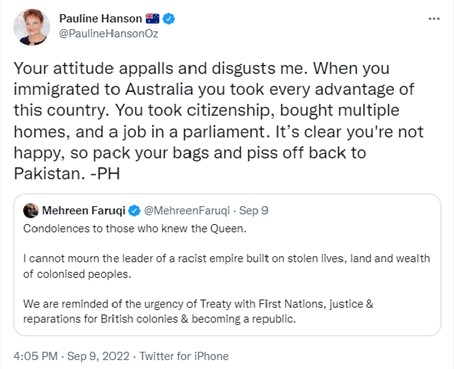
In this proceeding, Senator Faruqi claimed that, by posting her tweet, Senator Hanson engaged in unlawful conduct under s 18C of the Racial Discrimination Act 1975 (Cth). The primary judge held that Senator Hanson’s tweet was unlawful under s 18C because: (a) it was reasonably likely to offend, insult, humiliate and intimidate Senator Faruqi and groups of people, namely people of colour who are migrants to Australia or are Australians of relatively recent migrant heritage and Muslims who are people of colour in Australia; and (b) it was done because of the race, colour or national or ethnic origin of Senator Faruqi. The primary judge did not accept that Senator Hanson’s tweet was a fair comment made reasonably and in good faith on a matter of public interest and the exemption under s 18D of the Act did not therefore apply. The primary judge also rejected Senator Hanson’s argument that s 18C was not a valid law of the Commonwealth because it infringed the implied freedom of political communication.
Senator Hanson appealed from the primary judge’s decision.
That appeal has been dismissed by the Full Court.
Two of Senator Hanson’s grounds of appeal concerned the constitutional validity of s 18C of the Act. The Full Court has concluded that s 18C is valid as an exercise of legislative power under s 51(xxix) of the Constitution, and does not impermissibly burden the implied freedom of political communication. It is therefore constitutionally valid.
Senator Hanson’s other grounds of appeal involved challenges to the primary judge’s findings in relation to ss 18C and 18D of the Act. These have also been dismissed by the Full Court for reasons which may be summarised as follows.
(1) The primary judge correctly admitted and relied upon evidence relevant to the statutory task required by s 18C.
(2) The primary judge correctly characterised Senator Hanson’s tweet as conveying at least three central messages, being, in summary: (a) Senator Faruqi, as an immigrant, “took” advantage of Australia; (b) Senator Faruqi should “piss off back to Pakistan”, being a variant of the historically racist, nativist and anti-immigrant slogan “go back to where you came from”; and (c) an anti-Muslim and Islamophobic message.
(3) The primary judge correctly held that it was reasonably likely that a reasonable hypothetical person in Senator Faruqi’s position, and a reasonable hypothetical member of the groups identified, would be offended, insulted, humiliated or intimidated by Senator Hanson’s tweet.
(4) Senator Hanson had sufficient notice of the groups identified by the primary judge for the purpose of s 18C, including because those groups were identified in the concise statement and submissions.
(5) Senator Faruqi was a member of the groups the primary judge identified, and the fact that Senator Hanson’s tweet was published because of Senator Faruqi’s race, colour, national or ethnic origin was sufficient to meet the statutory causation requirement in s 18C(1)(b) in respect of the groups.
(6) The exemption under s 18D of the Act must be construed having regard to the normative considerations which inform s 18C. The primary judge was correct to find that Senator Hanson’s tweet was not published reasonably and in good faith, as those terms are properly understood, because it did not have a rational relationship with the issues raised by Senator Faruqi’s tweet.
JUSTICES PERRY, KENNETT AND BENNETT
27 JULY 2026
SYDNEY


