


Federal Court of Australia
Seven Network Limited v News Limited
[2009] FCAFC 166
Mansfield, Dowsett and Lander JJ
SUMMARY
In accordance with a practice previously adopted in some cases of public interest, the following summary has been prepared to accompany the reasons for judgment delivered today. The summary is intended to assist understanding of the decision of the Court. It is not a complete statement of the conclusions reached by the Court or the reasons for those conclusions. The only authoritative statement of the Court’s reasons is that contained in the published reasons for judgment. The published reasons for judgment and this summary will be available on the Internet at www.fedcourt.gov.au.
Seven Network Limited v News Limited
[2009] FCAFC 166
SUMMARY
1 This appeal concerns events which occurred in the pay television industry in the late 1990s and early 2000s. It focuses on the conduct of Foxtel, a supplier of pay television services, Fox Sports, a supplier of pay television sports channels to pay television services, News Ltd, Consolidated Media Holdings Ltd (PBL), Telstra Corporation Ltd and others (the Foxtel/Fox Sports parties). It also concerns the effects of such conduct upon Seven Network Ltd and C7 Pty Ltd, its subsidiary. C7 also supplied pay television sports channels to pay television services.
2 The conduct of the Foxtel/Fox Sports parties occurred primarily in connection with their acquisition of the pay television rights for coverage of the AFL Competition in the years 2002 to 2006 and for coverage of the NRL Competition in the years 2001 to 2006. In effect Seven claimed that the Foxtel/Fox Sports parties had acquired both the AFL and NRL rights in order to put C7 out of business so that Fox Sports could dominate the market for supplying sports channels to pay television suppliers Foxtel, Optus and Austar, and so that Foxtel could dominate the market for the supply of pay television services to subscribers.
3 Sackville J dismissed Seven’s claim. The Court upholds that decision, although its reasons for doing so differ to some extent from his Honour’s.
4 Seven also claimed that Foxtel had contravened the anti-siphoning regime contained in the Broadcasting Services Act 1992 (Cth). Other claims were made against other parties, but they were not pursued on appeal.
5 The appellants alleged that Foxtel/Fox Sports’ anti-competitive conduct occurred in one or more of four separate markets. His Honour found that only one such market existed: the retail pay television market in which Telstra, Optus and Austar provided pay television services to subscribers. On appeal, the appellants sought to establish that there was also a market for the supply of sports channels to those service providers, and that C7 and Fox Sports were suppliers in that market. The Court upholds his Honour’s analysis of the alleged markets and agrees that only the retail pay television market was established on the evidence. The Court’s reasons for concluding that there was no wholesale sports channel market differ to some extent from his Honour’s.
6 The appellants contended at the trial that the respondents had engaged in conduct that had the purpose, effect or likely effect of substantially lessening competition in the retail pay television market. Sackville J dismissed the appellants’ claims in that regard. The Court agrees with the trial Judge’s conclusions that the appellants did not establish that the respondents’ conduct was likely to have the effect, or had the effect, of substantially lessening competition in the retail pay television market. The Court also agrees that the appellants failed to establish an anti-competitive purpose.
7 The majority (Dowsett and Lander JJ) also disagree with Sackville J in two aspects of his construction of s 45 of the Trade Practices Act 1974 (Cth) (Trade Practices Act). However that difference of opinion does not lead to a different result in this case. Sackville J construed ss 45(2)(a)(ii) and (2)(b)(ii) as requiring that all parties responsible for inserting an anti-competitive purpose in a contract, arrangement or understanding have that subjective purpose in order that there be a contravention of the section. The majority consider that ss 45(2)(a)(ii) and (2)(b)(ii) should be construed as meaning that s 45 will be contravened if any party to the contract, arrangement or understanding, who was responsible for the inclusion of the impugned provision, had the subjective purpose of substantially lessening competition in the relevant market, provided that such purpose was, itself, a substantial purpose. The majority construe s 45 as not requiring a shared purpose. Mansfield J construes ss 45(2)(a)(ii) and (2)(b)(ii) in the same manner as did Sackville J.
8 The trial Judge held that an anti-competitive purpose can only contravene s 45(2)(b)(ii) if it relates to competition in an existing market. All members of the Court agree with that conclusion. The trial Judge, however, concluded that if an apparently anti-competitive purpose could not, in fact, be achieved so as substantially to lessen competition in a relevant market, there could be no contravention. The majority do not agree with that conclusion, considering that such a construction would require the Court to inquire into whether the relevant provision had the likely effect of substantially lessening competition in the market in question, thus failing to recognise that s 45 distinguishes between purpose and effect or likely effect.
9 Mansfield J does not disagree with his Honour’s reasons.
10 Although the majority differ in those two respects from the views of the trial Judge, all members of the Court are of the opinion that the trial Judge was right to conclude as a matter of fact that none of the parties to the Master Agreement had an anti-competitive purpose in the retail pay television market.
11 Seven conceded on appeal that the decision of the High Court in Devenish v Jewel Food Stores Pty Ltd (1991) 172 CLR 32 meant that the case based on s 45D of the Act must fail.
12 All members of the Court have agreed with his Honour’s conclusion that the respondents did not contravene s 46 of the Trade Practices Act. Section 46 prohibits the use of market power for an anti-competitive purpose.
13 The anti-siphoning regime ensures that important public events, including sporting events, are available to viewers of free-to-air television and not only to pay television subscribers. Seven claimed that the Foxtel/Fox Sports parties had tried to undermine the regime in order to benefit Foxtel.
14 All members of the Court agree with his Honour’s reasons for dismissing the appellants’ anti-siphoning case.
15 Telstra and a related corporation appealed against the trial Judge’s refusal to award Telstra its costs after 16 August 2005 on an indemnity basis. All members of the Court consider that the cross-appeal should be dismissed. The trial Judge was bound to follow Dukemaster Pty Ltd v Bluehive Pty Ltd [2003] FCAFC 1. The Court sees no reason to doubt the correctness of that decision.
FEDERAL COURT OF AUSTRALIA
Seven Network Limited v News Limited [2009] FCAFC 166
Appeal – Trade Practices – section 45 – effect or likely effect – whether agreements entered into by various respondents had the effect, or likely effect, of substantially lessening completion in the retail pay television market – significance of Optus as a weak competitor – alleged effect or likely effect not established
Appeal – Trade Practices – section 45 – purpose – multi-party contract – whether contract had the purpose of substantially lessening competition in the retail pay television market – consideration of “subjective purpose” – consideration of “substantial purpose” – whether all parties must share the impugned purpose – sufficient if only one party had the impugned purpose – whether knowledge of impugned conduct sufficient to establish a proscribed purpose – alleged purpose not established
Appeal – Trade Practices – section 46 – taking advantage of substantial market power – the appropriate legal test – whether refusal to deal – whether Foxtel deterred or prevented Optus from engaging in competitive conduct in the retail pay television market – alleged abuse of substantial market power not established
Appeal – Broadcasting Services Act 1992 (Cth) – whether breach of the anti-siphoning regime – whether sufficient evidence to establish breach – failure to put alleged breach to witnesses – whether standing to seek declaration – whether declaration would have utility – whether declarations should be made against non-parties – alleged breach not established
Cross Appeal – Costs – whether costs payable on an indemnity basis – whether O 23 r 11(5) applies where applicant is wholly unsuccessful – whether Dukemaster Pty Ltd v Bluehive Pty Ltd [2003] FCAFC 1 (“Dukemaster”) plainly wrong – Dukemaster not plainly wrong – cross appeal dismissed
Held: appeal and cross appeal dismissed
Broadcasting Services Act 1992 (Cth)
Australian Communications and Media Authority (Consequential and Transitional Provisions) Act 2005 (Cth)
Trade Practices Legislation Amendment Act (No 1) 2007 (Cth)
Federal Court of Australia Act 1976 (Cth)
Trade Practices Amendment Bill 1977(Cth)
Ainsworth v Criminal Justice Commission (1992) 175 CLR 564
Application by Services Sydney Pty Ltd [2006] ATPR 42-099
ASX Operations Pty Ltd v Pont Data Australia Pty Ltd (No 1) (1990) 27 FCR 460
Australian Competition and Consumer Commission v Amcor Printing Papers Group Ltd (2000) 169 ALR 344
Australian Competition and Consumer Commission v Australian Safeway Stores Pty Ltd (2003) 129 FCR 339
Australian Competition and Consumer Commission v Liquorland (Australia) Pty Ltd [2006] ATPR 42-123
Australian Conservation Foundation Inc v The Commonwealth (1980) 146 CLR 493
Australian Gas Light Co v Australian Competition and Consumer Commission (2003) 137 FCR 317
Australian Rugby Union Ltd v Hospitality Group Pty Ltd (2000) 173 ALR 702
Australian Softwood Forests Pty Ltd v Attorney-General (NSW); Ex Rel Corporate Affairs Commission) (1981) 148 CLR 121
Boral Besser Masonry Ltd v Australian Competition and Consumer Commission (2003) 215 CLR 374
Carlton and United Breweries (NSW) Pty Ltd v Bond Brewing New South Wales Ltd (1987) 16 FCR 351
Colgate-Palmolive Company v Cussons Pty Limited (1993) 46 FCR 225
Coshott v Learoyd [1999] FCA 276
CSR Ltd v Della Maddalena (2006) 224 ALR 1
Dandy Power Equipment Pty Ltd & Anor v Mercury Marine Pty Ltd (1982) 64 FLR 238
Devenish v Jewel Food Stores Pty Ltd (1991) 172 CLR 32
Dowling v Dalgety Australia Ltd (1992) 34 FCR 109
Dukemaster Pty Ltd v Bluehive Pty Ltd [2003] FCAFC 1
Eastern Express Pty Ltd v General Newspapers Pty Ltd (1992) 35 FCR 43
Flemington Properties Pty Ltd v Raine & Horne Commercial Pty Ltd [1998] FCA 53
Foster v Jododex Australia Pty Ltd (1972) 127 CLR 421
Fox v Percy (2003) 214 CLR 118
Foxtel Cable Television Pty Ltd v Nine Network Australia Pty Ltd (1997) 73 FCR 429
Harding v Bourke (2000) 48 NSWLR 598
Hecar Investments No 6 Pty Ltd v Outboard Marine Australia Pty Ltd (1982) 62 FLR 159
Hughes v Western Australian Cricket Association (Inc) (1986) 19 FCR 10
Krakowski v Eurolynx Properties Ltd (1995) 183 CLR 563
Latoudis v Casey (1990) 170 CLR 534
McKernan v Fraser (1931) 46 CLR 343
Melway Publishing Pty Ltd v Robert Hicks Pty Ltd (2001) 205 CLR 1
Meridian Global Funds Management Asia Ltd v Securities Commission [1995] 2 AC 500
Minister for Immigration and Multicultural Affairs v Jia Legeng (2001) 205 CLR 507
Monroe Topple & Associates Pty Ltd v Institute of Chartered Accountants in Australia (2002) 122 FCR 110
News Limited v Australian Rugby Football League Ltd (1995) 58 FCR 447
News Ltd v Australian Rugby Football League Ltd (1996) 64 FCR 410
News Ltd v South Sydney District Rugby League Football Club Ltd (2003) 215 CLR 563
Onus v Alcoa of Australia Ltd (1981) 149 CLR 27
Preston v Preston [1982] 1 All ER 41
Queensland Wire Industries Pty Ltd v Broken Hill Proprietary Co Ltd (1989) 167 CLR 177
Radio 2UE Sydney Pty Ltd v Stereo FM Pty Ltd (1982) 44 ALR 557
Re AGL Cooper Basin Natural Gas Supply Arrangements [1997] ATPR 41-593
Re Queensland Co-operative Milling Association Ltd (1976) 25 FLR 169
Re Queensland Independent Wholesalers Ltd [1995] ATPR 41-438
Re Tooth & Co Ltd [1979] ATPR 18,174
Re Wilcox; Ex parte Venture Industries Pty Ltd (1996) 141 ALR 727
Rural Press Ltd v Australian Competition and Consumer Commission (2003) 216 CLR 53
Rural Press Ltd v Australian Competition and Consumer Commission (2002) 118 FCR 236
Seven Network Limited v News Limited [2007] FCA 1489
Seven Network Ltd v News Ltd (No 1) [2003] FCA 388
Singapore Airlines Ltd v Taprobane Tours WA Pty Ltd (1991) 33 FCR 158
Smolle v Australia and New Zealand Banking Group Ltd (No 2) [2007] FCA 1967
Société d’Avances Commerciales v Merchants’ Marine Insurance Co (The “Palitana”) (1924) 20 Lloyd’s Rep 140
SportsVision Australia Pty Ltd v Tallglen Pty Ltd (1998) 145 FLR 308
Stirling Harbour Services Pty Ltd v Bunbury Port Authority [2000] ATPR 41-783
Stokely-Van Camp Inc v New Generation Beverages Pty Ltd (1998) 44 NSWLR 607
SZEEU v Minister for Immigration (2006) 150 FCR 214
Telstra Corporation Ltd v Treloar (2000) 102 FCR 595
The Dairy Farmers’ Co-Operative Milk Co Ltd v The Commonwealth (1946) 73 CLR 381
Tillmanns Butcheries Pty Ltd v Australasian Meat Industry Employees’ Union (1979) 27 ALR 367
Tobacco Institute of Australia Ltd v Australian Federation of Consumer Organisations Inc (No 2) (1993) 41 FCR 89
Trade Practices Commission v Nicholas Enterprises Pty Ltd (No 3) (1979) 42 FLR 213
Transurban City Link Ltd v Allan (1999) 95 FCR 553
Universal Music Australia Pty Ltd v Australian Competition and Consumer Commission (2003) 131 FCR 529
Warramunda Village Inc v Pryde (2002) 116 FCR 58
Yates Property Corporation Pty Ltd v Boland (No 2) (1997) 147 ALR 685
Gillies P, The Law of Criminal Conspiracy (1981, Law Book Co)
Heydon JD, Trade Practices Law (Lawbook Co, Subscription Service)
Sir Alan Neale, The Antitrust Laws of the United States of America (2nd ed, Cambridge University Press, 1970)
Corones SG, Competition Law in Australia (4th ed, Lawbook Co, 2007)
NSD 2089 of 2007
TELSTRA CORPORATION LIMITED (ACN 051 775 556), TELSTRA MEDIA PTY LIMITED (ACN 069 279 027) and TELSTRA MULTIMEDIA PTY LIMITED (ACN 069 279 072) v SEVEN NETWORK LIMITED (ACN 052 816 789) and C7 PTY LIMITED (ACN 082 901 442)
NSD 1330 of 2008
MANSFIELD, DOWSETT AND LANDER JJ
2 DECEMBER 2009
SYDNEY
| IN THE FEDERAL COURT OF AUSTRALIA |
|
| NEW SOUTH WALES DISTRICT REGISTRY |
|
| general division | NSD 2089 of 2007 |
| ON APPEAL FROM THE FEDERAL COURT OF AUSTRALIA |
| BETWEEN: | SEVEN NETWORK LIMITED ACN 052 816 789 First Appellant
C7 PTY LIMITED ACN 082 901 442 Second Appellant
|
| AND: | NEWS LIMITED ACN 007 871 178 First Respondent
SKY CABLE PTY LIMITED ACN 069 799 640 Second Respondent
TELSTRA MEDIA PTY LIMITED ACN 069 279 027 Third Respondent
TELSTRA CORPORATION LIMITED ACN 051 775 556 Fourth Respondent
CONSOLIDATED MEDIA HOLDINGS LIMITED (FORMERLY KNOWN AS PUBLISHING AND BROADCASTING LIMITED) ACN 009 071 167 Fifth Respondent
FOXTEL CABLE TELEVISION PTY LIMITED ACN 069 008 797 Sixth Respondent
|
| IN THE FEDERAL COURT OF AUSTRALIA |
|
| NEW SOUTH WALES DISTRICT REGISTRY |
|
| general division | NSD 1330 of 2008 |
| ON APPEAL FROM THE FEDERAL COURT OF AUSTRALIA |
| BETWEEN: | TELSTRA CORPORATION LIMITED (ACN 051 775 556) First Cross-Appellant
TELSTRA MEDIA PTY LIMITED (ACN 069 279 027) Second Cross-Appellant
TELSTRA MULTIMEDIA PTY LIMITED (ACN 069 279 072) Third Cross-Appellant
|
| AND: | SEVEN NETWORK LIMITED (ACN 052 816 789) First Cross-Respondent)
C7 PTY LIMITED (ACN 082 901 442) Second Cross-Respondent
|
| JUDGES: | |
| DATE OF ORDER: | 2 december 2009 |
| WHERE MADE: | SYDNEY |
THE COURT ORDERS THAT:
1. The appeal be dismissed.
2. The cross-appeal be dismissed.
Note: Settlement and entry of orders is dealt with in Order 36 of the Federal Court Rules.
The text of entered orders can be located using eSearch on the Court’s website.
| IN THE FEDERAL COURT OF AUSTRALIA |
|
| NEW SOUTH WALES DISTRICT REGISTRY |
|
| general division | NSD 2089 of 2007 |
| ON APPEAL FROM THE FEDERAL COURT OF AUSTRALIA |
| BETWEEN: | SEVEN NETWORK LIMITED ACN 052 816 789 First Appellant
C7 PTY LIMITED ACN 082 901 442 Second Appellant
|
| AND: | NEWS LIMITED ACN 007 871 178 First Respondent
SKY CABLE PTY LIMITED ACN 069 799 640 Second Respondent
TELSTRA MEDIA PTY LIMITED ACN 069 279 027 Third Respondent
TELSTRA CORPORATION LIMITED ACN 051 775 556 Fourth Respondent
CONSOLIDATED MEDIA HOLDINGS LIMITED (FORMERLY KNOWN AS PUBLISHING AND BROADCASTING LIMITED) ACN 009 071 167 Fifth Respondent
FOXTEL CABLE TELEVISION PTY LIMITED ACN 069 008 797 Sixth Respondent
|
| IN THE FEDERAL COURT OF AUSTRALIA |
|
| NEW SOUTH WALES DISTRICT REGISTRY |
|
| general division | NSD 1330 of 2008 |
| ON APPEAL FROM THE FEDERAL COURT OF AUSTRALIA |
| BETWEEN: | TELSTRA CORPORATION LIMITED (ACN 051 775 556) First Cross-Appellant
TELSTRA MEDIA PTY LIMITED (ACN 069 279 027) Second Cross-Appellant
TELSTRA MULTIMEDIA PTY LIMITED (ACN 069 279 072) Third Cross-Appellant
|
| AND: | SEVEN NETWORK LIMITED (ACN 052 816 789) First Cross-Respondent)
C7 PTY LIMITED (ACN 082 901 442) Second Cross-Respondent
|
| JUDGES: | MANSFIELD, DOWSETT AND LANDER JJ |
| DATE: | 2 DECEMBER 2009 |
| PLACE: | SYDNEY |
REASONS FOR JUDGMENT
MANSFIELD J
1 I have had the benefit of seeing the reasons for judgment of Dowsett and Lander JJ. I agree with their Honours that the appeal and cross-appeal should be dismissed. I also respectfully agree with their Honours’ reasons, with two qualifications, neither of which affects the outcome of the appeal or cross-appeal.
2 It is appropriate to identify those issues and to explain my reasons. They both concern the s 45 purpose case on appeal. I shall adopt their Honours’ description of the parties and of the critical documents, rather than redefine or redescribe them.
The Section 45 PURPOSE case on appeal
3 In view of the conclusion set out in their Honours’ reasons that the trial Judge correctly decided that, relevantly, there was only a retail pay television market, it is only necessary to consider the contentions of the appellants on this topic so far as they relate to that market.
4 The relevant parts of ss 45, 4F and 4G of the TPA are set out in their Honours’ reasons. The nature of the case presented by the appellants at first instance, including the issues then in contention, and the way the trial Judge dealt with them, are also discussed in their reasons. As there noted, the appellants’ case, relevantly, was that there was a contravention of s 45(2) by the Master Agreement, or by the Master Agreement Provision, because it had the purpose of substantially lessening competition, by having the purpose of having Foxtel acquire the AFL pay television rights and by having the purpose of preventing C7 from acquiring the NRL pay television rights, and ultimately to force C7 out of business.
General matters
Multiple parties and purposes
5 These matters arise because Telstra was a party to the Master Agreement.
6 The trial Judge found that Telstra was a party who was responsible for including the impugned provision, the Master Agreement Provision, in the Master Agreement. His Honour then found that Telstra did not have the purpose of eliminating or damaging C7 in procuring the Master Agreement Provision. Hence, the question arose as to whether it was necessary for each of the parties responsible for procuring the Master Agreement Provision to have the purpose referred to in s 45(2). If that were the case, the findings would mean that the contravention was not made out. That is what the trial Judge concluded.
7 On the appeal, the appellants contended that his Honour erred in those conclusions. It was submitted that:
1. the trial Judge should have found that it was not necessary for Telstra to have had the requisite anti-competitive purpose, namely to eliminate or damage C7, when Telstra was a party to including in the Master Agreement the Master Agreement Provision, and that it was sufficient if one of the parties that included the Master Agreement Provision in the Master Agreement had had that purpose;
2. alternatively, that the trial Judge should have found that Telstra’s purpose in including, or being one of the parties that included, the Master Agreement Provision in the Master Agreement was not relevant, because it was not in fact a party as a result of whose efforts the Master Agreement Provision was in fact included in the Master Agreement so that it was not fatal to the appellants’ purpose case that Telstra did not have the proscribed purpose; and
3. in the further alternative, upon the proper application of ordinary principles of attribution, the trial Judge should have found that Telstra had the knowledge of the purpose of News in procuring the Master Agreement Provision (asserting that News’ purpose was one proscribed by s 45(2)) so that Telstra itself had that purpose, or that by virtue of that knowledge on the part of Telstra and the purpose of News, PBL and Foxtel, the Master Agreement Provision was included in the Master Agreement for the proscribed purpose in any event.
8 As the trial Judge recorded at J [2389], certain matters regarding the expression “purpose” in s 45(2) of the TPA are well established. They are, as set out by his Honour, as follows:
Ÿ It is first necessary to identify the impugned provision of the contract. The relevant purpose is that of the provision.
Ÿ The purpose of a provision is to be ascertained by reference to the subjective purpose for its inclusion in the contract, although this test does not exclude consideration of the circumstances surrounding the making of or giving effect to the contract: Hughes v Western Australian Cricket Association (Inc) (1986) 19 FCR 10, at 38, per Toohey J; ASX Operations Pty Ltd v Pont Data Australia Pty Ltd (No 1) (1990) 27 FCR 460, at 474-477, per curiam; News v South Sydney 215 CLR, at 573 [18], per Gleeson CJ; at 580-581 [41]-[44] per McHugh J; at 585 [60]; per Gummow J; at 636-637 [212], per Callinan J.
Ÿ The purpose is the effect that the parties sought to achieve through the inclusion of the provision in the contract: Tillmanns Butcheries Pty Ltd v Australian Meat Industry Employees’ Union (1979) 27 ALR 367, at 383, per Deane J; News v South Sydney 215 CLR, at 586 [63], per Gummow J. Purpose, however, is distinct from motive:
‘The purpose of conduct is the end sought to be accomplished by the conduct. The motive for conduct is the reason for seeking that end. The appropriate description or characterisation of the end sought to be accomplished (purpose), as distinct from the reason for seeking that end (motive), may depend upon the legislative or other context in which the task is undertaken … [I]n the context of competition law, it is necessary to identify purpose by describing what is sought to be achieved by reference to what is relevant in market terms’.
News v South Sydney 215 CLR, at 573 [18], per Gleeson CJ.
Ÿ A purpose may be a proscribed purpose if it is one of a number of purposes, provided it is a ‘substantial’ purpose: s 4F(1)(b). (Section 4F uses the expression ‘deemed’ not in order to create a statutory fiction, but for a definitional purpose: News v South Sydney 215 CLR, at 585 [60], per Gummow J). In this context, ‘substantial’ means ‘considerable or large’: Dowling v Dalgety Australia Ltd (1992) 34 FCR 109, at 139, per Lockhart J; Monroe Topple & Associates Pty Ltd v Institute of Chartered Accountants in Australia (2002) 122 FCR 110, at 136 [97], per Heerey J (with whom Black CJ and Tamberlin J agreed). As Heerey J said in the latter case (at 136 [97]), the question is whether the proscribed purpose ‘loom[ed] large among the objects the corporation sought to achieve by the conduct in question’.
9 The first error contended by the appellants is called the “shared purpose” error.
10 The trial Judge, after considering the decision of the Full Court of this Court (Lockhart, Gummow and von Doussa JJ) in ASX Operations Pty Ltd v Pont Data Australia Pty Ltd (No 1) (1990) 27 FCR 460 (Pont Data), concluded that three propositions flowed from that Full Court decision relevant to the issue, namely:
· that a provision in a contract may have the purpose of substantially lessening competition in a market even though not all parties to the contract share that purpose;
· the relevant purpose for the application of s 45(2) of the TPA is that of the party or parties responsible for the inclusion of the provision in the contract; and
· accordingly, where only one of two parties to a contract is responsible for the insertion of a particular provision in the contract, it is the subjective purpose of that party that is material.
11 Although not binding, because ultimately the purpose case against ASX failed (see Pont Data), the trial Judge considered the reasoning sound. We were not asked to reconsider it. However, his Honour did not consider that the reasoning addressed the approach to be taken in circumstances where two or more parties are responsible for the insertion of a provision in the contract, but where not all of those parties shared the subjective purpose of substantially lessening competition. I respectfully agree with his Honour. Pont Data concerned its particular facts.
12 In Pont Data 27 FCR at 475, the Full Court referred to “the undoubted curiosity of legislation” such as s 45(2) which refers to the purposes of a provision, rather than to the purposes of those who devised and propounded the provision. Pont Data was one party to a bilateral agreement. It claimed to have been the victim of (inter alia) the provision which had the proscribed purpose. It said it had become a party to the impugned agreement because access to the information which it thereby received was essential to its operations. Hence, the question arose as to how the provision of the impugned contract could have a particular purpose when one party to the contract did not have the necessary subjective purpose.
13 The Full Court at 475 considered whether the decisions under s 260 of the Income Tax Assessment Act 1936 (Cth) – which refers to contracts, agreements or arrangements which have or purport to have a certain “purpose or effect” - could usefully inform the proper construction of s 45(2). Then, at 476-477, their Honours pointed out that ss 45(2) and 4F of the TPA should be read to operate together, rather than that s 4F should only be read as supplementary to s 45(2). Section 4F used the words “the provision was included in the contract” (the Full Court’s emphasis) for a proscribed purpose. That, as their Honours said, indicated that s 4F in its operation directed attention to the purposes of the individuals by whom the provision was included in the contract in question, and so directed attention to the subjective purposes of those individuals. Finally, their Honours pointed out that s 45 itself, by drawing a distinction between purpose and effect, was consistent with the subjective treatment of purpose in s 4F.
14 Hence, the Full Court said that the reference in s 45(2) of the TPA to the purpose of provisions of a contract arrangement or understanding are to be construed as Toohey J had earlier indicated in Hughes v Western Australian Cricket Association (Inc) (1986) 19 FCR 10 at 32-38, where his Honour said at 38:
I accept the view that it is the subjective purpose of those engaging in the relevant conduct with which the Court is concerned. All other considerations aside, the use in s 45(2) of ‘purpose’ and ‘effect’ tends to suggest that a subjective approach is intended by the former expression. The application of a subjective test does not exclude a consideration of the circumstances surrounding the reaching of the understanding.
15 It was common ground that the particular issue identified by the trial Judge has not previously been determined. His Honour’s reasons for his conclusion, favouring the respondent’s contention that s 45(2) operates only where the substantial purpose of each of the parties responsible for including the relevant provision in a contract is to substantially lessen competition, are set in Dowsett and Lander JJ’s reasons.
16 Perhaps on such a contentious issue, it is not surprising that the competing arguments sought to derive support from the same or similar resources. The parties’ submissions proceeded on the basis that ss 45(2) and 4F should be read together (in accordance with the Full Court’s view in Pont Data). I agree with that approach, for the reasons their Honours gave in Pont Data. The parties’ shared starting position was therefore an appropriate one.
17 I do not consider that the text of either ss 45 or 4F helpfully informs the resolution of the question. Reading the two provisions together necessarily directs attention to the subjective purpose of the individual persons or entities who agreed upon the inclusion of the impugned provision: News Ltd v South Sydney Football Club (2003) 215 CLR 563 at [18], [31] and [59]-[63]. The fact that s 45(2) refers to the substantial purpose of the provision, in that context, does not advance the appellants’ preferred construction. Nor do I consider that the passive expression that the provision “was included” in the contract, used in s 4F, directs the focus to the particular person who primarily (or perhaps only) promoted the inclusion of the provision in the contract. That is because s 45(2) directs attention to the purpose of the provision in the contract, rather than to the means by which it came to be in the contract.
18 At a broader level, however, the structure and purpose of s 45 generally tends not to support the appellants’ contention. Section 45 renders unenforceable certain contracts, arrangements or understandings which, by virtue of the parties having in combination agreed to act in a certain way, have an adverse effect on competition. Sections 45(2)(a)(i) and (b)(i) relate to contracts which contain an exclusionary provision, as defined in s 4D. Clearly s 4D contemplates an agreement whereby the parties to an agreement share the purpose of preventing or restricting the supply to or acquisition of goods from particular persons or classes of persons, that is it prohibits collective boycotts. See for example Hughes v Western Australian Cricket Association (Inc) 19 FCR at 37-38; Carlton and United Breweries (NSW) Pty Ltd v Bond Brewing NSW Ltd (1987) 16 FCR 351 at 356; Stokely-Van Camp Inc v New Generation Beverages Pty Ltd (1998) 44 NSWLR 607 at 617; and the Full Court of this Court in Rural Press Ltd v Australian Competition and Consumer Tribunal (2002) 118 FCR 236 at [105]. It would be surprising if ss 45(2)(a)(ii) and (b)(ii) were not intended to operate in a similar way, that is by prohibiting persons by agreement, arrangement or understanding from agreeing in combination to act, or for one or more of them to act, in a certain way. It relates to prohibiting a different type of anti-competitive conduct, but in its content would seem to have the same general focus of proscribing certain conduct flowing from an agreement in combination to act in a certain way. There is no apparent reason why purpose in the context of exclusionary provisions should be treated differently from purpose in the context of a provision of a contract, arrangement or understanding alleged to have the purpose of substantially lessening competition. Similarly, ss 45A, 45B, 45C, 45D and 45DA and 45DB all prohibit certain other forms of cooperative conduct which is classed as anti-competitive.
19 The appellants, in the contentions based upon the text of s 45(2)(b), submitted that the introduction of “substantial purpose” test somehow supports the construction for which they argued. I do not consider that that test advances the issue either way. The observations of Gummow J in News Ltd v South Sydney 215 CLR at 586, in my view, only emphasises that, although there may be a number of purposes for a provision being included in a multi-party contract, s 4F directs that the relevant purpose must be a substantial one. It does not indicate that the relevant purpose need not be one shared by those responsible for its inclusion in the contract, arrangement or understanding.
20 The appellants then addressed the objects of the TPA, and in particular Part IV. Section 2 sets out the objects of the TPA. It is “to enhance the welfare of Australians through the promotion of competition and fair trading and provision for consumer protection”. Hence they contended, in a general sense, such litigation should be given a broad construction of its constituent sections: Devenish v Jewel Food Stores Pty Ltd (1991) 172 CLR 32 at 43-44 per Mason CJ and Australian Competition and Consumer Commission v Liquorland (Australia) Pty Ltd (2006) ATPR 42-123 at 45,185 per Allsop J.
21 There are, however, as the trial Judge noted, countervailing considerations to such a broad approach. If, in a multi-party contract, one of the many parties did not share the purpose of the others (assuming that purpose being to significantly lessen competition) in having a particular provision in a contract, (so the argument runs), it would go against the purpose of the TPA if there was no contravention of s 45(2)(b). The trial Judge noted that contention. His Honour accepted that there may be a risk of such a counter-intuitive outcome. He said that the risk may be ameliorated by the other limb of ss 45(2)(b)(i) and (ii), namely that such a provision is prohibited in any event if it has or is likely to have the effect of substantially lessening competition. There is a further matter to consider when determining the proper construction of s 45(2)(b). Contravention of s 45, and indeed of any provision of Pt IV of the TPA generally, carries very significant penalties: see s 76. It is not necessary to recite them. The visitation of such potential consequences upon a person who did not know of, and did not share in, the purpose of a provision which, by reason of its purpose, might otherwise have contravened s 45(2) is not one which would lightly be attributed to the legislature.
22 Indeed, there is good reason to construe the provisions in Pt IV of the TPA so that those who might engage in such conduct should readily be aware of the quality of the conduct and the possible consequences of doing so, before being liable for it. That is more so where the alternative limb of ss 45(2)(a)(ii) and (b)(ii) is engaged, namely that the provision has, or may have, the impugned effect (as distinct from its purpose). The effect or likely effect of such a provision is a matter which is more readily appreciated by the parties to the contract, including the party who did not know of (and perhaps could not know of) the purpose of other contracting parties in including the provision, and so the same considerations do not apply. See generally the observations of Allsop J in Australian Competition and Consumer Commission v Liquorland (Australia) Pty Ltd (2006) ATPR 42-123 at 45,184-45,185.
23 I also agree with the trial Judge at J [2404]-[2407] that there are policy considerations which militate against acceptance of the appellants’ contention in this regard. His Honour correctly, in my view, took into account that, if the appellants’ contention is correct, an innocent party to a contract may be exposed both to civil damages and to civil penalties under the TPA simply because another party (and perhaps only one of a number of parties) to the contract has an impugned purpose for the inclusion of a provision in a contract. Moreover, as his Honour said, it will often be difficult if not impossible for other contracting parties to know, or have access to the means of knowledge, of the subjective motives of another contracting party, particularly in complex and detailed contracts. In many instances such contracts are negotiated at arms length and with different commercial objectives in the minds of the various parties. The further dimension to that point was expressed by the trial Judge in the following way at J [2407]-[2408]:
Secondly, on Seven’s construction of ss 45(2) and 4F of the [TPA], the Court is required to evaluate the collective substantiality of anti-competitive purposes among a range of purposes held (or not held) by multiple contracting parties. The Court, on this approach, is required to go beyond ascertaining the varying purposes held by each of the parties to the contract. It must determine whether the proscribed purpose is a substantial purpose when, by hypothesis, that purpose has not been held by one or more of the parties responsible for inclusion of the particular provision in the contract.
There is no shortage of difficult judgments the [TPA] requires the Court to make. But any assessment of the substantiality of a particular subjective purpose held by some, but not all, parties to a contract necessarily moves away from any meaningful assessment of subjective purpose. Inevitably it must rely on objective criteria such as (in Seven’s language) ‘the degrees of responsibility of the various parties for the inclusion of the provision’. It is difficult to see how an assessment of this kind can be reconciled with the insistence of the High Court in News v South Sydney that s 4D (and, accordingly, s 45(2)) is concerned with the subjective purpose of those parties to a contract responsible for the inclusion of a particular provision in the contract.
24 For those reasons, I do not accept the contention of the appellants that it was not necessary for the impugned purpose of the Master Agreement Provision in the Master Agreement to have been shared by Telstra as a party to the Master Agreement and as an entity which was jointly responsible for its inclusion in the Master Agreement.
25 That conclusion accords with the law of conspiracy, a somewhat analogous area of law because it requires the existence of a combination, and a consideration of the subjective purpose of multiple parties: see Gillies P, The Law of Criminal Conspiracy (1981, Law Book Co) Ch 2, p 18. The absence of a shared or common purpose means that there is no unlawful conspiracy: McKernan v Fraser (1931) 46 CLR 343 at 401-402 and 408-411.
26 The second error contended for by the appellants was that the trial Judge erred in finding that Telstra was jointly responsible, with the other parties to the Master Agreement, for the inclusion of the Master Agreement Provision.
27 The appellants, as they did at trial, argued that Telstra was the victim of the desire of News, PBL and Foxtel to have the Master Agreement Provision included, as it capitulated to their wish to include it. The conclusion which they sought to draw from that fact was that, like the decision in Pont Data, the fact that Telstra did not itself have the proscribed purpose for including the Master Agreement Provision would not matter for the purposes of the appellants’ claim under s 45 against the parties other than Telstra to the Master Agreement.
28 I do not accept the appellants’ contention that Telstra was not jointly responsible for the inclusion of the Master Agreement Provision, so it is not necessary to determine the consequential claim that, in that event, a remedy against News, PBL and Foxtel under s 45 of the TPA would exist independently of Telstra’s position.
29 His Honour found that the inclusion of the Master Agreement Provision in the Master Agreement was the product of negotiation between the four parties to it, including with officers of Telstra. He found that Telstra, through Dr Switkowski and Mr Akhurst, formed the view that there were good commercial reasons for Telstra to support the Master Agreement Provision, and that ultimately the decision to include it was arrived at on the teleconference of 13 December 2000 as being a joint response, including that of Telstra.
30 I do not consider that Pont Data is of assistance to the appellants’ contention. Clearly, it was in a different factual context. It is neither appropriate nor possible to draw from the factual findings in that case any factual conclusion in this matter, whether directly or by analogy. Pont Data entered into the agreement in that case, despite its strong dissatisfaction with the impugned provision, for its own commercial reasons. It does not, and could not, follow that the fact that Telstra had its own commercial reasons for acceding to the Master Agreement, including the Master Agreement Provision, puts its agreement to that provision in the same category. That was a question of fact for the trial Judge on all the evidence. The facts did not, and could not, support a finding (such as that in effect made in favour of Pont Data) that the agreement was entered into under protest and in essence because Telstra had no other option if it was to survive. The factual difference is clear. His Honour found that Dr Switkowski and Mr Akhurst were the relevant decision makers on behalf of Telstra, and made findings as to their reasons for agreeing to the Master Agreement, including the Master Agreement Provision.
31 It is commonplace that in complex commercial arrangements the parties propose various provisions for inclusion in a commercial agreement, and that they are prepared to negotiate and discuss them to determine which should ultimately be included in the agreement, and in what precise form. The outcome is the result of that negotiation. Ultimately, if agreement is reached, it represents that which is acceptable to the parties balancing their commercial interests for good commercial reasons. His Honour found that that is what occurred in this case. At J [2454] the trial Judge found that the Master Agreement, including the Master Agreement Provision, was the product of such a negotiation among the parties, including Telstra. Telstra made an active and independent decision to enter into the Master Agreement including the Master Agreement Provision. There is no reason to disturb that finding.
32 The third error alleged by the appellants in relation to this aspect of their appeal was that the trial Judge found that, assuming that Telstra would have had the requisite anti-competitive purpose asserted against News, PBL and Foxtel had it had knowledge of that purpose on their part to eliminate or harm C7, such knowledge could not be attributed to Telstra on the particular facts. His Honour concluded that the only persons whose knowledge was attributable to Telstra in the circumstances were its decision-makers in relation to the decision to enter into the impugned agreement, that is Dr Switkowski and Mr Akhurst, neither of whom the trial Judge found to have had that knowledge. The appellants contended that that finding was wrong as a matter of law, and that Telstra should be found to have had that knowledge via persons other than its “decision-makers”. I note that elsewhere in their submissions, the appellants submitted that Telstra through Dr Switkowski and Mr Akhurst did have that knowledge. That submission is addressed later in these reasons. For the purposes of this submission, the appellants accepted that contrary finding. They said the knowledge rested with other Telstra officers, whose knowledge should in the circumstances have been imputed to Telstra.
33 Before addressing that contention, it is necessary to say something about the assumption made by the trial Judge referred to in the preceding paragraph. That is because the respondents, while accepting that the particular assumption was made by the trial Judge, contended that it was an erroneous assumption. In the event, because I do not accept the appellants’ contention on its principal point on this issue, I do not need to address that matter in any detail.
34 However, it is important to note the following. First, the trial Judge recognised that it was arguable, but did not proceed beyond that proposition, that knowledge by one party, when it agrees to a contract or arrangement, that another party has a proscribed purpose in respect of a particular provision does not suffice, of itself, to attribute the same purpose to the first party. Whether a finding is made that all the parties to an agreement have such an awareness of the motives or purpose of another party which has procured the insertion into the agreement of the impugned provision, and whether that knowledge comes from negotiations or otherwise, I do not think it can be said that such knowledge means that the impugned provision in the contract necessarily has the purpose ascribed to it from the motives or purpose of one of the parties. Whether such a provision in the contract has the purpose which is impugned is a question of fact in all the circumstances. It is probably unhelpful to draw a sharp line between intention on the one hand and knowledge of intention on the other. It is the purpose of the provision to which s 45(2) directs attention, informed as that must be (as explained above) by s 4F. There are degrees of awareness and degrees of participation. One can imagine circumstances in which the knowledge of one party as to the intention or expectation or “purpose” of another party by procuring a particular clause to be in an agreement is relatively slight, or might even be resisted (for example Pont Data). Degrees of knowledge and participation of the other parties may vary according to the extent of the negotiation, the particular knowledge of the other parties, and the nature of the commercial judgments which are made. In my view, it is an unnecessary and inappropriate oversimplification to argue, as the appellants did, that “mere knowledge on the part of Telstra of the purpose of the other contracting parties to kill C7” was sufficient. His Honour may have had to have regard to more extensive evidence on that issue were he to have concluded that other than the “decision-makers” information or awareness was relevant. The trial Judge, in making the assumption referred to did not implicitly endorse it. For the reasons given, I think his Honour’s approach was a sensible one. And, as I have said, I do not need to consider that question further on this appeal.
35 The appellants pointed to evidence that senior employees of Telstra, other than Dr Switkowski and Mr Akhurst, were aware that News’ objective was to harm C7. Assuming that evidence to have been accepted, however, and that those other employees acquired that knowledge in the course of their employment, it does not follow that Telstra, in entering into the Master Agreement, had the shared impugned purpose of harming C7.
36 The appellants relied upon the principles of attribution of knowledge of an agent, acting within the scope of actual or apparent authority, being imputed to the principal, as explained in Meridian Global Funds Management Asia Ltd v Securities Commission [1995] 2 AC 500 per Lord Hoffmann at 506. They also referred to the High Court decision in Krakowski v Eurolynx Properties Ltd (1995) 183 CLR 563 to support the contention. That case concerned whether the knowledge of the purchaser’s requirements held by the selling agent for the vendor company was knowledge of the vendor company. The Court held that, in the circumstances, it was knowledge of the vendor company because the selling agent on behalf of the vendor company was the person responsible for the relevant negotiations and had “set the scene” in which the impugned representation had been made: see per Brennan, Deane, Gaudron and McHugh JJ at 582.
37 In my view, the correct position lies in the wording of s 45(2) itself. It requires that the impugned provision have the purpose of substantially lessening competition. As I have observed above, when read in conjunction with s 4F, that directs attention to the subjective purpose that the parties, or each of the parties which secured the inclusion of the impugned provision in the agreement, and that its purpose be a substantial one. The trial Judge did not accept that Telstra, through Dr Switkowski and Mr Akhurst who decided on behalf of Telstra that the Master Agreement Provision should be involved in the Master Agreement, had any such purpose or could themselves have had any such purpose by attribution because they were not aware of the suggestion that other parties may have intended to harm C7 by the impugned provision.
38 The appellants’ submission must fail. It is flawed for a number of reasons, not least because it impermissibly equates knowledge with purpose. The notion of “purpose” is the end sought to be achieved by the conduct, as distinct from the reasons for seeking that end: News Ltd v South Sydney 215 CLR at 573. The appellants accept this proposition: AS [72(c)]. It is difficult to see how knowledge by one party of the objective which another party seeks to achieve amounts to that party also seeking to achieve that objective. As Wilcox J pointed out in Carlton and United Breweries (NSW) Pty Ltd v Bond Brewing NSW Ltd (1987) 16 FCR 351 at 356:
The purpose referred to in par (b) of the definition is a purpose common to the parties. I have no doubt that it was a purpose of Tooheys to reduce the supply of beer by Carlton to operators of the hotels with which the agreement was concerned, but there is no evidence to indicate that this was a purpose shared by Tooth. It was conceded in the Supreme Court … [that the Chief Executive of Tooth] … was aware that Tooheys wished to acquire the leases in order to improve its market share; but to say that a party is aware of the purpose of another party is a very different thing from saying the former shared the latter’s purpose.
The threshold for primary liability under s 45(2) was correctly understood by the trial Judge as requiring the purpose of the parties securing the inclusion of the impugned provision to have been the substantial lessening of competition.
39 The appellants’ submission should fail in any event, because I am not persuaded that the finding of the trial Judge that Dr Switkowski and Mr Akhurst did not have knowledge that other parties to the Master Agreement may have had the purpose of harming C7 is incorrect. Nor am I persuaded that any knowledge of other officers of Telstra on that matter is attributable to Telstra for the purposes of the application of s 45(2) to the particular circumstances.
40 The appellants’ challenge to the finding about the knowledge of Dr Switkowski is based on the assertion that the trial Judge only addressed the question whether Dr Switkowski knew of a “kill C7” purpose. It contended the correct question was whether Dr Switkowski knew that News and PBL had an object of hindering C7 from competing with Fox Sports as a sports channel supplier. The evidence does not disclose that, apart from Dr Switkowski having acknowledged the obvious, namely that the loss of AFL pay television rights by C7 would adversely affect it, he was asked about the awareness of any particular motives or purposes of News or PBL beyond the asserted purpose of killing C7. He explained, in a way satisfactory to the trial Judge, that Telstra had legitimate commercial reasons for becoming party to the Master Agreement unrelated to the impugned purpose. There is no reason to go behind that finding. Indeed, the submission of the appellants that he “had opportunity to pause but did not” is almost tantamount to acknowledging that the way the appellants presented its case on the appeal was not put to Dr Switkowski in the course of evidence.
41 The attack upon the trial Judge’s finding about Mr Akhurst’s knowledge of the purpose of News and PBL in securing the Master Agreement Provision in the Master Agreement must also fail. It was based largely upon the fact that the trial Judge at J [449]-[452] said that, in some respects, Mr Akhurst was an unsatisfactory witness. There is no basis for considering that the trial Judge had overlooked his assessment of Mr Akhurst’s evidence when making the particular factual finding now challenged. His Honour elsewhere recognised that Mr Akhurst was aware that the loss of the AFL pay television rights by C7 may have serious consequences for it, including the risk of Optus terminating its supply agreement; J [452]. His Honour specifically said at J [455] that the appreciation of that risk was “very different” from understanding that that was a substantial objective of News or PBL. He adverted to Mr Akhurst’s email to Dr Switkowski of 20 November 2000 that he (Mr Akhurst) did not think that Telstra’s support for Fox Sports acquiring the AFL pay television rights would amount to anti-competitive conduct in J [453]. In my view, no adequate basis has been shown for concluding that the trial Judge erred in reaching the finding about Mr Akhurst’s knowledge (or lack of knowledge) of any impugned purpose on the part of News or PBL as asserted.
The relationship between purpose and effects on markets
42 The trial Judge found that s 45(2) of the TPA required a party seeking to establish a “purpose” case to establish that the object sought to be achieved by the alleged contraveners “if effectuated, was realistically capable of substantially lessening competition in any relevant market”: J [2431]. In other words, his Honour determined that s 45(2) could not be contravened when the alleged anti-competitive purpose, even if achieved, could not have the effect of substantially lessening competition in a market.
43 That is significant now because the trial Judge found, correctly as we have concluded, that there was no wholesale sports channel market. His Honour expressed the question leading to that conclusion at J [2320] in the following terms:
where a party seeks to achieve a particular objective (such as killing C7), but that objective, even if achieved, cannot have the effect of substantially lessening competition in a market, does the party have the purpose of substantially lessening competition?
44 The appellants contended that the conclusion that there was no wholesale sports channel market was not fatal to its case under s 45(2) of the TPA. They contended that there were two errors in his Honour’s approach, namely that it was wrong to require that the impugned purpose be realistically capable of substantially lessening competition in any relevant market, and secondly the requirement that the market must exist as a matter of fact. I shall address those two contentions in sequence.
45 The appellants’ contention was founded to a significant degree upon the decision of Universal Music Australia Pty Ltd v Australian Competition and Consumer Commission (2003) 131 FCR 529. It is correct, as his Honour found, that that case stood for the proposition that a party may have the purpose required for a contravention of s 45(2), even though that purpose could never be achieved. However, as his Honour pointed out at J [2422], that case was concerned with an existing market. It did not directly address the question as to whether there could be a contravention of s 45(2) where the impugned purpose is said to be capable of lessening competition in a market which does not exist, except as put forward by the proponent of the proposition.
46 It is, therefore, necessary to have regard to the specific terms of s 45(2). As the appellants submitted, s 45(2) proscribes certain conduct where that conduct has a particular purpose, or where it has a particular effect, or where it has particular likely effects. Hence, the appellants contended, in the case of an impugned purpose, it is unnecessary to consider in fact whether that purpose was capable of being fulfilled (the Universal Music case) in relation to a particular market, or whether that purpose was capable of being fulfilled because there was no relevant market which existed in relation to which the purpose was directed. The appellants fortified their submission by reference to a comparison between ss 45(2) and 45DA, the latter of which requires both a purpose and an effect or likely effect of substantially lessening competition. They argued that, because that joint requirement had been specified in s 45DA, it would be wrong to import into s 45(2) a legislative intention to require both a purpose and an effect or likely effect of substantially lessening competition into s 45(2).
47 In my view, and as the trial Judge concluded at J [2424]-[2425], s 45(2) must be read together with s 45(3). While s 45(2) relevantly refers to a purpose of substantially lessening competition, s 45(3) makes it clear that for the purposes of s 45, competition means competition in a market in which a corporation that is a party to the impugned contract supplies or acquires or is likely to supply goods or services. It makes it plain that the object of the conduct impugned by s 45 is to impugn conduct which is capable of substantially lessening competition in an actual market.
48 I do not regard his Honour’s expression of the purpose acquired by s 45(2), namely that it be realistically capable of substantially lessening competition in a relevant market, to be either unorthodox or incorrect. Section 45(2) requires firstly the existence of a relevant purpose, then to identify the markets in respect of which that purpose may have been directed, and then to determine whether that purpose, if achieved, would have had or would likely have had, a substantial lessening of competition. Although the trial Judge used words slightly different from those by the Full Court in Universal Music 131 FCR at 591 [266], I regard his Honour as approaching the matter in accordance with that decision. That is, his Honour asked whether the purpose sought to be achieved, if achieved, could substantially lessen competition. That is not to import into the “purpose” component of s 45(2) proof of the effect or likely effect of the impugned provision. It recognises that, once the contracting parties’ subjective purpose is determined, so as to identify the effect or effects which the contracting parties sought to achieve through the inclusion of the impugned provision (see eg News Ltd v South Sydney District Rugby League Football Club Ltd (2003) 215 CLR 563 at [18], [31]-[45] and [59]-[63]), the additional or further inquiry is necessary to determine whether that subjective purpose involves a purpose of “substantially lessening competition”. As I have indicated, having regard to s 45(3), that must be an inquiry directed to a purpose of substantially lessening competition in a market. In Universal Music 131 FCRat [265]-[269], the Full Court made such an inquiry. It was necessary to determine, in relation to the relevant market, whether the particular consequence proposed by the purpose would amount or could amount to a substantial lessening of competition. If it could not, it would not be a purpose prohibited by s 45(2). In making such an analysis, it is appropriate to assume that the outcome sought to be achieved by the purpose has been achieved, but it requires a further step to determine whether the outcome, if achieved, would amount to a substantial lessening of competition in the relevant market having regard to the structure of the market at the time when the conduct was engaged in. I do not regard his Honour’s reasons as going beyond that inquiry.
49 For the reasons given in their Honours’ reasons below, in our view, s 45(2) requires a purpose of substantially lessening competition in a market which exists. That conclusion is consistent with the policy of the TPA. It is clear that the TPA does not prohibit conduct designed to increase market power, even at the expense of market competitors. It is intended to preserve and encourage competition in a market or markets. The substantial lessening of competition to which s 45(2) refers must be in relation to a particular existing market or markets, or otherwise there would be no point in proscribing it because it would not and could not affect competition in any relevant way. To adopt the view propounded by the appellants would lead to an artificial, and unhelpful, inquiry as to how the Court might determine whether a subjective purpose, once discerned, might substantially lessen competition which exists only in the mind of a particular corporation (through its relevant decision-maker). The artificiality of such an inquiry is apparent.
50 The conclusion I have reached is consistent with the decision of Allsop J in Australian Competition and Consumer Commission v Liquorland (Australia) Pty Ltd (2006) ATPR 42-123, where his Honour said at 45,191:
Thus, the prohibition involves a subjective purpose concerning the basal economic concept around which this part of the Act works – the market. Thus, if it were the case that a party included a provision in a contract for the avowed purpose of substantially lessening, indeed stifling entirely, competition (using that word in its general English meaning, not by reference to s 45(3)) in a location or area which could not be said to be a market for the goods in question ascertained by relevant analysis, but with no other wider purpose, there may be no contravention of the Act.
Section 45 Retail Pay Television Market
Purpose of News, PBL and Foxtel
51 The appellants also contended that the trial Judge erred in rejecting what is called in the submissions the “Section 45 Retail Pay Purpose Case”.
52 The appellants’ submissions described its case in this respect as follows. It alleged that a purpose of the Master Agreement Provision was to substantially lessen competition in the retail pay television market, and in particular to enable Foxtel to secure the AFL pay television rights so as to:
(a) reduce the competitive strength of Optus in the retail pay television market by making it dependent on its competitor, Foxtel, for access to AFL programming; and/or
(b) prevent C7 from competing against Foxtel in the retail pay television market.
53 There is some dispute as to whether that accurately describes the nature of the appellants’ case at trial. Having regard to [198] and [199] of the Fifth Further Amended Statement of Claim, it appears that the case pleaded was that a substantial purpose of the Master Agreement Provision was to enable Foxtel to secure the AFL pay rights and prevent C7, acquiring an alternative in the form of the NRL pay rights so as to have the two consequences set out above (emphasis added). The trial Judge noted that that was the case pleaded at J [2331]-[2335]. I have come to the view that the difference in the expression of Seven’s case as now described, and as put at trial on the basis of its pleading, does not make a difference to the result of the appeal. It is therefore not necessary to explore the dispute as to the precise meaning of the pleadings. It may be noted, however, that very little of the very lengthy written submissions on the part of the appellants in their case addressed the claim that the respondents had the objective of “killing C7” in order to “reduce the competitive strength of Optus” or to prevent C7 from competing in the retail pay television market.
54 The appellants’ contended that the trial Judge erroneously limited his consideration to the proposition that the appellants’ purpose case rested on the contention that the parties to the Master Agreement had the objective of “killing C7”, and only inferentially therefore addressed the claim that the more refined consequences set out in (a) and (b) of [52] above were rejected.
55 His Honour’s approach was more careful and thorough than that. He very carefully considered the consequences to Optus of Foxtel securing the AFL pay television rights by reason of the Master Agreement Provision. He also considered the consequences to C7 of Foxtel securing the AFL pay television rights. His reasons are encapsulated in his conclusion at J [2434]-[2436] as follows:
In Chapter 12, I have found that neither the Master Agreement Provision nor any of the other provisions relied on by Seven was likely to have the effect (in the sense that there was a real chance they would have the effect) of substantially lessening competition in the retail pay television market). These findings were made on the assumption that the provisions were likely (in the same sense) to have the effect of causing C7 to cease business because the acquisition of both the AFL and NRL pay television rights by News and Fox Sports would have denied C7 inputs essential to its survival. I made these findings because, in my view, in the absence of the contracts containing the impugned provisions or the conduct giving effect to those contracts there were only two realistic possibilities:
· Optus would have decided to wind down its pay television business in conformity with the Manage for Cash Strategy; or
· Foxtel and Optus would have decided to enter into a content supply agreement on terms much to the same effect as those incorporated into the Foxtel-Optus CSA.
That being so, the impugned conduct was not likely (in the relevant sense) to have had the effect of substantially lessening competition in the retail pay television market. Any lessening was going to occur in any event.
In my view, these considerations must be taken into account in assessing Seven’s purpose case under s 45(2) of the TP Act. That case rests on the contention that each of the Consortium Respondents had the objective of killing C7. For present purposes I assume that the factual contention can be made out (this factual issue is addressed for Telstra in this Chapter and for the other Consortium Respondents in Chapter 15).
The critical question, then, is whether that objective, assuming it to have been carried into effect, was realistically capable of substantially lessening competition in the retail pay television market. The answer to that question is, in my opinion, no. The demise of C7 would not have led to any substantial lessening of competition in the retail pay television market. Any lessening of competition in that market would have occurred in any event. In other words, regardless of C7’s fate, Optus would have ceased to provide even weak competition to Foxtel in the retail pay television market.
56 His Honour then held, as noted above, that the parties responsible for including the Master Agreement Provision or the related contractual provisions did not share or have the object of “killing C7”: J [2439]-[2481]. He held that each of those parties was responsible for including the pleaded provision, and that in relation to the Master Agreement Provision, Telstra did not know that News, Foxtel and PBL had the alleged purpose of “killing C7” and so did not have the proscribed purpose required. He further held that none of News, Foxtel or PBL, had the proscribed purpose of “killing C7”. His Honour was satisfied that there were good commercial reasons for Foxtel to acquire directly the AFL pay television rights, independently of that alleged purpose.
57 Insofar as the purpose alleged concerns weakening Optus, it is correct (as Seven contended) that there is ample evidence (both oral and documentary) that a consequence would be to weaken the competitive strength of Optus by making it dependent on Foxtel for AFL programming. That was a contemplated and necessary consequence of Foxtel’s acquisition of the AFL pay television rights. It was clear, as his Honour found, that if Foxtel acquired the AFL pay television rights, it would be required to offer them both to Optus and Austar on reasonable commercial terms: J [1115].
58 However, it does not follow that that outcome was the purpose or a substantial purpose of the Master Agreement Provision, or of other provisions directed to securing the AFL pay television rights for Foxtel. The Master Agreement Provision reflected an agreement between News, Foxtel, PBL and Telstra by which they agreed to bid for, and if successful, to acquire, AFL broadcasting and pay television rights and NRL pay television rights. That, as his Honour said at J [2610] had a plausible commercial rationale. There is an obvious difference between a contemplated consequence of an agreement entered into for legitimate commercial reasons, and an agreement entered into for a proscribed purpose. The trial Judge recognised that difference. At J [2612], his Honour said:
I do not think, however, that the evidence warrants a conclusion that News or Foxtel actually sought the objective of destroying C7 as a means of securing market dominance for Fox Sports (or Foxtel), as distinct from the objective of acquiring rights thought to be of considerable value to Foxtel’s business. The killing of C7 was neither the primary purpose nor a substantial purpose of News’ and Foxtel’s bid for the AFL pay television rights. Thus the purpose of the Master Agreement Provision, so far as News was concerned, was not the substantial lessening of competition in the sense advanced by Seven. The same conclusion applies to the other provisions relied on by Seven for its case under s 45(2) of the [TPA].
59 There was not, nor on the evidence could there have been, a serious dispute that the acquisition of the AFL pay television rights by Foxtel could be undertaken for sound commercial reasons. It was common ground that the AFL pay television rights were commercially important both generally, and were commercially important to Foxtel to attract subscribers in the States other than Queensland and the Northern Territory. His Honour noted that at J [2622]-[2623]. Foxtel might have acquired those rights directly, or it might have acquired them through C7. The trial Judge was alert to those alternatives: J [2597], [2606]. He held that those responsible for making the decision for News and Foxtel to seek the AFL pay television rights directly, rather than through C7, had legitimate commercial reasons for seeking to do so. Those reasons included a concern that, if Seven remained the “gate keeper” for AFL pay television rights, the AFL programming would not become a true subscription driver for Foxtel, and a view that the quality of C7’s content otherwise was not strong: J [2599]-[2608].
60 It is also important to recognise that the trial Judge made careful and detailed findings about the financial and market position of Optus in the retail pay television market as at December 2000, at least as likely to have been known to News, PBL and Foxtel. Those findings indicate that its position, at least as known to the relevant decision-makers of the respondents, was that Optus was no more than a weak constraint on Foxtel as a provider of retail pay television services. At the time, it acquired its AFL programming from C7, and it paid a not insignificant minimum licence fee for that right. If Foxtel acquired the AFL pay television rights, Foxtel would be required to offer them to Optus on reasonable commercial terms. Optus, for financial reasons, was not in a position to pursue a significant strategy of product differentiation and did not intend to do so prospectively as against Foxtel. In substance, by analysis of the position “with” and “without” the acquisition of AFL rights by Foxtel, Optus’ position was unlikely to have been much different. It would have acquired AFL programming either from C7 or from Foxtel on reasonable commercial terms. There was also, as the trial Judge noted at J [2874] some evidence to suggest that, by reason of the quality of the Foxtel sports programming generally, Optus may have carried better quality AFL programming and on equal if not more favourable terms than would have been the case if it had continued to acquire content from C7.
61 I have carefully considered each of the items of documentary evidence and oral evidence identified by Seven as demonstrating that the purpose of weakening Optus was in fact a purpose of the Master Agreement Provision. That material includes a facsimile to Mr Akhurst of Telstra of 9 December 2009 from Mr Philip; notes of a teleconference between Mr Akhurst and Mr Philip of 13 December 2000; an email from Mr Mansfield, Chairman of Telstra, to Dr Switkowski, copied to Mr Akhurst, of 20 December 2000; a further facsimile from Mr Philip to Mr Akhurst of 12 December 2000; and a further facsimile from Mr Philip to Mr Blomfield, the Chief Executive Officer of Foxtel, of 13 December 2000. Whilst each of those communications in various ways acknowledges the commercial benefits to Foxtel of securing the AFL pay television rights, and to some degree the consequences to Optus of Foxtel securing the AFL pay television rights, I do not consider that those documents, either alone or taken together, indicate that the trial Judge erred in reaching the conclusions he did. As I have said, in our view those documents are consistent with an awareness on the part of the respondents as to the potential consequences to Optus of Foxtel securing the AFL pay television rights. They do not demonstrate that his Honour erred in concluding that it was not a purpose of the respondents by the Master Agreement Provision or related contractual provisions to reduce the competitive strength of Optus the retail pay television market. The evidence referred to by his Honour indicates that, in fact, the respondents generally were of the view that Optus was but a weak competitor in that market in any event. It does not indicate that a purpose of the respondents was to further reduce its competitive strength in the retail pay television market. The oral evidence to which the appellants referred in its submissions is, in my view, to the same general effect. I respectfully adopt the more extensive analysis of the relevant material by Dowsett and Lander JJ on this aspect.
62 The appellants submitted that, in any event, the likely effect of the Master Agreement Provision supported an inference that the respondents had that alleged purpose. The trial Judge rejected that proposition. He found that neither News nor Foxtel, nor PBL nor Telstra, intended to substantially lessen competition in the retail pay television market by harming Optus. Foxtel intended to compete vigorously with Optus so that, in the absence of an effective competitive response from Optus, the competitive position of Optus in that market may be reduced. His Honour was mindful of that consequence. He did not draw the inference which the appellants contended he should have drawn from that consequence. His Honour did not err in declining to do so.
63 The other contention of the appellants was that the purpose of the respondents, by the Master Agreement Provision, was to enable Foxtel to secure the AFL pay television rights so as to prevent C7 from competing against Foxtel in the retail pay television market. The appellants contended that Foxtel perceived two avenues through which C7 might enter the retail pay television market, namely through digital multi-casting, or through access to the Telstra Cable under the access regime in Part XIC of the TPA.
64 There is no evidence that C7 ever intended to commence a retail pay television service. The evidence suggests that Foxtel did not see C7 as entering that market through digital multi-casting, but that Seven itself through digital multi-casting may broadcast a number of free channels. That would not impact upon, or inform a conclusion as to, the alleged purpose. The allegation otherwise is a refinement of the allegation that the respondents had the purpose of “killing C7” by entering into the Master Agreement, including the Master Agreement Provision. For the reasons given by the trial Judge, I reject that contention.
65 To the extent that the submissions of the appellants on this aspect of its appeal separated the purposes of Foxtel, News, PBL and Telstra, it is not necessary to further traverse those submissions. In my view, the trial Judge correctly concluded that the claim of the appellants that the purpose of the Master Agreement Provision was to substantially lessen competition in the retail pay television market by enabling Foxtel to secure the AFL pay television rights so as to produce either or both of the two consequences referred to in [52] above was not made out. I share the view of the trial Judge that neither the Master Agreement Provision, nor the News-Foxtel Licence Provision had that proscribed purpose in relation to the retail pay television market.
66 In my view, the appellants have not established error on the part of the trial Judge on this aspect of its appeal.
General
67 As I have indicated, in all other respects, I respectfully agree with the reasons for judgment of Dowsett and Lander JJ and that the appeal and the cross-appeal should each be dismissed.
| I certify that the preceding sixty-seven (67) numbered paragraphs are a true copy of the Reasons for Judgment herein of the Honourable Justice Mansfield. |
Associate:
Dated: 2 December 2009
| IN THE FEDERAL COURT OF AUSTRALIA |
|
| NEW SOUTH WALES DISTRICT REGISTRY |
|
| general division | NSD 2089 of 2007 |
| ON APPEAL FROM THE FEDERAL COURT OF AUSTRALIA |
| BETWEEN: | SEVEN NETWORK LIMITED ACN 052 816 789 First Appellant
C7 PTY LIMITED ACN 082 901 442 Second Appellant
|
| AND: | NEWS LIMITED ACN 007 871 178 First Respondent
SKY CABLE PTY LIMITED ACN 069 799 640 Second Respondent
TELSTRA MEDIA PTY LIMITED ACN 069 279 027 Third Respondent
TELSTRA CORPORATION LIMITED ACN 051 775 556 Fourth Respondent
CONSOLIDATED MEDIA HOLDINGS LIMITED (FORMERLY KNOWN AS PUBLISHING AND BROADCASTING LIMITED) ACN 009 071 167 Fifth Respondent
FOXTEL CABLE TELEVISION PTY LIMITED ACN 069 008 797 Sixth Respondent
|
| IN THE FEDERAL COURT OF AUSTRALIA |
|
| NEW SOUTH WALES DISTRICT REGISTRY |
|
| general division | NSD 1330 of 2008 |
| ON APPEAL FROM THE FEDERAL COURT OF AUSTRALIA |
| BETWEEN: | TELSTRA CORPORATION LIMITED (ACN 051 775 556) First Cross-Appellant
TELSTRA MEDIA PTY LIMITED (ACN 069 279 027) Second Cross-Appellant
TELSTRA MULTIMEDIA PTY LIMITED (ACN 069 279 072) Third Cross-Appellant
|
| AND: | SEVEN NETWORK LIMITED (ACN 052 816 789) First Cross-Respondent)
C7 PTY LIMITED (ACN 082 901 442) Second Cross-Respondent
|
| JUDGES: | MANSFIELD, DOWSETT AND LANDER JJ |
| DATE: | 2 december 2009 |
| PLACE: | SYDNEY |
REASONS FOR JUDGMENT
DOWSETT AND LANDER JJ
| Introduction.......................................................................................................... | [68] |
| Free-to-air and pay television.................................................................................... | [69] |
| Mega litigation............................................................................................................ | [70] |
| Management of the appeal......................................................................................... | [74] |
| The reasons................................................................................................................. | [89] |
| AFL Competition......................................................................................................... | [90] |
| Rugby League competitions....................................................................................... | [94] |
| The framework for Australian television broadcasting............................................. | [103] |
| The anti-siphoning regime.......................................................................................... | [109] |
| Free-to-air television.................................................................................................. | [117] |
| Pay television.............................................................................................................. | [119] |
| The platforms.......................................................................................................... | [119] |
| The structure of Australian pay television............................................................ | [126] |
| Broadcasting rights................................................................................................ | [128] |
| Channel supply....................................................................................................... | [133] |
| Pay television platforms......................................................................................... | [136] |
| “Tiered” broadcasting by pay television platforms.................................................. | [139] |
| Bundling....................................................................................................................... | [142] |
| The relative size of the Australian pay television industry....................................... | [145] |
| PARTIES......................................................................................................................... | [146] |
| Appellants.................................................................................................................... | [147] |
| Seven Network Limited.......................................................................................... | [147] |
| C7 Pty Limited........................................................................................................ | [151] |
| Seven Network and C7’s officers........................................................................... | [154] |
| Respondents................................................................................................................ | [155] |
| News Limited.......................................................................................................... | [155] |
| News Limited’s officers.......................................................................................... | [159] |
| Sky Cable Pty Limited............................................................................................ | [160] |
| Telstra Media Pty Limited...................................................................................... | [161] |
| Telstra Corporation Limited.................................................................................. | [162] |
| Telstra Multimedia Pty Limited............................................................................. | [164] |
| Officers of Telstra Media Pty Limited and Telstra Corporation Limited............ | [166] |
| Consolidated Media Holdings Limited (formerly known as Publishing and Broadcast Limited)................................................................................................. | [167] |
| PBL’s officers.......................................................................................................... | [168] |
| Foxtel Cable Television Pty Limited..................................................................... | [169] |
| The Foxtel Partnership............................................................................................... | [172] |
| Foxtel Management Pty Limited............................................................................... | [175] |
| Premier Media Group Pty Ltd................................................................................... | [179] |
| Fox Sports’ officers..................................................................................................... | [185] |
| NRL Partnership......................................................................................................... | [189] |
| Ian Huntly Philip......................................................................................................... | [192] |
| Directorships............................................................................................................... | [194] |
| An overview of the Trade Practices Act............................................... | [195] |
| Section 45.................................................................................................................... | [203] |
| Section 46.................................................................................................................... | [212] |
| Section 45D................................................................................................................. | [217] |
| AN OVERVIEW OF THE FACTS................................................................................ | [227] |
| The beginning of free-to-air television in Australia.................................................. | [227] |
| Pay television commences broadcasting.................................................................... | [228] |
| The formation of Foxtel and Fox Sports.................................................................... | [233] |
| Subscription drivers.................................................................................................... | [237] |
| The acquisition of rights and broadcasting between 1995 and 1999........................ | [240] |
| The Foxtel Partnership dispute.................................................................................. | [258] |
| The News Consortium’s bid for the NRL and AFL rights........................................ | [265] |
| The Master Agreement and the Master Agreement Provision............................... | [274] |
| C7’s offers for the rights up to December 2000........................................................ | [282] |
| ACCC intervention..................................................................................................... | [286] |
| The sale of the sporting rights.................................................................................... | [290] |
| Optus’s situation......................................................................................................... | [294] |
| The end of C7.............................................................................................................. | [299] |
| Postscript – the bidding for pay rights in 2005.......................................................... | [309] |
| Witnesses AND DOCUMENTS.............................................................................. | [311] |
| Witnesses.................................................................................................................... | [311] |
| Documents................................................................................................................... | [331] |
| ISSUES AT TRIAL AND THE JUDGE’S TREATMENT.......................................... | [332] |
| An overview of the issues at trial............................................................................... | [332] |
| The particular issues and the trial Judge’s findings.................................................. | [342] |
| The markets............................................................................................................. | [342] |
| Functional wholesale channel market.................................................................. | [395] |
| AFL pay rights market and NRL pay rights market............................................. | [407] |
| Retail pay television market................................................................................... | [408] |
| The appellants’ effects case.................................................................................... | [409] |
| The appellants’ purpose case................................................................................. | [450] |
| The section 46 case at trial..................................................................................... | [512] |
| The alternative section 46 case at trial.................................................................. | [564] |
| The cases in chapters 17 to 20................................................................................ | [567] |
| The anti-siphoning case at trial............................................................................. | [569] |
| WHOLESALE SPORTS CHANNEL MARKET......................................................... | [574] |
| The appellants’ case................................................................................................... | [574] |
| Competition and markets........................................................................................... | [581] |
| The appeal points........................................................................................................ | [586] |
| Relevant anti-competitive inquiry......................................................................... | [588] |
| The trial Judge’s use of market evidence concerning competition...................... | [600] |
| Separate functional market.................................................................................... | [601] |
| Substitutability....................................................................................................... | [608] |
| Dimensions of a market.............................................................................................. | [611] |
| Section 4E............................................................................................................... | [613] |
| The trial Judge’s approach to market identification............................................ | [624] |
| The SSNIP test........................................................................................................ | [625] |
| Some peculiarities of the industry......................................................................... | [633] |
| Barriers to entry...................................................................................................... | [634] |
| Industry conduct and views.................................................................................... | [637] |
| Product identification and substitutability........................................................... | [662] |
| Use of the SSNIP test............................................................................................. | [668] |
| Conduct outside the alleged wholesale sports channel market............................ | [672] |
| Competition between Fox Sports and C7.............................................................. | [673] |
| Potential for change............................................................................................... | [680] |
| Did C7 impose a constraint on Fox Sports?......................................................... | [685] |
| A close constraint?................................................................................................. | [689] |
| A wholesale market.................................................................................................... | [705] |
| Potential suppliers.................................................................................................. | [709] |
| The appellants’ criticisms of the decision at first instance.................................. | [714] |
| Were Fox Sports and C7 wholesalers?.................................................................. | [720] |
| Non-wholesale transactions or proposed transactions......................................... | [723] |
| Other barriers to entry............................................................................................ | [726] |
| Conclusion concerning the alleged wholesale market and potential entrants... | [730] |
| Conclusion................................................................................................................... | [737] |
| SECTION 45 – EFFECTS CASE................................................................................... | [738] |
| Introduction................................................................................................................. | [738] |
| Relevant provisions.................................................................................................... | [744] |
| Findings at trial........................................................................................................... | [752] |
| Seven’s appeal grounds.............................................................................................. | [772] |
| The correct legal test.............................................................................................. | [777] |
| Optus would eventually have succumbed.............................................................. | [783] |
| Ignoring the views of market participants............................................................. | [785] |
| Ignoring expert evidence........................................................................................ | [787] |
| Use of hindsight...................................................................................................... | [788] |
| Speculating without a firm basis........................................................................... | [794] |
| Section 45 – Purpose Case.................................................................................. | [821] |
| Putative wholesale sports channel market................................................................ | [825] |
| Retail pay television market...................................................................................... | [837] |
| Construction points..................................................................................................... | [850] |
| The evidence............................................................................................................... | [903] |
| SECTION 46 CASE........................................................................................................ | [959] |
| Substantial degree of power in the retail pay television market.............................. | [966] |
| Refusal to deal............................................................................................................ | [977] |
| Proscribed purpose..................................................................................................... | [1014] |
| ANTI-SIPHONING CASE............................................................................................. | [1016] |
| Introduction................................................................................................................. | [1016] |
| The statutory provisions............................................................................................. | [1019] |
| The relevant facts....................................................................................................... | [1020] |
| The trial Judge’s reasons........................................................................................... | [1048] |
| The contentions on appeal.......................................................................................... | [1050] |
| Conclusion................................................................................................................... | [1052] |
| The other reasons to dismiss the appellants’ claim.................................................. | [1063] |
| CROSS-APPEAL............................................................................................................ | [1078] |
| Background................................................................................................................. | [1078] |
| The trial Judge’s reasons........................................................................................... | [1088] |
| The cross-appellants’ contentions on the cross-appeal............................................ | [1092] |
| The cross-appeal fails................................................................................................. | [1099] |
| COSTS............................................................................................................................. | [1115] |
Introduction
68 This is an appeal and cross-appeal. The appeal is from orders made by Sackville J dismissing the appellants’ claim that the respondents to the appeal had contravened ss 45(2), 45D and 46 of the Trade Practices Act 1974 (Cth) (TPA) and for declaratory relief against the sixth respondent for breach of the anti-siphoning provisions of the Broadcasting Services Act 1992 (Cth) (Broadcasting Act). The cross-appeal is brought by the third and fourth respondents to the appeal and the sixth respondent to the proceeding against an order made by Sackville J dismissing their claim for indemnity costs incurred after 16 August 2005.
Free-to-air and pay television
Mega litigation
70 The trial Judge described this case as “mega litigation”, a description which we think is appropriate. The pleadings occupied 1,028 pages. The trial occupied 120 sitting days. The transcript of the trial is 9,530 pages in length. The statements of the witnesses’ evidence in chief totalled 3,654 pages, of which 2,041 pages were those of the expert witnesses. 12,849 documents totalling 115,586 pages were tendered by way of evidence. The applicants’ written closing submissions in chief totalled 1,556 pages. The respondents between them generated 2,594 pages of written closing submissions. The applicants’ submissions in reply totalled 812 pages.
71 The enormity of the task which confronted the trial Judge cannot be understated. His Honour’s reasons for judgment total some 1,173 pages including annexures and consist of 3,399 paragraphs.
72 The reasons for judgment disclose the Herculean effort that the trial Judge made to distil the facts and arrive at the very substantial factual findings which he made. The task must have been a great burden but, if we may so, it was discharged admirably.
73 This Court has before it all of the documents which were before the trial Judge together with his Honour’s reasons, a notice of appeal of 21 pages and three separate notices of contention of eight, four and five pages. The Court has been provided with the appellants’ written submissions in chief of 205 pages (658 paragraphs) and in reply of 52 pages (124 paragraphs), the News respondents’ submissions of 258 pages (754 paragraphs) and in reply 11 pages (32 paragraphs), PBL’s written submissions of 92 pages (412 paragraphs), and Telstra’s written submissions of 80 pages (253 paragraphs). The appeal occupied 13 sitting days. Whilst this Court has even more papers before it than the trial Judge had, we have the considerable advantage of his reasons.
Management of the appeal
74 It was necessary, having regard to the volume of the material, the complexity of the factual issues and the wide-ranging legal issues which were addressed at trial and which were raised again on appeal, to institute a strict management regime for the conduct of the appeal.
75 In February 2008 Branson J (as she then was) gave directions to the parties providing for the manner in which, and the time within which, the parties provide their written submissions on the appeal.
76 Her Honour required the appellants to provide a template of their written submissions. Each respondent had to address those submissions, at least in relation to the issues which concerned them. Branson J required the parties to each serve a copy of the trial Judge’s reasons for judgment indicating, by highlighting or otherwise, all findings of fact made in those reasons that the respective parties contested and inserting any references to any additional facts, including any subsidiary facts that the parties intended to contend should have been found by the trial Judge. Her Honour also imposed limits upon the length of the submissions to be made by the parties. In August 2008 Dowsett J and Jacobson J (who was then to be a member of the Court) made further orders for the conduct of the appeal.
77 The management regime which has been put in place has assisted this Court in coming to grips with the wide-ranging factual inquiries and the legal issues which were raised before the trial Judge and which were raised again on appeal. Without a regime of the kind which the Court instituted which required the parties to meet the other parties’ respective contentions, both of fact and law, the task of this Court would have almost been impossible.
78 Three weeks were set aside for the appeal with the intent being that the parties would speak to their written submissions.
79 During the hearing of the appeal, the respondents contended that the appellants had made submissions inconsistent with the findings of the trial Judge which had not been highlighted by the appellants in conformity with the directions. News’s counsel, Mr Hutley SC, handed up a 16 page document which contained references by the appellants’ counsel, Mr Myers QC, to errors made by the trial Judge of findings of fact which were not highlighted by the appellants as required by the directions of Branson J. In the end, however, we do not think that the matters mentioned by Mr Myers caused the respondents any difficulties in their replies.
80 During the hearing of the appeal Mr Meagher SC, who appeared on behalf of PBL, handed to the Court two documents, the first entitled “PBL’s Summary of Significant Factual Matters” and the second entitled “PBL’s Notes for Oral Arguments”. The first document which was of eight pages simply set out a number of uncontroversial relevant facts. The second document, of 44 pages, was described as “the oral argument reduced to writing”.
81 Mr Myers objected to the Court receiving either document because the documents were inconsistent with the management regime and the Court’s direction. He said that the appellants would be prejudiced if the Court were to receive either document because the appellants would not be in a position to provide an oral reply to the documents in the time allowed. He argued that, in the alternative to rejecting the documents, the appellants should be allowed to reply in writing to Mr Meagher’s arguments within a week of the hearing concluding.
82 Both documents were of assistance. The first document was a summary of uncontested and uncontroversial facts and did not need to be addressed by any counsel. The second document was, as Mr Meagher said, a document which directly addressed Mr Myers’ oral argument. It contained no fact or submission which Mr Meagher would not have been entitled to make orally and which would had to have been responded to orally by the appellants. It was convenient, from the Court’s point of view, that Mr Meagher reduced his oral argument to writing because it not only gave a structure to his argument but also gave the Court additional assistance with the appellants’ argument.
83 Although the Court thought that the appellants would have been able to respond to Mr Meagher’s oral and written presentation immediately, the Court offered to sit for a further day the week after the appeal was otherwise to complete to allow the appellants to put further oral submissions in response to Mr Meagher’s written argument. Whilst the appellants sought leave to reply in writing to Mr Meagher’s argument, the Court was not inclined to give leave in case that led to further requests from the other parties to produce further written material. The Court would have allowed Mr Myers to put his further argument in writing provided it was done at that hearing. In any event, the appellants put the whole of their reply at once and did not avail themselves of the Court’s offer.
84 It is impossible for the members of this Court to achieve a familiarity with the facts which would allow it, independently of the parties’ written or oral submissions, to acquaint itself with the evidence.
85 The Court therefore informed the parties that they should identify any finding of fact which was challenged and precisely identify the evidence, oral or written, which they relied upon for reversing that finding of fact. The parties said they accepted that responsibility and the Court has proceeded accordingly. We have not found it necessary to address each and every finding of fact or conclusion which has been challenged by the appellants. Sometimes the appellants challenged conclusions but not the underlying facts which supported their conclusions. We have attempted to address all those facts which we have judged are important for the appellants’ case and the arguments on appeal.
86 This Court cannot overlook the considerable advantage that his Honour had in understanding evidence to which we were not referred which no doubt helped him to understand evidence to which we were referred. Whilst we have assumed that the parties have put us in possession of all of the evidence which refers to any disputed finding of fact, we have not had access to the whole of the evidence as his Honour did. That does not mean that we will routinely defer to his Honour’s reasons which would be inappropriate, contrary to principle and unfair to the appellants. We simply mention the advantage the trial Judge had in having access to the whole of the evidence.
87 An appeal to the Court is by way of rehearing: Minister for Immigration and Multicultural Affairs v Jia Legeng (2001) 205 CLR 507 per Gleeson CJ and Gummow J at [75]; Warramunda Village Inc v Pryde (2002) 116 FCR 58. A rehearing proceeds on the basis of the record before the trial Judge and any fresh evidence admitted on the appeal: Fox v Percy (2003) 214 CLR 118 at 125. No fresh evidence was sought to be admitted on this appeal. This Court’s obligations are identified in CSR Ltd v Della Maddalena (2006) 224 ALR 1 per Kirby J at [16]-[17]:
Requirements and limitations: The form of rehearing so provided “shapes the requirements, and limitations, of such an appeal”. The relevant “requirements” are that the appellate court is obliged to conduct a thorough examination of the record and a real rehearing. It is not confined to reconsideration of the record in order to correct errors of law, although that will certainly be encompassed in such an appeal. It is required to consider suggested errors of fact-finding. Experience teaches that many errors of this kind arise at first instance, more perhaps than errors of law. Having conducted a rehearing as so described, the appellate court is obliged to “give the judgment which in its opinion ought to have been given in the first instance”. This involves, where, as here, there is no jury, conducting a thorough review of the primary judge’s reasons and engaging in the tasks of “weighing conflicting evidence and drawing … inferences and conclusions”.
The “limitations” introduced into the rehearing based on the record of the trial are those necessarily involved in that form of appellate procedure. Such limitations include those occasioned by the resolution of any conflicts at trial about witness credibility based on factors such as the demeanour or impression of witnesses; any disadvantages that may derive from considerations not adequately reflected in the recorded transcript of the trial; and matters arising from the advantages that a primary judge may enjoy in the opportunity to consider, and reflect upon, the entirety of the evidence as it is received at trial and to draw conclusions from that evidence, viewed as a whole.
(Footnotes omitted.)
88 The “limitations” referred to by Kirby J did not present a difficulty on this appeal because no party suggested that the trial Judge had erred in his assessment of the credibility of any witness, although the appellants did argue that his Honour was wrong to accept part of the evidence of Mr Philip notwithstanding that his Honour found him to be an unreliable witness. We shall address that contention in due course. We have sought to proceed in accordance with our obligations.
The reasons
89 We will from time to time in these reasons repeat certain facts and findings of the trial Judge. We also will repeat references to reasons in other judgments. We have done so to make these reasons easier to read and so that the reader does not need to search the reasons for those references. We also think that approach better exposes our reasoning process.
AFL Competition
90 In 1897 the Victorian Football League began a competition amongst Victorian based football teams. In 1982 the South Melbourne Football Club relocated to Sydney and was renamed the Sydney Swans. In 1987 the West Coast Eagles (Perth) and the Brisbane Bears (Brisbane) were admitted to the competition which then consisted of 14 teams. In 1990 the name of the competition was changed to the AFL Premiership Competition and the Australian Football League Commission (AFL) was formed to conduct the competition (AFL Competition). After 1990 new clubs outside of Victoria formed and entered the competition; the Adelaide Crows in 1991, the Fremantle Dockers in 1995 and Port Power in 1997. In 1996 Fitzroy, another Melbourne side, relocated to Brisbane and amalgamated with the Brisbane Bears. Presently the competition consists of 16 teams: nine from Melbourne; one from Geelong; one from Sydney; one from Brisbane; two from Adelaide; and two from Perth.
91 The competition consists of a pre-season knock-out competition. The main season ordinarily commences in March and consists of 22 home and away rounds. One hundred and seventy-six matches are played prior to the finals usually on Friday nights, Saturday afternoons and nights and Sunday afternoons. The top eight teams participate in a final series in September with the grand final played on the last Saturday of that month at the Melbourne Cricket Ground. There are nine finals matches in all. State of Origin matches between State representative teams were also a feature of the competition, but have not been played since 1999.
92 The main support for this code is in the States, apart from New South Wales and Queensland, and in the Northern Territory.
93 The most significant single source of revenue for the AFL has come from the sale of the rights to broadcast its matches in various media. It has been agreed that these rights account for approximately 45% of the AFL’s revenue. Its other major source of revenue is gate receipts.
Rugby League competitions
94 In 1908 the first premiership Rugby League competition in Australia began under the control of the New South Wales Rugby Football League (NSWRL). When it commenced the competition consisted of nine teams; eight from Sydney and one from Newcastle. In 1909 a separate competition began in Queensland.
95 The NSWRL grew until by 1988 the competition consisted of 16 teams, with five teams based outside of Sydney; Canberra, Illawarra (based in Wollongong), Gold Coast, Brisbane and Newcastle.
96 In 1986 Australian Rugby Football League Limited (ARL) was incorporated and from that time the NSWRL conducted the national competition as the ARL. In 1995 a further four teams joined the ARL; South Queensland (based in Brisbane), North Queensland (based in Townsville), the Western Reds (based in Perth) and Auckland.
99 The NRL Competition is now owned by the NRL Partnership (NRL Partnership)which is a partnership between ARL and National Rugby League Investments Pty Ltd (NRLI), which is a subsidiary of News.
100 In 1998 the NRL Competition began with 20 teams. A number of teams merged and one team, South Sydney, was excluded from the competition as a result of which in 2000 the number of teams was reduced to 14. South Sydney challenged its exclusion but the challenge failed: News Ltd v South Sydney District Rugby League Football Club Ltd (2003) 215 CLR 563. In 2002 South Sydney was reinstated as a member team of the competition. In 2007 a new Gold Coast team joined. The NRL Competition now consists of 16 teams and since 2003 has been known as the Telstra NRL Premiership. Of those 16 teams, nine are based in Sydney and one each is based in Canberra, Melbourne, Newcastle, Brisbane, North Queensland, the Gold Coast and New Zealand.
101 The NRL Competition also commences in March of each year and concludes with a grand final usually in the first week of October. The number of rounds in the competition prior to the finals has varied from time to time between 24 and 26. There are eight matches in each round. Since the advent of the Gold Coast team, each team receives two byes per season. Like the AFL Competition, the top eight teams compete in the final series which consists of nine matches including the grand final.
102 There are other Rugby League games including State of Origin matches between New South Wales and Queensland, New South Wales City versus New South Wales Country games and Rugby League Internationals involving an Australian representative team. A World Cup is played every four years.
The framework for Australian television broadcasting
103 The Broadcasting Act provides the overarching statutory framework for the operation of commercial television services in Australia. It regulates the ownership and licensing of entities engaged in for-profit television broadcasting and regulates the content of the broadcasts. Section 6 of the Broadcasting Act defines “broadcasting service” to include:
A service that delivers television programs … to persons having equipment appropriate for receiving that service, whether the delivery uses the radiofrequency spectrum, cable, optical fibre, satellite or any other means or a combination of those means …
104 For present purposes, it is important to note the categories of “subscription broadcasting services” and “commercial broadcasting services” established by the Broadcasting Act.
(a) provide programs that, when considered in the context of the service being provided, appear to be intended to appeal to the general public; and
(b) are made available to the general public but only on payment of subscription fees (whether periodical or otherwise); and
(c) comply with any [relevant] determinations ...
(a) that provide programs that, when considered in the context of the service being provided, appear to be intended to appeal to the general public; and
(b) that provide programs that:
(i) are able to be received by commonly available equipment; and
(ii) are made available free to the general public; and
(c) that are usually funded by advertising revenue; and
(d) that are operated for profit …; and
(e) that comply with any [relevant] determinations …
107 Under the regime in operation prior to the enactment of the Australian Communications and Media Authority (Consequential and Transitional Provisions) Act 2005 (Cth) (ACMAAct), the Australian Broadcasting Authority (ABA) was charged with allocating broadcasting licences and administering the licensing provisions of the Broadcasting Act. The ABA fulfilled this role for much of the relevant period before relinquishing it to its successor body, the Australian Communications and Media Authority (ACMA). It is necessary to be a pay television broadcaster or a free-to-air broadcaster to hold a licence as specified in ss 6, 12(1), 96, 132 and ss 6, 12(1), 131 of the Broadcasting Act.
The anti-siphoning regime
110 The Full Court of this Court in Foxtel Cable Television Pty Ltd v Nine Network Australia Pty Ltd (1997) 73 FCR 429 at 430-431 explained why this regime had been introduced:
When Parliament decided to make provision, in the Broadcasting Services Act 1992 (Cth), for subscription television, one of the issues it needed to confront was what to do about major events; events, particularly sporting events, that the Australian public had long been accustomed to having available on free-to-air television. If nothing was done, and market forces were allowed to prevail, there was a chance that a subscription service would acquire the exclusive right to televise such an event; and thereby deny everyone but its subscribers the opportunity to view it on television. Parliament thought this possibility unacceptable. Accordingly, it included in the Act some provisions that are generally called "the anti-siphoning provisions". These provisions do not force the free-to-air transmission of a declared event. Provisions having that effect would have cut across the underlying philosophy of the Act, namely, that it is generally for the national broadcasters (the Australian Broadcasting Corporation and Special Broadcasting Service) and commercial television broadcasting licensees to determine what programs to televise on the services provided by them. The anti-siphoning provisions operate indirectly. They encourage the free-to-air transmission of declared events by removing any incentive for a subscription service to "lock away" the exclusive rights. If it does so, it loses its own right to televise the event.
111 The purpose of the anti-siphoning regime is to ensure that important sporting events should be broadcast on free-to-air television rather than be siphoned to pay television. It does so in two ways. First, s 115(1) empowers the Minister, by notice published in the Gazette, to specify an event or events of a kind, the televising of which should, in the opinion of the Minister, be available free to the general public. Secondly, cl 10(1)(e) of Pt 6 of Sch 2 to the Broadcasting Act is a standard condition imposed upon pay television platforms (but not subscription narrowing licensees):
the licensee will not acquire the right to televise, on a subscription television broadcasting service, an event that is specified in a notice under subsection 115(1) unless:
(i) a national broadcaster has the right to televise the event on any of its broadcasting services; or
(ii) the television broadcasting services of commercial television broadcasting licensees who have the right to televise the event cover a total of more than 50% of the Australian population.
112 If a pay television broadcaster breaches a condition of its subscription television broadcasting licence, it will have committed an offence: s 139(2) of the Broadcasting Act. It was accepted by the parties at first instance that the expression “a right to televise an event” means a “right to televise the event as it happens or as soon thereafter as is technically feasible”. It was also accepted that the right of a pay television broadcaster to broadcast the highlights of an event or delayed coverage (in the sense of several days delay) would not involve a violation of this provision: J [321].
113 The parties acceptance of those issues was consistent with the decision of the Full Court of this Court in Foxtel Cable Television Pty Ltd v Nine Network Australia Pty Ltd (1997) 73 FCR 429. The Court said at [435]:
It must be remembered that the anti-siphoning provisions are concerned with events of a national nature, events that the Minister has adjudged likely to attract widespread public interest. They will not necessarily be sporting events; the provisions could be used to cover an historical event like aspecial commemoration or visit. But all the events listed in the notice of 6 July 1994 were sporting events and this may be the future pattern. Either way, events are selected because the Minister is of the opinion that many people will wish to feel part of them, by seeing them as they occur; not by later seeing a television record of them. In the present context, we do not think it can be said that a national broadcaster or television broadcasting licensee has the “right to televise the event” unless that broadcaster or licensee can televise it as it happens, or as soon thereafter as is technically feasible.
114 The first anti-siphoning list was gazetted on 6 July 1994 in anticipation of the introduction of pay television in Australia. The original list, which only included sporting events, was for a period of 10 years until the end of 2005.
115 There are three ways in which an event can be removed from the anti-siphoning list. It is removed automatically seven days after the event has concluded. It is also removed automatically six weeks (later changed to 12 weeks) before its scheduled commencement unless the Minister publishes a declaration that the event continues to be specified in the notice: s 115(1AA). The Minister may only make such a declaration if satisfied that at least one free-to-air broadcaster has not had a right to televise the event concerned: s 115(1AB). The parties further agreed that a sporting event will be automatically delisted 12 weeks before the sporting event is to commence if the free-to-air broadcasters have elected not to televise the event after having a reasonable opportunity to acquire the rights to televise the event. The third way it can be removed is by application to the Minister who has the power to remove the event from the list: ss 115(2) and 115(3). Relevantly, for the purpose of this appeal, each of the matches, including the final matches in both the AFL Competition and NRL Competition, was on the anti-siphoning list.
116 In addition to the anti-siphoning regime there is an anti-hoarding regime which is designed to prevent a free-to-air broadcaster from acquiring the rights to televise sporting events and then not exercising the right. In that case, the free-to-air broadcaster must offer the rights to the ABC and SBS at a nominal charge. A corresponding obligation is imposed on the ABC and SBS if they acquire such rights and do not exercise them. They must offer the rights to the commercial free-to-air broadcasters also at a nominal charge.
Free-to-air television
117 As already noted, there are three free-to-air commercial television networks. They service each of the major metropolitan areas. Those areas are also serviced by the two public national broadcasters, the ABC and SBS.
118 The Seven, Nine and Ten Networks broadcast predominantly in the capital cities and are affiliated with regional broadcasters which service regional areas. Specifically, the Seven Network broadcasts through stations which it owns in Sydney, Melbourne, Brisbane, Adelaide, Perth and regional Queensland. The Nine Network Australia Pty Ltd (Nine) owns stations that broadcast in Sydney, Melbourne, Brisbane and Darwin and has affiliates which broadcast in Perth, Adelaide, Canberra and the regional areas of Australia. The Ten Network broadcasts through its subsidiaries in Sydney, Melbourne, Brisbane, Perth and Adelaide.
Pay television
The platforms
119 Four separate pay television platforms commenced broadcasting in 1995: Foxtel, Galaxy, Austar and Optus Vision.
120 In April 1995 Australis Media Ltd (Australis) began services under the Galaxy brand.
122 Austar United Communications Ltd (Austar) (which was the seventeenth respondent in the original proceeding) commenced its retail pay television service in August 1995 via satellite to the regional areas of New South Wales, Victoria, Queensland and South Australia, as well as to Tasmania and most of the Northern Territory. Austar’s own cable network also services parts of Darwin. By the middle of 2001, about 2.1 million householders could access Austar’s services in the areas mentioned.
124 With one exception, Austar does not compete directly with Foxtel and Optus because it services different geographic areas. Austar competes with Foxtel on the Gold Coast.
125 In 1995 the Telstra Cable (see [163]) had the capacity to carry 64 analogue pay television channels. In March 2004 it was reconfigured so as to be able to carry digital pay television services and it now has the capacity to carry up to 560 digital channels. The Telstra Cable services areas of Sydney, Melbourne, Brisbane, the Gold Coast, Adelaide and Perth, and by mid 2001 it passed about 2.5 million houses.
The structure of Australian pay television
126 The pay television industry in Australia exists at three functional levels, being:
(a) the rights to television programming;
(b) channels, involving aggregations of rights; and
(c) the provision of pay television services direct to subscribers by pay television platforms.
127 While noting the existence of this “hierarchy”, the inference should not be drawn at this stage that there existed, at any or all of these levels, distinct functional markets.
Broadcasting rights
128 At the lower end of the spectrum – forming the “raw material” for pay television and its free-to-air counterpart – are broadcasting rights. It is the broadcasting rights to the AFL matches and the NRL matches which are of direct relevance to this appeal. These rights are generally sold to bidders for periods of three or five years.
129 At trial, the appellants advanced an argument that competition for the NRL and AFL rights existed in discreet “pay television” and “free-to-air television” rights markets. This contention was rejected by Sackville J, who instead accepted that the ability of both free-to-air and pay television platforms to bid for similar or overlapping rights pointed to the existence of a “rights market” broader than that pleaded by the appellants. Although the appellants’ notice of appeal initially sought to overturn the findings of Sackville J, the contention was later abandoned.
131 Following the success of its bid for the AFL rights in late 2000, the AFL television rights for the period 2002-2005 came to be held by the News Consortium (see [269]). Free-to-air rights were obtained by the Nine and Ten Networks from News. Foxtel obtained the pay television rights.
132 Seven successfully bid for the AFL rights for 2007-2011 in 2005 and sub-licensed the pay television back to Premier Media Group Pty Ltd (Fox Sports).
Channel supply
133 At the next “level” of the pay television market are channel suppliers. The appellants described channel suppliers as parties who compile or “aggregate” rights into channels containing “sport, movies, general entertainment, and other content”. Operators at this level in the supply chain aim to sell their channels to pay television platforms who, in turn, provide the channels to subscribers as part of the “packages” of channels which are marketed directly.
135 The provision of sports channels has a particular role to play in the marketing strategy pursued by pay television operators – indeed, it is described as “critical”. Mr Rupert Murdoch of News colourfully described sport as the “battering ram” of pay television penetration. Justice Sackville accepted that the possession of the rights to televise the two “Marquee Sports”, the NRL matches and the AFL matches, constituted the major subscription-driving sports content in Australia: J [1934]. The expression “Marquee Sports” was used by the appellants at para 161A of the fifth further amended statement of claim (FFASC) to describe the AFL and NRL Competitions (Marquee Sports). Evidence was led at the trial that pay television platforms were willing to pay a price for these respective sets of sporting rights significantly greater than that pertaining to other sporting codes such as rugby union, international cricket and English Premier League football.
Pay television platforms
136 The final level in the supply chain involves pay television platforms. It is accepted by all parties that during the relevant periods, the three entities fitting this description were Foxtel, Optus and Austar. A fourth platform, “Neighbourhood Cable” was mentioned in the judgment. However it was a very small operation and has not been treated as relevant for the purposes of these proceedings.
137 Pay television platforms aggregate packages of channels for sale to subscribers. Pay television platforms seek to package channels with a specific appeal and which target a specific audience or demographic. Packaging of this kind is called “tiering” of services, and is discussed briefly under the next heading. Pay television platforms, rather than the constituent channels, are marketed directly to the public and enjoy conspicuous branding, although the range of broadcasting which they offer, in the form of particular channels, is a consideration in their commercial approach.
138 As will be discussed later, Sackville J was satisfied that a retail pay television market as pleaded by the appellants existed during the relevant periods. This market was held to be functionally distinct from the free-to-air television market involving networks such as Seven, Nine and Ten. The finding was made notwithstanding evidence that pay television platforms sought to recruit subscribers from the wider free-to-air audience. By way of a notice of contention, News challenges the trial Judge’s finding as to the existence of this market. This was subsequently abandoned by News in the course of the proceedings.
“Tiered” broadcasting by pay television platforms
139 A tier is a form of marketing by pay television platforms. Pay television platforms aggregate a selection of channels into packages which appeal to different niche markets of subscribers with the intention that the subscribers will select a particular package or packages as part of the subscription arrangement. Thus, while all subscribers have access to a “basic” package comprising a limited number of channels, they may, for an additional fee, access further packages or tiers orientated toward particular content such as movies, sport, general entertainment, or a combination thereof.
140 In his reasons, Sackville J provided at J [359] an illustration of this subscription device:
By way of illustration the Foxtel basic cable package in December 2000 incorporated 29 channels, including Fox Sports 1 and Fox Sports 2, Fox 8, Sky Racing, Lifestyle, CNN and Sky News. The cost of the basic package was $37.95 per subscriber per month (‘pspm’). A subscriber wishing to take movie channels on a tier or tiers paid an additional $10.00 or $20.00 pspm depending on the selection. Various add-on channels were available a la carte at an additional cost, ranging from $6.95 pspm to $14.95 pspm (for ‘Adults Only’).
Bundling
142 Bundling describes the provision by a pay television operator of a package which combines pay television services with other products most notably telephony services. Optus first commenced bundling in Australian in 1996 when it offered pay television subscribers free installation if they also took local telephony from a company associated with Optus. Between 1998 and 2000 Optus offered a number of packages of pay television and telephony services and by June of 2000 more than 95% of new Optus pay television subscribers also took local telephony services.
144 In 2002 Austar offered a bundling product with its pay television service. In September 2003 Telstra Pay TV was granted an approval by the ACCC to bundle Austar’s pay television service with Telstra’s telecommunication services in the areas in which Austar operated.
The relative size of the Australian pay television industry
145 The appellants contended, and we accept, that the pay television industry in Australia is highly concentrated, involving:
… significant economies of scale, high barriers to entry and as at 2000 comparativelylow levels of penetration compared with the United States and the United Kingdom.
PARTIES
Appellants
Seven Network Limited
147 The first appellant, Seven, was incorporated in News South Wales. Its business is primarily as a broadcaster operating a free-to-air television network. It does so through its five wholly owned subsidiaries, which each holds a commercial broadcasting licence issued under the Broadcasting Act. Seven is affiliated with Prime Television which operates a regional network in New South Wales, Victoria and Western Australia. It is also affiliated with Southern Cross Broadcasting which has stations in Adelaide, Hobart and Darwin and the regional areas of New South Wales, Victoria, Queensland, Tasmania and the Northern Territory.
149 AFL games were broadcast on Seven’s free-to-air service until the end of the 2001 season. From 1996 to 1998, some AFL games were broadcast on Optus. Between 1999 and 2001, AFL games were broadcast on Optus and Austar.
150 Seven has never held the NRL television rights or any Rugby League television rights.
C7 Pty Limited
151 The second appellant, C7, is a wholly owned subsidiary of Seven. It was incorporated in Western Australia and commenced business in 1998 under the name “Seven Cable Television” as a producer and supplier of sporting channels to pay television platforms. These channels consisted mainly of sports programs including exclusive live coverage of AFL matches which C7 had acquired under a sub-licence from Seven. In August 1998 C7 began supplying its channels which included AFL matches to Optus. In March 1999 C7 entered into the C7-Austar CSA (see [253]) with Austar by which C7 agreed to supply Austar with a sports channel which included live AFL matches. It continued to supply a sports channel, which included AFL matches, to both Optus and Austar until the end of the 2001 season and without AFL matches until March 2002 when C7 ceased to operate.
152 In May 1998 Optus acquired the non-exclusive NRL pay television rights for the 1998, 1999 and 2000 seasons which were incorporated in C7’s second channel.
153 C7 ceased operating on 7 May 2002 after it and Seven had lost the rights to broadcast of the AFL Competition.
Seven Network and C7’s officers
154 The relevant officers of the appellants at material times included the following:
· Mr Kerry Stokes became a director of Seven in June 1995 and Executive Chairman in July 1999. From June 1995 until July 1999, Mr Stokes was Seven’s Non-Executive Chairman and from August 1999 to October 2000 he was the Chief Executive Officer (CEO). Mr Stokes and his private companies have a substantial shareholding in Seven.
· Mr Peter Gammell was appointed an alternate director of Seven in June 1995 and became a director in November 1997. Mr Gammell later became Chairman of i7 Ltd (i7), which conducted Seven’s online consumer content business and was directly responsible for C7. Mr Gammell described himself as a nominee of Australian Capital Equity Pty Ltd (ACE) on the Seven board. ACE was described by Mr Stokes as his “private company”.
· Mr Julian Mounter was appointed a director of Seven on 10 September 1998. He took up his position as CEO and Managing Director on 1 January 1999. Mr Mounter’s Executive Service Agreement provided that his term of appointment was three years from 1 January 1999. However, he left his position on 30 July 1999.
· Mr Harold Anderson was Director of Sports and Olympics for Seven from March 1999 to May 2003. Mr Anderson reported directly to Seven’s CEO. He was a member of Seven’s Executive Management Committee which subsequently became known as the Strategy Group and, later, as the Broadcast Strategy Group.
· Mr Steven Wise became Managing Director of Seven Resources, a division of Seven, in July 1999. In April 2000, he became CEO of i7 which, at that stage, was responsible for the operations of C7. In December 2001, Seven created a new division called New Media and Investments, which assumed responsibility for pay television strategy, including C7. Mr Wise became CEO of this division.
· Mr Shane Wood was General Manager of Pay Television at Seven from July 1998 to July 1999. In July 1999 his title changed to Chief Operating Officer, but his responsibilities remained essentially the same until May 2002. Mr Wood’s responsibilities included day-to-day management of C7’s operations. Between July 1998 and August 2000, Mr Wood reported to Seven’s CEO and thereafter he reported to Mr Wise as CEO of i7.
· Ms Maureen Plavsic was an Executive Director of Seven from May 1997 to September 2003. She was the Chief Executive and Managing Director, Broadcast Television, between November 2000 and April 2003. In that position, she had executive responsibility for all aspects of the Seven’s free-to-air business. Before that appointment, Ms Plavsic had held the position of Director of Sales and Corporate Marketing between October.
Respondents
News Limited
155 The first respondent, News, is a wholly owned subsidiary of The News Corporation Ltd (TNCL), which is a global media company, with interests in newspaper, film studio, free-to-air and pay television and other media businesses in many different countries. It was originally incorporated in South Australia and listed in Australia, but is now also listed in the United States. TNCL is not a party to the proceeding.
156 News, through its subsidiaries, owns and publishes over 100 newspapers throughout metropolitan, regional and suburban Australia. News has acquired sports rights for both free-to-air and pay television, which it sub-licenses to third parties. It acquired from the NRL Partnership, of which it is a partner, the exclusive NRL pay television rights for a three year period commencing 1 January 1998 which it was permitted to sub-license on a non-exclusive basis and did so to Optus Vision, Foxtel and Austar.
157 When it acquired the NRL pay television rights, it also acquired a first right of negotiation and last right of refusal in respect of both the free-to-air and pay television rights to the NRL Competition, any Rugby League matches conducted by the NRL Partnership and any representative matches conducted by the NRL for the period 1 January 1998 to 1 January 2023.
158 On 19 December 2000 News acquired the AFL pay television rights for the period 2002 to 2006 for a price of $30 million per annum. On the same day, News acquired the AFL free-to-air television rights for the same period subject to Seven’s right to make a last bid under the First and Last Deed. On 25 January 2001 the free-to-air television rights were acquired when Seven chose not to exercise its last rights.
News Limited’s officers
159 The officers of News at the relevant times included the following:
· Mr KR (Rupert) Murdoch has been a director of News since 1987. At all material times, he was the Chairman and CEO of TNCL and was a resident of the United States.
· Mr LK (Lachlan) Murdoch was a director and the Executive Chairman of News from 1995 until (apparently) mid-2005. Mr Murdoch was also a director of Foxtel Management and Foxtel Cable (from 1995 until December 2004) and Sky Cable (from 1999 until (presumably) 2005). Mr Murdoch occupied the position of CEO of News until October 2000, when he seems to have left Australia for New York. However, he continued as Executive Chairman of News for approximately another five years. Mr Lachlan Murdoch was living in Australia at the time the hearing took place.
· Mr Peter Macourt became a director of News in 1994. From 1994 to September 1998, he was News’s Chief Financial Officer; thereafter, until 3 July 2001, he was the Deputy Chief Executive; and from the latter date he became News’s Chief Operating Officer. Mr Macourt has also been a director of Sky Cable and Foxtel Cable since 1995; of Foxtel Management since 1998; and of Fox Sports since June 1999. Mr Macourt was a director of NRLI from 25 February 1998 to 26 May 2000 and a member of the NRL PEC in the period leading up to the award of the NRL pay television rights to Fox Sports in late 2000.
· Mr John Hartigan was the CEO of News from October 2000 and a director from 17 November 2000. Prior to his appointment as CEO, Mr Hartigan was the Editorial Director of News.
· Mr Ian Frykberg was employed by News between December 1996 and June 1998 as Executive Director of Sport ‘on a contract basis’. After that time, he continued to act as a consultant for News on different terms and conditions and also acted as a consultant to Foxtel Management. Mr Frykberg was a director of Fox Sports between September 1998 and February 2000. Mr Frykberg was the acting CEO of Fox Sports from September 1999 to December 1999, following the termination of the employment of the previous CEO, Mr Dodds.
· Mr Thomas Mockridge was a director of News from 6 February 1996 until 29 October 2002. He was a director of Foxtel Cable from 1995 until 31 March 2000 and had been employed by News in various roles. He negotiated with Telstra in 1994 on behalf of News in relation to the Foxtel pay television business.
Sky Cable Pty Limited
160 The second respondent, Sky Cable Pty Limited (Sky Cable) was at the relevant times ultimately owned equally by TNCL and the fifth respondent PBL. Sky Cable and the third respondent, Telstra Media, are partners in the Foxtel Partnership which was formed to conduct the Foxtel pay television business (Foxtel Partners). Each of TNCL and PBL ultimately has a 25% interest in the Foxtel Partnership.
Telstra Media Pty Limited
161 The third respondent, Telstra Media, is a wholly owned subsidiary of the fourth respondent Telstra. As mentioned in the previous paragraph, Telstra Media is one of the two partners with Sky Cable in the Foxtel Partnership, each company holding 50%.
Telstra Corporation Limited
162 The fourth respondent, Telstra, is incorporated in the Australian Capital Territory. It carries on the business of telecommunications and information services. Until 1997, the Commonwealth of Australia was the sole shareholder in Telstra and, at all relevant times after 1997, the Commonwealth has been Telstra’s majority shareholder.
163 Telstra’s involvement with pay television began in November 1994 when it entered into a heads of agreement with News to establish a joint venture to deliver pay television services in Australia using Telstra’s hybrid fibre coaxial cable (the Telstra Cable). Its interests have been held through two wholly owned subsidiaries: the third respondent, Telstra Media, and the sixth respondent in the proceeding, Telstra Multimedia.
Telstra Multimedia Pty Limited
164 Telstra Multimedia, which is the third cross-appellant, owns the Telstra Cable which is one of the two main hybrid fibre coaxial cable networks in Australia. Mention has already been made of the Telstra Cable and the Optus Cable.
Officers of Telstra Media Pty Limited and Telstra Corporation Limited
166 The relevant principle officers of Telstra Media and Telstra who gave evidence in the original proceedings or were referred to are outlined below:
· Dr Zygmunt Switkowski was first employed by Telstra in 1997 as Group Managing Director, Business and International, a position he held until February 1999. On 1 March 1999, Dr Switkowski was appointed CEO and Managing Director of Telstra and continued to hold those positions until 1 July 2005. While CEO of Telstra, he was a Telstra-nominated director of Foxtel Management and Foxtel Cable, initially between 1 March and 23 March 1999 and then from 31 July 2001 until 1 July 2005. Prior to his employment with Telstra, Dr Switkowski was CEO of the entity then called Optus Communications Pty Ltd and was Chairman of Optus Vision from 1996 to 1997.
· Mr Bruce Akhurst first joined Telstra in December 1996 as General Counsel. In 1999 he was appointed Group Managing Director, Legal and Regulatory and in December 2002 he assumed the role of Group Managing Director, Telstra Wholesale, Telstra Broadband and Media and Group General Counsel. Before joining Telstra, Mr Akhurst was a partner in the law firm of Mallesons Stephen Jaques, specialising in competition law. Mr Akhurst became a Telstra-appointed director of both Foxtel Management and Foxtel Cable on 29 March 2000. He became Chairman of the Board of Foxtel Management on 30 March 2005.
· Mr Robert Mansfield was a director of Telstra between 12 November 1999 and 14 April 2004. For some time during this period, not precisely identified in the evidence, Mr Mansfield was Chairman of the Board of Telstra.
· Mr Gerald Moriarty was a director of both Telstra Media and Telstra Multimedia between 22 June 1995 and 15 December 2000. Together with Mr Akhurst, Mr Moriarty had executive responsibility for the dispute with Seven relating to C7’s access to the Telstra Cable. Mr Moriarty was a director of Foxtel Management and Foxtel Cable from 27 June 1995 to 31 July 2001.
· Mr Gerald Sutton joined Telstra in December 1999, and worked in the Convergent Business Division before taking up the position of Managing Director of Telstra Media in March 2001. Mr Sutton was a Telstra-nominated alternate director of both Foxtel Management and Foxtel Cable from 21 August 2001 until his appointment as a director on 30 March 2005. Notwithstanding his title of Managing Director, the company’s filings suggest that Mr Sutton did not become a director of Telstra Media and Telstra Multimedia until 4 April 2003.
· Mr Greg Willis was a director of Telstra Media from 10 April 2000 to 4 April 2003. He was a director of Telstra Multimedia from 2 June 2000 to 4 April 2003. Mr Willis was also a Telstra-nominated director of Foxtel Management and Foxtel Cable from 11 April 2000 to 31 July 2001. During 2000, Mr Willis was effectively the Chief Operating Officer preparing Telstra for the Olympic Games. It appears that he reported to Mr Pretty, the Group Managing Director of “Convergent Business”, a unit responsible for internet and media-based businesses. However, at this time, Mr Willis was also responsible for the day-to-day management of Telstra’s relationship with Foxtel and, in this respect, reported to Mr Akhurst.
· Mr Sam Chisholm was a director of Telstra from 17 November 2000 until 28 October 2004. Mr Chisholm was appointed a director of Foxtel Management on 31 July 2001 and soon after became Chairman of the Foxtel Management board. He was also a director of Foxtel Cable from 23 May 1995 to 16 January 1998 and was reappointed from 31 July 2001. He remained a director of Foxtel Management and Foxtel Cable at least until April 2005.
· Mr Paul Rizzo was appointed as a Telstra nominee on the boards of Foxtel Management and Foxtel Cable in March 1999 and retained these positions until 31 July 2001. Mr Rizzo was Chairman of the board of Foxtel Management between 19 March 1999 and 21 August 2001. At the time of this appointment he was Chief Financial Officer of Telstra, a position he held until January 2001.
· Ms Danita Lowes was in charge of the Telstra Media Division from early 1998 until February 2000. During the same period she was a Telstra-nominated director of Foxtel Management. After leaving Telstra, Ms Lowes was employed by an entity associated with Seven Network and acted as a consultant to Seven Network. The precise dates of her engagement with Seven Network were not established by the evidence, but she certainly was working on its behalf by June 2001.
· Mr Brenton Willis was a Project Manager, Pay Television, with Telstra’s Media Division, reporting to the relevant Group Managing Director. Dr Switkowski described him as a Telstra executive with active involvement in relation to the Foxtel business. Mr Boyd’s statement said that Mr Brenton Willis was a financial analyst and we think that this is an accurate description of his role.
Consolidated Media Holdings Limited (formerly known as Publishing and Broadcast Limited)
167 The fifth respondent, PBL, was incorporated in Western Australia. It has interests in a wide range of media, gaming, entertainment and e-commerce businesses, as well as being highly involved in the magazine publishing industry. PBL’s relevant investments in this appeal include a 25% share in the Foxtel Partnership, held through its share in Sky Cable, as outlined above, and a 50% interest in Fox Sports.
PBL’s officers
168 The officers of PBL are set out below:
· Mr James Packer became a director of PBL in April 1992 and remained in that position at all material times. On a date not identified in the evidence, he became Executive Chairman of PBL and occupied that position at least during the period 1998 until December 2000. Mr Packer was a director of Foxtel Cable and Foxtel Management between 3 December 1998 and 30 March 2005. He was a director of Pay TV Management Pty Ltd (Pay TV Management) and Sky Cable at all material times from December 1998.
· Mr Nicholas Falloon was a director of PBL from 1990 until 27 March 2001 and its CEO from May 1998 until his departure from the company in March 2001. He was PBL’s nominated director of Sports Vision from August 1995 until its liquidation in June 1998 and a director of Optus Vision between August 1995 and January 1997. From 1992 to 1998, Mr Falloon was a director of Nine. Between December 1998 and March 2001, Mr Falloon held directorships in a number of other companies including Sky Cable, Foxtel Cable, Foxtel Management and Fox Sports (from October 1999). At some time after his departure from PBL, Mr Falloon became Executive Chairman of Ten. At the material times, Mr Falloon, assisted by Mr James McLachlan, was primarily responsible for monitoring and developing PBL’s interests in Foxtel and Fox Sports.
· Mr Geoffrey Kleemann was Chief Financial Officer of PBL at all material times after October 1998. Mr Kleemann was not a director of PBL, but was a director of Nine (from October 1998) and of Fox Sports (from October 1999).
· Mr James McLachlan was a director of Sky Cable, PBL Pay TV, Pay TV Management and Nine between late 1998 and November 2004. He was also a director of Fox Sports between October 1999 and November 2004. According to PBL’s closing submissions, Mr McLachlan was CEO of PBL’s investment arm, although there does not appear to be evidence directly to that effect.
· Mr David Leckie was a director of PBL from August 1990 until 8 January 2002. He was also a director of Nine between June 1994 and January 2002 and participated in the negotiations leading to News’s bid for the AFL broadcasting rights in 2000. Mr Leckie became the Managing Director of Seven after leaving PBL.
Foxtel Cable Television Pty Limited
170 Foxtel Cable is incorporated in New South Wales and holds subscription television broadcasting licences (pay television licences) under the Broadcasting Act. It is the pay television broadcaster or platform which supplies Foxtel Partnership’s packages of pay television channels to residential and commercial subscribers under the Foxtel brand.
The Foxtel Partnership
173 It is through the Foxtel Partnership that Foxtel’s business of supplying pay television services by cable and satellite is conducted. As has already been noted, the Foxtel platform commenced broadcasting in October 1995.
174 The Foxtel Partnership carries on its business in the same way as any other pay television platform in that it purchases channels from channel suppliers such as Fox Sports. It, however, has also on one occasion produced its own channel, the Fox Footy Channel, which was produced after the Foxtel Partnership acquired the AFL pay television rights from News in 2001.
Foxtel Management Pty Limited
175 Foxtel Management was the fourth respondent in the proceeding before the trial Judge but is not a respondent on appeal. However, it is necessary to have an understanding of its role.
176 Foxtel Management has been appointed by the Foxtel Partnership as its exclusive agent. As such, it carries on the business of the Foxtel Partnership which is, as mentioned above, the supplier of pay television services by cable and satellite under the brand name Foxtel: [108].
177 The Foxtel Management board is made up of eight voting directors, four of whom are appointed by Telstra Media and four by Sky Cable. Of Sky Cable’s nominees, two must be appointed to represent the News interests and two represent the PBL interests. The CEO of Foxtel Management is also a director but he or she is not entitled to vote. Decisions made by the board must be by majority vote and must be acquiesced in by one director appointed by each of Telstra Media, News and PBL. That means that each of Telstra Media, News and PBL effectively has a right of veto. Telstra on the one hand and News and PBL on the other hand have used that right to their advantage and to the disadvantage of the other party or parties from time to time.
178 The Foxtel Management board of voting directors comprised representatives of the respondents consistent with their voting strength.
News Appointees
• Mr Lachlan Murdoch;
• Mr Macourt (from 16 January 1998);
• Mr Cowley (until 3 December 1998); and
• Mr Philip (16 January 1998 to January 1999, alternate director from 16 January 1998).
PBL Appointees
• Mr James Packer;
• Mr Falloon (3 December 1998 until March 2001); and
• Mr Yates (from 23 April 2001).
Telstra Appointees
• Mr Blount (until 1 March 1999);
• Dr Switkowski (March 1999 until 23 March 1999 and from 31 July 2001);
• Mr Akhurst (from 29 March 2000);
• Mr Moriarty (until 31 July 2001);
• Ms Lowes (3 December 1998 until 11 February 2001);
• Mr Rizzo (from 23 March 1999 until 31 July 2001);
• Mr Greg Willis (from 1 April 2000 until 31 July 2001); and
• Mr Chisholm (from 31 July 2001).
Premier Media Group Pty Ltd
179 The ninth respondent in the proceeding was Premier Media Group Pty Ltd. However, it has been referred to by all parties as Fox Sports. Although it is not a respondent to the present appeal, it played an important part in the events under consideration so it is necessary to say a little about it.
180 In 1995 News purchased 25% of the shares of Liberty Sports Australia Pty Ltd (Liberty Sports) (as it was then called). In 1997 it purchased a further 25% and in June 1998 the remaining 50% of the company’s capital. In August 1998 the company changed its name to Sports Investments Pty Ltd, which name it retained until it changed its name to Premier Media Group Pty Ltd in November 2003.
181 In December 1998 News gave PBL an option to purchase 50% of the share capital of the company which was exercised by PBL in November 1999. Since that time, News and PBL have held 50% of the capital of Fox Sports.
182 Fox Sports is in the business of compiling channels for pay television mainly of sports content. Between 1998 and 2002, it supplied sports channels to each of Foxtel, Optus and Austar. In 1998 Fox Sports entered into an agreement with Austar to supply Austar with channels until 30 June 2006. In 2001 it produced a channel “NRL on Optus” which it supplied to Optus.
183 Between May 1998 and February 2002, it supplied its sports channels to Foxtel on a month to month basis. During that period, Foxtel and Fox Sports could not come to a long-term supply agreement because of Telstra’s unwillingness to confirm the arrangements between Foxtel and Fox Sports which it thought were too generous to Fox Sports, and therefore detrimental to Foxtel.
184 On 20 February 2002 Fox Sports entered into an agreement with Foxtel for the supply of its sports channels for an indefinite period. It is important to note that Telstra does not have any financial interest in Fox Sports.
Fox Sports’ officers
185 Several officers of News and PBL, named above also sat on the board of Fox Sports, namely Messrs Philip, Macourt, Frykberg, Kleemann and Falloon.
186 Mr David Malone became CEO of Fox Sports on 25 January 2000 and held that position at the time he gave evidence in the trial. Prior to joining Fox Sports, he was CEO of MultiChannel Network Pty Ltd, the organisation through which pay television sells advertising. Mr Malone headed Fox Sports’ “Acquisition Team” which formulated tactics for the acquisition of the NRL pay television rights in 2000.
187 Mr Jon Marquard commenced employment at Fox Sports in 1998 as Corporate Counsel, having at one time practised as a solicitor. In February 1999, Mr Marquard held the position of Director of Business and Corporate Affairs, and in January 2003 he became Fox Sports’ Chief Operating Officer. Mr Marquard reported to Mr Malone (following the latter’s appointment) and was a member of the Acquisition Team in 2000. Mr Marquard attended Fox Sports board meetings from 1999 and prepared the minutes.
188 Mr Adam Oakes became Director of Marketing at Fox Sports in April 2000 and in March 2003 became Director of Marketing, Commercial and On-Air Promotions.
NRL Partnership
189 The thirteenth respondent to the proceeding, NRLI, which is ultimately wholly owned by News through a wholly owned subsidiary, entered into a partnership with ARL to form the NRL Partnership. That partnership owns the present national Rugby League competition which commenced in 1998 as a result of the merger of the two competitions.
190 The NRL Partnership is managed by the NRL Partnership Executive Committee (NRL PEC) which consists of three nominees each of NRLI and ARL. In late 2000 the three NRLI nominees were Mr Ian Philip, Mr Peter Macourt and Mr Stephen Loosley; while the NRL representatives were Mr Colin Love, Mr Nicholas Politis and Mr John McDonald.
Ian Huntly Philip
192 The only person, as distinct from a corporation, who was joined in the proceeding was Mr Philip who was the Chief General Counsel of News. He is not a respondent to the appeal but was the nineteenth respondent in the proceeding. He was joined in respect to a claim advanced by the appellants that he breached a duty of confidentiality in relation to Seven’s bid for the NRL pay television rights in 2000. That cause of action failed and the appellants have not sought to reagitate it on the appeal.
193 However, Mr Philip is a significant player in the events and it is worthwhile noting at this early stage the various positions which he occupied at the relevant time. He was the director of each of Sky Cable, Foxtel Cable, News Pay TV Pty Ltd (a subsidiary of News) and Pay TV Management. He was also a director of Fox Sports and of NRLI. He was a member of the NRL PEC as a representative of NRLI.
Directorships
194 It can be seen from the descriptions of the respondent parties and those parties’ officers that many of those officers were officers of more than one party. Questions of conflict were raised during the trial. The trial Judge prepared a table which identified the directors common to the respondents and associated entities which is set out below:
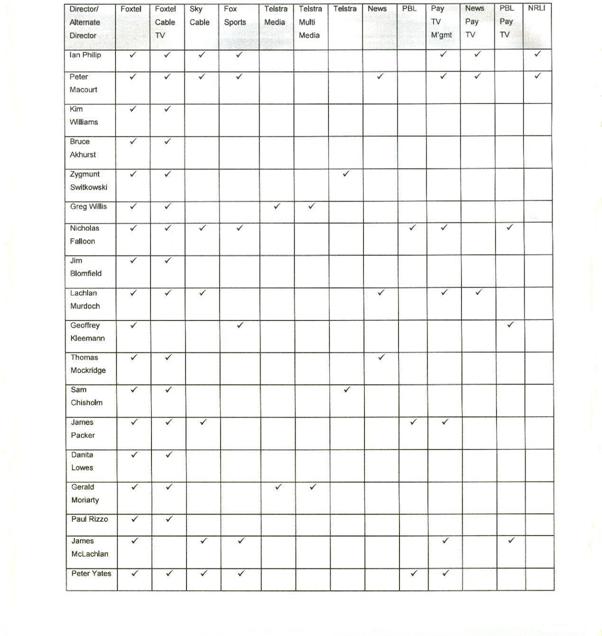
An overview of the Trade Practices Act
195 It is necessary to refer briefly to the provisions of the TPA relied upon by the appellants to understand the matters that follow. The particular provisions will have to be considered in more detail when the different cases advanced by the appellants are separately considered.
196 On the appeal the appellants focussed on three sections of the TPA, being ss 45, 45D and 46, all of which, of course, are in Pt IV of the TPA which deals with “Restrictive Trade Practices”. The appeal also raises questions regarding the construction of the Broadcasting Act as part of the appellants’ anti-siphoning case.
197 The following is a brief overview of the relevant sections of the TPA. The operation of the Broadcasting Act in relation to the pay television industry has been discussed earlier.
198 Part IV of the TPA assumes that it is in the interests of consumers that the suppliers of goods and services should remain in competition and it does so by proscribing certain practices identified in the Part itself. Section 45 proscribes contracts, arrangements or understandings that restrict dealings or affect competition. Section 45D proscribes secondary boycotts engaged in for the purpose of causing substantial loss or damage. Section 46 proscribes the practice of misuse of market power. It is not necessary to identify the other proscribed practices within Pt IV except to say generally that practices which are likely to restrict competition have been proscribed.
199 In Boral Besser Masonry Ltd v Australian Competition and Consumer Commission (2003) 215 CLR 374 (Boral) at [160], Gaudron, Gummow and Hayne JJ identified the three propositions which are inherent in Pt IV and which are consistent with anti-trust decisions in the United States. First, the provisions are concerned with competition, not competitors. Secondly, the provisions are not concerned with unfair competition or even an act of pure malice by one business competitor against another. Thirdly, competition is not enhanced by proscribing vigorous price competition or even the cutting of prices.
200 Part IV is concerned with ultimately protecting consumers but it does so by rendering unlawful the conduct which has the purpose or the effect of lessening competition in a market. In the case of s 45, it proscribes the making of a contract, arrangement or understanding for the purpose of or having the likely effect or the effect of substantially lessening competition in the market. The section also renders unlawful the giving effect to a contract, arrangement or understanding that has the purpose of or is likely to have the effect of substantially lessening competition. Section 45D renders unlawful a person acting in concert with a second person engaging in conduct that hinders or prevents a third person supplying goods or services or acquiring goods or services from a fourth person and the conduct is engaged in for the purpose, or would have, or be likely to have, the effect of causing substantial loss or damage to the business of the fourth person. In the case of s 46, it does so by relevantly rendering unlawful the conduct of a corporation which has a substantial degree of power in the market to take advantage of that power for the purpose of preventing another person from engaging in competitive conduct in that or any other market.
201 In both sections there is a need to first identify the conduct which is said to give rise to the unlawful behaviour.
202 In the case of s 45 both the conduct and the market must be identified so that one can determine whether a party has reached a contract, arrangement or understanding with another party for the purpose of lessening competition in the market or whether the conduct complained of will have the effect of lessening competition in the market. An examination must be made of the relevant facts and circumstances to determine whether there is a market in which the conduct complained of took place. The need to identify the market is apparent because of in the case of s 45 the provisions of s 45(3) and in the case of s 46 the provisions of s 46(1) itself. Once the impugned conduct and the market are identified, then it is necessary to determine whether it was a purpose of the inclusion of these provisions to lessen competition in that market or whether the conduct has or will be likely to have the effect of lessening competition in the market.
Section 45
203 Central to the appellants’ arguments is the operation of ss 45(2) and 45(3) of the TPA. The relevant parts of the section provide as follows:
…
(2) A corporation shall not:
(a) make a contract or arrangement, or arrive at an understanding, if-
(i) the proposed contract, arrangement or understanding contains an exclusionary provision; or
(ii) a provision of the proposed contract, arrangement or understanding has the purpose, or would have or be likely to have the effect, of substantially lessening competition; or
(b) give effect to a provision of a contract, arrangement or understanding, whether the contract or arrangement was made, or the understanding was arrived at, before or after the commencement of this section, if that provision-
(i) is an exclusionary provision; or
(ii) has the purpose, or has or is likely to have the effect, of substantially lessening competition.
(3) For the purposes of this section and section 45A, competition, in relation to a provision of a contract, arrangement or understanding or of a proposed contract, arrangement or understanding, means competition in any market in which a corporation that is a party to the contract, arrangement or understanding or would be a party to the proposed contract, arrangement or understanding, or any body corporate related to such a corporation, supplies or acquires, or is likely to supply or acquire, goods or services or would, but for the provision, supply or acquire, or be likely to supply or acquire, goods or services.
…
204 Section 45(2) differentiates between two different kinds of conduct: the actual “[making of] a contract or arrangement, or [arriving at] an understanding” (s 45(2)(a)); and the act of “giving effect” to a provision of such a contract, arrangement or understanding (s 45(2)(b)).
205 The elements which a party must establish in order to demonstrate that conduct falls within the subsection’s proscriptions differ depending upon which of the subsections is relied upon. In this case, the appellants only relied upon s 45(2)(a)(ii) so it is not necessary to consider s 45(2)(b). Moreover, the appellants eschewed any reliance upon s 45(2)(a)(i) so that placitum may also be ignored. If a party alleges that the making of a contract constitutes the impugned conduct, the party must show that:
1. A corporation has made a contract, arrangement or arrived at an understanding.
2. The contract, arrangement or understanding contains a provision that has:
2.1 the purpose; or
2.2 has the effect; or
2.3 is likely to have the effect
3. of substantially,
4. lessening competition,
5. in the market (s 45(3)).
206 In relation to 2.1 above, the party asserting the contravention may establish that the provision has that purpose by showing that the provision was included in the contract, arrangement or understanding for that purpose and that it was a substantial purpose: s 4F.
207 Section 4F(1) provides:
(1) For the purposes of this Act:
(a) a provision of a contract, arrangement or understanding or of a proposed contract, arrangement or understanding, or a covenant or a proposed covenant, shall be deemed to have had, or to have, a particular purpose if:
(i) the provision was included in the contract, arrangement or understanding or is to be included in the proposed contract, arrangement or understanding, or the covenant was required to be given or the proposed covenant is to be required to be given, as the case may be, for that purpose or for purposes that included or include that purpose; and
(ii) that purpose was or is a substantial purpose; and
(b) a person shall be deemed to have engaged or to engage in conduct for a particular purpose or a particular reason if:
(i) the person engaged or engages in the conduct for purposes that included or include that purpose or for reasons that included or include that reason, as the case may be; and
(ii) that purpose or reason was or is a substantial purpose or reason.
(2) …
208 In relation to 4 above, it is enough to establish that the purpose or effect was to prevent or hinder competition: s 4G.
209 Section 4G provides:
For the purposes of this Act, references to the lessening of competition shall be read as including references to preventing or hindering competition.
210 In relation to 5 above, “market” is defined in s 4E of the TPA:
… means a market in Australia and, when used in relation to any goods or services, includes a market for those goods or services and other goods or services that are substitutable for, or otherwise competitive with, the first-mentioned goods or services.
211 At trial and on appeal, the appellants sought to demonstrate that the conduct of News, PBL and Telstra in 2000 had both the purpose and effect of substantially lessening competition in a number of different markets.
Section 46
212 Section 46 was extensively amended in 2007 by the Trade Practices Legislation Amendment Act (No 1) 2007 (Cth) (No 159 of 2007).
213 Section 46 of the TPA, as it stood at the relevant time, relevantly provided:
(1) A corporation that has a substantial degree of power in a market shall not take advantage of that power for the purpose of:
(a) eliminating or substantially damaging a competitor of the corporation or of a body corporate that is related to the corporation in that or any other market;
(b) preventing the entry of a person into that or any other market; or
(c) deterring or preventing a person from engaging in competitive conduct in that or any other market.
…
(3) In determining for the purposes of this section the degree of power that a body corporate or bodies corporate has or have in a market, the Court shall have regard to the extent to which the conduct of the body corporate or of any of those bodies corporate in that market is constrained by the conduct of:
(a) competitors, or potential competitors, of the body corporate or of any of those bodies corporate in that market; or
(b) persons to whom or from whom the body corporate or any of those bodies corporate supplies or acquires goods or services in that market.
…
(4) In this section:
(a) a reference to power is a reference to market power;
(b) a reference to a market is a reference to a market for goods or services; and
(c) a reference to power in relation to, or to conduct in, a market is a reference to power, or to conduct, in that market either as a supplier or as an acquirer of goods or services in that market.
(5) Without extending by implication the meaning of subsection (1), a corporation shall not be taken to contravene that subsection by reason only that it acquires plant or equipment.
(6) This section does not prevent a corporation from engaging in conduct that does not constitute a contravention of any of the following sections, namely, sections 45, 45B, 47, 49 and 50, by reason that an authorization is in force or by reason of the operation of section 93.
(7) Without in any way limiting the manner in which the purpose of a person may be established for the purposes of any other provision of this Act, a corporation may be taken to have taken advantage of its power for a purpose referred to in subsection (1) notwithstanding that, after all the evidence has been considered, the existence of that purpose is ascertainable only by inference from the conduct of the corporation or of any other person or from other relevant circumstances.
214 In this case the appellants relied upon s 46(1)(c) for the claimed contravention. A party wishing to establish a contravention under that paragraph must show:
1. The corporation has a substantial degree of power in a market.
2. The corporation has taken advantage of that power.
3. For the purpose of:
3.1 deterring; or
3.2 preventing,
4. a person from engaging in competitive conduct in
4.1 that market; or
4.2 any other market.
215 For the purpose of determining the degree of power of a corporation in a market for the further question as to whether that degree of power is substantial, the Court must have regard to the matters in s 46(3).
216 The appellants argue, inter alia, that Foxtel’s refusal to deal with C7 for access to its cable services in the period 1998 to 2000 involved such a misuse of its substantial market power. They also argued that statements made by Foxtel to the ARL that it would not take C7 was a misuse of its substantial market power.
Section 45D
217 The appellants relied upon s 45D in the proceeding before the trial Judge. They have also appealed against his order dismissing this aspect of their proceeding. Section 45D relevantly provides:
(1) In the circumstances specified in subsection (3) or (4), a person must not, in concert with a second person, engage in conduct:
(a) that hinders or prevents:
(i) a third person supplying goods or services to a fourth person (who is not an employer of the first person or the second person); or
(ii) a third person acquiring goods or services from a fourth person (who is not an employer of the first person or the second person); and
(b) that is engaged in for the purpose, and would have or be likely to have the effect, of causing substantial loss or damage to the business of the fourth person.
Note 1: Conduct that would otherwise contravene this section can be authorised under subsection 88(7).
Note 2: This section also has effect subject to section 45DD, which deals with permitted boycotts.
(2) A person is taken to engage in conduct for a purpose mentioned in subsection (1) if the person engages in the conduct for purposes that include that purpose.
(3) Subsection (1) applies if the fourth person is a corporation.
218 The case mounted at trial was that the conduct of which the appellants complained and which will be identified later had the effect of hindering or preventing providers of pay television services from acquiring sports channels from C7 and was engaged in for the purpose and would have or be likely to have the effect of causing substantial loss or damage to the business of C7, and causing substantial lessening of competition in the markets which the appellants identified.
219 In effect, their case was that the collusion between the respondents was such that it prevented C7 from selling its sports channel which contained AFL matches to Foxtel. Thus, it was said, the respondents contravened s 45D.
220 The trial Judge found against the appellants for two separate reasons. First, he found that the factual foundation for appellants’ pleaded case under s 45D of the TPA had not been made out. Those facts are common to the s 45(2) and s 46 cases, and the appellants’ have challenged a number of those findings. The impugned findings will be addressed when addressing the s 45(2) and s 46 cases.
221 However, and more importantly, for the purpose of this aspect of the appeal, the trial Judge found that the pleaded case could not succeed because it was inconsistent with the reasons for decision of the High Court in Devenish v Jewel Food Stores Pty Ltd (1991) 172 CLR 32. In that case, vendors of milk in New South Wales who each had a monopoly in their region acted in concert to withhold supplies of milk from the respondent which conducted a supermarket chain in New South Wales. The purpose and effect of their actions was to damage the respondent and to force it to cease obtaining milk from Victorian suppliers. On appeal to the High Court from the decision of the Full Court of this Court which had found in favour of the respondent, Brennan J (at 46) identified the question which needed to be addressed as whether:
… the withholding of goods from a corporation whose business is the purchase and resale of goods amounts to conduct which hinders or prevents the acquisition by the corporation’s customers of the goods withheld.
222 He said (at 47):
Section 45D(1) proscribes conduct which hinders or prevents supply to a target corporation (“a fourth person”) or which hinders or prevents acquisition from a target corporation; it does not proscribe conduct which hinders or prevents acquisition or supply by a target corporation. True it is that supply and acquisition are reciprocal activities but, as s 45D(1) is expressed to relate only to supply to and acquisition from a target corporation, it distinguishes between those activities and the activities which are reciprocal to them. To give effect to that distinction, it is necessary to exclude from the net of s 45D(1) conduct which impedes an activity mentioned in the subsection (supply to or acquisition of a target corporation) merely by impeding the reciprocal activity which the subsection does not mention (acquisition or supply by a target corporation). I would construe s 45D(1) as requiring proof of conduct other than mere hindering or preventing of the supply of goods by the target corporation before it can be said that acquisition of those goods or services from the target corporation is hindered or prevented.
223 He said (at 47):
In this case the appellants took no steps to hinder the acquisition by Jewel’s customers of whatever goods Jewel had available for sale; the appellants simply failed to supply Jewel with New South Wales milk which Jewel could have supplied to the customers who sought it. For the reasons stated, this did not amount to conduct which, in the sense in which s 45D(1) uses the term, hindered or prevented Jewel’s customers from acquiring New South Wales milk – or any other milk, for that matter – from Jewel: there was simply no New South Wales milk available for that acquisition.
224 Before the trial Judge, the appellants sought to distinguish Devenish v Jewel Food Stores Pty Ltd 172 CLR 32 on two separate grounds, neither of which need be addressed here. However, the trial Judge found that the points of distinction were not made out. He concluded that he was bound by the decision in Devenish v Jewel Food Stores Pty Ltd 172 CLR 32 to dismiss the appellants’ case even if (contrary to his factual findings) it had been made out on the facts.
225 On this appeal, the appellants in their written submissions made an attempt to distinguish Devenish v Jewel Food Stores Pty Ltd 172 CLR 32 but the attempt was abandoned by Mr Myers in his oral submissions. He accepted that the trial Judge was right to conclude that the appellants’ pleaded case had to fail because, even if the factual findings were reversed the case could not succeed in light of the reasons of the High Court in Devenish v Jewel Food Stores Pty Ltd 172 CLR 32 and that this Court would be bound to so conclude.
226 We need say no more about the s 45D case.
AN OVERVIEW OF THE FACTS
The beginning of free-to-air television in Australia
227 Free-to-air television commenced broadcasting in Australia on 27 October 1956 when Bruce Gygnell spoke the now famous words “Welcome to television” on the Nine Network. As already noted, the free-to-air television market in Australia today consists of three commercial networks (Seven, Nine and Ten) and their regional associates or affiliates, along with the ABC and SBS. Colour television commenced in 1975.
Pay television commences broadcasting
228 Retail pay television service in Australia commenced in April 1995, when the Australis-owned “Galaxy” service began operations. Further platforms emerged in the same year, with Austar commencing broadcasting in August and Optus Vision in September and the last major broadcaster, Foxtel in October 1995. In the early stages, both Optus Vision and Foxtel relied on cable to deliver their respective services, while Austar, with its focus on regional areas, from the outset utilised satellite broadcasting. Foxtel commenced its own digital satellite broadcasting service in 1999. Although it possessed an interest in the Optus B.3 satellite, by January 2002 Optus supplied its pay television service by satellite to a limited number of subscribers.
229 Australis, Optus and Foxtel broadcast predominately in major population areas in Australia, although all were constrained initially by the extent of their respective cable networks in urban areas. Austar, with the exception of the Gold Coast, confined its broadcasts to rural areas. The only area of overlap in coverage between Austar on the one hand and Optus and Foxtel on the other was on the Gold Coast.
230 In March 1995 Australis agreed to provide Foxtel with programs including movies and sports. The sports content was provided by Fox Sports.
231 Galaxy ceased broadcasting in May 1998, shortly after its parent Australis went into liquidation. Austar, Optus and Foxtel were left as the main competitors in the Australian pay television arena, although, as previously mentioned, Austar operated for the most part in the geographically-distinct rural market. As at December 2000, Foxtel had 697,760 subscribers (53.1%); Optus 216,515 subscribers (16.5%) and Austar 399,328 subscribers (30.44%).
232 There are significant and high barriers to entry into the retail pay television industry even in circumstances where the industry has achieved low levels of penetration compared with the United Kingdom and the United States.
The formation of Foxtel and Fox Sports
234 Following the exercise of a pre-existing option, PBL acquired a 50% interest in Sky Cable from News effective 3 December 1998. Ownership of Foxtel was thereafter 25% News and 25% PBL through Sky Cable, with Telstra maintaining its 50% share through its wholly-owned subsidiary Telstra Media.
235 Fox Sports was formed as a joint venture between Liberty Sports and a subsidiary of Australis in September 1994, with broadcasting commencing via satellite in April 1995. It was initially branded as “Premier Sports Australia”, and was licensed to Australis with a sub-licence in favour of Foxtel. On 26 September 1997 News acquired a 50% interest in Premier Sports Australia by purchasing the share owned by Liberty Sports. On 12 June 1998, following the winding-up of Australis in early 1998, News acquired 100% ownership of Sports (through Liberty Sports) and commenced marketing the service as “Fox Sports”. In tandem with its acquisition of an interest in Foxtel, later that year PBL acquired a 50% interest in Fox Sports in December 1998. Fox Sports was a 50% partnership between News and PBL from 3 December 1999.
Subscription drivers
237 As indicated earlier, pay television platforms package the channels which they offer to subscribers in at least two ways. First, a basic package which includes a number of channels is offered. Further channels are offered by way of tiers. Usually they are offered in a bundle but at an extra cost over and above the price of the basic package. Sometimes they are offered alone or a la carte but, again, at an extra cost. A subscriber can build up the channels to which he or she has access by agreeing to subscribe for the extra tiers or a la carte channels.
238 It is in the interests of the pay television platforms to be able to offer attractive packages over and above the basic package. Movie channels and sports channels are offered by the platforms as tier packages.
239 These packages are described sometimes as “subscription drivers”. In Australia there are only two Marquee Sports which can be described as “major pay subscription driving sports”, the AFL and the NRL. A pay television broadcaster who can offer live television broadcasts of AFL matches or NRL matches will attract further subscribers who are willing to pay more than the pay television broadcaster’s basic package.
The acquisition of rights and broadcasting between 1995 and 1999
241 At the same time, Optus also acquired AFL rights from Tallglen. Under the agreement between Sports Vision and Tallglen, Sports Vision was granted live and exclusive rights to broadcast throughout Australia six Saturday night AFL games and 12 Sunday afternoon AFL games per season. Companies related to Seven held these rights under a 1993 agreement with the AFL: J [493]. In June 1995, Seven further acquired the AFL pay television and free-to-air rights for the period 1999-2001. In November 1996 the parties agreed for the AFL to allocate 36 games per season to pay television.
· Seven received all AFL pay and free-to-air rights for the period 1993-2001 on an exclusive basis.
· The quantum of fees was dealt with separately for each year. For example, Seven was to pay $33 million in total for the AFL free-to-air and pay television rights for the 2001 season.
243 In September 1997, Seven and the AFL entered into the First and Last Deed. The AFL granted Seven a first and last right of refusal over free-to-air television rights for the period 2002-2011. Seven, in turn, agreed to make irrevocable offers for free-to-air and pay television rights covering that period. The Deed permitted the AFL to license the rights for a five or ten year term.
244 The First and Last Deed contained:
(a) a put option in the AFL’s favour, enabling it to require Seven to accept a licence for AFL broadcast rights (enabling live free-to-air broadcast of all AFL matches) at $36 million per annum, plus CPI;
(b) subject to Seven obtaining broadcast rights either by exercise of its first and last rights or via the AFL’s put option described above, an irrevocable offer by Seven to form a 50/50 joint venture with the AFL for the exploitation of AFL pay television rights, with Seven guaranteeing a minimum return to the AFL of $15 million per annum.
245 In 1995, News Limited sought to create its own domestic Rugby League competition called Super League in opposition to the established ARL. The primary aim of this venture was to provide premium Rugby League content for Foxtel programming. This competition ultimately ran for one season in 1997, with the PBL-owned Nine Network holding the free-to-air broadcasting licence.
246 Following the resolution of the Super League dispute in late 1997 and the formation of the NRL, the rights to the new competition came under the exclusive control of the NRL Partnership. News was granted, as part of the Merger Agreement, the exclusive NRL pay television rights which it sub-licensed to Foxtel, Optus and Austar in the period 1998-2001. Fox Sports produced the NRL content for Foxtel, while a third party produced the content for Optus. In 1998, Nine also secured the NRL free-to-air rights for 10 years. This new arrangement was to the advantage of Fox Sports, which had in 1997 broadcast the rights to the Super League competition promoted by News.
247 When News secured the NRL pay television rights in May 1998, it also secured a last right of refusal over the broadcasting rights, subject to Nine’s rights. In the same month, the NRL Partnership directly granted Optus the right to acquire NRL content on the same terms as it was offered to Foxtel or any other person. Optus held a pre-existing right to be offered NRL content on terms no less favourable than those offered by News to Foxtel in the event that News obtained the rights between 2001 and 2021.
248 The absence of any AFL content on Fox Sports, and therefore on Foxtel, remained a marketing weakness for Foxtel, particularly in relation to its attempts to drive market penetration outside New South Wales and Queensland.
249 During 1998, Seven entered the business of channel supply to retail pay television operators directly through its supply of C7. This was a direct consequence of a dispute within the Sports Vision partnership regarding the supply of AFL content by the Seven subsidiary, Tallglen. This tension resulted in litigation and ultimately, in May 1998, the decision by Seven and PBL to withdraw from Sports Vision, which later ceased broadcasting in August 1998. C7 was therefore developed in the market as a replacement for Sports Vision on the Optus Vision platform.
251 The C7 service provided to Optus ultimately consisted of two channels, being the primary sports channel branded as “C7 Gold”, and a secondary or “overflow” channel branded as “C7 Blue”. C7 further received a sub-licence of the non-exclusive NRL rights from Optus between 1998 and 2001. These rights were carried on C7 Blue, which became Optus’s outlet for NRL broadcasts. Finally, C7 provided Optus with coverage of the 2000 Summer Olympics via temporary additional channels.
252 Although its primary relationship at this stage was with Optus Vision, Seven further sought to sell the C7 channels to other pay television providers.
254 The terms of the C7-Austar CSA were as follows:
· The agreement was expressed to operate between 1 April 1999 and 28 February 2002. It was later extended to 31 March 2002.
· C7 was to supply Austar with a single full-time sports channel on a non-exclusive basis.
· The C7 channel was to include AFL content. In the event, Austar broadcast the same primary C7 channel as Optus.
· The normal price was $2.00 pspm for the tier on which C7 was placed and $3.50 for MDS subscribers.
255 However, despite Seven’s success in securing the sale of its C7 sports channels to Optus and Austar, it failed to persuade Foxtel to carry C7. Negotiations between Foxtel and Seven took place against the background of discussions between News and Optus regarding rationalisation of the Australian pay television industry. The history of these negotiations was set-out by the trial Judge:
538 On 29 October 1997, TNCL and Optus Communications entered into a long form agreement similar in effect to the short form agreement signed in September. The recitals to the agreement recorded the following:
‘A. Each of News and Optus acknowledge that the pay television industry in Australia at present is not viable because the subscriber uptake of pay television services is too low and the cost of acquisition of the programming comprised in those services is too high.
B. Accordingly, Optus and News have been discussing ways in which the programming comprised in the pay television services supplied in Australia can be made more attractive to potential subscribers so as to increase penetration, lower the rates of churn and achieve sustainable long term competition.
C. As a result of those discussions Optus and News agree that the way in which programming can be made more attractive is for all core programming to be available for inclusion in all pay television services in Australia.
D. Optus and News acknowledge that a number of program supply agreements presently in place confer on one or other pay television service exclusive rights and that it will be necessary to achieve the objective referred to in paragraph C to obtain the agreement of those program suppliers to vary those programming arrangements to provide for non-exclusive supply and accordingly a lower per subscriber price of supply’.
The agreement was conditional upon the termination, on or before 24 November 1997, of the ‘Acquisition Agreement’ by which Foxtel was supplied to Australis. That condition precedent was never met.
539 On 20 February 1998, TNCL and Optus Communications entered into a second agreement based on the parties’ belief (as set out in the recitals) that ‘the Australian pay television industry is … unsustainable and all retail pay television suppliers have incurred substantial losses’. The agreement was conditional on Telstra’s consent. According to Mr Macourt’s evidence, the creation of C7 led Optus to disengage from discussions concerning implementation of the content agreements.
256 Foxtel Management ultimately considered in mid-1999 that a decision on taking up C7 should be deferred until Foxtel could assess the effect such carriage would have on its own plans to secure the AFL rights directly. Foxtel decided in early July 1999 that direct acquisition of the rights would be preferable and that there would be no dealing with C7 until the end of bidding on the AFL rights, which Foxtel anticipated would occur within months.
257 The Seven/Foxtel negotiations also took place at a time when the Foxtel Partners were in dispute.
The Foxtel Partnership dispute
258 Throughout the period 1998 to 2000, Telstra on the one hand and News and PBL on the other had been involved in an ongoing dispute concerning the terms of carriage by Foxtel of Fox Sports. Whilst Telstra owned 50% of Foxtel it had no interest in Fox Sports. Telstra viewed the price charged for premium sporting content by Fox Sports to Foxtel as unreasonably inflated and sought to have Foxtel explore other options for acquiring similar material. Telstra believed that Foxtel, by paying inflated prices for Fox Sports channels, was thereby directing profits in which it would otherwise have shared to Fox Sports, the profits of which would be shared by News and PBL. The existing arrangements were perceived by Telstra as unfairly advantageous to News and PBL.
259 As a means of leveraging News and PBL regarding the supply of Fox Sports, Telstra advised News and PBL during the course of negotiations that it viewed C7 as an alternative supplier of valuable sport channel content. Telstra provided a comparison of pspm paid for Fox Sports as opposed to C7. It also identified benefits to Foxtel of C7 content and branding. This dispute continued throughout the period.
260 During this period Telstra relied on the terms of the C7-Austar CSA which were better from Austar’s point of view than the terms sought by News for a long-term deal for the supply of Fox Sports to Foxtel: J [638]. It pointed to the fact that Austar was being charged USD3.70 pspm whilst Foxtel was paying Fox Sports $5.25 pspm for its sport channel. It claimed it was subsidising Fox Sports: J [655].
261 Mr Macourt said that it was not possible for Foxtel to do a deal with Seven. Mr Philip said “there was no way in hell News would agree to that”. News made it clear that it would block any deal with C7 at the Foxtel board level.
262 The dispute between Telstra on the one hand and News and PBL on the other hand was in a sense insoluble. Each of the parties on the Foxtel Management board had a vote and each could prevent one or more of the others causing Foxtel to pursue a particular course. In particular, Telstra could not force Foxtel to arrive at an agreement with Seven in relation to C7. Nor could it prevent Foxtel continuing to take Fox Sports at a previously agreed price.
263 Telstra’s role was further complicated by its related competition with Optus in the telephony market. It resisted any content-sharing deal which might lead to Fox Sports programming ending up on the Optus platform. Examples included its threats of legal action against News in October 1998 when Fox Sports sought to negotiate carriage on Optus. It argued that any such deal would be a breach of News’s obligations to Telstra. Telstra’s role in Foxtel was partly motivated by its desire to conduct “telephony defence”, in the sense of bundling pay television services with telephone services in order to protect its existing market share. It therefore had a vested interest in ensuring that the quality of service provided by Foxtel was clearly superior to that of Optus. By contrast, the Fox Sports partners aimed to sell their subscription-driving channel to as many operators as possible.
264 The end result is that Foxtel never bought any C7 channels from Seven. By doing so, it denied itself the chance to broadcast AFL matches. Thus it denied itself a major subscription driver.
The News Consortium’s bid for the NRL and AFL rights
265 The AFL free-to-air television rights which Seven had and the pay television rights which C7 had were due to expire at the end of the 2001 season. The question as to who would have the rights during 2002 to 2006 was to be addressed at the end of 2000 and the beginning of 2001. Seven had the commercial advantage of holding the free-to-air television rights by virtue of the First and Last Deed. It did not have the same commercial advantage in respect to the pay television rights.
266 In July 1999, Foxtel commenced a strategy to seek the direct acquisition of the AFL rights for the period 2002-2006. The key drivers of this plan were Mr Macourt and Mr Philip of News, with assistance from Mr Frykberg, News’s Executive Director of Sport. Despite suggestions by Telstra and its appointees on the Foxtel board that Foxtel should continue to examine overtures from C7, the ultimate recommendation of the Foxtel board was that no offer by Seven or C7 be considered until the ownership of the AFL pay television rights had been determined. News blocked a counter recommendation by Telstra in October 2000 for an interim carriage arrangement with C7 if Foxtel secured the rights.
267 Telstra voiced some concern during this period that News’s intention in securing the AFL rights appeared to be engaged in conduct of killing C7. The expression killing C7 appears in conversations and communications between members of the Foxtel Partnership. An example was a conversation between Mr Fogarty and Mr Blomfield in late October or early November 2000:
The conversation concerned a proposal communicated to [Telstra] and others by Foxtel Management ... pursuant to which the Board of Foxtel Management was asked to authorise that company to enter into a put option agreement with News Limited ... pursuant to which Foxtel Management would acquire pay television rights to AFL matches for a term of 5 years commencing in 2002. In relation to that proposal, Mr Blomfield stated to Mr Fogarty words to the effect, “Don’t you understand that this is about killing C7?”
268 Despite these reservations, Telstra ultimately acquiesced in the plan to bid for the rights.
270 At this time Fox Sports held the NRL pay television rights until the end of the 2002 season. If it were to acquire the AFL pay television rights in 2000 it would hold the pay television rights for the only two Marquee Sports in Australia.
271 First negotiations between representatives of the News Consortium and the AFL occurred in 2000. The News Consortium’s initial proposal, which Foxtel agreed to at a board meeting on 22 August 2000, was for Foxtel to pay $20 million per annum for four live and exclusive games per week. That was later amended to $17.5 million per annum for three live and exclusive games.
272 On the same day Fox Sports resolved to bid for the NRL pay television rights for the rights period commencing in 2001.
273 By 5 December 2000, the News Consortium proposal stood at $30 million for the rights to three live and exclusive games, subject to a right to substitute games in local broadcast areas.
The Master Agreement and the Master Agreement Provision
274 On 13 December 2000 a teleconference took place between a number of persons who represented various parties in the News Consortium. In attendance were Dr Switkowski, Mr Akhurst, Mr Greg Willis and others from Telstra; Mr Blomfield, Mr Macourt and Mr Philip from Foxtel, the latter two also acting for News and Fox Sports; and Mr James Packer, Mr Falloon and Mr Kleemann for PBL.
(a) carry out the AFL proposal and the NRL proposal including by entering into the contracts which formed part of these proposals; and
(b) procure their related bodies corporate to carry out the AFL proposal and the NRL proposal, including by entering into the contracts which formed part of those proposals.
277 The AFL proposal was identified in para 99(c) of the FFASC:
In relation to the acquisition of AFL pay rights, News proposed that:
(i) News make a bid, and if the bid was accepted enter into a contract with the AFL, for the AFL broadcast rights;
(ii) News sublicense the AFL free-to-air rights to Nine and Ten and the AFL pay rights to Foxtel;
(iii) the bid by News be supported by put agreements with Nine, Ten and Foxtel enabling News to require them to enter into sublicences on the same terms as were embodied in the put agreement;
(iv) Foxtel pay $30 million per annum (adjusted in accordance with the consumer price index for the years 2003 to 2006) plus GST plus a proportion of the amount of free advertising time (“contra”) to be included in the News bid (being the proportion that the Foxtel rights free of $30 million bears to the total rights fee being offered by News to the AFL for the AFL broadcast rights) for pay rights to three exclusive live matches per week and the right to broadcast all other AFL matches on pay television on a delayed basis;
(v) the bid by News also include undertakings to:
(1) provide editorial coverage in News’ newspapers, which undertaking would be paid for by Foxtel;
(2) provide support from ACP magazines, which undertaking would be supported by Nine; and
(3) use reasonable endeavours to arrange coverage of the AFL on the overseas broadcast platforms associated with News.
278 The NRL proposal was identified in para 99(d) of the FFASC:
In relation to the acquisition of NRL pay rights, News proposed that:
(i) Fox Sports make a bid, and if the bid was accepted enter into a contract with the NRL Partnership, for the NRL pay rights, and Fox Sports also offer to the NRL Partnership to procure that Telstra enter into agreements to acquire the NRL naming rights and the NRL internet rights;
(ii) Telstra enter into an agreement with Fox Sports that it would acquire the NRL naming rights and NRL internet rights if required by Fox Sports;
(iii) Foxtel agree to accept channels with NRL programming supplied by Fox Sports on certain terms;
(iv) Foxtel be given the right to sublicense the NRL pay rights to Optus;
(v) the bid by Fox Sports for the NRL pay rights would be $30 million per annum (adjusted in accordance with the consumer price index for the years 2003 to 2006) plus GST plus contra; and
(vi) the bid by Fox Sports would include an offer to procure Telstra to acquire the NRL naming rights and the NRL internet rights for $5 million per annum (adjusted in accordance with the consumer price index for the years 2003 to 2006) plus GST.
279 The appellants’ case was that the Master Agreement was synonymous and co-existent with the Master Agreement Provision. We think the trial Judge and the parties at trial proceeded upon that basis: J [88].
280 The Master Agreement Provision provided that each of Telstra, News, PBL and Foxtel would carry out the AFL and NRL proposals by entering into contracts forming part of those proposals. They would further procure their related entities to give effect to these terms.
· The “News-AFL Licence” – the licence of the AFL rights to News. This is discussed later.
· The “Foxtel Put” (made on or about 14 December 2000) – Foxtel agreed to acquire the exclusive pay TV rights if requested by News. The rights were to be received through a sub-licence from News. Foxtel was to pay $30 million per annum, while News was to pay Foxtel $500,000 for each pay television match broadcast by a free-to-air broadcaster earlier than 14 days after the date the match was played. The Foxtel Put was ultimately given effect by the “News-Foxtel Licence”.
· The “Nine Put” (made on or about 14 December 2000) – Nine agreed to acquire certain AFL free-to-air rights if requested by News via a sub-licence. The “Nine Put Provision” required Nine, if requested, to acquire three AFL matches each round on an exclusive basis for $23 million per annum plus $500,000 for each additional match broadcast fewer than 14 days after it was played. The Put was given effect by the “News-Nine Licence”.
· The “Ten Put” – Ten also agreed to acquire certain AFL free-to-air rights if requested by News. Again, News would sub-licence the rights. The “Ten Put Provision” required that Ten pay $23 million per annum for two games per round on an exclusive basis plus finals and other matches. As in the Nine Put, provision was also made for additional $500,000 payments in relation to certain free-to-air broadcasts. The Put was given effect by the “News-Ten Licence”.
· The “NRL Bidding Agreement” (made on or about 13 December 2000) – an agreement between Fox Sports, Foxtel and Telstra which provided that:
▪ Foxtel agreed to pay Fox Sports $18 million per annum (plus GST and adjustments) for NRL coverage to be supplied by Fox Sports, the fee to be reduced if Optus acquired pay television rights directly from the NRL Partnership;
▪ Fox Sports conferred on Foxtel the exclusive right to sub-license the NRL coverage to Optus and to retain all proceeds of such sub-licensing; and
▪ Telstra agreed, if requested by Fox Sports, to acquire the NRL naming rights for $4 million per annum and the NRL internet rights for $1 million per annum (plus GST and adjustments).
· The “Fox Sports-NRL Pay Rights Agreement” (made on or about 13 December 2000) – Fox Sports acquired the NRL pay television rights for $30 million per annum from the NRL Partnership. The fee was to reduce to $15 million per annum if NRL also granted the NRL pay television rights to Optus. The NRL also agreed not to grant the rights to any other party in terms more favourable than those between it and Fox Sports.
C7’s offers for the rights up to December 2000
282 Seven was not inactive during this period and formulated several bids for the AFL and NRL rights based on different costing (“best” and “worst” case) and carriage scenarios.
283 Seven ultimately made a considerable offer for the NRL pay television broadcast rights for the period to 2006 amounting to $72 million per annum. Seven’s offer for the NRL rights was in excess of those made by Fox Sports in its offer, but the NRL Partnership relied upon qualifications in the C7 offer to conclude that the “guaranteed figure” from Fox Sports was higher than that offered by C7.
284 Seven also tendered through C7 for both the AFL free-to-air and pay television rights. Its three bids were as follows:
(i) March 2000: $75 million per annum for the AFL pay television, free-to-air and internet rights for 2002-2011. Seven would retain the right to allocate games between mediums “at its discretion”.
(ii) October 2000: A licence fee of $51 million per annum for the AFL pay television, free-to-air and internet rights for 2002-2011. The AFL would share equally in net revenues from pay services in excess of $30 million derived from Foxtel, on the assumption that Foxtel took the C7 service. There was a further requirement that pay television and free-to-air rights not be severable.
(iii) 14 December 2000: $60 million per annum for all free-to-air and pay television rights for the period 2002-2006. In addition, Seven offered $4 million in contra and $8 million in sponsorships, club development and the promotion of a Seven-AFL online venture.
285 Seven’s offers for the AFL broadcasting rights were made notwithstanding that Seven appreciated that the AFL wanted separate bids for the AFL free-to-air and pay television rights. The “indivisibility” of the rights was a significant issue for Seven and was prominent in discussions. Seven also objected to any proposal for a non-exclusive grant of the AFL pay television rights.
ACCC intervention
286 The bidding process occurred in a context in which Seven had repeatedly approached the ACCC in relation to its dealings with the Foxtel Partners. Previous instances of ACCC involvement in the pay television industry had included:
· blocking the merger of Foxtel and Australis in 1997;
· rejecting Seven’s request for action against PBL when it acquired a 25% stake in Foxtel in December 1998; and
· declaring the analogue subscription broadcast carriage service a “declared service” for the purposes of Pt XIC of the TPA in September 1999.
287 On 20 November 2000, Seven’s solicitors wrote to the ACCC highlighting its “very real concerns about the potential for misuse of market power by the PBL/News/Telstra consortium in relation to the current bidding process and its outcome”. Seven again requested ACCC intervention on 12 December 2000. Its note made at this meeting stated:
... should Seven not acquire the AFL broadcast rights, its pay TV sports channel, C7, will fail, thus resulting in rights holders being confronted with a monopoly buyer when premium sports rights next become available.
288 A further attempt was made to involve the ACCC on 24 January 2001, after the rights had been awarded and one day before Seven refused to exercise its rights under the last First and Last Deed. In the end, the ACCC declined to intervene in the rights-bidding process.
289 Seven’s requests for ACCC intervention appear to have been devised in order to block the News Consortium’s bid for the AFL rights.
The sale of the sporting rights
290 On 14 December 2000, News and Seven made their competing offers to the AFL for the next rights auction. News’s final bid for the AFL television rights ($30 million per annum for free-to-air rights) was significantly higher than Seven’s bid of $60 million per annum for all television and internet rights and with Seven having the right to control their allocation between pay television platforms and its own free-to-air channel.
291 On the same day, the NRL PEC announced that it accepted Fox Sports’ bid for the NRL pay television rights. The agreed price was a base fee of $33 million exclusive of GST, with annual increases of $3.5 million per annum (see the “Fox Sports-NRL Pay Rights Agreement”).
· News acquired the AFL pay television rights for 2002-2006 for $30 million per annum plus CPI.
· News was to receive “at least 3” live pay television matches per week.
· News acquired the AFL free-to-air rights for 2002-2006 for $46 million per annum, plus $500,000 for every non-exclusive match televised by a licensee less than 14 days after it was played (subject to limited exceptions). This was subject to Seven’s exercise of its “Last Deed”.
· The free-to-air package consisted of five regular season matches per week, final series matches, two thirds of the Ansett Cup matches and any State of Origin fixtures.
· News’s sub-licensee was to offer Optus and Austar AFL pay television content on reasonable terms.
293 On 25 January 2001 Seven indicated that it would not match the offer made by News.
Optus’s situation
294 During the period prior to and after the disposition of the rights, Optus’s own commercial situation was the subject of internal examination. Sackville J discusses these issues extensively in Ch 11 of his reasons.
295 SingTel Optus, formerly known as Cable & Wireless Optus Ltd and Optus Communications Pty Ltd, was at all material times the holding company of Optus Vision. SingTel Optus’s pay television business has been managed as part of its Consumer and Multimedia Division (CMM). Singapore Telecommunications Ltd (SingTel), a Singapore corporation, acquired all the shares in SingTel Optus in August 2001.
296 Optus’s pay television business was a concern to SingTel. At trial, comments of Mr Anderson, Optus’s CEO after 1997, were cited to the effect that Optus was haemorrhaging between $300 million and $350 million per annum during the period 1999-2001. Subscriber numbers in June 1998 were 177,000 against an anticipated 542,000, although it was noted that there was some increase (23%) between September 2000 and September 2001.
298 While the McKinsey report emerged in 2001, after C7 had lost the AFL rights and failed to acquire the NRL rights, it is clear that many of the financial imperatives impacting on Optus pre-dated these events.
The end of C7
299 C7 was left in a highly-vulnerable position with respect to Optus following its failure to secure any broadcasting rights to Marquee Sports after the conclusion of the 2001 AFL season.
· The “First Variation Agreement” (September 2001) extended the C7-Optus CSA for a period of three months.
· The “Exclusivity Clause” formed part of the First Variation Agreement. This clause effectively prevented Optus from negotiating or entering into agreements with channel suppliers other than C7 for the duration of the C7-Optus CSA.
· The “Second Variation Agreement” (January 2002) extended the First Variation Agreement to 28 February 2002.
302 In circumstances where negotiations for future carriage of C7 by Optus had broken down, Optus sought to negotiate directly with Foxtel for the carriage of Fox Sports and the new Foxtel venture, the AFL-only “Fox Footy”, which commenced broadcasting in early 2002. As previously discussed, other financial pressures appear to have played a role in pushing Optus towards content sharing with Foxtel, although the exact significance of these imperatives is a contentious matter and will be dealt with later.
306 The relevant terms of the Foxtel-Optus CSA were as follows:
· The agreement was to run from November 2002 to December 2010.
· Foxtel granted Optus a non-exclusive licence for the term to distribute the “Foxtel Services” over the Optus Cable and to certain subscribers by satellite. The “Foxtel Services” consisted of all pay television channels and all pay-per-view services provided by Foxtel to its subscribers as at 5 March 2002 or during the term of the CSA.
· Four Foxtel channels, including the Fox Footy Channel, were to be carried from the outset.
307 The appellants described this arrangement as leaving Optus as a “content reseller” of Foxtel.
308 Without any existing carriage agreement with a pay television platform, C7 ceased operations in May 2002.
Postscript – the bidding for pay rights in 2005
309 In 2005 Seven bid for the AFL broadcasting rights for 2007 to 2011. It was successful. Seven (together with Ten) used Seven’s pre-existing right under the First and Last Deed to match an offer for the rights advanced by PBL.
310 It should be noted that no evidence was adduced at trial of the outcome of negotiations for the sub-licence of these rights to pay television operators. Sackville J noted in this context (at J [1999]) that:
It is clear that, by the time the evidence closed in this case, the negotiations had not borne fruit and, indeed, the parties were then a considerable distance apart. However, I do not draw the inference that it was unlikely that the negotiations would ultimately result in a sub-licensing agreement on commercial terms between the rights holders and the major pay television platform. The hearing concluded some months before the commencement of the 2007 AFL season and at that stage the negotiations had a long way to go.
Witnesses AND DOCUMENTS
Witnesses
311 The trial Judge devoted a chapter to his assessment of the credibility of the lay witnesses. He observed that the credit of a number of the witnesses who gave evidence before him was vigorously challenged in cross-examination. Some witnesses were accused of lying.
312 Whilst noting that demeanour could be important in assessing the credibility and reliability of a witness, his Honour reminded himself of the observation of Atkin LJ in Société d’Avances Commerciales v Merchants’ Marine Insurance Co (The “Palitana”) (1924) 20 Lloyd’s Rep 140 at 152 which had been approved in Fox v Percy (2003) 214 CLR 118 at 129:
… an ounce of intrinsic merit or demerit in the evidence, that is to say, the value of the comparison of evidence with known facts, is worth pounds of demeanour.
313 His Honour made a number of adverse findings about the credibility and reliability of a number of witnesses which do not need to be re-examined on this appeal. The only witness whose evidence on appeal is under challenge in terms of its reliability is that of Mr Philip. The appellants challenge a finding of his Honour’s where his Honour accepted part of Mr Philip’s evidence in relation to News’s motivation and purpose. The appellants contend that his evidence on this matter should not have been accepted having regard to the significant adverse findings made by the trial Judge.
314 Prior to 1997, Mr Philip was a partner in the firm of solicitors, Allen Allen and Hemsley as it was then known. He specialised in commercial and corporate work but not litigation. Two of his clients were News and Foxtel. He became Chief General Counsel of News in 1997, which position he still held at the time that he gave his evidence. He also continued to hold a practising certificate at the time he gave his evidence. Mr Philip was, in addition to being a director of Foxtel, a director of Sky Cable, Fox Sports, Pay TV Management, News Pay TV Pty Ltd and NRLI.
315 Mr Philip admitted in a statement filed in the course of the trial that he had dishonestly attempted to induce Telstra to contribute an extra $13 to $14 million in support of Fox Sports’ bid for the NRL pay television rights.
316 His Honour thought that Mr Philip’s conduct was such that he should request the Registrar of the Court to acquaint the Law Society of New South Wales with his judgment in the proceeding so that the Law Society could consider whether Mr Philip’s conduct should be referred to an appropriate body. He also thought that Mr Philip’s conduct was such that News, if it had appropriate standards of commercial morality, should either terminate Mr Philip’s employment or discipline him.
317 The trial Judge would not have taken the action that he did or make the comments that he made unless he thought Mr Philip’s conduct was so outrageous that such action should be taken and such comments should be made publicly.
318 His Honour was not only scathing of Mr Philip in relation to Mr Philip’s dishonesty in dealing with Telstra, but he also said that he found other parts of Mr Philip’s evidence difficult to accept. He said of one aspect of his evidence that it was confused, implausible and singularly unsatisfactory. He identified further aspects of Mr Philip’s evidence which he thought could not be accepted and he said at J [428]-[430]:
Mr Philip was willing to go to considerable lengths to present a picture that bore little relationship to reality. As Seven submits, his efforts to maintain the fiction that there was no consortium bidding for the AFL pay television rights reflected the extremely wishful thinking of a lawyer seeking to present an artificial (and false) picture of the facts, rather than the true position. Mr Philip also seemed to me to downplay the extent to which he was involved in commercial decision-making by News or by the entities of which he was a director.
In assessing Mr Philip’s evidence, it is appropriate to take into account that, apart from hard copy documents retained in his own files or copies of electronic or paper communications retained by others, he deleted the records of his emails. He did so, in part, because he appreciated that communications of this kind might be useful in litigation. Seven has been denied the opportunity to cross-examine Mr Philip by reference to the deleted material.
For these reasons, I do not regard Mr Philip as a reliable witness. His evidence therefore needs to be scrutinised carefully, including his claims as to his thought processes in relation to particular decisions, negotiations or communications.
319 However, notwithstanding those very strong findings, his Honour said that the caution which he would give himself would not lead him to conclude that he should reject all of Mr Philip’s evidence. He said at J [431]:
This caution does not lead me to conclude that I should reject all of Mr Philip’s evidence. Sometimes it is supported by the contemporaneous documentation or by other witnesses whose evidence I consider to be reliable. For example, I think it likely that Mr Philip deferred to Mr Macourt in the manner he described. I also think it likely that Mr Philip was told and accepted that News’ position, for sound commercial reasons, was that C7 should not be taken on Foxtel until the long-term contractual arrangements between Fox Sports and Foxtel had been secured. Similarly, I think it likely that Mr Philip believed that a decision by Foxtel not to take C7 pending the award of the AFL pay television rights would enhance Foxtel’s chances of successfully bidding for the rights.
320 It was the appellants’ case at trial and on appeal that News had the intention of killing C7. However, the trial Judge accepted Mr Philip’s evidence that it was not his or News’s intention that C7 should be killed. The appellants contended, having regard to the strong findings made by his Honour that his Honour should not have accepted a self-serving statement of Mr Philip’s as to his motivation or purpose especially in light of other contemporaneous objective evidence which supported, so the appellants contended, their claim that it was News and Foxtel’s intention to kill C7.
321 In CSR Ltd v Della Maddalena 224 ALR at 7, Kirby J (with whom Gleeson CJ agreed) pointed to the limitations which an appellate court has in considering findings made upon the basis of an assessment of the credibility of a witness: see also Fox v Percy 214 CLR at 126. However, this is not one of those cases where the trial Judge has an advantage over the appellate court in the evaluation of a witness’s credibility and reliability because we have the advantage of his Honour’s assessment of the witness which we can act upon. Indeed, we have been asked to proceed upon the basis of his Honour’s findings.
322 Having regard to the very strong adverse findings the trial Judge made of and concerning Mr Philip’s evidence, there has to be a reason why his Honour would have accepted a self-serving denial. It would be difficult to justify accepting such a denial if it were made in contradiction of other contemporaneous facts. There would be a marked inconsistency in the reasoning process.
323 His Honour however gave reasons why some of Mr Philip’s evidence could be accepted. Some of Mr Philip’s evidence was supported by contemporaneous documentation. Other evidence was supported by witnesses whose evidence was reliable.
324 There is no reason to think that the trial Judge erred in his approach to this aspect of his task. He was aware that his justified criticism of Mr Philip’s evidence meant that he had to be very careful about accepting any part of Mr Philip’s evidence. However he was entitled to accept Mr Philip’s evidence when it was supported by other evidence including contemporaneous documents. There is no suggestion that the contemporaneous documentary evidence was unreliable. Usually contemporaneous documents speak the truth because they are usually prepared in circumstances where the creators do not expect them to be examined by a Court. There is also no suggestion that his Honour was meaning to treat the oral evidence which supported Mr Philip’s evidence as other than reliable.
325 We are of the opinion that there is nothing illogical or inconsistent in the trial Judge accepting Mr Philip’s evidence where it was supported by other reliable evidence. Indeed we think that his Honour was correct to proceed in that way.
326 The appellants called Mr Stokes who was at the relevant time a major shareholder in Seven Network and Non-executive Chairman of Seven Network between June 1995 and July 1999, and CEO from August 1999 to October 2000. The trial Judge made a number of adverse findings about Mr Stokes’ evidence and about Mr Stokes. Although those findings are not under challenge on this appeal, this Court must have regard to those findings because Mr Stokes’ evidence was critical in relation to Seven’s s 46 case and relevant to Seven’s s 45 case.
327 His Honour took into account a number of factors in favour of Mr Stokes in assessing the reliability of Mr Stokes’ evidence but, notwithstanding those matters, his Honour said at J [391]-[392]:
Even taking these matters into account, however, there were simply too many occasions on which Mr Stokes’ evidence was implausible for me to regard him as a reliable witness on disputed issues. Sometimes it is extremely difficult or impossible to reconcile his version of events with the contemporaneous records, the reliability of which there is no good reason to doubt. Sometimes Mr Stokes’ evidence flies in the face of incontrovertible facts. Sometimes, he changed his evidence when confronted with material that made it virtually impossible to maintain the position he had previously adopted. Sometimes Mr Stokes’ evidence conflicted with that of other witnesses (including, on occasions, witnesses called by Seven) whose accounts are, in my view, reliable.
So far as contemporaneous records are concerned, there may be, as Mr Sumption submits, a difference between an apparently reliable record that omits reference to a discussion or event that a witness says took place, and a similar record that includes reference to a discussion or event that the witness denies occurred. However, Seven adduced no evidence to counter the inference that the minutes of board and committee meetings within Seven were intended to be reasonably reliable records of the meetings prepared by competent people. In any event, it is often difficult to think of a plausible reason why the contemporaneous records would have omitted reference to a particular discussion or event that Mr Stokes said took place, if indeed it did. Further, Mr Stokes on a number of occasions denied knowledge of important information, such as the state of C7’s negotiations with Austar, that the contemporaneous documentation overwhelmingly suggests was drawn to his attention.
(Trial Judge’s emphasis.)
328 His Honour then observed that Mr Stokes was subject to a vigorous cross-examination which called his honesty into question and his Honour said at J [394]:
I think it appropriate to observe that, although some of the particular attacks on Mr Stokes’ credit lacked cogency, there were occasions on which, in my opinion, he gave evidence that he knew was not true. One example was a particularly unconvincing denial that he did not share the objective of others within Seven of ‘ramping’ the price that News (through Fox Sports) would ultimately have to pay for the NRL pay television rights by outbidding Seven. Mr Stokes participated in a conference at which the objective was discussed and, on his own admission, said nothing to dissociate himself from the views expressed there. Mr Gammell gave evidence that everyone at the meeting agreed with the ramping objective. Internal Seven documentation makes it clear that ramping was, at the very least, a critical (if not the only) objective underlying the bidding by Seven for the NRL pay television rights. Mr Stokes’ evidence on this issue was not only implausible but, I must conclude, deliberately false.
329 In the end result, the trial Judge said that he would not accept Mr Stokes as a reliable witness where any matter was in dispute, especially where there was contemporaneous evidence or cogent oral evidence which was in conflict with Mr Stokes’ evidence.
330 The appellants did not take issue with his Honour’s findings in respect of Mr Stokes’ evidence and this Court should have regard to those findings when considering his evidence on where factual findings involving his evidence are called into question.
Documents
331 News’s practice between 1988 and 2002 was to delete all electronic communications or emails after a period of three days. The effect of News’s policy was that, unless the creator or the recipient of an email chose to retain the email, the record of the email would be deleted after three days. As a consequence of that policy, whilst News discovered 49 internal emails as part of their paper files, they discovered no electronic emails at all. In his evidence, Mr Philip agreed that the reason for his adopting the practice to delete emails permanently from the hard drive of his computer after about two weeks was “so that people will in future know as little as possible from documentary records about what you [Mr Philip] have been doing”. His Honour noted that News’s policy meant that the appellants were denied access to a number of documents.
ISSUES AT TRIAL AND THE JUDGE’S TREATMENT
An overview of the issues at trial
332 It is necessary to identify in broad terms the principal claims which were raised on the pleadings and which were inquired into at trial. At trial, the appellants complained that News, PBL and Telstra had been guilty of anti-competitive behaviour of a kind that contravenes ss 45(2), 45D and 46 of the TPA. It also claimed that associates of these respondents, Sky Cable, Telstra Media, Telstra Multimedia, Nine and Fox Sports also engaged in anti-competitive conduct.
333 In particular, the appellants asserted that the respondents had contravened s 46 by Foxtel refusing to negotiate and to accept the C7 sports programs which included the AFL matches in circumstances where Telstra considered the availability of those channels as of benefit to Foxtel. It was the appellants’ case that Foxtel’s conduct and that of News and PBL was designed to harm C7 and to favour Fox Sports which was directly owned by News and PBL. They claimed that notwithstanding that Telstra thought that the purchase of the C7 sports programs would be in the interests of Foxtel it acquiesced in the anti-competitive behaviour of its partners. The appellants claimed the conduct was a contravention of s 46(1)(c) of the TPA. It also contended that Foxtel had contravened the section by making statements to the AFL to the effect that it would not take C7 which were designed to harm C7 in its attempts to obtain the AFL pay television rights.
334 Next the appellants claimed that the teleconference which was held on 13 December 2000 and was attended by representatives of News, Foxtel, PBL and Telstra, and which gave rise to the Master Agreement, was a contravention of s 45(2). The appellants claimed that by entering into the Master Agreement and adopting the Master Agreement Provision which as we have said is synonymous with the Master Agreement, each of News, Foxtel, PBL and Telstra made an arrangement which contravened s 45(2)(a)(ii). The appellants claimed that the purpose of the Master Agreement was to enable Foxtel to acquire the AFL pay television rights for the 2002-2006 seasons. They claimed that the Master Agreement provided for News to obtain both the free-to-air and the pay television rights and then to sub-license the AFL free-to-air rights to the Nine and Ten Networks and sub-license the AFL pay television rights to Foxtel. It was contended that in paying $30 million for the pay television rights, Foxtel knew that it was overpaying for those rights and that it would suffer a loss. It claimed that the Master Agreement also provided for Fox Sports to acquire the pay television rights to the NRL matches for the 2001-2006 seasons.
335 The appellants claimed that the successful bid by News for the AFL television rights and Fox Sports for the NRL pay television rights had the effect of depriving C7 of the rights to the two Marquee Sports which were essential to C7’s continued existence. As a consequence, so it was claimed of the acquisition of the NRL and AFL television rights, C7 contracts with Optus and Austar were terminated.
336 The appellants’ case was that each of the parties to whom we have referred made a contract, arrangement or arrived at an understanding for the purpose of substantially lessening competition in the market in which Fox Sports and C7 operated. In the alternative, it was the appellants’ case that each of the parties to whom we have referred entered into a contract or arrangement or arrived at an understanding which was likely to have the effect or had the effect of substantially lessening competition in the retail pay television market.
337 The third anti-competitive case put by the appellants was that between August 1999 and August 2000 Foxtel and Telstra Multimedia refused C7’s repeated request for access to the Telstra Cable. It claimed that the refusal to allow Telstra access to that cable meant that Telstra was prevented from offering its channels directly to pay television subscribers and thereby prejudiced the appellants’ chances of a successful bid. The third claim of anti-competitive behaviour was not pressed on appeal.
338 The appellants also put a case of anti-competitive behaviour in relation to Foxtel entering into the Foxtel-Optus CSA on 5 March 2002. The Foxtel-Optus CSA provided that Optus would receive all of Foxtel’s channels and Optus would supply all of its channels and all of their content to Foxtel for broadcast on Foxtel. It was the appellants’ case that the entering into this agreement also had the effect or likely effect that would substantially lessen competition in the retail pay television market.
339 The appellants’ proceeding included a claim against Mr Philip claiming that he disclosed confidential information relating to the terms of Seven’s offer for the NRL pay television rights to the NRL PEC on 5 December 2000. The appellants claimed that he wrongly made the information available to News, PBL, Foxtel and Telstra who used that confidential information to the appellants’ disadvantage. That claim is also not pressed on appeal.
340 The appellants’ proceeding included a claim against Optus in relation to the C7-Optus CSA claiming that Optus breached the Exclusivity Clause in that agreement by negotiating with Foxtel and Foxtel Sports for the Foxtel Optus term sheet of 20 February 2002 by which Fox Sports agreed to supply sports content to Optus until the finalisation of the Foxtel-Optus CSA. The case against Optus is also not pressed on appeal.
341 Lastly, the appellants claimed that News, Nine, Ten and Foxtel had breached the anti-siphoning regime by Nine, Ten and Foxtel not televising a designated amount of live matches and Nine and Ten agreeing to pay a disproportionate penalty in the event that it did not televise a live Foxtel exclusive match. That part of its claim is pressed on appeal.
The particular issues and the trial Judge’s findings
The markets
342 The appellants contended at trial that the impugned conduct occurred in four separate markets. They also contended however that a provision could contravene s 45 where there was no market. We will deal with this contention in greater detail later but as we have already said in the section headed “Section 45” we are of the opinion that the appellants could not succeed unless they could establish that the respondents had made a contract, arrangement or arrived at an understanding which contained “a provision” that has the purpose or has the effect or is likely to have the effect of substantially lessening competition in a market. The appellants needed therefore to establish the market or markets which they said was the subject of the purpose or the effect and to establish that there had been a purpose of achieving a substantial lessening of competition in that market or that there had been or that there was likely to be, such an effect.
343 Similarly, as the discussion under the section headed “Section 46” indicates, to succeed the appellants needed to establish the market in which the respondents or one of them held a substantial degree of power, as well as establishing the taking advantage of that power in that or some other market, and that it or they did so for a proscribed purpose. At trial the appellants asserted that there were four separate markets which were relevant for the purpose of their case, being: (a) a retail pay television market, a market for the supply of pay television services to retail subscribers; (b) a wholesale sports channel market, a market for the wholesale acquisition and supply of channels containing sports programming, for supply to pay television platforms; (c) an AFL pay television rights market, a market for the acquisition and supply of the rights to broadcast AFL matches on pay television; and (d) an NRL pay television rights market, a market for the acquisition and supply of the rights to broadcast NRL matches on pay television.
344 The trial Judge found that there was a retail pay television market but not a wholesale sports channel market, an AFL pay rights market or a NRL pay rights market. On appeal the appellants do not press their claim for the AFL pay rights market and the NRL pay rights market. They contend only that the trial Judge was wrong to find that there was not a wholesale sports channel market. The respondents argued before the trial Judge that neither the retail pay television market nor the wholesale sports channel market existed. On the appeal the respondents no longer contend that there was no retail pay television market.
345 That leaves for decision on the first aspect of the appeal whether the trial Judge was correct to conclude that there was no wholesale sports channel market.
346 The trial Judge referred himself to the principles for the identification of markets. His Honour proceeded upon the basis that markets are not defined in the abstract but are defined for the purpose of analysing the processes of competition in regard to the allegations made in any particular case. He adopted a statement by Allsop J in Australian Competition and Consumer Commission v Liquorland (Australia) Pty Ltd [2006] ATPR 42-123 (at 45,243 [429]) (ACCC v Liquorland):
Market definition is not an exact physical exercise to identify a physical feature of the world; nor is it the enquiry after the nature of some form of essential existence. Rather, it is the recognition and use of an economic tool or instrumental concept related to market power, constraints on power and the competitive process which is best adapted to analyse the asserted anti-competitive conduct.
347 The trial Judge made reference to s 4E of the TPA which directs attention not only to the goods or services offered by the contravening party in the market but also to the “other goods or services that are substitutable for, or otherwise competitive, with [that party’s] goods or services”. His Honour made reference to the classic statement relating to markets in Re Queensland Co-operative Milling Association Ltd (1976) 25 FLR 169 at 190:
We take the concept of a market to be basically a very simple idea. A market is the area of close competition between firms or, putting it a little differently, the field of rivalry between them. (If there is no close competition there is of course a monopolistic market.) Within the bounds of a market there is substitution – substitution between one product and another, and between one source of supply and another, in response to changing prices. So a market is the field of actual and potential transactions between buyers and sellers amongst whom there can be strong substitution, at least in the long run, if given a sufficient price incentive. Let us suppose that the price of one supplier goes up. Then on the demand side buyers may switch their patronage from this firm’s product to another, or from this geographic source of supply to another. As well, on the supply side, sellers can adjust their production plans, substituting one product for another in their output mix, or substituting one geographic source of supply for another. Whether such substitution is feasible or likely depends ultimately on customer attitudes, technology, distance, and cost and price incentives.
It is the possibilities of such substitution which set the limits upon a firm’s ability to “give less and charge more”. Accordingly, in determining the outer boundaries of the market we ask a quite simple but fundamental question: If the firm were to “give less and charge more” would there be, to put the matter colloquially, much of a reaction? And if so, from whom? In the language of economics the question is this: From which products and which activities could we expect a relatively high demand or supply response to price change, i.e. a relatively high cross-elasticity of demand or cross-elasticity of supply?
348 That statement pre-dated the enactment of s 4E of the TPA but remains good. Indeed that statement was approved by the High Court in Queensland Wire Industries Pty Ltd v Broken Hill Proprietary Co Ltd (1989) 167 CLR 177 at 188 (Queensland Wire) and Boral 215 CLR 374.
349 The trial Judge noted the necessity for the appellants to establish strong substitution “at least in the long run”: Re Tooth & Co Ltd [1979] ATPR 18,174 at 18,196. His Honour also had regard to the explanation for the expression “the long run” in Re AGL Cooper Basin Natural Gas Supply Arrangements [1997] ATPR 41-593 where it was said, at 55-210, that a reference to “ ‘the long run’ in market definition does not refer to any particular length of calendar time but to the operational time required for organising and implementing a redeployment of existing capacity in response to profit incentives”.
350 His Honour assumed that it was necessary that there be close competition as it was defined in Re Queensland Co-operative Milling Association Ltd 25 FLR 169 and noted that the distinction between competition per se and close competition was crucial.
351 He addressed the expert evidence. The parties led voluminous evidence from a numbers of experts both on economic issues and damages. The appellants called three experts and relied upon the written evidence of another. The two experts called by the appellants who gave evidence on economic issues were:
· Professor R Noll – Professor of Economics at Stanford University and Director of the Stanford Centre for International Development; and
· Dr R Smith – Senior Lecturer in the Economics Department of the University of Melbourne and formerly a Commissioner of the ACCC.
News called five expert witnesses, two of whom gave economic evidence:
· Professor F Fisher – Jane Berkowitz Carlton and Dennis William Carlton Professor of Microeconomics Emeritus at the Massachusetts Institute of Technology; and
· Professor P Williams – Executive Chairman, Frontier Economics Pty Ltd and Honorary Professorial Fellow, Department of Economics and Melbourne Business School.
PBL called two experts, one of whom gave economic evidence:
· Professor G Hay – Edward Cornell Professor of Law and Professor of Economics, Cornell University.
352 Although sometimes the experts used different language and to some extent different sources, all accepted the principles which the trial Judge had summarised and he proceeded upon the basis that there was no real dispute among the experts.
353 The experts agreed that the hypothetical monopolist test is the “standard analytical tool”. The trial Judge accepted an example given by Professor Hay who explained the test:
Put simply, we assume that all current producers of electric toothbrushes merge into one (or otherwise act as one) and ask whether the “hypothetical monopolist” could profitably increase or maintain prices above the competitive level by a “small but significant” amount for a sustained period of time. If so, then electric toothbrushes are a proper product market.
Both demand and supply side considerations can come into play when defining a market. We can ask not only how many consumers of electric toothbrushes would over time switch to manual toothbrushes (cross-elasticity of demand) but also the extent to which producers of related products (such as electric drills) could and would (in response to the assumed higher prices for electric toothbrushes) convert some or all of their facilities to the manufacture of electric toothbrushes and would succeed in making sales (cross-elasticity of supply). (Footnotes omitted.)
To put the matter another way, two products will be in the same relevant market if all producers of one of those products, acting together, could not profitably impose a SSNIP above the competitive level without losing sales to the producers of the other product. A SSNIP is generally taken to be an increase of 5 to 10 per cent above the competitive level: J [1178].
355 The trial Judge accepted that the SSNIP test must be applied to the competitive price not the monopoly price because otherwise that might give rise to the “cellophane fallacy”: Cellophane Case (United States v E I du Pont de Nemours & Co 351 US 377 (1956)).
356 Professor Noll, who was called by the appellants, explained the cellophane fallacy:
The role of competition in market definition is illustrated in the following example. Suppose a firm is the sole producer of product A. If this firm sets a monopoly price for A, no further profit-increasing prices are feasible. Consequently, at the monopoly price consumers must be willing to switch their purchases to another product B if there is a further increase in A’s price. At any lower price for A consumers prefer A to B, and the producer of A can impose a profit-enhancing price increase. Thus, B is not in the relevant market for A because it does not prevent the producer of A from setting its price above the competitive level, even though B is regarded as a substitute when A is sold at the monopoly price.
In competition analysis, regarding A and B as in the same market is called the “cellophane fallacy”, which refers to a U.S. court decision that found cellophane, waxed paper and aluminium foil in a relevant market for flexible wrapping materials because at the prices prevailing in the market buyers would switch purchases among them if any one attempted to raise its price. But one product (cellophane) was supplied by one company and was priced substantially above average cost. Hence, waxed paper and aluminium foil should not have been regarded as in the relevant market for cellophane because they did not force the price of cellophane to the competitive level. (Footnotes omitted.)
357 Next, his Honour had regard to the necessity to consider the effect of a SSNIP by a hypothetical monopsonist, i.e. a buyer who has a monopoly in the market. He relied on Professor Noll’s explanation, who said:
Monopsony is the mirror-image of monopoly, and a firm that has the power to reduce price below the competitive level or to exclude other buyers from the market is a monopsonist.
358 His Honour also had regard to the four dimensions in the market: product, geographic, functional and temporal, and in that respect adopted Dr Smith’s description of the dimensions:
• A product market consists of those goods or services which are readily substitutable either in demand or supply, within an appropriate time frame, for the product or products of the firm whose conduct is in issue.
• The geographic dimensions of a market relate to the geographic area or areas in which sellers of the particular product operate and to which buyers can, as a matter of practicality, turn for such goods and services. The geographic dimensions of the market are defined by reference to substitutability.
• A supply chain defines the different functions involved in creating and supplying a product or service, for example, manufacturing and wholesaling. It is necessary to identify the appropriate levels in the supply chain in order to understand the competition implications of the conduct at issue. In particular, it is necessary to determine whether each level forms a separate market or whether two or more levels together form a single market (as where manufacturing and wholesaling form a single market because all manufacturers undertake wholesaling and there are no independent wholesalers).
• The temporal dimension of a market makes the SSNIP test operational because it identifies the period over which responses of sellers and buyers are to be measured. In general, economists tend to regard a year or so as sufficient for assessing substitutability, but when a new product is introduced a longer period may be needed to allow the market to adjust. (However, this assessment of the relevant period may have to be modified in the light of the principles stated in the authorities: ([1771]-[1772].)
359 Lastly, his Honour had regard to the point of disagreement amongst the experts. Whilst the experts agreed that there are separate markets for AFL broadcasting rights and NRL broadcasting rights in Australia, they disagreed as to whether there were separate markets for AFL pay television rights and NRL pay television rights as distinct from markets for AFL free-to-air television rights and NRL free-to-air television rights. That is no longer a live issue on appeal. The only relevant market under consideration in respect to his Honour’s reasons which he found not to exist is the wholesale sports channel market.
360 The trial Judge discussed the evidence of the experts who all agreed that it was difficult to identify a competitive price for the purpose of applying a SSNIP. In the absence of quantitative data, the experts were called upon to make “qualitative assessments” which Dr Smith described as “a thought experiment”.
361 The trial Judge determined:
The reliable application of the SSNIP test requires sufficient quantitative data to permit the calculation or assessment, in particular, of the competitive price for the product in question. As has been seen, it is the competitive price that provides the starting point for determining whether a hypothetical monopolist could profitably impose a SSNIP. Whether or not it is ever possible to apply the test on the basis of purely quantitative data, the experts agree that such an approach is not available in the present case.
362 His Honour said:
One consequence of the limitations of the SSNIP test (in the absence of quantitative data) is that in certain respects the economic evidence may not be as helpful as its volume (and the time spent on it in cross-examination) might suggest. This is not to deny the value of economic evidence for certain purposes. Plainly, it can be very helpful in identifying and explaining the economic concepts embodied in the TP Act. It can also be very helpful in explaining how economists go about the task of applying the economic concepts to particular situations. The evidence is, however, apt to be less cogent when the experts are asked to apply economic principles to the particular circumstances of a case. There are at least two reasons for this.
The first is that a ‘qualitative assessment’ necessarily involves the exercise of judgment upon which reasonable minds can differ. The sharp differences of opinion in this case among well-qualified experts demonstrate that this is so. Moreover, the exercise of judgment, if the present case is any guide, requires economists who may not have specialist expertise or experience in a particular industry to express their opinions about the application of economic principles to that industry. Even if the witness has expertise or experience in the industry, the lack of quantitative data may require what comes very close to speculation about the likely behaviour of industry participants, although it may perhaps be described as informed speculation.
The second reason is that the qualitative assessments by the expert economists must proceed on the basis of assumed facts since, in the ordinary course, the facts have not yet been established by the Court. Like many competition cases, the present case is extremely complex. In order to deal with the complexities, the parties deemed it appropriate to provide their respective experts with extraordinarily elaborate sets of assumptions upon which to base their evidence.
363 His Honour also noted that the experts were required to express opinions on the application of economic principles to an industry in which none of them had any detailed practical knowledge or experience.
364 His Honour said that his function was not simply to choose between the experts’ opinions but, rather, his task was to apply the statutory criteria in accordance with economic principles. His Honour noted that, notwithstanding the experts’ evidence as to the utility of qualitative expert evidence in defining markets, “both Seven and the Respondents rely heavily on the evidence of their respective experts”: J [1824].
365 At the trial the parties contended and the trial Judge accepted that in the absence of a quantitative SSNIP test the best evidence available was from those who work in the market. His Honour referred to Justice Heydon’s comments in Trade Practices Law (Lawbook Co, Subscription Service), at [3.245] where he said:
The dimensions of a market are real, not theoretical. To define those dimensions the best evidence will come from the people who work in the market: the marketing managers and salesmen, the market analysts and researchers, the advertising account executives, the buyers or purchasing officers, the product designers and evaluators. Their records will establish the dimensions of the market; they will show the figures being kept of competitors’ and customers’ behaviour and the particular products being followed. They will show the potential customers whom salesmen are visiting, the suppliers whom purchasing officers regularly contact, products against which advertising is directed, the price movements of other suppliers which give rise to intra-corporate memoranda, the process by which products are bought, what buyers must seek in terms of quantities, delivery schedules, price flexibility, why accounts are won and lost.
366 The trial Judge also referred to a comment by Sir Alan Neale, The Antitrust Laws of the United States of America (2nd ed, Cambridge University Press, 1970), at 121, which was cited by Heydon J in his writing and by Allsop J in ACCC v Liquorland [2006] ATPR 42-123 at [443]:
The court will take as the market, for the purposes of deciding cases, just that market which the concern itself takes for its field of activity: if a firm shows an intent to exclude competition from that field it will be assumed that the field sufficiently describes a market – for otherwise what would be the point of the effort to exclude?
367 Whilst his Honour was prepared to consider whether the market existed by reference to the contemporaneous conduct of persons in the market, he raised a caveat that those persons’ expressions of opinion “are often ambiguous on questions of market definition”.
368 His Honour had regard to pieces of evidence advanced by the appellants which the appellants claimed supported the existence of the wholesale sports channel market. Evidence was led that Mr Macourt had written in a letter dated 10 March 1999 that C7 and ESPN were “direct competitors of News”.
369 It was claimed that that statement showed that Mr Macourt regarded C7 as a competitor of Fox Sports because Fox Sports could be equated with News. The appellants also relied upon the evidence given by Mr Macourt during his cross-examination that he agreed with Mr Sumption QC that from the beginning of June 1998 it was apparent that the most likely source of competition to Fox Sports in the sports channel business was Seven or part of the Seven Group.
370 As to the first piece of evidence, the trial Judge said that in his evidence Mr Macourt said that he regarded the free-to-air broadcasters as significant competitors which suggested “that he may have been thinking of some kind of sporting rights market”. As to the second piece of evidence, he thought the questions asked of Mr Macourt were not free from ambiguity but, in any event, Mr Macourt was not asked about close competition “which is central to market analysis”.
371 His Honour thought that the evidence needed to be weighed and taken into account but the evidence was far from decisive and had to be evaluated in its proper context. The trial Judge identified the issues at J [1857]:
Seven pleads that there is and has been at least since November 1998 a wholesale sports channel market, being a market for the wholesale acquisition and supply of channels consisting of sports programming for the providers of pay television services (par 145). According to the Statement of Claim:
• the channels are supplied by channel providers to the operators of pay television services in the retail pay television market who incorporate sports channels into the package of channels constituting the pay television services provided to subscribers (par 145(a));
• the suppliers in this market have been Foxtel (which until recently produced the Fox Footy Channel), Fox Sports, ESPN, TAB Ltd (‘TAB’) and C7 (par 145(b)); and
• the acquirers of the channels are the pay television service providers, chiefly Foxtel, Optus and Austar (par 145(cc)).
372 The trial Judge said that the focus of the examination needed to be on the close constraints on Fox Sports as the supplier of sports channels to pay television platforms during the period 1998 to 2000. He said that whilst the appellants appeared to accept that proposition, at various points in their argument Seven contended that C7 acted as a constraint in relation to the acquisition of sports rights, particularly the AFL and the NRL pay television rights. As his Honour pointed out, that is a different market to the market for which the appellants were contending, namely the wholesale sports channel market.
373 The correct question, his Honour said, was whether a hypothetical monopolist of the supply of sporting channels could sustain a price to pay television platforms above the competitive level for a non-transitory period.
374 The appellants put their case before the trial Judge by way of two alternative propositions. The first is on the basis that sports channels are distinct from and not substitutable for channels with other program content. They contend that “in order to operate a viable television service in Australia, it is necessary to have attractive Australian sports programming as a subscription driver”. They contend that no other channel was substitutable because there was no other content which will drive subscriptions to the extent that a sports channel can. They contended that the barrier to entry into the wholesale sports channel market is the difficulty in obtaining the necessary pay television rights which are usually obtained upon long-term contractual entitlements. They instanced the rights to televise the AFL, the NRL, elite Rugby Union, the English FA Premier League soccer and the World Swimming Championships.
375 Alternatively, they claimed that a wholesale sports channel must have as part of its content a Marquee Sport which it identified as the AFL and the NRL. They contend that the AFL and NRL are “the only premium sports in Australia which provide consumers, viewers and subscribers with sufficient depth, intensity and strength of live coverage at recurrent, predictable, concise and regular times convenient to both the broadcaster and the audience …”.
376 The appellants argued that prior to Foxtel obtaining the pay television rights to the AFL, those rights had been held by C7 and the purpose and effect of the acquisition of those rights by Foxtel was to lessen competition in the wholesale sports channel market.
377 His Honour considered the alternative propositions which he said gave rise to a dilemma for the appellants which he identified in this way (J [1878]):
The dilemma is that the more Seven stresses the unique character of each of exclusive AFL and NRL content as subscription drivers, the more difficult it is to see a channel containing exclusive AFL live content as a close substitute for a channel containing exclusive NRL content. No doubt it is in theory possible to have two forms of subscription driving content that appeal largely to the same audiences (and indeed Mr Sumption submitted that this was the position in fact). But if each channel containing separate subscription driving content appeals to a largely discrete audience or potential audience, it may be very difficult to conclude that one channel supplier can closely constrain the other if it attempts to impose a SSNIP.
(Trial Judge’s emphasis.)
378 The trial Judge concluded that the AFL and NRL content, if it were available on an exclusively live or live and exclusive basis, are the most important sports subscription drivers for pay television in Australia because each has characteristics that no other sporting content can match: J [1896].
379 In those circumstances, his Honour found it difficult to understand how the appellants could argue for a wholesale sports channel market which included not only Fox Sports and C7 but also ESPN and TAB. ESPN is an international channel which shows sports from all over the world. TAB is a channel containing horse races under the badge “Sky Racing”. Because both of those channels do not have a Marquee Sport, his Honour was of the opinion that neither channel could impose any constraint upon Fox Sports as a wholesale channel supplier.
380 The trial Judge addressed Professor Noll’s evidence which was to the like effect of the other experts that the AFL and NRL pay television rights are sold in separate markets because, as Professor Noll said, “the audiences for these games are substantially non-overlapping”: J [1903]. His Honour said that Professor Noll had failed to explain why
on the assumptions underlying Seven’s case as to marquee sports, C7 would constrain Fox Sports from imposing a SSNIP or could otherwise be regarded as a close competitor of Fox Sports. If the AFL and NRL are separately subscription drivers and have a cumulative effect on the revenue of pay television broadcasters because they appeal to different audiences (the position Seven itself adopts), it would seem to follow that an AFL sports channel supplier would be unlikely to constrain a SSNIP by an NRL sports channel supplier.
381 The trial Judge addressed Dr Smith’s evidence who, he said, appeared to accept that C7 would not closely constrain Fox Sports if it imposed a SSNIP on the television pay platforms because the channels appeal largely to different groups of subscribers. The trial Judge included in his reasons Dr Smith’s answer to a question he asked during her evidence:
[HIS HONOUR:] If that is the case, why couldn’t the pay TV platform, faced with a hypothetical increase in price by Fox Sports with the NRL say, “Sorry, we’re going to substitute C7 with AFL, because they haven’t increased their prices. So we will get rid of you pursuant to our contractual arrangements” – assuming they exist – “and substitute C7”? Why not?
[DR SMITH:] I can understand that if the price was more than a SSNIP they might be persuaded to do that. Given that NRL appeals to one particular group of subscribers and AFL appeals to a different group of subscribers, just for a very small change in price I don’t believe that they would switch between the two.
382 His Honour concluded that the appellants’ expert evidence provided scant support for the appellants’ case.
383 His Honour, however, did not simply accept the assumption made by Professor Noll and Dr Smith that the AFL and the NRL appealed to largely different audiences but inquired into that matter for himself. His Honour heard evidence from a number of witnesses who deposed to the strong following for Rugby League in New South Wales and Queensland and the strong following for Australian Rules in Victoria, South Australia, Western Australia and Tasmania. His Honour concluded that the evidence supported the assumption made by the appellants’ experts that those channels with exclusive AFL and NRL content appeal to largely different audiences: J [1926]. He said:
This reflects regional differences in Australia and the strong ‘tribal’ allegiance of supporters to particular clubs.
384 The appellants argued before the trial Judge that there was considerable overlap between the NRL watching public and the AFL watching public. His Honour observed that that submission was not supported by the evidence. He rejected the appellants’ submission that there were four documents that support the appellants’ proposition. He found that the three documents which were in evidence (one not having being tendered) did not make the appellants’ submission good.
385 At trial the appellants argued that Fox Sports and C7 could be described as “general sports channels” because both included in their content sports apart from AFL and NRL.
386 His Honour rejected that contention for two principal reasons. First, because it was inconsistent with the appellants’ case that C7 could not survive as a channel supplier without either one or the other of the AFL or NRL pay television rights. Secondly, because it was inconsistent with the evidence that channels with exclusive AFL and NRL rights are the two key subscription drivers in Australia which appeal to different audiences.
387 His Honour next addressed an alternative evidentiary foundation advocated by the appellants. He recorded that “Seven’s submissions, not surprisingly, tread somewhat cautiously around the expert evidence, particularly that of its own experts, Professor Noll and Dr Smith”: J [1939]. For that reason, the appellants contended that regard needed to be had to contemporary negotiations, statements and observations which establish that C7 acted as a constraint on Fox Sports in the supply of sports channels to pay television platforms.
388 At trial the appellants relied upon Telstra’s conduct comparing Fox Sports to C7 and seeking to have Foxtel consider taking C7 rather than Fox Sports. Whilst his Honour was prepared to accept the fact that Telstra attempted to play off Fox Sports against C7 for the purpose of achieving a better price for the supply of Fox Sports’ channels to Foxtel, he said that matter had to be assessed in the context of Telstra’s position. Whilst Telstra owned 50% of Foxtel and News and PBL each owned 25% through Sky Cable, Telstra did not have an interest in Fox Sports which was jointly owned by News and PBL. Therefore, it was in News and PBL’s interests to sell the Fox Sports channel to Foxtel at the highest possible price and in Telstra’s interest for Foxtel to pay the lowest possible price.
389 Telstra was in a position where Foxtel had made “interim” arrangements on 13 May 1998 for the supply of Fox Sports channels to Foxtel which could not be altered without the agreement of all the Foxtel Partners. News and PBL were not prepared to agree because it was in their interests for the interim arrangement to continue. In those circumstances, Telstra used, unsuccessfully, the possible supply of C7 to Foxtel for the purpose of trying to reduce the cost of the supply of Fox Sports. His Honour concluded that, when placed in context, the evidence did not support the appellants’ contention that there was a separate market for wholesale sports channels.
390 The appellants relied upon the fact that Fox Sports reduced its price to Austar in September 1998 which it was contended was the result of threatened competition from C7. His Honour, however, found that there was no constraint by C7 on Fox Sports but that Austar simply could not afford to be without NRL coverage because its customer base was north of Wagga Wagga. In that respect, his Honour relied on two letters from Mr Mann of 27 July 1998 and 25 August 1998. Austar was not prepared to pay the same price for C7 as it was for Fox Sports because its audience base was interested in NRL rather than AFL.
391 Next he addressed the appellants’ contention that in 2001 Optus attempted to obtain the general Fox Sports channels. It warned Foxtel after it was known that C7 no longer had the AFL pay television rights that, if the channels were not supplied, it might be forced to keep C7 alive.
392 On 16 January 2001 Mr Anderson of Optus wrote to Mr Chisholm of Foxtel saying, “either you sell us Fox Sports (which two of your shareholders – Packer/Murdoch tell me they want to do) – else we’ll be forced to breathe life into C7 for the next six years”. His Honour referred to Mr Anderson’s evidence when he said that his reference to breathing life into C7 was part of a normal commercial negotiation. His Honour rejected the appellants’ reliance upon those negotiations. His Honour addressed the appellants’ contentions that the views of market participants supported the existence of a wholesale sports channel market, which he had discussed earlier. In particular, he referred to Mr Philip’s agreement in cross-examination that C7 was the most significant competitive threat to Fox Sports between 1998 and 2000. His Honour, however, noted that Mr Philip also thought that ESPN represented a significant competitive threat which meant that Mr Philip was not thinking in terms of close competition. His Honour said of this particular evidence and of this kind of evidence (at J [1965]):
I do not mean to suggest that evidence of this kind is only probative of the existence of a particular market if an industry participant specifically directs attention to the precise dimensions of that market. But a comment to the effect that C7 was a competitor of Fox Sports may carry relatively little weight if it does not imply that C7 was a close constraint on Fox Sports as a wholesale sports channel supplier.
393 The trial Judge reasoned that if each of the AFL and NRL appealed to quite separate audiences, it may be very difficult to conclude that one channel supplier can closely constrain the other if it attempts to impose a SSNIP.
394 His Honour found that there was no wholesale sports channel market. His Honour found that there was no separate market for wholesale sports channel suppliers in which C7 and Fox Sports competed. His Honour found that the evidence did not support the appellants’ contention that C7 constituted a close constraint on Fox Sports and therefore did not support the existence of a wholesale sports channel market as claimed by the appellants. He accepted PBL’s submission that Fox Sports, which was built around NRL pay television rights and C7, which was built around AFL pay television rights, were not substitutes in demand or supply. His Honour therefore concluded that the appellants had not established that the Fox Sports and C7 products were substitutable or otherwise competitive with each other.
Functional wholesale channel market
395 Although that conclusion was fatal to the appellants’ case insofar as it relied upon the existence of a wholesale sports channel market for a contravention of s 45(2) or s 46, the trial Judge also addressed the question whether any such market could be limited to wholesaling.
396 His Honour accepted the evidence of Professor Hay which supported the respondents’ contention in relation to the existence of a separate functional market. His Honour recorded Professor Hay’s statement in relation to this issue at J [1967]:
to the extent [the] Applicants are claiming the existence of a separate relevant market for the production of wholesale premium sports channels, where a premium sports channel is defined as one that includes one of the marquee sports in Australia (at a minimum, NRL and AFL), I do not believe that the economic analysis that underlies issues of market definition supports the claim. If a hypothetical single producer of wholesale premium sports channels set out to acquire the NRL and/or AFL rights with the notion of attempting to impose supra-competitive prices on the customers for those channels (the suppliers of pay TV services), there would be nothing to prevent one or more of the providers of pay TV services from integrating backwards, acquiring the rights directly from the leagues, and either including the matches on existing channels or creating speciality channels. Nor would a hypothetical single producer of premium sports channels be able to depress the price paid for the rights to the marquee sports below competitive levels, given the ability of the leagues to integrate forward into the production of sports channels or to sell the rights directly to the providers of pay TV services.
397 The trial Judge said that Professor Fisher’s evidence was to the same effect and, as that is not contested on this appeal, there is no need to identify the evidence upon which his Honour relied in that respect.
398 His Honour said that if it were necessary for him to do so, he would have accepted the analyses put forward by Professors Hay and Fisher, notwithstanding the appellants’ contention that there was no “real world foundation” for the respondents’ contentions.
399 His Honour identified six different examples where there had been either actual or contemplated vertical integration by pay television platforms between 1997 and 2001:
• By cl 6 of the 1997 First and Last Deed, Seven made an ‘irrevocable offer’ to create a joint venture with the AFL to exploit the AFL pay television rights. While the offer was never accepted, cl 6 shows that the potential was present for the AFL in effect to become a channel supplier and thus integrate ‘forwards’.
• In September 1998, Ms Lowes of Telstra proposed a list of special events to Mr Philip of News. Telstra’s view was that these events, such as the AFL, Rugby World Cup and cricket, should not be included in any deal with Fox Sports, but ‘should be purchased separately through special purpose joint ventures’. As News submits, this indicates a potential constraint on Fox Sports, in that Telstra was proposing to acquire rights directly, although the implementation of the proposal encountered obstacles because of the arrangements among the Foxtel partners.
• In October 1999, the board of Foxtel Management approved in principle a strategy known as ‘Network AFL’ for acquiring the AFL pay television rights. Network AFL contemplated the establishment of a joint venture between the Foxtel Partnership and the AFL. Under the strategy, the joint venture would acquire the AFL pay television rights and be the exclusive distributor, with the non-exclusive rights to be offered to each of the three major pay platforms. Foxtel was to bear the early losses and share the profits with the AFL once they were derived.
• From 1998 until 2000, Optus held the right to broadcast NRL matches on pay television by way of a sub-licence from News. During this period, both Optus and Foxtel were involved in a co-operative arrangement for the production of NRL matches for broadcast on the pay television platforms. In the event, Optus retained All Media Sports Pty Ltd to produce the NRL matches allocated to it, while Foxtel engaged Fox Sports for the purpose. In January 2001, Optus and Fox Sports agreed that Fox Sports would supply NRL content to Optus. However, this followed Optus’ rejection, on financial grounds, of an offer by the NRL to grant Optus directly the non-exclusive NRL pay television rights.
• In late 2000, Austar proposed a joint venture with C7 to take effect if Seven won the NRL pay television rights. The joint venture was to involve the creation of a new NRL-based channel, with additional content to be agreed. Mr Wood remarked in an email to Mr Gammell on 29 October 2000 that:
‘Austar have a strong incentive to back us in a bid for NRL rights … as they have a very onerous $US contract with Fox Sports which falls over if Fox cannot deliver the NRL’.
In addition, Austar was a 50 per cent shareholder (with Foxtel) in XYZnetworks Pty Ltd (‘XYZ’) which supplied a variety of (non-sports) channels to pay television platforms.
(Seven attempts to discount the significance of Austar’s interest in a joint venture on the grounds that Austar did not propose creating a sports channel itself and because Austar stated in a letter to the ACCC, written some twelve months later, that it did not create content but merely licensed channels. In my view, the significance of the discussions between Austar and Seven, for present purposes, is that Austar was considering supporting a bid by C7 for the NRL pay television rights. This suggests that, notwithstanding what was said a year later, Austar might well have given serious consideration to acquiring sporting rights and producing a sports channel by means of a joint venture, if a premium sports channel supplier attempted to increase prices to a supra-competitive level.)
• The Fox Footy Channel was placed on air by Foxtel in time for the 2002 AFL season, about a year after News exercised the Foxtel Put in January 2001. While it is not easy to disentangle the interests of the individual Foxtel partners, the evidence shows that Foxtel had genuine commercial reasons for producing its own AFL channel, rather than accepting a Fox Sports proposal for a similar channel. In particular, as shown by a Foxtel document analysing the competing proposals, the Fox Footy option was considerably cheaper than the Fox Sports alternative.
(Mr Sumption emphasised that Fox Footy had not been a commercial success. However, that of itself does not detract from the significance of the venture as an illustration of the alternatives open to a pay television platform seeking to counter an attempt by a hypothetical monopolist sports channel supplier to raise prices above a competitive level. Mr Sumption himself attributed the failure primarily to the absence of any fresh off-season content. The evidence establishes that it would have been open to Foxtel, had it wished to do so, to supplement the AFL content on the channel with other sporting content. The decision to proceed with an AFL-only channel, rather than to incorporate additional sporting content, was a commercial one.)
400 Those findings are not challenged on this appeal.
401 The appellants contended that there were high barriers to entry into the wholesale sports channel market which, as his Honour noted, assumed the existence of a market.
402 In rejecting that submission, his Honour relied upon the evidence of Mr Stokes who said that it was “pretty easy” to set up a new pay television channel. He also relied upon the evidence of Mr Wood who was General Manager of Pay Television at Seven, whose title was later changed to Chief Operating Officer but who had the day-to-day management of C7’s operations, who said that he saw no reason why a free-to-air television station such as Ten could not take over the production and supply of channels to Optus as a pay television operator.
403 His Honour rejected the appellants’ contention that there was a “strategic barrier” to entry into the market because in both 2000 and 2005 when Seven put its bid for the AFL television rights and, in particular, the pay television rights, Foxtel had signalled that it might not take the pay television rights. The trial Judge relied upon Mr Stokes’ evidence in December 2000 that he told the Board that he expected if C7 acquired the NRL pay television rights Foxtel would take that channel. He also relied upon the fact that Seven had no contract with any pay television operator for the carriage of NRL content at the time that it made its bid. He accepted that that evidence was inconsistent with the existence of any strategic barrier.
404 His Honour addressed the circumstances surrounding Seven’s successful bid in 2005 pursuant to the exercise of the last right under the First and Last Deed. He noted that Seven made its bid on the basis that it expected Foxtel would be likely to negotiate on commercial terms for a sub-licence of the AFL pay television rights because Foxtel needed to obtain the AFL in order to increase its subscriptions in the AFL States.
405 His Honour concluded that there were no high barriers to entry or any strategic barrier to entry (at J [2003]):
In my view, Seven has not established that there was such a market. The fundamental reason for so concluding is that an attempt by a sports channel supplier holding the AFL or NRL pay television rights to impose a SSNIP could be met by a pay television platform or a third party acquiring the AFL or NRL pay television rights at a competitive price when they became available. The evidence establishes that it is relatively easy, once the rights have been acquired, to join with an existing channel supplier or free-to-air operator or to set up a new channel.
406 Thus it was that his Honour found that, even assuming that C7 and Foxtel were competitive, there could have been no separate functional wholesale sports channel market. As his Honour observed, the latter exercise was not necessary in view of the former finding.
AFL pay rights market and NRL pay rights market
407 His Honour addressed the appellants’ contentions as to the existence of other markets. The appellants contended, as already noted, that there was an AFL pay rights market and an NRL pay rights market which were markets for the acquisition and supply of the rights to broadcast AFL and NRL matches on pay television respectively. His Honour found that there was no such market and, in particular, that the pleaded AFL and NRL pay rights markets did not exist as separate and distinct markets from AFL and NRL free-to-air rights markets.
Retail pay television market
408 However, his Honour found, as contended for by the appellants that at the relevant times there was a retail pay television market in which Foxtel, Optus and Austar operated. Because there is no longer any disagreement as to that finding, his Honour’s reasoning does not need to be exposed.
The appellants’ effects case
409 The trial Judge’s finding that there was a retail pay television market made it necessary for his Honour to consider whether the alleged contraventions of s 45(2)(b)(ii) or s 45(2)(c)(ii) were made out. His Honour addressed the appellants’ claim that the respondents, by entering into the Master Agreement, which included the Master Agreement Provision had made a contract or arrangement or arrived at an understanding “which would have or be likely to have the effect, of substantially lessening competition”: s 45(2)(a)(ii).
410 His Honour was somewhat critical of the appellants in relation to the way in which they put the “effects case”. He noted that in the appellants’ closing submissions they put the case by way of 100 alternative contentions. However, his Honour was able to identify, perhaps more precisely than the appellants, the case which the appellants wished to put.
411 The appellants’ case was that the Master Agreement and, more particularly, the Master Agreement Provision, had the effect of substantially lessening competition in the wholesale sports channel market as a result of which C7 ceased business. Its alternative case was that the Master Agreement and the Master Agreement Provision had the likely effect or the effect that Optus was left dependent upon Foxtel as a result of which there was a lessening of competition in the retail pay television market.
412 As already shown, News put together the News Consortium for the purpose of making a bid for the AFL television rights for the period 2002 to 2006 in which it was envisaged that Nine and Ten would acquire the AFL free-to-air television rights and Foxtel would acquire the AFL pay television rights. It was also contemplated that News would acquire the NRL television rights, as a result of which Fox Sports would acquire the NRL pay television rights. For that purpose, News sought the assistance of Mr Frykberg, who was an expert in relation to the acquisition of television rights.
413 In relation to the AFL pay television rights, it was contemplated News would involve Nine and Ten and Foxtel by way of a Put Option requiring them to enter into sub-licences. It was contemplated that Foxtel would pay $30 million per annum (adjusted plus GST plus contra) for which it would receive three exclusive live matches per week and the rights to broadcast all other AFL matches on pay television on a delayed basis.
414 In relation to the NRL pay television rights, Fox Sports would make a bid which would involve the cooperation of Telstra which would obtain the NRL naming rights. Foxtel would agree to accept the channels with NRL programming and be given the rights to sub-licence those pay rights to Optus. Fox Sports would pay $30 million per annum for the pay television rights (adjusted in accordance with CPI plus GST plus contra).
415 As a consequence, the teleconference meeting was held on 13 December 2000 and the respondents, so it was claimed, entered into the contract, arrangement or understanding which gave rise to the Master Agreement which included the Master Agreement Provision. The appellants’ case was that the Master Agreement Provision was given effect to by what it termed was the “Acquisition Agreements”. The Acquisition Agreements consisted of the Nine Put, the Ten Put, the Foxtel Put, the News-AFL Licence, the News-Foxtel Licence, the News-Nine Licence, the News-Ten Licence, the NRL Bidding Agreement and the Fox Sports-NRL Pay Rights Agreement.
416 It was the appellants’ case that that conduct and the entry into those agreements had the effect or the likely effect of lessening competition in the wholesale sports channel market, the retail pay television market, an AFL pay rights market and an NRL pay rights market.
417 We will not refer to the third and fourth markets which are no longer the subject of contention on appeal.
418 The appellants’ case was that by reason of the conduct of the respondents there was a substantial lessening of competition in the retail pay television market because, as a result of that conduct, the only suppliers of channels with Marquee Sports to act as a subscription driver were Foxtel and Fox Sports. Optus’s programming and its ability to attract subscribers was substantially inferior to that of Foxtel and, as a result thereby, Optus had to enter a CSA with Foxtel which made Optus dependent upon its competitor for the supply of programming upon terms of supply fixed by Foxtel.
419 It was the appellants’ case that if Foxtel had not acquired the AFL pay television rights then it was likely that C7 would have acquired the AFL pay rights and Optus would not have become dependent upon Foxtel to obtain programming and the anti-competitive effects of the conduct would not have occurred. In those circumstances, Optus would have acted as a constraint on the ability of Foxtel to increase the price of its services and there would have continued to have been competition between Optus and Foxtel.
420 The appellants contended that, after the acquisition by Foxtel of the AFL pay television rights, C7 was unable to continue to compete with Fox Sports in the provision of sports channels to pay television platforms and, as a result, failed. That left Fox Sports as the only supplier of Marquee Sports channels to pay television platforms. It was the appellants’ case that there was no competition between Fox Sports and Foxtel because of their overlapping ownership.
421 The trial Judge addressed s 45(2) of the TPA and identified two matters of common ground. First, s 45(2)(a)(ii) requires the application of a wholly prospective test so that the effect of a contract can only be judged prospectively. Secondly, s 45(2)(a)(ii) of the TPA when addressing effects means “a real chance or possibility of having that effect”: J [2210].
422 His Honour considered a submission made by the appellants at the trial that s 45(2)(b)(ii) in contradistinction to s 45(2)(a)(ii) is cast in the present tense and that therefore s 45(2)(a)(ii) ought to be construed as having a retrospective causation effect. That argument was not pursued on appeal and does not need to be further examined.
423 His Honour turned his attention to the construction of the word “likely” within s 45(2)(a)(ii) and referred to the authorities which he said supported the proposition that s 45(2)(a)(ii) has the proscribed effect if “there is a real chance or possibility that a substantial lessening of competition will occur”, relying upon Tillmanns Butcheries Pty Ltd v Australasian Meat Industry Employees’ Union (1979) 27 ALR 367 at 380-382 per Deane J (Tillmanns Butcheries); Monroe Topple & Associates Pty Ltd v Institute of Chartered Accountants in Australia (2002) 122 FCR 110 at 140 (Monroe Topple); Seven Network Ltd v News Ltd (No 1) [2003] FCA 388; and Australian Gas Light Co v Australian Competition and Consumer Commission (2003) 137 FCR 317. In relation to that last mentioned case, his Honour adopted the dicta of French J at [348]:
The meaning of “likely” reflecting a “real chance or possibility” does not encompass a mere possibility. The word can offer no quantitative guidance but requires a qualitative judgment about the effects of an acquisition or proposed acquisition. The judgment it requires must not set the bar so high as effectively to expose acquiring corporations to a finding of contravention simply on the basis of possibilities, however plausible they may seem, generated by economic theory alone. On the other hand it must not set the bar so low as effectively to allow all acquisitions to proceed save those with the most obvious, direct and dramatic effects upon competition … The assessment of the risk or real chance of a substantial lessening of competition cannot rest upon speculation or theory. To borrow the words of the Tribunal in [Re Howard Smith Industries Pty Ltd and Adelaide Steamship Industries Pty Ltd (1977) 28 FLR 385], the Court is concerned with “commercial likelihoods relevant to the proposed merger”. The word “likely” has to be applied at a level which is commercially relevant or meaningful as must be the assessment of the substantial lessening of competition under consideration – Rural Press Ltd v Australian Competition and Consumer Commission (2003) 216 CLR 53 at [41].
424 On this aspect, his Honour concluded at J [2233]:
As I have noted, it is common ground in the present case that I should act in accordance with the line of authority to which I have referred. Accordingly, it is enough for Seven to show that there is or was a real chance that the impugned conduct will or would have the effect of substantially lessening competition in a market. I record that the Respondents wish to preserve their entitlement to argue on appeal that ‘likely’ means ‘more probable than not’.
(Trial Judge’s emphasis.)
425 In fact, the respondents did argue on appeal that this Court should not follow the line of authority to which his Honour referred but should hold that “likely” means more probable than not. That argument needs to be addressed.
426 Next his Honour addressed the question of “substantially lessening competition” and considered the decisions in Radio 2UE Sydney Pty Ltd v Stereo FM Pty Ltd (1982) 44 ALR 557 (Lockhart J) and Hecar Investments No 6 Pty Ltd v Outboard Marine Australia Pty Ltd (1982) 62 FLR 159 (Franki J) who construed the phrase to mean “at least real or of substance” or “considerably” or “of significance”.
427 The trial Judge, however, was not persuaded that those descriptions would add very much to the statutory language and resisted putting a judicial gloss on the statutory language. He did, however, make reference to Rural Press Ltd v Australian Competition and Consumer Commission (2003) 216 CLR 53. The joint judgment of Gummow, Hayne and Heydon JJ (with whom Gleeson CJ and Callinan J agreed) said that the authorities “do not support the proposition that it would be sufficient for liability if the relevant effect was quantitatively more than insignificant or not insubstantial”. Their Honours later identified the relevant question as “whether the effect of the [impugned] arrangement was substantial in the sense of being meaningful or relevant to the competitive process …”.
428 His Honour said that was the question for his decision which required him to give a qualitative judgment which, however, must take into account s 4G of the TPA which requires references to the lessening of competition to be read as including, preventing or hindering competition.
429 His Honour considered the approach to be taken in assessing whether conduct has led to a substantial lessening of competition and adopted the approach advocated by Burchett and Hely JJ in Stirling Harbour Services Pty Ltd v Bunbury Port Authority [2000] ATPR 41-783, at 41,267 [12]:
in determining whether the proposed conduct has the purpose, or has or is likely to have the effect, of substantially lessening competition in the relevant market, the Court has to:
• consider the likely state of future competition in the market “with and without” the impugned conduct; and
• on the basis of such consideration, conclude whether the conduct has the proscribed anti-competitive purpose or effect.
430 In that same case, their Honours went on to say:
The test is not a “before and after” test, although, as a matter of fact, the existing state of competition in the market may throw some light on the likely future state of competition in the market absent the impugned conduct.
431 The trial Judge adopted that approach, about which he said there was no real dispute. He concluded this aspect by a further reference to Stirling Harbour Services Pty Ltd v Bunbury Port Authority [2000] ATPR 41-783, at 41,276 [66]:
Conduct has the effect of lessening competition in a market only if it involves a reduction in the level of competition which would otherwise have existed in that market but for the conduct in question. The mere fact that one can conceive of other less restrictive alternatives by which a commercial objective might be achieved is not sufficient of itself to lead to a conclusion that the conduct has the effect of lessening competition … The comparison required is between practical alternatives likely to be adopted; not between mere theoretical models.
432 His Honour addressed the words “contract or arrangement or arrived at an understanding” as they are used in s 45(2)(a)(ii) and said that “contract” is used in its ordinary meaning and means an agreement enforceable at law: Hughes v Western Australian Cricket Association (Inc) (1986) 19 FCR 10 at 32. He noted that the parties agreed that the relevant principles relating to “arrangement” and “understanding” were those stated by him in Australian Competition and Consumer Commission v Amcor Printing Papers Group Ltd (2000) 169 ALR 344 at 359-360 [75]:
An arrangement or understanding for the purposes of s 45(2) of the TP Act is apt to describe something less than a binding contract or agreement: Top Performance Motors Pty Ltd v Ira Berk (Qld) Pty Ltd (1975) 5 ALR 465; 24 FLR 286 at 290-1 (Aust Ind Ct, FC) per Smithers J. However, in order for there to be an arrangement or understanding for the purposes of s 45(2), there must be a meeting of the minds of those said to be parties to the arrangement or understanding. There must be a consensus as to what is to be done and not merely a hope as to what might be done or happen: Trade Practices Commission v Email Ltd (1980) 43 FLR 383 at 385 (Lockhart J); Ira Berk at FLR 291 per Smithers J. Ordinarily, an arrangement or understanding involves communication between the parties arousing expectations in each that the other will act in a particular way: Email at 395. There is no necessity for an element of mutual commitment between the parties to an arrangement or understanding, although in practice such an arrangement or understanding would ordinarily involve reciprocity of obligation: Trade Practices Commission v Service Station Association Ltd (1993) 44 FCR 206 at 230-1 … per Lockhart J.
433 His Honour identified an ambiguity, as he thought, in the appellants’ pleadings. The appellants had pleaded that the arrangement or the understanding was “to secure both the AFL broadcast rights and NRL pay … rights”. It was the appellants’ case that both pay television rights would be acquired and that there was an understanding to carry out both proposals.
434 His Honour was of the opinion that the pleadings did not reflect the reality of the arrangement or understanding. He said (at J [2250]):
The understanding reached at the teleconference did not include an agreement that News or Fox Sports would necessarily acquire either the AFL broadcasting rights or the NRL pay television rights. The understanding contemplated, in substance, that two bids would be made for two distinct sets of rights and that each bid would be supported by defined arrangements involving Telstra and Foxtel. In particular, the understanding did not require or contemplate that News or Fox Sports would make bids on terms that would ensure that either or both would be successful.
(Trial Judge’s emphasis.)
435 His Honour noted that the success of the bid for the AFL free-to-air and pay television rights depended upon what the appellants might do in response to the News Consortium’s bid. His Honour rejected the appellants’ case insofar as it relied upon an understanding that the News Consortium would necessarily secure the AFL and NRL pay television rights which he said did not accord with the facts.
436 Nonetheless, his Honour was prepared to proceed upon the basis that the appellants’ case did include a case that “involved only the making of bids for the two sets of rights by News and Fox Sports, with each bid being supported in pre-determined ways by Foxtel, PBL and Telstra”.
437 The trial Judge concluded that an arrangement had been reached or an understanding arrived at on 13 December 2000 between News, PBL, Telstra and Foxtel which contemplated that News would bid for the AFL free-to-air and pay television rights and Fox Sports would bid for the NRL pay television rights.
438 The understanding included an understanding that, if News was successful in relation to the acquisition of the AFL broadcast rights, it would exercise a put option to Foxtel to sub-licence the AFL pay television rights at a price of $30 million per annum (adjusted). The parties understood that there were other put options which would be exercised in relation to the AFL free-to-air television rights. The parties also understood that Fox Sports would make a bid for the NRL pay television rights which would be supported by Telstra offering to acquire the Internet and naming rights.
439 His Honour also concluded that there was an agreement in the terms of the Rights Sub-Licence Agreement because he was prepared to infer that Foxtel, Nine and Ten had entered into an arrangement or understanding that they would support News acquiring the AFL broadcasting rights and that each would enter into a put arrangement with News.
441 The trial Judge thought that the first assumption had inherent difficulties. He observed that the News Consortium and any objective observer could not reasonably have foreseen that Seven would fail to take the appropriate steps to secure the AFL free-to-air and pay television rights. In the trial Judge’s opinion, Seven’s failure to obtain the AFL free-to-air and pay television rights arose out of Seven failing to make its best bid for those rights. He found that Seven was the author of its own misfortune: J [2282]. Notwithstanding that finding, his Honour was satisfied that the appellants had made out that the likely effect of the Master Agreement Provision (meaning a real chance, as at 13 December 2000) was that News would obtain the AFL free-to-air and pay television rights, and that Foxtel would be obliged to take the pay television rights by way of a sub-licence by News’s exercise of the Foxtel Put.
442 His Honour then addressed the question whether there was a substantial lessening of competition in the retail pay television market which he had found existed.
443 On his construction of s 45(2)(a)(ii), the question for determination was whether, as at 13 December 2000 or at any later date when the respondents gave effect to the Master Agreement Provision, it was likely, in the sense of it being a real chance, to have the effect of substantially lessening competition in the retail pay television market.
444 The trial Judge embarked upon the with and without analysis which required him to consider Optus’s position as at 13 December 2000. The appellants’ expert evidence was, at best, that Optus was a weak competitor of Foxtel. His Honour identified what he described as the realities of Optus’s position in late 2000/early 2001 as being (J [2291]):
• Optus had failed to achieve anything like its planned penetration into the retail pay television market and, indeed, had had an essentially stagnant subscriber base for some time (although numbers increased in 2001 as the result of Optus’s marketing campaign linked to its bundling of telephony services);
• CMM had incurred heavy losses over a sustained period, in part as a result of the heavy burden imposed by the MSGs applicable to long-term content supply agreements;
• Optus had attempted over the years to sell CMM, but these efforts had not borne fruit;
• Optus had given consideration to a variety of options, including shutting down its pay television business;
• Optus had repeatedly sought the Fox Sports channels to remedy deficiencies in its programming, but had been denied access to the content by the exercise of Telstra’s effective veto over the supply of Fox Sports to Optus; and
• Optus had pressed for the creation of a single company to supply content to all platforms on a non-exclusive basis as early as 1997, as a means of rationalising the acquisition of key programming by retail pay television platforms.
445 His Honour observed that Optus’s pay television business was floundering notwithstanding that, during the relevant times, there were continuing disputes between the Foxtel Partners and that the resolution of those disputes was made more difficult by the terms of the Umbrella Agreement which required unanimity between the partners. The continuing disputes were identified by his Honour (at J [2292]):
• the setting of price and other conditions for the long-term supply of the Fox Sports channels to Foxtel;
• Telstra’s desire to bundle Foxtel’s pay television service with Telstra’s telephony products and, to that end, to acquire the Foxtel Service for on-selling to telephony customers; and
• the longstanding desire of News and PBL (as the partners in Fox Sports) to supply Fox Sports channels on a non-exclusive basis to Optus.
446 After discussing Optus’s financial problems at the relevant time, his Honour determined that there were only two realistic possibilities open to Optus (J [2300]):
• Optus could have decided to wind down its pay television business along the lines of the Manage for Cash strategy ultimately formulated as an option during 2001 and early 2002; or
• Optus could have decided to enter into a content supply agreement with Foxtel on terms much to the same effect as those incorporated in the Foxtel-Optus CSA executed in March 2002.
447 His Honour was of the opinion that the second alternative was more likely than the first. He therefore concluded that the very strong likelihood was that, even in the absence of the impugned conduct, Foxtel and Optus would have entered into an agreement on terms similar to those incorporated in the Foxtel-Optus CSA. His Honour thought it was less likely that Optus would have adopted the Manage for Cash strategy so as to wind down its business but, if it had, the likelihood is that Optus would have left the pay television business within a period of three to four years.
448 His Honour considered the counter-factual scenario upon the assumption that Seven acquired the AFL pay television rights in 2000/2001 for the period 2002 to 2006. He concluded on that assumption, and even if it were accepted that there was a real chance that Optus would have selected a kind of Manage for Cash strategy, that the strong likelihood was that Optus would have left the retail pay television market within a few years, which would have meant that Optus would have been removed as a weak competitor of Foxtel. His Honour concluded that, even if the contravening conduct had not occurred and Seven had acquired the AFL pay television rights, competition would not have been any stronger than it was after the events occurred.
449 As his Honour observed, both findings were fatal to the appellants’ effects case in the retail pay television market.
The appellants’ purpose case
450 His Honour then turned his attention to the appellants’ purpose case.
451 The appellants’ purpose case was that the respondents had entered into a contract, arrangement or understanding for the purpose of having Foxtel acquire the AFL pay television rights and for the purpose of preventing C7 from acquiring the NRL pay television rights with their ultimate purpose being to force C7 out of business and thereby lessen competition in each of the four markets to which we have previously referred.
452 The way in which the appellants put their case raised two issues of construction upon which the parties disagreed and which the trial Judge resolved. Before addressing the matters in dispute it would be as well to identify the matters of construction upon which the parties did agree. First, it was agreed that it was necessary for the trial Judge to identify the provision in the contract, arrangement or understanding which was said to give rise to the contravention of s 45(2)(a)(ii) because the relevant purpose is the purpose of the provision. Secondly, the purpose of that provision must be ascertained by reference to the subjective purpose for its inclusion in the contract, arrangement or understanding: s 4F. However, that does not mean that it is not appropriate to consider the circumstances surrounding the making of, or giving effect to, the contract: Hughes v Western Australian Cricket Association (Inc) 19 FCR at 38; ASX Operations Pty Ltd v Pont Data Australia Pty Ltd (No 1) (1990) 27 FCR 460 at 474-477; News Ltd v South Sydney District Rugby League Football Club Ltd 215 CLR at 573 [18] per Gleeson CJ; at 580-581, [41]-[44] per McHugh J; at 585, [60] per Gummow J; at 636-637, [212] per Callinan J. Thirdly, the purpose is measured by the effect that the parties to the contract, arrangement or understanding sought to achieve through the inclusion of a provision in the contract, arrangement or understanding: Tillmanns Butcheries 27 ALR at 383 per Deane J; News Ltd v South Sydney District Rugby League Football Club Ltd 215 CLR at 586, [63] per Gummow J. Purpose, however, must not be confused with motive which is the reason for seeking the end which is sought to be achieved which is the purpose: News Ltd v South Sydney District Rugby League Football Club Ltd 215 CLR 563 at 573, [18] per Gleeson CJ. Fourthly, a proscribed purpose need not be the only purpose. It may be one of a number of purposes provided it is a substantial purpose: s 4F(1)(b). “Substantial” means considerable or large: Dowling v Dalgety Australia Ltd (1992) 34 FCR 109 at 139 per Lockhart J; Monroe Topple 122 FCR at 136, [97] per Heerey J (with whom Black CJ and Tamberlin J agreed).
454 The other issue of construction was whether it is a contravention of s 45(2) where the alleged anti-competitive purpose, even if achieved could not have the effect of substantially lessening competition in the market. That issue arose because the appellants argued that a corporation may contravene the section even if the proscribed purpose was in fact impossible to be achieved. As part of that argument, the appellants contended that a contravention can occur if a corporation has the purpose of substantially lessening competition in a market which the corporation believes exists even if a market does not in fact exist. It also put the argument that a corporation would contravene the section if its particular objective (in this case killing C7), even if achieved, could not have the effect of substantially lessening competition in the market.
455 His Honour embarked on his consideration of the two construction issues by considering the decision of the Full Court in ASX Operations Pty Ltd v Pont Data Australia Pty Ltd (No 1) 27 FCR 460 and concluded that three propositions flow from the reasons for decision in that case:
• a provision in a contract may have the purpose of substantially lessening competition in a market even though not all parties to the contract share that purpose;
• the relevant purpose for the application of s 45(2) of the TP Act is that of the party or parties responsible for the inclusion of the provision in the contract; and
• accordingly, where only one of two parties to a contract is responsible for the insertion of a particular provision in the contract, it is the subjective purpose of that party that is material.
456 The trial Judge did not consider that the reasoning in ASX Operations Pty Ltd v Pont Data Australia Pty Ltd (No 1) 27 FCR 460 was binding upon him because the Full Court in the end held that the purpose case against ASX failed. However, whilst he thought the reasoning to be sound he observed that the decision did not address the situation where two (or more) parties are responsible for the insertion of a provision but do not both (or all) share the subjective proscribed purpose.
457 His Honour referred to a dictum of Wilcox J in Carlton and United Breweries (NSW) Pty Ltd v Bond Brewing New South Wales Ltd (1987) 16 FCR 351:
The purpose referred to in par (b) of the definition is a purpose common to the parties. I have no doubt that it was a purpose of [B Co] to reduce the supply of beer by [the applicant] to operators of the hotels with which the agreement was concerned, but there is no evidence to indicate that this was a purpose shared by [T Co]. It was conceded in the Supreme Court by Mr Spalvins, the chief executive of [T Co], that, at the time of the agreement, he was aware that [B Co] wished to acquire the leases in order to improve its market share; but to say that a party is aware of the purpose of another party is a very different thing from saying that the former shared the latter’s purpose. So far as the evidence indicates, there is no reason to suppose that Mr Spalvins, or [T Co], was actuated by any purpose other than that of obtaining the best bargain which was commercially attainable.
458 That decision was followed by Young J in Stokely-Van Camp Inc v New Generation Beverages Pty Ltd (1998) 44 NSWLR 607 at 617. In that case, the comments by Young J were also dicta. Neither Wilcox J nor Young J needed to consider the operation of s 4F of the TPA.
459 The trial Judge noted that the appellants relied for support upon dicta of Gummow J in News Ltd v South Sydney District Rugby League Football Club Ltd 215 CLR at 585-586, [59]-[62]. Gummow J said:
It will be noted that [the trial Judge] focused on the subjective reasons of the parties to the contract in which the relevant provision is contained. At first glance, such an approach might appear to conflict with the terms of s 4D(1)(b), which speaks not of human or corporate actors but of the provision itself having the purpose of preventing, restricting or limiting the supply or acquisition of the relevant goods or services. A construction which fixes upon subjective intent also may be difficult to apply to a multipartite contract, arrangement or understanding. However, s 4F of the Act doubtless has a role to play in such circumstances.
…
The operation of s 4F upon provisions stated to have a particular purpose is significant. The phrase “the provision was included in the contract … for that purpose or for purposes that included or include that purpose” suggests that s 4F requires examination of the purposes of the individuals by whom the provision was included in the contract, arrangement or understanding in question. Moreover, s 4F contemplates that a provision may be included in a contract, arrangement or understanding for a plurality of purposes and, in such circumstances, directs that the relevant purpose must be “substantial”. This is a further indication that the Act requires examination of the purposes of individuals, the inevitable multiplicity of which may be contrasted with an examination of the “objective” purpose of an impugned provision. In this way, the introduction of a “substantial purpose” test avoids difficulties in discerning the relevant purpose of multiple parties to a contract, arrangement or understanding.
(Emphasis added.)
460 The trial Judge was of the view that Gummow J was not addressing the issue which the trial Judge had to resolve, although his Honour was of the opinion that the observations by Gummow J were capable of bearing the meaning attributed to them by the appellants. However, his Honour said that the remarks by Gummow J may also be construed to explain why the “substantial purpose” test in s 4F of the TPA suggests that s 4D and s 45(2) require consideration of the subjective purpose of the party responsible for including the provision. His Honour was of the opinion that the question of construction of s 45(2) had not been settled by authority and it was for him to express his own view.
461 His Honour concluded that s 45(2) applies only where it can be established that the substantial purpose of each of the parties responsible for including the impugned provision in the contract, arrangement or understanding is to substantially lessen competition. He gave a number of reasons for reaching that conclusion.
463 Secondly, if the appellants’ contentions were to be accepted, the Court would be required to ascertain the purposes of the various parties to the contract and to determine whether the proscribed purpose was the substantial purpose in circumstances where it was not held by one or more of the parties responsible for the inclusion of the provision. The trial Judge was of the opinion that would be difficult to reconcile with the High Court’s decision in News Ltd v South Sydney District Rugby League Football Club Ltd 215 CLR 563that s 4D (and, therefore, s 45(2)) “is concerned with the subjective purpose of those parties to a contract responsible for the inclusion of a particular provision in the contract”: J [2408].
using the ordinary rules of statutory construction and interpretation, but recognising that if as a matter of last resort, after those rules are applied, the language of the statute remains ambiguous or doubtful such ambiguity or doubt may be resolved in favour of the subject.
465 The trial Judge also accepted the further comment by Allsop J in the same decision at 45,185, [48]:
provisions of the [TP Act], which are intended to govern and effect business decisions and commercial behaviour should, if such a construction is fairly open, be construed in such a way as to enable the business person, before he or she acts, to know with some certainty whether or not the act contemplated is lawful.
The trial Judge applied those principles.
466 His Honour accepted that it was possible that, if a party were seeking to include a provision in a contract, arrangement or understanding for the impugned anti-competitive purpose, that person may achieve the result by contracting with a person who is unaware of the other party having the proscribed purpose. His Honour recognised that to be a risk but at the same time observed that the risk would be alleviated whenever the impugned provision is likely to or has the effect of substantially lessening competition. In other words, the anomalous result which the appellants relied upon would only occur in circumstances where a party had a proscribed purpose but the contract, arrangement or understanding was not likely to or did not have the effect of substantially lessening competition.
467 The second matter of construction raised by the appellants was to the effect that a party may have a proscribed purpose to do something which is impossible to achieve. At trial three such circumstances were addressed (J [2414]):
(a) logical (the means chosen could not, in any possible circumstances, have effected the objective sought);
(b) causal (the means chosen could not, in the contingent circumstances, have effected the objective sought); or
(c) conceptual (the respondent formed a substantial purpose of substantially lessening competition in the market which he understood to exist at the time of the conduct by which he sought to effect the purpose, which market did not in fact exist at the time).
468 His Honour noted the appellants’ contentions (J [2415]):
Seven contends that a contravention predicated on the existence of a particular purpose is not undermined by any of these three types of impossibility. In particular, so Seven argues, a party may contravene s 45(2) by making a contract containing a provision, or giving effect to a provision, which has a substantial purpose of substantially lessening competition in the market:
‘as subjectively understood by the [party] at the time of the making or giving effect to … the provision, whether or not that market is found to exist’.
469 His Honour observed that the appellants relied upon the decision of the Full Court in Universal Music Australia Pty Ltd v Australian Competition and Consumer Commission (2003) 131 FCR 529 (Universal Music) at 587, [249]:
A person may have the purpose of securing a result which it is, in fact, impossible for that person to achieve. That no doubt explains the reference to purpose, in para (a) of s 47(10) of the Act, as an alternative to effect and likely effect. The paragraph is satisfied if the relevant corporation has the requisite purpose, regardless of whether or not that purpose has been, or was or is likely to be, achieved. It may conceivably be satisfied even in a case where the court finds the purpose could never in fact have been achieved; although that finding would be relevant in determining whether to infer the proscribed purpose.
470 His Honour, however, noted that the Court in Universal Music 131 FCR 529 was there concerned with a purpose in relation to a market which did exist and the construction question raised by appellants before him did not arise. His Honour said (at J [2422]):
There is nothing in the Court’s reasoning that suggests that a contravention of s 45(2) can occur when the object sought to be achieved by the alleged contravenor is incapable of lessening competition in an existing market, but is capable of lessening competition in a market which ‘exists’ simply in the corporate mind of the alleged contravenor. If anything, the reasoning of the Court suggests otherwise.
(Trial Judge’s emphasis.)
471 His Honour thought that the appellants’ argument failed to have regard to s 45(3) of the TPA which speaks of competition in any market in which a corporation that is a party to the contract supplies or requires goods or services. He thought that textually, therefore, s 45 is speaking to an existing market. His Honour rejected the appellants’ rejoinder which was to the effect that s 45(3) embraces the market as subjectively understood by the alleged contravenor as being contrary to the plain words of the subsection which was not addressing an imaginary market.
472 His Honour gave two other reasons for rejecting the appellants’ contention. First because, if it were accepted, a party might be held to be a contravenor for entering into a contract, arrangement or understanding which contained a provision incapable of substantially lessening competition in any existing market. Whilst his Honour said it may be one thing for a corporation to have a subjective purpose of substantially lessening competition in an existing market, even though for reasons beyond the corporation’s control it is impossible for the corporation to achieve its purpose, it is another thing to impose a penalty on a corporation which never had a purpose capable of substantially lessening competition in an existing market. As his Honour said in the latter case, the purpose is harmless because even if it be achieved it could not have led to any substantial lessening or competition. The second reason was a practical one. It would be impossible, his Honour said, to determine how the purpose of substantially lessening competition in a non-existent market could be established. Where there is no market, how could the Court assess the extent to which competition would be lessened?
473 The trial Judge said that his construction of s 45(2) did not mean that it needed to be established that the alleged contravenor subjectively appreciated the niceties of the market in which competition would be lessened. His Honour noted, contravenors usually do not apply their mind to such events. Whether the contravenor has a proscribed purpose would usually be established by way of inference by reference to the factual matrix surrounding the events. Moreover, his Honour thought that, if it were established that a corporation had the proscribed purpose in relation to an existing market, the corporation could still contravene s 45(2) even if the contravenor could never have effectuated its purpose because, for example, other events over which the contravenor has no control occurred.
474 The trial Judge posed the question for himself (J [2430]):
The question posed by s 45(2)(a)(ii) and (b)(ii), in my view, is whether the object sought to be achieved by the alleged contravenor, if effectuated, is capable of substantially lessening competition. If so, a contravention of s 45(2) may be made out regardless of whether the alleged contravenor appreciated that the objective, if achieved, would substantially lessen competition in any existing market. On the other hand, if the objective, even if achieved, was incapable of substantially lessening competition in an existing market, no contravention of s 45(2)(a)(ii) or (b)(ii) will be established.
475 The trial Judge then set out what he said were the two stages of his inquiry (J [2431]):
• First, the Court must identify the object the alleged contravenor sought to achieve by including the relevant provision in the contract. As News v South Sydney explains, the purpose with which s 45(2) is concerned is the end sought to be achieved. The end sought to be achieved will not usually be framed by the alleged contravenor in terms of a particular market. More commonly, the objective will be framed more prosaically, such as deterring retailers of recordings from lawfully engaging in parallel importation of the product.
• Secondly, the Court must inquire whether the object sought to be achieved, if effectuated, was realistically capable of substantially lessening competition in any relevant market. If so, a contravention of s 45(2) may be made out. If not, no contravention can be established.
476 His Honour noted that he had earlier found that the only market which existed at the relevant time was the retail pay television market.
477 The question therefore for his Honour was whether the parties had the alleged object or purpose of killing C7 and whether that was a purpose which, if effected, was realistically capable of substantially lessening competition in the retail pay television market.
478 The trial Judge noted that, in dealing with the appellants’ effects case in relation to that market, he had concluded that the Master Agreement Provision, and indeed any other provision relied upon by the appellants, was not likely to have the effect of substantially lessening competition in the retail pay television market because, whether or not the conduct complained of had occurred, Optus would have wound down its pay television business in conformity with the Manage for Cash strategy or Foxtel and Optus would have decided to enter into a content supply agreement on similar terms to those incorporated in the Foxtel-Optus CSA.
479 His Honour noted that on those findings therefore there was no substantial lessening of competition in the retail pay television market. He said those findings had to be taken into account in assessing the appellants’ purpose case under s 45(2) which gave rise to the critical question whether the purpose assuming to have been carried into effect was realistically capable of substantially lessening competition in the retail pay television market. He found (J [2436]):
The demise of C7 would not have led to any substantial lessening of competition in the retail pay television market. Any lessening of competition in that market would have occurred in any event.
480 For those reasons, the trial Judge was of the opinion that the appellants’ purpose case under s 45(2) in relation to the retail pay television market had to fail.
481 In those circumstances, it was not necessary for the trial Judge to determine which of the respondents was responsible for the inclusion of the Master Agreement Provision and the Master Agreement, and which of them had the impugned purpose. However, his Honour embarked on that exercise presumably in case the matter came on appeal.
483 Next his Honour considered the Master Agreement and, more particularly, the Master Agreement Provision and who had the responsibility for the inclusion of the Master Agreement Provision and the Master Agreement.
484 His Honour reasoned that if each of News, PBL, Foxtel and Telstra was responsible for the inclusion of the Master Agreement Provision in the Master Agreement, then the appellants would need to establish that all four had the purpose of substantially lessening competition if the appellants were to succeed on its claim of contravention of s 45(2) of the TPA.
485 The appellants’ case was that News was solely responsible for including the Master Agreement Provision in the Master Agreement, but that case was rejected by the trial Judge. His Honour found that Telstra was jointly responsible with the other parties who were present at the teleconference for the inclusion of the Master Agreement Provision. That finding meant that, if Telstra did not have the purpose of substantially lessening competition, in including the Master Agreement Provision, the appellants could not, on his Honour’s construction of s 45(2) of the TPA, succeed in establishing that the Master Agreement Provision had the proscribed purpose in s 45(2) of the TPA.
486 His Honour observed that the appellants’ case appeared to assume that if Telstra knew that the Master Agreement Provision was intended by News to kill C7 then Telstra would be found to have had the purpose proscribed by s 45(2) of the TPA even if Telstra itself did not have that purpose. His Honour was not satisfied that that assumption was well-founded but he was prepared to proceed on that basis.
487 His Honour first considered whose thought processes were to be taken into account in making the assessment of Telstra’s purpose. He addressed the decision of the Privy Council in Meridian Global Funds Management Asia Ltd v Securities Commission [1995] 2 AC 500 which requires a search not for the directing mind and will of the corporation but rather requires an examination of the rules of attribution that determine which acts count as those of the corporation.
488 In determining the relevant rules of attribution, one has to have regard, so his Honour said, to the proper construction of the “substantive rule”. We understand his Honour to have meant by that expression, the legal context in which the question of attribution arises. His Honour said that those provisions require consideration of the subjective purpose of the corporations responsible for including a provision in a contract. It is therefore necessary to ascertain the persons within the corporation who made the decision to include the provision in the relevant contract, arrangement or understanding.
489 The trial Judge concluded that the relevant decision-makers within Telstra who committed Telstra to the Master Agreement Provision in the Master Agreement were Dr Switkowski and Mr Akhurst. He rejected the appellants’ submission that Mr Greg Willis was a decision-maker, notwithstanding that Mr Willis participated in the teleconference. His Honour found that when Telstra went off line near the end of the teleconference, it was Dr Switkowski who made the critical decision to commit Telstra to the terms of the Master Agreement and to the Foxtel put. Mr Willis did not participate when the Telstra representatives went off line and his Honour therefore concluded that he was not one of Telstra’s decision-makers.
490 His Honour made specific findings about Dr Switkowski’s state of knowledge and beliefs when Dr Switkowski made what his Honour described was the crucial decision to commit Telstra to the Master Agreement and thereby to include the Master Agreement Provision. Those findings were that Dr Switkowski (J [2466]):
• believed that the acquisition of the AFL pay television rights was highly desirable for Foxtel, particularly as a subscription driver in the southern States;
• believed that the modelling used by News and Foxtel to support Foxtel’s acquisition of the AFL pay television rights was marginally economic on reasonably aggressive assumptions, but the assumptions themselves were not unreasonable;
• was influenced to a degree by the desire to promote partnership harmony, but this was not a quid pro quo for approving or joining in any anti-competitive purpose of the other parties;
• understood that there was a strategic element to Foxtel’s acquisition of the AFL pay television rights because of the high value of premium sports content; and
• did not understand the strategic benefits to include the denial of the pay television rights to C7 in its capacity as a competitor of Fox Sports.
491 More particularly, his Honour found that Dr Switkowski was not told of any concerns within Telstra as to the possibility that News, Foxtel or PBL wished to kill C7. His Honour recorded that so much was acknowledged in the appellants’ closing submissions.
492 The trial Judge found positively that the killing of C7 was not part of Dr Switkowski’s purpose in committing Telstra to the Master Agreement Provision.
493 The second of Telstra’s decision-makers was Mr Akhurst. The trial Judge had previously expressed some reservations about Mr Akhurst’s evidence but he said that he accepted the substance of his explanation as to his purposes in deciding to support Fox Sports’ bid for the NRL pay television rights and to the extent that he contributed in relation to the Foxtel Put in relation to the AFL pay television rights. He found that Mr Akhurst accepted that there was a risk that if Seven lost the AFL pay television rights, C7’s survival would be at risk. Mr Akhurst accepted that as an incident of the ordinary process of competition for the AFL pay television rights.
494 The trial Judge specifically found that Mr Akhurst was not aware that News, PBL or Foxtel had the objective of killing C7. Mr Akhurst’s purpose in Telstra entering into the Master Agreement and thereby the Master Agreement Provision was because Mr Akhurst thought the AFL pay television rights were important for the success of Foxtel’s business, and that the rights would give Foxtel greater control over its own destiny. He also was persuaded by Mr Chisholm’s support of Foxtel and by Dr Switkowski’s assessment of the benefits to Telstra in supporting the Foxtel Put. His Honour considered Mr Akhurst’s cross-examination and accepted his evidence that he had not been told of Mr Blomfield’s comments at any time prior to the teleconference of 13 December 2000.
495 The trial Judge accepted, we think, that both Dr Switkowski and Mr Akhurst were motivated to enter into the Master Agreement because of their desire to improve relations between Telstra and the other Foxtel Partner. However, he found that the desire did not prompt Dr Switkowski or Mr Akhurst to adopt or support any anti-competitive purpose that News or PBL may have sought to achieve.
496 His Honour therefore concluded first, that if the parties had an anti-competitive purpose it could not be achieved and for that reason there was no contravention of s 45(2). Secondly, he found that one of the parties to the Master Agreement and one of the parties which sought the inclusion of the Master Agreement Provision, Telstra, did not have a proscribed purpose at that time. For both those reasons then, the appellants’ s 45(2) case, insofar as it relied upon the Master Agreement Provision in the Master Agreement, had to fail.
497 However, his Honour proceeded to consider appellants’ purpose case against News, Foxtel and PBL in case his construction of s 45(2) was incorrect.
498 Before his Honour undertook that factual inquiry, he identified two obstacles in the appellants’ path. First, he considered competition. His Honour addressed some observations of the High Court in Queensland Wire 167 CLR 177 and in Boral 215 CLR 374 in which in the first case Mason CJ and Wilson J said (at 191) that, “Competition by its very nature is deliberate and ruthless. … Competitors almost always try to ‘injure’ each other in this way”, and in the second case where Gleeson CJ and Callinan J said (at 411 [87]), “Competition damages competitors. If the damage is sufficiently serious, competition may eliminate a competitor.” His Honour noted that in Boral 215 CLR at 420 [122]-[123], their Honours said:
Where the conduct that is alleged to contravene s 46 is price-cutting, the objective will ordinarily be to take business away from competitors. If the objective is achieved, competitors will necessarily be damaged. If it is achieved to a sufficient extent, one or more of them may be eliminated. That is inherent in the competitive process. The purpose of the statute is to promote competition; and successful competition is bound to cause damage to some competitors.
It follows that, where the conduct alleged to contravene s 46 is competitive pricing, it is especially dangerous to proceed too quickly from a finding about purpose to a conclusion about taking advantage of market power.
499 Lastly on this point, the trial Judge referred to a statement by Professor Hovenkamp who he described as a leading antitrust scholar, who said:
Jurors are often unskilled in business and have a difficult time distinguishing aggressive competitive intent from anticompetitive intent. In the minds of many jurors “intending” to knock out a rival sounds evil. The fact is that such intentions are the subject of hundreds of business seminars every day. In markets of every type sales personnel are urged to “destroy” or “kill” the competition or to sink new rivals before they have a chance. But this is nothing more than the rhetoric of competition, which anti-trust seeks to preserve but jurors often misinterpret.
500 The trial Judge addressed what he said was the second obstacle in the path of the assumption made by the appellants in their submissions that one could equate an intent to harm a competitor with a purpose of substantially lessening competition. His Honour said the TPA itself does not so provide, there being no general provision in the TPA which equates an intent to cause harm with the purpose of substantially lessening competition.
501 The trial Judge addressed News’s purpose. First, his Honour concluded that the relevant decision-makers for News, being one of the Foxtel Partners, were Mr Macourt and Mr Philip. Both Mr Macourt and Mr Philip said that it was in News’s interests for Foxtel to acquire the pay television rights. His Honour discussed their evidence and News’s submission that if their evidence were accepted on this aspect of the case, News’s conduct fell on the legitimate side of the line that divides competitive and anti-competitive behaviour.
502 In the end result, his Honour accepted their evidence and rejected the appellants’ contention that by mid 1998 News had settled on a strategy of destroying Seven’s sports channel for the purpose of securing market dominance for Fox Sports.
503 His Honour addressed the two internal Telstra emails sent by Mr Brenton Willis to Mr Fogarty in December 2000 which attributed comments to Mr Bloomfield in late October or early November 2000 which were to the effect that the objective was to kill C7.
504 His Honour was satisfied that the evidence was that Mr Blomfield made the comments attributed to him in conversations with Mr Fogarty. However, what was not clear from the evidence was the context in which the statements were made and whether they were intended to convey his views, someone else’s views, Seven’s views or the views expressed in the media. His Honour found that at the time the statements were made, the expression killing C7 was used both within and without the media and had been an expression promoted by Seven itself.
505 His Honour rejected the appellants’ contention that Foxtel entered into the Foxtel Put notwithstanding that its decision-makers thought that by doing so Foxtel would incur a loss over the period of the agreement.
506 His Honour had regard to Mr Sumption’s opening in which Mr Sumption said:
It was … an offer which made economic sense only on the footing that in the longer term Fox Sports would benefit by the removal of competition in the market in which it operated …
507 His Honour rejected that contention for five reasons. First, the contention was based upon the premise which he had previously rejected that in 1998 News formulated a plan to kill C7. Secondly, Seven placed too much reliance upon financial modelling undertaken by Foxtel in late 2000. Thirdly, Dr Switkowski and others made it clear that financial models are no more than predictions and do not substitute for the exercise of judgment in decision-making. Fourthly, Seven’s CEO Mr Stokes thought $30 million was a good price for the AFL pay television rights acquired by Foxtel. Fifthly, Mr Frykberg had advised Mr Philip in early December 2000 that a bid of up to $30 million would be required to obtain the AFL pay television rights. It was not suggested to Mr Frykberg that he was aware of any objective of killing C7. If he was not aware of such a purpose, his Honour concluded that his advice must have been consistent with his opinion of the value of the rights.
508 The trial Judge rejected the appellants’ contention that Foxtel decided to carry C7 for spurious reasons. He considered a document described as the “AFL strategy paper” which had been distributed to Foxtel Management in late June 1999. In that paper two reasons were given why the AFL pay television rights were important to Foxtel. First, if Seven remained “the gate-keeper” for the AFL pay television rights AFL content would not become a true subscription driver for Foxtel. Secondly, C7’s quality was weak in terms of both AFL and non-AFL content.
509 The trial Judge examined internal memoranda which supported the views expressed in that memorandum that Foxtel was concerned that C7 was the gate-keeper. He examined Mr Macourt’s evidence which he said also supported the finding which he made that “genuine concerns were held within Foxtel about Seven’s gatekeeper role …”: J [2606]. He also concluded that Foxtel did have a genuine concern about the quality of C7’s channels. For those reasons which his Honour elaborated on, his Honour rejected the appellants’ contention that Foxtel had knowingly paid too much for the rights for the purpose of killing C7.
510 His Honour rejected the appellants’ claim that News or PBL therefore had the impugned purpose. He said (at J [2610]):
In my view, Seven has not established that the Foxtel Partnership’s bid for the AFL pay television rights lacked a plausible commercial rationale. In particular, I do not accept that:
• News developed a strategy in 1998 of harming or destroying C7 because C7 posed a threat to News’ goal of making Fox Sports the dominant supplier of Australian premium sports channels;
• the comments made by Mr Blomfield, when assessed in the context of the totality of evidence, demonstrate that News or the Foxtel Partnership pursued the AFL pay television rights with the objective of destroying C7;
• Foxtel ‘overbid’ for the AFL pay television rights, in the sense that the bid (through News) was thought by the relevant decision-makers of Foxtel, News and PBL to be substantially more than the rights were worth;
• Foxtel’s acquisition of the AFL pay television rights was known to be inferior to the alternative of taking the rights from C7 (if Seven had acquired the AFL pay television rights itself); or
• the direct acquisition of the AFL pay television rights by Foxtel (through News) lacked a plausible commercial rationale.
(Trial Judge’s emphasis.)
511 In those circumstances, his Honour was not prepared to conclude that it was possible to attribute to News, Foxtel or PBL the objective of killing C7. For those further reasons, his Honour concluded that the appellants’ s 45(2) case had not been made out.
The section 46 case at trial
512 His Honour noted the case which was pleaded by the appellants against Foxtel. In respect of this case Foxtel was defined to mean Sky Cable and Telstra Media which “together carry on business in partnership trading under the business name Foxtel”.
513 The claim that was made against Foxtel was that it took advantage of its substantial power in the retail television market by (J [2625]):
• refusing to accept the offers made by C7;
• refusing to accept the C7 channels and incorporate them into the Foxtel Service;
• agreeing to pay the consideration contained in the Foxtel Put for the AFL pay television rights; and
• stating to the AFL and the NRL Partnership that C7 would not be able to broadcast its channels on the Foxtel Service (pars 407-408).
514 At J [2626] his Honour identified the appellants’ claim:
Foxtel, by refusing to accept C7’s channels and agreeing to pay the consideration specified in the Foxtel Put, took advantage of its market power. Had Foxtel operated in a competitive market, it:
• would have negotiated in and after June 1999 with a view to taking the C7 channels, until the end of 2001;
• would not have entered a transaction likely to yield a loss over the period 2002 to 2006;
• would not have been able to pay $30 million per annum (plus CPI increases and GST) for the AFL pay television rights; and
• would not have been able to use its refusal to allow the C7 channels on the Foxtel Service as an inducement to the AFL to prefer News’ offer for the AFL pay television rights (pars 407-408).
515 The trial Judge further summarised the appellants’ case at J [2628]-[2629]:
By reason of these matters, Foxtel took advantage of its substantial power in the retail television market for the purpose of preventing C7 from entering the retail pay television market or from engaging in competitive conduct in:
• the retail pay television market;
• the wholesale sports channel market; and
• the wholesale channel market (pars 410, 414).
Foxtel also took advantage of its substantial power for the purpose of deterring or preventing Optus from engaging in competitive conduct in the retail pay television market (par 412). Accordingly, Foxtel engaged in conduct in contravention of s 46 of the TP Act (par 415).
The Statement of Claim also pleads that Foxtel took advantage of its substantial market power in the retail television market, but that claim is not pressed.
516 Further claims were made against News, Telstra and PBL of being knowingly concerned in the contraventions by Foxtel of s 46 of the TPA: s 79 of the TPA.
517 The trial Judge noted that the parties were mostly agreed as to the elements of a contravention of s 46(1) of the TPA. He identified those three elements (J [2633]):
• the corporation must have a substantial degree of power in a market;
• the corporation must take advantage of that power; and
• the corporation must do so for one or more of the proscribed purposes listed in s 46(1)(a), (b) and (c).
518 In relation to the third element, the appellants’ case was that Foxtel had hindered C7 from engaging in competitive conduct in the wholesale sports channel market and hindered C7 from entering or engaging in competitive conduct in the retail pay television market. Its alternative case was that Foxtel had used its substantial market power for the purpose of deterring or preventing Optus from engaging in competitive conduct in the retail pay television market.
519 His Honour noted the close relationship between questions of market definition, the degree of power in the market and the conduct of the alleged contravenor: Australian Competition and Consumer Commission v Australian Safeway Stores Pty Ltd (2003) 129 FCR 339 at 396, [278] per Heerey and Sackville JJ referring to the dicta of Mason CJ and Wilson J in Queensland Wire 167 CLR at 187-188:
The analysis of a s.46 claim necessarily begins with a description of the market in which the defendant is thought to have a substantial degree of power. In identifying the relevant market, it must be borne in mind that the object is to discover the degree of the defendant’s market power. Defining the market and evaluating the degree of power in that market are part of the same process, and it is for the sake of simplicity of analysis that the two are separated … After identifying the appropriate product level, it is necessary to describe accurately the parameters of the market in which the defendant’s product competes: too narrow a description of the market will create the appearance of more market power than in fact exists; too broad a description will create the appearance of less market power than there is.
520 His Honour noticed, however, that it should not be assumed that because a corporation has substantial power in a market its conduct necessarily involves the use of that power: Boral 215 CLR at 422 [132] per Gleeson CJ and Callinan J.
521 His Honour observed that for a contravention to be established it must not only be proved that the alleged contravenor had substantial market power and involved itself in conduct for a proscribed purpose but there needed to be a connection between all three so that it can be said that the firm is taking advantage of the substantial market power: Melway Publishing Pty Ltd v Robert Hicks Pty Ltd (2001) 205 CLR 1 at 21, [44].
522 The trial Judge addressed the question of a corporation taking advantage of that substantial market power which his Honour said raised the question whether it has used that market power: Melway Publishing Pty Ltd v Robert Hicks Pty Ltd 205 CLR at 17. His Honour noted that the words in s 46 “take advantage of” do not require a connection between market power and any of the proscribed purposes in s 46(1). His Honour referred to the reasons of Gummow, Hayne and Heydon JJ (with whom Gleeson CJ and Callinan J agreed) in Rural Press Ltd v Australian Competition and Consumer Commission 216 CLR at 76, [51]:
Those words do not encompass conduct which has the purpose of protecting market power, but has no other connection with that market power. Section 46(1) distinguishes between “taking advantage” and “purpose”. The conduct of “taking advantage of” a thing is not identical with the conduct of protecting that thing. To reason that Rural Press and Bridge took advantage of market power because they would have been unlikely to have engaged in the conduct without the “commercial rationale” – the purpose – of protecting their market power is to confound purpose and taking advantage. If a firm with market power has a purpose of protecting it, and a choice of methods by which to do so, one of which involves power distinct from the market power and one of which does not, choice of the method distinct from the market power will prevent a contravention of s 46(1) from occurring even if choice of the other method will entail it.
523 His Honour concluded that it does not necessarily follow that a corporation has contravened s 46 even if it has a substantial degree of market power and acts with the purpose of eliminating or damaging a competitor: Boral 215 CLR at 424, [141].
524 His Honour proceeded upon the basis that it would be enough to establish that the corporation had done something that is “materially facilitated” by the existence of the substantial market power even though the impugned conduct may not have been absolutely impossible without that power.
525 His Honour concluded that there would be a contravention if a corporation’s substantial market power made it easier for the corporation to act for the proscribed purpose than otherwise would be the case: Melway Publishing Pty Ltd v Robert Hicks Pty Ltd 205 CLR at 23, [51].
526 His Honour considered whether s 46 could apply to a partnership and concluded that it could not: Eastern Express Pty Ltd v General Newspapers Pty Ltd (1992) 35 FCR 43 at 60-61. His Honour adopted the approach identified by Lockhart J in Dowling v Dalgety Australia Ltd 34 FCR at 140:
A corporation charged with contravention of s 46 must itself have a substantial degree of market power. It cannot be liable under the section on the basis of a shared position of substantial market power with another unrelated corporation. The only circumstance in which the aggregation of market power may be considered is where a corporation occupies its position of substantial market power acting through or together with its related corporations as defined in ss 46(2) and 4A(5) of the Act.
In my opinion, it is permissible, however, when considering the market power of a corporation, to have regard not only to its individual power but to additional power which it has through agreements, arrangements or understandings with others. While aggregation of the market power of a number of unrelated corporations is impermissible, it is important to recognise that a corporation can gain a position of substantial market power through its agreements, arrangements or understandings with others; and market power gained through acting in concert with others must add to the corporation’s individual market power. Additional market power thus gained must enhance a corporation’s individual market power. An individual corporation may have, as one of the weapons in its armoury, gained through agreements, arrangements or understandings, a facility to increase its market power and this must be considered as relevant to the factual matrix involved in determining the extent of that corporation’s market power in a market. In this sense jointly held power and control in relation to a market is a matter which must be taken into account when considering the individual market power of a corporation for the purposes of s 46.
527 His Honour addressed one disputed issue of construction. The appellants contended that the “materially facilitated” test involves a consideration as to whether the alleged contravenor “would” not have engaged in the same conduct if it lacked substantial market power assuming it acted in an economically rational manner. On the other hand, the respondents submitted that the preferred view is that the materially facilitated test is satisfied if the alleged contravenor “could” not have engaged in the same conduct if it lacked substantial market power, assuming it acted in an economically rational manner.
528 His Honour addressed the Full Court decision in Rural Press Ltd v Australian Competition and Consumer Commission (2002) 118 FCR 236 at 276 and noted that the Court proceeded upon the basis advocated by the respondents.
529 His Honour observed that on the appeal to the High Court the appellant, Australian Competition and Consumer Commission, argued that the Full Court had erred by asking itself whether Rural Press “could” have engaged in the same conduct in the absence of market power: Rural Press Ltd v Australian Competition and Consumer Commission 216 CLR at 76-77. His Honour concluded that the question is whether the alleged contravenor on the counter-factual assumption that it lacked power in the relevant market “could” have conducted itself in the same way. His Honour therefore accepted the respondents’ contention.
530 It was the appellants’ case that a number of offers were made by C7 in 1999, being offers in writing made by Mr Wood to Mr Mockridge or Mr Freudenstein on 16 April 1999, 13 May 1999, 9 June 1999 and 17 November 1999.
531 The appellants relied upon Foxtel’s refusal to accept C7’s offers and refusing to negotiate with C7 between April 1999 and the end of the 2001 AFL season. It argued that Foxtel in refusing those offers deprived itself of an ability to compete with Optus which carried the C7 channel. The appellants also claimed that Foxtel denied itself the opportunity of the profits which would have flowed from the carriage of C7 channels.
532 The appellants not only relied upon Foxtel’s rejection of C7’s offers as indicating that Foxtel took advantage of its substantial market power in the retail pay television market, it also relied upon statements made by Foxtel to the AFL and NRL Partnership that C7 would not be able to broadcast its channels on the Foxtel service. It also relied upon Foxtel’s agreement to pay the consideration contained in the Foxtel Put for the AFL pay television rights in circumstances, so it was alleged, where Foxtel believed that it was likely that it would be making an overpayment.
533 The appellants submitted that the conduct complained of was for the following proscribed purposes (J ]2656]):
• preventing C7 from entering into or engaging in competitive conduct in the retail pay television market;
• deterring or preventing Optus from engaging in competitive conduct in the retail pay television market; and/or
• deterring or preventing C7 from engaging in competitive conduct in the wholesale sports channel market.
534 His Honour found that the letter of 16 April 1999 did not contain an offer but was a precursor to negotiations which culminated on 24 May 1999 in Mr Freudenstein writing to C7 enclosing a draft Term Sheet which he had prepared. He found there was no basis to conclude that Foxtel had not negotiated in good faith.
535 The letter of 13 May 1999 merely clarified the terms proposed in C7’s letter of 16 April 1999 and, in those circumstances, his Honour concluded that that letter also did not contain an offer. Moreover, in the case of that letter, his Honour concluded that it contained a proposal by C7 which C7 could not deliver. In that letter C7 offered to re-brand the channel to delete any reference to Seven but such a proposal was subject to Optus agreeing and, in due course, Optus did not agree.
536 His Honour had a different view about the 9 June 1999 letter. He concluded it was a genuine proposal, albeit with deliberate ambiguities which was intended to provoke a commercial response from Foxtel. Mr Wood, who was the author of the letter, attempted to meet with Mr Freudenstein but was unable to contact him until 30 June 1999. Mr Wood was then told that the C7 proposal would be discussed at the next Foxtel Management board meeting which occurred on 8 July 1999. Management prepared an AFL strategy paper which, in its draft form, proposed that Foxtel carry C7 from 1 July 1999 until 31 December 2001 when the new AFL rights period would commence. The draft AFL strategy paper presented a business case which had been prepared within Foxtel Management suggesting the acquisition of AFL rights would be positive for Foxtel.
537 However, the final AFL strategy paper which was presented to the Foxtel Management board meeting on 8 July 1999 proposed deferring consideration of the carriage of C7 until an assessment was made as to whether a decision to take C7 would impact on a bid by Foxtel to acquire the AFL pay television rights directly. At that time, it was considered that the AFL would award its free-to-air and pay television rights by the end of 1999 for the period 2002 to 2006. The AFL strategy paper recommended against considering C7’s proposal for reasons which included the reason that it was thought undesirable for Seven to be able to demonstrate to the AFL that C7 was able to supply all pay television platforms with the AFL product.
538 The trial Judge identified two reasons which he said demonstrated why Foxtel management was not prepared to pursue negotiations for C7, neither of which were price motivated. His Honour said (at J [2701] and J [2702]):
The first reason was that Mr Mockridge had formed the view by late June 1999 that Foxtel should seek the AFL pay television rights directly. He considered that any decision concerning the supply of C7 to Foxtel should be deferred until Foxtel could assess the extent to which a decision to take C7 would adversely affect its bid to acquire the pay television rights directly from the AFL. Mr Mockridge’s principal concern, reflected in the final AFL Strategy paper and the discussion at the 8 July 1999 board meeting, was that he did not want Seven to gain an advantage by presenting itself to the AFL as an established supplier to all pay television platforms.
The second reason was that News made it clear, through Mr Macourt, that it was not prepared to negotiate for the carriage of C7 on Foxtel, even on a temporary basis, until the pricing dispute relating to the carriage of Fox Sports on the Foxtel platform had been resolved. The dispute was between News (supported by PBL) and Telstra. Mr Macourt’s concern, as I have found, was that Telstra would initiate legal proceedings based on News’ alleged breaches of the Umbrella Agreement, as a means of forcing Foxtel to replace Fox Sports with C7 on the Foxtel platform or to renegotiate the price paid by it to Fox Sports. Mr Macourt was not motivated by a blanket desire to prevent C7 gaining access to the Foxtel platform, regardless of price or whether C7 was taken on basic or on a tier. Nor was his objective in taking this stance to bring about the destruction of C7, in order to increase Fox Sports’ dominance in any market.
539 His Honour brought together (at J [2715]) the factual findings in relation to this aspect of the appellants’ case in relation to the s 46(1) contravention:
• News, supported by PBL, had decided by June 1999 that Foxtel should not negotiate with C7 to take its channels until the Fox Sports pricing dispute with Telstra was resolved.
• By June 1999, Mr Mockridge had formed the view, for what he saw as sound commercial reasons, that Foxtel should acquire the AFL pay television rights directly from the AFL. He had also formed the view, reflected in the AFL Strategy paper for the Foxtel Management board meeting of 8 July 1999, that Foxtel should not consider a deal with C7 until Foxtel had concluded an agreement with the AFL or had decided that such an agreement was not feasible.
• The Foxtel Management board, at its meeting of 21 September 1999, encouraged Mr Mockridge to continue his contacts with the AFL with a view to securing the AFL pay television rights, perhaps through a joint venture with the AFL.
• Mr Mockridge’s draft AFL Strategy paper, prepared for Foxtel Management’s 26 October 1999 board meeting, sought approval for Foxtel to make an offer to the AFL for the AFL pay television rights. It also recommended that if Foxtel succeeded in its bid, an interim deal should be negotiated with C7 until the end of 2001. The latter recommendation was removed from the final version because Mr Lachlan Murdoch made it clear that News would not agree to C7 being taken on the Foxtel Service until the Fox Sports pricing dispute between News and Telstra had been resolved. The board approved the recommendation to negotiate directly with the AFL. It was implicit in the board’s endorsement of the recommendation that Foxtel would not pursue negotiations for the carriage of C7 until the outcome of the bidding process was known.
• Foxtel Management rejected Seven’s offer of 17 November 1999 on valid commercial grounds. The terms of the rejection, however, made it clear that, in any event, Foxtel was not interested in taking C7 because to do so would interfere with Foxtel’s negotiations for the AFL pay television rights.
• Telstra Media did not agree at any time between June 1999 and December 2000, whether at a Foxtel Management board meeting or otherwise, that Foxtel should not negotiate for the carriage of C7 until the Fox Sports pricing dispute had been resolved. On the contrary, Telstra wanted negotiations to take place in order to assist it to achieve its objective of reducing the price paid by Foxtel for Fox Sports. Nonetheless, by agreeing to the recommendation that Foxtel Management negotiate directly with the AFL on behalf of the Foxtel Partnership, the Telstra representatives appreciated that there would be no negotiations with C7 pending the outcome of the bidding for the AFL pay television rights.
• The decision by News, supported by PBL, not to negotiate with C7 until the Fox Sports pricing dispute was resolved was not the product, in whole or in substantial part, of an objective of destroying C7.
• Mr Mockridge’s view that Foxtel should not negotiate with C7 until the AFL pay television rights bidding process had run its course had nothing to do with any objective of destroying C7. His reasons were explained in his evidence ([733]-[735]). Mr Falloon shared Mr Mockridge’s view, as seen by his contribution to the discussion at the Foxtel Management board meeting of 8 July 1999.
• Throughout the period from July 1999 to December 2000, Foxtel expected the AFL pay television rights to be awarded within a period of a few months. In particular, in July 1999, the Foxtel Management board understood that the rights would be awarded by the end of that year (that is, within a period of about five months).
540 His Honour then dealt with one aspect of the way in which the appellants put their case at trial. The appellants contended:
Further, on the Respondents’ own case, the purpose of News and PBL was to exclude C7 so as to prevent C7 from competing with Fox Sports until the resolution of a long term supply agreement between Fox Sports and Foxtel. The Applicants say that if Foxtel proceeded on this basis this is a purpose falling within s.46(1)(c) [ASR 8.35-70]
541 His Honour, however, determined that that contention formed no part of the pleaded case against the respondents and held that, in the absence of an application to amend the pleadings, the appellants were not entitled to rely on that contention. That holding is not challenged on appeal.
542 His Honour proceeded therefore on the basis that the appellants’ case essentially rested upon Foxtel’s decision not to negotiate with C7 until the AFL pay television rights had been awarded. The appellants contended that Foxtel thereby gave up content which would have been very profitable for Foxtel. The appellants relied on certain models which had been prepared within Foxtel management to support that contention which it said showed the projected profitability for Foxtel.
543 His Honour was prepared to accept that Foxtel management’s decision not to take the C7 channels until the AFL pay television rights had been awarded did involve some cost to Foxtel because it had thereby forgone an opportunity to make profits from the carriage of that channel.
544 However, his Honour said that loss had to be viewed in context. His Honour held that from mid 1999 the expectation of the parties was that the AFL was expected to make a decision in relation to the awarding of the AFL free-to-air and pay television rights within five or six months so that at any given time Foxtel would only be looking at the loss of the potential profits over that shorter period. Foxtel’s decision left it open to Foxtel to agree to carry C7 after the award of the AFL free-to-air and pay television rights and until the commencement of the 2002 season when the pay television rights would have been awarded. His Honour accepted that the Foxtel Management board and its officers thought that the potential loss of profits was very modest and his Honour assessed that loss in the order of $500,000 to $750,000.
545 His Honour then posed for himself the question whether, in those circumstances, the conduct of Foxtel in refusing to deal with C7 until the AFL television rights had been awarded was materially affected by Foxtel’s substantial degree of power in the retail pay television market. That question required his Honour to determine whether Foxtel could have acted in the same way in a competitive market.
546 His Honour said (at J [2740]):
The relevant counter-factual thus assumes a retail pay television market in which:
• Foxtel had a substantial and growing number of subscribers, but not sufficient to give it a substantial degree of market power;
• the Foxtel Service did not carry C7 and thus had no AFL content;
• the AFL content was important to Foxtel’s aspirations to increase its share of the market; and
· all other retail pay television platforms in competition with Foxtel carried C7 or AFL content.
547 His Honour concluded (at J [2741]):
In such a market, it would not have been economically irrational for Foxtel to:
• assess that there were significant commercial advantages to be gained from the direct acquisition of the AFL pay television rights;
• recognise that the AFL saw benefits for itself in ensuring that AFL matches were shown across all pay television platforms; and
· form the view, in the light of the AFL’s desire for complete pay television coverage, that it might assist Foxtel in the contest for the rights to deny a competing bidder the advantage of incumbency in all retail pay television platforms pending the outcome of the bidding process.
548 In the end, his Honour posed for himself the question whether Foxtel could have denied itself access to the C7 channels until such time as the AFL pay television rights had been determined by considering whether the costs that Foxtel would have incurred, including the loss of profitability by employing such a strategy compared with the assessed benefits of taking that course. His Honour concluded (at J [2744] and J [2745]:
On the findings I have made, the costs would have been low, partly because the AFL’s decision was expected within a short period and partly because the foregone benefits that Foxtel denied itself by not taking C7 were very modest by the standards of this industry. The benefits would no doubt have been difficult to assess precisely, because the assessment would have involved determining the likely response of the AFL to the uncertainties of future negotiations between C7 and Foxtel. In my view, it would have been commercially rational for Foxtel, assuming a competitive retail pay television market, to have denied a competing bidder a perceived advantage in the bidding process for the AFL pay television rights if the costs of doing so were both very modest and short-term.
It follows that, in my view, Foxtel, in refusing to deal with C7 pending the award of the AFL pay television rights, did not take advantage of its substantial power in the retail pay television market.
549 For those reasons, the first part of the s 46(1) case relied upon by the appellants failed.
550 The second aspect of the appellants’ case for a contravention of s 46(1) rested upon statements made by Foxtel to the AFL.
551 The respondents accepted that Mr Mockridge, on behalf of Foxtel, told the AFL (J [2766]):
• Foxtel could not be compelled to carry C7 as part of the Foxtel Service;
• if C7 gained access to the Telstra Cable via the compulsory access regime, that would not make C7 part of the Foxtel Service; and
• selling the rights to Foxtel was the only way in which the AFL could guarantee that AFL matches would be shown on the Foxtel Service.
552 However, the respondents were not prepared to accept as the appellants contended that any representative of Foxtel said to the AFL that (J [2747]):
• Foxtel would not carry C7, even if Seven won the AFL pay television rights;
• Foxtel would not carry C7 on any terms; or
• Foxtel would not carry C7, even on terms that allowed it to do so profitably.
553 His Honour needed to resolve the factual dispute raised in J [2747] and he did so by addressing Mr Mockridge’s evidence. Mr Mockridge was the person who had made the Foxtel presentation to the AFL. Mr Mockridge was taken in his cross-examination to a number of drafts that were prepared for the purpose of the presentation. His Honour found (at J [2752]):
In my view, it is unlikely that Mr Mockridge said unequivocally that Foxtel would not take C7 even if Seven obtained the AFL pay television rights. It seems to me quite plausible that Mr Mockridge would have assessed that his AFL audience was sophisticated enough to take such an unvarnished assertion with more than a grain of salt. Rather, the likelihood is that Mr Mockridge would have implied that Foxtel would be quite prepared not to take C7, leaving it unclear whether this would come about because of a blanket refusal to deal with C7 or simply because of the parties’ likely inability to come to commercial terms. The fact that the AFL documents do not record any unequivocal statement that Foxtel would not take C7, even if Seven obtained the AFL broadcasting rights, tends to support this interpretation of Mr Mockridge’s position.
554 The trial Judge thought whatever Mr Mockridge might have said to the AFL was not crucial because of a later presentation made to the AFL by Mr Bloomfield and Mr Lachlan Murdoch, Mr Campbell and others on 9 May 2000 which was some three months after Mr Mockridge had ceased to be CEO of Foxtel Management.
555 A verbatim account of that presentation was available at the trial and it showed Mr Bloomfield said:
In the interests of the game, Foxtel will not seek PAY TV exclusivity of Network AFL.
We propose the channel will also be sold to Austar and Optus TV for an agreed per subscriber figure. Maximum exposure for the game - maximum revenue share for the code.
This gives the AFL access to a combined PAY TV audience of more than one million homes.
While the AFL is already seen on Austar and Optus, this proposal is the only one that will deliver the FOXTEL audience as well. C7 has been offered to FOXTEL and we have declined.
Lets [sic] be quite frank here - even if the Government legislates that Telstra [C]able is available to other channel providers, that does not mean that it is a FOXTEL channel. Each channel may require their own set top box, their own sales team, separate accounts.
…
PAY TV is our business and one we have been proven to excel in.
(Trial Judge’s emphasis.)
556 His Honour concluded that Mr Bloomfield’s statement was calculated to be ambiguous in that he did not say that Foxtel would not deal with C7 but made it clear that it would be difficult for C7 to get on to the Foxtel platform even if Seven succeeded in its bid. His Honour found:
In substance, he was content to convey the impression that if the AFL wanted AFL content to be broadcast on every platform, it could achieve that result with certainty only by awarding the AFL pay television rights to Foxtel.
557 His Honour was satisfied that that finding was correct because it was consistent with the AFL’s report on the presentation given by Mr Bloomfield. The AFL’s Broadcast Negotiating Committee reported on 30 May 2000 that a weakness of Seven’s proposal included “C7 continues to struggle to win Market Share. There is no guarantee to end up on Foxtel”.
558 His Honour concluded that the appellants had not made out its case that representatives of Foxtel told the AFL that C7 would not be carried on the Foxtel platform. In any event, his Honour was of the opinion that the making of the statements by Foxtel was not materially facilitated by its substantial degree of power in the retail pay television market. His Honour found:
If the market had been competitive, Foxtel could rationally have made the statements it did in order to capitalise on the uncertainty as to whether C7 would be taken by the Foxtel platform once the AFL pay television rights had been awarded.
559 Thus it was that his Honour found as a matter of fact that the appellants had failed to establish their case. Notwithstanding that his Honour was of the opinion that the appellants’ case failed on its facts, his Honour addressed the question of relief under s 46 on the assumption that his factual conclusion was wrong and in making statements to the AFL Foxtel took advantage of its substantial market power thereby contravened s 46 of the TPA.
560 His Honour noted that in their FFASC the appellants had sought a declaration that Foxtel had contravened s 46 and damages pursuant to s 82 and s 87 of the TPA.
561 His Honour said that although the FFASC was not clear it would appear that the appellants’ contention was that the statements made by the Foxtel officers meant that C7 was prevented from acquiring the AFL pay television rights and that if the statements had not been made the appellants’ bid for the AFL broadcasting rights, including the pay television rights, would or might have succeeded.
562 His Honour said that if that were the case the appellants’ claim had to fail because the AFL’s decision to grant the AFL free-to-air and pay television rights to News was unconnected with any statements made by any officers of Foxtel to the AFL. After dealing with the appellants’ case, his Honour said (at J [2762]):
On the contrary, Seven’s bid failed because the AFL considered that News was offering a much higher price and that the other terms of its bid were satisfactory. As I have found in Chapter 8, Seven put itself out of the running by not making its best bid for the AFL pay television rights and, in that sense, was the author of its own misfortune. There was no causal relationship between the statements made by Foxtel to the AFL concerning C7’s access to the Foxtel platform and any loss sustained by Seven.
563 Because the appellants could not make out any loss and because the conduct complained of took place seven years before the trial, his Honour said that he would not be disposed to grant declaratory relief.
The alternative section 46 case at trial
564 The appellants also contended that Foxtel had contravened s 46 by stating to the NRL partnership that C7 would not be able to broadcast its channels on the Foxtel platform. It relied on two matters of evidence; first, an admission by the respondents that the representatives of Foxtel stated to the NRL Partnership that Foxtel could not be compelled to carry C7 on the Foxtel platform; and secondly, a letter dated 13 December 2000 sent by Ms Ireland of Foxtel Management to Mr Gallop at NRL Ltd.
565 His Honour rejected the appellants’ case which he said relied upon a letter which was written in relation to different issues. The only part of the letter that referred to this issue was a statement:
Under no circumstance can C7 force FOXTEL to include the C7 channels in FOXTEL’s channel-line up whether on basic or in a tier, even if C7 does ultimately gain access to FOXTEL’s STU’s.
566 His Honour found that that was a perfectly accurate statement and did not carry the implication relied upon by the appellants. He found there was no contravention of s 46(1) in respect of this aspect of the case. That finding is not challenged on appeal.
The cases in chapters 17 to 20
567 We can pass over that part of the appellants’ case which his Honour discussed in chapters 17 to 20. Although the appellants failed on the various causes of action against the cross-respondents the findings and conclusions are not challenged on this appeal.
568 All failed and none were reagitated on this appeal.
The anti-siphoning case at trial
569 Initially, the appellants sought damages against Foxtel Cable on its claim that Foxtel Cable had breached the anti-siphoning regime. That claim was abandoned and, instead, the appellants sought declaratory relief in the following form:
A declaration that in acquiring the rights to broadcast the Foxtel exclusive matches at a time when no national broadcaster and no commercial television licensee has the right to broadcast the matches within the meaning of clause 10(1)(e) of Schedule 2 to the BS Act, as described in paragraphs 510 to 522 of the Statement of Claim, Foxtel Cable Television has breached a condition of its subscription television broadcasting licences.
A declaration that in acquiring the rights to broadcast the Foxtel Sports exclusive matches at a time when no national broadcaster and no commercial television licensee has the right to broadcast the matches within the meaning of clause 10(1)(e) of Schedule 2 to the BS Act, as described in paragraphs in paragraphs 510 to 518 and 523 to 525 of the Statement of Claim, Foxtel Cable Television has breached a condition of its subscription television broadcasting licences.
570 The appellants’ case at trial was that News had reached an understanding with each of Nine and Ten that neither Nine nor Ten would exercise any right it had to televise AFL matches designated as Foxtel exclusive matches with the result that Foxtel Cable by acquiring the rights to televise Foxtel exclusive matches from Foxtel breached a condition of its subscription television broadcasting licences.
571 It was the appellants’ alternative case at trial that the price Nine and Ten were required to pay ($500,000) if they broadcast any AFL match designated as a Foxtel exclusive match live or within 14 days of it being played was so disproportionate to the value of a live broadcast right to them that it had the effect of preventing the exercise of the right, such that Foxtel Cable in acquiring the rights to televise the Foxtel exclusive matches from Foxtel breached a condition of its subscription television broadcasting licences.
572 The appellants’ case was that Nine and Ten have not had a reasonable opportunity to televise the event and, in those circumstances, Foxtel Cable is in breach of its pay television licence and has thereby committed an offence: s 139 of the Broadcasting Act.
573 The trial Judge assumed, without deciding, first, that there might be some utility in making the declarations sought; and, secondly, that the appellants had standing to seek declaratory relief: J [3317] and J [3318]. His Honour however dismissed the appellants’ application for declaratory relief because he was not satisfied that the claimed understanding had been reached between the parties and the payment of the $500,000 was not disproportionate to the value of the live broadcast rights. We think his Honour made the assumptions to which we have referred and proceeded to make the factual findings which he did in case the proceeding were taken on appeal.
WHOLESALE SPORTS CHANNEL MARKET
The appellants’ case
574 We have already set out the relevant provisions of ss 45(2) and (3) and s 4E.
575 The appellants submit that the Master Agreement and the News-Foxtel Licence contain provisions which have the purpose, effect or likely effect of lessening competition. They submit that one or more of the respondents therefore contravened s 45(2)(a)(ii) by entering into the said agreement and/or licence. They further submit that one or more of the respondents contravened s 45(2)(b)(ii) by giving effect to such provisions.
576 The Master Agreement provided for the acquisition by various respondents or associated entities of the AFL and NRL rights and the distribution of such rights amongst themselves, to the exclusion of the appellants. The News-Foxtel Licence granted Foxtel a sub-licence of the AFL rights. The appellants submit that as a result of these arrangements and their implementation, C7 was unable to compete with Fox Sports in the alleged wholesale sports channel market and withdrew from that market, thereby lessening competition therein. For the purposes of s 45, any lessening of competition must have occurred in a market in which at least one respondent (being a party to the Master Agreement or a related entity) supplied or acquired, or was likely to supply or acquire, goods or services. Thus the alleged lessening of competition depends upon C7 ceasing to carry on business. Thus the assertion that both Fox Sports and C7 supplied sports channels in the alleged wholesale sports channel market is fundamental to the appellants’ case. The wholesale sports channel market is also relevant to the appellants’ claim that Foxtel breached s 46 by using its market power in the retail pay television market to deter or prevent C7 from engaging in competitive conduct in the first-mentioned market. We need not set out any part of s 46 at this stage.
577 The appellants pleaded the existence “since at least November 1998” of a market in Australia for the wholesale acquisition and supply of channels consisting of sports programming. The “acquirers” were pay television service providers, namely Foxtel, Optus and Austar, described in argument as “pay television platforms”. The suppliers were said to be Foxtel, Fox Sports, ESPN, TAB and C7 (until late March 2002).
578 The appellants pleaded that the pay television platforms supplied services in either the retail pay television market or the retail television market. The trial Judge found that such supply was in the retail pay television market. We proceed upon that basis. The alleged existence of a wholesale sports channel market necessarily implies the existence of an identifiable product described as a “sports channel”. The appellants pleaded that:
· sports channels were “distinct from and are not substitutable with channels which contain other types of programming”;
· in order to operate a viable pay television service in Australia it was necessary to have attractive Australian sports programming as a subscription driver;
· it was not possible to substitute other types of channel for sports channels;
· a pay television service would fail to attract sufficient subscribers if it did not have sports channels; and
· AFL and NRL matches were subscription drivers.
579 In the FFASC, the appellants referred to other attractive sporting content. However, on appeal, it was common ground that the appellants sought to demonstrate the existence of a market in which the product was a sport channel, or group of channels, including either AFL or NRL matches, that match content being necessary to the success of such channel or group.
580 As at late 1999 News held the NRL pay television rights. However that arrangement was to expire prior to the commencement of the 2001 season. Seven held the AFL rights. That arrangement was to expire prior to the commencement of the 2002 season. During 1999 and 2000 various respondents considered and discussed acquisition of the NRL and AFL rights when they next became available. The Master Agreement was allegedly entered into on 13 December 2000. On 14 December 2000 the NRL announced that Fox Sports had been awarded the NRL pay television rights for six years. By early 2001 it was known that C7 had lost the AFL rights from the commencement of the 2002 season, and that News had acquired them. C7 ceased operations in May 2002.
Competition and markets
581 Before addressing specific aspects of the s 45 case, we should say a little about competition and markets. In Universal Music 131 FCR 529, the Full Court (Wilcox, French and Gyles JJ) said at [53]:
The concept of a “market” is a metaphor used to describe a range of competitive activities by reference to function, product and geography. The application of the metaphor may be informed by economic analysis, provided it is rooted in commercial realities.
582 We have previously referred to observations in Re Queensland Co-operative Milling Association Ltd 25 FLR at 190 concerning markets. In that case the Tribunal said, concerning competition, at 187-189:
Since we give such importance to the relevance of competitive considerations in proceedings for authorisation, we add a few comments on how the tribunal views competition. However, “competition” is such a very rich concept (containing within it numbers of ideas) that we should not wish to attempt any final definition which might, in some market settings, prove misleading or which might, in respect to some future application, be unduly restrictive. Instead we explore some of the connotations of the term.
Competition may be valued for many reasons as serving economic, social and political goals. But in identifying the existence of competition in particular industries or markets, we must focus upon its economic role as a device for controlling the disposition of society’s resources. Thus we think of competition as a mechanism for discovery of market information and for enforcement of business decisions in the light of this information. It is a mechanism, first, for firms discovering the kinds of goods and services the community wants and the manner in which these may be supplied in the cheapest possible way. Prices and profits are the signals which register the play of these forces of demand and supply. At the same time, competition is a mechanism of enforcement: firms disregard these signals at their peril, being fully aware that there are other firms, either currently in existence or as yet unborn, which would be only too willing to encroach upon their market share and ultimately supplant them.
This does not mean that we view competition as a series of passive, mechanical responses to “impersonal market forces”. There is of course a creative role for firms in devising the new product, the new technology, the more effective service or improved cost efficiency. And there are opportunities and rewards as well as punishments. Competition is a dynamic process; but that process is generated by market pressure from alternative sources of supply and the desire to keep ahead.
As was said by the US Attorney-General’s National Committee to study the Antitrust Laws in its report of 1955 (at p. 320): “The basic characteristic of effective competition in the economic sense is that no one seller, and no group of sellers acting in concert, has the power to choose its level of profits by giving less and charging more. Where there is workable competition, rival sellers, whether existing competitors or new potential entrants into the field, would keep this power in check by offering or threatening to offer effective inducements …”. Or again, as is often said in U.S. antitrust cases, the antithesis of competition is undue market power, in the sense of the power to raise price and exclude entry. That power may or may not be exercised. Rather, where there is significant market power the firm (or group of firms acting in concert) is sufficiently free from market pressures to “administer” its own production and selling policies at its discretion. Firms may be public spirited in their motivation; but if their business conduct is not subject to severe market constraints this is not competition. In such a case there is substituted the values, incentives and penalties of management for the values, incentives and penalties of the market place.
Competition expresses itself as rivalrous market behaviour. In the course of these proceedings, two rather different emphases were placed upon the most useful form such rivalry can take. On the one hand it was put to us that price competition is the most valuable and desirable form of competition. On the other hand it was said that if there is rivalry in other dimensions of business conduct – in service, in technology, in quality and consistency of product – an absence of price competition need not be of great concern.
In our view effective competition requires both that prices should be flexible, reflecting the forces of demand and supply, and that there should be independent rivalry in all dimensions of the price-product-service packages offered to consumers and customers.
Competition is a process rather than a situation. Nevertheless, whether firms compete is very much a matter of the structure of the markets in which they operate. The elements of market structure which we would stress as needing to be scanned in any case are these: (1) the number and size distribution of independent sellers, especially the degree of market concentration; (2) the height of barriers to entry, that is the ease with which new firms may enter and secure a viable market; (3) the extent to which the products of the industry are characterized by extreme product differentiation and sales promotion; (4) the character of “vertical relationships” with customers and with suppliers and the extent of vertical integration; and (5) the nature of any formal, stable and fundamental arrangements between firms which restrict their ability to function as independent entities. Of all these elements of market structure, no doubt the most important is (2), the condition of entry. For it is the ease with which firms may enter which establishes the possibilities of market concentration over time; and it is the threat of the entry of a new firm or a new plant into a market which operates as the ultimate regulator of competitive conduct.
583 In Dandy Power Equipment Pty Ltd & Anor v Mercury Marine Pty Ltd (1982) 64 FLR 238 at 259 Smithers J said:
To my mind competition in a market is the sum of activity engaged in by persons in promoting the sale to potential buyers of the goods with which that market is concerned.
584 In ASX Operations Pty Ltd v Pont Data Australia Pty Ltd (No 1) (1990) 27 FCR at 478 the Full Court (Lockhart, Gummow and von Doussa JJ) said, concerning s 45:
In asking whether provisions of the agreement have or would be likely to have the effect (putting to one side matters of purpose) of substantially lessening “competition”, within the sense explained in s 45(3), one looks not so much at the position of particular competitors as to the state or condition constituting the market or markets in question, actually and potentially … . It is also to be borne in mind that whilst actual competition must exist and be assessed in the context of a market, a market can exist if there be a potential for close competition even though none in fact exists or dealings in it are temporarily dormant or suspended … .
585 For present purposes, eight relevant propositions emerge from these decisions:
· competition in a market is the sum of activity engaged in by persons in promoting the sale of the goods or services with which the market is concerned;
· competition may express itself as rivalrous conduct in any aspect of the “price product services” package or in all of them;
· in particular, firms may compete by devising new products or services, new technology, more effective service or improved cost efficiency;
· the most important aspect of market structure is the height of barriers to entry;
· in identifying and examining a market it is necessary to consider the extent of product differentiation and promotion;
· it is also necessary to consider “vertical relationships” and any “formal, stable and fundamental” arrangements between firms which restrict their capacities to function as independent entities;
· market participants may expect competition from other market participants, from other existing entities, or from entities “as yet unborn”; and
· a market may exist where there is a potential for close competition even if there is no actual competition at the relevant time.
The appeal points
586 We have previously outlined the trial Judge’s reasons for concluding that the appellants had not established the existence of a wholesale sports channel market. The appellants summarise his Honour’s conclusions as follows:
(a) the weight of evidence did not support Seven’s contention that, during the period 1998 to 2000, there was a wholesale sports channel market in which C7 and Fox Sports were close competitors …;
(b) C7, which was built around long term AFL pay television rights, and Fox Sports, which was built around long term NRL pay television rights, were not substitutes in demand or supply …;
(c) further, although it was not necessary to decide the issue whether there existed a separate functional wholesale sports channel market …, there was no such market for the reason that an attempt, by a sports channel supplier holding the AFL or NRL pay television rights, to increase its price above a competitive level could be met by a pay television platform or a third party acquiring the AFL or NRL pay television rights at a competitive price when they became available … .
587 The appellants submit that the trial Judge:
(a) failed to identify the relevant anti-competitive inquiry raised by Seven’s case and thereby failed to identify the relevant market;
(b) failed to have proper regard to evidence which clearly established the existence of a wholesale sports channel market, that evidence including, inter alia, evidence of actual transactions establishing such a market and evidence of the views and conduct of market participants proving the existence of such a market;
(c) found that the wholesale sports channel market was not a separate functional market within the pay television industry when the evidence, properly construed in the contest of the relevant principles, clearly established that it was; and
(d) failed to apply the relevant principles and have regard to relevant evidence concerning the parameters of the market (that is, substitutability) and thereby failed to recognise that Fox Sports was a competitor of C7 in the alleged market.
Relevant anti-competitive inquiry
588 The appellants accept that in a claim pursuant to Pt IV of the TPA, identification of a market is a step in analysing the asserted anti-competitive conduct to determine whether a contravention has occurred. By reference to various authorities they submit that:
· definition of a market does not involve identification of a physical feature in the real world;
· a market is rather an economic tool for identifying and assessing market power, constraints on power and the competitive process;
· a market is an area in which the exchange of goods or services between buyer and seller is negotiated;
· a market may exist for particular goods at a particular level in the relevant “supply chain” if there exists a demand for (and the potential for competition between traders in) such goods at that level, notwithstanding that there may be no supplier of, or trade in those goods at a particular time;
· the parameters of the market are governed by concepts of substitutability and competition;
· in economic terms a market describes the transactions between sellers and buyers in respect of particular products which buyers see as close or reasonable substitutes for each other, given the respective prices and conditions of sale of those products;
· a market is the area of actual and potential, not purely theoretical, interaction between producers and consumers where, given the right incentive (a change in price or terms of sale) substitution will occur in that either producers will produce similar products, or consumers will purchase alternative, but similar, products;
· cross-elasticities of supply and demand will reveal the degree to which one product may be substituted for another, involving assessment of the point at which different goods become closely enough linked in supply or demand to be included in the one market;
· the contemporary views of participants in the market will be significant in identifying substitutes and competitors; and
· commercial strategies of market participants may be highly significant in identifying their competitors.
589 Although the respondents generally challenge the appellants’ formulation of these propositions, we do not understand there to be any real dispute about them, taken at face value. Rather, the respondents challenge the way in which the appellants interpret and apply them. The appellants submit that the trial Judge’s analysis of the alleged wholesale sports channel market was misconceived due to his mistaken characterisation of the context in which the inquiry arose. The appellants point out that C7 carried on the business of supplying and offering to supply sports channels to pay television platforms, including Optus, Austar and Foxtel. In order to do so it needed to acquire AFL or NRL pay television broadcasting rights. The appellants’ complaint is that the respondents deprived C7 of access to such rights through anti-competitive means. They submit that:
The fundamental question was whether there was a market for the supply of wholesale pay televisions sports channels, being the relevant business carried on by Seven which it alleged was harmed by the Respondents’ anti-competitive conduct.
590 The appellants have not been consistent in their descriptions of this market. It has sometimes been described as a market for the wholesale acquisition and supply of sports channels. On other occasions, as in the above quotation, the market has been described as being for the supply of wholesale sports channels. The former description suggests that the product which was the subject of wholesale supply was also the subject of subsequent retail supply. The latter description suggests that the wholesale product was not the same product as was the subject of subsequent retail supply. We are inclined to think that the former description more closely reflects the appellants’ case than does the latter.
591 The respondents submit that it is erroneous to commence with an inquiry concerning the market in which C7 participated. There is merit in that criticism. Subsection 45(2) refers to the purpose, effect or likely effect of substantially lessening competition. Section 45(3) provides that in this context, competition means competition in any market in which a corporation, which is a party to the relevant contract, arrangement or understanding (or a related entity), supplies or acquires, or is likely to supply or acquire, goods or services. Section 45(2) proscribes conduct which has the purpose, effect or likely effect of substantially lessening competition in such market. Thus the primary focus of the enquiry is identification of a market in which a relevant respondent or related entity supplies the product in question. However the appellants’ case is that the relevant purpose, effect or likely effect of the Master Agreement was to cause C7’s withdrawal from a relevant market, thus reducing competition in that market. Implicit in that submission is the proposition that C7 and Fox Sports competed in the relevant market. Hence the appellants must establish that C7 and Fox Sports were so competing.
592 The appellants submit that the trial Judge wrongly determined that because pay television platforms operated as constraints upon Foxtel and Fox Sports as suppliers of sports channels, the relevant market was the retail pay television market. It is submitted that in so doing the trial Judge “confused principles associated with market power (that is, constraints) with principles associated with identification of the market (that is, substitutes)”. This submission implies that the identification of a market does not involve the consideration of actual or potential constraints upon the relevant supply or acquisition. The respondents submit that this approach is misconceived, pointing out that in Queensland Wire 167 CLR at 187, Mason CJ and Wilson J said:
Defining the market and evaluating the degree of market power in that market are part of the same process … .
593 The appellants’ submission implies that the trial Judge’s reason for concluding that they had failed to establish the existence of the alleged wholesale sports channel market was that pay television platforms operated as constraints upon Foxtel and Fox Sports as suppliers of sports channels. However we understand his Honour to have rejected the allegation of a wholesale sports channel market in which both Fox Sports and C7 competed primarily because he concluded that their respective products were not substitutes in demand or supply. See J [1966]. Notwithstanding this conclusion his Honour went on to consider whether there could have been a distinct wholesale market. The capacity of the pay television platforms to constrain Foxtel and Fox Sports was relevant to that question. However we perceive the appellants’ real point to be that his Honour focussed upon “consumer preferences for a pay television channel that broadcast the AFL as opposed to the NRL”, rather than upon the question as to whether pay television platforms considered C7’s channels to be substitutes for Fox Sports’ channels.
594 The appellants submit that the proper inquiry is as to whether a wholesale sports channel market existed, that is whether there were wholesale suppliers and acquirers of sports channels. It is said that the uncontroverted evidence demonstrates such supply and demand. The appellants plead that Foxtel, Optus and Austar were pay television platforms demanding the wholesale supply of sports channels, and that firms supplying such channels were C7, Fox Sports, the Fox Footy Channel, ESPN, Sky Racing and Sports Vision. However Fox Footy did not commence broadcasting until early 2002. It was, in effect, an arm of Foxtel. Sports Vision was, in a sense, the predecessor of C7. It ceased broadcasting in August 1998. ESPN and Sky Racing each supplied sports programs, but neither supplied either of the two Marquee Sports. As we have observed, notwithstanding the wider pleading of the case in the FFASC, the case was eventually conducted, at least on appeal, upon the basis that a sports channel provider offering either of the two Marquee Sports was not relevantly in competition with a provider which did not offer either of them.
595 The appellants challenge the trial Judge’s focus upon the relevant Marquee Sports as, in effect, defining the sports channels offered by Fox Sports and C7. They submit that C7 and Fox Sports should not be characterised as simply providing AFL or NRL matches. C7 offered a wide variety of sports including AFL, NRL, cricket, tennis, soccer, rugby (union) and golf. Fox Sports offered NRL, rugby (union), cricket, soccer, tennis, motor sports, golf and swimming. The evidence demonstrates that many sporting events, other than AFL and NRL matches, were attractive to pay television platforms. However they lacked the overall appeal of the AFL and NRL competitions, particularly that of frequent matches over a lengthy part of each year.
596 C7’s capacity to supply NRL matches was derived from a sub-licence granted by Optus which, in turn, was licensed by News. For historical reasons, Optus had (until the year 2021 or perhaps later) a contractual right to such a sub-licence for so long as News held the NRL pay television rights. In the event that the rights were granted to an entity other than News, Optus had a contractual right to a licence upon similar terms. Although the matter is not entirely clear, we understand that the sub-licence from News permitted only Optus or related companies to broadcast NRL matches. The sub-licence was for 1998, 1999 and 2000.
597 From 13 May 1998 until 20 February 2002, Fox Sports sold its channels to Foxtel on a month-to-month basis and, thereafter, indefinitely. In early 2001, it sold its “NRL on Optus” channel to Optus for the 2001 NRL season. From February 2002 Foxtel supplied the Fox Sports channels (re-branded) to Optus. The position with Austar was more complicated. In the judgment it is discussed at J [540], J [544], J [547] and J [565]-[571]. Until 1 January 2001, the supply of NRL matches to Austar and the supply of other material to it were regulated by separate agreements. This may have been dictated by the terms of the News licence from the NRL Partnership or by the fact that such licence expired on 31 December 2000. The overall effect was that Austar had access to Fox Sports, including NRL, from 1998 until 2006. From 2002 until 2006 Foxtel supplied AFL match coverage to both Optus and Austar on its Fox Footy Channel. It seems that Foxtel was obliged, by the terms of its sub-licence from News, to offer further sub-licences to both Optus and Austar. News’s licence from the AFL required that such a term be included.
598 We should mention one other aspect concerning the supply of the Fox Sports channels to Foxtel and Austar. Early in 1998 Fox Sports had agreed to supply its channels to both entities at the same price. However, pursuant to later arrangements, Austar received the channels at a significantly more favourable price. This was a cause of concern to Telstra and has some significance in this case. We will return to the matter at a later stage.
599 From August 1998 until March 2002 C7 sold its “gold” and “blue” channels to Optus. The gold channel included AFL matches. At least until 2000 the blue channel included NRL matches. From April 1999 until 28 February 2002, it sold its gold channel (including AFL matches) to Austar. C7 also sought to sell its channels to Foxtel, but without success.
The trial Judge’s use of market evidence concerning competition
600 The appellants submit that the trial Judge erroneously concluded that Fox Sports and C7 were not in competition because their AFL and NRL coverage appealed to different groups of viewers. They submit that in so concluding, his Honour relied upon the respondents’ expert witnesses when he ought to have relied upon his own perceptions based on evidence of actual supply and demand, competitive conduct and the opinions of market participants. The respondents submit that the appellants’ case is that because a relevant exchange of goods and services has been demonstrated, existence of the alleged market has been proven. They challenge the correctness of such reasoning. We accept that in common parlance, the demonstrated existence of one or more buyers and one or more sellers may suggest a market, but that such evidence, alone, may not demonstrate a useful market for the purposes of Pt IV of the TPA. The respondents’ more detailed submissions concerning this matter will best be addressed in our analysis of the appellants’ submissions.
Separate functional market
601 The trial Judge concluded that even assuming that C7 was in close competition with Fox Sports, there was no separate wholesale market because of the ability of a pay television platform or other party (such as a free-to-air broadcaster) to enter the market, assuming that it could acquire either the AFL or NRL rights. The appellants submit that the relevant enquiry as to the existence of a separate functional market should not be simply as to the possibility of such entry. There must also be an enquiry as to “whether the dynamics of the market (for example, very strong economies of joint production) have the consequence that, in the long run, vertical integration is very likely because firms cannot effectively compete if they confine themselves to one level of activity”. They rely upon an observation by Professor Brunt concerning the decision in Queensland Wire 167 CLR 177, which observation was cited with apparent approval by the Full Court in Application by Services Sydney Pty Ltd [2006] ATPR 42-099 (Services Sydney) at 44,784. Professor Brunt said:
A market is the network of actual and potential transactions between buyers and sellers of goods or services which are, or could be, close substitutes. Under what circumstances, we may ask, would the potential for transactions not exist? Answer: when there are such efficiencies of vertical integration, as between Y-bar and star pickets that market co-ordination between buyers and sellers is superseded by in-house co-ordination. There would, in such a case, be no functional split to create transactions between stages of production.
602 The appellants also refer to the evidence of Dr Smith and Professor Noll. Dr Smith said:
There are two steps involved in determining whether you have a separate functional market. The first step, as I explained yesterday I think, is you test to see whether there is separability of the functions, and the way you do that is to look at the transaction costs of engaging in the market compared with the costs involved in internally co-ordinating. If in fact the costs of transacting in the market are so high relative to the co-ordination costs, then firms would not engage separately at that functional level. And I suggested the way in which you actually test that. Having decided that they are separable, that the functions are separable in that sense, then the second step is to see whether, in order to understand what goes on at the first functional level, you need to take account of the constraints imposed on a player at the second functional level.
603 Professor Noll said:
Professor Brunt states the issue with the proper nuance. She correctly states that the stages of a vertical production process should not be separate relevant markets only if the market is dominated by vertically integrated firms in the absence of anti-competitive conduct. But if an industry contains firms that can survive and prosper without being vertically integrated, selling upstream output rather than engaging in captive production for a downstream affiliate, then the vertically-related product should be defined as separate relevant markets.
604 The appellants rely upon the decision in Re Queensland Independent Wholesalers Ltd [1995] ATPR 41-438 at 40,951 where the Tribunal observed:
It is our view that wherever there are market transactions of significance there is a need to distinguish a separate functional level. In this case there is, in fact, significant market activity at the wholesale level.
605 Finally, they refer to the observation by Deane J, in Queensland Wire 167 CLR at 196, that a market may exist even where there are no actual transactions.
606 The appellants then submit that during the relevant period there was a demand for wholesale sports channels and significant wholesale transactions, indicating the existence of a separate functional market. They submit that there is no evidence that there were efficiencies to be gained from vertical integration. They submit that the evidence concerning attempts to integrate points to the opposite conclusion. This is a reference to the failure of the Fox Footy Channel. The appellants then submit that the trial Judge’s approach was really little more than an analysis of barriers to entry, leading him to infer a wider market, “confusing issues relating to barriers to entry with issues of market existence”.
607 The respondents submit that the proper test for an integrated market is not whether the dynamics of the market dictate it, but whether the possibility of integration places a constraint upon “the entity whose conduct is at issue”. In oral argument this led to the submission that the question of integration is to be measured by reference to the SSNIP test. The respondents submit that his Honour also relied upon “real world” evidence which suggested that vertical integration was possible.
Substitutability
608 The appellants submit that the trial Judge’s conclusion that C7 and Fox Sports were not in competition “did not inexorably lead to a finding that there was no wholesale sports channel market”. We have some difficulty with that proposition. There would be little point in going on with the inquiry if they were not in competition. In that case, C7’s failure would not have affected the level of competition in that market. However the appellants also submit that his Honour’s conclusion is wrong. They rely particularly upon views expressed by industry participants, much of which evidence was discounted by the trial Judge because of perceptions of ambiguity or imprecision. They submit that his Honour failed to place due weight on this evidence simply because it was inconsistent with his views concerning the potential for competition between C7 with AFL matches and Fox Sports with NRL matches.
609 The respondents defend the trial Judge’s findings, submitting that the appellants’ submission is inconsistent with their position at trial where they said:
All of the economic expert evidence is to the effect that the acquisition of the right to broadcast on television AFL programming is in a separate market from the right to broadcast NRL programming. That is because of the substantial complementarity of the two sporting codes. The AFL and the NRL appeal to predominately different groups of supporters (with some overlap). Therefore they are not close substitutes in demand by pay TV operators, because the pay TV operators are seeking to attract both groups of supporters as subscribers and therefore would prefer to have both the AFL and NRL. (If, by way of contrast, the AFL and the NRL had substantially overlapping supporters, they would probably be substitutes and therefore in the same market).
610 Superficially, that proposition may seem to be inconsistent with the appellants’ position on appeal. However closer examination suggests some room for manoeuvre. The first part of the extract refers to the marketing of rights rather than the marketing of channels. The second part merely states that AFL and NRL are not close substitutes. It does not state that a channel offering one of them does not compete with (or is not a close substitute for) a channel offering the other. See Australian Rugby Union Ltd v Hospitality Group Pty Ltd (2000) 173 ALR 702 at [62].
Dimensions of a market
611 We have already said something about the context in which the question of market identification arises for consideration. In order to engage s 45(2)(a)(ii) or s 45(2)(b)(ii) there must have been an actual or likely lessening of competition in a market in which one or more of the respondents supplied or acquired goods or services. As we have said, the case has been conducted upon the basis that the relevant product necessarily included the supply of one or other of the two Marquee Sports.
612 It is common ground that a market has four dimensions, the relevant product, the geographical dimension, the functional dimension and the temporal dimension. The trial Judge’s conclusion that there was no wholesale sports channel market was based upon two factual findings. The first was that the C7 product was not a substitute for the Fox Sports product, largely because pay television platforms were effectively committed to supplying subscribers who preferred either the NRL competition or the AFL competition. The second finding was that a pay television platform or other potential entrant could, relatively easily, become a supplier of sports channels, provided that it could obtain the rights to a Marquee Sport. This finding concerned the functional dimension of the alleged market. It led his Honour to conclude that if Fox Sports and C7 were supplying sports channels in a market, the market was not limited to wholesale suppliers. At least on appeal, the geographical and temporal aspects have not been given much attention. It seems to be accepted that the market was Australia-wide. As to time, the Master Agreement was entered into in late 2000. The relevant time period seems to have commenced some years before that time and continued for some years thereafter.
Section 4E
613 Section 4E refers to goods or services being “substitutable for, or otherwise competitive with,” other goods or services. This might suggest that substitution, at least in the sense in which the word is used in s 4E, is not the sole test for the purpose of identifying a market. However it is difficult to know what is meant by the words “or otherwise competitive with”. In Corones SG, Competition Law in Australia (4th ed, Lawbook Co, 2007) the author observes at para 2.30:
It is not settled whether the term ‘otherwise competitive with’ in the s 4E definition of ‘market’ is intended to be no more than a synonym for ‘substitutable’ or whether it is intended to expand the boundaries of the market.
614 Professor Corones then refers to the judgment of Burchett J at first instance in News Limited v Australian Rugby Football League Ltd (1995) 58 FCR 447 at 478. His Honour’s decision was reversed on appeal [reported at (1996) 64 FCR 410]. However the cited passage was not directly addressed. Burchett J first cited the following passage from the decision of the Trade Practices Tribunal in Re Tooth & Co Ltd [1979] ATPR 18,174 at 18,196:
[C]ompetition may proceed not just through the substitution of one product for another in use (substitution in demand) but also through the substitution of one source of supply for another in production or distribution (substitution in supply). The market should comprehend the maximum range of business activities and the widest geographic area within which, if given a sufficient economic incentive, buyers can switch to a substantial extent from one source of supply to another and sellers can switch to a substantial extent from one production plan to another. In an economist’s language, both cross-elasticity of demand and cross-elasticity of supply are relevant.
(Emphasis by Burchett J.)
615 His Honour then continued:
Whenever the implications of this interaction are not heeded, the identification of too narrow or too broad a market will completely distort the picture gained of the competitive forces at work. If the market is seen as the frame, too broad a market will produce a picture in which the identity of the competitive conflict is lost in a confused mêlée involving other conflicts, while too narrow a market will cut out of the picture vital parts of the very action intended to be depicted. Either way, the processes at work will not be fairly exposed to view.
It would be simplistic and misleading, in many cases, to see the market as confined to the product produced by the undertaking in question. The Act, following economic theory, embraces also, and was deliberately amended in 1977 to ensure that it did so, “other goods or services that are substitutable for, or otherwise competitive with” that product. See s 4E. As a matter of statutory interpretation, the addition of the words “or otherwise competitive with” emphasises, as does the whole provision added by the amendment, the legislative intention to specify a wider rather than a narrower market. There is good reason for this, since too narrow a delineation of the market will exaggerate the power of a relatively large firm in it, perhaps bringing down on that firm, inappropriately, harsh sanctions so as to cripple its ability to compete in the wider real market in which it actually does business. The Act would then be turned into an instrument for strangling competition rather than enhancing it.
As a matter of economic theory, the concept of substitutability expresses the basis on which competition may in reality, at least potentially, and at least in the long run, cover a wider field than that marked out by dealings in a particular product. Here, it is very important to remember the purpose of the exercise. A market, as I have suggested, is to be identified as the frame within which the picture of competitive forces may be clearly seen. Since too narrow a frame will exclude part of the action to be observed, it is essential that the market be sufficiently broadly delineated … .
616 At 479 Burchett J continued:
Commercial reality would be overlooked if substitutes, whether immediate or potential, were overlooked. Their existence significantly restrains the market power of an undertaking.
617 Professor Corones observes:
RD Nicholson J in The Regents Case [(1998) 84 FCR 218 at 237] affirmed this approach. His Honour rejected the narrow market argued for by the applicant, namely one confined to the wholesale and retail markets of a single brand (Suburu).
This approach, if carried too far, would defeat the purpose of market definition which is to identify those competitors that are capable of constraining the respondents’ behaviour and preventing it from behaving independently of effective competitive pressure. Market boundaries should embrace the narrowest range of possible substitutes and only close substitutes should be included.
Accordingly, the term “otherwise competitive with” in the s 4E definition of market should be regarded as no more than a synonym for “substitutable”.
618 Although the author’s criticism of the decision in News Limited v Australian Rugby Football League Ltd 58 FCR 447 is muted, it is nonetheless important. He subsequently cites the decision of Gyles J in Australian Rugby Union Ltd v Hospitality Group Pty Ltd 173 ALR 702. Two passages are worth consideration for present purposes. At [60]-[61] Gyles J said:
[60] Are the differentiating characteristics of international rugby union hospitality packages such as to deny interchangeability of function with packages involving other sports or entertainment? I have little difficulty in concluding, as a matter of fact, that, generally speaking, there is no relevant interchangeability between different recognised sports. Each is distinct with a recognised identity precisely because it has its own special characteristics, appealing to its own audience of players and fans. A long line of United States authorities recognise the unique character of major organised professional sports for market purposes. The cases cited by THG of NCAA v Board of Regents of University of Oklahoma 468 US 85 (1984) and International Boxing Club of New York Inc v United States 358 US 242 (1959) are sufficient to note for present purposes. While not, of course, automatically transferable in time and space to this case, this line of authority, in my opinion, provides a very sound foundation for consideration of the issues here. See also, in the EEC, the decision of the Commission of European Communities of 27 October 1992 in Pauwels Travel BVBA (EC Commission Decision 92/521) OJ L326 12 November 1992, p 31 as to travel arrangements for the Soccer World Cup.
[61] The fact that some players and some fans may, on occasion, play or follow other sports is beside the point. As the Full Court said in Arnotts Ltd v Trade Practices Commission (1990) 24 FCR 313 at 332; 97 ALR 555 at 576-7:
But the fact that, upon some occasions, some consumers select one product rather than another does not establish that the two products are “substitutable”, so as to be within a single market. No doubt there are many people who sometimes drink tea and, at other times, coffee. But if, for example, a particular company dominated the sale of tea within Australia, it would thwart the objections of provisions such as ss 46 and 50 of the Trade Practices Act to deny their application because that company did not dominate the “hot beverage market”. The fact is that tea and coffee are distinct beverages, for each of which there is a distinct demand. To adopt the test applied in [Re Queensland Co-operative Milling Association (1976) 8 ALR 481, 25 FCR 169 (QCMA)],a rise in the price of tea would probably cause few consumers to abandon tea for coffee. It is important to remember that the notion of substitutability adopted in s 4E is one which looks to the market itself, not to the habits of individual consumers. The section speaks of “goods or services that are substitutable for, or otherwise competitive with, the first-mentioned goods or services”.
This point emerges clearly from United Brands. The applicant in that case was a major distributor of bananas. But it argued that it was not in a dominant position since the relevant market was not the banana market but the fresh fruit market. It submitted that bananas compete with other fresh fruit – in the same shops, on the same shelves - at prices that can be compared to and to satisfy the same needs: consumption as a dessert or between meals. Moreover, statistics showed that consumer expenditure on the purchase of bananas dropped during that part of the year when there was a plentiful supply of other fresh fruit. Yet the European Court of Justice held that it was appropriate to speak of a banana market. The conclusion was partly based on the fact that bananas were available throughout the whole year, and therefore substitutability had to be considered on a year-round basis. But it was also based upon the fact that the banana is a distinct product with a distinct demand (at 483-4):
“The banana has certain characteristics, appearance, taste, softness, seedlessness, easy handling, a constant level of production which enable it to satisfy the constant needs of an important section of the population consisting of the very young, the old and the sick. As far as prices are concerned two FAO studies show that the banana is only affected by the prices – falling prices – of other fruits (and only of peaches and table grapes) during the summer months and mainly in July and then by an amount not exceeding 20%. Although it cannot be denied that during these months and some weeks at the end of the year this product is exposed to competition from other fruits, the flexible way in which the volume of imports and their marketing on the relevant geographic market is adjusted means that the conditions of competition are extremely limited and that its price adapts without any serious difficulties to this situation where supplies of fruit are plentiful. It follows from all these considerations that a very large number of consumers having a constant need for bananas are not noticeably or even appreciably enticed away from the consumption of this product by the arrival of fresh fruit on the market and that even the seasonal peak periods only affect it for a limited period of time and to a very limited extent from the point of view of substitutability. Consequently the banana market is a market which is sufficiently distinct from the other fresh fruit market.”
(Original emphasis.)
619 At [83] Gyles J said, concerning the passage in the News Ltd v Australian Rugby Football League Ltd 58 FCR 447 case cited by Professor Corones:
I should say something as to the judgment at first instance in News Ltd v Australian Rugby Football League Ltd (1996) 135 ALR 33 in so far as it relates to market issues. It was relied upon by the applicant and it has some obvious factual similarities with this case. First, it was a decision on the facts: as a single judge decision it could not lay down any principle in an area covered by High Court and Full Court authority. Secondly, it was a decision on the evidence in that case, which is not the evidence before me. Thirdly, the judgment was set aside on appeal, albeit on a different point. That creates a real question as to the status of the judgment on the market point, particularly as the analysis of the relationships which was found to be flawed had implications for the market analysis: see Gummow J in Boland v Yates property Corp Pty Ltd (1999) 167 ALR 575 at 604. Fourthly, the decision has been criticised by a number of commentators (a list is appended to this judgment). One basis for criticism was the manner in which the judge dealt with the United Sates authorities. In particular, it is, with respect, difficult to see how the rule of reason applied in the United States referred to by his Honour in distinguishing those authorities has anything to do with market definition. Those authorities, up to the Supreme Court, speak with virtually one voice as to market in relation to major organised sport. It was bold to prefer minority opinion in a field where the High Court have acknowledged the persuasive value of United States authorities. The decision has also been criticised by commentators (in my opinion, correctly) for the manner in which substitutability was approached, particularly in relation to s 4E. I have set out earlier the passage from the Swanson Committee Report in which it was recommended that the economic concept of substitutability, which had been established in the United States and Europe as relevant, should apply here where there is:
…reasonable interchangeability of use and … highcross-elasticity of demand, that is, where a smalldecrease in the price of a particular product would cause a significantquantum of demand for a similar product to switch to the product in question.
(Emphasis by Gyles J.)
The purpose was not to specify a wider rather than narrower market, but to ensure that the economic understanding of market as applied in overseas jurisprudence would be applied in Australia. As a judge of fact, the decision in News Ltd gives me little assistance.
620 We have considered the available extrinsic evidence as to parliamentary intention concerning s 4E. In the explanatory memorandum which accompanied the Trade Practices Amendment Bill 1977 (Cth)into the House of Representatives it was merely said, concerning the proposed s 4E, that “A ‘market’ for goods or services has been defined to include substitutable or competitive goods or services … .”
621 In the present case the parties do not submit that the words “or otherwise competitive with” should be construed as significantly undermining the principle of substitutability. The better view is that s 4E addresses constraints upon the supply or acquisition of the relevant goods or services. In that context the word “substitutable” is used in a narrow sense whilst the words “or otherwise competitive with” include degrees of “substitutability”. We accept that the section addresses “close” competition and that “closeness” is a matter of degree. We adopt the approach taken by Gyles J to the question of substitutability of major sports. That approach may not necessarily lead to the conclusion that sports channels featuring Marquee Sports are not substitutable.
622 The trial Judge said at J [1870]:
The existence of the wholesale sports channel market pleaded by Seven is an issue in the proceedings primarily because Seven contends that Foxtel’s acquisition of the AFL pay television rights and Fox Sports’ acquisition of the NRL pay television rights increased the market power of Fox Sports and Foxtel as the suppliers of sports channels and substantially lessened competition in the market. As I have noted, market definition is a tool to facilitate analysis of the processes of competition and of market power. That being the case, the focus as Dr Smith agreed, must be on the close constraints on Fox Sports as a supplier of sports channels to pay television platforms during the period 1998 to 2000.
(Original emphasis.)
623 We agree. As PBL points out, his Honour formulated the test by reference to the expert evidence. See J [1776]-[1783], J [1857]-[1858] and J [1870]-[1871]. We proceed upon the basis that in order to establish the existence of a sports channel market in which Fox Sports and C7 were competing, the appellants must show that C7’s sports channels with AFL matches (and NRL matches supplied to Optus) were in competition with Fox Sports channels with NRL matches. Such competition must have constituted a close constraint upon Fox Sports as a supplier of those channels, closeness being a question of degree.
The trial Judge’s approach to market identification
624 The appellants submit that his Honour wrongly determined that pay television platforms operated as constraints upon wholesale suppliers of sports channels, and that the relevant market was therefore the retail pay television market. That statement does not accurately reflect the trial Judge’s reasons. In considering the questions of substitutability and vertical integration, his Honour considered the attitudes of pay television platforms to sports channels containing Marquee Sports. The appellants suggest that his reasoning focussed on “the wrong transactions”, namely consumer preferences for a pay television channel which broadcast the AFL or a channel which broadcast the NRL, and upon whether or not a pay television platform could acquire the AFL or NRL rights directly. Consumer preferences would have influenced decisions by pay television platforms as to the acquisition or retention of the sports and other channels. To that extent, such preferences were relevant to the question of substitutability. The possible direct acquisition of rights by the platforms was relevant to the functional dimension of the market, the identification of other market participants and barriers to entry. We see no justification for the submission that his Honour failed to address the correct question, namely whether Fox Sports and C7 competed in a relevant market.
The SSNIP test
625 The appellants submit that the trial Judge rejected, or failed to appreciate the significance of, evidence concerning competition between Fox Sports and C7, in particular evidence of conduct in the market and of the opinions of industry participants. These matters had to be considered in light of other evidence in the case. The expert evidence focussed on the SSNIP test which provides that:
… two products will be in the same relevant market if all producers of one of those products, acting together, could not profitably impose a SSNIP above the competitive level without losing sales to the producers of the other product. A SSNIP is generally taken to be an increase of 5 to 10% above the competitive level.
626 At J [1784] et seq, his Honour said:
1784 The reliable application of the SSNIP test requires sufficient quantitative data to permit the calculation or assessment, in particular, of the competitive price for the product in question. As has been seen, it is the competitive price that provides the starting point for determining whether a hypothetical monopolist could profitably impose a SSNIP. Whether or not it is ever possible to apply the test on the basis of purely quantitative data, the experts agree that such an approach is not available in the present case.
1785 Dr Smith explained her approach as follows:
‘Pay TV has a relatively short history in Australia. Further, during the relevant period it is difficult to identify a competitive price for the purpose of applying a SSNIP. The industry employs pricing arrangements that make it difficult to identify consistent pricing data in relation to a product of constant quality. These data deficiencies mean that I will use a qualitative rather than a quantitative approach to assess the extent of substitutability at each level in the industry supplying channels to pay TV service providers.’ (Footnotes omitted.)
Professor Noll acknowledged in his oral evidence that he had not attempted to ascertain a competitive price in any of the markets he said existed.
1786 In the absence of adequate pricing information, the economists were thrown back on so-called ‘qualitative assessments’. Dr Smith agreed that without quantitative data, the SSNIP test ‘really in effect is an intellectual aid to focus the exercise’. In economics, this apparently can be described, without Orwellian overtones, as “a thought experiment”.
1787 One consequence of the limitation of the SSNIP test (in the absence of quantitative data) is that in certain respects the economic evidence may not be as helpful as its volume (and the time spent on it in cross-examination) might suggest. This is not to deny the value of economic evidence for certain purposes. Plainly, it can be very helpful in identifying and explaining the economic concepts embodied in the TP Act. It can also be very helpful in explaining how economists go about the task of applying the economic concepts to particular situations. The evidence is, however, apt to be less cogent when the experts are asked to apply economic principles to the particular circumstances of a case. …
627 At J [1795] his Honour continued:
Both parties invoke the principle that the best evidence of the dimensions of a market, in the absence of a quantitative SSNIP test, will often be from those who work in the relevant industries, rather than from economic theory. Not surprisingly, however, they dispute the inferences that should be drawn from contemporary decisions or expressions of opinion by industry participants.
628 His Honour then referred to the following extract from Heydon JD, Trade Practices Law (Law Book Co, Subscription Service) at [3.245] (update 115):
The dimensions of a market are real, not theoretical. To definite those dimensions the best evidence will come from the people who work in the market: the marketing managers and salesmen, the market analysts and researchers, the advertising account executives, the buyers or purchasing officers, the product designers and evaluators. Their records will establish the dimensions of the market; they will show the figures being kept at competitors’ and customers’ behaviour and the particular products being followed. They will show the potential customers whom salesmen are visiting, the suppliers whom purchasing officers regularly contact, products against which advertising is directed, the price movements of other suppliers which give rise to intra-corporate memoranda, the process by which products are bought, what buyers must seek in terms of quantities, delivery schedules, price flexibility, why accounts are won and lost.
629 His Honour also referred to the following extract from Sir Alan Neale, The Antitrust Laws of the United States of America (2nd ed, Cambridge University Press, 1970) at 121 as follows:
The court will take as the market, for the purposes of deciding cases, just that market which the concern itself takes for its field of activity: if a firm shows an intent to exclude competition from that field it will be assumed that the field sufficiently describes a market – for otherwise what would be the point of the effort to exclude?
630 At J [1798] his Honour identified the following caveat:
These general propositions are not in dispute. It is, however, important to observe that contemporaneous conduct or expressions of opinions by market participants are often ambiguous on questions of market definition.
631 In this case the SSNIP test cannot be applied quantitatively, the reason being that there is no evidence as to competitive price. The test can only be used as an aid to focussing the enquiry. To use it, we must identify the subject matter upon which to focus. Clearly, that focus must be upon evidence concerning the dimensions of the alleged market, including evidence of conduct in the market and opinions of industry participants. To a large extent this appeal addresses the way in which the trial Judge dealt with such evidence, using the SSNIP test to assist him in so doing. His Honour concluded that C7 and Fox Sports “were not substitutes in demand or supply” in the alleged market. There were four themes in his reasons for rejecting the appellants’ submission concerning the existence of a sports channel market in which Fox Sports and C7 competed. They were:
· that the appellants’ expert economic evidence did not support the submission;
· that a general sports channel carrying AFL matches could not compete with a general sports channel having NRL matches;
· his Honour’s discounting of evidence of conduct in the alleged market; and
· his Honour’s discounting of evidence as to the views of market participants.
632 We accept the trial Judge’s view that the appellants’ expert evidence did not support their case. However his Honour did not dispose of the case on that basis or because the respondents’ expert evidence was fatal to it. He recognised that it was necessary to address the other evidence relevant to the existence of the alleged market. We turn to a consideration of that evidence.
Some peculiarities of the industry
633 The pay television industry was, at the relevant time, in a nascent state. This posed problems in identifying markets. Other aspects of the industry also created difficulties, including:
· the close formal and informal relationships between News and the NRL;
· the long-term preferential arrangement between Seven and the AFL;
· Telstra’s enthusiasm for using Foxtel as a method of strengthening its telecommunications position;
· Telstra’s enthusiasm for minimising Optus’s opportunity to do the same;
· News and PBL’s interests in Fox Sports and Foxtel; and
· the effects of existing allocations of AFL and NRL rights and the associated existing subscriber bases of the pay television platforms.
Barriers to entry
634 It is common ground that barriers to entry to the retail pay television market were relatively high. This was, at least in part, because of the expense and difficulty associated with changes in subscriber bases, known as “churn”. The position with respect to the alleged sports channel market was more complex. His Honour concluded that barriers to entry were low, once rights to a Marquee Sport had been acquired. The appellants submit that the need to acquire such rights posed a significant barrier to entry. They were granted for relatively long terms and, therefore, were only rarely available. They were also expensive. Seven enjoyed the benefits of its long-term arrangements with the AFL and also had special arrangements with Optus concerning NRL rights. News had its special relationship with the NRL. These arrangements would have made it difficult for other entities to enter the market. Entry was also hampered by the practice of selling the rights for periods of three to five years, thus closing off entry until the next bidding round.
635 The appellants submit that existing arrangements with pay television platforms further hampered entry to the alleged market. They also submit that Fox Sports or Foxtel would have taken aggressive action to prevent any new entry, and that they had increasing capacity to do so. The appellants point to the absence of any new entrant to date, the failure of the Fox Footy Channel and the absence of bidders other than Fox Sports and Foxtel for the 2005 rights, setting aside bidders who sought to acquire rights simply to resell them.
636 We accept that both Fox Sports (through News) and C7 (through Seven) had established relationships with the NRL Partnership and the AFL respectively, which relationships may have made it difficult for third parties to acquire either the NRL or the AFL rights. However his Honour concluded that it would have been open to either the NRL Partnership or the AFL to provide match coverage as part of a sports channel. The trial Judge also concluded that had they so wished, the pay television platforms could have bid for the NRL or AFL rights, and then produced their own sports channels. Indeed, until 2000, Foxtel held a sub-licence for NRL match coverage which it had received from News. It arranged for Fox Sports to provide such coverage on its sports channels. Optus also held a sub-licence from News and arranged with C7 for the supply of NRL coverage on its gold channel. The platforms were constrained by their existing arrangements with Fox Sports and C7 only until such arrangements expired or, at least in the case of Optus and C7, C7 lost the AFL rights. In other words, the barriers to entry into the channel supply market for the AFL, the NRL Partnership and pay television platforms may not have been as high as they were for other potential entrants.
Industry conduct and views
637 There was a substantial amount of evidence from industry participants concerning the way in which C7 was seen in relation to Fox Sports and Foxtel. There was also evidence of “contemporary decisions” which disclosed aspects of, and attitudes in, the industry relevant to market identification. Such evidence was not the unconsidered and ex post facto opinions of industry participants, selected at random. In some cases, it demonstrated opinions which motivated actions. Much of it was contained in documents which were created between 1998 and 2001. Some actions, themselves, indicated a perception that C7 and Fox Sports were in competition in supplying their channels to pay television platforms. The trial Judge discounted most of this evidence for reasons which he gave. The appellants attack such treatment, asserting that, in the absence of any capacity to apply the SSNIP test, it was of enhanced importance. The respondents support his Honour’s treatment of this evidence.
638 Mr Macourt was a director of News. He was closely involved in the affairs of Foxtel, Fox Sports and the NRL Partnership. The appellants rely upon the following passage in his cross-examination:
[MR SUMPTION:] Did you in June 1998 have any particular entity in mind as being likely to offer competition to Fox Sports in the sports channel business? --- I can only assume I would have thought SportsVision was a competitor at the time.
But you knew by June, didn’t you, that there was at least a question as to whether SportsVision would survive? --- Yes.
Did you have in mind any potential competitor who might succeed SportsVision as a competitor to Fox Sports? --- I don’t have a specific recollection, but Mr Mockridge’s letter you referred to earlier identified Mr Weston as saying Seven was offering a service.
Yes. Well, I think what you are referring to is … the paragraph which says:
“The apparent ‘threat’ that Weston used to extract the deal was that his alternative was to formulate a long term sports supply deal with Channel 7 which would lock-out Fox Sports from becoming the dominant supplier?”
--- Yes.
Now, do you agree that from the very beginning of June it was apparent that the most likely source of competition to Fox Sports in the sports channel business was Seven or part of the Seven group? --- Yes.
639 The reference to “Mr Mockridge’s letter” was to a memorandum from Mr Mockridge to Mr Murdoch with copies to Mr Macourt and Mr Philip. It related information which Mr Macourt had provided to Mr Mockridge concerning negotiations with Mr Weston of Optus. Optus was seeking to obtain supply of the Fox Sports channels. Mr Weston offered to “blow up SportsVision” if such channels were supplied. Sports Vision was effectively the predecessor of C7 although it was not wholly owned by Seven. Mr Weston at least implied that in the absence of an appropriate arrangement with Fox Sports, he would enter into a long-term sports supply arrangement with Channel 7 which would, “lock out Fox Sports from becoming the dominant supplier”. Mr Mockridge seems not to have taken this threat too seriously, saying that as Seven had not been successful in supporting Sports Vision, it was unlikely to be successful in any similar venture.
640 Mr Mockridge had also negotiated with Mr Weston, seeking access for Foxtel to the Optus satellite. Mr Weston had linked the two issues, suggesting that if Optus did not achieve progress on “sports and maybe movies”, he would not facilitate such access. Again, Mr Mockridge seemed not to have been terribly concerned about that threat. He understood that the attraction for News in Mr Weston’s proposal was that it “potentially delivers Fox Sports the dominant sports distribution position in Australian pay television and therefore should deliver value to News irrespective [of] whether News owns 100% of Fox Sports or 50%”. However he considered that such an arrangement would tend to undermine the Foxtel brand name. He was also concerned that it would give Optus access to Fox Sports (including NRL matches) as well as AFL coverage, whilst Foxtel would have only NRL matches. All of this may suggest that Optus believed that News was anxious to see Sports Vision fail, but it says little about C7 which was not then in existence. Whilst it may demonstrate that Mr Macourt expected competition from Seven or a company associated with it, it does not demonstrate a perception of actual competition from that direction. Nonetheless it may say something about the thinking which led, eventually, to the Master Agreement.
641 Mr Mockridge agreed that if Fox Sports were the only Australian sports channel it might have been under less pressure to reduce its prices when negotiating with pay television networks. He agreed that it was logical that pay television platforms used C7 as a negotiating tactic in seeking to extract concessions from Fox Sports.
642 The appellants also refer to a memorandum from Mr Macourt to Mr Freudenstein dated 10 March 1999, by which time C7 had been established. It concerned a proposal to sub-license certain Foxtel channels to Austar. Mr Macourt observed that:
While I understand the parameters of the sublicence were approved by the Board previously I am disappointed that the Fox brands are to be included in a tier with direct competitors of News Corporation in C7 and ESPN.
My understanding is that Fox 8 is highly regarded by subscribers and clearly Fox is the market leader in brand awareness. This would appear to assist C7 and ESPN in acquiring subscribers where they have been previously unable to do so.
643 The Fox channels in question were not primarily sports channels, although Fox 8 carried some sport. If C7 and ESPN were competing with News, it must have been with News in the guise of Fox Sports. The trial Judge considered that Mr Macourt may have been addressing competition in the sporting rights market, apparently because Mr Macourt had said in his oral evidence that he regarded free to air broadcasters to be significant competitors of Fox Sports. We do not accept that view of the memorandum of 10 March 1999. Mr Macourt was addressing the inclusion of Fox channels on a tier with “direct competitors of News Corporation”. His concern was that the arrangement would assist C7 and ESPN (as suppliers of sports channels) to acquire subscribers. Such inclusion could only have strengthened C7’s position as a supplier of sports programs to pay television platforms.
644 Mr Macourt agreed that modelling carried out in May and June 1998 forecast that carriage of Fox Sports on all three pay television platforms over a ten year period would result in substantially greater revenue than would be derived if it were carried on one or two platforms. He agreed that Fox Sports would be better off financially without competition from C7. None of this is very surprising. Mr Macourt also said that he had tried to prevent the association of C7 with the NRL shown on Optus as part of C7’s blue channel. He believed that such an association would benefit C7. Mr Marquard and Mr Malone (both from Fox Sports) also took steps to ensure that C7 acquired no such benefit.
645 It is hardly surprising that Mr Macourt should have considered that, at some level, ESPN and C7 were in competition with Fox Sports. They were operating within the same industry and offering sports channels to pay television platforms. In effect they were competing for access to pay television subscribers through those platforms. Given the relationship between Foxtel and Fox Sports, Mr Macourt may not have expected that C7 would displace Fox Sports on Foxtel. He must nonetheless, have had in mind the possibility that C7 or ESPN might attract pay television platforms by offering something which Fox Sports could not, or would not, offer. His Honour also pointed out that he was not asked about close competition, as opposed to competition. It was presumably open to counsel to re-examine him on that question. However, even if the ambiguity identified by the trial Judge existed, his evidence had to be considered in the context of all of the other evidence. His Honour said that he proposed to do so.
646 A number of internal Telstra memoranda also suggested that it perceived that both News and PBL considered C7 to be a competitor of Fox Sports, and that Fox Sports would be more valuable if C7 failed. In a draft report to the Telstra Board on 19 July 1999, Ms Lowes said:
News has consistently indicated they would block Foxtel dealing with C7, thereby denying Foxtel the benefit of a competitive negotiation at a market price. Meantime, they are extracting and seeking permanently to extract the highest sports prices in the industry from Foxtel, knowing that Telstra is funding 50% of this and News only 25%. At the most recent Foxtel board meeting in July, News indicated that it would not support any attempts by Foxtel to secure AFL programming until Telstra completed the Fox Sports deal with News on its terms.
647 With respect to PBL, Ms Lowes said
The relationship with PBL has been reasonable to date. However, they increasingly seem to side with News. Also they have refused to allow Foxtel to take the C7 sports package, citing a view that it was better for Foxtel to allow C7 to fail 1. Management is concerned that PBL will increasingly seek to promote interests outside of Foxtel rather than Foxtel itself.
1 Their option in Fox Sports is likely to be more valuable if C7 fails.
648 This was a draft paper which did not, in the end, go to the Board. It seems that one of its purposes was to recommend legal action against News. Dr Switkowski decided that legal proceedings were not worthwhile in view of the amount of money at stake. Ms Lowes was a Telstra-nominated director of Foxtel Management. There was a perception that she was unduly aggressive in her dealings with News and PBL (a “cold war warrior”), but there is no reason to doubt the validity of her observations. No doubt she, on behalf of Telstra, resented the benefit flowing to News and PBL through Fox Sports, in her view, at the expense of Telstra. However it seems unlikely that she would have suggested that Foxtel take C7 unless she believed that it would benefit from doing so. The obvious benefit was access to AFL match coverage. She apparently considered that News and PBL were resisting the proposal in order to benefit themselves through their interests in Fox Sports, notwithstanding any lost opportunity to enhance the value of their interests in Foxtel.
649 In an email dated 30 August 1999 Ms Lowes said, concerning Seven’s wish to supply C7 to Foxtel:
The issue is that Seven are going broke on C7 and that the only way for it to work is for Foxtel to take it in additional [sic] to Austar and Optus. Telstra would LOVE [sic] to do this, but … News and PBL (the owner and soon to be 1/2 owner of FoxSports [sic]) are actively blocking it at the Foxtel level. This has been conveyed to Seven. They are simply looking at some way to force their way in and I do not see how we can help.
650 In a memorandum to Ms Lowes prepared on 8 September 1999, Mr Vicary of Telstra said:
• A number of discussions have been held with representatives of Channel 7.
• Channel 7 is interested in the carriage of C7 sports channel on Foxtel and the provision of additional pay to view channels carrying Olympic coverage.
• Channel 7 is not seeking to establish its own Pay TV operation, but wants Foxtel to take its services. This is a proposition that Telstra is prepared to consider on proper commercial basis.
• In Telstra’s view, Channel Seven has made a commercially reasonable offer for C7 (or at least close), but has not, as of yet, on the Olympics.
• It is highly unlikely that the two other Foxtel partners would allow C7 on Foxtel. Such a deal is extremely unlikely as News and PBL run FoxSports [sic] (the only competitor to C7) and their stated goal is “to run C7 out of business.” A deal on the Olympics is possible.
651 The trial Judge was unwilling to give great weight to the statement concerning the goals of Telstra and PBL but seems not to have rejected the statement of Telstra’s views concerning C7 on Foxtel.
652 Other Telstra documents suggested the perception that C7 was in competition with Fox Sports. It is difficult to avoid the conclusion that Telstra saw C7 as a worthwhile addition to the Foxtel service, and that News and PBL saw it as being in competition with Fox Sports. The trial Judge concluded that Telstra was using the proposal (that Foxtel should take C7) as a bargaining chip in its dealings with News and PBL, as owners of Fox Sports, and that such proposal should not be seen as disclosing a belief that C7 was a close competitor of Fox Sports. Telstra was undoubtedly so motivated. Nonetheless Telstra, or at least some of its senior staff concerned with its Foxtel interests, must have considered that the proposal would be taken seriously at some level, and that it would be seen by News and PBL as contrary to their interests. There would otherwise have been no point in advancing it.
653 We have previously observed that at some time in late 1998, News agreed to supply Fox Sports to Austar at a price which was substantially less than that at which the Fox Sports channels were supplied to Foxtel. In December 1998 Telstra learned of this agreement and complained bitterly about it. On 21 January 1999 the matter was considered by a sub-committee of the Telstra Board. Ms Lowes prepared an information paper for that meeting. It stated that:
At a meeting in December with Lachlan Murdoch, News admitted they had concluded a deal with Austar at this price, and defended it as necessary to win Austar’s business over C7 (the competing sports channel produced by Seven). In a subsequent conversation with Danita Lowes, Peter Macourt echoed this view, saying that Fox Sports could not afford to – and would not – give FOXTEL an equivalent deal. He had no explanation as to why Telstra had not been told of the Austar deal, other than that we would have objected to it if we had known.
…
In various discussions and correspondence, News has argued that the prices put forward by Telstra are commercially unrealistic. They say the cost of sports programming is rising, that sports is a key subscription driver (despite the anti-siphoning rules), and that the price they seek is essential to enable Fox Sports to compete with C7 in acquiring a stronger programming lineup. … Neither PBL nor News will accept FOXTEL using C7 programming. Accordingly, they argue that FOXTEL cannot, in effect, expect the benefit of pricing that might be determined in a competitive market.
…
News has indicated they would block FOXTEL dealing with C7, thereby denying FOXTEL the benefit of a competitive negotiation and a market price. Meantime, they are extracting and seeking permanently to extract the highest sports prices in the industry from FOXTEL, knowing that Telstra is funding 50% of this, and News only 25%.
654 There was then an exchange of letters between News and Telstra. In particular, in a letter dated 5 February 1999, News asserted that the licence to Austar was non-exclusive and subject to certain restrictions, and that Fox Sports was a significantly better service than C7. The letter continued:
More importantly, the use of the price paid by Austar as a benchmark misconceives the role of Fox Sports and the reasons for licensing its programming to Austar.
The primary purpose of Fox Sports is to provide sports programming to FOXTEL. The price payable by FOXTEL should be calculated by reference to the cost of providing the relevant programming plus a reasonable rate of return on the capital invested in Fox Sports.
High-quality sports programming is essential to the success of FOXTEL. It is also very expensive to acquire and to produce. If the costs of doing so were borne by FOXTEL alone, they would be prohibitive. By licensing Fox Sports programming to Austar in the areas in which Austar operates, Fox Sports is able to reduce the costs of sports programming to FOXTEL. The terms Fox Sports agreed with Austar were the best terms it could reach in a context where Austar was threatening to acquire its sports programming from Seven. If that happened, sports programming to FOXTEL would be prohibitively expensive. Moreover, there would be a number of strategic disadvantages of Austar acquiring its programming from Seven, particularly in an [anti-syphoning] environment.
…
[Telstra] maintains that if Fox Sports had paid a “reasonable” price for its programming, the cost to FOXTEL would be US$2.73 per subscriber. We all know this is nonsense.
The approach taken by Telstra is misconceived. It demonstrates a lack of understanding of what is necessary to create a high quality sports channel. It overlooks the fact that the costs of Fox Sports programming was largely determined at a time when News clearly did not have control of Fox Sports.
…
We regret that Telstra was not consulted at the time Fox Sports did a deal with Austar. We agree that in the normal course of events it would have been appropriate for that to happen. However, the agreement was reached in a context where Telstra was taking a completely unrealistic and uncooperative approach to the supply of sports programming by Fox Sports.
(Original emphasis.)
655 The fact that Austar was “threatening to acquire its sports programming from Seven” appears to have been taken seriously by News. One of the suggested consequences of such an event was an increase in the cost to Foxtel of acquiring programs from Fox Sports. However the matter of concern was Austar acquiring C7 sports channels in place of Fox Sports channels. As his Honour pointed out, other evidence demonstrated that Austar needed NRL content because of its subscriber base, but it is difficult to believe that News was not aware of that need. In those circumstances one would have expected Fox Sports to maximise the price demanded for its product. Whether or not Austar would have given up Fox Sports with NRL for C7 with AFL, the point is that News appears to have taken the threat seriously. News’s alleged fear that Austar might take C7 mirrors Telstra’s assertion that Foxtel should consider taking it. Both sides in the Foxtel Partnership were treating C7 as being, in some way, a threat to Fox Sports. We find it difficult to accept that these major corporations were exchanging empty rhetoric, neither side expecting to be taken seriously.
656 The reference to the anti-siphoning environment is also of interest. The anti-siphoning legislation was designed to prevent the more popular sporting events being televised on cable rather than on free-to-air television. News must have perceived that if C7 were supplying programming to Austar, News and/or its associated companies would have been disadvantaged in operating within the anti-siphoning regime. It seems that News wanted Fox Sports to supply programs to Austar for two reasons – to provide economies of scale for the benefit of Foxtel (and presumably Fox Sports), and to improve its chances of obtaining attractive programming notwithstanding the anti-siphoning legislation, presumably by reducing Seven’s capacity to obtain and supply such programming. The respondents have generally treated the acquisition of program rights as having occurred outside of any channel supply market. That may well be a correct approach, but such acquisition would have been for the purpose of strengthening a supplier’s position within that market. We will return to that point at a later stage.
657 In 2001, after it became known that C7 no longer had the AFL rights, Optus sought to obtain access to Fox Sports by threatening to support the continued existence of C7 (“breathe life into C7 for the next six years”). His Honour considered the statement to be “part of a normal commercial negotiation”. No doubt it was. Nonetheless, the fact that Optus made the threat suggests that it considered that it would have some traction. There would otherwise have been no point in making it.
658 Mr Philip, Chief General Counsel of News, agreed in cross-examination that between 1998 and 2000, C7 was the most significant competitive threat to Fox Sports. His Honour concluded that the statement should be given no weight because Mr Philip also thought that ESPN represented a significant competitive threat. His Honour considered that he was not thinking in terms of “close competition”. Mr Philip also said that in June 1998, in negotiating with Optus for the supply of Fox Sports, he had sought to insert a provision preventing Optus from carrying sports programming not provided by Fox Sports, the purpose being, “to obtain exclusivity of supply of sports programming in favour of Fox Sports”. He agreed that his purpose was to prevent Optus from carrying sports programming provided by Seven “and anyone else who came along”.
659 Much of this evidence was led for the purpose of establishing a proscribed purpose pursuant to s 46, namely to destroy C7 as a competitor. The trial Judge did not accept that there was any such purpose. Had he been satisfied as to that matter the finding, itself, would have been powerful evidence that C7 was seen as a close competitor. However his Honour’s conclusion that no such purpose existed did not detract from the probative value of the evidence of industry perceptions concerning C7’s position as a competitor. One may recognise a competitor without having the purpose of destroying it.
660 The trial Judge also considered that much of the evidence did not distinguish between competition and close competition, a distinction which his Honour considered to be critical in this case. It is unlikely that any person, not an economist or competition lawyer, would draw such a distinction. The witnesses may not have described the perceived competition as “close”, but it does not follow that it was not. In any event, “closeness” is a matter of degree. The evidence must be scrutinised in context to identify the sense in which the term “competition” was used. It should not be dismissed as ambiguous unless the ambiguity cannot be resolved.
661 His Honour was concerned that much of the evidence identified C7 as competing with Fox Sports in obtaining sports rights rather than in supplying channels. That is correct. However not all of the evidence from market participants could be so characterised. Much of the evidence outlined above was clearly not concerned with sports rights. Telstra’s wish to take C7 on Foxtel had nothing to do with the supply of sports rights. News’s concern about Austar taking C7 was based, at least in part, upon a fear that Fox Sports would lose its position as principal supplier of Austar’s sporting content. The figures concerning increases in revenue, in the event that C7 disappeared, suggested a focus upon competition between it and Fox Sports as suppliers of sports channels, as did the efforts to prevent C7 from deriving any benefit from a perceived association with the Fox brand or NRL matches. Further, acquisition of NRL or AFL would have strengthened either entity’s position as a supplier of sports channels and so weakened the other.
Product identification and substitutability
662 A major step in his Honour’s reasoning was the conclusion that C7 (with AFL match coverage) was not a constraint upon Fox Sports (with NRL match coverage) because pay television platforms carrying Fox Sports’ channels would not treat C7’s channels as substitutes. This was because subscribers to a platform or channel with NRL coverage would not consider a platform or channel with AFL coverage to be a substitute for it. We consider that this approach placed too great an emphasis upon existing circumstances and gave too little consideration to the potential for change.
663 It seems likely that both C7 and Fox Sports would have wanted to provide coverage of both AFL and NRL matches if the rights were available to them. C7 presumably had such a situation in mind when it bid for the NRL rights. We understand the respondents to have challenged C7’s motives for bidding, suggesting that the real purpose was to “ramp up” the price which the respondents would have to pay for those rights. His Honour did not find that this was its sole purpose. We have considered the history of C7’s bid for the NRL rights as set out in the reasons and see no reason to doubt that it had a genuine desire to acquire them, whatever other motive it may have had, and regardless of whether it expected to succeed. We note that there was a concern that acquisition of both the AFL and NRL rights might have produced an excess supply of football (using that term loosely), but C7 had, for some time, been providing Optus with both AFL and NRL coverage. In any event the respondents presumably had the same problem. Further, there was always the option of sub-licensing.
664 Fox Sports had a policy of acquiring “rights to as many attractive sporting events as possible”. This appears most conveniently from News’s submissions in support of its amended notice of contention at para 392(d). Later in these reasons we set out the relevant extract. It is true that when News acquired the AFL rights they were licensed to Foxtel. AFL match coverage was included on the Fox Footy program. Fox Sports did not enjoy access to those rights. It is likely, however, that this was because of Telstra’s involvement in the acquisition of the rights. News, PBL and Telstra obviously saw benefit in acquiring both sets of rights. At least for as long as C7 was supplying sports channels with AFL match coverage to pay television platforms, there was always a chance that it would displace Fox Sports as supplier of NRL match coverage. The likelihood of such an event occurring may have been reduced by the close relationship between News and the NRL Partnership and the long term preferential position which News enjoyed. Nonetheless C7 thought it worthwhile to bid for the NRL rights. Similarly, Fox Sports was a potential supplier of AFL matches. We consider that this potential for replacement and displacement militates in favour of a description of the Fox Sports product which recognises the need for Marquee Sport coverage but does not necessarily involve the supply of NRL coverage.
665 There was, undoubtedly, an established status quo in the industry. Foxtel, as a pay television platform, was committed to Fox Sports by virtue of its history and the interests of News and PBL in both organisations. This association seems to have led Foxtel to broadcast NRL matches rather than AFL matches. This commitment placed a limit upon its capacity to penetrate the market in those parts of Australia where AFL was dominant, primarily the states other than Queensland and New South Wales. It would be surprising if Fox Sports had not identified the opportunity to supply Foxtel with AFL coverage if the rights became available.
666 Perhaps also for historical reasons, Optus broadcast AFL matches supplied by C7. It also broadcast NRL matches produced by C7 using Optus’s sub-licence. Austar was committed to NRL matches by virtue of the location of its subscription base. From 1998 it had contractual arrangements with Fox Sports which enabled it to broadcast NRL matches. It also took AFL match coverage from C7 on its gold channel. In summary, Optus and Austar had access to both AFL and NRL matches. Foxtel had access only to NRL matches, largely because News and PBL refused to let it take C7.
667 We accept the appellants’ submission that Fox Sports and C7 should not be characterised as having been solely suppliers of NRL matches or AFL matches. They were sports channel suppliers, having established arrangements with pay television platforms. In order to be successful each needed a Marquee Sport. In the longer term each had the potential capacity to displace the other as supplier of the latter’s Marquee Sport. We consider that the relevant product consisted of general sports channels which included marquee match coverage (either NRL or AFL).
Use of the SSNIP test
668 The respondents seem to suggest that notwithstanding the limitations upon the applicability of the SSNIP test for present purposes, one might draw the inference that a small, but significant, non-transient increase in price, variation in quality or other change in terms of supply would not have caused Fox Sports to lose custom to C7 simply because subscribers to Foxtel were loyal to the NRL. Further, they imply that such inference should be treated as virtually conclusive evidence that the two entities were not in close competition. They imply that to the extent that evidence of conduct by, and views of, market participants is inconsistent with that inference, it should be discounted. We doubt whether it is permissible to draw such a largely intuitive inference, or to accord such significance to it. The exercise should rather involve an examination of all of the evidence to determine whether C7 (carrying AFL matches and wanting to carry NRL matches) in fact imposed a close constraint upon Fox Sports’ conduct as a supplier of sports channels (carrying NRL matches and wanting to carry AFL matches).
669 In Re Queensland Co-operative Milling Association Ltd 25 FLR 169, the Tribunal said, at 190, that in determining the outer boundaries of a market, the question is whether, if a firm were to “give less and charge more”, there would be “much of a reaction”. It may be important to keep in mind the fact that a change in what is offered may be as significant as a change in price. Further, on the supply side, a supplier may respond to a competitor’s conduct by changing its own product and terms of supply. Thus, C7 may have responded to a price rise by Fox Sports by seeking more actively to acquire the NRL rights. As the Tribunal also pointed out, competition may manifest itself as innovation in the product and/or in the way in which it is supplied.
670 We do not treat the SSNIP test as being irrelevant to the question of market identification. However a qualitative application of the test requires identification of its purpose. As we understand it, the test looks to the actual or likely effect of competitive conduct, or potential competitive conduct, upon price and other conditions of supply, including quality of the product. However competitive conduct may not have an immediate and obvious effect upon those matters. Particularly in a relatively new industry, competitors may be looking for longer term, rather than shorter term, advantages. The “richness” of the concept of competition referred to in Re Queensland Co-operative Milling Association Ltd 25 FLR 169 means that competition may take many forms. Its effects may be immediate or delayed. The SSNIP test addresses the effects of competition, but it does not define the way in which it occurs.
671 News suggested that the appellants’ emphasis upon aspects of the evidence as disclosing close competition was in some way inconsistent with the way the trial was conducted. We have referred to the appellants’ submissions at trial and, of course, we have referred to his Honour’s reasons. In our view the case was conducted at trial upon the basis that in order to assess the extent to which C7 constrained Fox Sports’ conduct as a supplier of sports channels with a Marquee Sport, all of the evidence had to be examined using the SSNIP test as an aid to such assessment. We take this to mean that all of the evidence must be examined in order to determine whether one should infer that C7 constrained Fox Sports’ conduct in connection with prices, other conditions of supply and quality.
Conduct outside the alleged wholesale sports channel market
672 A substantial amount of time and effort was taken up, at trial and on appeal, in seeking to distinguish between conduct in connection with the alleged wholesale sports channel market, conduct in connection with the acquisition of AFL and NRL rights and conduct in the retail pay television market, including subscriber preferences in that market. The appellants’ case necessarily distinguishes between trading in AFL and NRL rights and trading in sports channels which utilise such rights. Similarly, it distinguishes between trading in such channels and the supply and acquisition of subscriptions to pay television platforms. However s 45(2)(a)(ii) does not require that the relevant contract, arrangement or understanding directly involve trading in the goods or services which are traded in the relevant market. Only the proscribed purpose, effect or likely effect, must be in that market. Conduct occurring outside the alleged market may have a proscribed purpose, effect or likely effect within it. Acquisition of, or failure to acquire, either the AFL or NRL rights would necessarily have affected the positions of Fox Sports and C7 as sports channel suppliers.
Competition between Fox Sports and C7
673 The industry perceptions that C7 and Fox Sports were, in some way, in competition must be examined in light of conditions in the industry and the way in which it operated. The purpose of the inquiry is to identify areas in which C7 and Fox Sports may have constrained each other’s conduct.
674 Pay television platforms derived most of their income from subscriptions, although some income was derived from advertising. Programs were supplied on “basic” or on a “tier”. All subscribers received the “basic” package in return for a basic subscription. Tier subscriptions were paid separately. Channel suppliers were paid by reference to the number of subscribers on “basic” or the relevant tier. Some channels on tiers were paid for “as if on basic”. That was a more remunerative arrangement for the channel supplier as there would be more subscribers on basic than on a tier. No doubt the price paid by a pay television platform reflected its assessment of channel content and its value as a subscription driver. See the judgment at J [357]-[360].
675 Channels containing the Marquee Sports were subscription drivers. No doubt C7 and Fox Sports, as channel suppliers, and the pay television platforms, as acquirers, took that fact into account in negotiating terms of supply. Obviously, a pay television platform’s decision to acquire a channel and, once it was acquired, to retain it, would reflect its perceptions concerning the attitudes of its subscribers towards that channel and its capacity to make money from supplying it to them. The channel suppliers knew that success in selling channels to pay television platforms depended upon subscriber reaction. No doubt, too, at least in a competitive market, a channel supplier, once on a platform, would try to make its channels as attractive to ultimate subscribers as it reasonably could, thus strengthening its chances of being retained on the platform and/or of negotiating better terms. If the channel were on a tier, its performance might also influence its financial return, depending upon whether subscribers took the tier. An example of a channel supplier’s approach to this issue (although in a slightly different context) appears at para 392 in the written submissions of News in support of its amended notice of contention. It is there submitted that:
In particular, the evidence demonstrated that:
(a) Fox Sports considered that its success was dependent in large part upon the success of the pay television operators which distributed the Fox Sports channels … . This was because the licence fee Fox Sports generally charged the pay television operator is based on a per subscriber per month fee … . Fox Sports perceived that in order to attract subscribers who already had access to sport on free to air it needed to offer more attractive sport than that available on free to air … .
(b) Fox Sports monitored the sports programming of the free to air operators closely. Mr Marquard gave evidence that his practice was to review the published programming schedules on the free-to-air television networks on a weekly basis as well as the ratings data of the free to air broadcasters … . He also monitored periodically during the day the free to air television sports programmes … .
(c) Fox Sports conducted quantitative and qualitative research regarding subscribers and non-subscribers’ perceptions of: the Fox Sports channels particularly as against the free to air television broadcasters; the sporting events broadcast by Fox Sports and the free to air television broadcasters; other channels; and particularly sporting events and sports … ; this generally involved consumer surveys in which subscribers, non-subscribers and former subscribers participated in various research groups … .
(d) Fox Sports sought to improve its service by acquiring programming that would attract viewers, having regard to the programming on free-to-air … . To that end, it sought to acquire unique rights and did so by acquiring, wherever possible, the right to broadcast events on an exclusively live or live and exclusive basis … . Fox Sports actively competed in seeking to acquire rights to as many attractive sporting events as possible, including before and after December 2000 … . It employed strategies to acquire rights to the events on the anti-siphoning list … .
(e) Fox Sports scheduled the programming it had and advertised that programming in a way that would maximise the prospects of attracting viewers away from free to air channels to those supplied by Fox Sports … .
(f) Fox Sports devised marketing strategies from 2000 which sought to emphasise the unique programming on Fox Sports in order to convince subscribers that they should go “from not paying, to paying for television” … .
(g) Mr Macourt and Mr Philip both regarded free-to-air broadcasters as significant competitors …. .
676 The emphasis in this submission upon free-to-air channels reflects the fact that the subject matter of the notice of contention is the extent to which free-to-air broadcasters constrained Fox Sports. We do not understand this emphasis to imply that Fox Sports had no interest in C7’s programming. The reference to “other channels” in para (c) is presumably to other pay television channels. The policy outlined in para (d) would obviously have affected the suppliers of those channels. The evidence demonstrates that Fox Sports, as a supplier of sports channels, actively sought to make its channel content attractive to subscribers and potential subscribers. There is nothing surprising about that.
677 The proposition that a pay television platform would seek to broadcast both AFL and NRL matches is supported by the evidence. Optus and Austar broadcast both AFL and NRL matches. Foxtel broadcast only NRL, but this seems to have been because News and PBL did not want it to deal with C7. The lack of AFL matches put Foxtel at a disadvantage, particularly in states other than New South Wales and Queensland. C7, from 1998, was willing to supply it with a channel including AFL matches. The trial Judge found at J [2308] that had C7 retained the AFL rights, Foxtel would probably have taken it on C7. If a pay television platform were broadcasting a channel with AFL matches and a channel with NRL matches, each channel being supplied by a different supplier, the suppliers would inevitably have been in competition. Each would have had to negotiate with the platform as to the terms upon which it would be accepted. The platform would have had to assess the relative value to it of each channel in order to decide how to divide up the available funds. No doubt this would have depended upon relative attractiveness to subscribers. Attractiveness would have included the available Marquee Sport or Sports. Channel suppliers would have also competed in seeking to satisfy the wider demands of subscribers in order to strengthen their positions with the relevant pay television platforms in future negotiations. This might have also affected their shares of subscription revenue. Just as a pay television platform would, if it could, have broadcast both Marquee Sports, thus appealing to AFL and NRL supporters, a channel supplier would also have sought to supply coverage of both sports, thus maximising its access to subscribers. We have previously referred to evidence supporting this conclusion.
678 There can be no doubt that News, PBL and, in the end, Telstra decided that they should acquire the AFL pay television rights, if at all possible. Accepting for present purposes his Honour’s finding that it was not a purpose of the Master Agreement that C7 be destroyed, it is nonetheless impossible to avoid the conclusion that in seeking to obtain the AFL pay television rights, the respondents were seeking to attract subscribers to Optus and Austar away from C7, thus reducing its attractiveness for those platforms. C7’s desire to obtain the NRL rights was no doubt motivated by a similar motive concerning Fox Sports, at least with respect to Foxtel and Austar. The acquisition of such rights would have occurred outside the alleged wholesale sports channel market. However the purpose of such acquisition would have been to strengthen each entity’s position as a supplier in that alleged market.
679 As was said in Re Queensland Co-operative Milling Association Ltd 25 FLR 169 the antithesis of competition is undue market power, in the sense of power to raise price and exclude entry. Holding either the NRL or AFL rights conferred significant power upon the holder in connection with the pay television industry. It is common ground that other suppliers of sports channels could not compete with a supplier who had either set of rights.
Potential for change
680 The respondents’ submissions largely assume a virtually indissoluble union between substantial numbers of subscribers or potential subscribers and one or other of the Marquee Sports. We accept that for many subscribers and potential subscribers, this was the case. They subscribed, or would have subscribed, to a platform because, or primarily because, it carried their Marquee Sport of choice. However, it cannot be assumed that no supporter of one Marquee Sport would ever have changed to the other. It may be accepted that apostasy is not common. The respondents submit that such code loyalty meant that C7 was not in competition with Fox Sports. We find that proposition difficult to accept. Firstly, it fails to take account of the possibility that either Fox Sports or C7 might have sought to supply both Marquee Sports, thus strengthening its position as a supplier and weakening that of the other. Secondly, it assumes that a supplier would have had no interest in attracting more subscribers to the pay television platform or platforms carrying its channels at the expense of the other supplier’s channels. All of that seems quite unlikely.
681 In the Sweeney Sports Report for 2003/2004 a survey of free-to-air and pay television viewers revealed that 30% of respondents in Sydney watched AFL whilst 54% watched NRL. (In the judgment at J [1924] it is suggested that these figures related to the year 2000. This seems to be a typographical error. The figures were taken from the report for the year 2003-2004.) The comparable figures for Melbourne were 58% for AFL and 27% for NRL and, for Brisbane, 54% for AFL and 61% for NRL. Optus research in June 2001 demonstrated that 80% of its current and future subscribers considered one or other of the two Marquee Sports to be at least “reasonably important”. Mr Keely of Optus estimated that losing one of the two codes might have had a 5-12% negative impact, whilst losing both could have had a 10-21% negative impact. Loss of the NRL Competition would have been potentially more damaging than loss of the AFL Competition. The Sweeney figures suggest substantial opportunities for attracting more subscribers. The Kelly figures suggest that non-Marquee Sport content was important to more subscribers than one might have expected, given the emphasis by the parties upon the dominant role of the Marquee Sports.
682 A further consideration is that the AFL Commission was seeking to broaden its support base. The following passage, cited at J [1922] of the judgment, was contained in the 104th Annual Report (2000):
… [T]he establishment of Australian Football as a truly national code played at all levels in communities throughout Australia is one of our key strategic objectives.
Success in some states of Australia and not others will not satisfy our national aspiration. That is why we have increased significantly our investment in game development in New South Wales and the Australian Capital Territory during the past two years.
We also accepted recommendations last year from an AFL-appointed review group to boost development of our game throughout Queensland. Our vision for the northern states requires long-term investment if we are to bring about generational change in the way the broad community accepts and supports Australian Football.
At the same time we are not overlooking the traditional football [AFL] states of South Australia, Victoria, Western Australia and Tasmania which are the foundation upon which the game is built.
683 Obviously enough, success in this endeavour would have attracted subscribers to pay television platforms broadcasting AFL matches. It would be surprising if the NRL did not have a similar policy, with similar likely effect.
684 We accept that both the AFL and NRL competitions attract and hold large numbers of loyal followers, many of whom would never consider defection from one code to the other. However we do not accept that such loyalty necessarily justified the assumption that Fox Sports and C7 would not have sought to “convert” existing subscribers who had such loyalties, attract existing subscribers who had no current loyalties or attract new subscribers. These are areas in which one would expect fierce competition.
Did C7 impose a constraint on Fox Sports?
685 In Singapore Airlines Ltd v Taprobane Tours WA Pty Ltd (1991) 33 FCR 158 at 178, French J (Spender and O’Loughlin JJ concurring) said:
There is a feedback between any proposed market and the structure and power distribution which that proposal throws up. The point is well made in a discussion of monopolisation under s 2 of the Sherman Act in P Areeda and K Kaplow, Anti Trust Analysis (4th ed, 1988), p 572:
“A vast number of firms might have some actual or potential effect on a defendant’s behaviour. Many of them, however, will not have a significant effect and we attempt to exclude them from the relevant market in which we appraise a defendant’s power. We try to include in the relevant market only those suppliers – of the same or related product in the same or related geographic area – whose existence significantly restrains the defendant’s power. This process of inclusion and exclusion is spoken of as market definition.”
The relationship between market definition and power in the context of s 46 was discussed by the High Court in Queensland Wire Industries Pty Ltd v Broken Hill Pty Co Ltd (1989) 167 CLR 177. In their joint judgment Mason CJ and Wilson J said (at 187):
“The analysis of a s 46 claim necessarily begins with a description of the market in which the defendant is thought to have a substantial degree of power. In identifying the relevant market, it must be borne in mind that the object is to discover the degree of the defendant’s market power. Defining the market and evaluating the degree of power in that market are part of the same process, and it is for the sake of simplicity of analysis that the two are separated.”
The evaluative nature of the definition process so expounded was also brought out in the judgment of Deane J who remarked (at 196) upon the likelihood that the outer limits of a particular market will be blurred and that their definition would commonly involve “assessment of the relative weight to be given to competing considerations in relation to questions such as the extent of product substitutability and the significance of competition between traders at different stages of distribution”. Dawson J in turn (at 199) characterised the process of identification as an inexact one involving a question of degree – at what point do different goods become closely enough linked in supply or demand to be included in the one market?
These concepts were pursued in subsequent decisions of the Tribunal and the Federal Court. In Re John Dee (Export) Pty Ltd (1989) 95 FLR 250 at 283-284 the Tribunal said: “As is often said, ‘the market’ is an instrumental concept, designed to assist in the analysis of processes of competition and sources of market power.” In Australia Meat Holdings Pty Ltd v Trade Practices Commission (1989) ATPR 50,082, Davies J (at 50,091), with whom Sheppard J agreed, saw the determination of market as requiring examination of the pattern and structure of trading, the possibility of substitution, barriers to entry and related matters.
686 In our view there can be little doubt that C7’s activities as a supplier of sports channels carrying a Marquee Sport had an actual and potential effect upon Fox Sports’ behaviour as a supplier of similar channels. C7’s presence prevented Fox Sports from supplying AFL matches to any platform and, until 2001, NRL matches to Optus. Further, C7 competed with Fox Sports for existing and potential subscribers who were not affiliated with either Marquee Sport and, perhaps, by offering an alternative affiliation for potential defectors. Both C7 and Fox Sports were able to prevent other entry to the alleged market by virtue of their holding the relevant rights and having existing arrangements with the pay television platforms. In the long run, it was possible for others to acquire the rights and make such arrangements, but a further obstacle was the special relationships between News and the NRL and Seven and the AFL.
687 In summary we see significant areas of competition between Fox Sports and C7, each having established relations with pay television platforms. We accept that a pay television platform, subscribers to which were predominantly committed to one of the Marquee Sports, would not readily have chosen to change Marquee Sports. However such a platform would have sought to broadcast both Marquee Sports and would have dealt with whichever suppliers were able to provide them. If a platform were carrying both Marquee Sports, supplied by different suppliers, such suppliers might well have competed for a more favoured position on the platform. The overall attractiveness of each supplier’s programs (including its Marquee Sport) to subscribers would no doubt have been relevant to any decision concerning that matter. A sports channel’s offering might well have attracted subscribers uncommitted to one Marquee Sport or the other, or attracted defectors from one to the other. All of this would have reflected the rivalry between the sports themselves. Further, each supplier had the capacity to become the supplier of the other’s Marquee Sport, thus strengthening its position as a supplier of channels and perhaps excluding the latter from the market.
688 We conclude that C7 imposed a constraint upon Fox Sports as a supplier of sports channels carrying a Marquee Sport. Its product was a substitute for that of Fox Sports:
· as a supplier of NRL matches to Optus;
· as a general supplier of NRL matches (if it obtained the rights);
· as a supplier of AFL matches (unless it lost the rights);
· as an alternative supplier of sports channels with a Marquee Sport to attract subscribers who had no allegiance to either NRL or AFL;
· as an attraction to non-subscribers to become subscribers; and
· as an alternative for subscribers who were inclined to change their code preferences.
The evidence of market conduct and opinions must be assessed in order to determine whether that constraint was a close constraint.
A close constraint?
689 Given the factors which prevent application of the SSNIP test, the extent of the constraint imposed by C7 upon Fox Sports’ conduct can only be measured by reference to market opinion or conduct and to the activities of the two entities. The relevant time for the purposes of the inquiry is prior to the making of the Master Agreement in late 2000. However conduct and opinions before and after that time may also be relevant. The pre-eminent importance to pay television platforms of NRL and AFL matches suggests that any potential challenge to the capacity of a supplier to obtain or retain either set of rights could have been a significant constraint upon its business. Those rights may have been traded in markets separate from that in which sports channels were supplied and acquired, but acquisition or loss of such rights would have significantly affected competition in the latter market. We infer that each supplier would have been anxious to supplant the other in this way. Each was an established supplier of sports programs to two of the three pay television platforms and had existing channels into which new programming could be inserted. By acquiring both sets of rights each could have improved its attractiveness to the platforms and acquired access to greater amounts of subscriber revenue. C7 tried to do so and failed. Fox Sports did not, itself, try to do so, probably because of its ownership arrangements and those of Foxtel. However the respondents, collectively, sought to acquire both sets of rights and succeeded.
690 It is also important to consider the likely conduct of the pay television platforms and the subscribers and potential subscribers in the event of any change in the product or conditions of supply. It may be that the Sweeney figures reflecting the NRL and AFL preferences of television viewers generally were lower than the comparable figures for pay television subscribers alone, given the apparent importance which such subscribers attributed to sporting programs, particularly the Marquee Sports. However the figures demonstrate that a significant number of viewers did not watch either Marquee Sport. Further, Mr Keely’s figures suggest a lower impact attributable to the loss of a Marquee Sport (or of both sports) than might have been expected, having regard to the Sweeney figures.
691 The reaction to a change in Fox Sports’ supply conditions may have depended upon the way in which the pay television platforms dealt with such change. The platforms sought to avoid churn. No doubt subscribers would also have demonstrated a degree of inertia concerning change. A platform may have reacted to a price increase by either absorbing it or by passing some, or all of it on to subscribers. If there were a reduction in the extent of NRL coverage or if the quality of the product were reduced (eg by reducing the number of cameras at NRL matches), a platform, may have sought another supplier, at least in the longer term. However that course was complicated by the licensing system and existing long term arrangements.
692 Subscribers may have reacted adversely to any increase in cost passed on to them, or to any reduction in the quality of the product. They may have transferred to another platform or, if the option were available, ceased to take the tier which contained the Fox Sports channels. If the reaction were sufficiently strong, it might, in the end, have influenced the platform’s conduct.
693 Despite Telstra’s reservations about Foxtel’s arrangements with Fox Sports, Foxtel was closely committed to Fox Sports as a supplier of sports channels, and to the continued broadcasting of NRL matches. From Telstra’s point of view Foxtel had been paying Fox Sports more than a competitive price for some years. Even if the Master Agreement had not been in contemplation, Foxtel’s conduct was constrained by News and PBL’s capacity to maintain the status quo. In the absence of a strong adverse response from subscribers, it seems unlikely that Foxtel would have considered an alternative supplier of sports channels, including NRL matches. It was even less likely that it would have considered substituting C7 (with AFL matches) for Fox Sports (with NRL matches). However it needed AFL matches in order to facilitate its market penetration in areas of the country where AFL was the dominant code. For as long as C7 had the AFL rights, its attractiveness, from Foxtel’s point of view, was obvious.
694 Austar considered NRL programming to be a necessary aspect of its own offering. In the short term there was no available source of NRL programming other than Fox Sports. Optus could not supply C7’s coverage of NRL matches to non-Optus platforms. In the longer term another supplier or potential supplier, perhaps C7, may have acquired the NRL rights and supplied them to Austar.
695 From 1998 until 2000 Optus had, in effect, televised its own NRL matches, using its sub-licence from News and C7’s production facilities. After the 2000 season Optus continued to be entitled to a sub-licence from News, if it held the NRL rights, or a licence from the NRL Partnership on terms similar to those on which any licence was granted to another person. When Fox Sports acquired the rights from 2001, Optus preferred to take its coverage rather than to exercise its own right to a licence from the NRL Partnership. From September 2000 until January 2001 Optus negotiated for the supply of the Fox Sports channels, resulting in an agreement for the supply of the “NRL on Optus” channel during the 2001 season. Although the negotiations appear to have been quite intense, neither price nor the quality of the product seems to have been relevant. The course of the negotiations appears in the judgment at J [1398]-[1416]. The enthusiasm with which Optus pursued a deal with Fox Sports suggests that it perceived that it was important. It seems unlikely that any change in price or quality would have led Optus to take a different approach. Of course, for at least some of that time, it was known that C7 had lost the AFL rights.
696 Circumstances which may have led the platforms to stay with Fox Sports, notwithstanding a change in supply conditions, may not have influenced the subscribers to have done so. If a subscriber were dissatisfied with any price increase or quality reduction, he or she might, at least in theory, have ceased to subscribe at all, changed platforms or ceased to subscribe to a particular tier. In this regard, it is necessary to consider two categories of subscriber or potential subscriber, those primarily or solely attracted to Fox Sports by its NRL content, and those for whom such content was of little or no significance. The latter group may have been more likely to make a change than the former.
697 We turn to the evidence concerning competitive conduct by the respondents and their officers, and the opinions of market participants concerning C7’s position as a competitor. The attempts by officers of some of the respondents to prevent the perception of any apparent connection between C7 and the NRL matches on Optus suggested a concern that C7 might have challenged Fox Sports as a supplier of NRL matches or, at least, been perceived to be such a supplier. Such a perception might have tended to entrench the arrangements between Optus and C7. Foxtel was probably unhappy that Optus and Austar had both Marquee Sports whilst it had only one. C7, apparently carrying both Marquee Sports, might have appeared, at least to subscribers, as more attractive than was Fox Sports with one. The favourable deal offered by News to Austar in 1998 may have reflected such concerns. News and PBL’s reluctance to take C7 on Foxtel was probably motivated by a perception that C7 would benefit from any association with Foxtel, at the expense of Fox Sports. It is certainly difficult to identify any other reason for News and PBL opposing Foxtel’s taking C7 with AFL. That step could only have assisted Foxtel in increasing its penetration in AFL states. One can, however, understand that once the strategy which led to the Master Agreement had been adopted, the respondents were content to await its outcome.
698 Mr Macourt’s objection to the inclusion of C7 and ESPN on a tier which included Fox branded channels, particularly Fox 8, is also of interest in this regard. He considered that this arrangement would “assist C7 and ESPN in acquiring subscribers where they have previously been unable to do so”. As we have observed the attraction of subscribers was undoubtedly the key area of competition between C7 and Fox Sports. It was reflected in the terms upon which channels were carried on platforms and the remuneration derived by channel suppliers.
699 The remark concerning Optus breathing life into C7 (after it had lost the AFL rights) was significant. Optus’s capacity to make the threat was a product of its right to acquire an NRL licence or sub-licence pursuant to the arrangements to which we have referred. Armed with that right, it could have continued its arrangement with C7 for the production and broadcast of NRL programming. This may well have enabled C7 to survive until the next round of bidding for NRL and AFL rights.
700 The complex situation concerning decision-making within the Foxtel organisation must be taken into account in assessing the significance of Telstra’s attitude towards its taking C7 channels with AFL matches. Telstra probably understood that News and PBL would not agree to the proposal. Nonetheless it was made. News, in particular, was anxious to point out C7’s shortcomings as an alternative to Fox Sports.
701 Finally, the decision to propose the strategy which led to the Master Agreement and that agreement, itself, say something about the attitude of News and PBL as shareholders in Fox Sports. On 9 December 2000, Mr Philip, as an officer of News, sent a fax to Mr Akhurst, an officer of Telstra. It appears to have been designed to encourage Telstra to support the bids for both NRL and AFL rights. Concerning the AFL bid, he said:
Remember that winning means Foxtel becomes the supplier of AFL to Optus and Austar. Think of the future[.]
702 Mr Philip emphasised the value of his proposition to Foxtel rather than its value to Fox Sports, no doubt because Telstra was interested in Foxtel. However Fox Sports’ position as a supplier of sports channels would have been greatly enhanced by C7’s loss of the AFL rights, notwithstanding the fact that Fox Sports was not to acquire them. Although Foxtel was to acquire the benefit of supplying AFL match coverage, it intended to carry such coverage on its Fox Footy Channel which was not a general sports channel. Nonetheless, C7, without a Marquee Sport, would have had to compete with Fox Sports, having NRL match coverage.
703 For as long as Optus was able to insist upon either a sub-licence or a licence to broadcast NRL matches (until 2021 or perhaps later), there was the real prospect that it would do so by entering into an agreement with an appropriate partner. For as long as C7 had the AFL rights, it was an obvious partner. In that way, C7 and Optus imposed, or had the potential to impose, a significant constraint upon Fox Sports in connection with the supply of NRL matches. In any event C7 was also a potential general supplier of NRL matches, if it could acquire the rights. Similarly, if Fox Sports wished to be the supplier of AFL matches, it had to attack C7’s position as supplier of AFL match coverage. In the end both Fox Sports and C7 were seeking to maximise their respective shares of pay television subscriptions. They could only do that at each other’s expense. The primary measure of their respective capacities was the ability to supply either or both of the two Marquee Sports. They competed for carriage on the platforms, but the prize was access to subscriptions. On balance, we conclude that C7 constrained Fox Sports in this way.
704 It may be difficult to identify the extent to which this competition would have been reflected in prices, other conditions of supply and quality in the shorter and longer terms. However it is clear that those interested in Fox Sports saw a significant financial advantage in attracting subscribers away from C7. Further, they were willing to prevent Foxtel from taking C7, notwithstanding its need for AFL match coverage. Those factors, and the other evidence concerning market opinions and conduct, suggest a perception that C7 was a serious obstacle to Fox Sports’ long term plans.
A wholesale market
705 Mason CJ and Wilson J said in Queensland Wire 167 CLR at 187:
Defining the market and evaluating the degree of market power in that market are part of the same process, and it is for the sake of simplicity of analysis that the two are separated. Accordingly, if the defendant is vertically integrated, the relevant market for determining the degree of market power will be at the product level which is the source of that power … . After identifying the appropriate product level, it is necessary to describe accurately the parameters of the market in which the defendant’s product competes: too narrow a description of the market will create the appearance of more market power than in fact exists; too broad a description will create the appearance of less market power than there is.
706 C7 seeks to limit the enquiry as to potential competitors by asserting that Fox Sports and C7 supplied sports channels with Marquee Sports in a wholesale market. They submit that the existence of Fox Sports and C7 as wholesale suppliers demonstrated the existence of such a market. If that proposition is accepted, then any further enquiry as to other competitors will be limited to potential wholesale suppliers.
707 Both the Shorter Oxford Dictionary and the Macquarie Dictionary suggest that the word “wholesale” denotes sale in large quantities to retailers rather than to ultimate consumers. As we understand it, the term is used by the appellants to describe a market in which general sports channels carrying the Marquee Sports were supplied to, and acquired by, pay television platforms. That market is said to have been distinct from:
· any market or markets in which NRL and/or AFL rights were traded; and
· any market or markets in which pay television channels were supplied to, and acquired by, subscribers.
708 As at the end of 2000 the only actual suppliers of general sports channels with Marquee Sports coverage were Fox Sports and C7. Although the appellants assert the existence, before and after the end of 2000, of other actual suppliers of sports channels, only Foxtel as the supplier of the Fox Footy Channel had any real significance in the case. The respondents’ expert witnesses identified various potential suppliers of sports channels with Marquee Sports. Primarily they were the AFL and the NRL Partnership and the pay television platforms themselves. The trial Judge found that there was no wholesale market, largely because of such potential for entry. The relevant market could only be a wholesale market if the threat of entry by those potential suppliers would not have been a close constraint upon Fox Sports and C7.
Potential suppliers
709 In rejecting the alleged existence of a wholesale market, the trial Judge accepted the evidence of Professors Hay and Fisher. The following passage appears in the judgment at J [1967]-[1972]:
1967 … The Respondents’ contention was succinctly articulated by Professor Hay:
‘to the extent [the] Applicants are claiming the existence of a separate relevant market for the production of wholesale premium sports channels, where a premium sports channel is defined as one that includes one of the marquee sports in Australia (at a minimum, NRL and AFL), I do not believe that the economic analysis that underlies issues of market definition supports the claim. If a hypothetical single producer of wholesale premium sports channels set out to acquire the NRL and/or AFL rights with the notion of attempting to impose supra-competitive prices on the customers for those channels (the suppliers of pay TV services), there would be nothing to prevent one or more of the providers of pay TV services from integrating backwards, acquiring the rights directly from the leagues, and either including the matches on existing channels or creating speciality channels. Nor would a hypothetical single producer of premium sports channels be able to depress the price paid for the rights to the marquee sports below competitive levels, given the ability of the leagues to integrate forward into the production of sports channels or to sell the rights directly to the providers of pay TV services.’
1968 Professor Hay elaborated on this analysis in the cross-examination:
‘[MR SHEAHAN]: I gather from your report that you consider any attempt by a single premium sports channel to raise its wholesale price, that is to networks, above competitive levels would be unsustainable; is that right? --- It would be unprofitable.
Would be unprofitable? Unprofitable because? --- Because I think the networks have alternatives.
What do you see those alternatives as being? --- Putting together their own channel. Buying a channel directly from the league. Buying a channel from someone else who is not currently in the channel business. Perhaps, for example, a free-to-air broadcaster might decide to go into the channel supply business. My only point is: looking at any one point in time at who is now producing channels, premium sports channels, simply doesn’t tell you anything about the competitive landscape. For one thing, normally there’s only going to be two of them, one of them producing an NRL channel and one of them producing an AFL channel. That’s almost – I wouldn’t say it’s certain, but that’s simply the fact. So you look at it and say, “What have I learned about the competitive analysis?” Not much. You need to look over the longer run and look at the alternatives available to leagues on the one hand and to platforms on the other hand.
HIS HONOUR: When you talk about a channel supplier in this context, are you just referring to the services of putting together a program or are you including a service that involves rights, the acquisition of rights having been acquired as an essential input? --- Again, at that point, once someone has the rights to, let’s say, the AFL games, obviously if I want the AFL I have to deal with them. If you take a longer run perspective and you say, “I think this person may be trying to extract too much”, then your longer run strategy is to bid for the rights yourselves or to go to the league and suggest that the league put together a channel. So there are a variety of options you have.
But, when you were talking about a channel supplier, you were assuming that the channel supplier was somebody who had the relevant rights was supplying not only the technical services of putting a program together but the rights as well? --- A channel supplier is someone who is currently actively engaged in the process of maintaining and selling a channel with the rights obviously that are needed for that to occur’.
1969 It is inherent in Professor Hay’s reasoning that the mere fact that there are several channel suppliers in business at a given time (a fact relied on by Seven to demonstrate that there is a separate wholesale sports channel market) does not reveal a great deal about the competitive landscape. Moreover, according to Professor Hay, a pay television platform integrating backwards is not merely a theoretical possibility, since it is precisely what Foxtel did when it acquired the AFL pay television rights for 2002 to 2006 through News, rather than through a channel supplier.
1970 Professor Fisher’s analysis was to the same effect as that of Professor Hay:
‘I find that the pleaded channel markets are too narrowly defined because they fail to take into account all the constraints faced by the channel providers as sellers. A channel provider can be thought of as yet another seller of rights. It essentially assembles a bundle of pay television programming rights (among other things) to on-sell. Pay television operators can, and do, “go around” channel providers and purchase rights directly (and/or produce the programming themselves). Pay television operators have in the past effectively bypassed channel suppliers (as intermediaries) and themselves compiled channels after acquiring broadcast rights. The most obvious example is Foxtel’s production of the Fox Footy channel. I find that the ability of pay television operators to purchase rights directly serves as an immediate constraint on any wholesale sports channel provider.
If a wholesale sports channel provider, such as Fox Sports, were attempting to exercise monopoly power in its sale of the collection of rights to pay television operators, the rights holders and/or the pay television operators are effectively able to constrain that power by “going around” the channel provider and dealing with each other directly. Thereby, the channel providers compete with – and are constrained by – these other sellers of rights. Accordingly, channel providers do not themselves constitute a relevant market. For these reasons, there is no relevant wholesale sports channel market nor is there a relevant wholesale channel market’.
1971 In cross-examination it was put to Professor Fisher that what he was describing was a sports channel market in which there were potential entrants, namely pay television networks integrating up the supply chain and the sports leagues integrating down the chain. The discussion continued:
‘--- You can, if you wish, describe it that way, but I think it ends up being quite misleading to talk about a separate market and then take entry separately, because entry seems to me to be so easy that one would be better off describing those other players as already in the market. If you don’t do that, it’s okay, so long as you realise there can be no market power in the so-called sports channel market because entry is so easy.
HIS HONOUR: But is there any difference in assessing whether market power exists or the extent of it as to whether (a) there is a separate sports channel market with relative ease of entry in the way that Mr Sheahan has described or (b) a sports channel market that incorporates as players, if you like, the sports organisations like the AFL and the NRL and also incorporates the pay platforms? Is there any practical difference between those two concepts? --- Your Honour, I don’t think there is, and I think it is a matter of serious principle that the conclusions at any time to be reached anywhere about market power should not simply depend on the way you choose to define markets. You can do it either way so long as you remember how you are doing it.
But, in any event, your view from the perspective of assessing market power within the market, however defined, is that it is not going to make a great deal of difference how one describes the market? --- Yes.
As between the two alternatives that we have discussed? --- Yes, your Honour’.
…
1972 If it were necessary to do so, I would accept the analysis put forward by Professors Hay and Fisher. As I have noted, the characteristics of the pay television industry at the relevant times included the award of exclusive premium sports rights on a long-term basis, ordinarily followed by the negotiation of similarly long-term contracts for the supply of sporting content (terminable in the event of loss of rights). The existence of relatively long term licensing agreements for the AFL and NRL pay television rights prevents supply side substitution except when the rights become available.
710 The trial Judge said, concerning Dr Smith’s evidence:
1973 As Dr Smith appeared to accept, the constraint on a supplier or potential supplier of sporting content, in these circumstances, comes at the point at which the rights become available. The point emerges in the following extract:
‘MR HUTLEY: Dr Smith, turning to the competitive environment at the time of the auctions for the rights, of course another constraint in that competitive environment is the capacity of platforms to acquire rights; correct? --- Platforms could directly acquire rights, yes.
And in effect vertically integrate them; correct? --- Once they acquire the rights, they have to do something with them. If they choose to produce them themselves, then that would be vertical integration.
And that’s a direct and immediate constraint upon channels’ capacity to seek to SSNIP; correct? --- Independent channels, yes.
Quite. By “independent channels” what do you mean? --- I mean parties that are not related by ownership.
…
Dr Smith, on the assumptions that you have been asked to make for the purposes of analysing whether there is a channel market in which Fox Sports is constrained, having regard to your view as to the centrality of the rights auctions, it is obvious that a constraint upon Fox Sports on seeking to impose a SSNIP, that is monopolising the market, would be the capacity of Foxtel, if confronted by such an attempt, to vertically integrate: correct?
--- If they expected that the rights would be used by Foxtel rather than placed with Fox Sports, then, yes, I would agree with that’.
1974 On the approach taken by Professors Hay and Fisher, the ability of any premium sports channel supplier to extract sustained returns above the competitive level would be constrained by the ability of the pay television platform to ‘integrate backwards’ by securing the rights for a competitive price at the first opportunity. The channel supplier would also be constrained because others, particularly free-to-air operators, could acquire the rights with a view to creating channels with premium sports content (specifically, exclusively live or live and exclusive AFL or NRL content).
(Trial Judge’s emphasis.)
711 As can be seen, counsel for the appellants suggested in cross-examination that the possibility that the AFL, the NRL Partnership or a pay television platform might have become a channel supplier was not relevant to the existence of the alleged wholesale sports channel market. He suggested that such matters fell for consideration in the context of possible constraints upon Fox Sports and/or C7 in that market and in connection with barriers to entry. The respondents’ experts seem to have accepted that approach as being, in theory, possible but, in practice, not very helpful. This was because entry to the alleged wholesale market by such non-wholesalers would have been so easy that existing participants would have had no market power.
712 We have previously identified the special relationships between Fox Sports and the NRL Partnership and between C7 and the AFL as barriers to entry to any market for sports channels with Marquee Sport content. We have also identified existing arrangements between Fox Sports and C7 on the one hand, and retail television platforms on the other, as further barriers. The NRL Partnership and the AFL would have been well-placed to surmount the former barrier, whilst the platforms would have been well-placed to surmount the latter.
713 Clearly, his Honour’s approach to the evidence was influenced by his preference for the opinions of Professors Hay and Fisher over the opinions of the appellants’ expert witnesses. His conclusions were supported by their evidence.
The appellants’ criticisms of the decision at first instance
714 The appellants submit that the trial Judge erred in concluding that there was no separate wholesale market. Firstly, they submit that his Honour should have concluded that there was such a market given that:
· there was evidence of wholesale transactions, particularly those involving Fox Sports and C7 as suppliers; and
· there was no evidence that the efficiencies to be derived from vertical integration excluded the existence of a wholesale market.
715 Secondly, the appellants submit that to the extent that the trial Judge purported to rely on examples of non-wholesale transactions or proposed transactions, those transactions did not support his conclusion.
716 The appellants submit that his Honour ought to have concluded that there was a wholesale market simply because Fox Sports and C7 were wholesale suppliers. They submit that, having so concluded, he should have considered the questions of constraints and barriers to entry, such consideration being informed by the conclusion that the relevant market was a wholesale market. As we have said such an approach would have excluded the most likely alternative suppliers. The respondents submit that it incorrectly assumes that the identification of a particular functional level can be determined without regard to those other questions. There is merit in that submission.
717 The appellants rely upon the statement by Professor Brunt concerning market dynamics set out above and adopted by the Australian Competition Tribunal in Services Sydney (2006) ATPR 42-099, especially at [107]-[112]. The appellants submit that the statement (which appears at [111] in Services Sydney (2006) ATPR 42-099 means that once a “network of actual and potential transactions between buyers and sellers of goods or services which are, or could be, close substitutes” is demonstrated at a particular functional level, then a market will be taken to exist at that level unless “there are such efficiencies of vertical integration … that market co-ordination between buyers and sellers is superseded by in-house co-ordination”, there being “in such a case, … no functional split to create transactions between stages of production”. In Services Sydney (2006) ATPR 42-099 the Tribunal was concerned with s 44H of the TPA and the circumstances in which the Minister might make a declaration as to a relevant service. At that time the Minister might only do so if he were satisfied:
… that access (or increased access) to the service would promote competition in at least one market (whether or not in Australia) other than the market for the service …”.
718 Thus, in that case, it was necessary to identify two markets. News submits that the case may be distinguished upon the basis that in such proceedings, “the issue that typically arises is whether there is a market for the service which is separate from any downstream market, given that the services to which access is being sought have historically been provided by vertically integrated entities over bottle-neck facilities”. The Tribunal appears to have accepted that there was a difference in emphasis in identifying a market for the purposes of Pt IIIA as opposed to doing so for the purposes of Pt IV. It said at [109]:
While product and geographic substitution will often be the focus of argument in Pt IV matters, this is less often so in Pt IIIA matters. The focus here tends to be not on the dimensions of the market, as defined by substitution, but on the existence of separate markets from the market for the service. In other words, at which functional levels in the supply chain do markets occur?
(Original emphasis.)
719 We see no justification, either in the legislation or in the decision, for laying down firm evidentiary rules as to the way in which cases under either Part should be approached or for fragmenting the process of market identification. Such identification must depend upon evidence of the circumstances in which the relevant entity was carrying on its business at the relevant time. In this case, that process involves identification of existing and potential suppliers. In late 2000, only Fox Sports and C7 were existing suppliers of general sports channels including Marquee Sports. Until mid 1998 Sports Vision had supplied channels carrying Marquee Sports. However it seems to have been a joint venture between free-to-air channels and pay television platforms. From early 2002 Foxtel supplied its Fox Footy Channel. Neither Sports Vision nor Foxtel was a wholesaler in the sense in which that term has been used in this case.
Were Fox Sports and C7 wholesalers?
720 For present purposes, the question is whether the evidence establishes that, in late 2000, Fox Sports was supplying its channels in a market in which supply was, actually and potentially, by wholesalers. The appellants describe Fox Sports and C7 as wholesalers and rely upon their existence as proving that there was a wholesale market. However some aspects of the arrangements between Fox Sports and Foxtel, and between Optus and C7, suggest otherwise. News saw Fox Sports’ primary role as supplying sports channels to Foxtel. It supplied NRL match coverage to Foxtel using the latter’s sub-licence. In some respects that looked more like supply pursuant to a contract for services, a partnership agreement or a joint venture agreement than wholesale supply. We accept that both Fox Sports and C7 wanted to supply sports channels to pay television platforms. However Fox Sports’ arrangements with Austar seem to have been for strategic reasons rather than as part of a wholesaling business. It is at least arguable that its dealings with Optus in 2000 were similarly motivated. In those circumstances we doubt whether one can infer that its existence demonstrated that market conditions dictated the existence of a wholesale market.
721 C7’s own participation in the industry commenced in the second half of 1998. It first broadcast AFL matches in 1999. It ceased operations in early 2002 following its failure to acquire the AFL rights for the 2002 season and thereafter. As in the case of Fox Sports’ supply of NRL match coverage to Foxtel, C7’s supply of NRL coverage using Optus’s sub-licence was not really wholesale supply. Even assuming that C7 was otherwise a wholesale supplier of sports channels with AFL match coverage, the existence of one wholesale supplier may not have been an adequate basis for inferring that market conditions dictated wholesale supply. We also note that although Seven and Ten jointly obtained the free-to-air and pay television AFL rights for the 2007 to 2011 seasons, they were acquired with the intention of sub-licensing the pay television rights to Foxtel or some other party, and not for use in the wholesale supply of sports channels.
722 Prior to 2000 Seven had established a favoured position with respect to the AFL rights, although it managed to forfeit that advantage during the 2000 negotiations. Nonetheless, prior to that event, Seven or an associated company must have appeared to be the probable supplier of AFL match coverage for the foreseeable future. Seven chose to be a wholesale supplier. It had both free-to-air and pay television rights but did not have a pay television platform. It could only exploit the pay television rights by either sub-licensing or supplying AFL match coverage to existing platforms. We were not taken to any detailed evidence concerning the reasons for Seven acquiring both free-to-air and pay television rights. Its motive may have been to dominate AFL coverage, or it may have been to establish a wholesale supplier in the pay television market. A third possibility is that the AFL chose to offer both sets of rights as one package. In the first and third cases, the existence of C7 might not have been attributable to economic factors which favoured wholesale supply. In the second case, Seven’s perception of the advantages of setting up such an entity may have been some evidence of market factors, but that evidence had to be assessed in light of the different arrangements adopted by both Optus and Foxtel in connection with NRL match coverage, other factors emerging from the expert evidence and evidence concerning events and opinions in the industry.
Non-wholesale transactions or proposed transactions
723 The respondents point out that at J [1976] his Honour identified a number of examples of actual or contemplated non-wholesale supply within the industry. He used these examples to justify his conclusion that there was no wholesale market. The appellants dismiss all but one of these examples upon the basis that they were merely proposals. The exception is the Fox Footy Channel which failed. The appellants submit that it failed because of the absence of any fresh content outside of the AFL season. His Honour pointed out that Foxtel could have obtained suitable programs had it chosen to do so. Further, his Honour considered that such failure did not undermine “the significance of the venture as an illustration of the alternatives open to a pay television platform seeking to counter an attempt by a hypothetical monopolist sports channel supplier to raise prices above a competitive level”. We agree.
724 We also consider that proposals for non-wholesale supply may provide a basis for inferring that persons experienced in the industry believed that such supply would be viable. The following matters support such an inference in this case:
· that Seven was willing to enter into a joint venture with the AFL to exploit the AFL rights;
· that Foxtel was also willing to do so;
· that from 1998 until 2000 Foxtel and Optus held non-exclusive rights to broadcast NRL matches and used Fox Sports and C7 respectively to produce their coverage;
· that Telstra had suggested that special sporting events be acquired by one-off joint venture arrangements rather than by Fox Sports; and
· that in late 2000 Austar proposed a joint venture with C7 in the event that Seven obtained the NRL rights.
725 These incidents strongly support his Honour’s conclusion that there was no basis for excluding from his assessment of Fox Sports’ market power, the possibility that the AFL, the NRL Partnership or a pay television platform might have sought to supply sports channels. The AFL and the NRL Partnership were in relatively strong positions with regard to the rights. The platforms would presumably have been able to escape any ongoing commitments to Fox Sports or C7 if either was no longer able to offer coverage of a Marquee Sport. These considerations suggest that the AFL, the NRL Partnership and the pay television platforms had significant opportunities to avoid reliance on the so-called wholesale suppliers.
Other barriers to entry
726 At trial the appellants also relied upon additional matters said to be barriers to entry to the market by the pay television platforms, the AFL or the NRL Partnership. They included:
· the costs and difficulties of establishing a new sports channel;
· the timing and duration of sports rights contracts which made it difficult to obtain, both premium content and the secondary sports content required for a sports channel;
· the close connections between Foxtel and Fox Sports, allegedly making it highly unlikely that Foxtel would act adversely to the interests of Fox Sports; and
· the dominance of Foxtel as a retail platform, coupled with uncertainty as to whether Foxtel would be prepared to negotiate on commercial terms with a new channel supplier, especially a supplier which might threaten the interests of Fox Sports.
727 His Honour considered that these submissions were substantially undermined by the various proposals to which we have referred. Further, Mr Stokes had identified a number of options which would have been open to the AFL and the NRL Partnership in disposing of their sports rights in 2000, including supply to independent production houses for production of appropriate AFL content, supply to ESPN or supply to pay television platforms such as Foxtel, Optus or Austar. It appears to have been accepted that ESPN was in a position to develop programs with substantial Australian sporting content, although it had not done so. Mr Stokes also accepted the possibility that the AFL and NRL Partnership might have entered into joint ventures with free-to-air operators such as Seven, with a view to on-selling to pay television platforms. He said that Seven had discussed with Optus the possibility that Optus might obtain the NRL pay television rights to the exclusion of News and its associated companies. Seven would then have produced NRL content for supply to pay television platforms. Mr Stokes agreed that it was “pretty easy” for an organisation such as Seven to set up a new pay television channel. It had the necessary resources to do so, partly because its resources were under-utilised.
728 Mr Wood (also associated with Seven) said that he saw no difficulty in a free-to-air operator such as Ten undertaking the production and supply of channels to Optus as a pay television operator. The necessary additional sporting content could have been acquired within three or four months. As to the difficulty caused by the dominance of Foxtel and the close connection between Foxtel and Fox Sports, his Honour pointed out that Seven was nonetheless prepared to bid for the AFL broadcasting rights in 2000 and, in combination with Ten, in 2005.
729 The advantages which lead to the identification of the AFL, the NRL Partnership and the pay television platforms as potential market entrants would have assisted them in dealing with any opposition from Foxtel or Fox Sports.
Conclusion concerning the alleged wholesale market and potential entrants
730 All of this evidence supports the views expressed by the respondents’ expert witnesses that the AFL, the NRL Partnership and the pay television platforms were potential suppliers of general sports channels with Marquee Sport content. Free-to-air broadcasters may also have been potential suppliers. Of course two such networks, Seven and Nine, were already involved in C7 and Fox Sports/Foxtel respectively. Ten, the other commercial network, would have had to deal with the difficulties associated with allocation of rights and existing arrangements between the channel suppliers and the pay television platforms. The possibility that either of the public broadcasters might become a supplier of sports channels to pay television platforms may have been raised at first instance but was not pursued on appeal.
731 There is ample evidence that industry participants had contemplated non-wholesale supply with optimism. Further, to the extent that the appellants rely on the existence of C7 and Fox Sports as proving the existence of a wholesale market, the argument is undermined by the ambiguous nature of at least some of their supply arrangements.
732 In effect the appellants submit that, given the existence of suppliers who might have been described as wholesalers, and in the absence of evidence that the “dynamics of the market” favoured the absence of a wholesale market, such a market should be accepted as a useful framework in which to assess the respondents’ conduct. This submission implies that one should ignore all other transactions or proposed transactions which cannot be described as “wholesale”. It also shifts the burden of proof from the party alleging the existence of such market to the party denying it. No justification is offered for such shift. The submission seems to be based upon the assumption that evidence of wholesale transactions is prima facie evidence of a wholesale market. That proposition may be reasonable, all other things being equal. However, where the evidence concerning the alleged wholesale transactions is equivocal or limited in scope, and where there is evidence of potential, non-wholesale suppliers, it may not be possible to infer the existence of a wholesale market.
733 In this case the various anomalies to which we have referred offer a sufficient basis for rebutting any such inference available from C7 and Fox Sports’ operations, without recourse to detailed economic evidence as to the rationale for the existence of wholesalers in the industry. It was for the appellants to prove their case. The respondents challenged the existence of the wholesale market and pointed to supporting evidence concerning the industry. Professors Hay and Fisher inferred that there were other potential suppliers who would not be wholesalers. His Honour relied on the same evidence in forming his own conclusions which reflected those of Professors Hay and Fisher.
734 The appellants seek to rely upon statements by Dr Smith and Professor Noll. However his Honour preferred the opinions of Professors Hay and Fisher in this respect, supported as they were by his view of the various examples of proposed non-wholesale supply to which we have referred. No basis has been demonstrated for challenging the trial Judge’s reliance on those opinions.
735 The pay television industry seems to have been marked by a high degree of ad hoc co-operation amongst both allies and competitors. It was also, to some extent, marked by cross-ownership and established supply arrangements. It is of interest that the AFL imposed a term upon its 2001 licence to News, requiring that the latter grant sub-licences to Optus and Austar on reasonable commercial terms. This was also a condition of News’s sub-licence to Foxtel. Thus each of the three pay television platforms had access to the AFL pay television rights. Optus also had an ongoing entitlement to NRL rights (either through News, if it held those rights, or otherwise from the NRL Partnership). The rights enjoyed in connection with both NRL and AFL matches were less than exclusive.
736 One other matter requires comment. Optus and Austar were seen as possible entrants to the market for the supply of sports channels. However, in other parts of the case, the respondents rely upon the fact that Optus was in financial difficulty and considering its future as a pay television platform. There was also some suggestion that Austar was not well-placed financially. Perhaps curiously, neither side suggested that these matters were relevant to our consideration of whether there was a wholesale sports channel market in which Optus and Austar were two of three acquirers of sports channels with Marquee Sports. They were also two potential entrants to that market as suppliers. The appellants’ submissions are generally consistent in treating Optus as a viable market participant. Austar is not so important. However the respondents are at pains to stress Optus’s weakness, especially in the s 45 case. We say no more about that matter.
Conclusion
737 For these reasons, we agree with the trial Judge’s conclusion that the alleged wholesale sports channel market did not accurately reflect the circumstances in which Fox Sports and C7 operated as suppliers of general sports channels with Marquee Sport content. In particular, there was a real potential for entry by non-wholesale suppliers, particularly the AFL, the NRL Partnership and, perhaps, the pay television platforms. By definition that potential excluded the existence of a wholesale market. To the extent that the appellants’ case depends upon the existence of that market, it must fail.
SECTION 45 – EFFECTS CASE
Introduction
738 On appeal the appellants’ case under s 45 is simpler than it was at first instance. They submit that the Master Agreement Provision and/or the News-Foxtel Licence Provision had the effect or likely effect of substantially lessening competition in the retail pay television market. They also submit that giving effect to either provision was likely to have such effect. The appellants pleaded a similar effect or likely effect in the wholesale sports channel market. However we have concluded that there was no such market.
739 We will identify again more precisely the meanings of the terms “Master Agreement”, “Master Agreement Provision”, “News-Foxtel Licence” and “News-Foxtel Licence Provision”. In the FFASC at para 99 the appellants plead that:
In the period August 2000 to December 2000, News formulated a proposal for the acquisition by Foxtel of the AFL pay rights and the acquisition by Nine and Ten of the AFL free-to-air rights, and a proposal for the acquisition by Fox Sports of the NRL pay rights, as follows:
(a) …
(b) …
(c) In relation to the acquisition of AFL pay rights, News proposed that:
(i) News make a bid, and if the bid was accepted enter into a contract with the AFL for the AFL broadcast rights;
(ii) News sublicence the AFL free-to-air rights to Nine and Ten and the AFL pay rights to Foxtel;
…
(d) In relation to the acquisition of NRL pay rights, News proposed that:
(i) Fox Sports make a bid, and if the bid was accepted enter into a contract with the NRL Partnership, for the NRL pay rights, and Fox Sports also offered to the NRL Partnership to procure that Telstra enter into agreements to acquire the NRL naming rights and the NRL internet rights;
(ii) Telstra enter into an agreement with Fox Sports that it would acquire the NRL naming rights and NRL internet rights if required by Fox Sports;
(iii) …
(iv) Foxtel be given the right to sublicence the NRL pay rights to Optus;
…
740 The proposal concerning the AFL rights is described in the pleading as the “AFL proposal” and that concerning the NRL rights as the “NRL proposal”. At para 100 the appellants plead that at a meeting held on or about 13 December 2000, Telstra, News, PBL and Foxtel entered into the Master Agreement, being a contract, arrangement or understanding to secure both the AFL and the NRL broadcasting rights. In para 102 it pleads that it was a provision of the Master Agreement (the Master Agreement Provision) that each of Telstra, News, PBL and Foxtel would:
(a) carry out the AFL proposal and the NRL proposal, including by entering into the contracts which form part of those proposals; and
(b) procure their related bodies corporate to carry out the AFL proposal and the NRL proposal, including by entering into the contracts which form part of those proposals.
741 Paragraph 116 refers to the “Foxtel Put”, an agreement pleaded in para 105, to the effect that Foxtel would, if required by News, take a sub-licence of the AFL pay television rights on certain terms. The appellants plead that:
Subsequent to the entry into the Foxtel Put, News and Foxtel entered into an agreement in the terms of the Foxtel Put … and, pursuant to that agreement, Foxtel has commenced to broadcast AFL matches on its retail pay television service.
742 This agreement is the “News-Foxtel Licence”. Paragraph 117 provides:
The relevant provision of the [News-Foxtel] Licence (“the [News-Foxtel Licence Provision]”) is equivalent to the [Foxtel Put Provision] as pleaded in paragraph 105.
743 The appellants submit that the “likely direct and immediate effect of the acquisition of the AFL pay television rights by Foxtel, and acquisition of the NRL pay television rights by Fox Sports, was to require Optus to deal with its competitor Foxtel for access to key content (the AFL and the NRL) which would significantly hinder Optus as a competitor of Foxtel …” in the retail pay television market. Although News, by notice of contention, challenged the trial Judge’s finding that there was, relevantly, a retail pay television market, that challenge was abandoned during the hearing of the appeal. The retail pay television market is described in the FFASC as follows:
There is, and has been since at least November 1998, a market in Australia for the retail supply of pay television services to subscribers (“the retail pay television market”), as follows:
(a) The market is an Australia-wide market for the retail supply of pay television services.
(b) The principal suppliers of pay television services in the market are Foxtel, Optus and Austar.
(c) The service is distinct from, and not substitutable with, the free-to-air television services provided by the free-to-air television networks. A free-to-air television service provides only one channel with programming of general appeal, which is free, whereas a pay television service provides, amongst other things:
(i) a package of multiple television channels;
(ii) channels which conform to a particular genre or subject, such as a news channel, a movie channel, a documentary channel;
(iii) programming that is not available, and of the type which is not available, on free-to-air services;
(iv) cable satellite quality transmission;
(v) programming of narrow appeal or niche programming;
(vi) fewer advertisements, in particular during movies; and
(vii) repeats of some programming at different times and dates,
for which the subscribes pay a fee.
(d) The conduct of providers of retail pay television services, and the price at which providers of retail pay television services provide services, is not constrained or alternatively not constrained to any significant extent, by the activities of free-to-air broadcasters.
Relevant provisions
744 We have already set out the relevant provisions of ss 45, 4F and 4G. The trial Judge held that s 45(2)(a)(ii) prohibited the making of a contract, arrangement or understanding containing a provision which would have, or be likely to have, the prospective effect of substantially lessening competition. His Honour considered that a provision would have that effect if as much were established on the balance of probabilities. A provision would be likely to have that effect if there were a “real chance” of it occurring.
745 As to s 45(2)(b)(ii) his Honour held that it applied where effect was given to a provision in an existing contract, arrangement or understanding. The section proscribes the giving of effect to a provision which, in the light of events which have already occurred, has had, or is having, the effect of substantially lessening competition or where, in light of the same events, such provision is likely to have that effect in the future.
746 The respondents raise one challenge to this approach. It concerns the meaning of the word “likely” and the phrases in which it occurs. The question was considered by the trial Judge at J [2231]-[2233]. His Honour identified a line of authority in this Court to the effect that the word “likely” means a “real chance” and not “more probable than not”. The parties agreed that his Honour should proceed upon that basis although the respondents reserved their rights to argue to the contrary on appeal. They have done so.
747 News submits that the expression “likely to have the effect” is capable of bearing two meanings. It may mean ‘more probable than not’ or ‘a sufficiently high finite probability’ or it may mean a ‘real chance’, the approach taken at first instance. News concedes that there is a substantial body of authority which supports the latter meaning, in particular the decision of the Full Court in Monroe Topple 122 FCR 110. In dealing with s 45, Heerey J said at [111]:
As to effect, it is to be noted that the section is also satisfied if the conduct is likely to have the effect of substantially lessening competition. This involves assessing the future effect of the conduct, considered as at the time it is engaged in … . “Likely” does not mean “more likely than not”. It is sufficient that there is a real chance or possibility that a substantial lessening of competition will occur: Tillmanns Butcheries Pty Ltd v Australian Meat Industry Employees’ Union (1979) [27 ALR 367 at 380-382] per Deane J. Tillmanns was a case under s 45D of the Act, but the reasoning of Deane J is equally applicable to the concept of likely effect in s 47(10).
748 News submits that the remarks concerning the meaning of the word “likely” were made in the course of considering the operation of s 47(10). However it is fairly clear that they were made in the course of considering s 45(2). It seems probable that the reference to s 47(10) in [111] is a typographical error. Alternatively, it may be a mere aside, indicating that s 47(10) should also be read in that way. The decision in Tillmanns Butcheries 27 ALR 367 was concerned with s 45D. The Full Court, in News Limited v Australian Rugby Football League Ltd 64 FCR at 564-565, took a similar view as to the meaning of the word “likely” in s 4D of the TPA, also relying upon the decision in Tillmanns Butcheries 27 ALR 367.
749 News’s submissions on this question focus upon matters of policy. It is said that the Court will normally construe legislation having a penal aspect so as to favour the subject in the event of any ambiguity. It also submits that there may be considerable difficulties for a competitor in deciding whether or not there is a real chance of an anti-competitive outcome as a consequence of proposed conduct. Further, it is said that the basis upon which the cases have adopted the “real chance” test has been that the alternative approach would give the words little functional effect. This, News submits, is not a proper basis for construing the word “likely” as meaning “a real chance” in the context of s 45(2).
750 It may be that News’s submission is, to some extent, influenced by its view that in Monroe Topple 122 FCR 110 consideration of the meaning of the word “likely” was undertaken in considering s 47(10), not s 45. That is not our view of the case. We therefore consider that we should follow the decision in applying s 45 unless we are satisfied that it is clearly wrong. Reconsideration of policy matters will not generally be an appropriate basis for such satisfaction, at least in the absence of any evidence as to wide-spread inconvenience or injustice caused by the established approach. The decision in Monroe Topple 122 FCR 110 has stood since 2002. News’s submissions do not cause us to doubt its correctness.
751 It follows that, in the case of the making of the Master Agreement and the News-Foxtel Licence, the question is whether, at the time at which each was made, either of the relevant provisions would, or would be likely to substantially lessen competition in the retail pay television market. It is for the appellants to show that there was (at least) a real chance of such effect. The other question is whether, at the time of giving effect to a relevant provision, the provision had, was having or was likely to have such an effect. We understand the appellants’ case to be that there was a real chance of such an effect. It follows that for the purposes of both s 45(2)(a)(ii) and s 45(2)(b)(ii), the question is whether, at any material time, the likely future effect of either provision was substantially to lessen competition in the identified market.
Findings at trial
752 The trial Judge concluded that on 13 December 2000, News, PBL, Telstra and Foxtel reached an understanding or arrangement. It contemplated that News would bid for the AFL broadcasting rights, and that Fox Sports would bid for the NRL pay television rights. The parties understood that the News bid would be supported by a put option by which Foxtel would agree to take a sub-licence of the AFL pay television rights at a price of $30 million per annum (adjusted for inflation and GST). The parties understood that the News bid would also be supported by other agreements providing for sub-licences of the AFL free-to-air television rights. Fox Sports was to bid $35 million per annum in cash (adjusted for inflation plus GST) for the NRL pay television rights, including “contra and production”. Fox Sports’ bid was to be supported by Telstra offering $5 million per annum for internet and naming rights. There is no doubt that the News/Foxtel Licence as pleaded was entered into between News and Foxtel.
753 His Honour identified the primary question for consideration as being whether, when the Master Agreement was made (13 December 2000) and/or the News-Foxtel Licence was made (25 January 2001) there was a real chance that either relevant provision or both would substantially lessen competition in the retail pay television market. The trial Judge considered that the appellants’ case depended upon two assumptions, namely:
· that on 13 December 2000 there was a real chance that the Master Agreement would have the effect that News would acquire the AFL broadcasting rights (including the AFL pay television rights), and that Fox Sports would acquire the NRL pay television rights; and
· that there was also a real chance on that date that such acquisition of both sets of rights would lead to the demise of C7 as a viable sports channel supplier.
754 As to the first assumption, his Honour concluded that neither the parties to the Master Agreement nor any objective observer could reasonably have anticipated that the appellants would fail to take whatever steps were commercially necessary and feasible to maximise its chances of obtaining the AFL pay television rights. We infer that this conclusion recognised the benefits to the appellants under the First and Last Deed and the importance to C7 of access to the AFL rights. The First and Last Deed conferred upon the appellants the right to make the first and last bids for certain AFL free-to-air rights. This right was to last from 2002 until 2011. The appellants paid $20 million pursuant to the deed and agreed to negotiate a sponsorship package. The deed contained an irrevocable offer by the appellants to enter into a joint venture agreement with the AFL for the purpose of exploiting the AFL pay television rights. Such joint venture arrangement was to contain a term requiring that the pay television rights be structured so as to complement, rather than compete with, free-to-air coverage. During 2000 the appellants consistently asserted that this meant that the AFL could not accept an offer for the pay television rights until the free-to-air rights had been granted, presumably upon the basis that the pay television rights could not be identified until the free-to-air television rights were defined. The appellants also believed that it would be the only party interested in acquiring the free-to-air rights. It insisted, almost to the end, that it would make only one bundled bid for both sets of rights. In effect, his Honour concluded that the appellants had failed to make its best bid for the pay television rights, and that had it made such a bid, it would probably have been successful.
755 The trial Judge also concluded that as at the date of the Master Agreement, the arrangement was not that the parties would do whatever was required in order to obtain the AFL broadcasting rights, including the pay television rights, and the NRL pay television rights. So far as concerned the AFL broadcasting rights, the arrangement was that News would make a bid for the rights, and that its bid would be supported by various put options and other arrangements agreed at the meeting. There was nothing in the arrangement that required or contemplated that News would bid whatever was necessary in order to preclude Seven from making a superior bid if it chose to do so. The amount of the bid had, of course, been negotiated between those who were ultimately to pay for it, including the Foxtel Partners.
756 The appellants’ ultimate basic bid was $60 million for the free-to-air and pay television rights. The minimum amount payable for the former under the First and Last Deed was $36 million, so that the offer for the pay television rights might be seen to be $24 million. This figure is to be contrasted with Mr Stokes’ informal offer of $30 million for the pay television rights, made very near to the end of the bidding process, and his concession in evidence that News had acquired the pay television rights for a “good” price from its point of view. The evidence establishes that the amount paid by Foxtel for the sub-licence ($30 million) was not higher than reasonable commercial considerations would justify.
757 At J [2280] his Honour concluded:
It follows that if the matters are viewed objectively as at 13 December 2000, no objective observer could reasonably have anticipated that Seven would fail to take commercial steps well open to it to secure the AFL pay television rights offered by the AFL. Had Seven taken those steps, I think that the strong likelihood is that it would have succeeded in securing the rights it considered so important to the survival of its pay television arm.
758 At J [2281] his Honour considered whether, on 13 December 2000, there was a likelihood, in the sense of a real chance, that the Master Agreement Provision would have the effect of depriving Seven of both the AFL and NRL pay television rights. His Honour observed that:
As to the NRL pay television rights, it was plainly more than likely that Fox Sports would succeed in its bid. In relation to the AFL pay television rights, the fact is that the parties to the Master Agreement spent a good deal of time and effort in formulating a bid that was intended to have a very good commercial chance of succeeding and in fact did succeed. In these circumstances, I think that Seven has shown that the Master Agreement Provision was likely (in the requisite sense) to have the effect that News would acquire the AFL broadcasting rights (including the pay television rights) and that Seven would not acquire those rights.
759 His Honour then observed at J [2282]:
In my opinion, insofar as Seven’s failure to acquire the AFL pay televisions rights was critical to the fate of C7, Seven was largely the author of its own misfortune. Nonetheless, I consider that Seven has made out that the likely effect of the Master Agreement Provision assessed as at 13 December 2000, was that News would acquire the AFL broadcasting rights and that Foxtel, through News’ exercise of the Foxtel Put, would take a sub-licence of the AFL pay television rights.
760 The trial Judge then assumed, without deciding, that the appellants could establish that C7’s failure to acquire either the AFL or NRL pay television rights led to its demise. In light of his findings and that assumption his Honour considered whether or not the Master Agreement Provision or the News-Foxtel Licence Provision was, at the relevant time, likely substantially to lessen competition in the retail pay television market. His Honour considered that the likely effect as at 25 January 2001 (the date of the News-Foxtel Licence) was unlikely to be different from the likely effect as at 13 December 2000, (the date of the Master Agreement) or vice versa. His Honour identified the relevant enquiry as involving consideration of the likely state of competition with, and without, the impugned conduct, recognising that the existing state of competition was not determinative of the likely future state of competition without the impugned conduct.
761 The trial Judge understood the appellants to submit that Optus had, prior to the Master Agreement, provided weak and “significant but not close” competition to Foxtel in the identified market. Dr Smith considered that Optus had imposed no price constraint upon Foxtel during the period of two years prior to the Foxtel-Optus CSA (5 March 2002), although it had the potential to impose a closer constraint. Professor Noll also characterised Optus as a weak competitor. His Honour considered that its weakness reflected the “commercial realities facing Optus in late 2000 and early 2001”. Such “realities” included:
• Optus had failed to achieve anything like its planned penetration into the retail pay television market and, indeed, had had an essentially stagnant subscriber base for some time (although numbers increased in 2001 as the result of Optus’s marketing campaign linked to its bundling of telephony services);
• CMM [the division of Optus which included its television undertaking] had incurred heavy losses over a sustained period, in part as a result of the heavy burden imposed by the MSGs applicable to long-term content supply agreements;
• Optus had attempted over the years to sell CMM but these efforts had not borne fruit;
• Optus had given consideration to a variety of options including shutting down its pay television business;
• Optus had repeatedly sought the Fox Sports channels to remedy deficiencies in its programming, but had been denied access to the content by the exercise of Telstra’s effective veto over the supply of Fox Sports to Optus; and
• Optus had pressed for the creation of a single company to supply content to all platforms on a non-exclusive basis as early as 1997, as a means of rationalising the acquisition of key programming by retail pay television platforms.
762 The trial Judge outlined the evidence concerning Optus’s problems and its attempts to deal with them. In particular, Optus retained McKinsey to review its operation and assess its future. Initially, two options were advanced. They were:
- Play to win, by acquiring Austar and [launching] a series of second front initiatives, or
- Fall back to “No TV”
763 By September 2001, options under consideration included merger with Austar (“Project Emu”), becoming a reseller of Foxtel (“Project Alchemy”) or shutting down the pay television service. The last-mentioned option was thought to be very difficult to execute. At J [106]-[107] his Honour observed that:
106 [Seven] also acknowledges (although this was in dispute until the final submissions) that had the Foxtel-Optus CSA not been executed, Optus would have adopted a ‘Manage for Cash’ strategy that involved it winding down its retail pay television business.
107 However, Seven says that, but for the Foxtel-Optus CSA, Optus would have continued as a pay television operator and would have sought actively to retain subscribers and to acquire attractive programming. Optus would therefore have continued to compete with Foxtel. According to Seven, the effect of the Foxtel-Optus CSA provisions was that Optus ceased to impose competitive constraints on Foxtel. In particular, there was little or no product differentiation between the two services and a significant reduction in the price competition that otherwise would have taken place.
764 The “Manage for Cash” option is a little difficult to define. It seems to have involved the cessation of any expansion of the pay television operation and the acceptance of a probable reduction in subscriptions as the result of declining program quality. At J [1709]-[1714] his Honour said:
1709 The McKinsey paper described three ‘fundamental changes’ to the then current operation of CMM that would be required if Manage for Cash were adopted. The changes were:
‘• Dramatically cutting capex (by $250M a year) by stopping new adds, cutting IT and eliminating ITV;
• Getting roughly $25-30M … in non-content costs out in reduced sales and marketing, program production and provisioning expense;
• Over time, getting a $14/sub/month lift in telephony ARPU (and therefore a $120M margin improvement) through a combination of line rental increases, less aggressive bundling discounts and selective price increases’.
1710 Mr Lee explained in his statement that ‘stopping new adds’ referred to a component of the Manage for Cash option, to the effect that no new customers would be added to the Optus network. The reference to improved telephony margins assumed that Telstra would follow Optus’ pricing moves.
1711 The McKinsey paper stated in relation to the Manage for Cash option:
‘We believe you could get to roughly break-even steady state free cash flows in the next 3-4 years. You would have to get comfortable with the “can the team pull this off” – in our view; the cost and capex improvements are relatively straightforward, the pricing improvements are aggressive, yet achievable’.
1712 McKinsey considered Project Alchemy to be ‘intrinsically more attractive’ than the Manage for Cash option. It was the ‘dominant strategic outcome’ and on a ‘downside case’ produced a $50 million NPV against a -$160 million NPV for Manage for Cash. Moreover:
‘You would continue to be in the consumer business and avoid/defer exit years down the track. In shifting to a “reseller” model for Pay-TV you would solve two problems – achieving sustainable economies in telephony AND preserving the customer base’.
1713 A chart prepared by McKinsey incorporated the notation ‘CMM becomes going concern’ under the heading ‘Manage for cash’. However, this statement was made in the context of comparing Project Alchemy with Manage for Cash on optimistic assumptions, the comparison being favourable to Project Alchemy. The McKinsey document as a whole does not suggest that it was likely that CMM would become a going concern under the Manage for Cash regime, although it apparently regarded this outcome as a possibility. Later, McKinsey recorded that if CMM could not achieve the proposed plan (including the aggressive pricing improvements), it would have to close by 2006.
1714 The management paper identified a key point that had been referred to at the previous board meeting:
‘CMM division is currently sub scale, suffers onerous content obligations, is severely inhibited by network footprint and is exposed to rapid commoditisation of its telephony products.
In the absence of industry rationalisation, all participants face a lack of scale and uneconomic content costs’.
The management paper explained the ‘network imprint’ issue as follows:
‘Currently CMM’s addressable market is limited to those serviceable homes which the HFC passes (2.2 Million of which 1.4 million is addressable).
These [sic] leaves 4.4 million of 75% of the market unable to be addressed by the HFC network. This limitation is major barrier to achieving scale economics for CMM. It is also important to note that 80% of the CMM HFC network is overbuilt by Telstra, thereby cutting the theoretical maximum penetration levels for CMM in those area’s [sic] in half due to competitive dynamics. For example, established overseas cable operators who have regional monopolies typically reach penetration levels of approximately 60%. In an overbuild situation with Telstra, that maximum penetration would be approximately 30% (assuming 50% market share for each operator).
All these footprint factors limit CMMs [sic] ability to achieve scale’.
765 The trial Judge observed that for some years the Foxtel Partners had been in dispute over key policy issues, exacerbated by the requirement for unanimity in decision-making. Issues in contention included:
• the setting of price and other conditions for the long-term supply of the Fox Sports channels to Foxtel;
• Telstra’s desire to bundle Foxtel’s pay television services with Telstra’s telephony products and, to that end, to acquire the Foxtel service for on-selling to telephony customers; and
• the long-standing desire of News and PBL (as the partners in Fox Sports) to supply Fox Sports channels on a non-exclusive basis to Optus.
766 In particular, Telstra had a vested interest in limiting Optus’s attractiveness as a supplier of combined telephony and cable television. In 1999 Dr Switkowski became CEO and Managing Director of Telstra. It seems that he took a more co-operative approach to the management of Foxtel so that resolution of these issues became more likely.
767 From late 2000 or early 2001 Optus knew that Seven had lost the AFL rights. The value of its access to C7 was therefore in doubt. Optus had previously shown some interest in taking Foxtel and/or Fox Sports. In 1997 it had suggested non-exclusive supply of programs to all pay television platforms. During 2001 it made numerous approaches to Telstra and News with a view to exploring that possibility. In February 2002 Foxtel and Optus entered into the Foxtel-Optus CSA on an interim basis. It was amended and formalised in November 2002, following extended consultation with ACCC. On 20 February 2002, Optus advised Seven that it would be terminating its agreement with C7 with effect from 1 March 2002, upon the basis that it had lost access to the AFL pay television rights. The agreement between Optus and C7 contemplated termination in those circumstances.
768 The trial Judge concluded that Optus’s decision to enter into the Foxtel-Optus CSA was brought about by circumstances which long pre-dated the award of the AFL rights to News. The resolution of the disagreements amongst the Foxtel Partners created an opportunity to solve Optus’s problems. It was anxious to reduce outgoings by avoiding the substantial financial commitments which it had to C7 and other program suppliers. His Honour concluded at J [2299]:
The imperatives that gave rise to the resolution of the disputes amongst the Foxtel partners and to the conclusion of a content supply agreement would have been present even if News had not acquired the AFL broadcasting rights in December 2000 and Foxtel had not acquired the AFL pay television rights. The explanations given by Mr Lee and Mr Anderson of the problems faced by CMM do not suggest that the problems would have been ameliorated in any significant way had Seven retained the AFL pay television rights. Nor does their evidence suggest that the solutions preferred by Optus would have been any different. Similarly, it is difficult to see why the nature of the disputes dividing the Foxtel partners and the pressures for resolving those disputes would have been any different had Seven, instead of News, acquired the AFL pay television rights.
769 At J [2300] his Honour continued:
Nonetheless, if the position is assessed at the time of the allegedly contravening conduct (that is making the Master Agreement and giving effect to the Master Agreement Provision), on the assumption that the conduct had not taken place, it seems to me that there were only two realistic possibilities open to Optus:
• Optus could have decided to wind down its pay television business along the lines of the Manage for Cash strategy ultimately formulated as an option during 2001 and early 2002; or
• Optus could have decided to enter into a content supply agreement with Foxtel on terms much to the same effect as those incorporated in the Foxtel Optus CSA executed in March 2002.
770 At J [2302] his Honour continued:
In my view, of the two alternatives I have identified, the second was much more likely. The considerations that ultimately prompted Optus to opt for Project Alchemy over Manage for Cash would have been present even if Seven had acquired the AFL pay television rights. Optus wanted, amongst other things, assistance in meeting its MSGs. Furthermore, had Optus been unable to terminate the C7-Optus CSA (because Seven retained the AFL pay television rights) the desirability of a content supply agreement on terms similar to those in fact negotiated would have been even more apparent to Optus.
771 His Honour concluded at J [2309]-[2311]:
2309 In my view, looking at the circumstances prevailing on 13 December 2000 or 25 January 2001, the very strong likelihood was that, in the absence of the conduct alleged to have contravened s 45(2)(b)(ii) of the [TPA], the major pay television retailers would have entered into an agreement on terms similar to those incorporated in the Foxtel-Optus CSA. That being the case, the allegedly contravening conduct was not likely to have had the effect of substantially lessening competition in the retail pay television market. The weak competition provided by Optus to Foxtel in the retail pay television market would have become even weaker.
2310 The other, much less likely, alternative was that Optus would have adopted something like the Manage for Cash strategy as a means of winding down the pay television business in a reasonably orderly fashion. Had such a strategy been adopted, the very strong likelihood is that Optus would have left the pay television business within a period of three to four years. …
2311 The ‘counter-factual’ requires an assumption to be made that Seven acquired the pay television rights in respect of 2002 to 2006. On that assumption, even if it is accepted that there was a real chance on 13 December 2000 or 25 January 2001 that Optus would have selected the Manage for Cash strategy (or something very like it), there would have been no real chance that competition in the retail pay television market would have been substantially lessened. Under the Manage for Cash strategy, the strong likelihood is that Optus would have left the retail pay television market within a few years, following a winding-down process. Consequently, Optus would have been removed as any kind of constraint, weak or otherwise, on the Foxtel Partnership in the retail pay television market. Accordingly, if the allegedly contravening conduct had not occurred, and if Seven had acquired the AFL pay television rights, competition in the retail pay television market would not have been any more robust than in the events which did occur.
Seven’s appeal grounds
772 The appellants submit that insofar as the trial Judge found that the Master Agreement Provision and/or the News-Foxtel Licence Provision and/or giving effect thereto did not have the likely effect of substantially lessening competition in the retail pay television market, his Honour erred in that he:
(a) failed to have proper regard to the likely direct and immediate economic effects of the impugned provisions, namely that Optus had to deal with its competitor, Foxtel, for access to key content (AFL and NRL) matches, significantly hindering Optus as a competitor of Foxtel;
(b) resolved the issue on the basis that Optus was a weak competitor which would, in any event, have eventually either become a mere reseller of Foxtel or gone out of business;
(c) failed to give any, or any proper, weight to the views of market participants as to the likely effect of the impugned provisions;
(d) failed to give any, or any proper, weight to expert evidence;
(e) had regard to extraneous subsequent events; and
(f) determined the issue by speculating, adversely to Seven, about the likely future conduct of Optus without a proper evidentiary basis for so doing.
773 Before considering these grounds, we should deal with one factual matter. The trial Judge found that the impugned provisions had the likely effect that Foxtel would acquire the AFL pay television rights. However his Honour also found that the appellants were largely the author of their own misfortune in that regard. The appellants attack that finding on the basis that his Honour failed to take account of the “anti-competitive context in which Seven was bidding” for the AFL rights and the “anti-competitive context” in which the Master Agreement was made and carried into effect. This submission focuses on the allegation that Foxtel had refused to take C7. The appellants submit that it had no guarantee that Foxtel would take it in the future. In this way Seven was disadvantaged in bidding for the AFL rights in the absence of firm arrangements with the pay television platforms. Of course it had a firm arrangement with Optus, subject to its retaining the AFL rights. The appellants submit that Seven nonetheless bid at a level which it believed to be a “full price”. In effect the appellants submit that because the News bid for the AFL rights was “at a sufficiently high level” and because it had no guarantee that Foxtel would take C7 (because of allegedly unlawful conduct by Foxtel and its owners) the trial Judge should not have concluded that the appellants’ own conduct had caused it to lose the AFL rights.
774 We have concluded that Foxtel’s conduct in refusing to take C7 was not unlawful. Nonetheless, it is possible that Seven’s failure to make a better bid was brought about by that conduct. However the appellants’ case is that acquisition of either the AFL or NRL pay television rights was critical to C7’s survival, and it seems to have been generally accepted that its chances of retaining the AFL rights were better than its chances of acquiring the NRL rights. At the time of making its bid, Seven must have fully appreciated the importance to C7 of the AFL rights. At J [1097], the trial Judge found that Seven had not made the best offer of which it was reasonably capable. That finding is subject to appeal, but the only ground appears to be the “contextual” submission outlined above.
775 His Honour concluded that Seven’s conduct was, at least partly, the result of a misunderstanding as to its rights under the First and Last Deed, particularly as it applied to the AFL pay television rights. Seven expected a further opportunity to bid for those rights. This conclusion, and that concerning Seven’s bid not being its best, depended to some extent upon his Honour’s rejection of Seven’s evidence. See J [1094]-[1097]. Further, his Honour noted (at J [390]) that Mr Stokes considered the News/Foxtel bid was “a good price” from their point of view. There is also the fact that, at the end, he offered $30 million for the pay television rights. This was also the amount which was to be paid by Foxtel to News for its sub-licence. There can be no doubt that Seven did not bid the amount which it considered the pay television rights to be worth, notwithstanding their critical importance to C7. No doubt Seven’s tactics were, to some extent, influenced by a desire to get a good deal. It seems to have at least suggested that it could not have offered more than it did, or sufficient to outbid News. The trial Judge clearly did not accept its evidence to that effect. Although this matter is of some interest, it is probably of little relevance to the s 45 effects case, given his Honour’s conclusion that it was likely, at the time at which the Master Agreement was made, that News would acquire the AFL pay television rights and that Seven would lose them.
776 We return to appellants’ specific grounds of appeal.
The correct legal test
777 The trial Judge found that the likely effect of the Master Agreement Provision was that Foxtel would acquire the AFL pay television rights and assumed that, as a result, C7 would cease to operate. The appellants submit that in those circumstances the trial Judge ought also to have found that the likely effect was substantially to lessen competition in the retail pay television market. The basis for this submission is that the loss of the AFL pay television rights by C7, and its subsequent demise, were likely to affect the ability of Optus to compete against Foxtel in that market. It submits that Optus was “a significant competitor to Foxtel in the retail pay television market”, largely because of its capacity to offer C7 with AFL match coverage. The likely effect of News/Foxtel securing AFL pay television rights was the loss of that competitive advantage, leaving Optus in a position in which, in order to obtain and broadcast either NRL or AFL matches, it would have to deal with, and become beholden to, its competitor, Foxtel.
778 The appellants submit that the trial Judge did not consider or give weight to these matters, but rather found that the impugned provisions did not have the likely effect of substantially lessening competition because of Optus’s deteriorating financial position. They submit that such an approach involved an error of principle in that “liability under s 45(2) should not be determined on the basis of the financial position (weak or otherwise) of the market participants who are victims of the impugned conduct”. This misrepresents the approach taken by the trial Judge. His Honour concluded that Optus would, in any event, have either gradually withdrawn from the market as the result of its having adopted the “Manage for Cash” solution to its problems or have entered into a content supply agreement with Foxtel in order to reduce the costs incurred in providing its services to subscribers, probably the latter, the course which was actually taken. The Manage for Cash option involved significant reductions in outgoings and the probability that operations would close down within three to four years. Evidence to that effect was given by Mr Anderson and was supported by Mr Lee. The appellants’ case ignores that evidence and his Honour’s acceptance of it. The trial Judge concluded that the circumstances creating the need for such action had arisen prior to the impugned conduct, and that, with or without such conduct, Optus would not have offered significant competition to Foxtel.
779 The appellants submit that the trial Judge failed to consider the likely future state of competition in the relevant market with, and without the impugned conduct. That approach may be contrasted with a simple comparison of the situation before the relevant conduct with that after it. The appellants accept that there is a distinction between the two approaches and nominally accepts the “with and without” test as the proper approach. However it then, in effect, blurs the distinction. Thus, at para 477 of its submissions it submits:
If the likely direct and immediate economic effect of the impugned provision is to substantially lessen competition, liability is established and it is not to the point that there is a possibility or even likelihood that other extraneous factors might subsequently eventuate which neutralise the relevant effect.
780 If a potential competitor would, in any event, have failed to provide competition, application of the with and without test will necessarily, and correctly, demonstrate that the relevant conduct has had no effect on competition. Of course, the matter may not be so simple. Absent the impugned conduct, there may have been substantial, although temporary, competition. Further, a new entrant may have replaced a departing competitor. It was for the appellants to prove that the impugned conduct was likely to cause substantial lessening of competition in the identified market. His Honour’s finding that Optus would, in any event, probably have entered into the Foxtel-Optus CSA or some similar arrangement meant that the appellants failed to discharge that onus. Even if Optus had entered into the Manage for Cash option, on the findings, it would have run down its business and left the market in three to four years. One might doubt whether that situation could be described as competition, or whether Optus would have been more or less competitive under that regime than under the Foxtel-Optus CSA. We cannot accept that the appellants demonstrated a likely substantial lessening of competition by demonstrating that Optus may have adopted the Manage for Cash option and commenced to run down its business in order to leave the market in three or four years.
781 The appellants’ case is further weakened by Optus’s entitlement to a non-exclusive NRL licence and a non-exclusive AFL sub-licence on reasonable commercial terms. The appellants confuse the issue somewhat insofar as concerns the AFL sub-licence. They suggest that the obligation upon Foxtel to grant Optus a sub-licence of the AFL rights was of no real utility because, pursuant to cl 3 of the Foxtel-Optus Fox Footy Agreement, Foxtel was entitled, in its sole discretion, to determine the pricing and packaging options, content and format of the channel to be offered to Optus subscribers. However the fact is that Optus was entitled to a sub-licence on reasonable commercial terms, had it wished to exercise that entitlement. It can hardly have expected access on any other basis. Optus’s failure to utilise its rights of access to both AFL and NRL matches suggests that its problems lay not in the fact that licences had been granted to News and Fox Sports, but in its capacity to utilise those rights. No doubt Optus considered all options before choosing to enter into the relevant arrangements with Foxtel.
782 A further difficulty with the appellants’ case is that it assumes that Optus would be disadvantaged in the retail pay television market if it had to acquire AFL match coverage from Foxtel rather than from C7. They have not sought to justify that assumption.
Optus would eventually have succumbed
783 The appellants submit that the trial Judge “proceeded upon the basis that the likely effect of the Master Agreement Provision was to place Optus in a position in which it would need to enter into an arrangement with, and become beholden to, its main rival, Foxtel, in order to provide premium subscription driving sports content in the future”. It then submits that this finding should have been a sufficient basis for concluding that the Master Agreement Provision had the likely effect of substantially lessening competition in the retail pay television market, save for the further finding that Optus would have followed this course in any event.
784 The appellants submit that the trial Judge erred in two respects. First, it submits that, notwithstanding his Honour’s view that Optus offered only “weak” competition to Foxtel, loss of such competition might still have constituted a substantial lessening of competition in the retail pay television market. For reasons which we have given, such an argument is little more than semantic. The words “weak” and “substantial” have a certain elasticity of meaning. As a matter of fact, his Honour inferred that Optus was likely, in any event, to have entered into a content supply agreement with Foxtel or some similar arrangement. The alternative Manage for Cash strategy was also likely to result in less, rather than more, competition. The need to adopt one or the other was not brought about by the impugned conduct. Secondly, the appellants submit that Optus’s “difficult financial position and its likely future prospects” should not have been relied upon for the purpose of “subverting the operation of s 45(2)”. The argument seems almost to be that his Honour exercised a discretion to excuse a breach of s 45(2) upon the basis that Optus was in a weak financial position. Of course, as we have shown, his Honour took a quite different approach.
Ignoring the views of market participants
785 The appellants submit that the trial Judge under-estimated the significance of the competition between Optus and Foxtel as evidenced by the views of market participants. In particular, the appellants refer to Mr Philip’s exhortation to Mr Akhurst at Telstra to “[r]emember that winning means Foxtel becomes a supplier of AFL to Optus and Austar. Think of the future”. They submit that Telstra was aware of the significance of controlling Optus’s key content. Dr Switkowski had identified such control as a strategic advantage. He also considered that the outcome of Foxtel’s success in relation to the AFL pay television rights meant that Foxtel would be able to “call all the shots” in the pay television industry in Australia. The appellants also submit that Optus feared that it would be left without subscription driving sports content and therefore complained to the ACCC and to the Federal Government, asserting the risk of a substantial lessening of competition in the delivery of pay television services.
786 Accepting that Dr Switkowski and Mr Philip had the views attributed to them, they were the views of people involved in the immediate battle. They were not irrelevant in determining the effect or likely effect of the impugned conduct, but they were not conclusive. Industry participants outside of Optus would probably have had different views concerning its financial position from those held within the company. The former may not have fully appreciated Optus’s difficulties or the actions being contemplated in order to deal with them. It also cannot be assumed that competitors would, in any event, have treated Optus as having already departed from the industry. They would have taken all available steps to strengthen their own positions. Similarly, it cannot be assumed that Optus’s recourse to ACCC was motivated by a desire to protect competition rather than a desire to protect its own interests by all available means. The trial Judge formed a view, having regard to all of the available evidence, and at a distance from actual events. Whilst his Honour had to take account of the contemporary views of market participants, there is no reason to believe that he failed so to do. We note that there were limitations upon the purposes for which much of this evidence was admitted. However it is not necessary that we explore the matter further.
Ignoring expert evidence
787 The appellants submit that Professor Noll offered the view that in obtaining the rights to the most important subscription driving sports in Australia, News and Foxtel had substantially lessened competition in the retail pay television market. Professor Noll considered that other pay television platforms, including Optus and Austar, had no alternative to carrying News-related sports channels at a non-competitive price. There was little elaboration upon this submission. Apparently, the appellants assert that the trial Judge ought to have acted upon Professor Noll’s opinion as to the ultimate outcome without regard to the other evidence. The opinion does not address his Honour’s finding that Optus would, in any event, have entered into a content supply agreement with Foxtel or some similar arrangement. We see no substance in this submission. We do not understand the appellants to rely upon the possible effect on Austar.
Use of hindsight
788 The appellants submit that in having regard to likely effect one may not have regard to events occurring subsequent to, and influenced by, the impugned conduct. Such a proposition is said to be supported by the decision of the Full Court in Universal Music 131 FCR 529 at [247]. The Full Court there said:
The making of a finding about likelihood presents greater difficulty. The question is whether, as at the date of the impugned conduct, it was likely, having regard to existing circumstances, that the conduct would effect the substantial lessening of competition in the market (Trade Practices Commission v TNT Management Pty Ltd (1985) 6 FCR 1 at 50). We must put aside the hindsight knowledge that it did not, save that this illustrates one potential outcome.
789 The submission seems to be inconsistent with the appellants’ position at trial. At TS 9435 ll 5-12, counsel said:
Now, the second point to make when one asks whether this particular issue, prospective versus retrospective, matters is that on any view, I would suggest, the court must be entitled to look at subsequent events for the purpose of determining what the effect of the transaction was at its outset or what effect it was inherently liable or likely to produce at its outset. That is surely the least that the judges must have been doing in the cases we have recited in our reply submissions - - -
790 In view of this concession, we doubt whether the appellants should be permitted to raise this matter on appeal. Nonetheless we are able to deal shortly with it.
791 Universal Music 131 FCR 529 is authority for the proposition that the fact that a particular outcome did not occur does not demonstrate that it was unlikely to occur at the time of the relevant conduct. That is a somewhat different proposition from that asserted by the appellants. We accept for present purposes that likelihood at any point in time must be determined having regard to available knowledge as at that time. However we consider that the passage cited by the appellants in support of its submission demonstrates that his Honour did so. At J [2301] his Honour said:
In determining what was likely to occur in late 2000 or early 2001, on the assumption that Seven secured the AFL pay television rights, it is appropriate to take into account not only the circumstances facing Optus at the time but subsequent events. No doubt these were influenced to some extent by the fact that SingTel effectively took over Optus in about June 2001. But the decision SingTel and the management of Optus faced would have had to be addressed by Optus even had SingTel not become involved. There is no reason to think that the deliberations would have produced different outcomes had SingTel (and Mr Lee in particular) not participated.
792 In our view his Honour was making a conscious effort to identify likely future events as at the date of the relevant conduct. He recognised that an event (the acquisition by SingTel) had occurred which may not have been anticipated at the relevant time. However, having examined that event, he concluded that it had not influenced the relevant course of events. His Honour concluded that the events which led Optus to enter into the content supply agreement pre-dated the impugned conduct. Thus his conclusion was that the events which actually occurred were, at the time of the impugned conduct, likely to have occurred in any event. We see no reason in principle why actual commercial responses to commercial situations may not be indicative of likely responses to other, similar situations, whether the actual responses occur before or after the relevant time of enquiry.
793 The appellants particularly complain that his Honour had regard to the conclusions of the McKinsey review established in June 2001. However we understand his Honour to have used those conclusions in much the same way. That review addressed problems which, in his view, existed from a much earlier time. His Honour inferred that the McKinsey responses were likely to have been as valid in late 2000 and early 2001 as they were in the second half of 2001 and early 2002. We accept that in adopting such an approach it is necessary to ensure that one does not fall into the trap of assuming that subsequent events were, with the benefit of hindsight, inevitable. However his Honour appears to have avoided that risk.
Speculating without a firm basis
794 To a large extent, this ground combines the other grounds. In particular at paras 509 and 510 of their written submissions, the appellants submit:
[509] The trial judge’s reasoning in dealing with the likely effect of the impugned provision is encumbered by speculation about likely future commercial outcomes. The speculation was all one way, contrary to the case made by Seven. That approach by the trial judge was unjustified; particularly as it was equally open on the evidence for the trial judge to have speculated in favour of Seven. In speculating against Seven, the trial judge failed to take a balanced view of the evidence, ignored alternative outcomes and drew inferences which, having regard to the evidence, were improbable.
[510] Further, in speculating upon unlikely future commercial outcomes as a basis for determining liability under s 45(2), the trial judge was diverted from placing any or proper significance upon the likely direct and immediate effects of the impugned provision … .
795 By way of preliminary submission the appellants again submit that the likely effect of the Master Agreement Provision was to place Optus in a position in which it would need to enter into an arrangement with, and become beholden to, its main rival, Foxtel, in order to provide premium subscription driving sports content in the future. They then submit that this should have been a sufficient basis for the trial Judge to conclude that the Master Agreement Provision had the likely effect of substantially lessening competition in the retail pay television market, and that the appellants had therefore satisfied their legal onus of establishing the requisite elements of the contravention. We have previously observed that the appellants have not attempted to justify that assumption. The appellants then submit:
Insofar as future commercial outcomes and market conditions were relied upon by the Respondents to persuade the trial judge to an alternative view, the evidentiary onus of establishing those future commercial outcomes and future market conditions on the balance of probabilities rested with the respondents.
796 The appellants submits that such evidentiary onus was not satisfied and that “speculation could not constitute an adequate substitute in discharging that evidentiary onus”.
797 Given the vast amount of evidence in this case, we think it unlikely that the distinction between an evidentiary onus and a persuasive onus could possibly be of much significance. Further, the balance of the appellants’ submissions gives no clear indication of the matters in respect of which the respondents are said to have failed to discharge an evidentiary onus. Finally, the onus borne by the appellants was to demonstrate, on the balance of probabilities, that the impugned conduct was likely substantially to lessen competition in the retail pay television market. They were obliged to demonstrate the events which were likely in the event that the conduct occurred and those which were likely in the event that it did not. The generalised assertion that the respondents failed to satisfy the evidentiary onus with respect to unspecified matters cannot reduce the onus borne by the appellants.
798 We turn to more specific submissions. First it is said that the trial Judge “speculated” that even if C7 had secured the AFL pay television rights, competition between Optus and Foxtel would have been eliminated because Optus would have eventually entered into a content sharing agreement with Foxtel, basing such speculation upon the following factors:
(a) first, the financial imperatives driving Optus to a content sharing arrangement with Foxtel which would have been present even if Foxtel had not acquired the AFL pay television rights;
(b) secondly, the imperatives driving the Foxtel partners to resolve their existing disputes and to enter into a content sharing arrangement with Optus would have been present even if Foxtel had not acquired the AFL pay television rights; [and]
(c) thirdly, there was nothing to suggest that alternative options would have been more likely.
799 The appellants then submit that the trial Judge’s “speculative outcome” was inconsistent with the fact that there had been no content sharing agreement entered into between the parties prior to the impugned conduct “even though the imperatives identified by the trial judge were nonetheless present”. As we understand it, the possibility of providing Fox Sports programs to Optus had been raised at earlier stages, perhaps as early as 1998 but had been opposed by Telstra: J [2293]. As early as 1997 Optus had proposed that one company be established to supply programs to all pay television platforms. In oral submissions the appellants made much of perceived distinctions between various types of content sharing agreements. It submits that those previously suggested by Optus were different in kind from the Foxtel-Optus CSA. One difference was that the 1997 discussion involved the proposed supply of content to all pay television platforms by a third party whilst the Foxtel-Optus CSA involved supply by one competitor to another. Another was that the 1997 proposal would not have involved one platform becoming a mere reseller of a competitor’s product. It was also observed that Optus had withdrawn from the 1997-1998 discussions once it had entered into its agreement with C7.
800 In our view, the point is that Optus had previously sought a co-operative approach to programming. Whilst that may not have been the precise arrangement which was eventually entered into between Foxtel and Optus, it suggests that similar possibilities had been considered.
801 The trial Judge concluded that resolution of the various problems being experienced in the Foxtel Partnership, including the question of supply of Fox Sports to Optus, was at least partly as the result of the accession of Dr Switkowski at Telstra. Thus a content sharing agreement between Foxtel or Fox Sports and Optus was more likely to eventuate. We see no valid challenge to this conclusion. A further difficulty is that Seven’s submission simply ignores the evidence concerning Optus’s financial difficulties and the identification by McKinsey and Optus management of a content sharing agreement with Foxtel as the most desirable solution. Some of that evidence is summarised earlier in these reasons. Other evidence is summarised below.
802 The appellants submit that “[a]n immediate and incontrovertible problem confronts the trial judge’s likely scenario”, this being that if C7 had retained access to the AFL pay television rights, Optus would not have been able to terminate its agreement with C7. That agreement would not have expired until 2008. The submission suggests acceptance of the fact that Optus may have wished to terminate the agreement even if C7 had retained access to the AFL rights. Part of Optus’s problem was its commitment to expensive contracts for the acquisition of programming. Thus, at J [2296], his Honour observed:
Optus’ need to stop CMM’s haemorrhaging of cash was not materially affected by Seven’s failure to obtain the AFL pay television rights. Seven’s loss of the AFL pay television rights ultimately allowed Optus to terminate the C7-Optus CSA and thus relieve itself of the burden under the C7-Optus CSA of paying a minimum licence fee of $30 million per annum (CPI adjusted) for the supply of C7.
803 It was a condition of the Foxtel-Optus CSA that Foxtel take over Optus’s minimum subscriber guarantee (MSG) obligations under various agreements. The appellants submitted at trial that it was “highly unlikely” that Foxtel would have agreed to assume Optus’s obligations to C7. His Honour observed at J [2307]:
… The evidentiary basis for this submission is unclear, particularly given the extent of the MSGs in fact assumed by Foxtel under the C7-Optus CSA. In any event, the submission pays no regard to the fact that clause 9.3 of the C7-Optus CSA allowed Seven to license the C7 channel to Optus. In that event, the fees payable by Optus were to be reduced by $2 million per annum, plus 25 per cent of the licence fees paid by Foxtel.
804 There are probably two typographical errors in this passage. The first reference to the “C7-Optus CSA” should probably be to the Foxtel-Optus CSA. The reference to Seven licensing the C7 channel to Optus should probably be to Seven licensing it to Foxtel. At J [2308] his Honour continued:
Had Seven retained the AFL pay television rights, there is every reason to think that Foxtel would have taken AFL content via C7. Much evidence points in this direction. After all, the whole point of the arrangements between the Foxtel Partnership, Optus and the individual Foxtel partners was to share content. If Seven had indeed retained the AFL pay television rights, the strong likelihood is that ‘industry rationalisation’ could have been achieved in a way that accommodated the minimum payment obligations imposed on Optus by the C7-Optus CSA.
805 We see no deficiency in his Honour’s reasoning. Further, the appellants seem not really to have challenged it.
806 The appellants then submit that the “financial imperatives” driving Optus to a content sharing agreement with Foxtel would not have been the same if C7 had secured the AFL pay television rights. It is said that Optus, if not facing the prospect of losing its key subscription driving content, would not have had the same incentive to approach the Foxtel Partners, seeking to become a reseller of Foxtel programming. The appellants submit that Optus’s financial position was improving, not deteriorating, and that it would have improved further as the result of Foxtel taking AFL coverage from C7 (because the cost to Optus would have been reduced). This assertion also pays little or no regard to evidence concerning Optus’s financial position and intentions, particularly the evidence of Optus personnel and various documents prepared in the course of the McKinsey review. Michael Ebeid (the Director, Commercial Operations at Optus) said that when he assumed relevant responsibilities in April 2000 he regarded the C7 agreement to be “an expensive content deal given the quality of the programming provided”. This view was formed notwithstanding his appreciation of the fact that access to AFL coverage was very important to Optus. He also indicated that the growth in subscription numbers in 2001 occurred during a period in which free telephone line rental was being offered as part of a bundle which included pay television. This offer was withdrawn on 1 April 2002 because it was considered to be uneconomic. The offer was associated with a strategy of attempting to “grow subscriber numbers at the expense of margin” and adopted at a time when CMM was being offered for sale.
807 Christopher Anderson was the CEO of Optus from August 1997 to August 2004. He said that for Optus, pay television was principally a means of attracting customers to more profitable services such as telephony and internet connections. He said that from the time of his appointment as CEO in 1997, one of the principal preoccupations of the company was solving the problems caused by losses, including losses incurred in the pay television business. At various times consideration was given to sale of that business or withdrawal from it, particularly from the provision and making of content. The fact that the Optus business was under review was known publicly. At about the time that SingTel acquired Optus, McKinsey was engaged to assist Optus to assess the future of CMM which included the pay television business. Mr Anderson said that for several years he had believed that Foxtel had superior programming to Optus, and that any deal which allowed Optus to show Foxtel programs would be beneficial. During 2000 and 2001 he had raised the possibility with Foxtel on numerous occasions but understood that there had been opposition from Telstra.
808 Paul William Fletcher was a director of Optus Vision and of SingTel Optus. He joined Optus in March 2000. At that time CMM was sustaining significant losses, partly because of the unprofitable pay television business. By the middle of 2001 the main factors affecting profitability were:
· physical limitations on the HFC network;
· the high cost of obtaining programming content, particularly because of minimum subscriber guarantees under several of the programming contracts which were well in excess of the actual number of Optus subscribers; and
· subscriber numbers were relatively static due to perceptions that Foxtel content was superior to Optus content.
809 Mr Fletcher said that in the course of the McKinsey review four possibilities were initially identified:
· a digital pay television service;
· withdrawal from the pay television industry;
· Manage for Cash; and
· Project Emu, involving a merger of CMM with Austar.
810 The first two options were dismissed. The Manage for Cash proposal would have involved stopping growth with a view to deferring future decisions. It was thought that in the longer term it might lead to further negative cash flows. Project Emu was a doubtful option because Austar was not a very attractive partner owing to its own poor financial condition. McKinsey had also addressed the possibility that Optus might resell Foxtel content and considered this to be an attractive proposal from Optus’s point of view. However it was initially thought that an agreement with Foxtel was not a realistic possibility. Optus therefore developed various other strategies for obtaining Foxtel programming, including approaches to the ACCC and to the Federal Government. By late 2001 there was real doubt about the continuing viability of Optus pay television. At about that time Foxtel’s attitude changed, leading to the perception that it was now prepared to provide programs to Optus.
811 The evidence of other Optus witnesses and various McKinsey documents were to similar effect. His Honour concluded that the long-standing financial and operational problems faced by Optus from as early as 1997 or 1998 were eventually solved by the change in Foxtel’s attitude to supplying content to it. The appellants cannot sensibly attack his Honour’s conclusions without detailed reference to the evidence which suggests that Optus was actively looking for ways of reducing its losses and concluded, on McKinsey’s advice, that it should seek a content sharing agreement with Foxtel or adopt the Manage for Cash approach.
812 His Honour found that although Seven’s loss of the AFL rights facilitated the termination of the contract with C7, the need to choose one option or the other would have arisen in any event. Had the C7 contract remained in place, Foxtel would have assumed responsibility for the cost pursuant to the Foxtel-Optus CSA. His Honour also concluded that the Manage for Cash option would have led to Optus withdrawing from the market within three or four years, and that the operation would have been run down in the meantime. The appellants challenge the conclusion that Optus would have left the industry within three to four years. However the evidence of Mr Lee and Mr Anderson, to which we have referred earlier in these reasons, was to that effect. The trial Judge accepted that evidence.
813 The appellants submit that contrary to the trial Judge’s reasons, the circumstances leading to the resolution of the internal Foxtel disputes and its agreement to a content sharing agreement with Optus would not have arisen if C7 had secured the AFL pay television rights, and Foxtel had taken AFL content via C7. It is not clear to us that acquisition of the AFL pay television rights facilitated the resolution of Foxtel’s internal management problems. As News points out, his Honour disposed of this argument at J [2297]-[2299] as follows:
2297 By January 2001 (and from the time the Master Agreement was entered into) the dynamics among the Foxtel partners had changed. Dr Switkowski was instrumental in bringing about a more conciliatory approach by Telstra to the aspirations of its Foxtel partners, reflected in the making of the Master Agreement itself. He effectively discarded the more combative approach of the ‘Cold War Warriors’ within Telstra and opened the way to greater cooperation. Moreover, Telstra had powerful incentives to reach an accommodation with its partners on the issues that divided them. While Optus’ CMM was struggling, its ability to bundle pay television with telephony services was a threat to Telstra’s telephony operation. Without an agreement among the Foxtel partners, Telstra would not have been able to counter the threat from Optus by offering its own bundled services. The evidence shows that Telstra was concerned about this threat … .
2298 The resolution of the disputes amongst the Foxtel partners owed something to Optus’ renewed, vigorous pursuit of the content supply agreement. Optus’ strong interest in such an agreement dovetailed to some extent with Telstra’s desire to bundle Foxtel service with its telephony products. The supply of Foxtel to both Telstra and Optus as resellers of the Foxtel content largely overcame News’ objection to Telstra’s proposal that Foxtel should be supplied on a wholesale basis to it. Fox Sports, in which News and PBL were partners, had negotiated with Optus in 1998 for the supply of Fox Sports channels. A content supply agreement offered the opportunity for Fox Sports to place its channels on Optus, since Telstra’s opposition to the supply of Fox Sports to Optus could be overcome by concessions to Telstra on other issues. Once agreement could be reached on the matters of concern to Telstra, its objections to a long-term deal between Foxtel and Fox Sports could be overcome.
2299 The imperatives that gave rise to the resolution of the disputes among the Foxtel partners and to the conclusion of a content supply agreement would have been present even if News had not acquired the AFL broadcasting rights in December 2000 and Foxtel had not acquired the AFL pay television rights. The explanations given by Mr Lee and Mr Anderson of the problems faced by CMM do not suggest that the problems would have been ameliorated in any significant way had Seven retained the AFL pay television rights. Nor does their evidence suggest that the solutions preferred by Optus would have been any different. Similarly, it is difficult to see why the nature of the disputes dividing the Foxtel partners and the pressures for resolving those disputes would have been any different had Seven, instead of News, acquired the AFL pay television rights.
814 The appellants dispute his Honour’s conclusion without explaining why his reasoning is flawed. In particular, its submissions ignore the role attributed by the trial Judge to Dr Switkowski and assume a viable Optus. The appellants also refer to statements by Messrs George and Anderson of Optus in late 2001 and early 2002. The statements concerned rationalisation of the industry, suggesting that if Optus signed a new contract with C7, the opportunity to rationalise would be lost for another three years. The submission seems to be that C7 was still seen as a bar to industry rationalisation. His Honour probably dismissed these statements as being merely negotiating tactics adopted by Optus, given the difficulties which it faced. He dealt with similar statements from other witnesses in that way. C7 had lost the AFL rights, and Optus was looking for financial savings and access to Foxtel, including Fox Sports. The continued existence of C7 (perhaps using Optus’s access to the AFL and/or NRL rights) may have been sufficiently likely to enable it to be used as a bargaining chip. However it was for Optus to decide whether to pursue Foxtel or prop up C7. The evidence clearly demonstrates its preference for the former course.
815 Finally, the appellants submit that there were other alternatives to the Foxtel-Optus CSA including:
· negotiating access to Foxtel content on a non-exclusive basis;
· merger with Austar; and
· the Manage for Cash option.
816 As to the first and second options, the appellants conceded in argument at first instance that:
It seems to be common ground that [M]anage for [C]ash would have been the option chosen if the CSA had not occurred.
[TS 8705 ll 38-39.]
817 Counsel went on to say that the matter in dispute was as to how long Optus would have continued in the pay television business if the Manage for Cash strategy had been adopted. We consider that the appellants should not now be permitted to depart from the position taken at trial. In any event Mr Lee, the President and Chief Executive Officer of SingTel, said that had the Foxtel-Optus CSA not been available, Optus would probably have taken the Manage for Cash option. Merger with Austar was a doubtful option because of Austar’s own problems. Mr Anderson gave similar evidence. His Honour obviously accepted it. The appellant points to no error in his reasoning. The suggestion that Optus may have been able to negotiate some other form of agreement with Foxtel is mere speculation. We see no basis for proceeding on any basis other than that in the absence of the Foxtel-Optus CSA, Optus would have adopted the Manage for Cash option.
818 Finally, the appellants submit that had the Manage for Cash option been adopted, Optus may not have left the industry within three to four years. As we have said, this submission is inconsistent with evidence from Mr Lee and Mr Anderson to which we have previously referred and which his Honour accepted. The appellants submit that if Optus was about to leave the industry Telstra would have had no reason to assist it to remain, and that the finding as to the likelihood of a content sharing agreement between Foxtel and Optus is inconsistent with such an expectation on Telstra’s part. However, as News submits, Optus and Telstra were competitors in the telecommunications market. There was no suggestion that Optus would leave that market. Further, Foxtel, and therefore Telstra, derived substantial benefit from the Foxtel-Optus CSA. As part of the resolution of Foxtel’s internal difficulties, Telstra also acquired the right to bundle Foxtel with its other products. His Honour concluded that News and PBL had changed their attitudes towards such bundling by Telstra, partly because Optus also had that capacity, so that Telstra could not use bundling to dominate the supply of Foxtel.
819 The appellants also submit that Optus may have sold its assets to somebody entering the market, and that such entrant may have provided competition. News submits that previous attempts to sell the Optus pay television business had not been successful, and that the appellants do not identify a possible purchaser of the assets. Sale of the assets is not the same thing as sale of the business. Nonetheless, earlier failures to sell the business might suggest that it is unlikely that a potential market entrant would have bought the assets in order to establish a new business of similar kind. The submission is no more than a further invitation to speculate.
820 As we have previously observed, the appellants, in their conduct of the appeal, have not suggested that any of the possible variations in their case might survive rejection of their identified grounds of appeal. Our rejection of those grounds necessarily disposes of the s 45 effects case.
Section 45 – Purpose Case
821 At trial the appellants submitted that the inclusion of the Master Agreement Provision and the News-Foxtel Licence Provision in the respective agreements was for the purpose of substantially lessening competition in one or more of the following alleged markets:
· the retail pay television market;
· the wholesale sports channel market;
· the AFL pay rights market; and
· the NRL pay rights market.
822 The trial Judge found that for all relevant purposes, only the retail pay television market existed. On appeal, the appellants abandoned reliance on the AFL pay rights market and the NRL pay rights market. We have upheld his Honour’s finding that the wholesale sports channel market did not exist. The respondents have abandoned their challenge to his Honour’s finding that the retail pay television market existed. At trial the appellants also submitted that the parties responsible for inclusion of the Master Agreement Provision and the News-Foxtel Licence Provision in the relevant agreements may have had proscribed anti-competitive purposes in markets which did not exist, but which they believed to exist. The trial Judge rejected that submission. The appellants appeal against that decision, asserting that the respondents believed that the alleged wholesale sports channel market existed. Although the trial Judge was satisfied that the retail pay television market existed, he was not satisfied that in including the impugned provisions, any of the respondents had a proscribed anti-competitive purpose in connection with that market. The appellants submit that his Honour should have found such a purpose.
823 It is therefore necessary that we consider whether there may be a proscribed anti-competitive purpose in connection with a non-existent wholesale sports channel market and, if so, whether, in including the impugned provisions:
· any of the respondents believed that such a market existed; and
· any of them had a proscribed anti-competitive purpose in relation to such inclusion.
824 We must also consider whether any of the respondents had a proscribed anti-competitive purpose in the retail pay television market.
Putative wholesale sports channel market
825 In support of the proposition that a provision could have a proscribed purpose in a non-existent market, the appellants relied upon Universal Music 131 FCR 529. At 587 the Court said in that case:
We turn to the subject of purpose. A person may have the purpose of securing a result which it is, in fact, impossible for that person to achieve. That no doubt explains the reference to purpose, in para (a) of s 47(10) of the Act, as an alternative to effect and likely effect. The paragraph is satisfied if the relevant corporation has the requisite purpose, regardless of whether or not that purpose has been, or was or is likely to be, achieved. It may conceivably be satisfied even in a case where the Court finds a purpose could never in fact have been achieved; although that finding would be relevant in determining whether to infer the proscribed purpose.
826 Universal Music 131 FCR 529 was not concerned with non-existence of the alleged market. It was concerned with a contract which was incapable of lessening competition in an existing market. There is nothing in the Court’s reasons which supports the appellants’ contention. We reject that contention. It is inconsistent with s 45(3) of the TPA which provides:
For the purposes of this section and section 45A, competition, in relation to a provision of a contract, arrangement or understanding or of a proposed contract, arrangement or understanding, means competition in any market in which a corporation that is a party to the contract, arrangement or understanding or would be a party to the proposed contract, arrangement or understanding, or any body corporate related to such a corporation, supplies or acquires, or is likely to supply or acquire, goods or services or would, but for the provision, supply or acquire, or be likely to supply or acquire, goods or services.
827 Section 45(3) requires an inquiry as to whether, for the purposes of s 45(2)(a)(ii), the relevant provision has the purpose of substantially lessening competition “in any market in which a corporation that is a party to the contract, arrangement or understanding … supplies or acquires, or is likely to supply or acquire, goods or services …”. Section 45(3) requires the inquiry to be assessed in the context of a relevant market. The concept of a market is an analytical tool devised by economists, not a feature of the real world. Usually, a person would not consciously address that concept in the course of considering anti-competitive behaviour.
828 The only sensible construction of s 45(3) is that it requires the assessment of subjective purpose in a market identified by analysis of the circumstances in which the relevant competition occurred. That construction is consistent with the general object of the TPA. There would be no point in proscribing anti-competitive conduct where there was no market. There would be no competition in that “market” to protect.
829 We agree with the trial Judge that this conclusion does not mean that the party or parties responsible for including a relevant provision must have identified the precise market in which the relevant purpose falls to be assessed.
830 We need not further consider the purpose case in connection with the alleged wholesale sports channel market. A substantial part of that case is the allegation that the respondents had the purpose of killing C7 and thereby reducing competition in that market. We have not dealt in detail with the trial Judge’s factual findings concerning that purpose against which findings the appellants appeal.
831 In many cases it is appropriate to dispose of all grounds of appeal, even if one of them is, itself, decisive of the appeal. That practice may prove uneconomical in many cases but in some, it is a worthwhile safeguard against the incurrence of further expense. The latter situation may arise where the “decisive” point does not find favour in the High Court. However we do not propose to consider the appeal against the findings in connection with the alleged purpose of killing C7. We should state our reasons.
832 First, the purpose of killing C7 would not necessarily be anti-competitive. That question would depend very much upon the market in which the purpose was to be assessed. It may be quite unhelpful to try to assess anti-competitive purpose in a market which has not been established on the evidence.
833 Secondly, the task posed by this aspect of the appeal would be very substantial. The appellants submit both that his Honour addressed the wrong question, and that he erred in the way in which he addressed that “incorrect” question. They say that his Honour wrongly assumed that their case was that the destruction of a competitor is necessarily anti-competitive. At least by implication, they submit that their case was that in the relevant market, the likely effect of destroying C7 or hindering its capacity to compete was a substantial lessening of competition, and that the purpose of the relevant respondents should be assessed on that basis. The appellants also submit that his Honour erred by concluding that News had not, in 1998, embarked on a strategy of killing C7, and in not considering whether such a strategy may have been adopted thereafter, or whether News had adopted a strategy designed merely to hinder C7 as a competitor.
834 The appellants submit that the trial Judge gave undue weight to the evidence of some witnesses, failed to give due weight to the failure to call possible witnesses and considered some evidence “in isolation”. It is separately asserted that his Honour failed to give any, or any proper weight, to admissions as to purpose and circumstantial evidence, and that he failed to have regard to the likely effect of depriving C7 of the AFL rights. Finally, it is said that his Honour considered the s 45 case by reference to s 46 considerations.
835 Clearly, the appellants’ case is that his Honour’s treatment of the case was fundamentally flawed. We should say that our own consideration of the reasons offers no real support for that submission. We may not have reached exactly the same conclusions as his Honour did, or followed the same course in considering the evidence, but nothing in the reasons appears to us to be unreasonable or clearly beyond the limits of a proper approach to the evidence.
836 The task of assessing the appellants’ submissions concerning the correctness of the trial Judge’s treatment of this aspect of the case would be very onerous and time-consuming. If we are in error in concluding that there was no wholesale sports channel market, and if we were satisfied that his Honour had erred in finding that there was no purpose of killing C7, it would probably be necessary that the matter be remitted for re-trial of that issue rather than that it be disposed of by this Court. We do not consider that the potential benefit of considering this aspect of the appeal would justify the time involved in doing so, given our other conclusions.
Retail pay television market
837 In order to understand the appellants’ submissions concerning this market, it is necessary to say a little about the way in which the appellants’ case was framed at first instance and on appeal. Purpose in the retail pay television market is dealt with in Ch 4 of the appellants’ submissions on appeal. The appellants submit at paras 277-279 that:
277 At trial, Seven advanced an alternative purpose case which related to the retail pay television market [retail pay purpose].
278 Seven alleged that a purpose of the Master Agreement Provision was to substantially lessen competition in the retail pay television market. In particular, Seven alleged that a purpose of the Master Agreement Provision was to enable Foxtel to secure the AFL pay television rights so as to:
(a) reduce the competitive strength of Optus in the retail pay television market by making it dependent on its competitor, Foxtel for access to AFL programming …; and/or
(b) prevent C7 from competing against Foxtel in the retail pay television market … .
279 Seven further alleged that the News-Foxtel Licence Provision had this purpose.
838 Paragraph 278(b) was abandoned in the course of argument on appeal: see TS 279 ll 21-23. The reference in para 277 to an “alternative purpose case” refers to Ch 3 of the appellants’ outline of submissions on appeal where the “primary” purpose case is addressed. That purpose is:
(a) eliminating C7; or
(b) preventing or hindering C7 from effectively competing with Fox Sports,
so that competition would be substantially lessened in each of:
(i) the wholesale sports channel market; and/or
(ii) the AFL pay rights market and the NRL pay rights market.
839 As we have said, reliance on the pay rights markets has been abandoned. In Ch 3, at para 158, the appellants submit that:
Further, the trial [J]udge should have found that the Master Agreement Provision and News-Foxtel Licence Provision were included in their respective agreements for a purpose of substantially lessening competition in the retail pay television market (a market found to exist by the trial [J]udge). Submissions on that topic are made in Chapter 4.
840 Thus it is relatively clear that the case addressed in Ch 4 is a discrete case, and is the only case which addresses the purpose of lessening competition in the retail pay television market. The effect of the abandonment of para 278(b) is that the only alleged anti-competitive purpose in that market is that of lessening the competitive strength of Optus by forcing it to depend upon its competitor (Foxtel) for access to AFL programming.
841 At para 280, the appellants submit that although the trial Judge recognised that such case had been advanced at trial, he did not address it. However the respondents do not accept that proposition. They submit at para 250 that:
Seven’s case was that the [r]espondents had a purpose of harming competition in the retail pay television market by killing C7 as a competitor of [Foxtel] or by killing C7 so as to harm Optus … . The trial Judge was right to conclude that, in rejecting Seven’s claim that the [r]espondents had a purpose of killing C7, he was also rejecting both limb’s [sic] of Seven’s retail pay television purpose case … .
842 In Ch 14 of the judgment, dealing with the s 45 purpose case, his Honour observed at J [2325]:
The purpose Seven alleges in its case under s 45(2) of the TPA is that the Consortium Respondents intended that Foxtel should acquire the AFL pay television rights and that C7 should be prevented from acquiring the NRL pay television rights. Their object, so Seven says, was to force C7 out of business and thereby prevent it from competing:
• against Fox Sports as a buyer in the AFL pay rights and NRL pay rights markets;
• against Foxtel and Fox Sports as suppliers in the wholesale sports channel market; and
• against Foxtel as a provider of services in the retail pay television market.
843 At J [2335] his Honour said:
Alternatively, a substantial purpose of the Master Agreement Provision was to enable Foxtel to secure the AFL pay television rights (and to prevent C7 from acquiring the NRL pay television rights) so as to reduce the competitive strength of Optus in the retail pay television market (par 199).
844 At J [2378] his Honour observed:
A further purpose of Foxtel’s acquisition of the AFL pay television rights was to reduce competition to Foxtel in the provision of retail pay television services:
• Foxtel saw a competitive threat from the prospect that Seven might use the AFL pay television rights as part of a subscription service to attack the Foxtel subscriber base;
• the acquisition of the AFL pay television rights would resolve the problems created by C7’s request for access to the Telstra Cable; and
• Foxtel would obtain an important competitive advantage if it supplied an important subscription driver to its competitor, Optus.
845 At J [2432]-[2435] his Honour referred to his construction of ss 45 and 4F which required that a proscribed purpose must be “realistically capable of substantially lessening competition” in a relevant market. His Honour then pointed out that he had concluded that neither the Master Agreement Provision nor any of the other provisions relied upon by the appellants was likely to have the effect of substantially lessening competition in the retail pay television market. In effect, that conclusion was based upon a finding that Optus would, in any event, have ceased to offer effective competition. His Honour then observed that the case rested on the contention that the respondents had the purpose of killing C7, and that the critical question was whether that objective was realistically capable of substantially lessening competition. The trial Judge then concluded that as Optus would not have provided effective competition in any event, the purpose of killing C7 was not capable of substantially lessening competition.
846 The trial Judge nonetheless, went on to consider the evidence concerning purpose. Clearly, his Honour was addressing the purpose of “destroying C7 as a means of securing market dominance for Fox Sports (or Foxtel), as distinct from the objective of acquiring rights thought to be of considerable value to Foxtel’s business”.
847 The appellants’ case on appeal proceeds upon the basis that proof of a purpose of disadvantaging Optus as a competitor in the retail pay television market is not dependent upon proof of a purpose of killing C7. The case depends only upon showing that the respondents sought to acquire the AFL rights, and to prevent C7 from acquiring them, so as to disadvantage Optus as a competitor in that market. The respondents submit that the appellants’ case at first instance also relied upon the alleged purpose of preventing C7 from acquiring the NRL rights. However they did not seek to demonstrate the significance of the lesser emphasis given to this aspect in the appellants’ submissions on appeal. The method allegedly adopted for achieving the anti-competitive purpose against Optus was effectively the same as that adopted for the alleged purpose of killing C7, namely to acquire the AFL rights and retain the NRL rights. It is possible that one or more of the respondents may have had the purpose of disadvantaging Optus but not the purpose of killing C7. Had C7 continued as a supplier of sports channels to retail pay television platforms, Optus would still have suffered from the consequences of having to obtain AFL coverage from Foxtel (and NRL coverage from Fox Sports). On the other hand, proof that there was a purpose of killing C7 would not necessarily lead to the conclusion that there was a purpose of damaging Optus as a competitor in the retail pay television market.
848 The purpose case concerning Optus necessarily requires a consideration of whether the purpose of putting Optus in the position of having to deal with Foxtel and Fox Sports for the AFL and NRL rights was a proscribed purpose, and whether any relevant party had that purpose. Clearly, his Honour did not deal with this aspect of the case. We propose to do so.
849 A number of construction points dealt with by his Honour in considering the killing C7 case are also relevant in connection with the Optus case. Depending upon our views concerning those points, it may or may not be necessary for us to deal with the factual aspects of that case. We turn to the construction points.
Construction points
850 Section 45(2)(a)(ii) speaks of a provision of a proposed contract, arrangement or understanding, which has the purpose of substantially lessening competition. The particular provision said to have that purpose must be identified. Section 4F is designed to assist in determining the purpose of any particular provision of a contract, arrangement or understanding. Although that section speaks of deeming a provision of a contract, arrangement or understanding to have a particular purpose, it does not thereby create a statutory fiction: News Ltd v South Sydney District Rugby League Football Club Ltd (2003) 215 CLR 563 per Gummow J at 585. Rather, it defines the circumstances in which the provision of the contract, arrangement or understanding will have the particular purpose.
851 The purpose of a provision is to be ascertained by reference to the subjective purpose of those who sought and caused the inclusion of the provision in the contract, arrangement or understanding (the “including parties”): Hughes v Western Australian Cricket Association (Inc) (1986) 19 FCR 10 at 37 per Toohey J; ASX Corporations Pty Ltd & Anor v Pont Data Australia Pty Ltd (No 1) (1990) 27 FCR 460; News Ltd v South Sydney District Rugby League Football Club Ltd 215 CLR 563. Because s 4F(1)(a)(i) requires consideration as to whether “the provision was included in the contract, arrangement or understanding”, it is necessary to look at the purpose or purposes of the persons who included the provision. This, in turn, necessitates examination of the end sought to be accomplished by the inclusion of the provision: News Ltd v South Sydney District Rugby League Football Club Ltd 215 CLR 563. In identifying the appropriate purpose, the circumstances in which the contract, arrangement or understanding was made may also be relevant: Hughes v Western Australian Cricket Association (Inc) (1986) 19 FCR 10 at 37-38.
852 Purpose is not the same as motive: News Ltd v South Sydney District Rugby League Football Club Ltd 215 CLR 563. Motive will demonstrate the reason or reasons why the provision might be included but not the purpose. The purpose will be identified by examining the end sought to be accomplished by the provision. There may be a number of such ends. This may mean that the persons who included the provision had a number of purposes. In News Ltd v South Sydney District Rugby League Football Club Ltd 215 CLR 563 Gummow J said at [62]:
The operation of s 4F upon provisions stated to have a particular purpose is significant. The phrase “the provision was included in the contract … for that purpose or for purposes that included or include that purpose” suggests that s 4F requires examination of the purposes of the individuals by whom the provision was included in the contract, arrangement or understanding in question. Moreover, s 4F contemplates that a provision may be included in a contract, arrangement or understanding for a plurality of purposes and, in such circumstances, directs that the relevant purpose must be “substantial”. This is a further indication that the Act requires examination of the purposes of individuals, the inevitable multiplicity of which may be contrasted with an examination of the “objective” purpose of an impugned provision. In this way, the introduction of a “substantial purpose” test avoids difficulties in discerning the relevant purpose of multiple parties to a contract, arrangement or understanding.
853 Nor is purpose the same as knowledge. A party might know that another party is seeking to include a provision in a contract, arrangement or understanding for a particular purpose but that knowledge may not mean that that party shares the same purpose.
854 It is not necessary that the proscribed purpose be the only purpose, but it is necessary that the proscribed purpose be a substantial purpose: s 4F(1)(a)(ii). Section 4F(1)(a)(ii) refers to “a substantial purpose”. The use of the indefinite article recognises that there could be more than one substantial purpose for the inclusion of the provision in the contract, arrangement or understanding.
855 The Full Court of this Court addressed the meaning of “substantial” in s 4F(1)(b)(ii) in Monroe Topple 122 FCR 110. Heerey J said at 137:
It is sufficient for a proscribed purpose to be one of a number of purposes: s 4F(1)(b)(i); however a court still has to be satisfied that the particular purpose was a “substantial” purpose: s 4F(1)(b)(ii). Here “substantial” is used in the sense of considerable or large: See Dowling v Dalgety Australia Limited (1992) 44 FCR 109 at 139 per Lockhart J. His Honour was there considering “substantial” in the context of a substantial degree of market power but there is no reason to apply a different meaning to “substantial” when used as a qualifier of “purpose”. Moreover, the substantiality of the purpose necessarily has a subjective aspect. Did the prescribed purpose, if it existed, loom large among the objects the corporation sought to achieve by the conduct in question?
856 Although the Full Court was there considering s 45(1)(b)(ii), the meaning of “substantial” in that paragraph could not differ from the meaning that “substantial” has in para (a) of s 45(1). Black CJ and Tamberlin J agreed with Heerey J except on matters identified by Tamberlin J in his reasons. The way in which Heerey J construed the word “substantial” was not one of those matters. It may be assumed, therefore, that Heerey J was speaking for the Court in relation to the construction of “substantial purpose” in s 4F(1)(b)(ii).
857 It was contended by the appellants that the trial Judge erred in adopting the reasoning of the Full Court in Monroe Topple 122 FCR 110 because the Full Court relied on the decision of Lockhart J in Dowling v Dalgety Australia Ltd 44 FCR 109 which decision did not deal with the concept of “substantial purpose” in the context of s 4F. However, it is clear from the passage to which we have referred that Heerey J recognised that Lockhart J was addressing “substantial” in a different context, namely market power. Heerey J considered that contextual differences did not mean that the word ought have a different meaning. We have not been asked to overrule or decline to follow Monroe Topple 122 FCR 150. We consider, contrary to the appellants’ submission, that the trial Judge was bound to follow that decision.
858 In order that a purpose be a proscribed purpose, it must be substantial in that it must be real and not imaginary. In other words, when all the purposes are examined, a real purpose for the inclusion of the provision must be for the purpose of substantially lessening competition. The trial Judge said the substantial purpose had to be “weighty or large”. We prefer to use the language of Heerey J to the effect that “substantial purpose” means a purpose which is “considerable or large”. In the end nothing much turns upon this aspect of his Honour’s reasons. The appellants concede that his Honour’s construction of “substantial” in s 4F “did not affect the result at first instance, and does not need to be resolved for Seven to succeed in this appeal, as the anti-competitive purposes alleged in this case pass either test”.
859 The more important construction issue in relation to s 45(2)(a)(ii) and s 4F(1)(a)(ii) is whether the purpose to which reference is made in those two subsections requires, for a contravention to be established, that all of the parties responsible for the inclusion of the impugned provision in the contract (the including parties) had the requisite proscribed purpose: see [453].
860 The trial Judge rejected the appellants’ submission that if an impugned provision is included in a contract as a result of the efforts of several parties, it is sufficient for a contravention under s 45(2) that one of those parties had the proscribed anti-competitive purpose, provided that the proscribed purpose was a substantial purpose. The appellants contended in the alternative that a contravention could also be established if at least one of those parties had the proscribed anti-competitive purpose and the other parties had knowledge of that party’s purpose. The first contention depends upon the proper construction of s 45(2)(a)(ii) and s 4F. The second contention requires an examination of the state of knowledge of the parties.
861 The purpose of a particular provision in the contract, arrangement or understanding is to be ascertained by reference to the subjective purposes of the including parties by determining the end sought to be achieved by them. A provision has the proscribed purpose if the provision of the contract, arrangement or understanding has the purpose of substantially lessening competition. Section 4F deems a provision to have a particular purpose if that provision was included in the contract, arrangement or understanding for that purpose. It need not be the only purpose but it must be a substantial purpose.
862 In a multi-party contract different parties may seek to have a provision included for different purposes. Indeed, in commercial contracts, arrangements and understandings the parties may frequently not share common purposes. There will be, to use the expression of Gummow J in News Ltd v South Sydney District Rugby League Football Club Ltd 215 CLR 563 at [62] “a plurality of purposes” all of which must be examined to determine whether any purpose for the inclusion of an impugned purpose is a substantial purpose. Nothing in the text of ss 45 and 4F requires that all including parties must share the impugned purpose. There are indications to the contrary.
863 First the purpose need not be the only purpose: s 4F(1)(a)(i). It need only be a substantial purpose. The section recognises that there may be a number of purposes for including a particular provision. It is quite likely that in some multi-party contracts, the parties who seek the inclusion of a particular provision do so to achieve different ends or objectives. The section has effect where there are numerous different purposes, provided that the purpose is “a substantial purpose”. The section takes effect when it can be established that the provision was included for a purpose which is a substantial purpose of substantially lessening competition.
864 Section 4F requires inquiry as to whether the provision “was included” for a (substantial) purpose. The inquiry therefore is as to whether a relevant including party has caused the provision to be inserted into the contract, arrangement or understanding for an anti-competitive purpose, and whether that purpose was a substantial purpose. The fact that the non-including parties did not have that purpose does not mean that the provision was not included for the impugned purpose. The absence of a shared impugned purpose on the part of the non-including parties is irrelevant. So also the fact that other including parties caused the provision to be inserted for purposes other than the impugned purpose does not mean that the provision was not inserted for that purpose. The other including parties’ purposes, which are not anti-competitive, will be relevant, however, to determine whether the impugned purpose was a substantial purpose for the introduction of the provision. As we have already noted Gummow J said in News Ltd v South Sydney District Rugby League Football Club Ltd 215 CLR 563 at [62] “the introduction of a ‘substantial purpose’ test avoids difficulties in discerning the relevant purpose of multiple parties to a contract, arrangement or understanding”.
865 The object of the TPA is to promote competition. It does so by proscribing the making of a contract containing a provision which has the purpose of lessening competition. If ss 45 and 4F required that all parties to the contract who included the provision shared one substantial purpose, many contracts, arrangements or understandings which include anti-competitive provisions would fall outside the provisions of the TPA.
866 The appellants contend, we think correctly, that their construction requires parties to be vigilant in their commercial dealings, to consider, and if necessary, enquire as to, other parties’ anti-competitive purposes.
867 The respondents submit that the trial Judge’s construction would not defeat the object of the TPA because, in the absence of a shared purpose, an anti-competitive provision would be likely substantially to lessen competition and so be caught by s 45. We cannot agree with that proposition. It conflates purpose and effect. The TPA treats those matters separately. Section 45 assumes three separate inquiries: whether the provision has the purpose of substantially lessening competition; whether the provision has the effect of substantially lessening competition; and whether the provision would have the likely effect of substantially lessening competition. To assume that a provision included for a proscribed purpose would, necessarily, have the likely effect of substantially lessening competition is to conflate two of the three enquiries.
868 The respondents also contend that if it were not necessary that the anti-competitive purposes be shared, parties might, unknowingly, contravene the section. On his Honour’s approach that would also be the case for non-including parties. If the particular purpose is to be addressed by reference to the including party or parties’ purpose, and not otherwise, it would follow that the objectives and purposes of other non-including parties to the contract, arrangement or understanding would be irrelevant in determining whether the provision has the proscribed purpose. It is not suggested that in order to engage s 45, non-including parties must share the impugned purpose.
869 The construction which we favour means that including parties who do not have the proscribed purpose are treated in the same way as non-including parties. The protection for these parties is primarily in the requirement that the proscribed purpose must be a substantial purpose.
870 As we have noted at [462] to [464] the trial Judge identified three policy considerations which he said supported the construction which he preferred: first in the absence of any shared purpose a party to a contract may be exposed to claims for damages and other relief, and to civil penalties, irrespective of the party’s knowledge or ability to ascertain a substantial anti-competitive purpose of the other parties: J [2404]; secondly the need that would otherwise exist for a potentially complex evaluation of purposes: J [2407]-[2408]; and thirdly because s 45 is a penal provision it should be construed in such a way as to enable a business person to know with some certainty, before that person acts, whether or not the act contemplated is lawful: J [2409]-[2410].
871 For reasons which we have already given, we do not accept that the first consideration is valid. Section 45 prohibits any party from making a contract or arrangement or arriving at an understanding containing a provision which has the purpose of substantially lessening competition. It does not discriminate in its reach between those who have sought the inclusion of the impugned provision and those who have merely acquiesced in its inclusion. It does not seek to discriminate between those who are “guilty” and those who are “not guilty”.
872 The enquiry which is undertaken under s 45 in relation to the subjective purposes of the parties is not undertaken to determine any question of liability but to determine whether the substantial purpose for the inclusion of the provision is the impugned purpose. Once it is established that the provision has the proscribed purpose any party who makes the contract or arrangement or arrives at the understanding contravenes s 45.
873 In any given case, as we have mentioned above, a non-including party will contravene s 45 merely by entering into the contract if a provision of the contract has an impugned purpose. It is not possible to protect “innocent” parties from a contravention of s 45 by requiring them to share a purpose or to have knowledge of another party’s impugned purpose.
874 As to the second consideration, we do not accept that the trial Judge’s construction would avoid the need for potentially complex evaluations of purposes. In News Ltd v South Sydney District Rugby League Football Club Ltd 215 CLR 563 Gummow J said that the TPA requires examination of the purposes of individuals and that there may be multiple purposes. The structure of the TPA requires an evaluation of those purposes in order to determine whether any purpose of the including party or parties was a substantial purpose. The construction arrived at by the trial Judge will not avoid that consequence.
875 As to business certainty, the trial Judge considered that a business person should be able to determine with some certainty whether a contract, arrangement or understanding which he or she is contemplating is lawful. We do not think that either our, or the trial Judge’s construction gives more certainty than the other. His Honour’s approach may result in fewer provisions being found to have a proscribed purpose because the purpose is not shared by all including parties. That outcome would substantially limit the application of the TPA, so reducing its deterrent effect. It does not follow that any business person would necessarily enjoy more certainty. Certainty could only be achieved by sure knowledge as to which other parties were including parties and as to their purposes. Even an including party who has a proscribed purpose may not be aware of the purposes of other including parties.
876 In reality, the purpose for including a provision will generally be obvious from its terms, seen in the context of the contract as a whole, the parties to it, the industrial and/or commercial context in which it is to operate and the objective circumstances surrounding such inclusion. In most cases, those factors will provide a satisfactory basis for inferring purpose. In many, perhaps most, cases, it will be difficult for a decision-maker to resist the inference that all of the parties to a contract, arrangement or understanding were aware of the purpose of a particular provision and had the purpose of producing the intended result. Any differences in attitude to such a provision are more likely to be as to motive than as to purpose.
877 We do not reject the possibility that in some cases an apparently innocuous provision may be inserted at the request of one party who intends that it operate in an anti-competitive way, and that this purpose is not shared by, or apparent to the other parties or some of them. The consequences for such innocent parties may be unfortunate, but it is difficult to identify the extent of such misfortune. Whether they would be exposed to civil penalties or damages awards will depend upon the generic provisions of the TPA concerning those matters, particularly ss 76 and 87.
878 Those provisions are designed to operate in a wide range of circumstances. It is not surprising that they may, in some cases, be potentially capable of producing unjust results. However a civil penalty is not part of the system of criminal justice. No conviction is recorded. The regulator merely seeks a penalty. The Court decides whether to impose a penalty and the amount. One would expect the regulator to exercise its discretion against seeking a pecuniary penalty order against a party who cannot be shown to have had the proscribed purpose or to have been aware that others had that purpose. One would expect the Court to be reluctant to impose substantial, or perhaps any, penalty in such a case. If these expectations are not realised, then one might expect legislative amendment.
879 The effect of s 45(1) is to render unenforceable a provision which engages s 45(2). A proscribed purpose, by itself, it not likely to cause damage. A claim for damages is more likely to be based upon effect or likely effect. Generally, it would be the implementation of a provision which would cause damage. The effect or likely effect of such implementation may well become obvious to innocent parties prior to its occurrence. They would then have an opportunity to avoid exposure to a damages claim by declining to act pursuant to the provision, relying upon s 45(1).
880 Finally, as we have previously observed, the requirement that the purpose be substantial will limit the circumstances in which s 45 will be engaged. It may be relatively rare for a substantial anti-competitive purpose to be not shared by all parties.
881 We do not consider that any of the identified policy considerations favour the shared purpose construction. We also consider that the construction which we favour has some support in the authorities. However we accept, as did the trial Judge, that the question of shared purpose in a multi-party contract has not been directly addressed.
882 In ASX Corporations Pty Ltd & Anor v Pont Data Australia Pty Ltd (No 1) 27 FCR 460 the respondent entered into contracts with the appellants for the supply of certain information which the respondent proposed to supply to others. The appellants were in competition with the respondent in relation to the supply of that information. The appellants insisted, over the objection of the respondent, upon including in the supply contracts an obligation on the part of the respondent to provide the appellants with the names of the persons to whom it supplied the information. The respondent submitted to the inclusion of the provisions in the supply contracts but claimed that the provisions contravened ss 45, 46 and 49 of the TPA. The Full Court concluded that s 45 operates when not all of the parties to a contract have the proscribed purpose. It said at 475:
There is a further point. Section 46 strikes at the unilateral activity of a monopolist in taking advantage of its power for a particular purpose; but s 45 operates upon contracts which will be between two or more parties, some of whom may not have the proscribed purpose. In the present case, the evidence for Pont was that it finally entered into the agreements in September 1988 because it was essential for its operations to have continued access to Signal C, and the threat had been made to cut off the signal if it further delayed entering into the agreements. The result, Pont submitted, was that whilst it was a party to the agreements, it was the victim of their anti-competitive character. Where not all the parties have the necessary subjective purpose, how is one to describe the contract they make as having a particular purpose in this sense?
883 The Court said at 476:
Section 4F makes it plain that it is sufficient that a purpose was or is a substantial purpose, whether one is construing a section which is addressed to provisions said to have a particular purpose, or a section which is addressed to persons engaging in conduct for a particular purpose. It also makes it clear that it is sufficient that the proscribed purpose was included in other purposes.
In its operation upon provisions stated to heave a particular purpose, s 4F uses the words “the provision was included in the contract … for that purpose or for purposes that included or include that purpose”. This indicates that s 4F, in this operation, requires one to look to the purposes of the individuals by whom the provision was included in the contract, arrangement or understanding in question. It therefore directs attention to the “subjective” purposes of those individuals.
884 At first instance in that case, it was found that the appellants had insisted upon inclusion of the provisions but that the respondent had objected. For that reason it was necessary to look at the appellants’ purposes, they being the parties who had caused the provisions to be included: ASX Corporations Pty Ltd & Anor v Pont Data Australia Pty Ltd (No 1) 27 FCR at 477. The respondent was not an including party. The Full Court concluded that the respondent had not established that the appellants’ purpose in including the provisions was substantially to lessen competition in the relevant market in which the appellants operated. However the Court’s reasons show that it recognised the difficulty in identifying the substantial purpose for the inclusion of a provision where all the parties do not share the impugned purpose.
885 We have already referred to the observations by Gummow J in News Ltd v South Sydney District Rugby League Football Club Ltd 215 CLR 563 at [62] where his Honour recognised “the plurality of purposes” and “the inevitable multiplicity” of purposes. We have also been referred to two decisions at first instance which considered the question of purpose and whether it needed to be shared. In Carlton and United Breweries (NSW) Pty Ltd v Bond Brewing New South Wales Ltd 16 FCR 351 Wilcox J considered the construction of s 4D and said, concerning s 4D(1)(b):
The purpose referred to in par (b) of the definition is a purpose common to the parties.
886 His Honour gave no reasons for this view. Young J, in Stokely-van Camp v New Generation Beverages (1998) 44 NSWLR 607, followed the decision of Wilcox J, again without giving any relevant reasons. The absence of reasons deprives both decisions of any value as assistance for present purposes.
887 In conclusion of this first aspect we disagree with the trial Judge’s construction of s 45 in so far as his Honour was of the opinion that in a multi-party contract all of the including parties must share the impugned purpose. We consider that it is enough that one party had the purpose, in including a provision, of substantially lessening competition in a relevant market, provided that such purpose was a substantial purpose for such inclusion. A provision will be included for a proscribed purpose if it is included by a party who has a substantial purpose of substantially lessening competition in a relevant market.
888 The appellants argued at trial that Telstra was not merely aware that News, Foxtel and PBL had the purpose of killing C7 in entering into the Master Agreement and including the Master Agreement Provision in it, but that Telstra joined in that purpose when agreeing to the Master Agreement Provision. The trial Judge noted that the appellants’ submissions appeared to assume that Telstra could be found to have had the proscribed purpose if it knew that the Master Agreement Provision was intended by News, Foxtel or PBL to kill C7, even if Telstra did not have that objective: J [2457]. The trial Judge proceeded on the basis that “If Telstra agreed to the Master Agreement Provision, knowing that News, Foxtel and PBL had the purpose of substantially lessening competition, it also had the purpose proscribed by s 45(2) of the TP Act”: J [2458].
889 The appellants argued on appeal that where a corporation in a multi-party transaction has knowledge that the impugned provision is being included in an agreement for a proscribed anti-competitive purpose, but nonetheless proceeds to execute the agreement, that party should be found to have had the requisite purpose: appellants’ submissions [121].
890 Telstra relies on its amended notice of contention in which it seeks to uphold the decision of the trial Judge in relation to this aspect of the appellants’ case on the ground that knowledge of impugned conduct does not equate or amount to a proscribed purpose under s 45(2) of the TPA. It contends therefore that even if Telstra had knowledge of News, Foxtel and PBL’s purpose and if that were a proscribed purpose, that knowledge would not mean that Telstra, in agreeing to the Master Agreement, included the Master Agreement Provision for the same purpose.
891 We agree with Telstra’s contention. Knowledge cannot be equated with purpose. Merely to establish that one party in a multi-party contract had knowledge of another party’s purpose is not sufficient to establish that the first party had the same purpose. It may be possible to infer from a party’s knowledge of another party’s proscribed purpose that the first party has the same purpose, but that would depend upon the facts and circumstances surrounding the inclusion of the provision in the contract, arrangement or understanding including where appropriate the terms of the provision itself.
892 We agree with Wilcox J in Carton and United Breweries (NSW) Pty Ltd v Bond Brewing New South Wales Ltd 16 FCR 351 where he said at 356:
I have no doubt that it was a purpose of Tooheys to reduce the supply of beer by Carlton to operators of the hotels with which the agreement was concerned, but there is no evidence to indicate that this was a purpose shared by Tooth. It was conceded in the Supreme Court … [that the Chief Executive of Tooth] … was aware that Tooheys wished to acquire the leases in order to improve its market share; but to say that a party is aware of the purpose of another party is a very different thing from saying the former shared the latter’s purpose.
893 The trial Judge’s finding that Telstra did not have the proscribed purpose cannot be disturbed.
894 The appellants also contend that the trial Judge erred in concluding that a purpose must be capable of achievement in order that it be a proscribed purpose. This proposition was, to some extent, associated with the question of a purported, but non-existent, market. We have already dealt with that aspect. However the proposition is relevant to another aspect of the s 45 purpose case. The trial Judge considered that if achievement of an apparently anti-competitive purpose could not, in fact, substantially lessen competition in the retail pay television market, then s 45 was not engaged. That contention must be rejected. It is inconsistent with Universal Music 131 FCR at 587 to which we have referred above.
895 The trial Judge said, at J [2430]-[2431]:
2430 The question posed by s 45(2)(a)(ii) and (b)(ii), in my view, is whether the object sought to be achieved by the alleged contravenor, if effectuated, is capable of substantially lessening competition. If so, a contravention of s 45(2) may be made out regardless of whether the alleged contravenor appreciated that the objective, if achieved, would substantially lessen competition in any existing market. On the other hand, if the objective, even if achieved, was incapable of substantially lessening competition in an existing market, no contravention of s 45(2)(a)(ii) or (b)(ii) will be established.
2431 It follows, in my opinion, that in a case where an issue arises as to whether the alleged contravenor had the purpose of substantially lessening competition, the Court should deal with the issue in two stages:
• First, the Court must identify the object the alleged contravenor sought to achieve by including the relevant provision in the contract. As News v South Sydney explains, the purpose with which s 45(2) is concerned is the end sought to be achieved. The end sought to be achieved will not usually be framed by the alleged contravenor in terms of a particular market. More commonly, the objective will be framed more prosaically, such as deterring retailers of recordings from lawfully engaging in parallel importation of the product.
• Secondly, the Court must inquire whether the object sought to be achieved, if effectuated, was realistically capable of substantially lessening competition in any relevant market. If so, a contravention of s 45(2) may be made out. If not, no contravention can be established.
896 His Honour then referred (at J 2434] to his finding that the various impugned provisions did not have the likely effect of substantially lessening competition in the retail pay television market. This conclusion was based upon his Honour’s conclusion that Optus would, in any event, have entered into the Foxtel-Optus CSA or the Manage for Cash option. We have discussed this matter in dealing with the s 45 effects case. His Honour then observed at J [2435]-[2436]:
2435 In my view, these considerations must be taken into account in assessing Seven’s purpose case under s 45(2) of the TP Act. That case rests on the contention that each of the Consortium Respondents had the objective of killing C7. For present purposes I assume that the factual contention can be made out (this factual issue is addressed for Telstra in this Chapter and for the other Consortium Respondents in Chapter 15).
2436 The critical question, then, is whether that objective, assuming it to have been carried into effect, was realistically capable of substantially lessening competition in the retail pay television market. The answer to that question is, in my opinion, no. The demise of C7 would not have led to any substantial lessening of competition in the retail pay television market. Any lessening of competition in that market would have occurred in any event. In other words, regardless of C7’s fate, Optus would have ceased to provide even weak competition to Foxtel in the retail pay television market.
897 His Honour’s conclusion at J [2435]-[2436] depends upon his description of the second stage of the inquiry which he proposed at J [2431]. Whilst we accept that the Court must inquire as to whether a particular purpose is anti-competitive, it does not follow that the purpose must also be capable of achievement in the relevant market. The words “realistically capable of substantially lessening competition” do not appear in s 45 or s 4F. We agree that there must be a relevant market, that the relevant provision must have been included for the purpose of substantially lessening competition in that market, and that such purpose must be a substantial purpose for such inclusion. We do not agree that the Court must inquire into whether the object sought to be achieved was “realistically capable of substantially lessening competition in the relevant market” if those words mean more than that the purpose must be anti-competitive in an identified market. Such an inquiry would be, in effect, an inquiry into whether the provision had the likely effect of substantially lessening competition in that market. That approach would obviate or blur the distinction between purpose and likely effect or effect.
898 The purpose must be ascertained by identification of the end sought to be achieved. That end must be, for the purpose of s 45(2), a substantial lessening of competition in the relevant market. In considering purpose the Court is not concerned with how the end is to be achieved, save to the extent that it is identified in the impugnment provision, or whether it can be achieved.
899 The vice which is addressed in s 45 by proscribing purpose is that of seeking to achieve an anti-competitive end. Section 45 also proscribes provisions which achieve, or are likely to achieve, an end. By proscribing anti-competitive purposes as well as effects or likely effects, Parliament has cast its net widely so as to include provisions which simply have an anti-competitive purpose, whether or not they are achievable in the relevant market.
900 We accept that likely effect of particular conduct may be a relevant consideration in assessing the purpose which attended it. If to a person’s knowledge a particular end could not be achieved, it is difficult to see that he or she could have the purpose of doing so. That is because such knowledge could not readily co-exist with such a subjective purpose. However the fact that a particular end may be impossible of achievement for reasons unknown to the relevant person does not exclude the possibility that he or she has the purpose of achieving that end.
901 This question is distinct from that concerning existence of the market. We have said that a person will not usually have in mind the economist’s tool of a market when that person ponders conduct aimed at reducing perceived competition. Whether such a purpose contravenes s 45 will be determined by an examination of it in order to see whether it involves the reduction of competition in an identified market so that the section is engaged.
902 We agree that there must be a relevant market, that the relevant provision must have been included for the purpose of substantially lessening competition in that market, and that such purpose must be a substantial purpose for such inclusion. We do not agree that the Court must inquire into whether the object sought to be achieved was realistically capable of lessening competition in the relevant market. Such an inquiry would be, in effect, an inquiry into whether the provision had the likely effect of substantially lessening competition in that market. That approach would obviate or blur the distinction between purpose and likely effect or effect.
The evidence
903 The trial Judge concluded that a substantial lessening of competition in the retail pay television market was not a likely effect of the impugned provisions. His Honour considered that even if C7 had not lost the AFL rights, Optus would have entered into a content supply agreement with Foxtel or effectively wound down its operation and eventually withdrawn from the market. His Honour concluded that it followed that any purpose of weakening Optus as a competitor was incapable of achievement and therefore did not engage s 45. We have rejected the construction of that section upon which his Honour’s conclusion was based. It is therefore necessary that we consider whether any of the respondents had the alleged purpose in connection with Optus.
904 Most of the evidence in this case addressed the purpose, effect or likely effect of killing C7 in the wholesale sports channel market. In this aspect of the case, both the purpose and the market are different. The description of the retail pay television market as pleaded appears in our discussion of the s 45 effects case. In the wholesale sports channel market the relevant competition is said to have been between Fox Sports and C7. In the retail pay television market the relevant competition is said to have been amongst Foxtel, Optus and Austar but, relevantly, between Foxtel and Optus.
905 The appellants submit that the Master Agreement Provision and the News-Foxtel Licence Provision had the purpose of substantially lessening competition in the retail pay television market. The specific anti-competitive purpose is said to be forcing Optus to take AFL match coverage from Foxtel and NRL coverage from Fox Sports. Greater emphasis is placed upon the AFL aspect than upon the NRL aspect. The appellants submit that if Optus had to acquire AFL match coverage from Foxtel, it would have been less competitive with Foxtel in the retail pay television market. Whilst Foxtel would undoubtedly have derived a commercial advantage from supplying AFL match coverage to all pay television platforms, the anti-competitive aspect is unclear. At first blush, two aspects of the case seem to be potentially fatal to the appellants’ case. First, Optus was entitled to a sub-licence from Foxtel of the AFL rights on reasonable commercial terms, and to a licence of the NRL rights on the same terms as those in the Fox Sports’ licence. That it chose not to take advantage of these opportunities suggests that it had some reason for dealing with Foxtel and Fox Sports other than that they held relevant licences. Secondly, Optus had, for some time, been seeking access to Foxtel programming, including Fox Sports’ channels, suggesting that it did not see a competitive disadvantage in such arrangements.
906 In our consideration of the alleged wholesale sports channel market, we explain the operation of the retail pay television market. In effect, Foxtel, Optus and, to a limited extent, Austar competed in seeking to attract subscribers to their pay television services. It is common ground (at least on appeal) that to be successful, a retail pay television platform must have either NRL or AFL match coverage. NRL coverage is of particular importance in New South Wales and Queensland. AFL coverage is of particular importance in the other states. Until the end of the 2000 season, both Optus and Austar had both AFL and NRL coverage. Foxtel had access only to NRL coverage, largely because News and PBL would not permit Foxtel to take AFL coverage from C7. The appellants submit that such opposition was, at least in part, designed to damage C7 as a competitor in the wholesale sports channel market. We have dealt with that matter elsewhere in these reasons.
907 Although Foxtel was primarily concerned with the supply of pay television services in the retail pay television market, the Master Agreement Provision contemplated that News would grant it a sub-licence of the AFL rights. News did so by the News-Foxtel Licence. The respondents expected that Foxtel would supply AFL match coverage to the other pay television platforms. As we have said News’s AFL licence and the News-Foxtel Licence required that News and Foxtel respectively grant sub-licences to those platforms on reasonable commercial terms, if requested. We infer that such a sub-licence would have enabled each platform to produce its own match coverage. In the event, Optus and Austar chose to take Foxtel’s own coverage supplied through its Fox Footy Channel. Clearly, the parties to the Master Agreement and the News-Foxtel Licence contemplated Foxtel becoming a supplier of programs to pay television platforms as well as a supplier of pay television services to end consumers. Foxtel was indirectly owned by News, PBL and Telstra, but Fox Sports was owned by News and PBL. It seems probable that the purpose in (indirectly) allotting the AFL rights to Foxtel and the NRL rights to Fox Sports was to provide some balance in the distribution of those two substantial assets amongst News, PBL and Telstra who were, directly or indirectly, paying for both acquisitions.
908 We turn to the evidence concerning the alleged anti-competitive purpose. The appellants submit that the documentary evidence establishing such purpose is “compelling”. That evidence is set out in paras 288-294 of the appellants’ submissions on appeal. We set out that part of the submissions below. After the submissions concerning each document, we insert our comments. In the submissions, an email dated 20 December 2000 is discussed between discussions of a fax dated 9 December 200 and a fax dated 12 December 2000. We have rearranged the submissions so as to consider the documents in their temporal sequence.
Submissions
288 In a handwritten facsimile to Mr Akhurst (Telstra) of 9 December 2000 seeking Telstra’ [sic] support for the acquisition of the AFL and NRL pay television rights, Mr Philip (News/Foxtel) wrote:
“For the $8m p.a. I am sure Foxtel can have the right to control whether NRL is offered to Optus and on what terms. Also, at a bid of $45m, I know Optus will not pick up NRL rights direct from NRL (even at half that bid). This means that Optus will be looking to get rights from Foxtel/Fox Sports.
…
Remember that winning means that Foxtel becomes the supplier of AFL to Optus and Austar. Think of the future”. [Emphasis added by appellants.]
289 This facsimile was also sent by Mr Philip to Mr Falloon (PBL). The trial judge found that Mr Philip asked Mr Falloon to destroy the facsimile and that Mr Falloon did so.
Comment
909 The first paragraph of the extract concerns the NRL rights. It certainly discloses an expectation that Fox Sports or Foxtel will succeed in acquiring those rights, and that Optus will have to acquire NRL coverage from that source. It must be kept in mind that the use of bold type reflects the appellants’ emphasis, not that of Mr Philip. When shorn of the emphasis, the sentence is merely a statement concerning an expected fact. Concerning the AFL rights, the extract commencing “Remember” was preceded in the fax by the words:
To get AFL and build our southern state subscribers we need to bid $30 mpa – if we don’t we will not win.
(Original emphasis.)
910 This suggests that a primary expected benefit was the capacity to “build southern state subscribers”, although there was also an advantage in being the supplier of AFL match coverage. Again, the bolded words were not emphasised by Mr Philip. If anything, the passage suggests an expectation that there would be a continuing relationship with Optus and Austar, not their departure from the retail pay television market. The respondents certainly expected a commercial benefit from holding the NRL and AFL rights. That there was an accompanying anti-competitive purpose is not so clear.
911 The trial Judge found that Mr Philip sent a copy of this fax to Mr Falloon at PBL, asking that he destroy it. Mr Falloon did so. The appellants suggest that such conduct strengthens the availability of an adverse inference as to an anti-competitive purpose. It is certainly difficult to see any legitimate reason for requesting destruction of the document. However it is also a little difficult to identify any firm basis for drawing a specific adverse inference.
Submissions
292 There was further documentary evidence establishing the purpose in relation to the NRL pay television rights. Mr Philip sent a second handwritten fax to Mr Akhurst on 12 December 2000. This fax concerned the NRL bid by Fox Sports, for which News and PBL were requesting Telstra’s financial support. Mr Philip requested that Telstra agree to Foxtel supporting Fox Sports’ bid, by acquiring naming rights from the NRL at $10 million per annum, as well as:
“$18m for NRL as inserted in [Fox Sports 1 and 2] plus the right to decide how and if NRL is sold to Optus”. [Emphasis added by appellants.]
293 Mr Philip sent this handwritten fax to Mr Falloon of PBL and discussed it with him prior to sending it to Mr Akhurst.
Comment
912 This extract addresses only the NRL rights. Fairly clearly the fax was written for the purpose of convincing Mr Akhurst that Telstra should support the NRL bid. It suggests that there would be an advantage for Telstra in Foxtel being able to decide “how and if NRL is sold to Optus”. This observation either does not take account of Optus’s long-term rights to NRL coverage or assumes that Optus would not take advantage of such rights. Mr Philip seems to have thought that terms could be inserted in the NRL licence to Fox Sports which, if inserted in a licence to Optus, would be unacceptable. No doubt the prospect of supplying AFL coverage to Optus and Austar was a matter of commercial advantage in that it would help to fund the bid. There may also have been an advantage in deciding whether the NRL coverage would be sold to Optus. It must, however, be kept in mind that Optus and Telstra were competing in the telephony market, and that bundling of pay television services with telephony services was a significant issue for Telstra. The absence of any reference to Austar in this context may suggest that Mr Philip was addressing the advantage to Telstra as against Optus in the telephony field, rather than the advantage to Foxtel in the retail pay television market. He may also have been referring to both.
Submissions
294 On the morning of the 13 December 2000 teleconference, Mr Philip sent a fax to Mr Blomfield (Foxtel CEO) in which he said:
“They may ask you [at the meeting] about financial impact on Foxtel - $28M for NRL pay tv rights, internet rights and naming rights, plus control of licensing to Optus. It is supported by News and PBL.”
Comment
913 The relevance of this fax is not entirely clear. It deals only with the NRL bid. We infer that Mr Philip was trying to ensure that if asked, Mr Blomfield would support his position. We see no relevance for present purposes.
Submissions
290 At the 13 December 2000 teleconference at which the Master Agreement was made, contemporaneous notes record the following:
“Bruce [Akhurst]: Is there any blue sky in this?
Ian [Philip]: No part of deal dictates what is supplied to Optus. Could offer a lesser product.”
Comment
914 This comment seems to have related to the proposed acquisition of the AFL rights. It recognises that the respondents would be able to offer AFL coverage to Optus, which coverage might be of lower quality than that shown on Foxtel. However the statement appears to have been made in an attempt to identify collateral benefits in the proposal rather than to identify its purpose. It may be that such control was capable of being used for an anti-competitive purpose, but it does not follow that the proposed acquisition was for that purpose.
Submissions
291 Further, on 20 December 2000, the day after the announcement by the AFL awarding the AFL pay television rights to Foxtel, Mr Mansfield (the Chairman of Telstra and a member of Telstra’s pay TV sub-committee), sent an email to Dr Switkowski (Telstra CEO), copied to Mr Akhurst (Telstra general counsel), commenting on an article that morning in the Australian Financial Review. Mr Mansfield made the following telling observation in his email:
Even though there is a bit to go, the AFL result looks great – well done.
Even the AFR got it right …
“While Packer and Murdoch may have paid top dollar for AFL, they cannot lose. The rise in Foxtel’s value that will come from this deal will more than make up for the extra programming costs”
“Australia becomes a one-company town fro [sic] pay TV, with Foxtel calling the shots. While Optus TV and Austar may survive, Foxtel’s dominance means that it would control the market in programming.”
Sounds bloody good to me. If we can get the revised r/ship sorted out, this is a big one for us.” [Emphasis added by appellants.]
Comment
915 Again, the emphasis must be overlooked in understanding the meaning. This email celebrated the respondents’ success in acquiring the AFL rights. Mr Mansfield identified an increase in the value of Foxtel as a benefit of such acquisition. He certainly recognised that the acquisition put Foxtel in a dominant position in “the market in programming”. We take that to be a reference to the supply of programs to platforms rather than to the supply of pay television services to subscribers.
916 In general the documentary evidence focuses on the NRL rights rather than the AFL rights, save for the fax of 9 December 2000 which dealt with both, and the email of 20 December 2000. In our view this evidence is less than convincing on the question of purpose. It demonstrates an awareness of a benefit in controlling key programming but not an anti-competitive purpose in acquiring the AFL rights.
917 The appellants also refer to a limited amount of oral evidence. We set out that evidence below. Where necessary in order to provide context, we have extended the extracts beyond the parts relied on by the appellants. Much of the evidence comes from the cross-examination of Mr Philip. At TS 4070 ll 8-32, the following passage appears:
But what you envisaged is that it would be FoxSports that was supplying these things to Optus, wouldn’t you, not C7? --- FoxSports in relation to NRL and probably Foxtel in relation to AFL.
Right. But not C7? --- Well, we are considering – we are talking about the prospect at that time of both rights being acquired aren’t we?
Indeed? --- Yes.
So you must have envisaged that the consequence would be that there would be less competition between Foxtel and Optus on content because there would be greater commonality of content? --- I don’t think in relation to NRL much would change. In relation to AFL, Foxtel would have something that it didn’t previously have that Optus did.
Yes. So it would be a greater commonality of content? And were you aware, it’s referred to in some board papers, of the fact that contracts with C7 for the provision of their service to Optus and Austar had break clauses in them which operated in the event that C7 lost the AFL rights? --- I think I was aware of that. As to when I was aware, it may have been around this time. I think it was in the press, and I think it had been mentioned in some board papers too.
918 The following extract appears at TS 4215 ll 22-45:
Would you agree that one consequence of News and its connected companies having obtained rights to both the AFL and the NRL games in December was that you were in an extremely strong bargaining position as regards Optus? --- We were in a good bargaining position with Optus, yes.
You had them over a barrel, didn’t you? --- It depended how much they wanted the rights, and there was an expectation that they be sold the rights in order to offset the support Foxtel had given.
As matters stood in January 2001, once C7’s existing AFL licence expired, Optus would have no Australian sports channel or an adequate winter sports offering; that was the position, wasn’t it, as you saw it in January of 2001? --- I am having trouble answering the question because I am not sure – they still held AFL rights for that year.
That’s right. They held those for one season more? --- Yes.
As and when those expired, Optus would have no Australian sports channel with an adequate winter sports offering; wasn’t that how you saw the position? --- I don’t know that I would use the words “adequate winter sports offering”. They wouldn’t have – I am sorry, the context of the question is that they had rejected an offer of NRL rights or accepted one?
919 There was then substantial cross-examination about the conditions upon which NRL rights might be supplied to Optus. At TS 4218 ll 32-40, Mr Philip said, in answer to a question as to the conditions which he, as an officer of News, would have sought to impose upon any sub-licence to Optus of the NRL rights:
My response is that in January 2001 it was entirely hypothetical because control over sub-licensing of NRL had been handed to Foxtel as part of the support package. So I think at the end of the day the decision as to the base – sorry, I don’t think – I don’t think News was in a position to licence – to respond to the request that you suggested nor was FoxSports. I think they had to go to Foxtel which meant the Telstra nominated directors on the board of Foxtel being happy with what was proposed.
920 This evidence seems to establish awareness of benefit in controlling the AFL and NRL rights. It does not offer any basis for inferring an anti-competitive purpose.
921 The appellants also refer to Dr Switkowski’s cross examination. At TS 5634 l 24 to TS 5635 l 36, the following passage appears:
You appreciated as well, I suggest, that for C7 to lose the AFL rights and not get the NRL rights in their place would leave it without its centrepiece content? --- It would certainly leave a hole in their line up, yes.
And you appreciated that Mr Willis, I think, had in effect told you that it would leave it without any significant content and unable, effectively, to compete? --- I don’t know that I would have gone down that thought process.
Did it occur to you, when the subject of strategic benefits accruing to News and Fox Sports arose, that it might be the case that the strategic benefit was something to do with FoxSports’ business? --- I think that’s a reasonable conclusion, yes.
And in that context did it not occur to you that the strategic benefit for FoxSports was likely to have something to do with its competitive position vis-a-vis C7? --- That’s logical.
And it is likely, isn’t it, that it occurred to you, when you read the reference that’s underlined here, about the strategic benefit to News/FoxSports, that what they were probably getting at was that winning these rights would, in all likelihood, do in C7 for the advantage of News and FoxSports? --- Sorry, what was that? Would you say that again, please?
That winning these rights would, in all likelihood, put C7 out of business or at least make it so commercially crippled that it would no longer be an effective competitor for FoxSports? --- No, my thinking was certainly recognising that winning the AFL rights would strengthen Foxtel. If you lead me down the line of questioning that you just have, I would accept that I would have concluded that it was good for our shareholders through Fox Sports. But issues of impact on competitors did occupy my mind, but only in the context of Optus. I didn’t spend any time thinking about C7.
What were your thoughts in relation to Optus? --- Well, just in general, that I tended to analyse all of these steps from the perspective of whether this was going to strengthen or weaken Telstra’s position versus its primary telecommunications competitor, Optus.
In that context, I suppose it would have occurred to you that success in the AFL bid would mean that Foxtel had control over key sporting rights that would be of interest to Optus? --- It meant that there was now the opportunity to reduce or to address the advantage that Optus previously had, in that in its mix of products it was able to bundle with an AFL subscription television service, and we couldn’t do that.
The only reason you couldn’t was that, as you understood it, News and PBL vetoed the carriage of C7; isn’t that right? --- Well, it was not the only reason, but that was a reason, yes.
So when you were thinking about this advantage as regards Optus, you were taking for granted that that position, that is to say News and PBL not being prepared to carry C7, would continue into the future? --- No, my thinking was more about if Foxtel had access to AFL content, that then gave us an opportunity down the line to add that to the Telstra portfolio.
922 At TS 5636 ll 17-37, the following passage appears:
Doctor, you mentioned Optus as being part of your thinking. You saw it as an advantage, you said, for Foxtel to have access to AFL content which previously it didn’t have, whereas Optus had it? --- Correct.
In addition, did you see an advantage in Foxtel having control of that content vis-a-vis Optus? --- Yes.
You had in mind, did you not, the possibility of developing Foxtel to the stage where it became a content controller for pay television in Australia? --- I don’t think I was either that visionary or that strategic, but generally that was a subject that was sort of in the background.
What you mean by saying generally that was a subject in the background, was that in this industry you took it for granted that it was a strategic advantage to be able to control key content vis-à-vis your competitor? --- That’s true.
And you thought that that judgment or assumption applied to Foxtel controlling AFL content vis-à-vis Optus; is that right? --- Yes.
923 The appellants also refer to J [1113] where his Honour said:
Dr Switkowski agreed that Mr Mansfield was expressing enthusiasm for an outcome whereby Foxtel would call the shots in the pay television market in Australia … . Dr Switkowski also agreed that his own perception was that if Foxtel won the AFL pay television rights it would increase its prospects of outcompeting Optus. That followed from Foxtel “having in its inventory a wide range of content, including important sports”.
924 Dr Switkowski’s evidence establishes awareness of a benefit to be derived from controlling the AFL and NRL rights but again, it does not go much further than that. To the extent that the witness was interested in Optus, it appears to have been in the wider field of competition between Telstra and Optus, the telephony field. Dr Switkowski seems to be saying that in entering into the Master Agreement he expected that for the future, both Optus and Telstra would be able to bundle AFL programming (presumably from Foxtel) with telephony services.
925 The appellants also submit that the likely effect of the Master Agreement Provision “supports an inference that the [r]espondents had the alleged purpose”. They note that the trial Judge found that the “likely effect” of the Master Agreement Provision was that News would acquire the AFL rights and sub-license the pay television rights to Foxtel. His Honour used the expression “likely effect” as meaning a “real chance”. The appellants submit that it follows that the likely effect of the Master Agreement Provision was that Optus would no longer be able to obtain AFL content from C7 and would need to deal with Foxtel, its rival in the retail pay television market. They point out that Optus was unwilling or unable to match Fox Sports’ bid for the NRL rights, and Telstra was opposing the supply of Fox Sports to Optus. Thus on 15 January 2001 the Managing Director of the Consumer and Multimedia Division of Optus (Mr Chamberlain) wrote that:
We are currently in the middle of trying to ensure Optus does not lose almost all the rest of its sports content on rugby and AFL. This too would clearly be pretty desperate, although AFL is still secure for the oncoming season.
926 As a result, Optus asked the ACCC and the Minister for Communications to intervene on its behalf. In a presentation to the Minister, Optus asserted that “Foxtel’s acquisition of AFL and ARL [sic] has created a sports content monopoly. They are unlikely to supply this key programming to other operators on fair terms”.
927 Again, this evidence demonstrates only that Optus would have to acquire AFL and NRL rights from Foxtel and Fox Sports. It says nothing about any anti-competitive purpose. That Optus may have asserted an anti-competitive purpose or effect adds nothing to the case. Control of AFL or NRL rights (or both) may have offered an opportunity for anti-competitive conduct, but that would not necessarily justify a finding of an anti-competitive purpose.
928 The appellants make the following further submissions concerning purpose at paras 308, 310 and 311 of their written submissions:
308 As regards the purpose of weakening Optus, it is clear from the evidence that Foxtel had this purpose. The obvious effect of the Master Agreement Provision was to put Foxtel in a position to out compete Optus, as various executives recognised, evidenced by correspondence at the time and by oral evidence.
…
310 The purpose of Foxtel can be attributed to News, given its interest in Foxtel and the directorships held by News executives in Foxtel Management and Sky Cable. As regards the purpose of weakening Optus, this conclusion is reinforced by reason of Mr Philip’s (an executive of News) involvement and oral evidence referred to above … .
311 The purpose of Foxtel is attributable to PBL for the same reasons as it is to News. As regards the purpose of weakening Optus, this conclusion is reinforced by the involvement of Mr Falloon (PBL CEO) … and the drawing of a Jones v Dunkel inference against PBL, by reason of its failure to call any witnesses as to its purpose in entering into the Master Agreement and its limited email discovery … .
929 Mr Falloon’s “involvement” was his receipt of the faxes dated 9 December 2000 and 12 December 2000 from Mr Philip. As to the question of discovery, at paras 242-243 of the submissions the appellants submit:
242 Further, PBL and Nine discovered between them only 30 emails for the period 1998-2001: J [487]. While the trial judge observed that there was no evidence that PBL deliberately destroyed unhelpful documents, certainly PBL’s failure to call witnesses cannot be said to be excused otherwise by extensive discovery of contemporaneous documents likely to evidence its officers’ purpose.
243 Given the inferences that were available in the absence of evidence from PBL, the trial judge should have found that PBL shared the channels and rights purpose with News.
930 The “channels and rights purpose” was relevant to a separate aspect of the appellants’ case.
931 As to Telstra’s purpose, the appellants primarily submit that such purpose is not relevant in assessing the purpose for which the Master Agreement Provision was included in the Master Agreement because it was not an “including party”. In view of our construction of ss 45 and 4F, this is not a matter of great significance. Alternatively, the appellants submit that Telstra shared the relevant purpose “either directly or by virtue of its knowledge of the purpose of News, PBL and Foxtel”. This submission is based partly on Telstra’s interest in Foxtel, and partly upon the evidence to which we have referred including, in particular, that concerning Mr Switkowski’s knowledge. Reliance is also placed upon the knowledge of Mr Akhurst (Telstra’s general counsel) who is said to have had knowledge of the purpose of weakening Optus through receipt of the two hand-written faxes from Mr Philip.
932 These matters are said to lead to the conclusion that News, PBL, Foxtel and Telstra shared the relevant anti-competitive purpose in including the Master Agreement Provision in the Master Agreement. The appellants submit that the News-Foxtel Licence Provision was included in the News-Foxtel Licence for a similar purpose.
933 The respondents submit that in rejecting the kill C7 case, the trial Judge also effectively rejected this aspect of the case. However we do not accept that failure to make out the purpose of killing C7 necessarily meant that the purpose of lessening competition in the retail pay television market was not proven. It would be sufficient, in order to establish such purpose, that the respondents had the purpose of substantially lessening competition by depriving C7 of the AFL rights and so compelling Optus to deal with Foxtel. Conversely, proof of a purpose of killing C7 would not necessarily constitute proof of a purpose of disadvantaging Optus in the retail pay television market.
934 It is necessary to decide:
· whether any party to the Master Agreement, who was responsible for the inclusion of the Master Agreement Provision, did so for the purpose of substantially lessening competition in the retail pay television market by reducing Optus’s capacity to compete in that market; and
· whether that purpose was a substantial purpose.
935 Similar questions must be addressed in connection with the News-Foxtel Licence.
936 The respondents submit that the trial Judge found that there were good commercial reasons for Foxtel to acquire the AFL pay television rights. At J [2584] his Honour said:
My overall assessment of a very large amount of material is that News, through Mr Macourt and Mr Philip, thought that there were good commercial reasons for Foxtel to acquire the AFL pay television rights. A judgment was made that, in order to have a good chance of succeeding in a competitive auction for the AFL pay television rights, a bid of $30 million per annum would be required. The decision to support a bid at this price did not rest simply or even primarily on the results of modelling, but took account of other considerations, such as the ‘strategic’ advantages of controlling the presentation of the AFL and avoiding the perceived problems of dealing with Seven as a free-to-air operator in charge of the rights. I do not regard the strategic advantages as having included the destruction of C7 as a specific objective, although both Mr Macourt and Mr Philip would have regarded that consequence with equanimity, if not enthusiasm, if it came about.
937 At J [2494] his Honour asserted that where there were good commercial reasons for particular conduct “it may be difficult to find that [a corporation] has engaged in the conduct for the purpose of substantially lessening competition, even if its officers contemplate with undisguised pleasure the demise of a competitor as a consequence of the conduct”. The respondents submit at para 255 that:
It follows that, in the absence of compelling evidence, the inference that News and FOXTEL sought to acquire the AFL rights for the purpose of harming competition by harming Optus should not be drawn.
938 We have some difficulty with that proposition and with his Honour’s observations. We will return to these matters at a later stage.
939 The respondents submit that in assessing the appellants’ claim it is important to keep in mind certain background factors, including:
· that since mid-1998 Optus had wanted to obtain access to the Fox Sports channels but negotiations had been blocked by Telstra;
· that Optus was entitled to a sub-licence or licence in connection with NRL rights;
· that it was a term of the licence granted by the AFL to News that the pay television rights be licensed to Optus on reasonable commercial terms;
· that following Fox Sports’ acquisition of the NRL pay television rights, News had negotiated with Optus to supply it with Fox Sports 2 (the Fox Sports channel which included NRL programming), and that the proposal was blocked by Telstra until 25 January 2001 when Fox Sports entered into an agreement with Optus for the supply for one year of a channel incorporating NRL programming, which agreement was extended for a further year;
· that in January 2002 Foxtel commenced negotiations for the supply to Optus of the Fox Footy Channel, and that on 19 February 2002 Foxtel and Optus agreed to such supply, upon terms substantially more favourable to Optus than Foxtel had anticipated;
· that on 20 February 2002 Foxtel and Optus signed the Foxtel-Optus Term Sheet pursuant to which Optus was supplied with Fox Sports channels branded as Optus Sports 1 and Optus Sports 2;
· that on 5 March 2002 Optus and Foxtel signed the Foxtel-Optus CSA which was amended on 20 November 2002, and that as a result, Optus became entitled, with some exceptions, to distribute the Foxtel services including the Fox Sports channels; and
· that the trial Judge found that if Optus had not entered into the Foxtel-Optus CSA it would have adopted a Manage for Cash strategy, with a very strong likelihood that it would have closed down its pay television operations within three or four years.
940 The respondents submit that these matters demonstrate that News and Foxtel were willing to continue providing AFL and NRL coverage to Optus. Further, Optus did not itself assert that it had suffered any harm as a result of Foxtel’s acquisition of the AFL pay television rights. Whilst we accept that some of the above matters may be relevant to the respondents’ purposes in late 2000, some are plainly not.
941 We should say something about his Honour’s observations at J [2493]-[2494] concerning “good commercial reasons” for inclusion of an impugned provision. His Honour said:
2493 In the course of oral submissions, I asked Mr Sumption whether there was a difference between two situations. The first is where a corporation decides upon a course of action, such as the acquisition of sporting rights, notwithstanding that its officers contemplate that one consequence of the acquisition will be to force a competitor out of business or to reduce its operations. The second is where the officers of the corporation actively desire that the competitor be forced out of business. Mr Sumption’s answer was as follows:
“There is clearly a difference between contemplating that something will follow and desiring it, and there is a further difference I suppose between that being your purpose. You can say, ‘I would be delighted to be rid of these people,’ but nevertheless rebut a suggestion that a transaction that was likely to have that effect was designed to do so. It is very difficult to rebut that suggestion if there is actually no other commercial rationale or no plausible rationale for entering into that [transaction]”.
2494 Mr Sumption’s response seems to me to imply that if a corporation, not having substantial market power, has legitimate commercial reasons for pursuing a particular course of conduct, it may be difficult to find that it has engaged in the conduct for the purpose of substantially lessening competition, even if its officers contemplate with undisguised pleasure the demise of a competitor as a consequence of the conduct. The Respondents appear to be content to approach the question of purpose on this basis.
942 We find it difficult to accept that Mr Sumption was limiting the appellants’ case in the way suggested by his Honour. Apart from anything else, he said that it would be “difficult to rebut” the inference of anti-competitive purpose in the absence of a plausible rationale for the transaction in question. His Honour treated this as implying that if there were a legitimate commercial reason for the conduct, “it may be difficult to find” an anti-competitive purpose. That proposition did not necessary follow from counsel’s submission. Further, it tends to obscure the possibility of multiple purposes. We do not accept that given a good commercial reason for particular conduct, it will necessarily be difficult to draw an inference that the conduct was also engaged in for an anti-competitive purpose. The proscribed purpose must only be a substantial purpose. It need not be the sole purpose, or even the primary purpose, for the relevant conduct. The proper approach is to determine whether or not the relevant parties had the allegedly anti-competitive purpose asserted against them, and then to determine whether it was, in fact, an anti-competitive purpose and whether it was a substantial purpose.
943 The purpose or purposes of the various parties to the Master Agreement in including the Master Agreement Provision must be considered in light of the fact that access to the NRL and AFL match coverage was of considerable importance, both to pay television platforms and to Fox Sports and C7 which provided sporting channels. Clearly, all such parties would have sought to maximise their prospects of success in their respective businesses by securing access to match coverage of both sports. To the extent that the respondents were aware of Optus’s precarious position, that knowledge might also be relevant to purpose. We have discussed this matter in detail in connection with s 45 effects case. Other relevant factors include:
· the conflicting interests of Telstra (a Foxtel partner) and News and PBL (partners in Fox Sports and in Foxtel);
· the existing relationships between the AFL and Seven, the NRL Partnership and News and the NRL and Optus;
· the ongoing competition between Telstra and Optus in the telephony field; and
· the anti-siphoning legislation.
944 These factors created a complex background to the conduct of the parties in connection with acquisition of both the AFL and NRL rights.
945 Acquisition of the AFL rights was undoubtedly important to Foxtel, given its lack of AFL coverage. Although the appellants sought at trial to demonstrate that the amount of News’s bid was excessive, that case failed, largely in light of concessions made by Mr Stokes in the course of his evidence. The appellants challenge his Honour’s finding. We see no reason to doubt either the availability of such a finding on the evidence or its correctness. The appellants’ challenge to it depends substantially upon the evaluation of a large amount of evidence, but his Honour appears to have treated Mr Stokes’ concessions as decisive. We have dealt with this matter elsewhere in these reasons.
946 We accept that News offered a fair price for a valuable asset. That does not exclude the possibility that a substantial purpose, in providing for such an acquisition in the Master Agreement, was substantially to lessen competition in the retail pay television market. However it does undermine the factual basis of the appellants’ case. Commercial advantage does not necessarily involve substantially lessening competition in a relevant market. Commercial advantage may take many forms. In the present case, there was the advantage of securing access for Foxtel to the AFL rights without the perceived disadvantage to News and PBL of dealing with C7. That advantage included the capacity to control production, including the quality of the product, and reliability of supply. A further commercial advantage was the opportunity to sell the product or grant sub-licences to other pay television platforms, thus recouping part of the acquisition and/or production costs. There seems also to have been a perceived advantage in being closely associated with a major national pastime. No doubt, as some of the material discloses, there was also the opportunity to ensure that one’s own offering was superior to that of competitors.
947 None of this necessarily involves a purpose of substantially lessening competition in the retail pay television market. Even if Foxtel had sought to charge more or offer less in its supply of AFL match coverage to the other platforms, the likely effect would not necessarily have been anti-competitive. Such conduct may simply have forced the other platforms to be more efficient in their operations and/or to acquire other attractive programming. They might also have developed plans for acquiring the AFL (or NRL) rights when they next became available. In any event, they had the option of seeking a sub-licence on reasonable commercial terms rather than taking Foxtel or Fox Sports’ coverage.
948 No doubt Optus’s conduct was influenced by its financial position as discussed in our treatment of the s 45 effects case. In that treatment we refer to Optus’s view that Austar was also in a difficult position financially. There was evidence that Optus had long since ceased to compete with Foxtel for content: see the affidavits of Paul William Fletcher. In that context, it concluded that its future interests could best be served by content-sharing with Foxtel, including Fox Sports. The obstacle to the plan was Telstra’s opposition to it. Telstra, on the other hand, wished to be able to bundle Foxtel subscriptions with its telephony subscriptions.
949 Dr Switkowski’s cross-examination suggests that at the time Telstra entered into the Master Agreement, he expected that Telstra would, in future, be able to bundle telephony with AFL coverage, and that Optus would also be able so to do. In each case, the AFL coverage would presumably be provided by Foxtel. We have previously referred to his Honour’s discussion of the resolution of these problems at J [2297]-[2299]. In particular, it seems that News was more amenable to Telstra’s proposal because Optus was also to be a “reseller of the Foxtel content”. Thus it seems that News (and presumably PBL) and Telstra contemplated the continued existence of Optus in the retail pay television market.
950 News, PBL and Telstra had interests in the NRL and AFL acquisitions other than in connection with competition between Foxtel and Optus in the retail pay television market. News and PBL were also interested in the success of Fox Sports as a supplier of sports channels with Marquee Sports coverage. Fox Sports and C7 competed for favourable positions on the pay television platforms which would enable them to maximise their shares of pay television subscriptions. It is likely that News was also influenced to some extent by its interest in the NRL Partnership, and that PBL was influenced by its free-to-air channel’s need for sporting coverage. Telstra, of course, had an interest in competition with Optus in the supply of telephony services. These other interests must be taken into account in identifying the respondents’ purposes in entering into the Master Agreement. To ignore them would lead to an artificial approach to the question of purpose and also to the question of substantial purpose.
951 We have previously referred to the fact that Optus had, from as early as 1998, been indicating interest in program-sharing with Foxtel and/or Fox Sports. We have also referred to the fact that notwithstanding its right to a licence of the NRL rights upon terms similar to those granted to News, Optus was content to take a sub-licence from News for the period 1998-2000, although its programs were produced by C7. This suggests that it did not see any significant competitive disadvantage in deriving key program material from interests associated with its competitor, Foxtel. Thus its conduct in taking NRL coverage from Fox Sports from 2001 was, in a sense, consistent with its previous conduct. Further, we know that given its own financial position, Optus identified program-sharing with Foxtel as a preferred strategy for relieving its position. The respondents may not have been aware of all of the adverse circumstances pertaining to Optus at the relevant time, and may not have been fully aware of its enthusiasm for a program-sharing arrangement. However they must have been aware that Optus was not in a good position. In any event the fact that Optus did not see such an arrangement as undesirable must undermine the appellants’ submissions that it was likely to be anti-competitive. To that extent, it undermines the appellants’ reliance on likely effect as evidence of purpose. It must be kept in mind that Foxtel and Fox Sports’ entitlements to the AFL and NRL rights respectively were not really exclusive.
952 As PBL points out in its submissions, his Honour said at J [2599]-[2600]:
2599 The ‘AFL Strategy’ paper distributed to Foxtel Management board members in late June 1999 is an important document. The paper identified the AFL as the ‘one remaining gap’ in Foxtel’s programming and explained why direct acquisition of the AFL pay television rights was important to Foxtel. The reasons included:
· a concern that, if Seven remained the ‘gate-keeper’ for the AFL pay television rights, AFL content would not become a true subscription driver for Foxtel; and
· a view that C7’s quality was weak, in terms of both AFL and non-AFL content.
The paper described and compared C7’s proposal to sell non-exclusive rights to Foxtel, with the possible structure of Foxtel’s arrangement to acquire the AFL pay television rights through News.
2600 Seven seems to suggest that the concerns expressed in the AFL Strategy paper and subsequently about Seven’s gate-keeping role were not genuine. The fact is that the concerns about Seven’s role as a gate-keeper were repeatedly expressed in circumstances which suggest that they were indeed genuinely held.
953 At J [2606] his Honour concluded:
The fact that genuine concerns were held within Foxtel about Seven’s gate-keeper role suggests a negative answer to the question.
954 At J [2607] his Honour found:
Similarly, I think the evidence indicates that there was genuine concern within Foxtel as to the quality of C7’s channels.
955 At para 210 of their submissions, the appellants seek to challenge these findings of fact, however their reasons for doing so suggest nothing more than a challenge to the weight given by his Honour to certain aspects of the evidence. His Honour found only that the concerns expressed in the paper were genuine. It is hardly appropriate to seek to disturb such a finding simply by arguing that alternative views were open. We have observed that the existence of a genuine commercial purpose does not exclude the possibility of a substantial anti-competitive purpose. Nonetheless, the identification, early in the AFL rights campaign, of the need to remedy a weakness in Foxtel’s programming says much about events occurring thereafter.
956 Finally, we again point out that there has been no clear explanation of how Optus’s dependence upon Foxtel for AFL content was likely to reduce the competitive strength of Optus. In the absence of clear evidence of an anti-competitive purpose, such a purpose could only be inferred from likely effect. The appellants invite us to proceed in that way, but they do not seek to identify the nature of that effect or how it might occur. They do little more than allege that deriving AFL coverage from Foxtel reduced Optus’s competitive strength.
957 By the end of 2000, Optus was a weak competitor in the retail pay television market. Although its interest in content-sharing was of longer standing, in November 1999, Optus sought access to Fox Sports. In the absence of a response, Optus raised the matter again in July 2000. To some extent, it seems that in negotiating the Master Agreement, the supply of AFL and NRL coverage to Optus was taken for granted. Mr Philip’s hand-written faxes demonstrate this. All of this seems to be inconsistent with an expectation or hope that Optus would leave the market. Given that it was, in any event, a weak competitor, there seems to be no rational basis for inferring an intention to damage it as a competitor in the retail pay television market. This conclusion is not in any way undermined by the documentary evidence or oral evidence to which we have been referred. The likely effect of the Master Agreement does not demonstrate an anti-competitive purpose aimed at Optus.
958 We see no basis in the evidence for inferring that News, PBL or Optus had an anti-competitive purpose in including the Master Agreement Provision in the Master Agreement. In the absence of such a purpose, the appellants’ case must fail. We do not understand the appellants to submit that in those circumstances, the case based on the News-Foxtel Licence Provision can succeed.
SECTION 46 CASE
(1) deterring or preventing C7 from engaging in competitive conduct in the wholesale sports channel;
(2) preventing C7 from entering into or engaging in competitive conduct in the retail pay television market; and
(3) deterring or preventing Optus from engaging in competitive conduct in the retail pay television market.
960 On appeal, only the first and third of those contentions were pressed.
961 It was the appellants’ case at trial that Foxtel had taken advantage of market power: first, by Foxtel between June 1999 and December 2000 refusing to take the C7 channel notwithstanding the quality of the product; and secondly, by Foxtel during 2000 making statements to the AFL to the effect that C7 would not be able to broadcast its channel on the Foxtel service.
962 On the appeal, the appellants made two submissions: one on a matter of law; and the other on a matter of fact. First, it submitted that the trial Judge had failed correctly to apply the relevant legal principles in determining whether there had been a “taking advantage” of market power in relation to the impugned conduct. Secondly, it was contended the trial Judge was wrong to conclude that the alleged representation was not made to the AFL and his finding in that regard was “against the weight of the evidence” and “glaringly improbable”.
963 The specific grounds of appeal are:
82. His Honour should have found that Foxtel had a substantial degree of power in the retail pay television market.
83. His Honour erred in failing to find that Foxtel took advantage of its market power by its conduct (considered individually or in combination) in:
(a) declining to negotiate and refusing to deal with C7 in the period June 1999 to the end of December 2000 for the carriage of the C7 channels; and
(b) making statements to the AFL that C7 would not be able to broadcast its channels on Foxtel (the statements).
(Foxtel conduct).
84. His Honour should have found that the Foxtel conduct was carried out for the purpose of:
(a) deterring or preventing C7 from engaging in competitive conduct in the wholesale sports channel market;
(b) preventing C7 from entering into or engaging in competitive conduct in the retail pay television market; and
(c) deterring or preventing Optus from engaging in competitive conduct in the retail pay television market.
85. His Honour erred in finding that Foxtel had not made the statements to the AFL, when such a finding was against the weight of the evidence and/or glaringly improbable.
86. His Honour should have found that Foxtel represented to the AFL that selling AFL pay television rights to Foxtel was the only way in which AFL matches would be shown on Foxtel.
87. His Honour erred in failing to find that the market power of Foxtel materially facilitated its refusal to carry C7 and the making of the statements to the AFL and their effect and in so acting Foxtel took advantage of its market power.
88. His Honour failed to find but should have found that by reason of Foxtel’s refusal to deal Seven suffered loss and damage.
89. His Honour erred in finding that if Seven had otherwise established a contravention of s46 of the TPA by the making of the statements, no relief should be granted to Seven in respect of that claim.
964 As we have indicated, para 84(b) of the grounds of appeal is not pressed.
965 The appellants accepted that three matters needed to be established if they were to establish a contravention of s 46 by Foxtel; first, that Foxtel had a substantial degree of power in the retail pay television market; secondly, that Foxtel had taken advantage of that power; and thirdly, that Foxtel had done so in this case for a purpose which was proscribed by s 46(1)(c).
Substantial degree of power in the retail pay television market
966 The first matter can be disposed of quite quickly. The trial Judge assumed that Foxtel had significant market power in the retail pay television market which is an assumption which is not challenged on appeal. However, his Honour found that Foxtel had not taken advantage of market power in refusing C7 access to its service because it was, in his view, commercially rational for Foxtel to have denied a competing bidder a perceived advantage in the bidding process: J [2745]. His Honour also found that Foxtel had not represented to the AFL it would not take the C7 channel. But even if it had, contrary to his finding, Foxtel would not thereby have taken advantage of market power because it could rationally have made such statements in a competitive market. Because of those findings of fact, his Honour did not separately address the question of purpose.
967 The assumption that the trial Judge made that Foxtel had significant market power is supported by the evidence. As at December 2000 Foxtel had 697,760 subscribers (53.1%); Optus 216,515 subscribers (16.5%) and Austar 399,328 subscribers (30.44%): J [355]-[356].
968 Foxtel’s share of the market is even greater than the raw figures suggest because Foxtel and Austar did not compete in relation to the services offered except in relation to subscribers on the Gold Coast: J [276]. Foxtel had more than three times the number of subscribers than its only competitor, Optus. Moreover, Optus was, as the trial Judge found, a weak competitor: J [2,291].
969 The trial Judge rejected the News submission that because Foxtel had not been profitable it therefore lacked market power. His Honour found (J [2,068]):
The result is that I do not regard Foxtel’s history, until recently, of negative cash flows as inconsistent with it operating within the retail television market identified by Seven, nor with Foxtel having a substantial degree of power within that market.
970 We think his Honour was right to assume and could have concluded that Foxtel had a substantial degree of power in the retail pay television market. Indeed, on the appeal Mr Hutley accepted that if there was a retail market (which was conceded), Foxtel would have a substantial degree of market power: TS 665. We therefore proceed upon the basis that Foxtel enjoyed a substantial degree of market power in the retail pay television market.
971 It was accepted by the parties that a corporation would take advantage of its market power if it used that power: Queensland Wire 167 CLR 177. However, there was a dispute between the parties as to the legal principles on “take advantage of that power”. The appellants contended that the Court in determining whether a corporation has used its market power should approach the inquiry by comparing what has in fact been done with what a corporation acting rationally would do if the corporation lacked substantial market power. The appellants relied on Rural Press Ltd v Australian Competition and Consumer Commission 118 FCR at 276 in which the Full Court of this Court said (at [139]-140]):
The test to be applied in determining whether a corporation has taken advantage of its market power is to ask how it would have been likely to behave in a competitive market. This, generally speaking, involves a process of economic analysis having regard to the purpose of s 46, namely to promote competition rather than the private interests of particular persons or corporations: Melway Publishing v Hicks at 20-24. But the process does not require it to be assumed that the corporation is operating in a perfectly competitive market. The comparison is between what has been done with what it might be thought the corporation would do if the corporation lacked substantial market power: Melway Publishing v Hicks at 21.
In Melway Publishing v Hicks itself, Melway’s refusal to supply its former distributor with its street directories was held to be “a manifestation of ‘its’ distributorship system”. In these circumstances, the majority stated (at 26) that:
“... the real question was whether, without its market power, Melway could have maintained its distributorship system, or at least that part of it that gave distributors exclusive rights in relation to specified segments of the retail market.”
The High Court answered that question in the affirmative, because Melway’s segmented distribution system had predated its position of market dominance and there was no reason to believe that it would not be willing and able to continue its system in a competitive market.
972 His Honour did not accept the test to be that formulated by the appellants. He found (at J [2642]):
In determining whether a corporation has taken advantage of its market power, it is enough that the corporation does something that is ‘materially facilitated’ by the existence of the power, even though the conduct may not have been absolutely impossible without the power.
(Trial Judge’s emphasis.)
973 In support of that proposition, his Honour referred to the joint judgment of Gleeson CJ, Gummow, Hayne and Callinan JJ in Melway Publishing Pty Ltd v Robert Hicks Pty Ltd 205 CLR at 23.
974 The inquiry which is to be carried out to determine whether a corporation has used its substantial degree of market power was identified by the High Court on appeal from the Full Court of this Court in Rural Press Ltd v Australian Competition and Consumer Commission 216 CLR 53, at [50]. On appeal the High Court said (at [52]):
The Commission’s criticism of the Full Federal Court for asking whether Rural Press and Bridge “could” engage in the same conduct in the absence of market power must be rejected. A majority of this Court in Melway Publishing Pty Ltd v Robert Hicks Pty Ltd [(2001) 205 CLR 1 at 26 [61]] adopted the same test in saying:
“Bearing in mind that the refusal to supply the respondent was only a manifestation of Melway’s distributorship system, the real question was whether, without its market power, Melway could have maintained its distributorship system.”
The Commission did not demonstrate either that that did not mean what it said, or that what it said should be overruled.
975 In our opinion, the trial Judge was right to conclude that the High Court’s reasoning in Rural Press Ltd v Australian Competition and Consumer Commission 216 CLR 53 establishes that the test to be determined is whether the corporation which is alleged to have contravened s 46, on a counter-factual assumption that it lacked a substantial degree of power in the relevant market, could have conducted itself in the same way.
976 We therefore consider that his Honour was right to reject the appellants’ contentions as to the appropriate test on the question of taking advantage or use of Foxtel’s substantial degree of market power and his Honour was right to conclude that the test was whether Foxtel, without the substantial degree of market power which it enjoyed, could have done what it is asserted that it did.
Refusal to deal
977 The trial Judge identified what he described as a “threshold pleading issue” in relation to the question of refusal to deal by Foxtel with C7. In their closing submissions the appellants included a claim (J [2717]):
Further, on the respondents’ own case, the purpose of News and PBL was to exclude C7 so as to prevent C7 from competing with Fox Sports until the resolution of a long-term supply agreement between Fox Sports and Foxtel. The Applicants say that if Foxtel proceeded on this basis this is a purpose falling within s.46(1)(c).
978 The respondents objected to the appellants advancing this case in their closing submissions because no such plea had been raised in the FFASC and the respondents would thereby be prejudiced by the late raising of the issue.
979 His Honour determined that the pleadings did not cover the contention which we have identified above and, in the absence of any application to amend the pleadings, ruled that the appellants were unable to rely upon the contention as an independent basis for establishing its pleaded cause of action. No such application to amend the pleadings was made to the trial Judge. The appellants do not on this appeal challenge his Honour’s ruling.
980 During 1999 C7 made a number of “offers” to provide Foxtel with channels. The first offer was contained in the letter of 16 April 1999. The trial Judge found that that letter was not an offer capable of acceptance by Foxtel. It was amended by a further offer in the letter of 13 May 1999 in respect of which his Honour made the same finding. A third offer was made on 9 June 1999. The appellants do not pursue that part of their claim which relied upon the 16 April and 13 May 1999 letters. The 9 June letter included with it a draft heads of agreement which had been drafted by Seven’s solicitors. The heads of agreement included the proposed prices to be paid for the channels.
981 No negotiations took place between C7 and Foxtel after 9 June 1999 and before the Foxtel Management board met on 8 July 1999 when the board was presented with a final AFL strategy paper which proposed that the offer to take C7 should be deferred until assessment could be made as to whether a decision to take C7 would interfere with Foxtel’s proposed bid to acquire the AFL pay television rights directly. It was submitted to the board that Foxtel ought to acquire those rights directly.
982 The recommendation to the board was that the C7 proposal should not be progressed because it would be undesirable for Seven to be able to maintain to the AFL that C7 was in a position to broadcast AFL matches on all pay television platforms. The recommendation was neither accepted nor rejected. Instead, it was left for management to speak to C7.
983 However, Mr Mockridge had formed the view, as the final AFL strategy paper had explained to the board, that Foxtel should seek to acquire the AFL pay television rights itself. He thought that if Foxtel accepted the C7 proposal that would adversely affect Foxtel’s prospects of acquiring the rights because C7 would be able to show that it was an established supplier to all pay television platforms.
984 There was a further and ancillary reason why Foxtel Management was disinclined to deal with C7 and that arose out of a dispute between News and Telstra. News had made it clear that it would not agree to C7 being carried on Foxtel until a pricing dispute relating to the carriage of sports on Foxtel had been resolved. Telstra was of the opinion that Foxtel was paying too much for Fox Sports and was attempting to force News to accept a lower price. The trial Judge found that Mr Mockridge had other reasons for his unwillingness to have Foxtel Management deal with C7. His Honour found that Mr Mockridge regarded a number of features of C7’s proposal to be unacceptable, namely (J [2704]):
· C7 proposed that it should have an option to extend the supply agreement for two years beyond 1 March 2002, should Seven acquire the AFL pay television rights for that period. This was unacceptable to Mr Mockridge because he thought that such an option would give Seven a strategic advantage in the parties’ negotiations with the AFL.
· The proposed prices were higher than Mr Mockridge was prepared for Foxtel to pay (as Mr Freudenstein informed Mr Wood on 30 June 1999). In particular, Mr Mockridge understood the pricing to be higher than that paid by Austar for the same service.
· On Mr Mockridge’s understanding, C7’s term sheet did not provide for two exclusively live games per week, despite Foxtel having emphasised that this was its minimum position.
(Trial Judge’s emphasis.)
985 The trial Judge made a number of findings which are set out in detail in J [2715]:
● News, supported by PBL, had decided by June 1999 that Foxtel should not negotiate with C7 to take its channels until the Fox Sports pricing dispute with Telstra was resolved.
● By June 1999, Mr Mockridge had formed the view, for what he saw as sound commercial reasons, that Foxtel should acquire the AFL pay television rights directly from the AFL. He had also formed the view, reflected in the AFL Strategy paper for the Foxtel Management board meeting of 8 July 1999, that Foxtel should not consider a deal with C7 until Foxtel had concluded an agreement with the AFL or had decided that such an agreement was not feasible.
● The Foxtel Management board, at its meeting of 21 September 1999, encouraged Mr Mockridge to continue his contacts with the AFL with a view to securing the AFL pay television rights, perhaps through a joint venture with the AFL.
● Mr Mockridge’s draft AFL Strategy paper, prepared for Foxtel Management’s 26 October 1999 board meeting, sought approval for Foxtel to make an offer to the AFL for the AFL pay television rights. It also recommended that if Foxtel succeeded in its bid, an interim deal should be negotiated with C7 until the end of 2001. The latter recommendation was removed from the final version because Mr Lachlan Murdoch made it clear that News would not agree to C7 being taken on the Foxtel Service until the Fox Sports pricing dispute between News and Telstra had been resolved. The board approved the recommendation to negotiate directly with the AFL. It was implicit in the board’s endorsement of the recommendation that Foxtel would not pursue negotiations for the carriage of C7 until the outcome of the bidding process was known.
● Foxtel Management rejected Seven’s offer of 17 November 1999 on valid commercial grounds. The terms of the rejection, however, made it clear that, in any event, Foxtel was not interested in taking C7 because to do so would interfere with Foxtel’s negotiations for the AFL pay television rights.
● Telstra Media did not agree at any time between June 1999 and December 2000, whether at a Foxtel Management board meeting or otherwise, that Foxtel should not negotiate for the carriage of C7 until the Fox Sports pricing dispute had been resolved. On the contrary, Telstra wanted negotiations to take place in order to assist it to achieve its objective of reducing the price paid by Foxtel for Fox Sports. Nonetheless, by agreeing to the recommendation that Foxtel Management negotiate directly with the AFL on behalf of the Foxtel Partnership, the Telstra representatives appreciated that there would be no negotiations with C7 pending the outcome of the bidding for the AFL pay television rights.
● The decision by News, supported by PBL, not to negotiate with C7 until the Fox Sports pricing dispute was resolved was not the product, in whole or in substantial part, of an objective of destroying C7.
● Mr Mockridge’s view that Foxtel should not negotiate with C7 until the AFL pay television rights bidding process had run its course had nothing to do with any objective of destroying C7. His reasons were explained in his evidence ([733]-[735]). Mr Falloon shared Mr Mockridge’s view, as seen by his contribution to the discussion at the Foxtel Management board meeting of 8 July 1999.
● Throughout the period from July 1999 to December 2000, Foxtel expected the AFL pay television rights to be awarded within a period of a few months. In particular, in July 1999, the Foxtel Management board understood that the rights would be awarded by the end of that year (that is, within a period of about five months).
The third and second to last of those findings are challenged by the appellants.
986 His Honour then discussed what it was that Foxtel was alleged to have foregone. In considering that matter his Honour said (at J [2730]):
In July 1999, when Mr Mockridge suggested direct negotiations with the AFL, he and the members of the Foxtel Management board thought that the award of the AFL pay television rights would be finalised by the end of 1999. As I have found, at any given time between June 1999 and December 2000, the AFL’s decision was thought to be no more than five or six months away, if that. For example, Mr Mockridge told the Foxtel Management board at the 7 February 2000 meeting that the AFL wanted to deal with the rights within the next two months. Mr Mockridge and representatives of the Foxtel partners thought that the decision not to negotiate with C7 until the AFL awarded the pay television rights would deprive the Foxtel platform of AFL content for no more than a few more months. Once the rights had been awarded, there was no impediment to discussions with C7 (other than News and PBL’s wish that the Fox Sports pricing issue should be resolved).
It is only the last sentence of that paragraph which is challenged on appeal.
987 The trial Judge found (at J [2738]):
The Foxtel Management board and Mr Mockridge believed that the costs to Foxtel (including opportunities foregone) of not taking the C7 channels, pending the award of the AFL pay television rights, were very modest. In my opinion, any fair assessment of the likely profits foregone (bearing in mind that the Foxtel Partnership was understood to be depriving itself of the C7 channels for only a short period) would not have exceeded $500,00 to $750,000. The intangible benefits foregone by not taking the C7 channels for a short period would have been of little consequence to Foxtel. Having regard to what the representatives of Foxtel and the Foxtel partners thought was at stake in the bidding for the AFL pay television rights, the costs of not negotiating with C7 pending the outcome of the bidding contest were minor.
That finding of fact is not challenged.
988 There are two important findings of fact made by the trial Judge upon which he relied for his conclusion rejecting the first aspect of the appellants’ case that between June 1999 and December 2000 Foxtel had used its market power by refusing to take a C7 channel.
989 His Honour found that the cost to Foxtel in failing to take C7 would have been low. That conclusion by the trial Judge is challenged but the findings upon which his Honour relied for that conclusion are not subject to challenge: J [2738].
990 The second finding upon which his Honour partly relied for the first finding is that between June 1999 and December 2000 Foxtel expected the AFL pay television rights to be awarded to someone in the industry within a period of a few months: J [2715]. In particular, his Honour found that the Foxtel Management board believed in July 1999 that the rights would be awarded by the end of that year: J [2715]; J [2730]. His Honour concluded upon those two factual findings that it was commercially rational for Foxtel to have conducted itself in the way that it did.
991 That second finding is not challenged on appeal. However, as we have said, his Honour relied upon that second finding partly for the first finding which is challenged. It is necessary therefore to determine whether his Honour was right to make the first factual finding.
992 We see no reason to interfere with the first finding of fact because the underlying findings, and in particular the second finding of fact to which we have referred, are not themselves challenged. We think the evidence supported his Honour’s conclusion that the actual cost to Foxtel would have been low during the period under discussion.
993 In the trial Judge’s reasons at J [2738] his Honour has made a finding as to the belief of the board and Mr Mockridge. The belief which his Honour addressed is the belief of the board when it came to consider C7’s letter of 9 June 1999 in which C7 made an offer regarding the supply of the C7 channels to Foxtel. As we have shown, his Honour had earlier made a finding that Mr Mockridge regarded a number of features of C7’s proposal to be unacceptable. Whilst his Honour found that the C7 proposal contained in the letter was a genuine proposal, his Honour found that the proposal was unacceptable to Mr Mockridge. One aspect which his Honour found to be unacceptable to Foxtel was the price which was proposed by C7 for the supply of the channels. There is no challenge to his Honour’s findings that the price that C7 offered for the supply of the channels was unacceptable to Mr Mockridge and therefore to Foxtel.
994 Although his Honour did not identify how it was that he assessed the likely profits foregone as between $500,000 to $750,000, there is no challenge to that finding. It was on the basis of those findings that his Honour concluded that the cost to Foxtel by not accepting the C7 offer was low.
995 We are of the opinion therefore that the appellants have not established that the first finding of fact relied upon by his Honour was made in error or not supported by the evidence. The second finding is not challenged. In those circumstances, his Honour had to consider whether on the basis of those two findings Foxtel had contravened s 46.
996 His Honour identified the relevant counter-factual situation at J [2740]:
The relevant counter-factual thus assumes a retail pay television market in which:
● Foxtel had a substantial and growing number of subscribers, but not sufficient to give it a substantial degree of market power;
● the Foxtel Service did not carry C7 and thus had no AFL content;
● the AFL content was important to Foxtel’s aspirations to increase its share of the market; and
● all other retail pay television platforms in competition with Foxtel carried C7 or AFL content.
997 There is no challenge to the counter-factual situation which his Honour assumed.
998 His Honour concluded that Foxtel could well have understood that there were significant commercial advantages to be gained from the direct acquisition of the AFL pay television rights. His Honour also recognised that the AFL would want to ensure that AFL matches were shown across all pay television platforms. In those circumstances, he formed the view “that it might assist Foxtel in the contest for the rights to deny a competing bidder the advantage of incumbency and all retail pay television platforms pending the outcome of the bidding process”: J [2741].
999 That coupled with the finding that the cost to Foxtel of refusing to take C7 was low meant, as his Honour found, that “it would have been commercially rational for Foxtel, assuming a competitive retail pay television market, to have denied a competing bidder a perceived advantage in the bidding process for the AFL pay television rights if the costs of doing so were both very modest and short term”: J [2744].
1000 We believe the two findings of fact to which we have referred support his Honour’s ultimate conclusion that the appellants had failed to establish that Foxtel, in refusing to deal with C7 pending the award of the AFL pay television rights, did not take advantage of its substantial power in the retail pay television market: J [2745]. Upon the findings that his Honour has made, his Honour’s conclusion, that Foxtel could have acted in the way that it did and behaved commercially rationally, was open to his Honour.
1001 In our opinion, the first part of the s 46 case failed on the facts for the reasons given by the trial Judge.
1002 We turn to the second aspect of the appellants’ case which relied on communications between Foxtel and the AFL. There is no dispute that Mr Mockridge spoke to the AFL from time to time and told the AFL:
· Foxtel could not be compelled to carry C7 as part of the Foxtel Service;
· if C7 gained access to the Telstra Cable via the compulsory access regime, that would not make C7 part of the Foxtel Service; and
· selling the rights to Foxtel was the only way in which the AFL could guarantee that AFL matches would be shown on the Foxtel Service.
1003 It was, however, disputed that Mr Mockridge told the AFL:
· Foxtel would not carry C7, even if Seven won the AFL pay television rights;
· Foxtel would not carry C7 on any terms; or
· Foxtel would not carry C7, even on terms that allowed it to do so profitably.
1004 The communications between Mr Mockridge and the AFL were verbal. However, there was evidence of drafts that had been prepared within Foxtel Management for the purpose of making verbal presentations.
1005 It was contended by the appellants that those drafts indicated that Mr Mockridge would have said something to the effect that Foxtel would not carry C7 even if Seven won the AFL pay television rights.
1006 His Honour had regard to the presentations and the cross-examination of Mr Mockridge and concluded (at J [2752]):
In my view, it is unlikely that Mr Mockridge said unequivocally that Foxtel would not take C7 even if Seven obtained the AFL pay television rights. It seems to me quite plausible that Mr Mockridge would have assessed that his AFL audience was sophisticated enough to take such an unvarnished assertion with more than a grain of salt. Rather, the likelihood is that Mr Mockridge would have implied that Foxtel would be quite prepared not to take C7, leaving it unclear whether this would come about because of a blanket refusal to deal with C7 or simply because of the parties’ likely inability to come to commercial terms. The fact that the AFL documents do not record any unequivocal statement that Foxtel would not take C7, even if Seven obtained the AFL broadcasting rights, tends to support this interpretation of Mr Mockridge’s position.
1007 His Honour’s conclusions in relation to Mr Mockridge’s evidence are challenged on appeal but that challenge must be rejected. His Honour had the advantage of hearing Mr Mockridge’s evidence and was prepared to accept the distinction which he made between the submission which he had prepared and what Mr Mockridge said he had said to the AFL. His Honour was also entitled, in our opinion, to take into account the absence of such a statement in any of the AFL documents which recorded the meetings between Mr Mockridge and the AFL.
1008 Mr Mockridge ceased to be the CEO of Foxtel Management in February 2000 and was succeeded by Mr Blomfield who, together with Mr Lachlan Murdoch, Mr Campbell and others, met with the AFL on 9 May 2000. Mr Blomfield referred to a proposal for a joint venture between Foxtel and the AFL to create a dedicated network AFL channel. During that presentation, Mr Blomfield said and his Honour found:
While the AFL is already seen on Austar and Optus, this proposal is the only one that will deliver the FOXTEL audience as well. C7 has been offered to FOXTEL and we have declined.
(Trial Judge’s emphasis.)
1009 His Honour found that Mr Blomfield’s statement was calculated to be ambiguous by not expressly stating that Foxtel would not deal with C7, but by implying that C7 would find it difficult to get on the Foxtel platform even if it were to succeed in its bid for the AFL rights.
1010 His Honour found that Mr Blomfield intended to convey to the AFL that the only way the AFL could be certain that AFL matches would be shown across all AFL pay television platforms was to accept the Foxtel proposal.
1011 The trial Judge found that was indeed the AFL’s understanding of Mr Blomfield’s comments. A paper was prepared by the AFL Management for the AFL’s broadcasting negotiating committee meeting on 30 May 2000. That paper addressed the strengths and weaknesses of Seven’s proposal and the possibility of a joint venture controlling all AFL broadcasting rights. In respect of Seven’s position, the paper contained the statement, “C7 continues to struggle to win Market Share. There is no guarantee to end up on Foxtel.” His Honour concluded that the AFL did not understand that Foxtel had asserted that C7 would never get on the Foxtel platform even if Seven won the AFL pay television rights but merely that there will be no guarantee that C7 would be on the Foxtel platform.
1012 His Honour concluded that the appellants had not made out their claims that Mr Mockridge and Mr Blomfield had made the representations asserted or any representations to the effect asserted. For those reasons, he found that as a matter of fact the appellants’ case for contraventions by Foxtel of s 46 failed. His Honour also found that even if the statements had been made and the market had been competitive, “Foxtel could rationally have made the statements it did in order to capitalise on the uncertainty as to whether C7 would be taken by the Foxtel platform once the AFL pay television rights had been awarded”.
1013 In our opinion, the appellants have not demonstrated that the trial Judge was wrong to accept the evidence upon which he relied for the findings which he made. His Honour was entitled to accept Mr Mockridge’s assertion that he did not say what was ascribed to him and did not say what was in his draft presentation. There was no dispute about what Mr Blomfield said, which is set out above. In our opinion the trial Judge was entitled to conclude that what Mr Blomfield said did not have the effect complained of especially in circumstances where contemporaneous written documents prepared by the AFL supported the conclusion at which his Honour arrived. We are also of the opinion that the trial Judge could have concluded, as he did, that in the counter-factual situation which his Honour assumed, it would have been commercially rational for Foxtel to make the statements of which complaint is made. In our opinion, for all of those reasons, we think the challenge to his Honour’s conclusions that the s 46 case failed must be dismissed.
Proscribed purpose
1014 The third matter (proscribed purpose) was not addressed by the trial Judge because his Honour concluded that Foxtel had not taken advantage of the substantial degree of market power which it enjoyed in the retail pay television market by declining to take C7 or in making statements to the AFL about its intentions in relation to the future carriage of C7.
1015 Because we are satisfied that his Honour made no error in his factual findings on this aspect of the appellants’ case, it is not necessary for us on this appeal separately to address the question of purpose.
ANTI-SIPHONING CASE
Introduction
1016 This Court has jurisdiction to grant a declaration of right in any matter in which it has original jurisdiction: s 21 of the Federal Court of Australia Act 1976 (Cth) the (FCA). The jurisdiction to grant declaratory relief “is a very wide one”: Foster v Jododex Australia Pty Ltd (1972) 127 CLR 421 per Gibbs J at 435. The Court is limited only by its own discretion: Foster v Jododex Australia Pty Ltd 127 CLR at 435 per Gibbs J.
1017 We think the appellants’ appeal against the trial Judge’s order dismissing that aspect of the appellants’ case must fail for the reasons given by the trial Judge and for a number of other reasons. First, the application is in some respects misconceived as a matter of fact. There needs to be a factual inquiry at a level antecedent to the factual inquiry his Honour was asked to make. Secondly, if the appellants had standing and the appellants’ factual claims could be made out, there is no utility in making the declaration: Ainsworth v Criminal Justice Commission (1992) 175 CLR 564 at 581. Thirdly, a declaration should not be made in the absence of the ARL, Nine and Ten because the declaration sought, if granted, may lead to the inference, in the case of Nine and Ten, that they have breached a condition of their broadcasting licences and, in the case of all three parties, may impact upon their commercial interests: The Dairy Farmers’ Co-Operative Milk Co Ltd v The Commonwealth (1946) 73 CLR 381. Fourthly, in the exercise of the Court’s discretion such a declaration should not be made, it being well understood that the grant of the declaration is discretionary relief: Ainsworth v Criminal Justice Commission 175 CLR at 581.
1018 We will, however, first consider the appellants’ contentions which call the trial Judge’s reasons into question.
The statutory provisions
1019 The relevant statutory provisions which bear upon this aspect of the appellants’ appeal have been previously identified: cl 10(1)(e) of Pt 6 of Sch 2 of the Broadcasting Act. That clause prevents a pay television broadcaster acquiring the right to televise an event that is specified in a notice under s 115(1) unless a free-to-air broadcaster has had a reasonable opportunity to acquire the rights to televise that event.
The relevant facts
1020 On 11 October 2000 Nine wrote to Mr Frykberg at News in relation to the proposed bid by News for the AFL television rights setting out Nine’s terms for taking a sub-licence of such rights from News and said:
All pay TV Matches will be available to the Nine Network at the end of their live coverage.
1021 On 13 December 2000 the respondents conducted the teleconference at which the Master Agreement was allegedly made. On 14 December 2000 News submitted its bid for the AFL free-to-air and pay television rights to the AFL Commission. Earlier that day, three Put options had been exercised in favour of News by Foxtel, Nine and Ten.
1022 The relevant terms of the Foxtel Put option were:
1. Rights: exclusive right to broadcast the matches as defined in Clauses 5 and 6 (Matches) throughout the Territory in the Medium throughout the Term with right to sublicense and all other related rights, the subject of this agreement. Licensee must offer pay television rights to Austar for Austar’s territory on terms no less favourable than these terms (this does not oblige FOXTEL to offer exclusivity). Licensee must also offer pay television rights to Optus on reasonable commercial terms. Licensee may broadcast the Matches in any channel as part of its basic or tier service or as part of an a la carte service.
Medium: any means of broadcast by pay television, enhanced pay television, pay per view and interactive (non internet) pay television to residential and commercial subscribers, including by way of cable, MDS or satellite.
…
3. Term: 5 Years commencing with the first Match played in 2002 and terminating with the last Match played in 2006. Licensee is granted a 3 month exclusive first right of negotiation to renew.
4. Licence Fees: $30 million per annum (plus CPI on each of 2003-2006). All fees are exclusive of GST which must be paid by Licensee on Licensor’s tax invoice.
…
5. Matches: live (pay television matches only), replay and highlights rights to all regular season, finals series matches, State of Origin, Ansett Cup (or replacement) matches and other AFL organised or sanctioned matches. Licensor will require AFL to conduct at least 8 regular season matches per season week to give Licensee at least 3 live pay television matches per week.
…
6. Free to air matches: 5 regular season matches per season week, plus finals series matches plus, two thirds of the Ansett Cup (or replacement) matches, plus State of Origin matches.
…
All other matches are regarded as pay television matches.
…
17. If free to air television rights are exercised in any of the pay television matches earlier than 14 days after the day the match is played (except for:
(i) the use of excerpts of a match (no more than 3 minutes per match per program) in news and sports programs;
(ii) the televising in Perth and Adelaide of any matches involving a team based in such city (regardless of where such pay television match is played) provided that the telecast starts no earlier than the end of the pay television telecast of the relevant match in the relevant city); and
(iii) the broadcasting of substitute matches by News’ free to air licensees in accordance with Clause 32 [the flip-flop];
Licensor will require AFL to pay to the Licensee an amount of $500,000 for every such match, 2 business days after the relevant telecast.
1023 On the same day both Nine and Ten wrote to News giving Put Options to acquire from News AFL free-to-air television rights. Nine’s letter (which was in similar form to Ten’s) was in the following terms:
This letter sets out the terms of our offer as well as the terms of our agreement relating to the acquisition:
1. Each offer made by News to acquire free television rights to the AFL must include an offer that is sufficient for News to sublicense to Nine free to air television rights on the basis of the term sheet in Schedule 1.
2. News must, in relation to the relevant season, offer and deal solely and exclusively with Nine with respect to the free television rights contained in Schedule 1.
3. Subject to News acquiring free television rights to AFL, News sub-licences to Nine free television rights on the basis of the term sheet set out in Schedule 1. Nine agrees to accept such licence on the basis of the term sheet set out in Schedule 1.
4. Nine has entered into this arrangement on the basis that:
(a) the only AFL regular season matches available for free-to-air telecast are those scheduled on Friday, Saturday and Sunday; and
(b) Nine is aware that News intends to enter into an arrangement with another free-to-air broadcaster, such arrangement not to be inconsistent with the rights the subject of this Agreement.
1024 The letter referred to a term sheet as Schedule 1. Ten’s letter also referred to a term sheet. In both term sheets the licence fee was said to be:
$23 million per annum (plus CPI for each of 2003-2006) plus $500,000 for every non-exclusive match or part thereof, that is televised [by the free-to-air broadcaster] earlier than 14 days after the day it is played … .
1025 In the Nine term sheet “exclusive Nine matches” was defined to mean “[three] regular season matches per season week …”.
1026 In the Ten term sheet “exclusive Ten matches” was defined to mean “[two] regular season matches per season week, plus finals series matches …”. All other matches were to be regarded as “non-exclusive matches”.
1027 News’s bid was presented on 14 December 2000. The relevant terms of the bid were:
· News would pay $46 million per annum for the AFL free-to-air television rights.
· News would pay $30 million per annum for the AFL pay television rights.
· News would contribute $10 million per annum contra.
· News would provide newspaper and marketing support to the AFL.
1028 The sums paid for the free-to-air television rights and the pay television rights were paid for in their entirety by Nine, Ten and Foxtel.
1029 In the bid the “exclusive matches” were defined as “five regular season matches per season week; all finals series matches; and some additional minor matches”.
1030 The effect of the bid and the Put options was that Nine or Ten could televise non-exclusive matches which were otherwise reserved to Foxtel on free-to-air television but, if that was their desire, Nine or Ten had to pay $500,000 for every non-exclusive match televised earlier than 14 days after the match.
1031 The appellants rely upon the reference to “exclusive Nine matches” and “exclusive Ten matches” in the term sheets and the reference to “exclusive matches” in the bid as evidence that News, Nine and Ten, and Foxtel had reached an understanding that the non-exclusive matches were reserved for Foxtel. The appellants also rely upon the fact that if the free-to-air broadcaster wished to obtain a non-exclusive match it was obliged to pay to Foxtel the sum of $500,000 for that match.
1032 As mentioned earlier, the AFL season comprises 22 rounds. The bid meant that Foxtel was paying $30 million for 66 matches. On the other hand, Nine and Ten were each paying $23 million; in the case of Nine for 66 matches, and in the case of Ten for 44 matches in the home and away rounds and nine finals matches. Presumably, Ten assessed the finals matches as worth as much to it as the extra 22 matches that Nine was getting during the home and away rounds.
1033 News also included as part of its bid a detailed suggestion for the scheduling of matches. Its bid included arrangements for a “flip flop”, the effect of which was that the free-to-air operators in Sydney, Brisbane, Adelaide and Perth could substitute a scheduled pay television match for the regular free-to-air match if the substitute match involved a team in that city.
1034 On 16 December 2000 the then CEO of the AFL, Mr Jackson, published to the other AFL Commissioners an analysis of the competing bids made by Seven and News in a document entitled “AFL Broadcasting Rights – Analysis of Final Offers”:
Seven Network. Total Net Present Value = $240.9 million
2001 2002 2003 2004 2005 2006 Total
1 FTA and Pay Rights Fees 60 60 60 60 60 300
2 New Media Rights Fees 2 2 2 2 2 10
3 Direct Payments to AFL/Clubs 2 2 2 2 2 10
Total 64 64 64 64 64 320
News Consortium. Total Net Present Value = $338.8 million
2001 2002 2003 2004 2005 2006 Total
4 FTA and Pay Rights Fees 38 38 78.3 80.6 83.1 85.5 403.5
5 New Media Rights Fees 8 8 8 8 8 40
6 International Payments 1 1 1 1 1 5
Total 38 47 87.3 89.6 92.1 94.5 448.5
Discount Factor 7.5%
CPI Factor 3%.
1035 In that analysis, Mr Jackson recommended that the News bid be accepted subject to Seven having a right to make a final bid under the First and Last Deed.
1036 Mr Jackson said in his recommendation:
1. The News Consortium bid is clearly a financially superior offer. ($100 million NPV for the five year period.)
2. The News Consortium bid is less restrictive in the following areas:
- Scheduling and Programming changes by the AFL
- Obligations on the Clubs, Officials, Players and Coaches
- Dealing with other Media.
3. The copyright position on AFL vision is stronger with the News Consortium which delivers significant upside Commercial Value.
4. The additional support in Print and Press is more definitive and has measurable Commercial value.
5. The AFL has less confidence in the Management of the AFL Brand under the existing Seven Network Structure than in previous years.
6. The potential value of all three Networks and Subscription services bidding for the rights at the end of this five year period.
1037 The bid was made notwithstanding two caveats which Mr Jackson identified:
1. The Consortium group is an alliance of competitors and as such will present a challenge to manage and control.
2. The 39 year agreement relationship with the Seven Network will be broken.
1038 The AFL later requested some amendments to be made to the term sheets which were attached to the News bid. They were made. The AFL also requested that the flip flop be recognised as compulsory and binding upon the local free-to-air broadcaster if the non-exclusive match involved a team in one of the relevant cities. The AFL Commission met on 18 and 19 December 2000, resolving to accept the News offer subject to receipt of an amended document in a form acceptable to the AFL and Seven’s rights under the First and Last Deed. The amended term sheets were signed by the AFL and News on Tuesday, 19 December 2000. The term sheets provided that News had a right to sub-license the pay television rights. However, News was obliged to require its sub-licensee to offer pay television rights to Austar and Optus on reasonable commercial terms which would, in the event of a dispute, be settled by arbitration.
1039 On 19 December 2000 Seven’s board met. On 9 January 2001 Mr Wise wrote to Mr Stokes suggesting that the strategy should be to go legal rather than negotiate with News. He said, “While our objective will be to take them for conspiring to kill C7, other less spectacular outcomes are still important … .”
1040 On 12 January 2001, pursuant to its contractual obligations in cl 4 of the First and Last Deed, the AFL made a last offer to Seven. It was only the free-to-air television rights which were offered in accordance with the terms of the First and Last Deed, and they were offered in the same terms as the News bid. Mr Wise wrote in response disputing that the offer complied with the AFL’s obligations. That complaint was rejected by Mr Buckley of the AFL on 23 January 2001. In rejecting Seven’s contention, he advised Seven that they had until 26 January 2001 to accept the last offer.
1041 The Seven board met on 23 January 2001 to consider a recommendation from management, based largely on cost, that Seven not accept the AFL free-to-air television rights offer. No decision was reached. The board met again on 24 January 2001 when a majority of the board agreed not to renew the AFL free-to-air television rights. The board finally resolved, at a meeting held on the next day, 25 January 2001, not to renew the free-to-air television rights on the terms offered.
1042 There is no evidence that News ever formally exercised the Put options but, on the same day as Seven advised that it would not accept the offer, News entered into separate licence agreements with Nine, Ten and Foxtel.
1043 The licence agreements were for five years and they gave the licensees the right to broadcast live and replay and highlight the particular matches for the sum of money identified in the licence agreements. Nine and Ten each paid $23 million for their matches.
1044 These licence agreements required News to require the AFL to schedule eight games each week during the football season – one on Friday night, two on Saturday afternoon, two on Saturday night and three on Sunday afternoon.
1045 Nine had three exclusive matches, one to be played on Friday night and the other live on Sunday afternoon for which it had the first choice. Ten had two on Saturday and was entitled to the first choice of the afternoon and night games. The licence agreements with Nine and Ten recognised that all matches, other than those which were exclusive to Nine and Ten by the licences, were non-exclusive. Nine and Ten were entitled to broadcast the non-exclusive matches but for a further fee of $300,000 for each non-exclusive match.
1046 Foxtel paid $30 million for three matches, two of which were to be played on Saturday and one on Sunday. The licence agreement with Foxtel provided for Nine and Ten to pick the matches which they wished to broadcast leaving the remaining matches to Foxtel The licence agreement provided for Nine and Ten to pay $500,000 to Foxtel if Nine or Ten exercised the right to broadcast any of the Foxtel-designated matches.
1047 At or about the same time as Seven was considering the AFL offer, Seven wrote to the ACCC complaining about the News Consortium’s conduct.
The trial Judge’s reasons
1048 The trial Judge was not satisfied that the evidence established the existence of an understanding that either Nine or Ten would exercise their contractual rights to broadcast live the Foxtel exclusive matches for a fee of $500,000 per match. He found that there was a distinction between an expectation on the part of Foxtel that neither Nine nor Ten would choose to exercise its rights to broadcast live the Foxtel exclusive match, and the existence of an understanding that neither Nine nor Ten would exercise its contractual rights.
1049 The trial Judge rejected the appellants’ contention that there was an understanding of the kind asserted and, in particular, rejected the appellants contention that the understanding was that Nine and Ten would not exercise their respective contractual rights to broadcast the live Foxtel exclusive matches. Instead, he found that the understanding as far as Nine was concerned, and probably Ten, was that embodied in the AFL-News Licence and the Nine Put, which was that if Nine exercised its rights in respect of these matches it would pay the sum of $500,000. That contention is challenged.
The contentions on appeal
1050 The submission put on appeal was:
The trial judge erred in making these findings in that he failed to adopt a commonsense approach to the construction of the relevant provisions of the BSA, as required by relevant authority. Nor did he properly consider the relevant evidence. The evidence establishes that this was not merely a case of unilateral expectation on the part of Foxtel, but rather a common understanding between Nine, Ten, Foxtel and News.
1051 On appeal the appellants contend that the inference for which they contend arises naturally from the evidence. The appellants refer to the letter from Nine to Mr Frykberg in which Nine wrote that “all pay TV Matches” would be available to Nine at the end of their live coverage. They contend that Foxtel proceeded on the assumption that it would receive exclusive live broadcast rights to three matches per week. The financial modelling carried out within Nine after 9 November 2000 does not reflect the possibility of Nine exercising any right to televise any non-exclusive match. Lastly, the appellants point to the evidence of Mr Frykberg who said that each of the parties needed to know the matches for which they were bidding.
Conclusion
1052 We do not think the evidence to which the appellants have referred the Court on this appeal allows it to be said that his Honour was wrong to conclude that the document did not establish an understanding that neither Nine nor Ten would exercise its respective contractual rights to broadcast the Foxtel exclusive matches live for the payment of the $500,000 fee.
1053 The weakness in the appellants’ position is that as his Honour has recorded none of the witnesses who gave evidence on behalf of the respondents was specifically asked about the alleged understanding. As his Honour records (J [3334]):
In particular, none was asked whether it was understood that neither Nine nor Ten would exercise its contractual right to broadcast Foxtel exclusive matches upon payment of $500,000 per match, even if there were sound commercial reasons for them to do so.
1054 Where a party is seeking a declaration that another party has breached a condition of the latter’s licence by reaching an understanding, and where that breach might mean that the second party has committed an offence, the first party must put the claimed understanding and the relevant facts supporting the claimed understanding to the witnesses who are called and who might be able to give evidence bearing upon the existence or otherwise of the claimed understanding. The failure to put those matters, which the appellants acknowledge, by reason of the fact they do not challenge that finding, means that it cannot be said, as they have contended on appeal, that the inference arises naturally upon the evidence.
1055 There is no doubt that Nine, Ten and Foxtel needed to know exactly what matches would be available to them in the ordinary course of events. Nine wanted three matches per week, having the first pick of matches for Friday night, and the third pick match for Sunday. Ten wanted two matches per week and the finals, and was content to have the second and fourth picks in relation to the home and away season. Foxtel needed to know which live matches would be available to it on any given week. None of that, however, gives rise to the understanding that is alleged by the appellants. We reject the appellants’ claim that his Honour in that regard fell into error.
1056 Nine, Ten and Foxtel might have expected that Nine and Ten would not exercise their rights to broadcast live any of the Foxtel exclusive matches. We agree with his Honour that such expectation does not mean that there was an understanding of the kind alleged. We are not persuaded that his Honour has fallen into error in finding that there was no understanding of the kind alleged by the appellants to have existed.
1057 The agreements which were reached between News and Nine and Ten and Foxtel provided that if Nine or Ten wished to purchase a non-exclusive match they would have to pay $500,000 for the privilege. It was the appellants’ contention that such sum was a disproportionate penalty which had the effect of preventing the exercise of the right to claim the non-exclusive matches which meant that Foxtel had breached the condition of its licence.
1058 In support of that contention, the appellants established that Mr Philip in a memorandum to Mr Frykberg of 29 August 2000 chose the figure of $500,000 because it would be unlikely that the free-to-air television operators would broadcast the Foxtel exclusive matches if they had to pay that fee. His Honour reasoned that Foxtel had to pay a fee of $30 million for 66 matches which mathematically meant they paid $454,545 for each match. He concluded that because this figure was only marginally less than the $500,000 it could not be said that there was a disproportionate penalty which would effectively prevent Nine and Ten from exercising their contractual rights to broadcast any of the Foxtel non-exclusive matches.
1059 It was put that a Foxtel match would never be worth $500,000 to Nine or Ten because there would be likely to be programming clashes with matches which the free-to-air broadcaster already had the right to show. That may or may not be so. The fact is, however, Foxtel had paid more than $450,000 for the match, and if Foxtel were to lose the match, it needed to be both compensated for the cost which it had paid and for the absence of the match on its channel. Its subscribers had been led to expect that they would get three live matches per week. They would be disappointed if one of those matches were lost. Therefore, Foxtel needed to be compensated for both its cost of acquisition and its potential costs occasioned by disappointed subscribers.
1060 We think therefore, with respect, that his Honour’s reasoning cannot be criticised. If Foxtel had paid, as the arithmetic demonstrates, the sum of $454,545 for each match it would have to be compensated by at least that sum if it were to lose a match on any weekend.
1061 The figure of $500,000 is, as his Honour concluded, not a disproportionate penalty in those circumstances. We agree with his Honour that the alternative way in which the appellants put its case on anti-siphoning was not made out.
1062 There is another reason, apart from the reasons relied on by the trial Judge, why this aspect of the appellants’ contention had to be rejected. The trial Judge assumed, as the appellants contended, that if the payment of $500,000 that Nine or Ten had to make to televise a match was disproportionate to the value of the match it could not be said that Nine or Ten had ever acquired the right to televise the match. Putting aside the question of sham arrangements entered into for the sole purpose of disguising the true facts, it does not follow that because the cost is disproportionate that there has been a breach of the anti-siphoning regime. What that regime requires is that the free-to-air broadcaster have the right to televise the relevant event. Nine and Ten acquired the right to televise the relevant events at a price which was acceptable to them. The regime does not require the price to be objectively reasonable.
The other reasons to dismiss the appellants’ claim
1063 The first reason why in our opinion the appellants’ proceeding should have been dismissed, at least in part, is for a different factual reason. His Honour assumed that it was irrelevant for the purpose of his inquiry that the three Foxtel exclusive matches could not be identified as Foxtel exclusive matches until such time as Nine and Ten had selected their five matches.
1064 The licence agreements, to which we have referred, provided for the scheduling of AFL matches during the period 2002 to 2006, which schedule was to be issued before each of the seasons commenced. As already indicated, the schedule contemplated a Friday night match, two Saturday afternoon matches, two Saturday night matches and three Sunday afternoon matches. Nine had an entitlement to the Friday night match and had to select two out of the three Sunday afternoon matches. Ten was required to select one of the Saturday afternoon matches and one of the Saturday night matches. The selections had to occur just over six weeks prior to the Friday of the particular round. Once the selections had been made Foxtel became entitled to broadcast the remaining matches; one of which was to be played on each of Saturday afternoon, Saturday evening and Sunday afternoon. Foxtel did not get to choose a match but got the matches not chosen by Nine or Ten. The arrangements were subject to the flip-flop obligation which had been imposed on News and thereby Nine and Ten by the AFL Commission in their negotiations, but that can be put aside for the purposes of this consideration.
1065 It follows that Foxtel did not become entitled to televise any match until such time as the selection process, which involved only Nine and Ten, had occurred. That follows because the anti-siphoning regime listed each of the individual matches as events. Prior to 1 April 2005 events were taken to be removed from the anti-siphoning list six weeks before the event commenced. This selection process occurred six weeks and some days prior to the event commencing. However, after 1 April 2005, events were taken to be removed from the anti-siphoning list 12 weeks before the event commenced. Because of the selection process, and because of the amendments to the anti-siphoning regime, no relevant event, being an AFL match, was on the anti-siphoning list after 1 April 2005 when Foxtel acquired the right to televise the matches which were allocated to it by default after the selection process. Therefore, for that reason, the appellants did not establish a breach of the anti-siphoning legislation after 1 April 2005.
1066 Moreover, because Foxtel did not acquire a right to televise an AFL match until just over six weeks before the match was to be played, then whether or not the sum of $500,000 was a disproportionate amount for either of Nine or Ten to pay to acquire a Foxtel match had to be determined by reference to the events which existed at the time, which would require an examination of each of the matches in each of the years prior to 1 April 2005. No effort was made by the appellants to establish that for any given round between 2002 and 1 April 2005, the matches which by default became a Foxtel match could not have been worth $500,000 to Nine or Ten.
1067 The respondents put an alternative argument upon the assumption that Foxtel acquired the right to televise each of the three exclusively live matches when News acquired the rights and then sub-licensed those rights to Foxtel. The respondents contended that upon that assumption, Foxtel must have acquired a right to televise those matches by reason of those agreements. If that is so, then Nine and Ten must have acquired the right to televise those matches at that time and all three of Nine, Ten and Foxtel had a right to televise all of the AFL matches from the time when the respective licences were entered into.
1068 If, in fact, Nine and Ten acquired that right at that time then there could be no breach of the anti-siphoning regime because the regime is only concerned with the free-to-air broadcasters obtaining the right to televise the event, not as to whether the free-to-air broadcasters televised the event. As the respondents contended (News submissions [703]):
The purpose, then, of the anti-siphoning regime is not to ensure that all matches on the list will be televised on free-to-air television but rather that broadcasters of free to air television would have an opportunity to televise those matches if they want to.
1069 If, therefore, contrary to their principal submission, the acquisition of rights occurred at the time that the rights were acquired and sub-licensed to Nine, Ten and Foxtel rather than when the selection process occurred, Nine and Ten must have acquired that right at that time to televise all AFL matches. Because they subsequently elected not to televise those matches did not mean they did not previously have the right to do so. The decision not to televise those matches resulted from the selection process before the match was actually played. Before that selection process they had the right to televise any match.
1070 We prefer the construction in the respondents’ primary submission; that is that the right to televise any match did not accrue until the selection process was undertaken for each round. Therefore, we find that after 1 April 2005 there could not be, on any understanding of the events, any breach of the anti-siphoning regime.
1071 The second reason why the declarations should not be made is that the events which are being enquired into occurred some years before the trial completed. The commercial arrangements for the broadcast of AFL matches on pay television between the respondents and the AFL Commission, and the respondents and each other, with which we are concerned, no longer exist. It would produce no useful consequences for the parties: Ainsworth v Criminal Justice Commission 175 CLR at 582.
1072 Seven obtained the AFL pay television rights in 2005 and has sub-licensed those rights to Foxtel. We do not know what arrangements are in place between Seven and Foxtel in relation to the allocation of football matches. We would assume, because Seven is asserting the unlawfulness of this conduct, that Seven has not entered into an arrangement of the same kind as that about which it complains. In those circumstances, there is no point in making the declaration. It would have no utility. This is not the case of a regulator seeking a declaration that particular conduct is in breach of a statutory provision. In such a case, the Court might grant a declaration whether or not injunctive relief is sought: Australian Softwood Forests Pty Ltd v Attorney-General (NSW); Ex Rel Corporate Affairs Commission (1981) 148 CLR 121 at 125; Tobacco Institute of Australia Ltd v Australian Federation of Consumer Organisations Inc (No 2) (1993) 41 FCR 89.
1073 The third reason why we would not make the declaration sought is because the AFL Commission, Nine and Ten are not now parties to the proceeding. The declarations which have been sought by the appellants would affect the commercial rights of persons not parties to the proceeding. That of itself might not be a sufficient reason to refuse the declarations but, in this case, two of the parties whose commercial interests might be affected, the AFL and Ten, were parties to the proceeding until Seven discontinued against them. In those circumstances, it would be unfair to those parties to make a declaration which would affect their commercial interests without them having been given the opportunity of being heard. Mr Sheahan SC, who argued this aspect of the appellants’ appeal, said that those parties had been advised that the matter was to be raised on the appeal. We accept that, of course, but we do not think that answers our concerns. Even if those parties had been advised they had no right to appear on the appeal.
1074 The respondents did not argue at trial that the declaration should not be made because the conduct complained of could amount to a criminal offence. We need say no more about that.
1075 Lastly, if none of the reasons to which we have referred is by itself sufficient to refuse to make the declaration, we would, for all of the reasons to which we have referred, decline to make the declaration in the exercise of the Court’s discretion: Ainsworth v Criminal Justice Commission 175 CLR 564.
1076 The respondents contended that the appellants did not have standing to bring this part of the proceedings. That raises difficult issues which we do not need to decide because we think the trial Judge was right to dismiss this part of the proceeding.
1077 We shall deal with the costs of the appeal after considering the cross-appeal.
CROSS-APPEAL
Background
1078 The Seven and C7 (the cross-respondents) case at trial failed against all of the respondents who remained respondents to the proceeding when the trial Judge delivered his reasons. There was every reason to think costs should follow the event. Optus’s cross-claim also failed but nothing now turns on that. His Honour adopted the course of delivering reasons and inviting the parties to bring in short minutes. He noted that the issue of costs loomed large and he provided a timetable for the filing of any evidence and submissions on the question of costs. In due course, five parties or groups of parties made written submissions on the question of costs. His Honour noted those submissions at J [11] of his costs judgment: Seven Network Limited v News Limited [2007] FCA 1489:
1079 The total costs incurred by the respondents, as recorded in their respective written submissions, are as follows:
$
News Parties 40,424,654
Telstra Parties 20,714,476(1)
PBL Parties 21,500,000(2)
Optus Parties 9,243,819
ARL 2,678,480_
94,561,429(3)
Notes
(1) This figure is derived from an exhibit to an affidavit filed by Telstra and is more precise than the rounded figure of $20.5 million given in Telstra’s written submissions.
(2) This is a rounded figure given in PBL’s written submissions.
(3) The amounts recorded in the written submissions include solicitors’ professional costs, counsel’s fees, expert witness’ fees, disbursements and the like.
1080 His Honour noted that the sum of $94.5 million which was sought by the parties did not include the following costs:
• NRL’s costs, which are not quantified in its written submissions;
• the costs incurred by the AFL and Ten, neither of whom filed written submissions on costs (presumably because they had already reached agreement with Seven);
• certain costs incurred by Respondents, but which they apparently cannot now recover against Seven by reason of previous orders of the Court; and
• costs incurred by the Respondents after delivery of the Principal Judgment.
1081 In due course, the parties apart from PBL, Telstra and the Optus parties resolved their costs claims against the cross-respondents.
1082 The remaining parties sought costs up to and including 16 August 2005 on a party and party basis and after 16 August 2005 and until judgment on an indemnity basis.
1083 The reason the respondents sought those orders was because on 16 August 2005 all 22 respondents made a joint offer of compromise to the cross-respondents pursuant to O 23 r 3 of the Federal Court Rules. The terms of the offer were:
1. The [respondents] will pay the total amount of $10,000,000 to the Applicants.
2. The [respondents] will pay the Applicants’ costs of the proceedings as taxed or as agreed.
This offer will remain open for a period of 14 days beginning on the day after it is made.
This offer may only be accepted by one Applicant if it is also accepted by the other Applicant. This offer may only be accepted as against all of the [respondents].
1084 By letter dated 24 August 2005 the cross-respondents rejected the joint offer of compromise as being “completely inadequate” and said:
We also note that the Offer of Compromise takes no account of the non damages claims for relief sought by our clients in their application. In those circumstances its utility in the event that such orders were granted is questionable. We assume your clients are aware of the potential limitations this presents to any costs protection they were seeking to obtain from the Offer of Compromise.
1085 Optus also offered to settle its cross-claim on the basis that the cross-claim be dismissed with no order as to costs but on the condition that the cross-respondents accept the joint offer made on 16 August 2005.
1086 The trial commenced on 12 September 2005 and concluded on 5 October 2006, and his Honour delivered his reasons on 27 July 2007.
1087 For their claim for indemnity costs after 16 August 2005, PBL, Telstra and Optus relied upon O 23 r 11(5) which provides:
If:
(a) an offer is made by a respondent and not accepted by the applicant; and
(b) the applicant obtains judgment on the claim to which the offer relates not more favourable than the terms of the offer;
then, unless the Court otherwise orders:
(c) the applicant is entitled to an order that the respondent pay the applicant’s costs in respect of the claim incurred up to 11 am on the day after the day when the offer was made, taxed on a party and party basis; and
(d) the respondent is entitled to an order that the applicant pay the respondent’s costs in respect of the claim incurred after that time, taxed on an indemnity basis’.
(Emphasis added.)
The trial Judge’s reasons
1088 His Honour noted that O 23 r 11(5) did not apply directly to a situation where an applicant who has rejected an offer of compromise subsequently wholly fails in the proceeding.
1089 His Honour referred to a decision of the Full Court of this Court in Dukemaster Pty Ltd v Bluehive Pty Ltd [2003] FCAFC 1. In that case, Sundberg and Emmett JJ said (at [6]-[7]):
In the events that happened, the offer did not fall within Order 23, because sub‑rule (5) does not cover the case where a respondent’s offer has been rejected in circumstances where the applicant has been wholly unsuccessful. Nevertheless, the making of the offer remains a matter to be taken into account in determining whether the usual party/party costs order, or some order more generous to the appellant, should be made. See Coshott v Learoyd [1999] FCA 276.
The mere making of an offer of compromise and its non‑acceptance, followed by a result more favourable to the offeror, does not automatically lead to an order for payment of costs on an indemnity basis: John S Hayes & Associates Pty Ltd v Kimberley‑Clark Australia Pty Ltd (1994) 52 FCR 201 at 204‑206; MGICA (1992) Pty Ltd v Kenny & Good Pty Ltd (No 2) (1996) 70 FCR 236 at 239. The applicant for a more generous award must show that the rejection of the offer was imprudent or plainly unreasonable: NMFM Property Pty Ltd v Citibank Ltd (No 2) (“NMFM”) (2001) 109 FCR 77 at 98; Australian Competition & Consumer Commission v Australian Safeway Stores Pty Ltd (No 3) [2002] FCA 1294 at [28]; Sydney Markets Ltd v Sydney Flower Market Pty Ltd [2002] FCA 283 at [16]‑[17] and [23].
1090 The trial Judge thought himself constrained by Dukemaster Pty Ltd v Bluehive Pty Ltd [2003] FCAFC 1 to reject that part of the application which sought indemnity costs after 16 August 2005, a result which he said was anomalous. Indeed, his Honour noted that it was common ground before him that PBL, Telstra and Optus could not rely upon that rule but recorded that the respondents made that concession whilst at the same time formally submitting that Dukemaster Pty Ltd v Bluehive Pty Ltd [2003] FCAFC 1 was wrongly decided. His Honour said after referring to Dukemaster Pty Ltd v Bluehive Pty Ltd [2003] FCAFC 1 (at J [59] of costs judgment):
It follows that there is a disconformity between the approach that, in my view, should be taken in a case such as this and the approach that Dukemaster requires me to take. For present purposes, Dukemaster holds that the applicant’s rejection of an offer of compromise made by a respondent pursuant to O 23, where the applicant wholly fails in the proceedings, will not ordinarily lead to an award of indemnity costs against the unsuccessful applicant unless the rejection of the offer was ‘imprudent or unreasonable’. It is that holding I must apply to the circumstances of this case.
(Trial Judge’s emphasis.)
1091 His Honour concluded that because he was bound by Dukemaster Pty Ltd v Bluehive Pty Ltd [2003] FCAFC 1 he should proceed upon the basis that PBL, Telstra and Optus would not be entitled to indemnity costs after 16 August 2005 unless they could prove that the failure to accept the offer was “imprudent or unreasonable”. His Honour found, however, that PBL, Telstra and Optus had not established that the cross-respondents’ rejection of the offer was “imprudent or unreasonable”.
The cross-appellants’ contentions on the cross-appeal
1092 It is only the Telstra parties (the cross-appellants) which have appealed against his Honour’s order dismissing their claim for costs on an indemnity basis after 16 August 2005.
1093 The notice of cross-appeal identifies the following grounds of appeal:
1 Sackville J erred in refusing or order, and ought to have ordered, that the Respondents pay the costs of the proceedings incurred by the Appellants after 16 August 2005 on an indemnity basis.
2 Sackville J ought to have found that Order 23 rule 11(5) of the Federal Court Rules (“the Rule”) did apply.
3 Sackville J erred in failing to order, and ought to have ordered, that the Respondents pay to the Appellants interest on the costs incurred by the Appellants in the conduct of the proceedings, from the date that those costs were actually paid by the Appellants until the date those costs were paid by the Respondents.
4 Further and in the alternative, to the extent to which the Full Court in Dukemaster Pty Ltd v Bluehive Pty Ltd [2003] FCAFC 1 decided that the Rule does not apply in circumstances in which an applicant is wholly unsuccessful in a proceeding, that decision was in error and ought to be overturned.
5 Flower & Hart v White Industries (Qld) Pty Limited (2001) 109 FCR 280 was wrongly decided.
1094 Grounds 3 and 5 were abandoned. The cross-appellants limited the cross-appeal to ground 4 arguing that if this Court were to overrule the decision there referred to, this Court would make the order that Sackville J held himself unable to make.
1095 The cross-appellants argued on this appeal that the decision in Dukemaster Pty Ltd v Bluehive Pty Ltd [2003] FCAFC 1 was plainly wrong.
1096 It was contended by the cross-appellants that his Honour was right to conclude that the decision in Dukemaster Pty Ltd v Bluehive Pty Ltd [2003] FCAFC 1 gave rise to anomalies and frustrated “the important policy of encouraging the negotiated resolution of disputes”. This Court, it was contended, should proceed upon the basis that the Rules of Court are the “servants of justice, not their masters”: Harding v Bourke (2000) 48 NSWLR 598 at 603.
1097 In construing O 23 r 11(5) regard should be had to s 4 of the FCA which provides that “judgment” means “a judgment, decree or order …”. If one therefore substitutes “order” for “judgment” in O 23 r 11(5)(b), then the subrule can be construed to apply to the circumstances where a respondent has made an offer which has been rejected by an applicant and the applicant wholly fails in the proceeding. The subrule can then be utilised to allow the Court to award indemnity costs to that respondent.
1098 The cross-appellants did not argue that if Dukemaster Pty Ltd v Bluehive Pty Ltd [2003] FCAFC 1 was correctly decided then his Honour was wrong to proceed upon the basis that he did or to reach the conclusion at which he arrived. The sole point on the cross-appeal was whether Dukemaster Pty Ltd v Bluehive Pty Ltd [2003] FCAFC 1 was correctly decided.
The cross-appeal fails
1099 Section 43(1) of the FCA gives the Court jurisdiction to award costs in all proceedings before the Court other than proceedings in respect of which another Act provides that no costs shall be awarded. The purpose of an award of costs is not to punish the unsuccessful party but to compensate the successful party: Latoudis v Casey (1990) 170 CLR 534 at 543.
1100 Section 43(2) of the FCA gives the Court an unfettered discretion in the award of costs although the discretion must be exercised judicially: Trade Practices Commission v Nicholas Enterprises Pty Ltd (No 3) (1979) 42 FLR 213 at 219. In the ordinary course, costs follow the event: Ritter v Godfrey (1920) 2 JB 47.
1101 A successful respondent could ordinarily expect that the unsuccessful applicant would be ordered to pay the successful respondent’s costs but there may be circumstances where the respondent could be ordered to pay some part of that applicant’s costs. Those circumstances do not need to be explored on the cross-appeal.
1102 Usually costs are ordered on a party and party basis but if there is “some special or unusual feature in the case to justify the Court exercising its discretion” costs may be ordered on some other basis: Preston v Preston [1982] 1 All ER 41 at 58. There must, however, be some justification to depart from the ordinary rule. The discretion to depart from an order for party and party costs will not be exercised unless there is some special or unusual feature or the justice of the case so requires: Re Wilcox; Ex parte Venture Industries Pty Ltd (1996) 141 ALR 727. The categories of case in which it might be appropriate to do so are not closed: Colgate-Palmolive Company v Cussons Pty Limited (1993) 46 FCR 225. An applicant who should have known that his or her proceeding was foredoomed to failure could be obliged to pay costs on an indemnity basis: Smolle v Australia and New Zealand Banking Group Ltd (No 2) [2007] FCA 1967. A clearly hopeless proceeding may mean that the unsuccessful applicant should be subjected to an order for indemnity costs. An applicant who persists in prosecuting a proceeding without regard to the evidentiary difficulties in the case may be called upon to pay costs on some basis other than the usual basis: Yates Property Corporation Pty Ltd v Boland (No 2) (1997) 147 ALR 685. Specific examples of cases which might attract the exercise of the discretion to award indemnity costs were given by Sheppard J in Colgate-Palmolive Company v Cussons Pty Limited 46 FCR at 233.
1103 A reason to depart from the ordinary rule that an unsuccessful applicant pay a successful respondent’s costs on a party and party basis may be that the successful respondent has offered to pay a sum of money to the applicant, the applicant has refused the offer and the applicant’s proceeding is subsequently dismissed. Indeed, that is why his Honour embarked on the inquiry that he did, in order to determine whether the cross-respondents’ conduct in refusing the offer was “imprudent or unreasonable”. As we have said, no issue is taken with his Honour’s conclusion.
1104 Rather, the cross-appellants argue that such an inquiry was unnecessary because O 23 r 11(5) itself provides for the order sought even where the unsuccessful applicant has not been “imprudent or unreasonable”. The cross-appellants contend that the decision in Dukemaster Pty Ltd v Bluehive Pty Ltd [2003] FCAFC 1 is plainly wrong. In making that submission the cross-appellants’ junior counsel, Mr Castle, conceded (rightly) that this Court should follow a previous decision of the Court unless convinced it is plainly wrong: Telstra Corporation Ltd v Treloar (2000) 102 FCR 595; SZEEU v Minister for Immigration (2006) 150 FCR 214 (but see Allsop J at [191]); Transurban City Link Ltd v Allan (1999) 95 FCR 553. It was submitted by the cross-appellants that the Court in Dukemaster Pty Ltd v Bluehive Pty Ltd [2003] FCAFC 1 undertook no analysis of the rule but merely adopted the earlier decision of Wilcox J in Coshott v Learoyd [1999] FCA 276.
1105 Order 23 rule 11(5) assumes that the respondent to the proceeding has made an offer to settle in accordance with O 23 r 3; the applicant has failed to accept the offer; the matter has proceeded to trial; and the applicant has obtained a judgment (or if you like an order) for a sum of money less than that offered. The purpose of O 23 r 11(5) is to apportion the costs so that the applicant can have his or her costs up to the day after the offer was made on a party and party basis and the respondent have his or her costs from the day after the offer was made on an indemnity basis. The rule does not contemplate a circumstance where the applicant is wholly unsuccessful. Indeed, it assumes that the applicant will have succeeded because it provides for the payment of the applicant’s costs to the day after the offer was made. Not surprisingly, the Telstra parties did not contend that the cross-respondents were entitled to any costs in accordance with O 23 r 11(5)(c). On the face of it, the subrule does not apply.
1106 As can be seen from [6] of the reasons for decision in Dukemaster Pty Ltd v Bluehive Pty Ltd [2003] FCAFC 1 and as the Telstra parties contended, the Court relied on a decision of this Court in Coshott v Learoyd [1999] FCA 276, which was a judgment of Wilcox J. In that case, an offer was made to the applicants but rejected and the applicants subsequently failed. In that case, his Honour concluded that the rule did not cover the situation where a respondent’s offer is rejected and the applicant is wholly unsuccessful.
1107 A similar result was arrived at by Lehane J in Flemington Properties Pty Ltd v Raine & Horne Commercial Pty Ltd [1998] FCA 53. In that matter the applicant brought a claim for damages and the respondent made an offer to settle the matter on the basis of a payment of a sum of money plus costs. The offer was not accepted, the matter proceeded to trial and the applicant failed. Lehane J said in relation to an application by the respondent for indemnity costs:
This is not a case to which O 23 r 11 applies: the offers concerned were made by respondents who were wholly successful and are in any event entitled to an order for costs in their favour.
1108 Thus there are the decisions of two judges of this Court and a decision of the Full Court to the same effect; that is, that O 23 r 11 has no application in circumstances where the claim is for a sum of money; the respondents offer a sum by way of settlement; the offer is refused; and the applicant subsequently wholly fails.
1109 In our opinion, the subrule has no application to the circumstances which were before his Honour. He was right to follow the decision in Dukemaster Pty Ltd v Bluehive Pty Ltd [2003] FCAFC 1. It may be thought that the decision leads to an anomalous result. However, where an applicant has failed and there is no disqualifying conduct, it has to pay the respondent’s costs on a party and party basis. The respondent can seek a more favourable order if it can show that there is some special or unusual feature of the case which would enliven the discretion to order costs on an indemnity basis. A special or unusual feature might be that the applicant’s conduct was “imprudent or unreasonable”, but that will involve the exercise of discretion.
1110 If the rule simply provided that, where an offer has been made and rejected, an unsuccessful applicant must pay a successful respondent’s costs on an indemnity basis then all respondents, even those who believed the proceeding would be dismissed, would be wise to file an offer for an amount which an applicant would have to refuse. The respondent would thereafter have the advantage of conducting the case knowing that if it lost it would have to pay costs on a party and party basis but if it won it would be entitled to costs on an indemnity basis. A rule in those terms might lead to injustice. Moreover, a rule in those terms would be likely to change the usual rule for costs against an applicant to indemnity costs rather than party and party costs.
1111 It may be better as the rules and the authorities presently provide that when an applicant is wholly unsuccessful the applicant pay costs on a party and party basis, unless there is some special or unusual feature, or the justice of the case requires. A special or unusual feature might be an applicant failing to accept an offer in circumstances which are “imprudent or unreasonable”.
1112 In our opinion, the decision of this Court in Dukemaster Pty Ltd v Bluehive Pty Ltd [2003] FCAFC 1 is not plainly wrong or, indeed, wrong. The criticism of the Full Court in failing to analyse the rule is, with respect, misconceived. There is not much more that can be said but that the subrule does not apply.
1113 It follows that his Honour was right to proceed as he did. There is no complaint about the conclusion at which his Honour arrived on the exercise he undertook.
1114 The cross-appeal must be dismissed.
COSTS
1115 We think that both the costs of the appeal and cross-appeal should follow the event.
1116 However Mr Castle who argued the cross-appeal for the cross-appellants said there may be a need for additional argument “on another point”: TS 937 l 37. We are not sure to what point Mr Castle was referring and whether he was referring to both the appeal and cross-appeal.
1117 Although as presently advised we cannot see why the costs should not follow the event on both the appeal and cross-appeal, we will not make any costs orders for seven days to allow the appellants and the cross-appellants to make any submissions in writing they may be advised within the next five days. If no submissions are made by those parties we shall make the orders we presently think are appropriate. If the appellants or the cross-appellant do submit that the costs orders ought to be otherwise than suggested the Court will advise the respondents and the cross-respondents whether we need to have any further submissions on costs.
| Abbreviation | Full Name of Party | Paragraph |
| In these reasons a reference to the following abbreviations shall be given the meaning described in this table save where the context demands otherwise. | ||
| Appellants | Seven and C7. |
|
| C7 | C7 Pty Limited (Second Appellant and Second Cross-Respondent).
| [134] |
| Foxtel Cable | Foxtel Cable Television Pty Limited (Sixth Respondent). | [123] |
| News | News Limited (First Respondent). | [97] |
| PBL | Consolidated Media Holdings Limited (formerly known as Publishing and Broadcasting Limited) (Fifth Respondent). | [134] |
| Respondents | News, Sky Cable, Telstra Media, Telstra, PBL and Foxtel Cable. |
|
| Seven | Seven Network Limited (First Appellant and First Cross-Respondent). | [130] |
| Sky Cable | Sky Cable Pty Limited (Second Respondent). | [160] |
| Telstra | Telstra Corporation Limited (Fourth Respondent and First Cross-Appellant). | [146] |
| Telstra Media | Telstra Media Limited (Third Respondent and Second Cross-Appellant). | [146] |
| Telstra Multimedia | Telstra Multimedia Pty Limited (Third Cross-Appellant). | [146] |
| Abbreviation | Full Meaning | Paragraph |
| In these reasons a reference to the following abbreviations shall be given the meaning described in this table save where the context demands otherwise. | ||
| ABA
| Australian Broadcasting Authority.
| [107] |
| ABC | Australian Broadcasting Commission.
| [106] |
| ACCC | Australian Competition and Consumer Commission.
| [143] |
| ACE | Australian Capital Equity Pty Ltd.
| [154] |
| ACMA | Australian Communication and Media Authority. | [107] |
| Acquisition Agreements | The Foxtel Put, Nine Put, Ten Put, News-AFL Licence, News-Foxtel Licence, News-Nine Licence, News-Ten Licence, NRL Bidding Agreement and the Fox Sports-NRL Pay Rights Agreement. | [415] |
| AFL | Australian Football League Commission. | [90] |
| Anti-siphoning regime | A regime designed to prevent a free-to-air broadcaster from acquiring the rights to televise sporting events and then not exercising the right. | [109] |
| ARL | Australian Rugby Football League Limited. | [96] |
| Austar | Austar United Communications Ltd. | [122] |
| Australis | Australis Media Ltd.
| [120] |
| CEO | Chief Executive Officer.
| [154] |
| CMM | Consumer and Multimedia Division of SingTel Optus.
| [295] |
| ESPN | ESPN Inc.
| [240] |
| FFASC | The fifth further amended statement of claim. | [135] |
| Foxtel | Used variously to refer to the Foxtel Partnership, the Foxtel Partners, the Foxtel platform or the Foxtel service.
|
|
| Foxtel Management | Foxtel Management Pty Ltd.
| [169] |
| Foxtel Partners
| Sky Cable and Telstra Media and their respective holding companies. | [160] |
| Foxtel Partnership | The partnership comprising Sky Cable and Telstra Media.
| [172] |
| Fox Sports | Premier Media Group Pty Ltd. | [134] |
| i7 | i7 Ltd.
| [154] |
| Liberty Sports | Liberty Sports Australia Pty Ltd.
| [180] |
| Marquee Sports | The AFL and NRL Competitions.
| [135] |
| McKinsey | McKinsey & Company.
| [297] |
| News Consortium | News, PBL, Telstra and Foxtel.
| [269] |
| Nine | Nine Network Australia Pty Ltd. | [118] |
| NRL | National Rugby League. | [98] |
| NRL Competition | National Rugby League Competition.
| [98] |
| NRLI | National Rugby League Investments Pty Ltd. | [99] |
| NRL Ltd | National Rugby League Ltd. | [98] |
| NRL Partnership
| The partnership between ARL and NRLI relating to the conduct of the NRL Competition.
| [99] |
| NRL PEC | NRL Partnership Executive Committee.
| [99] |
| Optus Vision/Optus | Optus Vision Pty Ltd. | [121] |
| Optus Cable | Optus’s hybrid fibre coaxial cable network.
| [121] |
| Pay television | Subscription broadcasting services. | [105] |
| Pay TV Management
| Pay TV Management Pty Ltd. | [168] |
| Pspm | Per Subscriber Per Month.
| [141] |
| SBS | Special Broadcasting Service.
| [106] |
| SingTel
| Singapore Telecommunications Ltd.
| [295] |
| SingTel Optus | Formerly known as Cable & Wireless Optus Ltd and Optus Communications Pty Ltd. The holding company of Optus Vision. | [295] |
| Sports Vision
| SportsVision Australia Pty Ltd. | [240] |
| SSNIP | Small but Significant Non-transitory Increase in Price.
| [354] |
| TAB | TAB Ltd.
| [375] |
| Tallglen | Tallglen Pty Ltd. | [240] |
| Telstra Cable | Telstra Multimedia’s hybrid fibre coaxial cable network.
| [163] |
| Telstra Multimedia | Telstra Multimedia Pty Ltd. | [146] |
| TNCL
| The News Corporation Ltd.
| [155] |
| Abbreviation | Full name of Agreement / Date of Agreement | Paragraph |
| In these reasons a reference to the following abbreviations shall be given the meaning described in this table save where the context demands otherwise. | ||
| AFL-News Licence | ‘News/AFL – Pay TV and Other Rights Term Sheet’, 19 December 2000.
| [292] |
| AFL-Seven Licence | Consolidated licence agreement between AFL and Seven.
| [242] |
| C7-Austar CSA | ‘Heads of Agreement’, 5 March 1999. | [253] |
| C7-Optus CSA | ‘Channel Production and Supply Agreement’, 30 June 1998. | [250] |
| Exclusivity Clause | Clause 8A of the C7-Optus CSA, inserted by the First Variation Agreement, 28 September 2001.
| [301] |
| First and Last Deed | ‘Deed’, 3 September 1997.
| [148] |
| First Variation Agreement | ‘Variation Agreement’ varying the C7-Optus CSA, 28 September 2001.
| [301] |
| Fox Sports-Austar CSA | ‘Fox Sports Supply to Austar – Agreement’, 3 September 1998.
| [253] |
| Fox Sports-NRL Pay Rights Agreement | ‘Australian Subscription Television Rights - National Rugby League to Sports Investments Australia Pty Limited’, 13 December 2000.
| [281] |
| Foxtel-Optus CSA | ‘Content Supply Agreement’, 5 March 2002.
| [305] |
| Foxtel-Optus Fox Footy Agreement | ‘Fox Footy Channel Arrangement’, 19 February 2002.
| [303] |
| Foxtel-Optus Term Sheet | ‘Term Sheet’, 20 February 2002.
| [304] |
| Foxtel Partnership Agreement | ‘Deed of Amendment and Restatement Amending and Restating the Foxtel Partnership Agreement dated 14 April 1997’, 3 December 1998.
| [171] |
| Foxtel Put | ‘Pay Television – News/Foxtel’, 14 December 2000.
| [281] |
| Management Agreement | ‘Management Agreement’, 14 April 1997.
| [171] |
| Master Agreement | An arrangement made at a teleconference on 13 December 2000.
| [275] |
| Master Agreement Provision | A provision of the Master Agreement.
| [276] |
| Merger Agreement | A series of agreements between News, ARL, NRL Partnership and Optus resolving the Super League dispute, 14 May 1998.
| [191]
|
| News-AFL Licence
| ‘News/AFL – Pay TV and Other Rights Term Sheet’, 19 December 2000.
| [281] |
| News-Foxtel Licence
| ‘Pay Television – News/Foxtel’ 25 January 2001.
| [281] |
| News-Nine Licence
| ‘AFL Free To Air Term Sheet – News/Nine’, on or about 25 January 2001.
| [281] |
| News-Ten Licence
| ‘AFL Free To Air Term Sheet – News/Ten, on or about 25 January 2001.
| [281] |
| Nine Put | ‘AFL Free to Air Term Sheet – News/Nine’ on or about 14 December 2000.
| [281] |
| Nine Put Provision | A provision of the Nine Put.
| [281] |
| NRL Bidding Agreement | ‘Internet and Sponsorship Rights – Fox Sports/Foxtel’, 13 December 2000.
| [281] |
| NRL Bidding Agreement Provisions | Provisions of the NRL Bidding Agreement.
| [482] |
| Optus-NRL Licence | The ‘Optus/NRL Licence Agreement’, 25 January 2001.
| [300] |
| Programming Distribution Joint Venture Agreement | ‘Programming Distribution Joint Venture Agreement’, 14 July 1995.
| [240] |
| Rights Sub-Licence Agreement | Pleaded in para 239 of the Statement of Claim.
| [440] |
| Rights Sub-Licence Agreement Provision | A provision of the Rights Sub-Licence Agreement pleaded in para 239 of the Statement of Claim.
| [482] |
| Second Variation Agreement | ‘Variation Agreement’ amending the C7-Optus CSA, 25 January 2002.
| [301] |
| Ten Put | ‘AFL Free to Air Term Sheet – News/Ten’, 14 December 2000.
| [281] |
| Ten Put Provision | A provision of the Ten Put.
| [281] |
| TNC Heads of Agreement | ‘Heads of Agreement between The News Corporation Limited, Telstra Corporation Limited, the Joint Venture between The News Corporation Limited and Telstra Corporation Limited, Australis Media Holdings Pty Limited and Galaxy Network International Pty Limited’, 9 March 1995.
| [233] |
| Umbrella Agreement | ‘Umbrella Agreement as amended and restated on 14 April 1997’, 9 March 1995, amended and restated, 14 April 1997.
| [236] |
| I certify that the preceding one thousand and fifty (1050) numbered paragraphs are a true copy of the Reasons for Judgment herein of the Honourable Justices Dowsett and Lander. |
Associate:
Dated: 2 December 2009
NSD 2089 OF 2007 - APPEAL
| Counsel for the First and Second Appellants: | Mr A Myers QC with Mr JC Sheahan SC, Mr JA Halley SC and Mr P Zappia |
|
|
|
| Solicitor for the First and Second Appellants: | Freehills |
|
|
|
| Counsel for the First, Second and Sixth Respondents: | Mr NC Hutley SC with Mr PJ Brereton and Mr S Lawrance |
|
|
|
| Solicitor for the First, Second and Sixth Respondents: | Allens Arthur Robinson |
|
|
|
| Counsel for the Third and Fourth Respondents: | Mr AC Archibald QC with Mr TD Castle |
|
|
|
| Solicitor for the Third and Fourth Respondents: | Mallesons Stephen Jaques |
|
|
|
| Counsel for the Fifth Respondent: | Mr AJ Meagher SC with Mr AJ Payne SC |
|
|
|
| Solicitor for the Fifth Respondent: | Gilbert + Tobin |
| Dates of Hearing: | 3-7 November 2008; 10-12 November 2008 and 17-21 November 2008 |
|
|
|
| Date of Judgment: | 2 December 2009 |
NSD 1330 OF 2008 – CROSS-APPEAL
| Counsel for the First, Second and Third Cross-Appellants: | Mr AC Archibald QC with Mr TD Castle |
|
|
|
| Solicitor for the First, Second and Third Cross-Appellants: | Mallesons Stephen Jaques |
|
|
|
| Counsel for the First and Second Cross-Respondents: | Mr A Myers QC with Mr JC Sheahan SC, Mr JA Halley SC and Mr P Zappia |
|
|
|
| Solicitor for the First and Second Cross-Respondents: | Freehills |
|
|
|
| Dates of Hearing: | 3-7 November 2008; 10-12 November 2008 and 17-21 November 2008 |
|
|
|
| Date of Judgment: | 2 December 2009 |


