

Supreme Court of Norfolk Island
Newman v Norfolk Island Police [2023] NFSC 1
ORDERS
Appellant | ||
AND: | SENIOR CONSTABLE NATHAN WEAVER NORFOLK ISLAND POLICE Respondent | |
DATE OF ORDER: | 17 March 2023 |
THE COURT ORDERS THAT:
1. The appeal is dismissed and the conviction of the appellant for charge 46/2020 is confirmed.
ABRAHAM J:
1 The appellant was charged with two counts of committing an act of indecency without consent under s 118(1) of the Criminal Code Act 2007 (NI). The prosecution particularised the acts relied on for each offence as follows: it alleged “[o]n the night of 27th June 2020, the defendant grabbed the complainant’s hand and tried to put it on his penis” (First Count) and that “[o]n the night of 27th June 2020, the defendant touched the complainant’s breast on the outside of her dress” (Second Count). The trial was held in the Court of Petty Sessions on 13 and 14 December 2021, and on 15 December 2021, the appellant was convicted on the Second Count. He was sentenced to six months’ imprisonment, wholly suspended for 15 months.
2 I note at the outset that although the appellant was found not guilty of the First Count, the Court concluded at [23]:
With respect to the first charge, while we accept that [the complainant] is a credible witness, and that she undoubtedly felt threatened by Newman's unwanted and uninvited sexual advances, and was extremely frightened by his conduct on 27 June 2020, we do not think that her evidence, without corroborative accounts of initial complaint of the specific act particularized, meets the standard of proof required.
3 The appellant filed a notice of appeal against his conviction on three grounds; first, the finding of guilt in relation to the Second Count is irrational and inconsistent with the decision to dismiss the First Count; second, the finding of guilt in relation to the Second Count is unreasonable and cannot stand, having regard to the evidence and the decision to dismiss the First Count; and third, the appellant is not guilty of the charge.
4 However, at the hearing the appellant informed the Court that the only grounds being pressed were ground three and that part of the second ground that alleges that the finding of guilt in relation to the Second Count is unreasonable and cannot stand having regard to the evidence. The parties consented for the depositions from the Court of Petty Sessions to be read as evidence in this Court.
5 For the reasons below, the appeal is dismissed.
Preliminary issue
6 Before addressing the grounds of appeal it is necessary to first address the nature of the appeal. The appeal is brought pursuant to s 234 of the Court of Petty Sessions Act 1960 (NI) (CPS Act), which is as follows:
Hearing of appeal
234. (1) An appeal to the Supreme Court shall be in the nature of a re-hearing.
(2) The depositions of a witness called or examined before the Court of Petty Sessions may be read as evidence for either party at the hearing of the appeal if —
(a) the other party consents;
(b) it is proved on oath that —
(i) where the depositions were recorded in the manner specified in subsection 158(1), the depositions were taken in the presence of the other party or his counsel, solicitor or agent, or, where the depositions were recorded by one of the means specified in subsection 158(2), the record is a correct record of the depositions and was made in the presence of the other party or his counsel, solicitor or agent and the transcript is a correct transcript of that record;
(ii) the other party or his counsel, solicitor or agent had full opportunity of cross-examining the witness; and
(iii) the witness is dead, is so ill as not to be able to travel, or cannot, after such search or for such reason as to the Court seems sufficient, be produced by the party tendering the depositions; or
(c) the Supreme Court for any special reason so directs.
7 An issue arose on the appeal as to the nature of the hearing.
8 In summary, the appellant, relying on Charara v The Queen [2006] NSWCCA 244; (2006) 164 A Crim R 39 (Charara) submitted that the hearing was, in effect, a hearing de novo, entitling him to a fresh hearing. He submitted that the starting position is that all of the witnesses could have been called afresh during the appeal because s 234(2)(a) of the CPS Act provides for depositions to be relied on “if the other party consents”, therefore leaving scope for the appellant not to consent. The appellant’s position was therefore that s 234(2) effectively leaves the door open to, if not a full hearing de novo, at least options such as the appellant requiring further cross-examination. The appellant pointed to purported similarities between those provisions considered in Charara and s 234(1) of the CPS Act, and submitted that accordingly, the principles enunciated in Charara were applicable in the present case. Upon the appellant’s reading of Charara, it was not incumbent upon the appellant to demonstrate some factual or legal error before this Court’s powers would be enlivened on appeal.
9 The appellant submitted that there is a wealth of authority establishing that this Court is required to make its own "independent assessment of the evidence" when considering whether or not the guilt of the appellant is established beyond a reasonable doubt, citing Frew v R [2022] NSWCCA 165 (Frew) at [44]-[52] and Dansie v The Queen [2022] HCA 25; (2022) 96 ALJR 728 (Dansie) at [7]-[17]. The appellant submitted that Charara made clear that the prosecutor continued to carry the onus of proof, and that the prosecutor had to prove its case again. Moreover, the appellant submitted that Dansie and Frew affirm the position in Charara that it is not incumbent upon the appellant to demonstrate some legal, factual or discretionary error on the part of the lower court as a prerequisite for having a finding of guilt set aside.
10 The respondent submitted that the terms of s 234 of the CPS Act make it clear that it provides for a rehearing. The respondent submitted in writing that on an appeal by way of rehearing “the powers of the appellate court are exercisable only where the appellant can demonstrate that, having regard to all the evidence now before the appellate court, the order that is the subject of the appeal is the result of some legal, factual or discretionary error ... At least that is so unless, in the case of an appeal by way of rehearing, there is some statutory provision which indicates that the powers may be exercised whether or not there was error at first instance”: Allesch v Maunz [2000] HCA 40; (2000) 203 CLR 172 (Allesch) at 180-181. The respondent referred to Robinson Helicopter Co Inc v McDermott [2016] HCA 22; (2016) 331 ALR 550 at [43]:
A court of appeal conducting an appeal by way of rehearing is bound to conduct a “real review” of the evidence given at first instance and of the judge’s reasons for judgment to determine whether the judge has erred in fact or law. If the court of appeal concludes that the judge has erred in fact, it is required to make its own findings of fact and to formulate its own reasoning based on those findings. But a court of appeal should not interfere with a judge’s findings of fact unless they are demonstrated to be wrong by “incontrovertible facts or uncontested testimony”, or they are “glaringly improbable” or “contrary to compelling inferences”. In this case, they were not. The judge's findings of fact accorded to the weight of lay and expert evidence and to the range of permissible inferences. The majority of the Court of Appeal should not have overturned them.
(citations omitted)
11 The respondent submitted orally that: s 234(1) of the CPS Act plainly sets out that the appeal was to be in the nature of a rehearing; s 234(2) does not inform or alter that position; and s 234(3) provides, consistently with other jurisdictions, what the power of a court is when an appeal is conducted by way of a rehearing, strengthening the respondent’s view of s 234(1). Accordingly, the respondent submitted that the appellant’s reliance on Dansie was not correct because that appeal was not being conducted by rehearing. The task of the Court was therefore said to be to conduct a real review of the evidence, making its own findings of fact and formulating its own reasoning, as described in the context of a rehearing. This would involve independently assessing the evidence without ignoring the findings below. The respondent also submitted that the test with respect to the onus of proof has developed since Charara, which the respondent expressed as being an onus on the prosecution to have proven the case beyond a reasonable doubt. That was said to be the task of the judge when considering the evidence upon rehearing.
Consideration
12 The appeal is in the nature of a hearing de novo.
13 An appeal is a creature of statute: Allesch at [20]-[22], [44]; Fox v Percy [2003] HCA 22; (2003) 214 CLR 118 (Fox) at [20]. It is a question of statutory construction. The nature of the appeal will depend on the terms of the legislation governing the appeal. In Fox, Gleeson CJ, Gummow and Kirby JJ at [20] referred to the various meanings of the term “appeal”, referring to Mason J (Barwick CJ and Stephen J agreeing) in Builders Licensing Board v Sperway Constructions (Syd) Pty Ltd [1976] HCA 62; (1976) 135 CLR 616 at 619-620, as:
(i) an appeal stricto sensu, where the issue is whether the judgment below was right on the material before the trial court; (ii) an appeal by rehearing on the evidence before the trial court; (iii) an appeal by way of rehearing on that evidence supplemented by such further evidence as the appellate court admits under a statutory power to do so; and (iv) an appeal by way of a hearing de novo. There are different meanings to be attached to the word “rehearing”. The distinction between an appeal by way of rehearing and a hearing de novo was further considered in Allesch v Maunz. Which of the meanings is that borne by the term “appeal”, or whether there is some other meaning, is, in the absence of an express statement in the particular provision, a matter of statutory construction in each case.
14 In Allesch, referring to the different meanings of rehearing, Gaudron, McHugh, Gummow and Hayne JJ explained at [23]:
For present purposes, the critical difference between an appeal by way of rehearing and a hearing de novo is that, in the former case, the powers of the appellate court are exercisable only where the appellant can demonstrate that, having regard to all the evidence now before the appellate court, the order that is the subject of the appeal is the result of some legal, factual or discretionary error, whereas, in the latter case, those powers may be exercised regardless of error. At least that is so unless, in the case of an appeal by way of rehearing, there is some statutory provision which indicates that the powers may be exercised whether or not there was error at first instance. And the critical distinction, for present purposes, between an appeal by way of rehearing and an appeal in the strict sense is that, unless the matter is remitted for rehearing, a court hearing an appeal in the strict sense can only give the decision which should have been given at first instance whereas, on an appeal by way of rehearing, an appellate court can substitute its own decision based on the facts and the law as they then stand.
15 Which of these meanings the term "appeal" has depends on the context of the use of the term, the history of the legislation, the surrounding circumstances, and sometimes an express direction as to what the nature of the appeal is to be: Eastman v R [2000] HCA 29; (2000) 203 CLR 1 at [130].
16 Before addressing the terms of s 234 of the CPS Act, it is appropriate to consider the authority relied on by the appellant to found his submission.
17 As apparent from the recitation of the appellant’s submissions above, he places significant reliance on Charara to support his construction. Charara concerned the construction of ss 18 and 19 of the Crimes (Appeal and Review) Act 2001 (NSW) (CAR Act), which were said to be similar to the provisions in the CPS Act. The appellant misreads Charara, which does not support his contention. However, before considering that case, it is appropriate to refer to R v Longshaw (1990) 20 NSWLR 554 (Longshaw), which considered the provisions which were the predecessor to the provisions considered in Charara. In Longshaw, Gleeson CJ, with whom Wood J and Badgery-Parker J agreed, observed at 558-559:
An appeal, whatever form it takes, is a statutory remedy which, in specified circumstances, is made available to a dissatisfied litigant. The precise nature of the remedy, and the procedures attendant upon it, will depend upon the provisions of the statute creating the right of appeal. In some cases the statute, properly understood, provides for what has been called an appeal stricto sensu. In such a case the question for the appellate tribunal is whether the judgment or order appealed from was correct on the material which the lower tribunal had before it. Sometimes the statute provides for an appeal by way of re-hearing, and this may take different forms. The appellate tribunal may have power to take fresh evidence, and draw inferences of fact, and its ultimate duty may be to determine the merits of the matter as at the date of the appeal, having regard, inter alia, to any new evidence or changed circumstances. In such a case, however, the original witnesses are ordinarily not heard again.
There is yet another form of proceeding that is often referred to as an appeal by way of re-hearing, although some judges have said that it would more accurately be described as a hearing de novo. That is the kind of appeal provided for by Div 4 of Pt 5 of the Justices Act. In such a case, although the unsuccessful defendant is the appellant, the informant or complainant begins and is required to make out again the case against the appellant. Section 126 of the Justices Act relieves the parties to an extent from the necessity to call and examine afresh all the persons who gave evidence before the justice. It provides that the deposition of any witness called and examined at the hearing before the justice may be read as evidence for either party at the hearing of the appeal if the other party consents or if certain prescribed conditions are fulfilled. Subject to those provisions, however, the evidence is taken afresh. The power of the District Court judge hearing an appeal under Div 4 of Pt 5 is set out in s 125. That section reflects the nature of the appeal. The obligation of the District Court is to determine the matter of the appeal, and the Court has power to confirm, quash, set aside, vary, increase or reduce, the conviction, order, sentence, or adjudication appealed against or to make such other order in the matter as to the Court seems just. In exercising this jurisdiction the District Court is exercising a power which until 1973 was vested in a Court of Quarter Sessions.
18 As can be seen from that passage, before Charara, the provisions provided for a hearing de novo in relation to an appeal from the Local Court to the District Court. Those provisions were subsequently amended, with the Court in Charara concluding that the amended provision provides for a rehearing in respect of an appeal against conviction. Section 18 of the CAR Act is as follows:
18 Appeals against conviction to be by way of rehearing on the evidence
(1) An appeal against conviction is to be by way of rehearing on the basis of evidence given in the original Local Court proceedings, except as provided by section 19.
(2) Fresh evidence may be given, but only by leave of the District Court which may be granted only if the Court is satisfied that it is in the interests of justice that the fresh evidence be given.
(3) The parties to an appeal are each entitled to be provided with one free copy of the transcripts of evidence relevant to the appeal and, if fresh evidence is given, one free copy of the transcript of the fresh evidence.
19 Regard must also be had to s 19:
19 Circumstances in which evidence to be given in person
(1) The District Court may direct a person to attend and give evidence in proceedings on an appeal against conviction if it is satisfied—
(a) in the case of an appeal that relates to an offence involving violence against that person, that there are special reasons why, in the interests of justice, the person should attend and give evidence, or
(b) in any other case, that there are substantial reasons why, in the interests of justice, the person should attend and give evidence.
(2) An application for such a direction may be made by a party to the proceedings in relation to a particular person only if notice of the party’s intention to make such an application has been served on each other party to the proceedings within such period as the District Court may direct.
20 The Court in Charara relevantly concluded that an appeal under s 18 of the CAR Act is a rehearing on the certified transcripts of evidence, obviously as supplemented by reference to exhibits tendered in the Local Court, and not an appeal de novo: at [17]. It held principles governing appeals from judges sitting without a jury apply, namely that the appellate judge is to form his or her own judgment of the facts while recognising the advantage enjoyed by the magistrate who saw and heard the witnesses called in the lower court and observing the natural limitations stemming from proceeding wholly or substantially on the transcript record: at [18]. Although the magistrate’s reasons are not part of the certified transcripts of evidence referred to in s 18(1), recourse may be had to them since the appellate function could not properly take place without reference to them: at [23].
21 Charara, and the nature of the appeal there referred to, has since been refined or clarified.
22 In McNab v Director of Public Prosecutions (NSW) [2021] NSWCA 298; (2021) 106 NSWLR 430 (McNab), Bell P (as his Honour then was) observed at [25]-[27] that:
[25] … The task for a District Court judge in hearing a s 18 appeal is to form his or her own judgment on the facts and to determine, on the basis of the evidence that was before the magistrate (supplemented by any further evidence received pursuant to s 18(2) of the CAR Act or as a result of the calling of a witness pursuant to s 19), whether that evidence was sufficient to demonstrate the appellant’s guilt beyond reasonable doubt. If it did not, error will have been established. Error of law in reaching the conviction may also be established and the rehearing will involve the court reaching a fresh conclusion as to the appellant’s guilt on the basis of evidence given in the Local Court, but without the error of law which tainted the result at first instance. Such a hearing will, however, not be a hearing de novo cf an appeal pursuant to s 17 of the CAR Act.
[26] No shifting of the burden of establishing guilt beyond reasonable doubt will have occurred on either scenario. The prosecution at all material times bears the onus of establishing guilt beyond reasonable doubt.
[27] A dismissal of a s 18 appeal against conviction pursuant to s 20(1)(b) of the CAR Act will necessarily carry the conclusion that the magistrate did not commit “some legal, factual or discretionary error”: Allesch at [23]. Conversely, the upholding of an appeal leading to the setting aside of a conviction pursuant to s 20(1)(a) will be because the judge on the rehearing will have concluded that the appellant’s guilt was not (and thus should not have been found to have been) established beyond reasonable doubt. This will necessarily involve a conclusion that the magistrate committed some legal, factual or discretionary error. In reaching such a conclusion, the District Court judge will be forming his or her own judgment as to the facts by way of the rehearing.
23 Basten and McCallum JJA made similar observations at [89]-[91]. At [89] their Honours observed that:
[89] The fact that the District Court can make findings which could have been made by the Local Court, but cannot order a retrial, demonstrates that it is not a “court of error” in the sense used in Kurtic. It does not demonstrate that the appellant need not demonstrate error to succeed on the appeal; consistently with Allesch, that is a common characteristic of appeals by way of rehearing. There is nothing in the Appeal and Review Act to contradict that general understanding. As indicated in Allesch, that understanding was not novel; a similar point was made in CDJ v VAJ, where McHugh, Gummow and Callinan JJ, stated:
[111] … In Attorney-General v Sillem, Lord Westbury LC pointed out that ‘[a]n appeal is the right of entering a superior Court, and invoking its aid and interposition to redress the error of the Court below’. Appellate jurisdiction in the strict sense is jurisdiction to determine whether the order of the court below was correct on the evidence and in accordance with the law then applicable. In contrast, the Full Court of the Family Court must decide the rights of the parties upon the facts and in accordance with the law as it exists at the time of hearing the appeal. Speaking of the similar jurisdiction of the English Court of Appeal, the Master of the Rolls, Sir George Jessel, said that the appeal is a ‘trial over again, on the evidence used in the Court below; but there is a special power to receive further evidence’. …
(citations omitted)
24 At [91]:
….the fact that the appellant must demonstrate error says nothing about the onus of proof. If a defendant in civil proceedings brings an appeal by way of rehearing, it does not thereby incur responsibility to disprove the plaintiff’s case. Demonstration of error may mean no more than satisfying the District Court judge that the magistrate should not have been satisfied beyond reasonable doubt as to the appellant’s guilt.
25 I note that the conclusions in Lunney v Director of Public Prosecution (NSW) [2021] NSWCA 186; (2021) 105 NSWLR 236 (Lunney) are to similar effect: see [2] and [24]. An issue that arose in Lunney was the extent of the necessary review, to which McCallum JA concluded at [44] (with whom White JA agreed) that:
In any event, I am not persuaded that the direction in s 18 of the Crimes (Appeal and Review) Act that a conviction appeal under s 11(1) of the Act is to be “by way of rehearing on the basis of evidence given in the Local Court proceedings” is to be construed as a direction that the District Court must, in every case, undertake a complete review of the whole of the evidence and form its own view as to the applicant’s guilt regardless of the issues raised by the appellant. The extent of the review required in any individual case will depend on the circumstances of the case and the kind of error alleged (as to which see AG at [34] (Basten JA) and the authorities to which his Honour refers).
26 And see Meagher JA at [4].
27 As can be seen from this brief discussion of Charara and the other authorities above, those cases do not support the appellant’s contention. The appellant’s submission that s 18(1) of the CAR Act and s 234(1) of CPS Act are in “virtually… identical” terms, is incorrect. There are obvious differences between the provisions. An appeal to the District Court under s 18 of the CAR Act does require demonstration of a factual, legal or discretionary error in order to succeed: McNab at [24] per Bell P; [83]-[90] per Basten and McCallum JJA. Upholding or dismissing an appeal under the section considered in Charara necessarily involves a conclusion as to whether the decision-maker below “committed some legal, factual or discretionary error”: McNab at [27]. That is because of the nature of a rehearing.
28 That said, it has been held that the nature of an appeal against sentence in s 11 of the CAR Act, although described in the text of s 17 of the CAR Act as a rehearing, is a hearing de novo because of the unqualified entitlement in s 17 to lead fresh evidence on the appeal: Lunney at [19]; Engelbrecht v Director of Public Prosecutions (NSW) [2016] NSWCA 290 (Engelbrecht) at [93]-[95]; Stanley v Director of Public Prosecutions (NSW) [2023] HCA 3 at [21], [144].
29 Returning to the task of construing s 234 of the CPS Act.
30 The nature of the appeal created by s 234 does not appear to have been the subject of any substantive judicial consideration. The only case which refers to s 234 is Nobbs v Mewburn [1999] NFSC 4. In that case, Beaumont CJ stated that “Although the appeal is in the nature of a re-hearing (s 234(1)), the proceedings in this Court were conducted in the main by reference to the depositions and exhibits in the Court of Petty Sessions”, before concluding: “Although this is a statutory appeal by way of a re-hearing, the settled principle is that an appellate court should not interfere with a discretionary sentencing judgment except if there has been an error of principle or fact or the sentence was manifestly excessive, i.e. where the appropriate inference is that the discretion must have miscarried. In my opinion, the present case does not fall into any of these exceptional categories”. However, the nature of the appeal being conducted does not appear to have been the subject of debate, and the judgment does not contain any analysis of the provision. The end result is that there appears to be no considered authority on this issue.
31 The starting point for ascertaining the meaning of a statutory provision is its text, having regard to its context and purpose: SZTAL v Minister for Immigration and Border Protection [2017] HCA 34; (2017) 262 CLR 362 at [14] citing Project Blue Sky Inc v Australian Broadcasting Authority [1998] HCA 28; (1998) 194 CLR 355 at [69]-[71], Alcan (NT) Alumina Pty Ltd v Commissioner of Territory Revenue [2009] HCA 41; (2009) 239 CLR 27 at [47] and CIC Insurance Ltd v Bankstown Football Club Ltd [1997] HCA 2; (1997) 187 CLR 384 at 408.
32 Although the text of the provision describes the nature of the hearing as a rehearing, that is not necessarily the end of the inquiry. The terms of s 234(2) of the CPS Act limit the circumstances in which the depositions of a witness called or examined before the Court of Petty Sessions may be read as evidence on the appeal. The provision proceeds on the basis that but for one of the prescribed conditions being satisfied, the evidence will be called afresh on the appeal. Calling evidence on the appeal is the default position.
33 Section 234 is the extent of the provisions relating to the nature of the appeal. There is no provision that expressly addresses the topic of fresh evidence. Although s 234(2) impliedly provides for evidence to be called afresh on appeal, the parties’ ability to do so is not unfettered. The Supreme Court can direct that the appeal proceed on the basis of the depositions, for “any special reason”: s 234(2)(c). That phrase is not defined, and must apply on a case specific basis. What may amount to a special reason may alter over time, and may depend on the nature of the offence. For example, although it is not necessary to decide in this case, it is difficult to see why a complainant in a sexual assault who has given evidence and been cross-examined in the Court of Petty Sessions should be required to undergo that potentially traumatic process again, simply because the appellant wants another attempt to cross-examine. In those circumstances, it may be that special reason exists.
34 The legislative history of the provision is as follows. In 1960 Commonwealth Parliament passed the Court of Petty Sessions Ordinance 1960 (Norfolk Island) (the Ordinance), establishing the Court of Petty Sessions. This later became the CPS Act. The provisions of the Ordinance (and later the CPS Act) as enacted included s 234 in relevantly the same terms as currently in force. No substantive amendments have been made.
35 Although s 234 is to be distinguished from the provision in Charara, it bears some similarities to the provisions in force in New South Wales at the time of Longshaw (the Justices Act 1902 (NSW) Pt 5 Div 4): see the description of that legislation in Longshaw at [17] above. One notable difference is that the New South Wales provision had no equivalent to s 234(2)(c), which provides that the depositions may be read as evidence if the Supreme Court “for any special reason so directs”. Although conveyed using different language, the powers of the Court in determining the appeal discussed in Longshaw are relevantly similar to s 234. The reasoning in Longshaw therefore has some application to the consideration of s 234. It supports the conclusion I have reached.
36 Although described as a rehearing in the text of the provision, a consideration of the provision, in context and given its purpose, reflects that the appeal involves a hearing de novo.
37 The appellant’s reliance on the approach in Dansie is misconceived. The cases such as Dansie relied on by the appellant relate to the common form provision in s 6(1) of the Criminal Appeal Act 1912 (NSW), and the ground of appeal that the verdict is not supported by the evidence. Although an independent review of the evidence must be conducted, it is not a hearing of the matter afresh. The appellant’s submission based on these authorities also runs contrary to his submission that the nature of the appeal is a hearing de novo.
38 On a hearing de novo, all issues must be retried with the party succeeding below enjoying no advantage: Turnbull v New South Wales Medical Board (1976) 2 NSWLR 281 at 296, citing Sweeney v Fitzhardinge (1906) 4 CLR 716 (Sweeney). In Longshaw, Gleeson CJ at 561 described Sweeney as holding that “the appeal was by way of re-hearing, in the widest sense of the term, that is to say a hearing de novo”: McNab at [74], citing Charara at [15]. The matter is considered afresh, and does not hinge or focus on demonstrating error. Although the unsuccessful defendant brings the appeal, the prosecution is required to make out the case against the appellant again: Engelbrecht at [63] citing Longshaw at 558 and 561 and referring to Goldfinch v R (1987) 30 A Crim R 212 at 218-219.
39 Accordingly, the hearing in this court is in the nature of a hearing de novo.
Grounds of appeal
40 As noted above, the parties consented to the depositions taken in the Court of Petty Sessions being read as evidence in this Court.
Evidence
41 I have considered and taken into account all the evidence before the Court of Petty Sessions. The following is a recitation of aspects of the evidence only, provided to give relevant detail to the allegations and to enable the submissions advanced to be understood. The manner in which witnesses have been referred to and the redaction of names from screenshots reproduced in these reasons is to protect the identity of the complainant.
42 The trial proceeded as follows. The complainant’s evidence in chief was by way of a recorded interview tendered pursuant to s 168E of the Criminal Procedure Act 2007 (NI), after which she was cross-examined. The Crown also called the complainant’s friend Ms B, boyfriend, and work colleagues Ms M and Ms C in relation to statements made by the complainant to them. With respect to Ms B, Facebook Messenger exchanges were tendered, as was a text message exchange between the complainant and her boyfriend. The Crown also called Ms A, who was cross examined by the defence. A recording of a police interview with the appellant was tendered, and the defence called the appellant who was subsequently cross examined by the Crown.
43 In the complainant’s interview, which occurred on 29 June 2020, the following was said:
Q8. …So tell me what you’ve come here to talk to me about today?
A Um, there was an incident on Saturday night, where I felt threatened by an older man. So Saturday was the twenty-seventh, um, and it was about - it was about ten or ten thirty at night. I can’t exactly remember. Um, because we were playing board games, um, at their house.
Q10. Mm-hmm.
A. I was playing board games with five people. So two people that were there, and two friends of theirs, um, and myself. And then I had walked there because I knew I would be drinking.
Q11. Mm.
A So I was going to walk home. And I was getting my shoes on and Grant, um, was putting his shoes on at the same time, and I asked him what he was doing, and he said he was going to walk me home. And I said I didn’t need to be walked home, I’m fine. And he was just like, “Well, I’ll just walk you down, just down to the cattle grid.” At the end of the road, before the hospital.
Q12. Okay.
A Ah, and I was like, “Okay,” Um, because he seemed pretty insistent on walking me. Um, and then as pretty much as soon as we got across their cattle grid of their house and started walking down the road, he said, “So why are you dressed like that?” And I said, “What do you mean?” And he said, um, and he said something that I was really hot tonight, or something like that.
Q13. Mm-hmm.
A Um, and I was like, “Well, oh, thank you. That’s nice”. Um, and then he said, “I really think we should go somewhere.”
Q14. Mm-hmm.
A And I was like, “What do you mean?” And he was just like, “We could just go - we could just go in here. Or we can go find somewhere quiet.” Um, and I said, “No.” Um, and then, he tried to, like, grab my hands and pull me towards him.
Q15. Mm-hmm.
A Um, and he said that, um, I had given him a raging hard-on.
Q16. Mm-hmm.
A Um, and then he - and then I said - I kept trying to push him away. I kept saying, “No. No, thank you. I’m fine.” Um, and then he tried to put his hands underneath my dress and grab my boobs.
Q17. Mm-hmm.
A And I said - and then that was when I, like, stopped and I said, “Look, I have been raped before, and I don’t want that to happen again.” And at that point, he backed down and, um, he backed down and he said, “Okay. So are you sure? Are you sure you don’t want to - are you sure you don’t want to have sex?”
Q18. Yep.
A And I was like, “Yes. I’m fine. I’ll walk home by myself.” And then I left. And pretty much sped walked home.
44 And later, when further detail was elicited:
Q70. And what happened then?
A And then, um, he asked if I wanted to go somewhere. And I said, “No.” And then he said, “Oh, come on, please.” Like, “You’ve given me a raging hard-on.” And tried to make me feel it.
Q71. Yeah.
A Um, to which I pulled my hand up and I said, “No. I’m fine.”
Q72. So did you feel it?
A No. Oh, not until later when he was trying to rub up against me - - -
Q73. Okay.
A - - - further down the hill. Um - - -
Q74. So after he said, “You’ve given me a raging hard-on.” He grabbed for your hand? Is that correct?
A Yeah. He tried to pull my hand towards him.
Q75. Yeah.
A And I said, “No. I’m good. Thank you.” Um, and I just kept trying to walk.
Q76. Mm-hmm.
A Um, and he actually kept trying to pull me back.
…
Q83. Yeah.
A He was just like, “Come on. We can go somewhere quiet.” Um, he said that I would understand because I’m a more mature woman. That he loves his kids. He loves his wife. He loves his family.
Q84. Mm.
A And that I would understand the situation. And I was like, “No. No.”
Q85. Yep.
A Um, I did say, like, I was trying to get more distance and I said, “Look, thank you.” Like, “lt’s lovely that you find me attractive. That is a lovely compliment, but no, I’m good.”
Q86. Yep.
A Um, I kept trying to say that directly at him and he kept going. “Oh, come on.” And then - and then that’s when I said, “Look, this has gone too far.”
Q87. Yep.
A And I had said, “I have been raped before.” I put my hand on his chest and I said, “I have been raped before. I don’t want it to happen again.”
Q88. Yeah.
A And then that was when he backed down and he was like, “Okay. If you’re sure. Are you sure?” I was like, “Yep. I’m sure. I’m walking home by myself. It’s fine.” And then I walked over the cattle grid and past the hospital and around the corner.
Q89. Yeah. So let’s go back to where, after he tried to grab your hand and place it on his crutch. And then did he grab you again after that?
A Yep. He grabbed my hand back again after I had said no.
Q90. Yep.
A But he didn’t try and put it on him.
Q91. Yeah.
A Because I’d already said no.
Q92. Yep.
A Um, but then he just kept trying to hold my hand to pull me.
Q93. Yep. So did he, I think initially you said he was grinding up against you?
A Yes. That was when we got to the bottom of the hill when I’d said, “This is far enough.” When I said, “Look, it was a lovely compliment.” And then he kept trying to hug me and trying to kiss me - - -
Q94. Yeah.
A - - - and grab my boobs and rubbing himself on me. And I was just like, “No.”
Q95. Okay. So when you say “trying to”, did he touch your breasts?
A Yes.
Q96. Okay. And was that wanted or unwanted?
A Not wanted.
Q97. Okay. And was it outside of the dress?
A Outside of the dress.
Q98. Okay.
A He tried to put his hands underneath my dress.
Q99. Yep.
A And I pulled his hand away and I said, “No.” Like, I kept trying to untangle myself.
Q100. Yep. So did he grind up against you?
A Yes.
Q101. And what did you feel?
A I felt his penis.
45 The complainant was cross-examined, inter alia, about how much she had had to drink, the content of the conversations (and text messages) she had with others and purported inconsistencies in her evidence. I will return to consider those issues when addressing the appellant’s submissions.
46 Ms B gave evidence that she had known the complainant for 10 years and considered the complainant to be her best friend, “like sisters”. Ms B’s statement recounted Facebook Messenger exchanges with the complainant regarding the incident and the complainant’s report of the incident to the police. Ms B noted her worry about how the incident would trigger the complainant. It is convenient to set out extracts of the Facebook Messenger exchange tendered:
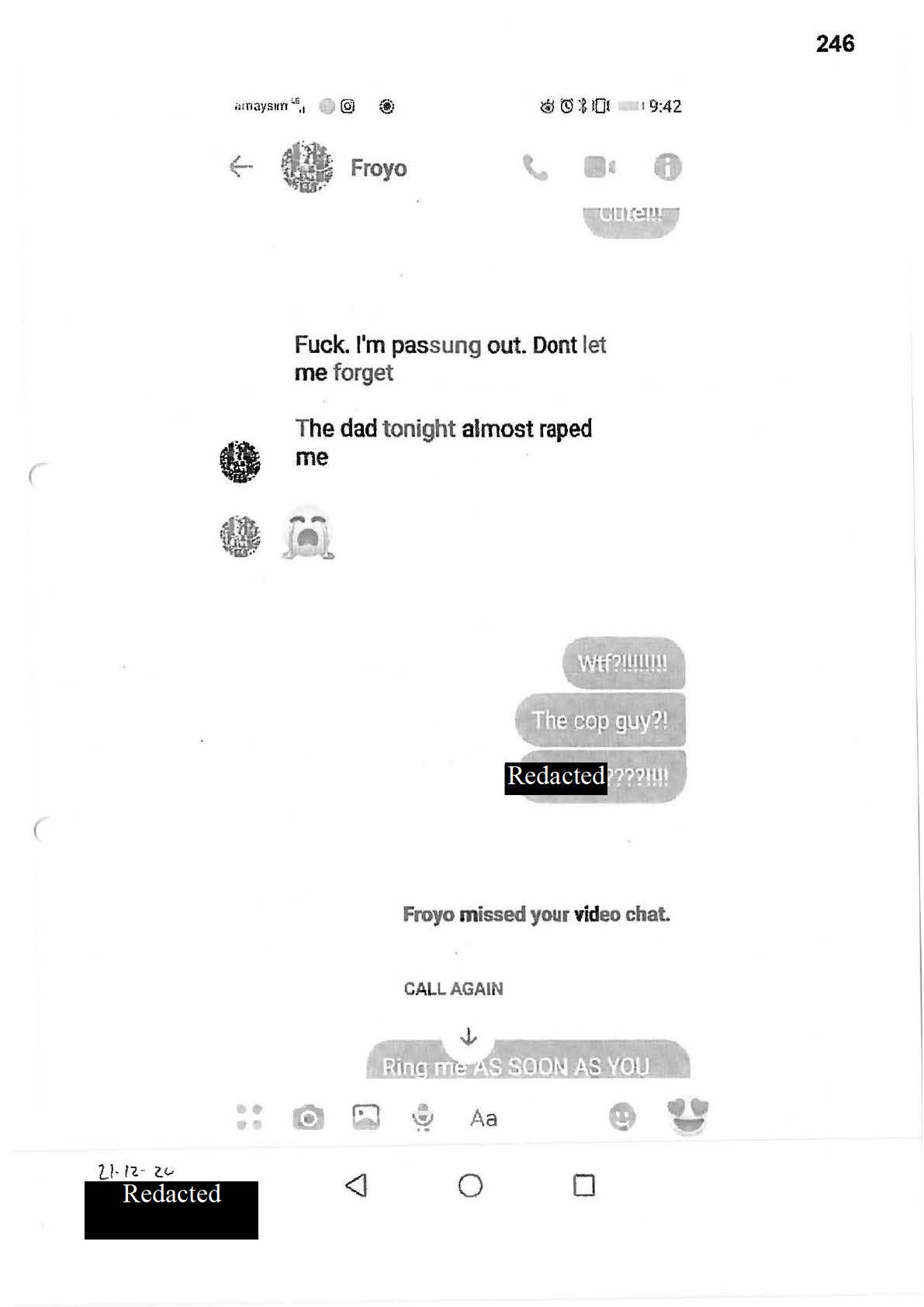
…
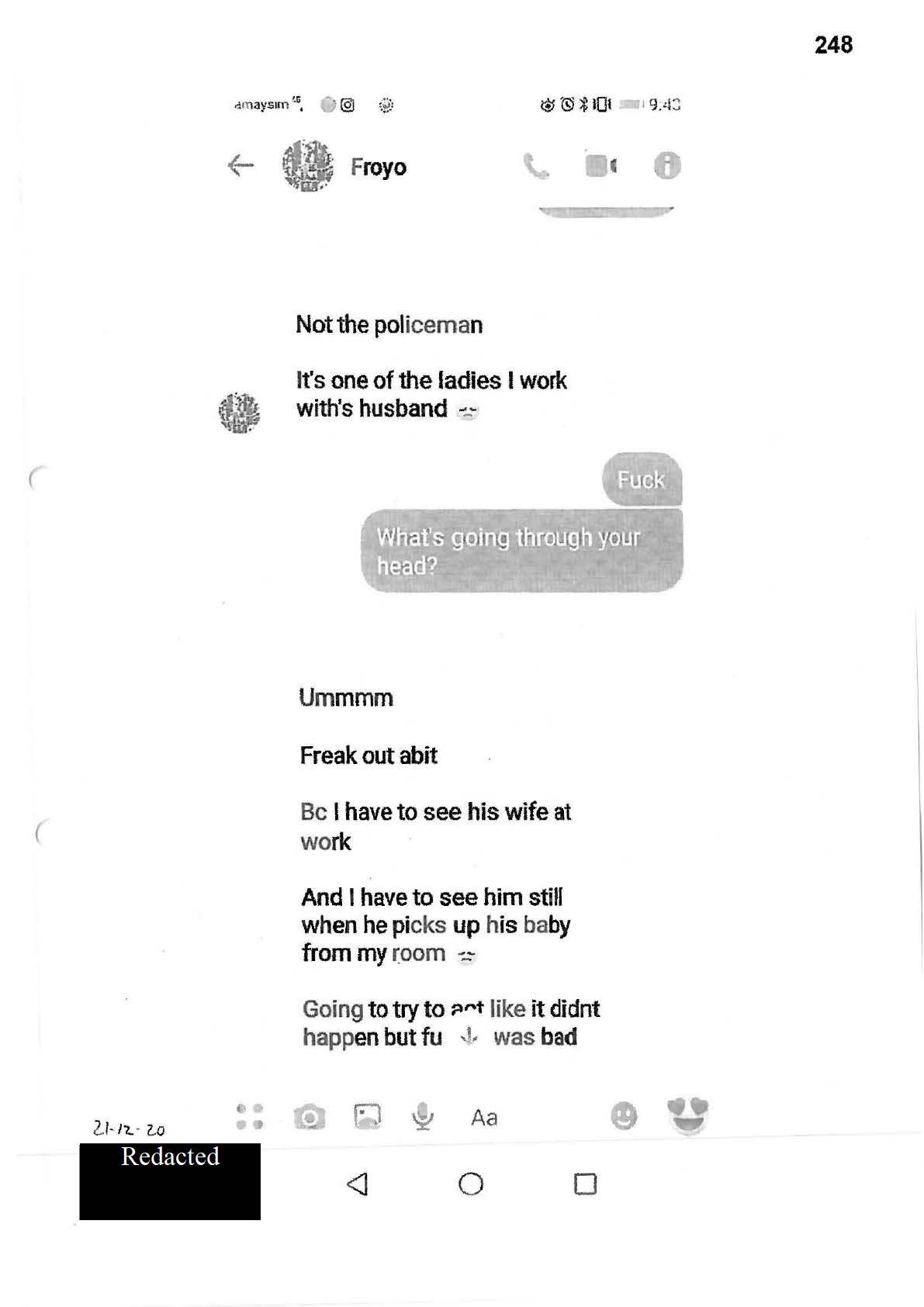

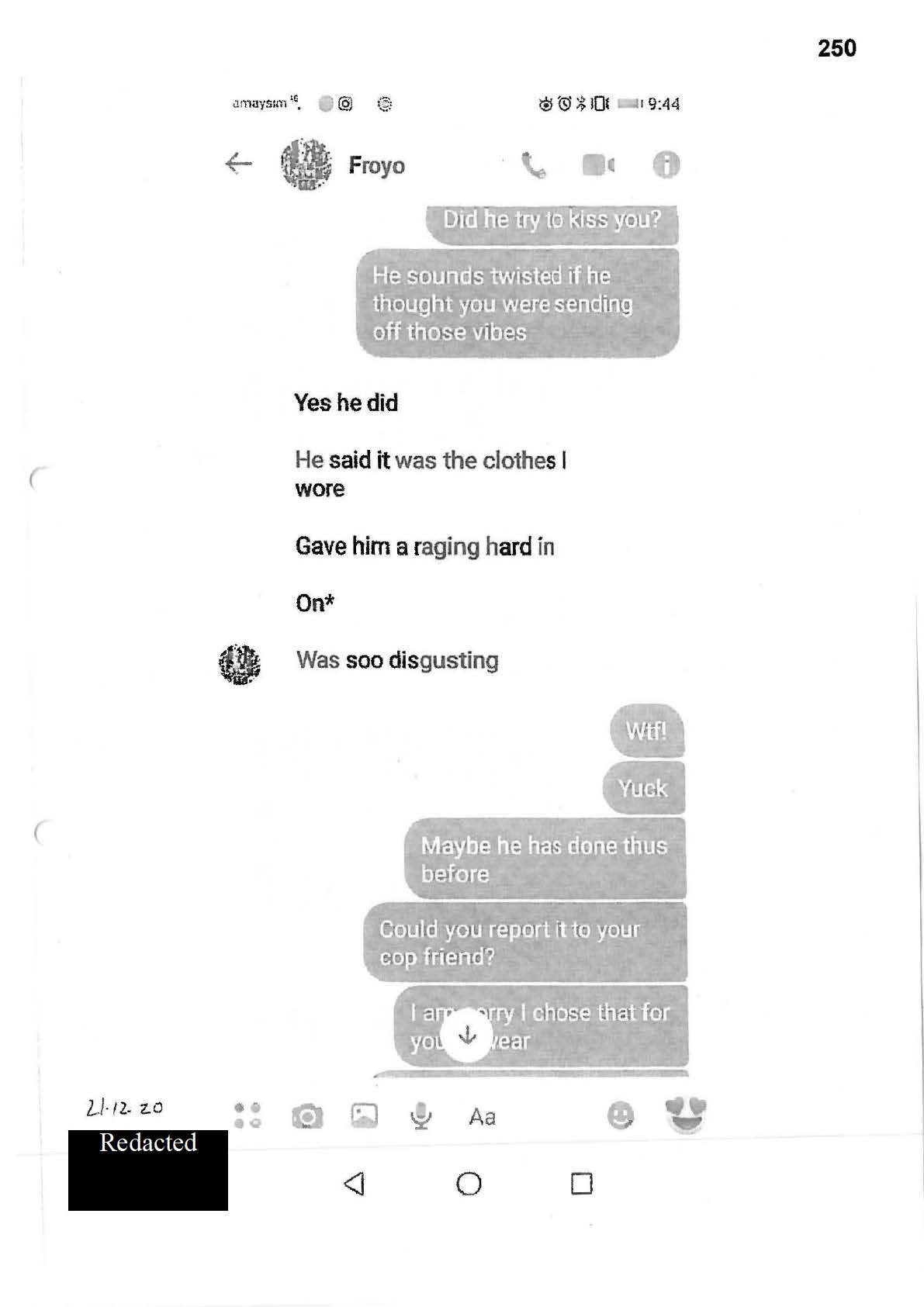
47 Ms M gave evidence in Court that the complainant was crying at their workplace and told Ms M ‘that she went to the Newmans for a game night on Friday. He walked her home, pushed her into the bush and she said, “I've been raped”, and he stopped’. Ms M described the complainant as “pretty sad and stressed”.
48 Ms C gave evidence of Ms M and the complainant approaching her at work, she being the complainant’s boss. The conversation occurred in Ms C’s office. She said the complainant explained she had received unwanted advances from the appellant on the Saturday night. The appellant had “sort of followed” the complainant, and “there were attempts, sort of offers for sex as they were walking down the road together”. Ms C summed up what the complainant told her in the following way: “she had felt violated by the approaches and the advances and that she was certainly uncomfortable”. Ms C noted that the complainant was “quite distressed through it all”.
49 Ms A also gave evidence that the complainant declined at least three offers of a lift home from Ms A on the evening of the incident. In cross examination, Ms A’s evidence was that the complainant “seemed like she had quite a bit” of alcohol and agreed the complainant was carrying home “quite a cumbersome” basket.
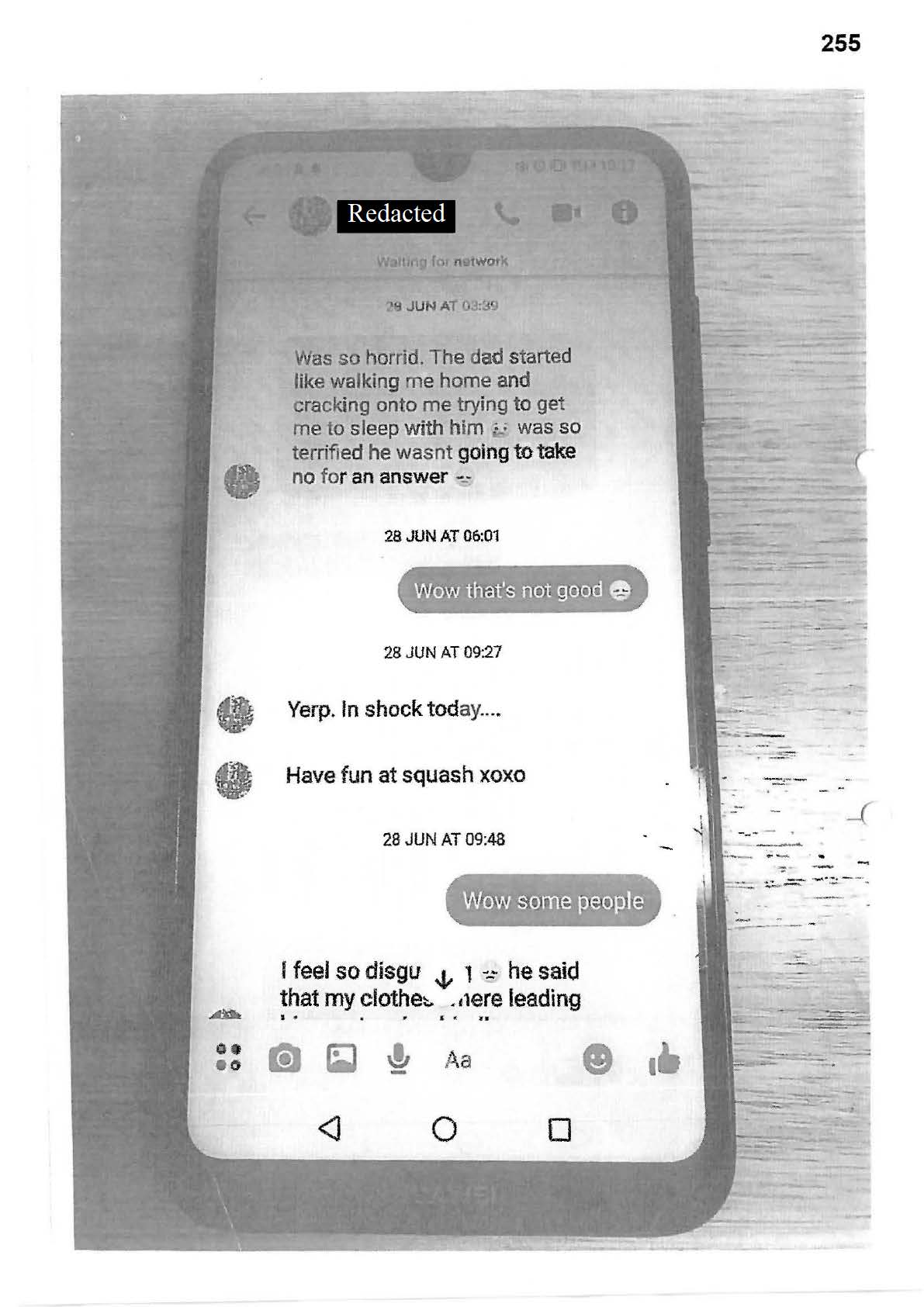
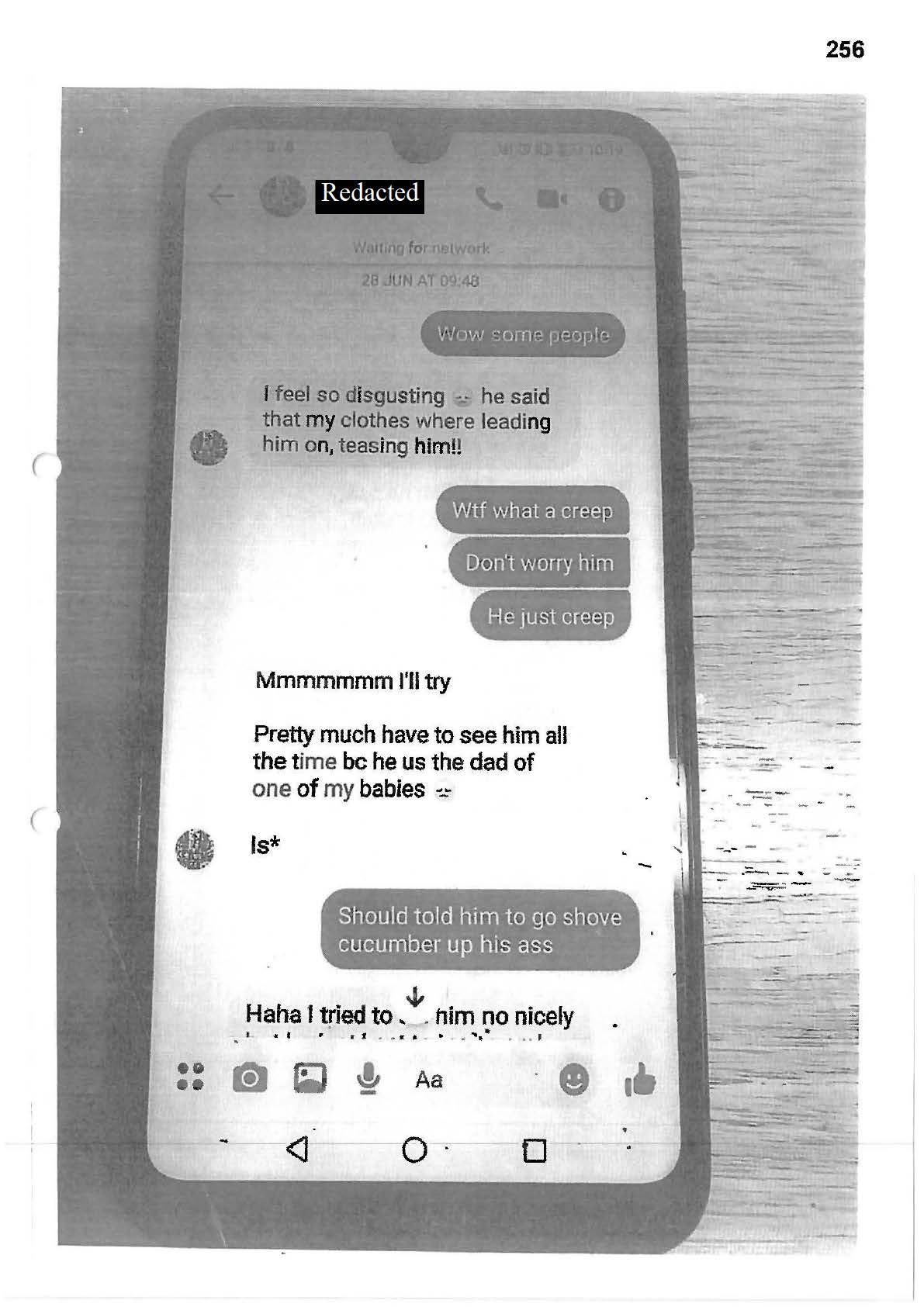
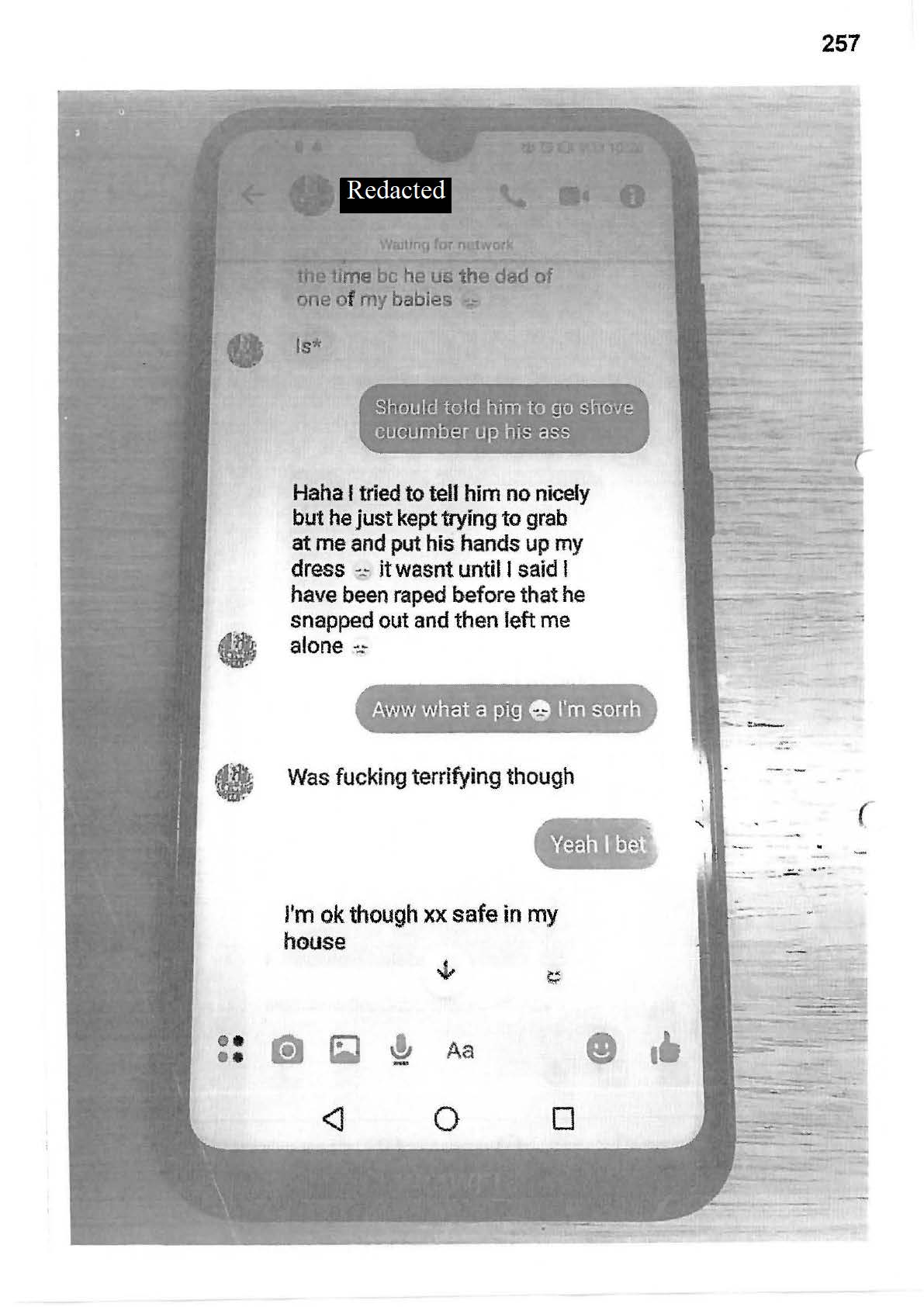
50 The complainant’s boyfriend gave evidence that following their text exchange, the complainant said to him in person that the appellant had tried to force himself on her. His evidence was that the complainant was “like she’d been crying, upset and not her lively self”. It is convenient to set out sections of the text message exchange that was tendered:
51 As explained above, a record of the interview conducted by the police with the appellant was tendered in the Crown case. This included the following exchanges:
Q165. (indistinct) I understand.
A (indistinct) It’s still, you know, um - it doesn’t feel right, you know. It’s - anyway, um, so -yeah. I - I offered to go down on her and she started telling me that, um, she - she - she, ah, had tried it a few times with a few different people and sort of gave me - started chatting about all, you know, how she doesn’t like it. And I'm thinking, well, just sort of pick you up, and just sort of started telling me a story about what you - what you like and what you don’t like. So, um, yeah.
Q167. Okay.
A It was a bit vague.
Q168. So when you asked her that, where were you at the time?
A Just outside the cattle stop.
Q169. So you’d walked from the house to - - -
A Literally, just got over the cattle stop and said, “Hey, you sort of, you know, you’re looking pretty hot. You turn me on.” You know - you know, do you want to - do you want to - you know. That’s what I said. I - I asked did you want me to do anything. You know, do you want - do you want me to go down on you?
Q170. Okay. And to the best of your knowledge, she started then talking about other things?
A She - she said - we just started walking and she started chatting casually about how she’s tried it. How she doesn’t like lt. She’s done with a few different people. And - and it’s never done anything for her and she doesn’t like it. And I’m, like, oh okay.
52 And later in the interview:
Q245. Describe to me that.
A Oh, l just sort of - I didn’t get an answer to when I sort of hit on her. So I, you know, I thought where are you at? Where are we at? So I - I thought I didn’t want to - you know. I just wanted to figure out what was going on. So, I’ve moved in close. I’ve put my hand on her hip and I - I said to her, um, you know, “Are you keen? Do - do you want to have a fling?”
Q246. Okay. So which hand did you use?
A Because we were standing - we were standing - I’m on the right-hand side. I’ve turned to her. I think I had a drink in my left, ah, my right-hand. I’d - I’d walked out with a drink in my hand. I can’t remember that. I - I can’t remember if I’d - I’d - I’d poured a drink and I’d walked down to the shed with the drink. I can’t remember if I left it on the back of Ash’s car, or if I’d taken it with us down the road. I’ve been trying to remember that. I can’t remember.
Q247. Okay. So you’ve turned towards her and you’ve indicated with your left hand. You’ve just held your left hand up?
A Yep. Left hand.
Q248. And where have you put that?
A Put it - put it on her hip, being conscious of her short dress, that I – I found the hip. You know.
Q249. Mm.
A I didn’t want to - I - I - I didn't want to, ah, touch her inappropriately unless I sort of, you know, unless she’d sort of said so. But I wanted to make it clear that I was keen. So I sort of put my hand on her hip and went, like, you know, into her personal space. And that’s when she sort of said, “I’m not that type of woman.” She - she would’ve backed off, or turned or something. And, yeah, and then it was, like, oh, okay.
…
Q257. And you’ve turned to her - - -
A Well I didn’t know If she was keen.
Q258. Yep.
A So I put my hand on her hip to see if - you know. To - to move in. To - to have a contact. And to see if I was going to get receptive. Because I didn’t get any answer to when I asked her if she wanted oral sex.
Consideration
53 The complainant was 27 years old at the time of these events, with the appellant being 43. The complainant worked with the appellant’s wife at an early learning centre, where she had the appellant’s child in her care. The events occurred after the complainant left a small party at the appellant and his wife’s house. There were two other guests. The party consisted of playing board and card games, with nibbles and drinks.
54 The complainant planned to catch up with her boyfriend later that evening. She left the party at about 10 pm. She planned to walk home by herself.
55 The complainant declined offers from the appellant to walk her home, and offers by Ms A to drive her home. Despite those circumstances, the appellant insisted that he would walk her.
56 That is the unchallenged context in which the events occurred.
57 The count in issue relates to touching of the complainant’s breast on the outside of her clothes. To convict the appellant, it must be established beyond reasonable doubt that the appellant touched the complainant’s breast on the outside of her clothes, and that he was reckless as to whether the complainant consented to that act. There is no issue that the complainant was not consenting to the sexual advances.
58 Having considered all the evidence, I am satisfied beyond reasonable doubt of each of those elements.
59 In circumstances where the parties consented to evidence before the Court of Petty Sessions being read as evidence in this Court, I am generally bound to give due deference to the conclusions on credibility formed by that Court, although it is open in limited circumstances to reach contrary findings as to credibility: Walsh v Law Society (NSW) [1999] HCA 33; (1999) 198 CLR 73 at [54]. In any event, my independent findings as to the credibility of the complainant align with those of the Court of Petty Sessions.
60 The appellant accepted that he had a sexual interest in the complainant, and the reason for walking with her was to further that interest. That is, to engage in sexual activity. He accepted during cross-examination that the only reason he walked the complainant home was to proposition her for sex (although later in cross-examination he tried to minimise that position). In that context, the complainant’s evidence can readily be accepted, including that the appellant asked her why she was “dressed like that”, said that she was “really hot” and said that she was giving him a “raging hard-on” in the circumstances described by her in the passages recited at [43] and [44] above. Accompanying those statements, he made physical moves to act upon his sexual interest by grabbing and touching her. This included repeatedly trying to pull her to him, and grinding against her such that she felt his penis. Relevantly, for present purposes in relation to the Second Count, this also included touching the complainant’s breast on the outside of her clothes as he was trying to put his hands under her dress to grab her breasts. The appellant persisted despite being rebuffed by the complainant when first proposing that they “go somewhere” together, and at every stage thereafter. In those circumstances, he continued to act while, at the very least, being reckless as to her consent. He did not take no for an answer until the complainant told him she had been raped before, at which time he asked if she was sure once more before desisting. The complainant was “really frightened” while these events occurred. This is not surprising given the appellant’s conduct, which was plainly uninvited and unwanted. She complained to her friend, her boyfriend and colleagues about the appellant’s conduct shortly after the events, in terms consistent with what she described had occurred in her evidence. It is plain that the complainant was distressed when making those complaints because the appellant had acted as she described. Having considered the complainant’s evidence carefully, I find it is clear, reliable and compelling, and is supported by evidence of complaint.
61 I do not accept the appellant’s account of what occurred on that walk. I note that the appellant accepted he had a couple of double or triple shots of spirits to drink that evening and experienced a hangover the next day. This may go toward explaining his conduct but it does not excuse it. His evidence that the complainant was giving him signals via her clothes and bubbly personality is fanciful. It reflects an attempt to minimise his conduct and blame the complainant for his actions. The appellant’s submission that he should be given some credit for agreeing to be interviewed by the police, and then making some statements against interest, must be considered in that context. The complainant did not do or say anything that could have hinted she reciprocated a sexual interest in him. At his insistence, the appellant walked with the complainant to provide himself an opportunity to pursue his sexual interest. The appellant persisted in those efforts despite her obvious and repeated rebuffs. The appellant’s evidence that the complainant told a story when he asked whether she wanted oral sex, and that her body language left him unsure of her position so that he “moved in” on her, cannot be accepted. It is inherently implausible. Nor does the appellant’s evidence cause me to have any reasonable doubt about the veracity or accuracy of the complainant’s evidence. It raises no reasonable doubt as to proof of the elements of the offence in relation to the Second Count.
62 In reaching that state of satisfaction I recognise that rejection of the appellant’s evidence is insufficient to establish the offence, as it is not a question of which account is to be preferred. Rather, it is necessary for the Court to be satisfied on the evidence that the elements of the offence are established beyond reasonable doubt.
63 In being so satisfied I have taken into account all the evidence and, inter alia, the submissions advanced by the appellant in this Court and below, as to why the offence has not been established.
64 It is appropriate to address some of the appellant’s submissions in more detail.
65 In summary, the appellant’s submission focussed on what he said rendered the complainant’s evidence unreliable such that it could not, or ought not be accepted.
66 First, the appellant laid emphasis on evidence he said provided a reliable indication that the complainant was intoxicated at the time, and therefore that she was unreliable. I do not accept the submission. The complainant was cross-examined as to how much she had had to drink that night. Although the complainant accepted she had been drinking, and other evidence supported that, her evidence was that she was fine. Indeed, the appellant accepted that she did not appear to be intoxicated, and that she appeared fine. Nothing in the evidence suggests that the reliability of her evidence as to the course of events was in any way adversely affected by alcohol. In this context, I note the appellant also submitted that the complainant had taken drugs after these events and before her interview with the police. Having considered what was said to be the drug taking, in the context of all the evidence, there is no indication that may have affected her account to the police.
67 Second, the appellant also relies on what he said are inconsistencies between the complainant’s evidence and what she communicated with Ms B after the events. The appellant placed most emphasis on a submission that the complainant repeatedly described the appellant as “trying” or having “tried” to grab her breasts, rather than having touched her breasts (the basis of the Second Count). I do not accept that submission.
68 In her police interview and during cross-examination, the complainant described that the appellant touched her breasts. She explained that occurred on the outside of her clothes as he was trying to put his hand inside her dress to touch it (recalling, that the Second Count was particularised as a touching on the outside of the clothes). The appellant submitted that that evidence was very different from the text message the complainant sent to Ms B shortly after the event, which said “he kept trying to put his hands up my dress” and he “tried to grab my boobs”. The appellant submitted by that text message, the complainant was describing different acts. Considering all the evidence in context, I do not accept those submissions and accept the complainant’s account of why she used the terms “trying” and “tried” in the text message to Ms B.
69 The complainant’s account under cross examination in relation to her text message to Ms B makes this plain:
Q. Can I ask you just to wait till I finish the question before you launch into an answer. I want to take you to the - -
A. Yes.
Q. -- text message I’m referring to. This was sent by you to [Ms B] the day after the alleged incident and you said this to her:
I kept saying, “No, no, no” and he kept trying –
was the word you’ve used –
to put his hands up my dress and tried grabbing my boobs.
A. Yes. That was him pulling at my dress at this time, pulling at my dress and trying to lift it up, pulling at my dress trying to put his hands into my top.
Q. Trying, yes. You never told [Ms B] that he actually touched your breasts, did you?
A. I don’t understand because that to me is the same thing. Him pulling at my dress and touching my boobs to try and get into my top, it’s still touching my boobs.
Q. Trying to do something and doing something are two completely different things, I’d suggest to you?
A. Not when he’s actually pulling at my breasts and touching my boobs to get into my boobs. To get into my bra.
70 The complainant was doing no more than using that turn of phrase to convey that the appellant was trying to do more than he achieved, that is, to get his hands under her clothes. In doing so, he touched her breasts on the outside of her clothing.
71 On this topic, the appellant also submitted the only evidence that he touched the complainant’s breast in her police interview was elicited by a leading question, such that little or no weight could be placed on it. Again, given the evidence, properly considered, I do not accept that submission. For a start, it was not a leading question that elicited the answer, but rather a question to clarify what was being said. Moreover, the suggestion implicit in the submission is that the complainant was simply agreeing with whatever was put by the police questioner, and not describing what really happened. A consideration of that interview reflects there were a number of occasions where the complainant responded “no” to questions demonstrating that she was not, contrary to the appellant’s contention, simply agreeing with the police questioner during the interview. Relatedly, I do not accept that the complainant’s reliability was undermined, as suggested by the appellant below, by the fact that her initial description of the incident given at the outset of her police interview did not contain every detail she said occurred, but that they emerged during the course of answering questions. So much is to be expected.
72 The appellant’s submission relying on the use of the word “tried” is misconceived. It approaches the evidence in an entirely artificial manner, giving a meaning to the word it does not have in the context in which it was used. It takes the evidence out of its context.
73 Third, and related to that, is the appellant’s submission that the evidence of complaint is inconsistent with the complainant’s evidence of the events. I do not accept that submission.
74 Complaint evidence, if accepted, can be relevant to the complainant’s credit. The significance of a complaint will depend on all the circumstances in which it was made. It is not necessary for a complaint to contain every detail of the allegation. Insofar as the alleged inconsistencies are said to relate to various complaints made by the complainant, in assessing whether there is an inconsistency and if so, what, if any, impact it may have on the complainant’s evidence, regard must be had to the circumstances of the alleged offending and in which each of those complaints were made. Any assessment of alleged omissions from her complaint accounts, and what significance, if any, arises therefrom must be considered in that context.
75 The evidence of complaint, considered in its proper context, is consistent with the complainant’s evidence as to what occurred. By complaining in the manner she did, her conduct supports her account of what occurred. The complainant appeared distressed, and on one occasion was crying when recounting what had occurred, reinforcing this point.
76 I have addressed the purported inconsistency in relation to the complainant’s communication with Ms B and use of the term “tried”. The appellant also submitted that there was some inconsistency regarding a video call between the complainant and Ms B, contending that Ms B had not corroborated that such a call occurred. However, Ms B was never asked about that video call. That is different to suggesting that Ms B gave evidence that no call occurred. I do not consider that this lack of evidence negatively impacts on the credibility of the complainant.
77 The appellant submitted that the complainant did not complain to her boyfriend on the night of the incident, and gave no details of the specific offences when she did the following day. The complainant said that she did not want to worry her boyfriend, or make him angry or vengeful. The appellant said that is not consistent with the complainant later telling her boyfriend that the appellant tried to force himself on her. I do not agree. The attitude of the complainant is entirely understandable. The evidence was that she did text her boyfriend in the early hours of the next day in terms consistent with her evidence about what occurred. The appellant’s submission regarding the complainant’s failure to go into specific detail is unrealistic considering the complaint was conveyed by text message. It is plain from the text messages recited above, that the complainant was complaining of the incident of sexual assault to her boyfriend, and that she was distressed by the appellant’s conduct. I note that the complaint did include that “he kept trying to grab at me and put his hands up my dress” with a sad emoji, and that is was not until she said she had “been raped before” that he stopped. That is entirely consistent with her evidence (and inconsistent with his).
78 With respect to the complaint evidence from Ms M and Ms C, the appellant again complained the evidence contained no detail in relation to the two specific offences. The appellant’s submission did not take account of the circumstances in which those conversations occurred. Ms M worked with the complainant and approached her at their workplace when she saw the complainant was crying. I note the appellant also submitted that Ms M was very clear the complainant told her the appellant had pushed her into the bushes, however that the complainant had not included this in her account to the police. This was an oral conversation, and Ms M was relaying the version given by the complainant second hand. During her cross-examination, the complainant said that in fact she had told Ms M that she had pushed him into a bush. The complainant described close and repeated contact by the appellant, that she tried to get away from him and that they moved all over the road during the incident. Her evidence was that the appellant was trying to pull her off the road. Ms C was the complainant’s boss, who was approached by Ms M and the complainant. That the complainant, as she explains, did not want to give them all the particular details of the incident is entirely understandable given the nature of her relationship with each. In that context, I do not consider that anything in Ms M’s or Ms C’s evidence adversely impacts the complainant’s credibility or reliability. I note also that in relation to both witnesses, it is relevant that the complainant found the events embarrassing and distressing. The appellant’s submission about the complainant’s failure to provide certain specific details to these witnesses is entirely artificial, paying no regard to her position, or those of the witnesses.
79 Indeed, the complaint evidence is consistent with the allegations and supports the evidence of the complainant.
80 Fourth, in the Court below the appellant relied on evidence that the complainant was calm during and after the events, which he submitted was inconsistent with the events occurring as she describes. The appellant’s written submissions highlighted that under cross examination the complainant did not disavow the suggestion she had said goodbye to the appellant at the end of the incident. It was submitted that such conduct is inconsistent with the complainant’s version of events. However, those submissions fail to recognise her evidence that she was “trying not to panic” and walked as fast as she could. Further, they proceed on an erroneous premise that a complainant ought to act in a particular way. Her distress was apparent thereafter from her communications with Ms B and others.
81 Fifth, also relied on below was a submission that the complainant held a basket and phone, such that the events could not have happened as the complainant described. However, on the appellant’s evidence this did not prevent him from moving in close and putting his hand on her hip. There is no basis to suggest that the complainant holding the basket or phone in any way impeded the events occurring.
82 Finally, I note for completeness that although the Court of Petty Session found the appellant not guilty of the First Count as it was particularised, that does not create any reasonable doubt in my mind as to the proof in relation to the Second Count. It is plain from the reasons of that Court, recited above at [2] that the conclusion was not based on the credibility of the complainant. Having scrutinised the complainant’s evidence, in the context of all the evidence, I accept her creditability and the reliability of her evidence.
83 As I explained above, I have considered all the evidence and the submissions advanced by the appellant in this Court and below.
Conclusion
84 I am satisfied of the guilt of the appellant on the Second Count. The appeal is dismissed. His conviction is confirmed.
I certify that the preceding eighty-four (84) numbered paragraphs are a true copy of the Reasons for Judgment of the Honourable Justice Abraham. |
Dated: 17 March 2023


