

DECISION NO:281/97
INDUSTRIAL RELATIONS COURT OF AUSTRALIA
INDUSTRIAL LAW - EMPLOYEES OR INDEPENDENT CONTRACTORS - Discussion of indicia of nature of relationship - Whether express contractual terms necessarily indicate whether worker is employee or independent contractor -
INDUSTRIAL LAW - DETERMINATION OF APPLICABLE AWARD - Construction of award provisions - Meaning of the term “on-site construction work” - Whether workers were overpaid under an award - Whether employer bound to compensate workers for under-award payments - Whether employees estopped from claiming payment owed under an award -
INDUSTRIAL LAW - WAS EMPLOYMENT TERMINATED AT THE INITIATIVE OF THE EMPLOYER? -Doctrine of “constructive discharge” of employment - meaning of phrase “termination of employment” - REMEDY - Whether reinstatement would be impracticable - Whether continued union activity on part of employee would create impracticability - Delay caused by actions of applicant - Whether applicant failed to mitigate loss
Industrial Relations Act 1988
Stevens v Brodribb Sawmilling Company Pty Ltd (1986) 160 CLR 16
Massey v Crown Life Insurance Co (1978) 1 WLR 676
Australian Mutual Provident Society v Chaplin (1978) 18 ALR 385
Re Porter; Re Transport Workers’ Union of Australia (1989) 34 IR 179
Transport Workers’ Union of Australia v Glynburn Contractors (Salisbury) Pty Ltd (1990) 34 IR 138
Universal Tankships (Inc) Monrovia v International Transport Workers Federation [1983] AC 366
Gurran v Tarbook Pty Ltd (unreported, Industrial Relations Court of Australia, 13 September 1996)
Vabu Pty Ltd v Commissioner of Taxation (1996) 33 ATR 537
Ray v Radano (1967) 67 AR(NSW) 471
Poletti v Ecob (No. 2) (1989) 31 IR 321
Josephison v Walker (1914) 18 CLR 691
Beckford Nominees Pty Ltd v Shell Company of Australia (1986) 73 ALR 373
Kid v Savage River Mines (1984) 6 FCR 398
The Commonwealth v Verwayen (1990) 170 CLR 394
Mohazab v Dick Smith Electronics (No. 2) (1995) 62 IR 200
Rheinberger v Huxley Marketing Pty Ltd (1996) 67 IR 154
Anthony Smith & Associates Pty Ltd v Sinclair (1996) 67 IR 240
Perkins v Grace Worldwide (Aust) Pty Ltd (unreported, Industrial Relations Court of Australia, 7 February 1997)
Patterson v Newcrest Mining Limited (unreported, Industrial Relations Court of Australia, 6 June 1996)
Nicolson v Heaven and Earth Gallery Pty Ltd (1994) 1 IRCR 199
Australian Workers’ Union v Federated Engine Drivers and Firemens Associations of Australasia (1992) 44 IR 453
Minister for Immigration and Ethnic Affairs v Teoh (1995) 183 CLR 273
MARTIN JACKSON and RANDAL WILSON v MONADELPHOUS ENGINEERING ASSOCIATES PTY LTD
No. SI 1507 of 1995, 1517 of 1995, 1516 of 1995, 1518 of 1995, 1030 of 1995
MOORE J
MELBOURNE (HEARD IN ADELAIDE)
17 OCTOBER 1997
IN THE INDUSTRIAL RELATIONS ) General Distribution
)
COURT OF AUSTRALIA )
)
SOUTH AUSTRALIA DISTRICT REGISTRY )
NO SI 1507, 1516, 1030 of 1995
BETWEEN: MARTIN JACKSON
Applicant
NO SI 1517, 1518 of 1995
AND: RANDAL WILSON
Applicant
AND: MONADELPHOUS ENGINEERING
ASSOCIATES PTY LTD
Respondent
JUDGE: Moore J
PLACE: Melbourne (Heard in Adelaide)
DATE: 17 October 1997
ORDER OF THE COURT
THE COURT ORDERS THAT:
Matter No. SI 1507 of 1995, SI 1517 of 1995
1. The applications are dismissed.
Matter No. SI 1516 of 1995 and 1518 of 1995
1. The applications are adjourned to enable the applicant to file short minutes of order within 14 days of the date of the publication of these reasons for judgment.
Matter No. SI 1030 of 1995
1. The respondent reinstate the applicant by reappointing him to the position he held immediately before his termination.
2. Within 21 days of the date of making these orders, the respondent pay to the applicant compensation in the sum of $35,200 less any amount payable to the Commissioner of Taxation pursuant to the Income Tax Assessment Act 1936 and actually paid.
NOTE: Settlement and entry of orders is dealt with in Order 36 of the Industrial Relations Court Rules.
IN THE INDUSTRIAL RELATIONS ) General Distribution
)
COURT OF AUSTRALIA )
)
SOUTH AUSTRALIA DISTRICT REGISTRY )
NO SI 1507, 1516, 1030 of 1995
BETWEEN: MARTIN JACKSON
Applicant
NO SI 1517, 1518 of 1995
AND: RANDAL WILSON
Applicant
AND: MONADELPHOUS ENGINEERING
ASSOCIATES PTY LTD
Respondent
JUDGE: Moore J
PLACE: Melbourne (Heard in Adelaide)
DATE: 17 October 1997
REASONS FOR JUDGMENT
INTRODUCTION
These proceedings involve five applications concerning work performed by Mr Martin Jackson and Mr Randal Wilson for Monadelphous Engineering Associates Pty Ltd (“Monadelphous”) at the site of mining operations of Western Mining Corporation Ltd (“WMC”) at Roxby Downs in South Australia. The first application (SI 1030 of 1995) was filed on 16 January 1995 under s 170EA of what was then the Industrial Relations Act 1988 (“the Act”) alleging Jackson had been employed by Monadelphous and his employment had been terminated in contravention of provisions of the Act. The remaining four applications were filed on 29 September 1995. Two were applications under s 127A of the Act, one by Jackson (SI 1507 of 1995) and the other by Wilson (SI 1517 of 1995). On the assumption that neither was an employee of Monadelphous, each sought a review of the contracts under which they had worked at Roxby Downs and, in substance, payment of amounts they alleged they would have been entitled to under one of two awards had they been employees. The other two applications were under s 179 of the Act, one by Jackson (SI 1561 of 1995) and one by Wilson (SI 1518 of 1995). On the assumption that each was an employee of Monadelphous, each sought payment of amounts allegedly due under the awards.
BACKGROUND FACTS
It is convenient first to set out in a summary way events leading to the applications which are, in the main, uncontentious. I will then identify the principal issues and discuss, by reference to each, the contentious evidence. Roxby Downs is the name of a cattle station approximately 500 kilometres north west of Adelaide and is now the name of a township. What has been described “one of the world’s major undeveloped mineral resources” was discovered on the station in 1975. The ore body or bodies contain significant amounts of copper, uranium oxide and gold as well as silver and rare earth oxides. For the purposes of this judgment I proceed on the basis that the deposit was discovered, has been developed and the related mine and processing plant is being operated by WMC. To do so overlooks joint venture arrangements and the corporate structure put in place to manage the mine and related processing plant. However that detail is not material to these proceedings. The mine site is called Olympic Dam and has been developed as a mine since an exploration shaft was sunk in the early 1980’s. It has been in production for approximately nine years. At the Olympic Dam project site a large plant complex has been built to process the ore recovered by the mining operations. Of significance to these proceedings were two phases of the process of building and developing the complex described as Optimization 1 and Optimization 2. The first occurred in the period between 1990 and the latter part of 1992, and the second from 1993 to 1995.
The ore is processed through a metallurgical plant. The ore is stockpiled and then fed by conveyors into a mills area and into either a crusher or ball mill. This processing converts the ore into a fine powder which travels by conveyor to the hydro metallurgical plant. It passes through flotation tanks and the concentrate leach where it is combined with sulphuric acid. The product passes through a filter press and a series of tanks. These processes separate and concentrate the copper, gold, silver and uranium oxide and waste. The waste is pumped to a tailings dam. Copper concentrate is fed into a smelter through furnaces including a flash furnace, then into anode furnaces and then cast into anodes. Slag is then fed into the slag furnace where it is further refined. Gas from the smelter is fed into the acid plant to produce sulphuric acid which is used in the concentrate leach area. The copper anodes are further processed at the refinery.
In 1989 Monadelphous began operating at Roxby Downs and initially did general project work, metal fabrication, plant hire (principally of cranes) and labour hire. It was then operating from a yard some distance from the mine site located on a road called Charlton Road. The yard is outside a perimeter fence which surrounds and isolates the mine site and the plant complex. The name of the road has become, and was in the proceedings, the description of Monadelphous’ yard. In probably late 1989 Monadelphous tendered for and won a contract to perform maintenance work associated with the temporary shut down of the smelter in the plant complex. In 1990 Monadelphous also won a two year maintenance contract to undertake the maintenance of the smelter area which, in February 1992, was extended by 3 months and later for a further 6 months. In 1992 Monadelphous tendered for and won a contract to provide maintenance services for the whole of the metallurgical plant. Work under that contract commenced on 15 or 16 November 1992.
Jackson was a fitter and turner by trade and Wilson a boiler maker/welder with a 3E welding certificate. Jackson commenced working at Roxby Downs in November 1989 for a company or firm described as Simon Engineering as a fitter and turner. That company or firm was then engaged in construction and maintenance work at the mine site. This employment concluded in January 1990 when another company, JR Engineering Services Pty Ltd (“JR Engineering”), commenced to do the work that had, to that point, been done by Simon Engineering. Jackson commenced working for JR Engineering on 15 January 1990. This continued until November 1992 when he commenced working for Monadelphous. The circumstances in which Jackson commenced with Monadelphous are contentious and is a matter I return to later in this judgment. It is sufficient to note that on 9 November 1992 Jackson signed several documents which take the form of a tender for work as a sub-contractor and a contract arising from the acceptance of the tender by Monadelphous. Payment was to be at a flat hourly rate. Also a contentious issue is the nature of the work he thereafter did for Monadelphous though it may, for present purposes, be described as generally involving maintenance work in the plant complex.
Wilson commenced working in October 1991 at Roxby Downs for a firm or company called Special Drilling Services (“SDS”) at its workshop in the industrial area which is off the mine site. Wilson also worked at an SDS workshop on the mine site. On 21 March 1992 Wilson commenced with Monadelphous having been asked the previous day to work for it. On 9 November 1992 Wilson signed documents of the same type as Jackson. Wilson had earlier signed a document dated 10 June 1992 which was broadly similar in character to the November 1992 documents.
Both Jackson and Wilson worked for Monadelphous during 1992, 1993 and 1994, generally performing work in the plant complex. Both became active in union affairs and during 1993 both became representatives of AWU-FIME, Wilson in either February or April 1993 and Jackson in November 1993. In late 1993 and early 1994, both Jackson and Wilson were involved in the negotiation of increases in the flat hourly rate paid to those working for Monadelphous under the contracts signed in November 1992. They both later resigned from AWU-FIME and joined the Construction, Forestry, Mining and Engineering Union (“CFMEU”).
On 30 or 31 August 1994 Wilson injured his back at work and was hospitalised. He was totally incapacitated for a period and returned to work on light duties for short periods at Charlton Road in December 1994. He eventually ceased working for Monadelphous in probably March 1996 to take up a teaching position in Adelaide. In late September 1994 Jackson was transferred to Charlton Road. The reason for the transfer was a contentious issue. He there performed work until 30 December 1994. In issue is what occurred immediately before and immediately after the New Year’s long weekend in January 1995. Jackson was given a separation certificate on 3 January 1995 and did no more work for Monadelphous.
THE ISSUES
The proceedings raise three principal issues though there are, in turn, a number of subsidiary issues. The first issue is whether Jackson and Wilson were employees of Monadelphous. The resolution of this issue affects the answer to several others. The second issue is whether the employment of Jackson and Wilson, if they were employees, was governed by the provisions of the National Metal and Engineering On-Site Construction Industry Award 1989 (“The 1989 on-site award”) or the Metal Industry Award 1984 - Part I (“the 1984 award”) and, if so, whether they were paid all amounts due to them under the applicable award. A related issue is whether, if the 1984 award is the applicable award, Appendix A of that award governed the employment of Jackson and Wilson. The third is whether, if Jackson was an employee, his employment was terminated at the initiative of the employer for the purposes of Division 3 of part VIA of the Act.
The applications under s 127A proceeded on the basis that if Jackson and Wilson were not employees they were not paid as much as they would have been if employed and on the basis that either the 1989 on-site award or the 1984 award would have governed that employment. The fate of the applications under s 127A is substantially, though not entirely, determined by the resolution of the first two issues.
THE EVIDENCE CONCERNING WHETHER JACKSON AND WILSON WERE EMPLOYEES AND THE TERMINATION OF JACKSON’S ENGAGEMENT
Wilson gave evidence about the circumstances of his initial engagement with Monadelphous in March 1992. I accept his account. At the time he was working with SDS and was being paid a fixed hourly rate when working at the mine site and a lower rate when working at the SDS yard. His engagement arose from a conversation he had with Mr David Nolan who was a manager employed by Monadelphous. Nolan did not give evidence. Nolan came to where Wilson was living and asked if he wanted to work for Monadelphous. Nolan told him the rate of pay, which was higher than the rate he was being paid by SDS, and indicated that if he wanted to work for Monadelphous he should turn up the following morning at the workshop at 7 am with his tools. This he did. Wilson received no explanation about matters such as annual leave on sick leave. For a period after he commenced with Monadelphous, tax was deducted from his wages as PAYE tax instalments deducted by an employer. On 20 March 1992 Wilson completed and signed a form headed “APPLICATION FOR WORK”. It required Wilson to provide a range of personal details, which he did. Much of the information sought and the language used in the form is consistent with impending employment but also consistent with impending engagement as an independent contractor. Indeed the form appears to have been drafted on the basis that it would apply to both situations. Parts of it read:
“...Tax File No. (number inserted) % Deduction 25%
Employment Declaration Completed
YES/NO
Agreement to Contract Completed YES/NO ...”
and later
“... I certify that the information set out above is to the best of my knowledge, true and accurate in every detail.
I understand the company reserves the right to verify all information and any false statements will be sufficient to cause my rejection as an applicant, my dismissal if hired, or termination of my agreement to contract.
I understand that the Company’s standard conditions of employment or contracting will apply unless altered and agreed in writing between both parties.
I agree to have a pre-placement medical examination and further medical examination during my employment or contract if requires to do so by the company.
I hereby authorise Monadelphous to contact the applicable insurance company through which any worker’s compensation claims have been made and the applicable insurance company to release, as requested, any files or records relating to such claims to authorised representatives of Monadelphous.”
Wilson crossed out the response “no” to the first question in the above extract, indicating that he had completed the “employment declaration”. If this was a separate document it was not in evidence. He did not signify whether he had completed an “Agreement to Contract”. The second part of the above extract makes reference, in a variety of ways, to both employment and “agreeing to contract”.
Wilson was cross-examined about the insertion of the “25%” and the word “Deduction”. It was suggested that Wilson then knew his employment would involve the payment of tax under the Prescribed Payment System (“PPS”) as it had with SDS. I accept his explanation that he simply asked how much others were having taken out, was told 20 to 25 percent and, as a result, put down the figure of “25%”.
However several months later, he did sign a document headed “Agreement to Contract”. It was dated 10 June 1992. It was in terms which consistently refer to Wilson as a sub-contractor. Indeed, the agreement contained the following clause:
“2.0 ACKNOWLEDGMENT
2.1 It is acknowledged and agreed that there is not by virtue of this agreement any employer/employee relationship between the parties to the agreement or between the Contractor and any person associated with the Sub-Contractor.
2.2 It is acknowledged and agreed that the Sub-Contractor is self employed and, as such, is not bound to accept work through the contractor. Further it is acknowledged and agreed that the Contractor does not guarantee the Sub-Contractor any work.
...
2.7 This agreement constitutes the entire agreement and understanding between the parties about the subject matter and supersedes all prior negotiations and agreements between them with respect to the subject matter.”
The agreement went on to provide for the payment of an hourly rate “for services rendered by the sub-contractor” being $18.65 less $1.00 for workers’ compensation and 50 cents for “Tools/Equipment/Safety Gear”. It also contained a clause authorising Monadelphous to remit PPS tax payments.
The evidence concerning the signing of this document is obscure. In the first affidavit of Wilson, filed on 31 July 1996, he said he could not recall signing a written contract until 9 November 1992 and that he regarded himself as an employee. However the agreement of 10 June 1992 was annexed to an affidavit of Mr Neil McKinnon, the South Australian Branch Manager of Monadelphous, filed on 9 August 1996. McKinnon explained that the delay between the time Wilson started and the signing of the contract was because “our administration documentation was not up to date at that time”. In an affidavit in reply filed on 16 December 1996, Wilson acknowledged signing the June 1992 document. The circumstances in which the June 1992 document was signed were not the subject of detailed evidence. Wilson said in cross-examination he spoke to McKinnon at the time he signed it and asked what it was about. McKinnon assured him about “a couple of things” and Wilson left it at that.
However, I infer from the existence of the form and evidence of McKinnon about events in 1990 when contracts were signed by employees of Monadelphous, that it was at least the practice during 1992 for Monadelphous to have its workforce sign contracts declaring the relationship between it and the worker to be that of principal and independent contractor. Thus McKinnon’s explanation about the administration documentation not being up to date is a plausible one. What the explanation exactly meant is another matter, and McKinnon was not cross-examined about it. It may have meant Monadelphous had no pro-forma agreements for Wilson to complete or Monadelphous neglected for some time to ask him to sign one and, perhaps, was not conscious that he had not. No explanation was given as to why Wilson was, for a period, on PAYE tax deductions. His evidence that tax was initially deducted on this basis was not challenged by counsel for Monadelphous in cross-examination, and no explanation was sought from McKinnon in cross-examination. Wilson gave evidence that he was on PAYE tax deductions for approximately three months. He said he was asked to move to a system of PPS tax payments and was told that it would be a lot easier because most of the other workers were on it and Monadelphous wanted to get everyone on the one system. It is probable this conversation occurred in June 1992 when the first agreement was signed. The account of the conversation was not challenged and I accept it.
There was more detailed evidence about the signing of the documents in November 1992. Both Jackson and Wilson completed and signed, on 22 October 1992, an application for work form which was in the same terms as the form earlier completed and signed by Wilson in March 1992. On 9 November 1992 each signed four related documents. One was headed “SUB-CONTRACTOR’S TENDER” which was to be read with a schedule to it which was also signed. The text of the tender document read:
“A. I/We (“the Sub-contractor”) named in the Schedule on the back of this tender hereby request Monadelphous Engineering Associates Pty Ltd (“the Contractor”) -
A.1 to place my/our name on the Register of Available Sub-contractors kept by the Contractor, and
A.2 to notify me/us from time to time as and when the Contractor requires the supply of services of the type or class described in the Schedule, or when the Contractor wishes to introduce me/us to some third party (“the Principal”) who may wish to use my/our services as described below.
B. I/We submit this tender on the clear understanding -
B.1 that when notified by the Contractor under A.2 above I/we am/are free to offer or not to offer my/our services for the task indicated in the notification and the Contractor is free to accept or reject the offer.
B.2 that every time a contract is entered into or is varied between me/us and the Contractor, that contract or variation must be in writing signed by both parties and will clearly state the contract rate or price agreed and any other departures from the conditions of this tender or the attached conditions of agreement
B.3 that this tender, the attached conditions of agreement and the contract or variation document(s) signed by both parties are to be read and interpreted as one document which contains the whole contract between the Contractor and sub-contractor. No other terms, conditions, representations or understandings that were or may have been discussed, promised, negotiated or agreed verbally or by inference from custom or practice, form part of our legally binding agreement unless included in or referred to in those written documents.
C. I/We acknowledge that
C.1 before signing this tender I/we have carefully read this tender document
C.2 that I/we understand that this is not an application for employment and does not, by itself, create a contract between me/us and the Contractor, but if a contract is signed this tender will form part of it.
C.3 that any contract which I/we may make in consequence of this tender will not make me/us an employee of the Contractor as it is not my/our intention to work as an employee or to accept employment, but only to supply services as an independent sub-contractor
C.4 that the Contractor has not promised and is not obliged to notify me/us of any sub-contract opportunity or to offer any engagement of any kind in response to this tender.
Dated Signed by the Sub-contractor
"
(The underling is in the original document).
The schedule contained provisions for detailing matters such as banks, next of kin and special skills, knowledge and competence. It also contained the following:
“Business Name:
registered in the State of from 19 to 19
Sub-contractor is/is not a partnership/company/trust
(delete as necessary)”
The signature block was headed “Signed by the Sub-contractor”.
The third document was the conditions of agreement referred to in paras B.2 and B.3 of the “SUB-CONTRACTORS TENDER”. Clause 1 is headed “INTERPRETATION” and it is unnecessary to reproduce all of it. It contains several definitions one of which defined “contract price”:
“"Contract price" includes
(a) any lump sum contract price and any contract rate (whether fixed per hour, per day, per week or on some other basis) specified in the contract
(b) any bonuses (whether specified in the contract or paid under some other arrangements)
(c) any amount whereby the contract price (other than bonuses) is increased by way of escalation pursuant to the contract”
It also contained the following:
“1.3 These conditions are to be read and interpreted together with the Tender, the Contract and any Contract Variation, as one single contract document.”
Clause 2 dealt with the status of the contracting parties and provided:
“INDEPENDENT SUB-CONTRACTOR
2. The Subcontractor understands and acknowledges that the Contractor is not offering employment to the Sub-contractor but may by Contract (to be signed separately) engage the services of the Subcontractor as an independent subcontractor:
2.1 on any construction work, maintenance work or project work undertaken by the Contractor for or on behalf of a Principal under a Main Contract
2.2 for the supply of the Subcontractor’s services to or for the benefit of a Principal, by referring or introducing the Subcontractor to a Principal for services to be provided by the Subcontractor to a Principal for services to be provided by the Subcontractor directly to the Principal as the Principal directs.”
(the underlining is in the original document).
In Clause 3 the sub-contractor warranted that the sub-contractor possessed of the requisite skills, qualifications and knowledge, would do work at the requisite standard and would make good any work that was not. Clause 3.1 provided:
“The Sub-contractor warrants:
3.1 that the Subcontractor possesses all the qualifications, knowledge, skills, competence and experience represented in the Tender or to be implied from such representation (including any specialist knowledge, skills or competence where applicable).”
Clause 4 dealt with the supply and maintenance of tools. The sub-contractor was to supply and maintain normal tools of the trade while special tools or equipment would be provided by Monadelphous or WMC, as would safety boots, gloves, eye protection, ear protection, hard hats and other safety gear. When the contract was terminated sub-contractors had to return tools, equipment and other goods proved by Monadelphous or WMC, and the value of any damaged or lost item could be deducted from any final payment.
Clause 5 dealt with the commencement and termination of the contract. In substance it provided for termination by agreement, termination on seven days notice or no notice if the sub-contractor was in breach of the agreement.
Clause 6 dealt with contract price and provided:
“CONTRACT PRICE
6. The Contract Price as specified in the contract must be distinguished from the bonuses (if any) as follows:
6.1 The Contract Price is an agreed all inclusive amount payable by the Contractor to the Subcontractor. The Subcontractor acknowledges that under the Contract the Subcontractor has no additional entitlement of any kind of any benefit such as paid sick leave, annual leave, holiday loading, maternity or paternity leave, long service leave, bereavement leave, superannuation (unless required by the provisions of the Superannuation Guarantee Levy Act), severance pay, redundancy pay, site allowance, living away from home allowance, area allowance, industry allowance, tool allowance, clothing allowance, meal allowance, travelling allowance, relocation allowance, disability allowance, penalty rates for overtime or shift work or for working on a Saturday, Sunday or Public Holiday, or payment in lieu of any such benefit on termination. The only entitlement of the Sub-contractor is to receive payment of the contract price in accordance with this clause. Subject to the above, the Contract Price (other than bonuses) will be paid in the following manner:
6.1.1 there will be no deductions except those required by law or expressly authorised by the Contract.
6.1.2 tax deductions will be made under the rules of the Prescribed Payments Scheme (PPS) and the Sub-contractor will at the time of signing the Contract (and afterwards whenever required) provide the Contractor with all information and sign all forms required by PPS.
6.1.3 payments to the Subcontractor will be made fortnightly. Where the Contract Price is a lump sum, progress will be made in the manner agreed in the Contract. The Subcontractor must submit to the Contractor an invoice for each payment claimed, in a form and with such details as are required by the Contractor. The Subcontractor must also complete all time cards, job cards or other forms required by the Principal as a pre-requisite to payment by the Principal to the Contractor and the Subcontractor’s invoice must agree with the times worked, job items and similar information entered on the Principal’s records.
6.1.4 All payments to the Subcontractor will be made within 7 days of receipt of invoice to a particular bank account nominated by the Subcontractor in the Tender (or as modified in the Contract or any Contract Variation) and in no other manner. The Subcontractor may change the nomination by Contract Variation.
6.2 Where the Contract Price is expressed as an hourly rate, that rate shall be adjusted for each percentage of variation in the total award rate (including Supplementary Payment) in Part I of the metal Industry Award 1984 of the Australian Industrial Relations Commission for the classification Engineering Tradesperson - Level 1 which variation
6.2.1 applies to wage group Level C10 in Clause 8 of that Award, and
6.2.2 becomes operative after the date of the Contract, it being the intention of the parties that the said award rate in force at the date of the contract shall be the based on which such percentage variations to be calculated
6.3 Each adjustment of the hourly rate pursuant to paragraph 6.2 shall take effect on and from the Monday of the week next following the date of operation of the award variation.
6.4 Where the Contractor pays a bonus in addition to the lump sum contract price or the contract rate specified in the contract, (either as a voluntary payment or pursuant to the terms of the main Contract), no legal right to receive such bonus arises under this contract but the Subcontractor may expect that where a bonus is paid by the Principal to the Contractor the Subcontractor will receive a share of such bonus as agreed between the Contractor and the Principal. The amount, time and manner of payment of any bonus will be at the discretion of the Contractor, subject to any requirements of the Principal. The decision of the Contractor or the joint decision of the Contractor and the Principal (as the case may be) will be final and conclusive on all aspects relating to the payment of any bonus.
It is to be noted that clause 6.2 provides for adjustments to the hourly rate so as to reflect variations to the rates of pay in the 1984 award.
Clause 7 dealt with workers compensation and provided:
“WORKCOVER
7. The Contractor is a registered employer under the Workers Rehabilitation and Compensation Act, 1986 (SA) “the Act” which establishes the scheme known as “Workcover”. The Subcontractor acknowledges that not being a “worker” within the meaning of the Act, the Subcontractor is not entitled to any benefits under the Act unless the Subcontractor is registered as a self employed person under the Act. The Contractor does not wish to contract out of the Act (if the Act applies, which the parties do no accept) and in addition the Contractor may be required by the main Contract to ensure that the Subcontractor is covered by the Act in any event, and for those reasons only it is agreed:
7.1 that unless the Subcontractor produces to the Contractor written evidence that the Subcontractor is registered as a self-employed person under the Act, the Contractor will pay a Workcover levy in respect of the Sub-contractor’s remuneration under the contract as if the Subcontractor were a worker employed by the Contractor within the meaning of the Act, but without admitting that the contractor is obliged to do so under the Act.
7.2 that in the event of the Subcontractor suffering any injury or disability which is compensable under the Act, the Subcontractor may make a claim on Workcover in the same manner as if the Subcontractor were the Contractor’s employee and the Contractor will process such claim in the same manner as if the Contractor were the Sub-contractor’s employer.
7.2 that the Subcontractor must immediately report to the Contractor any injury which may come under Workcover and will sign all necessary forms supported by medical certificates, attend for medical examinations and otherwise comply with the requirements of the Act in all respects as if the Subcontractor were an employee of the Contractor
7.4 that the arrangements in this clause are not intended to create or admit the existence of a relationship of employer and employee for the purposes of the Act, or at common law, or for the purpose of any other law or enactment applicable in South Australia or elsewhere.”
(The underlining is in the original document).
Clause 8 dealt with hours and provided, in substance, the sub-contractor was to work the hours agreed. If none were specified in the contract, the sub-contractor was to work on the days and the hours nominated by Monadelphous or WMC but reasonable notice needed to be given of the hours to be worked unless there was a settled pattern of working. Clauses 9, 10 and 11 dealt with compliance with general site conditions, accommodation and travel and payment for camp accommodation or housing.
Clause 12 provided that the sub-contractor would insure any motor vehicle used and indemnify Monadelphous for any loss arising from sub-contractor’s conduct. Clause 12.4 provided:
“The Subcontractor agrees:
12.1 ...
12.4 to inform any claimant who may sue or claim against the Contractor in consequence of or connected with any act or omission of the Subcontractor that the Subcontractor is not and was not at any time the employee or agent of the Contractor.”
The fourth document was headed “CONTRACT NO .” It commenced with the following:
“This document is the form to be used for any new contract agreed between the contractor and the Subcontractor and when completed and signed by both parties it forms part of the “Subcontractor’s” Tender” dated ........... and the conditions of Agreement attached to it. It will be referred to as the contract number shown above.”
This clause was followed by standard provisions which, when completed, detailed matters such as the name of the sub-contractor, when the contract commenced, the price, which bank it was to be paid into, the amount to be deducted by way of PPS, union membership and arrangements in relation to housing. It concluded:
"I/we the subcontractor named above hereby offer to contract with the Contractor for the services above described at the contract price or rate shown above.
Dated: Signed by the Subcontractor
Signed for and on behalf of
the Contractor Monadelphous
Engineering Associates Pty Ltd
"
The following is the evidence concerning the signing of these documents by Wilson and Jackson. In an affidavit filed 31 July 1996 Wilson said that in the weeks leading up to 9 November 1992 he was invited to apply for his own job and did so because he wanted to continue working for Monadelphous. Wilson said that late in the morning of 9 November 1992 he, with other Monadelphous workers, was directed to attend a meeting with McKinnon at the Monadelphous site office. He and the other workers were given a copy of a contract to read. Wilson was then led into McKinnon’s office and was given a document or set of documents. McKinnon told Wilson that the union had seen the document. Wilson said he understood that but he wanted to take the document away to get union and legal advice. McKinnon said the document was not to leave the office but if he wished to have a copy, he could sign it and that would be his copy. McKinnon indicated Wilson could sit in the reception area and read the document. Wilson indicated he had already read the document and wanted to discuss some points about it. He indicated he did not agree with it. McKinnon asked what points Wilson was talking about. Wilson raised a couple of points including who was responsible for tools. Wilson mentioned the clause dealing with Workcover and asked if he was affected by the contract if he hurt himself. McKinnon said the agreement would not affect that. Wilson asked about several other matters. McKinnon then said the document was going to stand as it was and “either you agree to sign the document, and you have got till five o’clock today, or if you don’t sign it you haven’t got a job with us”. Wilson replied that he would have to think about it and let McKinnon know by five o’clock. Wilson went back to work. He said he had nowhere to get advice as phone access was limited.
He returned to McKinnon’s office at 5.00 pm. He said to McKinnon that he would sign it but he did not agree with it. He said he would sign it under protest. Wilson said a Monadelphous safety officer was present during this conversation. He was not called. Wilson’s evidence was that he then felt he had to sign because if he did not he would not have had a job. At the time Wilson had intended to stay at Roxby Downs for at least five years. His partner had moved there in December 1991.
In his oral evidence-in-chief Wilson said that immediately prior to the meeting in which he had been asked to sign the contract he had been given a letter saying he had been terminated and another letter inviting him to apply for his position again. Wilson later destroyed the letters. He said he had been given them in circumstances where he and other workers had been told that there would be drinks at Charlton Road and they would be given a letter.
Wilson’s account of the signing of the contract on 9 November 1992 was explored in cross-examination but the substance of it was not challenged. Indeed it was not challenged by McKinnon in his evidence save about the availability of phones. Wilson agreed in cross-examination that there had been an AWU-FIME union meeting a couple of weeks before 9 November 1992 about being asked to sign contracts. The union organiser proposed the union pursue a negotiated agreement involving the Australian Industrial Relations Commission (“the Commission”). Wilson accepted that he probably received the letter about re-applying for work before he signed the application for work form dated 22 October 1992. Wilson rejected the suggestion he had been interviewed about re-applying for work before the meeting with McKinnon on 9 November 1992. Wilson said he also spoke to McKinnon about housing at the meeting of 9 November 1992 when the contract was discussed. Wilson appeared to accept that he did not discuss with McKinnon the hourly rate, annual leave or sick pay. He may, however, have spoken to him about the bonus. He accepted that McKinnon told him the union had already seen it and did not ask whether he could ring the union. He accepted he used words later in the day when the contract was actually signed that “I don’t like the idea of signing”. He rejected the suggestion that he did not say “I’ll sign it under protest”. Wilson accepted that having signed the contract, he did not take a copy away with him even though he knew he could. Wilson could not recall McKinnon saying that if he changed his mind after signing the contract he could come back and would be released from it.
Jackson account of his engagement by Monadelphous was that in November 1992 he was told JR Engineering, with whom he was then working, had lost the maintenance contract. At about that time he received a written offer of work from Monadelphous. He responded on the form provided because he “wanted to continue (his) employment”. He had earlier, in October 1992, attended a meeting of union members which was addressed by a union organiser, Mr Joe Kane, from AWU-FIME. Kane told the meeting that an agreement would be reached between the union and the company that won the maintenance contract which could be ratified by the Commission. Some days before 9 November 1992, Jackson was approached by Nolan who told him to attend at Monadelphous’ office on the mine site at 2.00 pm on, it appears, 9 November 1992. He did and met with McKinnon who handed Jackson some papers and told him they were the terms of the contract. McKinnon said Jackson could not take a copy away. Jackson looked at it briefly and said it was not fair that he could not take it away. Jackson told McKinnon he did not have a good understanding of documents like that and wanted to get some legal or union advice. In his brief look at the documents, Jackson noticed they were not paying the full living away from home allowance. He then felt disgusted at the way this was happening. He asked what his duties were and was told by McKinnon that the WMC foreman in the concentrate area had requested Jackson work in that area. McKinnon then said to Jackson: “you have a choice, you either sign the agreement or you don’t have a job”. Jackson signed the contract but told McKinnon he was doing it under protest.
In cross-examination Jackson accepted that for the 9 months prior to November 1992 he had been working for JR Engineering under contract. Though no contract had been signed, he was having his tax deducted through the PPS system. Prior to that he had been paid under the 1984 award. His cross-examination did not challenge the substance of his account. However a letter to him from McKinnon dated 6 November 1992 was tendered which Jackson acknowledged receiving. The letter advised that Monadelphous proposed to “offer a contract for your services ... in accordance with terms and conditions previously discussed”. It went on to ask Jackson to contact Monadelphous’ office by 4.00 pm Monday 9 November 1992 to make an appointment to finalise arrangements.
Jackson said in cross-examination that he had not been interviewed by either McKinnon or Mr Robert Velletri, general manager of Monadelphous, before meeting McKinnon on 9 November 1992. He acknowledged that after he signed the documentation he did not ask for a copy to take away although he had earlier been told he could only have a copy if he signed it. His explanation for signing the documentation was that his wife was pregnant and about to have the baby, he had just built an annex on the caravan in which he lived and “it was in the middle of a recession”. He said he was not in a position to “up and leave”. He had earlier volunteered in cross-examination that while employed with JR Engineering, he had been one of 12 out of 25 employees who did not wish to change from being employed under the 1984 award to being employed under contract with tax being deducted by means of the PPS. He explained that he inserted “30%” in the space “% Deduction” in his “APPLICATION FOR WORK” (signed on 22 October 1992) because that was his level of deduction at JR Engineering. In re-examination, Jackson’s evidence was that he had been asked to fill out PPS forms at the time the JR Engineering Maintenance contract was due to expire, 14 January 1992, and immediately before the period of its extended operation.
McKinnon’s evidence about the events leading to the signing of the contracts concerned, in the main, the procedures that were adopted and applied generally. He and Velletri interviewed 150 men over two days, with McKinnon interviewing 70% of them. He could not recall whether he interviewed either Wilson or Jackson. Kane, the union organiser, was sent a copy of the contract before any tradesmen were engaged. McKinnon described the meeting of 9 November 1992 as a second interview. He accepted that those interviewed were told they could not take away a copy of the contract until it was signed. This procedure, he explained, had been adopted because in 1990 a blank copy of the contract then used had been pinned up in the caravan park with graffiti on it. He was seeking to avoid this as, under the procedure adopted in 1992, any copy would have in it the particulars of the worker which would identify him. This would act as a deterrent to anyone wanting to repeat what had occurred in 1990. As to the signing of the contract by Jackson, McKinnon said he was one of the first to sign. He could not recall Jackson asking any questions about the terms and conditions nor asking to have the contract viewed by the union or a lawyer. McKinnon accepted Wilson questioned the contract, asked about the details and asked for a copy of the contract so that he could get advice from the union. McKinnon said he told Wilson the union had seen the contract. McKinnon said he could not recall anyone specifically saying they were signing under protest though did recall Wilson saying words to the effect “I’ll sign but I don’t like it”. McKinnon could not recall anyone asking to use a phone to get advice. While he pointed to phones that may have been available, it is relatively clear that there would not have been ready access to a phone for the purposes of getting advice about the contracts.
McKinnon was cross-examined about the events surrounding the signing of the contracts in November 1992. McKinnon accepted, reluctantly, that it was WMC’s preferred course to have its contractors engage sub-contractors under written agreements. McKinnon explained that he understood the difference between offering work to people as sub-contractors rather than employees was that, as the former, they would pay tax on a PPS basis and would be paid a flat hourly rate.
There is no real conflict in the accounts of Wilson and Jackson on the one hand and McKinnon on the other about the circumstances in which the contracts were signed in November 1992. To the extent that McKinnon’s evidence does not support entirely the account of Wilson and Jackson I prefer and accept their accounts. McKinnon dealt with a group of workers numbering at least 60. It is probable that his ability to recall the circumstances of any two would be limited. The evidence of Jackson and Wilson was credible and I accept it. McKinnon’s explanation for refusing to allow those seeking work to take an uncompleted copy of the documents to obtain advice was, in my opinion, disingenuous. The procedure adopted, at least in relation to Wilson and Jackson, was designed to ensure they signed the documents even if they were reluctant to do so.
After these contracts were signed, Jackson commenced, and Wilson continued, to work for Monadelphous. Wilson’s unchallenged evidence was that his duties did not change after the documents were signed in November 1992. At this point in the judgment it is unnecessary to descend into great detail about the work each did. It is a matter I return to later. It is sufficient, at this point, to note that each was a skilled tradesperson who, on a daily basis, exercised their trade skills in working on plant in the complex both in situ or at workshops within the complex.
Jackson’s evidence was that on any given day he would ordinarily perform the work on a daily work schedule which listed the jobs required to be done in each area. The schedule would be brought to the work area by a supervisor employed by Monadelphous though sometimes by a WMC foreman. Elsewhere in his evidence Jackson said he would meet with his Monadelphous supervisor at a workshop or shed, depending on what area of the plant Jackson was working in, and the supervisor would tell him what work he had for the day. Jackson also said, and it is not clear whether this was a reference only to periods he acted as a supervisor, that he would plan the work to be done in a day in consultation with a WMC foreman. Jackson said that, in the context of maintaining a large industrial press called the Lasta filter press (which was a significant part of the work done by Jackson during his period working with Monadelphous) he would, at times, consult the Monadelphous supervisor to order parts he needed. At the end of each day, Jackson completed a time card, known as a “plod card”, in which he would describe and record work done, and record hours worked on a particular task and where the work was done. Also recorded were starting and finishing times for the day and, in relation to each task, a WMC work order number. Jackson’s evidence was that the plod cards he completed were obtained from a box in the area he worked in. He said they had been placed in the box by a Monadelphous supervisor who, in turn, had obtained them from a WMC store. Jackson said that the plod cards would be checked each day by the Monadelphous supervisor and the WMC foreman. Jackson also said, based on his experience as an acting Monadelphous supervisor, that the plod cards would be collected by the supervisor who would record the hours each worker worked in a WMC time book. Jackson said the Monadelphous supervisor was directly responsible for the work that was done.
Jackson said he was given detailed safety and other instructions on how to perform work which was contained in a “job sheet”. This last matter was not supported by documentary evidence. Also apparent from an affidavit was that, at times, when acting as a relief shift fitter, his immediate supervisor was a WMC foreman. There was an issue about whether a WMC foreman, Mr Glen Evans, gave Jackson extracts from a manual concerning the operation of acid pumps. Evans asserted he had, but this was denied by Jackson. In his affidavit, Evans said he gave it to every new maintenance person on his crew including Jackson. Evan’s area of responsibility was the smelter area which included the acid plant. In his oral evidence he said he did not give it to everybody because most (he corrected himself and then said “some”) people were confident, implying he did not give it to those tradespeople who were confident. He adhered to his evidence that he gave it to Jackson. The inconsistency in Evans’ account makes it difficult to accept in the face of Jackson’s denial.
Wilson’s account of the allocation of work each morning was substantially the same as Jackson. Particular tradespeople were allocated jobs by reference to a list given to a Monadelphous supervisor by a WMC foreman. Wilson accepted the allocation was done by both Monadelphous’ supervisors and WMC foreman but said ninety percent of it was done by the former. He also accepted that either might indicate that a job had to be done that was not on the list. When allocated a task he would sometimes have to ask where to find the materials and equipment to do the nominated job. At another point in his evidence he spoke of directions he might be given by a Monadelphous foreman as to when something he had fabricated might be installed. Wilson gave evidence about having been given specifications referring to welding standards on one occasion by a Monadelphous supervisor. In the course of this evidence, which appeared to relate to his work generally though this is not entirely clear, Wilson said he hardly spoke to the WMC supervisor. He took the approach that he worked for Monadelphous and “they told me what to do and I just went and done it”. He would give the completed plod card to a Monadelphous supervisor at the end of the day.
The detailed evidence of Jackson and Wilson about how they were allocated work and the way they went about it was not challenged in any material way. Indeed, McKinnon accepted in his evidence that workers employed under the November 1992 contracts were engaged to carry out maintenance work as directed by Monadelphous in the metallurgical plant.
Both Wilson and Jackson gave evidence about their ability to have the work they had contracted to do, done by a delegate. Each asked McKinnon in the latter part of 1994 whether they could arrange for someone to work in their place. McKinnon told them they could not. While there is a slight divergence as to precisely what was said, the import of the evidence of both was not challenged. Indeed Wilson said that when he raised the issue with McKinnon, he was told it was unacceptable to have someone else do his work. Wilson replied by saying “if I am a true sub-contractor I should have the right to substitute somebody for the job”. Wilson’s evidence, which was not challenged, was that McKinnon said he agreed with Wilson’s statement but would not allow him to delegate his work.
Workers engaged by Monadelphous did not take paid annual leave but did ask for and were given leave. It was not a matter dealt with expressly in the “conditions of agreement” except to the extent that services needed be provided (if not expressly agreed) on days nominated by Monadelphous or WMC. Thus its terms would accommodate a request for leave, as Monadelphous could refrain from nominating as working days the days for which leave was sought. In practice, however, an employee completed a form entitled “Application for rest and recreation”. Jackson’s evidence was that it was necessary to apply 14 days in advance for leave. McKinnon’s evidence was that he had a leave roster for weekend leave but otherwise a worker who wished for leave would come to him with a leave form and say he wished to take an amount of time off. It would be taken if it was mutually agreed. The exception to this procedure was if it was for a personal reason and the worker wanted to leave immediately. In most of those instances, McKinnon said the request was “honoured”. McKinnon said that the requirement in the 1984 award to provide 4 weeks paid annual leave was satisfied by paying the composite rate.
Discipline was addressed in clause 5 of the “conditions of agreement” which relevantly provided:
“5.4 either party may terminate the contact if the other party commits any breach of the contract in the following manner:
5.4.1 if the breach consists of unsatisfactory performance by the Sub-contractor, the Contractor shall give the Sub-contractor one verbal warning and two written warnings indicating the general nature of the Sub-contractor’s default before exercising the right to terminate either instantly or on 7 days notice (at the option of the Contractor)
5.4.2 if the Sub-contractor’s default consists of theft, willful damage, unsafe work practices, refusal to carry out work under the Contract or any other fundamental breach of the Contact, the Contractor may terminate the contract (without notice).”
After the contracts were signed in November 1992, McKinnon gave Wilson a document setting out Monadelphous’ disciplinary procedure. This occurred when Wilson was a union delegate, which was after February 1993 at the earliest, and was representing a worker. Wilson asked: “does Monadelphous have a policy on how they discipline people?”. He was given the document and was told that it was their policy and that was how they wanted to do it. The document was in the following terms:
PROCEDURE : MG 12
REVISION : 2
UPDATED : FEB 1990
AN EMPLOYEE FAILS TO FOLLOW RULES
AND UNSAFE ACTS OR CONDITIONS RESULT
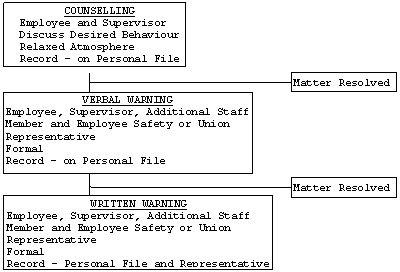 |
 |
 |
McKinnon said in his affidavit that contractors were issued with discipline procedure reports and a generic form designed for employees was used.
The hours worked by Wilson and Jackson depended on the tasks they were allocated. Work ordinarily started at 7.30 am. In an affidavit Jackson said he worked set hours of 7.30 am to 5 pm Monday to Friday and he was informed each morning whether there would be any overtime. In context, this reference to overtime is to hours worked in excess of the hours between 7.30 am and 5.00 pm. He also said he was instructed when to take smokos and lunch breaks. Wilson gave similar evidence. McKinnon did not put in issue that the hours of work were 7.30 am to 5.00 pm Monday to Friday though added that when work was available on a Saturday, Sunday or Public Holiday the hours usually worked were 7.30 am to 4.00 pm. Notwithstanding these hours, it is clear from the evidence that Wilson and Jackson started at 7.30 am and they would generally work as long as necessary to complete the task or tasks they had been allocated that day.
Wilson gave evidence about an incident when he was asked to work a night shift and refused. The evidence was not challenged. In early 1993 McKinnon spoke to Wilson at noon. He told Wilson a furnace had broken down, he should go home and have a rest and return and start a night shift at 7.00 pm. Wilson refused. He met later with McKinnon who said that if he did not act as requested, Monadelphous would review whether they would keep him. Wilson again refused and invoked what he then described as a rule that a worker only works 14 hours every 24 hours. He continued working and finished at 11.00 pm having worked 14 hours.
McKinnon took issue with what Wilson and Jackson said about meal breaks. His evidence was that the “contractors work a glide time”. He explained that this meant they would take their breaks when it was convenient to them, the people they were working with and the job they were doing. During Jackson’s cross-examination it emerged that the time meal breaks were taken were not fixed in the way suggested in his affidavit. He accepted that these were times when he was required to work through lunch breaks because of the job he was doing but he also said that for the majority of the time he would have his lunch break at a regular time. He said there were times when he was told when to take breaks and this was to ensure that crib rooms did not become overcrowded.
Wilson’s evidence was that on some days, particularly when he was busy, he would not have a morning tea break but would take a lunch break at 1.00 pm.
In cross-examination McKinnon explained that the expression “glide-time” was one he had picked up from the public sector where people are required to work a certain number of hours between given times. He accepted it was not an expression he used. In my opinion, what emerges from this evidence is that there was a measure of flexibility about when meal breaks were actually taken and it was at the discretion of the worker with two qualifications. The first was that Jackson and Wilson were, on occasions, required to take it at nominated time to ensure that crib rooms were not overcrowded. It is probable this problem arose only in certain sections of the complex. The second is that meal breaks would generally be taken at the “same time”. Moreover, the 1992 maintenance agreement between WMC and Monadelphous provided in clause 3.1.11 that tradespeople engaged on maintenance work could not be required to work for more than six hours without a meal break.
I have already mentioned that both Wilson and Jackson had tax deducted by means of PPS while working under the contracts signed in November 1992. In his tax return for the year ending 30 June 1992 Wilson recorded an income of $11,790 from Monadelphous for which tax deductions of $4,359.13 were made and for which a group certificate issued. His occupation was described as “boilermaker”. It also recorded a gross business income of $26,075 for which PPS deductions of $5,843.15 were made. Wilson described his business as “sub-contract welding”. A range of business deductions were claimed totaling $3,370 including home office expenses ($184), and printing and stationary ($98). The tax returns for the financial years ending 30 June 1993, 1994 and 1995 contained similar entries and deductions concerning the sub-contract welding business of Wilson. A similar picture emerged from Jackson’s tax returns in which he described his business as “plant maintenance”, though his deductions did not include items such as home office expenses or printing and stationary. I did not find Wilson’s explanation of the claim for home office expenses as relating to his role as a health and safety officer a credible one. They were made before he assumed that position and more likely reflect a desire, not constrained by punctilious accounting advice, to secure deductions where possible.
During 1994 Jackson was a delegate of AWU-FIME and, in early 1994, had been involved in negotiating an increase to the hourly rate of pay paid under the agreements signed in November 1992. The increase was agreed on 24 April 1994. Prior to the agreement, there had been a 24 hour strike by Monadelphous workers. After the agreement Jackson was moved from the mills area where he and Wilson had been working. McKinnon conceded that a reason for doing so was to separate them and prevent them spending time discussing union business. This, in my opinion, was either the sole or the dominant reason. In July 1994 Wilson stood for the elected full time position of organiser in AWU-FIME. He was unsuccessful. It was, however, Jackson and Wilson’s perception that they were receiving less support from officials of AWU-FIME after Wilson’s unsuccessful attempt to secure election to the position of organiser. The evidence of both Wilson and Jackson was that at this time they both began exploring the option of securing representation by another union. To this end Jackson spoke by phone to the South Australian Branch Secretary of the CFMEU, Mr Ben Carslake, and invited him to hold a meeting with Monadelphous workers at Roxby Downs. This he agreed to do on 19 September 1994. Jackson then set about publicising the meeting. He sent out what he described as “a general invitation” to all employees at Roxby Downs to attend the meeting. It is relatively clear from his oral evidence that Jackson spoke, not only to Monadelphous workers, but also workers engaged by other contractors and workers engaged directly by WMC. He suggested in evidence that this was all done outside working hours but I consider it is likely that it was not. In any event Jackson conceded that after the meeting on 19 September 1994 he spoke to other workers at the plant complex, while he was working, about joining the CFMEU and conceded distributing CFMEU application for membership forms at the work place. He said he did so in his own time and not while working. He instanced lunch time. Given the concession that he spoke to people during working hours about the CFMEU it is improbable that he did not, at the same time and when appropriate, also hand out application for membership forms.
Evidence was called by Monadelphous to establish the extent to which Jackson was being distracted from his duties by his promotion of the CFMEU. Jackson put this evidence in issue though he did not contest that he was actively promoting CFMEU in the workplace. However, in my opinion, the extent to which Jackson might have been distracted is not material to the issues that arise in these proceedings. If the evidence sustains a conclusion that Jackson was an employee and that his employment was terminated at the initiative of Monadelphous, then I would find that the termination of Jackson’s employment was in contravention of the Act. This is because Monadelphous did not seek to establish that a valid reason existed of the type referred to in s 170DE(1). Monadelphous pointed to the fact that contravention of s 170DF was not alleged. Thus Monadelphous was content to have the question of liability in the application under s 170EA resolved by the determination of the two preliminary issues of employment and termination at the initiative of the employer. In substance, termination in contravention of the Act was conceded by Monadelphous if it failed on the two preliminary issues.
The last occasion Jackson worked at the metallurgical plant was 30 September 1994. On 5 October 1994 he commenced working at Charlton Road. He opposed his transfer. As to the reason for the transfer, Monadelphous’ written submissions contain the following:
“Jackson failed to comply with his contractual duties by engaging in the extraneous activity of recruiting for the CFMEU instead of applying his skills to the maintenance work required on the site. Furthermore, those activities by their very nature interfered with the work others were required to perform. It is likely that the arguments with the WMC foremen Sawley and Evans were causally related to his CFMEU activities. Jackson acknowledged that he was abusive and that he had acted inappropriately. The respondent was reasonably concerned about the possible detrimental affect of Jackson’s conduct on its relationship with WMC. The respondent made a valid commercial decision in the course of its business to move Jackson.”
In my opinion, Monadelphous was, in this submission, conceding what was apparent from the evidence; namely, it was Jackson’s involvement with, and promotion of, the CFMEU that led to his transfer.
The principal players in the transfer were Jackson, McKinnon and Mr Peter Cuttriss who described himself as the mechanical manager responsible for the mechanical portion of the long term maintenance contract. Cuttriss commenced work for Monadelphous on 1 August 1994. He had been approached by a firm of consultants and asked to apply for the position. He was interviewed by Velletri. Having regard to the fact that there had been industrial disruption earlier that year and the nature of some of the work undertaken by Cuttriss when he commenced at Roxby Downs, it is likely that it was part of his brief to endeavour to deal with labour relations on-site, though Cuttriss appeared reluctant to answer questions in a way that involved conceding it was. Cuttriss undertook an evaluation of some of Monadelphous’ workers including Jackson. In an affidavit of Jackson filed on 31 July 1996 he said that, shortly before 18 September 1994, Cuttriss approached him in the workshop and said: “One way or another we are going to get rid of you”. Jackson said he responded by saying “I would have to do something wrong”, and that Cuttriss walked away with a smile on his face. In his affidavit, also filed on 31 July 1996, Cuttriss did not mention this conversation. It was not raised with Cuttriss in cross-examination though a similar conversation was put to Cuttriss as having taken place on 28 September 1994. There was no emphatic denial by Cuttriss that a conversation to that effect took place. However, in relation to a conversation said to have occurred between him and Jackson in 28 September 1994, the following question and answer appear in the transcript:
“You were talking about the fact that people were gunning for Martin Jackson; people in management at Monadelphous, were you not? That was one of the issues was it not? --- It could’ve been at the time, yeah.”
This was touched upon in re-examination:
“Mr Howells suggested to you that you were saying to him, look, the company is out to get you or Monadelphous is out to get you over that. You told Mr Howells that you did not recollect saying it to Mr Jackson in those terms. What words or expressions, phrases do you recollect using with Mr Jackson in the conversation? --- We had just a general discussion about what was happening around and some discussion on union involvement and my advice, as I could put it, was to Martin to probably leave a lot of that alone and just get on with his life and his job.
Now, Mr Cuttriss, you said - in telling Mr Howells about Monadelphous’ attitude to Jackson - Mr Howells said to you: look, Monadelphous weren’t happy about Mr Jackson in this period of September leading up to the transfer. You agreed that that was so. What did you understand Monadelphous was unhappy about? --- The disruptions on the site that Western Mining weren’t so happy about.”
The evidence of Jackson in his affidavit about what was said by Cuttriss shortly before 18 September 1994 was not challenged in Jackson’s cross-examination. It is probable, in my opinion, that at some point before 30 September 1994 Cuttriss spoke to Jackson and said words to Jackson that implied Jackson’s employment would be terminated if an opportunity presented itself that could justify that course being followed. Jackson was perceived to be a trouble maker and it was thought to be in the interests of both WMC and Monadelphous that he no longer work at Roxby Downs.
On 20 September 1994 Jackson had an argument with Evans about repairs to a pump. That gave rise to a meeting between Cuttriss, Jackson and Evans. In the result Cuttriss prepared a report which he signed and Jackson signed. At several points it referred to Jackson, either directly or by necessary implication, as an employee.
On 30 September 1994 Jackson met with Cuttriss, Mr Andrew Hall, who was also part of Monadelphous’ management group and Mr Tom O’Callaghan who was a worker employed by Monadelphous and a representative of AWU-FIME. This meeting with Jackson had been preceded by a meeting the previous day between McKinnon, Cuttriss and Hall. At that earlier meeting it was agreed that Jackson would be moved from the plant complex to work at Charlton Road. McKinnon asked Cuttriss to inform Jackson of the decision the following day, Friday 30 September 1994. McKinnon said he followed this course because he was going to Adelaide on the Friday. McKinnon told Cuttriss to inform Jackson that he would not be disadvantaged by working less hours at Charlton Road.
At the meeting on 30 September 1994 Jackson was told that he was to collect his tools and gear to be ready for removal from the site by 5.00 that afternoon. Cuttriss made clear to Jackson that he would be guaranteed no fewer hours than he had been working at the metallurgical plant. The precise terms of what was said that might constitute the guarantee are, however, not clear from the evidence. It was not a matter referred to by Jackson in his evidence-in-chief in his three affidavits though he gave evidence in them about other aspects of the conversation with Cuttriss and Hall at the meeting on 30 September 1994. Jackson did not give oral evidence-in-chief about the meeting. He was not cross-examined about what was said at the meeting about the guarantee though he was asked questions about other aspects of the meeting. Jackson was not asked about the guarantee in re-examination.
Cuttriss’ evidence about what he said arose in cross-examination. He agreed that in the conversation with McKinnon on 29 September 1994, it was raised that Jackson would be guaranteed no fewer hours than he had at the metallurgical plant. He agreed that he made that clear to Jackson at, I infer, the meeting of 30 September 1994. It is probable that what was said to Jackson that constituted a guarantee was that he would be guaranteed no fewer hours than he had worked at the metallurgical plant.
After the meeting on 30 September 1994 Jackson was given a document in the following terms:
“30 September 1994
TO MR MARTIN JACKSON
Following our discussion 30 September 1994, I wish to advise you in writing, due to a management decision, that as from 16.00 hours 30 September 1994 you will be transferred to Fitting duties at the Monadelphous yard, Charlton Road, starting work 07.30 hours Monday 3 October 1994.
Yours faithfully
(signed)
PETER CUTTRISS
MECHANICAL MANAGER
MONADELPHOUS ENGINEERING ASSOCIATES PTY LTD”
The following Monday, 3 October 1994, Jackson presented himself for work at the plant complex rather than Charlton Road. This gave rise to another meeting between Jackson, Cuttriss and Hall. During the course of the meeting Jackson was asked on several occasions whether he was refusing to carry out instructions. Cuttriss was cross-examined about the repeated reference to whether Jackson was refusing to carry out instructions though (probably mistakenly on the cross-examiner’s part) on the basis that this occurred at the meeting the previous Friday, viz 30 September 1994. The following appears in the cross-examination of Cuttriss:
“During that meeting you kept saying to him, “Are you refusing to obey instructions?” did not you? You said it several times? --- Correct.
Yes, and your aim was to have him refuse instructions because that would have provided a basis for dismissing him would not it? --- Possibility, yes.”
It is relatively clear that Cuttriss was conceding that at the time he, and probably McKinnon, had in mind that Jackson could be dismissed if the opportunity presented itself by his refusal to transfer as requested.
At the meeting on 3 October 1994 Jackson asked for and was given a further written instruction which was in the following terms:
“Following our discussion this morning, MZA. Do not have work planned for you on site, but as directed via the letter on Friday 30-9-94.
Work is available for you at Charlton Rd Yard Sit, as from 07.30 this morning.”
At some stage that day, Jackson produced a response. It was addressed to McKinnon in the following terms:
“Following the receipt of your letter dated the 3/10/94 I now find myself in the position that if I comply as directed I would be in the breach of clause 5(5.1) of my contract agreement.
In line with clause 5.4 (5.4.1) I would request notification of any unsatisfactory performance.
I am fully prepared to comply with my contractual obligations as per my original contract agreement as a maintenance fitter at the contract site.
In conclusion as per clause 5.5 there has been no mutual agreement to terminate my original contract.”
This document was probably given to McKinnon by Jackson on 4 October 1994. Apart from what is in this document, Jackson raised with Cuttriss on 3 October 1994 whether the agreement under which he worked could be varied other than by agreement.
Probably on 5 October 1994 McKinnon met with Jackson and several representatives of AWU-FIME. Jackson agreed to work at the yard when one of the organisers from AWU-FIME indicated they would see management to see what they could work out. This appears to have been a reference to negotiations or discussions with WMC.
From 5 October 1994 Jackson worked at the Charlton Road yard, though he was absent on leave from 20 to 29 October 1994. It is apparent from time sheets tendered by Monadelphous that Jackson worked the following hours per week:
|
Week Ending |
Hours Worked |
|
Sunday 9 October 1994 |
44 |
|
16 October 1994 |
57 |
|
23 October 1994 |
24.5 (on leave from 20 Oct) |
|
30 October 1994 |
on leave |
|
6 November 1994 |
58.5 |
|
12 November 1994 |
47.5 |
|
20 November 1994 |
55.5 |
|
27 November 1994 |
54 |
|
4 December 1994 |
43 |
|
11 December 1994 |
44 |
|
18 December 1994 |
52 |
|
25 December 1994 |
42 |
|
2 January 1995 |
23 |
Jackson had worked an average of 63.5, 59.16 and 58.56 hours per week in the six, twelve and twenty four months respectively prior to his transfer to Charlton Road.
During the period following the transfer to Charlton Road some but not all the work Jackson did was menial. The workshop manager responsible for the administration and profitability of the Charlton Road yard was Mr David Pattenden. Of all those who gave evidence and had been involved in some way with Jackson’s engagement, he was the only witness who left me with no doubt that he was endeavouring to answer questions honestly and without embellishment. He was an entirely credible witness. While his principal function was to administer Charlton Road, between September to December 1994 he was engaged on a task at the mine site. Pattenden said that because of the nature of the work performed at the yard, quieter periods were experienced at the end of the financial year and over the Christmas break. He said his policy was to give skilled tradespeople unskilled work during quieter periods to maintain their hours. Before Christmas 1994, 14 workers were told there would be no work, and this included approximately 7 tradespeople. Jackson had indicated he wanted to work over the Christmas break and work was made available for him on 28, 29 and 30 December 1994. On 30 December 1994, Pattenden met with Mr Lee Shaw. Shaw was a project supervisor employed by Monadelphous. It appears that, in December 1994, one of his duties was to control labour in the sense of ensuring workers were available to perform work Monadelphous was to do.
The meeting between Pattenden and Shaw concerned workloads. It was determined there was no work available for Jackson at the time. Pattenden asked Shaw to inform Jackson that afternoon there was no work then available for Jackson and to ask him to ring on 3 January 1995, which was the Tuesday after the long weekend. This Shaw did. In his oral evidence Jackson said that he asked Shaw when work would be available to which Shaw replied that he had no idea when it would be available. This was not challenged by Shaw. Jackson did not ring on 3 January 1995 but attended the Charlton Road yard at 7.30 am. Jackson went to clarify where he stood. He first spoke to Shaw and at about 9.00 am he had a discussion with Pattenden.
Pattenden’s account of this conversation in his affidavit is as follows:
“I am not sure who commenced the meeting. I cannot recall the exact words used during the meeting but I can recall the effect of what was said. Jackson indicated his need to know where he stood and whether his work was guaranteed. I explained that the nature of contracting work is that it is flat out one minute and quiet the next. I told him that I could not guarantee 50 to 60 hours a week but that traditionally the quiet spells hadn’t extended over months and months. The quiet spells were short term periods. I explained to Jackson that every effort had been made to maintain his hours during the quiet periods that he had been in the Yard.
Jackson said that he was employed as a fitter on the maintenance contract and that it had been a management decision to move him and that management could reverse the decision and return him to the maintenance contract. I explained to Jackson that I was unaware of the reason for his move to the Yard and that I had no control over who went on to the maintenance contract. That decision was out of my hands. I made it clear to Jackson that the workload was up and down and that the decision had been made on the grounds that MEA could not spend $20 an hour on costed work forever.
I explained to Jackson that a lot of other people were waiting for work to come up and that every effort had been made to give Jackson work when others had none. I explained that the reason why Jackson had worked on 28, 29 and 30 December was that he was performing quoted work. I can not recall obtaining a file bearing Jackson’s name during the discussion. I received no instruction from Neil McKinnon with respect to the meeting.
He explained that he had a wife and children to support. He requested a separation certificate. I explained to him that there was a technical difficulty with the separation certificate and independent contracts as if he is not working on one day he is not “unemployed” because he may be working the next day. He again requested the certificate to enable him to obtain benefits for the period that he was not working. I explained that the separation certificate was a typical Government form and it was black and white and did not cover the current situation. I told Jackson that I would need time to complete the form and asked him if he could come back at 11.00 am and I would have it ready for him. He agreed to return at 11.00 am.
Jackson returned at 11.00 am on 3 January 1995. I said that I had completed the paperwork. He took the separation certificate, thanked me and left the Yard.”
The reference to “costed work” was to fabrication or other work done by Monadelphous for its own benefit to enable it to perform other work. Pattenden contrasted this with “quoted work” for which Monadelphous would be paid directly.
The substance of this conversation was put to Jackson in cross-examination and accepted by him. However Jackson gave evidence in cross-examination that at this time he was feeling the pinch as a result of the reduction in hours arising from his transfer to Charlton Road and that he was desperate to have some sort of income for his family and that the financial position for his family was tight. He said this was the reason he asked for a separation certificate. He also said that he then believed that this was the “final move they were making on me” and that a decision had been made not to give him any more work. On probably 3 January 1995, Jackson spoke to an official of the CFMEU about initiating proceedings concerning the termination of his employment.
On 4 January 1995, Jackson rang the yard and spoke to Shaw. He said he did so because he had been requested to do so by Shaw. Shaw’s account of the phone conversation on 4 January 1995 in his affidavit of 12 March 1997 was:
Jackson: “Is there any work yet?”
Shaw: “Not at this stage, can you ring us tomorrow?”
Jackson: “Oh OK”
When this affidavit was sworn, Jackson had already said in cross-examination, when the conversation in these terms was put to him, that he did not believe Shaw said “ring tomorrow”. Jackson otherwise accepted the conversation as it was put to him. Jackson said that had Shaw said “ring the next day”, he would have rung.
Shaw was cross-examined about this conversation. In one version he volunteered that he asked Jackson to ring back but this was after recounting what he said without referring to this aspect of the conversation. Shortly after he was asked what was said and he made no reference to having said “ring back”. In re-examination he was asked whether he said “ring up again tomorrow” and agreed he did. I do not accept he did. Shaw was not an entirely credible witness and in his cross-examination asserted, without qualification that a practice did not exist that in his affidavit he said did exist. Jackson’s account should be preferred.
Evidence was given by Mr Maurice Dwyer who was an organiser with AWU-FIME, that he had spoken to Jackson by phone in a call initiated by Dwyer on either 2 or 3 January 1995 about the termination of Jackson’s employment. During cross-examination he appeared to concede that it may have been a couple of days later. In any event, Dwyer’s call to Jackson was in response to a call that Jackson had made on 3 January 1995. An internal office memorandum of AWU-FIME records the original call from Jackson as having been received at 10.17 am on 3 January 1995. That Jackson called AWU-FIME on 3 January 1995 was not put in issue by counsel for Jackson though Dwyer’s evidence does not sustain a finding that they spoke on 3 January 1995. It is probable that they did so later that week and either shortly before or at the time Jackson faxed through to Dwyer a copy of his separation certificate on 6 January 1995. It appears from notes of the conversation made by Dwyer that they discussed the separation certificate and that the termination was because of insufficient work. The certificate prepared by Pattenden records as the reason for termination - “insufficient work”.
On Friday 6 January 1995 Jackson returned to Charlton Road and picked up his tools. He saw Pattenden but, it appears, Jackson did not speak to him. Jackson said he saw people working at the yard on 6 January 1995. His explanation for not asking for work was two-fold. First, he said he was more interested in getting his tools because he had applied to other companies for work. Second, he said he then believed Monadelphous had no intention of offering him any work. He said: “I had no illusions as to the motivation and why they’d made the decision”. Shaw gave evidence that work would have been available for Jackson on 11 January 1995 and Pattenden’s evidence was that it would have been available on 9 January 1995. There was an issue about whether Shaw would ordinarily ring tradespeople to offer them work or they would ring the yard. However the procedure adopted on both 30 December 1994 and 3 January 1995 was to ask Jackson to ring but it was not adopted on 4 January 1995.
WERE JACKSON AND WILSON EMPLOYEES
Whether Jackson and Wilson were employees arises in two contexts. The first is that both the 1989 on-site award and the 1984 award are couched in terms that make it clear they govern the employment of employees only. Their terms reflect the traditional conception of the limits on the award making power of the Commission: see R v Commonwealth Industrial Court Judges; Ex parte Cocks (1968) 121 CLR 313, that permits awards to be made governing the employment of employees only. Moreover, the statutory jurisdiction of the Commission to make awards was, at the relevant time, limited by the legislative definitions of “industrial dispute” and “industrial matter” which ultimately directed attention to the common law: see R v Foster; Ex parte The Commonwealth Life (Amalgamated) Assurances Ltd (1951) 85 CLR 138 at 153.
The second context relates to Jackson only. Division 3 of Part VIA of the Act deals with the termination of an employee’s employment. The combined effect of s 170CA and s 170CB is that the Division concerns the termination of a relationship upon which the Convention Concerning the Termination of Employment at the Initiative of the Employer (which is Schedule 10 of the Act) and the Recommendation concerning Termination of Employment at the initiative of the Employer (which is Schedule 11 of the Act) is intended to operate. However Article 2 of the Convention and paragraph 2 of the Recommendation refer to their application to “all employed persons”. There is then reference in both international instruments to contracts of employment. It has not been suggested in these proceedings that Division 3 applied to anyone other than employees and employees as understood at common law. Indeed the submissions of the parties proceeded on the basis that this was the scope of Division 3, and I proceed on the same basis.
The starting point in ascertaining the nature of the relationship between Wilson and Jackson and Monadelphous are the judgments of the members of the High Court in Stevens v Brodribb Sawmilling Company Pty Ltd (1986) 160 CLR 16. It remains the most recent leading Australian authority considering the principles to be applied in determining whether there exists the legal relationship of employer and employee. However in Stevens there was no written executed agreement declaring that the nature of the relationship was not that of employer and employee but was that of principal and independent contractor. That is not to say, however, that nothing was said about the matter in Stevens. In the joint judgment Wilson and Dawson JJ noted that “the actual terms and terminology of the contract will always be of considerable importance”.
A convenient starting point in considering the effect of the characterisation of the relationship in the written agreement in the present lies in are the observations of Denning J in Massey v Crown Life Insurance Co (1978) 1 WLR 676 at 679:
“The law, as I see it, is this: if the true relationship of the parties is that of master and servant under a contract of service, the parties can not alter the truth of that relationship by putting a different label upon it. On the other hand, if their relationship is ambiguous and is capable of being one or the other (either service or agency), then the parties can remove that ambiguity, by the very agreement itself which they make with one another. The agreement itself then becomes the best material from which to gather the true legal relationship between them.”
These remarks were quoted with approval by the Privy Council in Australian Mutual Provident Society v Chaplin (1978) 18 ALR 385 at 390, but the Privy Council added:
“In the present case, where there is not reason to think that the clause is a sham, or that it is not a genuine statement of the parties’ intentions, it must be given its proper weight in relation to other clauses in the agreement.”
This passage from Massey adopted by the Privy Council in Chaplin was described shortly after by the Privy Council in Narich v Commissioner of Pay-Roll Tax (1983) 50 ALR 417 at 420 as “the governing principles”.
These statements of principle have been applied or adopted by Courts in Australia: see Lenzoot Heritage Pty Ltd v Sinclair (1986) 42 SASR 506; Building Workers’ Industrial Union of Australia v Odco Pty Ltd (1991) 29 FCR 104 at 126; Paterson v The State of South Australia (unreported, Industrial Relations Court of Australia, von Doussa J, 13 June 1997). However it is also accepted that the characterisation of the relationship by the parties in a written agreement is not conclusive: see Re Porter; Re Transport Workers’ Union of Australia (1989) 34 IR 179; Odco (supra); Bennett v EZ Risdon Golf Club Inc (1995) 64 IR 1; Southern Group Ltd v Christopher Victor Smith (unreported, Full Court, Supreme Court of Western Australia, 5 June 1997). Indeed I would respectfully adopt the observations of Lee J in the Transport Workers Union of Australia v Glynburn Contractors (Salisbury) Pty Ltd (1990) 34 IR 138 at 144:
“The facts show that Bird was engaged to supply his work and skill for an agreed remuneration. The fact that the standard terms of a form of contract presented to Bird by Glynburn described Bird as an independent contractor and set out consequences which were other than those that would normally attach to a relationship of master and servant would not prevent a conclusion of fact that in all the circumstances there was a relationship of master and servant between Glynburn and Bird. (See Alman v Unwin [1983] WAR 157 per Burt CJ at 160, per Kennedy J at 161).
As in Narich, where a standard form of contract described the party whose services were being contracted for as an independent contractor, such a clause is to be given appropriate weight when read with the terms of the contact as a whole but it does not stand alone to be a conclusive statement of the relationship of the contracting parties. What Bird was required to do and how he was required to do it left no room for the conclusion that he was an independent contractor, notwithstanding the positive statement to that effect within the terms of the contract.”
In the present case I do not place undue weight on the process adopted by Monadelphous of individuals tendering for work and the declaration in the documents signed in November 1992 concerning the character of the relationship said to be created by them. Indeed it can, in my opinion, be fairly said that the process of tender and the adoption of the terms of the agreement declaring the character of the relationship were insisted upon by Monadelphous in circumstances where neither Jackson nor Wilson had any effective choice. Wilson was then working for Monadelphous and the retention of his job was conditional on him meeting the requirements demanded by Monadelphous. Jackson was about to lose his job because the company with which he was then working had lost the maintenance contract under which he worked. Securing continuing employment, in fact, was also conditional on Jackson meeting those requirements.
Reference was made by counsel for Jackson and Wilson to Universal Tankships (Inc) Monrovia v International Transport Workers Federation [1983] AC 366 in support of a submission that the contracts resulting from the events of 9 November 1992 arose from pressure which constituted duress. If so, the transactions were voidable and would be actionable as a tort. It is unnecessary to consider this authority in detail. That is because the terms of a written agreement characterising the relationship as principal and independent contractor is a matter to be taken into account in determining the true nature of the relationship. However the circumstances in which the agreement was executed bear upon the significance to be attributed to that characterisation.
To be considered with the characterisation of the relationship in the written agreement signed on 9 November 1992 are the indicia referred to by both Mason J and Wilson and Dawson JJ in Stevens. While it has not traditionally been put in these terms, it may be approached on the basis that the terms and character of the contract are to be gleaned not only from the terms of any express contract itself but also the way in which the parties conducted themselves under it: see Spunwill Pty Ltd v BAB Pty Ltd (1994) 36 NSWLR 290.
Counsel for Monadelphous referred to the judgment of Lee J in Gurran v Tarbook Pty Ltd (unreported, Industrial Relations Court of Australia, 13 September 1996) and the following observations of his Honour:
“Indicia developed by the common law to determine whether a person is an employee or an independent contractor such as the degree of control exercised by a party for whom the services are rendered or the degree of integration of the contractors services in the business for which the services are provided are less apt to identify the true nature of the employment relationship in the context of modern employment practices. It is necessary to consider the terms of the contract made between the parties, the relative strengths of the contracting parties and whether there are sound commercial reasons on both sides that give reality to a contract to provide services where normally a contract of service would form the expected employment relationship...”
“In many cases the manner of provision of services under a contract for services may, on analysis, differ inconsequentially from the manner of performance of a contact of service. The distinction will be found in the terms of the contract that has been formed between the provider of the work and the recipient of those services.”
I do not consider, however, that these observations do anything more than repeat, perhaps with different emphasis, what his Honour earlier in said Glyburn. Indeed his Honour referred to Glyburn in Gurran. Nonetheless, the written terms of the contract and the indicia of employment not dealt with by the express terms of the contract itself must be considered.
I consider first the question of control. The evidence does not establish any measure of detailed control over how Jackson and Wilson actually performed work they were required to do. This, however, is not suprising given that both were skilled tradespeople. The absence of control of that character is not a contraindicator of employment: see Stevens at 36 per Wilson and Dawson JJ. However the tasks they were to do was regularly and predominantly the subject of direction by Monadelphous supervisors. When they were to do it was also, in practice, in the control of Monadelphous in that there was an expectation they would start at 7.30 am and work, subject to meal breaks, until they completed the tasks they had been assigned by Monadelphous supervisors. No days or hours of work were specified in the written contract and Jackson and Wilson were thus obliged by clause 8.1 to work on the days and at the times specified by Monadelphous or WMC. As they worked a regular pattern of working hours, clause 8.3 absolved Monadelphous from the obligation to give reasonable notice of the hours expected to be worked. This is consistent with clause 3.1.10 of the 1992 maintenance agreement to which Monadelphous was a party which provided that “maintenance work covered by this contract will normally be carried out during normal working hours which are five (5) days per week (Monday to Friday) between the hours of 7.30 am and 5.00 pm (with thirty (30) minutes unpaid meal break)”. Counsel for Monadelphous relied on the nature of the contractual obligations of Monadelphous under the 1992 maintenance agreement in support of its contention that Jackson and Wilson were not employees. Counsel characterised the maintenance contract as essentially one for the provision of skilled labour. Even accepting that this is so, the interposition of a Monadelphous supervisor between the WMC foreman (who, it may be accepted, determined what work was to be done) and the tradesmen, permitted or facilitated the exercise of legal control by Monadelphous as to the work to be done, when it was to be done and where it was to be done.
Apart from control, other indicia to be considered which were identified by Mason J in Stevens, at 24 include the mode of remuneration, provision and maintenance of equipment, hours of work and the provisions of holidays, deduction of income tax and the delegation of work. Indicia identified by Wilson and Dawson JJ in Stevens at 36 as suggestive of an employer/employee relationship are: the right to have a particular person do the work, the right to suspend or dismiss the person engaged, the right to the exclusive services of the person engaged, and the right to dictate the place of work, hours of work and the like. Indicia identified by Wilson and Dawson JJ suggesting a relationship of principal and independent contractor include work involving a trade or profession, the provisions by the contractor of the place of work or his or her own equipment, the creation by the contractor of goodwill or saleable assets in the course of his or her work, the payment by the contractor of business expenses of any significant proportions and the payment to the contractor of remuneration without deduction of income tax. However Wilson and Dawson JJ counsel against these matter being treated as a simple and conclusive checklist.
In the present case both Jackson and Wilson were paid fortnightly and by the hour for the hours they work in the manner provided for in clause 6.1 and 6.1.3 of the written contract. The rate was an hourly rate referable to the rates prescribed by the 1984 award for equivalent work in so far as it was to be adjusted in the way provided for in clause 6.1. In fact Jackson and Wilson were able to take recreational leave though they would not be paid for it and to do so, had to apply by means of form entitled “application for rest and recreation”. They had no power to delegate their contractual obligations and, in fact, they worked exclusively for Monadelphous. Tax was deducted from their income albeit by means of the PPS system and not the PAYE system.
For my part, I do not attach great significance to the fact that tax was paid by means of the PPS system rather than PAYE system. Two views may be taken. The first is that expressed by Gray J in Re Porter at 185:
“In many respects, the balancing of various factors once they are assembled is difficult. This is because many of the factors commonly relied upon prove to be of insubstantial weight upon proper analysis. For instance, a factor relied on commonly is whether or not income tax is deducted from the remuneration of a person before being paid to him or her. In the present case, reliance was placed on the fact that tax was deducted at the rate of fifteen per cent of the gross earnings of some owner drivers, pursuant to the prescribed payments scheme. No instalments of income tax were deducted from the remuneration of those persons under the pay as you earn taxation system. To place heavy reliance on this factor, however, is to assume that the payer has acted in accordance with the requirements of income tax legislation in choosing one type of deduction, rather than another.”
Another is that expressed by Meagher JA in Vabu Pty Ltd v Commissioner of Taxation (1996) 33 ATR 537:
“The taxation position of the couriers is also important. The couriers were taxed as independent contractors and not as employees. The gross payments to each carrier were subject do deduction of the 20% Prescribed Payment System tax, which does not apply to employees. In this regard, Mr Trew submitted that the tax document should be disregarded because they are self-servicing (sic) declarations by the taxpayer and as such are hardly evidence of anything. This is true, but it misses the point. What is significant is not the couriers tell the Commissioner that they are independent contractors not employees, but that the Commissioner, presumably after making whatever investigation he deems proper, acquiesces in their description of themselves and taxes them accordingly.”
With respect to Meagher JA, I find this approach unconvincing. Section 169A of the Income Tax Assessment Act 1936 permits the Commissioner to make an assessment on the basis of unverified information contained in a return. The “acquiescence” of the Commission is only nominal if the power conferred by s 197A is exercised. It often is. In my opinion, the approach of Gray J is to be preferred. It is also to be recalled that Wilson moved from the PAYE system to the PPS system in circumstances where there was no change in the work he did. All that appears to have happened in that he signed a document declaring that he was an independent contractor.
Clause 5.4 of the written contract, in effect, gave Monadelphous the power to summarily dismiss Wilson and Jackson for misconduct or to dismiss them on seven days notice. Both Wilson and Jackson provided tools but only the tools of their trade. Other equipment would be supplied by Monadelphous or WMC in accordance with clause 4 of the written contract. Such an arrangement is consistent with the employment of a tradesperson. While both Wilson and Jackson completed tax returns as if they were independent contractors, the business deductions they claimed were a small proportion of the gross income they earned. They were not, by their work, creating goodwill or a saleable asset.
The preponderance of the indicia and the express terms of the contract viewed as a whole, point, in my opinion, to an employment relationship. Both Jackson and Wilson were employees of Monadelphous.
DID THE 1989 ON-SITE AWARD GOVERN THEIR EMPLOYMENT
Identification of the award which governed Jackson and Wilson’s employment depends substantially on the nature of the work they did. However, before discussing the evidence concerning the work performed by Jackson and Wilson in any detail, it is convenient to refer briefly to the terms of the relevant awards. They provide the context in which the evidence has to be considered.
The 1989 on-site award was made on 29 September 1989 and clause 4 declared that operated in South Australia and several other states from the first pay period on or after 18 April 1989. Clause 38 declared that it superseded the 1984 award (including Appendix A) in relation to work covered by the 1989 on-site award in four states. The terms of clause 38, read literally, provided for the supercession of Appendix A by the 1989 on-site award only where the latter award applies. However the intention of clause 38, in my opinion, was that on-site metal trades construction work was, from the time the 1989 on-site award was made, to be regulated by that award. Appendix A was not intended to have residual operation save as to rights and obligations accruing prior to 19 April 1989. It is unnecessary to consider the legal effect of the 1989 on-site award between 18 April 1989 and 29 September 1989. Thus the issue that falls to be determined is whether the 1989 on-site award governed Jackson and Wilson’s employment. If not, it was governed by the general provision of the 1984 award.
The scope of the operation of the 1989 on-site award is determined principally by clause 2 which provides:
“
APPLICATION
(a) This award shall apply in the States of New South Wales, Victoria, South Australia, Tasmania, Queensland and in the Australian Capital Territory.
(b) Subject to the exceptions and exemptions specified in this award, this award shall apply to persons employed in the classification specified in this award on “on-site construction work” (as defined) who are in the Metal and Engineering Construction Industry as defined in clause 3 - Incidence of award, of the Metal Industry Award 1984 - Part I as it existed prior to the making of appendix A On-site construction work (which incidence is set out in appendix A hereto) and interpreted in accordance with subclause 2(c) of this award.
“On-site construction work” shall mean:
Metal trades work (as determined in accordance with subclause 2(c) herein) performed in the work of construction, fabrication, erection and/or installation work or work incidental thereto when it is carried out at a construction site which is specifically established for the purpose of constructing, fabricating, erecting and/or installing the following:
(1) power stations, oil refineries, terminals and depots; chemical, petro-chemical and hydrocarbon plants; and associated plant, plant facilities and equipment;
(2) major industrial and commercial undertakings and associated plant, plant facilities and equipment including undertakings for the processing and/or smelting of ferrous and non-ferrous metals, the processing of forest products and associated by-products, acid and fertiliser plants, cement and lime works, and other major industrial undertakings of a like nature;
(3) plant, plant facilities and equipment in connection with the extraction, refining and/or treatment of minerals, chemicals and the like;
(4) transmission and similar towers; transmission lines and associated plant, plant facilities and equipment;
(5) lifts and escalators as prescribed in Part II;
(6) metal trades work on other engineering projects.
(ii) Maintenance and/or repair and/or servicing work carried out on site by the employees of contractors or sub-contractors in connection with contracts for on-site construction work referred to in paragraph (i).
(iii) (1) Provided that it shall not include any work which is incidental to or of a minor nature in relation to the work normally performed by an employee of an employer not engaged substantially in metal and engineering construction, including any such work associated with the installation or servicing of any of the following equipment or systems:
telephone
telegraphic
alarms
surveillance
electronic cash registers
intercommunication
sound
internal security systems
safes or other equipment designed to protect valuable items
signs including illuminated signs.
(2) This award shall not apply to :
(A) work carried out within a permanently established place of employment such as a workshop, factory or warehouse where products are manufactured or services rendered; or
(B) ...
On established construction sites where the award will apply, and the rates of pay and allowances already determined exceed the rates of pay and allowances prescribed in this award, the parties understand and agree that there will not be any justification for the rates of pay and allowances actually paid on such sites to be increased or decreased as a result of the introduction of this award.
...”
Notwithstanding the reference to subclause 2(c) in the last line of the prefatory words of sub-clause 2(b) and in the line of the definition of “on-site construction work”, there is no sub-clause 2(c). However it has not been suggested that Jackson or Wilson did not perform metal trades work or that the reference to sub-clause 2(c) had any relevant limiting effect on the operation of the 1989 on-site award. “On-site construction work” is defined as work at a construction site. It has to be work of a particular character, namely “construction, fabrication, erection and/or installation work or work incidental thereto”. The construction site must be one that is specifically established for the purpose of “constructing, fabricating, erecting and/or installing” facilities, plant or structures of the type referred to in paragraphs (1) to (5). Paragraph (6) was not relied on by the applicants and it appeared to be common ground that paragraphs (2) and (3) were the relevant paragraphs.
It is comparatively clear from the terms of clause 2(b)(ii) that the paragraph after the words “shall mean” should be numbered “(i)”. Not only does clause 2(b)(ii) refer to “paragraph (i)” but its numbering as “(ii)” is as part of a sequence that would logically start with a paragraph (i). I will, from this point, refer to that part of the definition as paragraph (i) of sub-clause 2(b). This structure is relevant because it tends to indicate what was meant by the words “or work incidental thereto” in the opening words of paragraph (i). The applicants submitted they were words of extension. That may be accepted. However the express reference to maintenance, repair and servicing in sub-clause 2 (b)(ii) indicates fairly clearly, in my opinion, that work that can properly be characterised as maintenance repair and servicing was not intended to be comprehended by the expression “work incidental thereto”. A special provision was included to deal with maintenance, repair and servicing. The only maintenance, repair or servicing work that is comprehended by the definition of on-site construction work is that which is referred to in paragraph (ii).
The scope of paragraph (ii) was in issue. Counsel for Jackson and Wilson contended that paragraph (ii) applied to maintenance, repair or servicing work by the employees of contractors or sub-contractors and that they need not be employees of the contractor (or sub-contractors to that contractor) who had contracted to do on-site construction work involving construction, fabrication, erection or installation. Counsel for Monadelphous contended that paragraph (ii) operated only when there was that connection. That is, paragraph (ii) applied to employees of an employer who had contracted, either as the principal contractor or a sub-contractor to a principal contractor, to construct, fabricate, erect or install and who were employees who were thereafter involved in maintenance, repair or servicing work. This latter construction is, in my opinion, to be preferred. The reference to employment by contractors or sub-contractors together with the reference to contracts for on-site construction work would serve no obvious purpose unless they were intended to be words of limitation. The reference to both contractors and sub-contractors as well as contracts points rather obviously to a connection between the two. That is, a contractor who had contracted to construct, fabricate, erect or install facilities plant or structures (or a sub-contractor to such a contractor) would be bound to continue to apply the 1989 on-site award if its employees were required to return to or remain at the site to maintain, repair or service that which had been constructed, fabricated, erected or installed under the contract or sub-contract. Unless the paragraph is read this way, not only would words in the paragraph be surplusage but there would be no discernible limit on the application of the award to preclude its application to the maintenance, repair or servicing of any facilities plant or structures that had earlier been constructed fabricated erected or installed. That is, any facility plant or structure. The paragraph is part of the definition of “on-site construction work” and the ordinary meaning of those words are relevant in determining the likely meaning of expressions used to define them: see Western Newspapers Pty Ltd v Warren (1994) 1 IRCR 393 at 412.
It is thus necessary to ascertain whether the work of Jackson and/or Wilson, or a substantial part of it, involved the construction, fabrication, erection or installation (or work incidental thereto) of facilities, plant or structures of the type referred to in subparagraphs (2) and (3) of clause 2(b)(i) or maintenance, repair or servicing work in connection with contracts Monadelphous had for constructing, fabricating, erecting or installing such facilities, plant or structures.
The approach of the applicants to establish the 1989 on-site award applied was as follows. First it could be demonstrated that between 1988 and 1994 a number of pieces or units of plant were built at the plant complex. The work was summarised in three documents, “Construction works 1988 - 1990”, “Other construction works 1991 - 1994” and “Optimizations Construction Works”. The last document contained two sub-headings “Optimization One (1990 - end 1992)” and Optimization Two (1993)”. There was no real issue about whether the works identified in these documents was undertaken. It was. However, during the period Jackson and Wilson were employed by Monadelphous, the on-site construction work was generally work involving the erection of plant intended to supplement, complement or replace existing plant that was then operating and being used to process the ore or to extract and refine the minerals in it. That construction work of this type was undertaken during the period of Jackson and Wilson’s employment sustains, in the applicants’ submission, a conclusion that the entire plant complex was a construction site for the purposes of the definition of “on-site construction work”. Thus any work undertaken by Jackson or Wilson that involved construction, fabrication, erection or installation would be comprehended by the definition.
Evidence concerning the work was given by Jackson and Wilson. Also in evidence were the “plod cards” which were contemporaneous records they maintained detailing their work. They were completed at the end of each day’s work. Two documents were tendered by the applicants that involved an analysis of their plod cards and indicated which of the work was construction, fabrication, erection or installation. It also indicated which of the work was servicing or repair. On many occasions it involved a combination of these descriptions. However, with one broad exception that I will return to, the work described in the summary of the plod cards generally was not part of the initial installation of the plant. That is, the work that both Jackson and Wilson undertook involved mostly comparatively minor modifications or repairs to components of plant that was operating and had earlier been constructed and/or fabricated and/or erected and installed. In Jackson’s analysis of his plod cards, 191 of the 312 instances of work that was said to be comprehended by the definition of on-site construction work, concerned work on the Lasta press. That press had been built and extended before Jackson did any work on it when employed by Monadelphous. It was an operating piece of plant. The Lasta, in its extended form (it was extended in Optimization 1) consisted of 41 plates with a cloth between each plate. High powered hydraulic rams forced the plates together. The cloths were then pumped full of copper and uranium concentrate which, when dried in the press by air introduced into the press, formed a cake. The cake was then released and fell into a repulper beneath the press.
It cannot be said of Wilson that all the work he did was comparatively minor. One task of substance involved the replacement of ducting in the casting area in the smelter. The old ducting had to be removed and new (and larger) ducting fabricated and installed. This job took nine days. Nonetheless, the majority of the work done by Wilson was modifications or repairs to components of operating plant which was comparatively minor work.
The broad exception to which I earlier adverted, concerned some work that both Wilson and Jackson did on existing plant to facilitate the installation of new plant to replace or supplement the existing plant. That work may well be comprehended by the expression “work incidental (there) to” the erection and installation of plant. But this work was only a minor part of the work they did. Their work, as I earlier indicated, overwhelmingly involved modification and repair of existing plant (apart from work Jackson did which can only be described as routine maintenance). The only basis upon which this work could fall within the definition of on-site construction work is if I accept the contention of the applicants that the entire complex was, at all relevant times, a construction site. In my view it was not. Those areas of the complex on which plant was built which commenced to operate as part of the process of processing the ore and extracting the minerals, ceased to be or be part of a construction site, notwithstanding that other plant might later be built proximate to it and linked to the chain of processing and extraction.
This leads to a consideration of whether Jackson and Wilson were engaged in maintenance, repair or servicing work in connection with contracts Monadelphous had for constructing, fabricating, erecting or installing facilities, plant or structures of the type referred to in clause 2(b)(i)(2) or (3).
It was submitted that the 1992 maintenance contract was a construction contract of this type. It may be accepted that clause 2.2.5 of that contract indicates that minor project work would be done under it. It provides:
“The following table is an indication of maintenance performance in the respective Metallurgical Plant areas.
|
Plant Area |
Routine % |
Preventive % |
Unplanned breakdown % |
Minor Project % |
|
Mill |
35 |
33 |
30 |
2 |
|
Hydromet |
28 |
25 |
45 |
2 |
|
Smelter |
7 |
65 |
10 |
18 |
|
Refinery |
48 |
25 |
17 |
10 |
It is expected that, under this contract system, maintenance performance will show continually improving trends in all categories of work.”
This table was preceded by the following provisions which explain what some of these terms meant:
“2.2.3 Unplanned/Breakdown Maintenance
This category consists of maintenance work which is unplanned and/or is the result of equipment failure.
2.2.4 Minor Project Work
This category consists of work carried out in the areas to improve the performance and/or safety standard of the plant.”
However I am not satisfied that the maintenance contract was a contract of the type on which clause 2(b)(ii) was intended to operate. In my opinion, clause 2 was intended to identify metal trades work where the employees of the employer worked on a construction site for the purpose of constructing plant of the type referred to in 2(b)(i)(1) to (5) while they are engaged in construction. Its operation is extended by clause 2(b)(ii) so as to apply to the workforce of that employer if they remain on site or return to the site to maintain or service that which had earlier been constructed.
The construction contemplated and done under the maintenance contract, or other contracts secured by Monadelphous for construction, fabrication or repair to which some of the work of Jackson and Wilson related, was, in substance, maintenance repair or servicing of existing plant constructed by the employees of other employers. This can be illustrated by some of the work relied on by Jackson and Wilson in support of the contention that their work was work to which the 1989 on-site construction award applied. The first example (in point of time) given by Jackson (which he described as involving fabrication and repair) was work on the Lasta Filter press and the repulper. I have already described the Lasta. The repulper is a piece of plant beneath the Lasta. It is about 40 feet long and has a series of rotors and shafts and a drive mechanism to agitate and mix with water the concentrate falling from the Lasta press. It was plant that had been installed and extended and was operating plant when Jackson was working for Monadelphous. It was existing plant not installed by the employees of Monadelphous. The first example (in point of time) given by Wilson (which he described as fabrication and repair) involved welding a burner tip and repairing the shaft furnace in the smelter. This involved removing a section of the shaft furnace, modifying it by cutting out a section or putting in a section, welding or fabricating it and putting it back together again. Again, however, this was work on plant that had not been installed by the employees of Monadelphous.
I accept, as submitted by counsel for Jackson and Wilson, that a significant portion of the work done by Wilson, though less so by Jackson, involved work modifying plant that had already been installed. This work was necessary because the plant was not functioning as efficiently as it might either because of some inadequacy in the original design or the materials used to construct the plant, or because of some perceived benefit in altering the plant having regard to the use that was then being made of it. If this work was being done by an employee of a contractor or sub-contractor who installed the plant initially, then the 1989 on-site award would apply because of clause 2(b)(ii). It would not otherwise apply because, as earlier discussed, the work was not being done on a construction site.
It is unlikely, in my opinion, that paragraph (ii) of the definition was intended to render as “on-site construction work” any maintenance repair or servicing. The express means adopted in the award of limiting the type of maintenance repair or servicing to which it would apply was the linkage between the employer and the contact. It did not comprehend the work done by Wilson and Jackson. The 1989 on-site award did not govern their employment.
EXTENT OF UNDERPAYMENT UNDER THE 1984 AWARD
At various points in the proceedings, tables were prepared by the parties indicating what each viewed as the days and hours worked by Wilson and Jackson, the amounts actually earned by Wilson and Jackson (both for the entire period of time of their employment and for identifiable periods within that entire period), the hours worked by them which should be treated as ordinary hours and hours worked on overtime rates, the classification that each was working in, and the rate each should have paid under the various awards that might have applied, and special rates that were said to be payable. What it means is not entirely clear though it appears there is little common ground on a range of matters dealt with by the tables.
Counsel for Monadelphous submitted that, on one approach, both Jackson and Wilson were paid more than they were entitled to under the provisions of the 1984 award. This involves the resolution of one (or possibly two related) central legal issue(s) in Monadelphous’ favour. I am not satisfied I am presently in a position to address the ultimate contention of Monadelphous that, in fact, there was overpayment. It appears not to be a contention accepted by Jackson and Wilson. I do, however, consider that the central legal issues are to be resolved in the manner contended for by Monadelphous. The following are my reasons for reaching this conclusion.
It is to be recalled that Jackson and Wilson were paid a flat hourly rate of pay for all hours worked. Prior to 16 November 1992 when both Jackson and Wilson commenced to work under the 1992 maintenance agreement, the applicable hourly rate was $17.15 gross. Wilson was paid at this rate. From 15 or 16 November 1992 it was $18.00 gross. Both Wilson and Jackson were paid at these rates. The rate increased to $19.05 gross from 13 December 1993. When Jackson moved to Charlton Road he was paid at the rate of $19.67 gross which was a greater rate than that paid at the mine site and plant complex because workers at the yard did not have access to a bonus payment scheme. Depending on the classification and the period, the base rate in the 1984 award ranged between approximately $11.00 and approximately $13.00. Thus it can be seen that both Jackson and Wilson were, in relation to ordinary hours worked, paid considerably in excess of any relevant rate prescribed by the 1984 award.
It is to be recalled that what the contract rate comprehended, at least from 15 or 16 November 1992 onwards, was identified in the written contract. While the relevant provision is set out earlier in these reasons, it bears repeating. Clause 6.1 provided:
“6.1 The Contract Price is an agreed all inclusive amount payable by the Contractor to the Sub-contractor. The Sub-contractor acknowledges that under the contract the Sub-contractor has no additional entitlement of any kind for any benefit such as paid sick leave, annual leave, holiday loading, maternity or paternity leave, long service leave, bereavement leave, superannuation (unless required by the provisions of the Superannuation Guarantee Levy Act), severance pay, redundancy pay, site allowance, living away from home allowance, area allowance, industry allowance, tool allowance, clothing allowance, meal allowance, travelling allowance, relocation allowance, disability allowance, penalty rates for overtime or shift work or for working on a Saturday, Sunday or Public Holiday, or payment in lieu of any such benefit on termination. The only entitlement of the Sub-contractor is to receive payment of the contact price in accordance with this clause.”
In my opinion, this clause was intended to identify what the payment of the hourly rate was to compensate for, though it is not expressed in precisely those terms.
The oral evidence about the make-up of the hourly rates is not very illuminating. McKinnon said that Monadelphous calculated rates to be paid to its workers after being awarded the 1992 maintenance contract and then discussed them with WMC. In the result some adjustments were made. He was also asked questions about the relationship between the rate paid to the workers and the payment made by WMC to Monadelphous. However Jackson gave evidence that there were discussions about the contract rates by reference to what might be elements of it. The negotiations leading to the agreement to increase the rate in April 1994. There is a handwritten document in evidence which are calculations done by the AWU-FIME organiser, Kane, at a meeting on 30 November 1993. It read:
“ Award wages based on eg Trade Classifications
Metal Industry Award
Average Hours worked at Olympic Dam site
6 Days x 9 hours = 54 hours
Award Rate 438.10
Tool allow 9.00
Roxby area allow 1.53 per hr x 38 hrs = 58.14
505.24
Hr rate = $13.20
Overtime
5 days x 1.4 hrs x 1 1/2 = 7 hours = 93.10
Overtime Saturday
3 hrs x 1 1/2 = 4.5 hrs 59.85
6 hrs x 2 = 12 hrs 159.60
Shower allow $2.5 x 6 days 15.00
Disability allow 50 cents per hr x 54 hrs 27.00
Total $859.79”
“ Yearly Wages
Annual Leave 2020.96
Loading 353.67
Public Hols 1212.96
L.S.L 438.90
Sick Leave 808.64
4835.13
Wages 48 wks = 41269.92
TOTAL yearly income $46105.05
Contract Rates
All of fixed rate
$19 per hour average 54 hours = 1026
x 48 wks = 49248.00
$18 per hour average 54 hours = 972
x 48 wks = 46656.00
$18.50 per hour average 54 hrs = 999
x 48 weeks = 47,952.00”
These figures were discussed at the meeting on 30 November 1993, as were similar comparisons made by Monadelphous. Jackson said he was at that meeting and it is probable Wilson was as well. Neither Jackson nor Wilson said that, either in November 1992 or subsequently, they were not aware that the rate they were paid was intended to comprehend the range of matters referred to in the written contract. Wilson’s evidence was that he read the document and thus he would have read clause 6.1. Jackson said he looked at the documents briefly though it is probable he would, even looking at it briefly, have gleaned that the hourly rate was intended to be a composite rate. In any event it is relatively clear from the comparison done at the meeting of 30 November 1993 that it would have at least then been understood by Jackson and Wilson that the hourly rate comprehended the matters referred to in clause 6.1.
While I earlier indicated that Jackson and Wilson had no effective choice but to sign the written contract, I am nonetheless satisfied that they accepted, at least in a general sense, the basis upon which they were to be paid. That is, an hourly figure compensating them for a range of benefits they might otherwise enjoy under an award, including overtime penalty payments, paid annual leave, an annual leave loading, and a meal allowance.
When payment is made in this way and subsequent proceedings are brought to enforce the award, the relevant legal principle is that discussed by Sheldon J in Ray v Radano (1967) 67 AR(NSW) 471 at 478 - 479, which was approved by a Full Court of the Federal Court in Poletti v Ecob (No 2) (1989) 31 IR 321. Sheldon J said, in part:
“The position, as I see it, is that where a complainant has been employed by a defendant on work covered by an award, he is entitled under s 92(2) to claim any balance due to him between his award entitlement for his work and any payment made to him by the employer which is properly attributable to that award entitlement. If no more appears than that (a) work was done; (b) the work was covered by an award; (c) a wage was paid; then the whole of that wage can be set off against the award entitlement for the work whether it arises as ordinary time, overtime, week-end penalty rates or any other monetary right under the award. Prima facie a weekly sum paid by an employer to his employee is an appropriation by the employer (the debtor) to the payment due for the week (Sarris v Nicholson [1925] AR(NSW) 109); and, in my opinion, there is no legal significance in the mere verbiage by which the payment is described whether it be ‘wages’, ‘remuneration’ or the like.”
It is when an extra award payment is made for some other purpose, as was the case in Poletti, that the amount actually paid should not be treated as payment for amounts due under the award. In my opinion the amounts actually paid to Jackson and Wilson can be treated as payments of amounts due to Jackson and Wilson under the 1984 award for the matters identified in clause 6.1
One issue that materially influences the amount Monadelphous might be liable to pay under the 1984 award is the rate at which overtime payments should be calculated. Clause 21(a) of the 1984 award provided:
“(a) For all work done outside ordinary hours the rates of pay shall be time and a half for the first three hours and double time thereafter, such double time to continue until the completion of the overtime work.
Except as provided in this subclause or subclause (c) hereof in computing overtime each day’s work shall stand alone.
For the purposes of this clause ordinary hours shall mean the hours worked fixed in an establishment in accordance with clauses 18, 18A or 19 or this award.
The hourly rate, when computing overtime, shall be determined by dividing the appropriate weekly rate by 38, even in cases when an employee works more than 38 ordinary hours in a week.” (emphasis added)
It can be seen that of overtime is calculated by dividing the “appropriate weekly rate” by 38. Counsel for Jackson and Wilson contended that the appropriate weekly rate is to be ascertained by multiplying the hourly rate paid under the contract by 38. Counsel for Monadelphous contended that it is the rate prescribed by the 1984 award for the relevant classification. This issue is discussed in CCH Labour Law Reporter, though the discussion is of limited assistance in the present case:
“Another problem relevant to this “ordinary rates” question is the phenomenon of over-award payments. That is, most overtime clauses in awards relate to the ordinary rate of pay fixed by the award itself as the basis for calculating overtime and other penalty rates. Assuming therefore that an employee’s rate of pay was $4 per hour but his actual rate (through his over-award payment) was $5 per hour, a strict construction of the terms of the award would mean the application of the overtime formula (of either time and a half or double time) to the award rate of pay of $4 per hour. However, industrial reality would appear to prompt the acceptance of an employee’s actual rate of pay as the basis for the calculation of overtime and other penalty payments. Nevertheless it is suggested that care should be taken in the formulation of overtime and other special payment clauses to ensure that those clauses reflect precisely the intentions of the parties.”
It appears that as a matter of arbitral practice, earlier this century overtime provisions were formulated so that overtime was to be paid on actual rates of pay and not award rates: see Re Shipping Officers Award (1945) 54 CAR 502 at 508 and In re Bakers (Cumberland) Conciliation Committee (1938) 37 AR(NSW) 70 at 76. However there are also early authorities indicating that, in calculating other penalty rates, ordinary rates and not shift rates are to be used: see Re Amalgamated Engineering Union (1942) 47 CAR 489 and Federated Engine- Drivers and Firemens Association of Australasia (1930) 29 CAR 229.
Ultimately, however, the issue involves the construction of the 1984 award. Clause 8 prescribed wages rates for a range of classifications. That clause was headed “weekly wages rates”. Clause 8(c) dealt with supplementary payments, which is a rate arising from the application of what were then the wage fixing principles of the Commission. It defined “over-award payment” and “actual rate of pay” for the purposes of identifying how adjustments to wages should be made. The definition of “over-award payment” was:
“‘Over-award payment’ is defined as the amount (whether it be termed “over-award payment”, “attendance bonus”, “service increment”, or any term whatsoever) which an employee would receive in excess of the “Award Wage” which applied immediately prior to the order of the Australian Conciliation and Arbitration Commission dated 18 December 1981 for the classification in which such employee is engaged. Provided that such payment shall exclude overtime, shift allowances, penalty rates, disability allowances, fares and travelling time allowances and any other ancillary payments of a like nature prescribed by this award.”
Clause 9 prescribed a minimum wage, and in para (a) there is a juxtaposition of the expression “weekly award wage” and “over-award payments”. It is to be noted that para (d) provided:
“(d) Calculations for overtime, penalty rates, shift work and other payments under the award shall be made at the rate prescribed by clause 8 of this award for the classification in which the employee is employed.”
However this provision, in my opinion, is intended to make clear that, in circumstances where the minimum wage is paid, namely when the award wage, or the award wage and an over-award payment, is less than the minimum wage, overtime is to be calculated by reference to the award wage and not the minimum wage.
The language used in the 1984 award is not uniform and is somewhat confusing. However, and notwithstanding the arbitral practice I earlier referred to, the use of the word “appropriate” to qualify the expression “weekly rate” in clause 21(a) rather suggests that recourse has to be had to clause 8 which prescribes weekly wage rates and then the relevant or appropriate classification ascertained. By these means the appropriate weekly rate is determined. If this is the meaning of clause 21(a) then it is intended to prescribe, as an award entitlement, payment of overtime at the award rate. That is not to say, however, that in circumstances where over-award payments are made in the sense of a base rate for ordinary hours which exceeds the minimum prescribed by the award, a term might not readily be implied into the employment contract that overtime payments would be made by reference to the actual rate of pay.
I accept that this construction of the award is a somewhat narrow one and there is no compelling reason to treat the expression “appropriate weekly rate” as not comprehending the weekly wage actually paid. It is, however, an issue I need not resolve as I am entirely satisfied that the expression “appropriate weekly rate” is not a reference to a rate of pay which itself is intended to compensate for hours worked which would attract the operation of clause 21(a). It is one thing to view clause 21(a) as operating on the wage of an employee who receives, in addition to the prescribed minimum award rate, an additional amount for ordinary hours, and another to view it as operating on the amount paid to an employee to satisfy, either nominally or actually, a plethora of benefits (including overtime penalty rates) that might be payable. Indeed the definition of over-award payment in clause 8(c)(i) appears to me to identify the type of additional payment on which clause 21(a) would operate if the wider view was taken of the meaning of “appropriate weekly rate”. I reject the submission made on behalf of Jackson and Wilson that payment for overtime is to be calculated by reference to the hourly rate paid under the contract. Even if the expression in clause 21(a) is taken to be a reference to the base rate actually paid, that is, the award rate and any over-award payment of the type I have just discussed, it is probable that the base rate component in the hourly rate paid under the contract is either the award rate or a rate approximating it having regard to the calculations done by Kane in November 1993.
I should, at this point, deal with a submission made by counsel for Monadelphous raising the issue of estoppel. The submission was that Jackson and Wilson are “estopped from claiming remuneration based on award employment and Jackson is estopped from claiming the benefit of the employment termination provisions of the Act”. Broadly stated, the factual background upon which this submission proceeded was that Monadelphous organised its affairs on the basis that Jackson and Wilson, after signing the contracts in November 1992, continued to provide their services on the basis set out in the contracts despite their misgivings. They did not give notice of any intention to terminate the contract after signing it, nor was it ever claimed that the payments made to them were below amounts prescribed by an award. Moreover, the claims made both by Jackson and Wilson and other employees during their engagement concerned the operation of the bonus system and the base hourly rate. Counsel for Monadelphous submitted it was unconscionable for Jackson and Wilson to retrospectively insist on a determination of their legal rights on a basis which is inconsistent with the way in which they and Monadelphous organised their affairs.
The gravaman of Monadelphous’ submission was that a person may be estopped from asserting a right to a benefit derived from an award and/or from exercising a statutory right to enforce an award or obtain a remedy under Division 3 of Part VIA of the Act by their conduct. That this is so is, in my opinion, open to doubt. The benefits conferred by an award and the ancillary right to enforce them, together with the right to seek a remedy under Division 3, are not matters that can be forfeited by agreement. That is, a person upon whom those rights are conferred cannot agree to forego them, at least in a way that is legally enforceable.
So much is apparent, in my opinion, from the following passage in the judgment of Isaacs J in Josephison v Walker (1914) 18 CLR 691 at 700:
“And the unpaid balance is claimed as due by virtue, not of a common law contract, but of the statutory obligation which subsists notwithstanding any agreement to the contrary - no man being capable under the Statute of contracting himself out of his rights or obligations in this respect. The right claimed is a new right. It is a right which was unknown before to the law: a right to receive from an employer more than was bargained for.”
This passage was described by Brennan CJ, Dawson and Toohey JJ in Byrne v Australian Airlines Ltd (1995) 185 CLR 410 at 421 as reflecting “the correct view” in a contemporary context. As to authorities concerning awards made under state law see Lonnergan v Molloy (1914) 13 AR(NSW) 189; Huskisson RSL Sub-Branch Club Ltd v Sullivan (1990) 20 NSWLR 332; Walkley v Dairyvale Co-operative Ltd (1972) 39 SAIR 327; HG Collett Pty Ltd v Alsop & Alsop (1982) 49 SAIR 309. I consider that Division 3 should be approached on the same footing having regard to the stated purpose of it. It is beneficial legislation: see for example Grout v Gunnedah Shire Council (1994) 1 IRCR 143 at 160, and intended to confer rights on employees of the type recognised in the Convention Concerning Termination of Employment at the Initiative of the Employer (Schedule 10 of the Act) and the related Recommendation (Schedule 10). Indeed Division 3 is in Part VIA which is entitled “Minimum Entitlements of Employees”.
If an employee cannot agree to forego rights conferred by an award or Division 3, then it is unlikely an estoppel precluding their enforcement can arise from the conduct of an employee. The relevant principle was discussed by Pincus J in Beckford Nominees Pty Ltd v Shell Company of Australia Ltd (1986) 73 ALR 373 at 378:
“There is nothing explicit in the Act about exclusion of its provisions by estoppel. There is, however, authority in the English Court of Appeal for the proposition that, if on the proper construction of a statute, protective provisions cannot be ousted by agreement, the same result cannot be achieved by estoppel: Keen v Holland [1984] 1 WLR 251 at 261. It had been held by the House of Lords some years earlier, in Johnson v Moreton [1980] AC 37, that provisions of the English Agricultural Holdings Act 1948, designed to protect certain tenants, could not be excluded by agreement, although the Act did not say so in so many words. Partly, it seems, on the basis of the theory that the more food English land produced the better (see at 68), the House of Lords read the statute as not permitting contracting out on the relevant point. In the Court of Appeal case, Keen v Holland, there was argued to be an estoppel against the same provisions by convention, but the court said the provisions in question could not be got around by the means either.
Questions of this sort, are as Johnson v Moreton illustrates, often approached fairly broadly by looking at the policy underlying the statute in question and whether the provision is one intended for the protection of the public, or a section of it; another example is Barilla v James (1964) 81 WN(Pt 1) (NSW) 457.
It may be accepted that this principle arises in the context of legislative provision that are protective. Plainly Division 3 of Part VIA is such a provision. Less clear is the character of those provisions of the Act dealing with the making and enforcement of awards. Their character was considered by the High Court in Byrne in the context of considering whether the Industrial Relations Act 1988, in substantially the form it was in when it came into effect in March 1989, should be construed as conferring on an employee a right of action at common law for breach of an award obligation. Brennan CJ, Dawson J and Toohey J at 425 described it as an Act with “public aims” and not “disclos(ing) any intention to benefit or protect employees or any other class of persons by conferring on them a right of action at common law for breach of award obligation”: see also McHugh and Gummow JJ at 461-432.
However it is important to bear in mind the terms of the legislation existing at the time the conduct that was said to found the estoppel took place (1992 to 1995), at the time that Jackson and Wilson sought to assert their rights under the award (September 1995) and Jackson his rights under Division 3 (January 1995). As just noted, the character of the Industrial Relations Act 1988 in substantially the form it was in when it came into force on 1 March 1989 was considered by the High Court in Byrne. Effective from 30 March 1994, the Industrial Relations Act 1988 was amended by the Industrial Relations Reform Act 1993. Section 3, which identifies the principal object of the Act, was amended. Included in it was the following:
“3 The principal object of this Act is to provide a framework for the prevention and settlement of industrial disputes which promotes the economic prosperity and welfare of the people of Australia by:
(a) ...
(b) providing the means for:
(i) establishing and maintaining an effective framework for protecting wages and conditions of employment through awards; and
(ii) ensuring that labour standards meet Australia’s international obligations; and
(c) providing a framework of rights and responsibilities for the parties involved in industrial relations which encourages fair and effective bargaining and ensures that those parties abide by agreements between them; and
(d) ...”
While the principal object of the Act remained the prevention and settlement of industrial disputes, the above paragraphs disclosed maintaining wages and working conditions by the protective mechanism of awards and fair bargaining as an aspect of the purpose. In that statutory context it is probable that the principle discussed by Pincus J would operate. Different considerations might arise in relation to the Workplace Relations Act 1996 with its greater emphasis on workplace based and individual agreements.
The question of whether estoppel might arise in relation to the enforcement of an award made under the Conciliation and Arbitration Act 1904 was directly considered by Gray J in Kidd v Savage River Mines (1984) 6 FCR 398. An application had been made by the secretary of an organisation of employees to enforce an award. It was alleged that employees were entitled to wages under the award for a period in which they had been wrongfully stood down. In relation to one period in which the employees were stood down, one of them took annual leave for which he was paid. The employer submitted that the applicant was estopped from alleging any breach or non-observance of the award by reason of the employee’s election to receive payment for the period taken as leave. His Honour concluded that, for reasons arising from the facts of the case, no estoppel arose. However he addressed the matter more generally and said at 409:
“It is a sound principle that statutory rights should not be defeated by estoppel, especially statutory rights created for the benefit of the public or a section of the public. The rights given by the Award in the present case are of such a nature. They have statutory force by virtue of the terms of the Act. The obligations laid down by the Award are absolute, and prevail against any contract to the contrary, as did the provisions of the statute considered by the Full Court in Walsh’s case. In my view, a claim under an award cannot be defeated by estoppel.”
However if I am wrong and an estoppel may arise it would be necessary to consider whether the facts found one. The submission of Monadelphous proceeded on the basis that representations were made that led Monadelphous to make assumptions of the type referred to by Mason CJ in The Commonwealth v Verwayen (1990) 170 CLR 394 at 413. In oral submissions the assumptions were identified as, first, that the contractual hourly rate would be accepted as an all encompassing rate and there would not be a claim under an award for specific provisions on top of that and, second, that by reason of the relationship between Jackson and Monadelphous being a sub-contractor relationship, there would be no recourse to the “unfair dismissal provisions”. To found an estoppel it is necessary for the representation relied upon to be clear: see Legione v Hateley (1983) 152 CLR 406 at 435-6 per Mason and Deane JJ and Foran v Wight (1989) 168 CLR 385 at 410-11 per Mason CJ and 435-6 per Deane J.
As to the second matter, I do not accept that any representation was made by Jackson which could have led to the assumption relied on. It is true he worked under the contract but the evidence does not establish that he accepted the status attributed to him under it. I have already found that, when signing it, Jackson said he was doing it under protest. Indeed during his cross-examination McKinnon conceded that Jackson complained in the latter part of 1993 about having been required to sign a contract. I am not satisfied that the assumption referred to arose from the conduct of Jackson. As to the first matter, the evidence at its highest is that the contractual hourly rate would be accepted because it represented a sum equivalent to or exceeding entitlements otherwise flowing from the application of the 1984 award. No estoppel would arise in relation to any claim involving amounts payable under that award if, as a matter of fact and on the basis I have just discussed, moneys are due to Jackson and Wilson because the composite amount paid was less than award entitlements.
It may be that these conclusions resolve all issues about underpayment though perhaps they do not. If the latter, the matter can be listed for further argument to permit submissions to be put as to the matters of detail that I referred to in the first paragraph of this section of these reasons . The order I will make will be that the applicants file short minutes within 14 days. I have in mind that if the applicants accept that these conclusions mean no amounts are owing then the order would be one dismissing both applications. If amounts are owing and there is agreement that they are owing and agreement about the amounts, that can be reflected in agreed orders subject to the rights of either party to contest, by way of appeal, findings I have made in these reasons that led to that result. If there is no agreement then the order would simply be that the two applications would be listed for further hearing for the purpose of submissions being made about residual matters.
WAS JACKSON’S EMPLOYMENT TERMINATED AT THE INITIATIVE OF THE EMPLOYER
In January 1995, when the application was filed on behalf of Jackson, the Act provided that an employee could apply to the Court for a remedy in respect of the termination of his or her employment: see s 170EA. The combined effect of s 170CB and Schedules 10 and 11 of the Act was that termination of employment meant termination of employment at the initiative of the employer. It is for the applicant to demonstrate that there has been a termination at the initiative of the employer: see Melide v Rethmann Australia Environmental Services Pty Ltd (unreported, Full Court, Federal Court of Australia, 13 August 1997).
What constitutes termination at the initiative of the employer was considered by a Full Court of this Court in Mohazab v Dick Smith Electronics Pty Ltd (No. 2) (1995) 62 IR 200 at 205. The Full Court said:
“It is necessary to consider the ordinary meaning of the expression “termination at the initiative of the employer” in context in the Convention having regard to its object and purpose. The word “initiative” is relevantly defined in the New Shorter Oxford Dictionary in the following way:
“initiative 1. The action of initiating something or of taking the first step or the lead; an act setting a process or chain of events in motion; an independent or enterprising act.”
And in the Concise Macquarie Dictionary in the following way:
“initiative 1. an introductory act or step; leading action; to take the initiative. 2. Readiness and ability in initiating action; enterprise: to lack initiative.”
These definitions reflect the ordinary meaning of the word “initiative”. Viewed as a whole, the Convention is plainly intended to protect workers from termination by the employer unless there is a valid reason for termination. It addresses the termination of the employment relationship by the employer. It accords with the purpose of the Convention to treat the expression “termination at the initiative of the employer” as a reference to a termination that is brought about by an employer and which is not agreed to by the employee. Consistent with the ordinary meaning of the expression in the Convention, a termination of employment at the initiative of the employer may be treated as a termination in which the action of the employer is the principal contributing factor which leads to the termination of the employment relationship. We proceed on the basis that the termination of the employment relationship is what is comprehended by the expression “termination of employment”: Siagian v Sanel (1994) 1 IRCR 1 at 19; 54 IR 185 at 201. In many, if not most, situations the act of the employer that terminates the employment relationship is not only the act that puts in train the process leading to its termination but is, in substance, the entire process. An example would be a situation where the employer decided to dismiss an employee and did so orally or in writing with immediate effect. Other situations may be more complex...”
And later at 205-6:
“In these proceedings it is unnecessary and undesirable to endeavour to formulate an exhaustive description of what is termination at the initiative of the employer but plainly an important feature is that the act of the employer results directly or consequentially in the termination of the employment and the employment relationship is not voluntarily left by the employee. That is, had the employer not taken the action it did, the employee would have remained in the employment relationship.”
In Rheinberger v Huxley Marketing Pty Ltd (1996) 67 IR 154 I considered the observations of the Full Court in Mohazab. I said at 160 - 161:
“...it is not sufficient to demonstrate that the employee did not voluntarily leave his or her employment to establish that there had been a termination of the employment at the initiative of the employer. Such a termination must result from some action on the part of the employer intended to bring the employment to an end and perhaps action which would, on any reasonable view, probably have that effect. I leave open the question of whether a termination of employment at the initiative of the employer requires the employer to intend by it action that the employment will conclude. I am prepared to assume, for present purposes, that there can be a termination at the initiative of the employer if the cessation of the employment relationship is the probable result of the employer’s conduct.”
I was then unaware of a line of authority in the federal courts of the United States of America that concern actionable constructive discharge. Constructive discharge can be established by demonstrating that the employer deliberately made an employee’s working conditions so intolerable that the employee was forced into an involuntary resignation and the employee acted reasonably. However it would not be necessary to demonstrate that the intolerable working conditions were imposed for the purpose of forcing the employee to resign: see Young v Southwestern Savings and Loan Association 509 F 2d 140 (5th Cir, 1975); Bourque v Powell Electrical Manufacturing Co 617 F 2d 61 (5th Cir, 1980); Shawgo v Spradlen 701 F 2d 470 (5th Cir, 1983); and see also Greg McCarry, “Constructive Dismissal of Employees in Australia” (1994) 68 ALJ 494.
It is first desirable to ascertain when the termination of Jackson’s employment occurred though, for the purposes of Division 3 of Part VIA, when employment was terminated is sometimes not an easy issue to resolve: see Rheinberger at 161. However, as I noted in Rheinberger, the expression “termination of employment” relates to the cessation of the employment relationship which is not dependent upon the status of the contractual relationship between the employer and the employee: see Siagian v Sanel Pty Ltd (1994) IRCR 1; Strachan v Liquorland (Aust) Pty Ltd (unreported, Industrial Relations Court of Australia, Moore J, 6 February 1996); and Brackenridge v Toyota Motor Corporation Australia Ltd (1996) 142 ALR 99. In the present case I consider the better view is that the employment relationship concluded when Jackson picked up his tools on Friday 6 January 1995. I accept it might be viewed as having concluded on 3 January 1995 when Jackson was given the separation certificate. However the certificate was produced for a particular purpose. The point at which it was apparent that Jackson would not work for Monadelphous again was 6 January 1995.
The conduct of Monadelphous that might be viewed as initiating the termination was the transfer of Jackson to Charlton Road, the failure to honour its guarantee to maintain his hours at the level that had been worked on the mine site and plant complex, the provision of work that was, in part, menial, the failure to provide work on 3 January 1995 and the failure to guarantee the provision of work after 3 January 1995.
In other circumstances the combination of these factors may, at least arguably, more clearly sustain a conclusion that the termination was at the initiative of the employer. It may have been, for example, that Jackson had the opportunity of taking up more certain employment with another employer in the week commencing Tuesday 3 January 1995 and the opportunity would have been lost if not taken up in that week. Alternatively, the evidence might clearly establish that Jackson had no funds and was unable to sustain himself and his family without either immediate work or recourse to social security or unemployment benefits. In either case the termination of the employment would have been a direct result of the conduct of the employer that, effectively, left the employee with no choice but to leave the employment.
However, the facts in the present case do not obviously point to a particular conclusion. The evidence establishes that on 3 January 1995, Jackson told Pattenden that he had a wife and child to support. I accept that he was concerned by the longer term effect of not receiving work on his capacity to support his family. However the evidence does not establish, even by implication, that had Jackson not worked on any day that week, he would have reached a point where he did not have the funds to support himself and his family in the absence of the benefits he was proposing to secure by obtaining the separation certificate. Nor does the evidence establish he was likely shortly to have reached that point. Jackson said, as I earlier noted, that he was then feeling the pinch as a result of the reduced hours he was working at Charlton Road, that he was desperate to have some sort of income for his family and that the financial position for his family was tight. However no evidence was led to show with any particularity what Jackson’s financial position then was. By obtaining a separation certificate Jackson was able to obtain benefits totalling $314.80 per fortnight. His basic income from working at Charlton Road would have been, even at an average of 30 hours per week, a fortnightly amount of $1180.02 gross. The implication of Jackson’s evidence is that he preferred the certainty of approximately $300 per fortnight to what he believed to be the uncertainty, if not unlikelihood, of income from Monadelphous. The critical issues, in my opinion, are whether Jackson’s evidence about his belief is to be accepted, and whether his belief was reasonably based. The case put on behalf of Jackson is that the reduction in hours and the refusal to provide him with work was, in fact, part of a plan to force him to leave.
The evidence concerning the reason for what, viewed in the broad, was an overall reduction in Jackson’s hours from 5 October 1994 is not entirely clear. However whether the reduction of his hours was done deliberately for an ulterior purpose or not is, in my opinion, immaterial. I say that because the decision that precipitated Jackson’s request for a separation certificate was Pattenden’s decision not to offer Jackson work for the period the yard was open immediately following 30 December 1994. That decision taken by Pattenden was, in my opinion, taken bona fide having regard to the work that was then available and anticipated.
Counsel for Monadelphous submitted that Jackson had decided to treat the reduction of hours as an opportunity to initiate proceedings. He characterised Jackson’s conduct as opportunistic. During submissions, counsel for Monadelphous referred to “a certain political motivation”. I accept that some aspects of Jackson’s conduct are difficult to understand. If he was “feeling the pinch” as a result of the drop in income from the lesser hours he was working at Charlton Road, it is difficult to discern what was to be gained by ensuring an appreciably further drop in income by moving to unemployment benefits. It seems to me that there are one of two answers. The first is that he acted in the way described by counsel for Monadelphous. If so, he may have been motivated by some perceived benefit accruing to the CFMEU and advancing its cause by leaving so as to provide the basis for proceedings against Monadelphous and creating a forum for scrutinising its labour practices. However this was not put to Jackson and was not, in these terms, put by way of submission though counsel for Monadelphous did use the word “political” in the context of explaining Jackson’s behaviour and motivation. Monadelphous’ submission was that Jackson’s conduct was opportunistic but it did not go on to answer directly the question: “to what end?” The evidence does not, in my opinion, support an inference that the decision of Jackson to leave his employment was for some political reason or a reason related to the interests of CFMEU rather than for reasons personal to him in the circumstances he was in.
It is more likely, in my opinion, that Jackson believed on 3 January 1995 that the final step in what he perceived to be the plan of Monadelphous was being given effect to by Pattenden. While I have indicated that I consider Pattenden was acting bona fide, Jackson nonetheless has a reasonable basis for his belief. He knew he was viewed as a trouble maker. He had grounds for believing Monadelphous would prefer that he not work at Roxby Downs at all. He knew the earlier guarantee had not been and was not being honoured. It is true that Jackson rang on 4 January 1995 to inquire whether there was work available. His explanation given in cross-examination for doing so was that Shaw had asked him to do so. In one sense it is an curious explanation, though it was not explored further in cross-examination. It is odd because it is not consistent with his evidence that he then believed he would not get any work. However it is not inconceivable that common courtesy would have prompted Jackson to ring when he had been asked notwithstanding that he then believed it would lead to nothing. In my opinion, Jackson believed on 3 January 1995, and it was a reasonable belief, that it was unlikely he would receive any more work from Monadelphous.
Drawing on another area of the law, whether the conduct of Monadelphous caused the termination of Jackson’s employment involves a practical common sense concept: see Wardley Australia Ltd v Western Australia (1992) 175 CLR 514 at 525 and March v Stramare (E & MH) Pty Ltd (1991) 171 CLR 506. In my opinion there is a direct casual link between the conduct of Monadelphous and the termination of Jackson’s employment. Its conduct commenced the process that led to and caused the termination of the employment. Jackson’s employment was terminated at the initiative of Monadelphous.
REMEDY
This leads to the question of what remedy, if any, should be ordered. The primary remedy when contravention of Division 3 is established is reinstatement. Section 170EE confers a power to order reinstatement to the position occupied immediately before the termination: see s 170EE(1)(a)(i) which is the position he held at Charlton Road; or to another position: see s 170EE(1)(a)(ii). The exercise of the power to order reinstatement to another position was discussed by a Full Court in Anthony Smith & Associates Pty Ltd v Sinclair (1996) 67 IR 240 at 244:
“We have already set out the terms of s 170EE(1)(a)(ii) of the Act. The subparagraph empowers the Court to require the employer to reinstate the employee by appointing him or her “to another position on terms and conditions no less favourable than those on which the employee was employed immediately before the termination”. This might be a specific position, the availability and suitability of which is revealed by the evidence. On other occasions, the Court will not specify a particular position. Provided that the court is satisfied that reinstatement is practicable and appropriate, it is open to the court to make an order in terms of par (a)(ii), leaving it to the employer to choose the position and to comply with the Court’s order to provide terms and conditions that are no less favourable than those on which the employee was employed immediately before the termination. If this course is taken, the employer may select an existing position, or he or she may create a new position for the purpose. If the latter, contrary to the submission of counsel for the employer, it will not be to the point that, in the absence of the order, the employer might not have created the position. We appreciate that creation of a new position may occasion a cost, or other disadvantage, to the employer. Where there is evidence that this will be so, that evidence may be relevant on the issues of practicability and appropriateness. But it would be contrary to principle to treat such evidence as necessarily determinative. The occasion for the order arises because the employer has acted unlawfully in terminating the employee’s employment. A reinstatement order is akin to an injunction compelling a wrongdoer to restore the position of the innocent party. In considering whether to grant an injunction, a court will always take into account the consequences of an order to the wrongdoer but the existence of adverse consequences has never been regarded as excluding the possibility of an order being made.”
Thus power exists to order that Jackson be reinstated to a position of maintenance fitter on the mine site in the plant complex if I was satisfied on the evidence that such a position was now available.
The primary remedy of reinstatement should not be ordered if the Court thinks it would be impracticable. I note that the amendments to s 170EE introducing the notion of “appropriate(ness) in all the circumstances” operated in relation to termination occurring after 15 January 1996 or in relation to a prior termination for which no application had been filed by that date: see cl 14 of schedule 2 of the Industrial Relations and Other Legislation Amendment Act 1995. Thus the amendments have no application to the present proceedings.
The question of what constitutes impracticability has recently been canvassed by a Full Court in Perkins v Grace Worldwide (Aust) Pty Ltd (unreported, Industrial Relations Court of Australia, 7 February 1997). The Full Court endorsed, indirectly, observations of Wilcox CJ in Patterson v Newcrest Mining Limited (unreported, Industrial Relations Court of Australia, 6 June 1996) that:
“The requirement to consider the impracticability of reinstatement necessarily requires the Court to have regard to all the relevant circumstances of the case relating to the employer and the employee; as I said in Nicolson, to evaluate the practicability of a reinstatement order in a common sense way.”
and observations of Wilcox CJ in Nicolson v Heaven and Earth Gallery Pty Ltd (1994) 1 IRCR 199 at 210 that:
“It is important to note that Parliament stopped short of requiring that, for general compensation to be available, reinstatement be impossible. The word “impracticable” requires and permits the Court to take into account all the circumstances of the case, relating to both the employer and employee, and to evaluate the practicability in a commonsense way. If a reinstatement order is likely to impose unacceptable problems or embarrassments, or seriously affect productivity, or harmony within the employer’s business, it may be “impracticable” to order reinstatement, notwithstanding that the job remains available.”
In the present case the matters identified by Monadelphous as giving rise to impracticability are first the allegations by, inter alia, Jackson of dishonesty. I understand this to be a reference principally to Jackson’s belief that certain of Monadelphous management conspired to force him to leave. The second matter was “the overall context of the inter-union dispute which appears to underlie this action”. The third matter was the long delay between the commencement of the application and the final hearing.
The first matter is relevant but not decisive. In Perkins the Full Court said:
“In most cases, the employment relationship is capable of withstanding some friction and doubts. Trust and confidence are concepts of degree. It is rare for any human being to have total trust in another. What is important in the employment relationship is that there be sufficient trust to make the relationship viable and productive. Whether that standard is reached in any particular case must depend upon the circumstances of the particular case. And in assessing that question, it is appropriate to consider the rationality of any attitude taken by a party.
I may be difficult or embarrassing for an employer to be required to re-employ a person the employer believed to have been guilty of wrongdoing. The requirement may cause inconvenience to the employer. But if there is such a requirement, it will be because the employee’s employment was earlier terminated without a valid reason or without extending procedural fairness to the employee. The problems will be of the employer’s own making. If the employer is of even average fair-mindedness, they are likely to prove short-lived. Problems such as this do not necessarily indicate such a loss of confidence as to make the restoration of the employment relationship impracticable.”
By prosecuting this application under s 170EA, and seeking reinstatement, Jackson can be taken to have accepted that he can maintain a relationship with those he has accused such as to enable him to discharge the duties in the position to which he might be reinstated. He was not cross-examined to establish he could not. It is unlikely, in my opinion, that those he accused would be unable to work with Jackson and evidence was not led to establish they could not.
The second matter relied upon by Monadelphous concerned the involvement of the CFMEU and its promotion by Jackson in circumstances where relevant parts of the workforce at Roxby Downs were, and had been, represented by AWU-FIME. Whether reinstatement is impracticable will depend on the evidence and the nature of the order. In my opinion it is likely that Jackson would, if reinstated, continue his promotion of CFMEU and the prospect of him doing so might be viewed as creating problems for Monadelphous of the type referred to by Wilcox CJ in the passage just quoted from Nicholson. I have said, in another capacity and in another context, in Australian Workers’ Union v Federated Engine Drivers and Firemens Association of Australasia (1992) 44 IR 453 at 460:
“I cannot ignore what I earlier described as the aspirations of the CFMEU (to represent miners in Australia whether coal miners or metalliferous miners) While demarcation issues may have been resolved between the organisations concerned (including AWU and CFMEU) at this point in time in relation to Tasmania and most areas of contention is South Australia, I do not accept that there is necessarily and certainty about this continuing. Mining is an industry of national significance and, in my view, any question of the rationalisation of union coverage in that industry cannot be left to be determined by contests between registered organisations, seeking to recruit disaffected members of another organisation on the one hand and seeking to retain them on the other, at the workplace at either the mines the subject of these orders or more generally at mines in the various States of the Commonwealth. Such a contest could lead to significant disputes that potentially could disrupt production or at least destabilise industrial relations at the workplace.”
These remarks were made in the context of a legislative framework that had three features. First, a registered organisation could only enrol and represent members in areas of employment identified in its eligibility rules. Second, the capacity of a registered organisation to amend its eligibility rules was curtailed by a procedure requiring the approval of a member of the Commission. Third, the rights and obligations of employees and employers in the areas of employment in which an organisation could recruit and represent were, generally though not universally, governed by awards or collective agreements arising from the process of conciliation and/or arbitration. This third matter is no longer as dominant a feature of the legislative framework though the first two remain features of it.
Nonetheless, and apart from the changes to the legislative framework, I accept that concerns of Monadelphous about Jackson’s further promotion of the CFMEU are reasonable in the sense that it would tend to destabilise existing patterns of industrial relations and probably attract critical attention from WMC which has an interest in industrial relations at Roxby Downs more generally. However if an order is made that reinstates Jackson to his position at Charlton Road, it will place Jackson in a position which Monadelphous viewed as minimising the practical effect of his commitment to CFMEU. Such an order would not preclude Jackson later resuming employment at the plant complex by agreement with Monadelphous.
I should make it plain that in approaching the matter this way, I am addressing, as I am required to, the statutory test of practicability in the way discussed in the judgment of the Full Court in Perkins. Articles 2 and 3 of the Freedom of Association and Protection of the Right to Organise Convention 1948 (No 87), ratified by Australia on 28 February 1973, recognise a right of employees to join a union of their choosing. An order under s 170EE(1)(a)(i) will not preclude Jackson’s right, if eligible for membership, to remain a member of CFMEU. However Jackson may be limited by an order reinstating him to his position at Charlton Road in his ability to engage in union activity on behalf of CFMEU in a way arguably inconsistent with the Right to Organise and Collective Bargain Convention 1949 ratified by Australia on 28 February 1973.
Section s 170EE(2) states of “if the Court thinks ... that reinstatement is impracticable”. It may be that the exercise of the power upon which the formation of this opinion depends, viewed in isolation, would permit or even require the consideration of impracticability in a way that was consistent with Australia’s international obligations: see Minister for Immigration and Ethnic Affairs v Teoh (1995) 183 CLR 273 at 287-288 per Mason CJ and Dean J (Gaudron J agreeing at 304), Toohey J at 302; even though it involves the exercise of judicial power: see In the marriage of Murray and Tam (1993) 16 FamLR 982 at 988. However the power to order reinstatement is a power conferred by an Act which, as earlier discussed, elsewhere limits the capacity of organisations to represent classes of employees and which effectively limits the rights of employees to join them. There is no persuasive evidence (beyond any inference that may be drawn from the fact that Jackson joined CFMEU) establishing an existing right in CFMEU to represent an employee engaged in work of the type done by Jackson or other employees generally engaged in mining and the processing of ore at Roxby Downs, nor is there persuasive evidence establishing a corresponding right of Jackson to join and remain a member of CFMEU and thus act on its behalf in recruiting other employees at the mine site or processing plant. In particular, the eligibility rules of CFMEU are not in evidence. Accordingly I do not view the approach I have taken as an inappropriate one when considering the question of impracticability.
The third matter covers the time the proceedings have taken. That there has been delay must be accepted. It is attributable, in a material respect, to the conduct of CFMEU which, in prosecuting the various claims, prevaricated as to the nature of the application it would make and pursue. As I noted at the outset of these reasons, the application under s 170EA was filed on behalf of Jackson on 16 January 1995. Jackson was then represented by a firm of solicitors, Palios Meegan and Nichols. In February and March 1995 various interlocutory steps were undertaken and hearings took place. On 30 March 1995 a notice of change of representation was filed indicating that the CFMEU was to represent Jackson. There were further interlocutory steps and an interlocutory hearing on 3 April 1995. At that hearing dates for trial of the application under s 170EA were fixed for 5, 6 and 7 June 1995.
On 5 April 1995 a summons was filed commencing a prosecution against Monadelphous alleging it had committed an offence under s 334(1) of the Act. The prosecutor was a Mr Mark Harrison, an industrial officer of CFMEU. Further interlocutory steps were taken in the application under s 170EA in April and May 1995 including an application filed on 20 April 1995 on behalf of Monadelphous that the application under s 170EA be stayed indefinitely. On 10 May 1995 von Doussa J made an order staying the application under s 170EA until the prosecution was resolved. The prosecution was listed for hearing on 28 - 31 August 1995 inclusive. There was no appearance for the prosecutor at a directions hearing conducted by me on 23 June 1995. At a further directions hearing conducted by me on 28 June 1995 I confirmed that the prosecution was listed for hearing for five days commencing on 28 August 1995. On 21 August 1995 the informant filed a notice of discontinuance.
As I noted at the outset of these reasons, applications were filed under s 127A and s 179 on behalf of Jackson on 29 September 1995. Thus almost nine months had elapsed before the proceedings (in a general sense) had any final direction. There were further directions hearings in November and December 1995 and January 1996 but the proceedings did not, in substance, progress very far. On 3 April 1996, over a year after Jackson’s termination, a further telephone directions hearing was conducted by me in which counsel appeared. Thereafter steps were taken to prepare the matter for trial, though the process proved to be a lengthy one. Much of what occurred by way of interlocutory steps in 1996 related to the proceedings under s 127A and s 179 and not the application under s 170EA. The trial of the various applications took place in December 1996 and March 1997. Following the filing of written submissions, submissions were made orally in June 1997. It was not until the second day of the trial in December 1996 that it was made clear on behalf of Jackson that the application under s 170EA would be pursued with the applications under s 127A and s 179. The application under s 170EA has taken far longer to be heard and determined than would ordinarily be the case. Judgment is being given well over two and a half years after the termination occurred.
However it has not been suggested that as a result of the time this matter has taken to be finalised, Monadelphous has no work for Jackson to perform or that he no longer possess the skills to do it. The delay does not, in my opinion, justify not making an order for reinstatement and I propose to make an order under s 170EE(1)(a)(ii). It does, however, have a bearing on the exercise of the power conferred by s 170EE(1)(b)(ii) to order Monadelphous, in substance, to pay Jackson wages that would otherwise have been earned but for the termination. Counsel for Monadelphous submitted that the amount should reflect what was described as Jackson’s failure to mitigate his loss by staying at Roxby Downs. Ultimately the question of mitigation requires consideration of the reasonableness of the conduct of the applicant: see Gerard Westen v Union des Assurances de Paris (unreported, Madgwick J, 28 August 1996). Moreover, the power conferred by s 170EE(1)(b)(ii) is to order remuneration lost because of the termination. That is, lost remuneration caused by the unlawful termination. In my opinion it cannot be assumed that in all cases, though it probably can in most, the remuneration lost is the remuneration foregone between the time of termination and the time of judgment ordering reinstatement. In the present case I am satisfied Jackson made reasonable attempts to get work at Roxby Downs and that he was not obliged to mitigate his loss by leaving.
The effect of the dilatory prosecution of his claim under s 170EA, is that judgment is being given probably of the order of two years after the time at which judgment would have been given had the CFMEU, acting on Mr Jackson’s behalf, not commenced the prosecution which it later discontinued and not commenced the proceedings under s 127A and s 179. It is to be recalled that hearing dates for the application under s 170EA were fixed for 5, 6 and 7 June 1995. Judgment would most probably have been given within a few months of the trial. In my opinion the order to be made under s 170EE(1)(b)(ii) should broadly represent the remuneration lost for the period of eight months after the termination on the assumption that Jackson would have worked 54 hours per week at $19.67 per hour. I propose to order compensation in the sum of $35,200.00.
I certify that this and the preceding seventy-four (74) pages are a true copy of the Reasons for Judgment herein of the Honourable Justice Moore.
Associate:
Dated: 17 October 1997
Counsel for the Applicant: Mr S Howells
Solicitor for the Applicant: Lieschke & Weatherill
Counsel for the Respondent: Mr C Kourakis
Solicitor for the Respondent: R J Manuel & Sons
Dates of Hearing: 16, 17, 18, 19 December 1996
17, 18, 19, 24, 25 March 1997
13 June 1977


