FEDERAL COURT OF AUSTRALIA
Read v Greenfield [2026] FCA 1796
File number(s): | NSD 1792 of 2026 |
Judgment of: | ABRAHAM J |
Date of judgment: | 27 November 2026 |
Catchwords: | CRIMINAL LAW– control orders – application for interim control orders (ICO) pursuant to s 104.4(1) of the Criminal Code (Cth) – offence relating to terrorism – whether each of the proposed control orders are reasonably appropriate and adapted for the purposes identified in ss 104.4(1)(d) of the Criminal Code - application granted and ICO made |
Legislation: | Australian Federal Police Act 1979 (Cth) Criminal Code (Cth) ss 104.1, 104.2, 104.3, 104.4, 104.5(1A), (1)(e), 104.5A(1)–(2), 104.5D(1)–(2), 104.12(1)(a)–(c), 104.14 Evidence Act 1995 (Cth) s 79 Federal Court Rules 2011 (Cth) r 23.13 |
Cases cited: | Al Muderis v Nine Network Australia Pty Ltd [2025] FCA 909 Axent Holdings Pty Ltd t/a Axent Global v Compusign Australia Pty Ltd [2020] FCA 1373 Dasreef Pty Ltd v Hawchar [2011] HCA 21; (2011) 243 CLR 588 Fogarty v Jakovac [2022] FCA 1454 McCartney v EB [2019] FCA 183; (2019) 263 FCR 170 Minister for Immigration and Ethnic Affairs v Guo Wei Rong [1997] HCA 22; (1997) 191 CLR 559 Nicolson v Naizmand [2022] FCA 1108 Rush v Nationwide News (No 5) [2018] FCA 1622 at [33]-[38] Staunton v MHK [2026] FCA 546 Staunton v Zahab [2026] FCA 308 Taylor v Brookman [2024] FCA 200 Thomas v Mowbray [2007] HCA 33; (2007) 233 CLR 307 |
| |
Division: | General Division |
Registry: | New South Wales |
National Practice Area: | Federal Crime and Related Proceedings |
Number of paragraphs: | 80 |
Date of hearing: | 3 November 2026 |
Counsel for the Applicant: | Ms C. Melis and Ms K. Curry |
| |
Solicitor for the Applicant: | Australian Government Solicitor |
Counsel for the Respondent: | Ms M Avenell SC |
Solicitor for the Respondent: | Legal Aid |
ORDERS
NSD 1792 of 2026 | ||
| ||
BETWEEN: | NICHOLAS ANDREW READ Applicant | |
AND: | DANIEL GREENFIELD Respondent | |
order made by: | ABRAHAM J |
DATE OF ORDER: | 27 NOVEMBER 2026 |
THE COURT ORDERS THAT:
Interim control order
1. The Court makes an interim control order pursuant to s 104.4 of the Criminal Code (Cth) in the terms set out in the Schedule to these orders.
Endorsement pursuant to Rule 41.06
To: Daniel Greenfield
You will be liable to imprisonment, sequestration of property or punishment for contempt if:
(a) for an order that requires you to do an act or thing – you neglect or refuse to do the act or thing within the time specified in the order; or
(b) for an order that requires you not to do an act or thing – you disobey the order.
Note: Entry of orders is dealt with in Rule 39.32 of the Federal Court Rules 2011.
SCHEDULE
1. This Interim Control Order relates to the respondent, Daniel Greenfield.
2. The Court is satisfied on the balance of probabilities that the respondent has been convicted in Australia of an offence relating to terrorism or a terrorist organisation (s 104.4(1)(c)(iv) of the Criminal Code (Cth)).
3. The Court is satisfied on the balance of probabilities that each of the obligations, prohibitions and restrictions to be imposed on the respondent by the order is reasonably necessary, and reasonably appropriate and adapted, for the purpose of preventing the provision of support for or the facilitation of a terrorist act, or preventing the provision of support for or the facilitation of the engagement of hostile activity in a foreign country (s 104.4(1)(d)(ii), (iv) and (v) of the Criminal Code (Cth)).
4. The obligations, prohibitions and restrictions to be imposed on the respondent by this Interim Control Order are those set out in Annexure A to this Schedule.
5. A summary of the grounds on which the order is made is set out in Annexure B to this Schedule.
6. This Interim Control Order does not begin to be in force until it is served personally on the respondent.
7. If this Interim Control Order is confirmed, the confirmed control order is to be in force for 12 months after the day on which this Interim Control Order is made.
8. The respondent may attend the Federal Court of Australia which is located at the Law Courts Building, Level 17, 184 Phillip Street, Queens Square, Sydney, NSW 2000, on 12 April 2027 at 10.15 am or some other date as notified by the Court, for the Court to:
8.1. confirm (with or without variation) this Interim Control Order,
8.2. declare this Interim Control Order to be void, or
8.3. revoke this Interim Control Order.
8.4. The respondent’s lawyer may attend the Australian Federal Police Sydney office at 110 Goulburn Street, Sydney, NSW 2000 between 9:00 am and 4:00 pm, Monday to Friday in order to obtain a copy of this Interim Control Order.
ANNEXURE A
Section 104.2(3)(a) of the Schedule to the Criminal Code (Cth)
If the Interim Control Order is confirmed, the confirmed control order is to be in force for a period of 12 months from the date on which the Interim Control Order is made.
RESIDENCE, CURFEW AND REPORTING
1. Where You Live and Curfew
1.1. You must reside at premises:
a. Nominated by you within 24 hours from the time that this Interim Control Order comes into force; and
b. Approved in writing by the AFP Superintendent
(the specified premises).
Note: You will be given contact details of the AFP Superintendent at the time this Order is given to you. References in this Order to ‘AFP Superintendent’ also include any other police officer acting under the direction of or on behalf of the AFP Superintendent.
1.2. You can’t leave the specified premises between 10pm and 6am unless it is an emergency. For the purpose of this condition, an ‘emergency’ is a situation that threatens your safety or the safety of close family members (see definition of ‘close family member’).
1.3. If a police officer visits the specified premises between 10pm and 6am to check you are there, you must speak to that police officer in person and identify yourself by any means directed by the police officer (including by letting the police officer see your face).
2. Checking In
2.1. You must also call or meet with the AFP Superintendent when they direct you to do so.
ELECTRONIC MONITORING
3. Electronic Monitoring
3.1. You must wear a monitoring device at all times. The monitoring device you must wear is:
a. the monitoring device the AFP Superintendent directs you to wear within 24 hours after this order comes into force; or
b. if the AFP Superintendent directs you to wear a different a monitoring device at a later time, that monitoring device.
3.2. The AFP Superintendent may direct you to attend a specified location at a specified time including within the first 24 hours after this order comes into force for the purpose of you being fitted with a monitoring device.
3.3. At the time specified by the AFP Superintendent under order 3.2, you must attend the specified location and permit those police officers to fit you with a monitoring device.
3.4. You must let police officers into the specified premises at any reasonable time for any purpose relating to the electronic monitoring of you, including to allow them to give you a monitoring device to wear or to give you instructions about using and maintaining the monitoring device.
3.5. You must allow a police officer to:
a. install, repair or fit the monitoring device or any related monitoring equipment (for example, a charging cable) at any reasonable time and place they direct;
b. remove a monitoring device or any related equipment at any reasonable time and place they direct;
c. take any reasonable steps to ensure that the monitoring device and any related monitoring equipment are or remain in good working order;
d. do anything else for the purpose of electronically monitoring you.
3.6. This order authorises police officers to do all the things listed above in Conditions 3.2, 3.3,
3.7. 3.4 and 3.5 and to contact you to ensure the monitoring device and equipment is working properly.
3.8. You must charge the monitoring device every day so that it is always charged. If a police officer directs you to place the monitoring device on charge, you must charge it as soon as possible.
3.9. You must do anything else a police officer directs you to do to make sure the monitoring device or related equipment is working properly.
3.10. If you become aware that the monitoring device or related equipment is not working properly, you must tell the AFP Superintendent as soon as possible.
3.11. You must not:
a. remove the monitoring device;
b. tamper with or damage the monitoring device or any related equipment;
c. attempt to do any of those things; or
d. allow someone else to do any of those things (other than allowing a police officer to do so, pursuant to Condition 3.5).
TRAVEL AND MOVEMENT RESTRICTIONS
4. Travel
4.1. You must not leave or make arrangements to leave Australia.
4.2. You must not apply for any Australian or foreign travel document (including a passport), visa, or travel authorisation.
4.3. You must not possess an Australian or foreign travel document (including a passport), visa, or travel authorisation which is in another person’s name.
4.4. You must not leave or make arrangements to leave the State of New South Wales.
5. Places You Can’t Go
5.1. You must not go to any prison or correctional facility unless you are detained there.
5.2. You must not go to the residence of any person whom you are prohibited from communicating or voluntarily associating with (as outlined in condition 10);
5.3. You must not go to the following places:
a. within the exclusion zone set out in Annexure 1 at Sydney Airport;
b. within the exclusion zone set out in Annexure 2 at Western Sydney Airport;
c. within the exclusion zone set out in Annexure 3 at Bankstown Airport;
d. within 1 km of any other Australian airport which has an international point of departure, or from which a person can board or charter a flight for an international destination;
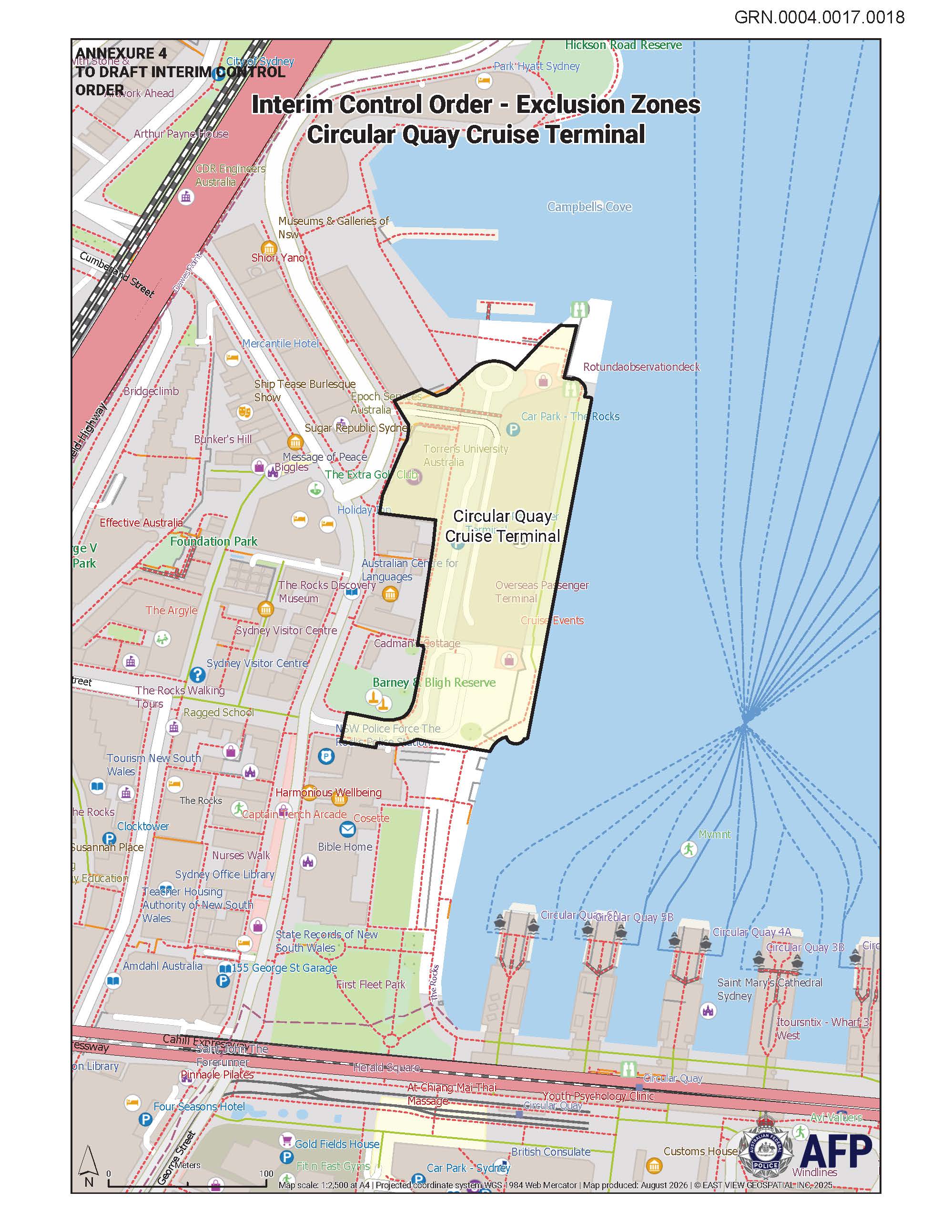
e. within the exclusion zone at Circular Quay set out in Annexure 4;
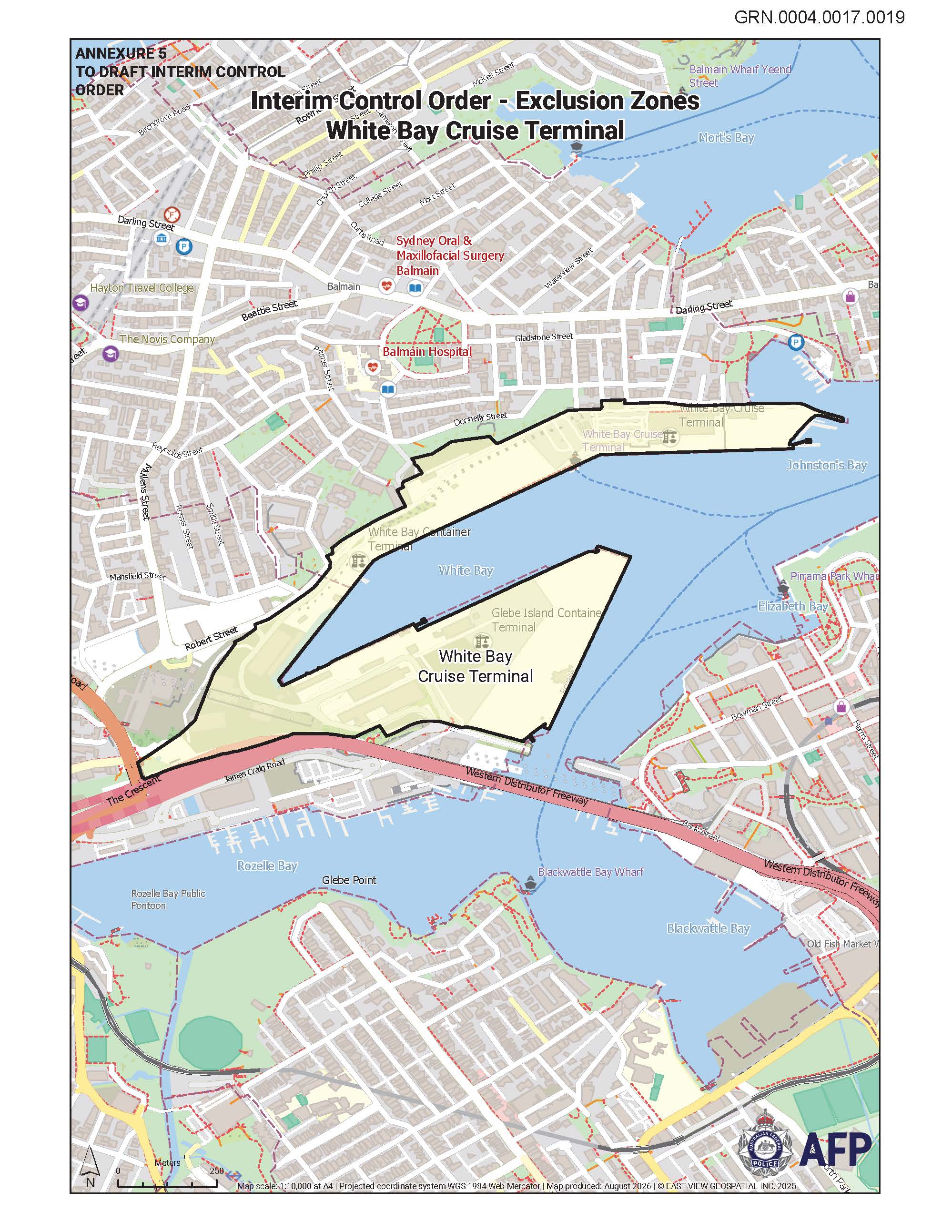
f. within the exclusion zone at White Bay set out in Annexure 5; and
g. within 1 km of any Australian port which has an international point of departure, or from which a person can board or charter a marine vessel for an international destination.
5.4. If the AFP Superintendent reasonably directs you not go to a place, you must not go there.
DISENGAGEMENT AND REHABILITATION
6. Case management
6.1. You must meet with a Community Corrections officer, including for the purpose of providing you with supervision and guidance, at the request of a Community Corrections officer.
6.2. You must be available for interview at such times and places, including in the specified premises, as a Community Corrections officer may from time to time direct.
7. Drugs
7.1. You must not purchase, possess or use prohibited drugs, obtain drugs unlawfully or use any drug lawfully obtained in a manner contrary to how it has been prescribed to you.
7.2. You must submit to drug testing as directed by a Community Corrections officer or the AFP Superintendent.
8. Disengagement and Rehabilitation
8.1. You must attend any disengagement, support, rehabilitation programs or services as directed by a Community Corrections Officer.
9. Sharing Information
9.1. You must allow any Community Corrections officer that you engage with pursuant to these orders, or the provider of any services described in Condition 8, to share any information with the AFP Superintendent including about when and for how long you met with them and any safety concerns they may have regarding your risk.
RESTRICTIONS ON ASSOCIATIONS
10. Who You Can’t Communicate With
10.1. You must not communicate with anyone who is imprisoned in a correctional facility, unless you are imprisoned in that facility.
10.2. You must not communicate or voluntarily associate with any person reasonably known to you to be subject to an order made under Division 104 or 105A of the Criminal Code (Cth) or an interim or extended supervision order made under the Terrorism (High Risk Offenders) Act 2017 (NSW).
10.3. You must not communicate or associate by any means with anyone you know or suspect to be a member of Islamic State or any other terrorist organisation.
10.4. You must not communicate or associate by any means with any person known to you to be convicted of, or currently charged with:
a. a ‘terrorism offence’ within the meaning of section 3(1) of the Crimes Act 1914 (Cth);
b. an offence under the Crimes (Foreign Incursions and Recruitment) Act 1978 (Cth);
c. an offence against Subdivision C of Division 80 of the Criminal Code (Cth) (‘Urging or threatening violence, offences against groups or members of groups and advocating terrorism or genocide’); or
d. an offence against Subdivision CA of Division 80 of the Criminal Code (Cth) (‘Publicly displaying, and trading in, prohibited symbols and giving Nazi salute’); or
e. an offence against Part 5.3B of the Criminal Code (Cth) (Prohibited hate groups).
10.5. If the AFP Superintendent determines that you must not communicate with a person (other than a close family member), you must not communicate with them.
Note: As explained in Condition 25, you must not ask or cause someone else to communicate on your behalf with a person described in Condition 10.
EMPLOYMENT, EDUCATION AND GROUP ACTIVITIES
11. Employment and Education
11.1. You must tell the AFP Superintendent before starting any job, volunteer work, vocational training, or education.
11.2. You must give any information the AFP Superintendent directs you to give about your job, volunteer work, training or education.
12. Groups
12.1. You must not form or join any group, club, or organisation (including online) without written permission from the AFP Superintendent.
12.2. You must not join or otherwise become involved with any groups, clubs or organisations (including online) which:
a. circulate or discuss violent extremist material or material created by a terrorist organisation (other than as part of a treatment, rehabilitation or intervention program pursuant to Condition 8);
b. claim to be part of a terrorist organisation;
c. advocate for, or support a terrorist organisation; or
d. advocate for, or support the doing of terrorist acts, either in Australia or overseas.
12.3. If you wish to attend any protest you must notify the AFP Superintendent at least 24 hours before you attend the protest and provide the following information:
a. The location and time of the protest;
b. The name of the individual or group organising the protest; and
c. Any other information the AFP Superintendent directs you to provide about the protest.
RESTRICTIONS ON WEAPONS, DOCUMENTS, MEDIA AND OTHER PROHIBITED ITEMS
13. Weapons and other prohibited items
13.1. You must not buy, make, possess or use any of the following:
a. A knife;
b. a firearm, a firearm part, or ammunition within the meaning of section 4 of the Firearms Act 1996 (NSW);
c. a prohibited weapon within the meaning of the Weapons Prohibition Act 1998 (NSW);
d. an article or device, not being a firearm, capable of propelling by any means:
e. any irritant matter in liquid, powder, gas, chemical form or any dense smoke, unless possession or usage is consistent with reasonable domestic, personal or work- related purposes; or
f. any substance capable of causing bodily harm, unless possession or usage is consistent with reasonable domestic, personal or work-related purposes.
g. a detonator; or
h. a fuse capable of use with an explosive or a detonator; or
i. petroleum in excess of 4 litres except petrol contained in the petrol tank of a vehicle.
13.2. Condition 13.1 does not prohibit you from possessing or using a knife if it is:
a. ordinary cutlery used for eating; or
b. a kitchen knife at the specified premises for ordinary domestic purposes.
13.3. You must not be in the company of any person who has, on their person or in a vehicle in which you are travelling with them, any of the items referred to in paragraph 13.1.
Note: This condition does not prohibit you from being in the company of a person who has a knife on their person or in their vehicle that is:
a. ordinary cutlery used for eating; or
b. a kitchen knife within their household for ordinary domestic purposes; or
c. a tool reasonably necessary in the ordinary course of that person’s employment or business.
13.4. You must not be present at places where firearms are stored, sold or used, including firearm dealers, shooting ranges or private premises where firearms are stored.
13.5. You must not possess any books, documents, or other material containing instructions on the creation or use of firearms, incendiary devices, or explosives.
13.6. You must not possess any matches, cigarette lighters, or other means of starting a fire, except when at your specified premises or for the purposes of tobacco smoking.
13.7. You must not possess any quantity of petroleum exceeding 4 litres except petrol contained in the petrol tank of a vehicle.
13.8. You must not possess any quantity of any chemical which is not consistent with ordinary domestic purposes.
14. Possessing Documents and Other Media
14.1. You must not possess or access documents and other media that relates to any of the following:
a. propaganda and promotional material for a 'terrorist organisation' within the meaning of s 102.1(1) of the Schedule to the Criminal Code Act 1995 (Cth); or
b. activities of, or associated with, any ‘terrorist organisation’ within the meaning of s 102.1(1) of the Schedule to the Criminal Code Act 1995 (Cth).
c. instructing, advocating, encouraging or praising the use or making of, or in those contexts, depict or describe:
i. a ‘prohibited weapon’ within the meaning of the Weapons Prohibition Act 1998
ii. (NSW);
iii. arson;
iv. explosives;
v. firearms, or cartridge ammunition as defined in the Firearms Act 1996 (NSW);
vi. terrorism;
vii. counter-surveillance; or
viii. violence, including but not limited to shooting, immolation, stabbing, bombing, beheading, torture and execution.
14.2. Condition 14.1 does not apply to a document or other media if the document or other media is:
a. published by the Australian Broadcasting Corporation (ABC), Australian Community Media (ACM), News Corp Australia, Nine Entertainment Co, Schwartz Media, Seven West Media, the Special Broadcasting Service (SBS), the British Broadcasting Corporation (BBC), CNN, Al Jazeera, the Guardian and any other publisher or broadcaster approved in writing by the AFP Superintendent;
b. broadcast on Australian free-to-air or pay television;
c. broadcast on one of the following streaming services available in Australia: Netflix; STAN; Amazon Prime; Binge; ABC iView; 10play, 9Now, 7plus, SBS on Demand, Kayo Sports, Apple TV+, Paramount Plus, Disney+, HBO Max and any other streaming service approved in writing by the AFP Superintendent;
d. broadcast in Australia by a licensed AM or FM radio station;
e. shown in a commercial movie cinema;
f. contained in material that is received by you or your legal representatives, or created by your legal representatives, for the purpose of any legal proceeding you are involved in (referred to as ‘Court Material’).
15. Creating or Sharing Documents and Other Media
15.1. You must not create, publish or share documents and other media that:
a. relates to, or were produced by, or on behalf of, any terrorist organisation;
b. depicts, describes or relates to:
i. a ‘prohibited weapon’ within the meaning of the Weapons Prohibition Act 1998
ii. (NSW);
iii. arson;
iv. explosives;
v. firearms, firearm parts or ammunition as defined in the Firearms Act 1996 (NSW);
vi. manuals or instructions on carrying out terrorist attacks, counter-surveillance or making explosives, weapons or firearms.
vii. genocide or the persecution of an ethnic or religious group;
viii. terrorism; and
ix. violence, including but not limited to shooting, immolation, stabbing, bombing, beheading, torture and execution.
15.2. Condition 15.1 does not prohibit you from distributing, or directing a person to distribute, Court Material (as defined in condition 14.2) for the purpose of the conduct of any legal proceeding you are involved in.
PHONE, COMPUTER AND INTERNET USE
16. Phone Rules
16.1. The AFP Superintendent will give you a phone and SIM card. This is referred to as the ‘AFP phone’ and ‘AFP SIM card’. You may only use the AFP phone and AFP SIM card. You must not use any other mobile or landline phone or SIM card.
Note: As explained in Condition 16.5, you may use another phone only in specific circumstances.
16.2. The AFP Superintendent will provide you with the following information:
a. The password for the AFP phone; and
b. The phone number for the AFP phone.
16.3. You must:
a. keep your AFP phone switched on, charged and with you at all times;
b. be available to answer calls from the AFP Superintendent;
c. if you are unable to answer a call from the AFP Superintendent, return the call as soon as reasonably practicable;
d. do anything else the AFP Superintendent directs you to do with your AFP phone in relation to Conditions 16.3(a) – (c);
e. provide passwords and PIN codes for your AFP phone and any files, folders, programs and applications on your AFP phone, when directed to do so by a police officer for the purposes of searching or seizing your AFP phone or data within or accessible from it;
f. permit one or more police officers to inspect, repair, service, or replace your AFP phone or AFP SIM card, when directed to do so by a police officer;
g. if you become aware that your AFP phone, AFP SIM card or charging equipment is not working properly, notify the AFP Superintendent as soon as possible and, in any case, within 12 hours of becoming aware.
16.4. You must not:
a. enable any face ID, fingerprint, or other biometric security features on the AFP phone;
b. change the password for the AFP phone unless:
i. the AFP Superintendent has given you approval to do so; and
ii. you have provided the new password to the AFP Superintendent.
c. let anyone else use your AFP phone or AFP SIM card unless it is an emergency. You must tell the AFP Superintendent if this happens;
d. connect your AFP phone to any Wi-Fi network, including public Wi-Fi or your home Wi- Fi;
e. connect your AFP phone to any other device, or allow another device to connect to your AFP phone, over a wired connection, Wi-Fi, hotspot, Bluetooth or similar means;
f. tamper with, damage or destroy any component of your AFP phone or any equipment necessary for the operation of your AFP phone (e.g. charging cables);
g. change, remove, modify or disconnect the SIM card, telecommunication service provider or phone number connected to your AFP phone;
h. utilise any call-forwarding to your AFP phone, or from your AFP phone to another device;
i. obtain a different SIM card or eSIM;
j. delete, clear or erase web browser history or phone data history (cache/cookies) from your AFP phone; or
k. ask or allow any other person to make calls or send messages on a different device on your behalf.
16.5. There are exceptions to the above conditions 16.1, 16.2 and 16.4. You may:
a. Connect your AFP computer to your AFP phone (see Condition 17 below);
b. Connect your AFP phone to the AFP internet service (see Condition 17 below);
c. Use the Bluetooth function on your AFP phone to connect to personal Bluetooth enabled devices (such as headphones or an in-car Bluetooth connection);
d. Use another phone for the sole purpose of telling the AFP Superintendent that the AFP phone or AFP SIM card is not working;
e. Use another phone in an emergency to call ‘000’ or the State Emergency Services (SES).
16.6. If you obtain a job and the employer requires you to use a different phone, you may request approval from the AFP Superintendent to use that phone. If your request is approved, you may use the phone for the purpose of your job only.
17. Computer and Internet Rules
17.1. The AFP Superintendent will give you a computer or tablet device (the ‘AFP computer’). Apart from your AFP computer and AFP phone, and subject to conditions 17.5 and 17.6, you must not use any other computer, tablet or internet-capable device.
Note: ‘Internet capable device’ includes any phone, computer, laptop, tablet, gaming device, television, or any other electronic device capable of connecting to the internet (either directly or by connecting to a wireless network). A device can be internet capable even if it is not currently connected to the internet.
17.2. You will get an internet service for use with your AFP computer (the ‘AFP internet service’). You must not use any other internet service or wireless network with your AFP computer.
17.3. You must:
a. provide passwords and PIN codes for your AFP computer and any files, folders, programs and applications on your AFP computer, when directed to do so by a police officer for the purposes of searching or seizing your AFP computer or data within or accessible from it;
b. permit one or more police officers to inspect, repair, service, or replace your AFP computer, when directed to do so by a police officer;
c. if you become aware that your AFP computer or associated equipment is not working properly, notify the AFP Superintendent as soon as possible and, in any case, within 12 hours of becoming aware.
17.4. You must not:
a. let anyone else use your AFP computer unless it’s an emergency. You must tell the AFP Superintendent if this happens;
b. connect your AFP computer to any Wi-Fi network, including public Wi-Fi and your home Wi-Fi (other than the AFP internet service);
c. subject to condition 17.5, connect your AFP computer to any other device, or allow another device to connect to your AFP computer over a wired connection, Wi-Fi, hotspot, Bluetooth or similar means;
d. tamper with, damage or destroy any component of your AFP computer or any equipment necessary for the operation of your AFP computer (e.g. charging cables);
17.5. Conditions 17.1, 17.2 and 17.4 do not prevent you from:
a. connecting your AFP phone to your AFP computer;
b. connecting your AFP computer to a wired display, keyboard, mouse, headphones, speaker, microphone, printer, dock or other ordinary accessory or peripheral device; or
c. using the Bluetooth function on your AFP computer to connect to personal Bluetooth enabled devices (such as headphones or a wireless keyboard or mouse).
17.6. Condition 17.1 does not prohibit access to or the use of:
a. an ATM;
b. an EFTPOS terminal;
c. a computer or tablet device, or smart TV owned by a business or government agency, which is made for your use to facilitate contact tracing, telehealth services, the order or sale of food or consumer products or the provision of a service; or
d. a Smart TV, which is used by you only for the purposes of watching the services set out in Condition 14.2 (and not accessing an internet browser or any chat or social media capabilities).
17.7. If you obtain a job and your employer requires you to use of a different computer or internet capable device and internet service, you may request approval from the AFP Superintendent to use that computer, device or internet service. If your request is approved, you may use the computer, device or internet service specified in the approval, for the purpose of your job only.
17.8. If you undertake education which requires the use of a different computer or internet capable device and internet service, you may request approval from the AFP Superintendent to use that computer, device or internet service. If your request is approved, you may use the computer, device or internet service specified in the approval for the purpose of your education only.
18. Email Use
18.1. You must not use any email account other than one nominated by you and approved in writing by the AFP Superintendent. This is referred to as the ‘AFP email account’.
18.2. You must not:
a. sign up for any online account or engage in any transaction using any email account other than the AFP email account;
b. use any function which uses temporary or forwarding emails (such as an iPhone’s ‘Hide My Email’ function); and
c. change the password for the AFP email account.
18.3. If you obtain a job or undertake study which requires a different email address, you may seek approval from the AFP Superintendent to use that email account. If the AFP Superintendent gives you approval to use a different email account, you may use it only for the purpose for which it was approved (ie, for your work or study).
19. Programs, Applications and Data
19.1. Conditions 19.2, 19.3, 19.4, 19.5, 19.6 and 19.7 apply to your AFP phone, AFP computer and AFP internet service and to any other internet-capable devices that you are approved to use under this order.
19.2. You must only use the applications and programs that are already on your AFP phone or AFP computer at the time they are provided to you, or which are approved in writing by the AFP Superintendent.
19.3. You must not:
a. install any programs or applications onto your AFP phone or AFP computer without prior approval from the AFP Superintendent;
b. use any social media or messaging services not approved by the AFP Superintendent.
Note: A social media or messaging service includes any internet-based service that can be used to communicate with, or broadcast or disseminate information to, other users, including WhatsApp, Instagram, TikTok, Signal, Telegram and Facebook. For the avoidance of doubt, ‘using’ a social media or messaging service includes using that service via a web browser.
19.4. There is an exception to Conditions 19.1 and 19.3(a):
a. You may install software updates that are automatically available on your AFP phone or AFP computer and any other internet capable devices that you are approved to use under this order or by the AFP Superintendent.
19.5. If you want to use an application or program that is not already on your AFP phone or AFP computer, you can ask the AFP Superintendent to approve the application or program.
19.6. If you want to use a social media or messaging service, you can ask the AFP Superintendent to approve the social media or messaging service.
19.7. You must not:
a. hide any of your online activity (including by using private browsing, incognito/hidden mode, or using a virtual private network, also known as a VPN);
b. use any data storage or cloud storage other than the cloud storage account provided to you with your AFP phone or AFP computer;
c. deliberately delete or alter any of the following on or from your AFP phone, AFP computer or approved devices: applications; programs; emails; text messages; electronic message; call history; data; internet or application search history; application chat or communication history.
20. Access to Accounts and Devices
20.1. You must give the AFP Superintendent access to your AFP phone, AFP computer, and any password protected applications or files held on your AFP phone, AFP computer, and any email or other online accounts, when directed to do so for the purpose of the AFP Superintendent searching or seizing the device or accessing data held within or accessible from it.
20.2. You must give the AFP Superintendent access to any device in your possession when directed to do so for the purposes of the AFP Superintendent searching or seizing the device or accessing data held within or accessible from it.
FINANCES
21. Finances
21.1. Within 72 hours after this order comes into force, you must provide the AFP Superintendent with the details of any bank accounts, cryptocurrency accounts and any other financial accounts you own or control.
21.2. If you open a new bank account, cryptocurrency account or other financial account, you must notify the AFP Superintendent in writing and provide the account details.
REASONABLE DIRECTION
22. Reasonable direction
22.1. You must comply with any reasonable direction given to you by the AFP Superintendent in connection with Conditions 1-21 in this order.
EXEMPTIONS AND APPROVALS
23. Getting Exemptions
23.1. You can request a temporary exemption from any of the conditions in this order by writing to the AFP Superintendent.
a. You must provide the reason why you are requesting an exemption and any other information that the AFP Superintendent directs you to provide in relation to the request. If you do not provide the information you are directed to provide, your request will not be considered.
b. The AFP Superintendent may grant or deny a request for an exemption.
23.2. The AFP Superintendent may also grant an exemption to any condition in this order without you requesting an exemption. The AFP Superintendent will provide you with reasonable notice in writing of any exemption granted under this Condition and any associated conditions.
23.3. If an exemption is granted under either Condition 23.1.b or 23.2, the AFP Superintendent can make it subject to reasonable directions that will be given to you in writing. If you do not comply with those directions, the exemption is to be treated as having no effect.
23.4. The AFP Superintendent may cancel any exemption that has been granted by providing reasonable notice to you in writing. After you are notified that an exemption to a condition has been cancelled, you must comply with the condition as it is written in this order.
24. Getting Approvals
24.1. This applies to any conditions which allow you to seek approval from the AFP Superintendent to do something (for example, to install and use a new program or application on the AFP phone or AFP computer).
24.2. You can request an approval by submitting a written request to the AFP Superintendent. You must provide any information the AFP Superintendent directs you to provide in relation to the request. If you do not provide the information you are directed to provide, your request may not be considered.
24.3. The AFP Superintendent can approve or deny these requests. If a request is approved, the AFP Superintendent can make it subject to reasonable directions that will be given to you in writing. If you do not comply with those directions, the approval is to be treated as having no effect.
24.4. The AFP Superintendent can also grant an approval and make it subject to reasonable directions without you requesting an approval. The AFP Superintendent will provide you with reasonable notice in writing of any approval granted under this Condition.
24.5. The AFP Superintendent may cancel any approval that has been granted by providing reasonable notice to you in writing. After you are notified that an approval has been cancelled, that approval no longer has any effect.
25. Causing a Third Party to Do Something on Your Behalf
25.1. Where this order prohibits you from doing something, you must not ask or cause someone else to do that thing on your behalf. For example, where you are prohibited from communicating with a person by Condition 10, you must not ask someone else to communicate with that person on your behalf.
Definitions
In this order:
AFP Superintendent means a member of the Australian Federal Police performing the duties of a Superintendent within the Counter Terrorism Command and includes any AFP member or special member authorised to perform duties or functions or otherwise act on behalf of a Superintendent within the Counter Terrorism Command in connection with this control order.
close family member of a person (the first person) has the same meaning as in s 102.1(1) of the Criminal Code and means:
(a) the first person's spouse or de facto partner; or
(b) a parent, step-parent or grandparent of the first person; or
(c) any other person who would be a parent, step - parent or grandparent of the first person if the first person were a child (within the meaning of Part VII of the Family Law Act 1975) of the other person or a third person; or
(d) a child, step - child or grandchild of the first person; or
(e) any other person who would be a step - child or grandchild of the first person if the other person were a child (within the meaning of Part VII of the Family Law Act 1975) of a third person; or
(f) a brother, sister, step - brother or step - sister of the first person; or
(g) any other person who would be a brother, sister, step - brother or step - sister of the first person if the other person were a child (within the meaning of Part VII of the Family Law Act 1975) of a third person; or
(h) a guardian or carer of the first person.
documents and other media means any hardcopy or electronic record of information and includes, but is not limited to, video and audio recordings, pictures, computer games, online articles and social media ‘posts.’ Sharing documents and other media includes, but is not limited to, sharing an electronic link to that material.
education means a course of study at an educational institution or body such as a school or university.
police officer means:
a. a ‘member’ or ‘special member’ of the Australian Federal Police, as defined by the Australian Federal Police Act 1979 (Cth); or
b. a ’police officer’ as defined in the Police Act 1990 (NSW).
password includes but is not limited to any passcode, swipe pattern or any information or function necessary to facilitate access to a device or account.
phone means a phone of any kind, including but not limited to a mobile phone, Voice Over Internet Protocol (VoIP) phone, landline phone, satellite phone or public payphone.
reasonable direction means a direction that the AFP Superintendent giving the direction is satisfied is reasonable in all the circumstances to give effect to:
a. the condition; or
b. the object of Division 104 of the Criminal Code (Cth).
terrorist organisation has the same meaning as s 102.1 of the Criminal Code (Cth).
violent extremist material has the same meaning as s 474.45A of the Criminal Code (Cth).
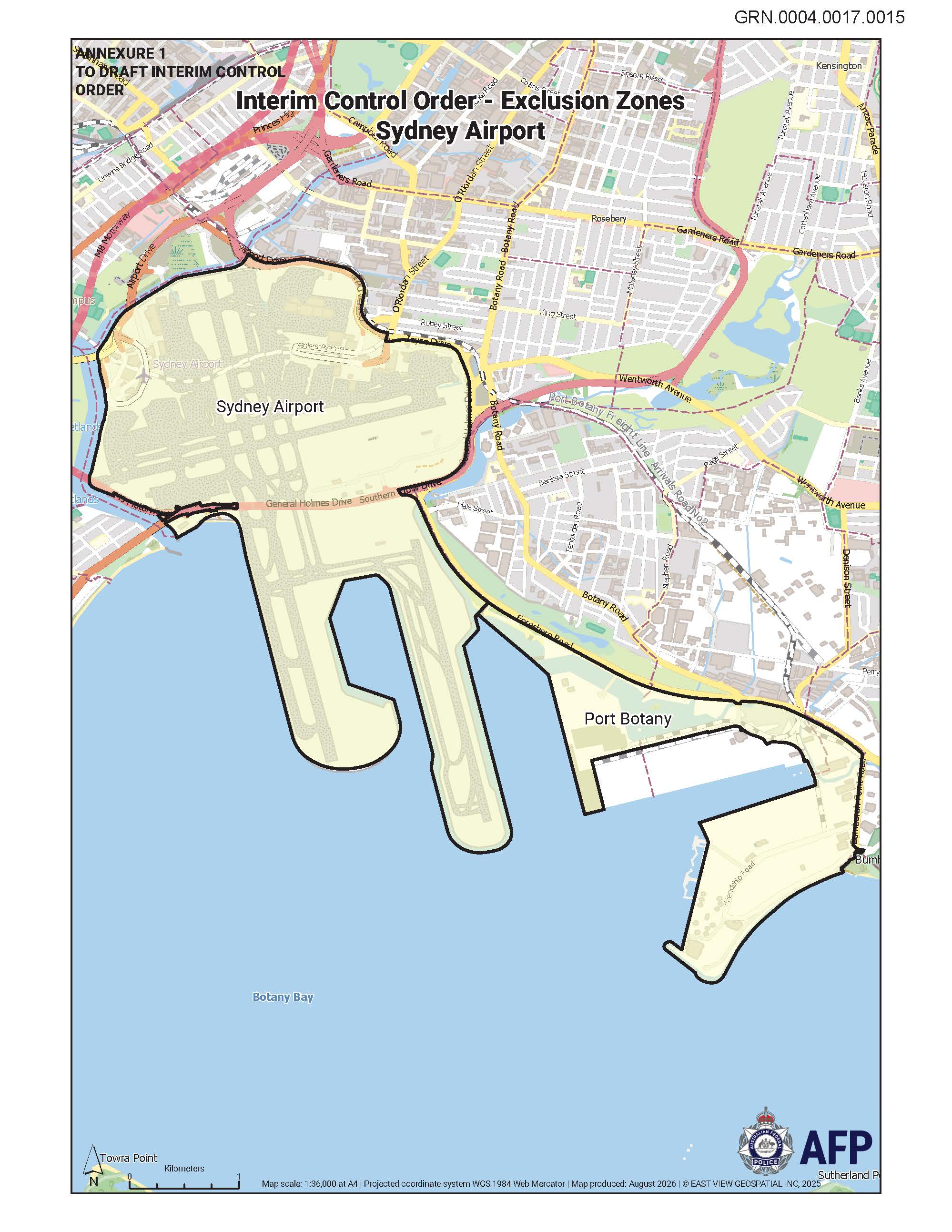
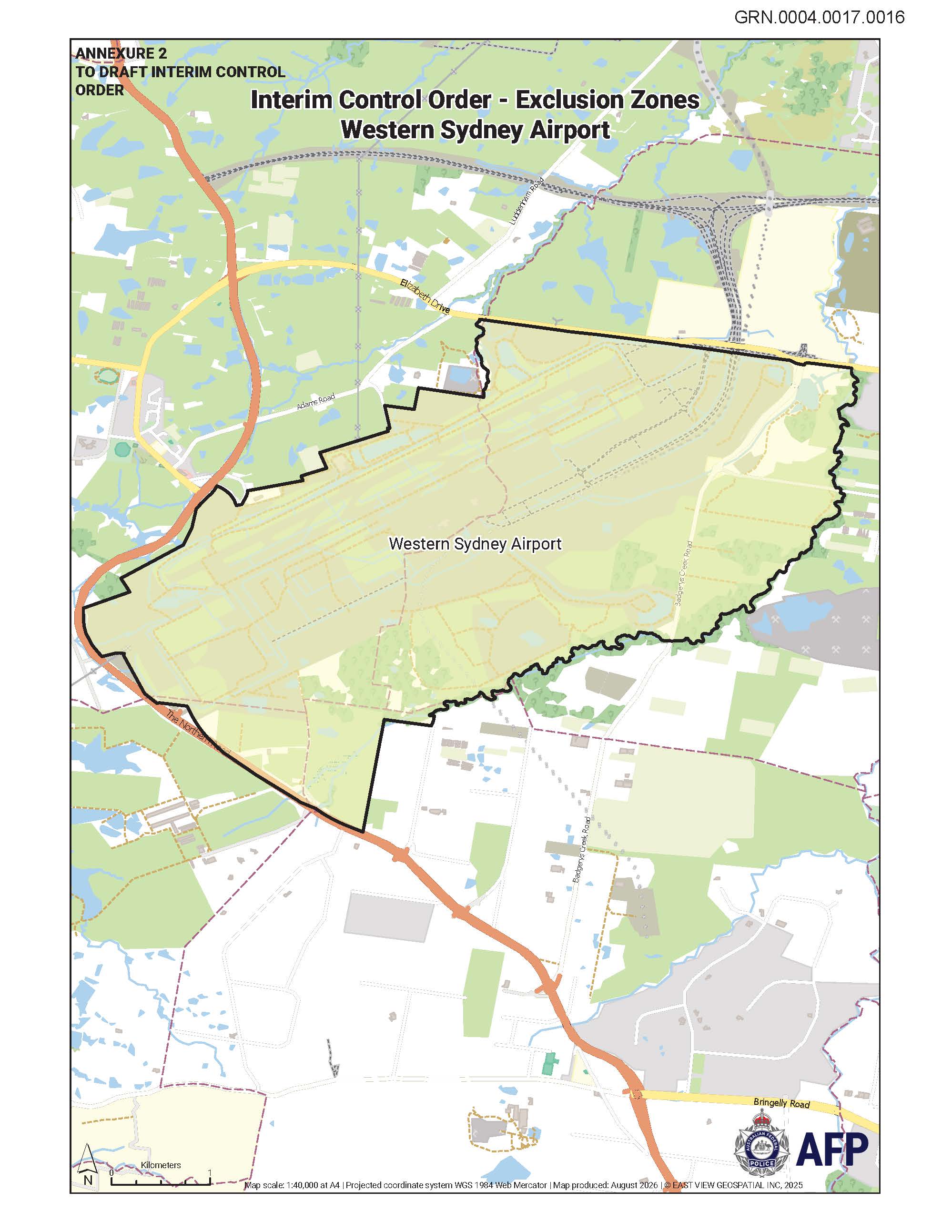
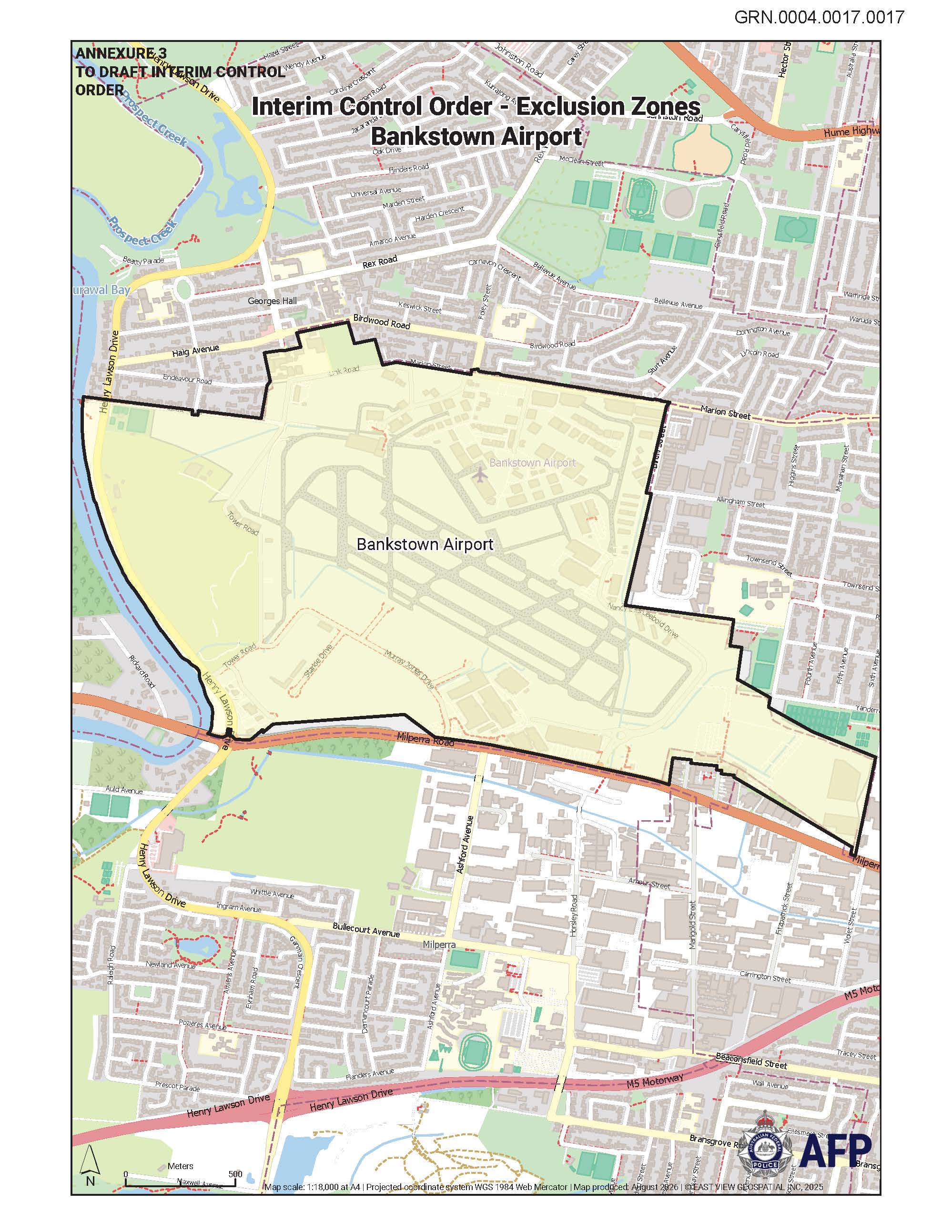
ANNEXURE B
SUMMARY OF GROUNDS ON WHICH THE ORDER SHOULD BE MADE
Criminal Code (Cth), section 104.2(3)(c)
1. The following is a summary of the grounds on which an interim control order should be made, for the purposes of s 104.2(3)(c) of the Schedule to the Criminal Code Act 1995 (Cth) (Criminal Code).
OVERVIEW
2. The order should be made because:
2.1. Daniel Greenfield has been convicted in Australia of an offence relating to terrorism or a terrorist organisation: s 104.4(1)(c)(iv) of the Criminal Code.
2.2. Pursuant to s 104.4(1)(d) of the Criminal Code, and having regard to the matters set out in the “Statement of facts relating to why the order should be made” (SOF-For) and the “Statement of facts relating to why the order should not be made” (SOF-Against), each of the conditions to be imposed on Mr Greenfield, and the combined effect of the conditions to be imposed, by the interim control order is reasonably necessary, and reasonably appropriate and adapted, for the purpose of:
2.2.1. protecting the public from a terrorist act;
2.2.2. preventing the provision of support for or the facilitation of a terrorist act; or
2.2.3. preventing the provision of support for, or the facilitation of the engagement in, a hostile activity in a foreign country.
OFFENCE RELATING TO TERRORISM OR A TERRORIST ORGANISATION
3. On 31 March 2023, Mr Greenfield pleaded guilty to the following charge:
On or about 24 December 2021, did, contrary to s 101.5(1) of the Criminal Code, intentionally collect documents, namely issues 8 and 12 of Inspire Magazine, and a book entitled ‘Middle Eastern Terrorist bomb designs’, that were connected with assistance in a terrorist act, knowing of the connection of the documents to assist in a terrorist act.
4. This offence is “an offence relating to terrorism” for the purposes of s 104.4(1)(c)(iv) of the Criminal Code.
5. Mr Greenfield was sentenced to imprisonment for a period of 5 years with a non-parole period of 3 years and 6 months.
6. Mr Greenfield’s head sentence expires on 23 December 2026. Mr Greenfield’s non-parole period expired on 23 September 2025. Mr Greenfield has not been granted parole and remains in custody.
THE PROPOSED CONDITIONS ARE REASONABLY NECESSARY, APPROPRIATE AND ADAPTED TO THE RISK POSED BY MR GREENFIELD
7. Having regard to all of the matters outlined in the SOF-For and the SOF-Against, the proposed interim control order conditions are reasonably necessary, and reasonably appropriate and adapted, for the purpose of protecting the public from a terrorist act, preventing Mr Greenfield from providing support for or facilitating a terrorist act in either Australia or overseas, or providing support for or facilitating the engagement in a hostile activity in a foreign country.
8. The risk posed by Mr Greenfield is demonstrated by and/or arises out of the following matters.
Mr Greenfield’s ideology and support for ideologically motivated violence
9. Mr Greenfield has used his electronic devices and social media to create, distribute and access material associated with terrorism and violent extremism.
10. Prior to his arrest for the index offending, Mr Greenfield used his electronic devices to, amongst other things:
10.1. Engage with pro-Islamic State and Al Qaeda propaganda publications and videos – including videos depicting beheadings and calling for violence against the West, and downloading Issue 8 and 12 of Inspire magazine, which were produced by Al Qaeda and provide instructions on how to manufacture car bombs and remote detonation devices;
10.2. Distribute those pro-Islamic State and Al Qaeda publications with social media contacts on Telegram; and
10.3. Exchange messages on social media platforms with an Online Covert Operative (OCO), in which Mr Greenfield informed the OCO about the bomb making instructions contained in Issue 8 and 12 of Inspire magazine, before sharing those documents in the Telegram channel to which the OCO was a follower.
11. Mr Greenfield also shared material to his Telegram channel advocating the use of improvised explosive devices (IEDs) to cause injury and death, including:
11.1. On 6 and 10 December 2021, Mr Greenfield posted copies of Issue 8 and 12 of Inspire magazine to his Telegram channel. Issues 8 and 12 of Inspire contain detailed instructions on how to manufacture a remote detonation device and car bombs using propane gas tanks. The instructions state that the car bombs can be made using ‘primary materials’ that ‘do not raise suspicion’ and, once built, ‘this type of car bomb … is very effective in killing individuals’;
11.2. On 7 and 8 December 2021, while exchanging messages with the OCO, Mr Greenfield wrote that the documents contained ‘car bombs big one very ezey (sic)’ and ‘I want to do it to cop shops all over Sydney just hit them’; and
11.3. On 19 December 2021, Mr Greenfield shared an extract from a book titled ‘Middle Eastern Terrorist Bomb Designs’ to his Telegram channel and made enquiries as to where he could locate a ‘dowla flag’. He further wrote, ‘I should put a dowla flag up somewhere then put this device on it and just do one a week till death comes that will really terrorize the kafars not just one but multiple attacks [laughing face emoji]’.
Mr Greenfield’s use of weapons
12. Mr Greenfield has a history of carrying and concealing knives, and sharing material advocating the use of knives and other weapons to cause injury or death. This includes the following instances:
12.1. Mr Greenfield has been convicted of possessing a knife in a public place on multiple occasions;
12.2. On 16 December 2020, Mr Greenfield was charged with using a carriage service to menace, harass and offend. The conduct the subject of the charge included Mr Greenfield posting images to Instagram advocating the use of knives to cause injury or death, including:
12.2.1. an image titled ‘How to stab a Jew’, depicting a body with the organs labelled, and various knives pinned to areas of the body; and
12.2.2. an image depicting the front and back anatomy of a person, with various points on the body labelled. Mr Greenfield also wrote: ‘self defence (sic) knife fighting kill points and nerve points best to go up under the pit of neak (sic) that will kill … I like the eyes so if he doesn’t die the dog is blind and the last thing he seen (sic) was you as a lion.’
12.3. On 3 September 2021, Mr Greenfield asked members of the NSW Police Force if their vests were bullet and stab proof. He also told police that he concealed knives in milk bottles to avoid police detection;
12.4. Prior to his arrest for the index offending, Mr Greenfield shared multiple images and videos to his Telegram channel that depict men being shot at close range, decapitated by knives and killed in explosions. He also shared multiple videos and images to his Telegram channel that incited terrorist attacks in Western countries, including by telling viewers to ‘kill them where you find them’ and promoting previous attacks in the United States of America and Brussels;
12.5. Mr Greenfield shared an image of the Fairbairn-Sykes fighting knife to his Telegram channel, along with the comment: ‘prepare and Allah will do the rest’;
12.6. Following Mr Greenfield’s arrest for the index offending, police conducted a search of his premises and located knife fighting guides, a kitchen knife in a bedside drawer, and a serrated knife with sticky tape applied to the handle in the lounge room of the premises (amongst other things). Mr Greenfield later told police that the knife was there to use in ‘self-defence’ and sticky tape was applied to the handle ‘for grip in case there’s blood or something’; and
12.7. Mr Greenfield volunteered, when interviewed by investigators on 24 December 2021, that he previously had access to a firearm.
Mr Greenfield’s propensity to engage in a violent act stemming from his drug use and dependency
13. Mr Greenfield has a long history of substance abuse, particularly with regards to illicit drugs. Mr Greenfield’s substance abuse may have an adverse impact on his mental health and stability, which in turn, may increase his risk of committing or facilitating a terrorist attack.
14. As recently as September 2025, Mr Greenfield reportedly relapsed and used methamphetamine and heroin in custody.
Attitude towards engagement in programs
15. Mr Greenfield has demonstrated a reluctance to participate in programs and support services offered while in custody, unless it has assisted with his custodial placement, classification or release from custody.
Limited evidence of protective factors
16. Mr Greenfield’s primary support network is limited to his mother, grandmother, partner and two younger sisters. Mr Greenfield has expressed an intention to regain custody of his children and his desire to be reunited with them has had a positive influence on him. However his at times volatile relationship with family members in his primary support network, in particular his partner, suggests that family support may be of limited protective value. This is particularly apparent in circumstances where Mr Greenfield engaged in the index offending, notwithstanding his primary support network.
17. Mr Greenfield otherwise reportedly has no friends or associates in the community and had expressed an intention to stay in contact with a number of his associates from custody. Mr Greenfield has not been employed in any capacity while serving his current custodial sentence and reportedly has ‘limited employment history with no options for release’.
There is no evidence that Mr Greenfield has renounced his extremist views or accepts the seriousness of his offending
18. While in custody, Mr Greenfield has demonstrated limited insight into his index offending. He has claimed that he was ‘set up’ by the police and ASIO, and has minimised his offending by claiming that the reason he is in custody is ‘having dangerous books’.
19. Mr Greenfield’s conversations with and letters to family members also reveal that he has grievances about being arrested, charged and imprisoned.
20. During his time in custody, Mr Greenfield has made a number of statements to custodial staff minimising his offending.
APPROPRIATENESS OF CONDITIONS
21. There is a real risk that upon Mr Greenfield’s release, and without the proposed conditions, Mr Greenfield will:
21.1. start to reengage with extremist views and propaganda online;
21.2. start to reengage with other patterns of behaviour which led to his offending conduct;
21.3. engage in other conduct supportive of or facilitative of a terrorist attack or hostile activity in Australia or a foreign country, including by:
21.3.1. providing encouragement and support to individuals to engage in such conduct (in either an online or offline setting); or
21.3.2. distributing online propaganda designed to influence and radicalise others.
22. The proposed conditions will ensure that Mr Greenfield:
22.1. is provided with the opportunity to engage positively with the community following his release from custody (particularly through employment and education);
22.2. is provided with the support and assistance of NSW Community Corrections to address his rehabilitative and therapeutic needs including housing, medical, psychological or psychiatric treatment, education, training and employment;
22.3. is capable of being monitored by police during his reengagement with the community including by allowing police to detect unusual patterns of behaviour and intervene or investigate as necessary, or otherwise assist the Respondent to avoid persons, places and other influences that would put him at risk of recidivism; and
22.4. is prohibited from engaging in:
22.4.1. behaviours and being exposed to influences which may lead him to commit, provide support for, or facilitate a terrorist act, or
22.4.2. conduct supportive or facilitative of engagement in a hostile activity in a foreign country.
and thereby reduce the risks outlined above.
23. The proposed conditions, individually and as a whole, are reasonably necessary, and reasonably appropriate and adapted for the purpose of preventing Mr Greenfield from committing, supporting or facilitating a terrorist act domestically or abroad, or otherwise providing support for or facilitating the engagement in a hostile activity in a foreign country.
REASONS FOR JUDGMENT
ABRAHAM J
1 The applicant, Commander Nicholas Andrew Read of the Australian Federal Police (AFP), applies for an interim control order (ICO) under s 104.4 of the Criminal Code (Cth) (Criminal Code) in respect of Mr Daniel Greenfield. An ICO is an order made by the Court which imposes certain conditions on a person for purposes including the prevention of support for, or facilitation of, terrorist acts and hostile activities in foreign countries. The application proceeds with the consent of the Minister for Home Affairs, being the Minister administering the Australian Federal Police Act 1979 (Cth) as required by s 104.2 of the Criminal Code.
2 On 31 March 2023, Mr Greenfield pleaded guilty to the following:
On or about 24 December 2021, did, contrary to s 101.5(1) of the Criminal Code, intentionally collect documents, namely issues 8 and 12 of Inspire Magazine, and a book entitled ‘Middle Eastern Terrorist bomb designs’, that were connected with assistance in a terrorist act, knowing of the connection of the documents to assist in a terrorist act.
3 On 17 November 2023, Mr Greenfield was sentenced to five years’ imprisonment with a non-parole period of three years and six months. Mr Greenfield has not been granted parole, and remains in custody. He is due to be released on 23 December 2026, when his head sentence expires.
4 In summary the applicant submits the Court can be satisfied, on the balance of probabilities, that:
(1) Mr Greenfield has been convicted in Australia of an offence relating to terrorism or a terrorist organisation (within the meaning of s 102.1(1) of the Criminal Code): s 104.4(1)(c)(iv) of the Criminal Code; and
(2) each of the conditions, and the combined effect of all of the conditions to be imposed on Mr Greenfield is reasonably necessary and reasonably appropriate and adapted for the purpose of protecting the public from a terrorist act, or preventing the provision of support for or the facilitation of a terrorist act, or preventing the provision of support for or the facilitation of the engagement of hostile activity in a foreign country: s 104.4(1)(d)(iii), (iv) and (v) of the Criminal Code.
5 The applicant submits that, being so satisfied, the Court should make the ICO in the form sought.
6 Mr Greenfield acknowledges that the preconditions for the making of an ICO in ss 104.2, 104.3, 104.4(1)(a) and (c) of the Criminal Code are made out, but opposes the making of an ICO on the basis that the Court would not be satisfied that the proposed conditions are reasonably necessary, and reasonably appropriate and adapted for any of the purposes in s 104.4(1)(d). Mr Greenfield submits that if the Court is satisfied an ICO should be made, he opposes specific conditions sought.
7 For the reasons below, I make the ICO in the form sought by the applicant.
Statutory Regime
8 Chapter 5 of the Criminal Code deals with the security of the Commonwealth. Section 104.4 is contained within Part 5.3 of that Chapter, which addresses terrorism. Division 104 of Part 5.3 addresses control orders. Section 104.1 states the objects of Division 104, being:
8.1 Objects of this Division
The objects of this Division are to allow conditions to be imposed on a person by a control order for one or more of the following purposes:
(a) protecting the public from a terrorist act;
(b) preventing the provision of support for or the facilitation of a terrorist act;
(c) preventing the provision of support for or the facilitation of the engagement in a hostile activity in a foreign country.
9 These objects are replicated in s 104.4(1)(d).
10 Section 104.4 (1) sets out four preconditions for the making of an ICO.
11 First, that a “senior AFP member” has requested an ICO in accordance with s 104.3: s 104.4(1)(a) of the Criminal Code. Commander Read is a senior AFP officer as defined by the Criminal Code, and has requested the order in accordance with the requirements under s 104.3. Those requirements include the provision to the Court of an explanation as to why each of the proposed conditions should be imposed; if the member is aware of any facts relating to why any of those conditions should not be imposed on the person - a statement of those facts; information about any previous requests for certain orders; and a copy of the AFP Minister’s written consent to the request for the ICO. Mr Greenfield accepts this precondition is established.
12 Second, the Court has received and considered such further information (if any) as the Court requires: s 104.4(1)(b) of the Criminal Code. There is no issue of fulfilling this precondition, as the Court did not require any further information to reach a decision.
13 Third, the Court to be satisfied on the balance of probabilities of at least one of the following:
104.4 Making an interim control order
…
(i) that making the order would substantially assist in preventing a terrorist act; or
(ii) that the person has provided training to, received training from or participated in training with a listed terrorist organisation; or
(iii) that the person has engaged in a hostile activity in a foreign country; or
(iv) that the person has been convicted in Australia of an offence relating to terrorism, a terrorist organisation (within the meaning of subsection 102.1(1)) or a terrorist act (within the meaning of section 100.1); or
(v) that the person has been convicted in a foreign country of an offence that is constituted by conduct that, if engaged in in Australia, would constitute a terrorism offence (within the meaning of subsection 3(1) of the Crimes Act 1914); or
(vi) that making the order would substantially assist in preventing the provision of support for or the facilitation of a terrorist act; or
(vii) that the person has provided support for or otherwise facilitated the engagement in a hostile activity in a foreign country …
14 Mr Greenfield accepts this condition is satisfied as his index offence falls within the scope of s 104(1)(c)(iv).
15 Fourth, the condition in s 104.4(1)(d), which is in the following terms:
(d) the court is satisfied on the balance of probabilities that:
(i) each of the conditions; and
(ii) the combined effect of all of the conditions;
to be imposed on the person by the order in accordance with section 104.5A is reasonably necessary, and reasonably appropriate and adapted, for the purpose of:
(iii) protecting the public from a terrorist act; or
(iv) preventing the provision of support for or the facilitation of a terrorist act; or
(v) preventing the provision of support for or the facilitation of the engagement in a hostile activity in a foreign country.
16 It is this condition which is in issue between the parties. Before addressing this in detail, it is helpful to first refer to other relevant components of the statutory regime.
17 Sections 104.5A(1)-(2) contain a non-exhaustive list of matters that may be the subject of conditions under an ICO.
18 If the Court determines to make an ICO, the order must include the information set out in s 104.5(1) and certain steps need to be taken: see ss 104.5(1A), 104.12(1)(a)-(c), and 104.14.
19 If the Court makes an ICO, it must specify a day on which the person the subject of the order may attend for the Court to confirm (with or without variation) the ICO, declare the ICO to be void, or revoke the ICO (the confirmation hearing date): s 104.5(1)(e). The confirmation hearing date must be ‘as soon as practicable, but at least 7 days, after the [ICO] is made’: s 104.5(1A).
20 At least 48 hours before the confirmation hearing date, the senior AFP member who requested the ICO must elect whether to confirm the ICO and provide written notification of this to the Court: s 104.12A. If the senior AFP member elects to confirm the ICO, and other procedural requirements are satisfied, the issuing court is to conduct the confirmation hearing pursuant to s 104.14.
21 Where the subject of an ICO is detained in custody, the ICO does not begin to be in force until they are released from custody and they are personally served with the order: s 104.5(1), (1D), and (1E). The maximum period during which a confirmed control order may be in force is 12 months from the day on which the ICO is made: s 104.5(1)(f). This period includes any period when the subject of the ICO is in custody and the order is not in force: s 104.5(1D) and (1E). This does not prevent the making of successive control orders in relation to the same person: s 104.5(2).
22 If a Court imposes the electronic monitoring condition referred to in s 104.5A(2)(d), the Court must also include certain other conditions: s 104.5D(1)-(2). The applicant seeks an electronic monitoring condition in this case (condition 3). The additional conditions that must be included when electronic monitoring are imposed appear in the ICO sought by the applicant.
Evidence
23 In support of the application, the applicant relies on his affidavits sworn 22 September 2026 (Read affidavit) and 21 October 2026, and the affidavit of Acting Inspector Joel Rivers of the AFP sworn 28 September 2026.
24 Mr Greenfield objected to aspects of the Read affidavit, the “statement of facts relating to why the interim control order should be made” (statement of facts) and the “summary of grounds on which the order should be made” (summary of grounds) exhibited to his affidavit.
25 At the hearing I ruled against the objections. The challenges fell into two categories.
26 First, it was submitted that evidence was not relevant, being [30]-[37] of the Read affidavit and documents referenced therein. I disagree. This evidence relates to the current national terrorist threat risk, providing the context in which this order is sought. As recognised by the observations of Gleeson CJ at [9] in Thomas v Mowbray [2007] HCA 33; (2007) 233 CLR 307 (Thomas v Mowbray), “[t]he level of risk of the occurrence of a terrorist act, and the level of danger to the public from an apprehended terrorist act, will vary according to international or local circumstances”. Evidence directed to the threat risk is accordingly relevant to the assessment of an ICO: see application, e.g. Staunton v Zahab [2026] FCA 308 at [53]-[54]; Staunton v Zahab (No 3) [2026] FCA 1639 at [64]. Paragraphs [29]-[37] of the statement of facts relating to why the interim control order should be made, addressing contextual matters in relation to Islamic State. This is also plainly relevant context. The only other paragraphs challenged for relevance (although not referred to at the hearing) are [150]-[151] of the statement of facts. This evidence relates to where Mr Greenfield intends to reside upon his release, and is relevant to the condition that requires him to live at premises approved by the AFP superintendent (condition 1).
27 Second, objection was taken to Commander Read purportedly giving expert evidence, where there has not been compliance with Division 23.2 of the Federal Court Rules 2011 (Cth) (Federal Court Rules) and the Expert Evidence Practice Note (GPN-EXPT). It was submitted he is not in a position to give “objective and impartial assessment " and is necessarily an "advocate for [his] cause ": see clauses 2.2, 3.1, 4.1 of the GPN-EXPT. The submission is misconceived. Commander Read is required by virtue of the Criminal Code to provide evidence on an ICO application, to explain why an order should be made and each of the proposed conditions should be imposed: s 104.3, and see s 104.2. Such evidence may necessarily involve opinions as to why the ICO and the particular conditions are required. In any event, Commander Read is not being called as an independent expert, but is the applicant for the order sought. In any event, for opinion evidence to be admissible s 79 of the Evidence Act 1995 (Cth) (Evidence Act) must be satisfied. The evidence must satisfy two criteria: first, the witness “has specialised knowledge based on the person’s training, study or experience”; and second, the opinion expressed by the witness “is wholly or substantially based on that knowledge”: Dasreef Pty Ltd v Hawchar [2011] HCA 21; (2011) 243 CLR 588 at [32]. Non-compliance with r 23.13 of the Federal Court Rules or the GPN-EXPT does not affect the admissibility of the evidence but only goes to weight: Axent Holdings Pty Ltd t/a Axent Global v Compusign Australia Pty Ltd [2020] FCA 1373 at [809]; Rush v Nationwide News (No 5) [2018] FCA 1622 at [33]-[38]; Al Muderis v Nine Network Australia Pty Ltd [2025] FCA 909 at [1943]. At hearing, Mr Greenfield’s counsel submitted that, if the evidence is admissible, I should give it little weight as it is not independent. Given the evidence of Commander Read as to his experience, I accept he satisfies s 79(1) of the Evidence Act. I consider he is well qualified to give the opinions he expresses, and those opinions are based on that specialised knowledge.
Consideration
28 As explained above, Mr Greenfield accepts that the preconditions in s 104.4(1)(a) and (c) of the Criminal Code are satisfied. In any event, on the evidence provided, I am satisfied those preconditions are met. In issue is the requirement in s 104.4(1)(d).
29 This provision was considered in Thomas v Mowbray. Gleeson CJ at [19] observed:
The requirement that a Court consider whether each of the obligations imposed by a control order is both reasonably necessary, and reasonably appropriate and adapted, for the purpose of protecting the public was the subject of debate. A requirement of that kind would sometimes be described as a requirement of proportionality. Judgments about proportionality often require courts to evaluate considerations that are at least as imprecise as those involved in formulating a control order.
30 Gummow and Crennan JJ at [99] considered that the pre-condition in s 104.4(1)(d) involved a balancing exercise:
Section 104.4(1) requires in para (d) that each of these be measured against what is “reasonably necessary” and also against what is “reasonably appropriate and adapted” for attainment of the purpose of public protection from a terrorist act. This is weighed with the impact upon the circumstances of the person in question as a “balancing exercise” (s 104.4(2)).
31 As to assessing the risk the conditions are designed to address, Gleeson CJ at [9] observed:
[t]he level of risk of the occurrence of a terrorist act, and the level of danger to the public from an apprehended terrorist act, will vary according to international or local circumstances.
32 And to similar effect, Gummow and Crennan JJ observed at [92]:
The federal judges exercising the jurisdiction conferred by the interim control order provisions will bring to their consideration of whether “making the order would substantially assist in preventing a terrorist act” (s 104.4(1)(c)(i)) and of the particular form of an order, both matters of common knowledge, some of which we have referred to above [September 11 and other terrorist activities], and the facts and circumstances disclosed in the evidence on the particular application for an order. …
33 It follows that the Court may rely on matters of common knowledge: Taylor v Brookman [2024] FCA 200 (Taylor v Brookman) at [7], citing Thomas v Mowbray at [92]; Staunton v MHK [2026] FCA 546 (Staunton v MHK) at [26].
34 Section 104.4(1)(d), given its terms, requires a consideration of matters such as the likely effectiveness of the conditions, the imposition each is likely to have on Mr Greenfield and whether the conditions, individually and in combination, are proportional to the identified risk, to be assessed in the context of the objects of Division 104, recited above at [8].
35 The applicant, consistent with the requirement in s 104.3(d)(i), provided a summary of grounds on which he contends the ICO should be made. It explains that in his view, Mr Greenfield presents a real risk of committing a terrorist act, supporting or facilitating a terrorist act, or otherwise supporting or facilitating engagement in a hostile activity in a foreign country, if not made the subject of an ICO on the conditions sought. The applicant explains this view is based, inter alia, on Mr Greenfield’s past conduct and an assessment of what that conduct indicates in terms of his likely future conduct and vulnerabilities once released in the community.
36 In Minister for Immigration and Ethnic Affairs v Guo Wei Rong [1997] HCA 22; (1997) 191 CLR 559, Brennan CJ, Dawson, Toohey, Gaudron, McHugh and Gummow JJ observed at 574:
The course of the future is not predictable, but the degree of probability that an event will occur is often, perhaps usually, assessable. Past events are not a certain guide to the future, but in many areas of life proof that events have occurred often provides a reliable basis for determining the probability – high or low – of their recurrence.
37 And at 575:
Determining whether there is a real chance that something will occur requires an estimation of the likelihood that one or more events will give rise to the occurrence of that thing. In many, if not most cases, determining what is likely to occur in the future will require findings as to what has occurred in the past because what has occurred in the past is likely to be the most reliable guide as to what will happen in the future.
38 This reasoning has been applied in the context of the control order regime: see e.g. McCartney v EB [2019] FCA 183; (2019) 263 FCR 170 (McCartney v EB) at [19]; Fogarty v Jakovac [2022] FCA 1454 (Fogarty v Jakovac) at [21]-[22]; Nicolson v Naizmand [2022] FCA 1108 at [21]-[22]; Staunton v MHK at [26].
39 As the applicant submitted, in McCartney v EB Wigney J suggested that the control order regime appears to be predicated on precisely that principle by observing at [19], when addressing s 104.4(1)(c), that:
It would appear that each of the subparagraphs of s 104.4(1)(c) of the Code, with the possible exception of subparagraphs (i) and (vi), is directed to identifying conduct which had been engaged in by the person in respect of whom the control order is sought which would tend to indicate that there was a risk that the person might engage in or facilitate terrorist acts, or hostile activity in a foreign country, in the future. Considered in that context, past conduct by a person which involved the provision of support for, or the facilitation of, a hostile activity in a foreign country by another person is likely to indicate a risk that the person may well engage in similar conduct in the future, even if, as events transpired, the other person did not ultimately carry out any hostile activity.
40 The purpose of a control order is the protection of the community and not to punish the respondent: Thomas v Mowbray at [79]; McCartney v EB at [18]. The protective purpose of the provision in Division 104 supports a more beneficial (to the applicant) and less restrictive construction of its provisions than would be the case if it contained penal provisions: McCartney v EB at [18]; Taylor v Brookman at [6].
41 The applicant submitted that the risk of Mr Greenfield committing a terrorist act or supporting or facilitating a terrorist act domestically or abroad, or otherwise providing support for or the facilitation of the engagement in a hostile activity in a foreign country is informed by the following (based on the Read affidavit, and summary of grounds in support of the order).
42 First, Mr Greenfield’s demonstrated extremist ideology and support for ideologically motivated violence. The applicant submitted that Mr Greenfield converted from Christianity to Sunni Islam in 2010, while serving a prison sentence for another offence. From June 2019, he spent most of his time online, researching Islam and educating himself on his religion. He was sent an online link via an Instagram post, which contained violent extremist lectures, videos of Sunni and Shi’ite Muslims being killed, and nine volumes of an Islamic State magazine. Mr Greenfield accessed this material via the Dark Web. He said the Islamic State magazine contained, inter alia, step by step instructions on how to organise and execute a terrorist attack in a public place. He shared extremist lectures and videos of Sunni Muslims being killed via various online social media platforms, and believed that this was his duty as a “good Muslim”. He was banned from various social media platforms due to the extreme nature of the content he was posting. He created new online accounts in different names to continue posting the material. Mr Greenfield continued to post material of this nature until two days prior to his arrest for the terrorism offending.
43 The applicant submitted Mr Greenfield’s offending conduct was serious. He possessed and engaged with pro-Islamic State and Al Qaeda propaganda publications and videos, including videos depicting beheadings, suicide attacks and calling for violence against the West. The material shared to his Telegram channel advocated the use of improvised explosive devices to cause injury and death.
44 Second, Mr Greenfield’s use of weapons, including carrying and concealing knives, and sharing of material advocating the use of knives and other weapons to cause injury or death. Mr Greenfield has a long criminal history and was subject to a Community Corrections Order at the time of his arrest for the terrorist offending. This criminal history includes convictions for possession of weapons, violence and harassment offences. Before the terrorist offending, Mr Greenfield made posts to his social media accounts including an image on his Instagram on 2 September 2020 titled “How to stab a Jew”, depicting a body with the organs labelled and various knives pinned to areas of the body. On 13 December 2020, Mr Greenfield posted an image of himself holding a knife, accompanied by the comment: “Better to use a blade with the little teath (sic) on it not this blade cuts better I found anyway”. Following his arrest for the terrorism offending, police conducted a search of his premises and located knife fighting guides, a kitchen knife in a bedside drawer, and a serrated knife with sticky tape applied to the handle in the living room of the premises.
45 Third, Mr Greenfield’s propensity to engage in violent acts stemming from his long history of substance abuse and drug dependency. Mr Greenfield’s historical drug use has contributed to his offending. As recently as September 2025, he reportedly relapsed and used methamphetamine and heroin in custody. Mr Greenfield’s substance abuse may have an adverse impact on his mental health and stability, which in turn may increase his risk of committing or facilitating a terrorist attack.
46 Fourth, Mr Greenfield has demonstrated a reluctance to participate in programs and support services offered while he was in custody for the index offending. He has been described as appearing “disinterested” in participating in programs and “a negative influence” on others in those programs.
47 Fifth, Mr Greenfield has expressed an intention upon his release to return to an environment with limited protective factors. Mr Greenfield reportedly has no friends or associates in the community and has expressed an intention to stay in contact with several of his associates from custody. He has not been employed in any capacity during his custodial sentence and has no options for employment upon release.
48 Sixth, the absence of any evidence that Mr Greenfield has renounced his extremist views or accepts the seriousness of his offending. Mr Greenfield has demonstrated limited insight into his index offending and has made comments minimising his offending, including a letter dated 27 January 2022 to his partner that he was “set up” by the police and the ASIO. A CSNSW Pre-release report dated 4 June 2025 noted that Mr Greenfield claimed he possessed extremist material at the time of his arrest because he was “a naturally inquisitive individual”.
49 The applicant also pointed to the remarks of the sentencing judge in respect to Mr Greenfield’s remorse for the terrorism offending:
There is no sworn evidence that you have resiled from your extremist views. You have not expressed on oath any meaningful remorse for your offending. Second hand expressions are of little weight in the circumstances of your offending. I am therefore not satisfied of either of these matters, in your favour, on the balance of probabilities.
50 The sentencing judge assessed Mr Greenfield as a high risk of re-offending both generally and for this specific type of offending. The applicant submitted that notwithstanding Mr Greenfield’s time in custody, and his engagement with rehabilitative programs, there remains a risk he may engage in conduct that constitutes a terrorist act, or conduct supportive or facilitative of a terrorist act, or conduct supportive or facilitative of engagement in a hostile activity in a foreign country. He submitted that the proposed conditions, collectively, are designed to protect the community from those acts, by ensuring Mr Greenfield:
(1) is provided with the opportunity to engage positively with the community upon his release from custody (particularly through employment and education);
(2) is provided with the support and assistance of Community Corrections NSW to address his rehabilitative and therapeutic needs including housing, medical, psychological or psychiatric treatment, education, training and employment;
(3) is capable of being monitored by police during his re-engagement with the community including by allowing police to detect unusual patterns of behaviour and intervene or investigate as necessary, or otherwise assist him to avoid persons, places and other influences that would put him at risk of recidivism; and
(4) is prohibited from engaging in behaviours and being exposed to influences which may lead him to commit, provide support for, or facilitate a terrorist act, or conduct supportive or facilitative of engagement in a hostile activity in a foreign country.
51 The applicant submitted the proposed conditions are proportionate to the risk posed by Mr Greenfield because they are directed to his reintegration, monitoring and control in the community.
52 Mr Greenfield addressed each of the grounds relied on by the applicant, identified in [42]-[51] above.
53 As to Mr Greenfield's demonstrated extremist ideology and support for ideologically motivated violence, he submitted the index offence occurred 5 years ago. The applicant relies upon representations made in April 2021 about his online activities "from 2019", prior to his terrorism offending. He submitted these are not continuous activities as he was in custody for significant portions of time, and they are more remote in time than the index offence. Mr Greenfield also submitted the applicant does not rely on any evidence of violent extremism during the first nine years after Mr Greenfield's conversion to Islam in 2010 or anything that occurred over the past 5 years. Mr Greenfield relies in particular on remarks in a report prepared in March 2026 by two psychologists upon Mr Greenfield's completion of the Violent Offenders Therapeutic Program (VOTP), in which he participated between 3 December 2024 and 16 February 2026 (VOTP report).
54 As to his use of weapons, Mr Greenfield submitted that although he has convictions for possession of knives and weapons, they are low level, linked with substance abuse, and not related to his religious beliefs. He submitted he has never been convicted of injuring another person. Mr Greenfield also relied on the VOTP report at [28] and [38], although acknowledging the report also said he at times continued to display some unhelpful behaviours and thinking and needs to continue to improve himself.
55 As to Mr Greenfield’s propensity to engage in a violent act stemming from his long history of substance abuse and drug dependency, again he relied on his attendance at the VOTP. Mr Greenfield acknowledged that there was a relapse in drug use in 2025, but submitted the VOTP report put the relapse in context.
56 As to Mr Greenfield’s attitude towards programs in custody, Mr Greenfield addressed comments made by custodial staff describing his participation in programs. He took issue with the applicant’s description that he only agreed to participate in the VOTP if it would assist him with reducing his security classification, custodial placement, or release from custody. At hearing, Mr Greenfield’s senior counsel directed the Court to various OIMs reports that were said to demonstrate his willingness to participate in programs. He submitted his successful completion of the VOTP program should be taken into account.
57 As to the evidence of protective factors, Mr Greenfield submitted these are not as limited as suggested by the applicant. It was submitted that he had positive goals and a healthy support network in the community, with intentions to reside with his grandmother and work towards regaining custody of his sons. He submitted any communications with associates in prison would be superintended by Corrective Services and it is unlikely he will be permitted to visit them, and if so, Corrective Services would be present to minimise risk. He did not dispute that he had no immediate options for employment, but submitted this is of marginal significance.
58 As to there being no evidence Mr Greenfield has renounced his extremist views or accepts the seriousness of his offending, he submits most of the evidence relied on by the applicant is from 2022 and 2023, shortly after his arrest. His senior counsel did acknowledge there is more recent evidence in the form of the phone call to his sister in 2025, but disputed this is evidence he has not accepted his offending. Mr Greenfield referred to a case note from May 2025 where Mr Greenfield spoke openly about the index offence and submitted that “may be taken as resiling from violent extremism and an expression of remorse”. Mr Greenfield submitted he has made progress and significantly moderated his risk of a further terrorist offence since the sentencing judge made the remarks at [49] above.
59 In essence, Mr Greenfield submitted that the applicant has not established that an ICO is either "reasonably necessary" or "reasonably appropriate" to achieve the objectives in s 104.4(1)(d)(ii), on the basis that much of the material relied upon by the applicant is dated, rather than focusing on Mr Greenfield's more recent activities in about the last two years prior to the ICO application being made.
60 The reasons for which the order is sought are summarised by Commander Read in the summary of grounds. I have considered the evidence (which includes the summary of factors for and against the making of an ICO) and the submissions made. I accept Commander Read’s evidence. The evidence, as summarised in the grounds above (and expanded upon in the summary of factors for granting an ICO) establishes that there remains a risk that Mr Greenfield may engage in conduct that constitutes a terrorist act, conduct supportive or facilitative of a terrorist act, or conduct supportive or facilitative of engagement in a hostile activity in a foreign country, and the conditions proposed by the applicant are reasonably necessary and reasonably appropriate and adapted to mitigate that risk.
61 Given the nature of the application, and the submission advanced by Mr Greenfield, it is appropriate to address his offence, and the context in which it occurred. As set out in [46]-[53] of the summary of facts in support of the order, the conduct that constituted the terrorism offending was described as follows:
Sharing Issues 8 and 12 of Inspire Magazine
46. On 7 and 8 December 2021, Mr Greenfield communicated with an OCO [Online Covert Operative] from Victoria Police on Instagram and Telegram.
47. Mr Greenfield and the OCO initially engaged in a private message exchange on Instagram. In the course of this exchange, Mr Greenfield sent the following messages to the OCO: “if U go to tg [Telegram] I will send Al Qaeda magazines … Shows U how to make car bombs … N very ezey … Delete this now please bro lol or they lock me up just for texting wat a waste … I will delete now inshallah.”
48. Mr Greenfield and the OCO subsequently moved their communication to Telegram. Mr Greenfield sent the following messages to the OCO from his Telegram account: “I will send U some books but please asoon as u get them save and delete it’s very dangerous for me to send and have … … they are sending … please wait so U can save then wipe them … go to the back of book 12 n 8 … I want to do it to cop shops all over Sydney just hit them.” When the OCO asked what was in the book, Mr Greenfield replied: “it’s sending … U will love it car bombs big one very ezey bro or granades.”
49. When the OCO returned to the message exchange, Mr Greenfield indicated that he had to wipe everything as it was not safe and he would resend later.
50. Mr Greenfield subsequently posted the following documents to his Telegram channel:
50.1. A PDF copy of Issue 8 of Inspire Magazine on 6 and 10 December 2021. Inspire is a propaganda magazine created by Al Qaeda. Issue 8 contains instructions to manufacture a device to remotely detonate an IED. The instructions appear towards the back of the document.
50.2. A PDF copy of Issue 12 of Inspire Magazine on 10 December 2021. Issue 12 contains instructions to manufacture a car bomb using propane gas tanks. The instructions appear towards the back of the document, and included the following information:
“This recipe gives you the ability to make a car bomb even in countries with tight security and surveillance. The reason is: primary materials easily available and they do not raise suspicion … this type of car bomb is not usually used to destroy buildings but is very effective in killing individuals.”
50.3 When Mr Greenfield posted Issues 8 and 12 to his Telegram channel on 10 December 2021, he included a comment which directed readers to the back of the magazines, accompanied by a smirking face emoji, a raised finger emoji and a black flag emoji.
Sharing an extract from ‘Middle Eastern Terrorism Bomb Designs’
51. On 19 December 2021, Mr Greenfield posted an enquiry on his Telegram channel as to where he might locate a ‘dowla flag’. In certain ideological or extremist contexts, particularly among jihadist groups, the term ‘dawla’ is used as a shorthand or code word for al-Dawla al-Islamiyyah (the Islamic State).
52. On 20 December 2021, Mr Greenfield posted extracts from a book titled ‘Middle Eastern Terrorist Bomb Designs’ to his Telegram channel. The extracts contained multiple diagrams of an IED described as a ‘banner bomb’ and included instructions on how to use the banner bomb with an objectionable banner, as follows:
“In various Middle Eastern nations, the display of antigovernment slogans is against the law. Terrorists often place this type of device on an objectionable banner, hoping that the slogan will entice the officer to try to remove it. The explosive charge is hidden at ground level (often in a trash can or planter), and thin wires connect the charge with the contact points and metal strips. A battery is usually placed with the charge. When the officer pulls the banner, the contact plated on the monofilament fishing line touch the metal strip. These devices are sewn within the banner, making them quite difficult to see.”
53. The post was accompanied by the comment: “I should put a dowla flag up somewhere then put this device on it and just do one a week till death comes that will really terrorize the kafars not just one but multiple attacks [laughing face emoji].”
(footnotes omitted)
62 When a search warrant was executed at his place of residence shortly after the time of his arrest, amongst the items located were copies of Issues 8 and 12 of Inspire Magazine and the document titled ‘Middle Eastern Terrorist Bomb Designs’; bomb making and explosives making manuals; knife fighting guides; a large number of Islamic State produced propaganda videos depicting extreme violence, including beheadings and suicide attacks; numerous issues of Islamic State produced magazines; lectures and publications by Sheik Anwar Al-Awlaki and Sheik Ahmed Musa Jibril; cyber security instructions relating to using encryption and techniques to avoid detection; knives; a pair of scissors hanging from a hook on the wall next to the front door; and a hammer with sticky tape applied to the handle.
63 As to the circumstances in which this offence occurred, the statement of facts referred to the sentencing judge’s finding at [29] – [30]:
[29] On 11 February 2021, you were sentenced in the Local Court to a fixed term of imprisonment of 6 months for an offence of using a carriage service to menace / harass /offend, which offence was committed between 2 September 2020 and 16 December 2020.The facts of that offence are deeply disturbing. For example, on 2 September 2020, you posted to your Instagram account an image entitled “How to stab a Jew” and "depicting a body its major upper body organs and various knives pinned on specific areas." Another example is that, on 13 December 2020, you posted to your Instagram account an image of yourself holding a knife with the comment “Better to use a knife with the little teath (sic) on it not this blade cuts better I found anyway”. Yet another example is that on 14 December 2020, you posted to your Instagram account an image of a male person with various points on the body labelled. It had a heading “Effective Strike”. You posted this comment with that image:
“Self defence knife fighting kill points and nerve points best to go up Under the arm pit or neak (sic) that will kill… but I like the eyes so that if he doesn’t die the dog is blind and the last thing he seen was you a lion (emoji of tears of joy and one finger)."
[30] I note that, in relation to that sentence hearing in the Local Court, it was submitted on your behalf that a period of imprisonment should not be imposed, in part, because of your “…change in attitude …”. That submission was undoubtedly made on your instructions. You were released from that period of imprisonment on 15 June 2021. Six months later, and notwithstanding the submission made in the Local Court about your "change in attitude", you committed the offence for which you are to be sentenced today – and whilst you were on a community corrections order (the same community corrections order you were on when you committed the offence for which you were sentenced in the Local Court and to which I have just referred) – that being a community corrections order for 2 years 6 months to date from 18 June 2020 to 17 December 2022 for the offence of custody of a knife in a public place (it being a “subsequent” offence).”
64 Mr Greenfield’s submissions do not properly grapple with his terrorism offence, the circumstances in which it was committed, and the risk factors. Mr Greenfield’s conduct should be viewed in a context where his posts with extremist content commenced before the index offence, and resulted in him being sentenced to a term of imprisonment of 6 months for an offence of using a carriage service to menace, harass and offend, described immediately above. The index offence was committed after he was released from prison having served that sentence. Mr Greenfield persisted in making those posts with extremist content even after he was banned from various social media platforms due to the extreme nature of the content he was posting, finding ways around the bans until the time of his arrest for the terrorism offending. The offence of using a carriage service and the index offence occurred while he was on a community corrections order for 2 years 6 months from 18 June 2020 to 17 December 2022 for the offence of custody of a knife in a public place. This reflects the period of time over which these activities occurred, and his determination to continue them. Further, to submit this conduct is dated and he has not committed any further offences in the last 5 years is artificial, given he has been in custody. Mr Greenfield made no submission directed to inferences to be drawn from the proven past events.
65 This is in a context where there is no satisfactory evidence that Mr Greenfield has renounced his extremist views. I do not consider the entry in the case notes of May 2025, relied on by the Mr Greenfield, to be adequate evidence on which to base such a finding. Although there is some evidence that Mr Greenfield has some insight into his offending, there is also evidence before me that establishes that as late as 2025 he repeatedly made statements which minimised his offence, reflecting a lack of proper insight into its seriousness. Mr Greenfield could have, but did not, give evidence of any change of attitude. The inference to be drawn is that there has not been any material change, or at least there remains a live risk that no such material change has taken place: see e.g. Fogarty v Jakovac at [26].
66 When Mr Greenfield was sentenced for the index offence on 17 November 2023, the sentencing judge found he had a high risk of re-offending both generally and for this specific type of offending. On the evidence, I do not consider Mr Greenfield’s description that he has made “progress since [November 2023 when he was sentenced] significantly moderating his risk [of reoffending]”, is correct. The records reflect that his interaction and engagement with programs whilst in custody is best described as inconsistent. At times he said he was prepared to be involved in programs (but failed to do so), and on other occasions he was disinterested. After being suspended from the VOTP program, on 12 December 2024, Mr Greenfield reportedly stated that he intended to complete VOTP ‘since he can’t get parole if the program is not complete’. Mr Greenfield places great reliance on aspects of the phycologists’ report prepared after he participated in the VOTP in February 2026. Emphasis is placed on the fact he completed that program. Although the completion of the VOTP reflects that some steps have been taken in recent times, there is no evidence to support the description that there has been a significant moderation of the risk. This is particularly so given the lack of evidence of renunciation, as outlined in the paragraph above. Further, Mr Greenfield’s behaviour is untested outside the prison system: e.g. Staunton v MHK at [66].
67 As to the passages relied upon in the VOTP report, these must be considered in their proper context. That includes the report as a whole, and other evidence of Mr Greenfield’s behaviour. For example, the report also included the conclusion that, whilst Mr Greenfield has displayed positive behaviour change, at times he did return to his prior attitudes and behaviours and needs to continue to work on improving this to moderate his risk. The report also contains further recommendations, and refers to the risk factors which must be addressed.
68 During the period of time covered by the VOTP report, Mr Greenfield also relapsed into drug use, displayed a pattern of aggression and violence including towards staff, and minimised his offending. I note while the VOTP report refers to some evidence of insight to his offending, it also describes other occasions where he lapsed in his insight, including instances of minimising his prior offending. While in July 2025 Mr Greenfield self-reported his relapse into drug use over the preceding two months, there does not appear to be a proper acceptance in his submissions of the extent of this relapse and its significance as a risk factor. I note that following this admission of drug use, there was a failed drug test in September 2025. Although Mr Greenfield disputes the significance of the applicant’s evidence in relation to protective factors, there is no evidence relied on by Mr Greenfield of any proper supports in place for him on his release. I take into account Mr Greenfield’s submission that he will reside with his grandmother upon release and his intention to reconcile with his children.
69 Mr Greenfield submitted that if the Court determines to make an ICO, the conditions applied should be limited to those which address a specific risk associated with the purposes of the control order regime. He opposes conditions 1.2, 1.3, 3-15, 21, and 25. Those conditions include a curfew, electronic monitoring, travel and movement restrictions, disengagement and rehabilitation, restrictions on associations, employment, education and group activities, restrictions on weapons and other prohibited items, possessing documents and other media, and finances. Having considered the reasons advanced by the applicant for those conditions, I am satisfied they ought to be made. Again, Mr Greenfield’s submissions in opposition do not grapple with the risk factors, and the purpose of these conditions.
70 It is difficult to understand why some of these conditions do not fall within what Mr Greenfield refers to as specific risks associated with the purpose of the ICO, given the nature of his terrorism offence. Many of the conditions are on their face addressed to mitigating that risk. For example: non-association with persons charged or convicted of a terrorist offence or someone imprisoned in a correctional facility (condition 5 and 10); restrictions on weapons, media and other prohibited items (including knives, firearms, detonators, and items capable of being used in an explosive device: condition 13); possessing documents or media which relate to terrorist organisations and activities (condition 14); limiting what groups Mr Greenfield can join (including those related to terrorism: condition 12); preventing Mr Greenfield from asking or causing someone else to do one of the prohibited acts on his behalf (condition 25); monitoring his finances (to see whether he is using money to finance a hostile activity, or travel overseas to conduct such an activity: condition 21); and informing the AFP before commencing a job, education etc (to enable the AFP to assess whether he is engaging in occupations and activities, or accessing materials, which could indicate an escalation in his risk: condition 11).
71 Mr Greenfield did not make specific submissions in respect to most of the conditions. In response to a question from the Court at hearing, Mr Greenfield’s senior counsel submitted condition 13 (possession of knives, detonators etc) did not relate to his offending, because his collection of material occurred online. As to the intention he expressed over various social media platforms to commit certain acts, it was submitted that he did not carry these through. It was said he is not a person whose history suggests he carries out his threats. Given the explanation for the proposed conditions, in light of the evidence, I do not accept that submission. Although the offending related to the collection of documents and the use of his computer, as evident from the Read affidavit, the content of his messages to the OCO and the other posts (see [44] above and also the evidence of Commander Read below) involved threats and a desire to commit identified terrorist acts, with descriptions of the methods to be used. Those methods involved weapons and materials of the nature the subject of condition 13. As described above, this is in the context of the material and weapons found in his home following his arrest, two days after the provision of the documents to the OCO.
72 Other conditions are directed to reintegration which support Mr Greenfield’s return to the community, and therefore will be beneficial to assist to reduce his risk of reoffending (e.g. condition 6, 7, 8 and 9).
73 I note that conditions 23 and 24, which are not opposed by Mr Greenfield, allow for appropriate exemptions to be made to the conditions.
74 I have considered Commander Read’s explanations for why these conditions are needed in the circumstances of this case. Mr Greenfield did not direct submissions to that evidence. I do not propose to recite the evidence in respect to each, suffice to say I accept those reasons.
75 It is appropriate however to address in more detail the electronic monitoring condition (condition 3), as this is the most intrusive of the conditions.
76 In respect to electronic monitoring, as with condition 13, Mr Greenfield’s senior counsel submitted at hearing that Mr Greenfield’s risk is related to being at home on the internet, rather than moving in the community and meeting up with other persons or attending places where extremists are known to meet. Senior counsel submitted the risk is adequately addressed by conditions that are not opposed, including restrictions on Mr Greenfield’s technology usage and permitting the AFP to check-in on him.
77 Commander Read gives evidence that electronic monitoring will assist police to monitor Mr Greenfield’s whereabouts and activities in real time. This monitoring will assist police to detect and respond faster if he engages in activities of security concern, including: attending locations where he might access illicit drugs (as prohibited by condition 7) or prohibited items (condition 13); approaching any locations he is not permitted to approach such as state borders or international departure points (condition 5); or associating with prohibited persons or groups (conditions 10 and 12). He states electronic monitoring provides the AFP the ability to detect a wearer’s pattern of life and to investigate seemingly innocuous departures from their normal pattern of behaviour which may be indicative of either support, facilitation or preparation for a terrorist act or hostile activity in a foreign country. Commander Read also explains that his operational knowledge and experience informs him that the wearing of a monitoring device serves as a continuous reminder to the wearer that their behaviour is being monitored, which deters them from activities and behaviours that would pose a risk. It is said electronic monitoring will also support the deployment of surveillance capabilities and, where necessary, an immediate police response if there is an identified need to protect the community. He provides two examples of instances where the immediate deployment of police resources has limited the severity of terrorist attacks in other circumstances. Commander Read gives evidence of the importance of the condition in Mr Greenfield’s case:
78. The importance of this condition is also informed by the Respondent’s behaviour prior to and at the time of his index offending (as set out in the SOF-For) including the following:
78.1. The Respondent has a significant history of violent offending, including aggravated robbery, assault and domestic violence offences.
78.2. The Respondent has been convicted of possessing a knife in a public place on multiple occasions and has indicated to law enforcement that he conceals knives to avoid police detection (see [75] and [82] of Document 3 of Exhibit NAR-1).
78.3. On 16 December 2020, the Respondent was charged with using a carriage service to menace, harass and offend. The conduct the subject of the charge included the Respondent posting images to Instagram advocating the use of knives to cause injury or death, including:
78.3.1. an image titled ‘How to stab a Jew’, depicting a body with the organs labelled, and various knives pinned to areas of the body (see [68] of Document 3 of Exhibit NAR-1); and
78.3.2 an image depicting the front and back anatomy of a person, with various points on the body labelled. The Respondent also wrote: ‘self defence (sic) knife fighting kill points and nerve points best to go up under the pit or neak (sic) that will kill … I like the eyes so if he doesn’t die the dog is blind and the last thing he seen (sic) was you as a lion.’ (see [68] of Document 3 of Exhibit NAR-1).
78.4. On 3 September 2021, the Respondent asked members of the NSW Police Force if their vests were bullet and stab proof (see [81] of Document 3 of Exhibit NAR-1).
78.5. Prior to his arrest for the index offending on 24 December 2021, the Respondent shared multiple images and videos to his Telegram channel that depict men being shot at close range, decapitated by knives and killed in explosions. The Respondent endorsed the content of the posts with comments including: “This is what happens to filthy spy’s [emoji] they will be killed the way they kill… If I don’t lose the channel I will share 100s of videos inshallah almost 1000 just from dowla I look up lectures every day I love doing it…’’ (see [73.2.2] of Document 3 of Exhibit NAR-1).
78.6. The Respondent also shared an image of the Fairbairn-Sykes fighting knife to his Telegram channel. The image included an assessment of the time it will take for a person to die if they are stabbed in the heart, stomach and various arteries (see [73.9] of Document 3 of Exhibit NAR-1);
78.7. The Respondent has also shared material to his Telegram channel advocating the use of improvised explosive devices (IEDs) to cause injury and death. Including:
78.7.1. On 6 and 10 December 20221, the Respondent posted copies of Issue 8 and 12 of Inspire magazine to his Telegram channel. Issues 8 and 12 of Inspire contain detailed instructions to manufacture a remote detonation device and car bombs using propane gas tanks. The instructions state that the car bombs can be made using ‘primary materials’ that ‘do not raise suspicion’ and, once built, ‘this type of car bomb is not usually used to destroy buildings but is very effective in killing individuals’ (see [50.2] of Document 3 of Exhibit NAR-1).
78.7.2. On 7 and 8 December 2021, the Respondent also discussed the content of Issue 8 and 12 of Inspire magazine with an online covert operative (OCO) from Victoria Police. In the course of that discussion, the Respondent wrote that the documents contained ‘car bombs big one very ezey (sic)’ and ‘I want to do it to cop shops all over Sydney just hit them’ (see [48] of Document 3 of Exhibit NAR-1).
78.7.3. On 19 December 2021, the Respondent shared an extract from a book titled ‘Middle Eastern Terrorist Bomb Designs’ to his Telegram channel and made enquiries as to where he could locate a ‘dowla flag’. He further wrote, ‘I should put a dowla flag up somewhere then put this device on it and just do one a week till death comes that will really terrorize the kafars not just one but multiple attacks [laughing face emoji]’ (see [53] of Document 3 of Exhibit NAR-1).
78.7.4. On 20 December 2021, the Respondent posted an image to his Telegram channel, which contained instructions on how to build a fertiliser bomb (see [73.9] of Document 3 of Exhibit NAR-1).
78.8. Following the Respondent’s arrest for the index offending on 24 December 2021, police conducted a search of his premises and located knife fighting guides, a kitchen knife in a bedside drawer, and a serrated knife with sticky tape applied to the handle in the lounge room of the premises (amongst other things). The Respondent later told police that the knife was there to use in ‘self-defence’ and sticky tape was applied to the handle ‘for grip in case there’s blood or something’ (see [59.4] of Document 3 of Exhibit NAR-1).
78.9. The Respondent has also conceded that he has a long history of abusing illicit substances, reporting to having used alcohol, cannabis, amphetamines, opiates and prescribed and non-prescribed anxiolytic medications. The Respondent’s criminogenic and violent offending has been linked to his long-standing substance dependence as a significant factor to his risk of increased violence. The Respondent has also discussed his relapse in custody, including use of heroin in 2025 (see [108] of Document 3 of Exhibit NAR-1).
79. The historical conduct of the Respondent indicates that his behaviour can be erratic and, at times, unpredictable. While his index offending is linked to online activity, any attempt by him to obtain drugs, documents or media, or weapons may occur within the physical community. In light of these concerns, this proposed Condition is critical to enabling the AFP to monitor the Respondent’s movements in real-time in order to manage the risk that the Respondent will take tangible steps to facilitate or advocate terrorist offending, including by using a knife to cause harm or death to others, taking steps to construct or use an IED, or share further materials advocating terrorist offending. The requirement to wear a monitoring device at all times whilst on the ICO will substantially mitigate the risks of the Respondent carrying out acts in preparation for, or supportive or facilitative of, or committing a terrorist attack.
78 Commander Read explains why other methods would require resource-intensive physical surveillance or are insufficient for monitoring Mr Greenfield (e.g. tracking of his mobile telephone). I have also taken into account the evidence of Acting Inspector Rivers, which explains how an electronic monitoring device works. I accept that evidence.
79 Although the conditions are to be considered individually, it is apparent they complement each other as part of a suite of conditions. I am satisfied that at this stage, each of the conditions proposed by the applicant is, taken individually and in their combined effect, reasonably necessary and reasonably appropriate and adapted for the purposes specified in s 104.4(1)(d) of the Criminal Code.
80 Accordingly, I will make the interim control order in accordance with the terms proposed by the applicant.
I certify that the preceding eighty (80) numbered paragraphs are a true copy of the Reasons for Judgment of the Honourable Justice Abraham. |
Associate:
Dated: 26 November 2026