Federal Court of Australia
Briggs on behalf of the Wulli Wulli People #3 v State of Queensland (No 3) [2026] FCA 1770
File number: | QUD 619 of 2017 |
Judgment of: | PERRY J |
Date of judgment: | 23 November 2026 |
Catchwords: | NATIVE TITLE – application for the removal of a respondent pursuant to s 84(8) of the Native Title Act 1993 (Cth) – where the applicant claims that the respondent does not have an interest in the claim area – application granted |
Legislation: | Native Title Act 1993 (Cth), ss 61, 66, 84(5), 84(8), 84(9), 223 Federal Court Rules 2011 (Cth), r 30.01 |
Cases cited: | Anderson obh of Wulli Wulli People v State of Queensland (No 3) [2015] FCA 821 Bates v Attorney General of New South Wales [2024] FCA 1439 Blackman on behalf of Bailai, Gurang, Gooreng Gooreng, Taribelang Bunda People v State of Queensland (No 3) [2017] FCA 1637 Budby on behalf of the Barada Barna People v State of Queensland [2010] FCA 1017 Byron Environment Centre Inc v The Arakwal People [1997] FCA 797; 78 FCR 1 Chippendale on behalf of the Wuthathi People #2 v State of Queensland [2012] FCA 310 Gomeroi People v Attorney General (NSW) [2013] FCA 81 Griffiths v Northern Territory [2016] FCA 900; 337 ALR 362 Hatfield (obh of Darumbal People) v Queensland (No 2) [2013] FCA 1151 Hillig as administrator of Worimi Local Aboriginal Land Council v Minister for Lands (NSW) [2006] FCA 61 Kokatha Native Title Claim v South Australia [2005] FCA 836; 143 FCR 544 Sampi on behalf of the Bardi and Jawi People v State of Western Australia [2010] FCAFC 26 Sampi v Western Australia [2005] FCA 777 Sumner v State of South Australia [2014] FCA 534 TR (Decd) (on behalf of the Kariyarra – Pipingarra People) v Western Australia [2016] FCA 1158 |
Division: | General Division |
Registry: | Queensland |
National Practice Area: | Native Title |
Number of paragraphs: | 51 |
Date of hearing: | 17 July 2026 |
Counsel for the Applicant: | Mr J. Creamer |
Solicitors for the Applicant: | MPS Law |
Counsel for the First Respondent: | Mr A. Scott KC with Mr D. Freeburn |
Solicitor for the First Respondent: | Crown Law |
Counsel for the Nineteenth Respondent: | Ms T. Jowett SC |
Solicitor for the Nineteenth Respondent: | HWLE Lawyers |
Counsel for the Twenty-Third Respondent: | Mr D. O’Gorman SC |
Solicitor for the Twenty-Third Respondent: | Saylor Legal |
ORDERS
QUD 619 of 2017 | ||
| ||
BETWEEN: | RACHAEL BRIGGS Applicant | |
AND: | STATE OF QUEENSLAND Respondent | |
order made by: | PERRY J |
DATE OF ORDER: | 23 NOVEMBER 2026 |
THE COURT ORDERS THAT:
1. The twenty-third respondent, Steven Collins, is removed as a respondent to the proceeding.
2. Any application seeking an order for costs against Steven Collins, together with any supporting evidence, is to be filed and served no later than 4pm on 14 December 2026.
3. There be liberty to apply.
THE COURT NOTES THAT:
4. The parties have requested that they be afforded the opportunity to be heard on the issue of costs against Steven Collins, should they wish to do so after considering these reasons.
Note: Entry of orders is dealt with in Rule 39.32 of the Federal Court Rules 2011.
REASONS FOR JUDGMENT
PERRY J:
[1] | |
[7] | |
[9] | |
[18] | |
[25] | |
[27] | |
7 HAS MR COLLINS ESTABLISHED A PRIMA FACIE INTEREST IN THE PART B AREA AS A GOORENG GOORENG PERSON? | [28] |
[51] |
1. INTRODUCTION
1 The principal proceeding is an application by the applicant on behalf of the Wulli Wulli people for a determination that native title exists over an area of Central Queensland relevantly described as the Wulli Wulli People #3 (Part B) claim area (the Part B claim area).
2 Mr Steven Collins, the twenty-third respondent, contends that he has native title rights and interests in the Part B claim area as a Gooreng Gooreng person by reason of being descended from a Gooreng Gooreng woman. Mr Collins contends that the Gooreng Gooreng people hold native title in the Part B claim area to the exclusion of the Wulli Wulli people.
3 By an interlocutory application, the applicant seeks to remove Mr Collins as a respondent to the native title determination application pursuant to s 84(8) of the Native Title Act 1993 (Cth). The application is supported by the nineteenth respondent, Lyall Appo. Mr Collins opposes the application.
4 In its written submissions, the applicant relies upon three grounds in support of its application for removal of Mr Collins as a respondent, namely:
(1) Mr Collins has never had an interest in the Part B claim area as a Gooreng Gooreng person;
(2) Mr Collins was an unreliable witness at the on-country preservation of evidence (POE) hearing, and thus his evidence should not be accepted; and
(3) Mr Collins’ removal would reduce the number of interests the applicant needs to resolve to advance the proceedings, which will assist the applicant and the Court to advance the proceedings in a more effective and efficient manner.
5 The State neither opposes nor consents to the application but takes issue with various aspects of the way in which the applicant puts its case for removal including (correctly in my view) on the ground that the credibility of a witness is a question of fact and is not appropriate for determination on an interlocutory basis As the State emphasises, the primary issue is whether Mr Collins has demonstrated a prima facie case that he has an interest of such a nature that it may be affected in a demonstrable way by a determination of native title. The applicant agreed in oral submissions that this correctly framed the primary issue in the case and did not press the ground set out at paragraph 4(2) above. The applicant’s primary contention as put in oral submissions was that Mr Collins’ evidence lacked sufficient probative value to establish a prima facie case.
6 For the reasons that follow, I agree that Mr Collins should be disjoined as a respondent to the proceeding. In short, Mr Collins has failed to establish that he has a prima facie interest that may be affected by a determination of native title.
2. THE EVIDENCE
7 In support of the removal application, the applicant relies on two affidavits of Ms Georgina Megan Reid, solicitor, affirmed on 11 May 2026 and 22 June 2026 respectively.
8 Mr Collins relies upon his witness statements filed in the proceeding in support of his contention that he has established a prima facie case. As at the date of considering this application, Mr Collins has filed witness statements signed by him on 30 January 2024, 26 March 2024, 2 September 2024, 8 July 2025 and 1 December 2025, each of which is annexed to Ms Reid’s affidavit affirmed on 11 May 2026. In addition, Mr Collins gave evidence on 14 and 15 October 2025 on country during the POE hearing. Mr Collins also relies on the affidavit of David Glen Saylor, solicitor, sworn on 11 June 2026.
3. BACKGROUND AND RELEVANT PROCEDURAL HISTORY
9 The applicant commenced this proceeding on 14 November 2017 seeking a determination of native title over an area of Central Queensland pursuant to s 61 of the Act.
10 On 6 February 2018, the Court made orders partitioning the claim area into three parts, described as Part A, Part B and Part C. The Court ordered that Part B is to consist of that part of the claim area which does not overlap with any other proceeding. The Court also made orders pursuant to r 30.01 of the Federal Court Rules 2011 (Cth) for the hearing of a separate question as to the identity of the group or groups of persons who hold native title.
11 On 2 September 2025, a Registrar of this Court made further orders partitioning Part B of the claim area into three sub-areas: Areas 1, 2 and 3. By those orders, the Registrar also clarified that the separate questions settled by the Court on 6 February 2018 applied only to Area 1.
12 Mr Collins is one of two Indigenous respondents asserting an interest in Area 1. He filed his Notice of Intention to become a party to the proceeding on 2 July 2018 during the public notification period for the application contemplated by s 66 of the Act. As the State points out, having so elected, Mr Collins will remain a respondent party throughout the proceeding unless, relevantly, he is removed as a party under s 84(8) of the Act.
13 In his Amended Defence of 3 August 2023, Mr Collins claims that the Gooreng Gooreng people held native title rights and interests in the claim area at sovereignty. He asserts that he holds native title rights and interests in the whole of the Part B claim area through his apical ancestor, Betsy, who was a Gooreng Gooreng person, and Bunda Collins. Specifically, at [4]-[5A] of his Defence, Mr Collins pleads that:
Betsy and her ancestors held traditional rights and interests in the whole of the claim area under traditional laws acknowledged and traditional customs observed by the Gooreng Gooreng people.
As a descendant of Betsy, the 23rd Respondent holds native title rights and interests in the whole of the claim area. The 23rd Respondent exercises and enjoys these rights as a Gooreng Gooreng person and any determination that the Wulli Wulli People claim group (claim group) hold native title rights and interests in the whole or any part of the claim area will affect the 23rd Respondent’s traditional rights and interests.
The 23rd Respondent pursues his claim so as to defensively assert his native title rights and interests so as to protect them from erosion, dilution or discount.
14 I note that Betsy was an apical ancestor of the Gooreng Gooreng group in Blackman on behalf of Bailai, Gurang, Gooreng Gooreng, Taribelang Bunda People v State of Queensland (No 3) [2017] FCA 1637 (Blackman Determination).
15 On 14 and 15 October 2025, Mr Collins gave evidence on country. Mr Collins took the Court to five locations, as I shortly explain.
16 In addition to his evidence on country, Mr Collins indicated at the hearing that he intended to file a lengthy report from an anthropologist in October 2026 in support of this interest. Mr Collins relied upon this report to contend that the removal application is premature, even though the Court has not had the benefit of considering the report, nor a summary of the report’s key (or even preliminary) findings and conclusions.
17 It follows from the above that Mr Collins disputes the identity and composition of the claimant group. In principle, and as the State correctly submits, a contention of this kind, if grounded in evidence, may justify the maintenance of a party’s status as a respondent.
4. RELEVANT LEGAL PRINCIPLES
18 Section 84 of the Act applies to applications made under s 61 of the Act including, relevantly, native title determination applications. Subsection 84(8) vests a discretion in the Court to “order that a person, other than the applicant, cease to be a party to the proceeding.” Subsection 84(9) of the Act relevantly provides that:
(9) The Federal Court is to consider making an order under subsection (8) in respect of a person who is a party to the proceedings if the Court is satisfied that:
…
(b) the person never had, or no longer has, interests that may be affected by a determination in the proceedings.
19 The principles on removal are well-established and can be summarised as follows.
20 First, as the State submits:
Significantly, the term ‘interests’ for the purposes of ss 84(8) and (9) bears the same meaning as ‘interests’ for the purposes of s 84(5) – that is, a provision dealing with joinder: Budby on behalf of the Barada Barna People v State of Queensland [2010] FCA 1017, [12]. Principles enunciated by the Court in the context of s 84(5) are also relevant to ss 84(8) and (9).
21 Secondly, as I explained in Bates v Attorney General of New South Wales [2024] FCA 1439 at [31]-[33] with respect to the principles applicable to a removal application under s 84(8) of the Act:
The question of whether a person will be removed as a respondent turns on “an assessment of the interests of justice in the particular case”: Lewis on behalf of the Warrabinga-Wiradjuri People #7 v Attorney General (NSW) (No 2) [2021] FCA 1269 at [10] (Griffiths J).
In Miller v South Australia (Far West Coast Sea Claim) (No 2) [2018] FCA 599, White J undertook an extensive consideration of the authorities on the question … of disjoinder in the context of s 84(8) of the NT Act. Reeves J in Alvoen on behalf of the Wakaman People #3 v Queensland [2019] FCA 1469 agreed with White J’s explanation of the relevant principles in Miller which he helpfully summarised as follows:
(a) the discretion vested under s 84(8) is mirrored in that vested under s 84(5) (see at [104]);
(b) the “‘interests’ to which s 84(5) refers are not confined by the definition of the word ‘interest’ in s 253 of the [NTA]” (see at [105]);
(c) the particular circumstances specified in s 84(9) are not exhaustive of the circumstances in which a person may be removed as a party under s 84(8) (see at [106]);
(d) a person joined as a respondent party under s 84(3), or s 84(5), cannot seek a determination of native title in favour of a group of persons without making an application under ss 13 and 61 of the NTA (see at [107]);
(e) however, a person can be joined and remain a respondent party “for the quite separate and different purposes of seeking to protect the native title rights and interests they claim to hold from erosion, dilution or discount” (see at [108]);
(f) a prospective or existing respondent who can point to a “clear and legitimate objective which he or she hopes to achieve” as a respondent party will usually be successful in a joinder application unless there are other factors weighing against the exercise of that discretion (see at [109]);
(g) dissatisfaction of a claim group member with the institution of proceedings or the manner of their conduct does not, of itself, warrant that person being joined, or remaining, a respondent party (see at [120]);
(h) however, if such a person contends that their native title rights and interests exist by reason of their membership of a different and competing claim group, they may be permitted to remain a respondent party (see at [121]–[123]);
(i) further, such a person may also be permitted to remain as a respondent party where they are disputing the composition of the claim group, rather than [pursuing] … an intra-mural dispute (see at [124]–[129]); and
(j) a person who is a member of a sub-group of the native title claim group will not usually be joined as a respondent party (see at [130]).
…
(See also Dimer on behalf of the Marlinyu Ghoorlie Claim Group v Western Australia [2023] FCA 930 at [43] (O’Bryan J); Lewis at [9] and [10] (Griffiths J); and Hippi on behalf of the Gamilaraay People v Queensland [2024] FCA 380 at [57]–[58] (Collier J)).
Added to this, it is well established that the applicant to a joinder application has the onus of satisfying the Court that they have interests which may be affected by a determination for the purposes of s 84(5): Forrest on behalf of the Kakarra Part A Native Title Claim Group v Western Australia [2023] FCA 529 at [14] (Bromberg J); see also Douglas on behalf of the Kabi Kabi First Nation Traditional Owners Native Title Claim Group v Queensland (No 4) [2024] FCA 641 at [23] (Collier ACJ). Equally here in response to the application for disjoinder, the onus lies on Mr McKellar and Mr Hodge to satisfy the Court that their interests may be affected by a determination in the proceedings in circumstances where their original interest no longer exists.
(Emphasis in bold and italics in original; emphasis in bold, italics and underline added.)
22 Thirdly, it follows from these principles as North ACJ said in TR (Decd) (on behalf of the Kariyarra – Pipingarra People) v Western Australia [2016] FCA 1158 at [34]-[35]:
In the exercise of the power a significant factor is the nature of the interest claimed by the party to be removed.
The interest must be capable of clear definition, not be indirect or lacking in substance. It must be of such a nature that it may be affected in a demonstrable way by determination of native title: Byron Environment Centre Inc v The Arakwal People [1997] FCA 797; 78 FCR 1 per Black CJ at 7G, Lockhart J at 19C and Merkel J at 42D-E.
(See also eg Gomeroi People v Attorney General (NSW) [2013] FCA 81 at [20] (Jagot J); Hillig as administrator of Worimi Local Aboriginal Land Council v Minister for Lands (NSW) [2006] FCA 61 at [27] (Bennett J); Byron Environment Centre Inc v The Arakwal People [1997] FCA 797; 78 FCR 1 at 7G (Black CJ).)
23 Fourthly, and importantly, as Greenwood J held in Chippendale on behalf of the Wuthathi People #2 v State of Queensland [2012] FCA 310 at [16]:
In determining whether the applicants for joinder have demonstrated to the satisfaction of the court, on the facts, that their interests may be affected by a determination in the proceedings, the court does not embark upon an assessment of contested questions of fact or otherwise seek to determine where the merits ultimately lie. The question is simply whether, having regard to the assertions of fact, the Court can be satisfied that the person’s interests may be affected by a determination of native title in favour of the applicants in the principal proceeding. In that sense the question is an analogue of whether there is a serious question of affectation of the person’s interests, to be determined. There must be some factual foundation asserted in support of the affected interest. These principles are consistent with Isaacs (Turrbal People) v Queensland (No 2) [2011] FCA 942.
24 It follows that the evidence must rise beyond mere assertion and have the necessary probative quality relevantly to establish an arguable or prima facie case of competing native title rights and interests: Sumner v State of South Australia [2014] FCA 534 at [25]-[26] (Mansfield J) (citing Greenwood J in Chippendale at [16] with approval).
5. THE DISJOINDER APPLICATION
25 In line with the principles set out above, the onus lies upon Mr Collins to establish that he has a prima facie claim of competing native title rights and interests that he is seeking defensively to protect against erosion, dilution or discount by the process of the Court determining the applicant’s native title claim. The fact that there is no application by the Gooreng Gooreng people does not preclude him remaining as a respondent to this proceeding in order to protect an interest of that kind against dilution: Kokatha Native Title Claim v South Australia [2005] FCA 836; 143 FCR 544 at [24] (Mansfield J).
26 As I stated earlier, Mr Collins submits that he has an interest of this kind as a Gooreng Gooreng person by reason of his being descended from Betsy, an apical ancestor of the Gooreng Gooreng group. Mr Collins contends that the Gooreng Gooreng people hold native title in the Part B claim area to the exclusion of the Wulli Wulli people.
6. IS THE REMOVAL APPLICATION PREMATURE?
27 Mr Collins argued that the application was premature in circumstances where Mr Collins was due to file his expert evidence in October 2026. He submits that he has engaged an anthropological expert who has prepared around a 700-page report and that the Court would be benefited from reading this report, once filed, and the expert being subject to cross-examination. Mr Collins correctly accepted that lay evidence is of the highest importance. As French J held in Sampi v Western Australia [2005] FCA 777 at [48], “Their testimony about their traditional laws and customs and their rights and responsibilities with respect to land and waters, deriving from them, is of the highest importance. All else is second order evidence” (approved in Sampi on behalf of the Bardi and Jawi People v State of Western Australia [2010] FCAFC 26 at [57] (North and Mansfield JJ)). However, Mr Collins argued that there are certain matters that lay witnesses are unable to address which can be addressed by the anthropological evidence that he intends to file, being opinion evidence of who was in the claim area at the time of sovereignty. While this may be the case, and despite Mr Collins attaching so much weight to the expert evidence, Mr Collins chose not to provide any evidence about even the preliminary views of the anthropologist. Moreover, the proceeding has been on foot for almost 10 years. Mr Collins has also filed his Form 5 application and Defence and, not only is Mr Collins’ lay evidence filed, but he has given evidence at the two-day POE hearing. In my view, it is therefore not premature to consider the application for Mr Collins’ removal.
7. HAS MR COLLINS ESTABLISHED A PRIMA FACIE INTEREST IN THE PART B AREA AS A GOORENG GOORENG PERSON?
28 It is apparent from the Wulli Wulli amended claimant application and the applicant’s statement of claim filed on 2 September 2022 in relation to the separate questions that membership of the native title group turns upon biological descent from a number of apical ancestors. These include, relevantly, “Billy and Selena (parents of Jacob)”, “Tommy (father of Wonga Pope)” and “Ginalene (mother of Ernest Pope)”. It appears to be common ground, as the State points out, that Mr Collins is descended from these ancestors. The applicant on this basis accepts that Mr Collins is a member of the native title claim group.
29 However, in his evidence filed in this proceeding, Mr Collins has identified as a Gooreng Gooreng person. He gave evidence at the POE hearing that he has “always stayed that way” although he also gave evidence that he “could go on both sides”, ie, Wulli Wulli or Gooreng Gooreng, and the evidence established that Mr Collins has not consistently identified in one way or the other.
30 It is common ground in line with the principles earlier set out that it will not suffice for Mr Collins merely to establish that he is a dissenting member of the Wulli Wulli claim group. Rather, he must establish a separate and distinct interest which would otherwise go unprotected: see eg Hatfield (obh of Darumbal People) v Queensland (No 2) [2013] FCA 1151 at [34] (Collier J).
31 Mr Collins contends that he holds native title rights and interests in the whole of the Part B area by virtue of his membership of the Gooreng Gooreng people through his biological connection to Betsy. Betsy is a Gooreng Gooreng apical ancestor in the consent determination in the Blackman Determination. It is Mr Collins’ contention that the Gooreng Gooreng people held native title rights and interests over the Part B area at sovereignty, and continue to do so, to the exclusion of the Wulli Wulli people. The question is therefore whether Mr Collins has established a prima facie case on the evidence that he has such an interest.
32 Mr Collins submits that his evidence demonstrates a considerable connection to the claim area. He relies substantially on the evidence he gives in his statement dated 30 January 2024 (filed on 2 February 2024).
33 First, as to his evidence that he was Gooreng Gooreng, Mr Collins gave evidence that:
(1) “My Gooreng Gooreng ancestor on the Blackman Determination is Betsy”.
(2) “I am a member of the Gooreng Gooreng people through Bunda Collins and also through my descent from Betsy, who was Bunda’s grandmother. My knowledge of Betsy comes from Bunda, his mother Granny Ada, my uncles Joe, Ivan and Lindsay and my older cousin…”.
34 Secondly, key aspects of his evidence as to his connection with Gooreng Gooreng country, including the claim area, can be briefly summarised as follows:
(1) He worked in the claim area with his biological brother at Rawbelle, Abercorne, Dareen and Boogaloopal.
(2) “Granny Ada lived most of her life on Eidsvold Station and spent many years living in a small flat near the main house on the property.”
(3) “Granny Ada passed away when I was about 16 years old. I spent a lot of time with Granny Ada. I would go to her small flat at Eidsvold Station and have meals with her and she would tell me all sorts of different stories. She told me that she was from the Mt Perry area which in Gooreng Gooreng language is called Nugun Nugun Burra.”
(4) “I also spent a lot of time with my uncle Joe Collins. When Bunda Collins died Joe took over as the head of the family. Joe was a stockman and worked on Eidsvold Station for about 40 years. He also worked on Coonambula.”
(5) The Gooreng Gooreng have stories about ghosts in the claim area, and he feels the presence of his ancestors in the claim area and other parts of Gooreng Gooreng country.
(6) Mr Collins’ family totem was the emu. Emus are found within the claim area and are in Gooreng Gooreng stories.
(7) Mr Collins engaged in activities on Gooreng Gooreng country. He explained how animals such as goannas, porcupines and possums are present on the claim area and how as a young person growing up with Bunda and his uncles, he was taught how to hunt and prepare animals for consumption. He also explained how they would gather food, as well as traditional resources, including Gumbi Gumbi leaves, for medicinal purposes although some of these resources were gathered on Gooreng Gooreng country outside the claim area. He also explained how they would use native bee honey and beehive wax, as well as fungus for starting fires as well as ironbark wood to burn and Yungarm to stop gastric.
(8) He gave evidence about his use of the water from the Nogo River and Three Moon Creek and fishing in the Nogo and Burnett rivers.
35 Thirdly, as to his knowledge of the boundaries of Gooreng Gooreng country, his evidence was that he was told by Bunda Collins and his uncles that “Gooreng Gooreng country is from the Mooboolaman range near Mt Perry, follows the range to Kroombit Tops to Cania Range on to the Dawes Range around to Camboon then on to the Auburn Range to Fishy Creek which flows into the Auburn River where it flows into the Burnett River to Paradise Dam then back up to Mt Perry. Gooreng Gooreng country is on the eastern side of the Auburn River”.
36 In my view, Mr Collins’ evidence fails to establish a prima facie case that the Part B area is Gooreng Gooreng country for the following reasons. Rather, Mr Collins’ evidence that the Part B area is Gooreng Gooreng country, rarely rises above bare assertion.
37 First, no other Gooreng Gooreng person gave evidence that the Part B area is Gooreng Gooreng country. Thus, while Mr Collins gave evidence that the Sylvester family have connection to the Rawbelle area through their Gooreng Gooreng ancestor, Margaret Grant, who is recognised in the Blackman Determination, no member of that family gave evidence. This is an important point given that, while individuals within a native title group may hold intramural rights and interests, ultimately native title rights and interests are communal in nature. As, for example, Mansfield J explained in Griffiths v Northern Territory [2016] FCA 900; 337 ALR 362 at [219]:
Native title, as the jurisprudence now clearly accepts, is a communal bundle of rights, and not an individual proprietary right. It depends for its existence on the continuing acknowledgement and observance of the relevant traditions, customs and practices of the community.
38 As such, absent evidence that the Gooreng Gooreng people hold rights and interests in the Part B area under the traditional laws and customs acknowledged and observed by them, Mr Collins cannot establish that he has a prima facie interest in seeking to protect his native title rights and interests and those of other Gooreng Gooreng people from dilution. Yet this essential element of establishing a prima facie native title interest in the Part B area is largely unaddressed by Mr Collins’ evidence.
39 Second and relatedly, the State and the applicant correctly submit that much of Mr Collins’ evidence concerned his personal or historical relationship with places in the claim area and was not, without more, capable of establishing that the claim area was Gooreng Gooreng country under their traditional laws and customs for the purposes of the definition of native title in s 223 of the Act.
40 Thus, central to Mr Collins’ asserted interest in the Part B area is the fact that he is descended from Betsy. However, as the applicant submits, that evidence rises no higher than establishing that his Gooreng Gooreng ancestor Betsy moved to Eidsvold Station, south of the claim area, with her daughter, Ada, in or about 1891 and that they subsequently worked on pastoral stations in the region, including in the claim area. That evidence does not go to establishing that Betsy or her daughter held traditional rights and interests in the claim area as Gooreng Gooreng people.
41 Another example is Mr Collins’ evidence about having worked at Dareen Station which lies within the claim area. Evidence of this kind, however, does not speak to whether those places are associated with the Gooreng Gooreng people under their traditional laws and customs. Nor does his evidence about burials at Dareen Station of unknown people. The fact that Mr Collins says that he knows this “from Gooreng Gooreng people” does not establish that the people buried there were Gooreng Gooreng.
42 As a further example, Mr Collins’ knowledge about the Nogo River and its resources falls well short of establishing that it is within Gooreng Gooreng country. This includes his evidence about the bearded dragon known as “mus mus”. Specifically, he deposed that:
The Nogo River is a sandy river which usually has water in it. It is a good catchment area and it flows into the Burnett River.
This place is sandy country and the bearded dragon, which in Gooreng Gooreng language is call mus mus, lives in this part of the claim area. When there are plenty of mus mus moving around this place, that means rain is on the way.
…
The mus mus is the bearded dragon. I heard songs about the mus mus in language but I do not recall exactly what was being sung.
43 This evidence does not explain, as the State submits, whether the songs about the mus mus are particular to Gooreng Gooreng laws and customs, nor whether the term mus mus is uniquely Gooreng Gooreng. Similarly, there is nothing in Mr Collins’ evidence about “walking tracks” that went through Rawbelle and from which he said that his ancestors would get food which explains whether his ancestors’ access to, and use of, these tracks was pursuant to the traditional laws and customs of the Gooreng Gooreng group.
44 Third, some of the sites referred to in Mr Collins’ evidence were within the Part B area including Dareen, the Nogo River, Barram and Rawbelle. Evidence of this kind could, as the State submits, potentially support a Gooreng Gooreng connection to the Part B area. For example, Mr Collins gave evidence that he learnt a lot about Gooreng Gooreng country including Sandy Creek and Nogo River from his elders.
45 However, much of Mr Collins’ evidence concerned sites said to be Gooreng Gooreng country which lie outside or on the boundary of the Part B area. These include Three Moon Creek, Mt Perry, the Burnett River, Mulgildie, Monto, Waruma Dam, Abercorn and Eidsvold. This was also the case with respect to all five sites to which Mr Collins took the Court on the POE hearing, namely:
(1) Moroongie Scrub where Mr Collins’ evidence was very site specific and which Mr Collins wrongly thought was in the claim area;
(2) Eidsvold Station (which, again, Mr Collins thought fell within the claim area);
(3) Ceratodus where Mr Collins said that he wished to “put in” a claim but is presently “unclaimed”;
(4) Georr, the Bunyip Hole; and
(5) Silos near Three Moon Creek on which, according to Mr Collins, his ancestors were painted.
46 That all of these sites lie outside the Part B area is apparent from the map prepared by the State and reproduced below that identifies:
(1) the Wulli Wulli #3 claim area (Area 1) in light blue; and
(2) the five locations at which Mr Collins gave evidence by red dots.
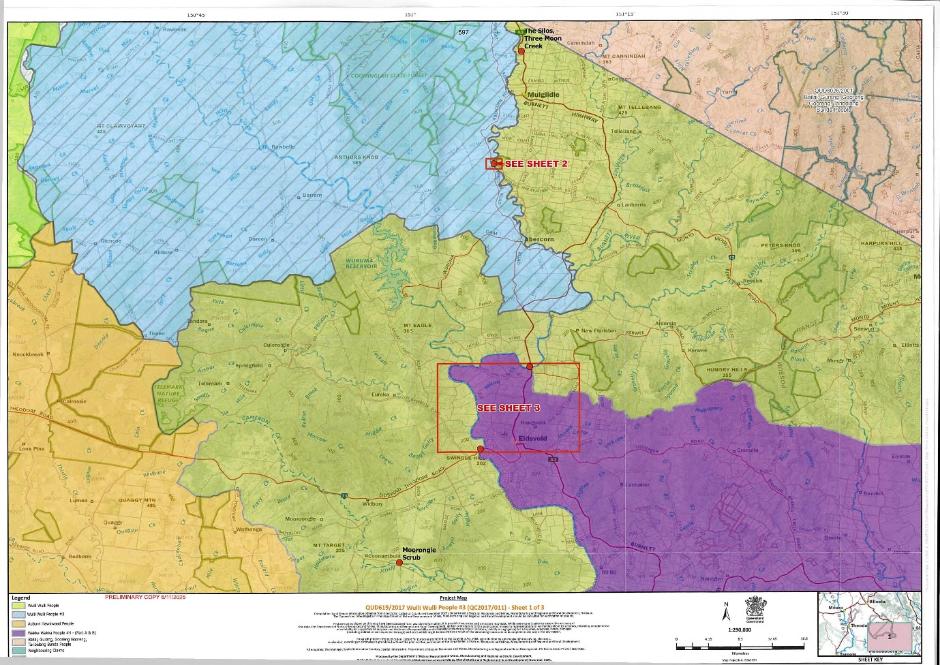
47 While evidence on country by Indigenous peoples tends to be more reliable and provides a preferable environment in which that evidence can be given to explain the significance of sites within a claim area, no clear explanation was given as to why sites outside the Part B area were chosen rather than sites within it, as the State submits. Mr Collins was also confused at points in his evidence at the POE hearing about whether particular places and features were within, or outside, the Part B area, indicating that he was uncertain about where the boundaries to the Part B area lay.
48 Importantly, in his written evidence, Mr Collins said that he had been taught by his grandmother, Ada, that Gooreng Gooreng country included parts of the claim area such as Old Rawbelle and just south of the Nogo River and Sandy Creek. However, in his oral evidence, he said that while his grandmother told them where Gooreng Gooreng land was, he said that “I can’t recall it though”. Rather, his evidence at the POE hearing was, in effect, that he was uncertain and there was a need to do further “research” when questioned about this subject. A telling example is found in Mr Collins’ evidence at the POE hearing during cross-examination on his affidavit affirmed on 23 May 2013, which had been filed in the native title determination application brought by Elliott Anderson and others on behalf of the Wulli Wulli People: see Anderson obh of Wulli Wulli People v State of Queensland (No 3) [2015] FCA 821:
MR SCOTT: Can I ask you please to turn to the next page, Steven. And I’m going to ask you about some words that are in paragraph 11 and I’m going to read them into the record and then I’m going to ask you some questions about it. There is – it’s the last two sentences in paragraph 11. And I’ll read them out. “As you go west from Eidsvold you enter Wulli Wulli country. The main rivers in Wulli Wulli country are the Dawson in the north and the Auburn in the south as well as the creeks that flow into them such as Oxtrack, Delusion, Bone, Redbank, Cracow, Orange (Fish), Cheltenham and Cadaver Creeks”.
STEVE COLLINS: Yes.
MR SCOTT: You see that? Those sentences?
STEVE COLLINS: Yes.
MR SCOTT: And may we take it that when you signed this statement, you believed those words to be true?
STEVE COLLINS: No. I – we probably believed it at that time. However, there’s changes and, you know, a lot of people look at changes that have happened in places and their way of thinking then. You know, what I’m saying is, we were – because of the black policemen that were there, we were saying the Wulli Wulli and what else, you know. Yes.
MR SCOTT: Well, I’ll refer you to my earlier questions.
STEVE COLLINS: Yes.
MR SCOTT: I think you agreed with me earlier that when you signed this statement you believed the contents of this statement to be true?
STEVE COLLINS: Yes. But if I was to do it now, I would not – I’d believe it to be true. But now, I would not, after I knew what – after the things I found.
MR SCOTT: Alright, but at the time you signed - - -
STEVE COLLINS: At the time, probably, yes. Well, I didn’t know what I was doing . . .
MR SCOTT: Are you saying you probably believed it to be true or definitely believed it to be true?
STEVE COLLINS: No, I probably believed it to be true, you know. With Fiona and that. However, now I would not sign it.
MR SCOTT: When you say you probably believed it to be true with Fiona.
STEVE COLLINS: Say again.
MR SCOTT: I think you just said to me shortly before that you probably believed it to be true with Fiona. Do you recall that?
STEVE COLLINS: Yes.
MR SCOTT: Fiona Powell?
STEVE COLLINS: Yes.
MR SCOTT: The anthropologist?
STEVE COLLINS: Yes. And she’s a nice person, Fiona.
MR SCOTT: Okay, what do you mean by you probably believed it to be true with Fiona?
STEVE COLLINS: Well, I thought that Fiona was telling us, you know, until I did research on my own and do the other things with that and finding out for myself.
MR SCOTT: Okay. Are you saying that those two sentences in paragraph 11 that I read out come from what Fiona told you?
STEVE COLLINS: Yes.
MR SCOTT: Not from you think anyone else has told you?
STEVE COLLINS: No. It was Fiona.
MR SCOTT: And now you don’t believe it to be true? Is that right?
STEVE COLLINS: I would like to do more research on that. It would be good if it did.
MR SCOTT: But I think you said that your mind has been changed about this because of further research you’ve done on your own since this statement. Is that right?
STEVE COLLINS: Yes.
MR SCOTT: What research are you referring to?
STEVE COLLINS: Well, when you look in the Aboriginal people there out at Hawkwood and places like that you will find where they were sent from Hawkwood and places like that. They were sent from the Auburn Station, Hawkwood, all those places there. From Woorabinda, Cherbourg and all those places. So, we were all over the place.
MR SCOTT: Have you talked to other people? Is that what you mean by further research?
STEVE COLLINS: By further research?
MR SCOTT: Yes.
STEVE COLLINS: No, if I just got the chance to do it now, it would be good if we could.
MR SCOTT: Okay. I just want to be clear and understand clearly what you’re telling us. I think you’re telling us that after this statement you did other research on your own.
STEVE COLLINS: On my own. Yes.
MR SCOTT: Okay. And what did you do?
STEVE COLLINS: I just – just read books and just went out there and talked to people and, you know.
MR SCOTT: Okay, and is it a consequence of that further research, you now believe the areas described in these two sentences are Gooreng Gooreng? Is that right?
STEVE COLLINS: No. What I said there needs to be more research done on it.
MR SCOTT: I see.
STEVE COLLINS: On that. Yes.
MR SCOTT: So would it be accurate to say you’re not certain whether these areas are - - -
STEVE COLLINS: Are Gooreng Gooreng.
49 Finally, I agree with the State’s submission that, while his Defence is premised on the notion that Wulli Wulli and Gooreng Gooreng are separate in some relevant sense, Mr Collins has not offered any clear evidentiary basis for that proposition. Rather, as the State contends, “To the contrary, Mr Collins gave evidence at the POE to the effect that, at least historically, people in the area did not observe sharp distinctions between groups”. This is illustrated by the ambiguities in the following passage from his evidence at the POE hearing:
MR SCOTT: So, my question was, is it relatively common for people in this area to have rights that come from more than one group of people? So, for example, Wulli Wulli and Wakka or Wulli Wulli and Gooreng Gooreng?
STEVE COLLINS: I don’t know about that. I think it all depends on the money. It came down to money now.
HER HONOUR: I think you might need to be more specific about what rights you’re talking about. Just one moment. Thank you very much, Mr Collins. Is it? Yes.
MR SCOTT: Yes, perhaps if I say rights to speak for country? Does that make it clearer?
STEVE COLLINS: Well, I think, you know, Wulli Wulli People have been putting in their claims and we sort of knew this country was ours and that’s in debate now so who owns the country?
MR SCOTT: So, what’s the answer to my question, Steven? Is it relatively common for people in this area to have rights to speak for country coming from more than one group of people such as Wakka Wakka, Wulli or Gooreng Gooreng?
STEVE COLLINS: I think – this is a hard one, to think on. It’s a hard one because it’s a contentious area, that one.
MR SCOTT: So, you don’t know the answer to that question?
STEVE COLLINS: No.
50 In short, Mr Collins’ personal and historical association with places within the Part B area is already accommodated by the present native title determination application, it being accepted that he is descended from one of the apical ancestors identified in the Wulli Wulli claim. However, given the difficulties with Mr Collins’ evidence identified above, in my view there is an insufficient factual foundation for Mr Collins’ asserted interest to the extent that it is based upon the proposition that the Gooreng Gooreng people, as a group distinct and separate from the Wulli Wulli claim group, hold rights and interests in the Part B area to the exclusion of, or in addition to, the Wulli Wulli people. The evidence does not, in other words, rise to the level of a prima facie claim. As such, the application for Mr Collins to be removed as a respondent should be granted.
8. CONCLUSION
51 For the reasons set out above, an order should be made removing Mr Collins as a respondent to the native title determination application. Finally, I note the parties have requested that they be afforded the opportunity to be heard on the issue of costs against Mr Collins, should they wish to do so after considering these reasons.
I certify that the preceding fifty-one (51) numbered paragraphs are a true copy of the Reasons for Judgment of the Honourable Justice Perry. |
Associate:
Dated: 23 November 2026