

Federal Court of Australia
Hammer Metals Limited, in the matter of Hammer Metals Limited (No 2) [2026] FCA 1743
File number: | WAD 311 of 2026 |
Judgment of: | JACKSON J |
Date of judgment: | 13 November 2026 |
Date of publication of reasons: | 16 November 2026 |
Catchwords: | CORPORATIONS – scheme of arrangement – application for approval of scheme under s 411(4)(b) of the Corporations Act 2001 (Cth) – acquisition of 100% of shares in plaintiff in exchange for shares in bidder – concurrent demerger of Western Australian gold assets from plaintiff by way of capital reduction and not scheme – scheme approved by necessary majorities of shareholders – orders made approving scheme |
Legislation: | Corporations Act 2001 (Cth) ss 411, 412 |
Cases cited: | Essential Metals Limited (No 2) [2023] FCA 1306 Re Hammer Metals Limited [2026] FCA 1466 Re Talon Energy Ltd (No 2) [2023] FCA 1599 |
Division: | General Division |
Registry: | Western Australia |
National Practice Area: | Commercial and Corporations |
Sub-area: | Corporations and Corporate Insolvency |
Number of paragraphs: | 29 |
Date of hearing: | 13 November 2026 |
Counsel for the Plaintiff: | Mr JRC Sippe |
Solicitor for the Plaintiff: | Thomsons Lawyers |
Counsel for the Interested Party: | Mr J Baker |
Solicitor for the Interested Party: | Mullins Lawyers |
ORDERS
WAD 311 of 2026 | ||
IN THE MATTER OF HAMMER METALS LIMITED | ||
HAMMER METALS LIMITED Applicant | ||
AUSTRAL RESOURCES AUSTRALIA LIMITED Interested Party | ||
order made by: | JACKSON J |
DATE OF ORDER: | 13 November 2026 |
THE COURT ORDERS THAT:
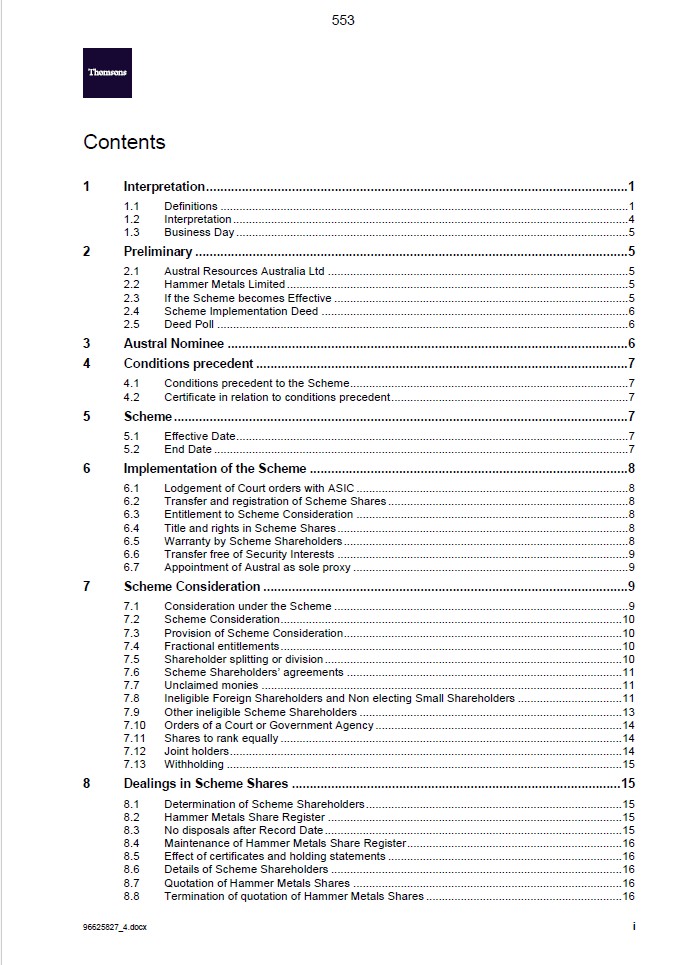
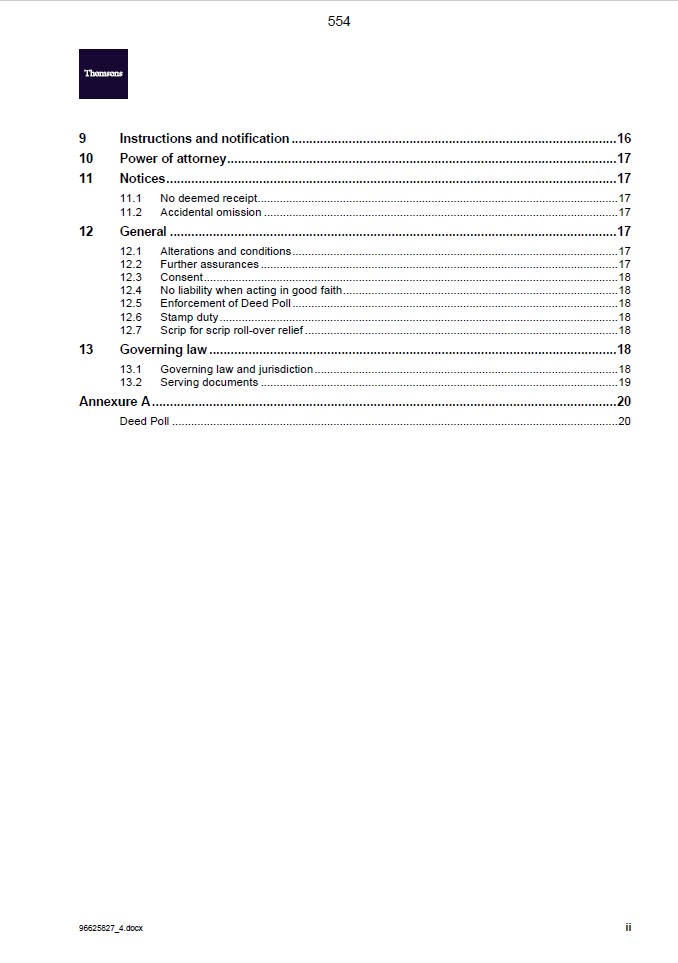
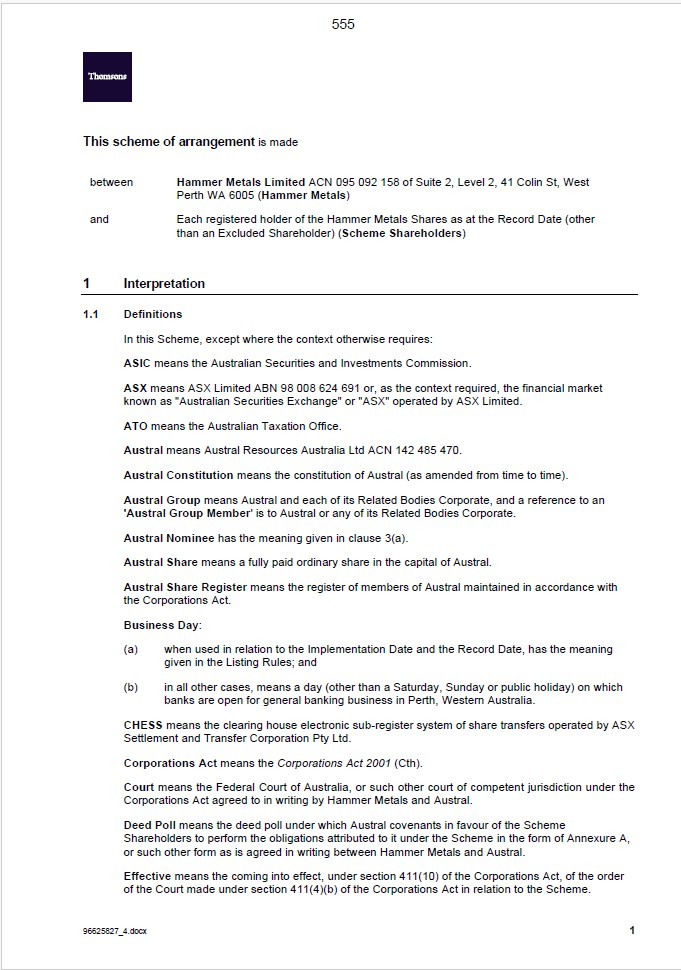
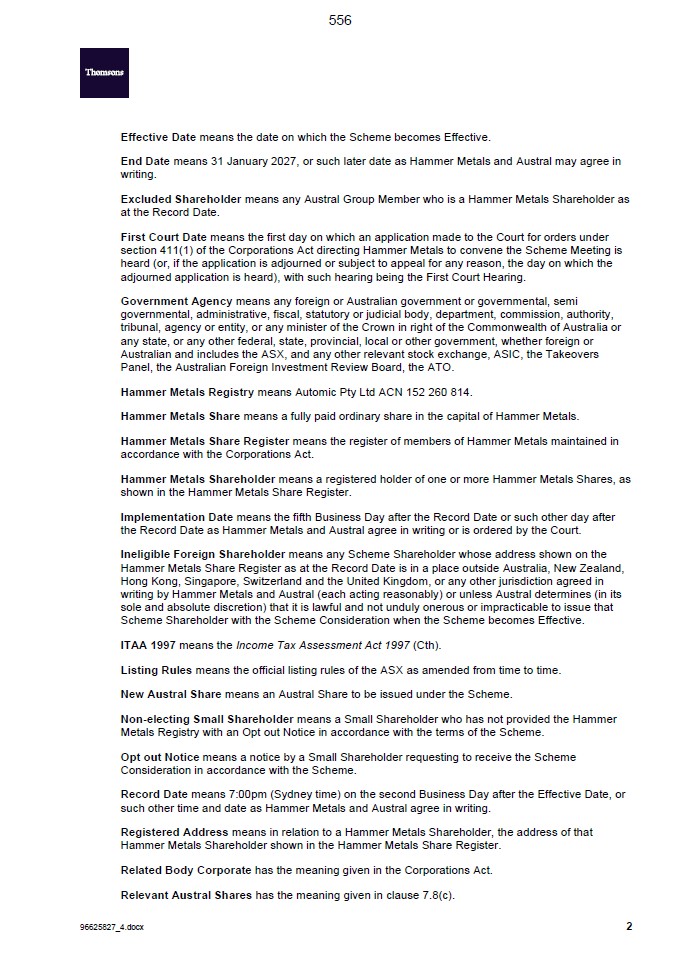
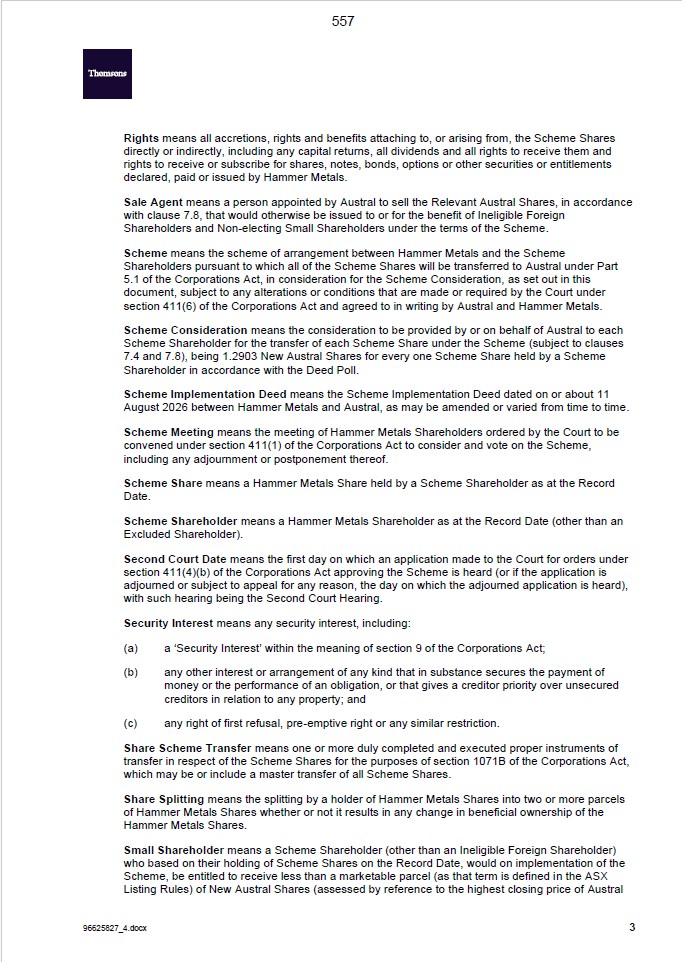
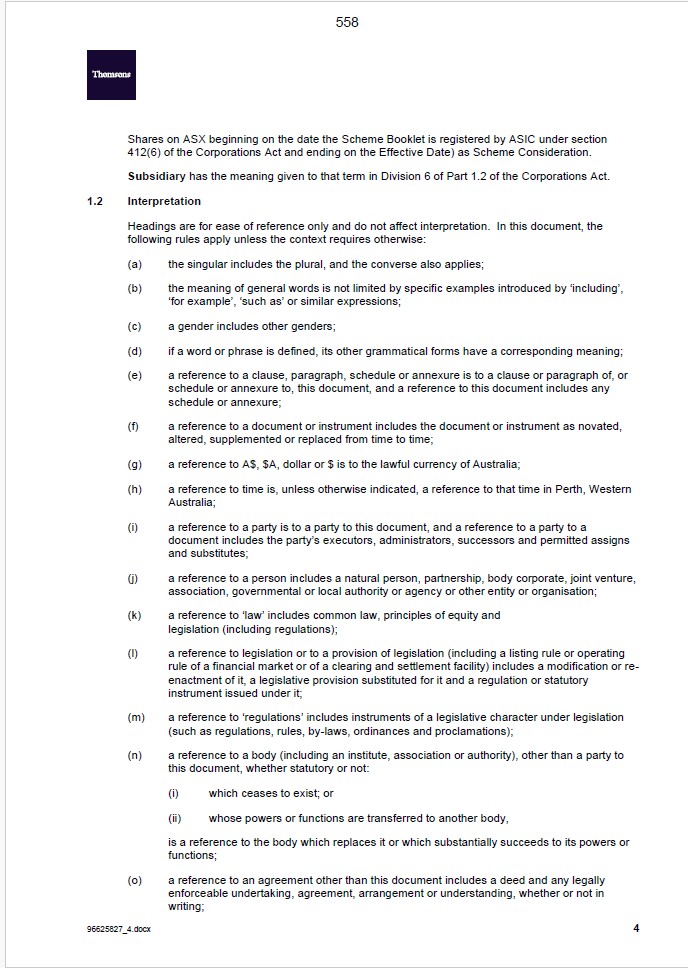
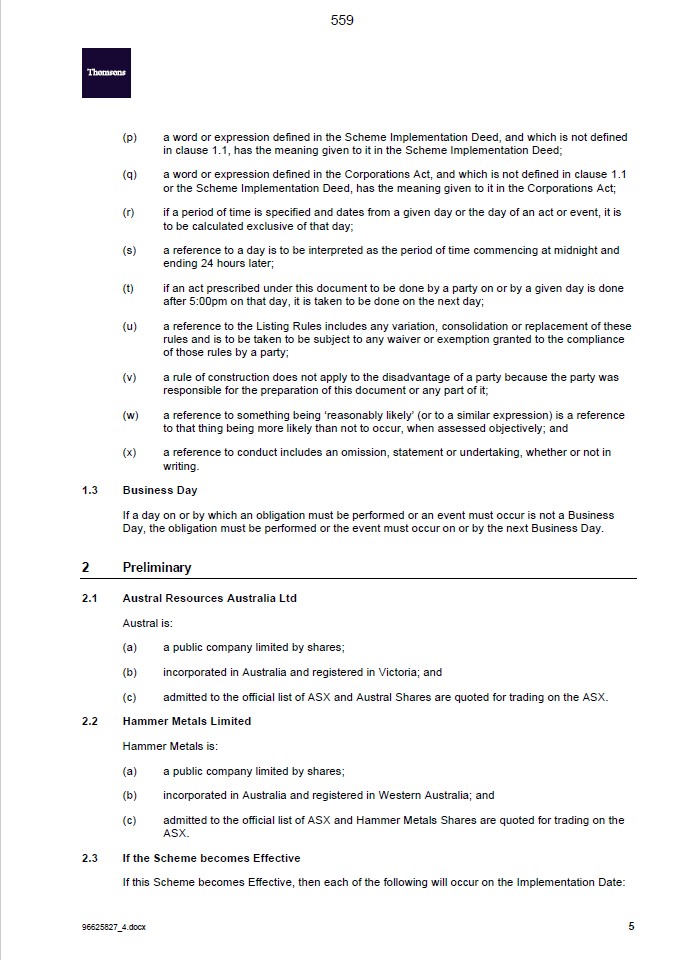
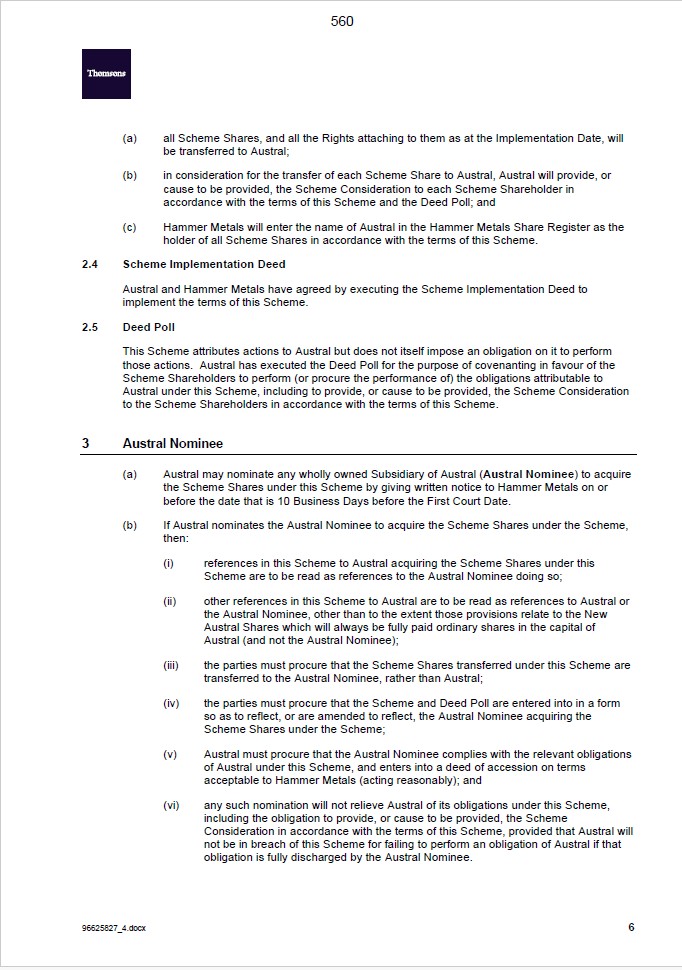
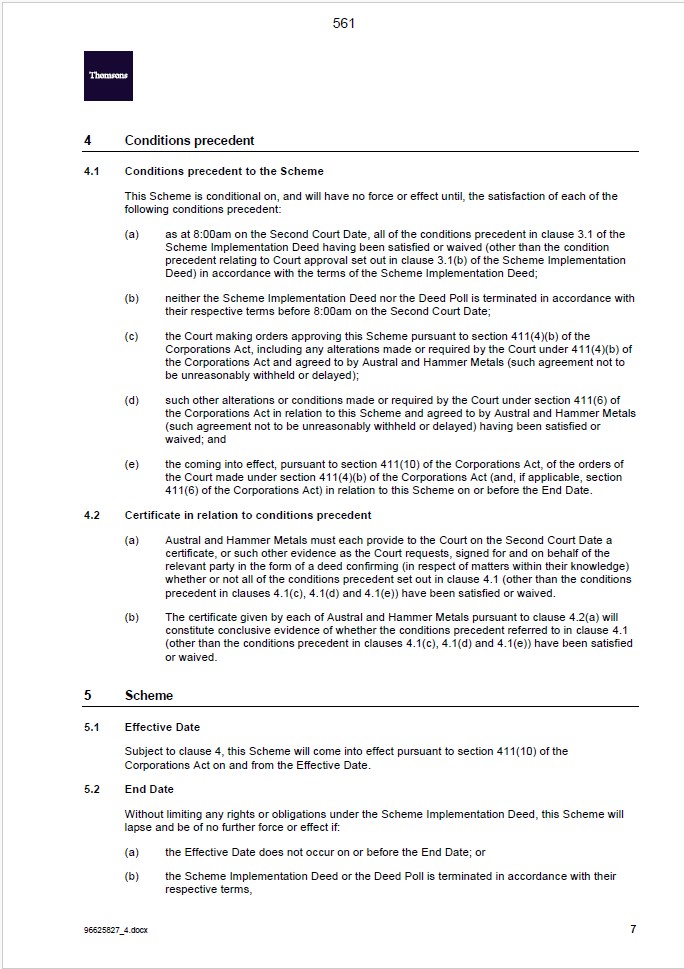
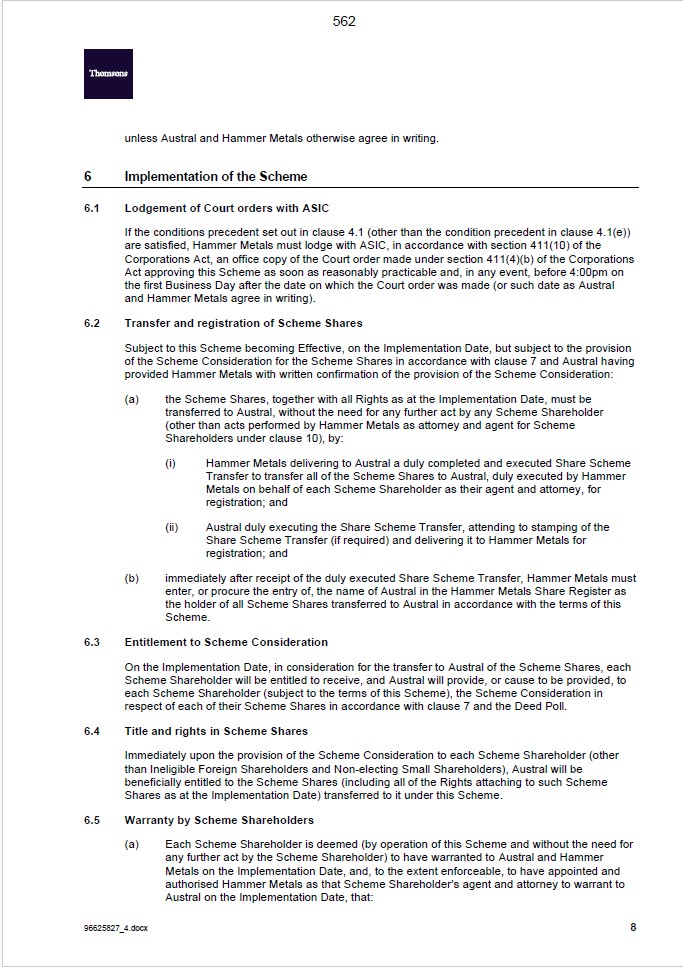
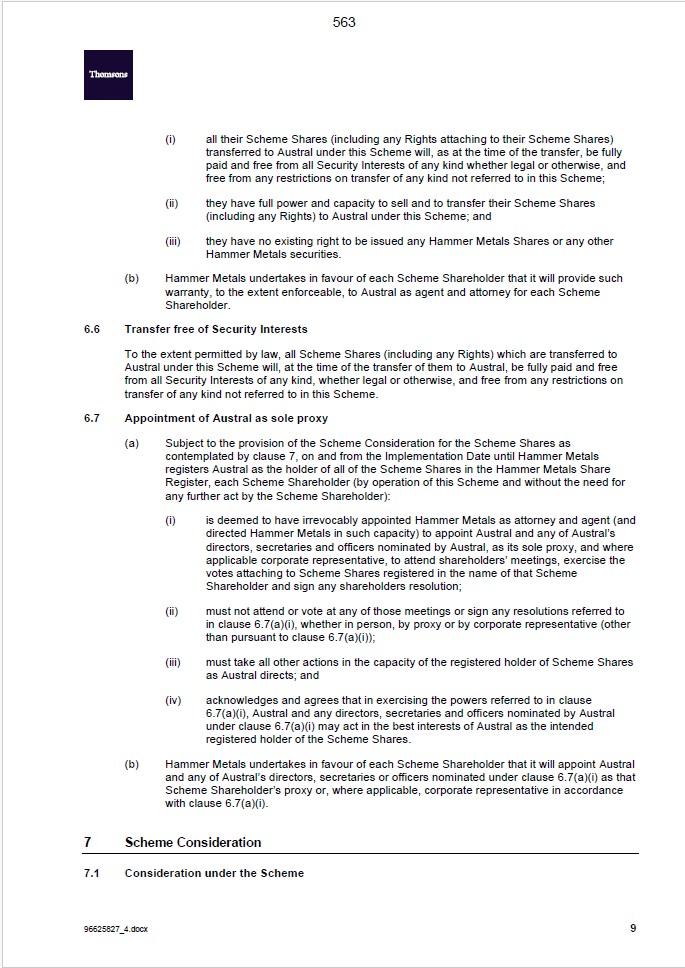
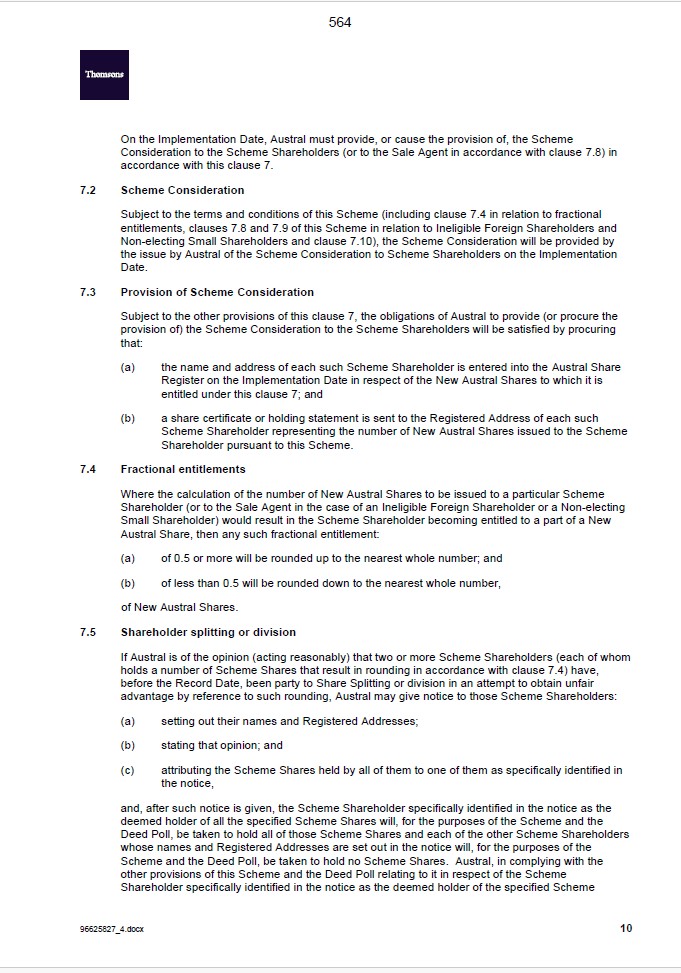
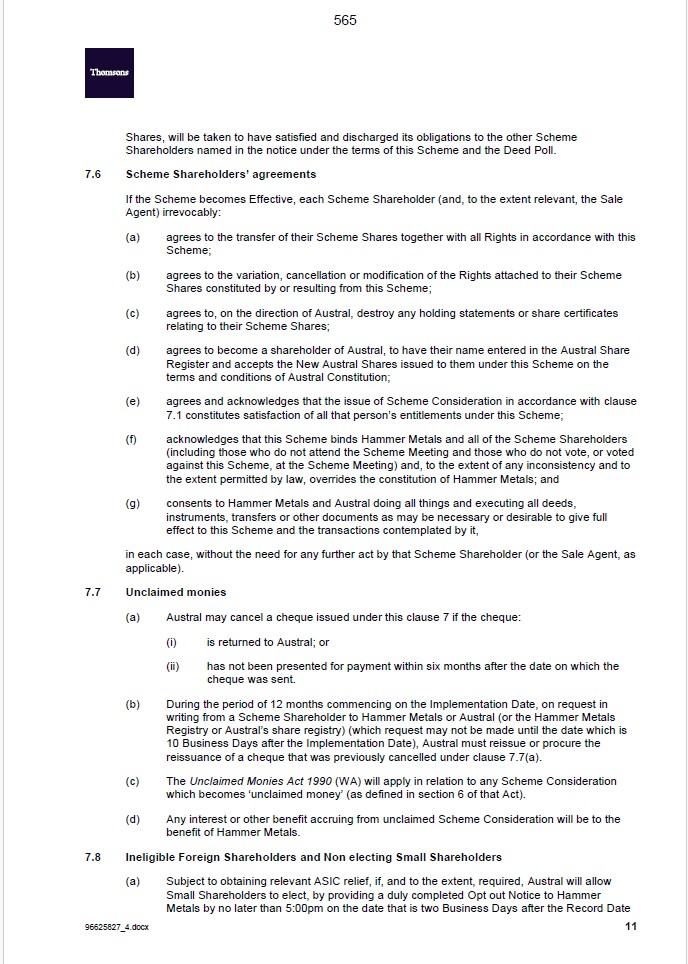
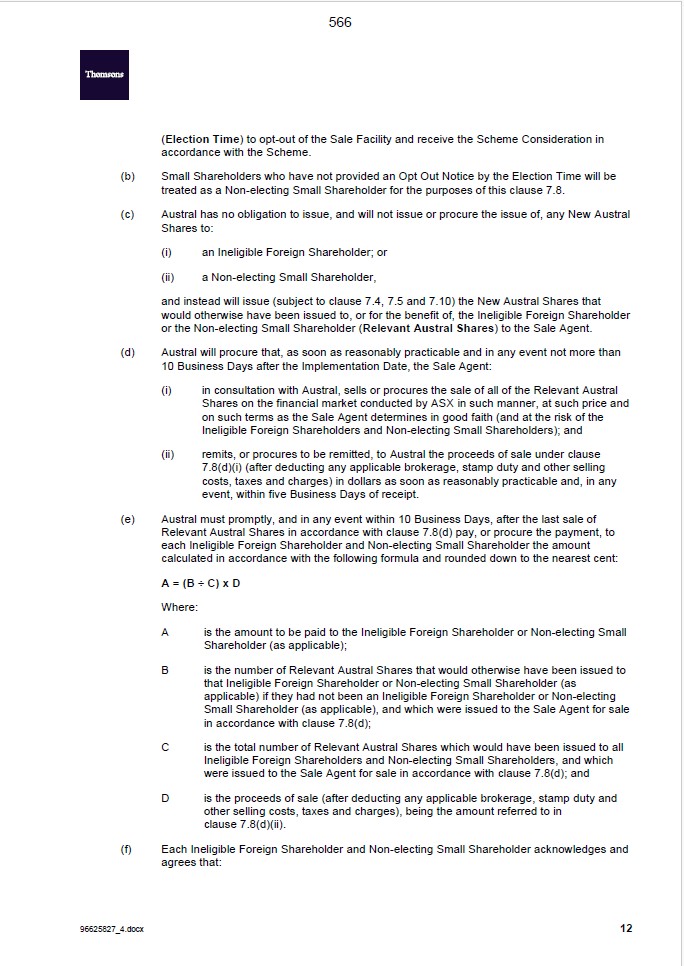
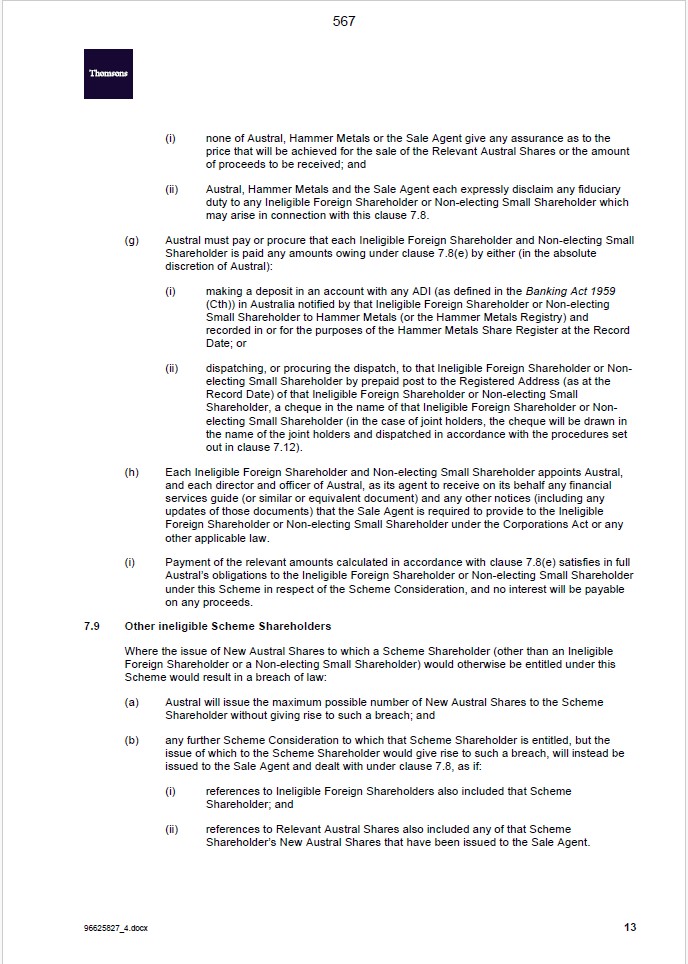
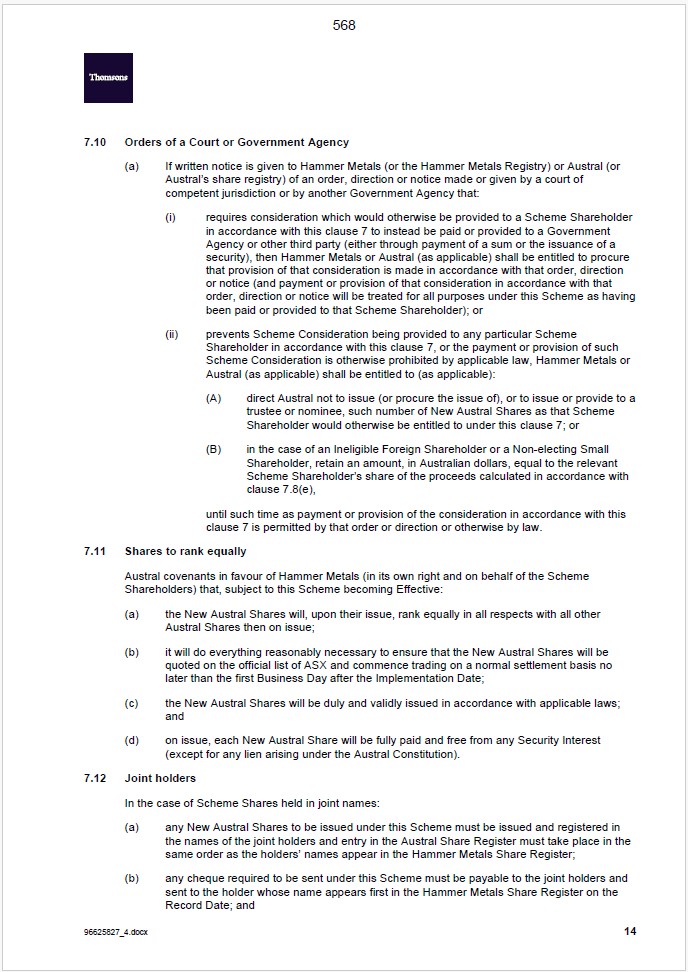
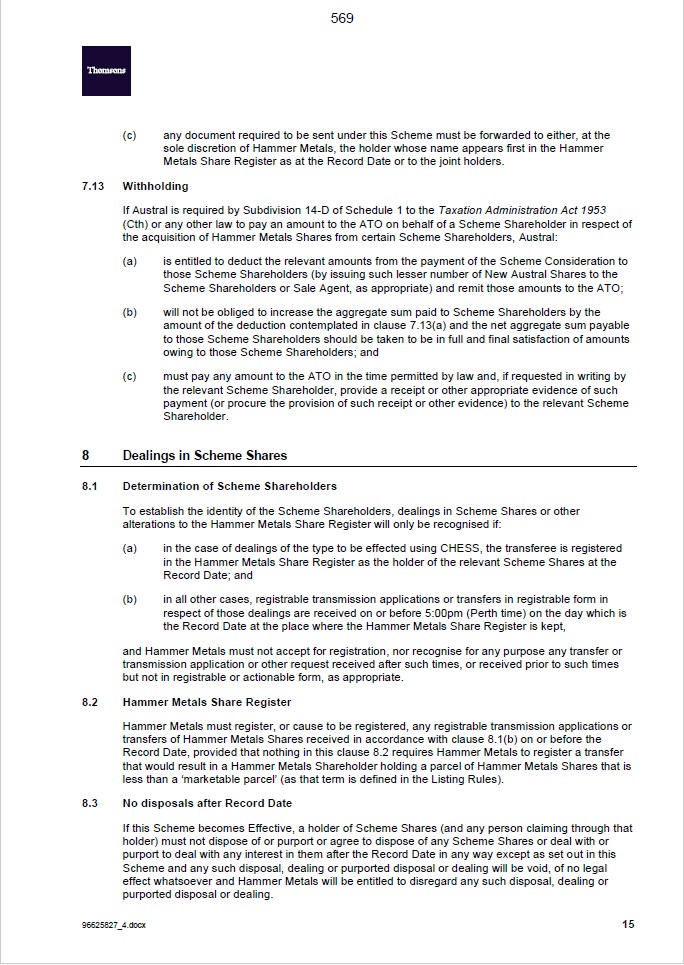
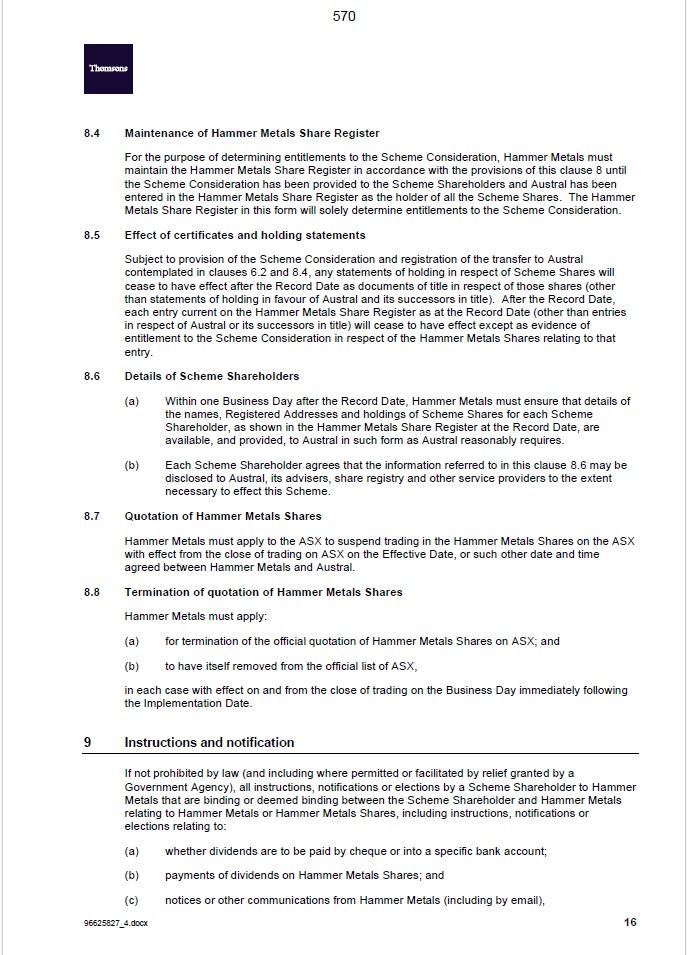
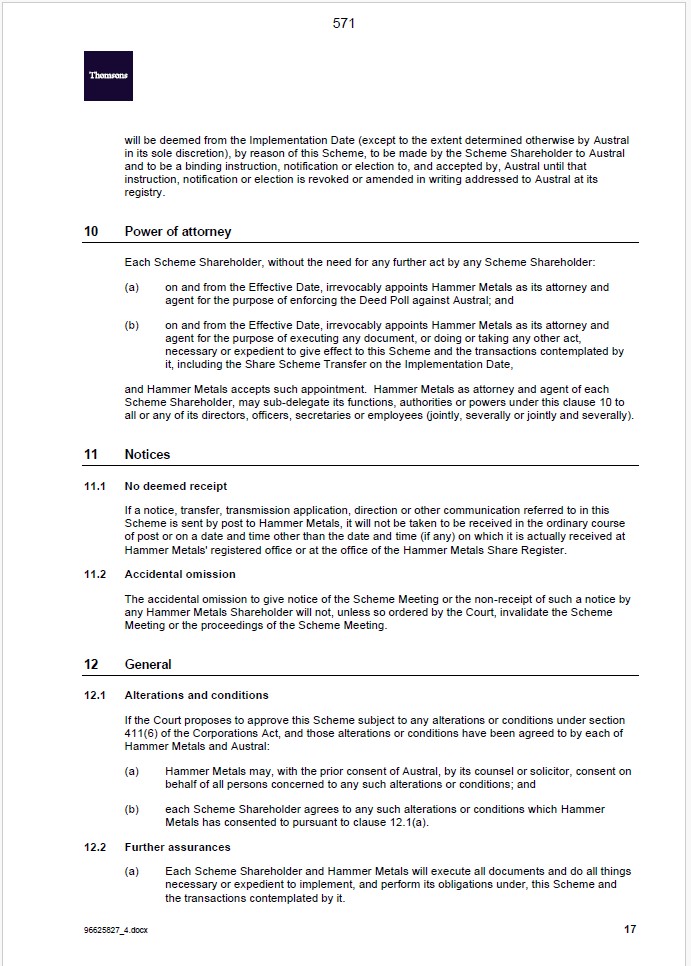
1. Pursuant to section 411(4)(b) of the Corporations Act 2001 (Cth) the scheme of arrangement (Scheme) between the plaintiff and the holders of fully paid ordinary shares in the plaintiff, in the form set out at pages 552 to 574 of the affidavit of Hendrik van Aswegen sworn 1 October 2026, a copy of which is Annexure A to these orders, is approved.
2. Pursuant to section 411(12) of the Corporations Act, the plaintiff is exempted from compliance with section 411(11) of the Corporations Act in relation to the Scheme.
3. The plaintiff must lodge an office copy of these orders with the Australian Securities and Investments Commission by 5.00 pm AWST on 16 November 2026.
Note: Entry of orders is dealt with in Rule 39.32 of the Federal Court Rules 2011.
ANNEXURE A
REASONS FOR JUDGMENT
JACKSON J:
1 On 2 October 2026, I made orders (First Meeting Orders) convening a meeting (Scheme Meeting) of the shareholders of the plaintiff, Hammer Metals Ltd, for the purpose of considering and, if thought fit, agreeing to a scheme of arrangement (Scheme): Re Hammer Metals Limited [2026] FCA 1466 (Hammer Metals (No 1)). These reasons assume familiarity with that decision and adopt certain terms as defined in it.
2 The Scheme provides for Austral Resources Australia Ltd to acquire all of the fully paid ordinary shares in Hammer Metals. The proposed Scheme consideration is 1.2903 fully paid ordinary shares in Austral for every one share in Hammer Metals.
3 The Scheme Meeting was held on 9 November 2026. At the meeting, Hammer Metals shareholders approved the Scheme by the requisite statutory majorities.
4 On 13 November 2026, the second hearing for approval of the Scheme pursuant to s 411(4)(b) of the Corporations Act 2001 (Cth) was held. On that date I made an order approving the Scheme and ancillary orders. These are the reasons for those orders.
Materials relied upon
5 In addition to the evidence already adduced at the first hearing, Hammer Metals relied upon the following affidavits:
(a) second affidavit of Michael Bowen sworn on 10 November 2026;
(b) third affidavit of Russell Davis affirmed on 11 November 2026;
(c) third affidavit of Hendrik van Aswegen sworn on12 November 2026; and
(d) fourth affidavit of Mr van Aswegen sworn on 13 November 2026.
Requirements for approval of a scheme of arrangement
6 The principles that apply to the Court’s role in approving a scheme of arrangement under s 411(4)(b) of the Corporations Act are well established. It is convenient to set out the summary of those principles given in Re Talon Energy Ltd (No 2) [2023] FCA 1599:
7 A scheme of arrangement is binding on members of a company if, at a meeting convened in accordance with an order of the Court, a resolution in favour of the scheme is passed by a majority in number of members present and voting, and by 75% of the votes cast on the resolution, and the scheme is approved by the Court: Corporations Act s 411(4).
8 The Court has a discretion whether to approve a scheme, and it is not bound to approve it merely because it has previously made orders convening a meeting to approve the scheme: Re Seven Network Limited (No 3) [2010] FCA 400 at [31] (Jacobson J). The fundamental issue informing the exercise of the discretion is whether the proposal is fair and reasonable, in the sense that an intelligent and honest shareholder, who is a member of the relevant class, and acting alone in respect of their interests as shareholder, might approve it. The jurisdiction is supervisory; the Court is concerned to be satisfied that there has been an absence of oppression and that the compromise or arrangement is one that is capable of being accepted: see Re NRMA Limited (No 2) [2000] NSWSC 408 at [22] (Santow J); approved in Fowler v Lindholm [2009] FCAFC 125; (2009) 178 FCR 563 at [79] (Emmett, Gordon and Jagot JJ).
9 It has been said that the shareholders’ vote in favour of a scheme is evidence of its inherent fairness; if a majority of the shareholders have approved the scheme, it is unlikely that the scheme would be unreasonable: Re Amcor Limited (No 2) [2019] FCA 842 at [11] (Beach J).
10 The following matters are relevant to the exercise of the statutory discretion (Re Seven Network at [35]-[40], and the cases cited there):
(a) whether the shareholders have voted in good faith and not for an improper purpose;
(b) whether the plaintiff has brought to the attention of the Court all matters that could be considered relevant to the exercise of the discretion;
(c) whether there has been full and fair disclosure of all information material to the shareholders’ decision;
(d) whether minority shareholders would be oppressed by the scheme; and
(e) whether the scheme offends public policy.
11 Other matters of which the Court must be satisfied when deciding whether to approve a scheme include whether:
(a) there has been compliance with the orders of the Court convening the scheme meeting;
(b) the resolution to approve the scheme has been passed by the requisite majorities;
(c) all conditions to which the scheme is subject (other than Court approval and lodgement of the Court’s orders with the Australian Securities and Investments Commission (ASIC)) have been met or waived;
(d) all other statutory requirements have been satisfied; and
(e) the Court is satisfied under s 411(17) that the scheme has not been proposed to avoid Chapter 6 of the Corporations Act (regarding takeovers), or that the company has a statement from ASIC that it has no objection to the scheme.
See Re APN Outdoor Group Limited (No 2) [2018] FCA 1633 at [5] (Markovic J); Chevron (TAPL) Pty Ltd v Chevron Australia Pty Ltd, in the matter of Chevron (TAPL) Pty Ltd (No 2) [2022] FCA 381 at [9] (Banks-Smith J).
12 In general, it is not the Court’s function to override the views of the shareholders, but the Court is not a mere rubber stamp and will look at the arrangement to ensure that it is a reasonable one: Re Wesfarmers (No 2) [2018] WASC 357 at [15] (Vaughan J). The Court is heavily reliant on counsel to bring to its attention those features of the scheme that require attention: Re Seven Network at [42].
Procedural matters and other prerequisites
Amendment of the Scheme Booklet
7 Mr Davis’s third affidavit confirms that following the first hearing, Hammer Metals made amendments to the Scheme Booklet that were proposed by the Court at that hearing, in order to provide more prominent disclosure to shareholders of potential disadvantages associated with the Demerger. This was, in effect, compliance with paragraph 5(f) of the First Meeting Orders, which provided for amendments to the Scheme Booklet as approved by the Court.
8 In addition, amendments were made to the Scheme Booklet to correct computational errors in the version that had been before the Court (and was initially lodged with ASIC). These errors arose as a result of a misstatement in the value of performance rights in Hammer Metals that are described in Hammer Metals (No 1) at [27]-[29].
9 Hammer Metals’ solicitors, Thomsons, informed the Court of the errors shortly after the first hearing. It is not necessary to set out the errors or corrections to them in detail; they are relatively minor, and concern rights held exclusively by the Managing Director of Hammer Metals, Daniel Thomas, which will all vest or be cancelled on approval of the Scheme, as set out in Hammer Metals (No 1). The errors do not change the substance of what will occur in relation to the rights or raise any concern about appropriate disclosure to shareholders. Thomsons has advised the Court that each of ASIC and the independent expert, Grant Thornton, were told about the errors and (in effect) were not concerned by them.
ASIC lodgement
10 On 2 October 2026, Hammer Metals’ solicitors lodged the Scheme Booklet with ASIC in substantially the form approved by the Court, including the amendments proposed by the Court. Also lodged was a sealed copy of the First Meeting Orders. ASIC registered the Scheme Booklet pursuant to s 412(6) of the Corporations Act on the same day. The computational amendments just mentioned were communicated to ASIC on 7 October 2026, and ASIC approved those amendments that same day.
Dispatch of the Scheme materials to shareholders
11 Mr Davis’s third affidavit contains evidence of the dispatch of the Scheme Booklet to shareholders on 8 October 2026, in accordance with the First Meeting Orders. The Scheme Booklet was available to access on Hammer Metals’ website from 2 October 2026, and an amended version was available from 8 October 2026.
12 There were delivery failure notifications in respect of a small number (19) of shareholders who had elected to receive notices by email. It can be inferred that this is likely to be the result of issues at the shareholder end, for which Hammer Metals and Automic are not responsible. Hard copy materials were dispatched to those shareholders, albeit after the deadline of 8 October 2026, approximately two weeks before the Scheme Meeting was held. One of those shareholders voted on the Scheme resolution in any event. Such relatively minor irregularities are commonplace, and presented no reason not to approve the Scheme.
The Demerger Meeting
13 As was proposed at the time of the first hearing, a meeting of shareholders to approve the Demerger was held, immediately prior to the Scheme Meeting. That meeting was held on 9 November 2026, at the Park Business Centre in West Perth.
14 The capital reduction necessary to effect the Demerger was approved by 99.78% of the shares that were voted in person or by proxy. This relevant because, as explained in Hammer Metals (No 1), implementation of the Scheme is conditional on approval of the Demerger.
The Scheme Meeting
15 Mr Bowen’s second affidavit gives evidence of the conduct of the Scheme Meeting, which was chaired by him, in accordance with the First Meeting Orders. The meeting was held immediately after the Demerger meeting and at the same venue.
16 At the Scheme Meeting, a poll was taken on the Scheme resolution. Mr Bowen’s second affidavit indicates that the outcome, as certified by Hammer Metals’ share registry provider Automic, was that the resolution was approved as follows:
(a) by number of voting shareholders: 95.50% (being 106 shareholders) in favour and 4.50% (being 5 shareholders) against; and
(b) by number of votes: 99.80% (being 409,617,364 shares) in favour and 0.20% (being 895,026 shares) against; and
(c) no abstentions.
Therefore the majorities required by the Corporations Act of 50% by headcount (s 411(4)(a)(ii)(A)) and 75% by votes cast (s 411(4)(a)(ii)(B)) were both obtained.
17 Just under 50% of the total Hammer Metals shares on issue were voted at the Scheme Meeting by approximately 4.5% of eligible shareholders. That was mostly proxy votes, as only 12 shareholders attended in person. This constituted a quorum for the Scheme Meeting pursuant to the First Meeting Orders.
18 Such small numbers of participation by shareholders in scheme meetings, whether in person or by proxy, are not uncommon. It has regularly been recognised by the courts that low numbers such as those set out above do not present a reason not to approve the relevant scheme. I refer to, without repeating, the analysis I conducted in Essential Metals Limited (No 2) [2023] FCA 1306 at [33]-[37].
19 In the present case, it was relevant to note that:
(a) there was no reason to think that voter turnout and participation was affected by any procedural irregularity; and
(b) there was evidence that the level of participation, low as it was, was higher than that for Hammer Metals’ two most recent annual general meetings (which was 3.07% of shareholders in 2024 and 2.56% in 2025).
20 I was therefore satisfied that the resolution of Hammer Metals shareholders to approve the scheme was passed regularly and that the low level of shareholder participation presented no impediment to approval of the Scheme.
No objection from ASIC
21 ASIC has provided a letter for the purposes of s 411(17) of the Corporations Act confirming that it has no objection to the Scheme.
Conditions precedent
22 Certificates from both Hammer Metals and Austral were produced to the Court, verifying that all conditions precedent to the Scheme (other than Court approval) had been satisfied or waived.
The exercise of the discretion
23 I was satisfied that there was no reason not to approve the Scheme. Subject to a point about the Demerger, there was no suggestion of any minority oppression, and no suggestion that the Scheme was proposed other than in good faith for a legitimate commercial purpose. For reasons summarised in Hammer Metals (No 1) at [8] and [9], there is an intelligible commercial rationale for the Scheme so that it is a proposal which an intelligent and honest shareholder, acting in their own interests, could approve.
24 The point about the Demerger is that, as outlined in Hammer Metals (No 1) at [68]-[70], holders of small parcels of Hammer Metals shares and other ineligible (essentially foreign) shareholders may never receive any consideration in return for what is, in effect, the disposal of the company’s Western Australian gold assets to the separate Demerger vehicle, currently named SpinCo. In short, that is because there is no present intention to conduct an initial public offering of SpinCo shares or to realise value in that company in other ways, such as liquidation. For reasons explained in Hammer Metals (No 1), if a liquidity event does not occur, those small and ineligible shareholders may never receive any consideration.
25 I have taken into account, however, that the Demerger is part of what can be conceived as a wider transaction under which those shareholders will receive tangible consideration and so may rationally consider is in their interests. The issue was fully disclosed in the Scheme Booklet, and it is relevant that no shareholder has expressed opposition, even taking into account the fact that it is the Scheme, and not the Demerger, for which Court approval was sought. For those reasons I was satisfied that, to the extent that the Demerger is connected to the Scheme, the overall benefits of the wider transaction mean that the Demerger did not raise any real concern that the Scheme involved oppression of any shareholders.
26 I also took into account the independent expert’s conclusion that, in the absence of a superior proposal, the Scheme is fair and reasonable to Hammer Metals shareholders and therefore in their best interests. No superior proposal has emerged. Neither ASIC nor any shareholder appeared at the second hearing to object to the approval of the Scheme.
27 There was evidence of both inbound and outbound shareholder telephone lines having been conducted by Automic, in accordance with what is now standard practice. That evidence showed that there was no departure from the messages conveyed by the Scheme Booklet, and no matter of concern arose from those communications. That, together with the disclosure made in the Scheme Booklet (as approved at the first hearing) meant that there was no reason to think that shareholders’ approval of the Scheme resolution represented anything other than their properly informed judgment that the Scheme was in their best interests as shareholders.
28 There was also no reason to suppose that the Scheme offended public policy.
Scheme approved
29 For those reasons, orders approving the Scheme were made.
I certify that the preceding twenty-nine (29) numbered paragraphs are a true copy of the Reasons for Judgment of the Honourable Justice Jackson. |
Associate:
Dated: 16 November 2026


