
Federal Court of Australia
Commissioner of Taxation v White (Liability) [2026] FCA 1707
File number(s): | NSD 884 of 2023 |
Judgment of: | KENNETT J |
Date of judgment: | 16 November 2026 |
Catchwords: | TAXATION – where the applicant alleges the respondent engaged in conduct that resulted in him being the promoter of a tax evasion scheme to six individuals in relation to three distinct arrangements or, alternatively, three separate tax exploitation schemes in contravention of s 290-50(1) of Sch 1 to the Taxation Administration Act 1953 (Cth) (TAA) – where the respondent was a partner of Ernst and Young, specialising in tax advice, a chartered accountant and a lawyer – where the respondent advised individuals seeking to reduce their tax liability to engage in arrangements whereby the beneficial interests in the income- or gain-producing assets of a trust (Trust 1) was to be transferred to another trust with the same trustee (Trust 2) at significantly less than market value, but capital gain tax liability was calculated on a deemed sale at market value – where a company with significant accumulated tax losses (NWOD) was made the sole beneficiary of Trust 1 to be able to apply its tax losses against the distribution of income from Trust 1 (incurring no tax liability on the income) – where NWOD was paid a percentage of the profits for its participation in the arrangement – where the income or gain that Trust 1 was to receive became available (essentially tax free) to other entities through Trust 2 – where income tax returns were prepared and lodged on this basis – whether the scheme or schemes were tax exploitation scheme – whether the respondent was a promoter of the scheme – whether the respondent contravened s 290-50(1) of the TAA – whether the applicant commenced proceedings within the relevant limitation period |
Legislation: | Income Tax Assessment Act 1936 (Cth), Pt IVA, ss 100A, 177D, 177F, 318 Income Tax Assessment Act 1997 (Cth) ss 112-20, 250-10(2), 960-100, 995-1(1) Income Tax Assessment Amendment Bill (No 5) 1978 (Cth) Tax Laws Amendment (Improvements to Self Assessment) Act (No 1) 2005 (Cth) s 284-15(1) Taxation Administration Act 1953 (Cth) s 3AA(2), Sch 1 ss 255-1, 284-15, 284-150(1), 290-50(1), 290-55, 290-60, 290-65 Treasury Laws Amendment (Tax Accountability and Fairness) Act 2024 (Cth) Sch 1 items 20, 24, 37(2) Federal Court Rules 2011 (Cth) r 2.25(3)(a) |
Cases cited: | Allen (Trustee), in the matter of Allen’s Asphalt Staff Superannuation Fund v Commissioner of Taxation [2011] FCAFC 118; 195 FCR 416 Amalgamated Television Services Pty Ltd v Marsden [2002] NSWCA 419 B&F Investments Pty Ltd atf the Illuka Park Trust v Commissioner of Taxation [2023] FCAFC 89; 298 FCR 449 BBlood Enterprises Pty Ltd v Commissioner of Taxation [2022] FCA 1112; 114 ATR 851 Briginshaw v Briginshaw (1938) 60 CLR 366 Cameron Brae Pty Limited v Commissioner of Taxation [2007] FCAFC 135; 161 FCR 468 Chief Executive Officer of the Australian Customs Service v Karam [2011] NSWCA 224; 252 FLR 326 Commissioner of Stamp Duties (New South Wales) v Pendal Nominees Proprietary Limited (1989) 167 CLR 1 Commissioner of Taxation v Arnold (No 2) [2015] FCA 34; 324 ALR 59 Commissioner of Taxation v Bamford [2010] HCA 10 Commissioner of Taxation v Bogiatto [2020] FCA 1139; 112 ATR 1 Commissioner of Taxation v Consolidated Media Holdings Ltd [2012] HCA 55; 250 CLR 503 Commissioner of Taxation v Hart [2004] HCA 26; 217 CLR 216 Commissioner of Taxation v Ludekens [2013] FCAFC 100; 214 FCR 149 Commissioner of Taxation of the Commonwealth of Australia v Ludekens [2013] FCA 142 Commissioner of Taxation v Perez (No 2) [2026] FCA 658 Commissioner of Taxation v Prestige Motors Pty Ltd (1998) 82 FCR 195 Commissioner of Taxation v Rowntree [2020] FCA 1322; 112 ATR 143 Commissioner of Taxation v Scully [2000] HCA 6; 201 CLR 148 D Marks Partnership by its General Partner Quintaste Pty Ltd v Commissioner of Taxation [2016] FCAFC 86; 245 FCR 247 Denver Chemical Manufacturing Company v The Commissioner of Taxation (New South Wales) (1949) 79 CLR 296 Federal Commissioner of Taxation v Peabody [1994] HCA 43; 181 CLR 359 JW Broomhead (Vic) Pty Ltd (In Liquidation) v JW Broomhead Pty Ltd [1985] VR 891 Kajewski v Federal Commissioner of Taxation [2003] FCA 258; 52 ATR 455 Kane’s Hire Pty Ltd v Anderson Aviation Australia Pty Ltd [2023] FCA 381 Lacey v Attorney-General (Qld) [2011] HCA 10; 242 CLR 573 Lehrmann v Network Ten Pty Ltd (Trial Judgment) [2024] FCA 369; 422 ALR 507 McKain v RW Miller & Co (South Australia) Pty Limited (1991) 174 CLR 1 Octavo Investments Pty. Ltd. v. Knight (1979) 144 CLR 360 R v Meares (1997) 37 ATR 321 Raftland Pty Ltd v Commissioner of Taxation (Cth) [2006] FCA 109; 62 ATR 49 Re Minister for Immigration and Multicultural Affairs; Ex parte Applicant S20/2002 [2003] HCA 30; 73 ALD 1 The Workers’ Compensation Board of Queensland v Technical Products Proprietary Limited (1988) 165 CLR 642 Vines v Djordjevitch (1955) 91 CLR 512 Walstern v Federal Commissioner of Taxation [2003] FCA 1428; 138 FCR 1 Webb v Getswift Ltd (No 5) [2019] FCA 1533 |
Division: | General Division |
Registry: | New South Wales |
National Practice Area: | Taxation |
Number of paragraphs: | 469 |
Date of last submission/s: | 30 July 2026 |
Date of hearing: | 31 March 2025, 1-4, 7-11, 16 April 2025, 11, 14-15 and 18-19 August 2025, 2 September 2025 |
Counsel for the Applicant: | Mr A Berger KC with Ms E Bishop SC and Mr M Hosking |
Solicitor for the Applicant: | Australian Government Solicitor |
Counsel for the Respondent: | Mr D McGovern SC with Mr R Johnson and Mr K Josifoski |
Solicitor for the Respondent: | C.G. Gillis & Co. Lawyers |
ORDERS
NSD 884 of 2023 | ||
| ||
BETWEEN: | COMMISSIONER OF TAXATION Applicant | |
AND: | PETER WHITE Respondent | |
order made by: | KENNETT J |
DATE OF ORDER: | 16 NOVEMBER 2026 |
THE COURT DECLARES THAT:
1. The respondent contravened s 290-50(1) of Sch 1 to the Taxation Administration Act 1953 (Cth) by engaging in conduct that resulted in him being a promoter of a tax exploitation scheme (the tax loss access scheme) to Mr Novce (Nick) Grujoski, Mr Michael Leontios, Mr Goran Sasic, Mrs Sarah Sasic, Mr Ross Gullo and Ms Isabel Leon in the period December 2016 to April 2021.
THE COURT ORDERS THAT:
2. The proceeding be listed for case management on a date to be advised.
Note: Entry of orders is dealt with in Rule 39.32 of the Federal Court Rules 2011.
REASONS FOR JUDGMENT
KENNETT J:
INTRODUCTION
1 Between 1 July 2011 and 19 July 2022, the respondent (Mr White) was a partner in the accounting firm Ernst and Young (EY), specialising in tax advice. At the time of the events the subject of the proceeding, Mr White was a chartered accountant and a lawyer, having practiced as an accountant for over 36 years and having been admitted as a solicitor of the Supreme Court of New South Wales (NSW) for over 18 years. In this proceeding the Commissioner of Taxation (the Commissioner) alleges that Mr White contravened s 290-50(1) of Sch 1 to the Taxation Administration Act 1953 (Cth) (TAA Sch 1) by engaging in conduct that resulted in him being a promoter of a tax exploitation scheme to six individuals between around April 2016 and April 2021. Those individuals were:
(a) Novce (“Nick”) Grujoski;
(b) Michael Leontios, who was the accountant to various corporate entities controlled by Mr Grujoski;
(c) Sarah Sasic;
(d) Goran Sasic (Mrs Sasic’s husband);
(e) Ross Gullo, who was the accountant to Mr and Mrs Sasic and corporate entities controlled by them; and
(f) Dina Isabel Leon, who was an accountant working for Mr Gullo.
2 The “scheme” alleged to have been promoted is referred to as “the tax loss access scheme”. Briefly, the scheme had as its starting point a trust (Trust 1) that was about to receive significant income or gains. From there, the scheme involved the following elements:
(a) another trust (Trust 2) was established with the same trustee as Trust 1;
(b) the beneficial interests in the income- or gain-producing assets of Trust 1 were transferred or assigned to Trust 2 at significantly less than their market value (leaving Trust 1 with a tax liability based on a deemed sale at market value);
(c) for tax purposes the transfer was deemed to have taken place at market value, so that Trust 1 (and not Trust 2) would be liable to tax on the relevant capital gain;
(d) a company (NWOD Projects & Advisory Pty Ltd (NWOD)), which had significant accumulated tax losses, was made the sole beneficiary of Trust 1 and made presently entitled to all of its income;
(e) NWOD was able to apply its tax losses against the distribution of income from Trust 1 (so that the income of that trust incurred no tax liability);
(f) NWOD was paid an amount for its participation in the arrangement;
(g) the income or gain that Trust 1 was to receive became available (essentially tax free) to other entities through Trust 2; and
(h) income tax returns were prepared and lodged on this basis.
3 The proceeding relates to three distinct arrangements, relating to two property developments undertaken by Mr Grujoski (“the Bonar Street development”, or simply “Bonar Street”, and “the Kings Court development”, or simply “Kings Court”) and the sale of a block of land at Menangle Park (“the Menangle Park property” or simply “Menangle Park”) by Mr and Mrs Sasic, which the Commissioner pleads as iterations or examples of the tax loss access scheme.
4 In the alternative, the Commissioner alleges that Mr White engaged in conduct that resulted in him being the promoter of three tax exploitation schemes, each having the elements described above, in respect of the Bonar Street development (the Bonar Street scheme), the Kings Court development (the Kings Court scheme) and the Menangle Park property (the Menangle Park scheme). Where I discuss these schemes as a group, I will refer to them as “the specific schemes”.
5 On 17 December 2024 it was ordered that the question whether Mr White contravened s 290-50(1) of the TAA Sch 1 be tried separately from the other issues in the proceeding. These reasons deal only with that question.
6 Each of the individuals mentioned above gave evidence for the Commissioner. Each was cross-examined. After the completion of the Commissioner’s case, Mr White elected to go into evidence. He affirmed an affidavit and also relied on affidavits from Jeff Locke (who at relevant times controlled NWOD and was a friend of Mr White) and Robert Byrnes (the trustee of a family trust to which some payments were directed). All three were cross-examined.
7 The issues that arise will be dealt with in the following order.
(a) Relevant aspects of the statutory scheme in Div 290 of the TAA Sch 1 and key concepts such as a “tax exploitation scheme” will be outlined.
(b) The dealings between Mr White and Mr Grujoski (and Mr Leontios), Mr White and Mr and Mr and Mrs Sasic (and Mr Gullo and Ms Leon) and Mr White and NWOD (through Mr Locke) will be described.
(c) Findings will be expressed on issues where the evidence of the parties’ witnesses conflicted.
(d) In the light of these findings, I will consider:
(i) whether the tax loss access scheme (or alternatively each of the specific schemes) constituted a “tax exploitation scheme”;
(ii) whether Mr White was a “promoter” of the tax loss access scheme (or each of the specific schemes); and
(iii) whether and to what extent the Commissioner is prevented from seeking relief against Mr White by reason of the applicable limitation period.
LEGISLATIVE FRAMEWORK: PROMOTER PENALTIES UNDER S 290-50 OF THE TAA SCH 1
8 Of the relevant provisions, only s 290-55 of the TAA Sch 1 has been relevantly amended since the time of the impugned conduct. In these reasons I will refer to the other provisions as they stood at relevant times for the purposes of the proceeding, but will describe their operation in the present tense.
9 Division 290 of the TAA Sch 1 is headed “Promotion and implementation of schemes”. Subdivision 290-B deals with the imposition of civil penalties. The core provision for the purposes of this case is s 290-50. Subsections 290-50(4) to (6) deal with the amounts and recovery of penalties and are not relevant at this stage of the proceeding. Subsections 290-50(1) to (3) provide as follows.
290-50 Civil penalties
Promoter of tax exploitation scheme
(1) An entity must not engage in conduct that results in that or another entity being a *promoter of a *tax exploitation scheme.
Implementing scheme otherwise than in accordance with ruling
(2) An entity must not engage in conduct that results in a *scheme that has been promoted on the basis of conformity with a *product ruling being implemented in a way that is materially different from that described in the product ruling.
Note: A scheme will not have been implemented in a way that is materially different from that described in a product ruling if the tax outcome for participants in the scheme is the same as that described in the ruling.
(2A) For the purposes of subsection (2), disregard:
(a) subsection 82KZMGA(1A) of the Income Tax Assessment Act 1936; and
(b) subsection 394-10(5A) of the Income Tax Assessment Act 1997.
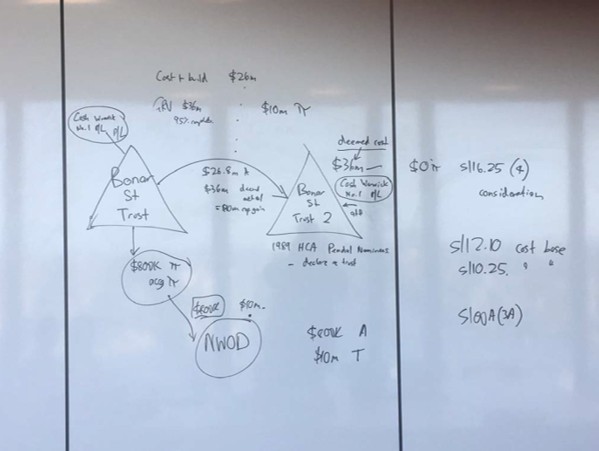
Note 1: Those 2 subsections relate to forestry managed investment schemes.
Note 2: The effect of this subsection is that a scheme will have been implemented in a way that is materially different from that described in a product ruling if the tax outcome for participants in the scheme is the same as that described in the ruling only because of the operation of the subsections mentioned in paragraphs (a) and (b).
Civil penalty
(3) If the Federal Court of Australia is satisfied, on application by the Commissioner, that an entity has contravened subsection (1) or (2), the Court may order the entity to pay a civil penalty to the Commonwealth.
10 “Entity” is defined in s 960-100 of the Income Tax Assessment Act 1997 (Cth) (ITAA97) (which is picked up by s 3AA(2) of the TAA) so as to include an individual, a body corporate, a partnership and a trust. Each of Mr White and the persons to whom he is alleged to have promoted the specific schemes was thus an “entity” at the time of the conduct alleged by the Commissioner. Each of the companies and trusts to which the alleged schemes related, and to which payments were directed, was also an “entity”.
11 Section 290-50 of the TAA Sch 1 is subject to various exceptions which are set out in s 290-55. These are not presently relevant, except for s 290-55(4) which imposes a limitation period on applications to this Court by the Commissioner. It is discussed below.
“Promoter”
12 “Promoter”, for the purposes of s 290-50, is defined by s 290-60 of the TAA Sch 1 as follows.
290-60 Meaning of promoter
(1) An entity is a promoter of a *tax exploitation scheme if:
(a) the entity markets the scheme or otherwise encourages the growth of the scheme or interest in it; and
(b) the entity or an *associate of the entity receives (directly or indirectly) consideration in respect of that marketing or encouragement; and
(c) having regard to all relevant matters, it is reasonable to conclude that the entity has had a substantial role in respect of that marketing or encouragement.
(2) However, an entity is not a promoter of a *tax exploitation scheme merely because the entity provides advice about the *scheme.
(3) An employee is not to be taken to have had a substantial role in respect of that marketing or encouragement merely because the employee distributes information or material prepared by another entity.
Marketing a scheme or otherwise encouraging its growth
13 As the Full Court (Allsop CJ, Gilmour and Gordon JJ) pointed out in Commissioner of Taxation v Ludekens [2013] FCAFC 100; 214 FCR 149 at [251] (Ludekens), the term “markets” in s 290-60(1)(a) appears to be one exemplification of the broader expression “encourages the growth of the scheme or interest in it”. Their Honours went on to note that “growth” of a scheme and “interest” in a scheme relate to numbers of people participating in the scheme or considering doing so and the quantum of their contribution; so that the terms “markets” and “encourages” may be seen to involve some element of communication. However, such communication need not be explicit or direct. People may be “encouraged” to participate in a scheme by “conduct” other than speech or writing. Thus, the Full Court emphasised the breadth of s 290-60(1)(a) (at [250], [257]-[258]). The Court warned against both paraphrasing the statutory language and making categorical distinctions between “encouraging” the growth of or interest in a scheme and merely “implementing” the scheme (at [251], [256]). In this connection it should be noted that s 290-60(2) expressly provides that “merely” giving advice about a scheme does not make the adviser a “promoter” of the scheme. However, as their Honours observed at [258], that does not preclude the giving of advice from forming part of a course of conduct that amounts to promoting the scheme.
14 Consistently with this position, a wide variety of conduct has been identified in the cases as capable of amounting to marketing or otherwise encouraging the growth of a scheme: see Ludekens at [80], [86]-[106], [262], [268]-[277]; Commissioner of Taxation v Arnold (No 2) [2015] FCA 34; 324 ALR 59 at [79]-[83] (Edmonds J) (Arnold); Commissioner of Taxation v Rowntree [2020] FCA 1322; 112 ATR 143 at [80] (Rares J) (Rowntree). Examples found in the cases include:
(a) meeting with a prospective participant, offering them participation in the scheme, explaining to them how the scheme works, explaining the benefit of the scheme, providing them with information about the scheme, and providing assurances as to how the scheme works (Ludekens at [88], [91], [95]-[99], [262], [268], [269]);
(b) taking steps (such as the preparation of documents) that are necessary for the implementation of the scheme (Ludekens at [268], [269], [274]-[276]);
(c) forwarding documents relating to the scheme to a participant and asking the participant to sign and return them (Ludekens at [92], [93], [268]);
(d) forwarding documents relating to the scheme to a participant and asking the participant to forward those documents to their accountant to be used in the preparation of a tax return (Ludekens at [93], [101], [102], [177], [268], [269]);
(e) encouraging and procuring participants to sign documents to increase the financial dimensions of the scheme (Ludekens at [284]);
(f) explaining to the participant that even if they had already lodged their income tax return they are able to lodge an amendment in order to obtain the benefit of the scheme (Ludekens at [130], [145], [275], [276]); and
(g) supplying an element of the structure of the scheme (Arnold at [141]).
15 In Commissioner of Taxation v Bogiatto [2020] FCA 1139; 112 ATR 1 at [31] (Bogiatto), after referring to examples of conduct that had been held in earlier cases to support a finding that an entity had marketed or encouraged the growth of a scheme or interest in it, Thawley J observed:
In principle, steps taken after a scheme benefit has been obtained might fall within the statutory proscription. It all depends on the facts. For example, steps taken to assist taxpayers after a scheme benefit has been obtained from a mass marketed scheme, might encourage the growth of the scheme.
16 His Honour noted at [32] that such a conclusion might be more difficult to reach in the case of “a one-off tax exploitation scheme directed to one taxpayer”. Where only one taxpayer is involved and they have already been persuaded to participate in a tax exploitation scheme, and received a tax benefit from it, conduct by a putative promoter may well have no effect on the growth of the scheme or the taxpayer’s interest in it. However, even here, as his Honour said, “[i]t all depends on the facts” (at [31]). Helping the taxpayer to respond to a tax audit in relation to the subject matter of the scheme may encourage the taxpayer not to abandon the scheme or to be interested in further iterations of it. Perhaps more clearly, advising the taxpayer that the scheme is legally sound and they should not make any concessions is apt to encourage (continued) “interest” in the scheme.
17 More broadly, the discussion in Bogiatto illustrates that there is no necessary temporal division between marketing (or other forms of encouragement) and the implementation of a scheme. Things done by the putative promoter in the course of carrying a scheme into effect are capable of being seen as part of their conduct in marketing or otherwise encouraging the growth of (or interest in) the scheme. This point is relevant to the operation of the relevant limitation period because, as discussed below, time starts to run from the last act of promotion or encouragement.
Receiving consideration
18 “Consideration” includes the receipt of a monetary benefit such as a fee or the benefit of a contractually binding promise to pay (eg Bogiatto at [40]-[47]).
19 The consideration that must be received for the purposes of s 290-60(1)(b) is described as consideration “in respect of that marketing or encouragement” (ie, in respect of the activity that brings the entity within s 290-60(1)(a)). That concept is not limited to “consideration”, in a strict contract law sense, for that activity. The expression “in respect of”, and the statutory context (a regime directed at deterring the promotion of tax avoidance and evasion schemes: cf Bogiatto at [35]) call for a broader, non-technical construction. Thus, a monetary benefit which the proponent receives or stands to receive following the implementation of a scheme may qualify as consideration “in respect of” their marketing or encouragement of the scheme. This was a conclusion reached, obiter, by Middleton J at first instance in Commissioner of Taxation of the Commonwealth of Australia v Ludekens [2013] FCA 142 at [39]-[46], which was not called into question in the appeal to the Full Court. Rather, the Full Court in Ludekens appeared to endorse that view (at [286]) and held that consideration in the form of a commission referable to the number of woodlots purchased as part of the relevant scheme constituted consideration “in respect of” the marketing and encouragement of the scheme (at [288]).
20 Section 290-60(1)(b) is satisfied where “consideration” is received by the “entity” that engages in the relevant marketing or encouragement or by an “associate” of that entity. The meaning of “associate” for this purpose is governed by s 318 of the Income Tax Assessment Act 1936 (Cth) (ITAA36) (which is picked up by s 995-1(1) of the ITAA97 and that in turn is picked up by s 3AA(2) of the TAA). Relevantly here, s 318(1) provides as follows.
(1) For the purposes of this Part, the following are associates of an entity (in this subsection called the primary entity) that is a natural person (otherwise than in the capacity of trustee):
(a) a relative of the primary entity;
(b) a partner of the primary entity or a partnership in which the primary entity is a partner;
(c) if a partner of the primary entity is a natural person otherwise than in the capacity of trustee—the spouse or a child of that partner;
(d) a trustee of a trust where the primary entity, or another entity that is an associate of the primary entity because of another paragraph of this subsection, benefits under the trust;
(e) a company where:
(i) the company is sufficiently influenced by:
(A) the primary entity; or
(B) another entity that is an associate of the primary entity because of another paragraph of this subsection; or
(C) another company that is an associate of the primary entity because of another application of this paragraph; or
(D) 2 or more entities covered by the preceding sub-subparagraphs; or
(ii) a majority voting interest in the company is held by:
(A) the primary entity; or
(B) the entities that are associates of the primary entity because of subparagraph (i) of this paragraph and the preceding paragraphs of this subsection; or
(C) the primary entity and the entities that are associates of the primary entity because of subparagraph (i) of this paragraph and because of the preceding paragraphs of this subsection.
21 Section 318(1)(d) needs to be read with s 318(6)(a), which provides:
a reference to an entity benefiting under a trust is a reference to the entity benefiting, or being capable (whether by the exercise of a power of appointment or otherwise) of benefiting, under the trust, either directly or through any interposed companies, partnerships or trusts; …
22 It will be recalled that the ITAA97 defines the term “entity” to include a “trust” (even though a trust is not a legal person). Section 318 of the older Act refers to “a trustee of a trust”. However, nothing of present moment turns on this.
Substantial role in respect of the marketing or encouragement
23 Section 290-60(3) of the TAA Sch 1 provides an example of conduct that does not amount to playing a “substantial role” in the relevant marketing or encouragement for the purposes of s 290-60(1)(c): doing no more than distributing information or material prepared by another entity. However, the inclusion of the word “merely” in s 290-60(3) indicates that a “substantial role” might be something not much more significant than the mere distribution of material. This supports the view, expressed by Thawley J in Bogiatto at [52] quoting Commissioner of Taxation v Consolidated Media Holdings Ltd [2012] HCA 55; 250 CLR 503 at [24] (French CJ, Hayne, Crennan, Bell and Gageler JJ), that an entity may be held to have had a substantial role “even if the entity’s role was not ‘integral to the operation and growth of the scheme, such that without them, the scheme would not have been established and widely promoted’”.
Merely advising
24 An entity is not a “promoter” of a tax exploitation scheme “merely because the entity provides advice about” the scheme (s 290-60(2)). In Ludekens, the Court said at [258]:
It is an express legislative directive that “mere advice” is itself insufficient to satisfy s 290-60(1)(a). However, that legislative directive does not preclude the possibility that advice, in combination with other conduct, may satisfy s 290-60(1)(a). The circumstances of each case must be considered.
25 This, with respect, is clearly correct. I would add that there is also potential for the provision of advice itself to overlap with or amount to promoting or encouraging interest in a scheme. In Rowntree at [268]-[269], Rares J rejected an attempt by one of the respondents to rely on s 290-60(2) on the basis of findings that, in sending information about the relevant scheme to taxpayers by email, the respondent was furthering his collaboration with another of the respondents and “encapsulated the sales pitch” in relation to the relevant scheme. It is implicit in this reasoning (and apparent from the terms of the provision) that there is a difference between “merely” providing advice about a scheme (as an independent, disinterested lawyer or tax adviser might do) and giving advice calculated to encourage interest in a scheme or discourage withdrawal from it. The inclusion of the term “merely” emphasises that what is excluded from the concept of promotion is the provision of independent “advice” about a scheme that is unaffected by any incentive or commitment to encourage interest in the scheme.
“Tax exploitation scheme”
26 “Scheme” is defined in s 995-1(1) of the ITAA97 to mean “any arrangement” or “any scheme, plan, proposal, action, course of action or course of conduct, whether unilateral or otherwise”. “Tax exploitation scheme” is defined in s 290-65 of the TAA Sch 1, for the purposes of s 290-50(1), as follows:
290-65 Meaning of tax exploitation scheme
(1) A *scheme is a tax exploitation scheme if, at the time of the conduct mentioned in subsection 290-50(1):
(a) one of these conditions is satisfied:
(i) if the scheme has been implemented—it is reasonable to conclude that an entity that (alone or with others) entered into or carried out the scheme did so with the sole or dominant purpose of that entity or another entity getting a *scheme benefit from the scheme;
(ii) if the scheme has not been implemented—it is reasonable to conclude that, if an entity (alone or with others) had entered into or carried out the scheme, it would have done so with the sole or dominant purpose of that entity or another entity getting a scheme benefit from the scheme; and
(b) one of these conditions is satisfied:
(i) if the scheme has been implemented—it is not *reasonably arguable that the scheme benefit is available at law;
(ii) if the scheme has not been implemented—it is not reasonably arguable that the scheme benefit would be available at law if the scheme were implemented.
Note: The condition in paragraph (b) would not be satisfied if the implementation of the scheme for all participants were in accordance with binding advice given by or on behalf of the Commissioner of Taxation (for example, if that implementation were in accordance with a public ruling under this Act, or all participants had private rulings under this Act and that implementation were in accordance with those rulings).
(2) In deciding whether it is *reasonably arguable that a *scheme benefit would be available at law, take into account any thing that the Commissioner can do under a *taxation law.
Example: The Commissioner may cancel a tax benefit obtained by a taxpayer in connection with a scheme under section 177F of the Income Tax Assessment Act 1936.
Sole or dominant purpose of getting a scheme benefit
27 “Scheme benefit” is defined in s 284-150(1) of the TAA Sch 1 as follows.
(1) An entity gets a scheme benefit from a *scheme if:
(a) a *tax-related liability of the entity for an accounting period is, or could reasonably be expected to be, less than it would be apart from the scheme or a part of the scheme; or
(b) an amount that the Commissioner must pay or credit to the entity under a *taxation law for an accounting period is, or could reasonably be expected to be, more than it would be apart from the scheme or a part of the scheme.
28 A “tax-related liability” is defined by s 255-1 of the TAA Sch 1 as a pecuniary liability to the Commonwealth arising directly under a taxation law, including one that is not yet due and payable, other than certain civil penalties. Relevantly here, income tax is specified as a type of “tax-related liability” under the ITAA97 at item 37 in the table in s 250-10(2) of Sch 1. Thus, if the implementation of a scheme results in an entity’s income tax liability being less than it would otherwise have been, the entity gets a “scheme benefit” from the scheme.
29 It will be noted that s 284-150 refers to a “liability” on the one hand (including one that is not yet due and payable), and an “amount that the Commissioner must pay or credit” on the other. A “scheme benefit” may therefore arise when tax is assessed in a particular amount for an income year. It does not arise only when the tax falls due or is paid, or a refund is made. However, this point is not central to the existence of a tax exploitation scheme, because s 290-65 looks to the obtaining of a scheme benefit as the sole or dominant purpose of an entity carrying out the scheme rather than the actual obtaining of a scheme benefit. Section 290-65(1)(a) is satisfied if (relevantly here) an entity that enters into or carries out the scheme has the sole or dominant purpose of reducing its (or another entity’s) income tax liability. Thus, at the point in time that needs to be considered for this purpose (ie, the time of the conduct that constitutes promotion), any “scheme benefit” may lie in the future.
30 What must be considered is the “sole” or “dominant purpose” (ie, the ruling, prevailing or most influential purpose) of the entity that (alone or with others) entered into or carried out the scheme: Rowntree at [301]-[302].
31 The Full Court in Ludekens observed at [227] that:
The correct framework of analysis is whether, at the time of the conduct in s 290-50(1) (being the marketing or otherwise encouraging the growth of the scheme or interest in it), “it is reasonable to conclude” that the entity entered into or carried out the scheme (or would have) with the purpose of it, or another entity, getting a scheme benefit from the scheme.
32 Their Honours’ focus on the time of the conduct in s 290-50(1) (which was reiterated at [240]) obviously aligns with the chapeau of s 290-65(1). Their approach was elaborated upon by Rares J in Rowntree at [302]-[303], emphasising that there must be an inquiry as to what was “actually in the mind” of the entity as the sole or dominant purpose of the relevant conduct.
33 Section 290-65(1)(a) thus calls for an assessment of what “it is reasonable to conclude”, as at the time of the promotion or other encouragement of the scheme, about the purpose of a person entering into or carrying out the scheme. That entering into or carrying out may occur after the point in time with respect to which the assessment is to be made, or (as contemplated by s 290-65(1)(a)(ii)) it may not occur at all. The question is therefore an objective one and must sometimes be undertaken in circumstances where there is no actual scheme participant whose state of mind can be identified. The observation in Rowntree at [302]-[303] that there must be an inquiry as to what “actually was in the mind” of the entity therefore cannot be applied generally (cf Ludekens at [232]).
34 The preferable reading of s 290-65(1)(a) is that it directs attention to the character of the scheme being promoted, although this does not deny that the subjective intentions of those who enter into the scheme or seek to do so may be relevant to this assessment. The question to be addressed, by reference to the time of the relevant promoting conduct, is whether the scheme is one as to which it is “reasonable to conclude” that an entity carrying it into effect was (if the scheme has been implemented) or would be (if it has not at that stage been implemented) principally motivated by the purpose of getting (or some other entity getting) a scheme benefit. This approach aligns with s 290-65(1)(b), which raises another question as to the nature or character of the scheme as at the time it was being promoted or encouraged.
Not reasonably arguable that the scheme benefit is (or would be) available at law
35 “Reasonably arguable” is defined by s 284-15 of the TAA Sch 1 as follows:
284-15 When a matter is reasonably arguable
(1) A matter is reasonably arguable if it would be concluded in the circumstances, having regard to relevant authorities, that what is argued for is about as likely to be correct as incorrect, or is more likely to be correct than incorrect.
Note: For the effect of transfer pricing documentation on when a matter is reasonably arguable, see Subdivision 284-E.
(2) To the extent that a matter involves an assumption about the way in which the Commissioner will exercise a discretion, the matter is only reasonably arguable if, had the Commissioner exercised the discretion in the way assumed, a court would be about as likely as not to decide that the exercise of the discretion was in accordance with law.
(3) Without limiting subsection (1), these authorities are relevant:
(a) a *taxation law;
(b) material for the purposes of subsection 15AB(1) of the Acts Interpretation Act 1901;
(c) a decision of a court (whether or not an Australian court), the *AAT or a Board of Review;
(d) a *public ruling.
36 The language of the chapeau of s 290-65(1) makes it clear that the question whether it is “reasonably arguable” that a scheme benefit is available at law is to be addressed as at the time of the conduct constituting promotion. This was confirmed by Thawley J in Bogiatto at [62].
37 The word “about” was inserted into s 284-15(1) by the Tax Laws Amendment (Improvements to Self Assessment) Act (No 1) 2005 (Cth) with effect from 29 June 2005. Before then, the subsection in its terms required that “what is argued for is as likely to be correct as incorrect”. Thawley J referred to this amendment in Bogiatto and observed that the phrase “about as likely” in s 284-15(1) and (2) should not be treated as if it said “as likely” (at [64]). In other words, a 50 per cent or greater chance of success need not be established in order for the availability of the relevant scheme benefit to be “reasonably arguable”. Put another way, and bearing in mind that the burden lies on the Commissioner to show that the scheme benefit was not reasonably arguable, s 290-65(1)(b) requires the Court to be satisfied that the prospects of arguing successfully for the availability of the scheme benefit were (or would have been) clearly less than even.
38 The concept of “reasonably arguable” also applies in the context of the imposition of penalties, where the starting point will usually if not always be a decision that the position taken by the taxpayer was wrong. In that context, in Cameron Brae Pty Limited v Commissioner of Taxation [2007] FCAFC 135; 161 FCR 468 at [70] (Cameron Brae), Stone and Allsop JJ considered it to be “clear” that a payment was of a capital nature but nevertheless said that the question whether it was properly characterised as capital or revenue was “reasonably open and arguable” and “open to debate in the sense of being arguable”. This was in circumstances where, as their Honours observed, no authority squarely covered the point and the proper interpretation depended on a construction “informed by a full appreciation of the statutory history”. This approach was endorsed and applied by the Full Court (Keane CJ, Greenwood and Middleton JJ) in Allen (Trustee), in the matter of Allen’s Asphalt Staff Superannuation Fund v Commissioner of Taxation [2011] FCAFC 118; 195 FCR 416 at [75] (Allen).
39 In Cameron Brae, the relevant provision was s 226K of the ITAA36, which imposed penalty tax in circumstances where (among other things) it was “not reasonably arguable” that the view of the law taken by the taxpayer was correct. No reference was made to any definition of the expression “reasonably arguable”. Allen also involved the application of s 226K. Thawley J noted in Bogiatto at [67] that the relevant definition of “reasonably arguable” in Allen was s 285-15(1) of the TAA Sch 1, before the amendment referred to above which inserted the word “about”. However, no reference is made in the reasons to s 285-15. Rather than grappling with a statutory definition of “reasonably arguable”, the Court in both cases seems to have treated a statement by Hill J in Walstern v Federal Commissioner of Taxation [2003] FCA 1428; 138 FCR 1 at [108] (Walstern) as the starting point. The phrase “reasonably arguable” was defined for the purposes of s 226K in Walstern, by s 222C of the ITAA36, in similar terms to the current language of s 284-15(1). The Full Court in Allen regarded Cameron Brae as having taken a less strict approach than Walstern but noted that the latter case had involved a question of statutory construction rather than an understanding of the underlying facts.
40 One difficulty with this line of cases is that the tests applied are not explained by reference to the applicable definition of “reasonably arguable”. Another is that the result reached in Allen is, with respect, difficult to reconcile with the then-applicable version of s 284-15(1) (which, in its terms, required the taxpayer’s position to be “as likely” to be correct as incorrect). Pagone J considered these cases in detail in D Marks Partnership by its General Partner Quintaste Pty Ltd v Commissioner of Taxation [2016] FCAFC 86; 245 FCR 247 at [166]-[175] (Marks Partnership) and said (at [170]-[171], [175]):
The test is not whether a position argued for is arguable in a more general sense and the test is not satisfied because something has been argued cogently or at length by senior counsel. Penalties imposed under tax legislation are an integral and underpinning feature of the taxation regime. The imposition of penalties is not dependent upon whether an incorrect position is “arguable” in a general sense, but the penalties may be reduced if the specific test of “reasonably arguable” is satisfied …
The legislature plainly intended the test of “reasonably arguable” to be different from, and be a more rigorous standard than, the test of “reasonable care”: see Walstern at [106]-[108]. The legislature also intended the test to be objective and to be determined by reference to authorities. The provisions were aimed to ensure that people who had made an honest and genuine attempt correctly to determine their taxable income would not be penalised. The provisions were not intended to support or encourage doubtful or dubious positions to be taken but to be relied upon where the taxpayers arguments were, to adopt the language in the Explanatory Memorandum referred to in Walstern at [107], “cogent, well-grounded and considerable in its persuasiveness”.
It was for the taxpayers to establish that their construction was not just argued, but that it satisfied the statutory test of being reasonably arguable, and they have failed to do so. The taxpayers did not, for instance, rely upon or point to a public ruling or an opinion by experienced independent senior counsel or other adviser dealing with the specific point (c.f. Walstern at [112]) which independently supported the construction they advanced. A taxpayer relying only upon the terms of a provision to advance an unsuccessful construction of a provision must do more than argue for its construction for it to be reasonably arguable in the statutory sense. There needs to be a foundation for the court to conclude that the unsuccessful argument was, despite its rejection, nonetheless ‘a close call’ (to use a popular expression).
41 Pagone J was in the minority on this aspect of Marks Partnership. Griffiths J particularly disagreed with any suggestion that the taxpayer’s position needed to be “supported by some external reference point” in order to be “reasonably arguable” (at [117]) and preferred to “avoid an approach to the construction of s 284–15 which involves paraphrasing the terms of that provision or substituting for those terms a test which is designed to give effect to the provision by reference to different terminology” (at [125]). Otherwise, I understand the difference between Griffiths and Pagone JJ to flow from different assessments of the particular circumstances of the case. Logan J preferred the view of Griffiths J (at [91]) but did not find it necessary to decide the issue.
42 Accepting that it is dangerous to substitute a judicial paraphrase for the words of a provision, the analysis by Pagone J in Marks Partnership is a useful attempt to explain the statements in Cameron Brae and Allen by reference to the statutory definition of “reasonably arguable”. Given the express requirement in s 284-15(1) that the taxpayer’s position must have appeared “about as likely as not to be correct” by reference to “the relevant authorities”, it cannot be sufficient that the position was capable of being seriously put, was not foreclosed by binding authority or was not obviously untenable.
Limitation period
43 Subsections 290-55(4) and (6) currently provide as follows:
Time limitation
(4) The Commissioner must not make an application under section 290-50 in relation to an entity’s involvement in a *tax exploitation scheme more than 6 years after the entity last engaged in conduct that resulted in the entity or another entity being a *promoter of the tax exploitation scheme.
…
(6) However, the limitation in subsection (4) or (5) does not apply to *schemes that involve, or if implemented would involve, tax evasion.
The relevant limitation period
44 Until 1 July 2024, s 290-55(4) specified a limitation period of four years. The provision was amended so as to extend the limitation period to six years by item 20 of Sch 1 to the Treasury Laws Amendment (Tax Accountability and Fairness) Act 2024 (Cth) (the 2024 Act), which came into effect on that date. Item 37(2) of Sch 1 to the 2024 Act provides that the amendments made by item 20 “apply in relation to conduct engaged in before, on or after the commencement of this Schedule”.
45 Section 290-50 creates a statutory norm of conduct, with a right vested in the Commissioner to sue for remedies in respect of its breach. The limitation period in s 290-55(4) was therefore integral to that right; and an amendment to that limitation period would normally be understood not to apply to a right of action that had already accrued. In particular, an amendment would not normally apply so as to revive a right of action that had expired: see, eg, McKain v RW Miller & Co (South Australia) Pty Limited (1991) 174 CLR 1 at 42–44 (Brennan, Dawson, Toohey and McHugh JJ). However, item 37(2) is a clear expression of legislative intention that the modified limitation period was to apply to all past conduct (including conduct in relation to which the four-year limitation period had already expired).
46 The Explanatory Memorandum to the Bill for the 2024 Act supports this understanding. That memorandum said (at [1.26]):
The extended timeframe available to the Commissioner applies in relation to conduct engaged in before, on or after the commencement of the amendments. This means the ATO is in a better position to take action against promoters that are in breach of the provisions before commencement of the amendments, for example in cases where the ATO becomes aware of the promotion of a scheme during a taxpayer audit, a considerable time after the conduct occurred
47 The memorandum went on to give the following specific example of what items 20 and 37(2) were intended to do.
On 30 June 2024, the ATO is in the process of gathering evidence in relation to conduct of a tax practitioner who last promoted a tax exploitation scheme 5 years ago. The 6-year time period applies so that the ATO can make an application to the Federal Court for the imposition of a civil penalty on the tax practitioner.
48 It is therefore clear, at least, that a proceeding could be commenced after 30 June 2024 in respect of a scheme that was promoted up to six years before the proceeding was commenced (even if, as at 30 June 2024, the right of action had expired). What is less clear is the status of a proceeding that had been commenced before 30 June 2024 in relation to a scheme that had last been promoted between four and six years before the proceeding was commenced. This issue is explored further below.
Schemes involving tax evasion: s 290-55(6)
49 Complexities concerning the application of s 290-55(4) do not need to be resolved in the case of a scheme that comes within s 290-55(6). In such a case, no limitation period applies.
50 Section 290-55(6) was also amended by the 2024 Act. Prior to the commencement of Sch 1 of that Act on 1 July 2024, it applied only to “a scheme involving” tax evasion. That is, it was not expressed to apply to a scheme which “if implemented would involve” tax evasion.
51 Section 290-55(6) operates to disapply the limitation period in s 290-55(4) in a defined class of case. Like s 290-55(4), whose operation it affects, s 290-55(6) is integral to the conferral of the right of action in s 290-50; so that, absent some expression of a contrary intention, an amendment to s 290-55(6) applies only prospectively and not to a right of action that has already accrued (or, a fortiori, one that has already expired).
52 Unlike the amendment to s 290-55(4) discussed above, the amendment to s 290-55(6) (which was effected by item 24 of Sch 1 to the 2024 Act) is not the subject of the transitional provision in item 37(2). Instead, by force of item 37(1), it applies “in relation to conduct engaged in on or after the commencement of this Schedule”.
53 It is therefore the pre-July 2024 version of s 290-55(6) that applies in this case. Accordingly, s 290-55(4) applies (in the manner described above) to the claim for relief in relation to each of the alleged schemes unless the scheme was one “involving tax evasion”.
54 “Tax evasion” is not a defined term; however, it has a reasonably well settled meaning. The reference in s 290-5(a) (which outlines the objects of Div 290) to “tax avoidance schemes” and “tax evasion schemes” indicates that these are different concepts (cf Rowntree at [355]). This is in accordance with the meaning given to the expression “tax evasion” in Australian cases in a range of statutory contexts.
55 In Denver Chemical Manufacturing Company v The Commissioner of Taxation (New South Wales) (1949) 79 CLR 296 at 313 (Denver Chemical), Dixon J (with whom McTiernan, Williams and Webb JJ agreed) said:
I think it is unwise to attempt to define the word “evasion.” The context of s. 210 (2) shows that it means more than avoid and also more than a mere withholding of information or the mere furnishing of misleading information. It is probably safe to say that some blameworthy act or omission on the part of the taxpayer or those for whom he is responsible is contemplated. An intention to withhold information lest the commissioner should consider the taxpayer liable to a greater extent than the taxpayer is prepared to concede, is conduct which if the result is to avoid tax would justify finding evasion.
56 Despite his Honour’s reluctance to define the term “tax evasion”, this passage has often been cited and treated as effectively defining the concept. It was referred to in connection with s 290-55(6) in Rowntree at [356] and in Bogiatto at [79]. In the latter case at [80], Thawley J also quoted the following statement by Gleeson CJ (with whom Sully and Bruce JJ agreed) in R v Meares (1997) 37 ATR 321 at 323 (Meares).
Although on occasion, it suits people for argumentative purposes, to blur the difference, or pretend that there is no difference, between tax avoidance and tax evasion, the difference between the two is simple and clear. Tax avoidance involves using, or attempting to use, lawful means to reduce tax obligations. Tax evasion involves using unlawful means to escape payment of tax. Tax avoidance is lawful and tax evasion is unlawful. Although some people may feel entitled to disregard that difference, no lawyer can treat it as unimportant or irrelevant. It is sometimes said that the difference may be difficult to recognise in practice. I would suggest that in most cases there is a simple practical test that can be applied. If the parties to a scheme believe that its possibility of success is entirely dependent upon the revenue authorities never finding out the true facts, it is likely to be a scheme of tax evasion, not tax avoidance.
57 Generally, therefore, while “tax avoidance” involves structuring transactions or affairs so as to reduce the incidence of tax (albeit usually in a way that is seen as contrary to the intention of the legislation and therefore undesirable), “tax evasion” involves deliberate concealment or provision of misleading information designed to evade payment of the tax properly due. As Basten JA observed in Chief Executive Officer of the Australian Customs Service v Karam [2011] NSWCA 224; 252 FLR 326 at [19], the formulation in Denver Chemical involves a state of mind (that the true information could give rise to tax liability) and an intention or purpose (to avoid such liability).
58 The relevant state of mind and intention or purpose are not necessarily those of the taxpayer; fraudulent conduct by an agent of the taxpayer may be a sufficient basis to conclude that evasion has occurred (Rowntree at [358], citing Kajewski v Federal Commissioner of Taxation [2003] FCA 258; 52 ATR 455 at [114] (Drummond J)). Thus, in the context of Subdiv 290 of the TAA, Thawley J found in Bogiatto that the promoter knew that the claims being advanced under the certain schemes were not “reasonably arguable” and was therefore satisfied that the schemes involved “evasion” (at [709]-[711]).
59 Thawley J also noted in Bogiatto at [81] that “tax evasion” has usually been understood to involve some tax actually being evaded or some beneficial tax outcome being obtained. On this basis, two of the tax exploitation schemes considered in that case, which had not been fully implemented and had not achieved any tax offset, were treated as not involving “tax evasion”. This reasoning was thus determinative of part of the issues in the case and should be followed unless it is plainly wrong (which, in my view, it is not).
60 It is for this reason that the conclusion expressed above, that the pre-July 2024 version of s 290-55(6) applies in this case, is potentially significant. To the extent that any of the schemes alleged to have been promoted in the present case was not implemented up to the point of an entity obtaining a tax benefit, those schemes did not “involve” tax evasion and do not come within the applicable version of s 290-55(6).
When is tax evaded?
61 The need for the Commissioner to demonstrate that some amount of tax was evaded, in order to bring schemes within s 290-55(6), makes it potentially necessary to consider whether there can be said to have been “tax evasion” in circumstances where the tax consequences of the scheme are reversed by action taken after the taxpayer’s return for the relevant income year has been lodged.
62 In each of the schemes considered below, the trustee was a company and was therefore a “full self-assessment taxpayer” as defined in s 6(1) of the ITAA36. Where such a taxpayer lodges an original return for an income year, the Commissioner is deemed by s 166A(3) of the ITAA36 to have made an assessment of the taxpayer’s taxable income and tax payable, in accordance with what is specified in the return, on the day on which the return is lodged. It is the making of an assessment or deemed assessment that crystallises the liability to pay tax (ITAA97, s 5-5) and fixes (subject to any later amended assessment) the amount of income tax that will become due and payable (TAA Sch 1, s 350-10). Accordingly, if the return involves a “blameworthy act or omission” (Denver Chemical at 313) intended to reduce tax liability, tax is “evaded” when the return is lodged (even if subsequent action by the ATO, leading to an amended assessment, reverses that position).
63 As will appear below, the Commissioner relies on s 290-55(6) only in respect of the Bonar Street scheme (noting, however, that that scheme is also alleged to be an iteration or implementation of the larger tax loss access scheme). I understand this position to have been taken on the basis that it was only the Bonar Street scheme that was successfully implemented up to the stage of the necessary documents being executed and a return filed in reliance on them.
MR GRUJOSKI: OUTLINE OF EVENTS
64 Since around 2012, Mr Grujoski has been a property developer. Two of his development projects are relevant to this proceeding: the Bonar Street development (which involved the construction of 55 units at 63-69 Bonar Street, Arncliffe, NSW); and the Kings Court development (which involved the construction of 72 units at 9 Derwent Street and 832-836 King Georges Road, South Hurstville, NSW).
65 For the purpose of his business, Mr Grujoski controlled a significant number of corporate entities. From around 2013, he adopted the practice of placing assets into trusts for the purpose of carrying on developments. Cash Warwick Pty Ltd (CWPL) was incorporated on 27 June 2013, and on 21 August 2013 Mr Grujoski signed the deed to establish a trust (the Kings Court Trust) with CWPL as the trustee. From August 2013 until April 2017, CWPL began acquiring properties that would in due course become the site of the Kings Court development.
66 On 14 October 2013, Cash Warwick No 1 Pty Ltd (CW1) was incorporated, and on 13 November 2013 Mr Grujoski signed the deed to establish a trust known as the Bonar Street Discretionary Trust (BSDT) with CW1 as the trustee. On 5 December 2014, CW1 acquired properties that in due course became the site of the Bonar Street development.
67 Around 2015, Mr Grujoski decided to change accountants. Mr Leontios was recommended to him and he engaged Mr Leontios to provide accounting services for all of his companies and trusts (as well as preparing his personal tax returns). Mr Leontios’s accounting practice was called Sophos Accountants.
68 Mr Leontios was referred to Mr White in 2015 or 2016 by a contact at Mr Leontios’s previous firm, when he needed help advising some clients about the tax consequences of moving overseas. Between 2016 and 2022, Mr Leontios referred four or five clients to Mr White when they needed advice about matters which he considered were beyond his expertise. Mr Leontios deposed in his affidavit that he trusted Mr White’s advice because he was much more experienced than Mr Leontios, he was also a lawyer, and he was a partner at EY which was considered one of the top four accounting firms in Australia.
69 In October 2016, Mr Grujoski asked Mr Leontios for advice about whether he was using the best structure for the Bonar Street development. Mr Leontios was not aware of a better structure and suggested that Mr Grujoski seek advice from Mr White. He arranged a meeting between Mr Grujoski, Mr White and himself.
Bonar Street: involvement of Mr White
Initial discussions
70 The first meeting between Mr White, Mr Grujoski and Mr Leontios took place on 4 November 2016 at EY’s offices in Sydney (the first Grujoski meeting). There was some discussion of the nature of Mr Grujoski’s business undertakings and steps he could take to reduce his tax liability. Some of these steps involved Mr Grujoski and his family moving overseas, which he had no interest in doing. According to Mr Grujoski, Mr White said that there could be another option which he would need to consider further.
71 There are some differences between the accounts of the first Grujoski meeting given by Mr Grujoski, Mr Leontios and Mr White, to which it will be necessary to return. Mr White purported to recall the meeting in much greater detail than Mr Grujoski or Mr Leontios, even though it was a more unusual event for them than for him. He may have been assisted in this instance by having his own handwritten notes of the meeting (although, as discussed below, one of the striking features of Mr White’s evidence was the detail of his purported recollection of discussions with clients).
72 There was a second meeting between Mr Grujoski, Mr Leontios and Mr White on 19 December 2016 (the second Grujoski meeting). This meeting was also organised at the request of Mr Leontios and also took place at EY’s offices. Again, there are differences in the evidence of the participants as to what was said at this meeting, which it will be necessary to address later.
73 However, it seems clear that Mr White proposed a series of transactions which he explained by drawing a diagram on a whiteboard. Mr White sent an image of the whiteboard to himself at 6.04 pm that day. The image is as follows:
74 The figure of $26 million, shown as “cost to build” at the top of the image, and $36 million as “GRV” (which I take to mean gross value), reflect what (at least on Mr White’s account) Mr Grujoski told him were the costs and expected return for the Bonar Street development. These figures pointed to a $10 million profit, as indicated at the top of the image. The scheme illustrated here seems to involve:
(a) transfer of the property from the BSDT to a “Bonar St Trust 2”, with the same trustee (CW1), for $26.8 million (considerably less than its market value), but with a “deemed” value (and a “deemed cost” to the second trust) of $36 million and therefore an approximately $10 million capital gain to the BSDT; and
(b) “$800K” passing from the BSDT to NWOD, with annotations reading “$800K A” and “$10m T” (which, in context, appear to be shorthand for an “accounting” value and a “taxable” value).
75 The image also refers to some other things which, I infer, were mentioned by Mr White in the course of explaining the proposed scheme.
(a) “1989 HCA Pendal Nominees” is evidently a reference to Commissioner of Stamp Duties (New South Wales) v Pendal Nominees Proprietary Limited (1989) 167 CLR 1 (Pendal Nominees), which was a decision concerning the application of stamp duty to a specific form of assignment to a trustee.
(b) “s112.10 cost base”, as Mr White observed in cross-examination, contained an error: the reference was intended to be to s 112-20 of the ITAA97, which provides for the market value of an asset sold in a non-arm’s-length transaction to be substituted for the actual sale price for capital gains tax purposes (referred to as “market value substitution”).
(c) “s100A(3A)” was a reference to s 100A(3A) of the ITAA36. Section 100A(1) provides that a beneficiary of a trust estate whose entitlement to a share of the income of the trust arises out of (or in connection with) a “reimbursement agreement” is deemed not to be entitled to that income. Section 100A(3A) creates an exception to that rule in the case of a beneficiary who becomes entitled in its capacity as trustee of another trust, where a beneficiary of that other trust is presently entitled to any income of that trust.
76 This makes it reasonably clear that, during this meeting, Mr White was explaining a series of transactions corresponding to those which are identified in the Commissioner’s case as comprising the tax loss access scheme. The assets of the Bonar Street development could be transferred to a new trust in a manner which would allow the profits to flow to the new trust (and be distributable to its beneficiaries) but be deemed for tax purposes to flow to NWOD (which would not have to pay tax because of its accumulated losses). The areas of factual controversy (which are explored below) relate mainly to whether Mr White “promoted” this scheme or merely advised on it, and the reasons why Mr Grujoski was interested in it.
77 Later on 19 December 2016, Yash Makharia of EY sent an email to Mr Leontios (copied to Mr White) attaching an EY Master Tax Services Agreement. Mr Leontios signed the agreement on behalf of himself and Mr Grujoski on 20 December 2016. The Statement of Work forming part of that agreement provided, under the heading “Scope of service”, that EY would provide “ad-hoc tax advisory services”.
Preparation and execution of documents
78 Mr Leontios’s records show that he accepted calendar invitations for meetings with Mr White on 23 and 27 January 2017. However, he did not claim any recollection of meetings on these days and Mr White did not give evidence about them. It seems likely that there was some further discussion between Mr White and Mr Leontios around this time, because on 27 January 2017 Mr White sent an email to Sean Prater of EY Law (a division within the EY partnership that provided legal services such as the drafting of documents), instructing him as follows.
This is the trust which owns property at 63-69 Bonar Street, Arncliffe, together with 27 Booth Street, which are all now consolidated on one title – will need you to do a land title search.
Need your help in establishing a new discretionary trust, being the Bonar Street Discretionary Trust No.2, as follows:
Trustee: [CW1]
Settlor: Michael Leontios …
Settlement Sum: $550
Default Beneficiaries: Christopher Grujoski and Benjamin Grujowski, and Tamara Grujowski (being children of Novce Nick Grujoski)
Appointor: Novce Nick Grujoski
We then need to do a “Pendal Nominees” (by way of deed poll) for this property from [CW1] (in its capacity as trustee for the [BSDT]) to [CW1] as trustee for the Bonar Street Discretionary Trust No.2.
The sole purpose of the transfer of beneficial interests is to protect the development against the ongoing sub-contractor disputes and ongoing EPA remediation risk, albeit there is no change of trustee (so no need to alter the contracts for sale (per s82 of the Real Property Act)).
Please also do a memorandum/position paper to explain the duty exemption (per Stamp Duty Ruling SD128 …)
Michael has done some calculations which show total build/hold cost is $24.4m. The deed poll accordingly needs to operate to reposition the beneficial interests in the consolidated property for the sum of $25.4m (which will give rise to an accounting/trust law profit of $1m).
We also need to:
* nominate [NWOD] as a beneficiary of the Bonar Street Discretionary Trust ...
* Alter the definition of ‘net income’ … to instead being accounting (or trust law) income.
* Have Christopher, Benjamin & Tamara irrevocably renounce their interests as beneficiaries of the Bonar Street Discretionary Trust
* Prepare a 2017 trustee resolution which allocates all of the accounting profit to NWOD in the 2016/17 year.
79 Mr White also instructed Mr Prater in relation to another matter that had been discussed at the first Grujoski meeting: transfer of a one per cent interest in the Grujoski family home from Mr Grujoski’s wife to him.
80 On 31 January 2017, Mr White sent an email to Mr Leontios and Mr Grujoski. The email referred to a recent meeting between them but neither gave evidence about that meeting. Mr White’s email attached the following documents:
(a) a covering letter from Peter Vilaysack, a Senior Lawyer at EY Law;
(b) a draft Resolution of Sole Director of CW1, resolving that CW1 accept the office of trustee of the Bonar Street Discretionary Trust No 2 (the BSDT2) and execute the trust deed for that trust; and
(c) a draft trust deed for the BSDT2.
81 The executed copy of the trust deed for the BSDT2 bears the date 31 January 2017. It is signed by Mr Grujoski as the sole director of CW1 (the trustee) and by Mr Leontios as the settlor, with Mr White as witness. Mr Grujoski deposed that he signed the trust deed on 31 January 2017, but I am somewhat sceptical about this date because there is no other evidence of him having been in the same place as Mr White on that day. Mr Leontios deposed that he signed the trust deed but did not remember where or when he did so.
82 On 2 February 2017 at 12.48 pm, Mr Prater sent another set of documents to Mr White. These were:
(a) a deed of variation for the BSDT (to change the definition of “net income of the Trust Fund”);
(b) a deed of nomination of beneficiary for the BSDT nominating NWOD as an additional member of the class of general beneficiaries;
(c) a deed poll providing that CW1 was to cease to hold the beneficial interest in “the Property” for “Trust 1” and was to hold it on the terms and subject to “Trust 2”;
(d) a resolution of sole director of CW1 resolving to execute the deed of variation, the deed of nomination of beneficiary and deeds of renunciation received from the three existing beneficiaries (who were Mr Grujoski’s children); and
(e) deeds of renunciation for execution by the existing beneficiaries.
83 Mr Grujoski deposed to having executed these documents on 2 February 2017 at a meeting in the café on the ground floor of EY’s Sydney offices. Mr White and Mr Leontios were also present. Mr White called Mr Prater and asked him to bring the documents down. Copies of the first, second and fourth documents, bearing the handwritten date 2 February 2017 and apparently executed by Mr Grujoski, are among the exhibits to Mr White’s affidavit, with the signatures witnessed by Mr Prater. The third document (the deed poll) is not executed and Mr Prater’s covering email raises a question about the drafting of this document for Mr White’s consideration. The three deeds of renunciation are executed by Mr Grujoski on behalf of each of his children and also in his capacity as the director of CW1, witnessed by Mr Prater and dated 2 February 2017.
84 This is slightly mysterious because Mr White described this bundle of documents in his affidavit as “a copy of [Mr Prater’s] email, together with its attachments”, which is obviously a misdescription because the documents annexed to Mr Prater’s email were in electronic form and would not have been executed. For some unexplained reason, the executed versions of some documents have been inserted into the bundle in place of the drafts annexed to Mr Prater’s affidavit (and Mr White did not mention the execution of the documents in his affidavit). Also exhibited to Mr White’s affidavit was an email from Mr Prater of 20 February 2017 attaching the executed copies of the documents (now including the deed poll).
85 On 14 February 2017, Mr White sent an email to Mr Grujoski and Mr Leontios containing bank account details for NWOD and the RJB Family Trust (the RJB Trust).
86 On 15 February 2017, Mr Grujoski authorised a transfer of $1 million into an account held by CW1 as trustee for the BSDT2, followed by transfers from that account of $400,000 to the account of the RJB Trust and $600,000 to the account of NWOD. The fee discussed at the second Grujoski meeting had been $800,000, but at some stage (which Mr Grujoski does not remember) the agreed fee became $1 million. Mr Grujoski understood that both of the accounts to which he was transferring the funds were associated with NWOD. In fact, as will appear below, the RJB Trust was associated with and effectively controlled by Mr White.
87 On 8 March 2017, EY sent an invoice to Mr Leontios in the amount of $22,432.00 (including GST). The professional services listed in the invoice included preparation of the documents referred to above (by EY Law); meetings with Mr White on 19 December 2016, 27 January 2017 and 2, 14 and 28 February 2017; and correspondence with Mr White and Mr Prater.
88 Construction of the Bonar Street development was completed around April or May 2017. At some stage before 30 June 2017, Mr Grujoski signed a minute of a meeting of directors of CW1, as trustee for the BSDT, resolving that:
(a) the income of the trust be treated as including all amounts being income for the purpose of the trust’s accounting records less outgoings attributed to those amounts; and
(b) 100 per cent of profits be set aside for the benefit of NWOD.
89 The minute is dated 21 June 2017 and was attached to an email that Mr Leontios sent to Mr White on 30 June 2017. The email also attached draft accounts for the BSDT and the BSDT2 for Mr White’s review.
90 Mr Leontios had previously had some discussions with Mr White about the accounts and sent him an earlier draft of the accounts for the BSDT on 27 June 2017. Correspondence and discussions about the accounts and tax returns for the two trusts between Mr Leontios and Mr White continued up to the end of August 2017, with Mr White closely monitoring the preparation of the accounts. EY invoiced Mr Leontios on 18 July 2017 for services including “review of the Bonar Trust tax calculations” and meetings with Mr White on 9 and 21 June 2017. Mr Leontios lodged the tax returns of the BSDT and the BSDT2 for the 2017 income year on 10 October 2017 and 13 October 2017 respectively. On 2 November 2017 he lodged the tax return of CW1 for the 2017 income year.
Liquidation of CW1
91 Mr Grujoski and Mr Leontios gave evidence that Mr White had recommended earlier in 2017 that CW1 should be liquidated after the transaction was complete and recommended a liquidator, Daniel Civil of Jirsch Sutherland. Mr Grujoski was concerned that being a director of a company that went into liquidation might cause problems for him, and he learned from a solicitor that as an alternative the company could be deregistered rather than liquidated. On 18 September 2017, Mr Leontios sent an email to Mr White that said in part:
I spoke to Nick prior to going away last Wednesday and he seems to think that he doesn’t need to do a members voluntary liquidation but can rather just do a normal de-registration (he was advised by a solicitor). Still think it’s a good idea to meet with Daniel on the 23rd.
92 Mr White responded on 19 September 2017 as follows.
A F6010 strike off puts the company into a suspended state of consciousness, which is able to be reinstated (per s601AD of the Corporations Act) at any time. It is by no means ‘dead’, but merely catatonic. The books and records must be kept for the usual retention periods.
A members’ voluntary liquidation, once complete, is however final (with very limited exception) – it’s indeed ‘dead’. The Liquidator may (per s542(4) of the Corporations Act) notify/apply to ASIC that the books and records will be destroyed 3mths after the liquidation is complete.
A F6010 costs $100 (approx.)
A members’ vol costs $5.5k (approx.)
His call…
93 Mr Leontios forwarded this message to Mr Grujoski, who later asked his bank manager whether the liquidation of CW1 would cause any concern from his perspective. On 28 September 2017, Mr Leontios sent an email to Mr White reporting that the bank had encouraged Mr Grujoski to liquidate. However, Mr White deposed to a discussion around 23 October 2017 in which Mr Grujoski still expressed some concern about placing CW1 into liquidation and asked whether it could affect the attitudes of banks or his ability to be a director. Mr White reassured him that there would be no adverse effects because the company would not have any debts when it was placed into voluntary liquidation.
94 CW1 was wound up around late October 2017 by way of a members’ voluntary liquidation. Mr Leontios lodged a tax return for CW1 for the 2018 income year on 7 November 2017. Mr Civil, as liquidator, was issued a tax clearance by the ATO, which he provided to Mr White on 30 November 2017.
The ATO review
95 On 25 July 2018 Mr Leontios received a letter from the ATO informing him that it had started a review of Natali Grujoski (Mr Grujoski’s wife) and her group’s income tax affairs for the 2015 to 2018 income years. While the taxpayer formally under review was Mrs Grujoski, her affairs were closely entwined with those of her husband. It was Mr Grujoski who had directed the affairs of the various trusts and corporate entities that became the subject matter of the review and it was he who, with the assistance of Mr Leontios and Mr White, took on the burden of responding and seeking to protect the family’s position. I will refer to this review below as a “review of Mr Grujoski’s affairs”. Mr Leontios met Mr White on 3, 10, 14 and 21 August 2018 to discuss how Mr Leontios should respond to questions raised by the ATO in the review.
96 During the course of the review, the ATO sent several requests for information to Mr Leontios. Mr Leontios deposed that he discussed each of these requests with Mr White. On some occasions, Mr White provided written responses to send to the ATO and on others he told Mr Leontios what response should be made. Mr Grujoski also attended most of these meetings. Mr Leontios did not claim to have detailed records or specific recollections of most of these meetings, but calendar invitations in his computer records indicate when they occurred.
97 On 19 September 2018, Mr Leontios received requests for information from the ATO including in relation to CW1, the BSDT and the BSDT2. It appears that he met Mr White on 24 September 2018. On 2 October 2018 he responded by email to the ATO.
98 On 19 October 2018, Mr Leontios sent Mr White the agenda for an interview with ATO officers that was scheduled for 22 October 2018. A calendar invitation and a subsequent EY invoice indicate that Mr Leontios also met Mr White on 19 October 2018, presumably to discuss the upcoming interview. Mr Leontios and Mr Grujoski attended the interview with ATO officers on 22 October 2018. Mr White deposed that he did not advise Mr Grujoski or Mr Leontios about what to say at the interview. However, I have doubts about this in the light of the evidence that a meeting was at least arranged (and probably occurred) between him and Mr Leontios on 19 October 2018: Mr White had been deeply involved in the affairs of the BSDT and the BSDT2 and Mr Leontios was evidently accustomed to relying on his expertise.
99 Mr Leontios and Mr White had a meeting scheduled for the morning of 25 October 2018 at 8.30 am and I infer from the emails later in the day and the subsequent invoice that that meeting occurred. At 9.13 am, Mr White sent Mr Leontios an email (copied to Mr Grujoski) with the subject line “ATO draft response”, which said:
Bonar No.1 transferred its remaining interests in the Arncliffe development to Bonar No.2. The property transfers were made for total of (cost + $1m). When preparing the 2017 income tax return it was evident that market value substitution was required (per s70.90 of the ITAA1997) to properly bring to account the proper arm’s length consideration, which saw an adjustment to increase taxable income in Bonar No.1 of $9.7m (and a corresponding increase in cost base in Bonar No.2, per s70-95 of the ITAA1997). These properties were ultimately sold by Bonar No.2, with the market value cost base forming part of COGS (also per s70-95).
100 Later the same day Mr Leontios received another request for information from the ATO, again seeking information about CW1, the BSDT and the BSDT2 (among other issues). He forwarded the email to Mr White under cover of a message which said: “your input would be greatly appreciated”. Mr White replied that evening saying:
Most of these items are as discussed this morning – can I suggest you craft a draft response, send it through for review, and we can meet as required to settle it?
101 Further emails were exchanged seeking to settle on a date for a further discussion. Meetings were arranged for 5 and 6 November 2018.
102 Mr Leontios sent an email to the ATO, responding to its latest request for information, on 12 November 2018. The response in that email concerning the BSDT reproduced Mr White’s “draft response” of 25 October 2018 verbatim. That text was included as explanation for what Mr Leontios described as an error on his part in preparing the 2017 income tax return for the BSDT: he had underreported its income by $9.764 million, apparently by recording the actual amount paid by the BSDT2 instead of applying market value substitution.
103 On 23 November 2018, EY invoiced Mr Leontios for Mr White’s assistance in relation to the ATO’s “questionnaire in respect to the Bonar Street property development”, including meetings with Mr White on 24 September and 19 and 25 October 2018.
104 On 3 December 2018, Mr Leontios received another request for information from the ATO. In respect of the BSDT, this email asked what was the relationship between NWOD and each of the BSDT and BSDT2 and why it was chosen as the beneficiary for the trust distribution. Mr Leontios forwarded the request to Mr Grujoski and said that he would be “contacting Peter White shortly to discuss with him”. Meetings were arranged between Mr Leontios and Mr White on 7 and 13 December. I infer that they only met on 13 December, because a later invoice from EY refers to a meeting on that date but not the earlier date, and Mr Leontios deposed to not recalling a meeting on 7 December. Mr White deposed to one “meeting” with Mr Leontios and Mr Grujoski in or about early December 2018, at which he suggested that Mr Grujoski should get “a proper written advice from EY for the Bonar Street transaction” which could if necessary be shown to the ATO, and Mr Grujoski agreed.
105 On 13 December 2018, Mr White sent Mr Leontios an email containing text which was obviously intended to serve as responses to the questions asked on 3 December 2018 concerning NWOD. It said:
Hi Michael
5. NWOD was nominated as a discretionary object of Bonar Discretionary Trust, but there is otherwise no relationship prior to the nomination.
6. NWOD has significant and relevant experience in the building industry, having undertaken substantial developments in the 1990’s, including the Telstra Building (at 400 George St, Sydney), the Glasshouse development (previously in King St Sydney, now part of Westfield Pitt St) and the Imperial Arcade (previously in Pitt St, Sydney, now also part of Westfield Pitt St). NWOD provides (and continues to provide) a significant legal barrier as against claims by the newly formed body corporate and by apartment purchasers for rectification of defects, and by contractors for payment of disputed retention payments.
106 Mr Leontios sent a response to the request of 3 December 2018, including the text supplied by Mr White, on 17 December 2018.
107 On 19 December 2018, Mr White sent Mr Leontios a draft of a memorandum (the draft memorandum), which he described in his covering email as setting out “our preliminary views in relation to the possible application of various anti-avoidance provisions to the recent Bonar Trust matter”. He asked Mr Leontios to “review in detail, and advise any matters which are unclear, inconsistent with your recollection of events, or require amendment”. Mr Leontios forwarded the document to Mr Grujoski. In the course of setting out background facts, the draft memorandum said:
The sole purpose of the transfer of beneficial interests was to protect the development against the ongoing sub-contractor disputes and ongoing EPA remediation risk, albeit there was no change of trustee.
…
We have not sought to verify any of the representations made with respect to the above facts and have accepted them at face value.
108 EY sent Mr Leontios an invoice for $12,210.00 (including GST) on 9 January 2019, which included a meeting with Mr White on 13 December 2018 and the preparation of the draft memorandum.
109 On 11 January 2019, Mr Leontios lodged an amended tax return for the 2017 income year for the BSDT. It included an additional $9.7 million in income, apparently correcting the error Mr Leontios had disclosed in his email of 12 November 2018 (discussed above at [102]).
110 A meeting took place between Mr White, Mr Grujoski and Mr Leontios on 23 January 2019. The meeting was originally to take place in a café but Mr White changed the location to the Sofitel Wentworth Lobby Bar. The scheduled time was 1.00 pm, which perhaps explains meeting in a bar. Mr Grujoski deposed that he asked Mr White the purpose of the draft memorandum and Mr White described it as “your ticket to freedom”. He explained that it was an advice to keep on EY’s file “to confirm that the structure he had proposed in relation to the Bonar Street Development was all ‘above board’ and there were no issues”. Other than evidence from Mr White that Mr Leontios told him he had read the draft memorandum during a telephone conversation on 20 December 2018, this seems to be the only direct evidence of a conversation about the draft memorandum (despite Mr White having asked Mr Leontios in his covering email to review it in detail and raise any points that were unclear or inconsistent with his recollection). Mr Grujoski deposed that he in fact only read “the first page or two” of the draft memorandum because he did not understand the contents.
111 On 21 February 2019, Mr Leontios received a further request for information by email from the ATO. It sought further documents in respect of the BSDT and information about NWOD (including as to its entitlement to the net income of the trust). Mr Leontios forwarded this email to Mr White with a request that they discuss it at a meeting that had been organised for 26 February 2019. Mr White’s affidavit noted his receipt of this email but neither he nor Mr Leontios gave any specific evidence about a discussion of the ATO’s request for information.
112 EY sent Mr Leontios a further invoice on 15 March 2019 for $5,390.00 (including GST), for services which included a meeting with Mr White on 26 February 2019 and the “Final fee” for provision of the advice contained in the draft memorandum. It is not clear that any further work had been done on the draft memorandum and Mr Grujoski deposed that he was unaware of any further work being done on the memorandum.
Kings Court: involvement of Mr White and the continuing ATO review
113 Construction of the Kings Court development began in late 2017 or early 2018 and was completed in or around April or May 2019. The relevant assets were held by CWPL as trustee for the Kings Court Trust.
114 There was a meeting between Mr Grujoski, Mr Leontios and Mr White around the middle of 2019 at which the Kings Court development was discussed (the third Grujoski meeting). It seems that it most likely occurred on 30 April 2019, on the basis that Mr White sent a calendar invitation for a meeting on that day and then on 1 May 2019 Mr Leontios sent Mr White the trust deed for the Kings Court Trust. Mr Leontios believed that the meeting took place in late April or early May 2019. However, Mr White deposed to the meeting having happened on 14 June 2019 and Mr Grujoski gives this as a possible alternative date. Nothing turns on this.
115 There are different versions of what was said at this meeting which will be discussed later in these reasons. It is clear at least that Mr Grujoski told Mr White that the Kings Court development was complete or nearing completion and sought advice about the best way to deal with the anticipated profit. In view of what happened next, it is also clear that Mr White came out of the meeting with instructions to work on a similar structure to that which had been employed for the Bonar Street development.
116 From this point, events in relation to the Kings Court development are intertwined with the progress of the ATO review.
117 On 14 June 2019, Mr White sent an email to Mr Prater (forwarding the trust deed for the Kings Court Trust) which said:
Hi Sean
I caught up with Michael Leontios this afternoon in relation to Kings Court Trust Deed. The development is nearing completion, and there are already significant risks presenting in terms of Sydney Water (wanting to change the whole Sydney Water Main), a nearby AusGrid substation, contamination issues, and Sydney Trains (electric cables are too close to the buildings). Nick is accordingly very eager to kill off this structure as soon as possible.
Nick is needing to protect the 71 apartments and 1 x commercial lot by moving value to a new trust, being a trust which Michael is establishing on Monday (which will be KC2 Trust), using the same Pendal Nominees structure as before. Michael will send through a copy of the executed deed on Monday.
Michael will also send though title details for the current consolidated lot.
The consideration in the Pendal deed will be $1m.
Are you OK to please draft docs late Monday?
Regards and thanks, Peter
118 On 17 June 2019, Mr Leontios (as settlor) and Mr Grujoski (as sole director of CWPL, the trustee) signed the trust deed for the KC2 Trust. The next day, apparently at the request of Mr White, Mr Leontios emailed the signed trust deed and the strata certificate for the Kings Court development to Mr Prater.
119 On 25 June 2019, Messrs Grujoski and Leontios attended another meeting with ATO officers. They were asked further questions about the circumstances in which NWOD came to be nominated as a beneficiary of the BSDT, how the payment was made to it, and the decision to liquidate CW1. They mentioned that they had acted on the advice of Mr White.
120 On 26 June 2019, Mr Prater sent Mr Leontios drafts of:
(a) an appointment deed (appointing part of the trust fund in the Kings Court Trust to be held upon the terms of the KC2 Trust deed);
(b) a resolution of the sole director of CWPL as trustee of the Kings Court Trust to enter into the appointment deed; and
(c) a resolution of the sole director of CWPL as trustee of the KC2 Trust to enter into the appointment deed.
121 Mr Grujoski signed these documents in his capacity as sole director of CWPL on the same day.
122 Mr Grujoski also deposed to having signed a deed of nomination of beneficiary nominating NWOD as a beneficiary of the Kings Court Trust. However, the document exhibited to his affidavit at this point is the deed of nomination that he signed for the BSDT. So far as I have been able to ascertain, the evidence does not include a nomination of NWOD as a beneficiary of the Kings Court Trust or deeds of renunciation signed by any of the existing beneficiaries. As will appear below, a distribution to NWOD was ultimately not made.
123 On 28 June 2019 Mr Leontios sent Mr Grujoski draft minutes for a meeting of directors of CWPL as trustee of the Kings Court Trust resolving to distribute 100 per cent of the trust’s profits to NWOD. His covering email explained that “Peter White has requested the document”. (The origin of this draft is not clear. There is no email chain preceding Mr Leontios’s email. Unlike the drafts prepared by Mr Prater, the document is drafted in the form of a minute of a directors’ meeting rather than a resolution of Mr Grujoski as sole director.)
124 On 5 August 2019, Mr Leontios received a further request for information from the ATO which, among other things, asked questions about the advice received from EY in connection with the BSDT, the details of any agreements with NWOD and the decision to liquidate CW1. He forwarded this request to Mr White with a request that they discuss it at a scheduled meeting on 16 August 2019. The next day, Mr White sent what he described as “initial draft responses” to the questions that related to the BSDT and NWOD. On 8 August 2019, Mr White sent a further email containing what he described as “adjusted” proposed responses. Mr Leontios deposed to having discussed the ATO request with Mr White on 16 and 27 August 2019 but did not recall what was said. Similarly, Mr Grujoski deposed to having likely met with Mr White and Mr Leontios on at least 16 and 27 August 2019 to discuss the ATO request.
125 On 21 August 2019, Mr Leontios sent Mr Grujoski the bank account details for NWOD and the RJB Trust. Mr Grujoski then authorised transfers from CWPL’s bank account of $300,000 to the RJB Trust and $400,000 to NWOD. The payment to the RJB Trust was returned because the account had been closed. Mr Leontios obtained new account details from Mr White and Mr Grujoski authorised a transfer to the new account for the RJB Trust.
126 On 30 October 2019, the ATO sent an email to Mr Leontios asking for copies of general ledgers and financial statements for several entities including the BSDT and the BSDT2. The email referred to a meeting scheduled for 5 November 2019. Mr Leontios forwarded this email to Mr Grujoski and Mr White.
127 Mr Leontios and Mr Grujoski attended the meeting with ATO officers on 5 November 2019. Among several other issues, Mr Grujoski was asked about the Kings Court development and the reasons for the creation of the KC2 Trust. He explained that the same structure as had been used for Bonar Street was being used and this was on the advice of Mr White. At the end of the meeting a member of the review team explained that they proposed to recommend the matter for an audit.
128 On 6 November 2019, Mr Leontios and Mr Grujoski met Mr White and discussed the meeting with the ATO. Mr White proposed that EY should assist in relation to some of the other issues the ATO had raised concerning Mr Grujoski’s tax affairs and subsequently enlisted another EY staff member to assist.
129 On 8 November 2019, Mr Leontios received another request for information from the ATO. This request sought, in effect, the full documentary history of the Kings Court Trust and the KC2 Trust, including deeds of nomination and renunciation and deeds poll, as well as some information unrelated to this proceeding. Mr Leontios forwarded this email to Mr White seeking his thoughts. Mr White replied a few minutes later, simply recommending that Mr Leontios send the requested documents to the ATO.
130 Mr White deposed that he then called Mr Prater and asked him to send to Mr Leontios the documents sought by the ATO in respect of the Kings Court Trust and that, between 12 and 14 November 2019, there was an exchange of emails between Mr Prater and Mr Leontios that were copied to him. The emails to which he refers are at tab 87 of the exhibit to his affidavit and are as follows.
(a) At 1.44 pm on 12 November, Mr Prater sent Mr Leontios an email that said: “See attached drafts – thanks”. The documents that were attached are not included in the evidence.
(b) At 1.45 pm Mr Leontios replied: “Do you need the signed copies return [sic] to complete?”.
(c) At 2.26 pm Mr Prater replied: “I don’t believe I need signed copies for anything – Pete, do you need signed copies?”.
(d) At 2.35 pm Mr Leontios sent an email that said:
The ATO is requesting the Deeds of Renunciation and Deed of Nomination to Kings Court Trust and/or KC2 Trust. Where [sic] these prepared or required or are the sole directors resolutions enough?
(e) At 2.53 pm Mr Prater replied:
I don’t recall preparing those documents for the Kings Court Trust or KC2.
I have these attached documents on file but they seem to relate to a different trust.
(f) Mr Leontios replied at 3.18 pm: “How important are these documents? Do we need to prepare them?”.
(g) Mr Prater replied at 3.31 pm saying: “Bit hard to answer that one without knowing the full facts – will revert to Pete to answer”.
(h) On 13 November at 4.47 pm, Mr Leontios sent an email which said:
I was on WhatsApp with Peter last night and we need a deed poll and deed of nomination for Kings Court and NWOD. Peter mentioned that you could send me a file copy.
(i) Mr Prater replied at 6.39 pm:
Should be able to send you the deed of nomination tomorrow morning.
The deed poll is per attached as sent through before - let me know if any issues.
(j) On 14 November 2019 at 10.02 am, Mr Prater sent an email which said:
Nomination deed attached - let me know if any questions or changes, thanks.
131 This is all rather curious because the ATO was evidently seeking copies of documents on which Mr Grujoski and his related entities were relying or proposing to rely – that is, executed versions of the various deeds – and drafts from Mr Prater’s files were unlikely to be relevant. In the ordinary course, one would expect those documents to be in the records of CWPL. Still more curiously, the exercise of locating documents to send to the ATO appears to have morphed into a process of creating documents that did not yet exist in order, apparently, to complete a transaction that had not been completed (or possibly to complete retrospectively a chain of documentation that had gaps in it).
132 On 6 December 2019, Mr Leontios received a further request for information from the ATO. This related to the July-September Business Activity Statement of the Kings Court Trust, which apparently included a sale of property. (This may incidentally explain why Mr White and Mr Leontios had thought it necessary to create documents in order to respond to the request of 8 November 2019.) Mr Leontios forwarded this request to Mr White under cover of an email which said, in part:
The ATO is requesting a sales contract from Kings Court to KC2. I will advise that it was a straight transfer from one trust to another on values based on director (who has years of experience as a developer and understand [sic] the market and sets his own prices). I will also be sending the spreadsheet which we used to determine the market value along with my working papers on the margin scheme.
133 Mr White replied on the same day: “Perfect”.
134 The review of Mr Grujoski’s affairs continued, but the further communications on that review related to issues not the subject of this proceeding.
135 On 16 November 2020, the ATO notified Mr Leontios that a formal audit of the affairs of Mrs Grujoski (in practice those of Mr Grujoski) had commenced. The issues the subject of the audit included the assessable income of entities related to the Bonar Street development for the 2017 to 2019 income years, with an explanation as follows.
As explained during our meeting with Nick Grujoski and Michael Leontios on 5 November 2019:
Concerns relating to the arrangement entered into by the entities involved in the transaction.
This will also include similar transaction/arrangement entered into for other development projects in the group.
136 On 26 November 2020, Mr Grujoski and Mr Leontios attended (by telephone) what was termed a “preliminary audit meeting”. Mr Grujoski was asked some questions about the Kings Court development (which he said had been finalised, but not all units sold). On 8 February 2021, Mr Leontios received an email from the ATO attaching a “request for information letter”, which required provision of information by 22 March 2021. In addition to seeking documents such as ledgers, financial statements and bank statements for the Kings Court and KC2 Trusts, questions were asked in relation to the Kings Court development as follows:
Question 3
Based on your response to the GST review case, dated 12 December 2019, you provided the:
i) ‘Resolution of Sole Director’ for the Kings Court Trust and the KC2 Trust, dated 26 June 2019;
ii) Appointment Deed for the Trustee Cash Warwick Pty Ltd, dated 26 June 2019.
Please explain why two discretionary trusts (Kings Court Trust and KC2 Trust) were created and operated in your group. Include any information and / or document/s to support your reason/s. For example, if it was to reduce litigation risk, provide a detailed explanation of any professional advice received or followed, the risks identified and how undertaking the transaction has mitigated such risks.
…
Question 4
i) Detail any professional advice provided to you in relation to the Kings Court Development. Specifically, who advised you to create the Kings Court Trust and KC2 Trust? Provide details, such as the professional advisers name, position / title, name of employer, their work location and contact details such as phone number and email address.
ii) If a professional adviser provided you advice, how did you identify an appropriate adviser and what convinced you that they were qualified to provide the required advice? What advice did you receive (i.e. written and/or oral advice)? When and where did any discussions with the adviser take place? Who was present at any meeting(s)?
iii) Provide all correspondence between your tax agent Michael Leontios, Mr Grujoski or Mrs Grujoski and your professional adviser(s) in relation to the Kings Court Development, Kings Court and KC2 Trust, including but not limited to letter of engagement etc.
iv) Provide any and all of the minutes of meetings between your tax agent Michael Leontios, Mr Grujoski, or Mrs Grujoski and the adviser(s). If there were no minutes, detail what was discussed at the meetings.
v) What was the professional fee/s charged? How were professional fees calculated or determined? Provide an invoice for any advice received and the corresponding bank statements to confirm payment.
…
Relationship with NWOD Projects & Advisory Group Pty Limited (NWOD)
Question 11
i) What is the relationship between Cash Warwick Pty Ltd, The Trustee for Kings Court Trust and KC2 Trust with NWOD?
ii) Why was NWOD chosen / nominated to be the new beneficiary as per ‘Deed of Nomination of Beneficiary – Kings Court Trust’ document, dated on 26 June 2019? Was it to mitigate any identified risks? If so, how is the identified risk(s) mitigated?
iii) Provide copies or details of all agreements, whether formal or not, between NWOD and / or any of its associates, in relation to NWOD’s nomination as a beneficiary in 2019.
iv) Who introduced you to NWOD? Provide details of the person including their name, position / title, name of employer, their work location and contact details such as phone number and email address.
v) Did you receive professional advice to nominate NWOD as the new beneficiary? If so, please provide details of the adviser, including their name, position / title, name of employer, their work location and contact details such as phone number and email address.
vi) Provide a copy of the advice received, the date such advice was given, and the fee/s charged, including an explanation about how the fee was calculated or determined. Provide a copy of all invoices for any advice received and a copy of any bank statement confirming the payment/s.
vii) If advice was received from a professional adviser, provide all the commercial reasons and any risks identified that initiated your meeting with the adviser. Explain in detail the advice received.
viii) Explain in detail each step undertaken (based on advice provided by the relevant adviser) and how each step mitigates the risk(s) stated in Question 11 vii) above.
ix) Provide the date/s of all meeting/s you had with the adviser, where it was held, a list of attendees and a summary of the meeting/s.
x) Provide the date/s of meeting/s you had with NWOD or any employee, director, agent or representative of NWOD, where it was held, a list of attendees and a summary of the meeting/s.
137 Mr Leontios forwarded the request of 8 February 2021 to Mr White on 15 February 2021 and sought to arrange a time to meet. On 16 February 2021, Mr White sent Mr Leontios and Mr Grujoski what he described as a “First cut of responses to the particular questions within my purview”, attaching relevant documents for provision to the ATO. Mr White proposed claiming legal professional privilege in response to question 3 and aspects of question 4. Part of the answer he proposed to question 4(ii) was:
The legal advice received from Mr White was received on a Whiteboard in the offices of EY in a meeting at which Mr Michael Leontios (my day-to-day accountant) and I were present in 2017. No written advice was received.
138 The proposed answer to question 11 was as follows.
(i) Mr Jeff Locke of NWOD was retained to provide high end strategic property advice to Mr Grujoski. He is not otherwise related to or associated with Mr Grujoski.
(ii) Mr Locke of NWOD brings considerable property expertise to the Grujoski group, having undertaken several large scale property developments in the Sydney CBD (400 George St, Sydney, 135 King Street, Sydney, Imperial Arcade Pitt St Sydney), and having previously acted as COO of Valad Property Group and Macquarie Bank Property.
(iii) Attached.
(iv) Mr White identified Mr Locke as being a person who could bring significant strategic property expertise to the Group.
(v) No
(vi) None
(vii) These matters are subject legal professional privilege and all rights are reserved (Reasons for seeking the advice were in relation to minimise commercial risks associated with holding completed apartments, to segregate those assets away from the development entity, particularly during the Opal Tower/Mascot Tower focus on apartment builders and on Building Certifiers (PCA’s) generally).
(viii) These matters are subject to legal professional privilege and all rights are reserved (by extracting the future income and future capital gains away from the development entity into a ‘fresh’ discretionary trust, all future income/capital gains will be attributed to a fresh entity that has at no time undertaken development activities, never provided vendor warranties, and is never subject to remediation/rectification works arising from the development).
(ix) To be provided. No summary was received.
(x) Mr Locke of NWOD was very comfortable with the proposed restructure and could see immediately that he could add value in providing an asset protection for future income and capital gains.
(Emphasis in original.)
139 Calendar invitations indicate that Mr Leontios met Mr White on 23 February (8.00–10.00), 8 March and 15 March 2021 (12.00-3.00). Mr Leontios recalled attending meetings with Mr White around this time but not the details of the discussions. On 15 March 2021 at 3.26 pm, Mr White sent Mr Leontios an email containing revised proposed answers to questions in the 8 February 2021 request for information. His revised answers did not claim privilege. The revised answer to question 3 was as follows.
We have previously asserted legal professional privilege in relation to this matter. However, we now waive privilege on a limited basis. We sought advice from Peter White of EY to provide significant asset protection in assigning the equitable interests of the remaining unsold properties to a separate discretionary trust (KC2 Trust) that not [sic] been involved in construction, had never provides [sic] guarantees, never retained subcontractors or employees, and had no [sic] provided no vendor warranties. In the context of the Mascot Towers and Opal Towers, the appointment of the NSW Building Commissioner, the level of scrutiny of builders was at a historic high. The level of consumer nervousness about buying apartments is also at an all time high. The industry has always been fraught with danger, but never higher than it is and has been in recent years. There remains a very real likelihood of intervention by third parties to attack alleged defects and construction quality generally of the building.
140 An exchange of text messages between Mr Leontios and Mr Grujoski on 4 March 2021 (which was tendered pursuant to a grant of leave to reopen) suggests that their meeting with Mr White scheduled for 8 March 2021 did not go ahead but they did meet with him on 15 March 2021. The proposed responses referred to in the previous paragraph were sent quite soon after the scheduled finishing time of that meeting. In one of these text messages Mr Leontios referred to wanting to “finish Kings Court and have answers for ATOs question so i can go through with Peter”. Mr White submits that I should find, on the basis of this message, that the draft responses in the email of 15 March 2021 contained Mr Leontios’s initial drafts. I do not consider that to be likely given the absence of evidence (which Mr White could probably have produced if it existed) of Mr Leontios having sent his drafts electronically to Mr White: it seems unlikely that Mr White would have typed out Mr Leontios’s draft responses and then added to or modified them. In any event, it is reasonably clear that Messrs Grujoski, Leontios and White all had some input into what the responses to the questions in the ATO’s request of 8 February 2021 should be. Those responses were the subject of further emails between Mr Leontios and Mr White between 21 and 23 March 2021.
141 Mr Leontios and Mr Grujoski deposed to attending a meeting in February or March 2021 at which Mr White advised them to abandon the plan to distribute the profits from the Kings Court development to NWOD. On their accounts, the reason that he gave was the scrutiny that the transaction was receiving from the ATO. Mr White did not mention this meeting in his affidavit but did not deny that it occurred.
142 In my view it is most likely that Mr White advised Mr Grujoski not to proceed with the distribution of profits to NWOD on 15 March 2021 and Mr Grujoski accepted this advice. I take this view because:
(a) Mr White’s revised proposed answers, referred to above, were sent on the afternoon of 15 March 2021, shortly after the scheduled finishing time of the meeting that had been arranged on that day, and included (as part of the answer to question 12) a statement that: “There have been no trust distributions to NWOD (refer attached financial statements and income tax return for Kings Court Trust)”; and
(b) the next morning (16 March 2021) Mr Leontios sent Mr White a draft of the tax return and financial statements for the Kings Court Trust, together with a draft of a resolution of directors of CWPL to distribute the profits of the trust to four entities connected to Mr Grujoski.
143 On 19 March 2021, Mr Leontios lodged income tax returns for the 2019 and 2020 income years for the Kings Court Trust and the KC2 Trust. The returns for the Kings Court Trust showed distributions being made to the four entities identified in the draft resolution referred to in the previous paragraph (ie, not to NWOD).
144 Mr Leontios and Mr White continued to exchange emails about proposed responses to the ATO request of 8 February 2021. Mr Leontios responded to questions 1 to 19 of that request, by way of an email to the ATO on 23 March 2021, consistently with the answers ultimately proposed by Mr White. He responded to the remaining questions on 12 April 2021.
145 On 13 April 2021, Mr White sent Mr Leontios an email attaching the December 2018 draft memorandum and a copy of the same memorandum dated 13 April 2021. Mr Leontios sent the version dated 13 April 2021 to the ATO. The next day, Mr White emailed the draft memorandum to two tax partners of EY, Daryn Moore and Martin Caplice. Mr Moore replied on the same day seeking to arrange a time to discuss the memorandum.
146 On 19 April 2021, Mr White had a discussion with Mr Moore and Ms Angelica Madonis, also of EY, which (according to the account in Mr White’s affidavit) led to a decision to brief counsel to advise on an issue arising from the Bonar Street and Kings Court arrangements. That issue, however, was not concerned with the application of Commonwealth tax laws to the arrangements. It was an issue concerning the potential application of s 37A of the Conveyancing Act 1919 (NSW) to the transfers of property.
147 Mr White deposed that on or around 21 April 2021 he received a telephone call from Mr Moore, who told him that he had reviewed the draft memorandum and it was “good to go”. Mr White then had a meeting with Mr Leontios at which he provided him with a copy of the memorandum and explained that, having been reviewed by another EY partner, it was “issued as final”.
148 Around mid-2021, after being advised not to proceed with the distribution from the Kings Court Trust to NWOD, Mr Grujoski became concerned about whether there was also an issue with the arrangement in relation to the BSDT. He deposed that he sought and received confirmation from Mr White that everything was “above board”. Between around June and August 2021, there were several Microsoft Teams meetings involving Mr Grujoski, Mr Leontios, Mr White and others from EY at which various issues in the ATO’s audit were discussed.
149 During a meeting which Mr Grujoski recalled as having happened on or around 12 July 2021, Mr White recommended to Mr Grujoski that he “reverse Bonar Street”. (Mr Leontios places this meeting in about May 2021.) Mr Grujoski deposed that he felt “blindsided” by this, as he had not previously been told that there was a problem in relation to Bonar Street. He also did not understand how the transaction could be “reversed” in circumstances where CW1 had been liquidated.
150 Mr White also deposed to a meeting on 12 July 2021 at which he suggested “momentarily reversing the Bonar Street Arrangement” by amending “the return of Bonar” with the income allocated to Mr Grujoski instead of NWOD. On his account, he proposed this so that “we” would receive an amended assessment, to which an objection could be made, without incurring penalties. How this would be achieved with CW1 having been liquidated does not seem to have been discussed. Mr White also deposed that Mr Grujoski and Mr Leontios had reservations about taking this course and Mr Moore said that EY would provide a “quick table of pros and cons”.
151 On 16 July 2021, Mr Grujoski sent Mr White a WhatsApp message asking when he would receive a refund of the “$1.7 mil that I have already paid” (which was a reference to the amounts that (so Mr Grujoski thought) had been paid to NWOD in connection with the Bonar Street and Kings Court arrangements). He did not receive a response to this question. On 18 July 2021, Mr Grujoski sent a message that said: “Hi Peter have not received the one pager letter, outlining how we move forward”.
152 On 31 July 2021, Mr Grujoski received a message from Mr White that said:
I’ve heard third-hand EY is worried about being conflicted. That they want a fresh independent adviser to sit beside you/us. Apparently something coming Monday.
153 Mr Grujoski replied on 2 August 2021 expressing bemusement at this development. Nothing further seems to have happened until 31 August 2021, when a Microsoft Teams meeting took place involving Mr White, Mr Moore, Mr Grujoski and Mr Leontios. Either Mr White or Mr Moore conveyed that EY did not consider that it should continue to act. On the same day Mr White sent an email referring to a recent Microsoft Teams call and attaching a letter signed by himself and Mr Moore. The letter said in part:
We have had recent communications with the ATO from which we apprehend that there is a potential for a conflict of interest in relation to this matter. For this reason, we consider that EY should no longer provide advice to you in relation to these transactions and/or any interactions (potential or actual) with the ATO in relation to this particular matter.
Given the potential for a conflict of interest to arise we consider it would be appropriate that, to the extent you require further advice in respect of these matters, you seek separate independent advice and representation on this matter.
...
To the extent necessary we provide notice to you of termination of any existing engagement agreement in accordance with Clause 35 of our engagement agreement other than in the context of assisting with transition to your new advisor.
154 Between 31 August 2021 and April 2022 Mr Grujoski continued to have some contact with Mr White. Mr White assisted Mr Grujoski in instructing the new firm of solicitors that he had retained to advise him on the aspects of the ATO audit concerned with the trust transactions. Mr Grujoski deposed that, at one meeting in December 2021 or January 2022, Mr White told him the partners at EY had “just panicked” but he was in “good hands” with his new legal representative. Mr Leontios deposed to Mr White having said something similar – that the advice to reverse the Bonar Street arrangement had been the result of a “kneejerk reaction” by partners at EY – although he places the conversation “a couple of months after” the July 2021 meeting. In cross-examination Mr White said that he did not remember those words. I am satisfied that Mr White said something along these lines to Mr Grujoski and Mr Leontios after EY had ceased to act for them. I consider that Mr Grujoski is more likely to be correct about the timing, as he was able with help from a calendar invitation to place the meeting (at a café in the suburb where Mr White lived) and identify the participants and the context.
155 On 23 March 2022, the Deputy Commissioner of Taxation made determinations under Pt IVA of the ITAA36 in relation to the profits from the Bonar Street development. On 25 March 2022, the ATO issued “primary” and “alternative” amended assessments for the 2017 income year to Mr and Mrs Grujoski and some of the entities associated with them, as a result of which significant amounts of additional tax were payable. Mr Leontios received these and forwarded them by email to Mr White.
156 On 8 April 2022, the ATO provided a statement of reasons for the amended assessments to Mr Leontios. After receiving this position paper Mr Grujoski had a Microsoft Teams meeting with Mr White and Mr Leontios. Mr Grujoski deposed to Mr White denying having an interest in the RJB Trust during this meeting. Mr Grujoski had not understood prior to the receipt of the position paper that the RJB Trust was linked to Mr White and not NWOD. After taking legal advice in relation to the ATO reasons, Mr Grujoski came to the view that he should have no further contact with Mr White. Neither he nor Mr Leontios has spoken to Mr White since around April or May 2022.
MR AND MRS SASIC: OUTLINE OF EVENTS
157 Mr and Mrs Sasic became clients of Mr Gullo’s accounting practice around 2010. Around this time, Mr Gullo and Ms Leon bought the business of a retiring colleague in 50 per cent shares. Before that, Ms Leon had had her own practice and did subcontract work for Mr Gullo. From 2010, Mr Gullo was the tax agent for Mr and Mrs Sasic, their companies and their self-managed superannuation fund. Mr Gullo was already a very experienced accountant, having been in practice since about 1979 and established his own practice in 1999.
158 Mr Gullo had been introduced to Mr White around 2009 after he had asked an acquaintance to recommend a good tax adviser. After that he occasionally sought Mr White’s advice on behalf of clients on matters that he considered were beyond his own expertise. He regarded Mr White as very knowledgeable and trustworthy.
159 Mr and Mrs Sasic ran a small business selling hi-fi stereo systems for home theatres from their home in Castle Hill, NSW, through a company called Wardbin Pty Ltd. Through another company (Radiance Audio Visual Pty Ltd) they also had a business importing hi-fi stereo system components to sell to other retailers. Mrs Sasic was also interested in investing in property. She and Mr Sasic had bought property in the United States through a corporate vehicle during the global financial crisis. They had bought an investment property in Riverstone, NSW, in 2011 or 2012 and sold it in order to buy another property (also in Riverstone) in 2014 which was later sold in 2020.
Acquisition of the Menangle Park property
160 In early 2016, Mrs Sasic was interested in buying the Menangle Park property. She was aware that there could be risks associated with her and Mr Sasic holding investment properties in their own names. Mrs Sasic deposed that she and Mr Sasic had had to pay a lot of capital gains tax (CGT) when they sold their earlier property, and that she had heard discussion of using a trust to hold investment properties. She sought advice from Mr Gullo as to what structure she and Mr Sasic should use, including to minimise the tax that she and Mr Sasic were paying on their property investments. Mr Gullo’s response was that he did not know, but that when he did not know the answer to a tax-related question he would go to Mr White for advice.
161 In April 2016, Mr Gullo contacted Mr White seeking to organise a meeting between Mr White and Mr and Mrs Sasic. They met, with Mr Gullo also attending, during April 2016 at EY’s offices in Sydney (the first Sasic meeting). Mr White asked Mr and Mrs Sasic questions about themselves, their business and what they wanted to get out of property investing, including whether they wanted to be involved in property development, and outlined different structures that could be used and their respective merits. Mrs Sasic was impressed by Mr White, including because of some high-profile clients whom he mentioned, and thought that he came across as very smart and well presented. There are differences between the evidence of Mr White and the other participants about what was said at this meeting, which will be discussed below.
162 On 1 May 2016, Mr Sasic sent an email to Mr White asking some questions arising from the issues discussed at the first Sasic meeting. Mr White replied the following day.
163 Mr White sent a follow-up email to Mr Sasic on 5 July 2016. Mr Sasic replied on 6 July 2016, noting that he and Mrs Sasic had acted on Mr White’s advice and moved to their property in Riverstone (in order, it would appear, to claim it as their principal residence for CGT purposes). He also said that, in relation to the Menangle Park property, he “would prefer to use second suggested option for tax minimisation exercise” and wished to “get that structure ready ahead of due date”.
164 In late July 2016 there was a second meeting involving Mr and Mrs Sasic, Mr Gullo and Mr White (the second Sasic meeting). On 28 July 2016, evidently in the wake of the second Sasic meeting, Mr White sent several emails.
(a) Three emails were sent to contacts of Mr White at banks and copied to Mr and Mrs Sasic. These emails introduced Mr and Mrs Sasic to the bankers and sought to put them in contact in relation to potential finance for the purchase of the Menangle Park property.
(b) Mr White also sent an email to Peter Kremer of Bartier Perry (a law firm) with instructions to prepare the necessary documentation for the incorporation of two companies and the creation of two trusts.
(c) Mr White also sent an email to Mr Gullo which contained no text but had the subject line “Menangle org chart” and attached a document containing the following diagram.
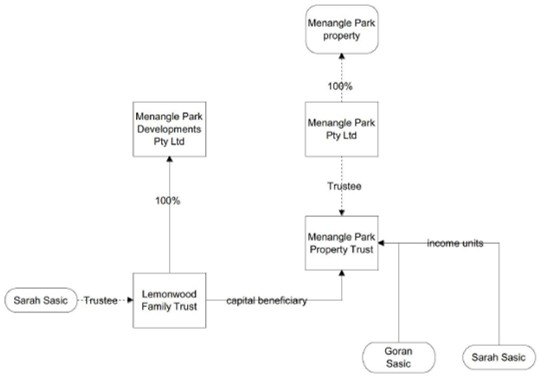
165 On 29 July 2016, Mr White received documents for the establishment of the Lemonwood Family Trust (LFT) and the Menangle Park Property Trust (MPPT) from Bartier Perry. He forwarded these documents to Mr and Mrs Sasic.
166 On 11 August 2016, Menangle Park Pty Ltd (MPPL) was incorporated with Mrs Sasic as its sole director, shareholder and secretary. On 12 August 2016, Mr White emailed a bundle of documents to Mr and Mrs Sasic, and on 16 and 18 August 2016 she executed:
(a) the trust deed for the MPPT; and
(b) the trust deed for the LFT.
(c) a resolution of Mrs Sasic as sole director by which MPPL accepted appointment as trustee of the MPPT;
(d) a resolution by Mrs Sasic to accept appointment as trustee of the LFT;
(e) resolutions by Mrs Sasic as sole director of MPPL to issue 500 income units in the MPPT to each of herself and Mr Sasic; and
(f) statutory declarations disclosing the assets of the MPPT.
167 On 22 February 2017, MPPL as trustee of the MPPT entered into a contract to purchase the Menangle Park property. The purchase settled on 26 April 2017. The purchase price was $2.65 million.
Sale of the Menangle Park property and arrangements in relation to the capital gain
168 In early 2018, Mrs Sasic was approached by a man who introduced himself as a property developer and said that he was interested in purchasing the Menangle Park property. Following this approach, Mrs Sasic wished to have another meeting with Mr White. On her account, this was because she wanted to know how she and Mr Sasic should go about selling the Menangle Park property so as to minimise the tax that would be payable. On 4 April 2018, Mr Sasic sent an email to Mr White requesting a meeting. A meeting was arranged for 11 April 2018.
169 On 11 April 2018, there was a meeting at EY’s offices attended by Mr and Mrs Sasic, Mr Gullo, Ms Leon and Mr White (the third Sasic meeting). Again, there are differences in the evidence concerning what was said at this meeting which will be addressed later in these reasons. The main topic of discussion was the Menangle Park property and how to deal with the proceeds of a potential sale. Ms Leon, who took fairly detailed notes of the meeting (and whose evidence I found to be generally credible), gave the following evidence based on those notes:
(a) Mrs Sasic told Mr White that the Menangle Park property had cost $2.7 million and was subject to an option to sell for $5 million (meaning a profit of $2.3 million).
(b) In her notes Ms Leon wrote:
Save tax
Risky not illegal
which reflected words used by Mr White in the meeting, but she could not remember exactly what he had said.
(c) Mr White explained a structure which involved NWOD using its losses to absorb the capital gain from the sale of the Menangle Park property. He said that this structure was the way to avoid paying the approximately $600,000 in CGT that would otherwise be payable on the sale of the property.
(d) As part of the proposed structure, MPPT would sell units to a new trust “Family Trust 2”, and “Family Trust 1” would have an “accounting profit” of $185,000. (The reference to MPPT here seems to be a mistake. Elsewhere Ms Leon’s notes refer to the LFT transferring its interest to a new Family Trust.) At this point in her notes Ms Leon referred to “s 112-10” and “market value substitution”, although her evidence was that she did not know what that meant.
(e) Mr White referred to a case called “Bamford”, which was decided in the High Court in 2010, and said that the structure he was proposing was similar to that case.
(f) Mr White said, in substance, that (in Ms Leon’s words):
(a) the structure would involve a new family trust (“Family Trust 2”) buying all the units in the MPPT;
(b) the owner of the losses — that is, “Geff Lock”, who I now know to be Jeff Locke — would receive a payment of $185,000;
(c) Goran and Sarah would keep the full gain of $2.3 million on the sale of the Menangle Park Property; and
(d) apart from paying the $185,000 to NWOD, Goran and Sarah would not pay any capital gains tax on the sale of the Menangle Park Property.
(g) During the meeting Mr White was in front of a whiteboard, on which he drew diagrams to explain the structure he was proposing. Ms Leon drew a diagram in her notes which was copied from a diagram that Mr White drew during the meeting. It shows a scheme which is materially the same as the tax loss access scheme alleged by the Commissioner in this proceeding. The LFT would sell its units in the MPPT to “Family Trust 2” and distribute its income to NWOD, giving NWOD $2.3 million of taxable income which would be absorbed by its existing losses.
(h) Underneath her diagram, Ms Leon wrote (reflecting things that were said by Mr White):
Taxable income 2,300,000 -> can be absorbed by loss
So all they pay is 185k.
170 Mrs Sasic also gave evidence that Mr White drew a diagram on a whiteboard during the meeting which she understood to show a strategy that could be used to minimise the tax payable on the sale of the Menangle Park property.
171 Mr White sent the following messages during the third Sasic meeting:
(a) an email to Mr Frankland of Bartier Perry asking him to prepare documents for the establishment of a new discretionary trust called the Lemonwood Family Trust No 2 (LFT2) (a further email to Mr Frankland, sent 20 minutes later, asked for documents establishing another discretionary trust to acquire property in Queensland which is not connected with this proceeding);
(b) an email to Mr and Mrs Sasic containing a hyperlink to the AustLII report of Commissioner of Taxation v Bamford [2010] HCA 10 (a decision which is reported at 240 CLR 481 (Bamford));
(c) a further email to Mr and Mrs Sasic containing a hyperlink to a provision of the Duties Act 1997 (NSW); and
(d) a WhatsApp message to Mr Locke which is discussed below.
172 These messages serve to confirm that a scheme along the lines described in Ms Leon’s evidence was being discussed, and Mr and Mrs Sasic were at least sufficiently interested in it for instructions to be given to draft the relevant documents. Mr Sasic deposed that he agreed during the meeting to adopt the structure Mr White was proposing. Ms Leon’s evidence was that, after the meeting, she had reservations about the structure because she did not fully understand it; however, Mr Gullo and Mr and Mrs Sasic all expressed the view that they were confident it would go well based on Mr White’s experience and reputation.
173 Mr White received draft documents for the establishment of the LFT2 from Bartier Perry at 6.29 pm on 11 April 2018.
174 Also on or about 11 April 2018, MPPL entered into a deed granting to Weiya Development Pty Limited (Weiya) an option to purchase the Menangle Park property for $5 million.
175 On 16 April 2018, Mr White received a draft deed of assignment from Mr Prater, assigning the beneficial interest in the trust fund of the LFT to the LFT2 for consideration of $185,000. He emailed this document to Mrs Sasic. Mr White deposed to having received a signed but undated copy of the deed from Mrs Sasic later that day. However, the copy of the deed exhibited to his affidavit is the unsigned one that he sent to Mrs Sasic. There is a signed copy dated 16 April 2018 exhibited to Mrs Sasic’s affidavit, which she deposed to having emailed to Mr White on the same day, and the evidence includes an email from Mrs Sasic to Mr White at 3.22 pm on 16 April 2018 that says “Please find attached the signed Deed of assignment”. I am therefore satisfied that Mrs Sasic executed the deed of assignment on or about 16 April 2018.
176 Mrs Sasic also executed the trust deed establishing the LFT2 on 16 April 2018, as did the settlor (Mrs Sasic’s cousin Mey Chou Yeak). Both of their signatures were witnessed by Mr White (this may have happened at a meeting which, according to Mr White’s affidavit, happened on the same day and related to business unrelated to the Menangle Park property).
177 In reply to her email attaching the signed deed of assignment, Mrs Sasic received an email from Mr White (sent at 3.23 pm on 16 April 2018) that said “Are you on what’s app?” She replied that she was, in response to which Mr White asked for her mobile phone number and she provided it (at 3.27 pm).
178 Mr White then sent Mrs Sasic a series of WhatsApp messages.
(a) The first (at 3.28 pm) said:
Hi Sarah
Got the signed deed - all good.
(b) The second (at 3.29 pm) said:
For the $185k payment of Trust Profit down to NWOD, I’ll need to send you payment details (which carries with it the taxable capital gain as discussed).
(c) The third (at 3.31 pm) said:
Two transfers, ie 50% each (ie $92.5k each) to:
* NWOD Projects & Advisory Group [account details]
* RJB Trust [account details]
179 Mr and Mrs Sasic did not have $185,000 available at that time. She arranged for Mey Yeak to make the two transfers requested by Mr White and Mr Sasic later reimbursed Ms Yeak. A WhatsApp message from Mrs Sasic to Mr White on 19 April 2018 included a photograph of a receipt for a transfer of $92,500 to the RJB Trust. Mr Locke confirmed that NWOD also received $92,500 on or about 17 April 2018.
180 On 29 June 2018, contracts were exchanged between MPPL and Weiya for the sale of the Menangle Park property for $5 million. The sale settled on 10 August 2018.
181 In order to give effect to the arrangement proposed by Mr White on 11 April 2018, Mrs Sasic should also have signed a deed of nomination of beneficiary (nominating NWOD as a beneficiary of the LFT) and a resolution (as trustee of the LFT) to distribute the income of the LFT to NWOD on or before 30 June 2018. She did sign these documents. However, as will be seen below, she signed them after the end of the 2018 income year (on or about 20 November 2020 and 23 September 2019 respectively).
Preparation of tax returns
182 On 1 August 2018, Mr White sent an email to Mrs Sasic (copied to Mr Gullo) asking whether “the trust’s” 2018 income tax return and trust distribution statements had been prepared. He said that he had been contacted by Mr Locke, who needed these documents in order to file a tax return for NWOD. The contact from Mr Locke suggests that “the trust” referred to here was the LFT, although follow-up emails between Mr Gullo and Mr White referred to the MPPT. Throughout August and September 2018, emails flowed between Mr White, Mr Gullo and Ms Leon about the preparation of the 2018 tax return for the MPPT. There was a meeting between Mr White, Mr Gullo, Mr and Mrs Sasic and Ms Leon on 9 October 2018 at which Mr White gave instructions about the preparation of the financial statements and tax return for the MPPT for the 2018 income year. Mr Gullo lodged the tax return for the MPPT on 15 November 2018.
183 The tax returns for the LFT and LFT2 were prepared by EY and were not lodged until 26 September 2019. In the course of preparing these returns, Jordan Eastwood of EY sought some documents from Mrs Sasic. Her email in reply attached a signed copy of the resolution to distribute income to NWOD, dated 20 June 2018, and said in part:
I believe you don’t need the resolution of trustee but just in case you do, I’ve attached a copy”.
184 This was not necessarily inconsistent with the resolution having been signed on the date that it bears. However, Mrs Sasic gave oral evidence that she in fact signed this document on or after 23 September 2019.
185 In the tax returns that were lodged by EY on 26 September 2019, the capital gain on the sale of the Menangle Park property was not included in the taxable income of the LFT (or LFT2) or Mrs Sasic’s personal tax return (consistently with an understanding that, pursuant to the arrangement proposed by Mr White, that gain was deemed to have flowed to NWOD).
186 MPPL was deregistered on 22 October 2020. Ms Leon’s notes of the meeting on 11 April 2018 and Mrs Sasic’s affidavit evidence indicate that Mr White advised that, after the Menangle Park property had been sold, MPPL should be liquidated. MPPL was engaged in legal proceedings in relation to another property between June 2018 and December 2019 and, once these proceedings had concluded, Mr White arranged for a liquidator to handle the liquidation of MPPL.
Investigation by the ATO
187 On 27 October 2020, the ATO commenced a review of the income tax affairs of the trustee of the LFT for the 2017 to 2019 income years.
188 On 7 November 2020, Mr White sent an email to Mr Gullo (copied to Mrs Sasic) which said (in part):
I’ve had a follow up from the ATO in relation to:
* Menangle Park Property Trust’s 2017 income tax return (trust was formed on 16/8/2016), and also the 2019 income tax return (I’ve already received a copy of the 2018 return).
* Menangle Park Property Trust’s financials for 2017, 18 and 19
* Lemonwood Family Trust financials for 2017, 18 and 19.
189 On 9 November 2020, Mr White emailed to Mr and Mrs Sasic a copy of the ATO’s notice of the review and suggested a meeting on Wednesday, 11 November 2020. Mrs Sasic’s reply (sent around 45 minutes later) was:
F***. Ross and Isabel never mentioned or informed us about ATO wanting info. This is beyond my comprehension...
How bad is the situation? Freaking out about it :( I have a property that is settling in 15/12, should we put it under a new Co & Trust that I am not involved in?
190 Mr White sent several more emails on 9 November 2020.
(a) At 9.09 am he asked Ms Leon for a copy of the 2017 tax return for MPPT.
(b) At 9.18 am he asked Mr Prater for “the deed to appoint NWOD as an additional beneficiary of Lemonwood”.
(c) At 9.56 am he replied to an email from Mr Gullo, confirming that the ATO had “indicated an audit” for the LFT and this affected the MPPT, and asking for information about the MPPT by “late this week”.
(d) At 2.03 pm, after receiving a copy of the 2018 tax return for the MPPT, Mr White sent an email to Mr Gullo asking him to amend the return so as to bring the capital gain from the sale of the Menangle Park property to account in that income year (not in 2019), “with a resulting distribution down to [the LFT] of the net income of MPPT”.
(e) He sent another email to Mr Gullo (copied to Ms Leon) at 2.53 pm asking that they let him know when the amended 2018 return was “ready for a quick look”.
191 At around this time (the exact timing is not clear) there was a conversation between Mr White and Mrs Sasic. I infer that it occurred on 9 November 2020, because Mr White sent Mrs Sasic an email at 7.30 am on 10 November 2020 attaching Capital Gains Tax calculations without any preamble. Mr White’s evidence is that on 9 November 2020 he told Mrs Sasic that Mr Gullo had omitted the capital gain from the Menangle Park property from the MPPT tax return; that, in addition to amending that return, it was advisable to “reallocate the capital gain from NWOD to yourself in the 2018 year”; and that, having lodged amended returns, they could immediately object and resolve the “technical issues”. He proposed this in order to negate the risk of penalties. Mrs Sasic’s evidence is not materially different although she suggests that these things may have been said during more than one conversation.
192 On 10 November 2020 at 5.01 pm, Mr White sent another email to Mr Gullo and Ms Leon asking if it was possible for the document to be ready before a scheduled meeting with Mr and Mrs Sasic the following afternoon. On 11 November 2020, Mr White and Ms Leon exchanged emails about the revised financial statements and tax return for the MPPT.
193 On 16 November 2020, Mr White and Mrs Sasic exchanged messages via WhatsApp as follows:
Mr White: I’m seeing a Tax QC this morning about another client. I’ll ask him about an idea I have with Menangle to eliminate all risks of penalties, keeping all options open.
Mrs Sasic: Thanks Peter, I would appreciate it.
Mr White: I reckon we:
* Make a voluntary disclosure to Amend the 18 return, with the NWOD distribution to go to you
* Agree to momentarily pay 50% of the tax
* Immediately lodge an objection to our own assessment, reverting it to NWOD
That way, the moment before the audit commences), we preserve all options but with no nasties.
Let me run it by the QC, and I’ll call you straight afterwards
Mrs Sasic: Okay.
194 Mr White gave evidence that, after speaking to counsel, he had a telephone conversation with Mrs Sasic in which he suggested that the ATO review was largely related to Mr Gullo’s omission of the capital gain from MPPT’s 2018 tax return, but also advised that the tax returns of the LFT should be amended to recognise a full distribution to Mrs Sasic and an objection should then be lodged.
195 Over the next few days, amended returns were prepared for the MPPT, the LFT and Mrs Sasic. These were lodged on 20 November 2020.
196 On 20 November 2020, Mr White sent an email to Mrs Sasic noting that he did not have a signed copy of “the attached document” — being the deed of nomination of beneficiary — on file. He asked her to “please send me a signed pdf copy for our files”. Mrs Sasic replied, attaching a signed but undated copy of the document and saying “I have not date it, please do so accordingly”. Mrs Sasic gave oral evidence that she signed this document when it was sent to her in 2020.
197 On 27 November 2020, an amended notice of assessment was issued for Mrs Sasic for the 2018 income year. It required her to pay an additional $479,073.61 plus interest.
198 On 3 December 2020, Mr White emailed to Mrs Sasic a draft notice of objection.
199 On 8 and 9 December 2020, Mr White and Mr Eastwood exchanged emails with Mrs Sasic about the deed of nomination and the deed of assignment.
(a) Mr White emailed Mrs Sasic on 8 December 2020 observing that the “attached assignment deed is similarly undated. She replied that evening, attaching a version of the document that she had signed and dated 16 April 2016. Mr White replied on 9 December 2020, saying “I thought this was in April 2018?”, and Mrs Sasic replied (attaching the document again, now dated April 2018) and saying “Yes, you are correct, my apologies”.
(b) Mr Eastwood (who had been copied to this exchange) then replied to Mrs Sasic, attaching the deed of nomination and saying “Just chasing your dated copy of this Deed also”.
200 From around December 2020 to April 2021, Mr White (along with Mr Gullo and Ms Leon) was assisting Mrs Sasic in responding to a number of requests for information from the ATO, not limited to the returns of the MPPT and LFT. On 18 March 2021, Ms Leon sent Mr White an email which said that Mrs Sasic had requested updates on a number of issues and asked:
Please update us the responses at your end, on the following:
* Objection on the Notice of Amended Assessment of Income Tax issued by the Commissioner of Taxation on 27 November 2020 for the income tax year ended June 30th, 2018
* Objection for the imposition of the shortfall interest charge as a result of the Amended Assessment for the 2018 income year.
201 Mr White responded later that day as follows:
* Application for reduction/remission of GIC has been lodged – we were removed as Tax Agent, which I think stalled the ATO interface, but we’re now reinstated for Sarah personally. They don’t even acknowledge us until more than 56 days has passed.
* Objection is mostly drafted – I don’t/wouldn’t counsel lodging anything until we’ve ‘let the dust settle’, which could be some months yet.
202 On 14 April 2021, Mrs Sasic and Ms Leon attended an interview with officers of the ATO. On the same day Mr White sent an email to Mrs Sasic which said:
Please find attached ‘further and better particulars’ for the objection to the ATO’s charging of interest which was submitted to the ATO today. As you’ll see, it also sets the scene for the broader objection which we’ve discussed. We’re almost finalised that separate objection, and will send to you for review in due course.
203 Two days later, on 16 April 2021, Mr Sasic sent an email to Mr White (which Mrs Sasic had been involved in drafting). It said:
In light of current developments with ATO and the pretty steep learning curve we have had to endure over the last few months it seems very apparent that the strategy devised by you is clearly not working. Current situation did put us under tremendous scrutiny by the ATO and financial hardship of rectifying the current situation. Taking into consideration lack of results and all subsequent issues caused, we expect you to organise the immediate refund of $l85k paid to NWood [sic] for advisory services.
I appreciate your determination and confidence that you will turn things around, and if that ends up being the case we will happily reimburse you with that $185K fee. But until such time we expect you to do the right thing by us.
204 Mr White did not reply to this email.
205 Mr White sent Mrs Sasic a draft notice of objection to the amended assessment of her income tax for the 2018 income year on 27 April 2021. The draft objection would have sought to restore the position under the original assessment for Mrs Sasic (ie, that she was not a beneficiary of the LFT and therefore not liable to tax on the capital gain from sale of the Menangle Park property). Mrs Sasic replied later the same day, saying that she preferred to wait until some other tax issues (arising from foreign source income of Mr Sasic) had been dealt with before focusing on the objection.
206 On 3 June 2021, Mr White sent an email to Mrs Sasic proposing a Microsoft Teams meeting with practitioners from EY’s Tax Controversy team.
207 Mrs Sasic deposed that that call did not go ahead. She had no contact with Mr White from April 2021 until 29 October 2021, when she sent him an email (headed “Termination letter”) which said:
Hi Peter,
This is to inform you I no longer require your accountancy service effective as of today (29/10/2021).
Please handover any documents EY may have relating to me and any related entities.
Regards,
Sarah Sasic
208 Similarly, Mr Sasic had no contact with Mr White after April 2021.
MR WHITE AND MR LOCKE: BACKGROUND AND OUTLINE OF EVENTS
209 In order to make findings concerning the nature of the tax loss access scheme (or the more specific schemes pleaded in the alternative) and whether Mr White received “consideration” in respect of them, it is necessary to note some aspects of his relationship with Mr Locke and the communications between them.
210 Mr Locke began his career as a graduate accountant in the mid-1980s and in 1989 joined the Australian operations of a large Japanese construction and development group. This brought him into contact with NWOD, which was a commercial property development company. In December 1993, Mr Locke became a director of NWOD and from then on he managed its day-to-day operations. During the 1993 to 1998 financial years, the completion and divestment of NWOD’s projects resulted in substantial losses, resulting in NWOD having around $471 million of carry forward tax losses. Mr Locke worked in a series of other roles connected with property development and financing.
211 Between 2007 and 2014, the ATO conducted audits of a number of entities connected with Mr Locke, including NWOD. One result was that NWOD’s accumulated tax losses were reduced to around $359 million. Another result was the issue of amended assessments to another company connected with Mr Locke which gave rise to an aggregate tax debt of around $1.4 million, which was the subject of an appeal that was settled.
212 Mr Locke met Mr White around July 2007, a few days after his first meeting with ATO officers. Mr White was at that time working for an accounting firm known as Accru Felsers, which was the auditor of a business at which Mr White worked. Mr White put him in touch with lawyers who provided advice and assistance on issues relating to NWOD’s tax losses. Mr Locke deposed that Mr White did not issue invoices for any of the advice that he provided. He further deposed that:
During the period of the ATO audit from 2007 to 2014, Mr White and I became professional associates and close friends. I value my friendship with Mr White. During that period, Mr White provided assistance, guidance and acted as a sounding board, both professionally and personally.
213 Mr Locke came to the view that, without Mr White’s assistance, the ATO audits would have had a much more unfavourable outcome (including that NWOD would have lost the right to carry forward its tax losses). He felt indebted to Mr White for the support he had given.
214 Mr White, meanwhile, was aware of advice NWOD had received concerning its tax losses and, given his friendship with Mr Locke, is very likely to have discussed the outcome of the ATO audit with him. He therefore had good reason to believe that NWOD had significant carried-forward tax losses that could be offset against future income. The draft memorandum that Mr White prepared for Mr Grujoski in December 2018 confirms that this was Mr White’s understanding: it included the following statement.
We have relied upon advice provided by Baker & McKenzie, Melbourne to NWOD that the tax losses carried forward by NWOD are and at all relevant times have been duly available to NWOD, on the basis that the company satisfies the COT.
215 Mr White and Mr Locke were accustomed to communicating with each other via text messages, tranches of which were obtained by the ATO using its information-gathering powers and are in evidence. The earliest message that is in evidence was sent on 27 April 2016 and the latest on 14 May 2021. The messages up to August 2017 were sent using Apple iMessage or SMS; after that time all messages were sent using WhatsApp. Much of their messaging was of the kind that would be expected between two men who were good friends, who were both busy and who travelled a lot, but some obviously concerned business dealings.
216 On 6 March 2018 at 3.02 pm, Mr White sent Mr Locke the following message via WhatsApp:
Hi Jeff
Have a client in need of $14m in tax losses. Known the client a little over 6yrs.
Can I tell him 5 cents?
217 Mr Locke responded “Sure…” at 3.33 pm on the same day.
218 On 4 April 2018 at 5.55 pm, Mr White sent the following WhatsApp message to Mr Locke:
Hi Jeff
Got a small one ready to go $128k for $3.2m (ie 4c), with another two to come from the same guy.
Can you send me NWOD’s bank acct details again? I deleted it deliberately last time.
Rgds, Peter
219 Mr Locke replied around 16 minutes later:
OK. [NWOD’s name, BSB and account number], all the best… Jeff
220 On 11 April 2018 at 2.37 pm, during the third Sasic meeting, Mr White sent Mr Locke a WhatsApp message which said:
Got another small one for approx. $2.3m for $90k?
221 On 18 April 2018, Mr White sent a message to Mr Locke which said “$92.5k should have arrived today”. This was the amount that Ms Yeak had transferred on Mrs Sasic’s behalf (on Mr White’s instructions), being half of the fee of $185,000 that Mr and Mrs Sasic had agreed to pay as a fee to NWOD at the third Sasic meeting.
222 On 17 May 2019 at 2.07pm, Mr White sent a message to Mr Locke which said:
Hi Jeff
Got another one - approx. 24.8m gain
Would you consider $850k
223 Mr Locke replied at 10.07 pm:
Hi Peter, yes, but I am more concerned with “quality” & risk profile of those involved…
224 This exchange occurred after a series of messages about a request for information that Mr White had received from the ATO which seem to have included questions about “Bonar”. Then, on 16 August 2019, Mr White sent a message to Mr Locke which said:
Hi Jeff
You’ll remember Bonar - he’s back with his next development. $10m profit. Are we ok with 4 cents again?
225 Mr Locke replied “Yes…” around 4 minutes later. As noted earlier, on 21 August 2019, Mr Grujoski authorised the transfer of $400,000 (four per cent of $10 million) to NWOD and $300,000 to the RJB Trust as part of the arrangement that was being put in place for the profit on the Kings Court development. The total of those amounts is $700,000, which according to Mr Grujoski’s evidence was the fee for NWOD’s participation discussed at the meeting he attended with Mr White before the arrangements for Kings Court were put in motion.
226 The brevity of these exchanges indicates that there must have been earlier communications and discussions between Mr White and Mr Locke that established an understanding concerning the use of NWOD’s tax losses to achieve objectives for which Mr White’s clients were prepared to pay. Obviously Mr Locke knew what Mr White was proposing when he referred to “5 cents” or “128k for $3.2m (ie 4c)”; otherwise he could not have agreed, within very short periods of time, to proposals apparently involving fairly large sums of money. The obvious inference from these messages is that Mr White was used to proposing (and Mr Locke was used to agreeing to) arrangements in which an amount of NWOD’s tax losses would be made available in return for a fee calculated as a percentage of the relevant amount. Further, there does not appear to have been any agreement in writing between Mr White and Mr Locke in relation to the Bonar Street development and the natural inference is therefore that it was negotiated orally.
227 Mr White and Mr Locke gave evidence of some conversations between them about these arrangements. However, because I have reservations about their evidence, I will discuss this evidence below in the course of making findings about the matters in issue in the proceeding.
CREDIBILITY ISSUES
228 The Commissioner sought to prove that the tax loss access scheme (or each of the specific schemes pleaded in the alternative) came within s 290-65(1)(a) and (b) of the TAA Sch 1 mainly by reference to the actual intentions of those involved in (or who would have been involved in) implementing it and the contextual relevance of the discussions surrounding the scheme’s conception. Additionally, the objective character of the scheme depends to some extent on the role that was envisaged by the participants as being played by NWOD. There are also contested issues as to whether the conduct of Mr White amounted to promotion of the scheme and whether the money that flowed to the RJB Trust is properly seen as the receipt of a “benefit” by Mr White or an associate within the meaning of s 290-60. Each of these issues turns in part on the assessment of the credibility of (sometimes competing) witness testimony.
229 Because many of the reasons advanced by Mr White for rejecting evidence of the Commissioner’s witnesses arise from specific aspects of their evidence or from other evidence said to contradict it, it is preferable to deal with these issues in the course of considering the contested issues (eg as to what was discussed at particular meetings or what were the reasons for entering into particular arrangements) rather than expressing general conclusions about their reliability in a discussion divorced from that context. However, there are general points about the evidence of Mr White and Mr Locke that can usefully be made before turning to the specific events. The fact that the Commissioner bears the onus of proof does not prevent this approach being taken.
Mr White
230 I have found myself unable to rely on the evidence of Mr White on most issues except where it deals with uncontroversial matters, constitutes admissions or is supported by other evidence that I do accept. This is for the following reasons.
231 First, Mr White’s affidavit (sworn on 26 June 2025) purports to give highly detailed accounts in the form of direct speech of conversations occurring between April 2016 and July 2021. An account of events that contains a lot of detail is not for that reason alone more likely to be true than one less detailed. On the contrary, details can be inserted into a fictional account in order to give it plausibility; and an implausible degree of detail can suggest that the account is not based on genuine memory.
232 Although Mr White is clearly very intelligent and the subject matter of these conversations lay within his area of expertise, the discussions that he had with Mr Leontios and Mr Gullo and their respective clients constituted a handful of the hundreds of such interactions that Mr White must have had with clients and accountants during this period. They were routine interactions for him, and the terms in which he instructed legal practitioners to draft relevant documentation indicate that (for the most part at least) the issues being discussed were not novel or ground-breaking. In other words, there is no reason to think that these meetings were especially memorable for Mr White (particularly if, as he sought to suggest, there was nothing untoward about the arrangements being discussed). He did not annex transcripts or detailed notes of the meetings to his affidavit and accepted that he did not have such resources. Yet he has, if his evidence is to be believed, a far more confident and detailed recollection of each meeting than the other participants (for whom these meetings were much more significant events).
233 While I do not seek to make any general point concerning the merits of the practice (for a time almost universal among practitioners in NSW and still commonly followed) of framing evidence of conversations in direct speech preceded by a formula such as “words to the following effect were said”, Mr White’s affidavit evidence gives rise to the problems highlighted in Kane’s Hire Pty Ltd v Anderson Aviation Australia Pty Ltd [2023] FCA 381 at [120]-[128] (Jackman J) (a case which also concerned evidence of conversations that occurred between about five and nine years earlier). It is highly unlikely that at the time of affirming his affidavit Mr White remembered all of the exact words that were used in each meeting. He does not expressly claim to do so in every instance – most purported conversations are preceded by the incantation “words to the following effect” – but the result is a beguiling impression of precision that attempts to mask the inevitable fading of human memory and put forward what is essentially a verbatim account. It is impossible to ascertain which (if any) of the words set out in the affidavit Mr White did remember, which were constructed from a memory of the “gist” of what was said, and which were no more than what Mr White would like to think had been said.
234 The difficulty in the present case is acute because lengthy extracts of conversations are rendered almost in the manner of a film script. This is illustrated by the way Mr White recounts the second Grujoski meeting (which happened in December 2016) at [37]-[38] of his affidavit, which is worth setting out despite its length.
[37] On 19 December 2016, I attended a further meeting with Messrs Leontios and Grujoski. The meeting took place in the offices of EY at 200 George Street, Sydney. Words to the following effect were said during that meeting:
Mr Grujoski: Good meeting last month - how do we progress all of that? We’re probably now 95% complete.
Me: How much have you spent on the project?
Mr Grujoski: Build cost of the project is probably $26m. After completion, I am looking to receive approximately $36m, so perhaps a $10m profit. So that’s what we’ve got to protect.
Me: Got it. Like I mentioned in our last meeting, we should set up a new trust, same trustee as your existing trust. We will then do a “Pendal Nominees” to effectively shift, or assign the future property, the future income from the existing Bonar Trust to Trust 2, to ensure no stamp duty on the transfer. Michael – you were going to send a copy of the trust deed? I’ll also prepare an advice to confirm the assignment of future income from one trust to another, but let's get the structure in place first.
We need to move as much equity as we can to legitimately ring fence the equity from the risks.
In order to further protect beneficiaries from claims – to begin with, your children would renounce their interests as primary beneficiaries of the trust – there’s an old English case “Hardoon v Belilios” which attributes to a ‘burden’ to those who enjoy its ‘benefit’, the beneficiaries. Nasty. So we need to protect them.
Mr Grujoski: Yep. Good. That’s a no brainer, not a fan of the first lot of stamp duty. What about the other risks?
Me: I may know someone who can assist you in dealing with these issues, a bloke by the name of Jeff Locke, who I’ve known for many years. Good guy. He is the former CEO of the Valad Group and was previously the head of Macquarie Bank Property. Valad was involved with Goldfields House at Circular Quay, Top Ryde Shopping Centre, Ritz Carlton Double Bay.
He previously helped in the exit of the Japanese developer, Kumagai Gumi, from Australia in the 90s. They’d done Telstra building at 400 George Street, Glasshouse on 135 King Street Sydney and the old Imperial Arcade on Pitt Street, where Westfield is now. Pretty sure they were involved in the Sheraton Hotel too.
I know Jeff well. I’ll reach out to him to see if he’s willing to help. If so, he will be the point-man to face the media and the liaison person in terms of the multiple threats you mentioned.
Just thinking it through, we may be able to structure the payment as a distribution rather than a payment. Let’s see. Good thing is that since 2007, trust distributions no longer attract payroll tax. This should also negate the need to obtain workers compensation insurance, as he’s not an employee.
If Jeff or his company is paid a distribution, we’ll need to update the beneficiaries of Trust 1 to include Jeff’s company instead of your kids - they’ll move over to Trust 2. The net result will be that Bonar Street Trust will have the benefit of an indemnity by its sole named beneficiary, who would then be Jeff or his company, which would take on that responsibility and manage any claim you receive arising from the Bonar Street Development whether that be from Sydney Water, strata, Energy Australia or otherwise.
In the event that the claim crystallises, Jeff or his company is obliged to indemnify Cash Warwick against that debt.
It may also have some tax benefits, not sure yet, we’ll have to work through it.
Mr Grujoski: So, Jeff will operate as a consultant and some kind of insurance policy?
Me: Yep, very much so.
Mr Grujoski: So you’re saying my liability in respect of the Bonar Street Development will be capped at the amount of Jeff’s fee and additionally, Jeff will provide consulting and deal with the claims?
Me: That’s right.
Mr Grujoski: That sounds perfect. How much will he charge?
Me: I confess I have no idea, but could be as much as $800,000, maybe more – I won’t know until I speak with him.
Mr Grujoski: I am nervous about payroll tax. That’s a killer. I’ve been stung for payroll tax in the past. It still haunts me.
Me: Yep.
[38] I then began to draw on a whiteboard, during which time words to the following effect were said:
Me: We’re obviously eager to move the equity from the existing Bonar Trust to Trust 2. Tax law operates to automatically ensure that, regardless of the amount nominated for the transfer, the number is the arm’s length market value.
They call it the market value substitution rule, in s. 112-10 of the Tax Act. It ensures no tax-mischief, as the quarantining of the equity is maximised with the minimisation of the Pendal nomination amount, leaving only enough to cover the fee.
So, if Jeff or his company is appointed as a beneficiary of the Bonar Street Discretionary Trust and a distribution is made, Jeff or his company will be liable to pay tax on 100% of the net income it receives from the trust.
I know that Jeff has, over the last couple of years, carried on his property advisory business through his company, NWOD, which had substantial tax losses back in 2009, but I’m not sure what the precise position is now. Provided NWOD is entitled to use its losses and chooses to do so, those losses will be offset against its tax liability so that the tax losses will soak up NWOD’s fee. Because we’re moving the equity from trust 1 to trust 2 to protect the profits from the Bonar Street Development, the fee has to be 100% of the trust income, and NWOD will then be liable to pay tax on 100% on net income of the trust. This is as a result of the High Court case in Bamford - a 2010 case where the taxpayer won 5:0, probably the last time they had that kind of win. Bamford essentially confirmed that a beneficiary of a trust is to be assessed on the proportion of trust income he or she receives, and not the actual amount, or “quantum”.
But... you need to be absolutely sure that the reason you’re doing this is indeed asset protection, because there is a risk that someone down the track is going to say it’s a tax scheme. So you really need to tell me now, as we would need to have a re-think.
Mr Grujoski: Yep, no issue. That’s the absolute truth.
Me: The real risks are s100A and Part IVA of the Tax Act. s100A operates in the event that Bonar receives a reimbursement from Jeff’s company. The ATO would then reverse it and Bonar would be liable for the tax at 47%. I appreciate that’s not the case here, as he keeps the dollars he receives – there is no reimbursement.
Part IVA will always be a risk if the ATO considers that you have entered into an arrangement for the primary purpose of avoiding tax. So, you need to be abundantly clear that the reason you are doing this is for asset protection. If there is any doubt whatsoever that the reason, what the ATO refers to the as the “dominant reason”, you’re doing this simply to avoid tax, the ATO will be all over you with Part IVA and the penalties will be very significant.
Mr Grujoski: Yep, got it, no issues. I’m here to protect what I have. If we can achieve that without stamp duty etc, then, why not?
Me: Ok, then let me speak with Jeff and I’ll come back to you. In the meantime, let’s sort out the 1% of the house and put in place second mortgages over the rest of your developments wherever we can. We’ll need to work with the Bank to make sure they’re happy. Down the track, let’s also make sure we have PDAs in place for future developments.
(Emphasis in original.)
235 Here, one sees a lot more than “words to the effect”. Conversational details and flourishes, some of which might have stuck in one’s mind but most of which usually would not, are inserted even though they are not necessary to convey the relevant “effect” of what was said. This gives rise to a concern that the entire conversation, or some unascertainable portion of it, has been reconstructed long after the event in a way that seeks to advance Mr White’s case.
236 That concern is heightened by what happened when Mr White’s recollection of the second Grujoski meeting was tested in cross-examination on 13 August 2025 (less than two months after his affidavit was sworn). On some points, despite having used the “words to the effect” formula, Mr White insisted that what appeared in his affidavit was exactly what was said, while on others he was much less definitive in his recollection of what topics had been discussed and at what points in the meeting. He did not mention in cross-examination an anticipated $10 million profit on the Bonar Street development, the application of Pendal Nominees or the concept of “ring fencing” the equity in the development, all of which featured in his affidavit. On the other hand, he identified some topics as having been discussed that were not mentioned in the account contained in his affidavit:
(a) a claim by the local council that Mr Grujoski was required to make contributions (something which actually arose in relation to Kings Court rather than Bonar Street);
(b) the relationship between Mr Grujoski and the EPA;
(c) the decision of the High Court in Octavo Investments Pty. Ltd. v. Knight (1979) 144 CLR 360;
(d) the decisions of the Supreme Court of Victoria in JW Broomhead (Vic) Pty Ltd (In Liquidation) v JW Broomhead Pty Ltd [1985] VR 891.
237 These discrepancies are not particularly significant in themselves, but they undermine the purported precision and accuracy of Mr White’s affidavit evidence.
238 At the end of this part of the cross-examination, Mr White asserted that he had not looked at the affidavits of Mr Grujoski and Mr Leontios at all, before rapidly changing position when it was pointed out that his own affidavit specifically responded to them. Given that those gentlemen had been cross-examined about the same conversations by Mr White’s counsel before he swore his affidavit, it is scarcely conceivable that he would not have read their evidence quite carefully. This was an example of Mr White saying what he thought would help his case without pausing to consider whether it was correct.
239 Similar discrepancies between Mr White’s recollections under cross-examination and the purportedly very detailed accounts in his affidavit were pointed out in the Commissioner’s closing submissions in respect of other meetings and conversations. It is not necessary to recount these in detail. In relation to two of these (a meeting with EY colleagues in April 2021 and a telephone conversation with Mrs Sasic in November 2020), the relevant paragraphs of the affidavit said “the following words were said” (rather than “words to the following effect”), which Mr White said was a deliberate choice where he had a clearer recollection of a conversation. Yet here, also, the versions given in cross-examination differed in non-trivial ways from the versions confidently asserted in the affidavit sworn less than two months earlier. When asked in cross-examination about the conversation with Mrs Sasic, all Mr White could say was that he could not recall what was discussed without material to ‘refresh’ his memory but did not think it was a “consequential” meeting.
240 Secondly, in his oral evidence Mr White at times went to considerable lengths to avoid answering a question or accepting a proposition that might be adverse to his position, or gave self-serving answers and adhered to them until they were demonstrated to be wrong.
241 For example, despite many of his communications with Mr Locke occurring via WhatsApp or Viber, Mr White was extremely reluctant to accept that he had any understanding of the capabilities of these applications or any appreciation that they were (or were thought to be) more secure than email or iMessage. He claimed not to recall ceasing to use iMessage with Mr Locke and moving to WhatsApp even though a collection of his exchanges with Mr Locke, showing that very thing to have occurred, was in evidence. In relation to Mrs Sasic, the following exchange occurred during Mr White’s cross-examination:
And at a certain point you stopped communicating with Ms Sasic by email and started communicating with her by WhatsApp. Do you recall that?---I think she might have initiated that. I think in both instances they initiated that. I don’t think I began anything. I think I was responding to their messages. So no, I don’t think I initiated either of those.
Do you have a recollection of that in relation to Ms Sasic?---No. No, I don’t. They’re ubiquitous.
So why do you tell his Honour you think Ms Sasic initiated that if you don’t have a recollection?---Well, I don’t remember doing it, so it must have been her.
…
Your evidence to his Honour is it must have been Mrs Sasic that initiated the WhatsApp communications between the two of you; is that right?---I don’t have any recollection of that, no. I don’t – I don’t remember who initiated it.
Right. So the answer you gave before that it must have been Ms Sasic, you can’t be sure about that; correct?---I don’t remember initiating it. I don’t remember responding. I don’t remember who went first, no.
242 In fact, Mr White had sent the email to Mrs Sasic on 16 April 2018 referred to at [177] above, which asked “Are you on what’s app?” This was in evidence, having been tendered in the Commissioner’s case, as was Mrs Sasic’s reply (“Yes Why? Are you going tossed me some useful information :)”). When shown these messages, Mr White denied that they prompted any recollection but accepted that it was he who had suggested the use of WhatsApp. Mr White was then taken to an exchange of WhatsApp messages between himself and Mrs Sasic and the following exchange took place.
You had the exchange we can see on that page with Ms Sasic using the WhatsApp application, didn’t you?---I can’t tell if that’s WhatsApp. I don’t know. It doesn’t describe itself.
243 It was then pointed out by the cross-examiner that Mr White had described this exchange in his affidavit as taking place via WhatsApp. Mr White accepted that this was so only after being taken to the relevant paragraph of the affidavit.
244 I pause here to make two points.
(a) Early in his cross-examination, Mr White was at pains to specify that his clients were Mr Leontios and Mr Gullo and not Mr Grujoski or Mr and Mrs Sasic. This aligns with the terms of EY’s formal retainers but is hard to square with Mr White communicating directly with Mrs Sasic (and inviting further communication on a different platform). There is no suggestion that they had a private friendship.
(b) Mr White seems to have been able to communicate efficiently with Mrs Sasic using his EY email account. That was an appropriate way to communicate with a client (or a client’s client) because it would leave a record of all such communications as part of EY’s records. I do not accept Mr White’s suggestion that he took to communicating with Mrs Sasic via WhatsApp because it was more “convenient”. The natural inference is that Mr White conducted some of his communications with Mrs Sasic via WhatsApp because messages exchanged on that platform would not be readily accessible to others in EY (or accessible to the ATO if it used its powers to require production of documents by EY). Mr White used WhatsApp to send Mrs Sasic details of the two bank accounts to which the transfer of $185,000, purportedly constituting payment to NWOD, was to be made. The essence of this point was put to Mr White and his response was that he had no recollection.
245 Another example arose a little later in the cross-examination when Mr White was taken to the exchange of WhatsApp messages with Mr Locke referred to at [216] above. He disclaimed any memory of the identity of the “client” referred to in this exchange but proffered the suggestion that it was not a client of his but of somebody else in EY. This, to my mind, is very hard to reconcile with the terms of Mr White’s message, which: (i) was sent privately through WhatsApp and not through an EY email account; (ii) commenced “Have a client…” (not, eg, “EY has a client”); (iii) continued “Known the client a little over 6yrs” (which clearly conveyed that Mr White himself knew the client and this was something Mr Locke would want to know); and (iv) ended “Can I tell him 5cents” (emphasis added).
246 The cross-examination then continued:
All right. You’ve heard the term “tax loss trafficking”, I take it, Mr White?---In what context?
Well, it’s a term you’ve heard in your context as a tax partner, private tax services, Ernst & Young, isn’t it?---I don’t think Ernst & Young has ever referred to that term, no.
You’ve heard the Commissioner refer to it, though, haven’t you?---I couldn’t tell you any other case other than Slutzkin from the seventies, no.
Well, what do you understand tax loss trafficking to entail?---I don’t have a view. I’ve heard the term. I’ve heard the term, but I couldn’t tell you what it means.
247 This was another example of deflection and obfuscation evidently intended to avoid giving answers that might be adverse to Mr White’s interests. I accept that it was not Mr White’s task to make life easier for the cross-examiner and he was entitled to clarify questions before answering them. However, this level of obtuseness suggests a consciousness that giving candid answers would lead to an adverse outcome.
248 A further example is an exchange that occurred while Mr White was being asked questions about the second Grujoski meeting:
But you mentioned NWOD being able to utilise its tax losses during this meeting, I suggest to you, Mr White?---No. No, I don’t think I did. No, I don’t think I did.
Don’t think so?---I wasn’t in a position to know what NWODs losses were. I hadn’t really had that visibility since about ’09.
Quite sure about that?---Since about ’09? The last time I saw NWODs - - -
No, no. Quite sure about not suggesting to Mr Grujoski that NWOD would be able to utilise its tax losses?---I – I said – I think I mentioned the words that it’s up to NWOD whether they choose to, but I didn’t offer any more than that.
249 One point to note about this exchange is Mr White’s change of position from initially denying that he mentioned NWOD utilising its tax losses to suggesting that he might have done so in an oblique way. The other point is that, as noted above, Mr White’s draft memorandum of December 2018 referred expressly to having relied on advice from Baker & McKenzie regarding NWOD’s tax losses: if that statement was true, Mr White must have had information more recent than 2009 about NWOD’s position in respect of its losses.
250 Thirdly, the evidence reveals earlier occasions on which Mr White had lied or made misleading statements when it has suited his interests to do so. The Commissioner put forward what are said to be four instances of this.
251 First, as noted in the outlines of events above, the arrangements proposed by Mr White to Mr Grujoski and Mr and Mrs Sasic involved the payment of certain amounts to NWOD. In each case where a payment was made, the instructions that Mr White gave were for electronic transfers to two accounts, one of which belonged to the RJB Trust. Each of Mr Grujoski, Mr Leontios, Mr Gullo and Mr and Mrs Sasic gave evidence, which I accept, that they believed all of these payments were going to NWOD. In fact, the RJB Trust, as will be explored below, had no connection with NWOD but was connected with Mr White. Mr White did not disclose this. Indeed, one of the WhatsApp messages he sent to Mrs Sasic, referred to above, said that he was about to send her payment details “for the $185k payment of Trust Profit down to NWOD”.
252 Mr White’s response to this in cross-examination was that the payments were being made to the RJB Trust on the instructions of NWOD. That can be accepted: if NWOD was going to account for the full amount of each of these payments, it is likely that Mr Locke knew what the full amount was and was content for Mr White to direct that part of it be paid to the RJB Trust. The potential problem, however, is a lack of disclosure to Mr White’s clients that he (or at least a trust nominated by him as the destination for the funds) was effectively receiving a kickback from the entity to which he was advising them to send money; that is, he had an interest in the transactions.
253 Much of the force is taken out of this point, however, by Mr White’s evidence that he told each of his clients that Mr Locke would “look after” him in return for his assistance. It was not squarely put to Mr White that this evidence was untrue and I therefore accept that he did say something along these lines. While a court exercising equitable jurisdiction or a professional regulatory body might consider this to be an inadequate form of disclosure, and failing to make clear the nature of his interest in the transactions reflects poorly on Mr White, I do not think that this affects his credibility as a witness to any material degree.
254 Secondly, in his email to Mr Leontios of 25 October 2018 (referred to at [99] above), Mr White proposed a response to the ATO alleging that the application of the market value substitution rule (so as to increase both the taxable income of the BSDT and the cost base for the BSDT2) only became apparent during the preparation of the 2017 tax return. Mr White must have intended (and probably expected) that Mr Leontios would use this text in his response to the ATO. In fact, the application of the market value substitution rule had been an element of the scheme Mr White proposed at the second Grujoski meeting. Mr White gave an explanation for this in cross-examination, the substance of which I understood to be that, although the application of market value substitution in the CGT regime had been discussed from the outset, it occurred to him later that Mr Grujoski’s entities probably held their assets as trading stock (rather than on capital account) so that the identical rule in s 70.90 of the ITAA97 would apply. This may be technically right, but if so it omits and tends to conceal the important point that the market value substitution rule had been an important part of the arrangement from the outset. I accept that this was an attempt to create a misleading impression that the design of the Bonar Street scheme had nothing to do with the obtaining of a tax benefit.
255 Thirdly, Mr White prepared answers to a series of questions from the ATO as part of its audit of Mrs Grujoski and her related entities, which he sent to Mr Leontios with the intention that he would pass them on to the ATO.
(a) In response to a question about the reasons for engaging Mr White, his proposed answer referred to “asset protection” and “property advice generally”, making no reference to any wish to reduce tax. This would not be a misleading statement if Mr White’s evidence were generally true and I have therefore not treated it as a reason in itself to reject that evidence.
(b) In response to a question whether there had been any “previous engagement” with Mr White, Mr White’s proposed response omitted any reference to the dealings Mr Grujoski had had with him in connection with the Bonar Street development. In cross-examination, Mr White proposed an interpretation of this question that limited its scope to any previous engagement in relation to the Kings Court development and to dealings with him by Mrs Grujoski (who was formally the addressee of the ATO’s letter). I do not think this is a realistic understanding of what the ATO was asking and I accept that the answer proposed by Mr White was an attempt to prevent the Bonar Street scheme from coming to the ATO’s attention.
(c) In response to a question whether Mr White had directed the making of “any other payment/s to any other person, entities, in relation to the advice of the arrangement that you entered into”, the answer proposed by Mr White was “None”. This was wrong, to Mr White’s knowledge, because he had directed payments to NWOD and the RJB Trust in respect of both Bonar Street and Kings Court.
(d) In response to a request for details of any arrangement with Mr White for the payment of money to him or an associated entity, Mr White’s proposed answer was “None. Mr White indicated Mr Locke would ‘look after him’ for his assistance”. This was said to be untrue or misleading in circumstances where there had been arrangements for a total of $700,000 to be paid to the RJB Trust. I accept that this proposed response was economical with the truth but I do not regard it as false, on the basis that the payments to the RJB Trust can be seen as having been made on the instructions of NWOD and to have formed part of the consideration paid to it.
256 Fourthly, in the course of a review by the ATO of the RJB Trust, the trustee was asked a number of questions including who were the contributors to the Trust. In a response to the ATO sent by email on behalf of the Trust, Mr White said that “the predominant contributors of income” were Mr Byrnes and himself. However, Mr Byrnes gave evidence in this proceeding that he had not contributed income to the Trust and Mr White (while not conceding anything) did not suggest that Mr Byrnes had made any contributions.
257 Several (though not all) of the prior statements relied on by the ATO therefore do point to a preparedness on the part of Mr White to make untrue or misleading statements in contexts where truthfulness is important. They support the conclusion expressed above that his evidence cannot be relied on without corroboration.
258 Finally, some particular aspects of Mr White’s evidence are very difficult to reconcile with the documents or are, upon examination, implausible. These are mentioned below.
Mr Locke and his discussions with Mr White
259 As noted earlier, Mr Locke was a close friend of Mr White. He confirmed in cross-examination that they remained close friends at the time of the hearing. It is not in contest that, at times relevant to this proceeding, he felt indebted to Mr White for the assistance he had received in connection with an ATO audit of NWOD’s tax affairs. It is also not in contest that Mr Locke had a high opinion of Mr White’s expertise as a tax adviser, admired the client list that he had accumulated, and considered EY to be the leading accounting firm in Australia if not the world.
260 In his affidavit, Mr Locke gave evidence about conversations between himself and Mr White concerning the scheme or schemes which are the subject matter of this proceeding. To a significant extent they supported Mr White’s evidence of these conversations. Although I do not consider Mr White’s credibility to be so damaged that “the well has been poisoned beyond redemption” and any corroborating evidence should therefore be rejected (cf eg Re Minister for Immigration and Multicultural Affairs; Ex parte Applicant S20/2002 [2003] HCA 30; 73 ALD 1 at [49] (McHugh and Gummow JJ)), I nevertheless approach corroborative evidence adduced by him with circumspection.
261 My reservations about Mr Locke’s evidence are intensified by:
(a) his initial reluctance to accept that he was interested in finding a way to monetise NWOD’s tax losses, despite having acknowledged this in the course of a s 353-10 examination under the TAA Sch 1;
(b) inconsistencies between his affidavit and some aspects of what he had said in the s 353-10 interview;
(c) his apparent lack of any real recollection under cross-examination of some of his discussions with Mr White, despite having given a clear account of those meetings in his affidavit (sworn less than two months earlier) and insisting that he had prepared the affidavit without any assistance; and
(d) aspects which are simply hard to believe, as outlined below.
The December 2016 conversation
262 Mr White in his affidavit gave a detailed account of a conversation on or about 22 December 2016 (a few days after the second Grujoski meeting) which included:
(a) Mr White listing a series of potential claims Mr Grujoski was facing and saying “I suggested Nick engage you as a consultant to manage these risks and to help generally”;
(b) Mr Locke responding (apparently without seeking any further details) “Yep, I’m in”;
(c) Mr White asking what Mr Locke’s fee would be and the latter suggesting that he “Ask for $1m and let’s see where that goes”;
(d) Mr White then explaining that:
(i) Mr Locke would be paid by way of a trust distribution and would potentially be liable to cover any risks as sole beneficiary; and
(ii) there would likely be market value substitution and Mr Locke would be liable for the tax on the value of the assignment; and
(e) Mr Locke then observing that he would use NWOD to receive the distribution and would “look after the tax”.
263 Aside from the general difficulties that I have with Mr White’s evidence (described above), I find it extremely difficult to accept that:
(a) Mr Locke, a chartered accountant with decades of business experience, would agree to be retained as a consultant, and nominate a lump-sum fee (apparently accepting that it might be negotiated down), without knowing anything of substance about the proposed client or any details of the services that would be required;
(b) Mr White (a highly experienced tax adviser) would tell Mr Locke that he was expected to take on liability for potential risks only after the fee had been named and would envisage Mr Locke being prepared to take on that liability;
(c) Mr White would also suggest an arrangement in which Mr Locke was going to be liable for tax on the “value of the assignment” (rather than on the agreed “fee”), without knowing beforehand that the tax liability could be absorbed by using NWOD’s accumulated losses; and
(d) An arrangement of this kind would be agreed to without anyone taking any steps to document it.
264 Mr Locke’s version of the same conversation did not use direct speech and conveyed the gist of what (he said) Mr White outlined to him. This included that Mr White had put forward “my and NWOD’s names” to Mr Grujoski. He deposed that it was Mr White who proposed the nomination of NWOD as a beneficiary and the exposure of NWOD to any unresolved claims, and that NWOD would need to account for any “trust tax distributions”. This, in my view, is much more plausible than Mr White’s version. However, neither Mr White nor Mr Locke suggests that the structure of the scheme was explained in detail to Mr Locke, that he sought or received legal advice about it or that he was provided with any documents to review. It is difficult to accept that a person who had been the subject of a stressful tax audit in the past would agree to such a transaction on such a scanty basis, even at the urging of a close friend who was a tax expert.
265 I also observe that it would make no commercial sense for NWOD to take on an unknown level of potential liability for claims against the trust, in addition to liability to tax on the full value of a transfer of trust assets (also unknown), unless it could use its accumulated losses to meet the tax liability. If Mr Locke’s version is correct, it is a strong indication that access to NWOD’s tax losses was integral to the proposal.
January 2017 conversations
266 Mr White and Mr Locke both gave evidence of one or more conversations around January 2017 in which Mr Locke proposed, and Mr White reluctantly agreed, that NWOD should give him $400,000 out of the $1 million fee it was about to receive. This was described as a gift and as the outcome of Mr Locke wanting to make good what he regarded as a debt to Mr White arising out of the assistance he had given in relation to NWOD’s tax affairs. Both of these versions are different from the account Mr Locke gave in his s 353-10 interview, in which he initially proposed that Mr White should “take a hundred percent of the first one” and then understood they had settled on a 50/50 split. I accept it is likely that there was a discussion about some of the $1 million fee being paid to Mr White, but I am very doubtful that it proceeded at the time and in the way described in their evidence and that Mr Locke’s sense of gratitude to Mr White was the primary driver of the $1 million fee being shared. I note, for example, that they organised their meeting on 22 December 2016 by exchanging text messages but there is no comparable traffic in January 2017. Mr White’s evidence was that these very important discussions began when Mr Locke saw him seated in a café and approached him.
Conversations in April 2018
267 As noted earlier, Mr White sent Mr Locke a WhatsApp message during the third Sasic meeting on 11 April 2018 about “another small one for approx $2.3m for $90k”. Mr White deposed that he and Mr Locke had a telephone conversation a few days later in which Mr Locke expressed interest in the arrangement but said that the fee would have to be “more like $185,000”. He then telephoned Mrs Sasic, who quickly agreed to a fee of $185,000. Mr White also deposed that, on or about 16 April 2018, he and Mr Locke had another telephone conversation in which Mr Locke insisted on giving him half of the fee and told him to instruct the clients to pay half directly to him. Mr Locke gave a much briefer account of these conversations. The following points should be noted.
268 In Mr White’s version, he put the matter to Mr Locke on the footing that Mr and Mrs Sasic were hoping to subdivide and develop the Menangle Park property and needed NWOD’s assistance to guide them through the development process. However, as noted above, Mr and Mrs Sasic, through MPPL, had granted an option to purchase the property. For reasons explored below, I do not accept that they had come to Mr White for advice about developing the property.
(a) On Mr White’s account, all that Mr Locke knew at the point where he quoted a fee of $185,000 was that there was a property at Menangle Park worth around $5 million whose owners (described by Mr White as “mum and dad developers”) were interested in developing it if it was rezoned. The scope of work Mr Locke was taking on was thus completely unknown.
(b) Mr White did not refer to any discussion of NWOD receiving its fee by way of a trust distribution (thereby exposing itself to potential claims against the trust and to tax on the full value of the trust’s profit through the market value substitution rule), even though that was what he had discussed with Mr and Mrs Sasic and what was sought to be implemented. This suggests that (if the conversation happened at all) Mr Locke already understood that this was what was contemplated.
(c) The deal had been pitched by Mr White via WhatsApp as “$2.3m for $90k”, which is not consistent with there being any proposal for Mr Locke or NWOD to provide services or protection against potential liabilities. Read in the context of the other messages set out above, the most natural reading is that Mr Locke was being offered a payment of $90,000 in return for providing access to $2.3 million worth of something (presumably NWOD’s tax losses). That is slightly below four cents in the dollar, which is what Mr Locke had been offered and accepted in respect of another client earlier in April 2018.
(d) Mr White also deposed (and the documents confirm) that, on 11 April 2018 at 2.49 pm (11 minutes after his WhatsApp message to Mr Locke and before they had spoken), he sent an email to Mr Prater containing instructions to assign the capital rights from LFT1 to LFT2 for consideration of $185,000. This, according to Ms Leon’s notes, was the amount of “accounting profit” that would flow to NWOD or Mr Locke under the arrangement that Mr White explained during the third Sasic meeting. Mr White is very unlikely to have given this instruction to Mr Prater unless Mr and Mrs Sasic had agreed to a payment of $185,000 at the meeting.
269 These are further reasons not to accept the evidence of Mr White (who gave a detailed account in which Mrs Sasic sought a discounted fee of $90,000, which he put to Mr Locke and which was rejected). They also give rise to serious reservations, at least, in accepting the evidence of Mr Locke. I am satisfied that the third Sasic meeting ended with Mr and Mrs Sasic having agreed to pay $185,000 to NWOD and with Mr Locke having been offered $90,000 by Mr White. What ultimately happened was that Mr and Mrs Sasic paid $185,000 which was divided equally between NWOD and the RJB Trust. NWOD therefore received $92,500 (exactly four cents in the dollar on $2.3 million) rather than the originally proposed $90,000, a minor change which does not seem to be the subject of any evidence. There may well have been a conversation between Mr White and Mr Locke in which the latter gave his assent to the arrangement, but I do not accept that it was in the terms deposed to by either gentleman. In particular, if Mr White was messaging Mr Locke to offer $90,000 during or immediately after a meeting in which his clients agreed to pay $185,000, that suggests the existence of an understanding between them that payments of this kind would be divided.
Conversations in June 2019
270 After the third Grujoski meeting, Mr White instructed Mr Prater to prepare documents including a consideration of $1 million in connection with the Kings Court development. He deposed in his affidavit that he inserted $1 million as a placeholder in circumstances where Mr Grujoski had asked him to sound out Mr Locke about a discounted fee of $400,000. He also deposed to sending a message to Mr Locke on 24 June 2019 inviting him for a coffee. This message does not seem to be in the evidence. Mr White received a WhatsApp message from Mr Locke on 24 June 2019 saying that he was in the United States and arriving back in Sydney on 26 June 2019. According to Mr White, they met at the Avenue Café on or about 28 June 2019 and had a conversation that began with Mr White saying:
Jeff, the bloke from the Bonar development is back with bigger problems for a site in Hurstville …
271 Mr White then referred to an expected profit of $10 million and outlined a series of “risks” that Mr Grujoski was facing. He then said that the client was seeking “a discounted fee of $400,000”. Mr Locke said that he would think about it. Mr Locke also deposed to a conversation at the same time and along the same lines, although he did not mention a proposed fee of $400,000.
272 Mr Locke then deposed that over the next seven weeks there occurred some “robust fee negotiations”, after which NWOD accepted a fee of $700,000. Mr White, however, did not describe such a process. He referred to his WhatsApp message to Mr Locke on 16 August 2019 (set out above at [224]) and deposed that, after sending that message, he received a call from Mr Locke who said that $400,000 was too low but $700,000 would be reasonable. Both Mr White and Mr Locke deposed that, after the fee of $700,000 was agreed, they had another conversation in which Mr Locke pressed Mr White to accept part of the fee as a gift. As noted earlier, on 21 August 2019, Mr Grujoski authorised payment of $400,000 to NWOD and $300,000 to the RJB Trust.
273 As submitted by the Commissioner, the best indicators of the understanding between Mr White and Mr Locke are their unguarded and contemporaneous WhatsApp messages, the payment instructions that Mr White gave to clients and the actual amounts received. In this regard, Mr White’s message of 16 August 2019 is significant in two ways.
274 First, that message begins “You’ll remember Bonar – he’s back with his next development”. This suggests that Mr Locke had heard of the Bonar Street development before. However, it is quite inconsistent with he and Mr White having had a conversation about Mr Grujoski’s new development a few weeks earlier. If (as Mr White suggests) he was reminding Mr Locke about Mr Grujoski’s request for a discounted fee, he would be more likely to have referred to their conversation about that request. This makes it unlikely that the purported conversation on 28 June 2019 occurred as described.
275 Secondly, the message continues by referring to an expected $10 million profit and asking “are we ok with 4 cents again?” Four cents in the dollar on $10 million is $400,000, which is what NWOD ultimately received. It is the same percentage as Mr White had proposed in relation to another client on 4 April 2018 (see [218] above), very close to what was proposed following the third Sasic meeting ($90,000 for $2.3 million), and the same as what was ultimately paid to NWOD in connection with Menangle Park ($92,500). It is a slightly higher percentage than Mr White had proposed in relation to another client on 17 May 2019 (see [222] above) and one percentage point lower than what he had proposed in relation to another client on 6 March 2018 (see [216] above). This strongly suggests an established pattern in which Mr Locke agreed to permit Mr White’s clients to use NWOD’s tax losses to offset expected profits in return for a payment negotiated as a percentage of the expected profit in each case.
276 What also emerges from these messages is that Mr White was not negotiating a headline fee with each client and then being persuaded by Mr Locke to accept a share of the fee on each occasion. He was (presumably with Mr Locke’s blessing) separately negotiating the amount the client would pay and the amount NWOD would receive and directing the difference to the RJB Trust or some other repository. I infer that Mr Locke knew he was doing this, because the total of the two payments was in due course to be declared as income by NWOD.
Conclusions in relation to Mr White and Mr Locke
277 For these reasons I do not accept that the conversations between Mr White and Mr Locke described in their affidavits occurred. Indeed, unfortunately, I can see no explanation for their evidence other than that they have concocted these conversations in an attempt to provide an explanation for the tax loss access scheme that does not involve (a) tax minimisation as the dominant purpose of those entering into the scheme and (b) part of what clients paid for access to NWOD’s tax losses flowing to Mr White (or entities nominated by him) pursuant to an understanding between the two men.
278 The same is true, in my view, of at least some other aspects of Mr White’s evidence, for example:
(a) Mr White’s attempt to explain the message on 6 March 2018 beginning “Have a client … Known the client a little over 6yrs” (set out above at [216]) as referring to a client of another EY partner; and
(b) Mr White’s assertion in cross-examination that, in his instructions to Mr Prater on 11 April 2018, he included $185,000 (the amount that Mr and Mrs Sasic, Mr Gullo and Ms Leon all say had been discussed, and exact amount that Mr and Mrs Sasic ended up paying) merely as a placeholder.
279 In Amalgamated Television Services Pty Ltd v Marsden [2002] NSWCA 419 at [88], Beazley, Giles and Santow JJA observed that, in a civil case, a lie could be treated as an admission of guilt “if that is the more probable inference to be drawn”. Lee J referred to and agreed with this proposition in his discussion of lies and consciousness of guilt in Lehrmann v Network Ten Pty Ltd (Trial Judgment) [2024] FCA 369; 422 ALR 507 at [144]. His Honour observed at [145] that the issue was how an identified lie could and should be used “to lend weight to the other evidence” said to support the respondents’ case on the issues upon which they bore the onus of proof, and that reliance on such lies “should be approached with caution, including in the light of the warning in [Briginshaw v Briginshaw (1938) 60 CLR 366] … that reasonable satisfaction should not be produced by, among other things, indirect inferences”.
280 I respectfully agree and observe that the same consideration applies here: the Commissioner bears the onus of proving each of the elements in s 290-50(1) of the TAA Sch 1 and must do so with the coherence appropriate to a civil penalty provision. However, where other witnesses give evidence of a particular matter having been discussed (or not discussed) or a particular intention having been formed, acceptance of that evidence and of the Commissioner’s overall case is made easier by my conclusion, not only that Mr White generally cannot be relied upon, but that parts of his evidence suggest a consciousness that exposure of the truth would be adverse to him.
FINDINGS IN RELATION TO BONAR STREET AND KINGS COURT
281 In this part of the reasons I will set out my conclusions on the controversial issues of fact in relation to the schemes involving Mr Grujoski.
The Commissioner’s witnesses
Mr Grujoski
282 Mr Grujoski’s evidence needs to be treated with some caution because it is inconsistent with the position he was involved in putting to the ATO during its review of his tax affairs and with some of the evidence he gave in an examination under s 353-10 of the TAA Sch 1. Mr Grujoski was unwilling to accept that statements he had made to the ATO were untruthful, but that must be the case if his evidence in this Court is to be accepted. Cross-examination also revealed that his affidavit had been drafted for him by a solicitor and he had relied on the Commissioner’s solicitors to provide him with relevant documents for the purpose of finalising his evidence.
283 Mr Grujoski is the first plaintiff in a proceeding in the Equity Division of the Supreme Court of NSW, commenced in December 2022, in which the defendants include Mr White, the partners of EY and Mr Leontios (the Supreme Court proceeding). In that proceeding, which substantially traverses the same events as the Commissioner’s case in relation to the Bonar Street and Kings Court developments, Mr Grujoski seeks damages including under the Australian Consumer Law. Mr Grujoski clearly had an interest in advancing a version of events that supported his position in the Supreme Court proceeding. However, that does not necessarily make him an unreliable witness in the present case. Insofar as the statement of claim in the Supreme Court proceeding relates to Mr White, it alleges that Mr White provided advice that implementing the arrangements proposed by him would have particular tax consequences, failed to advise that the ATO might investigate and regard the arrangements as not legitimate, and Mr Grujoski relied on Mr White’s advice. On the evidence before me, I do not think there is much scope to doubt that Mr White told Mr Grujoski the arrangements he was proposing would have the tax advantages described above. The matters alleged in the Supreme Court proceeding are obviously related to the subject matter of this proceeding but relate only tangentially to the main point of factual controversy here, namely the relative importance of tax minimisation and other matters in driving Mr Grujoski’s decisions.
284 Mr Grujoski presented as a person who was keen to maximise the profits of his business, including by not paying any more tax than he absolutely had to, but was relatively unsophisticated in his understanding of accounting and taxation concepts. He sometimes needed to have questions explained or broken down before he could answer them. He compared Mr White’s discussion of accounting issues to a foreign language and seemed genuinely at a loss as to how the scheme proposed by Mr White would work. This makes it easier to accept that Mr Grujoski relied on the advice and expertise of Mr White, who was a partner at one of Australia’s leading accounting firms and (in his eyes) was accustomed to advising much wealthier people. It also leads me to doubt whether he would have sufficient verbal facility and conceptual understanding to concoct a fictional version of his meetings with Mr White and adhere to that version over what was a substantial period of cross-examination. Although his evidence needs to be treated with circumspection, I reject the general submission made on behalf of Mr White that Mr Grujoski’s evidence should not be believed.
285 Mr Grujoski did not claim a detailed memory of much of what was discussed in his meetings with Mr White. That is hardly surprising and says nothing one way or another about Mr Grujoski’s credibility. Ultimately, as in most civil matters where evidence is given by affidavit years after the events in question, the best guide to what was said and what was intended to be done is the contemporaneous documents and the events shown by objective evidence to have occurred.
Mr Leontios
286 Mr Leontios had told ATO officers, during meetings in the course of the ATO review and audit mentioned above, that the purpose of inserting NWOD into the arrangements made in relation to the Bonar Street development was to reduce commercial risk and to be able to use NWOD as a legal barrier against potential claimants. When it was put to him in cross-examination that he had told the truth to the ATO, he denied this and said that his answers on that occasion had been lies. He said that he felt that he was under pressure from Mr White and Mr Grujoski to maintain the position that the purpose of the arrangement had been asset protection.
287 Mr Leontios’s answers in cross-examination were sometimes emotional and combative. This is understandable: he was a suburban accountant who consulted Mr White on matters where he felt out of his depth, had found himself in a difficult position answering questions from the ATO, and now found himself giving evidence on oath in court. He explained that his revelation that he had not been truthful to the ATO – something which was not made explicit in his affidavit although the evidence therein entailed that some of his statements to the ATO could not have been correct – had come after he had an “epiphany” in the early hours of the morning and decided he “might as well say the truth and let the cards fall where they may”. Mr Leontios objected to answering several questions which he was directed to answer with the benefit of certificates under s 128 of the Evidence Act 1995 (Cth). No persuasive reason was suggested as to why Mr Leontios would change his position and give evidence that was damaging, at least to his professional reputation, if he knew that evidence to be untrue. I have therefore come to the view that Mr Leontios’s oral evidence constituted a genuine attempt to give his best recollection of events.
288 As in the case of Mr Grujoski (and indeed witnesses generally), there is a separate question as to whether Mr Leontios is a reliable historian. He made appropriate concessions as to the limitations of his own memory of events and discussions which, by the time of the hearing, had occurred some years ago. It should also be kept in mind that his memory of events may have been compromised by the misgivings that he clearly felt about his own role in matters such as giving (in his mind) false information to the ATO and destroying company records. Mr Leontios accepted that his affidavit had been prepared for him following conferences with one of the Commissioner’s solicitors and that he had trouble answering questions without being able to refer to it. Both these answers and the preparation of the affidavit itself occurred before Mr Leontios’s epiphany referred to above, and call for more caution than usual in relying on an affidavit.
The first Grujoski meeting
289 Mr Grujoski deposed that his first introduction to Mr White came after he had told Mr Leontios that he wanted expert advice on “the best way to deal with the profits” from the Bonar Street development because he was expecting a profit of about $10 million (which was larger than any previous development he had undertaken) and there would be tax payable. It is not clear whether he articulated his concern to Mr Leontios in terms of getting advice about minimising the tax payable on the anticipated profit. Mr Leontios’s evidence was that he had previously referred clients to Mr White for advice that he considered to be beyond his own expertise, but he did not put this specifically in terms of tax advice. The fact that Mr Leontios chose to introduce Mr Grujoski to Mr White therefore does not itself found an inference that Mr Grujoski had specifically asked for guidance on reducing the tax payable.
290 Mr White made two pages of handwritten notes of the first Grujoski meeting which appear to have been taken during the meeting itself. The majority of these notes appear to record information that Mr White was being given about Mr Grujoski’s developments and the structure of his business activities. To the extent that these notes record advice being given by Mr White, it seems to have involved:
(a) “DMA/PDAs to be drawn for each site”, which (Mr White deposed) refers to a Development Management Agreement or Project Delivery Agreement intended to isolate the land-owning entity from construction risks;
(b) “Hub & Spoke Model. Banker Trust”, which refers to organising Mr Grujoski’s corporate entities so that one company would loan money to the others in the group;
(c) “Avoid preference payments by payments in advance”, which refers to avoiding unfair preference claims by liquidators; and
(d) “Home in Hurstville Grove – 100% in wife’s – T’fer 1% to Nick”.
291 The last of these points seems to support Mr White’s evidence that he advised Mr Grujoski to transfer a one per cent interest in the family home from his wife’s name to his own, so that she would not be able to sell or mortgage the property without his knowledge. Mr Grujoski also referred in his affidavit to advice along these lines (although he noted that separating from his wife was not a concern that he had raised with Mr White).
292 Mr Grujoski and Mr Leontios both gave evidence that Mr White talked about an arrangement that involved either moving to New Zealand or Singapore or using relatives or friends and a company in New Zealand in order to reduce tax liability in Australia. Mr White did not mention this in his affidavit and his counsel cross-examined Mr Grujoski to the effect that this had been no more than a passing remark at the end of the meeting. Mr Grujoski was not interested in these options and the idea, if it was raised, does not seem to have gone anywhere. Mr Grujoski also deposed that he asked Mr White how best to deal with the anticipated profit from the Bonar Street development, as to which:
Peter said words to the effect that there could be another option which involved “engaging a property development company”, but that he would consider the matter further and he would arrange another meeting with us.
293 Mr White did not include this exchange in the account of the meeting in his affidavit but did not expressly deny that it occurred. Mr Leontios also did not refer to it, but accepted in cross-examination that things might have been said which he did not recall. Mr Grujoski was not expressly challenged on this recollection and I therefore consider it likely that Mr White did say something along these lines. It suggests that the potential involvement of NWOD had occurred to Mr White at the first Grujoski meeting but is neutral as to whether this was for the purpose of minimising tax or insulating the anticipated profit against potential claims arising out of the development.
The second Grujoski meeting
294 As discussed earlier, the diagram that Mr White drew on a whiteboard during this meeting and emailed to himself later in the day provides a reliable indication of what was discussed at the meeting. To recapitulate briefly, this involved a scheme in which:
(a) assets worth around $36 million (with a cost base of $26 million) would be transferred from the BSDT to a new trust (with the same trustee) for consideration of $800,000;
(b) the deemed consideration for tax purposes would be $36 million (which would be the cost base of the assets in the hands of the new trust);
(c) NWOD would be declared the sole beneficiary of the BSDT and receive $800,000 as a distribution; and
(d) NWOD would bear the tax liability on the $10 million capital gain.
295 This was essentially the scheme that was put into motion in relation to the Bonar Street development, save that the amount to be distributed to NWOD became $1 million.
296 Another potential result of adopting this scheme (albeit not depicted in Mr White’s diagram) was that, if any liabilities arose out of the Bonar Street development, they would be borne by CW1 in its capacity as trustee of the BSDT (and indirectly by NWOD) and not by CW1 in its capacity as trustee of the new trust which would now hold the relevant assets. The main issue to which the discussion at the second Grujoski meeting is relevant is whether the “sole or dominant purpose” of this scheme was the obtaining of a “tax benefit” (allowing Mr Grujoski and his family to avoid paying tax on a $10 million capital gain) or insulating the assets in the BSDT from potential creditors.
297 Mr White’s evidence was that the conversation proceeded by reference to “risk” and the need to “protect” the profit from the Bonar Street development. In his account, he suggested Mr Locke as someone who could “assist you in dealing with these issues” and then, “just thinking it through” (in the light of Mr Grujoski being unwilling to risk liability for payroll tax), came upon the idea of structuring the payment to NWOD as a distribution which would also give the BSDT the benefit of an indemnity from NWOD. He then set out the following exchange.
Me: But... you need to be absolutely sure that the reason you’re doing this is indeed asset protection, because there is a risk that someone down the track is going to say it’s a tax scheme. So you really need to tell me now, as we would need to have a re-think.
Mr Grujoski: Yep, no issue. That’s the absolute truth.
Me: The real risks are s100A and Part IVA of the Tax Act. s100A operates in the event that Bonar receives a reimbursement from Jeff’s company. The ATO would then reverse it and Bonar would be liable for the tax at 47%. I appreciate that’s not the case here, as he keeps the dollars he receives – there is no reimbursement.
Part IVA will always be a risk if the ATO considers that you have entered into an arrangement for the primary purpose of avoiding tax. So, you need to be abundantly clear that the reason you are doing this is for asset protection. If there is any doubt whatsoever that the reason, what the ATO refers to the as the “dominant reason”, you’re doing this simply to avoid tax, the ATO will be all over you with Part IVA and the penalties will be very significant.
Mr Grujoski: Yep, got it, no issues. I’m here to protect what I have. If we can achieve that without stamp duty etc, then, why not?
(Emphasis in original.)
298 Mr Grujoski’s evidence was that Mr White’s advice and the diagram that he drew on the whiteboard seemed very technical and he (Mr Grujoski) did not understand much of it. However, at least some of the import of what was said was clear to him. He deposed as follows.
Peter said if I used the structure that he drew on the whiteboard, I would pay a tax rate of 8 cents or 10 cents in the dollar on the profits from the Bonar Street Development, and Peter would take care of all of the tax consequences. I did not understand how Peter would do that, but I left that to Peter and Michael. Peter also said that, if I used that structure, Mr Locke would take care of any issues I might have with third parties as a result of the Bonar Street Development. He said that NWOD would take on the liabilities of the Bonar Street Development after completion.
Peter said that, to use the structure that he was proposing, I would have to transfer funds to NWOD. I recall Peter saying to me during this meeting words to the effect that I would ordinarily be required to pay around “30 cents in the dollar” on the profits from the Bonar Street Development but that this amount could be reduced by NWOD being engaged, which would instead result in me paying around “8 cents in the dollar” or “10 cents in the dollar”.
…
At this meeting, Peter said that he had used this structure many times before and there had not been any problems with the ATO. This made me believe that the structure that Peter proposed was based on smart accounting, rather than anything untoward.
299 As to his own thought processes, Mr Grujoski deposed as follows:
I decided to go ahead with the structure that Peter proposed. I made that decision mainly because I thought it meant that less tax would be payable on the profits from the Bonar Street Development as a result of smart accounting from EY. The Bonar Street Development was the first time I had ever made such a significant profit. It was a large sum, and I had worked hard for it, and I only wanted to pay the tax that I needed to.
There were other motivations for me deciding to go ahead with the structure that Peter proposed. Based on Peter’s advice during the second meeting at EY, I understood that there were issues with the way in which the original trust documents for the BSDT had been prepared. I was eager to have EY rectify these issues to ensure that the corporate structure with respect to the Bonar Street Development was correct. Also, I believed NWOD would take on the liabilities that arose from the Bonar Street Development in future.
300 Mr Leontios’s affidavit evidence was largely consistent with that of Mr Grujoski. Only slight weight can be placed on his evidence in its own right, in the light of the matters discussed above; however, it is of some assistance in that it tends to support Mr Grujoski. His affidavit included the following:
Mr White said that he had access to NWOD and could make use of it. He said that NWOD had substantial losses, and that NWOD’s losses could be used to absorb the profit from the Bonar Street Development, so as to reduce the tax payable on that profit. Mr White said something to the effect that, as a result of using NWOD’s losses in this way, there would be no tax to pay on the profits of the Bonar Street Development.
…
At this meeting, Mr White said that the arrangement he was proposing was something he had used several times before. He said that he had run the arrangement past other partners at EY, as well as barristers, and that they had approved the arrangement
At this meeting, Mr White said that the ATO had previously looked at arrangements of the kind he was proposing, and there were no detrimental outcomes. He said if the ATO did have any problems with the arrangement, the ATO would go to NWOD rather than to the trust that gave NWOD the distribution…
Although I did not understand the details of the arrangement, I understood that as a result of the arrangement Mr Grujoski would obtain a tax advantage – that is, if Mr Grujoski transferred the $800,000 fee to NWOD, there would be no tax payable on the profit from the Bonar Street Development. I understood that the main purpose of the arrangement was for Mr Grujoski to obtain that tax advantage. There were other potential benefits of the arrangement that were discussed, including the minimisation of Mr Grujoski's exposure to liability arising from disputes with purchasers of the properties in the Bonar Street Development and the continued minimisation of the risk of third-party and contractor claims generally. However, apart from the fact that the arrangement provided for the development to be held on trust by a corporate trustee, I was not aware of how the arrangement otherwise achieved those benefits.
301 Each of the witnesses was cross-examined. Mr Leontios’s recollection appeared to evaporate in the witness box. Mr White and Mr Grujoski adhered to the substance of their evidence, although the latter professed very little recollection of the specifics of the discussion.
302 I accept the evidence of Mr Grujoski insofar as he says that paying as little tax as possible on the profit from the Bonar Street development was uppermost in his mind and the arrangement was suggested to him as one which would achieve that result. This is for the following reasons.
(a) I formed the view that Mr Grujoski was generally truthful. In contrast, for reasons explained above, I am deeply sceptical about the evidence of Mr White in general.
(b) In contrast to the first Grujoski meeting, Mr White did not produce any notes of what was discussed other than the diagram referred to above.
(c) I consider it unlikely that an adviser of Mr White’s experience would propose a scheme of this kind to a client without having fully thought through its tax consequences. Mr White not only claimed to have said in the meeting that he had not thought the issue through (and, indeed, portrayed himself as essentially thinking aloud about the structure of the scheme) but asserted in cross-examination that this actually was the case. Mr Grujoski’s account (in which Mr White said at the first meeting that he needed to think about the matter further, and outlined a plan at the second meeting that he said had been used before) is more plausible.
(d) The core provision of Pt IVA of the ITAA36, s 177D, provided that Pt IVA applied to a scheme if “it would be concluded” (by reference to a set of identified objective factors) that any of the persons who entered the scheme did so for the purpose of enabling the obtaining of a “tax benefit”. Mr White must have known this well. This makes it implausible that Mr White would outline a potential tax benefit to a client, ask the client to confirm that he was not subjectively motivated by that tax benefit, receive that confirmation, and treat that as sufficient to allay concerns about the application of Pt IVA.
(e) The language in which Mr Grujoski recalled Mr White outlining the effect of the scheme — in terms of paying eight or ten, as opposed to 30, “cents in the dollar” — coheres with the way Mr White proposed transactions to Mr Locke in the WhatsApp exchanges discussed above. Eight or ten cents is approximately double the rates that Mr White proposed to Mr Locke in those messages, which is consistent with the existence of an arrangement between them for a share of the amounts distributed to NWOD to be paid to Mr White. This is a further indication that what Mr Grujoski was being offered was the opportunity to use NWOD’s tax losses for a price calculated as a percentage of the anticipated profit. (True it is that the messages discussed above are from a later period; however, the arrangement in relation to Bonar Street is itself evidence that Mr White and Mr Locke had undertaken transactions of this kind before those messages were sent. I note that the messages discussed above were all sent via WhatsApp after Mr White and Mr Locke began using that platform in March 2018. Their messages before that time, sent via iMessage, were limited to reporting on their travel and arranging times to meet. They do not appear ever to have used iMessage to propose or agree to business dealings.)
303 This, of course, is not inconsistent with Mr Grujoski also having been interested in a scheme that would insulate the proceeds of the Bonar Street development from claims by potential creditors. Mr Grujoski acknowledged in his evidence that this was also a motivation for him.
304 Mr White also deposed that Mr Grujoski expressed concern about having to pay payroll tax on Mr Locke’s fee. However, that would only have been a problem if Mr Locke was being retained as a consultant and paid a fee in the ordinary way, which is not what Mr White was proposing. Indeed, I am not persuaded that Mr Locke’s consultancy services were ever proposed as part of the arrangement. There is no suggestion in the evidence that Mr Grujoski ever spoke to or corresponded with Mr Locke or was given (or asked for) his contact details, even though there was some potential litigation in respect of the Bonar Street development (an apartment that had been pre-sold but not built) and some problems arose later in respect of the Kings Court development.
The third Grujoski meeting
305 Mr Grujoski recalled Mr Leontios and Mr White doing most of the talking at this meeting. Either he or Mr Leontios told Mr White that the Kings Court development was nearing completion and they were seeking advice on the best way to deal with the profits (which were estimated to be at $10 million to $15 million). Mr White said that NWOD could be engaged and the same transaction as had occurred in relation to the Bonar Street development could be used to “minimise the tax”. Mr White said that NWOD’s fee on this occasion would be $700,000 and that it was cheaper for repeat customers. Mr Grujoski did not recall Mr White explaining the structure again. He described his own thinking on this occasion as follows:
The main reason why I was happy to proceed with using the same structure that was used for the Bonar Street Development in relation to the Kings Court Development was because I understood from Peter’s advice during the meeting that this structure was the best way to deal with the profits to legitimately minimise tax, which would save me money. Further, I understood that the fee NWOD would charge would be less than the amount of tax I would ordinarily pay on the profits from the Kings Court Development.
306 Mr Grujoski also deposed that he was comfortable proceeding in this way in spite of the ATO review because Mr White had said on earlier occasions that the structure had been “looked at by the ATO and they had not found anything wrong with it”; he had the draft memorandum from December 2018 and March 2019 which he understood said that the structure was legitimate; and Mr White was providing answers to the questions that the ATO was asking.
307 Mr Leontios’s evidence about this meeting was less detailed but includes a recollection that “Mr White advised Mr Grujoski to implement the same arrangement which he used for the Bonar Street Development in relation to the Kings Court Development”.
308 Mr White’s version of the meeting was as usual much more detailed. It included:
(a) Mr Grujoski saying in relation to Kings Court “I’ve got bigger problems than with Bonar” and then referring to slow apartment sales, disputes with Sydney Water, Energy Australia and the Environment Protection Authority, and difficulties with a neighbour who claimed the development had damaged her roof, among other concerns;
(b) Mr White observing, and Mr Grujoski agreeing, that “we need to ring-fence this one too”;
(c) Mr White saying that he would “speak again to Jeff and see if he’ll assist”;
(d) Mr Grujoski asking if Mr Locke would accept a fee of $400,000 and Mr White saying he would ask (but there was “every chance” Mr Locke would want $1 million again); and
(e) Mr Grujoski saying that he and Mr Leontios had both read the draft advice.
309 The contents of the email that Mr White sent to Mr Prater on 14 June 2019 (set out at [117] above) indicate that there probably was some discussion at the meeting about potential disputes in relation to the Kings Court development. However, there is no apparent reason why Mr Prater needed to know about those problems (his role was limited to drafting the documents), and I consider that Mr White probably referred to them in order to create a paper trail that would support his account of the reasons why the arrangement was being entered into. Again, I prefer Mr Grujoski’s account of the tenor of the discussion and his own motivations, largely because of the difficulties that I have accepting the evidence of Mr White. I also note the following more specific points.
310 First, given that this was the second arrangement of this kind that was entered into between Mr Grujoski and Mr White, it would be normal for the reasons for its adoption to be essentially the same as the first such arrangement.
311 Secondly, as to potential claims arising out of the Kings Court development, Mr Grujoski’s construction company Vortex Construction Pty Ltd (Vortex) had received a formal notice from Sydney Water in May 2019 to the effect that construction had occurred at the Kings Court development site without its approval and it required “renewal” work to be done on a section of water main before approval would be considered. That on its face is a fairly serious matter, and Mr Grujoski referred to it in a meeting with ATO officers on 5 November 2019 as a “commercial risk” that, along with separating the assets and “claims against Strata”, had led him to transfer the Kings Court development into the KC2 Trust. However, this was a requirement imposed by Sydney Water as a condition of its approval (and therefore an additional cost of completing the development, unless Sydney Water could be persuaded that Vortex was not responsible for damage to the main) rather than a “risk” in the sense of an actual or potential claim against CWPL as trustee; and if anybody was sued for causing damage to the water main it would probably be the builder (Vortex) rather than the owner. If Mr Grujoski had told Mr White at the third Grujoski meeting that he was worried about this issue, it is far from obvious that he would have been advised that it could be fixed by a scheme of the kind that had been adopted in respect of the profit on the Bonar Street development. Further, apart from Mr Grujoski mentioning the issue to the ATO in November 2019 (a statement to which I give little weight, given that he and Mr Leontios were trying to persuade the ATO that there was nothing to see here), there is no evidence that he actually was worried about it in 2019. Despite the efforts of Mr White’s solicitors (including issuing subpoenas to Sydney Water, Mr Grujoski and Mr Leontios), no other documents relating to the issue have been tendered.
312 There is some other evidence indicating actual or threatened disputes in relation to the Kings Court development. However, that evidence relates to parties other than those mentioned in Mr White’s evidence and periods after the third Grujoski meeting. At best they are examples of the kinds of problems Mr Grujoski might have anticipated; they do nothing to corroborate Mr White’s purportedly precise account of what Mr Grujoski said during the meeting. I set out those instances below.
(a) Solicitors acting for Georges River Council sent a letter to Mr Grujoski on 4 November 2020 threatening legal proceedings in respect of unpaid contributions (referred to in Mr White’s affidavit under the misleading heading “KC – EPA”).
(b) Vortex received an email from NSW Fair Trading on 4 February 2021 referring to correspondence from “Adele Garofano” in which she referred to damage to her house allegedly caused by building work and sought rectification. An employee at Vortex replied saying that Vortex had “no issue with Fair Trading building inspector inspecting the alleged consequential damage as an impartial body”. (There is also evidence that Mrs Garofano had applied for the determination of a title boundary in June 2018, but no evidence as to the progress or outcome of that application.)
(c) On 27 March 2021, Mr Leontios sent Mr White an email which included a link to an article in the Daily Mail. The article concerned the plight of “Giuseppe and Adelaide Garofano”, whose house was overshadowed by a multi-storey apartment block and who were highly critical of the builder (identified as Vortex) and the Georges River Council. Although the photographs accompanying the article suggest that Mr and Mrs Garofano had significant cause for complaint, it is not possible to form any conclusion from this as to whether there were substantial claims against Mr Grujoski’s entities that might have resulted in monetary liability. Nor is there any indication that such claims were on Mr Grujoski’s radar at the time of the third Grujoski meeting.
(d) Mr White’s reply to Mr Leontios’s email, sent the same day, did not suggest any prior engagement with this issue. He said: “This is exactly why we needed to implement a careful, commercial, asset protection structure” and suggested that Mr Leontios send a copy of the article to the case officer at the ATO. This was done.
(e) Also on 27 March 2021, before receiving his reply from Mr White, Mr Leontios drew Mr Grujoski’s attention to the Daily Mail article. The latter’s response was “Yeah, seen this morning lady is idiot”, which does not suggest that he was particularly worried. The exchange continued:
Mr Leontios: Its another reason for what we did with Peter and NWOD
Mr Grujoski: It might play in our favour
These text messages (which were tendered pursuant to leave to reopen) were submitted by Mr White to be a candid exchange which confirmed that the true intention and purpose of the Kings Court scheme was to obtain asset protection. I reject this submission. The words “Its another reason” (rather than, eg, “this illustrates the reason”) suggests, if anything, that protection against claims had not previously been an important aspect of Mr Grujoski’s thinking; and the suggestion that it might “play in our favour” strongly suggests that Mr Grujoski was thinking mainly about how the episode could be used in seeking to persuade the ATO.
(f) On 19 April 2021, Mr White sent Mr Locke an email (copied to Mr Grujoski and Mr Leontios) containing links to the Daily Mail article and a Channel 7 segment on the same topic. His email said:
Hi Jeff
See attached link to a Channel 7 segment in relation to the adjoining property for the Kings Court development with which you’ll be familiar.
…
Also a link to a Daily Mail article:
…
We should meet with Nick Grujoski (and his adviser, Michael Leontios) when you’re back next week to discuss the matter.
(g) Mr White deposed that after sending the email to Mr Locke on 19 April 2021 he received a telephone call from Mr Locke, who said:
It’s about time I did some work. Does Nick want me to deal with the neighbour?
This conversation did not appear in Mr Locke’s evidence. In the light of what I have said above about Mr White’s evidence, I am not persuaded that it occurred. Even if it did, there is no evidence that Mr Grujoski (or Mr Leontios) and Mr Locke ever met or communicated in any way.
(h) Another document tendered pursuant to leave to reopen was a WhatsApp message from Mr Grujoski to Mr White on 18 April 2021 forwarding a link to a media report about Mr and Mrs Garofano (which I understand to be one of the links that Mr White sent to Mr Locke the next day).
(i) Mr White also apparently found an article on the Channel 9 website about the same topic. He sent an email containing a link to this article to Mr Leontios, Mr Grujoski and Mr Locke on 20 April 2021. The article itself did not find its way into the evidence.
(j) Mr Grujoski deposed that he could not remember the reason why Mr White sent the email of 19 April 2021 referred to above. This was said to damage his credit. However, the impact on Mr Grujoski’s credit is slight. There were many things that he did not remember without being reminded by documents and he was not in a position to give evidence about Mr White’s purpose in any event. A similar submission was directed at Mr Leontios, who deposed that he did not understand the purpose of Mr White’s emails on 19 and 20 April 2021 when he received them. This point adds little to the assessment of Mr Leontios’s credit: he effectively distanced himself from much of his affidavit following his “epiphany” referred to above and this is probably an example of the affidavit being less than candid.
313 Thirdly, these subsequent events point to another problem in Mr White’s explanation of the reasons for undertaking the transaction (and indeed of the Bonar Street arrangement). Mr Grujoski had paid (so he thought) $700,000 to NWOD in the middle of 2019. If he had understood that he was paying for Mr Locke’s services as a consultant to deal with disputes arising out of the Kings Court development, one would expect him to have made contact with Mr Locke when the complaints of Mr and Mrs Garofano found their way into the media. There is no suggestion that he did so. On the other hand, Mr Grujoski might have felt relaxed about those complaints on the basis that the party liable for any claims would be NWOD. But if shifting liability to NWOD was the point of the exercise, there was no reason for Mr White to have emphasised Mr Locke’s experience and skills when proposing the arrangement to Mr Grujoski or when drafting responses to the ATO: claims would be NWOD’s problem and Mr Grujoski would have no reason to worry about Mr Locke’s ability to resolve them. This is an additional reason to doubt the veracity of Mr White’s evidence.
314 Fourthly, as outlined earlier, when Mr White messaged Mr Locke on 16 August 2019 (the first objective evidence of him contacting Mr Locke in relation to Kings Court), he merely asked Mr Locke whether he would accept four cents in the dollar for $10 million of profit (ie $400,000). This aligned with the rates of payment offered and made to NWOD on other occasions and no mention was made of the client having asked for a discount. The amount ultimately received by NWOD was $400,000. The amount paid by Mr Grujoski was $700,000, which lines up with the price that he says was nominated at the meeting by Mr White. I do not accept that Mr Grujoski asked for the fee to be discounted to $400,000, or that there was a process of negotiation in which Mr Locke talked the price up to $700,000 before insisting on making a gift of $300,000 to Mr White.
Conclusion
315 I am therefore satisfied that Mr Grujoski’s dominant purpose in relation to each of the Bonar Street and Kings Court schemes was – or would have been, had the latter scheme been implemented – to enable the profits from the developments to be received free of tax by persons or entities related to him. I do not accept that Mr Grujoski came to the second and third Grujoski meetings asking for advice about asset protection and the potential for a tax advantage arose only incidentally. Nor do I accept that Mr White sought or received confirmation from Mr Grujoski that his purpose was not to minimise tax.
316 It follows from these conclusions that Mr Grujoski and Mr Leontios were knowing participants in the provision of false or misleading responses to requests for information by the ATO. They did that with the benefit of guidance from, and in some instances answers drafted by, Mr White, who must also have known that these responses were false or misleading.
FINDINGS IN RELATION TO MENANGLE PARK
317 In this part of the reasons I will set out my conclusions on the principal controversial issues of fact in relation to the scheme involving Mr and Mrs Sasic.
The third Sasic meeting
The witnesses
318 I have referred above at some length to Ms Leon’s notes of the third Sasic meeting and her explanation of those notes. Ms Leon was the only witness who had kept any notes of this meeting.
319 Ms Leon was cross-examined on her recollection of the meeting. She gave clear answers, identified things that she could not remember and refrained from speculation. She accepted that her affidavit was drafted for her, based on information she had provided in conference, but was clear that she had read the whole document and required changes to ensure that she agreed with it. Her evidence was supported by her contemporaneous notes and no persuasive reason was suggested as to why any of that evidence should be seen as not truthful.
320 Mr White’s account of the meeting was put to Ms Leon in cross-examination. She did not recall:
(a) Mrs Sasic saying that she might develop the property; or
(b) Mr White saying “If your only objective is to save tax, I really can’t help you” or that the arrangement would only “work” if Mrs Sasic intended to develop the property, or talking about protecting the property against the risks of development (or engaging Mr Locke to assist with the development).
321 Nor did she accept that the amount to be paid to NWOD was a fee for it to advise on development, or that there was any discussion about the amount to be paid (other than Mr White saying it would be $185,000). She did recall Mr White saying that he had used the structure with other clients. When she understood senior counsel for Mr White to be asking whether she had heard mention of Pt IVA during the meeting, she answered that she had not.
322 Ms Leon recalled having concerns that the structure proposed by Mr White at the third Sasic meeting “did not seem right” but that she tried to be open to learning something new from someone with more experience. She deposed that,
Peter had said at the [third Sasic meeting] that if Goran and Sarah paid $185,000 to NWOD they would not pay any tax on the capital gain.
323 Emails were subsequently exchanged between herself and Mr White attaching drafts of the FY18 financial statement and tax return for the MPPT and containing instructions by Mr White on their preparation. The documents did not include capital gains tax.
324 Mr White had made notes of a meeting with Mr and Mrs Sasic on 28 April 2016 (evidently the first Sasic meeting), which were in evidence, but there are no notes of the third Sasic meeting taken by him. In his affidavit, he gave a long and purportedly very detailed account of the meeting which included:
(a) Mr White referring to a previously expressed intention of Mrs Sasic to develop and subdivide the Menangle Park property and Mr Gullo saying that “Sarah is still considering her options”;
(b) Mrs Sasic agreeing with this and saying she would like to sell some and keep some of the property after rezoning was confirmed;
(c) Mr Gullo asking “How do we save tax if Sarah does sell, whether that [is] before or after she develops it?”;
(d) discussion of the process of development leading to Mrs Sasic observing that it was not something she had done before;
(e) Mr White referring to “A guy I know well”, Mr Locke, who might be able to assist;
(f) Mrs Sasic saying “Let’s get him on board” and saying that she was leaning towards subdividing and selling; and
(g) Mr White then explaining the merits of the proposed arrangement involving transfer to a second trust and nominating NWOD as a beneficiary of the first trust, including referring to the potential use of accumulated tax losses by NWOD.
325 According to Mr White, the conversation continued as follows:
Ms Sasic: What if I then decide to sell the property for $5m.
Me: Then NWOD, will be liable for the capital gains tax on the $2.3m profit. But that would completely undermine the asset protection purpose of the transaction. There may also be issues relating to s.100A of the Income Tax Act 1936 and if that ATO considers there to be a reimbursement agreement, the trustee will be taxed at the highest marginal tax rate. Let’s worry about that in the unlikely event that you don't develop the property.
Mr Gullo: Yes, we have to be careful about Part IVA.
Ms Sasic: But if I do intend to sell the property, does that mean that Lemonwood Family Trust 2 can receive the $2.3m profit tax free?
Me: Bear in mind why you are doing this. Appointing NWOD is for the purpose of advising you on the development of the property and taking the risk should any claim be made in respect of that development. So, NWOD's involvement [only] works if you intend to develop the property after the rezoning and, assuming that NWOD is happy to receive its fees via a trust distribution and, that you engage NWOD to advise you on the development and potentially manage any claims arising from the development.
…
Me: The structure is not without risks. The ATO could consider this to be a “reimbursement arrangement” if Lemonwood receives a reimbursement of trust income from NWOD, the ATO may apply s.100A of the Income Tax Assessment Act 1936…
There is also the ever-present risk of Part IVA. Ross and Isabel will know, but this is where the A TO considers that you have entered into this arrangement for the main purpose, what they describe as the “dominant purpose”, of receiving a tax benefit.
So, you have to be absolutely certain that you are entering into this arrangement for the asset protection, for the right reasons, and engaging NWOD for its expertise in dealing with any development risks. If you're only doing it to save tax, like I said, I really can't help you…
Ms Sasic: Yes, of course.
326 I have referred above to the section of Mr White’s account in which he deposed that Mrs Sasic asked whether Mr Locke would consider a fee of $90,000 rather than $185,000.
327 There followed some discussion of other proposed property ventures which does not need to be recounted here.
328 Mrs Sasic deposed that her purpose in attending the third Sasic meeting was to “ask Peter how we should go about selling the Menangle Park Property in order to minimise the amount of tax payable on the sale”. She recalled Mr White drawing a diagram on a whiteboard which she understood showed a strategy that could be used to minimise the tax payable. She did not recall all the steps in the strategy (and deposed that she did not understand how it worked at the time) but recalled that it involved transferring the capital gain to NWOD (which she had not previously heard of), paying $185,000 to NWOD and not paying any capital gains tax. She deposed that Mr White said this was “effectively 8 cents in the dollar value of the capital gain”. She also recalled an understanding that the arrangement involved NWOD making its losses available and Mr White saying that “the amount of the fee changed depending on the size of the capital gain that would be offset”. She deposed that she asked Mr White whether he was proposing something that would “get us into trouble with the ATO”, to which he replied that it was “all fine” and he had done this before with other clients. Mr White also advised that after the sale of the property MPPL should be liquidated. Mrs Sasic deposed that he did not “give us any other options” for minimising the tax payable on the sale of the property.
329 Mrs Sasic adhered to her version of the meeting under cross-examination. The following particular points are worth noting.
(a) It was put to Mrs Sasic three times, in slightly different ways, that she was still considering her options in respect of the Menangle Park property. She rejected this proposition and reiterated that she went to see Mr White because there was a developer interested in purchasing the property and she wanted to sell it. She accepted that contracts had not been exchanged but said that there was an option in place at the time of the meeting.
(b) She confirmed that she wanted to minimise the capital gains tax payable and this was why she went to see Mr White.
(c) Aspects of Mr White’s account of the meeting were specifically put to her. To the extent that they differed from the version in her own affidavit, she either rejected these aspects or did not recall saying or hearing what was suggested as having been said.
330 Mrs Sasic was not inexperienced in property investment. At the time of the third Sasic meeting she had held interests in several investment properties (including in the United States), some of which were in trust structures. She had a strong interest in personal enrichment and an eye to the main chance (as illustrated by her response to Mr White’s email asking whether she was on WhatsApp, referred to above at [242]). However, she appears to have had a limited grasp of accounting and taxation concepts. On some occasions during cross-examination she asked for a question to be repeated in terms that she could understand. This suggested that she was attempting to answer the questions rather than to give a prepared version of events.
331 Mrs Sasic’s credibility was attacked on the basis that:
(a) she had failed to follow Mr White’s advice by paying the proceeds of sale of the Menangle Park property into Mr Sasic’s bank account;
(b) she had omitted to sign the deed nominating NWOD as a beneficiary before 30 June 2018 (which was essential to the scheme’s implementation) and had falsified the position by backdating this document in September 2019;
(c) she had also backdated the deed of assignment (to 16 August 2016, a date when the document could not possibly have existed);
(d) she admitted to having received income from other sources (property investments in the United States and the hi-fi business that she ran with Mr Sasic) that was not declared to the Commissioner; and
(e) upon learning of an ATO request for information in November 2020, her response was to ask Mr White whether she should move property into a new company and trust that she was not involved in, presumably (it was suggested) in order to remove assets from the view of the ATO.
332 The first point to note about these issues is that none of them has a direct bearing on Mrs Sasic’s evidence about the third Sasic meeting. They point towards a general preparedness to falsify or conceal when there is an advantage in doing so, which is obviously something that should be taken into account in assessing her credibility. However, it is equally obvious that this does not mean that everything she says is untrue. No satisfactory theory has been put forward as to what advantage might flow to Mrs Sasic from giving false evidence about the subject matter of this proceeding.
333 It is clear that Mrs Sasic’s implementation of the arrangement devised for her after the third Sasic meeting was very imperfect. The steps that would have led to NWOD being liable to tax on the capital gain from the Menangle Park property were not in place before the end of the income year in which that capital gain occurred. However, I do not accept that this sheds any useful light on Mrs Sasic’s reasons for seeking Mr White’s advice or agreeing to the arrangement that he proposed, or the objective character of that arrangement. It was not put to her, for example, that she never intended to implement the arrangement and was engaged in some kind of elaborate sting operation to incriminate Mr White. The only rational explanation that occurs to me is that Mrs Sasic did not appreciate the need to execute relevant documents promptly because she did not fully understand how the arrangement worked. (Her depositing of the proceeds of sale into Mr Sasic’s bank account seems irrelevant on any view, because MPPL as trustee of the MPPT was entitled to those proceeds and required to account for them.)
334 Mrs Sasic’s failure on other occasions to declare income indicates an interest in avoiding paying tax where possible, which if anything makes it more likely that that was her main objective in seeking advice from Mr White at the third Sasic meeting.
335 Mr Sasic gave a similar account of the meeting. He described his reason for going to see Mr White as “to see if Sarah and I could reduce the tax payable on the capital gain” and “to pay as little tax as we legally could on the sale of the land”. He also recalled Mr White drawing a diagram and Ms Leon copying it into her notes. In relation to the role of NWOD, he deposed as follows.
The structure involved a company called NWOD. Peter said that NWOD had hundreds of millions of dollars of losses, and that NWOD was happy to sell those losses for a fee to offset or absorb the capital gain on the sale of the Menangle Park Property. Peter said that NWOD’s fee ranged between four per cent and six or eight per cent of the value of the transaction.
I understood that Sarah and I needed to pay the fee to NWOD to be able to access its tax losses to absorb the capital gain. Peter said that in order for NWOD to make its losses available, it would have to have an advisory role in relation to the Menangle Park Property. However, I understood what Peter was proposing to be a straight commercial transaction where Sarah and I paid a fee to access NWOD’s tax losses – that is, we paid a price for something that NWOD was willing to sell. Sarah and I never had any other arrangement with NWOD. I have never met Jeff Locke or anybody who worked for NWOD.
336 The parties agreed that Mr Sasic’s performance under cross-examination was combative. He was clearly exasperated by the need to be there and the time it was taking. To some extent this was understandable: he was in the witness box for an afternoon and most of the following morning, having propositions that he did not agree with put to him repeatedly, and had slept on the couch for two nights in an attempt to avoid discussion with Mrs Sasic about their evidence. Mr Sasic did not come across as a person with a deep appreciation or understanding of the legal system. He clearly came to the task of giving evidence with a feeling that Mr White was to blame for the trouble he had experienced, including the inconvenience of giving evidence. When it was put to him directly that he wanted to be an advocate (presumably for the Commissioner) rather than just a witness, he responded “If it helps”. This is a reason to be cautious about his evidence, as is his acceptance that he had failed to declare significant amounts of income from various sources in his tax returns. If his evidence stood alone, it would not be a sufficient basis to make serious findings against Mr White. However, clearly, it does not stand alone.
337 Mr Gullo deposed that his purpose in arranging and attending the third Sasic meeting was “to ask Peter if there was a legal way to reduce the tax payable on the capital gain from the sale of the Menangle Park Property” and that the main issue discussed was the sale of the property and how much capital gains tax would need to be paid. His account also included:
(a) Mr White explaining a scheme involving “paying so many cents in the dollar to a company called NWOD”, which had $300-$400 million in losses, to “get rid of the capital gain on the sale” of the property;
(b) Mr White drawing a diagram of the arrangement on a whiteboard; and
(c) Mr Gullo asking whether this was “all legal” and Mr White replying that he had “done this with three or four other people” and that after it was complete they would liquidate the trustee company and dissolve the trusts.
338 Under cross-examination, Mr Gullo initially said that he had no recollection of the meeting on 11 April 2018. Mr White’s account of the meeting was then put to him step by step. He appeared to agree that Mr White had spoken about the virtues of Mr Locke; that a figure of $185,000, payable to him by way of a trust distribution, was discussed; and that Mr White had mentioned s 100A, but said that he did not remember many other aspects. At times during Mr Gullo’s cross-examination it was unclear whether he was agreeing to a proposition or simply acknowledging it.
339 Mr Gullo was also asked to accept (and generally did accept) propositions along the lines that as an experienced accountant he would not countenance a proposal that a client should be involved in a scheme whose only purpose was to save tax; however, it is difficult to know what to make of this. It is not necessarily inconsistent with Mr Gullo having accepted an assurance from Mr White (who had significantly greater expertise) that what he was proposing was “all legal” and had been done before. It is also possible that Mr Gullo was reluctant to recall the third Sasic meeting because of an awareness that he had fallen short of the standard implied in his answers to these questions.
340 Be that as it may, Mr Gullo’s very limited recollection of the third Sasic meeting when he was cross-examined (in April 2025) raises a question as to how much weight can be placed on the account in his affidavit (dated 22 April 2024). I have come to the view that, while it is not very persuasive in itself, it should not be rejected entirely. The account contained in Mr Gullo’s affidavit was itself relatively sparse and it is not entirely implausible that his memory simply faded further in the 12 months after the affidavit was affirmed. He gave evidence that his affidavit had been prepared for him after a meeting but that the language in it was his; and, in the absence of cogent evidence, I would not conclude that the Commissioner’s solicitors had acted inappropriately in preparing or filing the affidavit. Accepting that preparation of a case for trial by the drafting and swearing of affidavits can distort or occlude witnesses’ actual memory (a danger noted in several cases including Webb v Getswift Ltd (No 5) [2019] FCA 1533 at [18] (Lee J)), the issue here is not so much the creation of a distorted recollection but the rapid fading of what Mr Gullo recalled at the time of affirming his affidavit. Mr Gullo’s evidence can therefore be given some weight in that it provides support for the more detailed evidence of other witnesses.
Surrounding documentary evidence
341 Three bodies of documentary evidence support the evidence of the Commissioner’s witnesses about the reasons for seeking a meeting with Mr White, the matters discussed at the meeting and Mrs Sasic’s objectives in adopting the arrangement proposed by Mr White.
342 The first is Ms Leon’s detailed notes, which have been discussed above at [169].
343 The second is the email that Mr Gullo sent to Mr White on 29 March 2018, which said:
Dear Peter,
I hope you are well.
Would like to arrange an appointment to see you regarding Goran and Sarah Sasic property at Menangle Park as they are in the process of selling it for around 5 million dollars and a possible profit of 2.5 million dollars and would like to discuss the tax consequences.
Accordingly Goran and Sarah would like to be at the meeting also if that is ok with you.
Please advise.
Thank you again
Ross Gullo
344 This is a fairly strong indication that Mrs Sasic was not keeping her “options open” in relation to developing the Menangle Park property or seeking advice on a plan to insulate her interest in the property against development risks. It suggests – as does her evidence and that of the Commissioner’s other witnesses – that Mrs Sasic was expecting to sell the property and her concern was to minimise capital gains tax to the extent possible.
345 The third is the deed of option dated 11 April 2018 (the same day as the meeting) between MPPL and Weiya, referred to at [174] above. Mr White submitted that the option was conditional on a number of matters, including the completion of due diligence by Weiya, and would lapse if Weiya did not pay the sum of $480,000 by 12 May 2018. Mrs Sasic said in cross-examination that “we had an option on that day already”, which I take to mean that it had been executed (or she knew it was about to be executed) before the meeting commenced. This is consistent with a part of Ms Leon’s notes, which included:
Menangle Park is under option
Exchange date – critical day
call option
2,700 cost
5,000 sale
2,300 profit
346 Mr White emphasised Mrs Sasic’s acceptance in cross-examination that, as at the time of the meeting, she did not know whether the due diligence process would be completed to Weiya’s satisfaction or whether it would make the required payment before 12 May 2018. However, that is hardly to the point. The option gave Weiya the right to purchase the Menangle Park property for $5 million, provided that it paid the specified sum of $480,000 by the deadline, and thus took the question of a sale of the property at least temporarily out of Mrs Sasic’s hands. She had taken an irrevocable step towards selling the property and did not have “options” of her own that she could “keep open” when she met Mr White on 11 April 2018.
Conclusions
347 I am comfortably satisfied that Mrs Sasic’s only objective when she attended the third Sasic meeting was to find a way to pay as little tax as possible on the capital gain from an anticipated sale of the Menangle Park property. To the extent that Mr Sasic was a decision-maker, I am satisfied that this was also his objective. I am also satisfied that this was the only objective that was communicated to Mr White; that is, Mr and Mrs Sasic did not ask him to suggest a structure that would protect their assets against risks arising from development or seek the engagement of Mr Locke as a consultant. The price for being able to use NWOD’s accumulated losses to absorb the tax liability on the anticipated profit was $185,000, which was calculated as a percentage of the anticipated capital gain, nominated by Mr White and agreed to by Mr and Mrs Sasic. I am also satisfied that Mr White was asked whether the arrangement he was proposing was legal and replied that it was and had been used successfully before. I do not accept that he said anything to the effect that he could not assist if Mrs Sasic’s only aim was to minimise tax.
348 I have come to these conclusions because of:
(a) my overall reservations about the evidence of Mr White;
(b) the contemporaneous notes of Ms Leon and my acceptance of her evidence explaining and interpreting those notes;
(c) the terms in which Mr Gullo proposed the meeting to Mr White;
(d) the evidence showing that an option over the Menangle Park property had been granted on the day of the meeting;
(e) the consistency between the inferences that arise from the documents, the evidence of Ms Leon and the versions of the meeting given by the other participants, none of whose evidence I would completely reject; and
(f) the similarity between Mr Sasic’s description of Mr White saying that NWOD’s fee “ranged between four per cent and six or eight per cent of the value of the transaction” and:
(i) the WhatsApp messages discussed above by which Mr White proposed arrangements of this kind to Mr Locke, and
(ii) Mr Grujoski’s evidence of the second Grujoski meeting, set out at [298]-[299] above.
Subsequent events
349 As noted earlier, Mrs Sasic did not execute all of the documents needed to put the scheme into operation in time for it to have its intended effect. Mr White submits that she made a decision by May 2018 “to no longer follow the advice provided by Mr White”. That submission seems to be predicated on an understanding that the “advice provided by Mr White” concerned developing the Menangle Park property and Mrs Sasic decided instead to sell it. I have rejected that understanding above.
350 Further, Mrs Sasic did (or refrained from doing) several things which were inconsistent with having decided in May 2018 not to proceed with the scheme to direct the tax liability for the capital gain to NWOD.
(a) Mrs Sasic had organised the payment of $185,000 to (she understood) NWOD in April 2018. A refund of that payment was not requested until 16 April 2021.
(b) Mrs Sasic corresponded with Mr Eastwood of EY in September 2019 about the preparation of tax returns for the family trusts, in the course of which she sent him a resolution of sole trustee to distribute all of the income of the LFT to NWOD that she had signed and dated 20 June 2018 (apparently having purportedly backdated the document).
(c) When Mr White sought copies of other documents integral to the scheme from Mrs Sasic in November and December 2020, she provided executed but undated versions and then inserted dates in 2018. The only sensible explanation for this is that she was seeking to patch up the paper trail in order to maintain reliance on the scheme. The thesis that she had earlier decided not to implement the scheme requires acceptance that in late 2020, under scrutiny from the ATO, she decided to embark on a fraudulent attempt to re-engineer in retrospect a tax minimisation arrangement that she had previously abandoned.
(d) There is no evidence that Mrs Sasic at any stage told Mr Gullo, Ms Leon or Mr White (all of whom were at different times engaged in preparing and amending the tax returns for the MPPT, LFT and LFT2) that she had not completed the paperwork to nominate NWOD as a beneficiary and direct earnings to it because she did not wish to go ahead with the scheme.
351 In any event, Mrs Sasic’s subsequent decisions and actions are not relevant to the character of the scheme that was proposed to her by Mr White in April 2018 or her intentions in seeking and accepting his advice. (The potential relevance of these later events to questions concerning the limitation period is discussed below.)
Conclusion
352 I am therefore satisfied that Mrs Sasic’s dominant purpose (and also, if relevant, Mr Sasic’s dominant purpose) in relation to the Menangle Park scheme was — or would have been, if the better view is that the scheme was not implemented — to enable the profits on the sale of the Menangle Park property to be received free of tax. I do not accept that Mrs Sasic came to the third Sasic meeting asking for advice about developing the property and that the potential for a tax advantage arose only as an incident of advice about asset protection. Nor do I accept that Mr White sought or received confirmation from Mrs Sasic that her purpose was not to minimise tax.
353 It follows from these conclusions that Mrs Sasic was a knowing participant in the provision of false or misleading responses to requests for information by the ATO. She did that with the benefit of guidance from, and in some instances answers drafted by, Mr White, who must also have known that these responses were false or misleading.
TAX EXPLOITATION SCHEME
354 In the light of these findings, I now turn to whether the tax loss access scheme as identified in the Commissioner’s statement of claim constituted a tax exploitation scheme within the meaning of s 290-65 of the TAA Sch 1 (or whether the specific schemes pleaded in the alternative had that character). It will be apparent that the schemes proposed by Mr White in respect of Bonar Street, Kings Court and Menangle Park were practically identical in their design and in the approach that they took to minimising tax. I have come to the conclusion that they can properly be treated as instances of a single scheme (the tax loss access scheme), which corresponds to the Commissioner’s primary case. If that were incorrect, I would record the same conclusions as to whether each of the specific schemes constituted a tax exploitation scheme although the routes to those conclusions would be different.
355 Section 290-65, which is set out and discussed above, defines a “tax exploitation scheme” by reference to two conditions, each of which involves an alternative. One relates to the “sole or dominant purpose” of an entity that entered into or carried out the scheme (or that would have entered into or carried it out if it had been implemented); the other relates to whether a “scheme benefit” that the scheme produced (or would have produced had it been implemented) is one whose availability at law is not “reasonably arguable”.
356 The second of these conditions, expressed in s 290-65(1)(b), poses the issue as whether it is arguable that “the scheme benefit” “is available at law” (where the scheme has been implemented) or “would be available at law” (where the scheme has not been implemented). “The scheme benefit”, in these formulations, is clearly the benefit identified in s 290-65(1)(a) as the object of the sole or dominant intention referred to there. For this reason, the references to a scheme being “implemented” should be understood to refer to the scheme being carried through to the point where the relevant “scheme benefit” is obtained (for example, an assessment or deemed assessment in which an entity’s tax liability is less than it would otherwise have been) (cf Bogiatto at [81]).
357 Section 290-65(1)(a) and (b) involve some temporal complexities (see, eg, Ludekens at [241]), including because it requires an assessment to be made by reference to the “time of the conduct” referred to in s 290-50(1) (ie, the relevant promotion) but contemplates a situation where the scheme “has been implemented”. The answer to that apparent conundrum would seem to be that “promotion” of a scheme may continue after implementation; for example, by encouraging a person who has entered into the scheme to adhere to the position adopted in their tax return, or by promoting a scheme to new customers after it has been implemented by others. In any event, s 290-65(1)(a)(i) and (ii) are framed so that the question whether a scheme has or has not been “implemented” is, at least ordinarily, not critical. The question is whether, viewed from the perspective of the time when the promoting conduct occurred, the scheme is one which it is reasonable to conclude was, or would be, implemented by a person for the sole or dominant purpose of producing a tax benefit. Posed in that way, the question concerns the nature of the scheme and the circumstances in which it is promoted rather than the subjective purposes of any person. However, a subjective purpose of obtaining a tax benefit on the part of one of the central participants is usually a powerful indicator that the scheme is of a kind that comes within para (a).
358 Similarly, as to para (b), the issue is to be assessed from the perspective of the time when the relevant promoting activity occurred and bifurcates by reference to whether or not the scheme has been “implemented”. However, the bifurcation is of only limited importance because the inquiry comes back, in either event, to the nature of what was being promoted and the arguable understandings of the law at the time the scheme was being promoted.
Implementation in this case
359 I do not understand it to be in dispute that the arrangement proposed by Mr White in respect of the Bonar Street development was “implemented”. The relevant documents were executed and tax returns for the BSDT and NWOD consistent with those arrangements were lodged. If (as I have concluded) the relevant “scheme” is the tax loss access scheme, it follows that that scheme was “implemented” on at least one occasion and the relevant provisions are therefore s 290-65(1)(a)(i) and (b)(i). Those are also the relevant provisions in respect of the Bonar Street scheme if it needs to be considered separately.
360 The arrangement proposed in respect of the Kings Court development was implemented, in the sense that the instruments for transferring assets to the KC2 Trust and distributing income to NWOD were executed and funds were transferred to NWOD. However, tax returns were ultimately not filed by relevant entities relying on the transactions purportedly embodied in those documents. The Commissioner put his case on the basis that the arrangement was not “implemented”, Mr White did not submit to the contrary, and I have therefore proceeded on that basis. Accordingly, if (contrary to my view) this arrangement is properly regarded as a distinct “scheme”, the relevant provisions are s 290-65(1)(a)(ii) and (b)(ii).
361 The Commissioner submits that the arrangement proposed in respect of the Menangle Park property was “fully implemented (even if not fully effective)”. I disagree with this submission. In the context of s 290-65(1)(a) and (b), the concept of implementation is linked with the obtaining of a “tax benefit”. In the case of a “one-off” scheme, therefore, I do not consider that the scheme can be said to have been “implemented” until all the necessary steps have been taken to make the scheme work (ie, to generate the relevant tax benefit). In the case of Menangle Park, critical documents had not been executed before the end of the relevant income year; and the steps intended to be relied on to produce the relevant tax benefit therefore had not occurred. The tax returns that were prepared and lodged on the understanding that those steps had occurred were therefore based on mistakes of fact. Once the truth emerged about the time when Mrs Sasic actually executed the documents nominating NWOD as a beneficiary and distributing income to it, the only options were to amend the relevant tax returns or to embark on a new process of concealment (which was not part of the “scheme” as pleaded). Thus, in my view, the scheme proposed by Mr White was not “implemented” in the relevant sense. Accordingly, if the Menangle Park arrangement is properly regarded as a separate “scheme”, the relevant provisions are s 290-65(1)(a)(ii) and (b)(ii).
Sole or dominant purpose of that entity or another entity getting a scheme benefit
The tax loss access scheme
362 The tax loss access scheme was, as noted above, implemented on at least one occasion (in respect of the Bonar Street development). For reasons explored earlier, I am satisfied that at least one person who entered into or carried out that scheme – Mr Grujoski, in his own right or as the controlling mind of CW1 – actually had the dominant purpose of generating a “scheme benefit” which would flow to the BSDT2 and its beneficiaries.
363 This is sufficient to satisfy s 290-65(1)(a) in relation to the tax loss access scheme, because both Mr Grujoski and CW1 were “entities” that actually entered into that scheme.
364 If that is not correct (and some broader inquiry is required), there are further reasons why it is “reasonable to conclude” that a person entering into or carrying out the scheme did so with the relevant “sole or dominant purpose”.
(a) I have found, for reasons explored earlier, that Mr Grujoski had the same dominant purpose in relation to the Kings Court development and that Mr and Mrs Sasic had no purpose in mind other than tax minimisation when they sought advice from Mr White and decided to undertake the arrangement in relation to Menangle Park. Other attempted iterations of the scheme were therefore actuated by the sole or dominant purpose of an entity obtaining a scheme benefit.
(b) Looking at the scheme objectively, and accepting that it may have had the benefit of protecting assets in some cases, the scheme was one that was apt to be interesting primarily to people seeking tax benefits. Transferring assets from one trust into another at a discounted price, leaving potential creditors to sue a trust with few or no assets, was one thing. Doing so in a way that left the first trust with no tax liability, by introducing a new sole beneficiary with a large amount of accumulated tax losses, was another. There were, as Mr White accepted in cross-examination, other ways in which the asset protection benefits of the scheme could have been achieved. Those approaches would not have involved interposing an entity from outside Mr Grujoski’s group of companies. (This point is clearly linked with, and supported by, the conclusions in relation to Pt IVA of the ITAA36 discussed below.)
The specific schemes
Bonar Street
365 The same conclusion applies to the Bonar Street scheme if the proper approach is to treat it as a “scheme” in its own right. Here it is more clearly sufficient to rely on the subjective intentions of Mr Grujoski.
Kings Court
366 On the footing that the Kings Court scheme was not “implemented”, the issue is whether it is “reasonable to conclude” that, if an entity had entered into or carried out the scheme, it “would have done so” with the sole or dominant purpose of generating a scheme benefit. That question is readily answered in the affirmative on the basis of my findings above concerning Mr Grujoski’s intentions. Mr Grujoski agreed to enter into the Kings Court scheme on the same basis and for the same reasons as he had done in relation to the Bonar Street scheme. There is no reason to conclude that his motivations changed up to the time when he accepted Mr White’s advice not to rely on the scheme in the tax returns of the relevant entities. It is clear that, had the scheme been fully “implemented”, it would have been “entered into or carried out” by Mr Grujoski with the dominant purpose of generating a tax benefit.
Menangle Park
367 For reasons explored above, I consider that Mrs Sasic intended to implement the Menangle Park scheme and probably thought she had done what had to be done for it to be implemented. In any event, even if the suggestion in Mr White’s submissions that she decided not to implement the scheme is correct, it remains the case that she had earlier formed an intention to enter into or carry out the scheme for the purpose of generating a tax benefit. In my view that has to be seen as her “sole” purpose, because developing the Menangle Park property was no longer in contemplation and there was no need for any complex arrangement for asset protection. Mr Sasic’s intentions appear to have been no different.
368 This makes it “reasonable to conclude” that, if the Menangle Park scheme had been implemented, it would have been entered into by Mr and Mrs Sasic with the sole (or at least the dominant) purpose of generating a tax benefit.
Not reasonably arguable that the scheme benefit is available at law
369 The concept of “reasonably arguable” is given content by s 284-15 of the TAA Sch 1, which is set out above. The standard set out in s 284-15 is to be applied taking into account the “relevant authorities”, which, when read together with the reference in s 290-65(1) to the time of the conduct mentioned in s 290-50(1), means that the question is whether the availability of the tax benefit was reasonably arguable by reference to the legislation (and relevant extrinsic materials) and the case law at that time. (“Relevant authorities” can also include public rulings and potentially other material as well.)
370 It will also be recalled that, for the purposes of analysing whether it is reasonably arguable that a tax benefit is “available at law”, s 290-65(2) requires regard to be had to “any thing that the Commissioner can do” under a taxation law.
371 The Commissioner advances two reasons why it was not reasonably arguable that the scheme benefit under the tax loss access scheme, or under the more specific schemes, was not “available at law”: the application of s 100A of the ITAA36 and the potential exercise of power by the Commissioner under Pt IVA of that Act.
Section 100A
The provision
372 Section 100A(1) provides (and provided at all relevant times) as follows.
100A Present entitlement arising from reimbursement agreement
(1) Where:
(a) apart from this section, a beneficiary of a trust estate who is not under any legal disability is presently entitled to a share of the income of the trust estate; and
(b) the present entitlement of the beneficiary to that share or to a part of that share of the income of the trust estate (which share or part, as the case may be, is in this subsection referred to as the relevant trust income) arose out of a reimbursement agreement or arose by reason of any act, transaction or circumstance that occurred in connection with, or as a result of, a reimbursement agreement;
the beneficiary shall, for the purposes of this Act, be deemed not to be, and never to have been, presently entitled to the relevant trust income.
373 The concept of a “reimbursement agreement” was dealt with by ss 100A(7)–(9) as follows.
(7) Subject to subsection (8), a reference in this section, in relation to a beneficiary of a trust estate, to a reimbursement agreement shall be read as a reference to an agreement, whether entered into before or after the commencement of this section, that provides for the payment of money or the transfer of property to, or the provision of services or other benefits for, a person or persons other than the beneficiary or the beneficiary and another person or other persons.
(8) A reference in subsection (7) to an agreement shall be read as not including a reference to an agreement that was not entered into for the purpose, or for purposes that included the purpose, of securing that a person who, if the agreement had not been entered into, would have been liable to pay income tax in respect of a year of income would not be liable to pay income tax in respect of that year of income or would be liable to pay less income tax in respect of that year of income than that person would have been liable to pay if the agreement had not been entered into.
(9) For the purposes of subsection (8), an agreement shall be taken to have been entered into for a particular purpose, or for purposes that included a particular purpose, if any of the parties to the agreement entered into the agreement for that purpose, or for purposes that included that purpose, as the case may be.
374 The following important points arise from these provisions.
(a) “Reimbursement agreement” is a broadly defined concept: it extends to any agreement that “provides for the payment of money or the transfer of property to, or the provision of services or other benefits for”, a person or persons not including the beneficiary. The agreement need not be one that provides for “reimbursement” according to the ordinary meaning of that word: Commissioner of Taxation v Prestige Motors Pty Ltd (1998) 82 FCR 195 at 220 (Hill and Sackville JJ (Beaumont J agreeing)) (Prestige Motors).
(b) The double negative in s 100A(8) means that a “reimbursement agreement” is one that was “entered into for the purpose, or for purposes that included the purpose,” of securing a reduction in income tax liability for a person. This means that a reduction in tax liability need not be the dominant (let alone the sole) purpose.
(c) An agreement has the requisite purpose if any of the parties entered into it for that purpose (or purposes including that purpose).
(d) Section 100A(8) and (9) refer to actual purposes (which are to be established by evidence), rather than purposes which “it would be reasonable to conclude” were present.
(e) Another consequence of the double negative in s 100A(8) is that a question may arise as to who bears the onus of proof. That question could have different answers in different proceedings. In an appeal under Pt IVC of the TAA, the taxpayer bears the onus of proving that an assessment was excessive and would therefore have to prove (if liability turned on the issue) that an agreement that came within s 100A(7) was not entered into for the purposes referred to in s 100A(8). It may be that other kinds of proceeding could be commenced in which an interesting debate could be had about the application of Vines v Djordjevitch (1955) 91 CLR 512 at 519 to s 100A(8). Here, the Commissioner must prove that it was not “reasonably arguable” that the relevant “scheme benefit” was available. To the extent that that turns on s 100A(8), it is the Commissioner who must prove that it was not “about as likely to be correct as incorrect” (or more likely) that the agreements were entered into for reasons that did not include reducing a person’s income tax liability.
375 “Agreement” is defined in s 100A(13) to mean:
any agreement, arrangement or understanding, whether formal or informal, whether express or implied and whether or not enforceable, or intended to be enforceable, by legal proceedings, but does not include an agreement, arrangement or understanding entered into in the course of ordinary family or commercial dealing
Application to the tax loss access scheme
376 The tax loss access scheme involved NWOD, as beneficiary of a trust, becoming presently entitled to the income of that trust. Present entitlement to the income, for the purposes of s 100A(1)(a), was a concept drawn from the general law rather than a defined term. It was important to the success of the scheme that NWOD would become presently entitled to the whole of the trust’s income (whereupon, by operation of the principles expounded in Bamford, NWOD would become liable to tax on the “net income” of the trust and that income could be set off against NWOD’s accumulated losses) so that neither the trustee nor the former beneficiaries would be liable to tax on that income. If s 100A(1) applied to NWOD’s entitlement, the “scheme benefit” would not arise. Thus, if it was not “reasonably arguable” that the scheme would escape the application of s 100A, s 290-65(1)(b) was satisfied.
377 Once the relevant documentation was in place to bring about a distribution to NWOD (as it was, in the case where the scheme was implemented), s 100A(1)(a) was satisfied (there being no evidence that NWOD was under a disability). Section 100A(1) would then apply if:
(a) there was an “agreement” in place;
(b) that agreement:
(i) met the definition of a “reimbursement agreement” and
(ii) was entered into for the purpose of, or purposes that included, reducing a person’s income tax liability; and
(c) NWOD’s entitlement to the trust income:
(i) “arose out of” that agreement, or
(ii) “arose by reason of any act, transaction or circumstance that occurred in connection with, or as a result of,” that agreement.
378 As to condition (a), the definition of “agreement” has been set out above. It is broad enough to encompass any “arrangement or understanding”, including one embodied in a “series of steps” rather than a discrete transaction (Raftland Pty Ltd v Commissioner of Taxation (Cth) [2006] FCA 109; 62 ATR 49 at [96] (Kiefel J)). Mr White did not appear to resist the proposition that, in each case where the tax loss access scheme was implemented or where steps were taken to implement it, there was an “agreement” in this sense. The “agreement” contemplated the completion of each of the steps in the scheme described above, including the distribution of 100 per cent of the income of the relevant trust to NWOD.
379 Mr White submitted, however, that there was no “agreement” within the meaning of s 100A(13) because any agreement arose out of a “commercial dealing” between NWOD and the relevant trust. That is clearly untenable. The relevant phrase is “ordinary commercial dealing”, which does not encompass a restructuring of trusts designed (on Mr White’s case) to protect assets against creditors or (on the Commissioner’s case) to avoid tax. I do not accept that the retaining of Mr Locke as a consultant played any significant role in the parties’ reasons for entering into the arrangements in issue in this proceeding; and, to the extent that it did, the mechanism designed to pay for those services was not on any view an “ordinary commercial dealing”.
380 As to condition (b), further essential elements of the tax loss access scheme were a “transfer of property” (eg from CW1 as trustee of the BSDT to CW1 as trustee of the BSDT2) and the conferral of a “benefit” in the form of receiving income effectively free of tax. Subject to a point to be discussed below, an arrangement consistent with the scheme constituted a “reimbursement agreement”. Further, in the instance in which the tax loss access scheme was implemented (in relation to Bonar Street), it follows from my findings above that it was entered into for reasons that included the reduction of tax liability. The same conclusion would have followed in other instances where the same scheme was implemented.
381 On this basis, condition (c) was also satisfied. NWOD’s entitlement to its share of the income of the trust was part of the implementation of the agreement.
382 Mr White submitted in opening that:
the Commissioner’s case concerning s 100A fails, as:
a. NWOD received 100% of its present entitlement, being the fee paid in the form of a trust distribution (i.e., it was “presently entitled to a share of the income of the trust estate”: s 100A(1)(a)); and
b. therefore, “that share of the income of the trust estate” (emphasis added) could not arise “out of a reimbursement agreement”: s 100A(1)(b)).
Third, as to the existence of a “reimbursement agreement” – it follows none exists in circumstances where the distribution wholly, actually and permanently passed to NWOD. NWOD was presently entitled to the distribution and it received its entitlement.
383 In his oral submissions, senior counsel for Mr White explained the point this way:
A million dollars was received by NWOD. And section 100A, subsection (7) has a title Reimbursement Agreement. And we accept that you don’t take anything from the title, because the title doesn’t inform the construction of the words of the section. And that’s what was said in the Illuka case – which is the appeal from BBlood – [but] in those circumstances, what has happened here is that there has been no, as it were, leakage of any moneys. There has simply been a full payment of the distributable income. The net income liability is shouldered by NWOD, which is its liability; it’s an independent entity and independently instructed.
And whether the Commissioner is going to accept that it has got losses that could extinguish that amount, or has some other attitude towards it is another question. But the language of 100A, subsection (7) requires you to identify some money or property or other benefit that is, as it were, over and above the amount that’s distributed. And it’s simply not proved here. It’s neither pleaded nor proved.
384 This argument appears to insist on there being some specific form of connection between the “present entitlement” and a “reimbursement agreement” — whether in the form of a “leakage of moneys” from the beneficiary who becomes presently entitled (so that the fact that NWOD received its share of the trust income wholly and permanently is an answer to the Commissioner’s argument) or some money or other benefit “over and above the amount that’s distributed”. However, no requirement for any such connection is apparent from the text of s 100A or from any “relevant authorities” to which I have been directed.
385 As to the text of the section:
(a) the terms of s 100A(7) are reasonably clear, and Mr White did not ultimately appear to submit that there was any doubt about the correctness of the observation in Prestige Motors (above) that the ordinary meaning of “reimbursement” did not control the construction of that provision; and
(b) all that s 100A(1)(b) required was that the “present entitlement” of the beneficiary “arose out of” or “arose by reason of any act, transaction or circumstance that occurred in connection with, or as a result of” an agreement that came within s 100A(7). That language did not call for the beneficiary (NWOD in this case) to have any specific role in the “agreement” or its implementation other than being made presently entitled to a share of the trust’s income.
386 In BBlood Enterprises Pty Ltd v Commissioner of Taxation [2022] FCA 1112; 114 ATR 851 at [116]-[127] (BBlood) (a passage that was not questioned on appeal: B&F Investments Pty Ltd atf the Illuka Park Trust v Commissioner of Taxation [2023] FCAFC 89; 298 FCR 449), Thawley J rejected a similar argument to that advanced here by Mr White. The Commissioner referred to this part of BBlood as a useful explanation of why s 100A(1) and (7) were to be construed according to their terms, and not by reference to assumptions based on matters such as the use of the label “reimbursement” or the particular tax avoidance mechanisms referred to in the extrinsic materials for the amending Bill that introduced the provision. BBlood, of course, was decided after the events in question in the present case and could not have been in the contemplation of anyone advising on the tax loss access scheme. However, the provisions were in the same form and neither the relevant extrinsic materials nor the applicable principles of statutory construction had changed. This part of the reasoning in BBlood can be treated as indicating how the argument would have played out in this Court if it had been run at the time of the relevant events in this case.
387 In particular, Thawley J explained at [124]-[127] that in 1998 there was an application for special leave to appeal to the High Court from the decision in Prestige Motors, in which the applicant expressly contended that s 100A(7) should be construed as if it contained words of qualification requiring the relevant property or other benefit to be “a reimbursement or quid pro quo for the present entitlement”. Special leave was refused for the reason that there was “no error in the Full Court’s construction of section 100A”. His Honour correctly noted that this statement did not create a binding precedent but that it had “persuasive value” (at [126]). For present purposes, the fact that the High Court was able to express a conclusion that there was “no error”, without hearing full argument on appeal, is an indication that the correct position was considered not to be in doubt. The position that s 100A(7) was to be read according to its terms and not by reference to any implication arising from the label “reimbursement agreement” would have been treated as settled by a court at the time the tax loss access scheme was being proposed by Mr White to clients and when he was providing proposed answers to questions from the ATO.
388 The proposition that s 100A generally was not to be construed by reference to unexpressed assumptions, apart from being consistent with normal principles of construction, would have found further support in the Explanatory Memorandum to the Bill that inserted s 100A (the Income Tax Assessment Amendment Bill (No 5) 1978 (Cth)) (the 1978 EM). In respect of the clause that became s 100A, that memorandum said (at 5-6) (emphasis added):
By this clause it is proposed to overcome certain tax avoidance arrangements designed to enable trading profits and other income derived by trusts to escape tax completely.
…
The particular tax avoidance arrangements rely on a nominal “beneficiary” being introduced into the trust and being made presently entitled to income of the trust, thus relieving the trustee of any tax liability in respect of the income. However, it is a feature of the arrangements that the introduced beneficiary also escapes tax by one means or another, e.g., as a tax-exempt body or organisation. This “beneficiary” retains only a minor portion of the trust income, while the group in whose favour the trust in substance exists effectively enjoys the major portion, but in a tax-free form. For example, a corresponding amount may be gifted to form the corpus of a further trust for the group’s benefit.
The amendment proposed will look to the existence of an agreement or arrangement that is entered into otherwise than in the course of ordinary family or commercial dealing and under which present entitlement to a share of trust income is conferred on a beneficiary in return for the payment of money or the provision of benefits to some other person, company or trust.
389 Here, the 1978 EM identified the “particular tax avoidance arrangements” that had prompted the proposed amendment but described the objective of the amendment in broader terms. Unsurprisingly, the proposed amendment sought to forestall a genre of tax minimisation schemes rather than focusing only on those that had attracted attention. In the more detailed notes on the clause later in the EM, the following was said (at 31-32):
A common feature of the tax avoidance arrangements at which the proposed section is directed is for a specially introduced beneficiary to be made presently entitled to income of the trust estate, so that the trustee is relieved of any tax liability on the income. Under the arrangements, the beneficiary also does not pay tax, e.g., because of a peculiar tax status. For example … it may be another trust that has sufficient deductible losses to absorb its share of income as a beneficiary of the first trust estate.
390 After describing the effect of subsection (1), the 1978 EM said (at 32-33):
It should be explained here that the expression “reimbursement agreement” as used throughout section 100A is defined in sub-section (7) as being an agreement (“agreement” is defined in proposed sub-section (13)) that provides for money to be paid, property transferred, or services or other benefits provided to someone other than the beneficiary or to the beneficiary and some other person or persons. The definition extends to agreements entered into before as well as after the commencement of section 100A. It should also be noted that the payment of money or transfer of property etc. envisaged by the reimbursement agreement will not necessarily be made by the beneficiary who obtains a share of trust income under the agreement but may be made by, for example, an associate of the beneficiary.
(Emphasis in original.)
391 The language of s 100A (especially read in the light of the 1978 EM), the authority of Prestige Motors and the terms in which special leave had been refused in that case made it almost inevitable that s 100A would have been found to apply to the tax loss access scheme if the issue had been tested at the time of the meetings at which Mr White suggested the scheme and the later conduct (discussed below) that can be seen as amounting to promotion of the scheme. No other material, such as public rulings, has been pointed to as supporting a different view. Although Mr White’s submissions refer in a general way to EY Law having given advice, and advice being obtained from counsel, this advice dealt mainly with other aspects of the scheme (particularly the reliance on Pendal Nominees to avoid stamp duty on the transfer of property between trusts). I was not directed to any advice — even advice written by Mr White himself — that grappled in a reasoned way with the potential application of s 100A.
392 For these reasons, it would not have been concluded between December 2016 (the second Grujoski meeting) and mid-2022 (when Mr Grujoski and Mr Leontios ceased to be in contact with Mr White), having regard to relevant authorities, that the argument now advanced by Mr White on s 100A was “about as likely to be correct as incorrect” (understanding that phrase in the light of the authorities discussed above), let alone “more likely to be correct than incorrect”. It was therefore not “reasonably arguable” that the scheme benefit was available at law. Section 290-65(1)(b)(i) of the TAA Sch 1 is therefore satisfied.
393 I add that it does not matter, for this purpose, that the ATO relied on Pt IVA of the ITAA36 rather than s 100A in the assessments that it issued against Mr and Mrs Grujoski in April 2022. As senior counsel for the Commissioner pointed out in oral argument, the consequence of s 100A applying was that the trustee, rather than NWOD, would be liable to tax. However, in the instances where the tax loss access scheme was implemented or purportedly implemented (ie, in relation to Bonar Street and Menangle Park), the trustee was liquidated and the ability to assess under s 100A was therefore lost.
Application to the specific schemes
394 The Bonar Street scheme was implemented. If it needs to be considered separately, the analysis set out above in relation to the tax loss access scheme applies to it.
395 I have found that the Kings Court scheme and the Menangle Park scheme were not implemented. The question that arises in relation to each of these schemes, if they need to be considered separately, is therefore whether “it is not reasonably arguable that the scheme benefit would be available at law if the scheme were implemented”. That, however, does not raise any materially different issues from those canvassed above in relation to the tax loss access scheme. Had the relevant arrangements been put in place and relied on in filing tax returns, exactly the same questions would have arisen in relation to s 100A. Section 290-65(1)(b)(ii) is satisfied.
Part IVA
396 Although my conclusion in relation to s 100A is sufficient to establish that it was not reasonably arguable that the scheme benefit intended to be produced by the tax loss access scheme was available at law, the parties also made submissions on Pt IVA of the ITAA36 and it is appropriate to say something concerning its potential application.
397 The core provision of Pt IVA is (and was at all relevant times) s 177F. Section 177F(1) empowers the Commissioner to make a range of determinations — for example, that an amount is included in the assessable income of a taxpayer — where Pt IVA “applies in relation to a scheme in connection with which a tax benefit has been obtained, or would but for this section be obtained”. A potential determination by the Commissioner under s 177F is relevant to the question whether the scheme benefit was “available at law” because of s 290-65(2) of the TAA Sch 1.
398 It is necessary in considering Pt IVA to keep in mind that the question whether the availability of the relevant “scheme benefit” was “reasonably arguable” is to be considered as at the time of the conduct alleged to constitute promotion of the relevant scheme. In other words, this is not a proceeding in which Pt IVA actually falls to be applied. The question is whether, viewed from the perspective of the time when the alleged promoting occurred, the scheme was one that would (if and when implemented) attract a determination under Pt IVA. Mr White’s objections to the effect that the Commissioner has not adequately pleaded a Pt IVA case, or proved matters that would be necessary in an appeal from an objection decision under Pt IVC of the TAA, is therefore misdirected.
399 “Tax benefit” is defined for these purposes by s 177C and includes:
(a) an amount not being included in the assessable income of the taxpayer of a year of income where that amount would have been included, or might reasonably be expected to have been included, in the assessable income of the taxpayer of that year of income if the scheme had not been entered into or carried out;
400 The expression “scheme” is defined in s 177A as follows.
scheme means:
(a) any agreement, arrangement, understanding, promise or undertaking, whether express or implied and whether or not enforceable, or intended to be enforceable, by legal proceedings; and
(b) any scheme, plan, proposal, action, course of action or course of conduct.
401 For the purpose of making a determination under s 177F, the Commissioner may rely on various iterations of a scheme, may identify the scheme broadly or narrowly and may rely on alternative versions of it (Federal Commissioner of Taxation v Peabody [1994] HCA 43; 181 CLR 359 at 382–383).
402 A “scheme to which this part applies” is defined by s 177D as follows:
177D Schemes to which this Part applies
Scheme for purpose of obtaining a tax benefit
(1) This Part applies to a scheme if it would be concluded (having regard to the matters in subsection (2)) that the person, or one of the persons, who entered into or carried out the scheme or any part of the scheme did so for the purpose of:
(a) enabling a taxpayer (a relevant taxpayer) to obtain a tax benefit in connection with the scheme; or
(b) enabling the relevant taxpayer and another taxpayer (or other taxpayers) each to obtain a tax benefit in connection with the scheme;
whether or not that person who entered into or carried out the scheme or any part of the scheme is the relevant taxpayer or is the other taxpayer or one of the other taxpayers.
Have regard to certain matters
(2) For the purpose of subsection (1), have regard to the following matters:
(a) the manner in which the scheme was entered into or carried out;
(b) the form and substance of the scheme;
(c) the time at which the scheme was entered into and the length of the period during which the scheme was carried out;
(d) the result in relation to the operation of this Act that, but for this Part, would be achieved by the scheme;
(e) any change in the financial position of the relevant taxpayer that has resulted, will result, or may reasonably be expected to result, from the scheme;
(f) any change in the financial position of any person who has, or has had, any connection (whether of a business, family or other nature) with the relevant taxpayer, being a change that has resulted, will result or may reasonably be expected to result, from the scheme;
(g) any other consequence for the relevant taxpayer, or for any person referred to in paragraph (f), of the scheme having been entered into or carried out;
(h) the nature of any connection (whether of a business, family or other nature) between the relevant taxpayer and any person referred to in paragraph (f).
Note: Section 960-255 of the Income Tax Assessment Act 1997 may be relevant to determining family relationships for the purposes of paragraphs (f) and (h).
Tax benefit
(3) Despite subsection (1), this Part applies to the scheme only if the relevant taxpayer has obtained, or would but for section 177F obtain, a tax benefit in connection with the scheme.
403 The “purpose” referred to in s 177D(1) is the sole or “dominant” purpose: s 177A(5).
Application to the tax loss access scheme
404 The tax loss access scheme clearly came within the meaning of a “scheme” for the purposes of Pt IVA, as did each of its specific iterations in this proceeding.
405 Whether a “tax benefit” was obtained depends on an understanding of what would have occurred (or would reasonably be expected to have occurred) if the scheme had not been entered into or carried out (referred to as the “alternative postulate”: eg Commissioner of Taxation v Hart [2004] HCA 26; 217 CLR 216 at [66] (Gummow and Hayne JJ)). Here, in the case where the tax loss access scheme was carried out (ie, in relation to Bonar Street), the relevant alternative postulate can readily be seen by reference to the cases where it was not carried out (ie, Kings Court and Menangle Park), in which taxpayers other than NWOD were ultimately assessed to tax on the relevant gains. It is clear that, as at the time of the conduct of Mr White alleged to have constituted promotion of the scheme in each instance, the scheme was one that would, if carried into effect, confer a “tax benefit”.
406 The core question of whether “it would be concluded” that the scheme was entered into for the purpose of enabling a person to obtain a tax benefit also needs to be considered from the point of view of the time of the relevant conduct. It must be answered by reference to the eight factors set out in s 177D(2).
(a) Manner in which the scheme was entered into or carried out: Core elements of the scheme were the interposition of NWOD, which could absorb tax liability by reason of its accumulated losses, and the allocation of the income or gain of the existing trust to it. That, combined with the market value substitution rule, meant that the actual income or gains could be made available in a tax-free form.
(b) Form and substance of the scheme: The substance was the realisation of assets for income or gain. The form involved the drafting of various deeds so as to transfer the relevant assets into a new trust while interposing NWOD as the new (sole) beneficiary of the existing trust. The substance – even accepting that Mr Grujoski was also interested in a structure that would insulate the income or gains against potential future claims – could have been achieved by a more straightforward dealing.
(c) Timing: Where the scheme was implemented or its implementation was attempted, the insertion of NWOD occurred (or in the case of Menangle Park was designed to occur) immediately before the transfer of the relevant assets.
(d) Result that would be achieved but for Pt IVA: Without the scheme, the trustee of Trust 1 would be liable to tax on the trust’s income or gain. The scheme shifted that liability to NWOD (which would pay no tax) while leaving the income or gains, in substance, in the hands of those who controlled the trust.
(e) Any change in the financial position of the relevant taxpayer: The scheme involved no substantial change in the overall financial, legal or economic position of Mr Grujoski and his family (in relation to Bonar Street and Kings Court) or Mr and Mrs Sasic (in relation to Menangle Park) other than to generate a tax benefit.
(f) Any change in the financial position of any person connected with the relevant taxpayer: NWOD and the RJB Trust received the benefit of amounts paid by Mr Grujoski and Mr and Mrs Sasic.
(g) Any other consequence for the relevant taxpayer, or for any person referred to in paragraph (f): No other consequences were referred to in the submissions.
(h) Nature of any connection between the relevant taxpayer and any person referred to in paragraph (f): The only link between NWOD on the one hand and Mr Grujoski and Mr and Mrs Sasic on the other was their relationships with Mr White. Neither Mr Grujoski nor Mr and Mrs Sasic ever met, spoke to or corresponded directly with Mr Locke, even after having paid significant amounts ostensibly for his expertise. Mr White was a partner at one of Australia’s leading accounting and advisory firms, brought in by Mr Grujoski’s and Mr and Mrs Sasic’s regular accountants to give specialised advice on significant transactions. They gave evidence (which I accept) that they were impressed by Mr White’s position, client list and recognition as a tax adviser and that they trusted his professional advice.
407 As to the last of these issues, it is necessary to bear in mind that the test is an objective one; the subjective intentions of the participants are not determinative, but they may be relevant. I have rejected Mr White’s evidence that he sought and received assurances from his clients that they were not motivated by the prospect of saving tax. I have accepted the evidence of Mr Grujoski and Mr and Mrs Sasic that they consulted Mr White and were happy to adopt the scheme that he proposed, largely if not wholly because they wanted to pay as little tax as they could.
408 Each of these matters points strongly towards the conclusion that, in any instance in which the tax loss access scheme was actually carried out, it would be concluded that it was entered into for the purpose of enabling a tax benefit to be obtained. Mr White’s submissions to the contrary depend heavily on arguments to the effect that participants in the scheme had the (subjective) dominant purpose of asset protection, which are contrary to my findings above. In these circumstances, the probability that the scheme if implemented would be one to which Pt IVA applied within the meaning of s 177D — and that the Commissioner would therefore make a determination under s 177F that would survive objection and appeal — was very high. This is an additional reason to conclude that it was not “reasonably arguable” that the scheme benefit produced by the scheme was available at law.
409 These conclusions are reinforced (albeit to a modest degree) by Taxpayer Alerts and Tax Determinations that the ATO had issued in the previous decade, which form part of the “relevant authorities” that are to be taken into account. Taxpayer Alerts, according to the introduction to Taxpayer Alert TA 2003/3, were “intended to be an ‘early warning’ of significant new and emerging higher risk tax planning issues or arrangements that the ATO has under risk assessment”.
(a) TA 2003/3 identified arrangements of a very similar kind to the tax loss access scheme: transfer of assets from one trust to another for a nominal amount (but deemed to be at market value), with the first trust returning a capital gain and distributing its income to a beneficiary that “has significant capital losses or is tax exempt such as a charity”. An issue that the ATO identified was:
Whether Part IVA of the ITAA 1936 applies as:
i. the arrangement seems artificial and lacks an ordinary business purpose in its design and execution; and
ii. it appears the dominant purpose of entering the arrangement is to provide tax relief to the original owners of the asset. The owners avoid an assessable capital gain upon subsequent sale to an arm’s length third party.
(b) Taxpayer Alert 2005/1 was entitled “Profit washing scheme using a trust and loss entity”. It described arrangements much less similar to those in the present case but also involving the distribution of trust income to a company with carry forward losses. It concluded that Pt IVA would apply to such arrangements and the Commissioner was therefore likely to exercise its powers under s 177F.
Application to the specific schemes
410 The Bonar Street scheme was implemented. If the potential application of Pt IVA to that scheme needs to be considered separately, the analysis set out above in relation to the tax loss access scheme applies to it.
411 I have found that the Kings Court scheme and the Menangle Park scheme were not implemented. The question that arises in relation to each of these schemes, if they need to be considered separately, is therefore whether “it is not reasonably arguable that the scheme benefit would be available at law if the scheme were implemented”. However, as I have said above by reference to s 100A, this does not raise any materially different issues from those canvassed above in relation to the tax loss access scheme. Had the relevant arrangements been put in place and relied on in filing tax returns, exactly the same questions would have arisen in relation to Pt IVA. Section 290-65(1)(b)(ii) is therefore satisfied on this basis as well.
Conclusion
412 The tax loss access scheme was a “tax exploitation scheme”. So too, if relevant, was each of the specific schemes pleaded by the Commissioner in the alternative.
WAS MR WHITE A PROMOTER?
413 I have referred above to the elements of s 290-60(1), the exception in s 290-60(2) and how the language of these provisions has been interpreted in the cases.
Marketing or encouragement (s 290-60(1)(a) and (c))
The tax loss access scheme
414 Having regard to the breadth of the concept of marketing or otherwise encouraging the growth of a scheme or interest in it, Mr White encouraged interest in the scheme on the part of Mr Grujoski and Mr Leontios in at least the following ways:
(a) at the second Grujoski meeting in December 2016, by explaining the scheme and its benefits and proposing that Mr Grujoski enter into the scheme (discussed above at [72] – [76]);
(b) in January and February 2017, by organising the drafting of the documents necessary to implement the scheme and providing them to Mr Grujoski for execution (above at [78] – [84]);
(c) around January or February 2017, by procuring the involvement of NWOD (which amounted to supplying an element of the structure of the scheme) (see above at [85] – [86]);
(d) from around June to August 2017, by advising Mr Leontios about how to prepare the financial statements and tax returns of the BSDT and the BSDT2 (discussed above at [90]);
(e) in September and October 2017, by advising Mr Grujoski about the liquidation of CW1 (above at [91] – [94]);
(f) between August and December 2018, by assisting Mr Leontios in responding to requests for information about the implementation of the scheme in respect of Bonar Street (see above at [95] – [106]);
(g) in December 2018, by providing the draft memorandum, discussing it with Mr Grujoski and Mr Leontios and assuring the former that the scheme was “above board” (discussed above at [107] – [110]);
(h) around April or June 2019, by proposing that Mr Grujoski enter into the scheme in relation to the Kings Court development (at which point, as an indication of Mr White’s persuasive powers, Mr Grujoski was prepared to enter into the scheme even though his affairs were under review by the ATO) (above at [114] – [115]);
(i) in June 2019, by arranging for the drafting of the documents necessary to implement the scheme in relation to Kings Court and providing them to Mr Grujoski and Mr Leontios to be signed (see above at [117] – [118]);
(j) around June 2019, by procuring the involvement of NWOD in respect of Kings Court (discussed above at [122] – [123]);
(k) from August to December 2019, by assisting Mr Leontios to respond to requests for information from the ATO about the arrangements in respect of Bonar Street and Kings Court (above at [124] – [133]);
(l) around mid-2021, by reassuring Mr Grujoski that everything was “above board” and that he had others at EY reviewing the transaction (see above at [148]);
(m) according to his own evidence, suggesting on 12 July 2021 that the tax return of CW1 in respect of Bonar Street should be amended, but only so as to pave the way for an objection by which the tax outcome from the scheme would continue to be sought (discussed above at [150]); and
(n) probably in December 2021 or January 2022, by telling Mr Grujoski that EY had ceased to act because partners had “panicked” but Mr Grujoski was now in “good hands” (thereby encouraging him to think that it was worthwhile to maintain his involvement in the scheme) (above at [154]).
415 Mr White was the only person encouraging Mr Grujoski and Mr Leontios to be interested in the scheme, apart from some peripheral involvement by other staff at EY. I am satisfied that he “had a substantial role” in respect of this marketing or encouragement.
416 Mr White also encouraged interest in the scheme on the part of Mr and Mrs Sasic, Mr Gullo and Ms Leon in at least the following ways:
(a) in April 2018 (at the third Sasic meeting), by explaining the scheme and its benefits and proposing that Mr and Mrs Sasic enter into the scheme in relation to the sale of the Menangle Park property (see above at [169] – [170]);
(b) also in April 2018, by arranging for the drafting of documents necessary to implement the scheme and providing those documents to Mrs Sasic to be signed (discussed above at [171] – [176]);
(c) also in April 2018, by procuring the involvement of NWOD (thereby supplying an element of the structure of the scheme) (above at [178] – [179]);
(d) in August to October 2018, by advising Mr Gullo and Ms Leon about preparing the tax return and financial statements for the MPPT (including how to give effect to the scheme) (see above at [182]);
(e) in September 2019, by causing Mr Eastwood to prepare the 2018 financial statements and tax returns for the LFT and LFT2, including so as to give effect to the scheme (discussed above at [183] – [185]);
(f) in November 2020, by assuring Mr and Mrs Sasic that he had a plan for dealing with the ATO review (which involved amending the 2018 tax returns but then lodging an objection, so that the intended tax outcome from the scheme could be retrieved) (above at [191]);
(g) advising Mr and Mrs Sasic concerning the ATO’s investigation, including advising Mrs Sasic that she should file amended returns allocating the capital gain to herself but lodge an objection seeking to restore the position that the gain had been allocated to NWOD (see above at [193] – [194]); and
(h) working on a draft of that objection (which continued up to April 2021) and an application for remission of general interest charge (GIC) and telling Mrs Sasic that the objection was almost ready to be filed (discussed above at [198], [200] – [205]).
417 Mr White was the only person encouraging Mr and Mrs Sasic, Mr Gullo and Ms Leon to be interested in the scheme, apart from some peripheral involvement by other staff at EY, and gave instructions for the drafting of the necessary documentation. I am satisfied that he had a “substantial role” as contemplated by s 290-60 of the TAA Sch 1 in respect of this marketing or encouragement.
The specific schemes
418 If the specific schemes need to be considered separately, Mr White:
(a) encouraged interest in the Bonar Street scheme by doing the things mentioned in [414(a)-(g), (l)-(n)] above;
(b) encouraged interest in the Kings Court scheme directly by doing the things mentioned in [414(h)-(j), (l)] above (subsequent dealings with the ATO in respect of Kings Court would not constitute promotion of that specific scheme in circumstances where a decision had been made to abandon it); and
(c) encouraged interest in the Menangle Park scheme by doing the things mentioned at [416(a)-(e)] above.
419 Again, I am satisfied that Mr White had a “substantial role” in respect of this marketing or encouragement.
420 I note that, by 9 December 2020, Mr White was aware that two of the documents necessary to give effect to the Menangle Park scheme had not been executed during the relevant income year. In relation to this, Mr White deposed as follows:
Had I known that Ms Sasic back-dated the nomination deed and the resolution of LFT1 resolving to distribute 100% of the trust income to NWOD, I would not have approved for lodgement the LFT income tax return for the financial year ended 30 June 2018 on 26 September 2019.
421 Read literally, this makes no sense because Mrs Sasic did not backdate the documents until a year after Mr White had approved the LFT income tax return. I assume Mr White intended to say that he would not have approved the return for lodgement if he had realised that some of the necessary documents had not been in place at the relevant time. However, this is difficult to reconcile with Mr White continuing to work on a draft objection until April 2021, and the absence of any evidence of him telling Mrs Sasic that the backdating of these documents was a problem.
Merely providing advice (s 290-60(2))
422 Mr White submitted that he “merely provided advice” to Mr Grujoski and Mr and Mrs Sasic and their respective accountants when they sought his opinion. I reject this submission.
423 I have referred above at [24] to the observation in Ludekens at [258], to the effect that “advice” in combination with other conduct may satisfy s 290-60(1)(a).
424 It is true that the initial approaches were made to Mr White, by Mr Leontios and Mr Gullo seeking advice on behalf of their respective clients, but that does not take matters far. In the course of giving that advice, Mr White raised the availability of the scheme and explained how it worked (in particular, that it would save the clients from paying tax). The evidence of participants in the relevant meetings makes it reasonably clear that Mr White did not, for example, set out two or three different approaches that Mr Grujoski or Mr and Mrs Sasic could take to address their particular problems and discuss their relative merits. As I have found, they went to see Mr White because they wanted a way to minimise tax and he suggested one structure that would do that. This constituted advocating for or encouraging the scheme rather than “merely” advising about it. A further reason why Mr White was not engaged in “merely” providing advice about the scheme is that persuading clients to enter into the scheme produced a financial return to his friend Mr Locke and (as explored below) indirectly to himself.
425 In any event, Mr White’s efforts were not limited to what he said to the clients during meetings. He played a key role in having relevant documents prepared and executed and pulling the elements of the scheme together, as well as a significant role in helping to defend the attempted implementations of the scheme against the attentions of the ATO.
Receiving consideration (s 290-60(1)(b))
426 The Commissioner contends that the activities of Mr White referred to above come within s 290-60(1)(b) by reason of either or both of:
(a) the payments directed to the RJB Trust; or
(b) invoices issued by EY for Mr White’s services, each of which was paid.
The RJB Trust
427 It will be recalled that, on each occasion when Mr Grujoski or Mr and Mrs Sasic transferred funds for the purpose of what they understood to be payment of an agreed sum to NWOD, they were provided with two bank account numbers by Mr White and instructed to pay a specified portion of the amount into each account. One account belonged to NWOD and the other to the RJB Trust.
428 Mr White submitted that none of these funds flowed to him and the trustee of the RJB Trust was not an “associate” of his in the relevant sense. The Commissioner submitted that payments to the RJB Trust satisfied s 290-60(1)(b) either because Mr White could and did have access to and use of the monies in the Trust’s account for his own benefit (or his family’s benefit) or because the trustee, Mr Byrnes, was an “associate” of Mr White. (As to the latter point, the Commissioner’s statement of claim referred to the Trust (rather than the trustee) as an associate of Mr White. However, nothing turns on this. The point being made was clear.)
Money available to Mr White?
429 Mr Byrnes swore an affidavit, which was read as part of Mr White’s case, and was cross-examined. The Trust Deed of the RJB Trust was an exhibit to his affidavit. He deposed that he had been a “very close” friend of Mr White since the 1990s. His evidence confirmed that he was the trustee of the Trust and the principal beneficiaries were himself and his sister Dianne Greenwood. Mr White was the settlor of the RJB Trust and was not capable of being named as a beneficiary.
430 Mr Byrnes also deposed that:
(a) around April 2016, he agreed that the RJB Trust would lend money to Mr White from time to time on terms that that money was to be repaid at call;
(b) from around April 2016 to July 2020, Mr White sought and Mr Byrnes authorised advances of money from the RJB Trust to Mr White;
(c) Mr Byrnes authorised Mr White to operate the RJB Trust’s bank accounts and to draw funds from those accounts by way of loans;
(d) on three identified occasions, Mr White told Mr Byrnes that he wanted particular amounts, that he had received as gifts, to be received for the benefit of the RJB Trust: $400,000 in February 2017; $92,500 in April 2018; and $300,000 in August 2019;
(e) Mr Byrnes caused the trust to pay income tax on these amounts because he was concerned that the ATO might take the view that they constituted income; and
(f) at the date of his affidavit, Mr White had repaid around $880,000 to the RJB Trust by paying assessed amounts of income tax on its behalf.
431 Cross-examination of Mr Byrnes revealed that he had kept few if any records of the decisions he made as trustee and that he had made at least one distribution to Mr White (even though Mr White was not permitted to be made a beneficiary of the RJB Trust). He had also made distributions to Katherine Morris, who I understand was married to Mr White at the time. Mr White was the accountant and tax agent for the RJB Trust. Several documents apparently prepared in that capacity by Mr White were shown to Mr Byrnes in the witness box and were unfamiliar to him. Mr Byrnes confirmed that:
(a) he had made Mr White a signatory of each of the RJB Trust’s bank accounts;
(b) Mr White did not make a separate request (or receive a separate authorisation) each time he wished to have money advanced to him by the RJB Trust;
(c) Mr White was not required to pay any interest on the amounts he withdrew;
(d) Mr Byrnes kept no records (other than the bank statements) of the withdrawals that Mr White made or of any repayments by him;
(e) Mr Byrnes had not asked Mr White to repay any amounts borrowed by him; and
(f) no distributions had been made to any of the beneficiaries of the Trust.
432 Mr Byrnes did not accept the suggestion that he treated the money that was paid into the RJB Trust’s bank accounts as Mr White’s money, or that he did not regard the amounts withdrawn by Mr White as loans. However, he did say that the amounts contributed by Mr White were “effectively put in there for asset protection”. This suggests that the real purpose (or a purpose) of the RJB Trust was to hold funds so that they would be available for Mr White to use as he wished but out of the reach of his creditors. Even if that suggestion goes too far, the evidence is that money paid into the RJB Trust was, as a practical matter, available to Mr White in the form of interest free loans at times and in amounts of his choosing. Those loans were nominally payable on demand; however, the trustee who could in theory demand repayment was a close friend of Mr White who left the administration of the Trust largely to him.
433 I am satisfied, therefore, that the moneys paid by Mr Grujoski and Mr and Mrs Sasic to the RJB Trust flowed through as pecuniary benefits to Mr White and these benefits were capable of constituting “consideration”.
Mr Byrnes as an associate
434 My conclusion above makes it unnecessary to decide whether Mr Byrnes in his capacity as trustee of the RJB Trust was an “associate” of Mr White for the purposes of s 290-60(1)(b). That question depends on the application of s 318(1)(d) of the ITAA36, which poses the question in terms of whether the relevant “entity” (Mr White) “benefits under the trust”. That expression is given content by s 318(6)(a), which refers to the entity (or an associate of the entity) “benefiting, or being capable … of benefiting, under the trust, whether directly or through any interposed [entities]”. The words “under the trust” suggest the provision of benefits pursuant to, or at least consistently with, the terms of the trust, which indicates that a practical ability to obtain benefits by procuring breaches of the trustee’s duties would not suffice. Section 318(6)(a) is not framed in terms of being a “beneficiary” (or someone who can claim through a beneficiary) of the trust. However, if the words “capable of benefiting” were construed as including anybody to whom the trustee could make an interest free loan, the class of persons in respect of whom a trust was an “associate” would be extremely broad.
435 It was fleetingly suggested that members of Mr White’s family (who are his “associates” under s 318(1)(a)) might be persons who benefited from the RJB Trust, but this point was not developed by reference to any specific evidence.
436 If the point needed to be decided, therefore, I would hold that the RJB Trust was not an “associate” of Mr White in the relevant sense.
Another way of looking at the issue
437 It will be recalled that Mr White and Mr Locke both gave evidence that Mr Locke insisted on making a gift of part of NWOD’s fees to Mr White and told him to arrange for payments to be made accordingly. Mr White, purportedly in consequence of those conversations, directed a proportion of each fee to be paid to the RJB Trust. I have rejected that particular evidence and concluded that Mr Locke and Mr White had an understanding that money directed to NWOD by way of trust distributions would be split between them. I therefore do not place any weight on the fact that NWOD (which necessarily had to show a receipt of the full amount in its accounts) accounted for the payments to Mr White as non-deductible gifts.
438 However, it is not insignificant that it was part of Mr White’s own case that, when amounts of money were made available to him (as gifts, according to him), he directed those amounts to be paid to the RJB Trust. If (as I consider to be the case) part of the consideration received by NWOD was assigned to Mr White pursuant to an arrangement between him and Mr Locke, those assignments themselves amounted to the conferral of valuable benefits on (or payments to) him that arose from the steps being taken to implement the tax loss access scheme or one or other of the specific schemes. That is sufficient to constitute “consideration” in the relevant sense. The fact that Mr White chose to direct those payments to the RJB Trust rather than to a bank account in his own name does not affect the analysis.
439 The Commissioner did not expressly put the case this way, but senior counsel did appear to embrace the point when it was suggested during oral argument. It appears to me to follow inexorably from how other aspects of the case were put. Mr White received “consideration” at the point where money was made available to him on Mr Locke’s instructions which he could direct to any repository or destination that he chose; that is, before each amount was paid into the bank account of the RJB Trust.
“In respect of” marketing or encouragement
440 For the reasons outlined above, I do not agree that the reference in s 290-60(1)(b) to consideration “in respect of” the marketing or encouragement of a scheme requires money or money’s worth to be received as a direct quid pro quo for engaging in the particular conduct that constitutes that marketing or encouragement. Paragraph (b) can also be satisfied where the entity that engages in marketing or encouragement receives something identifiable as consideration out of the implementation of the scheme or the taking of some step towards that implementation. The relevant “consideration” here can be understood to be the money that Mr White could “borrow” at will from the RJB Trust or the share of the payments to NWOD that Mr Locke permitted him to use as he saw fit (and recorded as a gift in NWOD’s accounts). On either analysis, that consideration flowed to Mr White by way of one of the steps towards implementing the scheme (ie, the payment to NWOD) which in turn flowed from his successful encouragement of the scheme.
Payments to EY
441 It is not in doubt that EY issued numerous invoices to Mr Leontios, Mr Gullo and Mrs Sasic for work undertaken by Mr White and these invoices were paid. The work to which they related included things which (I have found) constituted encouragement of the tax loss access scheme or one or other of the specific schemes: eg meetings with the relevant clients, directing the drafting of documents, preparing the draft memorandum and drafting responses to questions from the ATO.
442 On the footing that EY was a partnership and Mr White was one of its partners, the Commissioner submits that EY was an “associate” of Mr White within the meaning of s 318(1)(b) of the ITAA36 and the consideration for his services received by EY therefore satisfies s 290-60(1)(b).
443 Mr White submitted in writing that it was up to the Commissioner to establish that Mr White was an “associate” of EY. The Commissioner treated the point as self-evident, presumably on the basis of Mr White’s designation as a “partner”. I was not taken to any evidence about the structure of EY or the specific legal relationships between persons who were described as “partners” in that enterprise. However, para [5] of the Commissioner’s further amended statement of claim (in which it was alleged that EY was “a partnership in which Mr White was a partner”) was admitted by Mr White’s further amended defence (at [5]). In these circumstances, I do not consider that it is open to Mr White to take the point that these matters have not been proved. I will proceed on the basis that Mr White was a “partner” in EY for the purposes of s 318(1)(b) and EY was therefore an “associate” of Mr White.
444 On this basis, the issue is whether the amounts invoiced by EY and paid to it by Mr White’s clients included amounts that constituted consideration “in respect of” the marketing or encouragement of the scheme (or schemes) in which, I have found, he engaged.
445 As noted earlier, “in respect of” is a broader concept than “for”. The fact that EY was not paid specifically for the particular conduct of Mr White that constituted marketing or encouragement of a tax exploitation scheme is therefore not determinative. “In respect of” is a phrase that “gathers meaning from the context” (Commissioner of Taxation v Scully [2000] HCA 6; 201 CLR 148 at [39] (Gaudron ACJ, McHugh, Gummow and Callinan JJ), quoting The Workers’ Compensation Board of Queensland v Technical Products Proprietary Limited (1988) 165 CLR 642 at 653-654 (Deane, Dawson and Toohey JJ)). Two aspects of the context of s 290-60(1)(b) are worth noting here.
(a) Section 290-60 is a definitional provision within a statutory regime designed to penalise and deter conduct that undermines the proper administration of Australia’s tax laws. That objective is advanced by giving a relatively expansive meaning to s 290-60(1)(b), in circumstances where marketing or encouragement of interest in a scheme is established and the scheme constitutes a tax exploitation scheme (which of course includes the requirement that it not be “reasonably arguable” that the intended scheme benefit is available at law).
(b) The role of professional tax advisers is clearly acknowledged and dealt with by the carve-out in s 290-60(2) in relation to “merely” advising about a scheme. This specific provision suggests that Parliament did not intend there to be any more general exception for conduct that amounts to encouragement of a tax exploitation scheme but occurs in the course of providing advisory services.
446 Linked to these aspects of the context are two practical considerations. One is that a partner in a professional services firm usually shares in the profit generated by the billable work that they do (and the work that that generates for other parts of the firm). If that billable work includes encouragement of clients to be involved in a tax exploitation scheme – which of course may lead to more work if the scheme is implemented successfully – the partner can therefore be said to earn a reward from that encouragement. The other is that advisory practices such as EY have an incentive to require higher standards of probity in their practitioners if the work that those practitioners do on the firm’s time is subject to the discipline of potential sanctions under Subdiv 290.
447 For these reasons, where acts of Mr White that encouraged interest in the tax loss access scheme (or one of the specific schemes) formed part of the services for which EY invoiced Mr White’s clients, payment of the invoices in so far as they related to those acts is properly regarded as “consideration in relation to” that encouragement that was received by an “associate” of Mr White.
Conclusion on promotion
448 By engaging in the conduct listed at [414]-[417] above, Mr White was the “promoter” of the tax loss access scheme.
449 Alternatively:
(a) by engaging in the conduct listed at [414(a)-(g)] and [414(k)-(n)] above, Mr White was the “promoter” of the Bonar Street scheme;
(b) by engaging in the conduct listed at [414(h)-(j)] and [414(l)] above, Mr White was the “promoter” of the Kings Court scheme; and
(c) by engaging in the conduct listed at [416] above, Mr White was the “promoter” of the Menangle Park scheme.
LIMITATION PERIOD
450 Mr White does not invoke the exceptions in s 290-55(1) and (2) of the TAA Sch 1 but does contend that the proceeding was commenced outside the limitation period in s 290-55(4).
451 The Commissioner’s originating application was lodged for filing electronically on 18 August 2023 at 4.28 pm and is therefore taken to have been filed on that day pursuant to r 2.25(3)(a) of the Federal Court Rules 2011 (Cth). Mr White submits that the relevant limitation period is the four-year period for which s 290-55(4) provided until 30 June 2024. On that footing, the Commissioner was out of time in respect of any tax exploitation scheme as to which the last promoting conduct by Mr White occurred earlier than 18 August 2019.
452 If that is the correct understanding, the Commissioner commenced proceedings within time in respect of the tax loss access scheme. This is because Mr White continued to be involved in responding to the ATO’s requests for information in respect of iterations of that scheme – which, I have concluded, was conduct at least capable of encouraging his clients to remain committed to the scheme – after August 2019. Additionally, Mr White continued to suggest to Mr Grujoski and Mr Leontios up to at least the middle of 2021 that the Bonar Street arrangement was “above board”, and continued to advise Mrs Sasic up to April of that year that he was working on a draft objection. The Commissioner is therefore also within time in respect of the Bonar Street and Menangle Park schemes (but not the Kings Court scheme, which was abandoned before August 2019) if the specific schemes need to be considered separately.
Section 290-55(4) and the effect of the 2024 Act
453 If I were wrong in regarding the conduct referred to in the previous paragraph as conduct that resulted in Mr White being a “promoter” of the relevant scheme or schemes, it would become necessary to consider whether the provisions of the 2024 Act referred to above have the result that the proceeding is within time despite having been out of time when first commenced. The six-year limitation period introduced by the 2024 Act, if applied to this proceeding, would mean that the proceeding was within time in respect of any scheme promoted by Mr White after 18 August 2017. All of the conduct alleged against Mr White in respect of Kings Court and Menangle Park occurred after that time, as did some of the assistance and advice provided in implementing the Bonar Street arrangement.
454 As explained above, item 37(2) of Sch 1 to the 2024 Act clearly operates to displace the usual principle of construction that would prevent the amended limitation period from applying to a cause of action that had already expired. What is perhaps more complicated is whether the present proceeding is now to be treated as having been commenced within time even if it was out of time when the originating application was filed. I treated item 37(2) as operating in that way, with respect to proceedings that had been commenced in 2020 and were still on foot in 2024, in Commissioner of Taxation v Perez (No 2) [2026] FCA 658 at [75]; however, the particular arguments raised here were not raised in that case (and in any event I found that all of the schemes in that case involved evasion within the meaning of s 290-55(6)).
455 For the following reasons, I have come to the view that (subject to the potential operation of s 290-55(6)) it is the pre-2024 Act, four-year, limitation period that applies in this case.
456 First, item 37 is expressed to apply to “conduct” rather than to proceedings and does not in its terms give any provision of the 2024 Act retrospective “effect”. Nor does any other provision in the 2024 Act in terms make the change to the limitation period retroactive (in the sense of changing the law that governed whether or not a proceeding was within time before 1 July 2024), as distinct from permitting the new limitation period to apply by reference to past conduct.
457 Secondly, as noted earlier in these reasons, the limitation period in s 290-55(4) (if it applies) is integral to the right of action created by s 290-50. The limitation period therefore applies of its own force, rather than needing to be pleaded by the respondent, and the Court’s jurisdiction is not effectively invoked if the Commissioner does not make the application within the applicable time limit. This focuses attention on the originating application and whether that application engaged the Court’s jurisdiction. To the extent that an originating application fails to perform that function, the proceeding is incompetent. It is incompetent from the outset; the Court cannot obtain jurisdiction by reason of the respondent failing or electing not to take the point. The argument that the limitation period as amended by the 2024 Act applies to a proceeding that was commenced before that Act came into force therefore involves a proposition that that Act was intended to confer jurisdiction on the Court retrospectively by deeming the proceeding to have been commenced within time. That proposition is difficult to accept in the absence of any clear provision in respect of proceedings already commenced (including, for example, what was to be done with any proceedings that had already been dismissed by reason of being commenced out of time).
458 Thirdly, the principle of legality (as to which see, eg, Lacey v Attorney-General (Qld) [2011] HCA 10; 242 CLR 573 at [43] (French CJ, Gummow, Hayne, Crennan, Kiefel and Bell JJ)) points to a narrower rather than a broader construction of a provision that exposes a person’s past conduct to a potential civil penalty in circumstances where that person was previously entitled to rely on the relevant limitation period having expired.
459 The Commissioner submits that the construction advanced by Mr White leads to absurdity in suggesting that, had the proceeding been commenced later (eg on 1 July 2024), it could have captured schemes that were promoted at earlier times (ie, back to 1 July 2018). However, that is simply a consequence of the limitation period having been extended with effect in relation to proceedings commenced after a particular time. In an appropriate case the Commissioner could take advantage of the amendment by commencing further proceedings or amending an existing application so as to address alleged promoting conduct further back in time.
460 To the extent that the present proceeding was out of time when it was commenced, therefore, I would reject the submission that the 2024 Act remedies that problem. However, as noted earlier, I consider that the proceeding is within time in respect of the tax loss access scheme (and, on the preferred understanding of what constitutes promotion, also within time in respect of two of the three specific schemes).
Section 290-55(6)
461 The Commissioner submits that the tax loss access scheme insofar as it was implemented in relation to Bonar Street (or alternatively the Bonar Street scheme) was a scheme that involved “tax evasion” within the meaning of s 290-55(6). If that is correct, it eliminates any issue as to the application of s 290-55(4) in respect of the tax loss access scheme (or alternatively the Bonar Street scheme).
462 The argument is not advanced in relation to Kings Court or Menangle Park, apparently because no tax was successfully evaded. Authorities in which the amendment to s 290-55(6) effected by the 2024 Act and concept of “tax evasion” were discussed have been referred to at [49]-[60] above.
463 The Commissioner’s argument relies on the following features of the Bonar Street arrangement and its implementation.
(a) It was not reasonably arguable that the scheme benefit was available at law for the reasons advanced by the Commissioner, which I have accepted.
(b) Mr White advised Mr Grujoski that it was preferable for CW1 to be liquidated, rather than deregistered, at least in part because the books and records of CW1 would be destroyed once the liquidation was complete.
(c) Mr White provided Mr Leontios with proposed responses to written inquiries from the ATO that contained inaccurate or incomplete information, particularly about the purpose for which Mr Grujoski had undertaken the Bonar Street arrangement.
(d) Mr White instructed Mr Grujoski and Mr Leontios to represent to the ATO that the Bonar Street arrangement had been undertaken for asset protection purposes. This was not true.
(e) After the ATO had commenced a review of Mr Grujoski’s tax affairs, Mr White advised Mr Grujoski and Mr Leontios not to proceed with the Kings Court arrangement even though the changes to the trust structure had been put in place and the distribution to NWOD had been made.
464 The inference that arises from the second of these features is that Mr White saw an advantage in CW1’s books and records being unavailable to any future review (including, one assumes, by the ATO). The inference that arises from the last of these features is that Mr White understood that the scheme benefit being sought by the Kings Court arrangement was (also) not reasonably arguable and saw a benefit in not drawing further attention to Mr Grujoski’s tax affairs (and possibly his own activities).
465 As to the other features referred to above, Mr White had been at the meetings with Mr Grujoski and Mr Leontios and, based on the findings I have made about the discussions at those meetings, must have known that Mr Grujoski’s primary motivation in entering into the Bonar Street arrangement was to save tax. As an experienced tax adviser, he must have been aware that the interposition of NWOD as a new beneficiary and the use of market value substitution to transfer tax liability to it would mark the arrangement as one that was probably devised for the purpose of minimising tax; and it is therefore highly likely that he knew the arrangement was likely to fall foul of s 100A or Pt IVA of the ITAA36. In preparing draft responses to inquiries from the ATO and advising Mr Grujoski and Mr Leontios about what to say, Mr White did not ask Mr Grujoski what his purposes actually were; he simply wrote, or advised Mr Grujoski and Mr Leontios to say, what he considered was most likely to pacify the ATO. Mr White also took steps to create a paper trail that would support a false narrative claiming that the main purpose of the arrangement had always been asset protection. His draft memorandum prepared in December 2018 contains an assertion to that effect, as does the email that he sent on 19 April 2021 to Mr Leontios (copied to Christina Maatouk) in which he claimed to have “only this morning recalled” reasons for specific aspects of the arrangement. All of these steps point to an apprehension that the position put forward in the tax returns in respect of the Bonar Street arrangement would not survive if the ATO knew of the true position and a desire to conceal that position.
466 For these reasons the Bonar Street scheme, if viewed as a scheme in its own right, was one that involved evasion. The same conclusion also applies to the broader scheme of which the Bonar Street scheme was a specific iteration (the tax loss access scheme). If necessary, therefore, I would find that s 290-55(6) applied and the present proceeding was therefore not out of time.
CONCLUSION
467 For the reasons set out above, I have concluded that the arrangements undertaken in respect of Bonar Street, Kings Court and Menangle Park are properly regarded as iterations (or attempted iterations) of a single scheme (the tax loss access scheme) and that scheme was a tax exploitation scheme within the meaning of s 290-65 of the TAA Sch 1. In doing the things summarised at [414]-[417] above, Mr White was a promoter of that scheme within the meaning of s 290-60 and thus contravened s 290-50. The proceeding is not statute barred.
468 I will therefore make a declaration substantially in the terms of prayer 1 of the originating application.
469 The proceeding will be listed at a convenient time for case management, so that timetabling orders can be made for the hearing of the remaining issues.
I certify that the preceding four hundred and sixty-nine (469) numbered paragraphs are a true copy of the Reasons for Judgment of the Honourable Justice Kennett. |
Associate:
Dated: 16 November 2026