
Federal Court of Australia
Ausgold Limited, in the matter of Ausgold Limited [2026] FCA 1701
File number: | VID 1098 of 2026 |
Judgment of: | BEACH J |
Date of judgment: | 21 October 2026 |
Date of publication of reasons: | 11 November 2026 |
Catchwords: | CORPORATIONS – members’ scheme of arrangement — scrip offer for shares — cash offer for shares but with pro rata scale back — consideration aspects — performance rights and warrants — discussion of US Securities Act exemption — orders made convening scheme meeting |
Legislation: | Corporations Act 2001 (Cth) s 411(1) Securities Act of 1933 (US) s 3(a)(10) |
Cases cited: | Re Amcor Ltd [2019] FCA 346 Re Amcor Ltd (No 2) [2019] FCA 842 Re Andean Resources Ltd [2010] FCA 1190 Re Ardent Leisure Limited (No 2) [2018] NSWSC 1990 Re Atlantic Gold NL (No 2) [2014] FCA 869 Re Australian Pharmaceutical Industries Limited [2022] FCA 103 Re AWA Mutual Limited [2023] FCA 1551 Re Capitol Health Limited [2024] FCA 1120 Re Cellnet Group Limited [2023] FCA 767 Re Cirrus Networks Holdings Ltd [2023] NSWSC 1298 Re Citadel Group Limited (2020) 148 ACSR 598; [2020] FCA 1580 Re DWS Limited (2020) 148 ACSR 616; [2020] FCA 1590 Re Excelsior Gold Ltd [2018] FCA 2064 Re Hammer Metals Limited [2026] FCA 1466 Re Healthscope Limited (2019) 139 ACSR 608; [2019] FCA 542 Re Lynch Group Holdings Limited [2025] FCA 1280 Re Newcrest Mining Limited [2023] FCA 1080 Re Newcrest Mining Limited (No 2) [2023] FCA 1251 Re OZ Minerals Limited [2023] FCA 197 Re PM Capital Asian Opportunities Fund Limited [2021] FCA 1380 Re RXP Services Limited [2021] FCA 38 Re Security Matters Limited [2023] FCA 19 Re TASK Group Holdings Limited [2024] NSWSC 646 Re The Trust Company Limited [2013] NSWSC 1680 Re 5G Networks Limited [2021] FCA 1189 Schemes, Takeovers and Himalayan Peaks (4th Ed, 2021) Tony Damian and Andrew Rich Staff Legal Bulletin No. 3A (CF), Division of Corporation Finance, SEC, 18 June 2008 |
Division: | General Division |
Registry: | Victoria |
National Practice Area: | Commercial and Corporations |
Sub-area: | Corporations and Corporate Insolvency |
Number of paragraphs: | 66 |
Date of hearing: | 21 October 2026 |
Counsel for the Plaintiff: | Mr B K Holmes and Mr N Marlow-Weir |
Solicitor for the Plaintiff: | Baker & McKenzie |
Counsel for the interested party, OceanaGold (Australia) Pty Ltd | Ms K Sleiman |
Solicitor for the interested party, OceanaGold (Australia) Pty Ltd | Corrs Chambers Westgarth |
ORDERS
VID 1098 of 2026 | ||
IN THE MATTER OF AUSGOLD LIMITED (ACN 140 164 496) | ||
AUSGOLD LIMITED (ACN 140 164 496) Plaintiff | ||
order made by: | BEACH J |
DATE OF ORDER: | 21 OCTOBER 2026 |
OTHER MATTERS:
A. The Court notes that the Australian Securities and Investments Commission (ASIC) was provided with at least 14 days’ notice of the hearing of this application.
B. The Court is satisfied that ASIC has had a reasonable opportunity to:
(a) examine the terms of the proposed scheme of arrangement to which the application relates (Scheme) and a draft explanatory statement relating to that Scheme; and
(b) make submissions to the Court in relation to the Scheme and the draft explanatory statement.
C. The Court notes the letter from ASIC to the directors of the plaintiff (Ausgold) dated 20 October 2026 produced at the hearing.
THE COURT ORDERS THAT:
1. Pursuant to subsection 411(1) and section 1319 of the Corporations Act 2001 (Cth), the plaintiff (Ausgold) convene and hold a meeting (Scheme Meeting) of the registered holders of fully paid ordinary shares in Ausgold (Ausgold Shareholders):
(a) for the purpose of considering and, if thought fit, agreeing (with or without modification) to the proposed Scheme between Ausgold and its members, the terms of which are set out in Annexure A to these orders; and
(b) to be held on 27 November 2026 commencing at 10.00 am (Melbourne time) at the offices of Baker McKenzie, Level 19, 181 William Street, Melbourne, Victoria.
2. Pursuant to subsection 411(1) and section 1319 of the Act, the Scheme Meeting be convened by sending on or before 28 October 2026 to each Ausgold Shareholder:
(a) in the case of Ausgold Shareholders who have elected to receive shareholder communications electronically (Email Shareholders), an email substantially in the form which appears at pages 506 to 507 of Annexure BAS-1 to the affidavit of Benjamin Stockdale affirmed on 19 October 2026 (Stockdale Affidavit), which includes access by an embedded link to an online portal or website where Email Shareholders may:
(i) view and download an electronic copy of a document substantially in the form which appears at pages 34 to 450 of Annexure BAS-1 to the Stockdale Affidavit (which includes a copy of the proposed Scheme, the Deed Poll,the Notice of Scheme Meeting and the Independent Expert’s Report), as amended in the manner set out in Annexure ADB-1 to the affidavit of Adrienne Haylee de Bruyn affirmed on 20 October 2026 (Scheme Booklet);
(ii) view and download an electronic copy of a template election form substantially in the form which appears at pages 451 to 453 of Annexure BAS-1 to the Stockdale Affidavit (Template Election Form);
(iii) view and download an electronic copy of a template proxy form substantially in the form which appears at pages 454 to 455 of Annexure BAS-1 to the Stockdale Affidavit (Template Proxy Form);
(iv) lodge online an electronic proxy appointment; and
(v) make a cash election (as defined in the Scheme) online;
(b) in the case of Ausgold Shareholders who have elected to receive shareholder communications in hard copy (Hard Copy Shareholders), the following documents in hard copy:
(i) the Scheme Booklet;
(ii) a personalised proxy form substantially in the form of the Template Proxy Form;
(iii) a personalised cash election form substantially in the form of the Template Election Form; and
(iv) for Australian resident shareholders, two reply-paid envelopes for the return of the proxy form and the cash election form; and
(c) in the case of Ausgold Shareholders who are neither Email Shareholders nor Hard Copy Shareholders, the following documents in hard copy:
(i) a letter substantially in the form which appears at page 508 of Annexure BAS-1 to the Stockdale Affidavit, which contains the URL addresses of the same online portal or website referred to in paragraph 2(a) of these orders from which the shareholder may view and download an electronic copy of the Scheme Booklet, Template Election Form and Template Proxy Form;
(ii) a personalised proxy form substantially in the form of the Template Proxy Form;
(iii) a personalised cash election form substantially in the form of the Template Election Form; and
(iv) for Australian resident shareholders, two reply-paid envelopes for the return of the proxy form and the cash election form.
3. The documents referred to in paragraphs 2(b) and 2(c) of these orders be sent:
(a) in the case of Ausgold Shareholders whose registered address is within Australia, by prepaid ordinary post addressed to the relevant shareholder’s address recorded in Ausgold’s share register; and
(b) in the case of Ausgold Shareholders whose registered address is outside Australia, by prepaid airmail or international courier addressed to that address.
4. A proxy in respect of the Scheme Meeting will be valid and effective if, and only if, it is lodged in accordance with the instructions on the proxy form or the online portal or website referred to in paragraph 2(a) of these orders by 10.00 am (Melbourne time) on 25 November 2026.
5. Pursuant to rule 3.3(2) of the Federal Court (Corporations) Rules 2000 (Cth) (Rules), notwithstanding s 249Y(3) of the Act, the appointment of a proxy in respect of the Scheme Meeting shall not be revoked or suspended by the appointing Ausgold Shareholder (Ausgold Appointor) attending and taking part in the Scheme Meeting. However, if the Ausgold Appointor votes on a resolution at a Scheme Meeting, the proxy is not entitled to vote as the Ausgold Appointor’s proxy on that resolution, and any such vote must not be counted in the results of the poll.
6. John Dorward or, failing him, Adrian Goldstone, be chairperson of the Scheme Meeting.
7. Each Ausgold Shareholder who is registered on the Ausgold share register at 7.00 pm (Melbourne time) on 25 November 2026 is entitled to attend and vote at the Scheme Meeting.
8. Voting on the resolution to agree to the Scheme is to be conducted by way of a poll.
9. Subject to these orders, the chairperson of the Scheme Meeting shall have the power to adjourn the Scheme Meeting to such time, date and place as he considers appropriate, and Ausgold shall have the power to postpone the Scheme Meeting to such time, date and place as it considers appropriate, and in that event, notwithstanding any other part of these orders:
(a) only Ausgold Shareholders whose names are recorded in the register of members of Ausgold at 7:00pm (Melbourne time) on the date that is two calendar days before the date of the postponed or adjourned meeting will be eligible to vote at the Scheme Meeting;
(b) a proxy will be valid if, and only if, it is lodged in accordance with paragraph 4 of these orders at least 48 hours before the time scheduled for the commencement of the adjourned or postponed meeting; and
(c) a reference in these orders to the Scheme Meeting is taken to include a reference to the adjourned or postponed meeting.
10. Pursuant to r 1.3 of the Rules, compliance with rr 2.4(1), 2.15, 3.4 and Form 6 is dispensed with.
11. By the date that is five business days before the second Court hearing referred to below in order 12, Ausgold is to publish an announcement via the ASX Market Announcements Platform substantially in the form which appears at pages 509 to 512 of Annexure BAS-1 to the Stockdale Affidavit, which sets out the details of the second Court hearing and the process for any person wishing to appear at that hearing to oppose the approval of the Scheme.
12. The further hearing of the Originating Process is adjourned to the Honourable Justice Beach at 10.15 am (Melbourne time) on 1 December 2026 (or as soon thereafter as the business of the Court allows) for the hearing of any application to approve the Scheme.
Note: Entry of orders is dealt with in Rule 39.32 of the Federal Court Rules 2011.
Annexure A
Scheme of Arrangement
[The order entered is available on the Commonwealth Courts Portal, which attaches the Scheme]
REASONS FOR JUDGMENT
BEACH J:
1 Ausgold Limited applies for orders under s 411(1) of the Corporations Act 2001 (Cth) to convene a meeting of its members to consider a proposed scheme of arrangement.
2 The proposed scheme is between Ausgold and the holders of fully paid ordinary shares in Ausgold as at the scheme record date. The scheme provides for the acquisition of all of the shares in Ausgold by OceanaGold (Australia) Pty Ltd (OceanaGold Australia), which is an indirect wholly owned subsidiary of OceanaGold Corporation (OceanaGold), a Canadian company.
3 Ausgold is an ASX-listed Australian gold exploration and development company. The Ausgold group’s principal activities are the exploration, evaluation and development of its mineral tenements. Its principal asset is the Katanning Gold Project, a gold development project in the Katanning region of Western Australia. Ausgold has on issue 551,838,466 Ausgold shares, 14,839,989 Ausgold performance rights and 6,000,004 Ausgold warrants. I will discuss later the proposed treatment of the Ausgold performance rights and the Ausgold warrants.
4 OceanaGold is a global intermediate gold and copper producer. It is incorporated in British Columbia, Canada, and its shares are listed on the Toronto Stock Exchange (TSX) and on the New York Stock Exchange (NYSE). OceanaGold Australia is an Australian proprietary company that was incorporated on 13 August 2026. It has not conducted any business and does not currently own any assets or have any liabilities.
5 Now under the scheme, scheme shareholders are to receive the scheme consideration comprising either 0.03365 new common shares in the capital of OceanaGold for each scheme share, which is the default scheme consideration, or if they so elect, A$1.36 cash for each scheme share, subject to a maximum available cash pool of A$194 million, and a pro rata scale-back if that pool is exceeded.
6 But certain scheme shareholders will not be eligible to receive the scrip consideration, and instead the new OceanaGold shares that would otherwise be issued to those scheme shareholders will be issued to a nominee and sold on the TSX, with the net proceeds remitted to them (share sale facility). This regime will apply to ineligible foreign Ausgold shareholders and selling scheme shareholders. An ineligible foreign Ausgold shareholder is a scheme shareholder whose address as shown in the Ausgold share register on the scheme record date is a place outside Australia, Canada, Hong Kong, New Zealand, Singapore, the US, Panama, the UK and Monaco, unless OceanaGold determines that it is lawful and not unduly onerous or impracticable to issue that scheme shareholder with the scrip consideration on implementation of the scheme. A selling scheme shareholder is a scheme shareholder who has made a cash election and who would, as a result of the scale-back, be entitled to receive scrip consideration of 500 or fewer new OceanaGold shares.
7 Now the scheme is subject to a number of conditions precedent, including the approval of Ausgold shareholders, approval of the Foreign Investment Review Board, certain OceanaGold regulatory approvals and certain listing approvals of the TSX.
8 The parties’ obligations in respect of the scheme are set out in a scheme implementation deed (SID) dated 17 August 2026 between Ausgold, OceanaGold and OceanaGold Australia, which annexes the proposed scheme and the proposed deed poll.
9 The directors of Ausgold have formed the view that the scheme is in the best interests of Ausgold shareholders, and they unanimously recommend that Ausgold shareholders vote in favour of the scheme. Each of the directors of Ausgold intends to vote or cause to be voted all Ausgold shares held or controlled by them in favour of the scheme.
10 The four directors of Ausgold collectively hold 8,016,649 Ausgold shares, amounting to approximately 1.45% of the total number of Ausgold shares on issue, and 5,295,212 Ausgold performance rights, amounting to approximately 35.68% of the total number of Ausgold performance rights on issue. All Ausgold performance rights vest on the scheme becoming effective and will automatically be exercised, resulting in the issue of Ausgold shares to the holder prior to the scheme record date.
11 Further, the executive chairman of Ausgold, Mr John Dorward, has the following interests. An entity controlled by Mr Dorward holds 833,334 Ausgold warrants, amounting to approximately 13.89% of the total number of Ausgold warrants on issue. All Ausgold warrants have vested and, if the scheme becomes effective, will be cancelled in return for the issue of Ausgold shares prior to the scheme record date, by way of a cashless exercise. Further, pursuant to Mr Dorward’s employment contract, if the scheme becomes effective, he may terminate his employment, and in that event he will be entitled to a termination payment of 12 months of his fixed remuneration.
12 Lonergan Edwards & Associates Limited has prepared an independent expert’s report in relation to the scheme (IER). In the IER, the independent expert expresses the opinion that in the absence of a superior proposal, the scheme is fair and reasonable to and in the best interests of Ausgold shareholders.
13 Ausgold has prepared a draft scheme booklet which inter–alia sets out a detailed description of the scheme and its advantages and disadvantages, and contains a number of annexures being the scheme, the deed poll, the notice of scheme meeting and the IER.
The scheme
14 As outlined above, the scheme consideration will be provided to each scheme shareholder as follows.
15 Scheme shareholders will by default receive the scrip consideration, being 0.03365 new OceanaGold shares for each scheme share held subject to the treatment of ineligible foreign Ausgold shareholders.
16 Scheme shareholders can elect to receive the scheme consideration in cash by making a cash election, in which case they will receive the cash consideration, being A$1.36 for each scheme share, subject to the scale-back mechanism.
17 The scale-back mechanism operates if the total aggregate amount of cash represented by the cash elections exceeds A$194 million (maximum cash pool), which is equivalent to approximately 25% of the fully diluted equity value of the aggregate scheme consideration. In this event, the cash consideration payable to each scheme shareholder that has made a cash election will be scaled back on a pro rata basis, and the balance of the entitlement to receive the scheme consideration will be satisfied through the issue of scrip consideration unless a cash-electing scheme shareholder is a selling scheme shareholder. In particular, clause 5.9 of the scheme provides as follows:
If the Aggregate Cash Consideration payable to all Scheme Shareholders that have made a valid Cash Election would exceed the Maximum Cash Pool, then a Scheme Shareholder who has made a Cash Election will receive the following as Scheme Consideration for each Scheme Share held:
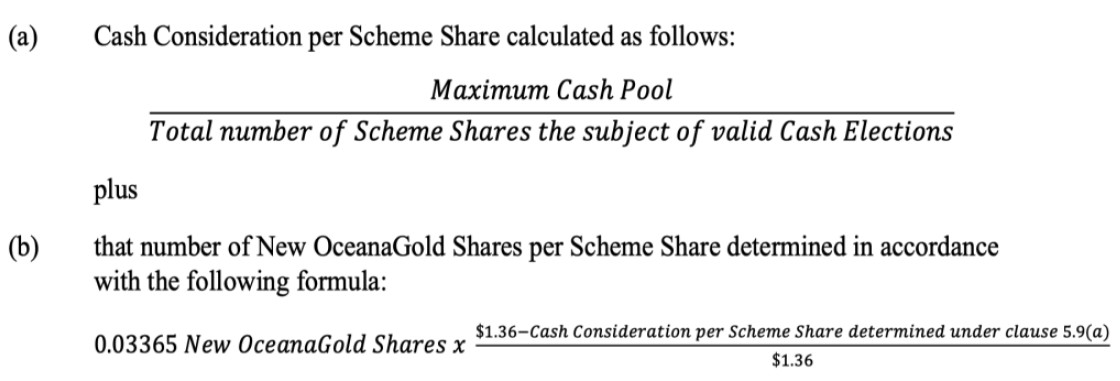
18 The effect is that each cash-electing scheme shareholder receives, in respect of each scheme share, cash and scrip which together represent the same A$1.36 per share value used to set the cash consideration, calculated on the same pro rata basis for all cash-electing scheme shareholders. The actual value of any scrip consideration in Australian dollars received by a cash-electing scheme shareholder will of course depend on the price of new OceanaGold shares and applicable exchange rates at the relevant time.
19 To be valid, a cash election must be received by 7.00 pm (Melbourne time) on the fifth business day before the scheme meeting, which is currently expected to be 20 November 2026 (cash election date). A cash election will be deemed to apply in respect of that Ausgold shareholder’s entire registered holding of scheme shares as at the scheme record date, regardless of whether that Ausgold shareholder’s holding of Ausgold shares as at the scheme record date is greater or less than their holding at the time the cash election was made.
20 As disclosed in the scheme booklet, a cash election may be varied or withdrawn at any time on or before the cash election date. Further, following the cash election date and before the scheme meeting, Ausgold will announce to the ASX the extent to which Ausgold shareholders have made cash elections. This will enable shareholders, before voting, to form a view as to the extent of any scale-back of the cash consideration and whether any residual new OceanaGold shares they might otherwise receive will be the subject of the share sale facility. Further, if a cash election is not made by an Ausgold shareholder on or prior to the cash election date, then that Ausgold shareholder will receive the scrip consideration subject to the arrangements for ineligible foreign Ausgold shareholders.
21 The scrip consideration is the default form of scheme consideration. The new OceanaGold shares will be listed for trading on the TSX and the NYSE, and will rank equally in all respects with all other OceanaGold shares on issue. If the scheme is implemented, Ausgold shareholders who receive new OceanaGold shares will collectively hold up to approximately 8% of the combined group.
22 Based on OceanaGold’s closing price on the TSX on 14 August 2026 being the last trading day before the scheme was announced, the implied value of the scrip consideration was A$1.36 per Ausgold share, representing a premium of 28% to Ausgold’s closing price on that date and implying a fully diluted equity value for Ausgold of approximately A$776 million.
23 I should note that the scheme booklet discloses the fact that the implied value of the scrip consideration is not fixed, and will vary with the OceanaGold share price and applicable currency exchange rates.
24 Now as I have already touched on, ineligible foreign Ausgold shareholders will not receive new OceanaGold shares directly. Instead, the new OceanaGold shares to which they would otherwise be entitled will be issued to a nominee appointed by OceanaGold, who must sell them on the TSX within 30 trading days after the implementation date pursuant to the share sale facility. OceanaGold Australia must then pay each ineligible foreign Ausgold shareholder its pro rata share of the net proceeds of sale.
25 Further, the same arrangements will apply to selling scheme shareholders. The new OceanaGold shares to which a selling scheme shareholder would otherwise be entitled will be issued to the nominee and sold through the share sale facility, and the net sale proceeds will be remitted to the relevant selling scheme shareholder. The purpose of this arrangement is to avoid issuing small residual parcels of new OceanaGold shares, which would need to be held on a Canadian register and traded on the TSX or the NYSE, to Ausgold shareholders who have expressed a preference for cash.
Relevant principles
26 The principles that apply upon an application to convene a scheme meeting are well known and have been referred to in a number of decisions in this Court including by me; see Re AWA Mutual Limited [2023] FCA 1551 at [53] to [55]; Re Security Matters Limited [2023] FCA 19 at [52] to [53]; Re Cellnet Group Limited [2023] FCA 767 at [22] to [23]; Re Amcor Ltd [2019] FCA 346 at [45] et seq; Re Healthscope Limited (2019) 139 ACSR 608; [2019] FCA 542 at [43] et seq; Re 5G Networks Limited [2021] FCA 1189 at [22] to [25]; Re Citadel Group Limited (2020) 148 ACSR 598; [2020] FCA 1580 at [24] to [27]; and Re DWS Limited (2020) 148 ACSR 616; [2020] FCA 1590 at [14] to [17].
27 In the present case I also adopt what I said in Re Lynch Group Holdings Limited [2025] FCA 1280 at [11] to [13]; Re RXP Services Limited [2021] FCA 38 at [18] to [19]; Re Australian Pharmaceutical Industries Limited [2022] FCA 103 at [21] and [22]; Re PM Capital Asian Opportunities Fund Limited [2021] FCA 1380 at [39] and [40]; Re Newcrest Mining Limited [2023] FCA 1080 at [30]; Re OZ Minerals Limited [2023] FCA 197 at [15]; and Re Healthscope at [128].
28 My task at the first court hearing is to assess, first, whether the statutory prerequisites to the making of orders convening a meeting have been met and, second, whether it is appropriate for me to exercise my discretion in favour of making those orders. I should say now as to the first aspect that I am satisfied that the relevant statutory prerequisites have been met.
29 As to the relevant discretionary considerations, they involve two main questions being, first, whether the scheme is fit for consideration by the members and, second, whether the members are to be properly informed as to the nature of the scheme.
30 Now in addressing whether the scheme is fit for consideration by the members, it is necessary to scrutinise the terms of the scheme to ensure that there is no unfairness that would be likely to preclude approval of the scheme. In my view the terms of the scheme do not raise any such issue of unfairness.
31 Further, Ausgold has raised the following particular matters for my consideration being (a) performance risk; (b) scheme consideration; (c) share sale facility; (d) Ausgold performance rights and Ausgold warrants; (e) director interests; (f) the voting intention statement; (g) the break fee and exclusivity provisions; and (h) the Securities Act of 1933 (US) exemption. I will address aspects (b) to (e) and (h) only, although I have taken all such matters into account.
Scheme consideration
32 The default form of scheme consideration is the scrip consideration, but Ausgold shareholders may elect to receive the cash consideration, subject to the maximum cash pool and a pro rata scale-back. Accordingly, an Ausgold shareholder may receive all scrip, all cash, or a mixture of scrip and cash. Let me make the following four points.
33 First, the availability of different forms of scheme consideration is clearly explained in the scheme booklet, as is the cash election process and scale-back mechanism, and the cash election form itself explains the effect of the maximum cash pool and the scale-back.
34 Second, the timing of the cash election date together with Ausgold’s commitment to announce to the ASX the extent of cash elections made before the scheme meeting, means that Ausgold shareholders will be in a position, before voting, to know the indicative extent of any scale-back and therefore the likely mix of cash and scrip they will receive if the scheme is implemented. Moreover, Ausgold shareholders retain the ability to sell their Ausgold shares on the ASX at any time before the scheme becomes effective.
35 Third, the independent expert has considered the alternative forms of scheme consideration, and assesses the value of the scrip consideration at A$1.29 to A$1.36 per Ausgold share, the cash consideration at A$1.36, and the “mixed consideration” (25% cash and 75% scrip, reflecting the maximum cash pool) at A$1.31 to A$1.36. For the purpose of assessing fairness, the independent expert used the value of the mixed consideration, because that is the outcome available to all Ausgold shareholders being the outcome for each cash-electing scheme shareholder if every scheme shareholder makes a cash election. Now as all of these values fall within the independent expert’s assessed value range for an Ausgold share of A$1.25 to A$1.46, the independent expert has expressed the view that the scheme is fair and reasonable.
36 Fourth, the availability of different forms of scheme consideration with a scale-back mechanism does not give rise to any class issue.
37 So in Re Cirrus Networks Holdings Ltd [2023] NSWSC 1298 (a case in which the scheme consideration took several alternative forms and combinations of cash and scrip), Black J held as follows (at [17]):
… I accept that schemes of arrangement involving alternative consideration options, subject to scale-back provisions, have been approved in prior cases, including Re Australian Leisure and Entertainment Property Management Ltd [2021] NSWSC 1421 (“Australian Leisure”) at [21] and the cases which I there noted. Mr Williams also submits and I also accept that the fact that some Cirrus Networks shareholders may elect one form of consideration over another does not create a need for separate classes at the scheme meeting, where the existing rights of all Cirrus Networks shareholders are the same; the rights afforded to them under the schemes are the same; and there is no impediment, let alone impossibility, to all Cirrus Networks shareholders consulting together with a view to their common interest: First Pacific Advisers LLC v Boart Longyear Ltd (2017) 121 ACSR 136 at [80]; Australian Leisure at [21].
38 Each of these considerations applies with equal force to the present scheme.
39 His Honour then went on to hold as follows (at [18]):
Mr Williams notes that [each] Cirrus Networks shareholder will receive the Default Consideration, being a mix of cash consideration and scrip consideration, unless he, she or it makes a valid election to receive a different form of consideration. He submits and I also accept that a Default Consideration structure, comprising a mix of scrip and cash, has been a feature of some prior schemes, and he refers to Re Murchison Metals Ltd [2014] NSWSC 951 (“Murchison Metals”), Australian Leisure and Re Over the Wire Holdings Ltd [2022] FCA 26 in that regard. Mr Williams recognises that, in Murchison Metals at [6]–[9], Brereton J expressed reservations as to attributing an election in favour of the mixed consideration option to non-electing shareholders rather than in favour of the cash option, where the independent expert had there expressed the view that the 100% scrip consideration option was neither fair nor reasonable. I would share those reservations in such a case. As Mr Williams points out, this is not such a case, since the independent expert, Lonergan Edwards, has here concluded that the scheme is “fair” and “reasonable” and, accordingly, in the best interests of Cirrus Networks shareholders as the value of the scheme consideration largely exceeds its assessed valuation range for Cirrus Networks shares on a 100% controlling interest, including in respect of the Default Consideration.
40 Again, these considerations apply with equal force to the present case, the only difference here being that the default scheme consideration is all scrip rather than a mix of cash and scrip, but that is not a relevant difference. Further, no question arises here of Ausgold shareholders being offered or defaulting to a form of scheme consideration which the independent expert considers not to be fair or reasonable.
41 Further, the observations of Black J were applied by Gleeson J in Re TASK Group Holdings Limited [2024] NSWSC 646 at [18] where the default scheme consideration was cash, but where shareholders could elect to receive mixed consideration of cash and scrip, subject to a cap on the maximum amount of scrip consideration.
42 Similarly, in Re Citadel Group the scheme provided for cash consideration as the default consideration, but with the ability for shareholders to elect to receive scrip for all or some of their shares subject to a scale-back. I accepted that the potential availability of different forms of scheme consideration did not lead to the creation of more than a single class of shareholders (at [42] to [46]). This was on the basis that the rights of scheme shareholders who elected to receive the scrip consideration were not so dissimilar from the rights of the scheme shareholders who did not make an election as to make it impossible for them to consult together with a view to their common interest. The same approach was adopted by Anderson J in Re AWA Mutual at [75].
43 Further, it need hardly be said that arrangements which provide for differing mixes of scrip and cash consideration promote choice for shareholders; see Re The Trust Company Limited [2013] NSWSC 1680 at [4] per Black J and see also the decision of Jagot J in Re Andean Resources [2010] FCA 1190 which involved a similar structure to the case before me, with scrip as the default scheme consideration, and an alternative of cash available by election subject to a scale-back on a pro rata basis, or a mixed consideration of scrip and cash.
44 In summary, in my view the availability of different forms of scheme consideration with a scale-back mechanism does not give rise to any class issue in the present case.
Share sale facility
45 I have already referred to and described the proposed treatment of ineligible foreign Ausgold shareholders and selling scheme shareholders.
46 The proposed arrangements are customary for schemes where the consideration comprises scrip in the bidder and are not class creating. In relation to ineligible foreign shareholders, one need only to refer to Re Amcor at [39] to [44]; Re Newcrest at [27] and Re Capitol Health Limited [2024] FCA 1120 at [92]. And in relation to small parcel holders, one need only to refer to Re Capitol Health at [93]; Re Hammer Metals Limited [2026] FCA 1466 at [20] and [21]; and Re Excelsior Gold Ltd [2018] FCA 2064 at [40] to [43]. Clearly, the legal rights of both types of the share sale facility participants are not so dissimilar from those of other scheme shareholders as to make it impossible for them to consult together with a view to their common interest.
Ausgold performance rights and Ausgold warrants
47 Now as I have said, Ausgold has 14,839,989 Ausgold performance rights on issue. In accordance with their terms of issue, each Ausgold performance right vests on a relevant change in control, which will occur if the scheme becoming effective. Each holder of an Ausgold performance right has issued an exercise notice in respect of their Ausgold performance rights, conditional on the scheme becoming effective. Accordingly, if the scheme becomes effective, each Ausgold performance right will automatically be exercised, resulting in the issue of Ausgold shares to the relevant holder prior to the scheme record date.
48 Further, as I have said, Ausgold has 6,000,004 Ausgold warrants on issue, all of which have vested. Ausgold, OceanaGold and OceanaGold Australia have entered into securities cancellation deeds with each holder of Ausgold warrants, providing that if the scheme becomes effective each Ausgold warrant held will be cancelled on the first business day after the effective date in exchange for the issue of Ausgold shares. The quantity of Ausgold shares to be issued on cancellation of each Ausgold warrant has been determined based on the cash consideration, after deducting the exercise price for that Ausgold warrant, in accordance with the formula set out in the scheme booklet.
49 In my view, the proposed treatment of the Ausgold performance rights and Ausgold warrants does not give rise to any class issues. I have consistently held that holders of options, performance rights or other equity incentives who are also shareholders of the scheme company do not constitute a separate class for the purposes of s 411(1); see Re Newcrest at [60]; Re OZ Minerals at [61] to [63]; Re RXP at [44] and [45]. This is because the legal rights of these shareholders, as shareholders, are not so dissimilar from the rights of other shareholders as to make it impossible for them to consult together with a view to their common interest. Nothing more need be said on this topic.
Ausgold director interests
50 Now I have set out these interests earlier and I will not repeat what I have said.
51 Interests and benefits to directors in relation to a scheme raise two issues for consideration being, first, whether there is a need for separate classes and, second, the appropriateness of any directors who might receive a benefit making a recommendation to shareholders in relation to the proposed scheme.
52 As to the first issue, in my view the relevant interests and benefits are not of the kind which would require separate classes. The Ausgold directors who hold Ausgold shares will participate in the scheme on the same basis and have the same choice of consideration as all other Ausgold shareholders, and it is accordingly not impossible for them to consult together with other Ausgold shareholders with a view to their common interest. Moreover, even where certain members may have extraneous interests in the outcome of a scheme, this is not in itself a reason for placing those members in a separate class. But in any event no such concerns arise, as none of the Ausgold directors could properly be said to have extraneous or divergent interests in the outcome of the scheme.
53 As to the second issue, the Ausgold directors’ interests and benefits do not impact their ability to recommend the scheme to Ausgold shareholders. These interests and benefits are fully and prominently disclosed in the scheme booklet, and Ausgold shareholders have been expressly told to have regard to them when considering the Ausgold directors’ recommendation.
54 Let me deal with one other topic.
US Securities Act exemption
55 If I ultimately make orders approving the scheme and the scheme becomes effective, the new OceanaGold shares to be issued as scrip consideration will not be registered under the US Securities Act, and they will instead be issued in reliance on the exemption from registration provided by s 3(a)(10) of the US Securities Act, on the basis of my approval at the second court hearing.
56 Now although this issue is primarily a matter for consideration at the second court hearing, it is appropriate to say something about the matter at this stage.
57 Now it is proposed that Ausgold shareholders with a registered address in the United States will be able to participate in the scheme, so that if the scheme becomes effective, OceanaGold will be required to issue new OceanaGold shares to those Ausgold shareholders.
58 In general, unless an exemption applies, all securities offered in the United States must satisfy the registration requirements of the US Securities Act and be registered with the US Securities Exchange Commission. This includes securities issued as consideration in an internal corporate re-organisation. The registration requirements are aimed at ensuring that companies disclose important financial information through the registration of securities. And a company that is required to comply with the registration requirements must create a registration statement, which often include a prospectus, with information about the securities, the company and the business, including audited financial statements.
59 But in the case of an Australian scheme of arrangement in which a company is proposing to issue securities as consideration to residents of the United States, the company may be able to rely upon the exemption to these registration requirements set out in s 3(a)(10) of the US Securities Act; see Tony Damian and Andrew Rich, Schemes, Takeovers and Himalayan Peaks (4th Ed, 2021) at [13.2.1] et seq. In particular they said (at [13.2.7]):
it is generally accepted that securities can be issued to target members in, or who are citizens or residents of, the United States pursuant to an Australian scheme of arrangement without compliance with the US registration and prospectus requirements as a result of the exemption provided by section 3(a)(10).
60 Section 3(a)(10) of the US Securities Act is in the following terms:
(a) Except as hereinafter expressly provided, the provisions of this title [Title 15, Chapter 2A of the United States Code, part of which is the Securities Act] shall not apply to any of the following classes of securities:
…
(10) Except with respect to a security exchanged in a case under title 11 [of the United States Code], any security which is issued in exchange for one or more bona fide outstanding securities, claims or property interests, or partly in such exchange and partly for cash, where the terms and conditions of such issuance and exchange are approved, after a hearing upon the fairness of such terms and conditions at which all persons to whom it is proposed to issue securities in such exchange shall have the right to appear, by any court, or by any official or agency of the United States, or by any State or Territorial banking or insurance commission or other governmental authority expressly authorized by law to grant such approval.
61 Accordingly, if the conditions of the s 3(a)(10) exemption are satisfied, there is no need to file a registration statement with the SEC in respect of the offer and sale of the securities to be issued to persons who are citizens or residents of the United States pursuant to a scheme of arrangement.
62 Now if the Ausgold shareholders agree to the scheme and I make orders approving the scheme, the parties intend to rely upon my approval for the purposes of the exemption in s 3(a)(10) of the US Securities Act in connection with the implementation of the scheme. The intention to rely upon the exemption in s 3(a)(10) of the US Securities Act is disclosed in the scheme booklet. Let me elaborate on what is required.
63 Before an issuer can rely on the exemption, a number of conditions must be satisfied. These conditions arise from the combined effect of the matters set out in s 3(a)(10) of the US Securities Act as well the bulletin issued by the Division of Corporation Finance of the SEC on s 3(a)(10) which included its views on the operation of the exemption (Staff Legal Bulletin No. 3A (CF), Division of Corporation Finance, SEC, 18 June 2008). These conditions have been adopted by this Court in the schemes context; see for example Re Amcor Ltd (No 2) [2019] FCA 842 at [32] to [38]. One of the conditions is that the relevant court must be advised, before any hearing at which the scheme is approved, that the issuer will rely on the s 3(a)(10) exemption based on that court’s approval in the event that the scheme is in fact approved. A further condition is that the court approve the terms and conditions of the issuance and exchange to be conducted pursuant to the scheme of arrangement and that the court find, before approving the transaction, that the terms and conditions of the exchange are fair, both procedurally and substantively, to those to whom securities will be issued.
64 Now Jacobson J approached the issue in the following way in Re Atlantic Gold NL (No 2) [2014] FCA 869 at [8]:
… The principles which apply and the approach which has been adopted by the Court were summarised by me in Re Solution 6 Holdings Limited at [37]–[44]. The approach which I propose to take in the present case is in accordance with the approach to which I referred in Solution 6. Importantly, that approach was based on a number of authorities which are generally regarded as the seminal authorities on this question. In accordance with that approach, it is appropriate to note the following:
* the scheme contemplates the issue of Spur securities as a scheme consideration;
* the Court was advised before commencement of the approval hearing that Atlantic and Spur would rely on the s 3(a)(10) of the US Securities Act exemption on the basis of the Court’s approval of the scheme;
* the Court was informed of the manner in which the scheme consideration will be calculated and was informed of the securities to be offered as scheme consideration. An independent expert report sworn by the expert concluded that the proposal is in the best interests of Atlantic shareholders. The Court has taken that evidence into account in determining whether the scheme is fair and thus should be approved;
* the Court, as it is statutorily required to do, held a hearing to consider the fairness and reasonableness of the proposed scheme; and
* that hearing has been open to the public and any person to whom Spur Securities are to be issued has standing to appear. Notice of the date of the hearing was included in the scheme booklet sent to all shareholders of Atlantic prior to the proposal being considered by the meeting of those shareholders and was advertised in a daily newspaper circulating throughout the country. There was no appearance by any shareholder.
65 The approach of Jacobson J in Re Atlantic Gold NL (No 2) was applied in Re Ardent Leisure Limited (No 2) [2018] NSWSC 1990 at [19]. In Re Amcor (No 2) at [37] and [38], I approved of the approach set out in Re Atlantic Gold NL (No 2) and in Re Ardent Leisure Ltd (No 2). I adopted the same approach in Re Newcrest Mining Limited (No 2) [2023] FCA 125 at [12] to [17]. I will address this further at the second court hearing.
Conclusion
66 In summary, I am satisfied that the scheme is of such a nature and cast in such terms that, if it achieves the statutory majorities at the scheme meeting, I would be likely to approve the scheme. Further, shareholders are to be properly informed as to the nature of the scheme. Accordingly, it is appropriate to make the orders sought convening the scheme meeting.
I certify that the preceding sixty-six (66) numbered paragraphs are a true copy of the Reasons for Judgment of the Honourable Justice Beach. |
Associate:
Dated: 11 November 2026