FEDERAL COURT OF AUSTRALIA
Warburton Environment Inc v Secretary to the Department of Energy, Environment and Climate Action (No 3) [2026] FCA 1688
File number(s): | VID 448 of 2024 |
Judgment of: | HORAN J |
Date of judgment: | 12 November 2026 |
Catchwords: | ENVIRONMENT LAW – listed threatened species under Environment Protection and Biodiversity Conservation Act 1999 (Cth) (EPBC Act) – proposed renewal and maintenance works at fuel breaks in Central Highlands within habitat area of Leadbeater’s possum (LBP) and Southern Greater Glider (SGG) – where LBP and SGG listed as critically endangered or endangered – where treatment of tree hazards involving removal of hollow-bearing trees (HBTs) and recruitment trees (RTs) – where LBPs and SGGs depend on large, old HBTs for denning resources – where ongoing decline in abundance of HBTs in LBP habitat and SGG habitat – application for injunction to restrain Secretary to the Department of Energy, Environment and Climate Action from conducting fuel break renewal and maintenance works or removing HBTs or RTs in the course of such works in LBP habitat or SGG habitat – whether conduct of planned renewal works at two fuel breaks will have or is likely to have significant impact on LBP or SGG in contravention of s 18(2) and (3) of the EPBC Act – whether other future renewal works will have or are likely to have a significant impact on LBP or SGG – whether removal of HBTs or RTs in the course of control line works and fuel break maintenance works will have or is likely to have significant impact on LBP – no significant impact on listed threatened species established on the evidence before the Court – application dismissed. |
Legislation: | Environment Protection and Biodiversity Conservation Act 1999 (Cth) ss 3, 4, 11, 18, 18A, 19, 67, 67A, 68, 69, 70, 71, 74AA, 75, 77A, 78A, 130, 133, 134, 136, 139, 178, 179, 186, 189, 207A, 207B, 207C, 266B, 267, 268, 269, 269AA, 270, 274, 298A, 298B, 475, 479, 481A, 502, 503, 523, 527E, 528 Evidence Act 1995 (Cth) ss 53, 54, 136, 140, 191 Environment Protection and Biodiversity Conservation Regulations 2025 (Cth) regs 7.01, 7.09, 7.10 Environment Protection and Biodiversity Conservation Regulations 2000 (Cth) Flora and Fauna Guarantee Act 1988 (Vic) Forests Act 1958 (Vic) ss 29, 61A, 61B, 61E, 62 |
Cases cited: | A v N [2012] NSWSC 354 Archibald v Byron Shire Council [2003] NSWCA 292; (2003) 129 LGERA 311 Australian Brumby Alliance Inc v Parks Victoria Inc (2020) 277 FCR 559 Booth v Bosworth (2001) 114 FCR 39 Brown v Forestry Tasmania (No 4) (2006) 157 FCR 1 Environment Council of Central Queensland Inc v Minister for the Environment and Water (2024) 304 FCR 91 Friends of Leadbeater’s Possum Inc v VicForests (No 4) [2020] FCA 704; (2020) 244 LGERA 92 Friends of Leadbeaters Possum Inc v VicForests (No 6) [2020] FCA 1199 Humane Society International Inc v Kyodo Senpaku Kaisha Ltd (2006) 154 FCR 425 ICI Australia Operations Pty Ltd v Trade Practices Commission (1992) 38 FCR 248 Kemp Attrill v State of South Australia [2026] FCA 1431 Krajniw v Brisbane City Council (No 2) [2011] FCA 563 Lock the Gate Alliance Ltd v Tamboran B2 Pty Ltd [2026] FCA 819 Mineralogy Pty Ltd v Sino Iron Pty Ltd (No 2) [2015] FCA 429 Minister for Environment and Heritage v Greentree (No 2) (2004) 138 FCR 198 Northern Inland Council for the Environment Inc v Minister for the Environment (2013) 218 FCR 491 Polaris Coomera Pty Ltd v Minister for the Environment [2021] FCA 254 Save Our Strathbogie Forest Inc v Secretary to the Department of Energy, Environment and Climate Action (2024) 306 FCR 331 Save Our Strathbogie Forest Inc v Secretary to the Department of Energy, Environment and Climate Action (2024) 306 FCR 316 Save Wallum Incorporated v Clarence Property Corporation Ltd (No 5) [2026] FCA 1315 Scott v The President, Councillors and Ratepayers of the Shire of Numurkah (1954) 91 CLR 300 Tarkine National Coalition Inc v Minister for the Environment (2015) 233 FCR 254 Taupau v HVAC Constructions (Queensland) Pty Limited [2012] NSWCA 293 VicForests v Friends of Leadbeater’s Possum Inc (2021) 285 FCR 70 Warburton Environment Inc v Secretary, Department of Energy, Environment and Climate Action (No 2) [2025] FCA 91 Wiki v Atlantis Relocations (NSW) Pty Ltd (2004) 60 NSWLR 127 |
Division: | General Division |
Registry: | Victoria |
National Practice Area: | Administrative and Constitutional Law and Human Rights |
Number of paragraphs: | 546 |
Date of hearing: | 1–5, 8–9, 25 September 2025 |
Counsel for the Applicant: | J Korman with M Lange |
Solicitor for the Applicant: | J King Legal |
Counsel for the Respondent: | Ms F Gordon KC with M Hosking and H Douglas |
Solicitor for the Respondent: | Ashurst Perkins Coie |
ORDERS
VID 448 of 2024 | ||
| ||
BETWEEN: | WARBURTON ENVIRONMENT INC Applicant | |
AND: | SECRETARY TO THE DEPARTMENT OF ENERGY, ENVIRONMENT AND CLIMATE ACTION Respondent | |
order made by: | HORAN J |
DATE OF ORDER: | 12 November 2026 |
THE COURT ORDERS THAT:
1. The amended originating application dated 8 September 2025 is dismissed.
2. Unless the parties reach agreement on the orders to be made as to the costs of the proceeding:
(a) by 4.00 pm on 19 November 2026, each party is to file written submissions of no more than 5 pages together with any evidence upon which it wishes to rely on the issue of costs;
(b) by 4.00 pm on 26 November 2026, each party is to file any written submissions in response of no more than 5 pages; and
(c) subject to further order, the issue of costs is to be decided on the papers.
Note: Entry of orders is dealt with in Rule 39.32 of the Federal Court Rules 2011.
REASONS FOR JUDGMENT
HORAN J:
INTRODUCTION
1 In this proceeding, Warburton Environment Inc seeks injunctive relief under s 475(2) of the Environment Protection and Biodiversity Conservation Act 1999 (Cth) (EPBC Act) to restrain the Secretary to the Department of Energy, Environment and Climate Action (DEECA) from removing hollow-bearing trees (HBTs) or recruitment trees (RTs) in the course of carrying out renewal and maintenance works at fuel breaks in areas of forest within the Central Highlands in Victoria.
2 It is common ground that the areas comprise the habitat of two listed threatened species, namely the Southern Greater Glider (SGG) and Leadbeater’s Possum (LBP). The SGG is listed in the “endangered” category and the LBP is listed in the “critically endangered” category of the list of threatened species under the EPBC Act. The LBP and the SGG use certain kinds of HBTs as “den trees”. “Recruitment trees” are defined in the applicant’s Second Further Amended Statement of Claim (2FASOC) as trees that are likely to become HBTs. In broad terms, the applicant alleges that the removal of HBTs and RTs from the relevant areas has or will have, or is likely to have, a significant impact on the LBP and the SGG and, accordingly, will contravene s 18(2) and (3) of the EPBC Act unless the taking of that action is approved by the Minister for Environment and Water (Commonwealth Minister) under Pt 9 of the EPBC Act.
3 Fuel breaks are strips of land where vegetation has been permanently modified to reduce the rate of spread and intensity of fire. The Secretary carries out the following categories of works on fuel breaks in State forests, national parks and protected public land:
(1) works conducted for the purpose of bringing a fuel break that does not meet the current standards for the construction and maintenance of strategic fuel breaks (SFB) up to those standards (Renewal Works);
(2) works conducted for the purpose of preparing a fuel break (or part of a fuel break) for use as a control line for planned burns (Control Line Works); and
(3) maintenance activities which are neither Control Line Works nor Renewal Works and which are conducted for a variety of purposes, including removal of encroaching vegetation (other than trees) through slashing and mulching, and clearing of trees that have fallen over (Maintenance Works).
4 All three categories of works involve the treatment of “tree hazards”. A tree hazard is a tree, limb or branch which may wholly or in part fall and impact people in its potential impact zone, or may become hazardous if it catches alight or is affected by wind or other fire-related disturbance. The method used by the Secretary to “treat” tree hazards depends on the circumstances. While it may involve pruning branches and limbs of trees, it often requires the felling or removal of the tree.
5 The current proceeding is concerned with works carried out by the Secretary within its network of fuel breaks in the Central Highlands, in areas of forest that contain habitat of the SGG and the LBP. The proceeding does not concern the construction of new fuel breaks. The evidence was principally directed to Renewal Works carried out at two existing fuel breaks, Loch Valley – Forty Mile Break and McMahons Creek – Boundary Road, and in particular whether future planned works at those fuel breaks are likely to have a “significant impact” on the LBP or the SGG for the purposes of s 18(2) and (3) of the EPBC Act.
6 The applicant contends that the proposed Renewal Works at Forty Mile Break and McMahons Creek will involve the removal of around 126 HBTs that are suitable as current den trees for the LBP or the SGG, along with an unspecified additional number of RTs that are likely to become suitable den trees in the future. The applicant also contends that the Secretary proposes to conduct future Renewal Works at other fuel breaks that are likely to involve the removal of HBTs and RTs in a similar manner and to a similar extent. Further, the applicant contends that additional HBTs or RTs are likely to be removed in the course of Control Line Works and Maintenance Works that will be carried out by the Secretary. It is alleged that the loss of such current and future den trees is likely to affect the habitat and to reduce the abundance of the SGG and the LBP in a manner that will constitute a significant impact on each of those species within the meaning of the EPBC Act. The applicant seeks injunctive relief accordingly to restrain the Secretary from conducting the relevant works.
7 For the reasons set out below, I am not satisfied on the evidence before the Court that the removal of HBTs or RTs in the course of the planned Renewal Works at Forty Mile Break and McMahons Creek will have, or is likely to have, a significant impact on either the LBP or the SGG within the meaning of s 18 of the EPBC Act.
8 While it is accepted that HBTs are an essential habitat component and a limiting resource for the LBP and the SGG, the surrounding forest in the areas adjacent to the fuel breaks contains suitable habitat for LBPs and SGGs with a sufficient density of HBTs to provide available denning resources. Having regard to the context and intensity of the planned Renewal Works, the applicant has not established that the removal of selected HBTs or RTs that are assessed as tree hazards along the existing linear fuel breaks is likely to result in a long-term decrease in the size of a population of LBPs or SGGs, nor to adversely affect habitat critical to the survival of the species, nor to affect the quality of habitat to an extent that the species is likely to decline, nor to interfere with the recovery of the species.
9 The evidence does not establish that the removal of any individual HBT or RT in the course of Control Line Works or Maintenance Works is likely to have a significant impact on the LBP or the SGG. Further, any assessment of the impact of such works would require further evidence about the circumstances of the tree or trees that are to be removed and the quality of the habitat in the surrounding area. The application for injunctive relief is to that extent both premature and hypothetical.
10 Similarly, in circumstances where the Secretary does not currently propose to engage in any other Renewal Works, and there is no evidence before the Court about the nature or extent of any such works, there is no basis on which to make any factual findings or to grant an injunction to restrain any unplanned future Renewal Works.
11 Accordingly, the originating application is dismissed.
PROCEDURAL HISTORY
12 The proceeding was commenced by an originating application filed on 27 May 2024 (and subsequently amended on 8 September 2025), by which the applicant claimed an injunction under s 475(2) of the EPBC Act to restrain the Secretary from destroying or removing HBTs or RTs located within areas where the LBP, the SGG or the Yellow-bellied Glider are known or likely to occur. In October 2024, the applicant dropped its claims in relation to the Yellow-bellied Glider, and confined the injunctive relief sought to works conducted in LBP habitat and SGG habitat in the Central Highlands.
13 On 5 June 2024, in response to an application for interlocutory relief, the Secretary gave an interim undertaking not to carry out any further tree removal works at Forty Mile Break or McMahons Creek. The application for interlocutory relief was subsequently dismissed upon the Secretary giving an undertaking not to remove any HBTs or RTs within SFBs located in the Central Highlands, or within one tree length of such SFBs, except in specified circumstances and subject to specified conditions, until the hearing and determination of the proceeding. On 14 February 2025, the Secretary’s undertaking was varied in the light of pleading amendments made by the applicant, so as to deal with fuel breaks other than the SFBs included in DEECA’s “SFB network”: see Warburton Environment Inc v Secretary, Department of Energy, Environment and Climate Action (No 2) [2025] FCA 91 (Horan J).
14 The matter was originally set down for trial commencing on 14 May 2025. However, the trial date was vacated after the applicant was given leave to file its 2FASOC in March 2025, and the matter was listed for final hearing commencing on 1 September 2025.
15 The trial was conducted over seven days between 1 and 25 September 2025.
16 On the first day of the trial, on an application made by the Secretary, I made orders pursuant to s 53 of the Evidence Act 1995 (Cth) for an inspection to be conducted of the fuel breaks at Forty Mile Break and McMahons Creek (the View). The View took place on 2 September 2025.
17 Speaking generally, the View was carried out for the purpose of enabling the Court to understand the questions that were raised in the proceeding and to follow and apply the evidence: see Mineralogy Pty Ltd v Sino Iron Pty Ltd (No 2) [2015] FCA 429 at [10] (Edelman J), referring to Scott v The President, Councillors and Ratepayers of the Shire of Numurkah (1954) 91 CLR 300 at 313 (Dixon CJ, Webb, Kitto and Taylor JJ). It was intended to assist the Court in resolving issues of fact, and to provide context for the subject matter of the lay evidence and expert evidence led by the parties. While reasonable inferences can be drawn from what I saw during the View (Evidence Act, s 54), I made it clear to the parties that I would not receive evidence from the parties or their experts during the View. However, it was open to witnesses to refer in their oral evidence to matters that were observed in the conduct of the View, and for witnesses to be cross-examined on such matters, so as to form part of the evidence in the proceeding.
18 Otherwise, the View served to provide a visual context or background against which the evidence and submissions were able to be better understood. The View was conducted in accordance with an agreed protocol, and was attended by counsel, solicitors and lay representatives of each of the parties, together with the parties’ expert witnesses. The Court was escorted by officers of DEECA in 4WD vehicles along the length of the fuel breaks at Forty Mile Break and McMahons Creek, stopping at a number of agreed locations at which representatives of the parties identified and described various salient features in connection with the issues in the proceeding. This included observation of the different types of forest and habitat characteristics at each stop, placed in the context of the land tenure and relevant history (including past bushfires or timber harvesting) at different points along the fuel breaks. Several trees that have been marked for removal along each fuel break were pointed out.
19 The balance of the trial was heard in Melbourne, at which oral evidence was given by the following witnesses:
(a) Mr Christopher Hardman, Chief Fire Officer (CFO), Forest and Fire Operations Division (FFOD), DEECA;
(b) Associate Professor Grant Wardell-Johnson, forest ecologist, Curtin University; and
(c) Mr Aaron Organ, Director and Principal Ecologist, Ecology and Heritage Partners Pty Ltd.
20 Each of the parties also tendered various affidavits and other documents. The evidence in the proceeding will be addressed in further detail below.
LEGISLATIVE FRAMEWORK
EPBC Act
21 The objects of the EPBC Act are set out in s 3(1) and relevantly include:
(a) to provide for the protection of the environment, especially those aspects of the environment that are matters of national environmental significance; and
…
(c) to promote the conservation of biodiversity; and
...
22 Section 3(2) of the EPBC Act relevantly provides that, in order to achieve those objects, the EPBC Act:
(a) recognises an appropriate role for the Commonwealth in relation to the environment by focussing Commonwealth involvement on matters of national environmental significance and on Commonwealth actions and Commonwealth areas; and
...
(d) adopts an efficient and timely Commonwealth environmental assessment and approval process that will ensure activities that are likely to have significant impacts on the environment are properly assessed; and
(e) enhances Australia’s capacity to ensure the conservation of its biodiversity by including provisions to:
(i) protect native species (and in particular prevent the extinction, and promote the recovery, of threatened species) and ensure the conservation of migratory species; …
...
23 The EPBC Act binds the Crown in each of its capacities: s 4.
24 Chapter 2 of the EPBC Act (“Protecting the environment”) provides a basis for the Commonwealth Minister to decide whether an action that has, will have or is likely to have a significant impact on certain aspects of the environment should proceed, “by prohibiting a person from taking an action without the Minister having given approval or decided that approval is not needed”: s 11.
25 The term “action” is relevantly defined to include “an activity or series of activities”: s 523(1)(d). Under s 527E(1), an event or circumstance is an “impact” of an action taken by a person if it is a direct consequence of the action, or if it is an indirect consequence of which the action is a substantial cause.
Approval requirements
26 Part 3 of Ch 2 of the EPBC Act contains requirements for environmental approvals. Division 1 of Pt 3 imposes conditional prohibitions on the taking of actions that have or will have, or are likely to have, a significant impact on various “matters of national environmental significance”, which relevantly include “listed threatened species and communities” dealt with in Subdiv C.
27 Section 18 prohibits a person from taking an action that has or will have, or is likely to have, a significant impact on a listed threatened species that is included in the extinct in the wild, critically endangered, endangered or vulnerable categories of the list established by the Commonwealth Minister under s 178.
28 The categories of listed threatened species are addressed in s 179 which, in relation to critically endangered or endangered species, relevantly provides:
(3) A native species is eligible to be included in the critically endangered category at a particular time if, at that time, it is facing an extremely high risk of extinction in the wild in the immediate future, as determined in accordance with the prescribed criteria.
(4) A native species is eligible to be included in the endangered category at a particular time if, at that time:
(a) it is not critically endangered; and
(b) it is facing a very high risk of extinction in the wild in the near future, as determined in accordance with the prescribed criteria.
(Emphasis in original)
29 The criteria for listing threatened species are prescribed by reg 7.01 of the Environment Protection and Biodiversity Conservation Regulations 2025 (Cth) (and previously the Environment Protection and Biodiversity Conservation Regulations 2000 (Cth)). These criteria are directed to the number and geographic distribution of the species, and the probability of its extinction in the wild, as set out in the following table:
Item | Criterion | Category | ||
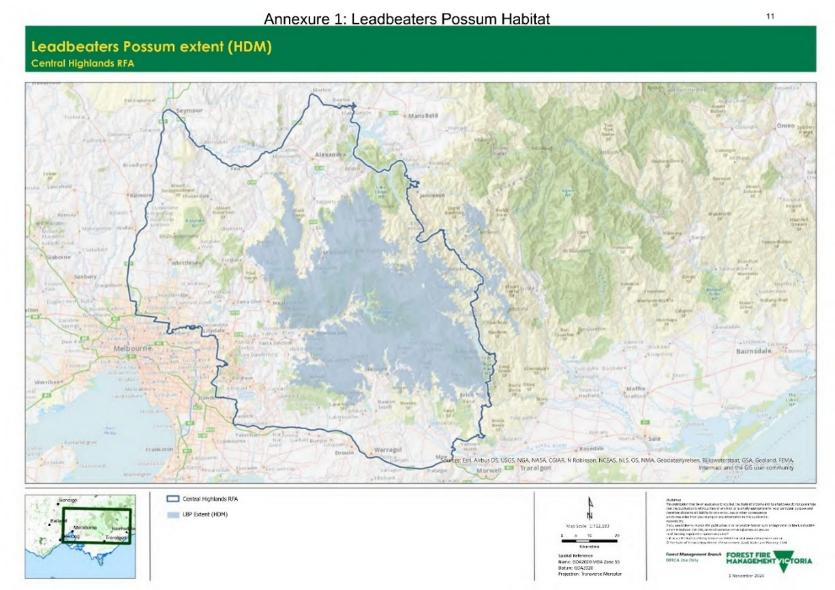
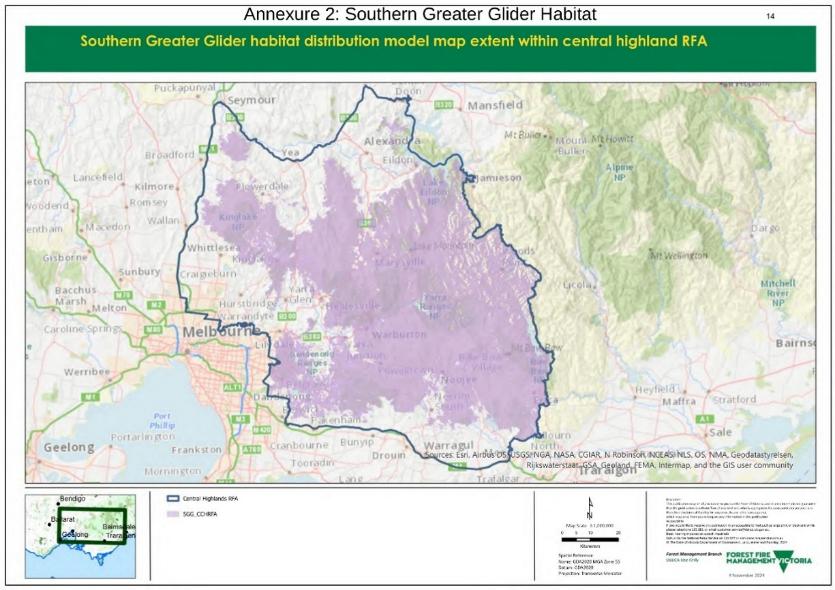
Critically endangered | Endangered | Vulnerable | ||
1 | It has undergone, is suspected to have undergone or is likely to undergo in the immediate future: | a very severe reduction in numbers | a severe reduction in numbers | a substantial reduction in numbers |
2 | Its geographic distribution is precarious for the survival of the species and is: | very restricted | restricted | limited |
3 | The estimated total number of mature individuals is: | very low | low | limited |
and: | ||||
(a) evidence suggests that the number will continue to decline at: | a very high rate | a high rate | a substantial rate | |
or | ||||
(b) the number is likely to continue to decline and its geographic distribution is: | precarious for its survival | precarious for its survival | precarious for its survival | |
4 | The estimated total number of mature individuals is: | extremely low | very low | low |
5 | The probability of its extinction in the wild is at least: | 50% in the immediate future | 20% in the near future | 10% in the medium-term future |
30 In making amendments to the list of threatened species, the Commonwealth Minister must obtain and consider advice from the Threatened Species Scientific Committee: see ss 186, 189, 502, 503 of the EPBC Act.
31 In relation to critically endangered or endangered species, s 18(2) and (3) provide:
Critically endangered species
(2) A person must not take an action that:
(a) has or will have a significant impact on a listed threatened species included in the critically endangered category; or
(b) is likely to have a significant impact on a listed threatened species included in the critically endangered category.
Civil penalty:
(a) for an individual—5,000 penalty units;
(b) for a body corporate—50,000 penalty units.
Endangered species
(3) A person must not take an action that:
(a) has or will have a significant impact on a listed threatened species included in the endangered category; or
(b) is likely to have a significant impact on a listed threatened species included in the endangered category.
Civil penalty:
(a) for an individual—5,000 penalty units;
(b) for a body corporate—50,000 penalty units.
32 The maximum pecuniary penalties for a contravention of s 18(2) and (3) must be read in the light of s 481(2A) and s 481A(1) and (2), which take into account the benefit derived or the detriment avoided because of the contravention or, in relation to a contravention by a body corporate, the annual turnover of the body corporate for the 12-month period preceding the contravention.
33 Section 18A creates corresponding criminal offences. Relevantly, s 18A(2) provides that a person commits an offence if the person takes an action that is “likely to have a significant impact” on a listed threatened species (other than one included in the extinct category or a conservation dependent species), which is punishable on conviction by imprisonment for a term not more than 7 years, a fine not more than 420 penalty units (or up to 5 times that amount for a body corporate), or both. For such purposes, the element whether the species is a listed threatened species is subject to strict liability: s 18A(2A).
34 Section 19 provides exceptions to the civil penalty and offence provisions, including if the Commonwealth Minister has made a decision under Div 2 of Pt 7 that the relevant subsection of ss 18 or 18A is not a “controlling provision” for the action, or if the action has been approved by the Commonwealth Minister under Pt 9 of the EPBC Act: s 19(1), (3)(b).
35 Chapter 4 of the EPBC Act sets out processes for environmental assessments and approvals by the Commonwealth Minister. These processes generally involve three stages: deciding whether approval is needed and identifying the applicable “controlling provisions” (Pt 7); assessing the relevant impacts of the action (Pt 8); and deciding whether or not to approve the action, and on what conditions (Pt 9).
Referral of proposed actions to Commonwealth Minister
36 The environmental assessment and approval process may be enlivened by referring the proposed action to the Commonwealth Minister for a decision whether or not the action is a controlled action. A proposed action is a “controlled action” if the taking of the action by the person without approval under Pt 9 would be prohibited by a provision of Pt 3, which is referred to as a “controlling provision” for the action: s 67. It is an offence to take a controlled action unless an approval of the taking of the action is in operation under Pt 9: s 67A.
37 A referral must be made by a person who proposes to take an action that the person thinks may be or is a controlled action: s 68(1). If the proponent thinks that the proposed action is not a controlled action, the person may nevertheless refer the proposal to the Commonwealth Minister in order to obtain a decision to that effect: s 68(2). These provisions can apply to a State or an agency of a State that is proposing to take an action. Further, a State or an agency of a State that is aware of a proposal by a person (other than a State or an agency of the State) to take an action, and has administrative responsibilities relating to the action, may refer that proposal to the Commonwealth Minister for a decision whether or not the action is a controlled action: s 69. A similar power is conferred on Commonwealth agencies that have administrative responsibilities relating to the action: s 71.
38 If the Commonwealth Minister believes that a person is proposing to take an action that the Minister thinks may be or is a controlled action, the Minister may request a referral of the proposal by either the proponent or the State or agency that the Minister believes has administrative responsibilities relating to the action (s 70). Thus, although there is no provision for a referral to be made by a person other than the proponent who has an interest in relation to the proposed action, such a person might be able to make representations to the Commonwealth Minister seeking to initiate a referral of the proposal under s 70 of the EPBC Act.
Controlled action decisions
39 Once a proposed action is referred to the Commonwealth Minister, the Minister must decide whether the action is a controlled action and which provisions of Pt 3 (if any) are controlling provisions for the action. In so deciding, the Commonwealth Minister must consider all adverse impacts (if any) the action has or will have, or is likely to have, on the matter protected by each provision of Pt 3: s 75(2)(a). The Commonwealth Minister must not consider any beneficial impacts the action has or will have, or is likely to have, on the protected matters: s 75(2)(b).
40 The Commonwealth Minister can decide that an action is not a controlled action for the purposes of a particular provision of Pt 3 if the Minister believes that the action will be taken in a particular manner that will ensure the action will not have and is not likely to have an adverse impact on the matter protected by that provision: s 77A(1). In that event, the person must not take the action in a way that is inconsistent with the particular manner that is specified in the written notice of the Commonwealth Minister’s decision: s 77A(2).
41 It is an offence for a proponent to take the action while a decision is pending on whether or not it is a controlled action: s 74AA.
Environmental assessment
42 If the Commonwealth Minister decides that the proposed action is a controlled action, the “relevant impacts” (i.e. the impacts that the action has or will have, or is likely to have, on the matter protected by each controlling provision) must be assessed in accordance with Pt 8 of Ch 4.
43 A range of different assessment approaches may be chosen by the Commonwealth Minister by reference to prescribed criteria and published guidelines. These include an accredited assessment process, assessment on referral information, assessment on preliminary documentation, assessment by public environmental report, assessment by environmental impact statement, and assessment by inquiry.
Approval of actions
44 After the controlled action has been assessed, the Commonwealth Minister must decide whether or not to approve the taking of the action for the purposes of each controlling provision: ss 130(1), 133. The Commonwealth Minister can attach conditions to the approval of the controlled action if he or she is satisfied that the conditions are necessary or convenient for protecting, or repairing or mitigating damage to, a matter protected by a relevant controlling provision: s 134.
45 In deciding whether or not to approve the taking of an action, and what conditions to attach to an approval, the Commonwealth Minister must consider certain mandatory considerations and factors set out in s 136(1) and (2), including matters relevant to any matter protected by a controlling provision, and “economic and social matters”. The Commonwealth Minister may have regard to whether the proponent is a suitable person to be granted an approval, having regard to the person’s environmental history: s 136(4).
46 In relation to decisions about threatened species, the Commonwealth Minister must not act inconsistently with Australia’s obligations under specified international conventions, or with a recovery plan or a threat abatement plan: s 139(1). If the Commonwealth Minister is considering whether to approve a proposed action for the purposes of a subsection of s 18 that has or will have, or is likely to have, a significant impact on a particular listed threatened species, the Commonwealth Minister must have regard to any approved conservation advice for the species or community: s 139(2). Otherwise, the Commonwealth Minister must not consider any matters that he or she is not required or permitted by Div 1 of Pt 9 to consider: s 136(5).
Significant impact on a listed threatened species
47 There was no dispute between the parties about the principles relating to the construction and application of s 18(2) and (3), which have been summarised in a number of recent decisions of this Court: see Save Our Strathbogie Forest Inc v Secretary to the Department of Energy, Environment and Climate Action (2024) 306 FCR 331 (Strathbogie (FC)) at [62]–[65] (Moshinsky, Charlesworth and Kennett JJ); Lock the Gate Alliance Ltd v Tamboran B2 Pty Ltd [2026] FCA 819 at [27]–[30] (Owens J); Save Wallum Incorporated v Clarence Property Corporation Ltd (No 5) [2026] FCA 1315 at [78]–[101] (Perry J); Kemp Attrill v State of South Australia [2026] FCA 1431 at [21]–[37] (Charlesworth J).
48 For the purposes of the EPBC Act, a “significant impact” is one that is “important, notable or of consequence having regard to its context or intensity”: Booth v Bosworth (2001) 114 FCR 39 at [99]–[100] (Branson J); VicForests v Friends of Leadbeater’s Possum Inc (2021) 285 FCR 70 (FOLP (FC)) at [62] (Jagot, Griffiths and SC Derrington JJ); Australian Brumby Alliance Inc v Parks Victoria Inc (2020) 277 FCR 559 at [123], [227] (O’Bryan J). This has been taken to exclude impacts on a listed threatened species which are “minor or negligible”: Northern Inland Council for the Environment Inc v Minister for the Environment (2013) 218 FCR 491 at [92] (Cowdroy J). The purpose of the EPBC Act “would not be achieved if any possibly adverse effect upon a species, however minor and however unlikely, was sufficient to engage either of ss 18 and 18A”: Krajniw v Brisbane City Council (No 2) [2011] FCA 563 at [10] (Dowsett J).
49 Whether a proposed action is likely to have a significant impact under s 18 of the EPBC Act is a question of fact: Minister for Environment and Heritage v Greentree (No 2) (2004) 138 FCR 198 at [192] (Sackville J); Australian Brumby Alliance at [230] (O’Bryan J). Assessing whether an impact is significant “is not a mathematical exercise, but rather a matter of considering the evidence as a whole”: Friends of Leadbeater’s Possum Inc v VicForests (No 4) [2020] FCA 704; (2020) 244 LGERA 92 (FOLP (No 4)) at [1308] (Mortimer J) cited with approval by the Full Court in FOLP (FC) at [267] (Jagot, Griffiths and SC Derrington JJ).
50 Section 18(2) and (3) are directed to actions that have or will have, or are likely to have, a significant impact on the relevant species as a whole: Krajniw at [10] (Dowsett J). Nevertheless, adverse impacts or effects on individuals or local populations of the species may be probative of an impact on the species as a whole: FOLP (No 4) at [1304], [1308]; FOLP (FC) at [267] (Jagot, Griffiths and SC Derrington JJ). As Mortimer J observed in FOLP (No 4) at [1304], “the whole context of the prohibitions – the taking of an action – is very likely to involve consideration of the effects of actions on flora or fauna species in identified and localised locations”. In particular, her Honour referred to “the context of actions such as forestry operations, where, for forestry and not environmental or conservation purposes, the ‘actions’ are taking place in a piecemeal way in relatively small areas of forest, but there is a wider and cumulative effect on larger areas of native forest and the species (flora and fauna) dependent on that forest”: ibid.
51 In that context, Mortimer J emphasised (FOLP (No 4) at [1304]):
The thrust of the significant impact provisions is to conserve and protect species in the wild, so that their “chances of long-term survival in nature” are maximised … Survival “in nature” refers in my opinion to survival reflecting that species’ place in the natural ecosystem – survival of a species at sufficient and sustainable levels of abundance, with sufficient and sustainable genetic diversity and across the species’ natural range.
52 The term “likely” in s 18(2) and (3) refers to “a real or not remote chance or possibility”, in the sense of “prone” or “with a propensity” or “liable”, as distinct from a test of “more probable than not”: Save Our Strathbogie Forest Inc v Secretary to the Department of Energy, Environment and Climate Action (2024) 306 FCR 316 (Strathbogie (PJ)) at [338]–[343] (Horan J), referring to Polaris Coomera Pty Ltd v Minister for the Environment [2021] FCA 254 at [226] (Rangiah J); FOLP (No 4) at [1298] (Mortimer J); Northern Inland Council at [91]–[92] (Cowdroy J); Booth at [97]–[98] (Branson J). This involves a single evaluative judgment as to whether there is a real (in the sense of not remote) possibility of a significant impact on the relevant species, rather than separately addressing the possibility of each of the factual elements which together may give rise to such an impact: Strathbogie (PJ) at [348], [384] (Horan J); see also Save Wallum at [95]–[97] (Perry J). In the balance of these reasons, I will use the term “likely” in the sense referred to above.
53 For such purposes, the inquiry is directed at the impact of the relevant action or proposed action, being an event or circumstance that is a direct consequence of the action, or an indirect consequence of which the action is a “substantial cause”: s 527E. This will generally involve a factual inquiry into causation: see, e.g., Environment Council of Central Queensland Inc v Minister for the Environment and Water (2024) 304 FCR 91 at [172] (Horan J). In this regard, it may be necessary to distinguish the impact of the action from the operation of broader events or circumstances, although the latter remains relevant to an identification of a base line against which the impact of the action can be measured or assessed. As Jessup J stated in Tarkine National Coalition Inc v Minister for the Environment (2015) 233 FCR 254 at [41], “for an endangered species, consideration of the consequences of some action would normally proceed from a base line constituted by the existing circumstances of that species, whether they had been brought about by the natural course of events, by previous human actions which had their own ‘impacts’, or a combination of the two”.
54 The Commonwealth Department of Environment has published a document entitled “Matters of National Environmental Significance: Significant impact guidelines 1.1” (Significant Impact Guidelines). The stated purpose of the guidelines is to assist the proponents of an action to decide whether or not the action should be referred for environmental assessment and approval by the Commonwealth Minister pursuant to the EPBC Act. The Significant Impact Guidelines are not given statutory force and do not themselves have any legal authority: FOLP (No 4) at [1311] (Mortimer J); Australian Brumby Alliance at [123], [225] (O’Bryan J). Rather, the document sets out administrative policy which represents the approach adopted by the Commonwealth Department in relation to the application of the requirements relating to matters of national environmental significance (contained in Div 1 of Pt 3 of Ch 2 of the EPBC Act). Nevertheless, the guidelines generally reflect the prevailing interpretation of the statutory requirements, and are capable of assisting any assessment of whether there is a “significant impact” on a matter of national environmental significance: FOLP (No 4) at [1315], [1321] (Mortimer J).
55 The Significant Impact Guidelines set out criteria for determining whether an action is likely to have a significant impact on a listed threatened species. In relation to critically endangered and endangered species, the Significant Impact Guidelines relevantly state:
Significant impact criteria
An action is likely to have a significant impact on a critically endangered or endangered species if there is a real chance or possibility that it will:
• lead to a long-term decrease in the size of a population
• reduce the area of occupancy of the species
• fragment an existing population into two or more populations
• adversely affect habitat critical to the survival of a species
• disrupt the breeding cycle of a population
• modify, destroy, remove, isolate or decrease the availability or quality of habitat to the extent that the species is likely to decline
• result in invasive species that are harmful to a critically endangered or endangered species becoming established in the endangered or critically endangered species’ habitat
• introduce disease that may cause the species to decline, or
• interfere with the recovery of the species.
What is a population of a species?
A ‘population of a species’ is defined under the EPBC Act as an occurrence of the species in a particular area. In relation to critically endangered, endangered or vulnerable threatened species, occurrences include but are not limited to:
• a geographically distinct regional population, or collection of local populations, or
• a population, or collection of local populations, that occurs within a particular bioregion.
56 The Significant Impact Guidelines also address the questions “What is a significant impact?” and “When is a significant impact likely?” in a manner consistent with the authorities that have been discussed above.
Conservation Advices
57 The Commonwealth Minister must ensure that there is approved conservation advice for each listed threatened species (other than an extinct species or a conservation dependent species): EPBC Act, s 266B(1). A conservation advice must contain a statement setting out the grounds on which the species is eligible to be included in the category in which it is listed and the main factors that are the cause of it being so eligible, and must contain information about what (if anything) could appropriately be done to stop the decline of, or support the recovery of, the species: s 266B(2).
58 Conservation advices under the EPBC Act are provided to the Commonwealth Minister by the Scientific Committee, whose expert members are appointed by the Commonwealth Minister. The functions of the Scientific Committee include advising the Commonwealth Minister on approved conservation advice and the amendment and updating of the lists established under Pt 13 of the EPBC Act (including the list of threatened species): s 503. A conservation advice must be approved in writing by the Commonwealth Minister, following consultation with the Scientific Committee, before its publication on the internet: s 266B(4)–(7).
59 In FOLP (No 4) at [25]–[26], Mortimer J described conservation advices as “the mandatory and foundational documents describing each threatened species, its characteristics and habitat, and the threats posed to it”, and as containing “the formal recognition, for the purposes of the EPBC Act, of why the listed threatened species has been determined to need protection and what measures need to be taken to ensure its conservation and recovery”.
60 The Commonwealth Minister relevantly approved the Conservation Advice: Gymnobelideus leadbeateri (Leadbeater’s Possum) (LBP Conservation Advice) with effect from 22 June 2019, and the Conservation Advice for Petauroides volans (greater glider (southern and central)) (SGG Conservation Advice) with effect from 5 July 2022.
Recovery plans
61 Within 90 days after a species becomes a listed threatened species (other than an extinct species or a conservation dependent species), the Commonwealth Minister must decide whether to have a recovery plan for the species: EPBC Act, s 269AA(1). The Commonwealth Minister may also decide to have a recovery plan (or not to have a recovery plan) for a listed threatened species at any other time: s 269AA(1B). In making such decisions, the Commonwealth Minister must have regard to the recommendation or advice of the Scientific Committee: ss 269AA(3)–(5), 274.
62 Recovery plans for listed threatened species bind the Commonwealth and Commonwealth agencies, which must not take any action that contravenes a recovery plan: EPBC Act, ss 267, 268. Further, the Commonwealth must implement the recovery plan to the extent to which it applies in Commonwealth areas and, to the extent to which the plan applies outside Commonwealth areas in a particular State or Territory, must seek the cooperation of the State or Territory with a view to the joint implementation of the plan: s 269. As mentioned above, the Commonwealth Minister is specifically required not to act inconsistently with a recovery plan when deciding whether or not to approve the taking of a controlled action, and what conditions to attach to such an approval: s 139(1)(b).
63 Section 270 of the EPBC Act governs the content of recovery plans. A recovery plan “must provide for the research and management actions necessary to stop the decline of, and support the recovery of” the listed threatened species “concerned so that its chances of long-term survival in nature are maximised”: s 270(1). This includes stating the objectives to be achieved, the criteria against which the achievement of those objectives is to be measured, and the actions needed to achieve the objectives: s 270(2)(a), (b), (c). The plan must identify the threats to the species: s 270(2)(ca). To the extent to which it is practicable to do so, the plan must identify the habitats that are critical to the survival of the species and the actions needed to protect those habitats, identify any populations of the species that are under particular pressure of survival and the actions needed to protect those populations, state the estimated duration and cost of the recovery process, and identify the interests that will be affected by the plan’s implementation and the organisations or persons who will be involved in evaluating its performance: s 270(2)(d), (e), (f), (g), (2A).
64 In making a recovery plan, it is necessary to have regard to the objects of the EPBC Act; the most efficient and effective use of the resources that are allocated for the conservation of species and ecological communities; minimising any significant adverse social and economic impacts, consistently with the principles of ecologically sustainable development; meeting Australia’s obligations under international agreements relevant to the species or ecological community to which the plan relates; and the role and interests of indigenous people in the conservation of Australia’s biodiversity: s 270(3).
65 The National Recovery Plan for Leadbeater’s Possum (Gymnobelideus leadbeateri) (LBP Recovery Plan) has been in effect from 5 March 2024.
Injunctive relief under the EPBC Act
66 If a person has engaged, is engaging or is proposing to engage in conduct constituting an offence or other contravention of the EPBC Act, s 475(2) confers power on the Court to grant a “prohibitory” injunction to restrain the person from engaging in the conduct.
67 Such an injunction may be granted on the application of an “interested person”: s 475(1). For such purposes, an organisation is an interested person if its interests have been, are or would be affected by the conduct or proposed conduct, and it meets certain requirements in relation to its objects and activities during the preceding two years in relation to the protection or conservation of, or research into, the environment: s 475(7).
68 In Strathbogie (PJ) at [95]–[100], I discussed the nature of the jurisdiction to grant injunctive relief under s 475 of the EPBC Act and its relationship to the administrative processes for the environmental assessment and approval of controlled actions under Pts 7, 8 and 9 of the EPBC Act. In relation to the former, the Court is required to determine, as best it can on the evidence before it, whether the current or future conduct of a person involves a contravention of a provision of the EPBC Act. In relation to the civil penalty provisions in s 18(2) and (3) of the EPBC Act, and the corresponding offence provisions in s 18A, the Court must make findings of fact in relation to whether or not conduct that has been taken, is being taken or is proposed to be taken by a person has or will have, or is likely to have, a significant impact on the relevant listed threatened species. This will involve a determination whether there is a real (in the sense of not remote) possibility that the conduct will have an impact on the species as a whole that is important, notable or of consequence having regard to its context or intensity.
69 On such issues, the applicant bears the onus of proof on the balance of probabilities, taking into account the cause of action, the nature of the subject matter of the proceeding, and the gravity of the matters alleged: see Evidence Act, s 140; Strathbogie (PJ) at [343]–[349] (Horan J); cf. Strathbogie (FC) at [120]–[122] (Moshinsky, Charlesworth and Kennett JJ).
70 There is a considerable overlap, if not an identity, between the questions of fact that may arise on an application for an injunction under s 475 of the EPBC Act and those relevant to a decision by the Commonwealth Minister whether the proposed action is a controlled action under Div 2 of Pt 7 of the EPBC Act. Once a proposed action is referred to the Commonwealth Minister, the Minister (or his or her delegate) must decide whether or not the taking of the action without approval would be prohibited by a provision of Pt 3 (which relevantly includes ss 18 and 18A), having regard to any and all adverse impacts that the action has or will have, or is likely to have, on a matter protected by each such controlling provision. In making that decision, the Commonwealth Minister or his or her delegate, with the assistance of the Department of Climate Change, Energy, the Environment and Water, can consider the information included in the referral and any other information that the Minister requests the proponent to provide. Among other things, the Commonwealth Minister or the delegate would apply any relevant administrative policies, would be required to have regard to the precautionary principle, and would be bound by any recovery plan that is in force. There are statutory timeframes for making a decision whether or not a referred proposal is a controlled action, for making a decision on the assessment approach to be used for any controlled action, and for making a decision whether or not to approve the taking of a controlled action.
71 As discussed above, an action is not prohibited by ss 18 or 18A of the EPBC Act if the Commonwealth Minister has made a decision that the action is not a controlled action or that ss 18 or 18A are not controlling provisions for the action. Further, an action is not prohibited by ss 18 or 18A if it has been approved by the Commonwealth Minister under Pt 9 of the EPBC Act. Accordingly, once a proposed action has been referred to the Commonwealth Minister under Pt 7 of the EPBC Act for a decision whether or not it is a controlled action, there will be limited scope to apply to the Court for a prohibitory injunction under s 475(2). An injunction might be sought to restrain a person from taking an action while a referral is pending (see s 74AA), or to restrain a person from taking a controlled action before an approval is granted under Pt 9 (see s 67A).
72 Any injunction granted under s 475(2) to restrain conduct in contravention of ss 18 or 18A will ordinarily be made conditional on any subsequent decision by the Commonwealth Minister under Pt 9 of the EPBC Act to approve the taking of the action or, for that matter, any subsequent decision by the Minister under Pt 7 of the EPBC Act that the action is not a controlled action or that the relevant provisions in Pt 3 are not controlling provisions.
73 In this context, the EPBC Act arguably contemplates that the administrative processes in Pts 7, 8 and 9 constitute the primary mechanism for determining when proposed actions require assessment and approval in relation to matters of national environmental significance. The jurisdiction of the Court to grant injunctive relief remains an important means of enforcing compliance with the EPBC Act, but those remedies should not supplant the administrative processes established by the Act. Often, the practical issues underlying an application for an injunction under s 475 will be concerned with whether the proponent of an action is required to refer the proposal to the Commonwealth Minister for assessment and approval under the EPBC Act. Given that a person proposing to take an action can refer the proposal to the Commonwealth Minister under Div 1 of Pt 7 even if the person thinks that the action is not a controlled action (see s 68(2)), the situations in which an injunction is sought under s 475 will usually involve a proponent who does not think that the action may be a controlled action, and is unwilling to refer the proposal to the Commonwealth Minister for a decision whether or not that is the case.
74 In this regard, the extended standing of an “interested person” to apply for an injunction under s 475 is not reflected in the provisions for the referral of proposals to the Commonwealth Minister under Pt 7 of the EPBC Act (cf. s 78A in relation to requests for reconsideration of decisions made on such a referral). Accordingly, if the person who proposes to take an action does not refer the proposal to the Commonwealth Minister, an interested person (within the meaning of s 475(7)) cannot make a referral for the Minister’s decision whether or not the action is a controlled action. Where the proponent is a State or an agency of a State which does not itself refer the proposal, a referral can only be initiated on the request of the Commonwealth Minister, if he or she thinks that the action may be or is a controlled action: s 70.
75 In such circumstances, an interested person can invoke the jurisdiction of this Court to restrain the proposed action on the basis that it involves a contravention of ss 18 or 18A in the absence of a referral to the Commonwealth Minister under Pt 7 and, if the Minister were to decide that it is a controlled action, an environmental assessment and approval under Pts 8 and 9 of the EPBC Act. In determining whether to grant an injunction under s 475, the Court must determine whether the conduct in which the person is engaging or proposes to engage would constitute an offence or other contravention of the EPBC Act. Relevantly, this will turn on whether the conduct or proposed conduct amounts to an action that has or will have, or is likely to have, a significant impact on a listed threatened species. In the context of proceedings under s 475 of the EPBC Act, that question must be judicially determined based on affidavit and oral evidence, including any competing expert opinions, tested in an adversarial context.
76 Both from a procedural and temporal perspective, the resolution of the issues by way of such proceedings is markedly different from the administrative processes established by the EPBC Act. However, the institution of proceedings under s 475 of the EPBC Act does not prevent the statutory referral, assessment and approval processes from being followed. Indeed, the relief sought in the present proceeding contemplates that those statutory processes will ultimately ensue.
The scope of prohibitory or mandatory injunctions under the EPBC Act
77 A prohibitory injunction under s 475(2) of the EPBC Act restrains a person from engaging in conduct constituting an offence or other contravention of the Act or the regulations. A mandatory injunction under s 475(4) requires a person to do an act, where the refusal or failure to do that act did, does or would constitute an offence or other contravention of the Act or the regulations.
78 Section 479(1) relevantly provides that a prohibitory injunction may be granted whether or not it appears to the Court that the person has previously engaged in conduct of the relevant kind, or intends to engage again or to continue to engage in such conduct. Similarly, s 479(2) relevantly provides that a mandatory injunction may be granted whether or not the person has previously refused or failed to do the relevant act or thing, or intends to refuse or fail again or to continue to refuse or fail to do the act or thing.
79 Taken together, these provisions confer a jurisdiction to grant a “public interest injunction” which is “unusually comprehensive in scope”: Humane Society International Inc v Kyodo Senpaku Kaisha Ltd (2006) 154 FCR 425 at [18]–[21] (Black CJ and Finkelstein J). Nevertheless, any injunction must be directed to particular conduct, or the refusal or failure to do a particular act, that constitutes a contravention of the EPBC Act or the regulations: FOLP (No 4) at [1459]–[1460] (Mortimer J). Further, an injunction should be framed so that it is clear and unambiguous as to what future conduct falls within its terms: ICI Australia Operations Pty Ltd v Trade Practices Commission (1992) 38 FCR 248 at 259 (Lockhart J, French J agreeing at 268).
80 To the extent that s 479(1) contemplates that an injunction may be granted to restrain a person from engaging in conduct irrespective of whether the person has previously engaged in conduct of that kind, or whether the person intends to repeat or to continue the conduct, this does not override the requirement in s 475(1) and (2) to establish that the person has engaged, is engaging or proposes to engage in conduct that constitutes an offence or other contravention. In other words, in order to enliven the power to grant a prohibitory injunction, there must be some past, current or future conduct in contravention of the EPBC Act. However, the effect of s 479(1) includes that a person can be restrained from proposed contravening conduct even if that person has not previously engaged in such conduct, and a person who has previously engaged in contravening conduct can be restrained from continuing or repeating that conduct even if it does not appear that the person intends to do so.
Forests Act
81 Section 61A of the Forests Act 1958 (Vic) provides that there must be a CFO of DEECA. The Secretary may authorise the CFO in writing to perform any of the Secretary’s functions in respect of fire related activities in every State forest, national park or on protected public land: ss 29, 61B(a).
82 Relevantly, s 62(2) of the Forests Act imposes a statutory obligation on the Secretary to carry out work in State forests for the prevention and control of fire:
(2) Despite anything to the contrary in any other Act or law, the Secretary must carry out proper and sufficient work in State forests, national parks and on protected public land—
(a) for the immediate prevention and suppression of fire; and
(b) for the planned prevention of fire.
THE PLEADINGS
Facts not in dispute
83 Before identifying the parties’ respective cases as raised by the pleadings, it is necessary to say something about facts that are not in dispute.
84 Prior to the trial of the proceeding, the parties were required to confer and jointly prepare a document setting out a statement of agreed facts, together with the issues of fact and law to be determined in the proceeding.
85 The parties filed differing versions of a “Statement of Agreed Facts”, each of which contemplated that the facts set out in the document would not be disputed for the purposes of the proceeding: see s 191 of the Evidence Act. While there were differences between the parties’ respective statements, there was nevertheless some overlap or common ground. However, the differences were not resolved by the end of the trial, and the parties did not adduce in evidence any signed agreement in writing for the purposes of s 191(3) of the Evidence Act.
86 During the applicant’s opening submissions, counsel for the applicant described its document as “a subset of the statement of agreed facts provided by the respondent”. I suggested that the “lowest common denominator” between the applicant’s document and the Secretary’s document might be the subject of agreement, although counsel for the Secretary noted that some potential difficulties might arise in so far as the parties had not agreed on the definition of the term “HBT”. At the time, the applicant was seeking leave to amend its pleading to adopt a different definition of “hollow-bearing trees”, but that application was not ultimately pressed and no such leave was granted. Nevertheless, the parties did not proceed to formalise any agreement as to the facts that were not in dispute for the purposes of the proceeding.
87 Although no signed agreement pursuant to s 191 of the Evidence Act was filed by the parties, the documents prepared by the parties record a number of uncontroversial matters, many of which reflect admissions that arise on the pleadings. In the light of the oral submissions made by counsel, I consider that such matters were stated before the Court with the agreement of all parties, and fall within s 191(3)(b) of the Evidence Act on that basis.
88 The relevant matters that were not disputed include:
Standing
1. The Applicant is an “interested person” within the meaning of s 475(7) of the EPBC Act.
The LBP and the SGG
2. The LBP is listed in the “critically endangered” category under the EPBC Act.
3. The SGG is listed in the “endangered” category under the EPBC Act.
4. The area where LBP habitat is known or likely to occur is shown in grey on the map at Annexure 1 of the 2FASOC.
5. The area of the Central Highlands where SGG habitat is known or likely to occur is shown in purple on the map at Annexure 2 of the 2FASOC.
Fuel breaks
6. Fuel breaks are strips of land where vegetation has been permanently modified to reduce the rate of spread and intensity of fire for the direct protection of assets and/or to assist fire control.
7. Fuel breaks may include roads or tracks.
8. To the extent they are not constituted by roads or tracks, fuel breaks may resemble open grassy wood or heath land.
9. Strategic Fuel Breaks are fuel breaks that meet the current standards for the construction and maintenance of Strategic Fuel Breaks set out in the document titled “Strategic Fuel Break Construction & Maintenance”, which is Tab 1 of Annexure CH-2 to the Hardman Affidavit.
Types of works conducted at fuel breaks
10. Renewal Works are works conducted for the purpose of bringing a fuel break that does not meet the current standards for the construction and maintenance of Strategic Fuel Breaks up to those standards.
11. Control Line Works are works conducted for the purpose of preparing a fuel break or part of a fuel break for use as a control line for planned burns.
12. Maintenance Works are works conducted at fuel breaks which are neither Renewal Works nor Control Line Works and are conducted for a variety of purposes.
13. The Respondent has, in the past:
a. conducted Renewal Works, Control Line Works, and Maintenance Works at fuel breaks located in the area shown in grey on the map at Annexure 1 of the 2FASOC; and
b. conducted Renewal Works at fuel breaks located in the area shown in purple on the map at Annexure 2 of the 2FASOC.
Renewal Works
14. The Respondent intends to conduct Renewal Works at Forty Mile Break and McMahons Creek.
15. Forty Mile Break and McMahons Creek are both located in:
a. the area shown in grey on the map at Annexure 1 of the 2FASOC; and
b. the area shown in purple on the map at Annexure 2 of the 2FASOC.
16. Forty Mile Break is at the location shown on the map at Tab 12 of Annexure CH-2 to the Hardman Affidavit, which is reproduced as Annexure A to this SOAF.
17. McMahons Creek is at the location shown on the map at Tab 17 of Annexure CH-2 to the Hardman Affidavit, which is reproduced as Annexure B to this SOAF.
89 The agreed facts in relation to the areas of known or likely LBP habitat and SGG habitat refer to maps that were annexed to the 2FASOC:
(a) In Annexure 1, the areas where LBP habitat is known or likely to occur within the Victorian Central Highlands are marked in grey. I will refer to this as the LBP habitat area. The blue line indicates the boundaries of the Central Highlands Regional Forest Agreement (RFA).
(b) In Annexure 2, the areas where SGG habitat is known or likely to occur within the Victorian Central Highlands are marked in purple. I will refer to this as the SGG habitat area. Again, the blue line indicates the boundaries of the Central Highlands RFA.
The applicant’s case
90 As set out above, it was not in dispute that the Secretary has conducted Renewal Works, Control Line Works and Maintenance Works in areas where LBP habitat is known or likely to occur, and has conducted Renewal Works at fuel breaks located in areas where SGG habitat is known or likely to occur.
91 In the 2FASOC, HBTs were defined as “trees with hollows suitable as current den trees” for LBPs or SGGs, with the following particulars:
Hollow-bearing trees are living or dead trees likely to be at least 150 years old with hollows suitable as dens for LBP’s [sic], or SGG’s [sic].
Trees can be assumed to be hollow-bearing trees if their diameter at breast height (DBH) is greater than 60 cm, and they either:
(a) have visible hollows; or
(b) are in the mature or senescent growth stage; or
(c) have one or more obvious deformities such as a burl, large protuberance, or broken limbs;
92 RTs were defined in the 2FASOC as “trees likely to become [HBTs]”, which were particularised as follows:
Recruitment trees are trees that are dominant or co-dominant in a stand or patch dominated by trees in the juvenile (1 – 50 years) or immature (50 – 125 years) growth stages.
Recruitment trees are likely to become hollow-bearing trees because they are likely to remain in a stand or patch well beyond 150 years, which is the approximate time it takes for large hollows suitable for LBPs [and] SGGs … to form and be available as den sites.
Dominant trees are trees which have their crowns above surrounding trees and capture sunlight from both above and around the crown.
Co-dominant trees are trees that form the general level of the crown cover and receive full light from above, but comparatively little light from the sides.
93 The applicant alleged that the Secretary had destroyed HBTs and RTs in the course of past Renewal Works. The applicant provided particulars of eight HBTs on the Forty Mile Break that were alleged to have been destroyed in early May 2024. The applicant also alleged that a significant number of HBTs and “likely” HBTs, together with a greater number of RTs, had been destroyed at various fuel breaks in the SGG habitat area at some time prior to 1 June 2024. The principal significance of the alleged past destruction of HBTs and RTs was to provide “a basis to infer that there is a real (as in not remote) chance the [Secretary] will in the future continue to remove such trees at a similar scale in the course of conducting Renewal Works”.
94 The applicant does not seek any relief in relation to any past works involving the removal of HBTs or RTs. Although past conduct in contravention of the EPBC Act can potentially be relevant to a claim for injunctive relief under s 475, the 2FASOC does not contain any specific allegation that the past destruction of HBTs and RTs in LBP habitat and SGG habitat constituted a contravention of s 18(2) or (3) of the EPBC Act (notwithstanding that this question appears to have been addressed by A/Prof Wardell-Johnson in his expert reports). That is, the alleged breach of the EPBC Act as pleaded in the 2FASOC is confined to the planned and future Renewal Works, along with each removal of a HBT or RT in the course of Control Line Works or Maintenance Works conducted in LBP habitat: see 2FASOC, paras 9A, 11, 11A, 12A and 14.
95 In relation to the “[p]roposed destruction of LBP habitat and SGG habitat”, the applicant alleged that the Secretary was likely to destroy HBTs and/or RTs in the course of proposed future Renewal Works that the Secretary intended to carry out in the LBP habitat area and the SGG habitat area. While the applicant pleaded that it did not know the number or location of all of the HBTs and RTs that the Secretary was likely to destroy, it gave particulars of 124 HBTs and an unknown but substantially greater number of RTs that had been marked for destruction along the Forty Mile Break and McMahons Creek. The applicant further alleged that the Secretary was likely to destroy HBTs and/or RTs in the course of planned Control Line Works and Maintenance Works in the LBP habitat area, although no particulars of those allegations were provided.
96 In such circumstances, the applicant alleged that the following actions by the Secretary were prohibited by s 18(2) and/or (3) of the EPBC Act:
(a) the conduct of Renewal Works in the LBP habitat area or the SGG habitat area, being McMahons Creek and Forty Mile Break as well as any “future and as yet unplanned Renewal Works”; and
(b) the removal of HBTs and/or RTs in the course of conducting such Renewal Works.
97 In relation to the LBP habitat area, the applicant also alleged that each removal of a HBT and/or RT during the course of Renewal Works, Control Line Works or Maintenance Works was a separate and distinct “action” for the purposes of s 18(2) of the EPBC Act.
98 The applicant alleged that these actions are likely to have a significant detrimental impact on the LBP and the SGG respectively, in so far as the destruction of HBTs and/or RTs is likely to
(a) lead to a long-term decrease in the size of a population of the species;
(b) adversely affect habitat critical to the survival of the species;
(c) modify, destroy, remove or isolate or decrease the availability or quality of habitat to the extent that the species is likely to decline; and/or
(d) interfere with the recovery of the species.
99 In relation to the LBP, the applicant alleged that all HBTs and RTs in the LBP habitat area constitute habitat critical to the survival of the species. Further, the applicant placed particular reliance on the LBP Conservation Advice and the LBP Recovery Plan as providing support for the following matters:
The majority of the LBP’s range is across the Mountain Ash forest of the Central Highlands of Victoria, within which the LBP is dependent on HBTs as a nest resource. Hollows only begin to form in trees from approximately 120 years of age. Most of the Central Highlands was burned in an extensive wildfire in 1939, leaving a limited number of suitable trees standing. As these trees age and collapse, the pool of nesting resources is declining, while the 1939 regrowth trees are not expected to begin to recruit significant numbers of hollow bearing trees until after 2060. (LBP Conservation Advice, p 4.)
It is clear that HBTs are the most limiting resource, that they have the longest renewal time after depletion, that a decline in hollow bearing trees should cause decline in LBP abundance and that a projected decline in HBTs indicates an expected future decline in LBP abundance. (LBP Conservation Advice, p 7.)
LBP occurrence/abundance typically shows a decline in density or probability of occurrence when the density of HBTs decreases with that decline accelerating as HBT density becomes lower. (LBP Conservation Advice, p 8.)
The long-term recovery objective includes an objective that the extent of current and future suitable habitat is increased. (LBP Recovery Plan, p 2.)
An objective for the 10 year life of the recovery plan is that a whole of landscape management regime be in place ensuring that all current and future suitable habitat across the species’ known range is maintained, enhanced and effectively managed to maximise its suitability for LBP. (LBP Recovery Plan, p 2.)
Action 2.9, which has a priority of “urgent”, requires maintenance of the current and continuing supply of denning habitat for the LBP by retaining all live and dead trees that are either large (over 150 cm DBH) or hollow-bearing (where over 80 cm DBH) in montane ash forests within the distribution of the LBP. (LBP Recovery Plan, p 53.)
100 In relation to the “single tree” case, the applicant alleged that “the threat of extinction is so great, and the anticipated decline in the future stock of [HBTs] in LBP habitat is so serious”, that there is a real chance that the loss of a single HBT and/or RT will have a significant impact in the manner pleaded above.
101 In relation to the SGG, the applicant alleged that the eucalypt forests within the SGG habitat area “cover large contiguous areas and contain mature [HBTs] and a diverse range of the species’ preferred food species”, and constitute habitat critical to the survival of the species, irrespective of the abundance or density of the SGG at any particular site or the perceived quality of that site. The applicant alleged that large HBTs were in rapid decline in SGG habitat, which was a concern for recovery as the SGG was dependent on this habitat feature and the development of hollows in suitable tree species could take over a century. The applicant alleged that a decline or loss of HBTs reduces the numbers of SGG in the landscape. The applicant relied on the SGG Conservation Advice (at pp 7–9) as providing support for these propositions.
102 Accordingly, the applicant sought injunctions under s 475(2) of the EPBC Act to restrain the Secretary from conducting Renewal Works in the LBP habitat area or in the SGG habitat area, or from removing HBTs and/or RTs in the course of conducting such Renewal Works. The injunction sought in relation to the LBP habitat area extended to the removal of HBTs and/or RTs in the course of conducting Control Line Works or Maintenance Works. In each case, the injunctive relief sought was conditional, in that the injunction would operate “unless and until approval is granted under Pt 9 of the EPBC Act, or some other valid defence is established”: cf. Friends of Leadbeaters Possum Inc v VicForests (No 6) [2020] FCA 1199 at [49]–[70] (Mortimer J).
The Secretary’s defence
103 In her Further Amended Defence, the Secretary said that, during bushfires, fuel breaks are used by firefighters to access fires for the purposes of direct suppression of fire and as a staging point for conducting backburning. At other times, fuel breaks are used as control lines for conducting planned burns, and for recreational purposes by members of the public.
104 The Secretary said that Renewal Works involve the systematic identification, assessment and treatment of tree hazards along the fuel break. The Secretary alleged that the method used to treat tree hazards depends on the nature of the hazard and the nature of the works being undertaken at the fuel break, and will often be to fell or remove the tree.
105 Control Line Works also involve the identification, assessment and treatment of tree hazards along the part of the fuel break to be used as a control line, in accordance with the Joint Standard Operating Procedure titled “Tree Hazard – Fire” (JSOP). Tree hazards that are identified in the course of Maintenance Works may be treated on an ad hoc basis if they pose a direct risk to the personnel carrying out the works or other individuals who may access the fuel break, and will be taped off, assessed by a qualified person, and treated if necessary.
106 The Secretary admitted that Renewal Works, Control Line Works and Maintenance Works have been conducted at fuel breaks in the LBP habitat area and the SGG habitat area, including in furtherance of the duty under s 62(2) of the Forests Act, and that she intends to conduct such works in the future, including a present intention to conduct Renewal Works at Forty Mile Break and McMahons Creek.
107 The Secretary alleged that:
As part of the planning for the Renewal Works:
(a) specialist staff provide advice as to what values (including threatened species) are present within and near the footprint of the work, and how any impact of the work on the values can be minimised or mitigated; and
(b) where threatened species that rely on habitat trees (including LBPs and SGGs) could be present within the footprint of work, this advice will include advice about minimising impacts on habitat trees.
108 The Secretary admitted that trees, including HBTs and RTs, have been felled in the course of conducting Renewal Works at fuel breaks in the past, and that it is likely that trees including some HBTs and RTs will be felled in the course of conducting the Renewal Works at Forty Mile Break and McMahons Creek. Further, the Secretary is likely to fell trees, including some HBTs and RTs, in the course of conducting Control Line Works, and the treatment of tree hazards identified in the course of conducting Maintenance Works may involve felling the tree, which may be a HBT or RT.
109 The Secretary said that, to the extent that any actions are “as yet unplanned”, they are not conduct in which the Secretary proposes to engage.
110 The Secretary otherwise denied that any of the actions was likely to have a significant impact on the LBP or the SGG in contravention of s 18(2) or (3) of the EPBC Act.
Questions for determination
111 The evidence in the proceeding was principally directed to the Renewal Works that have been conducted by the Secretary in the past, and that are planned to be carried out at Forty Mile Break and McMahons Creek. While the injunctive relief sought by the applicant extends to all future Renewal Works in the LBP habitat area and the SGG habitat area, the evidence was scant in relation to the timing, location, nature and extent of any such works beyond those planned to be carried out at Forty Mile Break and McMahons Creek.
112 It is necessary to make factual findings about the nature and extent of the planned Renewal Works at Forty Mile Break and McMahons Creek, for the purposes of assessing the likely impact of those works on the LBP and the SGG. To an extent, this question may be informed by the manner in which Renewal Works have been carried out in the past at other fuel breaks, and in the works completed to date at Forty Mile Break. While it is appropriate to take into account the context in which and the process by which such works are planned and implemented by the Secretary, the central issues do not turn on the broader reasons for establishing and maintaining the fuel break network, nor on the justifications for treating tree hazards or the methods adopted to ensure public safety.
113 The Secretary admits that she intends to conduct Control Line Works and Maintenance Works at fuel breaks in the LBP habitat area, and admits that some HBTs and RTs may be removed in the course of those works. Beyond those admissions, there was no detailed evidence in relation to any particular actions that will be engaged in by the Secretary in conducting Control Line Works or Maintenance Works, including the circumstances in which any particular HBTs or RTs might be removed. The applicant’s case in relation to those works ultimately rests on its contention that there is a real and not remote chance that the removal of any HBT or RT in the LBP habitat area will have a significant impact on the LBP as a species.
114 In the light of the findings made about the conduct in which the Secretary has engaged and proposes to engage, the questions for determination are:
(a) whether the removal of HBTs and/or RTs in the LBP habitat area and the SGG habitat area respectively is:
(i) an action that will have, or is likely to have, a significant impact on the LBP for the purposes of s 18(2) of the EPBC Act; or
(ii) an action that will have, or is likely to have, a significant impact on the SGG for the purposes of s 18(3) of the EPBC Act;
(b) whether the removal of a single HBT or a single RT in the LBP habitat area is an action that will have, or is likely to have, a significant impact on the LBP for the purposes of s 18(2) of the EPBC Act;
(c) if yes, whether an injunction should be granted under s 475(2) of the EPBC Act to restrain the Secretary:
(i) from conducting the planned Renewal Works, or from removing HBTs and/or RTs in the course of those Renewal Works;
(ii) from conducting any future (unplanned) Renewal Works in the LBP habitat area or the SGG habitat area; or
(iii) from removing any HBT or RT in the course of conducting any future Control Line Works or Maintenance Works?
THE SUBJECT WORKS
115 The background facts relating to the works carried out by the Secretary are largely uncontroversial. They were addressed primarily by the evidence of Mr Hardman, together with some evidence of surveys that were conducted on behalf of the applicant in the areas in which works had been or were proposed to be conducted by the Secretary.
116 Orders were made under s 136 of the Evidence Act to limit the use of those parts of Mr Hardman’s affidavit and oral testimony that referred to alleged hazards, risks, and dangers arising from the presence of hazardous trees. That evidence may only be used as evidence of the nature and extent of the planned Renewal Works, and may not be used for the purpose of establishing that such works are necessary or desirable as a matter of objective fact, which is not an issue raised for determination in the present proceeding.
Christopher Hardman
117 After many decades working for Parks Victoria and its predecessor organisations, Mr Hardman was appointed as the CFO in August 2018. In this role, he leads forest fire management operations under the Forests Act on behalf of DEECA, and is responsible for fire prevention, preparedness and response operations on behalf of the Secretary. Mr Hardman reports to the Secretary in relation to fire response and planned burning operations. In relation to day-to-day management, he reports to the Deputy Secretary, Bushfire and Forest Services.
118 Mr Hardman stated in his affidavit:
I am responsible for leading the implementation of Victoria’s risk-based approach to bushfire management. That approach seeks to reduce impacts from bushfire including on people, property, the economy and the environment, but ultimately recognises that the protection of human life is the highest priority. The approach is underpinned by strong partnerships and integration with other land and fire managers.
119 Mr Hardman gave evidence about DEECA’s fuel management program to manage bushfire risk. This program is delivered through Forest Fire Management Victoria (FFMVic), which is led and primarily staffed by DEECA personnel, and draws on capability from Parks Victoria and Melbourne Water. FFMVic works in conjunction with the Country Fire Authority and Fire Rescue Victoria.
120 DEECA divides Victoria into six regions, each of which has its own Bushfire Management Strategy that describes the bushfire risk and fuel management goals for that region. Each region also has a Joint Fuel Management Program (JFMP), which comprises a rolling three-year program of planned fuel management activities. The LBP habitat area and the SGG habitat area are within the Gippsland, Hume and Port Philip regions.
Strategic Fuel Breaks and other fuel breaks
121 As set out above, it is an agreed fact that a SFB is a fuel break that meets the specification and maintenance standards set out in a document titled “Strategic Fuel Break Construction & Maintenance” (the SFB Guideline).
122 FFMVic maintains a network of SFBs as part of a planned fire prevention and preparedness strategy. SFBs are used by firefighters and by DEECA for providing effective access and egress to reach fires, for backburning operations to strengthen control lines for an approaching bushfire, and for planned burning operations. For such purposes, SFBs must be regularly maintained and are expected to be free of tree hazards.
123 The SFB Guideline relevantly states (at p 2):
SFBs that are built and maintained to required standards are intended to provide a safe work platform for operational staff, and assist FFMVic in protecting communities, catchments and the environment from the devastation caused by major bushfires. They do this by making it easier and faster for firefighters to deliver backburns or establish other control lines to suppress fires.
In addition to supporting more efficient fire suppression operations, SFBs may also support the implementation of the planned burning program, and more rapid recovery of community and infrastructure following fires.
124 As stated in the SFB Guideline (at p 2):
SFBs are designed to be used during bushfire conditions and need to be able to function reliably under higher fire behaviour indices, less favourable winds, and limited resources.
SFBs are established as fuel reduced areas that should be regularly maintained to ensure ground fuel are kept short and that tree density and canopy fuels are reduced, as specified in the table below.
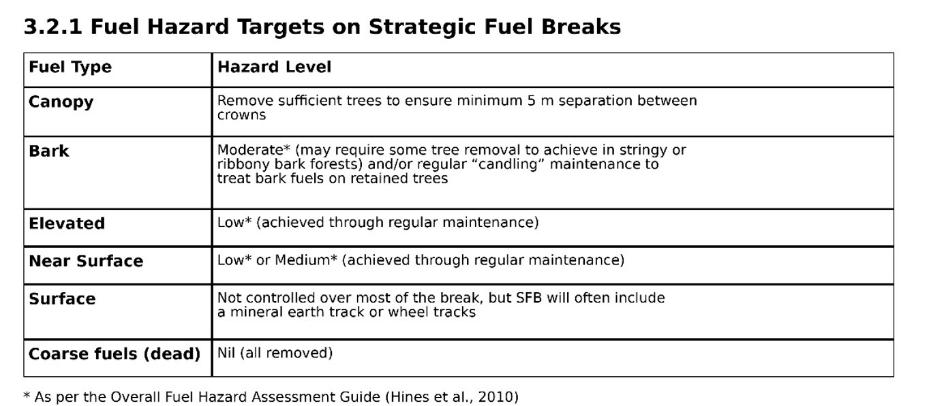
125 Each SFB is assigned an “Asset ID” and is recorded on the “SFB Layer”. There are two kinds of SFBs: “asset protection breaks” located adjacent to townships and assets, which are designed to protect communities and assets from the direct effects of fire; and “landscape protection breaks”, which “divide the landscape into units established to assist in the containment of large fires before they impact on communities and assets”: SFB Guideline, p 3. Landscape protection breaks “can contribute significantly to indirect attack (back burning) control strategies and provide safer and more efficient access routes for all fires”: ibid.
126 The SFB Guideline states that, while wider SFBs are generally more effective in containing and minimising the impacts of bushfires, it is also necessary to consider impacts on environmental, cultural and amenity values: SFB Guideline, p 4. The width of a SFB is generally between 20–40 metres, except where this is not possible due to topography, wildlife corridors, natural features of the landscape, or other site constraints. In this regard, the SFB Guideline relevantly states (at p 4):
The width of Landscape Protection Breaks should be designed to be sufficient under a broad range of conditions suitable for back burning and should aim to contain ember fall within the break rather than over it in light wind conditions and be wide enough to reduce radiant heat exposure to fire fighters working on the break.
…
4.1 Major width breaks
For Asset Protection Breaks, a maximum 40 m. clearing width supported by adjoining hazardous tree management is usually required to function reliably and safely under a range of [Fire Behaviour Indices].
For Landscape Protection Breaks, a 20 m. clearing width supported by adjoining hazardous tree removal is generally adequate to provide a well-established platform for backburning. Wider Landscape Protection Breaks up to 40 m. may be required in some environments (as discussed above).
4.2 Minor width breaks
Minor width breaks (< 20 m.) can be suitable for Landscape Protection Breaks constrained by other limitations (e.g. topography or ecological mitigations), or in forest where the canopy is open, or tree height is less than 25 m. and the bark fuel hazard is low.
This width is considered inadequate for Asset Protection Breaks as there is generally insufficient distance between the firefighter or assets from the flame front to allow for safe or effective protection of the asset.
127 The SFB Guideline states that strategic inputs into planning the SFB network “should include regional risk modelling, bushfire management strategies, and biodiversity and cultural heritage assessments”: SFB Guideline, p 3.
128 In addition to SFBs, DEECA also maintains a network of other fuel breaks across public land in Victoria that are not part of the SFB network. Such other fuel breaks are generally between 6–10 metres wide, some of which are roads or tracks, and are used by staff of DEECA to access public land for the purposes of fire prevention and suppression activities.
Tree hazards
129 Tree hazards pose a safety risk to firefighters responding to fires (including when conducting backburning operations), and to personnel carrying out planned burns. Mr Hardman stated that several firefighters across Australia have lost their lives or been injured as a result of falling trees. Accordingly, a considerable amount of work had been done to understand and mitigate the risks presented by tree hazards.
130 On 20 October 2018, the Australasian Fire and Emergency Service Authorities Council (AFAC) issued a guideline titled “Managing Tree Hazards” (the AFAC Guideline). The AFAC Guideline states (at p 1) that it had been developed in order “to inform fire and emergency service and land management organisations when developing agency specific doctrine with consideration to a uniform approach to managing tree hazard (e.g. identifying, marking, isolating and treating)”, and had been “designed to assist organisations in the development and implementation of policies, procedures and other risk control measures aimed at proactively managing workplace health and safety risks in emergency management (including before, during and after events) and prescribed burning operations”.
131 The Secretary is required to use her best endeavours to carry out her functions in accordance with the operational standards established by the Emergency Management Commissioner: Forests Act, s 61E.
132 On 17 September 2021, the Emergency Management Commissioner issued the most recent version of the JSOP, the stated purpose of which is “[t]o mitigate the risk to emergency service personnel of injury or death from falling trees and branches during bushfire response and planned burning operations”.
133 Both the AFAC Guideline and the JSOP refer to the following types of tree hazards.
(a) A “Clear and Present Danger Tree” (CPD Tree) is a tree, limb or branch that is expected to fall within the expected timeframe of current operations and impact personnel in its potential impact zone. In operational language, such CPD Trees are referred to as “Cross Trees”, and are marked with a symbol in the following form:
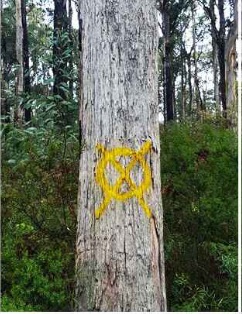
(b) A “Potential Clear and Present Danger Tree” (Potential CPD Tree) is a tree which may become a CPD Tree if it catches alight or is impacted by wind or other disturbance. Such a tree is classified as “Protection Assured” if it has a high probability of surviving the current operation intact, and otherwise as “Protection Not Assured”. In operational language, a Potential CPD Tree – Protection Assured is referred to as a “Circle Tree” and a Potential CPD Tree – Protection Not Assured is referred to as a “Slash Tree”, which are respectively indicated with the following markings:
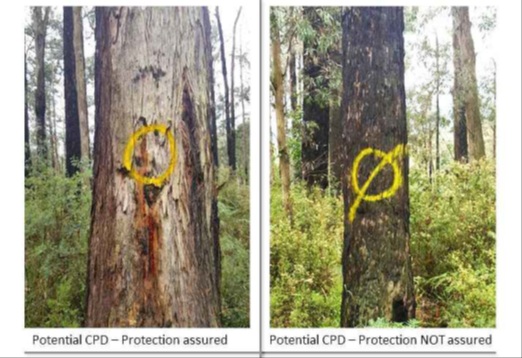
134 The SFB Guideline (at p 5) requires consideration of the tree hazard requirements under the JSOP during the planning, construction and maintenance of SFBs. The SFB Guideline relevantly states:
The identification and treatment of trees that pose likely safety risks during SFB construction is a key consideration to ensure that SFBs are constructed in a way that will allow them to be safely used during future bushfire response operations (at short notice with minimum additional preparation).
135 All SFBs are assessed in the field for CPD Trees or Potential CPD Trees during construction, and at least every five years during maintenance, within the SFB footprint and the adjacent area within one tree length: SFB Guideline, p 6. This is intended “to provide a safe work area for personnel during future bushfires and planned burning operations and minimise the likelihood of trees falling onto the SFBs and blocking roads and tracks after the passage of fire”: ibid.
136 The evaluation of tree hazard is not influenced by tree values: AFAC Guideline, p 8. The application of some risk control measures such as tree removal may have a negative impact on ecological, social and cultural values, which should be considered in assessing the tree hazard and determining the appropriate treatment: AFAC Guideline, pp 8–9. In relation to managing tree values, the AFAC Guideline states (at p 9):
[HBTs] living or dead may be relatively rare in modified landscapes and they provide critical habitat for a wide range of fauna. The loss of [HBTs] from the landscape can have a negative impact on biodiversity as well as causing broader environmental impacts.
Renewal Works
137 Mr Hardman stated that the State has a program for the creation of SFBs in certain strategic locations around Victoria. Where possible, in order to minimise the work requirement and the disturbance in the landscape, DEECA will bring an existing fuel break that is not a SFB up to the current standards for SFBs, rather than constructing an entirely new SFB. For similar reasons, DEECA prioritises existing fuel breaks that are already the required width for a SFB.
138 Renewal Works typically involve the removal of regrowth vegetation that is encroaching on the fuel break, which generally consists of shrubs and young trees. As Renewal Works do not involve changing the existing footprint of the fuel break, they do not typically involve the removal of mature trees that are not tree hazards.
139 Renewal Works also involve the systematic identification, assessment and treatment of tree hazards within one tree length on each side of the fuel break, being the distance that a tree hazard could fall into the fuel break. Trees that are assessed as being likely to fall away from the fuel break are generally not treated because they do not pose a risk to people using the fuel break.
140 The assessment of tree hazards during Renewal Works is carried out by a qualified and accredited hazardous tree assessor (see Schedule 1 to the JSOP). The risk assessment takes into account a range of factors including the location of the fuel break, the tree species, the forest age class, topography (which can affect the ability to manage hazards during an active fire), and fuel type. Cross Trees or Slash Trees will usually be removed, unless there are alternative methods to ensure safety, including by pruning hazardous limbs (or “hangers”) where the trunk is sound, or by implementing an exclusion zone around the tree. The latter is not often appropriate for safety reasons in the context of Renewal Works, in contrast to the conduct of planned burns.
141 During Renewal Works, there is generally not a focus on marking and protecting Circle Trees, because the fuel break is being prepared for emergency bushfire response as opposed to a controlled scenario where protection could be assured. As stated in the SFB Guideline (at p 6):
This assessment [of Potential CPD Trees] should include consideration of the feasibility, time, and resource implications of implementing any necessary protection measures for a Circle Tree retained on a SFB, as well as the maintenance requirements for such a protection strategy. If the protection strategy cannot be guaranteed under the conditions that would typically be encountered where a SFB is being used during future bushfires, then the assessment of Circle Trees for retention is not preferred, and they should instead be marked as Slash Trees.
Consultation with local FFMVic operational firefighting staff is recommended to determine the feasibility of any potential protection strategies being considered for Circle Trees to be retained on SFBs. The Regional Manager Forest and Fire Operations should be the final decision maker where there is any uncertainty. As per the guidance provided in [the JSOP], where there is uncertainty about the feasibility of any [Potential CPD Tree] retention strategy, the final decision should be made to favour safety.
142 The number or scale of trees that could require removal in the course of Renewal Works will depend on a range of factors, including the time since the fuel break was last maintained, weather events in the interim, and all of the factors affecting hazardous tree assessment. Tree hazards removed during Renewal Works may include HBTs or RTs. Mr Hardman was unable to estimate how many trees, or how many HBTs or RTs, were likely to be removed on a given fuel break.
Significant habitat trees
143 The SFB Guideline (at pp 6–7) recognises the need to balance the achievement of a safe workplace against “the additional objective that SFBs are constructed in a way that minimises impacts on significant environmental and cultural heritage values”. This includes the identification of Aboriginal scar trees and “significant habitat trees”. In relation to the latter, the SFB Guideline states (at p 7):
6.3.4 Identification of significant habitat trees
It is noted that under the tree hazard guidance outlined in this document, many of the best habitat trees will often be identified at [sic] [Potential CPD] Trees due to their structural condition. Such trees cannot be safely retained on SFBs or within the adjacent one tree length area without appropriate treatment (see Section 6.5).
The significance of such habitat trees should also be considered in relation to:
• The value of the tree/s for any verified threatened species living in the area (e.g., are they being actively used as nesting sites by a threatened species).
• The density of other alternative/similar habitat trees in the surrounding landscape.
Biodiversity assessments commissioned during the SFB planning phase (under the Planning and Approvals Framework) may assist with the assessment of significance, however specialist biodiversity advice may also be required if a significant amount of time has elapsed since that work was undertaken, or if no biodiversity assessment was undertaken.
Biodiversity advice will need to be weighed against the expected impact that retention of any CPD/[Potential CPD] Trees may have on the operational effectiveness of the SFB (including potential impacts on operational safety). CPD/[Potential CPD] Trees that are identified as significant habitat trees will require case-by-case consideration and management.
144 The SFB Guideline (at p 7) refers to strategies for the retention of significant environmental or heritage values in the planning and construction of SFBs, and outlines different hazard treatment options. As mentioned above, the options include pruning trees to remove hazardous limbs, or “stumping” the tree to reduce the hazard to an acceptable level “whilst retaining elements that can continue to be utilised as habitat for threatened species”. However, as a general rule, Cross Trees and Slash Trees are not to be retained “if they are assessed as likely to fall onto the break after the passage of fire, as they would result in an unacceptable risk to operational staff (both now and in future firefighting operations)”.
145 The SFB Guideline further states (at p 8):
If a large number of habitat trees (e.g. [HBTs]) need to be removed during SFB construction, consider treating surrounding/nearby retained trees through “habitat pruning” to enhance retained habitat values by creating artificial nesting hollows or the installation of nesting boxes (may require use of specialist machinery or tree climbers).
146 In providing guidance on the selection of retained trees, the SFB Guideline (at p 9) notes that, where possible, retained trees should be (among other things):
• Concentrated in areas of higher habitat value (such as gullies).
• Used wherever possible to protect particular threatened species or other high value habitat areas.
• Used to provide habitat linkage across the SFB for threatened species at planned intervals.
• Selected to include known nest or forage trees for threatened species.
Past Renewal Works
147 Mr Hardman provided details of Renewal Works that had been conducted at six fuel breaks referred to in the applicant’s evidence. In five of these fuel breaks, the works were completed in May 2023 or in April or May 2024.
148 At Forty Mile Break, the Renewal Works commenced on 25 March 2024 before being paused on 24 May 2024, and remain incomplete. The completed works were carried out in a works footprint of 19.6 kilometres along the length of the fuel break.
Planned Renewal Works
149 The Secretary currently plans to complete the Renewal Works at Forty Mile Break, and to carry out Renewal Works at McMahons Creek. The former will cover a works footprint of 1.9 kilometres, and the latter will cover a works footprint of 11.9 kilometres. Mr Hardman stated that the Secretary has no current plans to conduct any other Renewal Works in the LBP habitat area or the SGG habitat area.
150 Maps of the SFBs at Forty Mile Break (including a map depicting the area of incomplete works) and McMahons Creek are attached as Annexures A to C to these reasons. Forty Mile Break runs in an east-west direction for around 21.5 kilometres, along the boundary between the Yarra Ranges National Park to the north and State forest to the south. The McMahons Creek fuel break runs in a north-westerly direction from the western end of Forty Mile Break for around 11.9 kilometres, with the Yarra Ranges National Park on its eastern side and State forest on its western side.
151 Mr Hardman stated that Forty Mile Break and McMahons Creek –
are critical fuel breaks in the network of SFBs that protect Melbourne’s water catchments from bushfire. The water catchment areas that these fuel breaks help to protect from bushfire (O’Shannassy, Upper Yarra and Thomson) provide close to 80% of Melbourne’s drinking water. If a bushfire were to occur in those water catchment areas, and was not brought under control, it could contaminate and therefore affect the availability of Melbourne’s water supply.
152 The Renewal Works at Forty Mile Break and McMahons Creek were planned in 2023 using the “JFMP process” and in accordance with “Standard Operating Procedure 20-SOP-3.4.1: Fuel Treatment Nomination (2021)”.
153 As part of the planning process, the Natural Environment Programs (NEP) team conducted a process known as “values checking” in accordance with a Work Instruction entitled “Identify Values, Threats and Standard Mitigation Measures” (Doc ID 20-QI-3.4.1.3, effective from 1 August 2016) (Values Work Instruction) and the “Guidance for biodiversity values checking by Natural Environment Programs staff” (February 2024) (Biodiversity Guidance).
(a) The Values Work Instruction provides “guidance on the process to follow when identifying values, threats and standard mitigation measures during review of nominated fuel treatment areas”. The areas to which consideration should be given include “biodiversity”, which includes “Threatened Flora (including FFG and EPBC listed)” and “Threatened Fauna (including FFG and EPBC listed)”. The Values Work Instruction states:
The Biodiversity Specialist is responsible for the identification of significant biodiversity values in or adjacent to a Fuel Treatment Nomination. If the specialist believes the Fuel Treatment Nomination may pose a threat directly or indirectly to a significant value, they should identify a mitigation measure for each type of threat to that value.
(b) The Biodiversity Guidance states (at p 5) that values checking for forest and fire-management activities is “the primary means by which potential harm to biodiversity values is identified and mitigated, for on-ground activities led by DEECA”, but notes that it is not the only means and that “exceptions include enhanced assessment for [SFBs] and Storm Recovery”. The Biodiversity Guidance states:
Values checking is the colloquial name for enacting [the Values Work Instruction], in the context of the Joint Fuel Management Program (JFMP) and the Operational Forest Management Program (OFMP). It involves:
- Identifying the significant biodiversity values that may intersect with a fuel treatment or other activity,
- Assessing whether any aspects of the activity are likely to pose a threat to the values,
- Providing mitigation advice to reduce the likelihood or degree of threat to values.
Values checking was originally developed as the means for biodiversity assessment of individual planned burns on the JFMP, including both burn preparation and delivery. It was then generalised to non-burn fuel treatments, and also applied to District Action Plans (DAP), now the OFMP. It has been generalised to assess threats from a range of hazards including planned fire, machine works, soil disturbance, hazard tree removal, slashing, mulching, herbicides and minor vegetation removal.
Mitigations registers have been developed in each NEP region to store the standard mitigations that each region applies to a combination of a specific management activity with a specific value. These registers include information for hundreds of threatened species, vegetation communities and other significant values.
(Footnote omitted.)
(c) In highlighting what is beyond the scope of values checking by the NEP team, the Biodiversity Guidance emphasises (at p 6) that values checking “is not providing advice under legislation or acquitting legislative requirements”. Further, values checking is based on “existing spatial information” (including records in the Victorian Biodiversity Atlas and vegetation mapping in the Corporate Spatial Data Library), and “is not equivalent to complete assessment of all biodiversity and legislative risks, which normally requires consideration of potential (undocumented) values via habitat distribution models and on-ground site inspection”.
(d) The Biodiversity Guidance acknowledges (at p 6) that values checking is “not the only form of biodiversity advice that NEP may provide to land and fire managers”, and that the NEP team “often provides bespoke, detailed biodiversity expertise to assist management of individual species, sites or risks”. Further, a “[f]uture practice note” states that “with change in doctrine and process, arising from the Values-Checking Update Program or other improvement processes, values checking may in future address environmental legislation, including the EPBC Act and FFG Act”.
(e) The Biodiversity Guidance contains a section that provides commentary on relevant legislation. In relation to the EPBC Act, the following comments are provided (at p 7):
Values checking under [the Values Work Instruction] does not directly consider EPBC Act requirements, but does include all relevant EPBC-listed threatened species and communities. Migratory and marine species, and Ramsar wetlands, are generally not included.
NEP can provide EPBC-related advice to BFS if specifically requested to do so; this is generally only the case for special categories of works (e.g. [SFBs] and Storm Recovery).
(Emphasis in original.)
(f) In relation to the “Strategic Fuel Breaks Program – Planning & Approvals Framework” (May 2022) (PAF), the Biodiversity Guidance states (at pp 8–9):
The [PAF] was created to address gaps in DEECA’s legislative acquittals processes, and summarises requirements and relevance of ~20 pieces of legislation. It specifies the approval requirements for SFBs in different scenarios.
NEP staff should note:
• While the PAF provides useful backgrounding on Acts that may apply more broadly to DEECA fire preparedness works, its application is limited to SFBs.
• The PAF dates from a time when NEP had funded roles in each region to assist with SFB planning; NEP responsibilities stated in the PAF should not be taken literally.
• SFBs require a higher standard of values assessment, addressing EPBC and FFG requirements (among others). This is beyond the scope of standard values checking.
• Regional FFOD teams are responsible for coordinating PAF assessments and approvals for SFBs.
• NEP may assist with review of consultant reports or approval briefs if requested, but should not provide normal values checks for new or upgraded SFBs.
(Emphasis added.)
(g) In providing guidance for “workflows and decision-making”, the Biodiversity Guidance recognises (at p 14) that planning and delivering management activities “requires balancing many complex considerations” which “can lead to disagreement, for example when NEP provides a mitigation that is viewed by FFOD as excessive (considering the multiple objectives that need to be balanced in fire management) or unachievable (considering on-ground reality of delivering the activity)”. Accordingly, it is necessary for values checkers to understand “the organisational context” of NEP’s service to FFOD, including:
- NEP provides one of many inputs to FFOD decisions: NEP should expect FFOD to give due consideration to biodiversity risks, but should not expect that all NEP input will be adopted.
- NEP provides advice that is non-binding: FFOD staff have the discretion to interpret, adapt or reject this advice.
- If NEP supplies advice that is frequently divergent from what FFOD can accept and deliver on-ground, this is both ineffective and exposes DEECA to reputational and legal risk.
(Emphasis in original)
154 The PAF was prepared “[i]n order to facilitate the consistent, efficient delivery of SFBs across the state”, and sets out “a structured approach to planning and approvals across all relevant legislation and regulatory instruments” (at p 9). It is described as an “interim” framework that addresses “the immediate need to provide a guide for approvals for SFBs to be delivered under the current SFB program”, and contemplates that it will need to be updated, including when legislative and regulatory changes are made (at p 9). The PAF is divided into chapters that address the applicable legislation and regulations, set out standard “approvals pathways” for different types of SFB, and explain the steps involved in complying with legislative and regulatory requirements.
155 Section 3.2 of the PAF contains a “[s]ummary of Acts and regulations that trigger approvals, permits, consents or require exemptions”. This relevantly includes a section that deals with the EPBC Act. It is recognised that the delivery of SFBs may impact on matters of national environmental significance. The approvals pathways in relation to Renewal Works include the EPBC Act where there are “[u]napproved significant impacts on [matters of national environmental significance] expected or activities beyond scope of existing approval”: PAF, pp 47 (Pathway 2B), 54–56. However, the guidance on how to comply with the requirements under the EPBC Act is incomplete, and the section on “New approval being sought for specified breaks (single or multiple)” states that “[t]his section will be developed as part of a future version of the [PAF]”: PAF, p 75.
156 Consistently with the Biodiversity Guidance, Mr Hardman stated that values checking differs from the preparation of a comprehensive environmental impact assessment, and that it was “not the role of the NEP team to provide advice on compliance with obligations in environmental legislation”. The NEP team conduct desktop assessments using spatial datasets, including in relation to species of flora and fauna listed under the Flora and Fauna Guarantee Act 1988 (Vic) and the EPBC Act. The values identified by the NEP team are recorded in spreadsheets, along with recommended mitigation measures to reduce the impact of the planned works on those values, drawn from registers of standard mitigation measures. These spreadsheets are then provided to FFMVic.
157 The NEP values checking spreadsheets for Forty Mile Break and McMahons Creek identified threats in respect of each of the LBP and the SGG as “Earthworks / Machinery / Soil Disturbance / Vegetation Clearing”, and the “Risk Impact” as “Destruction of habitat / loss of food sources / reduction of connectivity throughout landscape / reduced reproductive success / increased predation / loss of life”.
158 The values checking spreadsheet for Forty Mile Break commenced with the recommendation “SURVEY REQUIRED”, with the following mitigation description:
THIS PROPOSAL HAS A SIGNIFICANTLY HIGH NUMBER OF FAUNA AND FLORA VALUES IDENTIFIED. NEP RECOMMENDS A TARGETED FLORA AND FAUNA ASSESSMENT BE UNDERTAKEN PRIOR TO ANY WORKS ALONG THIS BREAK.
DUE TO NUMBERS of records, these populations may be of significance and therefore any impact may require a referral under the EPBC Act.
159 In both Forty Mile Break and McMahons Creek, the NEP team recommended the following specific mitigation measures in relation to the LBP:
- Protect [HBTs] and midstory layer wherever feasible, ensure known nest trees are not cut down.
- All trees >80cm DBH to be assessed and protected from works. Any hazardous tree removal should be carefully assessed (tree by tree) and only when a significant hazard is identified such as a ‘killer tree’ then tree removal should occur.
- consider removing hazardous branches or lopping tree at height
- Protect midstory vegetation, specifically of acacias and young eucalyptus, minimise impacts to midstory vegetation when removing hazardous trees, track machines in and out of same entry point etc.
- Protect nest or roost sites from machinery during works. Works should not occur within 200m of record.
160 The following mitigation measures were recommended in relation to the SGG, along with a “timing constraint” to avoid works within breeding season (February to June):
Confine works to existing footprint and ensure mature trees, especially HBT’s [sic] and [Large Old Trees] are not impacted by works.
If HBT's [sic] or mature trees are deemed to be hazardous, limb trimming/lopping at height instead of the whole tree removal should be considered.
No removal of vegetation > 10 years old.
Avoid any fuel break construction within 200m of known Greater Glider den trees during breeding season (Feb - June).
Known nest trees must not be impacted/removed.
Outside of breeding season, works to be limited to hazardous tree removal. Any trees slated for removal with DBH > 90 must be discussed with NEP values checker and/or [Parks Victoria] land managers.
Living trees with DBH > 250cm cannot be removed.
Retain existing corridors of midstory vegetation.
A spotter to be present during tree removal to watch for animals trying to exit the tree and to check trees post felling to assess whether any animals are impacted.
Providing a list of the number of trees to be removed, including the DBH and if they have hollows present will be necessary to understand the proposed impact to species due to works.
161 Mr Hardman stated that the mitigation measures recommended by the NEP team did not take into account operational requirements, and would “not always be consistent with upholding occupational health and safety requirements for firefighters or other personnel using the fuel break in future, or with achieving other objectives of the particular type of work in question”. Accordingly, assessments about what mitigation measures could be employed are made in the lead-up to the works being undertaken, through conversations between the regional teams and the NEP team, and by the site supervisor on the ground during the delivery of the works.
162 Mr Hardman considered that some of the mitigation measures recommended by the NEP team for the Renewal Works at Forty Mile Break were not consistent with occupational health and safety or with the nature of the works being undertaken. In relation to the NEP team’s recommendation to retain all HBTs, Mr Hardman stated:
To implement that measure would require retaining tree hazards, which would pose unacceptable safety risks to firefighters using the break in future in the event of a bushfire, and to land management personnel or members of the public who may access the break at other times. It would also be inconsistent with the objective of bringing a fuel break up to the current standards for SFBs.
163 I note that, consistently with orders made during the trial under s 136 of the Evidence Act, Mr Hardman’s views in this regard are not to be used for the purpose of establishing that any of the recommended mitigation measures were in fact inconsistent with occupational health and safety requirements or with the objectives sought to be achieved by the Renewal Works. However, his views may have some relevance in determining the likely nature and extent of the planned Renewal Works that will be carried out by the Secretary.
164 Accordingly, not all of the recommended mitigation measures were implemented during the past Renewal Works conducted at Forty Mile Break. The mitigation measures that were adopted principally comprised the retention of existing habitat zones, the installation of 120 artificial hollows for LBPs and five artificial hollows for SGGs, and avoiding felling trees that were known to contain members of either species.
165 Mr Hardman stated that the planned Renewal Works at Forty Mile Break and McMahons Creek are being re-planned using the PAF, which “organises decision-making by reference to legislation that might apply to different kinds of SFB works”. While it is not yet known what mitigation measures will ultimately be included in the works plan, Mr Hardman expected that existing habitat zones would be retained at each of the fuel breaks. Otherwise, Mr Hardman stated that the trees currently marked for removal provided a “good guide to the trees that are likely to be removed if the Planned Renewal Works go ahead”. Nevertheless, it was possible that additional tree hazards could be identified during the works, or (although less commonly) that the qualified tree assessor present during the works might reconsider the hazardous nature of a marked tree.
166 Mr Hardman referred to a report of a survey conducted in November 2024 by TactEcol Consulting, who were engaged by DEECA as part of the Biodiversity and Threatened Species Survey Program to undertake arboreal mammal surveys at fuel breaks including Forty Mile Break and McMahons Creek. Nocturnal surveys (involving either spotlighting and call-playback or LBP thermal imaging) were conducted by TactEcol at a number of selected sites between 8 October 2024 and 14 November 2024. There were detections of 14 LBPs at nine of 36 sites, and 89 SGGs at 24 of 36 sites.
Control Line Works and Maintenance Works
167 The Secretary also plans to conduct future Control Line Works in the LBP habitat area and the SGG habitat area, subject to factors such as resourcing, weather, the state of the fuel break proposed to be used as a control line, and the proposed timing for delivery of a planned burn. The Secretary is likely to remove trees, including some HBTs and RTs, in the course of conducting such Control Line Works.
168 While DEECA follows the same process of identifying, assessing and treating tree hazards in the course of Control Line Works, the outcome of the assessment of whether trees are likely to become hazardous during an operation is different. This is due to the nature of planned burning operations and the ability of personnel to manage the operations while they are being carried out. Control Line Works are not generally conducted along the entire length of the fuel break. Potential CPD Trees may be assessed and marked as Circle Trees because it is possible to know whether and how such trees can be protected during the planned burn. A wider range of mitigations are available, because ignition patterns can be adjusted to prevent fire or reduce the severity of fire that impacts Circle Trees. Further, fire behaviour is likely to be less severe because planned burns are undertaken in more benign conditions than those encountered during a response to a bushfire.
169 The Secretary plans to conduct future Maintenance Works at fuel breaks located in the LBP habitat area and the SGG habitat area, depending on factors including the state of the fuel break, resourcing, and the urgency of any maintenance works for reasons of public safety. Although Maintenance Works do not involve the systematic identification, assessment and treatment of tree hazards and do not typically involve tree removal, a Cross Tree that is identified in the course of such works will be taped off, assessed by a qualified tree assessor, and treated if necessary. This could involve the removal of such trees, which might be a HBT or RT.
170 In relation to SFB maintenance requirements, the SFB Guideline relevantly states (at pp 12–13):
Maintenance works are to include updated values checking and should consider the potential impacts on identified values that may be caused by ongoing maintenance activities. If habitat retention and other works exclusion areas are identified and approved during the SFB planning and construction phase, these areas are also to be protected during SFB maintenance. If additional values are identified after the initial construction of the SFB, these will also be included in values-checking processes for SFB maintenance, with mitigation or protection requirements assessed in accordance with current doctrine. Reassessment of values may be required if there are significant changes to SFB construction standards, or planning and approval processes, since the SFB was originally constructed.
Oral evidence
171 Mr Hardman was cross-examined by senior counsel for the applicant. In general, I consider that he gave direct and responsive answers to the questions that were put to him. There was no direct challenge to his credibility, and I accept that his evidence was given honestly on areas within his knowledge, and in the light of his responsibilities and experience.
172 Mr Hardman stated that DEECA had secured funding to establish the SFB network in around 2021, which included bringing existing fuel breaks up to the required standards by conducting Renewal Works. He was shown a map prepared by Parks Victoria dated 5 February 2024 entitled “Strategic Fuel Breaks – Yarra Ranges”, depicting the locations of completed and proposed SFBs since 2020-21. This included “Potential Future SFB’s – Renewals: ~ 70 km” and “Potential Future SFB’s – New (Approx): ~ 31 km”. Mr Hardman did not have specific knowledge about particular SFBs that he had not personally visited. In relation to potential future SFBs, he confirmed that DEECA intended to continue to create SFBs “to protect the landscape”, although there was no timeframe on when the works would be conducted. The works program was planned on a three-yearly basis under Joint Fuel Management Plans and forthcoming Operational Forest Management Plans, with priorities being confirmed annually for the next 12-month period.
173 Mr Hardman stated that DEECA does not count or keep records of the number of HBTs that are removed in the course of Renewal Works, although he considered that the number was much lower than in the construction of a new SFB. He said that each tree is assessed on its merits, having regard to the hazard that it presents and whether or not it can be retained. While he accepted that the removal of a HBT could have a negative impact on any LBPs or SGGs in the vicinity of the tree, Mr Hardman stated that the works are undertaken to create a safe environment for personnel to work in during bushfires. Mr Hardman said that detailed planning is carried out to mitigate negative impacts, and “[w]e do put a lot of effort and energy into trying to protect and enhance the values where they can be [protected]”. However, a hazardous tree will be removed if the risk cannot otherwise be mitigated, for example where the tree “cannot be retained for the reasons, whether it’s safety or effective operation of a fuel break – by retaining a tree that could collapse and fall across the fuel break, it could render it ineffective”.
174 In relation to the adoption of mitigation measures:
(a) Mr Hardman explained that the retention of existing habitat zones involved maintaining wildlife corridors to enable wildlife to move through the break. However, this was not directly related to the removal of hazardous trees, in that it would remain necessary to treat any hazardous tree that was situated within an existing habitat zone.
(b) While Mr Hardman was aware of a report on the effectiveness of artificial hollows, he was not familiar with the details of that report, including the extent to which such hollows had in fact been occupied by LBPs or SGGs.
(c) Mr Hardman stated that the FFOD sought to avoid felling trees that were known to contain live animals, and that he had not received any reports of such incidents having occurred. He stated that this would be one of the variables considered by a qualified tree assessor in making a determination whether or not the particular tree could be retained, and that such matters formed part of the standard processes and would not be escalated to him as CFO.
175 More generally, Mr Hardman maintained that the Renewal Works involved the removal of a “relatively small number” of hazardous trees in the context of the landscape as a whole.
176 Mr Hardman confirmed that unmarked trees that are assessed as hazardous by a qualified tree assessor during an operation may be removed if they are structurally unsound. However, it was more common for trees to be assessed and marked in advance.
177 Mr Hardman agreed that DEECA had received correspondence in April 2024 about a particular tree with a diameter greater than 2.5 metres that had been marked for removal, following which a decision had been made not to remove such trees while further inquiries were made about timber harvesting regulations. A VicForests “Coupe Diary” recorded on 23 April 2024 that DEECA had given a direction not to fell any Slash Trees with a diameter greater than 250 cm. However, although the marking was taken off the particular tree, a contractor later assumed that this had been done by protestors and proceeded to remove the tree. In relation to this incident, Mr Hardman accepted that a mistake had been made by the contractor, and said that steps had been taken to prevent its reoccurrence. He nevertheless noted that he had received advice that the tree was structurally damaged and met the criteria for a hazardous tree, and he did not accept that the tree would have been retained due to its condition. He said that, even where a tree exceeds 2.5 metres in diameter, “[i]f the tree is structurally damaged or presents a clear and present danger to the welfare of people working in that space, then it would need to be removed”. However, most of the trees were “much smaller than that”, and Mr Hardman did not consider that there would be a significant number of trees with a diameter greater than 2.5 metres.
178 Mr Hardman stated that the role of the NEP team was to undertake a desktop assessment and recommend mitigations to minimize the negative impact of the works, but that such mitigations had to be “practicable and implementable”. There were “standard mitigations” that could be applied (such as those referred to above). The FFOD considered that it was unable to apply the recommendation to retain all HBTs. While Mr Hardman did not know the reason why a survey was not conducted at Forty Mile Break, he stated that the Renewal Works were in an existing SFB and were “quite minor in nature”, and that it was “a small number of trees relative to the landscape that would need to be treated”. He stated that they generally rely on “data sets” and that it was not normal practice to conduct an in-field survey before such works.
179 In so far as it was suggested by the NEP team that a referral may be required under the EPBC Act, Mr Hardman stated that it was “beyond the role of the NEP team” to provide advice about compliance with environmental legislation. Although Mr Hardman accepted that this was also not a matter within his own expertise, he expressed the view that it would be “unusual” to make a referral “because it’s just doing a small amount of work to bring these breaks back up to their original standard”. When asked whose role it was to consider compliance with environmental legislation, Mr Hardman responded that this was addressed in the “planning processes” including the PAF. He stated that the planning framework “checks our compliance with the various bits of legislation and if that demonstrated that this would trigger a referral, then it would be through that process”.
180 Mr Hardman gave the following evidence about who was responsible for determining whether or not Renewal Works will have a significant impact on threatened species.
[MR KORMAN:] So on the basis that no document has been discovered that shows that, except for the NEP team, anybody had engaged in the process of determining whether environmental legislation would be breached, on [the] basis that there has been no discovery, would it be true to say that nobody really considered, in the Division or those advising – sorry, to your knowledge, nobody really considered whether there was or was not a breach of the EPBC Act? --- In normal planning processes, as I’ve described, there would’ve been assessments and evaluations of the impacts. This was a relatively low level of work that needed to be done. The planning process didn’t demonstrate that it needed to be referred.
Who undertook the planning process? --- The planners, the people that plan the work.
I see. And the people that plan the work were out there in the field marking the trees and counting how many [HBTs] there would be? --- No. They didn’t count the number of trees, as I said yesterday.
That’s right. So, really, wouldn’t it be the responsibility of your Division, who was marking the trees, to ensure that – to make inquiries and satisfy yourself as to whether or not there was a breach of the EPBC Act involved? --- Well, we do this work. There was no indication or anything to suggest that a breach of any Act of any description had occurred.
Well, the NEP team gave you an indication - - -?---Sure. I just - - -
So there was an indication, wasn’t there? --- Well, it’s clearly not their role and, you know, it’s one of those things that when – when you have people that – there is a disagreement in a workplace, you know, people start to say things. I don’t think it’s appropriate for the NEP team to make those sorts of comments and I don’t think they have a basis for it. I can’t – I can’t say to you why they would’ve done it but I don’t consider it to be appropriate or their role.
I’ll just – and the NEP team, when you say it’s not appropriate and it’s not their role, are you saying they’re not appropriately – let’s say in terms of the EPBC Act, they’re not appropriately qualified and it’s not their role to determine whether what is proposed in the renewal works constitutes a significant impact on the relevant species? --- No. I don’t believe that they are in a position to assess that.
So you don’t – that’s because you don’t think they’re appropriately qualified? --- From my point of view, their role is to identify the mitigations and to propose those mitigations. Those mitigations that can be implemented will be implement[ed] and those that are not practically able to be implemented, obviously they can’t be implemented. So, yes, it’s not – it’s just not part of their role to do that work. So people should do what they’re paid to do.
And your view is that the Division’s – I understand you’re talking about planning, but once it’s known how many [HBTs] are planned to be removed, your view is that it’s the Division’s role to determine whether that will constitute a significant impact on threatened species? --- Through the planning process.
…
… The question I’m asking you, and we’ve been through this, that the planners don’t know how many [HBTs] are going to be removed. Do you accept that? --- I accept that there is – I can’t tell you the number of [HBTs]. I don’t know whether any other individuals knew how many, but I can’t. I don’t know the numbers.
But would you accept that the planners, before trees have been marked for removal – and that’s the job of a qualified tree assessor, correct? --- Correct.
Marking the trees for removal? --- Yes.
So the planners can’t know at the time they’re doing their job how many [HBTs] are to be removed in any given renewal works. Do you accept that? --- I would accept that that would not be a number that’s known, yes.
No. And the question I’ve asked you several times and I haven’t got an answer - - -? -- -Sorry. …
That’s all right. If you can try and answer this question, is, given that the planners can’t know how many [HBTs] are to be removed and you’ve said the NEP team are not the ones that advise on whether the renewal works will have a significant impact, I’m asking you, in your view, is it the Division that ought to decide whether or not the removal of the marked trees will have a significant impact on threatened species? --- I would suggest that that would be the role of the Division and the planning teams within the Division to determine that.
181 Mr Hardman conceded that he had not been provided with a report assessing the impact of the quantity of HBTs to be removed, and that the FFOD staff who were qualified to carry out such assessments in the planning process did not know how many HBTs would be removed in any given Renewal Works. However, he stated that “just removing a small number of hazardous trees … wouldn’t have triggered a thought that it would have a significant impact at all, just because of the small scale of the works”, and that his staff were able to assess the impact of the removal of HBTs on threatened species by “the minor nature of the work” and “the scale of the landscape”. Mr Hardman stated that the values checking process was undertaken by the NEP team and “those mitigations that could practically be applied were [applied]”, and that “only those trees that needed to be removed to enable the break to function were removed”.
NEP correspondence
182 The applicant tendered several email chains between various NEP officers and other DEECA officers.
183 On 26 March 2024, Mr Blake Nisbet on behalf of the Victorian National Parks Association (VNPA) sent an email to Mr Hardman and other DEECA officers with the subject “URGENT: Endangered Greater Gliders recorded living in Trees earmarked for imminent removal”, attaching a technical memorandum about records of SGGs denning and nesting inside HBTs that were marked for removal along the Forty Mile Break, and requesting that interim measures be implemented for the protection of such HBTs (including preventing removal of known denning/nesting trees, or HBTs within SGG or LBP habitat, or large and old trees including those with a DBH greater than 2.5 metres). I note that, pursuant to an order made under s 136 of the Evidence Act, the memorandum from the VNPA does not constitute evidence of the truth of the matters stated therein.
184 On 5 April 2024, a NEP officer circulated the VNPA report and commented “[w]e haven’t been asked to do anything at this stage but good for our awareness and adds to our justification for replacing artificial hollows”. Another NEP officer noted in response (on 10 April 2024) that the values checking and mitigations had included a recommendation that known nest trees must not be impacted or removed, and a request that a targeted flora and fauna survey be undertaken prior to any works along the specific fuel break. The officer queried whether this should be flagged or raised “higher up the chain as works with potential significant environmental risks” before the works were delivered on that specific fuel break, so as to “try again for other ways to reduce the risk before the destruction is done (de-limbing or exclusion)”. The Regional Manager of NEP undertook to raise it with another officer “to ensure that FFOD are aware of the risks”.
185 On 11 April 2024, a NEP officer circulated the spreadsheet with the NEP’s mitigations (see paragraphs 158 to 160 above), stating that “overall, NEP have reservations about the large impact of the break”, which had been “highlighted in the checks” (presumably a reference to the values checking process). The officer noted that the operational mitigation for SGGs stated that, in the event that an occupied nesting or breeding site was identified as containing wildlife, the “PPR SFB Team would seek advice from subject matter experts (including NEP) and apply the necessary buffer to minimise the risk of nest abandonment”. The officer stated that works were still occurring towards the relevant trees, and that “FFOD’s preference at this stage is not to retain the trees so may require careful consideration from us about mitigations and how we can assist them”. The officer expected that the contractors would be “stood down” when they arrived at the site “until a decision is reached about the path forward”. In another email on the same day, the NEP Regional Manager foreshadowed that NEP staff might attend a site visit “to learn about the FFOD process re these types of issues in breaks and provide advice if requested”, and suggested that “[i]t may also be worthwhile seeing if a [Parks Victoria] person could be there as well”.
186 There is a record of a site visit having taken place on 17 April 2024, at which concerns raised by Parks Victoria or the NEP were discussed, including in relation to the “large amount of works and habitat removal across the National Park” and the “[l]ack of cumulative impact assessment done for the scale of works across all the [SFB] projects”. Among other things, the file note (which may not necessarily have been contemporaneous) referred to concerns about the “[l]arge number of non-compliance issues with the original EPBC referral decisions” and the conditions under which the Renewal Works were being implemented, as well as the absence of “attempts to reduce the risk of the tree through other means (e.g. lopping or delimbing)” and “a lack of consistency with [hazardous] tree marking throughout the development of the [SFB] project”.
187 The file note also referred to potential non-compliance with “EPBC Referral Conditions for SFBs”, including the installation of nest boxes to provide alternative hollows for LBPs where habitat trees were removed for firefighter safety, and exclusion zones and wildlife corridors being established and maintained “whenever a fuel break comes into contact with suitable habitat for LBP”. The nature and provenance of the “EPBC Referral Conditions” identified in this file note was not directly addressed in the evidence, although it appears from internal email correspondence within the NEP to relate to a previous referral and approval under the EPBC Act which dates back to 2008 or 2009.
188 I note that a subsequent email dated 23 April 2024 from the NEP Regional Manager indicated that the site visit at Forty Mile Break was not attended by anyone from the NEP team. The Director of FFOD (and Deputy CFO) reported that he or she had been shown the trees marked for removal and had formed the “immediate impression … that the removal is very conservative with many large trees with obvious hollows present in the landscape on either side of the break”, and that “the trees identified for removal are in the existing footprint of the break or along the edge and while a few are quite large and some with obvious hollows, if they are not removed would compromise on the integrity of the break and the safety of firefighters working in that environment”. While the FFOD Director acknowledged that there was “an immediate and localised impact”, he or she stated that they had “planned the work based on the presence of LBP and [SGG] as well as all of the other species identified through the values checking process”. In response to this report, officers in the NEP team exchanged emails in which they identified their concerns, including:
• Due to the cumulative impacts of this break and the other fuel break renewals that have/are about to occur across the Upper Yarra catchment area, we are concerned that it will have a significant impact on these species, including [SGG] and Yellow Bellied Glider. Although they are operating under an EPBC referral decision made in 2009, particularly for [LBP], it is unclear if there has been an EPBC Act referral to consider impacts to [SGG] and Yellow Bellied Glider since their listing.
• In addition, because the mitigations we have provided are not being enacted in full, we cannot be confident that the works that they are doing are unlikely to trigger a referral under the EPBC Act and therefore they should pause works and submit a referral.
• Among other mitigations that they are not enacting, they are also undertaking works during the breeding season for SGG which we have recommended they avoid – our mitigation for this is to avoid any fuel break construction within 200m of a known SGG den tree during breeding season (Feb-June).
189 On 22 April 2024, Mr Nisbet on behalf of Wildlife of the Central Highlands (WOTCH) and Mr Nic Fox on behalf of the applicant wrote to the CFO and Parks Victoria, attaching a technical memorandum about recordings of LBPs along the Forty Mile Break, and advising that LBPs had been detected by surveyors on 21 March 2024 at two locations along Forty Mile Break where FFMVic was “currently undertaking rogue logging operations”. Pursuant to s 136 of the Evidence Act, this is to be treated as evidence only that the matters referred to in the letter were communicated to DEECA, and may not be used for the purpose of proving the truth of such matters.
190 On 3 April 2024, in a separate email chain in relation to the potential funding of artificial hollows and rope bridges in fuel breaks that were the subject of Renewal Works, one NEP officer commented “I honestly cannot believe they are progressing with Loch Valley” (i.e. Forty Mile Break), in respect of which it had been recommended that a full flora and fauna survey be undertaken. The officer expressed his or her disappointment at the “lack of engagement” with the NEP with regards to mitigations for SFB works, and stated “I do not think the current JFMP process of us providing mitigations is appropriate for these kinds of works, when they are clearly ignoring all of our mitigations for them to be able to progress the works”.
191 On 4 April 2024, in response to an email attaching maps with records of LBP and SGG detections for the areas of the Renewal Works, a NEP officer expressed the view that “FFOD should really think about referring this one” (namely, the Forty Mile Break), which may be taken to mean a referral to the Commonwealth Minister under the EPBC Act. The NEP Regional Manager responded on 9 April 2024, stating:
Could you please let me know what course of action you would like to take regarding this? Is a meeting with FFOD needed? Im not clear on the extent of the issue, the extent of FFOD not taking NEP advice or what we may need to do to ensure the NEP advice is clear and FFOD have made the decision to not take it.
192 In response, the NEP officer said that this was “just another example of FFOD not taking our advice”, adding that “[a]pparently, they have already started works, so it is probably too late for any discussion”. The officer asserted that the NEP team “were never contacted for further input or discussion of alternate mitigation measures”, and noted “the level of frustration NEP faces when the work we do to alert FFOD to their legislative responsibilities is ignored”.
193 It is difficult to know how far the correspondence set out above can be taken for the purposes of the present proceeding. As none of the officers have been called to give evidence, it is difficult to treat the correspondence as evidence of the truth of any matters stated therein (even where there is no specific limitation under s 136 of the Evidence Act to that effect). While the correspondence evidences some tensions between officers in the NEP team and the FFOD, and perhaps some accompanying confusion about their respective roles and responsibilities, it does not establish that an environmental impact assessment in relation to the Renewal Works was carried out by the NEP team (or by any other area within DEECA) for the purposes of the EPBC Act.
194 Ultimately, the question whether the Renewal Works have, or are likely to have, a significant impact on the LBP or the SGG must be resolved by the Court on the basis of all of the evidence, including in particular the expert evidence led by the parties.
Applicant’s survey evidence
195 The applicant relied on a number of affidavits containing evidence of surveys that were carried out by lay witnesses on various dates between March and November 2024 and in July 2025 in relation to trees that had been felled or marked for removal in the course of Renewal Works carried out at various SFBs, often with accompanying photographs and GPS data. The relevant affidavits on which the applicant relied were:
(a) three affidavits of Mardi Denham-Roberts affirmed on 7 December 2024, 7 July 2025 and 12 August 2025;
(b) two affidavits of Maya Burrell affirmed on 7 December 2024 and 12 August 2025;
(c) an affidavit of Katherine Best affirmed on 7 December 2024;
(d) two affidavits of Jessica Slade affirmed on 7 December 2024 and 12 August 2025;
(e) two affidavits of Eva Jones affirmed on 7 December 2024 and 12 August 2025;
(f) an affidavit of Andrew Lincoln affirmed on 7 December 2024;
(g) three affidavits of Hayley Forster affirmed on 7 December 2024, 13 August 2025 and 8 September 2025;
(h) two affidavits of Blake Nisbet affirmed on 8 December 2024 and 7 July 2025;
(i) two affidavits of Jake Mckenzie affirmed on 9 December 2024 and 7 July 2025;
(j) two affidavits of Philip Marshall affirmed on 9 December 2024 and 7 July 2025;
(k) an affidavit of Darcy Vermont affirmed on 7 July 2025;
(l) an affidavit of Michael Smith affirmed on 7 July 2025;
(m) an affidavit of Finneas Patchett affirmed 11 August 2025;
(n) an affidavit of Robert Pergl affirmed 12 August 2025;
(o) an affidavit of Jonathan Ainslie affirmed on 12 August 2025; and
(p) an affidavit of Andrew Lincoln affirmed on 12 August 2025.
196 None of these deponents were cross-examined by the Secretary.
197 Mr Mckenzie, Mr Nisbet and Ms Forster also gave evidence of fauna surveys carried out in March, April and June 2024 to detect and record the presence of SGGs or LBPs at Forty Mile Break and McMahons Creek.
198 The data collected through these surveys was collated by Mr Mckenzie into a “master spreadsheet” (Annexure JRM-38 to his affidavit of 9 December 2024). Mr Nisbet produced several maps showing the locations of trees that had been felled or marked for removal and records of SGG and LBP detections at Forty Mile Break and McMahons Creek (Annexure BN-30 to his affidavit of 8 December 2024). Mr Marshall also generated a series of maps depicting the location of trees that had been felled at various fuel breaks (Annexure PTM-02 to his affidavit of 9 December 2024).
199 Mr Nisbet gave evidence that, on 15 May 2024, he observed a dead SGG on the ground near the base of a tree that had been felled in Forty Mile Break, and which he had identified on a previous visit as a tree that was being used by SGGs as a den tree. A photograph of the dead SGG was annexed to his affidavit. This evidence was not challenged by the Secretary.
200 The survey evidence indicated that 598 HBTs and 303 “likely” HBTs had been removed in the areas surveyed at six SFBs (Reefton Spur, Warburton Woods Point Road, Forty Mile Break, Old Warburton Road, Theodore-Cambarville Road 1, and Road 31), around half of which were unmarked. Just over one-third of the HBTs that were removed were “stags” (i.e. dead HBTs). For such purposes, the deponents classified the trees by reference to their own observations of hollows, or other features or characteristics that were considered to be consistent with the presence or likely presence of hollows.
201 These surveys carried out on behalf of the applicant did not cover the entire length of the “works footprint” along each fuel break. In such circumstances, the applicant contended in closing submissions that the number of HBTs removed by the Secretary could be adjusted upwards so as to provide “a more realistic picture of the extent of historic HBT removal”. I accept that the survey evidence should be treated as relating only to the areas that were surveyed by the lay witnesses. However, I refrain from extrapolating any specific higher number of HBTs that have been removed in the course of past Renewal Works. The number for which the applicant contends is speculative and unsupported by any evidence. Further, no relief is sought by the applicant in relation to the past removal of HBTs, which are relied on primarily to provide context for future actions that are proposed to be taken by the Secretary.
202 In relation to the planned Renewal Works, the applicant’s survey evidence indicated that 38 HBTs and 2 likely HBTs have been marked for removal at Forty Mile Break, and that 83 HBTs and 3 likely HBTs have been marked for removal at McMahons Creek. This constitutes a total of 126 HBTs or likely HBTs that are currently marked for removal.
203 As noted above, the Secretary does not dispute that HBTs have been removed in the course of conducting past Renewal Works. While the Secretary did not necessarily agree with the precise numbers recorded by the applicant’s lay witnesses, nor with the accuracy or reliability of their identification of HBTs, there was no direct challenge to the observations made by those witnesses.
204 The Secretary also admitted that HBTs may be felled in the course of the planned Renewal Works at Forty Mile Break and McMahons Creek. Although the Renewal Works remain subject to re-planning in accordance with the PAF, the trees that have been marked for removal at those SFBs can be treated as a “good guide” to the trees that are likely to be removed. The number of those trees that are HBTs or likely HBTs is established for present purposes by the applicant’s survey evidence, although the Secretary contended that this did not necessarily address whether or how many such trees were suitable den trees for the LBP or the SGG.
205 It is common ground that additional unmarked trees might be identified as tree hazards by a qualified tree assessor in the course of the planned Renewal Works, and that such trees might be treated by removal. Accordingly, even accepting the possibility that the hazardous nature of some marked trees might be reconsidered, the number of HBTs that will ultimately be removed at Forty Mile Break and McMahons Creek could potentially be higher than those currently marked for removal. In submissions, the applicant sought to estimate the number of unmarked trees that are likely to be removed by reference to the “ratio” of marked and unmarked HBTs that have been removed in past Renewal Works. However, because the removal of any unmarked trees at Forty Mile Break and McMahons Creek will depend on the particular circumstances, I do not consider that the evidence supports a finding as to the number (or estimated number) of unmarked trees that are likely to be removed, and certainly not without the assistance of any expert evidence on that question.
THE THREATENED SPECIES
206 The key facts relating to the ecological status and characteristics of the LBP and the SGG were not in dispute between the parties or their experts. To a large extent, such matters are addressed in the LBP Conservation Advice and the SGG Conservation Advice (together, the Conservation Advices), which set out the bases on which the LBP and the SGG are eligible to be listed as threatened species under the EPBC Act.
207 Each of the expert witnesses relied on the Conservation Advices in providing their opinions in this proceeding. Further, the experts specifically agreed that the Conservation Advices and the LBP Recovery Plan include information on the species and required recovery actions. I consider that it is appropriate to place some weight on the Conservation Advices and the LBP Recovery Plan in the present case, for similar reasons to those set out in Strathbogie (PJ) at [21]–[25] (Horan J). Accordingly, in the absence of any directly conflicting evidence or specific disagreement, I will proceed on the basis that the Conservation Advices and the LBP Recovery Plan provide a reliable and accurate source of general information about the relevant species, including on matters of taxonomy, biology and ecology, distribution, threats to survival, and actions required for recovery of the species.
LBP Conservation Advice
208 The LBP is listed in the critically endangered category of the list of threatened native species, on the basis that it is facing an extremely high risk of extinction in the wild in the immediate future.
209 The species is described in the LBP Conservation Advice as follows:
Description
[The LBP] is a small, nocturnal, arboreal possum. It has a prominent dark brown stripe along its back and is pale underneath. Its ears are thin, large and rounded and it grows up to 17 cm in length. Its thick tail grows to 18 cm in length (Strahan 1988; Cronin 1991).
210 The LBP is endemic to Victoria, and is an animal (or faunal) emblem of the State. The core location of the species is an area of approximately 70 x 80 km in the Central Highlands of Victoria at altitudes between 400–1,200 m above sea level, where it is patchily distributed and occupies montane Ash forest and subalpine woodland comprising Eucalyptus regnans (Mountain Ash), Eucalyptus delegatensis (Alpine Ash), Eucalyptus nitens (Shining Gum) and Eucalyptus pauciflora (Snow Gum). It has always been considered a rare species, and was once believed to be extinct. Recent surveys have identified that the LBP is distributed widely across the Central Highlands.
211 LBPs live in small groups of between two to 12 individuals containing one breeding pair, and shelter in tree hollows during the day. Colonies typically contain a single adult female, and live in territories of 1–3 hectares that contain multiple den sites. The primary habitat of the LBP is montane Ash forest dominated by Mountain Ash, Alpine Ash and Shining Gum with a dense understorey of Acacia and an abundance of large HBTs. The LBP is typically sedentary and territorial, with resident animals travelling between den trees and feeding areas, or between alternative den trees, with the distance between a set of nest sites used by a colony possibly exceeding 100 metres.
212 The LBP Conservation Advice relevantly stated (at p 3):
Tree hollows are a critical resource for [LBP] and the species’ abundance is positively correlated with hollow availability (Lindenmayer et al., 1991a). The majority of trees occupied by [LBP] are dead [HBTs]. Living [HBTs] are also used and become the next cohort of dead [HBTs] in the future (Lindenmayer et al. 2013a). [LBP] rarely descends to the ground and is highly reliant upon dense, continuous vegetation with interconnecting lateral branches and/or high stem density (Lindenmayer 1996).
213 The key attributes of LBP habitat across all forest types include “large, hollow-bearing trees (for nest sites and refuge) with large internal dimensions in the order of 30 cm in diameter”, which “are usually >150 years old” (LBP Conservation Advice, p 3). The LBP Conservation Advice states that “[d]ensity of HBTs is recognised as a critical habitat feature”, and that “[t]here are strong and quantified links between the abundance of [HBTs] and the occurrence of [LBP] …, with nest hollow availability the limiting factor to population size”. LBP habitat also requires a “structurally dense interlocking canopy or secondary tree layer of continuous interconnecting structure (to facilitate movement)” and an “Acacia understorey (providing food)”. In general, LBPs do not occur on burned or logged sites where HBTs are largely absent, until required conditions have returned.
214 The main threat impacting the LBP is habitat loss and fragmentation, including the collapse of HBTs. In that regard, the LBP Conservation Advice relevantly states (at p 4)
The majority of [LBP’s] range is across the Mountain Ash forest of the Central Highlands of Victoria. Within Ash forest [LBP] is dependent on [HBTs] as a nest resource. Hollows only begin to form in trees from approximately 120 years of age (Ambrose 1982). Most of the Central Highlands was burned in an extensive wildfire in 1939, leaving a limited number of suitable trees standing. As these trees age and collapse, the pool of nesting resources is declining, while the 1939 regrowth trees are not expected to begin to recruit significant numbers of [HBTs] until after 2060 (Lindenmayer et al. 2012; Lindenmayer et al. 2013c; Lindenmayer et al. 2017a; Lindenmayer & Sato 2018). The rate of collapse of [HBTs] is also influenced by the other main threats listed here, fire and logging (e.g. Lindenmayer et al. 2018).
215 In addressing the threat from bushfires, the LBP Conservation Advice noted that the Central Highlands “has a history of occasional extensive wildfires”, including the 1939 fire which “burned most of the potential Ash habitat of [LBP] … so that currently approximately 98% of the Mountain Ash ecosystem is <80 years old” (as at the date of the LBP Conservation Advice in 2019).
216 In addressing the threat from logging, the LBP Conservation Advice noted that HBTs retained for “wildlife habitat” in logged areas are of little immediate habitat value to the LBP when there is no surrounding foraging habitat, but that such HBTs may be used in 10–20 years when surrounding foraging habitat vegetation and structure is regrown. The advice also noted that “the added exposure to wind and drying can increase mortality and collapse rates not only of habitat trees left during the clearing, but also of trees in adjacent unlogged patches”.
217 The LBP was judged by the Scientific Committee to be eligible for listing as critically endangered under Criterion 1 – Population size reduction (reduction in total numbers), measured over three generations (or 18 years). This was based on the adoption of HBTs as “an index of abundance appropriate to the taxon”, that is, as “an indirect estimate of change in population size” of LBP in circumstances where “it can be shown that a critical resource is declining in a manner likely to produce a similar decline in the number of mature individuals of the population”: LBP Conservation Advice, pp 6–7, 8.
218 While noting that the presence and abundance of HBTs did not completely specify the suitability of habitat for the LBP, the Scientific Committee stated that “it is clear that HBTs are the most limiting resource, that they have the longest renewal time after depletion, that a decline in HBTs should cause decline in LBP abundance and that a projected decline in HBTs indicates an expected future decline in LBP abundance”: LBP Conservation Advice, pp 6–7.
219 The LBP Conservation Advice relevantly stated (at p 8):
There are abundant data to show that [LBP] is dependent on hollows in old trees (Smith & Lindenmayer 1988; Lindenmayer 1989; Lindenmayer et al. 1991a; Lindenmayer & Meggs 1996; Lindenmayer et al. 2011). Furthermore, [LBP] occurrence/abundance typically shows a decline in density or probability of occurrence when the density of [HBTs] decreases (Lindenmayer et al. 1991a; Lindenmayer et al. 1994) with that decline accelerating as HBT density becomes lower (Figure S3 Lindenmayer and Sato 2018 Supplementary material).
[LBP] has greater occupancy rates in hollows in old, dead trees than in hollows of living trees but may be forced to use hollows in living trees as increasing densities of several other arboreal marsupial species compete for a reduced number of hollows (Lindenmayer et al. 2011). Thus, initial losses in HBT density may not be matched by a corresponding decline in the probability of possum occurrence. Nevertheless, such a compensatory response is limited and as the number of [HBTs] continues to decrease, decline will inevitably accelerate in the [LBP] population. Because of the potential breakdown in tree form preferences, the assessments that follow are applied to [HBTs] overall, rather than the nominally preferred forms (which are considerably more limiting). Thus the assessments below are conservative with respect to the estimated declines.
220 The LBP Conservation Advice (at p 9) referred to the overall decline in HBTs from the effects of fire and logging, as well as “the ongoing decline of trees in unburnt and unlogged forest due to natural decay (hereafter referred to as ambient decline)”. The estimated annual collapse rate of HBTs is around two per cent. In the three-generation assessment period from 2018 to 2036, the Scientific Committee calculated an overall decline in HBTs of between 60–81.3% over a total habitat area of 188,668 hectares: LBP Conservation Advice, p 14. For the purposes of the listing in the critically endangered category, the Scientific Committee calculated a projected decline in HBTs of 83.4% over the period from 2006 to 2024: LBP Conservation Advice, p 15.
221 In the context of Criterion 2 (Geographic distribution as indicators for either extent of occurrence and/or area of occupancy), the Scientific Committee projected a continuing decline in habitat quality, noting that HBTs are a “critical resource” for LBP and are “subject to ongoing collapse across the Central Highlands”, and that “[w]hile this can be a natural process, the fact that extensive areas of the Central Highlands were burned in 1939, killing most trees, means that recruitment of new [HBTs] is constrained until approximately 2060 … and this critical resource will become more limited over the intervening period”: LBP Conservation Advice, p 18.
222 Although subject to considerable uncertainty, the Scientific Committee estimated the size of the LBP population as between 2,500 to 10,000 mature individuals, which was described as “low”, and was “projected to decline at a very high rate”: LBP Conservation Advice, pp 19–20.
223 The conservation objectives set out in the LBP Conservation Advice included (at p 21):
2: A whole of landscape management regime is in place ensuring that all current and future suitable habitat across the species’ known range is maintained, enhanced and effectively managed to maximise its suitability for [LBP].
224 Further, the LBP Conservation Advice set out a number of conservation and management priorities including (at p 21):
• Retain and protect, with appropriate buffers, all live and dead trees that are either large (>150 cm DBH) or hollow-bearing (where >80 cm DBH) in montane Ash forests within the distribution of [LBP].
…
• Undertake landscape scale land-use planning that provides options for conservation of suitable habitat now and in the future to ensure an acceptably high likelihood of persistence (i.e. at least 99 percent over 100 year period) for [LBP].
…
• Develop and implement fire management that effectively secures and promotes long-term, strategic and effective protection of known colonies and suitable habitat.
LBP Recovery Plan
225 The LBP Recovery Plan was initially drafted to ameliorate the threat to the LBP from timber harvesting, and was revised to address threats from fire, climate change and other challenges. It identifies the main threat to the LBP as the “decline in the extent, quality and connectivity of suitable habitat, particularly the loss of [HBTs], due mostly to timber harvesting, which has occurred over many decades”. The LBP Recovery Plan stated (at p 1):
This Plan therefore focuses on both the impacts of historical timber harvesting and the main current and ongoing threats, especially further decline in the extent, quality and connectivity of suitable habitat (and further loss of [HBTs]) due to current and projected severe bushfire and changed fire regimes, all of which are and will be increasingly exacerbated by climate change. [LBP] occurs in a cool-climate region and may be susceptible to increasing temperatures and extreme heat events. Additional threats and actions to mitigate the known threats are described throughout this Plan.
Conservation planning for [LBP] is therefore a long-term proposition and commitment. Because of the legacy of historic fire and timber harvesting, the availability of suitable habitat is predicted to decline until at least 2065, such that it will be extremely challenging to achieve recovery of this species in the short term. Actions taken now to enhance its conservation status are unlikely to reverse the current decline over the 10-year period of this plan, but they will help to slow decline and are essential for future population recovery. Importantly, actions taken or not taken now will affect the likelihood of extinction of [LBP] over a 50–100 year timeframe.
226 The long-term recovery objective is to increase the extent, quality and connectivity of current and future suitable habitat, and its occupancy by LBP. This is to be progressed by eight objectives, each of which is to be achieved by “research and management actions necessary to stop the decline of, and support the recovery of, [the LBP] so that its chances of long-term survival in nature are maximised”. The objectives include (at p 2):
Objective 2: A whole of landscape management regime is in place ensuring that all current and future suitable habitat across the species’ known range is maintained, enhanced and effectively managed to maximise its suitability for [LBP].
227 The LBP Recovery Plan identified “a particular need for urgent conservation management responses”, stating (at p 4):
In its assessment of the conservation status of this species, the [Scientific Committee] (2019) concluded that the population of the species (explicitly as informed by data on the abundance of old or [HBTs]) had declined and would continue to decline by more than 80% over three generations (18 years) spanning the recent past and near future, despite a suite of existing conservation planning and management actions.
In conducting its assessment, the [Scientific Committee] used [HBTs] as an index of abundance for [LBP] on the basis that they are the most limiting resource, have the longest renewal time after depletion, a decline in [HBTs] should cause decline in [LBP] and that a projected decline in [HBTs] indicates a future decline in [LBP].
A range of assessments has consistently described severe and ongoing reduction in the abundance of [HBTs], projected until at least 2065 (Lindenmayer et al. 1990b; Lindenmayer et al. 2015b, Lindenmayer and Sato 2018). This decline is largely due to the ongoing collapse of large [HBTs] killed in the extensive 1939 bushfires, reduction in the extent of mature ash forest, or areas that will become mature in the future, through historical timber harvesting, and the impacts of the 2009 bushfire. Any future extensive bushfire will further exacerbate this severe decline in available old [HBTs] and impact future hollow recruitment. These declines will become more severe when climate change is considered, through direct effects on the possum and also the regeneration potential of mountain ash. Beyond 2065 [LBP] habitat extent may increase as new [HBTs] recruit, but this will be contingent on the incidence and extent of future bushfires and the effects of climate change.
228 In relation to the current distribution of the LBP, the LBP Recovery Plan stated (at pp 7–8) that “almost all records of [LBP] have been in an area of approximately 70 km (north-south) by 100 km (east-west), in the Central Highlands, roughly bounded by Toolangi in the west, Rubicon in the north, Mt Useful in the east and Beenak in the south”. This area is slightly larger than that identified in the LBP Conservation Advice, apparently as the result of recent discoveries that extended the range approximately 15 km eastwards to the Mt Useful area and northwest of Licola.
229 I note that, in addressing the estimated area of potential habitat, the LBP Recovery Plan (at p 10) referred to LiDAR modelling having been undertaken in order “to identify and map large old trees across the full extent of the Central Highlands (both montane ash forest and mixed species forest) and to model the understorey density and connectivity”. This modelling identified over 1.6 million live and dead HBTs within an area of potential LBP habitat of about 28,000 hectares across the Central Highlands. However, as this study was not specifically addressed by the experts, does not relate to the particular areas in which the Secretary plans to conduct works, and does not address the extent of suitable den trees for the LBP, it is difficult to place any weight on these estimates for the purposes of the present proceeding.
230 In addressing rates of current and projected population decline, the LBP Recovery Plan stated (at pp 14–15):
Importantly, while monitoring of possums directly is valuable, it is the availability of [HBTs], as the most limiting resource for [LBP], that is the key variable in all attempts to assess or model the population trend of the possum into the future (Lumsden et al. 2013; LPAG 2014b; Todd et al. 2016; TSSC 2019). The dynamics of the trees are quite well understood and it is widely accepted that their availability will continue to decline until approximately 2065 (Lindenmayer and Sato 2018). It also generally accepted that subsequent fires will exacerbate the decline of both [HBTs] and possums. There is also a developing understanding of the interplay between the dynamics of [HBTs] and of the growth and senescence of midstorey trees essential for foraging and movement (Baker et al. 2022). Recent advances in forest dynamics modelling could be incorporated into future [population viability analysis (PVA)] to improve these aspects of the model (Baker et al. 2017; Trouvé et al. 2019; Nitschke et al. 2020), albeit they are unlikely to alter the overall trends that reflect forest condition.
231 The key features of LBP habitat are relevantly described as follows in the LBP Recovery Plan (at pp 17–18):
Broadly, the key habitat features required by [LBP] are (1) suitable (large) hollows for denning and breeding, at a density that allows for multiple den sites within any single colony home range; (2) vegetation structure in the form of a sub-canopy or midstorey layer of more of less continuous or interconnecting foliage cover (to facilitate the possum’s movement and foraging) (Lindenmayer 1996b); and (3) forest composition that includes dominance of smooth-barked eucalypts (especially species with some loose or decorticating bark that provides shelter for invertebrate prey) (Lindenmayer 1996b; Harley 2004a,c), often with a midstorey of gum-producing wattle (Acacia spp.) species in montane ash (Smith et al. 1985; Smith and Lindenmayer 1988; Lindenmayer et al. 1991b).
…
Suitable hollows are closely associated with tree age and size. Hollows used typically have large internal dimensions (approximately 30 cm diameter) (Smith and Lindenmayer 1988) and occur almost exclusively in large old trees (Lindenmayer et al. 2013b; Lindenmayer et al. 2013c), that are 190–450 years old (Smith and Lindenmayer 1988; Lindenmayer et al. 2015a). In contrast, the dense midstorey preferred by [LBP] often occurs in young regenerating forests and optimal habitat occurs in multi-aged forest where the large trees, dead or living, provide hollows, and regenerating vegetation provides food and movement pathways (Lindenmayer et al. 1990b).
…
Most of the core habitat requirements are consistent across the three broad habitat types in which the species occurs: montane ash forest (comprising about 96% of suitable habitat), sub-alpine (snow gum) woodland (about 4%) and lowland swamp forest (less than 1%) (Department of Environment and Primary Industries 2014a). However, there are additional specific factors characteristic of each of these habitat types, as described below.
A small number of records in ‘mixed species’ forests had smooth-barked eucalypt species present other than mountain ash, such as manna gum (E. viminalis) or mountain gum (E. dalrympleana) (McBride et al. 2019) which might have provided the same habitat resources, but these have mostly been close to areas of montane ash forest. Other surveys sampling marginal habitat, to reduce uncertainty in the Habitat Distribution Models, have not detected the species within these drier forest types (ARI unpublished data), and so the extent to which mixed species forest is used by [LBP] is unclear.
232 The LBP Recovery Plan noted that “[t]he vast majority of the [LBP] population occurs in montane ash forest, dominated by mountain ash (E. regnans), alpine ash (E. delegatensis) or shining gum (E. nitens), at altitudes from 400–1,200 m above sea level” (at p 18). In such montane ash forest, the LBP “occurs at highest densities in multi-aged forest containing several age classes of eucalypts, including live and dead [HBTs], together with a dense midstorey of wattles” (at p 18). The occurrence and density of LBP is strongly associated with hollow availability, and “[t]here is a significant correlation between the incidence and abundance of [LBP] and the density of [HBTs] on a site” (at p 18). Further (at p 18):
The absence or low abundance of resident [LBPs] on sites with few potential nest trees is thought to be due to competition for hollows from other species, a requirement by individual colonies of [LBP] to use more than one nest tree and because of their specific hollow requirements (Smith and Lindenmayer 1988; Lindenmayer and Meggs 1996; Lindenmayer et al. 2018). However, the species may show some flexibility in its selection of nesting sites where there are low numbers of [HBTs] by using a wider variety of types of [HBTs] (Lindenmayer et al. 2011b).
233 Hollow formation in mountain ash trees “does not start until the trees are about 120 years old, and the hollows with large internal cavities that are preferred by [LBP] typically do not form until the trees reach 190–220 years old” (at p 19). The LBP Recovery Plan stated (at p 20):
The removal of hazardous trees following bushfires, while important for human safety, can negatively impact the quality of habitat for [LBPs] by reducing the abundance of [HBTs] or creating large openings and breaks in the otherwise dense vegetation structure. Reduced vegetation structure influences the ability of possums to move through continuous midstorey and canopy vegetation, and may increase the risk of predation by owls, cats and foxes due to increased edge effects or possums descending to the ground.
234 The LBP Recovery Plan stated that “[t]he extent, quality and connectivity of [LBP] habitat in montane ash forest is undergoing severe ongoing decline” (at p 20), including a substantial decline in the abundance of HBTs due to logging, bushfires, and natural decay and collapse of remaining stags and other large old trees. In particular, the observed and projected rate of decline in the density of large HBTs in the Central Highlands “is projected to continue until at least 2065 when new [HBTs] will begin to be recruited” (at p 21). The LBP Recovery Plan stated (at p 22):
Survival of [LBP] during the projected bottleneck in [HBTs] will depend on protection of refuge habitats, particularly patches of multi-age and old-growth forest, and individual mature and senescent trees, as well as the success of new methods of den provisioning (for example, creation of hollows), translocations or other management actions. Recovery after the bottleneck is expected to depend on the extent of successful fire management and the effects of climate change.
235 The implications for conservation management that are identified in the LBP Recovery Plan include (at p 22):
[HBTs] are declining in the Central Highlands and will not be naturally replaced for decades. The existing [HBTs] are therefore a critical resource that require full protection.
236 In relation to critical habitat, the LBP Recovery Plan stated (at p 26):
This species is endemic to Victoria, where it occurs almost entirely on Crown land. Given the current Critically Endangered status of [LBP], and its predicted severe ongoing decline, including significant risks of extinction, all current and prospective suitable habitat is critical for its survival, and necessary for its recovery.
237 In relation to threats, the LBP Recovery Plan stated (at p 32):
The major threat to the [LBP] is the ongoing reduction in the extent, quality and connectivity of suitable habitat (especially large or [HBTs]), with this threat in part a historical legacy, in part a consequence of ongoing actions, and in part a future expectation based mostly on factors which are difficult to control (bushfire).
238 Among other things, the LBP Recovery Plan noted (at p 34):
While the most acute fire-related detrimental impacts to [LBP] are due to severe bushfire, some pre-emption, prevention, suppression and recovery fire management measures may also pose some risks to [LBP] and its habitat. Such actions may include the establishment of networks of fire breaks, and the felling of ‘hazardous’ large dead trees after fire. There is scope to refine on-ground fire management activities to maximise as much as possible the positive benefits for this species and those for people and community safety.
(Emphasis added.)
239 The LBP Recovery Plan specifically addressed the reduction in the abundance of HBTs, stating (at pp 35–36):
This factor can be considered to be a consequence of other threats or as a threat itself, but it is included specifically here as a threat as it is such an important consideration for the future of this species. The quality of the montane ash habitat for [LBP] has declined in recent decades due to a significant loss of [HBTs]. Long-term monitoring over the last 30 years in the Central Highlands has shown that within unburnt areas, approximately 3.5% of dead trees collapsed per year during that period and approximately 1.5% of large, live [HBTs] died per year (Lindenmayer et al. 2012). This severe rate of loss of dead and live [HBTs] is predicted to continue into the future (Lindenmayer and Sato 2018). There is currently negligible natural development of new [HBTs], as 1939 regrowth trees are yet to form hollows. The combination of the loss of existing [HBTs] and a current lack of development of new [HBTs] is predicted to lead to an increasingly severe shortage of these trees in the next 30–70 years (Lindenmayer et al. 1990b; Lindenmayer et al. 2012; Lindenmayer and Sato 2018).
240 Noting that large HBTs are “a fundamental defining feature of suitable habitat” for the LBP, but are a “rapidly declining resource”, the actions to achieve the recovery objectives include (LBP Recovery Plan, pp 53–54):
Action 2.9 – Priority: urgent
Maintain the current and continuing supply of denning habitat for [LBP] as much as possible by retaining all live and dead trees that are either large (over 150 cm DBH) or hollow-bearing (where over 80 cm DBH) in montane ash forests within the distribution of [LBP].
…
Given their importance for provision of hollows, all large (greater than 150 cm DBH) live and dead trees need to be protected irrespective of whether or not they currently have visible hollows. In addition, all smaller trees (dead or live), greater than 80 cm DBH, that contain obvious hollows should be retained, as such trees will provide critical resources for [LBP] now. This protection applies to all tree species in montane ash forests within the distributional range of [LBP] (including non-ash species if within a predominantly ash stand), and independent of any future land tenure and associated management regimes. Consideration should be given to how this action might be applied when implementing the Victorian Government’s policy of hazardous tree removal post fire.
(Emphasis added.)
SGG Conservation Advice
241 Aspects of the SGG Conservation Advice were summarised in Strathbogie (PJ) at [26]–[41] (Horan J). The SGG was recognised as a separate species from 5 July 2022, when it was listed in the endangered category of the threatened species list under the EPBC Act on the basis that it is facing a very high risk of extinction in the wild in the near future. The main factors that made the SGG eligible for listing in the endangered category were “an overall rate of population decline exceeding 50 percent over a 21-year (three generation) period, including population reduction and habitat destruction following the 2019–20 bushfires” (at p 2).
242 The SGG is the largest gliding possum in eastern Australia, with “a broad distribution from around Proserpine in Qld, south through NSW and the ACT, to Wombat State Forest in central Vic” (at p 3). Its area of occupancy has decreased substantially since European settlement, mostly due to land clearing, and is continuing to decline due to further clearing, fragmentation impacts, edge effects, bushfire, climate change and some forestry activities. The Scientific Committee considered that, given its endangered status, all populations of the SGG are important for the conservation of the species across its range.
243 The SGG is an arboreal nocturnal marsupial that is predominantly solitary and largely restricted to eucalypt forests and woodlands of eastern Australia. It is typically found in highest abundance in taller, montane, moist eucalypt forests on fertile soils, with relatively old trees and abundant hollows. During the day, the SGG shelters in tree hollows, with a particular preference for large hollows (diameter >10 cm) in large, old trees. While both live and standing dead trees are used for denning, the species prefers to use live HBTs when adequate numbers are available. While most HBTs used for denning are at least 100 years of age, the size and age at which suitable hollows develop depends on tree species and climate. Multiple dens are used by each SGG, typically within a relatively small home range (1 to 4 hectares).
244 The availability of tree hollows is identified in the SGG Conservation Advice as a “key limiting resource” (at p 5), and the probability of the occurrence of the species is positively correlated with the availability of tree hollows. The SGG Conservation Advice notes that “[l]arge [HBTs] are in rapid decline in some landscapes … primarily due to timber production practices and bushfires that prevent trees growing to an age when they might produce hollows” (at p 7), and that this is a concern for recovery of the species. In addition, the abundance of HBTs may be an overestimate of the actual number that are suitable for occupation by wildlife, as only one in every three to five HBTs within montane ash forests is occupied by arboreal marsupials. The SGG Conservation Advice states that “[a] decline or loss of [HBTs] reduces the numbers of greater gliders in the landscape” (at p 7).
245 The SGG Conservation Advice describes the critical habitat of the SGG as follows (at pp 8–9):
Habitat critical to survival for the greater glider (southern and central) may be broadly defined as (noting that geographic areas containing habitat critical to survival needs to be defined by forest type on a regional basis):
• large contiguous areas of eucalypt forest, which contain mature [HBTs] and a diverse range of the species’ preferred food species in a particular region; and
• smaller or fragmented habitat patches connected to larger patches of habitat, that can facilitate dispersal of the species and/or that enable recolonization; and
• cool microclimate forest/woodland areas (e.g. protected gullies, sheltered high elevation areas, coastal lowland areas, southern slopes); and
• areas identified as refuges under future climate changes [sic] scenarios; and
• short-term or long-term post-fire refuges (i.e. unburnt habitat within or adjacent to recently burnt landscapes) that allow the species to persist, recover and recolonise burnt areas.
Habitat meeting any one of the criteria above is considered habitat critical to the survival of greater glider (southern and central), irrespective of the current abundance or density of greater gliders or the perceived quality of the site. Forest areas currently unoccupied by the greater glider (southern and central) may still represent habitat critical to survival, if the recruitment of [HBTs] as the forest ages could allow the species to colonise these areas and ensure persistence of a subpopulation.
246 The threats to the SGG include habitat loss, disturbance and modification. The SGG Conservation Advice refers to physical disturbances associated with firefighting operations, including the construction of roads and control lines, earthworks, tree removal and backburning, and notes that “[a]fter fires, hazardous trees with large hollows are often felled for safety reasons (along roads, fire trails and walking trails) within greater glider habitat” (at p 11). In particular, “[t]rees that are assessed as potentially hazardous (if they were to catch fire) are routinely removed from the perimeter of planned burns on public land in Vic”, and “are also removed from bushfire control lines during and after bushfire suppression activities” (at p 11). The SGG Conservation Advice noted that “[a]lthough not all hazardous trees are hollow bearing, many are, or are likely to be trees that form hollows more quickly” (at p 11).
247 The conservation and recovery actions set out in the SGG Conservation Advice relevantly include (at p 18):
• Protect and maintain sufficient areas of suitable habitat, including denning and foraging resources and habitat connectivity, to sustain viable subpopulations throughout the species’ range.
• Protect [HBTs] on private property, roadside reserves, and along the edges of roads/tracks. Prior to removing trees identified to be a ‘hazard’, undertake a risk assessment by a suitably qualified person to determine whether their removal is necessary, including a consideration of the potential impacts of tree removal on the greater glider. Incorporate measures to ensure ongoing recruitment of [HBTs] into planning processes.
EXPERT EVIDENCE
Grant Wardell-Johnson
248 Dr Wardell-Johnson is an Associate Professor in the School of Molecular and Life Sciences and Centre for Mine Site Restoration at Curtin University in Perth, Western Australia. He has undergraduate and post-graduate qualifications in forestry, land management and botany. In addition to his past employment as a forestry officer and research scientist, he has worked as an academic in areas such as wildlife ecology, botany, disturbance ecology (including fire management and impacts), climate change, restoration ecology and landscape ecology.
249 A/Prof Wardell-Johnson produced a number of expert reports for the purposes of this proceeding. Relevantly, the applicant relied on the following reports:
(a) Third Expert Report dated 3 December 2024 (as amended on 28 April 2025) (3rd GWJ Report);
(b) Fourth Expert Report dated 5 March 2025 (4th GWJ Report);
(c) Fifth Expert Report dated 28 April 2025 (5th GWJ Report);
(d) Sixth Expert Report dated 11 July 2025 (6th GWJ Report); and
(e) Seventh Expert Report dated 13 July 2025 (7th GWJ Report).
250 This proliferation of reports can be organised as follows. The 3rd GWJ Report addressed the principal questions concerning the impact of the removal of HBTs and RTs on the LBP and the SGG. The 6th GWJ Report responded to Mr Organ’s expert report and addressed a series of questions in relation to particular aspects of that report. The 5th GWJ Report addressed questions concerning the impacts of the removal of a single HBT or a single RT in the LBP habitat area. Each of the 4th GWJ Report and the 7th GWJ Report provided an assessment of various photographs of trees marked for removal that had not been identified as HBTs, in order to determine whether or not those trees were likely to be RTs.
251 While the written reports were lengthy, there was a considerable degree of repetition and overlap both within and between the reports. For present purposes, I will identify the main conclusions and opinions expressed by A/Prof Wardell-Johnson, along with some of the central themes raised in his reports.
LBP ecology and habitat
252 A/Prof Wardell-Johnson stated that the vast majority of the LBP population occurs in Montane Ash forest. Suitable habitat for the LBP “is typically related to the co-occurrence at that site of sufficient hollows (for nesting) and adequate mid-storey cover (for movements and feeding)”. While these may not always occur in the same place, “[t]he best quality habitat has overlapping foraging and denning resources”.
253 LBPs are shy and secretive, spending most of their time in communal nests built in the hollows of large trees with narrow access holes. Members of a colony often move between tree hollows, using nests in two or three trees around 50 metres apart, and defend a territory of about one to three hectares.
SGG ecology and habitat
254 A/Prof Wardell-Johnson described the SGG as a nocturnal and a solitary herbivore that feeds almost exclusively on Eucalyptus leaves and buds. It is the largest Australian gliding mammal. SGGs den in hollowed trees, with each animal inhabiting up to 20 dens within its home territory, which ranges from 1.4 to 4.1 hectares for males, and 1.3 to 3.0 hectares for females.
255 Suitable habitat for the SGG in the Central Highlands comprises eucalypt forest covering large contiguous areas and containing mature HBTs and a diverse range of the species’ preferred food species.
Decline in HBTs
256 A/Prof Wardell-Johnson defined a HBT as a tree with visible hollows, holes or cavities that have likely formed because of decay, injury or other damage as the tree has aged; or a tree with clearly inferred hollows based on it being in an older growth stage (in particular in a senescent tree) with one or more obvious deformities such as a burl, large protuberance or broken limb.
257 While tree hollows vary in shape and size, the diameter of the tree is a strong predictor of the presence of hollows occupied by native animals. Hollows take a long time to form, and large hollows suitable for LBPs and SGGs generally occur only in very large, very old trees (at least 150 to 190 years old, depending on the species).
258 There has been a significant decline in the number of HBTs in Central Highlands, including in the areas of LBP habitat and SGG habitat. In the 30 years to 2012, almost all remaining dead HBTs from after the 1939 bushfires collapsed, along with about 45% of live HBTs. Accordingly, dead HBTs or stags are now sparse in the area, and there is a projected decline in HBTs until at least 2065 or beyond. Around 99% of the Montane Ash forest in the Central Highlands is dominated by stands of trees less than 85 years old which have regenerated after either the 1939 bushfires, or subsequent logging. A/Prof Wardell-Johnson considered that there would be a severe and ongoing reduction in the abundance of HBTs until at least 2090, when the regrowth after the 1939 bushfires would reach around 150 years old.
259 A/Prof Wardell-Johnson stated:
The severe rate of loss of dead trees and live HBTs was predicted to continue into the future (Lindenmayer and Sato 2018). There is currently negligible natural development of new HBTs, as 1939 regrowth trees are yet to form hollows (and are unlikely to produce hollows suitable for SGGs or LBP until about 2090 (when they will be 150 years old). The combination of the loss of existing HBTs and a current lack of development of new HBTs is predicted to lead to an increasingly severe shortage of these trees in the next 30–70 years from 2012 (Lindenmayer et al. 2012; Lindenmayer and Sato 2018; see also Lindenmayer et al. 1990b). Thus, there is expected to be a severe shortage of hollows until at least 2090 (when trees germinating after the 1939 wildfires will be 150 years old). This is barely old enough to produce the hollows required by LBP and large gliders such as the SGG.
Impact on LBP and SGG
260 A/Prof Wardell-Johnson considered that, as HBTs are a limiting resource for the LBP and the SGG and critical for their survival, a decline in the abundance of HBTs would lead to a decline in the number of LBPs and SGGs. Accordingly, he considered that it was essential to conserve and protect all remaining HBTs together with RTs in the Central Highlands in order to arrest that decline until further hollows are able to develop:
This dearth of HBTs and stags has great implications for the future survival of the SGG and LBP. The point is that there will be very few stags and HBTs remaining that are suitable as den sites for either SGGs or LBPs by 2065. Thus, great care must be taken to safeguard every remaining HBT and stag currently remaining in the Central Highlands (and within the distribution of LBP). This importance cannot be overemphasised and is highlighted with great clarity in the Recovery Plan for LBP (DCCEEW 2024). The problem for the SGG and LBP is equivalent to that encountered by the Wollemi Pine, safeguarding of which requires a very high level of resources (Wollemi Pine Recovery Team 2024). Further, safeguarding RTs is also a high priority because of a bottleneck in availability that is created by the removal of the trees that most quickly produce hollows and hence become the future HBTs for SGGs and LBP.
261 A/Prof Wardell-Johnson further explained the relationship between the number of HBTs and the size and viability of the populations of LBPs and SGGs in the Central Highlands:
In summary, HBTs are critical for the survival of SGGs, LBP and other [mature forest dependent species (MFDS)]. That is because these species are completely dependent on multiple hollows (usually more than eight hollows over their home range – but sometimes including multiple hollows in the one tree – see Wardell-Johnson and Robinson 2022 for a review) as den sites. In other words, forests without multiple hollows will not support these species. Hollows are a limiting factor (sometimes not the only limiting factor) for the survival of these species.
…
Because of the legacy of historic fire and logging, the availability of suitable habitat for LBP is predicted to decline until at least 2065 (optimistically), such that it will be extremely challenging to achieve recovery of this species in the short term (DCCEEW 2024). … Importantly, actions taken (or not taken) now will affect the likelihood of extinction of LBP over the next 50–100 years. Activities which disturb its habitat through removal of trees, including HBTs and recruitment trees will almost certainly have a severe impact on this species (see below).
262 A/Prof Wardell-Johnson considered that any decrease in the number of HBTs in the LBP habitat area or the SGG habitat area in the Central Highlands will ultimately cause a decline in the populations of LBPs and SGGs respectively in those areas. Accordingly, he stated that “every HBT, stag and RT in the Central Highlands should be regarded as essential for the future survival” of the LBP and the SGG in the region, and more generally.
Hostile environments, marginal habitat, fragmentation and edge effects
263 A/Prof Wardell-Johnson noted that the Montane Ash forests in the Central Highlands have been affected by intensive logging and severe wildfires, a result of which they have become more marginal habitat for hollow-dependent species such as the LBP or the SGG. This has led to high levels of fragmentation and edge effects, which are exacerbated by climate change and a warming environment. Wildlife in such environments are rendered more vulnerable to stochastic processes (i.e. unpredictable events such as wildfires). In such circumstances, A/Prof Wardell-Johnson considered that minimising disturbance was an urgent priority for management, and that “[t]he alternative of further disturbance such as tree removal, road works or prescribed burning and other fire incidents accelerates the loss of MFDS and change towards a more hostile environment for these species”.
264 A/Prof Wardell-Johnson stated that linear infrastructure such as roads or tracks are a form of habitat fragmentation, creating significant edge effects that extend into the adjacent landscape. In this context, A/Prof Wardell-Johnson considered that the removal of trees from a linear fuel break effectively increases the width of the break, so as to exacerbate edge effects including changes in microclimate and placing some wildlife at an increased risk of predation. A/Prof Wardell-Johnson stated:
Thus, removal of (even some) trees up to a treelength either side of a road or track makes these breaks ‘effective breaks’ of over 100 m in width to many MFDS (including LBP and SGGs). This makes these ‘breaks’ a significant barrier to dispersal of the MFDS considered in this report … Hence a network of SFBs effectively creates a network of fragments to MFDS.
Significant impact on LBP and SGG
265 A/Prof Wardell-Johnson considered that the impact of documented (i.e. past) removal of HBTs in SFBs would have a “very detrimental effect” and would lead to a long-term decrease in the SGG and the LBP respectively. This effect was “associated with a high degree of certainty based on the locations of the removed trees and the close association of HBTs and populations of the species”.
266 A/Prof Wardell-Johnson expressed a similar opinion in relation to the impact of further HBT removal on the LBP and the SGG.
267 These opinions were based on several “impact criteria” drawn from the Significant Impact Guidelines, namely whether the action would:
(a) lead to a long-term decrease in the size of a population of the species;
(b) adversely affect habitat critical to the survival of the species;
(c) modify, destroy, remove, isolate or decrease the availability or quality of habitat to the extent that the species is likely to decline; and
(d) interfere with the recovery of the species.
268 A/Prof Wardell-Johnson considered that HBTs were “critical habitat resources, more so in marginal or compromised sites”, and that the removal of such trees along linear corridors could lead to “cascading effects”, including by creating significant fragmentation and edge effects. Large HBTs and stags that remained from the 1939 bushfire were only a minor component of the forest stand, and the removal of such a critical component would be likely to render the habitat unsuitable for the SGG and the LBP.
269 Given that there was a dearth of HBTs and stags on the State forest side of Forty Mile Break, the HBTs along that fuel break “represented the edge of the range” of the SGGs and LBPs in the area, and their removal represented a long-term loss of suitable habitat. An increase in the effective width of the fuel break would limit the opportunity for SGGs and LBPs to connect with dens by gliding or moving through the trees across the fuel break.
270 A/Prof Wardell-Johnson stated that, “[i]n areas with few remaining HBTs, those that remain are critical to the continued persistence of this species (assuming other habitat components have not been lost)”. The regenerating stand was much too young to provide den trees. Large HBTs suitable for SGGs and LBPs would take at least 150 years to form, and were unlikely to be plentiful along the Forty Mile Break before 2090 (on the national park side) or before 2150 (on the State forest side).
271 In relation to the SGG, A/Prof Wardell-Johnson relevantly stated:
… the recovery plan and conservation advise [sic] for the SGG makes it clear that the safeguarding of HBTs is an essential requirement for the continuance of this species. To do anything other than to protect these individual trees will severely hamper the recovery of the species; and indeed contribute to its more rapid decline.
272 Similarly, in relation to the LBP, A/Prof Wardell-Johnson relevantly stated:
Recovery of LBP depends absolutely on safeguarding any stag or HBT that provides a den site for LBP now, and also safeguarding future HBTs with a high level of dedication. The detailed information available demonstrates that to do otherwise, almost certainly condemns this species to extinction.
273 A/Prof Wardell-Johnson considered that the further removal of HBTs would constitute a further loss of habitat critical to the survival of the SGG and the LBP, in an area of marginal habitat in which hollows were a limiting resource.
274 In relation to the SGG, A/Prof Wardell-Johnson considered that such disturbance would be “very likely to have severe impact, possibly even leading to local extinction, depending on residual stand structure”, and stated:
It is thus the antithesis of an attempt towards achieving recovery of a threatened species. By removing a high proportion of HBTs within a tree length of the road (which may already be very wide – i.e., from 20-40 m in width), the track is effectively being widened. Thus, SGGs are unlikely to survive in the environment of lost habitat trees and edge effects formed by this operation. More importantly, this tree removal effectively creates an approximately 100 m wide area of hostile environment for SGGs. This environment may remain hostile for decades, depending on the retained vegetation, further ‘vegetation management’, and the impacts of climate change.
Recovery of the SGG requires the safeguarding of the rare HBTs of the Central Highlands on which the species depends, rather than their removal. This concentrated effort of safeguarding remaining habitat trees needs to demonstrate the same level of commitment as the safeguarding of the Wollemi Pine. To do otherwise, is highly likely to hasten the extinction of this endangered species.
275 A/Prof Wardell-Johnson also stated in relation to SGG habitat:
The importance of the critical habitat components for the SGG that take longest to form (i.e., the HBTs and RTs) cannot be overestimated. All HBTs and RTs (even the tomb and memorial trees shown in Figs 1-4) are critical components of the future scaffolding and structure of the forest for the recolonisation and availability to the SGG, irrespective of the perceived quality of that site today. In the future, HBTs and RTs will be so scarce that any remaining at the present time must be very carefully safeguarded (in the same way as the Wollemi Pine for example) into the future so as to once again provide the opportunities that have been currently lost through previous management operations, policy or decisions.
276 In relation to the LBP, A/Prof Wardell-Johnson stated:
The entire world modelled distribution of LBP lies within an area of approximately 70 x 70 km in the Central Highlands of Victoria. This is an exceedingly small distribution for a mammal of its size (100-150 g) and home range (1-3 ha) at a world-scale. Given global warming and the realised and increasing risks and consequences associated with climate disruption (see Wardell-Johnson et al. 2011; 2017), it is imperative to avoid activities likely to exacerbate the known threats to the survival of this species. These activities have been articulated in the 2024 recovery plan for this species (see DCCEEW 2024 and associated references). The actions of removing HBTs within the distribution of this species is a direct challenge to the survival of the species. Therefore, the avoidance of such activities within the distribution of this species is of high importance to its continued survival.
Removal of RTs
277 A/Prof Wardell-Johnson explained that RTs are relatively large, vigorous trees that are not yet HBTs but can develop hollows in the future. They are light-demanding, and either dominant or co-dominant within the structure of the stand:
Thus, whether the tree crown is receiving light from both above and from the side (i.e., a dominant tree) or mainly from above (co-dominant) enables designation as a recruitment tree in an actively growing stand. Note, however, that a greater proportion of the trees in a stand are likely to be recruitment trees where they are adjacent to roads and other clearings. This is because all or most trees immediately adjacent to roads and other clearings will be at least receiving light from the side. Thus, they have potential to grow on to HBTs.
278 A/Prof Wardell-Johnson explained that it was highly likely that any large tree within one tree- length of a SFB that is not a HBT will be a RT.
279 A/Prof Wardell-Johnson considered that the removal of a RT amounted to the removal of “important future habitat component that takes at least 150 years to form”, and would therefore have a significant impact on the SGG and the LBP under the Significant Impact Guidelines. In the medium to long term (i.e. 50 – 150 years), RTs would become “the next generation of HBTs”, particularly in those areas that were burnt in the 1939 fires or that have been subjected to intensive logging since the 1960s. Such RTs would eventually become “the first to provide hollows” in the future bottleneck of available HBTs. Accordingly, the removal of RTs would “slow the availability of large hollows at the time when such components will be most critical to the survival of the species”.
Single trees
280 In relation to the removal of a single HBT or RT in LBP habitat, A/Prof Wardell-Johnson considered that “the action remains the same but at a smaller scale”, and there is a real chance that the outcome will be negative for each of the significant impact criteria. Thus, he concluded that the removal of a single HBT or RT in LBP habitat will lead to a long-term decrease in the size of a population of the LBP; will adversely affect habitat critical to the survival of the LBP; will modify, destroy, remove or isolate or decrease the availability or quality of habitat to the extent that there is a real chance the species will decline; and will interfere with the recovery of the LBP.
281 In reaching that conclusion, A/Prof Wardell-Johnson referred to the term “sustained yield”, or “[t]he capacity for an environment to conserve a species in perpetuity”. The trajectory for the LBP is towards extinction, which “is quite the opposite of what the sustained yield of critical habitat components would allow”. In such circumstances, A/Prof Wardell-Johnson stated that “any removal of limiting factors in the survival of a species will set in train or exacerbate a long-term decrease in the size of a population”. Because there is already a net loss of HBTs and additional HBTs will not appear for many decades, the “safeguarding and retention of all RTs in LBP habitat is a critical step towards preventing the extinction of LBP”. Removing a single HBT or RT would result in the immediate loss of a critical component of LBP habitat and increase edge effects and fragmentation, which would “exacerbate the conservation dilemma faced by this species and therefore further the likelihood that extinction is the most likely future outcome for this species”.
282 A/Prof Wardell-Johnson stated:
“Therefore, any action which negatively impacts an individual LBP (i.e., kills it, causes it to be predated, removes shelter or forage, or necessitates an expansion of home range) impacts the population. Further, the impact is not only immediate or short-term (i.e., within a few months), but rather long-lasting into many decades. That is because a HBT in LBP habitat is a long time in formation (as discussed in my earlier reports).”
He referred to the “legacy effects of logging and intense fires”, stating that continued disturbance of LBP habitat, including the removal of a single HBT, is “highly likely to have the gravest possible consequences in the medium term”, and that the recovery of the LBP depended on “safeguarding any HBT in LBP habitat and also safeguarding future HBTs with a high level of dedication”.
283 A/Prof Wardell-Johnson expressed the same opinions (in almost identical words) in relation to the removal of a single RT, referring to the scarcity of HBTs and the “significant bottleneck in available nesting and shelter sites for LBP until approximately 2090”. He stated that RTs are “the current structural components of the forest stand that will most rapidly become HBTs once the current ‘crop’ of HBTs are lost from the forest environment”. The development of a replacement HBT will take a much shorter time from a RT (depending on its growth stage). He considered that the removal of a single RT “removes a future critical habitat component” and creates edge and fragmentation effects. The number of LBPs is linked to the number of HBTs, and “RTs will become the HBTs of the future and are a critical resource to retain now and into the future”.
284 A/Prof Wardell-Johnson stated:
HBTs are used as the surrogate for changes in the prognosis for the survival of LBP (i.e., towards extinction – a more negative outcome; or towards Endangered – a level of threat more positive than Critically Endangered) in the recovery plan for the species (see DCCEEW 2024). Equally, RTs are a surrogate for changes in the prognosis for the survival of LBPs in the future. The question therefore becomes: Is the action of the removal of a RT in LBP habitat negative (i.e., push LBP towards extinction - the ultimate loss of the species) or positive towards Endangered (i.e., improve the chances of long-term survival)? The evidence suggests that Extinction increases in probability by the removal of this important future habitat component.
Response to Mr Organ
285 In the 6th GWJ Report, A/Prof Wardell-Johnson responded to matters set out in Mr Organ’s expert report dated 12 June 2025 (Organ Report). He was briefed to address a lengthy series of detailed questions which were organised by reference to each of the key matters relied on by Mr Organ, namely “the limited spatial scale of the works, the high quality of the surrounding forest habitat, and the ongoing occupancy of both species in previously impacted areas”, together with other matters arising from Mr Organ’s report. This produced around 70 ostensibly discrete questions, some of which invited a response by A/Prof Wardell-Johnson to multiple specific paragraphs in Mr Organ’s report. It suffices to say that the resulting report produced by A/Prof Wardell-Johnson was not particularly easy to digest. Further, A/Prof Wardell-Johnson answered many of the questions by reproducing or summarising material from his previous reports.
286 A/Prof Wardell-Johnson disagreed with the characterisation of the works as “limited”, “localised”, “modest” or “spatially contained”. While he agreed that the area from which trees were removed was linear in nature, he considered that this has strong negative impacts by effectively widening the fuel breaks and increasing edge effects and habitat fragmentation. The fact that these were “already highly disturbed linear features” located in hostile environments “does not mean that they cannot be rendered even more inhospitable” to LBPs and SGGs, further setting back the recovery of those species.
287 A/Prof Wardell-Johnson disagreed with the view that there was no evidence that the removal of individual trees would reduce the viability of local populations of SGGs. He stated that “[n]o research has yet demonstrated any positive impact” of the removal of HBTs. He disagreed that the spatial scale of the removal was relatively small compared to the extent of suitable habitat, stating that the proposed works were “neither localised nor insignificant”. A/Prof Wardell-Johnson relevantly stated:
Any removal of critical habitat components for this species by definition, acts against the recovery of this species. The number of HBTs has been quantified along a portion of the SFBs. Even within this area, the number of HBTs critical to LBP could hardly be called ‘a small number’.
In my view population level effects are not required for the species to decline because of modification, destruction, removal, isolation or decrease in the availability of quality of habitat. Given the Critically Endangered status of this species, any modification, destruction, removal, isolation or decrease in the availability of quality of habitat is likely to be highly detrimental to the species. There appears to be considerable disagreement between the experts concerning the numbers of nearby alternative den resources. My own assessment suggested that the numbers were relatively few due to the impact of the 1939 fire and a more recent (1983) wildfire in the same area. Thus, many trees scheduled to be removed are currently in fact RTs rather than HBTs. The numbers of trees marked to be removed is likely to [be] at least an approximate proportion of the total number of trees available at the site. Most of the trees scheduled to be removed are RTs rather than HBTs.
(Emphasis in original)
288 A/Prof Wardell-Johnson emphasised the “compromised nature” of the surrounding habitat, including the loss of redundancy in denning resources, stating that “further removal of what are now scarce HBTs … should be avoided if conservation of these species is recognised as a priority”. He noted that the area was highly fragmented, and disagreed that the forest system maintained a structural and functional connectivity. He considered that, while there may be small or isolated areas where there is a surplus of hollows, there are virtually no areas in the vicinity of the fuel breaks that would qualify as high quality mature forest.
289 A/Prof Wardell-Johnson did not consider that it was reasonable to suggest that there were alternative or supplementary tree hollows or suitable den sites in the vicinity of the HBTs removed along the SFBs. Rather, the gradual recruitment of hollows from RTs developing into HBTs was “likely to be a factor in allowing these species to recover through the current hollow bottleneck”. A/Prof Wardell-Johnson stated:
The situation with regard to the highly compromised nature of the habitat for LBP is the same whether a single or many HBTs or RTs are being destroyed. Thus, the destruction of a single HBT or RT is exacerbated by, rather than ameliorated by, the quality of the forest habitat within the LBP Habitat area.
290 In this regard, the removal of HBTs and RTs within one tree-length (or 50 metres) on either side of a fuel break would generate edge effects and impact an area that is “more [than] the distance which a SGG is capable of gliding safely or LBP is capable of moving safely across the ground”. Thus, while A/Prof Wardell-Johnson agreed that the SFBs constituted “a relatively small proportion of the surrounding forested area”, he considered that they had “a disproportionate effect on the environment” and a very great impact on species such as the LBP and the SGG. He stated:
I do not agree with Mr Organ’s contention that removal of a single RT or HBT within a linear fuel break does not significantly diminish LBP habitat availability, connectivity, or carrying capacity for the species. This is because each RT and HBT is a vital and limiting habitat component for LBP now or in the near to medium future.
291 A/Prof Wardell-Johnson considered that, following the removal of HBTs from their sites, individual LBPs were likely to die from predation, starvation or a lack of shelter, and that any persistence of LBPs in the area was “likely to be at the expense of an expansion of home range, of lower density in the population, or of greater transience by individuals”, and may not be permanent.
292 A/Prof Wardell-Johnson stressed that not all HBTs in the area are currently suitable for LBPs or SGGs, and advocated for a “precautionary approach [that] would ensure no further disturbance of this area until hollows were no longer limiting for these species”.
293 In particular, A/Prof Wardell-Johnson disagreed with Mr Organ’s contention that ongoing detections of SGGs in the vicinity of the SFBs indicated that the surrounding forest retains sufficient HBTs and structural habitat features. He noted that such detection records did not give an indication of the “population trajectory”, nor whether or not the removal of HBTs had been disadvantageous. Accordingly, the ongoing presence of SGGs could not shed any light on the question whether the removal of HBTs or RTs had a significant impact on the species. He referred to studies in relation to the persistence of SGGs or LBPs which invariably showed reduced occupation or density compared to “unlogged or pristine forests”.
294 Given that HBTs were a limiting factor, A/Prof Wardell-Johnson considered that “all efforts towards recovery should be directed at retaining as many of the mature elements of [the species’] habitat as possible – particularly in areas where habitat has been compromised logging or by severe fires”. He disputed that the presence of SGGs could be taken to indicate that “all is well”, in circumstances where both the SGG and LBP were on a “declining population trajectory”. The fact of persistence did not mean that the removal of trees was “either benign or positive” for the species. On the contrary, it was far more likely to be disadvantageous, given that the habitat was already marginal and fragmented.
295 A/Prof Wardell-Johnson considered that more than 3–5 den trees per hectare were necessary for a stable and resilient population of SGGs, and that 4–12 den trees per hectare were required to support viable colonies of LBPs.
296 A/Prof Wardell-Johnson considered that the removal of key habitat features within the context of the existing disturbed environment was likely to reinforce and exacerbate the disturbance, which was likely to lead to a long-term decrease in the populations of the species in the habitat areas, and to interfere with their recovery. He characterised Mr Organ’s report as “excessively optimistic” and “Pollyannish in the extreme”, including by downplaying impacts and overstating the ‘resilience’, ‘abundance’ and ‘distribution’ of the species.
297 In A/Prof Wardell-Johnson’s view, “[r]esponsible forest management in the Central Highlands would see the cessation of HBT and RT removal due to the damage such operations cause to individuals and therefore the species”. Thus, A/Prof Wardell-Johnson stated:
Virtually no information would be required to determine whether a HBT should be retained in SGG or LBP habitat. Based on den trees being the most critical limiting factor in the survival status of LBP and the SGG, their removal should not be contemplated in SGG or LBP habitat. Similarly, HBTs that are not suitable as den trees and RTs (which may provide den trees in the future) should also be retained. There are practical guidelines or rules that can be applied to assist in determining whether a tree is likely to be a HBT. Further there is research on this issue. I have provided a review in an earlier report. However, it should be noted that these rules or guides are unnecessary when making the decision not to fall [sic] HBTs or RTs tree [sic] within SGG or LBP habitat. They should be retained.
298 Further, in relation to the removal of RTs, A/Prof Wardell-Johnson stated:
In my view it is unnecessary for DEECA to obtain arboricultural assessments before deciding which RTs should be retained. Doing so would unnecessarily tie up resources better used to derive a more appropriate and effective fire management system for the public lands of Victoria. All trees should be retained unless under exceptional circumstances. The planned ‘Renewal Works’ operation is entirely inappropriate, particularly where conservation of Critically Endangered and Endangered species is being considered.
Aaron Organ
299 Mr Organ is a Director and Principal Ecologist at Ecology and Heritage Partners. He has academic qualifications in social science (environment and planning) and applied science (natural resource management), and several decades of experience as an ecological consultant.
300 For the purposes of this proceeding, Mr Organ provided the Organ Report and a Supplementary Expert Report dated 25 August 2025 (the Supplementary Organ Report).
301 Mr Organ was instructed to assess whether the planned Renewal Works are likely to have a significant impact on either the LBP or the SGG under the EPBC Act. His assessment was informed by a combination of desktop review, field-based habitat assessments, and targeted nocturnal surveys conducted in March 2025.
302 Mr Organ concluded that the Renewal Works were unlikely to have a significant impact on either the LBP or the SGG, while acknowledging “the broader conservation challenges facing these species, including habitat loss and hollow scarcity at a regional scale”. He summarised his reasons for reaching this conclusion as follows.
• The habitat within and adjacent to the fuel breaks remains structurally intact. It features a high density of [HBTs], ensuring ongoing den availability for both species in the short to medium term.
• The planned removal of approximately 124 trees (as outlined in Annexure 3 in the Letter of Instruction (dated 13 November 2024) to Associate Professor Wardell-Johnson by Jamie King) constitutes a spatially linear proportion of the broader forested landscape, not resulting in large-scale clearing or fragmentation.
• Many trees in the surrounding forest are likely pre-1939 survivors or older regrowth cohorts that support various-sized hollows, indicating that den site availability will continue to meet the needs of the local population for the foreseeable future.
• The EPBC Act significance criteria focus on scale and consequence. There is no evidence that the removal of selected trees within a fuel break is likely to cause a long-term population decline, significantly reduce the quality of critical habitat, or interfere with the recovery of either species.
• Broader concerns about a potential hollow bottleneck are conservation planning matters best addressed through landscape-scale strategies. Planned Renewal Works’ small-scale and targeted nature does not materially exacerbate these risks.
Desktop assessment
303 Mr Organ stated that, in the Central Highlands, both the LBP and the SGG are “closely linked to intact forest areas that feature mature [HBTs] and complex vegetation structures”, and that the region “represents the core of [LBP’s] known distribution and serves as an important stronghold for the [SGG]”.
304 Both the LBP and the SGG have been recorded within 200 metres of the proposed fuel breaks. Mr Organ stated:
The local area supports high quality habitat for both species, characterised by mature eucalypt forest, strong connectivity to adjacent intact forest blocks, and minimal recent disturbance high-severity fire. The presence of [HBTs], dense midstorey vegetation, and mapped habitat suitability align with the known ecological requirements of both [SGG] and [LBP].
305 Mr Organ referred to previous surveys undertaken by TactEcol in October and November 2024 in fuel breaks in which Renewal Works had occurred or were planned to occur. Noting that SGGs had been observed in such areas, Mr Organ opined that “[t]hese findings indicate that, within structurally intact surrounding habitat, the species can persist near disturbances and that limited tree removal associated with Renewal Works has not restricted its ongoing occupancy”. While LBPs had been detected at some survey sites, Mr Organ stated:
The occurrence of [LBP] was more restricted, reflecting its more specialised habitat requirements. However, these detections confirm the presence of suitable habitat in at least a subset of the surveyed areas, including sections of the fuel breaks where Renewal Works have occurred and areas where they are planned.
306 Mr Organ produced maps depicting the distribution of the LBP and the SGG respectively by reference to historical records, of which the following maps are reproduced at the end of these reasons for judgment as Annexures D to I:
(a) LBP’s Victorian distribution;
(b) LBP records in the Central Highlands RFA;
(c) LBP records near the study area;
(d) SGG’s Victorian distribution;
(e) SGG records in the Central Highlands RFA; and
(f) SGG records near the study area.
Habitat assessments
307 The “habitat assessments” relied on by Mr Organ were conducted between 12 and 19 March 2025 in order to identify key habitat characteristics that influence the presence and persistence of SGG and LBP, for the purposes of evaluating the suitability of habitat in the study area. This included an assessment of the presence and estimated density of HBTs, together with canopy and mid-storey structure and species composition. The assessments were carried out by experienced field ecologists from Ecology and Heritage Partners who recorded their observations using digital field tablets. The study area included the SFBs at Forty Mile Break and McMahons Creek.
308 The methodology used in the habitat assessments was elaborated in the Supplementary Organ Report, which identified the staff who undertook the assessments and surveys and the protocol that was followed.
(a) Mr Organ explained how the assessment criteria were developed, and the validation of those criteria in a field trial. Guidance was given to the field ecologists who conducted the assessments, “including clarification of ecological thresholds for key features such as [HBT] identification (i.e. suitable den sites for either [SGG] and/or [LBP]) and density, canopy species dominance, and understorey structure”.
(b) The survey was conducted within “buffers” comprising a 100-metre radius around each tree that had been removed or marked for removal, which was equivalent to an estimated home range of about 3.14 hectares so as “to encompass habitat that an individual glider or possum might use or be near the trees affected by disturbance”. At each stopping point, the surveyors “walked into the adjacent vegetation, typically to a distance of up to 50 metres perpendicular to the track, to improve visibility of the forest interior, scan for hollows using binoculars, and ground-truth stand structure”. The surveyors “used a rapid-assessment approach to scan the overstorey and midstorey for [HBTs] and other key structural features, noting these in the Field Maps template”.
(c) In relation to “suitable den trees”, the spreadsheets referred to “trees assessed in the field as likely to support hollow structures suitable for use by [SGG] and/or [LBP]”, and which were defined “as trees with one or more visible hollows of sufficient size, shape, and position to accommodate the body size, thermal needs, and nesting behaviour of these species”. This included a hollow entrance size of 20 cm or more, and a DBH of 40 cm or more. Not all HBTs were assessed as suitable den trees.
(d) Mr Organ stated that “[h]aving five or more suitable den trees within about one hectare serves as practical evidence of good habitat quality”, and that “[t]his threshold aligns with literature indicating that gliders and possums need access to several den sites within their home range, and that a density of suitable hollows below this level could threaten local populations due to competition for den sites or hollow shortages after disturbance”.
(e) Mr Organ was confident that the field personnel had consistently applied these criteria when conducting the assessments.
309 As it was not feasible to count or measure every large HBT across the assessment zones, the focus was on recording the presence and relative abundance of HBTs within each zone. Further, while it was not within the scope of the study to conduct a detailed arboricultural or ecological assessment of each tree marked for removal in the planned Renewal Works, a brief field inspection of marked trees was undertaken to broadly assess their potential to provide suitable denning habitat.
310 The survey team estimated the number of HBTs per hectare within each of the habitat assessment zones, recording their estimates by reference to bands of <5, 5–10, 10–15, 15–20, and >20 HBTs. Mr Organ summarised the observations recorded by the survey team in relation to the presence of HBTs:
The density and distribution of [HBTs] varied across forest types and zones (Table 5). Of the 94 surveyed zones, 81 zones (86.2%) supported five or more [HBTs] per hectare, exceeding four [HBTs] per hectare, a threshold identified as ecologically important for [SGG] (DCCEEW 2022) and [LBP] (DELWP 2019). Only 13 zones (13.8%) supported fewer than five [HBTs] per hectare, representing a minority of assessed habitat.
311 Mr Organ then set out the results of the surveys in respect of several classifications of forest structure: “Smooth Gum Forest > 30 metres tall with mixed-age cohorts”; “Smooth Gum Forest > 30 metres tall with a single dominant cohort”; “Stringybark/Peppermint Forest >30 metres tall”; and “Stringybark/Peppermint Forest < 30 metres tall”. He summarised the survey results across all vegetation types as follows:
Across all vegetation types, there is a clear and consistent pattern: only two [SGGs] (1.6% of all detections) were recorded in one of the 13 zones that supported fewer than five [HBTs] per hectare, while the 124 individuals (98.4%) were recorded in zones that supported five or more [HBTs] per hectare (Table 5; Figure 3). Similarly, all four [LBP] detections (100%) occurred in zones that supported five or more [HBTs] per hectare, with the highest occurrence observed in zones with 5-10 [HBTs] per hectare.
These results strongly show a positive correlation between the density of [HBTs] and site occupancy by both [SGG] and [LBP]. The data further underscore the importance of maintaining and protecting forest areas with high [HBT] densities, particularly those with tall canopies and mixed-age structural profiles, as these provide the denning and foraging resources critical for the persistence of hollow-dependent species in the Central Highlands.
312 There was also a positive relationship between species detections and zones that supported more than 25% midstorey cover, which Mr Organ regarded as highlighting or reinforcing the importance of understorey and midstorey vegetation complexity for the foraging and sheltering needs of the SGG, and the foraging, movement and sheltering requirements of the LBP.
Targeted fauna surveys
313 The targeted surveys were conducted by a team of field ecologists/zoologists from Ecology and Heritage Partners over six separate nights in March 2025. Mr Organ participated in the surveys on one of those nights. The methods employed included spotlighting and owl call playback and LBP thermal imaging, which allowed for a broad coverage of the study area within the time available. Mr Organ explained:
As outlined in previous [LBP] surveys, the species is more likely to be detected when multiple individuals are present and when midstorey connectivity is high (Nelson et al. 2017). Given this, it is reasonable to state that if [LBP] had been present in higher numbers (i.e. established colonies) or more broadly distributed across the surveyed fuel breaks, it is likely that the species would have been detected using the methods applied.
314 The surveys confirmed the presence of SGGs in multiple locations, recording 126 individual SGG detections across 47 of the 94 habitat assessment zones. Detection rates were highest in zones that contained structurally complex vegetation and moderate to high densities of HBTs (i.e. more than five per hectare). No SGGs were detected in any zone with fewer than five HBTs per hectare, regardless of vegetation type, which was consistent with ecological guidance on the minimum densities of HBTs needed to sustain viable populations of SGGs. Mr Organ stated:
The spatial pattern of detections indicates that both species strongly prefer mature forest structures with moderate to high densities of [HBTs]. Detection hotspots for the [SGG] coincide with areas of higher ecological integrity and structural complexity, particularly within Smooth Gum forests that feature mixed age cohorts and taller Stringybark/Peppermint forests.
SGG and its habitat
315 Mr Organ confirmed that the SGG Conservation Advice “is an accurate and scientifically sound summary of the species’ ecological characteristics, habitat needs, and threats”, which “appropriately identifies the main factors contributing to population decline, such as habitat loss, the removal of [HBTs], fragmentation, fire, and timber harvesting”. In particular, Mr Organ noted the SGG’s reliance on mature eucalypt forests with the presence of HBTs and a connected canopy, and its use of multiple den trees with a preference for live HBTs when available. Mr Organ also referred to more recent research in relation to the response of SGGs to environmental disturbances, indicating that individual SGGs were more likely to persist in mature forests with abundant den trees and an intact canopy structure. He stated that “[t]hese findings reinforce the importance of mature forests as a preferred habitat and a mechanism for post-disturbance resilience”.
316 More generally, Mr Organ described the habitat and home range of the SGG. He noted that the SGG’s distribution ranges from central Queensland to central Victoria, albeit that the name “Southern Greater Glider” typically refers to one taxon that occurs in Victoria, where it is found throughout forested regions including the inland and southern slopes of the Great Dividing Range and the Strzelecki and Strathbogie Ranges. Mr Organ accepted that “[p]opulations of [SGG] in unburned or less-disturbed forests, such as those near the Yarra Ranges National Park and the Strathbogie Ranges, are of conservation significance”. While the SGG has experienced declines across its range, they have continued to be detected in large numbers across the habitat area, particularly in areas where habitat features remain intact. Mr Organ stated that the presence of SGGs at any given location cannot be assumed, “due to the species’ unique and spatially variable habitat requirements”. Mr Organ also stated that the SGG’s suitable habitat is distributed unevenly.
317 Mr Organ stated that the habitat of the SGG “is defined by the availability of live and dead [HBTs], a diversity of preferred eucalypt food species, and structurally connected canopy allowing for gliding movement”. The SGG has a preference for large, old, live HBTs when available. Not all forests with potential habitat structure are suitable, and “species distribution is often patchy, even within continuous forests, due to variability in forage quality and overstorey structure”.
318 The SGG maintains relatively small, stable home ranges in intact forests, with an estimated home range between 1–4 hectares. Individual SGGs may travel further in fragmented or resource-scarce forests.
319 Mr Organ stated that habitat suitability for the SGG is strongly influenced by the density, size, and availability of HBTs, which are essential for denning and shelter. Within their home range, SGGs commonly rotate between multiple den sites, using between two and 18 den trees, with a preference for mature trees with large hollows.
320 Mr Organ described RTs as “relatively young, growing trees that have the potential to develop the required structural characteristics (e.g. suitable hollow and den sites) for [SGG] in the future”. He stated:
[T]he presence of RTs is important for the long-term stability of SGGs in a particular location … as they provide an ongoing supply of hollows to replace those of existing [HBTs] that may collapse due to natural causes (decay, fire, wind) or are removed from the landscape as a result of human-induced factors such as forestry (although the latter has now ceased in hardwood forest in Victoria).
321 Mr Organ accepted that hollow formation is a slow process, and that Mountain Ash trees are typically 120 years old before they begin to develop obvious cavities, and that such trees “need to be significantly older before they provide suitable nesting and denning sites for hollow-dependent species”, even around 190 years of age.
322 However, Mr Organ stated:
While the presence of [RTs] is important for maintaining future habitat, it is also important to consider forest dynamics, including natural and human-induced processes such as thinning, which can promote the structural complexity of the forest and accelerate the growth of adjacent trees. This ensures that, even if some [RTs] are lost, other trees in the stand can develop the necessary characteristics to support hollow-dependent fauna over time.
323 There has been a continued decline in HBTs across the Central Highlands due to the cumulative and compounding impacts of timber harvesting, high-severity wildfire, and fragmentation. Nevertheless, Mr Organ considered that the collapse of HBTs was not evenly distributed and that “it would be inaccurate to describe the entire region as undergoing uniform or universal decline”. Mr Organ referred to empirical data that, each year, approximately 3.5% of dead HBTs collapse and 1.5% of live HBTs die, although these rates can vary across different forest conditions.
324 Mr Organ stated:
The Central Highlands is a structurally and ecologically diverse landscape featuring extensive areas of intact forest, particularly within and adjacent to formally protected areas like the Yarra Ranges National Park and other conservation reserves (including Special Protection Zones in State forests subject to historic timber harvesting). These areas comprise older forest stands that have remained unburned and unlogged for several decades, supporting higher densities of large [HBTs] and more stable populations of hollow-dependent fauna.
325 Mr Organ observed that “the species’ broader geographic distribution (from central Queensland to central Victoria) … demonstrates that it is not solely dependent on the Central Highlands for survival”. Putting to one side that the relevant species or sub-species of the SGG is largely confined to south-eastern Australia, Mr Organ noted that “[o]ther regions, such as the Strathbogie Ranges …, Strzelecki Ranges, East Gippsland, and the Great Dividing Range, also provide essential habitat” for the SGG. Thus, Mr Organ stated:
The species’ ability to persist in a variety of forest types, as long as the key habitat characteristics are present, indicates that its long-term survival is supported by a network of habitat areas across its range, rather than being reliant on a single region like the habitat area (Central Highlands) or, indeed, the current study area.
326 While Mr Organ did not consider that the areas within and immediately adjacent to the fuel breaks at Forty Mile Break and McMahons Creek were uniformly suitable habitat for the SGG, he considered that many parts of the study area did constitute suitable habitat. The SGG continued to occupy habitat along fuel breaks in areas where key habitat features were retained, or had the potential to reoccupy such areas “as forest succession progresses and [HBTs] develop”. The persistence of gliders in areas along the surveyed fuel breaks was “primarily due to the presence of large, [HBTs] within or adjacent to the fuel breaks, which provide suitable denning resources”.
327 Mr Organ stated that the SGG’s capacity to glide across open areas “enables it to navigate through fragmented landscapes, including across fuel breaks”. Gliding distances of up to 100 metres had been documented, “confirming that the species is well-adapted to crossing gaps such as those found along the existing fuel breaks”, and “can move freely across and along fuel breaks, as well as between habitat patches on either side”.
328 The persistence of SGGs in disturbed habitat is dependent on the quality of the remaining habitat, including the presence of large HBTs for denning, a diversity of preferred eucalypt food species, and adequate canopy connectivity. Mr Organ stated:
Disturbance to currently occupied habitat is likely to have a more immediate and direct impact on the species, as it may lead to the direct mortality of specimens, loss of den sites, displacement of individuals, and fragmentation of the forest canopy. The removal of critical structural features (particularly [HBTs]) within occupied territories may result in reduced breeding success, increased mortality, and, in some cases, site abandonment. This is especially relevant in areas where glider densities are already low or where the surrounding habitat is fragmented, providing limited opportunities for recolonisation or movement into adjacent suitable habitat.
329 Nevertheless, Mr Organ considered that the SGG “has demonstrated its ability to tolerate moderate, localised disturbances in otherwise high-quality habitat, particularly when sufficient [HBTs] remain nearby”. He continued:
For instance, removing a small number of scattered large trees across a broad, connected forested landscape (such as within or adjacent to mature forests with high tree retention) is unlikely to lead to the species’ disappearance from that site. This is because gliders may continue to access alternative denning resources in nearby retained trees (i.e. the species typically requires 3-5 den trees per hectare), and their movement across the landscape remains functionally intact. Studies have shown that gliders persist in areas where some habitat trees have been lost, provided that the surrounding forest maintains adequate den site availability and structural integrity (Eyre 2006; Nelson et al. 2018; DCCEEW 2022).
However, limited disturbance in marginal, fragmented, or already occupied habitats (particularly where [HBT] density is low) can have more serious consequences. In these contexts, further disturbance may push local populations below viability thresholds or lead to site abandonment, especially where the landscape has been affected by cumulative pressures such as past logging or wildfire (Lindenmayer et al. 2018).
LBP and its habitat
330 Similarly, Mr Organ confirmed that the LBP Conservation Advice was “broadly accurate in identifying key threats, habitat requirements, and conservation actions”, although he considered that “several aspects require revision to reflect recent scientific findings and updated survey data”, including in relation to the species’ range and distribution. Mr Organ referred to more recent estimates of population size (ranging from 2,500 to 10,000 mature individuals), and potential habitat of approximately 300,000 hectares. He also stated that the LBP Recovery Plan “represents an updated synthesis of the best available knowledge on the species’ ecology, threats, and management needs”. Mr Organ agreed that the major threats to the LBP included habitat loss from logging and wildfire, the decline of HBTs, and the ongoing impacts of climate change.
331 Mr Organ stated that the LBP “occupies a specific ecological niche within the montane ash forests of Victoria’s Central Highlands and other isolated forest patches”. The LBP relies primarily on montane ash forests, particularly those containing abundant HBTs and a dense Acacia midstorey, which is important for denning, foraging and movement. More recently, the species has been detected in mixed-species and regenerating forests beyond the core montane ash zone, which suggests “a broader ecological tolerance than previously assumed”.
332 Mr Organ stated that the LBP has a relatively small home range of between 1–3 hectares, although this can vary with habitat quality. Home ranges are smaller and more stable in areas with abundant den trees and foraging substrates. In disturbed or fragmented landscapes, LBPs have been observed to expand their home range to access sufficient resources. The LBP “exhibits strong site fidelity, often remaining within the same area for extended periods, provided that essential resources (particularly hollows) are available”.
333 Mr Organ stated that the LBP “depends on the presence of multiple [HBTs] within its home range to facilitate denning, communal nesting, and predator avoidance”. Hollows are typically located in large, mature trees with a diameter at breast height greater than 80 centimetres. Preferred tree species include Mountain Ash, Alpine Ash, and Shining Gum, which can develop large, stable hollows after 120–150 years of growth. The spatial distribution and density of HBTs are key determinants of habitat suitability, and LBPs “require multiple den sites within their territory to support social structure, enable den rotation, and reduce predation risk”.
334 Mr Organ stated that the collapse of HBTs (as a result of both natural senescence and disturbance events) is a key limiting factor for the LBP, noting that “cavity formation in Mountain Ash forests takes over 120 years, and functional hollows may not form until trees are approximately 190 years old”. He stated:
Research has established a threshold of approximately 4 to 12 [HBTs] per hectare to support viable colonies … In areas where this threshold is not met (due to recent disturbance, hollow collapse, or ongoing management activities) [LBP] populations may not be able to persist. In such cases, the loss of even a single [HBT] could represent a significant reduction in the ecological carrying capacity of a site.
335 While the density threshold is often exceeded in mature, disturbed montane ash forests, regrowth or previously logged forests frequently fall below this benchmark.
336 Mr Organ stated that RTs “are vital for the long-term conservation of [the LBP], as they represent the future cohort of [HBTs] essential for the species’ survival”. Accordingly, “the presence of [RTs] is important for the long-term stability of [the LBP] in a specific area (i.e. within their current territories and/or in regions where individuals can disperse into a maturing forest to establish future territories)”, as such RTs ensure an ongoing supply of hollows to replace existing HBTs that collapse due to natural causes or are otherwise removed from the landscape. Nevertheless, Mr Organ considered that it was also important to consider “forest dynamics”, including that “even if some RTs are lost, other trees in the stand can develop the necessary traits to support hollow-dependent fauna over time”.
337 Mr Organ did not consider that the entirety of the LBP habitat area comprised habitat critical to the survival of the species. The features of habitat critical to the survival of the LBP were not uniformly distributed across the mapped LBP habitat area, and were only present in certain specific parts of that mapped area where the key habitat attributes occurred.
338 In Mr Organ’s view, the area within a fuel break is not considered ideal habitat for the LBP due to the clearance or suppression of understorey vegetation and the creation of gaps in the canopy. However, the area within and immediately adjacent to fuel breaks may still be used by LBPs, particularly for movement or dispersal, and may form part of an individual LBP’s broader home range. Mr Organ referred to recent targeted surveys which confirmed the presence of LBPs within and immediately adjacent to fuel breaks in the study area.
339 Mr Organ also stated that areas within one tree length of fuel breaks can maintain sufficient structural features to support LBPs, and that adjoining forest “may still retain required habitat features such as large [HBTs], a dense and connected wattle midstorey, and canopy continuity, which are essential for foraging, movement, and denning”. Accordingly, Mr Organ stated:
Collectively, the evidence demonstrates that [LBP] is capable of persisting in edge environments, provided that structural complexity, midstorey connectivity, and denning opportunities are retained within or immediately adjacent to the break.
340 Nevertheless, Mr Organ stated that “[i]mportantly, while the species can make use of structurally complex regrowth and edge habitat, these areas must be connected to larger patches of consolidated forest to sustain viable colonies”. Mr Organ accepted that LBPs were less adapted for crossing wide gaps than some species, such as gliders. He stated that:
Although some [HBTs] may remain within or near fuel breaks, the absence of midstorey cover compromises ecological functions such as thermal buffering, foraging efficiency, and safe arboreal movement. These factors are especially important in edge environments, where exposure to predators and microclimatic extremes may be elevated.
341 As the LBP is highly dependent on specific structural habitat features, it exhibits limited tolerance to broad-scale or severe habitat disturbance, such as extensive timber harvesting or repeated or high-severity bushfires. The species can tolerate low levels of localised disturbance, such as “the loss of individual habitat trees or disturbance of understorey vegetation in the species' home range territory, particularly when these occur in structurally complex forests where important habitat components remain available”.
342 Mr Organ relevantly stated:
In summary, [the LBP] exhibits some behavioural and ecological flexibility in response to habitat disturbance (including the loss of individual den trees), particularly at a local scale and in areas where key habitat features ([HBTs], dense midstorey, and canopy connectivity) are still retained. However, the species is highly sensitive to cumulative habitat degradation, and its capacity to persist is ultimately limited by the availability of denning and foraging resources. Long-term viability is strongly tied to the maintenance of structurally mature forests with a high density of [HBTs], dense wattle midstorey, and connected canopy.
343 In relation to disturbance to the habitat that is currently occupied by the LBP, Mr Organ stated:
Disturbance to currently occupied habitat poses the greatest risk of immediate ecological consequences for the species, especially when it results in the loss of [HBTs] or other critical structural features essential for denning, foraging, and safe arboreal movement. The removal of these elements within a known home range can diminish the availability of vital den sites, disrupt social cohesion within colonies, and potentially lead to decreased breeding success or site abandonment. In fragmented or edge environments, where options for recolonisation or alternate denning resources are limited (this is not the case within the study area), even small-scale disturbance may surpass the species’ threshold for persistence at that specific location. The removal of extensive areas of dense midstorey vegetation and canopy connectivity, often a consequence of extensive timber harvesting operations, can further hinder foraging efficiency and increase exposure to predators or microclimatic extremes. However, the severity of these impacts is highly site-specific and influenced by the condition of adjacent habitat. If key resources are retained nearby, which is the current situation within the study area, individuals are likely to persist despite localised disturbance.
344 In relation to disturbance to potential habitat, Mr Organ stated:
Furthermore, future disturbances (e.g. the removal of individual [HBTs] or minor disturbance to understorey vegetation) at a particular site may not necessarily lead to impacts on the species at the local or regional scale, especially where habitat is currently unoccupied or lacks the structural features needed to support a resident population.
Impact of Renewal Works on SGG
345 In addressing the likelihood that the planned Renewal Works will lead to a long-term decrease in the size of the population of the SGG as a species, Mr Organ stated:
Under the EPBC Act Significant Impact Guidelines (CoA 2013), a “long-term decrease in the size of a population” refers to a sustained reduction in the number of individuals of the species that is likely to be observed at a national scale. This definition implies that small, localised impacts do not constitute a significant impact unless they are likely to contribute to such a long-term, population-wide decline.
346 Mr Organ noted that the future Renewal Works at Forty Mile Break and McMahons Creek are “limited in spatial scale, involving 1.9 kilometres and 11.9 kilometres of fuel break, respectively”. While treating tree hazards will involve the removal of HBTs and RTs, some (but not all) of which may provide suitable denning habitat for SGGs, the works are “located within a large, continuous area of suitable [SGG] habitat extending beyond the fuel break’s edge”, which supports “a relatively high density of [SGGs]” as detected during targeted surveys.
347 Accordingly, Mr Organ considered that there is a low likelihood that the planned Renewal Works will lead to a long-term decrease in the size of the SGG population “at a national level”, in the light of its wide distribution across its geographic range, and the fact that the works do not involve widespread habitat clearance and “are not expected to result in population fragmentation or loss of habitat at a scale that would affect the metapopulation structure or functional connectivity”.
348 While Mr Organ accepted that the works may have “localised impacts”, these were “not expected to exceed the significant impact threshold criteria under the EPBC Act”. Mr Organ stated that his assessment “aligns with the Significant Impact Guidelines (CoA 2013), which emphasise population-level consequences and stipulate that impacts be significant, notable, or consequential relative to the species’ overall viability”.
349 Mr Organ expressed a similar opinion in relation to the low likelihood of a decrease in population within the SGG habitat area, stating that “[w]hile some individual-level impacts may occur, and in some instances have occurred, such as the loss of [HBTs] used by the species and the reported death of a [SGG], these impacts are not expected to be at a level that would result in a sustained or measurable decrease in population size across the broader habitat area”.
350 Thus, while the removal of suitable HBTs at the local scale may give rise to “some short-term impacts on individuals and localised reductions in denning site availability”, Mr Organ considered that “the retention of surrounding mature forest, the relatively narrow (20–40 metres) width of the Strategic Fuel Breaks, and the targeted and patchy nature of tree removal mean that the structural habitat features required by the species, such as den sites, canopy connectivity, and foraging resources, are still present across the broader area”. Accordingly, the disturbance caused by the planned Renewal Works is “is unlikely to affect population viability at a regional or national level”.
351 In circumstances where the planned Renewal Works are restricted to linear corridors along existing fuel breaks situated within a broader matrix of high-quality habitat, and involve the selective assessment and treatment of hazardous trees within one tree length of the fuel breaks (as opposed to extensive clearing or fragmentation), Mr Organ concluded that it is highly unlikely that such works will adversely affect habitat critical to the survival of the SGG. Mr Organ stated:
While some modification of habitat features may occur, including the removal of individual [HBTs], the works are not expected to cause a long-term reduction in the extent, quality, or function of critical habitat, nor are they likely to fragment habitat or reduce its capacity to support the recovery of the species.
352 Further, Mr Organ considered that there was a low likelihood that the planned Renewal Works would alter, harm, remove, isolate or reduce the availability or quality of habitat to the extent that the population of the SGG as a species is likely to decline. He stated that “the scale of these actions is highly localised compared to the broader extent of suitable habitat surrounding each tree and across the Yarra National Park”. Whereas “population-level decline is most strongly linked to broad-scale and ongoing habitat loss, fragmentation, and climate-related threats like the increased frequency of high-severity fires”, the planned Renewal Works will impact “linear corridors … within already fragmented or edge habitats subject to ongoing fuel management”.
353 In this context, Mr Organ referred to records of the detection of SGGs within and adjacent to recent work areas as “demonstrating that functional connectivity and habitat use remain intact”, and stated that “no evidence has been presented to suggest that removing individual habitat trees at this scale will significantly reduce the carrying capacity or viability of local populations, let alone the species on a broader scale”. Mr Organ stated:
Accordingly, while there may be localised impacts on individual home ranges, the spatially confined nature of the works, the persistence of structurally suitable habitat adjacent to the fuel breaks, and the documented continued presence of the species suggest that a population-level decline of [SGG] due to these works is highly unlikely.
354 Mr Organ also considered that there was a low likelihood that the planned Renewal Works will interfere with the recovery of the SGG as a species. Mr Organ stated that, under the framework of the EPBC Act, the recovery of a species “refers to the process by which a threatened species improves in conservation status and progresses towards a secure position in the wild”, which “typically involves stabilising or increasing population size and extent, enhancing habitat quality and connectivity, reducing key threats, and ensuring that the species no longer meets the criteria for listing as threatened under the Act”.
355 In the view of Mr Organ, the removal of individual trees in localised areas within linear fuel breaks does not prevent the broader recovery actions identified for the SGG, which involve the protection of habitat (i.e. large, connected areas of eucalypt forest with abundant HBTs and diverse food sources); the mitigation of threats from logging, fire, habitat fragmentation and climate change; and “forest structure restoration at landscape scales”. While there might be some localised impacts on individual home ranges of SGGs, “the nature and scale of the planned Renewal Works are not significant enough to materially hinder the long-term recovery of the [SGG] as a species”.
356 Accordingly, Mr Organ concluded that the potential impact of the planned Renewal Works on the SGG was expected to be negligible or insignificant, principally “due to the limited scale of tree removal, the resilience of local habitat conditions, and the availability of denning and foraging resources across the surrounding landscape”.
Impact of Renewal Works on LBP
357 Mr Organ concluded that “the anticipated impact of the Planned Renewal Works on [the LBP] is minimal in both magnitude and ecological consequence and is not regarded as significant under the EPBC Act”. In reaching this conclusion, Mr Organ stated that the area of the planned works provides high-quality habitat for the LBP, and that the works are highly localised and “the broader forest matrix surrounding the works area remains structurally and functionally suitable for the species”.
358 In Mr Organ’s opinion, there is a low likelihood that the planned Renewal Works will result in a long-term decline in the size of the LBP population, in circumstances where:
Given the very limited spatial scale of the works and the high availability of structurally suitable habitats in the surrounding landscape, the works are not expected to displace individuals or reduce local carrying capacity to a degree that would lead to a measurable or sustained decline in population levels.
359 For similar reasons, Mr Organ considered that the likelihood that the Renewal Works will adversely affect habitat critical to the survival of the LBP as a species is very low. While parts of the fuel breaks are within or adjacent to areas of critical habitat (comprising high-elevation wet forests with a combination of HBTs and a dense understorey), Mr Organ stated that “the removal of a small number of individual trees (including potential den trees) within linear alignments does not change the broader habitat condition or functionality”.
360 The likelihood of modifying, destroying, removing, isolating, or reducing habitat to the extent that the LBP population may decline was considered by Mr Organ to be “extremely low”. The potential for “population-level effects” was significantly reduced by the limited spatial extent of the works and the high density of nearby alternative den and foraging resources. Accordingly, Mr Organ stated that “the works are not expected to result in a measurable decline in habitat availability or quality at a scale relevant to the species’ conservation status”.
361 Nor did Mr Organ consider that the planned Renewal Works would materially interfere with recovery efforts for the LBP as a species, noting that “recovery” for the purposes of the EPBC Act “refers to improving a threatened species’ conservation status through threat abatement, habitat protection, and population stabilisation or growth”.
362 Mr Organ stated that the planned Renewal Works do not compromise the key actions or objectives outlined in the LBP Recovery Plan, which “focus on maintaining and restoring high-quality habitats featuring large [HBTs] and dense understorey, protecting populations from fire and logging, and enhancing habitat connectivity”. Mr Organ further observed that the works “contribute to fire preparedness, potentially reducing the severity of future high-intensity bushfires, a significant threat to the species”.
Impact on LBP of removal of a single HBT or RT
363 Mr Organ separately addressed the likelihood that the removal of a single HBT or a single RT in the course of Control Line Works or Maintenance Works at fuel breaks in the LBP habitat area would lead to a long-term decrease in the size of a population of the LBP as a species; or adversely affect habitat critical to the survival of the LBP as a species; or modify, destroy, remove, isolate or decrease the availability or quality of habitat to the extent that the LBP as a species is likely to decline; or interfere with the recovery of the LBP as a species. In each case, Mr Organ assessed the likelihood as “low” (or, in some cases, “negligible”).
364 Mr Organ stated that the removal of a single HBT within a linear fuel break, in the context of a surrounding landscape with a high density of HBTs and structurally intact forest, would not reduce or significantly alter habitat availability or lead to the displacement of individual LBPs or the loss of viable home ranges. The removal of a single HBT was not expected to interfere with the recovery trajectory of the LBP. Mr Organ stated:
Given the species’ continued occupancy in areas subject to similar disturbances and the presence of alternative hollows within the broader habitat block, the removal of one tree or a small number of trees, many of which may not support suitable hollows for the species, is highly unlikely to lead to a long-term decrease in population size at both the local and species levels.
365 Mr Organ considered that the removal of a single RT would not diminish denning opportunities nor significantly affect the availability of foraging habitat, and would not affect the structural integrity, connectivity or functional value of habitat critical to the LBP’s survival as a species. Because RTs lack hollows suitable for nesting or shelter, the removal of a single RT “does not translate to a direct loss of habitat functionality”, and does not diminish current habitat quality, especially when there are other RTs within the broader stand which ensure that the structure and function of the surrounding forest stays intact. In other words:
[RTs] contribute to the long-term successional development of habitat rather than its immediate ecological carrying capacity. Their sporadic removal in a highly localised and managed context, such as fuel break maintenance, is not expected to lead to a degradation of habitat quality at a scale that would significantly influence population dynamics or species viability.
366 In particular, “additional [RTs] are already present across the fuel break network, which will continue to provide future hollow-bearing capacity, offsetting the ecological function of any individual tree removed”.
367 Mr Organ stated that the removal of a single RT within the previously disturbed alignment of a fuel break would not compromise recovery objectives, noting that “fuel break maintenance serves a strategic role in reducing the risk and severity of bushfires, which are among the most significant and immediate threats to the persistence and recovery of [the LBP]”.
368 Mr Organ ultimately stated that:
While the retention of [HBTs] and [RTs] is encouraged, the loss of a single [HBT] or future [RT], within a context of abundant, contiguous habitat and a species known to be mobile across such environments, clearly does not, in my opinion, meet the threshold for a significant impact under the EPBC Act.
Impact of Control Line Works or Maintenance Works
369 Mr Organ distinguished Control Line Works and Maintenance Works from Renewal Works, noting that they were focused on safety and fire response rather than strategic vegetation modification. Such works may involve the felling of HBTs or RTs that are assessed as hazardous and present immediate safety risks.
370 In order to assess the impact of such works on LBP for the purposes of the EPBC Act, Mr Organ stated that further information would be required about the number, distribution and habitat value of the trees proposed for removal. He nevertheless considered that the impacts were likely to be localised and not significant in the broader context of the LBP’s viability as a species, at least “provided [that] the works are appropriately limited in scale and applied judiciously”. It would also be necessary to ascertain whether the area was currently occupied by LBPs or within their potential home range territory. The timing of any proposed works (e.g. whether during the breeding or nesting season) would also be a relevant consideration.
371 Mr Organ considered it unlikely that a small number of isolated HBT removals as part of Control Line Works or Maintenance Works would, on their own, constitute a significant impact on the LBP under the EPBC Act.
372 Mr Organ stated:
In summary, to assess the likelihood of a significant impact on [the LBP], it is necessary to evaluate the immediate footprint of proposed works and the surrounding habitat’s structure, quality, connectivity, disturbance history, and occupancy context. Given the more ad hoc nature of Control Line and Maintenance Works, this broader context is important to determining whether reactive tree removal may lead to a cumulative loss of key habitat features that support local populations.
373 Mr Organ relevantly concluded:
In summary, while seasonal timing and the implementation of mitigation measures are important contextual considerations, the impacts of Control Line and Maintenance Works on [the LBP] are likely to be localised, provided that tree removal is minimised and guided by habitat value, occupancy likelihood, and surrounding forest context. Where high-value habitat is identified, particularly in areas of known or probable species occurrence, DEECA should consider precautionary approaches to tree assessment and selective retention.
374 Mr Organ considered that it is not possible to conclude that the removal of one HBT or RT in the course of particular Control Line Works or Maintenance Works is likely to have a significant impact on the LBP as a species, and that “[d]etermining significance requires consideration of the context, scale, and ecological consequences of the action, not just the activity in isolation”. While the removal of a single HBT or RT may have a localised effect, it would not typically meet the significant impact threshold at the population level, particularly where the tree is not currently in use as a den site or within a core home range area, the surrounding habitat remains structurally intact with a high-density of alternative HBTs, and the broader landscape supports suitable habitat connectivity.
The applicant’s survey evidence
375 Mr Organ reviewed the applicant’s survey evidence, and observed that there was generally insufficient detail to confirm whether many of the trees that had been felled had hollows that were suitable for SGGs or LBPs, including details of the size, depth and configuration of the hollows. Nor was there any information about the structure of the forest surrounding each of the trees, including whether any nearby hollows might provide alternative den sites.
Response to A/Prof Wardell-Johnson
376 Mr Organ disagreed as to the relevance of previous logging operations to an assessment of the likely ecological impacts of the planned Renewal Works. He considered that the type of disturbance involved in timber harvesting differed markedly in both scale and ecological impact from the Renewal Works, which involve “the selective removal of individual trees or small patches of vegetation within a linear footprint to maintain or enhance fire management infrastructure”.
377 Further, many of the fuel breaks that are subject to proposed Renewal Works either “traverse or are adjacent to mature, intact forests located within State Park, Special Protection Zones, or the Yarra Ranges National Park, where commercial timber harvesting has not occurred in recent decades or is entirely excluded”, and which maintain key habitat characteristics essential to the persistence of the SGG and the LBP. Mr Organ stated that the continued presence of SGGs (as detected in recent surveys) “provides strong evidence that habitat within or adjacent to [SFBs] remains suitable for occupation and that site-level context and habitat condition must be considered in any impact assessment”.
378 Mr Organ did not agree with A/Prof Wardell-Johnson’s statement that a large tree within one tree-length of a SFB that is not a HBT is likely to be a RT, stating that such a generalisation “lacks ecological nuance and site-specific validation”. In particular, Mr Organ relevantly stated:
Not all large, non-[HBTs] near clearings will survive for the 150-190 years necessary to form hollows suitable for [SGG] or [LBP], particularly if they are in poor physiological condition, in senescent decline, or structurally compromised.
379 Mr Organ suggested that, based on a review of the photographic evidence, many of the trees proposed for removal “are unlikely to persist over the long term and are at elevated risk of collapse”, and possess features that “further reduce their likelihood of developing suitable hollows”. Without a detailed arboricultural assessment, Mr Organ considered it “inappropriate to assume that all mature or immature, non-[HBTs] within one tree length of a fuel break constitute viable [RTs]”.
380 While not disputing many of the ecological principles referred to in A/Prof Wardell-Johnson’s reports, Mr Organ disagreed with several of his conclusions regarding the likelihood of significant impacts, stating that “[t]hese disagreements arise primarily from generalisations that are unsupported by site-specific habitat assessments, [HBT] density data, or the targeted survey results from Forty Mile Break and McMahons Creek”.
381 Mr Organ disagreed with A/Prof Wardell-Johnson’s claim that removing trees along linear alignments such as fuel breaks will lead to fragmentation effects. Rather, Mr Organ stated:
The proposed Planned Renewal Works include highly localised tree removal along previously disturbed and operationally maintained tracks. Removing individual trees within or at the edge of a fuel break does not sever or isolate habitat patches, nor does it hinder the movement or connectivity necessary for the [SGG], which has been repeatedly detected along both treated and untreated sections of the alignment.
382 Mr Organ did not agree that the habitat along and adjacent to the Forty Mile Break was “marginal” habitat for the SGG. He stated that the northern side of the fuel break (within the Yarra Ranges National Park) is “predominantly mature, structurally intact, and supports a high density of large [HBTs]”, along with areas of post-1939 regrowth which are “generally interspersed with significant numbers of retained stags and large living trees, consistent with high-quality habitat”. Mr Organ noted that the habitat assessments that were conducted by Ecology and Heritage Partners recorded a density of more than 5 HBTs per hectare across many segments, which is “a widely accepted threshold for high-quality glider habitat”.
383 Mr Organ disagreed with A/Prof Wardell-Johnson’s view that the removal of a small number of HBTs will likely render the habitat unsuitable or result in long-term population decline, stating that this did not consider the scale or context of the proposed works, as “linear interventions that preserve the surrounding habitat intact on either side”, and did not correspond with the persistence of SGGs at multiple locations along Forty Mile Break and McMahons Creek, including where tree removal had taken place. Mr Organ maintained that “[t]he mature forest along these tracks, particularly within the Yarra Ranges National Park, contains an abundance of potential den sites and foraging resources”. Mr Organ also did not agree with the general proposition that the regrowth forest on the State forest side of the Forty Mile Break and McMahons Creek is unsuitable or unviable for SGGs due to a lack of HBTs.
384 Mr Organ took issue with A/Prof Wardell-Johnson’s concerns about the risks posed by debris from felled trees that may accumulate around retained HBTs. Mr Organ did not consider that the presence of such material around the base of retained trees was inherently hazardous, or rendered the trees more vulnerable to fire in the medium term. Any increase in fuel hazard was “localised and unlikely to alter fire behaviour at a scale that would compromise the integrity of glider habitat or the survivorship of retained trees”. Mr Organ also noted that “fuel break maintenance works are designed to reduce landscape-scale fire risk”.
385 While Mr Organ did not dispute the lengthy timeframes necessary for hollows to develop, especially following the high-intensity fires in 1939, this did not mean that the hollows in this area are “severely limiting”. Mr Organ stated that, “[w]hile the regenerating forest may have fewer [HBTs], the broader habitat matrix, particularly along the Yarra Ranges National Park boundary, remains structurally suitable and continues to support the species”, and that there are large eucalypts and stags currently supporting hollows that are actively used by SGGs. He repeated that the planned Renewal Works “do not entail wholesale clearing or widespread removal of [HBTs]; instead, they involve the targeted removal of a limited number of trees along an already cleared or maintained fuel break corridor”.
386 Mr Organ described the documented removal of HBTs within the LBP habitat area as “modest” in scale and “spatially constrained”, being “limited to linear corridors within or adjacent to previously cleared tracks already subject to maintenance”. He considered that this did not amount to broad-scale habitat loss, particularly where the surrounding forest remains structurally intact and continues to support the species. Further, Mr Organ considered that the concept of fragmentation was being “misapplied” by A/Prof Wardell-Johnson, in that the works did not separate a large, continuous habitat block into smaller, isolated patches; rather, the fuel breaks were “embedded within a much larger, high-quality habitat matrix” in which the surrounding forest remained “contiguous and connected”.
387 Mr Organ disagreed with A/Prof Wardell-Johnson’s conclusions in relation to the impact of the further removal of HBTs and RTs, as “significantly overstat[ing] the likely ecological consequences of the planned, limited-scale tree removal”. He considered that A/Prof Wardell-Johnson had failed to consider “the resilience of the broader habitat matrix and the spatially limited nature of the proposed works”. Mr Organ stated that “the planned removal of trees as part of the Renewal Works, most of which are distributed along existing tracks within intact forest landscapes, does not materially alter habitat availability or quality at a scale relevant to population viability or species recovery under the EPBC Act”.
388 Mr Organ stated that “[a]erial imagery, harvest history mapping, and our field assessments confirm that large portions of forest on both sides of the fuel break are intact and maintain a high density of [HBTs]”, with more than five HBTs per hectare in most surveyed segments, and SGGs having been observed in areas where trees had been removed “demonstrating resilience and continued habitat use despite localised changes”.
389 Mr Organ reiterated:
The relevant significant impact thresholds under the EPBC Act, especially those relating to long-term population decline, fragmentation, or adverse modification of critical habitat, are not met. … As outlined above, I believe the Planned Renewal Works are unlikely to have a significant impact on either the [SGG] or [LBP].
390 Mr Organ agreed that, “at a landscape scale”, habitat critical to the survival of the SGG comprised “large, contiguous areas of eucalypt forest that contain mature [HBTs] and a diverse assemblage of the [SGG’s] preferred food tree species”. However, he did not agree that all areas meeting that “structural definition” should be automatically treated as habitat critical to survival “regardless of current population density, occupancy, or site-level quality”. In particular, “linear infrastructure such as fuel breaks traversing structurally suitable forest may not, in and of themselves, comprise habitat critical to survival if they occur on the margins of larger forest blocks, support few or no known individuals, and retain sufficient connectivity and adjacent habitat to avoid long-term population-level effects”. Further, he considered that the selective removal of trees within such a narrow linear alignment was “unlikely to undermine the broader conservation value of the surrounding forest matrix”.
391 Mr Organ set out his understanding that the Renewal Works had been designed and were implemented to minimise impacts to habitat trees, “with the removal of [HBTs] or [RTs] being highly limited and carefully assessed”. He suggested that precautionary and mitigation measures could be adopted before commencing any planned Renewal Works to minimise potential impacts on the SGG or the LBP, including “conducting pre-clearance surveys to confirm recent species activity and evaluate each tree’s potential use as denning habitat”, and individually assessing trees proposed for removal “to determine their structural characteristics, likely value to the target species, and whether they can be avoided, retained, or pruned rather than felled outright”, adopting a precautionary approach that favoured retention where uncertainty exists.
392 Finally, Mr Organ criticised A/Prof Wardell-Johnson’s opinion as relying on “generalised theoretical constructs and landscape-scale extinction scenarios, which are not grounded in the specific spatial and ecological context of the Planned Renewal Works”, and which were “not supported by quantitative field evidence demonstrating that the localised removal of a small number of trees for fuel break maintenance would cause or contribute to a long-term decline in [LBP] or [SGG] populations”. Mr Organ concluded that “the available evidence does not support the conclusion that the minor and highly localised disturbance associated with the Planned Renewal Works is likely to significantly impact the [SGG] or [LBP] at a national population level”.
Joint Expert Report
393 Following a conclave process convened by a Registrar, A/Prof Wardell-Johnson and Mr Organ prepared a Joint Expert Report dated 25 July 2025.
394 The areas of agreement included the conservation status and ecological characteristics of the LBP and the SGG, including by reference to the Conservation Advices and the LBP Recovery Plan. The experts agreed that HBTs are crucial habitat features for both species, and that the denning needs of each species increase their vulnerability to habitat loss.
395 The experts agreed that the Renewal Works comprise the selective removal of HBTs and RTs along existing fuel breaks, although they had differing views on the nature of those works. A/Prof Wardell-Johnson considered that the works effectively widen the SFBs by removing trees within one tree-length on either side of the breaks, while Mr Organ argued that it was largely the understorey that was removed, along with the systematic identification, assessment and treatment of tree hazards.
396 There was otherwise fundamental disagreement between the experts as to the significance of the removal of HBTs and RTs under the Significant Impact Guidelines. They summarised their differences in a table addressing four “action scenarios”, namely: (i) removal or proposed removal of HBTs (being den trees for LBPs or SGGs); (ii) removal or proposed removal of RTs; (iii) removal or proposed removal of a single HBT; and (iv) removal or proposed removal of a single RT.
397 Essentially, each of A/Prof Wardell-Johnson and Mr Organ maintained their respective views as set out in their expert reports.
398 The reasons for disagreement articulated by A/Prof Wardell-Johnson in the Joint Expert Report included:
(a) Each of the LBP and the SGG is on a trajectory of decline, so that “any removal of den trees constitutes a threat to the population and therefore the species”.
(b) Den trees are a declining resource, which must in the future be replaced with new den trees if the species are to survive. Accordingly, any removal of RTs constitutes a threat to the population and therefore the species in the future.
(c) Site-specific evidence of persistence of SGGs does not rule out a significant impact. Removal of HBTs is likely to lead to larger home ranges, lower density or greater transience, and initial persistence may not be permanent due to the increase in predation risk and the formation of edge effects.
(d) The existing habitat is marginal for both the LBP and the SGG, and the removal of HBTs renders the habitat more marginal for both species. While both species still occur in the area, they are at low densities and their populations remain in steep decline due to the ongoing impacts of earlier fires and other climate-related stochastic events.
(e) The number of HBTs removed is not low, because they are already a limiting resource for the species and only some HBTs are suitable as den trees for LBPs and SGGs.
(f) The Renewal Works extend in a linear configuration for many kilometres through mostly marginal LBP and SGG habitat. The removal of HBTs and RTs effectively widens the breaks by exacerbating edge effects and increasing open space, rendering LBPs and SGGs more prone to predation.
(g) Each of the LBP and the SGG face a multitude of threats, and the combined impacts of multiple disturbances have a greater impact on endangered and critically endangered species. Conservation advice and recovery plans urge the safeguarding of habitat components critical to the future of the LBP and the SGG. In the light of the high degree of uncertainty faced by the LBPs and the SGG in a climate-disrupted world, it is necessary to avoid activities likely to exacerbate the known threats to their survival.
(h) The removal of any single HBT or RT constitutes a threat to the population and therefore the species, as there is a requirement for redundancy in den trees and the future supply of den trees. Although the presence of additional RTs across the fuel break network will continue to provide future HBTs, this does not offset the ecological function of any individual tree removed.
399 The reasons for disagreement articulated by Mr Organ in the Joint Expert Report included:
(a) While HBTs are important habitat features, the total number proposed for removal along the fuel break is comparatively low. Such trees are along narrow, linear and already disturbed fuel break corridors. The scale and spatial context of the proposed removal of HBTs is highly constrained, and there is site-specific evidence that local populations are persisting despite prior disturbance.
(b) The immediate forest surrounding the areas of the Renewal Works support extensive habitat with suitable microclimate, food resources and alternative den trees to support local populations. While HBTs are a limiting resource “at a landscape scale”, den tree availability is not exhausted “at the local scale of the proposed works”.
(c) The fuel breaks are already in existence, and the Renewal Works involve the removal of individual hazardous trees as opposed to broadscale vegetation clearance or extensive widening of the fuel breaks.
(d) While RTs are important in sustaining the long-term availability of HBTs, the number of RTs proposed for removal is comparatively small and highly localised in the context of the surrounding forest environment. Those RTs do not currently provide den sites for the LBP and the SGG. Although time lags in hollow development are quite long, the availability of RTs in the broader forest matrix (including regrowth stands adjacent to the fuel breaks) maintains continuity of future den supply across the landscape.
(e) The removal of a single HBT (being a hazardous tree within a narrow, linear and already disturbed fuel break, surrounded by suitable forest habitat) cannot be considered as a significant impact when assessed in context. The continued presence of SGGs and LBPs in areas where works have occurred indicates that individuals can persist and continue to use the landscape.
(f) The removal of a single RT from within a fuel break cannot be considered as a significant impact when assessed in context. RTs do not currently provide hollows or dens. The forest surrounding the fuel breaks contains thousands of RTs which “ensures that successional habitat dynamics are maintained”.
Oral evidence
400 A/Prof Wardell-Johnson and Mr Organ initially gave evidence concurrently, with counsel for each party asking one or both of them questions on a range of agreed topics. Each expert was then separately cross-examined by counsel for the opposing party.
401 There was no challenge to the expertise of either A/Prof Wardell-Johnson or Mr Organ in their respective fields, although the applicant submitted that the opinion of A/Prof Wardell-Johnson should be preferred on the basis that he was “a scientist whose expertise lies in the application of scientific research and knowledge to ecological problems”, as opposed to Mr Organ who was described by counsel for the applicant as a “consultant” whose expertise was “in assessing whether projects comply with the statutory planning framework”. In my view, however, Mr Organ’s opinions should not be discounted on that basis, and it is appropriate to consider the evidence of each of the experts on its merits.
402 Nor did either party suggest that any weight should be placed on the witnesses’ demeanour when giving their oral evidence. Both experts conscientiously approached the task of giving evidence, and answered questions responsively. In so far as each of the experts sought to defend his opinions in the face of criticism or countervailing views, this was in part a natural consequence of the differing perspectives from which each expert viewed the matters in issue.
403 By and large, each of A/Prof Wardell-Johnson and Mr Organ maintained and elaborated on the opinions and conclusions set out in their respective written reports. Some particular matters that were canvassed in the course of their oral evidence are set out below.
A/Prof Wardell-Johnson
404 A/Prof Wardell-Johnson emphasised the projected decline in the populations of SGG and LBP, stating that the downward trend was more important than the actual numbers. He considered that the decline was expected to continue with the ongoing reduction of HBTs until at least 2065, and probably 2090. In such circumstances, it was important that there was some “redundancy” in the availability of hollows, which he described as “the importance of all hollows in the system” and “a surplus in case of things going wrong”.
405 A/Prof Wardell-Johnson agreed that not all HBTs were suitable for SGGs or LBPs, but he considered that all HBTs were important even if they were not potential den trees. This was both because they could provide hollows for other competing species, and because they might eventually develop larger hollows that are suitable for SGGs or LBPs. Thus, it was important to retain all of the HBTs in an area “so that you reduce the competition on the [LBP]” and “give [the LBP] the best chance for conservation”.
406 A/Prof Wardell-Johnson stated that both SGGs and LBPs use multiple hollows within their home ranges, which may be larger if there are fewer available hollows. He considered that it was relevant to consider the density of HBTs in the area around a tree that was marked for removal. The density of HBTs was important because it affects how far the SGG or LBP has to move between hollows, which was even more important in a warming environment due to climate change. In the case of more marginal habitat, with fewer HBTs, the removal of a den tree within the home range carried more risk of being detrimental. Mr Organ agreed on the importance of HBT density for both species.
407 A/Prof Wardell-Johnson referred to the habitat assessments conducted by Mr Organ, and proffered his own terminology to describe the suitability of habitat for SGGs, stating:
Less than five [HBTs per hectare] is really a fairly hostile environment for the [SGG]. Five to 10 is marginal. 10 to 15 is better to good. 15 to 20 is better still and more than 20 is – perhaps you could call “excellent”. That’s my terms, but others might have other terms.
408 A/Prof Wardell-Johnson considered that LBPs had the capacity to use individual HBTs in regrowth forest following timber harvesting, but that SGGs “struggle” to persist following such disturbances.
409 A/Prof Wardell-Johnson stated that RTs were dominant or co-dominant within a stand of trees, rather than subdominant or suppressed. As such, they tended to be the largest trees which were likely to be the first to start producing hollows. He stated that “the importance of RTs in the system is having trees that will be replacing those trees that currently have hollows and that are lost from the system”. Nevertheless, he accepted that, if a RT is removed from a stand, it could be replaced by another co-dominant tree, that is, “adjacent co-dominant trees will replace a co-dominant tree that is lost”.
410 In relation to edge effects, A/Prof Wardell-Johnson emphasised the main impacts were related to microclimate and potential predation. He accepted that the edge effects were “already there” in relation to an existing fuel break, but stated that “[a]ny widening of the track by removal of trees, even a few trees … exacerbates [the] edge effects”, or makes them bigger. He maintained that the selective removal of trees would involve an effective widening of the fuel break up to 100 metres “in some parts”, although he conceded that “you’re not changing things” in areas where trees were not removed.
411 A/Prof Wardell-Johnson was challenged on his view that the removal of trees along a fuel break would amount to “habitat loss” in an area comprising the length of the fuel break multiplied by 100 metres. While he conceded that the fuel break will only be widened in those parts where trees are proposed to be removed, he maintained that there was an effective widening of the fuel break so as to create edge effects which amounted to habitat loss. He stated:
We can argue about semantics but if you remove trees all along a fire break such as this, then you change the microhabitat conditions all along that break. The wind whistles down the break more. The – it heats up. It dries out. And we lose the actual trees in which the species may or may not den in. That’s all I’m saying.
… it is effectively a habitat loss because it’s not as suitable for the species as it was before.
412 In response to a suggestion that any widening would only be 50 metres (or one tree-length) unless trees were removed at the same point on either side of the fuel break, A/Prof Wardell-Johnson stated:
I find that a dodgy argument to make because, effectively, by removing trees – even one tree along there, you are changing the environment. You’re changing the microclimate. You’re changing the winds and … because you’re changing it through the edge effects and the actual removal of the trees, the actual loss of those trees, you are effectively rendering the habitat less suitable.
…
I’m saying that you’re widening by the impact of that tree by – being removed, and the impact of that tree being removed is much greater than the actual tree itself.
413 A/Prof Wardell-Johnson considered that the removal of a single HBT would have “negative implications” for both the SGG and the LBP, essentially because the HBT could be used by those species or by other competing species, and it would take a long time for it to be replaced. He characterised this a “like mining a resource” and as “removing something that is effectively irreplaceable over at least 100 [or] so years”. Further, the removal of a single HBT would have implications in relation to edge effects. Equally, he considered that it was “not a positive thing” to remove a RT that was already up to 85 years old.
414 When asked about the degree of impact from the removal of a single HBT or RT, A/Prof Wardell-Johnson said that it was “impossible to quantify” but was “definitely not a positive impact”. In relation to species that had been declared as endangered or critically endangered, he stated that “ecologically, it’s a negative impact”. He further explained:
So I would suggest that given what’s going on in the environment, one can’t treat the removal of an individual tree in isolation. We have to think about what’s going on in relation to that individual tree and the other factors going on which don’t help, and that is the climate change impacts which are all negative and the synergistic effects of those negative impacts are fairly profound in terms of fire and edge effects.
…
The fact that this individual tree takes 150 years to replace, and that, given climate change impacts and the other threshold effects that are going on, and synergistic effects going on in the landscape suggests that it may not be replaced, and we’re effectively mining the resource. If we’re mining the resource, we’re having impact.
415 A/Prof Wardell-Johnson was taken in cross-examination to a range of papers and studies that were cited in the LBP Recovery Plan in relation to the correlation between the density of HBTs and the presence or abundance of LBP in the area. One study had given a “maximum score” to habitat with a density of five HBTs per hectare (or 15 HBTs over a home range of three hectares), but had noted that LBPs were generally absent from forests with less than 4.2 HBTs per three hectares. A/Prof Wardell-Johnson said that this was referring to HBTs that were suitable for LBPs, adding that “[m]ost of the area along the fire break is more relevant to [the SGG] than it is to [the LBP]”. He referred to more recent studies that showed there was a “continuous decline” in LBPs with a decline in hollows, and stated that “[t]he continuing loss of hollows is what is driving the species to extinction”.
416 In response to a suggestion that the relationship between the number of HBTs and the abundance of arboreal species such as the LBP had become “less pronounced” in more recent studies, A/Prof Wardell-Johnson stated:
But, nonetheless, the recovery plan has taken note of all the other published literature, including that of Lindenmayer’s post this paper, which shows a very, very close relationship between the number of [HBTs] – or the decline in [HBTs], rather, and the decline in [LBP] such that rather than measure actual [LBPs] they measure the loss of hollows, and that’s why the prediction for extinction is so strong.
417 He accepted that the species do not persist in areas where HBTs are absent, and that the abundance of HBTs could be “an appropriate habitat-based surrogate for their presence”. While he accepted that the LBP Recovery Plan did not state that the loss of a HBT meant the loss of an animal, he said that the Plan “recommends no loss of trees and safeguarding habitat and safeguarding trees”.
418 Thus, when asked about whether it makes a difference if one, two, or 10 HBTs are removed, A/Prof Wardell-Johnson stated that “all [HBTs] need to be retained, and the loss of one makes a difference”. He stated that an action that was “neither benign nor positive” for the species would have a negative impact and place the species at risk of further decline. He expressed the view that “[t]he idea would be to do all we can in a positive sense to retain the species rather than do things which impact on the species or potentially impact on the species”.
419 A/Prof Wardell-Johnson stated that, in the light of the decline in the populations of the SGG and the LBP and the predicted “bottleneck” on HBTs until at least 2065 or even 2090, “everything needs to be done to conserve every tree that is a [HBT] or a potential [HBT]” in order to avoid the likely extinction of the species. While there might have been some recovery in numbers since the 2019-2020 bushfires, SGGs remained particularly sensitive to temperature and were therefore vulnerable.
420 A/Prof Wardell-Johnson was questioned on the basis of his opinion that the SGG needed up to 18–20 den trees within its home range. He accepted that SGGs could use fewer than 20 den trees, but stated that “the point that’s to be made here is that some [SGGs] do require lots of hollows”, and that their home range would need to expand if there were insufficient hollows. He accepted that there could be multiple SGGs and more than one hollow in a suitable den tree.
421 A/Prof Wardell-Johnson accepted that there were places along the fuel breaks that had “good numbers of hollows”, and other areas that do not. He confirmed that he had a problem with the validity and reliability of the habitat assessments conducted by Mr Organ. While he considered that those assessments were “very good in terms of the stratification of the site” by reference to different classes of vegetation, he considered that any quantification of HBTs, SGGs or LBPs would need a survey to be conducted in defined “quadrats”.
422 A/Prof Wardell-Johnson agreed that the impact of the removal of HBTs could not be viewed separately from its “synergies” with other events or circumstances leading to a decline in SGGs and LBPs, including the effects of climate change and an increase in the frequency and intensity of bushfires. However, he specifically rejected the suggestion that the planned Renewal Works could not be considered as contributing to the decline in the species:
MS GORDON: And what I want to suggest to you is that, considered in light of those matters, the proposed removal of something in the order of 124 [HBTs] scattered along the edge of the fuel breaks, only one of which is an ash tree, cannot be understood really to contribute to that decline? --- Nonsense. It’s completely untrue. What’s going on there, I’ve just talked about the – the removal of trees which we know are critical to the species under consideration, and the synergistic impacts of the removal of those trees or any one of those trees with the other effects going on. Now, in that particular area, which is a ridgetop, it’s a ridge line largely, we’re dealing with marginal in the extreme habitat for [LBP] and on the edge of marginal for [SGG]. On those ridge lines, temperatures are particularly likely to be more pronounced than what they would be in sheltered gullies. So the removal of any trees adds to that edge effect of the increased temperatures, the increased wind, the increased variability in microclimate in those areas, which contributes precisely to the – this extinction trajectory that’s been discussed in the recovery plan, and has been mentioned, effectively, in the conservation advice for both species.
Would you accept it’s a very small contribution? --- I’m not going to be able to quantify the contribution but, what I can say, it is a materially negative contribution, rather than a benign or positive contribution.
And that’s the contrast, isn’t it, between a benign or positive versus negative? --- Correct.
… And that’s the importance - - -? --- Because it’s a negative contribution, and because of all the other things going on, that amplifies the likelihood that this will be a significant impact.
And I want to suggest to you that considered in light of the list of matters to which I’ve referred, the proposed removal of only one [HBT] cannot be understood as contributing to the decline. Would you agree with that? --- No.
Would you agree that it’s a negligible contribution? --- It would be a small contribution, but it would be a contribution towards the decline, and we’re talking about a critically endangered species and an endangered species for which the alternative – alternative behaviour and management is available and so it’s avoidable to be cutting these trees down. So why would you do it if it renders species extinct? Or at least maintains the trajectory towards extinction?
A trajectory – I want to suggest to you that, considered in light of the matters to which I’ve referred, that those trees that you’ve characterised as a [RT] cannot be understood as contributing to – or the removal of any one [RT] cannot be understood as contributing to - - -? --- [RTs] are less directly – less immediately a problem for these species, but the removal could be an indirect effect in terms of the – the contribution that is made by removing the trees to the microclimate impacts, hence the edge effects that would affect the species there. And subsequently, in many decades to come, it may be that a potential [HBT] was removed. That would be a negative contribution.
Would you accept that it’s negligible? --- No. I would accept that for any contribution that adds to the likelihood of extinction is – is not a negligible contribution. This species, [LBP], is considered globally the third most likely species to go extinct.
Mr Organ
423 In so far as Mr Organ relied on the persistence of SGGs or LBPs in an area after the fuel breaks had been constructed and Renewal Works had been carried out, he accepted that there was no baseline data in relation to the size of the population at those sites prior to the works. Nevertheless, he considered that there was a high density of SGGs throughout the study area because suitable habitat was available, although it was not evenly distributed across the landscape.
424 Mr Organ accepted that the removal of a den tree might have a “negative impact” on individual SGGs, in that “the removal of one or more den trees could impact individuals if they were residing within those trees at the time of felling”, or “the removal of a particular tree in an area of high density den trees in that area means that that tree is no longer available for that resident colony to use”. However, the species might remain present in the area. If individual SGGs or LBPs were not killed or injured when a HBT was removed, they could continue to occupy the landscape within their home range, provided that there were sufficient den sites to support the colony. This would depend on the number and quality of other available dens. Thus, Mr Organ said:
Based on my assessment at sites of the proposed removal and the habitat assessment surrounding the site, and knowing the species ecology in terms of the number of suitable den sites that it requires to support the population, and also based on the results of our targeted surveys and TactEcol surveys post the removal of the trees that have occurred, it’s my position that those individuals, assuming they’re not in the – the tree when it’s been felled, would continue occupying the surrounding landscape at that – as – as part of that home range for that particular individual or individuals that may occur at that particular point in the landscape.
425 Later on in his evidence, Mr Organ repeated that he had not simply assumed that there were available hollows in the area, and that based on the data about the locations of the proposed tree removals, he had “a very high level of confidence that the surrounding landscape can maintain populations of these two species post any proposed removal in this context”. Even if a colony was occupying a den tree when it was felled, Mr Organ considered that another individual or individuals would potentially occupy the “ecological niche” in available habitat.
426 Mr Organ was cross-examined at length on the conduct of the habitat assessments by Ecology and Heritage Partners. He confirmed that he was “comfortable” with the manner in which the surveys were carried out, including the length of time spent by surveyors in each habitat zone. He stated that the estimates of HBTs were conservative, and that there were likely to be additional den sites. He rejected a suggestion that the estimates were “just a guess”, stating that the method was “as rigorous and robust as possible” and involved an “assessment of the visible hollows across the forest”.
427 Mr Organ did not agree that an SGG or LBP might perish if there were no available dens in the surrounding landscape, “because the animal is, probably, unlikely to be there if there’s no other suitable den sites surrounding that den site”. If surrounding den availability was at the “critical end”, it was possible that sufficient sites may not be available for persistence. But he said that it was less probable that there would be an existing colony at such a site in the first place. Mr Organ explained:
… So there needs to be a sufficient number of suitable den sites to support an existing colony, which would be used by the animals that are associated with that colony, and there could be adjoining colonies that could encroach within that existing colony. But if you’re – you’re asking the question if you remove the one den then therefore that animal or animals would perish because there’s no available – they’re there because there’s multiple dens in one location.
…
MR KORMAN: … And would you agree that a [LBP], let’s say that it has three dens in its home range, loses one, that there’s a reasonable possibility that it won’t persist? --- Like I said earlier, if it’s at the lower end of its requirement in terms of the number of dens, then the answer is yes. If there’s an existing colony that’s utilising three … and it’s on the threshold of persistence, and you remove the one, it depends on the quality of the other two, but we’re getting down to the point where, in that scenario, a colony may no longer persist at that site if they are unable to locate another suitable den within its dispersal capabilities because the – the three that they occupy now – take away one equals two – they may be quite secure in that three, but then when the two is only available, it – it – it would mean that they would need to look for another one, and that’s assuming that they can locate another one in the – in the same area. So they would shift their territory. It’s a hypothetical question, but … there’s a critical number that’s required … to support an existing colony. So if there’s no den trees across five hectares of forest of, like, a regenerating coupe, no retained trees in that coupe, it’s unlikely that you will have [LBPs] persisting unless there’s suitable den sites within the dispersal capabilities of the species, i.e., along a drainage line. … there’s no black and white here: it’s grey. And you – you’ve given me a hypothetical in terms of three den trees, and if you remove one, will it – will it no longer persist? I would need to answer the question in a way that I have a broader understanding of the surrounding landscape, and the availability of other den sites or … the age of the forest and so on. But, yes, certainly, there is – there is a threshold in which the species will no longer occur across the landscape.
428 Mr Organ did not agree that the removal of HBTs would cause a reduction in the population of SGGs, nor that it was likely that the population of SGGs was greater before the removal of HBTs. He stated that this was “not just a yes or no answer”, and that he would need to assess whether the particular trees provided suitable habitat as den trees. In his view, the context of the adjoining forest “gives you a good understanding of the likelihood of occurrence, and therefore the population, at a particular area”.
429 Mr Organ insisted that, if a species persisted at a location, there could not be a significant impact on that species. He explained:
Because the reason why the removal of one tree, two trees, five trees is not the question. The death of one glider, two gliders is not the – not the question. It’s whether those criteria, in terms of a significant impact on the population across its national distribution, that’s the question. … Not individual level impacts.
430 Mr Organ considered that “the presence of the species at a location [gives] a high level of confidence that a significant impact hasn’t occurred”, but that “conversely, in a situation where the species does die out or doesn’t persist at a particular location, [that] doesn’t necessarily mean it’s a significant impact”. The key question was “whether it leads to the long-term reduction in the population size or reduction in site occupancy” which, based on the evidence, would not be the case for the planned Renewal Works.
431 In relation to the number of HBTs for suitable habitat, Mr Organ stated that there was “no hard and fast rule on the number in terms of the density per hectare”, and that “depending on the forest type, the distribution of [HBTs] might be spatially distributed more broadly across the forest”. In so far as the LBP Recovery Plan recommended against the removal of HBTs irrespective of the surrounding habitat quality, Mr Organ stated that the Plan “is looking at the recovery of the species across the broader landscape”, as opposed to “a site-specific determination of a particular action and whether that action is a significant impact under the EPBC Act”.
432 Mr Organ confirmed that the National Park side of the fuel breaks at Forty Mile Break and McMahons Creek had not been subject to any timber harvesting and provided “a greater distribution and number and density of suitable habitat elements required for both species”. There were similar values present in certain parts of the other (State forest) side of Forty Mile Break, but there was a “noticeable difference” in the forest structure and age in the sections that had been subject to timber harvesting.
433 Mr Organ did not agree that there would be a reduction in hollows by 2060, stating that there would be ongoing availability in a mixed species forest through the regeneration of trees that had been exposed to fire and formed hollows. In other words, he considered that there would be “ongoing recruitment of hollows in a system that is not subject to intense fires in the future”, and that other trees would form hollows to replace “the smaller proportion of stags in that mixed age forest”.
434 Mr Organ stated that there were “thousands” of RTs across the forest, and that there was “nothing unique” about a RT. In such circumstances, he did not consider that RTs were a limiting resource for SGGs or LBPs. While RTs are important “because they replace the larger [HBTs] over time”, they are “widely distributed across the forest network”, particularly in relation to the area in which the Renewal Works have been and will be conducted. He said that, in this context, RTs “are not something that would be deemed to be a major consideration in terms of the ongoing replenishment of [HBTs] across the surrounding forests”. Further, he noted that RTs are not addressed by the LBP Recovery Plan or the Significant Impact Guidelines.
435 Mr Organ stated that it was a “hypothetical question” as to whether any particular RT was likely to become a suitable HBT in the future, as this would depend on “many variables across the landscape over time”. Further, Mr Organ said:
in terms of ecological relevance in a forest, I don’t understand why this has become a particular issue or a question that’s raised, because when a [RT] – if and when – if it’s lost in the system, naturally it will be replaced by another tree next to it, or there will be other things that will dominate over time. So that’s just the evolution of a forest over time.
436 In relation to edge effects, Mr Organ noted that the fuel breaks were created or established more than 70 years ago, and had not led to the abandonment of the site by SGGs or LBPs. He did not consider that the removal of 124 HBTs along approximately 13 kilometres would prevent SGGs from being able to cross the fuel break at some point within their home range. While the position was different for LBPs, who “may not use the actual break because it’s not a suitable site”, they will still be able to move across the landscape in the adjoining forests.
437 Mr Organ considered that the impact of removing a single tree would depend on the circumstances of that tree. He stated that the impact of the removal of a single RT would be “extremely low”. In relation to the removal of a single HBT, he did not deny that there might be an impact in an area that was currently occupied by the species or might be so occupied in the future. However, he stated that the question was not whether the actions would be a positive impact, but whether the proposed works would have a significant impact, and that:
when it comes down to specific site scale impacts and the information we have on the habitat condition and the surrounding landscape and the resilience of those type of forest environments to withstand the removal of single trees, a scattered tree, whether it’s a [RT] – or individual tree, rather, not scattered – or a [HBT] does not constitute a significant impact under the EPBC Act under the Significant Impact Guidelines.
438 For such purposes, Mr Organ stated that “typically a significant impact is based on a population level impact”, meaning the “national population” of the species. He nevertheless accepted that an occurrence of a species in a particular area could constitute a population, such as the population of SGG or LBP in the area of the planned Renewal Works. However, he drew a distinction in the application of the Significant Impact Guidelines in terms of a local population (cf. a collection of local populations), a colony or an individual.
439 When asked about what he meant by an impact at a “national scale”, Mr Organ stated:
What I mean is that, in terms of the Significant Impact Guidelines, having an impact on the [SGG] at a national level - so in terms of the population, at a - you know, the population, the available habitat, a range of things to consider as part of that impact across the - across the species-known distribution.
In relation to whether an impact on the SGG in the Central Highlands could be significant on a national scale, Mr Organ said:
That depends on the magnitude of the action or the - if there was an impact of a scale in the Central Highlands that would have an impact on the – broadly on all those different Significant Impact Guidelines, there could be a situation that would be determined or deemed or constitute a significant impact at the national scale, depending on a particular action, e.g., there’s an application to put in a proposed sand mine … or a removal of 100-hectare forest with high quality habitat with multiple gliders, that would most likely or potentially be - the Minister of Environment would deem that as potential impact at a national scale. So it depends on the action, but yes, it can - a determination can be made if the proposed action was in the Central Highlands.
440 Mr Organ maintained his opinion that the area of the planned Renewal Works was in “a connected landscape with a high density of hollows”. He considered that the availability of suitable habitat in the surrounding landscape was relevant to determining whether there was a significant impact. He accepted that he had not performed an individual assessment of any potential alternative den trees and whether they would be available for use by the species.
FINDINGS AND CONCLUSIONS
Uncontroversial matters
441 In the light of the evidence set out above, a number of facts and matters are common ground or are not in dispute (in addition to the facts and matters that were formally agreed as set out in paragraphs 83 to 89 above).
442 Each of the LBP and the SGG is a listed threatened species under the EPBC Act. The LBP is included in the critically endangered category, and as such is facing an extremely high risk of extinction in the wild in the immediate future. The SGG is included in the endangered category, and as such is facing a very high risk of extinction in the wild in the near future. The principal basis on which each species was listed was the high rate of decline in their population over a three-generation period (18 and 21 years respectively).
443 The distribution of the LBP is principally confined to an area within the Central Highlands of Victoria. The SGG has a broader distribution in south-eastern Australia. The LBP habitat area and the SGG habitat area contain suitable habitat for the LBP and the SGG respectively, although not all of those areas comprise suitable habitat. Both the LBP and the SGG are known to be present and have been detected in the areas adjacent to Forty Mile Break and McMahons Creek.
444 The primary habitat of the LBP is ash forest, dominated by species such as Mountain Ash, Alpine Ash and Shining Gum, with a dense canopy or midstorey for movement and an understorey of Acacia for foraging. There have also been also some records of LBPs in mixed species forest, mostly close to areas of forest that contain montane ash. Colonies of LBPs occupy home ranges of up to three hectares which contain multiple den sites. They have a preference for dead HBTs (“stags”), but also use hollows in living HBTs within otherwise suitable habitat, particularly if there is competition from other arboreal marsupial species.
445 The SGG’s habitat includes large contiguous areas of eucalypt forests with an abundance of mature HBTs and a diverse range of food species. SGGs use multiple dens within a relatively small home range of one to four hectares. They prefer to use living HBTs when available, but not exclusively.
446 Both the LBP and the SGG are dependent on hollows in large, old trees in which they den and nest. Hollows begin to form in trees from around 120 years of age. There is a positive correlation between the density of hollows and the abundance of LBPs and SGGs. The Scientific Committee treated the number of HBTs as an “index of abundance” for the LBP, on the basis that a projected decline in the number of HBTs is likely to produce a decline in the population of LBPs. Not all HBTs are suitable for LBPs or SGGs – the trees must contain hollows with sufficiently large internal dimensions.
447 The threats to the LBP and the SGG include habitat loss and fragmentation, including from a decline in the number of HBTs and suitable den trees. HBTs are therefore a critical habitat resource for both the LBP and the SGG. The extent to which HBTs are a limiting resource is a matter addressed by the expert evidence.
448 Following extensive bushfires in 1939, most of the ash species in the LBP habitat area and the SGG habitat area were burned, leaving a limited number of dead HBTs. Those HBTs are subject to ongoing collapse from natural decay, as well as the effects of subsequent fires or historic logging. Trees that have regrown since the 1939 fires are generally less than 85 years old, which is too young to have formed hollows.
449 Accordingly, significant recruitment of additional HBTs in ash forests will not begin until around 2065 or later. It may take even longer for such trees to develop hollows suitable for LBPs or SGGs – e.g. more than 190 years for den trees suitable for LBPs, and at least 100 years for SGG den trees. In the intervening period, there is likely to be an ongoing decline in HBTs, leading to a “bottleneck” or shortage in the number of HBTs available. This may increase pressure on the LBP and the SGG in the medium term.
450 There is a recognised importance in protecting and maintaining suitable habitat across the landscape within the range of each species. This includes steps to retain large trees and HBTs within ash forests in the LBP habitat area and the SGG habitat area.
Approach to expert evidence
451 Notwithstanding that there was substantial agreement between A/Prof Wardell-Johnson and Mr Organ on the primary facts relating to the ecology of each species and the characteristics of the habitat in and surrounding the fuel breaks, they each reached polarised conclusions on key questions relating to the likely impact of the relevant works on the LBP and the SGG. To some extent, this divergence of opinion might have been influenced or informed by the different values or perspectives that each expert brought to the task, as was recognised by A/Prof Wardell-Johnson (see 3rd GWJ Report at pp 11–12):
The importance of the scientific process is apparent because values vary among individuals and societies. Thus, scientific knowledge can be interpreted differently depending on the values of the interpreter. Different values of individuals and societies are reflected by the relative emphasis given to the various capitals that influence decisions (Bourdieu 1986; Wardell-Johnson 2011). Identifying these relative values provides a means of locating environmental discourses along a continuum (Dryzek 1997; Wardell-Johnson 2005). Seven environmental discourses have been recognised (see Wardell-Johnson et al. 2018), grouped broadly into ‘environmental-led’ and ‘resource-led’ perspectives. Thus, how scientific knowledge is applied greatly depends on the perspectives guiding decisions. Application of different perspectives in forest management can lead to different outcomes for forest conservation.
Application of different perspectives can also lead to interpretations of the impacts of disturbance, and hence associated implications for forest management.
(Emphasis in original.)
452 Of course, this does not address how a court should go about reconciling or resolving any such differing perspectives, nor identify what (if any) values should be adopted or applied in the judicial determination of issues that have been the subject of opposing expert opinion. The Court is not called upon to formulate or adjudicate on environmental or forest management policy. It is required to apply the terms of applicable legislation, principally here the EPBC Act, to the facts as found based on all of the evidence, so as to determine issues properly raised by the pleadings.
453 In so far as the experts have stated different conclusions on common questions, it is necessary for the Court to engage with and analyse the cogency of each expert’s evidence in the context of the evidence as a whole, and explain why the opinion of one expert is preferred or accepted in whole or in part, in order to make findings on the issues to which the experts’ evidence is directed. This is particularly the case where the competing views are not capable of being decided on the basis of demeanour or the impression which a particular expert witness made in the course of their oral evidence: cf. Wiki v Atlantis Relocations (NSW) Pty Ltd (2004) 60 NSWLR 127 at [60]–[64] (Ipp JA, Bryson JA agreeing at [92] and Stein AJA agreeing at [96]); see also Archibald v Byron Shire Council [2003] NSWCA 292; (2003) 129 LGERA 311 at [54] (Sheller JA, Beazley JA agreeing at [74]).
454 Despite some possible suggestions to the contrary in the Secretary’s closing submissions, the fact that particular evidence given by an expert was not specifically “challenged” in cross-examination does not mandate the acceptance of that evidence by the Court. It is settled that a trial judge is not required to accept evidence, including expert evidence, merely because it is unchallenged in cross-examination and uncontradicted by opposing evidence: see e.g. Taupau v HVAC Constructions (Queensland) Pty Limited [2012] NSWCA 293 at [130]–[135] (Beazley JA, Basten and Macfarlan JJA agreeing at [219]–[220]); A v N [2012] NSWSC 354 at [417]–[424] (Ward J). While the evidence might be given more weight (or “be regarded with a greater degree of assurance”), there may nevertheless remain cogent reasons for its rejection.
455 In the present case, each of A/Prof Wardell-Johnson and Mr Organ were cross-examined by opposing counsel, in addition to having an extensive opportunity to comment on each other’s opinions. In their separate and joint reports, they each responded directly to competing views and defended their own conclusions. A portion of their oral evidence was given concurrently, with a further opportunity to comment on or respond to evidence by each of them. In such circumstances, I do not attach great significance to the fact that evidence on a specific issue might not have been discretely challenged in cross-examination. In my view, it is more important to consider whether and how the evidence on any particular issue was met with opposing evidence, and whether or not such evidence is sufficiently cogent in the context of the evidence as a whole.
Planned Renewal Works
456 It is not in dispute that, prior to May 2024, the Secretary carried out Renewal Works at fuel breaks in the LBP habitat area and the SGG habitat area, and that HBTs and RTs were removed in the course of such works. The precise number of trees that have been removed is difficult to determine. The Secretary does not keep records of trees that are removed in the course of Renewal Works, nor whether or not such trees are HBTs or RTs.
457 The applicant’s survey evidence can nevertheless be accepted as showing that approximately 900 trees with visible or likely hollows have been removed along six fuel breaks covering approximately 50 kilometres in length, including most of Forty Mile Break. Some of those trees were not marked for removal in advance of the Renewal Works. More than a third were stags. While each of the surveyors either observed hollows or formed the view that trees were likely to contain hollows, they did not generally assess whether or not the trees that were identified as definite or likely HBTs would be suitable as den trees for LBPs or SGGs.
458 The planned Renewal Works will be carried out at McMahons Creek (11.9 km) and the balance of Forty Mile Break (1.9 km). A number of trees have been assessed as hazardous along those fuel breaks and have been marked for removal. Of those marked trees, the applicant’s surveyors identified 126 standing trees that appeared to be HBTs, 40 of which were along Forty Mile Break and 86 of which were along McMahons Creek. The applicant’s surveyors did not survey the entire length of McMahons Creek, and their evidence related to a surveyed length of 8.4 km.
459 The SFB Guideline notes (at p 7, para 6.3.4) that habitat trees are more likely to be identified as hazardous due to their structural condition, and states that the significance of such habitat trees should be considered in relation to any threatened species living in the area (including whether they are actively used as nesting sites) and the density of alternative habitat trees in the surrounding landscape.
460 In her closing submissions, the Secretary queried the number of marked trees that had been identified as definite or likely HBTs at Forty Mile Break, and suggested that the applicant’s evidence showed only 27 marked trees with visible or likely hollows. The Secretary referred to a list of particular trees, the locations of which were shown on the “habitat assessment” maps annexed to Mr Organ’s report. In preparing those maps, Mr Organ appears to have relied on the underlying data in relation to HBTs marked for destruction that was contained in the brief to A/Prof Wardell-Johnson (Annexure 3 to the letter dated 13 November 2024 from the applicant’s solicitor), which listed 34 HBTs and 4 likely HBTs. The discrepancy with the figure for which the Secretary now contends might be due to the exclusion or omission of marked HBTs shown on the maps at Figures 3ai and 3aj in Mr Organ’s report. In the circumstances, to the extent (if any) that anything turns on the precise number and location of the HBTs that have been marked for removal at Forty Mile Break, I am prepared to accept the figures that were advanced by the applicant.
461 There are also many non-HBTs that have been marked for removal along McMahons Creek and Forty Mile Break. I accept that a large number of those trees would meet the applicant’s definition of RTs, being dominant or co-dominant trees that are likely to become HBTs if they remain in the stand for a sufficient time for large hollows to form (beyond 150 years). This is consistent with the opinions given by A/Prof Wardell-Johnson in the 4th GWJ Report and the 7th GWJ Report. After having reviewed photographs of non-HBTs at each of the fuel breaks, A/Prof Wardell-Johnson concluded that around 72% of those marked trees were likely to be RTs (with varying degrees of probability ranging from 60% to 95%). A/Prof Wardell-Johnson acknowledged that his assessment was “tentative”, without having viewed each tree individually in the field and in the context of its stand. He accepted that not all RTs would go on to produce hollows suitable as den sites for LBPs or SGGs, and that some of the trees marked for removal were unlikely to go on to become RTs or HBTs, observing that this was “the normal pattern of growth in a forest” and that “[n]ot every tree survives”. For present purposes, however, it is sufficient that some (and perhaps many) of the trees marked for removal that are not currently HBTs would be RTs as defined by the applicant in the 2FASOC.
462 I find that the trees currently marked for removal are likely to be removed in the course of the planned Renewal Works, based on Mr Hardman’s evidence that those markings provide a “good guide” as to the trees that are likely to be removed. In addition, it is likely that an unspecified number of unmarked trees will be assessed as hazardous in the course of the Renewal Works and will be treated accordingly, including by removal.
463 The planned Renewal Works are therefore likely to involve the removal of more than 126 HBTs, and an equivalent or greater number of RTs, spread along 13.8 kilometres of existing linear fuel breaks around 20–40 metres in width. As landscape protection breaks, the width of each of the fuel breaks is likely to be closer to 20 metres, which is consistent with the SFB Guideline (see paragraph 126 above) and accords with what was observed during the View. Nevertheless, the width of the clearing itself is “supported by adjoining hazardous tree removal”: SFB Guideline, p 4, para 4.1. The trees that are removed will be within the fuel break or an adjacent area within one tree-length (up to 50 metres) on either side of the fuel break.
464 The Renewal Works were planned under the JFMP and in accordance with the SFB Guideline and the AFAC Guideline. This included biodiversity assessments carried out by the NEP team within DEECA, who conducted “values checking” to identify threats to significant biodiversity values, including threatened flora and fauna. Importantly, the values checking process did not amount to or involve an assessment of compliance with the EPBC Act or other applicable environmental legislation. As stated in the Biodiversity Guidance, addressing the requirements of the EPBC Act involves “a higher standard of values assessment” which is “beyond the scope of standard values checking”. While the NEP team can be asked to provide advice in relation to the EPBC Act, there is nothing to suggest that any such request was made in relation to the planned Renewal Works.
465 The planned Renewal Works have not yet been assessed under the PAF, which was created by DEECA “to address gaps in [its] legislative acquittals process” in relation to SFBs. Mr Hardman indicated that the Renewal Works will be “re-planned” under the PAF, although it does not appear that he expected this to result in any material alteration to the trees that are likely to be removed if the works proceed. The version of the PAF adduced in evidence is described as an “interim” framework and, while the document includes a summary of the EPBC Act requirements, it does not set out any detailed guidance on the approval pathways for compliance with that Act. There is no evidence as to how and when the requirements of the EPBC Act have been or will be addressed by the Secretary or DEECA in the planning or implementation of the Renewal Works. Mr Hardman conceded in cross-examination that there was scope for improvement in the planning processes.
466 Following a desktop “values checking” process, the NEP Team identified biodiversity values and recommended mitigation measures for each of Forty Mile Break and McMahons Creek, including in relation to the LBP and the SGG. Those measures were drawn from a register of standard mitigation measures, and included the protection of HBTs (or large old trees) and den trees.
467 The advice from the NEP team is not binding on the FFOD, who are responsible for determining whether the recommendations are achievable and consistent with the objectives of the operation. The principal mitigation measures that have been adopted for the planned Renewal Works are the retention of habitat zones, the installation of artificial hollows, and the avoidance of felling trees that are occupied or actively used by individual LBPs and SGGs. Nevertheless, the overriding consideration is the treatment of tree hazards in order to prevent unacceptable risks to the health and safety of firefighting personnel and other persons using the fuel break. Accordingly, if a tree is assessed as hazardous (i.e. a Cross Tree or Slash Tree), and there is no other way to treat that hazard, the tree will be removed notwithstanding that it is within a habitat zone or wildlife corridor that otherwise facilitates the movement of fauna across the fuel break. The “coupe diary” for Forty Mile Break indicates that there were at least some occasions on which the contractor stopped work due to sightings of SGGs (see entries on 26 March 2024 and 11 April 2024).
Significant impact on the LBP or the SGG
468 The parties and their experts proceeded on the basis that the question whether the proposed actions by the Secretary would have or were likely to have a significant impact on the LBP and the SGG respectively for the purposes of s 18(2) and (3) of the EPBC Act could be determined by reference to the criteria set out in the Significant Impact Guidelines, and focused in particular on whether there is a real chance or possibility that the actions will:
(a) lead to a long-term decrease in the size of a population;
(b) adversely affect habitat critical to the survival of a species;
(c) modify, destroy, remove, isolate or decrease the availability or quality of habitat to the extent that the species is likely to decline; or
(d) interfere with the recovery of the species.
469 For present purposes, the relevant action comprises the planned completion of the Renewal Works at Forty Mile Break and the conduct of the planned Renewal Works at McMahons Creek, including the removal of HBTs and RTs in the course of those works. I will separately address the applicant’s alternative case based on the removal of single HBT or RT.
Long-term decrease in the size of a population
470 As discussed above, each of s 18(2) and (3) are directed to the impact of an action on the relevant species as a whole, although this may require consideration of any impacts on local populations or even individuals of the species: Strathbogie (PJ) at [337] (Horan J); FOLP (No 4) at [1304], [1308] (Mortimer J). Several criteria in the Significant Impact Guidelines refer to the impact on a population of the relevant species – including where there is a real chance or possibility that an action will lead to a long-term decrease in the size of a population, or fragment an existing population into two or more populations, or disrupt the breeding cycle of a population.
471 In that context, the Significant Impact Guidelines refer to the statutory definition of a “population” of a species to mean “an occurrence of the species or community in a particular area”, before stating:
In relation to critically endangered, endangered or vulnerable threatened species, occurrences include but are not limited to:
• a geographically distinct regional population, or collection of local populations, or
• a population, or collection of local populations, that occurs within a particular bioregion.
472 The criteria set out in the Significant Impact Guidelines in relation to vulnerable species are further qualified by referring to an “important” population of the species, being a population that is necessary for the species’ long term survival and recovery (such as “key source populations either for breeding or dispersal”, populations that are necessary for maintaining genetic diversity, or populations that are near the limit of the species range). I note in passing that those criteria were considered by Mortimer J in FOLP (No 4), at which time the SGG was listed in the vulnerable category and had not yet been listed as endangered. The implication is that such additional matters need not be present in order to establish a significant impact on a population of an endangered or critically endangered species.
473 In my view, it is clear from the statutory definition and the context of the Significant Impact Guidelines that the term “population” does not refer to all members of the species in its national distribution. Rather, the concept is concerned with occurrences of the species in a geographically distinct region or within a particular bioregion. For example, one might have a population of SGGs in the Central Highlands (see FOLP (No 4) at [491], [613], [1307] (Mortimer J)) or in the Strathbogie State Forest (see Strathbogie (PJ) at [353] (Horan J)). This can be contrasted with an individual animal or colony or group, which would not generally itself be considered as a separate population.
474 I note that the SGG Conservation Advice also uses the term “subpopulation”, which seems to be included in and effectively interchangeable with the concept of a “population”. Similarly, the LBP Conservation Advice and the LBP Recovery Plan each refer to “subpopulations” of LBPs in distinct regions, such as the small “lowland” population at Yellingbo Nature Conservation Reserve and the “montane” population or “the population of [LBP] in the Ash forests and Snow Gum woodlands” of the Central Highlands.
475 The applicant submitted that, in the context of the planned Renewal Works, the “particular area” for the purposes of the statutory definition of “population” is the area within one tree-length of the fuel breaks in which those works are to be carried out. Accordingly, the applicant submitted that there was a population of SGGs and LBPs in the area within one tree-length of Forty Mile Break and McMahons Creek, and that the question was whether the planned Renewal Works would lead to a long-term decrease of either of those populations.
476 I do not accept that the occurrence of LBPs or SGGs immediately adjacent to the Forty Mile Break or McMahons Creek, or for that matter any other SFB, are properly treated as distinct populations or subpopulations for the purposes of the Significant Impact Guidelines, or the EPBC Act more generally. There is no expert evidence supporting that contention. Indeed, Mr Organ specifically disagreed with the proposition that the LBPs in the area of the planned Renewal Works could be treated as a population. Rather, the evidence is consistent with there being a population of LBPs and a population of SGGs in the Central Highlands, or perhaps in or near the Yarra Ranges National Park. That does not preclude consideration of impacts or effects on individual colonies of LBPs or SGGs along the SFBs in which Renewal Works have been or are proposed to be conducted. The question is whether that amounts to a significant impact on the species, including on the basis that there is a real chance or possibility that it will lead to a long-term decrease in size of the population of the species in the Central Highlands, or in the Yarra Ranges National Park.
477 Conversely, I do not consider that it is necessary to establish that the planned Renewal Works are likely to lead to a long-term decrease in the size of the population of the species “at a national level” or “across its national distribution”, to the extent that this was suggested by Mr Organ: cf. paragraphs 345, 347, 350, 392, 429, 438–439 above. Particularly in relation to the SGG, which has a wider distribution across eastern Australia, the relevant population for present purposes is that occurring within the Central Highlands or the Yarra Ranges National Park. However, I note that Mr Organ’s report also addressed the impact of the Renewal Works “[a]t the local scale” on the population within the SGG habitat area and the LBP habitat area.
478 The applicant contended that, in circumstances where HBTs are a limiting resource in the LBP habitat area and the SGG habitat area, any reduction in the number of HBTs is likely to result in reduced numbers of LBPs and SGGs. Thus, the applicant submitted that “[t]he ecological fact that HBTs are a limiting resource for both SGG and LBP means that destruction of HBTs must inevitably lead to a reduction in SGG and LBP populations”. Particularly in circumstances where it is expected that HBTs will continue to decline until at least 2065, and that suitable den trees may not be recruited until after 2090, the applicant contended that the removal of existing HBTs or RTs is likely to lead to a corresponding reduction in the abundance of LBPs and SGGs.
479 As a general proposition, the Secretary accepted that there is a correlation between the density of available HBTs and the occurrence or abundance of LBPs and SGGs. It was common ground that HBTs are a necessary component of suitable habitat for both species, and that loss of habitat (including through high intensity fire or logging) is detrimental to each species. However, the Secretary disputed that the removal of one or more HBTs from particular locations would result in fewer LBPs or SGGs, or was likely to lead to a long-term decrease in the size of a population of either species.
480 A/Prof Wardell-Johnson’s opinions are largely premised on a direct correlation between the number of HBTs in an area and the number of LBPs or SGGs in that area. He regarded the area in which the planned Renewal Works will be conducted as “hostile” or “marginal” habitat, such that the removal of any HBT or RT would have a significant impact on the species, and would lead to a long-term decrease in their population. For such purposes, the precise number of HBTs that are removed made no difference to his opinion, on the basis that “all [HBTs] need to be retained, and the loss of one makes a difference”. The key matters were the loss of a critical and scarce habitat resource that would not be replaced for many decades, in areas that are already marginal and compromised by edge effects and fragmentation.
481 The views expressed by A/Prof Wardell-Johnson are founded on general propositions about HBTs as a limiting resource for each species. While A/Prof Wardell-Johnson visited Forty Mile Break, McMahons Creek and other SFBs, and I accept that he has had regard to the circumstances in the fuel breaks (including in his assessment whether particular trees were properly characterised as RTs), his conclusions did not ultimately rest on any specific assessment of the habitat in and around the fuel breaks, including the trees that had been marked for removal. Rather, he considered that it was necessary to minimise further disturbances by safeguarding any (and all) remaining HBTs, as well as any RTs as the emerging cohort of HBTs. His view was that “every HBT, stag and RT in the Central Highlands should be regarded as essential for the future survival” of the LBP and the SGG (emphasis added).
482 Accordingly, A/Prof Wardell-Johnson considered that “[v]irtually no information” was required in order to determine whether HBTs should be retained in the LBP habitat area or the SGG habitat area, and that “their removal should not be contemplated” based on the fact that they were “the most critical limiting factor in the survival status of [the] LBP and the SGG”. Drawing a comparison with the Wollemi Pine, A/Prof Wardell-Johnson characterised all HBTs and RTs as critical components of the forest that must be safeguarded at all costs. It may be observed that the Wollemi Pine is a critically endangered species of flora with a highly limited distribution in the wild, as opposed to a component of suitable habitat for threatened species of fauna.
483 To some extent, A/Prof Wardell-Johnson’s views reflect a “nature positive” philosophy that treats any impact that is not positive or benign as a negative impact that should be avoided. However, while such an approach might be justifiable as a matter of environmental policy, it does not directly address the question of whether the action is likely to have a significant impact for the purposes of the EPBC Act.
484 I accept Mr Organ’s opinion that an assessment of the impacts of the planned Renewal Works should have regard to the “specific spatial and ecological context” of those works, including site-specific habitat assessments as to the density of suitable HBTs and den trees in the surrounding forest. In assessing whether an action has a “significant impact” on a species, it is necessary to have regard to the context and intensity of the action. In the present case, this requires consideration of the habitat in the surrounding area, including the presence of other HBTs or suitable den trees: compare Kemp Attrill at [675]–[677] (Charlesworth J).
485 It is not in dispute that the projected decline in HBTs across the landscape is expected to result in a future decline in the abundance of the LBP and the SGG. However, the fact that the presence or abundance of LBPs or SGGs in an area is affected by the number or density of HBTs in that area does not necessarily mean that the removal of particular HBTs is likely to result in a corresponding reduction in the number of LBPs or SGGs in that area, let alone a long-term decrease in the size of a regional population of the species. It is possible that an individual LBP or SGG that is currently occupying a HBT might be killed if the tree is felled. In that regard, one of the mitigation measures adopted by the Secretary aims to avoid felling den trees in which animals are present. Otherwise, the impact of the removal of particular HBTs on LBPs or SGGs will depend on the circumstances, including the quality of the habitat in the forest surrounding the removed trees.
486 If there is a scarcity of suitable den trees in an area in which a HBT is to be removed, the removal of the HBT might adversely affect a colony of LBPs or SGGs that is using the HBT as a den tree within their home range. This was accepted by Mr Organ, who considered that further disturbance in habitat that was already marginal or fragmented might “push local populations below viability thresholds or lead to site abandonment”. He agreed that the continued occupation of a site may not be possible if there were a low availability of suitable den trees and the species was “on the threshold of persistence” in the area.
487 Accordingly, Mr Organ considered that there is a critical number of hollows required to support an existing colony of LBPs, and below which the species will not occur. The removal of a HBT in such circumstances could reduce the “ecological carrying capacity” of the site. In fragmented or edge environments where alternative denning resources are limited, the removal of HBTs within the known home range of LBPs “can diminish the availability of vital den sites, disrupt social cohesion within colonies, and potentially lead to decreased breeding success or site abandonment”. Nevertheless, the species can persist and continue to be present at the site if there is sufficient den availability and structural integrity in adjacent forest within the home range of affected colonies.
488 A/Prof Wardell-Johnson accepted that the density of HBTs in the surrounding forest is relevant, and conceded that at least some areas adjacent to Forty Mile Break and McMahons Creek had “good numbers of hollows”. However, he did not carry out his own surveys to assess the availability of HBTs in the surrounding forest, including at the locations where trees had been marked for removal as part of the Renewal Works. Although he described the habitat along Forty Mile Break and McMahons Creek as “marginal”, this was using his own terminology which encompassed a density of between five and 10 HBTs per hectare.
489 The evidence indicates that forest with more than five HBTs per hectare is suitable for LBPs and SGGs, resulting in 15–20 HBTs within the home range of an individual or colony. Mr Organ stated that a density of five HBTs per hectare is a “widely accepted threshold for high-quality SGG habitat”. Similarly, five or more HBTs per hectare has been regarded as providing suitable habitat for LBPs. For such purposes, it may be assumed that the HBTs must be suitable as den trees for the LBP or the SGG.
490 The habitat assessments carried out by Ecology and Heritage Partners found that many of the zones in which trees marked for removal are located have estimated densities of suitable HBTs exceeding five per hectare. While the surveyors were not themselves called to give evidence, Mr Organ testified as to the instructions they were given and the methodology that was followed. Mr Organ was comfortable with the results of the surveys. A/Prof Wardell-Johnson accepted that the assessments provided a good “stratification” of the classes of vegetation present at various points along the fuel breaks, but was critical of the failure to carry out a quadrat survey to count the number of HBTs in defined areas. However, the purpose of the surveys was to assess the quality of the habitat surrounding each marked tree. Although the number of HBTs was estimated using a “rapid-assessment approach”, the results of the surveys nevertheless comprise the best available evidence of habitat quality at the locations adjacent to the fuel break where trees are likely to be removed. It was open to Mr Organ to rely on those surveys in forming his opinions.
491 A/Prof Wardell-Johnson emphasised the importance of “redundancy” in the number of available hollows, in order to respond to competition from other arboreal species and to provide a surplus of den resources in the face of future threats. As discussed above, I accept that the removal of HBTs in areas that are at the threshold of viability is likely to have an adverse impact on any LBPs or SGGs that are currently occupying those areas. However, the evidence does not suggest that the areas adjacent to Forty Mile Break and McMahons Creek fall within that category. Further, A/Prof Wardell-Johnson’s views in relation to redundancy were couched at a high level, and were not specifically connected to the particular areas in which the planned Renewal Works are to be carried out.
492 On balance, I accept Mr Organ’s evidence that the surrounding forest will retain structural habitat features and sufficient densities of HBTs to remain suitable for any LBPs and SGGs that are or might be present in the area of the trees that are removed in the course of the planned Renewal Works. I note that A/Prof Wardell-Johnson specifically disagreed that the area in the vicinity of the fuel breaks comprised high quality habitat with alternative den trees, describing the habitat as “highly compromised”. However, I prefer the evidence of Mr Organ on this question, which was supported by surveys conducted at each of the relevant sites.
493 Accordingly, I am not satisfied that the removal of HBTs in the course of the planned Renewal Works is likely to result in abandonment of the site by any LBPs or SGGs. I accept Mr Organ’s view that the LBP can tolerate “low levels of localised disturbance” such as the loss of an individual den tree within an area of forest in which the components of suitable habitat remain available. A similar conclusion can be reached in respect of the SGG. The ongoing detection of SGGs supports a conclusion that the selective and limited removal of HBTs along a fuel break in the course of Renewal Works is not likely to destroy the functional connectivity and suitability of the habitat in the surrounding forest.
494 Nor do I consider that the removal of RTs is likely to affect the suitability of the surrounding habitat for LBPs or SGGs. While the importance of RTs to the future supply of HBTs can be accepted, they are not scarce and are not themselves a limiting resource for the LBP or the SGG. By definition, RTs are not available for use by LBPs or SGGs as current den trees. They might be anywhere up to 85 years old and will generally be larger trees that are dominant or co-dominant in their stands. However, if a RT is removed, another co-dominant tree will often take its place in the relevant stand, and remaining RTs will be capable of developing hollows in the future.
495 Further, some of the RTs that are assessed as hazardous and removed might be structurally unsound and unlikely to persist for a sufficient period to develop into a suitable den tree. I note that A/Prof Wardell-Johnson agreed that trees that are in poor condition or “senescent decline” would be at elevated risk of collapse, and unlikely to survive long enough to become a suitable HBT, although he considered that only a minority (around 10%) of the marked trees that were photographed would fall into that category: 6th GWJ Report at [199]; 7th GWJ Report at [8]–[9]. Whether or not any particular RT will ultimately become a HBT is subject to a number of variables. While the clearing of all RTs in a defined area could have an impact on the future suitability of habitat in that area, the selective removal of a limited number of RTs at sporadic intervals along a linear fuel break is unlikely to have such an impact.
496 The planned Renewal Works will be conducted along existing fuel breaks that already give rise to edge effects. I accept that the extant edge effects are likely to be exacerbated to some degree by the planned Renewal Works. This might include changes to the microclimate in specific areas and an increased risk of predation of LBPs or SGGs when crossing open spaces. However, I do not accept that the planned Renewal Works can be equated to an “effective widening” of the existing fuel break by up to 100 metres, nor that this amounts to habitat loss of such an area (i.e. equivalent to 100 metres multiplied by the length of the fuel break). Although hazardous trees may be removed within one tree-length (or around 50 metres) on either side of the fuel break, this will not involve the clearing of that entire area. The trees that are removed may be spaced at intervals along the fuel break and will not necessarily be adjacent on both sides of the fuel break at any given location. In general, the removal of a limited number of selected trees along a linear corridor is not comparable to the clearing of a defined area of suitable habitat in which colonies of LBP or SGG are likely to be present.
497 The projected decline in numbers of LBPs or SGGs due to habitat loss and fragmentation, including as a result of future severe bushfires and a warming climate, can be relevant in assessing the impact of the Renewal Works: cf. Brown v Forestry Tasmania (No 4) (2006) 157 FCR 1 at [85], [94]–[102] (Marshall J); see also FOLP (No 4) at [1343] (Mortimer J), referring to the impact of forestry operations on the LBP and the SGG being “further magnified … because overall available habitat for both species in the [Central Highlands] RFA region … has been declining, principally by reason of forestry operations and fire”. Further, in FOLP (No 4) at [1421], Mortimer J accepted a submission that “[f]or the question of significant impact, the inevitability of wildfire, and its increasing frequency and intensity and disruption to previous ecological cycles … means that the likely impact of forestry operations is magnified” (see also at [1425] and [1450] regarding the threat of fire as providing context for the impact of forestry operations).
498 Nevertheless, a reduction in the abundance of HBTs from such wider causes is not an impact that can be directly attributed to the Renewal Works themselves. The circumstances might be regarded as placing a premium on the retention of existing HBTs in areas of suitable habitat, at least where there are limited alternative den trees within the home range of any LBPs or SGGs that might be present in the area. This might give rise to “cumulative” impacts that are capable of being regarded as significant. But it does not detract from the conclusion that the removal of selected HBTs or RTs is unlikely to lead to site abandonment by LBPs or SGGs if each of those trees is surrounded by forest containing all of the components of suitable habitat, including sufficient densities of HBTs and alternative den trees.
499 I note that the Secretary accepts that the trees marked for removal in Forty Mile Break include at least three suitable den trees in which SGGs have been observed to be present. Under the recommended mitigations that have been adopted for the planned Renewal Works, attempts will be made to avoid felling such trees while they are in active use as den trees, or while SGGs are present in the trees. Nevertheless, there is a real possibility that an individual SGG might be killed if it is present in the tree when it is felled. Although such a consequence would be highly undesirable, I do not consider that it would amount to a significant impact on the SGG as a species, whether by reason of a long-term decrease in the size of a population or otherwise.
500 The applicant sought to rely on the observations of Mortimer J (as her Honour then was) in FOLP (No 4) at [1309], in accepting that impacts on distinct LBP colonies in and around coupes affected by logging operations could be characterised as significant impacts on the species as a whole. Further, Mortimer J found (at [1343]) that “for a species which is critically endangered, … impact on individual members of that species can be (and in this case is) a significant impact”, and (at [1424]) that “with a species at this level of risk of extinction, individual members of the species do matter”. Her Honour also stated (at [1422]) in relation to the critically endangered status of the LBP that it was “not possible to contemplate a more urgent situation, and any adverse impact on the species beyond one that is negligible or fleeting or for some other reason not material is likely to be significant”.
501 However, the facts of the present case, including the nature and intensity of the proposed actions, can be distinguished from FOLP (No 4) which involved the intensive logging of large areas of forest (66 coupes covering around 2,400 hectares) and the removal of substantial areas of native forest habitat: FOLP (No 4) at [1], [1454], [1457]. The present case does not involve the clear felling of any area of suitable habitat. Rather, the evidence indicates that the planned Renewal Works will encompass the removal of selected HBTs and RTs along the length of existing established fuel breaks, in areas where the surrounding or adjacent forest retains the features of suitable habitat for the LBP and the SGG.
502 The applicant emphasised a forward-looking perspective in assessing the impact of the planned Renewal Works, in that the removal of current and developing HBTs may result in a significant impact on the LBP and the SGG in the “bottleneck” period before the ongoing decline in HBTs is arrested by the recruitment of new HBTs (i.e. after 2065 or even 2090). As Mortimer J observed in FOLP (No 4) at [1390] and [1420], it can be important to preserve not only the habitat that is currently being used by a listed threatened species, but also that which will develop into habitat that can be used by the species in the future (i.e. “as a source of suitable habitat for the [LBP] over the next 50-100 years as the trees and hollows they are currently using for nesting senesce and become unviable for that purpose”). However, even accepting this as a general proposition, the evidence in the present case does not support a finding that the planned Renewal Works will cause a significant reduction in the habitat available for use by the LBP or the SGG in the areas adjacent to the fuel breaks.
503 Accordingly, it has not been shown that the selective removal of HBTs or RTs in the course of the planned Renewal Works will render the areas adjacent to Forty Mile Break or McMahons Creek unsuitable for LBPs or SGGs. In such circumstances, the evidence does not support a finding that the planned Renewal Works are likely to lead to a long-term decrease in the size of a population of LBPs or SGGs in the Central Highlands.
Adversely affect habitat critical to the survival of a species
504 The criteria set out in the Significant Impact Guidelines in respect of critically endangered or endangered species include that there is a real chance or possibility that the action will “adversely affect habitat critical to the survival of a species”.
505 The phrase “habitat critical to the survival of a species” is not itself used or defined in the EPBC Act.
(a) “Habitat” is relevantly defined in s 528 to mean “the biophysical medium or media … occupied (continuously, periodically or occasionally) by an organism or group of organisms”, or once so occupied and “into which organisms of that kind have the potential to be reintroduced”.
(b) “Critical habitat” is defined as follows in s 207A(4):
(4) Habitat is critical habitat for a listed threatened species or listed threatened ecological community if the habitat is necessary for one or more of the following:
(a) activities such as foraging, breeding, roosting or dispersal;
(b) the long-term maintenance of the species or ecological community (including maintenance essential to its survival);
(c) the maintenance of genetic diversity and long-term evolutionary development;
(d) the reintroduction of populations or the recovery of the species or ecological community.
(c) There is a further concept of “irreplaceable” habitat, which is defined as follows in s 528:
irreplaceable: habitat is irreplaceable for a species or ecological community if, whether biologically, physically or technically, it is impossible to reverse damage to the habitat, or impossible to restore, recreate or replace the habitat:
(a) in a relevant timeframe and location; and
(b) with the function (including the complexity and scale) necessary to support the viability of the species or community.
(d) A recovery plan for a listed threatened species must, among other things, identify the critical habitats of the species concerned and the actions needed to protect those habitats: s 270(1)(d). Similarly, a protection statement for a listed threatened species under s 298A must include information about what must be protected in order to ensure the survival and recovery of the species in the wild, and may also include (relevantly) information about critical habitat or irreplaceable habitat for the species: s 298B(1), (2)(b), (c).
(e) Subdivision BA of Div 1 of Pt 13 is headed “Protecting critical habitat”. The Commonwealth Minister is required by s 207A(1) to arrange for a register of critical habitat to be kept, on which critical habitat for a listed threatened species may be included, so as to become “registered critical habitat”. The Commonwealth Minister is required to take into account prescribed matters before listing critical habitat on the register, and the description of registered critical habitat must include enough information to identify the habitat, including its location and extent, and the reasons the habitat was identified as critical habitat: EPBC Act, s 207A(1), (1A), (1B), (2); Environment Protection and Biodiversity Conservation Regulations 2025 (Cth), regs 7.09, 7.10.
(f) It is an offence to take an action knowing that it significantly damages or will significantly damage critical habitat for a listed threatened species, which is registered critical habitat and is in or on a Commonwealth area: s 207B. Further, if Commonwealth land includes registered critical habitat, any contract for the sale or lease of the land must include a covenant the effect of which is to protect the registered critical habitat: s 207C.
506 The Significant Impact Guidelines adopt the language of the statutory definition of “critical habitat” to identify what is “habitat critical to the survival of a species” within the meaning of the Significant Impact Guidelines, albeit referring to “areas” that are necessary for the relevant purposes, and noting that such habitat “may be, but is not limited to: habitat identified in a recovery plan for the species or ecological community as habitat critical for that species or ecological community; and/or habitat listed on the Register of Critical Habitat maintained by the minister under the EPBC Act”.
507 There is no registered critical habitat for the LBP or the SGG included on the register kept under s 207A.
508 The LBP Recovery Plan identifies “[h]abitat critical to survival” of the LBP in the following terms (at p 26):
This species is endemic to Victoria, where it occurs almost entirely on Crown land. Given the current Critically Endangered status of [LBP], and its predicted severe ongoing decline, including significant risks of extinction, all current and prospective suitable habitat is critical for its survival, and necessary for its recovery.
Specifically, habitat critical to the survival of [LBP] comprises four zones: (1) the Baw Baw and Toorongo plateaus (including their slopes), (2) Paradise Plains near Marysville, (3) Yellingbo Nature Conservation Area, and (4) the combined Snobs Creek/Mt Bullfight/Rubicon areas. Areas surrounding these zones provide for potential range extension (through recovery or translocation). Fire impacts on populations and habitat and the pattern of post-fire recolonisation mean that there are likely to be additional parts of the species’ range supporting significant local populations. Habitat critical to the survival of the species should not be destroyed or modified and be appropriately managed to support long-term recovery of the species. Actions that have indirect impacts on habitat critical to survival should be avoided, as should any actions that compromise the species’ survival across all life stages.
509 In describing the key attributes of LBP habitat across all forest types, the LBP Conservation Advice relevantly states (at p 3) that “[d]ensity of [HBTs] is recognised as a critical habitat feature”.
510 The SGG Conservation Advice (at pp 8–9) broadly defines “[h]abitat critical to survival” for the SGG to include “large contiguous areas of eucalypt forest, which contain mature [HBTs] and a diverse range of the species’ preferred food species in a particular region”, as well as “smaller or fragmented habitat patches connected to larger patches of habitat, that can facilitate dispersal of the species and/or that enable recolonization” (see above at para 242 for the full definition). The SGG Conservation Advice states (at p 9) that habitat meeting the criteria is considered habitat critical to the survival of the SGG “irrespective of the current abundance or density of greater gliders or the perceived quality of the site”, and that forest areas that are currently unoccupied by the SGG “may still represent habitat critical to survival, if the recruitment of [HBTs] as the forest ages could allow the species to colonise these areas and ensure persistence of a subpopulation”.
511 In his evidence, A/Prof Wardell-Johnson referred to HBTs and RTs as “critical habitat components”. This may be analogous to the reference in the LBP Conservation Advice to density of HBTs as a recognised “feature” of critical habitat. It is important to recognise that such references do not necessarily treat the HBTs and RTs, let alone each individual HBT or RT, as comprising the critical habitat or the habitat critical to survival of the species. While the removal of HBTs or (perhaps) RTs in an area of suitable habitat could potentially be regarded as having an adverse effect on critical habitat or habitat critical to survival, in so far as it removes an important component or feature of such habitat, this does not mean that the individual HBTs or RTs are themselves critical habitat which is adversely affected by the action of being removed.
512 The application of this criterion under the Significant Impact Guidelines was recently considered by Charlesworth J in Kemp Attrill at [430]–[439], [664]–[670]. The facts of that case involved a proposed golf course redevelopment that entailed the removal of many large and mature trees from a known foraging place for Grey-headed Flying-foxes, a listed threatened species under the EPBC Act. The applicants relevantly alleged that the removal of the trees constituted an action that would adversely affect habitat critical to the survival of the species. In the result, Charlesworth J held that the applicants had not established that the action had or was likely to have a significant impact on the species within the meaning of s 18 of the EPBC Act, having regard to the remaining available foraging resources.
513 In the course of reaching that conclusion, Charlesworth J distinguished critical habitat from each tree within that habitat, while accepting that the ordinary meaning of the word “habitat” may in some contexts encompass a single tree: Kemp Attrill at [665]–[666]. Her Honour did not endorse the applicant’s case that the activity of removing the particular tree species (or even a single tree) had “eliminated” habitat critical to the survival of the species, so as to trigger a referral obligation under the EPBC Act: Kemp Attrill at [667]. Emphasising that the criteria in the Significant Impact Guidelines were not to be used as a substitute for the statutory language in s 18 of the EPBC Act, Charlesworth J doubted whether the phrase “adversely affect habitat critical to the survival of a species” could be applied literally, irrespective of “the scale of the affected habitat and the context in which it occurs” and “no matter how minimal and inconsequential the adverse effect”: Kemp Attrill at [668]–[670].
514 For essentially the same reasons as those set out above, it has not been shown that the removal of selected HBTs and RTs identified as tree hazards along Forty Mile Break and McMahons Creek in the course of the planned Renewal Works is likely to have a significant impact on the LBP or the SGG by adversely affecting critical habitat for the species. Taking into account the intensity and context of the planned Renewal Works, the removal of HBTs and RTs may modify the quality of the habitat in and within one tree-length of the fuel breaks, but is not likely to have an adverse effect on the continuing existence of suitable habitat for LBPs and SGGs in the surrounding forest adjacent to the removed trees, with sufficient densities of HBTs and denning resources.
Modify, destroy, remove, isolate or decrease the availability or quality of habitat to the extent that the species is likely to decline
515 In its written closing submissions, the applicant contended that this criterion was established on the basis of the matters that were relied on in support of the criteria set out above (i.e. that the action is likely to lead to a long-term decrease in the size of a population, and adversely affect habitat critical to the survival of a species). In particular, the applicant contended that the removal of HBTs modifies, destroys, removes and decreases the quality of LBP and SGG habitat, because HBTs are a limiting resource that will be in rapid decline until at least 2060, if not until 2090. In such circumstances, the applicant contended that the removal of HBTs in the course of the planned Renewal Works will modify, destroy, remove or decrease the quality of habitat to the extent that the LBP and the SGG are likely to decline.
516 As discussed above, the criteria set out in the Significant Impact Guidelines do not have statutory force, and should not be read or applied in the same manner as a statute. There is a degree of overlap between several of the significant impact criteria. This criterion is not limited to critical habitat. However, the modification, destruction, removal, isolation or decrease in the availability or quality of habitat must be to an extent that is likely to result in a “decline” in the species. The concept of “decline” is not elaborated, but may be taken to include a real reduction in the species’ abundance or distribution (cf. a long-term decrease in the size of a population).
517 The removal of HBTs or RTs is capable of being regarded as a modification or removal of habitat for the LBP or the SGG, or as decreasing the availability or quality of habitat for each of those species. However, in order to meet this significant impact criterion, the extent of that modification or decrease must be such that the LBP or the SGG is “likely to decline”.
518 A/Prof Wardell-Johnson considered that the further removal of HBTs would meet this criterion on the basis that the availability of large HBTs had been reduced by past fires and intensive logging, such that “small changes in areas already made marginal greatly increases both the impact and the consequences of that impact”.
519 On the other hand, Mr Organ did not agree that the habitat along Forty Mile Break and McMahons Creek was properly described as “marginal” for SGGs, and considered that, while there may be “localised impacts on individual home ranges”, a population-level decline of the SGG due to the Renewal Works was “highly unlikely”. Mr Organ referred to “the persistence of structurally suitable habitat adjacent to the fuel breaks” and the continued presence of SGGs adjacent to recent work areas. In relation to the LBP, Mr Organ stated that the potential for “population-level effects” was lessened by the “limited spatial extent of the works and the high density of nearby alternative den and foraging resources”, and concluded that “the works are not expected to result in a measurable decline in habitat availability or quality at a scale relevant to the species’ conservation status”.
520 For the reasons set out above, to the extent that the planned Renewal Works will involve the modification or removal of habitat or a decrease in the availability or quality of habitat for the LBP and the SGG respectively, it has not been shown that this is likely to result in widespread site abandonment or to render the surrounding areas unsuitable for occupation or use by LBPs or SGGs. There may be a real possibility that one or several individual LBPs or SGGs might be injured or killed if they are present in a den tree when it is felled, notwithstanding any mitigation measures that may be taken to avoid that outcome. However, while the Secretary accepted that three trees marked for removal were suitable den trees for the SGG, there is limited evidence as to how many other currently suitable den trees are likely to be removed. More generally, the surrounding forest adjacent to the fuel breaks will continue to provide suitable habitat with a sufficient density of HBTs to provide denning resources for colonies of LBPs or SGGs. It is therefore unlikely that the modification or reduction in the availability or quality of habitat within one-tree length of the fuel breaks will result in a decline in the LBP or the SGG.
Interfere with the recovery of the species
521 The objects of the EPBC Act include the protection of matters of national environmental significance and the promotion of the conservation of biodiversity: s 3(1)(a), (c). In order to achieve those objects, the EPBC Act enhances Australia’s capacity to ensure the conservation of its biodiversity by including provisions to protect native species, and in particular prevent the extinction, and promote the recovery, of threatened species: s 3(2)(e)(i) (emphasis added). Under Subdiv A of Div 5 of Pt 13, the Commonwealth Minister may decide to have a recovery plan for a listed threatened species (or a part of the species) that provides for the research and management actions necessary to stop the decline of, and support the recovery of, the species so that its chances of long-term survival in nature are maximised: s 270(1).
522 The LBP Recovery Plan is binding on the Commonwealth and its agencies, and constrains the Commonwealth Minister when exercising the power to approve the taking of controlled actions. Nevertheless, the LBP Recovery Plan does not focus on whether or not particular actions have or are likely to have a significant impact on the LBP. It is primarily concerned with the “long-term recovery objective” of increasing the extent, quality and connectivity of current and future suitable habitat, and its occupancy by the LBP, so as to reduce its probability of extinction over a 100-year period to below 1%. It sets eight objectives in order to progress the long-term recovery objective for the life of the plan, and sets out research and management actions necessary to stop the decline and support the recovery of the LBP so that its chances of long-term survival in nature are maximised.
523 The objectives set out in the LBP Recovery Plan include putting in place a “whole of landscape management regime” to maintain, enhance and effectively manage all current and future suitable habitat across the known range of the LBP (Objective 2). Recognising the decline in the abundance of HBTs and the ongoing reduction in the extent and quality of suitable habitat, the LBP Recovery Plan specifies an urgent action (Action 2.9) to achieve this objective by maintaining the current and continuing supply of denning habitat by retaining large or [HBTs] in montane ash forests within the distribution of the LBP.
524 While no recovery plan has been made for the SGG, it remains important to protect the SGG and promote its conservation by preventing its trajectory towards extinction and promoting its recovery.
525 A/Prof Wardell-Johnson considered that there is more than a real chance that the further removal of HBTs in the course of the planned Renewal Works will interfere with the recovery of the LBP and the SGG. He again referred to the limited number of large HBTs and stags and considered that the LBP Recovery Plan “does not in any way condone the removal of these critical habitat components”, but rather urges that they be safeguarded. He regarded the removal of HBTs as “the antithesis of an attempt towards achieving recovery” of a critically endangered species such as the LBP, and “a direct challenge to the survival of the species”. A/Prof Wardell-Johnson expressed similar opinions in relation to the recovery of the SGG, stating that “SGGs are unlikely to survive in the environment of lost habitat trees and edge effects” formed by the removal of a high proportion of HBTs within one tree-length of the fuel break.
526 Mr Organ, on the other hand, considered that there is a low likelihood that the planned Renewal Works will interfere with the recovery of the SGG or the LBP as a species. He stated that, “[u]nder the EPBC Act framework, the recovery of the species refers to the process by which a threatened species improves in conservation status and progresses towards a secure position in the wild”, and that this “typically involves stabilising or increasing population size and extent, enhancing habitat quality and connectivity, reducing key threats, and ensuring that the species no longer meets the criteria for listing as threatened under the Act”.
527 In Mr Organ’s opinion, the removal of individual HBTs in localised areas within linear fuel breaks “does not prevent the broader recovery actions identified for the [SGG], including habitat protection, threat reduction, and forest structure restoration at landscape scales”, and “the nature and scale of the works are not significant enough to materially hinder the long-term recovery of the [SGG] as a species”. Similarly, he considered that the planned Renewal Works do not compromise the objectives in the LBP Recovery Plan, which focus on maintaining and restoring high quality habitats featuring large, hollow-bearing trees and dense understorey, protecting populations from fire and logging, and enhancing habitat connectivity”. Having regard to the nature and extent of the Renewal Works, Mr Organ did not consider that the works would materially interfere with recovery efforts for the LBP as a species.
528 In my view, it follows from the conclusions already reached above in relation to the other significant impact criteria that, having regard to their context and intensity, the planned Renewal Works are not likely to interfere with the recovery of the LBP or the SGG.
529 In so far as the recovery of the species requires steps to be taken to protect the extent and quality of suitable habitat, including the availability of HBTs suitable for denning, the localised removal of HBTs along existing fuel breaks will not impede the recovery of the LBP or the SGG in circumstances where there remains suitable habitat in the surrounding forest adjacent to the fuel breaks.
530 In particular, I do not accept the premise adopted by A/Prof Wardell-Johnson that the recovery of the LBP or the SGG depends on safeguarding every current or future suitable den tree “with a high level of dedication”, in so far as it is suggested that the removal of any HBT or RT will interfere with the recovery of the species. It remains necessary to take into account the nature and scale of the works in the context of the species’ chances of long-term survival in nature. As Mr Organ noted, the planned Renewal Works “do not entail broad-scale canopy clearance or complete removal of stands, thus eliminating extant colonies of [SGG] and [LBP]”, and the forest in which they are carried out will “retain high ecological integrity, supporting complex vegetation structure, a high density of [HBTs], diverse midstorey vegetation, and microclimatic buffering, characteristics essential to the persistence of both [SGG] and [LBP]”.
531 Finally, I note that the LBP Recovery Plan specifically refers to fire management activities, including the establishment and maintenance of fuel breaks and the removal of hazardous trees after bushfires (see also the SGG Conservation Advice, p 11). While the LBP Recovery Plan recognises that such activities may present risks to the LBP and its habitat, it does not contemplate that they should be prevented, as opposed to being refined “to maximise as much as possible the positive benefits for this species and those for people and community safety”. Thus, actions like the planned Renewal Works might potentially contribute to the mitigation of threats to the recovery of the LBP from future high-intensity bushfires. Although any such benefit cannot be treated as offsetting the impact on the LBP from the planned Renewal Works, it can be relevant to whether the action is likely to interfere with the recovery of the species. It may be noted that the content of a recovery plan encompasses the identification and abatement of threats to the species, and contemplates having regard to “minimising any significant adverse social and economic impacts, consistently with the principles of ecologically sustainable development”: EPBC Act, s 270(2)(b), (ca), (3).
Conclusion on planned Renewal Works
532 Accordingly, I do not consider that the applicant has established that there is a real (in the sense of not remote) possibility that the planned Renewal Works will have a significant impact on the LBP or the SGG as a species, being an impact that is “important, notable or of consequence having regard to its context or intensity”, for the purposes of s 18(2) or (3) of the EPBC Act.
Control Line Works and Maintenance Works
533 The applicant contended that there is a real chance that the removal of a single HBT or RT in the course of conducting any Control Line Works and Maintenance Works within the LBP habitat area will have a significant impact on the LBP. Thus, the applicant’s case in relation to Control Line Works and Maintenance Works is directed to the removal of individual HBTs or RTs, and is confined to the LBP habitat area and the impact on the LBP.
534 The Secretary does not dispute that some HBTs and RTs may be removed in the course of Control Line Works, which involve the systematic identification and treatment of tree hazards. Similarly, the Secretary admits that some HBTs and RTs may be removed on an ad hoc basis in the treatment of tree hazards that are identified in the course of Maintenance Works.
535 The difficulty presented by the applicant’s case is that, in order to assess the impact of any such actions, further information would be required as to the particular circumstances in which the HBT or RT is removed. This includes the nature and characteristics of the tree, whether LBPs or SGGs are known or likely to be present in the vicinity of the works area, the extent of the works footprint, and the quality of the surrounding habitat.
536 Mr Organ did not consider that the loss of a single HBT along a linear fuel break would be likely to have a significant impact on the LBP for the purposes of the EPBC Act, particularly “within a context of abundant, contiguous habitat and a species known to be mobile across such environments”. He assessed the likelihood of any significant impact as low or negligible. Further, the removal of a single RT would not reduce current den resources, and would not diminish habitat quality in the light of other RTs remaining within the broader stand.
537 A/Prof Wardell-Johnson considered that it was necessary to safeguard every single HBT and RT as critical components of LBP habitat. As discussed above, however, I do not accept A/Prof Wardell-Johnson’s view that the removal of any HBT or RT must have a negative impact on the LBP as a critically endangered species simply because it does not have a positive or benign impact. I note that A/Prof Wardell-Johnson conceded that it was “impossible to quantify” the impact of removal of a single tree, and that he “couldn’t give a percentage of impact” nor say whether or not it was significant.
538 On the evidence before the Court, the impact of future Control Line Works or Maintenance Works on the LBP is a hypothetical issue. In the absence of further details as to the nature and circumstances in which HBTs or RTs will be removed in the course of such works, it is premature to make any findings about the impact of the removal of any HBTs or RTs, or to grant any relief in relation to the proposed conduct of the works. The evidence does not establish that the removal of any HBT or RT in the course of future Control Line Works or Maintenance Works will be likely to have a significant impact on the LBP, irrespective of the circumstances of the particular HBT or RT that is to be removed.
Future unplanned Renewal Works
539 By reference to a map of SFBs in the Yarra Ranges, which showed the location of potential future SFBs in which Renewal Works were proposed to be carried out as at 5 February 2024, the applicant submitted that “a further 70 kilometres of Renewal Works are planned for the Yarra Ranges National Park (and adjoining State forest)”.
540 Mr Hardman stated in his affidavit that the Secretary has “no current plans to conduct Renewal Works” in the LBP habitat area and the SGG habitat area. In his oral evidence, Mr Hardman confirmed that DEECA intended to carry out future Renewal Works in accordance with its works program and planning processes. However, he stated that there was “no timeframe” on when future Renewal Works would be conducted. Planning is carried out across all six regions on a three-year cycle, and priorities are determined annually.
541 As will be clear from the detailed evidence in relation to the past and planned Renewal Works at Forty Mile Break and McMahons Creek, any assessment of the impact of future Renewal Works that are not currently planned will depend on all of the circumstances at the time that such works are proposed to be carried out. This would include the number and characteristics of trees likely to be removed, the presence of LBPs or SGGs, and the quality of the habitat in the area where the works are to be conducted.
542 It is doubtful that the Secretary currently “proposes to engage” in such unplanned works for the purposes of s 475 of the EPBC Act. Further, and in any event, there is no basis on which to make any factual findings in relation to the impact of future works that are not yet specifically planned, nor is there any way in which the terms of any injunctive relief could sensibly be framed in relation to such works.
543 Accordingly, any future Renewal Works will need to be addressed on a case-by-case basis, as and when they are proposed to be carried out. In order to deal with the prospect of further applications for injunctive relief in relation to any such works, it remains open to the Secretary to initiate referrals to the Commonwealth Minister for a decision whether a proposed action is a controlled action, and more generally to develop planning processes which accommodate and address the requirements of the EPBC Act. As noted above, a referral can be made under Pt 7 of the EPBC Act even if the Secretary does not think that the works in question are a controlled action.
544 Finally, I note that Mr Organ suggested the possible adoption of precautionary mitigation measures, including the conduct of “pre-clearance surveys to confirm recent species activity and evaluate each tree’s potential use as denning habitat”, favouring retention where there is any uncertainty. While Mr Hardman indicated that surveys were not usual practice before carrying out Renewal Works, they might be relevant or appropriate in some circumstances to assess the possible impacts of hazardous tree removal on any listed threatened species under the EPBC Act.
545 The applicant has not established an entitlement to relief in respect of Renewal Works that are not currently planned, but might be conducted by the Secretary in the future.
CONCLUSION
546 It follows that the originating application must be dismissed. The parties will be given an opportunity to make submissions on costs.
I certify that the preceding five hundred and forty-six (546) numbered paragraphs are a true copy of the Reasons for Judgment of the Honourable Justice Horan. |
Associate:
Dated: 12 November 2026
ANNEXURE A (MAP OF THE SFB AT LOCH VALLEY - FORTY MILE BREAK)
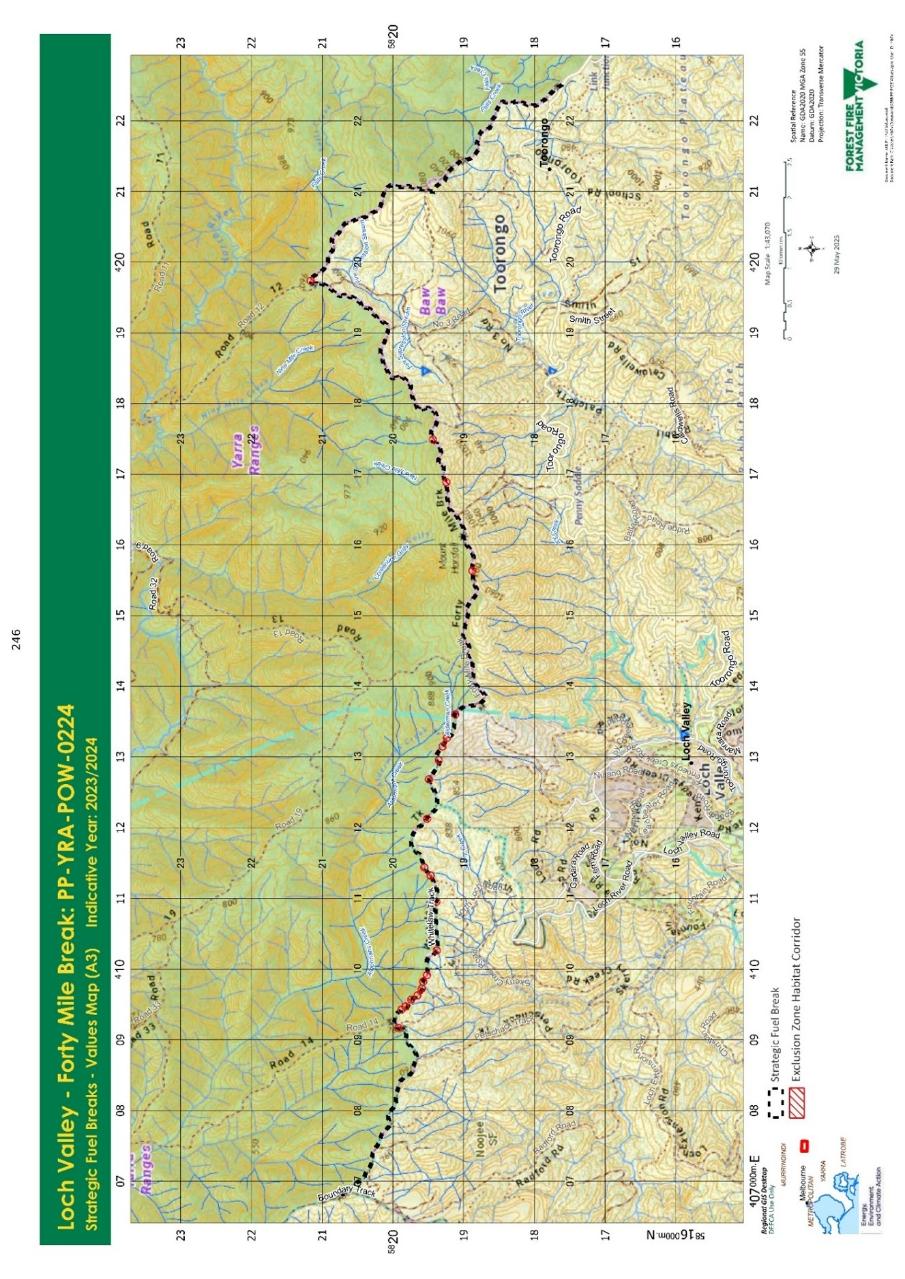
ANNEXURE B (MAP OF SFB AT FORTY MILE BREAK)
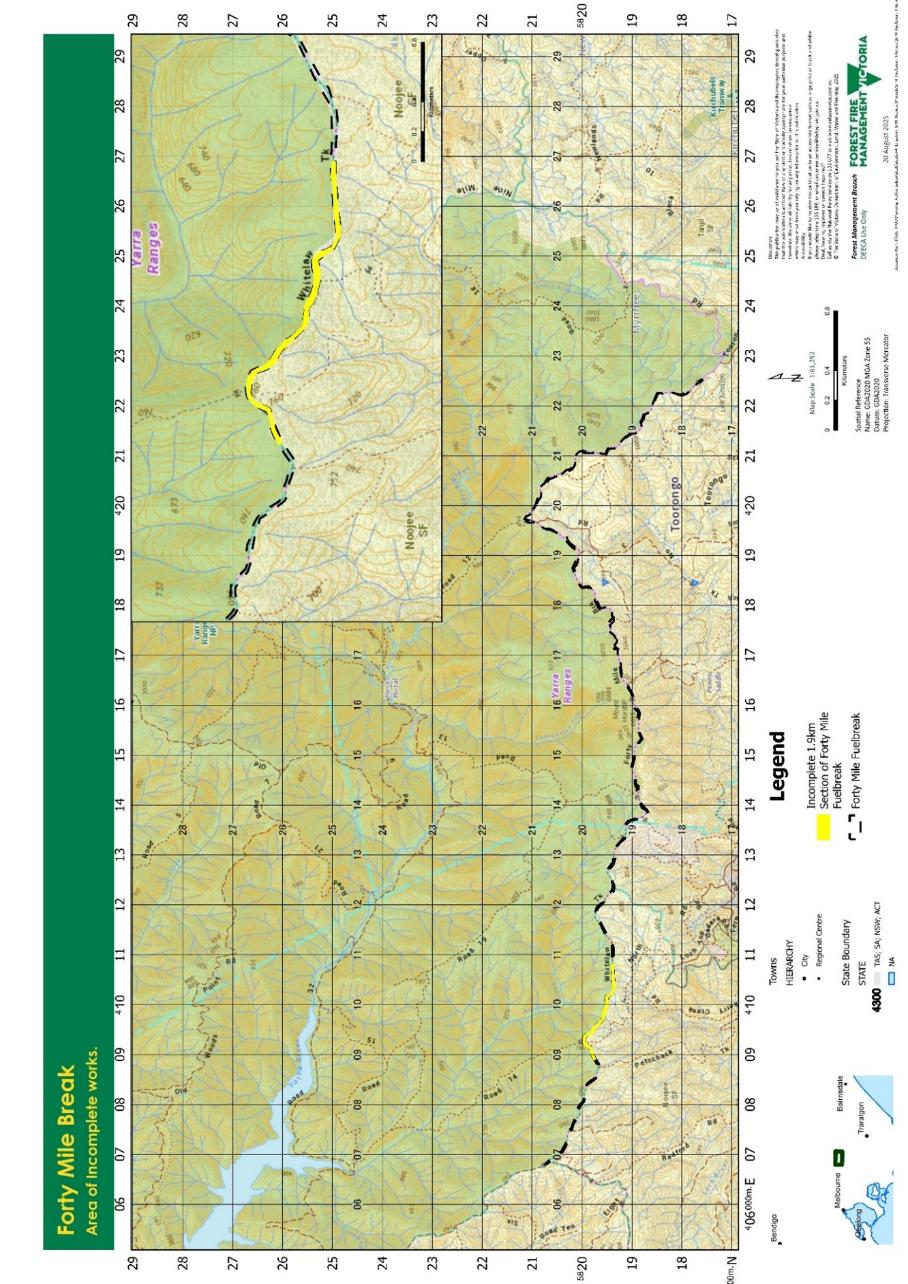
ANNEXURE C (MAP OF SFB AT MCMAHONS CREEK – BOUNDARY ROAD)
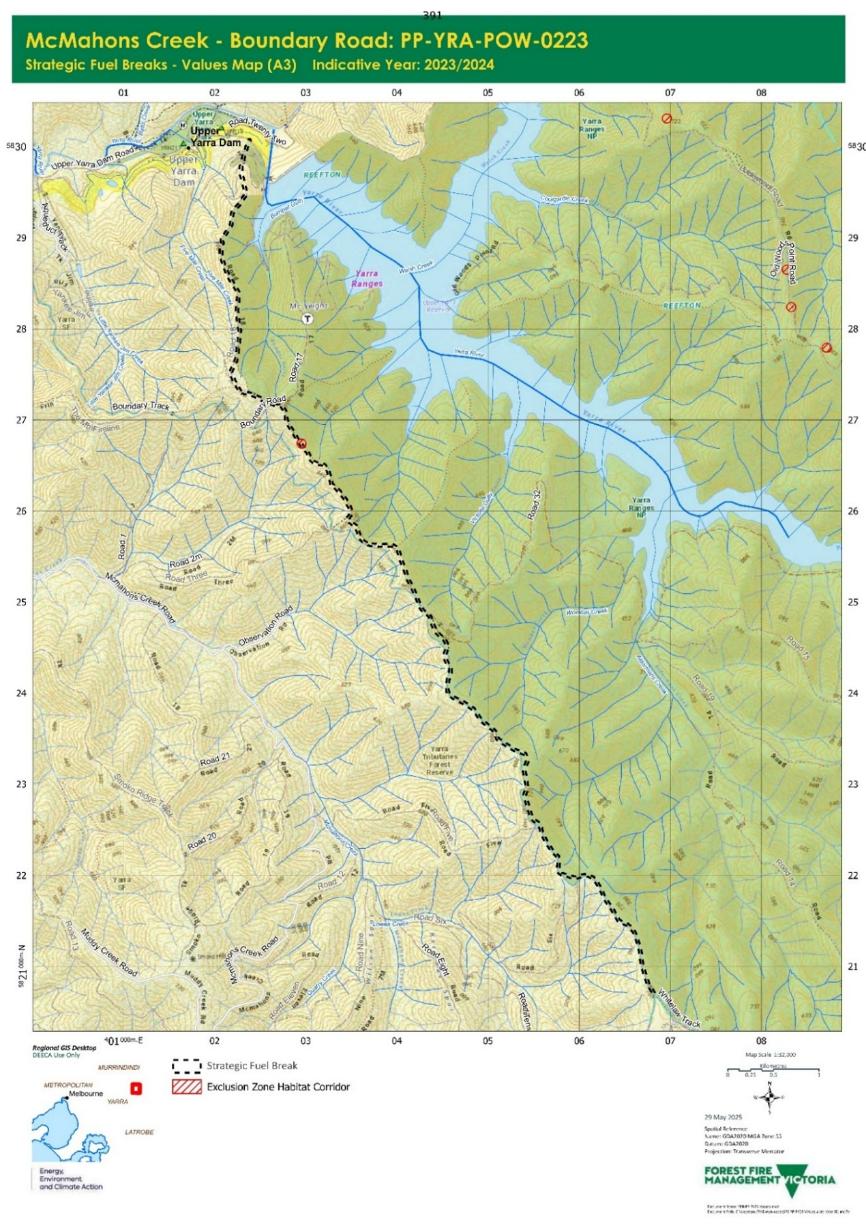
ANNEXURE D (LBP VICTORIAN DISTRIBUTION: CENTRAL HIGHLANDS SFB)
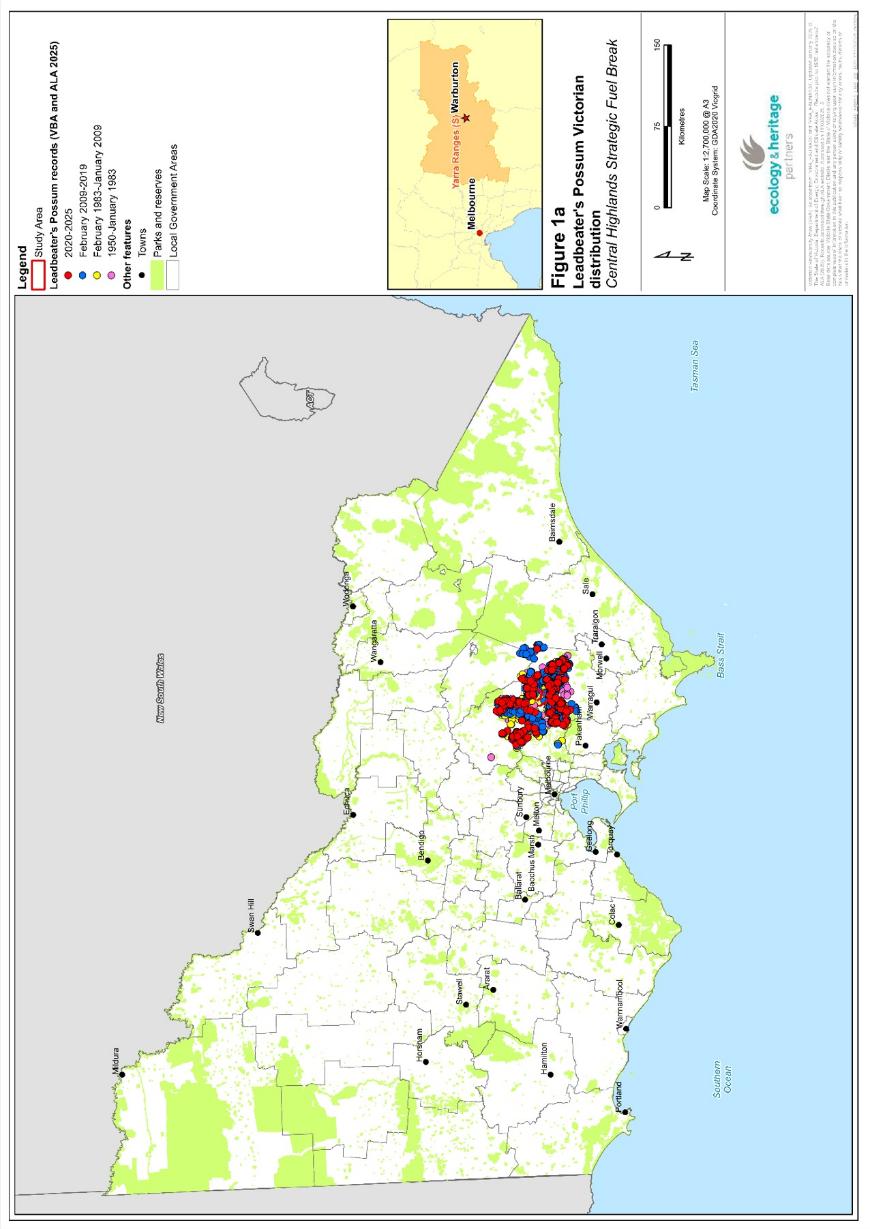
ANNEXURE E (LBP RECORDS IN THE CENTRAL HIGHLANDS RFA: CENTRAL HIGHLANDS SFB)
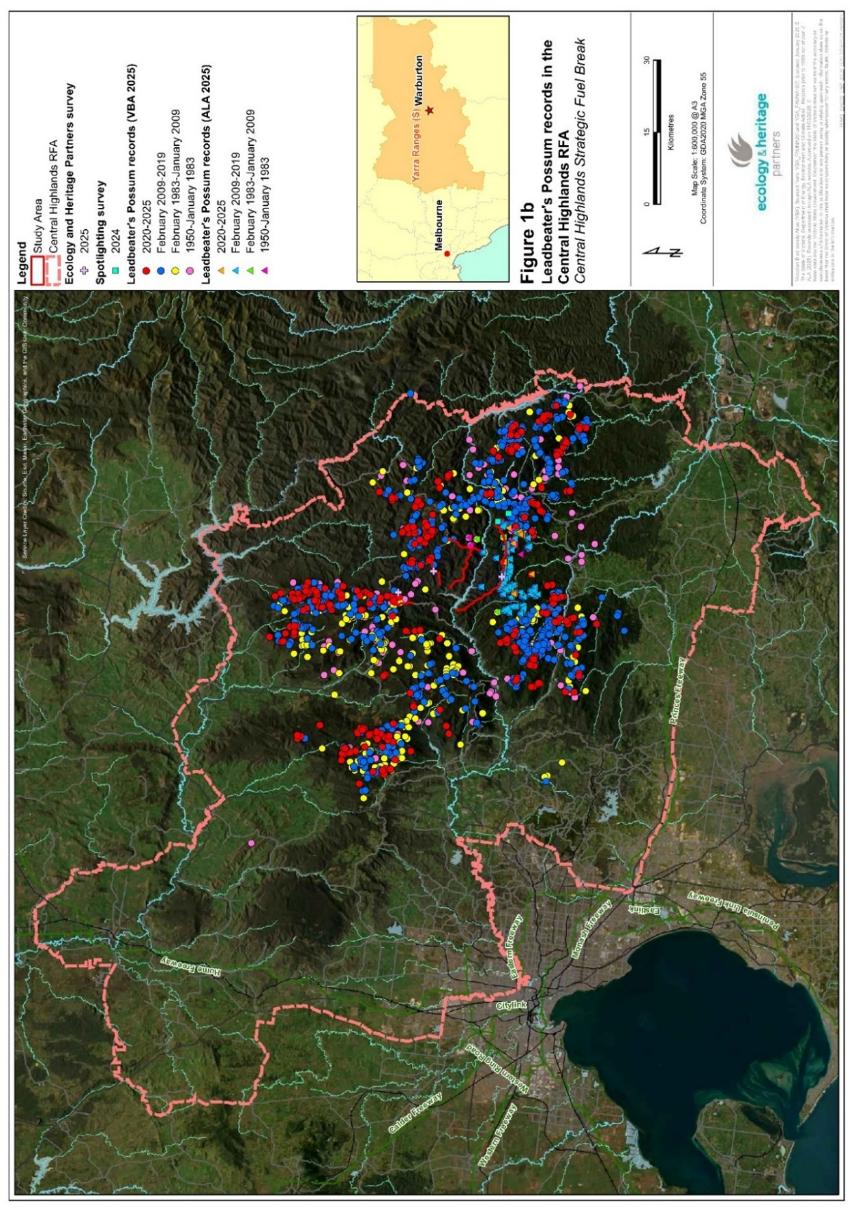
ANNEXURE F (LBP RECORDS NEAR THE STUDY AREA: CENTRAL HIGHLANDS SFB)
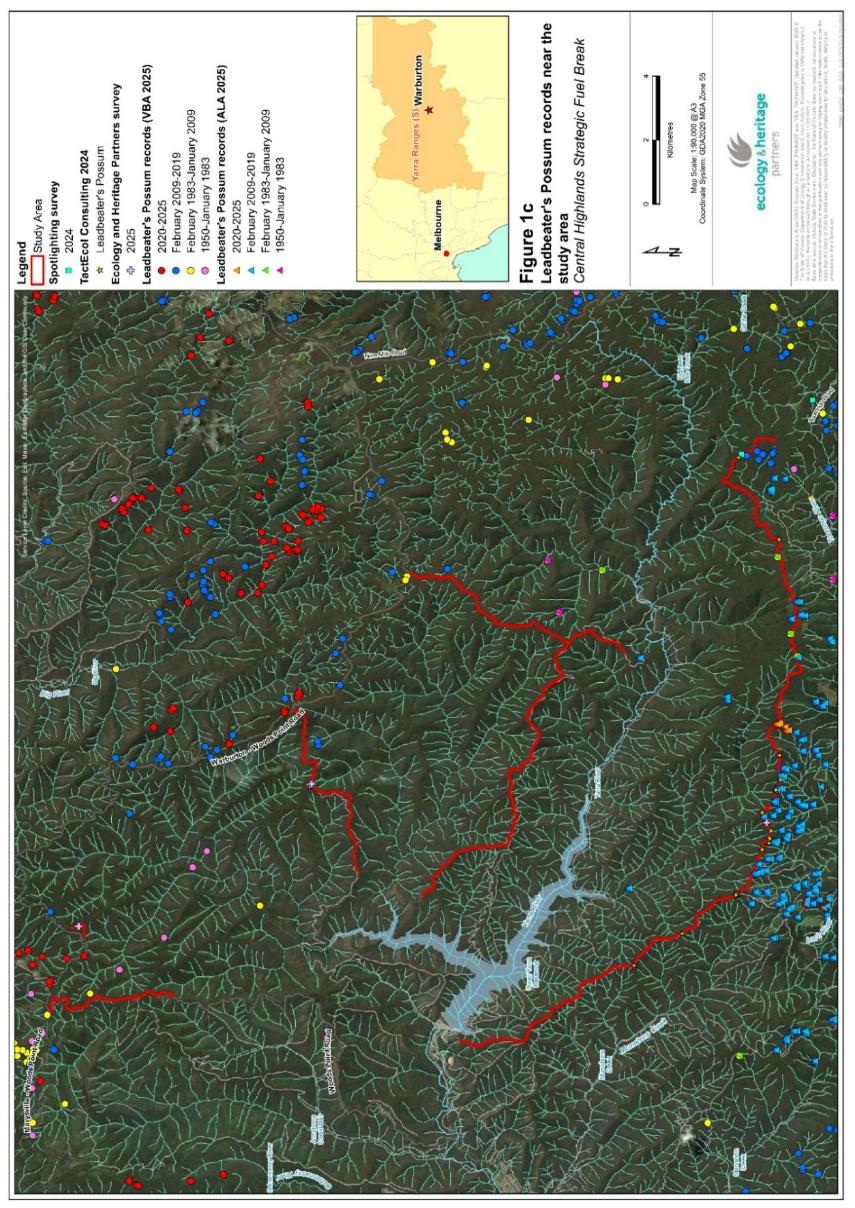
ANNEXURE G (SGG VICTORIAN DISTRIBUTION: CENTRAL HIGHLANDS SFB)
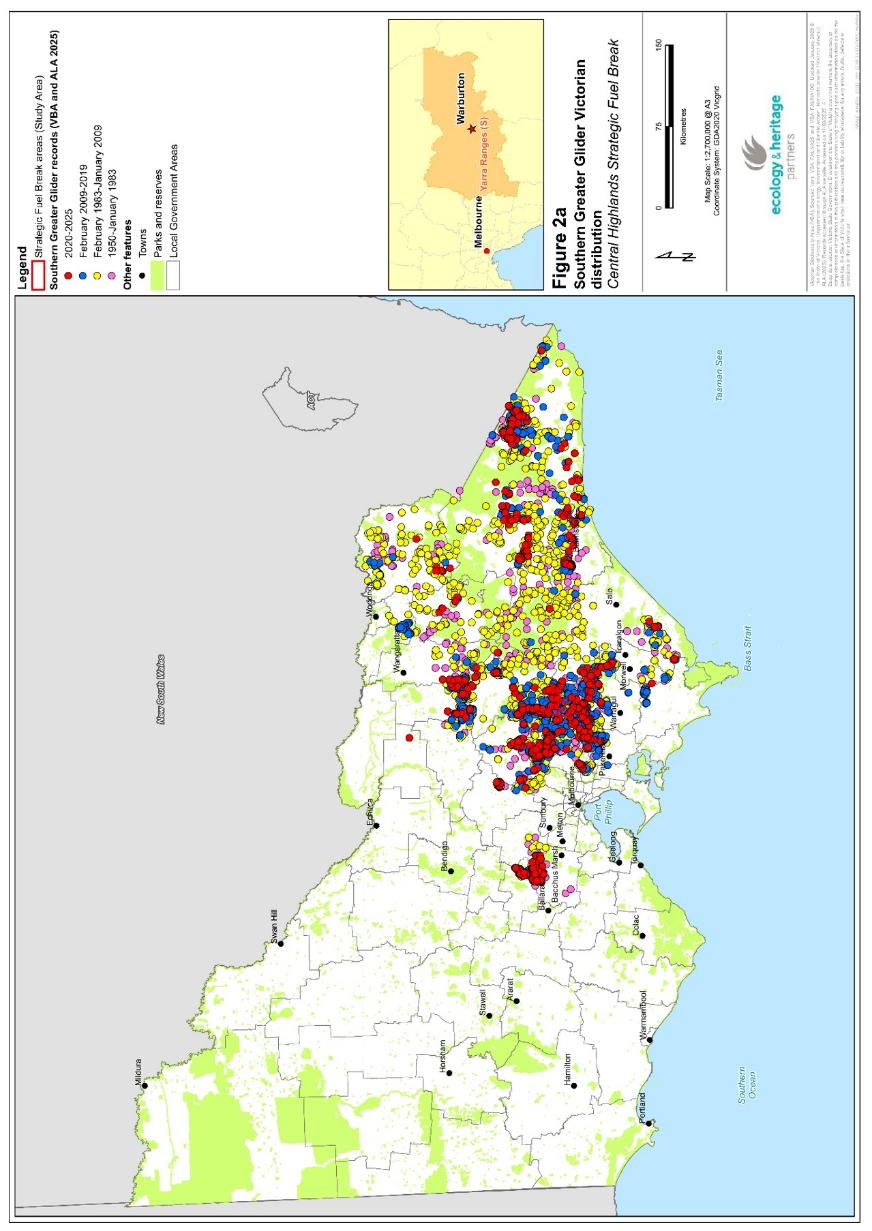
ANNEXURE H (SGG RECORDS IN THE CENTRAL HIGHLANDS RFA: CENTRAL HIGHLANDS SFB)
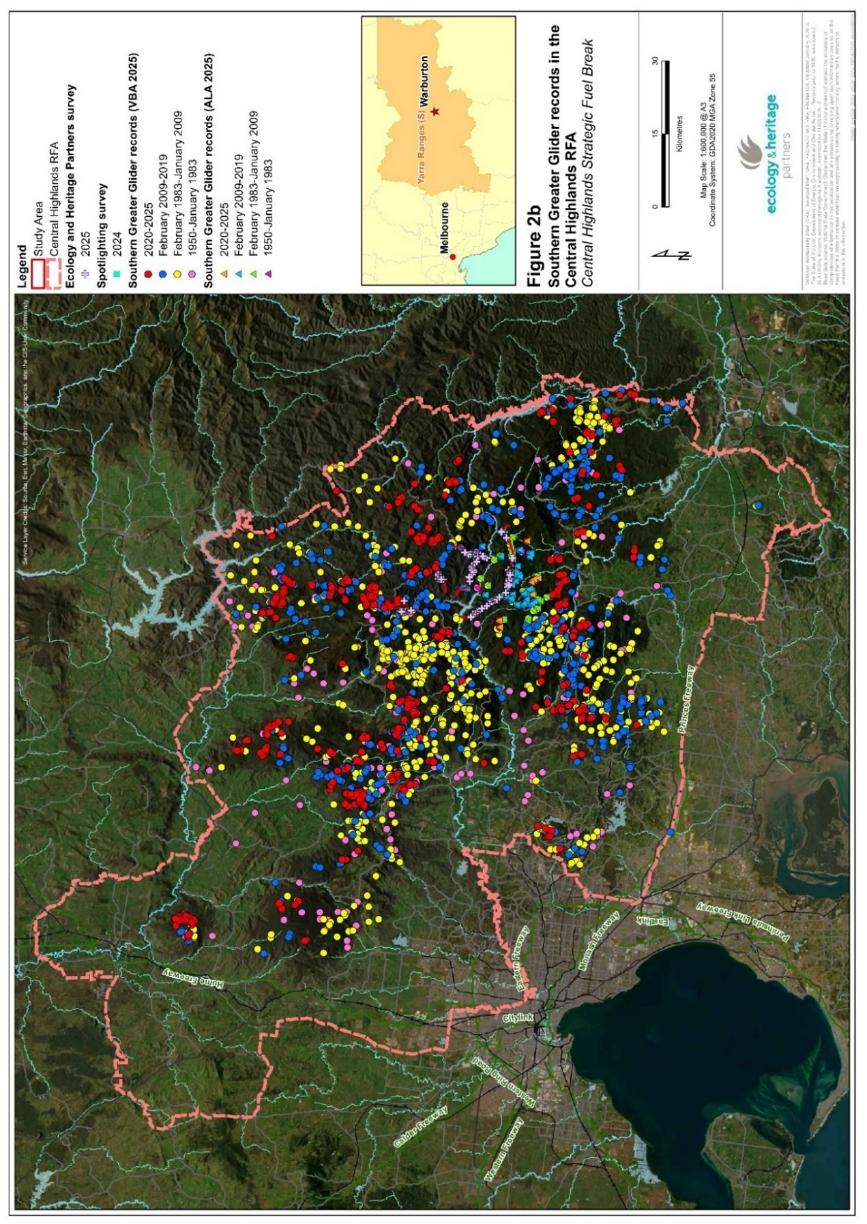
ANNEXURE I (SGG RECORDS NEAR THE STUDY AREA: CENTRAL HIGHLANDS SFB)