Federal Court of Australia
Serco Australia Pty Ltd v United Workers Union [2026] FCA 1648
File number: | WAD 253 of 2025 |
Judgment of: | VANDONGEN J |
Date of judgment: | 3 November 2026 |
Catchwords: | INDUSTRIAL LAW - application for declaratory relief regarding termination and making of redundancy payments - whether redundancy 'occurred' within meaning of Enterprise Agreement - whether employment terminated by reason of redundancy within meaning of Enterprise Agreement - application dismissed |
Legislation: | Constitution Ch III Evidence Act 1995 (Cth) s 29 Fair Work Act 2009 (Cth) ss 562, 564 Federal Court of Australia Act 1976 (Cth) ss 19, 21, 32 |
Cases cited: | Australian Workers' Union v UGL Resources (Contracting) Pty Ltd [2025] FCAFC 107 Bampton v Viterra Ltd [2015] SASCFC 87; (2015) 123 SASR 80 Blyth Chemicals Limited v Bushnell (1933) 49 CLR 66 Broadlex Services Pty Ltd v United Workers' Union [2020] FCA 867 Cementaid (NSW) Pty Ltd v Chambers (unreported, Sup Ct, NSW, SC 12295 of 1994, 29 March 1995) Federal Commissioner of Taxation v Baya Casal [2026] FCAFC 11; (2026) 314 FCR 294 Health Services Union v Catering Industries (NSW) Ltd [2023] FCAFC 82 Hivac Limited v Park Royal Scientific Instruments Limited [1946] Ch 169 Hobart International Airport Pty Ltd v Clarence City Council [2022] HCA 5; (2022) 276 CLR 519 James Cook University v Ridd [2020] FCAFC 123; (2020) 278 FCR 566 Koompahtoo Local Aboriginal Land Council v Sanpine Pty Limited [2007] HCA 61; (2007) 233 CLR 115 OS ACPM Pty Ltd v Mining and Energy Union [2026] FCAFC 59 Police Federation of Australia (Victoria Police Branch) v Chief Commissioner of Police (Victoria) [2026] FCAFC 47 Visscher v Giudice [2009] HCA 34; (2009) 239 CLR 361 |
Division: | Fair Work Division |
Registry: | Western Australia |
National Practice Area: | Employment and Industrial Relations |
Number of paragraphs: | 167 |
Dates of hearing: | 5 and 6 May 2026 |
Counsel for the Applicant: | Mr J Fernon SC |
Solicitor for the Applicant: | Baker & McKenzie |
Counsel for the Respondent: | Mr S Blewett |
Solicitor for the Respondent: | United Workers Union |
ORDERS
WAD 253 of 2025 | ||
| ||
BETWEEN: | SERCO AUSTRALIA PTY LTD Applicant | |
AND: | UNITED WORKERS UNION Respondent | |
order made by: | VANDONGEN J |
DATE OF ORDER: | 3 November 2026 |
THE COURT ORDERS THAT:
1. The amended originating application filed on 15 August 2025 is dismissed.
Note: Entry of orders is dealt with in Rule 39.32 of the Federal Court Rules 2011.
REASONS FOR JUDGMENT
VANDONGEN J:
Introduction
1 From 2009, the applicant, Serco Australia Pty Ltd, provided onshore immigration detention services at nominated Immigration Detention Centres (IDCs) (also called Immigration Detention Facilities) under successive contracts awarded by the Commonwealth of Australia through the Department of Home Affairs. However, in early December 2024, an announcement was made that Secure Journeys Pty Ltd would replace Serco as the new immigration detention service provider at IDCs. Serco was also advised that Secure Journeys would outsource some of its immigration detention services to Spotless Services Australia Limited.
2 The Department's decision to replace Serco as the service provider at the IDCs affected several Serco employees, including employees who had been working at two IDCs located in Western Australia: the Perth Immigration Detention Centre (PIDC) and the Yongah Hill Immigration Detention Centre (YHIDC). Of particular relevance to this proceeding, it is alleged that 146 of those employees working in IDCs in Western Australia ultimately commenced employment with Secure Journeys or Spotless (Employees). However, when Serco finally ceased providing services at those IDCs at 8.00 pm on 13 March 2025 (Transition Date), none of those employees had informed Serco whether they already had accepted, or intended to accept, employment with Secure Journeys or Spotless.
3 At all relevant times, Serco, the Employees and the respondent, the United Workers Union (Union), were covered by the Serco Immigration Services Enterprise Agreement 2023 (Enterprise Agreement).
4 Serco and the Union are in dispute about whether Serco is obliged by the terms of the Enterprise Agreement to pay 'redundancy pay' to the Employees. In those circumstances Serco seeks declarations pursuant to s 21 of the Federal Court of Australia Act 1976 (Cth) (FCA Act) and/or ss 562 and 564 of the Fair Work Act 2009 (Cth) (FW Act) to the effect that it did not terminate the employment of the Employees, and that it was not required by the terms of the Enterprise Agreement to pay any redundancy pay to the Employees.
5 Serco also sought a further declaration that it was not required by the Enterprise Agreement to pay the Employees any amount in lieu of notice of termination. However, the Union accepted in its written submissions that Serco had given the requisite notice of termination of employment such that it was not obliged to pay the Employees any amount in lieu of notice. Accordingly, there is no longer any basis on which such a declaration could be made.
6 For the following reasons I am of the view that Serco's application should be dismissed.
Jurisdiction
7 Before setting out my reasons for reaching that conclusion, it is appropriate to first consider whether this Court has jurisdiction to make the declarations sought.
8 Jurisdiction is conferred on this Court under a combination of s 19(1) of the FCA Act and s 562 of the FW Act, in relation to 'any matter' arising under the FW Act. This Court has the power, in civil proceedings in relation to a matter in which it has original jurisdiction, to make binding declarations of right, whether or not any consequential relief is or could be claimed: s 21(1) of the FCA Act.
9 In Hobart International Airport Pty Ltd v Clarence City Council [2022] HCA 5; (2022) 276 CLR 519 at [26], Kiefel CJ, Keane and Gordon JJ referred to the concept of a 'matter', for the purposes of Ch III of the Constitution, as having two elements:
(1) 'the subject matter itself as defined by reference to the heads of jurisdiction' set out in Ch III of the Constitution; and
(2) 'the concrete or adequate adversarial nature of the dispute sufficient to give rise to justiciable controversy'.
10 A 'subject matter' of the controversy between the parties in this case is within the jurisdiction of the Court because it relates to the proper construction of the Enterprise Agreement, which was made under the FW Act: Police Federation of Australia (Victoria Police Branch) v Chief Commissioner of Police (Victoria) [2026] FCAFC 47 at [10] (Snaden and Shariff JJ) and [114] (Kennett J).
11 Insofar as the second element of the concept of a 'matter' is concerned, I am of the view that there is a 'justiciable controversy' because there is 'some immediate right, duty or liability to be established by the determination of the Court': Hobart International Airport at [29] (Kiefel CJ, Keane and Gordon JJ). As will be seen, there is a dispute between Serco and the Union about the proper construction of a particular clause in the Enterprise Agreement. The resolution of that dispute will have immediate consequences both for the Employees and Serco because it will determine whether Serco is obliged under the terms of the Enterprise Agreement, when read with the relevant provisions of the FW Act (as to which, see Police Federation of Australia at [16] to [21] (Snaden and Shariff JJ)), to pay redundancy pay to the Employees. The existence or otherwise of such an obligation is plainly of 'real practical importance' to both Serco and to the Employees: Health Services Union v Catering Industries (NSW) Ltd [2023] FCAFC 82 at [38].
12 To the extent the subject matter of the controversy relates to a question about whether Serco terminated the employment of the Employees, which is the subject of the first declaration sought by Serco, if that is not a matter that is otherwise within this Court's jurisdiction then s 32(1) of the FCA Act would confer jurisdiction because it is a matter associated with the matter in which the Court's jurisdiction is invoked.
13 In light of the position taken by the Union that Serco is not obliged to pay to the Employees any amounts in lieu of notice of termination, there is no justiciable controversy between the parties in that respect and, consequently, no matter arising under the FW Act. Accordingly, nothing more needs to be said about that aspect of Serco's case or the relevant declaratory relief sought.
14 I will now identify the relevant provisions of the Enterprise Agreement that are at the centre of the controversy between the parties. However, I will first briefly refer to the relevant principles that must be applied when construing an industrial instrument.
Relevant principles governing the construction of industrial instruments
15 As was recently reaffirmed by this Court in Australian Workers' Union v UGL Resources (Contracting) Pty Ltd [2025] FCAFC 107 at [12] and OS ACPM Pty Ltd v Mining and Energy Union [2026] FCAFC 59 at [27] (Raper and Shariff JJ), the principles governing the construction of industrial instruments were distilled in James Cook University v Ridd [2020] FCAFC 123; (2020) 278 FCR 566 at [65] (Griffiths and SC Derrington JJ):
(i) The starting point is the ordinary meaning of the words, read as a whole and in context (City of Wanneroo v Holmes (1989) 30 IR 362 at 378; City of Wanneroo v Australian Municipal, Administrative, Clerical and Services Union (2006) 153 IR 426 at [53]; WorkPac Pty Ltd v Skene (2018) 264 FCR 536 at [197]).
(ii) A purposive approach is preferred to a narrow or pedantic approach - the framers of such documents were likely to be of a 'practical bent of mind' (Kucks v CSR Ltd (1996) 66 IR 182 at 184; Shop, Distributive and Allied Employees' Association v Woolworths SA Pty Ltd [2011] FCAFC 67 at [16]; WorkPac Pty Ltd v Skene (2018) 264 FCR 536 at [197]). The interpretation 'turns upon the language of the particular agreement, understood in the light of its industrial context and purpose' (Amcor Ltd v Construction, Forestry, Mining and Energy Union (2005)(2005) 222 CLR 241 at [2]).
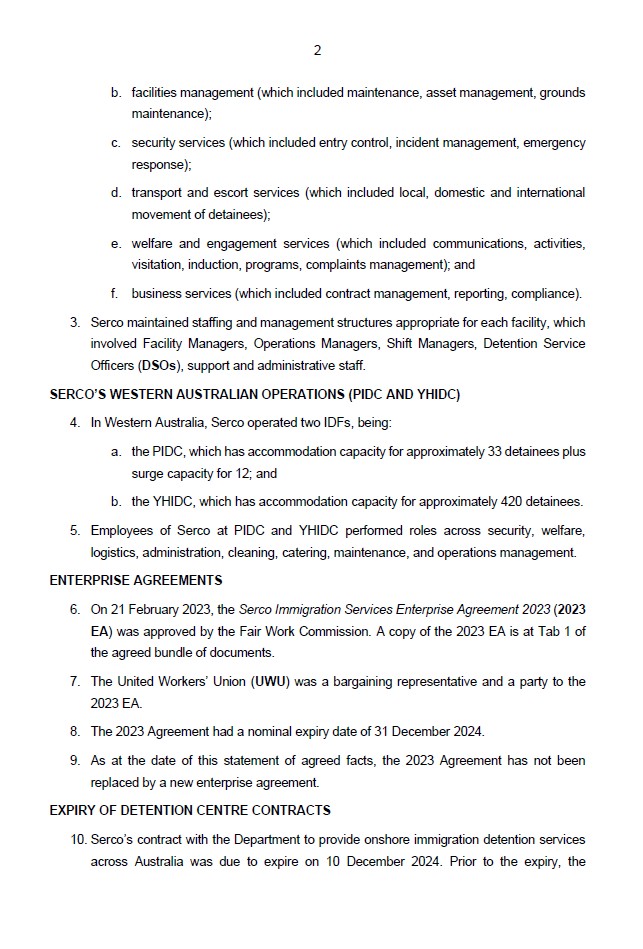
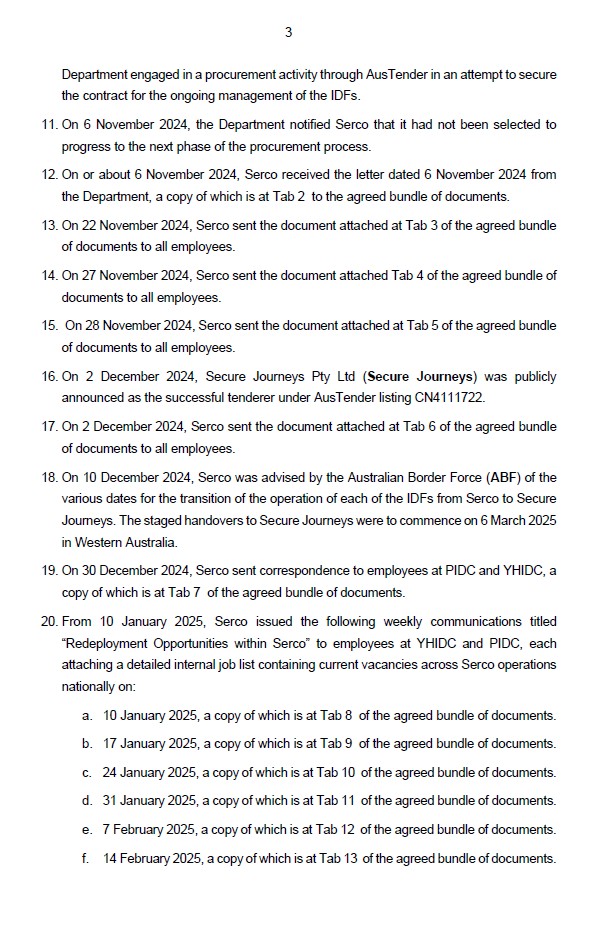
(iii) Context is not confined to the words of the instrument surrounding the expression to be construed (City of Wanneroo v Australian Municipal, Administrative, Clerical and Services Union (2006) 153 IR 426 at [53]). It may extend to '… the entire document of which it is a part, or to other documents with which there is an association' (Short v FW Hercus Pty Ltd (1993) 40 FCR 511 at 518; Australian Municipal, Administrative, Clerical and Services Union v Treasurer of the Commonwealth (1998) 82 FCR 175 at 178).
(iv) Context may include ' … ideas that gave rise to an expression in a document from which it has been taken' (Short v FW Hercus Pty Ltd (1993) 40 FCR 511 at 518).
(v) Recourse may be had to the history of a particular clause … (Short v FW Hercus Pty Ltd (1993) 40 FCR 511 at 518).
(vi) A generous construction is preferred over a strictly literal approach (George A Bond & Company Ltd (in liq) v McKenzie [1929] AR (NSW) 499 at 503-4; City of Wanneroo v Australian Municipal, Administrative, Clerical and Services Union (2006) 153 IR 426 at [57]), but 'Awards, whether made by consent or otherwise, should make sense according to the basic conventions of the English language …' (City of Wanneroo v Holmes (1989) 30 IR 362 at 380).
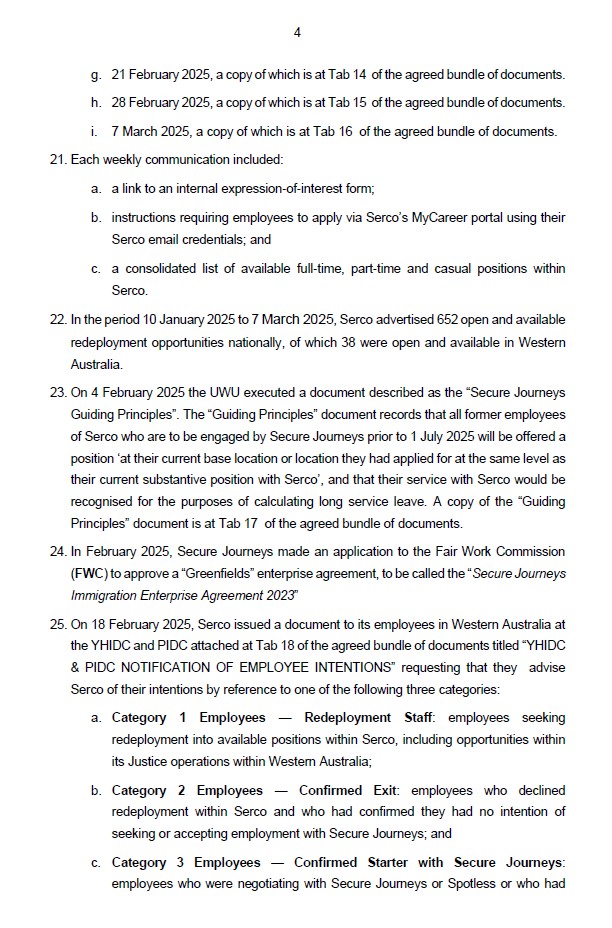
(vii) Words are not to be interpreted in a vacuum divorced from industrial realities but in the light of the customs and working conditions of the particular industry (City of Wanneroo v Holmes (1989) 30 IR 362 at 378-9; WorkPac Pty Ltd v Skene (2018) 264 FCR 536 at [197]).
16 As was succinctly said in Police Federation of Australia at [85] (Snaden and Shariff JJ):
The task involved in construing an enterprise agreement is to engage in an interpretive process to give meaning to the relevant words, consistent with their context, including the context of the agreement read as a whole and its purpose: James Cook University v Ridd [2020] FCAFC 123; 278 FCR 566 at [65] (Griffiths and S C Derrington JJ) citing City of Wanneroo v Holmes [1989] FCA 553; 30 IR 362 at 378 (French J); City of Wanneroo v Australian Municipal, Administrative, Clerical and Services Union [2006] FCA 813; 153 IR 426 at [53] (French J); WorkPac Pty Ltd v Skene [2018] FCAFC 131; 264 FCR 536 at [197] (Tracey, Bromberg and Rangiah JJ). It has been accepted that the relevant context may include '... ideas that gave rise to an expression in a document from which it has been taken': Short v FW Hercus Pty Ltd [1993] FCA 72; 40 FCR 511 at 518 (Burchett J).
17 The Union submits that the relevant context in which the Enterprise Agreement fell to be construed was that it operates in 'the contracting industry', a feature of which is the periodic replacement of one contracting employer with another where there is a continuing need for the services provided. However, there was no evidence adduced by either party that was materially probative of that context.
The relevant provisions of the Enterprise Agreement
18 The Enterprise Agreement was approved by the Fair Work Commission on 21 February 2023, operated from 28 February 2023 and had a nominal expiry date of 31 December 2024.
19 The coverage clause of the Enterprise Agreement, cl 3.1, provides that it would cover:
(a) Serco Australia Pty Limited;
(b) all Employees working in Australia who are covered by the classifications set out in Schedule 1 of the Agreement and undertaking work in the detentions industry under the SIS contract and also applies to such employees when working temporarily for Serco outside the Commonwealth of Australia undertaking international aviation assignments;
(c) the [Union], provided written notice is given in accordance with s 183(1) of the [FW Act] and the Fair Work Commission notes in the document to approve the Agreement that the Agreement covers the [Union]; and
(d) the [Union of Christmas Island Workers (UCIW)], provided written notice is given in accordance with s 183(1) of the [FW Act] and the Fair Work Commission notes in the document to approve the Agreement that the Agreement covers the UCIW.
20 The term 'Employee' is defined in cl 1 of the Enterprise Agreement as '[e]mployees of Serco covered by this Agreement'. Further, the term 'SIS Contract' is defined in cl 1 as the '[s]ervices contract between Serco and the Department of Home Affairs'. There is no dispute that the Employees fell within the coverage clause, and that the SIS Contract, which expired in December 2024, was the contract under which Serco was delivering immigration detention services.
21 Before commencing employment, each employee of Serco covered by the Enterprise Agreement was to be provided with a letter of engagement, which is to set out, amongst other things, the employee's employment type, job classification, rate of pay, commencing date of employment, commencing hours of work and immediate roster arrangements, the 'Base Location', any qualifying or probationary period and the end date of any specified term contract: cl 13.1.
22 The term 'Base Location', used in cl 13.1 of the Enterprise Agreement, is defined in cl 1 as:
The location where an Employee is engaged to work, either upon commencement, during a secondment or temporary transfer or a subsequent permanent transfer. To avoid doubt, Base Location refers to the location where an Employee is engaged to work, including adjacent sites. (eg, Villawood includes any facility within the [Villawood Immigration Detention Centre] site; Christmas Island includes NWP, CC & PH). The definition is not intended to include non-adjacent sites.
23 Pursuant to cl 18, it was a condition of the Enterprise Agreement that employment with Serco was the primary form of employment for full-time employees. Full-time employees were not permitted to engage in external employment in any related industry unless written permission had first been provided. Similar clauses appear in the individual employment agreements of each of the Employees.
24 Clause 22 is headed 'Termination of employment'. Relevantly, cl 22.2 provides that:
an Employee's employment (other than a casual Employee) may be terminated either by the Employee or Serco by giving the required period of notice, or by Serco without notice by Serco making payment at the full rate of pay for the hours the Employee would have worked had the employment continued until the end of notice period specified in the table below.
25 A table that forms part of cl 22.2 then sets out the required periods of notice for both Serco and employees, having regard to the relevant employee's age and period of continuous service.
26 Clause 23 is concerned with an employee's abandonment of employment. In summary, it provides that, in certain circumstances, Serco may establish that an employee has abandoned their employment with Serco conferring on Serco the right to give notice of termination under cl 22.
27 The principal clauses of the Enterprise Agreement with which this proceeding is concerned are cll 25 and 26. Because of the centrality of those clauses to the issues raised in this proceeding, it is convenient to set them out in full:
25. Redundancy
25.1 Redundancy occurs when Serco decides that it no longer requires the job the Employee has been doing to be done by anyone and this is not due to the ordinary and customary Employee turnover.
25.2 A position may be made redundant in circumstances which include, but are not limited to where it is:
(a) excess of Serco's operational requirements (for operational reasons); or
(b) no longer required due to the introduction of workplace change (including technology changes); or
(c) it is transferred to a different location which is not within a reasonable travelling distance due to changes resulting from a review and subsequent restructure of functions within the organisation which impact upon the position.
25.3 Redundancy constitutes a significant workplace change, meaning clause 7 - consultation - applies.
25.4 Transfer to lower paid duties
Where an Employee is transferred to lower paid duties by reason of redundancy, the same period of notice must be given as the Employee would have been entitled to if the employment had been terminated. Serco may at its discretion, make payment in lieu of notice of an amount equal to the difference between the Employee's former Base Rate of Pay for their ordinary hours of work and the new Base Rate of Pay for their ordinary hours of work for the number of weeks of notice still owing.
25.5 Redundancy pay
(a) Serco will give written notice to an Employee whose position is made redundant which includes the termination date and, where possible, an estimate of the final pay the Employee will receive.
(b) In addition to the period of notice prescribed for termination of employment in clause 22.2, an Employee whose employment is terminated by reason of redundancy must be paid redundancy pay in accordance with the following scale:
Period of continuous service | Redundancy pay* |
Less than 1 year | 3 weeks' pay |
1 year and less than 2 years | 6 weeks' pay |
2 years and less than 3 years | 9 weeks' pay |
3 years and less than 4 years | 10 weeks' pay |
4 years and less than 5 years | 11 weeks' pay |
5 years and less than 6 years | 12 weeks' pay |
6 years and less than 9 years | 14 weeks' pay |
9 years and over | 16 weeks' pay |
Employees 45 years old and over | Additional 4 weeks' pay |
*Week's pay means the Base Rate of Pay for an Employee's ordinary hours of work.
25.6 Situations where there is no entitlement to redundancy pay
(a) An Employee is not entitled to redundancy pay if the Employee:
(i) resigns prior to receiving written notice of redundancy under clause 25.5(a);
(ii) is a casual, specified term or specified task Employee or is dismissed;
(iii) is offered, but declines the offer, of a suitable alternative position within Serco;
(iv) is offered a suitable alternative position within Serco or where the Employee accepts an alternative position within Serco.
25.7 In calculating service for the purpose of determining an Employee's entitlements to all or any leave authorised by Serco (whether paid or not) or in the case of termination of employment, notice and/or redundancy pay, the Employee's service shall be calculated from the date upon which the Employee commenced employment with Serco. Prior service with a previous employer shall not be taken into account for the purpose of calculating any entitlement arising under this Agreement.
25.8 Employee leave during notice period
An Employee whose employment is terminated by reason of redundancy may terminate their employment during the period of notice and, if so, will be entitled to the same benefits and payments under this clause had they remained with Serco until the expiry of such notice. However, in this circumstance the Employee will not be entitled to payment in lieu of notice.
25.9 Time off during notice period
During the period of notice of termination given by Serco an Employee shall be allowed up to one day's time off without loss of pay during each week of notice for the purpose of seeking other employment.
25.10 If the Employee has been allowed paid leave for more than one day during the notice period for the purpose of seeking other employment, the Employee shall, at the request of Serco, be required to produce proof of attendance at an interview or they will not receive payment for the time absent. For this purpose a statutory declaration from the Employee will be sufficient.
25.11 Nothing in this clause will derogate from the operation of section 120 of the [FW Act]. Serco acknowledges the application of the provisions of section 120(2) of the [FW Act] which permit Serco to seek a variation of the amount of redundancy pay payable to an Employee on application to the Fair Work Commission.
26. Change of service provider
26.1 In the event that Serco's contract is terminated by the Department of Home Affairs or the contract is not renewed, or the business is otherwise moved from Serco to another employer, ('other employer') then the following arrangements will apply:
(a) Where an Employee accepts employment with the other employer, and the other employer recognises the Employee's period of employment with Serco as the Employee's service for the purpose of calculating long service leave, accrued annual leave and redundancy pay (see clause 25.5); or
(b) Where an Employee rejects an offer of comparable employment with the other employer and which contains terms and conditions that are no less favourable, considered on an overall basis, than the terms and conditions applicable to the Employee at the time of ceasing employment with Serco; and which recognises the Employee's period of employment with Serco as service for the purposes referred to in clause 26.1(a),
then Serco, subject to the provisions of the [National Employment Standards in the FW Act], will not be under any obligation to make any redundancy payment to the Employee upon termination of their employment with Serco.
26.2 Serco will notify Employees as soon as practicable, when it becomes aware that Serco's contract is to be terminated, or not renewed, or the business otherwise moved to another employer.
(a) The notification to Employees will be in writing, containing options (if any) and details for comparable alternative employment for Employees within Serco.
(b) If requested by the other employer, Serco will provide to the successful tenderer a list of Employees who have given permission for their details to be so provided and who wish to be considered for employment by the other employer.
(c) Serco will provide any Employee whose employment is terminated as a result of a change of service provider with notification in writing of that termination, including details of the Employee's entitlements (including accrued and annual leave) and a statement of service (including length of service, hours of work, classification and shift configuration).
(d) Serco will use best endeavours to facilitate a meeting between the other employer and outgoing Employees who are not offered suitable alternative employment within Serco.
26.3 Nothing in this clause will derogate from the operation of section 120 of the [FW Act]. Serco acknowledges the application of the provisions of section 120 (2) of the [FW Act] which permit Serco to seek a variation of the amount of redundancy pay payable to an Employee on application to the Fair Work Commission.
28 Noting that the concept of redundancy takes its meaning from the statutory, industrial award or contractual provisions in the particular case (Federal Commissioner of Taxation v Baya Casal [2026] FCAFC 11; (2026) 314 FCR 294 at [29] (Hespe and Button JJ)), redundancy 'occurs' when, under the Enterprise Agreement, Serco 'decides' that it no longer requires the job an employee has been doing to be done by anyone and this is not due to ordinary and customary employee turnover: cl 25.1. At the hearing senior counsel for Serco made it clear that Serco did not contend that if the Court were to conclude that Serco made the decision contemplated by cl 25.1, that it was due to ordinary and customary turnover.
29 Serco's obligation to pay redundancy pay arises when an employee's employment is 'terminated by reason of redundancy': cl 25.5(b). The phrase 'terminated by reason of redundancy' that appeared in cl 25.5(b) is not defined in the Enterprise Agreement. However, the use of the words 'by reason of' suggests that the obligation to pay redundancy pay arises where there exists a causal connection between the termination of an employee's employment and the occurrence of redundancy. That is, Serco's obligation to pay redundancy pay arises under the Enterprise Agreement when termination of employment happens 'because of', 'due to' or 'on account of' redundancy occurring under cl 25.1.
30 Clause 25.1 fixes a point in time when redundancy 'occurs', by reference to when 'Serco decides that it no longer requires the job the Employee has been doing to be done by anyone' (emphasis added).
31 The word 'job' is not defined in the Enterprise Agreement. However, cl 27 provides that the classifications relevant to Serco's operations are set out in Sch 1 to the Enterprise Agreement. Those classifications include Detention Services Officer (DSO 1), Accredited Detention Services Officer (DSO 2 and DSO 3), Detention Support Worker (DSW), Detention Service Manager, Catering Employee, and Cleaning Services Employee. Each of those classifications provide for the duties and responsibilities of employees covered by those classifications.
32 Importantly, and as I have already noted, cl 3.1(b) provides that the Enterprise Agreement covers all employees working in Australia who are covered by those classifications 'and undertaking work in the detentions industry under the SIS contract' (emphasis added). Accordingly, 'the job [an] Employee has been doing', for the purposes of cl 25.1, must at least be the 'job' in which a person who is covered by a classification in Sch 1 of the Enterprise Agreement undertakes work in the detentions industry for Serco 'under the SIS contract'.
33 The word 'decides' is also not defined in the Enterprise Agreement. Its ordinary meaning includes to come to a determination or resolution, to make a choice. However, the meaning of the word 'decides' in cl 25.1 must be understood in the context of cl 26.1.
34 Clause 26.1 operates when 'Serco's contract is terminated by [the] Department of Home Affairs or the contract is not renewed, or the business is otherwise moved from Serco to another employer'. The references in cl 26.1 to the 'contract' must be taken to be references to the 'SIS Contract', as defined in cl 1, which is the contract under which Serco was operating PIDC and YHIDC up until the Transition Date. Clause 26.1 identifies two specific circumstances in which Serco is not obliged to pay redundancy pay. Those circumstances are concerned with the acceptance or rejection by employees of Serco of employment on certain terms with an incoming employer. Clause 26.1 therefore proceeds on an unstated premise that redundancy will 'occur' for the purposes of cl 25.1 when the SIS Contract is terminated by the Department or is not renewed. Otherwise, there would be no need for cl 26.1 to have been included as a term of the Enterprise Agreement.
35 Having regard to what I have already said about the meaning of the word 'job' in cl 25.1, it follows that in circumstances in which the SIS Contract is terminated by the Department or it is not renewed, and Serco ceases to provide services under that contract, Serco will necessarily decide, for the purposes of cl 25.1, that it no longer requires the jobs its employees have been doing to be done by anyone even though Serco may have no choice in making such a decision. That is because all of the 'jobs' the employees covered by the Enterprise Agreement will have been doing will then cease to exist.
36 In the circumstances of this matter, it is also important to observe that the Enterprise Agreement contemplates that once redundancy occurs, for the purposes of cl 25.1, one of two things will then follow in the ordinary course.
37 Firstly, an employee may be 'transferred to lower paid duties by reason of redundancy': cl 25.4. As the text used in cl 25.4 makes clear, such a transfer will not involve the termination of employment. That this is because cl 25.4 relevantly provides that an employee who is transferred to 'lower paid duties by reason of redundancy' is entitled to the same period of notice to which they would have been entitled 'if the employment had been terminated'. There is no suggestion that any of the Employees were transferred to lower paid duties.
38 Secondly, an employee's employment will be 'terminated by reason of redundancy': cl 25.5. That this is so is consistent with the general concept of redundancy, namely that an employee loses his or her job because their employer no longer requires that job to be done by anyone: Bampton v Viterra Ltd [2015] SASCFC 87; (2015) 123 SASR 80 at [185] (Blue J). It is also confirmed by the fact that when redundancy 'occurs', Serco is required by cl 25.5(a) to give to an employee whose position is made redundant written notice that is to include the 'termination date' and, where possible, an estimate of the employee's final pay. Accordingly, Serco is obliged to bring to the attention of relevant employees that redundancy has occurred, and to inform those employees of the date on which termination of their employment will take effect.
39 The period of notice of redundancy and the termination date required to be given under cl 25.5(a) is linked to the period of notice prescribed for termination of employment under cl 22. However, cl 22.2 makes it clear that it is open to Serco to make payment in lieu of such notice. Further, while Serco is obliged to give notice under cl 25.5(a), and it would therefore ordinarily be expected that such notice would be given (including because redundancy constitutes a significant workplace change requiring consultation: cl 25.3 in conjunction with cl 7), there is nothing to suggest that the giving of such notice is a necessary for an employee's employment to be 'terminated by reason of redundancy'.
40 Clause 25.5(b) provides that an employee whose 'employment is terminated by reason of redundancy' must be paid redundancy pay, which is calculated in accordance with the table that forms part of that clause. Apart from the circumstances provided for in cl 26.1, there are four other circumstances provided for in cl 25.6 in which there will be no entitlement to redundancy pay.
41 The first of those circumstances is where an employee 'resigns' prior to receiving written notice of redundancy under cl 25.5(a): cl 25.6(a)(i). The word 'resigns' is not defined in the Enterprise Agreement. Relying on the Macquarie Dictionary (8th ed), Serco submits that the ordinary meaning of the word 'resign' is to 'give up an office or position' and that no particular formality is required for a resignation. However, according to the online version of the Macquarie Dictionary one meaning of the word is 'to give up (an office, position, etc.) formally' (emphasis added).
42 The word 'resigns' must be construed in the context in which it appears. In that regard, it is important to note that the Enterprise Agreement only contemplates that an employee will terminate their employment by giving notice as required by cl 22. The Enterprise Agreement separately deals with circumstances in which an employee simply 'gives up' or abandons their employment without formally giving notice. When Serco establishes for the purposes of cl 23.1 that an employee has 'abandoned their employment' and takes the steps provided for in cl 23.2, an employee will be deemed to have abandoned their employment if the requirements of cl 23.3 are satisfied. Clause 23.3 expressly provides that Serco may then give notice of termination to the relevant employee in accordance with cl 22. In other words, where an employee abandons his or her employment, it is Serco and not the employee who terminates the employment.
43 Accordingly, having regard to the ordinary meaning of that word and to the context in which it appears, an employee 'resigns' for the purposes of cl 25.6(a)(i) by giving notice of termination in accordance with cl 22.
44 The evident purpose of cl 25.6(a)(i) is that if, after redundancy occurs for the purposes of cl 25.1, an employee makes an independent decision to resign before being given written notice of redundancy, then they are bound by their decision and cannot receive a redundancy payment irrespective of whether the employer also independently decides to make the position redundant. That is consistent with the concept of a redundancy payment being designed to financially support a person until he or she finds new employment: Bampton at [50] (Kourakis CJ). A person who voluntarily resigns their employment may be taken to have made their own arrangements for financial support.
45 As an employee will terminate their employment by resigning, with the result that it could not then be concluded that their employment was 'terminated by reason of redundancy' for the purposes of cl 25.5(b), the circumstances in which cl 25.6(a)(i) will operate in practice to disentitle an employee to redundancy pay will be limited.
46 The second circumstance concerns casual, specified term or specified tasks employees, or employees who are dismissed: cl 25.6(a)(ii). None of the Employees fall within any of those categories.
47 The third and fourth circumstances are concerned with employees who are offered but decline the offer of a 'suitable alternative position within Serco' (cl 25.6(a)(iii)) and employees who accept an alternative position within Serco (cl 25.6(a)(iv)), although cl 25.6(a)(iv) is clumsily worded. However, it was never suggested that either subcll (iii) or (iv) of cl 25.6(a) applied in the circumstances of this case. Specifically, and as will be seen, although Serco sent several communications to its employees encouraging them to seek out alternative 'redeployment' opportunities within Serco, it was never suggested that these communications amounted to the making of an offer of a 'suitable alternative position within Serco'.
48 It may be noted that cl 25.6(a)(iv) does recognise that, once redundancy occurs, an employee may then be employed by Serco in an 'alternative position'. However, it does not follow that, in those circumstances, an employee's employment will not be 'terminated by reason of redundancy'. If an employee's employment is not 'terminated by reason of redundancy' before an employee accepts an alternative position within Serco, there would in any event be no entitlement to redundancy pay under cl 25.5(b) and, consequently, there would be no need for cl 25.6(a)(iv).
49 For completeness it should be noted that Serco also did not rely on cl 26.1 as a basis on which to contend that it was not obliged to make any redundancy pay. In that regard, it was common ground that neither Secure Journeys nor Spotless recognised the Employees' period of employment with Serco as service for the purpose of calculating redundancy pay: cl 26.1(a). Further, there is no suggestion that any of the Employees rejected an offer of comparable employment with Secure Journeys or Spotless: cl 26.1(b).
50 Having set out the relevant clauses of the Enterprise Agreement that are at the centre of the dispute between Serco and the Union, it is then necessary to identify the factual context in which that dispute has arisen.
The evidence
51 The evidence adduced by both parties was essentially undisputed. The parties relied on a statement of agreed facts and an agreed bundle of documents, as well as several affidavits. Serco also relied on the contents of a schedule to its outline of written submissions (Schedule), which summarised the following information taken from documents that were produced on subpoena:
(1) the names of the Employees;
(2) the positions the Employees each held at Serco before the Transition Date;
(3) the dates of offers of employment that the Employees received from Secure Journeys or Spotless;
(4) the dates on which those offers were accepted;
(5) the Employees' new positions at Secure Journeys or Spotless; and
(6) the date of commencement of employment with Secure Journeys or Spotless as identified in the Employees' contract of employment with Secure Journeys or Spotless.
52 While the Schedule was not formally tendered in evidence, the parties proceeded on the basis that it constituted evidence given in the form of a chart, summary or other explanatory material: see s 29(4) of the Evidence Act 1995 (Cth).
53 A redacted copy of the Schedule is annexed to these reasons. As can be seen, the Schedule relevantly demonstrates that:
(1) 107 of the Employees accepted an offer of employment with either Secure Journeys or Spotless prior to the Transition Date;
(2) for 127 of the Employees, the date of commencement of their employment, as identified in their contracts of employment with either Secure Journeys or Spotless, was on or prior to the Transition Date;
(3) for two of the Employees, the date of commencement of their employment, as identified in their contracts of employment with either Secure Journeys or Spotless, was on 21 February 2025, notwithstanding that the respective offers of employment were accepted by those Employees in April 2025; and
(4) for six of the Employees there is no information about whether they ever accepted offers of employment, or commenced employment, with either Secure Journeys or Spotless.
54 Counsel representing the Union cross-examined only one of Serco's witnesses. That cross-examination did not raise any issue of credit. Instead, the purpose of that cross-examination was to elicit further evidence from the witness that counsel perceived would be of assistance to the Union's case. Senior counsel who appeared on behalf of Serco did not cross-examine any of the deponents of the affidavits on which the Union relied.
55 A copy of the statement of agreed facts is also annexed to these reasons. In those circumstances it is unnecessary to summarise the content of that document.
56 Serco relied on an affidavit affirmed by Tanya Woodruff, a Project Manager People and Capability Justice and Immigration, on 28 July 2025. In her affidavit, Ms Woodruff gave evidence about the IDCs operated by Serco since 2009, including PIDC and YHIDC. Ms Woodruff also explained the circumstances in which Serco was advised in early November 2024 that it had not been selected to progress to the next stage of a procurement process in circumstances in which Serco's contract with the Department was due to expire on 10 December 2024.
57 According to Ms Woodruff, the handover or 'transitioning out' to Secure Journeys of services previously supplied by Serco occurred in the following way:
(1) on 2 December 2024, Secure Journeys was announced as the new service provider;
(2) whilst the Serco contract expiry date was 10 December 2024, the Department required Serco to continue providing services for a period of up to 180 days (ending midnight AEST on 8 June 2025) to facilitate the transition of all detention centres and services to Secure Journeys;
(3) the initial transition plan approved by the Australian Border Force (ABF) contemplated Serco ceasing to provide services by 31 January 2025, but this was not achieved; and
(4) the revised transition plan contemplated Serco providing services until 8 June 2025, with the transition out or completion dates for each IDC being staggered as follows:
(a) PIDC and YHIDC: 6 March 2025, which was later revised to 13 March 2025; and
(b) other IDCs throughout the rest of the country on various dates from 17 March 2025 to 5 May 2025.
58 Ms Woodruff also referred to the various communications that Serco sent to its employees from 22 November 2024. Those communications are also referred to in the statement of agreed facts.
59 Based on Ms Woodruff's evidence, it appears that the Union lodged an application in the Fair Work Commission on 18 February 2025 to deal with a dispute about whether Serco was required to pay redundancy pay to employees whose employment was to be terminated as a result of the change in service provider at PIDC and YHIDC to Secure Journeys. On 27 February 2025, the Fair Work Commission issued a recommendation. In describing the background to the dispute, the Fair Work Commission said at paras 3 to 5 of the recommendation:
The parties have categorised employees of [Serco] in Western Australia working at Yongah Hill Immigration Detention Centre and the Perth Immigration Detention Centre covered by the [Enterprise] Agreement into three groups:
1) Employees of [Serco] who are being redeployed with [Serco]. (Category 1 employees);
2) Employees who have no intention to commence employment with the incoming contractor and have not been redeployed with [Serco]. (Category 2 employees); and
3) Employees who intend to commence employment with the incoming contractor. (Category 3 employees).
The parties agree that employees within Category 2 are entitled to redundancy under the [Enterprise] Agreement. The parties are in dispute on the entitlement to redundancy of Category 3 employees.
[Serco] is seeking to be satisfied employees in Category 2 meet the requirements of a 'bona fide redundancy' for the purposes of the payment of redundancy entitlements. To this end [Serco] is seeking employees in Category 2 provide an undertaking that they do not intend to commence employment with the incoming contractor and will not commence employment within a period of potential continuity.
60 The Fair Work Commission made a recommendation concerning the employees in Category 2 only. The terms of that recommendation are not relevant to this proceeding. This proceeding is concerned with the employees who, before the Transition Date, had not informed Serco about their intentions one way or the other.
61 After the Fair Work Commission issued its recommendation, Serco sent further communications to its employees in February and March 2025. I will refer in more detail to those, and the other communications Serco sent to its employees in the period leading up to the Transition Date, later in these reasons.
62 On or about 4 March 2025, the Department notified Serco that Secure Journeys had been unable to recruit sufficient employees from Serco to commence operating PIDC and YHIDC. Accordingly, Serco was directed to continue to provide services at those IDCs until 8.00 pm on 13 March 2025, which Serco agreed to do.
63 According to Ms Woodruff, as at the Transition Date there were 146 Serco employees covered by the Enterprise Agreement who had not advised Serco that they wished to be either redeployed or regarded as 'Category 2' employees. Further, none of those employees had responded to any of Serco's communications to employees since 18 February 2025.
64 Ms Woodruff gave evidence to the effect that Serco considered, as at 13 March 2025, that the 146 employees had agreed to commence employment with either Secure Journeys or Spotless with a start date on or after 13 March 2025, and that Serco concluded that each of them had brought their employment with Serco to an end.
65 Serco also relied on an affidavit affirmed by Donald Taylor, Director of Justice Transport Services, Victoria, on 29 January 2026.
66 In his previous role as Operations Director - Immigration, Mr Taylor was responsible for the Serco Immigration Detention network operations, including staffing and service delivery at various IDCs. Mr Taylor was also responsible for approving any termination of employment and/or implementation of any redundancies in respect of Serco employees working at IDCs.
67 Mr Taylor also gave evidence about the Department's decision not to renew Serco's contract to manage IDCs and about the transitional arrangements that were put in place, including the transition arrangements for Serco employees. He gave evidence in his affidavit about Serco's communications with its employees leading up to the Transition Date, as well as the Fair Work Commission proceedings.
68 At this point it is convenient to summarise Serco's communications with its employees after it became clear that its contract to provide services at IDCs was not going to be renewed.
69 On 22 November 2024, Serco sent out its first communication to its employees after it had been notified that its contract to provide services at IDCs would not be renewed. In that communication, Serco informed its employees that it had commenced dialogue with the ABF about the transition of services to the incoming service provider but, as the new service provider had not yet been identified, the transition plan had not yet been finalised. Information was provided about a meeting with employees that had been scheduled to take place (a 'Town Hall' meeting), at which it was anticipated that further information would be provided. Serco said that it was 'committed to finding suitable alternative employment for employees impacted by this change both within Serco and with the new service provider'. Further, employees were informed that Serco would continue to provide immigration services during the transition period until handover to the incoming service provider and that, while they remained an employee of Serco, they would continue to be paid by Serco.
70 In relation to redundancy, employees were told that:
[r]edundancy pay is to compensate you for losing your job and assist you while you search for a new position. Employees are not redundant until Serco formally provides written notice that their role is no longer required. Written notification will be sent to you via your Serco email.
71 A further communication was sent to Serco employees on 27 November 2024. In that communication, employees were told about Serco's commitment to providing support in securing 'ongoing employment wherever possible'. To that end, employees were encouraged to 'explore Serco vacancies, including roles within [Serco's] Justice contracts'. Employees were also told that Serco would initiate a process to help it understand employees' wishes during the transition and that it would:
actively advocate for the incoming provider to acknowledge the extensive expertise and dedication of [Serco's] workforce by offering comparable roles at [the employees'] current location wherever possible.
72 After informing employees of the members of the 'Transition Team', the communication then provided further information about the next 'Town Hall' meeting.
73 On 28 November 2024, Serco sent another communication to its employees. In that communication, Serco asked that employees provide responses to several questions. However, neither the questions nor the answers to them are in evidence.
74 A further communication was sent to employees on 2 December 2024. In that communication, employees were informed that the new contract to provide immigration detention services at the IDCs had been awarded to Secure Journeys. Employees were advised that this meant that discussions with Secure Journeys would commence to outline the approach to be taken to ensure continuity of operations and services during a transition period of 180 days after 10 December 2024. Serco also referred to a plan to facilitate employment opportunities for employees impacted by the change to the contract with Secure Journeys, and mention was made of the 'Town Hall' meeting that had been scheduled.
75 Serco again wrote to all employees on 30 December 2024, and informed them that Serco had made themselves available and offered their assistance to Secure Journeys in the employment and recruitment process, but that Secure Journeys had rejected Serco's offer of assistance. The communication then provided as follows:
We have been advised Serco will not be responsible for the running of YHIDC and PIDC sometime late February / early March 2025. We understand that Secure Journeys have approached some employees to secure their services but we do not know what has been offered to you and any expected start date.
If you have been offered a role with Secure Journeys and wish to start with them in 2025 you will need to tender your resignation of employment with Serco to take up their offer.
• You must give Serco the higher of the notice in your contract or the [Enterprise Agreement].
• The [Enterprise Agreement] requires you to give Serco notice as follows:
(a) Period of continuous service with Serco | (b) Required period of notice by Employee |
(c) Not more than 1 year | (d) 1 week |
(e) More than 1 year | (f) 2 weeks |
You should clarify with your new employer the date that you wish to start and ensure that you give your notice to Serco as per your contract or the [Enterprise Agreement].
If you give notice of resignation to Serco it must be in writing and state your last day of employment. You will be required to work out the notice as an employee of Serco.
It is important to understand, Serco will not pay you 'in lieu of notice' as we have our own commercial commitments therefore Serco will be unable to release you to leave early.
As a resigning employee you will not be paid redundancy/severance benefits by Serco.
On the last day of your notice period and assuming you work as directed you will be paid:
(a) your Serco wages up to and including your last day
(b) your accrued Annual Leave and
(c) pro rata [Long Service Leave] (if you have met the minimum service requirement which is 7 years in WA)
If you are yet to commit to Secure Journeys and wish to pursue redeployment opportunities within Serco and its Australian group companies, you are welcome to participate in the redeployment process which we expect will permit immigration team members to continue working within Serco group at other locations where redeployment is available.
76 On 10 January 2025, Serco sent to its employees the first of several communications that were entitled 'Redeployment Opportunities within Serco'. This communication began as follows:
As we progress through the transition to Secure Journeys (SJ) operations, we want to ensure that you have the opportunity to consider opportunities for continued employment within Serco or assisting you in securing alternative employment with SJ. We are committed to supporting you in finding new roles across our various contracts and business units, where your skills and experience can be valuable assets.
We are pleased to share a variety of opportunities that are currently available for consideration across our Justice contracts and greater Serco. Please refer to the Serco Open Jobs attachment to this email.
77 The communication then explained to employees how they could apply for such 'new roles', before concluding with:
We understand that this is a challenging time and are committed to supporting our employees during this transition. We encourage you to explore the available opportunities and submit an Expression of Interest form if you are interested in remaining with Serco.
78 The attachment to that communication consisted of a schedule containing the details of various '[o]pen [j]obs' within Serco, including job titles, the contract Serco had under which the jobs were to be performed, the location of the job and whether the job was full time, part time, casual or fixed term. None of the jobs in this attachment were to be performed under the contract Serco had to provide services at IDCs.
79 Serco sent further similar communications to its employees on 17 January 2025, 24 January 2025, 31 January 2025, 7 February 2025, 14 February 2025, 21 February 2025, 28 February 2025 and 7 March 2025. Each of those communications advised employees of the 'redeployment opportunities' that were 'available' to employees within Serco.
80 In the communication of 17 January 2025, employees were encouraged to take some time:
to review the [attached schedule of '[o]pen [j]obs'] and explore roles that align with [their] skills and career aspirations.
81 In the 24 January 2025 communication, employees were informed that:
[Serco had] numerous Correctional Officer positions available across [its] Justice sites. [Serco's] Immigration employees are uniquely placed in transitioning to these roles where your previous skills, training, knowledge, and experience will be valuable assets. As a Correctional Officer you will play a vital role in both ensuring the safety and security of the facility and supporting the people in [Serco's] care. Express your interest in becoming a Correctional Officer through the same QR code and link to find out more about the role and the process.
82 Attached to the communication was a coloured document with what appears to be an image of a correctional officer, together with the words 'Find Your Next Role with Serco' and encouragement given to '[a]pply now for a Corrections Officer role where your Immigration experience is a valuable asset'. The document also notes that Serco has roles available at a prison, a remand centre and a correctional centre.
83 In the 14 February 2025 communication, employees were once again encouraged to apply to become a correctional officer. This time, Immigration Detention Service Officers employed by Serco were offered access to an 'Incentive Scheme' upon becoming a correctional officer and remaining in that position for six months. Further details of the Incentive Scheme were provided in an attachment to the communication, which was headed 'Redeployment to Justice: Incentives Scheme for Immigration [Detention Services Officer] Employees to Redeploy to Justice Correctional/Custodial Roles'. One of the incentives offered was described as 'the option of access to a lump sum payment equivalent to a redundancy payment' (emphasis in original) if the redeployed employee later chose to resign after the six-month eligibility period, although it was also said that this would be processed as an 'ex-gratia payment' and expressly not as a 'redundancy payment'.
84 The 14 February 2025 communication also included the following:
We are pleased to share that since the launch of the redeployment program, several employees have successfully transitioned to new roles across Serco, within our Justice, Community Services, Defence, and Corporate businesses. We extend our best wishes to all those embarking on this next chapter in their careers.
85 In addition to the foregoing communications concerning redeployment opportunities, Serco also communicated with its employees about other issues. On 18 February 2025, Serco informed its employees that Secure Journeys and Spotless were in the process of making offers of employment to employees covered by the Enterprise Agreement who were working at PIDC and YHIDC. Serco explained that while it was not able to merely 'transfer' the employees' employment to Secure Journeys or Spotless or require the employees to accept employment with those entities. Serco also explained that it was for the employees to decide whether to accept any offer of employment with Secure Journeys or Spotless and that the employees were required to inform Serco of their intentions. Serco indicated that there appeared to be three groups of employees:
1. employees who have already elected to seek and obtain an ongoing role within the Serco Group (Redeployed Staff);
2. employees who have both declined redeployment (within Serco) and have no intention of accepting an offer of employment from Secure Journeys or Spotless after 5 March 2025 (Confirmed Exit Employees); and
3. employees who have accepted the offer of employment with Secure Journeys or Spotless and who intend to commence their employment with Secure Journeys or Spotless after 5 March 2025 (Confirmed Secure Journeys or Spotless Starters).
86 After then assuring employees that Serco wished to assist them in making a decision, the communication from Serco then said:
Serco wishes to assist employees in their decision-making process and to place Secure Journeys and Spotless in the best possible position of meeting their commitment to ABF after 5 March 2025 in Western Australia. We believe that existing, trained and experienced Serco staff members who are familiar with the unique challenges in detention environments must be attractive to Secure Journeys and Spotless.
If you have made the decision to join Secure Journeys or Spotless, then it is important that you:
a) confirm that you have accepted a Secure Journeys or Spotless Employment offer (that will result in you working for Secure Journeys or Spotless on or after 6 March 2025);
b) confirm that your last day as an employee of Serco will be before 6 March 2025;
c) permit us to verify the above with Secure Journeys or Spotless via Secure Journeys; and
d) return all Serco property on (or before) your intended last day with Serco.
Upon verification of your decision, we will ensure that you are released from employment with Serco to continue your employment at your current location with Secure Journeys or Spotless on the day nominated by you in March 2025.
Following your last shift with Serco you will be paid all your entitlements in accordance with the law:
a) salary up to and including your last day;
b) accrued annual leave; and
c) long service leave (if applicable).
If you do not intend to work for Secure Journeys or Spotless
If you are a Confirmed Exit Employee as per item number 2 of the three groups outlined above, you will be asked to provide an undertaking as to your intentions. Once verified you will be given notice of termination of your last day from Serco as per the Enterprise Agreement and paid the Redundancy Payments that are set out at paragraph 25.5(b). You will be required to confirm in writing that you have no intention of joining Secure Journeys or Spotless.
If you are a Redeployed Staff Member, you will be advised of your redeployment start date with Serco.
(original emphasis)
87 Serco sent a further communication to its employees on 27 February 2025. It is not necessary to summarise that communication in any detail as it was concerned with informing employees about the recommendation made by the Fair Work Commission, to which I have already referred earlier in these reasons.
88 On 5 March 2025, Serco wrote to its employees to inform them that Serco had been asked to delay the transition of PIDC and YHIDC to Secure Journeys by a period of one week, from the originally agreed date of 5 March 2025 to a new time of 8.00 pm on 13 March 2025. Serco employees were told that rosters for the coming week had been issued and they were reminded of their obligation to attend at work during the final week of transition.
89 Serco also once again reiterated that there were three groups of employees, namely, redeploying staff, exiting staff and employees who had accepted an offer of employment with Secure Journeys or Spotless. Employees were encouraged to advise Serco of their employment intentions to 'facilitate the end-of-employment processing'.
90 A further communication was sent by Serco the following day. The relevant part of that communication was in the following terms:
With the ABF revised transfer of operations date of Thursday, 13 March 2025 at 8.00pm to Secure Journeys, your prompt response is required to advise Serco of your intentions. This will enable Serco to:
• Facilitate the end of employment processing, and
• Ensure the timely processing of any applicable entitlements.
We are aware that several employees have accepted employment offers from Secure Journeys or Spotless and will continue their careers, leveraging their knowledge and experience in the detention environment. Congratulations on your successful applications - we wish you all the best in your future roles.
Action Required - Advise Serco of Your Intentions
Despite our ongoing attempts to collect this information, we are again requesting that all employees who have not yet advised Serco of their intentions do so as a matter of priority.
You may indicate one of the three categories below:
Category 1: (Redeployment Staff) There are still several open positions available across Serco. We encourage you to explore these opportunities by submitting your expression of interest. Please refer to previous Redeployment Opportunities Communications for instructions on 'How to Apply'.
Category 2: (Confirmed Exit) - If you do not intend to work for Secure Journeys or Spotless, please review the Fair Work Commission recommendation and advise us of your decision by completing the template attached. Refer to previous communication sent on 27 February 2025 for more information.
Category 3: (Confirmed Secure Journeys or Spotless Starters) If you have accepted an offer of employment or intend to do so with Secure Journeys or Spotless you need to advise Serco of this employment and your agreed commencement date with them by completing the Category 3 Notification of Employee Intentions form via the link or QR code below.
(original emphasis)
91 The final communication sent by Serco to its employees was on 11 March 2025. Although the communication was addressed to 'colleagues' at large, it is clear that its target audience was those employees who had not advised Serco of their employment intentions after the Transition Date, namely the Employees. It is convenient to set the communication out in full:
FINAL NOTIFICATION - CONFIRMATION OF EMPLOYEE INTENTIONS & EXIT PROCESS
Dear colleagues
We are now embarking on our final days as we approach the handover to Secure Journeys. We understand this is a difficult and challenging time. To be able to provide you with applicable information relating to your decision it is important that you inform Serco of your intentions.
Multiple attempts have been made to encourage you to confirm your intentions, and we have not yet received a response from you.
We are aware of:
• Employees who have accepted redeployment within Serco (Category 1 - Seeking Redeployment);
• Employees who, in line with the Fair Work Commission (FWC) recommendations, have confirmed their intentions and opted for redundancy payments, stating they will not be joining Secure Journeys or Spotless (Category 2 - Confirmed Exit).
As you have not indicated your intentions, we have assumed that you have signed or intend to sign a contract of employment with Secure Journeys or Spotless.
If this is not the case, then Category 1 and Category 2 remain available to you.
Category 1: (Redeployment Staff) There are still several open positions available across Serco. We encourage you to explore these opportunities by submitting your expression of interest. Please refer to previous Redeployment Opportunities Communications for instructions on 'How to Apply'.
Category 2: (Confirmed Exit) - If you do not intend to work for Secure Journeys or Spotless, please review the Fair Work Commission recommendation and advise us of your decision by completing the Category 2 Form attached and notify Tanya Woodruff by email … immediately. Refer to communication sent on 27 February 2025 for more information.
If you remain undecided or unsure, please reach out to your General/Centre Manager or P&C Manager to discuss your options immediately.
On the basis that you have accepted an offer and confirmed your start date with Secure Journeys or Spotless, we must regard you as having brought your employment to an end and we will now implement the Employment Exit procedure requirements to recover Serco's property.
Whilst we reserve our legal position regarding your refusal to confirm your intentions, we are now providing you with the following directions because from 8:00 PM on 13 March 2025, Serco will no longer be responsible for the operations of the Centre.
Exit Process Requirements
At the completion of your last shift as per the published roster or final working day with Serco, you must:
1. Return all Serco-issued items.
2. Confirm with your manager that you have not retained any Serco documents or records.
3. Return all Serco property, including uniforms, access passes, or other company items.
4. Complete Serco Exit Checklist requirements.
These directions must be followed, and completing this process will ensure that you are paid your entitlements up to your last working day with Serco.
Final Payments Upon Exit
Following the completion of your last shift as per the published roster or final working day with Serco, you will receive the following payments (less applicable tax deductions):
1. Wages up to your final working day.
2. Payout of accrued but untaken annual leave.
3. Pro-rata long service leave, depending on your completed years of service, if applicable.
4. Superannuation contributions on wages earned up to your last day of employment, which will be paid into your nominated superannuation fund.
For Serco Immigration Services Enterprise Agreement employees, please note that on Friday, 7 March 2025 Serco issued the 'EA Outcome' via email setting out various ex gratia payments that were agreed between Serco and the [Union] and contained in a Memorandum of Understanding (MOU). As some of these benefits are yet to be calculated it is expected that these amounts will be paid sometime after your last day of employment with Serco.
If you have any questions regarding this direction, please contact your General/Centre Manager or P&C Manager immediately.
(original emphasis)
92 Having set out Serco's communications with its employees, I will now return to summarise Mr Taylor's evidence.
93 According to Mr Taylor, as at the Transition Date, 146 employees had not responded to Serco's communications, provided any notice of their resignation as Serco employees or otherwise communicated to Serco that they intended to continue their employment with Serco. Mr Taylor said that the 146 employees mainly consisted of Detention Service Officers. However, there were also Catering Assistants, Chefs, Cleaners, a Detention Service Manager and a Leading Hand Cleaner.
94 At paras 49 and 50 of his affidavit of 29 January 2026, Mr Taylor said:
As at 13 March 2025, none of the 146 WA Employees (who Serco considered to be Category 3 Employees) attended at any Serco site or otherwise indicated to a Serco representative that they were ready, willing and able to perform work on behalf of Serco.
I am aware from my physical attendance at YHIDC that the 146 WA Employees were complying in part with the 'Exit Process Requirements' in that I observed them depositing Serco uniforms in bins provided by Serco as they completed their shift on 13 March 2025.
95 The reference to 'Exit Process Requirements' was to certain requirements that Serco placed on the Employees in the abovementioned communication dated 11 March 2025 by which they were required to, amongst other things, return all Serco-issued items including uniforms, access passes and other company items.
96 Mr Taylor also gave the following evidence at paras 52 to 55 of the same affidavit:
No decision that Serco employees were to be terminated or made redundant
52. In my role as Operations Manager, I was responsible for making any decision to:
(a) terminate the employment of any of the WA Employees; and/or
(b) make the position of any of the WA Employees redundant.
53. At no time did I make any decision to terminate the employment of any of the 146 WA Employees.
54. As the Serco Manager with the authority to approve any termination of employment with respect to the WA IDC Employees in March 2025, I did not take steps to issue letters of termination and/or confirm any redundancy of the 146 WA Employees. I was aware of the pressing need for Secure Journeys to recruit a sufficient number of the WA Employees to continue their individual employment at PIDC or YHIDC in order to meet the amended transition date of 13 March 2025. I was also aware of the ongoing refusal of the same WA Employees to confirm their individual intentions, and I did not know what the intentions of the relevant employees were. Throughout the 'Transition Out' process, it was my preference that all of the WA Employees were redeployed into suitable alternative positions with Serco, and the option of redeployment remained on offer to the WA Employees up to the last day that each employee performed work for Serco at PIDC or YHIDC. I remained hopeful that the WA Employees who did not wish to join Secure Journeys would revisit this option and agree to be redeployed. Serco had numerous open and available positions and needed to fill these positions to continue its national business. The 146 WA Employees were highly trained individuals whose skills and experience remained valuable to Serco. Serco did not wish to lose the benefit of the investment in the training of these individuals. Any redeployment would have also permitted the 146 WA Employees to retain continuity of their service-related entitlements by remaining within the business of Serco.
55. In the absence of the 146 WA Employees confirming their individual intentions, I did not know on 12 and 13 March 2025 how many of these Serco employees had committed to join Secure Journeys at PIDC and YHIDC in the following days after 13 March 2025. On the basis that both Secure Journeys and the ABF had not determined to further extend the transition date for PIDC and YHIDC beyond the new date of 13 March 2025, I assumed that Secure Journeys had, by 13 March 2025, successfully managed to obtain the consent of a sufficient number of the 146 WA Employees to continue working for Secure Journeys at PIDC or YHIDC... I would not have made any decision to terminate any of the 146 WA Employees for redundancy, or otherwise, unless and until all redeployment options had been exhausted.
(emphasis added)
97 The Union objected to the italicised portions in the above extract of para 53. However, counsel for the Union cross-examined Mr Taylor on the contents of that paragraph. It follows that this objection falls away.
98 The objection to the italicised part of para 54 was on the basis that it was conclusionary or argumentative. That objection cannot be sustained. The evidence is neither conclusionary nor argumentative, but evidence of certain steps Mr Taylor says he did not take.
99 The objection to the final sentence of para 55 was made on the basis that it is speculative, conclusionary and argumentative. I do not accept that objection. Properly understood, and when read in the context of what is said at para 54 of Mr Taylor's affidavit, the final sentence of para 55 constitutes evidence of Mr Taylor's state of mind during the period leading up to the Transition Date. That is, Mr Taylor state of mind was the he was not prepared to make any decision during that period to terminate the Employees until the option of redeployment had been exhausted.
100 Mr Taylor was cross-examined by counsel for the Union. In that cross-examination, Mr Taylor agreed that the transition to Secure Journeys was initially supposed to take place on 6 March 2025 and that it was intended that, as at that date, Serco would cease operating at PIDC and YHIDC with the result that Serco would not be employing people to perform jobs at those locations. Mr Taylor said that while it would have been possible for employees who had been working at PIDC and YHIDC to work at other IDCs in other areas of the country, that would have only been for the relatively short period of time that Serco was still required to provide services under its contract. He accepted that the situation in November and December 2024 was that employees working at PIDC and YHIDC had the option of working at other IDCs, but only for relatively short terms or in some other job or position in some other service operated by Serco.
101 Mr Taylor agreed that the Transition Date was changed from 6 March 2025 to 8.00 pm on 13 March 2025, and that it was at that time that Serco ceased operating at PIDC and YHIDC and employing people to work at those locations.
102 Counsel for the Union then asked Mr Taylor questions about the various communications Serco sent to its employees after it first learned that its contract would not be renewed.
103 In relation to the first of those communications, which was sent on 22 November 2024, Mr Taylor agreed that insofar as it referred to Serco's commitment to find suitable alternative employment for employees impacted by the non-renewal of Serco's contract, it was a commitment to find suitable alternative employment either within Serco or with the new service provider. He also agreed that the communication was concerned with alternatives to employment at PIDC and YHIDC because the jobs at those locations would no longer exist as Serco would not be providing immigration services after handing over to the new service provider.
104 Mr Taylor's attention was then drawn to the communication that was sent on 2 December 2024, and to the reference in that communication to the fact that the new contract with Secure Journeys included the provision of:
garrison services, facilities management, security, transport and escort services, and welfare and engagement, as well as business services across the immigration detention facilities.
Mr Taylor agreed that these were the services that Serco had been providing and that, upon transition to Secure Journeys, Serco would 'vacate the lot'.
105 Mr Taylor confirmed that Serco structured its transition plan around the three defined categories of employees that were identified in the communication Serco sent to its employees on 18 February 2025. Those categories were employees who had elected to seek redeployment within Serco, employees who had both declined redeployment and had no intention of accepting an offer of employment from Secure Journeys or Spotless after 5 March 2025, and employees who had accepted an offer of employment with Secure Journeys or Spotless and who intended to commence their employment after 5 March 2025.
106 Mr Taylor accepted that the employees in the second category were paid redundancy pay after providing an undertaking not to seek employment with Secure Journeys because Serco had decided that the jobs of those employees were redundant.
107 In relation to the third category of employees that were referred to in the communication of 18 February 2025, Mr Taylor agreed that it related to those employees who had accepted an offer of employment with either Secure Journeys or Spotless and who intended to commence employment with either of those entities after 5 March 2025, after Serco concluded its operations at PIDC and YHIDC. Mr Taylor further agreed that although the employees in this category would receive their salary, accrued annual leave and long service leave, they were not going to get a redundancy payment. He accepted that Serco made the decision that, although the jobs of the employees in this category would, like the jobs of the employees in the second category, cease to exist when Secure Journeys took over, no redundancy payment would be made because those employees were going to take up employment with Secure Journeys. In that regard, Mr Taylor gave the following evidence:
[COUNSEL:] Now, I asked, in respect of category 2 employees, that they were to get a redundancy payment because of the combination of two factors: their jobs were no longer to exist as of the cessation of Serco's operations, or they had provided the undertaking not to seek work with Secure Journeys?
[MR TAYLOR:] Yes.
[COUNSEL:] These [category 3] employees, I take it, were not to be provided with a redundancy payment because, even though their jobs would cease to exist as of the transition date, they were subsequently to take up employment with Secure Journeys?
[MR TAYLOR:] That's my understanding, yes.
[COUNSEL:] You were the decision-maker?
[MR TAYLOR:] For redundancy? Is that what you're asking, sorry?
[COUNSEL:] Sorry, I withdraw that. That's a very poor question. At the outset of your oral evidence today - - -?
[MR TAYLOR:] Yes.
[COUNSEL:] - - - I think you agreed with my proposition that, although you reported to Mr Strickland - - -?
[MR TAYLOR:] Yes.
[COUNSEL:] - - - you were ultimately responsible for the management of staff at these centres?
[MR TAYLOR:] That's correct.
[COUNSEL:] And responsible for the management of the transition of these staff out of these centres?
[MR TAYLOR:] Yes.
[COUNSEL:] So when I say it was your decision, about the redundancy, part of your responsibility was to determine who to get redundancy payments and who not?
[MR TAYLOR:] Only - there was a - obviously numerous aspects of people involved in that decision, rather than just mine. It's not a sole decision, no.
[COUNSEL:] Right. Perhaps not a sole decision. You agreed with the decision?
[MR TAYLOR:] Yes.
[COUNSEL:] And I think we got onto this track because I was trying to work out whether the reason that Serco determined that this category 3 employee group were not to get redundancy payments was, notwithstanding that their jobs would cease to exist when Serco ceased its operations, it was because they were taking up employment with Secure Journeys that they were not entitled to a redundancy payment under the agreement?
[MR TAYLOR:] Well, again, that's my understanding, yes.
108 Later in his cross-examination, Mr Taylor accepted that it was at 8.00 pm on 13 March 2025 that Serco ceased operating PIDC and YHIDC, and that those IDCs were handed over to Secure Journeys. He also agreed that this was the time that, insofar as Serco was concerned, the Employees' jobs at those sites ceased.
109 Mr Taylor was then asked about the final communication Serco made to its employees on 11 March 2025. He said that while there had not been any further request to extend time for the transition to take place, he was still unsure about whether that might still happen before the cut off time because the last request for an extension was only made one day before the original transition date.
110 Mr Taylor accepted that by making the statements in the final communication of 11 March 2025 such as 'embarking on our final days as we approach the handover to Secure Journeys', Serco was communicating to its employees that their employment with Serco at PIDC and YHIDC would cease at 8.00 pm on 13 March 2025. He also agreed that while Serco had made an assumption that the employees who had not informed Serco of their intentions had accepted employment with Secure Journeys, Serco had not received any notification from those employees that they were resigning from their employment with Serco. According to Mr Taylor, Serco nevertheless regarded those employees as having brought their employment with Serco to an end.
111 Finally, in relation to the 11 March 2025 communication, Mr Taylor agreed that the rationale of the various directions that were given to employees in that communication was that Serco would no longer be responsible for providing services at PIDC or YHIDC and, as a result, the jobs at those sites would no longer exist. In that context, Mr Taylor accepted that, although he had given evidence in his affidavit that he never decided to, or took steps to, terminate the employment of the Employees, Serco had regularly advised employees that Serco would cease operating PIDC and YHIDC with the consequence that their jobs at the IDCs with Serco would no longer exist when that occurred.
112 Mr Taylor was then cross-examined about the various communications from Serco concerning redeployment opportunities. The purpose of that cross-examination appeared to be to demonstrate that only a limited number of the positions that were referred to in those communications were suitable were the Employees to have considered redeployment.
113 At the end of his cross-examination, Mr Taylor gave the following evidence:
[COUNSEL:] And in respect of those vacancies, I think the employees had to express interest if they wanted to pursue them?
[MR TAYLOR:] That's correct.
[COUNSEL:] I think in the material, sometimes it's referred to as an application, sometimes an expression of interest. But some sort of application. Is that right?
[MR TAYLOR:] Yes.
[COUNSEL:] They then had to win the position that they had applied for?
[MR TAYLOR:] I don't know if 'win' would be the right terminology, but they certainly had to be assessed, yes.
[COUNSEL:] Yes. There was a selection process of some sort?
[MR TAYLOR:] Yes.
[COUNSEL:] And if they were successful, in my words, or if the assessment was positive for them - - -?
[MR TAYLOR:] Yes.
[COUNSEL:] they would be offered a position by Serco?
[MR TAYLOR:] Correct.
[COUNSEL:] If not, Serco had no employment for them after 8 pm on 13 March?
[MR TAYLOR:] That's correct.
114 The Union relied on several affidavits, the first of which was affirmed by Godfrey Moase, the Director - Allied Industries for the Union. It appears from Mr Moase's evidence that an unidentified number of the Employees were members of the Union. According to Mr Moase, when the Department announced that Serco had lost its contract to supply services at the IDCs, the Union was engaged in dealing with the transition to a new service provider. It is unnecessary to summarise the various ways in which the Union interacted with Serco during the transition period. It is sufficient to note that the Union disagreed with Serco's view that employees who obtained employment with Secure Journeys were not entitled to redundancy pay.
115 Mr Moase also purported to summarise the Enterprise Agreement, give views about the Employee's entitlement to redundancy pay, and speculate about the state of mind of other persons and entities: paras 42 to 46 of Mr Moase's affidavit. I have not taken any of that evidence into account.
116 In addition to Mr Moase's affidavit, the Union also adduced affidavit evidence from five of the Employees. It appears that the parties may have once approached this matter on the basis that the question of whether Serco was obliged to pay redundancy pay might be resolved by reference to some exemplar Employees. The five employees were part of a group of the Employees who were intended to be such exemplars. However, this was ultimately not the way in which the case was fought. In that regard, Serco seeks declarations in relation to all Employees as a group, and without seeking to distinguish between any of them based on their own individual circumstances.
117 Nevertheless, counsel for the Union informed the Court that the Union still wished to rely on the evidence of the five Employees. He submitted that it would be open to the Court to determine whether the individual circumstances of the five Employees were material to the question of whether the declaratory relief sought should or should not be granted, or whether the circumstances relevant to each exemplar Employee meant that only more limited declarations could be made.
118 Having regard to the conclusion to which I have ultimately come that the declaratory relief sought by Serco should not be granted, it is unnecessary to summarise the evidence of these five Employees. I will, however, refer to aspects of their evidence later in these reasons.
119 Serco also relied on a further affidavit of Mr Taylor affirmed on 19 March 2026. In that affidavit, Mr Taylor sought to respond to some of the evidence given by the five Employees to which I have just referred. In light of what I have said about it being unnecessary to summarise the evidence of those Employees, it follows that it is also unnecessary to make any further reference to this part of Mr Taylor's evidence.
Consideration
The parties' submissions
120 The ultimate issue that must be determined is, of course, whether as at the Transition Date or at all, Serco was required to pay redundancy pay to the Employees under the Enterprise Agreement. That issue turns on whether a redundancy occurred for the purposes of cl 25.1, whether the Employees' 'employment [was] terminated by reason of redundancy' for the purposes of cl 25.5(b), and whether the Employees resigned prior to receiving written notice of redundancy under cl 25.5(a).
121 Serco submits that a redundancy never occurred for the purposes of cl 25.1, because it did not make any decision that it no longer required the jobs the Employees had been doing to be done by anyone. Serco says that, because it is a corporate entity, any relevant state of mind must be attributed to it through a human being, including the state of mind necessary to make a decision. Serco submits that the unchallenged evidence of Serco's Operations Manager, Mr Taylor, who was the person responsible for making decisions about whether to make the positions of the Employees redundant or to terminate their employment, is that no such decisions were ever made.
122 Serco also argues that none of the Employees are entitled to redundancy pay under cl 25.5(b) of the Enterprise Agreement because Serco never terminated the Employees' employment. According to Serco, as neither Serco nor any of the Employees gave notice of termination under cl 22, the Employees remained employed by Serco until those Employees entered into contracts of employment with Secure Journeys or Spotless. Serco contends that those contracts of employment with Secure Journeys and Spotless were inconsistent with the Employees' continued employment with Serco. Relying on the information set out in the Schedule, it is submitted that by entering into those contracts of employment and/or by commencing employment with Secure Journeys or Spotless the Employees, in effect, resigned before they received any written notice of redundancy under cl 25.5(a) for the purposes of cl 25.6(a)(i), as none of them attended for work after the Transition Date. Serco also contended, in effect, that the Employees were not entitled to any redundancy pay because the inconsistency between the contracts of employment with Secure Journeys and Spotless and continued employment with Serco means that their employment could not be said to have been 'terminated by reason of redundancy'.
123 Before summarising the contentions made on behalf of the Union it must be noted that, in the course of his oral closing submissions and in answer to questions from the Court, senior counsel for Serco accepted that there was no dispute that the employment relationship between Serco and the Employees was terminated either on or before the Transition Date. However, he made it clear that Serco's position was that the employment relationship of the Employees was not terminated by reason of redundancy and, in any event, it was not terminated by Serco but by the Employees. Senior counsel also properly accepted that if, contrary to Serco's case, the Court were to find that a redundancy occurred for the purposes of cl 25.1 and that the employment relationship with the Employees was terminated by Serco, then there would be no basis on which the Court could nevertheless conclude that such termination was other than 'by reason of redundancy' for the purposes of cl 25.5(b).
124 On the other hand, the Union submits that a redundancy did occur in relation to all of the Employees. The Union submits that the Employees were each employed by Serco to perform specific work, or a 'job', at either PIDC or YHIDC and that the nature and character of their employment was delineated by their contracts of employment. The Union contends that, by no later than the Transition Date, Serco decided that it no longer required the jobs each of the Employees had been doing to be done by anyone and that, by operation of cl 25.1, redundancy 'occurred' as a result. The Union says that while this was a decision that was forced on Serco as a result of the Department's decision to terminate the contract it had with Serco, it was nonetheless a decision that Serco made for the purposes of cl 25.1.
125 According to the Union, it follows that Serco was required to give the Employees written notice under cl 25.5(a), which notice was to have included 'the termination date'. In that regard, the Union contends that the communications that Serco sent to the Employees on 5, 6 and 11 March 2025 constituted that notice and that, on the Transition Date, the employment of each of the Employees was 'terminated by reason of redundancy' for the purposes of cl 25.5(b). On that basis, the Union says that Serco is obliged to pay redundancy pay to the Employees by operation of that clause.
126 It is also submitted that Serco was not relieved of the obligation under cl 25.5(b) to pay redundancy pay by the operation of cl 25.6(a). For the purposes of cl 25.6(a)(i), the Union argues that none of the Employees resigned before receiving a written notice of redundancy under cl 25.5(a). As I understood it, the Union submits that cl 25.6(a)(i) does not apply because none of the Employees, in fact, resigned. However, the Union also appears to submit that Serco had, in any event, provided written notice of termination prior to the Transition Date in the communications referred to in the preceding paragraph of these reasons.
127 The Union further contends that subcll (ii), (iii) and (iv) of cl 25.6(a) do not apply. There is no need to summarise the Union's submissions in that regard as Serco did not submit that those provisions disentitled the Employees from receiving redundancy pay.
128 The parties agree that cl 26.1 of the Enterprise Agreement did not excuse Serco from any obligation to pay redundancy pay in the circumstances of this case. Nevertheless, the Union submits that, as cl 26.1 contemplates that Serco is obliged to pay redundancy pay where the contract between Serco and the Department is terminated or not renewed, it supports the contention that redundancy did occur, for the purposes of cl 25.
Determination
129 The two broad issues that fall to be determined are, firstly, whether redundancy occurred in relation to the Employees under cl 25.1 of the Enterprise Agreement, and secondly, whether the Employees' employment was 'terminated by reason of redundancy' for the purposes of cl 25.5(b) of the Enterprise Agreement. In considering the second issue I will also deal with the question of whether the Employees resigned prior to receiving written notice of redundancy under cl 25.5(a).
Did redundancy 'occur'?
130 In my view, redundancy did occur under cl 25.1 of the Enterprise Agreement. This is because, by no later than the Transition Date, Serco finally decided that it no longer required the jobs the Employees had been doing to be done by anyone.
131 The evidence establishes that Serco was notified on 6 November 2024 that it had not been selected to proceed to the next phase of the procurement process to operate IDCs nationally. Consequentially, Serco's contract with the Department was not to be renewed. Although the contract was due to expire on 10 December 2024, Serco was required to continue to provide onshore immigration services for a period of up to 180 days, ending at midnight AEST on 8 June 2025. Presumably that requirement was imposed by the Department, pursuant to a contractual right.
132 The handover or 'transitioning out' to Secure Journeys of the onshore immigration services that Serco had been providing to the Department took place according to a transition plan. Under that plan, the services provided by Serco at PIDC and YHIDC were to be 'transitioned out' earlier than 8 June 2025. Initially, the transition plan contemplated that Serco would finish providing services at PIDC and YHIDC on 6 March 2025. However, that date was ultimately extended to the Transition Date. The extension was required because Secure Journeys had been unable to recruit enough employees from Serco's workforce to commence delivering services at PIDC and YHIDC on 6 March 2025, as was originally planned.
133 During the period in which Serco was required to continue to provide services at PIDC and YHIDC, Serco had not decided that it no longer required the jobs the Employees had been doing to be done by anyone. This is because Serco still required those jobs to be done to comply with its obligation to continue to provide onshore immigration services while facilitating the transfer of the services to Secure Journeys. However, Serco did decide that when responsibility for the services it had been providing at PIDC and YHIDC were finally handed over to Secure Journeys, it would then no longer require the jobs the Employees had been doing to be done by anyone. Accordingly, by no later than the Transition Date, Serco necessarily decided for the purposes of cl 25.1 of the Enterprise Agreement that it no longer required the jobs the Employees had been doing 'under the SIS Contract' to be done by anyone. It was a necessary consequence of the non-renewal of Serco's contract to provide onshore immigration services to the Department that the 'job' each of the employees covered by the Enterprise Agreement had been doing would no longer exist when Serco ceased providing those services; and that Serco would then 'decide' that it did not require any of those jobs to be done by anyone.
134 In the very first communication Serco had with its employees on 22 November 2024, Serco said that it was committed to finding 'suitable alternative employment' for employees impacted by the Department's decision not to renew Serco's contract with the Department, both within Serco and with the new service provider. The concept of 'alternative employment' within Serco is inconsistent with any notion that Serco contemplated that it would require the jobs its employees had been doing at PIDC and YHIDC to continue to be done by anyone after the handover to Secure Journeys had taken place. If, after handover had occurred, Serco required the jobs that the employees had been doing at PIDC and YHIDC to be done by anyone, then there would be no need to engage in communications discussing the need to find alternative employment.
135 Similarly, in the next communication that was sent on 27 November 2024, Serco employees were encouraged to explore 'vacancies' within Serco. The use of the word 'vacancies' demonstrates that employees were encouraged to explore jobs other than the job they had been doing at PIDC and YHIDC 'under the SIS Contract'. No suggestion was made in this or in any other communication by Serco that employees could continue doing the job they had been doing, whether at PIDC, YHIDC or elsewhere, after those IDCs were handed over to Secure Journeys. As Mr Taylor repeatedly accepted in cross-examination, once the services Serco had been delivering to the Department at PIDC and YHIDC were transitioned to Secure Journeys, the jobs the Serco employees had been doing at those IDCs would then no longer exist.
136 In a further communication that Serco sent on 30 December 2024, employees were informed that if they had not yet accepted a position with Secure Journeys and wished to pursue 'redeployment opportunities within Serco and its Australian group companies', then they were welcome to participate in the 'redeployment process'. It was explained that this process would permit 'immigration team members' to continue working within the 'Serco group at other locations where redeployment [was] available'. The language of 'redeployment', which suggests the transfer of an employee to a different job, and the further prospect that employees might be employed by entities other than Serco, demonstrates that Serco had decided that when responsibility for PIDC and YHIDC was finally transferred to Secure Journeys it would no longer require the jobs employees had been doing to be done by anyone.
137 I have already summarised the various communications Serco sent to its employees that were entitled 'Redeployment Opportunities within Serco'. Those communications were to the effect that 'redeployment' within Serco involved employees submitting 'expressions of interest' or otherwise applying for 'new roles'. The need for expressions of interest, and the requirement to make an application, is inconsistent with an unbroken continuation of the jobs employees had been doing at PIDC and YHIDC. The various redeployment roles that were on offer could also not be considered to be the 'job' the employees had been doing because none of the roles involved 'undertaking work in the detentions industry under the SIS Contract': cl 3.1(b) of the Enterprise Agreement. In fact, Serco took various steps to encourage employees to express their interest in, or to apply for 'Correctional Officer positions', a plainly different job to the job employees had been doing at PIDC and YHIDC.
138 On 18 February 2025, Serco informed its employees that there appeared to be three groups of employees. Firstly, there were employees who had already elected to seek and obtain an 'ongoing role within the Serco Group (Redeployed Staff)'. Secondly, there were employees who had decided not to seek redeployment and not to accept any offer of employment with Secure Journeys or Spotless after Serco handed over responsibility for PIDC and YHIDC. Thirdly, there were employees who had accepted an offer of employment from Secure Journeys or Spotless and who intended to commence that employment after handover. None of those categories admit of any employee whose job Serco would still require to be done by anyone after Serco handed PIDC and YHIDC over to the incoming contractors.
139 That Serco had decided that its employees who worked at PIDC and YHIDC fell into one of these three categories is confirmed by the final communications it sent to employees on 6 and 11 March 2025, respectively. Those communications show that Serco had decided that the employees were either those who might wish to 'apply' for open positions available 'across Serco', employees who did not intend to work for Serco, Secure Journeys or Spotless, and employees who either had or were intending to accept an offer of employment with Secure Journeys or Spotless. Once again, that Serco determined that its employees fell into one of these categories demonstrates that a decision had been made that, when it came time to hand over responsibility for PIDC and YHIDC to the incoming contractors, Serco would no longer require the jobs the employees had been doing to be done by anyone.
140 Serco submits that, as it is a corporate entity, it can only make decisions that are attributed to it through a human being. In that regard, Serco relies on the evidence of Mr Taylor, as the person who was responsible for making any decision on behalf of Serco about whether to make the Employees' positions redundant. In his affidavit affirmed 29 January 2026, Mr Taylor gave evidence that he never took any steps to 'confirm any redundancy'. Mr Taylor also gave evidence that he would not have made any decision to terminate any of the Employees for redundancy 'unless and until all redeployment options had been exhausted'. However, Mr Taylor's evidence does not assist Serco. The approach taken by Mr Taylor to the issue of redundancy, which is consistent with the approach taken by Serco in its communications with its employees during the lead up to the Transition Date, demonstrates that he, and Serco, proceeded on a misunderstanding about when redundancy occurs under cl 25.1 of the Enterprise Agreement.
141 The approach Mr Taylor took to the issue of redundancy is set out in the passage taken from his affidavit that appears at [96] of these reasons. It was Mr Taylor's understanding that there would be no redundancy under the Enterprise Agreement in relation to the Employees who had 'committed to join Secure Journeys at PIDC and YHIDC in the following days after [the Transition Date]'. It is also apparent that Mr Taylor believed that while the option of redeployment 'into suitable alternative positions with Serco' remained open no redundancy could occur. However, Mr Taylor's understanding in both respects does not accord with what had actually taken place, or with the plain meaning and effect of cl 25.1.
142 The communications Serco sent to its employees in the lead up to PIDC and YHIDC being handed over to Secure Journeys very clearly demonstrate that Serco had decided that, when that handover occurred, it would no longer require the jobs the Employees had been doing to be done by anyone.
143 In all of the circumstances, the irresistible conclusion is that, by no later than the Transition Date when Serco's obligation to continue to provide services at PIDC and YHIDC ended, Serco finally decided that it no longer required the jobs the Employees had been doing to be done by anyone. The fact that Serco was forced to make this decision because its contract to provide immigration detention services to the Department had not been renewed does not alter the fact that such a decision was made. Consistent with my conclusions about the proper construction of cll 25 and 26, a 'decision' was made by Serco that it no longer required the jobs the Employees had been doing to be done by anyone because the contract under which the Employees had been undertaking work in the detentions industry was not renewed and Serco ceased providing services at PIDC and YHIDC. Accordingly, I am of the view that redundancy occurred under cl 25.1 of the Enterprise Agreement in relation to all of the Employees by the Transition Date.
144 Before moving on to deal with the issue of whether the Employees' employment was terminated by reason of redundancy, it is necessary to make one further observation. Mr Taylor confirmed, and the communications that were sent to Serco's employees demonstrate, that Serco decided that those employees who were in what was termed 'Category 2' were entitled to redundancy pay. Employees in 'Category 2' were those employees who had declined redeployment but had also undertaken not to take up employment with Secure Journeys or Spotless after Serco handed over responsibility for PIDC and YHIDC.
145 The approach taken by Serco demonstrates that it misunderstood when redundancy occurred under the Enterprise Agreement. As Mr Taylor said in his cross-examination, the jobs the employees in 'Category 2' were doing were redundant because Serco decided those jobs were no longer required to be done by anyone. However, whether Serco required the jobs the employees in 'Category 2' or in any other category had been doing to be done by anyone after it handed over responsibility for PIDC and YHIDC did not also depend on whether those employees accepted or declined redeployment within Serco, or employment with Secure Journeys or Spotless. Mr Taylor's concession that Serco decided that the jobs that were being done by employees in 'Category 2' were no longer required to be done by anyone demonstrates that Serco made the same decision in relation to all other employees covered by the Enterprise Agreement who were undertaking work at PIDC and YHIDC.
Was the Employees' employment terminated by reason of redundancy?
146 I have already concluded that the Enterprise Agreement contemplates that, once redundancy occurs, either an employee will be transferred to lower paid duties or the employee's employment will be terminated by reason of redundancy. There was no issue between the parties that the employment of each of the Employees was terminated by no later than the Transition Date. So much is made clear by the communication that Serco sent to the Employees on 11 March 2025, in which references were made to the Employees' 'last working day with Serco', 'completion of your last shift', 'final working day with Serco' and 'last day of employment'. However, as senior counsel for Serco confirmed at the hearing of this matter, it is Serco's case that even if redundancy occurred, it was not obliged to pay redundancy pay because it was the Employees, and not Serco, who terminated their employment, and that such termination occurred either on or before the Transition Date.
147 I have found that redundancies occurred on the Transition Date in relation to the jobs the Employees had been doing. Accordingly, and having regard to the conclusions I have reached about the proper construction of the Enterprise Agreement, were I to reject Serco's contention that it was the Employees who terminated their employment on or before the Transition Date it would follow that the Employees' employment was 'terminated by reason of redundancy' and Serco would then be obliged to pay redundancy pay to the Employees under cl 25.5(b). Senior counsel for Serco accepted so much at the hearing of this matter.
148 There is no evidence, and it was never suggested, that any of the Employees terminated their employment by giving notice under cl 22 of the Enterprise Agreement. Having regard to the conclusions I have already reached about the proper construction of cl 25.6(a)(i), this means that Serco's contention that the Employees resigned for the purposes of that clause must also be rejected. That then leaves Serco's contention that, by entering into contracts of employment with Secure Journeys or Spotless and/or by commencing employment with either of those entities, the Employees terminated their employment on or before the Transition Date.
149 Although it was not clearly expressed in this way, Serco's argument must be taken to be that the Employees engaged in conduct that amounted to a repudiatory breach of their contract of employment with Serco, in the sense explained in Koompahtoo Local Aboriginal Land Council v Sanpine Pty Limited [2007] HCA 61; (2007) 233 CLR 115 at [44] (Gleeson CJ, Gummow, Heydon and Crennan JJ). Relevantly, cl 18 of the Enterprise Agreement expressly provides that employment with Serco is to be the primary form of employment for full-time employees. Clause 18 also provides that such employees 'shall not engage in external employment in any related industry unless written permission has first been gained'. The Employees' individual contracts of employment imposed further obligations on the Employees not to become subject to 'any obligation from other employment which has, or may have the effect of preventing [them] performing work for [Serco] for a period of time', and not to be engaged in certain outside employment. Serco may also be understood to contend that the Employees engaged in a repudiatory breach of their duties of fidelity and good faith: see the principles summarised by Spender AJ in Cementaid (NSW) Pty Ltd v Chambers (unreported, Sup Ct, NSW, SC 12295 of 1994, 29 March 1995) at 3 to 5.
150 In those circumstances Serco's contention that it was the Employees, and not Serco, who terminated their employment must amount to an argument that the Employees terminated their employment relationship with Serco. There is, of course, a well-recognised conceptual difference between an employment contract and an employment relationship: Visscher v Giudice [2009] HCA 34; (2009) 239 CLR 361 at [53] (Heydon, Crennan, Kiefel and Bell JJ); see also Broadlex Services Pty Ltd v United Workers' Union [2020] FCA 867 at [62] to [63]. There is also a critical distinction between the termination of an employment contract and the termination of an employment relationship. While repudiation by the Employees of their contracts of employment would terminate their employment relationship with Serco, it would not have had the effect of terminating the individual contracts of employment. Only Serco could have terminated the contracts of employment by accepting that repudiation: Visscher at [55], [60] and [81] (Heydon, Crennan, Kiefel and Bell JJ). In any event, and on the assumption that Serco would be under no obligation to pay redundancy pay to the Employees under cl 25.5(b) of the Enterprise Agreement if they terminated their employment relationship with Serco before the Transition Date, the critical question to be resolved is whether the Employees engaged in conduct amounting to a repudiatory breach of their contracts of employment with Serco.
151 An employee can evince or manifest an unwillingness to perform a contract of employment by commencing other employment, provided that it is actually repugnant to the existence of two contracts of employment. Such repugnancy may be found where the further employment is incompatible with the fulfilment of an employee's duty to their employer, or where such employment involves an opposition or conflict with an employee's interest and the duty to the original employer, or where it would impede the faithful performance of an employee's duties, or where it is otherwise destructive of the necessary confidence between employer and employee: Cementaid at 3 to 5; citing Hivac Limited v Park Royal Scientific Instruments Limited [1946] Ch 169 at 174 (Greene MR); Blyth Chemicals Limited v Bushnell (1933) 49 CLR 66 at 74 (Starke and Evatt JJ), 81 and 82 (Dixon and McTiernan JJ).
152 The Schedule reveals that there are some important differences in the circumstances of the individual Employees that are relevant to the question of whether they evinced or manifested an unwillingness to perform their contracts of employment with Serco. A convenient starting point is to observe that 18 of the Employees (numbered 5, 11, 23, 25, 39, 52, 55, 76, 82, 84, 86, 91, 105, 108, 121, 131, 133 and 140 in the Schedule) received and accepted offers of employment from Secure Journeys or Spotless after the Transition Date. While eight of those contracts identify the dates of commencement of employment as on or before 13 March 2025 (about which I will say something further later in these reasons), the contracts of the other 10 relevant Employees record dates of commencement of employment that were after, and in some cases well after, the Transition Date. In the case of employee number 140, an offer was not made and accepted until, and the contract recorded a date of commencement that was over, seven months after the Transition Date. As it was common ground that Serco's employment of the Employees ended on the Transition Date, it is plain none of these 10 Employees engaged in any conduct that amounted to a repudiatory breach of their contracts of employment with Serco. By both accepting offers of employment and then commencing employment with Secure Journeys or Spotless after their employment with Serco had ended, none of those 10 Employees engaged in any repudiatory conduct that terminated their employment relationship with Serco.
153 A similar conclusion must be reached in relation to two other Employees (numbered 102 and 130) who accepted offers of employment with Secure Journeys or Spotless on 13 March 2025, but whose contracts with those entities identify the date of commencement of their employment as being after the Transition Date.
154 For eight other Employees, the Schedule records that information in relation to their employment with Secure Journeys or Spotless is 'missing' (see Employees numbered 19, 42, 50, 95, 119, 123, 139, and 142). The only information that is missing in respect of one Employee (Employee number 95) is the date of acceptance of the offer of employment. However, in respect of six other of those Employees, the information that is missing includes both the dates of acceptance of offers of employment with Secure Journeys or Spotless and the dates of commencement of employment with those entities that are identified in their contracts of employment. In the case of the other remaining Employee (Employee number 50), there is no information about his date of commencement of employment. In those circumstances the evidence does not permit any findings to be made about whether, by accepting offers of employment from and commencing employment with Secure Journeys or Spotless, any of those seven Employees engaged in relevant repudiatory conduct.
155 It must be noted that the conclusions that I have reached to this point mean that it would not be open to grant the declaratory relief sought by Serco. It will be recalled that Serco seeks a declaration that the employment of the Employees was not terminated by Serco and a further declaration that it was not required to pay the Employees any amount for redundancy pay. In circumstances in which I am positively satisfied that several of the Employees did not terminate their employment with Serco, and where no findings can be made in relation to several other Employees, declarations in such broad terms could not be made.
156 The Schedule also records that 113 of the Employees accepted offers of employment on or before 13 March 2025. However, the Schedule does not allow for any conclusions to be drawn about which, if any, of those acceptances were made before 8.00 pm on that date. Nevertheless, I am of the view that the mere acceptance by Employees of an offer of future employment at a time when they were still employed by Serco does not, without more, constitute a repudiatory breach. Specifically, there is no evidence that, by accepting offers of employment with Secure Journeys or Spotless, any of these Employees evinced or manifested an unwillingness to render substantial performance of their contracts of employment with Serco while their jobs still existed or that their conduct was such as to convey to a reasonable person, in the situation of Serco, renunciation of those contracts: Koompahtoo at [44] (Gleeson CJ, Gummow, Heydon and Crennan JJ). I also note that there is, in any event, no evidence that Serco was ever actually aware, on or before the Transition Date, that any of the Employees had accepted offers of employment with Secure Journeys or Spotless. As the communication Serco sent to the Employees on 11 March 2025 demonstrates, Serco only assumed that this is what they had done.
157 Most of the contracts of employment with Secure Journeys and Spotless that identify dates of commencement of employment that were before the Transition Date, identify 6 March 2025 as the date of commencement of that employment. It will be recalled that this was the date on which it was originally planned that Serco would cease providing services at PIDC and YHIDC. In relation to two of the Employees (numbered 52 and 82) their contracts of employment with Secure Journeys or Spotless identify dates of commencement of employment that were as early as 21 February 2025.
158 Had any of the Employees actually commenced employment with Secure Journeys or Spotless before the Transition Date, in circumstances that their employment with those entities manifested an unwillingness to render substantial performance of their contracts of employment with Serco while their jobs still existed, then it may then have been open to conclude that those Employees did repudiate their contracts of employment with Serco and thereby terminated the employment relationship. However, I am not persuaded that the various dates of commencement that are identified in the contracts of employment with Secure Journeys and Spotless accurately record the date on which employment did, in fact, commence. More particularly, I am not positively satisfied, on the balance of probabilities, that the various commencement dates identified in the Employees' contracts of employment with Secure Journeys and Spotless reliably establish that any of the Employees commenced employment with Secure Journeys or Spotless before the Transition Date and that, in so doing, engaged in repudiatory conduct.
159 The Schedule records that, in several cases, the date of commencement of employment identified in the contract of employment with Secure Journeys or Spotless is inexplicably earlier, and in some cases much earlier, than the date on which the relevant offer of employment was accepted. For example, the Schedule records that Employee number 36 accepted an offer of employment on 12 March 2025, but that the contract identifies a date of commencement of employment of 6 March 2025. In the absence of any satisfactory explanation about these discrepancies I am not positively satisfied, on the balance of probabilities, that this Employee actually commenced employment with Secure Journeys or Spotless on 6 March 2025 in circumstances that amounted to repudiatory conduct. By way of further example, Andrew Pankiw, who is Employee number 8, gave evidence in an affidavit he affirmed on 5 March 2026 that his first shift with Secure Journeys was around 26 March 2025, which contrasts with the information recorded in the Schedule that his contract identified that he commenced employment with that entity on 13 March 2025. The information relating to Mr Pankiw that is recorded in the Schedule also suggests that his employment commenced before he accepted Secure Journey's offer of employment on 16 March 2025.
160 In my view, these sorts of discrepancies in the information recorded in the Schedule raise serious questions about the reliability of the balance of the information in the Schedule and its capacity to establish when any individual Employee commenced working for Secure Journeys or Spotless. In circumstances in which I was informed at the hearing of this matter that the Union did not represent the interests of all of the Employees, and I was not told which of the Employees' interests were protected by the Union's participation in the proceedings, I am not prepared to make findings about individual Employees based on such unsatisfactory evidence.
161 In any event, I also do not accept that where the Schedule records that contracts of employment with Secure Journeys and Spotless identify that employment with those entities commenced on 6 March 2025, that this establishes when such employment actually commenced. It is common ground that until 5 March 2025, when the end of transition period was delayed to the Transition Date, it was understood that Serco would cease providing onshore immigration services at PIDC and YHIDC on 6 March 2025. In those circumstances, I infer that the Employees who decided before 6 March 2025 to accept an offer of future employment with Secure Journeys or Spotless expected that their employment with Serco would come to an end, and their employment with Secure Journeys or Spotless would commence, on 6 March 2025. However, it was not until 5 March 2025 before Serco told its employees that Secure Journeys was not ready for transition to take place on 6 March 2025. In those circumstances, I am not prepared to find, based only on the information set out in the Schedule, that any one or more of the Employees actually commenced employment with Secure Journeys or Spotless on 6 March 2025 by attending for work with either of those entities or, more importantly, that they otherwise manifested an unwillingness to render substantial performance of their contracts of employment with Serco while their jobs with Serco still existed.
162 To the extent the Schedule refers to contracts of employment that identify commencement dates of 13 March 2025, there is no evidence about whether such employment commenced before Serco finally ceased providing services at 8.00 pm on that date. Two Employees, David Aiken and Brin Henderson, gave evidence in their affidavits affirmed on 4 March 2026 and 5 March 2026, respectively, that their first shifts with Secure Journeys were on 13 March 2025. However, even their evidence does not permit any finding to be made about when those shifts commenced or whether working those shifts amounted to engaging in repudiatory conduct.
163 In any event, the evidence does not permit a conclusion to be drawn that the Employees whose contracts of employment with Secure Journeys or Spotless identify 13 March 2025 as the date of commencement of employment attended for work with either of those entities at times when they were also required to attend to work for Serco. More specifically, there is no evidence that by commencing employment with Secure Journeys or Spotless on 13 March 2025, the date on which their jobs with Serco ceased to exist, any of the Employees evinced an intention not to perform their contracts of employment with Serco while their jobs with Serco still existed. In fact, the evidence of Mr Taylor is that all of the Employees deposited their Serco uniforms in bins provided 'as they completed their shift on 13 March 2025' (emphasis added), consistent with the 'Exit Process Requirements' instructions they were given in the communication of 11 March 2025. That evidence strongly suggests that the Employees did, in fact, complete their last shift with Serco.
164 The Schedule does record that the contracts of employment of two Employees (numbered 52 and 82) identify commencement dates of 21 February 2025. However, the Schedule also records that those Employees accepted offers of employment almost two months after that date, in April 2025. It may well be that both Employees did commence employment on 21 February 2025, but that they did not formally accept their offer of employment until much later. However, the evidence does not allow me to make such a finding. In the end, I am also left to speculate about the reason for these apparent discrepancies. In those circumstances, I am not positively persuaded that either of these two Employees actually commenced working for Secure Journeys or Spotless before the Transition Date in circumstances in which such conduct manifested an unwillingness to render substantial performance of their contracts of employment with Serco while their jobs still existed.
Conclusion
165 For these reasons I am not positively persuaded that the Employees terminated their employment relationship with Serco before the point in time at which redundancy occurred under cl 25.1 of the Enterprise Agreement on the Transition Date. I therefore reject Serco's contention that it was the Employees who terminated their employment on or before the Transition Date.
166 Having reached the conclusion that redundancy occurred under cl 25.1 of the Enterprise Agreement in relation to all of the Employees by the Transition Date, and having rejected Serco's contention that the Employees terminated their employment on or before the Transition Date, for the reasons that I have already explained, it follows that I find that the Employees' employment was terminated by reason of redundancy for the purposes of cl 25.5(b).
167 I would refuse to grant the declaratory relief sought by Serco and would therefore dismiss the amended originating application filed on 15 August 2025. I will hear the parties in the event there are any issues relating to the costs of this proceeding to be determined.
I certify that the preceding one hundred and sixty-seven (167) numbered paragraphs are a true copy of the Reasons for Judgment of the Honourable Justice Vandongen. |
Associate:
Dated: 3 November 2026
Annexure A
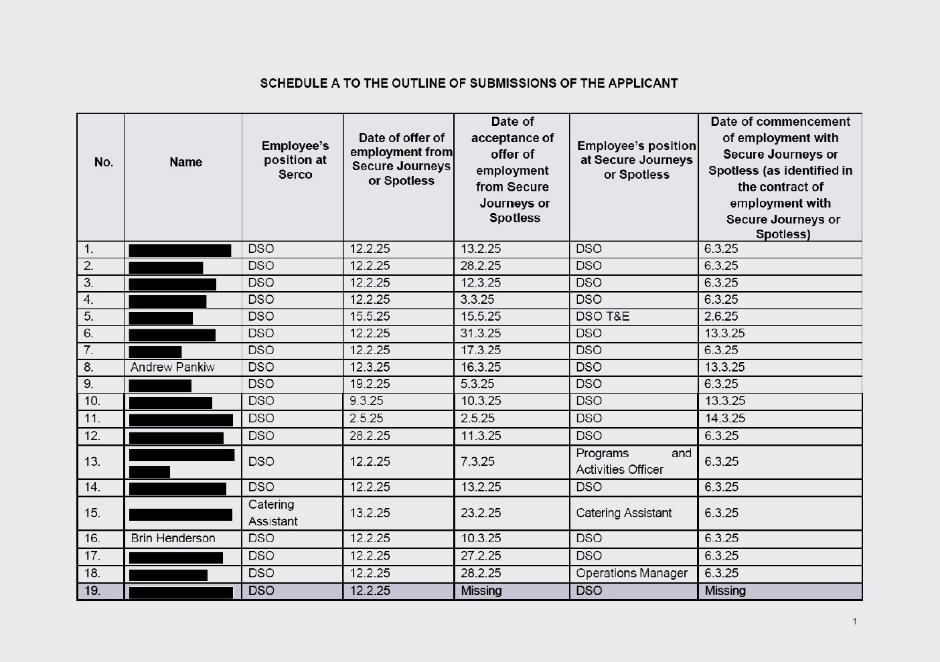
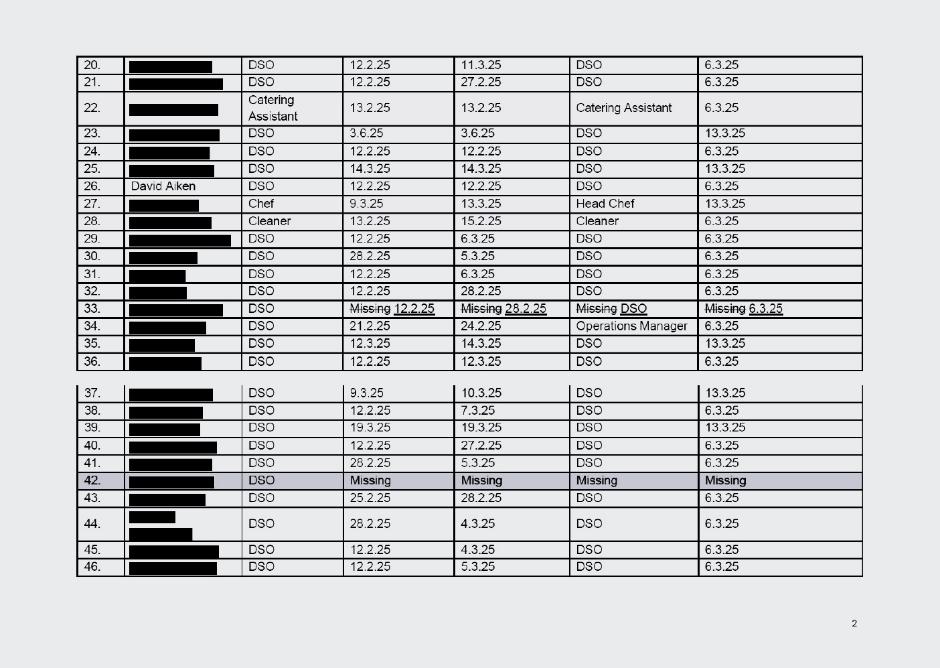
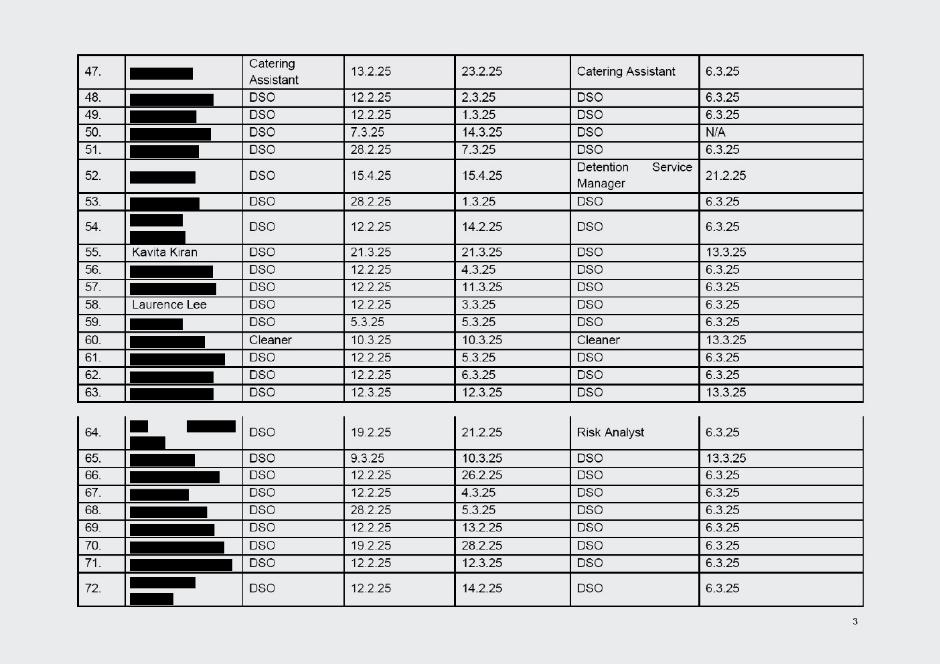
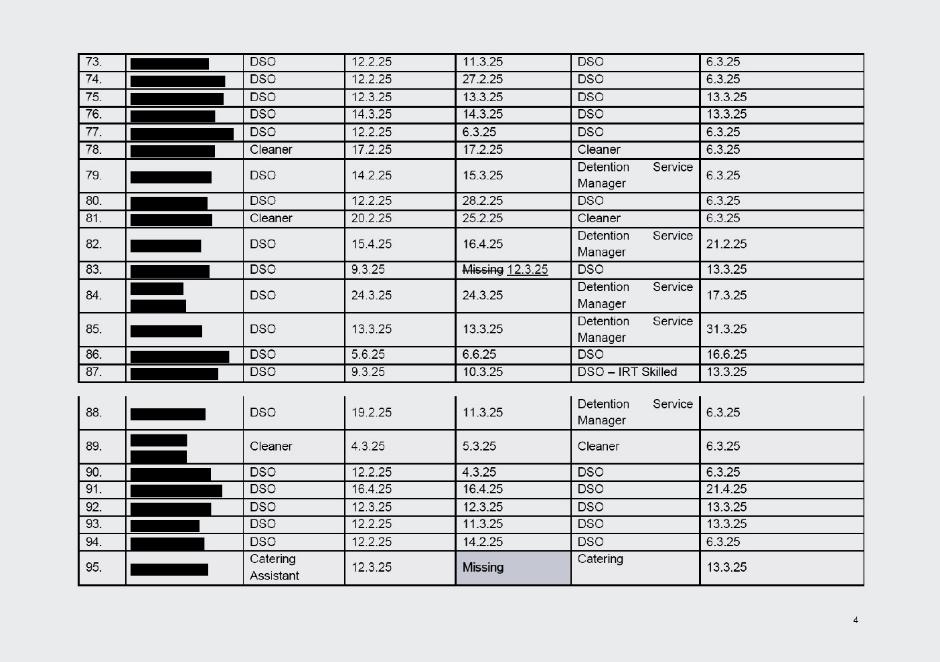
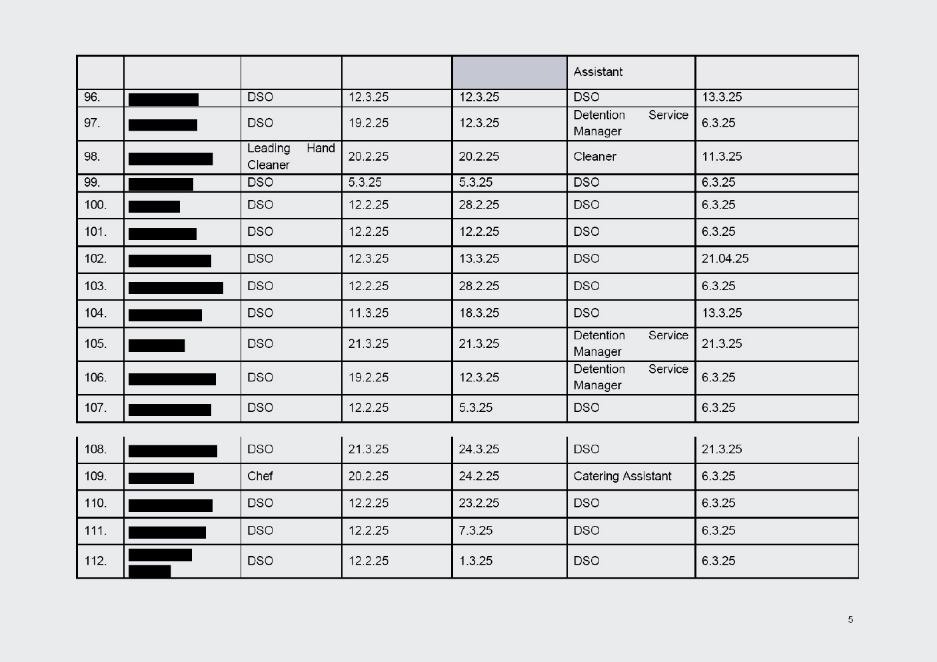
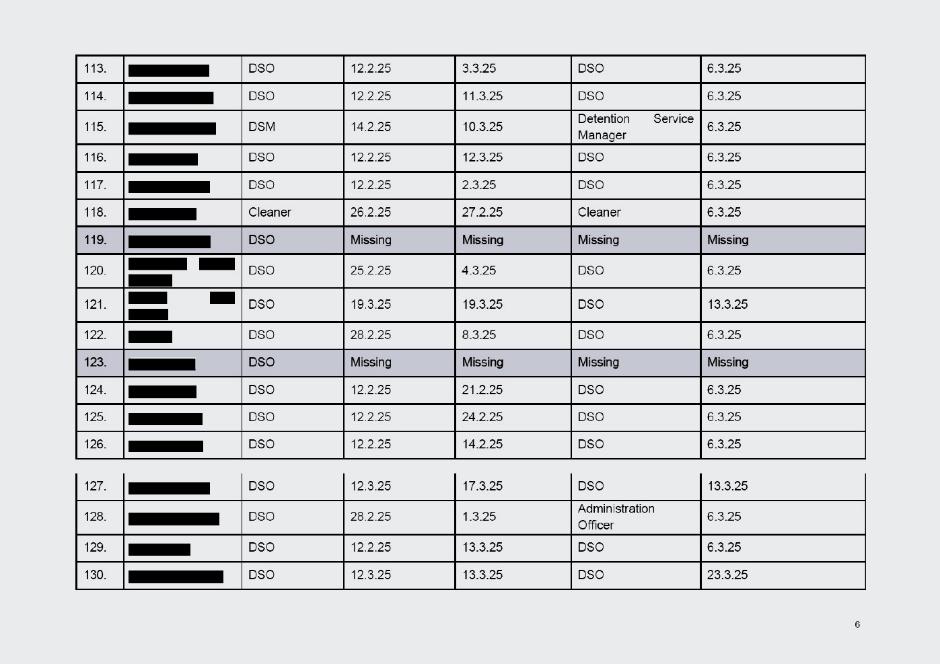
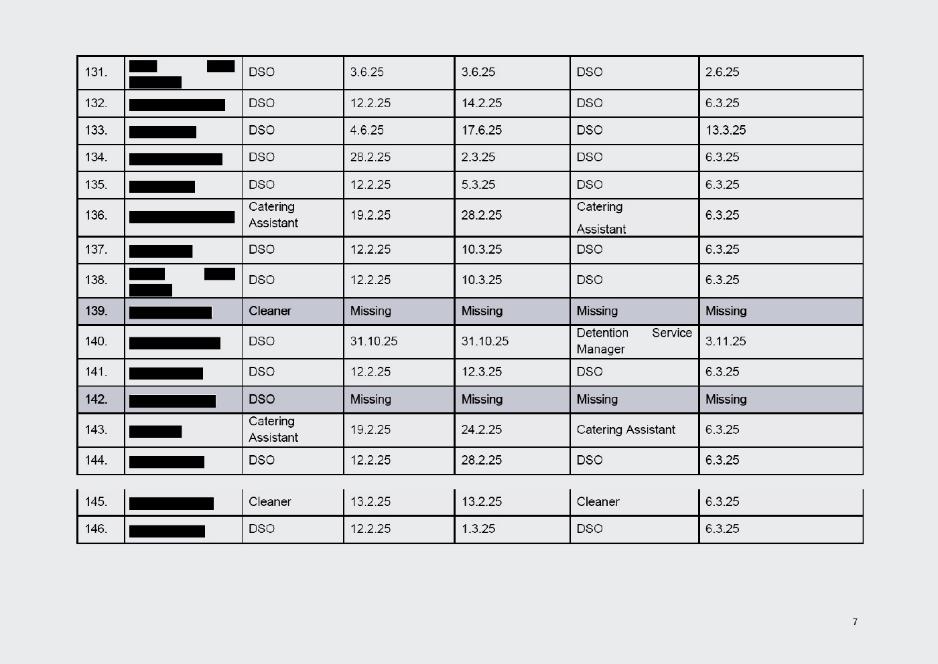
ANNEXURE B