

Federal Court of Australia
Tama Australia Pty Ltd v Parterra Australia Pty Ltd [2026] FCA 1643
File number(s): | NSD 1334 of 2024 |
Judgment of: | OWENS J |
Date of judgment: | 3 November 2026 |
Catchwords: | PATENTS – patent for serially connected wrapping units with a discrete adhesive area and protective cover – claim construction – infringement – validity – amendment PATENTS – infringement – whether adhesive area on the respondents’ wrapping material is covered by the “opposing second surface” of the protective cover – whether the protective cover of the respondents’ wrapping material is “positioned to removeably cover” the adhesive area – whether the respondents’ wrapping material includes a “hinge constructed along the lateral width” of the protective cover – no infringement found PATENTS – validity – whether the claimed invention lacks an inventive step – whether the claimed invention is useful – whether the claims are supported by the technical contribution to the art disclosed in the specification – whether the invention is fully described – whether the claims lack clarity – grounds of invalidity dismissed PATENTS – application to amend patent pursuant to section 105 of the Patents Act – amendment not opposed – amendments allowable – discretionary factors support amendment |
Legislation: | Copyright Act 1968 (Cth) ss 36(1A), 101(1A) Patents Act 1990 (Cth) ss 7, 13, 18, 40, 102, 105, 117, 120 |
Cases cited: | Advanced Building Systems Pty Ltd v Ramset Fasteners (Aust) Pty Ltd (1998) 194 CLR 171 Aktiebolaget Hässle v Alphapharm Pty Limited (2002) 212 CLR 411; [2002] HCA 59 Apotex Pty Ltd v Les Laboratoires Servier (No 2) (2009) 83 IPR 42; [2009] FCA 1019 Apotex Pty Ltd v Warner-Lambert Co LLC (No 2) (2016) 122 IPR 17; [2016] FCA 1238 Apotex Pty Ltd v Les Laboratoires Servier (No 2) (2012) 293 ALR 272; [2012] FCA 748 Aristocrat Technologies Australia Pty Ltd v Konami Australia Pty Ltd (2015) 114 IPR 28; [2015] FCA 735 AstraZeneca AB v Apotex Pty Ltd (2014) 226 FCR 324; [2014] FCAFC 99 Austal Ships Pty Ltd v Stena Rederi Aktiebolag (2005) 66 IPR 420; [2005] FCA 805 Axent Holdings Pty Ltd t/a Axent Global v Compusign Australia Pty Ltd (2020) 154 IPR 431; [2020] FCA 1373 Biogen Inc v Medeva Plc [1997] RPC 1 Bristol-Myers Squibb Co v F H Faulding & Co Ltd (2000) 97 FCR 524; [2000] FCA 316 Calix Ltd v Grenof Pty Ltd (2023) 171 IPR 582; [2023] FCA 378 Colgate-Palmolive Co v Cussons Pty Ltd (1993) 26 IPR 311; [1993] FCA 297 Commissioner of Patents v Rokt Pte Ltd (2020) 277 FCR 267; [2020] FCAFC 86 D’Arcy v Myriad Genetics Inc (2015) 258 CLR 334; [2015] HCA 35 EIS Gmbh v LELO Oceania Pty Ltd (Liability Trial) [2025] FCA 1111 Elanco Australasia Pty Ltd v Abbey Laboratories Pty Ltd (2024) 184 IPR 517; [2024] FCA 640 Elconnex Pty Ltd v Gerard Industries Pty Ltd (1991) 32 FCR 491 Electrical & Musical Industries Ltd v Lissen Ltd [1938] 4 All ER 221 F45 Training Pty Ltd v Body Fit Training Company Pty Ltd (No 2) (2022) 165 IPR 111; [2022] FCA 96 Flexible Steel Lacing Co v Beltreco Ltd (2000) 49 IPR 331; [2000] FCA 890 Fresenius Medical Care Australia Pty Ltd v Gambro Pty Ltd (2005) 224 ALR 168; [2005] FCAFC 220 Generic Health Pty Ltd v Bayer Pharma Aktiengesellschaft (2014) 222 FCR 336; [2014] FCAFC 73 Graham v John Deere Co of Kansas City (1966) 383 US 1 H Lundbeck A/S v Alphapharm Pty Ltd (2009) 177 FCR 151; [2009] FCAFC 70 Hanwha Solutions Corporation v REC Solar Pte Ltd (2023) 180 IPR 315; [2023] FCA 1017 Illumina Cambridge Ltd v Latvia MGI Tech SIA [2021] RPC 12; [2021] EWHC 57 (Pat) Industrial Galvanizers Corporation Pty Ltd v Safe Direction Pty Ltd (2018) 135 IPR 220; [2018] FCA 1192 Insta Image Pty Ltd v KD Kanopy Australasia Pty Ltd (2008) 239 FCR 117; [2008] FCAFC 139 Inverness Medical Switzerland GmbH v MDS Diagnostics Pty Ltd (2010) 85 IPR 525; [2010] FCA 108 Jupiters Ltd v Neurizon Pty Ltd (2005) 222 ALR 155; [2005] FCAFC 90 Jusand Nominees Pty Ltd v Rattlejack Innovations Pty Ltd (2022) 167 IPR 1; [2022] FCA 540 Jusand Nominees Pty Ltd v Rattlejack Innovations Pty Ltd (2023) 300 FCR 408; [2023] FCAFC 178 KD Kanopy Australasia Pty Ltd v Insta Image Pty Ltd (2007) 71 IPR 615; [2007] FCA 481 Les Laboratoires Servier v Apotex Pty Ltd (2016) 247 FCR 61; [2016] FCAFC 27 Lockwood Security Products Pty Ltd v Doric Products Pty Ltd (No 2) (2007) 235 CLR 173; [2007] HCA 21 Martin Engineering Co v Trison Holdings Pty Ltd (1989) 14 IPR 330; [1989] FCA 74 Martin v Scribal Pty Ltd (1954) 92 CLR 17 Meat & Livestock Australia Ltd v Cargill, Inc (2018) 129 IPR 278; [2018] FCA 51 Meat & Livestock Australia Ltd v Cargill, Inc (No 2) (2019) 139 IPR 47; [2019] FCA 33 Merck Sharp & Dohme Corporation v Wyeth LLC (No 3) (2020) 155 IPR 1; [2020] FCA 1477 Meyers Taylor Pty Limited v Vicarr Industries Limited (1977) 137 CLR 228; [1977] HCA 19 Miele & Cie KG v Bruckbauer [2025] FCA 537 Minnesota Mining and Manufacturing Company v Beiersdorf (Australia) Ltd (1980) 144 CLR 253; [1980] HCA 9 Mylan Health Pty Ltd v Sun Pharma ANZ Pty Ltd (2020) 279 FCR 354; [2020] FCAFC 116 Novartis AG v Johnson & Johnson Medical Ltd [2010] EWCA Civ 1039; [2011] ECC 10 Novartis AG v Pharmacor Pty Ltd (No 3) (2024) 186 IPR 24; [2024] FCA 1307 Orion Corporation v Actavis Pty Ltd [2015] FCA 909 Playgro Pty Ltd v Playgo Art & Craft Manufactory Ltd (2016) 117 IPR 489; [2016] FCA 280 Populin v HB Nominees Pty Ltd (1982) 59 FLR 37 Product Management Group Pty Ltd v Blue Gentian LLC (2015) 240 FCR 85; [2015] FCAFC 179 R D Werner & Co Inc v Bailey Aluminium Products Pty Ltd (1989) 25 FCR 565 Ranbaxy Australia Pty Ltd v Warner-Lambert Co LLC (2008) 77 IPR 449; [2008] FCAFC 82 Real Estate Tool Box Pty Ltd v Campaigntrack Pty Ltd (2023) 278 CLR 240; [2023] HCA 38 Regeneron Pharmaceuticals Inc v Kymab Ltd (2020) 163 IPR 515, [2020] RPC 22; [2020] UKSC 27 Rehm Pty Limited v Webster’s Security Systems (International) Pty Limited (1988) 81 ALR 79; [1988] FCA 232 Rescare Ltd v Anaesthetic Supplies Pty Ltd (1992) 25 IPR 119 Sandoz Ltd v Bristol-Myers Squibb Holdings Ireland Unlimited Company [2023] EWCA Civ 472 Streetworx Pty Ltd v Artcraft Urban Group Pty Ltd (2014) 110 IPR 82; [2014] FCA 1366 TCT Group Pty Ltd v Polaris IP Pty Ltd (2022) 170 IPR 313; [2022] FCA 1493 TMA Capital Australia Pty Ltd v UbiPark Pty Ltd (2024) 181 IPR 55; [2024] FCAFC 85 Toolgen Inc v Grant Fisher (No 3) (2024) 184 IPR 301; [2024] FCA 539 Vehicle Monitoring Systems Pty Limited v SARB Management Group Pty Ltd trading as Database Consultants Australia (No 8) [2023] FCA 182 Washex Machinery Corporation v Roy Burton & Co Pty Ltd (1974) 49 ALJR 12 Watson Webb Pty Ltd v Comino [2025] FCA 871 Welch Perrin and Company Proprietary Limited v Worrel (1961) 106 CLR 588; [1961] HCA 91 Welcome Real-Time SA v Catuity Inc (2001) 113 FCR 110; [2001] FCA 445 |
Division: | General Division |
Registry: | New South Wales |
National Practice Area: | Intellectual Property |
Sub-area: | Patents and associated Statutes |
Number of paragraphs: | 268 |
Date of hearing: | 27-28 October 2025, 30 October 2025 |
Counsel for the Applicant/Cross Respondent: | Mr A Fox SC and Ms J McKenzie |
Solicitor for the Applicant/Cross Respondent | Gilbert + Tobin |
Counsel for the Respondents/Cross-Claimant: | Mr C Smith SC and Ms A Surkis |
Solicitor for the Respondents/Cross-Claimant: | Bennett & Philp Lawyers |
ORDERS
NSD 1334 of 2024 | ||
| ||
BETWEEN: | TAMA AUSTRALIA PTY LTD (ACN 617 155 361) Applicant | |
AND: | PARTERRA AUSTRALIA PTY LTD (ACN 641 847 341) First Respondent COTTON GROWERS SERVICES PTY LTD (ACN 001 723 048) Second Respondent | |
AND BETWEEN: | PARTERRA AUSTRALIA PTY LTD (ACN 641 847 341) Cross-Claimant | |
AND: | TAMA AUSTRALIA PTY LTD (ACN 617 155 361) Cross-Respondent | |
order made by: | OWENS J |
DATE OF ORDER: | 3 November 2026 |
THE COURT ORDERS THAT:
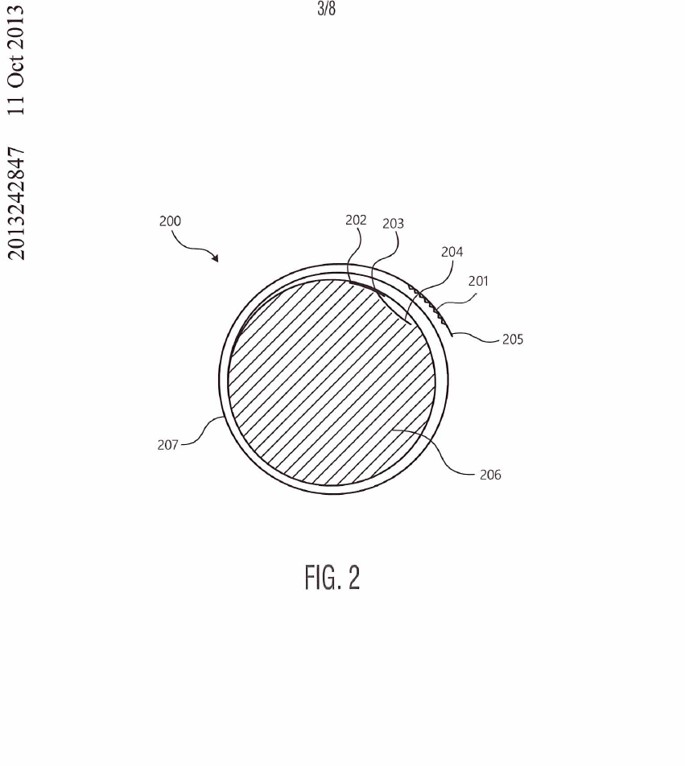
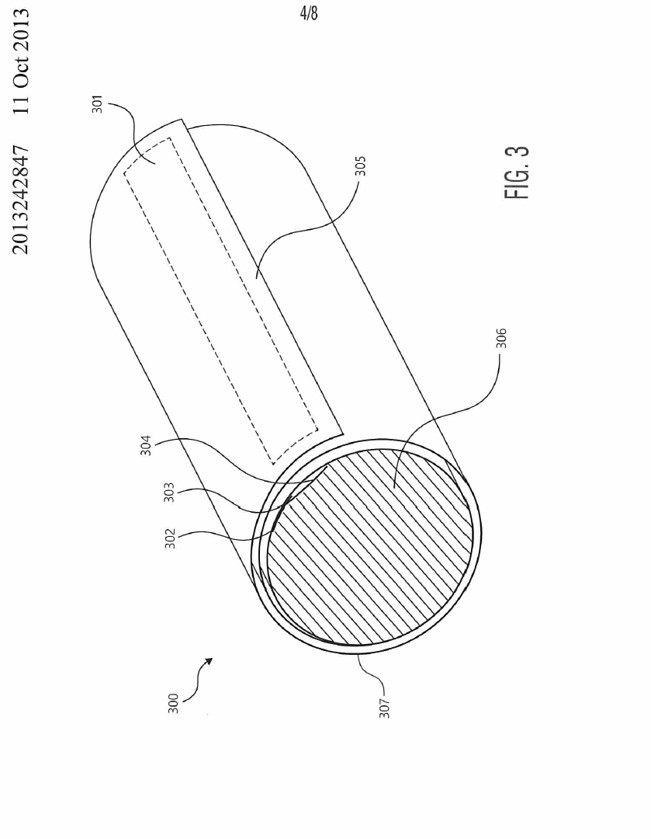
1. Pursuant to section 105(1) of the Patents Act 1990 (Cth), the complete specification of Australian Standard Patent No. 2013242847 be amended by substituting for Figures 2 and 3 the amended figures contained in the Annexure to these orders.
2. The applicant’s originating application dated 24 September 2024 be dismissed.
3. The cross-claimant’s notice of cross-claim dated 15 November 2024 be dismissed.
4. On or before 17 November 2026 the parties file and serve either:
(a) agreed short minutes of order concerning the question of costs; or
(b) competing short minutes of order, accompanied by written submissions of no more than three pages, concerning the question of costs.
5. Any submissions in reply to submissions filed pursuant to Order 4(b) above, of no more than two pages, are to be filed and served by 24 November 2026.
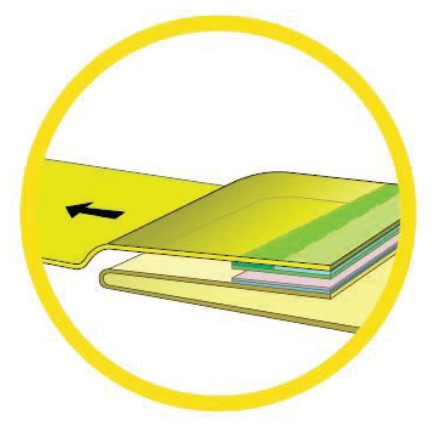
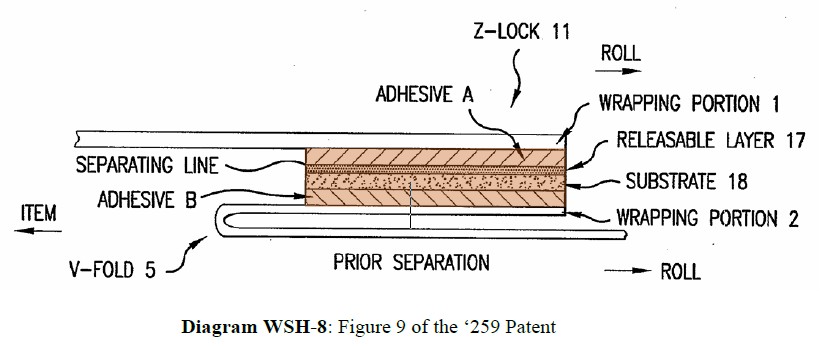
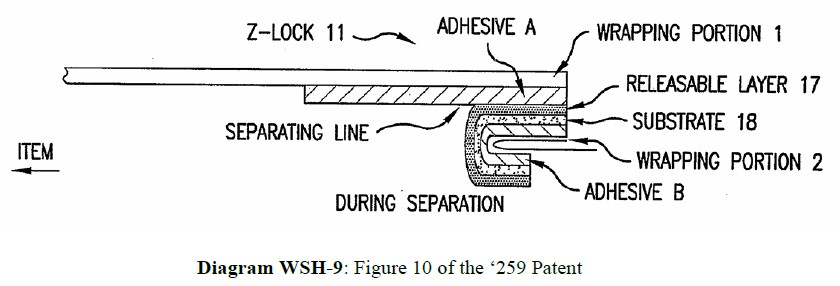
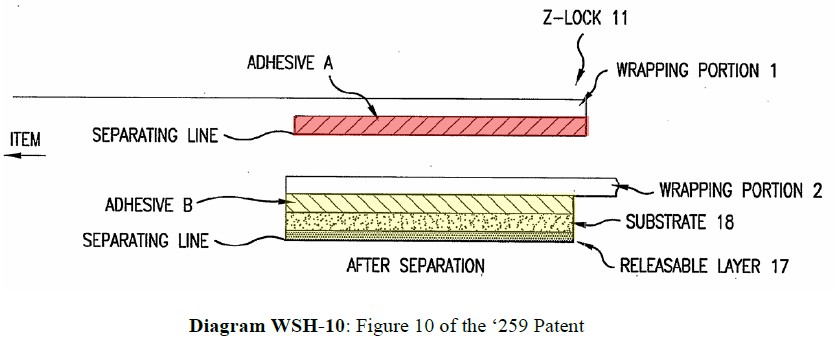
6. The question of costs will be determined on the papers unless a party indicates in its written submissions that it seeks an oral hearing.
Note: Entry of orders is dealt with in Rule 39.32 of the Federal Court Rules 2011.
Annexure
REASONS FOR JUDGMENT
OWENS J:
1 The applicant, Tama Australia Pty Ltd, is the owner of Australian Standard Patent No. 2013242847 entitled “Hinged Covering for Adhesive Surface” (I will refer to it simply as the patent, but the parties and witnesses would sometimes refer to it as the 847 patent). The field of the invention is stated in the specification (at [0001]) to relate to “wrapping materials including discrete adhesive areas”. The specification goes on to state (at [0011]) that the “wrapping materials of the present invention may be used to wrap round bales of agricultural produce”, as well as bales of other shapes, and “other items that are not agriculturally related may also be wrapped”.
2 The patent was filed in the name of Tama’s parent company, then known as Tama Plastic Industry, on 11 October 2013 and claims a priority date of 31 May 2013 from US patent application 13/906,772. On 23 May 2024, all rights to and ownership of the patent were assigned by way of deed to Tama. At least by the time of the hearing, it was not in issue that Tama was entitled to sue for past infringements.
3 Tama alleges that Parterra Australia Pty Ltd and Cotton Growers Services Pty Ltd have infringed claims 1 to 7 of the patent by dealing in two versions of a wrapping material that goes by the name “Cotton Module wrap”. Parterra is the Australian importer of those wraps, and has offered to sell, and sold, them, to customers in Australia. Cotton Growers Services is an Australian local distributor of the wraps (obtaining them from Parterra), and has offered to sell, and sold, them. Because Parterra trades as “Plant & Pick Spares”, those wraps were referred to by the parties as the First PPS Wrap and the Second PPS Wrap (or collectively as the PPS Wraps).
4 Although the respondents admit to dealing in the PPS Wraps as alleged, they deny that they have infringed the patent. That is because, they say, the PPS Wraps do not embody a number of essential integers of claims 1 to 7.
5 Further, by cross-claim, Parterra contends that claims 1 to 7 of the patent are invalid on the grounds that:
(a) the claimed invention lacks an inventive step;
(b) the claims are not useful;
(c) there is a lack of support for the claims in the specification;
(d) the invention is not fully described; and
(e) there is a lack of clarity.
6 The parties were agreed that no separate issue, in respect of either infringement or validity, arises in relation to claims 2 to 7, which are dependent on claim 1. It follows that the fate of the parties’ cases in relation to claims 2 to 7 will abide the outcome of the proceedings in relation to claim 1. It is, accordingly, on claim 1 that these reasons will focus.
THE PATENT
7 I have already mentioned that the patent describes the field of the invention as “relat[ing] to a variety of wrapping materials … particularly but not exclusively to wrapping materials including discrete adhesive areas”.
8 In describing the background of the invention, the patent states (at [0002]) that “[b]aling agricultural produce is a well-known and frequently used practice throughout the world. Various methods, techniques, products, materials, and equipment have been used to harvest, bale and wrap agricultural produce”. The patent goes on to say (at [0003]-[0004]):
In recent years, knitted nets and films, including those constructed of polypropylene and polyethylene, have been replacing the wire/sisal twine and baling twine which have been traditionally used. However, regardless of the material being used, the wrapping material must maintain the bale within the wrapping until the user opens the bale for use in its designated purpose, such as: distribution of the agricultural product in the targeted area (e.g., manger or stall); feeding and/or processing; or the like.
Wrapping materials made from plastic films provide improved protection of the wrapped produce from the forces of nature, as it is common for agricultural produce to remain wrapped in an open field for a time period that could vary from several months to more than a year before use. One such plastic film is commonly known as “sticky film,” which includes plastic films that inherently cling to itself or plastic films that include an adhesive applied to the surface area of at least one side of the plastic wrap or across the entire lateral dimension.
9 The patent identifies four primary problems in relation to the prior art “sticky films”:
(a) Where adhesive is disposed at the lateral edges and along the longitudinal length of wrapping material, the ease and progress of the wrapping material through a baler is greatly impeded by frictional type interaction (thus decreasing productivity and increasing costs).
(b) When the adhesive is applied on one entire side of the wrapping material, the strength of the adhesive must be limited since the film must still be allowed to unwind during wrapping of an item.
(c) There are various physical forces that are exerted on wrapping material after an item is wrapped, which cause the wrapping material, particularly the tail edge, to come loose (e.g., forces such as shearing and peeling).
(d) If the wrapping material is used outdoors, exposure to the extremes of temperature, moisture and especially wind will cause additional problems with adhesion of the tail edge of wrapping material.
10 The patent observed that some particular prior art solutions to those problems entailed the use of adhesive at the tail end of the wrap. In relation to such solutions, however, the patent said (at [0008]):
Although this type of wrapping material tends to have increased adhesive qualities, especially at the tail edge of the wrapping cycle, problems have been experienced with the portions of the wrap sticking to each other. This occurs, for instance, when wrapping units are wound onto a bobbin during the manufacturing process, or otherwise organized for use during the wrapping process. In addition, after the adhesive areas are exposed but prior to wrapping, dust and other particulate matter may decrease the adhesiveness of any adhesive areas.
11 It was thus stated that (at [0009]):
[T]here is clearly a need in the art for a wrapping material that achieves the benefit of having increased adhesive qualities at the tail edge of the wrapping cycle, but without suffering from the aforementioned disadvantages, including the increased difficulty during both the manufacturing and wrapping processes, and the adverse effects of dust and other particulate matter on the quality of the adhesion.
12 The patent then describes the invention in two aspects: the first is a wrapping material with certain features referable to claim 1, the second is a method of wrapping an agricultural bale, referable to claim 9.
13 In relation to the wrapping material, the patent stated that:
The wrapping materials of the present invention may be used to wrap round bales of agricultural produce although such wrapping materials can be used to wrap bales of other shapes. Such agricultural products which may be wrapped using the present invention include, for example, hay, straw, silage, or the like, though other items that are not agriculturally related may also be wrapped using the present invention.
14 It is thus clear that the invention described in the specification is a wrapping material that may be used in connection with baling agricultural produce, but it is not limited to such use.
15 The patent disclosed various non-limiting embodiments and examples of the invention. It is convenient to illuminate the invention in those respects that are relevant to these proceedings by reference to the particular embodiment depicted in Figure 1A:
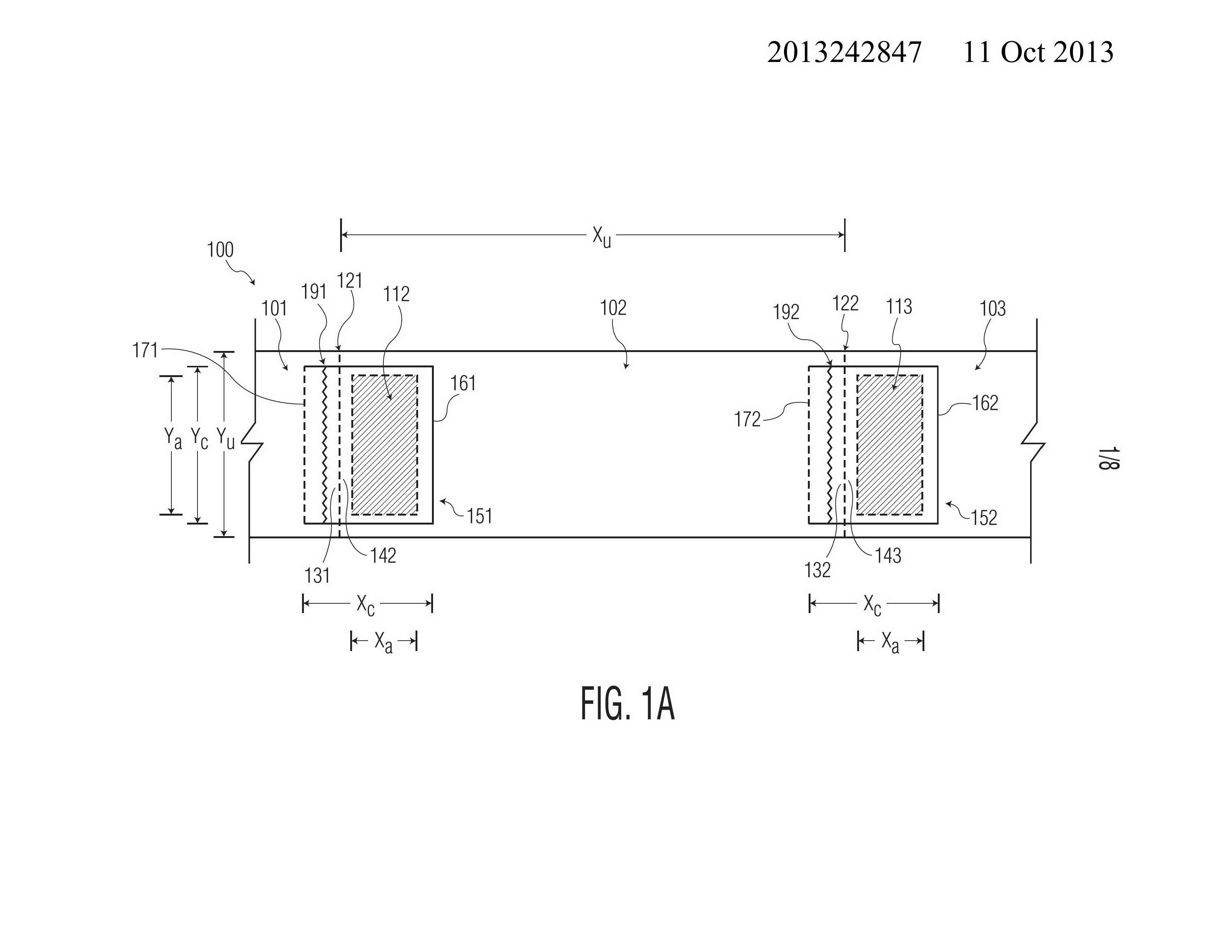
16 Figure 1A shows three wrapping units, 101, 102 and 103 of base material 100. Each wrapping unit has a leading edge and a tail edge. Wrapping unit 101 has leading edge 131 (its tail edge is not shown); wrapping unit 102 has tail edge 142 and leading edge 132; wrapping unit 103 has tail edge 143 (its leading edge is not shown). Those three wrapping units are connected via connection points 121 and 122.
17 Each wrapping unit has a discrete adhesive area. Wrapping unit 102 has discrete adhesive area 112, and wrapping unit 103 has discrete adhesive area 113 (the discrete adhesive area for wrapping unit 101 is not shown). Those two adhesive areas are at the tail edge of wrapping units 102 and 103 respectively.
18 Each discrete adhesive area is covered by a protective cover; with protective cover 151 covering discrete adhesive area 112, and protective cover 152 covering discrete adhesive area 113. Each protective cover is affixed to a wrapping unit at a point that is closer to the leading edge than the adhesive area of that wrapping unit, and covers the adhesive area of the adjacent wrapping unit. Thus, protective cover 151 is affixed to wrapping unit 101, and covers the adhesive area on wrapping unit 102. Protective cover 152 is affixed to wrapping unit 102, and covers the adhesive area on wrapping unit 103.
19 An integral hinge 191 and 192 is formed in each of protective covers 151 and 152 respectively. Each such hinge allows the protective cover to pivot from its position covering the adhesive area, to a second position over a portion of the wrapping unit adjacent to the leading edge to which it is secured.
20 Insofar as claim 1 is concerned, the parties agreed on an itemisation of the integers of that claim as follows:
1.1 A wrapping material for wrapping around an item, the wrapping material comprising:
1.2 a plurality of wrapping units,
1.3 each said wrapping unit having a first surface, an opposing second surface,
1.4 a lateral width along a lateral direction and a longitudinal length along a longitudinal direction,
1.5 each said longitudinal length terminating in a leading edge at one end thereof and in a tail edge at an opposing edge thereof,
1.6 said plurality of wrapping units being serially connected to one other in the longitudinal direction, each wrapping unit further comprising:
1.7 a discrete adhesive area disposed on said first surface of said wrapping unit,
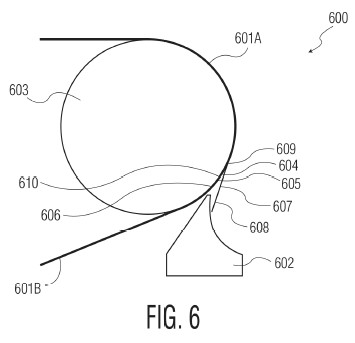
1.8 said adhesive area having a lateral width and a longitudinal length,
1.9 wherein the adhesive area is configured to secure one or more wrapping units of the wrapping material on the item by adhering to the second surface of one of the one or more wrapping units,
1.10 a protective cover having a first surface, an opposing second surface, a front edge, a back edge, a lateral width and a longitudinal length,
1.11 the opposing second surface of the protective cover being affixed to the first surface of the wrapping unit
1.12 at a point that is closer to the leading edge of the wrapping unit than the adhesive area is disposed,
1.13 the opposing second surface of the protective cover being positioned to removeably cover the adhesive area of a wrapping unit adjacent to the leading edge of the wrapping unit, and
1.14 a hinge constructed along the lateral width of said protective cover,
1.15 wherein the hinge is located between said back edge of said protective cover and said tail edge of the next said serially connected wrapping unit.
EVIDENCE
Tama’s Evidence
21 Tama read three affidavits of Mr William Hunter sworn on 17 April 2025, 20 May 2025, and 13 June 2025. Mr Hunter gave expert evidence for Tama. He is the principal at Bill Hunter Design Services and has at least 40 years of professional experience as a mechanical design engineer, including in the design of both flexible and rigid packaging.
22 Mr Hunter gave oral evidence as part of a joint expert conclave and was cross-examined by the respondents.
23 Tama also read two affidavits of its instructing solicitors. The first is the affidavit of Christopher Williams sworn on 24 January 2025, which was read in support of an application filed by Tama to amend the patent. The second is the affidavit of Alexander Hagan affirmed on 16 April 2025, in which Mr Hagan gave evidence of:
(a) Tama Group’s assignment of the patent to Tama;
(b) the respondent companies’ trading details as recorded by ASIC;
(c) Tama’s pre-litigation correspondence with the respondents; and
(d) online materials relevant to the respondents’ activities in dealing in the PPS Wraps.
The Respondents’ Evidence
24 The respondents read two affidavits of Mr Douglas Gibson dated 17 April 2025 and 21 May 2025. Mr Gibson gave expert evidence for the respondents. He is the part-owner, sole director and company secretary of D.A.C.G. Pty Ltd (which trades as Gibson Field Service), an agricultural machinery service and repair business based in Toowoomba. That company specialises in cotton harvesting equipment and operates a transport division focused on agricultural equipment and bulk commodities transport. Mr Gibson has around 20 years of experience in operating, repairing and maintaining cotton harvesting equipment, particularly round module building cotton harvesters such as the John Deere 7760 Cotton Picker.
25 Mr Gibson also gave oral evidence as part of the joint expert conclave and was cross-examined by Tama.
Joint Expert Report
26 The parties tendered a joint expert report from Mr Hunter and Mr Gibson, dated 1 September 2025. The experts were asked to provide their opinion in relation to the following questions:
Question 1 (a): [In relation to the 847 Patent]. Outline what you consider to be the nature and purpose of the claimed invention, including any problem(s) addressed by the 847 Patent, and explain whether you consider that any such problem(s) are addressed by that claimed invention.
Question 1 (b): [In relation to the 847 Patent]. Explain your understanding of the 847 Patent’s teaching of the embodiments of the invention disclosed in the 847 Patent at line 32 page 10 to line 6 page 12 and Figures 5 to 6.
Question 1 (c) (i): [In relation to the 847 Patent]. Explain your understanding of ‘integer 1.9’, and outline what you consider the claim requires when it specifies that the ‘adhesive area is configured to secure’ a wrapping unit by adhering to its second surface.
Question 1 (c) (ii): [In relation to the 847 Patent]. Explain your understanding of ‘integer 1.14’, and outline what you consider the claim requires when it specifies that there be a ‘hinge constructed along the lateral width’ of the protective cover.
Question 2: Outline whether you consider each of the First and Second PPS Wraps to possess integers: (a) 1.9; (b) 1.13; and (c) 1.14 of the 847 Patent.
Question 3: Comment on the differences (if any) between what is disclosed in the 259 Patent, and what is claimed in each of claims 1 to 7 of the 847 Patent.
Question 4: Outline whether you consider that what is claimed in claims 1 to 7 of the 847 Patent would work in practice. Please include in your discussion consideration of the embodiments of the invention disclosed in the 847 Patent at line 32 page 10 to line 6 page 12 and Figures 5 to 6.
Assessment of the Expert Witnesses
27 I did not understand any party to submit that, in giving their evidence, either of the expert witnesses was doing anything other than honestly attempting to assist the Court consistently with their obligations as independent experts. That said:
(a) Tama submitted that the utility or force of Mr Gibson’s evidence was reduced by reason of the limited, or particular, nature of his experience. It also submitted that the instructions that had been given to him had been framed in such a way as to influence the way in which he understood the patent.
(b) The respondents submitted that “some care” needed to be taken with Mr Hunter’s evidence because, it was said, it had appeared unbalanced in certain respects (by which it was meant that Mr Hunter appeared more astute to discern points in Tama’s favour than in respect of matters favouring the respondents). As I have indicated, however, I did not understand there to be any suggestion of conscious partiality.
28 It is sufficient to record that I found both witnesses to be honest, and to be doing their best to give evidence objectively, and within the scope of their expertise. Equally, it is undeniable that the experience and expertise of each witness was quite different. In broad, but nonetheless sufficiently accurate, terms:
(a) Mr Hunter’s relevant field of expertise was the manufacture and development of wrapping and packaging products generally. He had no specific experience in relation to agricultural baling or wraps used for that purpose, and no experience whatsoever in relation to the practice of agricultural harvesting and baling.
(b) Mr Gibson’s experience, on the other hand, was limited to cotton baling (and the equipment, including wraps, used for that purpose). He did not have any expertise in relation to agricultural baling generally, nor in relation to the development and manufacture of wrapping products (including those used for cotton baling).
29 Ultimately, as will be seen, I have formed the view that the differing expertise of the two witnesses does not have the consequence that the evidence of one is necessarily to be preferred to that of the other. Rather, those differences will affect the weight to be given to their evidence on different topics, in accordance with the relevance of their expertise to the issue in controversy.
30 To the extent necessary, I will deal with any particular disagreement between the witnesses, and the matters relevant to my resolution of it, in the context in which it arises.
Background
31 It will be helpful to say something concerning some background matters before turning to deal with the issues in dispute between the parties.
32 In the late 2000s, John Deere began to sell a machine that would both harvest and bale cotton. That type of machine is known as a “Round Module Harvester”, and the machine sold by John Deere was called the John Deere 7760 Cotton Picker. That machine represented a significant advance in technology in relation to cotton baling. As Mr Gibson explained:
Before the John Deere 7760, Round Module Harvesters were not commercially available in Australia and cotton farmers in Australia used an older mechanical process of cotton picking now known as the conventional style of cotton picking. Typically, the conventional style of cotton picking involved the harvester picking the cotton and storing it in the harvester. The conventional harvester would then come to a complete stop and would unload the cotton into a separate storage vehicle called a boll buggy. The boll buggy would then deliver the cotton to a pressing machine (module builder) which would press the cotton into an approximately 40 foot, rectangular or trapezoidal module. After forming, the modules had to be protected from the weather. Protective covers for the conventional module were available in a range of styles, materials and prices. …
Round Module Harvesters made a big impact on the cotton farming industry because they allowed a single farmer, operating a Round Module Harvester, to pick their cotton and pack it into a round module for transport, requiring significantly less labour. Round Module Harvesters therefore made the harvesting process significantly quicker, more efficient and more convenient. …
33 At the priority date, the only Round Module Harvester that was available in Australia was the John Deere 7760.
34 During the 2000s Tama patented and commercialised a plastic film wrapping product for use in these new Round Module Harvesters. Mr Gibson’s evidence was that, at first, the only wrap that was available for use with the John Deere 7760 was Tama’s plastic wrap, which was known as the “Z-lock Wrap”.
35 The name “Z-lock” would appear to be derived from a particular feature of Tama’s plastic wrap. That wrap was supplied in rolls that were comprised of a number of individual plastic wraps that could each be used to wrap an individual bale of cotton. An individual wrap was connected to the next wrap in such a way that, when the two wraps were pulled apart, an adhesive was exposed, which enabled the tail of the unit that had been wrapped around a bale of cotton to stick to the wrap and thus secure the wrap around the bale. As Mr Gibson explained:
The Z-lock involves the ends of two adjacent portions of wrap being overlayed and “locked” together in a Z shape. Between the two “locked” ends there is a light film of glue or adhesive. This is shown in the diagram below that I have copied from a Tama brochure. The arrow shows the direction in which the left-hand wrap portion is being fed into the bale chamber. When the brake is applied to the wrap roll to the right (not shown in the diagram), the folded section on the right is pulled across in the direction of the arrow, and the tensile force pulls the Z-lock apart, so that the left-hand wrap portion with the green adhesive layer peels away from the pink non-adhesive layer which is affixed to the right-hand wrap portion. This then completes separation of the two wrap portions so that the left-hand wrap is drawn into the bale chamber and secures the item to be wrapped as I have described … above and … below.
36 The Z-lock wrap was an embodiment of the invention patented by Tama in Australian Patent No. 2005300259 (referred to as the 259 Patent). The 259 Patent has now expired. The expert witnesses agreed that the critical, “Z-lock”, feature of the 259 Patent was best shown by reference to Figures 9 to 11 of that Patent:
37 Parterra released the First PPS Wrap in about 2022, and the Second PPS Wrap was released in about 2024. I will describe the relevant features of the PPS Wraps in more detail in determining the case concerning infringement. It is sufficient for now to note that those wraps were designed for use in the John Deere 7760 harvester, and while they shared many similarities with Tama’s Z-lock wrap, there were some differences. The more important of those differences are the following:
(a) Whereas the individual wrapping units of the Z-lock wrap were connected to one another only by the Z-lock feature, the individual wrapping units of the PPS Wraps were connected to one another by a perforation.
(b) The adhesive at the tail end of a Z-lock wrapping unit was exposed when it was separated from the next wrapping unit (i.e., when the “Z-lock” feature was pulled apart). In contrast, the adhesive area on the PPS Wraps was covered by a constructed or folded piece of plastic which was connected to the following wrapping unit. When the two wrapping units were pulled apart (thus breaking the perforation), the plastic covering the adhesive area was pulled away from the adhesive area.
38 Notwithstanding those differences, the Z-lock wrap and the PPS Wraps operated in a John Deere Round Module Harvester in essentially the same way. That is, fundamentally, in each case the adhesive area at the tail end of a wrapping unit is exposed by the process of separating that wrapping unit from the next wrapping unit.
Construction of the patent
39 The integers of claim 1 in relation to which there was a dispute between the parties as to their proper construction were integers 1.13, and 1.14. A dispute in relation to the proper construction of integer 1.9 ultimately fell away.
Principles on claim construction
40 Save perhaps in relation to one point of detail, there was no dispute as to the principles in accordance with which a patent’s claims should be construed.
41 The claims must be construed in the context of the specification as a whole, through the eyes of the person skilled in the relevant art, having regard to the common general knowledge as it existed at the priority date of the claims. In particular, as the Full Court conveniently summarised matters in Jupiters Ltd v Neurizon Pty Ltd (2005) 222 ALR 155; [2005] FCAFC 90 at [67] (Hill, Finn and Gyles JJ):
(i) the proper construction of a specification is a matter of law: Décor Corporation Pty Ltd v Dart Industries Inc (1988) 13 IPR 385 at 400;
(ii) a patent specification should be given a purposive, not a purely literal, construction: Flexible Steel Lacing Co v Beltreco Ltd (2000) 49 IPR 331; [2000] FCA 890 at [81] (Flexible Steel Lacing); and it is not to be read in the abstract but is to be construed in light of the common general knowledge and the art before the priority date: Kimberly-Clark Australia Pty Ltd v Arico Trading International Pty Ltd (2001) 207 CLR 1; 177 ALR 460; 50 IPR 513; [2001] HCA 8 at [24];
(iii) the words used in a specification are to be given the meaning which the normal person skilled in the art would attach to them, having regard to his or her own general knowledge and to what is disclosed in the body of the specification: Décor Corporation Pty Ltd at 391;
(iv) while the claims are to be construed in the context of the specification as a whole, it is not legitimate to narrow or expand the boundaries of monopoly as fixed by the words of a claim by adding to those words glosses drawn from other parts of the specification, although terms in the claim which are unclear may be defined by reference to the body of the specification: Kimberly-Clark v Arico at [15]; Welch Perrin & Co Pty Ltd v Worrel [[1961] HCA 91;] (1961) 106 CLR 588 at 610; Interlego AG v Toltoys Pty Ltd [[1973] HCA 1;] (1973) 130 CLR 461 at 478; the body of a specification cannot be used to change a clear claim for one subject matter into a claim for another and different subject matter: Electric & Musical Industries Ltd v Lissen Ltd [1938] 4 All ER 221 at 224-5; (1938) 56 RPC 23 at 39;
(v) experts can give evidence on the meaning which those skilled in the art would give to technical or scientific terms and phrases and on unusual or special meanings to be given by skilled addressees to words which might otherwise bear their ordinary meaning: Sartas No 1 Pty Ltd v Koukourou & Partners Pty Ltd [[1994] FCA 936;] (1994) 30 IPR 479 at 485-6 (Sartas No 1 Pty Ltd); the court is to place itself in the position of some person acquainted with the surrounding circumstances as to the state of the art and manufacture at the time (Kimberly-Clark v Arico at [24]); and
(vi) it is for the court, not for any witness however expert, to construe the specification: Sartas No 1 Pty Ltd, at 485-6.
42 It is important to be clear about what it means to say that a patent should be given a purposive construction. As was observed in Product Management Group Pty Ltd v Blue Gentian LLC (2015) 240 FCR 85; [2015] FCAFC 179 [40]-[41] (Kenny and Beach JJ):
But to give a claim a “purposive” construction “does not involve extending or going beyond the definition of the technical matter for which the patentee seeks protection in the claims” (Sachtler GmbH & Company KG v RE Miller Pty Ltd (2005) 221 ALR 373 at [42] per Bennett J). To apply a “purposive” construction does not justify extending the patentee’s monopoly to the “ideas” disclosed in the specification (GlaxoSmithKline Australia Pty Ltd v Reckitt Benckiser Healthcare (UK) Ltd (2013) 305 ALR 363 at [60]).
Finally on this aspect, it is useful to set out Lord Hoffman’s observation in Kirin-Amgen Inc v Hoechst Marion Roussel Ltd (2004) 64 IPR 444 at [34] where he said:
“Purposive construction” does not mean that one is extending or going beyond the definition of a technical matter for which the patentee seeks protection in the claims. The question is always what the person skilled in the art would have understood the patentee to be using the language of the claim to mean. And for this purpose, the language he has chosen is usually of critical importance. The conventions of word meaning and syntax enable us to express our meanings with great accuracy and subtlety and the skilled man will ordinarily assume that the patentee has chosen his language accordingly. As a number of judges have pointed out, the specification is a unilateral document in words of the patentee’s own choosing. Furthermore, the words will usually have been chosen upon skilled advice. The specification is not a document inter rusticos for which broad allowances must be made. On the other hand, it must be recognised that the patentee is trying to describe something which, at any rate in his opinion, is new; which has not existed before and of which there may be no generally accepted definition. There will be occasions upon which it will be obvious to the skilled man that the patentee must in some respect have departed from conventional use of language or included in his description of the invention some element which he did not mean to be essential. But one would not expect that to happen very often.
43 The following matters might also be noted:
(a) A construction that leads to a foolish result, or that the patentee could not have contemplated, ought not be adopted: Electrical & Musical Industries Ltd v Lissen Ltd [1938] 4 All ER 221 at 224-227.
(b) A construction of the claims that is “excessively technical or narrow” is to be avoided: F45 Training Pty Ltd v Body Fit Training Company Pty Ltd (No 2) (2022) 165 IPR 111; [2022] FCA 96 at [56] (Nicholas J).
(c) A construction according to which the invention will work is to be preferred to one according to which it will not: Martin v Scribal Pty Ltd (1954) 92 CLR 17 at 97 (Taylor J).
(d) The person skilled in the art is acquainted with the surrounding circumstances of the state of the art and manufacture at the relevant time, is likely to have a practical interest in the subject matter of the invention, and may often work in the art with which the invention is connected: KD Kanopy Australasia Pty Ltd v Insta Image Pty Ltd (2007) 71 IPR 615; [2007] FCA 481 at [16] (approved on appeal in Insta Image Pty Ltd v KD Kanopy Australasia Pty Ltd (2008) 239 FCR 117; [2008] FCAFC 139 at [94]-[96] (Lindgren, Bennett, Logan JJ)).
(e) A court should avoid construing a claim in a manner that renders terms within the claim redundant if this can be avoided by adopting a sensible alternative construction: Miele & Cie KG v Bruckbauer [2025] FCA 537 at [181] (Rofe J, citing Meat & Livestock Australia Ltd v Cargill, Inc (2018) 129 IPR 278; [2018] FCA 51 at [356] (Beach J)).
44 Finally, of course, a patent should not be construed “with an eye to the allegedly infringing article”: Fresenius Medical Care Australia Pty Ltd v Gambro Pty Ltd (2005) 224 ALR 168; [2005] FCAFC 220 at [95] (Wilcox, Branson and Bennett JJ).
45 The point of detail to which I referred earlier, and in relation to which there was at least superficial disagreement between the parties, concerned the role of expert evidence in relation to the issues of construction. Tama submitted (relying on the passage in Jupiters at [67(v)] that I have quoted above) that:
Although construction of the claims is ultimately a matter for the Court, experts can give evidence on the meaning of terms in the claims which those skilled in the art would give, particularly in relation to technical or scientific terms or phrases.
46 The respondents pointed out, however, (correctly in my view), that that summary stated the role of expert evidence too broadly. They emphasised the limitations on the role of expert evidence, as reflected in the observations of the Full Court in Commissioner of Patents v Rokt Pte Ltd (2020) 277 FCR 267; [2020] FCAFC 86 at [73] (Rares, Nicholas and Burley JJ):
The role of expert evidence in construing the patent specification and the claims is limited. It is to place the Court in the position of the person acquainted with the surrounding circumstances as to the state of the art and manufacture as at the priority date: Kimberly-Clark Australia Pty Ltd v Arico Trading International Pty Ltd [[2001] HCA 8;] (2001) 207 CLR 1 at [24]; [D’Arcy v] Myriad Genetics [[2015] HCA 35; (2015) 258 CLR 334] at [12].
47 Thus, as Hely J stated in Flexible Steel Lacing Co v Beltreco Ltd (2000) 49 IPR 331; [2000] FCA 890 at [81]:
[T]he construction of the specification is for the Court, not for the expert witness. Insofar as a view expressed by an expert depends upon a reading of the patent, it cannot carry the day unless the Court reads the patent in the same way: Allsop Inc v Bintang Ltd [[1989] FCA 428;] (1989) 15 IPR 686, 697. See also Glaverbel SA v British Coal Corporation [1994] RPC 443 at 486, Sartas No 1 v Koukourou at 485-486, Patent Gesellschaft [AG v Saudi Livestock Transport & Trading Co (1996) 33 IPR 426] at 455.
48 Ultimately, though, I did not apprehend that there was any real dispute that the role of an expert witness in relation to construction was limited in the way that the respondents identified. That is to say, it is no part of the role of expert witnesses to “give evidence on the meaning of terms in the claims which those skilled in the art would give” beyond or outside the particular circumstances just described.
The person skilled in the art and the common general knowledge
49 I am dealing with the issue of the person skilled in the art, and common general knowledge, in the context of construction of the claims. Those topics are also, of course, relevant to other issues (including, most obviously, inventive step). It was not suggested by either party that there was any difference in those concepts in the different contexts in which they arise that would be relevant to the outcome of this case.
50 The characteristics of the skilled addressee have been described on many occasions, but a convenient summary may be found in Hanwha Solutions Corporation v REC Solar Pte Ltd (2023) 180 IPR 315; [2023] FCA 1017 at [86]:
Skilled addressees are those likely to have a practical interest in the subject matter of the invention: Catnic Components v Hill & Smith Ltd [1982] RPC 183 at 242 (Diplock LJ). There may be more than a single person with such an interest, and the notional skilled reader to whom the document is addressed may not be a single person but a team, whose combined skills would normally be employed in that art in interpreting and carrying into effect instructions such as those which are contained in the document to be construed: General Tire & Rubber Co v Firestone Tyre & Rubber Co Ltd [1971] 7 WLUK 130; [1972] RPC 457 at 485 (Sachs LJ). Put another way, the skilled addressee is a notional person who may have an interest in using the products or methods of the invention, making the products of the invention, or making products used to carry out the methods of the invention either alone or in collaboration with others having such an interest: Aristocrat Technologies Australia Pty Ltd v Konami Australia Pty Limited [2015] FCA 735; 114 IPR 28 at [26] (Nicholas J); Pharmacia LLC v Juno Pharmaceuticals Pty Ltd [2022] FCA 92; 165 IPR 200 at [111] (Burley J).
51 As Nicholas J observed in Aristocrat Technologies Australia Pty Ltd v Konami Australia Pty Ltd (2015) 114 IPR 28; [2015] FCA 735 at [26]:
A person may have a practical interest in [the invention the subject of the patent] at a number of levels. He or she may have an interest in using the products or methods of the invention, making the products of the invention, or making products used to carry out the methods of the invention either alone or in collaboration with others having such an interest.
52 While the notional skilled addressee may not be a single person, but a team, the construct “thinks with one mind, speaks with one voice, and draws, when and to the extent necessary, on the disparate knowledge and skills of all members of the ‘team’”: Novartis AG v Pharmacor Pty Ltd (No 3) (2024) 186 IPR 24; [2024] FCA 1307 at [149] (Yates J).
53 Tama submitted that the skilled addressee here is a “mechanical engineer with experience in designing mechanical products and devices, including a person engaged in, or who has experience in, the design and engineering of wrapping or packaging materials”.
54 The respondents did not directly engage with that submission, but submitted that “the skilled addressee will have knowledge about wrapping products used for agricultural baling, including knowledge of baling equipment, plastic films and adhesives, and relevant mechanical engineering concepts. Their knowledge of baling will include knowledge about cotton baling”. I thus did not understand the respondents to dispute that the skilled addressee (or at least the team of which they would form a part) would include a mechanical engineer with the experience identified by Tama. Their point was that that person (or another member of the team) would have the end-use knowledge they identified.
55 Nor did I understand Tama to dispute all aspects of the respondents’ position. Tama agreed, of course, that one important application of the invention involved agricultural baling generally. And so Tama accepted that the skilled addressee “includes … a person with practical experience with agricultural baling devices, such as Mr Gibson” (the respondents’ expert witness). Tama’s fundamental objection to the respondents’ submission seemed to be that it involved the attribution of too close or detailed a familiarity with agricultural baling, and cotton baling in particular, when the invention disclosed in the patent had a broader application. In this way, the real issue between the parties was not so much the description of the skilled addressee, but rather the particular extent of the knowledge possessed by that construct.
56 For their part, the respondents did not dispute that the disclosure did not limit the invention to a wrapping for agricultural baling, let alone cotton baling. In that sense the parties were agreed that the subject matter of the invention was not limited to wrapping products for agricultural baling, and thus that the practical interest of the skilled addressee would not be so confined. The real crux of the debate as I apprehended it was whether the fact that the subject matter of the invention was broader than wrapping products used in agricultural baling (and cotton baling in particular) meant that specific or detailed knowledge relating to that narrower field would not be possessed by the skilled addressee.
57 To put the issue in more concrete terms, the respondents submitted that the common general knowledge of the skilled addressee would include the facts that a particular cotton harvesting machine (the John Deere 7760) was widely used at the priority date for cotton baling, and that it used a particular wrapping material, manufactured by Tama, and known as the Z-lock wrap. Tama did not dispute that either of those facts were true, but contended that it was only a person with a specialised interest in cotton baling who would have possessed that knowledge. A person with the more generalised practical interest identified by Tama, it submitted, would not have known those matters.
58 In response, the respondents submitted that:
[T]he fact that Tama has drafted its Patent so that it may cover the baling of other agricultural products correspondingly increases the scope of knowledge forming part of the CGK. Were that not the case, an invention that was not patentable because it was obvious in light of the CGK could be made patentable by drafting the patent more broadly, and then applying the applicant’s logic. The applicant’s submission would also result in an unrealistic skilled addressee – someone who presumably still knows about baling generally, but has no knowledge about any specific type of baling. More simply, the applicant’s position is not tenable as it must accept that cotton baling is a ‘relevant art’ for the purposes of the Patent.
Instead, if the Patentee wanted to exclude the knowledge of a person skilled in the art in respect of cotton baling, then it could do so by excluding cotton baling from the scope of its claims.
(Original emphasis)
59 I do not think that the full logic of the respondents’ submission can be accepted. There would be many cases, it might be thought, where the common general knowledge in relation to a specific field would not be shared, at least in all respects, with the common general knowledge of some wider field of which it forms a sub-set. It would be unsurprising if, as the relevant field were expanded, there was not some loss of detailed knowledge common in a narrower field. Equally unsurprising, though, would be the fact that there might be some knowledge in common between a narrower and broader field. The question will always be whether some particular piece of knowledge has been proven, by way of evidence, to be part of the common general knowledge of the relevant person skilled in the art.
60 Here, I agree that the fact that the person skilled in the art to whom the patent is addressed is someone with an interest broader than wrapping products used for agricultural purposes (and cotton baling in particular) does not mean that that person would not have an interest in (at least) widely used technologies for agricultural baling generally (which is on any view a central concern of the relevant field), and in relation to some specific kinds of agricultural baling in particular (at least if they were sufficiently prevalent or important sub-sets of the general field). But that acceptance is not a substitute for proving what the relevant technologies known to that construct were.
61 The question, therefore, is whether cotton baling is a sufficiently prominent aspect of agricultural baling generally, in relation to which the skilled addressee could be expected to have a fundamental knowledge of widely used methods, technologies and products. If it was, then I would be satisfied, on the evidence of Mr Gibson, that that knowledge would include the fact that the dominant method of cotton baling, as at the priority date, was by way of use of the John Deere 7760 Round Module Harvester, along with Tama’s Z-lock wrap. Whether it would include the more detailed knowledge in relation to those matters that appeared to be suggested by the respondents’ submissions might be more debatable.
62 Fundamentally, though, the respondents’ evidence simply did not essay the task of seeking to prove what was common general knowledge in the field of the invention (as distinct from the field of cotton baling). Perhaps it could be inferred from the fact that cotton is a widespread and valuable agricultural crop (propositions of which I would be prepared to take judicial notice), that cotton baling is a prominent field of agricultural baling. Certainly, there was no suggestion in the evidence that cotton baling was regarded as a particularly niche or arcane sub-set of the field. Equally, though, it was plainly a specialised endeavour. Ultimately, the simple fact is that the evidence did not provide a sufficient basis upon which I could be satisfied of the particular content of the common general knowledge for which the respondents contended.
63 That is, the evidence did not establish whether cotton baling was so prominent within the broader field that the particular operation of the John Deere 7760 and Tama’s Z-lock wrap formed part of the common general knowledge of the skilled addressee. Mr Gibson’s evidence established his own knowledge and experience in cotton harvesting and baling, but did not address whether that knowledge was generally accepted and assimilated by persons operating across the broader field identified.
64 Nevertheless, for reasons that will become clear, the outcome of this case is not affected by whether the skilled addressee would have known of the use and operation of the John Deere 7760 Round Module Harvester, and the use of Tama’s Z-lock wrap in it. That is because such knowledge is not relevant to any disputed question of construction, and Parterra’s claim that the patent is invalid on the ground that it lacks an inventive step fails for independent reasons.
The Disputed Integers
65 It will be recalled that the parties were in dispute in relation to the proper construction of two integers of the claims: 1.13 and 1.14.
Integer 1.13
66 Integer 1.13 of the claimed invention refers to:
the opposing second surface of the protective cover being positioned to removeably cover the adhesive area of a wrapping unit adjacent to the leading edge of the wrapping unit
67 There were two issues of construction that arose in connection with that integer.
The Opposing Second Surface
68 The primary aspect of the dispute between the parties in relation to integer 1.13 concerned the meaning, or identification, of the “opposing second surface” of the protective cover in relation to its covering of the adhesive area of a wrapping unit.
69 With one potential, limited, exception, to which I will return, the parties were agreed that these words did not have any technical meaning, with the result that expert evidence was not relevant to the task of construction. I agree.
70 I would begin by making the following general observations:
(a) The specification does not suggest that there is any inherent difference between the two opposing sides of the protective cover. The protective cover simply has “a first surface, an opposing second surface, a front edge, a back edge, a lateral width and a longitudinal length”. That is to say, the designation of one side as the “first surface” and the other as the “opposing second surface” involves nothing more than the application of a label to each side.
(b) There not being any inherent difference between the two opposing sides of the protective cover, the only reason that it is necessary to distinguish between them is because, as will be seen, the specification requires the same side of the protective cover to be used for two separate purposes in relation to the wrapping units. That is to say, the designation of one side as the “opposing second surface” of the protective cover serves precisely the same function as (and no other purpose than) if the specification had stipulated that the “same surface” should be used for both purposes.
(c) Inherent in the description of the protective cover having two opposing sides, and labelling one the first surface, and the other the opposing second surface, is that there are two surfaces that exist in a constant (opposed) relationship to one other.
71 The two purposes for which the specification requires the identification of a particular side of the protective cover are the following:
(a) the “opposing second surface” of the protective cover is to be affixed to the first surface of a wrapping unit; and
(b) the “opposing second surface” of that same protective cover is “to removeably cover” the adhesive area disposed on the first surface of the wrapping unit adjacent to the leading edge of the wrapping unit to which that protective cover is affixed.
72 There is otherwise no need to identify either surface of the protective cover. As I indicated above, what the specification is making clear, in effect, is that the same surface of a protective cover is both to be affixed to a wrapping unit and to cover the adhesive area on an adjacent wrapping unit.
73 Tama submitted that there was nothing in the patent that limited the protective cover to a single layer, or that required it to be of a uniform thickness. All that is required, it submitted, is that the two surfaces must be discernible across the continuum of the cover.
74 To a point, the respondents did not dispute that. That is to say, the idea that the protective cover might be thicker or thinner in parts, or might be constructed in different ways, including, for example, so as to be comprised of a number of bonded layers, for example, was acknowledged to fall within the specification. The respondents emphasised, however, that there were some limits on the generality or breadth of the construction advanced by Tama.
75 For the following reasons, I consider the respondents’ construction to be correct, and thus do not accept the full breadth of the construction propounded by Tama:
(a) By defining the protective cover as an object with a “first surface” and an “opposing second surface”, the patent is specifying a characteristic of the cover itself. At a minimum, it is made clear that the protective cover is not constructed as a Möbius strip. As such, it is not merely describing the fact that the cover, howsoever it might be arrayed or manipulated at any given point in time, is capable of being viewed from opposing perspectives (with those parts of the cover visible from one perspective being the first surface, and those portions of the cover visible from the opposite perspective being the second surface). The patent specifies that the protective cover will, as an intrinsic feature, have two surfaces, each with a fixed identity, and a fixed relationship to the other. Expressed differently, no matter how the protective cover might be arrayed or manipulated, or from what perspective it might be viewed, the surface that is designated as the “first surface” (or the “second surface”) will always remain so designated. (A similar observation may be made in relation to the equivalent designation, in integers 1.3, 1.7, and 1.9 of claim 1, in relation to each wrapping unit, of a first surface and opposing second surface.)
(b) The presence of “layers” may or may not be consistent with that fundamental characteristic of an item that has a “first surface” and an “opposing second surface”. If multiple layers are bonded together, or otherwise constructed so as to function in a unified way to form the protective cover, then the property of a single cover with two opposing surfaces may well be preserved. If the layers were constructed in such a way that the protective cover could no longer be described as an item having two opposing surfaces, and instead it had some more complex, or multifaceted, arrangement of surfaces, then it would not.
(c) It follows from the preceding two points that in order to determine whether the same surface has been used for the two purposes identified in the patent, it is necessary to have regard to the protective cover itself. It is not, in other words, possible to say that any portion of the protective cover that is either affixed to a wrapping unit or covering an adhesive area is necessarily the protective cover’s “opposing second surface”. Whether or not both such portions of the protective cover are in fact on the same surface (and thus both on the “opposing second surface”) is necessarily a question that can only be answered by examination of the protective cover itself (i.e., by tracing its surface from the point at which it is affixed to one wrapping unit to the point at which it covers the adhesive area on the adjacent wrapping unit, to discern whether those points are in fact on the same face of the cover).
(d) When Tama says that all that is required is that “two surfaces must be discernible across the continuum of the cover”, it is necessary to be clear about what is being said. For the reasons I have already given, that contention cannot be accepted if it is intended to convey (which I think it was) that, however the protective cover might be manipulated or arranged, whatever portions of it might be oriented in a particular direction at a particular point in time constitute one “surface” (with those parts of the cover oriented in the other direction comprising the “opposing second surface”). That is to say, the patent requires more than that at any given moment it is possible to describe or label different parts of the protective cover pointing in one direction as one or other “surface”. The patent requires that the protective cover itself, regardless of the perspective from which it is viewed, or the manner in which it might be manipulated or arranged, has two opposing surfaces, the identities of which do not change.
(e) If the two surfaces of the protective cover do not have a fixed identity then it is not possible to give any substantive meaning to the patent’s requirement that the same surface be used for the two purposes it identifies. The requirement that the “opposing second surface” be used for both purposes was plainly intended to convey something other than the designation of those parts of the protective cover that were affixed to the wrapping unit, and covering the adhesive area, as the “opposing second surface”.
(f) It follows that Tama’s submission that the patent does no more than identify that the protective cover has a “top and a bottom” cannot be accepted. Labels of that kind are capable of applying independently of the construction of the protective cover. That is to say, as an object that exists in three-dimensional space, the protective cover, regardless of its form, can always be described as having a top and bottom. The patent, however, did not leave the form of the protective cover at large; it specified that it must have two surfaces, and that one of those surfaces must be used to do two different things.
(g) On Tama’s construction, the parts of the protective cover that are affixed to the wrapping unit, and which cover the adhesive area, will always be the “opposing second surface” of the protective cover (even if they are not the same surface of the protective cover), simply by virtue of the fact that they are positioned to face towards the wrapping units. In that way, the words “opposing second surface” are effectively made redundant, with the patent specifying no more than that the protective cover should be both affixed to a wrapping unit and cover an adhesive area.
(h) Tama submitted that a flaw in the respondents’ construction was that it inappropriately required the surface of the protective cover that had covered the adhesive area to remain as the “opposing second surface” of the cover after it has been separated or removed from the adhesive area. To the contrary, however, I consider that by specifying that the cover has two surfaces, and requiring one of those surfaces to be used for two purposes, then even after the cover has been removed from the adhesive area it will remain true that the surface that was covering the adhesive area will be the same surface that is affixed to the wrapping unit.
76 That last point provides a useful introduction to the one aspect of the construction of integer 1.13 in relation to which there was a suggestion (on the part of the respondents) that expert evidence might be relevant.
77 The respondents submitted that the skilled addressee would understand that there is a practical difference between using the same or opposite surfaces of the protective cover to affix the cover to a wrapping unit and to cover the adhesive area. That difference concerns the mechanism by which the protective cover will be removed from the adhesive area when used in a baling machine. When opposite sides of the protective cover are used, the cover will be “peeled” off the adhesive area. When the same side of the protective cover is used, on the other hand, the cover will be “pushed” or “scraped” off.
78 Even assuming that expert evidence would be required to reveal that insight, or that it would be legitimate to have regard to it for this purpose, I do not consider that it provides any assistance in resolving the constructional choice raised by the parties. The reasons I have given for preferring the respondents’ construction do not depend on attributing a practical significance to an otherwise inconsequential stipulation. My reasoning is based on the ordinary meaning of the words used in the patent, and my conclusion is sustained on that basis alone. Whatever the patentee’s reasons for requiring the same side of the protective cover to be used for both purposes, that is the choice that they made.
79 For completeness, the respondents also made reference in their submissions on construction to one aspect of the competing evidence of the experts in relation to an issue arising in relation to infringement, albeit that they acknowledged that that difference “does not directly address, let alone resolve, any issue of construction”. (The evidence in question concerned the experts’ analysis of the PPS Wraps in an “open” (or post-use, i.e., unfurled with the protective cover removed) or “closed” (or pre-use, i.e., with the protective cover still covering the adhesive area) state.) I do not consider that it is useful, or even relevant, to consider the evidence of the expert witnesses in relation to infringement in connection with construction and I have not done so.
Positioned to Removeably Cover
80 The second issue of construction that arose in relation to integer 1.13 concerned the phrase “the protective cover being positioned to removeably cover the adhesive area”. Once again, the parties were agreed that that was not a term of art, and thus that there was no occasion to have recourse to expert evidence. I have not done so.
81 Tama submitted that it meant only that “the protective cover extends over the adhesive area … and the adhesive is releasable”. The respondents, on the other hand, submitted that “the more natural construction of the phrase is that the cover must be positioned such as that it covers the adhesive area in a way that, when used, will allow the cover to be removed” (original emphasis).
82 As I understood the respondents’ submission, they were contending that the word “positioned” required more than the mere covering of the adhesive area, and additionally conveyed the necessity of a particular placement of the protective cover such that it would be capable of being removed by a particular piece of machinery. In support of that construction (which they said involved the ordinary meaning of the word), the respondents referred to claim 15 (which is dependent on claim 1), which requires that the “leading edge of the protective cover is positioned to removeably cover the adhesive area”. Similarly, the respondents drew attention to Figure 6, and the accompanying description at [0045]:
… FIG. 6 illustrates a cross-sectional view in which the tail edge 605 of the wrapping material 601A, 601B may pass by the stationary component 602 such that the front edge 608 of the protective cover 607 contacts the stationary component. Such contact, as illustrated, may pivot the protective cover …
83 In each case, it was said that the patent was making clear that the leading, or front, edge of the protective cover would not be covering the adhesive area (but rather would be positioned to enable the removal of the protective cover from the adhesive area). That was said to make clear that when the patent spoke of the protective cover being “positioned” so that it was “removable”, it necessarily required regard to be had to the means by which the cover would be removed.
84 Relatedly, the respondents submitted that the word “removable” could only mean “removable in ordinary use” (which, they submitted, meant (or at least necessarily encompassed) use in a cotton baling machine). The respondents submitted that:
Otherwise, the applicant is giving the word ‘removably’ no real work to do. If the context is not use in a baler, then anything is ‘removable’, for example by someone with a pair of scissors, or solvents, or other equipment.
85 I do not accept the respondents’ submissions. I think that the answer to them is that the patent does not require any particular method of removal of the protective cover (indeed, the very premise of the respondents’ case concerning clarity is that the claim does not specify any particular equipment in relation to which the wrap must be used). The relevant claim is for a product, and not for any particular method of using the product. So, while it may be accepted, at one level, that the words “positioned to removeably cover” require that the protective cover be positioned in such a way that it can be removed, I consider that it would be a mistake to read in some limit as to the range of ways in which that may potentially be achieved (or a requirement that it be achieved in a particular way). I do not agree that the possibility of manual removal of the protective cover (by pulling, for example), or other methods that do not involve the use of the wrap in a baler, deprives the words used in the claim of any real meaning. Claim 15 (and Figure 6) simply describe the positioning of the protective cover by reference to the location of its leading edge in a particular configuration. I do not consider that the language of that claim supports the importation into claim 1 of a requirement for removal by any particular machine, or by any particular method.
86 Ultimately, the patent requires no more than that demanded by Tama’s construction: i.e., that the adhesive area is covered by a protective cover that is capable of being removed in some way.
87 For these reasons, therefore, I prefer Tama’s construction in relation to this aspect of integer 1.13.
Integer 1.14
88 Integer 1.14 of the claimed invention refers to:
a hinge constructed along the lateral width of said protective cover
89 Tama submitted that the skilled addressee would understand those words to bear a meaning different from their ordinary meaning. The respondents, on the other hand, did not consider that the patent uses any technical language. Both sides agreed, however, that the patent’s use of the term “hinge” encompassed an “integral hinge”. (An integral hinge is one that is formed integrally with the component that undergoes relative rotation with respect to another component.) In those circumstances whether that usage involves a term of art, or not, does not matter.
90 Nor was it in dispute that where the protective cover is affixed to the wrapping unit along a line parallel to the leading and tail edge of the wrapping unit, that line of affixation would be capable of operating as a hinge. The issue upon which the parties were divided was whether the patent required the hinge to be something other than, or additional to, that line of affixation. (Tama said no; the respondents said yes.)
91 The fundamental basis of the respondents’ submission was that integer 1.11 requires that the protective cover be “affixed to the first surface of the wrapping unit”, while integer 1.14 requires that there be “a hinge constructed along the lateral width” of the protective cover. The existence of those separate integers of the claim was said to require the hinge to be something separate from and additional to the affixation of the protective cover to the wrapping unit. It was submitted that, on Tama’s construction, integer 1.14 was redundant (and, consistently with the authorities to which I have referred, such a construction is one that should be avoided if a sensible alternative construction is available).
92 That integer 1.14 required something additional to integer 1.11 was also submitted to be consistent with the following matters:
(a) The specification describes the hinge as an optional feature of the invention that is there described. For example, at [0013] it is said that in “one embodiment, the protective cover can be folded back along a hinge and placed on the next wrapping unit, thereby increasing the functionality and structural integrity of the next wrapping unit. In an alternative embodiment, the protective cover may be removed from the wrapping material.” That fact was said to demonstrate that, even though the claimed invention was limited to one including a hinge, the hinge must be a feature additional to affixation of the protective cover.
(b) The specification describes (at [0017], see also at [0039]) a further embodiment where “a hinge is constructed along the lateral width of the protective cover. The hinge may include a weak seam in the covering.” The respondents submitted that, once again, the specification was describing a feature that is separate from the affixation of the protective cover to the wrapping unit.
(c) The use of the word “constructed” in integer 1.14 was said to “describe a feature that is separately constructed” (that is, separately to the affixation of the protective cover to the wrapping unit).
93 I do not think that the matters to which the respondents have referred support their construction.
94 As an initial matter, I do not consider that the possibility that the means of affixation of the protective cover may operate as a hinge makes integer 1.14 redundant. To see why that is so, the relevant parts of the claims should be read in context:
[1.1] … the wrapping material comprising:
…
[1.10] a protective cover having a first surface, an opposing second surface, a front edge, a back edge, a lateral width and a longitudinal length, [1.11] the opposing second surface of the protective cover being affixed to the first surface of the wrapping unit [1.12] at a point that is closer to the leading edge of the wrapping unit than the adhesive area is disposed, [1.13] the opposing second surface of the protective cover being positioned to removeably cover the adhesive area of a wrapping unit adjacent to the leading edge of the wrapping unit, and
[1.14] a hinge constructed along the lateral width of said protective cover, [1.15] wherein the hinge is located between said back edge of said protective cover and said tail edge of the next said serially connected wrapping unit.
95 That context serves to emphasise the fact that integer 1.14 does describe an additional requirement, over and above integer 1.11, but not in the way that the respondents suggest. That is to say:
(a) Integer 1.11 relevantly provides only that the protective cover be affixed to the wrapping unit (with integer 1.12 specifying where, “at a point”, on the wrapping unit it is to be so affixed). Other than by requiring affixation at that particular location, these integers do not prescribe or limit the manner in which the protective cover is to be affixed. Affixation in compliance with integers 1.11 and 1.12 could presumably be achieved in a number of ways, some, but not all of which, could involve the presence of a hinge (either at all, or along the lateral width of the protective cover).
(b) Integer 1.14 (read with integer 1.15) then discloses the necessity of a hinge at a particular location. The construction of such a hinge may be achieved in a number of ways, either in addition to the affixation of the protective cover, or as the means by which that is achieved. That is to say, one possibility is that the protective cover may be affixed to the wrapping unit in such a way as to form an integral hinge. Alternatively, a hinge may be included in addition to another form of affixation.
96 In other words, the simple specification of integer 1.11 that the protective cover be “affixed” to the wrapping unit is not coextensive with the requirement of integer 1.14 that there be a hinge, and nor can it be read as precluding the use of a hinge as the means of affixation. The optionality of a hinge in the description of the invention in the specification (albeit not in the claimed invention) thus does not support a construction of the claims that the hinge must inevitably be a feature separate from and additional to the affixation of the protective cover to the wrapping unit. Nor does the possibility of the hinge being a weak seam support, let alone require, such a construction. Finally, the word “constructed” does not seem to me to suggest any necessary separation between the means of affixation and the hinge (indeed, the terms of [0017] of the specification seem to me to support the possibility that a weak seam, forming a hinge, as the means of affixation should be regarded as having been “constructed” in the sense that word is used in the claims).
97 The requirement for a hinge separate from and additional to the point of affixation of the protective cover was also submitted to be consistent with the way that claims 12 and 13 related to claim 9.
98 Claim 9 is a method claim that is for a method of wrapping a bale that involves using a baling machine in a way that involves placing wrapping material with substantially the same features of that set out in claim 1 near a stationary component. The claim provides that the wrapping material includes a “protective cover being affixed to the … wrapping unit” and “the protective covering further having an integral hinge constructed along the lateral width of the protective covering”.
99 Claim 12 is dependent on claim 9, and claim 13 is in turn dependent on claim 12. The former adds as an integer “the step of creating the integral hinge along the lateral width of said protective cover”, while the latter adds that “the step of creating the integral hinge along the lateral width of said protective covering includes creating a weak seam in the protective covering”.
100 It is sufficient to deal with that submission, I think, to observe that the fact that the creation of the hinge may be a step additional to the affixation of the protective cover to the wrapping unit, does not mean that it must be.
101 For these reasons, therefore, I do not accept that integer 1.14 requires the construction of a hinge separate from and additional to the affixation of the protective cover to the wrapping unit.
THE INFRINGEMENT CLAIM
102 Tama contends that both respondents are liable for acts of primary infringement of the patent. It further contends that each respondent is also liable for secondary infringement, either for authorising the other’s infringement, or as joint tortfeasors.
Primary Infringement: Principles
103 There was no dispute in relation to the principles in accordance with which Tama’s claim of primary infringement fell to be determined.
104 Under section 120(1) of the Patents Act 1990 (Cth), “infringement proceedings” can be commenced by the patentee or an exclusive licensee. Although the Act does not define what will constitute an infringement, having regard to section 13(1), which grants the patentee exclusive rights during the term of the patent to “exploit the invention and to authorise another person to exploit the invention”, direct or primary infringement arises from an unauthorised exploitation of an invention the subject of a patent claim, or authorisation of another to so exploit that invention. Primary infringement is established where all of the essential integers of a patent claim have been taken: Populin v HB Nominees Pty Ltd (1982) 59 FLR 37 at 42 (Bowen CJ, Deane and Ellicott JJ); Fresenius Medical Care at [49] (Wilcox, Branson and Bennett JJ).
105 In Axent Holdings Pty Ltd t/a Axent Global v Compusign Australia Pty Ltd (2020) 154 IPR 431; [2020] FCA 1373 at [256], Kenny J explained the test for infringement to be applied in the context of a product claim (as distinct from a method claim). Her Honour stated that:
If the claims are product claims, then the product that each respondent has supplied or offered to supply must be shown to have all the integers of each claim allegedly infringed. If, however, the claims are method claims, then the products as used must be shown to have all the integers of each claim allegedly infringed.
(Original emphasis)
Primary Infringement: Consideration
106 The respondents admit that the PPS Wraps have all the integers of claim 1 except for integers 1.9, 1.13 and 1.14. The fate of the infringement case thus depends on whether the PPS Wraps contain each of those integers.
107 The PPS Wraps uncontroversially comprise:
(a) sequential wrapping units made from purple plastic monolayer film joined with a perforation; and
(b) a protective cover affixed to one end of each wrapping unit, which covers an adhesive area on the next sequential wrapping unit.
108 The respondents submit, however, that the PPS Wraps do not fall within claim 1 for the following reasons:
(a) It is the “first surface” of the “protective cover” of the PPS Wraps, not their “opposing second surface”, that is positioned to cover the “adhesive area” of an adjacent wrapping unit (cf. integer 1.13).
(b) The PPS Wraps do not have a “hinge” within the meaning of integer 1.14.
(c) Tama has not demonstrated that the PPS Wraps have a protective cover that is “positioned to removeably cover the adhesive area” (as required by integer 1.13) or, relatedly, that the adhesive area is “configured to secure one or more wrapping units” (as required by integer 1.9). Each of those requirements is said to be capable of assessment only by reference to how the protective cover interacts with a particular baler (or alternative equipment) with which it is to be used, which is not specified in claim 1.
109 I have already mentioned that there are two versions of PPS Wrap. The first was replaced by a functionally equivalent version in around 2024. The difference between the two is that the protective cover on the first was made from two pieces of polyolefin film welded together, whereas on the second it is comprised of a single piece of polyolefin film folded over itself.
110 The structure of the protective cover of the First PPS Wrap may be seen in the following diagram:

111 Although there is no (or only a barely) discernible gap between the two pieces of plastic film in that diagram, they are joined only at the location of the red bond at the right of the diagram, otherwise remaining separate.
112 The structure of the protective cover of the Second PPS Wrap may be seen in the following diagram:

113 It may thus be seen that the two PPS Wraps are functionally equivalent, notwithstanding the different method by which they are constructed. That is to say, the use of a join, rather than a fold in a single sheet, in the First PPS Wrap does not alter the surface relationship in a way that is material to infringement. It was presumably on that basis that the parties were in agreement that the differences between the products are not relevant to any issues in dispute.
Integer 1.13: Is the adhesive area covered by the protective cover’s opposing second surface?
114 The respondents submit that the adhesive area on the PPS Wraps is covered by the “first surface” of the protective cover, and not (as required by integer 1.13) its “opposing second surface”. I accept that submission.
115 The point can perhaps be seen most clearly in relation to the Second PPS Wrap. The protective cover of that wrap is “folded over” so that the surface that covers the adhesive area is the opposite surface to that which is attached to the adjacent wrapping unit. It follows that, if the “opposing second surface” of the Second PPS Wrap is defined to be the surface that is affixed to the adjacent wrapping unit, it is the “first surface” of the protective cover that covers the adhesive area.
116 Consistently with what I have found to be the proper construction of integer 1.13, it is not permissible to treat that surface of the protective cover that covers the adhesive area as the “opposing second surface” simply because, by reason of the cover being folded over, that surface faces towards the wrapping unit and the adhesive area. The fold does not have the effect of creating a “layered” construction of the protective cover of the Second PPS Wrap, such that that portion of the cover that covers the adhesive area may be seen to maintain a fixed relationship with the opposite side of the cover. Rather, the presence of the fold is simply a manipulation or arrangement of the protective cover, so that the opposite surface to that which is affixed to the wrapping unit is oriented in the same direction as that other surface is oriented at the point of affixation. The fold changes spatial orientation, not surface identity.
117 The fact that different surfaces of the protective cover of the Second PPS Wrap are used to affix the cover to the wrapping unit and to cover the adhesive area is, it seems to me, confirmed by the debate between the experts as to whether the correct perspective from which to analyse the different surfaces of the PPS Wraps is when they are in an “open” (or post-use; i.e. after the wrap has been deployed and the protective cover removed from the adhesive area) or “closed” (or pre-use; i.e., where the protective cover still covers the adhesive area) state. The joint report said this:
[WSH] and [DPG]. The experts do not agree on what constitutes the first and second surfaces of the protective cover for the first and second PPS wraps. Essentially, [DPG] interprets the second surface of the protective cover when the cover is in the opened position, as shown in his Diagram DPG-1 above. However, [WSH] interprets the second surface of the protective cover in Diagram WSH-4 above when the cover is in the closed position. [WSH] considers this to be consistent with the approach adopted by the Patentee in Figure 1B of the ‘847 Patent and the accompanying description. In Figure 1B of the ‘847 Patent, 152b is described as a second surface of protective cover 152, and it is defined with the cover in the near closed position. The second (under-side) surface of the protective cover faces the first (upper-side) surface of the wrap unit 103 which has the adhesive layer 113 on top of it.
(Original emphasis)
118 Diagram DPG-1, to which reference is made in that paragraph, is as follows:
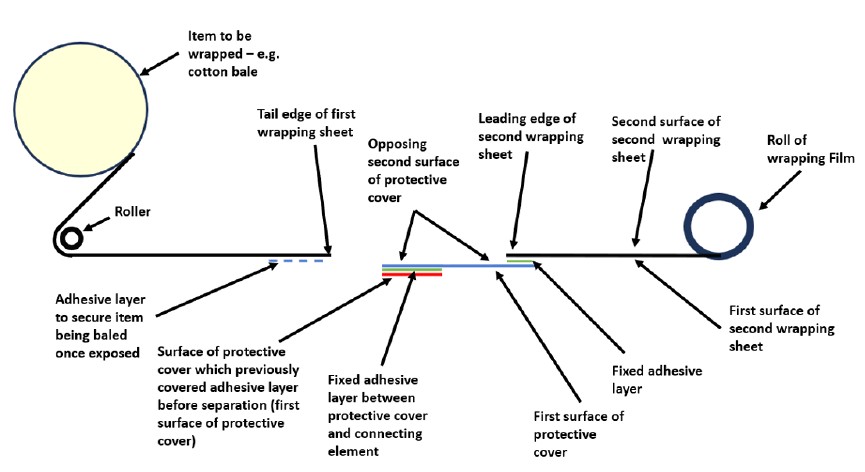
119 It is not necessary for present purposes to explore the significance of Mr Gibson’s inclusion of a “connecting element” in that diagram (the respondents accepted that the “connecting element” could be considered to be part of the protective cover). It may be seen that the protective cover has been “unfolded”, so that the fact that the surface that was covering the adhesive area is not the same surface as that which is affixed to the wrapping unit is easily seen.
120 Diagram WSH-4, also referred to in that paragraph, is the following photograph:
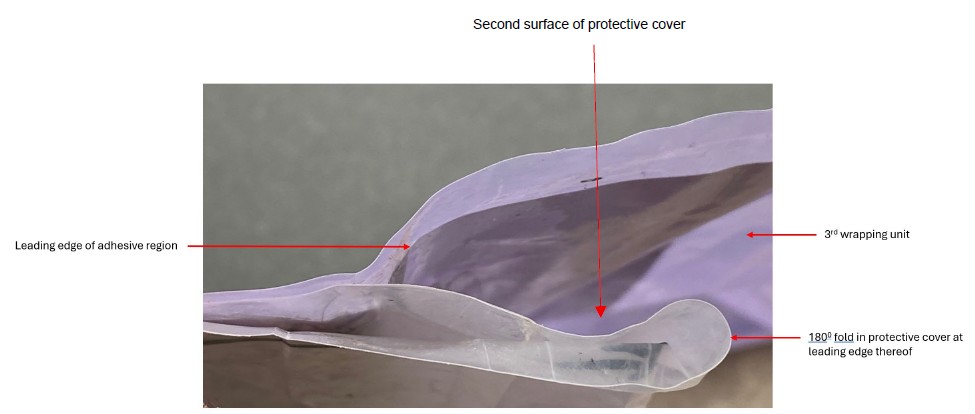
121 The 180-degree fold in the protective cover is clearly visible. It is not possible to see, however, the point at which that protective cover is affixed to the wrapping unit. It is not controversial, though, that the portion of the folded protective cover at the bottom of the picture continues to the left of the photograph and its “upper” side (that is, the side facing upward in the photograph) is affixed to the adjacent wrapping unit at some point to the left. Mr Hunter’s labelling of the “second surface of the protective cover” is thus a consequence of the fact that the surfaces of the portion of the protective cover that has been folded by the 180-degree fold face in the opposite direction to the rest of the protective cover.
122 Figure 1B of the patent, to which reference was made, and that Mr Hunter considered supported his construction, is as follows:
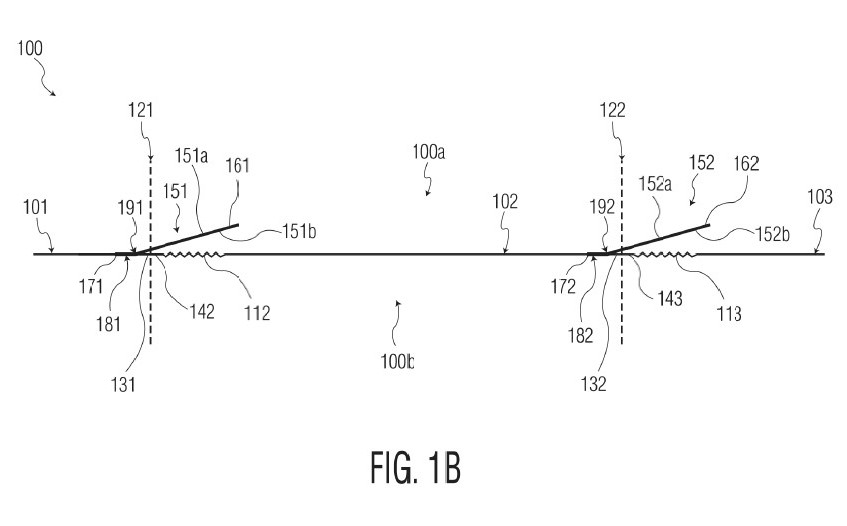
123 I do not think that Mr Hunter derives much support from that Figure. All that the accompanying text in the specification provides (at [0037]) is that the protective cover has “a first surface 151a, 152a and an opposing second surface 151b, 152b”. Describing the protective cover as “in the near closed position” does not seem to me to add very much; it may equally be described as “in the partially open position”. Perhaps most significantly, the Figure does not depict a “folded” protective cover, and so sheds no light at all on the issue of present controversy. That is to say, it simply does not address what the result would be if the single, unfolded, protective cover it portrays was folded over in the manner of the Second PPS Wrap. It is, ultimately, a simplistic diagrammatic representation of the described invention. I do not think it is possible to draw any support for Mr Hunter’s position from it.
124 Although not referenced in the above quotation from the joint expert report, perhaps the clearest indication of the approach taken by Mr Hunter is to be found in his Diagram SD-13, which is as follows:
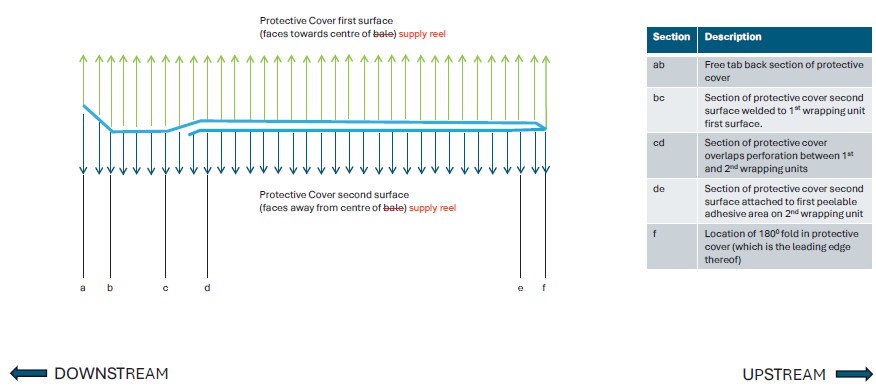
125 In short, that diagram shows that, for Mr Hunter, the first and second surfaces of the protective cover are defined by the direction that they happen to face from time to time depending on how the cover may be manipulated. What would be a portion of the first surface of the protective cover becomes the opposing second surface if it is folded 180 degrees. (And so, for example, if a further portion of the folded portion were folded another 180 degrees, the designation of each surface would flip once more.) Equally, once the protective cover is unfolded during use, the portion of the protective cover designated as the second surface in Diagram SD-13 would become part of its first surface.
126 The point of present relevance is this: on the proper construction of integer 1.13 the designation of a surface (or part of a surface) of the protective cover will not change regardless of whether the wrap is viewed in its open or closed state (or whether before or after use). It follows that the fact that Tama’s argument depends on the PPS Wraps being viewed at a point when they are manipulated in a particular way (the so-called “closed” position), is a sufficient basis upon which to reject that argument. Mr Gibson’s designation of the first and second surfaces of the protective cover, on the other hand, do not change with the perspective (open or closed) from which the PPS Wrap is viewed. The “open” position that is attributed to him perhaps serves to demonstrate more clearly the fact that different surfaces of the protective cover are used for the two specified purposes; but the designation is not affected by the position in which the protective cover is viewed.
127 Tama submitted that Mr Gibson’s identification of the relevant surfaces of the protective cover was premised on his understanding of how the PPS Wraps operate in a Round Module Harvester. I do not accept that submission. The relevant passage of evidence to which Tama referred addresses a different topic. Mr Gibson was explaining that there was an important practical difference between a wrap that incorporated a protective cover that was folded over in the manner of the Second PPS Wrap, and one that incorporated a protective cover that was not so folded. In short, when the protective cover is folded over, and the wrapping unit to which the protective cover is affixed, and the wrapping unit upon which the adhesive area is covered, are pulled apart, the protective cover will be “peeled” off the adhesive area. If the protective cover was not folded over then some other means of removing the protective cover will be necessary.
128 Be that all as it may, that practical difference in the operation of the different kinds of wrapping material in a Round Module Harvester did not form any essential part of Mr Gibson’s reasoning in relation to the identification of the first and second surfaces of the protective cover.
129 Finally, Tama submitted that significant weight should be attached to Mr Gibson’s acceptance in cross-examination that Mr Hunter’s view was not implausible. The relevant passage of evidence was as follows:
COUNSEL: I understand. I understand. And you understand that, obviously, Mr Hunter has given some consideration to these questions, and he has reached that view. That’s his opinion.
MR GIBSON: Yes.
COUNSEL: Your view is different.
MR GIBSON: Yes.
COUNSEL: Correct?
MR GIBSON: Yes.
COUNSEL: And you don’t regard his view as implausible?
MR GIBSON: No. That’s his opinion, yes.
130 I did not take much from that exchange other than that Mr Gibson, consistently with his role as an independent expert, was acknowledging the existence of a reasonably arguable contrary view to his own. He nonetheless adhered to his own view and, for the reasons I have given, I consider that he was correct to do so.
131 In light of the parties’ agreement that there is no relevant distinction to be drawn between the First and Second PPS Wraps, it is not necessary to say very much about the First PPS Wrap. The protective cover on the First PPS Wrap was not formed by a single sheet that was folded over on itself, but rather by joining two sheets together so that they function as a single sheet that is folded over (that is, the face of the protective cover extends across the joined construction). Because the parties agreed that there was no significance to that difference, the same reasoning that I have set out above applies equally to the First PPS Wrap.
132 For these reasons, I find that the PPS Wraps do not include integer 1.13.
Integer 1.14: Is there a hinge?
133 The respondents’ primary submission was that the PPS Wraps did not include integer 1.14 because, on their construction, that integer required a hinge separate from and in addition to the affixation of the protective cover to the wrapping unit. For the reasons I have given in relation to the proper construction of integer 1.14, that primary case cannot succeed.
134 The parties and their experts were agreed that the protective cover on the PPS Wraps is affixed in such a way (whether by means of a “weak seam” or otherwise) that the front edge of the line of affixation is capable of operating as an integral hinge (in the sense that the protective cover is able to rotate 180 degrees around that line).
135 The respondents submitted, however, that that feature of the PPS Wraps did not constitute a hinge. That is because when the PPS Wraps are used in a Round Module Harvester, at the point the wrapping units are separated from one another, the protective cover is pulled away from (or out in front of) the wrapping unit to which it is affixed. It does not, they submitted, fold back along the line of affixation. The respondents thus submitted that, in their ordinary use in a Round Module Harvester, the line of affixation of the PPS Wraps does not function as a hinge. Furthermore, to the extent that the PPS Wraps might be used otherwise than in a Round Module Harvester, the respondents submitted that “there is no reason to assume that in such [other] operation the PPS Wrap[s] wouldn’t work in exactly the same way it was intended to work” in such a harvester.
136 I am not persuaded that the particular operation of the PPS Wraps in a Round Module Harvester is relevant to the question whether they contain a hinge. That is to say, in the context of a product claim, the fact that a particular feature of a product is not used (in at least one, or even any, ordinary use of the product) does not answer the question whether the allegedly infringing product includes such a feature. I am satisfied that the line of affixation constitutes an integral hinge. It permits relative rotation of the protective cover about that line, whether or not it serves any, or any useful, purpose in the uses to which those wraps are put in Round Module Harvesters. The line about which that rotation is enabled extends laterally across the width of the protective cover (and lies between the back edge of the protective cover and the tail edge of the wrapping unit to which it is attached).
137 For these reasons, I am satisfied that integer 1.14 is present in the PPS Wraps.
Integers 1.9 and 1.13: Is the protective cover positioned to removeably cover the adhesive area?
138 This final aspect of the case on infringement is disposed of by my conclusions in relation to the proper construction of integer 1.13. That is, I have rejected the respondents’ submission that the words “positioned to removeably cover” in integer 1.13 conveyed that the protective cover must be positioned in such a way that it could be removed by a particular piece of machinery, or a particular method of use. It follows from that conclusion that the submission that it is necessary for Tama to prove that the PPS Wraps’ protective cover would be removable by such a machine, or such a method, cannot be accepted.
139 The fate of the claim in relation to integer 1.9 flows directly from that conclusion. The relevant aspect of that integer was the requirement that the “adhesive area [be] configured to secure one or more wrapping units”. The respondents’ point was that if the protective cover was not relevantly “removable”, then the adhesive area would not be so “configured”. The failure of the respondents’ submission in relation to integer 1.13, thus means that their submission concerning integer 1.9 fails too.
Primary Infringement: Conclusion
140 For the foregoing reasons, I am not satisfied that integer 1.13 is found in the PPS Wraps, with the result that Tama’s claim for primary infringement against the respondents fails.
Secondary Infringement: Principles
141 I have referred already to the fact that Tama puts its case on secondary infringement on two bases: that each respondent authorised the other’s primary infringement, and that the respondents are joint tortfeasors. Those claims were brought at common law only; no case under section 117 of the Patents Act was advanced.
142 Critically (and in light of my conclusions in relation to primary infringement above, dispositively), a claim for secondary infringement lies only where primary infringement has been found: Apotex Pty Ltd v Les Laboratoires Servier (No 2) (2012) 293 ALR 272; [2012] FCA 748 at [27] (Bennett J).
Authorisation
143 Section 13(1) of the Patents Act provides that the patentee has the “exclusive rights” during the term of the patent to exploit the invention and to authorise another person to exploit the invention. Each act of authorisation is a separate act of infringement: Rescare Ltd v Anaesthetic Supplies Pty Ltd (1992) 25 IPR 119 at 155 (Gummow J).
144 “Authorise” in section 13 of the Patents Act has been held to have the same meaning as given to it under the Copyright Act 1968 (Cth): Bristol-Myers Squibb Co v F H Faulding & Co Ltd (2000) 97 FCR 524; [2000] FCA 316 at [97] (Black CJ and Lehane J); see also Rescare at 155 (Gummow J). That meaning includes circumstances in which a person is so involved in the infringement they can be said to have acted with the “permission” of the authorising person, or to have been sanctioned, approved and countenanced by the authorising person: Inverness Medical Switzerland GmbH v MDS Diagnostics Pty Ltd (2010) 85 IPR 525; [2010] FCA 108 at [194] (Bennett J); Streetworx Pty Ltd v Artcraft Urban Group Pty Ltd (2014) 110 IPR 82; [2014] FCA 1366 at [390]-[396] (Beach J); Real Estate Tool Box Pty Ltd v Campaigntrack Pty Ltd (2023) 278 CLR 240; [2023] HCA 38 at [64] (Gageler CJ, Gordon, Edelman, Steward and Jagot JJ).
145 It has been held that a person may not be said to authorise infringing conduct unless he or she at least has a power to prevent the particular conduct: Apotex [2012] FCA 748 at [27]-[29] (Bennett J); Streetworx at [392] (Beach J); Industrial Galvanizers Corporation Pty Ltd v Safe Direction Pty Ltd (2018) 135 IPR 220; [2018] FCA 1192 at [100] (Burley J).
146 Importantly, in Apotex [2012] FCA 748, Bennett J, at [29], observed that:
Inactivity is not enough to constitute authorisation without a clear power, more than an indirect or attenuated power, to prevent the primary infringements. … Neither mere facilitation nor mere indifference may be sufficient to constitute authorisation … Knowledge that infringement is likely to occur does not necessarily amount to authorisation …
Joint tortfeasorship
147 At common law, a person is liable as a joint tortfeasor for patent infringement where they have assisted, induced or procured another person to infringe a patent, or otherwise acted with another person pursuant to and in furtherance of a common design: Playgro Pty Ltd v Playgo Art & Craft Manufactory Ltd (2016) 117 IPR 489; [2016] FCA 280 at [150]-[154] (Moshinsky J). As Bennett J put it in Apotex [2012] FCA 748 at [23]:
To establish joint tortfeasance, it must be found that one party acted with another in an enterprise pursuant to a common design in the course of which patent infringement is committed. The parties must agree on a common action and the act of infringement must be in furtherance of that agreement (Morton-Norwich at 512). To show infringement by common design, it is necessary to demonstrate some act in furtherance of the common design.
Secondary Infringement: Consideration
148 Because I have concluded that neither respondent engaged in any act of primary infringement of the patent, it follows that the claims for secondary infringement necessarily fail. In those circumstances, and especially in circumstances where Tama’s counsel candidly acknowledged that, even if primary infringement had been established, there was no conceivable circumstance in which the outcome of the secondary infringement claims could lead to any practical additional benefit to Tama, I propose to deal with this aspect of the claim in relatively summary terms.
149 Tama relied, in this context, on the evidence of Mr Alexander Hagan, a lawyer employed by its solicitors. The critical matters relied upon by Tama, said to disclose “a clear common purpose by the Respondents respectively to engage in infringing acts”, were the following:
(a) Parterra invited customers to get in touch with either Cotton Growers Services or Parterra to place orders for the PPS Wraps;
(b) both companies shared each other’s social media posts marketing the PPS Wraps and/or tagged each other in such posts;
(c) both companies launched a “Community Support Program” that was “aimed at fostering support in local communities using proceeds generated through the sale of PPS [cotton module] wraps”; and
(d) Parterra shared a post which described it as the developer of the PPS Wraps and Cotton Growers Services as the distributor.
150 Those matters were said to make clear that “the Respondents were engaged in acts of exploitation with a common purpose and/or respectively sanctioning, countenancing or approving each other’s conduct and accordingly are, respectively, liable for each other’s acts of primary infringement as joint tortfeasors or for having authorised such conduct”.
151 If it had been necessary to decide, I would have accepted Tama’s submissions concerning authorisation against Parterra, but not against Cotton Growers Services; and I would have accepted Tama’s submissions concerning joint tortfeasorship against both respondents.
152 The differential outcome in relation to authorisation is attributable to the fact that I do not see how it can be said that Cotton Growers Services (as distributor) had any power to prevent any primary infringement by Parterra (as importer). Because Parterra was the importer and then supplier of PPS Wraps to Cotton Growers Services, however, I am satisfied that Parterra did have such a power. Parterra’s supply of PPS Wraps to Cotton Growers Services, in conjunction with the other matters relied upon by Tama, which demonstrate a common endeavour to achieve a joint business outcome (that is, the promotion and sale of PPS Wraps), seem to me to be sufficient to constitute authorisation within the meaning of the authorities.
153 That plain common endeavour (comprised of joint marketing activities and coordinated activities to promote and sell the PPS Wraps) of the respondents to achieve a joint business outcome equally constitutes a sufficient basis for concluding that they would have been joint tortfeasors in any primary infringement that might have been established. Both respondents were working together, and assisting each other, to promote and achieve sales of the PPS Wraps (whether those sales were made by one or the other respondent). The dealings of each respondent in the PPS Wraps were in furtherance of their agreement to achieve that outcome which would, on this alternative premise, have constituted an infringement of the patent.
THE INVALIDITY CROSS-CLAIM
154 It will be recalled that Parterra advances five grounds upon which it contends that claims 1 to 7 of the patent are invalid, namely:
(a) the claimed invention lacks an inventive step;
(b) the claims are not useful;
(c) there is a lack of support for the claims in the specification;
(d) the invention is not fully described; and
(e) there is a lack of clarity.
155 No separate issue arises in relation to dependent claims 2 to 7, the validity of which will follow that of claim 1.
156 A common theme underpinning most, if not all, of Parterra’s validity arguments is its contention that the claimed invention is a wrapping material for use in a cotton baling machine. A significant focus of Parterra’s argument was thus its endeavour to prove that the claimed wrapping product would not work in the John Deere 7760 Round Module Harvester (which was said to be the only cotton baling machine in existence at the priority date). It was then said that it followed that, if the claimed invention was to work, it could only be in a novel baling machine of the kind envisaged by claim 9 of the patent (i.e., one with a “stationary component” which functions to remove the protective cover). The final limb of Parterra’s general case was thus to prove that the claims were not limited to use in such a novel baling machine, which would not, in any event, work. Overall, then, the result was submitted to be that the claimed invention (in broad terms; the detail of each contention is elaborated upon below):
(a) involved no inventive step (because no inventiveness is required to come up with something that does not work);
(b) lacked utility (because it would not work);
(c) made no technical contribution to the art, and therefore the patent claimed a monopoly broader than could be supported by that (non-existent) contribution, with the result that the claims lacked support;
(d) was not sufficiently described (because it did not teach a person skilled in the art to make a wrap that could be used in a cotton baling machine); and
(e) was not clear (because the claims did not provide a workable standard against which the position of the protective cover could be determined, so that the wrap was capable of operation in a cotton baling machine).
157 That broad overview should be sufficient to reveal the importance to Parterra’s case on validity of the proposition that the claimed invention is (or includes) a wrapping product for use in a particular way (i.e., in a Round Module Harvester for cotton baling). Indeed, that was the premise upon which Mr Gibson was instructed (he was told that the “dispute regarded a patent for cotton bale wrapping technology”), and his evidence was consistent with that assumption:
COUNSEL: Right. And when you came to read the 847 patent, you concluded, having read it, that it related to cotton bale wrapping technology, correct, to be used with the John Deere device?
MR GIBSON: To be used with the John Deere device, yes. Having my background in cotton baling and whatnot, I took the approach that it was to be used with cotton harvesting machines, harvesting cotton.
158 Tama denied the validity of Parterra’s fundamental approach. It emphasised that the claimed invention was simply a wrapping product with certain features, and its validity was to be assessed on that basis (and not on the basis that it was a wrapping product to be used in some particular way, or with some particular type of baling machine). As will be seen, and consistently with my reasoning and conclusion in relation to the proper construction of the phrase “positioned to removeably cover” in integer 1.13, I consider that Tama’s position is, on the whole, to be preferred.
Lack of inventive step
Principles
159 An invention, so far as claimed in any claim, when compared with the prior art base, must involve “an inventive step”: section 18(1)(b)(ii) of the Patents Act. By section 7(2), an invention as claimed is taken to involve an inventive step unless it would have been obvious to a person skilled in the relevant art, in light of the common general knowledge as it existed before the priority date of the relevant claim, considered separately or with the information of the kind referred to in section 7(3).
160 Whether or not an invention is obvious is a question of fact to be determined by the court, and calls for an evaluative judgment: Mylan Health Pty Ltd v Sun Pharma ANZ Pty Ltd (2020) 279 FCR 354; [2020] FCAFC 116 at [148] (Middleton, Jagot, Yates, Beach and Moshinsky JJ); Aktiebolaget Hässle v Alphapharm Pty Limited (2002) 212 CLR 411; [2002] HCA 59 at [79] (Gleeson CJ, Gaudron, Gummow and Hayne JJ).
161 It is well established that a “scintilla of inventiveness” will suffice to establish an inventive step: Meyers Taylor Pty Limited v Vicarr Industries Limited (1977) 137 CLR 228; [1977] HCA 19 at 249 (Aickin J). However, as noted by Burley J in Elanco Australasia Pty Ltd v Abbey Laboratories Pty Ltd (2024) 184 IPR 517; [2024] FCA 640 at [94], this proposition involves a degree of circularity because “the requirement of the qualitative assessment remains that the scintilla so identified must be inventive”.
162 One approach for assessing inventive step is to ask whether a person skilled in the art, which may be a team, would be led directly as a matter of course to try a particular approach in the expectation that it may well produce a useful alternative or improved result (the so-called “modified Cripps question”): Aktiebolaget Hässle at [53]; Mylan at [113], [144], [502]. But that will not be the appropriate approach in all cases: Generic Health Pty Ltd v Bayer Pharma Aktiengesellschaft (2014) 222 FCR 336; [2014] FCAFC 73 at [71] (Besanko, Middleton and Nicholas JJ). In this case, Parterra submitted that the modified Cripps question was not appropriate “because what is claimed is not useful and would be impractical”. That is, because on Parterra’s case the invention claimed in claim 1 does not solve any problem, a skilled person would not be led to what is claimed. The modified Cripps question, on that hypothesis, could not, therefore, resolve the question of inventive step.
163 Parterra thus submitted that the real question was whether there was “some difficulty overcome, some barrier crossed”, and which required something “beyond the skill of the calling”: Lockwood Security Products Pty Ltd v Doric Products Pty Ltd (No 2) (2007) 235 CLR 173; [2007] HCA 21 at [52] (Gummow, Hayne, Callinan, Heydon and Crennan JJ), citing R D Werner & Co Inc v Bailey Aluminium Products Pty Ltd (1989) 25 FCR 565 at 574 (Lockhart J) and Graham v John Deere Co of Kansas City (1966) 383 US 1 at 15.
164 To invalidate a claim, it is sufficient to demonstrate that any subject matter falling within the scope of the claims is obvious: AstraZeneca AB v Apotex Pty Ltd (2014) 226 FCR 324; [2014] FCAFC 99 at [195] (Besanko, Foster, Nicholas and Yates JJ); D’Arcy v Myriad Genetics Inc (2015) 258 CLR 334; [2015] HCA 35 at [283] (Gordon J).
165 The party seeking revocation of the patent bears the onus of proving on the balance of probabilities that the patent does not involve an inventive step: Jusand Nominees Pty Ltd v Rattlejack Innovations Pty Ltd (2023) 300 FCR 408; [2023] FCAFC 178 at [198]-[199] (Perram J).
Consideration
166 Parterra pleaded that the claimed invention lacks an inventive step by reference to the common general knowledge alone, and by reference to the common general knowledge considered together with the patent for Tama’s earlier Z-lock product (Australian patent application no. AU2005300259B2, or the 259 patent).
167 Parterra advanced two arguments.
No Problem is Solved by the Invention
168 The first argument was that no inventiveness is involved in devising a product that solves no problem, or is of no use. By reference to the defining characteristics of inventiveness referred to by the High Court in Lockwood and quoted above, it was submitted that, necessarily, such a product overcomes no difficulty and crosses no barrier. In those circumstances, as has been foreshadowed above, it was submitted that while it is true that a skilled person would not be directly led to what is claimed in claim 1, and so the claimed invention could not be described as obvious, the result was non-inventive nonetheless. A useless idea, in other words, was said necessarily to lack the requisite quality of inventiveness.
169 Ultimately, I do not think it is necessary to resolve the precise relationship between usefulness and inventiveness. That is because I consider that Parterra has failed to establish the premise of its argument.
170 Parterra’s overarching submission was that “what is claimed would not work at all” because what was claimed could not be used in any baling machine existing as at the priority date. Beyond that, while Parterra denied that it was permissible to have regard to the possibility of use of the claimed wrapping material in a novel baling machine of the kind contemplated by claim 9, it submitted that, even if it was, the claimed wrapping material would not work in such a machine. The claimed wrapping material was, in other words, devoid of any practical use or application.
171 For the reasons I give below in relation to Parterra’s case concerning utility:
(a) The evidence did not establish that the claimed wrapping material could not be used in any baling machine existing as at the priority date. Parterra did establish that it could not be used in any existing cotton baling machine; but that is as far as the evidence went (and I do not accept that the claimed invention was a wrapping material for use in a cotton baling machine). There was no evidence that the claimed invention could not be used in any existing baling machine of any other kind, or with other wrapping equipment. Furthermore, it was uncontroversial that the wrapping material could be used manually.
(b) I agree that it is not appropriate to assess the inventiveness of the claimed wrapping material as part of the method claimed by claim 9. In any event, even if the claimed wrapping material could not be used in a novel baling machine of the kind contemplated by claim 9, that would not mean that it had been proved that it would not work in any way at all.
172 It follows that I do not accept that Parterra has discharged its burden of proving that the claimed wrapping material would not work at all (or in any respect claimed). I understood, though, Parterra to advance a subsidiary submission that even if the claimed wrapping material might work, it had nonetheless solved no problems in the prior art.
173 Tama, in reliance on the evidence of Mr Hunter, pointed to the four primary problems associated with the prior art (insofar as it was represented by so-called “sticky film”) to which I have referred earlier:
(a) For wrapping materials with the adhesive disposed at the lateral edges and along the longitudinal length of the wrapping material, “the ease and progress of the wrapping material through the baler is greatly impeded by frictional type interaction that decreases productivity and increases costs” ([0005] of the patent);
(b) When “the adhesive is applied on one entire side, the strength of the adhesive must be limited since the film must still be allowed to unwind during wrapping of an item” ([0005] of the patent);
(c) There are “various forces exerted on the wrapping material, which cause the wrapping material, particularly the tail edge, to come loose after an item is wrapped. Shearing and peeling are examples of some of these forces exerted on wrapping material during wrapping” ([0006] of the patent); and
(d) If the wrapping material is used outdoors, “exposure to the extremes of temperature, moisture and especially wind will cause additional problems with adhesion of the tail edge of the wrapping material” ([0006] of the patent).
174 The patent, as has already been observed, acknowledged that those problems had been sought to be addressed by prior art solutions. It will be recalled that it said (at [0007]):
Over the years, in an attempt to solve the problem of fastening the bales wrapped with such films [i.e., so-called “sticky films”], a number of solutions have been proposed, such as described in U.S. Patent Nos. 6,787,209, 7,541,080, and 8,071,196, PCT Application No. PCT/IB2005/003589, and U.S. Application Serial Nos. 12/113,720 and 13/734,428, all of which are incorporated by reference as if fully set forth herein. Such proposed solutions entailed, for example, the use of adhesive at the end of the wrap, or the use of fasteners (e.g. Velcro).
175 Those prior art solutions, however, were said in the patent to have their own difficulties (at [0008]):
Although this type of wrapping material tends to have increased adhesive qualities, especially at the tail edge of the wrapping cycle, problems have been experienced with the portions of the wrap sticking to each other. This occurs, for instance when wrapping units are wound onto a bobbin during the manufacturing process, or otherwise organized for use during the wrapping process. In addition, after the adhesive areas are exposed but prior to wrapping, dust and other particulate matter may decrease the adhesiveness of any adhesive areas. Further, those solutions proposing the use of fasteners and other non-adhesive connectors suffer from the disadvantages of being unreliable and financially unviable.
176 Parterra’s case was that the four primary problems had already been solved, and that the problem identified in relation to the prior art solutions to those problems did not exist.
177 In relation to the four primary problems, I did not understand it to be in dispute that there were prior art solutions that addressed and overcame them in a particular way.
178 The first and second problems are related. Mr Hunter described the issue in the following terms:
So what that means is that when we’re effectively pulling the end of this sticky plastic reel from one end, the ease of pulling that film away from the reel is impeded by how sticky the adhesive layer is. So obviously the stickier it is, there’s more of this so-called frictional-type interaction which would make it harder to unroll, therefore impeding productivity, which then becomes more costly. …
…
… So then if the – to decrease that frictional-type interaction, you have to – if the solution to that is reducing the strength of the adhesive, which may solve the unwinding problem, then the adhesive might not be strong enough to close the end of the reel.
179 The third and fourth problems were then said to be consequences of the second problem. In this way, Mr Hunter acknowledged all four problems to be different dimensions of the same issue:
COUNSEL: And those problems are then described in paragraph 6 [of the patent] in what you identify as being the third and fourth problems. They’re really just the corollary of the issue that’s in paragraph 5 [of the patent], correct?
MR HUNTER: Yes. Yes. I think that’s right. Yes.
COUNSEL: So what you’ve broken down into four problems, am I right that it can be summarised essentially that where you’ve got the adhesive applied to the entire surface of the wrapping material, if the adhesive becomes too strong then that can make it more difficult to actually unwind off the bale.
MR HUNTER: Yes.
COUNSEL: Sorry, off the roll. And also can cause some interference with the bale equipment as well where there’s frictional issues impeding its operation.
MR HUNTER: Yes.
COUNSEL: And the trade-off on the other side of that is that while you would like to have the adhesive as weak as possible to address those two issues that I just mentioned, once you reduce the strength of the adhesive, that gives you the problems in the performance of it when it’s wrapped around the bale in that it might more readily become loose and come off the bale.
MR HUNTER: Yes. And then there’s a fourth addition to that, which is the fourth primary problem in 13D of the JER, which says that if that product is used outdoors that the extremes of temperature, moisture and wind can cause problems with the tail end of the wrap coming loose.
COUNSEL: That’s really the same as the third problem, though, isn’t it? It’s just an ---
MR HUNTER: It’s ---
COUNSEL: --- exacerbation because ---
MR HUNTER: Related.
COUNSEL: --- of the fact ---
MR HUNTER: Related to it.
COUNSEL: --- it’s outdoors.
MR HUNTER: Yes.
180 Those four primary problems were all problems found in prior art wraps that had adhesive along their full length. So much is apparent from the terms of the patent itself, and was acknowledged by Mr Hunter. Equally, Mr Hunter acknowledged that those problems would be solved by (a) confining the adhesive area to the tail end of the wrap (that is, as opposed to being deployed along its full length) and (b) having that adhesive area covered by a releasable protective covering. Mr Hunter also acknowledged that prior art wraps, incorporating those two features, had already been invented:
COUNSEL: Yes. So when you just read down in the patent and you got to paragraph 7 … you saw here, firstly, that there was a number of patents identified as representing prior attempts to solve the problem that had been discussed in the previous paragraphs 5 and 6 of this patent; correct?
MR HUNTER: Yes.
COUNSEL: And then you saw at the end of paragraph 7 that they included solutions that entail, for example, the use of adhesive at the end of the wrap and the use of fasteners, which I assume would probably be at the end of the wrap as well, would they?
MR HUNTER: Yes, they are.
COUNSEL: And you would have understood, just at – pausing at that point, that if you were having the strong adhesive at the end of the wrap, that would need to have been dealt with in some way, otherwise it’s going to be adhering just as strongly to the underlying surface of the wrap on the roll as it would to what it’s actually intended to adhere to, which is the outside of the wrapped [bale].
MR HUNTER: Yes, I agree.
COUNSEL: Yes. And just – I will come to this in more detail, but one of the things you would have observed in looking at that particular piece of prior art was that, unsurprisingly, it addressed that very issue by having a releasable layer underneath the adhesive area.
MR HUNTER: It does have a releasable layer next to the adhesive area, yes.
…
COUNSEL: So just turning back to the patent, please, at paragraph 7. You would have equally appreciated that where you saw the reference at the end of paragraph 7 to prior art examples, just as a concept without going to any specific bit of prior art, but referring to proposed solutions involving adhesive at the end of the wrap that they would similarly have had to have deployed some sort of release layer, release covering for that to make any practical sense; correct?
MR HUNTER: Yes.
181 It was on the basis of that evidence that I did not understand Tama ultimately to dispute that the four primary problems identified by Mr Hunter had already been solved in some prior art wraps, including by its own Z-lock wrap.
182 What, then, of the suggestion that those prior art solutions were affected by the problems described at [0008] of the patent? That is, can it be said that, notwithstanding that the patented invention may not have been the first to solve the four problems described above, it remains “inventive” because, in addition, it addresses the kind of manufacturing problems canvassed in that paragraph (and solves those problems in an inventive way)?
183 Mr Gibson gave evidence that no such problems in fact existed in relation to Tama’s Z-lock product. Tama did not adduce any evidence to suggest that problems of that (or any other kind) in fact existed in relation to its Z-lock product (from which fact Parterra submitted the Court could more comfortably infer that no such problems existed). Parterra further relied on the fact that Tama’s earlier patents for its Z-lock product (the so-called “209 patent”, being US Patent No. 6,787,209, and the 259 patent) identified, and claimed to solve, the same problem.
184 Mr Hunter, on the other hand, gave evidence that, on his assessment of the design of the Z-lock product, he would expect problems of that kind to exist (although he acknowledged that he had no knowledge of those problems in fact arising). He said:
From my packaging experience, I can understand this manufacturing issue being a potential problem with the Z-lock wrap. As shown in Figure 9 of the ‘259 Patent, there is a requirement that individual wrapping sheets line up perfectly at their right-hand end edges. This would be difficult to manufacture. If this perfect alignment did not occur, there could be an exposed area of either adhesive layer A or B which may undesirably stick to an adjacent film layer on a supply roll. This would cause portions of the wrap to undesirably stick together.
Further, in Figure 9 of the ‘259 Patent, if the wrap supply roll was exposed to high temperatures, or if the wrap supply roll was stacked one on top of the other, I can imagine that the adhesive layers A and B may (under pressure) tend to “flow” away from their intended locations and undesirably stick adjacent layers of the wrap supply roll together. This is partly a “design problem” (the adhesive layers come right up to the longitudinal and lateral edges of the wrap). It is also partly a “materials science problem” due to temperature dependence of the viscosity of the adhesives.
185 In relation to the statements in Tama’s earlier patents that the identified challenges were solved by the inventions there claimed, Tama submitted that the simple fact was that the present patent indicated that there remained difficulties associated with manufacture that it purported to solve (including with respect to Tama’s Z-lock design, given that the prior art examples listed in [0007] of the present patent included the 209 patent). The issue was explored in evidence with Mr Hunter in the following exchange:
MR HUNTER: Well, it’s whether it – whether the – this earlier Tama patent, this 209 patent, has actually solved that problem of manufacturing efficiency as it desired to do. I don’t know. But the 847 patent indicates that there are still manufacturing efficiency problems with the prior art wraps, which it refers to at the bottom of – in paragraph 9. I can only assume that the – the – the Tama Z-Lock wrap still had some problems with being manufactured, as I alluded to earlier.
COUNSEL: So that’s an assumption that you’re making, but you equally don’t know whether what’s described in the patent solves any problems either, do you?
…
MR HUNTER: From the point of – from the point of view of a skilled addressee, I would expect that it would.
COUNSEL: Well, just in terms of that – because I was going to suggest to you that you’re applying a favourable disposition towards believing everything that’s said in the 847 patent in contrast to disbelieving what’s stated in an earlier patent from Tama that’s asserting that it’s solving some of the very same problems.
MR HUNTER: I’m not sure whether I can – not sure how to quite answer that question. If I’ve looked at the 847 – sorry, the earlier 209 Tama patent and seen some complexities in the – the complexities in the design of that system which I believe would make it difficult to manufacture and then I review the 847 patent, which is intended to address problems with manufacturing efficiency of prior art wraps, of which this prior Tama wrap is one, and I see a solution proposed in the wrapping material that is the subject of the 847 patent which has a – is substantially simplified, in terms of the number of components that it uses, the way the wrapping materials are connected, am I not allowed to make an assumption that I believe that the patent in suit – the 847 patent has, in fact, addressed those manufacturing efficiency problems with the prior art?
186 Ultimately I consider this to have been something of an arid debate. Whatever the claims of the earlier patents, it was uncontroversial that the present patent provided meaningful manufacturing advantages over the prior art.
187 That is, while Mr Gibson denied that he was aware of any problems of the kind described in [0008] of the patent in relation to the Z-lock wraps, he nevertheless considered “some aspects of the invention described in the ‘847 Patent are likely to be simpler to manufacture than the Z-lock system”.
188 Mr Hunter likewise identified various respects in which the manufacture of the Z-lock product would be more complex than the manufacture of the invention claimed in the patent. He said:
In my view, it’s significantly simpler to manufacture the wrapping material that’s outlined in the 847 patent. I think the main – the main reasons for that is that we don’t have – in the 847 patent, we don’t have separated wrapping units. We have wrapping units that are joined together by perforation. So, there’s not that difficulty in lining up the ends of the wrapping units as I’ve described previously. So just that – we don’t also have a four layer discrete laminate structure in the 847 patent. We just seem to have an adhesive area, which is applied on one end of the wrapping unit. So, there are less components, there’s less difficulty in alignment. Basically, it’s simpler, so it should be much more efficient to manufacture, which is an obvious benefit. And it’s one that the patentee stated was a benefit.
189 Thus, Tama submitted that the claimed invention was “a simpler way of producing a wrapping material – less layers – and it was an improvement in that sense because it made manufacturing simpler”. The evidence of manufacturing benefits was thus submitted to establish that the claimed invention concerns an improvement in the art which, at the very least, involves a scintilla of inventiveness. That is, although the four primary problems had already been solved, the claimed invention solved them in a new or alternative way, that provided additional manufacturing advantages over the prior art solutions.
190 I did not understand Parterra seriously to dispute that the claimed arrangement was simpler to manufacture; but it did submit that no problem was solved by achieving a manufacturing benefit in relation to a product that lacked all utility. For the reasons I have given, though, I do not accept Parterra’s utility argument. That is, I do not accept the premise that the claimed invention would not work at all. It follows that I do not accept that it has been proved that the manufacturing benefit achieved by the patent solved no problem.
191 The simple fact that a problem had been solved, or a benefit achieved, does not answer, of course, the question whether there was involved any innovative step.
192 Given Parterra has not proved that the claimed invention would not work at all, and because it is uncontroversial that the claimed invention has certain manufacturing advantages, I can see no reason why the modified Cripps question would not be the proper approach to identifying the existence (or lack thereof) of an inventive step. (That is, the premise of Parterra’s submission that the modified Cripps question was not appropriate was the inutility of the claimed invention, which has not been established.) But Parterra did not, however, point to any evidence identifying the routine pathway from the common general knowledge (either alone, or in combination with the 259 patent) to the claimed invention. (Indeed, as I have observed, the entire premise of Parterra’s case was that the skilled addressee would not be led as a matter of course to try the claimed invention in the expectation that it might well produce a useful or better alternative.)
193 Because Parterra bore the onus on that question, this ground of challenge must fail.
Alternative Argument: the PPS Wraps are an obvious variation of the 259 Patent
194 The second argument that Parterra advanced in relation to a lack of inventive step was made as an alternative to its case on non-infringement. It submitted:
The following submissions are made in the alternative. They are premised on an assumption that the PPS Wrap falls within claim 1, as alleged by the applicant.
Briefly, the logic is that because the PPS Wrap is an obvious variation of what is disclosed in the 259 Patent, it follows that if the PPS Wrap falls within claim 1, claim 1 includes obvious subject matter and is invalid.
(Original emphasis)
195 In circumstances where I have found that the PPS Wraps do not fall within claim 1, this argument does not arise. In any event, the experts were both agreed that none of integers 1.6 to 1.15 of claim 1 of the patent are disclosed in the 259 patent. Mr Hunter was cross-examined with a view to demonstrating that those additional integers were of no practical significance, or were functionally equivalent, to various features of the 259 patent. But the evidence did not go so far as to identify why, in relation to each and every such feature, the person skilled in the art would have been led directly as a matter of course to try those new features in the expectation that they might well produce a useful or better alternative. If it had been necessary to determine this alternative argument, I would have dismissed it.
Conclusion
196 For the foregoing reasons, Parterra’s challenge to the validity of the patent on the ground that it lacked an inventive step must fail.
Lack of utility
Principles
197 For an invention to be patentable, it must, so far as claimed in any claim, be useful: section 18(1)(c) of the Patents Act. An invention will be useful if it does what it is intended by the patentee to do (as objectively determined), and if the end obtained is itself useful: Ranbaxy Australia Pty Ltd v Warner-Lambert Co LLC (2008) 77 IPR 449; [2008] FCAFC 82 at [141] (Emmett, Weinberg, and Bennett JJ, citing Rehm Pty Limited v Webster’s Security Systems (International) Pty Limited (1988) 81 ALR 79; [1988] FCA 232 at 96; Welcome Real-Time SA v Catuity Inc (2001) 113 FCR 110; [2001] FCA 445 at [160] (Heerey J). As to that first aspect, “the invention as claimed must attain the result promised by the patentee”: Ranbaxy at [141]; Advanced Building Systems Pty Ltd v Ramset Fasteners (Aust) Pty Ltd (1998) 194 CLR 171 at 187 [24] (Brennan CJ, Gaudron, McHugh and Gummow JJ).
198 It is necessary that “everything that is within the scope of a claim … be useful, otherwise the claim will fail for inutility”: H Lundbeck A/S v Alphapharm Pty Ltd (2009) 177 FCR 151; [2009] FCAFC 70 at [81] (Emmett and Bennett JJ); see also Martin Engineering Co v Trison Holdings Pty Ltd (1989) 14 IPR 330; [1989] FCA 74 at 337 (Burchett J). The specification and claims should not, however, “be construed in a way that any sensible person would appreciate would lead to unworkability when by construction it could be given a more limited meaning”: Welch Perrin and Company Proprietary Limited v Worrel (1961) 106 CLR 588; [1961] HCA 91 at 602 (Menzies J); Austal Ships Pty Ltd v Stena Rederi Aktiebolag (2005) 66 IPR 420; [2005] FCA 805 at [216] (Bennett J). Thus, it is “not appropriate to test whether a claim has utility by considering characteristics that are totally impractical or contrived”: Orion Corporation v Actavis Pty Ltd [2015] FCA 909 at [186] (Rares J), citing Austal Ships at [236] and Washex Machinery Corporation v Roy Burton & Co Pty Ltd (1974) 49 ALJR 12 at 19. As Nicholas J observed in Apotex Pty Ltd v Warner-Lambert Co LLC (No 2) (2016) 122 IPR 17; [2016] FCA 1238 at [169]:
It is often said that the principle that a claim is bad if it is wider than what is useful is one that must be applied with great caution. As Blanco White explains at para 4-409:
It follows from what has been said that it is often a convenient test of the utility of the invention contained in a claim to consider whether the claim includes forms of the invention which are not useful, but that this test must be applied with very great caution. The function of a claim is to delimit the monopoly given by the patent, not to give instructions for the working of the invention, and it is consequently not necessary that the claim should contain these instructions; even the body of the specification is required to contain only those instructions that the reader cannot supply for himself. It would be unreasonable to expect the claims to contain more. A distinction should accordingly be drawn between cases in which the invention claimed is not useful unless an additional feature or features be added to those claimed (the claim then being invalid), and cases where the qualifications and expedients necessary to make the article claimed work can be, and on a true construction of the claim are, left to the reader to supply for himself. Since in cases where the reader can make the thing work the courts tend wherever possible to construe claims as requiring him to do so, it is not in practice enough to ask whether the claim includes things that are not useful; it is necessary to ask also whether there is anything in the language of the claim positively pointing to some useless construction. The successful utility attacks are nearly always in cases of that sort. Examples are: where a claim specifies two alternative processes or constructions of mechanism, of which only one is useful; or the claim specifies the use of any of a group of chemical compounds, and it is not substantially true that all will work; or the claim includes a series of constructions, and only certain members of the series are useful; or more generally, the claim contains a limitation directed to a particular feature and further limitation of that same feature is needed for utility; or the feature needed for effective working is expressly made optional-as when it is added by a subsidiary claim.
It does not follow that a broad claim is invalid merely because some subsidiary claim within it lacks utility: for the invention the subject of the subsidiary claim may be intended to attain some result additional to the main object to which the broader claim is directed.
(Footnotes omitted; TA Blanco White, Patents for Inventions, 5th ed. Stevens & Sons, London, 1983)
199 The party propounding lack of utility bears the onus of establishing that fact.
Consideration
200 The difference between the parties in relation to the question of utility can be traced to their disagreement concerning the scope of the promise of the claimed invention.
201 On the one hand, it was Parterra’s submission that the promise of the invention “includes a product that is useful when used in a baler to wrap a bale of agricultural produce, which would include cotton” (original emphasis). Parterra submitted that it followed that, in order to be useful, the claimed invention had to be capable of being used to wrap bales of cotton in an existing cotton baling machine. It submitted that the claimed invention did not fulfil that promise because the wrapping material could not be used in any existing cotton baler. Further, Parterra submitted that if, contrary to its primary submission, the promise was understood to be a wrapping product capable of use in a new form of baling machine (i.e., one with a “stationary component”), the type of new machine contemplated by the patent would not work. Either way, the claimed invention, it was submitted, failed to do what was promised, and thus included wrapping products that did not meet the patentee’s objective.
202 Tama emphasised that Parterra had eschewed any comprehensive positive statement of the promise of the invention (in that it had only identified an aspect of that promise; i.e., a particular matter included within it). Tama responded, accordingly, by denying that the particular matter relied upon by Parterra was, in fact, promised. Tama thus submitted that the patent made no promise that the claimed wrapping material could be used to wrap cotton in an existing cotton baling machine. In relation to Parterra’s alternative case in relation to a novel baling machine, Tama (in common with Parterra’s primary position) denied that it was permissible to have regard to integers of the patent’s method claims that are not found in claims 1 to 7.
203 Tama emphasised that on no view could the patent fairly be read to promise a wrapping product useful for baling cotton in existing Round Module Harvesters. Tama pointed to the terms of [0011] of the patent, which states:
The wrapping materials of the present invention may be used to wrap round bales of agricultural produce although such wrapping materials can be used to wrap bales of other shapes. Such agricultural products which may be wrapped using the present invention include, for example, hay, straw, silage, or the like, though other items that are not agriculturally related may also be wrapped using the present invention. The wrapping materials of the present invention may also be used with existing wrapping equipment or balers.
204 That passage made clear, it was submitted, that the patent made no promise that the wrapping product could be used in every example of existing wrapping equipment or balers at the priority date. In particular, the patent made no promise whatsoever that the wrapping product could be used to wrap cotton in then existing cotton baling machinery.
205 Nor, it was submitted, did the patent even go so far as to promise a wrapping product that was useful when used in a baler to wrap a bale of agricultural produce (i.e., other than cotton). The specification identified the invention as a wrapping product with certain features that “may” (in the sense of “possibly”) be used with some existing wrapping equipment “or” balers (i.e., the promise would be met provided that it could be used with some form of existing wrapping equipment). Further, or alternatively, the promise that the claimed invention may work with existing equipment or balers was said itself to be qualified. That is, the patent did not promise that the wrapping product could be used in existing equipment or balers without modification. Tama pointed to [0043] of the patent, which refers to the possibility of integrating or retrofitting new components into existing machinery in order to facilitate the use of the wrapping product. Whatever the full scope of the promise, therefore, it was submitted that, at the very least, the patent did not promise a wrapping material capable of wrapping cotton in an existing Round Module Harvester (or particular novel baling machine).
206 I do not accept Parterra’s construction. I have already held, in connection with the proper construction of integer 1.13, that the claims do not specify any requirement that the protective cover be removable in any particular way, or by any particular piece of machinery. The patent merely claims a wrapping product, as Tama submitted, with a protective cover that is removable. Nothing in the specification relevantly enlarges that promise to encompass use for cotton baling in a Round Module Harvester. It is not necessary for me to go on to determine all of the issues raised by Tama’s submissions concerning the extent of the promise. It is enough to deal with Parterra’s case to say that the patent does not, in relation to the invention the subject of claims 1 to 7, promise a wrapping product able to be used in an existing (or novel) cotton baling machine, and to hold that Parterra has not proved that the claimed invention would not be removable by any existing equipment, or any existing baler.
207 The evidence did not establish that the claimed wrapping material was incapable of being used with any existing agricultural wrapping equipment or baling machine. Mr Gibson’s evidence was that his experience was limited to cotton baling (in relation to which there is, in effect, only one cotton baling machine that is used; namely, the John Deere Round Module Harvester):
COUNSEL: Now, at May 2013, it’s correct that the only baling harvester that you had experience with was the John Deere 7760. That’s right?
MR GIBSON: That’s correct yes.
COUNSEL: And that machine is used for cotton baling, correct?
MR GIBSON: Yes.
…
COUNSEL: … [Y]our specialist topic is cotton baling, and using ---
MR GIBSON: Cotton harvesting and baling.
COUNSEL: Cotton harvesting and baling, using the John Deere ---
MR GIBSON: Yes.
COUNSEL: ---device. …
…
COUNSEL: So as at May 2013, the only baling machine that you had experience with was the JD – or John Deere round module harvester, correct?
MR GIBSON: Yes, correct.
COUNSEL: So when you read the words, “With existing wrapping equipment or balers” that’s what you’re thinking of?
MR GIBSON: That’s what I’m thinking of, yes.
208 So when Mr Gibson gave evidence that he was unaware of any baler with which the claimed wrapping product could be used, that evidence must be understood as being limited to any baler used for cotton baling (of which there was, in effect, only one).
209 The narrow focus of Mr Gibson’s evidence was explained by the logic of Parterra’s case that I have described above; namely, that the patent promised a wrapping product capable of being used to bale cotton in existing (or, alternatively, novel) cotton baling machines. Because I have rejected that case, however, one consequence of the limited focus of Parterra’s evidence is that there was no evidence capable of establishing the broader proposition that the claimed wrapping product was not able to be used for agricultural baling with any existing wrapping equipment or balers.
210 Tama did not seek to lead evidence to establish, as a positive proposition, that the claimed wrapping product could have been used with some existing wrapping equipment or agricultural baler. That is to say, it relied on Parterra’s inability to discharge the burden of proof that uncontroversially lay upon it. In circumstances where Parterra did not attempt to adduce any evidence concerning the use of the claimed wrapping product other than in relation to cotton baling and the John Deere Round Module Harvester, it follows that Tama’s forensic decision did not provide any basis for the operation of the principles in Jones v Dunkel or Blatch v Archer (even if those principles had potential operation, the result would not be to supply positive evidence enabling Parterra’s burden to be discharged).
211 By its cross-examination of Mr Hunter, Parterra did attempt to establish that the only means by which the wrapping product could be used would be by way of a novel baling machine with a stationary component. Mr Hunter did not accept that proposition, however:
COUNSEL: And so the one description that you’ve seen in reviewing this patent of how this protective cover would be removed is through engagement with this stationary component, correct?
MR HUNTER: So, I see that as one option for opening the protective cover, yes.
COUNSEL: Well, that’s the only option that has been identified to you in the patent, correct?
MR HUNTER: No, there’s other options that are present in the patent which ---
COUNSEL: Are you talking about paragraph 51?
MR HUNTER: Let me just grab the patent. So, that’s where it talks about the stationary component of the – which is part of claim 9 onwards being replaced with, for instance, a robotic arm or a manual blade or the like. So, that would be another way of engaging the leading edge of the protective cover to open it up. But the earlier part of the invention also talks about the fact that – I think there’s a section – I can’t – I will have to go from memory here but talks about the wrapping material of the present invention potentially being used for palletising. Palletising wraps are routinely used for wrapping up bundles of objects on a pallet. They are commonly open – they commonly have the leading edge of the wrapping film released from the roll manually. So, I see no reason why claims 1 to 7, for instance, couldn’t apply to a manually open protective cover, perhaps with some semi-automatic equipment to assist it.
212 Mr Hunter’s experience, of course, was limited in a different way to that of Mr Gibson. Mr Hunter is a mechanical engineer, with experience relating (relevantly) to the design of machines, and of flexible packaging. He did not have any specialised knowledge of agricultural baling, or baling equipment. He had not turned his mind to the question of the particulars of the manner of use of the claimed invention. So Mr Hunter was not really in a position to assist the Court in relation to the question whether the claimed wrapping product could be used with any existing wrapping equipment or balers. To the extent that he was able to do so, however, the evidence he gave supported the proposition that the claimed wrapping material would be able to be used in some way with existing equipment.
213 The result is that I am not satisfied that Parterra has discharged its burden of proving that the claimed wrapping product was not capable of being used with any existing agricultural wrapping equipment or baling machine (a proposition that, to be fair, it did not set out to prove). The claimed invention has thus not been shown to fail to live up to the promise of the patent (either in the specific respect relied upon by Parterra, or even more broadly in relation to use for agricultural baling with an existing baler or equipment). Further, the manufacturing advantages that I have previously identified would comfortably establish the usefulness of the end obtained.
214 Insofar as Parterra’s alternative submission, based on the alleged unworkability of a novel baler with a stationary component, is concerned, I consider that it too must fail.
215 Fundamentally, that is because, as both parties accept, the invention claimed in claim 1 must be assessed as a stand-alone invention. It is not appropriate to read in additional integers, especially those that do not form part of the common general knowledge. Claim 1 is not limited by reference to a particular method of use, such as that claimed in later claims by reference to a novel baler with a stationary component. Thus, the utility of the wrapping product has not been shown to depend on the feasibility of a novel baling machine. Whether or not the method claimed in claim 9 would work is not an issue that arises in these proceedings. In those circumstances, I do not propose to make findings in relation to the feasibility of the contemplated novel baling machine.
216 For the foregoing reasons, I would reject Parterra’s challenge to the validity of the patent on the ground that it lacks utility.
Lack of support
Principles
217 Section 40(3) of the Patents Act requires that each claim must be “supported by matter disclosed in the specification”. For a claim to be supported, it must, inter alia, correspond to the “technical contribution to the art” described in the patent. That is, the “claim support obligation is based on a requirement that the technical contribution to the art disclosed by the specification justifies the breadth of the monopoly claimed”: Merck Sharp & Dohme Corporation v Wyeth LLC (No 3) (2020) 155 IPR 1; [2020] FCA 1477 at [533] (see also at [531] and [547]) (Burley J). See also, e.g., TCT Group Pty Ltd v Polaris IP Pty Ltd (2022) 170 IPR 313; [2022] FCA 1493 at [241]-[242] (Burley J); Regeneron Pharmaceuticals Inc v Kymab Ltd (2020) 163 IPR 515, [2020] RPC 22; [2020] UKSC 27 at [56(i)] (Lord Briggs); Illumina Cambridge Ltd v Latvia MGI Tech SIA [2021] RPC 12; [2021] EWHC 57 (Pat) at [255]-[279] (Birss J), Sandoz Ltd v Bristol-Myers Squibb Holdings Ireland Unlimited Company [2023] EWCA Civ 472 at [92] (Arnold LJ). A patentee cannot claim subject matter that “owe[s] nothing to the teaching of the patent or any principle which it disclosed”: Biogen Inc v Medeva Plc [1997] RPC 1 at 50-51 (Lord Hoffmann) (quoted with approval in Merck at [531]).
218 Thus, as Rofe J observed in Jusand Nominees Pty Ltd v Rattlejack Innovations Pty Ltd (2022) 167 IPR 1; [2022] FCA 540, (at [484]):
In order to determine whether the Patents lack support, the Court must consider what is the invention that is claimed, examine the description in the specifications to ascertain the technical contribution the Patents make to the art, and then compare the two, to make sure that the technical contribution entitles [the Patentee] to a monopoly of the width that it claims.
219 Her Honour went on to explain the concept of “technical contribution”, and, in particular, how it differs from that of “inventive step” (at [489]-[491]):
The “technical contribution to the art” is not to be confused with the concept of inventive (or innovative) step. In H Lundbeck A/S v Generics (UK) Ltd [2008] RPC 19; [2008] EWCA Civ 311, a case involving a claim to a single product, being an isolated enantiomer, Hoffman LJ observed at [36] that it is a mistake to treat the relevant “technical contribution to the art” as being the inventive step. His Honour continued at [41]:
[T]here is nothing in s 72(1)(c) which connects the requirements of sufficiency to the inventive step. What needs to be disclosed is the invention as defined in the claim. That remains the same, whatever may have been the inventive step.
Lord Walker upholding Hoffman LJ’s decision in Generics (UK) Ltd v H Lundbeck A/S [2009] 2 All ER 955; [2009] RPC 13; [2009] UKHL 12 explained the difference between inventive concept and the technical contribution to the art at [30]:
“[I]nventive concept” is concerned with the identification of the core (or kernel, or essence) of the invention – the idea or principle, of more or less general application (see Kirin-Amgen Inc v Hoechst Marion Roussel Ltd [2005] 1 All ER 667; [2005] RPC 169; (2004) 64 IPR 444; [2004] UKHL 46 at [112]–[113]) which entitles the inventor’s achievement to be called inventive. The invention’s technical contribution to the art is concerned with the evaluation of its inventive concept – how far forward has it carried the state of the art?
(Original emphasis)
220 To this point I did not apprehend any disagreement between the parties. When it came to the principles in accordance with which the technical contribution in the context of the present patent should be identified, however, their positions appeared to diverge.
221 Tama submitted that in the context of a product claim, “the technical contribution to the art is the product which is enabled to be made by the disclosure”. Support for that proposition was said to be found in the statement of Lord Briggs, in Regeneron, that (at [56(ii)]):
In the case of a product claim, the contribution to the art is the ability of the skilled person to make the product itself, rather than (if different) the invention.
222 That is to say, as his Lordship explained at [58]:
In the case of a product claim, the contribution to the art is the product which is enabled to be made by the disclosure, not the invention itself.
223 Those statements have been approved on many occasions, including, for example, in Jusand [2022] FCA 540 at [503], Jusand [2023] FCAFC 178 at [204], Merck at [542], and TCT Group at [219]. Parterra, submitted, however, that it was important that they be understood in context. In particular, Parterra emphasised that Lord Briggs’ statements in Regeneron were made following his Lordship’s review of Lord Hoffman’s speech in Generics (UK), where the relevant technical contribution had been identified as a product, rather than the process by which it was made. Parterra thus submitted that those statements needed to be understood in light of the distinction that was being drawn. They could not, it was said, be taken to mean that simply because a patent teaches how to make a product, the fact of the enabled product means that there is a corresponding technical contribution to the art.
224 Thus, for example, Parterra drew attention to Burley J’s quotation, in Merck at [529], of the following passage from Terrell on the Law of Patents (19th ed):
The self-standing objection that a claim is broader than the technical contribution of the patent, even when it can be performed, is sometimes referred to as “Biogen insufficiency”. It is to be contrasted with “classical insufficiency” which is concerned with whether or not embodiments within the claim can be performed. Thus peculiarly under English law it is said that a patent can be insufficient even if it is possible to make everything within the scope of the claim, if the scope of the claims exceed the technical contribution.
225 Similarly, in Illumina Cambridge at [255] Birss J said, referring to Regeneron:
[I]n other cases, even about product claims, there may be a different kind of insufficiency alleged for which the ability to make a product will not be the relevant technical contribution. In some cases the products are easy enough to make but where the patent claims fall down is because the (alleged) property of those products, which was said to be the thing which made them inventive in the first place, was not shared by all the products within the claimed range. The products could be made alright but they do not do what is promised and so the claim exceeds that technical contribution for that reason.
226 Parterra’s ultimate point was encapsulated in the following quotation from Sandoz, where Arnold LJ said (at [92]):
[W]hen considering insufficiency it is necessary to consider whether the specification sufficiently discloses the claimed invention. If it is not plausible that the invention solves any technical problem then the patentee has made no technical contribution and the specification does not disclose any invention.
227 Tama submitted that Parterra was wrongly seeking to import different concepts from the law of the United Kingdom into the Australian law concerning support without justification (or confusing the concept of support with other concepts). Ultimately, it is not necessary for me to resolve this debate. That is because, as will be seen, I do not accept the fundamental factual premise of Parterra’s argument.
Consideration
228 Parterra put its case on lack of support on three bases.
No technical contribution
229 Parterra’s primary submission was that the patent does not disclose any “technical contribution” at all, in that it does not solve any technical problem existing in the prior art, and has not carried the state of the art forward in any way. It follows that a claim of any breadth must exceed the “technical contribution” disclosed in the patent (i.e., because there is none).
230 Even assuming, contrary to Tama’s submission, that the technical contribution to the art is something other than the product enabled to be made, I do not accept, for the reasons I have already given, that the patent did not solve any problem existing in the prior art. The patent discloses a wrapping product that has not been shown to lack utility, and which provides a meaningful manufacturing advantage over other prior art products. It follows that the premise of Parterra’s argument here is not established, with the result that the challenge must be rejected. That is to say, Parterra made no submission (other than those I deal with below) to the effect that, in the event it did not succeed in establishing that no problem had been solved, the breadth of the claims exceeded the technical contribution disclosed.
Technical contribution depends upon use in a baler with a “stationary component”
231 The second basis upon which Parterra submitted that there was a lack of support was that, to the extent that a technical contribution is disclosed, it is one that involves a new type of bale wrap that is used in a new type of baler (i.e., one with a “stationary component” for pushing the protective cover back around a hinge). It was said that “that new baler is integral to achieving any benefit that is described in the Patent – the wrapping material confers no benefit if its protective cover will not be removed in use”. It was thus submitted:
(a) Because claim 1 omits any reference to the new baler, or to use with the new “stationary component”, the wrapping material that is claimed in claim 1 has no utility in and of itself, and does not solve any technical problem that existed in the prior art.
(b) Because the new baler is an essential feature of the invention disclosed in the patent, any technical contribution can arise only from the combination of the wrap and the baler. Thus:
By omitting this essential feature from the claim, claim 1 includes wrapping material for use in any baler, yet it does not enable the use of the wrapping material in balers that do not have a relevant ‘stationary component’, which further demonstrates that the claim is broader than any technical contribution.
(Original emphasis)
(c) The fact that an essential feature of the invention (the new baler) is not included in the claim, means that the claimed invention is “materially different” to what is disclosed: Calix Ltd v Grenof Pty Ltd (2023) 171 IPR 582; [2023] FCA 378 at [128] (Nicholas J).
232 Once again, for reasons I have already given, the premise of all these arguments is not made out. Use in a baler with a stationary component is not an essential feature of the claimed invention, and such a use does not, on any view, comprise the technical contribution. Nor is it correct to say that the claimed invention is one “for use in any baler”. The technical contribution thus has not been shown to be less than the breadth of the claims.
“Pushing” vs “peeling” the protective cover
233 Parterra’s third basis for arguing lack of support was put only against the possibility that Tama’s infringement case founded on integer 1.13 (and, in particular, Tama’s construction of “opposing second surface”) succeeded. It was submitted that, in that event, the claims would include a protective cover that was removable under tension (in the way that the protective cover of the PPS Wraps is removed in a Round Module Harvester), but nothing in the patent teaches how to make such a wrapping product.
234 In circumstances where the relevant part of Tama’s infringement case has failed, this argument does not arise.
Conclusion
235 For all of the above reasons, Parterra’s case that the patent is invalid on the ground that it lacks support must fail.
Lack of sufficient description
Principles
236 The obligation in section 40(2)(a) that the specification must “disclose the invention in a manner which is clear enough and complete enough for the invention to be performed by a person skilled in the relevant art” is an obligation that applies across the full scope of the claim, and such that a skilled addressee must be able to achieve this without undue burden and without needing inventive skill: Merck at [525] (Burley J), citing Novartis AG v Johnson & Johnson Medical Ltd [2010] EWCA Civ 1039; [2011] ECC 10 at [74] (Jacob LJ).
Consideration
237 Once more, the crux of Parterra’s submission was that the wrapping material disclosed in the patent would not work in a Round Module Harvester. That fundamental complaint found expression in this context as a contention that the patent did not enable the person skilled in the art to make a claimed wrapping product capable of being used in such a machine. Furthermore, Parterra said, the skilled addressee could not make a claimed wrapping product that would work in any other machine without undue effort or inventiveness (because he or she would need to design, build, and test a new machine).
238 Tama submitted, in response, that Parterra had misunderstood the relevant enquiry. The question was only, it was submitted, whether the specification enabled the skilled addressee to produce something over the whole area claimed. In circumstances where no integer of the claims concerned the use of the product in a baling machine (or in any particular method of use), the ability to use the product so made in any particular machine (or any particular way) was irrelevant. The question was only whether the product that was claimed (i.e., a wrapping product having the claimed features) could be produced.
239 I consider Tama’s submissions to be correct. The question is not whether the claimed product is capable of being used in a Round Module Harvester (the claims containing no limitation to that effect). The question is only whether the specification sufficiently enables the skilled addressee, without undue burden or inventiveness, to make a product possessing the claimed features of claim 1, including a removable protective cover and an adhesive area configured to secure one or more wrapping units.
240 The experts were in agreement (and I did not understand it to be in dispute) that the patent sufficiently disclosed all of the features of the claimed product to enable it to be made. The question was not (subject to one point to which I will return shortly) whether the patent sufficiently clearly disclosed the invention it described; the question was whether such an invention would work in an existing baling or other machine. In those circumstances, I am not persuaded that there is any lack of sufficiency that has been demonstrated in the specification.
241 The qualification to which I have just referred is that Parterra submitted that the specification did not enable how to determine the range of materials that would be suitable to be used for the wrapping material and its components. That is, it was submitted:
The claim therefore includes any number of different materials that would not have the properties necessary to perform the role of a wrapping material (e.g. rigid or fragile plastics, metals), or materials with the required adhesive and release properties, for use in a baling machine.
242 The patent was thus said to share the same vice that was found to invalidate the patent in Jusand [2023] FCAFC 178 at [222] (Perram J, with whom Nicholas and McElwaine JJ agreed). In that case, the patent showed only how to make the claimed invention from steel. The claims were not, however, limited to a product made from steel, and did not disclose how the selection of an appropriate alternative material might be made.
243 Here, the position is quite different. For one thing, the patent did disclose that (at [0012]):
The base wrapping material may be a polymer based material, a netting, a film, or a combination thereof.
244 Moreover, the effect of the expert evidence was that a person skilled in the art would have little difficulty in identifying appropriate materials from which to construct the wrapping unit:
COUNSEL: Now, because of what you’ve been told in that paragraph 12 about what the wrapping material is to be made of, would you agree that it would be unrealistic when reading this patent to regard that the wrapping material could be made of a rigid or fragile plastic or a metal?
MR GIBSON: Unrealistic, yes.
COUNSEL: Mr Hunter, do you want to make any comment about that?
MR HUNTER: What you’ve said is perfectly correct.
COUNSEL: So, Mr Gibson, you regard it as being outside what was the intended wrapping material for claim 1 for it to be made of a rigid or fragile plastic or a metal, correct?
MR GIBSON: Correct.
COUNSEL: Mr Hunter, do you hold the same view?
MR HUNTER: Correct.
245 The overall effect of the evidence was that the skilled addressee would be able, without undue burden, to identify materials suitable for constructing the claimed wrapping product. That seems to me to distinguish the present case from the circumstances of Jusand.
246 Overall, therefore, I am satisfied that the evidence does not establish that the specification does not provide the skilled addressee with enough information to be able to make the wrapping material of claim 1.
Lack of clarity
Principles
247 Pursuant to section 40(3), each claim of a patent must be “clear”, such that “readers should be able to ascertain the precise extent of the monopoly claimed”: The Nesbit Evans Group Australia Pty Ltd v Impro Ltd (1997) 39 IPR 56; [1997] FCA 1092 at 94 (Lindgren J, with whom Hill J agreed).
248 A valid claim must provide a “workable standard suitable to the intended use”: Minnesota Mining and Manufacturing Company v Beiersdorf (Australia) Ltd (1980) 144 CLR 253; [1980] HCA 9 at 274 (Aickin J); Vehicle Monitoring Systems Pty Limited v SARB Management Group Pty Ltd trading as Database Consultants Australia (No 8) [2023] FCA 182 at [666] (Besanko J). See also, e.g., Colgate-Palmolive Co v Cussons Pty Ltd (1993) 26 IPR 311; [1993] FCA 297 at 353 (Sheppard J), and EIS Gmbh v LELO Oceania Pty Ltd (Liability Trial) [2025] FCA 1111 at [166]-[171] (Downes J). The relevant consideration is whether, on any reasonable view, the claim has meaning: Flexible Steel Lacing Co at [81] (Hely J); Elconnex Pty Ltd v Gerard Industries Pty Ltd (1991) 32 FCR 491 at 512-13 (Burchett J).
Consideration
249 Parterra’s case concerning clarity was connected to its case on the proper construction of integer 1.13 (and, in particular, the requirement that the protective cover be “positioned to removeably cover” the adhesive area). That is to say, Parterra submitted that the claims were “unclear because they fail to provide a workable standard against which the required ‘positioning’ of the protective cover can be assessed”. In particular, it was submitted:
Claim 1 of the Patent requires that the ‘protective cover’ be ‘positioned to removeably … cover the adhesive area’. Claim 1 does not specify anything about the baler (or possibly some other equipment) in which the wrapping material is to be used. The positioning of the ‘protective cover’ that will allow it to be removed will depend upon what equipment is being used to remove it. For example, it is not clear what positioning of the protective cover would enable it to be removed if used in a Round Module Harvester (which does not have a ‘stationary component’).
250 That submission cannot be accepted in light of my conclusions on the proper construction of the patent. That is, having found that the words “positioned to removeably cover” mean no more than that the adhesive area should be covered by a protective cover that is capable of being removed (i.e., that it is releasable), the failure to specify any particular piece of equipment or method by which the wrapping should be used is unimportant. The word “positioned” describes the placement of the protective cover over the adhesive area, and is not concerned with how the cover might be removed by a particular piece of equipment or method. The relevant claims define a particular wrapping product, and not a wrapping product for use in a particular piece of baling equipment. The patent imposes no requirement that the protective cover be removable in any particular way.
251 This is thus not a case, as Parterra submitted it was, analogous to EIS v LELO or Watson Webb Pty Ltd v Comino [2025] FCA 871.
252 In EIS v LELO, an integer of a relevant claim (claim 9) required the ratio of width to length of a cavity to be in the range of 0.1 to 1.0 ([235]). The evidence showed that the length measurement would differ based on the position of another component (the drive system), which could be in the minimum or maximum position, the starting position, or some other position. The patent did not tell the reader where to take the measurement. As there was no “workable standard” from which to determine the length measurement, and in turn the ratio, Downes J at [248] ultimately found the integer to be unclear.
253 In Watson Webb the patent stipulated that the “footprint of the bracket has a width similar to that of the pipes and intermediate component”, but there was a broad range of potential intermediate components that could be used. It was thus held by Halley J that there was no “workable standard” against which the width of the bracket could be determined (at [581]-[585]).
254 Here, on the proper construction of the patent, there is a workable standard against which the positioning of the protective cover can be determined (i.e., it must cover the adhesive area).
255 Parterra also relied on the terms of claim 6 in support of its clarity argument. That claim (which is ultimately dependent on the wrapping material described in claim 1) provides:
The wrapping material of claim 5, wherein said front edge of said protective cover extends beyond the longitudinal length of said adhesive area of the adjacent wrapping unit covered by the protective cover, and wherein the protective cover is not affixed to said first surface of the adjacent wrapping unit.
256 Parterra submitted that the presence of the limitation to the effect that the protective cover may not be affixed to the wrapping unit upon which the adhesive area covered by the protective cover is found means that “claim 1 includes embodiments where the protective cover is affixed to the adjacent wrapping unit (otherwise that limitation would be redundant)” (original emphasis).
257 Mr Gibson said that he did not understand that limitation “because if the protective cover were attached to both the first and also the adjacent wrapping unit it would hold them both together and prevent them from coming apart”. Mr Hunter agreed with that observation, and it is, with respect, obviously correct. A wrapping material where the protective cover was non-removably affixed to both the first and adjacent wrapping units would be unusable. The real question is thus whether claim 1 includes embodiments with that unusable feature.
258 I do not think that it does. Tama submitted that Parterra was allowing the presumption against the redundancy of claim 6 to drive the construction of claim 1, and I think that there is some force to that submission. As the Full Court observed in TMA Capital Australia Pty Ltd v UbiPark Pty Ltd (2024) 181 IPR 55; [2024] FCAFC 85 at [89] (Nicholas, Rofe and O’Sullivan JJ):
A claim is to be construed in the context of the specification as a whole – including all of the claims. Nevertheless, as the Full Court said in Davis v Lazer Safe Pty Ltd [2019] FCAFC 65 at [65] (per Greenwood, White and Burley JJ), if the plain meaning of a claim has the effect that one or more dependent claims are redundant, then the consequence of redundancy does not drive the construction of the claim itself.
259 Parterra’s construction in this context is not consistent with the specification as a whole, and is illogical.
260 In any event, I think that the words of limitation in claim 6 are relevant to understanding the distinguishing feature of the claim, in a way that does not imply that claim 1 would include embodiments where the protective cover is affixed to the adjacent wrapping unit. The critical distinguishing feature of claim 6 is that the front edge of the protective cover extends beyond the adhesive area (that is, it covers more of the wrapping unit than the adhesive area). The words of limitation in claim 6 are naturally to be understood, I think, as conveying that, notwithstanding that extra extent of coverage, the protective cover is not to be affixed to the wrapping unit. In other words, the limitation is providing further, clarifying, information about the additional feature of claim 6, rather than implying that the breadth of claim 1 includes an unworkable feature.
261 It follows that I do not accept that the patent is invalid on the ground that it lacks clarity.
CONCLUSION
262 For all of the foregoing reasons, Parterra’s challenge to the validity of the patent fails.
Amendment Application
263 By interlocutory application dated 24 January 2025, Tama sought to amend Figures 2 and 3 of the patent pursuant to section 105 of the Patents Act. The amended figures are shown in the Annexure to the orders accompanying these reasons. The evidence upon which Tama relied showed that the Commissioner of Patents has indicated the view that the amendments are allowable, and there was no opposition to the application by the respondents (or any other person).
264 The Court may not direct an amendment that is “not allowable” under section 102 of the Patents Act. Relevantly, section 102(2) provides that an amendment is not allowable if, as a result of the amendment, a claim of the specification would not in substance fall within the scope of the claims of the specification before amendment, or the specification would not comply with subsection 40(2), (3) or (3A) of the Patents Act.
265 The power under section 105 of the Patents Act is discretionary, and all relevant factors should be considered. There are no fixed rules or criteria to be applied in every case. See generally Meat & Livestock Australia Ltd v Cargill, Inc (No 2) (2019) 139 IPR 47; [2019] FCA 33 at [342]; Apotex Pty Ltd v Les Laboratoires Servier (No 2) (2009) 83 IPR 42; [2009] FCA 1019 at [86]; Les Laboratoires Servier v Apotex Pty Ltd (2016) 247 FCR 61; [2016] FCAFC 27 at [242]-[245]; Toolgen Inc v Grant Fisher (No 3) (2024) 184 IPR 301; [2024] FCA 539 at [23]-[24]. The principles relevant to the exercise of the discretion are settled, and include:
(a) the discretion exists for the benefit of the patentee and the power to amend should be exercised by the Court, in appropriate circumstances, in favour of the patentee;
(b) the onus to establish that amendment should be allowed is on the patentee;
(c) generally, a permissible amendment (i.e., one which is not prohibited by section 102) will be allowed unless there are circumstances which would lead the Court to refuse amendment;
(d) the patentee must make full disclosure of all relevant matters;
(e) an amendment should be sought promptly and where a patentee delays for an unreasonable period, the patentee has the onus of showing that it delayed on reasonable grounds, such as a belief, on reasonable grounds, that an amendment was not necessary.
266 The amendments to Figures 2 and 3 of the patent sought by Tama simply flip the wrapping unit so that the adhesive areas and the protective covers shown in the figures face the right way. As drawn, the adhesive areas would be unable to contact the wrapping unit anywhere along its length (with the result that the adhesive area is not configured to secure the wrapping material on a baled item). The Figures are thus not consistent with the description of the invention in the patent. There is no amendment sought to the claims or the description of the specification. The evidence of both Mr Hunter and Mr Gibson was consistent with the unamended Figures containing an obvious error.
267 I am satisfied that the amendments do no more than correct obvious errors. The amendments are not “not allowable” under section 102 of the Patents Act, and there is no discretionary reason why they should not be made. In particular, the evidence showed that the amendment application was filed reasonably promptly after the errors came to the attention of Tama. I am thus satisfied that it is appropriate to order that the amendments be made.
Conclusion
268 For the reasons I have given, Tama’s claim for infringement of the patent will be dismissed, and Parterra’s cross-claim will also be dismissed. I will order the parties to file submissions in relation to the question of costs, and I will determine that issue on the papers.
I certify that the preceding two hundred and sixty-eight (268) numbered paragraphs are a true copy of the Reasons for Judgment of the Honourable Justice Owens. |
Associate:
Dated: 3 November 2026


