

FEDERAL COURT OF AUSTRALIA
Staunton v El Matari [2026] FCA 1622
File number(s): | NSD 1790 of 2026 |
Judgment of: | SHARIFF J |
Date of judgment: | 29 October 2026 |
Date of publication of reasons: | 5 November 2026 |
Catchwords: | CRIMINAL LAW – application for an interim control order under s 104.4 of the Criminal Code in the Schedule to the Criminal Code Act 1995 (Cth) – where respondent convicted of terrorism offence – where respondent’s release into the community is imminent – whether proposed conditions of interim control order are reasonably necessary, and reasonably appropriate and adapted, for the purposes in s 104.4(1)(d) of the Criminal Code – whether various conditions including electronic monitoring and curfew conditions proportionate – interim control order made |
Legislation: | Criminal Code Act 1995 (Cth) ss 100.1, 101.6(1), 102.1(1), 102.3, 104.1, 104.2(1), 104.2(2), 104.2(3), 104.3, 104.4(1), 104.4(2), 104.4(2A), 104.5, 104.5A, 104.5B, 104.5D, 104.12, 104.12A, 104.14, 104.28A(1), 105A.7(1)(b), 105A.7A(1)(b), 119.4(1), Div 104 Evidence Act 1995 (Cth) s 75 Federal Court of Australia Act 1976 (Cth) s 37AI |
Cases cited: | Booth v Brookman (No 3) [2022] FCA 42 Booth v Dakkak [2020] FCA 1882 Booth v Namoa [2019] FCA 2213 Booth v Thorne [2020] FCA 445 Briginshaw v Briginshaw [1938] HCA 34; 60 CLR 336 McCartney v Abdirahman-Khalif (No 2) [2020] FCA 1002 McCartney v EB [2019] FCA 183; 263 FCR 170 MYVC v Director-General of Security [2014] FCA 1447; 234 FCR 134 Staunton v MHK [2026] FCA 546 Staunton v Zahab [2026] FCA 308 Taylor v Brookman [2024] FCA 200 Thomas v Mowbray [2007] HCA 33; 233 CLR 307 |
Division: | General Division |
Registry: | New South Wales |
National Practice Area: | Federal Crime and Related Proceedings |
Number of paragraphs: | 76 |
Date of hearing: | 15 October 2026 |
Counsel for the Applicant: | Mr P Melican with Ms A Poukchanski |
Solicitor for the Applicant: | Australian Government Solicitor |
Counsel for the Respondent: | Mr T Edwards SC |
Solicitor for the Respondent: | O’Brien Solicitors |
ORDERS
NSD 1790 of 2026 | ||
| ||
BETWEEN: | JEREMY EWEN STAUNTON Applicant | |
AND: | ISAAC EL MATARI Respondent | |
order made by: | SHARIFF J |
DATE OF ORDER: | 29 october 2026 |
THE COURT ORDERS THAT:
ENDORSEMENT PURSUANT TO RULE 41.06 TO: ISAAC EL MATARI IF YOU (BEING THE PERSON BOUND BY THIS ORDER): A. REFUSE OR NEGLECT TO DO ANY ACT WITHIN THE TIME SPECIFIED IN THIS ORDER FOR THE DOING OF THE ACT; OR B. DISOBEY THE ORDER BY DOING AN ACT WHICH THE ORDER REQUIRES YOU NOT TO DO, YOU WILL BE LIABLE TO IMPRISONMENT, SEQUESTRATION OF PROPERTY OR OTHER PUNISHMENT. ANY OTHER PERSON WHO KNOWS OF THIS ORDER AND DOES ANYTHING WHICH HELPS OR PERMITS YOU TO BREACH THE TERMS OF THIS ORDER MAY BE SIMILARLY PUNISHED. |
1. By 4.00 pm on 29 October 2026, the parties are to confer and provide to the Associate to Shariff J consent or competing short minutes of order to vary the orders made by Registrar Ditton on 24 September 2026 pursuant to s 37AI of the Federal Court of Australia Act 1976 (Cth) to apply only in relation to specific documents.
Interim control order
2. An interim control order be made pursuant to s 104.4 of the Criminal Code (Cth), being the Schedule to the Criminal Code Act 1995 (Cth), in the terms set out in the Schedule to these orders.
Confirmation hearing
3. On or before 30 October 2026, the respondent is to notify the applicant in writing of any facts in Document 10 of Exhibit JES-1 (SOF-For) to the affidavit of Jeremy Ewen Staunton sworn on 23 September 2026 that are disputed by the respondent.
4. Any facts in the SOF-For that are not notified by the respondent pursuant to Order 2 shall be taken to be agreed for the purposes of s 191 of the Evidence Act 1995 (Cth).
5. On or before 13 November 2026, the applicant file and serve any evidence on which he proposes to rely at the confirmation hearing.
6. On or before 27 November 2026, the respondent file and serve any evidence on which he proposes to rely at the confirmation hearing and identify which, if any, of the Conditions in the interim control order will be disputed at the confirmation hearing.
7. Evidence in chief at the confirmation hearing is to be adduced by affidavit. No party is to adduce evidence in chief other than by affidavit except with leave of the Court.
8. Any party requiring the deponent of any affidavit to attend at the confirmation hearing for cross-examination is to notify the party adducing the deponent's evidence not later than 7 days after service of the affidavit.
9. On or before 2 December 2026, each party is to serve on the other party a schedule of any objections to the other party's evidence, briefly specifying the basis for each objection and any provisions of the Evidence Act upon which the objecting party relies.
10. On or before 7 December 2026, the applicant file and serve an outline of opening submissions.
11. On or before 9 December 2026, the respondent file and serve an outline of opening submissions.
12. On or before 4pm on 11 December 2026, the parties are to provide to Justice Shariff's chambers a joint list of authorities, with pinpoint references, and an accompanying digital bundle formatted in accordance with Format 1 of the eBooks Practice Note.
13. The proceeding be listed for hearing at 10.15 am on 17 December 2026 with an estimate of 1 day, for the Court to either confirm (with or without variation) the interim control order, or declare the interim control order to be void, or revoke the interim control order.
Publication of judgment
14. Until further order, the reasons for judgment with respect to the application for an interim control order not be disclosed to or published by any person, save for the parties and their legal representatives.
15. By 5.00 pm on 3 November 2026, the parties confer and indicate to the chambers of Shariff J whether there is any confidential information contained in the reasons for judgment and if so, provide a copy of the reasons for judgment with the parts said to contain confidential information highlighted.
16. The parties have liberty to apply.
Note: Entry of orders is dealt with in Rule 39.32 of the Federal Court Rules 2011.
SCHEDULE
1. This interim control order relates to the Respondent, Isaac El Matari.
2. The Court is satisfied on the balance of probabilities that the Respondent has been convicted in Australia of an offence relating to terrorism, a terrorist organisation (within the meaning of subsection 102.1(1)) or a terrorist act (within the meaning of section 100.1) (s 104.4(1)(c)(iv) of the Criminal Code (Cth)).
3. The Court is satisfied on the balance of probabilities that each of the conditions, and the combined effect of all the conditions to be imposed on the Respondent by the order, is reasonably necessary, and reasonably appropriate and adapted, for the purpose of:
3.1. protecting the public from a terrorist act (s 104.4(1)(d)(iii) of the Criminal Code (Cth));
3.2. preventing the provision of support for or the facilitation of a terrorist act (s 104.4(1)(d)(iv) of the Criminal Code (Cth)); or
3.3. preventing the provision of support for or the facilitation of the engagement of hostile activity in a foreign country (s 104.4(1)(d)(v) of the Criminal Code (Cth)).
4. The conditions to be imposed on the Respondent by this Interim Control Order are those set out in Annexure A to this Schedule.
5. A summary of the grounds on which the order is made is set out in Annexure B to this Schedule.
6. This Interim Control Order does not begin to be in force until:
6.1. it is served personally on the Respondent; and
6.2. if the order is served personally on the Respondent whilst detained in custody in a prison, it begins to be in force when the Respondent ceases to be detained in custody in a prison.
7. If this Interim Control Order is confirmed, the confirmed control order is to be in force for 12 months after the day on which this Interim Control Order is made.
8. The Respondent may attend the Federal Court of Australia which is located at the Law Courts Building, Queens Square, 184 Phillip Street, Sydney NSW on 17 December 2026 at 10:15am for the Court to:
8.1. confirm (with or without variation) this Interim Control Order;
8.2. declare this Interim Control Order to be void; or
8.3. revoke this Interim Control Order.
9. The Respondent's lawyer may attend the AFP Sydney office at 110 Goulburn St, Sydney NSW 2000 between 9:00 am and 4:00 pm, Monday to Friday in order to obtain a copy of this Interim Control Order.
10.
ANNEXURE A
CONDITIONS OF INTERIM CONTROL ORDER
RESIDENCE, CURFEW AND REPORTING
1. Where you live and curfew
1.1. You must reside at the specified premises and nowhere else.
1.2. The specified premises is:
a. a premises nominated by you and approved in writing by the AFP Superintendent, or
b. in the event no premises is approved under condition 1.2.a., a premises otherwise arranged and approved by the AFP Superintendent.
Note: You will be given contact details of the AFP Superintendent at the time this Order is given to you.
1.3. You must seek approval from the AFP Superintendent under paragraph 1.2(a), or an exemption from Condition 1.1, in writing at least three (3) business days prior to any:
a. change to the premises you nominate under Condition 1.2(a); or
b. planned or anticipated temporary absence of 24 hours or more from the specified premises.
1.4. You must not leave the specified premises between 11pm and 5am unless it is an emergency.
1.5. If a police officer visits the specified premises between 11pm and 5am to check, you must comply with any reasonable directions the police officer gives you, including allowing the police officer (and any other police officer) to enter the specified premises and identifying yourself by any means directed by the police officer (including by letting the police officer see your face).
2. Checking In
2.1. You must call or meet with the AFP Superintendent when they give you a reasonable direction to do so.
ELECTRONIC MONITORING
3. Electronic Monitoring
3.1. You must wear a monitoring device at all times. The monitoring device you must wear is:
a. the monitoring device the AFP Superintendent directs you to wear within 24 hours after this order comes into force; or
b. if the AFP Superintendent directs you to wear a different monitoring device at a later time, that monitoring device.
3.2. The AFP Superintendent may direct you to attend a specified location at a specified time within the first 24 hours after this Order comes into force for the purpose of you being fitted with a monitoring device.
3.3. At the time specified by the AFP Superintendent under Condition 3.2, you must attend the specified location and permit the attending police officers to fit you with a monitoring device.
3.4. You must let police officers into the specified premises at any reasonable time for any purpose relating to the electronic monitoring of you, including to allow them to give you a monitoring device to wear or to give you instructions about using and maintaining the monitoring device.
3.5. You must allow a police officer to:
a. install, repair or fit the monitoring device or any related monitoring equipment (for example, a charging cable) at any reasonable time and place they direct;
b. remove a monitoring device or any related equipment at any reasonable time and place they direct;
c. take any reasonable steps to ensure that the monitoring device and any related monitoring equipment are or remain in good working order;
d. do anything else for the purpose of electronically monitoring you.
3.6. This order authorises police officers to do all the things listed above in Conditions 3.2, 3.3, 3.4 and 3.5 and to contact you to ensure the monitoring device and equipment is working properly.
3.7. You must charge the monitoring device every day so that it is always charged. If a police officer directs you to place the monitoring device on charge, you must charge it as soon as possible.
3.8. You must do anything else a police officer directs you to do to make sure the monitoring device or related equipment is working properly.
3.9. If you become aware that the monitoring device or related equipment is not working properly, you must tell the AFP Superintendent as soon as reasonably practicable.
3.10. You must not:
a. remove the monitoring device; or
b. tamper with or damage the monitoring device or any related equipment.
TRAVEL AND MOVEMENT RESTRICTIONS
4. Travel
4.1. You must not leave or make arrangements to leave Australia.
4.2. You must not apply for an Australian or foreign travel document (including passports), visa, or travel authorisation.
4.3. You must not possess and Australian or foreign travel document (including passport), visa, or travel authorisation which is in another person's name.
4.4. You must not leave or make arrangements to leave the state of New South Wales.
5. Places you must not go
5.1. You must not go to the following places:
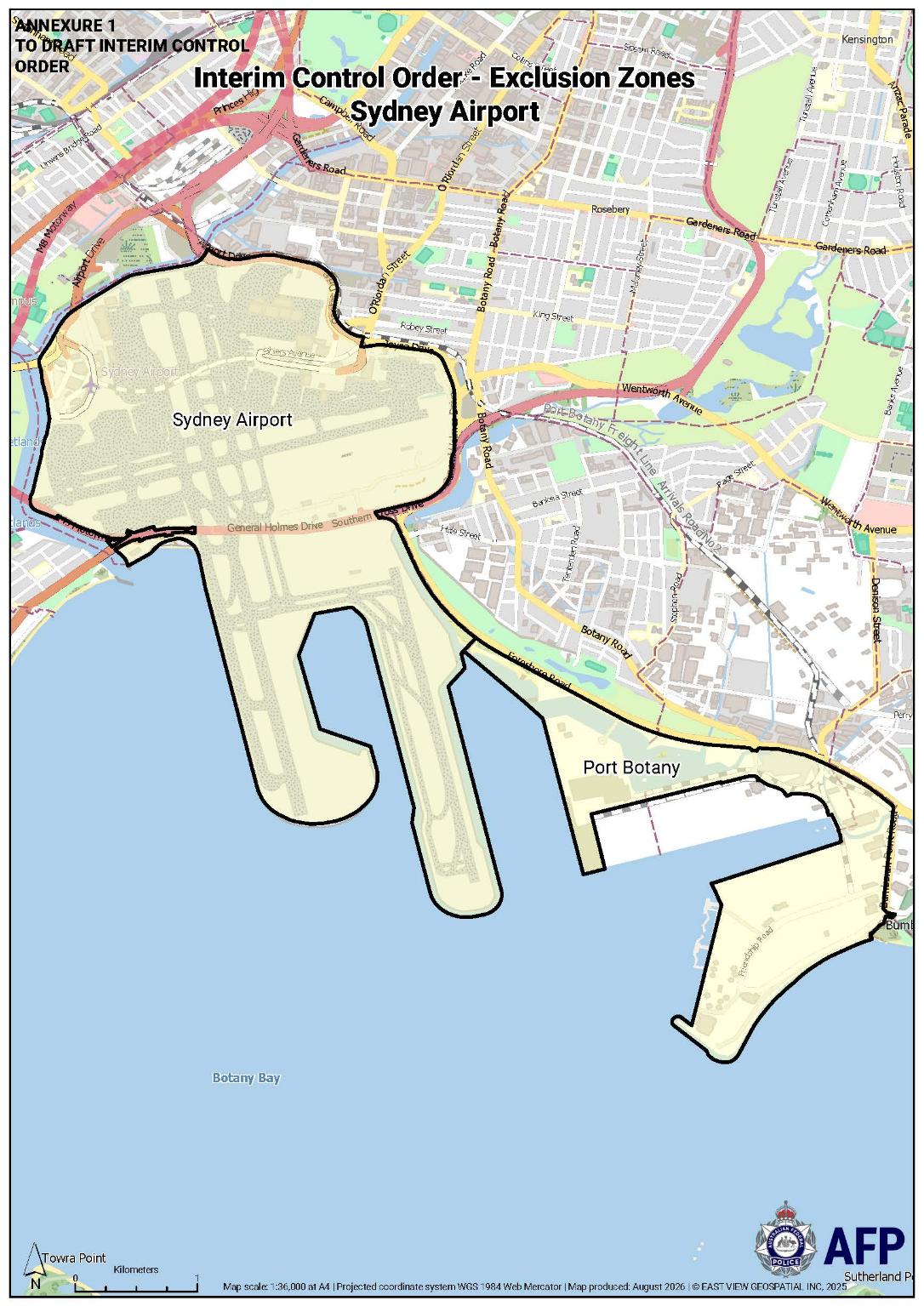
a. the exclusion zone at Sydney Airport, as identified by yellow shading in Annexure 1;
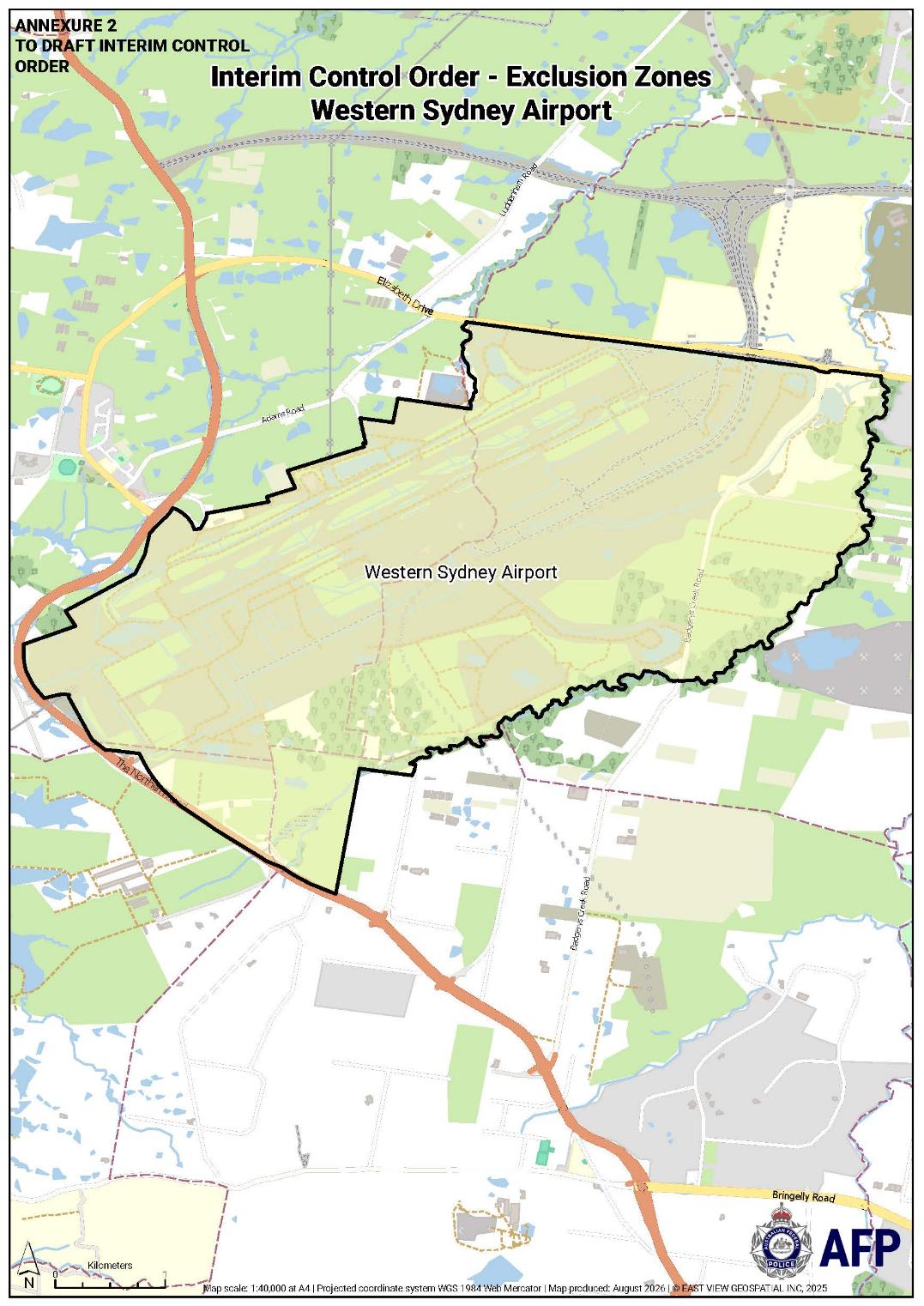
b. the exclusion zone at Western Sydney Airport, as identified by yellow shading in Annexure 2;
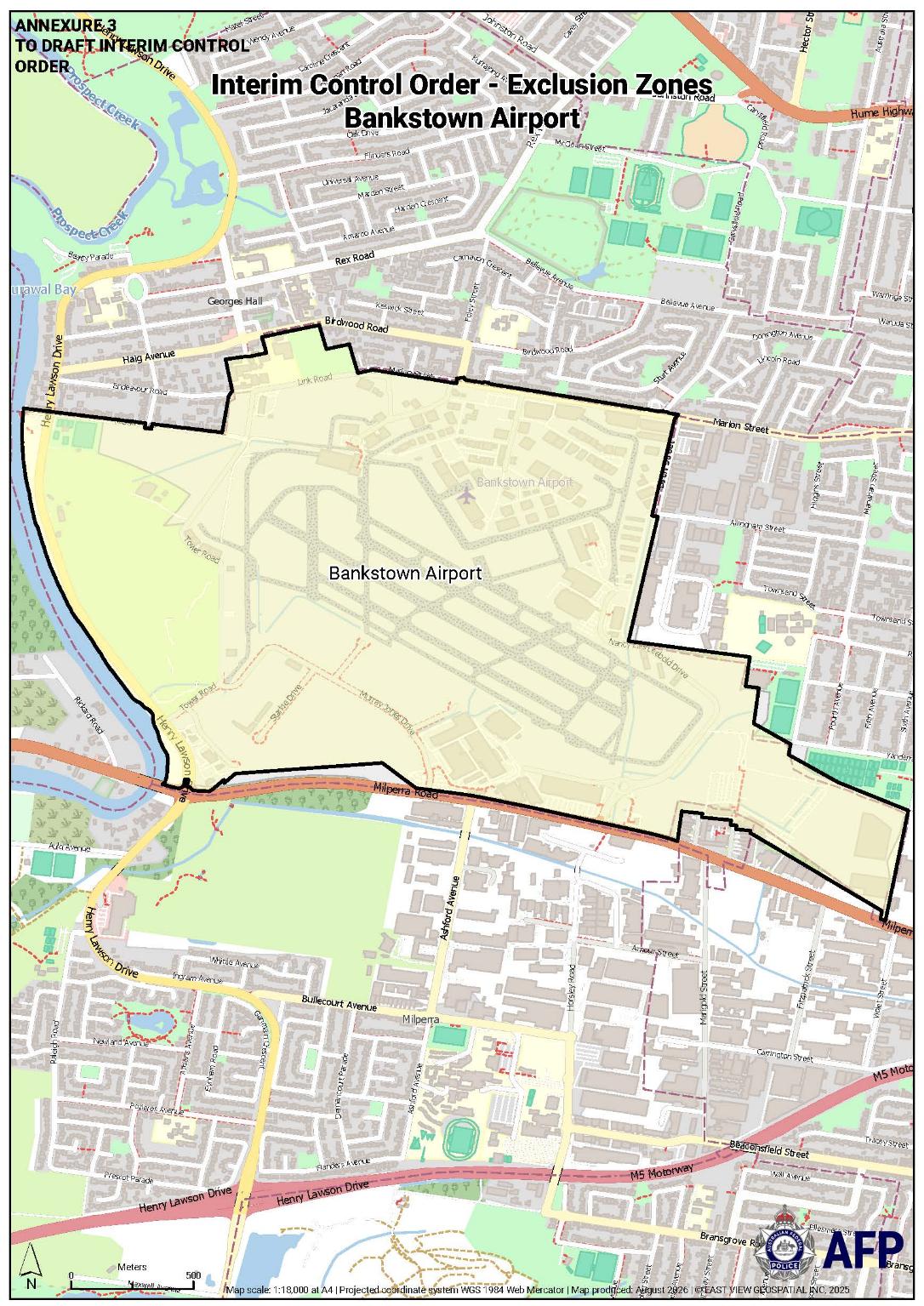
c. the exclusion zone at Bankstown Airport, as identified by yellow shading in Annexure 3;
d. within 1 km of any other Australian airport which has an international point of departure, or from which a person can board or charter a flight for an international destination;
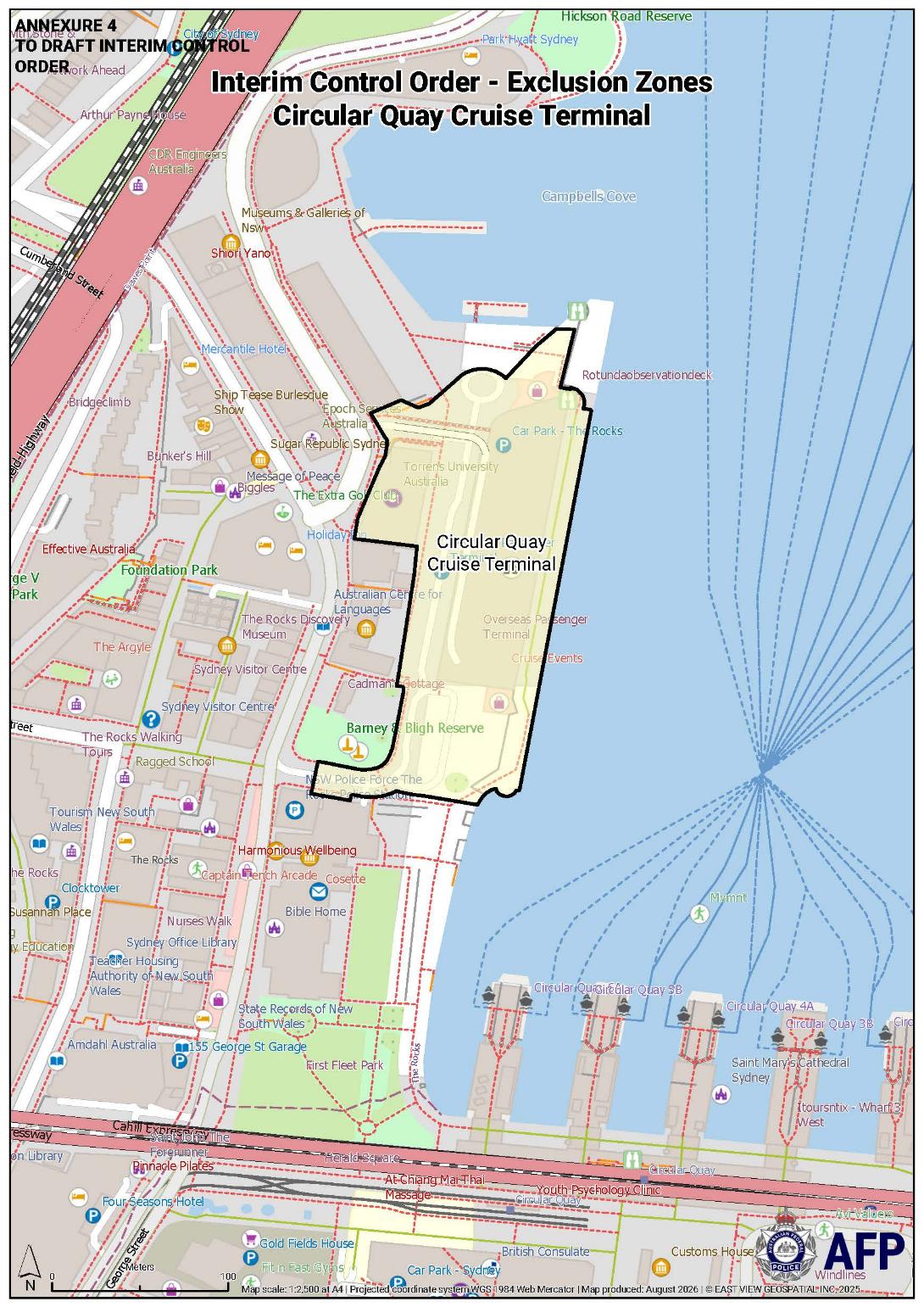
e. the exclusion zone at Circular Quay, as identified by yellow shading in Annexure 4;
f. the exclusion zone at White Bay, as identified in Annexure 5;
g. within 1 km of any other Australian port which has an international point of departure, or from which a person can board or charter a marine vessel for an international destination;
h. any prison or correctional facility unless you are detained there;
h. the residence of any person whom you are prohibited from communicating or voluntarily associating with (see Condition 9);
j. any residence or premises occupied by any person who holds a firearms licence in Australia; or
k. any place where firearms or ammunition are stored, sold or used, including firearm dealers, shooting ranges or private premises where firearms are stored.
5.2. If the AFP Superintendent issues you with a reasonable direction to not be present at any area or place, you must not be present at that area or place
DISENGAGEMENT AND REHABILITATION
6. Case management
6.1. You must call or meet with a Community Corrections officer, including for the purpose of providing you with supervision and guidance, at the request of a Community Corrections officer when they give you a reasonable direction to do so.
6.2. You must be available for interview at such times and places, including in the specified premises, as a Community Corrections officer may from time to time direct.
7. Support and Intervention Programs
7.1. You must attend any support, rehabilitation or disengagement programs or services, as directed by a Community Corrections Officer.
7.2. You must attend any psychological or psychiatric assessment or counselling, as directed by a Community Corrections Officer, including for the purpose of a Mental Health Care Plan or Community Treatment Order.
8. Sharing Information
8.1. You must allow the provider of any service described in Condition 7.1 and 7.2 to share information with the AFP Superintendent or a Community Corrections officer about when and for how long you met with them and any safety concerns they may have, including regarding your risk.
RESTRICTIONS ON ASSOCIATIONS
9. Who you must not communicate with
9.1. You must not communicate by any means (including through third parties) with anyone who is detained in a correctional facility, unless you are detained in that facility.
9.2. You must not communicate by any means (including through third parties) with anyone you know or suspect to be located overseas, unless they are a close family member. However, before you communicate with a close family member who is located overseas, you must advise the AFP Superintendent in writing of the full name and contact details of the close family member.
9.3. You must not communicate or associate by any means (including through third parties) with anyone you know or suspect to be, or who professes to be, a member of Islamic State or any other terrorist organisation.
9.4. You must not communicate or associate by any means (including through third parties) with any person known to you to be convicted of, or currently charged with:
a. a 'terrorism offence' within the meaning of section 3(1) of the Crimes Act 1914 (Cth);
b. an offence under the Crimes (Foreign Incursions and Recruitment) Act 1978 (Cth);
c. an offence against Subdivision C of Division 80 of the Criminal Code (Cth) ('Urging or threatening violence, offences against groups or members of groups and advocating terrorism or genocide');
d. an offence against Subdivision CA of Division 80 of the Criminal Code (Cth) ('Publicly displaying, and trading in, prohibited symbols and giving Nazi salute'); or
e. an offence against Part 5.3B of the Criminal Code (Cth) (Prohibited hate groups).
9.5. You must not communicate or associate by any means (including through third parties) with any person known to you to be currently or previously subject to:
a. a control order made under Division 104 of the Criminal Code; or
b. an interim or extended supervision order made under the Terrorism (High Risk Offenders) Act 2017 (NSW) or Division 105A of the Criminal Code.
9.6. If the AFP Superintendent issues you with a reasonable direction to not communicate or associate with a person, you must not communicate or associate with that person by any means (including through third parties).
EMPLOYMENT, EDUCATION AND GROUP ACTIVITIES
10. Employment and Education
10.1. You must tell the AFP Superintendent at least 48 hours before starting any job, employment, volunteer work, vocational training, or education.
10.2. You must tell the AFP Superintendent at least 48 hours before you form any corporation, partnership, or incorporated association, or register a business name or operate a business.
10.3. You must give any information the AFP Superintendent directs you to give about the things listed in Conditions 10.1 and 10.2.
11. Groups and Activities
11.1. You must not form, join or otherwise become involved with any groups, clubs or organisations (including online) which:
a. circulate or discuss violent extremist material or material created by a terrorist organisation or a prohibited hate group (other than as part of a program or service that you are directed to attend under condition 7);
b. claim to be part of a terrorist organisation or a prohibited hate group;
c. advocate for, or support a terrorist organisation or a prohibited hate group; or
d. advocate for, or support the doing of terrorist acts, either in Australia or overseas.
11.2. You must not provide counselling, teaching or mentoring services in relation to any of the following matters:
a. carrying out, authorising or permitting violence;
b. the activities of any terrorist organisation;
c. material published, produced or endorsed by any terrorist organisation;
RESTRICTIONS ON WEAPONS, DOCUMENTS, MEDIA AND OTHER PROHIBITED ITEMS
12. Weapons and Other Prohibited Items
12.1 You must not buy, make, possess or use:
a. a knife or other object with a blade (subject to Condition 12.2);
b. firearms, a firearm part, or ammunition within the meaning of section 4 of the Firearms Act 1996 (NSW);
c. a 'prohibited weapon' within the meaning of the Weapons Prohibition Act 1998 (NSW);
d. an article or device, not being a firearm, capable of discharging by any means:
i. any irritant matter in liquid, powder, gas, or chemical form, or any dense smoke, unless possession or usage is consistent with reasonable domestic or work-related purposes; or
ii. any substance capable of causing bodily harm, unless possession or usage is consistent with reasonable domestic or work-related purposes.
e. a detonator;
f. a fuse capable of use with an explosive or detonator
12.2. Condition 12.1(a) does not prohibit you from possessing or using a knife if it is:
a. ordinary cutlery used for eating; or
b. a kitchen knife within your household for ordinary domestic purposes.
12.3. You must not be in the company of any person who you know has, on their person or in a vehicle in which you are travelling with them, any of the items referred to in condition 12.1 (subject to Condition 12.2, modified so as to apply to that person).
12.4. You must not possess any quantity of petroleum exceeding 4 litres except petrol contained in the petrol tank of a vehicle.
12.5. You must not possess any quantity of any chemical which is not consistent with ordinary domestic purposes.
13. Possessing documents and other media
13.1 You must not possess or access documents and other media that:
a. relates to any of the following:
i. propaganda or promotional material for a terrorist organisation; or
ii. activities of, or otherwise associated with, any terrorist organisation;
b. instructs, advocates, encourages or praises the use or making of:
i. a 'prohibited weapon' within the meaning of s 4(1) of the Weapons Prohibition Act 1998 (NSW);
ii. arson;
iii. a 'firearm', a 'firearm part' or 'ammunition' within the meaning of s 4(1) of the Firearms Act 1996 (NSW);
iv. genocide or the persecution of an ethnic or religious group;
v. counter-surveillance;
vi. terrorism; or
vii. violence, including but not limited to shooting, immolation, stabbing, bombing, beheading, torture and execution.
c. depict, describe or relate to:
i. Prohibited symbols;
ii. Manuals or instructions on carrying out terrorist attacks, counter-surveillance or making explosives, weapons or firearms.
13.2. Condition 13.1 does not apply to a document or other media if the document or other media is:
a. published by the Australian Broadcasting Corporation (ABC), Australian Community Media (ACM), News Corp Australia, Nine Entertainment Co, Schwartz Media, Seven West Media, the Special Broadcasting Service (SBS), the British Broadcasting Corporation (BBC), CNN, CBS, PBS, NBC, the Guardian and any other publisher or broadcaster approved in writing by the AFP Superintendent;
b. broadcast on Australian free to air or pay television;
c. broadcast on the following streaming services available in Australia: 7plus, 9Now, 10play, ABC iView, Apple TV+, Amazon Prime, Binge, Disney+, HBO Max, Kayo Sports, Netflix; Paramount Plus, SBS on Demand, STAN and any other streaming service approved in writing by the AFP Superintendent;
d. broadcast in Australia by a licenced AM or FM radio station;
e. shown in a commercial movie cinema; or
f. contained in material that is received by you or your legal representatives, or created by your legal representatives, for the purpose of any legal proceeding you are involved in (referred to as 'Court Material').
14. Creating or sharing documents and other media
14.1. You must not create, publish or share documents and other media that:
a. relates to any of the following:
i. propaganda or promotional material for a terrorist organisation; or
ii. activities of, or otherwise associated with, any terrorist organisation;
b. depicts, describes or relates to:
i. a 'prohibited weapon' within the meaning of s 4(1) of the Weapons Prohibition Act 1998 (NSW);
ii. arson;
iii. explosives;
iv. prohibited symbols;
v. manuals or instructions on carrying out terrorist attacks, counter-surveillance or making explosives, weapons or firearms;
vi. terrorism;
vii. violence, including but not limited to shooting, immolation, stabbing, bombing, beheading, torture and execution.
c. Condition 14.1 does not prohibit you from distributing, or directing a person to distribute, Court Material for the purpose of the conduct of any legal proceeding you are involved in.
PHONE, COMPUTER AND INTERNET USE
15. Phone rules
15.1. The AFP Superintendent will give you a phone and SIM card. This is referred to as the 'AFP phone' and 'AFP SIM card'. Apart from the AFP phone and AFP SIM card and except as expressly specified in this Interim Control Order you must not use any other phone or SIM card.
15.2. The AFP Superintendent will provide you with the following information:
a. the password for the AFP phone; and
b. the phone number for the AFP phone.
15.3. You must:
a. keep your AFP phone switched on, charged and with you at all times;
b. be available to answer any call from the AFP Superintendent or, as soon as reasonably practicable, return a call that you have been unable to answer;
c. comply with any reasonable direction the AFP Superintendent gives you in relation to Conditions 15.3(a) and (b);
d. provide passwords and PIN codes for your AFP phone and any files, folders, programs and applications on your AFP phone, when directed to do so by a police officer for the purposes of searching or seizing your AFP phone or data within or accessible from it;
e. permit one or more police officers to inspect, repair, service, or replace your AFP phone or AFP SIM card, when directed to do so by a police officer;
f. if you become aware that your AFP phone, AFP SIM card or charging equipment is not working properly, notify the AFP Superintendent as soon as possible and, in any case, within 12 hours of becoming aware.
15.4. You must not:
a. enable any face ID, fingerprint, or other biometric security features on the AFP phone;
b. change the password for the AFP phone unless:
i. the AFP Superintendent has given you approval to do so; and
ii. you have provided the new password to the AFP Superintendent.
c. let anyone else use your AFP phone or AFP SIM card unless it's an emergency. If this happens, you must tell the AFP Superintendent as soon as reasonably possible;
d. connect your AFP phone to any Wi-Fi network, including public Wi-Fi and your home Wi-Fi;
e. connect your AFP phone to any other device, or allow another device to connect to your AFP phone, by any means, such as Wi-Fi, internet, hotspot or Bluetooth;
f. tamper with, damage or destroy any component of your AFP phone or any equipment necessary for the operation of your AFP phone (e.g. charging cables);
g. change, remove, modify or disconnect the SIM card, telecommunication service provider or phone number connected to your AFP phone;
h. utilise any call-forwarding to your AFP phone, or from your AFP phone to another device;
i. obtain a different SIM card or eSIM;
j. delete, clear or erase web browser history or phone data history (cache/cookies) from your AFP phone; or
k. ask or allow any other person to make calls or send messages on a different device on your behalf.
15.5. There are exceptions to the above conditions 15.1, 15.3 and 15.4. You may:
a. connect your AFP computer to your AFP phone (see Condition 16 below);
b. connect your AFP phone to the AFP internet service (see Condition 16 below);
c. use the Bluetooth function on your AFP phone to connect to personal Bluetooth enabled devices (such as headphones or an in-car Bluetooth connection);
d. use another phone for the sole purpose of telling the AFP Superintendent that the AFP phone or AFP SIM card is not working;
e. use another phone in an emergency to call '000' or the State Emergency Services (SES).
15.6. If you obtain a job which requires you to use a different phone you must notify the AFP Superintendent of that phone prior to you first using it. This is referred to as the 'work phone'. You must also provide the following details about the work phone to the AFP Superintendent prior to you first using it:
a. the reason(s) why the work phone is necessary for your job;
b. the function(s) of the work phone that you will use (eg phone calls, messaging, internet browsing), including any applications or programs you will use;
c. whether the work phone will be used by any other person;
d. the brand and model of the work phone;
e. the phone number for the work phone; and
f. the International Mobile Equipment Identity number for the work phone.
15.7. You may use the work phone for the purpose of your job only.
16. Computer and Internet Rules
16.1. The AFP Superintendent will give you a computer or tablet device. This is referred to as the 'AFP computer'. Apart from your AFP computer and your AFP phone, you must not use any other computer, tablet or internet capable device.
16.2. The AFP Superintendent will arrange for you to be provided with an internet service for use with your AFP computer. This is referred to as the 'AFP internet service'. You must not use any other internet service.
16.3. You must:
a. provide passwords and PIN codes for your AFP computer and any files, folders, programs and applications on your AFP computer, when directed to do so by a police officer for the purposes of searching or seizing your AFP computer or data within or accessible from it;
b. permit one or more police officers to inspect, repair, service, or replace your AFP computer, when directed to do so by a police officer;
c. if you become aware that your AFP computer or associated equipment is not working properly, notify the AFP Superintendent as soon as possible and, in any case, within 12 hours of becoming aware.
16.4. You must not:
a. Use any other computer or internet capable device, either directly or indirectly through wireless networks, online access or Bluetooth connections.
b. Let anyone else use your AFP computer unless it is an emergency. You must tell the AFP Superintendent as soon as practicable after this happens;
c. Connect your AFP computer to any Wi-Fi network, including public Wi-Fi and your home Wi-Fi;
d. Connect your AFP computer to any other device, or allow another device to connect to your AFP computer, by any means, such as Wi-Fi, internet, hotspot or Bluetooth;
e. Tamper with, damage or destroy any component of your AFP computer or any equipment necessary for the operation of your AFP computer (e.g. charging cables);
f. Ask or allow any other person to do these things.
16.5. There are exceptions to the above conditions 16.1, 16.2 and 16.4. You may:
a. connect your AFP phone to your AFP computer.
b. use the Bluetooth function on your AFP computer to connect to personal Bluetooth enabled devices (such as headphones or a wireless keyboard). You must not connect your AFP computer to any other phone, computer or internet capable device.
c. Use a computer or internet capable device and internet service to make ordinary business transactions (such as using an EFTPOS terminal, ATM or ordering food via a self-serve screen).
d. Use a smart TV connected to the internet to access television services and streaming services. You must not access a smart TV's internet browser or any chat or social media capabilities.
16.6 If you obtain a job where the employer requires you to use a different computer or internet capable device, you must notify the AFP Superintendent before using that computer or device. This is known as the 'work computer'. You must also provide the following details about the work computer to the AFP Superintendent prior to you first using it:
a. the reason(s) why the work computer is necessary for your job;
b. the functions of the work computer you will use including any applications or programs you will use;
c. any data storage or cloud storage you will use in connection with the work computer;
d. whether the work computer will be used by any other person;
e. the brand and model of the work computer;
f. any usernames you will use to sign in to the work computer or to operate software on the work computer;
g. any phone number or SIM card number connected to the work computer; and
h. the International Mobile Equipment Identity number or serial number for the work computer.
16.7. You may use the work computer for the purpose of your job only.
16.8. If you undertake study which requires the use of a different computer or internet capable device, you may seek approval from the AFP Superintendent. This is known as the 'study computer'. You must not use the study computer unless the AFP Superintendent has approved you to use it. When seeking approval, you must provide the following details about the study computer to the AFP Superintendent:
a. the reason(s) why the study computer is necessary for your study;
b. the functions of the study computer you will use including any applications or programs you will use;
c. any data storage or cloud storage you will use in connection with the study computer;
d. whether the study computer will be used by any other person;
e. the brand and model of the study computer;
f. any usernames you will use to sign in to the study computer or to operate software on the study computer;
g. any phone number or SIM card number connected to the study computer; and
h. the International Mobile Equipment Identity number or serial number for the study computer.
16.9. If your request is approved, you may use the study computer specified in the approval for the purpose of your study only.
17. Email Use
17.1. You must not use any email account other than the 'AFP email account' or an account approved under Condition 17.2.
17.2. You may nominate an email account to be the AFP email account. If the AFP Superintendent approves that email account, you may use it subject to the following limitations:
a. if you sign up for any online account or engage in any transaction which requires an email address, you must use this email account.
b. you must not use any function or application which uses temporary or forwarding emails (such as an iPhone's 'Hide My Email' function).
17.3. If you obtain a job or undertake study which requires a different email account, you must notify the AFP Superintendent before using that email account. This is known as the 'work or study email account'. You must also provide the following details about the work or study email account to the AFP Superintendent prior to its first use:
a. the reason(s) why the work or study email account is necessary for your job, vocational training or education;
b. whether the work or study email account will be used by any other person;
c. the email address for the work or study email account.
17.4. You may use the work or study email account for the purpose of your job, vocational training or education only.
18. Programs, Applications and Data
AFP phone and AFP computer
18.1. Conditions 18.2, 18.3, 18.4, 18.5, 18.6 and 18.7 apply to your AFP phone, AFP computer and AFP internet service.
18.2. You must only use the applications and programs that are already on your AFP phone or AFP computer at the time they are provided to you, or which are approved in writing by the AFP Superintendent.
18.3. You must not:
a. install any programs or applications without prior approval from the AFP Superintendent;
b. use any social media or messaging services not approved by the AFP Superintendent;
18.4. There is an exception to the above Condition 18.2 and 18.3(a)
a. You may install software updates that are automatically available on your AFP phone or AFP computer.
18.5. If you want to use an application or program that is not already on your AFP phone or AFP computer, you can ask the AFP Superintendent to approve the application or program (see Condition 23).
18.6. If you want to use a social media or messaging service, you can ask the AFP Superintendent to approve the social media or messaging service.
18.7. You must not do any of the following in relation to your AFP phone, AFP computer and AFP internet service:
a. hide any online information or activity (including by using private browsing, incognito/ hidden move, or using a VPN);
b. use any data storage or cloud storage other than the cloud storage account provided to you with your AFP phone or AFP computer;
c. deliberately delete or alter any of the following on or from your AFP phone or AFP computer: applications; programs; emails; text messages; electronic messages; call history; data; internet or application search history; application chat or communication history.
Other approved devices
18.8. Conditions 18.9 to 18.11 applies to any other internet capable devices that you are approved to use under this order (other approved devices).
18.9. You must not use any social media or messaging services not approved by the AFP Superintendent on other approved devices.
18.10. If you want to use a social media or messaging service on other approved devices, you can ask the AFP Superintendent to approve a social media or messaging service.
18.11. You must not do any of the following in relation to other approved devices:
a. hide any online information or activity (including by using private browsing, incognito/hidden move, or using a VPN);
b. use any data storage or cloud storage other than the cloud storage account provided to you with your AFP phone or AFP computer;
c. deliberately delete or alter any of the following on or from other approved devices: applications; programs; emails; text messages; electronic messages; call history; data; internet or application search history; application chat or communication history.
19. Access to accounts and devices
19.1. You must give the AFP Superintendent access to your AFP phone, AFP computer and study computer and any password protected applications or files held on your AFP phone, AFP computer or study computer, and any of your email and other online accounts, when directed to do so for the purposes of the AFP Superintendent searching or seizing the device or accessing data held within or accessible from it.
19.2. You must give the AFP Superintendent access to any device in your possession when directed to do so for the purposes of the AFP Superintendent searching or seizing the device or accessing data held within or accessible from it.
FINANCES
20. Finances
20.1. Within 72 hours after this order comes into force, you must provide the AFP Superintendent with the details of any bank accounts, cryptocurrency accounts and any other financial accounts you own or control.
20.2. If you open a new bank account, cryptocurrency account or other financial account, you must notify the AFP Superintendent in writing with 72 hours and provide the account details.
20.3. You must not make any gift, donation, or financial contribution to any organisation, association, entity or charity howsoever described without first notifying the AFP Superintendent in writing of your intention to do so and providing a receipt of the payment thereafter.
REASONABLE DIRECTION AND PROHIBITION ON PROVIDING FALSE OR MISLEADING INFORMATION
21. Reasonable direction
21.1. You must comply with any reasonable direction given to you by the AFP Superintendent or a police officer in connection with Conditions 1-20 in this order.
21.2. You must comply with any reasonable direction given to you by a Community Corrections Officer in connection with Conditions 6 and 7 in this order.
22. Prohibition on providing false or misleading information
22.1. If a specified authority directs you under this order to give information, you must not give false or misleading information to them.
Exemptions and Approvals
23. Getting Exemptions
23.1. You can request an exemption to any of these conditions by writing to the AFP Superintendent.
a. You must provide the reason why you are requesting an exemption and any other information that the AFP Superintendent directs you to provide in relation to the request. If you do not provide the information you are directed to provide, your request may not be considered.
b. The AFP Superintendent can grant or deny the request for an exemption.
23.2. The AFP Superintendent can also grant an exemption to any condition without you requesting an exemption. The AFP Superintendent will provide you with reasonable notice in writing of any exemption granted under this Condition.
23.3. If an exemption is granted under either Condition 23.1.b. or 23.2, the AFP Superintendent can make it subject to reasonable directions that will be given to you in writing and you must comply with those directions.
23.4. The AFP Superintendent may cancel any exemption that has been granted by providing reasonable notice to you in writing. After you are notified that an exemption to a condition has been cancelled, you must comply with the condition as it is written in this order.
24. Getting Approvals
24.1. This applies to any conditions which allow you to seek approval from the AFP Superintendent to do something (for example, to install and use a new program or application on the AFP phone or AFP computer).
24.2. You can request an approval by submitting a written request to the AFP Superintendent. You must provide any information the AFP Superintendent directs you to provide in relation to the request. If you do not provide the information you are directed to provide, your request may not be considered.
24.3. The AFP Superintendent can approve or deny these requests. If a request is approved, the AFP Superintendent can make it subject to reasonable directions that are specified in writing and you must comply with those directions.
24.4. The AFP Superintendent can also grant an approval without you requesting an approval. The AFP Superintendent will provide you with reasonable notice in writing of any approval granted under this Condition.
24.5. The AFP Superintendent may cancel any approval that has been granted by providing reasonable notice to you in writing. After you are notified that an approval has been cancelled, that approval no longer has any effect.
25. Attempting to contravene this order or causing a third party to do something on your behalf
25.1. Where this order prohibits you from doing something, you must not attempt to do that thing. For example, you must not attempt to leave Australia.
25.2. Where this order prohibits you from doing something, you must not ask or cause someone else to do that thing on your behalf. For example, where you are prohibited from communicating with a person by Condition 9, you must not ask someone else to communicate with that person on your behalf.
Definitions
In this order:
AFP Superintendent means a member of the Australian Federal Police performing the duties of a Superintendent within the Counter Terrorism Command and includes any AFP member or special member authorised to perform duties or functions or otherwise act on behalf of a Superintendent within the Counter Terrorism Command in connection with this control order.
close family member has the same meaning as in s 102.1(1) of the Criminal Code.
Community Corrections officer means an employee of Community Corrections whose contact details are provided at the time of the order coming into force, and any other employee of Community Corrections who may be involved in your supervision from time to time.
Documents and other media means any hardcopy or electronic record of information and includes, but is not limited to, video and audio recordings, pictures, computer games, online articles and social media 'posts.' Sharing documents and other media includes, but is not limited to, sharing an electronic link to that material.
emergency means a situation that threatens your safety or the safety of close family members (see definition of 'close family member') or threatens to destroy or damage the specified premises.
Internet capable device includes any phone, computer, laptop, tablet, gaming device, television, or any other electronic device capable of connecting to the internet (either directly or by connecting to a wireless network). A device can be an internet capable device even if it is not currently connected to the internet.
Police officer means:
a. a 'member' or 'special member' of the Australian Federal Police, as defined by the Australian Federal Police Act 1979 (Cth); or
b. a 'police officer' as defined in the Police Act 1990 (NSW).
Password includes but is not limited to any passcode, swipe pattern or any information or function necessary to facilitate access to a device or account.
Phone means a phone of any kind, including but not limited to a mobile phone, Voice Over Internet Protocol (VoIP) phone, landline phone, satellite phone or public payphone.
Prohibited hate group has the same meaning as s 114A.1 of the Criminal Code (Cth).
Prohibited symbol includes a 'prohibited organisation symbol' as defined in s 80.2E(3) of the Criminal Code (Cth).
Reasonable direction means a direction that the specified authority giving the direction is satisfied is reasonable in all the circumstances to give effect to:
a. the condition; or
b. the object of Division 104 of the Criminal Code (Cth).
Social media or messaging service means any internet-based service that can be used to communicate with, or broadcast or disseminate information to, other users such as WhatsApp, Instagram, Signal, Telegram and Facebook. For the avoidance of doubt, 'using' a social media or messaging service includes using that service via a web browser.
Specified authority has the same meaning as in s 100.1 of the Criminal Code and includes the AFP superintendent, a police officer and a Community Corrections officer.
Terrorist organisation has the same meaning as s 102.1 of the Criminal Code (Cth)
Violent extremist material has the same meaning as s 474.45A of the Criminal Code (Cth).
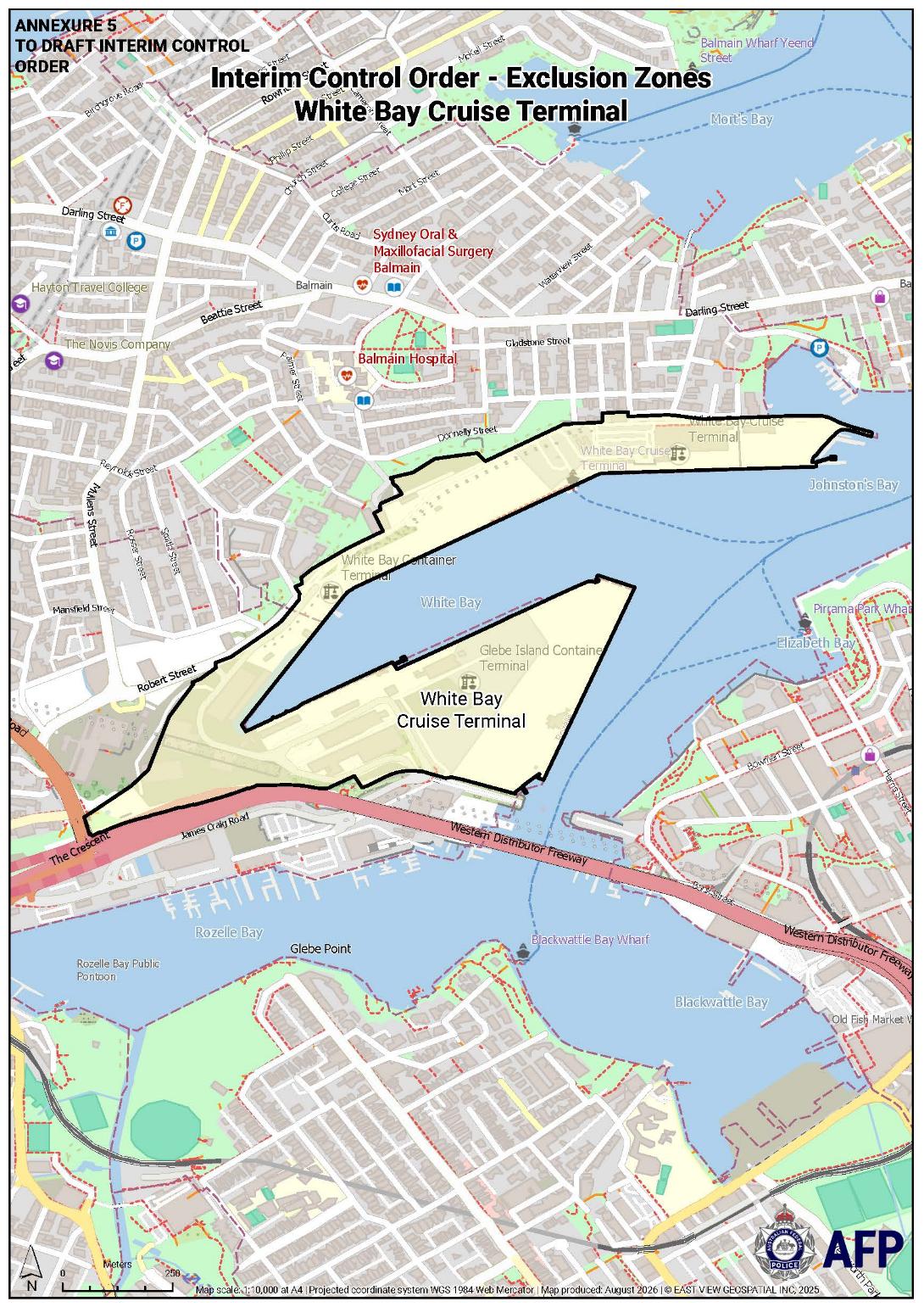
ANNEXURE B
SUMMARY OF GROUNDS ON WHICH THE ORDER SHOULD BE MADE
Criminal Code (Cth), section 104.2(3)(c)
1. The following is a summary of the grounds on which an interim control order should be made (SOG). The SOG has been prepared pursuant to s 104.2(3)(c) of the Criminal Code Act 1995 (Cth) (Criminal Code).
OVERVIEW
2. The order should be made because:
2.1. Isaac El Matari has been convicted in Australia of an offence relating to terrorism or a terrorist act: s 104.4(1)(c)(iv) of the Criminal Code.
2.2. Pursuant to s 104.4(1)(d) of the Criminal Code, having regard to the matters set out in the “Statement of facts relating to why the order should be made” (SOF-For) and the “Statement of facts relating to why the order should not be made” (SOF-Against), each of the conditions proposed to be imposed on Mr El Matari by the interim control order, and the combined effect of those conditions, is reasonably necessary, and reasonably appropriate and adapted, for the purpose of:
2.2.1. protecting the public from a terrorist act
2.2.2. preventing the provision of support for or the facilitation of a terrorist act, or
2.2.3. preventing the provision of support for or the facilitation of the engagement in a hostile activity in a foreign country.
Offence relating to terrorism or a terrorist act
3. On 11 October 2021, Garling J of the Supreme Court of New South Wales convicted Mr El Matari of:
3.1. between July 2018 and 20 September 2019, doing an act in preparation for, or planning of, terrorist acts, contrary to s 101.6(1) of the Criminal Code (the terrorism preparation offence)
3.2. between 1 January 2019 and 2 July 2019, intentionally engaging in conduct that was preparatory to the commission of an offence under s 119.1 of the Criminal Code, namely entering Afghanistan via Pakistan with the intention of engaging in hostile activity in that or any other foreign country, contrary to s 119.4(1) of the Criminal Code (the foreign incursion preparation offence)
(together, the index offences).
4. Mr El Matari also admitted that he was knowingly a member of a terrorist organisation (namely Islamic State) between January 2019 and September 2019, contrary to s 102.3(1) of the Criminal Code (the membership offence), so that the membership offence could be taken into account in sentencing him pursuant to s 16BA of the Crimes Act 1914 (Cth).
5. Justice Garling sentenced Mr El Matari to a total term of 7 years and 4 months’ imprisonment, with a non-parole period of 5 years and 6 months. Mr El Matari has not been granted parole and remains in custody. His sentence is due to expire on 1 November 2026.
6. The index offences are properly characterised as offences ‘relating to’ terrorism.
CONDITIONS ARE REASONABLY NECESSARY, APPROPRIATE AND ADAPTED
Risk posed by Mr El Matari
7. There is a real risk that upon his release from prison, Mr El Matari will engage in behaviours or conduct which may lead to him committing, supporting or facilitating a terrorist act, or supporting or facilitating the engagement in a hostile activity in a foreign country.
8. The existence of that risk is evident from the following matters, which are set out in further detail in the SOF-For.
Repeated offending in support of Islamic State
9. Offending in Lebanon: In August 2017, then aged 18, Mr El Matari travelled from Australia to Lebanon with the intention of entering Syria to join Islamic State (IS). Once in Lebanon, Mr El Matari contacted various individuals whom he believed could assist him to travel to Syria and join IS.
10. In September 2017, Mr El Matari was arrested by Lebanese authorities in Tripoli. He was sentenced to 12 months’ imprisonment for attempting to join IS in Syria, but was released in June 2018 after serving 9 months of that sentence.
11. Index offending: Shortly after his return to Australia, Mr El Matari began committing the index offences, which involved the preparation for and planning of terrorist attacks in Australia and entry into Pakistan with the intention of travelling to IS-held territory to engage in hostile activity.
12. The terrorism preparation offence occurred over the course of approximately 14 months and the foreign incursion preparation offence occurred over the course of approximately 7 months. Both involved consistent and sustained effort towards, and focus on, achieving the goal of carrying out a terrorist act in Australia and travelling to Afghanistan to engage in hostile activities. This included Mr El Matari:
12.1. engaging in numerous discussions with associates and unidentified persons about acquiring weapons, including firearms and explosives;
12.2. discussing potential targets of terrorist acts, including military barracks, police stations, courts, the NSW State Library, NSW Parliament, St Mary’s Cathedral, consulates and businesses, and explaining that he knew how to select a target so as to convey a political message and to make people scared;
12.3. expressing the view that it is the religious duty of Muslims to fight disbelievers and “infidels” and discussing the “obligation of jihad”;
12.4. expressing support for IS, including by discussing whether he could convert others to support IS, and expressing the desire to establish an IS militia in Australia of which he would be the “General Commander”;
12.5. listening to (and in some cases, chanting along with) nasheeds which included lyrics about IS, pledging allegiance, jihad and fighting, and possessing other violent and pro-Islamic State media;
12.6. applying for and obtaining a passport, making inquiries about obtaining a Pakistani visa, attending travel agents and booking flights, and attending and making inquiries of consulates to further his travel plans;
12.7. making efforts to deceive authorities into believing his intended travel was for innocent purposes;
12.8. speaking about travelling to Khorasan and “the frontline”, becoming a “mujahid” (fighter in the cause of Allah), killing infidels/disbelievers (including by beheading) and praying for victory of the mujahideen “in all the States of the Islamic Caliphate”;
12.9. making inquiries about obtaining weapons in Pakistan and Afghanistan; and
12.10. speaking to others about travelling to Khorasan.
13. Even after his arrest on 2 July 2019, Mr El Matari continued to engage in the terrorism preparation offence. In September 2019, he wrote a letter to a cellmate:
13.1. describing how he continued to plan for terrorist attacks in Australia and
13.2. discussing the purchase of weapons, explosives, bombs and suicide vests through his contacts in Lebanon and Pakistan.
14. Membership offence: At the time of his offending, Mr El Matari was a member of IS, as is reflected in the membership offence. He pledged his allegiance to IS, referred to himself as the “General Commander for the Australia State” and sought to inspire others to join IS.
15. Absence of established deterrent effect: The index offending occurred in the context of Mr El Matari having already been convicted and imprisoned in Lebanon for attempting to travel to Syria to join IS. It is apparent that experience did not have a deterrent effect on him. If anything, his subsequent conduct suggests that it may have emboldened him to re-offend.
16. In those circumstances, there is good reason to approach with a high degree of caution any claim by Mr El Matari that his imprisonment in Australia will deter him from future offending.
Enduring support for Islamic State
17. [REDACTED] [REDACTED] [REDACTED] [REDACTED] [REDACTED] [REDACTED] [REDACTED] [REDACTED] [REDACTED]. IS is, and has been for many years, a transnational Sunni Islamist insurgent and terrorist group that adheres to a global jihadist ideology. It inspires, encourages, enables and directs attacks internationally, ranging from low-capability attacks with knives or vehicles, through to more complex attacks with firearms and explosives. It produces online publications which encourage and provide tactical advice to lone actors to conduct attacks against “non-believers” in the West, including Australians. Mr El Matari’s offending in Lebanon and the index offending were both motivated by his support for IS.
18. Importantly, Mr El Matari commenced the index offending while he was participating in the NSW Engagement and Support Program (ESP). That voluntary program assists individuals to move away from violent extremism. Mr El Matari reportedly showed no signs of radicalisation or extremism during his engagement with that program. He also stated to ESP service providers that he had realised “the truth about ISIS and how their message is a lie”, due to having been incarcerated with ISIS members in Lebanon. Mr El Matari was also mentored by Dr Michael Kennedy, who stated that Mr El Matari never indicated his support for IS.
19. While Mr El Matari appears to have engaged constructively with “countering violent extremism” programs in custody, this too needs to be treated with a high degree of caution. If genuine, that participation may represent a positive step towards his reintegration into the community upon release. However, the genuineness and durability of any attitudinal or behavioural change needs to be assessed in a non-custodial environment. Until that occurs, limited weight should be attributed to his custodial engagement in such programs.
20. That is particularly important because Mr El Matari has a long history of lying and deceiving others in relation to his ideology and offending conduct:
20.1. [REDACTED] [REDACTED] [REDACTED] [REDACTED] [REDACTED].
20.2. In travelling to Lebanon in an attempt to join IS, he actively lied to and deceived his family, friends, travel agents, Australia Border Force personnel, students from the school he briefly stayed at in Lebanon, and his uncle.
20.3. He evidently deceived the ESP and Dr Kennedy following his return from Lebanon.
20.4. An integral feature of the index offending was his attempts to deceive authorities. This involved, amongst other things, marrying Ms Riordan so he could tell the Government he had a reason to return to Australia, and notifying the AFP that he was proposing to travel in August 2019 for study purposes.
Susceptibility to influence from others, and interest in influencing others
21. Mr El Matari has a very limited pro-social network (largely comprised of his father). He has also sought to maintain contact with Radwan Dakkak, an associate from his index offending, and other terrorist offenders during his time in custody. Mr El Matari has indicated a desire to remain in contact with Mr Dakkak following his release from custody.
22. He has communicated and/or corresponded with other serious offenders, including terrorist offenders, while in prison. In some of those letters, Mr El Matari has expressed closeness and affection towards persons who have committed terrorism offences, and those sentiments have been reciprocated.
23. Additionally, there remains the risk that Mr El Matari will be sought out by other persons holding violent extremist views, as has already occurred.
24. He has also reported enjoying public speaking, and has been recorded practising addressing audiences in the context of promoting IS and discussing his wish to preach to others. More recently, he has commenced correspondence and offered to stay in touch with a woman convicted of firearms offences.
Necessity and appropriateness of conditions
25. There is a real risk that, without appropriate conditions in place, Mr El Matari will:
25.1. reengage with extremist views and propaganda;
25.2. reengage with former associates or other persons who hold extremist views and advocate in favour of conduct that supports or facilitates terrorist activity;
25.3. engage in conduct directed to the planning and carrying out of a terrorist act in Australia, or hostile activity in a foreign country, including by encouraging and facilitating others to engage in such conduct.
26. The proposed ICO conditions will ensure Mr El Matari:
a. is provided with a structured opportunity to engage positively with the community (through employment and education);
b. is provided with the opportunity to engage in therapeutic and rehabilitative programs, through participation in disengagement programs, supported by appropriate people and organisations;
c. can be monitored by police during his reengagement with the community, so that police can detect suspicious conduct and unusual patterns of behaviour and can intervene/investigate as necessary;
d. is prohibited from engaging in behaviour and being exposed to influences which may lead him to commit, provide support for or facilitate a terrorist act;
and thereby reduce the risks outlined above.
REASONS FOR JUDGMENT
SHARIFF J:
1. INTRODUCTION
1 The applicant, a senior member of the Australian Federal Police (AFP), applies under s 104.3 of the Criminal Code Act 1995 (Cth) (the Code) for an interim control order (ICO) to be made against the respondent, Mr Isaac El Matari (the ICO Request). Mr El Matari is due to be released from prison on 1 November 2026, after serving 7 years and 4 months’ imprisonment for terrorism offences as referred to below.
2 The ICO Request was made in circumstances where Mr El Matari has engaged in terrorism-related activity. In particular:
(a) in 2017, Mr El Matari was arrested in Lebanon and sentenced to 12 months’ imprisonment in Lebanon for attempting to join and fight with the Islamic State (IS) terrorist organisation in Syria; and
(b) between 2018 and 2019, Mr El Matari engaged in conduct which led to him being convicted and sentenced in 2021 by Garling J in the Supreme Court of NSW for:
(i) engaging in acts in preparation for, or planning, terrorists acts in Australia on behalf of IS, contrary to s 101.6(1) of the Code (Terrorism Preparation Offence); and
(ii) intentionally engaging in conduct preparatory to the commission of an offence of entering Afghanistan with the intention of engaging in hostile activity, contrary to s 119.4(1) of the Code (Foreign Incursion Preparation Offence).
3 In respect of the latter offences, it should be noted that Mr El Matari also admitted to intentionally being a member of IS, contrary to s 102.3 of the Code, but was not convicted for that offence.
4 I heard the present application on 15 October 2026. Mr El Matari was represented by Mr Edwards of Senior Counsel, who was instructed by O’Brien Solicitors. Mr El Matari did not oppose the making of the ICO on an interim basis up until the confirmation hearing that is required to be held.
5 The main question to be determined is whether I am satisfied on the balance of probabilities that the conditions in the proposed ICO sought against Mr El Matari (considered individually and cumulatively) are reasonably necessary, and reasonably appropriate and adapted, for one of the purposes in s 104.4(1)(d) of the Code.
6 In support of the application, the applicant relied on the following affidavits (including exhibits):
(a) affidavit of Jeremy Ewen Staunton sworn on 23 September 2026 (the First Staunton Affidavit);
(b) affidavit of Joel Rivers sworn on 28 September 2026; and
(c) affidavit of Jeremy Ewen Staunton sworn on 13 October 2026 (the Second Staunton Affidavit).
7 The First Staunton Affidavit explains why it is said the proposed conditions should be imposed on Mr El Matari, and are reasonably necessary, and reasonably appropriate and adapted, for one of the purposes in s 104.4(1)(d) of the Code. The exhibited documents include: (a) the conditions of a proposed ICO; (b) a statement of facts relating to why the ICO should be made (the SOF-For); (c) a statement of facts relating to why the ICO should not be made (the SOF-Against); and (d) a summary of the grounds on which the ICO should be made (the Summary of Grounds).
8 The Second Staunton Affidavit provides information about Mr El Matari’s proposed post-release accommodation and clarifies the duration of the ICO sought.
9 Mr El Matari did not file any evidence in reply and, as indicated above, did not oppose the making of the ICO on an interim basis.
10 For the reasons set out below, I am satisfied that the ICO proposed by the applicant should be made. A confirmation hearing will be held on 17 December 2026.
11 Before turning to address my reasons for being satisfied that the interim ICO should be made, it is necessary for me to deal with an application for suppression and non-publication orders. Upon the commencement of these proceedings, on 24 September 2026, Registrar Ditton made orders under s 37AI of the Federal Court of Australia Act 1976 (Cth) as follows:
1. Pursuant to s 37AI(1) of the Federal Court of Australia Act 1976 (Cth) (FCA Act), until the first case management hearing there is to be no disclosure (by publication or otherwise) of the following documents without leave of the Court:
a. The Originating Application dated 23 September 2026; and
b. The Affidavit of Jeremy Ewan Staunton sworn on 23 September 2026 with Exhibit JES-1.
2. Order 1 does not restrict disclosure of those documents to or between the parties and their legal representatives.
3. If a party seeks an order pursuant to s 37AF(1) of the FCA Act, they are to file and serve any affidavit evidence on which they intend to rely by no later than 3 business days before the first case management hearing.
4. The Applicant is to serve a sealed copy of these orders on the Respondent.
12 At the hearing before me, the parties did not press for a continuation of these orders. Rather, the applicant pressed for suppression and non-publication orders in relation to a narrower class of information and documents. Specifically, it was submitted that there were aspects of the First Staunton Affidavit (and, in particular, parts of the Exhibit to that Affidavit), and the Second Staunton Affidavit, which contained material which the applicant contended should be the subject of suppression and non-publication orders. In part, the materials to which I was taken in this regard related to [REDACTED] (which are best not to be further elucidated here) and in other part, related to matters that were the subject of non-publication and suppression orders made as part of Mr El Matari’s sentencing hearing before Garling J. The application was not opposed. During the hearing before me, I was satisfied that Registrar Ditton’s orders should be varied so that they applied only in relation to this specific material, and not others. Although I indicated that it may simply be convenient to extend Registrar Ditton’s orders until the confirmation hearing, I no longer think that is appropriate. Rather, what I presently propose to do is to vary orders 1, 2 and 3 of Registrar Ditton’s orders so that they apply only in relation to specific documents to which my attention was drawn and I will direct the parties to provide me with short minutes of order reflecting this as a matter of urgency and by no later than 4.00 pm today. These orders will continue to be interim orders and I will determine at the confirmation hearing whether they should continue and, if so, for how long. However, should any person wish to be heard on the continuation of the orders or their variation, I will hear any such application as quickly as possible.
2. STATUTORY FRAMEWORK AND RELEVANT PRINCIPLES
13 Control orders are made under Div 104 (within Pt 5.3) of the Code.
14 By s 104.1, the objects of Div 104 are to allow conditions to be imposed on a person by a control order for one or more of the following purposes:
(a) protecting the public from a terrorist act;
(b) preventing the provision of support for or the facilitation of a terrorist act;
(c) preventing the provision of support for or the facilitation of the engagement in a hostile activity in a foreign country.
15 ICOs are made under Subdiv B of Div 104 of the Code.
16 By s 104.2(1) of the Code, a senior AFP member must not request an ICO in relation to a person without the AFP Minister’s written consent.
17 A senior AFP member may only seek the AFP Minister’s written consent if the member suspects on reasonable grounds one of the matters set out in s 104.2(2), in this case, that the person has been convicted in Australia of an offence relating to terrorism, a terrorist organisation (within the meaning of s 102.1(1)) or a terrorist act (within the meaning of s 100.1) (s 104.2(2)(b)(iii) of the Code).
18 The senior AFP member must give the AFP Minister the materials set out in s 104.2(3) of the Code, which include a draft of the ICO, a statement of facts both for and against making the ICO, and a summary of the grounds on which the ICO should be made.
19 If the AFP Minister consents, the senior AFP member may request an “issuing court” to make an ICO by giving the court the materials set out in s 104.3(a) to (f). The information in a request must be sworn or affirmed by the member (s 104.3(a)).
20 By s 104.4(1), the issuing court may make an ICO in relation to a person only if:
(a) the senior AFP member has requested the ICO in accordance with s 104.3 (s 104.4(1)(a));
(b) the court has received and considered such further information (if any) as the court requires (s 104.4(1)(b));
(c) the court is satisfied on the balance of probabilities of one of the matters in s 104.4(1)(c); relevantly in this case, that the person has been convicted in Australia of an offence relating to terrorism, a terrorist organisation (within the meaning of s 102.1(1)) or a terrorist act (within the meaning of s 100.1) (s 104.4(1)(c)(iv)); and
(d) the court is satisfied on the balance of probabilities that each of the conditions, and the combined effect of the conditions, to be imposed on the person by the ICO “is reasonably necessary, and reasonably appropriate and adapted”, for one of the purposes listed in s 104.4(1)(d)(iii) to (v); namely:
(iii) protecting the public from a terrorist act; or
(iv) preventing the provision of support for or the facilitation of a terrorist act; or
(v) preventing the provision of support for or the facilitation of the engagement in a hostile activity in a foreign country.
21 By s 104.4(2), in determining whether each condition and the combined effect of all the conditions to be imposed by the ICO is reasonably necessary, and reasonably appropriate and adapted for the purposes of s 104.4(1)(d), the Court must take into account:
(a) as a paramount consideration in all cases, the objects of Div 104 in s 104.1 (set out in [14] above) (s 104.4(2)(c));
(b) as a primary consideration in the case where the person is 14 to 17 years of age, the best interests of the person (s 104.4(2)(d)), which is expanded on in s 104.4(2A); and
(c) as an additional consideration in all cases, the impact of each of those conditions, and the combined effect of all of those conditions, on the person’s circumstances (including the person’s financial and personal circumstances) (s 104.4(2)(e)).
22 An ICO must state and specify the matters set out in s 104.5. One of those matters is to specify a day on which the person may attend the court for a hearing on whether to confirm the ICO, being the confirmation hearing (see s 104.5(1)(e)). The confirmation hearing date must be “as soon as practicable, but at least 7 days, after the [ICO] is made” (s 104.5(1A)). The ICO must also specify the period during which the confirmed control order is to be in force, which must not end more than 12 months after the day on which the ICO is made (s 104.5(1)(f)).
23 Section 104.5A deals with the types of conditions that may be imposed by an ICO.
24 Section 104.5A(1)(a) to (r) sets out a non-exhaustive list of matters to which the conditions may relate: for example, that the person not be present at specified areas or places or specified classes of areas or places, or any area or place determined by a specified authority (s 104.5A(1)(a)).
25 Section 104.5A(2) sets out a non-exhaustive list of conditions relating to monitoring and enforcement that may be imposed; for example, that the person be subject to electronic monitoring (for example, by wearing a monitoring device at all times), and comply with directions given by a specified authority in relation to electronic monitoring (s 104.5A(2)(d)).
26 Section 104.5A also regulates how powers exercised under a condition may be exercised (s 104.5A(3)), and how a specified authority may give a direction under a condition (s 104.5A(4)). Section 104.5A does not affect the person’s right to contact, communicate or associate with the person’s lawyer unless the person’s lawyer is an individual covered by the condition in s 104.5A(1)(h) (restricting who the person may communicate or associate with) (see s 104.5A(8)).
27 Section 104.5B provides for an ICO to include “exemption conditions”; that is, conditions from which the person may apply for a temporary exemption.
28 Section 104.5D sets out additional requirements that apply if the issuing court imposes an electronic monitoring condition under s 104.5A(2)(d).
29 The monitoring condition must include the matters set out in s 104.5D(1). For example, it must require the person to wear the monitoring device at all times (s 104.5D(1)(a)).
30 The ICO must include the authorisations set out in s 104.5D(2). For example, an authorisation for one or more specified authorities to enter the person’s residence as specified in the order at any reasonable time for any purpose relating to the electronic monitoring of the person (s 104.5D(2)(a)).
31 Section 104.5D(3)-(5) expand on the circumstances in which a person’s electronic monitoring device may be removed.
32 Subdivision D of Div 104 of the Code deals with confirming an ICO.
33 An AFP member must take the steps set out in s 104.12 for serving, explaining and notifying of an ICO “[a]s soon as practicable after an [ICO] is made in relation to a person, and at least 48 hours before the [confirmation hearing specified in] s 104.5(1)(e)” (s 104.12(1)).
34 The senior AFP member who applied for the ICO must elect whether to confirm the ICO on the specified day, in accordance with s 104.12A. The requirements for confirming an ICO are set out in s 104.14.
35 The key issue at the present time is whether s 104.4(1)(d) has been satisfied, which requires satisfaction as to whether the proposed conditions in the draft ICO, both individually and in combination, are “reasonably necessary, and reasonably appropriate and adapted”, for one of the statutory purposes, in particular, protecting the public from a terrorist act.
36 In determining whether s 104.4(1)(d) is satisfied, a question of proportionality arises. This involves consideration as to whether the proposed conditions are to be weighed against what is “reasonably necessary” and “reasonably appropriate and adapted” to achieve the statutory purpose (such as protecting the public from a terrorist act), and weighed with the impact of the conditions on the person’s circumstances: Thomas v Mowbray [2007] HCA 33; 233 CLR 307 at [9] (Gleeson CJ), [99] (Gummow and Crennan JJ). There must be a sufficient connection between the desired end and the means proposed for attaining it: Thomas v Mowbray at [103] (Gummow and Crennan JJ). The “desired end” or purpose of an ICO is protective, not penal: see s 104.1 of the Code; McCartney v EB [2019] FCA 183; 263 FCR 170 at [18] (Wigney J); Taylor v Brookman [2024] FCA 200 at [6] (Besanko J).
37 Section 104.4 does not contain an express threshold of risk, which is to be contrasted to the requirements for making a continuing detention order or extended supervision order: see ss 105A.7(1)(b) and 105A.7A(1)(b). However, the applicant (in my view) correctly accepts that the notion of risk is inherent in the requirements of s 104.4(1)(c) and (d), citing EB at [19]; see also McCartney v Abdirahman-Khalif (No 2) [2020] FCA 1002 at [209] (Charlesworth J). An ICO could not have the purpose of protecting the public from a terrorist act (or other relevant statutory purpose) if there were no risk of the person committing a terrorist act (or no risk of another relevant adverse consequence occurring). The question is whether there is a “real and reasonable risk” or “ongoing risk” of the person committing a terrorist act (or providing support for or facilitation of a terrorist act, or of the engagement in a hostile activity in a foreign country): see Booth v Namoa [2019] FCA 2213 at [28] (Rares J); Brookman at [29] (Besanko J).
38 An issue is the nature of the findings about risk that are required to be made. It was submitted that it is not necessary that the Court positively forms the view, nor that there be evidence to suggest, that the respondent poses “any kind of positive threat to the community”: citing Booth v Brookman (No 3) [2022] FCA 42 at [9] (Snaden J). It has also been stated that it is not necessary for the Court to find that a person will relapse, but that a risk to community safety must be identified and proven on the evidence (on the balance of probabilities, applying the principle in Briginshaw v Briginshaw [1938] HCA 34; 60 CLR 336): see Booth v Thorne [2020] FCA 445 at [12] (Anastassiou J) In Staunton v MHK [2026] FCA 546, Hill J stated at [25]-[26]:
There may be little difference in practice between the formulations in Booth v Brookman (No 3) and Booth v Thorne. I accept MHK’s submission that it is not enough to point to a merely theoretical possibility; at the same time, the test of real and reasonable risk, or ongoing risk, does not require the Court to be in a position to identify with specificity what the person will do if a control order (or interim control order) is not made: see McCartney v Abdirahman-Khalif [2019] FCA 2218 at [78] (Charlesworth J). The level of risk must be sufficient to justify making the order. The Court takes into account not only the chance of the risk eventuating, but also the nature and extent of the consequences if it does: Booth v Abdirahman-Khalif [2021] FCA 1651 at [40] (Besanko J). In that case, Besanko J found that there was a “not insubstantial risk” that, absent the controls, the respondent would support or facilitate the commission of a terrorist act: Booth v Abdirahman-Khalif at [79].
In assessing the level of risk, the Court has reasoned that what has occurred in the past is likely to be the most reliable guide as to what will happen in the future: EB at [19]; see also Fogarty v Jakovac [2022] FCA 1454 at [21]-[22] (Bromwich J); Taylor v Brookman at [22], both referring to Minister for Immigration and Ethnic Affairs v Guo [1997] HCA 22; (1997) 191 CLR 559 at 574-575. …
39 I agree with Hill J. As a result, it is necessary to consider the circumstances of Mr El Matari’s offending in some detail, which I address below. The level of risk and the level of apprehended danger to the public will vary according to international or local circumstances: see Thomas v Mowbray at [9] (Gleeson CJ). The Court may rely on matters of common knowledge: Brookman at [7], citing Thomas v Mowbray at [92] (Gummow and Crennan JJ).
40 Both s 104.4(1)(c) and (d) operate on the balance of probabilities. Proceedings in relation to a request for an ICO are interlocutory for all purposes, including s 75 of the Evidence Act 1995 (Cth) (exception to hearsay rule): see s 104.28A(1) of the Code. It is also relevant that the Code permits an application for an ICO to be made without notice to the person affected: see Booth v Dakkak [2020] FCA 1882 at [12] (Yates J); Staunton v Zahab [2026] FCA 308 at [9] (Burley J). There is no objection to the person being given notice. The scheme of Div 104 is that the person will have a full opportunity to be heard at the confirmation hearing.
41 I turn now to consider Mr El Matari’s repeated offending.
3. MR EL MATARI’S REPEATED OFFENDING
42 In addressing Mr El Matari’s offending, I have relied on the evidence before me, and I have had regard to and relied upon those facts as summarised and stated in the Summary of Grounds, the SOF-For and the SOF-Against.
3.1 Offending in Lebanon
43 In August 2017, then aged 18, Mr El Matari travelled from Australia to Lebanon with the intention of entering Syria to join Islamic State (IS). Once in Lebanon, Mr El Matari contacted various individuals whom he believed could assist him to travel to Syria and join IS.
44 In September 2017, Mr El Matari was arrested by Lebanese authorities in Tripoli. He was sentenced to 12 months’ imprisonment for attempting to join IS in Syria but was released in June 2018 after serving 9 months of that sentence.
3.2 Membership offence
45 At the time of his offending, Mr El Matari was a member of IS, as is reflected in the membership charge. He pledged his allegiance to IS, referred to himself as the “General Commander for the Australia State” and sought to inspire others to join IS.
3.3 Absence of established deterrent effect from the Australian offending
46 Mr El Matari’s “index” offending (which has been described as such because it relates to his Australian convictions) occurred in the context of Mr El Matari having already been convicted and imprisoned in Lebanon for attempting to travel to Syria to join IS. It is apparent that experience did not have a deterrent effect on him. His subsequent conduct suggests that it may have emboldened him to re-offend.
47 In those circumstances, there is good reason to approach with a high degree of caution any claim by Mr El Matari that his imprisonment in Australia has deterred him from future offending.
3.4 Enduring support for Islamic State despite participation in appropriate programs
48 [REDACTED] [REDACTED] [REDACTED] [REDACTED] [REDACTED] [REDACTED] [REDACTED] [REDACTED] [REDACTED]. IS is, and has been for many years, a transnational Sunni Islamist insurgent and terrorist group that adheres to a global jihadist ideology. It inspires, encourages, enables and directs attacks internationally, ranging from low-capability attacks with knives or vehicles, through to more complex attacks with firearms and explosives. It produces online publications which encourage and provide tactical advice to lone actors to conduct attacks against “non-believers” in the West, including Australians. Mr El Matari’s offending in Lebanon and the Australian offending were both motivated by his support for IS.
49 Importantly, Mr El Matari commenced his Australian offending, which is the “index” offending, while he was participating in the NSW Engagement and Support Program (ESP). That voluntary program assists individuals to move away from violent extremism. Mr El Matari reportedly showed no signs of radicalisation or extremism during his engagement with that program. He also stated to ESP service providers that he had realised “the truth about ISIS and how their message is a lie”, due to having been incarcerated with ISIS members in Lebanon. Mr El Matari was also mentored by Dr Michael Kennedy, who stated that Mr El Matari never indicated his support for IS.
50 Whilst Mr El Matari appears to have engaged constructively with “countering violent extremism” programs in custody, this too needs to be treated with caution. If genuine, that participation may represent a positive step towards his reintegration into the community upon release. However, the genuineness and durability of any attitudinal or behavioural change needs to be assessed in a non-custodial environment. Until that occurs, limited weight is to be attributed to his custodial engagement in such programs.
51 The evidence discloses matters of concern at this stage. Mr El Matari has a history of lying and deceiving others in relation to his ideology and offending conduct. For example:
(a) he self-reported as having a “pathological lying habit” when he was younger;
(b) in travelling to Lebanon in an attempt to join IS, he actively lied to and deceived his family, friends, travel agents, Australia Border Force personnel, students from the school he briefly stayed at in Lebanon, and his uncle;
(c) he evidently deceived the ESP and Dr Kennedy following his return from Lebanon; and
(d) an integral feature of the “index” offending was his attempts to deceive authorities. This involved, amongst other things, marrying Ms Eryn Riordan so he could tell the Government he had a reason to return to Australia, and notifying the AFP that he was proposing to travel in August 2019 for study purposes.
3.5 Susceptibility to influence from others, and interest in influencing others
52 Mr El Matari has a very limited pro-social network (largely comprised of his father). He has also sought to maintain contact with Mr Radwan Dakkak, an associate from his “index” offending, and other terrorist offenders during his time in custody. Mr El Matari has indicated a desire to remain in contact with Mr Dakkak following his release from custody.
53 He has communicated and/or corresponded with other serious offenders, including terrorist offenders, while in prison. In some of those letters, Mr El Matari has expressed closeness and affection towards persons who have committed terrorism offences, and those sentiments have been reciprocated.
54 Additionally, there remains the risk that Mr El Matari will be sought out by other persons holding violent extremist views, as has already occurred.
55 He has also reported enjoying public speaking, and has been recorded practising addressing audiences in the context of promoting IS and discussing his wish to preach to others. More recently, he has commenced correspondence and offered to stay in touch with a woman convicted of firearms offences.
3.6 Offending in Australia
56 Shortly after his return to Australia, Mr El Matari began engaging in terrorism related activities, which involved the preparation for and planning of terrorist attacks in Australia and entry into Pakistan with the intention of travelling to IS-held territory to engage in hostile activity.
57 The Terrorism Preparation Offence occurred over the course of approximately 14 months and the Foreign Incursion Preparation Offence occurred over the course of approximately 7 months. Both involved consistent and sustained effort towards, and focus on, achieving the goal of carrying out a terrorist act in Australia and travelling to Afghanistan to engage in hostile activities. This included Mr El Matari:
(a) engaging in numerous discussions with associates and unidentified persons about acquiring weapons, including firearms and explosives;
(b) discussing potential targets of terrorist acts, including military barracks, police stations, courts, the NSW State Library, NSW Parliament, St Mary’s Cathedral, consulates and businesses, and explaining that he knew how to select a target so as to convey a political message and to make people scared;
(c) expressing the view that it is the religious duty of Muslims to fight disbelievers and “infidels” and discussing the “obligation of jihad”;
(d) expressing support for IS, including by discussing whether he could convert others to support IS, and expressing the desire to establish an IS militia in Australia of which he would be the “General Commander”;
(e) listening to (and in some cases, chanting along with) nasheeds which included lyrics about IS, pledging allegiance, jihad and fighting, and possessing other violent and pro-Islamic State media;
(f) applying for and obtaining a passport, making inquiries about obtaining a Pakistani visa, attending travel agents and booking flights, and attending and making inquiries of consulates to further his travel plans;
(g) making efforts to deceive authorities into believing his intended travel was for innocent purposes;
(h) speaking about travelling to Khorasan and “the frontline”, becoming a “mujahid” (fighter in the cause of Allah), killing infidels/disbelievers (including by beheading) and praying for victory of the mujahideen “in all the States of the Islamic Caliphate”;
(i) making inquiries about obtaining weapons in Pakistan and Afghanistan; and
(j) speaking to others about travelling to Khorasan.
58 Even after his arrest on 2 July 2019, Mr El Matari continued to engage in the Terrorism Preparation Offence. In September 2019, he wrote a letter to a cellmate:
(a) describing how he continued to plan for terrorist attacks in Australia; and
(b) discussing the purchase of weapons, explosives, bombs and suicide vests through his contacts in Lebanon and Pakistan.
4. CONSIDERATION
4.1 Procedural and non-contentious requirements for making an ICO
59 This section addresses the procedural and non-contentious requirements for making an ICO.
4.1.1 Consent of AFP Minister (s 104.2(1))
60 I am satisfied that the First Staunton Affidavit produces the AFP Minister’s consent to the ICO Request.
4.1.2 Request in accordance with s 104.3 (s 104.4(1)(a))
61 I am satisfied that the applicant has requested, in the form of sworn evidence, that this Court make an ICO in respect of Mr El Matari.
4.1.3 No further information required by the Court (s 104.4(1)(b))
62 I have not required any further information (cf s 104.4(1)(b)).
4.1.4 Conviction of an offence relating to terrorism or a terrorist act (s 104.4(1)(c))
63 To make the ICO, the Court must be satisfied on the balance of probabilities of at least one of the matters set out in s 104.4(1)(c). In this case, the applicant relies on s 104.4(1)(c)(iv), which requires the Court to be satisfied that the person has been convicted in Australia of an offence relating to, relevantly, “terrorism, a terrorist organisation … or a terrorist act”.
64 As noted above, Mr El Matari was convicted in Australia for the Terrorism Preparation Offence under s 101.6(1) of the Code and the Foreign Incursion Preparation Offence under s 119.4(1) of the Code: SOF-For at [79], [82]. This Court has held that offences against both of those provisions fall within the expression “offence relating to terrorism” in s 104.4(1)(c)(iv): in the case of s 101.6(1), see Booth v Namoa and Read v Namoa [2021] FCA 1486; in the case of s 119.4(1), see EB, Booth v Murat Kaya [2020] FCA 25, Booth v Thorne and Booth v Dacre [2020] FCA 751.
65 The circumstances of Mr El Matari’s offending leave no doubt that they related to terrorism, a terrorist organisation or a terrorist act. In particular, the Terrorism Preparation Offence was centrally concerned with a plan to carry out terrorist acts in Australia on behalf IS, being a terrorist organisation: SOF-For [86]-[89]. The Foreign Incursion Preparation Offence was centrally concerned with Mr El Matari’s intention to travel to Afghanistan to engage in hostile activities with the terrorist organisation, Islamic State Khorasan Province: SOF-For [92]-[162] (particularly [92], [108], [110], [118], [121]-[122], [126], [133], [134], [140] and [147]).
66 Accordingly, I am satisfied that Mr El Matari has been convicted in Australia of an offence relating to terrorism, a terrorist organisation or a terrorist act within the meaning of s 104.4(1)(c)(iv).
4.1.5 Form of ICO (s 104.5, 104.5D)
67 Section 104.2(3) requires the following documents to be provided to the AFP Minister in seeking consent to request an ICO, and s 104.3(b) requires that material to be provided to the Court:
(a) Draft ICO: The First Staunton Affidavit produces a draft of the ICO which the applicant requests the Court make in relation to Mr El Matari. That draft ICO has since been amended to reflect changes requested by Mr El Matari.
(b) SOF-For: The SOF-For is produced under the First Staunton Affidavit. The facts stated in that document are based on records held by Federal and State agencies, including the AFP. The SOF-For itself annexes documents relevant to the ICO Request, including materials from Mr El Matari’s sentencing proceedings. Relevant portions of those documents are identified in the SOF-For.
(c) SOF-Against: The First Staunton Affidavit produces this document. The applicant expresses the opinion that the ICO should be made, notwithstanding the facts set out in the SOF-Against.
(d) Information about Mr El Matari’s age: The First Staunton Affidavit produces this information.
(e) Summary of Grounds: The First Staunton Affidavit produces this document. The grounds set out in this document reflect the applicant’s views as to why the ICO should be made.
68 The applicant has explained why each of the proposed conditions should be imposed. The applicant provides a statement of any facts the member is aware of relating to why any of those conditions should not be imposed. The First Staunton Affidavit confirms that no request for an ICO, or application for a preventative detention order, in relation to Mr El Matari has previously been made. The applicant is also not aware of Mr El Matari having ever been detained under an order made under a corresponding State preventative detention law.
4.2 Are the proposed conditions “reasonably necessary” and “reasonably appropriate and adapted” (s 104.4(1)(d))?
69 As explained above, s 104.4(1)(d) imposes a requirement of proportionality. This requirement is directed towards the necessity and appropriateness of the conditions for the stated purpose. It requires a consideration of matters such as the likely effectiveness of the conditions, the imposition each is likely to have on Mr El Matari and whether the conditions, individually and in combination, are proportional to the protection they seek to secure. As already noted, the paramount consideration in this context is the objects of Division 104.
70 The Summary of Grounds explains why the ICO is reasonably necessary, and reasonably appropriate and adapted for the purpose stated in s 104.4(1)(d). It does so by reference to Mr El Matari’s past conduct and an assessment of what that past conduct indicates in terms of his likely future conduct and vulnerabilities. As the authorities mentioned above have recognised in the context of ICO applications, what has occurred in the past is likely to be the most reliable guide as to what will happen in the future. This must be particularly so where, as in this case, what has happened in the past is not an isolated incident but, rather, a course of conduct over a period of some time: see MYVC v Director-General of Security [2014] FCA 1447; 234 FCR 134 at [52]-[53] and [60]-[62] (Rares J) as an example of the application of this principle.
71 Mr El Matari’s past conduct, which occurred over a period of approximately 2 years, included:
(a) undertaking acts in preparation for or planning of terrorist acts in Australia, on behalf of IS. Those acts included engaging in numerous discussions with associates and unidentified persons about acquiring weapons, including firearms and explosives: SOF-For [87.1], [87.7], [87.8], [101], [122], [132]. They also included discussing potential targets of terrorist acts, including military barracks, police stations, courts, the NSW State Library, NSW Parliament, St Mary’s Cathedral, consulates and businesses, and explaining that he knew how to select a target so as to convey a political message and to make people scared: SOF-For [87.6]. Those acts, which included expressing support for jihad and terrorism related activity, continued even after he was arrested for the Terrorism Preparation Offence: SOF-For [89];
(b) two separate attempts between 2017 and 2019 to join and fight with terrorist organisations overseas, the second of which occurred after he had been arrested and incarcerated in a Lebanese prison in relation to the first attempt: SOF-For [34]-[60] and [92]-[162]. His first attempt was not an “instantaneous decision”: SOF-For [58.3]. Nor was his second attempt, which involved several months’ preparation and sustained effort to obtain travel documents and make travel arrangements: SOF-For [94], [100], [115] – [118], [135], [141], [149], [151], [153];
(c) expressing support for IS over a number of years and possession of IS material endorsing and depicting violent jihad: SOF-For [87.5], [87.10], [87.11], [117.2], [119], [120], [134], [147], [160], [164.2], [164.3], [164.7]; and
(d) showing a willingness to mislead his family and the authorities to conceal his offending, and engaging in offending while participating in a deradicalisation program: SOF-For [37], [41]-[45], [48], [49], [50.3], [64]-[76], [92], [95], [96], [106], [109], [111], [112], [114], [115], [129], [136], [141], [145], [155], [156], [159].
72 The fact that Mr El Matari commenced committing the Terrorism Preparation Offence and the Foreign Incursion Preparation Offence while he was participating in a deradicalisation program is particularly significant. Those involved in the program observed that Mr El Matari was “saying and doing everything correctly”, was “not displaying any signs of radicalisation or extremism”, claimed he understood “the truth about ISIS and how their message is a lie” and that he had come to this understanding as a result of having been incarcerated with IS members in Lebanon: SOF-For [76]. Accordingly, as explained in the Summary of Grounds at [19]:
While Mr El Matari appears to have engaged constructively with “countering violent extremism” programs in custody, this too needs to be treated with a high degree of caution. If genuine, that participation may represent a positive step towards his reintegration into the community upon release. However, the genuineness and durability of any attitudinal or behavioural change needs to be assessed in a non-custodial environment. Until that occurs, limited weight should be attributed to his custodial engagement in such programs.
73 The proposed conditions and the basis for seeking those conditions is explained in detail in the First Staunton Affidavit. In summary, the conditions are directed at ensuring:
(a) Mr El Matari can be monitored by police during his reengagement with the community, so that police can detect unusual patterns of behaviour and influences that may contribute to the risk of recidivism, and can investigate and intervene as necessary. Conditions which facilitate that monitoring include the residence, curfew and reporting requirements in Conditions 1 and 2, the electronic monitoring requirement in Condition 3, the travel and movement restrictions in Conditions 4 and 5, the phone, computer and internet restrictions in Conditions 15-19, and financial disclosure requirement in Condition 20.
(b) Mr El Matari is prohibited from engaging in behaviour and being exposed to influences which may lead him to commit, provide support for or facilitate a terrorist act. Conditions which are directed at this outcome include the restrictions on associations in Condition 9, the employment and education disclosure requirements in Condition 10, the restrictions on joining certain groups and engaging in certain activities in Condition 11, and the restrictions on accessing weapons, and possessing and disseminating certain media in Conditions 12-14.
(c) Mr El Matari is provided with a structured opportunity to engage positively with the community (particularly through employment and education) and to engage in programs that address his therapeutic and rehabilitative needs, including housing, medical, education, training and employment. All of the proposed conditions are directed to these outcomes, but particularly Conditions 6-8 which are directed at case management, participation in support and intervention programs, and information sharing as between service providers and the AFP.
74 I am satisfied that each of the proposed conditions, and the combined effect of the proposed conditions, is reasonably necessary, and reasonably appropriate and adapted for the purposes of protecting the public from a terrorist act, preventing the provision of support for, or the facilitation of a terrorist act, and preventing the provision of support for or the facilitation of the engagement in a hostile activity in a foreign country.
75 I accept that the conditions (once imposed) will have an impact on Mr El Matari’s personal circumstances. I accept that they are an incursion into his liberties. However, having regard to Mr El Matari’s history of terrorism-related activity, and the risk to the community that such activity poses, that impact is proportionate to the protective purposes the conditions seek to achieve.
76 In coming to this conclusion, I have had regard to the SOF-Against, but was satisfied that the proposed conditions should be imposed. Accordingly, I will make the interim ICO and set the matter down for a confirmation hearing.
I certify that the preceding seventy-six (76) numbered paragraphs are a true copy of the Reasons for Judgment of the Honourable Justice Shariff. |
Associate:
Dated: 29 October 2026


