

Federal Court of Australia
Gussen v Momentum Media Pty Ltd (No 2) [2026] FCA 1618
File number(s): | VID 1000 of 2025 |
Judgment of: | ANDERSON J |
Date of judgment: | 29 October 2026 |
Catchwords: | DEFAMATION – applicant alleges articles conveyed numerous defamatory imputations – whether imputations conveyed – whether any imputations defamatory – whether applicant has established serious harm – where no direct evidence of serious harm – where evidence does not allow for inference of serious harm – respondents established defence of fair summary of a public document – application dismissed. |
Legislation: | Defamation Act 2005 (Vic) ss 10A, 28, 29 Fair Work Act 2009 (Cth) s 365 Federal Court Rules 2011 (Cth) r 26.01 |
Cases cited: | Archbishop Makarios Griniezakis v Morelas (Trial Judgment) [2026] FCA 156 Boyd v Mirror Newspapers Ltd [1980] 2 NSWLR 449 Chakravarti v Advertiser Newspapers Ltd [1998] HCA 37; 193 CLR 519 Fairfax Media Publications Pty Ltd v Bateman [2015] NSWCA 154; 90 NSWLR 79 Ferdinands v Registrar Burns [2024] FCAFC 105 Ferdinands v Registrar Cridland [2021] FCA 592 Ferdinands v Registrar Cridland [2022] FCAFC 80 Hanson v Burston [2023] FCAFC 124; 413 ALR 299 Hockey v Fairfax Media Publications Pty Limited [2015] FCA 652; 237 FCR 33 Latham v Greenwich [2026] FCAFC 82; 316 FCR 301 Mirror Newspapers Ltd v World Hosts Pty Ltd [1979] HCA 3; 141 CLR 632 Mkrtchyan v Stirling [2026] FCA 1166 Mond v The Age Company Pty Limited [2025] FCA 442 Nassif v Seven Network (Operations) Ltd [2021] FCA 1286 Peros v Nationwide News Pty Ltd (No 3) [2024] QSC 192 Prior v South West Aboriginal Land and Sea Council Aboriginal Corporation [2020] FCA 808 Radio 2UE Sydney Pty Ltd v Chesterton [2009] HCA 16; 238 CLR 460 Scott v Steritech Pty Ltd [2025] FCAFC 110 Selkirk v Wyatt [2024] FCAFC 48; 302 FCR 541 Trkulja v Google LLC [2018] HCA 25; 263 CLR 149 |
Division: | General Division |
Registry: | Victoria |
National Practice Area: | Other Federal Jurisdiction |
Number of paragraphs: | 106 |
Date of hearing: | 14 September 2026 |
Counsel for the Applicant: | The Applicant appeared in person |
Counsel for the Respondents: | Mr T Smartt |
Solicitor for the Respondents: | Gillis + Co. – Lawyers and Advisors |
ORDERS
VID 1000 of 2025 | ||
| ||
BETWEEN: | BENJAMEN GUSSEN Applicant | |
AND: | MOMENTUM MEDIA PTY LTD (ACN 114 831 597) First Respondent NAOMI NEILSON Second Respondent | |
order made by: | ANDERSON J |
DATE OF ORDER: | 29 October 2026 |
THE COURT ORDERS THAT:
1. The proceeding be dismissed.
2. The Respondents make any application as to costs by 5 November 2026 (Costs Application).
3. The Respondents file and serve submissions in support of any Costs Application, of no more than three pages, along with supporting material, by 5 November 2026.
4. The Applicant file and serve submissions in response of no more than three pages, along with supporting material, by 12 November 2026.
5. Any application as to costs will be determined on the papers.
Note: Entry of orders is dealt with in Rule 39.32 of the Federal Court Rules 2011.
REASONS FOR JUDGMENT
ANDERSON J:
Introduction
1 In this proceeding, the applicant, Benjamen Gussen (Dr Gussen), sues the respondents for defamation arising out of two substantially identical articles published in Lawyers Weekly and HR Leader (the Articles). The second respondent, Naomi Neilson, is the journalist who wrote and published the Articles. The first respondent, Brass Neck Pty Ltd, formerly Momentum Media Pty Ltd, is her employer (and so also published the Articles).
2 Dr Gussen was formerly employed as a senior lecturer at Swinburne University. On 18 September 2024, in connection with a disciplinary process commenced by Swinburne, Dr Gussen and Swinburne entered into a deed of release by which Dr Gussen resigned from his employment and released Swinburne from, amongst other things, claims arising out of the circumstances recited in the deed and the disciplinary process.
3 On 7 October 2024, Dr Gussen made a general protections application in the Fair Work Commission pursuant to s 365 of the Fair Work Act 2009 (Cth) (FWC Proceeding). On 2 December 2024, the FWC dismissed the application on the basis that Dr Gussen had voluntarily decided to resign from his employment (FWC Decision). Dr Gussen then appealed the FWC Decision to the Full Bench of the FWC (FWC Appeal Proceeding).
4 On 11 February 2025, the Full Bench refused permission to appeal. It did not consider that an arguable case had been advanced or that the FWC Decision was attended by appealable error and it was not satisfied that the appeal raised any genuine issue of law, principle or wider application or an issue of public interest (FWC Appeal Decision).
5 On 13 February 2025, the respondents published the Articles.
6 On 16 April 2025, Dr Gussen sent a purported concerns notice to the respondents. Among other complaints, Dr Gussen complained that his first name was misspelled as Benjamin (when it is Benjamen), his position was incorrectly described as law lecturer (when his official position was Senior Lecturer in Law) and his scholarly focus was incorrectly described as institutional and constitutional law (when in fact it was international and constitutional law).
7 By 11 May 2025, the respondents had amended the Articles. The amended Articles are identical to the original Articles except for correcting the three factual errors.
8 The HR Leader article (as amended) is as follows:
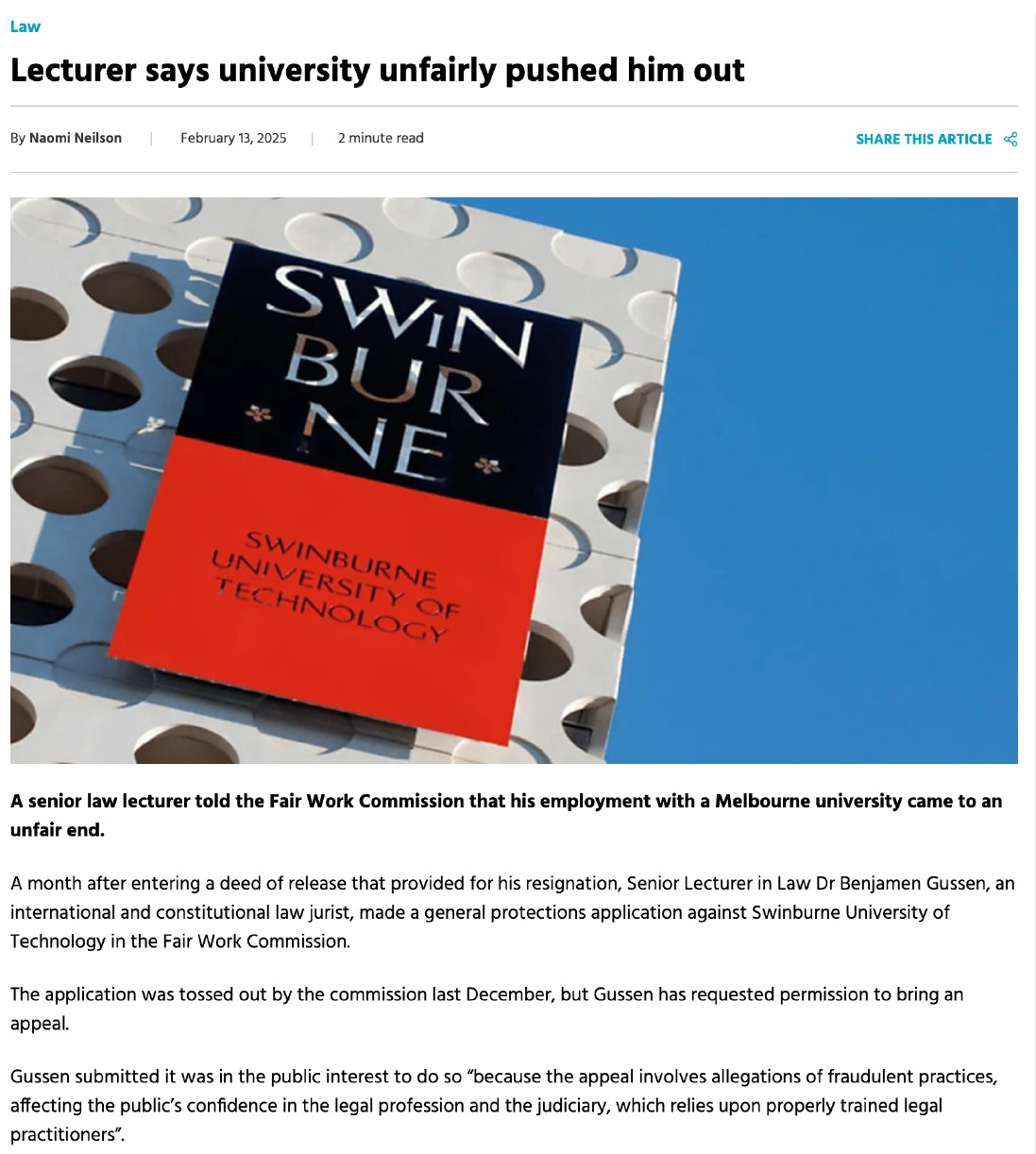
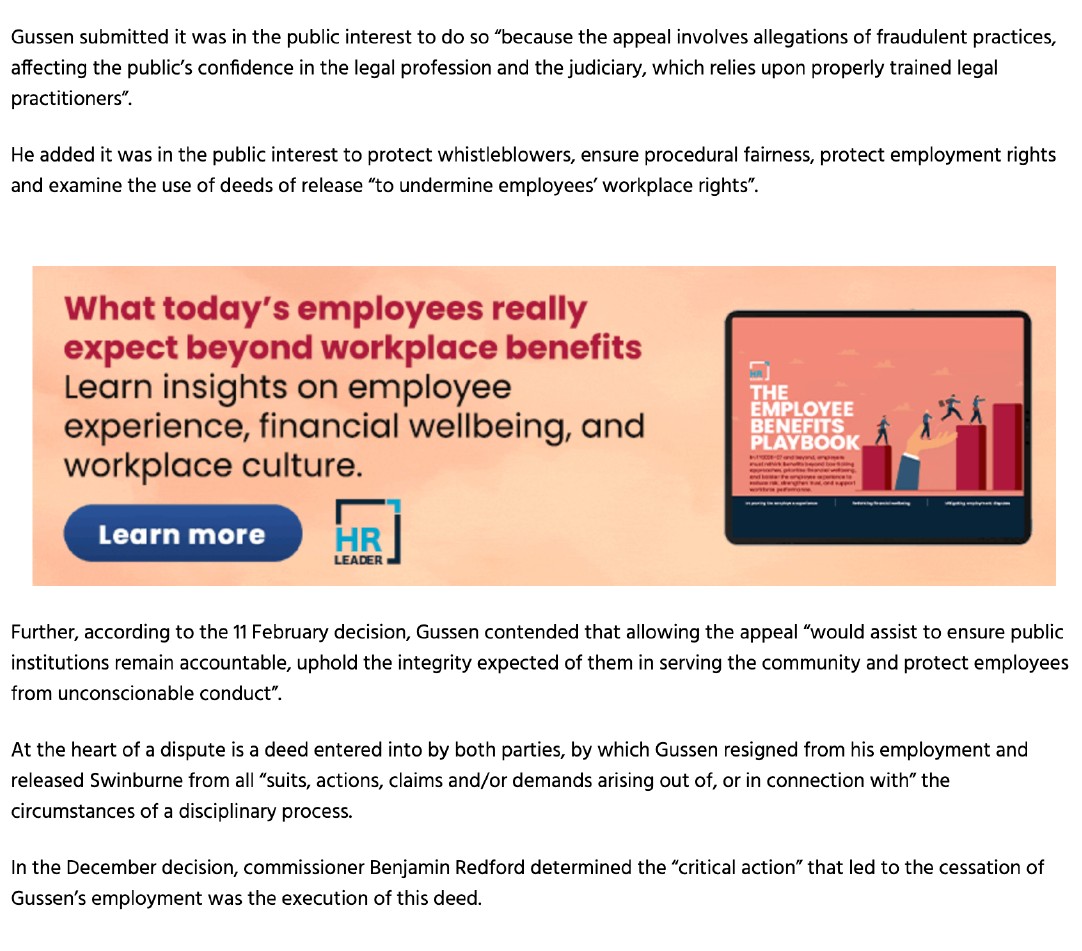
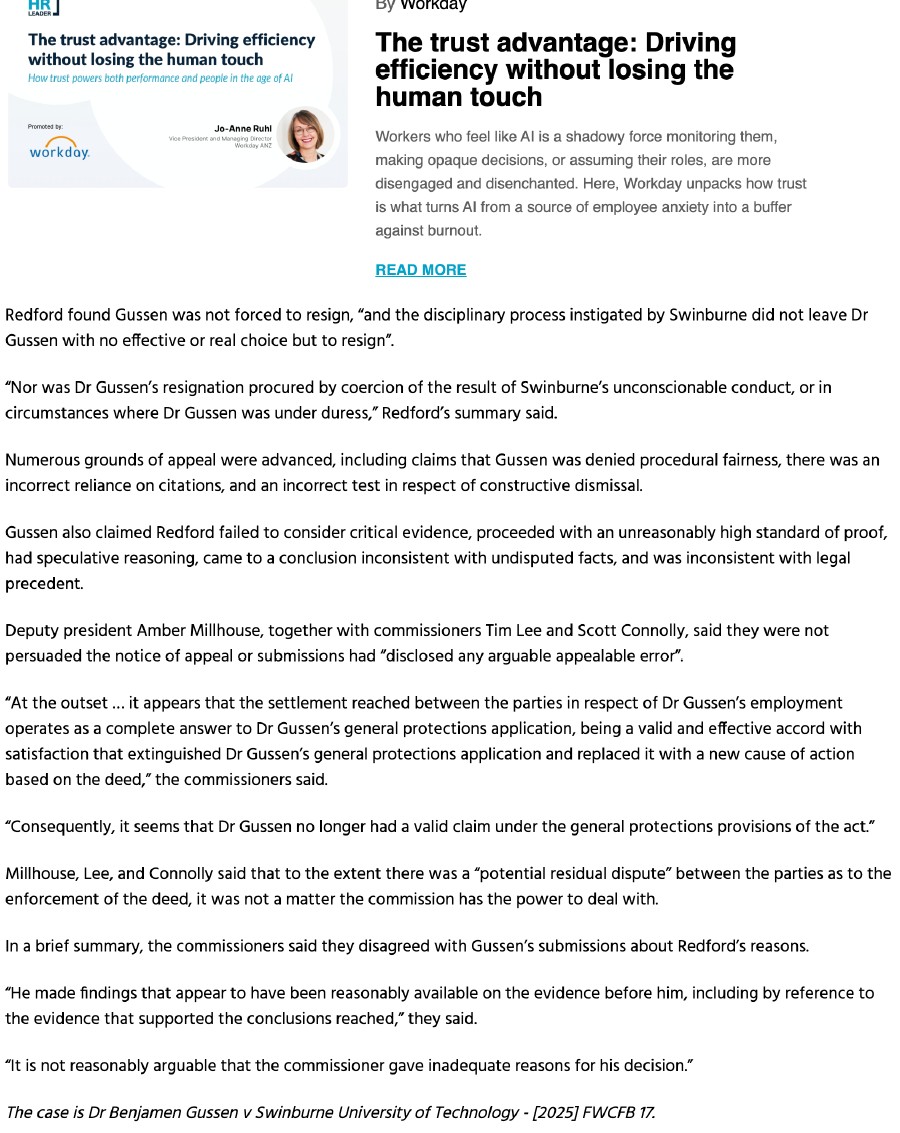
9 The Lawyers Weekly article is identical except for the title, which is “Law lecturer says university unfairly ended employment” and the standfirst, which is “[a] senior law lecturer turned to the Fair Work Commission with allegations that he was pushed out of a Melbourne university amid a disciplinary process”.
10 Dr Gussen pleads that the Articles convey the following imputations (using the numbering in the Further Amended Statement of Claim (FASOC)):
(a) Dr Gussen “falsely claimed misconduct allegations and dismissal were set aside, when he resigned to avoid them”;
(b) Dr Gussen “acted opportunistically by commencing FWC proceedings soon after signing a deed of release”;
(c) Dr Gussen “improperly sought to reopen finally settled matters”;
(d) Dr Gussen “brought and lost an unfair dismissal claim”;
(e) Dr Gussen’s “fraud allegations against Swinburne were baseless and discredited”;
(f) Dr Gussen “misled the public and profession by asserting public interest when none existed”;
(g) Dr Gussen “pursued frivolous or vexatious proceedings”;
(h) Dr Gussen “is untrustworthy and acted in bad faith by litigating after the deed”;
(i) Dr Gussen’s “whistleblowing and claims were insincere and self-serving”;
(j) Dr Gussen’s “case was an unfair dismissal application rather than a general protections claim”;
(k) Dr Gussen’s “case lacked any arguable merit on appeal”; and
(l) Dr Gussen “acted dishonestly in commencing litigation after signing the deed”.
11 Dr Gussen pursues his claims over both the original and amended Articles. Dr Gussen submits that while each matter conveys the pleaded imputations, imputations (b), (c), (g), (h) and (k) are most clearly conveyed. Dr Gussen then refers to the remaining imputations as “overlapping shades”, “overlapping meanings” and “more specific or serious shades”. Further, while Dr Gussen submits that each imputation is independently conveyed, he also submits that “liability does not depend on (d) or (j) alone”.
12 I pause to observe that Dr Gussen’s written submissions frequently employ the term “shades of meaning” or phrases to like effect. It is not readily apparent what Dr Gussen means by his use of these phrases. It is a well-established element of the law of defamation that a plaintiff may succeed on a nuance or shade of meaning of the pleaded imputations – meaning an imputation which does not differ in substance and is not of a more injurious nature, often determined by whether the justification would be substantially different – and that a plaintiff need not (and should not) plead imputations which are mere shades of each other: Fairfax Media Publications Pty Ltd v Bateman [2015] NSWCA 154; 90 NSWLR 79 in particular at [169]–[171] (Basten JA, Macfarlan JA agreeing generally at [230]), Chakravarti v Advertiser Newspapers Ltd [1998] HCA 37; 193 CLR 519 at [21]–[24] (Brennan CJ and McHugh J), [52]–[61] (Gaudron and Gummow JJ) and [139] (Kirby J). However, no objection was taken by the respondents to the imputations on this basis and I propose to simply deal with the question of whether each imputation was conveyed, without engaging in consideration of whether any particular imputation is a mere shade of another – although, where appropriate, I may deal with similar imputations together. In doing so, I will also consider whether any shade or nuance of each imputation is conveyed, as a plaintiff is entitled to succeed if a nuanced meaning of the pleaded imputation is conveyed.
13 The parties filed an Agreed Statement of Issues to be determined at trial, dated 27 August 2026. That statement identified nine issues which were subsequently reduced to the following five issues for determination:
(1) whether Dr Gussen has established his pleaded imputations are carried;
(2) whether some of Dr Gussen’s imputations are defamatory;
(3) whether the publication of each matter caused, or is likely to cause, serious harm to Dr Gussen’s reputation;
(4) whether the respondents have established a defence of publication of public documents pursuant to s 28 of the Defamation Act 2005 (Vic) and if so, whether Dr Gussen has defeated that defence by proving that the matters were not published honestly for the information of the public or the advancement of education; and
(5) whether Dr Gussen is entitled to relief in the form of general and aggravated damages, and if so, in what amount.
14 The respondents accept that imputation (k) is conveyed, and that a permissible variant of imputation (d) is conveyed. The respondents’ position is that no other pleaded imputation is conveyed.
Evidence at trial
15 Dr Gussen, who represented himself at trial, tendered a court book which contained two affidavits sworn by him on 2 October and 14 November 2025, together with annexures, an affidavit of Ben Joseph Rudgley (a solicitor) affirmed 11 December 2025, together with annexures (relied on by the respondents) and documentary evidence relied upon by Dr Gussen. Dr Gussen subpoenaed Ms Tamara Talmacs, the national manager in employment relations at the Australian Catholic University, to give evidence orally.
16 In summary, Ms Talmacs confirmed that she was an advisor in relation to Dr Gussen’s termination from ACU but was not involved in his recruitment. Ms Talmacs said that the termination decision was made by ACU’s Vice Chancellor. Dr Gussen asked Ms Talmacs what information she knew about his employment history prior to the termination decision. Ms Talmacs said she knew of four different proceedings commenced by Dr Gussen in the FWC, including the two which led to the FWC Decision and the FWC Appeal Decision. Ms Talmacs said she first saw the FWC Decision and the FWC Appeal Decision on 26 February 2025. Ms Talmacs said she read the FWC decisions before reading the Lawyers Weekly article (which she was given a copy of by a team member), which led to a discussion as to “a possible kind of way forward in relation to that”. Ms Talmacs also said that she only gave the Articles a “cursory look” after she had “actually read the cases”. When asked what she could recollect about the Articles, Ms Talmacs said they confirmed what she and her team had read in the decisions, being that:
[Dr Gussen] had been through a process of misconduct at Swinburne University, that there had been a – a preliminary finding of serious misconduct and a proposal to terminate [his] employment and that there had been – now, I – well, I don’t know if it was in the articles, I can’t – that I can’t recall but I know in the decision, it then had mentioned the involvement of the [NTEU] and settlement of – of – of those – of those claims, in relation to the termination.
17 Ms Talmacs said that the decision to terminate Dr Gussen’s employment with ACU was based on Dr Gussen breaching his warranty to ACU to disclose any material information that would cause any concern for ACU to enter into an employment arrangement with him. Ms Talmacs said that, noting the FWC Decision and the FWC Appeal Decision were in the public domain, the fact Dr Gussen had been the subject of a serious misconduct process under the enterprise agreement of another university and there had been a threat to terminate his employment was a material fact which should have been disclosed to ACU during the recruitment process. Ms Talmacs said that the termination decision did not involve any personal judgment of Dr Gussen and that the Articles were “merely information” ACU became aware of “in relation to actions and information shared with ACU”.
Issue 1 – Which imputations are conveyed?
18 Dr Gussen, to succeed, must satisfy the Court on the balance of probabilities that an ordinary reasonable reader would understand the Articles bear his pleaded meanings (the imputations): see Hanson v Burston [2023] FCAFC 124; 413 ALR 299 at [43] (Wigney, Wheelahan and Abraham JJ). The applicable principles are summarised in Hanson as follows:
[43] An applicant must satisfy the Court on the balance of probabilities that an ordinary reasonable reader or viewer or listener would understand that the publication sued upon bears the meaning as pleaded and particularised.
[44] The relevant question is whether the publication would have conveyed the alleged meanings to an ordinary reasonable person. The hypothetical individual is a person with various characteristics, including that they are of fair to average intelligence, experience and education; taken to be fair-minded; and neither perverse, morbid, suspicious of mind, nor “avid for scandal”: Rush v Nationwide News Pty Ltd (No 7) [2019] FCA 496 (Rush) at [75]. As explained in Rush at [77], the individual:
…is said not to be a lawyer who examines the publication overzealously, but rather someone who views the publication casually and is prone to a degree of “loose thinking”. The ordinary reasonable reader also apparently does not live in an “ivory tower” but can and does “read between the lines” in light of their general knowledge and experience of worldly affairs …While they do not search for hidden meanings or adopt strained or forced interpretations, they nevertheless draw implications, especially derogatory implications, more freely than a lawyer would: Rush at [77].
The ordinary reasonable person is taken to have read the entire publication, considered the context as a whole, and taken into account emphasis that may be given by conspicuous headlines or captions: see Trkulja v Google LLC (2018) 263 CLR 149; 356 ALR 178; [2018] HCA 25 at [32], and the summary in V’landys v Australian Broadcasting Corporation (No 3) [2021] FCA 500 (V’landys) at [41]–[55].
[45] … [A] hypothetical person is taken: to be of fair average intelligence; to be a fair-minded person; not to be overly suspicious; not to be avid for scandal; not to be naïve; not to search for strained or forced meanings; to view the entire matter complained of; and to consider the context as well as the words alleged to have been defamatory: [Burston v Hanson [2022] FCA 1235 at] [121].
[46] Given that the meaning is to be determined objectively, the audience is taken to have a uniform view of the meaning. The publisher’s intended meaning, and the meaning actually understood by individual readers of the matter complained of, are irrelevant: Rush at [84]–[85]. The determination of the natural and ordinary meaning of words involves the application of the “single meaning” rule. Although different people might in fact have understood the meanings conveyed by a matter in different ways, the Court must arrive at a single objective meaning: Slim v Daily Telegraph Ltd [1968] 2 QB 157 at 171–5; Hockey v Fairfax Media Publications Pty Limited (2015) 237 FCR 33; 332 ALR 257; [2015] FCA 652 at [73]; Australian Broadcasting Corporation v Chau Chak Wing (2019) 271 FCR 632; 371 ALR 545; [2019] FCAFC 125 (Wing) at [32]. The issue is the single meaning that an objective audience composed of ordinary reasonable persons should have collectively understood the matter to bear: Wing at [32].
[47] Each alleged defamatory imputation has to be considered and construed in context: Rush at [79]; Wing at [169]–[171]; Greek Herald Pty Ltd v Nikolopoulos (2002) 54 NSWLR 165; [2002] NSWCA 41 (Nikolopoulos) at [21]–[26]. The construction of the imputation in context must in turn inform what is required to prove that the imputation is substantially true.
[48] However, it does not follow that each part of the publication must be given equal significance, as striking words or images may stay with the viewer or reader and give them a predisposition or impression that influences all that follows: V’landys at [51]. A pleaded imputation, and whether it has been proven to be substantially true, requires attention to context, as provided by the balance of the publication and any wider context within which it is to be understood. The natural and ordinary meaning of words is not limited to their literal meaning. Words do not necessarily have a fixed meaning that applies in all circumstances; even benign words may convey a worse, or better, impression when regard is had to how and when they are deployed: see, for example, Nikolopoulos at [21]–[27]; and see Lewis v Daily Telegraph Ltd [1964] AC 234 at 258; [1963] 2 All ER 151.
19 Dr Gussen referred to Trkulja v Google LLC [2018] HCA 25; 263 CLR 149 at [30]–[32] (Kiefel CJ, Bell, Keane, Nettle and Gordon JJ) for the proposition that the Court “asks what the matter conveys at its most damaging reasonable meaning”. This submission confuses the question as to whether the matter is capable of conveying the imputation with the question as to whether the matter did in fact convey the imputation. As the above extract from Hanson makes clear, in determining whether the imputation was conveyed the Court determines the single, objective meaning. As Colvin J said in Latham v Greenwich [2026] FCAFC 82; 316 FCR 301 at [3]–[5] (and see Wheelahan and Abraham JJ at [34]):
3 Whether a particular meaning is conveyed by a publication for the purposes of defamation law has two aspects. First, is the published matter capable of conveying the alleged defamatory meaning. Second, did the published matter convey the alleged defamatory meaning. As to the significance of the distinction, see Aljazeera International (Malaysia) SDN BHD v Hun (2026) 315 FCR 570 at [35].
4 It was the first of these two aspects that was in issue in Trkulja v Google LLC (2018) 263 CLR 149. In that case, the High Court decided that the first aspect is to be determined by using the legal device of the ordinary reasonable reader amongst a relevant class of readers and asking whether the words are capable of conveying the alleged defamatory meaning; at [31]-[32], [52]-[56]. As their Honours explained, the first aspect of the exercise is “one of attempting to envisage a mean or midpoint of temperaments and abilities [amongst the class of ordinary reasonable readers] and on that basis to decide the most damaging meaning that ordinary reasonable people at the midpoint could put on the impugned words or images considering the publication as a whole”: at [31] (footnote omitted).
5 However, in determining whether an alleged defamatory meaning has been established, the second aspect must also be considered. It requires a factual conclusion to be reached as to whether the words do convey the alleged defamatory meaning (not whether those words are capable of doing so). In this Court, the practice is for that further question, which might otherwise be submitted to a jury, to be determined by the judge as the trier of fact.
20 Without meaning any disrespect to Dr Gussen, I have found the FASOC and the applicant’s opening submissions dated 4 September 2026 difficult to understand and comprehend. Doing the best I can, I now turn to consider the contested imputations.
Imputation (a): Dr Gussen falsely claimed misconduct allegations and dismissal were set aside, when he resigned to avoid them
21 Dr Gussen submits that the Articles convey that Dr Gussen was “unfairly pushed out” and resigned to avoid misconduct allegations and dismissal.
22 Dr Gussen submits that imputation (a) “is put as the specific shade created by the headline assertion” that he “said he was unfairly pushed out”, which the Articles then contrast with the deed and findings by the FWC that he was not forced, coerced or under duress. Dr Gussen submits that “the invited conclusion is that his contrary account of how the misconduct process and proposed termination ended was false and designed to avoid the actual disciplinary outcome”. Dr Gussen accepts that the Articles contain accurate quotations and identify that his claim in the FWC was a general protections claim. However, he says that while those are relevant contextual matters they are “not automatic antidotes”.
23 I am not satisfied that an ordinary reasonable reader would understand the headlines and the texts in the Articles bear the pleaded meaning of imputation (a) for the reasons that follow.
24 First, there is no reference at all in the Articles to Dr Gussen making a false claim (or indeed, any claim at all) that “misconduct allegations and dismissal were set aside”.
25 Secondly, the Articles do not convey that Dr Gussen resigned to avoid “misconduct allegations and dismissal”. The Articles report that at the heart of the dispute is a deed entered into by both parties by which Dr Gussen resigned from his employment and released Swinburne from all “suits, actions, claims and/or demands arising out of, or in connection with” the circumstances of a disciplinary process. The Articles report that the FWC determined the “critical action” that led to the cessation of Dr Gussen’s employment was the execution of the deed. The Articles report that the Commissioner found that Dr Gussen was not forced to resign “and the disciplinary process instigated by Swinburne did not leave Dr Gussen with no effective or real choice but to resign”. That does not convey that Dr Gussen resigned to avoid the outcome of the disciplinary process. It does not convey that Dr Gussen made any claim that the disciplinary process was set aside.
26 The Articles reported that the Full Bench of the FWC found that there was no arguable appealable error and that “at the outset … it appears that the settlement reached between the parties in respect of Dr Gussen’s employment operates as a complete answer to Dr Gussen’s general protections application, being a valid and effective accord with satisfaction that extinguished Dr Gussen’s general protections application and replaced it with a new cause of action based on the deed”. The Articles reported that the Full Bench found “consequently, it seems that Dr Gussen no longer had a valid claim under the general protections provisions of the [Act]”.
27 Reading the text of the Articles as a whole, they do not convey imputation (a).
Imputation (b): Dr Gussen acted opportunistically by commencing FWC proceedings soon after signing a deed of release
28 Dr Gussen submits with respect to imputation (b) that the Articles convey he acted opportunistically by commencing proceedings a month after entering into the deed of release and that the proceeding was an improper attempt to reopen what had already been resolved. Dr Gussen says this imputation is conveyed primarily through the following features of the Articles: the opening words are “a month after entering a deed of release”; the Articles then specify the breadth of the release; and they report that the settlement extinguished the claim and left no valid claim. Dr Gussen submits that, in ordinary language, those features do not “merely describe a sequence” but present the proceeding as an “opportunistic step taken after, and contrary to, a final settlement, and as an improper attempt to reopen what had already been resolved”.
29 I do not accept that the Articles convey to an ordinary reasonable reader the pleaded imputation (b). To act opportunistically means to take advantage of, or exploit, an opportunity in some improper way.
30 The Articles do not refer to any opportunity that Dr Gussen took advantage of or exploited, much less improperly, by commencing the FWC Proceeding after entering into the deed of release.
31 The Articles, fairly read, convey that the “critical action” that led to the cessation of Dr Gussen’s employment was the execution of the deed and that Dr Gussen was not forced to resign. This does not speak to Dr Gussen’s motives in commencing the proceedings.
Imputations (c): Dr Gussen improperly sought to reopen finally settled matters;
(h): Dr Gussen is untrustworthy and acted in bad faith by litigating after the deed; and
(l): Dr Gussen acted dishonestly in commencing litigation after signing the deed
32 It is convenient to deal with imputations (c), (h) and (l) together.
33 Dr Gussen relies on imputation (c) as one of the imputations “most clearly” conveyed. He relies on the same features of the Articles for imputation (c) as he does for imputation (b).
34 In relation to imputations (h) and (l), Dr Gussen’s written submissions are as follows:
Imputations (h) and (l) are the evaluative character conclusions invited by that sequence. The Articles do not simply say that a legal argument failed. They invite the reader to infer that a law lecturer knowingly acted inconsistently with a comprehensive release and invoked public-interest language to persist … That readily conveys untrustworthiness and bad faith in (h). The stronger conclusion of dishonesty in (l) is available from the same material, but the Applicant accepts that the Court may find (h) without finding the more serious shade in (l).
35 It is not clear to me what Dr Gussen is referring to when he says “that sequence”. I assume, with some caution, that he is referring to the ‘sequence’ relied on in relation to imputation (b), which I have set out at [28] of these reasons. I take from these submissions that imputation (c) is of a more general, and less serious, nature and that Dr Gussen has pleaded (h) and (l) as shades, or variants. I will consider all of the imputations, as they have all been pleaded, however I note that if imputation (c) is not conveyed by the Articles (which I find it is not), it would seem on Dr Gussen’s characterisation of imputations (h) and (l) as more serious variants that they are, necessarily, also not conveyed.
36 Doing the best I can to understand these submissions, Dr Gussen seems to submit that the Articles convey to an ordinary and reasonable reader that his commencement of the FWC Proceeding was an opportunistic step taken after, and contrary to, the settlement between him and Swinburne and was an improper attempt to reopen the matters covered by the settlement deed. Further, that by inferring Dr Gussen knowingly acted inconsistently with a comprehensive release, the matters convey that Dr Gussen acted with impropriety, untrustworthiness, dishonesty, or bad faith.
37 I am not satisfied that the text of the Articles would convey to an ordinary, reasonable reader the pleaded meanings in imputations (c), (h) and (l).
38 First, I have already found that imputation (b) is not conveyed by the Articles, including because the Articles do not comment on, explicitly or implicitly, Dr Gussen’s motivations in commencing the FWC Proceeding. Therefore, for the same reasons, imputations (c), (h) and (l) are not conveyed.
39 Secondly, and more particularly, the Articles do not convey any impropriety, untrustworthiness, dishonesty, or bad faith by Dr Gussen in commencing the FWC Proceeding. The Articles say that the FWC Proceeding was ultimately found, as a matter of law, to be barred by the terms of the deed of release. The Articles report that the Full Bench of the FWC found that the settlement reached between the parties in respect of Dr Gussen’s employment operates (or appears to operate) as a complete answer to Dr Gussen’s general protections claim as it extinguished it and replaced it with a cause of action based on the deed. The Articles do not raise any sense of wrongdoing or impropriety in relation to Dr Gussen’s actions.
Imputations (d): Dr Gussen brought and lost an unfair dismissal claim; and
(j): Dr Gussen’s case was an unfair dismissal application rather than a general protections claim
40 Dr Gussen submits that the Articles convey imputations (d) and (j) primarily through the headlines: “Law lecturer says university unfairly ended employment” (Lawyers Weekly) and “Lecturer says university unfairly pushed him out” (HR Leader).
41 In relation to imputation (d), the respondents submit that the “appropriate imputation is that Dr Gussen brought and lost a general protections claim”, which they submit is not substantively different from Dr Gussen’s imputation. The issue with this submission is that, as I understand it, Dr Gussen’s emphasis in the imputation is that he lost an unfair dismissal application, as opposed to a general protections claim. This is reinforced by Dr Gussen’s submissions which deal with imputations (d) and (j) together. Therefore, while it may be that the true meaning of the Articles is that Dr Gussen brought and lost a general protections claim, I am satisfied that it does differ in substance and so is not a nuance of the pleaded imputation.
42 I will now consider whether imputations (d) and (j) are conveyed by the Articles.
43 The Articles make clear that Dr Gussen brought a general protections claim. However, Dr Gussen submits that a technical phrase later in the text does not necessarily neutralise the headline and standfirst, citing Hockey v Fairfax Media Publications Pty Limited [2015] FCA 652; 237 FCR 33 at [70]–[71]. He further submits that an ordinary non-lawyer is likely to understand the Articles as reporting that he brought and lost an unfair dismissal case.
44 Contrary to Dr Gussen’s submission, in my view, the ordinary reasonable reader would not jump from a headline referring to Dr Gussen’s claim of his employment unfairly ending or being unfairly pushed out, to a conclusion that Dr Gussen was bringing a particular cause of action known as unfair dismissal. I find this is so even in the circumstances of one of the Articles being published to an intended audience of lawyers.
45 Dr Gussen submits that the ordinary reasonable reader would understand the Articles convey that Dr Gussen’s case in the FWC Proceeding was an unfair dismissal application and not a general protections claim.
46 I do not accept Dr Gussen’s submission. The ordinary and reasonable reader would not, in my view, understand the distinction between an unfair dismissal application and a general protections claim under the FW Act. In any event, the text of the Articles does not make a comparison between an unfair dismissal application and a general protections claim, as the text does not mention an unfair dismissal application. The first line of the Articles (after the standfirsts) expressly says that Dr Gussen “made a general protections application” against Swinburne in the FWC. Neither imputation is conveyed by the Articles.
Imputations (e): Dr Gussen’s fraud allegations against Swinburne were baseless and discredited;
(f): Dr Gussen misled the public and profession by asserting public interest when none existed; and
(i): Dr Gussen’s whistleblowing and claims were insincere and
self-serving
47 Dr Gussen submits that the structure and text of the Articles leave the ordinary, reasonable reader with the impression that the fraud allegations were discredited; that the claimed public interest was not genuine, and that the whistleblowing position was self-serving. Specifically, Dr Gussen submits that these imputations are conveyed because the Articles first quote his substantive allegations and claimed public interest and then move to, in his words, “the adverse outcome and absence of arguable error without reporting” the FWC Appeal Decision at [17] which says that those substantive allegations were not being determined. In respect of the last part of that submission, it is not relevant to the question of what was conveyed by the Articles – but may be relevant to the defence relied on by the respondents. The FWC Decision and the FWC Appeal Decision do not form part of the relevant contextual background in which the meaning of the Articles is construed (and it has not been suggested they do). Therefore, at this stage, the Court looks at the Articles themselves, and not the FWC Appeal Decision, to determine what was conveyed.
48 I do not accept Dr Gussen’s submission. Properly understood, the Articles make clear that the FWC Proceeding and the FWC Appeal Proceeding were dismissed because of the terms of a deed of release between Dr Gussen and Swinburne. None of the words (baseless, discredited, insincere or self-serving) from the imputations appear in the Articles. A reasonable reader would not infer from statements that Dr Gussen’s claims relating to allegations of fraud and whistleblowing were unsuccessful (or even, “tossed out”) that Dr Gussen’s character is being called into question. There is no connection between a statement that a claim of public interest was not upheld and an inference that the person making that claim has misled the public in doing so. There is no connection between a statement that fraud allegations were not upheld and an inference that the claims were baseless. There is no connection between a statement that whistleblowing claims were not upheld and an inference that the person making the claim acted in an insincere and self-interested way in so doing.
49 I also note again, that in relation to the FWC Appeal Decision, the Articles emphasise the following:
Deputy president Amber Millhouse, together with commissioners Tim Lee and Scott Connolly, said they were not persuaded the notice of appeal or submissions had “disclosed any arguable appealable error”.
“At the outset ... it appears that the settlement reached between the parties in respect of Dr Gussen's employment operates as a complete answer to Dr Gussen’s general protections application, being a valid and effective accord with satisfaction that extinguished Dr Gussen’s general protections application and replaced it with a new cause of action based on the deed,” the commissioners said.
“Consequently, it seems that Dr Gussen no longer had a valid claim under the general protections provisions of the [Act].”
Millhouse, Lee, and Connolly said that to the extent there was a “potential residual dispute” between the parties as to the enforcement of the deed, it was not a matter the commission has the power to deal with.
50 The meaning conveyed by the above is that the FWC Appeal Decision found that, by reason of the deed of release between Swinburne and Dr Gussen, Dr Gussen was unable to bring a general protections claim in the FWC, and that any residual dispute as to the enforcement of the deed was not a matter within the FWC’s power.
Imputation (g): Dr Gussen pursued frivolous or vexatious proceedings
51 Dr Gussen submits that in the context of him being a legally trained academic, bringing the FWC Proceeding after executing a deed of release conveys that the applicant pursued frivolous or vexatious proceedings.
52 The term “frivolous or vexatious” is a legal term of art. Its most common usage is in respect of summary judgment applications. In Prior v South West Aboriginal Land and Sea Council Aboriginal Corporation [2020] FCA 808, McKerracher J said (in relation to the use of the words “frivolous or vexatious” in r 26.01(1) of the Federal Court Rules 2011 (Cth)):
[36] A matter is ‘frivolous and vexatious’ where the ‘cause of action is one which on the face of it is clearly one which no reasonable person could properly treat as bona fide, and contend that he had a grievance which he was entitled to bring before the court’…
[37] In relation to the term ‘frivolous’:
(a) a matter that is ‘frivolous’ may be described as one that is ‘without substance or groundless or fanciful’…;
(b) a proceeding will be ‘frivolous’ where, despite whatever attempts are made to discern a cause of action in the case, it is still not arguable …; and
(c) ‘frivolous’ may also describe a situation where a party is trifling with the Court or wasting the Court’s time …
[38] In relation to the term ‘vexatious’:
(a) a ‘vexatious’ proceeding is one without foundation, which cannot succeed, or is brought for an ulterior and collateral purpose. ‘Vexatious’ might also describe proceedings that are seriously and unfairly burdensome, prejudicial or damaging …;
(b) proceedings may also be described as ‘vexatious’ where they impose on a respondent party an unnecessary injustice in the form of a burden other than, and additional to, the burden necessarily imposed on a party to litigation instituted on reasonable grounds for the purpose of obtaining relief within the scope of the available remedy …;
(c) a proceeding is to be regarded as ‘vexatious’ where:
(i) it is instituted with the intention of annoying or embarrassing the person against whom the proceeding is brought; or
(ii) it is brought for collateral purposes, and not for the purpose of having the court adjudicate on the issues to which it gives rise; or
(iii) irrespective of the motive of the litigant, the proceeding is so obviously untenable or manifestly groundless as to be utterly hopeless …; and
(d) ‘vexatiousness’ is a quality of the proceeding rather than a litigant’s intention, so that the question is not whether the proceedings have been instituted vexatiously but whether the legal proceedings are in fact vexatious …
(Citations omitted).
53 After quoting the above passage, White J said in Ferdinands v Registrar Cridland [2021] FCA 592 at [30]:
As is apparent, a proceeding will be frivolous and vexatious if, amongst other things, it is based on a cause of action which no reasonable person could properly treat as bona fide or if it is without substance, groundless, or fanciful.
54 The above two passages were each quoted with approval by the Full Court in Ferdinands v Registrar Cridland [2022] FCAFC 80 at [8] (Charlesworth, Burley and Cheeseman JJ) and Ferdinands v Registrar Burns [2024] FCAFC 105 at [22] (Cheeseman, Goodman and McEvoy JJ).
55 It is not clear if the imputation does use the terms “frivolous” and “vexatious” as terms of art or rather relies on their ordinary meaning. In my view, an ordinary and reasonable reader would understand those terms to have similar meanings in any event. That is, that frivolous means without merit, trifling and a waste of time, and vexatious means to have an improper purpose in commencing proceedings or seeking to abuse court processes.
56 It is also not clear if the imputation refers to the motives of Dr Gussen in commencing the proceedings or the merits of the proceedings or both. However, as the imputation has been pleaded and has not been objected to, I will consider whether any shade of meaning of the imputation (including at its broadest) is conveyed.
57 For similar reasons as I have already given in respect of a number of the pleaded imputations, the Articles do not convey anything about Dr Gussen’s motives in bringing his claims in the FWC, or in seeking to appeal the FWC Decision. Therefore, the Articles do not convey that Dr Gussen pursued frivolous or vexatious proceedings in the sense of having an improper purpose.
58 In relation to whether Dr Gussen pursued frivolous or vexatious proceedings in the sense of the claims being baseless, the position is more nuanced.
59 The respondents submit that the ordinary and reasonable reader would appreciate the difference between the FWC Proceeding being found to lack merit because of the terms of the deed of release, and a proceeding being frivolous or vexatious. In this regard, the respondents refer to Scott v Steritech Pty Ltd [2025] FCAFC 110 at [48] where Banks-Smith, Meagher and Kennett JJ discussed the difference between a claim that is untenable (in the sense relevant to an application for summary dismissal) and one that is “incapable on its face of legal argument” (so as to be colourable). In that decision, the Full Court said that the appellant genuinely brought a claim for relief under the FW Act, but the claim was answerable by reason of a deed and that did not mean the cause of action was “colourable”. However, these comments were made in respect of considering the specific facts before the Court, including the specific issue of whether the FW Act claim had been brought merely to bring the proceeding within the Federal Court’s jurisdiction.
60 The text of the Articles quotes from both the FWC Decision and the FWC Appeal Decision. The Articles say as follows:
At the heart of a dispute is a deed entered into by both parties, by which Gussen resigned from his employment and released Swinburne from all “suits, actions, claims and/or demands arising out of, or in connection with” the circumstances of a disciplinary process.
In the December decision, commissioner Benjamin Redford determined the “critical action” that led to the cessation of Gussen's employment was the execution of this deed.
…
Deputy president Amber Millhouse, together with commissioners Tim Lee and Scott Connolly, said they were not persuaded the notice of appeal or submissions had “disclosed any arguable appealable error”.
“At the outset ... it appears that the settlement reached between the parties in respect of Dr Gussen's employment operates as a complete answer to Dr Gussen’s general protections application, being a valid and effective accord with satisfaction that extinguished Dr Gussen's general protections application and replaced it with a new cause of action based on the deed,” the commissioners said.
“Consequently, it seems that Dr Gussen no longer had a valid claim under the general protections provisions of the [Act].”
Millhouse, Lee, and Connolly said that to the extent there was a “potential residual dispute” between the parties as to the enforcement of the deed, it was not a matter the commission has the power to deal with.
61 I accept that the above passages would leave a reader with the impression that Dr Gussen’s proceedings in the FWC failed as (a) the deed was (or at least appeared to be) a complete answer to his claims and (b) the FWC could not consider any claim related to the enforceability of the deed. In one sense, this could be said to lead to the impression that the claims were hopeless. However, on balance I do not think that is the preferable meaning that would be conveyed to a reasonable reader. For a proceeding to be found to be vexatious or frivolous is a high bar and I do not think the Articles go so far as to convey that – while they do convey that the deed was found to be a complete answer to Dr Gussen’s claims, they do not convey that those claims were so obviously without any merit so as to be considered trifling, a waste of time or baseless.
62 For the reasons given above, I find that the imputations (a), (b), (c), (d), (e), (f), (g), (h), (i), (j) and (l) were not conveyed by the publication of the Articles. That leaves imputation (k) which was admitted by the respondents to have been conveyed.
Issue 2 – Are the imputations defamatory?
63 To establish that a matter is defamatory, Dr Gussen must show that any pleaded imputation found conveyed by the Court is defamatory, meaning it is calculated to expose him to hatred, contempt or ridicule; lower him in the estimation of ordinary right-thinking members of society; or cause others to shun and avoid him: Archbishop Makarios Griniezakis v Morelas (Trial Judgment) [2026] FCA 156 at [42] (Abraham J) citing Boyd v Mirror Newspapers Ltd [1980] 2 NSWLR 449 at 452–453; Mirror Newspapers Ltd v World Hosts Pty Ltd [1979] HCA 3; 141 CLR 632 at 638–639; Radio 2UE Sydney Pty Ltd v Chesterton [2009] HCA 16; 238 CLR 460 at [5].
64 The respondents admit that the pleaded imputations are defamatory other than (d), (j) and (k). I have found that, except for imputation (k) (which the respondents admit is conveyed), none of the imputations were conveyed by the Articles. Therefore, with the exception of imputation (k), it is strictly unnecessary for me to consider whether the imputations are defamatory, and I do so only if I am wrong as to the imputations not being conveyed.
Imputation (d): Dr Gussen brought and lost an unfair dismissal claim
65 Dr Gussen submits that he is identified in the text of the Articles as a law lecturer, and that as a legally trained person he misunderstood, misstated or misused the legal process in pursuing his FWC Proceeding after executing a deed of release. The first issue with this submission is that the imputation alleged is that Dr Gussen brought and lost an unfair dismissal claim; it is not that Dr Gussen, as a legally trained person, misunderstood, misstated or misused the legal process in pursuing his FWC Proceeding after executing a deed of release. The relevant question is whether it is defamatory to say that he brought and lost an unfair dismissal claim. Part of the context of that question may be that he is identified in the Articles as a former law lecturer.
66 I do not accept that imputation (d) is defamatory. The mere fact that a person such as Dr Gussen brings and loses a proceeding in the FWC does not, without more, reflect adversely on the reputation of that person. In my view, the ordinary and reasonable reader would understand that a party to legal proceedings may win or lose a case for many reasons and that the failure to succeed is not referable to a person’s lack of standing in society such that it would expose them to hatred, contempt or ridicule, lower them in the estimation of ordinary right-thinking members of society, or cause others to shun and avoid them.
Imputation (j): Dr Gussen’s case was an unfair dismissal application rather than a general protections claim.
67 Dr Gussen advances the same submissions in respect of this imputation. Again, the question is whether the imputation as pleaded, assuming it to be conveyed by the Articles, is defamatory.
68 I do not accept that it is. It is unclear to me how a person’s reputation would be damaged by the suggestion that they brought an unfair dismissal claim as opposed to a general protections claim. Dr Gussen’s submissions were centred around the concept of him having “misused” or “misunderstood” the legal process, as a person with legal training. But the imputation does not involve any suggestions of misuse or misunderstanding of the legal system. It is simply that he brought one type of claim and not another.
Imputation (k): Dr Gussen’s case lacked any arguable merit on appeal
69 Dr Gussen submits that the pleaded imputation (k) conveyed to the ordinary reasonable reader that Dr Gussen, a law lecturer, commenced the FWC Proceeding after executing a comprehensive deed of release and that this would tend “to lower Dr Gussen’s reputation for professional competence and judgment and reinforced the misuse of process by Dr Gussen”. Again, the question is whether the imputation is defamatory, in context, including by lowering Dr Gussen’s professional reputation. The pleaded imputation is that Dr Gussen’s case lacked any arguable merit; the imputation does not raise issues of “misuse of process” or “professional competence”.
70 I do not accept Dr Gussen’s submission. As stated previously, ordinary right-thinking members of society understand that a person can win or lose legal proceedings for all sorts of reasons with many of those reasons being outside that person’s control. The mere fact that a person brings and loses a legal proceeding does not, without more, reflect adversely on the reputation of that person. Ordinary right-thinking members of society are unlikely to think less of a person for seeking to appeal a proceeding in the FWC which was found not to have merit.
Issue 3 – Serious harm to reputation
71 For Dr Gussen to succeed in proving that the publication of each matter (being each of the Articles) constituted the tort of defamation, he must prove that the publication of each matter caused, or was likely to cause, serious harm to his reputation: Defamation Act s 10A, see also Latham at [80]–[83] (Wheelahan and Abraham JJ) (serious harm is directed towards publication of the matter and not publication of each imputation).
72 The relevant principles were summarised in Latham where Wheelahan and Abraham JJ (Colvin J agreeing) stated:
Issue 4: discussion of the principles
53. The serious harm element in s 10A of the Defamation Act has some resemblance to the corresponding provision in s 1(1) of the Defamation Act 2013 (UK). Both s 10A(1) of the Defamation Act and s 1(1) of the United Kingdom Act are concerned with the existence of serious harm to reputation in actual fact, and not with the inherent tendency of a matter to cause harm to reputation or serious harm amongst a notional cohort of ordinary reasonable people. However, the United Kingdom provision has a different legislative and common law context and is in different terms —
A statement is not defamatory unless its publication has caused or is likely to cause serious harm to the reputation of the claimant.
54. The different common law context of the United Kingdom provision was the anterior common law requirement that a matter was defamatory if it “substantially” affected in an adverse manner the attitude of other people towards him or had a tendency to do so: Jameel v Dow Jones & Company Inc [2005] QB 946 (Jameel) (Lord Phillips MR, Sedley and Parker LJJ); Thornton v Telegraph Media Group Ltd [2011] 1 WLR 1985 (Thornton) at [96] (Tugendhat J). These anterior common law developments in the United Kingdom underpinned the approach to the construction of s 1 of the United Kingdom Act in Lachaux v Independent Print Ltd [2020] AC 612 (Lachaux) where it was held at [12] that s 1 raised the threshold of seriousness above that envisaged in Jameel and Thornton.
55. The different statutory context in Australia was the availability under the uniform legislation of a statutory defence of triviality.
56. The serious harm element provided for by s 10A of the Defamation Act has been considered in the Federal Court in several cases, including Russell v Australian Broadcasting Corporation (No 3) (2023) 303 FCR 372 at [252]–[254] (Lee J), Selkirk v Wyatt (2024) 302 FCR 541 (Besanko J, Anderson and O’Sullivan JJ agreeing), Deeming v Pesutto (No 3) [2024] FCA 1430 (O’Callaghan J), Mond v The Age Company Pty Ltd [2025] FCA 442 (Mond) (Wheelahan J), and Griniezakis v Morelas (Trial Judgment) [2026] FCA 156 (Abraham J). Section 10A was part of a reform which introduced serious harm to reputation as an element of the cause of action in defamation while at the same time repealing the statutory defence of triviality.
57. The term “serious harm” in s 10A is not defined. It is an open textured phrase that is to be construed by reference to the modern principles of statutory construction that look to text, context, and purpose, where text includes surrounding provisions, and where context includes legislative history and extrinsic materials to which regard is had at the first stage and in its widest sense …
58. The history of the introduction of s 10A was described in Mond at [373]–[377]. The extrinsic materials show that the provision was introduced to weed out trivial, spurious, frivolous and vexatious defamation claims … the serious harm element may be capable of ready determination prior to trial, thereby indicating that “serious harm to reputation” is harm that is at least not trivial or minor in nature, as the second reading speeches to the Victorian and New South Wales Bills would indicate, rather than establishing an especially high threshold requiring extensive evidence to be led by an applicant: Mond at [377]. However, as Applegarth J explained in Peros v Nationwide News Pty Ltd (No 3) [2024] QSC 192 (Peros) at [89], serious harm is not to be treated as the converse of the repealed triviality defence. The terms of the provisions do not correspond. The now-repealed defence of triviality under s 33 of the Defamation Act was engaged “if the defendant proves that the circumstances of publication was such that the plaintiff was unlikely to sustain any harm” (emphasis added). Proof by a claimant of some harm to reputation is not to be equated with “serious harm” which is harm of a higher order warranting the characterisation of “serious”.
…
63. The correct approach to the construction of the term “serious harm” in s 10A(1) of the Defamation Act is that identified in MG v PJ at [83]-[84], which is that the plain and ordinary meaning of the word “serious” should be adopted and that it is also appropriate to have regard to the purpose of the provision when construing the term. This approach accords with that identified earlier in Mond at [407]-[408] with the result that the term “serious harm” calls for the Court to reach an evaluative conclusion on the evidence in the exercise of its own judgment. In making that evaluative judgment precision on the issue will rarely be possible: Lachaux at [21]. And in making the evaluation it is to be borne in mind that the common law accepts that damage to reputation is not a commodity, and that every defamation is necessarily unique: see Rogers v Nationwide News Pty Ltd (2003) 216 CLR 327 at [66] (Hayne J). In addition, as observed in Mond at [383], harm to reputation is not like a bodily injury. A person’s reputation exists in the minds of others, and it may not be homogeneous. It is the impact of the defamatory matter on those to whom it was published that falls for consideration. That impact may result in serious harm without the impact being uniform.
73 The focus of the enquiry is on the actual impact of the Articles on Dr Gussen’s reputation, not a presumed effect based on a finding that certain imputations are carried: Mkrtchyan v Stirling [2026] FCA 1166 at [4] (Derrington J). Further, as Wheelahan and Abraham JJ (Colvin J agreeing) stated in Latham:
64. Ordinary principles apply to the sufficiency of proof of actual harm to reputation. Allowance can be made for the inherent difficulties in marshalling direct evidence going to the causation and existence of serious harm owing to the nature of harm to reputation, which may lie lurking in unknown places: see Cassell & Company Ltd v Broome [1972] AC 1027 at 1071 (Lord Hailsham). However, there must be such proof and certainty as is reasonable having regard to the circumstances of the particular case. Therefore, while proof of serious harm may be supported by direct evidence, it can and often will depend upon drawing inferences from all the circumstances: see Lachaux at [21]. The authorities show that the circumstances from which an inference of serious harm might be drawn may include a combination of some of the following considerations —
(a) the inherent tendency of the defamatory matter and its actual or probable impact on those to whom it was published, in other words, the gravity of the imputations;
(b) the extent of publication, any likely republication, and any likely “grapevine effect” or “percolation”;
(c) whether there was a prompt apology, and the breadth of the audience to which any apology was published;
(d) the reputation of the publisher — a defamatory publication by a generally reputable publisher that is represented as being reliable and the product of research might be more capable of causing serious harm than one by a publisher that is not so reputable;
(e) the medium of the publication — a transient publication might cause less harm to reputation than one in print or which is available for viewing online for an extended period or indefinitely;
(f) the situation of the applicant, including the applicant’s existing reputation in the relevant sector;
(g) the identity of the persons to whom the defamatory matter was published; and
(h) the inherent probabilities generally.
65. This is not a check list, and it is not exhaustive. What circumstances may be relevant will vary from case to case, and in some cases a consideration of only some circumstances may readily lead one way or the other to a determination of whether the serious harm element has been established: Mond at [371].
74 Further, Wheelahan J said in Mond v The Age Company Pty Limited [2025] FCA 442 at [381]:
The word “publication” in s 10A(1) must be taken to refer to the publication of the defamatory matter by a respondent, such that the subsection is concerned with the collective effect of the publication by a respondent of the same defamatory matter in respect of which a cause of action is otherwise established. The collective effect may result from the publication by a respondent of the same or substantially the same matter on multiple occasions where each actionable publication gives rise to a separate cause of action. Therefore, harm to reputation caused by separate publications of the same or substantially the same matter, as with a mass media publication, may be aggregated: see Amersi v Leslie [2023] EWCA Civ 1469 (Amersi) at [56] (Warby LJ, Underhill LJ agreeing).
75 I am satisfied that in this proceeding the Articles contained identical content, with slight differences in the titles and the standfirsts. It is therefore appropriate to consider the collective effect of the Articles.
76 Dr Gussen’s case on serious harm to his reputation is put on two bases.
77 First, Dr Gussen contends that he lost his job at ACU because of the publication of the Articles. To establish this claim, Dr Gussen subpoenaed Ms Talmacs. The substance of Ms Talmacs’ evidence, which I have referred to above, was that she read the decisions of the FWC at first instance and on appeal. Ms Talmacs’ evidence was that she only read the Articles after having read the decisions and that the termination decision was the result of ACU learning of the FWC Decision and the FWC Appeal Decision and forming the view that Dr Gussen had breached his warranty to disclose material facts.
78 The notice of termination of employment from ACU, dated 28 February 2025, records that the basis for ACU terminating Dr Gussen’s contract of employment was his failure to disclose matters which may have materially influenced ACU’s decision to employ him. That information related to findings of serious misconduct and a preliminary recommendation of termination by Dr Gussen’s previous employer, Swinburne. This was confirmed by Ms Talmacs’ oral evidence. The evidence relied upon by Dr Gussen does not establish that the publication of the Articles caused the termination of his employment with ACU. Dr Gussen has not made out the first basis on which he contends he has suffered serious harm.
79 Secondly, Dr Gussen makes a more generalised case of serious harm to reputation, relying on matters such as the scope of the publication, the seriousness of the imputations, and the fact that he has been unable to find subsequent employment.
80 The respondents submit that the essential problem for Dr Gussen’s case on serious harm is the public availability of the FWC Appeal Decision prior to the publication of the Articles. I take this to be a submission (noting it was not pleaded) that, assuming the matters (ie, the Articles) to be defamatory, the FWC Decision and the FWC Appeal Decision published, in substance, the same material and therefore Dr Gussen’s reputation would have been damaged by the FWC Decision and FWC Appeal Decision such that the publication of the Articles did not sufficiently further damage his reputation so as to meet the serious harm threshold.
81 To the extent that this submission relies on Dr Gussen having had a bad reputation by reason of the FWC Decision and the FWC Appeal Decision, the respondents bear the onus of proving it: Selkirk v Wyatt [2024] FCAFC 48; 302 FCR 541 at [98] (Besanko J, myself agreeing at [108], O’Sullivan J agreeing at [109]). The respondents need not prove a bad reputation to contend that Dr Gussen’s reputation had already been damaged by the prior decisions. However, the mere fact of their publication does not establish such damage; the respondents must point to evidence, or to reasonable inferences from the evidence, that the decisions in fact affected Dr Gussen’s reputation. As Applegarth J said in Peros v Nationwide News Pty Ltd (No 3) [2024] QSC 192 at [73] and [245]:
As a matter of first principle governing causation of loss and damage, a defendant is liable only for the harm to reputation and other loss caused by its publication. The starting point under s 10A is that the defendant is responsible only for harm to a claimant’s reputation that is caused by the defamatory publication sued over, not for harm caused by other publications or other causes.
…
Strictures about the means of proving a bad reputation should not necessarily apply to an assessment of the harm that has been caused, or is likely to be caused, to the reputation of a person. This is not to say that tendering a report or article proves that the claimant’s reputation was damaged by it. A damaged reputation is not established by the simple fact that a publication to a certain effect occurred. The publication may be from a source that lacks credibility or the claims made in it may be refuted in the same publication or immediately after it. Depending upon the circumstances, the earlier publication or publications may or may not have damaged the claimant’s reputation. However, there seems no reason in principle why a defendant should not be able to tender those publications and submit that in the circumstances they affected the reputation of the claimant among readers, including readers of the subject publication. In making such a submission the defendant may rely on direct evidence or reasonable inferences that the claimant’s reputation was adversely affected by the earlier publications. For example, a reasonable inference may be that a person’s reputation was affected by an earlier publication that reported an authoritative source and no contrary view about the person’s conduct.
82 I now turn to consider the evidence in respect to Dr Gussen’s prior reputation, or to put it differently the effect of the FWC Decision and FWC Appeal Decision on his reputation. The affidavit of Mr Rudgley filed on behalf of the respondents exhibits a screenshot of the results of a Google search conducted on 20 November 2025 for “benjamen gussen”, which showed the first search result was the FWC Decision, the second was the HR Leader article and further down the page was the FWC Appeal Decision. In contrast, the affidavit of Dr Gussen of 14 November 2025 exhibits a screenshot of the results of a Google search for “benjamen gussen” conducted on 12 November 2025, which showed the HR Leader article first and the FWC Decision second.
83 The FWC Decision was handed down, and therefore presumably published, on 2 December 2024. The FWC Appeal Decision was handed down, and therefore presumably published, on 11 February 2025. The Articles (in their original form) were published on 13 February 2025. There is no evidence as to the number of views or downloads of either the FWC Decision or the FWC Appeal Decision. The only evidence of someone having read the FWC Decision and FWC Appeal Decision is the evidence of Ms Talmacs that she read them before reading the Articles. I am not persuaded that the evidence discloses any basis to draw the inference that the serious harm threshold is not met by reason of the prior publication of the FWC Decision and the FWC Appeal Decision.
84 I now turn to consider whether Dr Gussen has established that the Articles caused him serious harm in the general sense identified.
85 I note that Dr Gussen submits that the Lawyers Weekly article adds “the professional emphasis ‘Law lecturer’” and is aimed at a legal readership, whereas the HR Leader article uses the more direct attribution “unfairly pushed him out” and is aimed at readers concerned with employment and hiring. I am not persuaded that these differences effect the analysis of serious harm – in part because Dr Gussen’s general claim is partly based on his attempts at securing employment as a law lecturer, which would presumably relate to both the law and human resources sectors.
86 There is no direct evidence of any person actually forming an adverse view of Dr Gussen based on the Articles. Therefore, Dr Gussen is asking the Court to draw an inference from the nature of the imputations and the number of views of the Articles. I accept that the Articles were published by a reputable publisher and are not of a transient nature. In my view, the imputations, assuming they were conveyed and are defamatory, are somewhat grave but are not of the gravity contended for by Dr Gussen. The parties agreed that as of August 2026, the HR Leader article had 850 page views and the Lawyers Weekly article had 1,978 page views. This is not an insubstantial number of views. These factors weigh moderately in favour of an inference of serious harm.
87 There is no evidence as to Dr Gussen’s reputation before the publication of the Articles. There is no evidence as to the identity of the people who viewed the Articles. The documents produced by Dr Gussen that show unsuccessful applications for jobs at other universities do not mention the Articles and do not speak in any way to any harmful effect of the Articles. Therefore, there is no evidence that the publication of the Articles had any adverse effect upon the reputation of Dr Gussen. These matters weigh against an inference of serious harm.
88 I am not satisfied on the evidence that Dr Gussen has proved, on the balance of probabilities, that the publication of the Articles caused, or was likely to cause, serious harm to his reputation. It follows that Dr Gussen has failed to establish this necessary element of his cause of action against the respondents.
Issue 4 – Defence for publication of public documents
89 The respondents raise the defence of publication of public documents under s 28(1)(b) of the Defamation Act. Dr Gussen accepts that the FWC Appeal Decision is a public document within the meaning of s 28(4).
90 To establish the respondents’ defence under s 28(1)(b), the respondents must establish that the defamatory matter was contained in fair summaries of the FWC Appeal Decision. The principles relevant to the defence of publication of public documents were summarised by Abraham J in Nassif v Seven Network (Operations) Ltd [2021] FCA 1286 at [159] as follows:
The evaluation of whether the Seven News Report is a fair summary of the 2017 AIS is taken from the position of the ordinary reasonable viewer seeing the Report as a whole rather than dissecting it or only viewing some parts of it: Cummings v Fairfax Digital Australia & New Zealand Pty Limited; Cummings v Fairfax Media Publications Pty Limited [2017] NSWSC 657 at [88] (Cummings). It “is not whether some parts of the publication fairly summarise what was contained in the [2017 AIS], but whether the publication as a whole can be so described”: Cummings at [89]. Where there is some extraneous material included, being material that does not arguably summarise the pleadings, the publication as a whole may be deprived of its categorisation as a fair summary of the relevant public document: Cummings at [89]. To be fair and accurate, a report need not be a complete report or be accurate in every respect; it must be substantially accurate. This is a question of fact: Chakravarti v Advertiser Newspapers Limited [1998] HCA 37; (1998) 193 CLR 519 at [42]. There may be errors in the summary, but the protection of the defence will not be lost unless there is a “substantial misrepresentation of material fact which is prejudicial to the [applicant’s] reputation”: Cummings at [102]
91 It is sufficient for present purposes to say that to be fair, a report must be substantially accurate, and need not be a complete report, or be accurate in every respect. Any errors in the summary will only disentitle the respondents to the defence if there is a substantial misrepresentation of material fact which is prejudicial to Dr Gussen’s reputation.
92 Dr Gussen makes a number of complaints about the fairness of the summary of the FWC Appeal Decision.
93 First, Dr Gussen submits that it is inaccurate for the headlines and standfirsts to assert that Dr Gussen said that Swinburne unfairly ended his employment, pushed him out, or that his employment came to an unfair end. I do not accept this submission. The headlines and standfirsts accurately capture the effect of Dr Gussen’s position recorded in the FWC Appeal Decision, which is that he had no real or effective choice but to resign from Swinburne and he brought a general protections application accordingly. By its nature, a general protections application asserts dismissal for a reason in contravention of specific laws or, in other words, dismissal for a reason that the law regards as unfair (s 365 and Part 3-1 generally of the FW Act). It is therefore accurate, in my view, to say that Dr Gussen’s position was that Swinburne unfairly ended his employment.
94 Secondly, Dr Gussen appears to complain that the Articles created a misleading impression that he brought an unfair dismissal claim not a general protections claim. I do not accept this submission. The text of the Articles refers to Dr Gussen bringing a “general protections application”.
95 Thirdly, Dr Gussen complains that the ordinary reasonable reader would erroneously take away from the Articles that his underlying “allegations of fraud or whistleblowing said to establish adverse action” were rejected. I do not accept this submission. The Articles make abundantly clear that Dr Gussen was unsuccessful in the FWC Proceeding and the FWC Appeal Proceeding because of the deed of release, and not as a result of consideration of the merits of Dr Gussen’s allegations of fraud or his status as a whistleblower.
96 Fourthly, Dr Gussen complains that the Articles give the impression that “a fully examined substantive case was hopeless” by saying the application was “tossed out”, foregrounding the appeal grounds and concluding that “there was no arguable error and no valid claim”. But Dr Gussen says that the application was only for permission to appeal and was determined on the papers. Dr Gussen says that in the FWC Appeal Decision the Full Bench said that a permission application is not a preliminary hearing of the appeal and does not call for detailed examination.
97 The Articles do state that Dr Gussen had requested permission to appeal. I accept that the Articles do not state that permission to appeal is not a preliminary hearing of the appeal or that it was determined on the papers. However, I am not persuaded that those omissions mean the Articles are not substantially accurate summaries.
98 Fifthly, Dr Gussen complains about the “deed-first sequence” in a way that is difficult to comprehend. Doing the best I can to understand the submission, it appears that the complaint is that the Articles begin with discussion of the deed first, instead of beginning with Dr Gussen’s public interest contentions. Given that the outcome of both proceedings turned on the terms of the deed of release, that is, in my view, a fair and appropriate manner for the Articles to have been written.
99 For the above reasons, both Articles are substantially accurate summaries of the FWC Appeal Decision which are written in a fair and anodyne way. There is nothing in the text of the Articles which substantially misrepresents a material fact which is prejudicial to Dr Gussen’s reputation. To the extent that the respondents have admitted that all pleaded imputations are defamatory other than imputations (d), (j) and (k), the respondents have, in my view, established that they are contained in a fair summary of a public document.
100 To defeat this defence, Dr Gussen seeks to establish under s 28(3) of the Defamation Act that each of the Articles was not published honestly for the information of the public or the advancement of education. Dr Gussen has failed in the FASOC (or his amended reply) to plead or particularise facts from which it could be inferred that the respondents published the Articles dishonestly. There is no evidence which would support a finding that the respondents published the Articles dishonestly. There is nothing in the evidence which would suggest that the respondents had any reason to publish the Articles other than to provide information to their readers about a recent decision of the FWC.
101 For the above reasons, the respondents have established their defence under s 28(1)(b) of the Defamation Act.
102 The respondents also pleaded a defence of fair report of proceedings of public concern under s 29(1) of the Defamation Act but did not press this defence at trial.
Issue 5 – Relief
103 I have found, with the exception of imputation (k), which was admitted by the respondents, that none of the imputations were conveyed. I have found that imputation (k) was not defamatory.
104 I have also found that Dr Gussen has failed to establish that the publication of the Articles caused, or was likely to cause, serious harm to his reputation: Defamation Act s 10A. This is a necessary element of the tort of defamation.
105 Finally, I have also found that the respondents have established their defence under s 28(1)(b) of the Defamation Act. It follows that Dr Gussen is not entitled to any relief.
Disposition
106 The proceeding will be dismissed. I will also make an order that the respondents make any application as to costs by 5 November 2026.
I certify that the preceding one hundred and six (106) numbered paragraphs are a true copy of the Reasons for Judgment of the Honourable Justice Anderson. |
Associate:
Dated: 29 October 2026


