

Federal Court of Australia
AusNet Services Limited v Commissioner of Taxation [2026] FCA 1609
File number: | VID 257 of 2025 |
Judgment of: | MOSHINSKY J |
Date of judgment: | 29 October 2026 |
Catchwords: | TAXATION – goods and services tax – decreasing adjustments – where the applicant was the head of a GST group that included an electricity distributor (AES) – where AES supplies connection services and supply services – where AES required by regulatory regime to comply with Guaranteed Service Levels – where AES required to make Guaranteed Service Level payments (GSL Payments) if it failed to meet Guaranteed Service Levels – where the applicant contended that the GSL Payments gave rise to decreasing adjustments under Div 19 or Div 134 of the A New Tax System (Goods and Services Tax) Act 1999 (Cth) – whether the relevant services were supplied by AES directly to customers or by AES to the retailer and by the retailer to the customers – whether the GSL Payments gave rise to decreasing adjustments |
Legislation: | A New Tax System (Goods and Services Tax) Act 1999 (Cth), ss 9-5, 9-15, 19-1, 19-10, 19-40, 19-45, 19-50, 19-55, 134-1, 134-5, 134-10, 134-25, 195-1 Tax Laws Amendment (2010 GST Administration Measures No. 1) Act 2010 (Cth) Electricity Industry Act 2000 (Vic), ss 16, 40A National Electricity (Victoria) Act 2005 (Vic) |
Cases cited: | AP Group Ltd v Federal Commissioner of Taxation [2013] FCAFC 105; 214 FCR 301 Federal Commissioner of Taxation v Landcom [2022] FCAFC 204; 295 FCR 353 Federal Commissioner of Taxation v PepsiCo, Inc [2025] HCA 30; 424 ALR 294 Federal Commissioner of Taxation v Qantas Airways Ltd [2012] HCA 41; 247 CLR 286 Geocon Land Holdings No 5 Pty Ltd v Federal Commissioner of Taxation [2025] FCAFC 172; 313 FCR 531 Landcom v Federal Commissioner of Taxation [2022] FCA 510; 114 ATR 639 Queensland Independent Wholesalers Ltd v Federal Commissioner of Taxation [1991] FCA 292; 29 FCR 312 TT-Line Company Pty Ltd v Federal Commissioner of Taxation [2009] FCAFC 178; 181 FCR 400 |
Division: | General Division |
Registry: | Victoria |
National Practice Area: | Taxation |
Number of paragraphs: | 190 |
Date of hearing: | 24 and 25 June 2026 |
Counsel for the Applicant: | Mr A Roe |
Solicitor for the Applicant: | White & Case |
Counsel for the Respondent: | Dr P Bender |
Solicitor for the Respondent: | Gadens |
ORDERS
VID 257 of 2025 | ||
| ||
BETWEEN: | AUSNET SERVICES LIMITED Applicant | |
AND: | COMMISSONER OF TAXATION Respondent | |
order made by: | MOSHINSKY J |
DATE OF ORDER: | 29 OCTOBER 2026 |
THE COURT ORDERS THAT:
1. The appeal be dismissed.
2. The applicant pay the respondent’s costs of the appeal, to be determined on a lump sum basis.
3. Within 21 days, the parties file any agreed proposed minute of orders fixing a lump sum in relation to the respondent’s costs.
4. In the absence of any agreement:
(a) within a further 14 days, the respondent file and serve an affidavit constituting a Costs Summary in accordance with paragraphs 4.10 to 4.12 of the Court’s Costs Practice Note (GPN-COSTS);
(b) within a further 14 days, the applicant file and serve any Costs Response in accordance with paragraphs 4.13 to 4.14 of the Costs Practice Note (GPN-COSTS); and
(c) in the absence of any agreement having been reached within a further 14 days, the matter of an appropriate lump sum figure for the respondent’s costs be referred to a Registrar for determination.
Note: Entry of orders is dealt with in Rule 39.32 of the Federal Court Rules 2011.
TABLE OF CONTENTS
[1] | |
[13] | |
[24] | |
[25] | |
[25] | |
[29] | |
[36] | |
[39] | |
[41] | |
[46] | |
[51] | |
[58] | |
[58] | |
[67] | |
The Relevant Services and the GSL Payments | [72] |
[73] | |
[86] | |
[92] | |
[99] | |
[104] | |
[106] | |
[119] | |
Whether the direct supply analysis or the indirect supply analysis is correct | [123] |
[133] | |
[134] | |
[142] | |
[148] | |
[149] | |
[155] | |
[190] |
REASONS FOR JUDGMENT
MOSHINSKY J:
Introduction
1 The applicant, AusNet Services Limited (AusNet), appeals against a decision of the respondent (the Commissioner) dated 8 January 2025 to disallow the objection of AusNet dated 21 April 2023 (the Objection) against AusNet’s deemed assessments of the GST Net Amount set out in each Business Activity Statement lodged by AusNet covering the period 1 March 2019 to 31 December 2020 (the Relevant Period).
2 Throughout the Relevant Period, AusNet was the representative member of a GST group which included AusNet Electricity Services Pty Ltd (AES) (formerly known as SPI Electricity Pty Ltd).
3 During the Relevant Period, AES was issued with a licence to distribute electricity by the Essential Services Commission (the ESC) and was therefore a distributor for the purpose of the Electricity Distribution Codes (the EDC).
4 As a distributor of electricity, AES relevantly provided (or supplied) the following services:
(a) services associated with a new connection or alteration of an existing connection to a customer’s premises (Connection Services); and
(b) services associated with the ongoing supply and distribution of electricity (Supply Services),
(together, the Relevant Services).
5 The expression “Connection Services” is used in these reasons to refer to services relating to the physical connection of a property to the electricity network, as distinct from turning on power to (or energising) a property.
6 The expression “Supply Services” is used in these reasons to refer to services relating to ongoing connection; that is, keeping a customer’s residential or business premises connected on an ongoing basis to the distribution network, so that the customer can purchase electricity from the retailer.
7 Under the applicable regulatory regime, AES was required to meet certain service levels in relation to the provision of the Relevant Services. These were referred to as “Guaranteed Service Levels” (GSLs). If AES did not meet those service levels, it was required under the regulatory regime to make payments to the relevant customers. Those payments were referred to as “Guaranteed Service Level payments” or “GSL payments” (GSL Payments). During the Relevant Period, AES made GSL Payments totalling approximately $16 million (see AusNet’s submissions of 15 April 2026, para 91).
8 In summary, AusNet contends that, when AES made GSL Payments during the Relevant Period, this gave rise to “decreasing adjustments” under either Div 19 or Div 134 of the A New Tax System (Goods and Services Tax) Act 1999 (Cth) (the GST Act). I note that, in practical terms, the result will be the same whether Div 19 or Div 134 applies. There is an anti-overlap provision which means that, if both Divisions apply, Div 134 is the applicable Division: s 134-25. The total of the claimed decreasing adjustments is approximately $1.4 million (see the Commissioner’s submissions of 13 May 2026, para 6).
9 AusNet’s contentions have evolved over time:
(a) AusNet’s original contention (as set out in the Objection) was that the GSL Payments gave rise to decreasing adjustments under Div 19. At that stage, Div 134 was not relied on. The premise of AusNet’s contentions based on Div 19 was that AES provided the Relevant Services directly to customers (with billing and payment being done through the retailer) (the Direct Supply Analysis).
(b) In its Appeal Statement dated 6 June 2025, AusNet relied primarily on Div 19 (see para 26), but also relied, in the alternative, on Div 134 (see para 27). (Leave was granted to rely on this ground on 23 June 2025.) The premise of AusNet’s alternative contention based on Div 134 was that AES supplied the Relevant Services to the retailer and the retailer supplied those services to the customer (the Indirect Supply Analysis).
(c) At the hearing of the proceeding, the order of AusNet’s contentions changed. AusNet relied primarily on Div 134, and on Div 19 in the alternative.
10 Further, in submissions in reply dated 3 June 2026, AusNet presented a possible variant on its Div 134 contention (see paras 5, 12 and 13). This variant placed emphasis on the following words in s 134-5(1)(a) of the GST Act: “an entity … that acquires a thing that you supplied to another entity”. Having regard to those words, AusNet contended that it was sufficient for AusNet to show that the customer acquired the Relevant Services and that AES supplied the Relevant Services to the retailer; it was not necessary for AusNet to show that the retailer supplied the Relevant Services to the customer. (Leave was granted, if and to the extent necessary, to rely on this ground on the first day of the hearing, 24 June 2026.) The parties were given leave to file supplementary submissions about this variant after the hearing. Having regard to those submissions, it seems that the possible variant does not take things very far. AusNet accepts that the only realistic alternatives (in relation to the regulatory and contractual analysis) are the Direct Supply Analysis or the Indirect Supply Analysis: see T102 and AusNet’s supplementary submissions dated 29 July 2026, para 2. This is also the Commissioner’s position (T140).
11 These reasons will be structured as follows:
(a) I will first make factual findings.
(b) I will then consider the purpose or purposes of the GSL Payments scheme, which is a contested issue.
(c) I will then consider whether the Direct Supply Analysis or the Indirect Supply Analysis is correct. AusNet’s primary position is that the Indirect Supply Analysis is correct. The Commissioner’s primary position is that the Direct Supply Analysis is correct.
(d) Having made those findings and reached those conclusions, I will consider whether AusNet is entitled to decreasing adjustments for the GSL Payments under Div 19 or Div 134.
12 In summary, I have concluded as follows:
(a) I consider that the purposes of the GSL Payments scheme are: (i) to acknowledge the inconvenience customers experience when their distributor does not meet minimum standards; and (ii) to incentivise the distributor to improve its reliability.
(b) I consider that the Direct Supply Analysis is correct.
(c) In light of my conclusion that the Direct Supply Analysis is correct, Div 134 is not capable of application. In relation to Div 19, in my view, the making of the GSL Payments does not constitute an “adjustment event” within the meaning of s 19-10. In particular, it does not constitute an event which has the effect of changing the consideration for the supply of the Relevant Services. Accordingly, the making of the GSL Payments does not give rise to decreasing adjustments under Div 19.
Evidence
13 The parties agreed a joint statement of agreed facts dated 11 June 2026 (SOAF). This is a relatively brief document, setting out some basic facts, some of which are included in the Introduction to these reasons. The SOAF makes clear that the company that is the distributor is AES rather than AusNet. I note that some of the materials before the Court, including affidavits filed by AusNet, refer to the distributor as AusNet. These references should be understood as references to AES.
14 AusNet called the following witnesses who were cross-examined:
(a) Ms Charlotte Eddy, the General Manager Strategy and Regulation (Distribution) at AusNet, who affirmed three affidavits;
(b) Mr Jamie Davies, a Revenue Management Manager at AusNet, who affirmed three affidavits;
(c) Mr Senthil Selvapathy, a Team Leader, Customer Regulatory Performance at AusNet, who affirmed one affidavit;
(d) Mr Stefan Azzato, a Connections Support Specialist at AusNet, who affirmed one affidavit; and
(e) Ms Julie Warke, the Head of Control and Operations (Distribution) at AusNet, who affirmed one affidavit.
15 I make the following observations about their evidence.
16 Ms Eddy’s evidence was directed to regulatory rather than practical aspects of electricity distribution. She was a very good witness. She answered questions directly and had a good grasp of the detail of her areas of relevant knowledge. She answered questions in a careful and precise manner. She made sensible concessions. I generally accept her evidence.
17 Mr Davies was a good witness. He answered questions in a straightforward way.
18 Mr Selvapathy was generally a good witness. Some of his answers seemed a little rehearsed. At times, he had difficulty accepting obvious propositions, which affected his credibility as a witness.
19 Mr Azzato was a good witness. He appeared to be endeavouring to assist the Court.
20 Ms Warke’s evidence was only of limited assistance. She expressed views in her affidavit evidence which did not appear to have an objective basis; they were merely her views or understandings.
21 In addition, AusNet relied on an affidavit of Ms Emily Theseira, a solicitor at White & Case, the lawyers acting for AusNet. AusNet also relied on the documents at tabs 13 and 14 of the Court Book (CB).
22 The Commissioner relied on two affidavits of Ms Elizabeth Saltnes, an officer at the Australian Taxation Office (but Annexures EAS-4 to EAS-25 to her first affidavit were not relied upon). Ms Saltnes was not required for cross-examination.
23 Following the hearing, the transcript was re-issued in a form which has different page numbers to the original. References in these reasons are to the re-issued transcript.
Factual findings
24 In this section I make factual findings about the regulatory regime and the contractual framework that are relevant to the issues that arise for determination. The findings in this section are largely based on the affidavit evidence of Ms Eddy, supplemented by her evidence during cross-examination.
Overview
General structure of the Victorian energy market
25 The structure of the electricity supply chain is consistent across Australia. In broad terms, generators produce high voltage electricity at power stations through a variety of methods, including fossil fuels and renewable energy sources. The electricity transmission network transports high voltage electricity from generators. Electricity distribution networks, comprised of overhead powerlines, underground cables and power poles, then transport medium and low voltage electricity to end-user customers. Electricity retailers sit between distributors and customers to manage the relationship, the arrangement and provision of services, and the flow of funds, and also to act as financial intermediaries on behalf of their customers for the wholesale purchase of electricity. Some of the major retailers also operate power stations.
26 The electricity network can be broadly broken into four sectors, being:
(a) Generation, which involves the production of power (including by using black and brown coal, natural gas, water, solar, wind and other fuels). This is a competitive sector.
(b) Generation generally flows into the transmission network, which transports power through high voltage lines from the generator into the distribution system (although generation can connect directly to the distribution network). Ms Eddy states in her first affidavit (and I accept) that transmission is a regulated natural monopoly. By “natural monopoly” she means an asset-heavy firm that has no competitors because no other firm has a commercial incentive to invest large amounts of money to duplicate its assets to provide similar services. She states that this means the firm could theoretically (and absent regulation) charge customers very high prices as customers do not have an alternative provider.
(c) The transmission network is connected to the distribution network, which transports electricity through lower voltage lines from the transmission system to the customer. Generation can also connect directly into the distribution network, although this is typically smaller scale than transmission-connected generation. Ms Eddy states in her first affidavit (and I accept) that the distribution network is also a regulated natural monopoly.
(d) The retailer manages the relationship with the customer, and facilitates and makes payments in connection with the use of the transmission and distribution system.
27 In all states other than Western Australia, wholesale electricity is sold and purchased on the National Electricity Market (the NEM). Participants include generators (as sellers), network owners and wholesale purchasers. Some large electricity users may purchase wholesale electricity, but the majority of wholesale purchasers are retailers. In order to meet real-time customer supply demands, the NEM sends signals to produce electricity to generators at five-minute intervals. These five-minute intervals were implemented in 2021 (shifting from the previous 30-minute intervals). With reference to the rules and regulations, electricity is priced by the NEM according to supply availability and demand. Retailers manage these price fluctuations and provide customers with competitive rates.
28 In Victoria, AusNet and its subsidiaries own and operate the electricity transmission network and one of the five electricity distribution networks. Distributors are allocated customers based on region. AES provides distribution services to about 840,000 customers in eastern and north-eastern Victoria. A customer who remains in the relevant distribution region will retain the same distributor, but they may change retailer as many times as they choose. This is the same now as was the case during the Relevant Period.
Services provided by AES
29 There are three classifications of distribution services: direct control distribution services, negotiated distribution services and unregulated distribution services. These classifications are representative of the regulatory pricing mechanisms associated with the services, namely:
(a) direct control distribution services have revenues or prices set by the Australian Energy Regulator (the AER) via five-yearly reviews, the results of which are published in the form of determinations;
(b) negotiated distribution services are determined via negotiated contracts between the relevant distributor and the customer receiving the services; although pricing for negotiated distribution services is not set directly by the AER, the AER acts as arbitrator in the event of a dispute; and
(c) unregulated distribution services are all other services that are associated with distribution, but that are unregulated and that are not direct control or negotiated distribution services.
30 Within direct control distribution services, there are two categories of services provided by AES that reach the end-user customers:
(a) standard control services; and
(b) alternative control services.
Standard control services include the supply of electricity that is common across the entire user-base, whereas alternative control services are services that can be attributed to a particular user. Both classifications include some Connection Services.
31 Standard control services pricing is regulated by the AER. During the Relevant Period, the AER classified Connection Services that fell within standard control services into two types:
(a) standard connection services; and
(b) negotiated connection services.
32 Alternative control services included basic connection services and discrete negotiated connections that were classified as quoted alternative control services. A basic connection service is a connection from the premises to the distribution network that requires minimal to no augmentation.
33 AES did not bill end-users directly for the provision and use of AES’s services related to the supply of electricity and basic connection fee-based services. Similarly, customers did not make payments to AES directly for the provision and use of these services. Rather, the flow of funds for these services was managed by the retailer. This is a feature of the electricity market structure. The retailer managing the flow of funds meant that customers only received a single electricity bill for these services which incorporated charges for various components across the supply chain. As the retail market is competitive while the distribution service is a monopoly, retailers’ billing offers vary to attract customers. This competition would be practically impeded if not unworkable were the distributor to issue the invoices for these services.
34 Consistently, when an alternative control fee-based service was allocated by AES to the relevant meter installed on the premises during the Relevant Period, AES provided the bill associated with the customer’s meter to the relevant retailer. The retailer passed through the amount on the bill and any other costs it had to the customer, and the retailer was in turn responsible for paying AES the amount on the bill associated with the customer’s meter.
35 Retailers had their own terms and tariffs with customers relating to the sale of electricity. AES did not have visibility of what those terms and tariffs were with respect to any particular customer.
GSL Payments
36 If AES does not meet certain service standards as a distributor, it is required to make GSL Payments to affected customers. This was the case during the Relevant Period and remains the case today.
37 During the Relevant Period, there were three categories of GSL Payments:
(a) payments associated with not connecting by an agreed date;
(b) payments for late appointments; and
(c) payments associated with supply issues (outages/interruptions).
GSL Payments were only made for supply issues if the outage/interruption was unplanned. The quantum of the relevant GSL Payment turned upon the terms and threshold of the service standard not met by AES.
38 GSL Payments were allocated to a residential premises based on data linked to the unique meter identifier, called the national meter identifier (the NMI). Retailers were able to identify which customer the NMI belonged to. If a work order for a new connection was recorded as late, AES was late for an appointment or there was an unplanned supply disruption, this was flagged against the NMI and contributed to the GSL Payments made by AES. If certain thresholds were met for an NMI to qualify for a GSL Payment, the payment was to be reflected as a credit to the payment (or refund) owing on the relevant customer’s bill. This credit was included in the charges sent by AES to the retailer to be passed on to that customer by the retailer.
Regulatory framework
39 AES’s activities are regulated under various legal instruments at the national and state level, including:
(a) the EDC published by the ESC (a copy of the April 2020 version of the EDC is at CB tab 4.26);
(b) the National Electricity (Victoria) Act 2005 (Vic) (the NEVA);
(c) the National Electricity Law (the NEL);
(d) the National Electricity Rules (the NER);
(e) the Electricity Industry Act 2000 (Vic) (the EI Act); and
(f) AES’s Electricity Distribution Licence (a copy of the version as amended on 3 June 2015 is at CB tab 4.22) (the Distribution Licence).
40 Pursuant to these legal instruments, there are various energy regulators and market operators. At the national level: the AER is responsible for the economic regulation of the electricity market, including the administration of national electricity legislation; the Australian Energy Market Operator (the AEMO) oversees the operation and security of the electricity system and the day-to-day buying and selling of electricity on the NEM; and the Australian Energy Market Commission (the AEMC) sets the rules for electricity businesses. At the state level in Victoria, Energy Safe Victoria regulates safety, and the ESC regulates aspects of the electricity retail and distribution sectors (including customer protections), as well as licencing.
NEVA, NEL and NER
41 The NEVA gives effect to the NEL and the NER in Victoria. The NEL provides the governance framework for the NEM, outlines the functions and powers of the AER and the AEMC, and provides for the making of the NER and the role of the AEMO under the NER. The NER regulates the operation of the NEM, governs how generation and retail participants may operate competitively, and provides economic regulation of the electricity networks. The NER provides the primary legal framework for the regulation of network revenues and prices, including the setting of tariffs, the principles and procedures to be followed by the AER, charges for Connection Services, and specification and classification of direct control network services and negotiated network services.
42 The services provided by AES as referred to above are defined in the NEL and NER from a pricing and revenue perspective:
(a) Sections 2B and 2C of the NEL define “direct control network service” and “negotiated network service”:
2B—Meaning of direct control network service
A direct control network service is an electricity network service—
(a) the Rules specify as a service the price for which, or the revenue to be earned from which, must be regulated under a distribution determination or transmission determination; or
(b) if the Rules do not do so, the AER specifies, in a distribution determination or transmission determination, as a service the price for which, or the revenue to be earned from which, must be regulated under the distribution determination or transmission determination.
2C—Meaning of negotiated network service
A negotiated network service is an electricity network service—
(a) that is not a direct control network service; and
(b) that—
(i) the Rules specify as a negotiated network service; or
(ii) if the Rules do not do so, the AER specifies as a negotiated network service in a distribution determination or transmission determination.
(b) In the NER, a “direct control service” is defined as a “direct control network service” within the meaning of s 2B of the NEL, and a “negotiated distribution service” is defined as a “negotiated network service” within the meaning of s 2C of the NEL (Chapter 10 Glossary). In the industry, these are also referred to as “direct control distribution services” and “negotiated distribution services”. There is no definitional distinction between these terms and they are used interchangeably.
(c) The NER further classifies “direct control services” as “standard control services” and “alternative control services” (clause 6.2.2). These are defined in the Glossary at Chapter 10 of the NER:
alternative control service
A distribution service that is a direct control service but not a standard control service.
standard control service
A direct control service that is subject to a control mechanism based on a Distribution Network Service Provider’s total revenue requirement.
total revenue requirement
For a Distribution Network Service Provider, an amount representing revenue calculated for the whole of a regulatory control period in accordance with Part C of Chapter 6.
(d) Under the NER, the AER is empowered to make these further classifications as “standard control services” and “alternative control services” pursuant to “distribution determinations” (clauses 6.2.2-6.2.3). The AER has a duty to make distribution determinations for each distributor, which are made to operate for the “regulatory control period” (clauses 6.2.3, 6.2.4(a)). In making determinations, the AER must follow the process set out in Part E of Chapter 6 of the NER (clause 6.2.4(b)). This involves the submission by the relevant distributor of a “building block proposal”, which must include the total forecast operating expenditure for the relevant regulatory control period (clauses 6.3.1(b), 6.4.3, 6.5.6).
(e) The 2016-2020 distribution determination for AES (see CB tab 4.2) sets out how much AES can recover from customers over this period, which began on 1 January 2016. Section 4.1 deals with the classification of services as follows:
Services are classified as either ‘direct control’, ‘negotiated’ or ‘unregulated’ services.
• Direct control services are services where we [AER] directly control prices by setting a revenue cap or the prices a distributor may charge. These services can be further split by ‘standard control’ and ‘alternative control’ services. Our decision on the forms of regulation to apply to standard control and alternative control services is outlined in the following section.
• Standard control services are services that are central to electricity supply and therefore relied on by most (if not all) customers.
• Alternative control services are customer specific or customer requested services.
• Negotiated services are services that require a less prescriptive regulatory approach because the relevant parties have sufficient market power to negotiate the provision of those services. Distributors and customers are able to negotiate prices, and we are available to arbitrate if necessary.
• Unregulated services are services that are not distribution services, or services that are contestable and therefore do not need to be regulated. We have no role in regulating these services.
(f) Under the NER, the AER is also required to make and publish a “framework and approach paper” that applies to the distribution determination (clause 6.8.1(a)). The paper is intended to detail the AER’s decision and approach in relation to the distribution determination, including (amongst other things) its approach to the classification of distribution services (clause 6.8.1(b)(2)(i)). Figure 9 on p 36 of the 2016-2020 distribution determination for AES summarises the AER’s decision on service classification for the 2016-2020 regulatory control period. (The figure is set out in para 36 of Ms Eddy’s first affidavit.)
43 Pursuant to the AER’s service classifications, distributors must formulate (or amend a prior version of), and acquire AER approval in relation to, a “tariff structure statement” (clauses 6.18.1A-6.18.1B). This statement (along with the NER) is the basis upon which a distributor can set prices (clause 6.18.1A(c)). Tariffs are to reflect a distributor’s efficient costs from providing the services as classified by the AER in the distribution determination (clause 6.18.5).
44 For each regulatory year, and having regard to the relevant distribution determination and tariff structure statement, a distributor must submit to the AER a “pricing proposal” setting out (amongst other things):
(a) the proposed tariffs for each “tariff class”, being a tariff class for customers receiving standard control services and a tariff class for customers receiving alternative control services (clauses 6.18.2(b)(2), 6.18.3);
(b) the expected weighted average revenue from each tariff class that relates to standard control services for the relevant and current regulatory years (clause 6.18.2(b)(4)); and
(c) how the pricing proposal complies with the NER and any applicable distribution determination, including the relevant distributor’s tariff structure statement for the relevant regulatory control period (clause 6.18.2(b)(7)).
45 Section 7A of the NEL provides the following overarching revenue and pricing principles for the electricity network and market:
(2) A regulated network service provider should be provided with a reasonable opportunity to recover at least the efficient costs the operator incurs in—
(a) providing direct control network services; and
(b) complying with a regulatory obligation or requirement or making a regulatory payment.
In accordance with these principles, one of the operational costs priced into AES’s tariffs was (and remains) an estimate of the GSL Payments that AES may be required to pay over the applicable period. This appears as a line item in AES’s revenue build-up, which can be seen in the distribution determinations.
The EI Act and the Distribution Licence
46 The EI Act regulates the electricity supply industry in Victoria. Under the EI Act, a person must not generate, transmit, distribute, supply or sell electricity unless they hold a licence (subject to certain exemptions) (s 16(1)). It is the responsibility of the ESC to grant or refuse a licence application and to impose conditions as it sees fit. Conditions may also be imposed by the Minister.
47 During the Relevant Period, AES held a licence issued by the ESC to distribute or supply electricity to customers (i.e. the Distribution Licence). During the Relevant Period, the Distribution Licence was the primary source of obligations for AES in relation to its licence to distribute or supply electricity.
48 The Distribution Licence included obligations to have in place:
(a) a default Use of System Agreement (the UoSA) (a copy is at CB tab 4.34) – the UoSA is an agreement between the distributor and the retailer; and
(b) a Deemed Distribution Contract (the Deemed Distribution Contract) (a copy is at CB tab 4.33, commencing at p 4,654) – this is a deemed contract between the distributor and the customer (i.e. the end-user).
49 The Distribution Licence also provided for (among other things) the obligation to issue unique NMIs, including an obligation to issue an NMI prior to connecting a customer’s electrical installation to the distribution system (clause 15), and the obligation to comply with all other applicable orders, codes (including the EDC), determinations and guidelines (clause 22.1).
50 From 1 July 2016, Chapter 5A of the NER (referred to as the “national connection framework”) applied as law in Victoria. On 16 June 2016, AES received a letter from the AER acknowledging that, because the ESC would not be able to implement the requisite variations to distribution licences by 1 July 2016, there would be a period of overlap. As a result, the AER stated that it would not take any action in relation to these overlapping obligations until the licences had been varied. AES’s distribution licence was not varied until August 2022.
The EDC and the GSL Payments
51 The purpose of the EDC is to regulate the connection to, supply from and transfer between electricity distribution systems so they are undertaken safely, efficiently and reliably (clause 1.1). Each distributor and retailer is required to comply with the EDC pursuant to their distribution licence (clause 1.3.1). The primary focus of the EDC is to protect and promote the interests of customers in Victoria. Compliance with and reviews to the EDC fall within the ambit of the ESC.
52 Under clause 5.1 of the EDC, AES was under an obligation to publish targets for the reliability of supply. Under clause 5.2, AES was under an obligation to use its best endeavours to meet targets required by the ESC’s Electricity Distribution Price Determination and otherwise meet reasonable customer expectations of reliability of supply.
53 One of the key customer experiences regulated by the EDC is supply and connection disruptions. Pursuant to clause 6 (as it was during the Relevant Period), distributors were required to provide minimum GSLs and, if the distributor failed to meet those minimum standards, it was obligated to pay the customer the amount specified. Clause 6 provided for the following six categories of GSL Payments:
(a) Late or missed appointments: if a distributor is more than 15 minutes late for an appointment, the distributor must pay the customer $30 (clause 6.1). This must be paid by the distributor to the customer as soon as practicable after the obligation arises (clause 6.4).
(b) Failure to supply: if a distributor fails to connect and supply a customer’s premises on the agreed date, the distributor must pay the customer $70 for each day it is late, up to a maximum of $350 (clause 6.2). This must be paid by the distributor to the customer as soon as practicable after the obligation arises (clause 6.4).
(c) Supply restoration interruptions (general): if a customer experiences a sustained interruption to their supply, aggregated across the calendar year, the distributor may be liable to pay the customer certain threshold payments. These thresholds include a payment of $120 for a sustained interruption in aggregate of more than 20 hours a year, a payment of $180 for a sustained interruption in aggregate of more than 30 hours a year, and a payment of $360 for a sustained interruption in aggregate of more than 60 hours a year (clauses 6.3.1(a)-(c)). This must be paid by the distributor to the customer as soon as practicable following the end of the calendar year (clause 6.4).
(d) Supply restoration interruptions (urban and rural feeders): if a customer that is supplied by an urban or CBD feeder experiences a sustained interruption to their supply that lasts more than 12 hours, but for 20 hours or less in aggregate over the year, the distributor must pay the customer $80 (clause 6.3.1(d)). If a customer that is supplied by a short or long rural feeder experiences a sustained interruption to their supply that lasts more than 18 hours, but for 20 hours or less in aggregate over the year, the distributor must pay the customer $80 (clause 6.3.1(e)). This must be paid by the distributor to the customer as soon as practicable following the end of the calendar year (clause 6.4).
(e) Low reliability sustained interruptions: if a customer experiences a certain number of interruptions to their supply across the calendar year, each of which lasts more than one minute, the distributor may be liable to pay the customer certain threshold payments. These thresholds include a payment of $120 if a customer experiences more than eight interruptions, a payment of $180 if the customer experiences more than 12 interruptions, and a payment of $360 if the customer experiences more than 24 interruptions (clauses 6.3.2(a)-(c)). This must be paid by the distributor to the customer as soon as practicable following the end of the calendar year (clause 6.4).
(f) Low reliability momentary interruptions: if a customer experiences a certain number of interruptions to their supply across the calendar year, each of which lasts less than one minute (but not counting re-occurring momentary interruptions within the same one-minute period), the distributor may be liable to pay the customer certain threshold payments. These thresholds include a payment of $30 if a customer experiences more than 24 interruptions, and a payment of $40 if a customer experiences more than 36 interruptions (clauses 6.3.2(d)-(e)). This must be paid by the distributor to the customer as soon as practicable following the end of the calendar year (clause 6.4).
54 Throughout clause 6 of the EDC, GSL Payments are referred to as payments by the distributor to the customer. However, in practice, during the Relevant Period, these payments were made by the distributor to the retailer and then passed on by the retailer to the customer.
55 In cross-examination, Ms Eddy gave the following evidence about the way in which some of the GSL Payment amounts are set (T31-32):
The amount of some of these GSL payments, that’s determined based on what’s termed, ‘Value of Customer Reliability.’ Isn’t it?---My understanding is the ESC has regard to the Value of Customer Reliability when they set these amounts, but they’re not directly related in a - as a mathematical equation.
So you’re familiar with the term, though, ‘Value of Customer Reliability.’?---Correct.
So if they’re not directly related mathematically, how are they taken into account, how’s the Value of Customer Reliability taken into account?---Well, the Value of Customer Reliability is an economic value determined on a survey of customers as to the value of, you know, ongoing energy to them. My understanding is that the ESC when they set these values sort of look at changes in the Value of Customer Reliability as more of directional indication as to where these payment levels should be set. And in previous reviews of these levels, they’ve actually looked at the value of reliability to a typical residential customer of, for example, a 20 hour outage and they’ve done the calculation based on what those economic values suggest. And that would be actually a much higher value than where they end up landing with these GSL values which are meant to be an acknowledgement rather than, you know, directly related to the exact value that customers experience or the direct loss of value in this case from an unplanned interruption.
56 The above evidence also touches on the purposes of the GSL Payments scheme, a matter to which I will return.
57 Ms Eddy gave the following evidence (which I accept) about the GSL Payments and billing cycles (T38-39):
… The GSL payments are not necessarily going to show up on a credit on the customer’s bill in the same invoice as the service … to which they relate, are they?---I believe that’s correct, but I also know that under the [Electricity Distribution] Code we do have obligations to make that GSL payment within as tight a timeframe as is practicable. There’s a pretty tight business day window for making that payment. So while that is true in terms of the billing cycle, it’s because it’s the only practical way to administer the GSL payments.
Well, the interruption payments, though, they’re calculated and compiled by AusNet on an annual basis, aren’t they?---Yes, that’s correct.
So those payments could potentially be on the bill a significant time after the interruptions occur, couldn’t they?---That’s true and that’s by design of the scheme which looks over a 12 month period to actually then work out whether those thresholds have been exceeded or not. …
The Relevant Services
Connection Services
58 Chapter 5A of the NER took effect from 1 July 2016. This chapter included the requirement for Model Standing Offers (MSOs) and negotiated connection establishment agreements for “connection services”. In this context, “connection service”, as defined for the purpose of Chapter 5A, distinguished between a service relating to a “new connection” for premises and a service relating to a “connection alteration” for premises (see clause 5A.A.1). This is an important distinction as a GSL Payment for not supplying electricity to a customer’s supply address on the day agreed with the customer can only apply in the context of a new connection and not a connection alteration.
59 GSL Payments with respect to AES being more than 15 minutes late for an appointment arise in relation to service truck appointments concerning a new connection or connection alteration (i.e. customer-initiated appointments). The AES Distribution Connection Policy (the Connection Policy) describes these appointments as “ancillary services” which a connection applicant may request during the connection (including a service alteration) process. Service truck appointments are described in the Connection Policy as “Service Truck requested by customer or authorised agent to attend to special requirements or to enable a meter exchange for photovoltaic (PV) and small generator installation”, which includes service alterations and connections. Service truck appointment visits have a charge. If the service truck is more than 15 minutes late, the criteria for an associated GSL Payment are satisfied. The customer is still liable to pay for the service truck fee, but they are then entitled to a corresponding GSL Payment to take into account the fact that the service truck was late. Customers can be charged for wasted truck appointments as well, particularly where there were access or safety issues the customer should have foreseen, the site was not ready for the work or the work was not required.
60 The full list of connection agreements that AES had in place for Connection Services during the Relevant Period is as follows:
(a) MSO for Basic Connection Services – Metered Load (effective from 21 December 2016) (Basic Connection Services (Metered Load) MSO) (a copy is at CB tab 4.28);
(b) MSO for Standard Connection Services – Pole to Pit and Service Joint to Pit Connections (effective from 31 December 2016);
(c) MSO for Basic Connection Services – Basic Micro Embedded Generation (effective from 21 December 2016); and
(d) negotiated connection establishment agreements.
61 I will focus on the Basic Connection Services (Metered Load) MSO. The other MSOs are described in Ms Eddy’s first affidavit at paras 62-67 and the negotiated connections are described at paras 68-73.
62 The Basic Connection Services (Metered Load) MSO was the offer that the vast majority of AES’s customers had in place when their premises were connected to AES’s network. The services for these types of connections were set out in Schedule 1 of the Basic Connection Services (Metered Load) MSO, which included:
(a) single overhead (single-phase) connection;
(b) multi overhead (multiphase) – direct connected meter;
(c) single underground (single-phase) connection;
(d) multi underground (multiphase) – direct connected meter; and
(e) temporary overhead supply.
63 These services included the design and installation of the connection assets, and where AES is the relevant metering provider, the services also included the installation of metering equipment (clauses 2(a) and 2(b)). Clause 6(a) provides that any fees for connection services and metering costs that apply to these basic connection services are set out in AES’s approved annual pricing proposal.
64 In terms of invoicing and payment, clause 6(c) of the Basic Connection Services (Metered Load) MSO provided that:
[AES] will issue invoices for any charges that are incurred in connection with providing the relevant standard connection service. If [AES] sends the invoice to your electricity retailer, your electricity retailer will be entitled to recover the relevant charges from you. If [AES] sends the invoice to you, you must pay [AES] in accordance with the invoice.
65 Basic connections (metered load) could be arranged via a retailer, consistent with the terms of the Basic Connection Services (Metered Load) MSO (see clause 1) and clause 5A.D.3(b) of the NER; this is standard practice. In terms of charges that apply for such services in the relevant pricing proposal, with reference to the approved 2019 Pricing Proposal (which is, in all material respects, of the same format as the 2020 Pricing Proposal), the relevant charges for basic connections (metered load) were the charges for “routine new connections” as contained in Attachment 12.8 of the 2019 Pricing Proposal. Upon connection, AES also had an entitlement to supply charges arising from the connection under clause 3.2 of the Deemed Distribution Contract (see below).
66 Ms Eddy gave the following evidence during cross-examination (T44):
There’s … a standard contract called ‘Basic Connection Metered Load Model Standing Offer’ between AusNet Electricity Services Pty Ltd and the ultimate customer, isn’t there?---Yes, there is.
And the retailer is not a party to that contract, are they?---No.
That contract is for connection-related services which AusNet provides the customers, isn’t it?---Yes.
(Emphasis added.)
Supply Services
67 As indicated above, clause 5 of the Distribution Licence requires distributors to maintain a Deemed Distribution Contract that has been approved by the ESC. The Deemed Distribution Contract is a contract deemed to be entered into between the distributor and each “retail customer” (or each member of a class of retail customers) by s 40A(5) of the EI Act, unless the customer has entered into a separate negotiated agreement with AES. During the Relevant Period, AES did not have any negotiated agreements in place with any customers that displaced the Deemed Distribution Contract. Ms Eddy states in her first affidavit (and I accept) that customers are generally unaware of this contract, as it applies automatically upon connection. The contract sets out AES’s obligations to customers, including the GSL Payments scheme and other key obligations relating to the ongoing supply of electricity.
68 The preamble to the Deemed Distribution Contract states:
This contract is about the services which cover connection of your premises to our distribution system, and the energy supplied to the premises. These services are called “customer connection services”.
In addition to this contract, we are required to comply with energy laws and other consumer laws in our dealings with you.
You also have a separate contract with your retailer dealing with the sale of energy to the premises.
More information about this contract and other matters is on our website https://www.ausnetservices.com.au
69 The expression “customer connection services” in the Deemed Distribution Contract refers to the ongoing supply and distribution of electricity to the customer’s premises (i.e. the services that are being referred to in these reasons as the Supply Services). The expression “customer connection services” is defined in the Deemed Distribution Contract as including “services relating to the flow of energy to your premises” (see “Simplified explanation of terms”). Ms Eddy states in para 77 of her affidavit:
The services covered by the [Deemed Distribution Contract] are distinct from the connection services agreements mentioned above. A connection services agreement provides the terms and conditions for new connections or alterations to existing connections, whereas the [Deemed Distribution Contract] regulates the ongoing supply and distribution of electricity to the customer’s premises. The agreements are mutually exclusive in terms of what services they cover …
To like effect, in cross-examination, Ms Eddy said that the Deemed Distribution Contract covers the “ongoing connection rather than the upfront connection” (T29).
70 In para 79 of her first affidavit, Ms Eddy states:
Although the [Deemed Distribution Contract] relates to services that AusNet is providing directly to customers, the [Deemed Distribution Contract] does not provide for direct payments by customers for those services. Instead, clause 5.1 (b) specifies that charges for customer connection services are billed under the customer’s contract with their retailer, and clause 11.1 confirms that amounts billed by the retailer include [AES’s] charges for these services. This structure reflects the regulatory framework as I understand it, in which the retailer acts as the intermediary for (amongst other things) billing and payment, while [AES’s] obligations to the end-user customer are set out in the [Deemed Distribution Contract].
(Emphasis added.)
I note that this evidence (in particular, the emphasised words) tends to support the Direct Supply Analysis.
71 Ms Eddy gave the following evidence during cross-examination (T44):
There’s … a Deemed Distribution Contract which we’ve discussed between AusNet Electricity Services Pty Ltd and customers?---Yes.
That’s for the ongoing connection of AusNet’s distribution network to the customers’ premises?---Correct.
And AusNet provides that service to customers under that contract, doesn’t it?---Yes.
(Emphasis added.)
The Relevant Services and the GSL Payments
72 In para 93 of her first affidavit, Ms Eddy states:
In my role, and based upon my experience working through and understanding the EDC, having MSOs signed off by the AER, reporting on [GSL Payments] from a compliance perspective and providing operational advice to other AusNet teams in relation to [GSL Payments], I understand and AusNet treats the relevant relationship between the services provided by AusNet and [GSL Payments] to be as follows:
(a) AusNet provides the Basic Connection (Metered Load) services to enable the customer to be connected, and AusNet is required to pay that customer a [GSL Payment] if that customer is not connected by the agreed date;
(b) AusNet is required to provide the service of attending appointments such as service truck appointments related to a new connection or connection alteration instigated by a customer, and AusNet is required to pay that customer a [GSL Payment] if AusNet is late to that appointment; and
(c) AusNet provides the service of distributing or supplying the electricity to customers via its distribution network, and AusNet is required to pay the customer a [GSL Payment] if the customer exceeds certain thresholds for unplanned outages or interruptions to that supply of electricity to the customer.
(Emphasis added.)
I note that the emphasised words tend to support the Direct Supply Analysis.
The UoSA (between distributor and retailer)
73 The UoSA is the contract between AES and retailers who wish to sell electricity to customers within AES’s distribution area. As indicated above, according to the Distribution Licence, AES is required to prepare and submit a default UoSA for approval by the ESC (clause 4.1). Upon a request from a licensed retailer, AES must offer to enter into the approved UoSA with the retailer within three business days of the request (clause 4.4). If any later revised forms of the UoSA are approved by the ESC, those revised terms must be offered to retailers with whom AES has a UoSA as a replacement within three business days (clause 4.8). AES and a retailer may also negotiate a UoSA with different terms and conditions (clause 4.5). To Ms Eddy’s knowledge, AES has not entered into a negotiated UoSA that differs in any relevant respects to the default UoSA.
74 The recitals of the UoSA state that it provides for the co-ordination of the performance of certain functions and obligations pursuant to the regulatory framework, and sets out rights and obligations in relation to AES’s provision of “Distribution Services” to the retailer in respect of customers, and in relation to the retailer’s provision of “Retail Services” to AES upon AES’s request.
75 Clause 3 of the UoSA provides that “the Distributor will provide the Distribution Services to the Retailer in respect of each Customer …”.
76 “Distribution Services” is defined in clause 1.1 of the UoSA as follows:
Distribution Services means:
(a) the UoS Services;
(b) Alternate Control Services;
(c) AMI Services;
(d) Excluded Services (AMI), and
(e) Unmetered Supply Services
provided to the Retailer by the Distributor, but does not include the sale of electricity.
(Emphasis added.)
77 The definitions in clause 1.1 of the UoSA include:
Alternative Control Services means those services classified as alternative control services by the Regulator.
…
Network Tariff means the tariff or tariffs charged by the Distributor to the Retailer in accordance with the Electricity Law for distributing electricity using the Distribution System and the Transmission System as approved by the Regulator from time to time.
…
UoS Services means the transportation and delivery of electricity through the Distribution System and any other services which the Distributor includes in its Network Tariff.
78 The definition of “Alternative Control Services” includes the services which are referred to in these reasons as the Connection Services. The definition of “UoS Services” covers the services which are referred to in these reasons as the Supply Services: see Ms Eddy’s first affidavit at para 86.
79 I note that clause 3 and the emphasised words in the definition of “Distribution Services” tend to support the Indirect Supply Analysis.
80 The UoSA (in clause 1.1) contains a definition of “Retail Services” as follows:
Retail Services means the services provided by the Retailer to the Distributor at the Distributor’s request, which include (without limitation):
(a) processing of GSL payments at the request of the Distributor under clause 7.7(a);
(b) notification of Network Tariffs to Customers under clause 9.8(e);
(c) provision of information and documentation to Customers under clause 9.10(b);
(d) delivering to a Customer any notification, information or documentation as requested by the Distributor under clause 9.10(e); and
(e) advising Customers of the limitations of electricity supply in accordance with clause 13.2(b)(3),
but does not include any such services to the extent that the Retailer is obliged to perform those services under the Electricity Law.
(Emphasis added.)
81 Clause 7.2(a) of the UoSA deals with “Retail Service Charges” and provides that:
The Distributor shall pay the Retailer fair and reasonable fees in respect of any Retail Services provided by the Retailer to the Distributor at the request of the Distributor.
82 As set out above, the processing of GSL Payments is a Retail Service, so the distributor (AES) is obliged to pay fees to the retailer in respect of that service. In cross-examination, Ms Eddy accepted that dealing with GSL Payments is a service provided by the retailer to the distributor (T37).
83 Clause 7.7(a) of the UoSA states that: AES may notify the retailer that it wishes to make a GSL Payment through the retailer; the retailer must pay the relevant GSL Payment amount to the customer; and AES must in turn credit that amount to the next invoice which it issues to the retailer under the UoSA. Ms Eddy accepted in cross-examination that this clause is where the obligation arises for the retailer to pass on the GSL Payments to the ultimate customer (T38).
84 In para 96 of her first affidavit, Ms Eddy states:
The UoSA provides for the payment for the services we [i.e. AES] provide in relation to a customer to be made by the retailer to AusNet. However, practically and commercially, AusNet views those payments as payments made by the customer for services provided by AusNet. In my experience, AusNet is very clear on that when AusNet performs its revenue determinations. … So, while the UoSA introduces the intermediary of the retailer as between [AES’s] provision of services to customers and the associated flow of funds, in practice we treat the end-user customer as the recipient of the services.
(Emphasis added.)
This evidence tends to support the Direct Supply Analysis. Ms Eddy gave evidence to the same effect during cross-examination (T45).
85 Ms Eddy gave the following evidence during cross-examination (T44):
We’ve talked about the Use of System Agreement already. Now, it’s fair to say, isn’t it, that under that agreement while the Use of System Agreement introduces the intermediary of the retailer as between AusNet’s provision of services to customers and the associated flow of funds, in practice AusNet treats the end user customer as the recipient of the services? Do you agree with that?---Yes.
(Emphasis added.)
The retail contract (between retailers and customers)
86 The materials before the Court include model terms and conditions for standard retail contracts (that is, contracts between retailers and customers) (Retail Contract Model Terms) (eg, CB tab 4.5, commencing at p 470). These model terms were annexed to the Energy Retail Code prepared by the ESC. The evidence also includes some sample retailer contracts.
87 Under the Retail Contract Model Terms which applied during the Relevant Period, the retailer sells energy to the customer (clause 5.1(a)). Clause 5.2 provided:
5.2 What is not covered by this contract?
This contract does not cover the physical connection of your premises to the distribution system, including metering equipment and the maintenance of that connection and the supply of energy to your premises. This is the role of your distributor under a separate contract called a customer connection contract.
88 Ms Eddy gave the following evidence in cross-examination after being taken to this clause (T43-44):
… so the physical connection to the network, as we can see here from [clause] 5.2. The physical connection to the network, that’s being provided by AusNet, isn’t it?---Yes.
And then the retailer is just processing the payments through to the customer on behalf of AusNet, aren’t they?---Well, it depends how you define ‘processing’ because they do do more than just pass through the payment directly to that customer. They … it across customers. They change the way - the basis on which it’s billed to customers. And that’s all part of their role as, like, the customer relationship manager. The word - so I would - I think the word ‘process’ underplays what the retailer does.
So yes, the retailer is more like a - as you said, I think you used the words customer management role, and AusNet is providing the actual services to connect the network to a customer’s premises and to provide ongoing connection to a customer’s premises?---That’s one way of characterising it.
And you’d agree with that characterisation, wouldn’t you?---I agree it’s one way of characterising it.
So do you agree with the characterisation or not?---Yes.
(Emphasis added.)
89 One of the sample retailer contracts in evidence is Momentum Energy Pty Ltd’s (Momentum Energy) market retail terms and conditions as at 28 February 2019 (CB tab 12.02) (the Momentum Retail Contract). Clause 2.1 provides:
2.1 We will sell energy to you, and you will purchase energy from us and accept the supply of energy at your Supply Address, in accordance with this Contract. We may also provide, or arrange for the provision of, other services (such as metering services), which are related to our sale of energy to you in accordance with this Contract.
This wording appears to leave open whether certain additional related services are provided by the retailer or someone else (eg, the distributor).
90 Clause 26.1 of the Momentum Retail Contract deals with the connection and supply of energy. It provides that if the customer’s address is not connected, Momentum Energy will arrange “for the distributor to connect your Supply Address”. The clause also provides that the customer must pay Momentum Energy all charges and fees “levied by the distributor in relation to that connection”.
91 Clause 27.1 of the Momentum Retail Contract provides:
27.1 Your distributor is responsible for the connection of your Supply Address to the network, the maintenance of that connection, the physical supply of energy to your Supply Address and for the reliability and quality of the energy supplied.
Invoicing in relation to the GSL Payments
92 AES invoices retailers monthly for the services provided by AES. These invoices include any GSL Payments being made by AES. The GSL Payments are netted off in the invoices issued by AES to the retailer (see cross-examination of Mr Davies at T62). At the same time of issuing the invoice to the retailer, AES also sends retailers an email which contains a detailed data set related to that invoice.
93 Mr Davies sets out in his first affidavit (at paras 21-42) examples of GSL Payments made by AES. The evidence explains the data collection process and the invoicing systems.
94 Mr Davies accepted during cross-examination that AES does not have visibility as to how the retailer treats the GSL Payments on its invoices to customers (T56). Mr Davies accepted that the time when the customer gets a credit on their bill from the retailer could be later than the time when the netting off occurs (as between AES and the retailer) (T63).
95 An example of the way in which a GSL Payment may appear on a customer’s electricity bill is contained in Annexure JD-12 to Mr Davies’s second affidavit. That annexure includes an electricity bill issued by Origin Energy Ltd (a retailer) to a customer for the period 26 May 2020 to 25 August 2020. The following appears on p 2 of the bill:
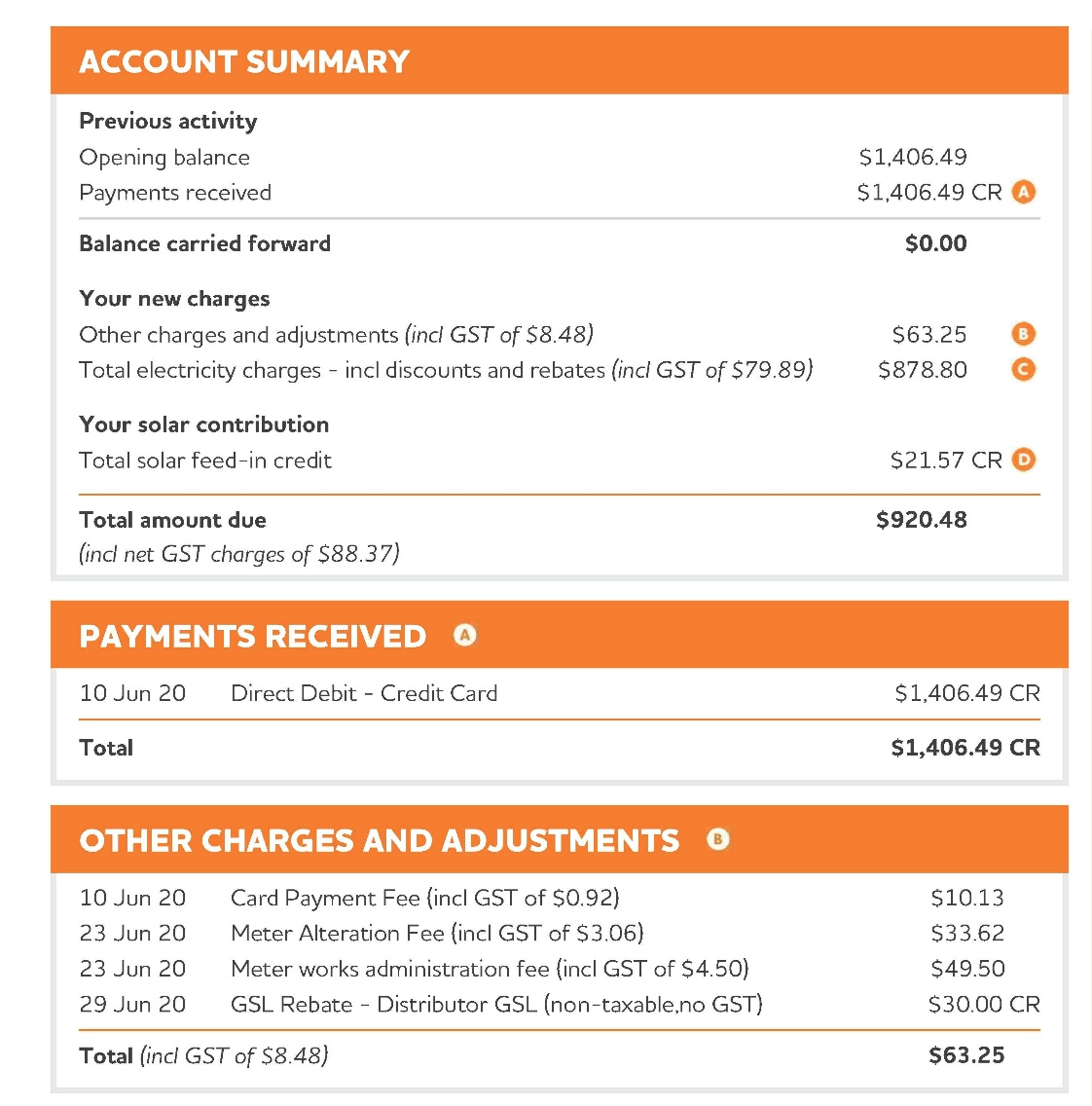
96 In the above extract, the GSL Payment appears as a credit in the section headed “Other charges and adjustments”. Mr Davies said in cross-examination that the GSL Payment was for a late appointment and that the payment related to Connection Services (T59-60).
97 During cross-examination, Mr Davies was taken to a bill from Momentum Energy to a customer. He was asked by the Court whether there was any amount charged for distribution services and where this could be seen. He said that a component of the tariff would be a network component (T59). I take this to indicate that the charge for the Supply Services was contained within the tariff charged by the retailer to the customer.
98 Mr Selvapathy accepted in cross-examination that the outage data for the purpose GSL Payments gets compiled on an annual basis (T78). He said that this data is compiled after the calendar year is completed (T78-79). He said that the data is then sent to AES management for approval of the GSL Payments to be made (T79). He said that the GSL Payments for outages for a calendar year are generally processed in the following March (T79).
Data about the GSL Payments
99 Annexed to Mr Davies’s first affidavit (as Annexure JD-11) is a table which presents relevant data with respect to GSL Payments during the Relevant Period. The data in the table is explained in para 44 of the affidavit. A clerical error in the table is noted in para 7 of Mr Davies’s second affidavit. Further evidence about the table was given by Mr Davies during cross-examination (T60-64).
100 In his third affidavit, Mr Davies states (in para 5) that, in some rare circumstances, appointment and connection charges could be waived (by AES) and that, in some circumstances, the GSL Payment to a customer may exceed the specific connection charge to the retailer in respect of that connection (as a connection GSL Payment may be up to $350). Mr Davies accepted in cross-examination that you can have situations in which AES is making a GSL Payment to a particular customer and the GSL Payment is more than the actual price of the service (T64).
101 Annexure JD-13 to Mr Davies’s third affidavit is a table which addresses two matters:
(a) when, during the Relevant Period, the GSL Payments exceeded the specific charges for the relevant connections and appointments, as well as when specific charges were waived; and
(b) the impact of both GSL Payments exceeding the specific charges and the waiver of specific charges on decreasing adjustments (should other electricity supply charges arising from the connection not be taken into account).
102 Mr Davies gave further evidence about this table during cross-examination (at T65-71). Mr Davies accepted that the table includes both situations in which a fee gets charged and AES reverses it out and situations in which AES does not charge a fee to start with (T68).
103 Mr Davies said during cross-examination that he was not familiar with the information in the fifth column of the table which is Annexure JD-13 (T68, T71).
The purposes of the GSL Payments scheme
104 I now consider the purpose or purposes of the GSL Payments scheme. AusNet’s position is that the purpose of the GSL Payments scheme is to acknowledge the inconvenience that customers experience when their distributor does not meet minimum standards. The Commissioner accepts that this is one of the purposes of the scheme (see the Commissioner’s submissions of 13 May 2026, para 112). The Commissioner contends that additional purposes of the scheme are to incentivise the distributor to improve its reliability and to partially compensate customers for any loss suffered.
105 I first set out the evidence that is directed to this issue. I then consider and express my conclusions as to the purpose or purposes of the GSL Payments scheme.
Evidence
106 Ms Eddy states in para 48 of her first affidavit (in the context of discussing the EDC):
Throughout clause 6 [of the EDC], [GSL Payments] were referred to as payments by the distributor to the customer. This accords with my understanding of the purpose of [GSL Payments], namely that [GSL Payments] are made to acknowledge and pay a customer for services provided below standards as regulated by the EDC. Consistently with this concept of acknowledgement and payment:
(a) clauses 6.3.1 and 6.3.2 specifically required unplanned interruptions (as opposed to planned interruptions); and
(b) clause 6.3.4 provided certain exemptions to GSLs as set by the ESC including, for example, load shedding at the direction of the AEMO, for which blame could not be attributed to [AES].
(Emphasis added.)
107 Ms Eddy states at para 89 of her first affidavit (in the context of describing the UoSA):
From an accounting and legal perspective, funds flowed from [AES] to the retailer, rather than the customer. That said, the practical outcome is that [GSL Payments] were made for the purpose of paying customers for poor service standards with respect to the services provided by [AES] to the end-user customer, and reach that customer.
(Emphasis added.)
108 In para 90 of her first affidavit, Ms Eddy states that the purpose of GSL Payments is described in various documents. She states that her understanding of the purpose of GSL Payments aligns with the section headed “What is the guaranteed service level scheme?” contained in pp 121-122 of the Electricity Distribution Code Review – Customer Service Standards, Final Decision of 16 November 2020 (amended 22 December 2020) (the 2020 EDC Review) (CB tab 4.32), as set out below:
What is the guaranteed service level scheme?
The guaranteed service level scheme seeks to acknowledge the inconvenience customers experience when their distributor does not meet minimum service standards. The scheme requires distributors to provide customers with financial recognition in areas such as unplanned supply outages and poor service. The scheme requires a distributor to pay a customer in instances where a level of service is worse than the thresholds we set. These payments are generally made by a distributor to a customer’s retailer. The customer’s retailer then applies the payment to the customer’s account. The requirements relating to guaranteed service levels are set out in section six of the distribution code.
The guaranteed service level scheme has evolved over time to seek alignment with community expectations and changes to regulatory responsibilities. It has expanded from direct customer interactions to the overall customer experience.
The guaranteed service level scheme currently has six different categories of payments:
• Low reliability and supply restoration. These three payments seek to acknowledge customers where there may be limited opportunities for improvement due to physical, technical and economic constraints. These payments include duration payments (supply restoration), momentary payments and annual frequency payments (both low reliability).
• Supply restoration – single interruption. These payments are designed to recognise the inconvenience from lengthy sustained outages experienced by customers. Currently, the payment occurs if urban or rural customers experience outages lasting 12 or 18 hours or more from a single event, respectively. However, if the customer has received an annual duration payment (outages in a calendar year accumulating more than 20 hours) they will not receive a supply restoration single interruption payment. These payments were introduced in 2016. In this final decision, we have removed the single interruption payment and replaced it with the major event day payment which applies to all Victorian customers who experience an outage for more than 12 hours on a major event day.
• Late or missed appointments. These payments hold distributors accountable for being punctual for appointments made with customers.
• Delayed new connections. These payments are made to customers where a distributor has not completed and energised a new electricity connection by the date agreed between the customer and the distributor.
Each of these payments directly relate to the services distributors provide customers and aim to achieve part of the overall purpose of the guaranteed service level scheme. Each payment captures an observable part of the service that a customer can see and articulate as a part of their energy experience.
(Underlining emphasis added.)
109 In para 95 of her first affidavit, Ms Eddy states:
From a practical perspective, AusNet provides distribution services to end-user customers and, if these distribution services are provided at an inadequate service level, AusNet pays customers in the form of a [GSL Payment]. Distribution services are reflected on a customer bill as a charge and [GSL Payments] are reflected on a customer bill as a credit – the purpose being to reduce the amount being paid by customers for services where the guaranteed service levels are not met.
(Emphasis added.)
110 Ms Eddy was challenged during cross-examination on the last sentence of para 95 of her affidavit. She initially maintained her evidence but then perhaps qualified the evidence as follows (T40-41):
Well, perhaps I ask instead this way to clarify what you actually mean - what you’re referring to in that last sentence. What purpose are you referring to?---The purpose of reflecting the distribution services as a charge and GSLs as a credit.
So you’re not referring to the purpose of GSLs themselves, is that what you’re saying?---Well, in this paragraph specifically, no, that’s not what I’m saying.
111 In para 99 of her first affidavit, Ms Eddy states:
During the Relevant Period, I never understood [GSL Payments] to be in the nature of a penalty imposed on AusNet. The purpose of [GSL Payments] is not to incentivise AusNet to improve its distribution infrastructure and services in the worst parts of its network. That would require immense funding that is not commensurate with the improvement. Rather, the purpose is to acknowledge that some customers experience worse service reliability than others.
(Emphasis added.)
112 In cross-examination, Ms Eddy said that, in her view, the GSL Payments were meant to be an “acknowledgement” rather than directly related to the loss experienced by the customer (T32).
113 In cross-examination, Ms Eddy was taken to an internal AES document constituting management authorisation for GSL Payments for supply restoration and low reliability for the 2018 calendar year. The document is headed “Electricity Distribution”, dated 25 February 2019 and signed by various AES executives on 5, 6 and 8 March 2019 (the 2019 Management Authorisation) (CB tab 6.05 at p 19,593). The document includes the following text:
If a customer experiences long or frequent unplanned outages over a calendar year they are compensated with GSL payment.
114 The following exchange then took place during cross-examination of Ms Eddy (T34):
Now, you’d agree with that particular statement, wouldn’t you?---I personally don’t agree that they are compensation from a regulatory perspective. I think compensation means different things in different contexts. And I understand, you know, this sort of document providing some context as to what the budget payment signoff is going to be for - why that language might be used. But to me, from a regulatory perspective, [GSL Payments] are an acknowledgement of poor service but aren’t intended to be compensation tied to the value to a customer of interruptions in their service.
115 Ms Eddy was also taken in cross-examination to the ESC’s Review of the Victorian Electricity Distributors’ Guaranteed Service Level Payment Scheme in December 2015 (the 2015 ESC Review) (CB tab 9.44), which includes (at p 4):
2.3 WHY DO WE HAVE A GSL PAYMENTS SCHEME?
The provision of electricity distribution services is a natural monopoly. The revenues that can be earned by the electricity distributors for these services are therefore subject to an incentive-based economic regulatory regime. This regime gives the electricity distributors an incentive to reduce costs, which has the potential to affect service levels. The electricity distributors are therefore also subject to a service incentive regime to incentivise them to provide an economically efficient level of service.
The service incentive regime comprises two elements:
• A service incentive factor that provides an incentive to deliver an economically efficient level of service by rewarding electricity distributors (through the price control) for improvements in their average performance relative to a target, and penalising them for deteriorations in the average performance. The rewards or penalties are paid or received by all customers through a reduction or increase in their distribution charges.
• A GSL payments scheme that makes payments directly to the worst served customers (in the case of reliability) and to those customers who do not receive a certain level of service (for example, not connecting customers by the agreed date).
The service incentive factor and the GSL payments scheme both provide an incentive for the electricity distributors to improve reliability. The service incentive factor encourages them to identify the least cost actions that will improve the average level of reliability. Reliability improvements for the worst served customers may not be prioritised under the service incentive factor. This may be because there are few customers on the feeder and so any actions to improve reliability have an immaterial impact on the average reliability. Alternatively, there may be characteristics associated with that feeder which require relatively high cost actions to improve reliability.
The GSL payments scheme therefore provides an additional incentive for electricity distributors to improve the reliability for the worst served customers.
However, we recognise that it may not be efficient to improve the reliability for particular customers as the cost incurred to improve reliability for these customers is higher than the value of customer reliability.
(Emphasis added, footnote omitted.)
116 The following exchange then took place (T35-36):
It’s the Essential Services Commission that sets the GSL levels and administers the GSL scheme; isn’t it?---Yes.
So they are the ones setting the scheme. Aren’t they correct that if they force distributors to make payments to customers, then that’s providing them with some kind of incentive to try and improve reliability so that they don’t have to make the payments anymore?---No, that’s not correct. And from a practical perspective, the GSL payments are not material enough for networks to invest in the substantial capital works that would need to be undertaken to improve reliability on our worst served feeders which include long rural feeders, lots of vegetation. The [GSL Payments] as it says in the 2020 GSL review practically as the operation, they are an acknowledgement of service.
And what about for maintenance of service levels. So in areas where [GSL Payments] currently aren’t paid, wouldn’t it provide an incentive to maintain service levels in those parts of the network so that they don’t have to pay [GSL Payments]?---Again, no. They’re just not material enough to really cover - really they are not material enough that the business would do anything differently in terms of its operations because of [GSL Payments]. They don’t drive any different behaviour and in addition from a financial perspective, we actually recover the cost of the [GSL Payments] that we pay out through our pricing reviews that the AER oversees. So even if we make a GSL payment over a 5 to 10-year period, we’re actually kept whole because that GSL payment that we made is [used] to inform the allowance that we receive through our regulated revenues in the next 5-year period.
(Emphasis added.)
117 Mr Selvapathy gives evidence at para 19 of his affidavit that, in his understanding, the purpose of the supply restoration and low reliability GSL Payments is for AES to “acknowledge when a customer experiences poor service reliability”. He notes that the amount AES pays does not cover the customer’s potential loss associated with the lack of electricity. In cross-examination in relation to para 19 of his affidavit, Mr Selvapathy said that sometimes a customer may not have had any loss, but they still may get a GSL Payment (T81).
118 Mr Selvapathy was taken during cross-examination to the 2019 Management Authorisation (see [113] above). He said that the GSL Payments to a customer may not reflect the amount of their loss due to an outage (T80). He said that, in his understanding, the GSL Payment is “not going to compensate for the losses a customer generally may have [incurred]”. He said that the payment “is more of a set payment” (T80). Mr Selvapathy did not accept that the customers are getting some kind of financial benefit from the GSL Payments; he said that they are “more of an acknowledgement of the poor service that a customer has had over the year” (T80).
Analysis
119 I accept that one of the purposes of the GSL Payments scheme is to acknowledge the inconvenience customers experience when their distributor does not meet minimum service standards. This purpose is identified in the extract from the 2020 EDC Review set out at [108] above and is supported by Ms Eddy’s written and oral evidence (see [106], [111] and [112] above).
120 In my opinion, an additional purpose of the GSL Payments scheme is to incentivise the distributor to improve its reliability. The extract from the 2015 ESC Review set out at [115] above supports the proposition that the GSL Payments scheme was (at least in part) designed to provide an incentive for distributors to improve reliability. Common sense also supports the proposition that a scheme that requires distributors to make certain payments when they fail to meet certain minimum standards is designed to improve the distributors’ reliability. I accept that, as Ms Eddy pointed out (see [116] above), the GSL Payment amounts were in some cases insufficient to incentivise the distributor to improve its distribution infrastructure and services in the worst parts of its network. However, this evidence does not cover all parts of the distribution network and services. Further, while the distributor may be able to effectively recoup its GSL Payments through the tariff, there may be a time lag before it can do so and there may be uncertainty as to whether it will fully recoup such payments.
121 Insofar as the Commissioner contends that a purpose of the GSL Payments scheme is to partially compensate customers for any loss suffered as a result of the distributor’s failure to meet the minimum standards, I am not satisfied that this was a substantial purpose of the scheme. The link between the payments and the suffering of any loss appears to be too tenuous. In a number of instances where GSL Payments are required (eg, late or missed appointments), it is not obvious that the customer is likely to have suffered any loss (as distinct from inconvenience). Further, the amounts of the GSL Payments do not appear to have been set with an estimate of likely loss in mind. While it is true that the 2019 Management Authorisation uses the word “compensation”, the word can be used in different senses and it is unclear in which sense it is used here.
122 In summary, I consider that the purposes of the GSL Payments scheme were:
(a) to acknowledge the inconvenience customers experience when their distributor does not meet minimum standards; and
(b) to incentivise the distributor to improve its reliability.
Whether the direct supply analysis or the indirect supply analysis is correct
123 I now consider whether the Direct Supply Analysis or the Indirect Supply Analysis is correct. As noted in the Introduction, the “Direct Supply Analysis” is that AES provided the Relevant Services directly to customers (with billing and payment being done through the retailer). The “Indirect Supply Analysis” is that AES supplied the Relevant Services to the retailer and the retailer supplied those services to the customer. As noted in the Introduction to these reasons, both parties accept that these are the only two realistic alternatives.
124 AusNet’s primary position is that the Indirect Supply Analysis is correct. The Commissioner’s primary position is that the Direct Supply Analysis is correct.
125 This analysis is being undertaken for the purpose of applying the provisions of the GST Act. In order to apply the relevant provisions of the GST Act, it is necessary to determine whether the Direct Supply Analysis or the Indirect Supply Analysis is correct.
126 The contractual and other like documents that form part of the regulatory regime do not point consistently in one direction:
(a) The documents that apply to the distributor-customer relationship strongly support the proposition that the Relevant Services were provided by the distributor directly to the customer (with billing and payment being done through the retailer). In particular:
(i) The Basic Connection Services (Metered Load) MSO, which is the contract under which the Connection Services were provided by the distributor, is a contract between the distributor and the customer. The retailer is not a party to the contract. The contract is framed on the basis that the services it covers are provided by the distributor directly to the customer: see clauses 1, 2. The contract recognises that billing and payment may be effected through the retailer (clause 6). Ms Eddy accepted in cross-examination that the Basic Connection Services (Metered Load) MSO “is for connection-related services which AusNet provides the customers” (see [66] above).
(ii) The Deemed Distribution Contract, which is the contract under which the Supply Services (called “customer connection services”) were provided by the distributor, is a contract between the distributor and the customer. Again, the retailer is not a party to the contract. The contract is framed on the basis that the services it covers are provided by the distributor directly to the customer: see the preamble, clause 5. The contract recognises that billing and payment will be effected through the retailer (clause 11). Ms Eddy accepted during cross-examination that the Deemed Distribution Contract was for the ongoing connection of AES’s distribution network to the customer’s premises and that “AusNet provides that service to customers under that contract” (see [71] above).
(b) The documents that applied to the retailer-customer relationship (eg, the Retail Contract Model Terms) also strongly support the proposition that the Relevant Services were provided by the distributor directly to the customer (with billing and payment being done through the retailer). In particular, clause 5.2 of the Retail Contract Model Terms (which has been set out above) provided that:
This contract does not cover the physical connection of your premises to the distribution system, including metering equipment and the maintenance of that connection and the supply of energy to your premises. This is the role of your distributor under a separate contract called a customer connection contract.
(c) Similarly, clauses 26 and 27.1 of the Momentum Retail Contract suggest that the Connection Services and the Supply Services are provided by the distributor rather than the retailer.
(d) On the other hand, and rather confusingly, the document that applies to the distributor-retailer relationship (the UoSA) appears to support the proposition that the Relevant Services are provided by the distributor to the retailer and by the retailer to the customer. Clause 3 provides that “the Distributor will provide the Distribution Services to the Retailer in respect of each Customer”. The definition of “Distribution Services” refers to services being “provided to the Retailer by the Distributor”. The services to which that definition refers include the Relevant Services.
127 While there may be ambiguity in the contractual and other like documents, from a practical perspective, the Relevant Services were provided by AES directly to the customers (with billing and payment being done through the retailer). The physical tasks involved in providing the Connection Services and the Supply Services were carried out by AES (through employees or contractors); they were not carried out by the retailer.
128 Further, from a commercial perspective, I consider that the Relevant Services were provided by AES directly to the customers (with billing and payment being done through the retailer). This is strongly supported by Ms Eddy’s oral and written evidence: see [66], [70], [71], [72], [84], [85] and [88] above. In particular, in para 79 of her first affidavit, Ms Eddy states that:
Although the [Deemed Distribution Contract] relates to services that AusNet is providing directly to customers, the [Deemed Distribution Contract] does not provide for direct payments by customers for those services.
(Emphasis added.)
129 In para 96 of her first affidavit, Ms Eddy states:
The UoSA provides for the payment for the services we [i.e. AES] provide in relation to a customer to be made by the retailer to AusNet. However, practically and commercially, AusNet views those payments as payments made by the customer for services provided by AusNet. … [I]n practice we treat the end-user customer as the recipient of the services.
(Emphasis added.)
130 In cross-examination, Ms Eddy gave the following evidence (T44):
We’ve talked about the Use of System Agreement already. Now, it’s fair to say, isn’t it, that under that agreement while the Use of System Agreement introduces the intermediary of the retailer as between AusNet’s provision of services to customers and the associated flow of funds, in practice AusNet treats the end user customer as the recipient of the services? Do you agree with that?---Yes.
(Emphasis added.)
131 In my view, having regard to the contractual documentation (although it does not all point one way) and practical and commercial perspectives, for the purposes of the application of the GST Act, the Relevant Services should be characterised as having been provided by AES directly to the customer (with billing and payment being done through the retailer) rather than as having been provided by AES to the retailer and by the retailer to the customer. As set out above, most of the contractual and other like documents are framed on the basis that the Relevant Services are provided directly by AES to the customer. The practical reality is that the Relevant Services were provided by AES directly to the customer. And this analysis reflects the way in which AES viewed the transactions from a commercial point of view.
132 For these reasons, I consider the Direct Supply Analysis to be correct (and the Indirect Supply Analysis to be incorrect).
Applicable provisions
133 I set out the provisions of the GST Act based on a compilation dated 2 July 2018, which is included in the parties’ joint book of authorities. The index to the joint book of authorities indicates that this was the form of the relevant provisions as at 1 March 2019 and that there were no changes to the relevant provisions during the Relevant Period.
Division 19
134 Division 19 of the GST Act is titled “Adjustment events”.
135 Section 19-1 sets out what the Division is about:
19-1 What this Division is about
Adjustments can arise because of adjustment events. They are events such as a cancellation of a supply or acquisition, or a change in the consideration for a supply or acquisition (for example, because of a volume discount). |
Note: Importations do not give rise to adjustment events.
136 Section 19-10 provides:
19-10 Adjustment events
(1) An adjustment event is any event which has the effect of:
(a) cancelling a supply or acquisition; or
(b) changing the *consideration for a supply or acquisition; or
(c) causing a supply or acquisition to become, or stop being, a *taxable supply or *creditable acquisition.
Example: If goods that are supplied for export are not exported within the time provided in section 38-185, the supply is likely to become a taxable supply after originally being a supply that was GST-free.
(2) Without limiting subsection (1), these are *adjustment events:
(a) the return to a supplier of a thing, or part of a thing, supplied (whether or not the return involves a change of ownership of the thing);
(b) a change to the previously agreed *consideration for a supply or acquisition, whether due to the offer of a discount or otherwise;
(c) a change in the extent to which an entity that makes an acquisition provides, or is liable to provide, consideration for the acquisition (unless the entity *accounts on a cash basis).
(3) An *adjustment event:
(a) can arise in relation to a supply even if it is not a *taxable supply; and
(b) can arise in relation to an acquisition even if it is not a *creditable acquisition.
(4) However, the return of a thing supplied, or part of a thing supplied, to its supplier is not an *adjustment event if the return is for the purpose of repair or maintenance.
(Underlining emphasis added.)
137 The expression “Consideration” is defined in s 9-15 as follows:
9-15 Consideration
(1) Consideration includes:
(a) any payment, or any act or forbearance, in connection with a supply of anything; and
(b) any payment, or any act or forbearance, in response to or for the inducement of a supply of anything.
(2) It does not matter whether the payment, act or forbearance was voluntary, or whether it was by the *recipient of the supply.
(2A) It does not matter:
(a) whether the payment, act or forbearance was in compliance with an order of a court, or of a tribunal or other body that has the power to make orders; or
(b) whether the payment, act or forbearance was in compliance with a settlement relating to proceedings before a court, or before a tribunal or other body that has the power to make orders.
(2B) For the avoidance of doubt, the fact that the supplier is an entity of which the *recipient of the supply is a member, or that the supplier is an entity that only makes supplies to its members, does not prevent the payment, act or forbearance from being consideration.
138 Section 19-40 provides:
19-40 Where adjustments for supplies arise
You have an adjustment for a supply for which you are liable to pay GST (or would be liable to pay GST if it were a *taxable supply) if:
(a) in relation to the supply, one or more *adjustment events occur during a tax period; and
(b) GST on the supply was attributable to an earlier tax period (or, if the supply was not a taxable supply, would have been attributable to an earlier tax period had the supply been a taxable supply); and
(c) as a result of those adjustment events, the *previously attributed GST amount for the supply (if any) no longer correctly reflects the amount of GST (if any) on the supply (the corrected GST amount), taking into account any change of circumstances that has given rise to an adjustment for the supply under this Subdivision or Division 21 or 134.
139 Section 19-45 provides:
19-45 Previously attributed GST amounts
The previously attributed GST amount for a supply is:
(a) the amount of any GST that was attributable to a tax period in respect of the supply; plus
(b) the sum of any *increasing adjustments, under this Subdivision or Division 21, that were previously attributable to a tax period in respect of the supply; minus
(c) the sum of any *decreasing adjustments, under this Subdivision or Division 21 or 134, that were previously attributable to a tax period in respect of the supply.
140 Sections 19-50 and 19-55 in turn address increasing and decreasing adjustments.
141 Section 19-55 provides:
19-55 Decreasing adjustments for supplies
If the *corrected GST amount is less than the *previously attributed GST amount, you have a decreasing adjustment equal to the difference between the previously attributed GST amount and the corrected GST amount.
Division 134
142 Division 134 is titled “Third party payments”. It was not part of the GST Act when enacted and was introduced later, by the Tax Laws Amendment (2010 GST Administration Measures No. 1) Act 2010 (Cth). The explanatory memorandum for the Tax Laws Amendment (2010 GST Administration Measures No. 1) Bill 2010 (Cth) states at p 3:
Schedule 1 to this Bill amends the A New Tax System (Goods and Services Tax) Act 1999 to ensure that the appropriate amount of goods and services tax is collected and the appropriate amount of input tax credits claimed in situations where there are payments between parties in a supply chain, which indirectly alter the price paid or received by the parties for the things supplied, but for which an adjustment does not presently arise because the parties are not directly involved in a supply from one to the other.
143 Section 134-1 sets out what the Division is about:
134-1 What this Division is about
You may have a decreasing adjustment if you make a payment to an entity that acquires something that you had supplied to another entity. The entity receiving the payment may have an increasing adjustment. |
144 Section 134-5(1) provides:
134-5 Decreasing adjustments for payments made to third parties
(1) You have a decreasing adjustment if:
(a) you make a payment to an entity (the payee) that acquires a thing that you supplied to another entity (whether or not that other entity supplies the thing to the payee); and
(b) your supply of the thing to the other entity:
(i) was a *taxable supply; or
(ii) would have been a taxable supply but for a reason to which subsection (3) applies; and
(c) the payment is in one or more of the following forms:
(i) a payment of *money or *digital currency;
(ii) an offset of an amount of money or digital currency that the payee owes to you;
(iii) a crediting of an amount of money or digital currency to an account that the payee holds; and
(d) the payment is made in connection with, in response to or for the inducement of the payee’s acquisition of the thing; and
(e) the payment is not *consideration for a supply to you.
(1A) However, subsection (1) does not apply if:
(a) the supply of the thing to the payee is a *GST-free supply, or is not *connected with the indirect tax zone; or
(b) the Commissioner is required to make a payment to the payee, under Division 168 (about the tourist refund scheme), related to the payee’s acquisition of the thing;
and you know, or have reasonable grounds to suspect, that the supply of the thing to the payee is a GST-free supply or is not connected with the indirect tax zone, or that the Commissioner is so required.
(2) The amount of the *decreasing adjustment is an amount equal to the difference between:
(a) either:
(i) if your supply to the other entity was a *taxable supply—the amount of GST payable on the supply; or
(ii) if your supply to the other entity would have been a taxable supply but for a reason to which subsection (3) applies—the amount of GST that would have been payable on the supply had it been a taxable supply;
taking into account any other *adjustments that arose, or would have arisen, relating to the supply; and
(b) the amount of GST that would have been payable, or would (but for a reason to which subsection (3) applies) have been payable, for that supply:
(i) if the *consideration for the supply had been reduced by the amount of your payment to the payee; and
(ii) taking into account any other adjustments that arose, or would have arisen, relating to the supply, as they would have been affected (if applicable) by such a reduction in the consideration.
(3) This subsection applies to the following reasons why your supply of the thing to the other entity was not a *taxable supply:
(a) you and the other entity are *members of the same *GST group;
(b) you and the other entity are members of the same *GST religious group;
(c) you are the *joint venture operator for a *GST joint venture, and the other entity is a *participant in the GST joint venture.
(4) However:
(a) paragraph (3)(a) does not apply if you and the payee are *members of the same *GST group when the payment referred to in paragraph (1)(a) is made; and
(b) paragraph (3)(b) does not apply if you and the payee are members of the same *GST religious group when that payment is made.
(Underlining emphasis added.)
145 Section 195-1 defines “thing” to mean “anything that can be supplied or imported”.
146 Section 134-10 is titled “increasing adjustments for payments received by third parties” and mirrors s 134-5 with respect to increasing adjustments.
147 Section 134-25 is titled “Adjustment events do not arise” and addresses the interaction between Div 19 and Div 134. It provides:
134-25 Adjustment events do not arise
To avoid doubt, a payment that gives rise to an *adjustment under this Division cannot give rise to an *adjustment event.
Consideration
148 I now consider whether the making of the GSL Payments during the Relevant Period gives rise to decreasing adjustments under Div 19 or Div 134 of the GST Act.
Division 134
149 It is convenient to start with Div 134, as this can be quickly put to one side.
150 For Div 134 to operate here, s 134-5 needs to be satisfied. Section 134-5(1) sets out five matters or elements which need to be satisfied for there to be a decreasing adjustment under that provision. The first of these is as follows:
(a) you make a payment to an entity (the payee) that acquires a thing that you supplied to another entity (whether or not that other entity supplies the thing to the payee);
151 The application of s 134-5 in the present case is predicated on the Indirect Supply Analysis being correct. If (contrary to my conclusion above) the Indirect Supply Analysis were correct, the first matter or element in s 134-5(1) would be satisfied on the present facts as follows:
(a) you [AES] make a payment to an entity (the payee) [the customer] that acquires a thing [the Relevant Services] that you supplied to another entity [the retailer] (whether or not that other entity supplies the thing to the payee).
152 However, it follows from my conclusion that the Indirect Supply Analysis is not correct that the above element of s 134-5(1) is not satisfied. I have concluded, above, that AES supplies the Relevant Services directly to the customer and does not supply them to the retailer. Accordingly, the first element in s 134-5(1) – set out above – is not satisfied.
153 In light of that conclusion, it is unnecessary to consider whether the other elements of s 134-5(1) (which are cumulative requirements) are satisfied.
154 For these reasons, the making of the GSL Payments did not give rise to decreasing adjustments under Div 134.
Division 19
155 I turn now to Div 19.
156 For the making of the GSL Payments to give rise to decreasing adjustments under Div 19, it is necessary for the making of the GSL Payments to constitute an “adjustment event” as defined in s 19-10(1). Paragraphs (a), (b) and (c) of s 19-10(1) set out three alternatives. Of these, only para (b) has potential application here. Section 19-10(1)(b) provides:
(1) An adjustment event is any event which has the effect of:
…
(b) changing the *consideration for a supply or acquisition;
157 Section 19-10(2) provides that, without limiting s 19-10(1), certain things are adjustment events. These include, in para (b):
(b) a change to the previously agreed *consideration for a supply or acquisition, whether due to the offer of a discount or otherwise;
158 There is evidently considerable overlap between the criterion for an adjustment event in s 19-10(1)(b) and the specific instance of an adjustment event in s 19-10(2)(b).
159 AusNet contends that the making of the GSL Payments constitutes an “adjustment event” within the meaning of s 19-10(1)(b) or 19-10(2)(b). AusNet contends that the making of the GSL Payments is an event which has the effect of changing the consideration for a supply (namely, the supply of the Relevant Services by AES to the customer) within the meaning of s 19-10(1). Further, if there be a difference, AusNet contends that the making of the GSL Payments constitutes an adjustment event within s 19-10(2)(b) on the basis that it is a change to the previously agreed consideration for a supply (namely, the supply of the Relevant Services by AES to the customer).
160 Before focussing on the main issue in dispute, I will first note some matters relating to s 19-10 that are not in dispute.
161 There is no issue that AES supplied the Relevant Services (i.e. the Connection Services and the Supply Services) to customers. Although AusNet’s primary position is that AES supplied the Relevant Services to the retailer, its alternative contention is that AES supplied the Relevant Services to the customer. The Commissioner’s primary contention is that AES supplied the Relevant Services to the customer.
162 There is no issue that the Relevant Services were supplied to customers for consideration. Under the contractual and other like documents described earlier in these reasons, customers were required to pay AES for the Connection Services and the Supply Services. AES billed the retailer for these services and the retailer then billed the customers for these services. The customers paid the retailer for the services, and the retailer passed on those payments to AES. Prima facie, the amount of the consideration for each of the Connection Services and the Supply Services was the price paid by the customer to AES (through the retailer) for those services. The issue to be considered below is whether there was a change to that consideration due to the making of the GSL Payments.
163 There is no issue that the making of the GSL Payments (by AES to customers, through the relevant retailer) constitutes an event for the purposes of s 19-10(1).
164 The real issue between the parties is whether the making of the GSL Payments constitutes an event which has the effect of changing the consideration for the supply of the Relevant Services within the meaning of s 19-10(1). AusNet contends that it does have that effect; the Commissioner contends that it does not. Section 19-10(2)(b) raises a substantially overlapping issue, namely whether the making of the GSL Payments constitutes a change to the previously agreed consideration for the supply of the Relevant Services (whether by discount or otherwise). It is convenient to consider s 19-10(1) and s 19-10(2) together, as they raise very similar issues.
165 AusNet submits that the terms in s 19-10 are to be given a broad meaning. Those terms include “change” and “consideration”. AusNet refers to dictionary definitions of the word “change” and to the statutory definition of the word “consideration” (set out above). AusNet also refers to extrinsic material in relation to “consideration” (including para 3.9 of the explanatory memorandum to the A New Tax System (Goods and Services Tax) Bill 1998 (Cth)) which make clear that “consideration” for the purposes of the GST Act is broader than for contractual purposes. See also TT-Line Company Pty Ltd v Federal Commissioner of Taxation [2009] FCAFC 178; 181 FCR 400 at [47] per Edmonds J. In relation to the expression “the consideration for a supply”, AusNet submits that the term “for” requires only a “connection or relationship” rather than what may be viewed as a more onerous threshold that may apply under contractual principles: see Federal Commissioner of Taxation v Qantas Airways Ltd [2012] HCA 41; 247 CLR 286 at [14] per Gummow, Hayne, Kiefel and Bell JJ; see also AP Group Ltd v Federal Commissioner of Taxation [2013] FCAFC 105; 214 FCR 301 (AP Group) at [33]-[34] per Edmonds and Jagot JJ.
166 AusNet submits that the effect of the GSL Payment is to “change” the consideration for the supply of the Relevant Services by reducing the price of supply of those services. In relation to the different types of GSLs, AusNet submits as follows:
(a) Late connection and appointment GSLs: AES receives consideration for supplying Connection Services to customers. The making of a GSL Payment for a late connection or appointment GSL is an “event” which constitutes a change in consideration for the services supplied by AES; the “effect” of the “change” is to reduce the cost of these services.
(b) Supply restoration and low reliability GSLs: AES receives consideration for supplying Supply Services to customers. Where there are interruptions to the supply of those services that meet the thresholds stated in the EDC, such as where a customer experienced unplanned outages of more than 20 hours across a calendar year, or where a customer experienced more than eight interruptions greater than one minute across a calendar year, a customer becomes eligible for GSL Payments. Thus, there is a relationship between the supply of the service for which the customer provides consideration (the provision of Supply Services) and the entitlement to a GSL Payment, which arises from the failure to provide to a sufficient level the specific service for which the customer has provided consideration. Moreover, the quantum of the GSL Payment turns upon the nature and length of the failure to provide to a sufficient level the specific service for which the customer has provided consideration. That is an “event” which gives rise to the “change” in the consideration for the services provided by AES, with the “effect” of the “change” being to reduce the consideration by the amount of the GSL Payment.
167 AusNet submits that the above treatment of Relevant Services and GSL Payments for GST purposes relevantly mirrors the regulatory and contractual framework, as well as the flow of funds with respect to the treatment of payments for the Relevant Services and GSL Payments under the Basic Connection Services (Metered Load) MSO, the UoSA and the Deemed Distribution Contract. AusNet submits that:
(a) The customer pays AES via the retailer for the Relevant Services. GSL Payments are payable by AES when the requisite service standards associated with the provision of the Relevant Services are not met. Thus, AES receives payments for the Relevant Services and is required to make GSL Payments.
(b) Correspondingly, at the retailer level: the Relevant Services provided by AES are invoiced on the retailer’s bill to the customer as a debit and the GSL Payments are correspondingly invoiced on the retailer’s bill to the customer as a credit.
168 AusNet further submits that the GSL Payments made in the circumstances described above answer the description of an “adjustment event” within the meaning of s 19-10(2)(b), in that each GSL Payment constitutes “a change to the previously agreed *consideration for [the supply of the Relevant Services], whether due to the offer of a discount or otherwise”. Here, the making of a GSL Payment constitutes “a change to the previously agreed consideration” for the supply of the Relevant Services with which the GSL Payment is associated. Moreover, whilst there is no offer of a discount, the net effect is to discount the cost to the customer of receiving the Relevant Services. For completeness, AusNet submits that on no view could s 19-10(2) be read as limiting the scope of s 19-10(1); it could only confirm or expand its scope.
169 The Commissioner contends that the making of the GSL Payments did not have the effect of changing the consideration for the supply of the Relevant Services within s 19-10(1). Similarly, he contends that the making of the payments did not constitute a change to the previously agreed consideration for the supply of the Relevant Services within s 19-10(2)(b).
170 The Commissioner emphasises that, under these provisions, it is necessary to show a change in the consideration for the relevant supply or acquisition. The Commissioner refers to Federal Commissioner of Taxation v PepsiCo, Inc [2025] HCA 30; 424 ALR 294 (PepsiCo), in which the High Court considered the meaning of “consideration for” in the context of the income tax treatment of royalties. The Commissioner submits that the word “for” connotes a causal connection between the making of a promise to pay or confer some other benefit and the receipt of the thing; the connection will be satisfied when the giving of the promise can be seen as the basis for, or a condition of, that receipt: see PepsiCo at [161].
171 The Commissioner submits that while the GST concept of “consideration for” a supply may not be confined to the contractual meaning, the analysis is still a fact-dependant exercise that involves a close analysis of the terms of the contracts between the parties and the nature of their arrangements. That means that great attention needs to be placed on the contractual arrangements between the distributor, the electricity retailers and the ultimate customers to identify whether the GSL Payments are an integer in determining the consideration for the relevant supplies or acquisitions. The Commissioner refers to Queensland Independent Wholesalers Ltd v Federal Commissioner of Taxation [1991] FCA 292; 29 FCR 312 (Queensland Independent Wholesalers) at 322 per Hill J (with whom Davies and Lee JJ agreed). In that case, in the context of sales tax, the Court considered whether certain rebates reduced the sale value upon which the tax was to be calculated.
172 In response to the Commissioner’s reliance on Queensland Independent Wholesalers, AusNet submits that there is no factor here that could displace the “commercial reality” that the GSL Payments do in fact operate to reduce the consideration for services and there is no “other end” to which the GSL Payments are made. AusNet also submits that, as Geocon Land Holdings No 5 Pty Ltd v Federal Commissioner of Taxation [2025] FCAFC 172; 313 FCR 531 illustrates, great caution is to be exercised in attempting to import notions relevant to sales tax into the GST context: at [107]; see also [103]-[110].
173 Having summarised the parties’ submissions, I now consider the issue in dispute.
174 It is necessary to have regard to the nature of the GST and the lens through which the issue (and the matter more generally) is to be approached. In Landcom v Federal Commissioner of Taxation [2022] FCA 510; 114 ATR 639, Thawley J stated at [206]:
It may be accepted as the Commissioner submitted that, for the purposes of s 9-5, a practical common-sense approach should be taken to the question of whether there is a single supply and to the characterisation of that supply, having regard to relevant contractual terms and commercial reality – see, for example: FCT v Luxottica Retail Australia Pty Ltd (2011) 191 FCR 561; 79 ATR 768; 2011 ATC 20-243 at [15]; ATS Pacific Pty Ltd v FCT (2014) 219 FCR 302; 98 ATR 116; 2014 ATC 20-149 at [43]. The recognition that the GST is a practical business tax, which informs that approach in relation to the characterisation of the relevant supply for the purposes of the “basic rules”, also informs the construction of Div 75, contained in the “special rules”.
(Emphasis added.)
Although his Honour was there addressing the approach to be taken to determining the relevant “supply” for the purposes of s 9-5, the observations are generally applicable to the GST Act. (His Honour’s decision was affirmed on appeal: Federal Commissioner of Taxation v Landcom [2022] FCAFC 204; 295 FCR 353.)
175 The expression “consideration” as used in the GST Act has a broad meaning that is not limited to contractual concepts. The definition of “consideration” in s 9-15 of the GST Act is set out at [137] above. The extrinsic materials relied on by AusNet make clear that the definition of “consideration” is intended to be broader than the concept of consideration for contractual purposes.
176 The Commissioner is correct to emphasise that, under ss 19-10(1)(b) and 19-10(2)(b), it is necessary to show a change in the consideration for the relevant supply or acquisition (here, the supply of the Relevant Services). In AP Group, Edmonds and Jagot JJ considered the meaning of the word “for” in the phrase “supply for *consideration” in s 9-5(a) of the GST Act. Their Honours stated at [33]-[34]:
33 … “For”, in this context, means “in order to obtain” (Macquarie Dictionary Online, item 3, Oxford Dictionary Online, item 9(a)). The word “for” thus functions in the statutory description to identify the character of the connection which is required. It ensures that not every connection between the giving of consideration and the provision satisfy the first condition of making a taxable supply. If it were otherwise, any form of connection of any character between the making of a supply and the payment of consideration would suffice. The decisions on which the Commissioner relied to support this proposition, on analysis, do not do so.
34 It is true that the relevant question has been expressed in terms of connection in numerous decisions, including those to which the Commissioner referred (Reliance at [33], TT-Line at [15] and [18], Department of Transport at [67] and Amex at [67]). But in no case did the analysis begin and end with that question. In each case the nature and extent of the connection was also analysed to ascertain whether the supply was made for the consideration.
These observations about the word “for” are equally applicable in relation to s 19-10.
177 The question, then, is whether, as a result of the GSL Payments, there is a change (a reduction) in the consideration for the supply of the Relevant Services. It is not enough that, as a result of the GSL Payments, there is a reduction in the overall amount paid or payable by the customer. The question is a more specific one: whether there is a reduction in the consideration for the supply of the Relevant Services. Putting this another way, are the GSL Payments an integer in the consideration for the supply of the Relevant Services?
178 In my opinion, having regard to the following matters, the making of the GSL Payments did not have the effect of changing the consideration for the supply of the Relevant Services.
179 First, under the regulatory regime described above, the GSL Payments were not constructed as, or referred to as, payments which effected a change in (a reduction to) the consideration payable by the customer for the supply of the Relevant Services. Under the regulatory regime, a distributor was required to hold a distribution licence. The Distribution Licence held by AES imposed an obligation to comply with all applicable codes, including the EDC. As set out above, pursuant to clause 6 of the EDC, distributors were obligated to make GSL Payments if they failed to meet certain minimum GSLs. There is nothing in clause 6 of the EDC that refers to the GSL Payments being a reduction to the price paid or payable by the customer for the supply of the Connection Services or the Supply Services. Rather, clause 6 presents the GSL Payments as standalone payments that the distributor is required to make.
180 Similarly, the Basic Connection Services (Metered Load) MSO and the Deemed Distribution Contract do not contain any terms which refer to or cause a GSL Payment to be treated as any form of adjustment to the price paid or payable by the customer for the supply of the Connection Services or the Supply Services. For example, there is no contractual mechanism which treats the GSL Payments as a discount or rebate or other reduction in price. While not determinative, the absence of such a contractual mechanism is a factor supporting the proposition that the GSL Payments do not change the consideration for the supply of the Relevant Services.
181 Second, the purposes of the GSL Payments scheme do not provide any positive support for the proposition that the making of the GSL Payments had the effect of changing the consideration for the supply of the Relevant Services. As discussed above, there was an issue between the parties as to the purpose or purposes of the GSL Payments scheme. AusNet contended that the sole purpose of the scheme was to acknowledge the inconvenience customers experience when their distributor does not meet minimum standards. The Commissioner contended that the scheme had both that purpose and two other purposes. I have concluded, above, that the GSL Payments scheme had both the acknowledgement purpose and the purpose of incentivising the distributor to improve its reliability. But whether the GSL Payments scheme had just the acknowledgment purpose or both purposes, there is no indication in the materials before the Court that the scheme had a purpose of changing the consideration for the supply of the Relevant Services.
182 Third, there was no correlation between the amount of a GSL Payment and the amount otherwise payable by the customer for the supply of the Connection Services or the Supply Services. The GSL Payment amounts were fixed amounts rather than, for example, a percentage of the amount otherwise payable by the customer for the supply of the Connection Services or the Supply Services. In some cases (albeit few in number), fees relating to the Connection Services were waived entirely for a service provided by AES to a customer. However, in such cases, the GSL Payment could still be payable, as waiving the fee did not remove AES’s obligation to make the GSL Payment. The fact that a GSL Payment was required to be made under the regulatory regime regardless of whether the distributor chose to waive the fee suggests that, in substance, the GSL Payments are not in the nature of a change in the consideration for a supply; they are, rather, independent of that consideration.
183 Further, it was possible for the GSL Payments to exceed the amount otherwise payable by the customer as consideration for the supply of the Connections Services. While relatively rare, the evidence of Mr Davies showed that this did happen on some occasions. The fact that a GSL Payment could exceed the amount otherwise payable for the supply of the Connection Services suggests that, as a practical matter, the GSL Payments are not in the nature of a change in the consideration for the supply of the services; they are independent of that amount.
184 I note also that, in the sample retailer bill set out at [95] above, the GSL Payments appear as a separate line item rather than a change to the consideration otherwise payable for the supply of the Connection Services or the Supply Services. This is consistent with the GSL Payments being a separate payment by AES to the customer rather than a change to the consideration for the supply of the Connection Services or the Supply Services.
185 It is true that the GSL Payments were related to the Relevant Services, as they were payable in circumstances where the distributor failed to meet certain minimum standards for the performance of the Relevant Services. However, it does not necessarily follow that the making of the GSL Payments had the effect of changing the consideration for the supply of the Relevant Services.
186 Having regard to these matters, in my opinion, the making of the GSL Payments did not constitute an event which had the effect of changing the consideration for the supply of the Relevant Services within the meaning of s 19-10(1)(b). In my opinion, the better view is that the GSL Payments were standalone amounts which AES was required to pay to the customer and were not amounts which had the effect of changing the consideration paid or payable by the customer to AES for the supply of the Connection Services or the Supply Services. Putting this another way, the GSL Payments were not an integer in the consideration for the supply of the Connection Services or the Supply Services.
187 For the same reasons, the making of the GSL Payments did not constitute a change to the previously agreed consideration for the supply of the Relevant Services within s 19-10(2)(b).
188 Accordingly, the making of the GSL Payments did not constitute an “adjustment event” within s 19-10.
189 It follows that the GSL Payments did not give rise to decreasing adjustments under Div 19.
Conclusion
190 For these reasons the appeal is to be dismissed. There is no apparent reason why costs should not follow the event.
I certify that the preceding one hundred and ninety (190) numbered paragraphs are a true copy of the Reasons for Judgment of the Honourable Justice Moshinsky. |
Associate:
Dated: 29 October 2026


