Federal Court of Australia
Boi v Aldi Foods Pty Ltd [2026] FCA 1576
File number(s): | VID 898 of 2023 |
Judgment of: | MCELWAINE J |
Date of judgment: | 23 October 2026 |
Catchwords: | REPRESENTATIVE PROCEEDINGS – application for approval of a settlement pursuant to s 33V(1) of the Federal Court of Australia Act 1976 (Cth) – claims by current and former employees for unpaid work in contravention of s 50 of the Fair Work Act 2009 (Cth) – parallel penalty proceeding by union raising common issue – settlement of both proceedings considered as single proposal – union’s costs of funding met by settlement of penalty proceeding – respondent appointed scheme administrator – whether settlement fair and reasonable in the interests of group members – no deduction for funder commission or legal costs – settlement approved |
Legislation: | Fair Work Act 2009 (Cth) ss 50, 546(3)(b) Federal Court of Australia Act 1976 (Cth) ss 37AF, 37AG(1)(a), 33V, 33ZF |
Cases cited: | Dyczynski v Gibson [2020] FCAFC 120; (2020) 280 FCR 583 Shop, Distributive and Allied Employees’ Association v ALDI Foods Pty Ltd [2022] FedCFamC2G 799; (2022) 318 IR 206 Webb v GetSwift Ltd (No 7) [2023] FCA 90; (2023) 414 ALR 500 |
Division: | Fair Work Division |
Registry: | Victoria |
National Practice Area: | Employment and Industrial Relations |
Number of paragraphs: | 89 |
Date of hearing: | 9 October 2026 |
Counsel for the Applicants: | Mr B Slade |
Solicitor for the Applicants: | A J Macken & Co |
Counsel for the Respondent: | Mr GJ Hatcher SC and Ms A Perigo |
Solicitor for the Respondent: | Enterprise Employment Law |
ORDERS
VID 898 of 2023 | ||
| ||
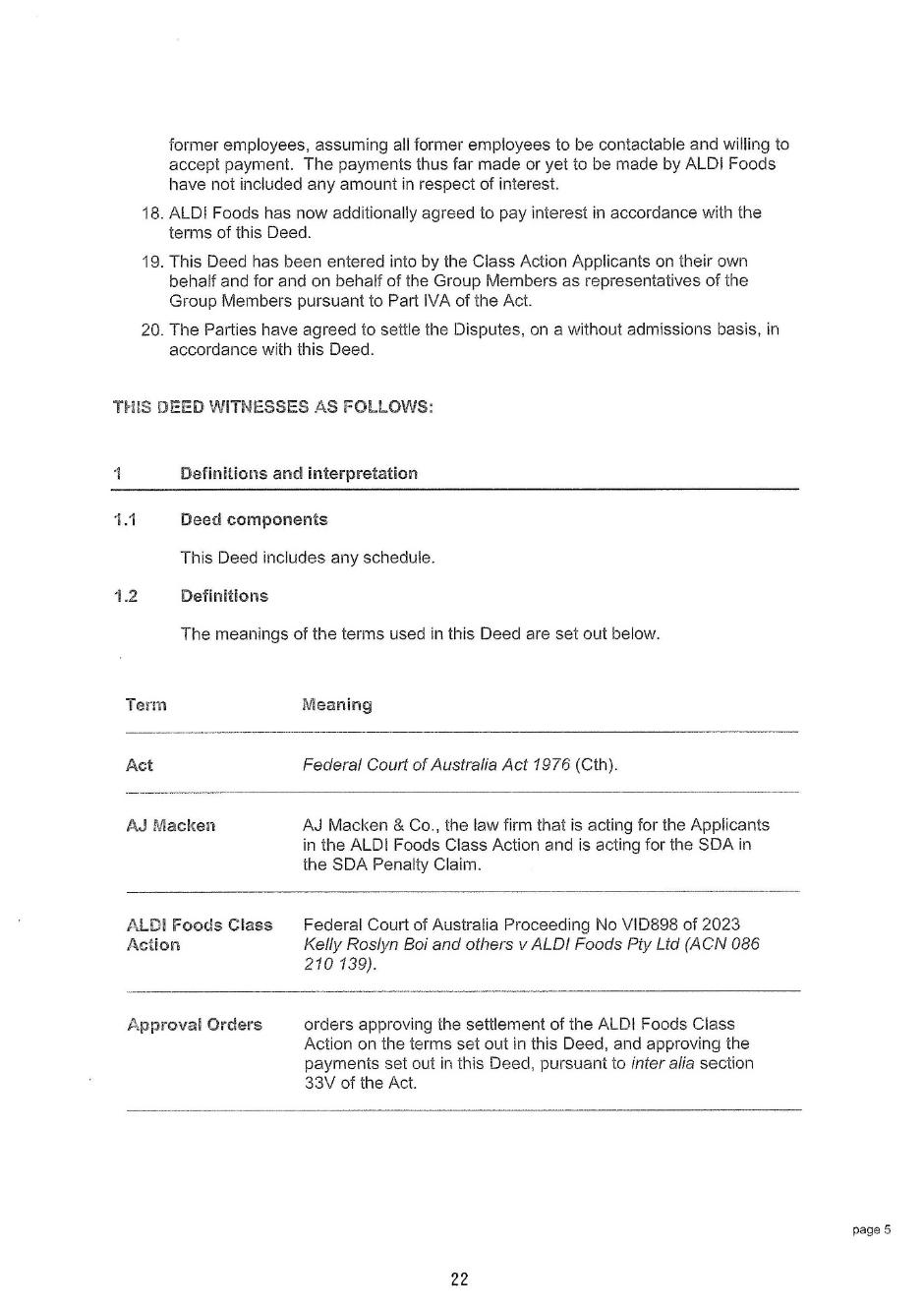
BETWEEN: | KELLY ROSLYN BOI First Applicant SOUAD TANNOUS LICHAA Second Applicant HARINDER PAL Third Applicant | |
AND: | ALDI FOODS PTY LTD Respondent | |
ORDER MADE BY: | MCELWAINE J |
DATE OF ORDER: | 23 OCTOBER 2026 |
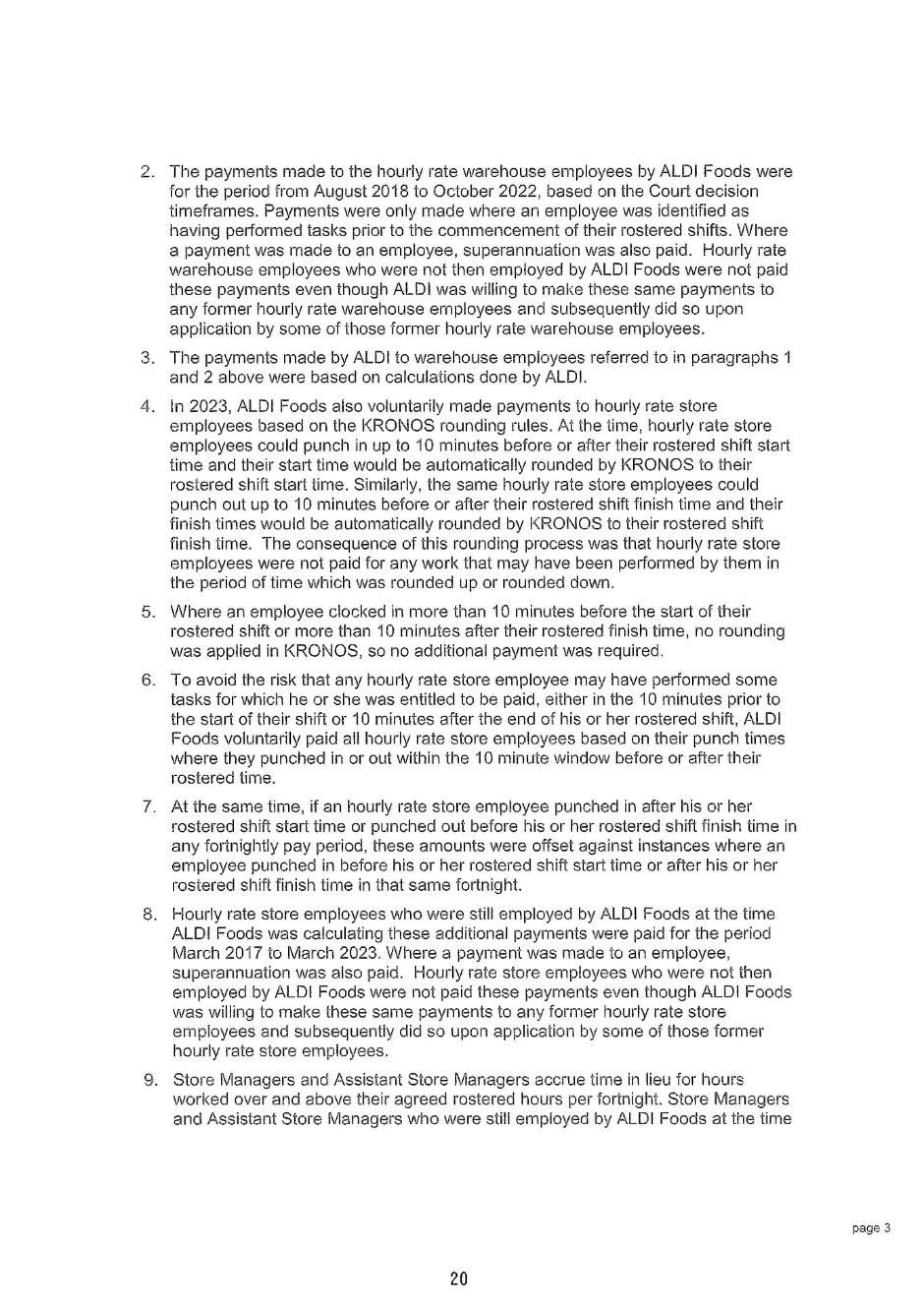
THE COURT NOTES THAT:
The parties will execute a variation to the Amended Deed such that clauses 2(b) and 2(c), which require ALDI Foods to make payments by 31 December 2026, be amended to require that such payments be made before 31 March 2027 or before the date the proceeding is dismissed, whichever is the later.
THE COURT ORDERS THAT:
Settlement approval
1. Subject to paragraph 2 below, pursuant to s 33V of the Federal Court of Australia Act 1976 (Cth) (Act), the settlement of proceeding VID 898 of 2023 (the Settlement) be approved on the terms set out in:
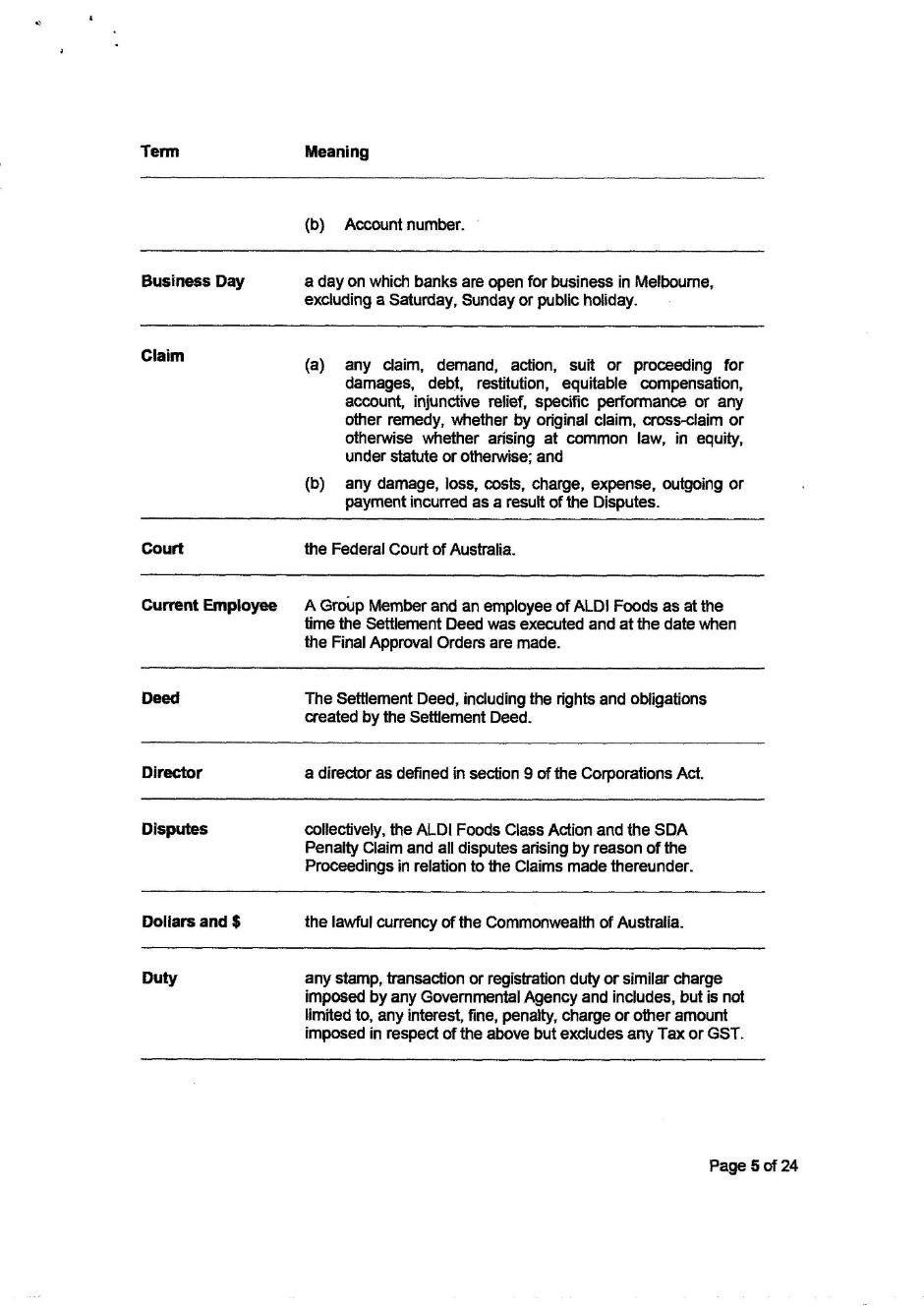
(a) the Settlement Deed made on 5 May 2026 (Deed), being exhibit DJM-10 to the affidavit of Dominic James Macken sworn on 23 June 2026, with parts redacted by orders made on 16 July 2026;
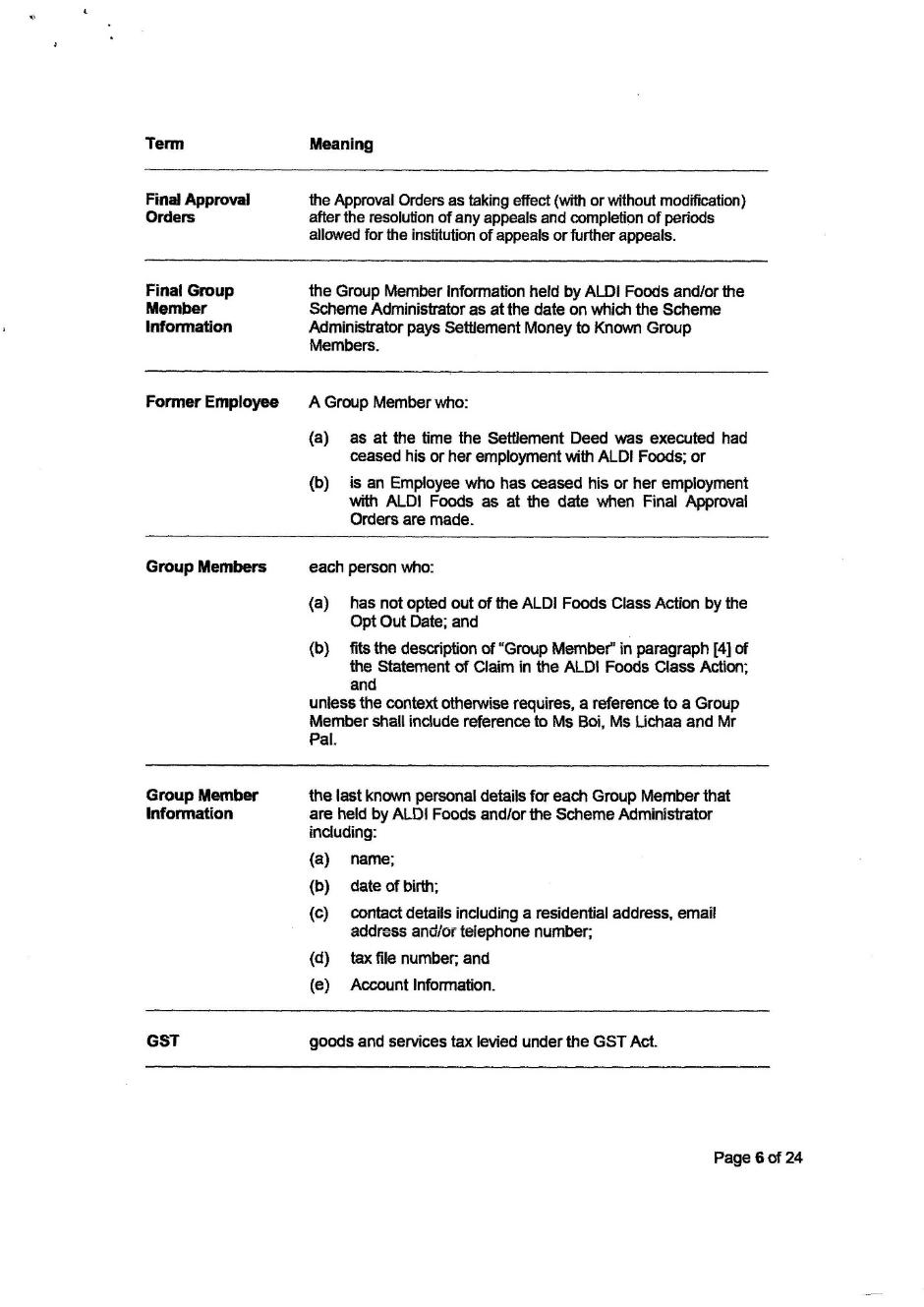
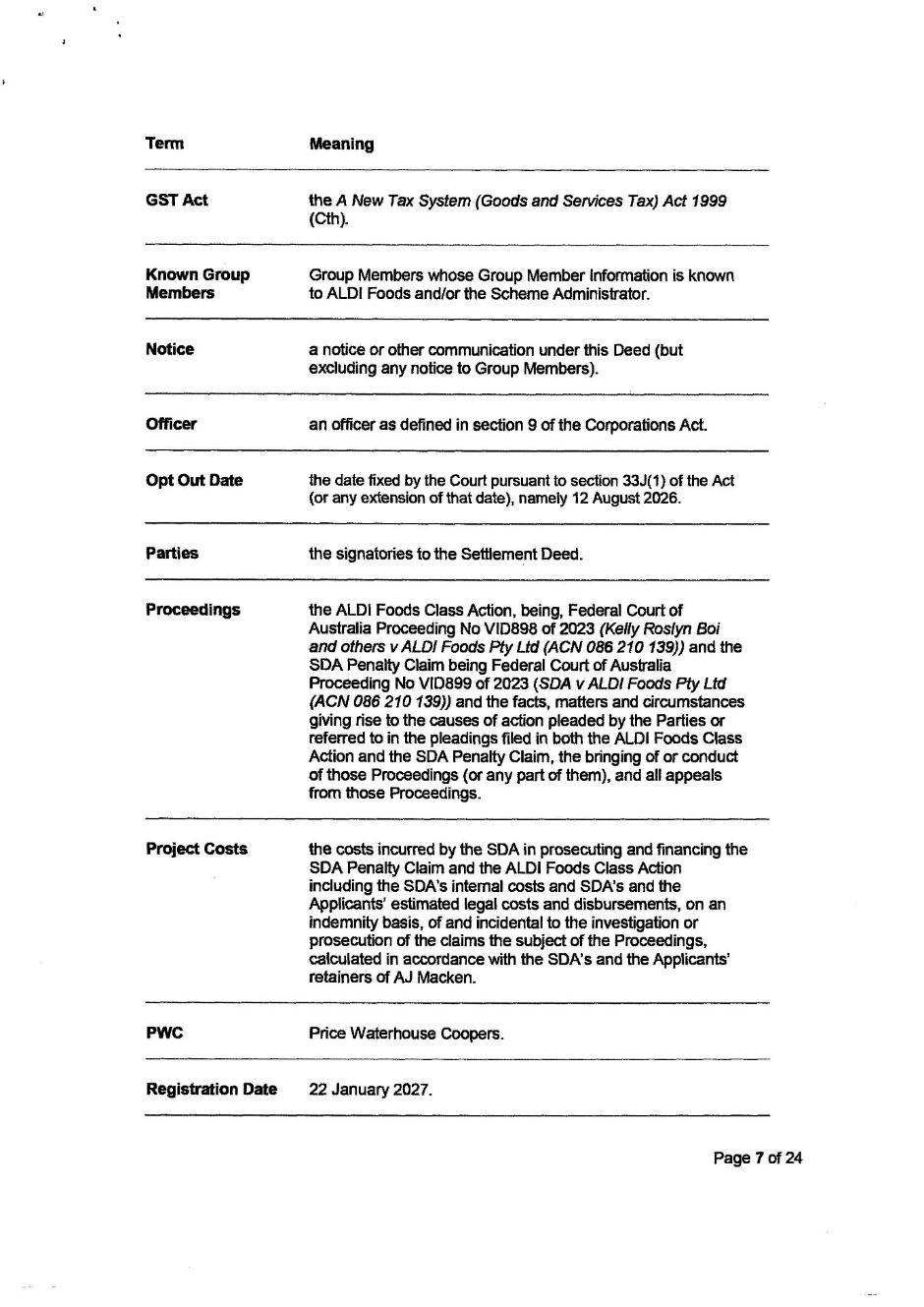
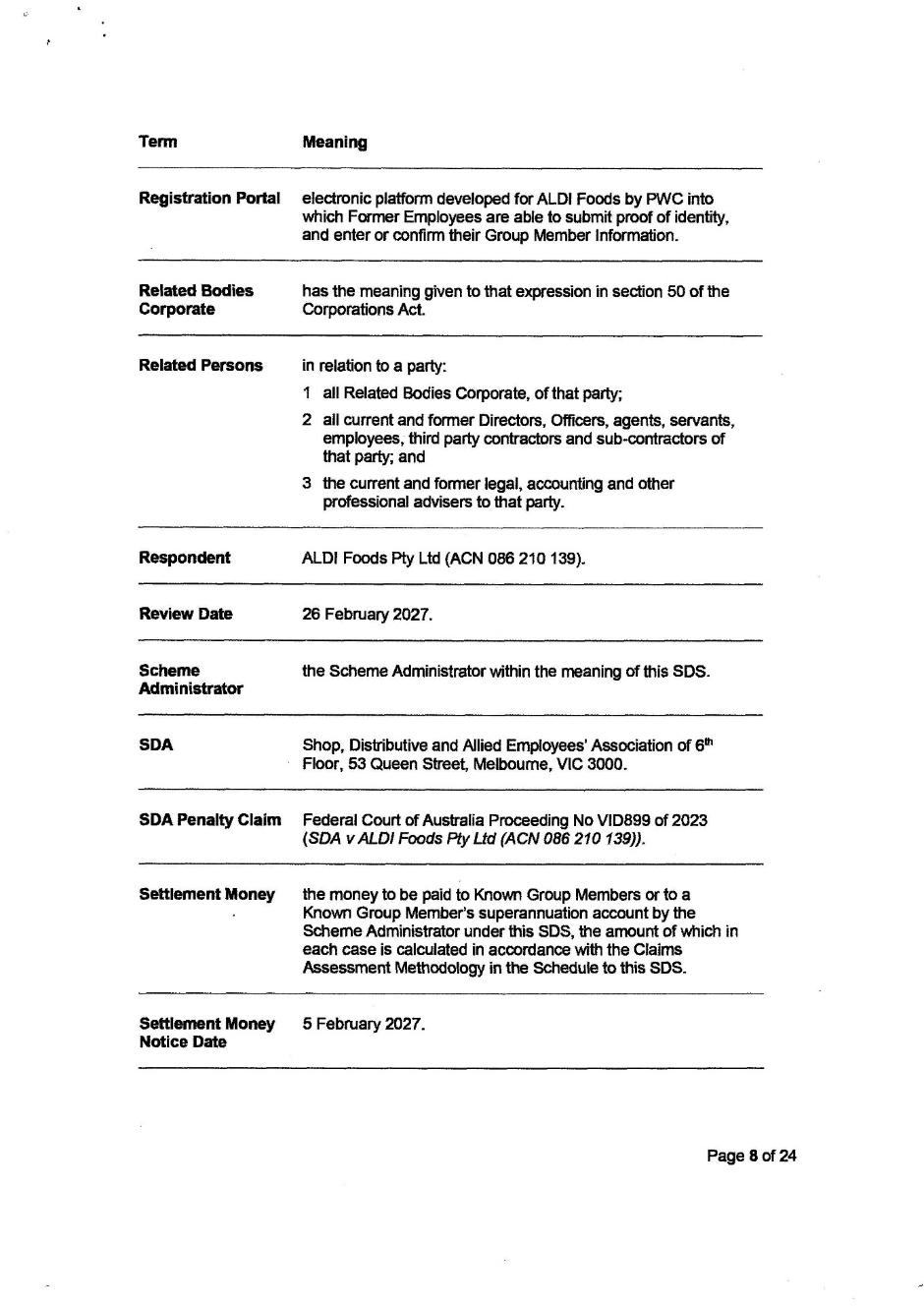
(b) the Amended Settlement Deed (Amended Deed), being pages 15 – 47 of exhibit DJM-12 to the affidavit of Dominic James Macken sworn on 26 August 2026; and
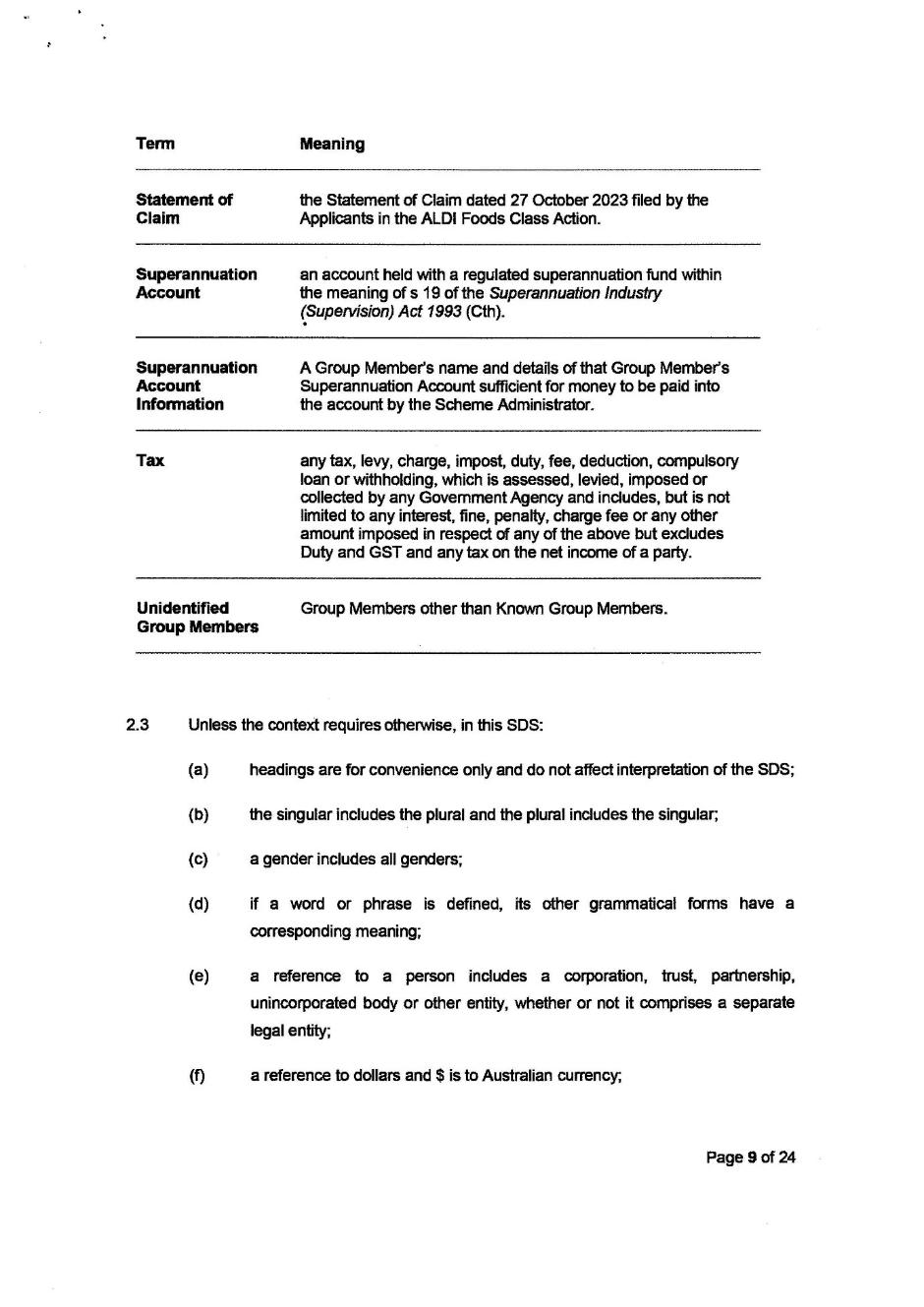
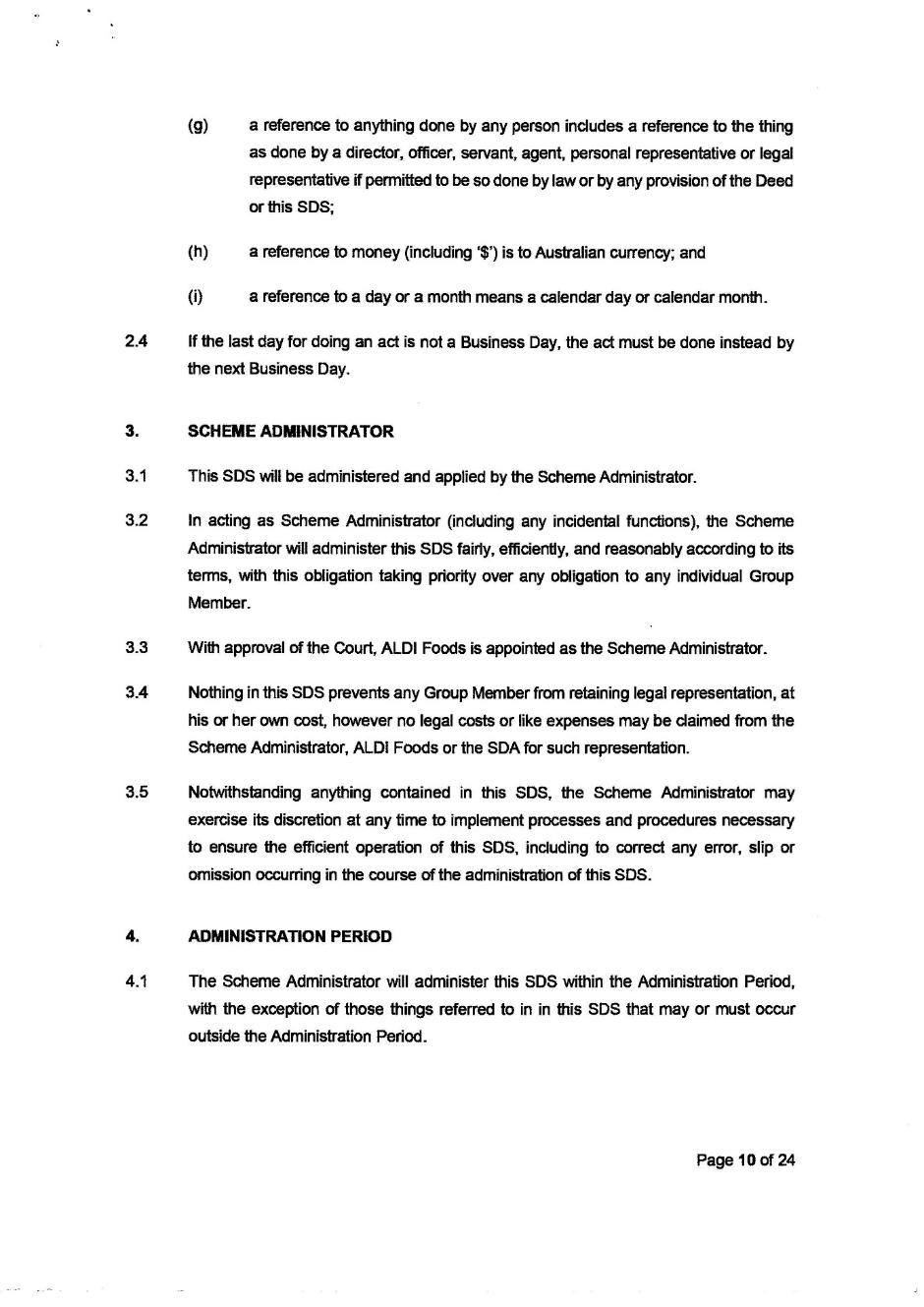
(c) the Settlement Distribution Scheme, being pages 7 – 29 of Annexure MM3 to the affidavit of Margaret McNaughton dated 9 October 2026.
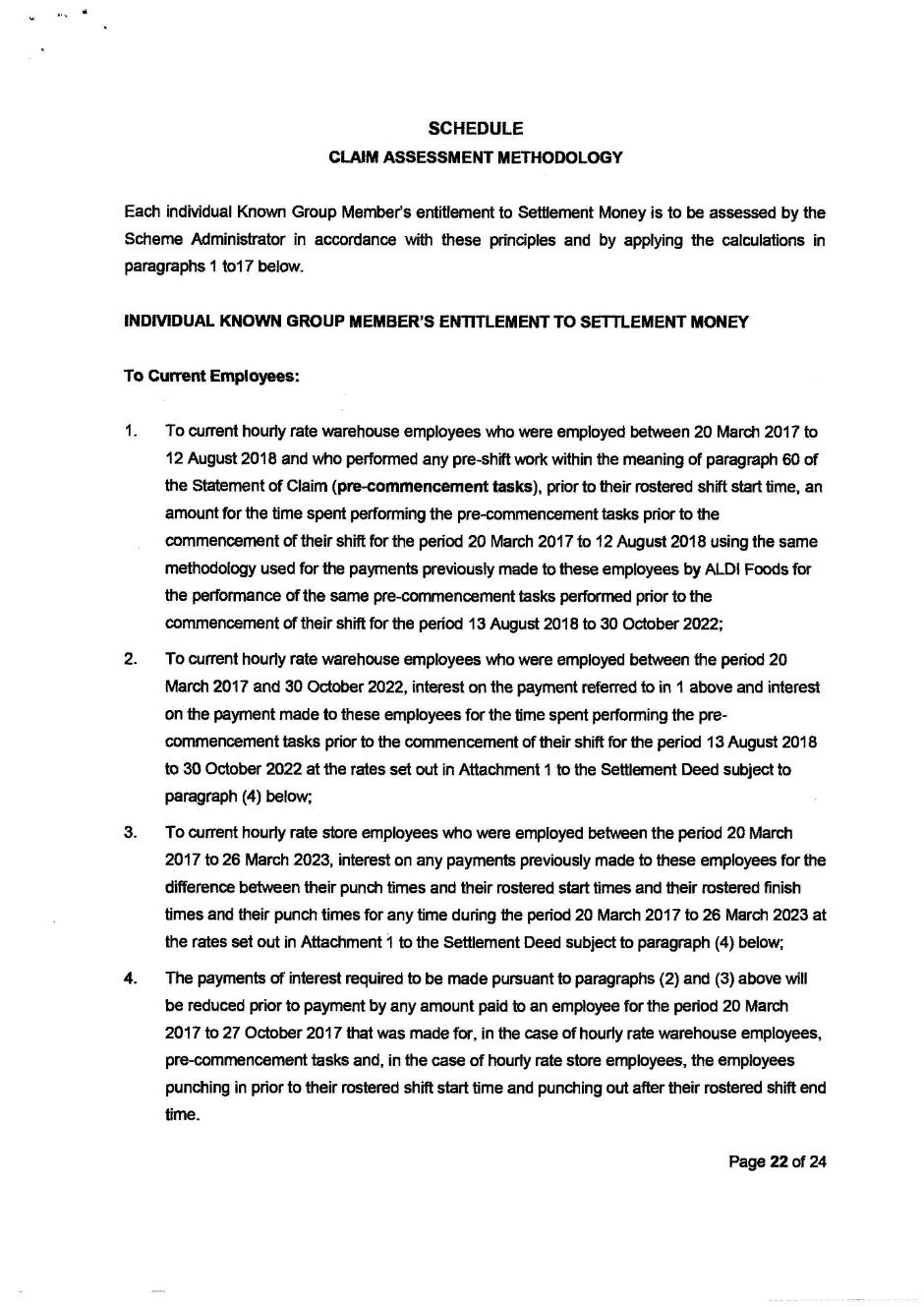
2. Notwithstanding clauses 2(b) and 2(c) of the Deed and the Amended Deed that require the Respondent, ALDI Foods Pty Ltd, to make payments by 31 December 2026, the Settlement is approved on the condition that such payments are made before 31 March 2027 or before the date the proceeding is dismissed, whichever is the later.
3. For the avoidance of doubt, pursuant to s 33ZF of the Act, the Applicants are authorised nunc pro tunc on behalf of the Group Members to:
(a) enter into and give effect to the Amended Deed; and
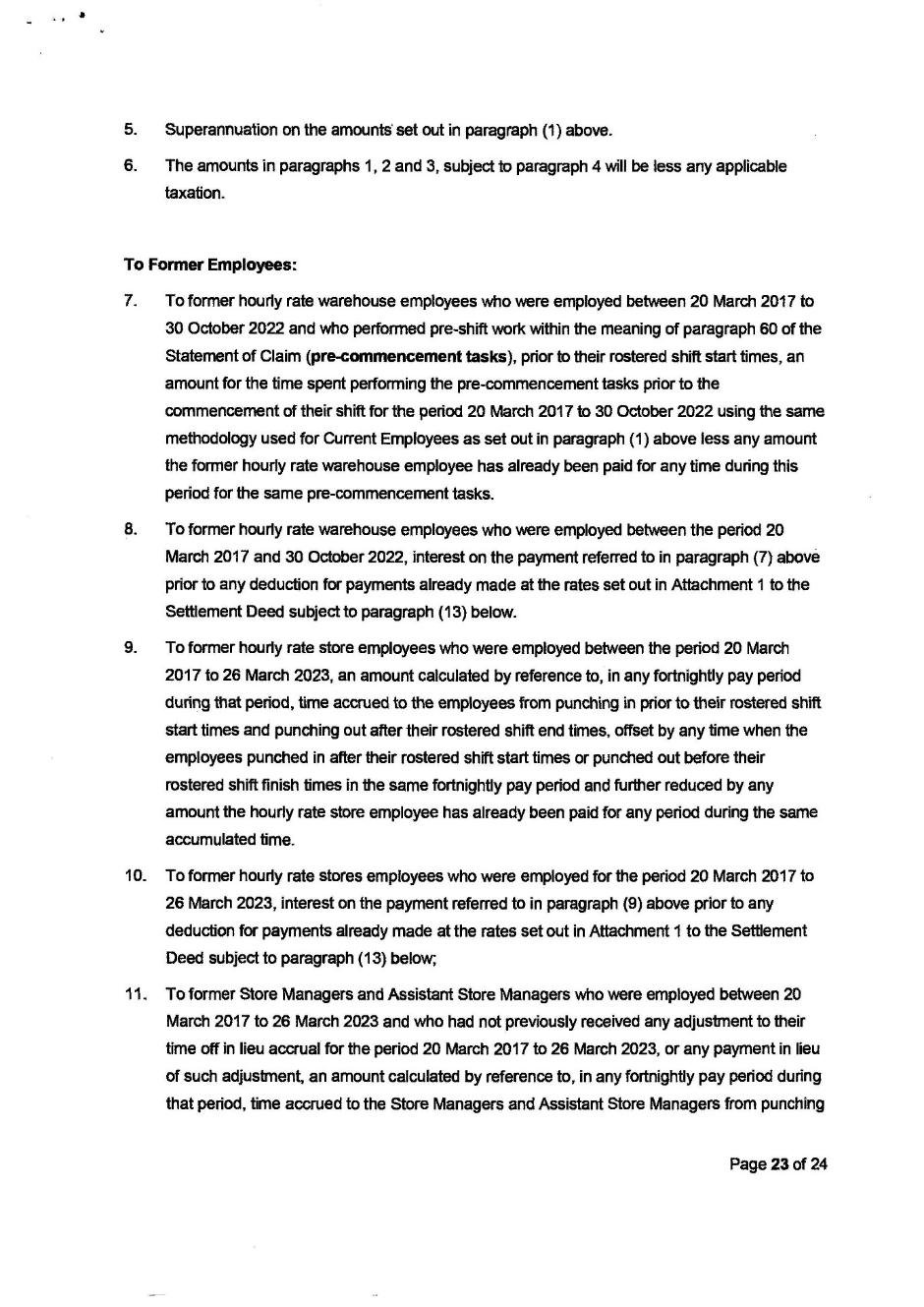
(b) conduct the transactions and take the steps contemplated by the Amended Deed and the Distribution Scheme.
4. Pursuant to s 33ZB of the Act, the persons affected and bound by the Settlement are the Applicants, ALDI Foods Pty Ltd, the Group Members and the Shop, Distributive and Allied Employees’ Association (SDA).
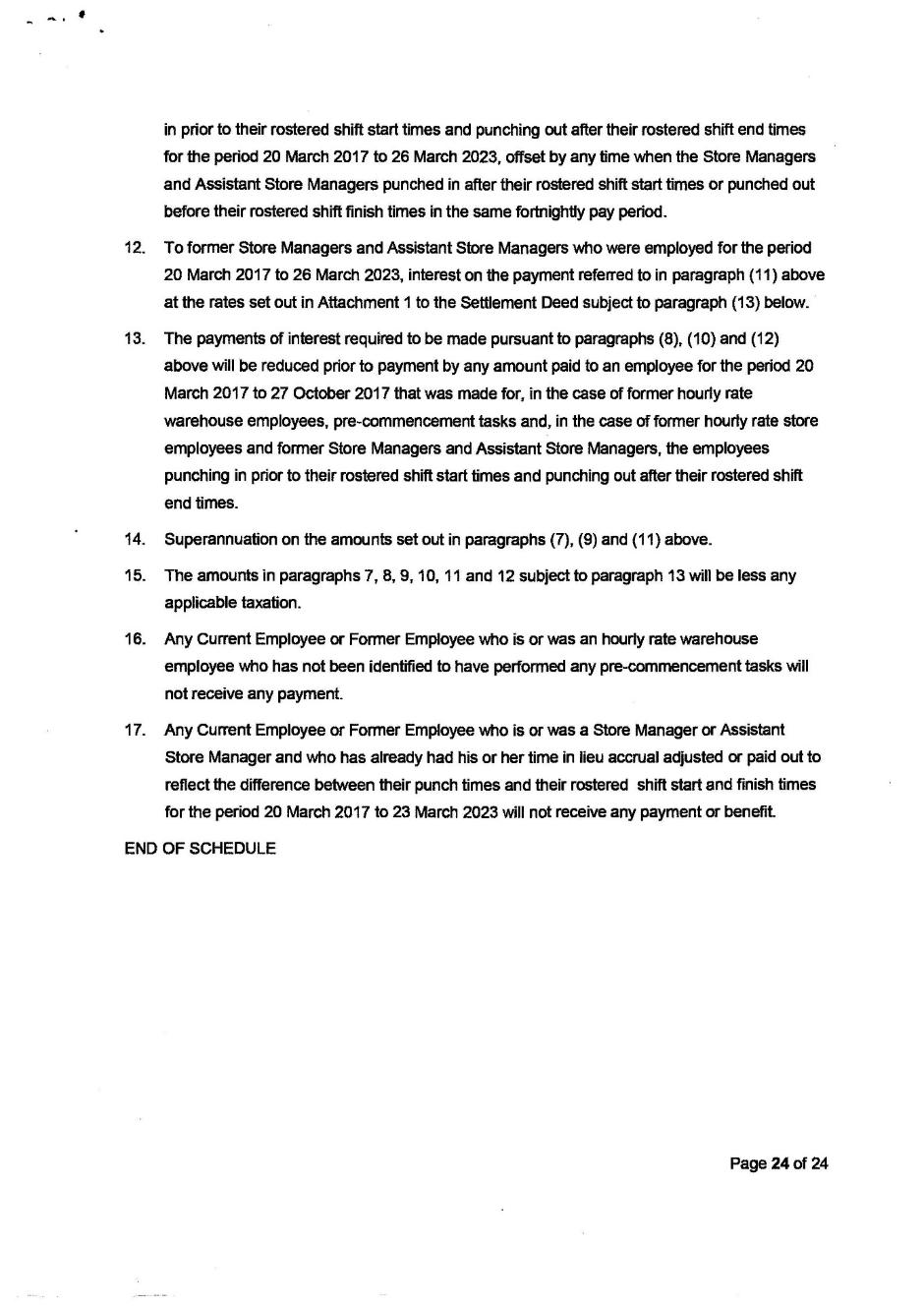
Appointment of Administrator
5. Pursuant to s 33ZF of the Act, ALDI Foods Pty Ltd is appointed as the Scheme Administrator within the meaning of the Distribution Scheme:
(a) with the powers and immunities described in the Distribution Scheme; and
(b) subject to the obligations and requirements described in the Distribution Scheme, including:
(i) to pay the Known Group Members their settlement money; and
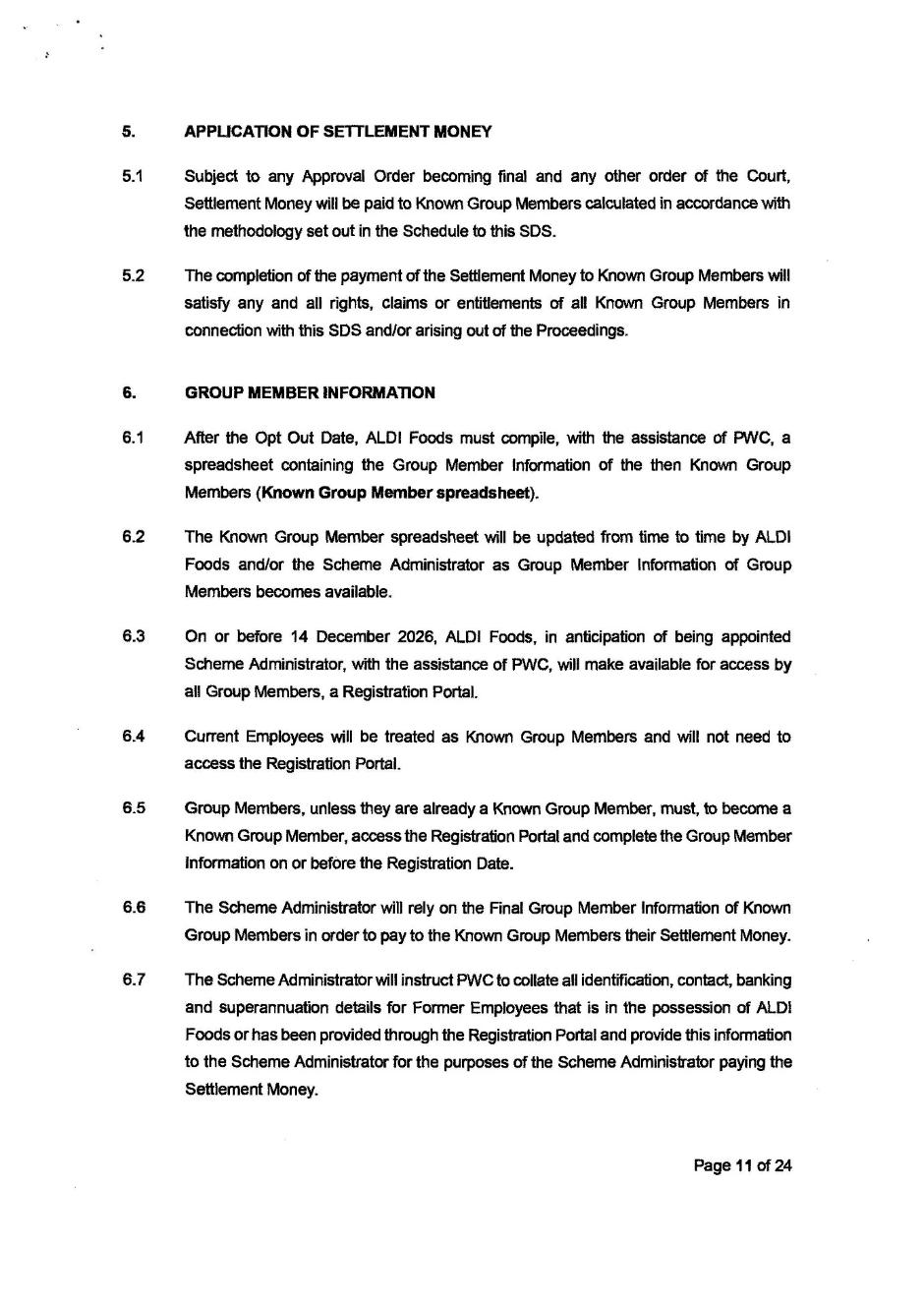
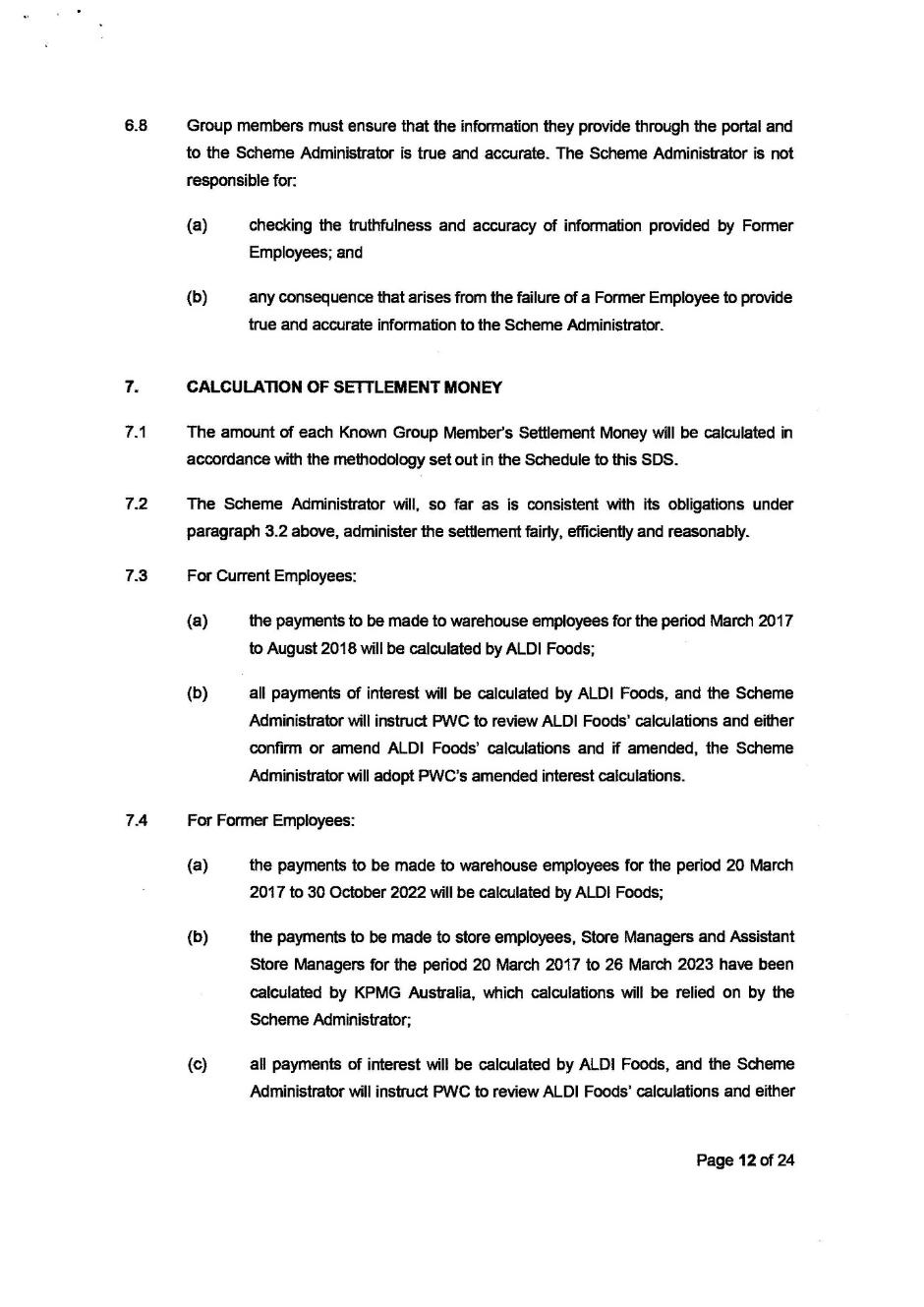
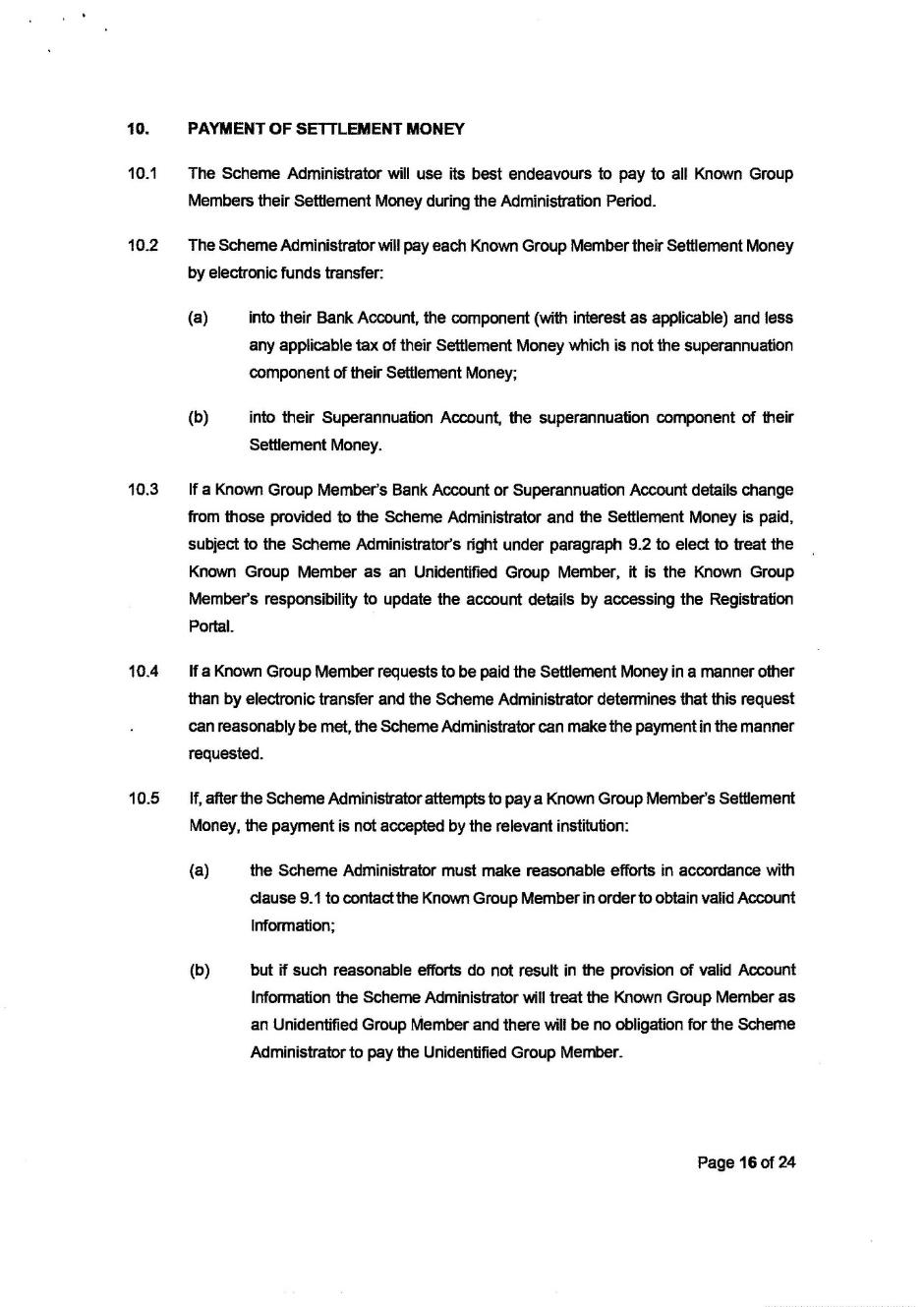
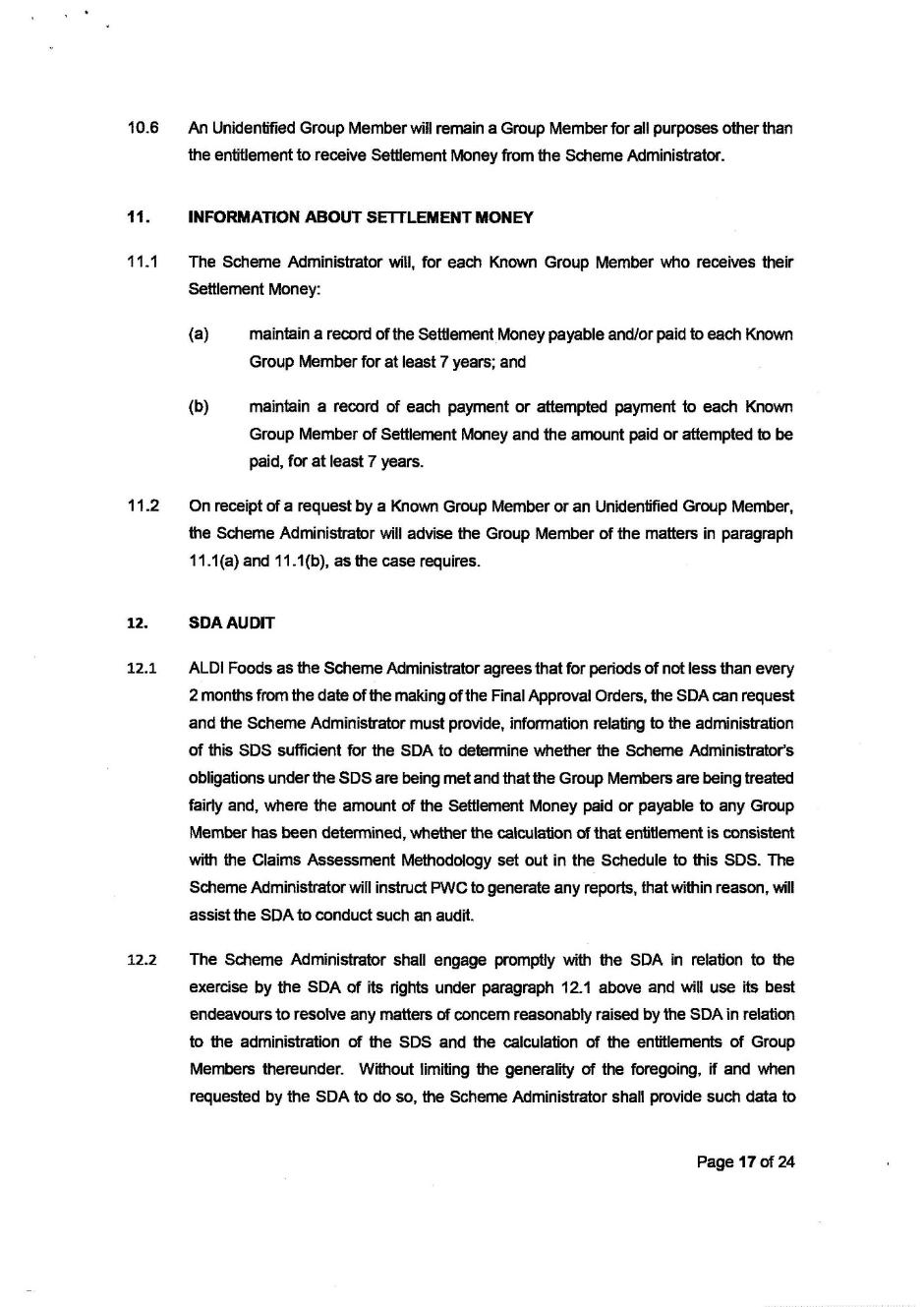
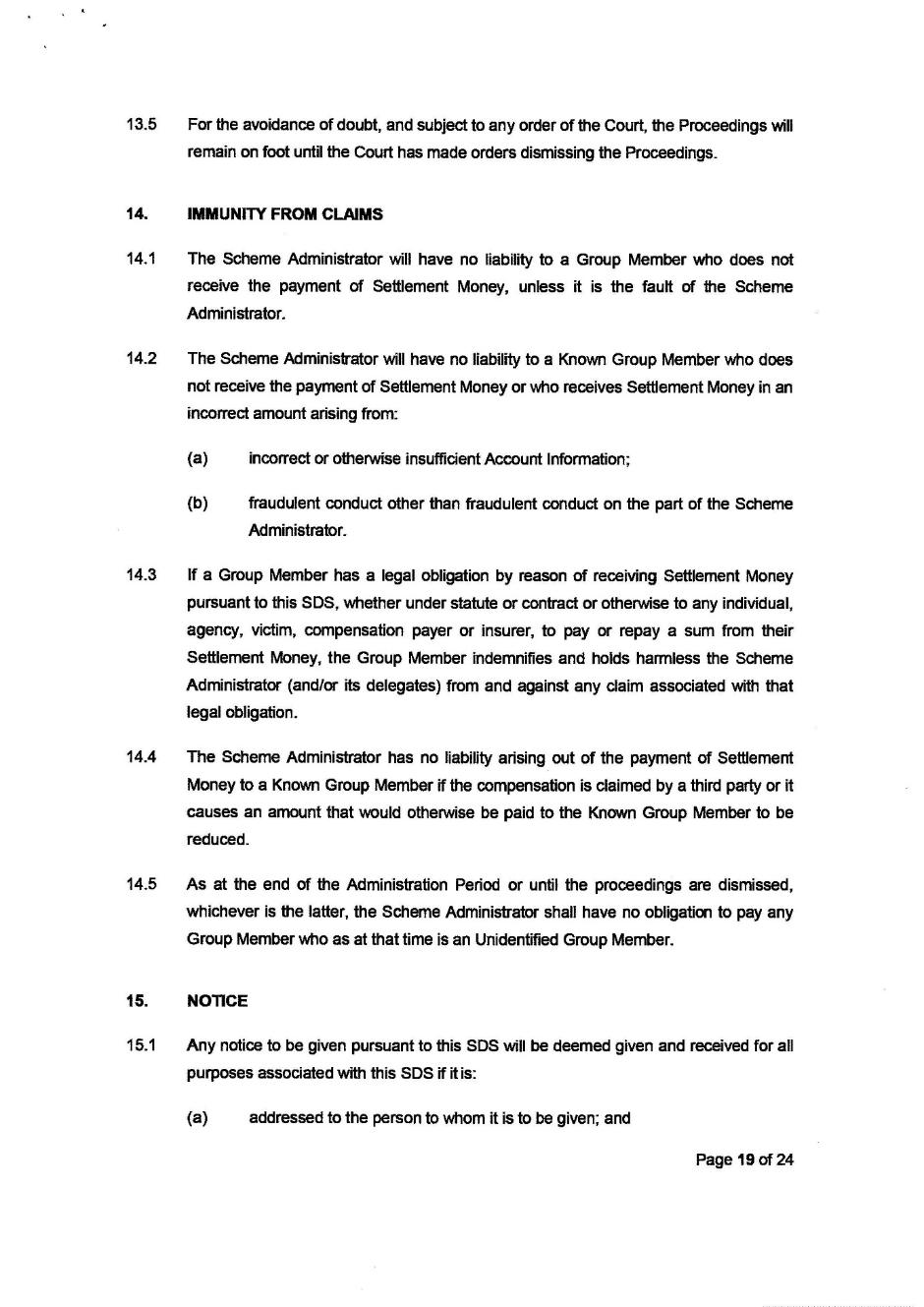
(ii) to cooperate with the SDA in accordance with section 12 of the Distribution Scheme titled SDA Audit.
Prior costs orders
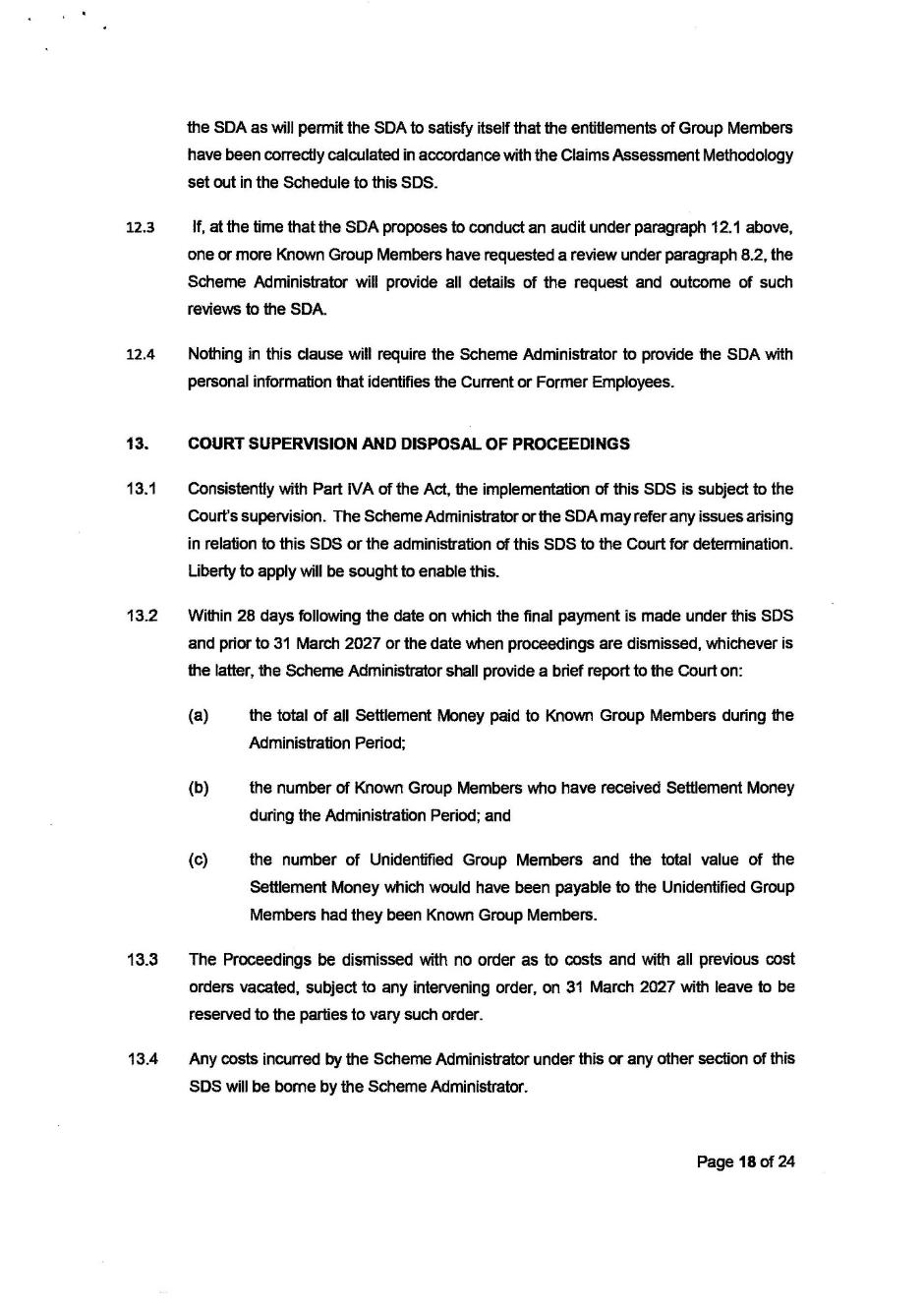
6. All previous costs orders made in this proceeding be vacated.
Further adjournment
7. The hearing of the application that the proceeding be dismissed with no order as to costs be adjourned to a date to be fixed.
Other
8. Without limiting the Scheme Administrator’s liberty under Order 5, the Applicants, the SDA and the Scheme Administrator have liberty to apply on five clear business days’ notice to each other.
Note: Entry of orders is dealt with in Rule 39.32 of the Federal Court Rules 2011.
REASONS FOR JUDGMENT
MCELWAINE J:
1 Two proceedings were commenced on 27 October 2023. Each names ALDI Foods Pty Ltd as respondent. Proceeding VID 898 of 2023 is a representative proceeding under Part IVA of the Federal Court of Australia Act 1976 (Cth) (FCA Act) in which the applicants are Kelly Boi, Souad Tannous Lichaa and Harinder Pal. It is brought on behalf of current and former ALDI employees who were employed under various Enterprise Bargaining Agreements (EBA) for entitlements not paid or provided. I refer to this as the representative proceeding.
2 Proceeding VID 899 of 2023 is brought by the Shop, Distributive and Allied Employees’ Association (SDA) on behalf of the industrial interests of ALDI employees covered by the EBAs. The SDA seeks declaratory relief and the imposition of pecuniary penalties. I refer to this as the penalty proceeding.
3 The common issue in each proceeding is whether store employees and warehouse employees were not paid their entitlements in contravention of s 50 of the Fair Work Act 2009 (Cth) (FW Act).
4 Following an initial interlocutory skirmish in early 2024, I ordered that the parties in each proceeding attend mediation. Acting in good faith the parties have engaged in extensive negotiations spanning a period of approximately 14 months. They have reached a proposed settlement comprising the Settlement Deed and the Distribution Scheme. Settlement of the representative proceeding requires approval pursuant to s 33V of the FCA Act. Settlement of the penalty proceeding does not require approval, but as I explain they are related and appropriately considered as a single proposal. For convenience in these reasons, I simply refer to the proposal as the settlement.
5 For the reasons that follow, I am satisfied that the settlement of the representative proceeding should be approved and the orders proposed made.
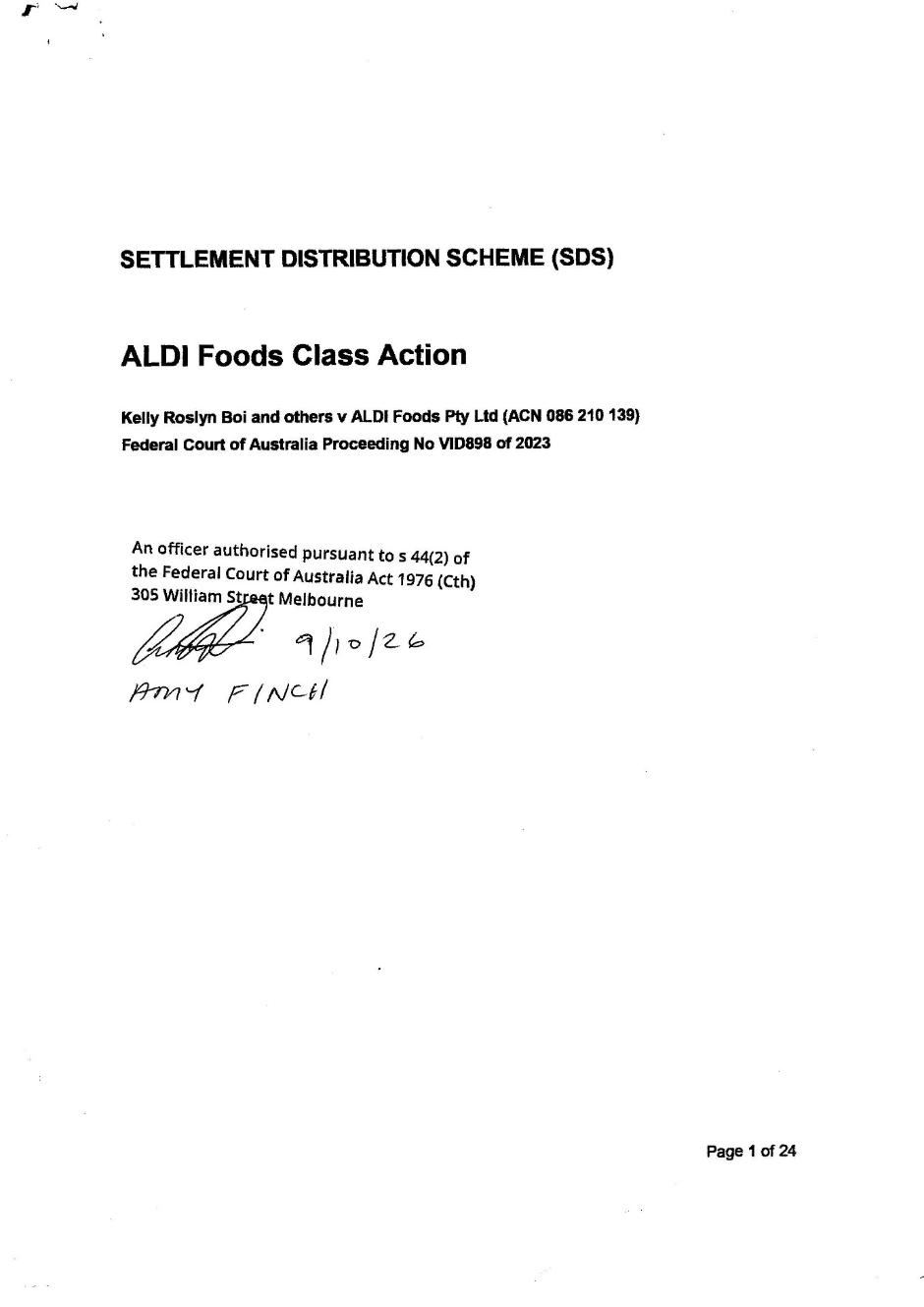
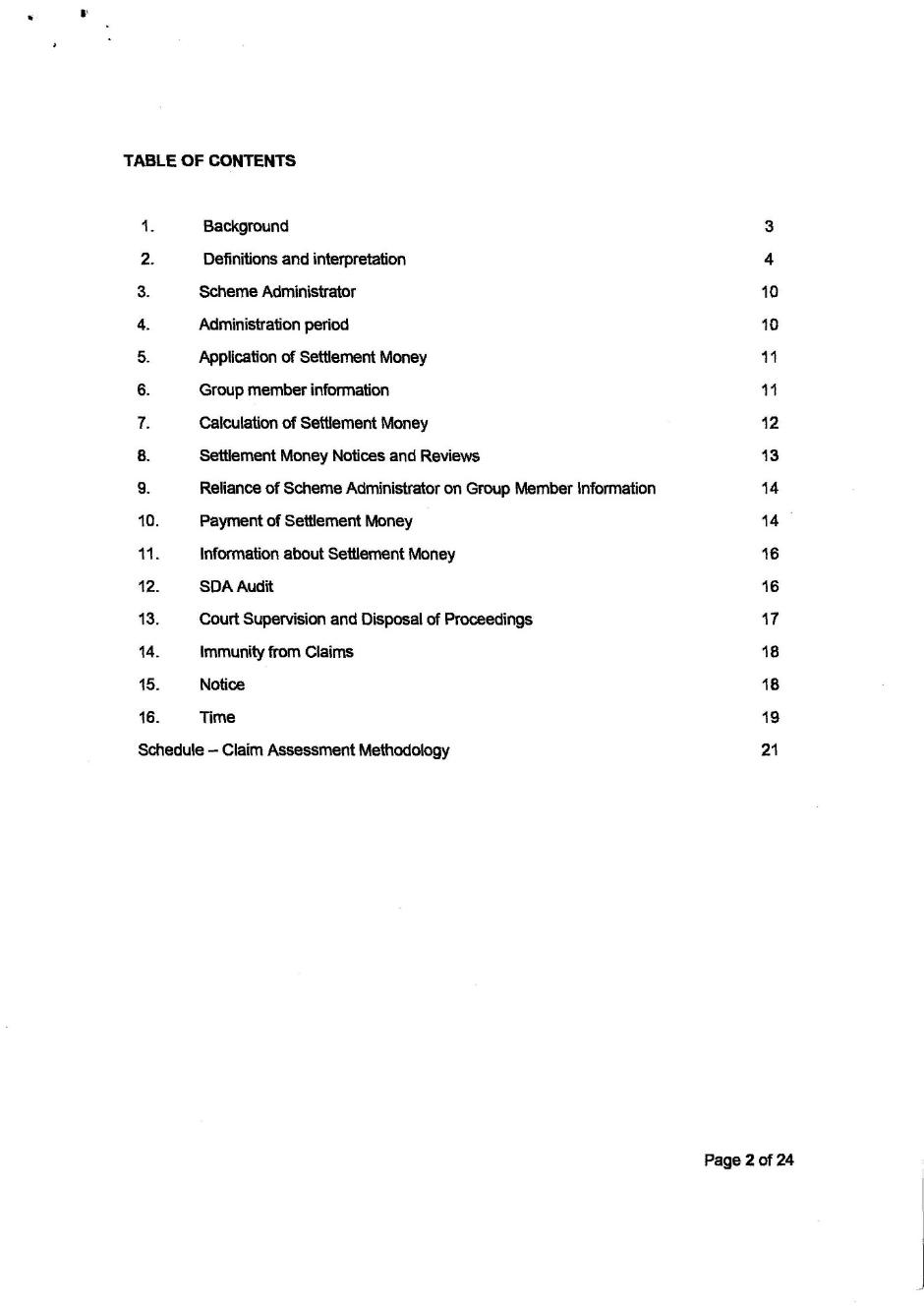
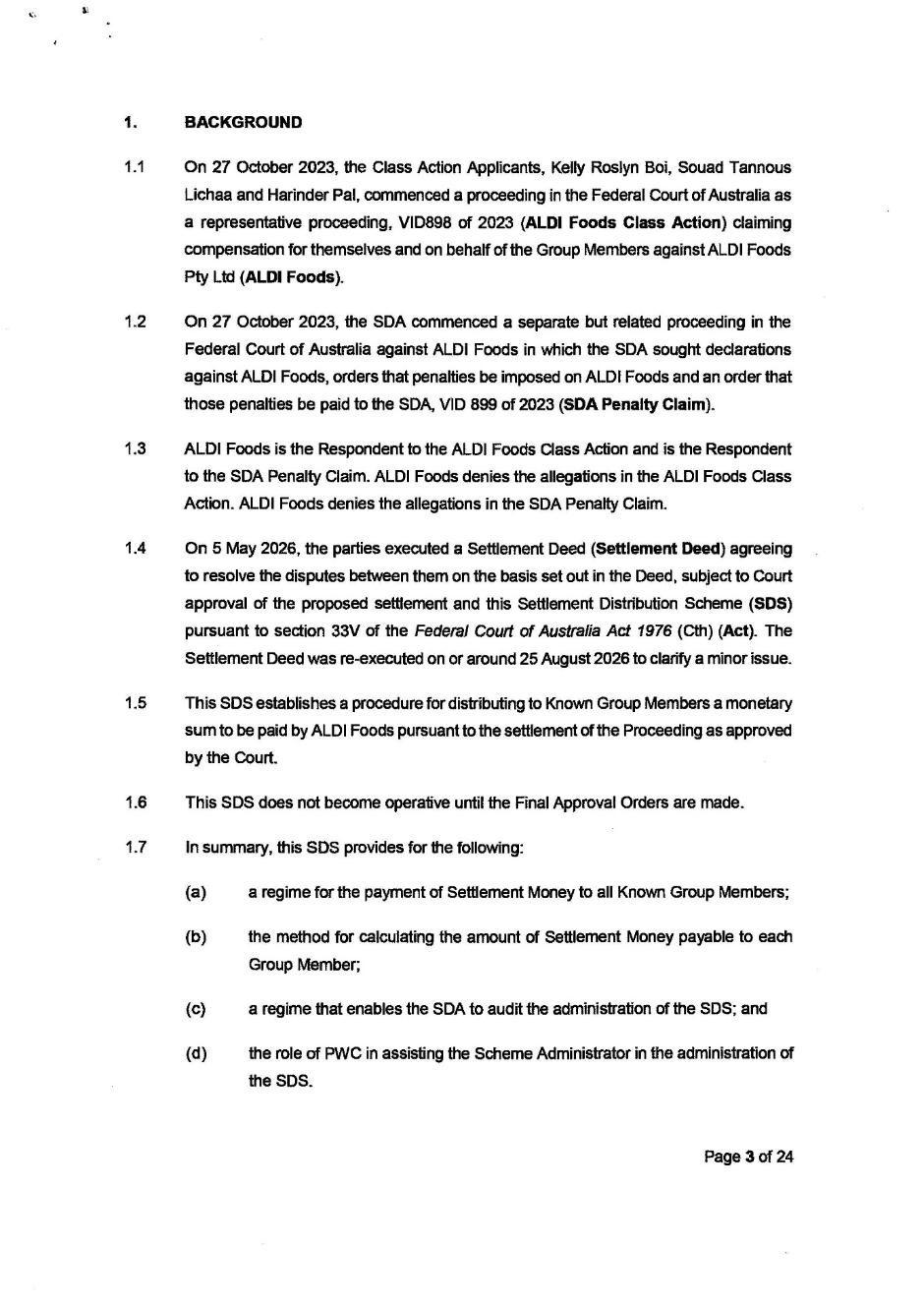
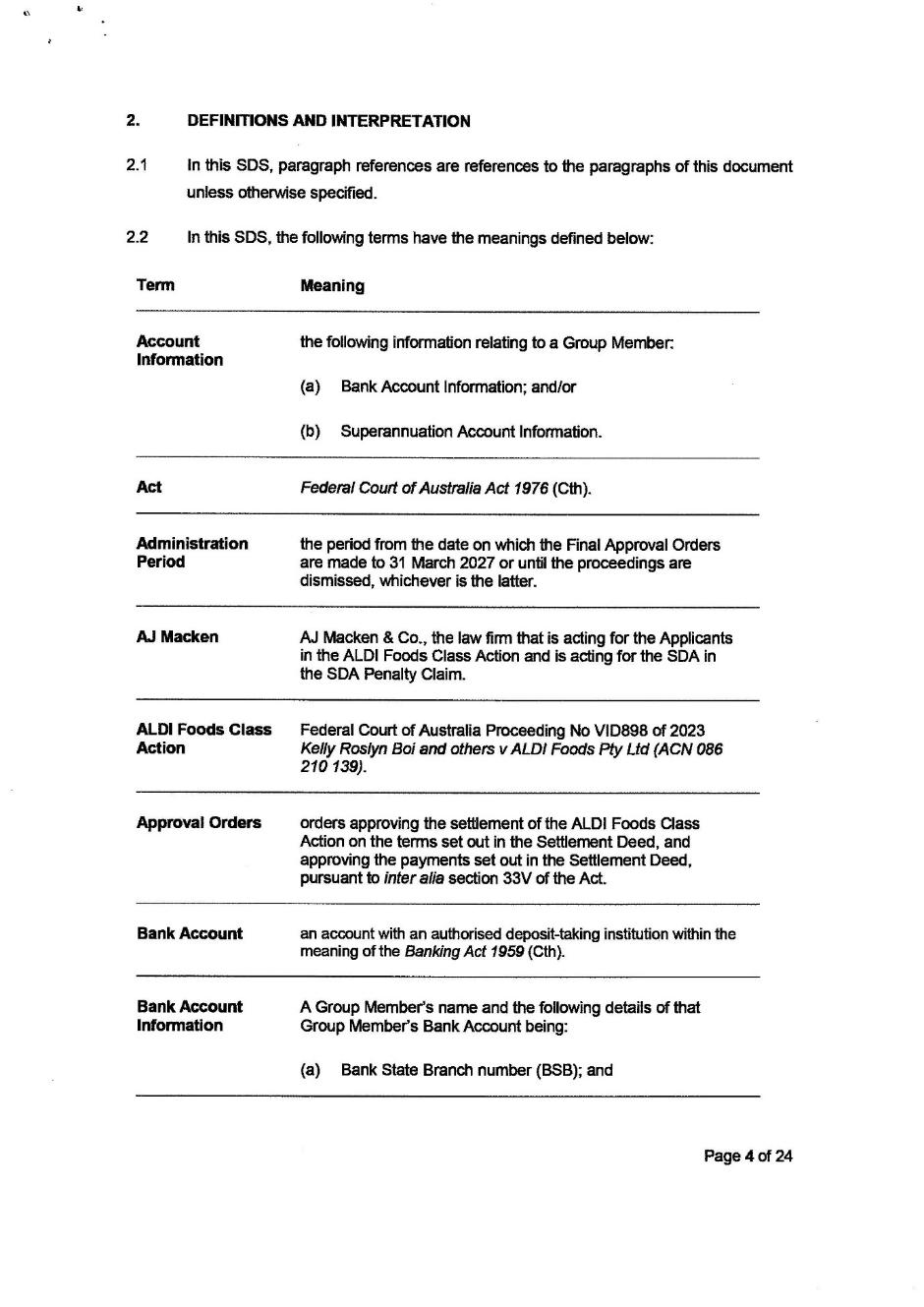
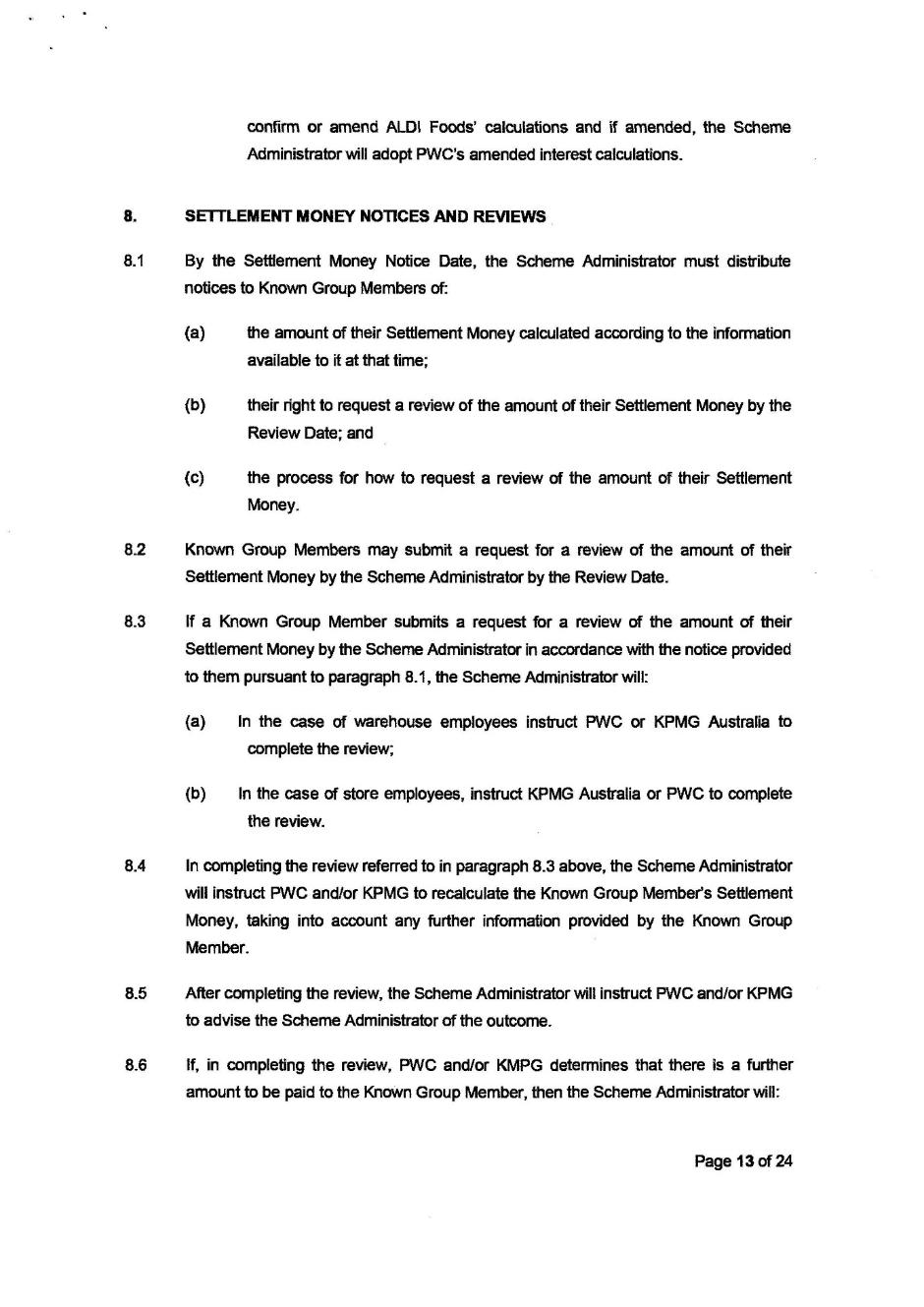
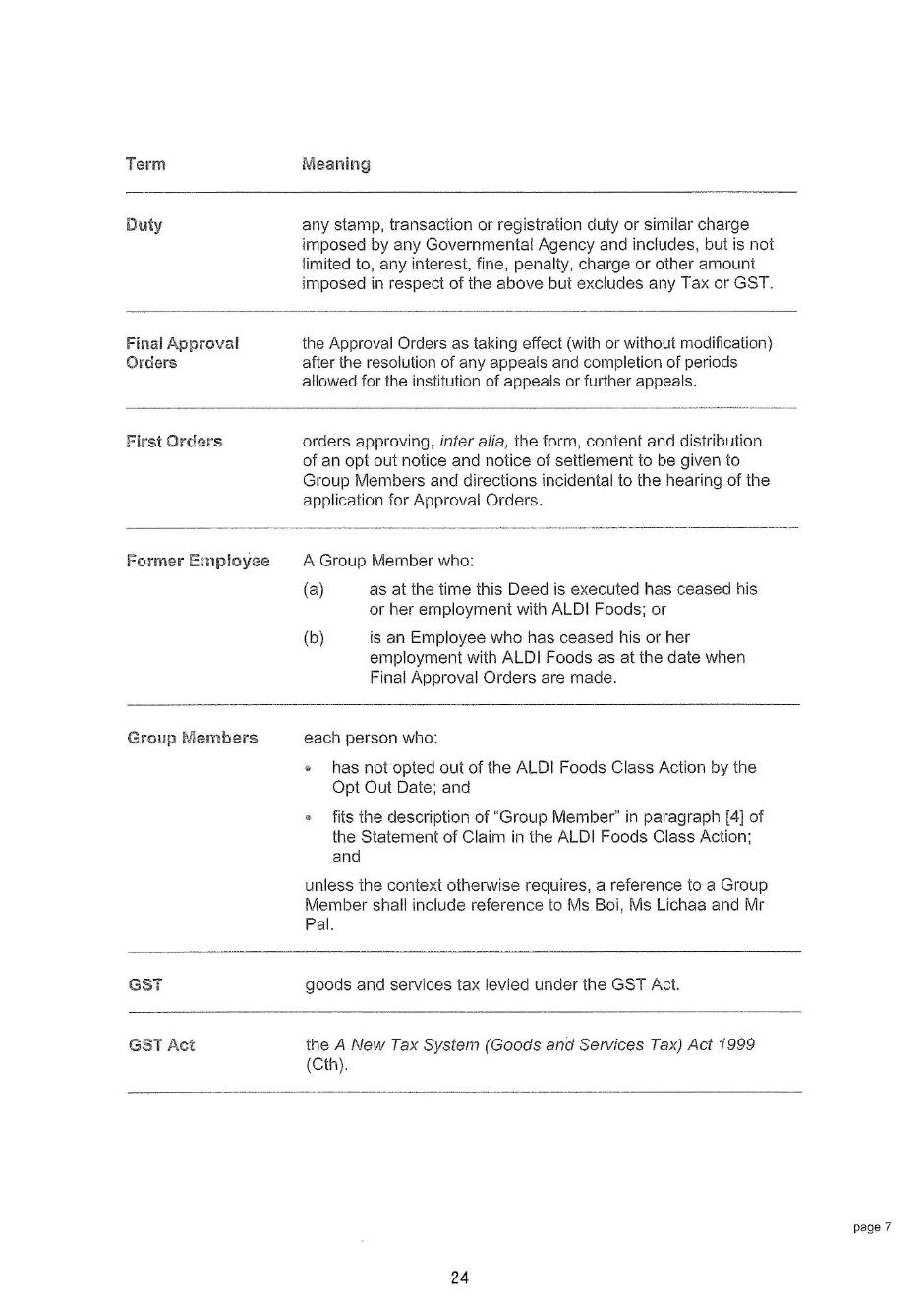
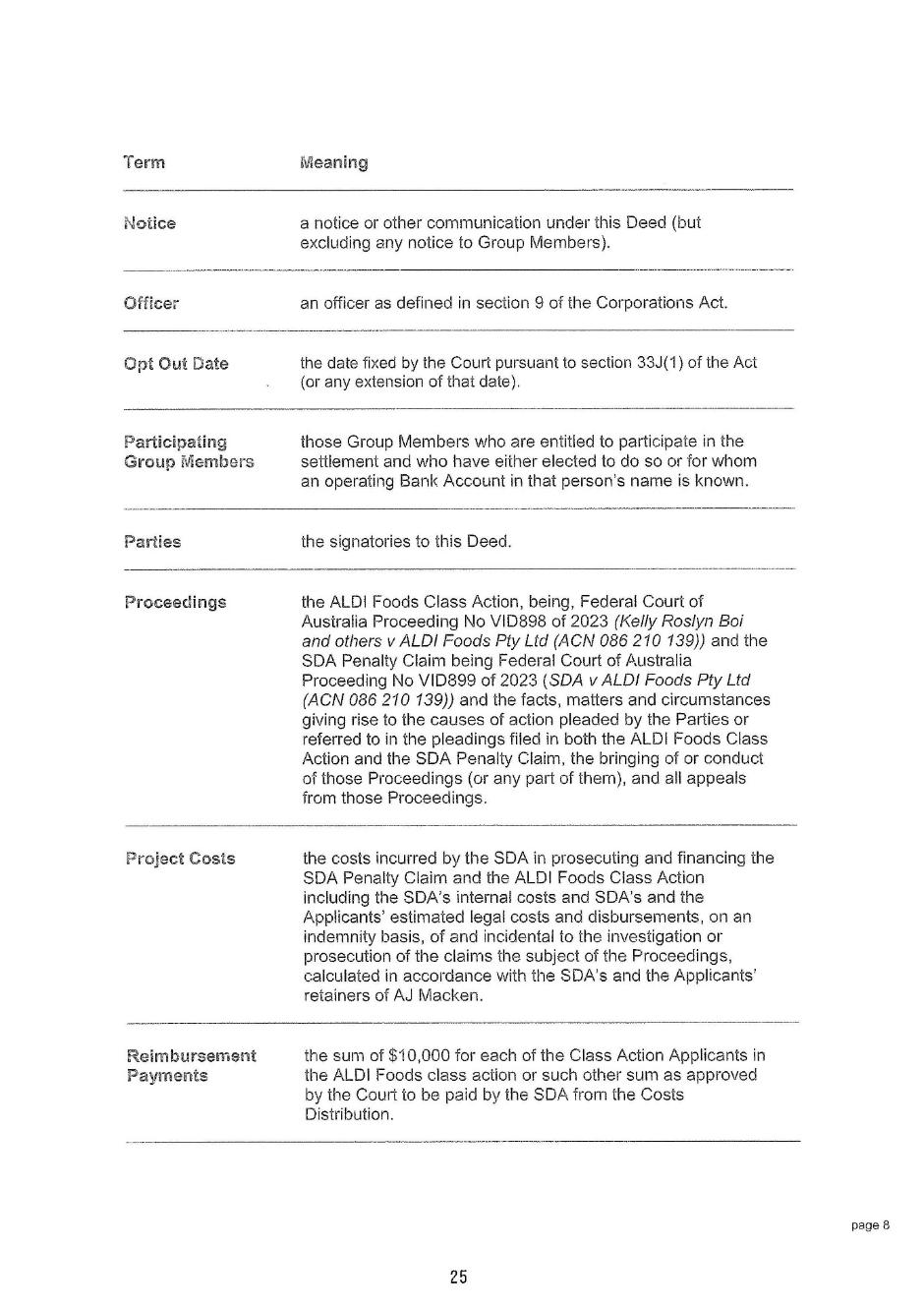
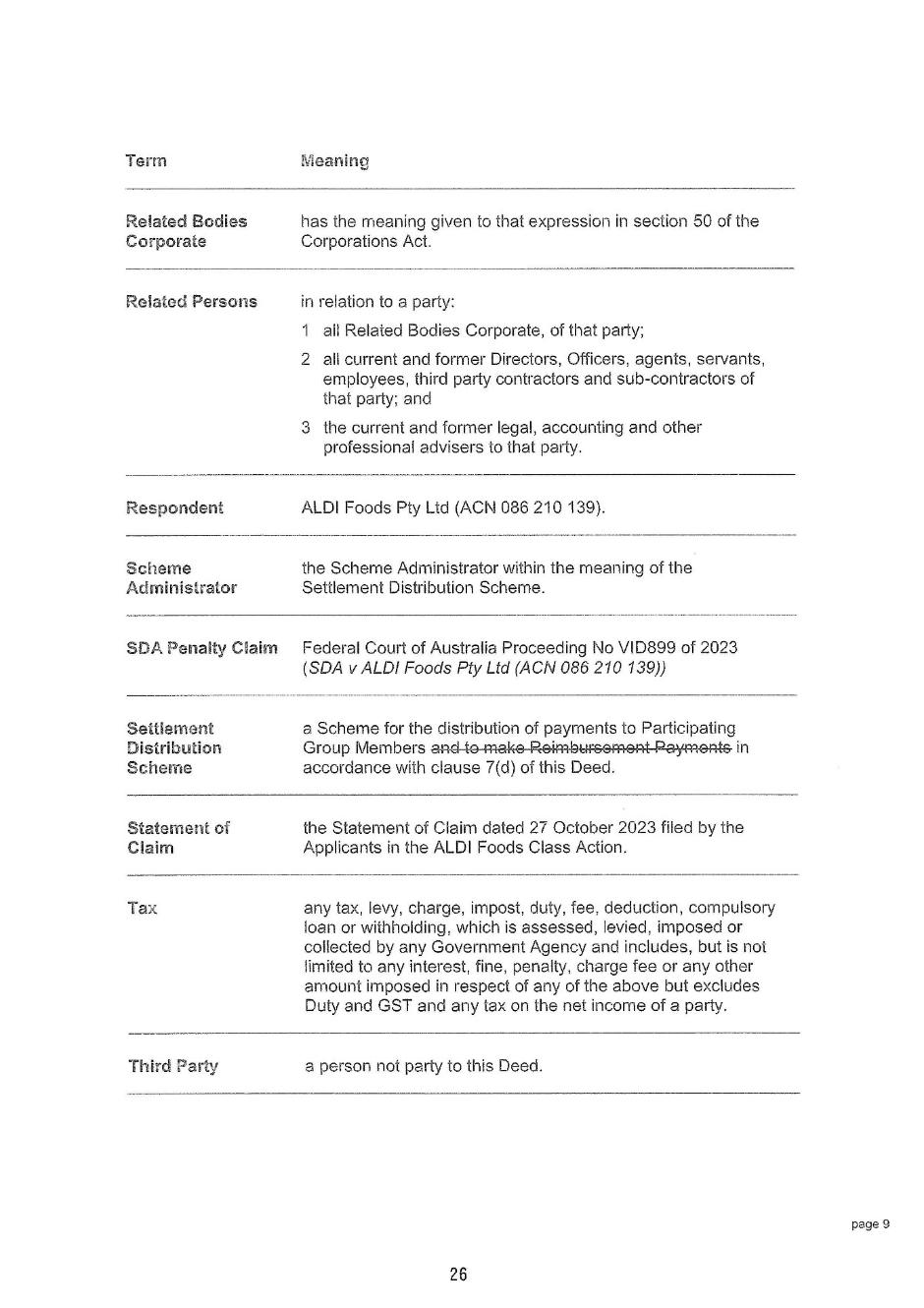
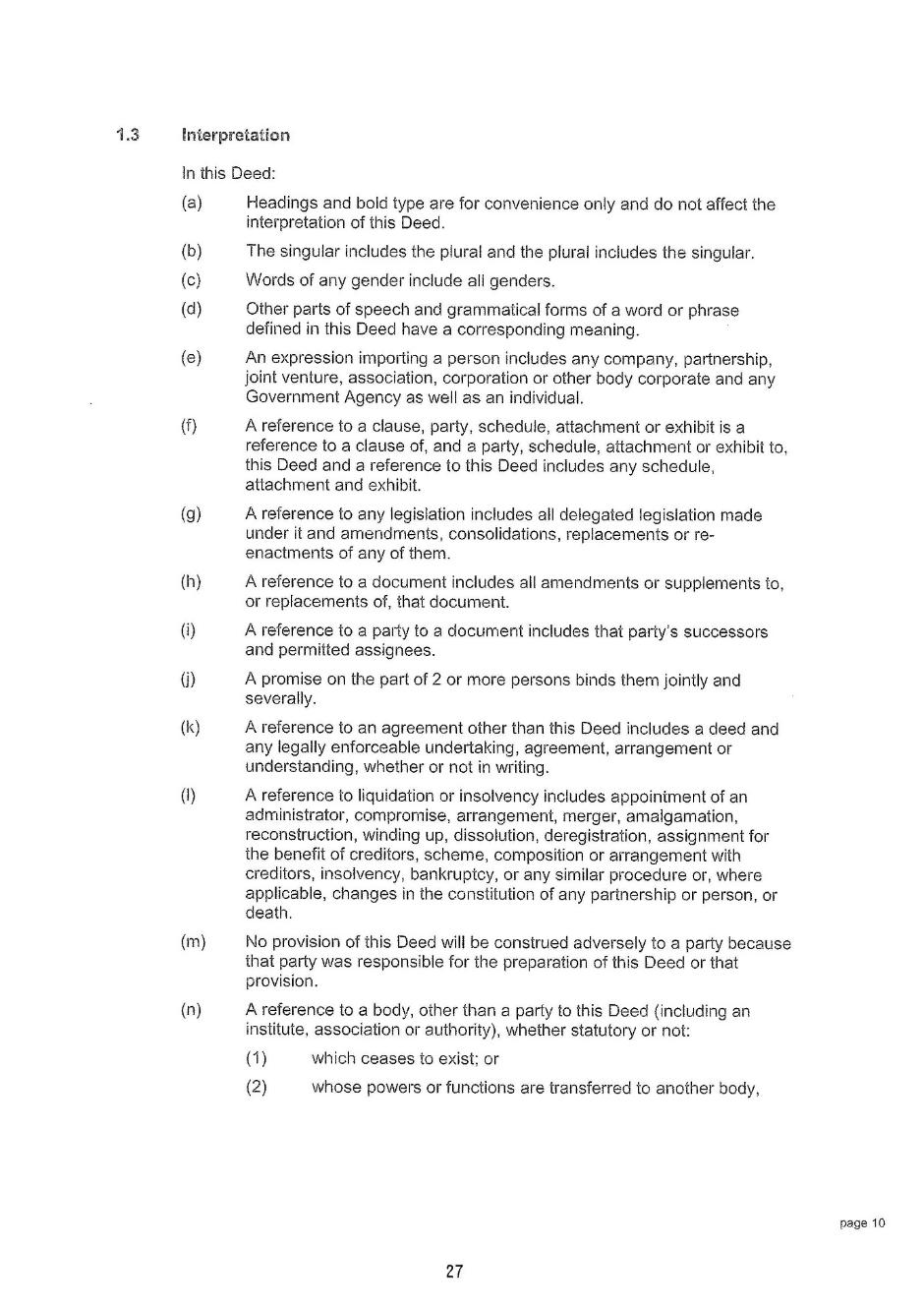
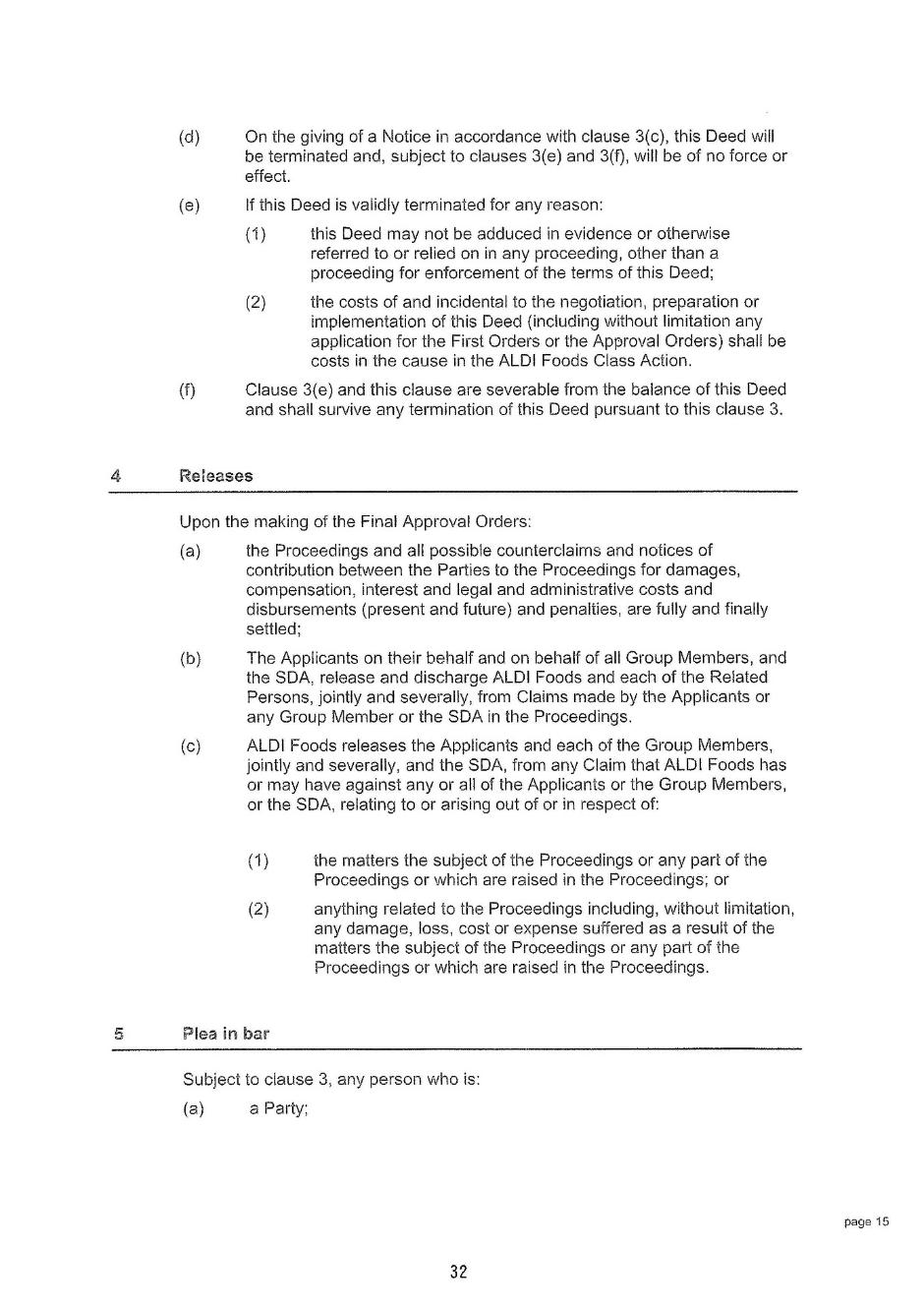
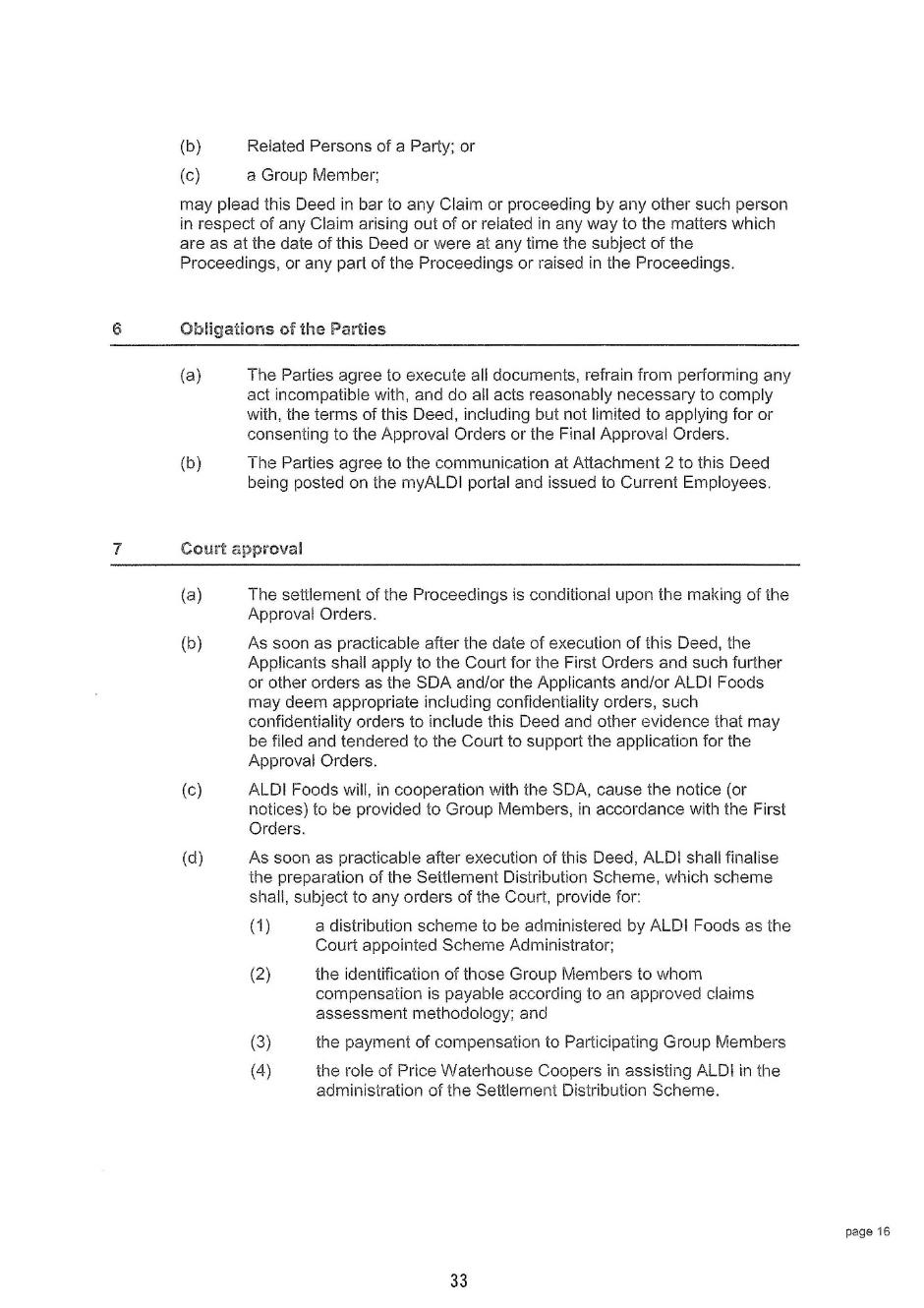
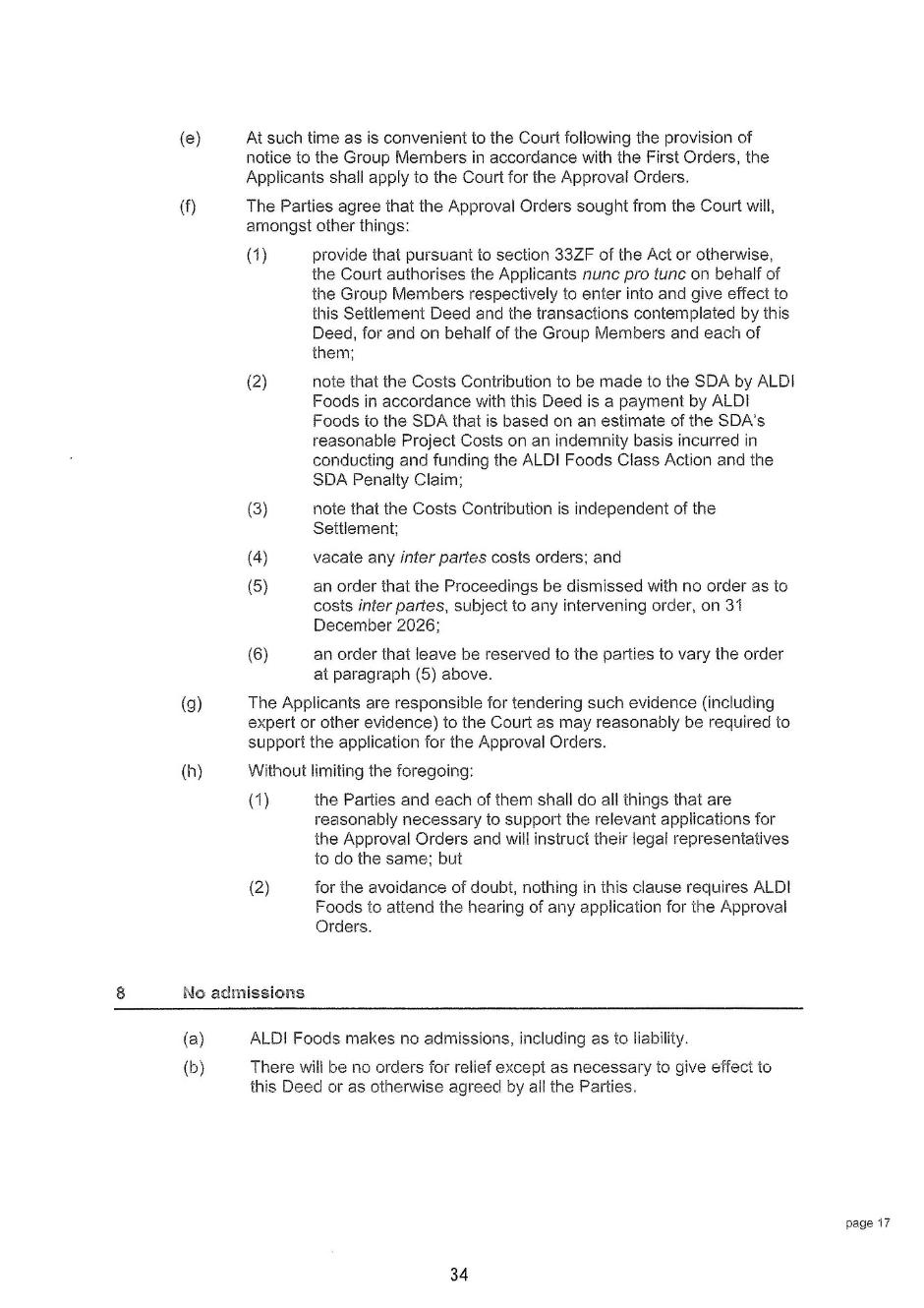
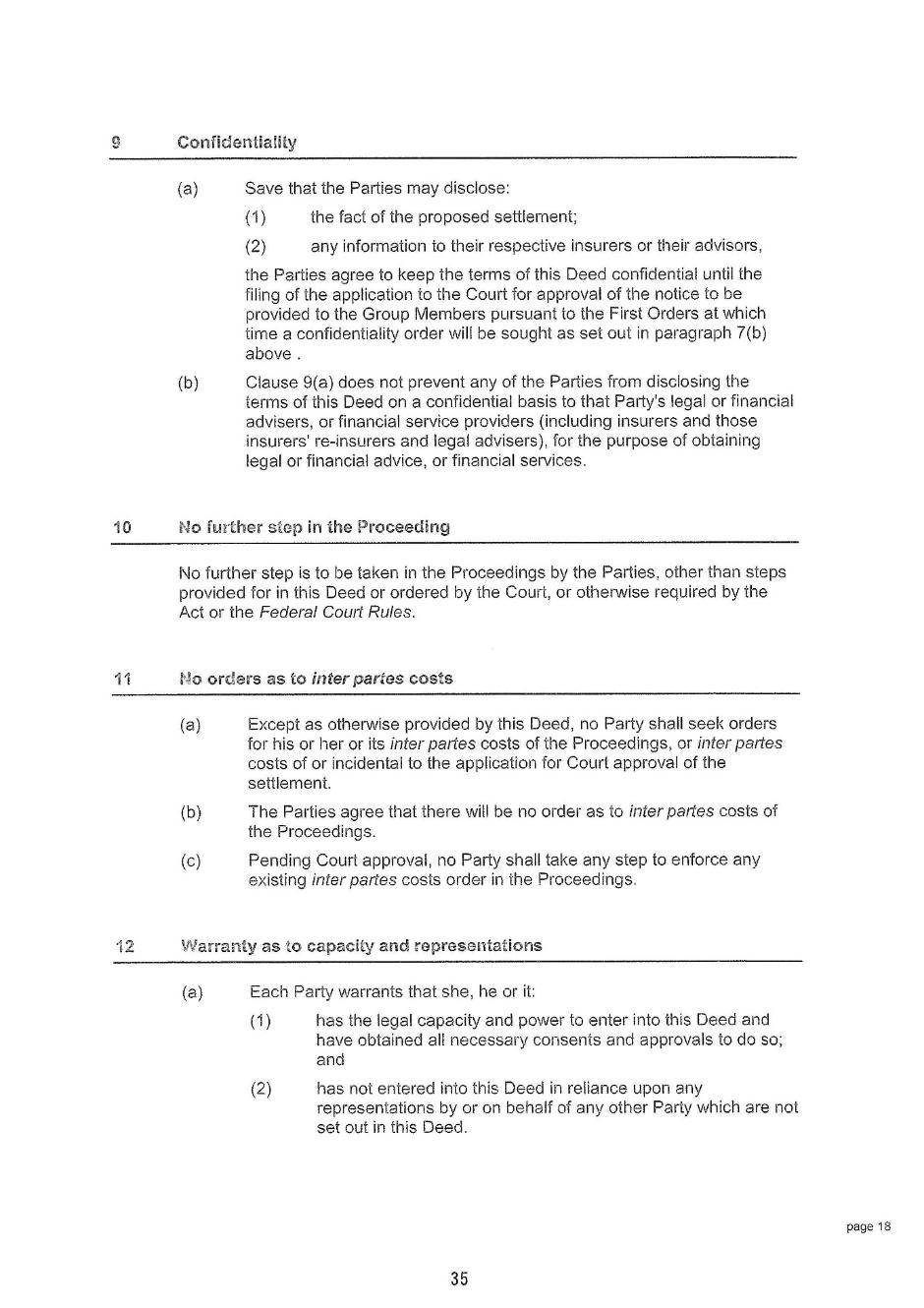
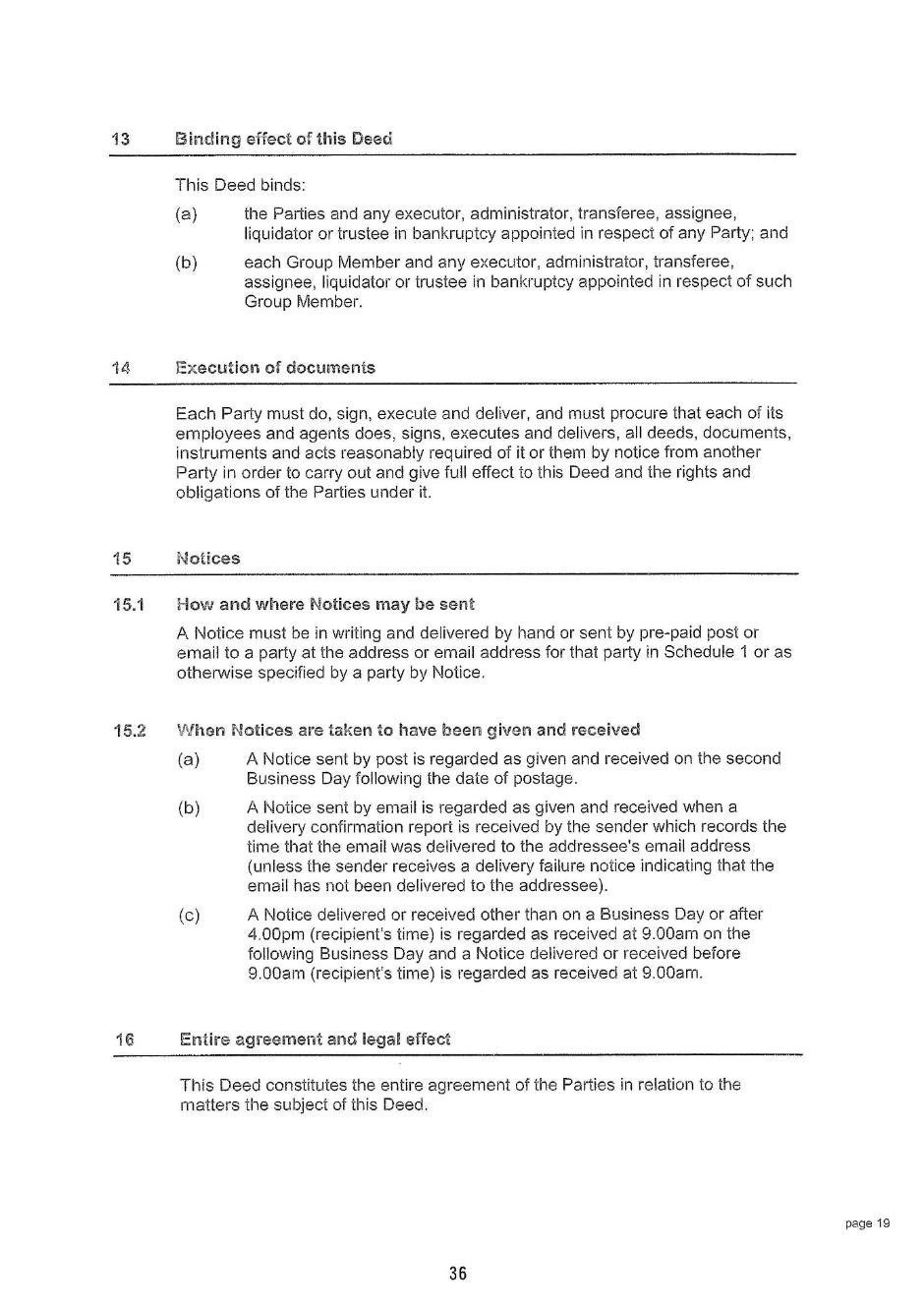
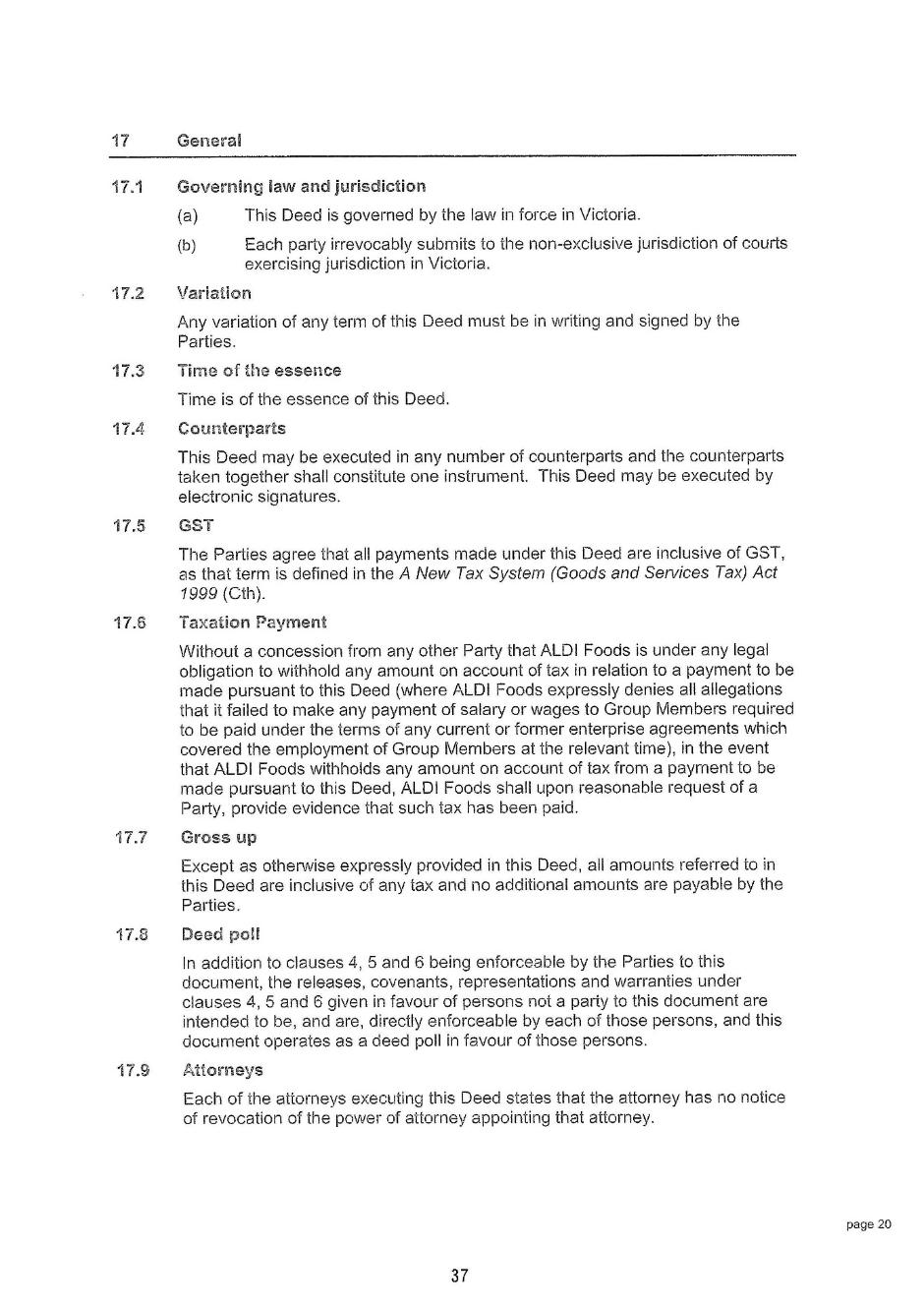
6 The settlement affects 32,308 former and current ALDI employees. They are the audience to which these reasons are directed and for that reason, I have stripped away technical jargon and complexity as much as is reasonably practicable. For those interested in the detail of the proposed settlement, these reasons annex the Amended Settlement Deed (Annexure A) and Settlement Distribution Scheme (Annexure B), which give effect to the settlement.
7 The settlement concerns persons who:
(1) were employed by ALDI as:
(a) store employees (or store managers and assistants) at any time between 20 March 2017 to 26 March 2023;
(b) former warehouse employees at any time between 20 March 2017 and 30 October 2022; or
(c) current warehouse employees between 20 March 2017 and 12 August 2018;
(2) were covered by one or more EBAs; and
(3) were not paid wages or interest, or were not provided with benefits, to which they were entitled under the EBAs.
8 These persons are the Group Members. The settlement resolves all claims of the Group Members, unless a person opted out of the representative proceeding by 12 August 2026.
Background
9 The representative proceeding is brought by one current and two former ALDI employees on behalf of the Group Members.
10 For store employees the case is that ALDI contravened the EBAs because the employees:
(1) performed work before their rostered shift start time for which they were not paid, including consequential benefits triggered by the additional time worked; and
(2) performed work after their rostered shift end time for which they were not paid, including consequential benefits triggered by the additional time worked.
11 For warehouse employees, the claim is that ALDI contravened the EBAs by requiring some employees to perform a range of pre-commencement tasks before their rostered shift start time for which they were not paid, including consequential benefits triggered by the additional time worked.
12 Where each of the store employees and the warehouse employees are together referenced, they are the employees.
13 The representative proceeding claims compensation for the Group Members. The penalty proceeding overlaps with the representative proceeding where the SDA seeks declarations and orders that:
(1) the employees were, during the claim periods, entitled to be paid for work completed before, and in the case of store employees, after rostered shifts;
(2) the store employees were, during the claim period, entitled to time off in lieu for the number of minutes worked before and after their rostered shift times; and\
(3) ALDI be ordered to pay any penalty to the SDA.
14 Each proceeding follows a decision of the Federal Circuit and Family Court of Australia (Division 2) in Shop, Distributive and Allied Employees’ Association v ALDI Foods Pty Ltd [2022] FedCFamC2G 799; (2022) 318 IR 206 (Judge Humphreys’ decision), which found that the tasks performed by four ALDI warehouse employees in the Preston Distribution Centre prior to the commencement of their shift constituted work. As such, the warehouse employees were entitled to be paid for the time spent performing these pre-commencement tasks. ALDI’s position prior to Judge Humphreys’ decision was that it understood that the performance of tasks before the commencement of a shift constituted “getting ready for work” and as such no payment obligation was engaged under the EBAs.
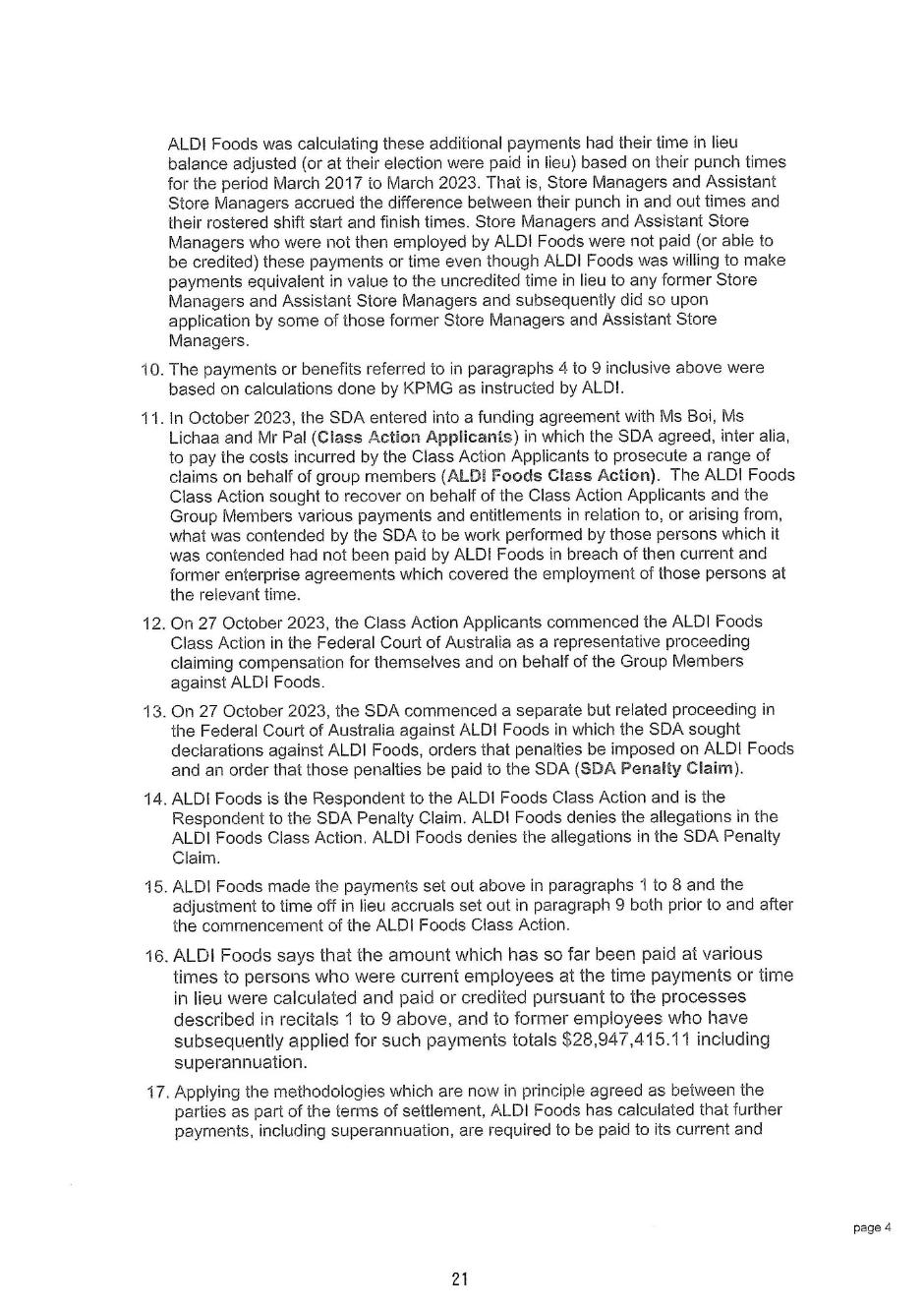
15 After that decision, ALDI examined its practices and commenced a voluntary payment program for the class of employees within the scope of the findings in that case. ALDI first made voluntary payments to current warehouse employees and later to current store employees backdated to March 2017. Some former employees also received payments upon application to ALDI. The total amount voluntarily paid was approximately $28.9 million.
16 The SDA determined that the voluntary payment program failed to fully compensate current employees and did not compensate former employees at all. Its investigation revealed several potential underpayment classes and the failure to pay consequential benefits for a very large number of former and current employees. That is, of the 32,308 Group Members, 16,378 have not received any voluntary payments.
17 The SDA entered into a funding agreement with each applicant in the representative proceeding pursuant to which the SDA agreed to pay the costs incurred in the proceeding, primarily those of the applicants’ solicitor A J Macken & Co, counsel as briefed, and disbursements.
Material relied on
18 There was no challenge to the material relied on by the employees and the SDA. That material included the affidavits of Michael Moses made on 15 January 2024; Brendan Quek made on 30 January 2024; Dominic Macken made on 23 June 2026, 10 July 2026 and 26 August 2026; Margaret McNaughton made on 15 July 2026, 6 October 2026 and 9 October 2026; Ali Amin made on 26 August 2026; and Brendan Palmer made on 31 August 2026.
19 On 9 October 2026, I ordered pursuant to ss 37AF, 37AG(1)(a) and 33ZF of the FCA Act in order to prevent prejudice to the proper administration of justice, that the document titled “Confidential Opinion” attached to the affidavit of Dominic Macken made on 26 August 2026 remain confidential and its publication be prohibited for a period of 10 years or until further order. That order was made because the Confidential Opinion contains a frank assessment of the prospects of success in the representative proceeding and why in the authors’ opinion the settlement is fair and reasonable. The Confidential Opinion is authored by barrister Ben Slade and solicitor Dominic Macken. Each advised the applicants in the representative proceeding and the SDA in the penalty proceeding.
The settlement
Settlement Deed
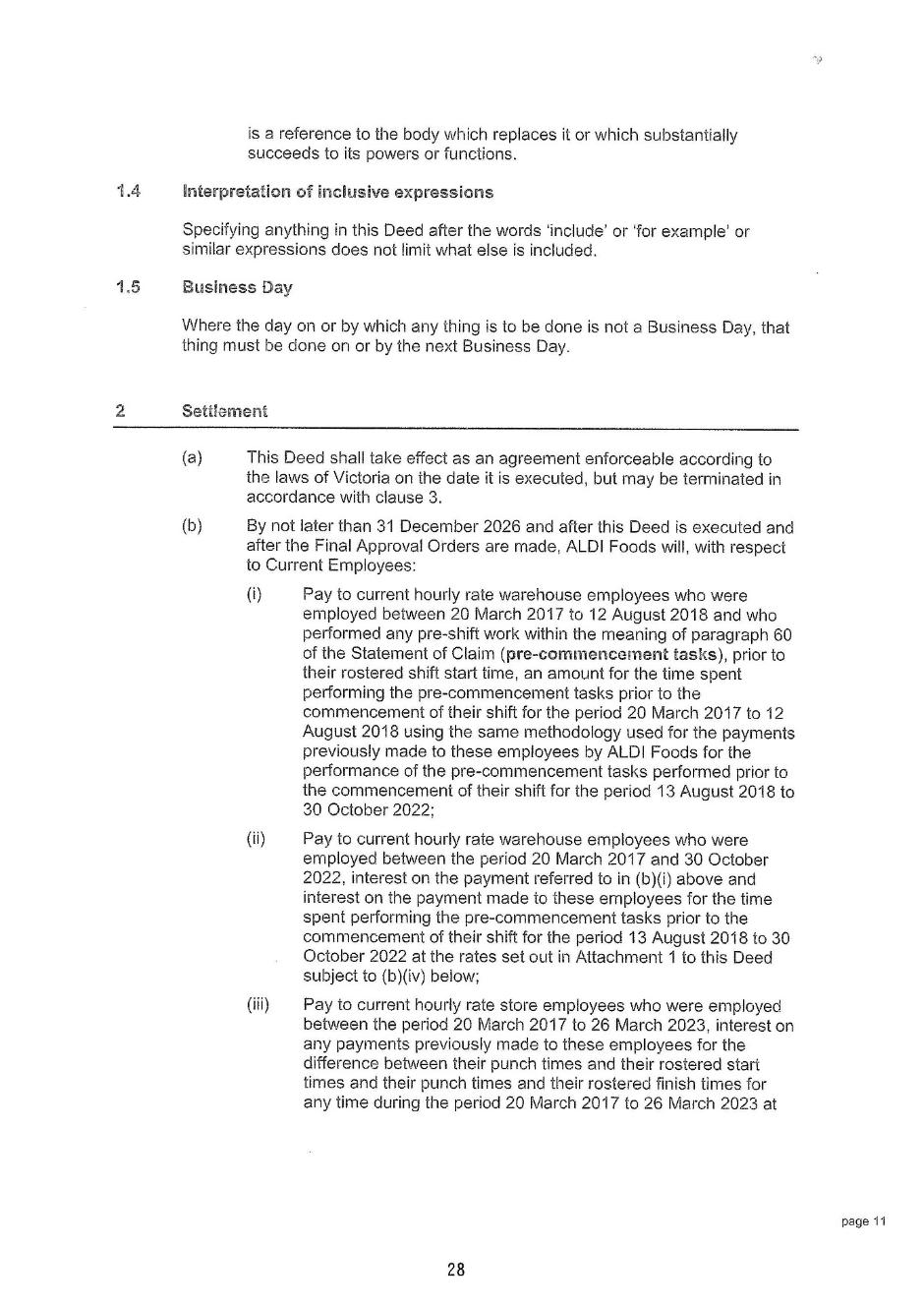
20 The Settlement Deed was executed on 5 May 2026. It was replaced by the Amended Settlement Deed dated 28 July 2026. The amendments are not material and do not prejudice the Group Members. It is convenient to simply refer to the amended version as the Settlement Deed.
21 The Settlement Deed is a complex document, written in dense legal language, which is usual. Expressed simply, it resolves the representative proceeding and the penalty proceeding, but only if the Court approves of the settlement of the representative proceeding.
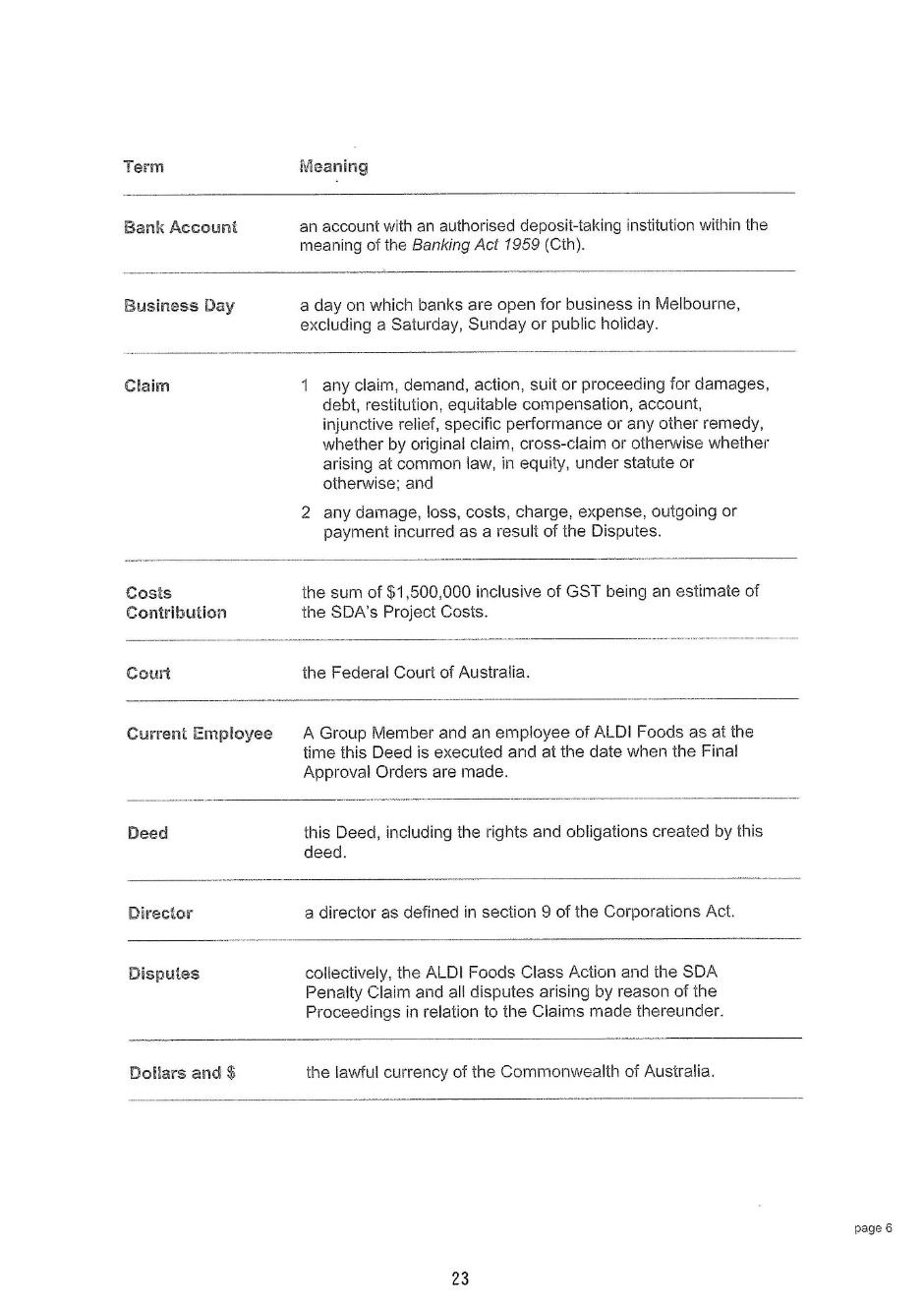
22 In exchange for a release from liability in each proceeding, ALDI agrees to make compensation payments to Group Members and to pay to the SDA a Costs Contribution of $1.5 million for the costs of each proceeding. There is no litigation funder, no commission and no deduction from the amounts to be paid to the Group Members.
23 The total amount to be paid to the Group Members cannot presently be calculated. That is because ALDI must administer the Distribution Scheme whereby it must calculate the entitlements of employees under an agreed mechanism. Employees who are entitled to a payment will also receive interest. However, the SDA estimates that the total liability, inclusive of payments already made by ALDI and interest, will be approximately $55.2 million. Thus, the settlement adds a liability of approximately $16.3 million plus interest.
Voluntary payment program
24 The calculation methodology distinguishes between warehouse employees and store employees. The reason for that distinction is that after Judge Humphreys’ decision, ALDI voluntarily reviewed its records and made payments to current warehouse employees. ALDI calculated the amounts for time identified in performing tasks prior to the start of a rostered shift. Importantly, payments were only made where ALDI identified an employee as having performed such pre-commencement tasks between August 2018 and October 2022. Where a payment was made, corresponding superannuation contributions were also paid.
25 As noted above, former warehouse employees who did not make a specific application to ALDI missed out under this voluntary payment program.
26 ALDI also made voluntary payments to store employees, based on a rounding rule applied to the Kronos time-keeping system. Store employees could punch in up to 10 minutes before or punch out up to 10 minutes after a rostered shift time. Their recorded start or finish time would then be automatically adjusted by Kronos to align with their rostered shift times. Thus, store employees were not paid for the actual punch in or punch out time spent at work. The rounding was not applied where the punch in or punch out time exceeded 10 minutes. Rather than undertaking an inquiry as to whether any work was performed in that 10-minute period, ALDI decided to avoid any risk of under compensation by assuming that employees had worked for that time. ALDI voluntarily paid all store employees based on actual punch times where those times fell within the 10-minute window before their rostered start or after their rostered finish times.
27 ALDI also applied an offset against payments calculated in paragraph [26] to account for time where store employees punched into a shift late or punched out of a shift early.
28 Corresponding superannuation contributions were also paid in respect of those amounts.
29 Store managers and assistant store managers were dealt with differently because they were permitted to accrue time off in lieu for hours worked beyond their rostered shift hours. If still employed when ALDI made the voluntary payments, their time in lieu balances were adjusted.
30 The SDA formed the view that the voluntary payment program did not reasonably compensate all affected employees, particularly former employees. Thus, it caused the representative proceeding and the penalty proceeding to be commenced.
31 That summary explains the complexity of the calculation mechanism for further payments provided for in the Settlement Deed and replicated in the Distribution Scheme, which divides employees into two classes: current and former employees.
Current employees
32 Current warehouse employees will receive a reassessment which extends the relevant period from 20 March 2017 to 12 August 2018 and applies the same methodology that was used in the voluntary payment program. These employees will also receive interest on any amounts previously paid for the period 20 March 2017 to 30 October 2022, along with any associated superannuation.
33 Current store employees who were employed between 20 March 2017 and 26 March 2023 will receive interest on amounts already paid under the voluntary payment program.
34 For current employees in both cases, the interest payable will be reduced by any amount already paid to an employee for the period 20 March 2017 to 27 October 2017.
Former employees
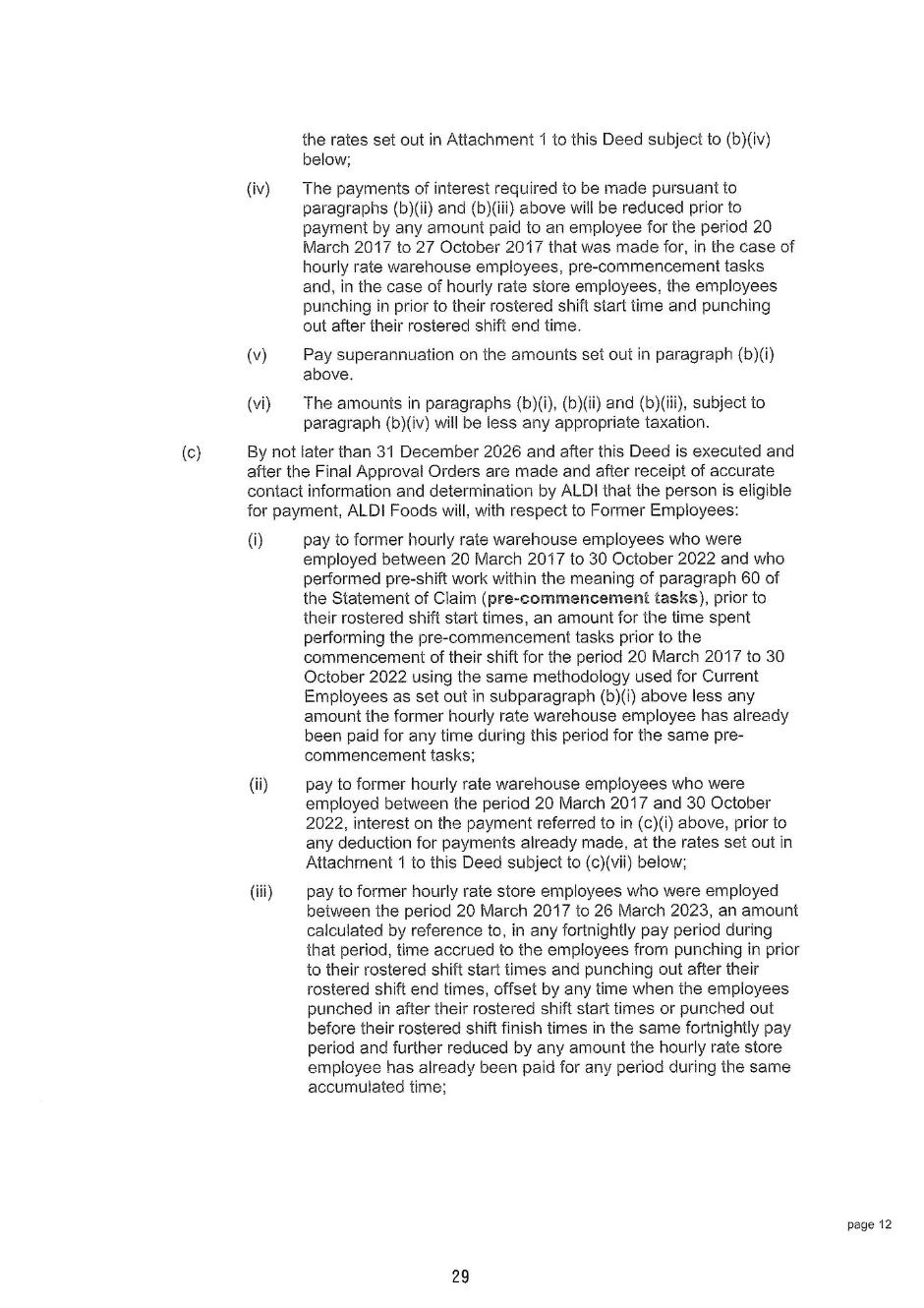
35 Former warehouse employees who were employed between 20 March 2017 and 30 October 2022 will receive payment for any pre-commencement work, calculated using the same methodology as applies to current employees (at [32] above), less any amount that has already been paid under the voluntary payment program. These employees will also receive interest on any amount due.
36 Former store employees who were employed between 20 March 2017 and 26 March 2023 will receive a payment calculated by reference to their recorded punch times. The calculation takes into account the time recorded before rostered start times or after rostered finish times, offset by any time recorded as commencing late or finishing early, and reduced by any amount already paid to the employee for that accumulated time. Interest and superannuation will also be paid where applicable.
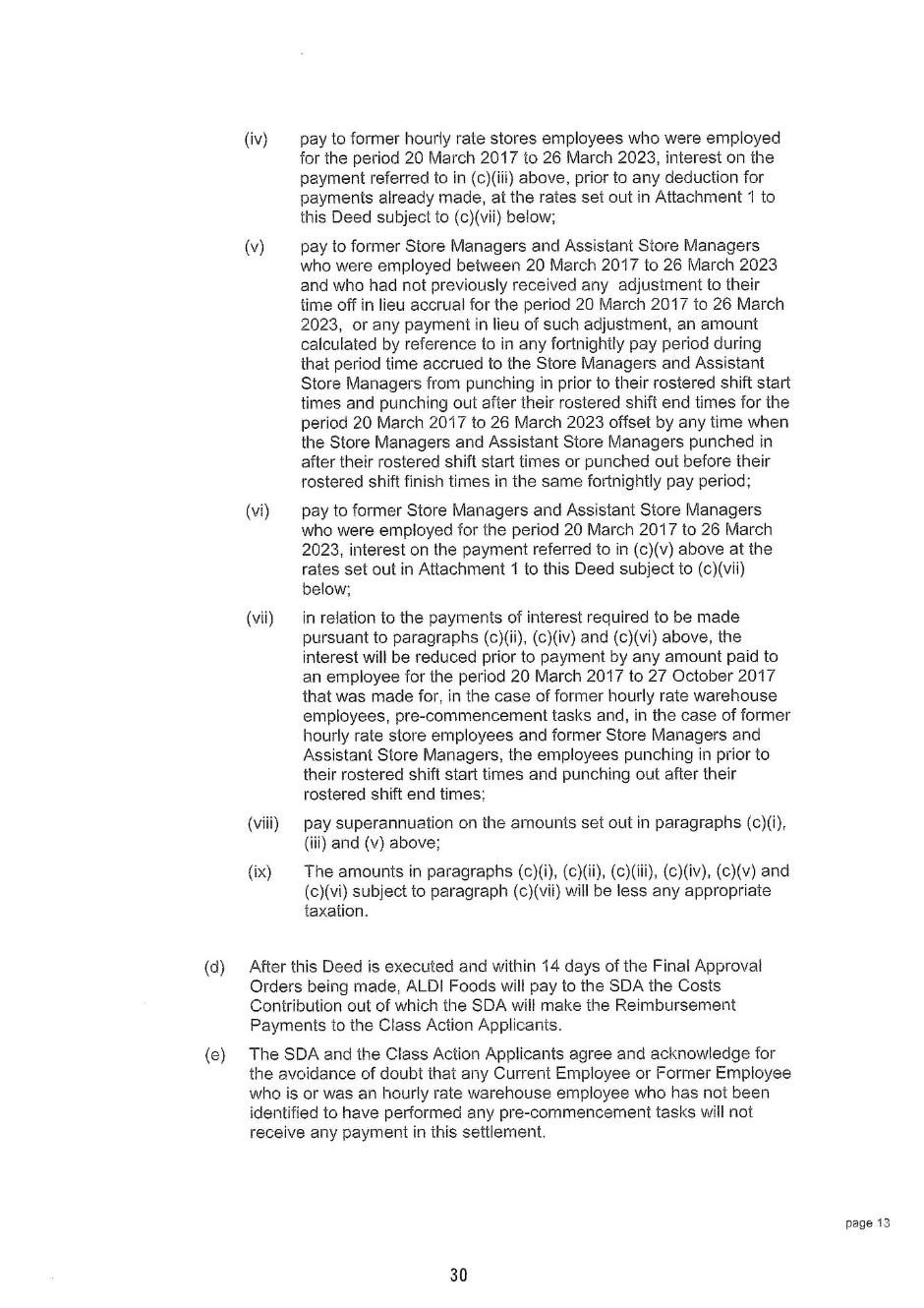
37 Former store managers and assistant store managers employed between 20 March 2017 and 26 March 2023 who have not already received any adjustment to accrued time off in lieu, or any payment in lieu of such adjustment, will receive a payment based on the same punch time methodology (at [36] above). Interest and superannuation will also be paid where applicable.
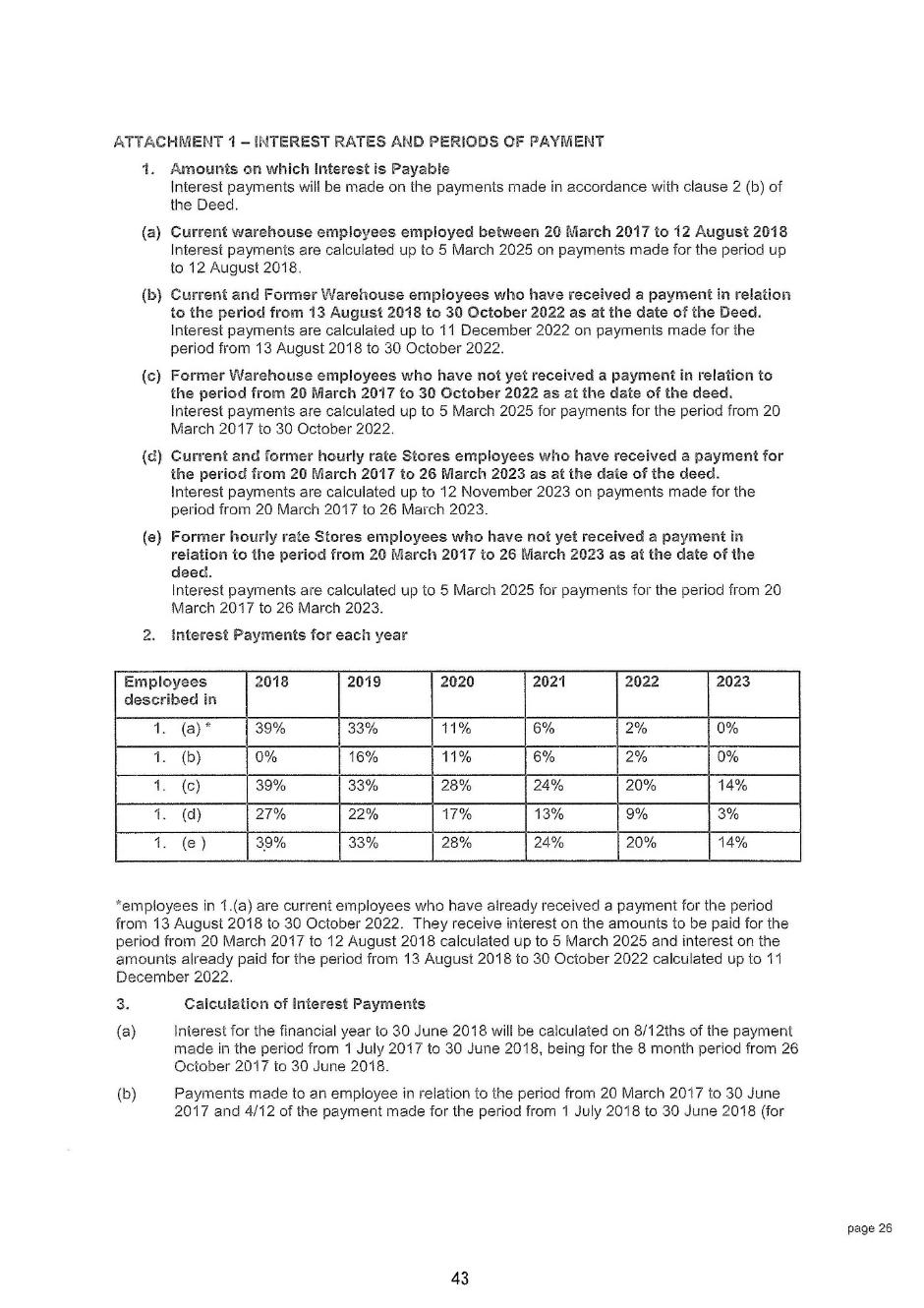
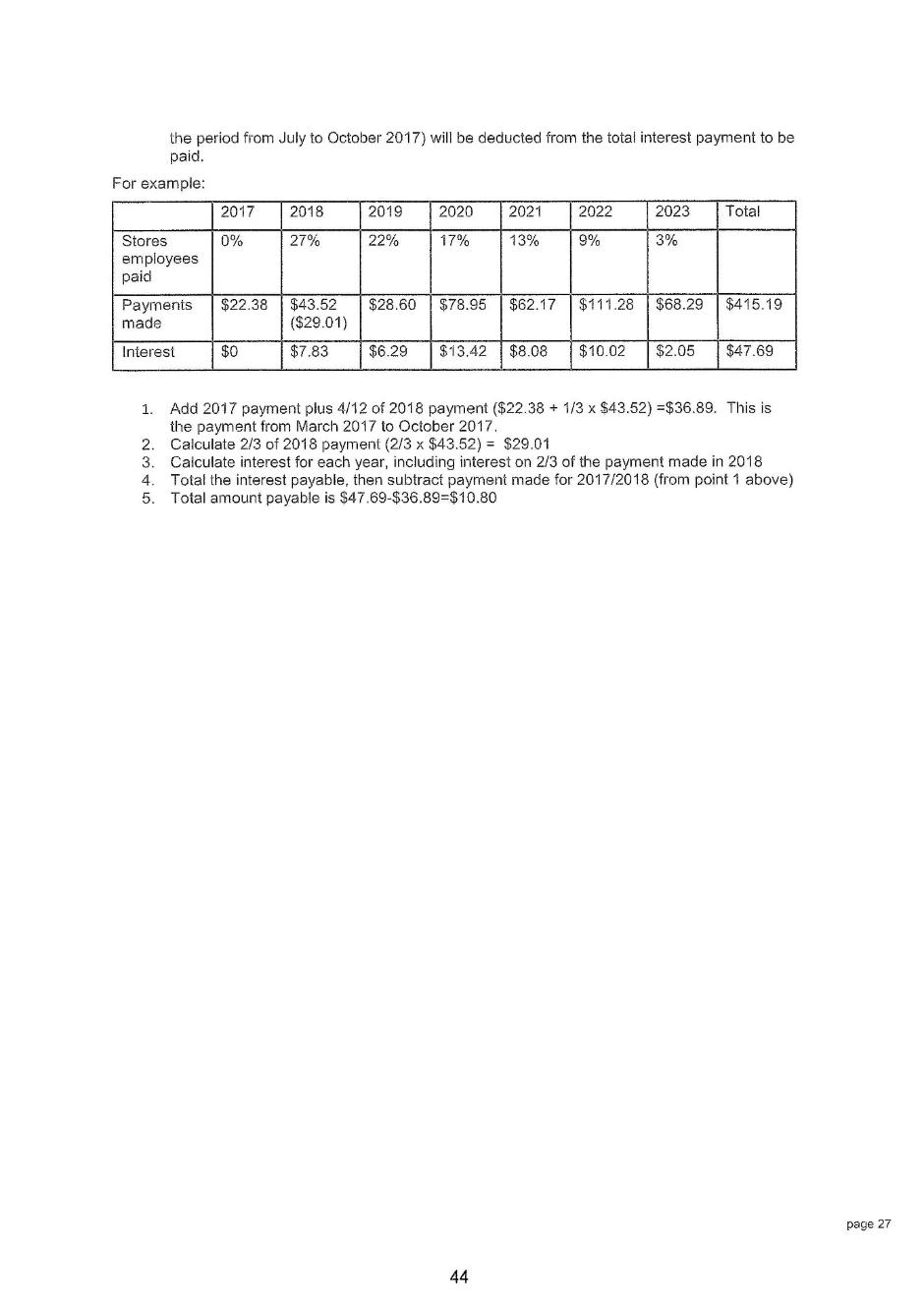
38 Interest will be calculated at a penalty rate, adjusted by amounts already paid pursuant to the voluntary payment program and capped to March 2025. The cap reflects a concession agreed to by the SDA in negotiating the settlement.
39 Any current or former warehouse employees who are not identified as having performed any pre-commencement tasks will not receive any further payment.
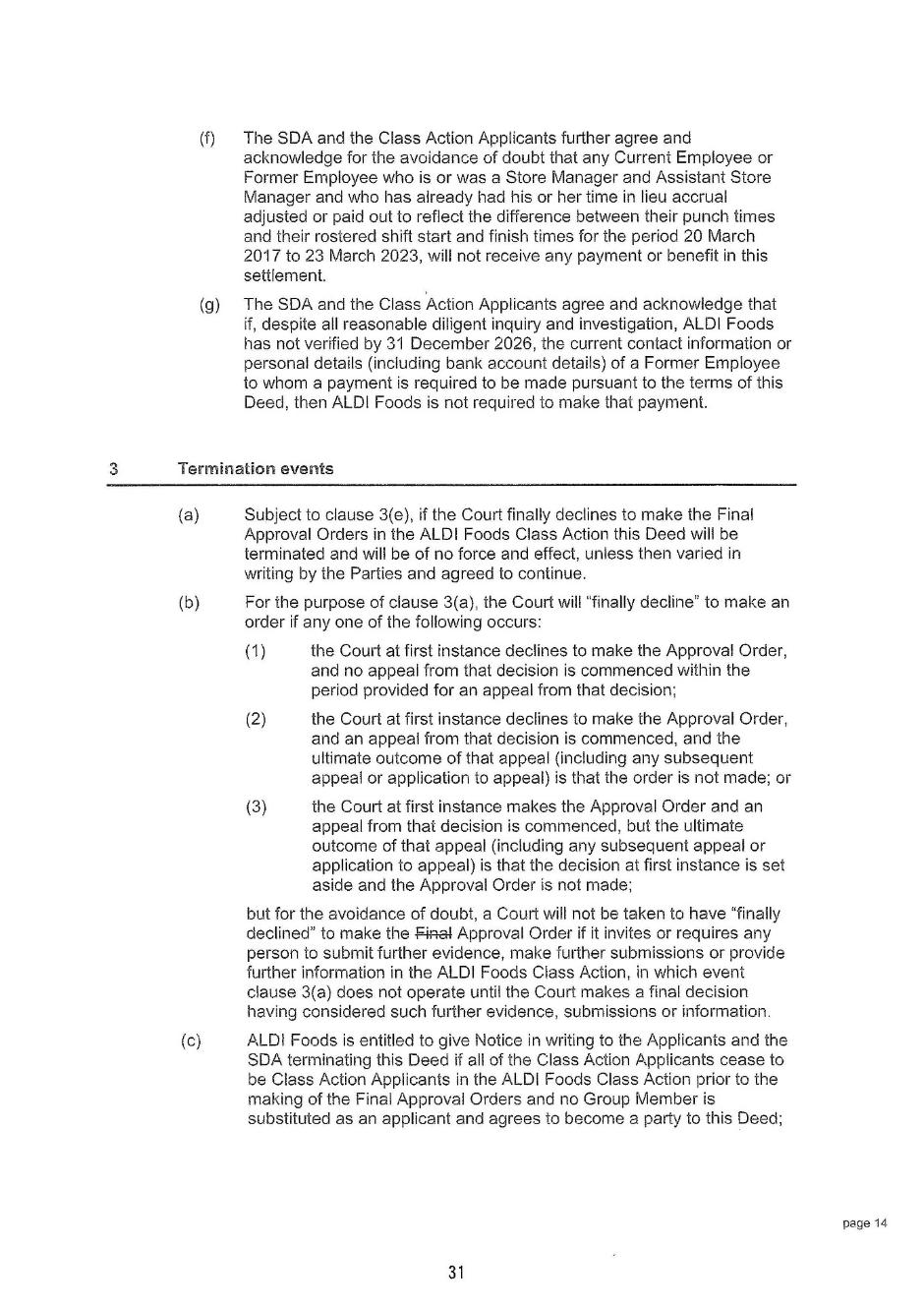
40 Store managers or assistant store managers who have already received an adjustment to their accrued time off in lieu, or payment in lieu of adjustment, will not receive any further payment or benefit.
Distribution Scheme
41 The Settlement Deed requires ALDI to pay the Costs Contribution to the SDA within 14 days of approval by the Court. This is the agreed amount of the legal costs of the SDA in bringing each proceeding.
42 The Distribution Scheme provides for the distribution of settlement money to Known Group Members, being those Group Members whose details ALDI holds, either personally or by payment into their superannuation accounts. It includes a claims assessment methodology for calculating individual entitlements, an audit mechanism by which the SDA can oversee the administration of the Scheme, and provision for the involvement of PricewaterhouseCoopers (PwC) in assisting with that administration. The calculation mechanism reflects the entitlements of Group Members outlined at [32] – [40] above.
43 ALDI is nominated as the appointed Scheme Administrator. The logic of appointing ALDI, rather than an independent person, is that it has already undertaken very significant work in making calculations pursuant to the voluntary payment program and is possessed of the relevant business records. Additionally, as part of the settlement negotiations the SDA independently verified ALDI’s methodology and was satisfied that it was both fair and productive of reasonable outcomes for employees.
44 Subject to any orders of the Court, the Distribution Scheme is to provide for the identification of Group Members to whom compensation is payable based on the approved claims assessment methodology and to facilitate payment of that compensation to Group Members who do not opt out of the proceeding.
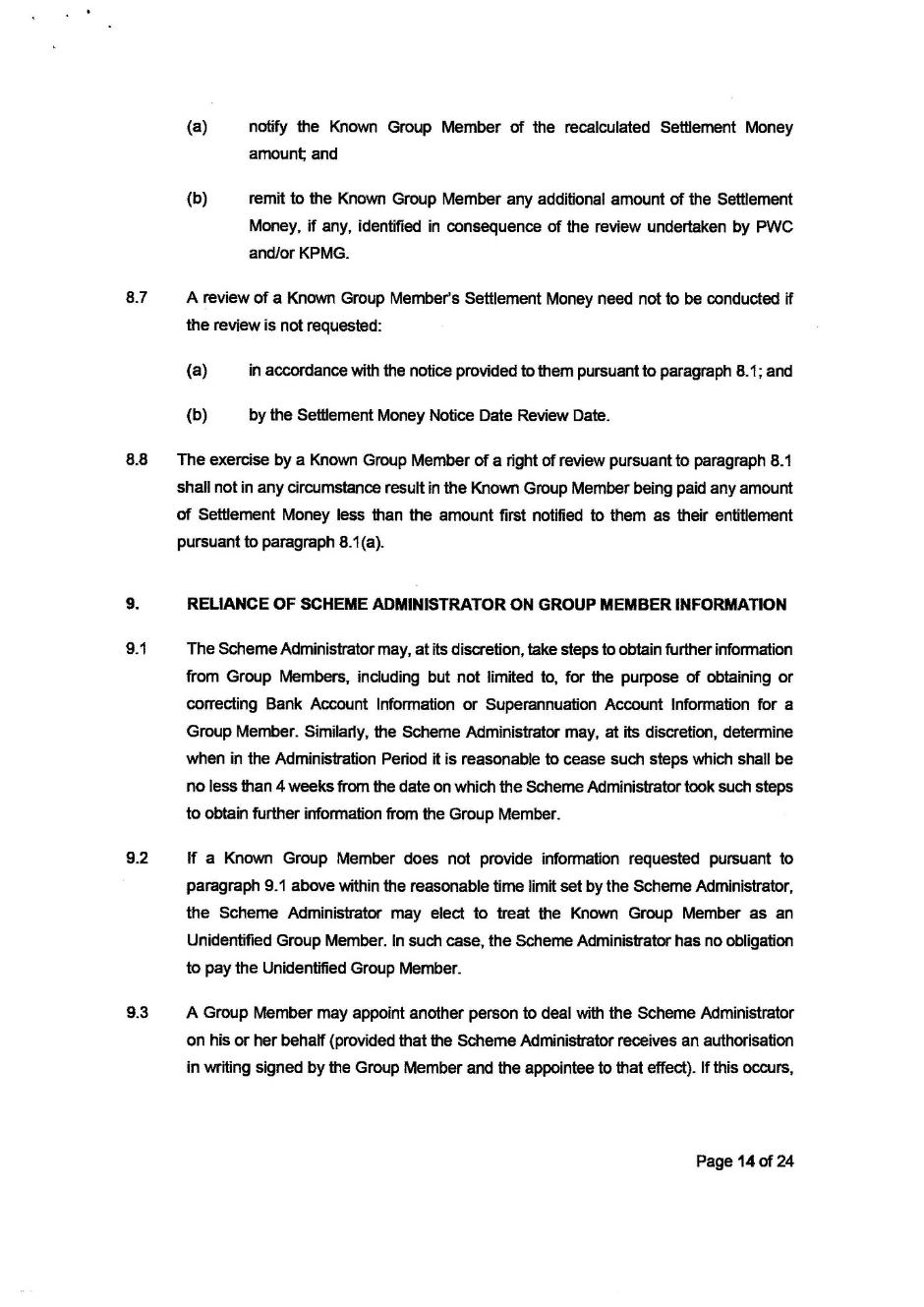
45 ALDI must establish a registration portal through which former employees may provide their personal details on or before the registration date. Current employees will be treated as Group Members without needing to use the registration portal. ALDI will instruct PwC to collate the Group Member Information, including contact, banking and superannuation details, for former employees who register through the portal. ALDI is not, however, responsible for verifying the accuracy of the details provided to it. Once that process is complete, the Known Group Members to whom the settlement money is to be distributed are taken to have been identified.
46 As noted above, there will not be any deductions from the settlement money to be distributed to Group Members. This settlement is atypical in that there is no funder commission or deduction of legal costs from the settlement sum. The mechanism which achieves that is the full and final settlement of the penalty proceeding, whereby ALDI will pay $1.5 million to the SDA. That amount is sufficient to cover the costs of funding each proceeding. From that sum, the SDA is required to make reimbursement payments of $10,000 to the representative proceeding applicants in recognition of their personal contributions.
47 The intended effect is to compensate Group Members for their claimed entitlements under the applicable EBAs. The Group Members are not prejudiced by the decision of the SDA not to prosecute the penalty proceeding to trial because, if successful, the SDA would have sought the usual order pursuant to s 546(3)(b) of the FW Act, directing that any penalty be paid to it.
Relevant principles
48 The principles in relation to settlement approval under s 33V of the FCA Act are well established.
49 The role and obligation of the Court is to protect and supervise the interests of the Group Members: Dyczynski v Gibson [2020] FCAFC 120; (2020) 280 FCR 583, Lee J at [402].
50 The basal principle is that the Court must be satisfied that the settlement is fair and reasonable and in the interests of the Group Members as a whole. Justice Murphy, a very experienced and learned judge in Part IVA proceedings, summarised the task in Webb v GetSwift Ltd (No 7) [2023] FCA 90; (2023) 414 ALR 500 at [16] – [17]: stating:
In undertaking that task, the Court:
(a) assumes an onerous and protective role in relation to Group Members’ interests, in some ways similar to Court approval of settlements on behalf of persons with a legal disability;
(b) must be astute to recognise that the interests of the parties before it, and those of the group as a whole (or as between some members of the group and other members), may not wholly coincide;
(c) relatedly to the second point, should be alive to the possibility that a settlement may reflect conflicts of interest or conflicts of duty and interest between participants in the common enterprise which has conducted the representative proceeding;
(d) should understand that at the point of settlement approval, the interests of the parties will ordinarily have merged in the settlement. It is likely that they both will have become “friends of the deal”. As a result, both sides may not critique the settlement from the perspectives of any Group Members who may suffer a detriment or obtain lesser benefits through the settlement; and
(e) must decide whether the proposed settlement is within the range of reasonable outcomes, rather than whether it is the best outcome which might have been won by better bargaining.
The Class Actions Practice Note (GPN-CA) at [15.5], sets outs [sic] the factors that are ordinarily required to be addressed in the material filed in support of an application for settlement approval. These factors, drawn from the remarks of Goldberg J in Williams v FAI Home Security Pty Ltd (No 4) (2000) 180 ALR 459 at [19], are to be approached as a guide, insofar as they are relevant to the circumstances of the case and not as a mandatory requirement: Caason at [13]; Davison v Commissioner of Police, NSW Police Force [2021] FCA 1324 at [47].
51 As noted by Murphy J, the Class Actions Practice Note (GPN-CA) at [15.5] provides a list of non-mandatory and non-exhaustive factors which are ordinarily required to be addressed in the material relied on in support of a settlement approval. These factors are:
(a) the complexity and likely duration of the litigation;
(b) the reaction of the class to the settlement;
(c) the stage of the proceedings;
(d) the risks of establishing liability;
(e) the risks of establishing loss or damage;
(f) the risks of maintaining a representative proceeding;
(g) the ability of the respondent to withstand a greater judgment;
(h) the range of reasonableness of the settlement in light of the best recovery;
(i) the range of reasonableness of the settlement in light of all the attendant risks of litigation; and
(j) the terms of any advice received from counsel and/or from any independent expert in relation to the issues which arise in the proceeding.
Consideration
52 I am greatly assisted by the comprehensive evidence and experienced assessments in the affidavits of Dominic Macken, who is a very experienced employment and industrial relations lawyer and the principal of the applicants’ solicitors in the proceeding. He has more than 33 years’ experience. The open parts of his affidavit made on 26 August 2026 comprehensively address the following matters.
53 First, compliance with the orders of 16 July 2026, as amended on 21 August 2026. Those orders fixed the date by which a Group Member could opt out, approved the form and content of the notice to Group Members and the method of its service, and provided the objection and opt out procedures. I am satisfied those orders have been complied with.
54 Second, the need to amend the Settlement Deed when it was discovered that there was a factual inaccuracy in the recording of a date for the calculation of interest to some of the employees. The amendment is minor, inconsequential and does not prejudice any of the Group Members.
55 Third, based on his expertise, he expressed his opinion as to the appropriateness of appointing ALDI as the Scheme Administrator. His evidence is:
The [Distribution Scheme] contemplates that [ALDI] will be appointed Scheme Administrator. That appointment is supported by the Applicants and the SDA and there are practical reasons why it is submitted that the Court should endorse this proposal.
The class action claims alleged unpaid entitlements under the provisions of enterprise agreements covering [ALDI] and the Group Members. The Group Members and each of them are either current or former employees of [ALDI]. [ALDI] has access to the records necessary to identify every Group Member, whether “Current Employees} or “Former Employees” (as defined in the [Distribution Scheme]).
[ALDI] is able to precisely calculate the amount of “Settlement Money” (as defined in the [Distribution Scheme]) that should be paid to each Group Member under the terms of the proposed settlement.
[ALDI] also has access to the “Group Member Information” (as defined in the [Distribution Scheme]) of all Current Employees and many Former Employees sufficient to make payments of any assessed amount of Settlement Money to those Group Members. This includes details of the “Superannuation Account” previously nominated by the Group Member for the receipt of the superannuation component of the Settlement Money.
The [Distribution Scheme] does not require Current Employees to formally register via the registration portal as a pre-condition to being paid. That class of Group Member is expressly acknowledged by the terms of the [Distribution Scheme] to be “Known Group Members” for whom any payment of settlement money will be paid as part of the ordinary payroll processes regulating the relevant Group Member's current and continuing employment with [ALDI].
[ALDI] is accordingly not only in a unique position to identify all Group Members but also has the advantage of access to the Group Member Information that it obtained from those Group Members during their employment by [ALDI].
Some Group Member Information may no longer be current in the case of Group Members who are Former Employees. The [Distribution Scheme] addresses this issue by making it a condition precedent to payment of Settlement Money to a Former Employee that they take proactive steps to register on the registration portal in order to be paid.
I was informed in earlier open email correspondence from Ms McNaughton and believe that [ALDI] has already precisely calculated that there are 32,308 Group Members. Ms McNaughton has further advised that, as at April 2025, 15,930 current and former employees have previously received some payment from [ALDI] as part of the voluntary payment process undertaken by [ALDI]. Ms McNaughton also informed me that 16,378 former employees had not, to that point in time, received any payment.
As the settlement of a claim is framed around the payment of individual amounts calculated in accordance with the terms of an agreed Claims Assessment Methodology (as per the Schedule to the [Distribution Scheme]), there is no particular discretion reserved to [ALDI], if appointed Scheme Administrator, to pay Group Members other than in accordance with the agreed Claims Assessment Methodology.
There is agreement between the parties as to how additional time is to be calculated and paid in the case of store employee Group Members (applying [ALDI’s] Kronos clock on/clock off data) and warehouse employees (applying the same methodology for the assessment of the time value of pre-commencement tasks applied by [ALDI] to warehouse employees in its voluntary payment process).
I am informed by Mr Ali Amin, Industrial Officer of the SDA, and believe that the SDA has been able to satisfactorily reverse engineer the voluntary payment methodology adopted by [ALDI] to confirm that the application of that identified time to the requirements of the underpinning enterprise agreements will result in the payment to Known Group Members of the Settlement Money as assessed as being due to them under those agreements (ie, the loadings, allowances, penalty rates, paid breaks and superannuation).
All of these aspects of the settlement are or can be precisely known and calculated from the employee records kept and maintained by [ALDI] or, in the case of warehouse workers, from [ALDI’s] assessment of the likely time it would take warehouse workers to perform their pre-commencement tasks in each of the [ALDI’s] distribution centres.
In my opinion, were any other Scheme Administrator to be appointed, it could only discharge its duties by reference to the data and records already held by [ALDI] or by replicating the same inquiries already made by [ALDI] in relation to the likely time it would take warehouse workers to perform any pre-commencement tasks. To the extent that [ALDI] has already undertaken a voluntary payment process which has largely applied the proposed settlement methodology, any alternative scheme administrator would necessarily be required to duplicate a large measure of the work already undertaken by [ALDI] at a cost which would likely involve some (potentially significant) financial impact to the Settlement Money otherwise available to be distributed to the Group Members.
I also note that inherent in the proposed settlement is that the cost of the administration of the [Distribution Scheme] and the calculation and the making of payments to the Known Group Members is to be borne by [ALDI]. If the Court was to appoint an alternative scheme administrator, I expect that [ALDI] might seek to revisit the terms of settlement in relation to that aspect.
56 I accept that evidence.
57 Fourth, he addressed the audit role that the SDA may exercise under the Distribution Scheme:
[ALDI] will have the assistance of PWC and/or KPMG to compile the Known Group Member Information. Essentially, PWC and/or KPMG will act as an independent verifier of the Group Member Information of Current Employees but also Former Employees as registration rolls out under the registration portal.
PWC and/or KPMG will also review, under the terms of the [Distribution Scheme], the calculation by [ALDI] of any calculation of interest payable in accordance with the terms of the Settlement Deed to both current and former employees.
The [Distribution Scheme] requires [ALDI], as Scheme Administrator, to provide a preliminary notice to Known Group Members of their calculated entitlements and advise those Group Members of their right to request a view of the identified entitlement. PWC will undertake that review for store employees and KPMG will do the review for warehouse employees. The [Distribution Scheme] provides that any review cannot result in the Known Group Member receiving a lesser payment than the amount originally notified to them by [ALDI] as the Known Group Member's assessed Settlement Money.
The SDA will separately have its own independent right under the [Distribution Scheme] to audit [ALDI’s] compliance with its obligations.
58 I accept the basis for and justification of that approach.
59 Fifth, as he correctly records, before an application is made to the Court to dismiss the proceeding, ALDI is required to provide a report which identifies the total of all settlement money paid to Known Group Members and the amount paid to each of those Group Members. ALDI is also obliged to disclose the number of unidentified Group Members, most likely former employees who have not registered an interest, and the total value of the settlement money which would have been payable to that group. This will enable the Court to consider for itself how much of the settlement money will effectively be retained by ALDI. The SDA will work with ALDI to implement a timetable designed to ensure that all Known Group Members will be notified of their calculated settlement money by 15 April 2027 with payments to commence upon expiration of the review date, 20 May 2027, but possibly earlier.
60 Sixth, he addressed the compromises made by ALDI in negotiating the settlement:
[ALDI] is proposing to settle on a without admissions basis. It does not agree, has never agreed, and is not required to agree as part of the terms of settlement, that it has breached the applicable enterprise agreements in the terms contended for in the statement of claim, or at all. While the proposed settlement, if approved, would avoid the need for the filing of any formal Defences to the class action or the penalty claim, it is clear by the terms of [ALDI’s] adjourned interlocutory applications to dismiss, alternatively strike out, the Applicants’ pleadings in both proceedings, that [ALDI] denies that any Group Members have engaged in unpaid work for which they are entitled to be paid under the enterprise agreements, or, if they have, that [ALDI] authorised or directed the performance of such work so as to be liable to pay the Group Members for that unpaid time, and the consequential entitlements under the enterprise agreement that would flow from any entitlement to be paid for that additional time.
[ALDI] has agreed to pay an amount for the loss of use of any Settlement Money in the nature of interest and has agreed to a methodology, that appears as an attachment to the Deed, which is likely to result in a return higher than mere cash rates returns over the relevant period, even allowing for the concession that interest payments will be capped to March 2025. Group Members would of course be entitled to make an application for interest assuming a favourable outcome at trial but the present-day value for Group Members of a negotiated payment of Settlement Money and interest now as opposed to being kept out of their entitlements for some indefinite future period, which assumes contested litigation, is a relevant consideration that weighs in the approval of the settlement.
61 Seventh, he explains the compromises made by the applicants in negotiating the settlement:
The Applicants have agreed to quantify any claim for pre and post-shift attendances by reference to information recorded in [ALDI’s] Kronos clock on/clock off system and, in the case of warehouse workers, in reliance upon [ALDI’s] assessment by survey of the likely time necessary to complete any pre-commencement tasks (which was the agreed methodology that underpinned the calculation of the warehouse employees' unpaid entitlements in the litigation transacted before Judge Humphreys in the Federal Circuit and Family Court of Australia). Consideration (in the absence of discovery) as to the means by which it may be otherwise open to the Applicants to prove, beyond mere sworn assertion, in the context of contested litigation, any pre and post shift attendances of store employee Group Members not accurately recorded by the Kronos system or, in the case of warehouse employees, not appropriately compensated by [ALDI’s] proposal to estimate a completion time for pre-commencement tasks, also support the compromise position set out in the Settlement Deed.
The Applicants have agreed to an offset in each fortnightly pay period of pre and post shift time against any occasion in that same fortnightly period on which a Group Member commenced his or her shift late or finished early. The Applicants have also agreed to any calculated entitlement to interest on Settlement Money being offset against voluntary payments made or to be made by [ALDI] to Group Members in respect of employment periods pre-dating the claim period (ie prior to 27 October 2017). The Applicants have waived a claim for loss of amenity of the opportunity denied to Group Members to take unpaid breaks triggered by the additional time identified as payable by the settlement methodology.
Beyond the above concessions, it is important to note that the methodology agreed between the parties for the calculation of the Settlement Money payable to any Group Member otherwise reflects what the applicable enterprise agreements would require to be paid applying the additional payment of time identified to be payable by the settlement methodology. That is to say, in addition to the unpaid time, the Group Member is receiving all the allowances, loadings, penalty rates, and superannuation which would be his or her entitlement under the enterprise agreement assuming that the settlement methodology accurately reflects the additional time which the statement of claim contends was worked by the Group Member.
62 Eighth, he explains the likely consequences if the settlement is not approved:
If the class action was to proceed to the initial trial of common issues, my understanding is that it would be fully contested on almost every issue which would cause the trial to be protracted, probably running for several weeks on the common issues and with consequential hearings on quantum. Even on the assumption that the Applicants are successful on every issue, there would be no reasonable likelihood that Group Members would see any payments for some years, and certainly not by the expiration of the timetable for payment contemplated by the [Distribution Scheme] if settlement be approved.
Further, the Proceedings (each of them) are being maintained in a costs-free jurisdiction. Absent the limited circumstances for which s570 of the FW Act provides, there is no likelihood that a successful outcome will entitle the Applicants to an order for costs against [ALDI] providing some separate, additional measure of indemnity against the significant costs likely to be expended in carrying the matter forward to trial and judgment (and potentially the exhaustion of any appellate rights).
In the month leading up to the commencement of the class action and the SDA penalty claim, the SDA entered into a funding agreement with the class action Applicants. The Funding Agreement was disclosed to the Court by means of a Notice of Disclosure filed on 22 November 2023. I am instructed that the Applicants waive any confidentiality in the Notice of Disclosure and the Funding Agreement (which is framed in identical terms in the case of all Applicants). Now produced and shown to me marked "DJM-14" is a copy of that Notice of Disclosure and Funding Agreement.
The Funding Agreement provides, at [7.1] that the Applicant agrees to the SDA applying to the Court for a common fund order if the circumstances are such that the SDA is otherwise unable to recover its costs of funding the class action.
The proposed settlement of the penalty claim enables the SDA to recover its costs without the need to apply for a common fund order in the class action. My understanding of my instructions from the SDA is that this is the desired outcome to maximise the financial return to Group Members. If settlement is not approved, however, then, although this is not the desired outcome for the SDA, the prospect that some common fund order diminishing the potential return to Group Members might be required to permit the recovery of some proportion of the outlaid expenditure in relation to proceedings where every claim is disputed and contested, cannot be discounted. If the circumstances were to require such a common fund order, the return to Group Members would be significantly impacted.
63 Finally, he expressed his opinion in short form:
All of these are considerations which, when weighed in the assessment of the present day value to Group Members of receiving Settlement Money now, invite the conclusion that settlement on the terms proposed is not only reasonable and commercial but also reflective of an outcome which is only likely to leave Group Members overall in a much better financial position than they would be after contested litigation, even assuming that litigation will be successful. Settlement now on the agreed terms also of course insulates the Applicants and the Group Members against the possibility that the Proceedings fail or are not wholly successful. I note that success in relation to the penalty claim is contingent upon at least some success in the class action (ie establishing some breach by [ALDI] of the applicable enterprise agreements).
64 The succinctness of his opinion masks the detailed matters addressed in the Confidential Opinion, which he co-authored with Ben Slade of counsel, who has more than 40 years’ experience in class actions.
65 I turn to the exercise of the Court’s discretion to approve the settlement.
66 The first issue concerns the treatment of Group Members as between themselves. I have summarised above the detail of the provisions of the Distribution Scheme. The settlement addresses claims made by all Group Members, extending to those who have received payments pursuant to the voluntary payment program (where their payments may be appropriately adjusted), as well as those who were not included in the voluntary payment program. It may not be possible to identify some former employees with certainty and therefore, those former employees will not receive a payment. It is a necessary outcome of approving a scheme that applies to such a large cohort of former and current employees. All current employees will automatically be included as Known Group Members. I am satisfied that the registration portal is an appropriate mechanism to identify former employees for whom ALDI may not have up-to-date records.
67 The second issue is whether the assessment mechanism is likely to deliver a fair outcome as between the Group Members. I am satisfied that it is. For warehouse employees, the calculation will identify any pre-commencement work performed during the period 20 March 2017 to 12 August 2018 and will adopt the same methodology employed by ALDI in making the voluntary payments for performance of equivalent tasks during the period 13 August 2018 to 30 October 2022. This requires a reasonable assessment of the estimated time required to perform pre-commencement tasks, consistent with the earlier approach of Judge Humphreys in assessing the claims of the warehouse employees.
68 The entitlements of store employees will be assessed by reference to the Kronos data, which I accept is an accurate record. In each case the methodology to calculate additional unpaid time, and where applicable additional allowances, loadings, penalties, paid breaks and superannuation under each relevant EBA is the same. As is the methodology for calculating interest.
69 Dealing next with litigation risks, they fall into two categories. One, the risk of establishing that ALDI did not make payments in accordance with EBA requirements. The other, of proving loss or damage.
70 I accept that because ALDI did not admit liability for contravening relevant provisions of the EBAs in approaching the settlement discussions it was reasonable to assume that everything would remain in issue at the trial. That is, the applicants would have been required to prove each and every contravention by establishing on the evidence that work was performed within the meaning of the FW Act, what that work was, who performed it and how the time for performing the work was calculated, as distinct from how it should have been calculated. A further issue is that the applicants would have been required to prove that ALDI expressly or impliedly directed or authorised pre-shift and/or post-shift work to be undertaken. Even if those matters were established, ALDI would have most likely argued in defence that it was entitled to offset any underpayment by any overpayments that it in fact made to identified employees during the relevant periods. Those issues are likely to have led to a prolonged, costly, mathematically tedious and complex trial.
71 There is also the risk that if the applicants succeeded in establishing liability, it would not necessarily follow that the question of appropriate compensation would be capable of easy assessment. Self-evidently, the number of Group Members and the correspondingly large number of individual permutations would have presented complexities in making the assessment. Further, the representative proceeding made claims for non-monetary loss of amenity. The assessment of those claims would not have been straightforward.
72 These risks should be contextualised. Take as an example, Kelly Boi. She was employed as a store employee between October 2016 and late 2016 in the position of store assistant at Penrith in NSW. From late 2016 until January 2023, she was employed as a store assistant at Cranebrook in NSW. Her pleaded claim is that while an employee she clocked on prior to the rostered commencement of her shifts and clocked off after the rostered conclusion of her shifts. Her times were recorded in the Kronos system, which applied the 10-minute rounding factor so that her actual times worked before and after her rostered shift times were not calculated. She was not therefore paid for the actual time that she spent working. A necessary component of establishing that claim would be giving evidence at trial as to the requirement of ALDI that she perform the work, and the nature and frequency of the work performed.
73 The requirement component of her claim was alternatively pleaded as either being sanctioned, requested, required, directed or undertaken pursuant to a work system designed by ALDI. The particulars of that allegation extended over nine subparagraphs and would necessarily have required detailed factual evidence and analysis.
74 In negotiating the settlement, the SDA made some concessions: primarily that ALDI may apply an offset within fortnightly pay periods and set-off interest in respect of voluntary payments already made. This will apply to all Group Members. One expects concessions to be made in negotiations to resolve civil proceedings. There is nothing unusual in that. In this case the concessions reflect the risk of litigation, the time estimated to prepare and prosecute the representative proceeding to trial and the likely very substantial costs of doing so. I am in no doubt that if that trial was to proceed, and assuming it likely that ALDI would put the applicants to proof of each allegation, it would have been very expensive and time-consuming litigation. The applicants would have faced difficulties in proving their claims, given the length of the period in issue and the absence of reliable records of the work performed.
75 The concessions offered by the SDA in negotiating the settlement were, in my view, appropriately made at an early stage in the litigation and before the position of each party became more entrenched by mounting legal costs. If the early negotiations had not resolved the proceedings, any entitlements secured by a later settlement for the Group Members would inevitably have been eroded by a common fund costs order in favour of the SDA. Each proceeding is brought in a no-costs jurisdiction by reason of s 570 of the FW Act, unless the Court is persuaded to make some other order; usually where a party has engaged in unreasonable conduct. Whilst I am satisfied that each proceeding has reasonable prospects of success before commencement, it is likely that absent this settlement the SDA would have pursued each to trial as a well-resourced union. I consider it inevitable that as costs mounted the SDA would have applied for a common fund costs order. If that was approved, the amount of any settlement achieved for the Group Members would reduce proportionately.
76 I accept that the methodology for assessing and paying the entitlements of Group Members is not perfect, however, it is a fair method to assess, determine and pay the entitlements of a very large class of employees. The methodology cuts through the complexity and number of issues raised for determination in the proceeding in a logical and justifiable way.
77 The methodology is also one that has been stress tested by the SDA. I accept that very considerable work was undertaken to reverse engineer the voluntary payment calculations by reference to the data held by ALDI, to form a view as to its appropriateness as a basis for the settlement. This is explained in detail in the affidavit of Ali Amin, who is an industrial officer employed by the SDA. In part his evidence was:
In or about March 2024, [ALDI] provided the SDA with details of its calculations of the amount that [ALDI] would pay to the three lead applicants under its voluntary payment methodology together with the raw data supporting the calculations made by [ALDI].
This was of critical importance to the SDA in the context of the settlement ultimately negotiated because it permitted the SDA for the first time to understand how [ALDI] (through the agency of KPMG) had calculated the amounts it was prepared to pay to its employees in relation to the alleged underpayments.
The SDA effectively now had sufficient information and the data to ‘reverse engineer’ the KPMG calculations. This enabled the ECU to assess whether [ALDI’s] voluntary payments were comparable to the SDA's independent calculations of what the SDA considered the applicable enterprise agreements required the employees to be paid.
The SDA had, as part of the information provided to it by [ALDI], been given the Kronos clock on/clock off records for each of the Applicants. The major problem with the Kronos clock on/clock off system utilised by [ALDI] (which [ALDI] corrected in about March 2023, following the decision by Judge Humphreys) was that the Kronos system was automatically set to round up or round down, as to 10 minutes either side, any pre-shift or post shift attendances by employees. This meant that employees were paid for their shift hours even where the raw data retained in the Kronos system recorded pre and post shift attendances by the employees.
Using the actual raw data of the Kronos clock on/clock [off] attendances for the class action Applicants and the supplied details of their working shifts, it became possible for me to accurately gauge whether [ALDI] voluntary payment methodology, in my opinion, correctly allowed for, not only the value of any additional time identified by reference to the raw data from the Kronos records, but also any additional enterprise agreement entitlements or benefits where the additional time, in combination with the worked shift, triggered separate entitlements to loadings, penalties, allowances and breaks. [ALDI] had also separately provided for additional superannuation in relation to the additional time paid.
When I painstakingly reverse engineered [ALDI’s] voluntary payment calculations for the Applicants, I was able to confirm for the first time that [ALDI's] voluntary payment methodology generally conformed to the entitlements which I and the SDA had separately calculated would be payable to the Applicants under the terms of their enterprise agreements.
There were some critical differences between the SDA's calculation of the Applicants' entitlements and [ALDI’s] voluntary payment methodology.
First, the calculated entitlements of warehouse workers under [ALDI’s] voluntary payment methodology were calculated differently to the entitlements of the store employees.
Following the decision by Judge Humphreys, [ALDI] had apparently undertaken tests in respect of each of its distribution centres to ascertain an approximate average time for the completion by warehouse workers (including in relation to different pre-commencement tasks performed by different cohorts of warehouse workers), of the pre-commencement tasks which Judge Humphreys had determined to be compensable work. This average completion time as determined by [ALDI] was the basis for the calculation of the payments which [ALDI] was making to warehouse workers under its voluntary payment methodology for their pre-shift attendances, regardless of whether the Kronos clocking system in fact recorded some longer period of pre-shift attendance by the warehouse workers.
If as part of its review of its practices in its warehouse, [ALDI] did not identify that warehouse workers (or a particular cohort of warehouse workers) were performing pre-commencement tasks in that warehouse, no payment was made to them.
Secondly, whilst [ALDI’s] voluntary payment methodology allowed for a payment in respect of an entitlement to paid breaks triggered by the additional time, there was no recognition of lost unpaid and untaken breaks which the Applicants had accrued by reason of the additional time worked.
Thirdly, [ALDI’s] methodology provided the Applicants (and, I assume, the other Group Members) with a net time payment for each fortnightly pay period. That is, where the Kronos records showed that the Applicants had clocked on after the start time for their rostered shift or had left before the end time for their rostered shift, those late start/early finish times were used to offset the calculation of any prestart/post finish time identified by Kronos in the same fortnightly pay period. My understanding is that the estimated pre-shift attendance time by warehouse workers to perform their pre-commencement tasks was also reduced by [ALDI] by this offset where it occurred.
For completeness, no part of [ALDI’s] voluntary payment methodology involved any compensation (in the form of interest or otherwise) for employees being kept out of the unpaid time or the unpaid entitlements.
I note as well that the raw data supplied by [ALDI] confirmed that [ALDI] had made payments pursuant to its voluntary payment methodology in respect of earlier periods of time falling outside the claim period. This, as noted earlier, reflected the fact that [ALDI] had commenced its review from March 2023 whereas the class action commenced in October 2023.
Having undertaken an exhaustive analysis of the raw data as it applied to the class action Applicants, the SDA and I were able to assess [ALDI’s] voluntary payment methodology with a view to productive mediation.
I was present at each of the three mediation sessions before Senior Registrar Legge and provided instructions in relation to subsequent discussions over many months as between the representatives for the parties which ultimately culminated in the terms of settlement.
Without going into any confidential mediation details, it is suffice to say that the SDA and [ALDI] reached agreement on:
(a) the amounts of the payments to be made by [ALDI] to former and current employees for periods on which they apparently worked before and, in the case of store employees, after shifts that had not previously been paid for, as identified in the Claim Assessment Methodology in the Settlement Distribution Scheme; and
(b) the methodology to calculate interest to be paid, being that set out in the Settlement Deed.
The SDA for its part is satisfied that the terms of settlement constitute an acceptable settlement of the class action. Every Group Member or class of Group Member is treated the same in terms of the methodology to be applied under the Settlement Deed to the calculation of his or her Settlement Money. The SDA is also satisfied that the settlement methodology ultimately agreed upon will compensate Group Members for the substantial majority of the claims advanced on their behalf in the class action.
Group Members will be paid by [ALDI] all the claimed "entitlements" under the applicable enterprise agreements that the identified additional time entitles them to. The Group Members will not receive any payment for the loss of amenity claim that the class action claimed for unpaid breaks accruing by reason of the additional time agreed to be paid. This is because it is difficult to assess the value of such a claim both because it is not easily assessable in monetary terms and its calculation would require a great deal of careful analysis of the circumstances of many Group Members for what the SDA considered would be limited ultimate value.
The terms of settlement also concede that the calculation of additional time in each fortnightly pay period will be a net amount (set off against late start/early finish times) in the same pay period. This is a concession over the claim as made in the class action statement of claim (ie which allowed no setoff for those periods) but I am aware from a recent decision by Justice Perram in separate class action/FWO proceedings involving Woolworths and Coles that this concession by the SDA and the Applicants may in fact reflect the correct legal position.
78 I accept his evidence.
79 There are protections built into the Distribution Scheme. In summary:
(a) Known Group Members will be individually notified of their assessments, prior to the finalisation stage;
(b) Known Group Members will have the opportunity to seek a review of their assessment including, if they elect, an independent review by PwC at no cost or risk to themselves;
(c) the SDA has the right to audit compliance by ALDI of its obligations as the Scheme Administrator; and
(d) ALDI must provide a report to the Court which will identify the number of Known Group Members and the total value of the settlement money paid to those members, but also the number of unidentified Group Members and the total value of the settlement money that would have been payable to those persons had they been identified.
80 Considering the evidence of Ali Amin in the light of those provisions, I am well satisfied that the methodology of the Distribution Scheme is fair and reasonable and that there are adequate protection mechanisms for Group Members who may disagree with a foreshadowed calculated entitlement. If the representative proceeding had been prosecuted successfully to trial, this is an outcome within the reasonable range of orders that the Court would have been minded to make in favour of the Group Members.
81 The third issue concerns deductions. There are none to the disadvantage of the Group Members, which is entirely fair and reasonable. The SDA approached the settlement negotiations on the basis that payment to Group Members must reflect individual entitlements pursuant to the EBAs. That outcome is achieved. There is no basis to think that some “deal” has been reached between the SDA and ALDI to discount the payment of $1.5 million in the penalty proceeding as related to the representative proceeding. I am also well-satisfied that the amount of the costs reflects the considerable work undertaken in each proceeding.
82 The fourth issue is any special treatment in favour of any of the Group Members. The modest payments of $10,000 each to the individual applicants are entirely justifiable for the, no doubt, considerable time that each has spent in providing instructions to the solicitors. These payments will not be deducted from the pool of entitlements of the Group Members.
83 The fifth issue relates to the risk that ALDI may not have been able to withstand a judgment greater than the economic cost of the settlement. That is not a material risk in this case.
84 The sixth issue is whether the settlement falls within a reasonable range of realistic outcomes. The evidence is that the ultimate liability of ALDI, by combining the amount of the voluntary payments ($28.9 million) with the estimated additional liability pursuant to the settlement ($16.3 million) plus the estimate for interest to be paid on both amounts ($10 million), results in an overall payment to Group Members of approximately $55.2 million.
85 I am well-satisfied that this settlement is within the reasonable range of potential outcomes. It very appropriately assesses the litigation risks. The settlement provides a fair and reasonable calculation methodology to determine the actual quantum of underpayments, adds interest to the determined amounts, there is no deduction for the costs of the litigation or any commission and there is no risk that the amount available to the Group Members will be reduced by a common fund costs order. In the latter respect, I accepted the estimate that if each proceeding were taken to trial, the costs could have been in the order of $18 million. This amount can reasonably be expected to include the preparation of discovery of many thousands of documents not expected to be completed until mid-2027, as well as the preparation of affidavits of people who have worked with or for the applicants who can provide evidence concerning the applicants’ working relationships, attentiveness and patterns of behaviour in taking breaks. After interviews, lay evidence would need to be provided to the Court in the form of witness statements for trial. Expert evidence in relation to the calculations of the entitlements expected would likely follow, with any pre-trial conclave of experts or further mediations to be completed after that. The initial trial, which will only resolve the applicants’ individual claims and leave the claims of the Group Members to be subsequently determined, could then be expected to begin in mid-2028 on an estimate of four weeks. Having regard to the work to be completed up to and including the trial, I am satisfied the estimate of costs is reasonable in accordance with the advice from counsel as detailed in the Confidential Opinion.
86 One person has objected by notice dated 18 July 2026. He did not attend the hearing. In summary his objection is that as a former employee (he does not say whether he was a warehouse employee or store employee) he regularly punched in between 10 and 15 minutes before his rostered shift start time and punched out between 10 and 15 minutes after his rostered finish time. He was employed between 9 August 2021 and 12 June 2023. He estimates that he performed between 20 and 30 minutes of unpaid work outside his rostered shift hours per shift. In 2024, he received a voluntary payment of $1,285.92. In his view this amount is materially inadequate and disproportionate to the amount of work that he actually performed. His objection is that the method of calculation in his case did not properly account for and compensate him for the actual time worked. He raises unparticularised concerns about the calculation methodology and asserts that it may not have operated fairly and consistently across all Group Members.
87 I am not satisfied that these matters weigh against my discretion to approve of the settlement. The overwhelming majority of Group Members have not objected. Of the 32,308 Group Members, 17 opt out notices were filed. The concerns raised by the objector do not reflect the detail of the assessment methodology in the Distribution Scheme, the litigation risks, the benefit in resolving the representative proceeding at an early stage before costs mount exponentially and the difficulty in accepting, on the face of it, that ALDI required the objector to perform somewhere between 20 and 30 minutes of unpaid work every day that he worked. In any event, if the objector is dissatisfied with the calculation methodology and quantum of his voluntary payment, it remains open to him, after he receives a notice from the Scheme Administrator (assuming he registers pursuant to the registration portal), to request a review of the amount of the settlement money (if any) proposed to be paid to him. If that notice is given, it will engage the independent review mechanism at cll 8.3 to 8.8 of the Distribution Scheme.
88 For these reasons, I am satisfied that the proposed settlement is fair and reasonable as between the Group Members having regard to the interests of the Group Members as a whole. I am also satisfied that the methodology of the Distribution Scheme to distribute the settlement money is fair and reasonable and that in the particular circumstances of this matter, it is appropriate that ALDI act as the Scheme Administrator.
89 Accordingly, the proposed settlement is approved pursuant to s 33V of the FCA Act and the orders sought by the applicants in the representative proceeding will be made.
I certify that the preceding eighty-nine (89) numbered paragraphs are a true copy of the Reasons for Judgment of the Honourable Justice McElwaine. |
Associate:
Dated: 23 October 2026
ANNEXURE A

ANNEXURE B