

Federal Court of Australia
Titomic Limited, in the matter of Titomic Limited [2026] FCA 1575
File number(s): | NSD 1905 of 2026 |
Judgment of: | GOODMAN J |
Date of judgment: | 20 October 2026 |
Date of publication of reasons: | 21 October 2026 |
Catchwords: | CORPORATIONS – scheme of arrangement – first court hearing – application for orders convening a meeting of members to consider a proposed scheme – application granted |
Legislation: | Corporations Act 2001 (Cth), ss 302, 411, 412, 708A, 1319 Federal Court (Corporations) Rules 2000 (Cth) Corporations Regulations 2001 (Cth), regs 5.1.01, Schedule 8 Securities Act of 1933 (US) |
Cases cited: | Amaero Ltd, in the matter of Amaero Ltd [2026] FCA 596 Amcor Limited, in the matter of Amcor Limited [2019] FCA 346 Atlantic Gold NL, in the matter of Atlantic Gold NL (No 2) [2014] FCA 869 Capitol Health Limited, in the matter of Capitol Health Limited [2024] FCA 1120 Controlled Thermal Resources Limited, in the matter of Controlled Thermal Resources Limited (No 2) [2022] FCA 1497 First Pacific Advisors LLC v Boart Longyear Ltd [2017] NSWCA 116; (2017) 320 FLR 78 Incannex Healthcare Limited, in the matter of Incannex Healthcare Limited [2023] FCA 1441 Re Foundation Healthcare Ltd [2002] FCA 742; (2002) 42 ACSR 252 Re Solution 6 Holdings Ltd (ACN 003 264 006) [2004] FCA 1049; (2004) 50 ACSR 113 Rex Minerals Limited, in the matter of Rex Minerals Limited [2024] FCA 1051 Sovereign Life Assurance Company v Dodd [1892] 2 Q.B. 573 |
Division: | General Division |
Registry: | New South Wales |
National Practice Area: | Commercial and Corporations |
Sub-area: | Commercial Contracts, Banking, Finance and Insurance |
Number of paragraphs: | 23 |
Date of hearing: | 20 October 2026 |
Counsel for the Plaintiff: | Mr I Ahmed SC |
Solicitor for the Plaintiff: | Norton Rose Fulbright Australia |
ORDERS
NSD 1905 of 2026 | ||
IN THE MATTER OF TITOMIC LIMITED ACN 602 793 644 | ||
TITOMIC LIMITED ACN 602793644 Plaintiff | ||
order made by: | GOODMAN J |
DATE OF ORDER: | 20 october 2026 |
THE COURT ORDERS THAT:
1. Pursuant to s 411(1) of the Corporations Act 2001 (Cth) the plaintiff convene a meeting (Scheme Meeting) of the holders of fully paid ordinary shares in the plaintiff (Shareholders) for the purpose of considering and, if thought fit, agreeing (with or without modification) to a scheme of arrangement between the plaintiff and the Shareholders in the terms set out in Annexure C to the Scheme Booklet which is tab 9 of Exhibit GMH-1 in this proceeding (the Scheme).
2. Pursuant to s 1319 of the Act:
(a) the Scheme Meeting be held on Monday, 23 November 2026 commencing at 10.00 am (Sydney time) virtually via an online platform at https://meetnow.global/MQ9JZUS (as to virtual access, the meeting to be accessed substantially in accordance with the instructions contained in the Notice of Scheme Meeting set out in Annexure E of the Scheme Booklet); and
(b) the Scheme Meeting be convened, held and conducted in accordance with the provisions of Pt 2G.2 of the Act that apply to members of a company, and the provisions of the plaintiff’s constitution that are not inconsistent with the Act and these orders.
3. Subject to its registration with the Australian Securities and Investments Commission pursuant to s 412(6) of the Act, the Scheme Booklet, substantially in the form of tab 9 of Exhibit GMH-1 in the proceeding, is hereby approved as the explanatory statement for the Scheme for distribution to Shareholders for the purposes of s 412(1)(a) of the Act (Scheme Booklet).
4. The following documents be distributed to Shareholders:
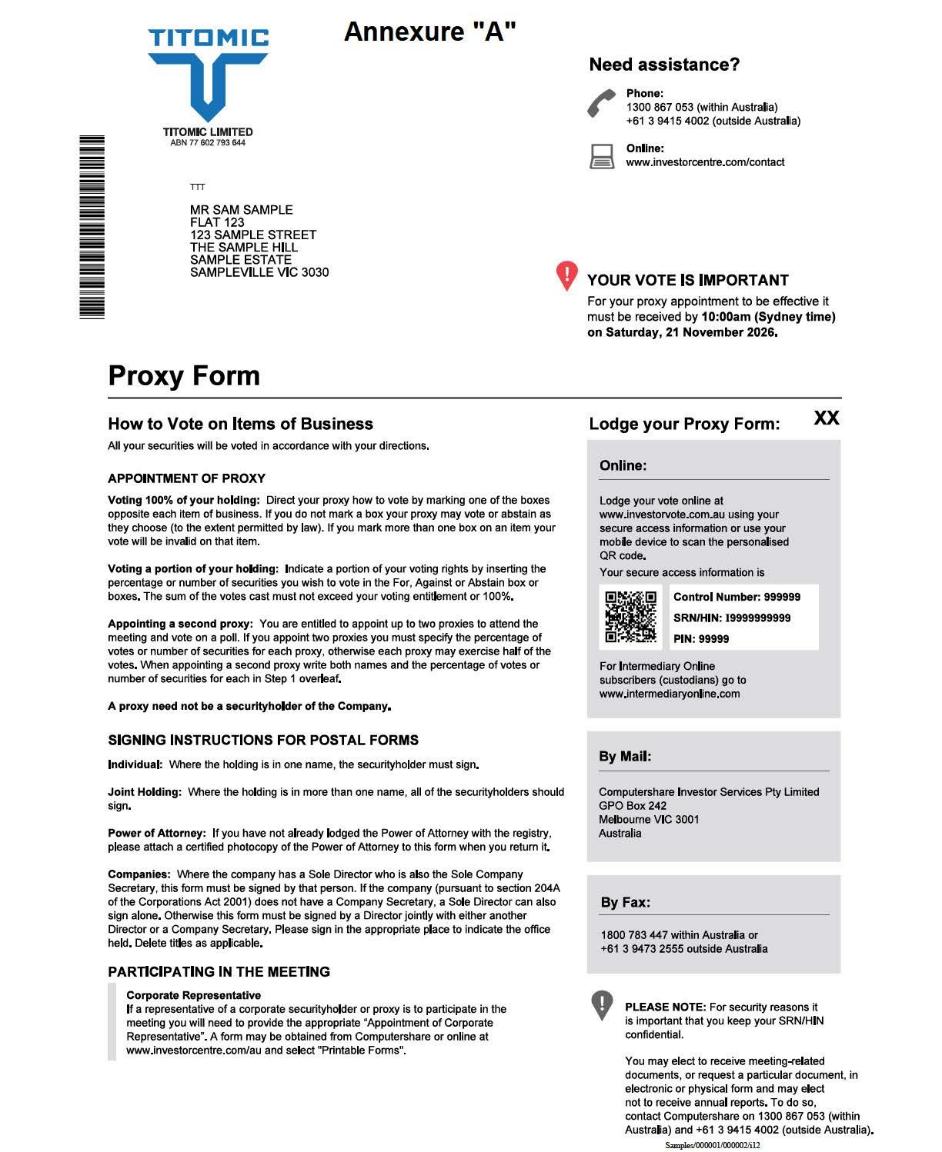
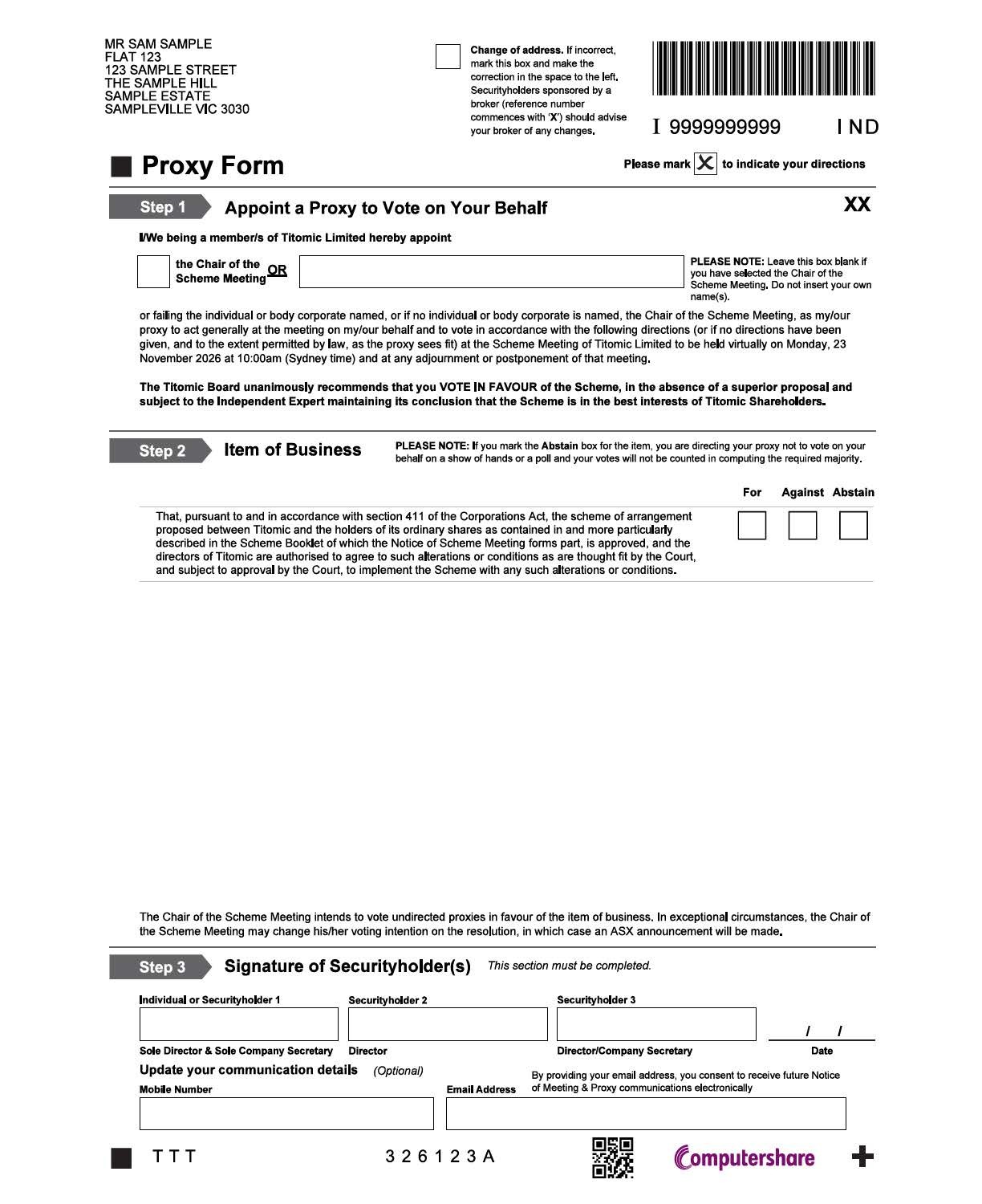
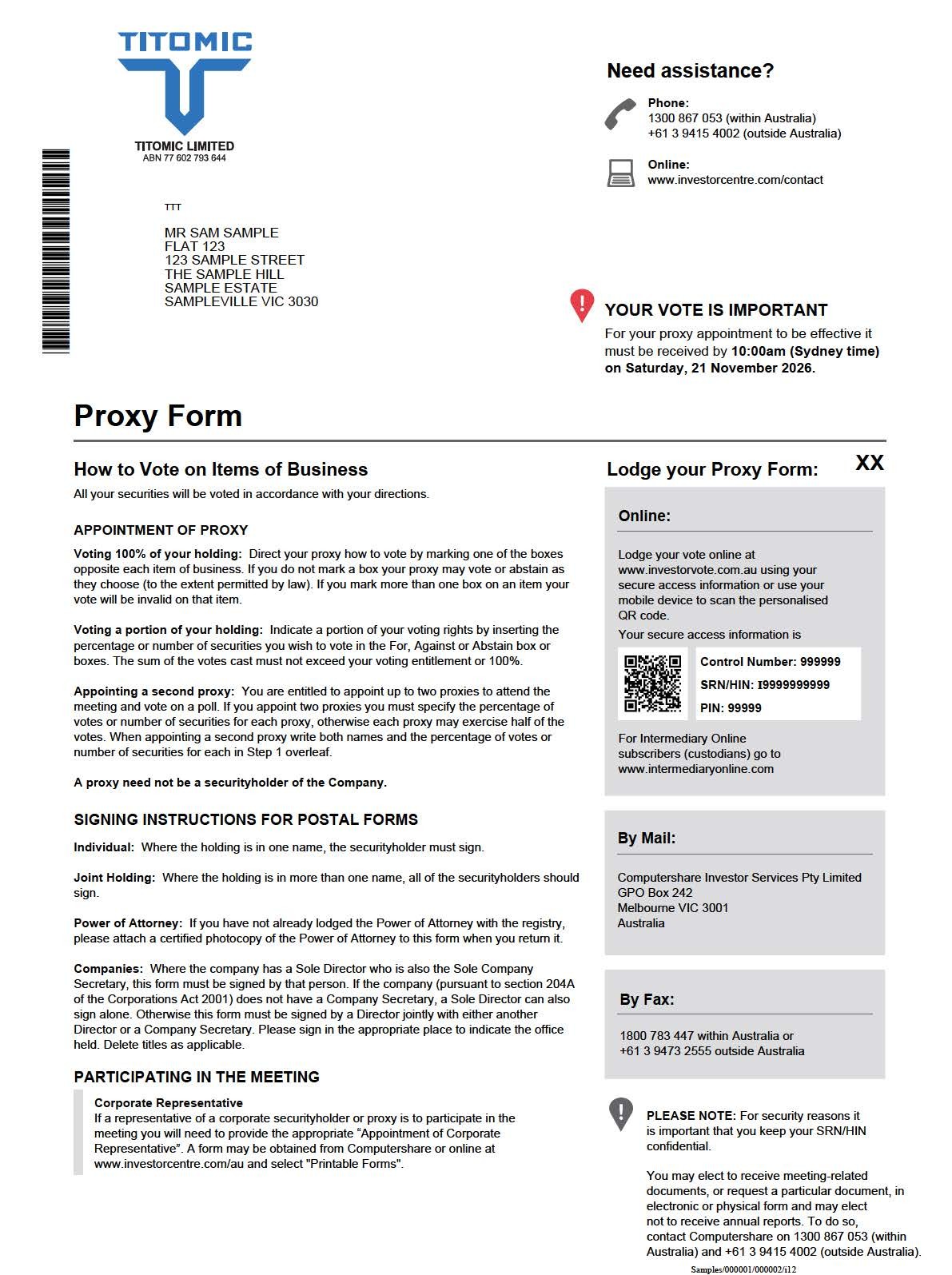
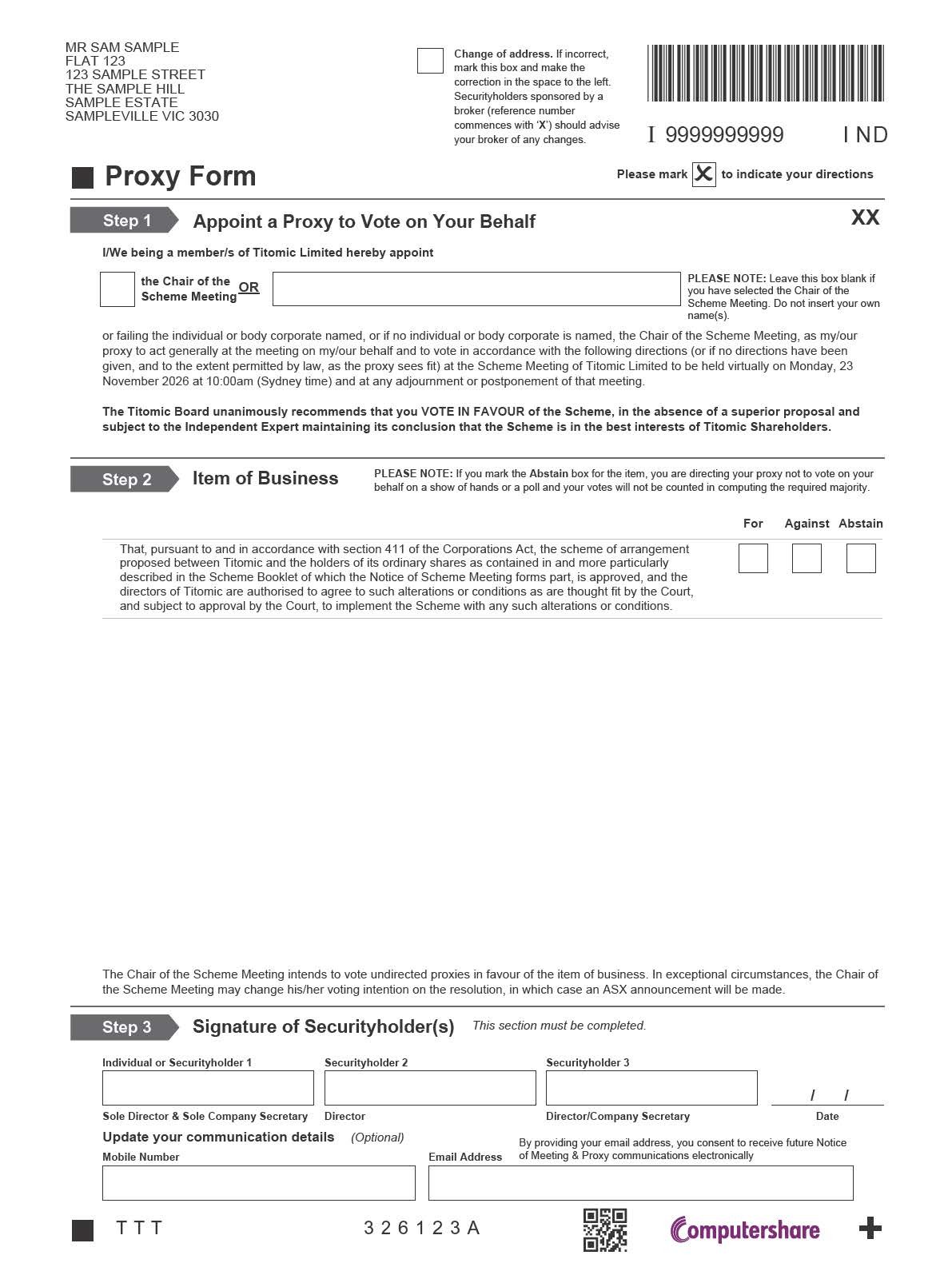
(a) the proxy form substantially in form of Annexure A to these orders (Proxy Form);
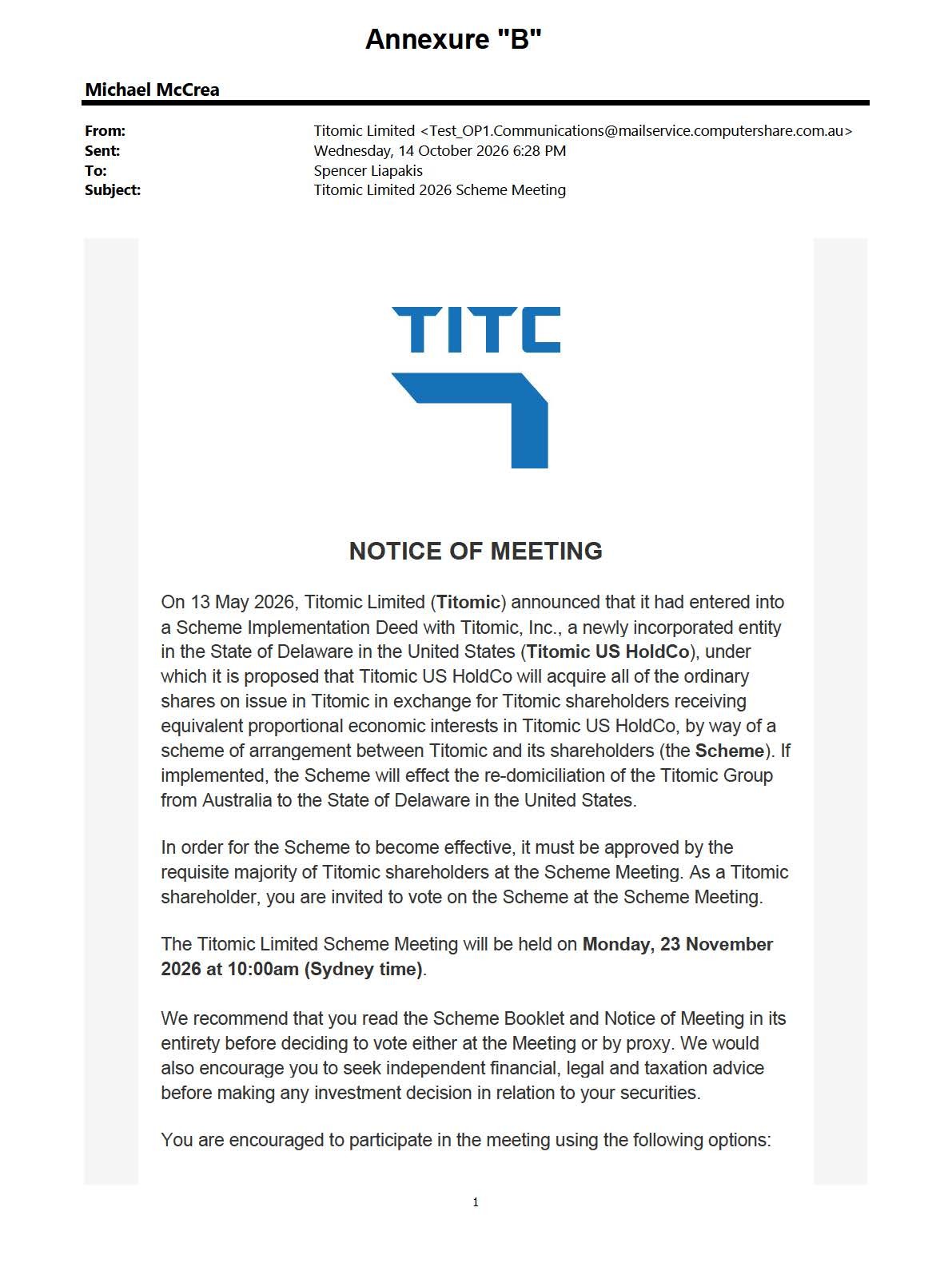
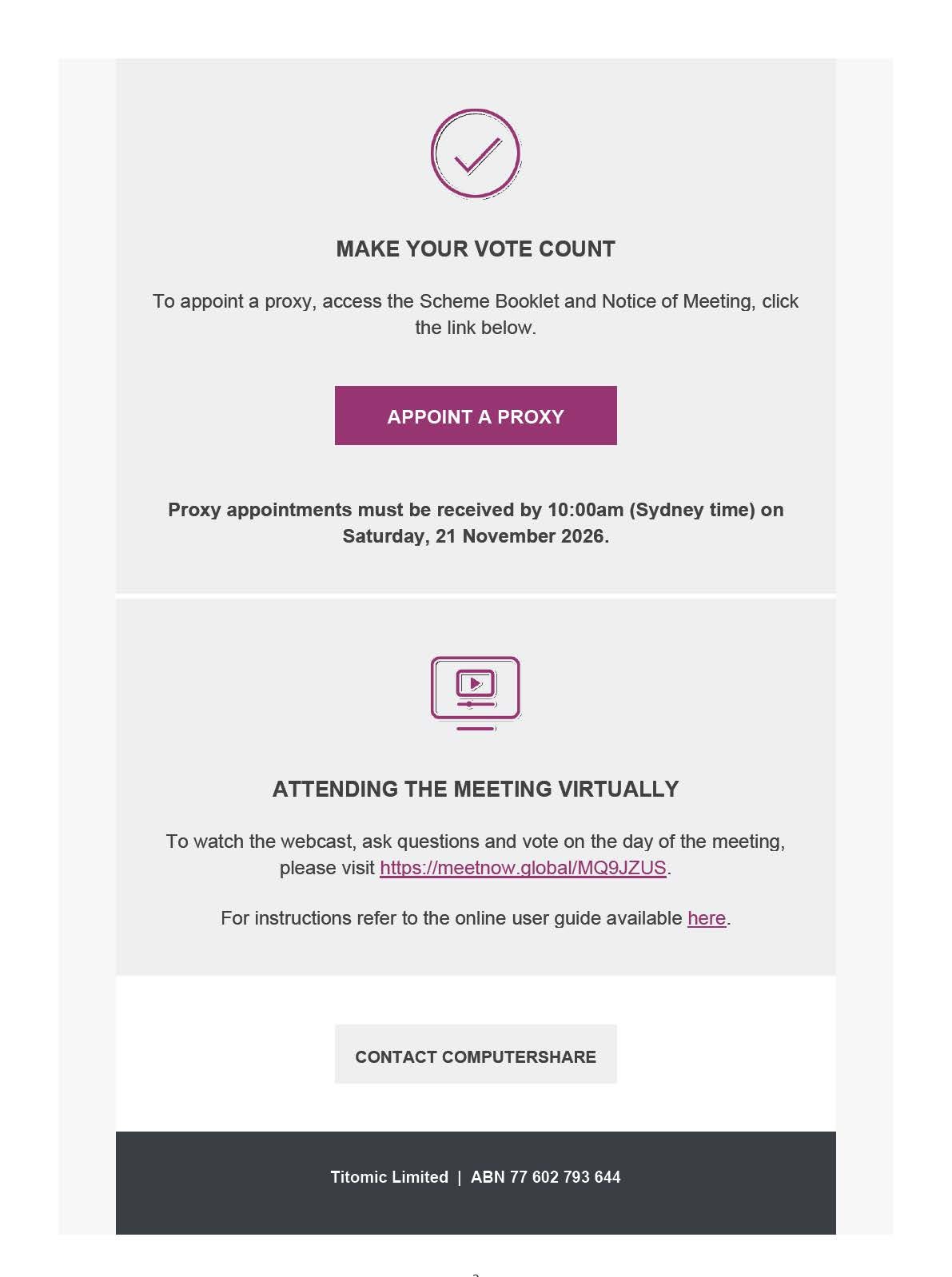
(b) the email broadcast substantially in the form of Annexure B to these orders providing electronic links to the Scheme Booklet and the Proxy Form to Shareholders (Email Broadcast); and
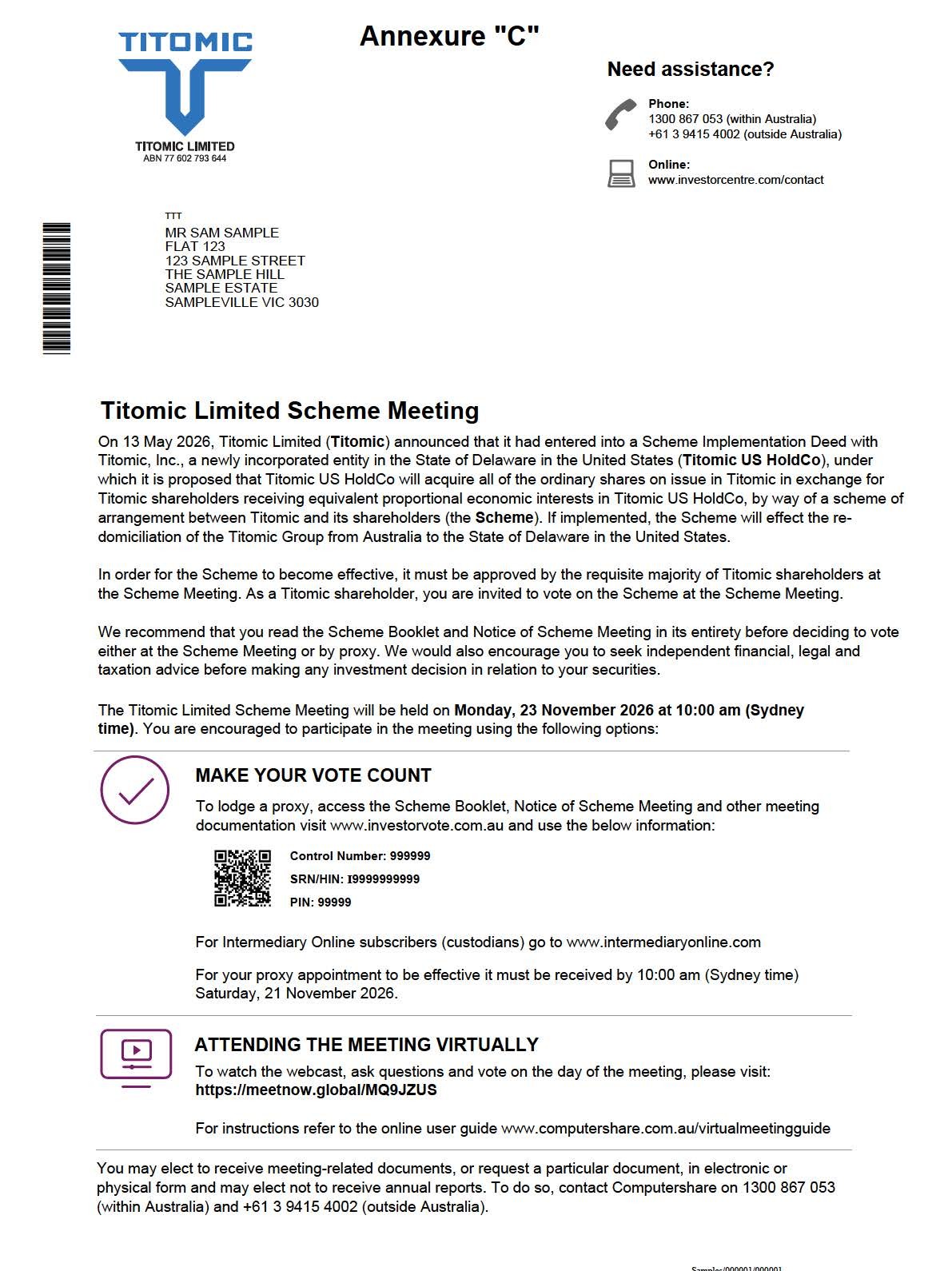
(c) a letter substantially in the form of Annexure C to these orders providing instructions on how to access the Scheme Booklet electronically for the Scheme Meeting (Scheme Letter Notification);
(together, the Scheme Materials).
5. The Scheme Meeting be convened by sending the following documents on or before Thursday, 22 October 2026 to each Shareholder whose name is recorded in the plaintiff’s register of members as being a Shareholder as at 7.00 pm (Sydney time) on Tuesday, 20 October 2026:
(a) those Shareholders who have opted in to receive communication via email and provided an email address to the plaintiff for shareholder communications, or who have made no election on how to receive communications from the plaintiff but have an email address recorded in the plaintiff’s register of members, (Email Shareholders) are to be sent an email which includes:
(i) instructions regarding how to view or download an electronic copy of the Scheme Booklet; and
(ii) instructions on how to lodge their proxy form for the Scheme Meeting online
(Email Notification);
(b) those Shareholders who have not opted in to receive communications either via email or hard copy communications (Non Electing Postal Shareholders), who have a postal address shown on the register of members of the plaintiff as being within Australia and who have no email address recorded in the plaintiff’s register of members, are to be sent, by prepaid ordinary post to their postal address:
(i) a letter which includes:
A. instructions regarding how to view or download an electronic copy of the Scheme Booklet; and
B. instructions on how lodge their proxy form for the Scheme Meeting online or by post,
(Letter Notification);
(ii) a personalised single Proxy Form; and
(iii) a reply prepaid envelope for the return of that Non Electing Postal Shareholder’s Proxy Form;
(c) those Shareholders who have opted in to receive hard copy communications (Electing Postal Shareholders), who have a postal address shown on the register of members of the plaintiff as being within Australia, are to be sent, by prepaid ordinary post to their postal address:
(i) the Letter Notification;
(ii) a printed copy of the Scheme Booklet;
(iii) a personalised single Proxy Form; and
(iv) a reply prepaid envelope for the return of that Electing Postal Shareholder’s Proxy Form;
(d) those Non Electing Postal Shareholders and Electing Postal Shareholders whose postal address is shown on the register of members of the plaintiff as being outside Australia, are to be sent by pre-paid airmail post addressed to the relevant address recorded in the plaintiff’s register:
(i) the Letter Notification;
(ii) for Electing Postal Shareholders only, a printed copy of the Scheme Booklet;
(iii) a personalised Proxy Form; and
(iv) a self-addressed prepaid airmail envelope for the return of that Non Electing Postal Shareholder’s or Electing Postal Shareholder’s (as applicable) Proxy Form; and
6. If the plaintiff, through its share registry services provider, receives an automatic electronic “bounce back” notification that the Email Notification was unable to be delivered to the nominated email address of any of the Email Shareholders (Undelivered Email Recipients), the Letter Notification, a personalised single Proxy Form and a reply prepaid envelope for the return of that Undelivered Email Recipient’s Proxy Form are to be sent by pre-paid ordinary post (in the case of Undelivered Email Recipients within Australia), or the Letter Notification, a personalised single Proxy Form and a self-addressed prepaid airmail envelope for the return of that Undelivered Email Recipient’s Proxy Form are to be sent by pre-paid airmail post (in the case of Undelivered Email Recipients outside Australia), to the Undelivered Email Recipients’ respective postal addresses.
7. Pursuant to s 1319 of the Act:
(a) the plaintiff may determine that, for the purposes of the Scheme Meeting, all of the ordinary shares in the plaintiff be taken to be held by the person, persons or bodies corporate who held them as at 7.00 pm (Sydney time) on Saturday, 21 November 2026 as recorded in the register held and maintained by the plaintiff;
(b) the plaintiff may determine that only the proxy forms in relation to the Scheme Meeting received by the plaintiff by no later than 10.00 am (Sydney time) on Saturday, 21 November 2026 are valid;
(c) the Chairperson of the Scheme Meeting be Dag W.R. Stromme or in his absence, Humphrey Nolan;
(d) the Chairperson of the Scheme Meeting shall have the power to adjourn the meeting in their absolute discretion to such time, date and place as they consider appropriate; and
(e) a poll must be taken to decide the resolutions put to the vote at the Scheme Meeting, except for procedural motions.
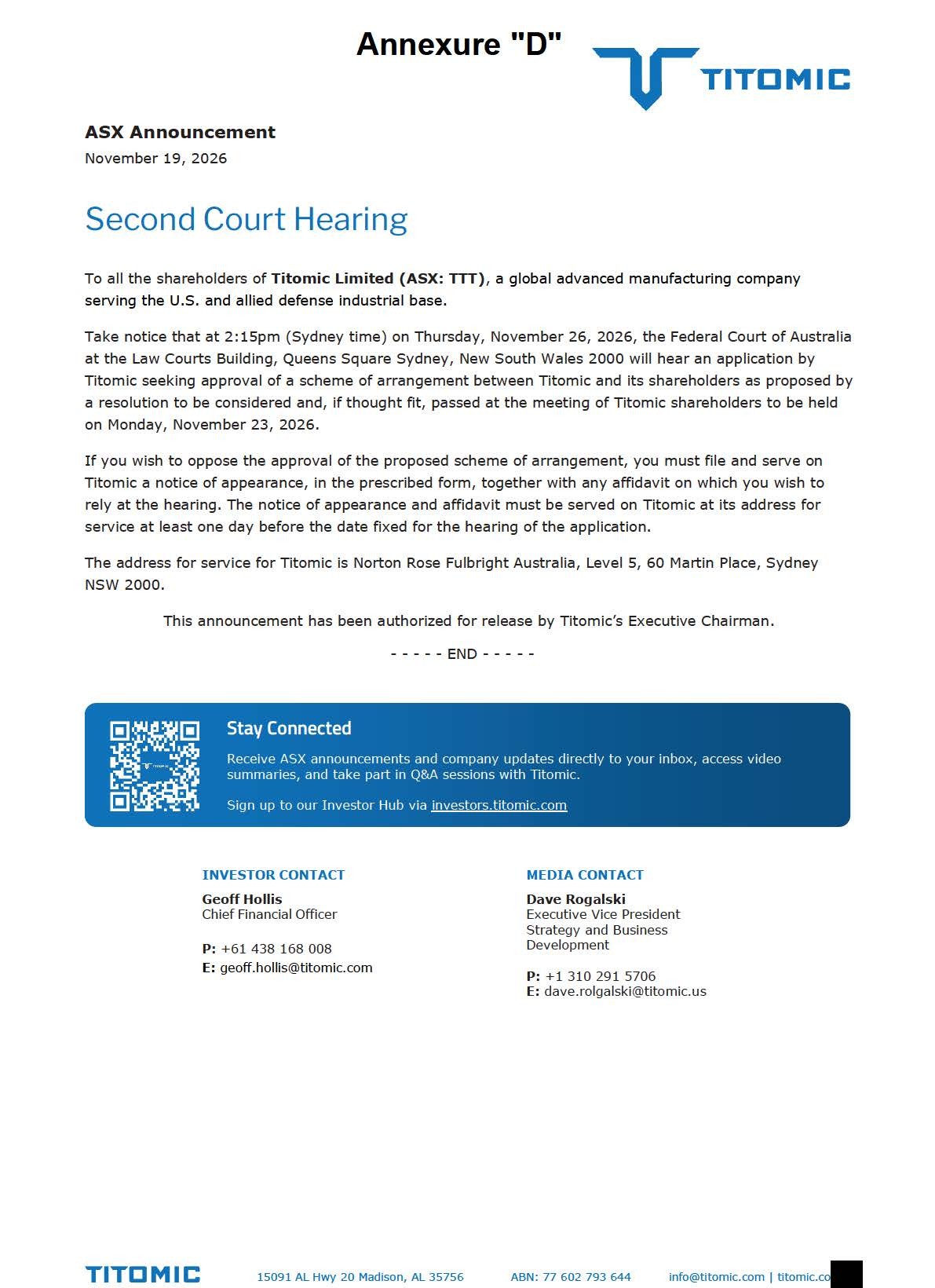
8. The plaintiff publish a Notice of Hearing by an announcement to the Australian Stock Exchange and by publication on the plaintiff's website's investor center announcements webpage (accessible via https://investors.titomic.com/asx-announcements), in substantially the form that appears at Annexure D to these orders, not later than 5 days prior to the date fixed for the hearing of any application to approve the Scheme, and the plaintiff be relieved from compliance with rule 3.4 and Form 6 of the Federal Court (Corporations) Rules 2000 (Rules) to the extent necessary.
9. Rule 2.15 of the Rules shall not apply to the Scheme Meeting.
10. Pursuant to rule 1.3 of the Rules, compliance with the requirements of rule 2.4(1) of the Rules is dispensed with, to the extent that rule requires the affidavit filed with the Originating Process to state the facts in support of the process.
11. The proceeding be adjourned to 2:15pm on 26 November 2026 before Justice Goodman for the hearing of any application to approve the Scheme.
12. The plaintiff has liberty to apply on 2 days’ notice.
13. These orders be entered forthwith.
Note: Entry of orders is dealt with in Rule 39.32 of the Federal Court Rules 2011.
REASONS FOR JUDGMENT
GOODMAN J:
A. INTRODUCTION
1 At the conclusion of the first Court hearing in this proceeding on 20 October 2026, I made orders substantially in the form of the orders sought by the plaintiff (Titomic) for the convening of a meeting of its members under s 411(1) of the Corporations Act 2001 (Cth). I also made directions pursuant to s 1319 of that Act. These are my reasons for doing so.
2 Titomic:
(1) is an Australian public company limited by shares. It is admitted to the official list of the financial market operated by ASX Limited, and its shares are quoted for trading on the Australian Securities Exchange (ASX) under the code “TTT”;
(2) has on issue: (a) 1,786,953,394 fully paid ordinary shares; (b) 3,000,000 performance rights; (c) 169,429,286 options; and
(3) is the parent company of a group of companies (Titomic Group).
3 On 13 May 2026, Titomic and Titomic, Inc. (Titomic US HoldCo) entered into a Scheme Implementation Deed, which was announced to the ASX on the same day. The proposed scheme involves only Titomic’s shares.
4 Titomic has prepared a proposed scheme booklet, which contains a proposed explanatory statement within the meaning of s 412 of the Act and which attaches, inter alia:
(1) an independent expert report from RSM Corporate Australia Pty Ltd which contains an opinion that the proposed scheme is in the best interests of Titomic’s members, in the absence of an alternative proposal or other information;
(2) the scheme implementation deed;
(3) the proposed scheme; and
(4) a proposed notice of a meeting of Titomic’s members to vote on the proposed scheme (scheme meeting).
5 Titomic provided the proposed scheme booklet to the Australian Securities and Investments Commission (ASIC) on 29 September 2026.
6 Titomic proposes to conduct the scheme meeting on 23 November 2026, ahead of a second Court hearing on 26 November 2026.
B. OVERVIEW OF THE SCHEME
7 In broad terms, the scheme is a “redomiciliation” or “top-hatting” scheme and involves the following steps:
(1) all Titomic shares will be transferred to Titomic US HoldCo;
(2) Titomic US HoldCo will become the new ultimate parent company of Titomic Group and will retain Titomic’s listing on the ASX via Chess Depositary Interests (CDIs) which will continue to be traded on ASX under the code “TTT”;
(3) in consideration for the transfer of the Titomic shares to Titomic US HoldCo, Titomic’s members will receive a beneficial interest in one Titomic US HoldCo share for every 25 Titomic shares they hold, in the form of Titomic US HoldCo CDIs;
(4) Titomic members will retain an equivalent proportional economic interest in Titomic US HoldCo as they previously held in Titomic;
(5) subject to Titomic having entered into binding agreements with each holder of options or performance rights – which entry is a condition precedent to the proposed scheme – those option and performance right holders will retain an equivalent proportional economic interest in Titomic US HoldCo as they previously held in Titomic; and
(6) the directors and management team of Titomic Group will remain unchanged.
8 The step described in [7(4)] is subject to an exception, for “ineligible foreign shareholders”. The proposed scheme provides that the CDIs that would otherwise be issued to the “ineligible foreign shareholders” will be sold and the proceeds remitted to them, subject to the deduction of costs and taxes. As at 16 October 2026, there were no “ineligible foreign shareholders”.
C. EVIDENCE
9 On this application, Titomic relied upon the following evidence.
10 First, an affidavit of Ms Therese Megens, a solicitor in the employ of the solicitors for Titomic. Ms Megens proved some formal matters and communications with the ASIC.
11 Secondly, an affidavit of Mr Geoffrey Hollis, the Chief Financial Officer and Company Secretary of Titomic. Mr Hollis’s evidence addresses, inter alia:
(1) the structure of the Titomic Group;
(2) Titomic’s business, directors and capital structure;
(3) Titomic US HoldCo;
(4) the options and performance rights issued by Titomic;
(5) an overview of the scheme of arrangement, including its purpose;
(6) the proposed scheme booklet and the detailed verification process undertaken concerning that booklet;
(7) the proposed methods of dissemination of the proposed scheme booklet;
(8) the manner in which it is proposed that the scheme meeting will be conducted, including that Mr Dag Stromme, the Executive Chair of Titomic, will act as the chairperson for that meeting, with Mr Humphrey Nolan, an independent non-executive director of Titomic, available to act as the chairperson instead of Mr Stromme if needed;
(9) various proposed methods of communicating with members ahead of the scheme meeting and ahead of the second Court hearing; and
(10) his absence of awareness of any matter that would mean that it is likely that the conditions precedent to the scheme will not be waived or satisfied.
12 Thirdly, two affidavits of Ms Sarah Roper, another solicitor in the employ of the solicitor for Titomic, who provided evidence of communications with ASIC and the ASX including correspondence received from ASIC on 19 October 2026, pursuant to which ASIC indicated relevantly:
(1) that pursuant to reg 5.1.01(1) of the Corporations Regulations 2001 (Cth), ASIC will allow Titomic to send an explanatory statement in respect of the proposed scheme which does not comply with the requirements of paragraph 8302(h) of Part 3 of Schedule 8 to the Regulations provided certain conditions are met;
(2) its position was that it:
(a) in accordance with its usual position, would not provide a written statement under s 411(17)(b) of the Act until the second Court hearing;
(b) had received at least 14 days’ notification of the first Court hearing, as required by s 411(2)(a) of the Act;
(c) had had a reasonable opportunity to examine the terms of the proposed scheme and draft explanatory statement, as required by s 411(2)(b) of the Act; and
(d) did not propose to appear to oppose the scheme at the first Court hearing.
D. CONSIDERATION
D.1 Statutory framework
13 The statutory framework and the Court’s role within that framework were conveniently summarised by Justice O’Bryan in Rex Minerals Limited, in the matter of Rex Minerals Limited [2024] FCA 1051 at [21] to [27]:
21 Part 5.1 of the Act provides a procedure whereby an arrangement between a company and its members can be made binding on all members. Section 411 is the principal provision. The procedure involves three main steps:
(a) an application to the Court for an order to convene a scheme meeting (s 411(1));
(b) if such an order is made, the convening of such a meeting at which a resolution to agree to the scheme is considered (s 411(4)(a)); and
(c) if the resolution is passed by the necessary majorities, an application to the Court for an order approving the scheme (ss 411(4)(b) and 411(6)).
22 The present application concerns the first stage, being an application to the Court for an order to convene the Scheme Meeting. Section 411 of the Act confers a discretion on the Court to make an order convening the Scheme Meeting if certain statutory conditions are met, namely:
(a) an arrangement is proposed between a Pt 5.1 body and its members (or any class of them (s 411(1));
(b) an application for the order is made in a summary way by that body (s 411(1));
(c) 14 days’ notice of the hearing of the application has been given to ASIC (or such lesser period as the Court or ASIC permits) (s 411(2)(a)); and
(d) the Court is satisfied that ASIC has had a reasonable opportunity to:
(i) examine the terms of the proposed arrangement to which the application relates and a draft explanatory statement relating to the proposed arrangement; and
(ii) make submissions to the Court in relation to the proposed arrangement and the draft explanatory statement required by s 412 (ss 411(2)(b) and 411(3)).
23 In addition to these requirements of s 411, the procedure is regulated by s 412 of the Act and reg 5.1.01 and Sch 8 to the Corporations Regulations 2001 (Cth) (Regulations), and by the Federal Court (Corporations) Rules 2000 (Cth) (Rules). The Regulations and the Rules prescribe certain information which is required to be sent to the members about the Scheme.
24 The principles which apply to the exercise of the Court’s discretion at this first stage are well-known. In Re Amcor Ltd [2019] FCA 346 (Amcor), Beach J described the Court’s role at the first court hearing as follows (at [47], emphasis in original):
My function on an application to order the convening of a meeting is supervisory. At this stage I should generally confine myself to ensuring that certain procedural and substantive requirements have been met including dealing with adequate disclosure, with limited consideration of issues of fairness. But having said that, it is appropriate to consider the merits or fairness of a proposed scheme at the convening hearing if the issue is such as would unquestionably lead to a refusal to approve a proposed scheme at the approval hearing, that is, the proposed scheme appears now to be on its face “so blatantly unfair or otherwise inappropriate that it should be stopped in its tracks before going any further” (Re Foundation Healthcare Ltd (2002) 42 ACSR 252 at [44] per French J).
25 It is not the Court’s role to usurp the shareholders’ decision whether to agree to a scheme. The question whether or not to accept particular consideration for shares is quintessentially a commercial matter for the members to assess, and they ought not be prevented from having the opportunity to do so, provided that the Court can be satisfied that they are acting on sufficient information and with time to consider what they are voting on: Crown Resorts Ltd, in the matter of Crown Resorts Ltd [2022] FCA 367 at [27], citing Amcor at [50] and Re ACM Gold Ltd (1992) 34 FCR 530 at 534.
26 Therefore, if the arrangement is one that seems fit for consideration by the meeting of members, and is a commercial proposition likely to gain the Court’s approval if passed by the necessary majorities, then orders should be made to convene the meeting: Re Foundation Healthcare Ltd [2002] FCA 742; 42 ACSR 252 (Foundation Healthcare) at [36].
27 In summary, the Court’s task at the first court hearing is to assess first, whether the statutory prerequisites to the making of orders convening a meeting have been met and second, whether it is appropriate for the Court to exercise its discretion in favour of making those orders…
(bold and italic emphasis in original)
D.2 Enlivenment of the s 411 discretion
14 I was satisfied that each of the preconditions to the enlivenment of the Court’s discretion to make an order under s 411(1) (as summarised in Rex Minerals at [22]) is met in the present case, because:
(1) Titomic, as a company registered under the Act, is a Part 5.1 body;
(2) the proposed scheme is an “arrangement” between Titomic and its members;
(3) Titomic made an application for an order under s 411(1) in its originating process; and
(4) ASIC was – as it acknowledged – given more than 14 days’ notice of hearing of the application and was given a reasonable opportunity to: (a) examine the terms of the proposed scheme of arrangement and the draft explanatory statement; and (b) make submissions to the Court in relation to the proposed scheme of arrangement and the draft explanatory statement.
D.3 Exercise of the s 411 discretion
15 I turn now to consider the exercise of the discretion.
16 I was satisfied that the orders sought should be made, taking into account the following matters in particular:
(1) there has been compliance with the relevant provisions of the Federal Court (Corporations) Rules 2000 (Cth) and the Regulations. The detail of such compliance is unnecessary to recount;
(2) detailed verification procedures have been undertaken to ensure the accuracy of the proposed scheme booklet. Mr Hollis’s evidence is that he was involved in the due diligence process and that at the end of that process the due diligence committee verified that the statements of fact and opinion contained in the proposed scheme booklet were accurate, and not misleading or deceptive; and that no material information had been omitted. Mr Hollis also stated that as far as he is aware the proposed scheme booklet does not contain any false or misleading statements; and no material information has been omitted from it;
(3) the independent expert opined, as part of a reasoned report, that the proposed scheme is in the best interests of Titomic’s members, in the absence of an alternative proposal or other information;
(4) the directors of Titomic had unanimously recommended that Titomic’s members vote in favour of the proposed scheme subject to no superior proposal emerging and the independent expert continuing to hold the view that the proposed scheme is in the best interests of Titomic’s members;
(5) there was no reason to question the bona fides of the proposed scheme or that it has been properly proposed;
(6) having considered the evidence on this application, the proposed scheme did not appear on its face to be “so blatantly unfair or otherwise inappropriate that it should be stopped in its tracks before going any further” (see: Re Foundation Healthcare Ltd [2002] FCA 742; (2002) 42 ACSR 252 at [44] (French J)); and
(7) none of the other matters discussed below at D.4 below provided a reason not to make the orders sought.
17 In summary, the proposed scheme of arrangement appeared to be one fit for consideration by Titomic’s members (for reasons including that it appeared that Titomic’s members will be properly informed); and represented a commercial proposition likely to meet with the Court’s approval at the second Court hearing on an unopposed application.
D.4. Other matters
18 Senior counsel for Titomic appropriately identified for consideration several other matters. In my view, none of these matters provided a reason not to make the orders sought.
D.4.1 Ineligible foreign shareholders
19 As noted above, it is proposed to treat “ineligible foreign shareholders” differently; and that there are presently no such shareholders. If such shareholders were to come onto Titomic’s register, consideration may need to be given to treating such shareholders as a separate class.
20 However, as senior counsel for Titomic submitted:
(1) the test to be applied in determining whether separate classes are required is well-established and involves considering whether the rights of the different shareholders are “so dissimilar as to make it impossible for [them] to consult together [with other shareholders] with a view to their common interest”: Sovereign Life Assurance Company v Dodd [1892] 2 Q.B. 573 at 583 (Bowen LJ). It is in a case of such impossibility that it would be necessary for a separate class to be constituted: see, e.g., First Pacific Advisors LLC v Boart Longyear Ltd [2017] NSWCA 116; (2017) 320 FLR 78 at 93 to 94 [80] (Bathurst CJ; Beazley P and Leeming JA agreeing);
(2) any “ineligible foreign shareholders” will have their Titomic CDIs sold on market, and the proceeds of sale remitted to them; and
(3) it has consistently been held that shareholders such as the “ineligible foreign shareholders” are not required to be placed in a separate class: see, e.g., Amcor Limited, in the matter of Amcor Limited [2019] FCA 346 at [39] to [44] (Beach J); Incannex Healthcare Limited, in the matter of Incannex Healthcare Limited [2023] FCA 1441 at [32] (Besanko J); and Capitol Health Limited, in the matter of Capitol Health Limited [2024] FCA 1120 at [92] (Beach J).
D.4.2 Exemption under the US Securities Act
21 The proposed scheme booklet includes the following notification:
Titomic and Titomic US HoldCo intend to rely on an exemption from the registration requirements of the US Securities Act pursuant to section 3(a)(10) in connection with the consummation of the Scheme and the issuance of Titomic US HoldCo Shares. Approval of the Scheme by the Court will be relied upon by Titomic and Titomic US HoldCo for the purposes of qualifying for the section 3(a)(10) exemption.
This Scheme Booklet has not been filed with or reviewed by the SEC or any state securities authority and none of them has passed upon or endorsed the merits of the Scheme or the accuracy, adequacy or completeness of this Scheme Booklet. Any representation to the contrary may be a criminal offence.
The Titomic US HoldCo CDIs to be issued pursuant to the Scheme have not been, and will not be, registered under the US Securities Act or the securities laws of any United States state or other jurisdiction. The Scheme is not being made in any United States state or other jurisdiction where it is not legally permitted to do so.
22 The intention to rely upon any approval by the Court of the proposed scheme to qualify for an exemption from the registration requirements of the Securities Act of 1933 (US) is a matter which may require attention at the second Court hearing; see e.g., Re Solution 6 Holdings Ltd (ACN 003 264 006) [2004] FCA 1049; (2004) 50 ACSR 113 at 118 to 120 ([37] to [43]) (Jacobson J) and the authorities there cited; Atlantic Gold NL, in the matter of Atlantic Gold NL (No 2) [2014] FCA 869 at [8] (Jacobson J); Controlled Thermal Resources Limited, in the matter of Controlled Thermal Resources Limited (No 2) [2022] FCA 1497 at [35] to [37] (Cheeseman J); and Amaero Ltd, in the matter of Amaero Ltd [2026] FCA 596 at [27] to [30] (Owens J). However, it provides no reason not to convene the scheme meeting.
E. CONCLUSION
23 For the foregoing reasons, I made orders substantially in the form of the orders sought by Titomic.
I certify that the preceding twenty-three (23) numbered paragraphs are a true copy of the Reasons for Judgment of the Honourable Justice Goodman. |
Associate:
Dated: 21 October 2026


