

Federal Court of Australia
Byles v Saghir [2026] FCA 1532
File number(s): | QUD 170 of 2026 |
Judgment of: | LONGBOTTOM J |
Date of judgment: | 28 August 2026 |
Date of publication of reasons: | 30 October 2026 |
Catchwords: | POLICE – Where an interim control order is made pursuant to s 104.4 of the Criminal Code Act 1995 (Cth) – Application by the Australian Federal Police for confirmation of control order pursuant to s 104.14 of the Criminal Code Act 1995 (Cth) – Where variations to the interim control order sought, and written consent provided in accordance with s 104.22 of the Criminal Code Act 1995 (Cth) – Where further amendments sought by the Respondent – Where the Queensland Public Interest Monitor attended the hearing – Whether preconditions for confirmation of the interim control order are met – Whether the obligations, prohibitions and restrictions imposed by the orders are reasonably necessary, and reasonably appropriate and adapted for the purpose of protecting the public from a terrorist act or preventing the provision of support for or the facilitation of a terrorist act or preventing the provision of support for or the facilitation of the engagement in a hostile activity in a foreign country – Interim control order varied by consent – Varied interim control order confirmed without additional variations. |
Legislation: | Counter-Terrorism (Temporary Exclusion Orders) Act 2019 (Cth), s 10 Crimes (Foreign Incursions and Recruitment) Act 1978 (Cth) Criminal Code Act 1995 (Cth), Criminal Code, ss 80.2C, 80.2C(1), 80.2C(2), 100.1, 100.1(3), 102.1(1), 102.1(1A), 104.1, 104.4, 104.4(1), 104.4(2), 104.5(1), 104.12, 104.12(1), 104.12(5), 104.12A(1), 104.12A(2), 104.14, 104.14(1A), 104.14(1), 104.14(3), 104.14(3A), 104.14(5), 104.14(6), 104.14(7), 104.14(5), 104.16, 104.22, 104.22(6), 104.22(7), 400.7(2), Div 104 Evidence Act 1995 (Cth), ss 140(2), 191(1), 191(3) Bail Act 1980 (Qld), s 29(1) Criminal Code 1899 (Qld), s 469 Weapons Act 1990 (Qld), Sch 2 |
Cases cited: | Australian Securities and Investments Commission v BHF Solutions Pty Ltd [2022] FCAFC 108; (2022) 293 FCR 330 Booth v Namoa [2019] FCA 2213 McCartney v Abdirahman-Khalif (No 2) [2020] FCA 1002 Minister for Immigration and Ethnic Affairs v Guo [1997] HCA 22; (1997) 191 CLR 559 MYVC v Director-General of Security [2014] FCA 1447; (2014) 234 FCR 134 Thomas v Mowbray [2007] HCA 33; (2007) 233 CLR 307 |
Division: | General Division |
Registry: | Queensland |
National Practice Area: | Federal Crime and Related Proceedings |
Number of paragraphs: | 93 |
Date of hearing: | 28 August 2026 |
Counsel for the Applicant: | Ms C Melis with Mr M Varley |
Solicitor for the Applicant: | The Australian Government Solicitor |
Counsel for the Respondent: | Mr T A Ryan KC with Mr A J N Beard |
Solicitor for the Respondent: | Legal Aid Queensland |
Counsel for the Public Interest Monitor: | Dr P M McDermott with Mr D N Adsett (Public Interest Monitor) |
ORDERS
QUD 170 of 2026 | ||
| ||
BETWEEN: | MATTHEW BYLES Applicant | |
AND: | OMAR SAGHIR Respondent THE QUEENSLAND PUBLIC INTEREST MONITOR Interested Person | |
order made by: | LONGBOTTOM J |
DATE OF ORDER: | 28 AUGUST 2026 |
THE COURT ORDERS THAT:
Endorsement pursuant to Rule 41.06
PENAL NOTICE – Rule 41.06 of the Federal Court Rules 2011 (Cth)
TO: OMAR SAGHIR
IF YOU (BEING THE PERSON BOUND BY THIS ORDER):
(A) REFUSE OR NEGLECT TO DO ANY ACT WITHIN THE TIME SPECIFIED IN THIS ORDER FOR THE DOING OF THE ACT; OR
(B) DISOBEY THE ORDER BY DOING AN ACT WHICH THE ORDER REQUIRES YOU NOT TO DO,
YOU WILL BE LIABLE TO IMPRISONMENT, SEQUESTRATION OF PROPERTY OR OTHER PUNISHMENT.
ANY OTHER PERSON WHO KNOWS OF THIS ORDER AND DOES ANYTHING WHICH HELPS OR PERMITS YOU TO BREACH THE TERMS OF THIS ORDER MAY BE SIMILARLY PUNISHED.
Variation to Interim control order:
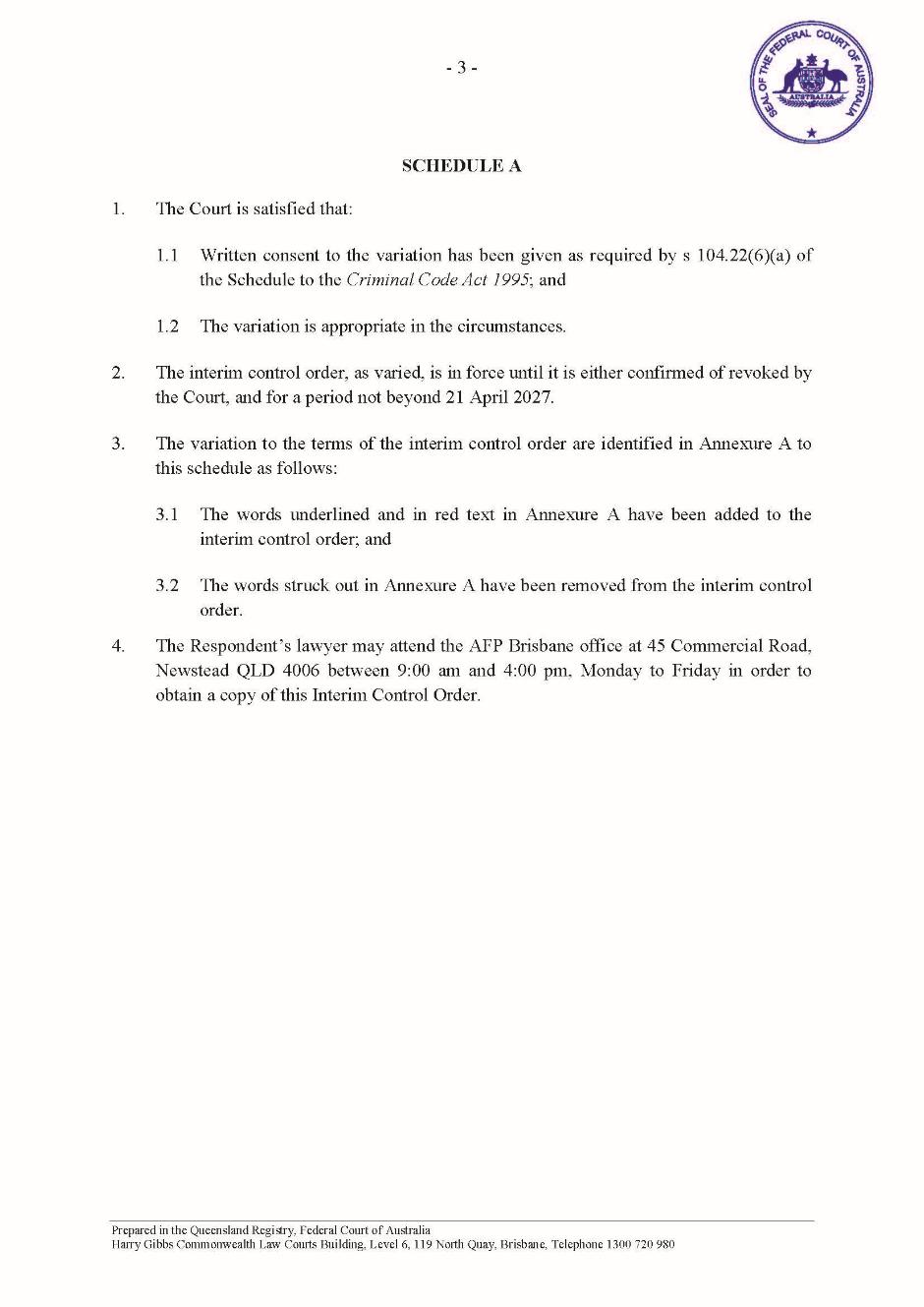
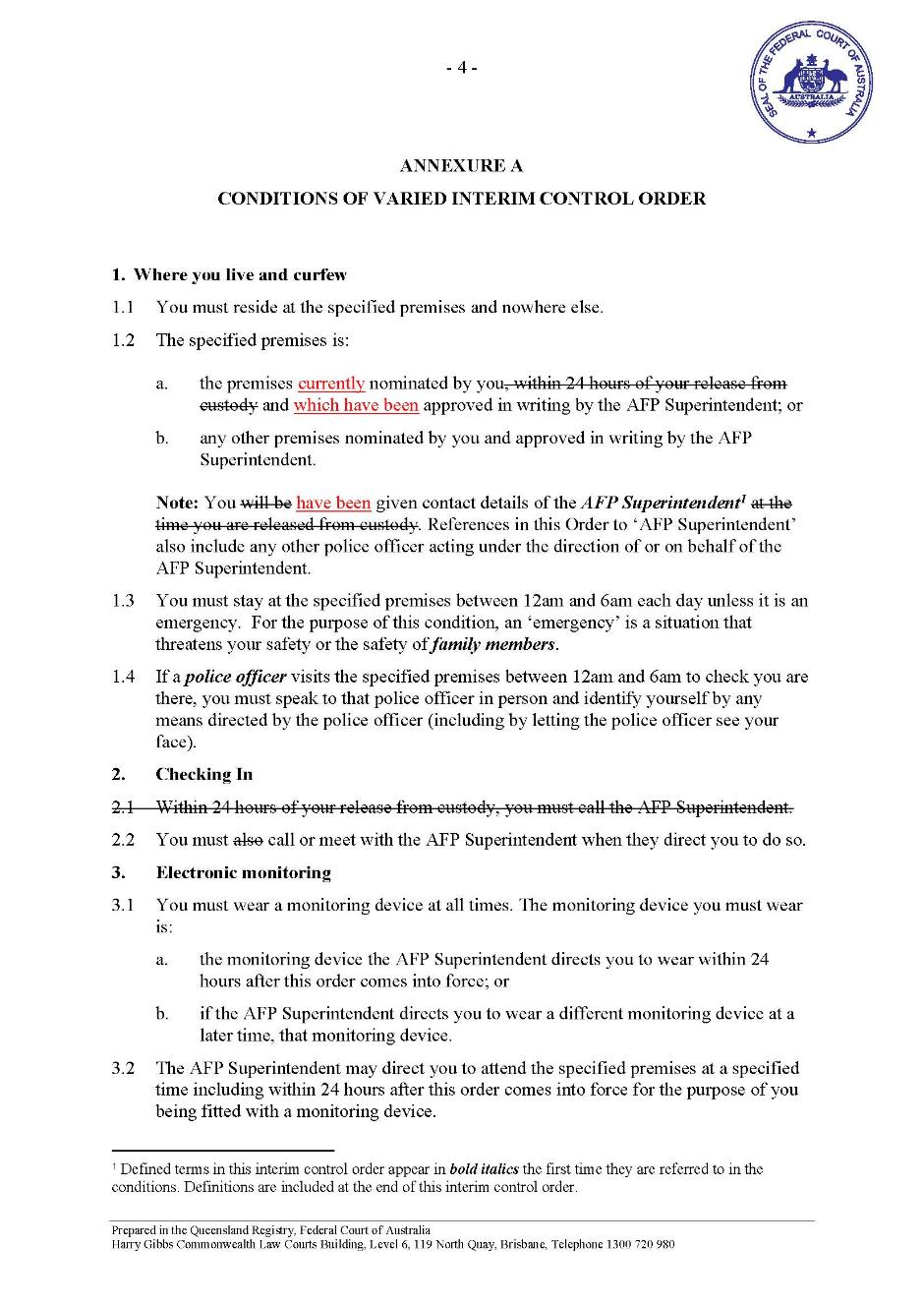
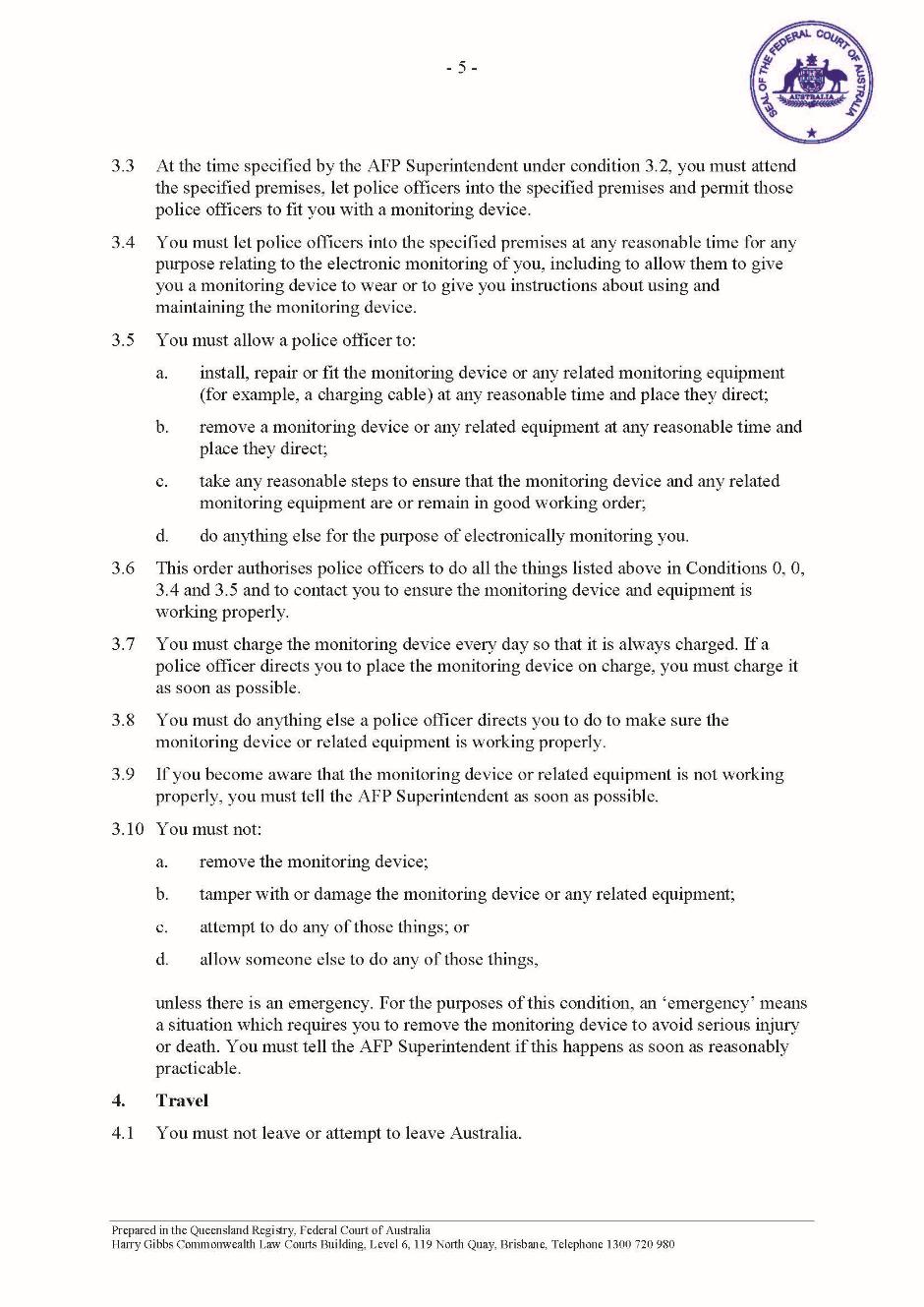
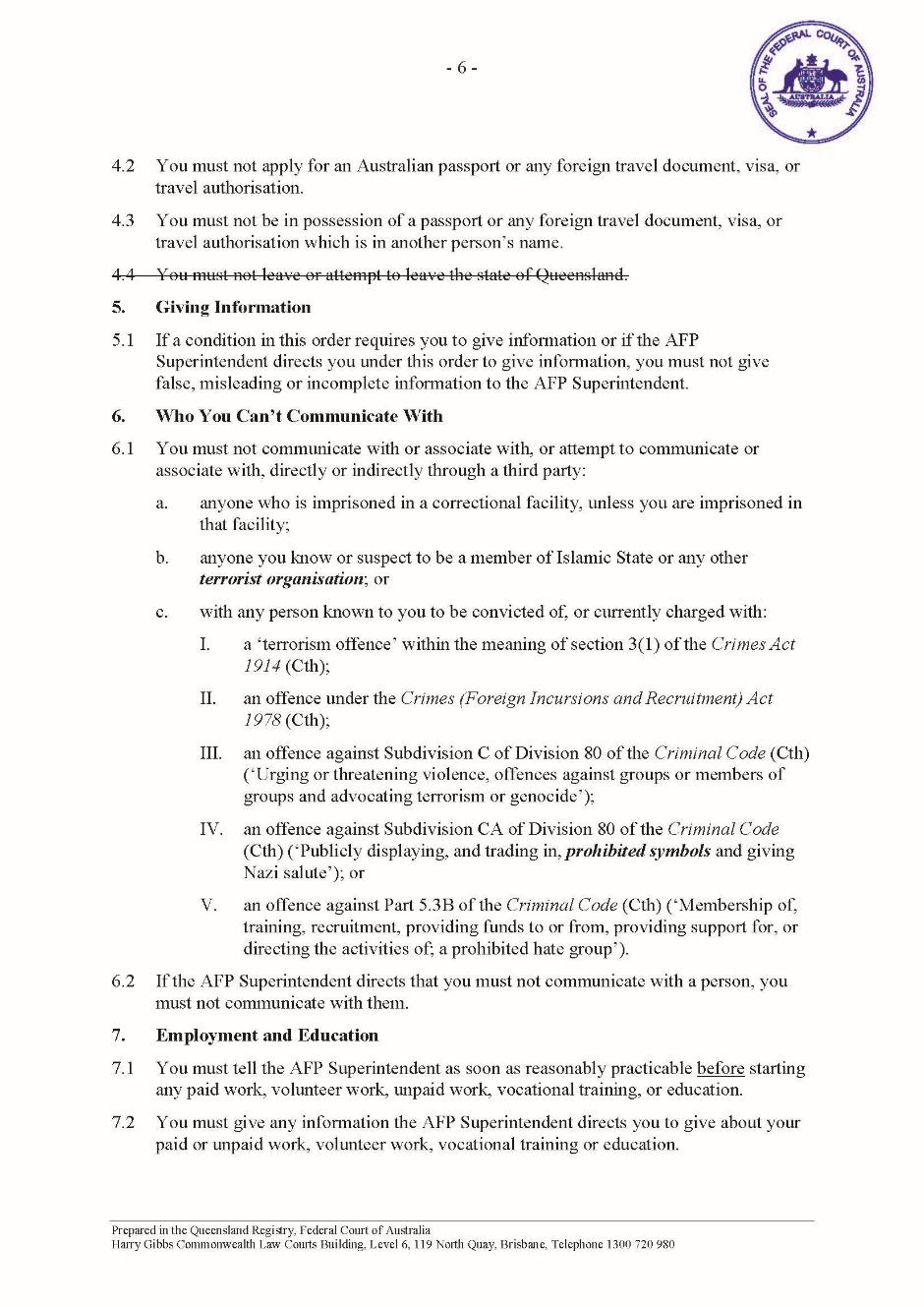
1. The interim control order made in relation to the Respondent on 21 April 2026 is varied in the terms set out in the Schedule A to these orders.
Note: Entry of orders is dealt with in Rule 39.32 of the Federal Court Rules 2011.
ORDERS
QUD 170 of 2026 | ||
BETWEEN: | MATTHEW BYLES Applicant | |
AND: | OMAR SAGHIR Respondent THE QUEENSLAND PUBLIC INTEREST MONITOR Interested Person | |
order made by: | LONGBOTTOM J |
DATE OF ORDER: | 28 AUGUST 2026 |
THE COURT ORDERS THAT:
Endorsement pursuant to Rule 41.06
PENAL NOTICE – Rule 41.06 of the Federal Court Rules 2011 (Cth)
TO: OMAR SAGHIR
IF YOU (BEING THE PERSON BOUND BY THIS ORDER):
(A) REFUSE OR NEGLECT TO DO ANY ACT WITHIN THE TIME SPECIFIED IN THIS ORDER FOR THE DOING OF THE ACT; OR
(B) DISOBEY THE ORDER BY DOING AN ACT WHICH THE ORDER REQUIRES YOU NOT TO DO,
YOU WILL BE LIABLE TO IMPRISONMENT, SEQUESTRATION OF PROPERTY OR OTHER PUNISHMENT.
ANY OTHER PERSON WHO KNOWS OF THIS ORDER AND DOES ANYTHING WHICH HELPS OR PERMITS YOU TO BREACH THE TERMS OF THIS ORDER MAY BE SIMILARLY PUNISHED.
Confirmation order
1. Pursuant to s 104.14(7)(b) of the Schedule to the Criminal Code Act 1995 (Cth) (the Criminal Code), the interim control order made in relation to the Respondent on 21 April 2026 be confirmed with variation in the terms of the confirmed control order set out in the Annexure to this order.
2. The confirmed control order be in force until and including 21 April 2027.
[Note: Entry of orders is dealt with in Rule 39.32 of the Federal Court Rules 2011.]
SCHEDULE A
1. This confirmed control order relates to the Respondent, Omar Saghir.
2. The Court is satisfied on the balance of probabilities that the Respondent has been convicted in Australia of an offence relating to terrorism (s 104.4(1)(c)(iv) of the Criminal Code).
3. Further, the Court is satisfied on the balance of probabilities that each of the conditions to be imposed (and the combined effect of all the conditions) on the Respondent by the order is reasonably necessary, and reasonably appropriate and adapted, for the purposes of:
3.1 preventing the provision of support for or the facilitation of a terrorist act (s 104.4(1)(d)(iv) of the Criminal Code); or
3.2 preventing the provision of support for or the facilitation of the engagement in a hostile activity in a foreign country (s 104.4(1)(d)(v) of the Criminal Code).
4. The conditions imposed on the Respondent are those in the Annexure to the order.
5. The Respondent’s lawyer may attend the AFP Brisbane office at 45 Commercial Road, Newstead QLD 4006 between 9:00 am and 4:00 pm, Monday to Friday in order to obtain a copy of this confirmed control order.
ANNEXURE A
CONDITIONS OF CONFIRMED CONTROL ORDER
1. Where you live and curfew
1.1 You must reside at the specified premises and nowhere else.
1.2 The specified premises is:
a. the premises currently nominated by you and which have been approved in writing by the AFP Superintendent; or
b. any other premises nominated by you and approved in writing by the AFP Superintendent.
Note: You have been given contact details of the AFP Superintendent1. References in this Order to ‘AFP Superintendent’ also include any other police officer acting under the direction of or on behalf of the AFP Superintendent.
1.3 You must stay at the specified premises between 12am and 6am each day unless it is an emergency. For the purpose of this condition, an ‘emergency’ is a situation that threatens your safety or the safety of family members.
1.4 If a police officer visits the specified premises between 12am and 6am to check you are there, you must speak to that police officer in person and identify yourself by any means directed by the police officer (including by letting the police officer see your face).
2. Checking In
2.1 You must call or meet with the AFP Superintendent when they direct you to do so.
3. Electronic monitoring
3.1 You must wear a monitoring device at all times. The monitoring device you must wear is:
a. the monitoring device the AFP Superintendent directs you to wear within 24 hours after this order comes into force; or
b. if the AFP Superintendent directs you to wear a different monitoring device at a later time, that monitoring device.
3.2 The AFP Superintendent may direct you to attend the specified premises at a specified time including within 24 hours after this order comes into force for the purpose of you being fitted with a monitoring device.
1 Defined terms in this confirmed control order appear in bold italics the first time they are referred to in the conditions. Definitions are included at the end of this interim control order.
3.3 At the time specified by the AFP Superintendent under condition 3.2, you must attend the specified premises, let police officers into the specified premises and permit those police officers to fit you with a monitoring device.
3.4 You must let police officers into the specified premises at any reasonable time for any purpose relating to the electronic monitoring of you, including to allow them to give you a monitoring device to wear or to give you instructions about using and maintaining the monitoring device.
3.5 You must allow a police officer to:
a. install, repair or fit the monitoring device or any related monitoring equipment (for example, a charging cable) at any reasonable time and place they direct;
b. remove a monitoring device or any related equipment at any reasonable time and place they direct;
c. take any reasonable steps to ensure that the monitoring device and any related monitoring equipment are or remain in good working order;
d. do anything else for the purpose of electronically monitoring you.
3.6 This order authorises police officers to do all the things listed above in Conditions 0, 0, 3.4 and 3.5 and to contact you to ensure the monitoring device and equipment is working properly.
3.7 You must charge the monitoring device every day so that it is always charged. If a police officer directs you to place the monitoring device on charge, you must charge it as soon as possible.
3.8 You must do anything else a police officer directs you to do to make sure the monitoring device or related equipment is working properly.
3.9 If you become aware that the monitoring device or related equipment is not working properly, you must tell the AFP Superintendent as soon as possible.
3.10 You must not:
a. remove the monitoring device;
b. tamper with or damage the monitoring device or any related equipment;
c. attempt to do any of those things; or
d. allow someone else to do any of those things,
unless there is an emergency. For the purposes of this condition, an ‘emergency’ means a situation which requires you to remove the monitoring device to avoid serious injury or death. You must tell the AFP Superintendent if this happens as soon as reasonably practicable.
4. Travel
4.1 You must not leave or attempt to leave Australia.
4.2 You must not apply for an Australian passport or any foreign travel document, visa, or travel authorisation.
4.3 You must not be in possession of a passport or any foreign travel document, visa, or travel authorisation which is in another person’s name.
5. Giving Information
5.1 If a condition in this order requires you to give information or if the AFP Superintendent directs you under this order to give information, you must not give false, misleading or incomplete information to the AFP Superintendent.
6. Who You Can’t Communicate With
6.1 You must not communicate with or associate with, or attempt to communicate or associate with, directly or indirectly through a third party:
a. anyone who is imprisoned in a correctional facility, unless you are imprisoned in that facility;
b. anyone you know or suspect to be a member of Islamic State or any other terrorist organisation; or
c. with any person known to you to be convicted of, or currently charged with:
I. a ‘terrorism offence’ within the meaning of section 3(1) of the Crimes Act 1914 (Cth);
II. an offence under the Crimes (Foreign Incursions and Recruitment) Act 1978 (Cth);
III. an offence against Subdivision C of Division 80 of the Criminal Code (Cth) (‘Urging or threatening violence, offences against groups or members of groups and advocating terrorism or genocide’);
IV. an offence against Subdivision CA of Division 80 of the Criminal Code (Cth) (‘Publicly displaying, and trading in, prohibited symbols and giving Nazi salute’); or
V. an offence against Part 5.3B of the Criminal Code (Cth) (‘Membership of, training, recruitment, providing funds to or from, providing support for, or directing the activities of; a prohibited hate group’).
6.2 If the AFP Superintendent directs that you must not communicate with a person, you must not communicate with them.
7. Employment and Education
7.1 You must tell the AFP Superintendent as soon as reasonably practicable before starting any paid work, volunteer work, unpaid work, vocational training, or education.
7.2 You must give any information the AFP Superintendent directs you to give about your paid or unpaid work, volunteer work, vocational training or education.
7.3 You must tell the AFP Superintendent as soon as reasonably practicable before you form any corporation, partnership or incorporated association, or register a business name or operate a business.
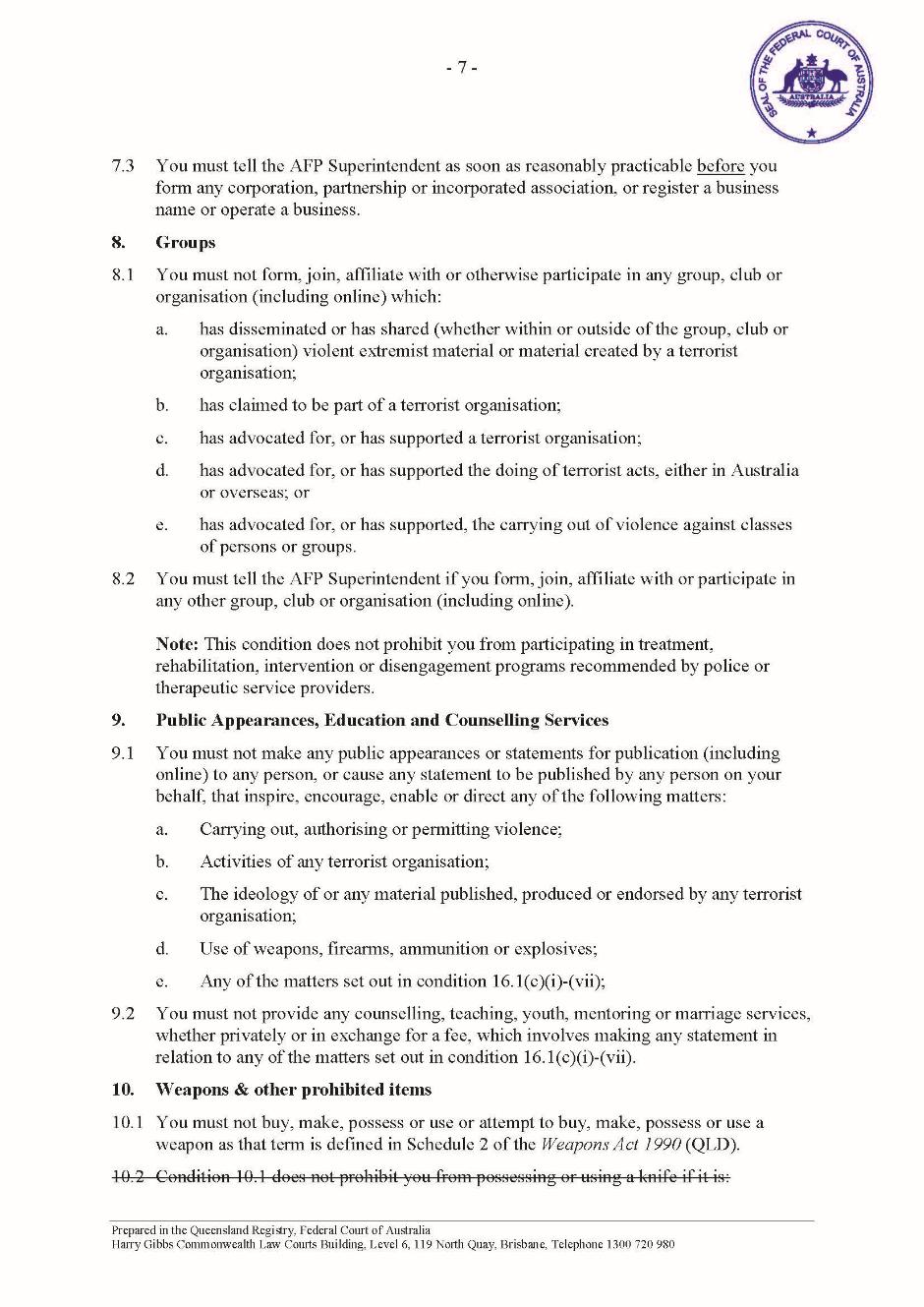
8. Groups
8.1 You must not form, join, affiliate with or otherwise participate in any group, club or organisation (including online) which:
a. has disseminated or has shared (whether within or outside of the group, club or organisation) violent extremist material or material created by a terrorist organisation;
b. has claimed to be part of a terrorist organisation;
c. has advocated for, or has supported a terrorist organisation;
d. has advocated for, or has supported the doing of terrorist acts, either in Australia or overseas; or
e. has advocated for, or has supported, the carrying out of violence against classes of persons or groups.
8.2 You must tell the AFP Superintendent if you form, join, affiliate with or participate in any other group, club or organisation (including online).
Note: This condition does not prohibit you from participating in treatment, rehabilitation, intervention or disengagement programs recommended by police or therapeutic service providers.
9. Public Appearances, Education and Counselling Services
9.1 You must not make any public appearances or statements for publication (including online) to any person, or cause any statement to be published by any person on your behalf, that inspire, encourage, enable or direct any of the following matters:
a. Carrying out, authorising or permitting violence;
b. Activities of any terrorist organisation;
c. The ideology of or any material published, produced or endorsed by any terrorist organisation;
d. Use of weapons, firearms, ammunition or explosives;
e. Any of the matters set out in condition 16.1(c)(i)-(vii);
9.2 You must not provide any counselling, teaching, youth, mentoring or marriage services, whether privately or in exchange for a fee, which involves making any statement in relation to any of the matters set out in condition 16.1(c)(i)-(vii).
10. Weapons & other prohibited items
10.1 You must not buy, make, possess or use or attempt to buy, make, possess or use a weapon as that term is defined in Schedule 2 of the Weapons Act 1990 (QLD).
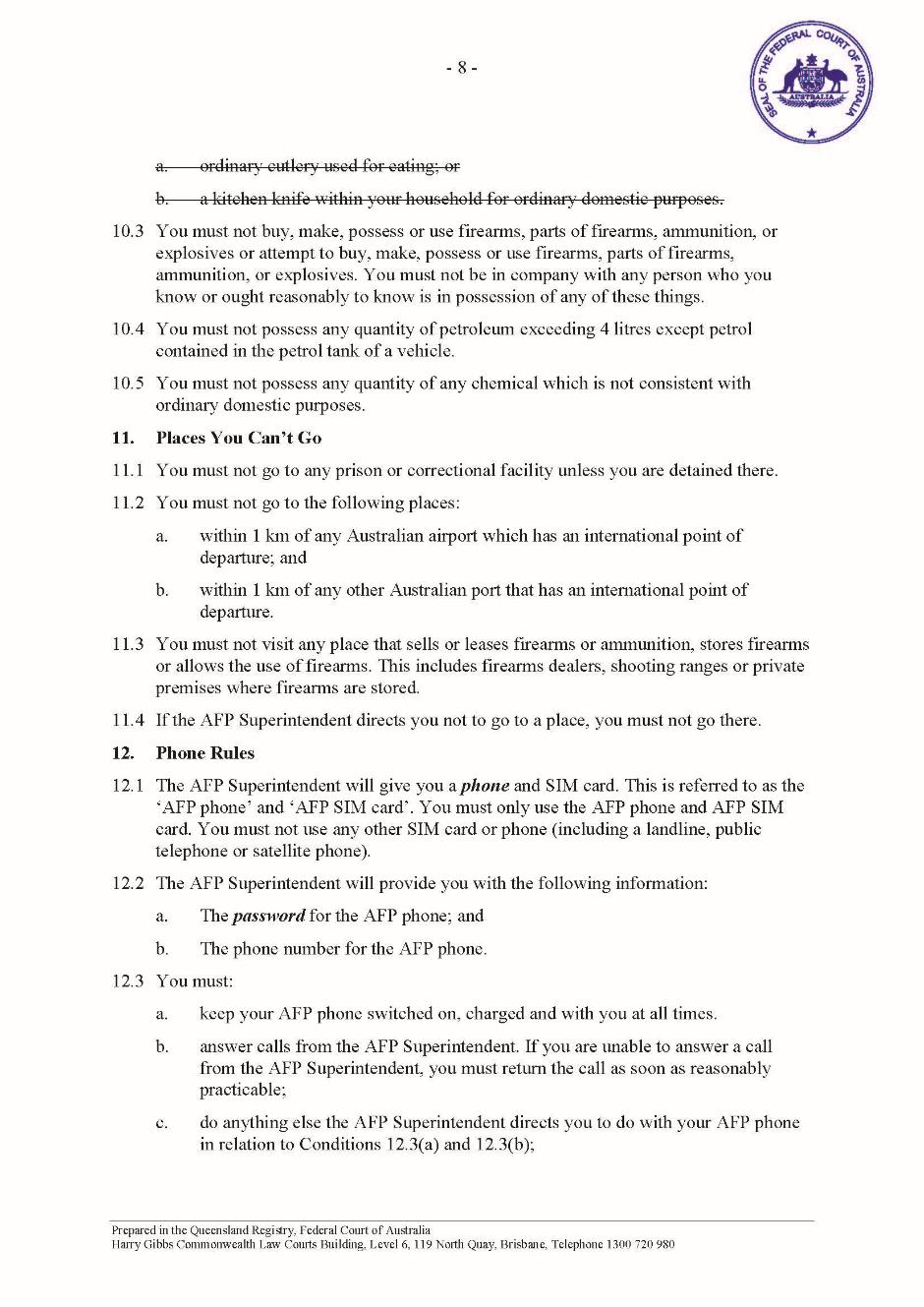
10.2 You must not buy, make, possess or use firearms, parts of firearms, ammunition, or explosives or attempt to buy, make, possess or use firearms, parts of firearms, ammunition, or explosives. You must not be in company with any person who you know or ought reasonably to know is in possession of any of these things.
10.3 You must not possess any quantity of petroleum exceeding 4 litres except petrol contained in the petrol tank of a vehicle.
10.4 You must not possess any quantity of any chemical which is not consistent with ordinary domestic purposes.
11. Places You Can’t Go
11.1 You must not go to any prison or correctional facility unless you are detained there.
11.2 You must not go to the following places:
a. within 1 km of any Australian airport which has an international point of departure; and
b. within 1 km of any other Australian port that has an international point of departure.
11.3 You must not visit any place that sells or leases firearms or ammunition, stores firearms or allows the use of firearms. This includes firearms dealers, shooting ranges or private premises where firearms are stored.
11.4 If the AFP Superintendent directs you not to go to a place, you must not go there.
12. Phone Rules
12.1 The AFP Superintendent will give you a phone and SIM card. This is referred to as the ‘AFP phone’ and ‘AFP SIM card’. You must only use the AFP phone and AFP SIM card. You must not use any other SIM card or phone (including a landline, public telephone or satellite phone).
12.2 The AFP Superintendent will provide you with the following information:
a. The password for the AFP phone; and
b. The phone number for the AFP phone.
12.3 You must:
a. keep your AFP phone switched on, charged and with you at all times.
b. answer calls from the AFP Superintendent. If you are unable to answer a call from the AFP Superintendent, you must return the call as soon as reasonably practicable;
c. do anything else the AFP Superintendent directs you to do with your AFP phone in relation to Conditions 12.3(a) and 12.3(b);
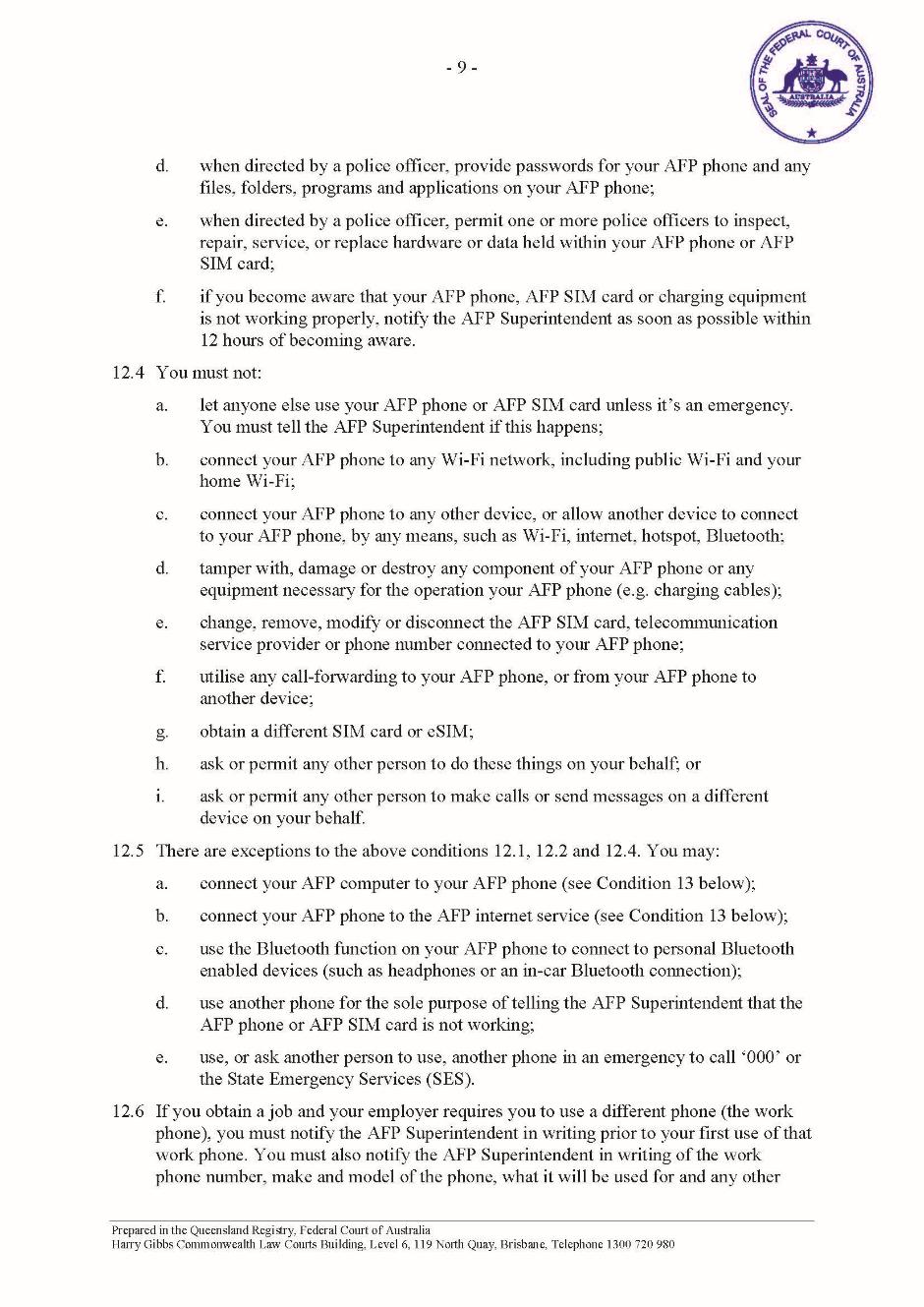
d. when directed by a police officer, provide passwords for your AFP phone and any files, folders, programs and applications on your AFP phone;
e. when directed by a police officer, permit one or more police officers to inspect, repair, service, or replace hardware or data held within your AFP phone or AFP SIM card;
f. if you become aware that your AFP phone, AFP SIM card or charging equipment is not working properly, notify the AFP Superintendent as soon as possible within 12 hours of becoming aware.
12.4 You must not:
a. let anyone else use your AFP phone or AFP SIM card unless it’s an emergency. You must tell the AFP Superintendent if this happens;
b. connect your AFP phone to any Wi-Fi network, including public Wi-Fi and your home Wi-Fi;
c. connect your AFP phone to any other device, or allow another device to connect to your AFP phone, by any means, such as Wi-Fi, internet, hotspot, Bluetooth;
d. tamper with, damage or destroy any component of your AFP phone or any equipment necessary for the operation your AFP phone (e.g. charging cables);
e. change, remove, modify or disconnect the AFP SIM card, telecommunication service provider or phone number connected to your AFP phone;
f. utilise any call-forwarding to your AFP phone, or from your AFP phone to another device;
g. obtain a different SIM card or eSIM;
h. ask or permit any other person to do these things on your behalf; or
i. ask or permit any other person to make calls or send messages on a different device on your behalf.
12.5 There are exceptions to the above conditions 12.1, 12.2 and 12.4. You may:
a. connect your AFP computer to your AFP phone (see Condition 13 below);
b. connect your AFP phone to the AFP internet service (see Condition 13 below);
c. use the Bluetooth function on your AFP phone to connect to personal Bluetooth enabled devices (such as headphones or an in-car Bluetooth connection);
d. use another phone for the sole purpose of telling the AFP Superintendent that the AFP phone or AFP SIM card is not working;
e. use, or ask another person to use, another phone in an emergency to call ‘000’ or the State Emergency Services (SES).
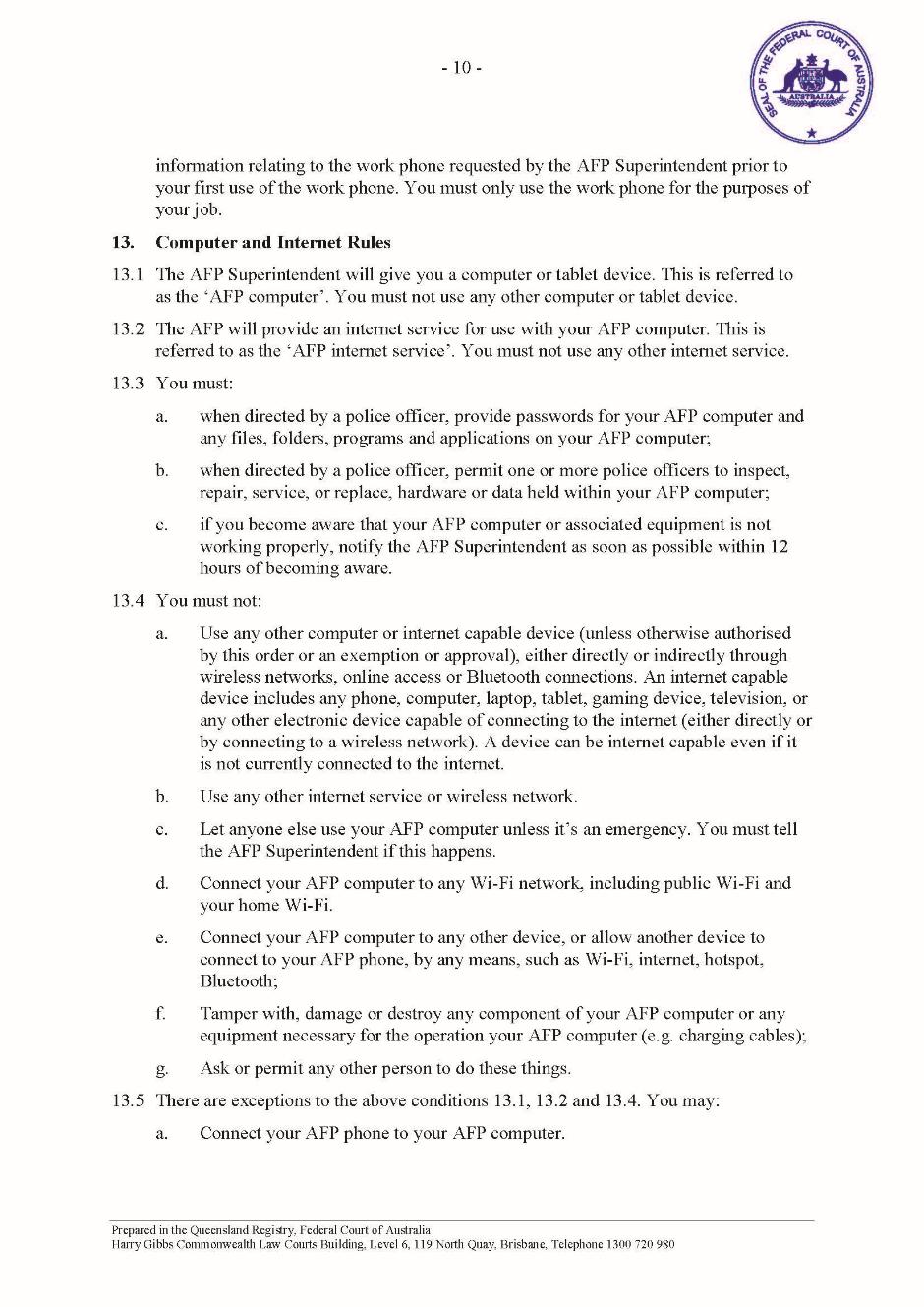
12.6 If you obtain a job and your employer requires you to use a different phone (the work phone), you must notify the AFP Superintendent in writing prior to your first use of that work phone. You must also notify the AFP Superintendent in writing of the work phone number, make and model of the phone, what it will be used for and any other information relating to the work phone requested by the AFP Superintendent prior to your first use of the work phone. You must only use the work phone for the purposes of your job.
13. Computer and Internet Rules
13.1 The AFP Superintendent will give you a computer or tablet device. This is referred to as the ‘AFP computer’. You must not use any other computer or tablet device.
13.2 The AFP will provide an internet service for use with your AFP computer. This is referred to as the ‘AFP internet service’. You must not use any other internet service.
13.3 You must:
a. when directed by a police officer, provide passwords for your AFP computer and any files, folders, programs and applications on your AFP computer;
b. when directed by a police officer, permit one or more police officers to inspect, repair, service, or replace, hardware or data held within your AFP computer;
c. if you become aware that your AFP computer or associated equipment is not working properly, notify the AFP Superintendent as soon as possible within 12 hours of becoming aware.
13.4 You must not:
a. Use any other computer or internet capable device (unless otherwise authorised by this order or an exemption or approval), either directly or indirectly through wireless networks, online access or Bluetooth connections. An internet capable device includes any phone, computer, laptop, tablet, gaming device, television, or any other electronic device capable of connecting to the internet (either directly or by connecting to a wireless network). A device can be internet capable even if it is not currently connected to the internet.
b. Use any other internet service or wireless network.
c. Let anyone else use your AFP computer unless it’s an emergency. You must tell the AFP Superintendent if this happens.
d. Connect your AFP computer to any Wi-Fi network, including public Wi-Fi and your home Wi-Fi.
e. Connect your AFP computer to any other device, or allow another device to connect to your AFP phone, by any means, such as Wi-Fi, internet, hotspot, Bluetooth;
f. Tamper with, damage or destroy any component of your AFP computer or any equipment necessary for the operation your AFP computer (e.g. charging cables);
g. Ask or permit any other person to do these things.
13.5 There are exceptions to the above conditions 13.1, 13.2 and 13.4. You may:
a. Connect your AFP phone to your AFP computer.
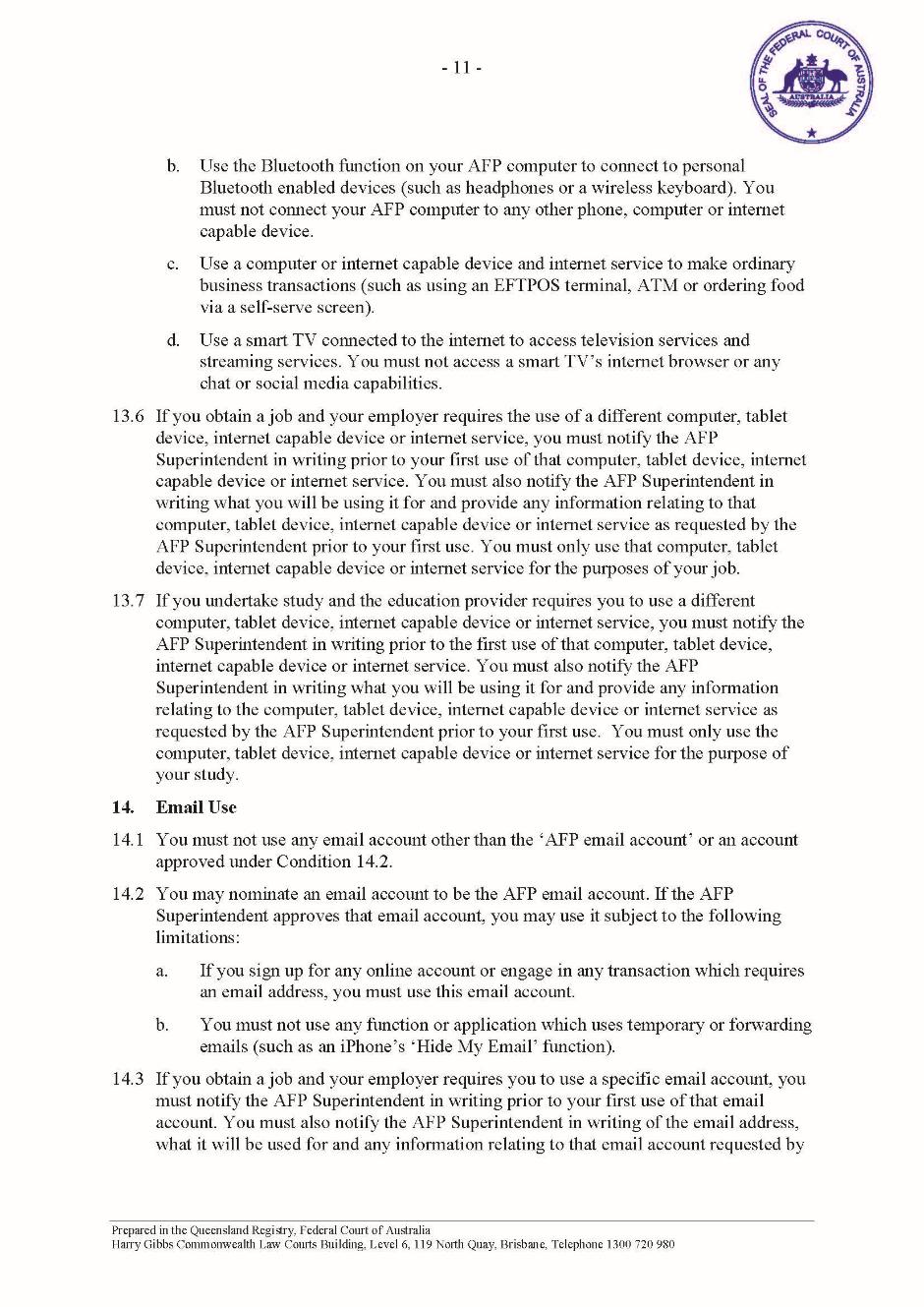
b. Use the Bluetooth function on your AFP computer to connect to personal Bluetooth enabled devices (such as headphones or a wireless keyboard). You must not connect your AFP computer to any other phone, computer or internet capable device.
c. Use a computer or internet capable device and internet service to make ordinary business transactions (such as using an EFTPOS terminal, ATM or ordering food via a self-serve screen).
d. Use a smart TV connected to the internet to access television services and streaming services. You must not access a smart TV’s internet browser or any chat or social media capabilities.
13.6 If you obtain a job and your employer requires the use of a different computer, tablet device, internet capable device or internet service, you must notify the AFP Superintendent in writing prior to your first use of that computer, tablet device, internet capable device or internet service. You must also notify the AFP Superintendent in writing what you will be using it for and provide any information relating to that computer, tablet device, internet capable device or internet service as requested by the AFP Superintendent prior to your first use. You must only use that computer, tablet device, internet capable device or internet service for the purposes of your job.
13.7 If you undertake study and the education provider requires you to use a different computer, tablet device, internet capable device or internet service, you must notify the AFP Superintendent in writing prior to the first use of that computer, tablet device, internet capable device or internet service. You must also notify the AFP Superintendent in writing what you will be using it for and provide any information relating to the computer, tablet device, internet capable device or internet service as requested by the AFP Superintendent prior to your first use. You must only use the computer, tablet device, internet capable device or internet service for the purpose of your study.
14. Email Use
14.1 You must not use any email account other than the ‘AFP email account’ or an account approved under Condition 14.2.
14.2 You may nominate an email account to be the AFP email account. If the AFP Superintendent approves that email account, you may use it subject to the following limitations:
a. If you sign up for any online account or engage in any transaction which requires an email address, you must use this email account.
b. You must not use any function or application which uses temporary or forwarding emails (such as an iPhone’s ‘Hide My Email’ function).
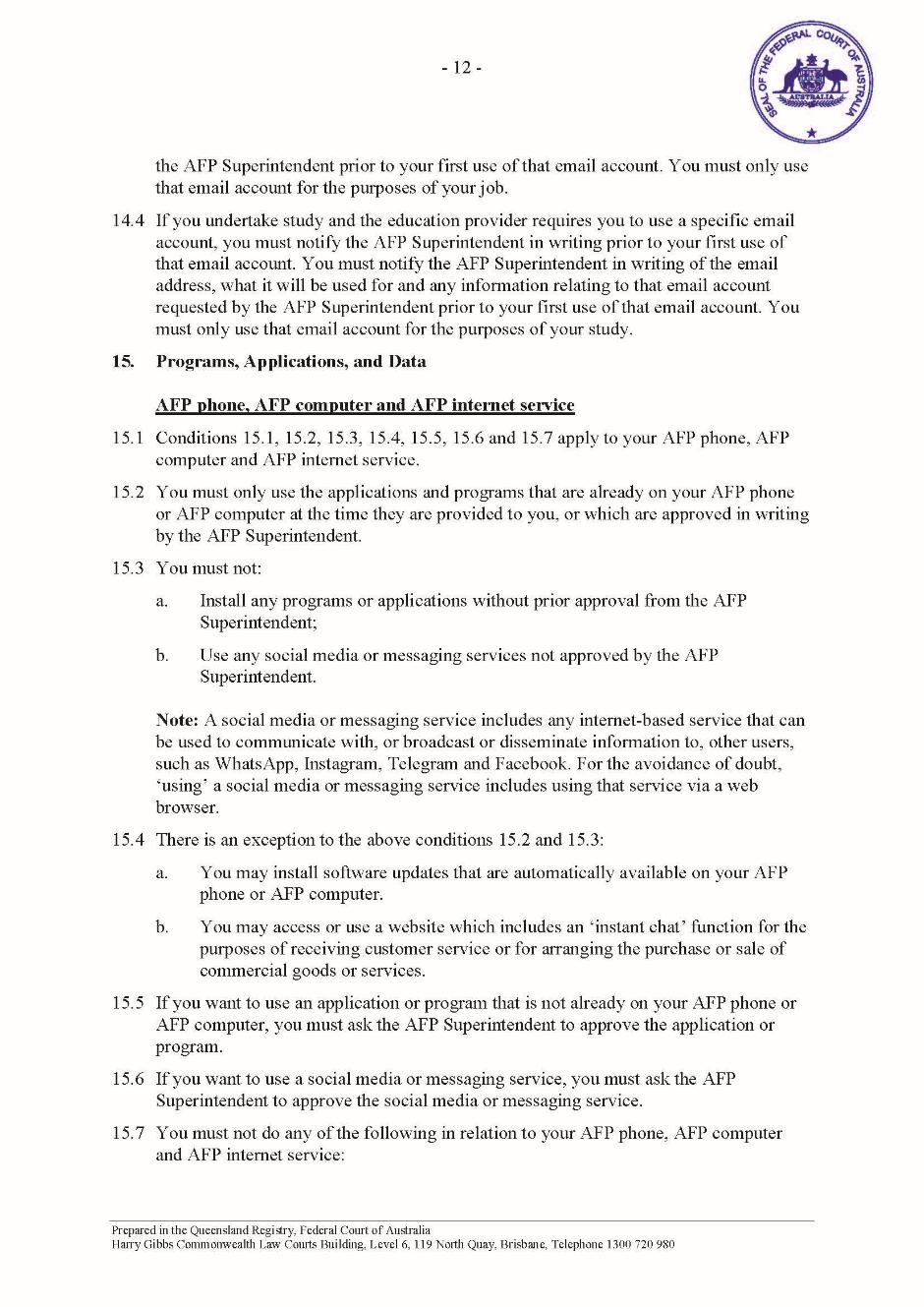
14.3 If you obtain a job and your employer requires you to use a specific email account, you must notify the AFP Superintendent in writing prior to your first use of that email account. You must also notify the AFP Superintendent in writing of the email address, what it will be used for and any information relating to that email account requested by
the AFP Superintendent prior to your first use of that email account. You must only use that email account for the purposes of your job.
14.4 If you undertake study and the education provider requires you to use a specific email account, you must notify the AFP Superintendent in writing prior to your first use of that email account. You must notify the AFP Superintendent in writing of the email address, what it will be used for and any information relating to that email account requested by the AFP Superintendent prior to your first use of that email account. You must only use that email account for the purposes of your study.
15. Programs, Applications, and Data
AFP phone, AFP computer and AFP internet service
15.1 Conditions 15.1, 15.2, 15.3, 15.4, 15.5, 15.6 and 15.7 apply to your AFP phone, AFP computer and AFP internet service.
15.2 You must only use the applications and programs that are already on your AFP phone or AFP computer at the time they are provided to you, or which are approved in writing by the AFP Superintendent.
15.3 You must not:
a. Install any programs or applications without prior approval from the AFP Superintendent;
b. Use any social media or messaging services not approved by the AFP Superintendent.
Note: A social media or messaging service includes any internet-based service that can be used to communicate with, or broadcast or disseminate information to, other users, such as WhatsApp, Instagram, Telegram and Facebook. For the avoidance of doubt, ‘using’ a social media or messaging service includes using that service via a web browser.
15.4 There is an exception to the above conditions 15.2 and 15.3:
a. You may install software updates that are automatically available on your AFP phone or AFP computer.
b. You may access or use a website which includes an ‘instant chat’ function for the purposes of receiving customer service or for arranging the purchase or sale of commercial goods or services.
15.5 If you want to use an application or program that is not already on your AFP phone or AFP computer, you must ask the AFP Superintendent to approve the application or program.
15.6 If you want to use a social media or messaging service, you must ask the AFP Superintendent to approve the social media or messaging service.
15.7 You must not do any of the following in relation to your AFP phone, AFP computer and AFP internet service:
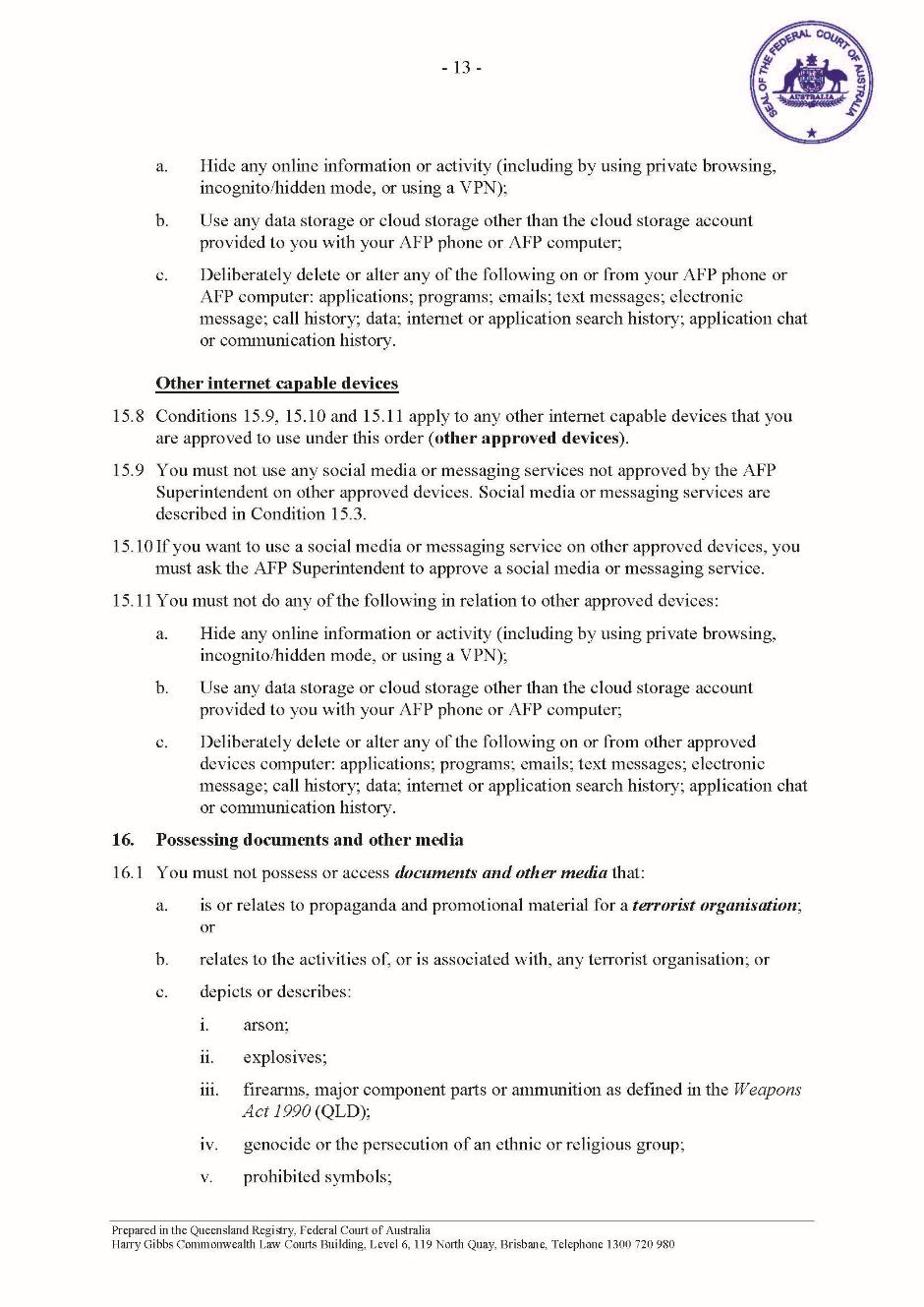
a. Hide any online information or activity (including by using private browsing, incognito/hidden mode, or using a VPN);
b. Use any data storage or cloud storage other than the cloud storage account provided to you with your AFP phone or AFP computer;
c. Deliberately delete or alter any of the following on or from your AFP phone or AFP computer: applications; programs; emails; text messages; electronic message; call history; data; internet or application search history; application chat or communication history.
Other internet capable devices
15.8 Conditions 15.9, 15.10 and 15.11 apply to any other internet capable devices that you are approved to use under this order (other approved devices).
15.9 You must not use any social media or messaging services not approved by the AFP Superintendent on other approved devices. Social media or messaging services are described in Condition 15.3.
15.10 If you want to use a social media or messaging service on other approved devices, you must ask the AFP Superintendent to approve a social media or messaging service.
15.11 You must not do any of the following in relation to other approved devices:
a. Hide any online information or activity (including by using private browsing, incognito/hidden mode, or using a VPN);
b. Use any data storage or cloud storage other than the cloud storage account provided to you with your AFP phone or AFP computer;
c. Deliberately delete or alter any of the following on or from other approved devices computer: applications; programs; emails; text messages; electronic message; call history; data; internet or application search history; application chat or communication history.
16. Possessing documents and other media
16.1 You must not possess or access documents and other media that:
a. is or relates to propaganda and promotional material for a terrorist organisation; or
b. relates to the activities of, or is associated with, any terrorist organisation; or
c. depicts or describes:
i. arson;
ii. explosives;
iii. firearms, major component parts or ammunition as defined in the Weapons Act 1990 (QLD);
iv. genocide or the persecution of an ethnic or religious group;
v. prohibited symbols;
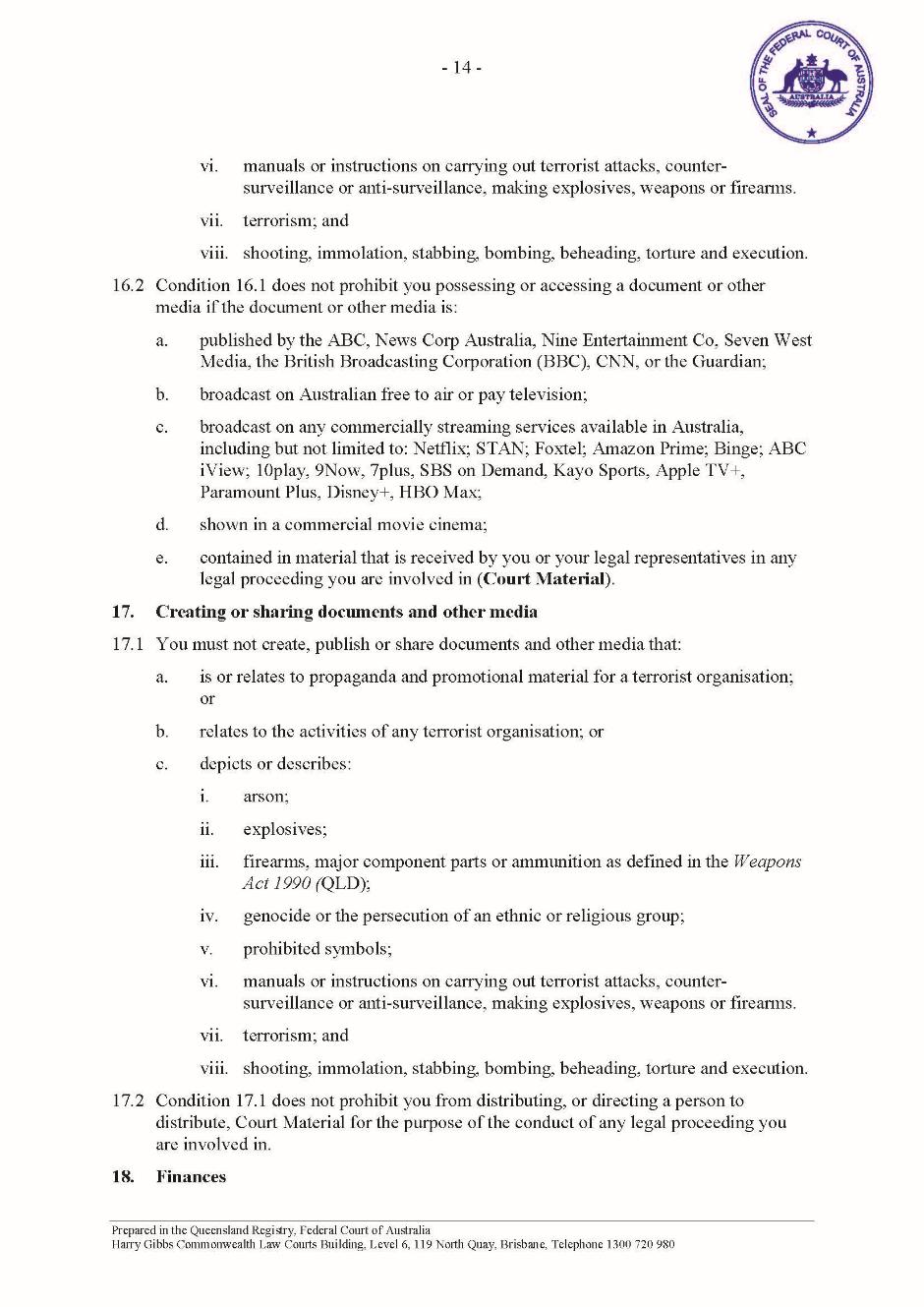
vi. manuals or instructions on carrying out terrorist attacks, counter-surveillance or anti-surveillance, making explosives, weapons or firearms.
vii. terrorism; and
viii. shooting, immolation, stabbing, bombing, beheading, torture and execution.
16.2 Condition 16.1 does not prohibit you possessing or accessing a document or other media if the document or other media is:
a. published by the ABC, News Corp Australia, Nine Entertainment Co, Seven West Media, the British Broadcasting Corporation (BBC), CNN, or the Guardian;
b. broadcast on Australian free to air or pay television;
c. broadcast on any commercially streaming services available in Australia, including but not limited to: Netflix; STAN; Foxtel; Amazon Prime; Binge; ABC iView; 10play, 9Now, 7plus, SBS on Demand, Kayo Sports, Apple TV+, Paramount Plus, Disney+, HBO Max;
d. shown in a commercial movie cinema;
e. contained in material that is received by you or your legal representatives in any legal proceeding you are involved in (Court Material).
17. Creating or sharing documents and other media
17.1 You must not create, publish or share documents and other media that:
a. is or relates to propaganda and promotional material for a terrorist organisation; or
b. relates to the activities of any terrorist organisation; or
c. depicts or describes:
i. arson;
ii. explosives;
iii. firearms, major component parts or ammunition as defined in the Weapons Act 1990 (QLD);
iv. genocide or the persecution of an ethnic or religious group;
v. prohibited symbols;
vi. manuals or instructions on carrying out terrorist attacks, counter-surveillance or anti-surveillance, making explosives, weapons or firearms.
vii. terrorism; and
viii. shooting, immolation, stabbing, bombing, beheading, torture and execution.
17.2 Condition 17.1 does not prohibit you from distributing, or directing a person to distribute, Court Material for the purpose of the conduct of any legal proceeding you are involved in.
18. Finances
18.1 Within 24 hours after this order comes into force, you must provide the AFP Superintendent with the details of any bank accounts, cryptocurrency accounts and any other financial accounts you own or control.
18.2 If you open a new bank account, cryptocurrency account or other financial account, you must notify the AFP Superintendent in writing and provide the account details.
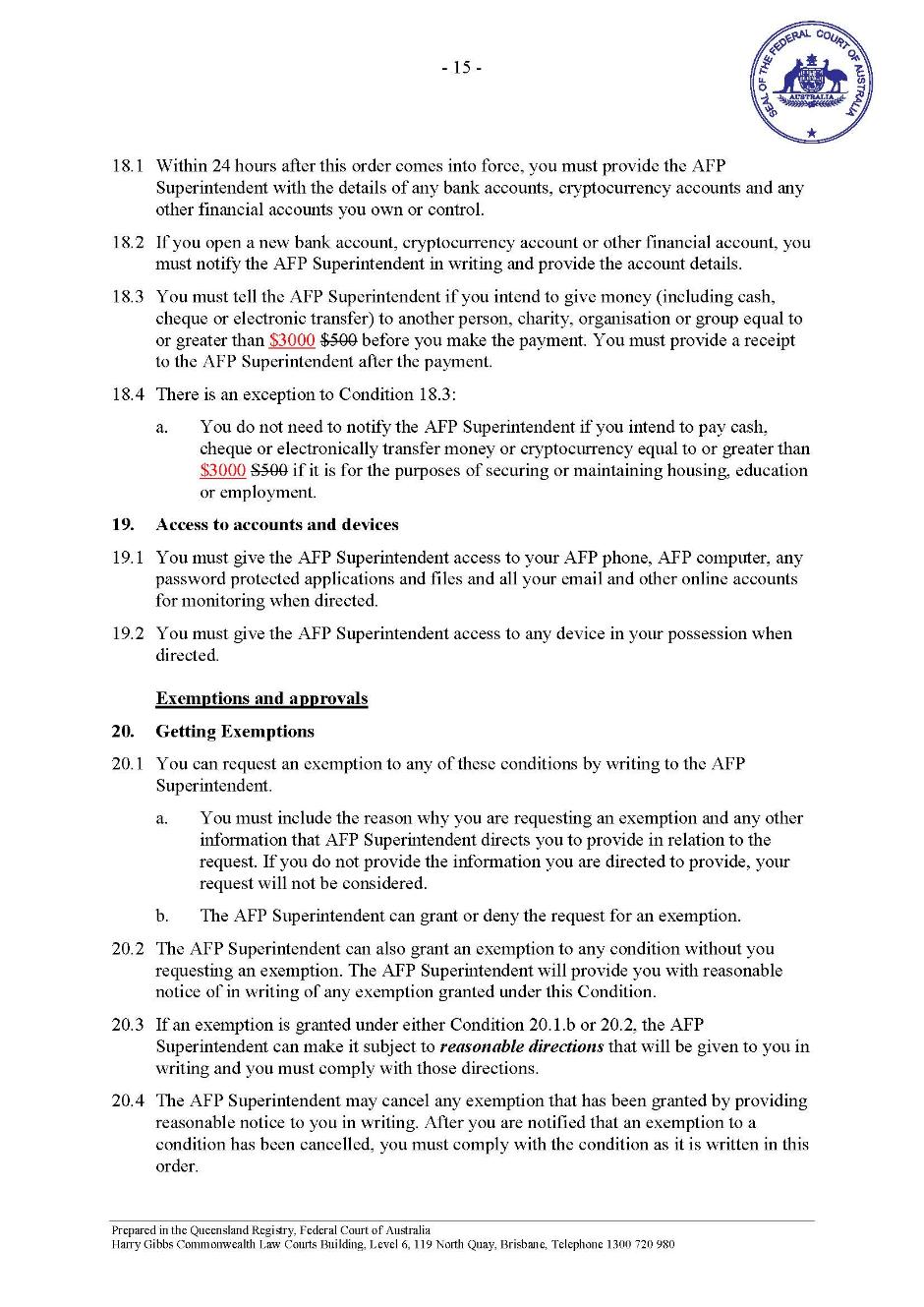
18.3 You must tell the AFP Superintendent if you intend to give money (including cash, cheque or electronic transfer) to another person, charity, organisation or group equal to or greater than $3000 before you make the payment. You must provide a receipt to the AFP Superintendent after the payment.
18.4 There is an exception to Condition 18.3:
a. You do not need to notify the AFP Superintendent if you intend to pay cash, cheque or electronically transfer money or cryptocurrency equal to or greater than $3000 if it is for the purposes of securing or maintaining housing, education or employment.
19. Access to accounts and devices
19.1 You must give the AFP Superintendent access to your AFP phone, AFP computer, any password protected applications and files and all your email and other online accounts for monitoring when directed.
19.2 You must give the AFP Superintendent access to any device in your possession when directed.
Exemptions and approvals
20. Getting Exemptions
20.1 You can request an exemption to any of these conditions by writing to the AFP Superintendent.
a. You must include the reason why you are requesting an exemption and any other information that AFP Superintendent directs you to provide in relation to the request. If you do not provide the information you are directed to provide, your request will not be considered.
b. The AFP Superintendent can grant or deny the request for an exemption.
20.2 The AFP Superintendent can also grant an exemption to any condition without you requesting an exemption. The AFP Superintendent will provide you with reasonable notice of in writing of any exemption granted under this Condition.
20.3 If an exemption is granted under either Condition 20.1.b or 20.2, the AFP Superintendent can make it subject to reasonable directions that will be given to you in writing and you must comply with those directions.
20.4 The AFP Superintendent may cancel any exemption that has been granted by providing reasonable notice to you in writing. After you are notified that an exemption to a condition has been cancelled, you must comply with the condition as it is written in this order.
21. Getting approvals
21.1 This applies to any conditions which allow you to seek approval from the AFP Superintendent to do something (for example, to install and use a new program or application on the AFP phone or AFP computer).
21.2 You can request an approval by submitting a written request to the AFP Superintendent. You must provide any information the AFP Superintendent directs you to provide in relation to the request. If you do not provide the information you are directed to provide, your request will not be considered.
21.3 The AFP Superintendent can approve or deny these requests. If a request is approved, the AFP Superintendent can make it subject to reasonable directions that are specified in writing and you must comply with those directions.
21.4 The AFP Superintendent can also grant an approval without you requesting an approval. The AFP Superintendent will provide you with reasonable notice in writing of any approval granted under this Condition.
21.5 The AFP Superintendent may cancel any approval that has been granted by providing reasonable notice to you in writing. After you are notified that an approval has been cancelled, that approval no longer has any effect.
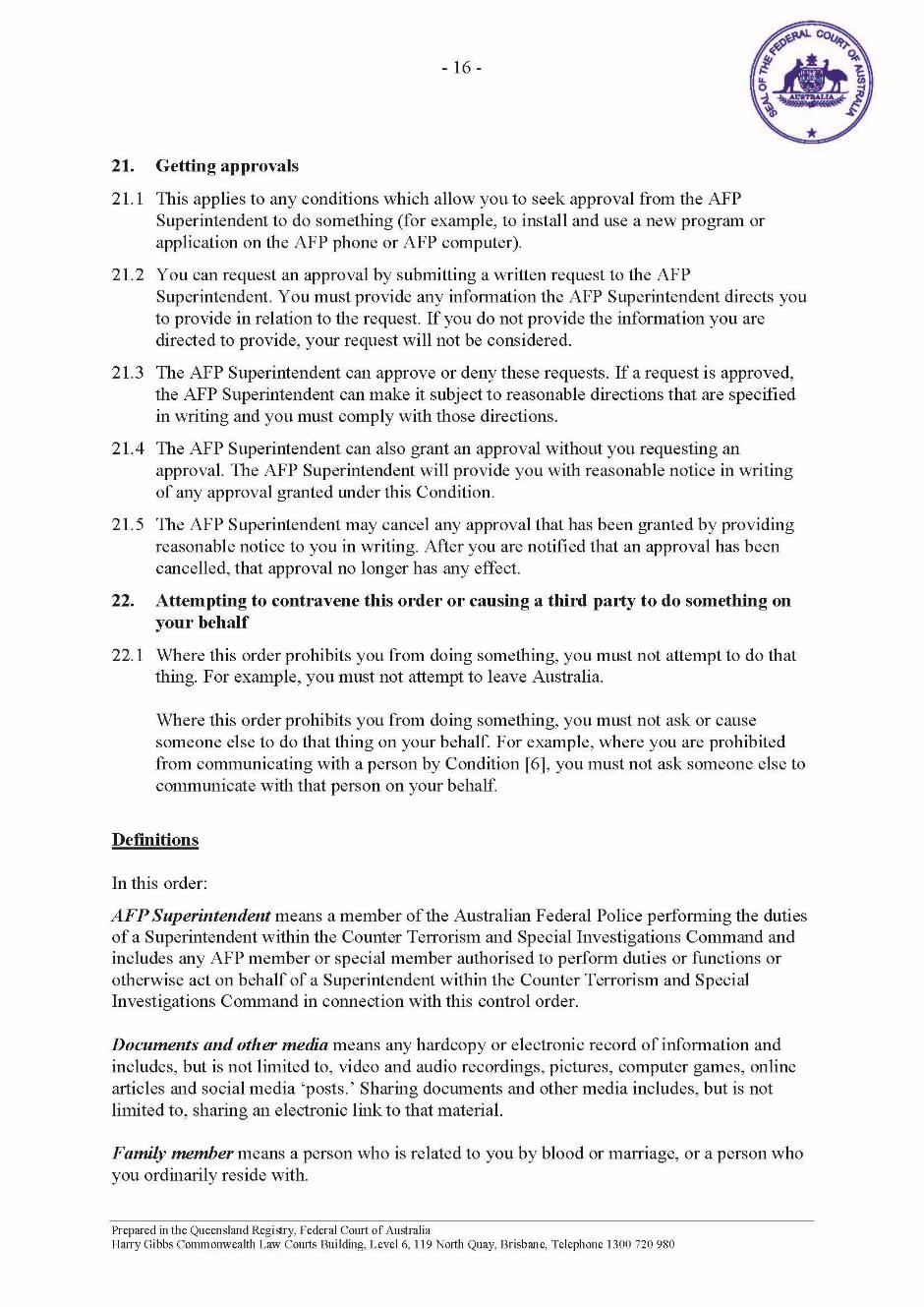
22. Attempting to contravene this order or causing a third party to do something on your behalf
22.1 Where this order prohibits you from doing something, you must not attempt to do that thing. For example, you must not attempt to leave Australia.
Where this order prohibits you from doing something, you must not ask or cause someone else to do that thing on your behalf. For example, where you are prohibited from communicating with a person by Condition [6], you must not ask someone else to communicate with that person on your behalf.
Definitions
In this order:
AFP Superintendent means a member of the Australian Federal Police performing the duties of a Superintendent within the Counter Terrorism and Special Investigations Command and includes any AFP member or special member authorised to perform duties or functions or otherwise act on behalf of a Superintendent within the Counter Terrorism and Special Investigations Command in connection with this control order.
Documents and other media means any hardcopy or electronic record of information and includes, but is not limited to, video and audio recordings, pictures, computer games, online articles and social media ‘posts.’ Sharing documents and other media includes, but is not limited to, sharing an electronic link to that material.
Family member means a person who is related to you by blood or marriage, or a person who you ordinarily reside with.
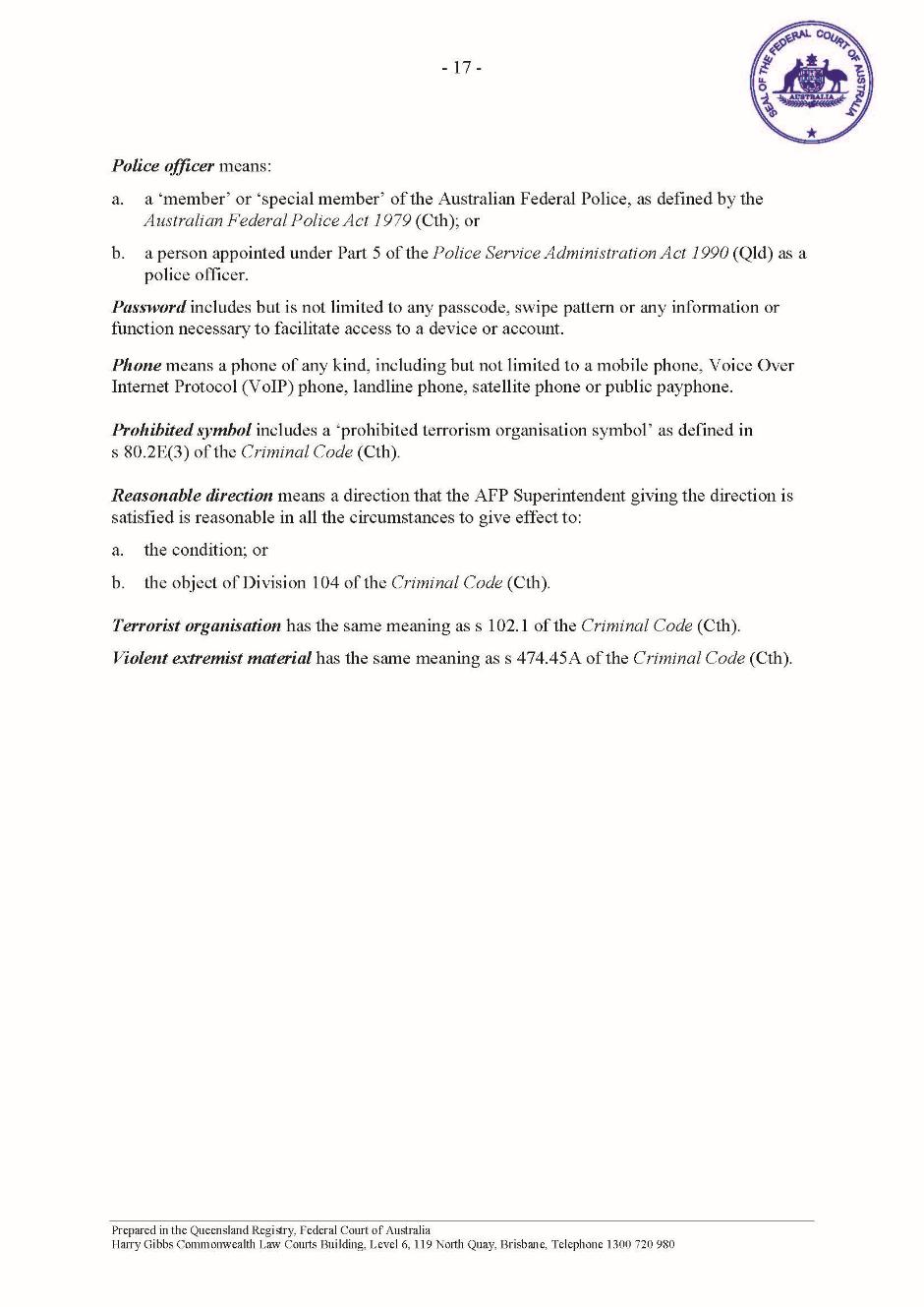
Police officer means:
a. a ‘member’ or ‘special member’ of the Australian Federal Police, as defined by the Australian Federal Police Act 1979 (Cth); or
b. a person appointed under Part 5 of the Police Service Administration Act 1990 (Qld) as a police officer.
Password includes but is not limited to any passcode, swipe pattern or any information or function necessary to facilitate access to a device or account.
Phone means a phone of any kind, including but not limited to a mobile phone, Voice Over Internet Protocol (VoIP) phone, landline phone, satellite phone or public payphone.
Prohibited symbol includes a ‘prohibited terrorism organisation symbol’ as defined in s 80.2E(3) of the Criminal Code (Cth).
Reasonable direction means a direction that the AFP Superintendent giving the direction is satisfied is reasonable in all the circumstances to give effect to:
a. the condition; or
b. the object of Division 104 of the Criminal Code (Cth).
Terrorist organisation has the same meaning as s 102.1 of the Criminal Code (Cth).
Violent extremist material has the same meaning as s 474.45A of the Criminal Code (Cth).
REASONS FOR JUDGMENT
LONGBOTTOM J:
overview
1 The Applicant (DS Byles) seeks two orders in relation to an interim control order concerning the First Respondent (Mr Saghir) made on 21 April 2026 (ICO). The ICO was made pursuant to s 104.4 of the Criminal Code (Cth), which is a schedule to the Criminal Code Act 1995 (Cth).
2 The ICO imposes conditions curtailing the liberties of Mr Saghir following his release from prison where he was serving terms of imprisonment for six counts of advocating terrorism and one count of dealing in proceeds of crime: Code, ss 80.2C(1)(a)(i) and (b)(i) and 400.7(2). The ICO was made on the basis that the Court was satisfied on the balance of probabilities that each of the conditions; and the combined effect of all of the conditions were reasonably necessary, and reasonably appropriate and adapted, for the purposes of protecting the public from a terrorist act, preventing the provision of support for the facilitation of a terrorist act and preventing the provision of support for or the facilitation of the engagement in a hostile activity in a foreign country.
3 The first order sought by DS Byles, with the written consent of Mr Saghir, is to vary the conditions of the ICO. The amendments sought are the removal of two conditions (which respectively prohibit Mr Saghir from leaving or attempting to leave Queensland and permitting him to possess an ordinary cutlery or domestic kitchen knife) and the variation of two other conditions (which relate to the amount of money that Mr Saghir can give without notifying the Australian Federal Police (AFP)).
4 The second order sought by DS Byles, if the first order is made, is to confirm the ICO as varied for a period of 12 months. Mr Saghir does not oppose a control order being imposed for 12 months but contends that two additional conditions should be removed from the ICO as varied. Those additional conditions respectively require him to wear an electronic monitoring device (EMD) and impose a curfew. The interested person, the Queensland Public Interest Monitor, contends that the ICO as varied should be confirmed with the curfew and EMD conditions in place.
5 On 28 August 2026, I made two orders. First, I made an order varying the ICO in accordance with the written consent provided by Mr Saghir: Code, s 104.22(7). Second, and subsequently, I made an order confirming the ICO as varied without the further amendments sought by Mr Saghir (removal of the EMD and curfew conditions): Code, s 104.14(7)(c). These are my reasons for making those orders.
statutory framework
6 The Court has power under Div 104 of the Code to make, vary or confirm an interim control order. Its objects are to allow conditions to be imposed on a person by a control order for one or more of the following purposes: protecting the public from a terrorist act; preventing the provision of support for or the facilitation of a terrorist act; or preventing the provision of support for or the facilitation of the engagement in a hostile activity in a foreign country: Code, s 104.1.
7 A “terrorist act” is broadly defined by s 100.1 of the Code. It relevantly includes an action done or a threat made with the intent of coercing or influencing by intimidation the government of a foreign country which, amongst other effects, causes serious harm, that is, physical harm to a person or a person’s death and does not meet the exclusionary criteria in s 100.1(3). Those exclusionary criteria are advocacy, protest, dissent or industrial action which are not intended to have those effects.
Varying an interim control order
8 The Court may vary an interim control order by consent on application by either a senior member of the AFP or the person in relation to whom it has been made: Code, s 100.1 and s 104.22(1). Where, as here, the subject of the interim control order is over 18 years of age, the Court must first be satisfied that written consent to the variation has been given by the respondent and that the variation is appropriate in the circumstances: Code, s 104.22(6).
9 The varied order must: state that the Court is satisfied of the matters mentioned in s 104.22(6); specify the variations to the conditions that are to be made; state the period during which the order, as varied, is in force; and state that the person’s lawyer may request a copy of the order: Code, s 104.22(7).
Confirming an interim control order
10 The Court has power under s 104.14 of the Code to confirm an interim control order. The section applies if an election is made under s 104.12A(2) to confirm the order and the Court is satisfied, on the balance of probabilities, that the procedural requirements in s 104.12 and s 104.12A(2) of the Code have been complied with in relation to the order: Code, s 104.14(1A).
11 At the confirmation hearing, evidence may be called from the senior AFP member who requested the interim control order, one or more other AFP members, the person in relation to whom the interim control order is made, and the Monitor (if the subject of the interim control order is a resident of Queensland or the Court made the interim control order in Queensland): Code, s 104.14(1). All of those parties may make submissions in relation to the confirmation of the order: Code, s 104.14(1).
12 In proceedings under s 104.14 of the Code, the Court must take judicial notice of the fact that the original request for the interim control order was made on particular terms, but may only take action on evidence adduced, and submissions made, at the hearing in relation to the confirmation of the order: Code, s 104.14(3A). Subject to those requirements, before taking action under s 104.14, the Court must consider the original request for the interim control order, and any evidence adduced, and any submissions made, at the confirmation hearing in respect of the order: Code, s 104.14(3).
13 Where, as here, the confirmation hearing is attended by a representative of the person in relation to whom the interim control order is made and the Monitor, the Court may take the action mentioned in s 104.14(6) or s 104.14(7): Code, s 104.14(5). Those sections respectively provide as follows:
104.14 Confirming an interim control order
…
(6) The court may declare, in writing, the order to be void if the court is satisfied that, at the time of making the order, there were no grounds on which to make the order.
(7) Otherwise, the court may:
(a) revoke the order if, at the time of confirming the order, the court is not satisfied as mentioned in paragraph 104.4(1)(c); or
(b) confirm and vary the order by removing one or more conditions if, at the time of confirming the order, the court is satisfied as mentioned in paragraph 104.4(1)(c) but is not satisfied as mentioned in paragraph 104.4(1)(d); or
(c) confirm the order without variation if, at the time of confirming the order, the court is satisfied as mentioned in paragraphs 104.4(1)(c) and (d).
Note: If the court confirms the interim control order, the court must make a new order under section 104.16.
14 Relevantly, s 104.4(1)(c)(iv) of the Code requires that the Court is satisfied, on the balance of probabilities, that the person has been convicted in Australia of an offence relating to terrorism, a terrorist organisation (within the meaning of s 102.1(1)) or a terrorist act (within the meaning of s 100.1).
15 Section 104.4(1)(d) of the Code provides:
104.4 Making an interim control order
(1) The issuing court may make an order under this section in relation to the person, but only if:
…
(d) the court is satisfied on the balance of probabilities that:
(i) each of the conditions; and
(ii) the combined effect of all of the conditions;
to be imposed on the person by the order in accordance with section 104.5A is reasonably necessary, and reasonably appropriate and adapted, for the purpose of:
(iii) protecting the public from a terrorist act; or
(iv) preventing the provision of support for or the facilitation of a terrorist act; or
(v) preventing the provision of support for or the facilitation of the engagement in a hostile activity in a foreign country.
Note: The issuing court may, in accordance with section 104.5B, specify conditions from which exemptions may be granted.
16 In determining, for the purposes of s 104.4(1)(d), whether each of the conditions and the combined effect of the conditions to be imposed on the person by the order are reasonably necessary and reasonably appropriate and adapted, the Court must take into account (s 104.4(2)):
(a) as a paramount consideration in all cases, the objects of Div 104, as stated above; and
(b) as an additional consideration in all cases, the impact of each of those conditions and the combined effect of all of those conditions on the person’s circumstances (including the person’s financial and personal circumstances).
17 The onus is on an applicant to show that the conditions for confirming the interim control order are satisfied and that the Court should confirm the order in the exercise of its discretion: McCartney v Abdirahman-Khalif (No 2) [2020] FCA 1002 at [24] (Charlesworth J). In deciding whether it is satisfied that the applicant’s case is proved, on the civil standard, the Court must take into account the nature of the cause of action, the subject matter of the proceedings and the gravity of the matters alleged: Evidence Act 1995 (Cth), s 140(2).
18 If the Court confirms the interim control order, then it must make a corresponding order that states the matters prescribed by s 104.16 of the Code, including its satisfaction of the matters mentioned in s 104.4(1)(c) and s 104.4(1)(d), and the period for which the order is to be in force: Code, s 104.16.
confirmation hearing
19 The confirmation hearing was attended by DS Byles, the legal representatives for Mr Saghir and the Monitor: cf, Code, s 104.14(5). Neither Mr Saghir nor the Monitor called evidence: cf, Code, s 104.14(1). All of the parties made submissions with respect to the confirmation of the interim control order: Code, s 104.14(1).
20 DS Byles read two affidavits he affirmed on 24 March 2026 and 22 June 2026, respectively. DS Byles also read the affidavits of DS Jeremy Staunton sworn on 8 April 2026 and Ms Gypsy Semple affirmed on 4 May 2026 (both of the AFP), and Mr Timothy Foley sworn on 28 July 2026. Mr Foley is a lawyer who acts for DS Byles in the proceeding.
21 DS Byles relied on his affidavit affirmed on 24 March 2026 in making the original request for an interim control order: cf, Code, s 104.14(3). The affidavit contained the interim control order he sought, as well as two statements of facts relating to why the interim control order should, and should not, be made. They were stated before the Court at the confirmation hearing with the agreement of Mr Saghir. As such, I received the statements of facts as agreed statements of facts for the purposes of the confirmation hearing: Evidence Act, s 191(1) and s 191(3)(b); cf, Australian Securities and Investments Commission v BHF Solutions Pty Ltd [2022] FCAFC 108; (2022) 293 FCR 330 at [24]-[26] (O’Bryan J, with whom Besanko and Lee JJ agreed). I am satisfied that the two statements of facts have sufficient support in the evidence relied upon by DS Byles, such that they are to be taken as proved in their precise terms.
22 DS Byles was cross-examined by the legal representative for Mr Saghir at the confirmation hearing. That cross-examination essentially concerned the utility of the electronic monitoring and curfew conditions in the ICO in achieving the objects of Div 104, as stated in s 104.1 of the Code.
23 What follows is an overview derived from the agreed facts as supplemented by the unchallenged evidence given by DS Byles, DS Staunton, Ms Semple and Mr Foley: cf, BHF Solutions at [26] and the authority there cited. My findings with respect to the evidence relevant to the issues to be determined on the application to vary and confirm the ICO commence at [76] below.
the offending
Advocating terrorism
24 On 22 August 2025, Mr Saghir was convicted by a jury of six counts of advocating terrorism contrary to s 80.2C(1)(a)(i) and s 80.2C(1)(b)(i) of the Code. On each occasion, Mr Saghir posted a video on Facebook in which he intentionally encouraged others to engage in terrorist acts, being to travel to Syria, bear arms and fight with insurgent groups against the Syrian Government for the purpose of advancing Islam through violence.
25 The offending occurred within two periods.
26 The first three offences were committed on 12, 13 and 15 March 2019. The sentencing remarks record that this was just prior to the Syrian Democratic Forces (SDF), with the support of other governments, mounting a successful military campaign which saw the Islamic State (IS) ultimately defeated in Syria.
27 The IS was the result of the merging of Al-Qaeda in Iraq (AQI) with other insurgent groups in 2006. It is a transnational Sunni Islamist insurgent and terrorist group. In 2010, there was civil unrest in Iraq’s immediate neighbouring country, Syria, and AQI (which was then known as the Islamic State in Iraq (ISI) took the opportunity to expand into northern Syria. It was in this context that ISI became known as the Islamic State in Iraq and Syria. IS adheres to a global jihadist ideology. It follows an extreme, fundamentalist interpretation of Islam called Salafi-Jihadism, which is anti-Western, promotes sectarian violence and targets infidels and apostates as those who do not support its belief system or agree with its interpretation of Islam (in particular, Shia Muslims).
28 The sentencing remarks recorded that in June 2014, the leader of ISIS, which had the backing of AQI, stood in a mosque at Mosul and declared a caliphate, an Islamic State, and declared himself, the caliph, the leader. At that time, ISIS was controlling all of the north-eastern part of Syria and around 12 million people came to fall under that rule. In the videos he posted during this period, Mr Saghir encouraged others to give their support to IS, open up new battlegrounds, provide men and armaments and fight against the SDF. In one video which was entitled, “Christchurch Massacre”, Mr Saghir encouraged others to fight with the mujahideen (those fighting the violent jihad), fight the Syrian Government in a violent jihad and cleanse the lands of tyrants and their collaborators.
29 The last three offences were committed on 20 January 2020 and on 4 and 22 February 2020. The sentencing remarks record that by this time, the Islamic State caliphate had fallen. The mujahideen had escaped into the desert, although they were still operating as insurgent groups.
30 In one of the videos he posted during this period, Mr Saghir encouraged others to prepare weapons and armies to expel the “enemies” from Syria. He spoke of going to Syria himself as a fighter and preparing the tools, being the weapons, and having a share in “this jihad”. The sentencing remarks recorded that in another video, Mr Saghir said to his viewers that his jihad is a victory and that “they are a strong power against the disbelievers”. The sentencing judge remarked that throughout that video Mr Saghir was “espousing Salafi-Jihadi ideology and encouraging others to engage in a jihad”.
31 The total sentence imposed for these offences was two years and six months imprisonment for the first three counts and one year and six months imprisonment for the last three counts, to be served wholly cumulatively on the sentence for counts 1 to 3, with a non-parole period of three years.
Dealing in proceeds of crime
32 On 12 February 2025, Mr Saghir pleaded guilty to one count of dealing in proceeds of crime, being money or property worth $1,000 or more, contrary to s 400.7(2) of the Code. The circumstances of the offence were that on 7 August 2013, Mr Saghir organised a Western Union money transfer of approximately $USD1,000 to the bank account of a man who was then in Turkey.
33 That man travelled from Turkey into Syria, where he engaged in hostile activity against the Syrian Government’s military forces in support of Jabhat al-Nusra, which was an insurgent group with the backing of Al-Qaeda. Mr Saghir had worked with the man at a fruit shop in 2009. Both were adherents to Salafi-Jihadi ideology. Amongst the views they discussed, was that Australia, America and all Western countries were invaders, taking the oil and natural resources and acting as colonisers of Muslim countries. The man believed that his duty as a Muslim was to help the Syrian people who were suffering by going to Syria to fight against the Assad regime.
34 The man was in Turkey in August 2013, when he telephoned Mr Saghir. Earlier that year, Mr Saghir had run into him at a shopping centre on the Gold Coast and offered him money. The man asked Mr Saghir for the money which he had offered. That money was given to another man who was fighting in Idlib in Syria. Mr Saghir was sentenced on the basis that he was reckless in risking that the money could become an instrument of crime by the recipient, using it to facilitate an offence contrary to the Crimes (Foreign Incursions and Recruitment) Act 1978 (Cth).
35 Mr Saghir was sentenced for the offence to a total period of six months imprisonment, to be served concurrently with the sentence for the first three counts of the advocating terrorism offences.
Breach of bail
36 On 27 February 2020, shortly after Mr Saghir committed the last of the advocating terrorism offences, his Australian passport was cancelled while he was in Saudi Arabia following an adverse security assessment. On 2 April 2020, the Minister for Home Affairs signed a temporary exclusion order in relation to Mr Saghir under s 10 of the Counter-Terrorism (Temporary Exclusion Orders) Act 2019 (Cth). The effect of the order was that Mr Saghir was prohibited from entering Australia until April 2022, or whenever the order was revoked, whichever was earlier.
37 On 1 February 2021, Mr Saghir was taken by Saudi Arabian Police to a detention centre in Jeddah after a random identity check was conducted. There followed the issue of a return permit by the Minister for Home Affairs under the Counter-Terrorism Act, and Mr Saghir’s deportation from Saudi Arabia to Australia, via Turkey. On his arrival in Sydney, Mr Saghir was arrested and charged with an offence, which was later substituted for the proceeds of crime offence. Mr Saghir was also served with a copy of the return permit and was informed of its conditions, which relevantly included a requirement that he advise the Department of Home Affairs within 24 hours of making a travel booking if he intended to leave Australia.
38 Following his arrest, Mr Saghir was remanded in custody after being extradited to Queensland. On 5 August 2021, he applied for bail, which application was refused. On 18 February 2022, Mr Saghir was granted bail. His bail conditions included that Mr Saghir: report to a police station daily; wear, and not remove, an EMD; not apply for a passport or travel document; not enter, or attempt to enter, an international point of departure; and not delete any communications history on his mobile phone, including text messages, audio messages and call records.
39 Mr Saghir failed to report to the police station on two occasions: on 17 April 2022 and on 24 April 2022. On 30 April 2022, Mr Saghir was arrested and charged for the second failure to report and returned to holding custody until 2 May 2022. On that date, Mr Saghir was granted bail and signed a new bail undertaking in substantially the same terms as the last one.
40 On 30 June 2022, at approximately 5:14 pm, the Queensland Joint Counter Terrorism Team received a notification of a strap tamper alert from the EMD Mr Saghir was required to wear as a condition of his bail. The last known location of the EMD was at his bail address. The Counter Terrorism Team contacted Mr Saghir by phone, and he stated that he was at his bail address and was charging his EMD as he normally did. Mr Saghir was informed that Queensland Police Service officers would attend the address to assess the situation.
41 When police arrived at the bail address at around 6:32 pm, Mr Saghir was not there. An elderly woman at the address stated that Mr Saghir had gone to get milk and had left 10 minutes before the police arrived. The EMD was located at the address under the blankets of Mr Saghir’s bed, being charged.
42 Police attempted to call Mr Saghir, but were unable to verify his current location or his activity. When police attempted to contact Mr Saghir on his mobile phone, the calls were not answered. Police left voicemail messages and sent text messages advising Mr Saghir to contact police immediately on a phone number provided.
43 Almost an hour-and-a-half after they arrived at his bail address, at 8:01 pm, Mr Saghir called a member of the Counter Terrorism Team. Mr Saghir said that he was walking home but refused to disclose his location. At around 8:35 pm, Mr Saghir was located approximately 350 metres from his bail address.
44 Subsequent investigations revealed that Mr Saghir had breached a number of his bail conditions between 27 June 2022 and 30 June 2022, as part of a plan to travel to Jeddah, Saudi Arabia. In summary:
(a) On 27 June 2022, Mr Saghir was contacted by a travel agency following a declined travel registration on their website. He selected a one-way ticket for a flight from Brisbane to Jeddah, via Qatar and Oman. Following payment, Mr Saghir was emailed an online electronic ticket record in his name showing confirmed flights from Brisbane to Saudi Arabia via Qatar and Oman.
(b) On 30 June 2022, at approximately 5:56 pm, Mr Saghir was picked up by a taxi at his bail address and dropped off at the Brisbane International Airport. He approached the check-in counter, stated to a staff member that he was travelling to Jeddah, Saudi Arabia, for business purposes and did not have a passport. A short time later, he walked to the security checkpoint and passenger screening area, where his bag was scanned. Mr Saghir collected his bag and headed towards, but did not go through, the immigration gates. Shortly afterwards, Mr Saghir was approached by airport security staff, whom he told that he was waiting for his passport to be delivered to him. Airport security staff told him that he could not wait in that location, and he then headed back to the check-in counter. Mr Saghir had another conversation with check-in-staff during which he asked what would happen to his ticket if he could not travel, before leaving the counter.
(c) On 30 June 2022, at approximately 7:42 pm, Mr Saghir entered a taxi, still in possession of his bag. At approximately 8:09 pm, the taxi dropped Mr Saghir off in close proximity to his bail address. When Mr Saghir was located, a little over 30 minutes later, he was not in possession of his bag. Mr Saghir was arrested. His mobile phone was seized and a subsequent examination by police revealed that all call records and text messages from prior to approximately 6 pm on 30 June 2022 had been deleted from his mobile phone. Police enquiries with Mr Saghir’s telephone provider revealed that on the day of his arrest, Mr Saghir had made 35 telephone calls and sent or received 30 text messages.
45 Mr Saghir was charged, pleaded guilty and was sentenced as follows with respect to the events described above:
(a) Two counts of failure to comply with a return permit condition contrary to s 20 of the Counter-Terrorism Act for a failure to advise the Department of Home Affairs within 24 hours of making a travel booking with the intent to leave Australia. Mr Saghir was sentenced to six months imprisonment for that offence, to be released after having served 141 days upon giving security by recognisance in the sum of $500, conditioned to be of good behaviour for a period of two years, with 141 days of pre-sentence custody declared as time served;
(b) Four counts of breach of bail contrary to s 29(1) of the Bail Act 1980 (Qld) for which, in relation to the breaches on 30 June 2022, he was sentenced to 141 days of imprisonment with 141 days of pre-sentence custody declared as time served. Mr Saghir was convicted and not further punished in respect of the 24 April 2022 breach of bail offence; and
(c) One count of wilful damage contrary to s 469 of the Criminal Code 1899 (Qld), for which he was sentenced to eight months imprisonment suspended after having served 141 days for an operational period of two years; 141 days of pre-sentence custody declared as time served; order for compensation to be paid to the Queensland Police Service in the sum of $17.50.
46 At the sentencing hearing, counsel for Mr Saghir outlined that Mr Saghir had felt that he had been under “constant harassment” from the police to speak to or cooperate with them and felt threatened that if there was a breach then he would be returned to prison. His legal representative stated that the threat of being breached “affected him mentally … put the stress of him returning back to jail and solitary confinement” and that while this “doesn’t make sense to you and I” that the conduct was “his way of protesting on trying to bring the matter back before the court”.
ico
47 Mr Saghir was released from prison on 1 May 2026. He has been in regular contact with the AFP since the order came into force. DS Byles has found Mr Saghir to be polite and cooperative in his interactions with AFP members.
48 The AFP have both granted, and refused, requests made by Mr Saghir to vary the conditions of the ICO. The approval related to his desire to set up a food stall business at the local markets. The AFP approved variations to the curfew and weapons conditions of his ICO to permit him to leave his specified premises at 3:30 am on a Sunday and to buy and possess knives for the purposes of the food stall. But the AFP refused requests by Mr Saghir to vary the conditions of the ICO relating to programs, applications and data which would have enabled him to download the social media platform “X” and the WhatsApp social media application on to his AFP phone. He does have social media accounts on the permitted applications, Facebook and YouTube.
49 Save on one occasion, Mr Saghir has complied with the conditions of the ICO. In a telephone conversation with the AFP where he mentioned he had started running, Mr Saghir was reminded that he must always have his AFP phone. He proffered that he had gone out for a brief run that morning (12 May 2026) and had not taken his AFP phone with him. Mr Saghir acknowledged the failure to comply and undertook to take the AFP phone with him on future runs.
reason for seeking confirmation of the ico
50 DS Byles considers that Mr Saghir’s conduct under the ICO has been generally positive. Nonetheless, he elected to confirm the ICO. There are seven factors that have informed that decision.
51 First, the limited time Mr Saghir has been on the ICO. As at the date he provided his second affidavit (22 June 2026) Mr Saghir had been subject to the ICO for seven weeks. DS Byles considers that not enough time has passed to determine that Mr Saghir’s risk has reduced to a level that no longer requires the ICO conditions. He seeks a control order for 12 months to serve the purpose of protection of the public for the maximum period permitted under the Code. DS Byles considers that period will allow the AFP to understand Mr Saghir’s trajectory more accurately and gain information relevant to managing his risk factors, particularly around his ideology and attempts to influence others.
52 Second, the serious nature of his advocating terrorism and proceeds of crime offending as detailed above.
53 Third, Mr Saghir’s ideology. DS Byles is not aware of any information to suggest that Mr Saghir has resiled from his Salafi-Jihadi ideology or express any contrition for his offending. DS Byles draws to the attention of the Court two conversations Mr Saghir had with his son while in custody on 29 August and 1 September 2025. In the first conversation, while discussing his prosecution, Mr Saghir said to his son, “you do thousand good … and then this one thing … they twist it however they wanna twist it and go on about it”. In the second conversation, Mr Saghir said to his son that, “the whole conviction is all talk … [t]here’s nothing with it … [n]othing connecting me to nothing – to no one”. DS Byles also draws to the attention of the Court that following his sentencing, Mr Saghir declined an offer of engaging in intervention with the Queensland Corrective Services Countering Violent Extremism team. DS Byles gives evidence of his awareness, based on inquiries with the Queensland Police Service that, as of 11 June 2026, Mr Saghir had not reached out to, or engaged with, the Engagement and Diversion Program violent extremism disengagement and rehabilitation program they offer.
54 Fourth, what DS Byles characterises as Mr Saghir’s previously demonstrated significant willingness to influence others, both while in the community and while incarcerated. Insofar as it concerns Mr Saghir’s period of incarceration, the agreed facts record communications Mr Saghir had about his interactions with other prisoners. This includes telephone conversations with his son in which Mr Saghir referred to teaching people how to pray and teaching them about Islam and a letter Mr Saghir sent to a prisoner in which he refers to “keeping busy here either reading and spreading the message of Islam” stating that “as many people are coming to Islam here at a fast rate.” DS Byles also considers that the Mr Saghir maintains a keen interest in engaging with social media content, noting both his requests to download “X” and “WhatsApp” and Mr Saghir’s creation of a YouTube channel on which he has posted seven “slice of life” or “advice for entrepreneurs” videos.
55 Fifth, Mr Saghir’s non-compliance with his bail conditions. DS Byles notes the submissions made by Mr Saghir’s legal representative as to why he engaged in that conduct. Notwithstanding, DS Byles considers that conduct suggests that there is a risk that he may attempt to evade monitoring of his location and communications in the future. DS Byles also considers there remains a real risk that Mr Saghir will engage in conduct support or facilitative of a terrorist act and will attempt to hide such conduct or otherwise avoid its detection by law enforcement. The view DS Byles holds is, in part, informed by the fact that prior to both his first and second breach of bail, Mr Saghir had reasonable periods of compliance (in each case approximately two months). That leads DS Byles to consider that early indications of compliance by Mr Saghir with conditions of the ICO is not necessarily a strong indicator of longer-term future compliance.
56 Sixth, concerns that Mr Saghir’s family may provide a limited protective factor. DS Byles outlines that Mr Saghir has a large immediate and extended family with whom he has had frequent conduct since his release. DS Byles considers that his family has been a source of support to Mr Saghir. Notwithstanding, DS Byles notes that Mr Saghir breached his bail in circumstances in which it was his mother who had paid the surety for his bail ($50,000) from her savings. DS Byles also holds concerns that Mr Saghir’s son may share some of his extreme religious views. That view is based on his son being detained by police while in Saudi Arabia in 2024, for allegedly displaying prohibited and offensive symbols by wearing a jumper displaying images of a hand with a raised index finger and the words “mujadideen EST. 1445 AH” on the front and “shahada” on the back. Mr Saghir’s son denied that the word was deliberately meant to be misread as “mujahideen” but would not expand on his ideology or reasons behind the jumper.
57 Seventh, the current terrorist threat environment. The current National Terrorism Threat Level is “probable” which means that there is a greater than 50 per cent chance of an onshore attack in Australia, or attack planning, in the next 12 months. DS Byles gives evidence that the influence of the Islamic State is amplified by its supporters’ prolific use of social media and online communications to encourage politically and religiously motivated violence. The Islamic State has also previously and openly called for, and in some cases claimed responsibility for, attacks against Australia and its interests. His own experience is that individuals who view, create or share violent extremist material online can pose a real risk of engaging in offline or “real world” offending. DS Byles highlights that the current national security environment is highly volatile. He considers that global events influenced Mr Saghir’s advocating terrorism and proceeds of crime offending. Given that, he considers that the current environment could have the same negative influence on Mr Saghir.
procedural requirements
58 I am satisfied, on the balance of probabilities, that the procedural requirements in s 104.12 and s 104.12A(2) of the Code have been complied with in relation to the ICO: Code, s 104.14(1A). That is because, as appears from the affidavits of Ms Semple, DS Byles and Mr Foley:
(a) On 22 April 2026, the day after it was made, the AFP provided the Monitor with a copy of the ICO by email: Code, s 104.12(5).
(b) On 24 April 2026, three days after it was made, Ms Semple personally served the ICO on Mr Saghir at the Lockyer Valley Correctional Centre: Code, s 104.12(1)(a). Ms Semple read out to Mr Saghir a “notification and explanation of an interim control document”, which contained the information required by s 104.12(1)(b) of the Code. Having done so, Ms Semple asked Mr Saghir if he understood the document that she had read out to him, to which Mr Saghir responded, “I understand”: Code, s 104.1(c).
(c) On 19 June 2026, almost 10 weeks before the day specified in the ICO for the confirmation hearing (27 August 2026), DS Byles elected to confirm and vary the ICO at the confirmation hearing and gave written confirmation to the Court of his election: Code, s 104.5(1)(e) and s 104.12A(1).
(d) On 2 July 2026, DS Byles caused a copy of the notification of the election to confirm the ICO; a statement of facts as to why the order should be made; a statement of facts as to why the order should not be made and a summary of the grounds on which the order should be made (including the proposed conditions) together with the submissions filed before the ICO was made and the evidence relied upon by DS Byles for the confirmation hearing to be personally served on Mr Saghir via his solicitor: Code, s 104.12A(2).
(e) On 23 July 2026, a copy of the information referred to in the preceding subparagraph was served on the Monitor: Code, s 104.12A(2).
59 In addition, both a legal representative of Mr Saghir and the Monitor were present at the confirmation hearing, thereby enlivening the power of the Court under s 104.14(7) of the Code to revoke, confirm and vary, or confirm the ICO without variation dependent on whether it is satisfied of the matters as mentioned in s 104.4(1)(c) and s 104.4(1)(d): Code, s 104.14(5).
ico variation
60 The application to vary the ICO under s 104.22 of the Code was made at the confirmation hearing by DS Byles but in the context of a consensus reached across the course of the parties’ written submissions relevant to the confirmation of the ICO under s 104.14 of the Code. Because it was DS Byles, rather than Mr Saghir, who applied to vary the ICO, evidence was adduced that Mr Saghir consented, in writing, to those variations as required by s 104.22(6) of the Code.
61 The variations sought to the ICO by consent, and the background to that consensus being reached, were as follows:
(a) To remove condition 4.4. That condition prohibits Mr Saghir from leaving, or attempting to leave, Queensland. The condition was included in the ICO to assist the AFP in monitoring Mr Saghir’s location and activities as an incident of their capacity to ensure that he is complying with the other conditions of the ICO and to ensure that he is not engaging in behaviours with which Div 104 of the Code is concerned. The Monitor submitted in writing that the condition was unnecessary because there is no evidence that any of the risks necessitating the ICO are any greater if Mr Saghir travels within Australia and outside Queensland, and the other conditions are equally capable of operating outside Queensland. In the reply submissions filed with respect to the confirmation hearing, DS Byles did not “press” for condition 4.4 to be included in the ICO and at the confirmation hearing itself applied for the ICO to be varied under s 104.22 to remove the condition.
(b) To remove condition 10.2. That condition relates to weapons and specifies that Mr Saghir can possess an ordinary cutlery knife used for eating or a kitchen knife within his household used for ordinary domestic purposes. The condition is an exception to the prohibition, in condition 10.1, against buying, making, possessing or using a weapon as defined in Sch 2 of the Weapons Act 1990 (Qld) or attempting to buy, make, possess or use such a weapon. Mr Saghir submitted that the condition creates uncertainty as to the lawfulness of his possessing a knife that might not meet that condition in carrying on his food stall business. In his reply submissions, DS Byles did not “press” for condition 10.2 to be included in the ICO and at the confirmation hearing itself, applied for the ICO to be varied under s 104.22 to remove the condition.
(c) To amend conditions 18.3 and 18.4. Those conditions relate to the monetary threshold for giving money requiring notification to the AFP. Condition 18.3 requires Mr Saghir to inform the AFP Superintendent if he intends to give money to another person, charity or group equal to or greater than $500. Condition 18.4 provides an exception if the purpose of the transfer is to secure or maintain housing, education or employment. Mr Saghir sought that the amount be increased to $3,000. While cognisant of his prior proceeds of crime offence, Mr Saghir submitted that allowing for inflation in the years since that offence was committed, increasing the monetary threshold to $3,000 strikes an appropriate balance between addressing the risk the condition seeks to address and enabling him to operate a small business. In his reply submissions, DS Byles consented to the variation to conditions 18.3 and 18.4 to increase the monetary threshold and at the confirmation hearing itself applied for conditions 18.3 and 18.4 of the ICO to be varied under s 104.22 to give effect to that position.
62 The effect of the application under s 104.22 of the Code is that, subject to the Court being persuaded as to their appropriateness, the ICO can be varied by consent: Code, s 104.22; cf, s 104.14(7). The parties therefore submitted, and I proceeded on the basis, that the application to vary the ICO by consent ought to be dealt with before going on to consider confirmation of the ICO.
63 The variations to the ICO are, in my view, appropriate in the circumstances: Code, s 104.22(6)(b). That is because, I am satisfied, on the balance of probabilities, that the ICO as varied remains reasonably appropriate and adapted for the purposes for which it was made: Code, s 104.4(1)(d). The variations are directed to alleviating the impact of the conditions on Mr Saghir: Code, s 104.4(2)(e). That is not, however, at the expense of the paramount consideration in s 104.1 of the Code. The removal of conditions 4.4 and 10.2 would not render the ICO ineffective to achieve the objects stated in s 104.1 of the Code because, as appears from the submissions summarised above: (a) condition 4.4 is not necessary given the absence of evidence of a specific risk associated with Mr Saghir travelling within Australia, as opposed to Queensland; and (b) condition 10.2 creates confusion as to the operation of the prohibition in condition 10.1. The increase of the monetary threshold in conditions 18.3 and 18.4 similarly does not render the ICO ineffective in achieving that end, given the value of that money in today’s terms. In making that assessment, I place weight on the fact that DS Byles moved for the variations. For all of those reasons, I made orders varying the ICO by consent (ICO as varied).
confirmation of the ico as varied
64 As foreshadowed, the parties agreed at the confirmation hearing that the ICO as varied should be confirmed for a period of 12 months. The only dispute was whether in exercising the power under s 104.14(7) of the Code, the Court ought to confirm and further vary the order by removing the conditions imposing a curfew on Mr Saghir and requiring him to wear an EMD.
65 DS Byles, with the support of the Monitor, submits that each of the conditions in the ICO as varied, and the combined effect of all of those conditions, are reasonably necessary and reasonably appropriate and adapted for the purpose of achieving the objects in Div 104 of the Code. Mr Saghir disputes that is the case. Rather, he submits that: (a) the other conditions in the ICO as varied are sufficient to address the risk posed by Mr Saghir’s prior offending behaviour; (b) the real purpose of the EMD is to address the risk that Mr Saghir would abscond from Australia; (c) the curfew and the EMD are limited in their effectiveness in addressing risk, the EMD condition because a repetition of Mr Saghir’s offending conduct online is not rendered less likely by the AFP being aware of his location; and (d) the conditions impose not insignificant consequences on Mr Saghir, such as the impost of charging the EMD to ensure its operation and the consequences of failing to do so given that the requirement is a condition of the ICO. Mr Saghir also emphasises the sincerity he has demonstrated to the AFP in the period of the ICO is such as to give the Court confidence that he will continue to comply with its conditions and that there is no evidence that his online offending would lead to offending in the “real world”.
66 The other conditions Mr Saghir relies on are those prohibiting him from leaving, or attempting to leave Australia, requiring him to notify the AFP Superintendent as soon as reasonably practicable before starting any paid or unpaid work, training or education, and prohibiting him from communicating with persons or going to places identified in the ICO as varied or directed by the Superintendent. Mr Saghir submits that those conditions are sufficient to address the risks identified by the AFP, namely, his leaving or attempting to leave Australia, engaging in online offending, approaching high risk locations or associating with persons or groups of a security concern, as well as the AFP’s objectives of detecting changes of pattern in his life or routines. Mr Saghir also emphasises the limitations in the EMD, including that the device does not act as a camera.
67 In dealing with those contentions, and more broadly the orders sought by DS Byles with respect to the ICO as varied, it is first necessary to address the evidence regarding the EMD and the curfew, and the cross-examination of DS Byles by Mr Saghir’s legal representatives with respect to each of those conditions
EMD
68 The EMD condition in the ICO as varied requires Mr Saghir to wear a monitoring device at all times.
69 The EMD is attached to the ankle of the wearer and combines three types of electronic monitoring technology to communicate the geographic location of the person wearing the device. If worn under pants, the EMD should not be visible. It can be worn in the shower or bath. The system can be programmed to identify restricted areas or “exclusion zones” and the EMD will generate an alert if it is located within such a zone. The EMD can also be programmed to generate an alert if it is tampered with, the device has not moved during a specified period of time or the device’s battery is running low. To ensure that it has sufficient battery power for 24 hours, the wearer is required to charge the EMD twice a day for one-and-a-half hours at a time. The charging device includes a rechargeable battery, which can be charged on a dock (which can take up to four hours) and then attached to the EMD. This means that the EMD can be charged while the wearer is moving, provided that the rechargeable battery is fully charged.
70 The monitoring of the EMD is undertaken by a centralised information and monitoring centre, which operates 24 hours a day, but is operated by Corrective Services New South Wales. If the EMD triggers an alert, it will be notified to supervising staff at the monitoring centre who will then notify the AFP to action and respond. AFP members assigned to monitor the wearer’s compliance will also be provided with access to a monitoring system which will give them access to the wearer’s location, as well as case management notes entered by the monitoring staff.
71 DS Byles gives evidence that the EMD condition will allow the AFP to monitor Mr Saghir’s whereabouts and activities in “real time”. His cross-examination by Mr Saghir’s counsel focused upon what is meant by that expression and the practical aspects of the AFP’s monitoring capacity that the condition would provide. DS Byles gave evidence under cross-examination that if one of the alerts was triggered on the EMD, the AFP would “immediately” be advised but outside of such alerts, the capacity of the AFP to identify a “real time” location for the wearer depends on it making a request of the monitoring centre. DS Byles also acknowledged that the monitoring capacity of the EMD is limited to identifying the wearer’s location. Notwithstanding, DS Byles expressed the opinion that the EMD would assist the AFP in their understanding of the “broader context” of Mr Saghir’s activities and thereby “connects” with the other conditions in the order “as a collective”. DS Byles gave the example of the ability to monitor Mr Saghir’s location via the EMD together with the requirement under the ICO that he carry an AFP mobile phone and answer and respond truthfully to questions he may be asked, such as his location. In re-examination, DS Byles testified that the EMD can give a more precise location than the AFP mobile phone and, should that phone accidentally be left behind, ensures Mr Saghir can be located.
Curfew
72 The curfew condition in the ICO as varied requires Mr Saghir to stay at the premises where he resides between 12 am and 6 am each day unless it is an “emergency”. The expression “emergency” is defined to mean a situation that threatens his safety or that of his family members.
73 DS Byles gave evidence that a significant risk for Mr Saghir, and therefore a concern for the AFP, is Mr Saghir’s promotion of extremist beliefs advocating for individuals to engage in jihad. He deposes that the curfew condition is directed to assisting in reducing that risk as well as ensuring that the EMD remains charged and in good working order. Cross-examination of DS Byles focused on the effectiveness of the condition in achieving that objective and addressing that risk.
74 Insofar as it concerned risk, DS Byles gave evidence under cross-examination that the object of the curfew condition was, in part, to enable the AFP to eliminate, or reduce as much as possible, the risk that Mr Saghir would use a different internet provider to that nominated by the AFP. DS Byles accepted that the curfew condition was only effective, in that regard, between 12 am and 6 am because outside those hours Mr Saghir could, were he so minded, use a different internet provider at another premises. He also accepted that the ICO as varied expressly prohibited Mr Saghir from doing so. Insofar as it concerned the EMD, DS Byles accepted that there was nothing to prevent Mr Saghir from charging the monitoring device outside of the curfew hours.
75 Beyond those objects, DS Byles expressed the opinion that the curfew condition has a “deterrent effect”. He described that deterrent effect as being twofold. Firstly, to serve as a daily reminder to Mr Saghir that he is subject to an ICO. Secondly, to limit the time period where, in DS Byles’ experience, there is more propensity to undertake covert or discreet activities in the sense of associating with other people.
Findings
76 Having considered the original request for the ICO, the evidence adduced by the AFP and the submissions made by each of the parties at the confirmation hearing, I make the following findings on the balance of probabilities: Code, ss 104.4(1)(c), 104.4(1)(d), 104.14(3) and 104.14(7)(c).
Mr Saghir was convicted of a terrorism offence: s 104.4(1)(c)(iv) of the Code
77 Mr Saghir has been convicted in Australia of an offence relating to terrorism within the meaning of s 104.4(1)(c)(iv) of the Code. The elements of “advocating terrorism” under s 80.2C of the Code relevantly include that the person advocates the doing of the terrorist act or the commission of a terrorism offence and the person engages in that conduct reckless as to whether another person will engage in a terrorist act or commit a terrorism offence: Code, s 80.2C(1) and s 80.2C(2) (as to the definition of “terrorism offence” under s 80.2C(1); see also, Code, s 102.1(1A)). Those elements comfortably support the finding to the required standard that the six advocating terrorism offences, of which Mr Saghir was convicted in Queensland on 22 August 2025, are offences “relating to terrorism”.
Each of the conditions and the combined effect of all of the conditions are reasonably necessary and appropriate and adapted for the purpose of preventing the provision of support for or the facilitation of a terrorist act or the engagement in a hostile activity in a foreign country: Code, s 104.4(1)(d)
78 In determining whether each of the conditions, and the combined effect, of all of the conditions of the ICO as varied are reasonably necessary and reasonably appropriate and adapted for the purposes stated in s 104.4(1)(d) of the Code the paramount consideration is the object of Div 104: Code, s 104.4(2)(c). Those objects relevantly include allowing conditions to be imposed on a person by a control order for the purposes of preventing the provision of support for, or the facilitation of a terrorist act or the engagement in a hostile activity in a foreign country: Code, s 104.1.
79 Given the protective, rather than penal, purpose of Div 104 of the Code, and the curtailing of civil liberties that results from a control order, such an order should only be imposed on a person as a precaution against criminal offending that may occur in the future: McCartney (No 2) at [209].
80 The level of risk, both of occurrence of the offending and the level of danger to the public, will vary according to international or local circumstances: Thomas v Mowbray [2007] HCA 33; (2007) 233 CLR 307 at [9] (Gleeson CJ). Assessing risk in that context requires consideration of the facts and circumstances disclosed by the evidence, but may also encompass matters of common knowledge: Thomas at [92] (Gummow and Crennan JJ). In many, if not most, cases it will require conclusions as to past events because what has occurred in the past is likely to be the most reliable guide as to what will happen in the future: Minister for Immigration and Ethnic Affairs v Guo [1997] HCA 22; (1997) 191 CLR 559 at 575 (Brennan CJ, Dawson, Toohey, Gaudron, McHugh and Gummow JJ), as cited by Rares J in MYVC v Director-General of Security [2014] FCA 1447; (2014) 234 FCR 134 at [52]-[53]. And insofar as it concerns the risk of a person relapsing into the offending behaviour that led to their conviction, it does not require a “conclusive” finding of that risk; it is sufficient that the risk is “real and reasonable”, even where there are “positive indications” to the contrary: Booth v Namoa [2019] FCA 2213 at [28] (Rares J).
Other conditions
81 Dealing firstly with those conditions of the ICO as varied that are not in issue (other conditions), the evidence reveals that Mr Saghir has been convicted of not one, but six, offences of advocating terrorism. His offending was serious and involved encouraging others to engage in a violent jihad in Syria. That offending occurred some time ago, in 2019 and 2020. And as his counsel emphasises, there is no indication that Mr Saghir has relapsed in the 17-week period since he has been released.
82 But against that, there is no evidence that Mr Saghir has resiled from his Salafi-Jihadi ideology. Indeed, his conduct while in custody reflected a lack of insight into his offending and an ongoing propensity to attempt to influence others with respect to his religious views. Mr Saghir has refused offers to engage with intervention services countering violent extremism. Further, DS Byles attests, and I accept, that Mr Saghir’s family are a limited protective factor against his re-offending, given his breach of bail in circumstances where his mother had put forward the surety, and there are concerns that his son may share some of his extremist views. Finally, there is the “highly volatile” current national security environment and DS Byles’ opinion, which I also attribute weight, that prior global events influenced Mr Saghir’s prior offending and the current global environment could have a similarly negative influence on Mr Saghir and his propensity to re-offend.
83 DS Byles gives evidence in his first affidavit of the reason behind each of the conditions in the ICO. That is supplemented by the evidence given in his second affidavit that the conditions of the ICO are relevantly designed to ensure he does not engage in behaviours which may lead him to support or facilitate a terrorist act or support or facilitate the engagement in a hostile activity in a foreign country.
84 Taking all that evidence into account, consistent with the position taken by the parties, I am satisfied on the balance of probabilities that there is a real and reasonable risk of Mr Saghir re-offending that warrants the imposition of a control order for 12 months including, at least, the other conditions, to prevent the provision of support for the facilitation of a terrorist act or the facilitation of the engagement in a hostile activity in a foreign country. I am also satisfied on the balance of probabilities that each of the other conditions and the combined effect of the other conditions are reasonably necessary, and reasonably appropriate and adapted to achieve that end. I have made those findings based on the repeated and serious nature of Mr Saghir’s past offending behaviour; the lack of evidence that he has resiled from his extremist ideology; his propensity to attempt to influence others; the current geopolitical environment and its past influence on Mr Saghir in his offending; the lack of protective factors for him in the community and the evidence of DS Byles that the conditions of the ICO are designed to reduce the risk of Mr Saghir relapsing into offending behaviour.
85 Turning then to the conditions in issue, I am satisfied on the balance of probabilities that each of the EMD and curfew conditions are reasonably necessary, and reasonably appropriate and adapted for the purpose of the statutory provisions just mentioned. That is for the following reasons.
EMD condition
86 I do not accept Mr Saghir’s contention that the EMD condition is not necessary because there are prohibitions in place in the ICO as varied that are directed to ensuring that he does not engage in behaviour that places him at risk of re-offending. I acknowledge that, with the exception of the infraction referred to at [49] above, there is no evidence that Mr Saghir has failed to adhere to the terms of the ICO. I am also cognisant of DS Byles’ evidence of Mr Saghir’s cooperative engagement with the AFP. Notwithstanding, the collective weight of the considerations detailed at [82] above, including most particularly the circumstances of his breach of bail are such that I am satisfied that that there is a real and reasonable risk that Mr Saghir will not adhere to directions, even where there is a substantive negative consequence of non-adherence both to him and his family. The EMD condition will assist the AFP to monitor whether Mr Saghir is complying with conditions directed towards reducing the risk of his relapsing into re-offending behaviour (such as not going to locations of a prescribed kind) through the information it provides as to his location, including the system of alerts if he goes to prohibited areas. The EMD condition provides a mechanism by which the AFP can monitor and thereby endeavour to ensure Mr Saghir complies with the ICO as varied. It is, therefore, reasonably necessary to achieve the objects stated in Div 104.1 because it is a safeguard against Mr Saghir’s non-compliance with the other conditions which are themselves directed to preventing the provision of support for or the facilitation of a terrorist act or the engagement in a hostile activity in a foreign country.
87 The evidence highlights that the EMD condition has limitations. Firstly, the EMD does not have a camera. Secondly, it is monitored by a third party and absent an “alert” or a request, the AFP itself does not monitor Mr Saghir’s movements in “real time”. Those limitations, however, do not detract from the conclusion that the AFP is in a better position to detect if Mr Saghir is engaging in activities of security concern or contravening conditions of the ICO as varied with the EMD than it would be without the device. In reaching that view, I place weight on DS Byles’ evidence that the EMD enhances the capacity of the AFP both in their understanding of the broader context of Mr Saghir’s activities but also, in combination with the other conditions of the ICO as varied, to verify location information Mr Saghir verbally provides.
88 The condition also imposes an impost on Mr Saghir, most notably through the need to wear the device at all times and recharge it daily: Code, s 104.4(2)(e). But the evidence is that it is relatively unobtrusive, can be worn in water and can be charged while it is on Mr Saghir’s person by a rechargeable battery. As such, in my view, that impost is not onerous as to be an unacceptable constraint on his liberties. For all of those reasons, I am satisfied on the balance of probabilities that the EMD condition does not impose a greater restraint on Mr Saghir than reasonable protection of the public requires and as such, is reasonably appropriate and adapted to achieving the objects stated in s 104.4(1)(d)(iv) and s 104.4(1)(d)(v) of the Code: cf, Thomas at [99].
Curfew condition
89 I do not accept Mr Saghir’s contention that the curfew condition does not materially advance a reduction of the risk he poses. As DS Byles gave evidence, it has both practical and deterrent effects in reducing the risk of Mr Saghir re-offending. The practical effect is to reduce Mr Saghir’s ability to breach other conditions of the ICO as varied relating to use of the wireless and internet services and engagement with groups or persons that may add to the risk of his relapsing into offending behaviour between the hours of 12 am and 6 am. It also has a practical benefit in ensuring that the EMD is charged.
90 The deterrent effect is to provide an ongoing reminder, by reason of the requirement to be at the specified premises between those hours, that Mr Saghir’s prior offending has necessitated a control order to guard against the risk of his engaging in such behaviour. Mr Saghir submits that the other conditions serve that deterrent effect, such as the requirement to use an AFP phone. But as the breach of bail offence makes clear, similar conditions requiring Mr Saghir to either take or not take particular steps have been ineffective in the past. And the curfew condition is unlike the other conditions to which Mr Saghir refers because it is a time-specific, as opposed to a general obligation, compliance with which can be readily checked because of the EMD condition. For all of those reasons, I am satisfied on the balance of probabilities, that the curfew condition is reasonably necessary for the purposes stated in s 104.4(1)(d)(iv) and s 104.4(1)(d)(v) of the Code.
91 I am also satisfied, on the balance of probabilities, that the curfew condition is reasonably appropriate and adapted for the purpose of achieving those statutory objects. While it does have an impost on Mr Saghir’s freedom of movement, the evidence supports the conclusion that the AFP have agreed to variations to the condition to enable Mr Saghir to conduct his business. Indeed, Mr Saghir did not submit that the impact of the condition on his circumstances was such that it is disproportionate to the purpose for which it is sought: cf, Code, s 104.4(2)(e). It follows, that I am satisfied that the curfew condition is proportionate to the object it seeks to serve and, as such, is reasonably appropriate and adapted to its purpose: Thomas at [99].
The combined effect of all of the conditions
92 Finally, I am satisfied on the balance of probabilities that the combined effect of all of the conditions to be imposed on Mr Saghir under the ICO as varied are reasonably necessary, and reasonably appropriate and adapted, for the purpose of achieving the objects stated in s 104.4(1)(d)(iv) and s 104.1(d)(v) of the Code. I have reached that state of satisfaction based on the evidence of DS Byles referred to at [83] above, my findings with respect to the other conditions as well as my findings with respect to each of the EMD and curfew conditions and the function they serve in reducing the risk of Mr Saghir relapsing into re-offending behaviour.
conclusion
93 The Court retains a discretion, if satisfied of the matters mentioned in s 104.4(1)(c) and s 104.4(1)(d) of the Code, to confirm the control order without variation: Code, s 104.14(7)(c). For the reasons I have already given with respect to those criteria, I consider it appropriate to exercise that discretion here. The ICO as varied will, therefore, be confirmed for a period of 12 months.
I certify that the preceding ninety-three (93) numbered paragraphs are a true copy of the Reasons for Judgment of the Honourable Justice Longbottom. |
Associate:
Dated: 30 October 2026


