Federal Court of Australia
Lawrence, in the matter of Lawrence [2026] FCA 1507
File number(s): | NSD 1645 of 2025 |
Judgment of: | YOUNAN J |
Date of judgment: | 13 October 2026 |
Catchwords: | PRACTICE AND PROCEDURE – Application for leave to institute a proceeding under s 37AR(2) of the Federal Court of Australia Act 1976 (Cth) – where applicant seeks leave to appeal vexatious proceedings order – where proposed grounds not reasonably arguable – where proposed proceeding vexatious – application dismissed |
Legislation: | Federal Court of Australia Act 1976 (Cth) ss 37AM, 37AO, 37AQ(1), 37AR, 37AS, 37AT, 37M, 43(3); Pt VAAA Federal Court Rules 2011 (Cth) rr 23.11, 36.01(2), 40.02 |
Cases cited: | Beach Petroleum NL v Johnson (No 2) [1995] FCA 350; 57 FCR 119 Bhagat v Global Custodians Ltd [2002] FCA 223 Crocker, in the matter of Crocker [2019] FCA 432 Ebert v The Union Trustee Company of Australia Limited [1960] HCA 50; 104 CLR 346 Ferdinands v Registrar Burns (Vexatious Proceedings Order) [2024] FCAFC 157 Fuller v Toms [2015] FCAFC 91; 234 FCR 535 Garrett, in the matter of Company One [2016] FCA 703 Jones v Skyring [1992] HCA 39; 109 ALR 303 Kioa v West [1985] HCA 81; 159 CLR 550 Laverack (formerly AZO24) v Commonwealth of Australia (Vexatious Proceedings Order) [2025] FCAFC 162 Lawrence v Ciantar [2019] NSWSC 464 Lawrence v Ciantar [2020] NSWCA 89 Lawrence v Sammut (No 3) [2025] FedCFamC2G 1214 Prior v South West Aboriginal Land and Sea Council Aboriginal Corporation [2020] FCA 808 Ramsey v Skyring [1999] FCA 907; 164 ALR 378 Re Vernazza [1960] 1 QB 197 Sammut v Lawrence (Creditor’s Petition) [2026] FCA 1506 Sammut v Lawrence [2025] FCA 1040 Soden v Croker (No 2) [2016] FCA 15; 334 ALR 540 Storry v Parkyn (Vexatious Proceedings Order) [2024] FCAFC 100; 304 FCR 318 SZJJC v Minister for Immigration & Citizenship [2008] FCA 614 UBS AG v Tyne [2018] HCA 45; 265 CLR 77 Walton v Gardiner [1993] HCA 77; 177 CLR 378 |
Division: | General Division |
Registry: | New South Wales |
National Practice Area: | Administrative and Constitutional Law and Human Rights |
Number of paragraphs: | 100 |
Date of hearing: | 14 April 2026 |
Counsel for the Applicant: | The Applicant appeared in person |
Counsel for the Prospective Respondents: | A Spencer |
Solicitor for the Prospective Respondents: | McLean & Associates Solicitors |
ORDERS
NSD 1645 of 2025 | ||
IN THE MATTER OF WAYNE JAMES LAWRENCE | ||
BETWEEN: | WAYNE JAMES LAWRENCE Applicant | |
AND: | ALICE ALEXANDRIA SAMMUT First Prospective Respondent PAUL WILLIAM CIANTAR Second Prospective Respondent | |
order made by: | YOUNAN J |
DATE OF ORDER: | 13 October 2026 |
THE COURT ORDERS THAT:
1. The application for leave to institute proceedings be dismissed, with costs.
2. The prospective respondents file evidence, and any outline of written submissions of no more than 3 pages, in support of the application pursuant r 40.02(b) of the Federal Court Rules 2011 (Cth) for an order that costs be awarded as a lump sum, within 7 days of the date of these orders.
3. The applicant file any evidence, and any outline of written submissions of no more than 3 pages, in response to the prospective respondent’s evidence and submissions in support of a lump sum costs order, within 7 days of the prospective respondents filing their material pursuant to Order 2.
4. Costs in a specified sum will be determined on the papers.
THE COURT NOTES THAT:
1. The Court has determined that it is appropriate to award the prospective respondents costs in a specified sum, subject to the determination of a reasonable amount. The provision of further evidence and submissions is provided for the purpose of assisting the Court in ascertaining that amount.
Note: Entry of orders is dealt with in Rule 39.32 of the Federal Court Rules 2011.
REASONS FOR JUDGMENT
YOUNAN J:
Introduction
1 By originating application filed on 12 September 2025, the applicant (Mr Lawrence) seeks leave under s 37AR(2) of the Federal Court of Australia Act 1976 (Cth) to institute an appeal from a judgment of this Court delivered on 29 August 2025: Sammut v Lawrence [2025] FCA 1040 (primary judgment or PJ).
2 In that proceeding, the primary judge:
(1) made orders pursuant to s 37AO(2) of the Act which prohibit the applicant from instituting or continuing proceedings in this Court without leave (vexatious proceedings order); and
(2) dismissed applications brought by the applicant to set aside two bankruptcy notices issued on 30 April 2024 (fourth bankruptcy notice) and 21 October 2024 (fifth bankruptcy notice) (set aside applications).
3 While the vexatious proceedings order is a final order (s 37AO(5)), the applicant may apply to the Court for leave to institute a proceeding that is subject to the order (s 37AR(2)), and must apply for leave to institute an appeal against both the vexatious proceedings order and the set aside applications (s 37AQ(1)(a)): see Fuller v Toms (2015) 234 FCR 535 at [18] per Besanko, Logan and McKerracher JJ.
4 The applicant’s originating application is supported by an affidavit of Wayne James Lawrence sworn on 9 September 2025 (filed on 12 September 2025), and an affidavit of Wayne James Lawrence sworn and filed on 10 November 2025. The applicant also filed written submissions on 5 December 2025, and proposed grounds of appeal on 27 February 2026.
5 The prospective respondents (Ms Sammut and Mr Ciantar) object to the third sentence of paragraph [3] of the affidavit filed on 10 November 2025 on the basis of relevance and as a submission; and to paragraph [6] and Exhibit J (viz., “an independent opinion by Peter King SC” as to the errors of law in the primary judgment, purportedly an email dated 8 October 2025), on the basis of hearsay and the failure to comply with r 23.11 of the Federal Court Rules 2011 (Cth). I uphold these objections. Paragraphs [3] and [6] of the relevant affidavit contain submissions that are addressed below in relation to the proposed grounds of appeal. The “independent opinion” proffered by the applicant is a statement of “some initial concerns” that the author has with the reasons of the primary judge. They are generalised assertions without substantiation, untethered to the specific findings of the primary judge. It is evident that some of those “concerns” are reflected in the applicant’s proposed grounds of appeal and otherwise in his written submissions and, as such, are addressed below.
6 The application is opposed by the prospective respondents, who were granted leave on 3 February 2026 to appear at the hearing of the application. The application is opposed on the basis that the Court would not be satisfied that any of the applicant’s proposed grounds of appeal are reasonably arguable. The prospective respondents rely on an affidavit of Karen McLean sworn and filed on 16 March 2026, and written submissions filed on 16 March 2026.
7 For the reasons that follow, the application for leave to institute an appeal from the primary judgment is dismissed.
Background
8 The procedural history to this matter is detailed in the primary judgment. Only facts relevant to the present application are recited below.
9 The catalyst for the many years of litigation between the applicant and prospective respondents was a proceeding commenced by the applicant in the Supreme Court of New South Wales in 2017, in which he claimed a one-third interest in property owned by the prospective respondents.
10 In a judgment handed down on 26 April 2019, the Court held, inter alia, that the applicant was not entitled to any interest in the subject property: Lawrence v Ciantar [2019] NSWSC 464 (Proceeding A). The applicant’s subsequent appeal to the NSW Court of Appeal was dismissed on 12 May 2020, with an order for costs made in favour of the prospective respondents: Lawrence v Ciantar [2020] NSWCA 89 (Proceeding B).
11 An excerpt from the primary judgment (at [2]–[3]) describing the events which then transpired is apposite:
Mr Lawrence thereafter made not one but two unsuccessful attempts before the NSW Court of Appeal to overturn the primary decision and proceeded to make a failed application for special leave. The tale did not end there. Mr Lawrence thereafter, in many proceedings, disputed the costs arising from both Henry J’s decision and the Court of Appeal proceedings which ultimately led to Ms McLean issuing five bankruptcy notices to Mr Lawrence. Two bankruptcy notices issued on 30 April 2024 (BN269292) (the fourth bankruptcy notice) and 21 October 2024 (BN274106) (the fifth bankruptcy notice), respectively, remain extant and for which Mr Lawrence’s applications to set them aside are disposed of in my decision. There remain numerous other extant adjudications and unpaid costs upon costs judgments.
One stark illustration of the Dickensian situation is the chronology of what followed Mr Lawrence’s failed proceedings before Henry J. The costs of that proceeding were assessed as being $251,863.34 with assessor costs of $4,900.00. Mr Lawrence’s review of that costs assessment, an appeal to the NSW Supreme Court of that review and various failed interlocutory applications resulted in a 9% reduction of the judgment debt ($29,324.47). However, by reason of Mr Lawrence’s failures and misconduct in those proceedings, Mr Lawrence was, despite his fractional success, the subject of an adverse costs order of $115,000, which is the subject of the fourth bankruptcy notice. Unfortunately, the accumulation of costs upon costs did not end there. A costs debt of a further $123,022.58 arises from further accumulated failed costs disputes emanating from the same source (which is the subject of the fifth bankruptcy notice). That is, multiple failed or misguided attempts by Mr Lawrence to overturn the first costs order and then the accumulation of subsequent costs orders have led to judgment debts double the initial debt.
12 On 14 May 2024, Mr Lawrence filed an application in the Federal Circuit and Family Court of Australia (Division 2) (FCFCOA) seeking to set aside the fourth bankruptcy notice.
13 On 2 July 2024, Ms Sammut and Mr Ciantar filed an originating application in the Federal Court for relief by way of declarations that Mr Lawrence is a vexatious litigant and has instituted or conducted vexatious proceedings in an Australian court or tribunal, pursuant to s 37AO of the Act (vexatious proceedings application).
14 On 11 September 2024, the primary judge made an order transferring Mr Lawrence’s application in the FCFCOA to the Federal Court. On 4 November 2024, Mr Lawrence indicated that he proposed to withdraw that application, and that he would file a further application to set aside the fifth bankruptcy notice.
15 On 18 November 2024, Mr Lawrence filed his application to set aside the fifth bankruptcy notice, and paid the debt owed under the fourth bankruptcy notice. Notwithstanding that payment, Mr Lawrence elected to press his application to set aside the fourth bankruptcy notice.
16 The applications to set aside the fourth and fifth bankruptcy notices were heard together with the vexatious proceedings application over the course of seven days, between 9 December 2024 and 2 June 2025.
17 It is convenient to note at this juncture that neither Proceeding A nor Proceeding B was relied upon as evidence of the applicant engaging in vexatious proceedings: PJ [80]. Rather, it was the ensuing litigation instigated by, or commenced as a result of, the applicant’s conduct that provided the basis for the vexatious proceedings order. As explained by the primary judge (at [82]):
What the unfortunate history reveals, is that despite Mr Lawrence losing in both Proceeding A (the Supreme Court proceedings before Henry J) and then in Proceeding B (the Court of Appeal), Mr Lawrence instituted a further unsuccessful appeal to the Court of Appeal and then special leave to the High Court, there were then disputes about the costs disputes which emanated from all of the proceedings, which then, despite exhausted adjudication, led to the issuance of bankruptcy notices and appeals.
18 The primary judge considered 21 proceedings or applications, finding 11 of those to be vexatious (including Mr Lawrence’s applications to set aside the fourth and fifth bankruptcy notices): PJ [194].
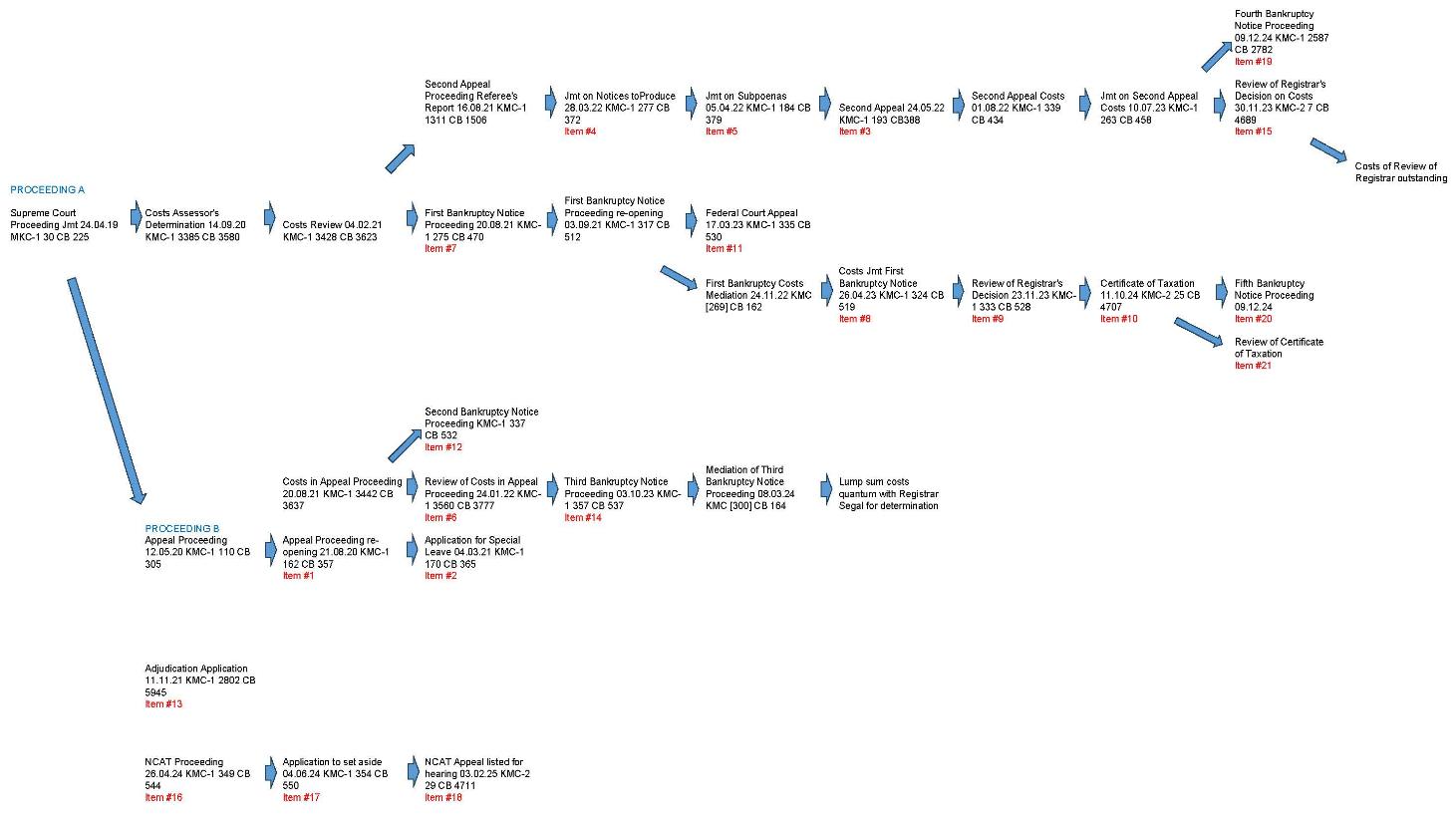
19 Those proceedings were usefully summarised by the prospective respondents in a flow chart (Exhibit R-10 in the initial proceeding: see PJ [83]) and as a chronological list of proceedings (Exhibit R-9 in the initial proceeding), which were provided as an annexure to the affidavit of Karen McLean sworn 16 March 2026 (Exhibit KMC-1). The flow chart is reproduced at Annexure A to these reasons.
20 The primary judge found that, even if the set aside applications had not been considered, she would have exercised her discretion to make the vexatious proceedings order: PJ [194]. Her Honour indicated further that, while it was unnecessary to consider two matters in the NSW Civil and Administrative Tribunal (initiated by Mr Lawrence) that were included in the 21 proceedings underpinning the application, she would have found those to be vexatious (as they had no tenable basis) had it been necessary to do so: PJ [193].
21 The primary judge found that Mr Lawrence frequently instituted or conducted vexatious proceedings (at PJ [195]), which conduct showed that Mr Lawrence “failed to accept the finality of litigation” and “continues to re-agitate failed claims, reflective of an unfortunate fixation”: PJ [196].
22 In relation to the set aside applications and the vexatious proceedings application, the primary judge observed the conduct of Mr Lawrence, who was legally represented, to be in “furtherance of an abuse” of the Court’s processes: PJ [192], [194]. Her Honour considered that the proceedings reveal that, whether represented or not, Mr Lawrence “does not conduct proceedings in a manner consistent with the obligation to further a just, quick and cheap resolution of the issues”: PJ [196].
23 Accordingly, the primary judge was satisfied that the applicant frequently institutes or conducts vexatious proceedings in Australian courts or tribunals, such that it was appropriate to make vexatious proceedings orders: PJ [199]. Her Honour made orders pursuant to s 37AO(2)(a) and (b) of the Act, prohibiting Mr Lawrence from instituting or continuing proceedings in this Court without making an application for, and obtaining, leave to institute proceedings in accordance with s 37AR of the Act.
24 In addition, her Honour dismissed Mr Lawrence’s applications to set aside the fourth and fifth bankruptcy notices, finding that he had failed to establish: (a) that he had a counter-claim, set-off or cross demand that was equal to, or exceeded, the amount owed under the fourth bankruptcy notice (at PJ [38]); and/or (b) that either notice constituted an abuse of process: PJ [58].
25 The hearing of Mr Lawrence’s application for leave to institute an appeal from the primary judgment took place on 14 April 2026, prior to the hearing of the creditor’s petition brought by the prospective respondents (referable to the fifth bankruptcy notice) on the same day.
Legislative framework
26 The term “vexatious proceeding” is non-exhaustively defined in s 37AM(1) of the Act:
vexatious proceeding includes:
(a) a proceeding that is an abuse of the process of a court or tribunal; and
(b) a proceeding instituted in a court or tribunal to harass or annoy, to cause delay or detriment, or for another wrongful purpose; and
(c) a proceeding instituted or pursued in a court or tribunal without reasonable ground; and
(d) a proceeding conducted in a court or tribunal in a way so as to harass or annoy, cause delay or detriment, or achieve another wrongful purpose.
27 An “abuse of the process of a court” (s 37AM(1)(a)) is not defined in the Act. It was observed in UBS AG v Tyne (2018) 265 CLR 77 at [1] per Kiefel CJ, Keane and Bell JJ that:
The varied circumstances in which the use of the court’s processes will amount to an abuse, notwithstanding that the use is consistent with the literal application of its rules, do not lend themselves to exhaustive statement. Either of two conditions enlivens the power: where the use of the court’s procedures occasions unjustifiable oppression to a party, or where the use serves to bring the administration of justice into disrepute.
(citations omitted)
28 The commencement of a proceeding that has no reasonable prospect of success, in the sense that it is “foredoomed to fail”, constitutes an abuse of process: Walton v Gardiner (1993) 177 CLR 378 at 393 per Mason CJ, Deane and Dawson JJ.
29 While s 37AM(1)(b) involves a subjective element in that it invites an enquiry into the purposes for which an applicant proposes to institute proceedings, the phrase “without reasonable ground” in s 37AM(1)(c) calls for an objective test, as articulated by Charlesworth J in Garrett, in the matter of Company One [2016] FCA 703 at [9]–[10]:
The phrase “without reasonable ground”, as used in paragraph (c) of the definition, is equivalent in meaning to the phrase “without reasonable cause”. In Spotless Services Australia Ltd v The Honourable Senior Deputy President Jeanette Marsh [2004] FCAFC 155 (Spotless) the Full Court considered the phrase “without reasonable cause” as it then appeared in s 347(1) of the Workplace Relations Act 1996 (Cth). The Full Court said (at [13]) that the question of whether a proceeding has been commenced without reasonable cause is to be answered as a matter of objective fact and requires an assessment of whether the proceeding is “bound to fail” or “so obviously untenable that it cannot possibly succeed”, “manifestly groundless” or “bad beyond argument”. In Hatchett v Bowater Tutt Industries Pty Ltd (No 2) (1991) 28 FCR 324, von Doussa J said (at FCR 327 [8]; IR 34):
“The test imposed by the expression ‘vexatiously or without reasonable cause’ is similar to the one applied by a court on an application for the exercise of summary power to stay or strike out proceedings: see Heidt v Chrysler Australia Ltd (1976) 26 FLR 257 at 272-273 and Geneff v Peterson (1986) 19 IR 40 at 87-88.”
The test being an objective one, it is not to the point that the applicant subjectively believes there to be a reasonable ground to institute the proceeding.
30 A “vexatious proceedings order” is defined in s 37AM(1) to mean an order made under s 37AO(2). Section 37AO of the Act relevantly provides:
37AO Making vexatious proceedings orders
(1) This section applies if the Court is satisfied:
(a) a person has frequently instituted or conducted vexatious proceedings in Australian courts or tribunals; or
(b) a person, acting in concert with another person who is subject to a vexatious proceedings order or who is covered by paragraph (a), has instituted or conducted a vexatious proceeding in an Australian court or tribunal.
(2) The Court may make any or all of the following orders:
(a) an order staying or dismissing all or part of any proceedings in the Court already instituted by the person;
(b) an order prohibiting the person from instituting proceedings, or proceedings of a particular type, in the Court;
(c) any other order the Court considers appropriate in relation to the person.
Note: Examples of an order under paragraph (c) are an order directing that the person may only file documents by mail, an order to give security for costs and an order for costs.
(3) The Court may make a vexatious proceedings order on its own initiative or on the application of any of the following:
(a) the Attorney‑General of the Commonwealth or of a State or Territory;
(b) the Chief Executive Officer;
(c) a person against whom another person has instituted or conducted a vexatious proceeding;
(d) a person who has a sufficient interest in the matter.
(4) The Court must not make a vexatious proceedings order in relation to a person without hearing the person or giving the person an opportunity of being heard.
(5) An order made under paragraph (2)(a) or (b) is a final order.
(6) For the purposes of subsection (1), the Court may have regard to:
(a) proceedings instituted (or attempted to be instituted) or conducted in any Australian court or tribunal; and
(b) orders made by any Australian court or tribunal; and
(c) the person’s overall conduct in proceedings conducted in any Australian court or tribunal (including the person’s compliance with orders made by that court or tribunal);
including proceedings instituted (or attempted to be instituted) or conducted, and orders made, before the commencement of this section.
31 Section 37AR of the Act provides for an application for leave to institute proceedings:
37AR Application for leave to institute proceedings
(1) This section applies to a person (the applicant) who is:
(a) subject to a vexatious proceedings order prohibiting the person from instituting proceedings, or proceedings of a particular type, in the Court; or
(b) acting in concert with another person who is subject to an order mentioned in paragraph (a).
(2) The applicant may apply to the Court for leave to institute a proceeding that is subject to the order.
(3) The applicant must file an affidavit with the application that:
(a) lists all the occasions on which the applicant has applied for leave under this section; and
(b) lists all other proceedings the applicant has instituted in any Australian court or tribunal, including proceedings instituted before the commencement of this section; and
(c) discloses all relevant facts about the application, whether supporting or adverse to the application, that are known to the applicant.
(4) The applicant must not serve a copy of the application or affidavit on a person unless an order is made under paragraph 37AT(1)(a). If the order is made, the applicant must serve the copy in accordance with the order.
32 Section 37AS of the Act provides for the dismissal of an application for leave to institute proceedings:
37AS Dismissing application for leave
(1) The Court or a Judge may make an order dismissing an application under section 37AR for leave to institute a proceeding if the Court or Judge considers the affidavit does not substantially comply with subsection 37AR(3).
(2) The Court or a Judge must make an order dismissing an application under section 37AR for leave to institute a proceeding if the Court or Judge considers the proceeding is a vexatious proceeding.
(3) The Court or a Judge may dismiss the application without an oral hearing (either with or without the consent of the applicant).
33 The Court may grant leave to institute a proceeding only if it is satisfied that the proceeding is not vexatious. Section 37AT of the Act provides:
37AT Granting application for leave
(1) Before the Court makes an order granting an application under section 37AR for leave to institute a proceeding, it must:
(a) order that the applicant serve:
(i) the person against whom the applicant proposes to institute the proceeding; and
(ii) any other person specified in the order;
with a copy of the application and affidavit and a notice that the person is entitled to be heard on the application; and
(b) give the applicant and each person described in subparagraph (a)(i) or (ii), on appearance, an opportunity to be heard at the hearing of the application.
(2) At the hearing of the application, the Court may receive as evidence any record of evidence given, or affidavit filed, in any proceeding in any Australian court or tribunal in which the applicant is, or at any time was, involved either as a party or as a person acting in concert with a party.
(3) The Court may make an order granting the application. The order may be made subject to the conditions the Court considers appropriate.
(4) The Court may grant leave only if it is satisfied the proceeding is not a vexatious proceeding.
34 An applicant is not obliged to demonstrate that the proceeding sought to be instituted must succeed in order to obtain a grant of leave, only that it is reasonably arguable and that it itself is not a vexatious proceeding: Crocker, in the matter of Crocker [2019] FCA 432 at [12] per Logan J.
35 An application for leave under s 37AR of the Act is, necessarily, determined against the litigation history of the applicant and the fact that the applicant has already been found to be a person who has frequently instituted or conducted vexatious proceedings in Australian courts or tribunals. That history may, in a given case, be a relevant and weighty circumstance in determining whether the proceeding sought to be instituted is also to be regarded as vexatious, particularly where that proceeding appears to be an attempt to re-agitate an issue already determined: Garrett at [19] per Charlesworth J.
36 Proceedings may be vexatious where they impose on the respondent party an unnecessary injustice in the form of a burden other than, and additional to, the burden necessarily imposed on a party to litigation instituted on reasonable grounds for the purpose of obtaining relief within the scope of the available remedy: Walton at 411 per Brennan J; see also Prior v South West Aboriginal Land and Sea Council Aboriginal Corporation [2020] FCA 808 at [38] per McKerracher J.
37 The question is not whether proceedings have been instituted vexatiously, but whether the legal proceedings are in fact vexatious: Jones v Skyring (1992) 109 ALR 303 at 310 per Toohey J, citing Re Vernazza [1960] 1 QB 197 at 208 per Ormerod LJ. That may be a subtle distinction, but it is an important one.
38 It is not necessary for the Court to identify that any particular party to the proposed litigation would be troubled, vexed or harassed by the proceeding sought to be instituted. Part VAAA of the Act is protective not only of the interest of persons who may be joined or otherwise directly or indirectly affected by a vexatious proceeding, but of the public interest in the proper administration of justice more broadly: Garrett at [18]; see also Fuller at [31].
39 In accordance with s 37AT(4), it is for the applicant to demonstrate that the proposed appeal is not a vexatious proceeding, and with a view to that conclusion (although there may be other relevant factors), to demonstrate that any of the proposed grounds of appeal are reasonably arguable.
Application for leave to appeal
40 The originating application is unorthodox in form and content, and difficult to comprehend in parts. It is expressed in the following terms:
1. Under the Ex Parte Application (s 37AR leave)
2. Federal Court of Australia Act 1976 (Cth)
3. “The Applicant seeks leave to appeal from the judgment of the Honourable Justice Raper delivered 29 August 2025 declaring the Applicant a vexatious litigant and dismissing applications to set aside bankruptcy notices.”
4. The Applicant, Wayne James Lawrence, applies to the Court under s 37AR of the Federal Court of Australia Act 1976 (Cth) for leave to institute proceedings notwithstanding the vexatious proceedings order made against him on 29 August 2025 in Sammut v Lawrence [2025] FCA 1040.
5. Orders sought.
6. 1. Pursuant to s 37AR of the Federal Court of Australia Act 1976 (Cth), the Applicant be granted leave to institute proceedings in the Federal Court of Australia challenging the vexatious proceedings order made by Justice Raper on 29 August 2025.
7. Annexure WJL-2 (Schedule of Proceedings) is relied upon to demonstrate that the '21 proceedings’ referred to in the judgment were in fact interlocutory steps and appeals within 3-4 core dispute streams, not separate cases.
3. Such further or other orders as the Court deems appropriate.
Leave to appeal the dismissal of the set aside applications
41 The prospective respondents submit that, although the applicant seeks leave to appeal from the orders dismissing the set aside applications, the proposed grounds of appeal do not advance any ground for setting aside that aspect of the primary judgment. On that basis, it is argued, that aspect of the appeal has no reasonable prospect of success and falls within paragraph (c) of the definition of “vexatious proceedings” under s 37AM(1) of the Act, i.e., a proceeding instituted in a court without reasonable ground.
42 The prospective respondents contend for this conclusion on the basis of the absence of any ground in support of the relief sought in the originating application by way of the dismissal of the applications to set aside the bankruptcy notices (prayer 3). This omission is compounded by the fact that the relief sought relates exclusively to the vexatious proceedings order.
43 This omission is consistent with the applicant’s focus in the filed materials and oral submissions, which is not concerned with any proposed appeal from the orders dismissing the set aside applications. Rather, any issue with the bankruptcy notices appears to be with their characterisation as vexatious proceedings, rather than as “legitimate defensive litigation” as contended by the applicant.
44 In his written submissions, the applicant suggests that the primary judge overlooked payment of an amount ($91,989) into trust “in response to the fourth bankruptcy notice”, and the “non-final status of the debts”. There is no evidence that the debts the subject of the bankruptcy notices, which were judgment debts and/or amounts in certificates of taxation or assessment of costs, were not finally determined (save for the second bankruptcy notice, which was automatically stayed once the applicant filed a review of the subject costs after issuance of the notice: see PJ [105]–[106], [173]–[176]): see PJ [93], and more broadly, [84]–[115]. Furthermore, it is evident that the primary judge considered the applicant’s evidence in relation to the proposed payment of $91,989: PJ [72]–[74]. Indeed, it was (partly) on that basis that the primary judge dismissed both set aside applications: PJ [75].
45 Furthermore, in relation to the application to set aside the fourth bankruptcy notice, the primary judge considered and rejected the applicant’s claims as to set-off (PJ [28]–[52]) and abuse: PJ [54]–[75]. There is no cogent argument identifying any error in those findings. The prospective respondents submit that, even if such an error had been identified, no purpose would be served by an appeal as the amount owed under the notice has been paid, and setting it aside would not result in a repayment to the applicant. In those circumstances, I agree that any appeal “can have no proper purpose”, “would harass or annoy or cause delay or detriment” and, as such, would be vexatious.
46 As to the fifth bankruptcy notice (which the applicant is yet to satisfy and is the subject of the creditor’s petition in Sammut v Lawrence, in the matter of Lawrence [2026] FCA 1506), the prospective respondents submit that the applicant originally agreed to pay two of the three amounts comprising that notice, but reneged on that position during the course of taxation. The applicant then sought to review all three of those amounts, which review was summarily dismissed with costs: Lawrence v Sammut (No 3) [2025] FedCFamC2G 1214. The applicant now seeks taxation of the costs that he was ordered to pay on that dismissal in continuation of “the cycle of vexation”. The prospective respondents submit that the primary judge dismissed the applicant’s claim that the fifth bankruptcy notice was an abuse of process, and that any appeal would need to address the credit findings made (at PJ [65]–[67]), which is not open on the material filed by the applicant. I agree with the prospective respondent’s characterisation of the applicant’s challenge to the dismissal of the set aside application in relation to the fifth bankruptcy notice.
47 I also accept the prospective respondents’ characterisation of the applicant’s filed materials, which exhibit many of the characteristics referred to in the proceedings canvassed in the primary judgment: summarised at PJ [196]. In the present case, the applicant’s submissions re-agitate failed claims; they do not correspond directly with the proposed grounds of appeal and are ambiguous; they are replete with assertions lacking any legal or evidentiary foundation, and they contain allegations that are of no apparent relevance to the proceeding.
48 For these reasons, insofar as the applicant seeks leave to appeal the set aside applications, I consider that such a proceeding would be instituted without reasonable ground, and would be an abuse of the process of the Court in the manner outlined in Walton.
49 As I am not satisfied that the proposed proceeding is not a vexatious proceeding, I refuse the applicant leave to appeal the set aside applications: s 37AT(4) of the Act.
Proposed grounds of appeal (vexatious proceedings order)
50 It is therefore necessary to consider whether the applicant has demonstrated that any of the proposed grounds of appeal (regarding the vexatious proceedings order) are reasonably arguable. For the reasons below, I do not consider that they are.
51 On 5 December 2025, the applicant filed written submissions in support of the originating application, which purport to advance eight grounds of appeal. On 27 February 2026, the applicant filed a document outlining seven proposed grounds of appeal. I have relied on the proposed grounds of appeal, and on the written submissions to the extent that they supplement those grounds. The written submissions contained a considerable degree of duplication, which I have sought to avoid in addressing the proposed grounds of appeal, below.
52 The applicant’s main contention, and the focus of his oral submissions, is that the 21 proceedings relied upon by the prospective respondents before the primary judge are not properly characterised as individual proceedings. Despite being expressed as separate arguments, each of the applicant’s proposed grounds and written submissions speak to the same essential point that was made at the hearing, viz., that the primary judge erred by failing to treat the proceedings relied upon by the prospective respondents as a single proceeding when determining the vexatious proceedings application.
53 The applicant submits that the litigation between the parties since 7 November 2017 is “all part of the same proceedings”. The applicant views the proceedings as being “a singular court case” with many branches. The applicant argues that the proceedings are “all connected, one way or another” such that they cannot be classified as discrete matters.
54 The argument is not persuasive. The applicant does not explain why a ‘connection’ between several (separately instituted or maintained) proceedings should result in their characterisation as one proceeding.
55 The applicant advanced further “grounds” in written submissions, which were not referenced in the proposed grounds of appeal. Those grounds include that the primary judge relied on misleading or selective evidence; the applicant was denied procedural fairness (citing Kioa v West (1985) 159 CLR 550); the debts underlying the bankruptcy notices were not “final” such that “legitimate defensive litigation” undertaken by the applicant in response cannot be said to be “vexatious”; and the primary judge failed to “engage with credibility issues exposed in cross-examination”.
56 The prospective respondents submit that the Court would not be satisfied that any of the applicant’s proposed grounds are reasonably arguable. In the alternative, they submit that, even if the Court were minded to grant leave, this should be limited to grounds that are reasonably arguable, which necessarily precludes any appeal in relation to the set aside applications, which was not addressed in the proposed grounds. As indicated above, I consider such an appeal to constitute a vexatious proceeding.
57 The applicant bears the onus of satisfying the Court that leave should be granted, and in that regard must comply with the requirements of r 36.01(2)(c) of the Rules in specifically identifying the grounds relied on in support of the appeal: see SZJJC v Minister for Immigration & Citizenship [2008] FCA 614 at [15] per Flick J.
58 The applicant must demonstrate that there is a basis for the assertion of error in the judgment and the evidence. The required standard is not met by bare assertions of a cause of action or appeal point: see, e.g., Bhagat v Global Custodians Ltd [2002] FCA 223 at [53] per O'Loughlin, Whitlam and Marshall JJ. Similarly, the applicant “cannot satisfy the Court that a cross demand exists by showing no more than that [he] propounds one and states how [he] suggests that [he] can make it out”: Ebert v The Union Trustee Company of Australia Limited (1960) 104 CLR 346 at 350 per Dixon CJ, McTiernan and Windeyer JJ. As has been made clear, the grounds of appeal do not even go that far in challenging the set aside applications.
59 The prospective respondents contend that a recurring error infects proposed grounds 1, 2, 3, 4 and 6; viz., the assumption that they were required to demonstrate that the relevant proceedings were instituted without reasonable grounds or for an improper purpose in order to be found vexatious. This overlooks the non-exhaustive definition of “vexatious proceeding” in s 37AM of the Act.
Proposed ground 1 – the primary judge treated “defensive enforcement responses” as “vexatious proceedings”
60 The applicant claims that the primary judge erred by treating applications to set aside bankruptcy notices and “resistance to enforcement of disputed costs” as vexatious proceedings for the purposes of s 37AO of the Act. The applicant submits that those proceedings were “responsive to enforcement steps” and were not independent “originating proceedings” instituted without reasonable grounds. The applicant contends that the judgment does not identify that those proceedings were instituted or conducted without reasonable grounds or for an improper purpose.
61 As the prospective respondents submit, the applicant does not point to any specific error in the analysis of the relevant principles at [116]–[126] of the primary judgment. Furthermore, the applicant’s argument proceeds on a premise, which is the necessary exclusion (from the definition of “vexatious proceedings”) of proceedings that are “responsive” to enforcement steps and that are not “independent” proceedings instituted “without reasonable grounds.” The broad definition of “vexatious proceedings” in s 37AM of the Act, and specifically the contemplation of the conduct of the proceeding in s 37AM(1)(d) of the Act, demonstrates that premise to be false, and makes such an argument hopeless.
62 Even if the applicant’s characterisation of the proceedings in question were accepted, it would not preclude a characterisation of a “vexatious proceeding”. It is clear that a vexatious proceeding is not limited to a proceeding instituted by a person without reasonable grounds, but can include a proceeding that is an abuse of process or is conducted in a way so as to harass or annoy, cause delay or detriment, or achieve another wrongful purpose. There is no cause to limit the definition in the manner suggested by the applicant. As the prospective respondents argue, to do so would be inconsistent with the object of Part VAAA of the Act, which is to protect “the court’s own processes against unwarranted usurpation of its time and resources and to avoid loss caused to those who face actions which lack substance”: Soden v Croker (No 2) (2016) 334 ALR 540 at [7] per Perry J, quoting Ramsey v Skyring (1999) 164 ALR 378 at [52] per Sackville J.
63 The applicant demonstrates no error in principle. This first proposed ground of appeal has no merit.
Proposed ground 2 – the primary judge treated procedural steps as separate proceedings
64 The applicant contends that the primary judge erred by treating “procedural steps within an ongoing dispute” as separate proceedings, supporting the finding that the applicant had frequently instituted vexatious proceedings, contrary to the requirements of s 37AO.
65 The prospective respondents submit that this argument was addressed (and rejected) in the primary judgment: at [121]. This argument is not supported by the statutory text, nor the relevant authorities (which have classified interlocutory applications as separate proceedings): see, e.g., Laverack (formerly AZO24) v Commonwealth of Australia (Vexatious Proceedings Order) [2025] FCAFC 162 at [25] per Wigney, Lee and Raper JJ; Storry v Parkyn (Vexatious Proceedings Order) (2024) 304 FCR 318 at [24] per Lee, Feutrill and Jackman JJ; and Ferdinands v Registrar Burns (Vexatious Proceedings Order) [2024] FCAFC 157 at [19] per Cheeseman, Goodman and McEvoy JJ.
66 This proposed ground suffers from a similar flaw as the first proposed ground, in that the applicant seeks to narrow the definition of a “vexatious proceeding” in a way that is not supported by the text of s 37AM nor the object of Part VAAA of the Act.
67 The second proposed ground of appeal has no merit.
Proposed ground 3 – the primary judge misapplied s 37AO
68 The applicant claims that the primary judge misapplied s 37AO of the Act by “focusing on multiplicity and repetition” rather than determining whether each matter relied upon was instituted or conducted without reasonable grounds or for an improper purpose. The applicant refers by way of example to the primary judgment at [116]–[122] and [190]–[196], submitting that “[m]ultiplicity alone does not satisfy the statutory threshold”.
69 This is a ‘straw man’. The primary judge makes no such finding.
70 The prospective respondents refer to [123]–[125] of the primary judgment, wherein the primary judge analysed what is meant by the word “frequently” in s 37AO of the Act. The applicant does not identify any error in that analysis. Furthermore, it is evident that the primary judge’s analysis of the proceedings she found to be vexatious was not limited to a consideration of multiplicity and repetition: PJ [150]–[192].
71 The third proposed ground of appeal has no merit.
Proposed ground 4 – the primary judge included appeals and leave applications
72 The applicant asserts that the primary judge erred in including appeals and applications for leave “as part of the vexatious calculus” without identifying findings that those processes were vexatious. The applicant submits that “[s]tatutorily authorised appellate processes cannot, without specific findings of lack of reasonable grounds, constitute vexatious proceedings” under s 37AO. The applicant does not provide any authority in support of this submission.
73 The applicant has not identified the proceedings to which he refers. In any event, the purported statement of legal principle is without foundation. Like proposed appeal grounds 1 and 2, this ground ignores the broad and inclusive definition of “vexatious proceedings” and seeks to import restrictions on that definition that have no anchor in the text or object of the relevant statutory provisions.
74 As the prospective respondents submit, the applicant’s assertion that an appeal commenced as of right cannot be vexatious, cannot be sustained.
75 The fourth proposed appeal ground has no merit.
Proposed ground 5 – the primary judge failed to precisely identify which proceedings were found to be vexatious
76 The applicant asserts that the primary judge failed to identify with “sufficient precision” which proceedings were vexatious, whether those proceedings were “originating proceedings or defensive procedural steps”, and how each proceeding satisfied the statutory definition.
77 As the prospective respondents submit, [194] of the primary judgment identifies precisely which proceedings were found to be vexatious, for the reasons identified by the primary judge: PJ [150]–[192].
78 For the reasons outlined above in relation to proposed grounds 1 and 2, it is not necessary to identify whether the proceedings were “originating proceedings or defensive procedural steps”. The applicant’s argument relies on a false distinction.
79 The fifth proposed ground of appeal has no merit.
Proposed ground 6 – the primary judge relied substantially on affidavits sworn by the prospective respondents’ solicitor in characterising the litigation history
80 The applicant claims that the primary judge erred by relying substantially on affidavit material sworn by the prospective respondents’ solicitor as the “narrative foundation” of the litigation history (see PJ [99]–[100]) without undertaking “distinct forensic separation” between “solicitor-sworn characterisations of proceedings” and the Court’s “independent statutory task of identifying proceedings instituted or conducted without reasonable grounds”. The applicant clarifies that this proposed ground “alleges structural analytical error, not impropriety”.
81 The crux of the argument is that the primary judge relied on affidavit evidence which the applicant impugns.
82 In oral and written submissions, the applicant argued that the proceedings underpinning the vexatious proceedings order were “initiated, controlled or escalated” by the prospective respondents’ solicitor, Ms McLean, and “misattributed” to Mr Lawrence. In that regard, the applicant relies on matters, including that: (1) the affidavit material before the primary judge was “sworn exclusively” by Ms McLean; (2) counsel for the prospective respondents repeatedly referred to “my instructing solicitor” before the primary judge; (3) there were no affidavits of either of the prospective respondents before the primary judge (“the absence of client evidence”); (4) all of the relevant bankruptcy notices were drafted and issued by Ms McLean; (5) the steps to enforce costs determinations were taken on Ms McLean’s initiative; and (6) Ms McLean prepared and lodged court books, exhibits, and affidavits.
83 The applicant submits that the steps that he has taken throughout the litigation history “were largely reactive or defensive”: e.g., applications to set aside bankruptcy notices; appeals or reviews of costs determinations; responses to enforcement action “commenced at the solicitor’s instigation”. This aspect of the ground is addressed in relation to proposed grounds 1 and 2. As stated above, it proceeds on a false premise.
84 The applicant submits that in “characterising the entire litigation history as [a]pplicant-driven”, the primary judge misapplied s 37AO(1) (the applicant incorrectly refers to s 37AO(2) in his written submissions), which requires examination of whether “the person” has “frequently instituted or conducted vexatious proceedings”. The applicant argues that, as the “primary acts” are “solicitor-driven”, it is an error to treat them as if they were “personally initiated”. (It is not evident what findings the applicant relies upon to claim that the primary judge characterised the proceedings in the manner asserted.)
85 As the prospective respondents submit, the solicitor for the prospective respondents was cross-examined before the primary judge, in respect of which the primary judge made positive credibility findings: PJ [17], [66]. Even if those credit findings were overturned on appeal, the proposed ground does not point to any relevant finding in characterising the litigation history that rested on those credit findings. Rather, the primary judge’s characterisation of the proceedings rests on an assessment of the applicant’s own conduct: see PJ [196]–[199].
86 Finally, while ultimately irrelevant, I observe that none of the matters on which the applicant relies demonstrates anything extraordinary about McLean’s conduct. It certainly does not make good the proposition that the proceedings in which the applicant initiated or conducted were “initiated, controlled or escalated” by Ms McLean. Nor does it establish any procedural unfairness by way of the Court’s reliance on Ms McLean’s affidavits “without client evidence”, or by way of “acceptance of untested bar-table allegations”, which appears to be the basis upon which the applicant advances that claim.
87 Accordingly, the sixth proposed ground of appeal has no merit.
Proposed ground 7 – the primary judge failed to analyse whether the matters relied upon arose from a single enforcement and costs sequence
88 The applicant claims that the primary judge erred in failing to analyse whether the proceedings relied upon as evidence of vexatious litigation arose from a single “continuing enforcement and costs-assessment sequence”, which the applicant submits includes costs determinations, taxation and review processes, bankruptcy notices issued to enforce costs, and applications to set aside those notices. In this context, it is argued, “defensive responses were practically compelled to avoid insolvency consequences”.
89 This proposed ground is an iteration of proposed grounds 1 and 2. It fails for the same reasons.
90 The prospective respondents rightfully reject the applicant’s characterisation of the litigation between them. They submit that the applicant’s approach to non-payment of his debts and the enforcement of them has resulted in “numerous costs orders of significant magnitude against him which he insists be taxed or assessed and then exercises every avenue of appeal, leading to an inevitable further cycle”. The prospective respondents submit correctly that the suggestion that an alternative analysis would somehow vindicate the applicant’s conduct, is untenable.
91 The seventh proposed ground of appeal has no merit.
92 As I am not satisfied that any of the proposed grounds of appeal have merit, I consider that the proposed appeal would constitute an abuse of the Court’s process in the manner outlined in Walton.
Conclusion
93 The applicant has not established that: (a) the proposed grounds of appeal are reasonably arguable; or (b) the proposed appeal is not a vexatious proceeding. Accordingly, I refuse the application for leave to institute an appeal from the primary judgment.
COSTS
94 The applicant will be ordered to pay the prospective respondent’s costs of the leave application.
95 The prospective respondents submitted orally that, having regard to the history of the proceedings before this and other courts, and the difficulty of reaching settlement between the parties, in order to avoid further elongating the proceeding, they would seek a lump sum order for costs, and leave to put on evidence in support of that application, in the event that the leave application is refused.
96 The Court has the power to make such an order under s 43(3)(d) of the Act (and on an application under r 40.02(b) of the Rules). The purpose of awarding costs as a lump sum is the avoidance of the expense, delay and aggravation involved in protracted litigation arising out of taxation: Beach Petroleum NL v Johnson (No 2) (1995) 57 FCR 119 at 120 per von Doussa J.
97 Alternatively, the prospective respondents submitted that the question of costs should be referred to a referee for a “truncated” process to occur.
98 In reply, the applicant expressed a preference for the alternative proposal of a referee (in lieu lump sum costs order). The applicant also asked that the matter be “put to a judicial inquiry” (as to “[w]hy a set of proceedings has grown from a caveat on a title”) in order to “protect the public”. I see no cause to do so. In my view, the reasons emerge clearly from the primary judgment.
99 I am mindful of the primary judge’s finding that the applicant has failed to accept the finality of litigation and continues to re-agitate failed claims, reflective of an unfortunate fixation: PJ [196]. To promote the overarching purpose of the civil practice and procedure provisions in the Act, reflected in s 37M of the Act, and in order to avoid the invidious cycle to which her Honour and the prospective respondents refer, I am satisfied that it is appropriate to order lump sum costs so as to avoid the further expense and delay of an assessment process, and so as to facilitate a proximate end to this saga. I am not satisfied that a referral would achieve the same end.
100 Accordingly, I will grant the prospective respondents leave to file evidence and any short submissions in support of their application for a lump sum costs order, and for the applicant to respond to that evidence, with a view to assisting the Court in identifying a reasonable lump sum. That matter will be determined on the papers.
I certify that the preceding one hundred (100) numbered paragraphs are a true copy of the Reasons for Judgment of the Honourable Justice Younan. |
Associate:
Dated: 13 October 2026
Annexure A