

Federal Court of Australia
Australia and New Zealand Banking Group Limited v Zurich Australian Insurance Limited [2026] FCA 1490
File number: | VID 478 of 2025 |
Judgment of: | BEACH J |
Date of judgment: | 9 October 2026 |
Catchwords: | INSURANCE — indemnity insurance — excess layer policies covering inter–alia civil liability to third parties — insured paid out settlement amounts to settle two representative proceedings against it — characterisation of such claims — whether restitutionary or compensation claims — construction of excess policies — meaning of “Loss” — application of indemnification principle — meaning of “fees” — meaning of “commissions” — meaning of “or other charges” — discussion of ejusdem generis principle — discussion of the nature of interest — discussion of ambit of phrases “based on” or “arising out of” — application of exclusion — principles of interpretation — whether cover for defence costs — stipulation of separate question — question answered |
Legislation: | Australian Securities and Investments Commission Act 2001 (Cth) ss 12CB, 12DA, 12GF and 12GM Corporations Act 2001 (Cth) ss 946A, 961B, 961G, 961J, 1041H, 1041I Federal Court of Australia Act 1976 (Cth) s 33V National Consumer Credit Protection Act 2009 (Cth) ss 143 and 180A of Schedule 1 Supreme Court Act 1986 (Vic) s 33V |
Cases cited: | Addison v Cain (1932) 47 CLR 208 AIG Australia Ltd v Kaboko Mining Ltd (2019) 20 ANZ Insurance Cases ¶62-205; [2019] FCAFC 96 APD Technology Pty. Ltd. v Maximo Developments Pty. Ltd. [2022] FCAFC 141 Arbuthnott v Fagan [1996] LRLR 135 Arnold v Britton [2015] AC 1619; [2015] UKSC 36 Attree Pty. Ltd. v Certain Underwriters at Lloyds of London [2024] FCA 1408 Australian Securities and Investments Commission v Mitchell (No 2) (2020) 382 ALR 425 Beaufort Developments (NI) Ltd v Gilbert-Ash (NI) Ltd [1999] 1 AC 266 British Traders’ Insurance Co Ltd v Monson (1964) 111 CLR 86 Brown v Commissioner of Taxation (2001) 187 ALR 714 Castellain v Preston [1883] 11 QBD 380 Chartbrook Ltd. v Persimmon Homes Ltd. [2009] AC 1101 Chubb Insurance Company of Australia Ltd v Robinson (2016) 239 FCR 300 Codelfa Construction Pty Ltd v State Rail Authority (NSW) (1982) 149 CLR 337 Cody v JH Nelson Pty. Ltd. (1947) 74 CLR 629 Collector of Customs v Agfa-Gevaert Ltd (1996) 186 CLR 389 Dalby Bio-Refinery Ltd v Allianz Australia Insurance Ltd [2019] FCAFC 85 Darlington Futures Ltd v Delco Australia Pty Ltd (1986) 161 CLR 500 Dickenson v Motor Vehicle Insurance Trust (1987) 163 CLR 500 Doyle v Australian Securities and Investments Commission (2005) 227 CLR 18; 223 ALR 218 Drielsma v Manifold [1894] 3 Ch 100 FKP Commercial Developments Pty Limited v Zurich Australian Insurance Limited [2022] FCA 862 Grove v Flavel (1986) 43 SASR 410 Hakea Holdings Pty. Ltd. v Neon Underwriting Ltd. (2023) 296 FCR 611 Horsell International Pty. Ltd. v Divetwo Pty Ltd (2014) 18 ANZ Insurance Cases ¶61-991; [2013] NSWCA 368 Insurance Australia Ltd v MOS Beverages Pty. Ltd. (2021) 286 FCR 1 LCA Marrickville Pty. Ltd. v Swiss Re International SE (2022) 290 FCR 435 Liberty Mutual Insurance Co v QBE Underwriting Ltd (2021) 396 ALR 193 Lowe Pty Ltd v Belgravia Nominees Pty Ltd [2020] WASCA 180 Mount Bruce Mining Pty Ltd v Wright Prospecting Pty Ltd (2015) 256 CLR 104 Murray Goulburn Co-operative Co Ltd. v AIG Australia Ltd. (2021) 389 ALR 453; [2021] FCA 288 National Vulcan Engineering Insurance Group Ltd v Coffey Partners International Pty. Ltd. (2003) 59 NSWLR 119 O’Brien v Australia and New Zealand Banking Group Ltd [2025] VSC 389 R v Byrnes (1995) 183 CLR 501 Rainy Sky SA v Kookmin Bank [2011] 1 WLR 2900; [2011] UKSC 50 Reilly v Australia and New Zealand Banking Group Ltd (No 5) [2023] FCA 896 Royal & Sun Alliance Insurance Ltd v Tughans (a firm) (No 2) [2024] 2 All ER 747 Star Entertainment Group Ltd v Chubb Insurance Australia Ltd (2022) 400 ALR 25 Todd v Alterra at Lloyd’s Ltd (2016) 239 FCR 12; 330 ALR 454; [2026] FCAFC 15 Transfield Pty Ltd v National Vulcan Engineering Insurance Group Ltd [2002] NSWSC 830; (2003) 12 ANZ Ins Cas ¶61-547 Wallaby Grip Ltd v QBE Insurance (Australia) Limited (2010) 240 CLR 444 West Wake Price & Co v Ching [1957] 1 WLR 45 |
Other materials: | Black’s Law Dictionary (12th ed, 2024) Concise Oxford English Dictionary (12th ed, Oxford University Press, 2011) LexisNexis Australian Legal Dictionary (2nd ed, 2016) LexisNexis Words and Phrases Legally Defined (5th ed, 2018) Macquarie Dictionary, 7th ed. (2017) Macquarie Dictionary (online, 2025) Oxford English Dictionary Online (June 2025) Stroud’s Judicial Dictionary of Words and Phrases (11th ed, 2023) The Law of Liability Insurance (D. Derrington & R. Ashton, 3rd ed, 2013) |
Division: | General Division |
Registry: | Victoria |
National Practice Area: | Commercial and Corporations |
Sub-area: | Commercial Contracts, Banking, Finance and Insurance |
Number of paragraphs: | 355 |
Date of hearing: | 9 December 2025 |
Counsel for the Applicant: | Dr M D Rush KC and Mr M C Roberts |
Solicitors for the Applicant: | Herbert Smith Freehills Kramer |
Counsel for the 1st, 4th, 8th, 9th, 14th, 23rd Respondents | Mr G K J Rich SC and Ms E Bathurst |
Solicitors for the 1st and 14th Respondents | Colin Biggers & Paisley |
Solicitors for the 4th Respondent | Clyde & Co |
Solicitors for the 8th Respondent | Lander & Rogers |
Solicitors for the 9th Respondent | Moray & Agnew |
Solicitors for the 23rd Respondent | YPOL Lawyers |
Counsel for the 2nd, 3rd, 5th, 6th, 7th, 10th, 11th, 12th, 13th, 15th, 16th, 17th, 18th, 19th, 20th, 21st, 24th, 25th, 26th Respondents | Mr P B Murdoch KC and Mr D J Briggs |
Solicitors for the 2nd, 3rd, 5th, 6th, 7th, 10th, 11th, 12th, 13th, 15th, 16th, 17th, 18th, 19th, 20th, 21st, 24th, 25th, 26th Respondents | Kennedys |
Counsel for the 22nd Respondent | Mr C M Archibald KC and Mr M Nguyen |
Solicitors for the 22nd Respondent | Kennedys |
ORDERS
VID 478 of 2025 | ||
| ||
BETWEEN: | AUSTRALIA AND NEW ZEALAND BANKING GROUP LIMITED (ACN 005 357 522) Applicant | |
AND: | ZURICH AUSTRALIAN INSURANCE LIMITED (ACN 000 296 640) First Respondent CERTAIN UNDERWRITERS AT LLOYD’S SUBSCRIBING TO SYNDICATE NO. 2987 BRIT, LONDON FOR THE 2017 YEAR OF ACCOUNT Second Respondent CERTAIN UNDERWRITERS AT LLOYD’S SUBSCRIBING TO SYNDICATE NO. 4711, LONDON FOR THE 2017 YEAR OF ACCOUNT Third Respondent (and others named in the Schedule) | |
order made by: | BEACH J |
DATE OF ORDER: | 9 October 2026 |
THE COURT ORDERS THAT:
1. To the separate question stipulated as:
On the proper construction of contracts of insurance nos. FSASA1700412, FSASA1700413 and FSASA1700414, for the period 30 September 2017 to 30 September 2018 (the excess policies), was any, and if so, which of:
(i) the sum of AUD85,000,000 which the ANZ agreed to pay to the plaintiffs in settlement of proceeding No. SECI 2020 03365 in the Supreme Court of Victoria (the O’Brien proceeding);
(ii) the ANZ’s costs and expenses in defending the O’Brien proceeding;
(iii) the sum of AUD31,920,000 which the ANZ agreed to pay to the applicants in settlement of proceeding No. VID 133 of 2020 in the Federal Court of Australia (the Reilly proceeding); and
(iv) the ANZ’s costs and expenses in defending the Reilly proceeding,
(a) a “Loss” as defined by the Excess Policies? and if yes,
(b) excluded from cover under the Excess Policies by operation of Exclusion Clause 11 of Section 2 of contract of insurance nos. FSASA1700412 and/or Condition 7 of each of contracts of insurance nos. FSASA1700413 and FSASA1700414?
the answer as to (a) is “No” in respect of each element (i) to (iv).
2. Further, if the answer to (a) in respect of any element (i) to (iv) should have been “Yes”, then the answer as to (b) in respect of such element is “Yes”.
3. Costs reserved.
4. Within 14 days of the date of this order the applicant file and serve minutes of proposed orders to give effect to and dealing with the consequences of the answer to the question including as to costs, together with any short outline of submissions.
5. Within 14 days of the receipt of the applicant’s minutes of proposed orders and outline of submissions, the respondents file and serve minutes of proposed orders together with any short outline of submissions addressing such topics.
6. Liberty to apply.
Note: Entry of orders is dealt with in Rule 39.32 of the Federal Court Rules 2011.
REASONS FOR JUDGMENT
BEACH J:
1 Australia and New Zealand Banking Group Limited in 2017 entered into policies of excess insurance with the respondent underwriters, being contracts of insurance FSASA1700412 (the first excess policy), FSASA1700413 (the second excess policy) and FSASA1700414 (the third excess policy) for the period 30 September 2017 to 30 September 2018.
2 By these proceedings, the ANZ seeks an order that each of the underwriters of the first, second and third excess policies indemnify the ANZ in respect of its liability for settlement payments made and defence costs incurred in connection with two representative proceedings. But the respondents have refused to indemnify the ANZ under the excess policies for amounts the ANZ paid in settlement of these two proceedings, the details of which I will elaborate on in a moment.
3 In broad terms, the excess policies provided cover for the ANZ for loss arising from crimes perpetrated against the ANZ and loss resulting from a claim against the ANZ for civil liability. The excess policies were entered into in or around September 2017, with each of them covering the policy period. The excess policies formed part of an insurance tower, which had the following tiers.
4 First, ANZCover Insurance Pte Ltd agreed to provide cover under the primary policy up to an aggregate limit of liability of $50 million as the primary layer.
5 Second, the first to ninth respondents agreed to provide cover under the first excess policy up to an aggregate limit of liability of $50 million in excess of the primary layer, that is, $50 million to $100 million being the first excess layer.
6 Third, the first, seventh, eighth and tenth to nineteenth respondents agreed to provide cover under the second excess policy up to an aggregate limit of liability of $75 million in excess of the first excess layer, that is, $100 million to $175 million being the second excess layer.
7 Fourth, the third, sixth to eighth, eleventh, twelfth, sixteenth, eighteenth and twentieth to twenty–sixth respondents agreed to provide cover under the third excess policy up to an aggregate limit of liability of $75 million in excess of the second excess layer, that is, $175 million to $250 million being the third excess layer.
8 A deductible of $1 million applies to each of the excess policies for each and every single loss. Condition 7 of each of the second excess policy and the third excess policy provides that those policies are subject to the same terms as the first excess policy.
9 The proportions in which each of the respondents agreed to participate in one or more of these tiers of coverage are specified in the schedule of security details in each excess policy.
10 Now one of the representative proceedings known as the Reilly proceeding related to consumer credit insurance products (ANZ CCI products) which the ANZ offered to its customers. The Reilly proceeding was commenced in February 2020 in this Court against the ANZ, OnePath Life Limited, OnePath General Insurance Pty Limited and QBE Insurance Australia Limited. At the material time, OnePath Life and OnePath General were subsidiaries of the ANZ. Both companies were subsidiaries of the ANZ prior to and throughout the policy period. The primary relief sought in the Reilly proceeding was the repayment of premiums paid under the ANZ CCI products and orders setting aside the policies. The proceeding settled before trial, and the settlement was approved by this Court on 23 June 2023. Pursuant to that settlement, the ANZ agreed to pay $31.92 million.
11 The other representative proceeding known as the O’Brien proceeding related to motor vehicle asset finance products provided to consumers by the ANZ. The O’Brien proceeding was commenced in August 2020 in the Supreme Court of Victoria against the ANZ and Macquarie Bank Limited. The plaintiff’s primary case on quantum in the O’Brien proceeding was that the ANZ was liable for the difference between the amount of interest payable to it at the contract rate for the life of each car loan and the amount of interest that would have been payable at the base rate. The proceeding settled shortly prior to trial, and the settlement was approved on 3 July 2025. Pursuant to that settlement, the ANZ agreed to pay $85 million.
12 Now although the ANZ was insured for $50 million under the primary policy, the limit of liability under that policy had been eroded by other claims by 24 July 2020.
13 During 2021, the ANZ notified the respondents of claims under the excess policies in relation to the Reilly proceeding and the O’Brien proceeding.
14 The ANZ gave notice to the respondents of a claim under the excess policies in relation to the Reilly proceeding on 3 August 2021.
15 The first excess policy underwriters issued a declinature in relation to the ANZ’s notice of claim under the first excess policy in relation to the Reilly proceeding on 26 October 2022.
16 As to the second excess policy underwriters and the third excess policy underwriters, the following may be noted. The twelfth respondent issued a notification in relation to the ANZ’s notice of claim under the second and third excess policies in relation to the Reilly proceeding stating that, in circumstances where the respondents under the first excess policy had declined indemnity, it was not required to make a final decision in relation to the ANZ’s notice of claim. The nineteenth respondent issued a notification in relation to the ANZ’s notice of claim under the second excess policy in relation to the Reilly proceeding stating that, in circumstances where the respondents under the first excess policy had declined indemnity, it was not required to make a final decision in relation to the ANZ’s notice of claim. The twenty–second respondent issued a notification stating that it continued to reserve its rights in respect of the ANZ’s notice of claim. The second excess policy underwriters and the third excess policy underwriters otherwise issued no decision in relation to the ANZ’s notice of claim under the second and third excess policies.
17 By their defences in this proceeding, the second excess policy underwriters and the third excess policy underwriters have denied that they are liable to indemnify the ANZ under the second and third excess policies in relation to the Reilly proceeding.
18 The ANZ gave notice to the respondents of a claim under the excess policies in relation to the O’Brien proceeding on 3 May 2021.
19 The first excess policy underwriters issued a declinature in relation to the ANZ’s notice of claim under the first excess policy in relation to the O’Brien proceeding on 17 February 2023.
20 As to the second excess policy underwriters and the third excess policy underwriters the following may be noted. The third, sixth, seventh, tenth, eleventh, twelfth to twenty–first and twenty–fourth to twenty–sixth respondents issued a declinature in relation to the ANZ’s notice of claim under the second and third excess policies in relation to the O’Brien proceeding on 17 February 2023. The twenty–second respondent issued a notification in relation to the ANZ’s notice of claim under the third excess policy in relation to the O’Brien proceeding that there was no indication that the quantum of the ANZ’s notice of claim would reach the third excess policy and that in those circumstances it continued to reserve its coverage position. And the first, eighth and twenty–third respondents issued no decision in relation to the ANZ’s notice of claim under the second and third excess policies.
21 By their defences in this proceeding, the second excess policy underwriters and the third excess policy underwriters have denied that they are liable to indemnify the ANZ under the second and third excess policies in relation to the O’Brien proceeding.
22 Generally, the underwriters have denied that they are liable to indemnify the ANZ under the excess policies for the following reasons.
23 First, they say that the definition of Loss in the excess policies does not include “fees, commissions, or other charges paid or due to the Insured”; see the first excess policy, the Loss definition; the second excess policy, condition 7 and the Loss definition; and the third excess policy, condition 7 and the Loss definition.
24 Second, they rely on exclusion 11 in section 2 of the first excess policy, the terms of which are picked up and apply to the second and third excess policies; see the first excess policy, section 2, exclusion 11; the second excess policy, condition 7; and the third excess policy, condition 7.
25 On 28 July 2025, Jackman J ordered that there be a hearing of a separate question involving the proper construction of the excess policies and stipulated the question in the following terms:
A Making the assumptions set out below and on the proper construction of contracts of insurance nos. FSASA1700412, FSASA1700413 and FSASA1700414, for the period 30 September 2017 to 30 September 2018 (the excess policies), was any, and if so, which of:
(a) the sum of AUD85,000,000 which the ANZ agreed to pay to the plaintiffs in settlement of proceeding No. SECI 2020 03365 in the Supreme Court of Victoria (the O’Brien proceeding);
(b) the ANZ’s costs and expenses in defending the O’Brien proceeding;
(c) the sum of AUD31,920,000 which the ANZ agreed to pay to the applicants in settlement of proceeding No. VID 133 of 2020 in the Federal Court of Australia (the Reilly proceeding); and
(d) the ANZ’s costs and expenses in defending the Reilly proceeding,
(i) a “Loss” as defined by the Excess Policies? and if yes,
(ii) excluded from cover under the Excess Policies by operation of Exclusion Clause 11 of Section 2 of contract of insurance nos. FSASA1700412 and/or Condition 7 of each of contracts of insurance nos. FSASA1700413 and FSASA1700414?
B For the purposes of the Question, the assumptions, which are not admitted by the respondents, are as follows:
(a) The Notification gave written notice of a “Claim” or “Claims” as alleged in the amended statement of claim (ASOC [35]).
(b) Each of the O’Brien proceeding and the Reilly proceeding was a direct result of the matters the subject of the Notification, as alleged in the ASOC [40(b)] and [56(b)].
(c) The ANZ’s costs and expenses incurred in defending the O’Brien proceeding and the Reilly proceeding were “Defence Costs and Expenses” within the meaning of the excess policies and the amount of those costs was reasonable, as alleged in the ASOC [43], [47(a)], [59] and [64(a)].
(d) The ANZ paid the sum referred to in paragraph (1)(a) above pursuant to the O'Brien Deed of Settlement (as defined in the ASOC [44]), and that settlement was reasonable.
(e) The ANZ paid the sum referred to in paragraph (1)(c) above pursuant to the Reilly Deed of Settlement (as defined in the ASOC [60]), and that settlement was reasonable.
26 In the order that I propose to make I have modified the form of the question from that set out in Jackman J’s order stipulating the separate question. The factual assumptions and foundation that I have proceeded on are set out in these reasons.
27 The ANZ says that in answer to the separate question, I should find that each of the payments made by the ANZ in settlement of the two class actions, and the costs and expenses incurred by the ANZ in each action, was a Loss as that term is defined in the excess policies, and not excluded from cover by an exclusion clause in the excess policies being exclusion 11 in section 2 of the first excess policy and/or condition 7 of each of the second and third excess policies. The underwriters contend to the contrary on each issue.
28 Further and in any event, the ANZ says that the qualification to the definition of Loss does not apply to the ANZ’s “Defence Costs and Expenses” incurred in relation to the Reilly proceeding and the O’Brien proceeding and that such costs and expenses are payable under the excess policies. The underwriters contend to the contrary.
29 In summary and for the following reasons, I have rejected the ANZ’s position and would answer the relevant question, as slightly modified by me, accordingly.
30 It is convenient at this point to say something about the relevant terms of the excess policies.
The excess policies – some key terms and principles
31 The structure of the first excess policy contains inter–alia the following sections: (a) Part I: Risk details (schedule); (b) Part II: Policy wording: (i) section 1 (financial institutions bond and electronic crime policy), with insuring clauses 1 (internal crime), 2 (external crime) and 3 (other loss), conditions, exclusions and special exclusions; (ii) section 2 (civil liability), with one insuring clause, exclusions and conditions; (iii) conditions applicable to sections 1 and 2; (iv) exclusions applicable to sections 1 and 2; (v) definitions applicable to sections 1 and 2; (vi) appendix 1.
32 The first excess policy was prepared by Aon Financial Services Group for the ANZ. So, its terms were not drafted or proffered by the underwriters. Likewise, the second and third excess policies adopt an Aon excess wording. So, there is no basis for construing the excess policies against the underwriters according to the maxim verba chartarum fortius accipiuntur contra proferentem.
33 Apart from their differing limits of liability and the identity of their underwriters, the terms of the second and third excess policies are materially identical to those of the first excess policy. Condition 7 of the second and third excess policies provides that except as otherwise provided, the second and third excess policies are “subject to the same terms, exclusions, conditions and definitions as the Underlying [Policies]”, being the first excess policy and the primary policy. The terms of the first excess policy and the primary policy are not materially different. Accordingly, it is sufficient to focus on the key terms of the first excess policy.
34 The first excess policy is divided into two sections. In general, section 1 covers various first–party losses, whilst section 2 covers losses that result from claims made against the Insured by third parties.
35 The insuring clause within section 2 provides as follows:
Underwriters shall pay on behalf of the Insured Loss resulting from:
(a) any Claim made against the Insured by Third Parties for Civil Liability arising out of or attributable to a Wrongful Professional Act; or
(b) an Inquiry
provided any such Claim or Inquiry arises out of the provision of or failure to provide by or on behalf of the Insured Financial Services to Third Parties and, in the case of a Claim is first made, or in the case of an Inquiry is notified to the Insured, during the Policy Period.
36 The emboldened words used in that insuring clause are defined within the first excess policy. For convenience, where I use capitalised terms in these reasons I am using them to indicate that they are defined terms whose meaning is to be taken from the definitions given in the first excess policy.
37 It is not in dispute that each of the Reilly proceeding and the O’Brien proceeding was a Claim for Civil Liability arising out of or attributable to an alleged Wrongful Professional Act as defined in the excess policies.
38 The insuring clause covers Loss resulting from one of two things being, first, a Claim of the sort described in subparagraph (a) or, second, an Inquiry. The second circumstance is not presently relevant. It is not alleged that the ANZ suffered Loss resulting from an Inquiry or even that an Inquiry occurred.
39 The subparagraph (a) circumstance stipulates that the Civil Liability in question must arise out of or be attributable to a Wrongful Professional Act, and more specifically, it must arise out of the provision of Financial Services, or the failure to provide such services, by or on behalf of the Insured, to Third Parties.
40 As for the defined terms used in the insuring clause, Insured is defined in the general definitions as “any entity or entities specified in the Schedule and any Subsidiary thereof existing at or prior to the inception of the Policy Period”. The entity specified in the Schedule is the ANZ. At and prior to the inception of the policy period being 30 September 2017, each of OnePath Life and OnePath General was a Subsidiary of the ANZ; Subsidiary is defined in the general definitions. So, the Insured therefore includes those entities.
41 The term Loss is relevantly defined as follows:
In respect of Section 2:
(i) the legal liability of the Insured to pay any amount, including:
(a) compensation, damages, restitution of a compensatory nature or awards for financial loss and costs awarded against the Insured; and
(b) any settlement for financial loss as agreed by Underwriters; and
(c) Compensation Order; and
(ii) Defence Costs and Expenses; …
…
ln respect of Section 2, Loss shall not mean or include:
…
(b) fees, commissions, or other charges paid or due to the Insured;
…
42 The structure of the Loss definition begins by defining Loss in broad terms as “the legal liability of the Insured to pay any amount”. It continues by expressly including certain categories of legal liability: “compensation, damages, restitution of a compensatory nature…”. But the definition then stipulates that Loss does not mean or include “fees, commissions, or other charges paid or due to the Insured”.
43 So, Loss comprises “the legal liability of the Insured to pay any amount” other than a liability to pay an amount in respect of “fees, commissions, or other charges paid or due to” the Insured. Within section 2, Loss is something that relevantly results from a Claim made against the Insured by a third party, for Civil Liability that arises out of the provision of or failure to provide Financial Services. In that context, the statement, “Loss shall not mean or include… fees, commissions, or other charges paid or due to the Insured” entails that Loss does not encompass a liability to pay an amount to a third party in respect of “fees, commissions, or other charges paid or due to” the Insured.
44 One can take a similar approach to the definition of Compensation Order, which is one of the categories of legal liability expressly included in the Loss definition; see the first excess policy, general definitions. That definition states the following:
Compensation Order means an order made by a court or regulatory authority pursuant to section 1317H or 1317HA of the Corporations Act 2001 (Cth), or any related or similar legislation, or pursuant to the Competition and Consumer Act 2010 (Cth) which requires the Insured to pay to such regulatory authority (or any successor body) or to a third party, compensation to the extent of the financial loss suffered by such third party as a result of the Insured’s acts or omissions, provided always that:
(i) it is the third party who has suffered the financial loss; and
(ii) if any amount is required to be paid to the regulatory authority (or any successor body), such authority is required to pay the said amount to such third party.
45 But the definition then stipulates that Compensation Order “does not mean an order pursuant to which the Insured is required to pay to any third party any profits or fees or commissions or other charges which have accrued or been paid (or are owing or payable) to the Insured”.
46 In my view the carve out from the Loss definition and the latter part of the Compensation Order definition address the same concern, which is to ensure that the first excess policy operates as indemnity insurance; see British Traders’ Insurance Co Ltd v Monson (1964) 111 CLR 86 at 92 to 95 per Kitto, Taylor and Owen JJ. Let me say something more about what has been described as the indemnity principle.
47 In Wallaby Grip Ltd v QBE Insurance (Australia) Limited (2010) 240 CLR 444 at [30] to [32] it was said by the Court:
Indemnity insurance involves payment for the loss actually suffered by the insured. It may be compared with other forms of insurance, where a value is given with respect to the subject matter of the policy and the insured recovers that amount. As Kitto, Taylor and Owen JJ explained in British Traders’ Insurance Co Ltd v Monson, the agreement in the case of a valued policy is not as to the amount of the loss, but as to the value of the subject matter, and the assessment of the loss of the insured must proceed on the basis of that agreed valuation.
It is said that it is necessary for an insured under a contract of indemnity insurance to prove the extent or amount of the loss claimed, but this is because the indemnity concerns only actual loss. The purpose of the proof required is not to establish that the loss is within the cover of the contract of insurance; it is to establish that loss has occurred and to give it a value…
The word “indemnity” implies payment for the loss suffered, which is to say the whole loss. Many contracts of indemnity insurance involve a full indemnity. Nevertheless something less than payment of the full amount may be provided for under an insurance contract. This may be achieved by placing a cap or ceiling on the amount payable under the indemnity, which then operates as a limitation upon the amount recoverable.
[Footnotes omitted]
48 It is the essence of an indemnity policy that the insured must have suffered a loss; see West Wake Price & Co v Ching [1957] 1 WLR 45 at 49 per Devlin J and Castellain v Preston [1883] 11 QBD 380 at 386 per Brett LJ. And generally speaking an insured will not suffer a loss where, for example, the claim made against it is for a debt or restitution, but this is not an absolute rule and will depend upon the characterisation, context and effect of the particular claim in question. So for example some restitutionary claims can be compensatory.
49 In The Law of Liability Insurance (D. Derrington & R. Ashton, 3rd ed, 2013) it was generally explained at [8-310] that:
… the insured’s liability to pay a contract debt voluntarily incurred or an obligation contractually undertaken by the insured for which there has presumably been good consideration, does not involve the insured in any net loss; and in such cases if there is some loss, the nature of the insured’s liability is not that of the kind to which the policies applies, and it is immaterial on what cause of action the claim is made against the insured.
…
The restitution of property to which the insured was not entitled in the first place cannot amount to a net loss. This applies, for example, if the insured … is required to disgorge commissions and other moneys improperly obtained; or to return moneys gained by a company through misrepresentation as to the value of its shares. …
(footnotes omitted)
50 The concept of compensation in the context of professional indemnity policies is usually taken to be synonymous with the concept of damages. In this context, compensation or damages means a claim for pecuniary redress for some actionable wrong, which could be a breach of a duty arising under the common law, statute or contract. This can be contrasted with a claim for debt and claims for restitution that cannot usually be characterised as claims for compensation although that is not an absolute position as I have just said.
51 Damages are intended to provide the victim with monetary compensation for an injury to the person, property or reputation, whilst restitution is intended to return to the victim the specific money or property taken or wrongfully withheld contrary to the insured’s contractual or similar obligations. But in some scenarios, the drawing of a bright line may not be appropriate. In the present context the definition of Loss in the excess policies relevantly involves the legal liability of the Insured to pay any amount by way of “compensation, damages, restitution of a compensatory nature or awards for financial loss and costs awarded against the Insured”. So a hybrid case is recognised.
52 Generally speaking, terms such as “compensation” or “loss” will usually, but not invariably, mean that claims relating to the charging of improper amounts or ill–gotten gains and associated restitutionary claims will fall outside the scope of cover afforded by a policy of indemnity insurance.
53 In APD Technology Pty. Ltd. v Maximo Developments Pty. Ltd. [2022] FCAFC 141, Moshinsky, Halley and O’Sullivan JJ considered at [222] to [229] the circumstances when such claims may nevertheless be regarded as falling within the general meaning of “compensation” and “loss”; see also Derrington J’s observations in this area in Attree Pty. Ltd. v Certain Underwriters at Lloyds of London [2024] FCA 1408 at [7] to [17].
54 Further, I should note one other case being Royal & Sun Alliance Insurance Ltd v Tughans (a firm) (No 2) [2024] 2 All ER 747 concerning the question and concept of loss under an indemnity policy that the parties drew my attention to and dwelt on during oral argument, which on a superficial reading provided limited support for the ANZ’s position. As Popplewell LJ succinctly explained (at [1]), the issue before the Court of Appeal was whether compulsory professional indemnity insurance provided cover to a firm of solicitors for liabilities which included the firm’s fees. The Court held that the indemnity principle that had been invoked by the insurers to deny cover did not assist them and that the firm’s fees were covered. But there were a number of significant distinguishing features in that case that are not my case. First, the breadth of the insuring clause in my case including the carve outs in the definition of Loss and also exclusion 11 are quite different from Popplewell LJ’s description at [54] of the insuring clause before him. Second, in that case the fees had been earned and the value of services given (at [61]). That is no good analogy with the case before me and the ANZ’s conduct and position that is the subject matter of the Reilly proceeding and the O’Brien proceeding. Third, it was held (at [69]) that the insurers’ argument ran contrary to the public interest purpose of compulsory PII cover for solicitors. Fourth, it was held (at [70]) that the ramifications of the insurers’ argument were inconsistent with the commercial and regulatory function of compulsory PII cover. These third and fourth points have no relevance to the context before me. Given these four distinguishing features, I have put this case to one side. It is also not necessary to dwell on the discussion (at [72] to [77]) concerning the significance of framing in terms of whether the claim is framed as a compensation or damages claim or framed as a restitutionary claim.
55 Now it is convenient to note here that I agree with the underwriters that in various clauses including the definition of Loss and the exclusion clauses contained in the excess policies, the policies exclude all claims for the return of money charged by or paid to an insured or for certain types of problematic gains such as improper fees or charges, whether or not the third party claimant chooses to bring claims that are restitutionary or for compensatory damages. The term Loss when used in section 2 of the excess policies expressly excludes “fees, commissions, or other charges paid or due to the Insured”. The effect is that claims seeking recovery of those amounts from the ANZ are not covered. So, the definition of Loss in each policy ensures that the policy responds only insofar as the Insured actually suffers a net loss, by stipulating that the Insured is not indemnified against a liability to pay amounts which were paid, or are owing, to the Insured.
56 Before proceeding further let me deal with some other definitions.
57 Claim is defined, in terms of the first limb relevant to the present context, as “any suit or proceeding, including any civil proceeding or third party proceeding brought against an Insured for monetary damages or other relief, including non-pecuniary relief”; see the general definitions. It is assumed for the purposes of determining the separate question that the notification as referred to in the amended statement of claim gave written notice of a Claim or Claims.
58 Third Parties is relevantly defined in section 2 as “any persons or entities which are not Insureds”; see the special definition.
59 Civil Liability means “a legally enforceable obligation to a third party to pay damages, to make restitution or other compensation in accordance with”, relevantly to the present context, “an award of court” and includes “any settlement of such an alleged legally enforceable obligation, negotiated with Underwriters’ prior written consent or approved in accordance with General Condition 4”; see the general definitions.
60 Wrongful Professional Act is defined to mean “any actual or alleged … act, error or omission” or “misleading, deceptive or unconscionable conduct” that is “committed or omitted by the Insured”; see the general definitions.
61 Financial Services means “those financial services which are provided to third parties and including all related, supplemental and incidental activities and services”; see the general definitions.
62 The phrase Defence Costs and Expenses is defined in the general definitions as follows:
… all reasonable professional fees, costs and expenses incurred by the Insured, with the prior written consent of Underwriters (which shall not be unreasonably withheld), in the investigation, defence, adjustment and appeal of any Claim for Civil Liability or preparing for or otherwise relating to an Inquiry. The Underwriters will accept as reasonable the retention of separate legal representation to the extent required by a material conflict of interest between any Insureds.
63 It is assumed for the purposes of determining the separate question that the ANZ’s costs and expenses incurred in defending the O’Brien proceeding and the Reilly proceeding were Defence Costs and Expenses within the meaning of the excess policies and that the amount of those costs was reasonable.
64 The payment of Defence Costs and Expenses is relevantly addressed in condition 2 of section 2, which relevantly provides:
(a) Except where Underwriters have denied indemnity, they will advance to or on behalf of the Insured, as and when incurred:
(i) Defence Costs and Expenses in respect of any Claim against the Insured or an Inquiry and prior to final resolution of the Claim or Inquiry. …
…
(c) The Insured will repay to Underwriters any Defence Costs and Expenses … advanced under paragraph 2(a) if it is established by final judgment or final adjudication that Underwriters are not liable for such payments.
65 Finally, exclusion 11 within section 2 of the first excess policy provides as follows:
This policy shall not indemnify the Insured for Loss in respect of:
…
That part of any Claim or Inquiry based on, arising out of, relating to or involving, directly or indirectly, the actual or alleged charging of excessive, undisclosed or otherwise improper profits, commissions, costs or other charges by the Insured.
66 Although there is some overlap with the carve–out from the Loss definition, exclusion 11 differs from that carve out in at least the following respect. Exclusion 11 is broader, insofar as it applies whenever a Claim is based on, arises out of, relates to or involves, directly or indirectly, actual or alleged charging of the requisite kind. In contrast, the carve–out from the Loss definition denotes a liability to pay an amount in respect of “fees, commissions, or other charges paid or due to” the Insured. But exclusion 11 only applies where the Insured actually, or allegedly, charged “excessive, undisclosed or otherwise improper profits, commissions, costs or other charges”. I will return to these aspects later.
67 Now the legal principles applying to the construction of contracts of insurance are well settled.
68 Contracts of insurance are to be construed in accordance with ordinary principles governing the construction of commercial contracts. The task of interpretation is an objective one requiring attention to be given to the language of the contract, the commercial circumstances which it addresses, and the objects it is intended to secure.
69 Further, the preferable interpretation of a contract is one that supplies a congruent operation to the various components of the whole and brings about a commercial result based on what a reasonable business person would have understood the policy to mean, having regard to the market in which the parties are operating; see Star Entertainment Group Ltd v Chubb Insurance Australia Ltd (2022) 400 ALR 25 at [11] to [14] per Moshinsky, Derrington and Colvin JJ.
70 Further, I repeat the points that I made in Todd v Alterra at Lloyd’s Ltd (2016) 239 FCR 12; 330 ALR 454; [2026] FCAFC 15 at [71] to [76].
71 First, the policy is to be read and construed as a whole. It should not be construed narrowly or pedantically. Moreover, a construction that gives a congruent operation to its applicable provisions is to be preferred to another construction that does not.
72 Second and generally, textual analysis is to be given primacy. Nevertheless, words cannot be construed in a vacuum. The meaning of words cannot be divorced from their context. To proceed by only analysing the text with the aid of dictionary meanings is sterile and productive of error. One does not need the assistance of modern philosophy including Ludwig Wittgenstein’s model of language games to recognise as much. Words and their use must be construed in context. Moreover, uncertainty or ambiguity in the words used may only be ascertainable once context is first appreciated. Extra–textual context may reveal uncertainty or ambiguity that is not otherwise apparent from the text.
73 Mount Bruce Mining Pty Ltd v Wright Prospecting Pty Ltd (2015) 256 CLR 104 recognises, at least implicitly, that the approach of Mason J in Codelfa Construction Pty Ltd v State Rail Authority (NSW) (1982) 149 CLR 337 at 352 may not rule out an approach which first uses context to ascertain otherwise latent textual uncertainty or ambiguity. Mason J’s approach is not inconsistent with the notion that it may first be necessary to consider context. Mason J stated that:
The true rule is that evidence of surrounding circumstances is admissible to assist in the interpretation of the contract if the language is ambiguous or susceptible of more than one meaning. But it is not admissible to contradict the language of the contract when it has a plain meaning.
74 But “plain meaning” is a conclusion. How is such a conclusion to be reached? Mason J’s approach would not deny the proposition that before reaching such a conclusion you can consider context. By first considering context, you may conclude that there is no one plain meaning. Context can therefore be used to perform two functions. It can enable you to assess whether there is a plain meaning. And if one concludes that there is no plain meaning, it can assist in resolving the latent textual imprecision.
75 Third, in construing the policy, the commercial purpose or object to be secured by the policy is to be considered. To say as much also demonstrates why exogenous factors need to be considered. If text, considered in context, permits of more than one meaning, the commerciality of a particular construction consistent with such a purpose or object is preferable where it is implausible that the parties could be taken to have intended otherwise, such intention to be ascertained in accordance with objective contractual theory. But the utilisation of commercial purpose ought not to be taken too far. A balanced approach that is “neither uncompromisingly literal nor unswervingly purposive” (Sir Thomas Bingham MR in Arbuthnott v Fagan [1996] LRLR 135 at 139) is to be preferred.
76 I also repeat what I said in Murray Goulburn Co-operative Co Ltd. v AIG Australia Ltd. (2021) 389 ALR 453; [2021] FCA 288 at [167] and [168].
77 In terms of Mason J’s “true rule”, it will be apparent that I read it more liberally than other exegetical commentary. But I accept that I am not able to go so far as to apply, wholesale, the unitary process of construction formulated by Lord Clarke in Rainy Sky SA v Kookmin Bank [2011] 1 WLR 2900; [2011] UKSC 50 at [21] and adopted by Lord Hodge in Arnold v Britton [2015] AC 1619; [2015] UKSC 36 at [76] and [77]. Nevertheless I reject an approach which takes Mason J’s “true rule”, constricts it with a sclerotic form of textualism, and then seeks to preserve such an unchanging form like a desiccated flower pressed within the leaves of a dusty tome of Elizabethan poetry. Rather, it is to be given the commercial vitality that the authorities binding upon me have indicated.
78 Further, a construction that avoids capricious or unreasonable consequences is to be preferred where the words of the policy permit. Moreover, in some circumstances the court may decline to give effect to the apparent literal meaning of words used where to do so would result in an absurd construction or one devoid of commercial common sense. But there is a note of caution. Lord Neuberger in Arnold at [17] to [20] made the following points in summary which I have slightly tweaked. First, the reliance placed on commercial common sense and surrounding circumstances should not be invoked to undervalue the importance of the language of the provision which is to be construed. Unlike commercial common sense, the parties have control over the language they use in a contract. Second, the clearer the natural meaning the more difficult it is to justify departing from it. Third, commercial common sense is not to be invoked retrospectively. The mere fact that a contract, if interpreted according to its natural language, has worked out badly, or even disastrously, for one of the parties is not a reason for departing from the natural language. Commercial common sense is only relevant to the extent of how matters would or could have been perceived by reasonable people in the position of the parties, as at the date that the contract was made. Fourth, it is by no means unknown for people to enter into arrangements which are ill-advised, and it is not the function of a court when interpreting an agreement to relieve a party from the consequences of his imprudence. When interpreting a contract a judge should avoid re-writing it in an attempt to assist an unwise party or to penalise an astute party.
79 Let me deal with some other topics.
80 First, one would normally start off by giving a natural meaning to the words of a definition.
81 Second, in Chartbrook Ltd. v Persimmon Homes Ltd. [2009] AC 1101, Lord Hoffmann said (at [17]):
The words used as labels are seldom arbitrary. They are usually chosen as a distillation of the meaning or purpose of a concept intended to be more precisely stated in the definition. In such cases the language of the defined expression may help to elucidate ambiguities in the definition or other parts of the agreement: compare Birmingham City Council v Walker [2007] 2 AC 262, 268.
82 Further, in Horsell International Pty. Ltd. v Divetwo Pty Ltd (2014) 18 ANZ Insurance Cases ¶61-991; [2013] NSWCA 368, McColl JA said at [158] to [161] that labels are not irrelevant to the construction of an insuring clause and are part of the context in which such a clause should be construed. Her Honour endorsed Lord Hoffmann’s observations.
83 Third, in construing a composite phrase, one must not take an atomistic approach and construe it only by reference to the separate meaning of its individual parts. Close to the 30th anniversary of Collector of Customs v Agfa-Gevaert Ltd (1996) 186 CLR 389, a case that I have more than a passing familiarity with, the Court said (at 396 and 397):
The meaning attributed to individual words in a phrase ultimately dictates the effect or construction that one gives to the phrase when taken as a whole and the approach that one adopts in determining the meaning of the individual words of that phrase is bound up in the syntactical construction of the phrase in question. In R v Brown [[1996] 1 AC 543 at 561], a recent House of Lords decision, Lord Hoffmann said:
“The fallacy in the Crown’s argument is, I think, one common among lawyers, namely to treat the words of an English sentence as building blocks whose meaning cannot be affected by the rest of the sentence ... This is not the way language works. The unit of communication by means of language is the sentence and not the parts of which it is composed. The significance of individual words is affected by other words and the syntax of the whole.”
84 Fourth, the insuring clause and any exclusion clause must be read together so that the cover conferred by the former is not negated or rendered nugatory by the construction adopted for the latter. An exclusion must be read in light of the policy as a whole, thereby giving due weight to the context in which the clause appears, including the fact that the policy is designed to cover a specific risk(s). Unless compelled to, one should not adopt an interpretation of an exclusion clause that would have the effect of circumscribing inappropriately the cover provided by the policy (Chubb Insurance Company of Australia Ltd v Robinson (2016) 239 FCR 300 at [149] per Foster, Robertson and Davies JJ) or which would have the effect of substantially defeating the indemnity granted by the policy.
85 Fifth, it is not in doubt that the same rules of construction apply to construing the words of an exclusion clause as they do to construing other clauses in the policy.
86 Let me make one other point. One needs to be careful about applying any contra proferentem rule. As was said in Dalby Bio-Refinery Ltd v Allianz Australia Insurance Ltd [2019] FCAFC 85 at [32] by Allsop CJ, Beach and Anastassiou JJ:
… though one needs to be careful with reliance on the contra proferentem rule, especially when there has been an evident degree of negotiation of the policy, if there are two genuinely available alternatives preference should be given to one that limits rather than expands the exclusion. …
87 The true position is as stated in Darlington Futures Ltd v Delco Australia Pty Ltd (1986) 161 CLR 500 at 510:
… the interpretation of an exclusion clause is to be determined by construing the clause according to its natural and ordinary meaning, read in the light of the contract as a whole, thereby giving due weight to the context in which the clause appears including the nature and object of the contract, and, where appropriate, construing the clause contra proferentem in case of ambiguity. …
88 The contra proferentem rule can only be used to resolve a doubt in construction, rather than to raise such a doubt. Moreover, it is a rule of last resort; see LCA Marrickville Pty. Ltd. v Swiss Re International SE (2022) 290 FCR 435 at [102] per Derrington and Colvin JJ (with whom Moshinsky J agreed) and Hakea Holdings Pty. Ltd. v Neon Underwriting Ltd. (2023) 296 FCR 611 at [103] to [105] per Jackman J (with whom Colvin and Button JJ agreed). But as I have already said, in any event this rule cannot be used against the underwriters in the present context given that the ANZ’s broker drafted the various terms.
89 Sixth, the onus of proof concerning the application of the exclusion rests with the insurer (AIG Australia Ltd v Kaboko Mining Ltd (2019) 20 ANZ Insurance Cases ¶62-205; [2019] FCAFC 96 at [42] per Allsop CJ, Derrington and Colvin JJ).
90 Finally, whether a contract of insurance or an exclusion within such a contract applies to a claim depends on the facts that give rise to that claim, and not on how it is formulated or pleaded. The manner in which a claimant formulates or pleads its case against the insured is not decisive of the rights and liabilities of the parties to the contract of insurance. It is necessary to determine the true nature or substance of the claims arising from the alleged conduct. Now liability is normally established by the judgment of a court of competent jurisdiction. But where no liability is established by a court, it is necessary to characterise the nature of the liability that might have been established had the facts asserted by the claimant been found proven.
91 Let me turn now to the Reilly proceeding.
Reilly proceeding — Background and finalisation
92 For many years until 17 March 2018 in the case of the ANZ CCI product, and 22 February 2019 in the case of the ANZ loan protection product, the ANZ offered such products for sale to its customers. Customers who purchased an ANZ CCI product paid the premium for that product.
93 The ANZ CCI products provided insurance on the terms and conditions specified in the following policy documents:
Start date | End date | Document description |
ANZ CCI Products | ||
1 October 2008 | 27 February 2011 | ANZ CreditCover Plus PDS dated 1 October |
28 February 2011 | 31 March 2012 | ANZ CreditCover Plus PDS dated 28 February 2011 |
1 April 2012 | 9 March 2014 | ANZ Credit Card Insurance PDS dated 1 April 2012 |
10 March 2014 | 26 February 2016 | ANZ Credit Card Insurance PDS dated 1 April 2012 and Supplementary PDS dated 10 March 2014 |
27 February 2016 | 18 November 2016 | ANZ Credit Card Insurance PDS dated 27 February 2016 |
19 November 2016 | 19 May 2017 | ANZ Credit Card Insurance PDS dated 27 February 2016 and Supplementary PDS dated 19 November 2016 |
20 May 2017 | 5 March 2018 | ANZ Credit Card Insurance PDS dated 27 February 2016 and Supplementary PDS dated 20 May 2017 |
ANZ Loan Protection Products | ||
30 July 2007 | 14 November 2010 | ANZ Loan Protection PDS dated 30 July 2007 |
15 November 2010 | 27 February 2011 | ANZ Loan Protection PDS dated 30 July 2007 and Supplementary PDS dated 15 November 2010 |
28 February 2011 | 9 March 2014 | ANZ Loan Protection PDS dated 28 February 2011 |
10 March 2014 | 22 February 2019 | ANZ Loan Protection PDS dated 28 February 2011 and Supplementary PDS dated 10 March 2014 |
94 The insurance offered under the ANZ CCI products was underwritten as follows. OnePath Life was the underwriter for the life benefit offered under the ANZ loan protection product and for the life benefits under the ANZ CCI product. OnePath General was the underwriter for the disability, involuntary unemployment, stolen card and family trauma benefits offered under the ANZ CCI product. QBE was the underwriter for the disability and involuntary unemployment benefits offered under the ANZ loan protection product. During the period from 30 November 2009 until 31 May 2019, OnePath Life and OnePath General were wholly owned subsidiaries of the ANZ.
95 Let me now address the position of Ms Tracey Reilly and Ms Catherine Galli.
96 On or about 24 February 2012, Ms Reilly attended an ANZ branch in Queensland and applied for an ANZ “First Free Days Visa” credit card. On 24 February 2012, the ANZ informed Ms Reilly by letter that her application for the first free days facility had been approved. The letter stated that the first free days facility had “ANZ Creditcover Plus” which would commence when the first free days facility was activated. The letter enclosed a formal letter of offer and a policy schedule for the ANZ credit card protection product. In or around July 2014, Ms Reilly cancelled the first free days facility and the associated ANZ credit card protection product.
97 On or about 26 February 2015, Ms Reilly attended the same ANZ branch in Queensland and applied for an ANZ “Low Rate” credit card. On 26 February 2015, the ANZ informed Ms Reilly by letter that her application for the low rate facility had been approved. The letter stated that the low rate facility had ANZ credit card insurance which would commence when the low rate facility was activated. The letter enclosed a formal letter of offer and a policy schedule for the ANZ credit card protection product. On or about 24 December 2018, Ms Reilly cancelled the low rate facility and the associated ANZ credit card protection product.
98 Ms Reilly filed an affidavit in the Reilly proceeding in which she said she applied for the two ANZ credit cards in 2012 and 2015 but did not know that she had insurance when she got the cards and was not told about the insurance or any other charges or costs attached to the cards when she applied for the credit cards. As she explained:
When I applied for and received the second card, I did not know about card insurance or even that it existed, and I did not know that I had to pay for insurance, or that it was optional. I did not know that I was being sold insurance (I only found out later).
As with the insurance on the first card, if I had been told about the insurance for the second card, I would have asked questions about it, what it covered, how much it cost and then made my decision from there as to whether it was right for me. I was not given that option. As I have other insurance through my super which I knew covered me anyway, I would not have wanted to pay extra for optional insurance for the credit card if it covered me for similar things.
99 On or about 11 March 2016, Ms Galli entered into an unsecured personal loan agreement with the ANZ on the terms set out in a letter to her from the ANZ dated 11 March 2016, which attached an interim policy schedule for the ANZ loan protection product, which Ms Galli signed. The policy expired on 11 March 2023.
100 Ms Galli also filed an affidavit in the Reilly proceeding in which she said that in 2015 she changed jobs and was earning less than she was at her previous job, had various financial obligations including school fees and a mortgage with NAB, and felt insecure in the face of a lot of upheaval in the resources sector. She explained that she wanted a personal loan as a backup and, in March 2016, applied for a loan with the ANZ. When she applied for the loan, there was no discussion about insurance. Once approved, she spoke with an ANZ employee who talked through the various documents with her, including the insurance policy. She felt that the insurance was a waste of money because it duplicated her existing insurance. As she explained:
I asked [C] whether I really needed the insurance policy and said words to the effect ‘I think I am already sufficiently insured’. [C] was standing up behind her desk as she replied to me. She said words to the effect of ‘I can tell you this now, if you don’t get the insurance, they won’t approve the loan, not someone in your industry.’ After she said this, she turned away as if to attend to something else. She didn’t elaborate further, but I understood her to mean that the policy was not optional for me because I worked in the mining industry. I understood from what she said that although I had been given approval for the loan, that approval was conditional on me getting the insurance policy.
101 She went on to explain her inability to obtain cover under her policy with the ANZ after she was made redundant.
102 On 28 February 2020, Ms Reilly and Ms Galli commenced the Reilly proceeding as a representative proceeding on their own behalf and on behalf of group members in this Court against the ANZ, OnePath Life Ltd, OnePath General Insurance Pty Ltd, and QBE Insurance (Australia) Ltd. OnePath Life was later substituted by Zurich Australia Limited.
103 The proceeding relevantly concerned the ANZ CCI products being a credit card insurance product issued and underwritten by OnePath Life and OnePath General, and a personal loan protection insurance product issued and underwritten by One Path Life and QBE.
104 These products paid out amounts to cover the policyholder’s obligation to make credit card or personal loan repayments to the ANZ in identified circumstances, for example, involuntary unemployment or total and permanent disability.
105 The contracts of insurance were entered into between underwriters and policyholders, and the premiums were paid by policyholders to underwriters. For the ANZ credit card protection product see for example the product disclosure statement and policy document dated 27 February 2016; further detail is set out in the table above. For the ANZ loan protection product see for example the PDS and policy document dated 28 February 2011; further detail is set out in the table above. In the case of the ANZ credit card protection product, the ANZ calculated and debited the premium against the policyholder’s credit card account and disbursed the premium to OnePath Life and OnePath General. In the case of the ANZ loan protection product, a fixed amount was added to the policyholder’s loan with the ANZ, which amount the ANZ transferred to QBE.
106 OnePath General and OnePath Life paid the ANZ a commission in return for its role in distributing the ANZ CCI products and providing administrative services to underwriters. The amount paid was calculated as 20%, excluding government charges, of the premium payable by the policyholder. OnePath Life also paid the ANZ a fixed administration fee.
107 Customers paid or owed to the ANZ the amounts charged to their credit card accounts in respect of premiums for the ANZ CCI products and/or the amounts added to their loans in respect of premiums for the ANZ loan protection products, plus interest. In relation to the premiums the premium payable for the ANZ credit card protection insurance was automatically charged by the ANZ to the customer’s nominated credit card account and the premium payable for the ANZ loan protection insurance was financed by the ANZ and this amount was included in the ANZ loan amount which was subject to interest charges.
108 So, the ANZ received a reward for arranging the ANZ CCI products. It received it directly by receiving 20% of the premium by way of commission. It received it indirectly through its ownership of OnePath Life, OnePath General and ANZ Life, which were paid 80% of the premium. And it received interest on the premiums which was charged by the ANZ or, as the ANZ described it, “interest was charged by ANZ on the credit card or personal loan in accordance with the terms of that card or loan”, which included the premiums financed on those credit facilities.
109 Let me say something about the allegations in the proceeding.
110 As I have already said, Ms Reilly purchased two ANZ credit card protection products, and Ms Galli purchased one ANZ loan protection product. The representative proceeding was brought by them on their own behalf and on behalf of persons who, in simple terms, were ANZ customers who between 1 January 2010 and 30 June 2019, were issued at least one ANZ CCI product and who were alleged to have suffered loss or damage by reason of contravening conduct of the ANZ, OnePath Life, OnePath General and QBE and/or at whose expense the ANZ, OnePath Life, OnePath General and QBE were unjustly enriched.
111 Ms Reilly and Ms Galli alleged that the impugned policies were of no material value to, or were unsuitable for, or conferred no material benefits on, the applicants and group members. Further, it was alleged that the applicants and at least some group members acquired the impugned policies under various mistaken beliefs, including that they had to do so to obtain a credit card or personal loan.
112 It was said the applicants and some of the group members were contracted to ANZ CCI products without their consent, or without them being fully or sufficiently informed of the applicable exclusions or that the cover was optional or separate to their loan application, without them being provided with an opportunity to first review the terms, without having been warned that any advice provided to them in relation to the ANZ CCI product had been prepared without taking account of their objectives, financial situation or needs or without being provided a statement of advice required by s 946A of the Corporations Act 2001 (Cth).
113 The core of the claims was that the ANZ CCI products were of no real value to, or were unsuitable for, the applicants and group members to whom they were sold by the ANZ. Various causes of action were relied upon, including claims for restitution. The essential relief sought was the repayment of, or damages equal to, the premiums including the ANZ’s commission and interest that customers had paid in respect of the ANZ CCI products, as well as orders setting aside those products.
114 As to the ANZ specifically, the applicants alleged, inter–alia, the following.
115 First, the ANZ signed up the applicants and at least some of the group members for the impugned policies without their consent.
116 Second, the ANZ failed to fully inform the applicants and group members about relevant exclusions and that the impugned policies were optional.
117 Third, the ANZ informed the applicants and group members that they needed to take out the impugned policies to obtain a credit card or personal loan, contrary to the prohibition on misleading or deceptive conduct in s 12DA(1) of the Australian Securities and Investments Commission Act 2001 (Cth) (the ASIC Act) and s 143(1)(b) of schedule 1 to the National Consumer Credit Protection Act 2009 (Cth) (the NCCP Act); I will refer to schedule 1 as the National Credit Code. The ANZ engaged in misleading and deceptive conduct in contravention of s 12DA(1) of the ASIC Act when it informed a person before acquiring the ANZ CCI product that they needed to take out an ANZ CCI product in order to obtain the credit card or personal loan, and failed to disclose that the ANZ CCI product was optional.
118 Fourth, the ANZ via its representatives contravened ss 961B, 961G and/or 961J of the Corporations Act because those representatives provided a recommendation which was intended to influence the group members and the applicants that they should purchase the ANZ CCI product and this advice was inappropriate because: (a) the ANZ did not act in the best interest of the applicants or the group members in relation to the advice; (b) the ANZ failed to give advice to them which was in accordance with their financial and personal objectives; and (c) the ANZ failed to give priority to the interests of each of the applicants and the group members in circumstances where there was a conflict of interests between the applicants and the group members on the one hand and the ANZ and other respondents on the other hand.
119 Fifth, the ANZ’s conduct in relation to the sale of the impugned policies amounted to engaging in a system of unconscionable conduct contrary to s 12CB(1) of the ASIC Act.
120 Sixth, the applicants and group members acquired their policies under a unilateral mistake.
121 The relief sought in the Reilly proceeding included the following aspects. First, a declaration that the impugned policies were void pursuant to s 12GM of the ASIC Act. Second, orders that the respondents pay the amount of loss and damage suffered by the applicants and group members by reason of the respondents’ alleged unconscionable and/or misleading or deceptive conduct pursuant to s 12GF of the ASIC Act. Third, an order pursuant to s 961M of the Corporations Act that the ANZ pay Ms Galli and the advised group members the amount of loss or damage suffered by them because of the ANZ’s alleged contraventions of ss 961B and 961G of the Corporations Act. Fourth, an order under s 143(4) of the National Credit Code that the ANZ pay to the applicants and the misled group members the whole of the costs of their policies. Fifth, an order for restitution by the respondents of the sums paid to them under the impugned policies by the applicants and mistaken group members.
122 On 14 November 2022, the applicants and the first, second and third respondents to the Reilly proceeding agreed to settle the claims in the Reilly proceeding. There were terms of the Reilly settlement to the effect that the ANZ would pay the amount of $31,920,000 representing its share of the settlement sum. O’Bryan J approved the settlement pursuant to s 33V of the Federal Court of Australia Act 1976 (Cth) on 23 June 2023: Reilly v Australia and New Zealand Banking Group Ltd (No 5) [2023] FCA 896. The amount of $31,920,000 was paid by the ANZ in settlement of its share and it received a full release and discharge.
123 The settlement was negotiated without the underwriters’ prior written consent and general condition 4 was not complied with, such that the references to settlements within the definitions of Loss and Civil Liability are not engaged. However, the underwriters of the first excess policy issued a declinature in relation to the Reilly proceeding on 26 October 2022, before the settlement on 14 November 2022. If that declinature was wrongly issued, then those underwriters may be liable for the settlement, notwithstanding the absence of consent, provided the settlement was reasonable. Although they had not issued a declinature before the settlement, the remaining underwriters take no separate point about the ANZ’s failure to obtain their consent, provided the settlement was reasonable. It is assumed for the purposes of the determination of the separate question that the Reilly settlement sum is reasonable.
124 So, although the Reilly settlement sum is not strictly a liability to pay damages, restitution or compensation, it is treated as such for the purpose of determining policy response, because it was promised and paid in settlement of – that is in substitution for or in satisfaction of – alleged liabilities of that character.
Reilly proceeding — The question of Loss
125 The ANZ says that none of its Loss claimed was for “fees, commissions, or other charges”.
The characterisation of the premiums
126 The ANZ says that the principal head of loss claimed in the Reilly proceeding was for premiums paid by the applicants and group members. Those premiums were not “fees, commissions, or other charges” within the meaning of the definition of Loss in the first excess policy.
127 It says that while premiums, fees, commissions and other charges are all payments, they serve different purposes and apply in different contexts. A premium is an amount paid for insurance coverage, whereas fees, commissions and other charges are not. The word “premium” is used throughout the first excess policy consistently with this meaning. See, for example, the risk details, specifying the premium payable by the ANZ for the first excess policy; the insuring clauses in sections 1 and 2 being provided in consideration of the payment of the premium, refund of the premium in the event of cancellation (condition 11 applicable to sections 1 and 2), and the premium payment clause (condition 20 applicable to both sections).
128 It says that had “premium” been intended to be captured by the expression “fees, commissions, or other charges”, it would have been expressly stated, particularly having regard to the nature of the respondents’ businesses and the excess policies being contacts for the provision of insurance upon payment of premiums.
The characterisation of interest
129 Further, in the Reilly proceeding, the applicants and group members also sought relief in relation to interest charged by the ANZ on amounts borrowed by the applicants and group members to pay the premiums. The ANZ also says that interest on a loan does not fall within the expression “fees, commissions, or other charges”.
130 The ANZ says that according to the ordinary meaning of the relevant words, “interest” is different from “fees” and “commissions”. It says that the ordinary meaning of “fee” is a sum of money or charge paid for services or perhaps a privilege. And it says that the ordinary meaning of “commission” in the present context is a sum or percentage allowed to an agent or employee for services, work done or a transaction; see Drielsma v Manifold [1894] 3 Ch 100 at 107 per Davey LJ; Brown v Commissioner of Taxation (2001) 187 ALR 714 at [108] per Emmett J; see also Black’s Law Dictionary (12th ed, 2024) (n.5). The percentage may be based on the value of the work done.
131 Interest is not a payment made for “services”. It is “the return or compensation for the use or retention by one person of a sum of money belonging to or owed to another”; see LexisNexis Words and Phrases Legally Defined (5th ed, 2018) “interest (return on capital)”.
132 In the LexisNexis Australian Legal Dictionary (2nd ed, 2016), “interest (banking and finance)” is said to be “a sum of money payable by a borrower to a lender for the use of a capital sum”.
133 In Stroud’s Judicial Dictionary of Words and Phrases (11th ed, 2023), “interest (on money)” is said to be “compensation paid by the borrower to the lender for deprivation of the use of his money”.
134 In Black’s Law Dictionary (12th ed, 2024), “interest (n.3)” is said to be “[t]he compensation fixed by agreement or allowed by law for the use or detention of money, or for the loss of money by one who is entitled to its use; esp., the amount owed to a lender in return for the use of borrowed money”.
135 In Steele v Deputy Commissioner of Taxation (1999) 197 CLR 459 at [29], Gleeson CJ, Gaudron and Gummow JJ said that “interest is ordinarily a recurrent or periodic payment which secures, not an enduring advantage, but, rather, the use of borrowed money during the term of the loan”.
136 The ANZ says that the ordinary meaning of the carve–out is supported by exclusion 11 in section 2.
137 Now it is trite to observe that the first excess policy should be construed in a way that gives a consistent and cohesive operation to its various components. The ANZ says that the insuring clause, into which the definition of Loss must be read, cannot be construed so narrowly as to leave exclusion 11 or any other exclusion with no work to do. And it says that clearly a premise of an exclusion is that the insuring clause is engaged.
138 The ANZ says that exclusion 11 refers to “fees, profits, commissions, costs or other charges”, in contrast with the narrower expression “fees, commissions, or other charges” in the carve–out. And it says that it follows that the parties must have intended that “profits” and “costs” did not fall within the expression “fees, commissions, or other charges”, otherwise the words “profits” and “costs” would have been superfluous.
139 The ANZ says that if, on their ordinary meaning, “fees” and “commissions” do not encompass interest on a loan, then in circumstances where the context requires a narrow construction of those words that at least excludes “profits” and “costs”, it follows a fortiori that interest is not included. But it says that this should not be taken to suggest that interest falls within the expressions “profits” and/or “costs”, which it says it does not.
140 The ANZ says that when the parties intended to refer to “interest” in the first excess policy, they did so in express terms.
141 So, condition 2 of section 1, which I have already referred to, provides that:
[i]n determining the amount to be paid under this policy for any Loss, deductions shall be made in respect of any property … received from any source whatsoever, including payments and receipt of principal, interest, dividends, commissions and the like, whenever received, in connection with any matter from which an indemnifiable Loss has arisen.
142 In this clause “interest” is also distinguished from “commissions”.
143 Further, exclusion 3(a) of section 1 provides that section 1 does not cover:
indirect or consequential Loss, including but not limited to … any Loss or deprivation of income or profits which should have accrued to the Insured, including but not limited to interest, dividends, fees, commissions and the like.
144 This exclusion distinguishes between “interest” on the one hand, and “fees” and “commissions” on the other hand.
145 In the circumstances, the absence of any reference to “interest” in the qualification to the definition of Loss is telling. It indicates that “interest” was not intended to be captured by the expression “fees, commissions, or other charges”.
146 Further, the ANZ says that in those clauses where “interest” is referred to along with “fees” and/or “commissions”, the general expression which follows is “and the like”. Contrastingly, in those clauses where the words “commission” and “fees” appear but not “interest”, the general expression which follows is “other charges” (see qualification (b) to the definition of Loss, and exclusion 11 in section 2).
147 The broader words “and the like” are necessary, and are used in the first excess policy to capture payments “like” interest, dividends, fees and commissions, etc. Whereas the more limited “other charges” is sufficient to capture payments in the nature of “fees and commissions”, but which do not include interest. Nowhere in the first excess policy is the word “interest” used in conjunction with the expression “other charges”.
148 Further, the ANZ says that if a “charge” were interpreted so broadly as to mean any payment (including “interest”), then it would be unnecessary to include the preceding words “fees” and “commissions”. As stated above, those words qualify, confine and contextualise the expression “other charges”.
149 Further, the ANZ says that the first excess policy would appear to be in substance a manuscript policy, and it must be construed having regard to the market, that is, banking in which the ANZ operates; see Liberty Mutual Insurance Co v QBE Underwriting Ltd (2021) 396 ALR 193 at [152] per Allsop CJ, Besanko and Middleton JJ.
150 The ANZ says that given that a central part of the business of any bank is lending money, if the parties had intended to exclude liability to repay interest, through the qualification to the definition of Loss, they would have said so expressly. And it says that to read the definition of Loss as excluding Claims for Civil Liability in which loss is calculated by reference to interest paid stands to substantially deprive the ANZ of the benefit of the insuring clause in section 2 concerning claims for civil liability.
151 Further, the ANZ says that the first excess policy expressly contemplates the ANZ being covered in respect of claims arising directly or indirectly out of or in connection with actual or alleged misleading or deceptive conduct in relation to approval or anticipated approval of any specific loan or other financing arrangement. The context in which this appears is in exclusion 3 to section 2, which relevantly provides that the first excess policy shall not indemnify the Insured for Loss in respect of:
Any legal liability arising from or contributed to by the Insured having foreclosed on any Loan, made or commenced repossession in connection with any Loan, refused to provide any financing or refused to fulfil any actual or alleged commitment to make any Loan.
It is agreed, however, that this Exclusion shall not apply to any Claim or Inquiry arising directly or indirectly out of or in connection with the Insured:
…
(b) engaging in any actual or alleged misleading or deceptive conduct or conduct likely to mislead or deceive, in relation to the approval or anticipated approval of any specific Loan or other financing arrangement
…
152 No party suggests that this exclusion applies to the ANZ’s claims in this proceeding. But the ANZ says that the exemption in relation to misleading or deceptive conduct from this exclusion, being the writeback, provides relevant context for the constructional issues that do arise.
153 The ANZ says that it is a necessary premise of the writeback that the insuring clause in section 2 otherwise covers Loss resulting from “actual or alleged misleading or deceptive conduct or conduct likely to mislead or deceive, in relation to the approval or anticipated approval of any specific Loan or other financing arrangement”. The ANZ says that the most obvious example of loss or damage arising from actual or alleged misleading or deceptive conduct in relation to the approval of a loan or other financing arrangement is payment of interest that would not otherwise have been paid. A construction of the definition of Loss that excludes interest would impermissibly cut across the writeback.
Other arguments
154 Further, the ANZ says that the claims against the ANZ did not depend on it being paid “fees, commissions, or other charges”.
155 The ANZ says that in substance, by the Reilly proceeding, the applicants and group members sought to recover damages for loss, being the amounts they paid for the impugned policies, on the basis that the policies were of little or no value and that the ANZ’s conduct in relation to the sale of the policies was improper.
156 In consideration for services provided by the ANZ to the underwriting insurers, the ANZ was paid an amount calculated by reference to the premium payable by the policyholder, together with a fixed administration fee. But the fact that the ANZ was paid those amounts did not, on a proper understanding of the underlying facts, form the basis of the ANZ’s alleged liability in the Reilly proceeding.
157 The ANZ was relevantly alleged to have engaged in misleading or deceptive conduct, to have contravened s 143 of the National Credit Code by requiring customers to take out insurance in circumstances not permitted by that section, to have given improper advice contrary to ss 961B and 961G of the Corporations Act and to have engaged in a system of unconscionable conduct.
158 The ANZ says that none of these heads of alleged liability depended on ANZ having received amounts from the underwriting insurers. This underlines the point that the loss claimed against the ANZ was not for “fees, commissions, or other charges”.
159 Further, the ANZ says that even if the premiums paid by the applicants and group members were “fees, commissions, or other charges” within the meaning of the definition of Loss, the premiums were not “paid or due” to the ANZ. Instead, they were paid or due to underwriting insurers.
160 The ANZ says that the premiums for the ANZ CCI products were paid to the underwriting insurers, not the ANZ. The carve–out from the definition of Loss refers to “fees, commissions, or other charges paid or due to the Insured”. For that reason, even if the premiums paid by the applicants and group members were “fees, commissions, or other charges” within the meaning of the definition of Loss, the premiums do not fall within the carve–out.
161 I will deal with these arguments in a moment, but before doing so let me deal with one other matter.
162 The respondents point out that the definition of “Insured” includes “any entity or entities specified in the Schedule and any Subsidiary thereof” and they say that OnePath Life and OnePath General were subsidiaries of the ANZ at relevant times.
163 The respondents go on to submit, in respect of the Reilly proceeding, that the premiums paid to OnePath Life and OnePath General were “paid or due to the Insured” within the meaning of the carve–out from the definition of Loss.
164 But the ANZ says that I should reject the respondent’s position for the following four reasons.
165 First, the ANZ says that the expression “the insured”, when used in a policy of insurance, ordinarily refers to the insured who is claiming to be indemnified under it. This is in contrast to the expression “an insured”, which usually means “any insured” or “one or more insureds”, so that “in an exclusion it is not restricted to the particular insured who is seeking cover, and will exclude cover for all” (Derrington and Ashton at [2-402]).
166 Second, the ANZ says that the usual understanding is consistent with ordinary usage. The definite article “the” refers to a person or thing whose identity is known, whether because it has already been mentioned or from the broader context. The indefinite article “an” refers to a person or thing whose identity is unknown. When a claim has been made by an insured, the identity of the insured is known, and so it is natural to refer to the claiming insured as “the insured”.
167 Third, the ANZ says that the usual understanding is consistent with the authorities. In Transfield Pty Ltd v National Vulcan Engineering Insurance Group Ltd [2002] NSWSC 830; (2003) 12 ANZ Ins Cas ¶61-547, a liability insurance policy excluded liability “for damage to property owned by the Insured”. The insurer argued that “the Insured” meant any insured, not just the claiming insured. McClelland J disagreed. His Honour said (at [60]): “In my opinion, for the exclusion to have the operation suggested by the insurer, it would have to read either ‘any Insured’ or ‘an Insured’ rather than ‘the Insured’”. His Honour’s decision was affirmed on appeal (National Vulcan Engineering Insurance Group Ltd v Coffey Partners International Pty. Ltd. (2003) 59 NSWLR 119).
168 Fourth, the ANZ says that the usual understanding is consistent with the balance of the first excess policy, which expressly refers to an Insured or any Insured when the parties intended to refer not only to the claiming insured but also to any other insured.
169 So the ANZ says that within section 2: (a) exclusion 4 excludes Loss in respect of “[a]ny Claim by, on behalf of, or in the name or right of any Insured”; (b) exclusion 14 excludes Loss in respect of “[a]ny legal liability based on, arising out of or attributable to any dishonest or fraudulent conduct by an Insured”; and (c) exclusion 16 excludes Loss in respect of “[a]ny Claim brought against, or Inquiry into, an Insured in their capacity as a trustee, director or officer”.
170 It says that by contrast, other clauses in addition to the carve–out from the definition of Loss refer to the Insured.
171 So, the ANZ says that within section 2: (a) exclusion 1 excludes Loss in respect of “[a]ny Claim or Inquiry arising out of, based upon or attributable to any liability to a third party assumed or accepted by the Insured”; (b) exclusion 3 excludes Loss in respect of “[a]ny legal liability arising from or contributed to by the Insured having foreclosed on any Loan”; and (c) exclusion 5 excludes Loss in respect of “[a]ny liability based on or attributable to the liquidation, bankruptcy, insolvency, or receivership of the Insured”.
172 The ANZ says that the language shows that when the parties intended to refer to the claiming insured, they referred to the Insured, and when they intended to refer to any insured, they referred to an Insured or any Insured.
173 The ANZ says that OnePath Life and OnePath General are not the claiming insured. And it says that the premiums paid to those entities were not paid to the Insured for the purposes of ANZ’s claim.
Analysis
174 I do not accept the ANZ’s position that neither the premiums nor the interest paid by the applicants and group members were “fees, commissions or other charges”. Let me begin with the topic of premiums and commissions.
The characterisation of the premiums
175 As the respondents have correctly pointed out, the phrase “fees, commissions, or other charges” is a broad expression. To charge is to demand an amount as a price for a service rendered or goods supplied. The charge itself is the price asked (Concise Oxford English Dictionary (12th ed, Oxford University Press, 2011) “charge (v.1 and n.1)”). A premium is a charge and is similar to a fee or commission. It is “an amount paid by way of consideration” (LexisNexis Encyclopaedic Australian Legal Dictionary (online)). There cannot be a doubt that a premium is an amount paid by an insured to an insurer in consideration of the insurer indemnifying the insured for loss sustained in consequence of the insured risks.
176 The words “or other charges” clearly indicate that the parties did not intend to limit the carve–out to charges of a particular kind. The ordinary meaning of “charge” includes “an expense or cost; a sum or price charged” or a “liability to pay” (Macquarie Dictionary, 7th ed. (2017)). As the respondents rightly say, an insurance premium is all of those things. It may be a cost incurred or a sum or price charged for insurance rather than for a cappuccino, but it is still a charge.
177 A “charge” connotes a “cost or expense incurred in some activity or required for something”, or a “financial liability or commitment”, or a “price asked for goods or services” (Oxford English Dictionary Online (June 2025), definition of “charge” (senses 16, 17 and 18)). Such a concept clearly extends to premiums paid under an insurance contract as consideration for the relevant coverage.
178 Now the ANZ relies on the ejusdem generis maxim to limit the scope of “other charges”. But in my view the maxim should not be seen as more than a guide that may assist the process of interpretation in some cases. It is the intention of the parties, objectively ascertained, that controls the meaning of the words used as I have discussed earlier in setting out the relevant principles of interpretation.
179 In Cody v JH Nelson Pty. Ltd. (1947) 74 CLR 629 Dixon J said at 649:
But the truth is that it is wrong to use the rule for an ejusdem-generis construction as a piece of abstract or mechanical reasoning. It must be applied not simpliciter but secundum quid. It should be used as a guide in a process of interpretation which takes into account the whole instrument and the subject matter.
180 In Addison v Cain (1932) 47 CLR 208 at 213 and 214, Starke and Evatt JJ said:
The grammatical and ordinary sense of words should be adhered to unless there is something reasonably plain upon the face of the document to be construed that requires them to be used in a sense limited to things ejusdem generis with those which have already been specifically mentioned. The argument is that the words “interest, or other property of the licensee in or in connection with the licensed premises,” in sec. 69 should be restricted to interests or property of the same kind as those described in the preceding words, and do not introduce interests or property of a higher and different character, such as freehold. The object of the section, however, does not suggest that restriction. Its aim is to protect licensed victuallers against unfair and unreasonable stipulations in securities that would restrict the freedom of the licensee and the conduct of business in the licensed premises. Such an aim, be it expedient or inexpedient economically, is as necessary in the case of a licensed victualler who is a freeholder as in the case of a licensed victualler who is a leaseholder. Moreover, the contention that the general words in sec. 69 “or other property of the licensee in or in connection with the licensed premises” should be cut down or overridden by the preceding words “implies a departure from the natural meaning of the words.” The mere fact that general words follow specific words does not warrant such a departure; and there is nothing else in the present case to warrant it (Anderson v. Anderson; Smelting Co. of Australia v. Commissioners of Inland Revenue).
[Footnotes omitted]
181 See also Derrington J’s discussion in Insurance Australia Ltd v MOS Beverages Pty. Ltd. (2021) 286 FCR 1 at [148] to [153], albeit in dissent but not as to the principles concerning the ejusdem generis rule in the context of insurance policies.
182 But what is the relevant genus or class in the case before me? And if the rule was not to be applied, would there be words rendered superfluous or redundant as Derrington J discussed in the context before him? And if the rule was not applied, would that give a different meaning to the term as given in other parts of the policy? And what about if the rule was applied? Would that give it a different meaning to its use elsewhere in the policy? And would applying the rule result in an uncommercial meaning or reading?
183 Further, the fact that the word “premium” is used elsewhere in the excess policies, in different contexts, takes the matter nowhere. That does not entail that an insurance premium falls outside the phrase “or other charges” in the carve–out from the Loss definition, which phrase is used as a catch–all. As I have indicated, as a matter of ordinary language an insurance premium is a “charge”, and it is encompassed by the phrase “or other charges”.
184 Further, there is no good commercial reason why the parties would exclude “fees, commissions and other charges” but include premiums “paid or due to the Insured” from Loss.
185 Moreover, as the respondents point out, the purpose of the carve–out from the Loss definition is to ensure that the first excess policy operates as indemnity insurance. It only responds insofar as loss is actually suffered by the Insured. I have discussed the indemnity principle earlier. If the Insured has received amounts in payment of premiums which it is legally liable to repay, including by way of damages, the Insured does not suffer any net loss by the repayment. The Insured is merely repaying an amount which it was not entitled to receive or retain.
186 Now the ANZ says that a premium is an amount paid for insurance coverage, whereas fees, commissions and other charges are not. But as the respondents point out, no explanation is given for why an amount paid for insurance coverage is not or cannot be a charge. And the ANZ has offered no positive construction of “fees, commissions and other charges” which would explain how an amount paid for insurance coverage falls outside the scope of that phrase.
187 Further, the ANZ’s suggestion that the carve–out could have been drafted differently so as to expressly mention premiums adds nothing to the analysis. As the respondents point out, the focus when construing the carve–out is on ascertaining the meaning of the language actually used.
188 But even if premiums are not “other charges”, the 20% that was paid to the ANZ is undoubtedly a “commission”. At a minimum, a liability to disgorge or pay damages equivalent to that 20% commission does fall within the carve–out. It is not Loss.
189 Now the ANZ says that the payment of 20% of the premiums to ANZ did not constitute the payment of a “commission”. But I agree with the respondents that that word is naturally understood as connoting a payment “for services or work done as an agent in a commercial transaction, typically a set percentage of the value involved” (Oxford English Dictionary Online (September 2025), definition of “commission” (sense I(7)(b))) where “agent” is used its general commercial sense.
190 In my view the payment of 20% of the premiums to the ANZ answers that description. And as the respondents have pointed out, each of the relevant PDSs for the ANZ CCI products expressly stated that the amounts paid to the ANZ were “paid to [ANZ] as commission”. The payments were nothing other than what they purported to be on their face which were commissions paid to the ANZ for its role as the entity which offered the ANZ CCI products for sale and thereby procured customers’ purchase of those products.
191 I will return to the topic of premiums in a moment, but there is another characterisation question that it is convenient to deal with here before proceeding further; this characterisation question is relevant both to the claims relating to the Reilly proceeding and to the claims relating to the O’Brien proceeding which I will address in a later section.
The characterisation of interest
192 In my view the interest paid by the applicants and group members is also an “other charge” for the purposes of the carve out from the Loss definition.
193 I agree with the respondents that as a matter of ordinary usage, it is common to refer to interest as an expense or a cost, as a liability which one must pay, and as being “charged” by a lender. Indeed, the PDSs relating to the ANZ CCI products which the ANZ provided to the applicants and group members expressly referred to “interest charged” and “interest charges”. Further, account statements sent for example to Ms Reilly use phrases such as “Interest Charges”, “Interest charged on X” and the like. But on some documentation for example sent to Ms Galli, the expression “Credit fees and charges” in context is used separately to “interest”.
194 Again, the ANZ’s principal position seeks to pray in aid the ejusdem generis maxim. The premise of that reliance is that “interest” is fundamentally different from “fees” and “commissions”. It seems to be said that fees and commissions are payments for services, whereas interest is not.
195 But there is not a fundamental difference between charging interest and charging a fee for services. Interest is ordinarily paid in exchange for the use of borrowed money. The lender of that money can aptly be described as providing a service to the borrower, particularly if the money is lent under a long–term banking facility with features such as an offset account or a redraw facility.
196 Further, on the ANZ’s argument, a loan application fee paid to the ANZ for the service of assessing and processing a customer’s loan application will be excluded from Loss, but interest paid to the ANZ after the loan is approved will not be excluded. There is no sensible commercial rationale for that distinction.
197 Further, and given that the excess policies should be given a congruent operation as a whole, exclusion 11 does not support the interpretation for which the ANZ contends. Exclusion 11 provides that the policy shall not indemnify the Insured for Loss in respect of:
That part of any Claim or Inquiry based on, arising out of, relating to or involving, directly or indirectly, the actual or alleged charging of excessive, undisclosed or otherwise improper fees, profits, commissions, costs or other charges by the Insured.
198 I agree with the respondents that it does not follow from the use of the additional words “profits” and “costs” within exclusion 11, that “interest” is not among the “other charges” carved out from the Loss definition. Moreover, redundancy is common in commercial contracts. As Lord Hoffmann observed in Beaufort Developments (NI) Ltd v Gilbert-Ash (NI) Ltd [1999] 1 AC 266 at 274, “people often use superfluous words” and often the cause is a “desire to be certain that every conceivable point has been covered”.
199 Further, the ANZ and its subsidiaries profit from “fees, commissions and other charges”, just as they do from interest. So, it does not follow from use of the word “profits” in exclusion 11 that interest is not encompassed within “other charges”.
200 Further, “fees, commissions and other charges” are all “costs” charged by the Insured, such that it is not possible to conclude from the use of “costs” in exclusion 11 that “costs” in the form of interest are not within “other charges paid or due to the Insured”. It would seem that the additional words “profits” and “costs” were added to exclusion 11 out of an abundance of caution.
201 As to the provisions of section 1 which refer to “interest” expressly, the ANZ says these provisions indicate that “interest” is not captured by the expression “fees, commissions or other charges”. But I agree with the respondents that the ANZ’s reliance on aspects of section 1 is problematic.
202 First, section 1 covers first–party losses and Loss is defined differently for the purposes of that section than it is for the purposes of section 2, which covers Claims by third parties.
203 Second, and as I have already set out, condition 2 of section 1 provides that, “In determining the amount to be paid under this policy for any Loss, deductions shall be made in respect of any property … received from any source whatsoever, including payments and receipt of principal, interest, dividends, commissions and the like, whenever received …”. I agree with the respondents that the commercial object of this provision is similar to the object of the carve–out from the Loss definition. Like the carve–out, condition 2 of section 1 ensures that the first excess policy only indemnifies against loss that is actually suffered by the Insured. If the Insured has “received from any source whatsoever… payments”, including “interest”, “commissions and the like”, then “deductions shall be made” from the Insured’s Loss on account of those payments. So, it appears to have been intended that interest payments received by the ANZ would not form part of the Loss which could be recovered from underwriters under section 1 of the excess policies. And I agree with the respondents that no reasonable businessperson would understand section 2 of the policies to have the opposite effect.
204 Further and as I have already set out, exclusion 3(a) of section 1 relevantly provides that the policy does not cover “indirect or consequential Loss, including … any Loss or deprivation of income or profits which should have accrued to the Insured, including but not limited to, interest, dividends, fees, commissions and the like”. This provision recognises that interest payments received by the ANZ are “income or profits” that accrue to the Insured, and it signifies that even the loss of such payments, let alone whether they have been received, is not covered.
205 Now condition 2 of section 1 refers to “interest … commissions and the like”, whilst exclusion 3(a) of section 1 refers to “interest, … fees, commissions and the like”. I agree with the respondents that this language would convey to a reasonable businessperson that “interest”, “fees” and “commissions” are all alike, and that there is no material difference between them.
206 Further, the specific reference to “interest” in exclusion 3 of section 1 does not assist the ANZ’s construction. Exclusion 3 of section 1 excludes interest but not Lost Interest, which is expressly covered by insuring clause 3.
207 Further, the ANZ seeks to draw comparisons between section 1 (crime cover) and section 2 (civil liability), as if the use or omission of a word in one section has some significance to the interpretation of the other. Such reasoning is problematic. So, the ANZ submits that nowhere is the word “interest” used in conjunction with the expression “other charges”. But as the respondents correctly say, the answer to this is because the phrase “fees, commissions, or other charges” is intended to include “interest” charged by the ANZ. So, there is circularity in the ANZ’s reasoning.
208 Further, nowhere in section 2 is interest specifically mentioned. Only in section 1 is the term “interest” used, that is, “interest” as a payment of money for the use of borrowed money, as opposed to ownership in a thing. Section 1 is concerned with a different type of indemnity and provides cover for inter–alia loss arising because of Lost Interest, but not otherwise. And as the respondents pointed out, the concept of Lost Interest is quite different and is defined to be:
Lost Interest means the amount of any interest which would have been receivable but for a Loss covered under this policy or which becomes payable by the Insured resulting directly from a Loss covered under this policy, but excluding any loss of income, provided that Underwriters’ liability for such interest receivable or payable is calculated by applying the average of the Reserve Bank of Australia (or equivalent in the jurisdiction in which the Loss occurred) base rate in force between the time of sustaining such Loss and the date such Loss is Discovered compounding quarterly.
209 This is a different type of interest and loss under section 1. It is not the interest itself but interest that would have been earned or received.
210 Now the ANZ seeks to make something of the fact that the phrase “and the like” is used in condition 2 and exclusion 3(a) of section 1, whereas the phrase “other charges” is used in the Loss definition. But section 1 is concerned with first party losses, such that condition 2 and exclusion 3(a) address forms of income: amounts which were “received” by or “should have accrued” to the Insured. Contrastingly, section 2 addresses Claims by third parties, such that it addresses forms of liability, including “fees, commissions, or other charges paid or due to the Insured”. I agree with the respondents that the phrase “other charges” is apposite in the latter (liability) context, but inapposite in the former (income) context.
211 Further, the ANZ says that it would substantially deprive it of the benefit of the insuring clause in section 2 if Loss excluded interest paid to it. But such reasoning is circular. As the respondents point out, there is no reason to accept this argument unless one starts by believing that section 2 indemnifies the ANZ against a liability to repay interest it has received. But the premise is problematic. More generally, policies of indemnity insurance do not ordinarily cover liabilities to repay amounts which the insured was not entitled to receive. Further, there are many liabilities to pay compensation or damages to third parties which are covered by section 2 but do not involve the repayment of interest that the ANZ has received.
212 Further, the ANZ relies on exclusion 3 of section 2 which I have already set out.
213 But I agree with the respondents that the scope of this exclusion and consequently of the writeback in sub-paragraph (b) is limited. Sub-paragraph (b) is not an insuring clause. Rather, its only function is to writeback or restore cover otherwise excluded by exclusion 3. That exclusion deals with liabilities arising from three things: foreclosures, repossessions, and refusals to provide financing or to fulfil commitments to make a Loan. The writeback in sub-paragraph (b) is only relevant to the last of those three. Further, it is unlikely that a liability to repay interest would arise from a refusal to provide financing or to fulfil commitments to make a Loan, since no interest will have been paid or payable if the Insured refused to make a Loan.
214 The ANZ makes the point that because the insuring clause in section 2 covers liability for misleading conduct in relation to the approval of a loan or other financing arrangement, then a liability to repay interest must be covered, but as the respondents point out, the ANZ is engaging in circular reasoning.
215 Further, a liability to repay interest is not the most obvious example of loss arising from such conduct. Misleading conduct in relation to the approval of a loan is more likely to result in liability for loss that a borrower incurs by committing to an investment or purchase in reliance on assurances that a loan would be approved or would be approved by a certain date, in circumstances where the loan was later refused or was not approved in time.
216 Further, the definition of Loss is intended to prevent an Insured from being able to retain amounts paid to it by reason of its wrongful conduct. I agree with the respondents that an Insured does not suffer a loss in the relevant sense when it repays something that it should never have received. I have discussed the indemnity principle earlier.
Other matters
217 As noted, the ANZ says that the Claims against the ANZ did not depend on it being paid “fees, commissions, or other charges”. So it says that the carve out from the Loss definition does not apply to the Reilly settlement sum.
218 But I agree with the respondents that there is nothing in the contractual language which imposes a requirement that a Claim must depend on the ANZ being paid.
219 Within section 2 Loss results from a Claim made against the Insured by a third party for Civil Liability, being a legally enforceable obligation to pay damages, compensation, or to make restitution; see the general definitions. In that context, the stipulation that “Loss shall not mean or include … fees, commissions, or other charges paid or due to the Insured” denotes that Loss does not encompass a legally enforceable obligation to pay an amount in respect of “fees, commissions, or other charges paid or due to” the Insured. If that stipulation applies, then the amount which the Insured is liable to pay is not Loss, and there is no right of indemnity.
220 There is nothing in the text or context of the carve–out which directs attention to whether the ANZ’s receipt of fees, commissions or other charges was an essential or necessary element of the causes of action that are pleaded.
221 The concept of Loss in the excess policies is concerned with the “legal liability to pay an amount … awarded against the Insured” and “all reasonable professional fees, costs and expenses incurred by the Insured” in defence of a Claim. The carve out in the definition of Loss is concerned with excluding from that cover certain “fees, commissions, or other charges”.
222 I agree with the respondents that the concept of Loss is not qualified by whether the charging of “fees, commissions, or other charges” is an essential element of the Claim. This may be contrasted to circumstances where a policy requires a causal relationship between the claim made against the insured and, say, the insured’s conduct of insured business activities, for example, a requirement that the claim be “based on” the provision of defined professional services by the insured. In FKP Commercial Developments Pty Limited v Zurich Australian Insurance Limited [2022] FCA 862, Jagot J addressed the concept of “based on” at [14], [93] to [95], [119] to [126] and [134].
223 Let me deal with one other topic concerning premiums. As noted, the ANZ says that the premiums for the ANZ CCI products were paid to the underwriting insurers, not the ANZ. And so it says that the carve out from the Loss definition does not apply to the Reilly settlement sum.
224 But two of the three underwriting insurers, OnePath Life and OnePath General, were wholly owned subsidiaries of the ANZ. Consequently, the reference in the Loss definition to “fees, commissions, or other charges paid or due to the Insured” includes “fees, commissions, or other charges paid or due to” OnePath Life and OnePath General; see Subsidiary as defined in the general definitions. Neither of those subsidiaries, nor the ANZ, is entitled to be indemnified in respect of their liability to repay such amounts.
225 The only amounts claimed in the Reilly proceeding that were not paid to the ANZ or its wholly owned subsidiaries are the premiums that were received by QBE. A separate settlement deed was entered into by QBE, under which it agreed to pay $5 million. I agree with the respondents that the ANZ has not shown, and I am not able to infer, that the ANZ’s liability for the Reilly settlement sum under the separate Reilly settlement deed includes any amount in respect of premiums that were paid to QBE.
226 Further, both the ANZ CCPI and the ANZ LPI premiums were charged to the customer by the ANZ. As I have discussed earlier in these reasons, the ANZ sold the ANZ CCI products through various sales channels and it received a reward for arranging the policies: directly being a 20% commission, and indirectly being the balance of the premiums. Moreover, the premium payable for the ANZ CCPI was automatically charged by the ANZ to the customer’s nominated credit card account, which amounts were re-paid to the ANZ by the customers in due course. Further, the premium payable for the ANZ LPI was financed by the ANZ and included in the ANZ loan amount which was subject to interest charges, again, which amounts were re-paid to the ANZ by the customers in due course.
227 For both the ANZ CCPI and the ANZ LPI, the ANZ was responsible for, among other customer facing responsibilities, calculating premiums and disbursing them to the relevant underwriter.
228 I agree with the respondents that whatever the arrangements the ANZ may have had with its relevant subsidiary insurers lying behind the transaction between the ANZ and its customer, they do not alter this reality.
229 Now the ANZ says that the premiums paid by the applicants and group members were “paid or due” to the underwriting insurers for the ANZ CCI products, rather than to the ANZ.
230 But the definition of Insured extended relevantly to “any entity or entities specified in the Schedule and any Subsidiary thereof”. The entity specified in the Schedule was the ANZ. By force of the definition, Insured also extended to OnePath Life and OnePath General, each of which was a subsidiary of the ANZ at the relevant times; I should say here that I reject in the present context any subtle distinction that is sometimes taken concerning the use of the definite article in contrast to the indefinite article when referring to the label Insured; whatever merit that may have in other contexts, it is of no utility concerning the excess policies.
231 Further, and in any event, as the text of the carve–out indicates, the relevant part of the inquiry is whether the amounts identified in the Claim were “paid or due to the Insured”. It is not decisive that the relevant underwriters received premiums, not the ANZ. The amounts the subject of the Claim were paid or due to the ANZ, notwithstanding the application of those amounts, and even putting aside its corporate relationship with OnePath Life and OnePath General.
232 Moreover, it was not in issue in the Reilly proceeding that the ANZ arranged the issue of the ANZ CCI products and offered those products for sale. And it was the ANZ’s system of sale that was squarely in issue in the proceeding and gave rise to the alleged causes of action against the ANZ. Moreover, once those products had been purchased, it was the ANZ which debited the total amount of the premium against credit card accounts of customers with the relevant ANZ credit card protection product, before then apparently disbursing an amount to the underwriters. And it was the ANZ which added the total amount of the premium to the loan accounts of customers with the relevant ANZ loan protection product before then apparently disbursing an amount to QBE. The fact that funds or part thereof may subsequently have been disbursed to another entity, in circumstances that are not agreed for the purpose of the separate question, does not deny that they were “paid” in the first instance to the ANZ.
233 Now before me the ANZ relied on internally created financial flow diagrams which purport to depict the flow of moneys after the ANZ had charged amounts to customers’ accounts. But the accuracy or relevance of the ANZ’s depiction of any internal payment arrangements between the ANZ and the underwriters of the ANZ CCI products was not agreed. I have reviewed these flow diagrams that were created on or around 22 November 2017 which are as follows:
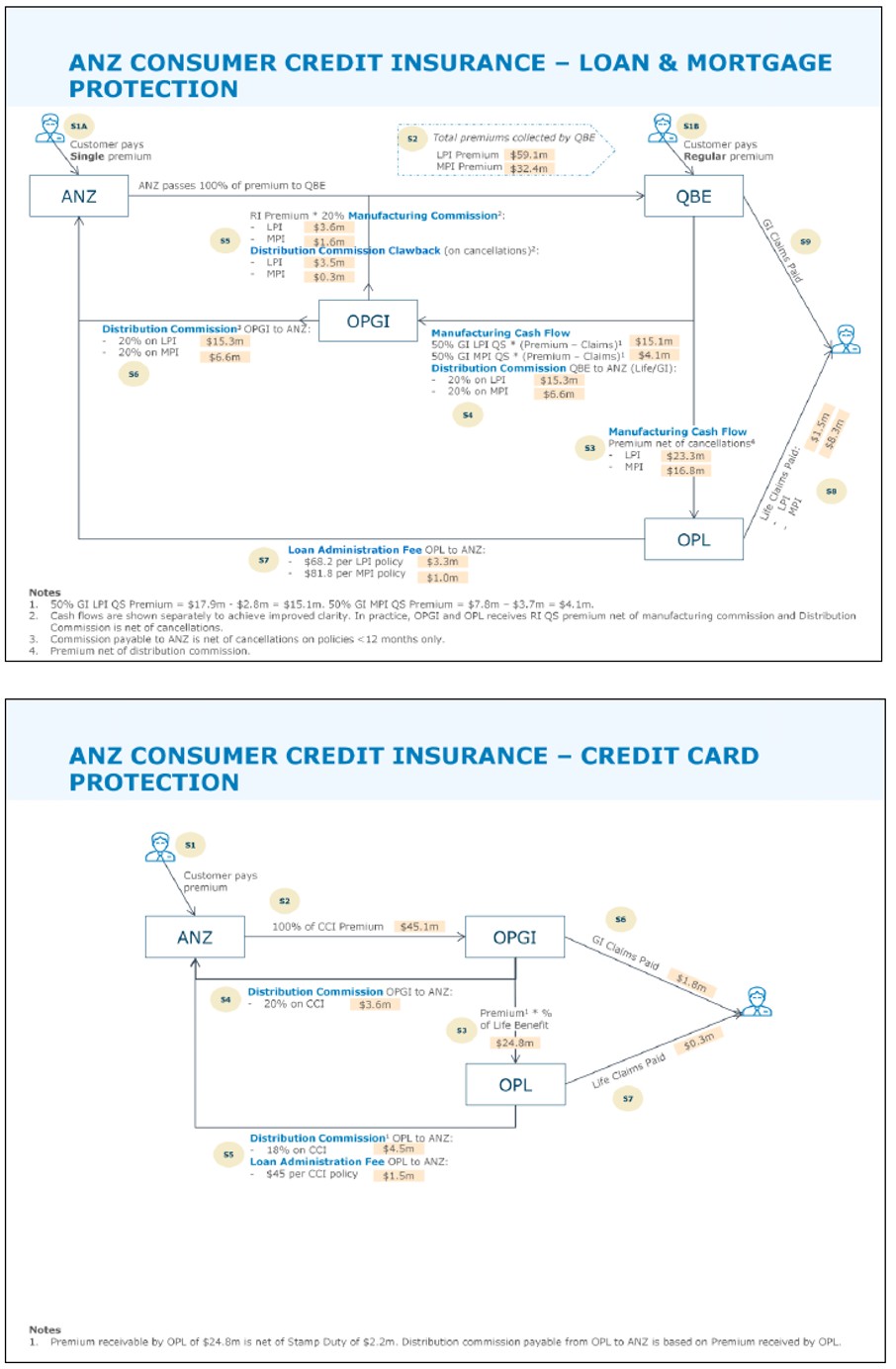
234 They do not assist me and are frankly a curate’s egg for the ANZ.
235 But in any event, and as the respondents correctly point out, the ANZ imposed on the customer the total charge through the arrangements established for the ANZ CCI products, and the payment thereby required to be made to the ANZ was integral to extracting the amounts subject to the Claim. I agree with the respondents that the material before me shows that the ANZ was not merely acting for example as a passive intermediary between customers and underwriters, even supposing that this would make a difference to the operation of the carve–out. The amounts referable to the premiums and interest were paid or due to the ANZ.
236 Finally, and as the respondents have pointed out, it remains the case that 20% of the premiums paid by customers flowed onwards to the ANZ by way of commission. So at least in respect of that portion of the premiums, it is no answer to say that the ANZ initially paid the total amount to the underwriters of the ANZ CCI products before 20% was returned, that is, paid to the ANZ.
237 In summary, in relation to the stipulated question concerning the Reilly settlement sum, it will be answered in the negative.
The operation of Exclusion 11
238 Exclusion 11 raises similar construction issues, although I agree with the ANZ that it is both broader and narrower than the qualification to the definition of Loss that I have just discussed.
239 As I have indicated earlier, it is broader in that whereas the carve–out provides that Loss does not “mean or include” fees, etc., exclusion 11 excludes Loss in respect of “[t]hat part of any Claim … based on, arising out of, relating to or involving, directly or indirectly, the actual or alleged charging of excessive, undisclosed or otherwise improper fees”, etc.
240 And it is narrower in that whereas the carve–out refers to “fees, commissions, or other charges” simpliciter, exclusion 11 refers to “the actual or alleged charging of excessive, undisclosed or otherwise improper fees, profits, commissions, costs or other charges by the Insured”.
241 The second part of the separate question asks whether the amounts that the ANZ paid to settle the Reilly proceeding and its Defence Costs and Expenses were in respect of claims “based on, arising out of, relating to or involving, directly or indirectly, the actual or alleged charging of excessive, undisclosed or otherwise improper fees”. The ANZ says that the answer to this question is “no”.
242 The ANZ says that the facts underlying the Reilly proceeding relevantly include that customers who acquired the impugned policies paid the premiums under those policies to the underwriting insurers, not the ANZ. Further, the ANZ provided distribution and administrative services to the underwriting insurers and, in consideration for those services, was paid amounts, some of which were calculated by reference to the premiums received by the underwriting insurers.
243 The ANZ says that the gravamen of the claims in the Reilly proceeding was that the impugned policies were of little or no value and, as against the ANZ, that it acted improperly in relation to the sale of the impugned policies.
244 The ANZ says that even if the claims against the ANZ are characterised as having involved the payment of a fee or commission to the ANZ by the underwriters, it was not alleged that the amount paid to the ANZ was excessive, undisclosed or otherwise improper.
245 The ANZ says that to the extent that the applicants’ and group members’ claimed losses included interest paid or payable on outstanding balances, “interest” is not a “fee”, a “commission” or an “other charge” and nor is it a “profit” or a “cost”. Further, such amounts were unquantified and immaterial compared to the value of the premiums paid.
Analysis
246 Now although I have concluded that the ANZ’s liability for the settlement sum is not Loss, I will nonetheless consider whether exclusion 11 would apply if the contrary were true.
247 Exclusion 11 begins with the expansive words “That part of any Claim… based on, arising out of, relating to or involving, directly or indirectly”. As the respondents rightly contend, this is a very broad set of connecting words.
248 First, “based on” requires a relationship between two concepts being the Claim or part of the Claim and the “actual or alleged charging of excessive, undisclosed or otherwise improper fees, profits commissions, costs or other charges by the Insured”. Depending upon the context it can sometimes mean “by reference to” or it can sometimes mean “because of”.
249 Second, “arising out of” requires that there be some causal connection, but it is broader than “caused by” and does not require that the connection be direct or proximate; see Dickenson v Motor Vehicle Insurance Trust (1987) 163 CLR 500 at 505; see also FKP Commercial Developments at [95] per Jagot J. That is the case here given that the expression is coupled with the words “directly or indirectly”.
250 Third, the words “relating to” are very broad and, unless indicated by their context, do not necessitate a direct or immediate connection. The context here does not require a direct connection because of the words “directly or indirectly” in exclusion 11 itself.
251 Fourth, as to “involving”, whilst it may mean “embracing”, it can also mean “affecting” or “entailing”. The word connotes the existence of a connection, the precise nature of which may vary according to the context in which it is used. In this case, and as the respondents have pointed out, the word “involving” is intended to convey that the connection between the Claim or part of the Claim and “the actual or alleged charging of excessive, undisclosed or otherwise improper fees, profits, commissions, costs or other charges by the Insured” may be looser than would have been required, if say the parties had required that the Claim or part of the Claim be for the actual or alleged charging of the fees etc referred to in the exclusion.
252 As for the language of “fees, profits, commissions, costs or other charges”, I agree with the respondents that even if premiums and interest paid by the applicants and group members did not fall within the expression “fees, commissions or other charges”, the additional words “profits, … costs or other charges by the Insured” in my view do encompass those payments. The ordinary meaning of “cost” includes “the price paid to acquire, produce, accomplish or maintain anything” (Macquarie Dictionary, 7th ed. (2017)). Premiums and interest were costs charged by the Insured and paid by the applicants and group members to the Insured in exchange for acquiring and maintaining the ANZ CCI products. Further, it is by charging premiums and interest that the Insured earned “profits” from the provision of those products.
253 Did any part of the Reilly proceeding arise out of, relate to or involve “the actual or alleged charging of excessive, undisclosed or otherwise improper” fees, profits, commissions, costs or other charges by the Insured? In my view this was the case. In this regard the following may be noted.
254 First, as I have discussed earlier, the gravamen of the claim was that the ANZ CCI products were of no real value to, or were unsuitable for, the applicants and group members to whom they were sold by the ANZ. It was alleged that the ANZ, OnePath Life and OnePath General earned substantial revenue and made substantial profits from those products. If, as alleged, those products were worthless or unsuitable, then the claim arose from the charging of excessive or otherwise improper fees, etc. The claims in the Reilly proceeding were in relation to premiums, and interest charged on those premiums, paid to the ANZ. To that extent they are captured by the phrase in exclusion 11 “charging of …. fees, profits, commission, costs or other charges by the Insured”.
255 Second, as I have discussed earlier, it was alleged that the applicants and at least some group members were sold ANZ CCI products without their consent and without them being fully informed that the cover was optional. It was further alleged that the applicants and a proportion of group members were misled by the ANZ into thinking the products were not optional. It follows that the claim arose from the charging of undisclosed or otherwise improper fees etc. I agree with the respondents that it is difficult to see how it would not be “improper” to charge premiums and interest for products that were sold without the customer’s consent, without the customer being informed that the product was optional, and in circumstances where the customer had been misled into thinking that they had no option but to acquire the product.
256 Third, it was also alleged that the applicants and some group members acquired the ANZ CCI products following advice from the ANZ that they should do so, in circumstances where the ANZ CCI products were of no real value to, or were unsuitable for, the applicants and group members to whom they were sold, it was not in their interests to acquire those products, and both the ANZ and its representatives had a conflict of interest. Again as the respondents correctly contend, it is difficult to see how it would not be “improper” to charge premiums and interest for products that were sold in those circumstances.
257 Fourth, another allegation was that the ANZ knew or ought to have known that the ANZ CCI products had no value or no material value, and were unsuitable for or conferred no benefits or no material benefits on the applicants and group members. Further, it was alleged that the applicants and group members were required to pay higher premiums than was reasonably necessary, that the ANZ benefited from the products, that the applicants and group members were not able to understand the policy documents, that unfair tactics were used by the ANZ and that the ANZ’s conduct was unconscionable. If these allegations were established, then the premiums and interest charged in respect of the ANZ CCI products would be excessive or otherwise improper.
258 Fifth, it was alleged that the applicants and some group members acquired the ANZ CCI products and paid the premiums under them in the mistaken belief that they were required to take out the relevant policy in order to obtain a credit card or personal loan, and that the policies had material value to them, in circumstances where the ANZ was aware of circumstances which indicated that the applicants and some group members were acquiring the ANZ CCI products under those mistaken beliefs and chose to leave the applicants and group members under that mistaken belief. Again in such circumstances, it was improper to charge for premiums and interest in respect of the ANZ CCI products.
259 Moreover, the relief claimed was essentially the repayment of, or damages equal to, the premiums including the ANZ’s commission and interest that the applicants and group members had paid in respect of the ANZ CCI products.
260 Further and as I have already indicated, the premiums and interest in issue in the Reilly proceeding fell within the meaning of “fees, commissions, or other charges” as used in the carve–out. And there is no warrant for construing the same words in exclusion 11 as having some different and narrower meaning. Moreover, the additional references to “profits” and “costs” reinforce the intended breadth of the concepts in exclusion 11.
261 Now in my view and as I have indicated, the allegations in the Reilly proceeding involved allegations of “excessive, undisclosed or otherwise improper” charges.
262 The reference to “excessive” charges is ordinarily understood as referring to charges which exceed what is the usual proper limit, degree or proportionate. It can also include concepts such as immoderate, inordinate or extravagant (see the Oxford English Dictionary (online) n 2(b)).
263 As for “improper”, the word is capable of different shades of meaning or application according to the context in which it appears and can capture conduct that is “not proper” or “not in accordance with propriety of behaviour”; see Lowe Pty Ltd v Belgravia Nominees Pty Ltd [2020] WASCA 180 at [182] per Quinlan CJ, Mitchell and Beech JJA, in accepting the broad terms of its ordinary meaning.
264 The Oxford English Dictionary (online) gives various shades of meaning including “unsuitable” or “inappropriate” (n 2), “unbecoming” or “unseemly” (n 3) and “abnormal” or “irregular” (n 1a).
265 I agree with the respondents that the fact that the words “otherwise improper” follow the words “excessive” or “undisclosed” indicate that the word is not intended to be read in any narrow or technical way. In the present context, it is naturally understood to include, at a minimum, charges by the insured in circumstances alleged to involve the transgression of legal or societal norms or standards.
266 In the context of the duties of a director, in Australian Securities and Investments Commission v Mitchell (No 2) (2020) 382 ALR 425 at [1516] to [1521] I said the following.
267 The test of whether conduct is improper is objective. In R v Byrnes (1995) 183 CLR 501 the plurality said (at 514 and 515):
Impropriety does not depend on an alleged offender’s consciousness of impropriety. Impropriety consists in breach of the standards of conduct that would be expected of a person in the position of an alleged offender by reasonable persons with knowledge of the duties, powers and authority of the position and the circumstances of the case.
268 Impropriety is found when a director is in “breach of the standard of conduct that would be expected of a person in his position by reasonable persons with knowledge of the duties, powers and authority of his position as a director” (see also Doyle v Australian Securities and Investments Commission (2005) 227 CLR 18 at [35]). In a practical sense, the inquiry is whether the defendant’s behaviour breached the norms of conduct thought necessary for the proper conduct of commercial life.
269 In Grove v Flavel (1986) 43 SASR 410 at 416 and 417, Jacobs J considered that “improper”:
…cannot be determined by reference to some common, uniform, or inflexible standard which applies equally to every person who is an officer, but rather must be determined by reference to the particular duties and responsibilities of the particular officer whose conduct is impugned.
270 Further, as Jacobs J said at 420:
The word “improper” is not a term of art. It is to be understood in its commercial context to refer to conduct which is inconsistent with the “proper” discharge of the duties, obligations and responsibilities of the officer concerned.
271 I agree with the respondents that the allegations made and the relief sought indicate that the Reilly proceeding involved allegations of excessive and improper fees. The entirety of the claim involved allegations that the premiums and interest were charged in circumstances that made it improper for the ANZ to extract those amounts. That the fees were alleged to be excessive is also necessarily entailed by the allegation that the ANZ CCI products had no real value or were unsuitable. So, exclusion 11 was engaged in respect of the sums paid in settlement of the claims in the Reilly proceeding.
272 I also agree with the respondents that there is a second scenario in which exclusion 11 would have been engaged, assuming that I had accepted the ANZ’s argument that the carve out from the Loss definition did not apply because premiums were not “paid or due to” the ANZ.
273 First, as the respondents point out, the exclusion does not require a direct payment “to” a particular Insured. Rather, it is sufficient for the purposes of exclusion 11 that the Claim against the ANZ was “directly or indirectly” based on, arose out of or involved the actual or alleged charging of excessive, undisclosed or otherwise improper fees “by the Insured”, which as I have said is defined to include the ANZ’s subsidiaries, OnePath Life and OnePath General.
274 Second, the ANZ debited the premiums against the applicants’ and group members’ credit card and personal loan accounts, which debts were later paid or owed to the ANZ. So, even if it did not itself receive the premiums, the ANZ’s conduct in debiting those premiums against its customer’s accounts and in later demanding and receiving payments in discharge of those debts was at the heart of the Claim against it and a material cause of the loss sought to be recovered in the Reilly proceeding.
O’Brien proceeding — Background and finalisation
275 During the period from 1 January 2011 to 31 March 2016, the ANZ issued certain motor vehicle asset finance products the subject of the O’Brien proceeding to its customers.
276 The motor vehicle asset finance products the subject of the proceeding were provided by the ANZ via its Esanda business, the majority of the assets of which were subsequently sold to Macquarie pursuant to an agreement made in October 2015. The Esanda business was part of the Australia division of the ANZ, being within its corporate and commercial banking business units.
277 Between 1 January 2011 and November 2015, the ANZ authorised accredited dealers to facilitate car loans by the ANZ to consumers on terms agreed between the ANZ and the dealers. During the application and approval process, the ANZ was responsible for credit assessment and credit decisions and for setting a base rate of the interest to be charged on the car loans.
278 The ANZ entered into dealer agreements with car dealers, who then were authorised to submit loan applications on behalf of customers to the ANZ for motor vehicle finance and treated as accredited dealers.
279 Between 1 January 2011 and about August 2015, the dealer agreements generally comprised a dealer’s agreement with attachments, a business partnership and dealer arrangement, a personal information collection and disclosure statement and an Abacus system access agreement. Between August 2015 and 31 March 2016, the terms and conditions pursuant to which accredited dealers submitted loan applications were contained in a single document styled “dealer agreement”.
280 Accredited dealers were paid by the ANZ pursuant to the terms of the relevant dealer agreement.
281 When submitting car loan applications to the ANZ on behalf of customers, accredited dealers were required to follow processes stated in a training document titled “Abacus: The Basics”. Under this process the ANZ was responsible for credit assessment, credit decisions and the setting of a base rate of interest. Further, accredited dealers were able to nominate the interest rate payable by the customer which, up to a cap set by the ANZ, could be a higher interest rate than the base rate. Accredited dealers were also able to nominate an interest rate which was a lower interest rate than the base rate. Further, accredited dealers were entitled to a payment each month calculated in accordance with the dealer agreements, as set out under the heading “Commission calculation” in the business partnership and dealer arrangement, if the accredited dealers satisfied the conditions set out in the business partnership and dealer arrangement. The total payable to accredited dealers was calculated on a monthly basis and took into account writing at or over the base rate and writing under the base rate in the manner set out in the business partnership and dealer arrangement.
282 For the purposes of this proceeding, the parties agree that the agreed rate for the car loan would be known as the contract rate.
283 The payment to accredited dealers had three main components being: (a) a fixed fee for each loan introduced by the dealer; (b) an additional fee if the value of loans introduced by the dealer exceeded an agreed monthly figure; and (c) an amount calculated as a proportion of the interest payable over the life of the loans introduced by the dealer.
284 The last of these components was calculated using a formula that took into account: (a) the amount of interest payable over the life of all loans advanced that month (i.e. at the agreed rate for the loan (contract rate)) (actual income); (b) the amount of interest that would have been payable over the life of all loans advanced that month, if the loans had been written at the base rate (base rate income); and (c) a percentage negotiated in advance by the ANZ and the dealer (commission rate).
285 The formula was: (Actual Income—Base Rate Income) × Commission Rate
286 This component was referred to by the plaintiff in the O’Brien proceeding as “Flex Commission”, and the formula used to calculate it was referred to by the plaintiff as the “Flex Commission Calculation Method”.
287 Accredited dealers were entitled to commission payments, which represented a portion of the difference between the base rate fixed by the ANZ and the contract rate set by the dealer. In this way, the ANZ deliberately incentivised accredited dealers to set a contract rate that was higher than the base rate. Further, the higher the contract rate, the more commission the dealer would earn and the more interest income the ANZ would receive over the life of the car loan.
288 The flex commission was designed to encourage the dealers to write interest rates to be paid by the ANZ’s prospective customers above the base rate, which was admitted by the ANZ, or provided an incentive for dealers to increase the price of a car loan or the term of the car loan, in a way that depended on the negotiating skills or vulnerability of the consumer, which was denied by the ANZ.
289 Dealers set the contract price in the absence of any objective criteria, in circumstances where the amount of the contract rate would be influenced or determined by the self-interest of the dealers and was significantly higher than the ANZ would have offered otherwise than through a dealer, which was denied by the ANZ.
290 The flex commission created a risk of unfairness and a conflict, or potential for a conflict, between the interest of the dealer and the interests of their customers including the group members, which was denied by the ANZ.
291 Neither the ANZ nor the dealers disclosed to the group members that the contract rate or the term of the car loan was set by the dealers and not by the ANZ, or that the dealers had a financial interest in the magnitude of the contract rate or the length of the car loan. The ANZ admitted that it did not require the dealers to inform customers of the base rate or the “cap rate”, or the terms of its agreements with the dealers in relation to the flex commission.
292 As a result of the above, group members entered into car loans when they would not otherwise have done so, entered into such loans where the interest rate was higher than they might otherwise have achieved or the terms were longer than they would otherwise have agreed, and they became liable to pay interest charges to the ANZ at the contract rate. The ANZ admitted the obligation imposed on group members to pay interest at the rate and term set out in the relevant agreement, but otherwise denied these allegations.
293 The motor vehicle asset finance products the subject of the proceeding were all fixed term contracts. The interest payable by the customer on the loan was calculated by reference to the interest rate specified on page one of the customer’s loan contract. The interest was paid by the customer together with a principal component by regular repayment sums as specified on page one of the customer’s loan contract.
294 Loan periods were for a period of between one and seven years.
295 On 19 October 2014, Mr Daniel O’Brien entered into a contract to purchase a 2010 Holden Commodore SS-V VE Series II utility vehicle from the Heartland Motors dealership in Penrith, Sydney and Mr O’Brien made an application for finance with the ANZ, arranged by Heartland Motors, which was approved by the ANZ subject to verification of his income.
296 On 20 October 2014, Mr O’Brien entered into a contract with the ANZ under which the ANZ provided secured finance where the proceeds could be used by Mr O’Brien to pay the purchase price for the vehicle. The contract rate for Mr O’Brien’s loan was 12.38%. In his affidavit, Mr O’Brien says that he believed the interest rate of 12.38% had been set by the ANZ, and that the dealer had arranged the loan at the ANZ’s standard rate. This was not the case. The base rate for Mr O’Brien set by the ANZ was 8.35%. In his affidavit in the proceeding he said the following (at [55] to [61]):
When [M] presented the car loan documents to me for signing on 20 October 2014, I did not understand that the interest rate, loan term and proposed loan amount on the car loan or any other aspects of the car loan were negotiable. I thought the loan terms had already been set by the lender. [M] presented the car loan to me as if that was the case - that is, that the terms of the car loan had already been decided and that they were standard terms. [M] had already printed the car loan documents when I arrived and they were ready for me to sign. [M] did not suggest that I needed to read them carefully. Instead, she directed me to just sign at certain points. I believed that the car loan I was being offered was just a standard car loan that was offered to consumers such as me, the terms of which were pre-determined by the lender.
When [M] presented the car loan documents to me for signing, I did not know, and she did not tell me, that in fact she or someone else at Heartland Holden Penrith had set the interest rate on my car loan at 12.38%. Nor did she tell me that the Heartland Holden Penrith had an arrangement with Esanda such that the dealership would be paid a portion of the interest charges that had been built into the loan. As I understand it, the higher the interest rate that Heartland Holden Penrith set on my car loan, the higher the commission that Heartland Holden Penrith received.
At no stage during the car loan process did [M] direct my attention to, or inform me:
a. of the interest rate applicable to my car loan. I do acknowledge that now, when I read the Esanda Loan Contract, I can see the interest rate is included there, but I was not aware of that at the time of signing the Esanda Loan Contract. I only became aware of the interest rate of 12.38% a long time after that;
b. of the total interest charges for the loan, which I now know to be $10,065.91;
c. that [M] or Heartland Holden Penrith had set the interest rate of my car loan and not the lender. I was not aware that Heartland Holden Penrith or [M] had the ability to set the interest rate of my car loan. I believed that [M] was a disinterested “middle man” or intermediary. When I signed the car loan, I believed that [M] would send my personal information to the lender by entering it into the system, and the lender would then inform her of the terms of my loan; and
d. that [M] or Heartland Holden Penrith received commission calculated as a portion of the interest rate of my car loan.
At the time of entering into the car loan, I understood that the car dealership got a commission on the sale of the car, not the car loan. I understood this because one of my friends who worked at a car yard had told me this. I assumed that Heartland Holden Penrith was making its money off the sale of the car and extras and after sale car services like maintenance and services.
I also understood that the lender was likely to make a profit from my car loan. I did not know that the car dealership submitting the finance application was also getting a commission that was based on how it decided to set the rate of interest on my loan. I would have wanted to know that. I would have been surprised and would have thought that Heartland Holden Penrith receiving income in that way, without it being disclosed to me, was wrong.
If [M] had either verbally disclosed or drawn my attention to the interest rate beforehand, I would have questioned it. I am comfortable with negotiating things like that. My work at the time required me to negotiate better rates for my customers.
If I had been aware of the interest rate of the car loan, I would have said, “Hold on, can’t you do me a better rate than that?”. If [M] had said, “No”, I would have said, “Well, I want to ask around to see if I can get a better rate”. I would still have wanted the car, though, and would have asked that the dealership put it aside for me for a time. I would have gone to Commonwealth Bank, because it was my bank, and inquired about a personal loan.
297 Mr O’Brien’s loan application was submitted to the ANZ via the Esanda Lending System. On or about 1 May 2016, Mr O’Brien’s loan was assigned to Macquarie.
298 On 10 October 2019, Mr O’Brien made the final payment under the loan contract.
299 On 21 August 2020, the O’Brien proceeding was commenced as a representative proceeding in the Supreme Court of Victoria against the ANZ and Macquarie Bank Limited. At the time of commencement the plaintiff was another individual but he was later substituted by Mr O’Brien.
300 The proceeding concerned certain motor vehicle asset finance products issued by the ANZ during the period from 1 January 2011 to 31 March 2016. The majority of the assets of this part of the ANZ’s business were sold to Macquarie pursuant to an agreement made in October 2015.
301 The proceeding was prosecuted by Mr O’Brien on his own behalf and on behalf of all natural persons who entered into a loan agreement with the ANZ between 1 January 2011 and 31 March 2016 for the acquisition of a motor vehicle in circumstances where the loan was obtained through a dealer and the dealer was paid a flex commission, and who were alleged to have suffered loss or were alleged to be entitled to relief by reason of the allegations made in the proceeding.
302 Mr O’Brien made two central allegations in the proceeding.
303 First, Mr O’Brien alleged that the accredited dealers nominated interest rates in the absence of any objective criteria, in circumstances where the accredited dealers were incentivised to nominate rates higher than the base rate, such that the flex commission and the flex commission calculation method created unfairness or a risk of unfairness.
304 Second, Mr O’Brien alleged the following. He alleged that neither the ANZ nor the accredited dealers disclosed the dealers’ involvement in setting the contract rate. He alleged that the ANZ did not ensure that the accredited dealers disclosed their involvement in setting the contract rate; alternatively, the ANZ did not have appropriate systems in place to ensure that accredited dealers disclosed their involvement in setting the contract rate. He alleged that a reasonable person in the position of the group members would have understood or assumed that the accredited dealers were not involved in setting the contract rate. And he alleged that the group members were in a weak or vulnerable bargaining position.
305 As for the claims made in the proceeding, the gravamen was that customers entered into their car loans believing the contract rate had been set by the ANZ, with no idea that it had in fact been set by the dealer in its own financial interest, in circumstances where the ANZ would have been prepared to make the same loan at the base rate. Consequently, the plaintiff and group members paid the ANZ more interest over the life of the car loans than they would have paid if the truth had been disclosed before those loans were entered into.
306 For example, the ANZ’s system allocated the plaintiff, Mr O’Brien, a base rate of 8.35% p.a. and the ANZ was prepared to extend finance to him at that rate if not lower, but this was not disclosed to him, and instead, the dealer signed Mr O’Brien up to a car loan with a contract rate of 12.38% p.a. and he subsequently paid that higher rate to the ANZ for the life of his car loan. The plaintiff’s case was that the non-disclosure of the base rate to the ANZ’s customers was a feature, not a bug of the arrangements the ANZ had put in place. So:
The system was set up that way. …It would entirely defeat the purpose of achieving as high a commission as possible, and of encouraging ‘writing above the Base Rate’, if the dealer revealed to the customer that in fact ANZ would grant the loan at the base rate – indeed, at a rate lower than the base rate – but that the dealer had arbitrarily inserted a higher interest rate into the loan for the sole purpose of obtaining more money for itself and ANZ. No reasonable customer would proceed on that basis.
307 Mr O’Brien claimed that the accredited dealers had contravened the NCCP Act, and that the ANZ as the relevant licensee was responsible for their conduct pursuant to ss 77 and 78 of the NCCP Act. He claimed that the ANZ had engaged in misleading or deceptive conduct contrary to s 1041H of the Corporations Act and s 12DA(1) of the ASIC Act. And he claimed that the impugned loans had been entered into under a unilateral mistake and were void or voidable.
308 The relief sought in the proceeding included the following.
309 First, an order under s 180A(2) of the NCCP Act that the defendants refrain from charging interest above the base rate, the rate which could have been obtained on the market or the average prevailing market rate and that the defendants pay to Mr O’Brien and group members the interest paid under the impugned loans above the base rate, the rate which could have been obtained on the market or the average prevailing market rate.
310 Second, an order under s 1041I of the Corporations Act and/or s 12GF of the ASIC Act that the ANZ pay compensation to Mr O’Brien and group members for damage caused by the ANZ’s alleged misleading or deceptive conduct. The damages were particularised as: (a) the difference between the contract rate and the base rate; (b) alternatively, the difference between the contract rate and the interest rate group members would have obtained on the market; and (c) alternatively, the difference between the contract rate and the average market rate of interest.
311 Third, an order under ss 12GM(1), (2) or (7)(d) of the ASIC Act directing the ANZ to repay the whole of the interest paid under the impugned loans above the base rate, the rate which could have been obtained on the market, or the average prevailing market rate.
312 Fourth, an order that the loans were rescinded, void or voidable, in whole or in part.
313 Fifth, judgment in the amount of the interest paid under the impugned loans or, alternatively, the amount of interest paid above the base rate, the rate which could have been obtained on the market or the average prevailing market rate.
314 In substance, the monetary relief claimed was compensation or restitution comprised of the difference between the amount of interest paid to the ANZ at the contract rate and the amount that would have been paid at the base rate.
315 On 2 December 2024, the parties to the proceeding agreed to settle the claims in the proceeding, with the ANZ agreeing to pay and later paying $85 million. Whilst that settlement was agreed without the underwriters’ prior written consent and without complying with general condition 4, by the time of the settlement the underwriters of the first excess policy had issued a letter declining indemnity and the remaining underwriters by their defences in this proceeding had denied that they were liable to indemnify the ANZ. If the underwriters were wrong in denying indemnity, they may be liable for the settlement payment, notwithstanding the absence of consent, provided the settlement was reasonable. It is not in contest before me for the purposes of the separate question that the O’Brien settlement sum is reasonable.
316 So, although the O’Brien settlement sum is not strictly a liability to pay damages, restitution or compensation, it is treated as such for the purpose of determining policy response (Weir Services at [3]).
317 Harris J approved the settlement pursuant to s 33V of the Supreme Court Act 1986 (Vic) on 3 July 2025: O’Brien v Australia and New Zealand Banking Group Ltd [2025] VSC 389. Each of Mr O’Brien and the group members released and discharged the ANZ from the claims advanced by Mr O’Brien and all common claims between Mr O’Brien and group members that could have been brought in the proceeding.
O’Brien proceeding — The question of Loss
318 In the O’Brien proceeding, the plaintiffs and group members sought recovery of part of the interest paid to the ANZ under the impugned motor vehicle loans.
319 Again the ANZ says that interest on a loan does not fall within the expression “fees, commissions, or other charges” in the qualification (b) to the definition of Loss in the first excess policy.
320 The ANZ repeats the arguments that it advanced concerning the Reilly proceeding as to its characterisation of interest.
321 The ANZ says that the amount paid by the ANZ in settlement of the O’Brien proceeding does not fall within the carve–out from the definition of Loss.
Analysis
322 Now it is not disputed that the interest payments that the plaintiff and group members sought to recover in the O’Brien proceeding were made to the ANZ. The principal dispute is whether those interest payments comprise “fees, commissions, or other charges”, such that they are carved out from the Loss definition.
323 For the reasons discussed earlier in the context of the Reilly proceeding, the interest payments that were the subject of the claim in the O’Brien proceeding comprise “other charges” and are not Loss.
324 Further and as the respondents point out, if I were to have upheld the ANZ’s case, it would recover from the underwriters an amount which was promised and paid in substitution for or in satisfaction of an alleged liability for the difference between the amount of interest previously paid to the ANZ at the contract rate and the amount that would have been paid at the base rate. So, the ANZ would recover from the underwriters an amount which the ANZ wrongly received in the first place and was not entitled to retain.
325 But that result would defeat the commercial object of the carve–out from the Loss definition and the excess policies would not operate as contracts of indemnity.
326 In summary, in relation to the stipulated question concerning the O’Brien settlement sum, it will be answered in the negative.
The operation of Exclusion 11
327 The ANZ says that its arguments as to why interest is not covered by the carve–out, which I have already outlined, apply mutatis mutandis to exclusion 11.
328 The ANZ says that this conclusion is not altered by the fact that exclusion 11 refers to “profits” and “costs”, which are not referred to in the carve–out. In particular, according to the ANZ the following remains the case.
329 First, the ANZ says that the parties could have referred expressly to interest in exclusion 11 if they had intended the exclusion to extend to interest.
330 Second, it says that elsewhere in the first excess policy the parties did refer expressly to interest.
331 Third, it says that the expression “other charges” is not used in the first excess policy when referring to (among other payments) “interest”, and instead the expression “and the like” is employed (where the word “interest” appears). By contrast, the words “fees” or “commissions”, as well as “profits”, appear together with the words “or other charges”.
332 Fourth, the ANZ says that given the market in which it operates, the parties would have been expected to refer expressly to interest in exclusion 11, if they had intended the exclusion to extend to interest.
Analysis
333 Now even if the O’Brien settlement sum constituted Loss, the ANZ would fail because of the operation of exclusion 11.
334 For the reasons discussed earlier, if interest paid by Mr O’Brien and group members under the car loans does not fall within the expression “fees, commissions or other charges”, then the additional words in exclusion 11, “profits, …costs or other charges by the Insured” do encompass those payments.
335 As I have already said, the ordinary meaning of “cost” includes the price paid to acquire, produce, accomplish or maintain anything. Interest was a cost charged by the ANZ and paid by the plaintiff and group members in exchange for acquiring and maintaining the car loans. Further, it is by charging that interest that ANZ earned profits from the provision of those loans.
336 The remaining question is whether any part of the O’Brien proceeding arose out of, related to or involved “the actual or alleged charging of excessive, undisclosed or otherwise improper” fees, profits, commissions, costs or other charges by the Insured. In my view it did. In this regard the following may be noted.
337 First, the central theme of the O’Brien proceeding was an allegation that the base rate and the difference between it and the contract rate were not disclosed to Mr O’Brien and group members.
338 Second, it was alleged that the circumstances in which the car loans were made involved a technique that should not in good conscience have been used.
339 Third, it was alleged that the terms of the car loans were less favourable than those of a comparable transaction because the contract rate was significantly higher than the rate that the ANZ would have offered the group members had they been approached otherwise than through a dealer and the interest rate was higher than the rate on loans that the group members would otherwise have entered into.
340 Fourth, the monetary relief claimed was essentially compensation or restitution comprised of the difference between the amount of interest paid to the ANZ at the contract rate and the amount that would have been paid at the base rate.
341 So, it seems clear that the entirety of the O’Brien proceeding settlement sum falls within exclusion 11.
Defence Costs and Expenses
342 The ANZ says that its Defence Costs and Expenses, the definition for which I have set out earlier in these reasons, incurred in connection with the Reilly proceeding and the O’Brien proceeding are not carved out from, or do not qualify, the ANZ’s Loss.
343 The ANZ says that Defence Costs and Expenses are a specified head of Loss within the definition of Loss for the purposes of section 2 of the first excess policy. They are defined to mean “all reasonable professional fees, costs and expenses incurred by the Insured … in the … defence … of any Claim for Civil Liability.”
344 The ANZ says that there is no dispute that the Reilly proceeding and the O’Brien proceeding involved a Claim for Civil Liability, or that the Claims arose out of or were attributable to a Wrongful Professional Act. And it has also been assumed by the parties for present purposes that “reasonable professional fees, costs and expenses” were incurred by the ANZ in defence of the Reilly proceeding and the O’Brien proceeding.
345 It says that qualification (b) to the definition of Loss, that is, “fees, commissions, or other charges paid or due to the Insured”, can only be understood as applying to the forms of Loss captured by sub-paragraphs (i)(a) to (c) of the definition. But it says that this has no bearing upon, and does not qualify, sub-paragraph (ii) of the definition which concerns Defence Costs and Expenses.
346 The ANZ says that so long as the Defence Costs and Expenses are incurred in the defence of a Claim for Civil Liability, and that Claim arises out of or is attributable to a Wrongful Professional Act, which before me has been accepted by the respondents, then those costs and expenses are a relevant Loss for the purposes of the insuring clause.
Analysis
347 Given that the entirety of the relevant liability under the Reilly proceeding constituting the Claim falls within exclusion 11 as I have held, then any Defence Costs and Expenses incurred in the defence of that proceeding are necessarily excluded by exclusion 11. As the respondents point out, Defence Costs and Expenses constitute Loss, and the excess policies do not indemnify the Insured for Loss in respect of a Claim to which exclusion 11 applies.
348 Further, Defence Costs and Expenses are only payable where the Insured is entitled to indemnity in respect of the Claim being defended. Condition 2 of section 2 provides as follows:
2. Advancement of Defence Costs
(a) Except where Underwriters have denied indemnity, they will advance to or on behalf of the Insured, as and when incurred
(i) Defence Costs and Expenses in respect of any Claim against the Insured or an Inquiry and prior to final resolution of the Claim or Inquiry
(ii) Mitigation Costs in respect of any Claim (prior to the final resolution of that Claim) or circumstance which is in the opinion of the Senior Manager, Group Insurance or Head of Group Insurance of the Insured reasonably likely to result in a Claim against the Insured.
(b) To avoid doubt, Underwriters must not refuse to advance Defence Costs and Expenses or Mitigation Costs by reason only that Underwriters believe conduct excluded by Exclusion 14 has occurred until the conduct is established by the judgment or adjudication of a court or tribunal with jurisdiction to finally determine the matter.
(c) The Insured will repay to Underwriters any Defence Costs and Expenses and Mitigation Costs advanced under paragraph 2(a) if it is established by final judgment or final adjudication that Underwriters are not liable for such payments.
349 As the respondents correctly point out, the opening words of condition 2, sub-paragraph (a) necessarily imply that, “where Underwriters have denied indemnity” for a Claim, they are not obliged to advance Defence Costs and Expenses in respect of that Claim.
350 In the present case the underwriters have denied indemnity on the basis that the amounts claimed are not Loss, which position I have upheld. So apart from the operation of exclusion 11 the underwriters were entitled to deny indemnity for the Reilly proceeding. That being so, they were never obliged to advance Defence Costs and Expenses to the ANZ in respect of that proceeding. Further, had they advanced such costs, the ANZ would be obliged to repay such amounts to underwriters under sub-paragraph (c) of condition 2. Further, if they were not Defence Costs and Expenses payable, then arguably they could not fall within the definition of Loss.
351 Similar points can be made concerning the O’Brien proceeding. If the entirety of the O’Brien proceeding falls within exclusion 11, then any Defence Costs and Expenses incurred in the defence of that proceeding are necessarily excluded by exclusion 11. Further, Defence Costs and Expenses are only payable where the Insured is entitled to indemnity in respect of the Claim being defended. Arguably they also could not fall within the definition of Loss.
Conclusion
352 For the foregoing reasons I propose to answer the principal question posed in the negative. Such an outcome would also dictate that the ANZ’s proceeding should be dismissed.
353 The orders that I propose to make are set out after the cover sheet, but I will not formally pronounce such orders at this stage or formally enter them until the parties have had an opportunity to consider their position.
354 If the parties accept these orders then I would also be prepared to grant leave to appeal to the ANZ given the significance and practical finality of what I have decided. Of course, if the parties agree on final orders to dispose of the proceeding, then the ANZ would require no such leave to appeal.
355 Finally, let me make one other observation. I have not needed to linger on the question of federal jurisdiction and the concept of a federal matter given the potential invocation of s 57 of the Insurance Contracts Act 1984 (Cth) and given that the insurance claim concerning the Reilly proceeding at the least could be seen as part of an underlying federal matter.
I certify that the preceding three hundred and fifty-five (355) numbered paragraphs are a true copy of the Reasons for Judgment of the Honourable Justice Beach. |
Associate:
Dated: 9 October 2026
SCHEDULE OF PARTIES
VID 478 of 2025 | |
Respondents | |
Fourth Respondent | XL INSURANCE COMPANY SE (ABN 36 083 570 441) |
Fifth Respondent | AIG AUSTRALIA LIMITED (ABN 93 004 727 753) |
Sixth Respondent | CERTAIN UNDERWRITERS AT LLOYD’S SUBSCRIBING TO SYNDICATE NO. 4000 PEM, LONDON FOR THE 2017 YEAR OF ACCOUNT |
Seventh Respondent | AXIS SPECIALTY EUROPE SE |
Eighth Respondent | LIBERTY MUTUAL INSURANCE COMPANY (ABN 61 086 083 605) |
Ninth Respondent | ALLIANZ AUSTRALIA INSURANCE LIMITED (ABN 15 000 122 850) |
Tenth Respondent | AMERICAN INTERNATIONAL GROUP UK LIMITED |
Eleventh Respondent | CERTAIN UNDERWRITERS AT LLOYD’S SUBSCRIBING TO SYNDICATE NO. 382, LONDON FOR THE 2017 YEAR OF ACCOUNT |
Twelfth Respondent | GREAT LAKES INSURANCE SE (ABN 18 964 580 576) TRADING AS GREAT LAKES AUSTRALIA |
Thirteenth Respondent | CERTAIN UNDERWRITERS AT LLOYD’S (REGISTERED CONSORTIUM NO. 9562, BEING MEMBERS OF SYNDICATES BAR 1955 FOR THE 2017 YEAR OF ACCOUNT, MS AML 2001 FOR THE 2017 YEAR OF ACCOUNT AND EVE 2786 FOR THE 2017 YEAR OF ACCOUNT |
Fourteenth Respondent | MARKEL INTERNATIONAL INSURANCE COMPANY LIMITED |
Fifteenth Respondent | CERTAIN UNDERWRITERS AT LLOYD’S SUBSCRIBING TO SYNDICATE NO. 1218, LONDON FOR THE 2017 YEAR OF ACCOUNT |
Sixteenth Respondent | CERTAIN UNDERWRITERS AT LLOYD’S SUBSCRIBING TO SYNDICATE NO. 4141, LONDON FOR THE 2017 YEAR OF ACCOUNT |
Seventeenth Respondent | ALLIED WORLD ASSURANCE COMPANY LTD (ABN 54 163 304 907) |
Eighteenth Respondent | CERTAIN UNDERWRITERS AT LLOYD’S (REGISTERED CONSORTIUM NO. 9554, BEING MEMBERS OF SYNDICATES QPS 5555 FOR THE 2017 YEAR OF ACCOUNT, XLC 2003 FOR THE 2017 YEAR OF ACCOUNT, LIB 4472 FOR THE 2017 YEAR OF ACCOUNT, AXS 1686 FOR THE 2017 YEAR OF ACCOUNT, BAR 1955 FOR THE 2017 YEAR OF ACCOUNT, CVS 1919 FOR THE 2017 YEAR OF ACCOUNT, CNP 4444 FOR THE 2017 YEAR OF ACCOUNT AND AMA 1200 FOR THE 2017 YEAR OF ACCOUNT) |
Nineteenth Respondent | BERKSHIRE HATHAWAY SPECIALTY INSURANCE COMPANY (ABN 84 600 643 034) (T/AS BERKSHIRE HATHAWAY SPECIALTY INSURANCE) |
Twentieth Respondent | CERTAIN UNDERWRITERS AT LLOYD’S SUBSCRBING TO SYNDICATE NO. 1183, LONDON FOR THE 2017 YEAR OF ACCOUNT |
Twenty-first Respondent | CERTAIN UNDERWRITERS AT LLOYD’S SUBSCRIBING TO SYNDICATES NO. 2623 AND 623, LONDON FOR THE 2017 YEAR OF ACCOUNT |
Twenty-second Respondent | CGU AUSTRALIA PTY LTD (ABN 62 004 478 960) |
Twenty-third Respondent | CHUBB INSURANCE AUSTRALIA LTD (ABN 23 001 642 020) |
Twenty-fourth Respondent | CERTAIN UNDERWRITERS AT LLOYD’S SUBSCRIBING TO SYNDICATE NO. 5151, LONDON FOR THE 2017 YEAR OF ACCOUNT |
Twenty-fifth Respondent | CERTAIN UNDERWRITERS AT LLOYD’S SUBSCRIBING TO SYNDICATE NO. 2786, LONDON FOR THE 2017 YEAR OF ACCOUNT |
Twenty-sixth Respondent | CERTAIN UNDERWRITERS AT LLOYD’S SUBSCRIBING TO SYNDICATE NO. 1221, LONDON FOR THE 2017 YEAR OF ACCOUNT |


