

Federal Court of Australia
Australian Securities and Investments Commission v Hollard Insurance Partners Limited [2026] FCA 1487
File number: | VID 448 of 2025 |
Judgment of: | BUTTON J |
Date of judgment: | 9 October 2026 |
Catchwords: | INSURANCE – agreed contravention of the Insurance Contracts Act 1984 (Cth) – single contravention constituted by combined failures in claims handling in respect of an insured couple over an extended period – principles applicable to imposition of a civil penalty – determination of appropriate penalty – appropriateness of agreed orders and declaration – declaration made and civil penalty imposed |
Legislation: | Insurance Contracts Act 1984 (Cth) ss 13, 75A, 75B, 75D, 75V Evidence Act 1995 (Cth) s 191 |
Cases cited: | Allianz Australia Insurance Ltd v Delor Vue Apartments CTS 39788 (2022) 277 CLR 445; [2022] HCA 38 Australian Building and Construction Commissioner v Pattinson (2022) 274 CLR 450; [2022] HCA 13 Australian Competition and Consumer Commission v Employsure Pty Ltd (2023) 407 ALR 302; [2023] FCAFC 5 Australian Competition and Consumer Commission v Reckitt Benckiser (Australia) Pty Ltd (2016) 340 ALR 25; [2016] FCAFC 181 Australian Competition and Consumer Commission v TPG Internet Pty Ltd (2013) 250 CLR 640; [2013] HCA 54 Australian Securities and Investments Commission v Commonwealth Bank of Australia [2020] FCA 1543 Australian Securities and Investments Commission v Mercer Superannuation (Australia) Ltd [2026] FCA 832 Australian Securities and Investments Commission v TAL Life Ltd (No 2) (2021) 150 ACSR 224; [2021] FCA 193 CGU Insurance Ltd v AMP Financial Planning Pty Ltd (2007) 235 CLR 1; [2007] HCA 36 Distillers Co Bio-Chemicals (Aust) Pty Ltd v Ajax Insurance Co Ltd (1974) 130 CLR 1; [1974] HCA 3 NW Frozen Foods Pty Ltd v Australian Competition and Consumer Commission (1996) 71 FCR 285; [1996] FCA 1134 Singtel Optus Pty Ltd v Australian Competition and Consumer Commission (2012) 287 ALR 249; [2012] FCAFC 20 Trade Practices Commission v CSR Ltd [1991] ATPR 41-076; [1990] FCA 762 |
Division: | General Division |
Registry: | Victoria |
National Practice Area: | Commercial and Corporations |
Sub-area: | Commercial Contracts, Banking, Finance and Insurance |
Number of paragraphs: | 192 |
Date of hearing: | 1 September 2026 |
Counsel for the Applicant: | C Archibald KC with A Ounapuu |
Solicitor for the Applicant: | Australian Securities and Investments Commission |
Counsel for the Respondent: | N Hutley SC with N Oreb |
Solicitor for the Respondent: | Gilbert and Tobin |
ORDERS
VID 448 of 2025 | ||
| ||
BETWEEN: | AUSTRALIAN SECURITIES AND INVESTMENTS COMMISSION Applicant | |
AND: | HOLLARD INSURANCE PARTNERS LIMITED (ACN 067 524 216) Respondent | |
order made by: | BUTTON J |
DATE OF ORDER: | 9 OCTOBER 2026 |
THE COURT NOTES THAT:
In these orders:
(a) ‘Act’ means the Insurance Contracts Act 1984 (Cth).
(b) ‘Insureds’ mean the holders of the Policy.
(c) ‘Policy’ means Hollard Home Insurance Policy No HOM1612182.
THE COURT DECLARES THAT:
1. Pursuant to s 75A of the Act, the Respondent failed to comply with the provision implied by s 13(1) of the Act requiring it to act towards the Insureds with the utmost good faith in respect of a claim by the Insureds for indemnity under the Policy in relation to damage caused by storm, and thereby contravened s 13(2A) of the Act, by combination of:
(a) between 15 November 2021 and 26 July 2022, failing to promptly engage a structural engineer for expert opinion in assessing the damage caused by storm to the roof of the Insureds’ home;
(b) between 25 February 2022 and 12 October 2022, failing to assess correctly, and delaying in rectifying its mistake, as to the extent of the boundary fence which needed to be repaired;
(c) between 31 May 2022 and 27 June 2022, delaying in arranging further emergency works to the Insureds’ home, to protect the building against further loss or damage, after being notified that the original make-safe works had failed to stop water ingress;
(d) between early 8 September 2022 and 31 March 2023, delaying in providing temporary accommodation to the Insureds;
(e) between 5 October 2022 and 28 April 2023, failing to sufficiently consider two written expert reports and an inspection report prepared by Hollard’s appointed claim manager that were relevant to the decision to offer a cash settlement for the damage to the external roof caused by the storm;
(f) between 5 October 2022 and 28 April 2023, failing to communicate in a sufficiently clear manner in writing with the Insureds about the reasoning and basis for the decision to offer a cash settlement for the damage to the external roof caused by the storm, and the value of the cash settlement that was offered in relation to that damage; and
(g) between 4 November 2022 and 31 March 2023, delaying in providing repairs to address growing mould.
THE COURT ORDERS THAT:
2. Pursuant to s 75B of the Act, the Respondent pay to the Commonwealth of Australia a pecuniary penalty of $2,000,000 in respect of the contravention of s 13(2A) of the Act referred to in paragraph 1 above within 28 days of the entry of these orders.
3. The Respondent pay the Applicant’s costs of the proceeding in an amount determined by the Court if not agreed within 28 days of the entry of these orders.
Note: Entry of orders is dealt with in Rule 39.32 of the Federal Court Rules 2011.
REASONS FOR JUDGMENT
BUTTON J:
Introduction
1 There is one disputed issue: what penalty should be imposed on the Respondent insurer (Hollard) in respect of its admitted, single contravention of s 13(2A) of the Insurance Contracts Act 1984 (Cth) (the Act)? The Applicant (ASIC) said the penalty should be $30 million. Hollard said the penalty should be between $100,000 and $300,000. The gulf between these positions is patent. It reflects the parties’ diametrically opposed views of the seriousness of the contravening conduct and the quantum required in order for the penalty to serve the purposes of specific and general deterrence.
2 The admitted contravention arises from the saga experienced by the homeowners and policyholders (the Insureds) after a storm affecting their property on 29 October 2021. Hollard has admitted that, because of specified aspects of its handling of the Insureds’ claim, it breached its duty of utmost good faith. It is an implied provision of a contract of insurance requiring each party to act towards the other with the “utmost good faith” in respect of any matter arising under or in relation to that contract of insurance: s 13(1) of the Act. An insurer who fails to comply with the implied provision contravenes s 13(2A) of the Act.
3 The saga experienced by the Insureds was extended and must have been stressful and traumatic. They were given the runaround in more ways than one, and lived in their ever-deteriorating home, as the saga wore on. The Court is not imposing a penalty to reflect everything the Insureds experienced; what the Insureds experienced in its totality cannot be substituted for the contravening conduct for which the civil penalty is to be imposed. Nor is the Court imposing a penalty reflecting every aspect of Hollard’s conduct at which one might look askance.
4 The civil penalty specified under s 13(2A) is 5,000 penalty units — equivalent to $1.11 million in the relevant period — but s 75D of the Act provides for higher pecuniary penalties for bodies corporate. The parties agreed that the maximum penalty is $81.6 million, that being the figure that is 10% of Hollard’s annual turnover for the 12-month period beginning November 2021, being the month when the contravention began. Section 75D is a penalty calculation provision of a familiar kind, which provides that the maximum penalty is to be worked out by determining which calculation method delivers the highest result. On the facts of this case, it is the 10% of the annual turnover formula specified by s 75D(2)(c)(i).
5 The penalty I have decided to impose is $2 million. These reasons explain why. The reasons first set out the factual record. In large part, the relevant facts were contained in two statements of agreed fact, submitted as agreed facts pursuant to s 191 of the Evidence Act 1995 (Cth): the Statement of Agreed Facts and Admissions (Liability) (SAFA), and the Statement of Agreed Facts (Penalty) (SOAF). The parties also filed affidavit evidence; no deponent was required for cross-examination. The factual summary below draws on the agreed facts, but brings in relevant facts from the affidavits.
6 Having set out the factual record, I address the agreed contravention.
7 I then explain why it is that a penalty of $2 million is, in my view, the appropriate penalty.
Factual Overview and the Contravening Conduct
Hollard
8 Hollard was at all material times an insurer under contracts of insurance within the meaning of the Act. Prior to 30 September 2022, Hollard was known as Commonwealth Insurance Limited (CommInsure). On that date, Hollard Holdings Australia Pty Ltd acquired the CommInsure general insurance business, and the entity was renamed Hollard Insurance Partners Limited, which is the Respondent. The SAFA refers throughout to the insurer as “Hollard”, notwithstanding that it was known as CommInsure at the time of most of the relevant events. I adopt that same approach in these reasons.
9 Hollard retained Inserve Australia Pty Limited, trading as “Construct Services” (CS), to provide claims assessment, management and residential repair services. CS was contractually required to perform to at least the level of industry best practice and to use suitably qualified and experienced personnel in the provision of service to Hollard. Hollard did not dispute that CS’s acts and omissions are to be attributed to it (see s 75V of the Act).
10 Hollard was a signatory to the General Insurance Industry Code of Practice (the Code), the relevant paragraphs of which (as applicable during the relevant period) included obligations to correct mistakes promptly, to progress and communicate about claims within defined timeframes, to engage suitably qualified external experts, and to make a decision within four months (or, in defined circumstances, 12 months).
11 Three information systems are important to understanding how information moved (and failed to move) between Hollard and CS:
(1) CS used a claims management system called “EnsureFlow” to record customer interactions, communications with Hollard and the engagement of its subcontractors. Hollard did not have access to the EnsureFlow system.
(2) Hollard used a claims management system called “Fineos”. CS did not have access to this system.
(3) Hollard and CS communicated primarily through a supplier management system called “Estimage Property” (Estimage), to which they both had access. Estimage was designed to support the allocation, monitoring and administration of work performed by suppliers on home insurance claims, and had the ability to send automated emails to Hollard regarding claims-related tasks.
12 Information recorded in the CS EnsureFlow system was only available to Hollard if CS uploaded it to Estimage or sent it to Hollard directly via email. While there were some instances where information in Estimage would be automatically transmitted to the CS EnsureFlow system, the exact specifications of that interfacing system were not known to the parties, and there was no suggestion that information could be transmitted in the opposite direction (ie, from CS EnsureFlow to Estimage).
The Insureds
13 The Insureds were a couple living at a rural property at Scotsburn in regional Victoria (the Property).
14 In or about 2001, the Insureds took out home building and contents insurance in respect of the Property (the Policy), which they renewed annually, including relevantly for the period 2 June 2021 to 1 June 2022. The Policy comprised the Product Disclosure Statement (PDS), the Insureds’ certificate of insurance, and details of the premium payable and the due date for instalments contained in the cover letter accompanying their certificate of insurance.
15 Under the terms of the PDS, the Property and/or contents were covered for “loss or damage caused by storm”, subject to certain exclusions for loss connected with defects, structural or design faults, faulty workmanship or design, and wear and tear. For the 12-month period commencing 2 June 2021, the total sum insured under the Policy was $1,003,322, comprising $822,054 in building cover and $181,268 in contents cover, subject to various sub-limits set out in the PDS.
16 The PDS provided that Hollard would pay “reasonable accommodation costs” for up to a maximum of 52 weeks if damage from an insured event rendered the Property uninhabitable. It also provided that Hollard would pay the reasonable costs of any emergency work or temporary repairs to protect the Property and/or contents against further loss or damage. The PDS also included a statement that “[Hollard] is proud to be a signatory to the Code”.
The storm event on 29 October 2021
17 In late October 2021, parts of South Australia, Victoria and Tasmania were impacted by a severe storm event. The storm was declared an Insurance Catastrophe by the Insurance Council of Australia, which reported in its Insurance Catastrophe Resilience Report 2021–22 that 109,650 claims were filed with insurers relating to the storm, and that the total value of those claims was $848 million.
18 The Insureds’ Property was struck by the storm at approximately 4:30am on 29 October 2021.
19 One of the Insureds (Ms X) gave evidence that she had been woken by the storm and could hear the roof moving like it was about to blow off. The wind had struck with such force that it shook the entire house, and she could hear the roof tiles moving, the house structure creaking, and trees crashing in the paddock.
20 About an hour later, the storm passed. Ms X remembered looking through the curtains to see the damage and saw uprooted trees in the paddock, some of which had fallen on the fences, and branches lying all over the Property. Her husband climbed the ladder to look through the manhole to the interior of the roof cavity, and said that there were sticks in the roof and that he could see daylight.
21 The Insureds continued to assess and photograph the damage for the purpose of making a claim on their insurance. They saw a large hole in the roof above their son’s bedroom and noticed that the rooftop hot-water system above his room had fallen onto its side among the roof tiles, allowing rainwater to enter. The rear porch and perimeter fence were damaged, large tree branches were lying on the roof, and numerous large trees from the nearby road reserve had been uprooted and thrown across the Property, including one blocking the main driveway. The power was also flickering on and off.
22 As it continued to rain throughout the day, rainwater had been entering the house through the hole in the roof above the Insureds’ son’s bedroom, and began coming through the ceiling onto his bed, which had become heavily saturated with rainwater before the Insureds could move it. Their son had to sleep on a blow-up mattress in the lounge room, as his bedroom was uninhabitable.
23 The State Emergency Service (SES) attended that day and performed emergency works to make the Property safe for occupation (referred to as a make-safe).
24 On 31 October 2021, the Insureds lodged an insurance claim by telephone, reporting that numerous trees had been uplifted, and some had impacted fencing. During that call, Hollard told the Insureds that if the damage was so bad that they could no longer live there, it would pay up to 52 weeks of accommodation. Hollard allocated the claim to CS that same day.
25 The scale of the damage was apparent from the outset. A CS employee spoke to the Insureds and ascertained that over 30 trees had fallen at the Property and damaged the boundary fencing. By 1 November 2021, CS had engaged True Blue Tree Management (True Blue) to perform a make-safe in respect of the uplifted trees and impacted fencing.
26 On or about 3 November 2021:
(a) the Insureds notified Hollard of further damage to the Property (dislodged roof tiles and capping caused by high winds), and were told to “let [CS] know when they attend”;
(b) the SES performed a further “make-safe” which included replacing roof material, placing a tarpaulin over the tiles on the garage roof, and placing bags of soil on top of the tarpaulin to keep it in place;
(c) True Blue inspected the Property to perform the make-safe works in respect of the uplifted trees and damaged fencing, and told CS that it was “a massive job and will be at a very high cost” and that an assessor was needed to confirm what was covered; and
(d) CS allocated one of its employees, Mr Bell, to manage the claim.
27 What followed was a series of delays and shortcomings that, in combination, give rise to the admitted contravention that is the subject of this proceeding.
The contravening conduct
28 ASIC has alleged, and Hollard has admitted, that Hollard failed to comply with the duty implied into the Policy by s 13(1) of the Act — requiring Hollard to act towards the Insureds with the utmost good faith in respect of their claim for indemnity under the Policy in relation to damage caused by the storm — and thereby contravened s 13(2A) of the Act.
29 The admitted single contravention is constituted by the following acts or omissions by Hollard:
(a) between 15 November 2021 and 26 July 2022, failing to engage promptly a structural engineer for expert opinion in assessing the damage caused by storm to the roof of the Insureds’ home;
(b) between 25 February 2022 and 12 October 2022, failing to assess correctly, and delaying in rectifying its mistake, as to the extent of the boundary fence which needed to be repaired;
(c) between 31 May 2022 and 27 June 2022, delaying in arranging further emergency works to the Insureds’ home, to protect the building against further loss or damage, after being notified that the original make-safe works had failed to stop water ingress;
(d) between early 8 September 2022 and 31 March 2023, delaying in providing temporary accommodation to the Insureds;
(e) between 5 October 2022 and 28 April 2023, failing to consider sufficiently two written expert reports and an inspection report prepared by Hollard’s appointed claim manager that were relevant to the decision to offer a cash settlement for the damage to the external roof caused by the storm;
(f) between 5 October 2022 and 28 April 2023, failing to communicate in a sufficiently clear manner in writing with the Insureds about the reasoning and basis for the decision to offer a cash settlement for the damage to the external roof caused by the storm, and the value of the cash settlement that was offered in relation to that damage; and
(g) between 4 November 2022 and 31 March 2023, delaying in providing repairs to address growing mould.
The delay in engaging a structural engineer
30 The first aspect of the admitted contravention is that between 15 November 2021 and 26 July 2022, Hollard failed promptly to engage a structural engineer for expert opinion in assessing the damage caused by storm to the roof of the Insureds’ home.
31 On 15 November 2021, CS’s employee, Mr Bell, inspected the Property and conducted further make-safe works, including installing a tarp on the roof, and arranged for a plumber to inspect the Property. During that inspection, Mr Bell determined that a structural engineer was required to assess the damage to the roof rafters as a result of the storm. This marks the start of the period of Hollard’s delay in engaging a structural engineer, which is relied upon by ASIC, and admitted by Hollard, as forming part of the admitted contravention.
32 On 29 November 2021, Trotta Plumbing Pty Ltd (Trotta Plumbing) inspected the roof for the purpose of determining the cause of water ingress and prepared a report (the Trotta Report), which also attributed the damage to the storm and, relevantly, identified that several roof trusses under the hot-water service were bowing. The Trotta Report was provided to CS by no later than 7 December 2021 (being the date that CS approved the invoice for the report), but CS did not provide the Trotta Report to Hollard at that time.
33 Mr Bell carried out an inspection of the Property on 13 December 2021 to measure up the fences for the purposes of obtaining a quote, and also informed Hollard that CS needed approval to engage a structural engineer to inspect the roof cavity, as they had identified damage to the roof rafters but could not determine whether the damage was caused by the storm winds or if it was pre-existing.
34 On 17 December 2021, CS followed up with Hollard about the engagement of a structural engineer. Mr Bell wrote to Hollard again on 24 December 2021 to follow up on the claim, in which he noted that “there is still water ingress from the damaged roof that we cannot stop until the repairs are carried out”.
35 On or about 21 December 2021, CS prepared a quote in the amount of $48,089.12, which was sent to Hollard (together with the CS Report referred to at paragraph 36 below) on 6 January 2022, and which relevantly included the following work items relating to the fence and external roof (emphasis added):
4 Boundary Fence | ||
4-1 | FARM FENCE - Dig out, supply and install 300 lineal metre(s) of damaged rural fencing with new matching existing if available, leaving site clean and tidy. | $20,800.00 |
5 External Roof | ||
5-1 | Provisional Sum Allowance for the attendance of a qualified engineer to undertake inspection of rafters and provide a full scope of works for rectification. PS Allowance of $1550 for labour and materials | $1,550.00 |
5-2 | Strip, supply and install approximately 195 lineal meter(s) ridge tile(s) with new allowing to rebed and repoint, matching existing if available. | $9,100.00 |
36 Mr Bell later prepared a report, which was dated 6 January 2022 (the CS Report). This report referred to his inspection of the Property, and detailed the nature and extent of the damage to the Property and the outcome of the plumber’s attendance. In addition to reiterating that “an engineer is required to be engaged to carry out a full assessment and scope of works for repair for the External Roof”, the CS Report also, relevantly:
(a) concluded that the damage to the second bedroom, rear garage, boundary fencing and external roof was “consistent with violent winds and storm damage”;
(b) described the roof tiles, ridge cap tiles, hot-water system and supporting rafters as being damaged beyond repair and needing replacement;
(c) noted additional damage to the roof rafters (which had bowed), but did not refer to the roof trusses;
(d) cautioned that there may be further damage that was not visible at the time of the inspection and may result in additional costs once the affected areas have been exposed during repair works; and
(e) warned that a roof plumber had attempted to carry out make-safe works to the external roof which had not stopped water ingress into the second bedroom, and that while buckets were being used to capture the water, further damage to the ceiling, insulation and bedroom may occur until repairs were carried out.
37 Upon receiving the CS Report and quote on 6 January 2022, Hollard sent an automated SMS to the Insureds, advising that it would contact them soon with a further update on their claim.
38 On 24 January 2022, Ms Cruz, an employee of Hollard, considered the Insureds’ claim and the CS Report and — via the Estimage system — approved the engagement of an engineer to inspect the damage to the roof cavity. Ms Cruz also recorded, as a “next action”, that Hollard would await a possible variation from CS for roof repair based on the engineer’s report. Later that same day, Ms Cruz advised the Insureds that Hollard had authorised CS to carry out “partially accepted” repairs, and that CS would engage an engineer to check the external roof for storm damage. A building contract and a scope of works was subsequently provided to the Insureds on 25 January 2022 for them to sign.
39 Although the need for a structural engineer to inspect the roof cavity was identified during Mr Bell’s inspection of the Property on 15 November 2021, followed up by CS with Hollard on 13 and 17 December 2021, and recorded in the CS Report that was dated 6 January 2022, and although Hollard had approved that engagement on 24 January 2022, no engineer was in fact engaged by CS for many months.
40 It was not until around 21 July 2022 — after numerous follow-ups by the Insureds and references to the need to engage an engineer in its internal notes — that an employee of CS recognised that “it appears we have not allocated an engineer which CommInsure requested us to do”, following which it re-allocated the claim to Mr Fennell and moved to engage an engineer.
41 Engineers, Skilled Design Consultants (SDC), were engaged on 26 July 2022 and inspected the Property on 9 August 2022.
42 The engagement of SDC on 26 July 2022 marks the end of the agreed period of Hollard’s delay in engaging a structural engineer, which lasted for more than eight months from the time that the need for an engineer was first identified by Mr Bell following his inspection of the Property on 15 November 2021, and roughly six months from the time that Hollard had approved the engagement of engineers.
43 Accordingly, insofar as it forms part of Hollard’s single admitted contravention of s 13(2A) of the Act, ASIC has alleged, and Hollard has admitted, that between 15 November 2021 and 26 July 2022, Hollard failed promptly to engage a structural engineer for expert opinion in assessing the damage caused by storm to the roof of the Insureds’ home.
44 As will be discussed in more detail later in these reasons, SDC provided its report to CS on 25 August 2022 (the SDC Report). The SDC Report recorded that, while it was not possible to inspect the roof trusses, the trusses “may have failed” and, in SDC’s opinion, the damage could be attributed to the storm event of 29 October 2021. SDC recommended that an approved roof framing contractor inspect the trusses and connections to the structural frame. However, as with the Trotta Report (referred to at paragraph 32 above), there is no record that CS provided the SDC Report to Hollard at the time. The SDC Report was subsequently uploaded to the Estimage system (albeit incorrectly under the “Invoices” section) on 8 or 9 September 2022.
The boundary fencing: successive scope errors and variations
45 The second aspect of the admitted contravention is that between 25 February 2022 and 12 October 2022, Hollard failed to assess correctly the extent of the boundary fence which needed to be repaired, and delayed in rectifying its mistake.
46 The fencing damage was significant and, on the Insureds’ account, had consistently been understated in the scope of works Hollard was working from, before eventually being rectified approximately a year later, in October/November 2022. The initial scope of works provided for 300 lineal metres of farm fencing. From early February 2022 the Insureds repeatedly said this did not cover the full length of the damaged portions of the boundary fence, nor did it account for the damage to an internal chicken wire fence that had been crushed by a fallen tree.
47 On 9 February 2022, the Insureds sent an email to CS (which was forwarded to Mr Fitzgerald the following day) querying the amount of fencing to be repaired according to the scope of works, which was said to be less than the amount of fencing that was damaged. Mr Fitzgerald obtained additional information from the Insureds and, by 15 February 2022, CS had engaged Sky High Building Services (Sky High) to re-measure the fence and supply a report and quotation for repair/replacement.
48 Sky High attended the Property to re-measure the fence on 25 February 2022. On 28 February 2022, CS prepared a variation to its initial scope of works regarding the boundary fence repairs, which variation stated that 100 lineal metres of farm fencing and 200 lineal metres of chicken wire fencing needed to be replaced.
49 The parties agree that this measurement was incorrect. They further agree that the date of Sky High’s inspection on 25 February 2022 marks the start date of Hollard’s failure to assess correctly the extent of the boundary fence which needed to be repaired, as well as Hollard’s delay in rectifying its mistake, which together form part of the admitted contravention.
50 In the months that followed, there were several further variations to the scope of works as CS re-measured, corrected and re-corrected the scope of works for the repairs to the fences.
51 The last of these variations occurred on 12 October 2022. This variation had identified 300 lineal metres of farm fencing and 200 lineal metres of chicken wire fencing that needed to be replaced. These re-revised measurements were still incorrect.
52 The correct figures (590 lineal metres of farm fencing and 250 lineal metres of chicken wire fencing) were ultimately confirmed by the Insureds on 16 October 2022, and were subsequently reflected in the quote provided on 4 November 2022.
53 Notwithstanding that the 12 October 2022 variation was apparently still incorrect — with the Insureds ultimately having to determine the length of the fences themselves — the parties agree that this date marks the end of Hollard’s failure to correctly assess the extent of the boundary fence requiring repair, and its delay in correcting that mistake, as a component of its admitted contravention of the Act.
Delays in arranging further make-safe works to stop water ingress
54 The third aspect of the admitted contravention is that between 31 May 2022 and 27 June 2022, Hollard delayed in arranging further emergency works to the Insureds’ home to protect the building against further loss or damage after Hollard had been notified that the original make-safe works had failed to stop water ingress. The facts relevant to this aspect of the admitted contravention may be summarised as follows.
55 As noted at paragraph 32 above, Trotta Plumbing had inspected the roof of the Property on 29 November 2021 for the purpose of determining the cause of water ingress, and recorded their observations in the Trotta Report of the same date. Their assessment was that the strong winds had moved the roof-mounted hot-water service, which caused some of the roof tiles to crack, allowing water ingress. The report also noted that the movement and weight of the hot-water service had caused some of the supporting roof trusses to bow.
56 The CS Report prepared subsequently by Mr Bell noted that a roof plumber had attempted to carry out make-safe works to the external roof “sections under the hotwater system are still allowing water ingress into the property” and that “buckets are being used to capture the water in Bedroom 2”, but further damage to the Property could occur until effective repairs were carried out.
57 Hollard was aware that until repairs to the roof had been carried out, water ingress would continue. As noted above at paragraph 34, this was raised by Mr Bell in his email to Hollard on 24 December 2021 following up on the claim.
58 By 16 April 2022, the repairs to the roof had still not been carried out, and the Insureds wrote to CS (through Mr Fitzgerald, who had taken responsibility for the claim by that time) advising that water had started leaking into the study when it rained and that they feared more leaks would occur if the roof was not fixed soon.
59 Ms X gave evidence that, by mid-April 2022, the level of water ingress had increased to such an extent that, at times when it rained, the Insureds were having to collect the water in buckets and empty them outside at multiple times throughout the night, which meant that they were not able to sleep. Ms X also noticed that rainwater had started leaking into the study and the kitchen, which were on the opposite side of the house from their son’s bedroom, which caused her to fear that the water in the roof was pooling and spreading within the roof space. The ceiling in the lounge room had also begun to sag from the weight of the wet roof insulation, causing cracks to form in the plaster across the room.
60 Relevantly, on 31 May 2022, the Insureds sent two emails to CS advising that water was leaking into one of the bedrooms and requesting urgent action, in the following terms:
[6:07pm] Can you please act on this matter urgently … We need the revised documents so that we can sign them and get this work started urgently as water is leaking into the bedroom and getting worse, I have sent numerous emails and getting no response
[8:00pm] I am sending this email once again but this is now an urgent matter as more water is leaking into the bedroom. I have sent emails to Nike Norton regarding the amendment of the forms so that we can sign, pay the fee and get this work started as it’s becoming more urgent than before but I am getting no response from anybody
61 The parties agree that these emails sent on 31 May 2022 mark the start of the relevant period for this aspect of Hollard’s admitted contravention, namely its delay in arranging further emergency works to the Insureds’ home to prevent further loss or damage after being notified that the original make-safe works had failed to stop water ingress.
62 The Insureds sent a further email to CS on 1 June 2022 advising that water was now also coming into the study, that the roof tiles were beginning to sag, and that they assumed the insulation was wet and mouldy. On 25 June 2022, they sent CS a follow-up email, complaining that they had still not heard from anyone about the make-safe to stop the leaking, which was getting worse.
63 However, both parties agree, for the purposes of this aspect of the admitted contravention, that Hollard’s delays in arranging those further make-safe works had come to an end on 27 June 2022, being the day before CS engaged Sky High to carry out emergency make-safe works to deal with the water ingress. By the time Sky High were engaged, the Insureds had reported that the leak in the bedroom had become constant and would be triggered even by light rain.
64 Sky High inspected the Property on 30 June 2022 and covered the hole in the roof (the Insureds having declined the installation of a tarp and the removal of wet insulation).
Delays in arranging temporary accommodation
65 ASIC has alleged, and Hollard has admitted — as the fourth aspect of the admitted contravention — that between 8 September 2022 and 31 March 2023, Hollard delayed in providing temporary accommodation to the Insureds.
66 While the option of temporary accommodation had been raised with the Insureds at various times — including as early as their first call with Hollard following the storm in October 2021, and again in late June 2022 — Ms X’s evidence was that the Insureds did not feel like this was an option for them because they could not afford to pay upfront for alternative accommodation and wait for reimbursement (which they did not expect would occur quickly, given the delays they had already experienced with Hollard).
67 Ms X gave evidence that, in late June 2022, the plaster on the ceiling in the lounge room and garage fell in, which damaged the flue for the wood fire, rendering it inoperable. Without the wood fire, the house was so cold over the winter months that the Insureds had to resort to plug-in oil heaters and blankets to try to keep warm. Ms X called Hollard in early August 2022 and told them that they were freezing, and that it was too dangerous to use the electric heaters in the bedrooms because the house was so wet as water was continuing to enter.
68 The need for temporary accommodation to be arranged became especially acute after Mr Fennell’s inspection of the Property on 8 September 2022 — which, the parties agree, marks the start date for this aspect of the admitted contravention — as can be seen from the following file note in Hollard’s system (emphasis added):
Ben from CS called and advised that the roof needs a full repair and there is no point repairing a part of it when the whole needs replacement. Ben have suggested the roof portion to be cash settled and if insured wish they can carry rest of the repairs out. He further advised that the roof is not in good condition and it is unsafe for the insured to reside in that property until the repairs are done. I have advised Ben to let the insureds know we can organise temporary accommodation until the repairs are done. Ben will call and discus the cash settlement and temporary accommodation with OI. Next steps: When insured calls please confirm if they want full cash settlement of the claim or just the roof to be cash settled. I have requested scope of work for just the roof on Estimage, in case the insured just want to go with roof CS. Please also organise Temporary accommodation for insured via BCD or if insured already have [alternative accommodation] organised ask them to provide invoices for reimbursement.
69 Later that same day, Mr Fennell noted in an internal CS email his view that the roof was not structurally safe and posed an immediate safety risk for the Insureds, such that they would need to be put in temporary accommodation until they could arrange a full roof replacement. Mr Fennell followed up with a note to Hollard (via the Estimage system) stating that he did not consider the Property to be liveable until the roof had been repaired or replaced.
70 Although provision for temporary accommodation had been raised with the Insureds previously — for example, during a phone call on 5 October 2022 — it does not appear that there was any substantial discussion of temporary accommodation with the Insureds until 3 or 4 November 2022, when the following exchange occurred during a telephone call with a member of Hollard’s complaints team:
Insured: We had an engineer come out to look in the ceiling cavity and he put his head in and said ‘my insurance company won’t cover me to enter your roof cavity … it’s not safe.’ … And I said ‘well, mate, I’m living under it.’
Operator: Yeah, ok, have the home claims team noted to you about temporary accommodation at all?
Insured: Not really.
Operator: Oh come on.
Insured: But we’ve also got five dogs we’d have to rehouse. … Like, it’s a rural property and they just put it all in the too hard basket. We’ve had none of that offered. … What do I do with the five dogs though?
Operator: Well there’s also an additional benefits to your policy ok … what we do also in addition is we can provide temporary accommodation but there’s a limit on that up to $3,000.
Insured: Yeah we couldn’t put them in they’re not used to being in kennels. They’re country dogs.
Operator: Ok. I know what you mean.
Insured: We can try and find accommodation of some sort when we know exactly what we’re dealing with.
Operator: No the issue [Insured name] is that your property might not be liveable, it might not be safe. Ok, that’s the issue.
Insured: Well, it’s probably not.
Operator: See and that’s the issue. God forbid something happens.
Insured: But we’ve been left in there for 12 months now.
Operator: God [Insured name] I’m so sorry about that.
Insured: And 12 months since the storm went through.
Operator: I’m going to get home claims to contact you as a matter of priority. What I’m going to do is make it nice and simple I’m going to use language like I’m talking to a five year old. Not to you, but when I’m talking to my good colleagues in the home claims and I’m going to say ‘first issue’, ok, ‘call [Insured’s name]’ and I’m going to say ‘please call her’, ‘call her physically, don’t send her a text message and discuss temporary accommodation.’
71 There was a further telephone conversation between Hollard and the Insureds on 11 November 2022, with the file note of that conversation recording that Hollard’s Home Claims team had again been requested to contact the Insureds regarding temporary accommodation due to the liveability concerns indicated by CS.
72 Over three months later, on 20 February 2023, the Insureds called Hollard again, during which the following exchange occurred:
Insured: We had an engineer come out to look in our ceiling. When it first happened. And he looked in the ceiling and he said ‘it’s not safe for me to go in there my insurance company won’t cover me to do so’. That goes to show what damage was done by that storm yet everyone’s been happy for us to live there for the last 18 months with no support, no help, nothing.
Operator: So sorry about that. I have said I think I have seen there suggestions of alternative accommodation during the repairs. That is why I said I’m just going to have a manager have a look at it most definitely we gonna have a look at this one and, say, by Wednesday, latest on Wednesday before noon we’ll definitely give you a call.
73 The Insureds made another call to Hollard at 6:51pm on Friday, 24 February 2023, which included the following exchange:
Insured: So what do we do in the meantime do we just stay here?
Operator: We can arrange some temporary accommodation as its Friday afternoon we won’t be able to arrange it for you so you could go and stay somewhere for a fair and reasonable price over the weekend if you would feel better about that but you’d have to arrange it on your own. Just because it’s the afternoon and the company that we use to arrange our accommodation has closed for the weekend.
…
Operator: … But yeah would you like to do the temporary accommodation or would you like to wait for the testing to be done it’s up to you?
Insured: Well what we’ll have to pay for it ourselves?
Operator: You will have to pay upfront but we can reimburse those.
Insured: At this time of the night where are we going to find somewhere, we’ve got five dogs … where do we find somewhere at quarter past seven at night?
Operator: Unfortunately we can’t find anywhere now either because all the companies that we use to find temporary accommodation are closed so you would have to find somewhere on your own but we would reimburse you for it.
74 Ms X gave evidence that, on or around 30 March 2023, she engaged an independent engineer, Mr Barnham from Gestalt Engineers, to carry out an inspection of the Property. After attempting to access the roof cavity during his inspection, Mr Barnham told the Insureds that the entire roof needed to be replaced and that it was unsafe for him to carry out any repair works or further inspection. Ms X recalls Mr Barnham making comments to the effect that the Insureds needed to vacate the house within the next few hours as he was concerned that the roof would collapse at any moment.
75 Following that conversation, Ms X recalls that she contacted Hollard to arrange urgent temporary accommodation.
76 On 31 March 2023, Hollard called the Insureds and confirmed that it would proceed to request temporary accommodation for the two Insureds, their son, and their five dogs through one of its accommodation providers, BCD Travel Australia, for an initial period of two weeks. The Insureds went into temporary accommodation on or shortly after that date (albeit without their dogs), which, the parties agree, marks the end of the relevant period for this aspect of the admitted contravention.
Failure to consider expert reports regarding the damage to the external roof in deciding to offer a cash settlement
77 The fifth aspect of the admitted contravention is that between 5 October 2022 and 28 April 2023, Hollard failed to sufficiently consider two written expert reports and an inspection report prepared by Hollard’s appointed claim manager that were relevant to the decision to offer a cash settlement for the damage to the external roof caused by the storm. These reports were the CS Report, the Trotta Report and the SDC Report.
78 Following Mr Fennell’s inspection of the Property on 8 September 2022 (as mentioned at paragraph 68 above), Mr Fennell called Hollard and recommended that Hollard offer the Insureds a cash settlement of their claims related to the external roof. The following day, Mr Fennell told Hollard by email that the roof trusses and rafters were “very undersized and not braced adequately”, and that CS accordingly could not warrant any repairs internally or to the roof until the roof was replaced. Mr Fennell advised that he would shortly be sending Hollard a cash settlement quote, and that he would call the Insureds to “work out the best way forward for them”.
79 Based on Mr Fennell’s advice, Hollard notified the Insureds of its intention to offer a cash settlement on 5 October 2022. This marks the start of the agreed period for this aspect of Hollard’s admitted contravention.
80 By 28 April 2023, being the last day of the agreed period for this aspect of the contravention, Hollard had issued a letter to the Insureds advising that it had completed its assessment of the claim and determined that the Policy did not cover the sagging roof which was “due to the undersized trusses and not a result of the storm event”.
81 Those conclusions, which were based on the advice of Mr Fennell (whose qualifications included a Certificate IV in Building Construction), on behalf of CS, were seemingly notwithstanding the statements contained in the CS Report, the Trotta Report, and the SDC Report (as set out at paragraphs 36, 32 and 44 above, respectively), which were all broadly to the effect that the damage to the external roof had been caused by the storm event on 29 October 2021.
82 On 8 December 2022, an internal assessor at Hollard, Ms Tregent, undertook a review of Mr Fennell’s 9 September 2022 email against the SDC Report and noted that the SDC Report did not clearly support Mr Fennell’s view that the damage to the roof trusses was not as a result of the storm. Ms Tregent wrote to Mr Fennell seeking clarification, to which Mr Fennell replied on 12 December 2022 stating that “the undersized trusses are a pre-existing issue and not related to the storm”.
83 The parties agree that there are no records to suggest that CS had provided the Trotta Report to Hollard by this time (12 December 2022). In relation to the SDC Report, the parties agree that it had been uploaded to Estimage (albeit as an “invoice”) on 9 September 2022, although CS did not alert Hollard to its existence until 11 November 2022. Evidently, Hollard had access to the SDC Report by the time of Ms Tregent’s internal assessment on 8 December 2022, but the SAFA also makes reference to an entry on the Estimage system from 22 February 2023 where someone from Hollard had requested “can you please upload engineer’s report”. As noted above at paragraph 35ff, the CS Report was provided to Hollard on 6 January 2022.
84 Hollard accepts that it failed to sufficiently consider two written expert reports and an inspection report prepared by Hollard’s appointed claim manager that were relevant to the decision to offer a cash settlement for the damage to the external roof caused by the storm, and that this conduct forms part of the admitted contravention.
Inadequacy of Hollard’s explanation of its decision to offer a cash settlement
85 Relatedly, the sixth aspect of the admitted contravention is that between 5 October 2022 and 28 April 2023, Hollard failed to communicate in a sufficiently clear manner in writing with the Insureds about the reasoning and basis for its decision to offer a cash settlement for the damage to the external roof caused by the storm, and the value of the cash settlement that was offered in relation to that damage. It is therefore necessary to set out the communications between Hollard and the Insureds regarding the cash settlement in more detail.
86 As noted at paragraphs 78–79 above, Hollard was first made aware of CS’s recommendation to offer the Insureds a cash settlement for the external roof following Mr Fennell’s inspection of the Property on 8 September 2022. The Insureds were not notified of this until almost a month later, on 5 October 2022, which the parties agree represents the start of the relevant period for this aspect of the admitted contravention.
87 On 5 October 2022, the Insureds telephoned Hollard in response to an automated message that they had received from Hollard on 28 September 2022, which stated that:
[W]e have accepted additional repairs for your claim. The builder will contact you to book in these repairs.
88 The following file note of the call was recorded in Hollard’s system (emphasis added):
IBC [inbound call] from INS – [Insureds] - green INS asked about the approved works Txt she received, I advised was for the variation that was submitted. INS asked about roof and what was going on. I reviewed claim - CS advised full roof replacement is required - cannot warrant due to roof trusses being undersized. I advised of this. INS understood - would be offered a [cash settlement]. Pending CS [cash settlement] roof quote for full replacement. I further advised of approval for ACM. - INS advised unsure if wants to go through BCD yet or not. INS lastly inquired as roof still leaking - Son's bed has now been water damaged. Seeking to claim replacement. Offered MSF - however advised CS advise there is no way to MSF at this time. hence recommendation of full roof replacement. I advised to take photos. hold onto small piece of fabric/material and throw out the rest. INS understood and will forward to CIL. INS made comment about long wait times – offered Complaint regarding delays Declined. Thanked for call and ended.
89 Soon after that call, Hollard sent the Insureds a follow-up email in the following terms (emphasis added):
Thank you for your call earlier today.
Confirming the following with this email.
• The recent text message for your additional works was in regards to a variation in costs for your claim, this was already accepted and no further action required by you for this part of the claim.
• Damage to your roof was accepted, however Construct Services have now advised a full roof replacement is recommended. However as they are unable to warrant works they are recommending a cash settlement for you to engage with a suitably qualified trade to conduct the works. Once we have a quote from Construct for estimated works we will cash settle you for this portion of the claim. Once again as advised, if there is a difference in costs for you, you may contact us and we will be able to review and potentially further reimburse you for the works.
• As discussed, for your son's bed that has been water damaged, please take photos of the damaged item and forward onto us for review, furthermore in case of further assessment. Please hold onto a small piece of the material/fabric of the damaged item. Afterwards you may dispose of the item due to health concerns. You can reply to this email with all the documents and we will be able to review
90 The parties agree that the exchanges that occurred between Hollard and the Insureds on 5 October 2022 regarding Hollard’s decision to offer a cash settlement for the damage to the external roof caused by the storm, and the value of the cash settlement that was offered in relation to that damage, were inadequate and unsatisfactory.
91 On 7 October 2022, the Insureds called Hollard to request an update on the cash settlement that had been mentioned during the telephone conversation on 5 October 2022. The following exchange occurred during the call:
Insured: Is the money that you are going to cash pay, it is covered for the whole roof replacement or only part thereof?
Operator: Only part of.
…
Insured: Why is it not replaceable?
Operator: … The roof trusses and rafts are undersized and not raised adequately.
Insured: Obviously, when it was built 30 years ago, it was passed and you've insured it the whole time we've lived here.
Operator: The reason they don't want to do the fixes is because it's not up to today's safety standards, they're worried that it will fall through.
Insured: That's not the issue. I'm wondering why the whole money value doesn't cover us to fix that.
Operator: Because the roof isn't, it's not that the whole roof is damaged, it's that there's only part that's, we cover what's damaged in the area…. Right, so we're doing a strip supply and install approximately 195 metres of red tile. So we're just covering what was damaged during the storm, which is 195 lineal metres.
92 The Insureds raised a complaint, which was initially recorded in Hollard’s system as the Insureds being “unhappy that the whole roof is not being covered” and wanting to “know why it isn’t being covered as the whole roof has been damaged”.
93 A member of Hollard’s complaints team spoke with the Insureds on 3 or 4 November 2022 by telephone, which was shortly followed up with a letter explaining the outcome of the Insureds’ complaint and containing the following offer:
Although the claim has been partially accepted, I would be pleased to offer you the sum of $1,000, outside the terms and conditions of your policy. This offer is to acknowledge your continuous loyalty with CBA Insurance and to assist in you engaging your own expert report.
Please let me know within 14 days if you would like to accept this offer. … By accepting this offer, you
• Accept the above resolution in full and final settlement of all maters arising out of, or in relation to, the Complaint; and
• Agree to take no further action in any forum regarding matters arising out of, or in relation to, the Complaint; and
• Agree to keep the terms of this settlement strictly confidential and will not disclose to any third party unless required by law.
94 The Insureds responded by email on or about 6 November 2022, including relevantly as follows (emphasis added):
Before I am prepared to enter into any agreement in “full and final settlement of all matters arising out or, or in relation to, the Complaint” I would be grateful for clarification that the Complaint relates to ineffective communication from CBA Insurance over the course of this claim and delay in resolution of this claim. Any other specific concerns about the extent to which this claim is accepted are not part of the Complaint and do not fall within the terms of the resolution agreement.
Additionally in our telephone call on 3 November 2022 we discussed that you would provide me with communication concerning the extent of the claim that is proposed to be covered by CBA Insurance. Your email below is the first formal indication that I have had that the claim has only been ‘partially accepted’.
Accordingly, I would be grateful for correspondence itemising the extent of the claim that has been accepted in plain language to enable us to understand our position, as is required of you by law.
95 On 11 November 2022, an employee of Hollard spoke to the Insureds by telephone, and recorded the following in their file note of the call (emphasis added):
Complaint C221033191 Resolved.
provided information on issues with roof to OI [Our Insured].
OI had advised she had no information provided by CS engaged engineer by CIL [Hollard / Commonwealth Insurance Limited].
OI is also requesting Home Claims to contact OI and provide:
1. details on what is being covered and what is not
2. remediation on mould in kitchen ceiling, laundry and study room
3. [temporary accommodation] due to issue of liveability indicated by CS
4. discussion with OI on review of external engineer engaged by CS.
96 As noted at paragraph 72 above, Hollard received a telephone call from the Insureds on 20 February 2023. Hollard’s file note of the call recorded the following (emphasis added):
INS called to advised he hasn't heard from anyone since xmas. INS advised there is mould growing in the house, the ceiling will fall down soon INS advised the roof has been damaged in a storm and CIL will need replace the roof since we have been taking her money. Advised we will have the claim reviewed to help us determine what's been C/S [cash settled] as part of the denied portion on claim is included in C/S INS doesn't want C/S and have promised to take legal action if claim not resolved.
97 The Insureds called Hollard again on 24 February 2023, which, according to the following extract of Hollard’s file note of the call, involved Hollard conveying essentially the same information it had provided previously:
OI wanted to know what was happening with their claim
• Adv OI that the builders are in the process of doing repairs for the fencing
• The builders have advised that they will not accept liability for any works internally and provided a quote for cash settlement purposes only. OI wanted to know why they would not do the repairs
• Adv the roof trusses were not adequate to support the roof
OI requested the reports from the builder and engineer so they can review
Confirmed email address
Adv I will send to her
98 Hollard provided the Insureds with a copy of the CS Report and the SDC Report following that call, at the Insureds’ request.
99 Following the call with the Insureds to arrange temporary accommodation on 31 March 2023 (referred to at paragraph 76 above), Hollard opened a second complaint on behalf of the Insureds as they had confirmed that they wished to dispute the cash settlement amount offered by Hollard.
100 The Insureds contacted Hollard again on 11 April 2023 to request an extension to their temporary accommodation and to ask for an update on the status of their claim. A note in Hollard’s system recorded relevantly as follows:
• Ins following up on external roof, if this has been allowed for full coverage (disputed C221033191)
• Advised ins the external roof is still pending confirmation for a full acceptance or partial
• Advised ins will request a review for external roof
…
Internal Review:
• External Roof: CS confirmed roof repairs to be completed by insured prior to internal works to be carried out
• IA notes 08/12/22: Advises contradicting information provided for external roof, need to obtain confirmation from builders if damage is resultant from storm event (possibly a partial decline)
• CRT Dispute: Does not confirm if the external roof is a full acceptance, GDW of $1000 offered and complaint closed
• URT created to review the above
101 On 13 April 2023, Hollard wrote to the Insureds advising that it had undertaken a review of their second complaint and determined that the damage sustained to the roof truss was not a result of the storm and, therefore, the decision to deny this portion of the Insureds’ claim was correct (emphasis added):
The outcome of our review is:
Understanding of the matter
I have reviewed your complaint in relation to the partial acceptance for your Home Insurance claim 001599574. I am sorry your experience with Hollard Insurance Partners has not met your expectations.
Circumstances giving rise to the complaint
• Hollard appointed Construct Services to assess the damage you reported.
• A structural assessment was completed and deemed the damage to the truss not to be as a result of the event.
• You have requested for Hollard to cover the costs to have the roof replaced.
• You expressed dissatisfaction towards this decision.
Outcome of my review
…
A previous dispute was lodged and resolved with the outcome of not covering the costs to have the roof replaced.
After my review, I can confirm the damage sustained to the truss was not a result of the event.
You policy does not cover you for the loss that your property has not suffered due to an event occurring listed in the Product Disclosure Statement.
The Product Disclosure Statement (PDS) states the following: if we pay your claim we will, repair your damaged property where it is practical and economical to do so; your truss was not damaged by the Storm, therefore we have obligation to cover this aspect of your claim.
The decision to deny this portion of your claim is correct and upheld.
If you disagree with the findings of the and wish to dispute the decision made by Hollard would require your own independent trade/roof report to be provided for further review. If obtained please provide your report to myclaim@cbainsurance.com.au with your claim number as the subject header and a case manager will review the report and provide you with an outcome.
102 The Insureds responded by email on 16 April 2023, requesting that Hollard “actually clarify why the roof is not covered by insurance as I have looked at all the reports you have requested and received and they all stare [sic] that the damage was done from the storm and the strong winds”. The Insureds’ email proceeded to quote extracts from the Trotta Report (although it is not clear how or when the Insureds obtained a copy) and the SDC Report, which suggested that the damage to the roof had been caused by the storm:
I have tried to ring you to clarify some information on our claim but with no success, I am sending this request instead.
I would like you to actually clarify why the roof is not covered by insurance as I have looked at all the reports you have requested and received and they all stare that the damage was done from the storm and the strong winds.
[Trotta Report]
Inspection
Ridge capping tiles on rear right elevation of roof have blown off the roof during storm due to strong winds.
80% of ridge tiles and cement pointing have been damaged by strong winds and falling tree branches during storm. Majority of pointing has cracked and fallen away.
Strong winds have moved the roof mounted hot water service which has cracked two roof tiles below it, allowing water ingress.
Several roof trusses under the hot water service are bowing due to the movement of the hot water service.
In my professional opinion water ingress is due to resulting damage to roof caused by strong winds during storm as per above findings.
Resulting damages
Roof trusses under hot water service damaged.
[SDC Report]
Executive Summary
Based on our observations it is our opinion that cause of damage is attributed to the storm event 29/10/21. …
103 Ms X gave evidence that she spoke to Hollard in late April 2023 about its decision to decline full coverage for the roof repairs, which was said to have been based on the “building inspection reports”, and recalled being offered a cash settlement of $68,425.93 for the repairs.
104 Following a further round of internal review, Hollard upheld its decision to deny part of the Insureds’ claim relating to the external roof, and advised the Insureds of its completed assessment of the claim by letter and a telephone call on 28 April 2023.
105 Hollard’s file note of its telephone call to the Insureds on 28 April 2023 was as follows (emphasis added):
Resolved Claim Decision Communicated Outbound call to […] at 3:33
ID ok
Education on the roof trusses not forming a part of the event
Advised given that they are undersized that we cannot consider upgrades under the policy and consideration of no storm damage to the truss that this would not be considered under the policy. Confirmed that she wanted reports as well as builders’ comments to confirm that this was the case. Confirmed to email
Insured advised that has ACM until 13/05
At this stage given the extent of repairs for internals we will honour further ACM
IA also notes that at this stage CS offer has been provided however insured advised will await reports and obtain own reports to dispute the decision
Offered to capture the complaint now however insured advised that will be getting own report provided
Please see IA notes 28/04/2023
106 Hollard’s letter to the Insureds dated 28 April 2023, which formally notified them of its completed assessment of the claim, relevantly stated as follows:
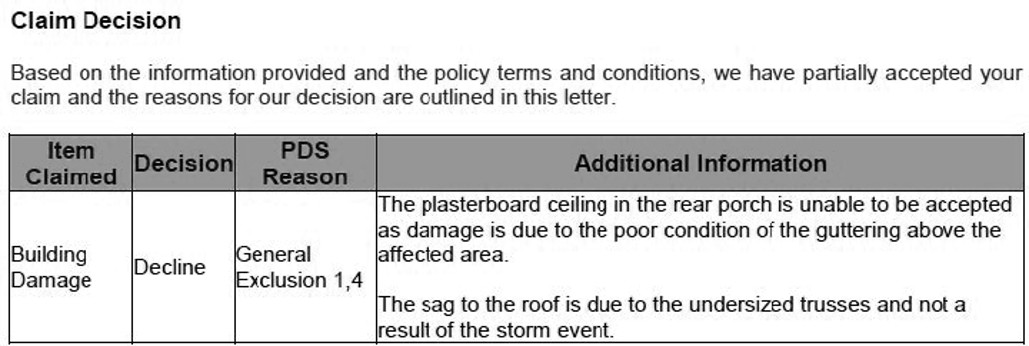
107 The letter then proceeded to set out the provisions of the Insureds’ Policy that Hollard relied upon, including, relevantly, the following two general exclusions referred to in the “PDS Reason” column in the table extracted above:
As relevant to the circumstances of your claim, the general exclusions state:
Under this policy there is no cover provided for any loss, damage or liability caused directly or indirectly by or in any way connected with:
1. defects, structural or design faults, faulty workmanship or faulty design;
4. wear and tear, rust, corrosion and/or deterioration (except in some instances relating to 'Sudden escape of liquid' and 'Legal liability' claims), but we will only apply this exclusion if the loss or damage is directly caused by one or more of these factors.
108 The parties agree that Hollard’s communications with the Insureds on 28 April 2023 mark the end of the relevant period for this aspect of the admitted contravention — namely, that Hollard failed to communicate sufficiently clearly with the Insureds regarding its reasoning and basis for the decision to offer a cash settlement for the damage to the external roof caused by the storm, and the value of the cash settlement that was offered in relation to that damage.
Delays in providing repairs to address growing mould
109 The final aspect of the admitted contravention concerns Hollard’s delay in providing repairs to address the growth of mould on the Property, which delays occurred between 4 November 2022 and 31 March 2023.
110 Ms X gave evidence that, as the weather had started to warm, on or around September 2022, she started to notice black mould growing around the house. It covered the Insureds’ bed, their bedroom walls, and other areas where there was moisture. She recalls speaking to Hollard by telephone and being advised to clean the affected areas with vinegar — which she did — but the mould quickly returned.
111 On or around 4 November 2022, after the Insureds’ telephone conversation with a member of Hollard’s complaints team (discussed at paragraph 70 above), the following note from the call was recorded in Hollard’s system: “Claims to contact insd re temp accomm, internal mould (unclear if this was passed to Claims)”. The parties agree that this date marks the beginning of the relevant period of Hollard’s delay in addressing the mould growth.
112 The same concerns were raised during a follow-up telephone conversation with the Insureds on 11 November 2022, during which the Insureds requested, according to Hollard’s file note of the call, that the Home Claims team provide “remediation on mould in kitchen ceiling, laundry and study room”.
113 On 20 February 2023, the Insureds called Hollard to follow up on their claim as they had not heard from anyone since Christmas. The Insureds also advised, among other things, that there was mould growing in the house. However, it was not until 31 March 2023 that another employee of Hollard called the Insureds to advise that Helio Restorations had been allocated to carry out mould remediation works. This is the end date of the period during which Hollard delayed in providing repairs to address the growing mould, being almost five months after the Insureds reported it to Hollard during the telephone call on 4 November 2022.
Subsequent events
AFCA complaint
114 On 30 April 2023, the Insureds lodged a complaint with the Australian Financial Complaints Authority (AFCA). Two further engineering opinions were then obtained.
115 BCE Consulting Engineers (BCE) provided a report to the Insureds on 21 June 2023 (the BCE Report), which concluded that the damage to the roof trusses over the lounge and at the hot-water service was due to localised pressures during the wind gusts on 29 October 2021, which in turn resulted in the failure of several roof trusses and the bowing of the roof structure, allowing water ingress and subsequent mould growth.
116 FMG Engineering (FMG), briefed with both the SDC and BCE Reports, provided its report to Hollard on the cause of the roof sagging on 25 September 2023. FMG’s report involved a measurement of the difference between the recorded wind speed of the storm (approx. 100km/hr) and the “ultimate wind design speed” of the building (approx. 147km/hr), which indicated that additional factors (such as pre-existing nail-plate failure and possibly slender/inadequate truss design) must have contributed to the damage. While FMG ultimately agreed with the conclusions expressed in the SDC and BCE Reports that the storm was a contributing factor in the failure of the roof, it noted that the failure of the roof trusses would not have been expected had the framing been sound.
117 On 13 November 2023, AFCA issued its determination in favour of the Insureds, and directed Hollard to, among other things, take the following steps within 14 days of receiving notice that the Insureds had accepted AFCA’s determination (which, in this case, meant by 8 December 2023):
(a) engage an engineer, roofing specialist, expert builder, or other suitably qualified expert, together with a mould restoration expert, to draw up a [scope of works] regarding the necessary repairs and associated works to the roof of the premises and the internal structures and fixtures of the Insureds’ home that were storm damaged and/or rain water-damaged;
(b) cover the costs of ongoing temporary accommodation for the Insureds, their son and their dogs, together with all necessary storage costs, until all repair, restoration and remediation works were completed and the Insureds could return to the Property;
(c) pay the Insureds $10,800 as non-financial loss compensation; and
(d) reimburse the Insureds their costs of the BCE Report.
Resolution of the Insureds’ claim
118 Hollard arranged for inspections of the Property on 7 December 2023 and 9 January 2024 for the purposes of preparing a scope of works and, by 31 January 2024, advised the Insureds that it had completed each of the four steps outlined above, as required by AFCA.
119 On 6 February 2024, the Insureds informed Hollard that they did not wish for the repairs to be completed by Hollard’s builder and instead requested a cash settlement. Later that month, Hollard paid the Insureds $227,265.63 in relation to their contents losses. On 7 March 2024, Hollard paid the Insureds a cash settlement of $694,446.83, being the amount quoted by Hollard’s builder to repair the Property, plus an additional 20% contingency, so that the Insureds could arrange the repairs themselves.
120 Hollard had also agreed to provide ongoing temporary accommodation through to March 2025. However, in October 2024, the Insureds advised Hollard that their house needed to be rebuilt and that, due to delays in obtaining building permits, they would not be able to complete the rebuild before their temporary accommodation ended.
121 In January 2025, the Insureds advised Hollard that they now wished to sell the Property and buy another home. Hollard later offered to pay the Insureds an additional cash settlement in the amount of $575,585.67 for the purposes of the Insureds purchasing a new home. Hollard also offered to pay the Insureds a further $48,240 to cover their temporary accommodation costs for the period 1 June 2025 to 31 December 2025. The Insureds accepted those offers.
122 In total, Hollard paid the Insureds $1,545,538.13 in relation to their claim, including the $48,240 paid to the Insureds to cover their accommodation for the period 1 June 2025 to 31 December 2025. Hollard also paid over $243,000 to temporary accommodation providers on the Insureds’ behalf for the period between 31 March 2023 and 1 June 2025. The total amounts paid by Hollard exceeded the sums insured under the Policy of $1,003,322 ($822,054 for building losses and $181,268 for contents losses).
Other Matters Relevant to the Contravening Conduct
123 Hollard gave evidence, through its Chief Operating Officer, Ms Vincent, as to some of the issues with its systems and claims-handling processes during the relevant period following its acquisition of the CommInsure business in September 2022, as well as some of the broader issues and circumstances affecting the Australian insurance industry at the time.
Pressures faced by the insurance industry due to severe weather events and the aftermath of the COVID-19 pandemic
124 In late February 2022, shortly after the storm event in late October 2021, there was heavy rainfall and flooding across South-East Queensland and northern New South Wales, which led to a declaration of a further Insurance Catastrophe (the Queensland Floods).
125 Ms Vincent described the Queensland Floods as the largest insurance claims event that she had ever experienced, with the Insurance Council of Australia having reported it as “Australia’s most expensive flood”, even surpassing Cyclone Tracy in 1974.
126 Ms Vincent also noted that both the storm in late October 2021 and the Queensland Floods had come in the aftermath of the COVID-19 pandemic, which itself had a significant impact on the insurance industry in 2020 and 2021, including through lockdowns and social-distancing requirements, the closing of international borders and disruptions to the global supply chain, and the resulting challenges in procuring building materials and skilled labour.
127 The impact of the pandemic on the building supply chain was supported by a report published by Better Regulation Victoria in October 2021 titled “Addressing Supply Chain Challenges: Review into Issues Facing Victoria’s Building and Construction Industries”. ASIC recognised in its August 2023 review of the industry’s handling of home insurance claims that “[t]he cumulative effect of severe weather events was compounded by ongoing challenges caused by COVID-19 and the global economic landscape, including a shortage of skilled workers (eg claims handling staff), supply chain issues (shortage of materials), and restricted or delayed access to parts of Australia (for assessors and tradespeople)”.
Challenges exposed following Hollard’s acquisition of the CommInsure business
128 Ms Vincent joined the Hollard Group (being Hollard Holdings Australia Pty Ltd and its two subsidiaries, Hollard and Hollard Insurance Company Pty Ltd) as Chief Operating Officer in October 2021, only a few weeks before the storm in late October 2021, and about four months after the announcement in June 2021 that the Hollard Group would be acquiring the CommInsure business. Upon the completion of that transaction on 30 September 2022, CommInsure was renamed to Hollard, and the Hollard Group almost doubled in size overnight; it went from being outside the 10 largest general insurers in Australia to being the fifth largest. In her affidavit, Ms Vincent used the defined term “Hollard” to refer to what I have termed the “Hollard Group”. Accordingly, where Ms Vincent’s affidavit referred to system and other improvements at “Hollard”, I have assumed she was referring to the Hollard Group, including Hollard (the Respondent).
129 While Ms Vincent did not have visibility over CommInsure’s business and claims-handling operations in the period prior to the completion of the acquisition on 30 September 2022 (as CommInsure was a competitor prior to that point), she gave evidence regarding the various challenges of integrating the CommInsure business that she had identified in the days and weeks after completion, which included that:
(1) Claims were managed across multiple systems that did not communicate with each other — including Fineos (claims management), Estimage (supplier management) and i90 (financial management and claims estimates) — which meant that, to obtain a complete picture of what was happening on any single claim at any one time, a claims officer had to review all three systems independently.
(2) CommInsure had used a task-based system to manage claims, rather than a case management system, which meant that claims officers were required to complete various (often discrete) tasks across numerous claims rather than having responsibility for the end-to-end management of a given customer’s claim.
(3) At the time the Hollard Group acquired CommInsure, there were approximately 215 claims per full-time equivalent employee from CommInsure as compared to the Hollard Group’s target range of between 85 and 100 claims per full-time equivalent employee. The number of active claims older than 180 days was also significantly higher at CommInsure than it was at the Hollard Group.
Post-acquisition improvements in Hollard’s claims and complaints handling processes
130 Ms Vincent gave evidence regarding the improvements made to the Hollard Group’s claims and complaints handling systems and processes following the completion of the acquisition of the CommInsure business on 30 September 2022.
131 Investments in resourcing: Between May and October 2023, the Hollard Group recruited 112 claims handling staff for the purposes of assisting to manage the CommInsure claims book, and has continued to increase staff numbers in its Home Claims team year-on-year — going from 338 full-time equivalent employees in FY2023 to 465 full-time equivalent employees in FY2025 — which has resulted in Hollard’s claims per full-time equivalent employee dropping to 77 as at May 2026 (compared to approximately 215 at the time of completion).
132 Restructuring of the Home Claims team: Following an initial restructure and consolidation of the Hollard Group’s broader Operations team (which included the Home Claims team) in March 2023, there was a further restructure of the Home Claims team in July 2024, which included the introduction of new specialist teams and roles to manage particular types of claims (eg, smaller “Fast Track” claims) and provide support during claims surges. Additionally, in May 2025, the Hollard Group introduced two new dedicated functions with responsibility for managing complex claims and disputes requiring greater delegation or authority to resolve, or claims involving customers who are vulnerable or experiencing vulnerability who require an extra level of care outside the normal claims process.
133 Investments in systems and processes: Between June 2022 and May 2025, the Hollard Group’s digital claims and complaints management systems have been developed to address some of the issues referred to at paragraphs 11, 12 and 129 above. These developments included:
(1) All claims have been migrated to a new claims management platform, known as ClaimCenter, to replace the three standalone systems that had been carried over from CommInsure (Fineos, Estimage and i90). This new platform combines all information needed to progress the claim, including communication history, supplier activity, claim age and upcoming deadlines, with the ability to integrate with other Hollard systems. While the transition to ClaimCenter had commenced in June 2022, and was used for all new claims filed with Hollard after December 2023, it took until June 2024 to migrate all existing Hollard claims to the new system. As of October 2024, the Hollard Group’s total investment in ClaimCenter was $32.3 million, including approximately $5.4 million to migrate legacy CommInsure claims.
(2) A new complaints management system, known as Respond, was introduced in September 2022. This system enabled staff members to see all relevant information about a complaint in a single system and would also automatically generate reminders to communicate with customers regarding their complaints in accordance with the timeframes expected by regulators.
(3) A new supplier management system, known as ENData, was established, which would interface directly with ClaimCenter and provide visibility over whether a supplier had attended a customer’s property within the required timeframe, and whether repairs had been completed by the estimated timeframe, so that action could be taken in response to any delays.
(4) A new digital claims monitoring dashboard was launched in May 2025, which pulled data from ClaimCenter to enable the identification of aged and “at risk” claims requiring greater oversight or attention, as well as key performance metrics such as claim cycle time, percentage of claims over 180 days old, customer satisfaction at lodgement and finalisation, and quality assurance accuracy.
134 New policies and procedures: Improvements in the Hollard Group’s systems were accompanied by several new policies and frameworks to help streamline and standardise the Hollard Group’s operations and allow for greater managerial oversight. These included new complaints and knowledge management frameworks, improved supplier panel selection and performance monitoring systems (known as the “One Hollard Panel”), a response plan for significant environmental events and insurance catastrophes, a standardised quality assurance framework, and regularly scheduled meetings of senior members of the Operations team to review and discuss the progress of claims.
135 Responses to industry-wide reviews and inquiries: Between June 2022 and June 2025, there have been numerous independent external reviews of insurers’ claims and complaints handling systems, including by ASIC, the House of Representatives’ Standing Committee on Economics, the Code Governance Committee, and Deloitte on behalf of the Insurance Council of Australia. The Hollard Group has participated in and taken action in response to these reviews (or committed to doing so). The Hollard Group also established an internal change-management program in February 2025 as a means of coordinating its actions in response to the recommendations arising from these reviews.
136 Investments in corporate culture: The Hollard Group has also made investments in fostering a more customer-centric corporate culture, with its “Managing Claims with HEART” — helpful, effective, accountable, respectful, and trustworthy — campaign and associated programs, which have been progressively rolled out since May 2023.
137 Ms Vincent deposed to her belief that, as a result of these investments across resourcing, processes and culture, she has a high degree of confidence that the circumstances of the Insureds’ claim should not arise again. The reasons for her belief are as follows:
(1) Under ClaimCenter, the Hollard Group’s new centralised claims management system, a claim ageing without adequate progress, as occurred in the Insureds’ case, would be readily identifiable in the system, so that appropriate action could be taken to get the claim back on track.
(2) The Hollard Group has transitioned to a holistic claims management system — as compared to the task-based system that had largely been used for the Insureds’ claim — which means that each customer’s claim is now allocated to an individual claims officer who takes responsibility for that claim from lodgement through to resolution, and who is therefore responsible for investigating and resolving any delays in the claim’s progression.
(3) The new digital claims monitoring dashboard serves as an effective tool for the early identification and management of aged and “at risk” claims, and is used regularly by Ms Vincent as part of her review of “at risk” claims during her monthly meetings with senior members of the Operations team, where she would take steps to satisfy herself that appropriate action is being taken. Prior to these systems being introduced, it was possible for a claim such as the Insureds’ to age without being identified or escalated.
(4) Under the Hollard Group’s improved supplier panel selection and performance monitoring system (particularly when paired with the ENData supplier management platform, which integrates with ClaimCenter), there is now greater visibility of supplier activity, including whether a supplier has attended a property or whether a claim is ageing without progress, so that issues can be identified and rectified promptly. Hollard did not have that visibility at the time it was handling the Insureds’ claim, which compounded many of the issues that the Insureds were experiencing, including where suppliers engaged by Hollard failed to attend the Property within expected timeframes, mismeasured aspects of the works, communicated poorly, and allowed the claim to age without meaningful progress.
The Admitted Contravention
138 ASIC has alleged, and Hollard has admitted, that Hollard failed to comply with the provision implied by s 13(1) of the Act in the Policy (specifically, Home Insurance Policy No HOM1612182), requiring Hollard to act towards the Insureds with the utmost good faith in respect of a claim by the Insureds for indemnity under the Policy in relation to damage caused by storm, and thereby contravened s 13(2A) of the Act, by combination of:
(a) between 15 November 2021 and 26 July 2022, failing to promptly engage a structural engineer to assess the storm damage to the roof;
(b) between 25 February 2022 and 12 October 2022, failing to assess correctly, and delaying in rectifying its mistake as to, the extent of the boundary fence which needed to be repaired;
(c) between 31 May 2022 and 27 June 2022, delaying in arranging further emergency works to the Insureds’ home, to protect the building against further loss or damage, after being notified that the original make-safe works had failed to stop water ingress;
(d) between 8 September 2022 and 31 March 2023, delaying in providing temporary accommodation to the Insureds;
(e) between 5 October 2022 and 28 April 2023, failing to sufficiently consider two written expert reports and an inspection report prepared by Hollard’s appointed claim manager that were relevant to the decision to offer a cash settlement for the damage to the external roof caused by the storm;
(f) between 5 October 2022 and 28 April 2023, failing to communicate in a sufficiently clear manner in writing with the Insureds about the reasoning and basis for the decision to offer a cash settlement for the damage to the external roof caused by the storm, and the value of the cash settlement that was offered in relation to that damage; and
(g) between 4 November 2022 and 31 March 2023, delaying in providing repairs to address growing mould.
139 The duty of utmost good faith operates as an implied condition, requiring each party to “have regard to more than its own interests when exercising its rights and powers under the contract of insurance”: Allianz Australia Insurance Ltd v Delor Vue Apartments CTS 39788 (2022) 277 CLR 445; [2022] HCA 38 (Delor Vue) at [95] (Kiefel CJ, Edelman, Steward and Gleeson JJ), quoting Distillers Co Bio-Chemicals (Aust) Pty Ltd v Ajax Insurance Co Ltd (1974) 130 CLR 1; [1974] HCA 3 at [53] (Stephen J), and referring also to CGU Insurance Ltd v AMP Financial Planning Pty Ltd (2007) 235 CLR 1; [2007] HCA 36 (CGU) at [15] (Gleeson CJ and Crennan J). The condition is not fiduciary, and does not require one party to exercise its rights or powers, or perform its obligations, only in the interests of the other: Delor Vue at [95].
140 A lack of utmost good faith is not to be equated with dishonesty only; utmost good faith may require an insurer to act with due regard to the legitimate interests of the insured, as well as to its own interests: CGU at [15] (Gleeson CJ and Crennan J, Callinan and Heydon JJ agreeing that a want of utmost good faith is not limited to dishonesty at [257], see also Kirby J at [130] agreeing on that point, although in dissent). Utmost good faith may require an insurer to act, consistently with commercial standards of decency and fairness, with due regard to the interests of the insured: CGU at [15].
141 What is required in order for an insurer to fulfil its duty of utmost good faith is informed by the circumstances, including the “important part insurance and insurers play in the life of the commercial community and of the general community”: Australian Securities and Investments Commission v TAL Life Ltd (No 2) (2021) 150 ACSR 224; [2021] FCA 193 at [173] (Allsop CJ). This facet of the duty of utmost good faith has particular significance on the facts of this case. The Insureds held home insurance with Hollard (via its predecessor) for more than 40 years: first, for over 20 years in respect of their former home and, from 2001, for the Property. For ordinary home-owners, annual insurance of their home and contents is an investment in peace of mind; they pay premiums on the strength of the promise, made by the insurer in return for the receipt of those premiums, that they will indemnify the insured should something happen to their home or contents that constitutes an insured peril. Not only is the home of people who take out home and contents insurance in respect of a very significant asset — for many, their most significant asset — but it is insurance in respect of an asset that has special emotional and practical significance, being their home.
142 The importance of home insurance and the importance of timely and effective claims handling was accepted by Hollard. Hollard also accepted that improper claims handling can cause severe stress, even for insureds who have greater resources and resilience than the Insureds with whose claim this proceeding is concerned.
143 I accept that, as alleged by ASIC and admitted by Hollard, Hollard breached its duty of utmost good faith by the combined conduct identified by the parties (set out in paragraph 138 above). In those respects, the way in which Hollard handled the Insureds’ claim fell well short of the basic level of fairness and reasonableness that community standards of decency and fair dealing require of an insurer in Hollard’s position. Several of the combined elements of conduct involved Hollard delaying for extended periods of time in progressing steps in the assessment of the Insureds’ claim: Hollard delayed in engaging a structural engineer; it delayed in rectifying its mistake about the boundary fencing; it delayed in arranging emergency works as water ingress continued; it delayed in providing temporary accommodation; and it delayed in providing repairs to address growing mould. In other respects, Hollard failed in its approach to claims assessment and claims handling: it failed sufficiently to consider several reports, and failed to communicate clearly with the Insureds in relation to its cash settlement offer in relation to damage to the external roof.
The Penalty to be Imposed
144 The penalty to be imposed in this case is to be fixed according to established principles, and in accordance with s 75B(5) of the Act. That section mandates that, in determining the pecuniary penalty, the Court must take into account “all relevant matters” but goes on to list four matters that must be considered. Those matters are:
(a) the nature and extent of the contravention;
(b) the nature and extent of any loss or damage suffered because of the contravention;
(c) the circumstances in which the contravention took place; and
(d) whether the person has previously been found by a court to have engaged in any similar conduct.
145 The principles developed in the case law on fixing penalties emphasise that specific and general deterrence is the primary purpose of civil penalties. Penalties must be fixed with sufficient “sting” so that they have that deterrent effect, but not at a level that is so high as to be oppressive. Penalties that are so low as to be regarded as merely an “acceptable cost of doing business” will be too low to serve the purposes of effective deterrence. These principles have been set out in numerous cases, including: Australian Building and Construction Commissioner v Pattinson (2022) 274 CLR 450; [2022] HCA 13 (Pattinson) at [17] (Kiefel CJ, Gageler, Keane, Gordon, Steward and Gleeson JJ), quoting Singtel Optus Pty Ltd v Australian Competition and Consumer Commission (2012) 287 ALR 249; [2012] FCAFC 20 at [68] (Keane CJ, Finn and Gilmour JJ), as endorsed in Australian Competition and Consumer Commission v TPG Internet Pty Ltd (2013) 250 CLR 640; [2013] HCA 54 at [64], [66] (French CJ, Crennan, Bell and Keane JJ); see also Australian Competition and Consumer Commission v Employsure Pty Ltd (2023) 407 ALR 302; [2023] FCAFC 5 at [69] (Rares, Stewart and Abraham JJ) and Australian Securities and Investments Commission v Mercer Superannuation (Australia) Ltd [2026] FCA 832 at [43] (Button J).
146 In its submissions, ASIC positioned its proposed penalty relative to the maximum penalty. It submitted that, although the case concerns a single contravention in respect of a single policy of insurance and a single insured — points emphasised by Hollard — its proposed penalty of $30 million had a reasonable relationship with the maximum fixed by the statute ($81.6 million).
147 In Pattinson, the High Court explained the role of a statutory maximum in the analysis of penalty: at [53]–[55] and [57] (Kiefel CJ, Gageler, Keane, Gordon, Steward and Gleeson JJ). I take the following points from their Honours’ analysis, which referred extensively to the reasons of the Full Court in Australian Competition and Consumer Commission v Reckitt Benckiser (Australia) Pty Ltd (2016) 340 ALR 25; [2016] FCAFC 181 (Reckitt Benckiser) at [155]–[156] (Jagot, Yates and Bromwich JJ):
(a) the maximum penalty is an important point of reference, but is only one yardstick, and must be treated as one of a number of relevant factors;
(b) the maximum penalty does not constrain the exercise of discretion beyond requiring “some reasonable relationship” between the theoretical maximum and the penalty to be imposed; and
(c) that relationship of reasonableness may be established by reference to the circumstances of the contravenor as well as by the circumstances of the conduct itself because either may have a bearing on the extent of the need for deterrence.
148 The relevance of the characteristics of the contravenor and the conduct also explains the “French factors” (referring to the matters listed by French J in Trade Practices Commission v CSR Ltd [1991] ATPR 41-076; [1990] FCA 762 at [42]), endorsed by the High Court in Pattinson at [18]–[19], [54] (Kiefel CJ, Gageler, Keane, Gordon, Steward and Gleeson JJ), with the proviso that they should not be regarded as a rigid catalogue of matters for attention.
149 Hollard’s submissions on penalty adopted an unattractive technical bent that tended to downplay the seriousness of its contravening conduct. That tone was struck by the opening paragraph of its written submissions, which said (emphasis in original):
This case raises for consideration the appropriate pecuniary penalty to be paid in respect of an insurer’s mismanagement of a single insureds’ home insurance claim, arising under a single policy of insurance, which is agreed to have amounted to a single breach of the insurer’s duty of utmost good faith.
150 This technical bent was continued by submissions that harnessed the fact that the agreed contravention arose from the combination of several features of its conduct, to say that it was only when the temporally last element of the various strands was complete that the contravening conduct occurred, the suggestion being that conduct falling a hair short of full totality of the combined conduct was not conduct falling short of the duty of utmost good faith. This approach by Hollard wrongly treated ASIC’s ultimate prosecution of a case based on combined conduct as suggesting that anything short of that combined conduct would escape sanction. The point is not whether or not anything short of the combined conduct would or would not cross the line, but that the way in which Hollard put its case tended to suggest there was really nothing too concerning in the bulk of the conduct.
151 Conversely, ASIC’s submissions noted that it had pleaded a case in which each strand of conduct constituted a separate contravention, but had agreed to resolve the case on liability on the basis that the combined conduct constituted a single contravention. The way in which the case was originally pleaded is not to the point when it comes to fixing the appropriate penalty.
152 In determining the penalty to be imposed, I proceed on the basis that the combined conduct identified constituted a single contravention. I also refer to Hollard in addressing penalty, while noting that the evidence concerning systems and processes was given by Ms Vincent as descriptive of the whole of the Hollard Group.
Deterrence
153 I accept Hollard’s submission that a penalty at the level proposed by ASIC — $30 million — is not required for specific deterrence.
154 The contravention occurred during a period in which the Hollard Group’s acquisition of the CommInsure business was in train. The storm in October 2021 that caused damage to the Insureds’ Property was part of a period of severe storms that constituted an industry-recognised Insurance Catastrophe. While ASIC criticised Hollard’s evidence on the basis that it did not directly detail how the increased claims load affected the handling of the Insureds’ claims, common sense tells that increased claim loads associated with a recognised Insurance Catastrophe would be expected to affect claims handling, at least for some period.
155 In the present case, however, the point — at least in relation to specific deterrence — is not so much the extent to which the storm events contributed to the failings in the handling of the Insureds’ claim, but that Hollard has significantly decreased the claims load per claims handler, and has also instituted significant business process improvements that I accept will significantly improve claims handling by addressing system weaknesses that allowed the failings in the handling of the Insureds’ claim to occur and go unaddressed for long periods.
156 On the staffing front, the number of full-time equivalent employees in the Home Claims team has increased from 160 in FY2022 (noting this was pre-acquisition) to 465 in FY2025, and the number of claims per full-time equivalent employee in that team has gone down from about 215 in 2022 to 77 in 2026.
157 On the systems and processes front:
(1) Hollard has implemented a centralised claims management platform known as “ClaimCenter”. The integration of this platform into Hollard’s systems, and the migration of claims to it, constituted a significant investment by Hollard (over $30 million). ClaimCenter stores all information about a claim, including — as detailed in Ms Vincent’s evidence — the communication history, supplier activity history, claim age and upcoming claim deadlines. This means that claims handling staff no longer have to look across multiple systems to piece together what is (or is not) happening in relation to a claim. The ClaimCenter system also generates automated reminders to ensure that critical steps are tracked and brought to the attention of claims managers, helping to prevent significant delays.
(2) The move to ClaimCenter is coupled with the introduction of a “claims monitoring dashboard” tool that is linked to ClaimCenter. That tool flags, for identification and escalation, aged and “at risk” claims requiring oversight and escalation to senior management.
(3) Hollard has changed its claims-handling model so that a single claims officer is responsible for the management of a claim from start to finish. This contrasts with the previous “task-based” model, which meant that a claim was passed from person to person in the claims handling process.
(4) Hollard has introduced the “One Hollard Panel” system. That system standardises dealings with suppliers and includes monthly meetings to track progress. This connects with Hollard’s ability now to readily see details of supplier activity through “ENData”, which feeds into Hollard’s ClaimCenter system. I accept Hollard’s submission that these changes mean that Hollard will be able to identify any supplier service issues and take appropriate steps to rectify any issues. While not all failings in the handling of the Insureds’ claim related to suppliers, a number of them did. For example, although CS had identified the need for a structural engineer on 15 November 2021, and Hollard had approved that engagement on 24 January 2022, CS did not engage an engineer until 26 July 2022. When the engineer’s report was received, CS erroneously uploaded it as an invoice to Estimage on 9 September 2022, which meant that Hollard was not alerted to it until it followed up with CS on 11 November 2022.
(5) Hollard has improved its capacity to respond to high claim periods through the adoption of its “One Hollard Event Response Plan” and its establishment of a “Catastrophe Claims” team responsible for executing that plan.
158 These improvements are extensive. While no system is flawless, or can be expected to prevent any and all future lapses in claims handling, I accept Hollard’s submissions that the changes it has made significantly reduce the possibility of the multiple failings that occurred in the handling of the Insureds’ claim recurring. Equally important is what these extensive changes say about the culture of claims management of Hollard. As detailed in Ms Vincent’s evidence, Hollard had little visibility of some aspects of the business it was acquiring, and set about implementing significant changes and improvements once the acquisition was complete. As mentioned above, those changes have involved significant one-off investment, but also ongoing investment in staffing the claims handling team at a level that significantly reduces the load per employee.
159 The rate of complaints lodged with AFCA against Hollard has dropped substantially between FY2023 and FY2025 — the reduction is a decline of close to one third, and takes Hollard from being the subject of about 5% of complaints (and the sixth-highest ranking insurer in complaint numbers) to roughly 3% of complaints (and the ninth-highest ranking insurer in terms of complaint numbers). This suggests that the changes that Hollard has made over that period are effecting positive change.
160 The fact that these changes were instituted by Hollard through its business activities, and not as a response to this litigation, stands to the company’s credit, in my view (rather than undermining the significance of the changes in the assessment of penalty, as ASIC submitted). A business that identifies issues and takes steps to address them without the pressure of regulatory enforcement action prompting the change is, in my view, a business less in need of specific deterrence than a business driven to make changes by the pressure of litigation.
161 Both parties addressed the topic of contrition and whether Hollard has apologised for its conduct. ASIC raised this topic in connection with the need for specific deterrence. Ms Vincent is a senior employee of Hollard. She is its Chief Operating Officer. Her evidence includes the following:
I wish to make it clear that Hollard fell materially short of its obligations to [the Insureds] in the handling of their claim and Hollard sincerely regrets the impact that the claim has had on their lives. What [the Insureds] experienced with the management of their claim should not have happened.
162 I accept that this is an unqualified statement of contrition. Regrettably, it was somewhat undermined by the approach taken by Hollard, to which I have referred above (at paragraph 149).
163 Hollard also relied on the transcript of a call between one of the Insureds and one of its Senior Customer Relations Specialists following the AFCA determination. In that call, the representative said “on behalf of Hollard … I do want to extend our sincerest apologies to you for all your claims experience”. While this was an apology in the context of a call to progress implementation of the AFCA determination, it is still an apology offered in unqualified terms.
164 I have taken these matters into consideration. While I would not say Hollard’s statement of contrition and its apology were cast in effusive terms, that does not mean that they were not sincere. I accept that the focus that this proceeding has brought has brought home to Hollard the way in which failures in claims handling affected the Insureds.
165 In my view, a penalty of $2 million is sufficient to serve the purposes of specific deterrence. Nothing like $30 million is required for this purpose. I reject ASIC’s submission that “[w]hen regard is had to the maximum penalty … a penalty less than tens of millions of dollars would not be sufficiently large to act as an effective deterrent.” As set out above (at paragraph 147), the High Court made clear in Pattinson that the statutory maximum is a point of reference and does not constrain the exercise of discretion. Here, the circumstances of the contravenor and the conduct bear directly on the need for deterrence, being matters that the High Court in Pattinson said may establish the reasonable relationship between the maximum penalty and the penalty imposed.
166 However, I also do not regard a penalty at the level proposed by Hollard to be sufficient to serve the purposes of specific deterrence. While significant improvements have been made in claims handling, there is always the risk of back-sliding, and the penalty imposed will serve to deter Hollard from tolerating any such back-sliding as would allow similar failings in claims handling to occur in the future.
167 A penalty at the level of $100,000–$300,000 — as proposed by Hollard — does not present a sufficient “sting” in order to serve the purposes of specific deterrence for a business of Hollard’s size. Hollard’s annual turnover was over $1 billion in FY2025, up from $810 million in FY2021. ASIC stressed the scale of Hollard’s business, as measured by turnover, in supporting its submission that a $30 million penalty is required, as well as the even higher turnover of the corporate group of which Hollard is a part, which exceeded $3 billion in FY2024 and FY2025.
168 I accept that turnover is an important indicator of scale. It is also the business metric by which the legislature has set one of the means by which the maximum penalty can be set. However, what level of penalty is necessary to serve the purposes of specific deterrence also needs to take account of the nature of the business operated by the contravenor, and its profitability. Hollard is a general insurer, and its accounts reflect that it made profits in only two of the five financial years between FY2021 and FY2025 (with the corporate group making a profit in three of those years). Moreover, Hollard’s losses in the three loss-making financial years — FY2022, FY2023 and FY2024 — were substantial, being between $30.26 million and $39.9 million. These losses exceed the relatively modest profits made in FY2021 — $20.0 million — and FY2025 — $15 million. A penalty at the level proposed by ASIC is only $5 million less than Hollard’s combined profit in its only two profit-making years between FY2021 and FY2025. In my view, a penalty of that quantum so far exceeds what could conceivably be required to serve the purposes of specific deterrence as to be oppressive: Pattinson at [40] (Kiefel CJ, Gageler, Keane, Gordon, Steward and Gleeson JJ), quoting Burchett and Kiefel JJ in NW Frozen Foods Pty Ltd v Australian Competition and Consumer Commission (1996) 71 FCR 285; [1996] FCA 1134 at 293.
169 What, then, of general deterrence?
170 In my assessment, a penalty of $2 million for a single contravention is sufficient to ensure that “other ‘would-be wrongdoers’ think twice” (Reckitt Benckiser at [150] (Jagot, Yates and Bromwich JJ)). I do not consider that a penalty of $2 million for failure to handle the claim of an insured in keeping with the duty of utmost good faith would be brushed aside by other insurers in the industry in this country as of so little consequence as to be regarded as merely an acceptable cost of doing business. A fine of $2 million for a single contravention sounds a sufficient warning that claims handling failures that mean the insurer has failed to adhere to its duty of utmost good faith will have real consequences.
171 That is so notwithstanding that, as ASIC stressed in its submissions, the insurance industry in Australia is “immense” with revenue for household insurance alone exceeding $15 billion in FY2025 according to the Australian Prudential Regulation Authority (APRA), with the largest household insurance players reporting revenues of over $3 billion each (those being two of several statistics cited by ASIC in support of its scale arguments).
172 The level of penalty necessary to serve the purposes of general deterrence is not to be simplistically set on the basis that a huge turnover of some industry participants warrants a very high penalty be imposed on the contravenor. Reasoning of that kind implicitly assumes that high penalties against a contravenor can be justified on the basis of the level of penalty necessary to deter other, and bigger, industry participants. That kind of analysis poses an obvious risk that oppressive penalties will be imposed.
173 Not only that, but reasoning along those lines assumes that businesses of scale, such as large household insurers, are impervious to the potential for penalties that would not seem obviously “large” in connection with their gross revenue. The figures ASIC relied on only addressed gross revenue; they did not address profit. As the example of Hollard itself illustrates, turnover can be a far cry from profit. ASIC’s submission as to what is required for general deterrence is unsupported by evidence and does not accord with common sense. On the contrary, business common sense would suggest that even businesses with large turnovers would regard a penalty of $2 million for a single contravention relating to failings in claims handling as something to be avoided. The fact that large insurers hold many thousands, if not millions, of home insurance policies — a fact ASIC relied on to support a higher penalty — would serve to bring home to other market participants their very substantial financial exposure to penalties if they fail to accord with their duty of utmost good faith in claims handling at the individual claim handling level.
174 As the case of Australian Securities and Investments Commission v Commonwealth Bank of Australia [2020] FCA 1543 (ASIC v CBA) illustrates (albeit in a different sector and in a case involving contraventions that stemmed from a single error by an employee), even for businesses that are very large, in terms of resources and turnover, a penalty that might appear “modest” in comparison to turnover can serve the purposes of specific and general deterrence. In that case, a penalty of $150,000 (against a maximum of $1.8 million) was regarded as “substantial in the circumstances” and sufficient to serve the aims of specific and general deterrence notwithstanding the immense financial resources of the CBA and the fact that other participants in the credit provision market in Australia are also large and well resourced: ASIC v CBA at [78] (Murphy J).
175 For these reasons, I consider that a penalty of $2 million serves the purposes of general deterrence.
Section 75B(5) relevant matters
176 As mentioned above, s 75B(5) of the Act requires that the Court consider “all relevant matters” in determining the pecuniary penalty to be imposed, but specifically identifies four matters that must be considered. They are:
(a) the nature and extent of the contravention;
(b) the nature and extent of any loss or damage suffered because of the contravention;
(c) the circumstances in which the contravention took place; and
(d) whether the person has previously been found by a court (including a court in a foreign country) to have engaged in any similar conduct.
177 As to the first of those matters, I take into consideration the following features of the contravention:
(1) The contravening conduct occurred over an overall period between 15 November 2021 and 28 April 2023. While the periods over which each element of conduct occurred was a period of months within this overall period — other than the element concerning emergency works, which was just under one month — the overall conduct occurred over a sustained period of time. In this respect the case is different from some other cases in which a single error or misstep constitutes the contravening conduct.
(2) The contravening conduct was not the result of deliberate or malign conduct. The contravening conduct was constituted by a series of failures, most involving delay: the failure to act promptly to engage a structural engineer even once it was known that one was required; the failure to measure the boundary fencing accurately, and delay in rectifying the measuring mistakes, even once they had been raised; the delay in arranging further emergency works to stop water ingress to the Insureds’ home; and the delay in providing temporary accommodation and arranging works to address mould. The failures that were not related to delay involved failing to consider certain reports adequately before taking a position to offer a cash settlement, and not communicating with the Insureds clearly and with adequate reasoning, in relation to the decision to offer them a cash settlement.
(3) The contravening conduct did not involve senior management, save to the extent that the nature of claims handling systems, the way a business is run and the resources devoted to the task are matters for which senior management are responsible at a general level. However, the case that ASIC brought is not a “systems” case (by which I mean a case in which it is inadequate systems that constitute the contravening conduct). Here, it is specific aspects of the handling of the Insureds’ claim that constitute the contravening conduct.
(4) The contravening conduct involved, as Hollard accepts, not just poor claims handling, but a claims handling process in which there were several identified failures that, taken together, were sufficiently serious to put Hollard in breach of its duty of utmost good faith. Hollard accepts that its conduct had a real impact on the Insureds, and put them through an experience that was stressful and prolonged. Some aspects of the contravening conduct are hard to fathom. In particular, the failure to appoint an engineer for about eight months after the need for one was identified on the first inspection, the glacial progress of the claim handling while the Insureds’ house decayed around them, and the progress of mould growth, cannot be explained simply as the product of staff busyness or poor communication with suppliers. To be clear, Hollard does not seek to excuse its conduct; it has admitted its conduct contravened its duty of utmost good faith.
(5) I accept ASIC’s submissions that the contravening conduct of Hollard has had long-lasting consequences for the Insureds, and occurred in a context where the Insureds were in the hands of their insurer, dependent on it to progress the necessary steps to assess their claim so that repairs could be effected (or a cash settlement offered). Nevertheless, care must be taken not to approach the appropriate penalty on the basis that the entirety of the Insureds’ experience is to be attributed to the contravening conduct; only some aspects of Hollard’s handling of the Insureds’ claim constitutes the admitted contravening conduct.
178 ASIC submitted that Hollard’s conduct failed to accord with aspects of the Code, and Hollard’s own policies and procedures. In circumstances where Hollard has admitted the contravention ultimately alleged by ASIC, this is not a case where industry codes or internal policies are of assistance in determining whether the conduct of a putative contravenor falls short of the requisite standard.
179 The next matter is the nature and extent of any loss or damage suffered because of the contravention. The general non-economic impact of the contravening conduct on the Insureds has already been addressed. In addition to the distress I accept that the contravening conduct caused them, they suffered significant inconvenience in having to live in temporary accommodation, including having to move several times, and have lost personal possessions of sentimental value, such as family photographs. They were also separated from their beloved dogs while staying in temporary accommodation.
180 ASIC relied on evidence of Ms X that she and her husband suffered from ill-health because of Hollard’s conduct. The evidence included a two-sentence general practitioner’s letter in identical terms for each of the Insureds stating that the Insured had been “suffering with an increased psychological burden of stress” since their house was damaged by storms, the Insured was struggling with sleep and mental concentration “due to the ongoing dispute about the repair of the damage” with the insurer. Given the generality of this evidence and its lack of detail concerning the Insureds’ health — particularly in the context of both Insureds having chronic health conditions — I am not satisfied that the penalty should be approached on the basis that Hollard’s contravening conduct caused the Insureds to suffer from ill-health. Similarly, Ms X’s evidence about taking days off due to “the stress and constant moving”, some of which were unpaid days off, is too non-specific to contribute to the analysis of penalty over and above the position, that I have accepted, that Hollard’s contravening conduct caused them distress and inconvenience.
181 Hollard’s submissions detail the amounts paid to the Insureds. In total, those amounts exceed the maximum sums due under the Insureds’ Policy. ASIC submitted that, “[t]o the extent that Hollard may be regarded as having ameliorated the Insureds’ losses by payment of compensation, even the process of quantifying and extracting that compensation was long-winded and torturous”. The supporting footnote to this submission refers to a series of paragraphs of the SOAF. That series of paragraphs does not bear out the submission, insofar as it refers to the AFCA process and the period thereafter. The Insureds’ acceptance of AFCA’s determination was communicated on 24 November 2023. The amount of compensation for non-financial loss determined by AFCA was paid by Hollard on 29 November 2023. Besides a delay caused by an engineer being in COVID-related isolation, the steps determined by AFCA were progressed by Hollard without significant delay. On 31 January 2024, Hollard emailed the Insureds to say it wanted to instruct the builder to commence repairs immediately, but the Insureds said (on 6 February 2024) that they wanted a cash settlement. Hollard offered a cash settlement for the amount of the quote for repairs, plus a 20% contingency, on 20 February 2024, and paid that amount on 7 March 2024. No further events are recorded until October 2024, when the Insureds contacted Hollard to say the house needed to be rebuilt, and that delays meant it would not be done before their temporary accommodation expired. They later, in January 2025, informed Hollard that they wished to buy another home and sell the Property. Hollard then, in March 2025, offered an additional cash settlement for the purpose of purchasing the new home (an additional $575,585.67), and a cash settlement for further temporary accommodation costs (until December 2025, a further $48,240). These cash settlements were accepted by the Insureds.
182 I do not consider that the evidence shows that the process following the submission of the AFCA complaint was “long-winded and torturous”. Hollard submitted that it was not required by the AFCA determination or the terms of the Policy to pay the additional cash settlement sums paid after March 2024. That submission was not directly contradicted by ASIC, which pointed instead to the lack of ameliorative steps taken by Hollard to address the wider consequences that its contravention had had on the Insureds’ lives, although ASIC could not identify what Hollard ought to have done to address those wider consequences.
183 Given that the Insureds accepted cash settlements, elected to sell the Property (rather than rebuild) but have not used the funds received from Hollard to purchase another property over an extended period, I do not treat the fact that the Insureds continue to incur rental expenses as a financial loss that can be attributed to the contravening conduct. The same goes for ongoing expenses they are incurring due to the fact that they continue to own the affected Property, such as mortgage repayments and maintenance costs.
184 I do, however, accept that the Insureds incurred some unquantified expenses for petrol to travel back and forth between their temporary accommodation and the Property to attend to their dogs, and the Property. ASIC has not established that the Insureds suffered any net financial losses that have not been compensated.
185 The next matter referred to in s 75B(5) is the circumstances in which the contravention took place. The circumstances have been addressed elsewhere in these reasons.
186 The final matter is whether Hollard has previously been found by a court (including a court in a foreign country) to have engaged in any similar conduct. The parties agree that Hollard has not previously been found to have engaged in similar conduct.
187 Having regard to the statutory factors, I consider that the penalty of $2 million reflects the nature and extent of the contravention, the loss or damage suffered by the Insureds, the circumstances in which the contravention occurred, and the fact that Hollard has not previously been found to have engaged in any similar conduct.
Other relevant matters
188 Most of the “French factors” have been addressed in the foregoing analysis.
189 One factor not already addressed is whether the contravenor has shown a disposition to cooperate with the authorities. ASIC accepts that, since the commencement of the proceeding, Hollard has cooperated with ASIC in the manner specified in the SOAF. The ways in which Hollard has cooperated are as follows, as set out in that document:
(a) indicating on 8 May 2025, less than a month after the proceedings were commenced and before the date of the first case management hearing listed for 16 May 2025, a willingness to accept that a contravention of s 13(2A) of the ICA had occurred;
(b) agreeing on orders in advance of each case management hearing, such that a contested listing has never been necessary;
(c) making the admissions in, and assisting in the preparation of, the SAFA;
(d) on 7 November 2025, admitting a contravention of s 13(2A) of the ICA, thereby obviating the need for ASIC (and Hollard) to file evidence in relation to liability; and
(e) cooperating and assisting in the preparation of this SOAF.
190 Hollard’s corporate culture has been addressed in relation to the investment it has made and the changes it has made to business operations over the past several years following its acquisition of the CommInsure business. I accept that those steps reflect a culture that recognises the importance of timely and efficient claims management.
Conclusion
191 A penalty of $2 million is significantly lower than the figure ASIC proposed, and does not come close to the statutory maximum. I am, however, satisfied that it reflects the nature and circumstances of the contravening conduct and is sufficient to serve the purposes of deterrence, specific and general. I have also considered whether it is too high, as Hollard submitted. I do not think that it is. Although, as Hollard emphasised, the penalty is to be imposed in respect of a single contravention relating to a single policy, the contravention did not arise from a one-off bad decision, oversight or error. Rather, the contravention arose from conduct over an overall long period of time, and arose from multiple instances of lack of attention, delay and a lack of alacrity in progressing claims handling.
192 Insurers play a vital role in Australian society. The capacity for harm to come to insureds holding home insurance is particularly acute given the value of the home as an asset in many Australian households, and the power disparity between insurer and insured in progressing claims. It is incumbent on insurers to ensure that their claims handling accords with the duty of utmost good faith. Hollard’s contravening conduct here fell well short of that standard. A penalty of $2 million will send a message to insurers that the duty of utmost good faith is real; it is not an empty verbal formula. Rather, it is a substantive, and reciprocal, obligation between insurers and insureds. It is one that attaches to claims handling as much as other matters relating to the contract of insurance.
I certify that the preceding one hundred and ninety-two (192) numbered paragraphs are a true copy of the Reasons for Judgment of the Honourable Justice Button. |
Associate:
Dated: 9 October 2026


