

FEDERAL COURT OF AUSTRALIA
Takarua v Minister for Immigration and Citizenship (No 2) [2026] FCA 1460
File number(s): | NSD 37 of 2026 NSD 2062 of 2025 |
Judgment of: | LENEHAN J |
Date of judgment: | 8 October 2026 |
Catchwords: | MIGRATION – where applicant contends he was not given written notice of the non-revocation decision, as required by s 501G of the Migration Act 1958 (Cth) – where applicant seeks declarations that the Minister for Immigration and Citizenship (the Minister) failed to give written notice of the non-revocation decision – where applicant also seeks a writ of mandamus directing the Minister to comply with s 501G – where applicant did not discharge his onus of proving that there had been a relevant failure to comply with s 501G – applications dismissed MIGRATION – whether the duty to remove an unlawful non-citizen “as soon as reasonably practicable” arises before written notice of the relevant decision has been given and while the non-citizen’s right to seek, or obtain, merits review remains on foot – where the principles articulated by the High Court of Australia in Minister for Multicultural Affairs v MZAPC (2025) 99 ALJR 486 apply to the construction of s 198(2B) – where the notification requirements in s 501G are directed, amongst other things, to ensuring that an affected person is informed of, and therefore able to exercise, their merits review rights |
Legislation: | Administrative Review Tribunal Act 2024 (Cth), ss 12, 105 Migration Act 1958 (Cth), ss 11A, 32, 82, 189, 197E, 198, 476, 500, 501, 501CA, 501G Migration Legislation Amendment (Strengthening of Provisions relating to Character and Conduct) Bill 1998 (Cth) Migration Regulations 1994 (Cth), reg 5.15A |
Cases cited: | Apollo Shower Screens Pty Ltd v Building and Construction Industry Long Service Payments Corp (1985) 1 NSWLR 561 BHRR v Minister for Immigration and Citizenship (No 2) [2026] FCA 250 Blatch v Archer (1774) 1 Cowp 63 Cameron v Commissioner of Taxation [2026] FCA 609 Ceerose Pty Ltd v The Owners – Strata Plan No 89074 [2025] NSWCA 235 CEG Direct Securities Pty Limited v Cooper (2025) 309 FCR 66 Du v Minister for Immigration and Citizenship [2026] FCA 758 Ellis v Central Land Council (2019) 267 FCR 339 GMS24 v Commonwealth (2025) 313 FCR 152 Hudson v Colliers International (NSW) Pty Ltd [2026] NSWCA 88 Minister for Immigration, Citizenship, Migrant Services and Multicultural Affairs v Moorcroft (2021) 273 CLR 21 Minister for Multicultural Affairs v MZAPC (2025) 99 ALJR 486 Moore v Goldhagen (2024) 107 MVR 299 Pomare v Minister for Immigration and Citizenship (2008) 167 FCR 494 Re Minister for Immigration and Multicultural and Indigenous Affairs; Ex parte Palme (2003) 216 CLR 212 Takarua v Minister for Immigration and Citizenship [2025] FCA 1419 TCXM v Minister for Immigration and Citizenship (2026) 100 ALJR 794 Wilson v Minister for Immigration and Citizenship (2012) 135 ALD 60 WKMZ v Minister for Immigration, Citizenship, Migrant Services and Multicultural Affairs (2021) 285 FCR 463 |
Division: | General Division |
Registry: | New South Wales |
National Practice Area: | Administrative and Constitutional Law and Human Rights |
Number of paragraphs: | 179 |
Date of last submission/s: | 20 July 2026 |
Date of hearing: | 3 July 2026 |
Counsel for the Applicant: | Mr Anish Bhasin |
Solicitor for the Applicant: | Legal Aid NSW |
Counsel for the Respondents: | Mr Richard Knowles KC with Mr Jonathan Barrington |
Solicitor for the Respondents: | Sparke Helmore |
ORDERS
NSD 37 of 2026 NSD 2062 of 2025 | ||
| ||
BETWEEN: | LEX TAKARUA Applicant | |
AND: | MINISTER FOR IMMIGRATION AND CITIZENSHIP First Respondent | |
COMMONWEALTH OF AUSTRALIA Second Respondent | ||
order made by: | LENEHAN J |
DATE OF ORDER: | 8 OCTOBER 2026 |
THE COURT ORDERS THAT:
1. The applicant’s further amended application (filed with this Court on 20 April 2026) (in NSD 37 of 2026) be dismissed.
2. The applicant’s second further amended application (filed with this Court on 20 April 2026) (in NSD 2062 of 2025) be dismissed.
3. The applicant pay the respondents’ costs.
Note: Entry of orders is dealt with in Rule 39.32 of the Federal Court Rules 2011.
REASONS FOR JUDGMENT
LENEHAN J:
1. INTRODUCTION
1 These proceedings arise from a dispute as to whether the applicant was given written notice of the non-revocation decision, as required by s 501G of the Migration Act. Considerable time, effort and resources were expended by the parties in litigating the dispute. That aspect of the procedural history illustrates the forensic challenges that may arise in disputes concerning the delivery of documents to people in immigration detention and the potential for improvement in the methods by which such documents are delivered. Nevertheless, on the evidence before me, I was able to comfortably conclude that Mr Takarua had not discharged his onus of proving that there had been a relevant failure to comply with s 501G of the Migration Act. For the reasons set out below, the applications should therefore be dismissed.
2. BACKGROUND
2 By a further amended application (filed on 20 April 2026) in proceeding NSD 37 of 2026 and a second further amended application (filed on 20 April 2026) in proceeding NSD 2062 of 2025 (together, the applications), the applicant, Lex Takarua, seeks, among other things, a declaration that the first respondent, the Minister for Immigration and Citizenship (the Minister), failed to give him written notice of the decision not to revoke the cancellation of his visa pursuant to s 501CA of the Migration Act 1958 (Cth) (the Migration Act), as required by s 501G of the Migration Act.
2.1 Factual background
3 Mr Takarua is a citizen of New Zealand and was born there on 20 December 1991. He first entered Australia on 18 September 2008 as the holder of a Subclass 444 Special Category visa and re-entered Australia on the same class of visa on 23 October 2017. Mr Takarua said he has been living in Australia since 2008.
4 On 14 February 2024, a delegate of the Minister cancelled Mr Takarua’s visa under s 501(3A) of the Migration Act as he had a “substantial criminal record” (the cancellation decision). Assisted by Legal Aid NSW, Mr Takarua sought revocation of that decision on 14 March 2024.
5 On 19 October 2024, Mr Takarua was released from criminal custody and was, pursuant to s 189(1) of the Migration Act, taken into immigration detention.
6 On 22 September 2025, a delegate of the Minister decided not to revoke the cancellation decision pursuant to s 501CA of the Migration Act (the non-revocation decision). The parties dispute what occurred after the non-revocation decision was made. Specifically, Mr Takarua contends that he was not given written notice of the non-revocation decision, as required by s 501G of the Migration Act which relevantly provides:
(1) If a decision is made under subsection 501(1) or (2) or 501A(2) or section 501B, 501BA, 501CA or 501F to:
(a) refuse to grant a visa to a person; or
(b) cancel a visa that has been granted to a person; or
(ba) not revoke a decision to cancel a visa that has been granted to a person;
the Minister must give the person a written notice that:
(c) sets out the decision; and
(d) specifies the provision under which the decision was made and sets out the effect of that provision; and
(e) sets out the reasons (other than non-disclosable information) for the decision; and
(f) if the decision was made by a delegate of the Minister under subsection 501(1) or (2), or section 501CA and the person has a right to have the decision reviewed by the ART:
(i) states that the decision can be reviewed by the ART; and
(ii) states the time in which the application for review may be made; and
(iii) states who can apply to have the decision reviewed; and
(iv) states where the application for review can be made; and
(v) in a case where the decision relates to a person in the migration zone—sets out the effect of subsections 500(6A) to (6L) (inclusive); and
(vi) sets out such additional information (if any) as is prescribed.
(2) If the decision referred to in subsection (1):
(a) was made by a delegate of the Minister under subsection 501(1) or (2), or section 501CA; and
(b) is reviewable by the ART; and
(c) relates to a person in the migration zone;
the notice under subsection (1) that relates to the decision must be accompanied by 2 copies of every document, or part of a document, that:
(d) is in the delegate’s possession or under the delegate’s control; and
(e) was relevant to the making of the decision; and
(f) does not contain non-disclosable information.
(3) A notice under subsection (1) must be given in the prescribed way.
(4) A failure to comply with this section in relation to a decision does not affect the validity of the decision …
7 I will return to aspects of s 501G of the Migration Act later.
8 Unlike some other cases in this Court, this case does not raise questions about whether there has been compliance with the content requirements in s 501G(1)(f) or the requirement in s 501G(3) for notice to be given in the “prescribed way”. Here, the blunter factual question that arises is whether Mr Takarua was ever given written notice of the relevant decision.
9 On 4 November 2025, Mr Takarua was notified that he was to be removed from Australia to New Zealand on 10 November 2025.
2.2 Procedural background
10 There are currently two proceedings before this Court: NSD 2062 of 2025 and NSD 37 of 2026. I will explain how that came to be the case.
11 Mr Takarua, representing himself, commenced NSD 2062 of 2025 in this Court, seeking orders to prevent his removal from Australia. On 9, 10 and 14 November 2025, Colvin J granted interim injunctive relief. Following hearings on those dates, on 18 November 2025, Colvin J made an interlocutory order, restraining Mr Takarua’s removal from Australia “until final hearing or further order”: Takarua v Minister for Immigration and Citizenship [2025] FCA 1419.
12 On 8 December 2025, Mr Takarua filed an application with the Federal Circuit and Family Court of Australia (Division 2) (the Circuit Court), seeking substantially the same relief on the same grounds. As he explained, that application in the Circuit Court was filed “[t]o address any issue as to jurisdiction” raised by the respondents. The Circuit Court proceeding was subsequently transferred to this Court. Orders effecting that transfer were made by the Circuit Court on 19 December 2025 and by this Court on 15 January 2026.
13 Importantly, the respondents raise their jurisdictional challenge only in relation to NSD 2062 of 2025. No notice of objection to competency was filed in NSD 37 of 2026. As the respondents (correctly) accepted, there is no jurisdictional dispute in relation to NSD 37 of 2026. This Court has jurisdiction to determine NSD 37 of 2026 pursuant to s 476A(1)(a) of the Migration Act.
14 On 20 April 2026, Mr Takarua filed a further amended application in NSD 37 of 2026 and a second further amended application in NSD 2062 of 2025. The applications are materially identical: they advance the same grounds of review and seek the same relief. Accordingly, the same issues arise in each proceeding.
15 Given that the applications in the two proceedings are materially identical, the substantive controversy can be determined in NSD 37 of 2026 irrespective of whether the respondents’ notice of objection to competency in NSD 2062 of 2025 succeeds. In those circumstances, it is unnecessary to determine the respondents’ notice of objection to competency. As the respondents accepted at the hearing, the jurisdictional issues they raise are, for all practical purposes, “really moot”. I have proceeded on that basis.
2.3 Issues
16 The first issue that arises is essentially factual. It concerns whether Mr Takarua was given written notice of the non-revocation decision (the notice dispute).
17 If I conclude that Mr Takarua has not discharged his onus of proving that he was not given written notice of the non-revocation decision, it follows that he is not entitled to any relief and that the applications must be dismissed.
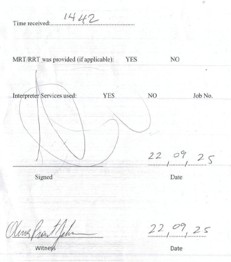
18 If, however, I conclude that Mr Takarua has discharged that onus, a further question arises as to the nature of the relief he is entitled to. I did not understand it to be controversial that, if Mr Takarua succeeded on the notice dispute, he would be entitled to the following relief:
(1) a declaration that the Minister failed to give the applicant written notice of the non-revocation decision as required by s 501G of the Migration Act;
(2) a declaration that the nine-day period for applying to the Administrative Review Tribunal (the Tribunal) for a review of the non-revocation decision under s 500(6B) of the Migration Act has not commenced; and
(3) a writ of mandamus directing the Minister to comply with s 501G of the Migration Act in relation to the non-revocation decision.
19 I should briefly explain that common ground.
20 Mr Takarua correctly accepted that any failure to comply with s 501G does not operate to invalidate the non-revocation decision (consistent with s 501G(4) of the Migration Act). Nevertheless, it is established that the notification duty is susceptible to enforcement by way of mandamus: Re Minister for Immigration and Multicultural and Indigenous Affairs; Ex parte Palme (2003) 216 CLR 212 at [31]-[48] (Gleeson CJ, Gummow and Heydon JJ). Reflecting that position, the respondents did not dispute that, if it was established that there had been no compliance with s 501G, the applicant would be entitled to the writ of mandamus referred to in paragraph [18(3)] and the declaration referred to in [18(1)].
21 It was also seemingly common ground that the clock for commencing review proceedings in the Tribunal does not start to run unless and until the Minister complies with s 501G of the Migration Act: see Pomare v Minister for Immigration and Citizenship (2008) 167 FCR 494 at [31], [37] (Lindgren J); Wilson v Minister for Immigration and Citizenship (2012) 135 ALD 60 at [22] (Edmonds J); BHRR v Minister for Immigration and Citizenship (No 2) [2026] FCA 250 at [61] (Wheelahan J). Mr Takarua had not, in fact, commenced such an application, but may have faced a perceived jurisdictional obstacle in the Tribunal had he done so. The declaration sought at [18(2)] was directed to that issue and would have utility in that way. Again, the respondents, quite properly, did not dispute that such relief would be available if Mr Takarua established non-compliance with s 501G.
22 However, things became more contentious as regards the relief sought in respect of the operation of s 198(2B) of the Migration Act.
23 In relation to that matter, Mr Takarua sought the following relief:
(1) a declaration that it is not reasonably practicable to remove him in circumstances where he has not received written notice of the non-revocation decision and where any application for merits review is yet to be heard and finally determined, or the time for bringing such an application has not yet expired;
(2) a declaration that the decision made on or around 3 November 2025 to remove him from Australia under s 198 of the Migration Act (the removal decision) was affected by jurisdictional error;
(3) a writ of certiorari or an order to quash or set aside the removal decision; and
(4) an injunction restraining the Minister, the Secretary of the Department of Home Affairs, and members of their Department, officers, delegates or agents from taking any action to remove the applicant from Australia under s 198 while the circumstances outlined in subparagraph (1) persist.
24 The essential issue between the parties as to the availability of that relief concerned whether the duty to remove an unlawful non-citizen “as soon as reasonably practicable” arises before written notice of the relevant decision has been given and while the non-citizen’s right to seek, or obtain, merits review remains on foot (the s 198(2B) dispute).
25 For the reasons set out below, I am satisfied that Mr Takarua has not discharged his onus with respect to the notice dispute. It follows that it is ultimately unnecessary to determine the s 198(2B) dispute. Nevertheless, given the matter was fully argued, I have expressed some tentative views on that issue below.
3. NOTICE DISPUTE
26 In resolving the notice dispute, the evidence of Mr Takarua, Gillian Jones and Oliver Prout Johnson is of particular significance. Relevantly, Ms Jones was a Status Resolution Officer (an SRO) employed by the Department of Home Affairs (the Department), and Mr Johnson a Detainee Service Officer employed by Secure Journeys at the Villawood Immigration Detention Centre (VIDC).
(1) Ms Jones’ evidence is that, on 22 September 2025, she printed a copy of the non-revocation decision and the attachments, placed those documents in a sealed envelope, stapled a (blank) Correspondence Receipt to the outside of the envelope, and left the sealed envelope at reception at Hotham Visits for delivery to Mr Takarua. There was no dispute between the parties that if those documents were in fact provided to Mr Takarua, they constituted written notice of the non-revocation decision and thereby satisfied the notice requirements of s 501G of the Migration Act.
(2) Mr Johnson’s evidence is that, on 22 September 2025, he received a sealed envelope bearing a (blank) Correspondence Receipt, delivered the sealed envelope to Mr Takarua, witnessed Mr Takarua sign the Correspondence Receipt, and returned the signed Correspondence Receipt to officers at Hotham Visits.
(3) Ms Jones’ further evidence is that, on 23 September 2025, she collected a signed Correspondence Receipt (dated 22 September 2025) from reception at Hotham Visits and, on 24 September 2025, was copied into an email from her colleague, SRO Sinthu Kishorekumar, to the National Character Consideration Centre (the NCCC), attaching the signed Correspondence Receipt (dated 22 September 2025).
27 I consider Ms Jones’ evidence, then Mr Johnson’s evidence and finally Mr Takarua’s evidence.
3.1 Ms Jones’ evidence
28 The respondents relied on an affidavit of Ms Jones, affirmed on 7 May 2026 (Ms Jones’ affidavit). Ms Jones also gave evidence at the hearing on 3 July 2026. Ms Jones’ evidence is significant because it concerns both the contents of the sealed envelope that was subsequently delivered to Mr Takarua, and the return of a signed Correspondence Receipt to the NCCC.
29 Ms Jones’ affidavit said this at paragraphs [6]-[15]:
6. At around 11:06am on 22 September 2025, I received an email from the National Character Consideration Centre (NCCC). The email was sent to the SRO assigned to Mr Takarua's case and to me. The email noted that a delegate of the Minister had decided not to revoke the cancellation of the applicant's visa. The email said that Mr Takarua was to be notified of the decision by the attached notification.
Now marked 'GJ-1' and produced to me is a true copy of the email sent by the NCCC together with the attachments.
7. Because SRO Kishorekumar (Mr Takarua's assigned SRO) was not working at the VIDC on 22 September 2025, I, as her manager, decided that I would give the notification to Mr Takarua.
8. I printed the bundle of attachments to the email and checked that each of the documents in the attachments to the email had printed. I cross-checked the INDEX OF RELEVANT MATERIAL that all attachments were included. I printed an Individual Detainee Correspondence Register Acknowledgement receipt, then put all the documents in a sealed envelope and stapled the Individual Detainee Correspondence Register Acknowledgement receipt to the outside of the envelope. I then addressed the envelope to Mr Takarua including full name, compound details and the A&C reference.
9. At around 11.56am, I called Mr Takarua and advised him that I have some documents to give him and asked him to meet me at Hotham visits, being a meeting room in the VIDC complex. Mr Takarua advised that he would meet me at Hotham visits.
10. When I arrived at Hotham visits Mr Takarua was not there. I attempted to contact him via phone, but he did not answer. I waited approximately 10 minutes for him to arrive, but he did not attend.
Now marked 'GJ-2' and produced to me is a true copy of the sign-in register for 22 September 2025.
11. After approximately 10 minutes, I gave the bundle of documents in a sealed addressed envelope to the Secure Journeys officer stationed at reception in Hotham visits and asked for the documents to be provided to Mr Takarua and for Mr Takarua to sign the Individual Detainee Correspondence Register Acknowledgment receipt which was attached, acknowledging receipt of the documents. It was necessary for a Detention Service Officer to take the document to Mr Takarua personally because an SRO does not have authority to enter into the detention compound.
12. The receptionist at Hotham visits advised that the documents would be given to a patrol officer who would deliver the documents to Mr Takarua.
13. Once I returned to my office, at about 12:17pm I entered notes into CCMD.
Now marked 'GJ-3' and produced to me is a true copy of the CCMD interaction screenshot.
14. On 23 September 2025 at approximately 11:15am, I collected the signed Individual Detainee Correspondence Register Acknowledgement receipt from the reception desk at Hotham visits within the VIDC. While in the centre, I received a call from a colleague advising that an email had been received confirming that a detainee from my caseload was to be released. I immediately returned to the office and handed the signed receipt to SRO Barutha and requested him to scan and email to SRO Kishorekumar.
Now marked 'GJ-4' and produced to me is a true copy of the sign-in register for 23 September 2025.
Now marked 'GJ-5' and produced to me is a true copy of the email sent by SRO Barutha on 23 September 2025 together with the attachment.
15. On 24 September 2025 at 8:31am, I was copied into an email from SRO Kishorekumar to the NCCC attaching a signed acknowledgment of notification for Mr Takarua. That signed acknowledgment is the same signed acknowledgment that I collected from the reception desk at Hotham visits on 23 September 2025.
Now marked 'GJ-6' and produced to me is a true copy of the email sent by SRO Kishorekumar on 24 September 2025 together with the attachment.
30 Ms Jones’ evidence was not the subject of significant challenge during cross-examination. It is also corroborated in several respects by contemporaneous documents.
(1) Annexure “GJ-1” contains an email sent to her by the NCCC at 11:06am on 22 September 2025 (see [6] of Ms Jones’ affidavit). The email requested: that Mr Takarua “be informed” of the non-revocation decision “by the attached written notification”; that Mr Takarua sign “the acknowledgment located on page 3”; and that the signed acknowledgment be returned to the NCCC by email. Annexure “GJ-1” also contains the written notification of the non-revocation decision (dated 22 September 2025).
(2) Annexure “GJ-2” contains a “Staff Sign in Register” for 22 September 2025 (see [10]-[11] of Ms Jones’ affidavit).
(3) Annexure “GJ-3” is a screenshot from the “Compliance Case Management and Detention (CCMD)” systems portal of a record created by Ms Jones at 12:17pm on 22 September 2025 (see [13] of Ms Jones’ affidavit). The record includes a notation that the “NCCC outcome [is] to be delivered by SJ [Secure Journeys]”. The record is consistent with Ms Jones’ evidence that, after Mr Takarua failed to attend Hotham Visits, she left “the bundle of documents in a sealed addressed envelope to the Secure Journeys officer stationed at reception in Hotham [V]isits”, together with a (blank) Correspondence Receipt which was stapled to the sealed envelope (see [11] of Ms Jones’ affidavit).
(4) Annexures “GJ-4”, “GJ-5” and “GJ-6” are, in turn, consistent with Ms Jones’ account that a signed Correspondence Receipt was subsequently returned, collected (on 23 September 2025) and provided to the NCCC (on 24 September 2025). Annexure “GJ-4” is a “Staff Sign in Register” for 23 September 2025 which records that Ms Jones entered VIDC at 11:14am (and left at 11:20am), consistent with her account that she collected the signed Correspondence Receipt from the reception desk at Hotham Visits on that date (see [14] of Ms Jones’ affidavit). Annexure “GJ-5” contains an email sent at 11:50am on 23 September 2025, from SRO Eddie Barutha to SRO Sinthu Kishorekumar, attaching the signed Correspondence Receipt. Annexure “GJ-6” contains an email, sent at 8:32am on 24 September 2025, from SRO Sinthu Kishorekumar to the NCCC, copying Ms Jones, and attaching the signed Correspondence Receipt (see [15] of Ms Jones’ affidavit).
31 During cross-examination, there was this discussion between counsel and Ms Jones:
Ms Jones, at GJ-1 – that’s the annexure to your affidavit – you will find it starts on page 7. Could I just ask you to turn to that, please?---Yes.
And you will see there that you have annexed an email dated 22 September 2025. That’s sent to you and another officer?---Yes.
And that – I take it that when you received this email, you read it?---Yes, I did. Yes.
Do you see at the bottom of page 1, it states:
Acknowledgement of notification. Please ensure Mr Takarua has signed the acknowledgement located on page 3.
?---Yes.
And if you turn to page 11, the first set of numbers at the top, you will see there’s a form of acknowledgement?---Yes.
And you understand that that is the document that is used to confirm delivery of documents by hand?---Yes. However, we, in detention, use a specific one for a correspondence acknowledgement of receipt because that also includes whether or not interpreter services were used.
And you’ve given evidence in your affidavit that as an SRO – that’s a Status Resolution Officer - - -?---Yes.
- - - you can’t enter the detention compound?---Yes, correct.
And so it obviously flows from that that you didn’t go to Mr Takarua’s accommodation on 22 September - - -?---Yes, that’s correct.
- - - 2025. You never saw Mr Takarua receive any documents?---No, I did not.
And you never saw Mr Takarua sign anything?---No, I did not.
And so you have no personal knowledge in relation to whether the signature on the correspondence receipt is that of Mr Takarua?---No, I do not.
(Ms Jones’ responses are bolded.)
32 Ms Jones was not challenged in relation to her evidence concerning either the contents of the sealed envelope or the subsequent return of a signed Correspondence Receipt to the NCCC. Nor was she challenged on her explanation as to why the Correspondence Receipt was in a particular form which differed from the version originally provided to her by the NCCC in its email of 22 September 2025, which was annexed as “GJ-1”. She was also not challenged on her evidence that, on 22 September 2025, she called Mr Takarua to advise him that she had some documents to give him.
33 Nevertheless, as Ms Jones (correctly) accepted, she has no personal knowledge as to whether the envelope she left with reception at Hotham Visits and the attached Correspondence Receipt was ultimately delivered to Mr Takarua, or whether the signature appearing on the Correspondence Receipt (which she collected on 23 September 2025) was in fact his. As I have explained, those matters depend principally on Mr Johnson’s evidence to which I return later.
34 Having observed Ms Jones give evidence, I found her to be a credible and truthful witness. In particular, she readily acknowledged the limitations of her own evidence. Further, her evidence was supported by contemporaneous documentary records. I therefore accept her evidence on the matters within her personal knowledge.
35 Accordingly, I find that, on 22 September 2025, Ms Jones received the written notification of the non-revocation decision by email, and then printed the bundle of attachments to the email, placed the printed bundle of documents in a sealed envelope, stapled a (blank) Correspondence Receipt to the outside of the sealed envelope, and addressed the sealed envelope to Mr Takarua. She then called Mr Takarua and advised him that she had some documents to give him and asked him to meet her at Hotham Visits, being a meeting room in the VIDC complex. Mr Takarua agreed to do so. However, when Mr Takarua did not attend Hotham Visits to collect the documents, she left the sealed envelope at reception. I further find that, on 23 September 2025, Ms Jones collected, from reception at Hotham Visits, the signed Correspondence Receipt and that, on 24 September 2025, a copy of the signed Correspondence Receipt was forwarded by email to the NCCC by her colleague.
3.2 Mr Johnson’s evidence
36 The respondents relied on an affidavit of Oliver Prout Johnson, affirmed on 12 December 2025 (Mr Johnson’s affidavit). Mr Johnson also gave evidence at the hearing on 3 July 2026.
3.2.1 A brief summary of Mr Johnson’s evidence
37 As I have noted above, Mr Johnson’s evidence was that, on 22 September 2025, he delivered a bundle of documents to Mr Takarua’s accommodation at the VIDC, witnessed Mr Takarua sign the Correspondence Receipt, signed the Correspondence Receipt himself, and then provided the signed Correspondence Receipt to officers at Hotham Visits.
38 Mr Johnson’s affidavit said this at paragraphs [3]-[7]:
Events of 22 September 2025
3. On 22 September 2025, during the course of my duties, I was provided a bundle of documents (bundle of documents) which I was instructed to provide to the applicant. A copy of these documents is at Annexure "OJ-1".
4. The person who provided me the documents was a 'Rover', a Detainee Service Officer working in the front office at VIDC. A Rover relays messages between the Department and Detainee Service Officers who are working in the various accommodation areas within VIDC.
5. On the same day, I took the bundle of documents to the applicant's accommodation at Unit 2 Room 6 of the Mackenzie accommodation area. I separated the Correspondence Receipt from the bundle of documents and provided it to the applicant who signed it. After witnessing the applicant's signature, I also signed the Correspondence Receipt.
6. The Department was later provided with a copy of the Correspondence Receipt which had been signed by myself and the applicant.
7. Now marked 'OJ-2' is a true copy of the Correspondence Receipt signed by myself and the applicant.
39 During evidence-in-chief, Mr Johnson gave this evidence in relation to paragraph [5]:
Are there any changes you would like to make to the affidavit?---I would say in paragraph 5.
Okay. So in paragraph 5, what would you like to change?---Where it states that I have separated the correspondence received from the bundle of documents and provided it to the applicant, who signed it. I didn’t remove it before he signed it; I removed it after he signed it.
Okay. So at paragraph 5, just to be clear, it says currently:
I separated the correspondence receipt from the bundle of documents and provided it to the applicant, who signed it.
?---That’s correct.
And you would like to change that to?---That I didn’t remove it before he signed it.
(Mr Johnson’s responses are bolded.)
40 As regards his cross-examination, it is perhaps an understatement to say that Mr Johnson was not an easy witness. He became frustrated with the process and was at times argumentative. Nevertheless, for the reasons that follow, I generally accept his evidence concerning the events of 22 September 2025.
41 During cross-examination, Mr Johnson gave this evidence regarding his role generally and the events of 22 September 2025:
And as part of your work as a detainee service officer, you deliver documents to detainees; is that correct?---That’s correct.
Is that something that you do on many occasions? Is that a common part of your role?---Yes.
How often would you say you deliver documents to detainees?---Whenever needed.
And how frequently is that? Every day, every week?---I would say every – every week, not every day.
Do you work every day at the – at Villawood?---For the most part, yes.
And are you in a particular area of Villawood, or are you posted in different areas?---Well, for this instance, I was in the compound named Mackenzie.
And when you say “in this instance”, but generally, do you move from compound to compound?---Yes.
And does that happen frequently or - - -?---Depending on operational requirements.
So are you currently working in the Mackenzie compound?---No, I’m not.
And how long were you working in the Mackenzie compound as at 22 September? Can you recall?---For about – maybe a good four years. I’ve been in that compound for quite a while.
Now, you said that you – you accept that you deliver documents to detainees fairly frequently?---Yes.
I take it you don’t make a personal note or diary entry every time you do that?---No, just for – for mail, we put it in the mail log if they’re receiving mail from outside. But with the documents, we have the correspondence receipt on top.
Apart from those documents, though, you don’t keep your own personal records?---No, I don’t.
…
The documents are handed to me in the envelope with the correspondence receipt on top. I go to where the detainee resides. I get them to sign the correspondence receipt. I sign it as well. And I hand them the documents.
…
I get the – the signed copy of the correspondence receipt, which states that the detainee was handed the documents. I take that paper that I sign and the detainee signs, and I take it to Hotham Visits, and I give it to the officer there, which forwards it to admin.
…
I gave him the documents on that date. He signed it in front of me. I signed it. I gave him his documents, and I took the correspondence receipt and handed it to the officers in Hotham Visits.
…
The records of me delivering are with admin because they’re the ones that get the – the correspondence receipt after the documents are delivered.
…
The rover comes to the – the compound with the envelope, with the correspondence receipt on top – stapled on top. I go and go to the accommodations of where the detainee resides, knock on his door, say, “I’ve got some paperwork for you.” He signs it. I sign it. Time and date. Tear it off and hand it to him. That document that I keep goes to admin.
…
I remember him signing in front of me. I remember signing it, handing him the documents, in unit 2, room 6. Once he has the documents, I have his signature, and I give it to admin, my job is done. What he does with the documents is none of my business. What’s inside the documents is none of my business.
(Mr Johnson’s responses are bolded.)
42 Although Mr Johnson became, as the respondents’ counsel accepted, frustrated and exasperated during cross-examination, I did not ultimately consider him to be a dishonest or evasive witness. I return below to the applicant’s criticism of Mr Johnson’s evidence.
43 There are three things notable about Mr Johnson’s evidence.
(1) Mr Johnson was clear in his recollection that he went to the room where Mr Takarua resided and delivered the sealed envelope to Mr Takarua.
(2) Mr Johnson was likewise clear that they both then signed the Correspondence Receipt. Significantly, and whatever the position regarding Mr Takarua’s signature, it was not put to Mr Johnson that the signature appearing above “Witness” (on the Correspondence Receipt) was not his.
(3) Mr Johnson specifically identified the location where that interaction took place (Unit 2, Room 6 of the Mackenzie Compound) and it was not suggested to him that he had wrongly understood that that was where Mr Takarua resided.
3.2.2 Criticisms of Mr Johnson’s evidence
3.2.2.1 Statements not based on personal knowledge
44 The applicant raised several issues with Mr Johnson’s affidavit evidence and the way it came to be prepared.
45 First, the applicant’s counsel drew Mr Johnson’s (and the Court’s) attention to paragraph [3] of his affidavit where he said this:
On 22 September 2025, during the course of my duties, I was provided a bundle of documents (bundle of documents) which I was instructed to provide to the applicant. A copy of these documents is at Annexure “OJ-1”.
(Emphasis added in bold.)
46 In respect of paragraph [3], Mr Johnson accepted that it was simply not possible for him to know what specific documents he provided to the applicant. When the applicant’s counsel asked about paragraph [3], there was this discussion:
Now, you say at paragraph 3 of your affidavit – do you have that in front of you?---Yes, I do.
That on 22 September, you were provided with a bundle of documents?---Mmm-hmm.
Did you take a copy of that bundle of documents?---The envelope is sealed, and I had opened up – if it’s sealed, I give it to him sealed. It’s none of my business what’s in the documents.
So you don’t know what documents - - -?---No, I don’t.
- - - were in the bundle you describe?---No.
Do you see at paragraph 3, you go on to say that:
A copy of these documents is at annexure OJ-1.
?---Yes, I see that.
Now, given what you’ve said, I take it you have no way of knowing whether what’s at annexure OJ-1 is a copy of the documents in the bundle?---No. No. I don’t know what’s in the envelope when I’m handed to it.
…
So was that sentence put in your affidavit by someone who was helping you prepare it?---I don’t know what that sentence is. “A copy of documents.” I don’t know where that came from. I didn’t put it in. No one helped me prepare an affidavit. I went – I wrote out paperwork of what I’ve done and handed it in.
And then that was turned into this document; is that what happened?---Yes.
And so you – from that, I take it, someone else must have added:
A copy of these documents is at annexure OJ-1.
?---Must have.
(Mr Johnson’s responses are bolded.)
47 Secondly, the applicant’s counsel drew Mr Johnson’s (and the Court’s) attention to paragraph [6] of his affidavit where he said this:
The Department was later provided with a copy of the Correspondence Receipt which had been signed by myself and the applicant.
48 In respect of paragraph [6], Mr Johnson (eventually) accepted that he did not have personal knowledge of the Department being provided with a copy of the Correspondence Receipt. When the applicant’s counsel asked about paragraph [6], there was this discussion:
Well, how do you know that the Department was later provided with a copy of the correspondence receipt?---Who’s the Department?
Well, it’s your evidence, Mr Johnson. What do you mean when you say - - -?---I mean, the Department, I’m – I get the – the signed copy of the correspondence receipt, which states that the detainee was handed the documents. I take that paper that I sign and the detainee signs, and I take it to Hotham Visits, and I give it to the officer there, which forwards it to admin.
But you don’t have any personal knowledge of whether or not the Department was later provided with a copy of the correspondence receipt; is that right?---I mean, somebody must have gotten a copy of the receipt because when this all this came about, and I was asked to do an affidavit, I got that correspondence receipt back to me.
So you’re assuming, based on that, that somebody must have given a copy to the Department?---It’s not really an assumption because if someone – if they’re emailing me and giving me the correspondence receipt, it’s not an assumption. Someone – someone received it.
Well, it’s not a trick question, Mr Johnson. I’m asking you to focus on paragraph 6 and just read it again. What I’m suggesting is what you say there is not something within your personal knowledge; it’s something you were told or assumed?---Yes, okay. Yes.
Thank you. And did you include paragraph 6 in your affidavit? Was that something that you wrote yourself – that line?---No.
That was written by someone else and then provided to you as a draft; is that right?---I believe so.
(Mr Johnson’s responses are bolded.)
49 I accept that paragraphs [3] and [6] of Mr Johnson’s affidavit include statements that were not based on his personal knowledge, and statements that (more concerningly) appear to have been added by someone else. Having said that, his adoption of paragraph [6] is not entirely unsurprising for a lay witness. Despite his initial objections to the use of the word “assumption”, Mr Johnson appears to have simply assumed that there were in place some procedures to ensure that the Correspondence Receipt was provided to the Department. That assumption was ultimately confirmed (in his mind) by the later email including the Correspondence Receipt. That is an unremarkable application of logic by a lay witness.
50 The applicant’s counsel submitted that Mr Johnson’s evidence about the manner in which his affidavit was prepared (and the fact that matters were added to paragraphs [3] and [6] by someone else) should lead me to “be extremely cautious about accepting anything in his affidavit”. Those issues have given me some concerns about Mr Johnson’s evidence. But against that, I would note the following matters.
51 First, Mr Johnson was candid in cross-examination about the manner in which his affidavit was prepared. It appears from the passage extracted at [46] above that Mr Johnson “wrote out paperwork of what [he had] done and handed it in”, following which another person turned that material into an affidavit to be signed by him (adding statements at paragraphs [3] and [6] which Mr Johnson effectively disclaimed).
52 Secondly, those statements in paragraphs [3] and [6] of his affidavit concern matters that are largely peripheral to the critical (factual) issue in dispute. They do not directly concern Mr Johnson’s evidence that he personally delivered documents to Mr Takarua (although it now appears that the documents were in a sealed envelope) and witnessed the signing of the Correspondence Receipt by Mr Takarua.
53 Thirdly, while it is to some extent unclear to me why Mr Johnson affirmed an affidavit that included those statements in paragraphs [3] and [6], Mr Johnson’s evidence on those more critical factual issues was consistent (as can be seen in the transcript excerpts extracted at [41] above). Moreover, as I will discuss below, his evidence (of 12 December 2025 and 3 July 2026) accords with a more contemporaneous account that he gave on 12 November 2025.
54 Fourthly, as I have said, Mr Johnson struck me as a reluctant witness. He did not, however, strike me as someone who was seeking to advance the respondents’ case by tailoring his testimony to suit their interests. Rather, my overall impression was that he was somewhat indifferent to the respondents’ prospects in this litigation and not overly ready to assist them. For example, in relation to the preparation of his affidavit, he gave evidence that:
I recall a phone call when someone wanted to come to my house, so I could sign documents, and I said, “No, deal with me at my workplace.”
3.2.2.2 Mr Takarua’s argument that Mr Johnson’s evidence is “a reconstruction”
55 The applicant’s counsel drew Mr Johnson’s (and the Court’s) attention to an email, sent at 2:21pm on 12 November 2025, from a Senior Legal Officer in the “Protection and Removals Litigation” team of the Department (the SLO) to Mr Johnson. Although the SLO was not a witness in these proceedings, their email of 12 November 2025 was in evidence:
Action requested – urgent assistance to provide evidence to the court about your delivery of a decision to Mr TAKARUA on 22 Sept 2025
I am writing to seek your urgent assistance in preparing a written statement for the court which would state that you delivered a decision record to Mr Takarua on 22 September 2025. Mr Takarua is alleging in his judicial review proceedings that he was not delivered the decision and that it is not his signature on the signed Correspondence Receipt. We would like to file this evidence with the court by 10am Friday 14 November 2025, at the latest.
As you delivered the decision record and witnessed Mr Takarua’s acknowledgment (see attached Correspondence Receipt), we would be grateful for your assistance to:
1. Provide a written statement affirming that you delivered the decision and witnessed Mr Takarua’s signature (this would be in the form of an affidavit); and
2. Make yourself available to attend the hearing scheduled for 2.00pm Friday, 14 November 2025 via video link in the event that the Court would like to ask you some questions regarding your written statement.
We will arrange for a draft statement (affidavit) to be prepared based on the information we have. However, in order to ensure it accurately reflects the events of the 22 September 2025 and to save same time, we would be grateful if we could organise a phone call to ask you some further details. This will include:
• Your name and occupation;
• The usual process of delivering Department correspondence/documents to detainees;
• The usual record making steps/process when a detainee does not sign a Correspondence Receipt;
• When were you asked to deliver the decision to Mr Takarua?;
• When did you deliver the decision to Mr Takarua?; and
• Confirmation that you witnessed Mr Takarua signing the Correspondence Receipt.
As the type of written statement you will be signing is an affidavit, all the facts contained in it must be true as this is what we and the Court will be relying on. If you do not know the answer to a question, or are unsure, please let us know as we cannot include anything in your affidavit (written statement) that you are not sure about or do not know to be true. You are only expected to provide evidence to the best of your knowledge.
After we have drafted the written statement, we will send it back to you to confirm that it is correct, and then organise for either an external lawyer or one of our Sydney based legal officers to go out to Villawood to witness your signature. As mentioned above, we would like all of this to occur by 10am this Friday.
We will also provide further guidance on what you can expect, if you are required to attend the hearing on Friday.
Grateful to hear from you as soon as possible.
Kind regards,
(Emphasis in original.)
56 As I observed during the hearing, that email “is expressed most unfortunately”. The respondents’ senior counsel, Mr Knowles (who appeared with Mr Barrington), candidly and properly accepted that he did not “depart from what your Honour says about perhaps the wording of the letter could be better”.
57 To be clear, Mr Johnson was a potential witness on a critical factual issue (being the applicant’s contention that he “was not delivered the decision and [that] it’s not his signature” on the signed Correspondence Receipt). Whatever the perceived urgency, it was important that Mr Johnson’s evidence on that issue be his own.
58 While that was ultimately made clear in the text found under the dot-points, the text that appeared at the beginning of the letter might be taken as a request – from officers having some influence over the important relationship between Mr Johnson’s employer and the Department – to produce evidence of a particular kind: “I am writing to seek your urgent assistance in preparing a written statement … which would state that you delivered a decision record to Mr Takarua on 22 September 2025”; “[W]e would be grateful for your assistance to … [p]rovide a written statement affirming that you delivered the decision and witnessed Mr Takarua’s signature”. That was the very issue that the SLO noted was disputed by the applicant: “Mr Takarua is alleging in his judicial review proceedings that he was not delivered the decision and that it is not his signature on the signed Correspondence Receipt”. Those statements were given prominence by their inclusion at the beginning of the SLO’s email and would understandably be amongst the first things that a lay reader, like Mr Johnson, would notice.
59 These issues were taken up in cross-examination. During cross-examination, there was this discussion between counsel and Mr Johnson about the SLO’s email:
Now, having a look at that email, does that jog your memory that you were first asked to prepare an affidavit in this matter on that date?---Yes, it’s right here in black and white.
…
And before you received that email, you hadn’t provided any other statements regarding any events of 22 September?---No.
And was that, in fact, the first time you became aware – when you received this email, that is – that there was any issue about whether or not you had delivered documents on 22 September?---That’s correct.
…
So at the time you prepared your evidence, you had already been told exactly what the allegations being made were?---Yes.
…
The statement then goes – the email goes on to say – I’ve already taken you to this:
As you delivered the decision record and witnessed Mr Takarua’s acknowledgement –
do you see that?---Yes.
And it then goes on to say:
We would be grateful for your assistance to provide a written statement affirming that you delivered the decision and witnessed Mr Takarua’s signature.
?---Yes.
So the Department there is telling you exactly what they want your statement to say; is that correct?---I just wrote down what I did on the day.
Having been told, though, by the Department precisely what it was they wanted you to say?---No one told me what to – they told me to write down what I’ve done. No one coached me into writing anything to say it this way, say it that way. I was told to write down what I did on the day.
…
Well, I suggest to you that you knew what the statement was supposed to say because you had been told by the Department precisely what they wanted the statement to say?---I don’t remember anyone telling me what to write or what to say.
Do you accept that the email in terms does that?---I accept that, yes.
…
And I suggest you can’t recall 22 September clearly now either?---22 September I can recall because that’s in my job duties that I do pretty regularly. So when that came up to me as, “Okay, when’s the last time did I give this guy documents?”, and I said, “Oh, yes. Okay.”
You said “okay”, and then what happened?---And then I understood where this was coming from.
And that’s because you were provided with the correspondence register, along with the email from [the SLO], isn’t it?---When they told me the date, right, I backtracked, and I said, “Okay . Well, when did I give this guy these documents?” And if that’s the date that it was, then, yes, I gave him the documents on that date. He signed it in front of me. I signed it. I gave him his documents, and I took the correspondence receipt and handed it to the officers in Hotham Visits.
What you’re describing is something that you usually do, isn’t it?---What I’m describing is what I usually do and what I’ve done on that day.
Well, I suggest to you that you were reminded of that date because the Department had told you that something happened on that date. They had provided you with a copy of the correspondence receipt on that date, and, from that, you reconstructed an account of what must have happened in your mind on that day?---No, not what must have happened. What happened.
…
I suggest that you have no independent recollection separate from the documents – namely, the correspondence register and what you were told in this email – of what happened on 22 September 2025?---What – what happened on that date? Because I’m telling you what happened on that date, and you keep going back, and you’re saying I have no recollection, when I’m telling you what happened on that date. The rover comes to the – the compound with the envelope, with the correspondence receipt on top – stapled on top. I go and go to the accommodations of where the detainee resides, knock on his door, say, “I’ve got some paperwork for you.” He signs it. I sign it. Time and date. Tear it off and hand it to him. That document that I keep goes to admin.
…
Well, I suggest to you that your account of signing and witnessing Mr Takarua sign is reconstructed from the documents and the email that you were given by the statement?---Okay. Okay.
What do you mean by “okay”?---I’m saying “okay” to what you just said.
You agree with me?---I need some – I need to sit – to walk away from this right now because I’m getting – I’m explaining everything to you in detail. I’m getting frustrated.
(Mr Johnson’s responses are bolded.)
60 To be clear, Mr Johnson was not, in that last passage, agreeing to the applicant’s suggestion that he reconstructed his account. The suggestion was directly put to him and rejected:
I suggest to you that your account of what occurred on 22 September 2025 is reconstructed, based on the documents that you’ve seen, in particular the email from the Department that we’ve been referring to, and the correspondence receipt, and not from any independent recollection of that day; do you agree with that?---No, I don’t.
And I suggest to you that you did not, in fact, witness Mr Takarua sign the correspondence receipt on 22 September 2025; do you agree with that?---No, I don’t.
(Mr Johnson’s responses are bolded.)
61 The applicant’s counsel nevertheless submitted that Mr Johnson’s account of the events of 22 September 2025 is “a reconstruction” that was “prompted by the email and by the document he [was] provided with” such that “his account is, in effect, contaminated by having been prompted and led”. Notwithstanding the unfortunate wording of the SLO’s email, there are at least three difficulties with accepting the applicant’s submission that Mr Johnson’s evidence concerning the events of 22 September 2025 should be discounted on the basis that he was prompted or led by the SLO’s email.
62 The first difficulty is that Mr Johnson’s evidence is consistent with information he gave to the Department on 12 November 2025. In his email response to the SLO’s email, which was sent at 5:26pm on 12 November 2025 (approximately 3 hours after the SLO’s email was sent), Mr Johnson stated:
I Detainee Service Officer (DSO) Oliver Prout Johnson delivered Legal documents to Mr. Takarua on the 22nd of September 2025
In his accommodation Unit 2 room 6 of Mackenzie Compound.
Rovers brought documents to compound to be delivered to Detainee.
Documents delivered immediately to Mr Takarua
Mr. Takarua was sighted signing Correspondence Receipt
Correspondence Receipt was taken back to HOTHAM Visits by Rover.
63 The particular significance of Mr Johnson’s email is that it contains important details which do not appear in the SLO’s email. That suggests that the email Mr Johnson sent was based on his own independent recollection of events and not merely based upon what was told to him by the SLO. Those details were subsequently repeated in both his affidavit and oral evidence.
64 For example, in his email of 12 November 2025, Mr Johnson stated that he delivered the documents to Mr Takarua at “Unit 2 room 6 of Mackenzie Compound”. That level of detail does not appear in the SLO’s email or in the copy of the Correspondence Receipt attached to it. Although it is unclear precisely when Mr Johnson read the SLO’s email, he appears to have provided those details within a relatively short period of time (being approximately three hours after the SLO’s email was sent).
65 It was never suggested to Mr Johnson that he was mistaken as to where Mr Takarua resided. What was instead put to Mr Johnson was that his account was “reconstructed, based on the documents that you’ve seen, in particular the email from the Department that we’ve been referring to, and the correspondence receipt” (emphasis added in bold).
66 Notably, it was not put to Mr Johnson that, before sending his email, he had made inquiries to ascertain that information (namely, the unit and room number at which Mr Takarua resided). If the more serious allegation were being advanced by the applicant – that is, that Mr Johnson had not only engaged in a process of “reconstruction”, but had effectively fabricated evidence after conducting his own inquiries – that allegation ought to have been squarely put to Mr Johnson. In any event, no submission to that effect was made by the applicant regarding Mr Johnson’s evidence.
67 The details in Mr Johnson’s email (of 12 November 2025) concerning Mr Takarua’s accommodation were reiterated in paragraph [5] of Mr Johnson’s affidavit (affirmed on 12 December 2025):
5. On the same day, I took the bundle of documents to the applicant's accommodation at Unit 2 Room 6 of the Mackenzie accommodation area. I separated the Correspondence Receipt from the bundle of documents and provided it to the applicant who signed it. After witnessing the applicant's signature, I also signed the Correspondence Receipt.
(Emphasis added in bold.)
68 Those details were also reiterated in his oral evidence (given on 3 July 2026):
I remember him signing in front of me. I remember signing it, handing him the documents, in unit 2, room 6. Once he has the documents, I have his signature, and I give it to admin, my job is done. What he does with the documents is none of my business. What’s inside the documents is none of my business.
(Emphasis added in bold.)
69 Likewise, Mr Johnson had a specific recollection of how he came into possession of the documents which is not to be found in the email from the SLO: they were delivered to him by a “rover” who, as he explained at paragraph [4] of his affidavit, was a “Detainee Service Officer working in the front office at VIDC”. There was a discrepancy between his account of what happened after the documents were provided to Mr Takarua. In his oral evidence, Mr Johnson gave specific evidence as to what he did with the signed Correspondence Receipt afterwards: he gave it to “admin” or “the officers in Hotham Visits”. In his earlier email, he said that document was “taken back to HOTHAM Visits by Rover”. But nothing was said to flow from that (minor) discrepancy.
70 Mr Johnson rejected the proposition put by the applicant’s counsel that he was there merely describing the usual or standard process:
What you’re describing is something that you usually do, isn’t it?---What I’m describing is what I usually do and what I’ve done on that day.
(Mr Johnson’s response is bolded. Emphasis added in italics.)
71 The presence in Mr Johnson’s email (of 12 November 2025) of details that were not supplied by the SLO – particularly as to the location of Mr Takarua’s residence – is in tension with the applicant’s submission that Mr Johnson’s account is a reconstruction based on information supplied by the SLO’s email. The fact that those details were recorded by Mr Johnson in his reply to the SLO’s email supports the conclusion that he retains an independent recollection of the events of 22 September 2025.
72 The second difficulty is that Mr Johnson not only gave evidence that he independently recalled the events of 22 September 2025 (which was supported by his earlier email of 12 November 2025), but also explained why he specifically recalled those events. In particular, in the passage extracted above at [59], Mr Johnson described his thought process as starting from the point of asking himself, “when’s the last time did I give this guy documents?” (emphasis added).
73 Mr Johnson was obviously saying there that he had given documents to the applicant on more than one occasion. The applicant did not put to Mr Johnson that he was mistaken in that respect. Nor did the applicant put to Mr Johnson that he otherwise had no way of knowing who the applicant was and therefore no way of knowing whether it was the applicant who (according to Mr Johnson) had signed the Correspondence Receipt in front of him on 22 September 2025.
74 That explains, for example, why Mr Johnson might have known where Mr Takarua resided and why he could be clear that it was Mr Takarua who signed the Correspondence Receipt (and not someone else) in his presence. Here, I note that Mr Johnson’s evidence was that he had worked in the Mackenzie Compound at the VIDC for “maybe a good four years”. I also note that Mr Takarua’s evidence was that he had been in the Mackenzie Compound since his release from prison in October 2024, albeit “in a number of different rooms” during that period (see paragraphs [4]-[5] of his affidavit affirmed on 8 April 2026).
75 I should add that it was Mr Takarua’s evidence that he did “not know any officer called Oliver Prout Johnson” (see paragraph [11] of his affidavit affirmed on 8 April 2026). However, that does not alter the fact that Mr Johnson’s (unchallenged) evidence was that he had had contact with Mr Takarua on more than one occasion and was (one can infer) in a position to know who Mr Takarua was, whether or not Mr Takarua knew Mr Johnson by name.
76 From there, and apparently with the assistance of the email from the SLO reminding him of the relevant date (22 September 2025), Mr Johnson said he “backtracked” and sought to recall what had occurred on that date. He gave this evidence:
When they told me the date, right, I backtracked, and I said, “Okay. Well, when did I give this guy these documents?” And if that’s the date that it was, then, yes, I gave him the documents on that date. He signed it in front of me. I signed it. I gave him his documents, and I took the correspondence receipt and handed it to the officers in Hotham Visits.
(Emphasis added in bold.)
77 It should be noted (consistently with what I have said) that Mr Johnson was distinguishing between the earlier occasions on which he had given documents to Mr Takarua (“when’s the last time did I give this guy documents?”) and this specific occasion (“when did I give this guy these documents?”).
78 It is true, as I have observed, that Mr Johnson appeared to accept in his evidence that he was assisted by the SLO’s email in the sense of being reminded of the relevant date (22 September 2025). However, with that assistance, Mr Johnson appeared to be able to independently recall the events in question (noting that his email recording those matters was sent less than two months after the fact – on 12 November 2025 – and hours after the SLO’s email was sent).
79 The third difficulty is that Mr Johnson’s account accords in material respects with both Ms Jones’ evidence and the contemporaneous documentary record.
80 In particular, and regardless of the variation in the applicant’s signatures (as to which see further below), it is clear to me that Mr Johnson’s signature appeared (above “Witness”) on the Correspondence Receipt that was dated 22 September 2025 (extracted below).
81 The applicant did not suggest to Mr Johnson that the signature appearing above “Witness” was not his signature. And, in re-examination Mr Johnson confirmed that it was in fact his signature:
Do you see a document titled Individual Detainee Correspondence Register?---Yes, I do.
And is that your signature at the bottom?---That’s my signature. Yes, it is.
(Mr Johnson’s responses are bolded.)
82 Relevantly, I note that the Correspondence Receipt bears the date “22/09/25”. Further, as to the affixing of the date on the Correspondence Receipt, Mr Johnson gave this evidence:
The rover comes to the – the compound with the envelope, with the correspondence receipt on top – stapled on top. I go and go to the accommodations of where the detainee resides, knock on his door, say, “I’ve got some paperwork for you.” He signs it. I sign it. Time and date. Tear it off and hand it to him. That document that I keep goes to admin.
(Emphasis added in bold.)
83 Taken together, the evidence discloses a coherent sequence of events in relation to the bundle of documents and the Correspondence Receipt.
84 Ms Jones gave evidence that she placed the relevant documents in a sealed envelope, attached a (blank) Correspondence Receipt to the sealed envelope, and (after trying unsuccessfully to meet with Mr Takarua to provide him with those documents) left the sealed envelope (addressed to Mr Takarua) with reception at Hotham Visits for collection by a “Detention Service Officer”. As she explained, this was necessary “because an SRO does not have authority to enter into the detention compound” (see [11] of Ms Jones’ affidavit).
85 Mr Johnson described himself in his affidavit as a “Detainee Service Officer”, but in oral evidence said that his current job title was a “Detention Service Officer”. Neither party suggested any discrepancy as to job title was significant. In any event, Mr Johnson’s evidence was that he subsequently received from a “rover” an envelope with the Correspondence Receipt attached. He then went to Mr Takarua’s residence (at Unit 2, Room 6 of the Mackenzie Compound), witnessed Mr Takarua sign the Correspondence Receipt, signed it himself, affixed the date and time on it, provided the envelope to Mr Takarua, and then removed and returned the signed Correspondence Receipt to Hotham Visits.
86 Ms Jones’ evidence establishes that a signed Correspondence Receipt was subsequently collected from reception at Hotham Visits and forwarded to the NCCC.
87 As I have said, Ms Jones’ evidence does not establish that Mr Johnson in fact delivered the envelope (containing the non-revocation decision) to Mr Takarua. Nor does it establish that the signature appearing above “Signed” on the Correspondence Receipt was in fact Mr Takarua’s signature. Those matters depend principally on Mr Johnson’s evidence. Importantly, however, the surrounding circumstances are consistent with Mr Johnson’s account and support the conclusion that the events of which he gave evidence occurred on 22 September 2025.
88 Indeed, unless there is some suggestion of fraud or perjury on the part of Mr Johnson (which was not put to him by the applicant’s counsel), other explanations for this body of evidence are difficult to discern. There can be little doubt, on the state of the evidence, that the Correspondence Receipt was signed, at least by Mr Johnson, on the date it bears, having been prepared by Ms Jones shortly beforehand.
89 As I have said, it also appears from Mr Johnson’s evidence that he had delivered documents to Mr Takarua previously (see [72]-[78] above). Mr Johnson’s evidence was that it was that same person who signed the Correspondence Receipt in his presence. Furthermore, Mr Johnson identified the specific location at which that occurred, namely Unit 2 Room 6 of the Mackenzie Compound where Mr Takarua resided, and it was not suggested to him that he was mistaken in that respect.
90 In light of the above, I am unable to accept the applicant’s submission that Mr Johnson’s account should be discounted as a reconstruction derived from the SLO’s email and the Correspondence Receipt (notwithstanding the unfortunate wording of the SLO’s email).
3.3 Mr Takarua’s evidence
91 It is convenient to consider Mr Takarua’s evidence in three parts. The first is his evidence regarding the events of 22 September 2025. The second is his evidence that the signature appearing on the Correspondence Receipt is not his signature. The third is his evidence that he would have contacted his lawyers immediately had he been given written notice of the non-revocation decision.
3.3.1 Mr Takarua’s evidence about the events of 22 September 2025
92 Mr Takarua was clear, in his evidence before this Court, that the events of 22 September 2025 deposed to by Mr Johnson did not occur. In essence, Mr Takarua did not accept the following propositions: that Mr Johnson delivered a bundle of documents in a sealed envelope to him on 22 September 2025; that Mr Takarua then applied his signature to the Correspondence Receipt; or, that Mr Johnson thereafter signed the Correspondence Receipt in his presence. Relevantly, Mr Takarua was specifically asked:
And when you say “no”, do you say, so far as you can – pardon me. Do you say you can recall that, or you can’t recall that happening?---I can recall that because that has never happened.
(Mr Takarua’s response is bolded.)
93 I have significant concerns about that evidence and, in particular, the definitiveness with which it was expressed. During cross-examination at the hearing before me on 3 July 2026, Mr Takarua was taken to the transcript of an earlier hearing in NSD 2062 of 2025 before Colvin J on 14 November 2025. That hearing before Colvin J occurred less than two months after the respondents contend the documents were delivered to Mr Takarua by Mr Johnson.
94 At that hearing, as recorded on page 11 of the relevant transcript, this exchange between his Honour and Mr Takarua took place:
COLVIN J: Yes, thank you. So Mr Takarua, there were a lot of things covered there by Mr Barrington. One of them is a legal point which I will have to consider, and that is about whether the court has power, what we call jurisdiction, to continue making orders, or whether this is a case that would need to be in the circuit court, if you were going to continue to seek relief. I think that’s a matter upon which it’s not reasonable to expect you to be able to say anything, and I will have to consider that and the consequences of it. So we can put that matter to one side, I think, unless you feel like there is anything that you can say about that legal point.
MR TAKARUA: I’ve no idea what you guys just said.
COLVIN J: Yes, so that’s fair enough, I understand that. But the important matter that you can say something about is this issue about what you say happened in relation to receiving notification of the outcome of your request for revocation of the cancellation of your visa, those documents. And you do deal with that in your affidavit, which I have read. And one thing that may need to be clarified is whether you are saying you didn’t sign something, or whether you’re saying you didn’t receive anything.
MR TAKARUA: Yes, so the difference was the date. It was 22 September, when Mr Johnson came down to give me the paper.
COLVIN J: Yes. Yes, yes.
MR TAKARUA: So he delivered the documents. He didn’t explain what the documents were, but he just stated that the signature was to state that I received the documents that was given.
COLVIN J: Yes.
MR TAKARUA: That was on that one. The other one.
95 I will shortly consider another exchange that took place between his Honour and Mr Takarua on 14 November 2025, but it is convenient to address this exchange separately because, before me on 3 July 2026, Mr Takarua was cross-examined on those exchanges in discrete stages. As to that first passage, this was the cross-examination:
And do you agree that the judge was asking you about whether you signed something or whether you received something? Was asking you questions about what you say happened in relation to receipt of documents, and you say – and I was putting to you earlier, you say:
Yes, so the difference was the date. It was 22 September when Mr Johnson came down to give me the paper.
?---Mmm-hmm.
You see that?---I recall – I recall now.
Yes. And then you go on:
So he delivered the documents. He didn’t explain what the documents were, but he just stated that the signature was to state that I received the documents that was given.
Do you see that?---Yes.
Okay. So in the moment, in response to his Honour’s query, that was your best effort at being honest and truthful, wasn’t it?---Yes.
Okay. And then do you see at the bottom of that page, line, next to that, you’ve said:
That was on that one.
You’re referring to, I take it, what happened on 22 September?---Is that a question?
Yes?---Yes.
Okay. And then you say the “the other one”. You’re about to go on to another - - -?---Yes, I’m not sure what the other one is.
(Mr Takarua’s responses are bolded.)
96 The next relevant aspect of Mr Takarua’s discussion with Colvin J on 14 November 2025 was recorded on the next page of the transcript, where this exchange took place:
COLVIN J: So just before we finish with the 22nd, so you remember Mr Johnson coming and giving you the documents, but you say that you didn’t - - -
MR TAKARUA: No, no. Yes, sorry, your Honour. This is why I need .....
COLVIN J: So what do you say happened on the 22nd?
MR TAKARUA: No, nothing. No, I’ve got nothing to say about that, because I don’t know. It’s not written down.
97 The cross-examination at the hearing before me on that exchange proceeded as follows:
And you say – just read that to yourself, the first four lines, which I’ve just read to you, and then at line 6 or - - -?---Yes.
His Honour said:
So what do you say happened on the 22nd.
?---I was more confused then than what I am now.
And you say:
No. Nothing, no. I’ve got nothing to say about that, because I don’t know. It’s not written down.
Do you see that?---Yes.
It’s fair to say that when you were asked about it further by his Honour, you weren’t sure?---Yes.
You couldn’t recall what occurred on 22 September, could you?---At that time, yes.
Okay?---I’m just trying to recall that now.
(Mr Takarua’s responses are bolded.)
98 It is unclear to me whether, by that last response (“I’m just trying to recall that now”), Mr Takarua was seeking to recall the events of 22 September or seeking to recall what had happened before Colvin J and/or his state of mind at that time.
99 However, the following matters are clear.
(1) Mr Takarua accepted that his first attempt to describe to Colvin J what had occurred on 22 September 2025 was his “best effort at being honest and truthful”.
(2) That “best effort” is consistent with Mr Johnson’s account and, indeed, involved Mr Takarua volunteering (unprompted) that it was Mr Johnson who came to his room with the documents on 22 September 2025.
(3) Before me, Mr Takarua explained his subsequent change of position as reflecting the fact that when he was “asked about it further by his Honour”, “[he wasn’t] sure”, and that, “at that time”, he “couldn’t recall what occurred on 22 September”.
100 Mr Takarua was not re-examined in respect of the transcript of 14 November 2025. I note that one possible explanation for those plainly inconsistent accounts as to what occurred on 22 September 2025 was identified by Mr Takarua in his oral evidence (given at the hearing before me): “I was more confused then than what I am now”. That, in itself, may suggest that he remains confused about the events of 22 September 2025, albeit less. In any event, it was unclear to me why he might now be less “confused” about those matters at a much later point in time (being approximately eight months after he gave evidence before Colvin J).
101 Mr Knowles made this submission at the close of evidence in relation to those matters:
Now, in respect of Mr Takarua’s evidence – we submit that he was, with respect, unimpressive, inconsistent, and overall unsatisfactory as a witness, and he was unclear, put briefly, what happened when. While he might have maintained a certain point in his oral evidence today, the fact is, at times, when pressed by – well, not even when pressed, when asked by Colvin J, without mention of anything, he volunteered that account of Mr Johnson having come and delivered the documents to his room, which – and it appears that he was about to move to another topic when Colvin J then asked him again about it, and then he resiled from it. At best, he is unreliable in his evidence, and your Honour should have significant reservations about giving it any weight.
102 I would not necessarily adopt all of Mr Knowles’ criticisms of Mr Takarua’s evidence. Mr Takarua, like Mr Johnson, obviously found the process of giving evidence difficult. Mr Takarua was also candid in accepting that the evidence he initially gave before Colvin J was his best effort at being honest and truthful.
103 However, I do have significant concerns about the fluctuating nature of Mr Takarua’s account. In his evidence before Colvin J, he started with a clear account of what happened on 22 September 2025 which accords with Mr Johnson’s evidence. Although Mr Takarua resiled from that account a very short time later, he accepted in his cross-examination before me that, when asked about it further by his Honour, he was unsure. Despite that (and for reasons which remain unclear on the evidence), Mr Takarua is now far more definitive in his account of those events of 22 September 2025 than he was before Colvin J.
104 For reasons I will explain below, my concern over those matters is not alleviated by the other matters relied upon by Mr Takarua’s counsel in argument.
105 Before I do, I should also note that Mr Takarua’s initial evidence before Colvin J (in which he volunteered an account of Mr Johnson coming to his room and delivering the documents) is in tension with his affidavit evidence before me that he did “not know any officer called Oliver Prout Johnson”. Mr Takarua was not cross-examined on that affidavit evidence, or on the similar statements he made to Colvin J after giving his initial account of having received documents from a person he identified as Mr Johnson (“No, I don’t know him, your Honour”). However, as I have said, I need not consider those matters further. It is apparent that Mr Johnson knew who Mr Takarua was, having given him documents on more than one occasion. As I have said, that aspect of Mr Johnson’s evidence was not challenged. There are any number of possible explanations as to why Mr Takarua might not know Mr Johnson by name. The more important point is that the evidence establishes that Mr Johnson knew who Mr Takarua was (and where he resided).
3.3.2 Mr Takarua’s argument that the signature appearing on the Correspondence Receipt is not his signature
106 The signature on the Correspondence Receipt (extracted below) received considerable attention in the hearing before me. Mr Takarua contends that the signature (appearing above “Signed”) is not his, relying principally on his evidence that his signature is ordinarily consistent and does not resemble the signature appearing on the Correspondence Receipt.
107 Mr Takarua gave evidence in the following manner.
(1) In his affidavit of 13 November 2025, at paragraphs [5]-[6] and [9]-[10], he said this:
I state clearly that I did not sign any document on 22 September, nor on any date close to that time.
The signature on the document dated 22 September is not my signature. It does not resemble the way I sign my name.
…
If any record states I signed a document on 22 September, that record is incorrect. I deny ever seeing or signing that document.
My signature has always been consistent across my official documents, including visa applications and detention paperwork. The signature on the alleged 22 September document is clearly different from my usual signature.
(2) In his affidavit of 8 April 2026, at paragraphs [7] and [13], he said this:
In detention, I always question any form I am asked to sign. The only forms I recall signing since being in detention are the buy-up forms and a form relating to property that was held for me to collect.
…
I have seen a copy of an "Individual Detainee Correspondence Register" form dated 22 September 2025. I do not recall signing that form, and do not recognise the signature on it as mine.
108 One difficulty with accepting that evidence is that the respondents adduced evidence establishing that Mr Takarua’s signature was not, in fact, consistent across official documents. During cross-examination, Mr Takarua gave this evidence:
And do you see that you have said there:
My signature has always been consistent across my official documents.
?---Yes.
Okay. And by “official documents”, I take it that would include documents that relate to your immigration status?---Yes.
It would relate acknowledging receipt of materials?---Depends what material it is.
So if you’re acknowledging receipt of an immigration-related material or anything, really, when you’re in detention, would you keep your signature consistent?---Not on my buy-ups, on stuff like that.
Okay?---That’s not important.
So you vary your signature. You might vary it?---Stuff that’s not important, yes. I just scribble.
You just scribble?---Because that’s – yes.
You just scribble?---Mmm-hmm.
(Mr Takarua’s responses are bolded.)
109 Mr Takarua was later cross-examined on signatures appearing on various documents.
110 First, Mr Takarua was cross-examined on the signature appearing on this document dated 23 October 2017:
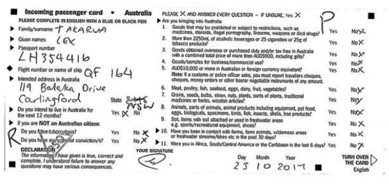
All right. Do you see there what appears to be a copy of an incoming passenger card?---Yes.
Customs card?---Yes.
And do you see that has got your name on it?---Yes.
Yes. And do you see that it’s dated 23 October 2017?---Yes.
Yes. And do you see that has a signature?---Yes.
And that’s your signature?---At that time, yes.
(Mr Takarua’s responses are bolded.)
111 Secondly, Mr Takarua was cross-examined on the signature appearing on this document dated 13 June 2024:
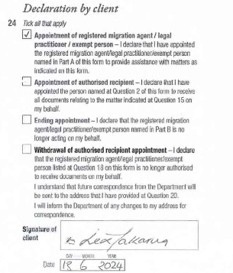
And do you see there, there’s a form 956 about appointment of a registered migration agent, legal practitioner, or exempt person?---Yes.
Thank you. And do you see, if you turn the page to 176 - - -?---I don’t know how to work this thing. Yes. Sorry. Yes.
Do you see that? Do you see that under the client details, it refers to you?---Yes.
Okay. And then can I take you forward to page 178?---Yes.
Do you see that? And do you see there’s a heading declaration by client?---Yes.
So that’s you?---Yes.
And under that, it says:
I declare –
this is the first passage beside the ticked box:
I declare that I have appointed the registered migration agent, legal practitioner –
etcetera, so that’s the declaration that’s ticked?---Yes.
And do you see there’s a signature in the signature of client?---Mmm-hmm.
And it’s dated 13 June 2024; do you see that?---Yes.
And that’s your signature?---Yes. My current one, pretty much.
Okay. So that’s different to the signature that was on the - - -?---On the arrivals. - - - on the arrivals card; do you accept that?---Yes.
It’s not consistent with that earlier signature?---Yes, because when I done that one, that was when I first arrived in Australia, and throughout time, I just changed it.
(Mr Takarua’s responses are bolded.)
112 Thirdly, Mr Takarua was cross-examined on the signature appearing on another similar document dated 4 November 2025:
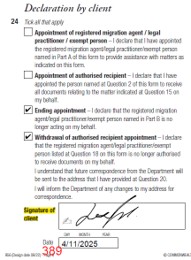
Can I take you to page 386, and you see when you get there another form 956?---Yes.
And can I take you through that form, if you move to page 388, and under the heading Ending Appointment, do you see there the client’s details. That’s you?---Yes.
Okay. Then if we go to page 389, do you see there’s again the declaration by client heading towards – about – just under halfway down the page; do you see that?---Yes.
And there’s a a couple of boxes ticked as to the declarations that were being made by the client. That’s you?---Yes.
Yes. And then there’s a signature at the bottom of the page; do you see that?---Yes.
Okay. And that’s your signature, isn’t it?---Yes.
And that’s not consistent with either of the earlier signatures, is it?---No, because that’s just my name, not my last name too.
(Mr Takarua’s responses are bolded.)
113 Fourthly, Mr Takarua was cross-examined on the signature on some of the evidence he filed in this Court:
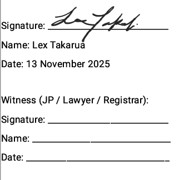
Can I take you to page 400 in the court book. Now, do you see there – that should be familiar to you because I’ve taken you to this earlier – it’s your emailed affidavit document; do you see that?---Yes.
And if you move through that, can I take you to your – to the end of it at page 404?---Mmm-hmm.
And do you see the signature there at the top of the page?---Mmm-hmm.
And that’s another version of your signature, isn’t it?---Yes.
And it’s not consistent with the previous versions of your signature; would you agree?---I agree, but you would know it’s me from the other ones.
I beg your pardon?---You would know it’s me from my other signatures.
(Mr Takarua’s responses are bolded.)
114 Finally, Mr Takarua was cross-examined on the signature on this document:

If you turn to the next page, you will see it being said to be the affidavit of Samantha Liddy; do you see that?---Yes.
Okay. Thank you. So do you see in her affidavit at paragraph 6, there is a Mackenzie compound mail register referred to dated 4 November 2025?---Yes.
And marked – and then under it, it says annexed and marked SL-4?---Yes.
Now, can you go to the – that document? It’s at page 30. The numbers are at the top of the page in the affidavit?---Mmm-hmm.
And do you see there this is a mail register on 4 November 2025?---Yes.
And you’ve signed the – under the heading Detainee Signature, you’ve seen signed that?---Yes.
And is that your signature?---Looks like a scribble, but - - -
Yes. Okay. Well, as you sit here now, can you say whether or not that is your signature?---I know I – I did that, yes.
Okay?---Mmm-hmm.
So that is your signature, you say?---Yes. At that time, yes. I guess so.
Okay. And it’s different to the other signatures; would you agree?---That one is, yes.
(Mr Takarua’s responses are bolded.)
115 During cross-examination, Mr Takarua accepted that the signatures appearing on each of the five documents in question (dated, in chronological order, 23 October 2017, 13 June 2024, 4 November 2025, 4 November 2025, and 13 November 2025) were his. He also accepted that his signature changed “throughout time”, explaining that he “just changed it”. Further, he accepted that one of the signatures, although it “looks like a scribble”, was nonetheless his signature. Ultimately, he accepted that his signature was not consistent across documents, including official documents:
Okay. It’s fair to say, having regard to these signatures, that your signature has changed significantly from time to time?---Yes, because - - -
It has not been consistent?---Yes.
Whether in official documents or otherwise?---Yes.
(Mr Takarua’s responses are bolded.)
116 As to the first response and the unfinished answer (“Yes, because---”), Mr Takarua was asked whether he wished to say anything further in re-examination, but he was unsure what it was that he might have wanted to say (“I’m not too sure”).
117 For convenience, I have extracted below the signatures from the documents to which Mr Takarua was referred during cross-examination.



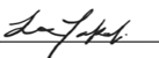
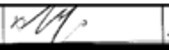
118 For ease of reference, I have extracted below, again, the signature Mr Takarua is alleged to have applied on the Correspondence Receipt on 22 September 2025.
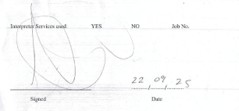
119 I make two points in respect of this issue.
120 First, the evidence does not disclose a single, consistent signature that can readily be described as Mr Takarua’s “usual signature”. During cross-examination, he accepted a number of materially different signatures as his own and acknowledged that his signature had changed “throughout time”. In those circumstances, it is difficult to accept his contention that his signature has remained sufficiently consistent for the Court to conclude, by visual comparison alone (unassisted by expert evidence), that the signature appearing on the Correspondence Receipt cannot be his.
121 Secondly, given the evidence concerning the variability of Mr Takarua’s signature (and his acceptance as to the variability of his signature “throughout time”), I am not satisfied that I can conclude, at least without expert evidence, that the signature in question is so “markedly different” from his accepted signatures that it cannot be his. Of course, Mr Takarua bears the onus and could have sought to adduce evidence of that nature. He did not do so.
3.3.3 Mr Takarua’s argument that he would have immediately contacted his lawyers had he been given written notice of the non-revocation decision
122 Mr Takarua submits that, had he been given written notice of the non-revocation decision, he would have promptly contacted his lawyers. He contends that the absence of any communication with his lawyers about this before 4 November 2025, when he was served with the “Notice of Intention to Remove from Australia”, supports his case that he was not given written notice of the non-revocation decision (on 22 September 2025).
123 In support of that submission, Mr Takarua gave the following evidence.
(1) In his affidavit of 8 April 2026, he said this at paragraphs [8]-[9]:
On 4 November 2025, I received a removal notice, a Serco officer came and gave it to me in my room. I cannot now recall who the officer was. I was shocked to receive this because I understood my revocation request hadn't been dealt with yet.
I sent a copy of the removal notice to Sarah Akanda telling her I was confused why I received it as I still hadn't been to Court. What I meant by that is that I thought my revocation request had not been dealt with yet. I confirmed to Sarah that I had not received anything about that from the Department. A copy of the email is at Annexure LT-1.
(2) Annexure LT-1 is a copy of an email chain between Mr Takarua and Legal Aid NSW on 4 November 2025. The content of the emails is extracted below.
Hi Sarah,
I've just received this [referring to the “Notice of Intention to Remove from Australia” document] from the officer. I'm confused as to why i received this as I still haven't been to court?
Thanks Lex Takarua
….
Hi Lex
Thanks for passing this on to me.
You haven't had a decision from the Department about your visa cancellation matter have you?
Best,
….
No I have not received anything from the department as of yet. I will be fighting to stay as you know, not only for myself but for my children and partner as well.
How do go about this situation?
….
Hi Lex
I will need to have a close look- can you please provide a picture of all the pages you received today and email to me.
Many thanks,
….
No worries I can do send them within an hour
124 The email correspondence is contemporaneous and tends to support the proposition that, as of 4 November 2025, Mr Takarua did not believe that he had received notification of the non-revocation decision. That was said to support an inference that he had not, in fact, received such notification. I accept that that is a possible inference that one might draw from that material and that it provides some support for Mr Takarua’s account.
125 However, that inference cannot be taken too far. As the respondents contended, there are a variety of reasons why Mr Takarua might not have understood the significance of the events of 22 September 2025 (assuming the documents in the s 501G notification package were in fact delivered to him on that date) or otherwise held the views expressed in his emails, upon which I need not speculate. Harsh though it may be, the current scheme does not require that people in Mr Takarua’s position subjectively understand the significance of those matters.
3.4 Conclusion on notice dispute
126 There was some discussion before me (and in further submissions filed after the hearing) as to the relevance of authorities dealing with circumstances in which one party bears the onus of proving a negative proposition and the other party has greater means to produce evidence which contradicts that negative proposition. The applicant relied, in particular, upon the following statement of a Full Court of this Court in Ellis v Central Land Council (2019) 267 FCR 339 at [126(f)] (quoting Rockcote Enterprises Pty Ltd v FS Architects Pty Ltd [2008] NSWCA 39 at [78]):
If a plaintiff has the onus of proving a negative proposition, the fact that the defendant has greater means to produce evidence which contradicts that negative proposition, does not mean that the plaintiff ceases to have the onus of proof of that negative proposition. However, once the plaintiff establishes sufficient evidence from which, if that evidence is accepted, the negative proposition may be inferred, an evidential onus shifts to the defendant to adduce evidence that tends to show that the negative proposition is incorrect. If a defendant adduces such evidence, the plaintiff must then, as part of its overall burden of proof, deal with that evidence either by submission or argument. See generally Apollo Shower Screens Pty Ltd v Building and Construction Industry Long Service Payments Corporation (1985) 1 NSWLR 561; Hampton Court Ltd v Crooks [1957] HCA 28; (1957) 97 CLR 367 at [1]-[2], 371-2; Baiada v Waste Recycling & Processing Service of NSW [1999] NSWCA 139; (1999) 130 LGERA 52 at [55], 64-65. As Hunt J put it in Apollo at 565:
… provided that the plaintiffs have established sufficient evidence from which the negative proposition may be inferred, the defendant carries what has been called an evidential burden to advance in evidence any particular matters with which (if relevant) the plaintiffs would have to deal in the discharge of their overall burden of proof …[T]he plaintiffs’ burden of proof of the negative proposition for which they contend is not as difficult in this case as it might otherwise have been because of the defendant’s greater means to produce evidence which contradicts that proposition.
(Emphasis in original.)
127 The Full Court in Ellis described this principle as “incontrovertible”, although it was not engaged in the circumstances of that case. I should add that there are some (well-observed) difficulties in speaking of a shifting “evidentiary” or “tactical” onus. In my view, the better way of conceptualising what is involved in the application of the principle identified in Ellis is that the “process of reaching … an actual persuasion or reasonable satisfaction [required by the civil onus of balance of probabilities] may be affected by established principles and juridical guidelines”: see eg Hudson v Colliers International (NSW) Pty Ltd [2026] NSWCA 88 at [68] (Kirk JA, Bell CJ and Ward P agreeing) and Ceerose Pty Ltd v The Owners – Strata Plan No 89074 [2025] NSWCA 235 at [35]-[36] (Kirk JA, Leeming and Ball JJA agreeing) (cf CEG Direct Securities Pty Limited v Cooper (2025) 309 FCR 66 at [153] (Cheeseman and McEvoy JJ)). Nothing flows from that in the present case.
128 As Mr Takarua observed (referring to a further aspect of Hunt J’s reasons in Apollo Shower Screens Pty Ltd v Building and Construction Industry Long Service Payments Corp (1985) 1 NSWLR 561 at 565F), the principle identified in Ellis is “but an application of the more general maxim, not restricted to cases where the facts are peculiarly within the knowledge of one party, that all evidence is to be weighed according to the proof which it was in the power of one side to produce, and in the power of the other to have contradicted” (his Honour went on to refer to the well-known statement from Blatch v Archer (1774) 1 Cowp 63 at 65, 66; 98 ER 969 at 970). As the explanation in Apollo indicates, the principle summarised in Ellis is thus a principle directed to the weighing of evidence, that is, to the assessment of what is established on the evidence before the court: Hudson at [72] (Kirk JA). In that weighing process, account “can be taken in the factual reasoning process of the means of investigation and production available to a party”: ibid.
129 The respondents did not “take issue” with the statement of principle from Ellis or its applicability here: see [2] of the respondents’ submissions filed on 10 July 2026.
130 The respondents rather made the following arguments.
(1) “[I]n a case where the applicant must prove a negative (i.e. in this case, he was not given the s 501G notification package), the applicant does not cease to have the onus of proof. Rather, in such a case, where the applicant adduces evidence from which the negative proposition may be inferred (if accepted), an evidential onus shifts to the respondents to adduce evidence that tends to show the negative proposition is incorrect. And if the respondents adduce that evidence, the applicant must deal with that evidence as part of its overall burden of proof” (emphasis in original) (see [3] of the respondents’ submissions filed on 10 July 2026). Again, there are some difficulties with the notion of a shifting “evidential onus”, and the preferable understanding of the relevant principles is that which I have identified above by reference to Kirk JA’s reasons in Hudson, but that makes no real difference for present purposes.
(2) Applied here, it was argued that the respondents had adduced evidence that undermined the negative proposition – being “oral and documentary evidence demonstrating that the applicant was in fact given the s 501G notification package” (see [4] of the respondents’ submissions filed on 10 July 2026). As such, the applicant needed to deal with that evidence as part of his onus.
131 With the qualification from Blatch (1774) 1 Cowp 63 (ie evidence is to be weighed according to the proof which it was in the power of one side to produce, and in the power of the other to have contradicted), the applicant accepted that the respondents’ evidence fell “to be assessed as part of the discharge of the applicant’s overall burden of proof, weighed accordingly”: see [1] of applicant’s submissions filed on 20 July 2026.
132 I accept that is the correct approach to employ in this case.
133 That does not ultimately assist the applicant here because, essentially for the reasons I have already given, I prefer the evidence of Mr Johnson to that of Mr Takarua as to what took place on 22 September 2025 and accept Mr Johnson’s evidence as to those matters.
134 Mr Johnson’s evidence regarding those events was consistent, remaining substantially unchanged from the account he first gave to the Department on 12 November 2025. Mr Johnson’s evidence was also corroborated in material respects by the documentary record and by Ms Jones’ evidence. In contrast, Mr Takarua’s account fluctuated both in content and in the degree of certainty with which he said he was able to recall the critical events of 22 September 2025. The evidence he gave regarding his signatures did not advance his case for the reasons I have given. Further, while the evidence regarding the email correspondence between Mr Takarua and Legal Aid NSW provided some support for his account, it does not do so unequivocally. Having regard to those matters, I have ultimately decided that I prefer Mr Johnson’s evidence as to what took place on 22 September 2025. I have reached that conclusion having considered all of the evidence and having regard to the respondents’ greater means to produce evidence that contradicts the negative proposition I have identified above. The respondents did in fact adduce evidence which was within their power to adduce and (as I have said), I prefer that evidence to the evidence relied upon by the applicant.
135 Neither the principle in Ellis (2019) 267 FCR 339 nor the broader principle in Blatch (1774) 1 Cowp 63 has much to say in such a case. The applicant did not rely upon any particular failure by the respondents to adduce evidence in their power: cf eg Moore v Goldhagen (2024) 107 MVR 299 at [81]-[90] (Beach and Niall JAA and J Forrest AJA). His real point appeared to be that his legal onus was more readily satisfied in a case such as the present. That may be so, but all that would mean is that “slight evidence may be enough unless explained away by the defendant”: GMS24 v Commonwealth (2025) 313 FCR 152 at [70], [72] (Kennett J), citing Hampton Court Ltd v Crooks (1957) 97 CLR 367 at 371-372 (Dixon J) (emphasis added). It was so explained in evidence adduced by the respondents, which I have accepted. It is established that the principles in Blatch (from which Ellis is derived) cannot be used to fill gaps in the evidence or convert conjecture into inference: see eg GMS24 at [72] (Kennett J) and [152] (Horan and Bennett JJ) and the authorities there referred to.
136 Accordingly, and for the reasons I have given, I conclude that Mr Takarua did not discharge his onus of establishing that he was not given written notice of the non-revocation decision as required by s 501G of the Migration Act. It follows that Mr Takarua is not entitled to any relief and that the applications must be dismissed.
137 In making those findings, I am not suggesting that Mr Takarua was dishonest in his oral testimony or affidavit evidence before me, or, for that matter, in the matters he conveyed to Colvin J. Mr Takarua’s evidence rather seems to me to provide an example of the issues noted recently by Hill J in Cameron v Commissioner of Taxation [2026] FCA 609 at [109]-[110] (which cohere with the way I have approached this notice dispute):
Many cases have stated that ordinary human experience is that human memory is fallible, and the degree of fallibility increases over time. That is particularly so where disputes or litigation intervene, and the processes of memory are overlaid, often subconsciously, by perceptions or self-interest as well as conscious consideration of what should have been said or could have been said: see Watson v Foxman (1995) 49 NSWLR 315 at 319 (McLelland CJ in Eq); Martin v Norton Rose Fulbright Australia [2021] FCAFC 216; (2021) 289 FCR 369 at [147] (the Court). Similarly, in Fox v Percy [2003] HCA 22; (2003) 214 CLR 118 at [31], Gleeson CJ, Gummow and Kirby JJ stated that scientific research has cast doubt on the ability of judges (or anyone else) to tell truth from falsehood accurately on the basis of a witness’s demeanour. These considerations have encouraged judges “to limit their reliance on the appearances of witnesses and to reason to their conclusions, as far as possible, on the basis of contemporary materials, objectively established facts and the apparent logic of events” (emphasis added).
That is not to say that no use can be made of oral evidence and affidavit evidence based on current recollection. In Gestmin SGPS SA v Credit Suisse (UK) Ltd [2013] EWHC (Comm) 3560 at [22], Legatt J stated:
[T]he best approach for a judge to adopt in the trial of a commercial case is, in my view, to place little if any reliance at all on witnesses’ recollections of what was said in meetings and conversations, and to base factual findings on inferences drawn from the documentary evidence and known or probable facts. This does not mean that oral testimony serves no useful purpose – though its utility is often disproportionate to its length. But its value lies largely, as I see it, in the opportunity which cross-examination affords to subject the documentary record to critical scrutiny and to gauge the personality, motivations and working practices of a witness, rather than in testimony of what the witness recalls of particular conversations and events. Above all, it is important to avoid the fallacy of supposing that, because a witness has confidence in his or her recollection and is honest, evidence based on that recollection provides any reliable guide to the truth. (emphasis added)
This passage has been quoted with approval in Australia: see for example ET-China.com International Holdings Ltd v Cheung [2021] NSWCA 24; (2021) 388 ALR 128 at [27] (Bell P, with Bathurst CJ agreeing); Turner v Richards [2025] NSWCA 83 at [60] (Payne JA, with Leeming and Adamson JJA agreeing); Pennytel Australia Pty Limited v Engelke [2025] FCA 1384 at [194] (Needham J), and the cases cited.
(Emphasis in original.)
4. SECTION 198(2B) DISPUTE
138 My conclusions on the notice dispute render it unnecessary to determine the (significant) legal question that would arise if that dispute were resolved in Mr Takarua’s favour as regards the relief that would be available in connection with the operation of s 198(2B) of the Migration Act. However, in circumstances where that question was the subject of substantial written and oral submissions, and was fully argued by the parties, it is appropriate to express my tentative views on those matters.
139 As I have explained, the essential controversy between the parties was whether the duty imposed by s 198(2B) of the Migration Act to remove an unlawful non-citizen “as soon as reasonably practicable” arises before written notice of the relevant decision has been given to the unlawful non-citizen. Section 198(2B) is in the following terms:
An officer must remove as soon as reasonably practicable an unlawful non-citizen if:
(a) a delegate of the Minister has cancelled a visa of the non-citizen under subsection 501(3A); and
(b) since the delegate’s decision, the non-citizen has not made a valid application for a substantive visa that can be granted when the non-citizen is in the migration zone; and
(c) in a case where the non-citizen has been invited, in accordance with section 501CA, to make representations to the Minister about revocation of the delegate’s decision—either:
(i) the non-citizen has not made representations in accordance with the invitation and the period for making representations has ended; or
(ii) the non-citizen has made representations in accordance with the invitation and the Minister has decided not to revoke the delegate’s decision.
140 The respondents’ essential submission was this:
… s 198(2B) imposes a duty to remove an unlawful non-citizen “as soon as reasonably practicable” where, relevantly:
… “the non-citizen has been invited, in accordance with section 501CA, to make representations to the Minister about revocation of the delegate’s decision”; and
… “the non-citizen has made representations in accordance with the invitation and the Minister has decided not to revoke the delegate’s decision”.
141 It followed, the respondents said, that s 198(2B) does not “depend upon … valid notification of the decision or any determination by the Administrative Review Tribunal upon review of the decision”. That was said to flow, in part, from the absence of any express reference to the giving of notice under s 501G or to the subsequent exercise of any merits review rights in s 198(2B). It was also said to be a consequence of the fact that s 501G(4) states that a failure to comply with s 501G in relation to such a decision “does not affect the validity of the decision”. However, as I will explain, the respondents altered some aspects of the position advanced in their written submissions during oral argument.
142 From that, it was said to follow that none of the relief sought by Mr Takarua, identified at paragraph [23] above, was available. That relief was said to be unavailable because it proceeded on the basis that the power (and duty) to remove Mr Takarua had not been enlivened.
143 For the following reasons, had it been necessary to determine the s 198(2B) dispute, I would not have accepted the respondents’ submissions.
144 As the High Court recently emphasised in Minister for Multicultural Affairs v MZAPC (2025) 99 ALJR 486, the removal powers and duties in s 198 are not to be construed in isolation. Rather, they must be construed in the context of the Migration Act as a whole and harmoniously with its other provisions.
145 Although MZAPC concerned subsection 198(6), the principles of construction articulated by the High Court are equally applicable to the construction of subsection 198(2B).
(1) At paragraph [33], Gageler CJ, Gordon, Gleeson and Jagot JJ explained:
Section 198(6) of the Migration Act is to be construed “by reference to the language of the [Act] viewed as a whole”, and “so that it is consistent with the language and purpose of all the provisions of the” Act. The Migration Act is also to be construed “on the prima facie basis that its provisions are intended to give effect to harmonious goals”, so that “[w]here conflict appears to arise from the language of particular provisions, the conflict must be alleviated, so far as possible, by adjusting the meaning of the competing provisions to achieve that result which will best give effect to the purpose and language of those provisions while maintaining the unity of all the statutory provisions”, and “so far as possible to operate in harmony and not in conflict” with other legislation enacted by the Commonwealth Parliament.
(Footnotes omitted.)
(2) Their Honours went on to note at paragraph [36] that the provisions of the Migration Act recognise the High Court, the Federal Court, and the Federal Circuit and Family Court of Australia (Division 2) “as courts having jurisdiction as conferred by that Act and otherwise by s 75(v) of the Constitution and s 39B of the Judiciary Act 1903 (Cth)” (referring, by way of example, to Div 2 of Pt 8, Pt 8A, Pt 8B, s 494). Each of those courts, as their Honours observed, has power “to grant an interlocutory injunction to make orders to protect the integrity of their own processes by ensuring their capacity to effectively exercise their jurisdiction in a proceeding pending before them, including orders to preserve the subject-matter of the proceeding and to prevent the determination of that proceeding being frustrated” (at [36]). The Court’s conclusion at paragraph [37] that there was no “irremediable conflict” between those arrangements and the duty imposed by s 198(6) rested upon the words “as soon as reasonably practicable”:
The qualification on the power and the duty in s 198(6) in the words “as soon as reasonably practicable” is ample to prevent any such irremediable conflict by ensuring that the power and the duty in s 198(6) accommodate to, and do not arise for so long as, the interlocutory injunction preventing removal remains in force.
(3) At paragraph [66], Edelman J further explained the concept of “reasonably practicable” in this way:
The usual meaning of practicable is “capable of being put into practice, done, or effected, especially with the available means or with reason or prudence; feasible”. In the application of that meaning, there is considerable flexibility in the elastic notions of reason or prudence, as well as feasibility. That flexibility requires that regard be had to statutory and non-statutory executive powers related to the potential removal. Hence, in WKMZ v Minister for Immigration, Citizenship, Migrant Services and Multicultural Affairs, Kenny and Mortimer JJ rightly said that the concept of “reasonably practicable” in s 198 “is to be understood as allowing for the duties in s 198 to remove a person to be performed in a way which accommodates other aspects of the statutory scheme of the Migration Act, and – for that matter – other relevant and non-statutory exercises of executive power”.
(See, similarly, TCXM v Minister for Immigration and Citizenship (2026) 100 ALJR 794 at [142] (Edelman J).)
146 And so, it is true, but not necessarily to the point, that the terms of s 198(2B) do not make express reference to the giving of notice under s 501G or, for that matter, to a non-citizen’s later exercise of any merits review rights. Depending upon the proper construction of the Migration Act (as discussed further below), those matters may nevertheless be accommodated by the concept of “reasonably practicable” in s 198(2B).
147 Proceeding from that premise, the applicant submitted that s 198(2B) is not engaged “while the notification duty has yet to be performed and a merits review (or right to seek one) remains outstanding”. That was said to follow from the proper construction of the Migration Act as a whole.
148 Had it been necessary to determine the s 198(2B) dispute, I would have accepted the applicant’s submission. I would have done so because the respondents’ proposed construction of s 198(2B) creates considerable tension with other aspects of the scheme of the Migration Act. Applying the approach identified by the High Court in MZAPC (2025) 99 ALJR 486, that tension can be resolved by adopting the construction proposed by the applicant.
149 The difficulties arising from the respondents’ proposed construction are illustrated by the facts of the present case. It was seemingly uncontroversial before me that the removal of Mr Takarua would render any subsequent merits review proceedings largely inutile because the very subject-matter of those proceedings would have been destroyed. As Mr Takarua submitted:
where (as here) the cancelled visa was one to remain in, but not re-enter, Australia … under s 82(8) of the [Migration] Act such a visa ceases to be in effect when the holder leaves Australia. The applicant’s subclass 444 is such a visa: Regulations sch 2 r 444.511.
150 The applicant’s submission requires some unpacking.
151 If the Tribunal were to ultimately determine that the cancellation decision ought to be revoked in such a case (see s 501CA(4)) the “original decision” to cancel the visa “is taken not to have been made” (see s 501CA(5)). If the person remained in Australia, they would continue to enjoy the benefit of the statutory permission granted by that visa. The applicant’s argument, however, is that, if the person is removed from Australia, s 82(8) of the Migration Act would operate to make any deeming effect of s 501CA(5) irrelevant. As s 82(8) provides:
A visa to remain in, but not re-enter, Australia that is granted to a non-citizen in Australia ceases to be in effect if the holder leaves Australia.
152 Accordingly, while s 501CA(5) would deem the cancellation under s 501(3A) not to have occurred, if Mr Takarua ultimately succeeded on merits review, the fact of his removal would mean that his visa ceased to be in effect anyway: see Minister for Immigration, Citizenship, Migrant Services and Multicultural Affairs v Moorcroft (2021) 273 CLR 21 at [5]. The respondents did not seem to dispute that consequence.
153 If that is right, it produces this oddity.
154 As I will discuss, the Migration Act, with some particularity, provides for merits review of decisions made under s 501CA(4). The notification requirements under s 501G may therefore be seen as an important part of that merits review scheme. Yet, according to the respondents, the duty to remove a person arises immediately upon the making of a decision by the Minister not to revoke the delegate’s decision, and regardless of whether any notification of that decision has in fact been given to the affected person. The exercise of the removal duty may make the exercise of those review rights very difficult and, in at least some cases, futile.
155 I should add, however, that there may nevertheless be some utility in pursuing merits review before the Tribunal, even in circumstances such as those which existed here. Although not a matter relied upon by the respondents, if the Tribunal were to ultimately revoke the cancellation of such a person’s visa under s 501CA(4), the person would become eligible for a fresh special category visa under s 32(2)(c) of the Migration Act which provides:
(2) A criterion for a special category visa is that the Minister is satisfied the applicant is…
(c) a person in a class of persons declared by the regulations, to be persons for whom a visa of another class would be inappropriate.
156 Relevantly, reg 5.15A of the Migration Regulations 1994 (Cth) provides:
(1) For paragraph 32(2)(c) of the Act, a person is in a class of persons for whom a visa of a class other than a special category visa would be inappropriate if the person:
(a) is a New Zealand citizen who holds, and has presented to an officer, a New Zealand passport that is in force; and
(b) is not a health concern non-citizen; and
(c) is covered by subregulation (2) or (3).
(2) …
(3) A person is covered by this subregulation if:
(a) the Minister has, under subsection 501(3A) of the Act (person serving sentence of imprisonment), cancelled a visa held by the person; and
(b) the person has made representations to the Minister in accordance with the invitation given by the Minister under subsection 501CA(3) of the Act; and
(c) the decision to cancel the visa is revoked under subsection 501CA(4) of the Act; and
(d) the Minister has not, under subsection 501BA(2) of the Act, set aside the decision to revoke the cancellation of the visa; and
(e) since the person made the representations to the Minister mentioned in paragraph (b), no new grounds have arisen for the person to fall within the definition of behaviour concern non-citizen in subsection 5(1) of the Act, unless the only new ground that has arisen is the person’s removal or deportation from Australia because of the decision to cancel the visa
157 And so, the effect of a successful review application may be that the person becomes eligible for a fresh special category visa under s 32(2)(c).
158 However, it nevertheless remains the case that the effect of the respondents’ proposed construction of s 198(2B) in the present case is to destroy the primary subject matter of the review for which Parliament has provided, namely the statutory permission to remain in Australia granted by the original visa. That consequence is not confined to persons holding visas of the kind held by Mr Takarua (being a Subclass 444 Special Category visa), but will apply to any other visa caught by s 82(8) (being a visa to remain in, but not re-enter, Australia). Regard to the detail of the scheme for review suggests the respondents’ proposed construction is an unlikely construction.
159 Turning to that detail, s 500(1) of the Migration Act specifically provides that some, but not all, decisions made under s 501CA(4) can be the subject of an application to the Tribunal:
(1) An application may be made to the ART for review of:
(ba) decisions of a delegate of the Minister under subsection 501CA(4) not to revoke a decision to cancel a visa…
160 That provision of the Migration Act is to be read with s 12(1) of the Administrative Review Tribunal Act 2024 (Cth) (the ART Act), which provides that “[a] decision is a reviewable decision if an Act or a legislative instrument provides for an application to be made to the Tribunal for review of the decision”. The Tribunal therefore has jurisdiction to review decisions under s 501CA(4) of the Migration Act and to exercise its decision-making powers under s 105 of the ART Act in respect of those decisions.
161 As the applicant submitted, the notification requirements of s 501G of the Migration Act are directed towards ensuring, amongst other things, that an affected person is informed of, and therefore able to, exercise their merits review rights. That is plain from the following features of the Migration Act.
(1) An affected person must be informed not only of the decision and the reasons for it (see ss 501G(1)(c)-(e)), but also of their right to seek merits review in the Tribunal, the time within which they may do so, and the process for doing so (see s 501G(1)(f)) (those aspects of s 501G are extracted above at [6]).
(2) Under s 500(6B), an application for merits review of a non-revocation decision under s 501CA(4) must be lodged “within 9 days after the day on which the person was notified of the decision in accordance with subsection 501G(1)”.
(3) Under s 500(6C), an application for review of such a decision must be accompanied by, or by a copy of, “the document notifying the person of the decision in accordance with subsection 501G(1)” (s 500(6C)(a)) and “one of the sets of documents given to the person under subsection 501G(2) at the time of the notification of the decision” (s 500(6C)(b)).
162 As I have noted above, it was seemingly common ground that the obligation to give such a notice was compellable by mandamus and that the period for commencing review proceedings in the Tribunal does not start to run unless and until the Minister complies with s 501G: see, again, Ex parte Palme (2003) 216 CLR 212 at [31]-[48] (Gleeson CJ, Gummow and Heydon JJ); Pomare (2008) 167 FCR 494 at [31], [37] (Lindgren J); Wilson (2012) 135 ALD 60 at [22] (Edmonds J); BHRR [2026] FCA 250 at [61] (Wheelahan J). It is, on any view, a central part of that scheme for merits review. That is true notwithstanding the fact that s 501G(4) of the Migration Act provides that a failure to comply with s 501G in relation to such a decision “does not affect the validity of the [non-revocation] decision” (see the respondents’ submission I have recorded at [141] above). Regardless of its effect upon the validity of the non-revocation decision, it is plain that Parliament regarded notification as an important aspect of the merits review scheme provided for by the statute.
163 Those aspects of the scheme also indicate that the regime that would ordinarily govern the Tribunal’s procedure does not apply in certain respects: see s 500(6B) (“Accordingly, sections 18 and 19 of the ART Act do not apply to the application”) and s 501G(5) (“Section 267 (decision-maker must have regard to rules when giving notice of decision) of the ART Act does not apply in relation to notices given under subsection (1) of this section”). That is also apparent from other provisions: ss 500(1A), (6A), (6B), (6CA) and (6FB). The procedure is also bespoke in other ways: see eg ss 500(6G)-(6M).
164 One purpose of that bespoke design is apparent from the text and context.
165 The applicant drew attention to the fact that the effect of ss 500(6L)-(6M) “is that the [Tribunal] must substantively determine an application for merits review of a non-revocation decision within 84 days after the person was notified in accordance with s 501G(1), failing which it is taken to have affirmed the decision under review”. An associated temporal imperative appears in s 500(6B) which, as I have noted above, requires any application for merits review of a non-revocation decision to be lodged within nine days after the day on which the person is notified of the decision.
166 The legislative mischief to which those temporal constraints were directed is apparent from the extrinsic materials to which the applicant drew attention. The explanatory memorandum to the Migration Legislation Amendment (Strengthening of Provisions relating to Character and Conduct) Bill 1998 (Cth) (which introduced those provisions), observes at paragraph [38] that:
These amendments are also intended to ensure that the review process is not used as a mechanism to prolong stay in Australia by people whose visa has been refused or cancelled…
167 To similar effect, the Minister’s second reading speech records that the legislative purpose of the amendments was to ensure that “merits review cannot be used to prolong stay in Australia at taxpayers’ expense” noting the average time for determination was then 227 days from the initial notification: Commonwealth of Australia, Parliamentary Debates, Senate, 11 November 1998, 61 (Senator Rod Kemp, Assistant Treasurer). It was also observed that “[d]uring this time, the non-citizens involved, many of whom have committed serious crimes, either will be in detention at great cost to the taxpayer or will be at liberty in the community”: ibid.
168 Having regard to those matters, it is apparent that the legislative scheme proceeds on the basis that a person exercising those merits review rights would remain in Australia, for a strictly limited period, prior to the determination or deemed determination of their review application. The respondents’ proposed construction is in considerable tension with those features of the scheme. As this case illustrates, the respondents’ proposed construction of s 198(2B) would, in at least some circumstances, render the review application largely hollow. In other cases, the exercise of those review rights might be very difficult for a person who has already been removed, particularly given the short time limits that govern that review mechanism.
169 Recognising those difficulties, Mr Knowles advanced this (somewhat creative) argument (which seemed to differ somewhat from the respondents’ written submissions):
I accept that it may well be that if they have actually exercised their review rights, then there is a process in train that might make it less – you know, not reasonably practicable, if I can put it that way. I accept that and acknowledge that. That’s not this case. And it may well be said that’s because the notification didn’t occur, but we would say that the language is plain as to not referring to notification as such, as being the trigger point, but rather, the making of the decision.
(Emphasis added in bold.)
170 Mr Knowles also accepted, in oral argument, that the text of s 198(2B) contains no words that would carve out that class of case, namely a case in which a person has actually exercised their merits review rights, from the duty to remove imposed by that provision. Rather, the reason the duty is not engaged in such a case is said to be that removal is “not reasonably practicable”.
171 However, once that point is reached, it is a very short step to concluding that precisely the same must be true of the period in which a person is yet to exercise those rights and where the time for doing so has not elapsed. Where notice has been validly given under s 501G, that will be a very limited period of nine days. There is no textual or contextual reason for distinguishing that class of case from a case in which an application to the Tribunal has actually been made. Both are accommodated by the words “as soon as reasonably practicable”.
172 That construction alleviates the tension between s 198(2B) and the (somewhat intricate) statutory scheme outlined above, in which the notice provisions are part and parcel of the scheme for merits review Parliament has provided.
173 The analysis above also answers some subsidiary arguments put by the respondents. The respondents drew attention to the fact that other limbs of s 198 specifically dealt with the position of people seeking to exercise merits review rights: see ss 198(2), 198(5A) and 198(6) which refer to an “application” being “finally determined” (including by the Tribunal on review). The respondents accepted that the definition of the term “finally determined” in s 11A of the Migration Act only applies to the determination of an “application” for a visa and does not extend to decisions made under s 501 or 501CA. However, the fact that Parliament used a different, and more specific, formulation to deal with that class of case does not negate the point I have made above regarding the flexible language of “reasonably practicable”.
174 It was also suggested by the respondents that what was said in MZAPC (2025) 99 ALJR 486 and WKMZ v Minister for Immigration, Citizenship, Migrant Services and Multicultural Affairs (2021) 285 FCR 463 “must now be viewed in light of s 197E of the [Migration] Act”, referring to GMS24 v Commonwealth (2025) 313 FCR 152 at [86] (Kennett J) and [225]-[228] (Horan and Bennett JJ). Section 197E undoubtedly bears upon the question whether the duty to remove a non-citizen as soon as reasonably practicable may accommodate time for consideration of the exercise of a “dispensing power”. As Kennett J observed in GMS24 at [86], any scope for removal to be delayed in order to accommodate consideration of the dispensing provisions must now be found in ss 197E(5)-(10). However, that observation says nothing about how one reconciles any conflict or tension between s 198 and other aspects of the Migration Act. Indeed, the enactment of s 197E may suggest that, in the absence of some equivalent provision, one reconciles such conflict or tension in the way I have discussed.
175 For those reasons, had it been necessary to do so, I would have granted the relief sought by the applicant in respect of the operation of s 198(2B) of the Migration Act (see again my summary of that relief at paragraph [23] above).
5. CONCLUSION
176 The applications in NSD 2062 of 2025 and NSD 37 of 2026 should be dismissed with costs.
6. POSTSCRIPT
177 In this case, I was able to comfortably determine the notice dispute on the evidence before me.
178 However, as these proceedings illustrate, disputes concerning whether a document, or bundle of documents, was given to a person in immigration detention may present considerable forensic difficulties in some cases. Depending on the circumstances of a particular case, it may be a difficult task to determine whether a document, or bundle of documents was or was not given to a particular person while in immigration detention. Those difficulties may be more acute where the contemporaneous record consists principally of a signature acknowledging receipt. As these proceedings demonstrate, disputes may arise about the authenticity, significance or provenance of a particular signature.
179 It is not the role of this Court to prescribe administrative practices. Nor should these observations be understood as criticisms of those involved in these proceedings. Nevertheless, these proceedings have drawn my attention to what appear to be potential practical difficulties in proving, or disproving, the delivery of documents within an immigration detention environment. In turn, it is not difficult to envisage relatively straightforward measures capable of avoiding such disputes. Such measures may reduce the scope for time-consuming factual disputes of the kind that arose in these proceedings.
I certify that the preceding one hundred and seventy-nine (179) numbered paragraphs are a true copy of the Reasons for Judgment of the Honourable Justice Lenehan. |
Associate:
Dated: 8 October 2026


