

FEDERAL COURT OF AUSTRALIA
Kemp Attrill v State of South Australia [2026] FCA 1431
File number: | SAD 134 of 2026 |
Judgment of: | CHARLESWORTH J |
Date of judgment: | 1 October 2026 |
Catchwords: | ENVIRONMENT LAW – activities in the park lands of Adelaide for the redevelopment of a golf course – activities including the removal of 585 trees, demolition of a building and construction of new built forms – activities converting a part of the park lands from passive to active use – substantial built forms proposed to be constructed on the park lands’ perimeter – applicants seeking declaratory and injunctive relief – whether the respondent’s actions are controlled actions for the purpose of s 67A of the Environment Protection and Biodiversity Conservation Act 1999 (Cth) – whether the respondent has contravened and is threatening further contraventions of s 15B and/or s 18 – whether the activities considered alone or together have, will have or are likely to have a significant impact on the National Heritage values of a National Heritage place encompassing the respondent’s project site – interpretation of National Heritage values as they relate to the whole of the listed place – whether the removal of trees from a part of the park lands has had, will have or is likely to have a significant impact on the Grey-headed Flying-fox as a species listed in the vulnerable category under the Environment Protection and Biodiversity Conservation Act 1999 (Cth) – assessment of the intensity of the asserted impact in the context of the number of foraging resources available to the species in the park lands and within the foraging range of a nearby Grey-headed Flying-fox breeding camp |
Legislation: | Acts Interpretation Act 1901 (Cth) s 2C Environment Protection and Biodiversity Conservation Act 1999 (Cth) ss 15B, 15C, 18, 18A, 67, 67A, 68, 75, 133, 178, 201, 207A, 269AA, 270, 324C, 324D, 324E, 324JH, 324JJ, 391, 475, 523, 527E, 528 Evidence Act 1995 (Cth) s 136, 140 Environment Protection and Biodiversity Conservation Regulations 2025 (Cth) regs 7.09, 10.01A Aboriginal Heritage Act 1988 (SA) Crown Proceedings Act 1992 (SA) s 5 North Adelaide Public Golf Course Act 2025 (SA) ss 3, 4, 5, 6, 7, 8, 9, 10, 11, 13, 14 |
Cases cited: | Agius v South Australia (No 6) [2018] FCA 358 Australian Brumby Alliance Inc v Parks Victoria Inc (2020) 277 FCR 559 Booth v Bosworth (2001) 114 FCR 39 Briginshaw v Briginshaw (1938) 60 CLR 336 Environment Council of Central Queensland Inc v Minister for the Environment and Water (No 2) [2023] FCA 1208; 413 ALR 318 Friends of Leadbeater’s Possum Inc v VicForests (No 4) [2020] FCA 704 Krajniw v Brisbane City Council (No 2) [2011] FCA 563 Lock the Gate Alliance Ltd v Tamboran B2 Pty Ltd [2026] FCA 819 Minister for the Environment and Heritage v Greentree (No 2) (2004) 138 FCR 198 Neat Holdings Pty Ltd v Karajan Holdings Pty Ltd [1992] HCA 66; 110 ALR 449 Polaris Coomera Pty Ltd v Minister for the Environment [2021] FCA 254 Save Our Strathbogie Forest Inc v Secretary to the Department of Energy, Environment and Climate Action (2024) 306 FCR 316 Secretary, Department of Primary Industries, Parks, Water and Environment v Tasmanian Aboriginal Centre Inc (2016) 244 FCR 21 Tarkine National Coalition Inc v Minister for the Environment (2015) 233 FCR 254 VicForests v Friends of Leadbeater’s Possum Inc (2021) 285 FCR 70 |
Division: | General Division |
Registry: | South Australia |
National Practice Area: | Administrative and Constitutional Law and Human Rights |
Number of paragraphs: | 710 |
Date of hearing: | 17-21, 28 August 2026 |
Counsel for the Applicants: | A Dal Cin |
Solicitor for the Applicants: | Nathan White Lawyers |
Counsel for the Respondent: | A Doecke KC with O Greeves |
Solicitor for the Respondent: | Crown Solicitor’s Office |
ORDERS
SAD 134 of 2026 | ||
| ||
BETWEEN: | EDWIN KEMP ATTRILL First Applicant JANETTE EVE MILERA Second Applicant | |
AND: | STATE OF SOUTH AUSTRALIA Respondent | |
order made by: | CHARLESWORTH J |
DATE OF ORDER: | 1 October 2026 |
THE COURT ORDERS THAT:
1. The originating application is dismissed.
2. On or before 22 October 2026, the respondent is to:
(a) advise the Court whether its application for costs is pressed; and
(b) if the application is pressed, file a written submission not exceeding two pages in support of the application.
3. In the event that the application for costs is pressed, on or before 5 November 2026, the applicants are to file and serve a written submission in response, not exceeding two pages.
4. Subject to any order to the contrary, the question of costs is to be determined on the papers.
5. The parties have liberty to apply for an oral hearing relating to costs, such liberty to be exercised on or before 5 November 2026 by email correspondence to Associate.CharlesworthJ@fedcourt.gov.au.
Note: Entry of orders is dealt with in Rule 39.32 of the Federal Court Rules 2011.
REASONS FOR JUDGMENT
TABLE OF CONTENTS
[1] | |
[21] | |
[38] | |
[41] | |
[44] | |
[44] | |
Inclusion of “The Adelaide Park Lands and City Layout” on the National Heritage List | [55] |
[57] | |
[58] | |
[62] | |
[73] | |
[78] | |
[80] | |
[87] | |
“Has”, “will have”, “likely to have” and the standard of proof | [93] |
[102] | |
[113] | |
[124] | |
[129] | |
[138] | |
[149] | |
[162] | |
[172] | |
[172] | |
[178] | |
[183] | |
[188] | |
[197] | |
[197] | |
[205] | |
[212] | |
[217] | |
[224] | |
[235] | |
[238] | |
[247] | |
[266] | |
[271] | |
[281] | |
[283] | |
[284] | |
[289] | |
[289] | |
[299] | |
[305] | |
[310] | |
[313] | |
[327] | |
[332] | |
[338] | |
[345] | |
[352] | |
[365] | |
[380] | |
[381] | |
[386] | |
[390] | |
Do the Listed Values include the pleaded Indigenous heritage values? | [393] |
[410] | |
[420] | |
[421] | |
[442] | |
[460] | |
[468] | |
[480] | |
[482] | |
[484] | |
[484] | |
[515] | |
[529] | |
[541] | |
[553] | |
[556] | |
[558] | |
[592] | |
[597] | |
[609] | |
[618] | |
[623] | |
[629] | |
[632] | |
[633] | |
[635] | |
[636] | |
[638] | |
[639] | |
[645] | |
[651] | |
[659] | |
[662] | |
[663] | |
Adverse impact on habitat critical to the survival of the species | [664] |
[680] | |
[699] | |
[700] | |
[701] | |
[709] | |
CHARLESWORTH J:
INTRODUCTION
1 Once or twice a week, Edwin Kemp Attrill takes his English Staffordshire Terrier, Rusher, for a night walk. The two head out from Mr Kemp Attrill’s home in the inner Adelaide suburbs. It is a 20-minute walk from his home to an area known by Adelaideans as the park lands. Apart from his night walks, Mr Kemp Attrill regularly visits the park lands for recreation and community events. A walk through the northern parts of the park lands also forms a part of his commute to work.
2 The park lands surround the grid layout of the city of Adelaide and the three smaller street-scapes of North Adelaide. The River Torrens meanders from the Adelaide Hills in the East to the sea in the West. In the area between the city and North Adelaide, the river and its banks form a part of the park lands. Road bridges and footbridges span over the river, connecting the southern portion of the city with the northern portion. The outer perimeter of the park lands forms a boundary between the area just described and the suburbs of Adelaide, sprawling in all directions.
3 There is nothing accidental about the urban design just described. The design is a manifestation of a deliberate program of town planning, founded on the social philosophy of Edward Gibbon Wakefield (inspired by Jeremy Bentham) and then imagined, planned and executed by the first Surveyor-General for the Colony of South Australia, Colonel William Light. Colonel Light’s plan was to incorporate a buffer between the town lands of the city and the suburban lands beyond. Within that buffer, land was not to be allotted for sale to debenture holders or other free settlers. Rather, the park lands were to form the middle layer of the town plan, an aesthetic and functional space dedicated to a variety of social, institutional and recreational uses.
4 In the 210 years since Colonel Light’s first sketches, the park lands have evolved to accommodate a variety of public uses, just as he envisaged. Dog walking is one of them. Golf is another.
5 Over time, the reserves and vicinities within the park lands have been named and numbered to assist in their identification and management. They include Botanic Park (located within Park 11) in which there is a breeding camp of at least 27,000 Grey-headed Flying-foxes, a threatened species listed as vulnerable under the Environment Protection and Biodiversity Conservation Act 1999 (Cth) (EPBC Act).
6 The area known as the “Adelaide City Layout and Park Lands” is a National Heritage Place under the EPBC Act. The outer boundaries of the listed area align with the outer boundaries of the park lands. Along that outer boundary, the park lands exist on one side of the bordering roads and the suburbs sprawl out from the other.
7 The central and greater area of Adelaide is the traditional country of the Kaurna people and has been since ancient times. In the early settlement period (as in earlier times and to the present day), Aboriginal people gathered in the vicinity of the River Torrens. As the colony expanded, they were displaced to an area patronisingly dedicated to them, known as the “Native Location”. Near the vicinity of a Colonial Store (now demolished), Aboriginal people were executed, hung from a tree known as the Hanging Tree.
8 The Kaurna people have maintained their connection to country despite the impacts of colonisation and irrespective of the extinguishment of their native title over significant portions of the land and waters now forming the developed Adelaide area. The traditional connection of the Kaurna people with those lands and waters was recognised by this Court in Agius v South Australia (No 6) [2018] FCA 358.
9 Among the Kaurna people present in the earlier colonial period were the ancestors of Janette Eve Milera. To the extent that native title exists, Ms Milera is a holder of that title by virtue of her ancestry on her father’s side. Within the park lands there is an area known by Ms Milera (and the Kaurna people generally) as “Pirltawardli” or “Possum Park”. To Ms Milera, Pirltawardli is significant not only because of its historical uses by Aboriginal people during and before the early colonial period, but also because it is “the place where the possums go”.
10 Pirltawardli is situated on and near land that has been dedicated to a golf course since the 1930s or thereabouts, also known as Park 1. Until recently, members of the public could access the fairways of two 18-hole courses (known as the southern course and the northern course) and the tracts of large, mature trees delineating them. In the 2024/2025 financial year, more than 105,000 rounds of golf were played across the two courses. The courses are situated on the northern side of the river in the vicinity of Strangways Terrace and Mills Terrace.
11 A walk through that area (incorporating Pirltawardli) ordinarily forms a part of Mr Kemp Attrill’s pedestrian commute to and from work.
12 One morning in May, Mr Kemp Attrill found that his usual route to work was obstructed by fencing surrounding the golf course. Beyond the fencing he saw construction workers and came to realise that work was underway to cut down mature trees between the fairways and elsewhere. He took photographs of the fallen trees and their stumps. He saw that the works extended to a nearby area of the park lands where he and Rusher did their night walks, known as Park 27A.
13 The tree removal works photographed by Mr Kemp Attrill form a part of a project for the redevelopment of the golf course undertaken pursuant to the North Adelaide Public Golf Course Act 2025 (SA) (NAPGC Act). The redevelopment involves the removal of about 585 trees, the demolition of an old clubhouse building, the construction of a new clubhouse building and car park, the construction of irrigation infrastructure and superintendent facilities, as well as the construction of a driving range, mini golf facility and an associated building. The reconfiguration of the golf course itself involves the expansion of the southern course to a course capable of accommodating international championship events, with a consequent reduction of the northern course from 18 holes to 9.
14 On 11 June 2026, Mr Kemp Attrill and Ms Milera commenced this action against the State of South Australia. By that time, 401 trees had already been removed.
15 The applicants allege that the project presently underway in the park lands is a “controlled action” within the meaning of the EPBC Act. They allege that the project cannot lawfully proceed unless it is first referred to the Commonwealth Minister for the Environment and Water for approval in accordance with Pt 9 of the EPBC Act.
16 The applicants seek, among other things, declarations that the works undertaken to date have been done in contravention of provisions of the EPBC Act. In respect of future work, they seek a permanent injunction restraining the continuation of the project as a whole. In respect of past work, they seek orders mandating remedial works to make good the damage.
17 There is no dispute that Mr Kemp Attrill and Ms Milera have standing to seek the claimed relief. Nor is there any dispute that the asserted action is an action in trade or commerce within the meaning of the EPBC Act, an essential condition for some parts of the relief sought.
18 The trial of the action was expedited, including to avoid the expense and delay associated with an application for interlocutory injunctions and because the respondent asserts an entitlement to continue the works in accordance with its present schedule. Some claims for relief were deferred for consideration at a later time, pending the publication of these reasons on questions of liability.
19 Pending judgment on the initial trial, the respondent undertook not to remove any further trees of a prescribed kind without first giving notice to the applicants.
20 The trial proceeded on concise pleadings and was held over six days.
ISSUES AND OUTCOME
21 Section 67A of the EPBC Act is as follows:
A person must not take a controlled action, unless:
(a) an approval of the taking of the action by the person is in operation under Part 9 for the purposes of the relevant provision of Part 3; or
…
Note: A person can be restrained from contravening this section by an injunction under section 475.
22 A controlled action is one that would (subject to exceptions) be prohibited by a “controlling provision”: EPBC Act, s 67.
23 The applicants rely on two controlling provisions: ss 15B and 18.
24 Section 15B provides:
15B Requirement for approval of activities with a significant impact on a National Heritage place
…
(2) A person must not, for the purposes of trade or commerce:
(a) between Australia and another country; or
(b) between 2 States; or
(c) between a State and Territory; or
(d) between 2 Territories;
take an action that has, will have or is likely to have a significant impact on the National Heritage values of a National Heritage place.
…
…
(4) A person must not take an action that has, will have or is likely to have a significant impact on the National Heritage values, to the extent that they are indigenous heritage values, of a National Heritage place.
…
25 Those prohibitions do not apply if (relevantly) there exists an approval for the taking of the action by the person in operation under Pt 9: s 15B(8)(a). It is common ground that the relevant actions in the present case do not have approval under Part 9.
26 Section 18 of the EPBC Act is as follows:
18 Actions with significant impact on listed threatened species or endangered community prohibited without approval
…
Vulnerable species
(4) A person must not take an action that:
(a) has or will have a significant impact on a listed threatened species included in the vulnerable category; or
(b) is likely to have a significant impact on a listed threatened species included in the vulnerable category.
…
27 A native species is a “listed threatened species” if it is included in the list referred to in s 178 of the EPBC Act: s 528. The Grey-headed Flying-fox is included in that list.
28 A person can be restrained from contravening s 67A by an injunction under s 475.
29 The words “person”, “action”, “significant” and “impact” appear in each of the controlling provisions. So too do the words “has”, “will have” and “likely to have”. It is necessary to say some more about those phrases before turning to each alleged contravention.
30 The entities or individuals currently undertaking the relevant actions are persons, being agencies or instrumentalities of the Crown in right of South Australia. By s 2C(1) of the Acts Interpretation Act 1901 (Cth), the word “person” includes a body politic and a body corporate. The State of South Australia is named as the respondent in accordance with s 5(2) of the Crown Proceedings Act 1992 (SA).
31 An action includes “a project”, “a development” and “an activity or series of activities”: EPBC Act, s 523(1)(a), (b), (d). Activities within a single action may be considered cumulatively when determining whether the threshold of “significant impact” is met.
32 In the applicants’ case alleging contravention of s 15B of the EPBC Act, the relevant action is the series of activities that together constitute the redevelopment of the golf course, including (but not limited to) the removal of trees. For the purposes of s 18 of the EPBC Act the relevant action is the removal of trees, especially (but not exclusively) those species that are forage for the Grey-headed Flying-fox.
33 Section 527E of the EPBC Act defines when an event or circumstance will be an “impact” of an action taken by a person. It incorporates events or circumstances that are both indirect or direct consequences of the action: s 527E(1). Subject to exceptions that do not presently apply, an event or circumstance will be an indirect consequence if the action is a substantial cause of that event or circumstance: s 527E(1)(b).
34 This Court has previously described a “significant impact” as an impact that is “important, notable or of consequence having regard to its context or intensity”: see Booth v Bosworth (2001) 114 FCR 39 at [99] (Branson J) and the cases cited therein. Whether an impact meets that description is a question of fact: Minister for the Environment and Heritage v Greentree (No 2) (2004) 138 FCR 198 at [192] (Sackville J). The enquiry requires consideration of the evidence as a whole. It is not a mathematical exercise: Friends of Leadbeater’s Possum Inc v VicForests (No 4) [2020] FCA 704 at [1308] (Mortimer J), cited in VicForests v Friends of Leadbeater’s Possum Inc (2021) 285 FCR 70 at [267] (Jagot, Griffiths and SC Derrington JJ). However, as will be seen, mathematical concepts may be employed in assessing the intensity of an impact in an appropriate case, as the evaluative assessment may involve concepts of proportionality and degree. In all cases it is necessary to assess whether mathematical formulations are reliable and probative of the ultimate question to be determined.
35 The term “likely” refers to “a real or not remote chance or possibility”, in the sense of “prone”, “with a propensity” or “liable”, rather than a test of “more probable than not”: see Save Our Strathbogie Forest Inc v Secretary to the Department of Energy, Environment and Climate Action (2024) 306 FCR 316 at [338] (Horan J) and the cases there cited.
36 Section 475(2) of the EPBC Act provides:
If a person has engaged, is engaging or is proposing to engage in conduct constituting an offence or other contravention of this Act or the regulations, the Court may grant an injunction restraining the person from engaging in the conduct.
37 The words “has engaged, is engaging or is proposing to engage” require that there be some future conduct that is sought to be restrained and which is said to constitute the contravention. As Mortimer J explained in Leadbeater’s Possum (No 4) at [1460]:
… The use of the past tense indicates that the taking of an action may be incomplete, or may be undertaken in stages. There must nevertheless still be conduct in the future which is sought to be restrained, and that conduct must (relevantly) be the conduct said to constitute the contravention. That conduct will, under the scheme of the Act, be framed by reference to the taking of an action. Therefore the scope of s 475(2) will depend on how the action is described or characterised.
The Court’s task
38 Within each of s 15B and s 18 the “significant impact” enquiry is tethered to a particular subject matter. In respect of the alleged contravention of s 15B, the question to be decided is not whether the relevant action has had, will have or is likely to have a significant impact “on the park lands” or any part of them. Rather, the statutory test is whether there will be a significant impact on the “National Heritage values” of the “National Heritage place”.
39 It forms no part of the role of this Court to determine whether the project for the redevelopment of the golf course is desirable or not, nor to determine whether or not it should proceed. The question before the Court is more limited. It is whether the relevant action is (or was) one that can lawfully be carried out without the approval of the Commonwealth Minister under Pt 9 of the EPBC Act. The answer depends upon the application of s 15B and s 18 of the EPBC Act to the facts as found at trial.
40 In respect of the alleged contravention of s 18 of the EPBC Act the question to be decided is whether the relevant action has, will have or is likely to have a significant impact on the Grey-headed Flying-fox as a threatened species. Whilst impacts on individual members or sub-populations of the species are relevant to that enquiry, the statutory question requires an assessment of the impact upon the species as a whole.
Outcome
41 In this proceeding, the onus was on the applicants to prove the alleged contraventions or threatened contraventions of the EPBC Act. There was no onus upon the respondent to prove that the self-assessments carried out in advance of the project were correct, whether in their methodology or in their results.
42 For the reasons that follow I am not satisfied that the applicants have discharged that onus.
43 It follows that the proceeding must be dismissed.
ALLEGED CONTRAVENTION OF SECTION 15B
The statutory context
44 Section 324C(3) of the EPBC Act identifies “National Heritage place” as “[a] place that is included in the National Heritage List”. The National Heritage List is a written record of places and their heritage values maintained by the Minister under s 324C. A place may only be included in the National Heritage List if it is within Australian jurisdiction and (subject to emergency provisions) the Commonwealth Minister is satisfied that the place has one or more “National Heritage values”: s 324C(2).
45 The usual process for including a place on the National Heritage List includes an assessment made by the Australian Heritage Council under s 324JH as to whether the place meets any of the National Heritage criteria: s 324E. After receiving that assessment, the Commonwealth Minister must (under s 324JJ) either decide in writing not to include the assessed place in the National Heritage List or:
(a) by instrument published in the Gazette, include in the National Heritage List:
(i) the assessed place or a part of the assessed place; and
(ii) the National Heritage values of the assessed place, or that part of the assessed place, that are specified in the instrument;
…
46 If the Commonwealth Minister includes the assessed place or a part of the assessed place in the National Heritage List, they must (among other things) publish on the internet a copy of the instrument referred to in s 324JJ(1)(a): s 324JJ(6)(c). The Minister must also publish a “copy or summary of that instrument in accordance with any other requirements specified in the regulations”: s 324JJ(6)(d).
47 Section 324D of the EPBC Act relevantly provides:
(1) A place has a National Heritage value if and only if the place meets one of the criteria (the National Heritage criteria) prescribed by the regulations for the purposes of this section. The National Heritage value of the place is the place’s heritage value that causes the place to meet the criterion.
(2) The National Heritage values of a National Heritage place are the National Heritage values of the place included in the National Heritage List for the place.
(3) The regulations must prescribe criteria for the following:
(a) natural heritage values of places;
(b) indigenous heritage values of places;
(c) historic heritage values of places.
The regulations may prescribe criteria for other heritage values of places.
(4) To avoid doubt, a criterion prescribed by the regulations may relate to one or more of the following:
(a) natural heritage values of places;
(b) indigenous heritage values of places;
(c) historic heritage values of places;
(d) other heritage values of places.
48 The National Heritage criteria are set out in reg 10.01A(2) of the Environment Protection and Biodiversity Conservation Regulations 2025 (Cth). The criteria relied upon by the applicants in this proceeding are contained in reg 10.01A(2)(a), (f) and (g). They will be referred to respectively as Criterion A, Criterion F and Criterion G.
49 Criterion A is “the place has outstanding heritage value to the nation because of the place’s importance in the course, or pattern, of Australia’s natural or cultural history”.
50 Criterion F is “the place has outstanding heritage value to the nation because of the place’s importance in demonstrating a high degree of creative or technical achievement at a particular period”.
51 Criterion G is “the place has outstanding heritage value to the nation because of the place’s strong or special association with a particular community or cultural group for social, cultural or spiritual reasons”.
52 A criterion having a cultural aspect means the Indigenous cultural aspect or the non-Indigenous cultural aspect, or both: reg 10.01A(3).
53 A place’s “heritage value” is defined in s 528 of the EPBC Act as “the place’s natural and cultural environment having aesthetic, historic, scientific or social significance, or other significance, for current and future generations of Australians”.
54 The “indigenous heritage value” of a place is defined as “a heritage value of the place that is of significance to indigenous persons in accordance with their practices, observances, customs, traditions, beliefs or history”: EPBC Act, s 528. Indigenous tradition encompasses “the body of traditions, observances, customs and beliefs of indigenous persons generally or of a particular group of indigenous persons”: s 201(4).
Inclusion of “The Adelaide Park Lands and City Layout” on the National Heritage List
55 By instrument gazetted on 7 November 2008 the Commonwealth Minister then responsible for administering the EPBC Act included on the National Heritage List a place referred to as “The Adelaide Park Lands and City Layout”. The area subject to that listing encompasses the areas I have earlier described as “park lands” but it is not to be conflated with them. To avoid that conflation, in these reasons the whole of the area included on the National Heritage List will be referred to as the Listed Place. It is textually defined in the National Heritage List as an area of about 900 ha within the same outer boundary that defines the City of Adelaide local government area. Within those boundaries there are some places that are expressly excluded from the listing.
56 The Listed Place is otherwise represented visually in a simplified map depicting the blocks of land within the city and North Adelaide and some areas just north of North Terrace in white, and another area in green. The simplified map forms Schedule 1 to these reasons. As can be seen from the key, the Listed Place is the area shaded in green. It incorporates some streets as well as city squares. The area forming the subject of this proceeding is situated in the upper left portion of the simplified map. To employ a clockface term, it sits at around 10 o’clock, incorporating Park 27A (just north of a portion of the River Torrens) as well as the golf course fronting both Strangways Terrace and Mills Terrace. For convenience, I will refer to the golf course as the North Adelaide Public Golf Course (NAPGC). Although in the past the word “public” has not appeared in its name, it is an area which members of the public can access without the payment of a subscription or other fee.
National Heritage values of the Listed Place
57 The values of the Listed Place are those stated in the gazetted instrument by which the Commonwealth Minister included the Listed Place on the National Heritage List on 7 November 2008. I will refer to them as the Listed Values. It will be necessary to revert to the text of the Listed Values frequently throughout these reasons and for that reason I have extracted them in Schedule 2 to these reasons. When interpreting them, it is important to have regard to the particular criterion to which the text relates. I have incorporated in italics the words of the applicable criterion above the respective values text.
Criterion A
The place has outstanding heritage value to the nation because of the place’s importance in the course, or pattern, of Australia’s natural or cultural history.
The Adelaide Park Lands and City Layout is the physical expression of the 1837 Adelaide Plan designed and laid out by Colonel William Light. It has endured as a recognisable historical layout for over 170 years retaining the key elements of the plan; encompassing the layout of the two major city areas separated by the Torrens River, the encircling Park Lands, the six town squares, and the grid pattern of major and minor roads. It is substantially intact and reflects Light’s design intentions with high integrity.
The Adelaide Park Lands and City Layout is of outstanding importance because it signifies a turning point in the settlement of Australia. It was the first place in Australia to be planned and developed by free settlers, not as a penal settlement or military outpost. The colony of South Australia was established by incorporation as a commercial venture supported by the British Government, based on Edward Wakefield’s theory of systematic colonisation. To be commercially successful, there needed to be contained settlement to avoid speculative land sales and this settlement needed to be designed and planned to attract free settlers and to provide them with security of land tenure. The city layout with its grid plan expedited the process of land survey enabling both rapid settlement of land and certainty of title. The wide streets, public squares and generous open spaces provided amenity and the surrounding park lands ensured a defined town boundary while still allowing for public institutional domains. These elements are discernable [sic] today.
The Adelaide Park Lands is also significant for the longevity of its protection and conservation. The Adelaide Municipal Corporation Act (1840) established the city council as the ‘conservators’ of the city and park lands. The establishment of the Park Lands Preservation Society in 1903, along with successive community organisations marks a continuing pattern in community support for safeguarding the significance of the Park Lands for the Adelaide community.
The Adelaide Plan was highly influential as a model for planning other towns in Australia and overseas. It is acknowledged by town planners and historians as a major influence on the Garden City Planning movement, one of the most important urban planning initiatives.
Criterion F
The place has outstanding heritage value to the nation because of the place’s importance in demonstrating a high degree of creative or technical achievement at a particular period.
Adelaide Park Lands and City Layout is regarded throughout Australia and the world as a masterwork of urban design. Elements of the Adelaide Plan that contribute to the design excellence are the use of the encircling park lands to define the boundary of the development of the city and to provide for health, public access, sport, recreation and public institutional domains, thereby meeting both economic and social requirements. Designing the city layout to respond to the topography was highly innovative for its time with the northern sections of the city located and angled to take advantage of the rising ground while retaining the Torrens River as a feature within the Park Lands. The judicious siting and wide streets maximised views and vistas through the city and Park Lands and from some locations to the Adelaide Hills. The plan features a hierarchy of road widths with a wide dimension to principal routes and terraces and alternating narrow and wide streets in the east-west direction. Light’s planning innovation is supported by substantial historical documentation.
The formal organisation, delineation and dedication of the Park Lands space was a pioneering technical achievement of William Light in the Adelaide Plan.
The overall landscape planting design implemented by several successive landscape designers/managers incorporated designed vistas, formal avenues, plantations, gardens, use of specimen trees, botanically important living plant collections particularly at the Adelaide Botanic Garden and the strategic placement of buildings and statuary in their settings.
The creativity of the city and parkland design is clearly legible in the contemporary landscape viewed from the air or from the Adelaide Hills. The civic design of Adelaide was used as a model for founding many other towns in Australia and New Zealand and it is cited in later seminal Garden City planning texts including Garden Cities of Tomorrow by Ebenezer Howard.
Criterion G
The place has outstanding heritage value to the nation because of the place’s strong or special association with a particular community or cultural group for social, cultural or spiritual reasons.
The Adelaide Park Lands has outstanding social value to South Australians who see it as fundamental to the character and ambience of the city. The Park Lands with their recreation areas, sports grounds, gardens and public facilities provide venues for individual and group activities and events, meetings and passive and active recreation. The Park Lands also have significant social value due to the range of important civic, public, and cultural assets and institutions within it.
The present Adelaide Parklands Preservation Society is the latest in a long history of community groups dedicated to protecting the Adelaide Park Lands. These have included the Park Lands Defence Association (1869-87), the Park Lands Preservation League (1903, 1948) and the National Trust of South Australia. The longevity of the involvement of community groups in campaigning for the protection and safeguarding of the Park Lands is exceptional.
Interpretation of the Listed Values
58 In evidence is an administrative policy document referred to as the Australian Government’s Matters of National Environmental Significance Significant Impact Guidelines 1.1. They have no statutory force: Leadbeater’s Possum (No 4) at [1311]; Australian Brumby Alliance Inc v Parks Victoria Inc (2020) 277 FCR 559 at [123], [225] (O’Bryan J); Save Our Strathbogie Forest at [352]. They are utilised administratively by the Commonwealth Minister to assist proponents of actions to undertake an assessment (known as a self-assessment) on the question of whether the proposed action satisfies the “significant impact” threshold, so requiring a referral to the Commonwealth Minister for approval under Pt 9 of the EPBC Act. The applicants referred to the Significant Impact Guidelines as a document that may provide some assistance to the Court in the discharge of its task, both in respect of the proper construction of the EPBC Act and in respect of the application of the law to the facts. In my view, the use of the Significant Impact Guidelines for either purpose is attended with some risk, including because it cannot be assumed that they state or assume a correct state of the law. By way of illustration, the Guidelines contain the following statement:
Significant impact criteria
An action is likely to have a significant impact on the National Heritage values of a National Heritage place if there is a real chance or possibility that it will cause:
• one or more of the National Heritage values to be lost
• one or more of the National Heritage values to be degraded or damaged, or
• one or more of the National Heritage values to be notably altered, modified, obscured or diminished.
59 That statement does not reflect the statutory language in that the second dot point does not incorporate any assessment of the intensity or context of the degradation or damage. Elsewhere in these reasons, I make a similar observation about an additional portion of the Significant Impact Guidelines in their application to the case brought under s 18.
60 The Significant Impact Guidelines may otherwise distract the Court from the discharge of its task, particularly if they are referred to as a proxy for the statutory language.
61 Moreover, the task to be performed under s 15B of the EPBC Act is highly evaluative and fact specific. To the extent that the Significant Impact Guidelines contain factual scenarios that are said to be illustrative of what may constitute a significant impact on one or more National Heritage Values, they cannot be authoritative statements. There is an obvious danger in this Court deferring to the opinions contained in an administrative guideline as to how the law should apply to hypothetical factual scenarios. In any event, in the present case the resolution of the disputes largely depends on the proper interpretation of the Listed Values of the Listed Place, about which the Significant Impact Guidelines could have nothing meaningful to say.
The Database
62 I have mentioned that the Listed Place was included on the National Heritage List by virtue of the Commonwealth Minister making the inclusion by gazettal notice under s 324JJ(1)(a) of the EPBC Act. The notice itself includes the following text at its base:
For a description of any references quoted above, and more information on the place please search the Australian Heritage Database at http://www.environment.gov.au/cgi-bin/ahdb/search.pl using the name of the place.
63 A printout extracted from the website referred to in that text was in evidence before the Court.
64 There does not appear to be any reference in the EPBC Act itself to such a thing as the “Australian Heritage Database”. However, argument proceeded on the basis that the document was “extrinsic” material that may be referred to when construing the Listed Values, and the Full Court has previously confirmed that to understand and explain the values of a National Heritage place, recourse may be had to material referred to in the National Heritage List: Secretary, Department of Primary Industries, Parks, Water and Environment v Tasmanian Aboriginal Centre Inc (2016) 244 FCR 21 at [88] – [90] (Allsop CJ, Griffiths and Moshinsky JJ).
65 The extrinsic material before me does not take the form of a database in the ordinary sense of the word. Rather, it is in the form of a narrative giving a more elaborate description of the history and characteristics of the Listed Place than that which appears in the Listed Values themselves. It contains a list of footnoted sources, most of which are not in evidence. Its author and provenance are unknown. I will refer to it as the Database Summary.
66 The respondent acknowledges that the Database Summary meets the description of material referred to in the National Heritage List. However, there is a dispute about the extent to which it may assist the Court to understand and contextualise the Listed Values. The respondent’s submissions emphasised (and I accept) that the focus must remain on the text of the Listed Values.
67 As was the case in Tasmanian Aboriginal Centre, the words are an expression of values that are “both sophisticated and complex” and, in some critical respects, they are expressed very broadly. However, that does not mean that evidence may be adduced to give them a meaning that is not apparent in the Listed Values’ text, properly construed. As O’Bryan J put it in Australian Brumby Alliance (at [229]):
The heritage expert evidence that was admitted without objection expressed opinions on the nature and attributes of the values stated in the National Heritage Listing and on the question whether the proposed Action would be likely to have a significant impact on those values. I consider that the expert evidence was admissible in so far as it was based upon and illuminated heritage practice and concepts that underpin this part of the EPBC Act. However, consistently with the foregoing statements of the Full Court, the evidence is irrelevant to the task of determining what the National Heritage values of the Australian Alps are. That is a matter for the Court to determine based upon the statement of the values in the National Heritage Listing and relevant extrinsic materials that may explain and contextualise the statement.
68 It is not legitimate to substitute the specificity of the Listed Values with the broader statutory concepts of “heritage value” or “indigenous heritage value” as defined in s 528 of the EPBC Act and then to lead evidence to establish what the National Heritage values of a listed place may be: Tasmanian Aboriginal Centre (at [85] – [86]).
69 I add the following to the body of principles concerning the interpretation of the EPBC Act and, more specifically, the interpretation of values that may form the subject of a gazettal notice made under s 324JJ(a).
70 There is a need for objective certainty inherent in the scheme for the identification of the relevant values. That is met in part by the Commonwealth Minister’s obligation to make the National Heritage List available to the public. The imperative of certainty is heightened in a statutory context where (as here) the “significant impact” of an action on the “heritage values” of a listed place are also (by incorporation) elements of a criminal offence created by s 15C of the EPBC Act. It is as follows:
15C Offences relating to National Heritage places
…
(3) A person commits an offence if:
(a) the person takes an action; and
(b) the action is taken for the purposes of trade or commerce:
(i) between Australia and another country; or
(ii) between 2 States; or
(iii) between a State and Territory; or
(iv) between 2 Territories; and
(c) the action results or will result in a significant impact on the heritage values of a place; and
(d) the heritage values are National Heritage values of the place; and
(e) the place is a National Heritage place.
…
(3A) Strict liability applies to paragraphs (3)(d) and (e).
Note: For strict liability, see section 6.1 of the Criminal Code.
71 The existence of an offence in those terms has influenced my approach to the interpretation of the Listed Values in this civil claim as an important aspect of the statutory context in which s 15B also appears. That is because the Listed Values must have the same meaning in a civil claim alleging contravention of s 15B as they have in a proceeding in which the respondent party is prosecuted for an offence under s 15C. As the applicants submitted, it is open to a person proposing an activity to refer a proposed action to the Commonwealth Minister for a decision on whether it is a “controlled action”: EPBC Act, s 68. However, in my view, that is not a warrant to give the Listed Values in the present case a meaning that is not readily discernible from their text. The purpose of the provisions providing for a proactive referral is to enable a proponent to ascertain the Commonwealth Minister’s view about the application of the law to the facts, not to obtain an opinion from the Commonwealth Minister about the meaning of an ambiguous statement of values. A court hearing the prosecution of a charge would not defer to the Commonwealth Minister for an opinion on the proper interpretation of listed values in any event.
72 That is another way of saying that the heritage values of a place should be ascertainable from the gazetted text. Extrinsic materials should not be used as a separate source of values or otherwise in substitution of the gazetted text. Whilst I accept that extrinsic materials may assist in confirming an interpretation of listed values in a particular case, they should be employed in a manner that is consistent with the need for certainty in the law.
Extracts from the Database Summary
73 As the Database Summary was referred to extensively by the applicants, it is necessary to incorporate some of its content here so that their arguments can be properly understood. The following paragraphs give a general description of the area referred to as the “Park Lands”:
The Park Lands comprise over 700 hectares providing a continuous belt which encircle the City and North Adelaide. The Park Lands vary in character from cultural landscapes, to recreational landscapes, and natural landscapes. Some areas are laid out as formal gardens, other areas have a rural character and others are used primarily for sporting uses.
The Park Lands act as a buffer to the City Centre, and also provide both passive and active recreational uses to the community. They are the setting for numerous public functions, and serve an aesthetic function in defining the city.
The Park Lands are visible from many parts of the City and North Adelaide and form end points for vistas through the City streets. They contribute to views out of the City, together with the distant views of the Adelaide Hills in the background, as well as providing views into the City. The visual character of the Park varies with its many uses - formal gardens and lawns, informal parks of turf and trees, a variety of sports fields, with associated buildings and facilities. The Adelaide Park lands have been valued by many South Australians over time for their aesthetic qualities, and as a place for recreation and other community activities.
The Park Lands are described as a single feature, yet they vary in character greatly from area to area. Some areas are laid out as formal gardens, others have a rural character and others are used primarily for sporting uses. The Park Lands also accommodate many other, mostly public, uses in areas identified as reserves by [Colonel] Light, such as the West Terrace Cemetery and the Governor’s Domain, as well as in other areas alienated from the original Park Lands as defined by Light, such as the civic uses of North Terrace and Victoria Park Racecourse. Many cultural institutions [occupy] the Park Lands: the Botanic Gardens, Zoo, the State Library, Migration Museum, the Art Gallery, the SA Museum, Government House, Parliament House, the Festival Theatre and Playhouse, the Convention Centre, the Parade Ground, the hospital, Adelaide University and Adelaide High School. Other reserves include the Torrens linear park, Government Walk, the Parade Ground, the Pioneer Women’s Gardens, the Adelaide Oval and two public golf courses.
74 In the last of those paragraphs the Database Summary incorrectly mentions some institutions as being included in the Listed Place: some of those institutions have been expressly excluded from the gazetted description and the associated map.
75 Passages from the Database Summary concerning the social and economic context of the “Park Lands” include the following:
In 1836, the Commissioners appointed Colonel William Light as Surveyor General, and instructed him to select the site and plan the new capital. Light’s plan of 1837 included nine ‘Government Reserves’, and indicated the likely future routes of roads through an encircling belt of park lands to the port and country lands. Other areas of the park lands have also since been alienated for uses including new street alignments, railways and public and recreational buildings, but most of these functions have played significant roles in the historical development of South Australia, and in terms of the Adelaide Plan, they have maintained, or increased, the intended public use of the park lands and squares.
…
The Adelaide Plan displayed all of the key elements that made up the ‘grand modell’ [sic] of the era, including: a policy of deliberate urbanisation, or town planning, in preference to dispersed settlement; land rights allocated in a combination of town, suburban and country lots; the town planned and laid out in advance of settlement; wide streets laid out in geometric form, usually on an area of one square mile; public square; spacious, standard–sized rectangular plots; plots reserved for public purposes; and a physical distinction between town and country, by common land or an encircling green belt.
The Adelaide Plan has provided a robust framework for the development of the central city and has been an important influence on its attractive and scenic character…
(citations omitted)
76 The following passages refer to development within, and alienation of, the Park Lands:
Since then the total area alienated for all purposes is approximately one third of the 2300 acres. These developments include the Art Gallery, Festival Centre, Museum, Botanical and Zoological Gardens, State Library, University of Adelaide, Royal Adelaide Hospital, Police Barracks, Observatory, the Railway Station and Adelaide High School. In recent times, a number of commercial developments have been permitted in the Park Lands, including the Hyatt Regency Hotel and the Adelaide Convention Centre.
…
A number of formal gardens, recreational facilities and sporting grounds were established in the Parklands, including the Zoological Gardens (RNE Nos. 18593 and 18585), the Botanic Gardens (RNE No. 6433), the Elder Park Bandstand (RNE No.6351) and the Women’s War Memorial Gardens (RNE No.14568). The South Australian Cricket Association began to develop the Adelaide Oval after it was established in 1871 (RNE No.19236) and the South Australian Jockey Club established Victoria Park Racecourse in 1847 (RNE No.18546).
…
The Park Lands and the layout of the City of Adelaide remain substantially intact and still recognisable as the 1837 Plan. The original plan is evident in the boundaries of the City, the width and layout of the main streets, the belt of Park Lands, the squares and remnant town acres.
The alienation of the Park Lands from general public access has been occurring since they were laid out, primarily for public uses. Approximately one third of the original area has now been alienated for other purposes.
…
The City contains numerous minor north-south streets constructed within a few years of survey, that were not part of the original plan. In addition, Frome Road was cut through the western part of the City in the 1960s, and runs from Angas Street to North Terrace. In other instances, streets were realigned or extended through the Park Lands to link Adelaide with the surrounding suburbs.
77 The Database Summary also contains some information relating to traditional Aboriginal ownership and use of the Listed Place, as follows:
The River Torrens or Karrawirra Parri was an important resource for Aboriginal people that provided the most reliable water source in the area and abundant marine and bird life. It is believed that occupation patterns across the area would have been between the estuary and the hills.
With the establishment of Adelaide, the Park Lands gained particular significance for Kaurna people as places to gather and camp on the fringes of the city. The Park Lands continue to be significant to Kaurna and other Aboriginal people because of the pre-historic and historic association with the place. Such representative places include the camping sites where people camped prior to and since European settlement; the gathering and meeting places; the various stone artefacts uncovered in the area; and the West Terrace Cemetery where many Aboriginal people were buried since Europeans arrived.
The Heritage Management Plan
78 A detailed description of the history, current composition and integrity of the park lands is contained in the Adelaide Park Lands and City Layout National Heritage Management Plan, commissioned by the City of Adelaide in 2022 and published in September 2024. It was developed in compliance with Sch 5A and 5B of the Regulations and is self-described as a tool to be used by the City of Adelaide and State and Commonwealth agencies to inform future development, decision making and management strategies for the area. It is said to have been developed “in accordance with the Burra Charter (The Australia ICOMOS Charter for Places of Cultural Significance 2013) and the Federal Government’s guidelines for Managing National Heritage Places”.
79 Page 11 of the Heritage Management Plan depicts the Listed Place in portions, with segments of the park lands referred to by numbers 1 through to 27B. These reasons employ the same numbering convention. The Heritage Management Plan was otherwise referred to by the parties (particularly the respondent) as a source of information concerning the historical and current composition of the park lands and for some general background.
The “relevant action”
80 At [2] of their Amended Concise Statement (ACS) the applicants describe the “relevant action” as “the carrying out of works for the redevelopment of the North Adelaide Public Golf Course located in the Adelaide Park Lands pursuant to Development Approvals obtained during 2026”. There is then a more detailed description of the relevant action at [4] of the ACS.
81 Subject to some qualifications and explanations concerning the stages of works and development approvals, the respondent largely admits the fact and extent of the action. Given that the action is carried out pursuant to the NAPGC Act, it is convenient to mention some provisions of that statute as the State law pursuant to which the impugned action has been (and is proposed to be) undertaken.
82 For the purposes of the NAPGC Act, the word “project” means the development of a new North Adelaide Golf Course to include a championship golf course and other facilities as determined by the Minister responsible for administering the Act: s 3.
83 Section 5 of the NAPGC Act defines the “project site” as an area of land delineated in a plan or plans to be (among other things) identified by gazettal notice, including the area that was, immediately before the commencement of the NAPGC Act, operating as the North Adelaide Public Golf Course (Park 1) and an area known as “John E Brown Park (Park 27A)”. The project site also includes certain road reserve areas in their vicinity.
84 By s 14, the Minister may establish support zones for purposes related to the construction of the project and may (among other things) erect fencing to prevent public access to those support zones whilst the project is under construction.
85 In these reasons I will use the words Project, Project Site and Support Zone(s) broadly in the same sense as they are used in the NAPGC Act. In many instances I may refer to the whole of the area in which the activities are taking place collectively as the Project Site.
86 The following features of the NAPGC Act shed light on the nature and scope of the relevant action:
(1) The NAPGC Act has effect despite any other Act or law of the State: s 4(1).
(2) All leases and licences that existed or were held in relation to the Project Site are cancelled: s 6.
(3) The Adelaide City Council is to hand over the Project Site at the Minister’s direction: s 7.
(4) On the “handover day”, the Project Site is vested in a “designated Minister” in an estate in fee simple: s 8(1).
(5) The Minister is required to consult with the Adelaide City Council about matters relating to the Project: s 9.
(6) The Aboriginal Heritage Act 1988 (SA) applies in relation to any Aboriginal sites, objects or remains (within the meaning of that Act) found on or under any land in the course of the carrying out of the Project: s 10.
(7) State planning laws are modified in connection with the Project, including that “[a]ll development proposed to be undertaken, for the purposes of the [Project], on the [Project Site] or the [Support Zones] will be taken to be classified by the Planning and Design Code as deemed-to-satisfy development for the purposes of the Planning, Development and Infrastructure Act 2016”: s 11(2).
(8) The Minister must ensure that for every tree that is removed in the course of undertaking the Project not less than 3 new trees (or seedlings for not less than 3 new trees) are planted within the Project Site and Support Zones: s 13.
A series of actions
87 At its broadest, the applicants’ description of the “relevant action” is the redevelopment of the NAPGC: ACS, [2]. Further pleadings (and the evidence) disclose that redevelopment will be achieved by a series of actions, presently at various stages of design and execution. The actions are described in the respondent’s Amended Response to the ACS in a way that accords with the evidence.
88 At the time of the trial, some development approvals had been sought and obtained under State law for some of those actions. The works subject to those approvals were referred to in submissions as Stage 1. The development approvals in connection with Stage 1 are themselves divided into three sub-stages. The works subject to those approvals are either complete or are underway. The removal of trees forms a part of sub-stage 1.
89 Other activities for the completion of the redevelopment are not yet the subject of development approvals required under State law. Those activities were described in submissions as falling within “Stage 2”. They include works for the demolition and construction of built forms. The Court was told that final designs with respect to works falling within Stage 2 are not yet certain and that applications for development approvals under State law have not yet been made in respect of them. That introduces degrees of uncertainty about what is proposed to be done by the respondent in bringing the Project to fruition, particularly with respect to the final finishes of the built forms. However, as will be seen, the design of works falling within Stage 2 is sufficiently progressed to a point where the applicants can invite findings as to most of the material aspects of those future works. The intended actions of the respondent are otherwise fairly disclosed in the documentary material relating to the Project.
90 The applicants presented their case by describing a series of actions within the Project and asserting the impact of each action in the series against the particular Listed Value(s) said to be impacted. The evidence and submissions gave rise to overlapping facts and themes, and these reasons will unfold in the same way. I will use the words in bold as shorthand to describe each action in the series:
(1) Course Reconfiguration: comprising earthworks and other landscaping to reconfigure two 18-hole golf courses by:
(a) converting the 18-hole golf course currently known as the “southern course” into a larger 18-hole course (referred to as a “championship” course) capable of hosting international standard events; and
(b) reducing the 18-hole golf course currently known as the “northern course” into a smaller “executive” course of 9 holes.
(2) Tree Removal: comprising the removal of 585 trees from the area comprising the Project Site.
(3) Building Demolition: comprising the demolition of an old clubhouse presently situated in Park 1.
(4) Repurposing Park 27A: comprising the partial conversion of an area known as Park 27A from passive recreation to a Driving Range, mini golf and recreational facility supporting the NAPGC, including the construction of a building (incorporating tee-off platforms, a café or restaurant and shop) and high, permanent netting extending for hundreds of metres around the grassed area constituting the Driving Range.
(5) Built Forms: comprising the construction of the following:
(a) a new clubhouse and adjacent car park;
(b) new irrigation infrastructure;
(c) a new superintendent’s facility; and
(d) forms associated with the Driving Range discussed above.
91 The Course Reconfiguration activity involves a tangible change to the landscape, including earthworks for the creation of longer fairways on the southern course and some modification to fairways of the northern course. The Tree Removal has been (and is to be) undertaken to accommodate those changes as well as to accommodate the Built Forms.
92 Whilst the arguments of both parties tended to approach the “relevant action” by addressing its component parts, it remains necessary to consider the impact of the Project as a whole, and I have done so. As Owens J explained in Lock the Gate Alliance Ltd v Tamboran B2 Pty Ltd [2026] FCA 819 at [55], the defined word “action” should be approached as a matter of substance, and not in a manner that enables what is in truth a single action to be disaggregated into its component parts, particularly if doing so would minimise or conceal the total impact of the action. His Honour was there dealing with a discrete stage of project exploration and assessment in what may or may not have become a larger project, and the uncertainty as to what may or may not occur in the future was a matter of some forensic significance. The present case is not beset with uncertainty of a kind or to a degree that would affect the outcome. That is because the scope of the work yet to be done to bring the Project to fruition is either designed and approved under State planning laws, or is in a stage of design that may allow inferences to be drawn as to the tangible changes that will occur to the landscape, or is the subject of evidence permitting inferences to be drawn as to their final size, appearance and use.
“Has”, “will have”, “likely to have” and the standard of proof
93 In accordance with s 140(1) of the Evidence Act 1995 (Cth), the Court must find the applicants’ case proved if it is satisfied that it has been proved on the balance of probabilities. In deciding whether it is so satisfied, the Court may have regard to the nature of the cause of action or defence, the nature of the subject matter and the gravity of the matters alleged: Evidence Act, s 140(2).
94 Two issues arise in connection with the applicants’ onus.
95 First, the respondent submitted that the Court’s task is to be discharged consistently with the common law standard in Briginshaw v Briginshaw (1938) 60 CLR 336 and in accordance with the principles discussed by the High Court in Neat Holdings Pty Ltd v Karajan Holdings Pty Ltd [1992] HCA 66; 110 ALR 449. The principles stated in those cases add little if anything to s 140 of the Evidence Act. The applicants allege that the respondent has contravened provisions of the EPBC Act and it is necessary to have regard to the gravity of the matters alleged because s 140 of the Evidence Act so commands. The authorities referred to do not convert the standard of proof from the civil standard to a higher standard. Rather, they are concerned with the cogency of the evidence that may be required to prove a case on the balance of probabilities and so inform the discharge of the Court’s fact-finding task.
96 In addition, the Court is to have regard to the subject matter of the proceeding which encompasses (as Branson J pointed out in Booth) the objects of the EPBC Act set out in s 3, the national and public interest in the subject matter of the proceeding and the wide class of persons authorised under s 475(6) of the EPBC Act to invoke the Court’s jurisdiction to protect and maintain that interest. None of those factors warrants any supplementation of the words in s 140 of the Evidence Act. Nor do they require a fact-finder to state with particularity every mental process brought to bear in the fact-finding task or to set out formulations from the decided cases in place of the statute. Section 140 of the Evidence Act speaks for itself and I direct myself in accordance with it.
97 The second issue concerns the expression “has, will have or is likely to have”. It is common ground that whether an activity already completed has a significant impact on the Listed Values is a factual question to be assessed on the balance of probabilities. Similarly, the Court’s assessment as to whether an action will have a significant impact is a forward-looking assessment concerned with a future state of affairs: the Court is to assess whether the action will probably have a significant impact on the Listed Values: Polaris Coomera Pty Ltd v Minister for the Environment [2021] FCA 254 at [223] – [224] (Rangiah J). In Polaris (a case concerning s 18 of the EPBC Act), Rangiah J went on to construe the expression likely to have as follows (at [223] – [227]):
Section 18(4) of the EPBC Act prohibits persons from taking an action that either, “has or will have” (para (a)), or, “is likely to have” (para (b)), a significant impact on a listed threatened species included in the vulnerable category. The applicant contends for a construction of “is likely to have” as meaning “will probably have”.
The phrase “will have” under para (a) does not indicate a requirement of certainty that an action will have a significant impact on a species that is a listed threatened species. It refers to an action [that] will probably have such an impact. So much was accepted, correctly in my opinion, by the applicant: see Kim v Minister for Immigration and Multicultural and Indigenous Affairs (2004) 38 AAR 31 at [33].
If the applicant’s construction of para (b) is to be accepted, then “is likely to have” would have the same meaning as “will have” in para (a). Both would require that an action will probably have a significant impact on a listed threatened species included in the vulnerable category. That is an unlikely interpretation. First, if the applicant is correct, para (b) would be redundant as it would not add anything to para (a): see Project Blue Sky Inc v Australian Broadcasting Authority (1998) 194 CLR 355 at [71]. Second, the different language used in para (a) and para (b) indicates that different meanings are intended. Third, paras (a) and (b) are disjunctive, indicating that they are, at least in part, intended to cover different territory. Fourth, the structure of s 18(4), which separates paras (a) and (b), is consistent with the paragraphs having different meanings. These factors are inconsistent with the applicant’s construction.
In my opinion, the phrase, “is likely to have”, in para (b) of s 18(4) of the EPBC Act refers to a real or not remote chance or possibility. The same phrase in s 18A should be interpreted in the same way.
I am assisted in this conclusion by the reasoning in Booth v Bosworth and Northern Inland Council for the Environment Inc. A lower threshold accords with the objects set out in s 3(1)(a) to (ca) of the EPBC Act of protection and conservation of the environment and heritage. It is also consistent with one of the “principles of ecologically sustainable development” described in s 3A(b), that, “if there are threats of serious or irreversible environmental damage, lack of full scientific certainty should not be used as a reason for postponing measures to prevent environmental degradation”. Section 37B(2) requires that principle to be applied where the Minister is considering making a declaration under s 37A that a class of actions does not require approval under Part 9 for the purposes of a specified provision of Part 3 (which includes ss 18 and 18A). The principle is consistent with ss 18 and 18A, requiring something less than a balance of probabilities test when considering whether an action “is likely to have” a significant impact on a species that is a listed threatened species.
98 See also Leadbeater’s Possum (No 4) at [1298].
99 In Australian Brumby Alliance, O’Bryan J canvassed the state of the authorities that had left the meaning of the phrase likely to have in various statutory contexts undecided: at [221] – [223]. They included Branson J’s judgment in Booth (from which Rangiah J drew some support in Polaris). The Full Court in Lock the Gate Alliance has since confirmed the correctness of Rangiah J’s approach (at [27] – [28]). The word likely was there said to be a reference to:
… something that is “a real or not remote chance or possibility”, in the sense of “prone” or “with a propensity” or “liable”, rather than requiring demonstration that the impact is “more probable than not”.
100 In Environment Council of Central Queensland Inc v Minister for the Environment and Water (No 2) [2023] FCA 1208; 413 ALR 318 at [55] – [98], McElwaine J considered the phrase likely to have as it appears in s 78(1)(a) of the EPBC Act. His Honour adopted (at [59]) the meaning preferred by Rangiah J in Polaris. However, his Honour also emphasised that the phrase was one that arose in a “causal context”. In other words, the phrase did not alter the meaning of the words “significant” or “impact”, but rather was concerned with the likelihood of an activity having the proscribed effect: at [57]. I respectfully agree with that aspect of his Honour’s analysis. The word “significant” is concerned with the intensity of the impact, the word “likely” is concerned with the chance of the activity having the impact. As in the case before McElwaine J, the likelihood analysis may more often arise in cases where the causal connection between the impugned activity and the impact is indirect, rather than direct. It remains necessary in all cases to evaluate whether the actual or likely impact is one that is properly characterised as “significant”.
101 Against those principles I now turn to consider the applicants’ case as it related to each impugned action.
Course Reconfiguration
102 The applicants allege that the Course Reconfiguration activity “is an impact that is important, notable or of consequence upon the Park Lands as public facilities for recreation and sport in that it is a reduction in publicly accessible 18 Hole golf courses”: ACS, [10.15].
103 The fact of the change is not disputed. It involves the creation of longer fairways for the new championship course, with the consequence that the southern course will encompass a larger area, taking up a part of the northern course. The reduced northern course will be configured as a 9-hole course.
104 That change is relied upon as a discrete alleged impact upon the Listed Values relating to the uses enjoyed by members of the public of the area where the courses are located. The applicants alleged that the changed configuration has the consequence that fewer members of the public will be able to participate in golfing activities on an 18-hole course (as there will be one such course rather than two), and that fewer members of the public will be able to use the area to participate in golf overall. The latter consequence was said to follow from the circumstance that it will take longer for players to complete the championship standard 18-hole course thus limiting the number of participants on a given day.
105 The applicants drew on the following statistics concerning the rounds of golf played on the southern course, the northern course and a par 3 course before works on the Project commenced.
2021/22 | 2022/23 | 2023/24 | 2024/25 | |
South | 68,552 | 66,561 | 71,628 | 72,228 |
North | 19,334 | 23,960 | 33,193 | 33,307 |
Par 3 | 24,479 | 24,439 | 33,333 | 33,024 |
Total | 112,365 | 114,960 | 138,154 | 138,559 |
106 The applicants placed specific reliance on the text of the Listed Values in respect of Criterion F: the place has outstanding heritage value to the nation because of its importance in demonstrating a high degree of creative or technical achievement at a particular period. According to the Listed Values, the features of the Listed Place that met that criterion include:
Elements of the Adelaide Plan that contribute to the design excellence are the use of the encircling park lands to define the boundary of the development of the city and to provide for health, public access, sport, recreation and public institutional domains, thereby meeting both economic and social requirements.
107 The applicants submitted that the Course Reconfiguration activity has, will have, or is likely to have a significant impact on that value because it alters the disposition and uses of that part of the Listed Place that is dedicated to the game of golf. They submitted that the Listed Values envisage that the disposition of the Listed Place be preserved as and from the date on which the Listed Place was included in the National Heritage List, namely 7 November 2008 (Listing Date). It was submitted that the Database Summary provided important context in understanding how the Listed Place was used at that time. It states, in part:
The Park Lands act as a buffer to the City Centre, and also provide both passive and active recreational uses to the community.
…
Other reserves include … two public golf courses.
108 The applicants invited the Court to find that the two public golf courses referred to in the Database Summary are the two 18-hole golf courses existing on the Listing Date. For the purposes of what follows that may be assumed.
109 As to the objective facts, it may be inferred that a longer course will take a longer time to complete than a shorter course. However, the measure of that increase is not established on the evidence. As a consequence, to the extent that fewer people may complete the longer course in a day compared with the shorter 18-hole course, the decrease in the number of people cannot be measured on the material before me. Nor is it established that a consequence of creating the longer course will be a reduction in the total rounds of golf played overall. Whether it does or not might depend more on whether, for example, the golf courses referred to in the above table were at capacity over the period to which the past statistics relate.
110 Further, the applicants’ case proceeded from an assumption that the statistics concerning the rounds of golf played in the past indicate that there is a demand and preference in members of the public to play golf on an 18-hole course as compared to a 9-hole course. That proposition is not borne out in the evidence before me either as there was no 9-hole course in existence on which to base such a comparison.
111 However, for the purpose of what follows I will presume that the number of people who can participate in the game of golf on the NAPGC will be less than has previously been the case. For the purposes of that assumption I have put aside any possible increase in participation that might arise from associated aspects of the Project such as the Driving Range and mini golf facility.
112 Proceeding from that asserted fact, the applicants submitted that the Listed Values should be construed so as to protect the Listed Place from any interference that would change the NAPGC as it existed on the Listing Date in a way that would diminish or undermine the use of the area for the recreational purposes of golf, specifically by decreasing the number of people who may enjoy it for that purpose. The essence of that submission is that the Listed Place is to be preserved such that there can be no notable change in the range of uses and no notable change in the physical areas set aside for those uses without the approval of the Commonwealth Minister.
Consideration
113 This issue is addressed first because it illustrates an incorrect approach to the interpretation of the Listed Values common to several other aspects of the applicants’ case.
114 I have previously emphasised that the text in the Listed Values is to be construed in light of the legislated criterion that the text is intended to address. I have also emphasised the importance of construing the text as a whole, especially (but not exclusively) within each criterion. It follows that the text addressing Criterion F should be understood as explaining the importance of the Listed Place as demonstrating a high degree of creative or technical achievement at a particular period. The creative or technical achievement that is of national significance is an achievement in urban design, the elements of which are described in broad terms.
115 As the respondent correctly submitted, the text that addresses Criterion F is to be understood as explaining those aspects of the Listed Place that cause it to be “regarded throughout Australia and the world as a masterwork of urban design”, the masterwork being largely attributable to Colonel Light. The repeated reference in the text to the “design” and the “plan” invoke broader concepts of town planning. The visual depiction of the Listed Place in Schedule 1 to these reasons depicts shapes in the design, organised in relation to each other.
116 The text relied upon by the applicants concerning “the encircling park lands to define the boundary of the development of the city and to provide for health, public access, sport, recreation and public institutional domains” must be understood as forming part of a description of an urban or civic design. The design is described to include (among other things) an area encircling the city, that encircling area serving a variety of public purposes “thereby meeting both economic and social requirements”. That sentence captures an aspect of the creative and technical achievement that caused the Listed Place to fulfil Criterion F.
117 The text goes on to say that the “formal organisation, delineation and dedication of the Park Lands space was a pioneering technical achievement of William Light in the Adelaide Plan”. The word “dedication” in that sentence may be understood to be a reference to the intended disposition of the park lands to the stated public purposes of “health, public access, sport, recreation and public institutional domains” and so distinguish it from land to be surveyed, allotted and sold to private ownership in the encircled city areas.
118 However, the plan itself does not feature any design component dedicating any part of the area to any one of those broadly described uses whether at the time that the plan was first envisaged and manifested, or at any other time.
119 That further reinforces the view that the national significance of the Listed Place is in its broader urban design. Within that design, an area referred to as the “park lands” is dedicated to a range of public uses. The reference in the text to sport and recreation of course contemplates that the area known as the park lands was intended to be dedicated to purposes that include those activities within those classes. However, there is nothing in the design itself that fixes the specific means by which the dedication of that area among those purposes is to be achieved.
120 It is significant that the “encircling parklands” are described as meeting “both economic and social requirements”. It would be inconsistent with that text to construe the Listed Values in a way that required the Listed Place to maintain the same range of dedicated uses that may be shown to have existed in 1836, 2008 or even 2026. By their very nature, “economic and social requirements” will change over time. That is borne out by the history of the golf course itself. The game of golf had not been conceived in Colonel Light’s time. It was first played in the southern areas of the park lands accommodating the inconvenience of resident cows. The evidence shows that the game was not played in Park 1 until about the 1930s. The course configuration changed significantly over the 20th century, particularly in the 1950s and 1960s. The latest changes are a further evolution of that “sport” and “recreation” use.
121 The dedication of the park lands to accommodate such uses is not inconsistent with the “masterwork of urban design” described in the Listed Values, subject to certain imperatives discussed elsewhere in these reasons. As I have said, the Listed Values say nothing as to how such uses are to be accommodated within the area.
122 The circumstance that there existed two 18-hole golf courses in the park lands in 2008 does not mean that the maintenance of that particular use or configuration is itself a national heritage value. It may be accepted that the change to the configuration is “significant” in the ordinary sense of the word, but that is not the test to be applied in this proceeding. An impact on that configuration, no matter how significant, is not to be equated with a “significant impact” on the Listed Values addressing Criterion F.
123 The applicants adduced expert evidence of Ms Charmaine Thredgold on this topic. I have found no assistance in her opinions as they did not proceed from a correct interpretation of the Listed Values. In addition, as explained elsewhere in these reasons, I have concluded that Ms Thredgold’s opinions should be afforded little if any weight, given her lack of detachment from the subject matter.
Building Demolition
124 The applicants contended that the demolition of the existing clubhouse was or was likely to be an impact that was important, notable or of consequence “upon the preservation and conservation of that part of the Park Lands which is the relevant site”. They contended that the existing clubhouse formed part of the “historic fabric of the Park Lands as a place for community recreation and sport”. They further contended that the use of the golf courses as a community recreational activity was a longstanding one that was “woven into the fabric of the community in South Australia” and that that history had a social value “that is recognised in Criterion G” (namely that the place has outstanding heritage value to the nation because of the place’s strong or special association with a particular community or cultural group for social, cultural or spiritual reasons). The applicants rely on the undisputed history of the existing clubhouse, including its original construction in 1923, the significance of its opening by Lady Constance Bonython (wife of Mayor and subsequently Lord Mayor Sir John Bonython) and the longevity of its association with the South Australian golfing community.
125 The applicants placed particular reliance on this text drawn from that part of the Listed Values directed to the social value criterion:
The Adelaide Park Lands has outstanding social value to South Australians who see it as fundamental to the character and ambience of the city. The Park Lands with their recreation areas, sports grounds, gardens and public facilities provide venues for individual and group activities and events, meetings and passive and active recreation.
126 The alleged significant impact of the Building Demolition activity was described as “an important, notable or consequential way in which it erodes the social significance placed by the community on the historic use of the place for golf, as a recreational activity conducted by the community in the place as a park”.
127 The phrase “as a park” will be considered in the context of the Tree Removal activity discussed below. My present focus is on that part of the pleaded case that alleges that demolition of the clubhouse is an impact on the preservation and conservation of that part of the Listed Place that is the Project Site, including because it forms a part of South Australia’s social and historical fabric.
128 The essence of the argument was that the Listed Values required that the “Park Lands” be conserved and preserved, such that a change to certain features present in the Listed Area as at the Listing Date would constitute an “impact” on the Listed Values themselves.
Consideration
129 The Listed Values contain no express reference to the existing clubhouse. Nor does the Database Summary contain any reference to the building.
130 The applicants invited the Court to find, on the basis of evidence, that the existing clubhouse is a building of social and historical importance. That is not the role of the Court. The Listed Values are those that are to be found in the text, construed with the assistance of extrinsic materials referred to in the gazettal notice. That material does not support a finding that the existing clubhouse is a building of such significance that the Listed Values must be interpreted as including it as a “value” or a thing to be preserved in and of itself: Australian Brumby Alliance at [229].
131 I also reject the temporal assumption underpinning this aspect of the applicants’ case. Their approach at trial was to import into the Listed Values certain tangible things that existed within the “Park Lands” in 2008. They submitted that that approach was justified because the EPBC Act was concerned with heritage, and thus the preservation of things of historical importance.
132 Adopting that approach, the applicants invited the Court to turn to the Database Summary to identify things featuring in the history and uses of the Listed Place over time (including the existing clubhouse) and to construe the Listed Values as implicitly including a reference to those things. It was by that route that the applicants sought to demonstrate that an impact on the existing clubhouse was necessarily an impact on the Listed Values.
133 The particular passage upon which the applicants rely contains a reference to the Listed Place having outstanding social value to South Australians. The text refers to South Australians (as a whole) seeing the Listed Place (again as a whole) as fundamental to the character and ambience of the city. The element of the urban design captured by that paragraph is the use of the “Park Lands” as providing venues for individual and group activities and events, meetings and passive and active recreation. The circumstance that the existing clubhouse has historically been one such venue does not mean that the clubhouse in and of itself is a National Heritage value. Its demolition is not an event or circumstance that causes the Park Lands to no longer have the characteristic as a place that provides venues for individual and group activities, and so on.
134 When considering the Course Reconfiguration activity, I construed the text of the Listed Values as accommodating evolution and change in accordance with the economic and social requirements of the South Australian community. Whilst the EPBC Act is concerned with the preservation of places of importance to the nation’s heritage (incorporating the importance of its history), whether or not a historical building situated in a place is intended to be conserved and preserved must depend upon the proper construction of the text of the gazetted values.
135 The respondent’s approach was to construe the Listed Values as intended to protect a broad urban plan to be conceptualised at the level of town planning, urging the Court to maintain a distant aerial view. The respondent submitted that the social value referred to in the text addressing Criterion G was the value of the “Park Lands” conceptualised as a feature of Colonel Light’s plan described against Criterion F. On the proper construction of the Listed Values, the respondent submitted, it was the broad urban design that was said to be of outstanding social value to South Australians, as opposed to each individual feature or thing occurring in the area subject to that design as they existed at the Listing Date, or at any other time in history.
136 I accept the respondent’s submission. The town plan has fundamental design imperatives, and it is the particular elements of the design that the listing is intended to preserve. It is necessary to identify the particular features of the urban design that are given clear expression in the text. One of those features is the adaptability of the park lands to be dedicated to a variety of uses over time. The Listed Values should not be interpreted in a way that identifies the preservation of buildings (or any particular building) as having historical social or cultural significance. Rather, they protect the concept of an area of land being dedicated to social purposes to be enjoyed by the whole of the community. That concept can withstand internal changes to the disposition of the area among a variety of contemplated public uses, and hence the change of built forms necessary or ancillary to those uses.
137 I am not satisfied that the Listed Values should be interpreted in a way that protects the old clubhouse from demolition. Its existence is not a fundamental feature of the protected urban design I have just described.
Tree Removal
138 So far as it is pressed, the applicants’ pleaded description of the Tree Removal activity is as follows:
(iii) Tree damaging activities to regulated and significant trees:
• About 99 regulated trees, being trees with a trunk circumference of 1m or more measured at the appropriate place;
• About 76 significant trees, being trees with a trunk circumference of 2m or more measured at the appropriate place;
…
• Pruning of 7 regulated and 5 significant trees.
139 It is then alleged:
The total number of trees to be removed as part of the whole project is about 585, of which about 363 are regulated, significant or meet the criteria for regulated or significant trees in terms of their size, but are exempt from that designation under State planning laws.
140 The phrases “significant tree” and “regulated tree” are drawn from State planning laws. They were used by the parties to indicate the size of the trees removed and yet to be removed. In these reasons I will refer to the significant, regulated and exempt trees collectively as “large trees”. There are 363 trees meeting that description. Their size and maturity are relevant to the issues to be decided, although the State laws regulating their treatment are not relevant in determining the issues before this Court.
141 The pleaded impacts are as follows (emphasis added):
10.1 The removal of around 585 trees is an impact that is important, notable or of consequence upon the preservation and conservation of that part of the Park Lands which is the relevant site.
10.2 The removal of around 363 trees which are regulated, significant or meet the criteria for regulated or significant trees in terms of their size, but are exempt from that designation under State planning laws is an impact that is important, notable or of consequence upon the preservation and conservation of that part of the Park Lands which is the relevant site.
10.3 The removal of around 99 regulated trees and around 76 significant trees in the course of the first part of the relevant action is an impact which is important, notable or of consequence upon the preservation and conservation of that part of the Park Lands which is the relevant site.
…
10.7 The removal of Eucalyptus sideroxylon (Red Ironbark) trees, that are significant and regulated in the course of the first part of the relevant action is an impact which is important, notable or of consequence upon the preservation and conservation of that part of the Park Lands which is the relevant site in that mature trees of this species were planted in the 1960s and have become subsumed in original character set down by John Ednie Brown during his years as the second Conservator of Forests to South Australia between 1878 and 1890.
10.8 The removal of Eucalyptus leucoxylon (South Australian Blue Gum) is an impact which is important, notable or of consequence upon the preservation and conservation of that part of the Park Lands which is the relevant site in that Brown specified planting of Eucalyptus leucoxylon on the relevant site in his report “Report on a System of Planting the Adelaide Park Lands” of 1880 (Brown (1880)) which plantings were undertaken at about that time.
10.9 The removal of Grevilia Robusta (Silky Oak) is an impact which is important, notable or of consequence upon the preservation and conservation of that part of the Park Lands which is the relevant site in that Brown specified planting of Grevilia Robusta on the relevant site in Brown (1880).
142 The pleas at [10.7] – [10.9] engage with that part of the Listed Values that is concerned with the contribution to the Park Lands by successive gardeners in history.
143 The objective facts concerning the Tree Removal activity are not disputed. The total number of trees proposed to be removed at the commencement of the proceeding was 585. Of that number 401 have already been removed. Plainly enough those trees (many of them large and mature) have been destroyed and hence “impacted”.
144 The Court has before it a spreadsheet identifying the trees to be removed and the trees already removed by reference to their species and size. The spreadsheet also evidences the total number of trees present in the Project Site and the Support Zone. That number is 9,369. Also in evidence is a City of Adelaide Urban Forest Map identifying that (prior to the Tree Removal activity) there were 73,955 trees in the Listed Area.
145 The applicants’ case concerning the Tree Removal activity and the alleged contravention of s 15B of the EPBC Act had three aspects to it.
146 The first was that during the period of the Tree Removal activity the Project area had been fenced off so restricting access to what ought to be a public place. That concern arose in the affidavits of Mr Kemp Attrill and Ms Milera but was not seriously pursued in closing submissions. Given the temporary nature of the restrictions, that issue does not warrant further consideration.
147 Secondly, the applicants contended that the Tree Removal activity had an impact on the ambience and aesthetics of the park lands and so undermined their character “as a park”: ACS, [10.1] – [10.3].
148 Thirdly, they asserted a significant impact on an aspect of the heritage of the park lands manifested in the early work of John Ednie Brown in the late 1800s: ACS, [10.7] – [10.9].
Landscape, ambience and aesthetics
149 Dr Michael Llewellyn-Smith is an architect with qualifications and expertise in town planning called to give evidence on the applicants’ case, introduced further below. He said that the Listed Values recognised (among other things):
(a) Adelaide’s importance as the first planned Australian city established for free settlers rather than for convict or military purposes;
(b) the rarity of a capital city surrounded by a substantially continuous belt of Park Lands;
(c) the principal characteristics of a planned colonial city;
(d) the creative and technical achievement represented by [Colonel] Light’s plan;
(e) the social value of the Park Lands to the community; and
(f) the association of the City Layout and Park Lands with Colonel William Light.
150 I consider that to be a fair description of fundamental matters encompassed within the Listed Values, although Dr Llewellyn-Smith’s wording invites further questions. What do the capitalised words “Park Lands” entail? How and why do the park lands have social value? What are the principal characteristics of the planned colonial city? The applicants’ pleadings at [10.1] – [10.3] of the ACS beg similar questions: what does the “preservation and conservation of that part of the Park Lands which is the relevant site” require?
151 As Counsel for the respondent pointed out, the Listed Values are those stated in the gazettal notice by which the Commonwealth Minister included the Listed Place on the National Heritage List. The gazetted words utilise the capitalised expression “Park Lands” as well as the words “park lands” in lower case. To be clear, the Listed Place is that marked in green on the map accompanying the listing and attached to these reasons as Schedule 1. The area marked green includes the bitumen streets and town squares. The colour green on that map does not necessarily denote grass or other vegetation.
152 The question of what the park lands referred to in the listing contain or represent is to be answered by reference to the listing itself. It is a matter of interpreting the text. The values are not to be ascertained by this Court exercising its own subjective value judgment as to what the park lands should or should not contain, or the utility they should or should not have, or how the uses are best shared among different sectors of the community. Nor is it permissible for the Court to conduct a wide-ranging factual enquiry into the opinions of others on such questions. The task is to construe the Listed Values to discern what, if anything, they have to say about the matters alleged on the applicants’ case.
153 I do not wholly accept the applicants’ principal submission that the Listed Values must be interpreted in a way that provides for the conservation and protection of the park lands “as a park”. In support of that submission the applicants relied upon the definition of the word “park” drawn from the Macquarie Concise Dictionary (5th ed, 2009):
1. An area of land within a town, set aside for public use, often landscaped with trees and gardens, and with recreational and other facilities: Hyde Park.
2. A tract of land set apart, as by a city or a nation, to be preserved in its natural state for the benefit of the public: the Kosciuszko National Park.
…
154 The applicants submitted that the first component of the definition was the most apposite. From that definition they submitted that the capitalised words “Park Lands” as they appear in the gazettal notice must be understood to refer to “an area of land, within Adelaide, set aside for public use, landscaped with trees and gardens, and with recreational and other facilities”. They submitted that landscapes with trees and gardens are an essential feature of the Park Lands. That feature, they submitted, must therefore be imported into everything that is stated in the Listed Values.
155 I accept that landscaping in the form of “parks” situated within the Park Lands is one of the features of the urban design referred to in the Listed Values. So much can be discerned from the text describing different land masses in the urban design juxtaposed against each other. The juxtaposition is concerned not only with land ownership and use, but with aesthetics. The text refers to one identifiable area of land (referred to as the Park Lands) encircling another area (the concentrated built form of the city). It also refers to open spaces providing amenity and the surrounding park lands ensuring a defined town boundary. The text implies a cityscape on one side of the boundary and a landscape of a visually distinct kind on the other.
156 The text of the Listed Values also refers to the “Park Lands” being a model for urban development elsewhere in the world and an early influence in an important planning initiative known as the “Garden City Planning movement”. There is also a reference to historical planning design incorporating certain trees. Those parts of the text are consistent with the applicants’ submissions as to the ordinary meaning of a “park” as a feature of the protected urban design.
157 However, that is not a complete summary of the text. The Listed Values refer not only to conventional ideas of what a park should contain, but to the dedication of the park lands to a variety of uses including sport. Whilst defining a town boundary, the “surrounding park lands” are also described as “still allowing for public institutional domains”. The ordinary meaning of a park may not encompass a football field, cricket pitch, tennis court or, for that matter, a golf course. However, the park lands described in the Listed Values can plainly accommodate all of those things. The accommodation of a wide range of public uses seems to me to be an additional defining characteristic arising from the text.
158 Landscaped areas comprised of trees and natural surfaces dedicated to passive recreation is but one part of the contemplated uses. However, subject to one qualification discussed below, I reject the submission that the concept of a “park” must infiltrate and influence the meaning of all other parts of the text if what is meant by that is the inclusion of trees and a park-like setting in all areas. The reference to the range of uses meeting economic and social requirements contemplates that the Listed Place, considered as a whole, will be dedicated to recreational uses that may be as diverse as the community its design was intended to serve. The Listed Values neither contemplate nor require that a member of the public standing in any part of the park lands must visually take in a view that resembles a park as a dictionary might define it. There will be some parts where a contemplated use cannot co-exist with trees at all. The place where the existing clubhouse presently stands is an example. A cricket pitch is another.
159 Notwithstanding that observation, the express reference in the Listed Values to the character and ambience of the city must assume some importance. It identifies that there is value in the appearance and sensation of things. That is hardly surprising, given that urban design is a discipline concerned with the way that people experience places. Within the Listed Values that interrelation is expressed at the broad level of design principles. The text incorporates a design principle of juxtaposition and relief between the predominantly landscaped forms of the park lands on the one hand and the surveyed streetscapes with their predominantly built forms on the other. To undermine that juxtaposition would be contrary to one of the design principles, being the aesthetic contribution the park lands are intended to serve. I will return to that concept when considering the proposed built forms.
160 The express references in the text to landscape, gardens and park lands further reinforce a design principle intended to influence how the area is to be experienced. The function of aesthetics also finds meaningful support in the Database Summary insofar as it describes the park lands as creating an aesthetic buffer. The language of a buffer aptly describes the area that encircles the townscapes of southern and northern portions of the city. The more that the buffer starts to resemble the built form of the city, the more the design principle is undermined. As Dr Llewellyn-Smith opined, the park lands referred to in the Listed Values are to be regarded as a space where there is a “predominance of landscape over built form”. I accept that aspect of Dr Llewellyn-Smith’s evidence.
161 But it does not follow that green landscapes within the park lands cannot be actively managed by methods that bring about considerable change over time, including change involving the removal of a notable number of mature trees.
The context of the change
162 The interpretation of the Listed Values in relation to historical plantings will be discussed in a different section of these reasons. The present focus is on the impacts pleaded in [10.1] – [10.3] of the ACS. Those pleas allege an impact “upon the preservation and conservation of that part of the Park Lands which is the relevant site”. As should now be apparent, the correct enquiry is not whether an activity impacts upon the park lands or any part of them, nor whether there is an impact on their preservation and conservation considered in the abstract. Rather it is whether the activity impacts upon (or is likely to have an impact upon) the Listed Values and, if so, to what extent.
163 I do not accept that the Listed Values incorporate a value to the effect that all or most of the trees presently existing in Park 1 and Park 27A are to be conserved and preserved. If that is the intended meaning of the plea, the case should be dismissed on the basis that it is founded on an incorrect interpretation of the Listed Values.
164 In his affidavit evidence, Mr Kemp Attrill took care to emphasise that he did not assert that the removal of a single tree would impact upon the Listed Values. That appropriate acknowledgement accords with the proper interpretation of the Listed Values as identified so far.
165 The applicants relied upon the removal of 585 trees from the Project Site as a discrete activity. They submitted that 585 is a significant number. They invited the Court to assess the impact of that activity in the here and now, without regard to that part of the Project that is concerned with the planting of new trees, seedlings and other vegetation in the same affected area in the context of the same Project.
166 The replanting is mandated by the NAPGC Act and there is a body of evidence concerning the proposed nature and extent of the replanting before the Court. The applicants have not sought to have that material ruled irrelevant, nor have they invited the Court to find that the mandated replanting will not occur.
167 As emphasised earlier in these reasons, a series of activities should not be considered in isolation if to do so would obscure their cumulative gravity. In the same way, a series of activities should not be considered in isolation if to do so would be to exaggerate or misrepresent their detrimental impact whether in the short, medium or long term.
168 The Tree Removal activity is to be considered having regard to the factual context in which it is occurring and may continue to occur. That context is relevant because the question before the Court is ultimately concerned with impacts upon the Listed Values. The Court’s consideration of the change brought about by the removal of trees is not an end in itself. Rather, it is a step in a process toward identifying the fact, likelihood and intensity of any impact upon the Listed Values.
169 I have already identified that the Listed Values describe the park lands as an element in an urban design having the characteristic of an actively managed landscape comprised of (among other things) gardens and sport facilities. I have also identified that the park lands, as described in the Listed Values, serve an aesthetic purpose and that they are considered by the South Australian community to be essential to the character and ambience of the city. The predominance of landscape over built forms has also been identified as part of the manifestation of the intentional urban design. Trees (and especially mature trees) are an obvious contributor to those aspects of the Listed Values.
170 The removal of 585 trees from a space may change that space in an immediate and considerable way, although whether it does or not is a question of fact to be determined on the evidence. It is relevant that the 401 removed trees took a long time to grow and that new trees planted as a part of the Project will take a long time to reach the same state of maturity. The same can be said of the 180 or so further trees slated for removal. Those are factual matters to take into account when asking whether the Tree Removal activity has, will have or is likely to have a significant impact on the Listed Values.
171 However, it is not correct to conceptualise the change underway in the park lands as involving the removal of trees as an assault on the park lands occurring in isolation and without any regard to the Project as a whole or the park lands as a whole. Accordingly, the review of the evidence that follows will concern not only the Tree Removal but the wider context in which that activity is occurring. The immediate changes to an area brought about by the removal of 585 trees will of course be considered, but that does not exhaust the enquiry.
Lay evidence
Damian Schultz
172 Damian Schultz is a registered landscape architect and director of Taylor Cullity Lethlean (TCL), the contractor engaged to provide “landscape architecture services” and advice in relation to the Project.
173 In his affidavit he told the Court that flora diversity within the Project Site was presently low and that there was little or no middle or understorey vegetation. He said that the areas between the holes on the golf course provided opportunities to increase biodiversity. He described the proposed new plantings and the intention behind them. They are incorporated in a document recording the Landscape Strategy for the Project.
174 Mr Schultz said that when devising the Landscape Strategy, TCL took into account a desire to incorporate as many native and locally Indigenous native species as possible. He deposed that native species were preferred because they were the most adaptable to climate change and best suited to local soils and rainfall. In addition, TCL took into account a desire to incorporate multiple storeys of vegetation to create biodiversity and ecosystems suited to the microclimates within the Project Site.
175 Mr Schultz said that TCL took into account the vegetation identified in the “pre-1836 mapping” as being present in the area prior to European settlement, as well as species identified as culturally significant by Kaurna people. He added that the new plantings would take into account the need for “succession planting”. He said that the lack of continuous or steady rates of new planting had led to a concentration of plants of a certain age. He also said that the introduction of new habitat species would “ideally incorporate a wider range and diversity of species of various ages, from grasses and seedlings to advanced trees”.
176 Mr Schultz went on to say that the Landscape Strategy was also informed by the historical development of intentional plantings in the area. He referred specifically to the City Gardener of the early twentieth century, August Pelzer. He said that the design also accommodated the functional requirements of the golf course itself. They included the need for lines of sight, the speed of the course, its maintenance requirements and its durability for various uses “from walkers, to regular golfers, to occasional large events, including vehicular access”, as well as services such as electricity and other civil infrastructure.
177 Mr Schultz said that TCL had taken advice from Paul Herzich in relation to sourcing local materials including large numbers of Indigenous tube seedstock from local provenance where that was possible, as well as quarry source materials from Kaurna country “to provide cultural connection”.
Paul Herzich
178 Some of Mr Herzich’s evidence will also be relevant in determining the applicants’ case concerning Indigenous heritage values. It is recorded here because it informs the Court’s assessment of the Project against values regarding amenity, aesthetics and ambience.
179 Mr Herzich is a Kaurna and Ngarrindjeri man. He is a qualified and experienced landscape architect with 37 years of experience, including in public art projects. He presently works in his own business as a consultant, collaborating with other consultants on projects of cultural importance. Mr Herzich deposed that his main aim in any project was to “re-assert country, culture, art and storytelling”. He said that it was important to re-establish places to create a positive experience for people and to attract animals. He described animals as living in places and people as “just visitors”.
180 Mr Herzich was engaged to work on the NAPGC to “look after Kaurna interests on the project site”, including the protection of ancestral remains along the river. His work on the project has included talking to Kaurna elders on country and hearing their views about the project, cultural mapping and consulting with the Kaurna Yerta Aboriginal Corporation (KYAC). He said that the discussion had included the identification, protection and interpretation of areas of cultural importance “including culturally modified trees, and areas such as the Colonial Store, Kaurna huts and Kaurna language school”. Mr Herzich said that he provided cultural information to other consultants so that the landscape design was done in a way that “respects the sites and shares their stories in a way that is consistent with Kaurna culture”. He said that some of the results of his consultation and cultural mapping had been included in an initial Landscape Strategy.
181 Mr Herzich said that the species of plants to be used in the Project were informed by Kaurna knowledge and culture. He said that there was a focus on creating upper, middle and lower storey vegetation to create ecosystems. He said that it was important to plant and protect the right species of trees because trees communicated with each other. He expressed the view that the Landscape Strategy reflected the species of importance to Kaurna people and that it was “culturally appropriate”. He continued:
Some of the ideas that have come out of consultation with Kaurna elders and community include repurposing timber from the native trees removed at the project site. The ideas have included cultural woodcarving by elders, nesting boxes for local fauna, use as building material for the club rooms and driving range rooms and integration of logs, with hollows into the landscape design to provide habitat. Where the timber cannot be re-used, it should be used as mulch on site and returned to country.
182 Mr Herzich’s opinion was that the Project provided opportunities to celebrate and respect Kaurna culture because it would strengthen natural connections between people, flora and fauna and “embed Kaurna cultural footprint into the space”. He said that the intention was that people who came to play golf would learn and read about Kaurna culture and take that knowledge with them.
Edwin Kemp Attrill
183 Mr Kemp Attrill described what he could see of the Tree Removal activity from outside of the fenced off area around the Project Site. He acknowledged that his view of the area was restricted and that he had not seen the works undertaken further into the southern course. In his affidavit, he said:
My concern is that mature trees, canopy, landscape setting, historic plantings, open-space character, public use, ground surface, cultural landscape and historical associations may form part of the physical and cultural fabric through which the National Heritage values of the Adelaide Park Lands and City Layout are expressed.
184 In cross-examination, Mr Kemp Attrill was shown two aerial photographs of the Project Site. They depicted the area of the NAPGC in March 2026 (before the removal of 401 trees) and in June 2026 (following their removal). Mr Kemp Attrill acknowledged that by looking at the photographs of the canopy it was difficult to identify where trees had been removed. He acknowledged that from the second photograph it appeared that there remained a dense canopy.
185 Before the Court is a bundle of photographs spanning 25 pages containing two photographs per page. Each page portrays a photograph of a fairway taken from a vantage point in April 2026, and below that a photograph taken from the same vantage point in July 2026. Mr Kemp Attrill was asked about two photographs shown on the third page of the bundle. They are extracted here:
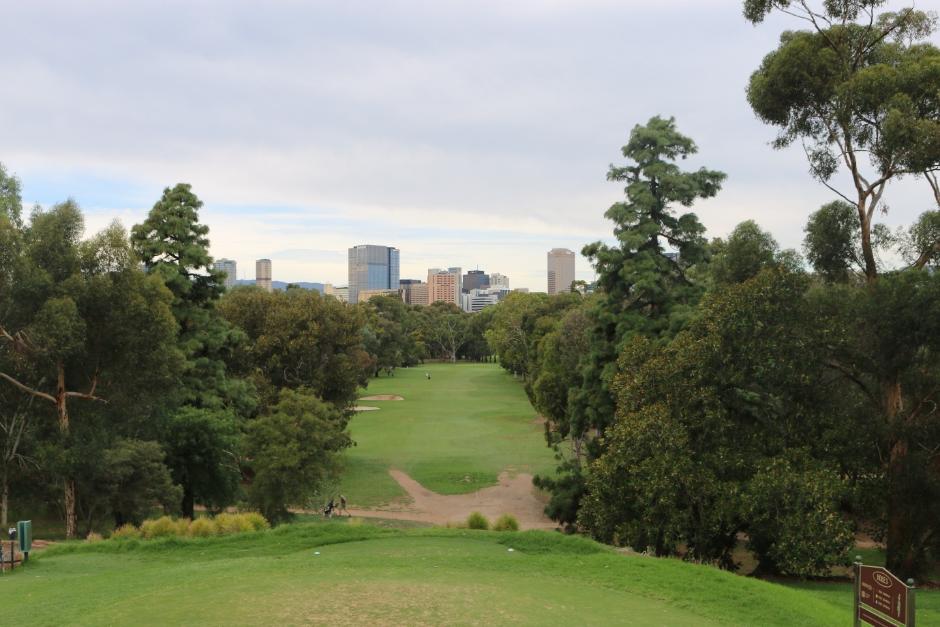
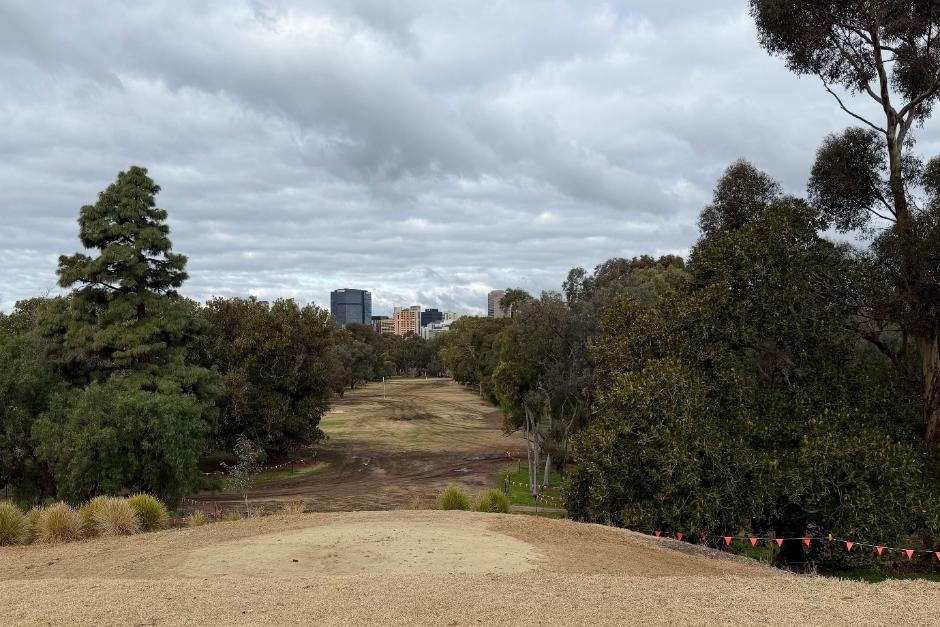
186 Mr Kemp Attrill was asked whether he accepted that the tree removal depicted by those photographs had not significantly changed the tree canopy. He responded:
It doesn’t look like it from these shots. There’s a few trees that look like they’re removed, but it’s very similar.
187 The cross-examination continued:
COUNSEL: There’s a significant difference in the visual appearance of the photos as a consequence of the grass that has been removed; would you agree with that?
KEMP ATTRILL: Yes.
COUNSEL: Mr Kemp Attrill, I put it to you that the significant change in the experience of the site is because of the removal of the grass and not the removal of the trees, would you accept?
KEMP ATTRILL: Um no and as I said um it was noticeable as soon as the trees were removed that um the - and the view was different and standing outside the fence, if you’re not right up against the fence you actually don’t see the grass. You can only see the trees and that was a noticeable difference.
COUNSEL: There’s still an awful lot of trees on this though, aren’t there?
KEMP ATTRILL: Yes.
Documents identifying the trees to be removed
188 There is a considerable amount of documentary evidence identifying the trees that have been removed and those yet to be removed. They include an interactive spreadsheet, a report of Succession Ecology (consultants engaged on the Project) and documents scoping the work of the contractor engaged to undertake the removal works. The evidence demonstrates that the larger portion of the trees removed or to be removed come from the glades dividing the fairways of the southern course.
189 I have previously mentioned the number of affected trees categorised as “significant” and “regulated” under State law. Those categorisations relate to both their size and their species. The size of those trees and the canopy are factual matters assuming importance on the applicants’ case. I have no difficulty concluding that prior to their removal they were living things that contributed to the aesthetics and ambience within the particular areas where they once stood. The same can be said of the trees yet to be removed, whether large or not.
190 Annexed to Mr Kemp Attrill’s affidavit are the photographs he took of downed trees in May 2026 soon after he learned about the Tree Removal activity then underway. Those photographs depict large, mature trees lying across the landscape and beside their stumps. They depict a striking change in the specific location where each tree once stood, captured at the points in time when each photograph was taken, apparently shortly after the trees were felled.
191 I have reviewed the remainder of photographs depicting the fairways of the southern course before and after the Tree Removal works so far undertaken. The images depict changes in the horizon formed by the tree canopy of the glades that line the fairways. However, the images also show that the remaining trees and vegetation continue to have the same overall impression in quality, density and height.
192 I have also had regard to a series of photographs depicting Park 1 from an aerial perspective. They are reproduced in the expert report of Mr Graham Brooks (discussed below) and are similar in their effect to the two aerial photographs shown to Mr Kemp Attrill in the course of his cross-examination. I place less weight on those images as I do not consider the aerial perspective to be the usual point of view of a person experiencing the park lands. However, they cannot be disregarded, and they do demonstrate that the density in the tree canopy, when viewed from above, has hardly changed.
193 The images I have described thus far are the only visual representations of the wider landscape as it appeared before and after the recent Tree Removal activity. The most obvious change in the landscape is the conversion of turf to dirt and mud brought about by the works that are underway. The applicants do not rely on that change. With respect to the change in the stands of trees lining the fairways, my evaluation of the photographs is that the overall change in the aesthetics of those tree stands is in many instances not apparent from the images. In other instances it is best described as minimal.
194 That is not to discount Mr Kemp Attrill’s evidence to the effect that from some vantage points able to be accessed by him there is “more sky” or that he discerned a noticeable difference in the density of canopy when at or near the Project Site. However, that oral evidence is insufficient of itself to support a finding concerning the nature and extent of the overall short-term change.
195 I am mindful that the photographic evidence is not necessarily a complete record. However, to the extent that there are deficiencies in the evidence demonstrating an impact that is “significant”, that is a matter that goes to the applicants’ onus of proof.
196 In any event, as I will emphasise throughout these reasons, the “impact” on a thing or things within or a particular place situated within the Listed Place does not in and of itself equate to a significant impact on the Listed Values. That distinction is further highlighted on my review of the different approaches taken by the expert witnesses.
Expert evidence
Dr Michael Llewellyn-Smith
197 Dr Michael Llewellyn-Smith holds a Master of Arts from the University of Cambridge, a Master of Town and Country Planning from the University of Sydney and a PhD in town planning from the University of Adelaide. He has considerable planning experience and has previously served as City Manager (CEO), an elected Councillor and Deputy Lord Mayor of the City of Adelaide.
198 With respect to the Tree Removal activity, I have not found his evidence to be particularly helpful. His opinions were expressed at too high a level of generality and without sufficient reasoning to disclose how he had assessed the nature and intensity of the change, nor how that change was said to constitute a significant impact on the Listed Values. That may be a consequence of the breadth of the questions put to him. The first question was whether, in his opinion, there was:
… a real chance or possibility that any aspect of the Project will detrimentally affect the protection or conservation of the Park Lands.
199 For reasons I have given earlier, the phrase “protection or conservation of the Park Lands” is potentially problematic because it does not engage with the Listed Values other than in the most oblique terms.
200 Dr Llewellyn-Smith’s response was as follows:
Criterion F of the National Heritage listing concerns the outstanding value the place has because of its creative achievement. The creativity of Light’s design is cited by Ebenezer Howard in his book “Garden Cities of Tomorrow” as an example of a planned development which met social and economic requirements. However, Howard made an error in that he assumed North Adelaide was a separate development and not part of the original city layout. Nevertheless, the text was influential in the Garden City Movement and Adelaide became a model for other towns. The encirclement of the Park Lands is unique amongst Australian capital cities and is a defining element in the listing.
Because of the extent of the changes to the Park Lands by the proposed golf course, driving range, car parking and new buildings, the Park Lands will not be protected and conserved and therefore the Project will have, or is likely to have, a significant impact on National Heritage place value F.
201 That opinion does not inform the Court as to how Dr Llewellyn-Smith interpreted the value in question, nor does it disclose whether (or if so how) Dr Llewellyn-Smith considered the fact, nature or intensity of the impact of the Tree Removal activity.
202 The question and response relating to the Listed Values addressing Criterion G was equally broad. It was whether there was:
… a real chance or possibility that any aspect of the Project will detrimentally affect the social value of the Park Lands, including by reason of the important civic, public and cultural assets and institutions within them.
203 Dr Llewellyn-Smith responded:
Having regards to criterion G of the listing of the Park Lands and City Layout, the Park Lands are fundamental to the character and ambiance of the city of Adelaide. The social value of the Park Lands to South Australians is enormous as they provide space for passive and active recreation as well as formal gardens. There is a long history of community groups who have been established to protect the Park Lands up to and including the current Adelaide Park Lands Association which is a non-profit organisation. The Park Lands of 932 hectares provide a setting for a number of civic and public institutions.
Because of the extent of community reaction to the proposed golf course, driving range, associated car parks and new buildings, the changes will affect the social value of the Park Lands and have, or are likely to have, a significant impact on National Heritage place value G.
204 I will return to that opinion in the course of a different aspect of the applicants’ case. For present purposes I do not gain much assistance from the breadth of the responses there given as it is not sufficiently focused upon the impact of any particular activity on any particular aspect of the Listed Values. In that part of his report where he elaborates on his opinions, Dr Llewellyn-Smith focused foremostly on local and State development policies and laws as they evolved over time.
Graham Brooks
205 Mr Graham Brooks is a heritage architect and consultant. He holds a Bachelor of Architecture (Honours) from Sydney University and a Masters of Built Environment (Building Construction) from the University of New South Wales. He is the managing director of GBA Heritage in Sydney and has undertaken various heritage consultancy projects domestically and internationally.
206 The opinions of Mr Brooks were focused upon the capacity of the park lands to accommodate change consistent with the Listed Values. He referred to the Significant Impact Guidelines which pointed to the need to address contextual issues, including the sensitivity of the environment which will be impacted.
207 His approach broadly aligned with my interpretation of the Listed Values as describing an area that is able to (indeed designed to) accommodate a range of uses to meet “social and economic requirements”. As I have mentioned earlier in these reasons, that text should be interpreted to encompass an urban design that included a park lands area to accommodate a number of uses to meet the social and economic requirements of a city’s population. The changing requirements of the population are illustrated by the evolution of the golf course itself. The history is set out [152] – [166] of Mr Brooks’ report and is extracted below. It shows a continual process of reconfiguration, including considerable change to the managed landscape:
The historical summary contained in Part D reveals that the Adelaide Golf facilities have moved locations, been progressively updated as well as reconfigured since the late 19th century. Cycles of changing fairways, greens, bunkers and tees have responded to current golfing activities and support facilities.
The area covering the various existing golf fairways is strongly characterised by a series of interlocked fairways, tees and greens. These in turn, are delineated by adjacent rows of mature trees complemented by other areas of mass planting of multiple species, scale and visual presence. The majority of trees tend to be relatively high canopy allowing distant visibility at ground (player) level across a grassed and undulating landscape.
There have been various periods of mass planting campaigns across the current course locality, particularly since the 1950s, as can be seen by comparing todays [sic] well managed landscape with the 1930s imagery at Figure 3 above. Most of specific planting and beautifying landscape campaigns in the 19th century were primarily located elsewhere; along the valley and to the south of the Torrens River, within the famous squares and for institutional public places such as the Botanic Gardens and Adelaide Zoo.
As many of the current trees in the subject site most probably date to the middle of the 20th century, there is and will continue to be a renewal cycle of tree and grassland management, from storm damage, decay, climate changes or for safety reasons.
The defining features of the intensely managed, current golf course landscape, cannot be regarded as sensitive to change in the context of a significant impact on the National Heritage Values. The combined landscape of the golf course, as it existed in early 2026, had already been extensively modified since the 1880s and intensively for the South Course since the 1950s with no identified significant Impacts to the listed National Heritage Values.
208 Mr Brooks went on to describe the “total impact over time” from the Project as “another well managed evolutionary reconfiguration and upgrade of a public golfing facility that has and will continue evolving to remain relevant to contemporary society”.
209 Mr Brooks said that there was an extensive retention of mature trees and fairway defining tree lines that could be complemented by additional plantings. He said that the additional plantings would “settle into the golf course cultural landscape in the same fashion as the many other changes made since the 1950s”.
210 Mr Brooks referred to the supplementing of the trees that currently contribute to the dense lines of tree canopies and elsewhere as visually defining the primary visual and spatial character of the southern golf course. He said that that feature would “visually strengthen over time in tune with the natural cycles of any public park-like landscape”.
211 Mr Brooks supported his opinions with an assessment of the aerial photographs referred to earlier. Rather than focus on the number of trees removed as a numerical figure, he conducted a visual assessment of the appearance of the affected area, including by reference to the photographs.
Areas of disagreement
212 The disagreement between Dr Llewellyn-Smith and Mr Brooks is largely explained by their different approaches to the interpretation of the Listed Values. Mr Brooks’ interpretation of the Listed Values aligns with that of the Court. He maintained that interpretation throughout his cross-examination, specifically by disagreeing with propositions underpinning the questions put to him or by qualifying his answers.
213 The cross-examination of Mr Brooks did not yield any concession of assistance to the applicants’ case. The questioning in some respects sought to have Mr Brooks accept that there was an “impact” on the park lands or an area of it, or to accept that change to a part of the park lands was “notable” or “significant”. Mr Brooks’ responses reflected his appropriate focus upon the correct issue, namely the existence and measure of any impact (or likely impact) on the Listed Values. Whilst he accepted that the Project had and would change the place where it would occur, he did not concede that the change would or was likely to constitute a significant impact on the Listed Values. The cross-examination overall was underpinned by an interpretation of the Listed Values that Mr Brooks clearly did not accept.
214 I generally prefer the approach of Mr Brooks to the issues, particularly because his report squarely addresses the question of the extent to which change in the park lands would or would not be consistent with the Listed Values and because of the attention given to the Listed Place as a whole.
215 Dr Llewellyn-Smith’s expertise and experience in State development law was extensive and impressive, and that was reflected in both his report and his oral evidence. However, I consider that his responses to the discrete questions put to him (set out at [5.1], [5.2] and [5.3] of his report) do not disclose sufficient supportive reasoning. The elaboration provided later in his report was too generalised to be of assistance. His opinions proceeded from an assumption that the Tree Removal activity necessarily impacted on the Listed Values, without a sufficient explanation as to why that should be so.
216 I do not otherwise consider it necessary or appropriate to set out in these reasons isolated questions and answers drawn from the cross-examinations referred to in the parties’ written submissions. The cross-examinations of the experts have been considered as a whole, and in the context of the written opinions expressed in their respective reports. The answers given in cross-examination were reflective of the differing interpretations of the Listed Values and to the extent that concessions on matters of evaluation were made, those concessions have not altered my view as to how the Listed Values should be interpreted.
Evaluation of actual or likely impact
217 Trees are an important feature of the park lands. They contribute to the park lands’ aesthetic and utilitarian qualities, and hence their intended function in the urban design described in the Listed Values. The focus of the evidence was upon the aesthetics and amenity of the Project Site, especially (but not exclusively) the scale and visible amenity of trees (especially large trees) defining the fairways of the golf courses and the immediate change in the area brought about by their destruction.
218 However, in my view, when asking whether the aesthetic landscaped qualities of the park lands have been impacted by the removal of trees, it must be borne in mind that active landscaping is contemplated in the Listed Values themselves, as are changes to the internally shared uses (within limits) across the park lands over time. Whilst qualities such as character, ambience and appearance may be embedded within the Listed Values, the manner in which they are to be achieved and maintained across the park lands as a whole is not articulated as a discrete value. The Listed Values recognise that the uses of the park lands may involve a process of active landscape management and change, as demonstrated by the work of public gardeners and landscape designers over time, as well as the history of the golf course itself.
219 Dr Llewellyn-Smith correctly interpreted the Listed Values to incorporate a design principle requiring that there be a predominance of landscape over built forms. However, he did not explain how the Tree Removal activity had or is likely to have a significant impact upon that aspect of the Listed Values by reference to the Listed Place, considered as a whole and having proper regard to the number of trees (including mature trees) remaining across the park lands. The numbers bear repeating. There are more than 9,000 trees remaining within the Project Site and more than 70,000 trees remaining in the park lands.
220 The factual context is such that the active management of a landscape may involve the removal and replacement of trees, with all of the immediate and short-term detrimental changes that that activity might entail. It is accepted that the Tree Removal activity has had some negative impact on the appearance and ambience in the particular places where they once stood. That is demonstrated by Mr Kemp Attrill’s photographs. However, the Listed Values are not themselves impacted by that activity. The Listed Values contemplate and require that change may occur in a manner consistent with the maintenance of an actively managed landscape that broadly achieves the aesthetic characteristics I have described in these reasons. It has not been shown that the Tree Removal activity has disturbed or is likely to disturb the predominance of landscaped forms over built forms across the Listed Place as a whole, nor that it has undermined the contribution that the park lands make to the character and ambience of the city. Given the remaining 73,955 trees standing across the park lands I am not satisfied that the aesthetic elements of the urban design protected by the Listed Values would be discernibly affected, nor that there has been or is likely to be any discernible shift in the predominance of landscaped forms over built forms.
221 Moreover, the activity is undertaken in conjunction with a tree replacement and revegetation program that is consistent with the Listed Values so far as they contemplate layers of planting by successive gardeners and planners over time. There is nothing in the Listed Values that requires that the particular trees in existence in the park lands on the Listing Date must be preserved in their places for all time. In that respect I accept Mr Brooks’ opinion that the Listed Values do not describe the park lands as sensitive to all change.
222 In respect of the trees yet to be removed, I apply the same approach. The applicants have not established that it is likely that the removal of a further 184 trees will have a significant impact on the Listed Values, having regard to considerations of space and time referred to above, and especially having regard to the number of trees to be preserved.
223 Before leaving this topic, I should mention that in some parts of the evidence there was mention of the proposed removal of hundreds of trees to make way for a proposed motor sport event in another part of the park lands. That proposed future activity formed no part of the impugned activity or series of activities forming the subject matter of the applicants’ claims in this proceeding. The Court’s task is confined to an evaluation of the impact of the pleaded activity with respect to the NAPGC.
Historical plantings
224 The pleas at [10.7] – [10.9] of the ACS are based on these words from the Listed Values addressing Criterion F:
The overall landscape planting design implemented by several successive landscape designers/managers incorporated designed vistas, formal avenues, plantations, gardens, use of specimen trees, botanically important living plant collections particularly at the Adelaide Botanic Garden and the strategic placement of buildings and statuary in their settings.
225 Brown was the second Conservator of Forests in South Australia, holding that office between 1878 and 1890. In 1880 he published his “Report on a System of Planting the Adelaide Park Lands” (Brown Report). In that report he specified the planting of species including Eucalyptus leucoxylon (South Australian Blue Gum) and Grevillea robusta (Silky Oak). Those facts are not disputed.
226 The applicants further alleged that Eucalyptus sideroxylon (Red Ironbark) planted in the 1960s have been “subsumed” in the original character of the plantings carried out in accordance with the Brown Report.
227 They alleged that the removal of 47 South Australian Blue Gum, one Silky Oak and 19 Red Ironbark trees is an impact which is important, notable or of consequence “upon the preservation and conservation of that part of the Park Lands which is the relevant site” because they form a part of (or are referable to) the historical plantings specified by Brown. The applicants submitted that the Listed Values should be interpreted as directed to the conservation and preservation of the original character of plantings specified by Brown as well as the underlying structure of those plantings.
228 An uncontested summary of the evidence concerning Brown’s original plan for Park 1 is set out in the respondent’s closing submissions and I here adopt the respondent’s wording:
(1) The Park was used for military reviews, parades, sham fights, and Brown thought it necessary to have good open space for evolutions of this kind.
(2) Brown recommended carriage ways, fences, footpaths, removal of trees then in the place (particularly Gums) and planting of rows of trees and clumps of trees.
(3) Evident from the visual plan is that the centre of Park 1 was to be left largely open within the boundaries of a fence, with clumps of trees in the centre and a row of trees around the outside.
(4) Brown recommended that the worst of the Red Gums and Cypresses alongside Montefiore Road be removed and replaced with species on a list which did not include any plants endemic to South Australia.
(5) Most of the recommended trees for the different parts of the site were exotic trees or trees native to Australia, but not endemic to South Australia. Of the list the only Eucalyptus are Tasmanian Blue Gum (of which none are present in the park), SA Blue Gum and Sugar Gum (formerly known as Eucalyptus corynocalyx). The other Australian natives recommended are Grevillea robusta (Silky Oak), Ficus macrophylla (Moreton Bay Fig), Casuarina stricta (also known as Allocasuarina verticillata – Drooping Sheoak) and Exocarpos cupressiformis (Native Cherry).
(6) The part of the park between Mills Terrace and the railway was described by Brown separately from the rest of Park 1. The only Eucalyptus recommended for this park was Sugar Gum. Other Australian natives recommended include Drooping Sheoak, Moreton Bay Fig, Silky Oak, Norfolk Island Pine and Hoop Pine.
(7) In respect of what is now Park 27A, Brown’s plan did not specifically address this part of the Park Lands.
229 The applicants have not established that Red Ironbark trees have become “subsumed” in the original character of Brown’s plantings. The evidence upon which they relied to support that proposition was a 2007 article by David Jones titled “Adelaide Park Lands & Squares Cultural Landscape Assessment Study” (2007 Jones article). It confirms that the Red Ironbark trees were indeed planted in the 1960s. He stated that planting layers in the 1920s, 1940s and 1960s “subsumed the original character set by Brown’s Report (1880) but hidden within the landscape is still this underlying structure”. Consistent with that statement, I find that to the extent that there exists any part of the original structure, it has been obscured by the later plantings including the pleaded Red Ironbark trees (but is still detectible notwithstanding them). The evidence does not demonstrate that the removal of the Red Ironbark trees would detract from so much of the original design by Brown that is still detectible in the landscape.
230 As to the other two species, the applicants expressed the impact of their removal in terms of a percentage of the total number of each species present within the Project Site. Within the Project Site they alleged that 47 of the 363 Southern Blue Gum had been removed (representing 12.9%) and one of three Silky Oak had been removed (representing one third). The difficulty with this part of the case is that it focusses upon an impact by reference to the Project Site but not upon the Park Lands as a whole. The evidence does not establish that Brown’s specification of the plantings of the Southern Blue Gum and the Silky Oak were limited to areas within the Project Site. The percentages of those species removed in my view are not a proper measure of the impact of the Listed Values of the Listed Place, the area of the Listed Place being significantly larger. The applicants’ use of mathematical percentages for this aspect of the case was neither appropriate nor persuasive.
231 The National Heritage Management Plan contains an explanation of the extent to which Brown’s plans were implemented or partially implemented. It states that Brown’s plans were:
(1) implemented and retained in Park 17;
(2) partially implemented in Parks 3, 5, 13, 15, 19, 20, 23 and 27;
(3) implemented in the perimeter of Park 6; and
(4) implemented in Park 21 but subsequently later plantings and uses were inconsistent.
232 As to Park 1, the National Heritage Management Plan explains that plantings in Park 1 were designed to service the golf course itself. The plantings were selected by Pelzer. He did not wholly follow Brown’s species proposal but rather adapted it to suit the requirements of the golf course he identified in the mid-20th century. The landscaping in the golf course divides Park 1 into multiple holes with lawned fairways delineated by groupings of trees. The evidence shows that the plantings of Pelzer were influenced by Brown, however the plantings themselves were not a direct implementation of any landscape design attributable to Brown and they do not date back to Brown’s time.
233 The landscape in Park 27A is not directly addressed in the National Heritage Management Plan. The applicants have not established that trees removed from that area were planted as an implementation or partial implementation of Brown’s plans.
234 The applicants’ contentions more broadly on this topic were a further example of an approach to interpreting the Listed Values that focused on the protection of specific features present within the Listed Place as having “value” because of their asserted historical significance. I am not satisfied that the Listed Values include the planned plantings of Brown per se. However, if I am wrong about that I would conclude in any event that the applicants have not established that the removal of the three pleaded species amounts to an impact on that value. That is principally because I am not satisfied that Brown’s plans were implemented in the area from which the trees were removed. The circumstance that the removed trees are of a species referred to in Brown’s list of preferred species is not sufficient to prove that they were planted as an expression of Brown’s plan. As explained above, nor do I consider that the removal of trees planted in the 1960s has had or is likely to have a significant impact on that asserted value.
Community Opposition
235 The applicants next relied on the following text in the Listed Values (addressed respectively to Criterion A and Criterion G):
The Adelaide Park Lands is also significant for the longevity of its protection and conservation. The Adelaide Municipal Corporation Act (1840) established the city council as the ‘conservators’ of the city and park lands. The establishment of the Park Lands Preservation Society in 1903, along with successive community organisations marks a continuing pattern in community support for safeguarding the significance of the Park Lands for the Adelaide community.
…
The present Adelaide Parklands Preservation Society is the latest in a long history of community groups dedicated to protecting the Adelaide Park Lands. These have included the Park Lands Defence Association (1869-87), the Park Lands Preservation League (1903, 1948) and the National Trust of South Australia. The longevity of the involvement of community groups in campaigning for the protection and safeguarding of the Park Lands is exceptional.
(emphasis added)
236 The pleaded case is that there is community opposition to the relevant action in respect of the removal of around 585 trees. It is alleged that the removal of the trees “is an impact that is important, notable or of consequence in that it is contrary or adverse to community support for safeguarding the significance of that part of the Park Lands which is the relevant site”. Alternatively, the applicants alleged:
The removal of around 363 trees which are regulated, significant or meet the criteria for regulated or significant trees in terms of their size, but are exempt from that designation under State planning laws is an impact that is important, notable or of consequence upon the preservation and conservation of that part of the Park Lands which is the relevant site … in that it is contrary or adverse to community support for safeguarding the significance of that part of the Park Lands which is the relevant site.
The removal of around 99 regulated trees and around 76 significant trees in the course of the first part of the relevant action is an impact which is important, notable or of consequence that it is contrary or adverse to community support for safeguarding the significance of that part of the Park Lands which is the relevant site.
(emphasis added)
237 The effect of those pleas is that the removal of the trees (or combinations of them) is or is likely to have a significant impact on the Listed Values because the activity is opposed by those who seek to “safeguard the significance of” the area where the trees are or were situated. In other words, the history of the community safeguarding of the park lands is itself alleged to be a value that can be impacted upon.
Evidence
238 Dr Llewellyn-Smith described the social value of the park lands to South Australians as “enormous” because they provide “space for passive and active recreation as well as formal gardens”. So much may be accepted. He then referred to a long history of community groups established to protect the park lands, including (to the present day) the non-profit organisation “Adelaide Park Lands Association”. He then expressed this opinion:
Because of the extent of community reaction to the proposed golf course, driving range, associated car parks and new buildings, the changes will affect the social value of the Park Lands and have, or are likely to have, a significant impact on National Heritage place value G.
239 The opinion may be assumed to encompass community reaction specifically in relation to the Tree Removal activity in accordance with the pleaded case. Dr Llewellyn-Smith’s opinion assumes the same interpretation of the Listed Values for which the applicants contend. As does the opinion of Ms Thredgold, discussed below.
240 The fact and intensity of the community opposition to the Tree Removal activity is a question of fact. On the factual question, Mr Kemp Attrill gave evidence about his awareness of and participation in community protests, beginning with a discussion he had with a number of people protesting outside of the fenced off area at Park 1 on the day in May when he first became aware of the removal of trees. He said he further learned of the community opposition through his own community and online groups. He also referred to media reports concerning the protests, the arrests and public statements about the works. Some of those reports are annexed to his affidavit. He deposed to his understanding (obtained from the media reports) that more than 2,000 protesters had gathered on the steps of South Australia’s Parliament House to oppose the removal of trees, and that police had attended at the site and arrested eight people. He added that dozens had attended at the Adelaide Town Hall when councillors met in relation to the issue.
241 Also in evidence is a body of documentary material tracing the history of public organisations and activities directed to the preservation of the park lands over more than a century, including the Park Lands Defence Association (1867-87) and the Parklands Preservation League (formed in 1903), later succeeded by the Adelaide Parklands Preservation Association. Some of that history is summarised in the Heritage Management Plan. It refers to community ire raised in connection with the construction of the Adelaide Aquatic Centre. It refers to community concern about “alienation of the park lands”, highlighting some uses of the park lands that are obviously contrary to the Listed Values but also a division of opinion about what forms of development should or should not be allowed to proceed.
242 In his expert report, Mr Brooks acknowledged that the loss of a very large number of trees to facilitate the extensive reconfiguration of the southern and northern golf courses had “caused deep concern within the South Australian population”.
243 Ms Charmaine Thredgold holds a Bachelor of Arts (majoring in geography and development studies) and a Bachelor of Arts (Honours) (majoring in geography) from Flinders University. She also holds a Masters Degree in Urban and Regional Planning from the University of South Australia, with a major in sustainable urban design. She was previously employed as a planner with the South Australian Department of Planning, Transport and Infrastructure. She also undertook social and urban research as a research fellow at the University of Adelaide and the University of South Australia. Her evidence was relied upon both in respect of the factual question relating to the extent of community opposition and her expertise in connection with “grassroots movements”. I have had regard to her evidence insofar as it contains some factual evidence of community opposition to the removal of trees. The objective material contained in her affidavit shows that a social media page titled “Possum Park Protection Platoon” was created in July 2025. The page is moderated by the Adelaide Park Lands Association and had over 10,200 members as at 14 July 2026. Another page titled “Protect OUR Park Lands” was created in May 2026 described as taking “action in support of protecting Adelaide’s Park Lands, public green spaces and shared community assets”. It had 922 members as of 14 July 2026. Ms Thredgold observed that most members of that group may also be members of the Possum Park Protection Platoon group.
244 Ms Thredgold went on to perform an “informal qualitative research” approach to identify insights that could be generated from an “unstructured review of social media posts and comments”. She acknowledged that views expressed within social media groups established for the purposes of opposing the Project were not necessarily representative of broader views. She acknowledged that they may reflect “a partial view based on the interests of the poster or commenter”. She said that the comments nonetheless provided “a mechanism for capturing the full range of views on the protection and conservation of the Park Lands and their future direction”. Ms Thredgold added this in relation to her methodology:
A walk around the perimeter of the fenced historic North Adelaide Golf Course site was undertaken on 13 May 2026. Participant observation included attending APLA organised rallies on 13 May 2026 and 6 June 2026. The tree demolition was witnessed on 15 and 16 May 2026. I have signed the Change.org online petition and the paper petition.
245 Ms Thredgold did not refer in her report to the Listed Values insofar as they refer to the history and pattern of community preservation and conservation. Like Dr Llewellyn-Smith, she proceeded from the assumption that the fact of community opposition to the Project was a relevant factor in an assessment of significant impact, but the reasons for making that assumption are not apparent on the face of her written evidence.
246 I will summarise Ms Thredgold’s oral evidence in the course of the consideration that follows.
Consideration
247 This aspect of the applicants’ case fails on questions of fact and construction.
248 As to fact, the evidence shows that several thousand members of the South Australian population are deeply concerned about the Tree Removal activity and that they have joined online groups to voice their opposition to it. Others have attended protests at or near Park 1, at Parliament House and elsewhere.
249 There is also evidence that the views of those members of the South Australian population are not shared by some other members. The existence of other voices emerged in the cross-examination of Ms Thredgold. She acknowledged that voices in support of the reconfiguration of the golf course had been raised in the social media platforms set up to oppose the changes. She acknowledged that the groups she had considered were those that had been created for “the protection and conservation of the park lands”. She admitted that the methodology she had employed to gauge community sentiment was not directed to identifying members of the community who supported the Project. She then said that she did “monitor” another Facebook group that was fully supportive of the Project, adding “but it became too adversarial”. When asked whether it was accurate to say that her report had not fully recorded the steps that she had undertaken to assess the community’s concern, she said:
I was mainly looking for the support for the protection and conservation of the parklands, because it seemed to be absent from everything I read on the project, except for a minor comment that there’ll be community concern about mature tree removal. I think that was the only reference I heard about protection and conservation of the parklands.
250 Ms Thredgold was questioned about her personal participation in the groups and protests to which she referred in the expert evidence. Documents put to her showed that she was not an observer of the activities of others, but instead an active participant in the activities of those who opposed the Project and especially the Tree Removal activity. The evidence shows that she was an actively participating member of the Possum Park Protection Platoon Facebook group. When questioned, Ms Thredgold acknowledged that she was personally concerned about the removal of the trees, that she had attended protests and that she had encouraged others to attend.
251 In response to a Facebook post in the Possum Park Protection Platoon group concerning the best way to record messages from those opposed to the Project, Ms Thredgold expressed enthusiasm because she had been speaking to members of the community about their depth of feeling. She added:
My question is - should we ask people if they are willing to say a few words on film and would they consent to the footage being used? Sorry to jump ahead but this is such a fantastic grassroots movement. Who knows what we will achieve. Let’s capture the raw emotion of a grieving city.
252 When asked whether she considered herself a part of the “Grassroots Movement” she had mentioned in her report, Ms Thredgold said: “[i]n a way, but I have also studied Grassroots Movements and I’m fascinated by them and how they grow, how they emerge”. She again acknowledged that she was actively opposed to the Project going ahead.
253 Ms Thredgold ought to have disclosed in her report the full extent of her involvement with the groups she purported to examine in order to gauge community sentiment, given her role and responsibilities as an expert witness. Whilst I accept the objective fact of the existence and membership numbers of the Facebook groups referred to in her report, I will not afford any weight to the opinion of Ms Thredgold on any disputed question, whether or not within her area of expertise, given her lack of independence and impartiality.
254 I am otherwise satisfied that those who are opposed to the Project are concerned first and foremost about the removal of so many large and mature trees in order to facilitate the construction of a championship golf course. It may reasonably be inferred that each of them has a concern about the effect of the Tree Removal activity on the aesthetics of the park lands, on the way in which they can be experienced, on their social value and on the contribution that trees make to the character and ambience of the city more generally. It may also be inferred that those opposing the Project believe the reconfiguration of the golf courses to accommodate a championship golf course should not be prioritised over the preservation of trees and natural landscape features because of their inherent value as living things.
255 I have had regard to the evidence of Mr Kemp Attrill on this topic. I considered him to be an impressive witness who was genuinely motivated to protect the trees from destruction. It may be inferred that other members of the community who have engaged in protests are similarly minded. I will proceed on the basis that the views of those who have actively voiced opposition to the Project are genuinely and deeply held and that they may be shared by a much larger number of South Australians.
256 The evidence also supports a finding that there is no common view among members of the community about how the park lands should be internally configured and the uses to which they may legitimately be put. That factual situation illuminates the difficulty inherent in the applicants’ case concerning the proper interpretation of the Listed Values.
257 There is an important distinction to be drawn between the Listed Values on the one hand and State and local values or personal values on the other. The circumstance that an individual strongly opposes the destruction of trees in the park lands cannot supply the foundation for a finding that the Listed Values incorporate the protection of every tree, or the protection of the pleaded trees collectively.
258 Some time at the trial was dedicated to argument about what the emphasised words of the Listed Values mean. In my view there is ambiguity in the meaning of the words relied upon by the applicants if one strains to give them the status of a “value” that can be impacted upon arising in isolation from the values stated in the remainder of the text.
259 Near the commencement of these reasons, I explained that the gazetted heritage values of a national heritage place should be interpreted to include only such values that are capable of a certain meaning and application derived from their text. On that approach it is unnecessary to give every sentence or paragraph the status of a separate and distinct “value”. The struggle to find such a meaning may introduce unacceptable ambiguity, given that the same text is effectively incorporated into other provisions of the EPBC Act that create criminal offences. Adopting that approach, I do not consider that the text relied upon by the applicants should be interpreted as supplying the particular “value” upon which they relied for two reasons.
260 First, a person undertaking an activity in the park lands should not be expected to start or stop an activity in accordance with actual or perceived community sentiment about whether or not the activity might be thought to be desirable, under a spectre of a criminal charge if the sentiment is not gauged correctly or if the sentiment should change. Such a standard is as unmeasurable as it is unworkable. An interpretation of the Listed Values that brings about such a result should not be preferred. To adopt that approach would have the obligations created under the EPBC Act vary in accordance with opinion polls or protest crowd sizes.
261 Second, the interpretation preferred by the applicants would have the consequence that other text in the Listed Values would be ignored or undermined. For example, there may be an upswell of sentiment against an activity that converts a passive use area of the park lands into an active use for sport. That sentiment may be founded on personal views that the park lands should be dedicated solely to passive use or that some sport and recreation activities should be preferred over others. Those personal views may not accord with the various uses referred to in the text of the Listed Values to which I have referred throughout these reasons.
262 On an alternate construction, the words within the Listed Values that speak of a history of conservation and preservation of the park lands should be understood as the protection of the overall city layout and design and the various functions the park lands play in that overall design. It should not be interpreted as a reference to a desire in some members of the community to protect and conserve the park lands from any change in their internal configuration.
263 The interpretation assumed by Mr Brooks was that there might be an impact on the Listed Values if the history of conservation and protection was itself adversely impacted (for example, if it were to cease). His opinion was that the volume of community voices expressing shock and anger at the destruction of large and mature trees meant that the history of protection and conservation of the park lands was alive and well. It is difficult to imagine an activity that would impact on the pattern of community concern for the protection and conservation of the park lands so conceived, other than a scenario in which the park lands did not exist at all. I do not accept Mr Brooks’ interpretation either.
264 In my view, the more appropriate approach is to read the text upon which the applicants rely within the context of the whole of the text of the Listed Values. They need not be understood as erecting a discrete value capable of articulation which can be “impacted” in the sense described in the EPBC Act, but rather as words that assist in describing how the park lands has survived over time “substantially intact” so as to remain a place of significance to the relevant community group, being all South Australians.
265 As the park lands are to be dedicated to uses that meet “social and economic requirements”, it is hardly surprising that there will be fierce disagreement about what those needs are and how the park lands are to accommodate them. That is the nature of the public debate disclosed in the evidence before me. It is a politically charged debate, operating at the level of State and local politics. The existence of the debate does not mean that the respondent’s activity has, will have or is likely to have a significant impact on the Listed Values so as to require the approval of the Commonwealth Minister.
Construction of built form
266 The Project involves the construction of new buildings and structures in the following respects:
(1) a new clubhouse comprising a three-storey building constructed into a slope near the northern edge of the park lands on Strangways Terrace (with two storeys visible from the street) and an adjacent car park accommodating 172 parking spaces;
(2) irrigation infrastructure comprising two large water tanks, generator and pump shed;
(3) a new Superintendent’s facility, comprising a new shed and additional car parking;
(4) a two-storey facility at the Driving Range comprising 54 tee off positions, outdoor dining area, a kitchen bar, function area, “high-performance area”, gym and office areas, car parks and cart parking, as well as high fencing around the range itself; and
(5) the exclusion of general public access from the Driving Range by reason of its dedicated use.
267 The built forms, singularly or cumulatively, are alleged to have an “impact that is important, notable or of consequence upon the preservation and conservation of that part of the Park Lands which is the relevant site” because they:
(1) erode the character of the park lands “as a park”;
(2) undermine the function of the park lands in the overall design, particularly by the placement of the sizable built form of the clubhouse and car park on the park lands perimeter; and
(3) notably change the use of Park 27A, converting it from a passive recreational space to a permanent facility, access to which is restricted by fencing and netting.
268 The objective and tangible features of the new built forms are not disputed. The descriptions that follow are largely drawn from documents, prepared for the Department of the Premier and Cabinet (DPC) for the purposes of designing and executing the Project, namely:
(1) North Adelaide Public Golf Course Redevelopment Planning Report prepared by consultancy partnership URPS (URPS Report) dated 10 April 2026; and
(2) North Adelaide Public Golf Course Redevelopment Masterplan prepared by Dash Architects (Masterplan) dated 4 July 2025.
269 As recorded earlier in these reasons, the final designs for the built forms are not yet finalised to the point where they are ready for submission to State development authorities. However, some of the more fundamental features of the built forms can be comfortably predicted, such as their proposed location, their nature, their purpose and scale. It appears from the evidence that final decisions with respect to external and internal finishes are yet to be made.
270 For the purpose of assessing the likely impact of the proposed future structures, I will proceed on the basis that the final designs will accord with a body of Design Principles (discussed below).
New clubhouse
271 The new clubhouse building and car park are to be built on the southern side of Strangways Terrace adjacent to the new proposed Hole 1 tee off and the new green for Hole 18.
272 The proposed building will be three storeys tall on its south-facing side, standing at about 12.5 m, plus an approximately 1 m roof pitch.
273 From there the structure will nestle into an upward slope, so that it will stand two storeys tall on its northern façade (facing Strangways Terrace), 8.5 m above ground level. The lowest floor will therefore be at ground level at its southern edge and at basement level at its northern edge.
274 The lower floor (basement level from Strangways Terrace) will include a golf cart storage area with 72 allotments, covering 324 m². On that floor there will be two wash down bays (each 18 m²) and additional storage areas. The overall intended coverage of the lower footprint appears to be about 130 m wide on the southern side and about 140 m deep on the eastern side.
275 The middle floor (ground level from Strangways Terrace) will include a “pro shop” (190 m²), a locker and lounge area (232 m² combined), changeroom facilities and reception and administration areas.
276 The upper floor (second storey from Strangways Terrace) will feature a flexible function area (745 m²) as well as bar, kitchen/servery and cool room facilities (210 m²), additional toilets and storage and administration spaces. An outdoor deck will surround the eastern, southern and western sides of the building (718 m²).
277 The total footprint will be 1,350 m² plus a bag drop area of 66 m².
278 The distance between the northern side of the building and the edge of the park lands is about 50 m. It is marked on the plans with the words “PROVIDE LANDSCAPE BUFFER TO EDGE OF PARK LANDS”.
279 The adjacent car park forms a curved L shape. After the crossover and short driveways the car parks themselves commence from about 20 m from the car park edge. The total coverage in metres is not supplied, however when viewed aerially, the total footprint appears to be about three times that of the clubhouse building.
280 Plans for the positioning of the new clubhouse show that there already exists “grassed informal” parking as well as an “existing formal car park” associated with the old course on the northern edge of the park lands near Strangways Terrace. The plans indicate that those spaces will no longer be required and that they are to be returned to landscaping.
New superintendent’s facility
281 There already exists a superintendent’s facility serving the golf courses. It is located between new Holes 1 and 2 of the new championship course, about 50 m south of the site of the new clubhouse. It includes a store and wash-bay and occupies about 720 m2.
282 The Masterplan contemplates two design options, the first involving the retention and refurbishment of the existing facility, the second involving the construction of new infrastructure including new sheds and stores and 16 formal car parks. The total coverage for the second option is 1,310 m², incorporating a workshop (420 m²), a vehicle storage building (500 m²), a staff amenities building (150 m²), an office (35 m²), a fertiliser, chemical and irrigation storage building (144 m²), a wash bay (88 m²), four soil bins, the formalised car park and a sealed roadway to facilitate access. A sectional drawing indicates that the existing ground will be cut and filled. The height of the workshop building exceeds 10 m on its tallest side.
Irrigation infrastructure
283 The proposed irrigation compound will be constructed on a hardstand of compacted rubble to house:
(1) two new 662 kl circular grey water tanks, each approximately 4.27 m high and 14.04 m wide, accessible via a ladder with a security door and cage;
(2) a new grey gable roof steel corrugated pump and dosing unit shed approximately 10 m x 6 m with an eave height of 3 m, containing a new irrigation pump and pipework;
(3) a new 350 kVA generator; and
(4) a loading dock.
Driving range and mini golf facility
284 The Driving Range is to be constructed in the area known as Park 27A. It is presently a triangular shaped space flanked on its western side by the River Torrens in the vicinity of Port Road. Along the river, existing trees and walking trails curve around a clearing. The eastern side of the central clearing is bordered by trees abutting a railway line along its length. The walking trails do not directly traverse the clearing. They lead to pedestrian bridges across the railway line at the southern and northern ends, providing access to War Memorial Drive and Park 1 (where the NAPGC is situated). At the far northern end there exists a Deceased Workers Memorial Forest. It will not be affected by the construction of the Driving Range or associated facilities.
285 The works for the Project will include new paths leading from the new clubhouse to the Driving Range via the northern or southern pedestrian bridges. The bridges will be widened and an underpass constructed to facilitate golf cart access. The works will leave intact the existing walking trails.
286 The built construction will comprise:
(1) the creation of the Driving Range itself, taking the form of a grassed area approximately 350 m long and 100 m wide;
(2) high netting on either side of the range area;
(3) two new buildings to be constructed at the northern end of Park 27A, described in more detail below;
(4) a new 18-hole mini golf and chip and putt area of approximately 4,750 m² located to the north of the new buildings;
(5) a new 66-space car park;
(6) approximately 106 new formalised car parks along an existing road providing access from Port Road;
(7) a golf cart parking area; and
(8) new paths in the vicinity of the facility for pedestrians, cyclists and golf cart users, including a new formalised path from the rail bridge underpass to and from War Memorial Drive.
287 The first of the two proposed buildings is two storeys high. The ground floor houses 24 driving tees with seating, having a combined area of 480 m², a pro shop of 110 m², and hospitality facilities including a kitchen, bar and indoor and outdoor dining, with a footprint of more than 450 m². The first floor will include an additional 30 driving tees (making 54 driving tees total) with associated outdoor seating (696 m²), indoor kitchen and bar facilities (112 m²) with associated seating (332 m²) and a games zone (90 m²).
288 An additional 600 m² building located next to the first building will operate as a “high performance golf centre”. It will include two simulators (each 54 m²), a gym (72 m²) and toilet and storage facilities.
Witnesses
Adam Hannon
289 The Design Principles (and the building works more generally) are described in the affidavit of Mr Adam Hannon, a director of the Adelaide office of Cox Architecture. Mr Hannon was engaged by DPC in December 2025 to (among other things) draft concept designs for the built form aspects of Stage 2 of the Project. He is responsible for leading the architectural design as well as the coordination of other design consultants and the supervision of construction works.
290 In his affidavit Mr Hannon described the applicable “Design Principles” that “inform the incomplete and evolving design of the built-form in the NAPGC”. He described the principles as consistent with established architectural practice in that they are directed to ensuring that built forms are sympathetic to their settings, integrated within the landscape and respond appropriately to its context. In applying those principles, he said that size or volume was not always the most relevant feature for built form in the park lands. He said:
How the building is perceived is also important. A reduction in the footprint of the built-form is not always achievable or desirable from a needs-perspective and where this is the case, it is fundamentally important to ensure that the design seamlessly integrates any building into the surrounding Park Lands landscape.
291 Mr Hannon referred to other projects within the park lands that incorporated built forms, such as the Karen Rolton Oval project and the Adelaide Oval redevelopment. He said that those projects had become buildings that were highly valued public spaces and he had received positive feedback about them by many individuals who were once sceptical.
292 Mr Hannon described the NAPGC Project as having two aspects to it. The first was the functionality of the new golf course as a championship standard golf course on which professional golfing events could be held on a global stage. He said that the design needed to incorporate destinations where professionals could play and where spectators and tourists could attend. The second was that the architecture needed to respond to the site and celebrate the setting in a way that “becomes part of Adelaide’s character”.
293 On the topic of the proposed new clubhouse, Mr Hannon said that the working concepts for its design “use the governing principle that this is a building in the Park Lands”. As such, he said that it would have “minimal frontage” to Strangways Terrace, and that it would be set back from the roadway “so as not to impede or impact upon the view of the Park Lands and the City skyline, to integrate the clubhouse into its Park Lands setting”. He said that whilst much of the built form design was yet to be finalised and to receive development approval (under State law) and was subject to change, the principles governing the design would remain the same in the final iteration.
294 Mr Hannon said that his instructions had emphasised that any designs relating to the development ensure “as minimal impact as possible on trees and the natural environment of the Adelaide Park Lands”.
295 He went on to say that in the design of the clubhouse the choice of materials would be important to integrate the building into the environment. He referred to the use of “an earthy brick tone and a natural material palette” to achieve that end. He said that the design of the built form at the Driving Range would emphasise its location near the river and the surrounding trees “whilst ensuring it is fit for purpose as a modern driving range facility”. He added:
As this development intends to activate the site for recreational use there must be a dramatic improvement to accessibility than is there currently. The site has been used as a dumping ground, horse agistment and has been cleared for use by open-air events.
296 Mr Hannon did not provide any further detail of those historic uses in his affidavit.
297 Mr Hannon described the netting around the Driving Range as a “challenging” part of the Project because it needed to be high for safety but as low as possible to ensure minimal impact on the surrounding environment. He said:
A deliberate decision has been made to ensure that any netting design is in keeping with its Park Lands setting and insofar as possible works around the trees in site. This may result in a much higher cost, due to repercussions such as ball damage, and the need for reflective materials, but the design priority will always be in its sympathy to its Park Lands setting.
298 The Masterplan includes a statement to the effect that the extent of new fencing and areas that preclude public access should be minimised.
Robert Lustri
299 Mr Robert Lustri is the Executive Director of the Major Projects team in the DPC. He is currently responsible for leading and coordinating the NAPGC development.
300 Mr Lustri described the Driving Range as “a necessary feature of a championship golf course capable of hosting high-level, national and international tournaments” and as “integral to the off-course facilities for a public golf course”.
301 He described Park 27A as having a “largely clear, open, underutilised and under-established area” and said that utilising the area minimised the impact on trees across Park 1. He said that if the Driving Range were to be incorporated into Park 1 it would have required significant clearing and caused the 18-hole championship course to be pushed “outside of existing golf corridors”.
302 Mr Lustri said that before the commencement of the NAPGC redevelopment, two soil stockpiles of rubbish were present on Park 27A, located on the central portion and southern portion of the area to become the Driving Range and with respective volumes of 900 m³ and 550 m³. He continued:
Some of the trees on Park 27A will require removal for the purposes of constructing the driving range and associated built form. Precisely which trees are to be removed will be confirmed through detailed design however remains within the forecast total as the concept is being progressed. Development Approval will be required for the removal of any regulated or significant trees. Any trees removed will be replaced at a ratio of at least 3:1, as required by section 13 of the NAPGC Act. Where possible, mature trees will be planted during the revegetation.
303 Mr Lustri described the netting around the Driving Range as “necessary as a public and environmental safety measure” and acknowledged that it could be “hazardous for fauna if not done correctly”.
304 There is no final netting design in evidence. From the evidence of Mr Lustri and Mr Pinson I infer that the netting will take the form of a tautly strung structure and that it will be sufficiently high to prevent the escape of golf balls. The balls will be hit from 54 tee off points at both the ground level and the upper level of the built form at the northern end of the Driving Range. The Court did not hear evidence of the height the likely netting structure might stand at, but it may reasonably be inferred that the height will be very considerable in places, given its intended safety purpose and its relationship with a championship level golf course.
Dr Llewellyn-Smith
305 Dr Llewellyn-Smith opined that the proposed built forms should not be assessed in isolation from all other components of the Project, including the Tree Removal activity.
306 Whilst that is generally correct, I do not consider that the built forms would alter the conclusion I have reached in connection with the Tree Removal activity in the context of the whole of the Project and vice versa. I accept that it is important to assess the impact of the new built forms by reference to the cumulative visual change they bring about and any intangible effects concerning change of use and restrictions of access. The new clubhouse and car park, irrigation infrastructure and superintendent’s facility are in close visual proximity to each other so that their combined visual effect cannot be ignored in any event.
307 Dr Llewellyn-Smith described Park 27A as presently available for informal public recreation, but under the proposal the area would become “a specialised and commercially operated driving range” including netting and associated infrastructure. He said that would “substantially change the present use and character of Park 27A”. He added that the fencing or netting would create “a substantial physical and visual enclosure within the Park Lands” and so amount to a “a significant reduction in public access to Park 27A and a further functional alienation of Park Lands”. He expressed the following opinions specifically in connection with the Driving Range:
Having regard to criterion A of the listing of the National Heritage place, the history of the Park Lands demonstrates the vision and commitment of the South Australian community to preserve the expansive open spaces for public use and recreation. The part of the Project to establish a Driving Range in Park 27A will have or is likely to have a significant impact because a passive and open area will be closed off from the public by fencing and netting. The inalienable right of the community to access common land will be lost with a change of use to a commercial operation.
This change will have a detrimental effect on the use of the Park Lands and therefore be a significant impact on a National Heritage place value A.
308 After summarising the Project as a whole (including the Tree Removal activity), Dr Llewellyn-Smith said that the cumulative effect of all of the changes would be to “materially diminish the open, landscaped and publicly accessible character of the affected Park Lands” and to “weaken the contribution that this part of the Park Lands makes to the setting, boundary and overall integrity of the nationally listed City Layout”.
309 When asked to identify the text in the Listed Values that supported a conclusion that members of the public should have unrestricted physical access to the park lands, he referred to that part of the text referring to their “circling” and “belt form” nature and the text referring to the recognisable layout.
Consideration
310 The applicants submitted that the built forms impacted on the Listed Values in several ways, dealt with under the headings that follow.
311 The applicants urged the Court to adopt Dr Llewellyn-Smith’s opinion that the Project impinges upon an asserted social value of financially free and spatially unrestricted public access to the park lands. The freedom of access issue was especially pertinent in connection with the proposal to permanently fence off the area to be dedicated to the Driving Range and the construction of the building associated with it for enjoyment by those who paid to enter.
312 Their remaining submissions related to the scale, appearance and positioning of the built forms.
Physically free access
313 The applicants’ submissions proceeded from an assumption that the Listed Values included unrestricted physical access to the park lands by members of the public in all spaces and at all times.
314 The argument on that topic at times referred to the concepts of “active” and “passive” use. As I understood the phrase, “passive use” is use of the kind Mr Kemp Attrill and his dog Rusher enjoy on their night walks in Park 27A: an unrestricted freedom of movement in a natural landscape undedicated to any specific purpose or community sector or group. Park 27A is an area that is not presently used for golf (or ancillary to golf) or any other active use.
315 Mr Kemp Attrill also deposed to attending events in the area and to using the area for other recreational activities such as picnics. He was not challenged on that aspect of his evidence and I accept it. The redevelopment of Park 27A represents an obvious change of use incorporating a restriction of access to the area that will operate as the Driving Range.
316 The phrase “active use” was employed to describe the conversion of a passive space to a space that becomes deliberately dedicated to a specified recreational purpose. As early as 1880, Brown incorporated an oval in an area north of the River Torrens, then dedicated to cricket and now having shared uses including Australian Rules Football. It is no longer available for passive use.
317 The creation of a golf course is an example of an active use that also encompasses freedom of public movement at times when that can be accommodated around the activity of golfing. The NAPGC Act expressly provides for the preservation of that aspect of public access within Park 1.
318 The applicants submitted that the conversion of Park 27A from passive use to active use was a striking change to that particular part of the park lands. Mr Brooks agreed with that proposition. I also agree.
319 I am not satisfied that the conversion of a part of the park lands from passive to active use is a change that impacts upon the Listed Values, at least where questions of overall proportionality do not arise. That is because nothing in the Listed Values requires that the park lands be exclusively dedicated to passive use, nor that areas within the park lands traditionally dedicated to one form of use not be converted to the other.
320 The text of the Listed Values addressing Criterion G expressly refers to both passive and active recreation, as well as sport and recreation, words that denote both resting and game-playing. Given the express inclusion of sport and active recreation, it follows that the Listed Values will not be impacted by the construction within the park lands of built forms necessary for (or ancillary to) a variety of sporting activities. The existing clubhouse sought to be preserved by the applicants is an example of such a building. On the applicants’ case, the building serves a sector of the community having an interest in the sport of golf and is steeped in history by reference to that sporting use. In the space filled by that building the Park Lands are not available for “passive” recreation.
321 Moreover, as Mr Brooks expressed it, the park lands themselves are not “sensitive” to internal reconfiguration and change, in the sense that change from passive to active use per se does not impact the Listed Values. That is so even if the change might be permanent and “striking” in the particular area of the park lands where that conversion occurs, especially for those who have passively enjoyed the area in the past. The Listed Values do not require that all places dedicated to passive use at the Listing Date must be preserved and maintained exclusively for that purpose.
322 In addition, I have already concluded that the Listed Values expressly contemplate the active management of landscapes including gardens. Buildings and other infrastructure ancillary to that activity are therefore readily accommodated within the Listed Values. They may include infrastructure to support the irrigation of landscapes, sheds and other storage facilities, paths and administration facilities, compost heaps, green waste piles and the like. All of those things will dictate in a practical sense where a person and their dog can physically go. Their configuration is susceptible to change over time. The Listed Values should be construed in a way that facilitates the contemplated uses of the park lands in real and practicable ways. In some instances that will necessitate the introduction of hard surfaces and infrastructure.
323 I accept that the introduction of built forms is not unlimited. Their purposes and appearances may be confined by the Listed Values in ways that I have previously mentioned. To use an example raised by the parties in submissions, the Listed Values do not appear to contemplate that a prison be constructed. However, in the present case it is not necessary to define the outer metes and bounds of the permissible purposes of buildings. That is because the applicants did not run their case on the basis that the proposed built forms were neither necessary nor ancillary to “sport”. They did not assert that a championship golf course or a Driving Range fell outside of the activities contemplated within the Listed Values to occur within the park lands. Nor did they submit that the Listed Values precluded the dedication of a part of the park lands to an enterprise that attracted professional golf players in the context of international golf tournaments with large crowds of spectators. Importantly for this Court’s decision, they did not challenge the evidence of Mr Lustri or Mr Hannon concerning the perceived or actual need for there to be a Driving Range and associated facilities as an adjunct to the championship course. As those issues were not agitated on the pleadings or in submissions, I will express no view about them.
324 For the above reasons, I am not satisfied that there exists in the Listed Values any requirement that all places within the park lands remain spatially free to all members of the public at all times. The proposed restriction of physical movement through Park 27A is not something requiring referral of the Project (or that part of it) to the Commonwealth Minister. Rather, it is an instance of an internal change of use of a part of the park lands occurring within the range of uses contemplated by the Listed Values.
325 That conclusion is to be understood against the additional findings and observations I have made on the topic of financially free access.
326 If I am wrong in that analysis, it would seem that the significant impact test must involve questions of proportionality. The change of Park 27A from passive to active use is not likely to have a significant impact on the Listed Values especially having regard to the circumstance that the predominance of the park lands remains dedicated to passive use either at all times, or at times when events restricting general public access are not occurring. In that regard I have taken into account the list of the available passive use spaces articulated in the respondent’s closing submissions, as otherwise evidenced in the Heritage Management Plan.
Other buildings in the park lands
327 The respondent otherwise relied upon the range of built forms already existing in the park lands, presented in the following table:
Location | Activity / Facility |
Park 2 | Adelaide Aquatic Centre |
Park 11 | Adelaide Zoo |
Park 11 | National Wine Centre |
Park 14 | Adelaide Bowling Club and Kiosk |
Park 16 | Victoria Park Racecourse / Adelaide Racing Club / SA Jockey Club |
Park 17 | Adelaide Croquet Association |
Park 17 | Adelaide Touch Rugby Association Clubhouse |
Park 20 | Adelaide Hockey Club |
Park 20 | Club De Pétanque D’Adelaide |
Park 21 | Adelaide Pavilion |
Park 22 | SA United Church Netball Association |
Park 25 | Karen Rolton Oval |
Park 26 | Adelaide Oval |
Park 26 | Adelaide Oval Hotel |
Park 26 | Memorial Drive Tennis Complex |
Park 26 (Riverbank precinct) | Hotel (Hyatt Regency now InterContinental) |
Park 26 (Riverbank precinct) | Adelaide Casino |
Park 26 (Riverbank precinct) | Adelaide Convention Centre |
Park 26 (Riverbank precinct) | Restaurant overlooking the Torrens |
328 I do not consider the present uses of the park lands (including the existence of built forms) to be a reliable yardstick when assessing the significance of the impact of the built form aspects of the Project. The list provided by the respondent is problematic in any event because it includes places that do not fall within the Listed Place at all, including the Adelaide Casino and other buildings south of the River Torrens. In addition, the date of construction of some of the structures can be discerned from the Heritage Management Plan to pre-date the inclusion of the Listed Place on the National Heritage List. If the activities associated with their construction were to occur today, they may well be determined to contravene the EPBC Act. The focus must be upon the impact of the activity on the Listed Values, not a comparison of the activity with past activities.
329 Nor does the introduction of built forms occurring after the Listing Date provide a sensible indicator as to what is a significant impact and what is not. It may well be that the post-dating activities were referred to the Commonwealth Minister, or that they were not referred in circumstances when they ought to have been.
330 The same considerations apply to built forms entry to which is conditioned by the payment of a fee (discussed below).
331 Finally on this topic I emphasise that the applicants did not seek to argue that there were presently so many built forms in the park lands that no further building could be introduced without impinging on the value that the parklands be predominantly comprised of landscapes rather than buildings. Rather, they argued that the proposed built forms were of an intensity and scale that would be contrary to the aesthetic function the park lands were designed to perform.
Financially free access
332 The restriction of movement across the Driving Range is a consequence of the function of the range. The structure permanently converts that part of Park 27A from a place that was available for passive use to a place that can be accessed by members of the public only upon the payment of a fee. It is necessary to ask whether the imposition of a fee as a condition of entry impacts upon the Listed Values and if so, how so.
333 In accordance with their text, the Listed Values require that the park lands be dedicated to “public” uses. That encompasses a restriction on the alienation of the land from public to private ownership, at least to the extent that ownership or like interests in the land are not to be transferred into private hands for use as the private owner may please. To that extent, the Listed Values do indeed contain some confinements on the commercial exploitation of the park lands and the kinds of development that can occur there absent the approval of the Commonwealth Minister. However, apart from instances of alienation (in the ownership sense), there is nothing in the text to indicate that a “public use” must necessarily exclude the payment of a fee as a condition of entry or participation by members of the public.
334 The relevant text refers to the park lands as accommodating health, sport and recreation pursuits that meet both the “economic and social requirements” of the community. The reference to the economic requirements must be understood in the context of the surrounding words, however they do recognise that the park lands have a function in sustaining the economy of the former colony (now the State).
335 There may be limits on the extent to which the park lands can be dedicated to uses that can only be enjoyed by members of the public only upon the payment of a fee. The conclusions I have drawn thus far about amenity and the urban design meeting the needs of the whole of the South Australian community would be relevant in that analysis. It may be that if the whole of the park lands were dedicated to fee-for-entry purposes, the park lands could not fulfil the social requirements of the community as a whole, as Colonel Light envisaged. In that scenario a person of limited means and their dog could not freely enjoy any part of the park lands for passive use. But the payment of a fee to enter a portion of Park 27A for active recreation does not present an occasion to decide questions of proportionality, as the applicants did not present their case in that way.
336 More importantly, the applicants did not plead a case alleging that the NAPGC would be a facility run for the profit of private individuals. If it were to be advanced, such a case ought to have been pleaded given its evidentiary implications. The respondent admitted that the construction of the NAPGC is an activity undertaken in trade or commerce. However, the extent (if any) to which the trade or commerce involved profits flowing to private entities (as opposed to the State itself) was not explored. The trade or commerce element of the case was pleaded (and admitted) to address s 15B(2) (extracted at [24] above), which supplies a supporting head of Commonwealth legislative power. An allegation of private profit was not unequivocally put forward as a factual basis upon which the Project impacted on the Listed Values. The evidence does not disclose the intended business operation of the NAPGC or the Driving Range and I have not been invited to make factual findings on that topic.
337 I therefore do not consider it necessary or appropriate to engage with Dr Llewellyn’s opinions on that discrete topic.
Buildings diminishing the park lands “as a park”
338 The next impact alleged in connection with the built forms was the diminished appearance and amenity of the park lands “as a park”. To the extent that the arguments on this issue asserted that new built forms impacted upon or were likely to impact upon the Listed Values merely by virtue of being built forms, those arguments must be rejected given what I have said thus far about the range of uses expressly and implicitly contemplated by the Listed Values to be accommodated in the park lands, specifically the construction of buildings necessary for (or ancillary to) sport. The sport of golf falls within that category.
339 A secondary aspect of the arguments related to the outward appearance of the built forms, especially the scale of the clubhouse, the likely heights of the netting around the Driving Range and the challenges presented to an architect given a brief to make irrigation infrastructure good looking.
340 I have already identified that the Listed Values include an imperative that the park lands serve as an aesthetic buffer and that they are to be predominantly comprised of landscape in preference over built form. The Listed Values contemplate that built forms in the park lands should have an outward appearance that is sensitive to their landscaped surrounds, to the extent that their utilitarian purposes will allow. That was an assumption underpinning the respondent’s evidentiary case, specifically the evidence of Mr Lustri and Mr Hannon.
341 The evidence is insufficient to support a finding that the aesthetic qualities of the built forms will be such as to have a significant impact on that aspect of the Listed Values. Once it is accepted that the Listed Values do not include the removal or prevention of built forms, the issue relating to aesthetics reduces to one of proportionality and design principles. The EPBC Act does not require that all proposals for built forms be referred to the Commonwealth Minister to determine their final design. Rather, the applicants bear the onus of showing that the built forms will have or are likely to have a significant impact on the Listed Values insofar as they have an aesthetic aspect to them.
342 On the respondent’s case the design of built forms would proceed in accordance with the Design Principles to which Mr Hannon referred, and I accept his evidence as to the design intent. The Design Principles in turn are reflected in the Heritage Management Plan, a document prepared by the City of Adelaide as custodian of the park lands.
343 As to the height of the netting around the Driving Range, the applicants have not alleged that the structure is neither necessary nor ancillary to the sport of golf. Its appearance will be a reflection of its function. Once it is accepted that the Listed Values accommodate (indeed expressly recognise) the use of the park lands for active recreation including sport, the construction of the nets can be seen as a built form that is accommodated within the Listed Values themselves. That is so even if the construction of the netting markedly alters the ambience and character of the particular area of the park lands in which they are to stand.
344 The Listed Values accommodate sport as an activity meeting social needs, and they are therefore to be interpreted to accommodate the utilitarian structures associated with sport. The Listed Values should not be interpreted to require that sporting infrastructure be made to be as visually appealing as a natural landscape, however they can be interpreted to require that its visual impact be minimised. There was no challenge to the evidence of Mr Lustri concerning the “needs case” for the built forms and no challenge to Mr Hannon’s evidence concerning the Design Principles to be employed when fulfilling the DPC’s brief.
Positioning of the new clubhouse
345 The final aspect of the case relating to built forms concerns the positioning of the new clubhouse on the perimeter of the park lands along Strangways Terrace.
346 The applicants argued that the positioning of the new clubhouse is likely to have a significant impact upon the Listed Values in that its positioning is inconsistent with the function of the park lands in serving as a boundary between the built forms of the city on one side and North Adelaide and the suburbs beyond on the other.
347 I have already drawn a number of conclusions about the proper interpretation of the Listed Values that are relevant to this aspect of the applicants’ claim. The urban design protected by the Listed Values has a fundamental element of juxtaposition both in appearance and use as between built up and privately owned allotments on the one hand and the predominantly landscaped public spaces on the other. The juxtaposition is made manifest at the level of the streets along the park lands perimeter. The design contemplates that on one side of that perimeter there will be a predominance of built form and on the other side there will be a predominance of landscape. On my interpretation of the Listed Values, it is by that aspect of the design (among other things) that the park lands are recognisable by the South Australian community as contributing to the ambience and character of the city. That interpretation is supported by the concept of park lands “encircling” the built forms and privately owned land of the city and North Adelaide, which implies that they should stand in visual contrast. Whilst the Listed Values may accommodate built forms, there also exists within the Listed Values a need to maintain that aesthetic buffer.
348 The proposed new clubhouse will be a building with a width (on the street-facing side) of approximately 45 m and a visual height (again viewed from the street side) of more than 8 m. It will be set back 50 m from the street. The car park accommodating 172 vehicles will be set back in parts from the street, but in other parts it is not. The two features together cover a considerable footprint. The issue is whether built forms of that scale can be situated in that position without impacting upon the aspect of the Listed Values I have just described.
349 The applicants submitted that given their scale and position, it is likely (in the sense of a real and not remote chance or possibility) that the construction of the new clubhouse and associated car park on a part of the perimeter of the park lands will impact upon that discrete aspect of the Listed Values in a way that is important, notable or of consequence. They submitted that it was irrelevant that the expanse of the building and car park is mathematically small when compared to the distance of the whole of the park lands’ perimeter. The effect of their submissions was that the Listed Values require that the perimeter of the park lands be comprised of green landscape, uninterrupted by any built form, so that around the perimeter they retain the appearance of a park.
350 I do not accept that interpretation of the Listed Values. I have already concluded that the Listed Values envisage the park lands as comprised of a predominance of landscape over built form. That imperative extends throughout the whole of the area. It is the predominance that is to be preserved. Once it is accepted that the Listed Values contemplate the inclusion of built forms necessary and ancillary to the park lands’ contemplated purposes there is no reason arising from the text to require that the perimeter areas be comprised exclusively of green landscape.
351 As discussed above, the Listed Values require that built forms in the park lands (including on the perimeter) be designed in a way that minimises their impact on their landscaped surrounds to the extent that their intended function permits. That value is embodied in the Design Principles to which Mr Hannon referred. However, the applicants did not run a case based on the outward appearance of the new club house by reference to (for example) the materials from which it will be constructed. Nor did they plead that the intended functions of the built forms were extraneous to the uses contemplated by the Listed Values. It is therefore unnecessary to express a concluded view about whether the new clubhouse building will fulfil the stated design intent.
Indigenous heritage values
352 The applicants seek a declaration in the following terms:
that the relevant action is an action that has, will have or is likely to have a significant impact on the National Heritage values of the Adelaide Park Lands being a National Heritage place, to the extent that they are indigenous heritage values, in contravention of s 15B(4) of the EPBC Act.
353 The Listed Values do not in terms include any reference to Kaurna people nor to any area situated within the Listed Place that is of significance to them. The applicants relied upon the following text:
The Park Lands also have significant social value due to the range of important civic, public, and cultural assets and institutions within it.
(emphasis added)
354 That text appears in the context of the statement as to how the Listed Place satisfies Criterion G. It is to be recalled that Criterion G is that “the place has outstanding heritage value to the nation because of the place’s strong or special association with a particular community or cultural group for social, cultural or spiritual reasons”.
355 The applicants submitted that the words “cultural assets” within the Listed Values must be interpreted to include Kaurna cultural assets, for two reasons. First, they submitted that their construction was supported by provisions of the EPBC Act and the Regulations, including reg 10.01A(3) which provides that the cultural aspect of a criterion set out in reg 10.01A(2) “means the indigenous cultural aspect, the non-indigenous cultural aspect, or both”. They further relied on the broader concept of “indigenous heritage values” defined in s 528 of the EPBC Act, which includes within its ambit the heritage value of a place “that is of significance to Indigenous persons in accordance with their practices, observances, customs, traditions, beliefs or history”.
356 The applicants next submitted that the words “cultural asset” in the Listed Values must be understood in light of the Database Summary. Under the heading “Background” it includes a summary of the occupation patterns of the Kaurna people and the River Torrens (Karrawirra Parri) as an important resource providing a reliable water source and abundant marine and bird life. Under the heading “History of the Adelaide Park Lands” there is the following:
…
At the time of settlement, the Adelaide Plains were occupied by Kaurna people, whose descendants continue to maintain connections with their traditional lands. The natural ecosystems which made up the country prior to European settlement were swamp, woodland, mallee, grasslands and forests. In part the landscape was the result of Aboriginal occupation, which included seasonally burning of the land to reduce undergrowth and regenerate plant growth. European settlers were attracted to the Adelaide plains, according to Ellis (1976: 7) because its lightly-timbered open grassland resembled English countryside. With the establishment of Adelaide, the park lands gained particular significance for Aboriginal people as places to gather and camp on the fringes of the city.
The River Torrens was a major corridor of economic and cultural activity for camping, gatherings and ceremonies, burials, and the movement of food and resources. The river corridor continued to be an important gathering place after European settlement. For example, Tarndanya Womma/Park 26 was where Aboriginal people met before visiting Government House for rations and blankets, and prior to enlistments for World War I.
There are two important Kaurna sites within the Park Lands including the red kangaroo dreaming, or Tarnda Kanya in Tarndanya Womma/Park 26, which is associated with the Torrens River and a former excavated rock, referred to as the red kangaroo rock which was once located at what is now the Festival centre (Jones 2007). While the other important site is a central camping place, or headquarters for the Tarndanya clan, located at Tarndanyangga/Victoria Square (Jones 2007:32).
With the establishment of Adelaide, the Park Lands gained particular significance for Kaurna people as places to gather and camp on the fringes of the city. The Park Lands continue to be significant to Kaurna and other Aboriginal people because of the pre-historic and historic association with the place. Such representative places include the camping sites where people camped prior to and since European settlement; the gathering and meeting places; the various stone artefacts uncovered in the area; and the West Terrace Cemetery where many Aboriginal people were buried since Europeans arrived.
…
(citations omitted)
357 The Database Summary in turn makes reference to a number of publications authored by David Jones, including the 2007 Jones article, from which the applicants draw on the following:
Amery (1997; 2002, p. 269) proposed the toponym of Piltawodli for this park meaning ‘possum place’. The term is derived from pilta ‘possum’ and wodli ‘house; camp; place’, and spatially the term relates to a site on the Par 3 of the Golf Links. This toponym derives much from the linguistic recordings of Teichelmann & Schürmann (1840). Within this Piltawodli/Park 1, near the lower reaches by the River Torrens/Karrawirra Parri was the Tinninyawodli or ‘The ironstores’ (tinninya ‘rib’ and wodli ‘house’ (Hemmings 1998, p. 35; Draper et al 2005, pp. 41, 49).
Piltawodli/Park 1 in post-contact times carried the nomenclature of ‘Native Location’ and Montefiore Park (Amery 2002, p. 269)[.]
Piltawodli/Park 1 consists today as an amalgamation of various tree planting and management strategies. Further, it joins together a part of the original Park 27 with Parks 28, 29 and 1 to form a larger Piltawodli/Park 1. It bears the underpinning plantings, planting design patterns, and carriage drive locations as proposed by Brown in his Report (1880). Central in the former are curvilinear lines of Moreton Bay Figs (Ficus macrophylla) along the lower escarpment proposed carriage drive, on the crest of Montefiore Hill, and a scatter of Moreton Bay Figs (Ficus macrophylla) along the lower proposed carriage drive. In successive years plantings of False Acacia (Robinia pseudoacacia), Holm Oak (Quercus ilex), Cork Oak (Quercus suber), Radiata Pine (Pinus radiata), Canary Island Pine (Pinus canariensis), Aleppo Pine (Pinus halepensis), Sugar Gum (Eucalyptus cladocalyx) have been established where once every tree in Piltawodli/Park 1 was felled and grubbed. In the 1920s-30s the southern Golf Course was laid out and planted with tree species typical of the period. In the 1940s the northern Golf Course was laid out and appropriated and incorporated pre-1940s plantings extant on the site, with additional plantings of Eucalyptus ssp species occurring in the 1960s with Ironbarks (Eucalyptus sideroxylon) and Lemon-scented Gum (Corymbia citriodora). Thus the 1920s-30s, 1940s and 1960s planting layers subsumed the original character set by Brown’s Report (1880) but hidden within the landscape is still this underlying structure.
358 From those resources the applicants invited the Court to construe the Listed Values to incorporate the specific values pleaded at [8] of the ACS. That paragraph alleges that the Listed Values include Indigenous heritage values “within the meaning of s 528 of the EPBC Act” to the extent that:
8.1 Park 1/Pirltawardli/Possum Park is a place of significance to the Kaurna people because of its connection with possums living in the place.
8.2 Park 1/Pirltawardli/Possum Park was a place of gathering for Aboriginal people in the Colonial period.
8.3 The first Colonial Store is the location of a tree known as the “Hanging Tree”, being the location at which executions of Aboriginal people occurred during the Colonial period.
8.4 Park 1/Pirltawardli/Possum Park is a place of significance to the Kaurna people because of the location of the first Christian mission/‘Native School’ for Aboriginal children.
359 The ACS goes on to allege that the Tree Removal activity will have or is likely to have the following significant impacts on those Indigenous values:
10.11 The removal of around 585 trees is an impact that is important, notable or of consequence upon that part of the Park Lands which is the relevant site as a cultural asset of the Kaurna people as the place where possums are to be found.
10.12 The removal of around 99 regulated trees and around 76 significant trees in the course of the first part of the relevant action is an impact which is important, notable or of consequence upon that part of the Park Lands which is the relevant site as a cultural asset of the Kaurna people as the place where possums are to be found.
10.13 Undertaking earthworks as part of removing the significant tree S281 and moving the Ficus macrophylla S271 in the location of the first Colonial Store is an impact which is important, notable or of consequence upon that part of the Park Lands which is the relevant site as the cultural asset of the Kaurna people as the location of the Hanging Tree.
360 The allegation at [10.13] may be briefly disposed of on the facts. It has not been established that the action of the respondent includes the removal (whether for relocation or otherwise) of the trees with the identifiers S271 or S281. The evidence shows that at the time of the commencement of this proceeding, those trees were intended to be removed or relocated. However, the evidence also shows that there is no present intention to proceed with that removal or relocation and that the Project design has been altered to preserve them. In closing submissions the applicants confirmed that they did not press the threatened removal or relocation of those trees as forming a part of any contravening activity. Accordingly, the factual foundation for impact alleged at [10.13] falls away.
361 In any event, as discussed below, the evidence did not establish that there were earthworks to be carried out “upon that part of the Park Lands which is the relevant site as a cultural asset of the Kaurna people as the location of the Hanging Tree”, nor is there any evidence to support a finding that a tree identified as the “Hanging Tree” is to be removed or damaged. The evidence shows that views of the Kaurna people were sought in connection with the identification and location of the Hanging Tree, that those who were consulted identified the tree, and that the landscape design has made provision for the preservation of the tree that they identified. As the activity with respect to those pleas has not been established it is not necessary to ask whether the matters pleaded at [10.13] were protected by any of the Listed Values.
362 The allegations pleaded at [10.11] and [10.12] may be considered together. They refer to the removal of 585 trees, being the total number of trees slated to be removed, and specifically 99 regulated and 76 significant trees which were removed in the first stages of the Project. The impact is said to be on a “cultural asset of the Kaurna people as the place where possums are to be found”. The proposed removal of more trees is said to have the same impact and I will address both past and future tree removal activities collectively.
363 The extent of the Tree Removal activity is explained elsewhere in these reasons. The pleas concerning the act of the removal of trees and their sizes is not disputed. For the purposes of assessing the present alleged impact I proceed on the basis that many of the trees already removed and yet to be removed are in the vicinity of the southern course and hence in the vicinity of the place of significance known as Pirltawardli.
364 The evidence was as follows.
Janette Milera
365 Ms Milera is an Aboriginal woman of Kaurna heritage on her father’s side. Through that bloodline she is descended from Kaurna ancestors having a connection with the Adelaide Plains area. Ms Milera was taken from her family as an infant and deposes to having reconnected with her Aboriginal family and culture over time. She deposed to her cultural, family and personal connection with Pirltawardli / Park 1. She described her connection as not only recreational, but ancestral, cultural, historical and personal.
366 Ms Milera did not consider the number of times she has visited a place to be a measure of her connection with that place. She deposed to having visited Pirltawardli / Park 1 around 10 times in her life including for “cultural connection, family connection, community activities and cultural events”. She said that she had more recently visited Pirltawardli on “cultural days in response to the tree removal”.
367 Ms Milera said that her understanding was that Pirltawardli / Park 1 “had cultural values” in 10 respects, described in her affidavit as follows:
a. its identity as part of Kaurna Country;
b. its meaning as [Pirltawardli], which [she understood] to mean “possum home” or “possum house”;
c. its connection with possums, which are culturally significant;
d. its history as a place of gathering, camping, ceremony and hunting;
e. its connection with the Native Location, early school or mission history, and early colonial contact;
f. its connection with Kaurna language history and the recording and survival of Kaurna language;
g. its connection with oral history passed down through families and generations;
h. its relationship with the River Torrens / Karrawirra Parri, surrounding Park Lands and the wider Kaurna landscape;
i. its trees, soil, animals, insects, birds, possums, ground surface, views and landscape setting as part of a living cultural landscape; and
j. the possibility that cultural material, artifacts or remains may exist in or near the ground.
368 Ms Milera said that she was concerned that removing mature trees from Pirltawardli or the surrounding area would remove or alter the homes, movement paths and living environment of the possums. She said that if possums were forced to leave, move differently, use different shelter or live differently because of the removal of trees or habitat, that would affect the cultural meaning of Pirltawardli as a possum place. She said that she did not believe that protective measures (such as the provision of possum boxes or replacement plantings) would alleviate those concerns because there would still be a disturbance of the living relationship between the possums, mature trees, canopy and Country. She said that changing that relationship may “damage, degrade, alter or diminish Kaurna cultural values connected with [Pirltawardli]”.
369 Ms Milera said that physical works can damage, degrade, alter or obscure the way that cultural values are experienced, understood or passed on, specifically because physical redevelopment can damage the living landscape through which cultural connection is maintained.
370 Ms Milera said that the wider area of the park lands and River Torrens were associated with the Aboriginal movement, the “Native Location”, early cultural history and Kaurna cultural memory. She referred to tangible and intangible aspects of heritage, describing trees as part of the living system of Country. She added that the removal of a tree did not impact only the tree itself. She said that the damage affected the life connected with the tree, including animals, birds, insects and cultural connection. Ms Milera said she was concerned about alterations in the landscape changing the way the place was experienced including by way of the change of views and restrictions on access. She said that fencing in the vicinity of the Driving Range affected her personally because it restricted her access to Country, and she did not think that Kaurna people should have to wait for someone to unlock a gate in order for them to access the land.
371 Ms Milera said that at a personal level she was “distressed by the thought that possums and other living beings may have lost their homes or lives because of tree removal”. She said that if the destruction continued, there may be less left for future generations to inherit, learn from and connect with.
372 She said that she was also concerned about the disturbance of Aboriginal artefacts, cultural material or human remains brought about by excavation, trenching, grading and other works, and that those works may occur without the right cultural knowledge being present.
373 Ms Milera separately expressed concern about works that may affect “culturally significant trees” (including the Hanging Tree) but acknowledged she was not personally aware of their location. She said she was concerned that they may be removed before their cultural significance was properly understood.
374 Ms Milera said that the consultation process was relevant but alleged that she had not personally been consulted and she was concerned that the cultural knowledge held by certain families had not been captured in the consultation process.
375 In cross-examination, Ms Milera acknowledged that she was registered with Aboriginal Affairs and Reconciliation (AAR), a division of the Attorney-General’s Department, for the purposes of consultation in relation to Kaurna land. She agreed that she was on a mailing list of Kaurna people who were sent letters by email by AAR inviting submissions on the proposed activities. She said that she may not have received the letter because of issues with her internet connection and acknowledged that she had not read it. Ms Milera ultimately accepted that she had been invited to make representations about the proposed activities and that she had not engaged in that process.
376 Ms Milera acknowledged that she had not read a Cultural Heritage Management Plan (CHMP) relating to the Kaurna cultural heritage issues affecting the Project. She denied awareness of it and said that she had not read it. She said that she was not aware of the number of trees that were being retained on the site. When asked to assume that there were more than 9,000 trees in the area of Park 1 and Park 27A, she accepted that the way in which she would experience those places may depend on the trees that were left and on the way that the removed trees were managed. Ms Milera also accepted that she was part of a group that had requested and obtained access to the fenced off area, and that she was aware that fencing around the Project Site was temporary. She agreed that the restriction on access to country was limited for the period of the works. When asked whether she was aware that protections had been put in place to ensure that Aboriginal artefacts were protected, she responded: “[d]ue to no consultation, no”.
377 Counsel for the respondent took Ms Milera to her evidence that the cultural meaning of Pirltawardli / Park 1 as a “possum home” will be affected if possums are forced to leave the area, move or live differently or otherwise alter their shelter because their trees and habitat have been removed. Ms Milera confirmed that she had assumed that those adverse consequences might flow as a result of the Project. She also acknowledged that historically Kaurna people killed possums for their meat and to make rugs and clothing out of their skins.
378 Ms Milera acknowledged that she had attended the Project Site in May 2026 to meet with field archaeologist Dr Gordon Stenhouse, Mr Lustri, and staff from AAR. She said that she was aware that the tree believed by Kaurna people to be the “Hanging Tree” had been identified in the consultation process and would be protected as part of the Project.
379 Ms Milera said that she did not accept that the CHMP was sufficient to assuage her concerns. Nor did she accept that Kaurna interests had been protected by the creation of the CHMP, including because she did not accept that the consultant was a Kaurna person and because he was a person who worked for the State government.
Paul Herzich
380 The evidence of Mr Herzich has been summarised earlier in these reasons. In his brief cross-examination, he agreed that in historical times the possum was recognised by the Kaurna people as supporting life as a source of food, and that possum pelts were used, including for ceremonial purposes. He also agreed that the possum was one of the “totems” of the Kaurna people. The meaning of the word “totem” and its cultural consequences was not explored in the course of cross-examination nor is it the subject of other evidence.
Dr Gordon Stenhouse
381 Dr Stenhouse is a field archaeologist specialising in Aboriginal heritage, archaeology and anthropology. He is a co-director of Stenhouse Heritage, a consultancy engaged by the DPC to assist in an application for approvals required under the Aboriginal Heritage Act “because the project would involve ground disturbing activities”. Stenhouse Heritage was not engaged in relation to any matters arising under the EPBC Act. Dr Stenhouse’s work involved the preparation of a Cultural Heritage Survey Report and the CHMP. Dr Stenhouse has since been appointed as the Heritage Consultant for the purposes of the CHMP including to oversee its implementation. He continues to be involved in the Project in that capacity.
382 The Cultural Heritage Survey was undertaken between 27 and 30 January 2026. It focused on the archaeological and anthropological history of the Project Site.
383 A copy of the CHMP is annexed to Dr Stenhouse’s affidavit. It was prepared following the grant of approvals relating to the Project under the Aboriginal Heritage Act. Its purpose was to determine the heritage policies and procedures to be implemented during the Project and it included requirements for the managing of Aboriginal heritage discoveries and archaeological excavation. The CHMP was prepared in consultation with KYAC and, as part of that consultation, KYAC approved of the final draft.
384 The Cultural Heritage Survey Report included the following recommendations (adopting all of KYAC’s suggestions):
• The cultural significance of [Pirltawardli] (brush-tail possum home, ‘Native Location’) and Karrawirra Pari (river of the red gum forest, River Torrens) was noted by the survey team. Kaurna Miyurna have a strong socio-cultural relationship with the Karrawirra Pari and its associated cosmological linkage through religious, spiritual, and cultural narration. [Pirltawardli] is important, as the school taught Kaurna children in their own language and Kaurna Miyurna lived and conducted ceremonies nearby.
…
• Consult with KYAC around dual naming for new golf course and associated infrastructure.
• [Pirltawardli] (brush-tail possum) is of significance to Kaurna People in the area. To ensure the population of [Pirltawardli] is maintained and improved, undertake:
• A survey of the population of [Pirltawardli]
• Avoid removing habitat for the [Pirltawardli]. Where habitat needs to be removed, install possum boxes.
385 In relation to the Hanging Tree, Dr Stenhouse said:
I am aware that in the early years of the colony there was a tree, located approximately 100 yards in front of the Colonial Store, which was used to hang Michael Magee, the first man hung in Adelaide. The approximate location of the Colonial Store (which only remains in the sub-surface archaeological record) can be identified by historical maps.
It was communicated to me that the hanging tree from 1838 is still within the NAPGC. This tree was identified to me by staff of the Adelaide City Council. During a site visit (separate to the cultural survey) on 26 May 2026, members of the Kaurna community identified the same tree to me. However, an arborist has informed me that this tree is too young to have been present in the colonial period.
I checked historical aerial photos from 1935 and 1949 and could not locate a gum tree in the location the ‘hanging tree’ identified is said to have existed. The identified tree is also not 100 yards from the front of the Colonial Store, as identified in the 1838 newspaper article.
Despite this, to commemorate the original tree and the connection Kaurna people continue to have, the tree identified by members of the Kaurna community and Adelaide City Council, has been classified as a protected tree for the purposes of this Project. That means that it is surrounded by bunting and treated as a restricted cultural exclusion zone in the same manner as the CMTs discussed above.
Dr Ruth Norris
386 Dr Ruth Norris was called to give expert evidence in the applicants’ case principally in relation to the Grey-headed Flying-fox. Her experience and qualifications are identified elsewhere in these reasons.
387 Dr Norris also gave brief evidence in relation to the potential impacts of the removal of mature trees and canopy in Pirltawardli / Park 1 on possums. She stated that Pirltawardli previously contained important possum habitat, but she did not provide further information regarding that habitat and what happened to it.
388 She explained that loss of canopy can restrict the movement of possums and fragment their population, and that loss of hollow-bearing trees can result in fewer denning, breeding and shelter sites which are important for possums. Dr Norris stated that displaced possums may have to compete for remaining den sites and are more likely to face stress, disease, predation risk and mortality.
389 Dr Norris expressed the opinion that “the loss of mature trees and canopy in … Pirltawardli … is likely to have adversely affected local possum habitat and may have adversely affected local possum populations”. In cross-examination, Dr Norris conceded that in coming to that opinion she had not considered the canopy that had been removed as part of the Project and the canopy that remained.
The respondent’s position
390 The respondent’s primary contention was that the Listed Values do not include the Indigenous values relied upon by the applicants in this case.
391 Alternatively, the respondent contended that the applicants have not proven the necessary facts to support a finding that the Project more generally, or the specifically pleaded activity or series of activities, has had, will have or is likely to have a significant impact on the asserted Indigenous heritage values.
392 The respondent submitted that to the extent that Ms Milera expressed concerns about the impact of the Project on matters of traditional significance to the Kaurna people, her subjective concerns did not have an objective foundation in the evidence. The respondent further submitted that the impact is to be assessed having regard to all of the activities within the Project, which included the whole of the re-landscaping activities as well as the protections provided for in the CHMP.
Do the Listed Values include the pleaded Indigenous heritage values?
393 As I have mentioned, the pleaded impacts remaining to be determined are those alleged in [10.11] and [10.12] of the ACS. The specific activity there referred to relates to the removal of trees. The “cultural asset” said to be affected is a place of significance to the Kaurna people. Whilst the place is not specified in the pleading itself, the applicants’ arguments were focused on Pirltawardli / Park 1. That accords with the description in the pleading at [8.1] as “a place of significance to the Kaurna people because of its connection with possums living in the place”.
394 The applicants argued that the Tree Removal activity was an activity that impacted upon the asserted Indigenous heritage value, being the importance of Pirltawardli / Park 1 in accordance with Kaurna tradition. The traditional significance of the place was, both in submissions and evidence, inextricably connected with the possum as a species of spiritual importance. All of that falls within the pleaded case in [8.1], [10.11] and [10.12] of the ACS. That part of the applicants’ arguments might also encompass Pirltawardli as “a place of gathering for Aboriginal people in the Colonial period”, a value alleged at [8.2].
395 The respondent does not dispute that the possum is a species of significance to the Kaurna people and I otherwise accept Ms Milera’s evidence on that topic. The relevance and ramifications of that, however, are matters in dispute.
396 I consider that Ms Milera’s affidavit asserts a series of impacts arising out of the Project that are not pleaded or particularised in the ACS. In addition, the applicants’ closing submissions asserted impacts upon the Kaurna people that went beyond the impacts pleaded in [10.11] – [10.13] of the ACS. The applicants’ oral closing submissions were to the effect that an activity would impact upon an Indigenous heritage value if it was an activity that occurred on any part of the Listed Place and if it was in any way inconsistent with Kaurna traditional law or custom, or insensitive to Kaurna spirituality. The pleaded case was not so widely cast.
397 As the respondent correctly observed, the Listed Values make no mention of the Kaurna people, no mention of Pirltawardli as a place of significance to them and no mention of the possum as a species of importance to them. The Listed Values refer to “cultural assets” without specifically mentioning any particular cultural asset or any feature within the Listed Place that might meet that description, or any community group to whom the “assets” in question may have cultural significance.
398 The respondent submitted, and I accept, that the sentence of the Listed Values relied upon by the applicants is to be construed according to all of the surrounding text, and specifically having regard to the criterion to which that text relates. As discussed earlier in these reasons, the National Heritage values of a place are those aspects of the place that contribute to its fulfilment of a particular criterion. The sentence relied upon by the applicants, in its reference to “cultural assets”, is to be understood as forming part of an explanation as to why the whole of the Listed Place satisfies Criterion G: see Schedule 2.
399 On this topic the applicants have sought to rely upon the Database Summary in a way that elevates it above its use as an interpretive tool and that seeks to use it in a manner that supplants the text of the Listed Values. The submissions invited the Court to find that the words “cultural assets” must be interpreted to mean all particular places within the Listed Place that were of special significance to the Kaurna people for cultural reasons, whether mentioned in the Listed Values or not. The submissions also invited the Court to treat the Database Summary as incorporating, in turn, parts of the 2007 Jones article, extracted above. It is by reference to that article that the applicants seek to have the words “cultural assets” in the Listed Values incorporate specific protection for the area known as Pirltawardli.
400 The applicants’ case also sought to employ s 528 of the EPBC Act and the evidence of Ms Milera and others in a way that was intended to demonstrate (by evidence at the trial) that Pirltawardli was in actual fact a place of significance to the Kaurna people, and to demonstrate that the possum was a species that was in actual fact of traditional significance to them. In my view, to employ s 528 and additional evidence on those topics in that way would involve error of the kind identified by the Full Court in Tasmanian Aboriginal Centre.
401 The expression “cultural assets”, considered in its proper context, does not encapsulate a value of the kind pleaded.
402 That conclusion is reinforced by five further considerations.
403 The first relates to the Database Summary and its content. The applicants are correct to submit that the Regulations are expressed in such a way that an Indigenous “cultural aspect” of a criterion should be understood to include an “indigenous cultural aspect” of a criterion. But that does not require that the word “cultural”, when included in the gazetted values of a place, be interpreted in all cases to encompass Aboriginal culture. Regulation 10.01A is directed to the task of identifying how a place satisfies a criterion to warrant its inclusion on the National Heritage List. Whether or not the criterion is fulfilled in a particular case because of Aboriginal cultural concepts is a matter of interpretation of the gazetted instrument by which the place is included.
404 Second, the particularity of the value sought to be relied upon in the present case (and the interpreted method employed to get there) introduces unacceptable uncertainty in the application of the EPBC Act by persons who propose activities in the park lands and who are genuinely concerned with the need for compliance. A person reading the Listed Values of the Listed Place would not identify Pirltawardli or the possum as things of particular significance. The Database Summary is equally elusive on those topics. The pleaded meaning would expose proponents of activities in the park lands to criminal sanction in circumstances where the matters impacted upon by the activity cannot be ascertained from the text of the Listed Values and its general reference to “cultural assets” but would instead depend on external investigation or inquiry.
405 Third, I do not accept that the 2007 Jones article is a document that assists the applicants’ case in its content in any event. The document does not state that the possum is a species of spiritual or other significance to the Kaurna people so as to alert a proponent that the destruction of one or more trees that might form a part of possum habitat would be an activity impacting upon the Indigenous heritage value asserted in this case. On the material before me it has not been demonstrated that the article is accessible from the “Database” such that it can be characterised as extrinsic material that may inform the proper construction of the Listed Values. It may be assumed that the Heritage Council had the article before it when it made its assessment, however it does not follow that all of the propositions stated in the article were considered favourably, nor does it follow that the Commonwealth Minister must necessarily have adopted the propositions in the article as identifying the “cultural assets” of the park lands to include Pirltawardli or, more specifically, the possum.
406 Fourth, the criteria for the inclusion of a place on the National Heritage List include the criterion in reg 10.01A(2)(i) (Criterion I). It is as follows:
the place has outstanding heritage value to the nation because of the place’s importance as part of indigenous tradition.
407 The Commonwealth Minister did not include the Listed Place because it fulfilled that criterion. I accept that the absence of any reference to that criterion in the Listed Values cannot be determinative of the meaning of the phrase “cultural assets” in connection with Criterion G. However, I consider that the absence of any statement by the Commonwealth Minister about the Kaurna people or the significance of possums in Criterion G, considered together with the non-use of Criterion I tends against the broader interpretation of the words “cultural assets” favoured by the applicants.
408 Fifth, the Database Summary itself is drafted in a way that does not connect the long narrative with any particular criterion. That makes it difficult in giving the document a direct and useful interpretive function. There are so many combinations and permutations of facts and criteria that arise on my reading of the document that its use in clarifying the meaning of the Listed Values is considerably diminished.
409 For the above reasons I am not satisfied that the words “cultural assets” import the particular Indigenous heritage values upon which the applicants relied.
Insufficient evidence
410 If I am wrong in concluding that the Listed Values do not include the pleaded Indigenous heritage values, I would in any event conclude that the applicants had not established that the Tree Removal activity (being the activity referred to in [10.11] and [10.12] of the ACS) has had, will have or is likely to have a significant impact on those values. For what follows it is important to bear in mind how the values themselves are pleaded at [8] of the ACS.
411 Ms Milera was the only Kaurna person called in the applicants’ case in respect of the Kaurna people’s concerns. I accept that her concerns are genuinely and deeply held. However, it is necessary to identify whether those subjectively held concerns have a reasonable foundation in the objective facts and circumstances. The objective facts and circumstances include the undisputed removal of 401 trees so far, with a further 184 trees slated for removal.
412 Ms Milera’s affidavit asserts several impacts arising from that activity.
413 First, Ms Milera alleged that the Tree Removal activity gave rise to a risk of tangible harm to the possums of Pirltawardli. She was especially concerned that the possums might not return to the place. That aspect of Ms Milera’s evidence was focused on the Tree Removal activity considered in isolation and without proper regard to the factual context concerning their removal. The relevant context included the circumstance that the destruction and planting of trees in and around Pirltawardli had occurred in stages since settlement. In addition, the Landscape Strategy and CHMP disclose that the Tree Removal activity is to be accompanied by a new landscape design informed by the knowledge and opinions of Kaurna people. It is in part intended to increase the succession of tree life over time.
414 Ms Milera had not read the CHMP or other documents disclosing the proposed changes to the landscape as a whole. I formed the impression that she had no interest in the content of the documents including because she did not trust those who had contributed to them. In that regard, she made an indirect assertion that Mr Herzich may not be a Kaurna person, however that assertion was unsupported by evidence and no proposition was put to Mr Herzich in cross-examination with respect to his Kaurna descendancy. I was not impressed by that aspect of Ms Milera’s evidence.
415 Similarly, Ms Milera’s subjective concern that possums would be so affected by the Tree Removal activity that they would not remain in Pirltawardli had insufficient objective foundation in the evidence adduced on the applicants’ case. Whilst there was evidence from Dr Norris on the topic, it was briefly stated and she acknowledged in cross-examination that to properly assess the likely impact it would be necessary to have regard to the amount of canopy that remained available as possum habitat, an exercise she had not performed.
416 To establish that objective aspect of their case, it was also necessary for the applicants to grapple with those aspects of the Project providing for the plantation of new vegetation. There was no assertion that the vegetation initiatives described in the Landscape Strategy were insincere or that they would not in fact be implemented. Those initiatives are said to address the lack of lower and middle storey for habitat, and to introduce into the landscape trees and other plants that were native to the area. In addition, the Landscape Strategy and CHMP were designed having regard to recommendations of the KYAC (an appropriate representative body for the Kaurna people) with respect to possum habitat, and those recommendations included the provision of possum boxes. It was for the applicants to demonstrate that those recommendations would not be implemented or that, if implemented, they would not be sufficient to address or eliminate the alleged significant impact to this aspect of the alleged Indigenous heritage value.
417 The applicants submitted that the impact of an activity must be assessed by reference to its immediacy in the environment such that it was impermissible to have regard to the whole of the revegetation strategy. For the purposes of the present plea, I am not satisfied that the removal of trees per se has, will have or is likely to have the consequence that possums will no longer be in Pirltawardli. In that regard I have taken into account the very large number of trees (including large and mature trees) remaining across the Project Site. To the extent that I am invited to draw an inference that the Tree Removal activity (in and of itself) would or is likely to have the asserted impact, the inference has insufficient qualitative support in the evidence.
418 The next issue arising from Ms Milera’s evidence relates to the significance of Pirltawardli in Kaurna belief and tradition. That is a discrete concern. As I understood the evidence, Ms Milera, as a Kaurna person, is affronted by the disrespect shown to a part of Kaurna land that has cultural and historical significance to her as a Kaurna person. Again, in these reasons I accept that the beliefs of Ms Milera are founded in Kaurna tradition and that they are genuinely held. However, I am not satisfied that the applicants’ pleaded case includes an allegation to the effect that any activity occurring in or altering the place known as Pirltawardli must be regarded as an activity having an impact on Indigenous heritage values as pleaded. The values pleaded at [8] and the impacts pleaded at [10.11] and [10.12] of the ACS do not fairly disclose such a case.
419 As to Ms Milera’s concerns about the Hanging Tree, I am not satisfied that the evidence supports a finding that any aspect of the Project puts at risk a tree that might be identified as the Hanging Tree. As I have said, the CHMP discloses efforts made to consult with the Kaurna people to identify that tree and to preserve it. Ms Milera herself participated in that consultative process. She did not have a proper factual foundation to express concerns on that issue.
The claimed relief
420 In large part I have rejected the applicants’ asserted interpretation of the Listed Values. To the limited extent that I have accepted their asserted interpretation, the factual foundations for the claims have not been established on the evidence before me. I am not satisfied that there is a likelihood (in the sense discussed in the authorities) that the pleaded activities will have a significant impact on the Listed Values, properly construed. The originating application will be dismissed to the extent that the claimed relief depended upon proof of a contravention or threatened contravention of s 15B of the EPBC Act.
ALLEGED CONTRAVENTION OF SECTION 18
421 Botanic Park is situated within Park 11 of the park lands, about 1.5 km from the eastern boundary of the Project Site. Since about 2011 it has hosted a breeding camp of Grey-headed Flying-foxes (Pteropus poliocephalus), Australia’s largest endemic Pteropus bat species (Botanic Park Camp).
422 On 4 December 2001, the Grey-headed Flying-fox was included in the “vulnerable” category on the list of threatened native species under Pt 13 of the EPBC Act. The listing was made following advice from the Threatened Species Scientific Committee given in September 2001 (last updated five years ago) to the effect that the species was experiencing a decline in numbers. The rate of decline between 1989 and 2001 was thought to be about 30%. Habitat clearance in northern New South Wales was identified as the primary ongoing threat. In addition, reliable winter food resources were limited in distribution to a narrow strip in northern New South Wales and Queensland.
423 By reason of the listing, the Grey-headed Flying-fox is a “listed threatened species included in the vulnerable category” within the meaning of s 18(4) of the EPBC Act, a “controlling provision” for the purpose of s 67A. Accordingly, the taking of an action that has, will have or is likely to have a significant impact on the Grey-headed Flying-fox is prohibited under s 18 of the EPBC Act.
424 The population of Grey-headed Flying-foxes at the Botanic Park Camp has varied since their arrival, at one point reaching more than 45,000. It is now thought to be about 22,700.
425 By their ACS, the applicants alleged that the following series of actions (together described as the “relevant action”) will have or are likely to have a significant impact on the Grey-headed Flying-fox because, whether considered alone or cumulatively, they “adversely affect habitat critical to the survival of the species”:
19.1 The Tree Damaging Activity:
by way of removing trees:
(i) significant or regulated Eucalyptus sideroxylon;
(ii) significant and regulated Corymbia citriodora citriodora and Corymbia maculata;
(iii) 1 regulated Grevillea robusta;
(iv) significant or regulated Eucalyptus camaldulensis, Eucalyptus leucoxylon;
(v) significant or regulated Eucalyptus cladocalyx and Callistemon citrinus; and
(vi) removal, or likely removal, of examples of these species which are not significant or regulated, the particulars of which are not known to the applicants.
by way of moving trees and thereby putting their continued survival at risk:
(vii) 2 Ficus macrophylla.
19.2 The undertaking of Tree Damaging Activity to 175 significant or regulated trees, as identified in Table 1 in Appendix M of URPS 10 April 2026 in the course of the first part of the work and additional trees not identified in the table but included in the April 2026 plans and further additional trees in the plans varied in May 2026.
19.3 The undertaking of the removal of a total of 363 trees which are regulated, significant or meet the criteria for regulated or significant trees in terms of their size, but are exempt from that designation under State planning laws is an impact that is important, notable or of consequence upon the preservation and conservation of that part of the Park Lands which is the relevant site.
19.4 Inclusive of the above, the removal of a total of about 585 trees, inclusive of other species appropriate for [Grey-headed Flying-fox] foraging.
19.5 Construction of fencing as part of the driving range.
426 The applicants do not press their claim insofar as it concerns the relocation of the two Ficus macrophylla (Moreton Bay Figs) referred to in [19.1(vii)], it having been established at trial that the respondent no longer intends to relocate them.
427 There was little (if any) attention given at the trial to any additional species that might fall within [19.1(vi)] of the ACS. That grouping will be considered in conjunction with the “other species” pleaded at [19.4].
428 It is common ground that the Project Site is a known foraging site for Grey-headed Flying-foxes from the Botanic Park Camp and that the tree species listed at [19.1(i)] – [19.1(v)] of the ACS are among their food sources. It is convenient to refer to them collectively as the Pleaded Species. In these reasons, some trees among the Pleaded Species may be referred to at times by their common names. They are:
(1) Eucalyptus sideroxylon: Red Ironbark;
(2) Corymbia citriodora citriodora: Lemon-scented Gum;
(3) Corymbia maculata: Spotted Gum;
(4) Grevillea robusta: Silky Oak;
(5) Eucalyptus camaldulensis: River Red Gum;
(6) Eucalyptus leucoxylon: South Australian Blue Gum;
(7) Eucalyptus cladocalyx: Sugar Gum; and
(8) Callistemon citrinus: Harkness Bottlebrush.
429 As identified earlier in these reasons the descriptors “significant”, “regulated” and “exempt” are derived from State planning laws. I will continue to refer to trees so designated as “large trees”, typically indicating that they are mature trees of an age that may (depending on their species) provide forage for the Grey-headed Flying-fox.
430 The expression “habitat critical to the survival of the species” was used in the pleadings, evidence and submissions, although not always with consistent intended meanings. A proper understanding of the evidence requires that the phrase be considered in the context in which it is used.
431 The word “habitat” is defined in s 528 of the EPBC Act as the biophysical medium or media:
(a) occupied (continuously, periodically or occasionally) by an organism or group of organisms; or
(b) once occupied (continuously, periodically or occasionally) by an organism, or group of organisms, and into which organisms of that kind have the potential to be reintroduced.
432 As can be seen, that broad meaning of “habitat” is distinct from an individual food source that might be available within it.
433 The term “critical habitat” is defined in s 207A of the EPBC Act. Subsection (1) requires the Commonwealth Minister to maintain a register which lists habitat identified by them in accordance with reg 7.09 of the Regulations as being critical to the survival of a listed threatened species. Habitat included within that register is “critical habitat” for the species: s 207A(4). The “habitat” in s 207A must be understood to have the broad meaning given in s 528. The parties did not identify any habitat included in that register referable to the Grey-headed Flying-fox.
434 The phrase “habitat critical to the survival of a species” appears in the Significant Impact Guidelines. As I have already mentioned in connection with the heritage-based claims, the Significant Impact Guidelines contain administrative guidance intended to assist proponents of activities to decide whether to submit the proposed activity for approval under the EPBC Act, by way of a “self-assessment” process. They set out the criteria a proponent may apply in making a self-assessment. The criteria have no statutory force. Their intention is described as follows (at page 7):
The criteria are intended to provide general guidance on the types of actions that will require approval and the types of actions that will not require approval. They are not intended to be exhaustive or definitive. If you are still unsure whether the action you propose to take is likely to have a significant impact on a matter of national environmental significance you should refer the action to the Department of the Environment for a binding decision on whether approval is required.
435 The Significant Impact Guidelines contain a number of phrases that are explained in shaded boxes. On page 10 there appears the following explanation of the phrase “habitat critical to the survival of a species” as it is intended to be understood within the context of the document:
What is habitat critical to the survival of a species or ecological community?
‘Habitat critical to the survival of a species or ecological community’ refers to areas that are necessary:
• for activities such as foraging, breeding, roosting, or dispersal
• for the long-term maintenance of the species or ecological community (including the maintenance of species essential to the survival of the species or ecological community, such as pollinators)
• to maintain genetic diversity and long term evolutionary development, or
• for the reintroduction of populations or recovery of the species or ecological community.
Such habitat may be, but is not limited to: habitat identified in a recovery plan for the species or ecological community as habitat critical for that species or ecological community; and/or habitat listed on the Register of Critical Habitat maintained by the minister under the EPBC Act.
436 That description is expressed at the level of an “area” in which things exist or occur.
437 The reference to a recovery plan for the species is a reference to a plan that may be made by the Commonwealth Minister under s 269AA of the EPBC Act. A recovery plan must (among other things) “provide for the research and management actions necessary to stop the decline of, and support the recovery of, the listed threatened species … so that its chances of long-term survival in nature are maximised” and “identify the habitats that are critical to the survival of the species … and the actions needed to protect those habitats”: s 270(1), (2)(d). A recovery plan may be made jointly with one or more of the States in which a species exists, or with the agencies of those States. On 15 March 2021, the Commonwealth Minister and the respondent jointly made a National Recovery Plan for the Grey-headed Flying-fox. The phrase “habitat critical to the survival of the species” appears throughout the National Recovery Plan, as discussed in the pages that follow.
438 The Significant Impact Guidelines go on to provide guidance as to when an action is likely to have a significant impact on a vulnerable species. The guidance is that an activity is likely to have such an impact if there is a real chance or possibility that it will:
• lead to a long-term decrease in the size of an important population of a species
• reduce the area of occupancy of an important population
• fragment an existing important population into two or more populations
• adversely affect habitat critical to the survival of a species
• disrupt the breeding cycle of an important population
• modify, destroy, remove or isolate or decrease the availability or quality of habitat to the extent that the species is likely to decline
• result in invasive species that are harmful to a vulnerable species becoming established in the vulnerable species’ habitat
• introduce disease that may cause the species to decline, or
• interfere substantially with the recovery of the species.
439 The applicants emphasised the first and fourth to sixth dot points.
Factual findings
440 There are several sources of material upon which the Court may base findings of objective fact concerning the Grey-headed Flying-fox. The first is the National Recovery Plan. It contains information expressed at the level of the species across the nation.
441 The following facts are drawn from that document and are admitted on the pleadings (ACS at [16.1] – [16.18], Amended Reply to ACS at [16.3]). I adopt the applicants’ language:
(1) The primary known threat to the survival of the Grey-headed Flying-fox is loss and degradation of foraging and roosting habitat.
(2) Grey-headed Flying-foxes are seasonal breeders, with a single breeding event each year.
(3) Females give birth to a single pup and the majority of births occur from October to December.
(4) Grey-headed Flying-foxes are prone to abort foetuses and mass abortions and premature births are known to occur in response to environmental stress.
(5) A nationally important camp for Grey-headed Flying-foxes is located in Adelaide.
(6) The majority of Myrtaceous plants (such as Eucalyptus) in the diet of the Grey-headed Flying-fox flower within a defined season but are not annually reliable and the locations of productive foraging habitat provided by these plants vary. In most months it is not possible to predict which localities will be productive, and therefore which localities will provide food for the species.
(7) The majority of Eucalyptus have regular seasonal flowering events, but do not flower every year and there are few areas within the Grey-headed Flying-foxes’ range where nectar is available continuously.
(8) The mean distance of a Grey-headed Flying-fox’s foraging site from the camp in which the animal has roosted and to which it has returned has been measured to be 10.9 km.
(9) Few diet plants flower in winter.
(10) There is evidence that spring forage is inadequate to provide reliable resources during critical periods in the reproductive cycle of Grey-headed Flying-foxes.
(11) Important winter and spring vegetation communities are those that contain, relevantly, Eucalyptus sideroxylon, Corymbia citriodora citriodora and Grevillea robusta.
(12) Where the existence of, relevantly, Eucalyptus sideroxylon, Corymbia citriodora citriodora and Grevillea robusta is verified in the field, the habitat is considered critical to the survival of the Grey-headed Flying-fox.
(13) Habitat critical to the survival of the Grey-headed Flying-fox may also be vegetation communities not containing the species listed in the recovery plan but which, relevantly:
(a) contain native species that are known to be productive as foraging habitat during the final weeks of gestation and during the weeks of birth, lactation and conception (August to May); or
(b) contain native species used for foraging and occur within 20 km of a nationally important camp.
(14) Habitat critical to the survival of the Grey-headed Flying-fox should be the focus for protection and any revegetation initiatives aimed to support the species.
(15) Loss of foraging habitat is considered the primary threat to the Grey-headed Flying-fox.
(16) The species has complex habitat requirements and requires multiple populations of food trees dispersed over a large area.
(17) Clearing of winter forage is a particular threat for the species.
(18) Evidence of repeated food shortages during winter and spring indicates that inadequate productive foraging habitat exists in these seasons to sustain the current Grey-headed Flying-fox population.
442 The following narrative contains my additional findings of fact based on sources the reliability of which was not in contest.
443 The “nationally important camp” referred to in the pleading is the Botanic Park Camp. In accordance with the National Recovery Plan, it meets the description of a nationally important camp because it has contained more than 10,000 Grey-headed Flying-foxes in more than one year in the last 10 years or has been occupied by more than 2,500 Grey-headed Flying-foxes (permanently or seasonally) every year for the last 10 years.
444 The National Recovery Plan identifies that the Grey-headed Flying-fox has “historically occupied forests and woodlands in the coastal lowlands, tablelands and slopes of eastern Australia, from Bundaberg in Queensland to Geelong in Victoria, with some isolated camps and rare sightings outside this range”. The Botanic Park Camp is at the eastern-most perimeter of the range of the species.
445 According to the National Recovery Plan, as at August 2020, 75 of the 418 Grey-headed Flying-fox camps known to have been occupied since the commencement of monitoring were recognised as nationally important camps. The locations of known camps (including camps characterised as nationally important) are depicted on a map within the National Recovery Plan, together with marked regions indicating the extent of foraging habitat referable to the camps. The map indicates a concentration of camps on the eastern coast from about Sydney to north of Brisbane. The Botanic Park Camp is the only nationally important camp of any description in South Australia referred to in the National Recovery Plan, with the next closest nationally important camp being situated in the vicinity of Melbourne.
446 The Grey-headed Flying-fox was described in the evidence as constituting a single population covering the extent of its national range.
447 The population numbers referred to in the National Recovery Plan are drawn from the National Flying-fox Monitoring Program, described as an ongoing collaboration between the Commonwealth and some State and Territory governments and volunteers. The methodology is said to involve “on-ground static counting of all Grey-headed Flying-foxes in known camps across the entire species’ distribution”. All known camps are surveyed simultaneously over a three-day period, four times each year. The program also includes a tracking study to reduce and understand counting errors. The Commonwealth Scientific and Industrial Research Organisation (CSIRO) has published reports from the National Flying-fox Monitoring Program since the commencement of the program in 2012. The CSIRO data has since been incorporated into a dataset maintained by the University of Western Sydney. I will continue to refer to that resource as the Australian Flying-fox Monitor.
448 The National Recovery Plan contains this statement concerning population trends:
Westcott et al. (2015) analysed the results of the monitoring program and estimated that in November 2014 the Grey-headed Flying-fox population size, taking counting error into account, was 495,852 (+/- 168, 590) individuals. If additional corrections for uncounted camps are made the estimated population would have been 680,000 (+/- 158,500; 95% CI). Westcott et al. (2015) recommended against comparisons with previous estimates (1998-2005) because of the differences in the methods used, geographic scope and uncertainty regarding the survey coverage of the population in those previous estimates. Given the confidence intervals associated with population estimates in the program, a much longer period of monitoring is required before any trends can be confirmed (Westcott et al. 2015).
449 The “confidence intervals” referred to in that paragraph indicate the scientific limitations in assessing population numbers with precision. However, for the purposes of this proceeding it is reasonable to estimate that the total population in 2014 exceeded 500,000.
450 Further uncontentious facts concerning the species are contained in a report prepared by Succession Ecology titled “North Adelaide Golf Course EPBC Self-assessment” (Succession Ecology Report). As its name suggests, the report was procured by the respondent for the purpose of the conduct of a self-assessment to ascertain whether the Project should be referred to the Commonwealth Minister for approval. The following findings are based on an extract from the Succession Ecology Report, confirmed by the parties to be common ground.
451 Grey-headed Flying-foxes have distinctive orange to brown fur around their necks. They weigh 600 to 1000 g. They have wingspans of up to 1 m, enabling them to cruise at between 25 to 30 km per hour. When flying to feed locally, they keep at altitudes between 15 to 50 m. They keep altitudes of 60 to 100 m when travelling longer distances.
452 A Grey-headed Flying-fox can fly up to 40 km out from a camp each night in search of food, (although such distances are not typical in respect of the Botanic Park Camp). They have forward-facing eyes with binocular and wide peripheral vision. They are highly adapted to seek out food at night, navigating quickly through foraging habitat.
453 The average life span of a Grey-headed Flying-fox is eight to nine years. Females become sexually mature from age three. There is an annual breeding season. The gestation period is six months, typically resulting in a single offspring in spring. Twins are rare.
454 Pups attach to the mothers for the first four to five weeks. After that, they are left in maternal camps, mothers returning throughout the night and morning to feed and care for them. The young generally gain independence from about 12 weeks.
455 Female Grey-headed Flying-foxes are vulnerable to environmental and anthropogenic stressors during late gestation, while their young are attached to them and when juveniles are left at maternal camps. During those reproductive stages, females must maintain their weight through increased consumption and management of their stress levels. Females under physiological and psychological stress are known to abort foetuses and to abandon attached young or those in maternal camps, leading to juvenile starvation.
456 Grey-headed Flying-foxes are highly social and can be found during the day roosting on branches in common areas. Their roosts are referred to as “camps” and can contain tens of thousands of bats. They are a highly mobile species, frequently moving between camps within the species’ range. The range of the species’ population extends from as far north as Mackay in Queensland, southward along the east coast through Victoria. In South Australia they are present in the Botanic Park Camp, as well as in smaller camps in the Adelaide Hills and as far as Port Augusta.
457 Grey-headed Flying-foxes have established permanent camps in urban environments as a consequence of anthropogenic impacts and climate change. They are sensitive to environmental extremes including heat. Mortalities can occur when heat exceeds 38 degrees Celsius.
458 Grey-headed Flying-foxes can also suffer from interactions with man-made infrastructure including fruit netting, fencing, barbed wire, and electrical powerlines entangling the animal resulting in injuries, mortality and electrocution.
459 The Succession Ecology Report extracted portions of the National Recovery Plan, including a statement to the effect that foraging habitat within 20 km of a nationally important camp is considered essential to the Grey-headed Flying-fox. A map within the Succession Ecology Report shows that 20 km radius encompassing an area into the ocean in the west, northward to Salisbury, southward to beyond Blackwood and to a radius encompassing a portion of the Adelaide Hills fringed by Tea Tree Gully, Bridgewater and Ironbank.
Field surveys undertaken by Succession Ecology
460 The Succession Ecology Report describes field surveys undertaken within the Project Site relating to vegetation types and identifying tree species that provide forage for Grey-headed Flying-foxes from the Botanic Park Camp. An area of 106 ha was surveyed in March 2025 to identify the present vegetation and habitat. There was limited understorey present other than in a revegetated portion of Park 27A. The vegetation types consisted of a mix of endemic, non-local native and exotic species. A non-exhaustive species list is contained in a “baseline” assessment and includes observations of food plants for the Grey-headed Flying-fox.
461 In addition to the vegetation assessment, Succession Ecology conducted targeted surveys in March and April 2025 to assess (among other things) the extent to which Grey-headed Flying-foxes utilised the area for foraging. The components of the survey are described in the Succession Ecology Report as follows:
• A review of databases, websites, and subject matter experts regarding known [Grey-headed Flying-fox] camps across the Adelaide Plains.
• Two three-hour daytime searches by four ecologists, conducted with a focus on [Grey-headed Flying-fox] camps, roosting [Grey-headed Flying-foxes], and foraging trees. The daytime surveys also included opportunistic observations for Common Brushtail Possum (CBP) and YTBC. Four observers equipped with binoculars, in two teams of two, conducted a rambling survey of the Project area, listening and inspecting vegetation for [Grey-headed Flying-foxes]. The ground and foliage beneath potential foraging and roosting trees were examined for [Grey-headed Flying-fox] scats. These surveys included observations of food plants across the Project area. All observed fauna and food resources were recorded and their locations mapped.
• Four three-hour night-time surveys by four ecologists, in two teams of two, conducted a rambling survey of the Project area, listening and inspecting vegetation for [Grey-headed Flying-foxes] with a focus on foraging [Grey-headed Flying-foxes]. All observed [Grey-headed Flying-foxes] were recorded and their locations mapped. Observers were equipped with spotlights, binoculars, and cameras with telephoto lenses. Wildlife Ethics and a Scientific Permit was obtained prior to the night-time surveys.
462 The surveys identified that the Project Site is used by Grey-headed Flying-foxes for active foraging, flying between trees and resting between foraging activities. The numbers counted across the four night-time surveys and their concentration within parts of the Project Site were as follows:
Course (existing layout) | Number of individuals | Number of individuals per ha |
Southern | 575 | 25.13 |
Northern | 90 | 3.62 |
Par 3 | 67 | 17.94 |
Park 27A | 5 | 0.57 |
Total | 737 | 7.09 |
463 The figure 737 is a record of animal numbers seen across the four nights of the survey and may therefore include animals returning to feed over the several nights.
464 The authors identified 10 vegetation types across the Project Site, including mature Eucalyptus species and a mix of exotic species (type 1), Eucalyptus dominated with a mix of native and exotic species (type 2) and mature Moreton Bay Figs (type 3).
465 The largest concentrations were observed within vegetation types containing mature Moreton Bay Figs.
466 A further map within the Succession Ecology Report shows that the areas of the southern course and northern course are characterised by the authors as vegetation types 2 and 3. As to those areas, the Succession Ecology Report states:
Vegetation Types 1 and 2 also supported high numbers of 48 and 37 [Grey-headed Flying-foxes], respectively, likely due to the presence of mature Eucalyptus species and [Moreton Bay Figs].
…
Although many [Grey-headed Flying-foxes] were observed foraging and roosting in [Moreton Bay Figs], individuals also used various flowering Eucalyptus species. [Grey-headed Flying-foxes] frequently flew between [Moreton Bay Figs] and Eucalyptus trees, reflecting their foraging flexibility and adaptability to available floral and fruiting resources.
467 Extracted here are the figures showing the concentration of Grey-headed Flying-foxes observed to forage in vegetation types 1, 2 and 3:
Vegetation type | Number of individuals | Number of individuals per ha |
1 | 48 | 4.21 |
2 | 37 | 1.63 |
3 | 75 | 35.21 |
Other areas of broad consensus
468 A further source of evidence from which objective findings can be made is the broad consensus among the expert witnesses across a variety of topics. The consensus on those topics is largely consistent with statements contained in the National Recovery Plan. The following statements may at times lift language directly from the National Recovery Plan so as not to unwittingly change its emphasis or nuance.
469 Grey-headed Flying-foxes feed primarily on blossoms in canopies, supplementing that diet with leaves. The major food plants include rain forest species such as Ficus and blossoms of Myrtaceous species including Eucalyptus.
470 The majority of Myrtaceous plants providing forage for the Grey-headed Flying-fox flower within a defined season. Most Eucalyptus species have regular seasonal flowering events but they do not flower every year. They are not annually reliable and the locations of productive foraging habitats provided by those plants vary. Accordingly, there are few areas within the species’ range where nectar is continuously available.
471 Few diet plants flower in winter. Those that do flower reliably in winter occur in coastal lowlands of New South Wales and southern Queensland.
472 Grey-headed Flying-foxes alter their foraging behaviour when native food sources are scarce. They are not biologically adapted to withstand food shortages and instead migrate in response to changes in the quality and location of food.
473 Under the heading “Habitat critical to the survival of the species”, the National Recovery Plan contains a number of passages that will in due course require some interpretation and comment. Given their importance to the applicants’ case, they are here set out in full:
Important winter and spring vegetation communities are those that contain Eucalyptus tereticornis, E. albens, E. crebra, E. fibrosa, E. melliodora, E. paniculata, E. pilularis, E. robusta, E. seeana, E. sideroxylon, E. siderophloia, Banksia integrifolia, Castanospermum australe, Corymbia citriodora citriodora, C. eximia, C. maculata, Grevillea robusta, Melaleuca quinquenervia or Syncarpia glomulifera (Eby and Law 2008; Eby 2016; Eby et al., 2019).
Where the existence of these important winter and spring flowering vegetation communities is verified in the field, they are considered habitat critical to the survival of the Grey-headed Flying-fox. Back yard fruit trees, orchards or non-native trees that may be used for foraging are not considered to be habitat critical to the survival of the Grey-Headed Flying-Fox.
Habitat critical to the survival of the Grey-headed Flying-fox may also be vegetation communities not containing the above tree species but which:
• contain native species that are known to be productive as foraging habitat during the final weeks of gestation, and during the weeks of birth, lactation and conception (August to May)
• contain native species used for foraging and occur within 20 km of a nationally important camp as identified on the Department’s interactive flying-fox web viewer, or
• contain native and or exotic species used for roosting at the site of a nationally important Grey-Headed Flying-Fox camp as identified on the Department’s interactive flying-fox web viewer.
Habitat critical to the survival of the Grey-headed Flying-fox should be the focus for protection and any revegetation initiatives aimed to support the species. Habitat and associated seasonal resources critical to the survival of the Grey-headed Flying-fox have been mapped across large parts of the species range, but have yet to be ground-truthed (Eby and Law 2008). Actions under this recovery plan seek to build on this.
474 Those passages reference a 2008 report authored by Peggy Eby and Bradley Law for the New South Wales Department of Environment and Climate Change and the Commonwealth Department of Environment, Water, Heritage and the Arts titled “Ranking the feeding habitats of Grey-headed Flying-foxes for conservation management”, also in evidence in this proceeding. I will refer to it as the 2008 Eby & Law article. The authors confirm that Grey-headed Flying-foxes “occupy a dynamic resource landscape in which the quality of forests and woodlands as foraging habitat vary substantially in space and time”. The extensive migration movement of the species is largely explained by variations in the patterns of productivity of flowering and fruiting plants.
475 The project undertaken by the authors involved the ranking of native vegetation within a study area across three Australian States to identify its relative quality and suitability as forage for the Grey-headed Flying-fox. The study area was situated in New South Wales and did not focus on vegetation specific to South Australia. The work predated the eastward expansion of the national range and the establishment of the Botanic Park Camp.
476 The ranking methodology for blossoming species ascribed scores reflecting the degree of productivity (reflecting the amount of blossoms produced) and reliability (reflecting the regularity of blossoming). There are 57 blossoming species listed. Their total scores range from 0.34 (being the lowest) to 1 (being the highest). Species with weighted scores equal to or over 0.65 were considered by the authors to be significant food plants for the Grey-headed Flying-fox.
477 In a further table, the authors identify the flowering phenology of species contributing nectar and pollen to the diet of the Grey-headed Flying-fox (being the time of year and duration of flowering events).
478 Extracted in the following table are the rankings given to some of the Pleaded Species as well as the months of the year in which the species provide forage.
Species’ scientific and common name | Productivity score | Reliability score | Weighted score | Flowering phenology |
Grevillea robusta (Silky Oak) | 1 | 1 | 1 | October to November |
Corymbia citriodora citriodora (Lemon-scented Gum) | 0.91 | 0.30 | 0.65 | April to September |
Corymbia maculata (Spotted Gum) | 0.91 | 0.30 | 0.65 | December to September |
Eucalyptus camaldulensis (River Red Gum) | 0.70 | 0.60 | 0.67 | December to March |
Eucalyptus sideroxylon (Red/Mugga Ironbark) | 0.70 | 0.30 | 0.54 | June to November |
479 As can be seen from that table, some of the tree species provide forage for the Grey-headed Flying-fox over winter and into spring, coinciding with the pregnancy and lactation stages of the breeding cycle.
Tree species within the Project Site and the park lands
480 Of the Pleaded Species, the following provide forage during winter and spring: Eucalyptus sideroxylon, Corymbia citriodora citriodora, Corymbia maculata, Eucalyptus camaldulensis, Eucalyptus leucoxylon, Ficus macrophylla and Grevillea robusta. Those that provide forage during summer and autumn are: Eucalyptus camaldulensis, Eucalyptus sideroxylon, Eucalyptus leucoxylon, Eucalyptus cladocalyx, Ficus macrophylla, Grevillea robusta and Callistemon citrinus.
481 The following table summarises the evidence concerning the number of each Pleaded Species to be removed, the total number of each Pleaded Species present in the Project Site (including the Support Zones) and the total of each present in the park lands as a whole.
Scientific / common name | Removed - Significant | Removed - Regulated | Removed - Others | Total - Removed | Total - in Project Site & Support Zones | Total - in park lands |
Eucalyptus sideroxylon / Red Ironbark | 9 | 6 | 4 | 19 | 267 | 834 |
Corymbia citriodora citriodora / Lemon-scented Gum | 4 | 1 | 3 | 8 | 173 | 1,150 |
Corymbia maculata / Spotted Gum | 1 | 2 | 0 | 3 | 217 | 1,199 |
Grevillea robusta / Silky Oak | 0 | 2 | 0 | 2 | 7 | 70 |
Eucalyptus camaldulensis / River Red Gum | 4 | 11 | 12 | 27 | 1,591 | 9,764 |
Eucalyptus leucoxylon / South Australian Blue Gum | 2 | 5 | 29 | 36 | 1,208 | 6,699 |
Eucalyptus cladocalyx / Sugar Gum | 16 | 16 | 8 | 40 | 1,194 | 4,506 |
Ficus macrophylla / Moreton Bay Fig | 0 | 0 | 0 | 0 | 106 | 413 |
Total | 36 | 43 | 56 | 135 | 4,763 | 24,635 |
The applicants’ case
482 The applicants’ case drew heavily from the National Recovery Plan and the Significant Impact Guidelines. By reference to each of those documents they invited the Court to accept the following propositions:
(1) The reason for the listing of the Grey-headed Flying-fox is that the population is in decline. The species remains listed for that reason.
(2) The loss of forage habitat is the primary threat faced by the species.
(3) Whilst it is a single population in Australia, the Botanic Park Camp is a nationally important breeding camp which is at the extremes of the range of the species, and came to be on the applicants’ case because of the loss of forage habitat on the eastern seaboard.
(4) The Botanic Park Camp is established and sustained because of its proximity to sufficient forage.
(5) The species needs continuous forage across the year because it is not biologically able to cope in winter with the shortage of forage.
(6) Forage close to the breeding camp is important because it is critical to the welfare of females and juveniles.
(7) The impact on a breeding camp is important for the species.
(8) The Project Site is a known forage location, there being high numbers of foraging animals shown by Succession Ecology to be there even in March and April, before the winter period.
(9) Animals have a memory for their forage locations.
(10) All the experts (profoundly) agreed that at the Project Site there is habitat critical to the survival of the species.
(11) The experts agreed that the removal of trees from the Project Site is an adverse impact on habitat that was critical to the survival of the species.
483 The applicants submitted that it must follow from those propositions that the respondent had contravened s 18 of the EPBC Act. I will return to consider each of the propositions after summarising the expert evidence bearing on the disputed topics.
Expert evidence
Associate Professor Wayne Boardman
484 Assoc Prof Boardman is a wildlife and zoo veterinarian, conservation medicine researcher and academic. He is an Associate Professor within the School of Animal and Veterinary Sciences at Adelaide University specialising in wildlife health. The topic of his PhD research was the establishment of the Botanic Park Camp. Two of his co-authored research papers are in evidence. They are:
(1) “Spring foraging movements of an urban population of grey-headed flying foxes (Pteropus poliocephalus)” (authored with seven others and published in 2020); and
(2) “Variety is the spice of life: Flying-foxes exploit a variety of native and exotic food plants in an urban landscape mosaic” (authored with eight others and published in 2022).
485 Without meaning any disrespect to the co-authors, I will refer to those articles as the 2020 Boardman article and the 2022 Boardman article, respectively.
486 Assoc Prof Boardman’s opinion is that the loss of habitat in New South Wales and Queensland is the most likely reason for the species’ move westward into Victoria and South Australia, and more specifically into Adelaide.
487 He expressed the view that the interplay between loss of habitat and the marked deterioration in climate change had become increasingly more important “as reliable flowering and fruiting of foraging plants can be inadequate especially during the reproductive cycle”. He did not provide details in his articles as to how climate change interacted with the availability of forage.
488 Assoc Prof Boardman said that there were many species within the Project Site that were important for winter and spring foraging. Drawing on the academic literature, he set out a list of the species within the Project Site that provided food during late gestation and early lactation stages of the Grey-headed Flying-fox breeding cycle, specifically June to November. He provided a further list of tree species that provided forage resources in December to May. I will consider those species in the context of my consideration of the applicants’ arguments.
489 When asked whether the land comprising the Project Site and Support Zones was “habitat critical to the survival of the [Grey-headed Flying-fox]”, Assoc Prof Boardman said:
Considering the species of forage trees, number of forage trees and the proximity of the subject land to the camp in the Botanic Park, I believe the land is extremely important for the flying foxes to thrive particularly in spring and winter where energy requirements for pregnant and lactating females is highest. The flying foxes are known to utilise these foraging resources in the subject land since they arrived in Adelaide and thus, they are important sources of known, locatable foodstuffs at a critical time in the reproductive cycle of the females.
490 He went on to say that to remove a substantial quantity of important foraging trees well-known to the population of the nearby Botanic Park Camp would impact on “flying fox physiological functions and fitness”, particularly during winter through to spring when the energetic requirements for pregnant and lactating females were at their highest. Accordingly, his view was that the loss would be “critical for the Adelaide flying foxes’ ability to thrive and survive especially in winter and spring”.
491 Assoc Prof Boardman was asked to make assumptions concerning the total number of trees to be affected as described in a table provided to him. He was asked whether he considered that there was a real chance or possibility that the Project had adversely affected, or would adversely affect, habitat critical to the survival of the Grey-headed Flying-fox. His response was to repeat what he had said about the energetic requirements, especially in lactating and pregnant females and to express the view that the “elimination of flying fox foraging habitat critical to the survival of the flying foxes would be detrimental to their ability to thrive”. He urged a redesign of the new golf course to protect the important forage trees so as to protect the food sources for the threatened species.
492 In his written report, Assoc Prof Boardman did not undertake an assessment of the forage that would remain available to the Grey-headed Flying-foxes from the Botanic Park Camp. Cross-examination focused largely on that topic.
493 Assoc Prof Boardman was questioned about the research he had undertaken in 2015, culminating in the 2020 Boardman article. That study involved the use of collars attached to study animals and global positioning technology to study the movements and foraging behaviour of Grey-headed Flying-foxes from the Botanic Park Camp in September to November 2015. Data was received from four adult males. It identified the core and extended foraging ranges and site visitation patterns of the study animals.
494 The mean core foraging area of the bats that yielded usable data was 7.3 km² (the range being 3.3 km² to 11.2 km²). Forage within the core range was used for 50% of the foraging time. The mean extended foraging range was 45 km² (the range being 1.78 km² to 62.2 km²).
495 Overall, 15 frequently visited foraging sites were identified as having more than 20 visits over the period of the observations. The tracked animals had five or six frequently visited foraging sites each. The study recorded that the most commonly visited foraging sites were on streets (47%) and that the foraging plants were either not native to South Australia or exotic. Broadly summarised, the results suggest that the tracked animals were creatures of habit, returning to foraging sites repeatedly and spending many hours in total there. After foraging, all of the tracked animals regularly returned to the Botanic Park Camp about two hours before sunrise.
496 The report states:
We found that all collared bats had small core home ranges, with the most commonly visited foraging sites within 9.5 km of the roost camp and most of regular foraging sites occurring within [a] 4 km radius of the camp. This relatively small foraging range suggests that food resources were plentiful for the [Grey-headed Flying-fox] population, estimated to be approximately 3000. Bats often returned to the camp before sunrise suggesting they found sufficient food resources in the time that they were foraging. Consistently between 2015 and 2018, the body condition of flying foxes in this camp in Adelaide was better in spring than in summer which is opposite to the findings of [Grey-headed Flying-foxes] in Queensland and New South Wales. This further indicates that food resources are relatively plentiful in residential Adelaide in spring.
(citations omitted)
497 The authors went on to state that changes in the environment that allowed for improved foraging efficiency (such as expansion of human-dominated urban development), was an opportunity to be exploited, and that frugivores and nectivores could benefit from increased availability of resources in urban areas.
498 The authors also identified that of the 201 species of recorded foraging plants for Grey-headed Flying-foxes, 133 had been planted within Adelaide including 39 species exotic to Australia. They concluded that the two most common tree species frequented by Grey-headed Flying-foxes in the study were the Port Jackson Fig and the Lemon-scented Gum. They noted that the Lemon-scented Gum was often planted in Adelaide as a municipal street tree and that it flowered from June to November.
499 In cross-examination, Assoc Prof Boardman confirmed that Western Sydney University’s Australian Flying-fox Monitor was a resource that he used to ascertain population numbers for the Grey-headed Flying-fox. He also confirmed that the Australian Flying-fox Monitor incorporated data from the National Flying-fox Monitoring Program conducted by the CSIRO, as well as other data collated for the purpose of tracking the species across Australia. He said that he believed it to be an accurate resource and that the people responsible for developing it were “very conscientious”.
500 Assoc Prof Boardman acknowledged that his report did not contain a statement on the number of winter foraging trees removed from the Project Site.
501 He was asked to explain what he meant in his report by referring to the “elimination” of habitat critical to the survival of the species. He said that the phrase meant that the foraging resources that the removed trees had once provided had been eliminated. There was then this exchange:
COUNSEL: When you talk about habitat critical to the survival of the flying-foxes, what is the scale of habitat you are referring to?
BOARDMAN: The scale – any habitat critical to flying-foxes is significant.
COUNSEL: So you would say one tree is significant?
BOARDMAN: One tree is important and certainly could be significant in the grander scheme of things – yes.
502 Assoc Prof Boardman later said that he was concerned that the removal of any habitat close to a maternity camp (such as Botanic Park Camp) would potentially be detrimental to the health of the animals from that camp.
503 When asked whether or not he maintained the views he had expressed in the 2020 Boardman article, he said that he did not. He said that when the study underpinning that article was done in 2015, the population of Grey-headed Flying-foxes in the Botanic Park Camp was approximately 2,000 to 3,000. He said that the population had subsequently increased considerably, and that the data was recorded in adult males who required less energy than lactating pregnant females. He added that the animals would return to their best food sources which encapsulated the park lands, Botanic Gardens and Botanic Park.
504 Assoc Prof Boardman agreed that when speaking of foraging resources in the park lands, it was necessary to consider the park lands as an interconnected foraging resource, and that it was important to identify what foraging resources would remain within that resource.
505 Assoc Prof Boardman was asked to assume that 27 River Red Gums had been removed out of a total of 9,764 River Red Gums (as is in fact the case). He was asked to consider whether those figures caused him to change his view about the criticality of those that had been removed. He said that they did not, including because the flowering resources produced by any species of gum were not reliable and could vary between years so that even the removal of the small quantity of trees would constitute the removal of “habitat that is very critical for those animals that live in the park”. He said it could not be assumed that the remaining River Red Gums were going to produce a useful amount of forage at critical times.
506 Assoc Prof Boardman said that he was not aware of any studies dealing with the movements of pregnant female Grey-headed Flying-foxes. He said that his assessment of their needs was derived from first principles associated with pregnancy and lactation vastly increasing their energy needs.
507 Assoc Prof Boardman was questioned about a 2024 article by Eric Peter Vanderduys and four other authors titled “Population trends in the vulnerable Grey-headed flying-fox, Pteropus poliocephalus; results from a long-term, range-wide study” (2024 Vanderduys article), concerning national population numbers. Assoc Prof Boardman said that there were many variables that could affect the measurement of population numbers. He said that the large confidence intervals in the estimated population numbers mentioned in the article concerned him from a scientific perspective. He said that there was some doubt in his mind about how the numbers had been calculated given the ranges in the estimates. He said that the accuracy of counting depended on the modelling methodology from which the larger numbers were extrapolated. He nonetheless described the science as “good”. He added that the numbers did not appear to take into account the impact of bushfires that occurred in 2020 or the impacts of climate change and three years of very hot summers since the study was done.
508 In relation to the impact of bushfires, Assoc Prof Boardman was taken to a passage in the 2024 Vanderduys article expressing grounds for optimism for the Grey-headed Flying-fox as a species in light of stable population numbers over the past 10 years, especially given the context of there having been ongoing habitat clearance and wildfires burning a large amount of feeding habitat over that time. The authors stated that there had also been severe heat waves that had killed tens of thousands of Grey-headed Flying-foxes, but the finding of a stable population had contradicted the findings of earlier, less comprehensive, annual surveys. The authors stated that the variability reported between prior counts would have been significantly improved (if not removed) had consistent long-term and population-wide data been collected. Elsewhere in the article, the authors stated that megafires in 2019 and 2020 had been shown to have minimal impact on Grey-headed Flying-fox roosts. The authors added that Myrtaceous plants within the range of the Grey-headed Flying-fox that were food sources for the species exhibited varied flowering responses to fire, with some showing high levels of resistance and recovery.
509 The authors also reported:
[Grey-headed Flying-foxes] have been described as “sequential specialists”, following changing and patchy food resources. Our results show there have been no declines in the face of what appears to be population insults (fire, drought, heat waves). Perhaps it is precisely because of the unpredictable patterns of resources that [Grey-headed Flying-foxes] evolved to exploit, that they appear to be such a resilient species. This is a species that readily moves across its range following food availability, often travels long distances each night to access these resources, and has a wide dietary range enabling it to work around losses of food resources from factors such as widespread wildfires. These characteristics indicate a species with a strong capacity for resilience, despite the loss of “critical winter habitats”.
(citations omitted)
510 When asked whether he agreed with the optimism stated in the article, Assoc Prof Boardman said that he would “temper that a little bit” because although it was “good science”, the size of the confidence intervals made him question the modelling methodology and the validity of the optimistic statements. He continued:
I understand what they’re talking about, but I am not entirely as optimistic as them about what their findings are. And, certainly, things have changed in the last few years and they are only going to get worse with the habitat changes that are occurring. So, you know, who knows what will happen with heat stress evidence where lots of flying-foxes died. So, there is evidence of positivity, but … they are still classified as threatened with extinction because we need to look at more data over the next few years to actually really understand the population dynamics.
511 Assoc Prof Boardman was then questioned about the 2022 Boardman article. That article included a statement to the effect that while the substantial loss of natural habitat had likely reduced the capacity of Australia’s natural landscape to carry the species (and was clearly implicated in its decline), it was unlikely to have resulted in an increased presence of the species in urban environments without a concomitant change in the carrying capacity of the urban areas into which the species had moved. Assoc Prof Boardman confirmed that that finding remained accurate today.
512 The 2022 Boardman article went on to state that more detailed mapping of historical changes in Australia’s urban vegetation was needed to confirm whether the increased availability of urban food sources explained the presence of the species in urban areas.
513 Assoc Prof Boardman otherwise agreed that an extract from the Australian Flying-fox Monitor contained in the expert report of Dr Meredith Henderson (introduced below) appeared to be accurate. In re-examination he added that the data did not track the movements of pregnant females and so could not be representative of their range of movements.
514 In a further report, Assoc Prof Boardman commented on inaccuracies in the report of Dr Henderson and otherwise took issue with her opinions. I will consider their points of difference later in these reasons.
Dr Norris
515 Dr Norris is a researcher in animal ecology, wildlife conservation and Australian mammalogy. She holds a PhD in animal ecology (specifically the southern hairy-nosed wombat) and an Honours degree in zoology. Dr Norris has an interest in bats and has had experience in bat rescue. She made four affidavits for the purposes of this proceeding, the latest annexing her expert report. She shared the views of other experts about the objective facts concerning the diet, foraging habits and breeding cycle of the Grey-headed Flying-fox. It was her opinion that “the location of the Botanic Park Camp, its success in maintaining an important breeding population, its permanence and its small foraging range are largely due to the close proximity of, and access to critical foraging habitat, additionally in an area of increased safety within the Park Lands”.
516 Dr Norris’s opinions were largely consistent with those of Assoc Prof Boardman, especially in their emphasis on the energy needs of migrating, pregnant and lactating Grey-headed Flying-foxes. She provided more detailed information about breeding cycles.
517 Like Assoc Prof Boardman, Dr Norris was retained by the applicants to provide an opinion as to whether she considered there was a real chance or possibility that the current phase of the Project “has adversely affected, or will adversely affect, habitat critical to the survival of the [Grey-headed Flying-fox]”. She responded:
The works involve the permanent removal and modification of mature trees identified as critical foraging habitat. Those trees occur within the preferred foraging range of an important population occupying a nationally important camp. Their removal permanently reduces the availability of known, reliable food resources that were demonstrated by the respondent’s own surveys to be heavily utilised by Grey-headed flying-foxes. The critical foraging habitat include species that provide important winter and spring forage. Their removal permanently reduces the availability of known, reliable food resources that were demonstrated to be heavily utilised by the species. In my opinion, this constitutes an adverse effect on habitat critical to the survival of the Grey-headed flying-fox.
518 Dr Norris assessed the impact on the basis that the Grey-headed Flying-foxes from the Botanic Park Camp had a small foraging range of about 4 km, so raising the importance of the foraging resources within that range.
519 Dr Norris said that the large-scale removal of tree species needed to be considered as having cumulative impacts. She said that ecological consequences arose not only from the loss of individual forage trees but from the cumulative reduction in food availability, canopy connectivity, refuge from heat and structural habitat within the preferred foraging range of the Botanic Park Camp. Dr Norris referred to the energetic needs of pregnant and lactating females. She also opined that juveniles lacked the flight stamina and navigational experience of adults, and that they were more vulnerable to food shortages, becoming lost and encountering hazards in urban areas. In cross-examination, she confirmed that her view concerning the 4 km approximate foraging range of the Botanic Park Camp was based on the 2020 Boardman article.
520 Dr Norris acknowledged that she had come to be an expert witness in the proceeding when she responded to a post requesting assistance on the Possum Park Protection Platoon Facebook group. She agreed that before becoming involved in this proceeding she was concerned about what she had seen about the Project. She then confirmed an opinion she had earlier expressed (a part of which is contained in an affidavit not read in the applicants’ case but adduced instead on the respondent’s). It was to the effect that the Grey-headed Flying-fox uses networks of flowering and fruiting trees across urban landscapes. The significance of removing mature trees, she opined, could not be assessed properly without assessing tree species, flowering periods, canopy structure, resource availability, spatial connectivity and cumulative loss across the whole of the relevant landscape. That was because mobile fauna did not treat areas of land as isolated parcels merely because they are administratively divided into parks. She added that the park lands operated in ecological terms “as part of a connected urban habitat and foraging matrix” with mature trees together providing habitat resources, movement opportunities, forage resources and other things.
521 Dr Norris later acknowledged that in her various affidavits and report she had not undertaken an assessment of the effect of the Tree Removal activity at the level of the whole landscape of the park lands, nor had she made any assessment of the winter and spring foraging resources that would remain within the Project Site.
522 It was put to Dr Norris that an assessment of the available winter and spring foraging resources across the whole of the park lands was something that she could undertake. Her response was to assert that it was an assessment that Succession Ecology could have undertaken if they were asserting that there were available foraging resources, both in the park lands and within the Central Business District.
523 She said that the Grey-headed Flying-foxes from the Botanic Park Camp were found in the Succession Ecology assessment to be “heavily reliant” on some of the trees that had later been removed, including because the species optimised foraging (preferring closer resources). She said that the removal of the trees would mean that they would need to forage further into the landscape so exposing them to risks in the urban environment. She said that forage in the broader 20 km range area could not be guaranteed.
524 Dr Norris confirmed that data concerning the numbers of Grey-headed Flying-foxes was drawn from the Australian Flying-fox Monitor. She was aware that data from the Western Sydney University had been embedded in that website.
525 Dr Norris was asked to explain her concerns about the availability of winter and spring forage in light of the 2020 Boardman article concerning the apparent abundance of spring forage within the range of the Botanic Park Camp. She expressed that she did not disagree with the study but described it as a single study showing the availability of resources in a given snapshot in time. She confirmed that her own opinions about the shortage of forage had been based on the entirety of the national population.
526 Dr Norris was questioned about the optimistic opinion expressed in the 2024 Vanderduys article:
COUNSEL: And did you consider that was not relevant to your assessment of impact on habitat critical to the survival of the species?
NORRIS: No, because I believe the recovery objectives are to maintain and further the habitat critical to the survival of the Grey-headed Flying-fox, and that many efforts have been made to do that, and if the population is stable, then we’re achieving something of great relevance and importance but that doesn’t therefore mean we should slacken off of increasing the habitat critical to the survival and start removing it. Um I also was aware that Botanic Park population supposedly peaked in about 2022/2023 – 46,000 – and it has dropped since then – according to the Sydney University Flying-fox interactive site – to about 22,700 now …
527 Dr Norris did not accept that the resilience of the species to the impact of bushfires recorded in the article was relevant to the assessment of the impact of the Project. She said that she had not read that part of the 2024 Vanderduys article that reported the species as having a strong capacity for resilience despite the loss of critical winter habitats.
528 In re-examination, Dr Norris asserted that the Botanic Park Camp housed “a high proportion of the total population”.
David Pinson
529 Mr Pinson has been a Flying-fox carer and conservationist since 1998. He is the author of “The Flying-Fox Manual” (a resource used by Flying-fox conservators). The manual draws on the experience of more than 100 experienced bat carers, vets, researchers and scientists. Mr Pinson has personally been involved in monitoring camps for many years.
530 Mr Pinson referred to starvation events occurring across the range of the Grey-headed Flying-fox in 1998, 2000, 2007 and 2019. He said that in light of continued land clearing, “every tree becomes part of habitat critical to their survival during such events”. He specifically referred to Eucalyptus sideroxylon (Red Ironbark), Melaleuca quinquenervia (Broad-leafed Paperbark), Corymbia citriodora citriodora (Lemon-scented Gum) and Banksia integrifolia (Coastal Banksia).
531 Mr Pinson said that it was “generally accepted” that the Grey-headed Flying-fox moved into South Australia in 2010 due to seasonal food shortages on the east coast. He referred to five further camps in Naracoorte, Mount Gambier, Mount Crawford, Kuitpo and Port Pirie.
532 Mr Pinson has provided advice to the State concerning the risks to the Grey-headed Flying-fox presented by loosely structured netting with the wrong aperture size.
533 Mr Pinson observed that the Masterplan for the Project had included the removal of tree species that Succession Ecology had recommended not be removed. He also observed that the replanting plans did not include the replanting of those particular species.
534 He went on to say:
… the proposed clearing of trees on the North Adelaide Golf Club cannot be taken in isolation for a highly mobile, foraging, floral resource-dependent species. It is part of ongoing tree clearance across the Adelaide and environs landscape for housing development, shopping centres, sporting venues and industrial use. The popular phrase, death by a thousand cuts, comes to mind …
535 In cross-examination, Mr Pinson said that he used the term “habitat critical” to refer to “every piece of floral resource within their circle of flyout from a camp”. He acknowledged that the starvation events to which he had referred were located in places other than South Australia and that three of them had predated the arrival of the Grey-headed Flying-fox in Adelaide. Mr Pinson agreed that the CSIRO had found that the population of the Grey-headed Flying-fox had been relatively stable over a 10-year survey period, as recorded in the 2024 Vanderduys article. He added that there was other evidence to say that the species was still slowly declining. When asked whether he agreed with the optimism expressed in that article (including its reference to the resilience of the species in the face of wildfires burning out habitat), he responded:
Yes and no. No because when we take other factors into account we cannot cover here, such as mass mortality events due to heat with what looks like a … rising temperature, … which can have … catastrophic effect on numbers, I am not optimistic if global trends of warming continue.
536 He agreed that the species had evolved to exploit the unpredictable patterns of resources available to them and that they were a resilient species that could regularly move across their range following food availability. He agreed that in summer periods, Grey-headed Flying-foxes had a wide dietary range enabling them to work around losses of food resources arising from factors such as widespread wildfires.
537 Mr Pinson agreed that there was an availability of forage across the whole of the park lands that was available to the Grey-headed Flying-fox, adding that the availability extended across the whole of their range. However, he said, “their entire range day by day is shrinking due to our necessities of housing, shopping centres, sports facilities, everything else. It’s a diminishing resource. It is not being replenished or expanded”. When asked whether he had any particular knowledge of the rate of tree clearance in Adelaide he said that he did not, other than his observation of clearances for housing and other developments. He continued:
The entire range from Gladstone in mid-Queensland now through Adelaide, that entire footprint of course is all food resource for the Grey-headed Flying-fox. So this is not necessarily singling out one golf course or one shopping centre. It is simply saying – I would say that has to be taken in context across the entire range, where they are losing resource everywhere. So in my opinion, it all becomes critical to survival.
538 Mr Pinson acknowledged that it would be necessary to have regard to policies concerning urban planting, but he did not consider that replanting was enough to cover what was being cleared.
539 With the consent of the parties, I asked Mr Pinson to identify whether he had specific knowledge about the availability of winter forage by reference to South Australian ecology. Mr Pinson confirmed that Grey-headed Flying-foxes could move huge distances seeking resources. He said that there existed a finite quantity of resources for the mobile population, all seeking that same resource. He said that whilst Grey-headed Flying-foxes migrate to another area where a resource is available, that would put existing populations in those areas under additional stress and pressure. He likened it to an RSL Club buffet at the end of the night, when there is not much left, but a lot of people are still hungry.
540 When asked again about available winter and autumn forage specific to South Australian ecology, Mr Pinson referred to the availability of the Moreton Bay Fig and the Lilly Pilly, but named no other species.
Dr Meredith Henderson
541 Dr Meredith Henderson is a senior principal ecologist with Eco Logical Pty Ltd. She specialises in “ecological surveys of threatened species and ecological communities, vegetation mapping and ecological impact assessment”, including under the EPBC Act.
542 Her doctoral studies were focused on “vegetation dynamics in response to conservation management in native lowland temperate grasslands”. She holds a Bachelor of Science (Honours). Dr Henderson has experience as a consulting ecologist undertaking threatened species habitat and impact assessments. Her experience includes the preparation of impact assessments relating to the Grey-headed Flying-fox in New South Wales and South Australia.
543 Dr Henderson undertook an analysis of the number of trees removed and to be removed as part of the Tree Removal activity, confirming the proportions of the total that provided seasonal forage for the Grey-headed Flying-fox. She then analysed the numbers of those species that would remain in the park lands. Her analysis extended to an assessment of the number of trees of all species in the park lands that were sources of forage across various seasons. The impact of the Tree Removal activity was then considered against that wider context.
544 Dr Henderson also conducted an analysis of the availability of forage resources across the whole of the range of the Grey-headed Flying-fox from the Botanic Park Camp. The impact of the Tree Removal activity was then examined against that information.
545 In the course of cross-examination, Dr Henderson accepted that her analysis was partially incorrect because she had incorrectly included some tree species as providing forage when they in fact did not, and had also categorised some species as not providing forage when in fact they did. Those errors were identified by Assoc Prof Boardman and were readily acknowledged by Dr Henderson. The respondent then provided the Court with a revised copy of pages 23 – 24 and 42 – 68 of Dr Henderson’s report with the concessions marked.
546 The revisions do not render Dr Henderson’s opinions irrelevant, nor do they render them unhelpful. To the contrary, Dr Henderson was the only expert who undertook an analysis of the kind contained in her report so attempting to assess the impact on the species having regard not only to the trees removed (and yet to be removed) but the forage-producing trees that would remain across the whole of the park lands and across the whole of the foraging range of the Botanic Park Camp.
547 A good proportion of the trial was dedicated to a critique of Dr Henderson’s methodology. The limitations affect some parts of the methodology, but not all of them. To the extent that there were limitations in the methodology, they were fully disclosed by Dr Henderson in her original report. In large part, the limitations are due to the lack of existing science concerning the precise number of trees categorised by species type in places outside of the park lands. The absence of that data is not the fault of Dr Henderson. Dr Henderson utilised those resources that were available at the time of the trial, so as to assist the Court to form a view concerning the availability of forage remaining. As discussed below, I consider that to be a highly relevant topic that ought to have been positively grappled with in the reports of the applicants’ experts.
548 Much of Dr Henderson’s report is dedicated to setting out the generally accepted science in connection with the Grey-headed Flying-fox and information concerning the population from the Botanic Park Camp. I have incorporated that material when identifying the broad consensus among the experts and other undisputed materials.
549 Dr Henderson emphasised that whilst the National Recovery Plan states that habitat critical to the survival of the species excluded backyard fruit trees, orchards or non-native trees that may be used for foraging, that did not mean that the Grey-headed Flying-fox would avoid those food sources. On the contrary, she said, they could and would use a range of planted, non-native and non-remnant vegetation types. She mentioned that the vegetation species listed in the National Recovery Plan were not endemic to South Australia, but rather were native to New South Wales and Queensland (with one exception having a small population in the Flinders Ranges).
550 Dr Henderson examined data associated with the Botanic Park Camp. She identified that it was first monitored in 2012, its numbers then being less than 5,000. The data show that in May 2017, the numbers had increased to about 10,075, and had fluctuated between 10,000 and 30,000 in August 2022 when monitoring and submission of validated data ceased. Dr Henderson added:
While the camp is nationally important, the population forms part of the one intermixing population that is described in the Recovery Plan. This single population is therefore considered to be “an important population”. Important populations are pertinent to species listed as vulnerable under the EPBC Act since it is to “important populations” that most of the tests in the [Significant Impact Guidelines] apply.
551 Later in her report, Dr Henderson stated that any individual species that foraged within the Project Site form a part of the important population that resided at the Botanic Park Camp.
552 Dr Henderson’s methodology and conclusions may otherwise be summarised as having the following components:
(1) an analysis of the species of removed (and to be removed) trees and their flowering seasons;
(2) an analysis of trees of those species occurring across the whole of the Project Site, to identify what remains in that area;
(3) an analysis of trees of those species across the whole of the park lands, to identify what remains in that area; and
(4) consideration of the number of trees providing winter and spring forage across the foraging range of the Botanic Park Camp, based on data prepared by a spatial analyst of that much larger area.
Analysis of removed trees
553 Dr Henderson considered the 401 trees that have already been removed, categorising them into native trees that flowered between August and May, native trees that may be used for foraging (including those that flowered between August and May) and trees that were not suitable for foraging.
554 Her analysis includes a table appearing at Appendix D to her report, discussed in the body of the report at [47] and following. Having regard to modifications made in the course of cross-examination, the effect of that analysis is that of the 401 removed trees:
(1) 216 (54% of the total) were species that were productive (ie flowering) during August to May;
(2) 273 (68% of the total) were categorised as likely to be foraging species (including those that were productive during August to May); and
(3) 128 trees were categorised as not providing forage at any time of the year.
555 The size of the removed trees can be identified by reference to a spreadsheet annexed to Mr Lustri’s affidavit. The applicants’ case focused on the size of certain removed trees described as “habitat critical to the survival of the species”. Some of that information is incorporated in the tables at [481] and [697] of these reasons.
Park lands data analysis
556 Dr Henderson used an interactive online resource provided by the City of Adelaide known as the Urban Forest Tool to determine the total minimum number of trees in the Adelaide park lands that may represent potential foraging habitat.
557 Using the Urban Forest Tool, Dr Henderson filtered three species of Eucalyptus, the River red Gum, the South Australian Blue Gum and the Sugar Gum. She identified that there were about 20,969 such trees within the park lands. She concluded that the removed Eucalyptus species represented about 1.3% of the same species mapped as being present across the park lands.
Spatial data analysis
558 The methodology used to analyse trees across the whole of the foraging range of the Botanic Park Camp was different and necessarily limited.
559 Given the size of the range, Dr Henderson did not directly examine the trees by field surveys. Rather, she undertook an analysis of tree canopy using spatial data.
560 Two radial distances of 10 km and 20 km were used. The 10 km radius reflected Dr Henderson’s conservative estimate of the potential foraging habitat. The 20 km radius reflected the distance referred to in the National Recovery Plan’s definition of a nationally important camp.
561 The data captured the canopies of trees that were 3 m or taller. Certain grasslands and fernlands were excluded because they were not likely to provide suitable foraging habitat.
562 The species of the mapped vegetation areas could not otherwise be verified.
563 Dr Henderson assumed a range of scenarios as to the percentage of vegetation existing in those areas that was “habitat critical to the survival of the species” (being the species identified in the National Recovery Plan). The four assumed scenarios were that the vegetation meeting that description occurred at descending percentages of 100%, 75%, 50% and 25% of the whole.
564 Dr Henderson explained that it was not practicable to precisely calculate the area of vegetation that could be used by the Grey-headed Flying-fox for foraging. That was because:
(1) the areas contained large proportions of privately owned land preventing access for surveys;
(2) no datasets were available in the broader metropolitan Adelaide area mapping specific vegetation species (as opposed to data concerning canopy); and
(3) there are no known studies quantifying the area of foraging habitat as a proportion of the whole within the 20 km radius of the Botanic Park Camp.
565 The following table represents the area of critical habitat available, depending on the radius and the assumed scenarios concerning critical habitat concentration:
Buffer from camp (km) | Area of vegetation if 25% is habitat critical to the survival of the species (ha) | Area of vegetation if 50% is habitat critical to the survival of the species (ha) | Area of vegetation if 75% is habitat critical to the survival of the species (ha) | Area of vegetation if 100% is habitat critical to the survival of the species (ha) |
10 | 1,670 | 3,341 | 5,011 | 6,682 |
20 | 6,342 | 12,685 | 19,027 | 25,371 |
566 Annexed to Dr Henderson’s report are two spatial maps, respectively depicting a radius of 10 km and 20 km from roughly the centre of the Botanic Park Camp. The vegetation canopy is depicted in two colours, blue and buff. The key to the maps identifies that blue indicates “Urban tree canopy” and the buff indicates “Suitable grey-headed flying fox foraging habitat”. The map of the 10 km radius takes in the western portion of the Adelaide Hills (mostly depicted in buff) and a portion of the southern foothills. There is blue indicated across the whole of the area in different concentrations. There are specific concentrations in the area of the park lands, the length of the River Torrens, and the southern and eastern foothills. The map of the 20 km radius incorporates a significantly larger portion of the Adelaide Hills (buff) and southern foothills (blue) as well as an area of wetlands in the north in the vicinity of the Port River (blue). The source of the data informing the colours used in the key are identified as “‘Green Adelaide’, Department for Environment and Water 2022” (blue) and “Native Vegetation Floristic Areas (NVIS)” (buff). Those sources are identified earlier in Dr Henderson’s report as datasets apparently maintained by the State government. Their reliability was not the subject of any discrete challenge.
567 In the table appearing above, I have understood the figures in the 100% scenario to represent the total tree canopy identified in the spatial data expressed in terms of hectares. That scenario proceeds from an assumption that every tree captured in the data is suitable forage for the Grey-headed Flying-fox (irrespective of the season). As can be seen, the remaining scenarios are an arithmetical exercise. In the 10 km row 1,670 ha is 25% of the total 6,682 ha.
568 In the remainder of her report, Dr Henderson addressed the “impact criteria” set out in the Significant Impact Guidelines. For that purpose, she identified that the available remaining foraging habitat would range from between 1,670 and 25,371 ha, depending on which of the various scenarios was adopted.
569 Dr Henderson referred to the flight patterns recorded in the Australian Flying-fox Monitor mapped by Western Sydney University, which she said provided cues to understand where the species foraged. The patterns show that over time, the individuals within the camp had a wide area in which they travelled. She presumed that the travels were for the purposes of foraging because the flight patterns commenced and ended at the camp.
570 Dr Henderson then expressed this opinion:
The foraging habitat removed for the project thus far is a small portion of the foraging habitat that would be used by the important population. Based on the ability of [Grey-headed Flying-foxes] to respond to changes in resources, their broad area used for foraging and the amount of remaining foraging habitat present, the removal of 285 trees is not likely to lead to a long-term decrease in the size of an important population. The important population includes all individuals across the entire range, being from Queensland into South Australia.
571 Dr Henderson drew a comparison with the findings in the 2024 Vanderduys article concerning the apparent resilience of the species in the wake of fires in south-eastern New South Wales in 2019 and 2020.
572 She went on to say that the area of occupancy of the Grey-headed Flying-fox would not change, notwithstanding that foraging habitat had been removed. She said that the important population was highly likely to remain using the Botanic Park Camp and the retained foraging habitat within the Project Site and otherwise within their foraging range.
573 Dr Henderson said that although 293 foraging trees had been removed, there remained about 20,969 trees comprising three Eucalyptus species that were likely to be foraging habitat. They were the Eucalyptus camaldulensis (River Red Gum), Eucalyptus leucoxylon (South Australian Blue Gum) and Eucalyptus cladocalyx (Sugar Gum). Accordingly, she said that on a conservative estimate, 1.3% of the total number of foraged trees had been removed from the park lands. The estimate was said to be conservative because the data obtained from the City of Adelaide did not separately map other Eucalyptus, Ficus or other likely foraging species. Accordingly, she said that any adverse effect on habitat critical to the survival of the species was not likely to be significant in the context of the park lands and in the context of the potential foraging habitat present within 10 km and 20 km of the Botanic Park Camp. She described the Grey-headed Flying-fox as a “highly dispersive” species and said that it was unlikely that the habitat removed would cause the species to decline.
574 As to the foraging resources beyond the park lands, Dr Henderson added:
There is likely to be substantial foraging habitat outside the project area, ranging from 1,670 ha to 25,381 [sic] ha. Evidence of use of this area is shown in the flight patterns and spatial use of land surrounding the camp. The grey-headed flying fox in Adelaide appears to travel widely, presumably to forage. That is, the grey-headed flying fox is leaving and returning to the camp, and the likely reason to travel in this pattern would be to forage.
(citations omitted)
575 Dr Henderson said that the individuals within the camp did not solely rely upon the trees that had been removed. She said that the modification of foraging habitat was unlikely to be to an extent that would result in the decline of the species, and nor was it likely that it would substantially interfere with the species’ recovery.
576 As to the proposed removal of a further 184 trees, Dr Henderson said that if all of them were trees that provided forage between August and May, that would bring the total such trees to 469. She said that the figure represented 2.2% of the three Eucalyptus species within the park lands, drawing on data from the Urban Forest Tool.
577 In a supplementary report, Dr Henderson responded to the opinions expressed in the reports of Dr Norris, Assoc Prof Boardman and Mr Pinson.
578 Among other things, she disagreed with Assoc Prof Boardman’s statement that the “elimination” of habitat critical to the survival of the Grey-headed Flying-fox had either been requested or had occurred. She said that the removal of 285 suitable foraging trees should not be characterised as “elimination” of habitat critical to the survival of the species given the amount of suitable foraging habitat that remained.
579 In cross-examination, Dr Henderson agreed that the population at the Botanic Park Camp was a breeding population situated at the extremities of the species’ range. She said that she was not aware of any study demonstrating the reason why the species had extended its range into South Australia. She acknowledged that there had been land clearances in northern New South Wales in particular, but did not believe that there had been any study demonstrating a causal relationship between that loss of forage and the species’ movements. She agreed that a breeding population was important for a species and that, typically, a camp establishes where there is reasonable and consistent forage. She said that a permanent camp might be forced to move if forage became unavailable or inconsistent. She acknowledged that a reduction in numbers in the Botanic Park Camp was indicative of diminishing resources.
580 Some of the questioning in cross-examination illuminated the difference between Dr Henderson’s conceptualisation of habitat critical to the survival of the species when compared to the concept advanced as part of the applicants’ case. She accepted that a single tree species could be regarded as “habitat critical to the survival of the species”, but she did not accept that the National Recovery Plan used the phrase in that limited sense.
581 When questioned about her assessment of the spatial data, Dr Henderson acknowledged that it would be impossible for 100% of the canopy identified to be categorised as foraging habitat for the Grey-headed Flying-fox. She said that she could not identify the correct percentage figure, acknowledging that the species of trees indicated by the canopy was a matter of speculation. She also acknowledged that the reliability of any forage within the assessed areas cannot be ascertained.
582 Dr Henderson said that more specificity was available in connection with the region of the Adelaide Hills identified in the spatial maps. She said that the area contained Eucalyptus species and referred to Belair National Park and Cleland National Park as examples. She added that there was species of Eucalyptus that could be foraged that had not been listed in the National Recovery Plan and added that she had seen Grey-headed Flying-foxes foraging on other Eucalyptus species in the field. She said that it would be very unlikely that the amount of foraging species would represent only 10% of the total canopy, given what was known about the Adelaide Hills and also what had been verified to exist in the park lands themselves. Dr Henderson said that there were species of foraging trees planted throughout the Adelaide metropolitan area, although she had not counted or mapped them.
583 Dr Henderson was questioned on some of the recovery objectives and “Actions” set out in the National Recovery Plan. It was put to her that the Tree Removal activity was inconsistent with the following Action:
Action 1.2: Building on the outcomes of Action 1.1, identify and implement protection of important foraging resources in native vegetation communities that are poorly represented within current reserves.
584 The questioning was as follows:
COUNSEL: Now, can I suggest to you that having undertaken surveys of species at the North Adelaide Golf Course site, removing species such as the trees being removed as part of the project is inconsistent with implementation of protection of important foraging resources in the native vegetation communities that are presently poorly represented within current reserves. Do you agree with that?
HENDERSON: I don’t agree with that in its entirety and I’ll just explain if I may to assist … So in this action, it refers to native vegetation communities, and I did take some time to poorly explain yesterday the difference between species of trees and native vegetation communities. And the meaning that is assigned here to native vegetation communities are those naturally occurring assemblages of native plants that occur in a particular place. And I would say that the trees that are planted – whether they’re in the park lands or elsewhere across the Adelaide metropolitan [area] do not form naturally-occurring native vegetation communities to which this action applies. And representation within current reserves typically refers to the comprehensive, adequate and representative landscapes in our national park systems, if you will, or our conservation reserves.
COUNSEL: … you said you agreed with me in part, you’ve just described the part you don’t agree with me on, can you express the part you do agree with me on?
HENDERSON: The important foraging resources. So clearly I accept and agree that the trees that form the foraging habitat within the North Adelaide Golf Course is habitat critical to the survival consistent with the definition in the recovery plan.
COUNSEL: And do you agree that it’s important foraging resources for the purpose of Action 1.1/1.2?
HENDERSON: Yes.
COUNSEL: And so you agree that removing them is inconsistent with Action 1.2?
HENDERSON: Yes, but the Action 1.2 specifically refers to protection of native vegetation communities in poorly represented reserves, not foraging resources that happen to be in, say, a park land or as a street tree, if you will. So there is a fundamental difference here.
585 The questioning and responses continued in that vein, Dr Henderson maintaining that there had been no action inconsistent with Action 1.2.
586 Dr Henderson accepted that the removal of trees could be nonetheless inconsistent with Action 1.4. It is as follows:
Action 1.4: Increase the extent and viability of foraging habitat for the Grey-headed Flying-fox that is productive during winter and spring by planting appropriate tree species in the appropriate soil and landscape position …
587 After accepting corrections to her categorisation of tree species as foraging or non-foraging resources, Dr Henderson clarified the extent to which she agreed with some of the opinions expressed by Assoc Prof Boardman. She agreed with propositions to the effect that there was a climate crisis unfolding and other propositions about the expenditure of energy required to travel further for forage, and the relevance and importance of reliability and quality of the resources. She agreed that climate change and associated fires and incipient rainfalls had potentially had an impact on the availability of forage for the Grey-headed Flying-fox in the wild.
588 The corrections made to Dr Henderson’s analysis included her categorisation of the 20,969 remaining Eucalyptus in the park lands. In that count she had correctly recognised that the River Red Gum flowered from August to November. She acknowledged that the Sugar Gum flowered in summer and autumn, however she added that those months still fell within the reproduction cycle for the Grey-headed Flying-fox and that the reliability of flowering of the remaining trees could not be ascertained. In addition, she acknowledged that her analysis of the trees remaining in the park lands did not take into account canopy size or reliability in terms of their nectar product. She acknowledged that her figure of 1.3% could not be treated as a “hard number” to describe the number of trees removed as a proportion of those that remained.
589 When questioned about the 2008 Eby & Law article, Dr Henderson agreed that when assessing the significance of an impact one could not take into account the mere existence of trees. However, she added that the Eby & Law study had concerned trees existing in remnant native vegetation communities, as opposed to vegetation existing in an urban park land landscape that might have superior inputs such as irrigation.
590 Dr Henderson agreed that the number of Grey-headed Flying-foxes identified as foraging in the vicinity of the southern course during the targeted survey conducted by Succession Ecology was a large number for one place. She also agreed that the species had a memory of the known foraging places, and that the removal of the trees meant that those individuals may need to go somewhere else to potentially compete for forage. She also acknowledged that the data obtained from the Australian Flying-fox Monitor was sourced from a small sample of animals that did not include pregnant females. She accepted that the tracked animals were not representative of the tens of thousands of animals in the Botanic Park Camp, including because of the limited number of tracked animals and because pregnant and lactating females and juveniles were not represented in the tracking data.
591 Dr Henderson otherwise did not agree that the matters she had acknowledged were likely to have a significant impact on the species as a whole. The questioning included the following exchange:
COUNSEL: And so you would accept that a disruption in the breeding cycle at this camp – because it’s a breeding camp – has a real possibility of having an effect on the whole of the population?
HENDERSON: No, I disagree because the whole of the population is the important population which includes every individual in Australia … of that species.
COUNSEL: But the population is sustained by its breeding camps?
HENDERSON: Correct.
COUNSEL: And an effect of the breeding cycle in one of the breeding camps has an effect on breeding for the whole population?
HENDERSON: That’s correct.
…
COUNSEL: If you’re not able to say anything about this particular camp and the breeding cycle in this breeding camp is important for the population as a whole, you’re not able then to say something about population as a whole, are you?
HENDERSON: No, that’s not true because there are many individuals that form the important population so you can make conclusions about the whole population – the important population.
Consideration
592 I have already referred to the accepted meaning of the word “significant” and to the applicants’ burden of proof. Those observations apply equally to the allegation of contravention of s 18 of the EPBC Act. In addition, as Dowsett J observed in Krajniw v Brisbane City Council (No 2) [2011] FCA 563 at [10]:
In my view the word is used to limit the operation of the Act. That purpose would not be achieved if any possibly adverse effect upon a species, however minor and however unlikely, was sufficient to engage either of ss 18 and 18A. Moreover, those sections are concerned with impact upon a relevant species. An adverse effect upon an individual member of the species, or even a number of individual members may not be sufficient to engage those sections. The applicant must demonstrate a risk of significant adverse impact upon the species as a whole.
593 Accordingly, impacts or likely impacts upon the Grey-headed Flying-foxes at the Botanic Park Camp will be relevant, but that does not exhaust the enquiry. The ultimate focus is upon the likely impact on the species as a whole: Save Our Strathbogie Forest at [337]; Leadbeater’s Possum (No 4) at [1304]. Examination of that question requires consideration of multiple facts and circumstances. It is the interrelationship of all of the facts, matters and circumstances that must be considered. The correct approach to the analysis was stated by Horan J in Save Our Strathbogie Forest at [348]:
On the construction of s 18(3) that I have adopted above, the proceeding is directed to whether there is a real (in the sense of non-remote) chance or possibility that the planned burns will have a significant impact (i.e. an impact that is important, notable or of consequence) on the Southern Greater Glider as a species. I consider that this should ultimately be regarded as one question involving a single evaluative judgment: compare Australian Competition and Consumer Commission v Pacific National Pty Limited (No 2) [2019] FCA 669 at [1276]-[1279] (Beach J); Australian Competition and Consumer Commission v Pacific National Pty Limited (2020) 277 FCR 49 at [161], [245]-[246] (Middleton and O'Bryan JJ); see also Australian Competition and Consumer Commission v Metcash Trading Ltd (2011) 198 FCR 297 at [227]-[228] (Yates J); Vodafone Hutchison Australia Pty Limited v Australian Competition and Consumer Commission [2020] FCA 117 at [65] (Middleton J). While that question might entail or turn on a number of different factual issues, the assessment of whether there is a real (in the sense of not remote) possibility of a significant impact on the Southern Greater Glider should not be diluted by separately addressing whether there is some possibility of each of the multiple factual elements which might together give rise to such an impact. Rather, it is necessary to consider the interrelationship of all of the facts, matters and circumstances and to ask whether there is a real (in the sense of not remote) possibility of a significant impact on the Southern Greater Glider.
594 The relevant statutory context includes the categorisation of the Grey-headed Flying-fox as vulnerable. It is a threatened species, but it does not fall within the endangered or critically endangered categories. When assessing actual or likely impact on a threatened species it is relevant to consider the category of the listing: Leadbeater’s Possum (No 4) at [1309].
595 The assessment of “impacts” on a threatened species proceeds from a base line constituted of the existing circumstances, “whether they had been brought about by the natural course of events, by previous human actions which had their own ‘impacts’, or a combination of the two”: Tarkine National Coalition Inc v Minister for the Environment (2015) 233 FCR 254 at [41] (Jessup, Kenny and Middleton JJ agreeing).
596 The findings I have already made on the largely uncontested evidence are relevant to an assessment of that base line. However, there are some unresolved factual and evidentiary questions with respect to some factual topics. They include:
(1) the total population of the Grey-headed Flying-fox and the degree of resilience of the species as a whole to impacts upon habitat;
(2) the extent to which the Court may have regard to future impacts brought about by facts and circumstances beyond the respondent’s impugned action such as future destruction of habitat and the challenges presented by climate change, heat waves and wild fires; and
(3) the factual effect of the Tree Removal activity having regard to the availability of suitable forage (including but not limited to winter and spring forage) within the range of the Botanic Park Camp.
Whole species population and species’ resilience
597 The total population of Grey-headed Flying-foxes cannot be measured with scientific exactitude. The 2024 Vanderduys article describes a method of raw data collection and extrapolation arising from quarterly surveys conducted over three-day periods every February, May, August and November. The 10-year study period commenced in November 2012 and concluded in August 2022. The raw data is the same as that held in the National Flying-fox Monitoring Program, an important resource generally regarded by the experts as one that was conscientiously maintained.
598 The authors of the 2024 Vanderduys article concluded that despite the general perception that the species is in decline, the modelled population trend suggested that the Grey-headed Flying-fox population has remained stable during the study period and may well be slowly increasing. According to the authors, the results “indicate that the species’ extreme mobility and broad diet bestow it with a high level of resilience to various disturbance events”.
599 The authors stated:
When examining the posterior estimates for the total population size at each survey time, we find that there is a 72% probability that the final (August 2022) population size (median = 692,000, 95% C.I. 563,000–877,000) is greater than the initial one (November 2012) (median = 622,000, 95% C.I. 496,000–813,000; Fig 3). That is, there is an approximate 2.6 times greater confidence that the population has increased than decreased. Furthermore, we can also use the posterior distributions of population size to estimate the chances of the population having decreased by a specified amount. We find that there is a 0.9% chance that the August 2022 population has declined by at least 30% in comparison to the November 2012 population.
…
Our result of a stable [Grey-headed Flying-fox] population over the past 10-years provides grounds to be optimistic for this species, especially given the context that there has been ongoing habitat clearing and wildfires burning large amounts of feeding habitat. There have also been severe heatwaves that have killed tens of thousands of flying-foxes, including [Grey-headed Flying-fox]. Our finding of a stable population contradicts the findings of earlier, less comprehensive, annual surveys. For example, in 1989, a count of 566,000 [Grey-headed Flying-fox] was made at 15 roosts, and from 1998–2005 between c. 320,000–674,000 [Grey-headed Flying-fox] were counted at 26–77 roosts. The variability reported between these counts would have been significantly improved, if not removed, if consistent long-term population-wide data had been collected.
(citations omitted)
600 The factual events referred to in that paragraph (habitat clearance, heatwaves and wildfires) can be objectively ascertained. The applicants’ witnesses themselves referred to them as contextual factors that were relevant to the Court’s assessment. Their objective existence in the past (and projected in the future) was not contested. In addition, there was no dispute that the survey conducted by the authors was more comprehensive than earlier surveys conducted in the late 1990s and early 2000s. It is those surveys that resulted in the listing of the Grey-headed Flying-fox in the vulnerable species category. The applicants themselves relied upon figures drawn from that survey as indicative of the species’ vulnerability in fact. They also drew upon figures from the same monitoring program to invite findings concerning the population of the Botanic Park Camp.
601 The practice of estimating population numbers accompanied by a plus or minus range (referred to as a confidence interval) appears to be accepted practice. The same practice is employed in the National Recovery Plan, upon which the applicants also relied.
602 In the 2024 Vanderduys article, the authors explained the confidence intervals as acknowledging the natural limitations inherent in the survey counts. The population estimates arrived at by the authors (with their associated confidence intervals) were as follows:
When examining the posterior estimates for the total population size at each survey time, we find that there is a 72% probability that the final (August 2022) population size (median = 692,000, 95% C.I. 563,000–877,000) is greater than the initial one (November 2012) (median = 622,000, 95% C.I. 496,000–813,000). That is, there is an approximate 2.6 times greater confidence that the population has increased than decreased. Furthermore, we can also use the posterior distributions of population size to estimate the chances of the population having decreased by a specified amount. We find that there is a 0.9% chance that the August 2022 population has declined by at least 30% in comparison to the November 2012 population.
(citations omitted)
603 Assoc Prof Boardman was concerned by the breadth of the confidence interval expressed in the 2024 Vanderduys article, suggesting that the intervals might indicate a flaw in the authors’ extrapolation methods. He did not refer to the authors’ methodology (set out in the report itself) to precisely explain why the methodology employed by the authors to model the whole of the population was problematic.
604 I do not consider Assoc Prof Boardman’s stated concerns on that discrete topic should be given much weight for two reasons. The first is that the National Recovery Plan recognises the work of the CSIRO in monitoring the numbers, including for the purposes of predicting risk factors and identifying “key drivers of population processes”. The CSIRO was considered to be a reliable source by the State and the Commonwealth for the purposes of jointly preparing the National Recovery Plan. The CSIRO data has been incorporated into a databank held by the University of Western Sydney and there was general consensus among the expert witnesses that the databank is a good source of information. The applicants (as the parties bearing the onus of proof) pointed to no better source.
605 Secondly, as I have mentioned earlier in these reasons, the National Recovery Plan refers to a public study in 2015 in which the total population was estimated at 495,852 with a confidence interval of +/– 168,590. If corrections were made to include uncounted camps, the estimate would have been 680,000 +/– 158,000. The papers cited in the National Recovery Plan as supplying those figures are also cited in the 2024 Vanderduys article as explaining the survey-counting activities and methodologies upon which the authors relied. The confidence intervals expressed in the National Recovery Plan are not disproportionate to those expressed in the 2024 Vanderduys article. The National Recovery Plan identified that the wide confidence intervals meant that a much longer period of monitoring was required before population trends could be confirmed.
606 The 2024 Vanderduys article may be understood as a report on the results of a long period of monitoring yielding the most up to date whole of population figure. It is the very kind of longitudinal study recommended by the National Recovery Plan.
607 For the purposes of this proceeding, the data in the 2024 Vanderduys article is relevant because it monitors the numbers over a long period with the objective of identifying trends and changes. The conclusion of the authors is that the numbers had remained stable over the decade-long study period ending as recently as 2022, and that they are more likely to have increased rather than decreased. The end date for the study period is the most recent of the whole of population studies before the Court.
608 The period of the count is significant because the confidence intervals lose their significance when the population is consistently and comprehensively studied over a long term, enabling trends in the mean numbers to be identified. The reliability of the data is further supported by the geographical comprehensiveness. The data is reliable in the evidentiary sense because the methodology for estimating the population figures is clearly stated on the face of the report.
Ruling on evidence
609 I will now explain why I have ruled the 2024 Vanderduys article admissible over an objection to its tender founded upon the hearsay and opinion rules. The applicants also objected to a portion of Dr Henderson’s report insofar as it referred to the 2024 Vanderduys article. Both objections may be considered together.
610 The applicants submitted that the article could not be adduced for the purpose of the opinion expressed in it. They submitted that whilst their own expert witnesses had been cross-examined on it, they had not called upon the respondent to tender the article. It was submitted that the respondent should not be permitted to “adduce opinion evidence” in the course of the applicants’ case by tendering the article. It was further submitted that if the respondent wished to adduce the opinions expressed in the article they ought to have produced an affidavit from each of the authors. The applicants further objected to a part of Dr Henderson’s report in which she cited the article in support of her opinion about the impact of the New South Wales wildfires.
611 The opinions expressed by the authors of the 2024 Vanderduys article were adopted by Dr Henderson and hence became her own evidence given in this proceeding. Dr Henderson’s evidence is not hearsay. The opinions of Dr Henderson included the following:
The important population includes all individuals across the entire range, being from Queensland into South Australia.
As a comparison regarding the scale and intensity of the removal of 285 foraging trees, following the fires in south-eastern NSW in 2019/2020, greyheaded flying foxes were observed in roosts that had been burnt. About 2.8M ha of habitat burned, with a mean of 30,891 ha of burned foraging habitat per roost (Baranowski et al, 2021). Despite the impacts of those fires on habitat in NSW, there was no evidence of an effect on the population numbers (Vandervuys [sic] et al., 2024)
…
The individuals within the camp would not solely rely on the trees that were removed for the project. If they did, the camp would have decreased in numbers substantially and potentially would have emptied completely. This movement pattern is observed elsewhere in their range when foraging resources become limited (Mo et al, 2024, Vandervuys [sic] et al, 2024).
612 The applicants did not object to the admission of the opinion in the third paragraph. Nor was there an objection to the admissibility of Dr Henderson’s opinion evidence insofar as it referred to Baranowski et al (2021) as a source of information with respect to the fact and extent of the New South Wales fires. The objection concerned the use made of the 2024 Vanderduys article as support for the conclusion that there was no evidence that the New South Wales fires had impacted upon the population of the Grey-headed Flying-fox. I accept that that aspect of her opinion rests on the population count recorded in the 2024 Vanderduys article. As mentioned above, that count was based on the CSIRO data now contained in the Western Sydney University data set. The same source of data was referred to by Dr Henderson in that part of her report referring to the fluctuating population of the Botanic Park Camp. There was no objection to that part of Dr Henderson’s report and no suggestion that the scientists who performed the underlying surveys should be called to give evidence concerning their survey or counting methodology.
613 The forensic context is one in which the Court has heard evidence from a number of experts, each of whom have premised their opinion on the peer-reviewed literature of others. It is orthodox for an expert to base their opinion on facts, circumstances and evaluations sourced from scientific literature insofar as the expert considers those sources to be reliable. The experts in this proceeding referred to numerous academic articles and it was open to the parties to cross-examine them on the reliability of the academic sources identified as the foundation for their own opinions. The population figures contained in the Western Sydney University dataset (known to incorporate the data gathered by the CSIRO until 2023) has the status of uncontested science.
614 Dr Henderson’s evidence referring to there being no evidence that the New South Wales fires impacted upon the population numbers is not hearsay. It is testimony given in this proceeding by an expert witness who was available to be cross-examined about the factual assumptions underpinning her opinions and the evidence and the sources of information that had underpinned those assumptions. Whether the underlying sources of information are reliable is a matter going to the weight the Court should ascribe to Dr Henderson’s in-Court testimony. The reliance of a scientist upon peer-reviewed literature of other scientists does not render the evidence of the scientist inadmissible. The peer-reviewed literature is admissible as it forms a part of Dr Henderson’s opinion evidence.
615 Dr Henderson may be understood to have agreed with the authors of the 2024 Vanderduys article with respect to the resilience of the species following the New South Wales fires. The conclusion that the species was so resilient is one that may be drawn by the Court itself from the factual event of the fires coupled with the population data collected by the authors of the 2024 Vanderduys article.
616 In addition, the fact that the study made certain findings concerning the impact of the New South Wales fires is a fact that can be found by this Court by reference to the oral testimony of a number of witnesses who were cross-examined about the content of the resulting article in any event. The document can be admitted for the purpose of assisting the Court to understand that in-Court testimony.
617 I therefore reject the submission that the document is inadmissible. If admissible for one purpose it is admissible for all purposes. The applicants did not seek a ruling under s 136 of the Evidence Act limiting its use and it is not for the Court to discern for itself what the limitations should be. It is for that reason that the objection to the tender of the article and associated parts of Dr Henderson’s report is also overruled.
Findings on total population of the species
618 Returning to the topic of the population of the whole of the species, I have concluded that if the 2024 Vanderduys article is not admitted as evidence in the proceeding, then the applicants’ evidentiary case would not support a finding about the species population other than by reference to the dated and less comprehensive studies referred to in the National Recovery Plan. I would not act on the population figures set out in the National Recovery Plan as reliable evidence of the current population, not only because of their age but because the National Recovery Plan itself emphasised the need for longer term studies to identify trends and patterns in the population.
619 More significantly, the applicants’ experts did not positively grapple with the question of the best estimate of the current population of the species in their primary reports. That was unhelpful given that the Court’s task involves an evaluation of the actual or likely impacts upon the species as a whole and given that it is generally accepted that the species is comprised of a single population. I formed the impression that the applicants’ case was focused principally on the likely impact upon the population resident at the Botanic Park Camp considered in isolation from the species as a whole, on the assumption that an impact upon that camp would constitute a significant impact upon the whole of the species. I do not accept that underlying premise. Whether the modification of the habitat of the population of a nationally important camp would result (or is likely to result) in a significant impact on the species as a whole is itself a question of fact. The national population estimate is plainly relevant on that enquiry.
620 I find that the best estimate of the population of the whole of the species as at 2022 (and in the decade prior) is that set out in the 2024 Vanderduys article, extracted at [599] above. I have had regard to the confidence intervals reflecting the inherent difficulties associated with obtaining a more accurate population count. I find that between 2012 and 2022 the population of the Grey-headed Flying-fox has remained stable. In the same period in which the study occurred there were events affecting the habitat of the species including hot summers and wildfires. The population remained stable notwithstanding those objective challenges. Those facts demonstrate that proof of destruction of habitat will not in all cases constitute proof of a negative impact upon the species and that the species has shown resilience to events of habitat destruction. I also accept Dr Henderson’s opinion that the scale of the habitat destruction occasioned by the New South Wales fires was large, relative to the scale of the Tree Removal activity presently under consideration.
621 I would make the findings irrespective of whether the particular paragraph of the 2024 Vanderduys article in which the authors expressed “optimism” for the future survival of the species was admitted into evidence.
622 It follows from the above that I do not accept Dr Norris’s opinion that the Botanic Park Camp housed a “high proportion of the total population”.
Future impacts
623 The applicants’ experts in different ways adverted to future challenges that may be faced by the Grey-headed Flying-fox.
624 Assoc Prof Boardman’s inability to share the optimism expressed by the authors of the 2024 Vanderduys article was largely due to his concerns about the future impacts of climate change and hot summers. The respondent did not object to evidence projecting the future effects of climate change and I therefore incorporate the fact of climate change into the analysis. It is also referred to in the uncontentious portion of the Succession Ecology Report.
625 The weight that may be afforded to that topic is a different question. The Court does not have evidence before it as to the actual impacts of climate change specifically on the Grey-headed Flying-fox (including on its vegetation habitat), other than opinions expressed at high levels of generality. Future climate change is relevant context including to the extent that it impacts upon rainfall and (potentially) the abundance of forage, particularly in the wild. But there is no evidentiary means by which that impact may be measured in this proceeding.
626 On this topic I have had regard to the circumstance that the removed trees have irrigation sources that may not exist outside of the park lands or the Adelaide metropolitan area. As discussed below, the 2020 Boardman article and the 2022 Boardman article indicate that Grey-headed Flying-foxes from the Botanic Park Camp can (and indeed prefer) to forage on urban street trees. The 2022 Boardman article concluded that there was an abundance of forage available in the Adelaide urban area and emphasised the species’ flexibility to forage on a wide variety of food sources.
627 Accordingly, I consider that generally expressed concerns about climate change are of little assistance without more specific reference to the likely effect of the change on the particular circumstances of the Grey-headed Flying-foxes from the Botanic Park Camp having regard to their urban surroundings.
628 Mr Pinson’s opinion that the Tree Removal activity was “part of ongoing tree clearance across the Adelaide and environs landscape for housing development, shopping centres, sporting venues and industrial use” did not have an objective foundation in the evidence adduced on the applicants’ case and it is not a fact about which a judge may take judicial notice. To the extent that the opinion related to past tree clearance, it would be necessary to consider that topic against the evidence of the varying population of the Botanic Park Camp, but that topic was not explored either. As I have previously mentioned in connection with the alleged contravention of s 15B of the EPBC Act, the Court must assess the actual or likely impact of the pleaded actions of the respondent. Mr Pinson’s reference to the species facing a “death by a thousand cuts” may well have some ecological truth about it, but to the extent that future anticipated threats to a species form a part of the relevant context, they are matters to be established on the evidence.
Effect of the Tree Removal activity on habitat
629 The evidence shows that studies of the foraging patterns of Grey-headed Flying-foxes have not targeted pregnant females or juveniles. There is a general consensus among the experts that pregnant and lactating females have higher energy requirements. The principle of energetics is such that they will expend more energy and may travel shorter distances to forage or otherwise tire more easily if traversing the same distance as males and non-pregnant females. From first principles it may be assumed that the longer the distance a lactating mother might fly, the greater the risk that young may be dropped. It may also be inferred that juveniles first learning to forage may be weaker than the adult males targeted for the tracking studies.
630 The applicants submitted that it followed that studies about the movements of tracked adult males could not be relied upon as a reliable indicator of the foraging distances of pregnant females. However, the extent to which the principle of energetics affected the travelling distances of pregnant and lactating animals was not established on the evidence. This aspect of the submissions might be more persuasive if the Tree Removal activity was shown to have the consequence that Grey-headed Flying-foxes must necessarily travel notably greater distances to forage. However, on my evaluation of the evidence, that proposition has not been established. Exact scientific proof of the applicants’ claims is not required. However, it is necessary for the applicants to prove sufficient facts from which inferences concerning the asserted likely impact can be drawn.
631 As discussed below, the applicants’ case with respect to remaining forage was largely directed to a criticism of the respondent’s case on that topic. It was a defensive case, directed to undermining the respondent’s self-assessment and Dr Henderson’s opinion.
The applicants’ propositions
632 My conclusions in relation to the remaining forage (and the related question of the intensity of the impact of the respondent’s action) will be set out in the course of addressing each of the propositions advanced by the applicants, and in the pages that then follow.
The reason for the listing
633 The first proposition was that the reason for the Grey-headed Flying-fox being listed in the vulnerable category is that its population was in decline and it remains listed for that reason. I accept that the species was listed because of a decline in the population. To that I would add that it was thought that further projected land clearing in northern New South Wales would accelerate that decline. However, I do not accept that the continuation of the listing supports a finding that the population has continued to decline. The National Recovery Plan is dated 2021. It contains the following statement:
A 30% decline in the national population of Grey-headed Flying-foxes was the key criterion for listing the species as vulnerable to extinction. There has been an ongoing public debate suggesting Grey-headed Flying-fox numbers have increased and that the species is not in decline, questioning the need for legislative protection. An estimation of the national Grey-headed Flying-fox population and trend is an appropriate response to the ongoing public debate and will enable more informed management decisions. CSIRO has developed a field and analysis methodology and is monitoring the Grey-headed Flying-fox’s national population.
634 The evidence of population studies occurring since the listing has been mentioned above. The most recent of those studies shows that in the decade between 2012 and 2022 the population was stable.
Primary threat
635 The second proposition is that the loss of forage habitat is the primary threat to the species. I am satisfied that is the case. It is established on the scientific literature. I add to that finding the conclusions arising out of the 2008 Eby & Law article about the unpredictability of many species as reliable sources of blossoms and hence nectar. However, the nature and seriousness of the threat is to be considered across the species as a whole. It is not a NSW-centric approach. The evidence in this proceeding shows the adaptability of the species as a whole to the loss of habitat.
Nationally important camp
636 The third proposition is that the Botanic Park Camp is a nationally important camp and a breeding camp. Neither description is in dispute. However, I do not accept that an impact on a camp meeting the description necessarily has the consequence that there will be or will likely be a significant impact on the species as a whole. Impacts on individuals from the Botanic Park Camp are to be considered in the context of the species as a whole.
637 The National Recovery Plan states that as at August 2020, 75 of the 418 Grey-headed Flying-fox camps known to have been occupied since the commencement of monitoring were nationally important. I have previously mentioned that the camps are identified on a map within the National Recovery Plan.
National range extremity
638 The next proposition is that the Grey-headed Flying-foxes in the Botanic Park Camp are at the western extremity of the species’ range. That is correct, although there are smaller groups situated further to the east in Mount Crawford and Kuitpo in the Adelaide Hills, and north to Port Augusta.
Reason for expansion in national range
639 The next proposition is that Grey-headed Flying-foxes have appeared in Adelaide (an area outside of their usual range) because of the destruction of habitat on the eastern seaboard. The Court was not taken to any study to support that causal connection. The experts who opined that to be the case did not point to any such study and Dr Henderson told the Court that she was not aware of any. I do not consider the asserted fact is one that can be readily inferred, for two reasons.
640 The first is that it has not been established that the population of the Grey-headed Flying-fox in New South Wales diminished such that it could be said with confidence that there has been a movement away from one place (New South Wales) and into another (South Australia). The National Recovery Plan does not refer to any shrinkage in the national range as a whole. To the contrary, the map of nationally important camps shows that the vast majority are situated in the eastern seaboard.
641 Secondly, the National Recovery Plan refers to a pattern of urbanisation merging across the whole of the species and the location of the Grey-headed Flying-fox in the City of Adelaide is consistent with that pattern. The authors of the National Recovery Plan did not state that the cause of the urbanisation was a loss of habitat in the wild. Rather, they acknowledged that one reason for the increased urbanisation was the increased planting of native species in cities. I have already inferred that trees in urban environments may be better resourced with water and so may be more reliable producers of forage than trees existing outside of urban landscapes.
642 In addition, I find that the migration of parts of the population to urban centres is unlikely to have occurred without a “concomitant capacity” in the urban environment to sustain the incoming migrations. That was the opinion expressed by Assoc Prof Boardman in his earlier studies. It also accords with common sense.
643 It may confidently be said that the Grey-headed Flying-fox has adapted to the Adelaide environs where it has found a variety of suitable food sources, both endemic and exotic, as it has in other urban centres. Even if forage habitat on the eastern seaboard had remained static it may reasonably be inferred that there was a relative abundance of food sources in Adelaide at the time that the Botanic Park Camp was first established in 2011. The marked increase in population of the camp further supports that finding.
644 In summary, I did not consider this part of the applicants’ submissions to be persuasive. I also consider it to be a topic of lesser importance given that it is the forage available to the animals at the Botanic Park Camp that is the primary focus, not the loss of habitat elsewhere.
Biological adaption to food shortage
645 The next proposition is that the species needs continuous forage across the year because it is not biologically able to adapt to food shortages. That is correct in the sense that the species’ survival mechanism in the face of food shortages does not involve internal physiological or metabolic processes (for example to manage energy).
646 Rather, Grey-headed Flying-foxes are biologically adapted to seek out food sources within their individual mobility range and to extend the whole of species range, recently into urban areas. It may be accepted that a food shortage event of sufficient severity to cause an entire nationally important camp to relocate may constitute a significant impact on the species, although that again would require consideration of the impact in the context of the whole of the population and other factors such as the location of the alternative food sources.
647 The National Recovery Plan refers to the populations within permanent camps having seasonal fluctuations, some of them quite considerable. It also refers to camps being occupied at some times and empty at others, most likely in response to seasonal availability of food. As I have mentioned earlier, the 2008 Eby & Law article described Grey-headed Flying-foxes as occupying a dynamic resource landscape with the quality of their foraging resource varying substantially in space and time. It was the variations in the patterns of productivity of flowering and fruiting plants that was said to explain their extensive migration movement.
648 There is evidence that the population of the Grey-headed Flying-foxes at the Botanic Park Camp has also fluctuated markedly. Data associated with the camp is contained in the report of Dr Henderson. It shows marked increases in numbers from less than 5,000 in 2012 to more than 10,000 in 2017. The numbers then fluctuated between 10,000 and 30,000 from 2017 to August 2022. Validated measurements then stopped. Dr Henderson reported that unverified data collections submitted since that time have indicated that the population increased further to 46,061 in December 2023 but in July 2026 the count had decreased to 22,794. I proceed on the basis that the counts submitted to the Western Sydney University databank would be affected by similar margins of error referred to in the other materials before me.
649 The evidence did not focus on the reason for the fluctuating numbers (whether upward or downward), and it was not shown that the recent slump in population was due to any mass starvation event or other identifiable environmental change or catastrophe.
650 Whilst I accept that the Grey-headed Flying-fox is not metabolically adapted to withstand shortages in food, the evidence shows that it is nonetheless behaviourally adapted. Both of those features of the species are relevant.
Foraging distances from the camp
651 The next proposition is that the Botanic Park Camp is sustained because of its proximity to sufficient forage. That is true. However, the “proximity” is not limited by the distance to the Project Site (1.5 km) but by the foraging range (which may differ according to such things as an animal’s gender and age).
652 Dr Norris based her opinion on an assumption that the usual foraging range from the Botanic Park Camp was 4 km. That assumption was said to have been based on Assoc Prof Boardman’s earlier research. I do not consider that the earlier research supports a finding that the range for the purposes of the Court’s analysis should be so limited. The study results were considerably more nuanced and are summarised earlier in these reasons. In addition, a short foraging range may well be explained by the abundance of nearby food sources and not by any biological limitation in the Grey-headed Flying-foxes from the Botanic Park Camp.
653 On the topic of the proximity of forage, the range of the Grey-headed Flying-fox is said in the National Recovery Plan to be the mean distance of 10.9 km. The studies underpinning that mean distance were not disputed. The National Recovery Plan states:
Grey-headed Flying-foxes forage over extensive areas and have been known to fly as far as 40 km to feed, before returning to their roost the same night (Eby 1991). Based on telemetry data, Westcott et al (2015) reported the mean distance of a Grey-headed Flying-fox foraging site from the camp in which the animal had roosted and to which it returned was 10.9 km (quartile range from 6.2-27 km), with the maximum distance recorded during these observations being 148.3 km.
654 Given that the numbers are mean averages, it may be expected that some animals will travel shorter distances than others, including pregnant and lactating females or juveniles.
655 The foraging behaviour of the Grey-headed Flying-foxes from the Botanic Park Camp is evidenced in an extract from the Australian Flying-fox Monitor taken in July 2026 and contained in Dr Henderson’s report. An initial objection to the extract from the viewer appearing in Dr Henderson’s report was withdrawn. The same foraging range is identified in the National Recovery Plan by reference to a similar tracking tool previously maintained by the Commonwealth Department of Climate Change, Energy, the Environment and Water, and decommissioned on 25 June 2025, with its data now available through the CSIRO Data Access Portal.
656 The orange markings on the extract depict flight tracks commencing at and returning to the camp. The outer reaches of those markings indicate the outer reaches of the flights. It may be inferred that the outer reaches of the travel are forage destinations. It may also be inferred that there are forage destinations across the whole of the flight path, and that is especially so in an area covering the whole of the Central Business District and inner suburbs. The pattern of flights shows that the flight pattern is not at all limited to the park lands but radiates outward in all directions and to distances consistent with those referred to in the National Recovery Plan.
657 When examining the extract, I have ignored the longest of the movements depicted and focused instead upon those areas where there is a concentration of activity. There is a greater trend of movement to the east than to the west. There is a concentration of movements south to Willunga, southeast beyond Echunga, eastward toward Lobethal and northeast approaching Kersbrook. The northeast trajectory is in the vicinity of the River Torrens. That stretch of landscape is shown in the spatial data procured by Dr Henderson to be more heavily vegetated than other places in the Adelaide suburbs.
658 In light of the extract, it is correct to say that the Botanic Park Camp is sustained by proximate forage, if the word “proximate” accommodates the patterns of movement depicted by the Australian Flying-fox Monitor, which in turn broadly evidences the locations of the foraging sites that collectively sustain the individuals in the Botanic Park Camp. To the extent that it was submitted that Grey-headed Flying-foxes are sustained by forage existing in the park lands, or that forage existing in the park lands is crucial for their survival, I reject the submission.
The importance of close forage
659 The next proposition was that forage in close proximity to the Botanic Park Camp was important because of the welfare of pregnant and lactating females and their young. There are two reasons not to accept that submission in the terms in which it was presented.
660 First, whilst pregnant and lactating females may be assumed to have greater energy requirements, the factual question of how “close” forage must be to avoid a negative impact on those individuals has not been established on the evidence.
661 Secondly, I accept that when forage is removed from a place in close proximity to a camp, there is a possibility that animals from the camp may need to find food sources further away. However, whether that would be necessary is itself a question of fact. It will be relevant on that enquiry to examine the remaining food sources and their relative distances from the camp. The importance of removed close forage will depend on the abundance or otherwise of the close forage that remains, bearing in mind the need to consider factors such as seasonality and reliability of the forage provided.
Breeding camp impact
662 The next proposition was that an impact on a breeding camp was important for the species. Again, I do not accept that submission in the terms in which it is stated. The proposition is silent about the nature and extent of the impact referred to. I do not accept that any impact on a breeding camp should be characterised as “important” for the species. The objective fact to be considered is that the Botanic Park Camp is a nationally important camp as that phrase is defined in the National Recovery Plan. It meets the description of a nationally important camp because of the large population numbers it has sustained over a period of time. It is to be considered as a part of the whole of the species distributed in nationally important camps and smaller roosts from South Australia through to Queensland.
The Project Site as a foraging location
663 The next proposition is that the Project Site is a known forage location. That proposition is established by the Succession Ecology Report and the targeted survey. The survey itself had its own limitations given that it was limited in duration and season. The numbers of animals found foraging on trees in the Project Site was in the hundreds. The animals were found to be foraging in a variety of species, including species that were not then slated to be removed and/or that have not in fact been removed. For example, a concentration of animals was found to be foraging in vegetation type 3, being Ficus macrophylla (Moreton Bay Fig). That species will not be removed. To the extent that foraging species have been or will be removed, that constitutes a modification of the foraging location.
Adverse impact on habitat critical to the survival of the species
664 Earlier in these reasons I extracted parts of the National Recovery Plan and the Significant Impact Guidelines describing the concept of “habitat critical to the survival of the species” (see [430] – [436] above). The passages there extracted refer to “important winter and spring vegetation communities” that contain particular species. Where the existence of the important winter and spring flowering vegetation communities is verified in the field, the communities are considered habitat critical to the Grey-headed Flying-fox. The National Recovery Plan does not describe each particular winter and spring forage species as each being “habitat critical to the survival of the species”.
665 The National Recovery Plan goes on to state that habitat critical to the survival of the Grey-headed Flying-fox may also be vegetation communities not containing the earlier mentioned tree species but which contain certain other vegetation species. In those descriptions, trees are things that are contained in a vegetation community. It is the vegetation community that is the habitat, not each tree.
666 That is not to say that the word “habitat” cannot in its ordinary meaning encompass a single tree and in some evidence the word was used in that context. My present focus is on the meaning of a phrase appearing in documents upon which the applicants relied.
667 Throughout the presentation of the applicants’ case the phrase “habitat critical to the survival of the species” was used to describe the particular tree species that were (and are yet to be) removed from the Project Site. In some instances, it was submitted that a single tree should be conceived of as “habitat critical to the survival of the species” within the meaning of the National Recovery Plan and the Significant Impact Guidelines. On that approach, it could then be said that the respondent’s activity had (as Assoc Prof Boardman put it) “eliminated” habitat critical to the survival of the species. The applicants then imported that concept into the Significant Impact Guidelines so as to arrive at a conclusion that the obligation to refer the Tree Removal activity to the Commonwealth Minister was triggered. They specifically relied on the fourth dot-point of the criteria referred to in the Significant Impact Guidelines, extracted at [435] above. It is to the effect that an action will be likely to have a significant impact on a listed species if there is a real chance or possibility that it will “adversely affect habitat critical to the survival of a species”.
668 I have earlier emphasised that the Significant Impact Guidelines are not to be used as a substitute for the statutory language of the EPBC Act, especially given their status as administrative guidelines drafted by the Executive. The “criteria” set out in the Significant Impact Guidelines do not find expression in the EPBC Act itself. Moreover, the phrase “adversely affect habitat critical to the survival of a species” does not contain anything to indicate the scale of the affected habitat nor the context in which it occurs. Applied literally, the criterion would require that an activity be referred to the Commonwealth Minister no matter how minimal and inconsequential the adverse effect. More concerningly, it would require that the action be referred irrespective of whether the loss or destruction of habitat created any risk that there might be a “long-term decrease in the size of a population”, being the first-mentioned “criterion”. It would also be contrary to the sixth criterion, in its reference to the modification, destruction, removal, isolation or reduction of the availability or quality of habitat “to the extent that the species is likely to decline”.
669 The qualifier “to the extent that the species is likely to decline” was the focus of Dr Henderson’s evidence. Her resistance to many propositions put to her in cross-examination is largely explained by her appropriate insistence that the phrase “habitat critical to the survival of the species” be understood in its proper context.
670 In my view the applicants’ invitation to literally apply the fourth criterion gives rise to a real danger that the Court may apply the wrong test.
671 The applicants otherwise submitted that Dr Henderson had made concessions in cross-examination to the ultimate effect that conditions obliging the respondent to refer the activity to the Commonwealth Minister had been fulfilled. Considering her evidence as a whole, Dr Henderson should not be understood as yielding to such a proposition. She maintained throughout her cross-examination that the removed trees were not significant in number when considered in the context of the resources remaining in the foraging range. She also maintained that the relevant population was the whole of the national population and not the population of the Botanic Park Camp: see for example the exchange extracted at [591] above.
672 The applicants then submitted that I should prefer the opinions of Mr Pinson, Dr Boardman and Dr Norris because Dr Henderson’s area of expertise was limited to flora rather than fauna species. I do not accept that submission. The factual questions before the Court involve factual questions concerning both flora and fauna that are as interrelated as they are in the environment.
673 As Assoc Prof Boardman appropriately acknowledged in cross-examination, when considering the actual or likely impact on the species it is necessary to consider the park lands as an interconnected foraging resource and hence necessary to identify what foraging resources remained there. The foraging resources available beyond the park lands are also relevant to the extent they are located within the foraging range of individuals from the camp, acknowledging that the range of particular individuals may differ. The evidence does not demonstrate that the Botanic Park Camp relies solely upon the park lands to sustain itself. To the contrary, the range encompasses a significant area of metropolitan Adelaide and into the Adelaide Hills.
674 A feature common to the applicants’ experts is that none of them proactively assessed the trees lost by virtue of the Tree Removal activity in the context of the foraging resources that remained available. That approach has left the Court without the primary assistance of the applicants’ expert witnesses in respect of such an important question. The expert who attempted that analysis was Dr Henderson. The Court would have been assisted by a more detailed primary analysis of that topic, particularly by Assoc Prof Boardman, given his expertise and his acknowledgment in cross-examination that it was necessary to consider the impugned activity having proper regard to the remaining foraging resources.
675 The applicants cannot succeed on their case by describing the quantity of removed foraging trees as “a large number”. That is because an assessment of the intensity and context of that loss as an impact on the Grey-headed Flying-fox as a species cannot be meaningfully undertaken without a proper understanding of the extent to which the foraging resources of the species have been depleted. The limiting approach of the applicants was most exemplified by their focus upon the trees of a particular species removed, expressed as a percentage of the trees of the same species within the confined areas of the Project Site. That approach sounded in a submission that 100% of the Grevillea robusta species within the Project Site were to be removed, an initially startling figure. However, for the purposes of the Court’s task, the 100% figure loses all force once it is understood that the number of Grevillea robusta trees in the Project Site was one (or two), and the number of that species removed was one (or two). The concentration on individual trees rather than the remaining available forage was also apparent in Assoc Prof Boardman’s approach, particularly in his reference to the “elimination” of habitat critical to the survival of the species and his insistence that one tree “could be significant in the grander scheme of things”. That evidence is of little assistance to the Court in applying s 18 of the EPBC Act.
676 In addition, beyond the focus on individual trees, the applicants’ approach was to focus too narrowly upon the Project Site. The Project Site does not have boundaries recognised by the Grey-headed Flying-fox. Rather, it forms one part of an area that constitutes a much wider foraging range. The number of Grevillea robusta across the park lands is 70.
677 To employ language from the Significant Impact Guidelines, the Tree Removal activity is more appropriately characterised as a modification of the quality of the habitat of the Grey-headed Flying-fox.
678 For those reasons, I do not wholly accept the applicants’ propositions.
679 I will now explain why I am not satisfied that the applicants have discharged their burden of proof, given the state of the evidence concerning the intensity of the asserted impact considered against all of the relevant factual context. In doing so I bear in mind the low statutory threshold of a “likely impact” as discussed in the authorities summarised elsewhere in these reasons.
Assessment of remaining forage
680 The evidence concerning the remaining forage increases in its specificity and quality the closer one approaches the Project Site. I will start wide.
681 In the area outside of the park lands there are no verified vegetation surveys to identify the tree species that are present with the precision of a field survey. However, there is other evidence bearing on that topic that together enable some inferences to be drawn. It includes:
(1) The extract from the Australian Flying-fox Monitor taken in July 2026 (as discussed at [655] above), from which it may be inferred that the places traversed by the tracked animals were places where suitable forage was found.
(2) The 2020 and 2022 Boardman articles, evidencing the foraging sites visited and revisited by tracked adult males and identifying some favoured vegetation species (including street trees) not mentioned in the National Recovery Plan or the 2008 Eby & Law article, such as the Port Jackson Fig and the Lemon-scented Gum.
(3) The opinions expressed in the 2020 and 2022 Boardman articles about the apparent abundance of forage sources and the health of the Botanic Park Camp individuals defying interstate trends.
(4) The opinion of Dr Norris to the effect that the park lands were part of a connected urban habitat and “foraging matrix” and that Grey-headed Flying-foxes used networks of flowering and fruiting trees across urban landscapes.
(5) The spatial survey arranged by Dr Henderson indicating the amount of canopy provided by trees of a height of more than 3 m and the concentration of that canopy in places that can be aligned with the flight patterns shown in the Australian Flying-fox Monitor.
(6) The circumstance that within 10 km of the Botanic Park Camp there exists large expanses of canopy concentration equivalent to or greater than the concentration appearing within the Project Site. That is especially so in the vicinity of the River Torrens, in the southern and eastern foothills and portions of the Adelaide Hills. The spatial data describes a portion of the Adelaide Hills as “Native Vegetation Floristic Areas”, consistent with Dr Henderson’s description of the hills as incorporating native vegetation communities, the Belair National Park and Cleland Conservation Park given as examples.
682 Given that body of evidence, I am not satisfied that Dr Norris’s opinion that forage in the broader 20 km range “could not be guaranteed” has a proper objective foundation.
683 Counsel for the applicants put to Dr Henderson that the tree species that might be present outside of the park lands (and their flowering patterns) was a matter of speculation and that there was no proper basis to suppose that there were suitable winter-spring forage trees in (for example) the Adelaide Hills. I do not accept that the question is one of pure speculation. The presence of forage in the wider area is demonstrated by the tracked behaviour of the Grey-headed Flying-fox. The tracked behaviour is to be considered against the circumstance that over a period of 15 winters the Botanic Park Camp has sustained a population of Grey-headed Flying-foxes, the population currently thought to be about 22,000, still four times larger than the population 10 years ago when the study resulting in the 2020 Boardman article was done. Over those winters the Grey-headed Flying-foxes from the Botanic Park Camp have found suitable forage across their range sufficient to sustain them.
684 In any event, even if the evidence was insufficient to support a factual finding about the species of trees existing beyond the park lands, that would be a shortcoming in the applicants’ case. The absence or insufficiency of evidence on the question would not be a basis to conclude that there was no suitable forage species remaining. Rather, it would mean that there is a lack of evidence from which the Court could assess the significance of the impact with the result that the applicants’ burden may not be discharged.
685 Directing attention to the park lands and the Project Site, there is a better quality of evidence.
686 A map of the park lands indicates that the Project Site constitutes no more than 20% of the whole of the park lands.
687 The Urban Forest Tool evidences the number of trees in the park lands, some but not all of which can be identified by species. The tool is referred to and utilised in Dr Henderson’s evidence. It is also the source of evidence contained in a spreadsheet annexed to a solicitor’s affidavit.
688 It discloses that the three removed Eucalyptus species comprise 1.3% of the total number of the same species present in the park lands. That does not support a finding that the Tree Removal activity has caused a 1.3% depletion in the number of those species available to Grey-headed Flying-foxes from the Botanic Park Camp. To make such a finding it would be necessary to identify how many of the same species are present outside of the park lands and within the foraging range. Given my other findings, I consider the loss expressed as a percentage would be lower than 1.3% and considerably so. In so finding, I have had regard to the Boardman articles reporting the presence of Eucalyptus species beyond the park lands in which Grey-headed Flying-foxes were found to be foraging.
689 The 1.3% figure shows the degree of depletion of three particular Eucalyptus species. The species numbers are such that within the park lands as a whole, 27 out of 9,764 Eucalyptus camaldulensis (River Red Gum), 36 out of 6,699 Eucalyptus leucoxylon (South Australian Blue Gum) and 40 out of 4,506 Eucalyptus cladocalyx (Sugar Gum) have been removed, respectively 0.28%, 0.54% and 0.89%.
690 The respondent submitted that of the eight Pleaded Species, 135 trees had been removed from a total of 4,763 trees of the same species across the Project Site and from a total of 24,635 across the park lands (incorporating council land within the City of Adelaide). Those numbers were not disputed by the applicants in closing submissions.
691 I am mindful that the impact upon a species is not a matter to be measured in mathematical terms. However, the case is one in which the applicants have themselves invited the Court to act on numerical figures about the number of trees, large trees and Pleaded Species removed from the Project Site. They relied on the report of an accountant calculating percentages of species removed, limited to that area. It has been necessary to consider those figures in the context of broader numbers to the extent that they can be known.
692 Given the proximity of the remaining 24,635 trees of the same species to the Botanic Park Camp, it was incumbent upon the applicants to show that the depletion of the forage resource by 135 of the Pleaded Species was a change of an intensity that will have (or is likely to have) a significant impact on the whole of the Grey-headed Flying-fox species. The species has the population size I have identified by reference to the 2024 Vanderduys article, distributed nationally across a large geographical range. The proximity of the large number of remaining trees means that the applicants have not proven their proposition that the Tree Removal activity will have the consequence that pregnant, lactating or juvenile Grey-headed Flying-foxes would be required to seek out forage in places at substantially further distances putting them at risk of energy depletion or other hazards.
693 The applicants submitted that Dr Henderson’s analysis was limited because it did not have any regard to the reliability of blossom production of the trees remaining. Dr Henderson acknowledged that limitation. However, the quality and reliability of forage produced from the removed trees has not been established either. The evidence is insufficient to support a finding that the removed trees were superior producers of blossoms compared to the remaining trees of the same species to be found in the park lands or beyond.
694 A body of the evidence before the Court is in the form of academic literature (or documents referencing the academic literature) reporting on studies conducted outside of South Australia. The studies referenced in the National Recovery Plan do not focus on vegetation communities or particular tree species present in South Australia but known to be foraged by the Grey-headed Flying-fox. The South Australian species (including some exotics) may not be captured by the 2008 Eby & Law article because that study related to a survey area situated in New South Wales.
695 By describing vegetation communities containing certain tree species as “habitat critical to the survival of the species”, the National Recovery Plan should not be understood to mean that no other species are capable of providing forage for the Grey-headed Flying-fox, specifically in winter and spring. The evidence adduced in this proceeding referred to a number of species situated in South Australia that are so capable.
696 For example, Assoc Prof Boardman and Mr Pinson referred to species suitable for forage (including winter-spring forage) in addition to the Pleaded Species. The flowering times of those species was mentioned by the witnesses. The flowering times of some of the mentioned species can also be ascertained from the 2008 Eby & Law article (with its added measures of weighted reliability) and in Annexure D to Dr Henderson’s report.
697 In the table below, I set out two lists of tree species mentioned by Assoc Prof Boardman as flowering in June to November, and December to May. I have drawn on the evidence to supply information about the species he mentioned. The first column identifies the species by its Latin and common names. The second column identifies the number of that species (if any) to be removed from the Project Site. The third column identifies the number of that species remaining in the Project Site. The fourth column identifies the number of that species remaining in the park lands where that number can be ascertained on the evidence. The final column indicates the weighted forage reliability score given to the species in cases where it is mentioned at all in the 2008 Eby & Law article. The figures reinforce the need to assess the impact of the Tree Removal activity in its proper factual context.
June – November | ||||
Species | Removed from Project Site | Remaining in Project Site | Remaining in park lands | Weighted score (2008 Eby & Law article) |
Corymbia maculata (Spotted Gum) | 3 | 214 | 1,199 | 0.65 |
Corymbia citriodora (Lemon-scented Gum) | 8 | 165 | 1,150 | 0.65 |
Corymbia eximia (Yellow Bloodwood) | 0 | 1 | Unknown | 0.54 |
Eucalyptus camaldulensis (River Red Gum) | 27 | 1,564 | 9,764 | 0.67 |
Eucalyptus globulus (Tasmanian / Southern Blue Gum) | - | - | - | - |
Eucalyptus leucoxylon (South Australian Blue Gum) | 36 | 1,172 | 6,699 | - |
Eucalyptus sideroxylon (Red Ironbark / Mugga Ironbark) | 19 | 248 | 834 | 0.54 |
Ficus rubiginosa (Port Jackson Fig) | 0 | 35 | Unknown | - |
Ficus macrophylla (Moreton Bay Fig) | 0 | 106 | 413 | - |
Grevillea robusta (Silky Oak) | 2 | 5 | 70 | 1 |
December – May | ||||
Species | Removed from Project Site | Remaining in Project Site | Remaining in park lands | Weighted score (2008 Eby & Law article) |
Eucalyptus cladocalyx (Sugar Gum) | 40 | 1,154 | 4,506 | - |
Callistemon citrinus (Harkness Bottlebrush) | 20 | 184 | Unknown | - |
Syzygium australe (Brush Cherry) | 1 | 2 | Unknown | - |
Melaleuca styphelioides (Prickly Paperbark) | 3 | 6 | Unknown | - |
Angophora costata (Smooth-Barked Apple Myrtle) | 4 | 5 | Unknown | 0.35 |
Schinus areira (Pepper Tree) | 12 | 153 | Unknown | - |
Ficus rubiginosa (Port Jackson Fig) | 0 | 35 | Unknown | - |
Ficus macrophylla (Moreton Bay Fig) | 0 | 106 | 413 | - |
Brachychiton sp. (Kurrajong) | 1 | Unclear | Unknown | - |
Eucalyptus stricklandii (Yellow-Flowered Blackbutt / Golden Yellow Flowering Gum) | 2 | 23 | Unknown | - |
Corymbia ficifolia (Red Flowering Gum) | 1 | 13 | Unknown | - |
698 I emphasise again that it was not for the respondent to prove the extent and sufficiency of remaining forage (whether defined as habitat or not) following the Tree Removal activity. It remained at all times the applicants’ onus to prove the alleged contravention of s 18 of the EPBC Act. The body of evidence is such that I will not draw the inferences sought by the applicants by reference to the number of trees removed and to be removed in conjunction with the vulnerability of the Grey-headed Flying-fox, the National Recovery Plan and the Significant Impact Guidelines.
Netting
699 Mr Lustri said that advice had been sought from Mr Pinson about the appropriate netting to use around the Driving Range to minimise the risk of harm “to Grey-headed Flying-foxes in particular”. Mr Pinson’s evidence in this proceeding was to the effect that entanglement of fauna in netting arises if the netting is too loose. He emphasised the need for the netting to be extremely taut and that it have the correct aperture size. The evidence does not establish that the respondent will act other than in accordance with Mr Pinson’s advice. The asserted hazards presented by the netting are not established.
Non-forage trees
700 I have not overlooked that the applicants’ pleaded case encompassed the removal of all tree species, whether forage sources or not. At trial there was little focus on the function of trees other than their source of forage and the topic of other tree functions referable to the Grey-headed Flying-fox did not feature at all in oral closing submissions. My conclusion with respect to remaining forage trees extends equally to the remaining trees in the park lands and beyond that may be used by the Grey-headed Flying-fox for purposes other than forage.
Recovery objectives and the precautionary principle
701 Before concluding I address two matters raised in the course of the applicants’ submissions and explain why they have not affected the outcome.
702 The applicants invited the Court to find that the Tree Removal activity was contrary to the recovery objectives and actions specified in the National Recovery Plan. I consider the submissions on that topic in large part adopted too narrow a meaning of the phrase “habitat critical to the survival of the species”. The topic was appropriately and correctly addressed by Dr Henderson in cross-examination. The relevant portion of her testimony appears at [583] – [586] above. To the extent that Dr Henderson considered that the Tree Removal activity was contrary to Action 1.4, I have taken that acknowledgment into account. However, the Court’s statutory task is to apply s 18 of the EPBC Act to the facts. The elements of a contravention of s 18 are not to be equated with the broader recovery objectives set out in the National Recovery Plan.
703 Finally, the applicants emphasised that when making certain decisions under the EPBC Act, the Commonwealth Minister must take account of the “precautionary principle” to the extent that can be done consistently with other provisions: EPBC Act, s 391(1). The decisions include a decision under s 75 as to whether an action is a controlled action and a decision under s 133 as to whether or not the taking of an action should be approved. The precautionary principle is defined in s 391(2) as follows:
The precautionary principle is that lack of full scientific certainty should not be used as a reason for postponing a measure to prevent degradation of the environment where there are threats of serious or irreversible environmental damage.
704 The applicants submitted that the same principle must inform or affect the Court’s forensic task. However, they did not enlarge on that submission, nor did they suggest how it should apply to any particular factual subject matter.
705 I do not consider that s 391 of the EPBC Act can be employed in a way that would alter or qualify the burden and standard of proof applicable in all proceedings in this Court.
706 I have at times in these reasons referred to an absence of scientific evidence on discrete factual topics. They include the lack of a comprehensive survey of tree species in the greater foraging range from the Botanic Park Camp (beyond the park lands) as well as the lack of research concerning the energy expenditure of lactating and pregnant members of the species.
707 My conclusion that the applicants have failed to discharge their burden is based principally on the availability of evidence concerning the forage remaining in the foraging range of the animals from the Botanic Park Camp. They are objective findings that do not call for the application of the precautionary principle. With respect to pregnant and lactating females in particular, I am not satisfied that the Tree Removal activity will have the effect that they must travel further distances to forage, and the lack of science on their energetics is therefore of little moment.
708 With respect to the available food resources within and beyond the park lands, Mr Pinson employed the analogy of the RSL Club buffet being depleted at the end of the night with diners still hungry. The analogy cannot be made good on the facts without enquiring into the sufficiency of the food sources remaining on the table. There is sufficient evidence to displace the possibility of the significant impact asserted by the applicants, having regard to the whole of the factual context. The objective evidence of the remaining forage is such that I have declined to draw the inferences sought, and the lack of scientific precision on that topic does not affect the outcome.
ORDERS
709 There will be an order dismissing the whole of the originating application.
710 The parties should confer in relation to the respondent’s foreshadowed application for costs.
I certify that the preceding seven hundred and ten (710) numbered paragraphs are a true copy of the Reasons for Judgment of the Honourable Justice Charlesworth. |
Associate:
Dated: 1 October 2026
SCHEDULE 1
SIMPLIFIED MAP OF LISTED PLACE AS GAZETTED ON 7 NOVEMBER 2008
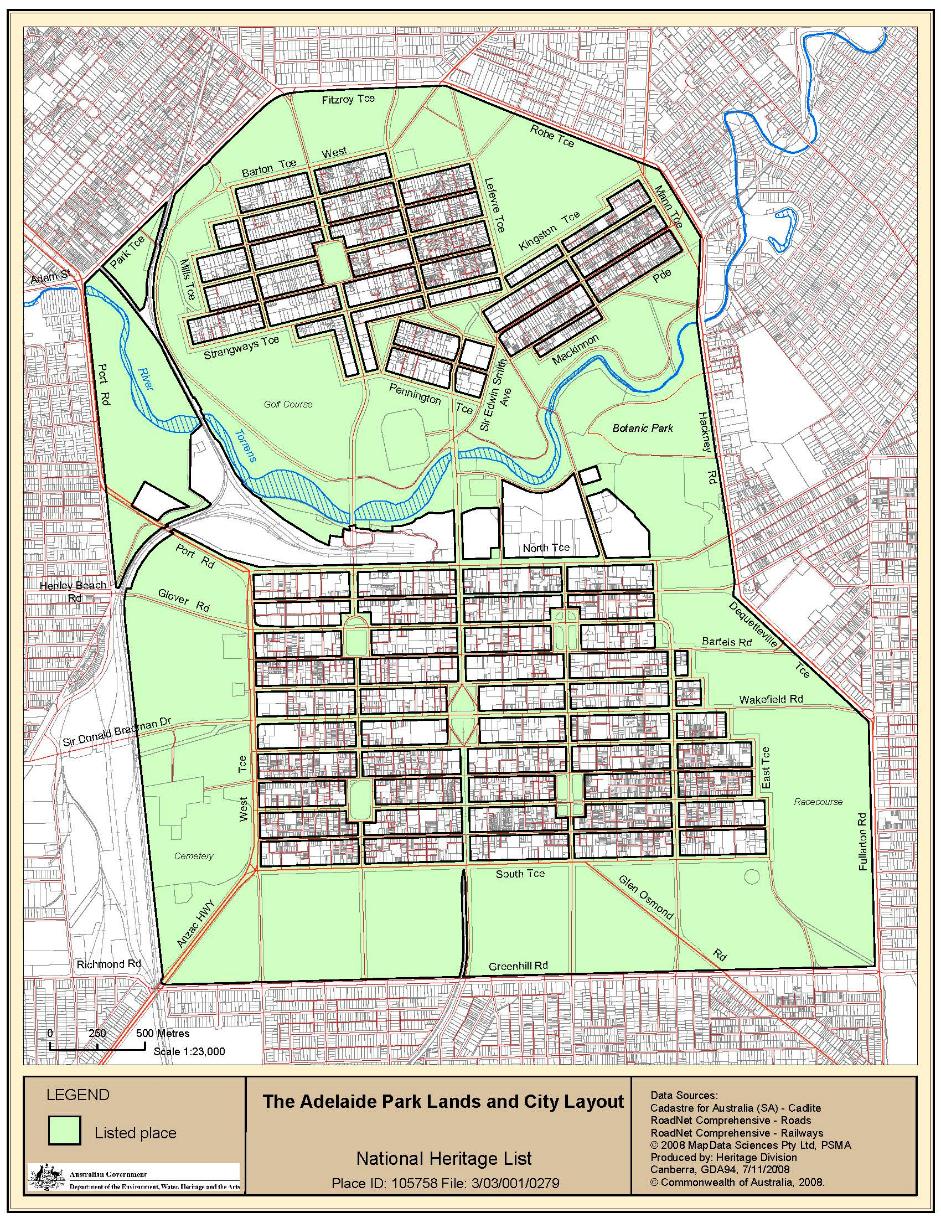
SCHEDULE 2
LISTED VALUES
Criterion A
The place has outstanding heritage value to the nation because of the place’s importance in the course, or pattern, of Australia’s natural or cultural history.
The Adelaide Park Lands and City Layout is the physical expression of the 1837 Adelaide Plan designed and laid out by Colonel William Light. It has endured as a recognisable historical layout for over 170 years retaining the key elements of the plan; encompassing the layout of the two major city areas separated by the Torrens River, the encircling Park Lands, the six town squares, and the grid pattern of major and minor roads. It is substantially intact and reflects Light’s design intentions with high integrity.
The Adelaide Park Lands and City Layout is of outstanding importance because it signifies a turning point in the settlement of Australia. It was the first place in Australia to be planned and developed by free settlers, not as a penal settlement or military outpost. The colony of South Australia was established by incorporation as a commercial venture supported by the British Government, based on Edward Wakefield’s theory of systematic colonisation. To be commercially successful, there needed to be contained settlement to avoid speculative land sales and this settlement needed to be designed and planned to attract free settlers and to provide them with security of land tenure. The city layout with its grid plan expedited the process of land survey enabling both rapid settlement of land and certainty of title. The wide streets, public squares and generous open spaces provided amenity and the surrounding park lands ensured a defined town boundary while still allowing for public institutional domains. These elements are discernable [sic] today.
The Adelaide Park Lands is also significant for the longevity of its protection and conservation. The Adelaide Municipal Corporation Act (1840) established the city council as the ‘conservators’ of the city and park lands. The establishment of the Park Lands Preservation Society in 1903, along with successive community organisations marks a continuing pattern in community support for safeguarding the significance of the Park Lands for the Adelaide community.
The Adelaide Plan was highly influential as a model for planning other towns in Australia and overseas. It is acknowledged by town planners and historians as a major influence on the Garden City Planning movement, one of the most important urban planning initiatives.
Criterion F
The place has outstanding heritage value to the nation because of the place’s importance in demonstrating a high degree of creative or technical achievement at a particular period.
Adelaide Park Lands and City Layout is regarded throughout Australia and the world as a masterwork of urban design. Elements of the Adelaide Plan that contribute to the design excellence are the use of the encircling park lands to define the boundary of the development of the city and to provide for health, public access, sport, recreation and public institutional domains, thereby meeting both economic and social requirements. Designing the city layout to respond to the topography was highly innovative for its time with the northern sections of the city located and angled to take advantage of the rising ground while retaining the Torrens River as a feature within the Park Lands. The judicious siting and wide streets maximised views and vistas through the city and Park Lands and from some locations to the Adelaide Hills. The plan features a hierarchy of road widths with a wide dimension to principal routes and terraces and alternating narrow and wide streets in the east-west direction. Light’s planning innovation is supported by substantial historical documentation.
The formal organisation, delineation and dedication of the Park Lands space was a pioneering technical achievement of William Light in the Adelaide Plan.
The overall landscape planting design implemented by several successive landscape designers/managers incorporated designed vistas, formal avenues, plantations, gardens, use of specimen trees, botanically important living plant collections particularly at the Adelaide Botanic Garden and the strategic placement of buildings and statuary in their settings.
The creativity of the city and parkland design is clearly legible in the contemporary landscape viewed from the air or from the Adelaide Hills. The civic design of Adelaide was used as a model for founding many other towns in Australia and New Zealand and it is cited in later seminal Garden City planning texts including Garden Cities of Tomorrow by Ebenezer Howard.
Criterion G
The place has outstanding heritage value to the nation because of the place’s strong or special association with a particular community or cultural group for social, cultural or spiritual reasons.
The Adelaide Park Lands has outstanding social value to South Australians who see it as fundamental to the character and ambience of the city. The Park Lands with their recreation areas, sports grounds, gardens and public facilities provide venues for individual and group activities and events, meetings and passive and active recreation. The Park Lands also have significant social value due to the range of important civic, public, and cultural assets and institutions within it.
The present Adelaide Parklands Preservation Society is the latest in a long history of community groups dedicated to protecting the Adelaide Park Lands. These have included the Park Lands Defence Association (1869-87), the Park Lands Preservation League (1903, 1948) and the National Trust of South Australia. The longevity of the involvement of community groups in campaigning for the protection and safeguarding of the Park Lands is exceptional.


