

Federal Court of Australia
Reid v Minister for Immigration and Citizenship [2026] FCA 1417
File number: | WAD 80 of 2025 |
Judgment of: | VANDONGEN J |
Date of judgment: | 25 September 2026 |
Catchwords: | MIGRATION - orders sought to dismiss application for judicial review under s 20 of the Federal Court of Australia Act 1976 (Cth) and r 30.21 of the Federal Court Rules 2011 (Cth) or, alternatively, r 5.23 of the Federal Court Rules - orders granted to dismiss application under r 5.23 of the Federal Court Rules |
Legislation: | Federal Court of Australia Act 1976 (Cth) ss 20, 37M, 43 Migration Act 1958 (Cth) ss 198, 499, 501, 501CA Federal Court Rules 2011 (Cth) rr 4.16, 5.22, 5.23, 30.21, 40.02, Item 15.2, Sch 3 |
Cases cited: | Broad v Minister for Immigration, Citizenship, Migrant Services and Multicultural Affairs [2021] FCA 840 Cadbury Schweppes Pty Ltd v Darrell Lea Chocolate Shops Pty Ltd (No 5) [2006] FCA 850 Coshott v Burke (No 2) [2018] FCAFC 81 Mao v Minister for Immigration, Citizenship and Multicultural Affairs [2025] FCA 289 Minister for Immigration and Border Protection v Maioha [2018] FCAFC 216; (2018) 267 FCR 643 Pennie v Minister for Home Affairs [2019] FCAFC 129 Pham v University of Queensland [2002] FCA 203 SZSPI v Minister for Immigration and Border Protection [2014] FCAFC 140; (2014) 233 FCR 279 Wan v Minister for Immigration and Multicultural Affairs [2001] FCA 568; (2001) 107 FCR 133 |
Division: | General Division |
Registry: | Western Australia |
National Practice Area: | Administrative and Constitutional Law and Human Rights |
Number of paragraphs: | 67 |
Date of hearing: | 20 May 2026 |
Counsel for the Applicant: | The applicant did not appear |
Counsel for the First Respondent: | Ms H Hofmann |
Solicitor for the First Respondent: | MinterEllison |
Counsel for the Second Respondent: | The second respondent filed a submitting notice save as to costs |
ORDERS
WAD 80 of 2025 | ||
| ||
BETWEEN: | RICKY REID Applicant | |
AND: | MINISTER FOR IMMIGRATION AND CITIZENSHIP First Respondent ADMINISTRATIVE REVIEW TRIBUNAL Second Respondent | |
order made by: | VANDONGEN J |
DATE OF ORDER: | 25 September 2026 |
THE COURT ORDERS THAT:
1. The name of the first respondent is amended to 'Minister for Immigration and Citizenship'.
2. The originating application filed on 20 March 2025 is dismissed.
3. The applicant is to pay the first respondent's costs fixed in the sum of $7,900.00.
Note: Entry of orders is dealt with in Rule 39.32 of the Federal Court Rules 2011.
REASONS FOR JUDGMENT
VANDONGEN J:
1 By an originating application filed on 20 March 2025, the applicant, Ricky Reid, seeks judicial review of a decision made by the Administrative Review Tribunal (ART) on 24 February 2025. By that decision the ART affirmed a decision of a delegate of the Minister for Immigration and Multicultural Affairs (Minister) not to revoke the mandatory cancellation of a Special Category (Temporary) (Class TY) (Subclass 444) visa (Visa) that was made under s 501CA(4)(b)(ii) of the Migration Act 1958 (Cth). Mr Reid sought orders quashing the ART decision and directing the ART to determine his case according to law, as well as an injunction prohibiting the Minister from acting upon or giving effect to the ART's decision.
2 In circumstances in which I will shortly explain, Mr Reid did not appear at the hearing of his application for judicial review. Because of his non-appearance, Mr Reid was in default for the purposes of r 5.22(c) of the Federal Court Rules 2011 (Cth). Other than by filing and serving his originating application and a supporting affidavit, Mr Reid also failed to prosecute these proceedings for the purposes of r 5.22(d). On each of those grounds, and for the following reasons, I am of the view that an order should be made under r 5.23(1)(b)(i) of the Federal Court Rules that the proceedings be dismissed, with costs.
Background
3 It is necessary to set out the background to these proceedings in some detail.
4 In his originating application, Mr Reid contends that the ART's decision to affirm the decision of a delegate of the Minister not to revoke the mandatory cancellation of the Visa was affected by jurisdictional error. Specifically, he contends that the ART 'engaged in reasoning that was legally unreasonable, illogical or irrational'.
5 The particulars of the ground of review assert that '[i]n considering what the national interest requires, the [ART] identified risk to the Australian community as a relevant factor based on past offending behaviour'. The particulars also assert, confusingly, that there is a realistic possibility that the Minister's decision, as opposed to the ART's decision, could have been different had the Minister 'sought further evidence of the impact that repeated adverse decisions may have on [Mr Reid's] minor chil[d]' and 'taken the impact of repeated adverse decisions into account as a relevant consideration'.
6 In his affidavit in support of the originating application, Mr Reid further contends that the ART denied him procedural fairness. Specifically, Mr Reid alleges that the ART failed to inform him of certain of his legal rights, and that he was subjected to unfair questioning which caused him to 'prematurely' leave the ART hearing. Mr Reid also contends that the ART failed to consider the best interests of his minor child and that its assessment of the risk he posed to the Australian community was legally unreasonable.
7 Mr Reid was unrepresented at the time he filed his originating application and supporting affidavit. However, a barrister, Mr Alexander Mossop, kindly agreed to assist Mr Reid on a pro bono basis in early July 2025.
8 Mr Reid was voluntarily removed from Australia on 2 October 2025. However, several days passed before either Mr Mossop or the Court was informed that this had occurred. After Mr Mossop informed a Registrar of the Court that Mr Reid had been voluntarily removed, on 9 October 2026 the Registrar sent an email to a solicitor who was then acting for the Minister that was in the following terms:
Dear [solicitor's name]
I spoke with you this afternoon about the voluntary removal of the applicant in this matter.
As I stated in our phone call, the Court received an email from pro bono counsel for the applicant, Mr Alex Mossop, who informed the Court that the applicant had been removed voluntarily to New Zealand on 2 October 2025.
Mr Mossop stated that he had been informed of the removal by email by Yongah Hill Detention Centre the day after removal. Mr Mossop stated that he had contacted Yongah Hill Detention Centre to arrange for a video conference with the applicant, only to be told that the applicant had been voluntarily removed.
Mr Mossop informed the Court that he contacted the Minister's representatives, and you confirmed in our conversation this afternoon, that you spoke with Mr Mossop.
You questioned whether Mr Mossop was acting, and whether he had filed a Notice of Acting. You informed Mr Mossop that the applicant was removed voluntarily and that you had no contact details for him in New Zealand apart from an email. You told Mr Mossop that at the time of the applicant's removal request, the applicant informed you that he wished to maintain his appeal.
You confirmed that you did not contact the Court.
You stated that you had arranged for a copy of the Migration Practice Note - Removal from Australia of Immigration Detainees who have Proceedings before the Court (MIG-2) [to be] hand delivered to the applicant, and that it was the applicant's responsibility to inform the Court of his removal.
You told me that you had been informed that handing the applicant a copy of MIG-2 fulfilled your obligations under Part 3 of MIG-2. You were also informed that in circumstances where an applicant is represented, you did not need to inform the Court of the removal of the applicant. I note that you did not contact Mr Mossop on the pending removal.
I directed you to Parts 3.3 to 3.5 of MIG-2 which state:
3 What the Minister must do
3.3 In the case of voluntary removal, the Court expects that no arrangements will be made to remove a person until after the detainee had advised the Court of the removal request, and the future progress of their Federal Court matter has been determined.
3.4 The Court expects that the Minister will facilitate a reasonable opportunity for a detainee to approach the Court in a way which takes into account the person's background, language, capacity, state of health, and the facilities available to them while in immigration detention.
3.5 Commonwealth officers should be in a position to demonstrate with clarity that the particular person to be removed has been afforded a full, reasonable and practicable opportunity to inform the Court of their voluntary removal, or to file an application with the Court in relation to their involuntary removal. (emphasis in original)
It is unclear to me how handing a printed copy of MIG-2 fulfils these obligations.
We will inform Chambers of Justice Vandongen of these events.
Kind regards
9 Although he had not been forewarned about Mr Reid's voluntary removal, Mr Mossop subsequently informed the Court that if he was able to make and maintain contact with Mr Reid while he was residing in New Zealand then he would be prepared to continue to act as pro bono counsel.
10 The proceedings were then listed for a case management hearing before me on 13 October 2025. Mr Mossop appeared at that hearing and informed the Court that he had experienced difficulties in communicating with Mr Reid from when he first agreed to act on a pro bono basis. Mr Mossop said that he recently arranged to meet with Mr Reid. However, that meeting did not proceed because Mr Reid was removed from Australia. Mr Mossop did not discover that Mr Reid had asked to be removed from Australia until after Mr Reid had left the country.
11 Mr Mossop did inform the Court that he had managed to briefly speak with Mr Reid shortly before the commencement of the case management hearing. Mr Reid told Mr Mossop that he was still in the process of settling into New Zealand after being removed from Australia. However, Mr Mossop said that he hoped to be able to discuss matters with Mr Reid more fully later in the week. Mr Mossop also advised that he had an email address and a mobile telephone number for Mr Reid, and that while Mr Reid had not responded to his emails, he had spoken to Mr Reid using the telephone number. The Court was informed that Mr Reid had told Mr Mossop that he would maintain contact by telephone and that he would also check his emails.
12 To afford Mr Mossop more time to obtain instructions from Mr Reid, and also to allow time for the Minister to respond to the email I have reproduced earlier in these reasons at [8], the case management hearing was then adjourned.
13 A further case management hearing then took place on 17 October 2025. At that hearing Mr Mossop informed the Court that he spoke to Mr Reid shortly after the last hearing. However, Mr Mossop said that the telephone call was disconnected and that he had not been able to make any further contact with Mr Reid since then. Nevertheless, Mr Reid's application for judicial review was listed for hearing on 20 May 2026, and programming orders were made to bring the proceedings to hearing on that date.
14 An order was also made that the solicitor who had conduct of the matter on behalf of the Minister file and serve an affidavit to deal with the various issues that were raised by the Registrar in her email of 9 October 2025.
15 On 24 October 2025, a partner of MinterEllison, the solicitors acting on behalf of the Minister, filed an affidavit sworn on the same date (Solicitor's Affidavit). Annexed to the Solicitor's Affidavit are several documents that I will now describe in more detail.
16 The first document was issued by the Department of Home Affairs and Australian Border Force and is entitled 'Removals Interview Checklist & Summary'. That document records that Mr Reid was interviewed by two Border Force officers on 3 September 2025, and that the reason for the interview was 'REMOVAL PLANNING'. The document also records that the English language was used during the interview. In a section in the document that is headed 'Additional Notes', the handwritten words 'ask to get back to NZ ASAP' appear.
17 A similar document that purports to relate to an interview that took place with Mr Reid on 10 September 2025, is also attached to the Solicitor's Affidavit. It is recorded in that document that the interview was a 'FOLLOW UP' interview, and that Mr Reid provided an email address. There are also handwritten notes that appear in sections of the document entitled 'Additional Notes' and 'Any Other Concerns', which are to the effect that:
(1) Mr Reid had a lawyer with whom he was in contact;
(2) Mr Reid's application for judicial review was still outstanding and that he wished to proceed with the application;
(3) '[l]itigation been contacted re JR proves for Vol removal';
(4) there would be a flight in approximately October; and
(5) that another interview would be scheduled to issue a Notice of Removal.
18 A third document is attached to the Solicitor's Affidavit. The relevant parts of that documents were in the following form:
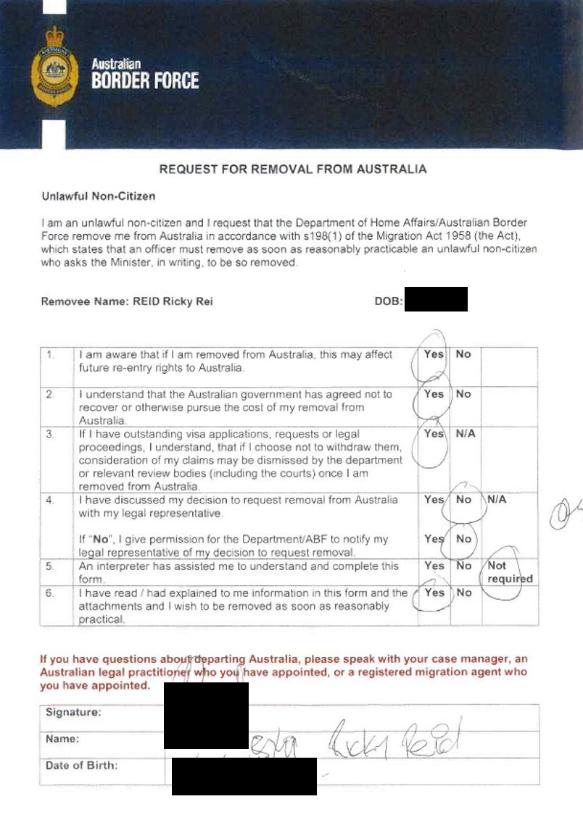
19 It may be seen that this document records that Mr Reid did not want his legal representative to be informed that he wanted to be removed from Australia. It may also be noted that Mr Reid did not require an interpreter.
20 An email from an Executive Assistant employed by MinterEllison dated 17 September 2025 was also attached to the Solicitor's Affidavit. Attached to that email was a copy of a letter from MinterEllison addressed to Mr Reid, also dated 17 September 2025. In that letter, Mr Reid was informed that MinterEllison had been instructed that he had requested to be removed from Australia, that he had signed a form to that effect on 3 September 2025 and that he was due to be removed to New Zealand on 2 October 2025. The letter also drew Mr Reid's attention to the Court's Migration Practice Note - Removal from Australia of Immigration Detainees who have Proceedings before the Court (MIG-2) (MIG-2), and it was explained that, as he had asked to be removed from Australia:
(1) Mr Reid was required to advise the Court that he had asked to be removed from Australia;
(2) Mr Reid should inform the Court about whether he wished to continue these proceedings after he had been removed and, if so, he should provide his contact details in New Zealand;
(3) the Court would only be able to restrain Mr Reid's removal if he filed an interlocutory application before he was removed; and
(4) Mr Reid should seek independent legal advice about the legal consequences of being removed to New Zealand.
21 Email addresses and a telephone number for the Court were also provided to Mr Reid in the letter.
22 Mr Reid was asked, as a matter of urgency and by no later than 25 September 2025, to inform the Court that he had requested removal, and to advise the Court whether he wished to continue with this proceeding. Mr Reid was also told that if he did not inform the Court of those matters by that date then the Minister would consider how to proceed with his request for voluntary removal and with these proceedings.
23 The letter to Mr Reid concluded with the following statements:
We note that your request for removal form does not give our client permission to notify your legal representative, Mr Mossop, of your decision to request removal. However, we recommend that you discuss your voluntary removal request with your legal representative and any implications it may have on your Court proceedings.
Additionally, please confirm whether you continue to retain Mr Mossop as your legal representative, noting it does not appear he is officially listed on the Court record as your legal representative.
Please note that if you do not wish to continue with your Court proceeding, and you make a request for your application to be discontinued, the Minister will seek an order that you pay the Minister's legal costs. A costs order would give rise to a debt to the Commonwealth.
24 Also annexed to the Solicitor's Affidavit is a document that Mr Reid subsequently signed to confirm receipt of the letter from MinterEllison dated 17 September 2025 as well as a copy of MIG-2. That document was dated 18 October 2025. However, the Solicitor's Affidavit records that the letter and a copy of MIG-2 were provided to Mr Reid on 18 September 2025, and the Court was asked to infer that the document was incorrectly dated. As Mr Reid voluntarily departed Australia on 2 October 2025, I am prepared to accept that the document was provided to Mr Reid on 18 September 2025 and that it was incorrectly dated.
25 Also attached to the Solicitor's Affidavit are the following documents:
(1) Two documents entitled 'IDN DETAINEE REQUEST FORM'. Both documents are dated 29 August 2025. The first document includes a handwritten 'REQUEST' that reads 'ABF Removels I want to leave as soon as possabal to be with my Brother Please it needs to be ASAP Thanks' (errors in original). The second document includes a 'REQUEST' that reads 'I like to get out of here I am ready to sign an go home AS SOOM AS POSSabil Thanks' (errors in original). Both documents purport to have been signed by Mr Reid.
(2) A document entitled 'Removals Interview Checklist & Summary', which purports to relate to an interview with Mr Reid on 18 September 2025 during which Mr Reid was provided with a copy of the letter from MinterEllison dated 17 September 2025 as well as a copy of MIG-2.
(3) A document entitled 'Removals Interview Checklist & Summary', which purports to relate to an interview with Mr Reid on 24 September 2025. That document records that Mr Reid was provided with an explanation regarding a 'NOTICE OF INTENTION TO REMOVE FROM AUSTRALIA', which he then signed during that interview. The notice advised Mr Reid that he was liable for removal from Australia under s 198(1) of the Migration Act and that it was anticipated that he would be removed on 2 October 2025. The notice also records that it was signed by Mr Reid on 24 October 2025. However, I accept that it was in fact signed on 24 September 2025 and that the date of 24 October 2025 is an error.
26 At the next case management hearing that took place before me on 24 November 2025, I informed counsel for the Minister that I was concerned that the Solicitor's Affidavit did not address why arrangements were made to voluntarily remove Mr Reid from Australia in circumstances in which the Court had not been advised that a voluntary removal request had been made. In that regard, I drew counsel's attention to the following paragraph that appears in MIG-2:
3.3 In the case of voluntary removal, the Court expects that no arrangements will be made to remove a person until after the detainee had advised the Court of the removal request, and the future progress of their Federal Court matter has been determined.
(bold in original, emphasis added)
27 After the case management hearing on 24 November 2025, an order was made that the Minister file and serve written submissions and any further affidavit evidence relating to the question of whether the Minister had complied with MIG-2.
28 Mr Mossop also appeared at the case management hearing on 24 November 2025. He informed the Court that he had been unable to make any further contact with Mr Reid. In those circumstances, I encouraged the Minister to assist Mr Mossop in his efforts to contact Mr Reid. Ultimately, the solicitors acting for the Minister informed the Court that enquiries with Australian Border Force revealed that the only contact details that were available was an email address and an Australian mobile telephone number. Those contact details were provided to the Court.
29 On 15 December 2025, Mr Mossop applied for and was granted permission by a Registrar of this Court to cease to provide legal assistance to Mr Reid pursuant to r 4.16 of the Federal Court Rules, on the basis that Mr Mossop had not been able to contact and obtain instructions from Mr Reid since 15 October 2025.
30 After the Minister filed a written outline of submissions in accordance with the Court's orders of 24 November 2025, the matter was then listed for a further case management hearing on 10 February 2026. That case management hearing was adjourned on several occasions before it eventually took place on 8 May 2026. On that date senior counsel for the Minister appeared and made oral submissions concerning the question of whether MIG-2 had been complied with. I will return to deal with the Minister's submissions about this issue later in these reasons. However, it is useful to note at this stage that, in addition to cl 3.3 of MIG-2 (reproduced at [26] of these reasons), reference was also made to the following clauses of the practice note:
3.4 The Court expects that the Minister will facilitate a reasonable opportunity for a detainee to approach the Court in a way which takes into account the person's background, language, capacity, state of health, and the facilities available to them while in immigration detention.
3.5 Commonwealth officers should be in a position to demonstrate with clarity that the particular person to be removed has been afforded a full, reasonable and practicable opportunity to inform the Court of their voluntary removal, or to file an application with the Court in relation to their involuntary removal.
31 The Court sent an email to Mr Reid on 8 May 2026, using the email address that had been provided by the Minister. Attached to that email was a copy of the Court's order that the matter be adjourned to 10.15 am AWST on 20 May 2026 for hearing. Then, on 15, 18, 19 and 20 May 2026, my associate sent further emails to Mr Reid advising him that the hearing of his application for judicial review was listed to take place on 20 May 2026. Each of those emails also informed Mr Reid that it was important that he attend at the hearing, and that if he failed to attend then his application for judicial review may be dismissed pursuant to rr 5.22 and 5.23 of the Federal Court Rules. Mr Reid was also told that if he wished to attend at the hearing on 20 May 2026 by video link then he should contact the Court so that the necessary arrangements could be made. However, Mr Reid did not respond to any of those emails and the Court did not receive any 'bounce-back' or delivery failure notifications after sending those emails.
32 Details of the various attempts that were made on behalf of the Minister to contact Mr Reid after Mr Mossop ceased to provide pro bono legal assistance were set out in an affidavit by a solicitor employed by MinterEllison that was filed on 7 May 2026. That affidavit is to the effect that attempts were made to contact Mr Reid by email on 2 February, as well as on 7, 14 and 21 April 2026. According to that affidavit, MinterEllison did not receive any response from Mr Reid, and it also did not receive any 'bounce-back' or delivery failure notifications after sending those emails. That affidavit also establishes that efforts were made to obtain further contact details for Mr Reid, including through Interpol and New Zealand authorities, but that those efforts were to no avail.
33 Mr Reid failed to appear at the hearing of his application for judicial review on 20 May 2026. In those circumstances, counsel who then appeared for the Minister sought an order that Mr Reid's application be dismissed under s 20(5)(d)(ii) of the Federal Court of Australia Act 1976 (Cth) and r 30.21(1)(a)(i) of the Federal Court Rules. In the alternative, the Minister was content for a similar order to be made under r 5.23 of the Federal Court Rules.
34 I am of the view that an order should be made under r 5.23(1)(b)(i) of the Federal Court Rules that the proceedings be immediately dismissed.
Why these proceedings should be dismissed
35 When, in early September 2025, Mr Reid asked to be removed from Australia, he told Australian Border Force officials that he wished to pursue his application for judicial review of the ART's decision. However, Mr Reid has done nothing to maintain that apparent resolve since he was removed from Australia in early October 2026, even though a very experienced barrister agreed to provide him with legal assistance on a pro bono basis. On the material that is currently before the Court, the last time Mr Reid contacted anyone in connection with this case was in mid-October 2025. Since then, Mr Reid has not made any contact with Mr Mossop, the solicitors for the Minister, or the Court, despite efforts having been made by both the solicitors for the Minister and the Court to inform him that his application for judicial review had been listed for hearing and to warn him of the potential consequences were he to fail to appear at that hearing.
36 As Mr Reid failed to appear, the Court is not required to 'embark upon any investigation of the merits of the absent applicant's claim': Pham v University of Queensland [2002] FCA 203 at [26] (Drummond J, with whom Marshall and Finkelstein JJ agreed at [39] and [40], respectively). However, I will briefly explain why I am of the view that the ground in the originating application, and the contentions made in Mr Reid's affidavit in support of that application, are without merit.
37 The sole ground that appears in the originating application asserts that, in considering the risk to the Australian community the ART engaged in reasoning that was legally unreasonable, illogical or irrational. By the first particular to that ground, it is asserted that '[i]n considering what the national interest requires, the [ART] identified the risk to the Australian community as a relevant factor based on past offending behaviour'. By the second particular, Mr Reid appears to contend that the ART failed to seek further evidence of the 'impact that repeated adverse decisions may have on [Mr Reid's] minor chil[d]' and that it failed to take the 'impact of repeated adverse decisions into account as a relevant consideration'.
38 To the extent the ground asserts that the ART had to consider what the national interest required, the ground is misconceived. Mr Reid sought a review of a decision that was made by a delegate of the Minister, under s 501CA(4) of the Migration Act, not to revoke the mandatory cancellation of the Visa. Such a review did not require the ART to give consideration to what the national interest required. What the ART was required to determine under s 501CA(4) was whether it was satisfied that Mr Reid passed the character test (as defined in s 501) or whether there was another reason why the decision originally made by the delegate should be revoked.
39 The contention that the ART somehow engaged in reasoning that was legally unreasonable, irrational or illogical by having regard to Mr Reid's past offending behaviour in evaluating the risk to the Australian community is also without merit. Pursuant to s 499(2A) of the Migration Act, the ART was required to comply with a direction made by the Minister under s 499(1), namely, 'Direction no. 110 - Visa refusal and cancellation under section 501 and revocation of a mandatory cancellation of a visa under section 501CA' (Direction 110). In accordance with Direction 110, in making a decision under s 501CA(4) of the Migration Act, the ART was relevantly required to take into account the protection of the Australian community from criminal or other serious conduct. In so doing, the ART was required to give consideration to the risk to the Australian community should Mr Reid commit further offences or engage in other serious conduct: paras 8.1(2)(b) and 8.1.2 of Direction 110.
40 In assessing that risk, the ART was required by para 8.1.2(2)(b) of Direction 110 to have regard to:
b) the likelihood of the non-citizen engaging in further criminal or other serious conduct, taking into account:
i. information and evidence on the risk of the non-citizen re-offending; and
ii. evidence of rehabilitation achieved by the time of the decision, giving weight to time spent in the community since their most recent offence (noting that decisions should not be delayed in order for rehabilitative courses to be undertaken).
41 It is not clear where in the ART's reasons for decision Mr Reid says that it used evidence of his past offending behaviour in assessing the risk he posed to the Australian community. Nevertheless, it was plainly open to the ART to take into account Mr Reid's extensive criminal record as a relevant factor in assessing the likelihood of him engaging in further criminal or serious conduct: Mao v Minister for Immigration, Citizenship and Multicultural Affairs [2025] FCA 289 at [100].
42 Insofar as the ground of review may be taken to assert that the ART failed to seek further evidence of the impact that 'repeated adverse decisions' may have on Mr Reid's minor child, the ART was required to determine whether non-revocation under s 501CA was, or was not, in the best interests of a child affected by the decision: para 8.4(1) of Direction 110. After considering the evidence that had been placed before it, the ART made that determination at para 135 of its reasons for decision, concluding that the best interests of Mr Reid's minor child weighed 'slightly in favour of revocation' of the decision to cancel the Visa. However, the ART was not required to seek further evidence about this factor. It was for Mr Reid to establish his case, by way of representation and evidence, that the ART should exercise the power conferred by s 501CA(4) of the Migration Act to revoke the decision to cancel the Visa: Minister for Immigration and Border Protection v Maioha [2018] FCAFC 216; (2018) 267 FCR 643 at [48] (Rares and Robertson JJ). See also Pennie v Minister for Home Affairs [2019] FCAFC 129 at [14].
43 Mr Reid's affidavit in support of his application for judicial review raises three further complaints. The first of those complaints is that Mr Reid was denied procedural fairness because the ART failed to inform him of his legal rights, including his right to claim the privilege against self-incrimination. Mr Reid contends that he was subjected to questioning regarding his past conduct even though he had not been convicted of any offence and that this 'improper treatment' compelled him to leave the proceedings in the ART 'prematurely'. However, there is no evidence before this Court of what occurred at the hearing before the ART, much less any evidence to suggest that he was denied procedural fairness. Accordingly, this complaint cannot be sustained.
44 The second complaint is that the ART failed to consider the best interests of Mr Reid's minor child, 'contrary to Article 3 of the Convention on the Rights of the Child' and the decision of Wan v Minister for Immigration and Multicultural Affairs [2001] FCA 568; (2001) 107 FCR 133. Mr Reid says that the ART did not adequately assess the psychological and emotional impact that his removal would have on his minor child and 'disregarded the principle that decisions concerning a child should prioritize their welfare and stability'.
45 This complaint is also not made out. At para 41 of its reasons for decision, the ART specifically noted that the best interests of minor children in Australia was a primary consideration to be taken into account under Direction 110 and, at para 43, that primary considerations should generally be given greater weight than other considerations. The ART also had express regard to the best interests of Mr Reid's minor child at paras 123 to 135 of its reasons for decision, before concluding that this factor weighed slightly in favour of revocation of the Minister's decision. Article 3 of the United Nations Convention on the Rights of the Child had no direct application to the review that the ART was required to conduct. The decision of the Full Court in Wan is also of no assistance to Mr Reid. Unlike in that case, the ART did treat the best interests of Mr Reid's minor child as a primary consideration.
46 The third complaint made by Mr Reid in his affidavit is that the ART's risk assessment is infected by legal unreasonableness. According to Mr Reid, the ART 'placed disproportionate weight on [his] past alleged behaviour, despite the absence of any criminal convictions' (emphasis in original), and failed to consider evidence of his rehabilitation, his compliance with Australian laws and his positive contributions to the community. Mr Reid also complains that the decision to exclude him from Australia was 'arbitrary and disproportionate' (emphasis in original). However, none of these complaints have merit.
47 It was for the ART to determine the weight to be placed on Mr Reid's past behaviour, to the extent it may have been relevant to the various matters it was required, by Direction 110, to take into account. Further, the ART did expressly consider evidence of Mr Reid's rehabilitation and the extent to which he had complied with Australian laws, including when it had regard to the likelihood of him engaging in further criminal or serious conduct, as required by para 8.1.2(2)(b) of Direction 110: paras 79 to 97 of the ART's reasons for decision. The ART also considered the extent to which Mr Reid had contributed to the community at paras 119(e) and 119(f) of its reasons for decision. Finally, Mr Reid's bare contention that the ART's decision was 'arbitrary and disproportionate' (emphasis in original) cannot, without more, advance the proposition that the decision was affected by legal unreasonableness.
48 It is for these reasons that I consider that Mr Reid's application for judicial review is without merit.
49 I am not convinced that the Court has the power to dismiss Mr Reid's application for judicial review under s 20(5)(d)(ii) of the Federal Court Act. This is because that provision operates in relation to 'a matter coming before the Court as mentioned in subsection (1A) or (2)', but neither of those subsections appear to be engaged in the circumstances of this case. Section 20(1A) is concerned with matters coming before the Court in the original jurisdiction of the Court that the Chief Justice considers to be of sufficient importance to justify the giving of a direction that the original jurisdiction be exercised by a Full Court. Section 20(2) is engaged so as to confer the original jurisdiction of the Court on a Full Court in relation to a matter coming before the Court from a tribunal or authority (other than a court) while constituted by, or by members who include, a person who is a Judge of the Court or of another court created by the Parliament.
50 In any event, r 5.22 of the Federal Court Rules relevantly provides that a party is in default if the party fails to attend a hearing in the proceeding or fails to prosecute the proceeding with due diligence: rr 5.22(c) and 5.22(d) of the Federal Court Rules, respectively. Further, r 5.23(1)(b)(i) provides that if an applicant is in default, then the respondent may apply to the Court for an order that the proceeding be immediately dismissed for the whole or any part of the relief claimed.
51 Mr Reid is a party in default for the purposes of r 5.22(c), having failed to attend the hearing on 20 May 2026. He has also failed to prosecute the proceeding with due diligence for the purposes of r 5.22(d). In circumstances in which there is no apparent prospect of him prosecuting the proceeding in the future, it is appropriate to make an order under r 5.23(1)(b)(i) that these proceedings are immediately dismissed for the whole of the relief claimed.
52 The Minister sought an order that Mr Reid pay the costs of the application for judicial review as a lump sum of $7,900.00, presumably under r 40.02(b) of the Federal Court Rules. In my view and having regard to the procedural history of this matter, the amount claimed by the Minister is fair and reasonable. Amongst other factors, I note that the amount claimed is less than the maximum amount that may be allowed by a taxing officer under Item 15.2 in Sch 3 of the Federal Court Rules in a migration matter where the application is dismissed after the hearing.
53 In all of the circumstances, I am of the view that it is appropriate that I exercise my discretion to award costs under s 43(3)(d) of the Federal Court Act and to make an order that Mr Reid is to pay the Minister's costs in a lump sum of $7,900.00.
The voluntary removal of Mr Reid
54 Before concluding, it is necessary to say something about whether the Minister met the expectations of the Court that are expressed in MIG-2. That issue arises in the circumstances of this case because the Court was only informed that Mr Reid had been voluntarily removed from Australia after that had already occurred.
55 As para 1.1 of MIG-2 suggests, the purpose of MIG-2 is to facilitate the efficient administration of justice by ensuring that a person in immigration detention (which includes a person in community detention) who is a party to proceedings currently before the Court advises the Court of any arrangements being contemplated or made for their removal from Australia, whether the proposed removal is voluntary or involuntary. Pursuant to para 1.2, detainees to whom MIG-2 applies should not be removed from Australia unless the Commonwealth and its officers, whether through a respondent Minister or otherwise, are able to demonstrate that the person has been:
(1) properly informed of the contents of MIG-2 in a way that is intelligible to the detainee, including by translation or interpretation; and
(2) given a reasonable and practicable opportunity to communicate with the Court about their proposed removal and what they wish to occur in relation to the proceedings before the Court and, if so desired, to move the Court to restrain their removal.
56 MIG-2 then sets out certain things that detainees must do, what the responsible Minister must do, and what the Court may do. In that regard, pursuant to paras 2.1 to 2.4, the Court expects that detainees:
(1) will inform the Court as soon as possible if they request or agree to removal from Australia before the Court has finalised their case;
(2) will inform the Court of whether or not they wish to continue their proceeding after they have been removed, and what their contact details will be in the country to which they are removed;
(3) should be aware that the Court may only be able to restrain any action taken to remove them from Australia involuntarily if the detainee makes an application to the Court before the proposed involuntary removal; and
(4) should seek independent legal advice about the consequences of removal on their Court proceedings.
57 Pursuant to para 3.1 of MIG-2, the Court expects that the Minister will conduct matters before the Court involving detainees in a way that:
(1) facilitates the fair administration of justice including by cooperating in the finalisation of proceedings in a cost effective and efficient manner while detainees remain in Australia, including detainees who may be self-represented or have pro bono representation;
(2) facilitates the fair administration of justice where detainees are voluntarily removed from Australia, but seek to continue their proceedings from outside Australia, by ensuring that appropriate contact details for detainees are available to the parties and the Court and that detainees have been properly informed about the contents of MIG-2;
(3) ensures timely and appropriate communication between the Minister's legal representatives and those within the Commonwealth executive and relevant Departments who are responsible for any proposed removals from Australia of detainees covered by MIG-2; and
(4) protects all officers and employees involved in the administration of the system of immigration detention under the Migration Act from possible charges of contempt of Court.
58 MIG-2 then provides for some specific expectations of the Court in relation to involuntary removals, before setting out paras 3.3 to 3.5 which I have already reproduced earlier in these reasons at [26] and [30].
59 Finally, paras 4.1 to 4.2 of MIG-2 provides for what the Court may do when it has been informed of a voluntary removal, including considering whether to list the proceedings for a case management hearing to determine the future conduct of the matter.
60 MIG-2 does not have the same status as legislation: Coshott v Burke (No 2) [2018] FCAFC 81 at [52]. It also does not provide for substantive rights and obligations but should be understood as providing guidance and setting procedural standards. However, an unexplained failure to comply with a practice note issued by the Chief Justice of this Court is not a matter to be simply brushed aside: Cadbury Schweppes Pty Ltd v Darrell Lea Chocolate Shops Pty Ltd (No 5) [2006] FCA 850 at [26].
61 The specific paragraph in MIG-2 with which the question of whether the Minister met the Court's expectations in this case is concerned is para 3.3. That paragraph provides that, in the case of voluntary removal, the Court expects that no arrangements will be made to remove a person until after that person has advised the Court of the removal request and the future progress of the proceedings has been determined. If para 3.3 is read in isolation, it might well be concluded that the Court's expectation that Mr Reid would not have been removed from Australia until after he had advised the Court of his request to be removed, and the future progress of these proceedings had been determined, had not been met in the circumstances of this case.
62 However, it was submitted on behalf of the Minister that there is nothing in MIG-2 that obliges or empowers the Minister to notify the Court of a proposed voluntary removal of a detainee. It was submitted that this approach is consistent with the following observations that were made by the Full Court in SZSPI v Minister for Immigration and Border Protection [2014] FCAFC 140; (2014) 233 FCR 279 at [37]:
The Court is not an adjunct of the Executive; nor does it act for, nor should it be seen to act for, or in the interests of, the applicant. One might ask rhetorically: What is the purpose of notifying the Court of the impending removal? If the answer is: so that the Court may, in the interests of the applicant, or for the sake of good order, promptly list the applicant's application and have her or him brought to Court to press the application, there is a danger that the Court is being seen to be directed by the Department as to the time and place for the exercise of judicial power. The function of the Court is to hear and determine controversies in the exercise of judicial power of the Commonwealth, brought before it by the parties. If there is no legal impediment to the person being removed from the country, it will be a matter for the person concerned to bring an application to restrain the Minister from removing the person from Australia.
(emphasis added)
63 Nevertheless, I note the following more recent observations concerning what was said in SZSPI that were made by Mortimer J (as her Honour then was) in Broad v Minister for Immigration, Citizenship, Migrant Services and Multicultural Affairs [2021] FCA 840 at [16] to [17]:
With the greatest respect, I do not share all of their Honours' views as expressed. In circumstances where an applicant for judicial review is in executive detention, is not legally represented, and has a final hearing listed in a matter of weeks, in my respectful opinion to recognise a responsibility in the Minister to inform the Court of the situation is consistent with the Court's need to be able to control its proceedings in a way which is consistent with the exercise of federal judicial power, and which reflects the legislative intention apparent in s 37M of the Federal Court Act. Those objectives were not able to be pursued in the situation of Mr Broad's removal, because the Court was unaware that he would not be attending the hearing.
The Minister is not only the active contradictor in the judicial review application, but also an office holder with control over those directly responsible for the detention of the litigant who is challenging the Minister's decision. Putting the potential for a conflict of interest to one side, I do not see how it can be appropriate for the Court to remain ignorant of facts so critical to the performance of its judicial function as whether a moving party will be able to be present at a final hearing, and be in a position to present argument in that party's application. The Minister and the Minister's legal representatives have the resources, experience, familiarity with judicial practices and procedures to inform the Court. Indeed, it is officers who ultimately are subject to the Minister's direction which arrange for an individual's removal. A detained applicant is likely to be less able to notify the Court, for reasons including the characteristics and circumstances of the individual and the circumstances of that person's detention. Indeed, detainees may well assume the Court has been notified - adopting an understandable mixing of the ways that different branches of government might communicate about what is proposed to happen to the same person. What is second nature, and might seem obvious, to lawyers and courts about how legal and judicial processes work, may well be entirely foreign to individuals held in executive immigration detention, despite the best efforts of the courts to be accessible. What (if anything) the Court might properly determine should be done after being notified, is a different question.
64 It was submitted on behalf of the Minister that the duty to remove Mr Reid had crystalised in circumstances in which s 198(1) of the Migration Act requires that an officer remove an unlawful non-citizen who asks to be removed from Australia as soon as reasonably practicable. As I understood it, it was also submitted that when para 3.3 is read with paras 3.4 and 3.5, and understood in the light of the duty in s 198(1), the Court's expectation that no arrangements will be made to voluntarily remove a person until after the person has advised the Court of their removal must be understood as an expectation that no such arrangements will be made while the Minister is in the process of complying with the Court's expectation that he or she will facilitate a reasonable opportunity for the person to approach the Court.
65 It was also submitted that Mr Reid was provided with a reasonable and practical opportunity to comply with the Court's expectations as expressed in MIG-2 that he inform the Court of his request to be removed and of his intentions with respect to the future conduct of these proceedings.
66 I accept that when Mr Reid refused to give permission for his pro bono lawyer to be notified of his decision to request that he be removed from Australia, the Minister's legal representatives and the relevant departmental officers were placed in a difficult position. I am also prepared to accept, as Mortimer J did in Broad, that the views expressed in SZSPI may also go some way to explain why the Minister's legal representatives did not inform the Court of Mr Reid's request that he be removed from Australia before he was removed.
67 Although the voluntary removal of Mr Reid has affected this Court's capacity to control its own proceedings, and to do so in a manner that is consistent with the overarching purpose expressed in s 37M of the Federal Court Act, I accept that in the peculiar circumstances of this case the Minister and the Minister's legal representatives acted reasonably, including by facilitating a reasonable opportunity for Mr Reid to advise the Court of his request to be removed from Australia consistently with the Court's expectation expressed in para 3.4 of MIG-2.
I certify that the preceding sixty-seven (67) numbered paragraphs are a true copy of the Reasons for Judgment of the Honourable Justice Vandongen. |
Associate:
Dated: 25 September 2026


