

Federal Court of Australia
Gussen v Swinburne University of Technology [2026] FCA 1389
File number(s): | VID 250 of 2025 VID1203 of 2025 VID 1296 of 2025 VID 1509 of 2025 |
Judgment of: | BENNETT J |
Date of judgment: | 21 September 2026 |
Catchwords: | INDUSTRIAL LAW –Separate question – whether a Deed of Release (the Deed) between the Applicant and Swinburne University of Technology (Swinburne) is valid so as to be enforceable against the Applicant – whether the Deed is vitiated or is otherwise invalid– held that no vitiating or invalidating factor arises – held that the Deed is valid so as to be enforceable in accordance with its terms |
Legislation: | Age Discrimination Act 2004 (Cth) Fair Work Act 2009 (Cth) Federal Court of Australia Act 1976 (Cth) Income Tax Assessment Act 1997 (Cth) Trade Practices Act 1974 (Cth) Commercial Arbitration Act 1894 (NSW) |
Cases cited: | Butcher v Lachlan Elder Realty Pty Ltd [2004] HCA 60; 218 CLR 592 Codelfa Construction Pty Ltd v State Rail Authority (NSW) [1982] HCA 24; 149 CLR 337 El-Mir v Risk [2005] NSWCA 215 Gall v Domino’s Pizza Enterprises Limited (No 4) [2026] FCA 967 Gussen v Commonwealth of Australia as represented by the Tertiary Education Quality and Standards Agency [2026] FCA 1088 Gussen v Swinburne University of Technology [2024] FWC 3316 Gussen v Swinburne University of Technology [2025] FWCFB 17 Henjo Investments Pty Ltd v Collins Marrickville Pty Ltd (1988) 39 FCR 546 Leibler v Air New Zealand Ltd (No 2) [1999] 1 VR 1 McDermott v Black [1940] HCA 4; 63 CLR 161 Pacific Carriers Ltd v BNP Paribas [2004] HCA 35; 218 CLR 451 Stroud v O’Connor [2016] NSWSC 629 Taylor v Johnson [1983] HCA 5; 151 CLR 422 Toll (FGCT) Pty Limited v Alphapharm Pty Limited [2004] HCA 52; 219 CLR 165 United Petroleum Pty Ltd v Perth Airport Pty Ltd (No 2) [2026] FCA 620 Vadasz v Pioneer Concrete (SA) Pty Ltd [1995] HCA 14; 184 CLR 102 |
Division: | Fair Work Division |
Registry: | Victoria |
National Practice Area: | Employment and Industrial Relations |
Number of paragraphs: | 154 |
Date of last submission/s: | 27 July 2026 |
Date of hearing: | 12 August 2026 |
Counsel for the Applicant: | The Applicant appeared in person |
Counsel for Swinburne University of Technology: | A G Manos |
Solicitors for Swinburne University of Technology: | K&L Gates |
Counsel for the National Tertiary Education Union, Mr Maloney and Mr Debets: | J McLeod |
Solicitors for the National Tertiary Education Union, Mr Maloney and Mr Debets: | Colin Biggers & Paisley |
ORDERS
VID 250 of 2025 | ||
| ||
BETWEEN: | BENJAMEN FRANKLEN GUSSEN Appellant | |
AND: | SWINBURNE UNIVERSITY OF TECHNOLOGY and another named in the Schedule Respondents | |
order made by: | BENNETT J |
DATE OF ORDER: | 21 September 2026 |
THE COURT ORDERS THAT:
1. The question posed in order 1 of the orders of the Honourable Justice Bennett made on 15 June 2026 (the Separate Question) be answered in the following way:
Is the Deed of Release between the Applicant and Swinburne University of Technology dated 18 September 2024 (the Deed) valid so as to be enforceable against the Applicant, so as to bar the Applicant's claims against it in proceeding VID 250/2025, VID 1296/2025 and VID 1509/2025 against Swinburne University of Technology?
Answer:
The Deed of Release between the Applicant and Swinburne University of Technology dated 18 September 2024 is valid so as to be enforceable against the Applicant in accordance with its terms in each of proceeding VID 250/2025, VID 1296/2025 and VID 1509/2025 against Swinburne University of Technology.
2. The proceeding be referred to the original docket judge for further case management.
3. The question of the costs of the hearing of the Separate Question be determined by the original docket judge.
Note: Entry of orders is dealt with in Rule 39.32 of the Federal Court Rules 2011.
ORDERS
VID 1203 of 2025 | ||
| ||
BETWEEN: | BENJAMEN FRANKLEN GUSSEN Applicant | |
AND: | ONLINE EDUCATION SERVICES Respondent | |
order made by: | BENNETT J |
DATE OF ORDER: | 21 september 2026 |
THE COURT ORDERS THAT:
1. The question posed in order 1 of the orders of the Honourable Justice Bennett made on 15 June 2026 (the Separate Question) be answered in the following way:
Is the Deed of Release between the Applicant and Swinburne University of Technology dated 18 September 2024 (the Deed) valid so as to be enforceable against the Applicant, so as to bar the Applicant's claims against it in proceeding VID 250/2025, VID 1296/2025 and VID 1509/2025 against Swinburne University of Technology?
Answer:
The Deed of Release between the Applicant and Swinburne University of Technology dated 18 September 2024 is valid so as to be enforceable against the Applicant in accordance with its terms in each of proceeding VID 250/2025, VID 1296/2025 and VID 1509/2025 against Swinburne University of Technology.
2. The proceeding be referred to the original docket judge for further case management.
3. The question of the costs of the hearing of the Separate Question be determined by the original docket judge.
Note: Entry of orders is dealt with in Rule 39.32 of the Federal Court Rules 2011.
ORDERS
VID 1296 of 2025 | ||
| ||
BETWEEN: | BENJAMEN FRANKLEN GUSSEN Applicant | |
AND: | NATIONAL TERTIARY EDUCATION INDUSTRY UNION and others named in the schedule Respondents | |
order made by: | BENNETT J |
DATE OF ORDER: | 21 September 2026 |
THE COURT ORDERS THAT:
1. The question posed in order 1 of the orders of the Honourable Justice Bennett made on 15 June 2026 (the Separate Question) be answered in the following way:
Is the Deed of Release between the Applicant and Swinburne University of Technology dated 18 September 2024 (the Deed) valid so as to be enforceable against the Applicant, so as to bar the Applicant's claims against it in proceeding VID 250/2025, VID 1296/2025 and VID 1509/2025 against Swinburne University of Technology?
Answer:
The Deed of Release between the Applicant and Swinburne University of Technology dated 18 September 2024 is valid so as to be enforceable against the Applicant in accordance with its terms in each of proceeding VID 250/2025, VID 1296/2025 and VID 1509/2025 against Swinburne University of Technology.
2. The proceeding be listed for further case management at 10.00 am on 28 October 2026.
3. The question of the costs of the hearing of the Separate Question be determined by the original docket judge.
Note: Entry of orders is dealt with in Rule 39.32 of the Federal Court Rules 2011.
ORDERS
VID 1509 of 2025 | ||
| ||
BETWEEN: | BENJAMEN FRANKLEN GUSSEN Applicant | |
AND: | COMMONWEALTH OF AUSTRALIA AS REPRESENTED BY THE TERTIARY EDUCATION AND STANDARDS AGENCY and others named in the schedule Respondents | |
order made by: | BENNETT J |
DATE OF ORDER: | 21 September 2026 |
THE COURT ORDERS THAT:
1. The question posed in order 1 of the orders of the Honourable Justice Bennett made on 15 June 2026 (the Separate Question) be answered in the following way:
Is the Deed of Release between the Applicant and Swinburne University of Technology dated 18 September 2024 (the Deed) valid so as to be enforceable against the Applicant, so as to bar the Applicant's claims against it in proceeding VID 250/2025, VID 1296/2025 and VID 1509/2025 against Swinburne University of Technology?
Answer:
The Deed of Release between the Applicant and Swinburne University of Technology dated 18 September 2024 is valid so as to be enforceable against the Applicant in accordance with its terms in each of proceeding VID 250/2025, VID 1296/2025 and VID 1509/2025 against Swinburne University of Technology.
2. The proceeding be referred to the original docket judge for further case management.
3. The question of the costs of the hearing of the Separate Question be determined by the original docket judge.
Note: Entry of orders is dealt with in Rule 39.32 of the Federal Court Rules 2011.
REASONS FOR JUDGMENT
BENNETT J:
Introduction
1 The Applicant, Dr Gussen, has commenced a number of proceedings naming Swinburne University of Technology as a Respondent. Swinburne has pleaded reliance upon a Deed of Release, executed by it and Dr Gussen on 18 September 2024, as a bar to the claims against it. In general terms, Dr Gussen asserts that the Deed cannot be pleaded in bar to the claims against Swinburne because it is not valid, is vitiated or otherwise unavailable to be relied upon by Swinburne. Having regard to the commonality of the issue of the Deed in the different proceedings (which are allocated to different docket Judges), a separate question has been stated, directed at resolving the issue of the operational scope of the Deed. The separate question was stated as follows:
Is the Deed of Release between the Applicant and Swinburne University of Technology dated 18 September 2024 (the Deed) valid so as to be enforceable against the Applicant, so as to bar the Applicant's claims against it in proceeding VID 250/2025, VID 1296/2025 and VID 1509/2025 against Swinburne University of Technology?
(the Separate Question)
2 Dr Gussen appeared representing himself, called evidence and cross examined the witness called by Swinburne. Swinburne called evidence and made submissions relevant to the Separate Question, while the National Tertiary Education Union (the NTEU), Mr Maloney and Mr Debets (together, the NTEU Parties) appeared and made submissions.
3 For the reasons that I have explained in detail below, the answer to the Separate Question will be:
The Deed of Release between the Applicant and Swinburne University of Technology dated 18 September 2024 is valid so as to be enforceable against the Applicant in accordance with its terms in each of proceeding VID 250/2025, VID 1296/2025 and VID 1509/2025 against Swinburne University of Technology.
4 The balance of the Separate Question will otherwise be returned to the relevant docket Judge.
Background FACTS
5 At the time that the Separate Question was stated, an order was made as a matter of administrative convenience that evidence filed in one proceeding would be taken to be filed in the other proceedings the subject of the Separate Question. Ahead of the hearing, it became clear that there was some lack of clarity in identifying precisely what material was to be relied upon at the hearing. Following a case management hearing, all parties were required to file a one-page document identifying, with particularity, the evidence upon which they sought to rely in the hearing of the Separate Question. Some of the evidence upon which Dr Gussen sought to rely concerned the factual underpinning of other proceedings, the relevance of which was not apparent to the Separate Question. Dr Gussen sought to rely upon five affidavits with exhibits, along with some other documents. The primary affidavit upon which he relied was that affirmed by him for the purposes of the Separate Question, dated 1 July 2026 (the 1 July Affidavit). Otherwise, the affidavit of 20 March 2026, and attachments to various other affidavits filed in the proceedings, were admitted into evidence. To the extent that certain documents were admitted provisionally in the course of the hearing, I have proceeded on the basis that those documents are taken to be tendered absolutely.
6 Dr Gussen was not cross examined by any party. Dr Gussen called evidence from Professor Scardamaglia, the (then) Dean of Swinburne Law School, whose evidence was not impugned in chief, cross examination or re-examination. I accept her as an honest and forthright witness.
7 Swinburne relied upon the affidavit of Ms Alexandra Marriott affirmed on 18 July 2025 (the Marriott Affidavit). Ms Marriot was engaged on an interim basis by Swinburne from 29 May 2024 to 28 February 2025, first in the role of Workplace Relations Team and Project Lead – Interim and then as a Senior Consultant. On the day of the hearing, it tendered the attachments to two emails that were otherwise included as annexures to the Marriot Affidavit, without objection from Dr Gussen. Ms Marriott was cross examined by Dr Gussen. He did not impugn her credibility.
Dr Gussen’s employment
8 Dr Gussen commenced employment with Swinburne in January 2018 and was employed as a Senior Lecturer in Law when his employment ended in September 2024. His work included convening and moderating units in the LLB. It is apparent that from 2019, Dr Gussen had concerns about grade distribution expectations, grade inflation and teaching standards at Swinburne. He made various complaints about those matters and other standards issues during 2023 and 2024.
9 Some of the concerns that were explored in Professor Scardamaglia’s evidence in chief concerned whether Dr Gussen would carry out his moderation duties as directed. In his evidence, Dr Gussen asserted that such directions occurred because of concerns he had raised about the moderation process. Professor Scardamaglia’s evidence was that Dr Gussen had refused to carry out moderation tasks, and that she received feedback from staff that they were unwilling to work with Dr Gussen. Her evidence to this effect was not challenged, although it is not necessary or appropriate to resolve the question of what actually occurred in relation to this issue. It is clear on the evidence that there were substantial issues between the parties and that each viewed those issues very differently in the lead up to the disciplinary process, to which I will now turn.
A disciplinary process
10 A disciplinary process was commenced concerning Dr Gussen. On 29 July 2024, Swinburne issued a letter alleging serious misconduct (the 29 July Letter). Every act or omission particularised in that letter was said to have occurred before 29 July 2024, including events in 2022, 2023 and the first half of 2024. Dr Gussen asserts that prior to the 29 July Letter, he had not received a warning, reprimand, censure or disciplinary outcome in relation to the conduct particularised in the letter.
11 On 8 August 2024, Dr Gussen provided a written response to Swinburne’s 29 July Letter. He denied that the alleged conduct amounted to misconduct or serious misconduct and provided documents concerning assessment and moderation. In that correspondence, Dr Gussen said that termination would have severe financial and personal consequences for him and complained that some issues were historic in nature.
12 On 14 August 2024, Swinburne issued a letter regarding a further allegation of serious misconduct concerning a department meeting held on 24 July 2024 (the 14 August Letter). On 15 August 2024, Dr Gussen wrote to Professor Scardamaglia acknowledging that he made a statement similar to that alleged but denying any wrongdoing or that such a statement amounted to serious misconduct. He requested an external investigator or investigation committee into the allegations raised in both the 29 July Letter and the 14 August Letter. He also alleged various potential breaches by Swinburne of the Age Discrimination Act 2004 (Cth), and the Fair Work Act 2009 (Cth) (Fair Work Act).
13 On 22 August 2024, Swinburne issued a letter titled “[f]indings of serious misconduct process and intended outcome”, signed by Professor Scardamaglia. It provided (in part):
In accordance with clause 30.5.3 of the Swinburne University of Technology - Academic & Professional Employees Enterprise Agreement 2024 (Enterprise Agreement), after considering your response, I have determined that an investigation is not required including for the reason that there are no substantive findings of fact to be made.
(Emphasis in original)
14 The letter went on to identify the allegations. Professor Scardamaglia then said:
In accordance with clause 30.5.5 of the Enterprise Agreement, you now have an opportunity to respond to the intended outcome(s), including to put to the University reasons as to why your employment should not be terminated.
You are requested to provide this response by 5.00pm on 27 August 2024. You may choose to respond, or not to respond, but we encourage you to do so. If you prefer to respond verbally as opposed to in writing, please advise me and a suitable time will be arranged.
After considering your response (if any) to the intended outcome, I will confirm what the final outcome is in writing, in accordance with clause 30.6 of the Enterprise Agreement.
It is important to note that I have not yet made a decision as to the final outcome of this process and will carefully consider any response you wish to provide before making such a decision. As per clause 30.5.6 of the Enterprise Agreement, I have the discretion to change the intended outcome if appropriate.
15 Dr Gussen was directed not to attend work because of Swinburne’s concerns that his conduct could pose a risk to the health and safety of staff members and the reputation of the university.
16 The NTEU then became involved to assist Dr Gussen. On 28 August 2024, the NTEU sent a letter to Swinburne in relation to the correspondence with Dr Gussen and lodged a dispute on Dr Gussen’s behalf pursuant to sub-clause 67.5 of the Swinburne University of Technology – Academic and Professional Employees Enterprise Agreement 2024 (the Agreement). The gravamen of the correspondence was to dispute whether the alleged conduct was properly characterised as serious misconduct (as defined in the Agreement) and assert that, even if the allegations were sustained, termination was not warranted. The NTEU asserted that the alleged conduct should be dealt with via a different procedure than that reserved under the Agreement for serious misconduct.
17 The NTEU letter concluded by asserting that while its preference would be for the parties to reach agreement without the need to refer the matter to the Commission, they reserved their right to apply to the Fair Work Commission under s 739 of the Fair Work Act for conciliation and/or arbitration.
18 On 2 September 2024, a meeting was convened between various representatives of Swinburne and the NTEU, along with Dr Gussen. A file note was in evidence. Professor Scardamaglia said that the file note did not reflect her memory of events.
19 It is clear that at this stage, the parties (being Swinburne on the one hand, and Dr Gussen with the NTEU on the other) disagreed as to the proper approach to the disciplinary issues that had been raised concerning Dr Gussen. In the course of examining various witnesses, Dr Gussen emphasised that the file note records that if the matter did not resolve, it could end up in an unfair dismissal or general protections application. Dr Gussen said in his evidence that he was not aware that unfair dismissal and general protections proceedings had been identified to Swinburne in the meeting.
20 On 4 September 2024, Dr Gussen wrote to Swinburne and asserted that there should have been an investigation process into the five allegations of misconduct against him and that termination would be disproportionate and have a significant impact upon him personally. He said:
… I have not engaged in any wilful or deliberate behaviour that poses serious and imminent risk to the University’s reputation or to the health and safety of my colleagues. My actions, while not free from error, were not of a nature that justifies the most severe form of disciplinary action.
21 Dr Gussen asserts that in his written responses in August and September 2024, he stated that he believed allegations concerning moderation and academic integrity were being used against him because he had objected to grade inflation or possible grade manipulation.
22 The following day, Mr Maloney, a representative of the NTEU acting for Dr Gussen, wrote to Ms Marriot in the following terms:
Following on from our discussion at the meeting on Tuesday, we have raised the possibility of a mutual separation agreement between Dr Gussen and the University. We think we will be in a position to engage more formally in those discussions with the University next week. Are you available for a discussion with Jacob (cc’d into this email) and myself on Monday afternoon, sometime after 2pm?
23 In the 1 July Affidavit, Dr Gussen says that he was not provided with information about the decision maker delegations before he signed the Deed.
Negotiations leading to the Deed
24 Dr Gussen’s evidence was that he was represented in the disciplinary and dispute processes and about possible separation (between Dr Gussen and Swinburne) by the NTEU. He said he was told by an NTEU representative that he should consider resigning in light of the allegations and disciplinary process. It was Dr Gussen’s understanding that the NTEU would not represent him if he commenced proceedings against Swinburne in the Fair Work Commission because of budget or scope constraints. He said he understood that to mean that he could not assume that the NTEU would continue to represent him if he pursued a process outside Swinburne.
25 Dr Gussen’s evidence was that he told the NTEU that:
… my preferred separation sum was equivalent to 12 months’ pay, that I would not accept less than six months’ pay, and that accrued annual leave and references were additional. I also said that I was amenable to signing a standard deed of release.
26 Dr Gussen said that in September 2024, he understood that the threshold for unfair dismissal compensation was capped at 26 weeks’ salary and half the high-income threshold. He said he understood that court remedies for a general protections contravention were “not confined by the s 392 cap”. He said no person identified or separately valued for him “the rights and remedies associated with ss 340, 343, 346, or 351, compensation or injunctions under s 545 or penalties under s 546” of the Fair Work Act.
27 On 11 September 2024, an email was sent to a large number of staff (the 11 September Email). It was a “group email”. Its subject was “Swinburne’s Voluntary Early Retirement Program”. The email said:
As part of our continued commitment to being future-focused and responding to requests from staff to provide additional retirement options, today Swinburne is launching a Voluntary Early Retirement Program (VERP). This program offers eligible employees a one-time payment equivalent to six months' salary for those considering life after Swinburne.
The VERP is open to full-time and part-time ongoing and fixed term Academic, Vocational Education and Training (VET), and Professional staff who are 55 years and over and have completed at least five years of continuous service.
All Swinburne employees who meet this criteria are receiving this communication to inform them of the program. We understand that people’s career and life choices are individual and personal, and employees should only apply if it aligns with their personal and professional goals.
28 The email identified a “VERP wiki” to obtain detailed information about eligibility and the application process. The email noted a timeline for the process, including when approved applicants would be notified that they had been selected for inclusion in the Voluntary Early Retirement Program (VERP). The email also stated:
Participation in this program is entirely voluntary, and we encourage you to consult with your financial advisor before making any decisions. Rest assured; all applications will be handled with the utmost confidentiality.
29 Information about the VERP offered by Swinburne was included online. It stated among other things that:
Approved applicants will receive a once-off payment equivalent to six months of the employeeʼs salary on departure and paid as an Employment Termination Payment (ETP).
Employment Termination Payments are taxed different to normal income. For information and advice on the tax withdrawn on an Employment Termination Payment, please seek independent financial advice or contact the Australian Taxation Office.
30 The frequently asked questions page also provided the following information
What financial benefits will I receive if my application is accepted?
Accepted applicants will receive a one-time payment equivalent to six months of their current base salary, paid as an Employment Termination Payment (ETP). This amount will not include superannuation, and applicable taxes will be deducted.
What are the tax implications for staff who participate in the program?
Payments are paid as an Employment Termination Payment (ETP) and will be taxed differently to your normal income. For information and advice on the tax withdrawn an ETP please seek independent financial advice or contact the Australian Taxation Office.
31 It further said:
Can I discuss my application with a financial advisor?
Yes, it is highly recommended that you consult with a financial advisor to understand the full tax implications of your ETP and any other financial considerations.
32 Dr Gussen noted in his evidence that the Swinburne VERP fixed 24 December 2024 as the last working day for approved participants, and that he understood 24 December to be the ordinary retirement date under that pathway.
33 Dr Gussen’s evidence was that he saw the offered VERP pathway as “capable of moving the overall outcome closer to my 12-month objective through the six-month benefit, salary and superannuation continuing to 24 December and any tax-free amount available if the statutory requirements were met”.
34 Dr Gussen said that, at the time, he understood that s 83-180(3) of the Income Tax Assessment Act 1997 (Cth) used the expression “early retirement scheme” for a scheme in which a Commissioner of Taxation approved class of employees could participate, implemented for an approved rationalisation or reorganisation purpose and approved by the Commission by written instrument before implementation. He gave evidence that he understood that if the statutory conditions and the payment requirements were satisfied, s 83-170 provided a tax-free amount. He also gave evidence that he understood that tax treatment as an ordinary statutory incident of a qualifying early-retirement outcome and not as a separate discretionary bonus.
35 The invitation to the VERP used the word “Program” while, as will be seen shortly, the Deed used the phrase “Scheme” when referring to the “Voluntarily Early Retirement Scheme” in the recitals to the Deed. While Dr Gussen met the eligibility criteria for Swinburne’s VERP, the evidence made clear that eligible participants would not automatically become part of the VERP because they met the criteria to apply for it. Dr Gussen said that he understood the program referred to in the 11 September Email of 11 September 2024 to be the same as that referred to in Recital F of the Deed. He said that he “did not understand Swinburne to be identifying two different initiatives”. Dr Gussen went on to say that:
I did not understand the words “Program” or “Scheme”, by themselves, to prove that the Commissioner had given statutory approval. I understood Recital F’s use of “Scheme” in a legal instrument dealing with retirement to make the statutory early-retirement framework relevant to the financial comparison.
36 Dr Gussen went on to say that:
Neither the [11 September Email] nor the Deed told me whether the Commissioner had approved the 2024 initiative by written instrument before implementation. Neither stated that the initiative was outside s 83-180 or that no s 83-170 tax-free amount could arise.
37 On 12 September 2024, Ms Marriott of Swinburne wrote to Mr Maloney of the NTEU, who was acting for Dr Gussen. She provided a first draft of the deed of release. The first draft included terms that the employer would pay to the employee an amount equivalent to 26 weeks’ salary, described as “an ex gratia payment to be taxed according to law”. A response was received the following day. The covering email said that Mr Maloney had reviewed the proposed draft as had Dr Gussen. He said “[f]or the most part we are happy with it”. A version was attached with proposed changes. Mr Maloney also sought clarification that Dr Gussen would receive a letter of service stating that his employment had ended subject to the Voluntary Early Retirement Scheme. A response was provided on the same day from Ms Marriott. This is referred to as the 13 September Email. In that email, Ms Marriot said that:
The University’s position is that the financial terms offered are equivalent to what [Dr Gussen] may have access to, were the University to accept his application for VERP. It is, equally, intent upon preserving the integrity of the scheme (as mentioned to you yesterday).
Employees who participate in the VERP scheme who request a statement of service will receive a statement of service referencing resignation. [Dr Gussen]’s statement of service will be the same.
38 On Monday 16 September 2024, Mr Maloney again emailed Ms Marriott. He said:
I spoke with [Dr Gussen] on Friday afternoon. He is agreeable to the wording you have sent back, except he wants to get some financial advice around the wording “as an ex gratia payment to be taxed according to law;”.
I expect this to be done in the next 48 hours and should then be in a position to sign and return.
39 Dr Gussen said that on 16 September 2024, he obtained advice from Mr Eric de Ravel of Teamwork Accounting concerning taxation of the proposed separation payment. He provided handwritten notes which he says reflect the advice given by Mr de Ravel. Those notes record that Dr Gussen “[h]as a query regarding early retirement package as opposed to ex gratia payment”. The notes then show that calculations were done on the basis of a comparison between two different taxation regimes:
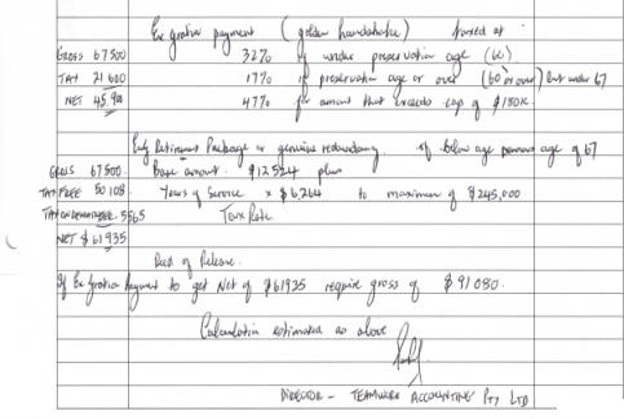
40 In the course of submissions, Dr Gussen clarified that he provided none of the Swinburne emails or internet information about the VERP to his accountant. He said in the 1 July Affidavit that “[t]he taxation advice proceeded on the assumption that the arrangement would be implemented as, or in a manner materially equivalent to, a compliant early-retirement arrangement under Div 83”. On that basis, Dr Gussen was advised that a tax-free amount of approximately $50,108 would apply.
41 Dr Gussen said he also obtained legal advice and that it did not concern or address Ms Marriot’s statements concerning “VERP equivalence” in the 13 September Email. Dr Gussen did not disclose the substance of that advice.
42 Dr Gussen said he considered the taxation advice and the net amount important to his decision as to whether to sign the Deed. He said that he instructed Mr Maloney to request wording describing the payment as “a voluntary early retirement scheme payment to be taxed according to law”.
43 That request was conveyed in an email to Ms Marriott on 17 September 2024. A “marked up” version of the Deed was attached to that email which incorporated the words Dr Gussen had requested.
44 Ms Marriott responded the same morning (the 17 September Email). Dr Gussen asserts that this was a “decisive exchange”. In relation to the wording of the characterisation of the payment, she said:
As discussed, the financial settlement is equivalent to what [Dr Gussen] would receive under VERP but it is not correct to say that it is ‘a voluntary early retirement scheme payment’. On that basis we cannot agree to this amendment.
45 The other requested amendments to the Deed were agreed.
46 Dr Gussen gave evidence that he understood the response to distinguish the legal character or mechanism of the payment from the separate statement that the financial settlement remained equivalent to what he would receive under a VERP. He said that he did not understand the response to say that the comparison was limited to one gross component, that the salary and superannuation consequences of the 24 December date were excluded, or that the net or tax-adjusted outcome was irrelevant.
47 Dr Gussen’s evidence as to why he agreed to sign the Deed is of some significance, and so I set it out verbatim:
When I agreed to sign, I held the understanding described above concerning my 12-month objective, six-month floor, the Program, Recital F’s Scheme, the 24 December date and the maintained statement of financial equivalence. I did not intend to abandon that understanding.
The expression “ex gratia”, which had appeared in drafts, did not appear in the version I signed. I regarded its removal as consistent with a financially equivalent retirement outcome implemented through a different legal mechanism.
Before signing, no one told me that Swinburne understood financial equivalence to mean the same gross 26-week amount only. No one told me that Swinburne had not applied to the ATO for special treatment, that no s 83-170 amount would be applied to cl 2(a) or that accepted VERP payments would be treated only as employment termination payments.
Had I been told before signing Swinburne’s comparator was gross-payment only and excluded the 24 December salary and superannuation value and any Div 83 tax-free amount, I would not have signed the Deed on those terms.
48 Dr Gussen’s evidence is that he executed the Deed in the presence of a Justice of the Peace on 18 September 2024.
49 I pause to note that the evidence before the Court was that Professor Scardamaglia was on leave and not involved in the execution of the Deed. It was her evidence in cross examination that she did not see the Deed until after it was executed.
50 The Deed had the following features:
(1) A background section including various recitals about the circumstances leading to the execution of the Deed. It included the following matters:
B. The Employer commenced a formal disciplinary process against the Employee on 29 July 2024 (“Disciplinary Process”) under the Swinburne University of Technology Academic and Professional Employees Enterprise Agreement 2024 (“Enterprise Agreement”).
C. On 22 August 2024, the Employer issued a Letter of Intended Outcome to the Employee. In this correspondence, the Employer indicated that it intended to terminate the Employee’s Employment.
D. The Employee responded to the Letter of Intended Outcome on 4 September 2024.
E. The Employee’s representative, the National Tertiary Education Union (“NTEU”) notified a dispute consistent with the provisions of the Enterprise Agreement in relation to the Employee on 28 August 2024 (“Dispute”).
F. On 9 September 2024, the Employer communicated with its employees (including the Employee) about its Voluntary Early Retirement Scheme (“Scheme”). The Employee meets the eligibility criteria for this scheme. On that basis, the Employee and the Employer have engaged in further discussions about the Disciplinary Process and the Employment.
G. Without any admission of liability, the Employer and the Employee have agreed to settle all claims arising out of or in connection with the Employment, the Contract, the Enterprise Agreement in accordance with the terms of this deed.
(2) The terms of the Deed were then specified. The first clause was:
Dr Gussen will resign from the Employment, effective 5pm Thursday 19 September 2024.
(3) The second clause was that the Employer will pay to the Employee:
(a) $67,493 (equivalent to 26 weeks’ salary) to be taxed according to law;
(b) Accrued and untaken annual leave;
(c) Any outstanding salary
(collectively, the “Payments”).
(4) The third clause explained that the Employer would make the Payments to Dr Gussen “…within 14 days of the Employer receiving a properly executed copy of this deed”.
(5) Clause 6 - 8 are relevant. They provide:
6. In consideration for the Payment and Non-Financial Terms, the Employee fully and unconditionally discharges and absolutely releases the Employer, or any of its associated entities as defined by s 50AAA of the Corporations Act 2001 (Cth) (“Group Entities”), and each of their current and former employees, officers and Council members from all suits, actions, claims and/or demands arising out of or in connection with, any of the following claims (“Employee Claims”):
a. the Employment;
b. the Contract;
c. the circumstances recited in this deed;
d. the Disciplinary Process;
e. the Dispute;
f. the Enterprise Agreement;
g. any other claim whether under statute or otherwise; and/or
h. any act or omission of the Employer or any Group Entity, during the Employment,
that the Employee has now or, but for the execution of this deed, could or may have had in the future, and must not make, or take or institute any such Employee Claims, excluding Employee Claims arising under any applicable workers’ compensation or superannuation legislation.
(Emphasis added)
7. To the extent permitted by law, the Employer fully and unconditionally discharges and absolutely releases the Employee from all suits, actions, claims and/or demands arising out of, or in connection with any of the following claims (“Employer Claims”):
a. the Employment;
b. the Contract;
c. the circumstances recited in this deed;
d. the Disciplinary Process;
e. the Dispute;
f. the Enterprise Agreement;
g. any other claim whether under statute or otherwise; and/or
h. any act or omission of the Employee during the Employment,
that the Employer has now, or, but for the execution of this deed, could or may have had in the future, and must not make, or take or institute any such Employer Claims.
8. The parties may plead or produce this agreement as a complete bar to any Employee Claims or Employer Claims (as the case may be) that are the subject of a release in this deed.
(6) In addition, the Deed recorded that:
15. The Employee confirms that he has been given the opportunity to obtain appropriate independent professional advice before entering into this deed and that he understands the provisions of the deed including, without limitation, the release at clause 5 and is satisfied that the terms of the deed are fair and reasonable.
(7) Finally, clause 17 recorded the entire agreement between the parties, noting that:
This deed constitutes the entire agreement of the parties relating to this deed and supersedes all prior understanding, representations, negotiations, agreements, written or oral, express or implied in relation thereto. This deed may only be varied by a deed signed by or on behalf of each party.
51 Dr Gussen gave evidence about his understanding of some of the provisions. In relation to the release provisions, it is again worth setting out his evidence verbatim:
When I read those provisions, I understood that Swinburne sought finality broad enough to stop or materially constrain my pursuit of the complaints described in Section B, subject to any express exceptions. The Deed did not identify a separate amount paid for abandoning those complaints or for the general-protections remedies associated with them.
52 His evidence goes on to say that:
The Deed does not define “financial equivalence”; state that the VERP comparison is confined to the gross 26-week sum; identify the 24 December employment period as excluded; state whether Commissioner approval existed; or allocate the $67,493 among unfair-dismissal, general-protections or other claims and remedies.
…
My employment ceased on 19 September 2024. I did not receive salary or superannuation contributions for the period from 20 September to December 2024.
Swinburne paid the amount specified in cl 2(a), subject to tax withheld at source. No Div 83 tax-free amount was applied.
After the execution of the Deed
53 On 3 October 2024, Dr Gussen raised issues with Ms Marriott about the nature and amount of the payments that he received. He then lodged a “general-protections” application concerning the cessation of his employment. The form Dr Gussen filed said that he had been subjected to pressure to sign the Deed and raised various other complaints.
54 A proceeding in the Fair Work Commission then commenced. Dr Gussen said that, in the course of that proceeding, he first became aware that all VERP participants at Swinburne were taxed in the same way he had been. In his evidence in this proceeding, he said:
Before execution, I had not been told whether a written approval under s 83-180 existed or that Swinburne’s use of “Scheme” was not intended to signify a Commissioner-approved early retirement scheme.
55 The published reasons record many of the allegations and arguments canvassed above (see Gussen v Swinburne University of Technology [2024] FWC 3316 and Gussen v Swinburne University of Technology [2025] FWCFB 17). I do not proceed on the basis that any of the findings in those decisions bind my analysis of the issues before me.
56 It is in this context that I turn to consider the matters relied upon by Dr Gussen in submitting that the appropriate answer to the Separate Question is “no”.
the grounds relied upon by dr gussen
57 Dr Gussen identified four grounds upon which he relied to support an answer to the Separate Question in the negative. They are put in different ways at different points in his argument. I have here adopted the summary form of those grounds which were presented by Dr Gussen to the Court in an aide memoire, although there are other aspects which are included in the submissions filed by Dr Gussen to which I will return. In summary, the four grounds are:
(1) Ground 1: “No objective accord”. In oral submissions, Dr Gussen put this argument in various ways as involving a lack of accord and satisfaction, or a lack of agreement between the parties, so as to vitiate or invalidate the Deed.
(2) Ground 2: “Misleading procurement”. In oral submissions, Dr Gussen characterised this as “innocent misrepresentation”.
(3) Ground 3: “Known unilateral mistake”.
(4) Ground 4: “Same adverse action sequence”. Dr Gussen’s characterisation of this issue altered over time. In the aide memoire, Dr Gussen submitted that the Deed is alleged to be the instrument completing the “unresolved discipline and cl 67 sequence”. He asserted that the execution of the Deedf was part of a victimisation sequence and that the Deed itself was an adverse action (or part of an adverse action).
58 I turn to consider each ground in turn. All turn on a similar factual contention: that Dr Gussen misunderstood the effect of the Deed that he signed. Dr Gussen’s submissions explained the position in the following way:
The Applicant’s case has one coherent transaction theory…On 13 and 17 September Swinburne maintained that the financial terms or settlement were “equivalent” to VERP. The parties attached different, definite meanings to that comparator.
59 He gave evidence in his 1 July Affidavit that:
When I refer in this affidavit to a VERP-equivalent outcome, I mean the overall financial position I understood to be offered by the September 2024 VERP pathway: the six-month benefit, the employment incidents to 24 December 2024, and the tax-free or tax-adjusted value I had identified from the taxation advice.
60 Dr Gussen contends that the parties had a different understanding of the concept of a “VERP-equivalent” outcome and therefore had different understandings of the nature of the bargain that they struck.
61 One can categorise Dr Gussen’s understanding in the following way:
(1) That Dr Gussen would be treated as a person who had been accepted into the VERP, and that the dates applicable to those employees would apply to him, including six-months pay, and that he would retire on 24 December, and be paid up until that date (notwithstanding the resignation date in the Deed being 19 September 2024), including superannuation and salary (the Date Representation). This was referred to by Dr Gussen in one of his pleadings as the “Run-to-Date Outcome”.
(2) That the settlement sum paid to him under the Deed would be taxed (more favourably) as if he were part of an early retirement scheme to which 83-180 of the Income Tax Assessment Act applied, so that a higher tax-free threshold would operate (the Payment Representation). This was referred to by Dr Gussen in one of his pleadings as the “Tax Character Outcome”.
62 The principal ways in which the Date Representation and the Payment Representation were said to be conveyed to Dr Gussen were through the following matters:
(1) the 11 September Email (referred to at [27] above);
(2) Recital F in the Deed (referred to at [50] above), and the way in which the word “scheme” was used in that context;
(3) the 13 September Email (referred to at [37] above);
(4) the taxation advice received by Dr Gussen on 16 September (referred to at [39]-[40] above); and
(5) the 17 September Email (referred to at [44] above).
63 It is useful to make a number of observations at the outset about these matters as they relate to issues which repeatedly feature in the case that Dr Gussen has put forward.
The 11 September Email
64 The 11 September Email is set out in part at [27] above. It was sent to a large number of Swinburne employees. It refers to six months’ salary and to the fact that it is a “Voluntary Early Retirement Program”. It makes no reference itself to taxation treatment, or that a person who was accepted into the program would work until a particular date. It does refer to where other information about the program can be accessed. That information explains that approved applicants would receive six months’ salary paid as an “Employment Termination Payment” (ETP), along with a notation that an ETP is taxed differently to normal income (see [29] above) and urging people to seek their own independent financial advice or to contact the Australian Taxation Office about the taxation treatment.
65 The VERP being operated by Swinburne was a factual circumstance which was ongoing at the time that the parties were having commercial discussions with each other. It is recorded as a relevant circumstance in Recital F to the Deed. It states:
On 9 September 2024, the Employer communicated with its employees (including the Employee) about its Voluntary Early Retirement Scheme (“Scheme”). The Employee meets the eligibility criteria for this Scheme. On that basis, the Employee and the Employer have engaged in further discussion about the Disciplinary Process and the Employment.
66 There is no reference to Dr Gussen being accepted into the Scheme or the terms of the Scheme’s operation. Reliance on the word “Scheme” rather than “Program” is misplaced. The Recital refers in terms to the Swinburne’s communication with its employees about its Voluntary Early Retirement Scheme. There is no basis upon which a person could reasonably apprehend that the reference in Recital F conveyed either that Dr Gussen had been accepted into Swinburne’s VERP, or that there was any suggestion of a different, tax-office approved scheme that was different to the one about which Swinburne had written to its staff.
67 Dr Gussen complains that neither the 11 September Email, nor the Deed, told him whether the Commissioner had approved Swinburne’s 2024 VERP initiative by written instrument before implementation, or that it was outside the scope of s 83-180 of the Income Tax Assessment Act or that no s 83-170 tax-free amount could arise. There are two difficulties with this submission. First, the 11 September Email linked to information that explained how the payment under Swinburne’s VERP would be taxed (as an ETP). Second, there was no reason to apprehend that it was inside the operation of s 83-170 and, therefore, no reason to dispel any such apprehension.
The 13 September Email
68 Part of the 13 September Email is set out at [37] above. The reference to VERP equivalence in that context was connected with the predecessor email (sent 45 minutes earlier by Mr Maloney of the NTEU). Mr Maloney asked whether Dr Gussen would receive a letter of service stating that his employment had ended subject to the Voluntary Early Retirement Scheme.
69 The 13 September Email was, on its face, directed at distinguishing between a person who was departing subject to the VERP and Dr Gussen (who was not). Thus, properly understood, the 13 September Email explains that Dr Gussen would receive a letter of service referring to resignation rather than referring to VERP participation. It is in that context that Ms Marriot wrote that the “financial terms offered are equivalent to what [Dr Gussen] may have had access to, were the University to accept his application for VERP”. The email clearly links the concept of equivalency to the financial terms that have been calculated and which are otherwise set out. It does not incorporate the VERP in its entirety, and it cannot reasonably be taken as conveying a representation that Dr Gussen would be treated in all respects as a person who had been accepted into the VERP, and that all of the dates applicable to those individuals accepted into the VERP would apply to him. That is reinforced by the inclusion of specific dates in the Deed itself.
The 17 September Email
70 The 17 September Email is extracted in part at [44] above. That email is responsive to an email of Mr Maloney, in which he requested five amendments to the draft deed on behalf of Dr Gussen. It is useful to set out all five with a brief explanation:
(1) Mr Maloney requested a change to “[t]he date member responded to intended outcome letter”. That is a reference to Recital D, which simply recorded the date of correspondence between the parties.
(2) Mr Maloney requested: “[p]roposed resignation date Thursday 19 Sep (pending agreement)”, and the accompanying mark-up shows the proposed change being to the first clause of the Deed, recording the date that “Dr Gussen will resign from the Employment, effective 5pm Thursday 19 September”. I pause to note that this specific point of negotiation makes it difficult to maintain the contention that Dr Gussen could have laboured under the misapprehension that he would remain employed (or be treated as remaining employed) until 24 December 2024.
(3) The third requested amendment is as follows: Following advice from tax expert [Dr Gussen] wants wording to read “as a voluntary early retirement scheme payment to be taxed according to law”. I pause to note that the gravamen of the taxation advice was not communicated. The words identified were included in the mark up.
(4) The fourth requested amendment was about the statement of service, requesting the inclusion of the wording “The Employer will provide the Employee with a statement of service recording his tenure, position, and resignation, within 14 days of the Employer receiving a properly executed copy of this deed”. The identified words were marked up in the draft deed.
(5) The fifth requested amendment was the insertion of the words “Disciplinary Process; the Dispute; and the Enterprise Agreement” at clause 7 to mirror clause 6. The changes were also marked up.
71 Four of the five requested changes were agreed. The third requested amendment was not. In responding to that issue, Ms Marriott said “…the financial settlement is equivalent to what [Dr Gussen] would receive under VERP but it is not correct to say that it is a ‘voluntary early retirement scheme payment. On that basis we cannot agree to this amendment”. Here, Ms Marriott was clear that the financial settlement only was equivalent to what Dr Gussen would have received under the VERP. Her email is likewise clear that it was “not correct” that Dr Gussen would receive a “voluntary early retirement scheme payment”. There is no basis upon which the statement of Ms Marriott, considered on its own, or in the context in which it was conveyed, could reasonably be taken as conveying the Date Representation. That conclusion is reinforced by the following matters:
(1) The Deed says in terms that Dr Gussen would resign from employment “effective 5pm Thursday 19 September 2024”. Dr Gussen gave evidence that he read and understood the Deed. He also acknowledged at clause 15 of the Deed that he understood the provisions of the Deed and was satisfied the terms of the Deed were fair and reasonable. It was that representation which made clear when his employment would terminate. It was not undermined or countermanded by any of the other matters relied upon. It was last in time, and it was clear. The Deed also constituted the entire agreement between the parties (clause 17). It reinforces my conclusion that the Date Representation was not conveyed by Swinburne.
(2) The Deed also states that the “Payments” would be made within 14 days of the return of the signed Deed. The clear and unambiguous terms of this representation, conveyed with and after the 13 September Email and the 17 September Email, further support the conclusion that the Date Representation was not conveyed.
72 I therefore do not accept that the Date Representation was conveyed to Dr Gussen.
73 As to the Payment Representation, it is important to note that, as I understand it, Dr Gussen does not contend that the representation was that he would be taxed in the same way as other participants in the VERP being operated by Swinburne. He asserts that the references to VERP equivalence in the 13 September Email and the 17 September Email, and the reference to the “Voluntary Early Retirement Scheme” in Recital F to the Deed, should be taken as conveying a voluntary early retirement scheme that had particular taxation approvals which would result in a payment made to him having certain tax advantages. I make the following observations:
(1) The use of the word “Scheme” in Recital F does not carry the meaning for which Dr Gussen contends. Read in context, the Recital refers clearly to the scheme which Swinburne was operating. That is made clear by the first sentence, which commences by recording that “…the Employer communicated with its employees (including the Employee) about its Voluntary Early Retirement Scheme (Scheme)”. The reference to a communication with employees, and the reference to “its” voluntary early retirement scheme, both reinforce that it is a reference to the Swinburne VERP.
(2) The 13 September Email makes clear that while the financial terms offered were “equivalent” to what Dr Gussen “may have had access to, were the University to accept his application”, he had not been accepted into the VERP. So much is clear from the conditional language (“may…were the University to accept his application…”). There is simply no basis to conclude that the 13 September Email is referring to anything to do with a separate voluntary early retirement process to which different taxation treatment might or did apply. Likewise, Ms Marriott identified a specific entitlement of VERP-employees (to request and receive a statement of service) and stated that Dr Gussen’s “…statement of service would be the same”.
(3) The 17 September Email is even more explicit, because it states that “…it is not correct to say that it is a ‘voluntary early retirement scheme payment’”. No reasonable interpretation of those words, read in their full context, could convey that the payment was in fact an early retirement scheme payment, much less one to which differential or advantageous tax treatment would apply. Moreover, Dr Gussen gave evidence that the taxation advice “proceeded on the assumption that the arrangement would be implemented as, or, in a manner materially equivalent to, a compliant early-retirement arrangement under Div 83”. Given that Dr Gussen sought and obtained that advice on 16 September, the assumption as to the taxation treatment cannot logically have been induced by the 17 September Email.
(4) These matters are reinforced by the drafting history to the Deed, which discloses that:
(a) The payment was initially described as an “ex-gratia” payment.
(b) That characterisation was removed. Dr Gussen requested that it be instead characterised as a “voluntary early retirement scheme payment to be taxed according to law”.
(c) That drafting was specifically rejected, and the explanation for that rejection was that it was “not correct” to characterise it in the manner that Dr Gussen had done.
(d) The Deed ultimately adopted simply identified the sum, the fact that it was equivalent to 26 weeks’ salary, and that it would be taxed according to law.
74 The drafting history makes clear that Swinburne specifically rejected the characterisation which Dr Gussen contends was conveyed.
75 To the extent that Dr Gussen seeks to suggest that the use of the words “the financial settlement is equivalent to what [Dr Gussen] would receive under VERP” involved a representation as to financial equivalence that was not shared between the parties, I do not accept that such weight can be ascribed to the words in the context in which they appear – particularly in circumstances where the draft of the Deed itself set out specific dates for the end of employment and a specific amount of the relevant payment.
76 Accordingly, I do not consider that the Payment Representation was conveyed by Swinburne.
77 Dr Gussen also said that Swinburne’s silence operated to mislead him. His Statement of Claim records the argument as follows:
(a) that the term “VERP-equivalent” did not change anything in terms of what was being offered by the First Respondent under the Deed, including in relation to the payment described in cl 2(a) and the outstanding salaries in cl 2(c) of the Deed;
(b) that the payment described as outstanding salaries in cl 2(c) of the Deed did not extend until the retirement date stated in the VERP invitation as explained in paragraph 13, namely 24 December 2024;
(c) that the payment provided for in cl 2(a) of the Deed did not attract any tax-free component;
(d) that the First Respondent had not sought or obtained approval from the Australian Taxation Office for the 2024 VERP; or
(e) that the 2024 VERP did not attract any tax-free component under Div 83 of the Income Tax Assessment Act 1997 (Cth).
78 A key factual difficulty with this assertion as it relates to the taxation office treatment of the 2024 Swinburne VERP is that Swinburne had provided a generally available frequently asked questions page which made clear that any payments made under the VERP would be taxed as an ETP (see [30] above).
79 Moreover, as explained above, the words “VERP equivalent” must be read in their context. They cannot be taken as having implied or suggested that Dr Gussen was being accepted into the VERP or would be treated in all respects as a person who had been so accepted. That is reinforced (if reinforcement be necessary) by the statement in the 17 September Email that “…it is not correct to say that it is a ‘voluntary early retirement scheme payment’”. There was therefore no representation as to any of the matters by silence because the representations actually made (in the 17 September Email and the Deed itself) were so clear as to their meaning.
80 That conclusion is reinforced by the fact that Dr Gussen is legally trained and can be expected to understand the terms of a basic deed. That Deed included an express acknowledgment that he had had the opportunity to obtain independent advice (which he did) and that the Deed constitutes the entire agreement, and supersedes all prior understandings, representations, negotiations, agreements, written or oral, express or implied in relation thereto.
81 I turn now to consider the specific grounds upon which Dr Gussen relies.
Ground 1 – “No objective accord”
82 Dr Gussen said that there was no consensus ad idem and “no binding accord”, and that this rendered the Deed void ab initio. Dr Gussen submitted that:
Swinburne must prove objective assent to the same substituted performance accepted in discharge of antecedent rights. Assent is objective: Pacific Carriers Ltd v BNP Paribas (2004) 218 CLR 451 at [22]; Toll (FGCT) Pty Ltd v Alphapharm Pty Ltd (2004) 219 CLR 165 at [38]–[49]. Accord and satisfaction requires agreement on the substituted performance: McDermott v Black (1940) 63 CLR 161 at 183–185.
83 He goes on to argue:
Accord and satisfaction fails where the objective communications leave that performance unresolved. The failure point here was the 17 September reaffirmation: after the tax component and proposed statutory wording were squarely raised, Swinburne rejected statutory character but did not select a gross-only comparator. The Peerless analogy is narrow but useful: one expression did the work of two ships. Here, “VERP-equivalent” could mean Swinburne’s gross 26-week component or the Applicant’s overall VERP-equivalent outcome. Without an objective selection, there was no accord on the consideration for resignation and releases
Accord and satisfaction
84 The essence of accord and satisfaction is the acceptance of something in place of the cause of action (McDermott v Black [1940] HCA 4; 63 CLR 161 at 183 (Dixon J)). The concept of accord and satisfaction was explained succinctly by Pembroke J in Stroud v O’Connor [2016] NSWSC 629 in the following way (at [4]):
The plaintiff resists the defendant’s application and relies on the doctrine of accord and satisfaction. That doctrine involves two simple concepts. It means an agreement or consent (accord) to accept something in place of the full remedy to which the recipient is entitled (satisfaction).
85 In El-Mir v Risk [2005] NSWCA 215, the respondent was a builder who performed residential building work for the appellants pursuant to a building contract in 1994. A dispute arose, and the respondent claimed to be owed money. The Appellants, in turn, complained about the quality of the work. The respondent sought to recovery money said to be owing under the Commercial Arbitration Act 1894 (NSW). There was a cross claim, and an arbitration proceeded in June 1997 in which both parties were represented. Some way into the arbitration, the arbitrator was informed that the matter was settled. The terms of settlement were recorded as follows:
1. Each party, without admission, withdraws their respective claims and cross claims against the other party.
2. Each party is to bear its own costs of the arbitration.
3. Each party to bear equally the costs of the arbitrator.
86 Later, proceedings were commenced in relation to the defective works. Those proceedings continued for a time without the issue of the previous settlement of the matter being raised. One party sought to rely on the settlement to bar the further claims. It was apparent that the claim to rely on the settlement was rejected because the presiding judicial officer accepted the submission that the settlement merely recorded “that the parties withdrew their respective claims at that time” and thus ruled that “the dispute had not been settled”. The matter then proceeded. An estoppel argument based on the settlement was raised and rejected.
87 On appeal, the issue was (eventually) identified as being whether the settlement amounted to an accord and satisfaction of the parties’ respective claims. The New South Wales Court of Appeal then considered (in effect) whether there was a reasonably arguable case that the settlement amounted to an accord and satisfaction of the parties’ claims. The core issue was whether the settlement involved accord and satisfaction – as opposed to merely an agreement that both parties withdraw their claims in the same sense that withdrawal and discontinuance were used in the Supreme Court and District Court rules – leaving open the possibility of re-agitated in the future. The Respondent argued that there was no agreement (or accord) to forebear from further pursuit of the claim.
88 Having considered various cases relevant to the operation of accord and satisfaction, McColl JA concluded (at [69], Handley JA agreeing at [1], Ipp JA agreeing at [2]) that it was arguable that the settlement involved the exchange of mutual promises by the appellants and the respondent to forebear from pursuing their respective rights under the building contract by not proceeding with the arbitration.
89 In reaching that conclusion, McColl JA explained (at [54]) that:
The question whether there has been an accord and satisfaction is one of fact”: Day v Mclea (1889) 22 QBD 610 at 613 per Lord Esher MR; Bagnall v National Tobacco Corporation of Australia Ltd (1934) 34 SR (NSW) 421 at 427, per Jordan CJ; see also Neuchatel Ashphalte Co Ltd v Barnett [1957] 1 WLR 356. It turns upon determining the parties’ intentions, which may be discerned from the terms of any document said to constitute all or part of the agreement or in the surrounding circumstances: Ballantyne v Phillott [1961] HCA 17; (1961) 105 CLR 379 at 398 per Menzies J.
90 Dr Gussen appears to rely on the above proposition to submit that the parties’ intentions can be relevant, and that because his intention was different to the intention of the counterparty, there could be no accord and satisfaction. In particular, he argues that:
The alleged accord was therefore not simply “resign tomorrow for $67,493”. The settlement was introduced and maintained by reference to VERP equivalence. Swinburne’s later evidence selects one gross component. The Applicant’s assent was to the overall outcome offered: six months’ benefit, salary and superannuation to 24 December, and the tax-free value quantified by his advice. The route could differ—lawful s 83-170 treatment if statutory conditions were met, or an amount producing the same net result—but the represented financial result could not. That difference concerned the consideration for next-day resignation and extensive releases.
The Applicant’s disclosed instructions reinforce that conclusion. Twelve months was the objective; six months was the minimum acceptable payment, with accrued leave and references additional. The 24 December value and the tax-free component were the features by which the offered pathway moved the outcome materially closer to that objective. Treating the six-month gross amount alone as the whole bargain collapses the objective into the floor and deprives the repeated equivalence representation of work.
91 Dr Gussen’s arguments depend upon the notion that something was communicated to Dr Gussen that was not. He asserts that there was a “VERP equivalence” notion introduced in both the 13 September Email and the 17 September Email that had an effect well beyond what the words themselves could bear. When taken in their overall context (including the ultimate execution of the Deed) the proposition is simply unsustainable. There was no “represented financial result” that had been agreed between the parties that differed to what was recorded in the Deed.
92 A party cannot avoid the consequences of their bargain by an unreasonable interpretation of the agreement, or a misunderstanding, save where there are vitiating factors.
93 As I have explained, having regard to the circumstances surrounding the Deed, the terms of the Deed itself simply do not permit the conclusion that Swinburne (or anyone else) conveyed the Date Representation or the Payment Representation to Dr Gussen. They were assumptions that he made. They were not reasonably made in all of the circumstances.
94 The terms of the Deed plainly show an exchange of promises between the parties, set out in clauses 6 and 7, extracted in full at [50] above. Each party agreed not to sue each other. The sum of money is referred to, as is the date upon which it will be paid, and the date on which the employment relationship would end was specifically identified. An accord and satisfaction is demonstrated.
No consensus ad idem
95 This is a similar argument deployed in a slightly different way. It is a basic tenet of contract law that to have a binding contract there must be a “meeting of the minds” often referred to as “consensus ad idem”. That does not mean that a misunderstanding by one party can invalidate or vitiate a contract. The law in this respect is well settled. As the comments of Mason J in Codelfa Construction Pty Ltd v State Rail Authority (NSW) [1982] HCA 24; 149 CLR 337 made clear (at 352):
We do not take into account the actual intentions of the parties and for the very good reason that an investigation of those matters would not only be time consuming but it would also be unrewarding as it would tend to give too much weight to these factors at the expense of the actual language of the written contract.
96 The principle of objectivity, by which the rights and liabilities of the parties to a contract are determined, was reaffirmed by the High Court in Pacific Carriers Ltd v BNP Paribas [2004] HCA 35; 218 CLR 451 (at [22] (Gleeson CJ, Gummow, Hayne, Callinan and Heydon JJ)). It was subsequently affirmed and explained by the High Court in Toll (FGCT) Pty Limited v Alphapharm Pty Limited [2004] HCA 52; 219 CLR 165 (Toll) (at [40] (Gleeson CJ, Gummow, Hayne, Callinan and Heydon JJ)) as follows:
… It is not the subjective beliefs or understandings of the parties about their rights and liabilities that govern their contractual relations. What matters is what each party by words and conduct would have led a reasonable person in the position of the other party to believe. References to the common intention of the parties to a contract are to be understood as referring to what a reasonable person would understand by the language in which the parties have expressed their agreement. The meaning of the terms of a contractual document is to be determined by what a reasonable person would have understood them to mean. That, normally, requires consideration not only of the text, but also of the surrounding circumstances known to the parties, and the purpose of the transaction.
97 In this case, some of the surrounding circumstances that are of particular relevance is that Dr Gussen signed the Deed knowing that it was to be a legally binding document. It is not in dispute that he did so having had the benefit of both legal and accounting advice in relation to it. He also had the benefit of assistance from the NTEU, and was himself a qualified lawyer, admitted in Queensland. He had negotiated changes to certain terms, and had other changes rejected because they did not accord with what Swinburne was willing to agree to.
98 For the reasons that I have explained, the Deed was entered into in circumstances where Swinburne did not make the Payment Representation or the Date Representation.
99 Dr Gussen’s subjective belief that the Deed would operate in a way that is different to what a reasonable person would understand by the language in the Deed does not alter the fact that consensus was reached insofar as the law requires to create a binding contract.
100 Thus, Dr Gussen does not succeed on the first ground.
Ground 2: Innocent misrepresentation / misleading procurement
101 Dr Gussen labelled this ground as “misleading procurement” and ultimately submitted that the description of “innocent misrepresentation” was appropriate.
102 The way that he put the argument was as follows:
If the objective meaning of “financial equivalence” was the broader outcome, the Deed delivered something materially narrower. Swinburne maintained the representation after the tax issue was expressly conveyed, yet delivered neither the 24 December value nor the represented tax-free value or an equivalent adjustment. A representation may be misleading by what it says in context and by the qualification it omits.
The 17 September response is central. Before signing, the Applicant proposed the statutory phrase “voluntary early retirement scheme payment”. Swinburne rejected that legal character but immediately reaffirmed financial equivalence. In context the answer conveyed: different legal mechanism, same financial result. Because the tax-free component was the specific financial issue then raised, the reaffirmed equivalence carried its economic value forward unless expressly excluded. It was not excluded.
The representation concerned the consideration itself. The Applicant’s tax advice quantified the tax-free component at approximately $50,108; the existence of that advice and the statutory formulation were conveyed to Swinburne; his instructions had identified a 12-month objective and six-month floor; and the invitation fixed a later departure date. On his evidence, he signed because the maintained comparison preserved those incidents. Had the gross-only limitation been stated, he would not have signed on those terms. [Aff [94]–[108], [135]–[140]] That is direct reliance, not a collateral motive.
The acknowledgments in cl 15 do not authorise misleading procurement. Independent advice was obtained before the decisive 13 and 17 September communications and did not address their meaning. Nor does cl 17 erase the objective representations used to obtain execution, particularly where Recital F carries the comparator into the instrument itself. The proper relief is rescission or set-aside, subject to practical counter-restoration.
103 The key case that Dr Gussen relied upon was Henjo Investments Pty Ltd v Collins Marrickville Pty Ltd (1988) 39 FCR 546. That was a case under s 52 of the then Trade Practices Act 1974 (Cth) and concerned whether the conduct of the vendor of a restaurant known as the “The New York Deli” was misleading or deceptive. It is not necessary to set out in full the facts of that case. It is sufficient to note that the owners had regulatory approvals to seat 84 people and a liquor licence limited to those who were eating in the restaurant. Contrary to those authorisations, the business operated with 120 chairs and a bar area where patrons habitually drank without ordering meals. Thus, the operation of the business was inconsistent with the terms of its authorisation. Moreover, there were some documents conveying the notion that the restaurant was fully licensed (i.e. a sign on the front window that said “Fully Licensed” and a card signed by the director of the vendor with the words “Seats 128” and immediately underneath the word “Licensed”).
104 The sale proceeded without disclosing the disparity between the way the restaurant operated and its authorisation to do so. There were clauses in the sale contract to the effect that there was no reliance outside of what was set out within the contract. The purchaser made no enquiries of the liquor licensing authorities or council to verify the licenses and authorisations that the venue actually held.
105 After the purchase, there was a four-week trial period, in which representatives of the purchaser attended and observed the venue operate to verify the takings were consistent with what had been disclosed. Throughout the period, the venue operated outside the terms of its authorisation. It appears that the vendor attempted to surreptitiously apply to alter the liquor licence to legitimise the way that it was using the space around the time of the sale. Justice Lockhart mused (at 550-551) that this application may have been made because the vendor was aware that there had been no disclosure of the licence restrictions and the lack of conformity between the terms of the licence and the way the venue operated. In any event, the sale completed. The disconformity came to light, and a dispute arose.
106 In the course of considering the issue on appeal Lockhart J (with whom Burchett and Foster JJ agreed on this point) emphasised (at 555) that:
Misleading or deceptive conduct generally consists of representations, whether express or by silence; but it is erroneous to approach s 52 on the assumption that its application is confined exclusively to circumstances which constitute some form of representation.
107 In that case, his Honour found that the representation that the premises were licensed for 128 people was conveyed in various ways. Nonetheless, his Honour went on to observe (at 556) that the “real complaint” against the conduct arose from the silence of the vendors in not informing the purchaser of the true position on the seating limitations and the use to which the bar area could lawfully be put. His Honour explained the orthodox position that silence may be relied upon in order to show a breach of s 52 when the circumstances give rise to an obligation to disclose relevant facts (at 557). In that case, the vendor sold a business knowing it was subject to a serious limitation upon its lawful seating capacity, which vitally affected the business, its goodwill, takings and profitability, and knowing that in fact the restaurant was being conducted contrary to law with a substantial element of over-seating. The circumstances, taken together, gave rise to a duty on the part of the vendor to reveal the true position (at 557). His Honour said that it is no answer to say that the purchaser should have made their own inquiries – in the circumstances of that case, that did not negate the duty to disclose (at 558).
108 Similarly, his Honour considered the clauses in the contract which acknowledged that there were no external representations relied upon. His Honour said that s 52 is a section in the consumer protection provisions of an Act, concerned with protecting the public from misleading or deceptive conduct, and it has been held that exclusion clauses of that kind could not defeat claims under s 52 (at 561).
109 Dr Gussen also relied upon Butcher v Lachlan Elder Realty Pty Ltd [2004] HCA 60; 218 CLR 592. In that case, a suburban real estate agent passed on a diagram inaccurately showing the boundaries of the land to be auctioned and inaccurately depicting a swimming pool as being entirely within the freehold land, partly demarcated by the mean high-water mark. The brochure included a disclaimer that the accuracy of the diagram could not be guaranteed and that interested persons should rely on their own inquiries. The purchasers later found that the swimming pool was not entirely within the land above the mean high-water mark. In concluding that the representation had not been adopted by the real estate agent, and that the agent had not engaged in misleading or deceptive conduct, the High Court (Gleeson CJ, Hayne and Heydon JJ) considered the operation of disclaimers, asserting (at [39]-[40]) that:
In applying those principles, it is important that the agent’s conduct be viewed as a whole. It is not right to characterise the problem as one of analysing the effect of its ‘‘conduct’’ divorced from ‘‘disclaimers’’ about that ‘‘conduct’’ and divorced from other circumstances which might qualify its character. Everything relevant the agent did up to the time when the purchasers contracted to buy the Rednal land must be taken into account. It is also important to remember that the relevant question must not be reduced to a crude inquiry: ‘‘Did the agent realise the purchasers were relying on the diagram?’’ To do that would be impermissibly to dilute the strict liability which s 52 imposes.
For the following reasons, the agent did not engage in conduct towards the purchasers which was misleading. Whatever representation the vendor made to the purchasers by authorising the agent to issue the brochure, it was not made by the agent to the purchasers. The agent did no more than communicate what the vendor was representing, without adopting it or endorsing it. That conclusion flows from the nature of the parties, the character of the transaction contemplated, and the contents of the brochure itself.
110 The propositions are not controversial and are often cited (see e.g. Gall v Domino’s Pizza Enterprises Limited (No 4) [2026] FCA 967 at [193] (Murphy J); United Petroleum Pty Ltd v Perth Airport Pty Ltd (No 2) [2026] FCA 620 at [391] (Anderson J)).
Analysis
111 Dr Gussen’s arguments are unsustainable. As explained at [64]–[80] above, I do not accept that the 11 September Email, the 13 September Email or the 17 September Email, nor the Deed, nor the surrounding circumstances, carried the meanings for which Dr Gussen contends. Neither they, nor any of the references to a VERP or early retirement scheme referred to by Dr Gussen, give rise to the apprehension of particular taxation treatment or a particular amount that Dr Gussen would receive after tax, or that he would receive payment as if he was employed until December 2024 with additional leave.
112 Importantly for this part of the case put by Dr Gussen, I do not accept that Swinburne (or its relevant officers) induced his misapprehensions, or was even aware of them. The request for a change to the wording of the Deed identified that Dr Gussen had sought taxation advice, and that he had sought particular wording on that basis. That request was declined by Swinburne, and the reason was explained in correspondence that “it is not correct to say that it is a ‘voluntary early retirement scheme payment’”.
113 The mere fact that the words “ex-gratia” were not reinstated, and that the characterisation of the payment was left unstated, does not convert the correspondence into a representation of the kind for which Dr Gussen contends. The fact of the rejection of his characterisation by Swinburne is of significance and cannot be circumvented by Dr Gussen’s subjective belief.
114 Dr Gussen asserts that his tax advice had quantified the tax-free component at approximately $50,108. He asserts that the existence of that advice and the statutory formulation were conveyed to Swinburne. The fact that Dr Gussen had received advice was disclosed to Swinburne. The fact that the advice had led to his suggested amendment was also disclosed to Swinburne. His apparent expectation that the tax-free component of his payment would be $50,108 was not conveyed to Swinburne.
115 Dr Gussen puts the point a different way, arguing that Swinburne imposed a “gross-only limitation” which was not stated, and that if it had been, he would not have signed the Deed. This, he says, is direct reliance by him.
116 That assertion cannot be sustained. Swinburne provided the terms of the payment, declined to alter their description to fit Dr Gussen’s preferences, and proceeded on the basis that he would and did obtain his own advice about the proper taxation treatment of the payment in those circumstances.
117 Dr Gussen contends that when his amendment to the Deed was rejected, Swinburne “immediately reaffirmed financial equivalence”. As I have explained, that cannot be taken to mean any specific taxation treatment. In context, it can be understood as a reference to the fact that the amount was calculated to be 26 weeks’ salary (the same that any participant in the VERP at Swinburne would obtain). Nothing further is suggested by the correspondence in the context in which it was used.
118 There is a difficult inconsistency in Dr Gussen’s argument in this respect. He submits that he was to be treated in the same way as a Swinburne VERP participant (in the sense of a 24 December completion date) but as a non-Swinburne VERP participant when considering the taxation implications of the payment. In the context of this specific argument, it should be noted that in Dr Gussen’s pleadings, he asserts that in promoting the Swinburne VERP, including via its internal wiki / intranet, Swinburne misrepresented or misstated the position by “not stating” that Swinburne had not sought or obtained approval from the Australian Taxation Office in respect of the 2024 VERP. No such complaint can be sustained in light of the publication on the Swinburne Wiki, extracted at [29] above, that participants in the VERP would be paid as an ETP, which are taxed in a way that is different to normal income. In any event, Dr Gussen was taxed on the basis of an ETP. The unchallenged evidence was that participants in the Swinburne VERP were taxed on that same basis.
119 It follows that ground two cannot be sustained.
Ground 3: Unilateral mistake
120 Dr Gussen argues that the Deed is vitiated by unilateral mistake that was known to Swinburne or was objectively apparent to it and was not corrected. His submissions on this issue were as follows:
The Applicant must show a serious mistake about a fundamental term or effect, Swinburne’s knowledge or objective notice of it, and unconscientious retention of the advantage: Taylor v Johnson (1983) 151 CLR 422 at 431–432; Sargent v ASL Developments Ltd (1974) 131 CLR 634 at 656; Vadasz v Pioneer Concrete (SA) Pty Ltd (1995) 184 CLR 102 at 114–115. Relief is conditional on doing equity: Alati v Kruger at 223–224.
Swinburne had repeated notice of the premise. It knew the Applicant’s 12-month objective and six-month floor; knew he was comparing the deed outcome with the VERP; knew the Program carried a 24 December departure; was told that he had obtained tax advice and was given the proposed statutory wording; and knew that his final agreement followed its reaffirmation of financial equivalence. Those matters made the tax-free value part of a definite, objectively apparent premise, not a speculative collateral hope. [Aff [73]–[108], [135]–[140]]
Swinburne did not correct that premise in plain language. It rejected statutory character while preserving the financial result. If its internal intention was gross-component-only, it permitted execution without communicating the limitation required to align the bargains. Equity should not permit it to retain next-day resignation and broad releases produced by that known divergence.
The Applicant has not affirmed the narrow bargain with knowledge of the material facts. He raised the implementation and tax discrepancy on 3 October, pleaded misrepresentation in his 7 October Form F8 and has consistently challenged validity and effect. Receipt of the payment is not an insuperable obstacle: he offers repayment, accounting, set-off or such adjustment as the Court orders. See Sargent v ASL Developments Ltd (1974) 131 CLR 634; Alati v Kruger (1955) 94 CLR 216; Vadasz v Pioneer Concrete (SA) Pty Ltd (1995) 184 CLR 102.
121 Dr Gussen relies on Taylor v Johnson [1983] HCA 5; 151 CLR 422. That was a case where Mrs Johnson granted an option to Mr Taylor (or his nominee) to purchase two adjoining lots of vacant land, each comprising about five acres. The option was exercised, and a contract was entered into. The purchase price was $15,000 as provided by the option. After entering into the contract, Mrs Johnson declined to perform in accordance with its terms, claiming that when she granted the option, she believed that the document provided for consideration of $15,000 per acre of the subject land. The evidence was that the land was valued at about $50,000 and that the value would increase to $195,000 if a proposed rezoning became effective.
122 As a matter of fact in that case, the general inference that flowed from the evidence was that each of Mr Taylor and Mrs Johnson believed that the other was acting under a mistake or misapprehension, either as to price or value in agreeing to a sale at the purchase price which he or she believed the other had accepted (at 427 (Mason ACJ, Murphy and Deane JJ)). The case was decided at a time when “the sounds of conflict have not been completely stilled” as between objective and subjective theories of contract law (at 429) which cannot be said to remain the case today (see Toll).
123 The proposition that their Honours identified in that case was (at 432):
It is that a party who has entered into a written contract under a serious mistake about its contents in relation to a fundamental term will be entitled in equity to an order rescinding the contract if the other party is aware that circumstances exist which indicate that the first party is entering the contract under some serious mistake or misapprehension about either the content or subject matter of that term and deliberately sets out to ensure that the first party does not become aware of the existence of his mistake or misapprehension.
124 In the facts of that case, Mr Taylor believed that Mrs Johnson was under some serious mistake or misapprehension about either the terms (the price) or the subject matter (its value) of the relevant transaction. The Court said (at 433) that Mr. Taylor:
…deliberately set out to ensure that Mrs. Johnson did not become aware that she was being induced to grant the option and, subsequently, to enter into the contract by some material mistake or misapprehension as to its terms or subject matter.
125 There can be no parallel with the present case.
126 I do not accept that by requesting a change to the Deed (which was rejected), a person could be said to be proceeding on the basis that the amendment had been accepted. Put another way, Dr Gussen said that he wanted particular wording following consultation with his accountant. That was rejected. The words ex-gratia were not reinstated. The characterisation of the payment was left blank, save to observe that it would be taxed according to law. In those circumstances, it cannot be said that Swinburne should be taken to have understood that Dr Gussen assumed, believed or proceeded on the basis that his proposed amendments had been accepted.
127 The notion that Swinburne “preserv[ed] the financial result” and that this means that a particular taxation character would attach to the stated amount because it would be treated as a “voluntary early retirement scheme” payment does not arise on the words of the correspondence or the Deed. Moreover, any such misapprehension is inconsistent with the statement by Ms Marriott that it is “not correct” to say that the payment is “a voluntary early retirement scheme payment”.
128 The amount of money that was to be received was set out in the Deed. The basis upon which it had been formulated was explained in the Deed and the surrounding correspondence. It was to be taxed according to law.
129 Moreover, these conclusions are reinforced by my conclusions at [64]–[80] above, insofar as Swinburne did not make any representations that led to, or could reasonably be said to have led to, the Date Representation and the Payment Representation.
130 I do not accept that Swinburne was aware of Dr Gussen’s apparent misapprehensions, or that it came under any duty to correct any such misapprehension (Leibler v Air New Zealand Ltd (No 2) [1999] 1 VR 1 at [36] (Kenny JA, Winneke P and Phillips JA agreeing)).
131 It follows that I do not accept that there was any unilateral mistake capable of rescinding or vitiating the Deed.
132 Dr Gussen also relied upon Vadasz v Pioneer Concrete (SA) Pty Ltd [1995] HCA 14; 184 CLR 102 to assert that equity supports the granting of relief and the ability of a Court to mould relevant relief. Because Dr Gussen has not identified any basis for relevant relief, it does not assist him.
133 Thus, the third ground must fail.
Ground Four: Adverse Action Sequence
134 The fourth ground was challenging to understand. It appears to be an attempt to assert, in the context of the Separate Question, that the Deed was itself an adverse action, and that it was the culmination of a campaign of bullying and harassment. Dr Gussen said that it was “independent of contractual avoidance”. This is difficult to reconcile with the Separate Question, which is generally concerned with whether the Deed is binding.
135 It is also difficult to reconcile with any of the pleaded cases. There are a range of places in the pleadings where Dr Gussen asserts that the Deed is unlawful because it breaches various laws, but not the sequence of logic that is now deployed. For example, the way in which Dr Gussen put the argument before me included an attempt to put in issue for determination in the Separate Question the appropriateness of the steps that were connected with the disciplinary process which led to the Deed itself. Dr Gussen submitted that:
The alleged adverse acts included removal from moderation functions, aggregation of historical matters as serious misconduct, refusal to investigate, work and contact restraints, intended termination, continuation during the cl 67 dispute, pressure towards next-day resignation, procurement of the Deed and its later use as a complete bar. The same chronology supports the pleaded s 351 attributes where applicable.
136 This submission involves a mixture of matters captured within the alleged adverse actions, most of which appear to relate to the matters which preceded the execution of the Deed, and which would likely be released by the Deed if it were valid. There is therefore a circular element to this argument. When pressed to clarify how the Deed itself was an adverse action, Dr Gussen maintained that it would have been an adverse action even if the full amount of money he thought was owing to him was paid. The following exchange occurred:
HER HONOUR: Okay, so you think if you had have been paid that money, if you had have received that money, you wouldn’t – you weren’t misled, and there would have been no adverse action. Is that right?
DR GUSSEN: Plus, plus, plus, my outstanding salaries from 19 - - -
….
HER HONOUR: Okay, so let’s assume that. That’s, that’s another sum of money. Say you got an extra $100,000 in your pocket, do you then say there was no adverse action?
DR GUSSEN: No.
HER HONOUR: No.
DR GUSSEN: Because since then, things changed.
HER HONOUR: Yes.
DR GUSSEN: I had applied for another job at ACU.
HER HONOUR: Yes.
DR GUSSEN: This was the subject of VID504/2025.
…
DR GUSSEN: But the point is that between going to the Fair Work Commission - -
HER HONOUR: Yes.
DR GUSSEN: on the back of this matter. And accepting that offer, that employment offer from ACU. The proceedings at the Fair Work Commission were published.
HER HONOUR: Yes.
DR GUSSEN: So, there was two articles dealing with the outcomes in the Fair Work Commission.
HER HONOUR: Yes.
DR GUSSEN: And those articles resulted in me getting a termination three days into that job.
137 After some further clarification, the following exchange occurred:
HER HONOUR: And what’s made it adverse to you, and what’s made it adverse to you, is that a decision was published in the Fair Work Commission.
DR GUSSEN: And even, less than that, your Honour. Even if Ms Marriott responded positively, when I went back asking for clarification. None of this would have happened.
HER HONOUR: Yes, okay.
DR GUSSEN: Because maybe I would have understood better where they were coming from.
138 The effective conversion of the Deed into a form of adverse action because of events subsequent to its execution (and after the conclusion of Dr Gussen’s employment with Swinburne) is very difficult to reconcile with logic or authority.
139 If it were the case that the Deed were invalid or vitiated in some way, then an argument of this kind might be open. However, if the Deed were entered into voluntarily, with the benefit of advice, and without the vitiating factors otherwise relied upon by Dr Gussen in grounds 1-3 above, I cannot see how it could be said to itself be a part of an adverse action. For the reasons that I have explained, I do not accept that the Deed is vitiated. I therefore do not consider that an arguable case is raised that the Deed could be an adverse action itself.
140 Given Dr Gussen’s self-represented status, I have considered whether he has raised an arguable case of duress arising from or connected with his allegations of victimisation which might operate to vitiate the Deed. I can find no such basis. The factual circumstances are set out above. It is important to note that:
(1) There appears to have been a genuine dispute about Dr Gussen’s conduct while employed at Swinburne. His evidence is that he obtained legal advice before executing the Deed. He had assistance from the NTEU. He was an admitted lawyer. He sought and obtained accounting advice. The substance of the legal advice has never been disclosed. The substance of the accounting advice was not disclosed to Swinburne at the time beyond the fact that it resulted in a request that the payment be described in the Deed as “a voluntary early retirement scheme payment to be taxed according to law”. That request was refused on the basis that “…it is not correct to say that it is a ‘voluntary early retirement scheme payment’”.
(2) The terms of the Deed are clear and unambiguous. The terms of the mutual releases are broad.
(3) Dr Gussen was to be paid a substantial sum of money in exchange for the releases in the Deed.
(4) Dr Gussen’s evidence was that his preferred separation sum was equivalent to 12 months’ pay and that he would not accept less than:
… six months’ pay, and that accrued annual leave and references were additional. I also said that I was amenable to signing a standard deed of release.
141 Overall, it is apparent that but for the taxation treatment of the settlement sum, Dr Gussen got almost entirely what he sought: six months’ pay, payment of accrued annual leave, and a statement of service recording his position and resignation.
142 There is a suggestion in the materials before the Court that Dr Gussen feels he was subject to pressure to sign the Deed. That is not clearly identified in his affidavit. He states:
When I agreed to sign, I held the understanding described above concerning my 12-month objective, six-month floor, the Program, Recital F’s scheme, the 24 December date and the maintained statement of financial equivalence. I did not intend to abandon that understanding.
…
Before signing, no one told me that Swinburne understood financial equivalence to mean the same gross 26-week amount only. No one told me that Swinburne had not applied to the ATO for special treatment, that no s 83-170 amount would be applied to cl 2(a), or that accepted VERP payments would be treated only as employment termination payments.
143 Thus, on the face of Dr Gussen’s evidence, there is no suggestion that he was denied the opportunity to seek advice or was otherwise overborne. His complaints centre around the alleged misrepresentations which he has articulated as being vitiating to the validity of the Deed. As I have analysed and concluded above, there were no such misrepresentations, nor was Swinburne proceeding on the basis of any knowledge of any misunderstanding that Dr Gussen might have had.
144 Overall, the fourth ground does not identify a basis upon which the Deed is vitiated or rendered invalid. To the extent that it purports to depend upon subsequent events (such as the publication of reasons by the Fair Work Commission after the conclusion of the Deed), there is no basis to conclude that such matters could operate to vitiate the Deed, particularly given that they occurred after the execution of the Deed and payment of money in accordance with its terms.
145 To the extent that the fourth ground relies upon conduct prior to the execution of the Deed (such as retaliatory conduct or victimisation), it is not clear how the Deed itself could be said to be part of that conduct in the absence of vitiating conduct. Indeed, it is difficult to see how the Deed could be characterised as “adverse” at all, given it conferred a benefit upon Dr Gussen, which, on my findings above, he freely accepted, after taking advice, and without operating under any misapprehension that Swinburne had notice of or was responsible for.
146 Even assuming that one or more of the matters relied upon by Dr Gussen could ultimately have been found in another proceeding to constitute adverse action or victimisation contrary to the Fair Work Act, that does not answer the Separate Question. The Separate Question concerns whether the Deed is invalid, vitiated or otherwise unenforceable. Dr Gussen has not established any legal principle by which allegations of prior adverse action, without more, would render a subsequently executed deed of settlement invalid. I note in this respect that avoiding litigation is one of the key benefits of entering into a deed of settlement. To conclude otherwise in circumstances where no vitiating factor has been established would substantially diminish the finality ordinarily achieved by settlement deeds.
147 Accordingly, the fourth ground does not succeed.
Conclusion on vitiation
148 For the reasons that I have identified, I do not consider that there is any vitiating or invalidating factor that would prevent the Deed from having effect in accordance with its terms.
ANSWER TO THE SEPARATE QUESTION
149 The second part of the Separate Question concerns whether or not the Deed, if valid, operates to bar the Applicant’s claims in each of the proceedings the subject of the Separate Question.
150 Without being exhaustive, I note the following in relation to three of the various matters in which the Separate Question was stated:
(1) Proceeding VID250/2025 is a proceeding in which the Applicant seeks declarations and an order quashing decisions of the Fair Work Commission in Gussen v Swinburne University of Technology [2025] FWCFB 17 on the basis that it was infected by jurisdictional error and remitting the matter to be determined in accordance with law. Swinburne submits that the Deed operates as a bar to the proceeding insofar as it is against Swinburne save to the extent that it challenges the operation of the Deed.
(2) Proceeding VID 1296/2025 is a proceeding which the Applicant commenced against the NTEU as the First Respondent, and two of its officers, Mr Maloney and Mr Debets, and the Second Respondent and Third Respondent respectively. That case proceeds on the basis that the Deed was valid and that the Applicant is entitled to damages because of it. While Swinburne is joined as the Fourth Respondent, and the Applicant asserts contraventions of the Fair Work Act by Swinburne, he does not seek any final relief against it in those proceedings. There is a plea asserting accessorial liability by the first, second and third respondents to that proceeding. No order is sought against Swinburne.
(3) Proceeding VID1509/2025 is against the Commonwealth of Australia, the State of Victoria, Swinburne, the Victorian Legal Admissions Board, the Tertiary Education Quality and Standards Agency and Seek Limited. As against Swinburne, it involves a series of allegations that the serious misconduct allegations in the 29 July Letter and the 14 August Letter were fabricated against Dr Gussen or otherwise advanced (in whole or in part) to remove him from his work and/or deter him from maintaining, asserting or communicating concerns about the OES Arrangement, Non-Equivalent Delivery (as those terms are defined in the pleadings) and equivalence / assessment integrity issues (including concerns raised as protected professional communications). The Applicant also pleads, further and in the alternative, that Swinburne took adverse action against him because a protected attribute (being the holding of a political opinion and the expression of that political opinion). In that proceeding, the relief sought against Swinburne includes declarations of contravention of ss 340 and / or 351 of the Fair Work Act, compensation and/or damages and other orders under s 545 of the Fair Work Act, damages at common law, including nominal, compensatory, aggravated and exemplary damages for retaliatory interference with protected professional expression, and pecuniary penalty orders under s 546 Fair Work Act (including, where applicable, serious contravention orders under s 557A). Swinburne submits that the Deed operates as a Bar to the proceeding insofar as it is against Swinburne. In the recent case of Gussen v Commonwealth of Australia as represented by the Tertiary Education Quality and Standards Agency [2026] FCA 1088 (decided just prior to the hearing of this Separate Question), various of the causes of action involving the non-Swinburne parties were summarily dismissed. Justice McElwaine determined that some causes of action were not available.
151 The purpose of the statement of the Separate Question was to determine the factual matters relevant to the validity of the Deed in circumstances where it was pleaded by Dr Gussen that it had been vitiated or was invalid in a variety of ways. The commonality of the factual issues in the proceedings being heard by different Judges was a core reason for the stating of the Separate Question. Since that time, the matter of Gussen v Commonwealth of Australia as represented by the Tertiary Education Quality and Standards Agency [2026] FCA 1088 has been handed down and the pleadings in that matter may have altered.
152 In any event, having considered the way in which the submissions around this issue were put, and having had the opportunity to reflect on the issues raised by this part of the Separate Question, I consider it preferable, having regard to coherent case management principles (including ss 37M and 37N of the Federal Court of Australia Act 1976 (Cth)), that the balance of the question of the application of the Deed to the specific pleadings in each proceeding be a matter for each Judge with carriage of the relevant matter.
Conclusion
153 It follows that the answer to the Separate Question will be:
The Deed of Release between the Applicant and Swinburne University of Technology dated 18 September 2024 is valid so as to be enforceable against the Applicant in accordance with its terms in each of proceeding VID 250/2025, VID 1296/2025 and VID 1509/2025 against Swinburne University of Technology.
154 The balance of the Separate Question will otherwise be returned to the relevant docket Judge.
I certify that the preceding one hundred and fifty-four (154) numbered paragraphs are a true copy of the Reasons for Judgment of the Honourable Justice Bennett. |
Associate:
Dated: 21 September 2026
SCHEDULE OF PARTIES
VID 250 of 2025 | |
Respondents | |
Second Respondent: | FAIR WORK COMMISSION |
SCHEDULE OF PARTIES
VID 1296 of 2025 | |
Respondents | |
Second Respondent: | BILL MALONEY |
Third Respondent: | JACOB DEBETS |
Fourth Respondent: | SWINBURNE UNIVERSITY OF TECHNOLOGY |
SCHEDULE OF PARTIES
VID 1509 of 2025 | |
Respondents | |
Second Respondent: | THE STATE OF VICTORIA (SUED THROUGH THE ATTORNEY GENERAL OF VICTORIA) |
Third Respondent: | SWINBURNE UNIVERSITY OF TECHNOLOGY |
Fourth Respondent: | VICTORIAN LEGAL ADMISSIONS BOARD |
Sixth Respondent: | SEEK |


