Federal Court of Australia
Braidwood Investments (WA) Pty Ltd v State Minister for the State of Queensland [2026] FCA 1387
File number(s): | QUD 539 of 2025 |
Judgment of: | LENEHAN J |
Date of judgment: | 18 September 2026 |
Catchwords: | NATIVE TITLE – non-claimant application – whether the Court has power to make the negative determination sought – whether the applicant has established that native title does not exist in relation to the application area – whether it is appropriate to make the determination sought – determination made |
Legislation: | Native Title Act 1993 (Cth), ss 13, 61, 66, 81, 86G, 94A, 225, 253 Land Act 1994 (Qld), s 164 |
Cases cited: | Gorringe on behalf of the Mithaka People v State of Queensland [2015] FCA 1116 Mace v State of Queensland (2019) 274 FCR 41 Moonyanco Pty Ltd as Trustee under Instrument 719523925 v State Minister for the State of Queensland [2024] FCA 931 Murphy v State of Queensland [2021] FCA 81 Todd TBA Property Pty Ltd v State Minister for the State of Queensland [2025] FCA 1151 Wagonga Local Aboriginal Land Council v Attorney-General (NSW) [2020] FCA 1113 Wallace on behalf of the Boonthamurra People v State of Queensland [2015] FCA 600 Worimi v Worimi Local Aboriginal Land Council (2010) 181 FCR 320 Wyman on behalf of the Bidjara People v State of Queensland [2016] FCA 777 Wyman on behalf of the Bidjara People v State of Queensland (No 2) [2013] FCA 1229 |
Division: | General Division |
Registry: | Queensland |
National Practice Area: | Native Title |
Number of paragraphs: | 61 |
Date of last submission/s: | 28 May 2026 |
Date of hearing: | Determined on the papers |
Solicitor for the Applicant: | Thynne & Macartney |
Solicitor for the Respondent: | Crown Law |
ORDERS
QUD 539 of 2025 | ||
| ||
BETWEEN: | BRAIDWOOD INVESTMENTS (WA) PTY LTD ACN 103 643 401 Applicant | |
AND: | STATE MINISTER FOR THE STATE OF QUEENSLAND Respondent | |
order made by: | LENEHAN J |
DATE OF ORDER: | 18 SEPTEMBER 2026 |
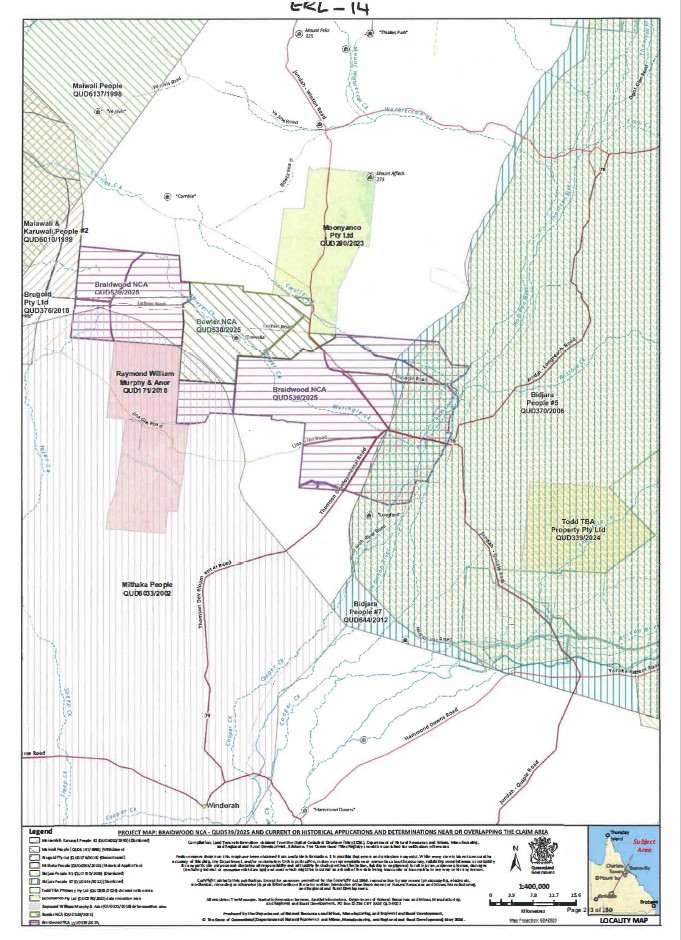
THE COURT ORDERS THAT:
1. The non-claimant application is to be determined on the papers without a hearing pursuant to s 86G of the Native Title Act 1993 (Cth).
2. There be a determination of native title in the terms set out below.
3. There be no order as to costs.
THE COURT DETERMINES THAT:
4. Native title does not exist in relation to the land and waters described as:
(a) Lots 1, 2, 3 & 4 on Crown Plan WBN22 (Tenure Reference PH 28/3924); and
(b) Lot 19 on Crown Plan WBN14; Lot 17 on Crown Plan WBN47; and Lots 5 & 18 on Crown Plan WBN48 (Tenure Reference PPH 28/3567); and
(c) Lot 16 on Crown Plan WBN46 (Tenure Reference PH 28/3897); and
(d) Lot 2 on Survey Plan 204908 (Tenure Reference TL 0/231831); and
(e) Lot 4929 on Survey Plan 263579 (Tenure Reference TL 0/237434).
Note: Entry of orders is dealt with in Rule 39.32 of the Federal Court Rules 2011.
REASONS FOR JUDGMENT
LENEHAN J:
1. INTRODUCTION
1 Braidwood Investments (WA) Pty Ltd ACN 103 643 401 (the Applicant) seeks a determination that native title does not exist in relation to the following land and waters:
(1) Lots 1, 2, 3 & 4 on Crown Plan WBN22;
(2) Lot 19 on Crown Plan WBN14, Lot 17 on Crown Plan WBN47, Lots 5 & 18 on Crown Plan WBN48;
(3) Lot 16 on Crown Plan WBN46;
(4) Lot 2 on Survey Plan 204908, known as Wuringle; and
(5) Lot 4929 on Survey Plan 263579, known as Grahgor.
Collectively, the parcels identified in [1(1)]-[1(3)] are referred to as Braidwood.
Collectively, the parcels identified in [1(1)]-[1(5)] are referred to as the Land.
2 The sole respondent to the proceeding is the State Minister for the State of Queensland under the Native Title Act 1993 (Cth) (the NTA) (the State).
3 The Applicant relies upon the following material:
(1) the affidavit of Mark Stewart Boge, solicitor for the Applicant, affirmed on 2 April 2026; and
(2) written submissions (filed on 7 April 2026).
4 The State relies upon the following material:
(1) the affidavit of Louis Laing, solicitor for the Respondent, affirmed on 21 May 2026 (Laing’s Affidavit); and
(2) written submissions (filed on 28 May 2026).
5 On 28 May 2026, the State filed a notice pursuant to s 86G of the NTA, advising the Court that it “does not oppose an order being made in, or consistent with, the terms sought by the Applicant”.
6 On 3 June 2026, the parties advised the Court that they “are content for the issue of whether native title exists in relation to the Land to be determined on the papers without an oral hearing”. I am satisfied that it is appropriate to determine the application on the papers.
7 For the reasons set out below, I consider that the non-claimant application should be allowed.
2. BACKGROUND
8 The Land is located in the vicinity of the township of Jundah in Queensland.
9 The Land is the subject of the following rolling term leases within the meaning of s 164 of the Land Act 1994 (Qld).
(1) Braidwood is covered by three rolling term leases:
(a) PH 28/3924, covering Lots 1, 2, 3 & 4 on Crown Plan WBN22;
(b) PPH 28/3567, covering Lot 19 on Crown Plan WBN14, Lot 17 on Crown Plan WBN47 and Lots 5 & 18 on Crown Plan WBN48; and
(c) PH 28/3897, covering Lot 16 on Crown Plan WBN46.
(2) Wuringle is covered by TL 0/231831.
(3) Grahgor is covered by TL 0/237434.
Together, those leases are referred to as the Leases.
10 The Leases were granted as follows:
(1) PH 28/3924 was initially granted for a term of 30 years commencing on 1 October 1967 and expiring on 30 September 1997, and has since been extended to 30 September 2077;
(2) PPH 28/3567 was initially granted for a term of 30 years commencing on 1 April 1965 and expiring on 31 March 1995, and has since been extended to 31 March 2078; and
(3) PH 28/3897 was initially granted for a term of 30 years commencing on 1 July 1963 and expiring on 30 June 1993, and has since been extended to 30 June 2076;
(4) TL 0/231831 was initially granted for a term of 30 years commencing on 1 November 2007 and expiring on 31 October 2037, and has since been extended to 31 October 2067; and
(5) TL 0/237434 was granted for a term of 40 years commencing on 1 March 2014 and expiring on 28 February 2054.
11 The Applicant is the registered lessee of the Leases. It became the registered lessee of:
(1) the three leases covering Braidwood on 3 December 2013;
(2) the lease covering Wuringle on 28 February 2014; and
(3) the lease covering Grahgor on 19 April 2022.
12 The Applicant wishes to convert the Leases to freehold title. To that end, on 17 May 2024, it applied to the former Queensland Department of Resources (now the Queensland Department of Natural Resources and Mines, Manufacturing and Regional and Rural Development) (the Queensland Department) to convert the Leases.
13 As part of that process, the Applicant was required to address native title in accordance with the NTA, either by obtaining a determination that native title does not exist or by entering into an Indigenous Land Use Agreement (ILUA). As was observed by a Full Court of this Court in Mace v State of Queensland (2019) 274 FCR 41 at [19], such requirements appear to be applied as a matter of course by the executive government of the State of Queensland in connection with the conversion of leased land to freehold title.
14 The Applicant submitted that it pursued a negative determination rather than an ILUA because there is no group, of which it is aware, with whom such an agreement could be made.
15 During 2025 and early 2026, the Queensland Department advised that, subject to certain conditions, approval would be sought for a freehold conversion of four of the five Leases:
(1) on 29 May 2025, the lease over Lots 1, 2, 3 & 4 on Crown Plan WBN22;
(2) on 27 January 2026, the lease over Wuringle;
(3) on 17 February 2026, the lease over Lot 16 on WBN46; and
(4) on 30 April 2026, the lease over Grahgor.
16 No equivalent advice has been issued in respect of PPH 28/3567, which covers the balance of Braidwood. The State explains that this is because “the lease has not previously been subject to tenure that would extinguish any native title nor has native title been surrendered or determined not to exist over the land”: see [6] of the State’s submissions. Consistently with that position, Laing’s affidavit records at [8] that: “As at 21 May 2026, the Files do not include any documentation showing that an offer for conversion to freehold has been made in respect of PPH 28/3567 which covers Lot 19 on Crown Plan WBN14; Lot 17 on Crown Plan WBN47; and Lots 5 & 18 on Crown Plan WBN48”. Nonetheless, the State submits that any future offer from the Queensland Department to convert PPH 28/3567 to freehold would likely also be conditional upon the Applicant addressing native title: see [6] of the State’s submissions. As I have noted above, that is consistent with the experience of this Court, leading the Court in Mace (2019) 274 FCR 41, to observe at [19] that applications such as the present are “a common form of non-claimant application”.
3. NOTIFICATION OF THE NON-CLAIMANT APPLICATION
17 On 15 August 2025, the Applicant filed a “Native Title Determination Application – Non-claimant Application” (the non-claimant application).
18 On 18 August 2025, the National Native Title Tribunal (the NNTT) provided a copy of the non-claimant application to the State.
19 On 1 October 2025, the NNTT advised the Queensland Department that it had, in accordance with s 66(3) of the NTA, provided a copy of the non-claimant application to, among others, “any representative Aboriginal/Torres Strait Islander body for any of the area covered by the application” (being Queensland South Native Title Services (QSNTS)) and “any local government body for any of the area covered by the application”: see p 60 of Laing’s Affidavit.
20 The notification period commenced on 22 October 2025 and ended on 21 January 2026.
21 On 28 January 2026, the NNTT advised that there were no relevant entries on the “Register of Native Title Claims and Schedule of Applications” that fell within the external boundaries of the Land.
22 As of 21 May 2026, the State remained the only respondent to the non-claimant application.
4. PREVIOUS OVERLAPPING CLAIMANT APPLICATIONS
23 On 6 May 2026, the State was provided with a map showing “the Land, all current or historical native title applications, all determinations of native title, and all ILUAs in proximity to, or overlapping with, the Land”: see “ERL-14” to Laing’s Affidavit (reproduced as “Annexure A” to these reasons). The map indicated that, at various times, the Land was partially overlapped by the following four native title applications:
(1) Eatts and others on behalf of Maiawali and Karuwali People #2 v State of Queensland (the Maiawali and Karuwali #2 claim), filed on 19 March 1999 in proceeding QUD 6010 of 1999 and dismissed on 26 February 2010;
(2) Scott Gorringe & Ors on behalf of Mithaka People v State of Queensland & Ors (the Mithaka claim), filed on 28 November 2002 in proceeding QUD 6033 of 2002 and determined by consent on 27 October 2015;
(3) Fraser and others on behalf of the Bidjara People (No 5) v State of Queensland (the Bidjara #5 claim), filed on 28 September 2006 in proceeding QUD 370 of 2006 and dismissed on 18 May 2007; and
(4) Waterton and others on behalf of the Bidjara People (No 7) v State of Queensland (the Bidjara #7 claim), filed on 15 November 2012 in proceeding QUD 644 of 2012, and dismissed on 5 July 2016.
24 I briefly consider each of those native title applications.
4.1 The Maiawali and Karuwali #2 claim
25 The very edge of the western boundary of Grahgor was previously overlapped by the Maiawali and Karuwali #2 claim. The overlap was minor and constituted approximately 0.35% of the area of Grahgor.
26 The Maiawali and Karuwali #2 claim was a “lot-specific” native title claim, meaning that it was defined by reference to particular lots and plans rather than by an external boundary. Grahgor was not included within the claim area. However, Survey Plan 263579 shows that Grahgor shares its eastern boundary with Lot 3 on FR14, which formed part of the claim.
27 On 26 February 2010, the Maiawali and Karuwali #2 claim was dismissed.
28 Although a number of other Maiawali and/or Karuwali claims have since been made, none overlapped or abutted the Land. Each was ultimately withdrawn or dismissed.
29 As of 21 May 2026, no Maiawali and/or Karuwali person has sought to be joined as a respondent to the non-claimant application the subject of this proceeding.
4.2 The Mithaka claim
30 The southern part of Grahgor and the southwestern part of Wuringle were previously overlapped by the Mithaka claim. However, before the claim was determined, its boundaries were amended so as to remove any overlap with the Land.
31 On 27 October 2015, a determination of native title was made by consent in relation to the amended claim area: Gorringe on behalf of the Mithaka People v State of Queensland [2015] FCA 1116. The determination area does not overlap the Land and is located approximately 57.67 kilometres to its southwest.
32 Since that consent determination, the Mithaka People have not made any further native title determination applications.
33 As of 21 May 2026, no Mithaka person has sought to be joined as a respondent to the non-claimant application the subject of this proceeding. Nor did any Mithaka person seek to be joined as a respondent in proceeding QUD 171 of 2018, which concerned a negative determination application in relation to land abutting the Land: Murphy v State of Queensland [2021] FCA 81.
4.3 The Bidjara #5 claim and the Bidjara #7 claim
34 The eastern parts of Braidwood and Wuringle were previously overlapped by the Bidjara #5 claim.
35 A separate claim made on behalf of the Bidjara People in proceeding QUD 216 of 2008 was located further east of the Land and neither adjoined nor overlapped it (the Bidjara #6 claim).
36 The Bidjara #5 claim was not accepted for registration by the Native Title Registrar of the NNTT and was subsequently dismissed by the Court on 18 May 2007.
37 Part of the Bidjara #6 claim was dismissed by Jagot J in Wyman on behalf of Bidjara People v State of Queensland (No 2) [2013] FCA 1229. The balance of the Bidjara #6 claim, together with the Bidjara #7 claim, was summarily dismissed by Jagot J in Wyman on behalf of the Bidjara People v State of Queensland [2016] FCA 777. At [31], her Honour held that permitting those claims to continue would constitute an abuse of process.
38 As of 21 May 2026, no Bidjara person has sought to be joined as a respondent to the non-claimant application the subject of this proceeding.
39 Ultimately, all native title determination applications that previously overlapped the Land have been withdrawn or dismissed.
5. NATIVE TITLE DETERMINATIONS PROXIMATE TO THE LAND
40 The closest native title determinations to the Land (apart from the Mithaka claim referred to above) are:
(1) Todd TBA Property Pty Ltd v State Minister for the State of Queensland (QUD 339 of 2024), in which the Court determined on 19 September 2025 that native title does not exist (see [2025] FCA 1151);
(2) Moonyanco Pty Ltd as Trustee under Instrument 719523925 v State Minister for the State of Queensland (QUD 290 of 2023), in which the Court determined on 16 August 2024 that native title does not exist (see [2024] FCA 931);
(3) Murphy v State of Queensland (QUD 171 of 2018), in which the Court determined on 9 February 2021 that native title does not exist (see [2021] FCA 81); and
(4) Wallace on behalf of the Boonthamurra People v State of Queensland (QUD 435 of 2006), in which the Court determined on 25 June 2015 that native title does exist (see [2015] FCA 600).
41 Of the “negative” native title determinations, Moonyanco and Murphy abut the Land. The Moonyanco determination area abuts the northeastern boundary of Grahgor, while the Murphy determination area abuts the southern boundary of Grahgor and the eastern boundary of Wuringle. The Todd determination area lies to the east of the Land and does not adjoin it.
42 The State Minister for the State of Queensland was the sole respondent in Todd, Moonyanco and Murphy (see [3] of [2025] FCA 1151; [30] of [2024] FCA 931; [43] of [2021] FCA 81), and filed a notice pursuant to s 86G of the NTA in each proceeding (see [3] of [2025] FCA 1151; [4] of [2024] FCA 931; [2] of [2021] FCA 81). In each case, the Court determined that native title does not exist.
43 The closest “positive” native title determination to the Land (other than the Mithaka claim referred to above) is Boonthamurra. On 25 June 2015, the Court made a consent determination that native title exists in favour of the Boonthamurra People: [2015] FCA 600. The determination area is located approximately 52.48 kilometres south of the Land and does not abut the Land.
44 Ultimately, there are no current native title determination applications that overlap, adjoin, or are located in close proximity to the Land.
6. LEGISLATIVE FRAMEWORK
45 I will now briefly set out the relevant statutory provisions of the NTA.
46 First, s 13(1)(a) of the NTA provides for the making of an application to the Court under Part 3 for a determination of native title in relation to an area for which there is no approved determination of native title. Relevantly, s 61(1) provides that such an application may be made by a person who holds a non-native title interest in relation to the whole of the area in relation to which the determination is sought. Section 253 defines “interest” to include a legal or equitable estate or interest in the land or waters.
47 Secondly, s 253 of the NTA distinguishes between “claimant” applications and “non-claimant” applications. A claimant application is a native title determination application authorised by a native claim group. Any native title determination application that is not a claimant application is a non-claimant application.
48 Thirdly, once a native title determination application is filed with the Court, the application and other prescribed documents must be provided to the Native Title Registrar, who is then required to take the notification steps prescribed by s 66 of the NTA. Relevantly, notice must be given to the relevant State or Territory Minister, representative bodies for the area covered by the application, and the public: ss 66(2), 66(2A), and 66(3)(d). Section 66(10) imposes further requirements as to the content of that notice. This includes a requirement for a statement to the effect that any person wishing to become a party to the proceeding must notify the Court within three months of the notification day specified in the notice, unless the Court grants leave to do so later: s 66(10)(c).
49 Fourthly, an application is unopposed if no party opposes an order in, or consistent with, the terms sought by the applicant: s 86G(2) of the NTA. In those circumstances, the Court may make a determination without holding a hearing if the other requirements of s 86G(1) are satisfied. Relevantly, the period specified in the notice given under s 66 of the NTA must have ended, the Court must be satisfied that the orders sought are within power, and it must appear appropriate to make the orders sought.
50 Finally, s 94A of the NTA requires that any order determining native title set out the matters specified in s 225. Relevantly, s 225 provides that a determination of native title is a determination whether or not native title exists in relation to a particular area of land or waters.
7. LEGAL PRINCIPLES
51 The principles applicable to non-claimant applications were considered by the Full Court in Mace (2019) 274 FCR 41.
52 In Wagonga Local Aboriginal Land Council v Attorney-General (NSW) [2020] FCA 1113 at [10], Jagot J summarised those principles (with reference to Mace and Worimi v Worimi Local Aboriginal Land Council (2010) 181 FCR 320) in this (helpful) way (omitting those matters from her Honour’s summary that are not relevant to this case):
(1) …
(2) The reason for a non-claimant application does not govern the Court’s approach to the exercise of the power: [42].
(3) Whether there is a contradictor to a non-claimant application or not, the legal question remains the same: has the applicant discharged its burden of proof that no native title exists in the area the subject of the non-claimant application: [44].
(4) The overriding proposition is that each case must be assessed on its own particular facts: [47].
(5) Relevant considerations will include the nature of the land and the tenure involved, the presence or absence of any present or previous native title claims and the nature and content of those claims, and any particular evidence adduced by the parties: [48].
(6) The Court must act on evidence, direct or indirect, which can be weighed against the case brought by the non-claimant applicant: [52].
(7) All issues are to be assessed on the usual standard of proof in civil litigation – proof on the balance of probabilities. A non-claimant applicant will either meet this standard or will not: [54].
(8) A non-claimant application does not involve any general inquiry into what native title rights and interests may have existed at sovereignty or any general inquiry into how those rights or interests may or may not have continued: [55].
(9) The provisions of the NTA are intended to facilitate all persons with a proper interest in an area of land taking steps to ensure that their interest is taken into account when the Court is making a native title determination with respect to that land. However, it is not necessary to employ evidentiary or adversarial presumptions to the task which may have been developed by the common law in different contexts from native title determinations: [56]. A better approach is to focus on what the evidence before the Court does establish, whether before or against the determination sought by the non-claimant applicant: [56]. Similarly common law maxims developed in different contexts are also of limited utility to the determination of a non-claimant application: [57]-[60].
(10) In a non-claimant application the applicant seeks a negative determination in rem. In this context recourse to common law maxims developed in different contexts may not be useful: [61].
(11) …
(12) The question whether native title does not exist (in a non-claimant application) or does exist (in a claimant application) is to be decided according to the balance of probabilities by reference to the circumstances of each case and on the evidence adduced without recourse to maxims or presumptions originating in different adversarial contexts: [64]. In this regard it may be noted that in Worimi at [74] the point was made that a respondent to a non-claimant application is not subject to any onus of proof. The onus remains at all times on the applicant for the non-claimant application…
(13) In a non-claimant application account needs to be taken of the gravity of a negative determination and its permanency in terms of its effect on native title rights and interests which are otherwise sought to be protected by the NTA: [66].
(14) No hard and fast rules can be laid down about what evidence might be required or might suffice for a non-claimant applicant to meet the required standard of proof: [68]. Given what is at stake and the fact that any determination affects property rights as against the whole world no prescriptive approaches or glosses on the statute should be imposed. The Court has a wide discretion whether or not to make a negative determination and the potential combination of considerations which may arise in any particular application cannot be predicted or turned into any kind of checklist: [72].
(15) If the burden of proof on a non-claimant application has been discharged it may be a rare case in which the discretion is exercised not to make a negative determination but in principle the discretion exists and the Court should not foreclose consideration of the question whether it is appropriate to make the order in all of the circumstances of the case: [73].
(16) The Court’s task is not to be more or less “stringent” depending on the kind of case before it but is to decide if the non-claimant applicant has discharged its burden of proof. In doing so the subject-matter of the non-claimant application and the consequences of a negative determination inform the requisite level of persuasion for a negative determination: [82].
(17) The principal evidence likely to impede the grant of a negative determination is evidence of an assertion of native title in the land the subject of the non-claimant application which is objectively arguable, not evidence of the potential for the assertion of native title. A representative body is best placed to assist Aboriginal and Torres Strait Islander peoples to provide such evidence. The quality of such evidence, rather than its extent, will be determinative: [97].
53 It is also relevant to note the Full Court’s observations in Mace (2019) 274 FCR 41 at [94] concerning the statutory notification process:
[E]vidence of the notification process, and … the absence of any responses will be considered in the context of all the circumstances relating to the land and waters covered by the non-claimant application, including matters such as whether there have been previous claims over the land and waters and the fate of those claims, and what information the relevant representative body (or Land Council) might have about people who may claim connection to the land and waters based on traditional law and custom. There can be no prescription that absence of responses to NNTT notifications should be given great weight, or no weight, or something in between. What is more important, it seems, is that the Court can reasonably expect a representative body for the region in which the non-claimant application land and waters are located to provide some evidence or information to the Court about what it knows, or does not know, about potential native title holders for the claimed area.
8. CONSIDERATION
8.1 Does the Court have the power to make the determination sought?
54 The Court has jurisdiction to hear and determine the present non-claimant application under s 81 of the NTA.
55 In the exercise of that jurisdiction, the Court has power to make the determination sought for the following reasons.
(1) The application relates to an area for which there is no approved determination of native title (s 13(1)(a) of the NTA).
(2) The Applicant, as the registered lessee of the Land, has standing to bring the application under s 61(1) of the NTA because it holds a non-native title interest in relation to the whole of the area the subject of the proposed determination.
(3) The period specified in the notice given under s 66 of the NTA has ended (s 86G(1) of the NTA).
(4) The State, as the sole respondent, has notified the Court in writing that it does not oppose an order in, or consistent with, the terms sought by the Applicant (ss 86G(1)(a) and (2) of the NTA).
(5) The proposed determination involves the making of a determination of native title (ss 81 and 86G(1)(b) of the NTA) and otherwise complies with ss 94A and 225 of the NTA.
8.2 Has the Applicant established that no native title exists?
56 Bearing in mind the gravity of the consequences of making a non-claimant native title determination (see eg Mace (2019) 274 FCR 41 at [66]-[67]), I am satisfied, on the balance of probabilities, that native title does not exist in relation to the Land for the following reasons.
(1) There is no approved determination of native title covering the Land, and no native title determination application is currently registered over it.
(2) As for the previously overlapping claims:
(a) the Maiawali and Karuwali #2 claim was dismissed on 26 February 2010;
(b) all other Maiawali and/or Karuwali claims (none of which abutted the Land) were ultimately withdrawn or dismissed;
(c) although the Mithaka claim originally overlapped part of the Land, its boundaries were amended prior to the making of a consent determination so as to remove that overlap; and
(d) the Bidjara #5, #6 and #7 claims were ultimately dismissed.
(3) Despite notice of the non-claimant application being given to QSNTS and public notification being published in the Koori Mail, the Barcoo Independent, and the Longreach Leader, no person has made a native title claim in relation to the Land. Nor has QSNTS, or any other person, sought to be joined as a respondent for the purpose of asserting the existence of native title.
(4) As the Full Court explained in Mace (2019) 274 FCR 41 at [94], the absence of a response is not determinative and must be considered in the context of all of the circumstances. Nevertheless, in the circumstances of the present case, I consider it appropriate to give some weight to QSNTS’s decision not to participate in the proceeding.
(a) QSNTS has previously been involved in a number of native title claims concerning, or in the vicinity of, the Land, including the Maiawali and Karuwali #2 claim, the Mithaka claim, and a subsequent Maiawali claim (in proceeding QUD 585 of 2011).
(b) Further, QSNTS has taken an active role in native title proceedings in the region, including in relation to the Bidjara #7 claim, where it filed an interlocutory application seeking summary dismissal of the proceeding.
(c) In those circumstances, it is reasonable to expect that, had QSNTS been aware of any person or group with a potential native claim to the Land, it would have taken some step in response to the present non-claimant application.
(5) There have been successful claimant and non-claimant native title determinations in areas close to the Land.
(a) Boonthamurra represents a successful claimant application in an area proximate to the Land. But no member of the Boonthamurra People sought to be joined as a respondent to this proceeding.
(b) Further, Todd, Moonyanco and Murphy represent successful non-claimant applications in areas proximate to the Land.
(c) While none of those determinations is determinative of the present application, they form part of the broader factual context in which the absence of any current or competing claim to native title over the Land is to be assessed. In particular, the absence of any response from neighbouring native title holders, together with the existence of recent non-claimant determinations in nearby areas, tends to support an inference that “there are no persons or groups with a potential native title claim over the application area that is presently objectively arguable”: see Todd [2025] FCA 1151 at [49]-[50] (Stellios J), referring to Mace (2019) 274 FCR 41 at [97] and Wagonga [2020] FCA 1113 at [10(17)].
(6) Nor is there anything else in the material before me pointing to an assertion of native title rights and interests in the Land that is objectively arguable.
57 Taken together, these matters support the conclusion that native title does not exist in relation to the Land.
8.3 Discretion
58 As the Full Court observed in Mace (2019) 274 FCR 41 at [73], even where a non-claimant applicant has established on the balance of probabilities that native title does not exist, the Court retains a discretion whether to make the negative determination sought:
We also consider that even though these are not unopposed applications under s 86G, the Court is able to consider as a factor in the exercise of its power whether it is “appropriate” to make a determination that no native title exists, even if a non-claimant applicant has proven on the balance of probabilities that no native title exists. The cases might be rare indeed where, if the burden of proof is discharged, a Court would consider it inappropriate to make a negative determination. However, in principle it may be no different to the Court’s discretion to withhold relief in proceedings brought in other parts of its jurisdiction where an applicant has otherwise made out a case for relief. The circumstances which arise in the consideration of a determination to be made under the NT Act are broad, and new circumstances may yet arise, so that the Court should not foreclose consideration of such a factor. The “appropriateness” consideration governs and is a condition of the exercise of power in s 86G, and we see no reason why it is not at least a permissible factor to consider in a contested application.
59 In the present case, having concluded that native title does not exist in relation to the Land, I am satisfied that no circumstances arise which would warrant the exercise of the discretion identified in Mace. The evidence before me does not suggest that this is one of the “rare” cases in which the Court should decline to make the negative determination sought by the Applicant.
9. CONCLUSION
60 For these reasons, I consider that it is appropriate, pursuant to s 86G of the NTA, to determine the unopposed non-claimant application on the papers without a hearing. Further, having concluded on the balance of probabilities that native title does not exist in relation to the Land, and being satisfied that there is no reason to decline to make the determination sought, I will make a determination that native title does not exist in relation to the Land.
61 There will be no order as to costs.
I certify that the preceding sixty-one (61) numbered paragraphs are a true copy of the Reasons for Judgment of the Honourable Justice Lenehan. |
Associate:
Dated: 18 September 2026
ANNEXURE A