

Federal Court of Australia
Shepard (Administrators), in the matter of Edge Early Learning Holdings Pty Ltd (Administrators Appointed) [2026] FCA 1376
File number: | QUD 589 of 2026 |
Judgment of: | WHEATLEY J |
Date of judgment: | 3 September 2026 |
Date of publication of reasons: | 17 September 2026 |
Catchwords: | CORPORATIONS — Application to dispense with the requirement to maintain separate administration accounts for each of the companies under Div 65 of the Insolvency Practice Schedule (Corporations) — Where one company acted as quasi-treasury for the entire corporate group — Orders sought nunc pro tunc — Orders made. CORPORATIONS — Application to form a single committee of inspection for a large group of companies under administration — Where it would be more efficient to form one committee of inspection — Single committee of inspection ordered. |
Legislation: | Corporations Act 2001 (Cth) ss 435A, 436A Insolvency Practice Schedule (Corporations) ss 65-45, |
Cases cited: | Kelly (Administrator), in the matter of Lutum Holdings Pty Ltd (Administrators Appointed) [2024] FCA 554 Korda, in the matter of Ten Network Holdings (Administrators Appointed) (Receivers and Managers Appointed) [2017] FCA 1144 Re Shepard (in their capacity as joint and several voluntary administrators of GROCON Pty Ltd (Administrators Appointed) (No 3) [2021] VSC 36 Re Strawbridge (in their capacity as joint and several voluntary administrators of each of Virgin Australia Holdings Ltd (Administrators Appointed) (ACN 100 686 226)) (No 2) (2020) 144 ACSR 347; [2020] FCA 717 Strawbridge (in their capacity as joint and several voluntary administrators of each of Virgin Australia Holdings (Administrators Appointed (ACN 100 686 226)) (2020) 144 ACSR 310; [2020] FCA 571 |
Division: | General Division |
Registry: | Queensland |
National Practice Area: | Commercial and Corporations |
Sub-area: | Corporations and Corporate Insolvency |
Number of paragraphs: | 30 |
Date of hearing: | 3 September 2026 |
Counsel for the Plaintiffs: | Mr C Wilkins KC with Mr A Psaltis |
Solicitor for the Plaintiffs: | Clayton Utz |
ORDERS
QUD 589 of 2026 | ||
IN THE MATTER OF EDGE EARLY LEARNING HOLDINGS PTY LTD (ADMINISTRATORS APPOINTED) ACN 618 453 197 | ||
CRAIG PETER SHEPARD, DAVID MARTIN JOHNSTONE AND STACEY AMBER CLISBY IN THEIR CAPACITY AS JOINT AND SEVERAL VOLUNTARY ADMINISTRATORS OF EDGE EARLY LEARNING HOLDINGS PTY LTD (ADMINISTRATORS APPOINTED) ACN 618 453 197 First Plaintiff EDGE EARLY LEARNING HOLDINGS PTY LTD (ADMINISTRATORS APPOINTED) Second Plaintiff EDGE EARLY LEARNING ADMINISTRATION PTY LTD (ADMINISTRATORS APPOINTED) (and others named in the Schedule) Third Plaintiff | ||
order made by: | WHEATLEY J |
DATE OF ORDER: | 3 SEPTEMBER 2026 |
THE COURT ORDERS THAT:
1. Pursuant to Federal Court (Corporations) Rules 2000 (Cth) (CR), r.1.10 and Federal Court Rules 2011 (Cth), r 1.39, the time for service of the originating process is shortened so as to permit that application to be heard today.
2. Pursuant to ss 65-45 and 90-15 of the Insolvency Practice Schedule (Corporations) 2016 (IPS), being Schedule 2 to the Corporations Act 2001 (Cth) (Corporations Act), notwithstanding the operation of IPS, Division 65, nunc pro tunc from 25 August 2026:
(a) the first plaintiffs are not required to maintain a separate administration account in relation to each of the second to forty fifth plaintiffs (the Companies, with each being a Company);
(b) IPS, s 65-5(1) is to operate in relation to each of the Companies such that the first plaintiffs must pay all money received by them on behalf of or in relation to any one of the Companies into the administration account in the name of the third plaintiff, Edge Early Learning Administration Pty Ltd (administrators appointed) (the Treasury Administration Account);
(c) IPS, s 65-15(1) is to operate in relation to each of the Companies such that the first plaintiffs must not pay any money into an administration account for any of the Companies, including the Treasury Administration Account, if the moneys are not received by the first plaintiffs on behalf of or in relation to one or more of the Companies;
(d) IPS, s 65-25 is to operate in relation to each of the Companies such that the first plaintiffs must not pay any money out of the Treasury Administration Account, or the account of the second plaintiff, otherwise than:
(i) for purposes related to the external administration of any one or more of the Companies;
(ii) to transfer funds received into the Treasury Administration Account, on behalf of or in relation to one or more of the Companies, to an account for the benefit of the Company entitled to those funds;
(iii) in accordance with the Corporations Act; or
(iv) in accordance with any further order or direction of the Court.
3. Pursuant to Corporations Act, s 447A(1) and IPS, s 90-15, notwithstanding the operation of IPS, Divisions 75 and 80 and Insolvency Practice Rules (Corporations) 2016 (Cth) (IPR), Division 75, those Divisions are to operate as follows:
(a) The requirements of IPS, ss 80-10 and 80-15 (for the creditors of a Company to resolve that a committee of inspection be formed and to appoint members of the committee of inspection) are dispensed with.
(b) A single committee of inspection is to be formed in respect of the Companies.
(c) Subject to (d)-(g) below, the members of the committee of inspection are to be persons proposed by the first plaintiffs from nominations made to them in advance of, or at, the first meetings of the creditors of the Companies (the First Meeting).
(d) No later than three business days after the First Meeting, the first plaintiffs are to put a proposal (the Proposal) to the creditors of the Companies (by giving notice in conformity with Order 4 below) and, subject to (e) and (f) below, otherwise in accordance with IPS, s 75-40 that the members of the committee of inspection be those persons proposed by the first plaintiffs, and inviting the creditors of the Companies to vote either Yes or No on the Proposal.
(e) The option of the creditors being permitted to object to the Proposal being determined without a meeting of creditors is dispensed with.
(f) The time in IPR, s 75-130(3) is abridged from 15 business days to five business days.
(g) If the Proposal is taken to have passed in accordance with IPR, s 75-130(2), then the members of the committee of inspection are to be those persons proposed by the first plaintiffs.
4. Pursuant to Corporations Act, s 447A(1) and IPS, s 90-15, notice to the creditors of the Companies of the Proposal, as well as other matters, is to be given as follows:
(a) Where the first plaintiffs have an email address for a creditor – by notifying the creditor of the relevant matter via email.
(b) Where the first plaintiffs do not have an email address for a creditor (or have received notification of non-delivery of a notice sent by email in accordance with (a) above) but have a postal address for that creditor – by notifying the creditor in writing of the relevant matter via post.
(c) By publishing notice of the relevant matter on the website maintained by the first plaintiffs at https://kordamentha.com/creditors/edge-early-learning-groupof-companies/.
(d) To the extent the matter relates to a meeting that is the subject of IPR, s 75-40(4), by causing notice of the meeting to be published on the ASIC published notices website at https://insolvencynotices.asic.gov.au/.
5. Pursuant to Corporations Act, s.447A(1) and IPS, s 90-15, that, to the extent not permitted specifically by IPR, s 80-5(3):
(a) a meeting of the committee of inspection may be convened by electronic notice sent to an email address specified by each of the members of the committee of inspection; and
(b) a meeting of the committee of inspection may be permitted to be held by telephone or audio-visual conference (only, and in place of a physical meeting) with such details of the arrangements for using the telephone or audio-visual conference facilities to be specified in each of the notices issued to, or by, the members of the committee of inspection.
6. The first plaintiffs must take all reasonable steps to cause notice of these orders to be given, within three business days of the making of these orders, to the Australian Securities and Investments Commission and to the creditors (including persons or entities claiming to be creditors) of each of the Companies, in the following manner:
(i) Where the first plaintiffs have an email address for a creditor – by notifying the creditor, via email, of the making of these orders and providing a link to a website where the creditor may download these orders, the originating process and the supporting affidavit of Craig Peter Shepard.
(ii) Where the first plaintiffs do not have an email address for a creditor (or have received notification of non-delivery of a notice sent by email in accordance with (a) above) but have a postal address for that creditor – by notifying the creditor, via post, of the making of the orders and providing a link to a website where the creditor may download these orders, the originating process and the supporting affidavit of Craig Peter Shepard.
(iii) Placing scanned, sealed copies of these orders, the originating process and the supporting affidavit of Craig Peter Shepard on the website maintained by the first plaintiffs at: https://kordamentha.com/creditors/edge-early-learning-groupof-companies/.
7. The following persons have liberty to apply:
(a) Any person with sufficient interest to seek to modify any of Orders 1 to 5 above, including the Australian Securities and Investments Commission, on the giving of not less than three business days’ notice to the first plaintiffs.
(b) The first plaintiffs, for any purpose connected with the administration of the Companies.
8. The first plaintiffs’ costs of and incidental to this application are their costs in the administrations of each of the Companies, jointly and severally.
Note: Entry of orders is dealt with in Rule 39.32 of the Federal Court Rules 2011.
REASONS FOR JUDGMENT
Delivered ex tempore, revised from transcript
WHEATLEY J:
Introduction
1 The first Plaintiffs are the Administrators of the 2nd to 45th Plaintiffs, which will be described in further detail below. That group of companies is known as the Edge Early Learning Group (Learning Group). Learning Group conducts childcare, kindergarten and preschool businesses in Queensland, South Australia, and the Australian Capital Territory. The Administrators were appointed on 25 August 2026 pursuant to s 436A of the Corporations Act 2001 (Cth) (Corporations Act).
2 The Administrators bring this application urgently today in the duty list, primarily seeking relief from the strict compliance with certain requirements of conducting the administration under the Corporations Act. Those being:
(1) the requirement to maintain separate administration accounts for each of the companies: see Div 65 of the Insolvency Practice Schedule (Corporations) (IPSC); and
(2) permission to form a single committee of inspection for all of the Learning Group entities.
3 The Originating Application pursuant to which this relief is sought has only been filed with the Court today. As such, the Administrators also seek an abridgement of the time for service, having brought the matter on urgently. The first meeting of creditors pursuant to s 436A is due to take place tomorrow, Friday, 4 September 2026 at 11.00 am.
4 In those circumstances, it is appropriate that this matter was brought on urgently and dealt with in the duty list. Further, in terms of the final orders that are sought by the Administrators, it is proposed that any person with sufficient interest to seek to modify the orders sought by the Administrators be given liberty to apply to modify those orders. In such circumstances and noting that any short service is somewhat ameliorated by providing that liberty to apply, I am satisfied that in the circumstances it is appropriate to hear this application today and for the time for service to be shortened.
The Administration So Far
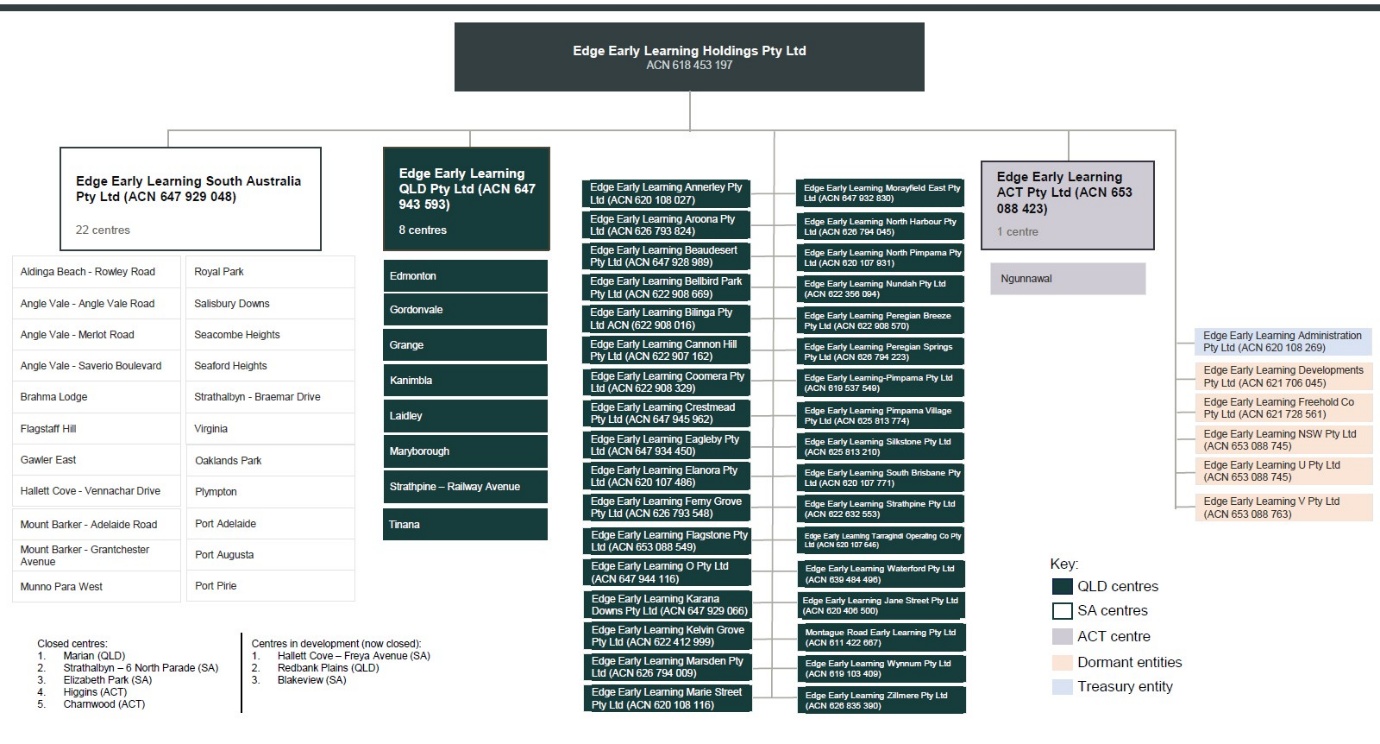
5 The Administrators have undertaken some very preliminary investigations, obtained the books and records of the companies, and spoken with staff including the former chief financial officer of the companies. Learning Group can be relevantly described as follows (Annexure A to these reasons is an entity structure diagram provided by the Administrators at the hearing):
(a) the second Plaintiff, which owns 100% of the shares in the other Learning Group companies, is Edge Early Learning Holdings Pty Ltd (Learning Holdings);
(b) an administration entity (described as the Treasury entity in Annexure A) being the third Plaintiff, Edge Early Learning Administration Pty Ltd (Learning Administration), which is the employer and administration company for the Learning Group; and
(c) the Learning Operating Companies which comprise of:
(i) the Queensland operating entities;
(ii) the South Australian operating entities; and
(iii) the Australian Capital Territory operating entities.
6 There are also five dormant companies which have been identified by the Administrators but the Administrators state that these dormant entities were not involved in the day-to-day operations of the Learning Group at the time of their appointment. The particular identification of each of those Learning Operating Companies is contained in Annexure A.
7 At the time of the Administrators’ appointment, the Learning Group comprised of:
(a) 42 centres in Queensland;
(b) 22 centres in South Australia; and
(c) 3 centres in the Australian Capital Territory,
which totalled 67 centres.
8 The Administrators provide further evidence that some of those centres have been subsequently closed such that, at the date of this hearing, there are 64 centres being operated by the Administrators of the entities comprising of the Learning Group.
9 The Administrators give evidence that Learning Administration employs all of the employees for the entire Learning Group (including each of the Learning Operating Companies) and, predominantly, the creditors are creditors of Learning Administration. The Learning Group has approximately 1600 employees across the centres and operates from premises such that there are 43 relevant landlords and approximately 168 trade creditors, and other creditors.
10 The Administrators have commenced a sale program of the Learning Group and, given the short period for which the Administrators have been conducting the administration, are not yet in a position to state whether or not the Learning Group will be sold as a whole or, in some way, broken up for the purposes of sale.
11 However, the Administrators have given evidence that some interest has already been generated from potential purchasers. The Administrators have also expressed the opinion that selling Learning Group’s business or even parts thereof would give the best possible prospect of generating a return for creditors.
SHOULD Relief from Div 65 OF the ipsc BE GRANTED?
12 Pursuant to s 65-5(1):
External administrator must pay money into the administration account
(1) The external administrator of a company must pay all money received by the external administrator on behalf of, or in relation to, the company into an administration account for that company within 5 business days after receipt.
13 Further, s 65-15 requires that an administrator not pay other moneys into such an administration account. Section 65-25 prohibits an administrator from paying money out of an administration account other than for purposes related to the administration of that company or otherwise in accordance with the Corporations Act or order of the court. There is provision in Div 65 by way of s 65-45 which enables the court to give directions in relation to payments made or payable and authorising the external administrator to make payments into and out of a special bank account.
14 Middleton J in Re Strawbridge (in their capacity as joint and several voluntary administrators of each of Virgin Australia Holdings Ltd (Administrators Appointed) (ACN 100 686 226)) (No 2) (2020) 144 ACSR 347; [2020] FCA 717 described and referred to a decision of Markovic J to which I will return, that s 65-45 of the IPSC provides a plenary power equivalent to s 447A with respect to Pt 5.3A of the Corporations Act to make orders modifying the arrangements with respect to the operation of the administration accounts: see [196]. Markovic J in Korda, in the matter of Ten Network Holdings (Administrators Appointed) (Receivers and Managers Appointed) [2017] FCA 1144 described at [91] and accepted at [94] the relevant principles, which I also accept, can be summarised as follows:
(1) the power to make directions under s 65-45 is a broad power and includes the power to direct that external administrators be permitted to act in a manner that is inconsistent with the obligations set out in Div 65;
(2) the directions must be made in the interests of the company’s creditors and be consistent with the objectives of Div 65, including the maintenance of proper standards of funds handling and record keeping in relation to the company’s affairs while under external administration and the reduction of unnecessary costs and inefficiencies in the conduct of the external administration;
(3) the creditors of the company should not be prejudiced or disadvantaged by any directions that are sought; and
(4) in some instances it may be necessary to give notice to those who may be affected by the proposed directions.
15 Halley J in Kelly (Administrator), in the matter of Lutum Holdings Pty Ltd (Administrators Appointed) [2024] FCA 554 at [62], has also adopted those principles.
16 The orders sought by the Administrators in relation to Div 65 are on the basis that such orders be made nunc pro tunc; that is to validate retrospectively arrangements for the handling of funds in the administration which has already occurred.
17 When the Administrators were appointed, the Learning Group already had in place a particular financial arrangement and process which has been inherited by the Administrators. That arrangement and process can relevantly and broadly be described as one where the Learning Operating Companies would receive payments from parents and/or customers as well as payments from the Commonwealth in relation to the Commonwealth subsidies. Each day the Learning Operating Companies’ bank accounts would be “swept” for funds, leaving only a modest amount in each of those Learning Operating Companies’ bank accounts to allow for small subscriptions and the like. The majority of funds were collected by this daily “sweep” and placed in a bank account of Learning Administration. As already observed, Learning Administration then paid employees and other creditors from that centralised point.
18 The requirements of Div 65 without any modification would require the Administrators of each Learning Operating Company to separately retain the funds received from parents, customers and the Commonwealth and then to make any payments which might be required, by that entity. The immediate difficulty is clear in that the Learning Operating Companies do not employ the relevant employees for each centre, nor do they deal with the relevant creditors, including trade creditors, directly. The arrangement and process which the Administrators have inherited is one where there has been a centralised operation of the overall Learning Group by Learning Administration. The orders that are sought by the Administrator on this application are orders to effectively continue that previous arrangement and process. That is subject to establishing a new bank account for Learning Administration, then it is proposed to operate Learning Group in a way which is consistent with the arrangement and process that Learning Group previously operated.
19 Turning then to the relevant factors which should be considered on such an application in accordance with the principles that are outlined above. It is appropriate in this case to make the orders that are sought in relation to Div 65 because:
(1) the Learning Group of companies that are under administration all form part of a corporate group and Learning Administration has historically acted as a quasi-treasury company for that group. I will return to why I have described it as quasi;
(2) the Administrators give evidence on the application that they will keep records of all of the payments made by Learning Administration on behalf of any of the other companies in Learning Group to ensure that proper records are maintained and a reconciliation can occur at any time;
(3) the Learning Group did not have established deeds of cross-guarantee amongst those entities (which is why, in part, I have described Learning Administration as a quasi-treasury company). However, it can be observed that all of the entities in Learning Group are liable to the main secured creditor, being the Commonwealth Bank;
(4) strict compliance with the requirements of Div 65 would require separate administration bank accounts to be opened in the name of each Learning Operating Company. It would also then require potentially either invoices to be raised, or other administrative steps to be taken to facilitate an ability for funds to be transferred between the Learning Operating Companies and Learning Administration. Learning Administration does not, of itself, generate revenue but as already observed, it is the entity which is liable to pay employees and other trade creditors; and
(5) the Administrators of the Learning Group have only been appointed for a short time. The Administration only commenced on 25 August 2026 and it is simply not known at this stage what the ultimate outcome of the administration will be including, relevantly, whether or not there will be a joint or overall sale of the Learning Group, which might be subject to a deed of company arrangement, or whether some other arrangements might eventuate.
20 The Administrators seek these orders nunc pro tunc because they had to make a substantial payment on 27 August 2026 for employees and a subsequent payment for PAYG tax and superannuation guarantee levies, a few days later. To facilitate such payments, the Administrators have transferred moneys from Learning Holdings. The Administrators have stated in their evidence to the Court that they have not yet engaged in any “sweeping” practice from the Learning Operating Companies’ bank accounts, but it is clear by the terms of the orders that are sought and the way that the companies have historically acted that the Administrators intend to do so, should appropriate orders be made. For those reasons, I am satisfied that the orders sought in this regard are appropriate.
is Relief From SEPARATE CommitteeS of Inspection APPROPRIATE?
21 Ordinarily under the Corporations Act, at the first meeting of creditors, companies in administration must determine whether to appoint a committee of inspection and who should be on that committee. If a committee of inspection was determined to be appointed for each of the companies in Learning Group, there could be some 44 committees of inspection.
22 Middleton J in Strawbridge (in their capacity as joint and several voluntary administrators of each of Virgin Australia Holdings (Administrators Appointed (ACN 100 686 226)) (2020) 144 ACSR 310; [2020] FCA 571 (Virgin (No 1)) at [33]-[35], observed in the particular circumstances of that case whether or not it was appropriate to give effect to the proposal for one committee of inspection and, ultimately, did make orders giving effect to the regime which was proposed by the administrators.
23 Similarly, I have had reference to the principles which were outlined by Gardiner AsJ in Re Shepard (in their capacity as joint and several voluntary administrators of GROCON Pty Ltd (Administrators Appointed) (No 3) [2021] VSC 36 (Re Grocon) at [62]:
I consider that it is appropriate to make the orders sought in respect of a single committee of inspection. In my view, the number of companies involved in the administrations, together with the practical difficulties arising from the COVID-19 environment, mean that following the conventional prescribed procedure requiring an election in respect of each company under administration is not practicable. The prospect of there being 42 separate committees of inspection has the potential to be chaotic and unworkable. The proposed orders enable the involvement of creditors in selecting the members of a single committee of inspection. If there is discontent amongst the creditors with the resulting process, the creditors can apply to the Court to vary the orders which have been made in that regard. The Court must adopt a practical approach and balance a consideration of what amounts to the diminution of the ‘democratic’ rights of the creditors for each of the companies against the benefits of expedition and economy which follow from the formation of a single committee of inspection.
24 One matter which should be noted which is different factually from Virgin (No 1) and Re Grocon was that those cases occurred during the COVID-19 pandemic, which brought together with it practical difficulties from operating in such an environment, that being a restricted environment. However, in my view, the principles that are to be applied are not ones that are restricted by or should be considered to be restricted by the COVID-19 pandemic environment.
25 In the circumstances before Gardiner AsJ his Honour noted there was a prospect of there being 42 separate committees of inspection and that that would potentially be chaotic and unworkable. The similarities between that case and this are obvious.
26 One of the Administrators, Mr Shepard, explains and gives evidence regarding the impracticable, inefficient and the negative impact from a cost point of view, that having up to 44 committees of inspection would have on the administration generally. Obviously, duplications of procedures and costs would be likely. The process proposed is one where a single committee of inspection would be put forward and that would be from creditors who have expressed an interest to be a member of a committee of inspection of the Learning Group of companies. The Administrators have already received three expressions of interest and expect to receive additional interest either prior to or at the meeting which is to occur tomorrow.
27 In the circumstances, I am satisfied that it is appropriate to make the proposed orders to facilitate a single committee of inspection in the way that has been proposed by the Administrators.
Conclusion
28 The Administrators have made this application to the Court, on an urgent basis but have provided detailed submissions and evidence to support the application. The prospect of unsecured creditors potentially being worse off under the arrangements as sought, was drawn to the Court’s attention. However, I accept the submission that at this stage of the administration, the overall likely negative impact being the increase in costs of having to comply strictly with Div 65 and having multiple committees of inspection, in my view, means it is unlikely to be prejudicial to unsecured creditors at this time.
29 It is always difficult to anticipate what will actually occur in an administration, particularly noting the size of the administration and that this application has been brought at a very early stage. However, given the objects of Pt 5.3A as recorded in s 435A, I am satisfied that the orders sought are in accordance with those objects and do seek to maximise the chances of the companies in the Learning Group or as much as possible of its businesses continuing in existence or, if not possible, would likely result in a better return for creditors.
30 The Administrators are continuing to trade the relevant centres of the Learning Group and are of the view that the sale of those businesses as a going concern is the preferable course. There seems to be good reason to support that position. As such, with the amendments that were discussed with counsel during the hearing, I am satisfied to make the orders (amended) as sought.
I certify that the preceding thirty (30) numbered paragraphs are a true copy of the Reasons for Judgment of the Honourable Justice Wheatley. |
Associate:
Dated: 17 September 2026
Annexure A
SCHEDULE OF PARTIES
QUD 589 of 2026 | |
Plaintiffs | |
Fourth Plaintiff: | EDGE EARLY LEARNING QLD PTY LTD (ADMINISTRATORS APPOINTED) |
Fifth Plaintiff: | EDGE EARLY LEARNING ANNERLEY PTY LTD (ADMINISTRATORS APPOINTED) |
Sixth Plaintiff: | EDGE EARLY LEARNING AROONA PTY LTD (ADMINISTRATORS APPOINTED) |
Seventh Plaintiff: | EDGE EARLY LEARNING BEAUDESERT PTY LTD (ADMINISTRATORS APPOINTED) |
Eighth Plaintiff: | EDGE EARLY LEARNING BELLBIRD PARK PTY LTD (ADMINISTRATORS APPOINTED) |
Ninth Plaintiff: | EDGE EARLY LEARNING BILINGA PTY LTD (ADMINISTRATORS APPOINTED) |
Tenth Plaintiff: | EDGE EARLY LEARNING CANNON HILL PTY LTD (ADMINISTRATORS APPOINTED) |
Eleventh Plaintiff: | EDGE EARLY LEARNING COOMERA PTY LTD (ADMINISTRATORS APPOINTED) |
Twelfth Plaintiff: | EDGE EARLY LEARNING CRESTMEAD PTY LTD (ADMINISTRATORS APPOINTED) |
Thirteenth Plaintiff: | EDGE EARLY LEARNING EAGLEBY PTY LTD (ADMINISTRATORS APPOINTED) |
Fourteenth Plaintiff: | EDGE EARLY LEARNING ELANORA PTY LTD (ADMINISTRATORS APPOINTED) |
Fifteenth Plaintiff: | EDGE EARLY LEARNING FERNY GROVE PTY LTD (ADMINISTRATORS APPOINTED) |
Sixteenth Plaintiff: | EDGE EARLY LEARNING FLAGSTONE PTY LTD (ADMINISTRATORS APPOINTED) |
Seventeenth Plaintiff: | EDGE EARLY LEARNING KARANA DOWNS PTY LTD (ADMINISTRATORS APPOINTED) |
Eighteenth Plaintiff: | EDGE EARLY LEARNING KELVIN GROVE PTY LTD (ADMINISTRATORS APPOINTED) |
Nineteenth Plaintiff: | EDGE EARLY LEARNING MARIE STREET PTY LTD (ADMINISTRATORS APPOINTED) |
Twentieth Plaintiff: | EDGE EARLY LEARNING MARSDEN PTY LTD (ADMINISTRATORS APPOINTED) |
Twenty First Plaintiff: | EDGE EARLY LEARNING MORAYFIELD EAST PTY LTD (ADMINISTRATORS APPOINTED) |
Twenty Second Plaintiff: | EDGE EARLY LEARNING NORTH HARBOUR PTY LTD (ADMINISTRATORS APPOINTED) |
Twenty Third Plaintiff: | EDGE EARLY LEARNING NORTH PIMPAMA PTY LTD (ADMINISTRATORS APPOINTED) |
Twenty Fourth Plaintiff: | EDGE EARLY LEARNING NUNDAH PTY LTD (ADMINISTRATORS APPOINTED) |
Twenty Fifth Plaintiff: | EDGE EARLY LEARNING O PTY LTD (ADMINISTRATORS APPOINTED) |
Twenty Sixth Plaintiff: | EDGE EARLY LEARNING PEREGIAN BREEZE PTY LTD (ADMINISTRATORS APPOINTED) |
Twenty Seventh Plaintiff: | EDGE EARLY LEARNING PEREGIAN SPRINGS PTY LTD (ADMINISTRATORS APPOINTED) |
Twenty Eighth Plaintiff: | EDGE EARLY LEARNING PIMPAMA PTY LTD (ADMINISTRATORS APPOINTED) |
Twenty Ninth Plaintiff: | EDGE EARLY LEARNING PIMPAMA VILLAGE PTY LTD (ADMINISTRATORS APPOINTED) |
Thirtieth Plaintiff: | EDGE EARLY LEARNING SILKSTONE PTY LTD (ADMINISTRATORS APPOINTED) |
Thirty First Plaintiff: | EDGE EARLY LEARNING SOUTH BRISBANE PTY LTD (ADMINISTRATORS APPOINTED) |
Thirty Second Plaintiff: | EDGE EARLY LEARNING STRATHPINE PTY LTD (ADMINISTRATORS APPOINTED) |
Thirty Third Plaintiff: | EDGE EARLY LEARNING TARRAGINDI OPERATING CO PTY LTD (ADMINISTRATORS APPOINTED) |
Thirty Fourth Plaintiff: | EDGE EARLY LEARNING WATERFORD PTY LTD (ADMINISTRATORS APPOINTED) |
Thirty Fifth Plaintiff: | EDGE EARLY LEARNING WYNNUM PTY LTD (ADMINISTRATORS APPOINTED) |
Thirty Sixth Plaintiff: | EDGE EARLY LEARNING ZILLMERE PTY LTD (ADMINISTRATORS APPOINTED) |
Thirty Seventh Plaintiff: | MONTAGUE ROAD EARLY LEARNING PTY LTD (ADMINISTRATORS APPOINTED) |
Thirty Eighth Plaintiff: | EDGE EARLY LEARNING JANE STREET PTY LTD (ADMINISTRATORS APPOINTED) |
Thirty Ninth Plaintiff: | EDGE EARLY LEARNING SOUTH AUSTRALIA PTY LTD (ADMINISTRATORS APPOINTED) |
Fortieth Plaintiff: | EDGE EARLY LEARNING ACT PTY LTD (ADMINISTRATORS APPOINTED) |
Forty First Plaintiff: | EDGE EARLY LEARNING DEVELOPMENTS PTY LTD (ADMINISTRATORS APPOINTED) |
Forty Second Plaintiff: | EDGE EARLY LEARNING FREEHOLD CO PTY LTD (ADMINISTRATORS APPOINTED) |
Forty Third Plaintiff: | EDGE EARLY LEARNING NSW PTY LTD (ADMINISTRATORS APPOINTED) |
Forty Fourth Plaintiff: | EDGE EARLY LEARNING U PTY LTD (ADMINISTRATORS APPOINTED) |
Forty Fifth Plaintiff: | EDGE EARLY LEARNING V PTY LTD (ADMINISTRATORS APPOINTED) |


