

FEDERAL COURT OF AUSTRALIA
Alexiou v Australia and New Zealand Banking Group Limited [2026] FCA 1373
File number(s): | NSD 719 of 2020 |
Judgment of: | PERRAM J |
Date of judgment: | 18 September 2026 |
Catchwords: | INDUSTRIAL LAW – adverse action – where events occurred against backdrop of a regulatory investigation into rigging of the bank bill swap rate – where applicant had been stood down, his standing down had been reported by the press, his employment was terminated and his bonuses clawed back or forfeited – where action alleged to have been taken because applicant made complaints including whistleblowing disclosures – whether reverse onus under s 361 of the Fair Work Act 2009 (Cth) was discharged – whether s 340 of the Fair Work Act 2009 (Cth) had been contravened CORPORATIONS – whistleblower protections – banking and financial institutions – where alleged disclosures were made about the rate setting process to the respondent and the regulator – where applicant alleged that he was caused detriment because he had made disclosures – whether the whistleblower protections in Pt 9.4AAA of the Corporations Act 2001 (Cth) and/or Pt VIA Div 1 of the Banking Act 1959 (Cth) had been contravened CONTRACT – employment contract – where deferred bonuses were clawed back or forfeited on termination of employment – where contract required consideration of whether grant of bonus was not justified in light of information that had come to light after the grant – whether clawback was in breach of contract EQUITY – where dismissal and clawback of bonus purportedly for applicant’s inappropriate language in chat messages in breach of workplace policies – where alleged representation that workplace policies would not be enforced – where alleged toxic workplace culture – whether promissory estoppel established – whether waiver, unconscionability or election established DAMAGES – where applicant claimed past and future economic loss – where remuneration included performance-based incentives and grant of deferred equity – where applicant claimed non-economic loss being stress and harm to reputation EVIDENCE – rule in Jones v Dunkel – where former employees were not called by respondent – whether position of former employees clear – whether inference sought to be drawn by applicant is gap filling PRACTICE AND PROCEDURE – where whistleblower case in closing submissions was different – whether case was outside of pleaded case – whether applicant permitted to rely on whistleblower case in closing submissions |
Legislation: | Banking Act 1959 (Cth) ss 5, 52A, 52C, 52D Corporations Act 2001 (Cth) ss 9, 1317AA, 1317AC, 1317AD, 1317AE Evidence Act 1995 (Cth) ss 102, 128, 136, 140 Fair Work Act 2009 (Cth) ss 340, 341, 342, 361, 545 Federal Court Rules 2011 (Cth) rr 16.03, 16.43 |
Cases cited: | Alexiou v Australia and New Zealand Banking Group Limited (Application to Amend Pleading) [2025] FCA 7 Allied Marine Transport Ltd v Vale do Rio Doce Navegacao SA (The Leonidas D) [1985] 1 WLR 925 Australian Competition and Consumer Commission v Colgate-Palmolive Pty Ltd (No 4) [2017] FCA 1590; 353 ALR 460 Australian Competition and Consumer Commission v PT Garuda Indonesia Ltd [2016] FCAFC 42; 244 FCR 190 Australian Securities and Investments Commission v Australian Lending Centre Pty Ltd (No 3) [2012] FCA 43; 213 FCR 380 Australian Securities and Investments Commission v National Australia Bank Ltd [2017] FCA 1338; 123 ACSR 341 Australian Securities and Investments Commission v Rich [2009] NSWSC 1229; 236 FLR 1 Blomley v Ryan (1956) 99 CLR 362 Carson v John Fairfax & Sons Ltd [1993] HCA 31; 178 CLR 44 Federal Commissioner of Taxation v SNF (Australia) Pty Ltd [2011] FCAFC 74; 193 FCR 149 Commonwealth v Amann Aviation Pty Ltd [1991] HCA 54; 174 CLR 64 Crowley v Worley Ltd (No 2) [2023] FCA 1613; 171 ACSR 410 Fair Work Ombudsman v Foot & Thai Massage Pty Ltd (in liq) (No 8) [2024] FCA 483 Foran v Wight [1989] HCA 51; 168 CLR 385 Heal v Sydney Flames Basketball Pty Ltd [2024] FCA 401 Jones v Dunkel [1959] HCA 8; 101 CLR 298 Kaplan v State of Victoria (No 8) [2023] FCA 1092 Lamont v University of Queensland (No 2) [2020] FCA 720 Legione v Hateley [1983] HCA 11; 152 CLR 406 Malec v JC Hutton Pty Ltd [1990] HCA 20; 169 CLR 638 Maritime Union of Australia v Fair Work Ombudsman [2015] FCAFC 120 McFarlane as Trustee for the S McFarlane Superannuation Fund v Insignia Financial Ltd [2023] FCA 1628 Mount v Dover Castle Metals Pty Ltd [2025] FCA 101; 173 ACSR 123 PIA Mortgage Services Pty Ltd v King [2020] FCAFC 15; 274 FCR 225 Quirk v Construction, Forestry, Maritime, Mining and Energy Union [2021] FCA 1587; 398 ALR 39 Richardson v Oracle Corporation Australia Pty Ltd [2014] FCAFC 82; 223 FCR 334 Robinson v Harman (1848) 1 Ex 850 at 855; 154 ER 363 SBP Employment Solutions Pty Ltd v Smith [2021] FCA 601 Smith v Samuels (1976) 12 SASR 573 Stillwater Pastoral Company Pty Ltd v Stanwell Corporation Ltd [2024] FCA 1382 Todorovic v Waller [1981] HCA 72; 150 CLR 402 Transport Workers’ Union of Australia v Qantas Airways Limited (Compensation Claim) [2024] FCA 1216; 334 IR 187 Waltons Stores (Interstate) Ltd v Maher [1988] HCA 7; 164 CLR 387 Whelan v Cigarette & Gift Warehouse Pty Ltd [2017] FCA 1534; 275 IR 285 Wong v National Australia Bank Ltd [2022] FCAFC 155; 318 IR 148 Wynn v NSW Insurance Ministerial Corporation [1995] HCA 53; 184 CLR 485 Cross on Evidence (LexisNexis Australia) T Endicott, Vagueness in Law (Oxford University Press, 2000) |
Division: | General Division |
Registry: | New South Wales |
National Practice Area: | Commercial and Corporations |
Sub-area: | Commercial Contracts, Banking, Finance and Insurance |
Number of paragraphs: | 1309 |
Date of last submission/s: | 20 February 2026 |
Date of hearing: | 23-25, 29-30 September 2025, 1-3, 7-10, 13-17, 20-24 October 2025, 4, 12-14 November 2025 |
Counsel for the Applicant: | Mr C Withers SC, Mr J Burnett, Mr C Mitchell, Ms N Gollan |
Solicitor for the Applicant: | YPOL Lawyers |
Counsel for the Respondent: | Ms K Morgan SC, Mr R Pietriche, Mr B Hord |
Solicitor for the Respondent: | Seyfarth Shaw Australia |
ORDERS
NSD 719 of 2020 | ||
| ||
BETWEEN: | ETIENNE ALEXIOU Applicant | |
AND: | AUSTRALIA AND NEW ZEALAND BANKING GROUP LIMITED (ACN 005 357 522) Respondent | |
order made by: | PERRAM J |
DATE OF ORDER: | 18 September 2026 |
THE COURT ORDERS THAT:
1. The parties bring in short minutes of order giving effect to these reasons within 14 days.
2. The short minutes of order include a timetable for submissions on costs limited to five pages with no annexures, tables, aides-memoire or any text in landscape format.
3. The reasons of the Court be embargoed for a period of 14 days and access to them be granted only to the parties and their representatives during that time.
Note: Entry of orders is dealt with in Rule 39.32 of the Federal Court Rules 2011.
REASONS FOR JUDGMENT
PERRAM J:
CHAPTER 1: INTRODUCTION
1 In or around the middle of 2012, following related scandals overseas, the Australian Securities and Investments Commission (‘ASIC’) began an investigation into whether a number of banks operating in Australia had manipulated a reference rate known as the bank bill swap rate (‘BBSW’). One of the banks the subject of the investigation was the present respondent (‘the Bank’ or ‘ANZ’) but it was not alone. By February 2014, the Bank had formed an internal steering group to co-ordinate both its approach to ASIC’s investigation and its own internal investigation (known as ‘Project Arrow’) into the trading events in question. One of the days which was subject to consideration both by ASIC and the Bank was Friday 30 September 2011.
2 Some months later, on 19 November 2014, the Bank publicly announced that it was standing down seven of its traders while ASIC’s investigation into the setting of the BBSW continued. At this time, it did not name the traders in its press release. In this Court, the Bank’s case was that the seven traders had been selected as a risk management measure since they were of interest to ASIC in its investigation. That aspect of the Bank’s case rested on the evidence of Mr Andrew Géczy who the Bank identified as the employee who made the decision to stand each of the seven traders down. Mr Géczy was the Chief Executive Officer of its International and Institutional Banking (‘IIB’) division.
3 The applicant (‘Mr Alexiou’) was the most senior of the seven traders. Although it did not announce this, the Bank left the traders on their full base pay while they were stood down. In many cases, a large component of the remuneration of traders derives from the performance bonuses which may be awarded to them. Bonuses of this kind were paid in cash or stock in the Bank or both. The stock component did not vest for one, two or three years which provided an incentive for traders to continue working for the Bank.
4 In the case of the seven traders, their bonuses were affected in two ways. First, whilst their bonuses for 2014 were determined (including the amount of any stock), payment of the bonuses (or the allocation of stock) were deferred while they remained stood down. On the Bank’s case, the decision to determine but defer payment of the 2014 bonuses was also made by Mr Géczy.
5 Secondly, because the traders were at home not working, their standing down had the practical effect of preventing them from performing their duties and therefore from having the opportunity to earn further performance bonuses.
6 Thus, whilst the standing down of the traders was on their full base pay, its practical effect, certainly in Mr Alexiou’s case, was far from that outcome. Mr Alexiou’s base income in the 2014 performance year was $460,000 but the bonuses he had been awarded were much larger. For the performance years 2012, 2013 and 2014 his bonuses (including stock) were, respectively, $2.65 million, $4 million and $5 million. It will be observed that the standing down of Mr Alexiou on full pay therefore resulted in his remuneration being reduced by about 90%.
7 The fact that seven traders at the Bank had been stood down in this fashion was immediately reported in the financial press although initially the personnel were not publicly identified. However, the nature of the markets in which Mr Alexiou traded made his identification by other market participants inevitable (since he was then observably absent from those markets) and, on 5 January 2015, he and another trader, Mr Jason Pritchard, were named in an article published in the Australian Financial Review as two of the seven traders who had been stood down. Mr Alexiou says that this destroyed his reputation since it associated him in the relevant portion of the public’s mind as a trader who was involved in the rigging of the BBSW.
8 Both ASIC and the Bank’s investigation involved a review of messages sent by traders to each other using an instant messaging service provided as part of a multifaceted financial platform operated by Bloomberg LP. Emails and recorded conversations were also reviewed but are largely not material to this case. In this litigation, the Bloomberg instant messages have been referred to as ‘chats’ which is the term used in these reasons. The Bloomberg platform was widely used by banks, brokers and other investment houses. The messaging system permitted users to communicate both internally within their own institutions but also externally with persons at other institutions. Many of the transactions the subject of ASIC’s investigation involved an examination of these chats because they were contemporaneous evidence of events taking place in the market.
9 ASIC’s and the Bank’s initial interest in the chats was to ascertain whether there had been any manipulation of the BBSW. However, in the course of reviewing a large number of chats to respond the ASIC investigation, the Bank says it became aware that the language used by some of the traders in the chats was potentially in breach of one of its policies known as the Use of Systems, Equipment and Information Policy (the ‘Use of Systems Policy’). That policy required the Bank’s employees always to remain ‘professional and polite in your electronic communications with others’ and not to use its systems and equipment in a way that conflicted with the Bank’s values. The Bank also considered that the language in the chats might be in breach of the Code of Conduct and Ethics (the ‘Code of Conduct’) and the ‘ANZ Values’ which it says contains behavioural standards expected of the Bank’s employees.
10 Mr Alexiou was obliged under his employment contract to comply with the Bank’s various policies including the Code of Conduct and the Use of Systems Policy. A breach of the Code of Conduct or the Use of Systems Policy would permit the Bank to take disciplinary action against Mr Alexiou under its overarching Global Performance Improvement and Unacceptable Behaviour Policy (‘Unacceptable Behaviour Policy’). There is no dispute that many of Mr Alexiou’s chats constituted a serious breach of the Bank’s policies.
11 In April 2015, sometime after Mr Alexiou had been stood down, the Bank began a review relating to potential breaches of the Code of Conduct, ANZ Values and Use of Systems Policy (the ‘Code of Conduct Review’) into the seven traders who had been stood down although it was subsequently widened to include a larger number of other employees. Nevertheless, the fact that the review started life as a review which was only into the seven traders who had been stood down is a relevant fact. It may suggest a link between the fact that the traders had been stood down (because of their links to the ASIC investigation) and the Bank’s sudden interest in the language of their chats. Whether such a link exists and, if it does, whether it can be erased by the subsequent widening of the review into a broader class of employees are among the many questions to be resolved in this case.
12 In any event, the review focussed on inappropriate language in electronic communications. As a result of the review, the Bank commenced a formal disciplinary process against Mr Alexiou under the Unacceptable Behaviour Policy. This process was overseen by its Chief Compliance Officer, Mr Mark Evans. Mr Alexiou and his lawyers were involved in this disciplinary process. At its heart was a 128-page schedule of Mr Alexiou’s chats which set out in detail excerpts from chats where he was said to have breached the Code of Conduct and the Use of Systems Policy. The chats were provided to him in a meeting on 25 June 2015. On 4 August 2015, the Bank sent Mr Alexiou a letter setting out its allegations of unacceptable behaviour against him and included 93 questions about his chats. Mr Alexiou was given seven days to respond and, after some perhaps not unreasonable protest at the brevity of this opportunity given the number of questions, his solicitors did so.
13 Mr Alexiou accepted in his response that the language of his chats was bad but argued that language of this kind was, at the time, the norm in the Global Markets business unit where he worked and reflected the nature of its culture. In the letter he also argued that he had of his own volition eschewed further profanity. In this Court he says he did so by 18 February 2014 when Global Markets introduced a zero tolerance policy for bad language.
14 On 1 September 2015, Mr Evans, on behalf of the Bank, terminated Mr Alexiou’s employment because of the language of his chats. He thought that the language was very bad and that Mr Alexiou’s argument that his chats were just like everyone else’s showed that he was not willing to take personal responsibility for his actions. Another trader, Mr Matthew Morris, whose chats were worse, was not dismissed from employment by Mr Evans because, so Mr Evans reasoned, he had not attempted to argue that the culture of the Bank had a role to play. Mr Morris was the head of the desk which traded in interest rate products (such as bank bills) at the time he engaged in the chats. In his case, Mr Evans’s evidence was that Mr Morris took responsibility for his actions and that dismissal was therefore not appropriate.
15 At around the same time, the Bank took two further decisions. First, it decided that Mr Alexiou’s 2014 bonus of $5 million which, it will be recalled, was in suspense during the stand down period, should now be cancelled. The Bank’s case is that that decision was taken by Mr Géczy. Secondly, it decided to ‘claw back’ from Mr Alexiou all the stock allotted to him which had not yet vested due to the deferred vesting rule. It did this claiming a contractual entitlement to do so. This entailed that the deferred stock allocated to him for the years 2012 ($0.9 million) and 2013 ($2.352 million) was clawed back.
16 The upshot of these various steps, according to Mr Alexiou, is that he lost his job, $8.252 million in bonuses and his career.
17 Sometime after Mr Alexiou’s termination, ASIC commenced a proceeding against the Bank (and cognate proceedings against other banks) alleging that it had attempted on multiple occasions to manipulate the BBSW. It was alleged, inter alia, that the Bank had contravened s 1041A of the Corporations Act 2001 (Cth) (the ‘Corporations Act’). For a contravention of s 1041A to be established it needed to be shown that the Bank’s actions had the actual or likely effect of creating an artificial BBSW rate. A contravention of s 1041A was a criminal offence and carried a maximum civil penalty of the greater of $4.95 million, three times the total value of benefits obtained or 10% of the Bank’s annual turnover in the 12-month period preceding the offence.
18 The proceeding was filed on 4 March 2016. Shortly before the case was to be called on for trial in late 2017, the Bank and ASIC reached an agreement to compromise the proceedings. A statement of agreed facts was put before the Court in which the Bank admitted that it had attempted to influence the rate at which the BBSW set on ten occasions. The events of Friday 30 September 2011 were not amongst the ten occasions set out in the agreed statement of facts. But ASIC had alleged in its pleading that the Bank’s senior management were aware that its employees were manipulating the BBSW and the particulars it provided for that allegation included some chats in which Mr Alexiou was involved on Friday 30 September 2011. Even so, the Bank made no admission about Mr Alexiou. However, it did proffer an enforceable undertaking to the Court in which Mr Alexiou is implicitly mentioned as one of the ‘Previously Suspended Employees’.
19 By this undertaking the Bank undertook to implement a program of re-education for any remaining suspended traders, to consider redeploying them away from trading roles and to consider reviewing their levels of base pay and/or clawing back bonuses ‘in the event of misconduct’: cl 3.20(a)-(c). Mr Alexiou was not caught by cl 3.20 because he had already been terminated. It is to be noted that the steps the Bank formally undertook to take against any of the traders who had been suspended but remained employed by the Bank bear some similarity with the steps which were taken against Mr Alexiou ostensibly for the bad language of his chats.
20 In any event, the Bank did not admit in ASIC’s proceeding against it that its actions had the effect or likely effect of creating an artificial BBSW rate set. This meant that it admitted no contravention of s 1041A. Instead, the parties agreed that the Bank had behaved unconscionably merely by attempting to affect the rate even if those attempts were not said to have had the effect or likely effect of manipulating it. This somewhat more tepid allegation was admitted by the Bank to be a contravention of ss 12CC(1) and 12CB(1) of the Australian Securities and Investments Commission Act 2001 (Cth) (the ‘ASIC Act’). Each contravention of s 12CB and s 12CC carried a maximum civil penalty of $1.1 million. For the ten contraventions involved, the maximum penalty was $11 million.
21 A civil penalty cannot be imposed merely by the agreement of the parties to a civil penalty suit and the Court must itself approve the agreed penalty. On 10 November 2017, Jagot J made orders disposing of the proceedings against the National Australia Bank and the Bank: Australian Securities and Investments Commission v National Australia Bank Ltd [2017] FCA 1338; 123 ACSR 341. Her Honour imposed a civil penalty of $10 million on the Bank for the ten admitted contraventions which her Honour recorded at [113] had involved ‘gross departures from basic standards of commercial decency, honesty and fairness’.
22 Mr Alexiou’s case touches upon nine factual events which happened to him. These are:
(a) His standing down on 19 November 2014;
(b) The deferral on 19 November 2014 of his bonus for the performance year ending 30 September 2014 pending the outcome of the Bank’s inquiries into the BBSW rate set;
(c) The issue by the Bank of a press release on 19 November 2014 informing the market that it had stood down seven traders during the pendency of ASIC’s investigation into the BBSW rate set;
(d) A comment made by the Bank to a financial journalist on 4 January 2015;
(e) A decision made within the Bank in April 2015 to conduct a review into the extent to which traders involved in the BBSW rate set had complied with its Code of Conduct;
(f) The disciplinary investigation into Mr Alexiou commenced in the middle of 2015;
(g) The Bank’s decision to terminate Mr Alexiou’s employment on 1 September 2015;
(h) The Bank’s decision on 3 September 2015 to claw back his deferred equity for the 2012 and 2013 years; and
(i) The Bank’s decision on 3 September 2015 not to pay Mr Alexiou his deferred 2014 bonus.
23 Mr Alexiou alleges that each of (a), (d), (f), (g) and (h) constituted the taking of adverse action against him by the Bank in terms of s 340 of the Fair Work Act 2009 (Cth) (the ‘FW Act’). He alleges, and the Bank denies, that the Bank’s reasons for taking these actions included that he had exercised various workplace rights. Mr Alexiou’s case about this has several limbs. The two most significant limbs are:
(a) his contention that he had exercised a workplace right by complaining to his line manager, Mr O’Callaghan, on 4 October 2011 about the conduct of another trader, Mr Pritchard, who he heard saying in the dealing room that he was ‘going to slaughter the rate set’; and
(b) his contention that he had exercised a workplace right by informing the Bank’s general counsel, Mr Santamaria, during a meeting on 23 February 2015, that the Bank’s ostensible reasons for standing him down were not genuine.
24 The Bank says that Mr Alexiou is not a reliable witness and his evidence about (a) should not be accepted. In the case of both (a) and (b), it denies that it took any of the actions in (a), (d), (f), (g) or (h) because of the exercise by him of either workplace right. Under the FW Act, once it is shown that a workplace right was exercised it is then for the Bank to disprove Mr Alexiou’s allegations about the reasons the Bank took the adverse action.
25 Mr Alexiou also puts a similar but not identical case under the whistleblower provisions in Part 9.4AAA of the Corporations Act and s 52A of the Banking Act 1959 (Cth) (the ‘Banking Act’). He says that the Bank took the actions in (a), (c), (d), (g), (h) and (i) to victimise him for making a number of whistleblower complaints. The two most important of the whistleblowing complaints are Mr Alexiou’s alleged complaint to Mr O’Callaghan on 4 October 2011 concerning Mr Pritchard and another disclosure he says he made to ASIC in August 2014 about Mr Pritchard’s conduct. Unlike the FW Act, Part 9.4AAA of the Corporations Act and s 52A of the Banking Act do not reverse the burden of proof once it is shown that the whistleblower complaint has been made.
26 On the main factual issues, my conclusions are that:
(a) Whilst it is possible that Mr Alexiou did make the complaint to Mr O’Callaghan on 4 October 2011, I am ultimately not satisfied on the balance of probabilities that he did so.
(b) On 23 February 2015, Mr Alexiou did complain to Mr Santamaria that the Bank’s ostensible reasons for standing him down were not genuine. However, I conclude that the Bank did not take any adverse action against Mr Alexiou because he had made that complaint.
(c) Mr Alexiou did disclose to ASIC in August 2014 his concerns about Mr Pritchard’s conduct. However, as Mr Alexiou ultimately put his whistleblowing case this was irrelevant.
27 Mr Alexiou’s claims under the FW Act, the Corporations Act and the Banking Act are therefore to be dismissed.
28 Mr Alexiou also advances a number of cases at general law. First, he claims that the Bank’s clawing back of his deferred equity for 2012 and 2013 was not authorised by the contractual documentation. I have concluded that this contention is correct and that he is entitled to judgment on that aspect of his contract case.
29 Secondly, he alleges various implied terms in the contractual materials were breached. I reject this case.
30 Thirdly, he alleges that the Bank is estopped from terminating his employment or clawing back his deferred equity by reason of its conduct. This contention is rejected as are its sister contentions based on waiver and election. Mr Alexiou also seeks the assistance of equity because he says he was in a special position of disadvantage with the Bank. This case fails.
CHAPTER 2: THE FACTUAL MATTERS RELATING TO THE OCTOBER 2011 COMPLAINT
31 On 8 August 2011, Mr Alexiou commenced employment with the Bank as the head of its Mismatch Trading desk, a concept which I will later explain. Not long after he commenced work with the Bank, Mr Alexiou says he witnessed a series of events which led him to believe that other employees of the Bank had attempted, for its benefit, to affect the level at which the BBSW was set.
32 Whilst it will be necessary to return to these events in more detail, for present purposes, the essential elements can be shortly stated. Mr Alexiou says that in the lead up to the last day of the Bank’s financial year, Friday 30 September 2011, he heard the head of the Bank’s Balance Sheet Trading desk, Mr Pritchard, say that he was going to ‘slaughter’, ‘ram’ or ‘smash’ the BBSW rate set. He was aware that the Bank had a large exposure to the BBSW and he formed the view that the Bank was intending to sell a large quantity of bank bills and/or negotiable certificates of deposit (‘NCDs’) (together referred to as ‘bank bills’ in these reasons) during the rate set window (which occurs at around 10am) in an attempt to influence where the BBSW set. Mr Alexiou says that the trading on Friday 30 September 2011 appeared irregular to him and that traders with other banks raised the irregular trading with him in chat messages. Mr Alexiou says that he thought that these matters implied that the Bank had attempted to engage in market manipulation.
33 The following Tuesday, 4 October 2011, Mr Alexiou says that he informed his line manager, Mr O’Callaghan, of Mr Pritchard’s conduct and of the trading events on Friday 30 September 2011. Mr O’Callaghan said that it would be looked into. Mr Alexiou also says that he told another Bank employee about it, Mr John Chase. A little later Mr Alexiou says that he was introduced by Mr O’Callaghan to Mr David McGowan, the Bank’s head of investigations, who was going to look into his complaint. Sometime after that, in March 2012, Mr Alexiou says that Mr O’Callaghan told him that the matter had been investigated and nothing was found to be amiss.
34 The Bank disputes that the conversation with Mr O’Callaghan, Mr Chase or Mr McGowan ever took place. Mr O’Callaghan and Mr McGowan no longer work for the Bank. Neither gave evidence at the trial. It was not put to Mr Alexiou that the conversations with them had not occurred. The Bank instead submits that Mr Alexiou is an unreliable witness whose evidence should not be accepted on any topic unless it is independently corroborated. The Bank did call Mr Chase but he did not recall any such conversation with Mr Alexiou.
35 The first issue in Mr Alexiou’s case under the FW Act is whether he did, in fact, complain to Mr O’Callaghan and Mr Chase about Mr Pritchard and the trading events of Friday 30 September 2011.
36 The determination of that apparently short factual question turns on a large array of matters which are interrelated. Their interrelated nature will generally make it inappropriate to draw conclusions until the whole landscape has been surveyed. Nevertheless, where it is possible to do so I make some findings along the way.
37 The first cluster of matters concerns the evidence about the events of Friday 30 September 2011. This evidence includes evidence about what Mr Alexiou heard and saw in the weeks before Friday 30 September 2011 and includes evidence about what he heard and saw on the day. He also gives evidence about his understanding of the market dynamics on Friday 30 September 2011 and the economic position of the Bank on that day.
38 It is not Mr Alexiou’s case that the Bank in fact engaged in market manipulation of the BBSW rate set on Friday 30 September 2011. Rather, it is that the circumstances known to him were such as to make it reasonable for him to suspect that it might have. This is the effect of the whistleblower provisions in s 1317AA(1)(d) of the Corporations Act and the former s 52A(2)(d) of the Banking Act which require a whistleblowing disclosure to be reasonably based and/or be made in good faith rather than to be correct. In that context, it will be recalled from above that it is his entitlement to make disclosures under these two statutes which Mr Alexiou argues constitute the right he had to make a complaint in relation to his employment to Mr O’Callaghan within the meaning of s 341 of the FW Act.
39 The Bank largely adopted a position that was consistent with this forensic architecture. Hearsay evidence which might have been thought as tending to show that the Bank had attempted to manipulate the BBSW was admitted but only for non-hearsay purposes, i.e., to prove that certain statements were made but not as evidence of the truth of the statements: Evidence Act 1995 (Cth) (the ‘Evidence Act’), s 136. This extended to the Bank’s admissions in the proceeding before Jagot J that it had on ten occasions attempted to manipulate where the BBSW set, its signed agreed statement of facts to the same effect in that proceeding and, indeed, the entirety of the reasons and declarations of Jagot J. Thus, although the Bank has publicly admitted its contraventions, and indeed advanced them to Jagot J as evidence of its contrition, this penitential posture does not extend to making any such admissions in this proceeding.
40 In one respect, the Bank did depart from this approach, however, by seeking to demonstrate that Mr Alexiou’s description of the market circumstances on Friday 30 September 2011 was incorrect. Here its point was that the Bank did not in fact issue any 90-day bank bills that day and did not make any gains from its trading activities. If it were shown that Mr Alexiou was aware on Friday 30 September 2011 of the matters the Bank now advances, then it would throw light on whether Mr Alexiou had reasonable grounds to suspect that the Bank was attempting to manipulate the BBSW. However, the Bank’s point really went further than this and was to prove that Mr Alexiou’s version of the events of the day was part of an elaborate concoction.
41 While the question of whether the Bank attempted to manipulate the BBSW on Friday 30 September 2011 is not an issue in this proceeding, the Bank’s efforts to show that Mr Alexiou’s version of the trading events is concocted requires a consideration of the Bank’s own affirmative efforts to show that it could not have attempted to manipulate, and did not manipulate, the BBSW on Friday 30 September 2011.
42 As I explain below, I do not accept that the Bank has succeeded in proving this. The evidence it adduced, on close examination, turned out to be, at best, meaningless. However, since this misadventure is only relevant to whether Mr Alexiou’s version of events is itself concocted, the only effect of this conclusion is to remove that particular plank from the Bank’s raft of attacks on Mr Alexiou’s credit as a witness. In particular, it does not involve any finding that the Bank did attempt to manipulate the BBSW on Friday 30 September 2011.
43 I consider this first set of matters in Part 1.
44 The second cluster of matters to be examined is what Mr Alexiou says happened in the aftermath of Friday 30 September 2011. Here the pivotal events are his alleged conversation with Mr O’Callaghan on Tuesday 4 October 2011, his alleged conversation with Mr Chase on Wednesday 5 October 2011 and Mr Alexiou’s evidence about the role played by Mr McGowan. Points to be noted here, although not at this stage resolved, are the fact that Mr Chase was called to give evidence, but that Mr O’Callaghan and Mr McGowan were not.
45 I consider this second cluster of issues in Part 2.
46 The third cluster of matters to be examined consists of the subsequent history of Mr Alexiou’s complaint to Mr O’Callaghan. This includes Mr Alexiou’s evidence that he told Mr Eddie Listorti and Mr Fred Pucci about the complaint in July 2014; the Bank’s evidence that it has never been able to find any documentary trace of the complaint; documentary evidence that Mr McGowan had said ‘It did not happen the way [Etienne] describes it’; evidence that the Bank has never asked Mr O’Callaghan whether the conversation had actually occurred; Mr O’Callaghan’s testimony to ASIC under a s 19 examination where he said he did not recall Mr Alexiou telling him that Mr Pritchard had said he was going to try and slaughter the rate set; and, Mr Pucci’s evidence under cross-examination that Mr O’Callaghan was in the BBSW rate setting scandal ‘up to his eyeballs’. It will also be necessary to traverse the various formal interviews Mr Alexiou has given both to ASIC and the Bank about his complaint so as to trace its form, development and internal consistency.
47 I consider this third cluster of matters in Part 3.
48 The fourth cluster of matters to be examined consists of the many criticisms made by the Bank of Mr Alexiou’s credit as a witness. Included in this are the various answers given by Mr Alexiou to ASIC under s 19 examination and to the Bank in its internal investigation. I deal with these in Part 4.
49 The fifth cluster of matters to be examined consists of the significance, if any, to be attributed to the fact that Mr O’Callaghan and Mr McGowan were not called to give evidence. I deal with this in Part 5.
50 The sixth and final cluster of matters to be determined is whether the conversation with Mr O’Callaghan and Mr Chase took place as Mr Alexiou alleges. I reach conclusions about this in Part 6.
Part 1: The events of Friday 30 September 2011
51 Under this heading, the evidence falls into four distinct baskets:
(1) General observations about the market for 90-day bank bills;
(2) Mr Alexiou’s direct evidence about what he heard other Bank employees say in the weeks leading up to and including Friday 30 September 2011 together with contemporaneous documentary evidence consisting of chats to which Mr Alexiou was party with traders at the Commonwealth Bank of Australia (or ‘CBA’) and UBS AG (‘UBS’) and, also, an internal email which Mr Alexiou received on 10 August 2011;
(3) Mr Alexiou’s evidence as to the benefit the Bank stood to make on Friday 30 September 2011 if the Bank did attempt to manipulate the BBSW; and
(4) The Bank’s evidence, based on the testimony of Mr Tarraran, that the Bank did not issue any 90-day bank bills into the rate set window on Friday 30 September 2011 and did not benefit from the trading which occurred that day.
Basket 1: General observations about the market for 90-day bank bills
52 A reference interest rate is a benchmark interest rate calculated from observable market transactions. Their purpose is to provide a consistent, objective measure for financial contracts. The BBSW is a reference rate related to the interest rates prevailing in the market for ‘prime’ bank accepted bills or negotiable certificates of deposit (‘NCDs’) issued by ‘prime’ banks with tenors (i.e. time to maturity) of one to six months. Historically, it was used as a reference rate for interest rate swaps but its use has since broadened and it is now used as a reference rate in the markets for short term unsecured prime bank debt. Those origins explain why it is called a ‘swap’ rate. Prime banks are formally defined by a list but for the purposes of these reasons, it will be enough to think of them as large banks. The Bank was a prime bank.
53 The Bank accepted bills of exchange are negotiable instruments (under the Bills of Exchange Act 1909 (Cth)). Whilst NCDs are not the same as bank accepted bills of exchange, they too are negotiable. For the purposes of these reasons, and for simplicity of drafting, the expression ‘bank bill’ should be understood to encompass both a bank accepted bill of exchange and an NCD with a tenor of between one and six months. Nothing in this case turns on any difference between them.
54 Because there are six tenors for bank bills, there are at least, in theory, six different markets although the market for 90-day bank bills is the largest. This case is principally concerned with that market although, at one point, it will be necessary to say something about some bills with a tenor of less than one month. In the case of all six tenors, the primary purpose for which prime banks issue (as opposed to trade) bank bills is for short term borrowing purposes. The reasons banks might trade 90-day bank bills are more complex. Each bill has a face value of $1 million, but is issued into the market at a discount to that face value. On the day of issue, this discount represents the interest due for the 90 days and from that discount the interest rate, or yield, may be calculated. Until the bill matures on its 90th day (and the $1 million face value of the bill is paid by the bank which issued or endorsed it) it will trade in the market at a value determined by reference to whatever the market yield on 90-day bank bills is at that time. That value is derived by discounting the face value of the bill by that yield over the number of days remaining to its maturity. Because the price or value of the bill and the discount are all arithmetically derived from the yield and convey little useful information, the market is conducted in terms of the yield which is, by and large, the useful figure. For completeness, when the yield on a 90-day bank bill goes up, its value goes down and when the yield goes down its value goes up. Movements in the interest rate markets are measured in units known as basis points. One basis point is a 0.01% move in an interest rate. Relatively straightforward arithmetic reveals that a one basis point move in the 90-day bank bill rate results in approximately a $25 change in the value of such a bill (recalling that it has a face value of $1 million).
55 The BBSW reference rate for 90-day bank bills is a reference rate for the yield in the 90-day bank bill market. In 2011 the BBSW was calculated shortly after 10am each day for all six tenors by the Australian Financial Markets Association (‘AFMA’). AFMA maintained a panel of prime banks and the BBSW for each tenor was calculated following submissions received from the panellists by no later than 10.05am each morning. The panellists were required to submit their respective views of the mid-rate of the yield for prime bank bills at 10am expressed to two decimal places on that Sydney business day for each tenor. The mid-rate refers to the mid-rate between the observed best bid and best offer. AFMA would then discard the highest and lowest mid-rates submitted until a maximum of eight remained. For each tenor, the BBSW was calculated or ‘set’ by taking the mean of the remaining mid-rates to four decimal places. The BBSW was then published at around 10.10am. Six such BBSW rates were published, one for each tenor. Since this case is mostly about the BBSW for 90-day bank bills further reference to the BBSW should be understood as being a reference to the 90-day BBSW unless otherwise indicated.
56 Because the bank bill markets reflected the interest rate which banks were willing to pay for short-term funding, the BBSW was used as a reference rate in markets related to that kind of funding. Various financial products were priced by reference to the BBSW. Products which were priced in this fashion included interest rate swaps, forward rate agreements and 90-day bank bill futures. These BBSW denominated derivatives have some bearing in coming to understand the events of Friday 30 September 2011. Although it is not relevant to this case, many commercial loan customers of banks borrowed funds under bill facilities which were also denominated by the BBSW. (Indeed, the bills of exchange by which such facilities operated were subsequently endorsed by the lending bank and became bank accepted bills of exchange.)
Basket 2: Mr Alexiou’s direct evidence of the lead up to and including Friday 30 September 2011
First element: The discussions relating to the transfer pricing mechanism
57 The first element in Mr Alexiou’s account concerns some discussions he says that he had soon after he commenced working for the Bank (on 8 August 2011) about a proposal to alter the way interest rate risk was managed in the Australian mortgage book. As Mr Alexiou’s case was eventually developed in his closing submissions, he did not appear to place any weight on this aspect of his evidence. However, as will be seen later in this section, at least in September 2011, the Bank did maintain a mechanism known as the ‘transfer pricing mechanism’ under which interest rate risk was moved from the balance sheet of its Australian mortgage book onto the Bank’s overall balance sheet (noting that the Australian banking business is but one component of the Bank’s overall global business which includes other international operations). An understanding of the mechanism is of assistance in comprehending some of the evidence given about the events of Friday 30 September 2011. In particular, it will appear that the effect of this mechanism on Friday 30 September 2011 was to leave the Balance Sheet Trading desk with an exposure of $5 billion to the 90-day BBSW.
58 The best explanation of the mechanism emerges from a consideration of Mr Alexiou’s somewhat technical description of it in his affidavit and the evidence given by the then Chief Executive Officer of the Australian division of the Bank, Mr Philip Chronican. Another of the Bank’s witnesses, Mr Daniel Tarraran, touched on this topic as well but his evidence about this topic was opaque. The Australian division was responsible for servicing the Bank’s retail customers, including by providing variable interest rate home mortgage loans. Most of the Australian retail banking business’s funding for its mortgage book was obtained by reference to the 90-day BBSW. Nevertheless, there was a public perception on the part of those holding variable rate mortgages with the Bank, that changes to the Reserve Bank of Australia’s (the ‘RBA’) cash rate would be ‘passed on’ even though, in financial reality, that cash rate directly affected only the rate at which banks lent to each other in the overnight market to manage their liquidity, including to cover their settlement liabilities to each other through their exchange settlement accounts at the RBA. The ‘passing on’ of such rate changes created an interest rate risk for the Australian retail banking business because the actual cost of funding for its Australian mortgage book was driven by the BBSW rather than the overnight cash rate.
59 The Australian retail banking business managed this interest rate risk by entering into hedging arrangements with the Global Markets division (in which Mr Alexiou’s Mismatch Trading desk was located). By these internal arrangements the interest rate risk was fully transferred from the Australian retail banking business on to the balance sheet of the Bank’s global business.
60 These hedging arrangements meant that the Australian retail banking business was not encumbered by this interest rate risk. The absence of that risk meant that it was not required by the Australian prudential regulators to hold additional capital to cover that risk. On the other hand, it appears that by September 2011 the cost of the hedging arrangements was becoming burdensome for the Australian retail banking business. Indeed, the documentary record which is available suggests that the retail banking business’s perspective was that it was paying a lot for hedging, often when it was not needed.
61 A proposal was floated in September 2011 that the Australian retail banking business would stop hedging its interest rate risk with the Global Markets division. This meant that the Australian retail banking business would likely need to put aside around about an additional $150 million for capital adequacy purposes but it appears happy to have done so. Mr Chronican’s evidence under cross-examination was that this was a trivial amount of capital from the retail banking business’s perspective.
62 One of Mr Alexiou’s roles was to manage mismatches between the interest rates at which the Bank obtained its funding and the interest rates which it was charging its own customers. He did so as the head of the Mismatch Trading desk which was part of the Fixed Income department of the Global Markets business (the head of Fixed Income was Mr O’Callaghan at that time). If the Australian retail banking business stopped hedging its own interest rate risk with Global Markets then this would entail that Mr Alexiou, in turn, would not have that risk to manage (or at least not directly – one proposal seems to have involved the retail business doing its own hedging with the assistance of Global Markets).
63 Whether this was a concern to Mr Alexiou or not, he seems to have asked traders at other banks what the best argument might be against abolishing the transfer pricing mechanism. This appears from a chat between Mr Alexiou, Mr Lee (a trader at CBA) and Mr Mulcahy (a trader at UBS) which took place on 29 September 2011 between 9.50am and 10.10am Sydney time (23:50:39 and 00:10:38 GMT):
09/28/2011 23:50:39 ETIENNE ALEXIOU (ANZ): Garf wots ur best argument for std var mgt ftp being cash + margin
09/28/2011 23:50:52 ETIENNE ALEXIOU (ANZ): as opposed to bbsw
09/28/2011 23:51:39 GARFIELD LEE (CBA): I'm not the biggest expert here mate
…
09/28/2011 23:51:53 GARFIELD LEE (CBA): but I think it comes down to where that risk should be
09/28/2011 23:52:49 GARFIELD LEE (CBA): if you believe that it best sits with the retail bank then bbsw is fine
09/28/2011 23:53:23 GARFIELD LEE (CBA): I however, operate under the assumption that they don't really have any way to reprice the book outside of cash rate moves
09/28/2011 23:54:17 ETIENNE ALEXIOU (ANZ): so ur number one argument is Variable mortgages are a product that clients purchase in order to have exposure to thecash rate and rba as opposed to fixed mgts
09/28/2011 23:54:18 GARFIELD LEE (CBA): so the risk is best managed in tsy
09/28/2011 23:54:49 GARFIELD LEE (CBA): you could extrapolate it that way i guess
09/28/2011 23:55:08 GARFIELD LEE (CBA): anz would struggle if it didn't offer such a product I think
09/28/2011 23:55:52 GARFIELD LEE (CBA): you could just offer a bills based mortgage
09/28/2011 23:56:21 ETIENNE ALEXIOU (ANZ): why do custies buy that prodiuct
09/28/2011 23:57:45 GARFIELD LEE (CBA): the bills based one?
09/28/2011 23:57:52 ETIENNE ALEXIOU (ANZ): yeah
09/28/2011 23:58:04 GARFIELD LEE (CBA): I doubt they would
09/28/2011 23:58:15 GARFIELD LEE (CBA):
09:55:08 GARFIELD LEE : anz would struggle if it didn't offer such a product I think
09/28/2011 23:59:22 GARFIELD LEE (CBA): you would only do it in place of the one you have
09/28/2011 23:59:24 GARFIELD LEE (CBA): not as well
09/28/2011 23:59:39 GARFIELD LEE (CBA): becuase its just a variable rate mortgage anyway
09/29/2011 00:04:49 GARFIELD LEE (CBA): but et, you need to balance the “who can manage the risk” argument with the “the right price signal” argument
09/29/2011 00:05:26 ETIENNE ALEXIOU (ANZ): right px signal is that the rate changes with rba
09/29/2011 00:05:49 ETIENNE ALEXIOU (ANZ): who can manage the risk is mistmatch
09/29/2011 00:05:58 ETIENNE ALEXIOU (ANZ): both argue for cash +
09/29/2011 00:06:06 ETIENNE ALEXIOU (ANZ): not bbsw
09/29/2011 00:06:41 MATT MULCAHY (UBS): No one buys a bbsw variable mortgage its like being asked to be raped by banks
09/29/2011 00:06:55 ETIENNE ALEXIOU (ANZ): ok
09/29/2011 00:07:11 MATT MULCAHY (UBS): In nice buying something which is independent frm banks
09/29/2011 00:07:14 GARFIELD LEE (CBA): nah put it this way
09/29/2011 00:07:29 GARFIELD LEE (CBA): I am an advocate of just striking the reatil bank for a yr
09/29/2011 00:07:39 ETIENNE ALEXIOU (ANZ): yeah i suggestedd that
09/29/2011 00:07:50 GARFIELD LEE (CBA): then they can set their budgets and work on margin and sales ... which is their gig
09/29/2011 00:08:08 GARFIELD LEE (CBA): but if bbsw ois moves to 100 and stays there
09/29/2011 00:08:40 GARFIELD LEE (CBA): the treasurer will want to say we are sending the wrong price signal
09/29/2011 00:08:48 GARFIELD LEE (CBA): and renege on the deal
09/29/2011 00:09:01 GARFIELD LEE (CBA): because we can't realistically hedge it
09/29/2011 00:09:15 GARFIELD LEE (CBA): price is our risk management tool for something like that
09/29/2011 00:09:44 GARFIELD LEE (CBA): I’m a trader though and I think of that as risk I price for my custy
09/29/2011 00:10:38 GARFIELD LEE (CBA): some you win and some you lose
64 Mr Alexiou’s statement at 00:07:39 suggests that he had already discussed this with someone else at the Bank. Mr Alexiou himself gives evidence of having attended a meeting the day before (28 September 2011) with a number of the Bank’s employees including Mr O’Callaghan, Mr Tarraran and Mr Chronican. There are some minor chronological issues with Mr Alexiou’s sequencing of these events but I do not think that they are material.
65 The documentary record suggests that a committee known as AALCO met at least twice to discuss this issue, first, on 27 September 2011 and, again, on 13 October 2011. This is demonstrated by the detailed memorandum prepared for the 13 October 2011 meeting and an email dated 28 September 2011 fixing the next meeting for 13 October 2011 which refers in its subject line to a ‘post 27/9 AALCO discussion’. Although that email refers to an attached list of attendees that list is not in evidence.
66 Mr Alexiou gives a version of events which is contradicted by Mr Chronican but not by Mr Tarraran, both of whom gave evidence. However, the details of what was discussed at the meeting are not material to any issue which is to be resolved in circumstances where the transfer pricing mechanism was not altered until December 2011 (several months after the events of 30 September 2011 which are central to this case) and where the remarks Mr Alexiou attributes to Mr Chronican do not matter for any issue which is in dispute.
67 Mr Alexiou also attributes this statement to Mr Pritchard which he says was made before the meeting on 27 September 2011:
Last year we put a proposal up to [Shayne] Elliot to get increased limits for bank bills and NCDs. This proposal will increase ANZ Global Markets’ ability to profit from its BBSW Rate Set Exposure by increasing our capacity to issue and trade in bank bills during the rate set window ... We can’t have Group Treasury getting involved in which dates we buy or sell in the rate set. It’s worth millions of dollars to the bank.
68 Such a proposal does not appear as any of the three options set out in the memorandum of 13 October 2011 (which may not be surprising since Mr Pritchard appears to be talking about a proposal advanced in 2010). Even if there had been such a proposal and even if Mr Pritchard did say this to Mr Alexiou, it does not seem to bear upon the events of Friday 30 September 2011. At best, as I understand it, what Mr Pritchard is said to be saying is that Global Markets would like to play a greater role in the issuing and trading of bank bills so that it could take control of the timing of the issue of such bills away from the Group Treasury division, and thereby make profits (noting that the mechanical process of actually issuing bank bills rested with Group Treasury). Even assuming this was said, this could only be relevant to a case that Mr Pritchard (and perhaps his superiors) had an ambition to manipulate the BBSW. Even if such an ambition were shown to be nurtured within the Global Markets division, without the invocation of tendency evidence principles (which was not suggested) I do not think that this evidence is useful.
69 Thus, on this first aspect of Mr Alexiou’s evidence I draw no conclusions other than as to the operation of the transfer pricing mechanism.
Second element: The discussions between Mr Budrewicz, Mr Lynch, Mr Millen and Mr Pritchard about arrangements with Group Treasury
70 Mr Alexiou gives evidence at [116] that in the days and weeks after he commenced employment with the Bank (on 8 August 2011) he heard Mr Budrewicz, Mr Neil Lynch, Mr James Millen and Mr Pritchard have many conversations in which they referred to having discussions with employees in Group Treasury concerning the sale and purchase of bank bills depending upon the Bank’s BBSW rate set exposure and its cash position. Because of the number of conversations, he is unable to recall the actual figures involved but he instances as examples the following snippets of various conversations:
Mark Budrewicz: “We will be issuing X million on the X date, our rate set is up X billion.”
Mark Budrewicz: “We have a X billion rate set higher on X day. I have spoken to Sean [Collier] and we are planning to sell between X and X million of bills that day.”
Neil Lynch: “I have spoken with Sean and the bank doesn't require funding, we have a X billion rate set lower. I am looking to buy about X million for that the rate set.”
Neil Lynch: “I have spoken to Sean and the bank does not require funding.”
James Millen: “We will be looking to issue X amount for our rate set on X date.”
Jason Pritchard: “We need to get the rate set higher on X date.”
71 This evidence was received only as evidence that these were the words which Mr Alexiou heard and not as evidence that the words were true.
72 Mr Budrewicz was employed as a trader on the Mismatch Trading desk and reported to Mr Alexiou. As I explain later, Mr Pritchard was the head of the Australian Balance Sheet Trading desk. Mr Millen and Mr Lynch were an analyst and trader, respectively, and reported to Mr Pritchard. Ms Kathryn Tingate gave evidence that Mr Pritchard, Mr Millen and Mr Budrewicz no longer work for the Bank. Although Mr Alexiou does make submissions about Jones v Dunkel [1959] HCA 8; 101 CLR 298 (‘Jones v Dunkel’) in relation to a number of persons mentioned in the evidence, they do not include Mr Pritchard, Mr Millen, Mr Lynch or Mr Budrewicz. Whether this evidence is to be accepted therefore ultimately turns only on whether Mr Alexiou is accepted as a credible witness. In assessing that, no relevance is to be attributed to the fact that none of these persons were called as witnesses.
Third element: The email of 10 August 2011
73 This email is not in evidence but an extract from it is. It is an email between Mr Collier of Group Treasury, Mr Budrewicz, Mr Pritchard and Mr Alexiou dated 10 August 2011 (just two days after Mr Alexiou started working for the Bank). Mr Collier occupied the position of Senior Manager of Funding and Liquidity, Group Treasury. The extract records Mr Collier saying ‘obviously we are happy to pre-fund any if suits or issue more into Friday if you have your usual sets’. This extract is subject to a s 136 direction that it is not evidence of the truth of what is being said, but only evidence that it was said. One interpretation of the statement is that Group Treasury, who was responsible for the issue of bank bills, was offering to issue bank bills early, or on Friday, if it suited the recipients of the email. Whilst this is not evidence that Mr Collier was in fact making such an offer (because of the s 136 direction), it is evidence from which one could infer that Mr Alexiou had reasonable grounds to believe on his third day at the Bank that Group Treasury was offering to time the issue of bank bills to suit the needs of the Balance Sheet Trading and Mismatch Trading desks. As I have said, Mr Pritchard was the Head of Balance Sheet Trading Australia, Mr Alexiou was the Head of Mismatch Trading and Mr Budrewicz worked for Mr Alexiou.
74 I draw that inference.
75 Mr Alexiou also relied upon a number of other emails set out at [117] of his affidavit but he is not a party to any of them and each is subject to a s 136 direction. As such, they do not prove anything useful for this case.
Fourth element: The first conversation with Mr Morris
76 Mr Alexiou says that on 29 September 2011 he had a conversation with Mr Morris. According to Mr Alexiou, Mr Morris was the Head of Linear Rates Trading. An organisation chart introduced into evidence suggests that Mr Morris was the Head of Rates Trading and reported to Mr O’Callaghan. Mr Alexiou says that he understood Mr Morris’s role to be issuing NCDs to customers in preference to issuing NCDs into the rate set window. Mr Alexiou says that Mr Morris told him that he wished to issue NCDs into the rate set to which Mr Alexiou had replied ‘No worries. You issue to your customers’. But Mr Morris had replied ‘No. I want to issue when I want to’. Mr Alexiou’s understanding of this was that it showed that Mr Morris had a purpose of choosing to issue NCDs into the rate set window rather than to its institutional customers so as to affect the BBSW rate set.
77 At 1pm that day (29 September 2011), Mr Alexiou exchanged messages with Mr Lee at CBA in which the following was said:
09/29/2011 03:00:48 ETIENNE ALEXIOU (ANZ): matt moriss was saying he wants to be able to issue ncd’s this am
09/29/2011 03:01:02 ETIENNE ALEXIOU (ANZ): i said yeah no worries u issue to ur custies
09/29/2011 03:01:14 ETIENNE ALEXIOU (ANZ): he said no we want to issue when we want to
09/29/2011 04:27:17 GARFIELD LEE (CBA): yeah issue to the street...at 10am pls
78 The timestamp on the message is 03:00:48 but this is Greenwich Mean Time (‘GMT’) and corresponds to 1pm in Sydney. I read this chat as recording that Mr Morris had told Mr Alexiou on the morning of 29 September 2011 that he, Mr Morris, wished to issue NCDs at a time of his choosing.
79 Mr Alexiou’s evidence of his conversation with Mr Morris is therefore directly corroborated by this chat message. Mr Morris was not called to give evidence but it was not suggested that a Jones v Dunkel inference should be drawn against the Bank for failing to call him.
80 In light of the chat message, I find that the conversation with Mr Morris occurred as Mr Alexiou says. That said, I have some difficulties in understanding this evidence. There are two difficulties. First, whilst I will return to Mr Tarraran’s evidence in more detail below, his evidence was that the issuing of short-term funding instruments, such as 90-day bank bills and NCDs, was the responsibility of the Short Term Funding Group which was located within Group Treasury and separate from Global Markets. That Group Treasury was responsible for the issue of bills is also evidenced by the email Mr Alexiou received on 10 August 2011 from Mr Collier (referred to above). Secondly, it is unclear to me who Mr Morris’s institutional customers were or why he would be issuing NCDs to them. The name of the desk of which Mr Morris was the head (Rates Trading) suggests that the business of that desk was the trading of interest rate instruments. It is possible that the reference to customers is a reference to other business units within the Bank. This would be consistent with evidence given by Mr Tarraran under cross-examination that other business units would have positions in 90-day bank bills but that it was the Trading desk that actually did the buying and selling of interest rate instruments on their behalf.
81 However, despite these uncertainties about what the conversation meant, the evidence that it occurred is clear.
Fifth element: The conversation with Mr Budrewicz
82 Mr Alexiou then says that in the days leading up to Friday 30 September 2011 he had a conversation with a trader who reported to him on the Mismatch Trading desk, Mr Mark Budrewicz, wherein Mr Budrewicz said ‘ANZ will be issuing bank bills during the rate setting window on 30 September 2011’ and ‘that date is being targeted primarily due to a large rate-set exposure’.
83 Mr Budrewicz was not called to give evidence, but no submission was made that a Jones v Dunkel inference should be drawn against the Bank by reason of its not calling him.
84 Whether Mr Alexiou’s evidence about this should be accepted turns on his credibility as a witness together with a consideration of the Bank’s activities on Friday 30 September 2011. I deal with these below.
Sixth element: The statements of Mr Pritchard
85 Mr Alexiou says that during August and September 2011 he heard the head of the Balance Sheet desk, Mr Pritchard, say on a number of occasions ‘I am going to slaughter the rate set’ and ‘I am going to ram the rate set’. He also heard him say he was going to ‘smash’ the rate set. Mr Alexiou says that he understood this to mean that Mr Pritchard intended to affect where the BBSW rate set without regard to the true market value. He thought the language was unprofessional and likely a breach of the Corporations Act because it implied having a purpose of market manipulation. Mr Alexiou also says that the language stood out because he had ‘never heard another trader at any bank use the words “slaughter” or “ram” or “smash” in relation to markets’.
86 This last aspect of Mr Alexiou’s evidence is problematic. He accepted under cross-examination that he had been party to a chat whilst employed by Deutsche Bank to which Mr Pritchard had also been party. The persons in the chat appear to have been a Mr Puncher who was a salesperson at Deutsche Bank, Mr Alexiou who was then a swaps trader at Deutsche Bank and Mr Pritchard who I assume was at ANZ (although this is not clear).
87 The chat took place at 10.08am in March 2009 and began with Mr Puncher saying to Mr Pritchard ‘time for a chat mate’ to which Mr Pritchard had responded ‘mom trying to ram a rate set’. Here, ‘mom’ means ‘give me a moment’. Mr Alexiou was asked about this chat by ASIC during his s 19 examination the transcript of which is in evidence. His evidence to ASIC at the time was that he did not think Mr Pritchard could possibly have been serious and that ‘to blatantly put on a chat “I am ramming the rate set”…is inconceivable’.
88 This evidence shows that Mr Alexiou had in fact heard Mr Pritchard use the language of ramming on an earlier occasion. Under cross-examination he had two answers to the apparent inconsistency between his affidavit evidence and this earlier chat. The first was that in his affidavit what he had said was that he had never heard another trader use the language and, in context, Mr Pritchard was not another trader since he was the very trader he was talking about in his affidavit. Secondly, he placed some reliance on the word ‘heard’ to make the point that he had seen Mr Pritchard use the word on a screen rather than hearing it and that the first time he had heard, in the aural sense, a trader use words like ‘ram’, ‘smash’ or ‘slaughter’ was when Mr Pritchard gave voice to those sentiments on the trading room floor.
89 I did not find either of these points persuasive. What Mr Alexiou said at [133] was this:
These words stood out to me because I had never heard another trader at any bank use the words ‘slaughter’ or ‘ram’ or ‘smash’ in relation to markets. I considered the language highly unprofessional and likely a breach of the Corporations Act insofar as the Corporations Act makes it an offence to trade in financial products for the purpose of manipulating the price or market in that product.
90 If by the word ‘another’ Mr Alexiou was intending to convey that he had heard Mr Pritchard use the word before then, at the very least, the paragraph is misleading. It is even more misleading if Mr Alexiou was intending by the word ‘heard’ to convey that he was only talking about spoken words rather than written ones.
91 I do not think that Mr Alexiou meant either of these things in [133] and the paragraph is therefore wrong.
92 At the time Mr Alexiou swore the affidavit he had already been questioned about this earlier chat by ASIC. It is evident therefore that he had either forgotten about it when he came to draft his affidavit or that he had deliberately omitted the chat from the affidavit. The latter adversely affects his credit; the former does not. The deliberate omission of the earlier chat does not make very much sense from Mr Alexiou’s perspective. The chat was not damaging to his case in the sense that this earlier chat only increases the plausibility of Mr Pritchard using the same word on Friday 30 September 2011.
93 The hypothesis of deliberate omission therefore has little to commend it whilst the hypothesis of oversight is more plausible. Consequently, the view I favour is that Mr Alexiou had simply forgotten about the earlier chat with Mr Pritchard and that it was for that reason it was not included in his affidavit.
94 However, this episode does demonstrate that Mr Alexiou has a tendency towards retrospective embroidery. As it happens, I do not doubt that the words ‘ram’, ‘smash’ and ‘slaughter’ were noteworthy to Mr Alexiou; just as they would have been to anyone who had just started working on a trading room floor and who then hears the head of its Balance Sheet Trading desk apparently openly bragging about efforts at market manipulation. However, [133] of his affidavit exhibits a desire to augment the salience of this memory by identifying as a reason for recalling it with additional clarity a consideration which cannot actually be correct (i.e. the shock of novelty). It does not necessarily follow that Mr Alexiou did not hear Mr Pritchard use these words. On the contrary, as will shortly appear, there is independent evidence that Mr Pritchard frequently said this sort of thing. As I explain below, it is for that reason that I accept that Mr Alexiou heard Mr Pritchard say these words but not his evidence about the shock at the novelty of hearing them which is, as I have said, an example of retrospective embroidery. This means that Mr Alexiou’s evidence must be closely scrutinised.
95 In the case of Mr Pritchard’s slaughter, ram and smash braggadocio there is other evidence which bears upon this issue which was given by Mr Pucci. At the time Mr Pucci was the Global Head of Business Risk Management. As will appear later in these reasons, Mr Pucci was centrally involved in the Bank’s own internal investigations into whether it had attempted to manipulate the BBSW rate set. By then, he was the Head of Compliance for Global Markets and Head of Compliance for IIB. Under cross-examination Mr Pucci gave evidence about his reaction to being told in July 2014 by Mr Alexiou that he had complained to Mr O’Callaghan on 4 October 2011 (at T553.15-554.15). The relevant portions are as follows with the particularly relevant parts underlined and in bold:
Q: So when you heard that, what he told you about somebody having reported to Mr O’Callaghan his concern about the use of the word ‘slaughter’, I take it then that was a matter of significance to you?
A: I had already listened to probably a hundred tapes with Pritchard and many others using that word.
Q: All right?
A: So it was of absolutely no novelty to me whatsoever.
Q: Okay. So it wasn’t news to you at that point, you say, that traders had used the word ‘slaughter’?
A: Yes.
Q: But what surely was of news to you was that somebody, namely, Mr Alexiou, had alerted Mr O Callaghan to the fact of the use of the word ‘slaughter’ on the trading floor back in October of 2011?
A: Mmm.
Q: That would have been a matter of significance, surely?
A: It’s a matter to note, yes.
Q: It’s more than just a matter to note. The fact is if somebody had told Mr O’Callaghan, back in October 2011, that traders were using the word ‘slaughter’ on the trading floor, that would have been quite important to your investigation?
A: I already knew that Rob O’Callaghan was up to his eyeballs in this, so it was of no particular novelty.
Q: When you say ‘up to his eyeballs in it’, what do you mean by that?
A: I knew he was – he was aware of conversations – these are the conversations that were had in the open dealing room, and Rob was sitting there half the time, so he was fully aware of these conversations. It was – the point is not that Rob is made aware of the existence of the use of ‘slaughter’; the point is that Etienne objected to that use. That’s – that’s the point worth noting. There’s no novelty in O’Callaghan being discovered to have been made aware of the use of ‘slaughter’, because he was fully aware of it.
96 Mr Pucci was a credible witness whose evidence I accept. His evidence shows that Mr Pritchard and ‘many others’ were using the word ‘slaughter’ and that Mr O’Callaghan was aware of this because he sat in the dealing room half the time. Indeed, Mr Pucci’s evidence goes somewhat further and suggests that Mr O’Callaghan was ‘up to his eyeballs in this’ which I infer means that Mr Pucci thought that Mr O’Callaghan was heavily implicated in the BBSW rate rigging allegations that ASIC was investigating.
97 Mr Alexiou also sat in the dealing room. He says his trading desk was next to Mr O’Callaghan’s at this time. It may be inferred that since Mr O’Callaghan heard Mr Pritchard (and others) using the word ‘slaughter’ that Mr Alexiou must have heard it as well. Mr Alexiou’s evidence that he heard Mr Pritchard say that he was going to slaughter the BBSW rate set is therefore strongly corroborated by Mr Pucci. I am satisfied that Mr Alexiou heard Mr Pritchard say that he was going to slaughter the BBSW rate set and probably on more than one occasion.
98 Of course, Mr Pucci’s evidence does not throw light on whether Mr Alexiou heard Mr Pritchard say that word in the lead up to Friday 30 September 2011, but it eliminates from the range of possibilities either the proposition that Mr Pritchard never said such a thing or that Mr Alexiou had never heard Mr Pritchard say it.
99 The critical question remains whether Mr Pritchard said these words in August and September 2011 and whether, on Tuesday 4 October 2011, Mr Alexiou complained about this to Mr O’Callaghan. I return to this issue later.
Seventh element: The chats with Mr Lee and Mr Mulcahy
100 There are four sequences of chats involved here. The first two sequences occurred towards the end of trading on Friday 30 September 2011 and involve ruminations about the trading events that day. The third and fourth sequences occurred on the morning of Tuesday 4 October 2011 and Tuesday 11 October 2011 and consisted of continued discussion about those events.
101 Mr Alexiou submitted that these chats showed that other traders had made contemporaneous complaints about ANZ’s trading on Friday 30 September 2011. On the other hand, the Bank pointed to parts of the chats which it says showed that there were no such concerns. The chats are not easy to read as they are in the abbreviated argot of the traders and are made more difficult to read by the variable time stamping. Further, it is clear that multiple chats have been interspersed with each other. It is necessary, in order to understand what happened, to disentangle the chats and in what follows I have done my best to do so.
102 The first relevant sequence took place on Friday 30 September 2011 between timestamps of 06:07:24 and 06:27:11 and the second sequence between timestamps of 07:21:44 and 07:30:33. The timestamps appear to be in GMT and correspond to Sydney time 10 hours later of 5.21pm and 5.30pm, respectively. It also appears that when messages are copy pasted in a chat, the time of the original message will be shown in local time rather than GMT.
103 The first sequence at 4.07pm Sydney time is as follows (noting that FRA means ‘forward rate agreement’, a derivative product of the 90-day BBSW):
09/30/2011 06:07:24 MATT MULCAHY (UBS): I hear you were searching for 3m FRA yesterady out of today
09/30/2011 06:07:25 MATT MULCAHY (UBS): nice
09/30/2011 06:07:36 MATT MULCAHY (UBS): et
09/30/2011 06:07:41 ETIENNE ALEXIOU (ANZ): ?
09/30/2011 06:08:00 MATT MULCAHY (UBS) Then smashing it
09/30/2011 06:08:05 MATT MULCAHY (UBS) The set
09/30/2011 06:08:16 ETIENNE ALEXIOU (ANZ): was it higher today?
09/30/2011 06:08:27 MATT MULCAHY (UBS): Fark the best
09/30/2011 06:08:34 GARFIELD LEE (CBA): Says did gav tell you that?
09/30/2011 06:08:37 MATT MULCAHY (UBS): nope
09/30/2011 06:09:14 MATT MULCAHY (UBS): And people have a go at me on a swap price with funky dates
09/30/2011 06:10:35 ETIENNE ALEXIOU (ANZ): yeah u shud be careful on that stuff
09/30/2011 06:10:41 MATT MULCAHY (UBS): hahaha
09/30/2011 06:11:27 ETIENNE ALEXIOU (ANZ): someone upset abt the rateset mate ?
09/30/2011 06:11:32 MATT MULCAHY (UBS): no
09/30/2011 06:12:08 MATT MULCAHY (UBS): Just find it funny
09/30/2011 06:12:13 ETIENNE ALEXIOU (ANZ): who?
09/30/2011 06:12:15 GARFIELD LEE (CBA): mate I can tell you...a few people upset about the rateset
09/30/2011 06:12:22 MATT MULCAHY (UBS): hahahah
09/30/2011 06:12:29 MATT MULCAHY (UBS): And I have a bad rep
09/30/2011 06:12:36 ETIENNE ALEXIOU (ANZ): really Garf?
09/30/2011 06:13:07 ETIENNE ALEXIOU (ANZ): wots going on
09/30/2011 06:13:46 GARFIELD LEE (CBA):
10:16:06 CHRIS CORBETT: I just did my month
10:16: 11 CHRIS CORBETT: on one set .....
09/30/2011 06:14:14 ETIENNE ALEXIOU (ANZ): oh ok
09/30/2011 06:14:27 GARFIELD LEE (CBA):
10:41:18 CRAIG SLOANE: the life of a swaps trader: need to make money on your punting to pay for the BBSW horrorshow of your legacy ratesets.
09/30/2011 06:14:39 ETIENNE ALEXIOU (ANZ): craig got out yesterday
09/30/2011 06:14:43 ETIENNE ALEXIOU (ANZ): wioth cba
09/30/2011 06:14:47 ETIENNE ALEXIOU (ANZ): at 84
09/30/2011 06:15:09 GARFIELD LEE (CBA): I farkin showed him 83.5 and he didn’t lift me
09/30/2011 06:15:12 GARFIELD LEE (CBA): hahha
09/30/2011 06:15:34 ETIENNE ALEXIOU (ANZ):
14:59:24 ETIENNE ALEXIOU: do u hv anything 0s3s tom u want to get out of mate
15:09:38 CRAIG SLOANE: mate i only have 385mm paid set would bid 82 to get rid of it
15:09:49 CRAIG SLOANE: probably going to be a real horrorshow
15:10:05 ETIENNE ALEXIOU: rocky horror
09/30/2011 06:15:57 GARFIELD LEE (CBA): yeah and then I was 83.5 offered to him
09/30/2011 06:16:02 GARFIELD LEE (CBA): and he goes nah
09/30/2011 06:16:04 ETIENNE ALEXIOU (ANZ): look abt fair
09/30/2011 06:16:20 GARFIELD LEE (CBA): which is fien but then he lifts barnes at 84
09/30/2011 06:16:27 ETIENNE ALEXIOU (ANZ): ha yeah
09/30/2011 06:16:40 GARFIELD LEE (CBA): did he tell you that?
09/30/2011 06:16:46 ETIENNE ALEXIOU (ANZ): no they did
09/30/2011 06:17:03 GARFIELD LEE (CBA): fark you get every little bit of info in the whole mkt
09/30/2011 06:17:09 GARFIELD LEE (CBA): amazing
09/30/2011 06:17:56 ETIENNE ALEXIOU (ANZ): not really, i was the one asking
09/30/2011 06:18:03 ETIENNE ALEXIOU (ANZ): so i shud know that bit
09/30/2011 06:18:37 MATT MULCAHY (UBS): Was brutal this morning
09/30/2011 06:18:38 GARFIELD LEE (CBA): you asked barnes who paid him?
09/30/2011 06:18:48 ETIENNE ALEXIOU (ANZ): i ask barnes yes
09/30/2011 06:18:52 ETIENNE ALEXIOU (ANZ): but i didnt lift him
09/30/2011 06:19:00 ETIENNE ALEXIOU (ANZ): no one was a recver of it
09/30/2011 06:19:01 GARFIELD LEE (CBA): who did you lift?
09/30/2011 06:19:01 MATT MULCAHY (UBS): Who else did you give?
09/30/2011 06:19:05 ETIENNE ALEXIOU (ANZ): no one
09/30/2011 06:19:08 GARFIELD LEE (CBA): ok
09/30/2011 06:19:12 ETIENNE ALEXIOU (ANZ): no natural recver
09/30/2011 06:19:17 ETIENNE ALEXIOU (ANZ): hence it was higher
09/30/2011 06:19:37 GARFIELD LEE (CBA): we bought 600 and it still flew up there
09/30/2011 06:19:52 ETIENNE ALEXIOU (ANZ): just limits mate
09/30/2011 06:19:57 GARFIELD LEE (CBA): yeah I get it
09/30/2011 06:20:02 MATT MULCAHY (UBS): hahaha
09/30/2011 06:22:11 GARFIELD LEE (CBA): no one lifted me at 84 into the close yesterday
09/30/2011 06:22:21 GARFIELD LEE (CBA): prob because cba markets showed 84.5 there
09/30/2011 06:22:36 ETIENNE ALEXIOU (ANZ): i wudnt lift anyone
09/30/2011 06:22:42 ETIENNE ALEXIOU (ANZ): i only asked natural int
09/30/2011 06:22:51 GARFIELD LEE (CBA): ok thats cool
09/30/2011 06:22:58 GARFIELD LEE (CBA): but as you said
09/30/2011 06:23:08 GARFIELD LEE (CBA): agreement on price, disagreement on value
09/30/2011 06:23:12 ETIENNE ALEXIOU (ANZ): yeah
09/30/2011 06:23:16 ETIENNE ALEXIOU (ANZ): but thats not fair
09/30/2011 06:23:22 ETIENNE ALEXIOU (ANZ): so wudnt do it
09/30/2011 06:23:25 GARFIELD LEE (CBA): you should have told matt
09/30/2011 06:23:33 GARFIELD LEE (CBA): he would have murdered it
09/30/2011 06:23:37 ETIENNE ALEXIOU (ANZ): Says my mate that doesnt listen
09/30/2011 06:23:39 ETIENNE ALEXIOU (ANZ): yeah rite
09/30/2011 06:23:49 MATT MULCAHY (UBS): Me?
09/30/2011 06:24:04 GARFIELD LEE (CBA): et, for the record
09/30/2011 06:24:12 GARFIELD LEE (CBA): if you ever telle me something like thta
09/30/2011 06:24:17 GARFIELD LEE (CBA): I will listen
09/30/2011 06:24:25 ETIENNE ALEXIOU (ANZ): i kinda did mate
09/30/2011 06:24:30 MATT MULCAHY (UBS): Just say have a limit problem
09/30/2011 06:24:36 GARFIELD LEE (CBA): yeah I'm not a codebreaker
09/30/2011 06:24:46 GARFIELD LEE (CBA): nah he only said that this mng
09/30/2011 06:24:57 ETIENNE ALEXIOU (ANZ): look at yestrday arvo
09/30/2011 06:24:59 GARFIELD LEE (CBA): after the set
09/30/2011 06:25:44 ETIENNE ALEXIOU (ANZ): who knows anyway mate
09/30/2011 06:25:49 ETIENNE ALEXIOU (ANZ): nab cud of bought 5 bio
09/30/2011 06:25:54 MATT MULCAHY (UBS): You would have a fair idea
09/30/2011 06:26:19 GARFIELD LEE (CBA):
15:06:37 ETIENNE ALEXIOU: wot u think of tomorrow rate set
15:06:38 ETIENNE ALEXIOU: 0s3s
15:07:28 GARFIELD LEE: just discussing that with roman
15:07:42 GARFIELD LEE: he reckon similar to today
15:07:49 GARFIELD LEE: but last yr was mega ugly
15:07:55 ETIENNE ALEXIOU: higher?
15:08:03 GARFIELD LEE: yes
15:08:17 ETIENNE ALEXIOU: u guys not doing much for it?
15:08:28 ETIENNE ALEXIOU: u cant anyway
15:12:39 GARFIELD LEE: 82-3ish is consensus
15:13:40 ETIENNE ALEXIOU: makes sense mate
15:14:01 GARFIELD LEE: wouldn’t surprise me if it was 78
15:14:10 ETIENNE ALEXIOU: mmm
15:14:14 ETIENNE ALEXIOU: gav thinks so
15:14:43 ETIENNE ALEXIOU: wso he showed me a 77.5 bid
15:14:49 ETIENNE ALEXIOU: and claimed it will be lower
15:15:13 ETIENNE ALEXIOU: must think im retardewd
09/30/2011 06:26:25 GARFIELD LEE (CBA): was that it?
09/30/2011 06:26:38 GARFIELD LEE (CBA): because that's not exactly like drawing a map
09/30/2011 16:27:11 MATT MULCAHY (UBS): Ironic that everyone hates the plank but everyone else plays same game where they can?
09/30/2011 06:27:15 ETIENNE ALEXIOU (ANZ): i dont often say someone is just plain worng
09/30/2011 06:27:27 GARFIELD LEE (CBA): yes you do
09/30/2011 06:27:30 ETIENNE ALEXIOU (ANZ): ok
104 From this first sequence one may infer: (a) ‘et’ is short for ‘Etienne’; (b) Mr Lee from CBA thought that there were people who were upset about the BBSW rate set on 30 September 2011; (c) Mr Mulcahy was not himself upset about the BBSW rate set but thought that it was funny; (d) Mr Mulcahy had heard that Mr Alexiou had been searching for the pricing for 3-month forward rate agreements which would rate set on 30 September 2011 and had then smashed the rate set; (e) Mr Alexiou asked whether the rate set had been high; (f) Mr Mulcahy had responded that it had been and, apparently, that this was good; and (g) Mr Alexiou suggested it had something to do with limits.
105 The second sequence commences at 5.21pm (i.e. 07:21 GMT), which is slightly more than an hour later. Mr Mulcahy is not a party to this chat. The chat appears to be between Mr Alexiou and Mr Lee only and to have been initiated by Mr Lee:
09/30/2011 07:21:44 GARFIELD LEE (CBA): you do know that matt thinks you pummelled the rateset, don't you?
09/30/2011 07:21:57 ETIENNE ALEXIOU (ANZ): yeah he said
09/30/2011 07:22:19 GARFIELD LEE (CBA): even after you told us you didn’t
09/30/2011 07:22:42 ETIENNE ALEXIOU (ANZ): honestly mate u know ratestes
09/30/2011 07:22:57 ETIENNE ALEXIOU (ANZ): lottery
09/30/2011 07:23:21 GARFIELD LEE (CBA): yeah but he thinks you did some criminal act
09/30/2011 07:23:29 ETIENNE ALEXIOU (ANZ): no
09/30/2011 07:23:32 ETIENNE ALEXIOU (ANZ): really
09/30/2011 07:23:45 ETIENNE ALEXIOU (ANZ): how do u mean
09/30/2011 07:24:31 GARFIELD LEE (CBA):
16:07:24 MATT MULCAHY: I hear you were searching for 3m FRA yesterady out of today
16:07:25 MATT MULCAHY: nice
16:07:36 MATT MULCAHY: et
16:07:41 ETIENNE ALEXIOU: ?
16:08:00 MATT MULCAHY: Then smashing it
16:08:05 MATT MULCAHY: The set
16:08:17 ETIENNE ALEXIOU: was it higher today?
16:08:27 MATT MULCAHY: Fark the best
16:08:34 GARFIELD LEE: did gav tell you that?
16:08:37 MATT MULCAHY: nope
16:09:15 MATT MULCAHY: And people have a go at me on a swap price with funky dates
16:10:36 ETIENNE ALEXIOU: yeah u shud be careful on that stuff
16:10:41 MATT MULCAHY: hahaha
16:11:27 ETIENNE ALEXIOU: someone upset abt the rateset mate?
16:11:32 MATT MULCAHY: no
16:12:08 MATT MULCAHY: Just find it funny
16:12:14 ETIENNE ALEXIOU: who?
16:12:15 GARFIELD LEE: mate I can tell you ... a few people upset about the rateset
16:12:22 MATT MULCAHY: hahahah
16:12:29 MATT MULCAHY: And I have a bad rep
09/30/2011 07:24:49 ETIENNE ALEXIOU (ANZ): thats not suggesting a criminal act
09/30/2011 07:26:00 GARFIELD LEE (CBA):
16:27:11 MATT MULCAHY: Ironic that everyone hates the plank but everyone else plays same game where they can?
09/30/2011 07:28:01 ETIENNE ALEXIOU (ANZ): weell its verry differnt
09/30/2011 07:28:16 ETIENNE ALEXIOU (ANZ): yr end balance sheet limit
09/30/2011 07:28:28 ETIENNE ALEXIOU (ANZ): is a hard benchmark
09/30/2011 07:28:33 GARFIELD LEE (CBA): mate unless I misunderstand it
09/30/2011 07:28:45 GARFIELD LEE (CBA): it isn’t remotely similar to what gav does
09/30/2011 07:28:56 ETIENNE ALEXIOU (ANZ): not even close
09/30/2011 07:29:05 GARFIELD LEE (CBA): not even unethical
09/30/2011 07:29:15 ETIENNE ALEXIOU (ANZ): its not even a choice
09/30/2011 07:29:30 ETIENNE ALEXIOU (ANZ): its u hv to be at this limit
09/30/2011 07:29:40 ETIENNE ALEXIOU (ANZ): hope we can find some buyers
09/30/2011 07:29:44 ETIENNE ALEXIOU (ANZ): fark no buyers
09/30/2011 07:29:48 GARFIELD LEE (CBA): yeah but you would have know about that days ago
09/30/2011 07:29:59 ETIENNE ALEXIOU (ANZ): we didnt leverage it
09/30/2011 07:30:05 GARFIELD LEE (CBA): like 365days ago
09/30/2011 07:30:12 ETIENNE ALEXIOU (ANZ): no
09/30/2011 07:30:23 ETIENNE ALEXIOU (ANZ): as u well know stock moves ard
09/30/2011 07:30:33 ETIENNE ALEXIOU (ANZ): wee hoped to retire 700 mio today
09/30/2011 07:30:40 ETIENNE ALEXIOU (ANZ): and as of yesterday we thought we cud
09/30/2011 07:30:46 ETIENNE ALEXIOU (ANZ): was told no this am
09/30/2011 07:34:44 ETIENNE ALEXIOU (ANZ): is it really an issue mate
106 From this second sequence one may infer that: (a) Mr Mulcahy believed that Mr Alexiou had ‘pummelled’ the rate set; (b) Mr Mulcahy had told both Mr Lee and Mr Alexiou of his belief; (c) Mr Lee or Mr Mulcahy still thought that Mr Alexiou had pummelled the rate set even after he had told them he had not (in the first chat sequence); (d) Mr Lee thought Mr Mulcahy thought that Mr Alexiou had performed a criminal act; (e) Mr Alexiou denied this and put it down to the unpredictable nature of rate sets and the effect of end of year balance sheet limits.
107 It is open to infer from these two chat sequences on Friday 30 September 2011 there were market participants on Friday 30 September 2011 who were concerned, indeed, ‘upset’ about the BBSW rate set that day; that some of them believed that Mr Alexiou had pummelled the rate set, committed a criminal act and had lied about it; and, that Mr Alexiou denied this. On the other hand, the chats may also be read as showing that Mr Alexiou had provided an explanation for the apparent behaviour of the market and that Mr Lee, at least, appeared to accept this explanation. Ultimately, my conclusion about this second sequence of two chats is ambivalent. It is capable of supporting a view that Mr Alexiou was conscious that Mr Mulcahy thought that something untoward had happened. It also supports the view that neither Mr Alexiou nor Mr Lee thought that this was so.
108 Turning then to the third sequence on Tuesday 4 October 2011, this occurred between timestamps 22:21:58 and 22:38:47 GMT which equates to 8.21am and 8.38am in Sydney:
10/03/2011 22:21:58 GARFIELD LEE (CBA): et
10/03/2011 22:22:15 GARFIELD LEE (CBA): a bit of post mortem biatching about the bbsw on fri
10/03/2011 22:22:43 GARFIELD LEE (CBA): PB wants to find out what happened...I just said maybe clearing of name limits
10/03/2011 22:27:55 GARFIELD LEE (CBA): I’ve been asked to write something up
10/03/2011 22:28:00 MATT MULCAHY (UBS): ha
10/03/2011 22:28:05 MATT MULCAHY (UBS): Just copy Thursday chat
10/03/2011 22:28:07 GARFIELD LEE (CBA): which I will just stick to the facts from our side
10/03/2011 22:28:10 MATT MULCAHY (UBS): Cut n paste
10/03/2011 22:28:21 GARFIELD LEE (CBA): nah won't talk about any of that
10/03/2011 22:28:28 GARFIELD LEE (CBA): just what we saw
10/03/2011 22:28:33 GARFIELD LEE (CBA): and what we bought
10/03/2011 22:28:38 GARFIELD LEE (CBA): and where it traded
10/03/2011 22:37:24 ETIENNE ALEXIOU (ANZ): someone was saying last day of sept last yr was alot higher as well
10/03/2011 22:37:44 GARFIELD LEE (CBA): yes
10/03/2011 22:37:46 GARFIELD LEE (CBA): it was
10/03/2011 22:38:26 ETIENNE ALEXIOU (ANZ): id assume there is a yr end limit effect in it
10/03/2011 22:38:47 GARFIELD LEE (CBA): yeah I think so too....but we bought anz paper off you guys too
109 From this one may infer: (a) Mr Lee of CBA contacted Mr Alexiou (‘et’) to raise with him the fact that at his end he was doing a post-mortem of the trading on Friday 30 September 2011; (b) he was going to have to write a report about it; (c) he would be sticking to the objective facts from CBA’s perspective; (d) Mr Alexiou had said that someone had said that 30 September 2010 had been a lot higher as well; (e) Mr Lee agreed; (f) Mr Alexiou added that there were year-end limit effects involved as well; (g) Mr Lee agreed with this as well; and (h) CBA had bought, and therefore the Bank had sold, ANZ paper.
110 A fourth sequence of chats occurred on Tuesday 11 October 2011 between 22:51:26 and 22:55:53 GMT which equates to around 8.51am in Sydney (that is one week after the third sequence):
10/10/2011 22:51:26 ETIENNE ALEXIOU (ANZ): 3 guys fired at wbc
10/10/2011 22:51:30 ETIENNE ALEXIOU (ANZ): shame
10/10/2011 22:51:34 GARFIELD LEE (CBA): who?
10/10/2011 22:51:36 MATT MULCAHY (UBS): Why?
10/10/2011 22:51:39 ETIENNE ALEXIOU (ANZ): ryan gavin, david harper, grant taggart
10/10/2011 22:52:01 ETIENNE ALEXIOU (ANZ): shedding staff i hear repo trader, bond trader and semi trader
10/10/2011 22:52:16 ETIENNE ALEXIOU (ANZ): Matt Mulcahy not implicated , amazing
10/10/2011 22:52:29 GARFIELD LEE (CBA): hahha
10/10/2011 22:52:33 GARFIELD LEE (CBA): vein in forehead
10/10/2011 22:52:38 MATT MULCAHY (UBS): ?
10/10/2011 22:52:42 MATT MULCAHY (UBS): Wtf are you on about
10/10/2011 22:52:52 ETIENNE ALEXIOU (ANZ): u hv taken more vicitms than jack the ripper
10/10/2011 22:52:58 MATT MULCAHY (UBS): How the fark have i
10/10/2011 22:53:11 MATT MULCAHY (UBS): They prob put a bit on a 0 - 3 fra out of 30 sept
10/10/2011 22:53: 16 MATT MULCAHY (UBS): bid
10/10/2011 22:53: 17 GARFIELD LEE (CBA): axe murderer
10/10/2011 22:53:18 ETIENNE ALEXIOU (ANZ): ha
10/10/2011 22:53:21 ETIENNE ALEXIOU (ANZ): cud of mate
10/10/2011 22:53:27 MATT MULCAHY (UBS): gonzo
10/10/2011 22:53:27 GARFIELD LEE (CBA): hey et
10/10/2011 22:53:30 ETIENNE ALEXIOU (ANZ): god that was not prettyt
10/10/2011 22:53:38 MATT MULCAHY (UBS): No you farked a lot of people
10/10/2011 22:53:43 MATT MULCAHY (UBS): JPM was the one telling me
10/10/2011 22:53:53 GARFIELD LEE (CBA): after I wrote a bit on 30 sep for PB
10/10/2011 22:53:53 ETIENNE ALEXIOU (ANZ): i didnt pay them mate
10/10/2011 22:54:06 ETIENNE ALEXIOU (ANZ): yeha
10/10/2011 22:54:07 GARFIELD LEE (CBA): lyn spoke to moscati about it apparently
10/10/2011 22:54:11 ETIENNE ALEXIOU (ANZ): yeah
10/10/2011 22:54:15 MATT MULCAHY (UBS): Yeah you just asked
10/10/2011 22:54:23 MATT MULCAHY (UBS): He still thinkds your a kunt
10/10/2011 22:54:30 ETIENNE ALEXIOU (ANZ): wot did Lyn say
10/10/2011 22:54:40 GARFIELD LEE (CBA): but my piece didn't accuse anyone fo anything
10/10/2011 22:54:46 ETIENNE ALEXIOU (ANZ): cool mate
10/10/2011 22:54:53 GARFIELD LEE (CBA): I just said probably yr end limits
10/10/2011 22:55:05 GARFIELD LEE (CBA): showed what we bought and from whom
10/10/2011 22:55:08 MATT MULCAHY (UBS): ANZ limits on ANZ
10/10/2011 22:55:12 GARFIELD LEE (CBA): where it was
10/10/2011 22:55:26 ETIENNE ALEXIOU (ANZ): all from ANZ?
10/10/2011 22:55:47 ETIENNE ALEXIOU (ANZ): did u implicate Mulcahy?
10/10/2011 22:55:53 GARFIELD LEE (CBA): yeah we bought all our stuff from anz
111 Mr Pucci gave evidence that the reference to ‘Lyn’ was a reference to Lyn Cobley at CBA who was either the group treasurer of that bank or in a similar position. The reference to Mr Moscati is a reference to the group treasurer of ANZ.
112 From this chat sequence it may further be inferred that in addition to Mr Lee having to write a report about the events of Friday 30 September 2011, the treasurers of CBA and ANZ spoke about them as well. Mr Lee said that he had reported that the effects were likely year end limits, that CBA had bought all of whatever it was that it was buying from ANZ and that Mr Mulcahy thought that Mr Alexiou had ‘farked a lot of people’.
113 The Bank points to six elements of these chats which it says show that neither Mr Alexiou nor Mr Lee thought that anything untoward had happened on Friday 30 September 2011. The relevant passages were set out at [338(a)-(f)] of the Bank’s closing written submissions. The passages were as follows (citations removed):
Moreover, the only contemporaneous record of the applicant’s state of mind – in Bloomberg chats with Mr Mulcahy and Mr Lee – evince no concern by the applicant in response to Mr Mulcahy’s and Mr Lee’s allegations. For instance:
(a) On 30 September 2011, Mr Lee and the applicant had the following discussion over the Bloomberg Chat Platform:
Mr Lee: was that you guys needing the funding?
The applicant: wot u mean
The applicant: was it ANZ issuing new stock?
Mr Lee: or just needing the cash
Mr Lee: for watever reason
The applicant: ANZ is well funded
Mr Lee: so it was jst markets working their rateset ladder?
The applicant: its also yr end rite
(b) In the applicant’s first affidavit in this proceeding, he gave evidence that Mr Budrewicz had told him that ANZ would be issuing bank bills during the rate set window on 30 September 2011, and that that date was “being targeted primarily due to a large rate-set exposure”, which was one of the first bases upon which he allegedly formed the opinion that “ANZ wanted to affect the BBSW rate set by trading in a way which was intended to benefit ANZ” on 30 September 2011. However, in his chat with Mr Lee and Mr Mulcahy on 30 September 2011, the applicant wrote that “im giving bid grief abt the rateset … ha … bud”. After he was asked why, the conversation proceeded as follows:
The applicant: Telling him a few ppl may be after him
Mr Lee: I thoughtit was mkts
The applicant: yeah
Mr Lee: mind you a fair wack of ANZ paper in there
The applicant: im pulling his leg mate
The applicant: hes not biting
(c) In a passage extracted by the applicant at AS [155], the applicant states, in a discussion about the rateset: “that’s not suggesting a criminal act”.
(d) On 3 October 2011, Mr Lee wrote in the chat that he had been asked to “write something up” as a consequence of “post mortem biatching about the bbsw on fri”. The applicant said in response: “someone was saying last day of sept last yr was alot higher as well”, with which Mr Lee agreed. The applicant said “id assume there is a yr end limit effect in it” and Mr Lee said “I think so too”.
(e) When discussing the 30 September 2011 trades on 10 October 2011, Mr Lee said “after I wrote a bit on 30 Sep for PB … Lyn spoke to Moscati about it apparently … but my piece didn’t accuse anyone fo anything … I just said probably yr end limits”. The applicant’s response was “cool mate”.
(f) Later on 10 October 2011, the applicant asked “is the 30th sept an issue Garf”, to which Mr Lee responded “don’t think so mate”, to which the applicant stated “Rick called me yesterday abt cba deal , didn’t mention it”.
114 Before dealing with these, it is convenient at this point to interpolate an additional and important fact. It was not the Bank’s case that Mr Alexiou had attempted to manipulate the BBSW on Friday 30 September 2011. Its case was that rate had not been manipulated on that day at all. On this topic, Mr Tarraran gave evidence for the Bank. I return to his evidence in more detail below but, at least on this topic, his evidence exhibited a certain ambivalence. On the one hand, he sought to show that the BBSW had not been manipulated on Friday 30 September 2011 and, on the other, to insinuate that the person who had benefitted from the manipulation he said had not occurred, was Mr Alexiou. My ultimate conclusion is that Mr Tarraran’s evidence is of little value. However, the point for present purposes is that the Bank did not advance a case that Mr Alexiou had been involved in any rate manipulation. In the preparation of these reasons, I have seen no evidence that Mr Alexiou was involved in any rate manipulation. Thus, the case is to be approached at a factual level on the basis that Mr Alexiou is innocent of any allegation that he was involved in efforts to ram, smash or slaughter the rate set. As will appear, this is an important fact.
115 Returning then to the Bank’s submissions about the benignity of the chats I do not accept the Bank’s submission that there is nothing to see here. What is to be discerned is the position of Mr Alexiou being:
(a) wrongfully accused of smashing the BBSW rate set;
(b) wrongly accused of criminal misconduct by reason of that by other market participants; and
(c) informed that Mr Lee was being required to write a report about these events for his bank.
116 It is true that in the chats, Mr Alexiou seeks more than once to attribute any untoward behaviour in the BBSW to ‘limits’ and ‘end of year effects’. Further, it appears that Mr Lee accepted this explanation for what had occurred. I am not, by this alone, persuaded that this undercuts Mr Alexiou’s account. If he had heard Mr Pritchard say that he was going to slaughter the rate set and there had then occurred irregular market behaviour, it seems unlikely that Mr Alexiou would have admitted to Mr Lee that he or the Bank had engaged in market manipulation. This is for two reasons. First, for the reasons I have given, the matter is to be approached on the basis that Mr Alexiou had not engaged in market manipulation. The possibility that he would admit to this may therefore be discounted. Secondly, if he had heard Mr Pritchard say that he was going to slaughter the rate set and then observed irregular market behaviour, it seems equally unlikely that Mr Alexiou would have told this to Mr Lee in a moment of corporate candour. For example, I think it unlikely that Mr Alexiou would have said to Mr Lee ‘Yes, the trading is irregular and I heard Mr Pritchard say that he was going to slaughter the rate set yesterday so Mr Mulcahy is right, only it was not me’.
117 The most likely reaction in either of those scenarios would have been for Mr Alexiou to have sought to explain the market behaviour away on some basis. This is, in fact, what Mr Alexiou did. Thus, I do not think the fact that Mr Alexiou told Mr Lee that what had happened was consistent with ‘limits’ or ‘end of year effects’ detracts from what Mr Alexiou now says. On the assumptions that:
(a) There was irregular market behaviour;
(b) Mr Alexiou was not involved in that behaviour; and
(c) Mr Pritchard had said he was going to slaughter the rate set,
then what Mr Alexiou told Mr Lee is more or less what one would expect an employee in Mr Alexiou’s (by hypothesis) somewhat embarrassing position to do. In those circumstances, it is open to infer that the trading events of Friday 30 September 2011 and Mr Lee’s and Mr Mulcahy’s reactions to them were likely to have been notable occurrences for Mr Alexiou.
Eighth element: The second conversation with Mr Morris
118 In the previous section I noted Mr Lee’s observation that CBA had purchased ANZ paper from the Bank on the day. Although I will return to Mr Alexiou’s understanding of the trading events of the day in more detail below, it is useful at this point to note the evidence he gives at [142] of his affidavit:
Fifth, I understood that ANZ did in fact issue (or sell) bank bills during the rate set window. I formed this view based on chats with traders from third-party banks (exhibited at page 903 to 910 at 09/30/2011 – from 06:12:15). In those chats, the traders confirmed that ANZ had issued bank bills into the rate set window and the traders complained about this. I also had a conversation on 30 September 2011 with Matt Morris as follows:
Matt Morris: “An employee of the Markets Division of the RBA [Reserve Bank of Australia] has called and asked if we have a funding problem.”
Me: “Was ANZ a major issuer of bank bills into the rate set today?”
Matt Morris: “Yes.”
119 Mr Alexiou’s understanding of what had been said in the chats was subject to an order limiting its use to evidence of his own understanding rather than the content of the chats themselves. Mr Alexiou’s version in [142] departs from the terms of the chats inasmuch as Mr Lee does not say that the Bank issued bank bills on the day but rather that it sold ANZ paper. At [145] Mr Alexiou put these in the same category when he said that on the basis of the chats and his conversation with Mr Morris deposed to in [142] he came to the view that the Bank had engaged in trading which ‘suggested to the market that ANZ was issuing (or selling) bank bills in a manner that suggested ANZ must have a short-term need for cash’. The reference to ‘selling’ is consistent with Mr Lee’s chat message but not with Mr Alexiou’s summary of that chat in [142]. This suggests a blurring in his evidence between the concepts of issuing bills into the window and selling ANZ paper which are not the same thing (i.e. selling ANZ paper refers to the selling of ANZ 90-day bank bills which it held as a holder in due course).
120 As I have previously flagged, it will be necessary to return to this issue once Mr Tarraran’s evidence has been considered. But to jump ahead briefly, the evidence shows that the Bank did issue bank bills with less than 15 days to maturity on the day and that it held a considerable quantity of its own 90-day bank bills.
121 In any event, Mr Alexiou’s evidence at [142] involves a second conversation with Mr Morris on Friday 30 September 2011 in which Mr Morris recounts that the RBA had called to inquire whether the Bank had a funding problem (i.e. a short-term liquidity shortage), in response to which Mr Alexiou had asked whether the Bank had been a major issuer of bank bills on that day. Mr Morris had responded that it had.
122 Mr Morris did not give evidence denying this conversation since he was not called as a witness. At §164 of his third further amended statement of claim Mr Alexiou makes this allegation:
On 30 September 2011 an employee of the Reserve Bank of Australia made a telephone call to Matt Morris, an employee of ANZ, to enquire whether ANZ had a funding problem.
123 At §164 of its defence the Bank says this:
As to paragraph 164 of the Claim, the Respondent:
(a) admits that Matt Morris received a call from Matthew Boge of the Reserve Bank of Australia (RBA) during which:
(i) Mr Boge said words to the effect that the RBA had heard that the Respondent was selling one month bank bills;
(ii) Mr Boge asked whether the sale of one month bank bills was related to a funding issue; and
(iii) Mr Morris said that the Respondent did not have a funding issue;
(b) does not know and cannot admit or deny the date on which the call referred to in sub-paragraph (a) occurred; and
(c) otherwise denies the allegations in the paragraph.
124 As a matter of procedure, the Bank’s version of events as it appears from this paragraph is not proved merely by calling it an admission. In particular, because Mr Alexiou does not allege that Mr Boge asked whether the sale of one-month bank bills was related to a funding issue, the fact that the Bank admits that he did proves nothing unless and until it calls Mr Morris (which it does not). Thus, Mr Alexiou’s version of events is not contradicted. On the other hand, Mr Alexiou does not seek the drawing of a Jones v Dunkel inference from the absence of Mr Morris. The appropriate findings resulting from the Bank’s admissions are therefore those which are genuinely admissions having regard to the allegations made. I find that on 30 September 2011 Mr Boge of the Reserve Bank called Mr Morris to ask whether the Bank’s sale of one-month bank bills was indicative of a funding issue to which Mr Morris had replied that the Bank did not have a funding issue.
125 A final matter bearing on this concerns an exchange between Mr Lee and Mr Alexiou at 06:39:57 and 06:53:23 GMT on Friday 30 September 2011 (4.39pm to 4.53pm Sydney time):
09/30/2011 06:39:57 ETIENNE ALEXIOU (ANZ): im giving bid grief abt the rateset
09/30/2011 06:39:57 ETIENNE ALEXIOU (ANZ): ha
09/30/2011 06:40:05 ETIENNE ALEXIOU (ANZ): bud
09/30/2011 06:40:10 GARFIELD LEE (CBA): why?
09/30/2011 06:40:29 ETIENNE ALEXIOU (ANZ): telling him a few ppl may be after him
09/30/2011 06:40:37 GARFIELD LEE (CBA): I thoughtit was mkts
09/30/2011 06:40:45 ETIENNE ALEXIOU (ANZ): yeah
09/30/2011 06:41:00 GARFIELD LEE (CBA): mind you a fair wack of anz paper in there
09/30/2011 06:41:16 ETIENNE ALEXIOU (ANZ): im pulling his leg mate
09/30/2011 06:41:27 ETIENNE ALEXIOU (ANZ): hes not biting
09/30/2011 06:42:09 GARFIELD LEE (CBA): I’ll go down and pretend I'm farked off
09/30/2011 06:42:15 ETIENNE ALEXIOU (ANZ): pl dont
09/30/2011 06:42:18 GARFIELD LEE (CBA): why?
09/30/2011 06:42:42 ETIENNE ALEXIOU (ANZ): rba has called mate
09/30/2011 06:42:46 ETIENNE ALEXIOU (ANZ): i dont need the shite
09/30/2011 06:42:54 GARFIELD LEE (CBA): mate just me and bud
09/30/2011 06:42:59 ETIENNE ALEXIOU (ANZ): pl dont
09/30/2011 06:43:23 GARFIELD LEE (CBA): ok
09/30/2011 06:43:27 ETIENNE ALEXIOU (ANZ): thks
09/30/2011 06:53:32 ETIENNE ALEXIOU (ANZ): rba guys ?
09/30/2011 06:53:41 ETIENNE ALEXIOU (ANZ): y / n aybe
09/30/2011 06:53:46 GARFIELD LEE (CBA): n
09/30/2011 06:53:53 ETIENNE ALEXIOU (ANZ): definitive n
126 This chat provides corroboration for the fact, already found, that Mr Boge had called from the RBA to inquire whether the fact that the Bank was selling one-month bank bills was indicative of a funding issue. However, it is also evidence which may contradict Mr Alexiou’s version of events.
127 Mr Alexiou’s statement at 06:39:57 that ‘im giving bid grief abt the rateset’ is a reference to Mr Budrewicz who reported to Mr Alexiou. In his first affidavit Mr Alexiou said that Mr Budrewicz had told him that the Bank would be issuing bank bills during the rate set window on 30 September 2011 and that that date was being targeted primarily due to a large rate-set exposure. After Mr Alexiou’s statement in the chat that he was giving grief to Mr Budrewicz about the rate set Mr Lee asked him why. At 06:40:29 Mr Alexiou told Mr Lee that it was because a few people might be after him (‘telling him a few ppl may be after him’). Mr Lee then reminded Mr Alexiou that he had previously explained what had happened with the rate set on the basis of market behaviour (‘I thought it was mkts’). Pausing there, Mr Lee at least appreciated the tension between Mr Alexiou’s previous statements that what had happened with the rate set was explicable by ‘limits’ and ‘end of year effects’ and his present statement that he was giving Mr Budrewicz grief about the rate set on the basis that a few people might now be after him.
128 Mr Alexiou had then responded that ‘yeah’ which I take to be an affirmation of his earlier position that what had occurred was a consequence of ‘limits’ and ‘end of year effects’. However, at this point Mr Lee had noted, by contrast, that there had been a ‘fair wack of ANZ paper in there’. I have already noted the tension between the evidence that the Bank had issued bank bills or NCDs into the rate set window and the quite different proposition that it had sold a lot of its own paper. In any event, Mr Alexiou then confirmed that he was ‘pulling [Mr Budrewicz’s] leg’.
129 The Bank submitted that Mr Alexiou’s treatment of Mr Budrewicz in an essentially jocular fashion was inconsistent with the case he now mounted and, in particular, with his evidence that Mr Budrewicz had told him beforehand that the Bank was going to issue bank bills into the rate set window.
130 There is some force in this submission. On Mr Alexiou’s case he was aware the Bank had been proposing to engage in market manipulation on Friday 30 September 2011. He had explained away what had occurred in the market to Mr Lee on the basis of limits and end of year effects. This tends to suggest that Mr Alexiou was not keen to explore further any proposition that the Bank might have engaged in market manipulation. If that is so, it does seem odd that he would draw attention to the position of Mr Budrewicz even by making a joke about it by suggesting he was pulling his leg.
131 However, having seen Mr Alexiou give evidence in this case and having examined some of his correspondence, I do not think that he would be above making a joke about Mr Budrewicz even if he knew there was nothing to joke about. As I explain later in these reasons when dealing with Mr Alexiou’s responses to questions asked of him by ASIC, Mr Alexiou is an accomplished equivocator. That being so, I am not satisfied that I should accept the Bank’s submissions about the inconsistency in Mr Alexiou’s behaviour on the assumption that his case is sound. Mr Alexiou is capable of precisely this kind of dissembling. However, as will be seen, whilst that observation is sufficient to fend off the Bank’s submissions on this occasion it may have other implications.
Ninth element: Mr Woodward is at his desk at 10am
132 Mr Paul Woodward was, according to the organisation chart, the senior swaps trader and reported to the head of Swaps Trading, Mr McGuinness. Swaps trading was part of Mr Morris’s Rates Trading desk. Mr Alexiou says that he observed Mr Woodward to be at his desk at 9.55am to 10am on Friday 30 September 2011. The significance of this was that this was around the time of the rate setting window. On its own, the fact that Mr Woodward was sitting at his desk at work does not seem very revolutionary since there was no evidence suggesting where else Mr Woodward might have perched himself if not at his desk. However, Mr Alexiou places reliance on Mr Woodward’s presence at his desk in the formation of his opinion that the person who attempted to manipulate the BBSW on Friday 30 September 2011 was Mr Woodward.
133 It is next necessary to deal with the parties’ conflicting versions of the trading events on the day and their effect, if any, on the position of the Bank.
Basket 3: Mr Alexiou’s evidence as to the benefit the Bank stood to make on Friday 30 September 2011 if the Bank did attempt to manipulate the BBSW
First element: No shortage of cash on Friday 30 September 2011
134 The first element in Mr Alexiou’s evidence about this is to the effect that he was aware that the Bank did not have a need for short-term cash on Friday 30 September 2011. The purpose of this evidence is to show that the issue of any bills by the Bank on that day was not related to fund-raising and therefore, if accepted, to increase the likelihood that any issue of bills on the day was more likely to be explained on the basis that efforts were afoot to manipulate where the BBSW set.
135 Mr Alexiou says that he was aware that the Bank was not short of cash because he received daily emails which forecast ANZ’s cash position which was known as the ‘cash ladder’. Whilst he was unable to recall the precise figure which was forecast in this email for the Bank’s cash position on Friday 30 September 2011, he does recall that it indicated to him that the Bank did not have a need for a short-term cash on that day.
136 No such email was tendered at trial. Nevertheless, I am satisfied that on Friday 30 September 2011 the Bank did not have a need for short-term cash for three reasons. First, whilst I have found that the Bank did sell some one-month bank bills and this elicited an inquiry from the Reserve Bank as to whether it had a liquidity problem, the answer given by Mr Morris was that it did not. Secondly, Mr Alexiou himself wrote in a chat message to Mr Lee and Mulcahy on 30 September 2011 at 10.12am ‘the bank is well funded’ and as a contemporaneous record I regard this as reliable. Thirdly, whilst the Bank led detailed evidence about its position on Friday 30 September 2011 which I conclude below does not prove that it did not engage in market manipulation, there is nothing in it which suggests that the Bank had a liquidity issue on the day.
Second element: BBSW rate set outside expected range on Friday 30 September 2011
137 Mr Alexiou then says that the BBSW rate set on 30 September 2011 was outside of the range he had expected. A series of chats exchanged between Mr Alexiou, Mr Lee, a Mr Vanderplank and a Mr Sloane between 05:12:39 and 05:20:15 GMT (i.e. afternoon in Sydney) on Thursday 29 September 2011 discussed their expectations for the BBSW for Friday 30 September 2011. Several rates and rate ranges were mentioned: 4.82-4.83, 4.835, 4.775, 4.78. The consensus was 4.82-4.83 (05:12:39 GMT). There was also some discussion between Mr Lee and Mr Alexiou about where the BBSW had set on 30 September 2010 (recalling that this day is the last day of the financial year for a number of banks).
138 At around 10.05am on Friday 30 September 2011 the BBSW rate was published. It was 4.92% and therefore 9 to 10 basis points above the expected range.
Third element: The Bank’s $5 billion exposure to the BBSW rate set and Mr Alexiou’s view of the profit made
139 Mr Alexiou also says that on a daily basis he received an email which set out the Bank’s exposure to the BBSW. Although he no longer has this email, he recalls that it recorded that the Bank had an exposure on Friday 30 September 2011 to the 90-day BBSW of in excess of $5 billion. Mr Alexiou’s opinion was that the value of the Mismatch Trading book would increase in proportion to the BBSW. Mr Alexiou did not say what the Mismatch Trading book was but I would infer that it was the collection of assets or positions, including 90-day BBSW assets, held by the Mismatch Trading desk.
140 He calculated that the approximate profit the Bank stood to make from the rate set was at least $1.375 million. He performed this calculation by taking the observed mid-point on Thursday 29 September 2011, which was 4.81%, subtracting that from the BBSW rate set of 4.92% on Friday 30 September 2011 to derive a difference of 11 basis points. Mr Alexiou reasoned, and it does not appear to be in dispute, that for each basis point move in the BBSW, the value of a 90-day bank bill moves by approximately $25. Since $5 billion represents 5,000 90-day bank bills with a standard face value of $1 million, the 11 basis point change resulted in a change in value of $25 x 5000 x 11 = $1.375 million.
141 I will return to the methodological soundness of this calculation in a little more detail after first examining the evidence of Mr Tarraran on the same topic. But curiosities which may be noticed at the outset include: (a) why it is that the Bank stood to benefit from a one day fluctuation in the BBSW if no bank bills were sold (i.e. why do unrealised capital gains matter?); and (b) why the relevant comparison is between the BBSW rate set on Friday 30 September 2011 (4.92%) and the observable midpoint the day before (4.81%). What seems to be calculated is a revaluation gain but what is missing is any explanation for why the gain is calculated by reference to the previous day or why, in doing so, it is the observable mid-point which is the relevant comparator.
142 Another difficulty is that an increase in the BBSW drives the value of a 90-day bank bill down, not up. On that basis, it would appear that Mr Alexiou’s calculations entail a reduction in the Bank’s position of $1.375 million not an increase. That difficulty could be resolved if the Bank had entered into derivative transactions which meant that an increase to the BBSW improved the Bank’s position. However, Mr Alexiou did not address what the derivatives position was on those days.
Basket 4: The Bank’s evidence about the trading events of the day and the position of the Bank
143 As I have mentioned already, it is not Mr Alexiou’s case that the BBSW was actually manipulated on Friday 30 September 2011; it is that he had reasonable grounds to think that it had been. The Bank called Mr Tarraran to give evidence which, if accepted, tended to prove that the 90-day BBSW had not been manipulated on Friday 30 September 2011; that the rate at which the BBSW set on 30 September 2011 had in fact resulted in the Bank’s overall balance sheet being modestly shrunk by $131,000; that the only desk within the Bank which had been advantaged by where the BBSW set was Mr Alexiou’s own desk; and even that advantage was internal only and was offset by a corresponding detriment in the Bank’s mortgage book.
144 Mr Alexiou bears the burden of proving that he made the complaint to Mr O’Callaghan. Mr Tarraran’s evidence is a forensic manoeuvre by the Bank whose end is the rejection of Mr Alexiou’s evidence about the complaint. If the BBSW was not manipulated on Friday 30 September 2011 and if the Bank was not in a position to benefit from the rate at which the BBSW was set, then this makes less plausible Mr Alexiou’s case that he had reasonable grounds to think that Mr Pritchard had attempted to manipulate the rate on that day and therefore that he would have made the complaint.
145 Mr Tarraran is presently the Bank’s Chief Operating Officer of Global Markets and was the General Group Manager of Markets Risk at the time he prepared his affidavit. In 2011, Mr Tarraran was the Global Head of Market Risk. For the purpose of preparing his affidavit, he directed other Bank employees to extract the Bank’s BBSW rate set exposure and bank bill transactions for Friday 30 September 2011. This exercise resulted in a table which was Exhibit DLT-1 to his affidavit. The table is as follows:
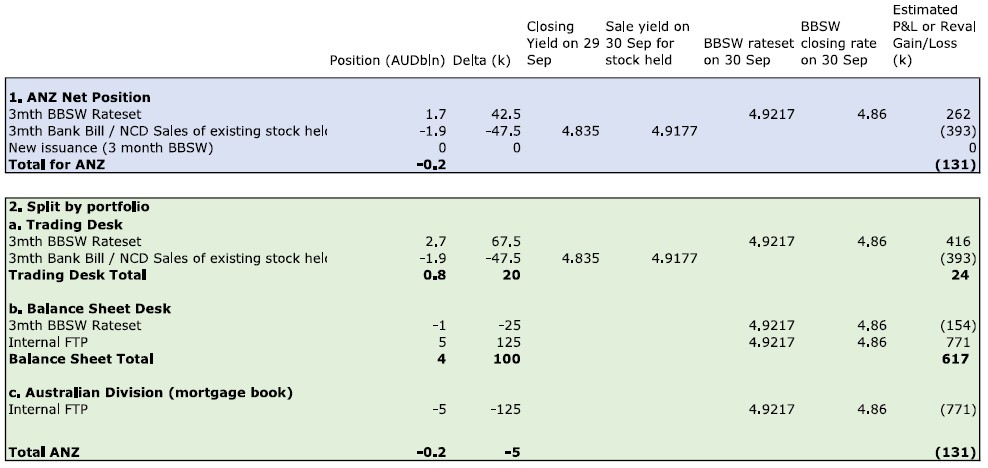
146 Mr Tarraran explained that this table provided a consolidated summary of the Bank’s exposure to the 90-day BBSW rate set on Friday 30 September 2011, the sale of 90-day bank bills it held on that day and the issue of any new bank bills. The blue upper portion of the table sets out the net position of the Bank on a global basis whilst the green lower portion sets out the position of the three business units within the Bank which accounted between them for that net position. The three business units were:
(a) the Trading desk;
(b) the Balance Sheet desk; and
(c) the mortgage book.
147 The Trading desk and Balance Sheet desk were part of the Bank’s global operations whilst the mortgage book was the loan book of its Australian retail banking business. It will be observed from the table that the net position of the Bank had three components: (a) a capital revaluation exposure to fluctuations in the BBSW resulting from a net asset position with a value of $1.7 billion; (b) profits or losses arising from the sale of an existing stock of 90-day bank bills by the Trading desk; and, (c) the proceeds derived by the Bank from the issue of any new 90-day bank bills. The capital revaluation exposure does not appear to have involved any realised gains or losses.
148 Two aspects of the table are problematic: (a) the measurement of the trading profits or losses; and (b) the capital revaluation measurement. Having explained those difficulties, I will then deal with: (c) the conclusions to be drawn from Mr Tarraran’s table; (d) the conclusions to be drawn from Mr Alexiou’s affirmative case that the Bank made a profit on Friday 30 September 2011; (e) the Bank’s transfer pricing mechanism; (f) the identity of the desk within the Bank which managed the $1.9 billion worth of bank bills sold by the Trading desk on Friday 30 September 2011; (g) the outcome of the Bank’s affirmative case about the events of Friday 30 September 2011; and, (h) Mr Tarraran’s evidence about Mr Alexiou’s role.
The first difficulty: The measurement of the trading profits and losses
149 There are seven columns of data in the table. The third and fourth columns measure the difference between the closing yield at 4.30pm on 29 September 2011 (4.835) and the average yield at which an existing stock of 90-day bank bills was sold on Friday 30 September 2011 (4.9177). That difference is 0.0827 or 8.27 basis points. Mr Tarraran has then calculated the loss or profit implied by that difference as a loss of $393,000. The second row in the table records the Bank’s net loss of $393,000 and the sixth row shows that the loss was made by the Trading desk.
150 The delta figure in the second column is the amount of loss or gain for each basis point movement in an interest rate. Recalling that each bill has a face value of $1 million, Mr Tarraran’s delta is premised on the fact, mentioned above, that a single basis point move in the interest rate changes the value of a 90-day bank bill by $25. This can be seen by dividing $47,500 (the delta) by 1900 (the number of bank bills implied by the $1.9 billion referred to in the table) to arrive at $25 per bill.
151 Returning to Mr Tarraran’s calculated loss of $393,000 in the second row, this part of Mr Tarraran’s table makes no sense. The profit or loss on the sale was not the difference between the yield at which the assets were sold (4.9177) and the closing yield the day before (4.835). It is the difference between the yield at which the assets were sold (4.9177) and the yield at which they were purchased. Mr Tarraran gives no evidence as to what that figure was and there is no other evidence about it.
152 I raised this difficulty with the Bank’s solicitors after the matter had been reserved. The solicitors’ response was received by email on 20 February 2026. In this response, the Bank accepted that it would be possible to value the loss by comparing the difference between what the bills were bought for and what they were sold for. However, the evidence before the Court did not include the additional points which would be necessary to do so (i.e. the purchase prices). The Bank then drew my attention to two paragraphs of Mr Tarraran’s evidence – [16(e)] and [16(f)(i)(2)] – to put the submission, in effect, that the value of the bills had been marked for books and records the prior day (29 September 2011) and the loss was therefore the difference between what they were sold for and what they had been marked for books and records the day before.
153 Mr Tarraran’s evidence at [16(e)] and [16(f)(i)] is in these terms:
Based on my review of the Trading Data, it shows the following:
…
(e) ANZ incurred a loss on 30 September 2011 by selling the Bank Bills at the average yield of 4.9177% as these were valued at 4.835% based on the 29 September 2011 closing yield for the 3 month BBSW rateset. For Bank Bills, an increase in yield reduces the price or market value (and vice versa);
(f) at a total bank level, ANZ did not profit from the rateset on 30 September 2011. The Trading Data shows that ANZ actually incurred a loss of ~$131,000. This can be summarised as follows:
i. … I have determined these amounts using a sensitivity calculation, which is based on a value of approximately $25.00 per $1 million of notional exposure. For example, the dollar value per basis point (commonly referred to as DV01 or delta) on $2.7 billion is $67,500 (being 2,700 million multiplied by $25.00). These calculations are shown in ‘Exhibit DL T-1’ and are based on the DV01 multiplied by the rate movements. The rate movements are calculated as follows:
1. for the rateset exposure, this is the difference between the 3 month BBSW rateset yield and the closing yield for the 3 month BBSW rateset on 30 September 2011; and
2. for the Bank Bills sold, this is the difference between the closing yield on 29 September 2011 (which is where they were marked for books and records prior to 30 September 2011) and the yield at which these Bank Bills were sold;
…
154 There is no evidence before me about the accounting treatment implicit in this evidence. Whilst I can understand that banks may be required to mark-to-market financial instruments on a daily basis for prudential reasons, I was not taken to any accounting evidence which explained why a valuation loss of this kind should be treated, as Mr Tarraran does, as an actual loss. In its post-hearing email response, the Bank offered to provide further evidence on this if required but it did not seek to re-open its case on this issue. I do not think it would be appropriate to permit the Bank to lead more evidence about this after judgment has been reserved in order to address perceived deficiencies in Mr Tarraran’s evidence. The Bank ran its case on Mr Tarraran’s evidence and that is how it should be resolved.
155 The Bank also submitted in the same email that Mr Tarraran’s approach was the frame of analysis by which the impact of movements in the BBSW upon ANZ’s profit was considered in Australian Securities and Investments Commission v National Australia Bank Limited (2017) 123 ACSR 341 at [68]-[69].
156 There are three problems with this submission.
157 The first is that [68]-[69] appear in a section of her Honour’s reasons setting out the agreed facts so they are not reflective of a process of judicial consideration but rather are simply a repetition of what the Bank and ASIC had agreed.
158 Secondly, as I have noted above, the Bank insisted that the copy of Jagot J’s judgment included in the evidence was subject to a s 136 direction that it not be used as evidence of the truth of the statements made in it. The evident intent of that approach was to prevent any of the agreed facts being used in this case as evidence of the truth of those facts. The Bank’s reference to the version of the judgment reported in the Australian Corporations and Securities Reports may be an attempt to overcome that problem. However, since [68]-[69] are not a considered judicial determination of the issue but rather a repetition of agreed facts tendered as evidence, I do not consider it legitimate to have resort to the version of the judgment in the Australian Corporations and Securities Reports as a source of evidence. I do not accept that [68]-[69] in either the copy of the judgment tendered in the evidence in this case or the reported version is evidence that the approach taken by Mr Tarraran is supported.
159 Thirdly, and perhaps most importantly, I do not accept that even if [68]-[69] could legitimately be referred to that they demonstrate that it is permissible to conclude that the loss made by the Bank on the sale of the bank bills was the difference between the closing yield on 29 September 2011 and the yield at which they were sold on 30 September 2011. In fact, these paragraphs show that there is an important element missing from Mr Tarraran’s analysis.
160 Understanding why this is so requires some explanation. One begins at [51] of the reasons where the agreed facts show that during the period under consideration in that case, ANZ issued interest rate swaps, forward rate agreements and 90-day bank accepted bill futures which were, together, defined as ‘BBSW Referenced Products’. The critical observation to make about the BBSW Referenced Products is that they are all derivatives.
161 What [68]-[69] say is this:
[68] Further:
(1) the rights and obligations of ANZ to counterparties under its BBSW Referenced Products which reset on the Contravention Days were affected by the movement in the BBSW in the relevant tenor on those days;
(2) ANZ’s net earnings were affected by reason of the movement in the BBSW in the relevant tenor on those days; and
(3) the gross exposure of counterparties who were not Bank Bill market participants to interest rate swaps and FRA’s has been disclosed in an annexure to the agreed facts which I do not accept to be confidential.
[69] Accordingly, on the Contravention Days, ANZ’s net earnings were affected by reason of the movement in the BBSW in the relevant tenor on those days.
162 Thus the movement in net earnings under discussion in these two paragraphs is concerned with impact on ANZ as a counterparty to derivatives denominated by the BBSW. Further, as [68(1)] plainly shows, the derivatives for which this was said to be the case were those that reset on the contravention days.
163 I thus do not accept the submission contained in the email of 20 February 2026 that Mr Tarraran’s evidence about the loss is within ‘the frame of analysis’ considered at [68]-[69]. He makes no mention of derivative transactions to which the Bank was a party or to the date at which those derivatives reset.
164 It is possible, I suppose, that Mr Tarraran’s table conceals some information which, in fact, concerns derivatives. For example, the $2.7 billion position in 90-day BBSW might actually be a reference not to the holding of bank bills but instead as a reference to various derivative products as well. But this is not explained nor is there the beginning of any enterprise whereby the reset dates for those derivates might be determined or, thereby, the profits or losses. Perhaps the $416,000 profit booked on that position reflects the kind of analysis at [68]-[69] but Mr Tarraran gives no such evidence and I am in no position to form a view about it.
165 It is not, however, necessary to reach a view about that. It suffices to say that I do not accept Mr Tarraran’s evidence that the Bank suffered a loss on the sale of the bank bills of $393,000. I therefore do not find it proved that the Bank made a loss of $393,000 as a result of the sale of the bank bills. It follows that the second and sixth rows of the table contain numbers which do not state the profit or loss made on the sale of the bills.
The second difficulty: The capital revaluation measurement
166 The fifth and sixth columns pose a similar problem to the profit and loss problem, namely, meaninglessness. In these columns, Mr Tarraran is not purporting to measure a trading loss or profit but rather the movement in value of assets or positions held. The Bank had a net position of $1.7 billion which was affected by movements in the BBSW at a delta of $42,500 per basis point. As with the entry for the $2.7 billion this delta implies that each basis point results in a $25 change in the value of a bill.
167 Mr Tarraran has measured the movement in value by subtracting the ‘closing BBSW’ on Friday 30 September 2011 (4.86) from the ‘BBSW rate set’ on the same day (4.9217). Since there is no such thing as a closing BBSW (because the BBSW is a reference rate determined for the day at around 10.00am) I assume that what Mr Tarraran intended to refer to was the closing yield on 30 September 2011 (as he has done in the third column).
168 The difference he has calculated to be 0.0617 or 6.17 basis points. Thus, what he has actually measured is what these assets were worth at 4.30pm on Friday 30 September 2011 by reference to the yield then prevailing in the market and how much they were worth when valued by reference to the BBSW determined for the same day. Whilst Mr Tarraran does explain at [16(f)(i)(1)] that this is how this calculation has been done he does not explain why he decided to perform an intra-day measurement of this kind, why he decided to subtract an actual yield from a reference rate or what this kind of apples and oranges exercise means.
169 After the hearing I posed this question for the Bank’s solicitor and received this answer:
Q: The revaluation gain of $262,000 in the first row has been calculated by using the closing rate at 4.30pm on 30 September 2011 and with the BBSW rateset on the same day. Mr Tarraran explains that he has done this at [16(f)(i)(1)]. Is there any evidence which explains what this revaluation gain means or why Mr Tarraran selected the two rates he has used in his calculation?
A: Not presently before the Court.
170 I conclude that this aspect of the table is meaningless.
Conclusions on Mr Tarraran’s table
171 The trading profit and loss figures in the seventh column are wrong, and the revaluation figures in the seventh column are meaningless. I do not accept Mr Tarraran’s evidence based upon the table that the effect of the trading in 90-day bank bills on Friday 30 September 2011 was that the Bank made a ‘loss’ of $131,000 whatever the word ‘loss’ means in the seventh column (and noting particularly its highly problematic summation of events on the capital and revenue accounts).
172 Moreover, what is missing from Mr Tarraran’s account is any position the Bank had in derivatives of the 90-day BBSW. I have considered whether Mr Tarraran’s evidence might be read as saying something about derivative positions but have concluded that it should not be read that way for the following reasons. First, at [15] of his affidavit he described the spreadsheet this way:
a consolidated summary of ANZ’s exposure to the 3 month BBSW rateset on 30 September 2011, the sale of 3 month Bank Bills on that day of existing stock held and any new issuance. This is then further broken down by key portfolio within ANZ…
173 It is possible that the word ‘exposure’ may conceal the idea that financial instruments other than bank bills were involved. But Mr Tarraran does not say as much and the deltas he has used throughout the spreadsheet all result in a $25 movement per basis point. Mr Tarraran’s evidence was that $25 was how much the value of a bank bill moved for each basis point. He did not give any evidence that derivatives of bank bills had a $25 delta and it is not open in that circumstance to conclude that the financial instruments Mr Tarraran is discussing are assets other than bank bills.
174 Secondly, not much reflection shows that a consideration of the Bank’s position in 90-day BBSW derivatives would have required a lot more information than can be extracted from the table or Mr Tarraran’s affidavit; i.e., which contracts had reset dates of 30 September 2011 (to use the language in the agreed statement of facts put before Jagot J), what those contracts were and what profits or losses the Bank stood to make on those contracts if the BBSW rate set moved in a particular direction.
175 Without the derivatives position of the Bank being known, any attempt to assess its profits and losses as a result of the trading events of Friday 30 September 2011 is pointless. The misconceived nature of Mr Tarraran’s evidence is especially striking when there is brought to account, as there must be, the fact that the evidence shows that in the course of ASIC’s BBSW investigation the Bank closely considered the events of Friday 30 September 2011 and did so with explicit reference to derivatives. ASIC issued a s 912C notice to the Bank on 30 January 2014 which the Bank responded to in August 2015. In its response, the Bank gave close consideration to Friday 30 September 2011. It included these comments:
Reference to ANZ Mismatch Trader pumelling the rate set.
Bills desk bought $1.56b on 29/9 to hedge short $2bln rateset of the Swaps desk on 29/9 at 4.81. Then sells $1.8bln at 4.86% on the 4th of Oct, after the 2 short ratesets are past on 29th and 30th.
Its difficult to ascertain from the Chat and market activity which rateset ANZ would have influenced.
ANZ’s buying in 3m bills on 29/9 didn’t impact markets (BBSW didn’t move)
3m BBSW moved materially on 30/9 up 12 bps (year end).
Market looked to have been building in a bearish RBA announcement on the 4th, which didn’t eventuate and the 1mth and 3mth BBSW rates retraced on the 4th of Oct.
ANZ sold into this market strength as yields fell on the 4th. Sold at 4.86% too early as yields fell into the 4.70’s.
ANZ didn’t transact on the 30th when the Market sold off by 12bp in the 3m BAB’s.
ANZ contributions in the 3m BBSW submission were at the lower end of a tight range on the 29th and on the 30th was at the fix.
Liquids book sold $20m 3m Bills.
From 21/9 to 27/9 Mismatch did a number of 3m FRA trade, ultimately reducing the rateset position on 30/9 by $166m. On 29/9 they did pay a floating 3m FRA out of 30/9 for 1.36b reducing the overall rate set risk on 30/9 to $1.297b.
RBA left cash rate unchanged at 4.75% on 4/10
176 Thus, its own consideration of the events of the day seems to indicate the involvement of derivatives.
177 I do not accept the Bank’s affirmative case that it has shown that it did not profit from the events of Friday 30 September 2011.
Conclusions on Mr Alexiou’s affirmative case that the Bank made a profit on the sale of the bank bills
178 I also do not accept Mr Alexiou’s evidence about this. His version, like Mr Tarraran’s, eschews any profit analysis on BBSW derivatives and is incomplete. In Mr Alexiou’s case, this is perhaps more surprising since he traded in BBSW derivatives and not bank bills.
179 Mr Alexiou utilised a different methodology to Mr Tarraran. Mr Tarraran sought to calculate the profit or loss on the sale of bank bills on Friday 30 September 2011 (to which he then added revaluation gains). Mr Alexiou sought to calculate the improvement to the Bank’s position for 90-day BBSW referenced products. Both undertook these different exercises by measuring the difference between 90-day BBSW yields on Friday 30 September 2011 and the yields the day before. But they differed as to the yields they used. Mr Tarraran used the closing yield (of 4.835) whereas Mr Alexiou used the ‘the observed mid-point of 4.81’ (at [141] of his first affidavit). It is not clear to me what the observed mid-point is but it seems to be a reference to the rate set on Thursday 29 September 2011. As will be seen, this does not really matter. For the Friday yields, Mr Tarraran used the yield at which the bills were sold (4.9177) whilst Mr Alexiou used the rate at which the BBSW reference rate set (4.92). Mr Tarraran’s approach (Thursday 4.835 and Friday 4.9177) resulted in the loss of $393,000 I have mentioned above. Mr Alexiou’s approach (Thursday 4.81 and Friday 4.92) resulted, according to Mr Alexiou, in a profit of $1,375,000.
180 As with Mr Tarraran’s approach, there are difficulties with Mr Alexiou’s. The first, and most obvious one, is that an increase in the BBSW yield implies a decrease in the value of the bills not an increase. The yield increased 11 basis points on Mr Alexiou’s approach. Bearing in mind that each basis point changes the value of a bill by $25 and that there are 5,000 bills involved (for $5 billion) the figure produced is $1.375 million. This figure represents a reduction in the value of the bills not an increase. Some of the obscurities of Mr Alexiou’s evidence about this might be resolved if he had indicated whether the $5 billion rate set exposure he referred to was a long exposure or a short exposure. On one view, Mr Tarraran’s evidence may provide the answer to this but neither party suggested that Mr Alexiou’s evidence should be approached that way.
181 The second problem is largely the same as the one which afflicts Mr Tarraran’s evidence. There is nothing in Mr Alexiou’s evidence which explains why the profit (or loss) made by the Bank on Friday 30 September 2011 is to be determined by comparing a yield rate on the day of sale and a yield rate the day before. One may accept that for regulatory purposes the Bank was required to mark-to-market its assets on a daily basis so as to have an accurate view of its capital position. But this is a different question to what the profit or loss on the sale of a parcel of bank bills is.
182 A third problem (from which Mr Tarraran’s approach does not suffer) is that in calculating the Bank’s profit Mr Alexiou has chosen to use for the sale yield not the actual sale yield at which the 5,000 bills were sold (4.9177) but instead the rate at which the BBSW reference rate set of 4.92. This makes no sense. The bills were not sold at that rate.
183 In those circumstances, I do not accept Mr Alexiou’s evidence about this. Since Mr Alexiou’s role was to trade BBSW derivatives, it would be open to infer that he was more than able to give a coherent explanation of what occurred (the same be said of Mr Tarraran) but he chose not to do so. However, the Bank did not submit that Mr Alexiou’s version of the economics of the day was a matter which adversely affected his credit. In the absence of such a submission, I disregard the credit consequences for Mr Alexiou of his evidence about this.
184 Mr Alexiou was cross-examined about the Bank’s version of trading position on the day at T241.46-242.33. He accepted that the Bank’s evidence was correct. Since I do not accept Mr Tarraran’s evidence makes any sense, I do not accept Mr Alexiou’s concession about this either. I have very serious concerns about both parties’ evidence on this topic.
The transfer pricing mechanism
185 I have already referred to proposals to change the transfer pricing mechanism above. However, it is useful to say a little more of its nature at this point. In Mr Tarraran’s table the transfer pricing mechanism is referred to as the ‘Internal FTP’. From his table, it will be seen that the Balance Sheet desk had a $5 billion exposure which was attributed to the Internal FTP and that the mortgage book held a countervailing exposure for the same reason. Mr Tarraran said, and I accept, that the $5 billion exposure came about as a result of the operation of the Bank’s transfer pricing mechanism. Mr Tarraran said that the transfer pricing mechanism used the BBSW as a reference point.
186 Mr Alexiou’s evidence about the mechanism was slightly more detailed but largely consistent. Like Mr Tarraran, he did not explain what the mechanism consisted of, but he did say (at [122]) that the mechanism transferred interest rate risks from the Bank’s variable mortgage business (which Mr Tarraran calls the mortgage book) onto the Bank’s balance sheet. Mr Alexiou said that the price at which this was done was determined by the rolling 90-day average of a 90-day overnight index swap plus the difference between the RBA’s cash rate and the rolling 90-day average of 90-day BBSW.
187 Between Mr Alexiou’s evidence about this and Mr Tarraran’s (including the entry in the table of $5 billion under the heading ‘Balance Sheet Desk’) it may be inferred, and I do, that: (a) the Balance Sheet desk and the mortgage book were counterparties to the BBSW derivatives described by Mr Alexiou; (b) these derivatives resulted in an exposure of $5 billion to the BBSW on the Balance Sheet desk; (c) the mortgage book as the counterparty had a countervailing exposure of $5 billion to the Balance Sheet desk.
188 Mr Tarraran says that these transactions were internal to the Bank and could not affect its overall position. I accept that the derivative transactions which these two different parts of the Bank entered into with each other were, from a Bank-wide perspective, equal and opposite. However, Mr Tarraran’s evidence proceeds on an assumption that both the mortgage book and Global Markets (through the Balance Sheet desk) would do nothing with their respective exposures. Whilst that assumption is likely to be correct in the case of the mortgage book (who sought only to remove an interest rate risk from its business), it is not self-evidently correct in the case of the Balance Sheet desk. It had the skill set, means and personnel to engage in trading activity in relation to the exposure generated by the transfer pricing mechanism. I therefore do not accept Mr Tarraran’s evidence that the transfer pricing mechanism could not affect the overall position of the Bank. The Global Markets division (through the Balance Sheet desk) could trade profitably on the exposure created by the mechanism.
189 Once the interest rate risk was brought on to the balance sheet by means of the transfer pricing mechanism it was the job of the Mismatch Trading desk, of which Mr Alexiou was the head, to manage that risk. Mr Alexiou explained, and I did not understand it to be in dispute, that he managed this risk by trading interest rate swaps, forward rate agreements and bank bill futures all of which were regularly denominated by the 90-day BBSW. Mr Alexiou did not himself trade bank bills of any kind and again, it is worth repeating, there is no suggestion and no evidence that Mr Alexiou was involved in attempting to manipulate the BBSW.
Which desk managed the $1.9 billion of bank bills sold on Friday 30 September 2011?
190 Mr Tarraran’s table suggests that the $1.9 billion of 90-day bank bills were sold by the Trading desk. This is consistent with evidence Mr Tarraran gave under cross-examination at T450.9-14:
Q: And so when you refer to managing the BBSW rate set, does that mean that it was members of the trading desk that traded bank bills during the rate set window?
A: Yes, sorry, I should just qualify that. So every desk would have had their BBSW exposure. The desk that was responsible for the management of any purchase or sale of bank bills through the trade window for BBSW would have sat with the trading desk, yes.
191 I therefore read Mr Tarraran’s table as recording that the $1.9 billion of bank bills were sold by the Trading desk. However, Mr Tarraran’s table does not throw any light on which desk managed those assets. In his affidavit, Mr Tarraran surmised that the sale by the Trading desk of the $1.9 billion worth of bills meant that that desk must previously have acquired them. However, in light of this evidence under cross-examination, this does not follow. It is unclear from his affidavit, in light of his cross-examination, which desk was managing the $1.9 billion worth of bills that were sold on Friday 30 September 2011. An attempt by me to elicit an explanation of this from the Bank in my post-hearing inquiry appears to have been misunderstood.
Findings on the trading events of Friday 30 September 2011
192 It will be recalled that it is Mr Alexiou’s evidence that he heard the head of the Balance Sheet desk, Mr Pritchard, say in August and September 2011 that he was going to slaughter the BBSW rate set.
193 For the reasons I have given I conclude that:
(a) the Bank’s evidence does not show that Mr Pritchard’s desk or Mr Alexiou’s desk did not sell $1.9 billion of assets through the Trading desk on 30 September 2011;
(b) the Bank’s evidence does not show that the Bank did not profit or benefit from the consequences of those sales; and
(c) the Bank’s evidence does not show that it did not profit or benefit from positions it had in the BBSW which reset on Friday 30 September 2011; but
(d) Mr Alexiou’s evidence does not show the Bank did profit or benefit from any of these matters either.
Mr Tarraran’s evidence about Mr Alexiou’s role
194 Mr Tarraran’s table records that the Balance Sheet Desk made a gain of $617,000 on Friday 30 September 2011. As I have explained, this figure is meaningless. Strictly therefore this makes irrelevant Mr Tarraran’s efforts to attribute this purported benefit to Mr Alexiou’s desk. However, in the interests of completeness I will record that I do not accept this aspect of Mr Tarraran’s evidence.
195 Mr Tarraran’s evidence that it was Mr Alexiou’s own desk which had benefitted by $617,000 from where the 90-day rate set. This evidence was at [16(f)(ii)] and, as explained in cross-examination, was based on the view that Mr Alexiou was the head of the Balance Sheet desk on Friday 30 September 2011 and that Mr Jason Pritchard was a member of Mr Alexiou’s team.
196 The organisation charts for the Bank were in evidence. They show that on Friday 30 September 2011, Mr Pritchard was the head of the Balance Sheet desk, Mr Alexiou was the head of the Mismatch Trading desk and they were not the same desk. However, the evidence clearly shows that it was the Mismatch Trading desk (under Mr Alexiou) which managed the derivatives position generated by the transfer pricing mechanism.
197 Mr Tarraran gave some perhaps not entirely satisfactory evidence that Mr Alexiou was the head of Balance Sheet Trading on Friday 30 September 2011 (he wasn’t) and, when pressed further, that the Mismatch Trading desk and the Balance Sheet Trading desk were the same desk (they aren’t). However, his basic point that it was Mr Alexiou’s desk which was managing the $5 billion exposure to the BBSW which was generated by the transfer pricing mechanism was correct. Although it might be possible to take a dim view of Mr Tarraran’s somewhat combative (and incorrect) answers on this topic, given the lapse of time and the soundness of his basic point, that would not be appropriate.
Tentative conclusions about the events of the day
198 The Bank’s case that it made no profits from movements in the BBSW on Friday 30 September 2011 fails (as does Mr Alexiou’s case that it did). Whether the Bank did or did not profit from the events of the day is unknown.
199 In that circumstance, it is not shown that market manipulation did not occur (which was the burden of Mr Tarraran’s evidence).
200 But conclusions about the day can still be drawn. The evidence justifies the conclusion that from 10 August 2011, Mr Alexiou was aware that Global Markets and Group Treasury liaised about the timing and volume of the issue of bank bills. Mr Collier’s email of that date shows as much. The evidence also shows that Mr Alexiou was aware that other market participants on Friday 30 September 2011 thought that the Bank had sold a lot of its own paper into the rate set window and that some of them suspected that this might have involved the Bank in attempting to manipulate the BBSW. One possible reading of the chat messages passing between Mr Alexiou, Mr Lee and Mr Mulcahy is that Mr Alexiou would have understood himself as having been accused by Mr Mulcahy of being involved in criminal efforts to manipulate the BBSW rate set. In the chats Mr Alexiou sought to explain the market behaviour on the basis of limits and end year effects. This explanation by him is, as the Bank submits, capable of being understood as showing that he did not think that anything amiss had happened in the market. However, it may also be understood as being a defensive explanation. Mr Alexiou had not, in fact, engaged in any such conduct and, confronted with such an allegation, it may be natural to think that he would have sought to have explained the market behaviour on the basis of legitimate phenomena. On balance, I prefer the latter reading of the chat messages. Consequently, I conclude that Mr Alexiou had reasonable grounds for suspecting that the Bank had engaged in market manipulation on Friday 30 September 2011. Mr Mulcahy was accusing him of this in circumstances where he knew that he had not.
Part 2: The conversations with Mr O’Callaghan and Mr Chase and the meeting with Mr McGowan in October 2011
201 Mr Alexiou says that in light of the events he described as having happened on Friday 30 September 2011 (and before then too), he formed the view that Mr Woodward had traded in the rate set window on that date. The manner in which he had done so indicated to the market that ANZ was a dominant market participant that day and was issuing or selling bank bills in a manner which suggested that it was short of cash. Since he knew that the Bank was properly funded he believed that the BBSW rate set had been affected by the selling of eligible securities on the day which had resulted in a higher BBSW than had been expected. Consequently, he concluded that the Bank (through Mr Woodward) had attempted to manipulate the BBSW and that this was what Mr Pritchard had been referring to when he said he was going to slaughter the rate set.
202 Whether Mr Alexiou did in fact have this opinion is ultimately a matter which will need to be determined. However, for now it is next necessary to survey what Mr Alexiou says that he did in light of the view that he had formed.
203 The first thing he said he did was to speak to his line manager, Mr O’Callaghan. He says that the following conversation took place:
Me: “I heard Jason Pritchard say that he was going to ‘slaughter’ the rate set. I am worried about the use of the term ‘slaughter’ in relation to the BBSW. It is unprofessional and reflects poorly on the bank.”
Rob O’Callaghan: “We don't use that term.”
Me: “The RBA called Matt Morris on 30 September 2011 to enquire whether ANZ had a funding problem. I have also received complaints from other banks. Can we look into the trades during the BBSW rate setting window on 30 September 2011?”
Rob O’Callaghan: “The issue will be looked into.”
“What's your opinion about the structure of Global Markets and Group Treasury? In your opinion, should Global Markets have greater control of the issuance of NCD’s and Bank Bills? There was a strategy paper put up to Shayne Elliott and Steve Bellotti about it last year.”
Me: “I think that the structure should not be changed as the separation of duties between funding the bank and trading is an important control mechanism.”
204 This conversation is alleged to have taken place on Tuesday 4 October 2011.
205 It will be recalled from above that when the timestamps are corrected for the difference between GMT and Sydney time, the third and fourth sequences of chat messages occurred from 8.21am on Tuesday 4 October 2011 and 8.51am on Tuesday 11 October 2011. It will be recalled that it was during these chats that Mr Alexiou acquired the knowledge that Mr Lee had been asked to write a report about the events of Friday 30 September 2011.
206 Mr Alexiou then says that he spoke with Mr Chase, the Head of Business Management for Fixed Income within Global Markets, and asked him whether the trading activity on Friday 30 September 2011 was being looked into. He says he was told by Mr Chase, ‘yes, we are looking into the trades in the bank bill rate set’. This occurred the next day on Wednesday 5 October 2011.
207 Some months later, Mr Alexiou says that Mr O’Callaghan introduced him to Mr David McGowan and said these words:
David McGowan is with group investigations and an ex-cop from Melbourne employed by ANZ. He is undertaking an internal investigation into your complaint.
208 Mr Alexiou also says that he was never asked any questions by Mr McGowan either at the time he was first introduced to him by Mr O’Callaghan or at any subsequent time. This should be kept in mind when the time comes to consider an email in which Mr Alexiou described having been interviewed by Mr McGowan.
209 The next Mr Alexiou heard of the matter was in March 2012 when Mr O’Callaghan told him that ‘the issue you raised has been looked into and was all fine’.
210 Mr O’Callaghan left the Bank in March 2013 in circumstances which were not touched upon by either party.
211 Neither Mr O’Callaghan nor Mr McGowan gave evidence at the trial. However, as will be seen, there is some documentary evidence touching upon the positions of both men.
212 Mr Chase, on the other hand, did give evidence. At [35] of his affidavit he said that he did not recall Mr Alexiou raising any concerns with him about the events of Friday 30 September 2011 or that he had asked him to investigate those events. Given the lapse of time, the fact that Mr Chase does not recall such a conversation does not necessarily entail that it did not occur.
213 It was not put to Mr Chase that [35] was wrong. Mr Alexiou submitted that where his evidence and Mr Chase’s differed Mr Alexiou’s was to be preferred but otherwise Mr Chase’s evidence could generally be accepted (although Mr Alexiou submitted that another, presently immaterial, aspect of his evidence should not be accepted). Since Mr Chase’s evidence is only that he does not recall the conversation, the question of whether Mr Alexiou’s account of it should be accepted again comes down to whether Mr Alexiou is to be accepted as a credible witness.
214 The next critical event is a conversation which takes place between Mr Alexiou and Mr Listorti (one of Mr O’Callaghan’s successors) on 17 July 2014 and then an exchange between Mr Alexiou and Mr Pucci the next day on 18 July 2014. However, an assessment of those exchanges cannot properly be made without understanding the events which were triggered within the Bank by June 2014 and which flowed from its reactions to ASIC’s inquiries into alleged manipulation of the BBSW.
215 As will be seen, by the time that Mr Alexiou spoke with Mr Listorti and Mr Pucci, it is clear that he was already of significant interest to the Bank in its management of how it responded to the ASIC inquiry.
Part 3: The subsequent history of Mr Alexiou’s complaint
First element: The commencement of ASIC’s investigation, the formation within the Bank of Project Arrow, the first works program and the chat spreadsheet
216 It seems that the Bank had received a notice from ASIC by at least 14 August 2013 requiring production of documents relating to the manner in which the BBSW rate setting process operated from around June 2008 to October 2010. So much is clear from an internal email sent to a number of Bank employees, including Mr Alexiou, on 14 August 2013. The sender of the email provided a list of submitters and derivatives traders and inquired of Mr Alexiou whether there were any other persons who should be added to the list. Mr Alexiou is not listed as one of the derivatives traders although his role involved trading in derivatives of the BBSW. In his evidence, Mr Alexiou noted that his name was not on the list but an explanation for this is that he was not employed by ANZ in the period identified in the ASIC notice.
217 On the other hand, according to the Bank’s then general counsel, Mr Santamaria, ASIC began to make enquiries about this in mid-2012. He says the Bank retained external solicitors in the middle of 2014 and, at around the same time, began its own investigation.
218 In fact, I think Mr Santamaria is perhaps mistaken about the timing of the Bank’s investigation. As will become apparent, by June 2014, the Bank had already done very substantial work to investigate into its own position in relation to the BBSW. It appears from the evidence of the Bank’s then Chief Compliance Officer, Mr Evans, that as early as February 2014, the Bank had established an internal project known as ‘Project Arrow’ in response to the ASIC investigation. Mr Evans chaired the steering committee. The other members of the steering committee were: Mr Shayne Collins (Group General Manager, Markets Risk), Ms Freya Hone (General Counsel and General Manager Compliance, IIB), Mr Eddie Listorti (Co-head of Fixed Income, Currency and Commodities, Foreign Exchange), Mr Daniel King (General Manager, HR Global Products), Ms Michelle Smith (Global Head of Legal, Global Markets) and Mr Pucci (Head of Compliance, Global Markets and Head of Compliance, IIB). In addition to this steering committee there was also an oversight group. The members of the oversight group were Mr Santamaria (Group General Counsel) who was the chair, Mr Andrew Géczy (Chief Executive Officer, IIB) and Mr Nigel Williams (Group Chief Risk Officer).
219 It is apparent that by 11 June 2014 the Bank had developed a detailed plan of the arc of its investigation. A document bearing that date is headed ‘Project Arrow Communications Review Formal Investigation Process’. It describes a comprehensive investigation process. Subsequently, the timelines in this document were relaxed somewhat when the size and complexity of the investigation became apparent. Nevertheless, the document is useful for illustrating the detailed steps the Bank took.
220 In summary, first, a fact-finding process was to be completed by 18 June 2014. This involved Deloitte and an examination of the chats. Following the fact-finding process, interviews with the relevant employees were to be carried out between 24 to 26 June 2014 (as events transpired for reasons later explained the interviews did not proceed in that date range or anything close to that date range).
221 Secondly, findings were to be tabled at a meeting of the steering committee and governance committee on 3 July 2014. The document indicates that where unacceptable behaviour has been found the process was to move to the ominously entitled ‘consequence management’. A notable feature of this is that it suggests that the decision to move to consequence management would be the steering committee’s.
222 Thirdly, if the steering committee had decided that there should be consequence management, a process therefor was then outlined which indicated that the ultimate sign off would be done by the steering committee. The aim was to have this done by 7 July 2014. Again, a notable feature of this is that the ultimate sign-off for what consequences were thought appropriate in the case of the employees in question would be for the steering committee.
223 The detail did not stop there. Attached to the process outline was a table setting out various scenarios to be examined and according each a priority timing on a scale of 1-4. One of the scenarios was headed ‘Mismatch/Bills/Swaps Desk’. The table included a summary ‘lo’ and ‘hi’ materiality analysis. The hi materiality analysis for this scenario was said to be ‘Attempted or actual influence. Market impact. Evidence of Conflict of Interest being played out with intention to exercise effect on rateset’. The priority was recorded as being 1. Other scenarios were headed ‘Internal Trader to External Trader’ and ‘Internal Chat’ which were afforded priority levels 4 and 3 respectively. Lo materiality included ‘Disclose ramming conduct (non-specific)’ and hi materiality included ‘Admit potential misconduct’ and ‘Disclose ramming intention (specific)’.
224 Also attached to the table was a draft list of 10 names. The second name on the list was Mr Alexiou’s. The names of Mr Pritchard, [REDACTED] and [REDACTED] were also on the list.
225 Consistent with, but perhaps lagging slightly behind, this ambitious works programme were the efforts involved in examining the chats and emails. By June 2014, Mr Pucci was involved in reviewing a large number of chat messages and also, as he testified, in listening to recordings of many conversations. As he observed in his evidence, a parallel email review was being conducted by Deloitte (T535.38). The chats were reviewed and categorised and placed by Mr Pucci’s team into a spreadsheet which was then sent to the Project Arrow team which I take, at least at this time, to have been an agglomeration of the steering group and the oversight group. Mr Pucci agreed that the chats were then discussed at various and regular meetings.
226 By 6 June 2014 a spreadsheet had been prepared entitled ‘Project Arrow Consolidated Chat Master Spreadsheet’ and was emailed to, amongst others, Mr Collins and Mr Pucci. It contains a number of chats, the identities of the traders who were party to them, the level of relevance of each chat and a brief description of its subject matter.
227 Two chats in which Mr Alexiou was involved on Friday 30 September 2011 appear in the spreadsheet marked ‘Highly Relevant’. Both entries in the spreadsheet are accentuated by blue highlight and bold text. The first is described as ‘Referral by external party on manipulation by ANZ’ and the second as ‘TBD’. Both chats were in evidence and contain the two chat sequences of Friday 30 September 2011 and the chat sequence on Tuesday 4 October 2011 set out above. The spreadsheet does not include the fourth chat sequence which took place on the morning of Tuesday 11 October 2011.
228 Mr Pucci gave evidence which I accept that this spreadsheet would have been discussed at meetings of Project Arrow and that he (and I infer others) would have focussed on these chats (amongst other chats too). The accentuation of the chats and marking them as being ‘Highly Relevant’ leaves open an inference that those chats would have received increased attention at the meetings.
229 I am satisfied that as at around 6 June 2014 Mr Pucci and the other members of the Project Arrow teams (being at this stage the steering and oversight groups) would have been familiar with the fact that Mr Alexiou was party to a sequence of chat messages on Friday 30 September 2011 and Tuesday 4 October 2011. As I have explained above, the chats contained a strong suggestion by Mr Lee that he thought that Mr Mulcahy of UBS considered Mr Alexiou to have been criminally involved in attempting to manipulate the BBSW on Friday 30 September 2011. The chat also contained, of course, Mr Alexiou’s denial of that suggestion.
230 One of the members of the steering committee was Mr Listorti. Mr Listorti was one of the two conjoint heads of Fixed Income, Currency and Commodities and was responsible for the part of Global Markets in which all the relevant alleged misconduct had taken place; that is to say, the Mismatch Trading desk, the Balance Sheet desk and the Trading desk. Mr Listorti was therefore the Global Markets member of the Project Arrow group. The Friday 30 September 2011 and Tuesday 4 October 2011 chat messages therefore concerned someone from the Global Markets business, Mr Alexiou.
231 Although the 6 June 2014 email distributing the chat spreadsheet does not list Mr Listorti as one of its recipients, it seems unlikely that Mr Listorti, as the Global Markets member of the steering committee, was unaware of its contents (since it concerned staff from his division) or had not taken part in discussions about chat messages and, in particular, about ‘highly relevant’ chat messages such as the two sequences on Friday 30 September 2011 and the sequence on Tuesday 4 October 2011. Further, it seems likely that these discussions happened not long after 6 June 2014 when the spreadsheet was distributed.
Second element: The events of 17 July 2014 – the scheduling of a meeting between ASIC and the Bank and the conversation Mr Alexiou says he had with Mr Listorti
232 By Thursday 17 July 2014, a complexity had arisen for those at the Bank charged with dealing with the ASIC investigation. In June 2014 the Bank’s then Chief Executive Officer, Mr Mike Smith, called the then Chair of ASIC, Mr Greg Medcraft, to give his personal assurance that ASIC would get full co-operation from the Bank. This exchange is recorded in an email sent by the Bank to ASIC around 26 September 2014. Mr Collins accepted under cross-examination that it was likely that this commitment of full co-operation had also been made public.
233 The Bank’s works programme involved it, in speaking to its employees, seeking to find out what had happened. On the other hand, as ASIC’s chief investigator Mr Colin Luxford explained in emails dated 21 and 24 July 2014, ASIC was adamant that its investigation should not be prejudiced by any contamination of witnesses by such a process. ASIC’s views about this were therefore on a collision course with the stated aims of Project Arrow.
234 On Thursday 17 July 2014 the Bank organised a meeting with three officials from ASIC, including its chief investigator, Mr Luxford. The meeting was to be held at the offices of the Bank at 3 pm on Friday 18 July 2014. So much appears from an email dated 17 July 2014 from the Bank to ASIC. Mr Listorti was not one of the persons who was to attend this meeting.
235 Against that backdrop, it is then necessary to deal with Mr Alexiou’s evidence about a conversation he says he had with Mr Listorti the day before on 17 July 2014. He says that the following conversation with Mr Listorti took place as follows:
204. On 17 July 2014 I disclosed the substance of the October 2011 Complaint to Eddie Listorti (17 July 2014 Complaint), in circumstances outlined below. I chose to repeat the October 2011 Complaint to Eddie Listorti because I understood, based on the conversation immediately below, that he was the representative of the Global Markets team on Project Arrow, which was the committee tasked with responding to ASIC’s BBSW Investigation (explained at paragraph [185] above).
205. On 17 July 2014 I had a meeting with Eddie Listorti in his office, in which he suggested we continue the meeting at a bar at the back of the ANZ building (at 242 Pitt Street, Sydney) called The Local Bar. During the meeting at The Local Bar, we had a conversation in which Eddie Listorti said:
“I have been appointed to a committee to respond to ASIC's BBSW Investigation. It is called Project Arrow. I am the Global Markets representative on the committee. Nigel Williams and Andrew Geczy are also on the committee. Nigel Williams is gunning for you. You are top of their list of 5 people including Jason Pritchard and Sam Ellis. You should look after yourself and your family ... How would it feel when your son is being pushed around the playground as their father is Mr BBSW? You should get a publicist.”
…
207. The conversation continued:
Me: “How could I be on the list let alone top 5?”
Eddie Listorti: “We have been throwing Bloomberg Chats back and forth across the boardroom table and discussing them, including some of yours. I have been trying to help Nigel understand the language in them. I was involved in an Italian bribery situation and court case while with Dresdner so I have experience of regulatory investigations.”
…
209. The conversation then turned to changes in responsibilities:
Eddie Listorti: “I have spoken to Steve Bellotti about running Global Markets but he told me in two years time.”
Both (in unison): “That’s a lifetime.”
Eddie Listorti: “I want you to run Balance Sheet and Credit Trading and Anshul [Sidher] to run Rates and Local Markets, the Discretionary Liquids will go to Local Markets Trading.”
I said: “I should have Local Markets assets, I have experience.”
Eddie Listorti: “Your career is salvageable.”
…
211. At this point I raised the October 2011 complaint:
Me: “Have you been made aware that I raised a concern about BBSW around the 30 September 2011?”
Eddie Listorti: “No I haven’t.”
Me: “I thought that the set was higher than I expected and language like ‘slaughter’ was being used.”
Eddie Listorti: “‘Slaughter’ is all over everything.”
212. The conversation then took a personal turn:
Eddie Listorti: “Are you gay?”
Me: “No. I am just quite effeminate.”
Eddie Listorti: “That’s what I told them.”
236 Mr Listorti was scheduled to give evidence during the trial but was unable to be called for reasons which are sufficient but which, in the interests of maintaining Mr Listorti’s privacy, need not be set out here. Mr Alexiou submitted that the Bank could have sought to reschedule his evidence before he became unavailable and therefore a Jones v Dunkel inference should be drawn against the Bank for not calling him. I do not accept that submission. I do not think in Mr Listorti’s circumstances that it was appropriate or necessary to reschedule his evidence in the way suggested. I draw no inference from the fact that Mr Listorti was not called to give evidence.
237 Mr Alexiou says that he made a file note of his conversation with Mr Listorti which he emailed to himself on 21 January 2015. That file note was excluded from the evidence on admissibility grounds (it not being a business record).
238 The Bank admits in its defence at §§184-185 that Mr Listorti met with Mr Alexiou and informed him that he was involved in Project Arrow and that Mr Alexiou told Mr Listorti that he had made a complaint to Mr O’Callaghan about the use of the word ‘slaughter’. The Bank does not admit that the meeting took place on 17 July 2014. The Bank purports to admit that Mr Listorti also told Mr Alexiou that the Bank had no record of his complaint. Since Mr Alexiou made no such allegation in his statement of claim (at §184) this is not an admission and does not operate to prove that fact. It may be disregarded.
239 A convenient place to start is the question of when the meeting occurred. There is some evidence from which an inference may be drawn that the meeting occurred on 17 July 2014. On 18 July 2014, Mr Alexiou certainly sent an email to Mr Pucci in these terms:
From: Alexiou, Etienne
To: Pucci, Fred (Hong Kong)
Date: Fri, 18 Jul 2014 09:33:03 +1000
Subject: Group Investigations
Fred,
I would like to see what was recorded by group investigations when I disclosed a concern I had in BBSW back in late 2011.
I was interviewed by someone from that group (ex cop from Melb) and was subsequently told by Rob O’c that my concern had been looked at and was ‘all fine’.
I am just wanting to check that this is the case, happy to discuss.
240 It should be noted that the reference in this email to being interviewed is inconsistent with his evidence in his two affidavits where he says that he was not interviewed or asked any questions by Mr McGowan.
241 Mr Pucci responded by email:
From: Pucci, Fred (Hong Kong)
To: Alexiou, Etienne
Date: Fri, 18 Jul 2014 10:36:18 +1000
Subject: RE: Group Investigations
OK thanks, will look into it - very good to know
Regards
Fred
242 Because it will be relevant later, it should also be noted that Mr Alexiou’s email does not nominate any date for the complaint, only that it was in late 2011. There is a dispute between Mr Alexiou and Mr Pucci as to whether Mr Alexiou’s email was preceded by a conversation between the two men (as Mr Pucci says but which Mr Alexiou denies). However, that dispute can be passed over for now. More pressingly relevant is the fact that something must have happened to cause Mr Alexiou to raise the issue with Mr Pucci on 18 July 2014.
243 I have already inferred that Mr Listorti was by this time aware that Mr Alexiou was on the Bank’s list of relevant traders and that his chats of Friday 30 September 2011 were regarded within Project Arrow as being highly relevant. It is possible that Mr Listorti was conscious that the Bank was having a meeting with ASIC the next day, Friday 18 July 2011, however this would be speculation and such an inference is not open to be drawn given that Mr Listorti was not a recipient of the email concerning that meeting.
244 But clearly by the morning of Friday 18 July 2014, Mr Alexiou had developed an interest in his complaint to Mr O’Callaghan sufficient for him to contact Mr Pucci about it. I do not think that he contacted Mr Pucci on a whim. His actions are only explicable on the basis that something had happened which made this suddenly important to him.
245 His evidence of his conversation with Mr Listorti is consistent with that explanation. I conclude that the meeting did take place on 17 July 2014 as Mr Alexiou says. Mr Alexiou’s description of the meeting is wrong in some ways but only in a fashion which supports that the gist of his account is correct. There are two reasons for this. First, Mr Alexiou said that Mr Listorti had told him that he was at the top of a list of five people who the Bank was looking at. This was not correct. But he was second on a list of ten which I infer that Mr Listorti did know about. Secondly, he attributed to Mr Listorti the statement that the Project Arrow group had been throwing his chat messages across the table and discussing them. For reasons already given, I do infer that Mr Listorti was aware that Mr Alexiou’s chats were being discussed inside Project Arrow.
246 I find that Mr Listorti told Mr Alexiou on Thursday 17 July 2014 that he was one of the subjects of the Bank’s Project Arrow investigation and that some of his chat messages were being discussed by that group.
247 I am satisfied that the immediate provocation for Mr Alexiou’s contact with Mr Pucci the following day was his dealings with Mr Listorti on Thursday 17 July 2014.
Third element: The documentary record for the events of 18 July 2014
248 Because there is a minor conflict between Mr Pucci’s recollection of the events of this day and Mr Alexiou’s it is useful first to trace through what the documents show and only then to turn to that dispute.
249 The first email was certainly sent by Mr Alexiou in Sydney to Mr Pucci at 9.33am on 18 July 2014. This is the email set out above. As I have observed before, the email does not identify the date upon which the complaint was made to Mr O’Callaghan other than that it was in late 2011 and it does not identify the person who he says interviewed him (noting that he now says that he was not interviewed).
250 The second email was sent by Mr Pucci to Mr Alexiou and was sent at 10.36am according to its timestamp. It is set out above and merely recorded that Mr Pucci would look into the matter. At 12.23pm Mr Pucci forwarded Mr Alexiou’s email to Mr Evans with the message, ‘As requested. I spoke to Etienne to clarify the dates, as discussed’.
251 Shortly afterwards, an email was sent at 12.27pm by Mr Evans to a group of people (Mr Williams, Mr Collins, Mr Gaudion, Mr Santamaria and Ms Smith) which forwarded Mr Pucci’s email. Mr Evans’s email said:
All,
Email received this morning by Fred as discussed on our call this morning.
We are continuing to investigate.
Regards,
Mark
252 This was copied to Mr Pucci and Mr McGowan. It shows that Mr Alexiou’s email to Mr Pucci had been discussed during a telephone hook-up at some stage during the morning of 18 July 2014. If Mr Pucci’s timestamp were Hong Kong time then it would follow his email to Mr Evans would have been received by Mr Evans at 2.23pm and it would not have been possible for Mr Evans to have forwarded his email to the wider group at 12.27pm. In his affidavit Mr Pucci said that he saw Mr Alexiou in Sydney before Mr Alexiou’s email. In his oral evidence he said that they had met in mid-July and not necessarily on 18 July. He also said that he could not remember whether he was in Sydney or Hong Kong on 18 July. The timestamps on Mr Pucci’s affidavit may be affected by time zone differences in a way which makes it difficult to be sure where they were sent from or when. In particular, a forwarded email appears to be timestamped with the time of the forwarder and it is possible that Mr Pucci’s computer remained on Hong Kong time even if he was in Sydney. Ultimately, it is difficult to be sure whether Mr Pucci was in Sydney or Hong Kong on 18 July 2014. A final detail, to which I will return, is that Mr Pucci says that he spoke with Mr McGowan at some stage on 18 July 2014 after receiving the 9.33am email.
253 It follows from this point that the chain of documented events is as follows:
(a) Mr Alexiou sent his email at 9.33am which did not identify the date of the complaint or the identity of Mr McGowan beyond the fact that he was an ‘ex-cop’.
(b) Mr Pucci responded at 10.36am that he would look into it.
(c) At some point after 9.33am Mr Pucci spoke to Mr McGowan.
(d) At some point during the morning, Mr Evans asked Mr Pucci to clarify the dates with Mr Alexiou.
(e) At some point before 12.23pm Mr Pucci did so although what this clarification entailed is unclear.
(f) There was a telephone meeting between Mr Williams, Mr Collins, Mr Gaudion, Mr Santamaria and Ms Smith at some point during the morning at which Mr Alexiou’s request to Mr Pucci was discussed although at the time the people on the call did not have the email Mr Alexiou sent to Mr Pucci.
(g) At 12.27 pm Mr Alexiou’s email of 9.33am and Mr Pucci’s email of 12.23pm were sent to persons who included Mr McGowan. This demonstrates that Mr McGowan had been identified by 12.27pm. This suggests that Mr Pucci’s conversation with Mr McGowan occurred between 9.33am and 12.27pm.
254 It may also be inferred that Mr Pucci spoke to one of the persons who was in the telephone meeting during the morning, most likely his line manager, Mr Evans, the Chief Compliance Officer.
255 The next email was a response by Mr McGowan to Mr Evans’s email sent at 12.27pm. Mr McGowan’s response was sent at 2.40pm and was a reply-all email. It is in these terms:
All, I don’t have a recollection of any meeting with this person or with Rob O’Callaghan – there is no record in the WPP database, no record on BOLD (GI use this as a case management tool), no record of any calendar bookings in my outlook (note that I was not in Sydney at all in late 2011), no email from my own archives that alludes to these matter, nor any reference in my handwritten day books.
Fred, can you checks the emails already sourced from EV to see if there is any such record? - if note I can run a fresh search of the archives for anything with his name?
Regards
DMc
256 At 2.41pm (that is, one minute after his reply-all email), Mr McGowan sent an email to Ms Freya Hone (who was General Counsel and General Manager Compliance for IIB). Ms Hone was on Project Arrow and was based in Singapore. Mr McGowan’s email forwarded his email of 2.40pm and read:
Hi, do you remember anything like this back in 2011? – if I did I would expect you to be in the loop too?
257 At 3.30pm Mr Pucci replied-all to Mr McGowan’s email of 2.40pm saying this:
Thanks Dave. I will look thru the searched mails but I think it makes sense if you can run a fresh search too. Will call you again to discuss search ideas.
Regards
Fred
258 Five minutes later at 3.35pm Mr McGowan sent an email to Mr Jesely, the Bank’s manager of Group Investigations in Bangalore. This email forwarded the 2.40pm email that Mr McGowan had sent to the group who had met on the telephone. It was in these terms:
Joe, can you run a search for any emails with the words “Alexiou, Etienne” in 2011 please – background as discussed and as below
DMc
259 From this it may be inferred that Mr McGowan and Mr Jesely had spoken first. Mr McGowan sent another email, apparently at 11.19am, in which he said:
Change that – search emails to/from rob o’callaghan between October and December 2011 key words “complaint, whistle blowing, rate set, slaughter”
DMc
260 Mr Jesely replied at 3.53pm:
Sure David. We’ll raise this request & revert with findings.
Regards,
Joe
261 The timestamps on these are anomalous. Mr McGowan’s follow up email of 11.19am comes after the email it is following up of 3.35pm. Mr Jesely’s response to the follow up email then comes at 3.53pm. The time difference with Bangalore is 4 hours and 30 minutes. It appears that Mr McGowan sent his first email at 3.35pm, his second email at 3.49pm and Mr Jesely responded at 3.53pm. In any event, the content of the emails shows that they were sent in the above order on the afternoon of Friday 18 July 2014 regardless of the timestamps.
262 Ms Hone replied to McGowan’s email of 2.41pm at 5.52pm in these terms:
Have been racking brains but for life of me cant remember……rings no bells…
263 On Monday 21 July 2014, Mr Pucci sent an email to Mr McGowan at 11.57am and asked ‘any luck with the other search?’.
264 Later that day, Mr McGowan replied-all to Mr Pucci’s email sent on Friday at 3.30pm which asked him to run a fresh search. Mr McGowan’s email was sent at 5pm and was in these terms:
All, a search of email archives based on relevant key words; ‘complaint, whistleblower, rate set, slaughter’ was run over the weekend – this returned a total of 34 emails but only 2 exchanges between EA and RO’C – all emails appear business related and are attached for reference – none make reference to a meeting over BBSW concerns.
I also checked with Freya, who I reported to in 2011, but she has no recollection of any such meeting being called – had I been called into a meeting like this Freya would have certainly been advised.
If there was a meeting it did not involve anyone from Group Investigations.
Regards
DMc
265 From this one may infer that two emails passed between Mr Alexiou and Mr O’Callaghan which contained one or more of the words ‘complaint, whistleblower, rate set, slaughter’; that they were attached to this email; that Mr McGowan thought them business related; and they did not make any reference to any meeting over BBSW concerns. The two attached emails are not in evidence. As will be seen later in these reasons, ASIC also referred to two emails as being relevant which have not been located.
266 In response to this email, Mr Pucci sent an email to Mr McGowan, seemingly at 8.01am, in these terms:
Dave, have we checked with PWC or external whistleblower channel?
Regards
Fred
267 There is no obvious explanation for the time incongruity. Then at 6.24pm Mr McGowan replied to Mr Pucci in these terms:
I control the wpp database and nothing there – don’t have access to pwc but they’re using the same data we did.
It didn’t happen the way EA describes it! – give me a call if you want go chat
DMc
268 Mr McGowan’s email is ambiguous. For those who are suspicious, it may be read as meaning there was an ‘it’ but that Mr Alexiou’s description of the ‘it’ was not correct. In that context, the ‘it’ would be some kind of interaction between Mr Alexiou and Mr McGowan in relation to the October 2011 complaint. Mr McGowan’s invitation to Mr Pucci to give him a call if he wanted to have a chat may indicate a desire for any discussion of the ‘it’ not to occur in a permanent medium. That Mr Pucci did not remember whether such a call occurred does not advance debate in either direction.
269 Another less suspicious reading of the email is that it means ‘whatever happened, it did not happen the way he describes it’. On this reading, the invitation to ‘give me a call if you want go chat’ just meant ‘Let me know if you want to chat about what to do next’.
270 This latter reading of the email is supported by three other documents. The first is Mr McGowan’s earlier email of 21 July 2014 in which he had said ‘If there was a meeting it did not involve anyone from Group Investigations’. This suggests that the ‘it’ was not a reference to some kind of interaction since there were no such interactions (Mr McGowan being the head of Group Investigations). Against this reading is the possibility that the reason that Mr McGowan was emailing Mr Pucci was not only to report the negative results of the searches of the ‘wpp database’ but also a freshly discovered fact concerning the ‘it’; i.e. the statement in the earlier email had been overtaken by events.
271 A second and third documents are Mr McGowan’s emails of 18 December 2014 and 19 December 2014. As I explain a little later in these reasons, the context for these emails concerned efforts by the Bank to be satisfied that it had conducted all appropriate searches to find any record of Mr Alexiou’s complaint to Mr O’Callaghan. The 18 December 2014 email is as follows:
Mark, further to advice below I can advise the following;
§ A search of emails archives found no record of any email exchanges between Etienne Alexiou and Fred Pucci during the period 1/8/2011 – 31/12/2011 containing key words; complaint, whistle blowing, rate set, slaughter.
§ We ran a fresh search for all emails between Etienne Alexiou and Rob O’Callaghan between 14/9/2011 – 14/10 2011 which returned 20 emails (attached) – none make any reference to raising concerns about employee conduct in the business.
§ To recap previous advice around possible escalation by Etienne Alexiou to Group Investigations, or by inference to me, I can confirm there is no record in the WPP database, no record on BOLD (GI use this as a case management tool), no record of any calendar bookings in my outlook calendar (note that I was not in Sydney at all in late 2011), no email from my own archives that alludes to these matter, nor any reference in my handwritten day books, I do not recall ever having met Rob O’Callaghan or Etienne Alexiou – I also confirmed with Freya who was my line manager at that time and she has no recollection either.
Regards,
DMc
272 The 19 December 2014 email is as follows:
All, I have run another search through archives for all emails (unfiltered) between RO'C, EA and me for the period 1/92011 - 31/12/2011 but there were no records found (see attachment for evidence of search).
To recap previous advice around possible escalation by Etienne Alexiou to Group Investigations, or by inference to me, I can confirm there is no record in the WPP database, no record on BOLD (GI use this as a case management tool), no record of any calendar bookings in my outlook calendar (note that I was not in Sydney at all in late 2011), no email from my own archives that alludes to these matter, nor any reference in my handwritten day books, I do not recall ever having met Rob O'Callaghan or Etienne Alexiou - I also confirmed with Freya who was my line manager at that time and she had no recollection either (in the event something was raised about conduct in Markets I would have certainly notified her).
Hope that helps
Regards
DMc
273 These constitute clear assertions by Mr McGowan that he did not have any interaction with Mr Alexiou. If Mr McGowan’s email of 21 July 2014 at 6.24pm had indeed referred to an ‘it’ which was an interaction with Mr Alexiou then the December 2014 emails can only be explained on the basis that Mr McGowan had forgotten that when he wrote the email or that he was deliberately omitting any reference to it from the email. The latter would be consistent with a reading of his statement ‘give me a call if you want go chat’ as being an invitation to discuss the matter in a non-recorded form.
274 The contextual matters which support the second construction of the ‘It didn’t happen the way EA describes it’ email are reasonably strong. On the other hand, they involve giving a construction to the email which requires a certain degree of strain. I do not think that ‘whatever happened, it did not happen the way he describes it’ is a natural reading of ‘It didn’t happen the way EA describes it’ but it is, I accept, an available reading. Whilst I also accept that ‘give me a call if you want go chat’ can be read as meaning ‘Let me know if you want to chat about what to do next’ it is also not a natural reading and, I think, a still less natural reading.
275 Thus, the contextual strength of the second reading is undercut by the ordinary meaning of the words used. On the other hand, the ordinary meaning of the words used is undercut by the contextual matters.
276 I conclude that Mr McGowan’s email is ambiguous on the issue of what the ‘it’ being referred to is. It would be open to infer that the email bears the second meaning I have identified. However, it is also open to infer that it does not and that it bears the first meaning. I will return to how this issue should be resolved when dealing with Mr Alexiou’s submission that I should not draw an inference in favour of the Bank about what the ‘it’ in the email means when the Bank did not call Mr McGowan.
277 Having set out the written record, it is then useful to turn to the dispute between Mr Alexiou and Mr Pucci.
Fourth element: The disputed conversation between Mr Pucci and Mr Alexiou on 18 July 2014
278 In his affidavit, Mr Pucci said that prior to receiving Mr Alexiou’s email at 9.33am, he had seen Mr Alexiou in the Sydney office and had a discussion during which Mr Alexiou had told him that he had made a complaint to Mr O’Callaghan, had subsequently met an unidentified ‘guy’ with Mr O’Callaghan and that the two men had told Mr Alexiou that they would look into his complaint: [24].
279 During this conversation Mr Pucci recalls asking Mr Alexiou a number of questions designed to elucidate who the unidentified man was. Mr Pucci is unable to recall the precise form of words but he did recall that he provided a physical description of a male employee who worked in investigations at the Bank. He then deposed to this exchange:
Me: Are you referring to David McGowan? Big, tall, bald bloke who looks like a cop?
Etienne: Yeah, maybe.
280 It is not in dispute that Mr McGowan was the head of Group Investigations. Mr Pucci says that during this conversation he had told Mr Alexiou that Mr McGowan was a former policeman: [27]. It will be recalled that Mr Alexiou’s email to Mr Pucci had said that he had been ‘interviewed by someone from that group (ex cop from Melb)’. The relevance of this point is that Mr Pucci’s evidence that he told Mr Alexiou before the email was sent that Mr McGowan was a former policeman receives some support because the words ‘ex-cop’ appear in Mr Alexiou’s email.
281 Mr Alexiou does not agree. In his second affidavit he says that he does not recall the conversation with Mr Pucci or that Mr Pucci had ever said to him that Mr McGowan was a former policeman: [10]-[11].
282 The significance of this issue may appear small for why does it matter whether Mr Pucci provided the information to Mr Alexiou that Mr McGowan was a former policeman? The answer came during Mr Pucci’s cross-examination during which he indicated that during his pre-9.33 am meeting with Mr Alexiou he had felt that Mr Alexiou was fishing around for assistance in identifying who the unidentified man was. The unstated suggestion was that Mr Alexiou had extracted this information from him and then utilised it to send the email. The reference to the man being an ‘ex-cop’ would, on this state of affairs, add verisimilitude to the email to Mr Pucci. Another view might be that Mr Alexiou was trying to obtain as much information as possible to put in the email so as to assist Mr Pucci in tracking down any record of the exchange. For present purposes, the two theories stand largely in the same position.
283 The problem for both theories is that on Mr Pucci’s own evidence he not only told Mr Alexiou that the man in question was a former policeman but also that his name was David McGowan. If Mr Alexiou’s intent had been to add substance to his email by saying that Mr McGowan was an ‘ex-cop’ it is difficult to see why he would not also have said that he was called David McGowan.
284 The absence of Mr McGowan’s name from Mr Alexiou’s email strongly suggests that the conversation to which Mr Pucci deposes did not happen before the email was sent. If that be so, it would open up an alternative hypothesis that Mr Alexiou must have obtained the idea that Mr McGowan was a former policeman from somewhere else. One candidate would, of course, be Mr O’Callaghan and/or Mr McGowan at the time of the meeting that Mr Alexiou said that he had with them.
285 In his evidence, Mr Pucci sought to head that hypothesis off at the pass. He deposed to a conversation with Mr McGowan subsequent to the email of 9.33am during which Mr McGowan said that he would never describe himself as an ‘ex-cop’. But Mr McGowan is not said to have indicated that he would not describe himself as a former policeman and it is easy to see how Mr Alexiou might have remembered ‘former policeman’ as ‘ex-cop’, particularly when nearly three years had passed. This is not an idle thought. For example, Mr Pucci knew that Mr McGowan was a former policeman and must himself have obtained that information from somewhere. Even if that were not so, and Mr McGowan would not have described himself either as a former policeman or an ex-cop, this fact says little about the terminology that Mr O’Callaghan himself might have used.
286 There is another possible explanation for where Mr Alexiou obtained the information that Mr McGowan was a former policeman. At the end of 2013, Mr Alexiou as Mr Pritchard’s then line manager had been involved in a disciplinary process involving something Mr Pritchard had said in a chat message. A meeting had taken place between Mr Alexiou, Mr Pucci and Mr Chase. Mr Alexiou kept a note of this meeting the relevant portions of which were:
Dave McGowan Grp Inv?
ex-cop reinforce the gravity
287 This shows that Mr Alexiou had heard at this meeting that Mr McGowan was with Group Investigations and was an ‘ex-cop’.
288 I do not accept Mr Pucci’s evidence that he spoke to Mr Alexiou before he received Mr Alexiou’s email of 9.33am on 18 July 2014. Whilst he did say in his affidavit he had been in the Sydney office that day, under cross-examination he was not sure that this was so. This does not mean that he could not have spoken with Mr Alexiou by telephone of course.
289 It does seem inevitable that when Mr Alexiou sent his email at 9.33am he did not know Mr McGowan’s name but he did know that he was an ex-cop. On Mr Pucci’s account, Mr Alexiou would have known both of these matters when he sent the email (since they had already been discussed). It is difficult to come up with a reason why Mr Alexiou would have left out Mr McGowan’s name if he had actually been told it by Mr Pucci shortly before he sent the email.
290 The version I prefer is that Mr Alexiou recalled that there was a man from Group Investigations who was an ex-cop but whose name he could not recall. His meeting at the end of December 2013 equipped him with that knowledge and it is not difficult to accept that he could easily have forgotten Mr McGowan’s name in the intervening 6 months.
291 As I have said, Mr Pucci was a witness of credit and I do not think he was seeking to mislead the Court by his evidence. I think that a conversation between him and Mr Alexiou did occur but it was the discussion Mr Evans asked him to have with Mr Alexiou a little later in the morning. Mr Pucci recalls only one conversation and the only conversation which is independently corroborated is the one touched off by Mr Evans later that day and after Mr Alexiou’s email of 9.33am.
I conclude that:
(a) Mr Alexiou and Mr Pucci did not speak before Mr Alexiou sent his email;
(b) As a result of the meeting he had attended in December 2013, Mr Alexiou recalled on 18 July 2014 that Mr McGowan was a former policeman although he did not recall his name;
(c) His email to Mr Pucci at 9.33am on 18 July 2014 therefore reflected what he knew independently of Mr Pucci and was not the result of any conversation with Mr Pucci; and
(d) The two men did speak later that morning at the behest of Mr Evans.
292 A further matter supports these conclusions. This is that in the fusillade of emails which Mr Alexiou’s email then touched off, it is surprising that there is no mention of an earlier discussion between Mr Pucci and Mr Alexiou if that is what occurred.
Fifth element: The documented events of 28 and 29 July 2014
293 I have mentioned above that ASIC and the Bank were at loggerheads about whether the Bank could interview its employees before ASIC did. The tensions about this arose simultaneously with Mr Alexiou’s email to Mr Pucci of Friday 18 July 2014. On that day there was a meeting between the Bank and ASIC. It is evident in the emails which followed that meeting that the Bank and ASIC were not quite able to get to an agreed position on whether the Bank should have notice that its employees were to be interviewed or examined: see Confidential Supplementary Tender Bundle pp. 92-99. This debate continued until at least 25 July 2014.
294 On 25 July 2014, Mr Santamaria sent an email to employees in Global Markets, Balance Sheet Trading and Treasury that, if ASIC or another regulatory agency approached them about attending an interview, they could consult with an independent lawyer who the Bank would pay for.
295 On 26 June 2014 ASIC issued the Bank with a notice which required it to provide the contact details of a number of named employees including Mr Alexiou. The Bank appears to have provided these in a schedule in July 2014.
296 On 28 July 2014, Mr Alexiou was on holidays in France. In his affidavit he says that he received a voicemail from Mr Luxford to which he says he responded at around 9.30am (European summer time). He says that the following conversation occurred:
Mr Alexiou: “Hi Colin. I got your voicemail.”
Mr Luxford: “Sorry to disturb your holiday ... ASIC are investigating bank bill trading and would like to speak to you. It could be on a voluntary basis or by enforceable notice.”
Mr Alexiou: “Ok, what’s the difference?”
Mr Luxford: “If enforceable it means that you can’t self-incriminate. Could we set a date for Thursday, a week after you return?”
Mr Alexiou: “I have a back surgery on Monday the 11th of August and won’t have time to get advice as I return on Tuesday the 4th of August.”
297 Mr Alexiou’s recollection that Mr Luxford told him that he could not self-incriminate if there was an enforceable notice is most likely in error. Mr Luxford is more likely to have told Mr Alexiou that he could not claim the privilege against self-incrimination under a s 19 examination (that being the case).
298 Objective circumstances point to this conversation as having happened. First, the Bank had provided Mr Alexiou’s details in response to the ASIC notice of 26 June 2014. It was therefore possible for Mr Luxford to have called Mr Alexiou as he says.
299 Secondly, Mr Alexiou sent an email to Mr Santamaria dated 28 July 2014 which said ‘I have just spoken with Colin Luxford re bank bill trading investigation. I am currently in Europe. Are you available in an hour or so to discuss please?’. The email appears to have been sent at 6.04pm which was 10.04am in France. After speaking to Mr Santamaria, Mr Alexiou spoke to Ms Smith about engaging an independent lawyer and then sent an email at 7.48pm (11.48am in France) which read ‘I am dropping out of mobile contact. Pl fwd the lawyers details and your opinion of who would be the best person to use. Also, any documentation that has been provided to ASIC in order for me to get advice. I return next Tuesday and will be in touch then unless there is anything further you would like to discuss’.
300 Thirdly, Mr Alexiou sent an email to Mr Pucci which is dated 29 July 2014 and apparently sent at 2.31am on that day. This corresponds to 6.31pm in France on 28 July 2014. The email was as follows:
Fred
Have you had a response from group investigations yet please?
301 It seems to me unlikely that Mr Alexiou would have sent such an email unless prompted to by external events. The conversation with Mr Luxford that morning is just such an external event. There then occurred a series of communications in which this inquiry was referred to the Bank’s general counsel, Mr Santamaria, and its chief compliance officer, Mr Evans. Mr Pucci sent his email to Mr Santamaria and Mr Evans at 5.53am. The email consisted of a forward of Mr Alexiou’s email set out above and said ‘I imagine he has already asked you, Bob?’. A response from Mr Santamaria at 6.23am Sydney time to Mr Pucci and Mr Evans (with copies to Ms Smith and Mr Gaudion) said ‘Fred, he did not raise this with me. I think we play this straight. Report what GI said and perhaps ask him for any record he has. We can discuss if you like’. At 6.29am Mr Evans replied that ‘I agree with Bob’. Mr Pucci then replied at 6.33am saying ‘Thank you, will do.’
302 Mr Pucci then sent this email to Mr Alexiou apparently at 6.39am (Sydney time) on 29 July 2014:
Etienne, they could not find anything so far. Have you found any record / diary entry that might help? Do you think Rob engaged them directly, or could he have engaged them via someone else? Do you remember anything else about that meeting in Rob’s offices?
303 This was sent eight days after Mr McGowan’s email to Mr Pucci of 21 July 2014 in which he said:
It didn’t happen the way EA describes it! – give me a call if you want go chat
304 Mr Pucci’s statement that nothing had been found ‘so far’ may be apt to suggest that ongoing searches continued to be made. However, after Mr McGowan’s invitation to Mr Pucci to call him if he wanted to chat about his statement ‘It didn’t happen the way EA describes it’ there are no documentary traces of such further inquiries being made.
305 Mr Alexiou then responded to Mr Pucci’s email about 6 minutes later on 29 July 2014 at 6.45am (Sydney time) saying:
Let's catch up next week when I’m back in the office.
306 Mr Pucci replied 26 minutes later:
Enjoy your break
307 Mr Pucci then forwarded his most recent exchanges with Mr Alexiou to Mr Santamaria, Mr Evans, Mr Gaudion and Ms Smith marked ‘FYI’.
Sixth element: Mr Alexiou’s conference with his lawyers on 7 August 2014
308 Mr Alexiou’s s 19 examination was held on 15 August 2014. In advance of the examination he met with his own lawyers, Makinson D’Apice. The solicitors’ file note of the meeting includes as its first entry:
push
ram
ramp
slaughter
30/09/2011  concerns about the rate set process
 discussion with Rob O’Callaghan
 rate set higher than expected
309 Mr Alexiou submits that this file note powerfully corroborates his evidence concerning his complaint to Mr O’Callaghan on 4 October 2011. He notes that the entry was the first entry in the file note and submits that this underscores the significance of the matter from his perspective. He also observes that since this was a privileged and confidential occasion the material is inherently reliable.
310 The file note does appear to suggest that Mr Alexiou raised with his own lawyers the key elements of what now constitutes the core elements of the October 2011 complaint to Mr O’Callaghan.
311 The Bank disputes Mr Alexiou’s submission that the file note provides powerful corroboration for the October 2011 complaint. It says that it actually demonstrates that Mr Alexiou consciously decided not to raise the 30 September 2011 trades or the October 2011 complaint in his s 19 examination even when he was asked whether he had concerns about the manipulation of the rate set.
312 As will become apparent in the next section which deals with the s 19 examination on 15 August 2014, it is true that Mr Alexiou did not raise these matters in is s 19 examination. However, it is a non sequitur to reason from that to a conclusion that what Mr Alexiou told his solicitors on 7 August 2014 did not corroborate his current version of events. In my view it does provide corroboration for Mr Alexiou’s current version of events. Further, it does so on an occasion where it seems likely that Mr Alexiou would have been candid. On the other hand, the file note also contains entries which muddy this picture:
Immediately before the first entry, ‘Rate set may not be manipulated because each participant is competing to maximise their own interest’;
In an arrow from ‘30/09/2011’ in the first entry, ‘issued stock flood mkt to get rate higher – obvious’; and
Next to ‘Chats with UBS on rate sets’ is recorded ‘year end difficult to predict’ and ‘volatile trading’.
313 However, despite these entries, I accept Mr Alexiou’s submission that the file note is corroborative of his case.
Seventh element: Mr Alexiou’s s 19 examination on 15 August 2014
314 On 29 July 2014, ASIC issued the Bank a notice requiring it not to permit a number of named employees, including Mr Alexiou, to access their emails or chats received or sent by them prior to 31 December 2013. Shortly afterwards on 5 August 2014, Mr Luxford called Mr Alexiou again and told him that his interview would be a s 19 examination and would take place at 2pm on Friday 15 August 2014. A formal notice followed the next day.
315 The examination proceeded on 15 August 2014 at the offices of ASIC. The examiners were Mr Luxford and a Mr Johnson. Mr Alexiou was accompanied by a solicitor and his counsel, Mr Cook. During his examination, Mr Alexiou was asked whether he was aware of any practice whereby persons would trade in a way which was designed to influence the BBSW rate: ASIC T40-41. He told the examiner that he could not recall specific examples but that there were occasions in which he ‘heard language was which reasonably unprofessional and non-technical but was directed towards the rate set’: ASIC T42.8. When first asked who had said this he said ‘mainly Jason Pritchard’ but when pressed said ‘Well, Jason Pritchard, full stop’: ASIC T42.13. When asked to give examples of the kind of language used he said that the phrase ‘slaughter the rate set’ stuck in his mind: ASIC T42. He was unable to recall specific instances of ‘ram the rate set’ or ‘ramp the set’: ASIC T43.13. Later he said that his observation was that Mr Pritchard intended his comments to be heard by quite a few people: ASIC T46.
316 He also gave evidence that ‘slaughter the rate set’ stuck in his mind because he had not heard it before. He was then pressed on when and how often he heard Mr Pritchard do this, and he said that he had heard it more than once, during the trading day but not a daily basis: ASIC T43-44. He did not say that he had heard it on Friday 30 September 2011.
317 Mr Alexiou then went on to say that he was not comfortable with Mr Pritchard’s language and thought that it was unprofessional. Pressed on what the expression meant Mr Alexiou said that thought that it meant ‘to unduly affect the rate and, you know, slaughter’: ASIC T47.9. He also said that initially he dismissed it ‘as being serious because of how outlandish it was’: ASIC T47.24.
318 It was at this point that he was taken to the exchange I have noted above where he had been party to a chat with Mr Pritchard while he had worked at Deutsche Bank during which Mr Pritchard had used the word ‘ram’: ASIC T49. As will be recalled, his response was that he did not think that Mr Pritchard could possibly have been serious. I have outlined above that I did not think that this was very plausible.
319 At ASIC T55-57 he was then asked these questions:
Q. Yes, it is. This is Mr Pritchard, this is the same guy that you cautioned for using the words to the effect of, as best you recall, something like "slaughtering the rate set" when you joined the ANZ Bank?
A. Privilege. I spoke to Rob O'Callaghan about that.
Q. Oh, you didn't speak to Mr Pritchard?
A. No, I spoke to Rob O'Callaghan about that, so --
Q. Okay. Sorry, I must have misunderstood. So Mr Pritchard's using words to the effect of “slaughtering the rate set”, but you took it to your line report?
A. I took it to my line report who is the global head of fixed income, so I escalated it.
Q. What did he do about it?
A. Privilege. His response to me was, “We do not use that language.”
Q. That was how he dealt with the situation, by telling you, “We don't use the language”, but it’s not your language, so how is he dealing with it? So that was it?
A. Privilege. No. I was told it would be looked into.
Q. By Mr O'Callaghan?
A. Yes, some time later – and I can't tell you the exact date and I wish I could but ANZ haven’t filed this for some reason or another and I don’t want to speculate on that – I was told it was all fine.
Q. By?
A. Rob O’Callaghan: ie, “We’ve looked at it; it’s all fine.”
Q. It was dealt with in a way that that was communicated to you; you don't know how it was dealt with though, do you?
A. No.
Q. Did you hear any more after that about it?
A. No.
Q. Did you raise it again with Mr Pritchard?
A. Privilege --
Q. Or anyone else?
A. Can I just ask what you mean by that? Which bit?
Q. So you took it to your line manager; he communicated back, “It's fine”?
A. Yes.
Q. And I'm asking you, after that did you raise it with Mr Pritchard or anybody else again, after that point?
A. Privilege. Do you mean the language “slaughter” or --
Q. Yes, the subject we're talking about here of Mr Pritchard's language, using “slaughtering the rate set”?
A. I can't recall – privilege. I can’t recall formally raising it after that, but I think it was pretty well understood post escalating it that I had an issue with the language.
Q. Did you escalate it in writing?
A. No, I didn't.
Q. Did you receive any response in writing?
A. No.
320 This account is the similar to the evidence that Mr Alexiou has given in this case. However, there are differences.
321 First, there is no mention of a meeting with Mr McGowan. By this point, of course, Mr Alexiou had acquired the knowledge that the other person with whom he had met was Mr McGowan on 18 July 2014 only a few weeks before his examination. Mr Alexiou in terms refers to the inability of the Bank to turn up any documentary trace of his complaint and it must therefore have been the case that his communications with Mr Pucci were in his mind at this time including Mr Pucci’s statement that the head of investigations was Mr McGowan.
322 On Mr Alexiou’s case this does raise an issue about why he omitted to mention Mr McGowan to the examiners. Further, even if Mr Alexiou’s complaint to Mr O’Callaghan was fabricated, that (false) narrative had after 18 July 2014 included the fact that the other man was Mr McGowan. On either party’s case, the fact that Mr Alexiou did not tell the examiners about Mr McGowan is striking. It leaves open an inference that the omission was deliberate.
323 A second difference is that the account to ASIC does not include the evidence Mr Alexiou now gives of having told Mr Chase.
324 A third difference is that in this Court Mr Alexiou now says that he believed that Mr Pritchard was involved in efforts to manipulate the BBSW. And, in support of that case, he now gives evidence (which I have not accepted) as to how the Bank stood to make gains from any such manipulation (although without reference to any positions the Bank had in BBSW derivatives). By contrast, Mr Alexiou did not tell this to the examiners. Mr Alexiou was extensively questioned about his knowledge of and views about whether he was aware of communications between Group Treasury (which issued bank bills and NCDs) with persons within Global Markets who traded BBSW derivatives in which the timing of the issue of bills and NCDs was discussed. Whilst he accepted that there were such communications, the examiners were not altogether successful in winning from him any concessions of being aware that this practice involved market manipulation. Mr Alexiou’s answers show an assiduous concern not to say that manipulation of the BBSW to make profits on derivatives positions was taking place. On the other hand, he accepted particular facts (such as written communications) which could not be contested but sought to put a more innocent explanation on them.
325 Mr Alexiou was then asked a series of questions about Mr Woodward which suggested that he both traded in bank bills and had positions which were denominated in the BBSW. Eventually Mr Alexiou accepted that he thought that this might create a conflict of interest (T94). More generally, he identified two problems. First, the Group Treasury (who issued the bills) communicated with persons who had derivatives affected by the BBSW. Secondly, the language of Mr Pritchard. But he was careful not to say that the communications had given rise to rate manipulation (or an intention to manipulate) or that he knew that Mr Pritchard had been involved in such a practice.
326 I return below to the Bank’s criticisms of Mr Alexiou’s evidence based on inconsistencies with what he had said in his s 19 examination.
Eighth element: Mr Alexiou’s first meeting with the Bank on 31 October 2014
327 On 19 September 2014, ASIC confirmed that it was content for ANZ to begin interviewing its staff from 7 October 2014 (except for a number of individuals not including Mr Alexiou). Mr Alexiou says that he was notified on 7 October 2014 by Mr Listorti that the Bank would like to meet with him as part of its own investigation into the BBSW affair. Initially, the meeting was scheduled for 9 October 2014 but did not proceed on that day.
328 It appears that the meeting was rescheduled to take place on 31 October 2014. Mr Alexiou says he met with Mr Collins (of the Bank) and Mr Jonathon Slater (of Clayton Utz, the Bank’s solicitors). Mr Alexiou gives no detail of what occurred at this meeting although he does say this:
My belief that ANZ had read my Bloomberg Chat history was reinforced during this meeting, because the purpose of the meeting, as I understood it, was to obtain my view on transactions the subject of ASIC’s BBSW Investigation, with reference to Bloomberg Chat messages.
329 Mr Alexiou says he obtained his understanding of the purpose of the meeting through conversations he had, before the meeting, with Mr Morris and Mr Pritchard who had each attended a meeting of this kind with the Bank.
330 Mr Collins gave evidence about this meeting too. He says that no substantive matters were discussed because the meeting was postponed to resolve a potential conflict of interest which Mr Alexiou’s solicitors had developed.
331 Mr Collins’s version is corroborated by Mr Slater as well as the documentary record. During October 2014 there had been correspondence between ASIC and Mr Alexiou’s solicitors. ASIC had informed them that it considered Mr Alexiou to be a witness and person of interest and invited him to co-operate and provided a copy of its co-operation policy. The solicitors acting for Mr Alexiou were also acting for a number of other Bank employees who had been summonsed for examination. This generated the potential for conflict if the employees were to start implicating each other.
332 Mr Alexiou gave evidence of having obtained new solicitors, HWL Ebsworth (‘HWLE’), on 12 November 2014 and that his former solicitors were still acting for him on 3 November 2014. Even so, it would have been obvious to the solicitors that they could not continue to act for him and I therefore accept Mr Collins’s and Mr Slater’s evidence that the meeting was postponed to allow this issue to be resolved.
333 Although the meeting did not substantively proceed, I see nothing controversial in Mr Alexiou’s evidence that he had understood that the purpose of the meeting had been to discuss various transactions and chat messages.
Ninth element: Mr Alexiou’s second meeting with the Bank on 5 December 2014
334 A second meeting with the Bank occurred on 5 December 2014. However, in the meanwhile several events had occurred which are directly relevant to Mr Alexiou’s adverse action case, most importantly, his suspension from duties on 19 November 2014 and his being escorted off the Bank’s premises. This is not the place to dwell on those events to which I will return in more detail when dealing with the question of whether the various actions the Bank took against Mr Alexiou were ‘adverse action’.
335 The point, however, is that by the time that the second meeting took place, Mr Alexiou was no longer working although he remained on his base pay.
336 The meeting took place at the offices of Clayton Utz. According to Mr Alexiou, the persons present were himself, his new counsel Mr Silver and his solicitors, Mr Schneider and Ms White, and Mr Santamaria and Mr Collins. The meeting began at around 10.40am. Ms White and Mr Schneider both took detailed notes of the meeting, transcriptions of which were in evidence. Both transcriptions were subject to s 136 directions preventing them being used as evidence of the truth of any statements contained within them. At the meeting Mr Alexiou was handed a letter from the Bank dated 5 December 2014. Nothing which was said at the meeting or is contained in the letter is relevant to the question of whether Mr Alexiou’s version of events about his complaint to Mr O’Callaghan should be accepted. It will, however, be necessary to return to the meeting for other purposes later in these reasons.
Tenth element: Mr Alexiou’s meeting with Clayton Utz on 5 December 2014
337 After the meeting between Mr Alexiou and the Bank described in the previous section, Mr Alexiou and his lawyers then met with Clayton Utz. This meeting appears to have commenced at around 11.20am. It was the first formal opportunity the Bank’s solicitors had had to interview Mr Alexiou.
338 Apart from Mr Alexiou himself, present also at the meeting on his behalf were his solicitors, Mr Schneider and Ms White and his counsel, Mr Silver. From Clayton Utz, Mr Mavrakis, Mr Slater and Ms McCaughan were present and, from the Bank, Mr Collins.
339 There are three file notes of the meeting available: Mr Slater’s, Mr Schneider’s and Ms White’s. Mr Alexiou was asked a broad range of questions. It would serve no purpose at this stage to set out the various relevant extracts from the file notes which are extensive and which do not at this stage aid comprehension. The Bank submits that the version of events that Mr Alexiou gave at this meeting is not consistent with the version he now gives. I will deal with those submissions later in these reasons.
Eleventh element: The further searches conducted in December 2014 for records of the October 2011 complaint
340 On 15 December 2014, Mr Evans sent an email to Mr Pucci and Mr Collins on top of Mr McGowan’s email of 21 July 2014 which said he could not locate any record of Mr Alexiou’s October 2011 complaint. Mr Evans’s email asked ‘Has anything else been raised on this during the interview process?’.
341 Mr Collins sent a response which copied in Mr Williams, Mr Santamaria and Mr Mavrakis (of Clayton Utz). The email said:
Mark,
In our interview with Etienne he made reference to raising a concern with the rateset of the 30th of Sept 2011. He said he mentioned it to ROC and was later informed by ROC that he had followed it up and that ANZ did not have an issue with the rateset outcome/process on the day as it related to ANZ's activity. Speaking with Nick this morning
Nigel mentioned the feedback from ASIC on Friday.
342 Mr Pucci replied-all and said ‘Mark, I have not heard anything in addition to what Shayne has set out below’. Mr Williams then said ‘ASIC mentioned two emails – can we please search for what these could be’ to which Mr Collins replied ‘Will do’.
343 Mr Evans and Mr Collins then discussed what needed to be done. Mr Evans sent an email to the group which said he had asked Mr McGowan to search emails for Mr Alexiou, Mr O’Callaghan and Mr McGowan in the period 25 September to 31 October 2011. Mr Evans’s email also asked Mr Pucci if phone calls between the three men in that period could be traced.
344 Mr Cotterell, Head of Surveillance in Global Markets Compliance, was asked to run the search on Deloitte’s system. The search period was expanded to the start of September and Mr Collins confirmed that ‘the pre 30 Sept one month search is not specific to the 30 Sept rate set, but general concern in activity of ANZ around rate sets voiced by ET’. Deloitte ran the search and found 32 emails. Mr Cotterell reviewed these emails and, on 16 December 2014, reported to Mr Collins and Mr Pucci that ‘I could find no emails between EA & ROC where Etienne calls out his concerns regarding the rateset on 30 Sept 2011, or any other date’ and the only emails which refer to BBSW in any notable manner were work related.
345 Mr McGowan was copied into this email chain. He then sent an email to Mr Evans on 18 December 2014 which is set out above.
346 On 19 December 2014, Mr McGowan then sent a similar email but to a group of people comprising Mr Collins, Mr Pucci, Mr Cotterell and Mr Evans which is set out above.
347 This email was forwarded to other recipients and eventually to Mr Santamaria on 22 December 2014.
348 Mr Cotterell also conducted an audio search and reviewed tapes of conversations in the relevant period. One call on 7 October 2011 was found between Mr Alexiou and Mr O’Callaghan. The call involved a discussion around positions, trading and ‘FTP’ (which I understand to mean funds transfer pricing). Mr Cotterell did not consider it to be of interest. Mr Pucci sent this report on to Mr Collins with this message:
Shayne, Chris completed audio search below of ROC and EA lines. I was going to have a run thru myself but have had technical difficulties galore, both in logging in and searching and listening- to fix such technical glitches takes time and I have spent many frustrating hours dealing with this.
349 Mr Collins’s reply included this comment about the audio search:
In terms of the voice review as outlined below, this one is critical to square away. ASIC have made reference to a couple of emails which were sent by ET relating to concerns around the rateset. Before we go back to them on this we want to be 100% sure that there was no correspondence that we can find either emails or voice. We have had confirmation that no emails exist. I am looking for similar confirmation on the voice side. If you feel it is prudent to check Chris’ work, then please let me know when you have done so.
350 Mr Pucci said this:
I don't need to check Chris’s work, it was more to supplement it with alternative search ideas- if I can get in and if u find anything I will advise but otherwise pls take Chris’s results as final.
Twelfth element: Mr Alexiou’s meeting with ASIC on 22 December 2014
351 On 22 December 2014, Mr Alexiou and his lawyers met with Mr Luxford and Ms Farrokh of ASIC to resume his s 19 examination. However, the examination did not resume and instead Mr Alexiou participated in a confidential meeting with ASIC.
352 Mr Alexiou says that at this meeting he disclosed the October 2011 complaint as well as other complaints. There are in evidence two file notes of this meeting which had been taken by his solicitors, however only Ms White’s file note appears to capture what Mr Alexiou said about the October 2011 complaint. Mr Alexiou says that the file notes generally accord with his recollection.
353 The file note records this discussion:
Fit in as witness: raised issues
with bank on 3 separate occasions
1/ Rob O'Callaghan (s19)
Issue as to trading group
effecting rate set
Conduct and language in
dealing room (Pritchard and
others)
Like wild west
Reputationally at risk
Thirteenth element: Mr Alexiou’s meeting with ASIC on 29 January 2015
354 Mr Alexiou met with ASIC again on 29 January 2015. A file note of the meeting taken by Mr Alexiou’s solicitors is in evidence. The following about the October 2011 complaint is recorded in the file note:
CL: Stuff FB gave about discussions
with Rob Callaghan not documented
& RC doesn’t recall it.
On bal believe what FB says –
is consistent with what ASIC has seen
EF: Anything can corroborate ?? evidence ??
but this information alone, without
any corroborative evidence, will result
in FB being attacked.
Fourteenth element: Mr Alexiou’s meeting with the Bank on 23 February 2015
355 There was a meeting between Mr Alexiou, his lawyers, Mr Santamaria and Mr Collins on 23 February 2015. It does not appear that Mr Alexiou raised the October 2011 complaint in this meeting. However, this meeting is relevant to another aspect of Mr Alexiou’s case which I deal with later.
Fifteenth element: Mr Alexiou’s written response to ASIC on 22 May 2015
356 Mr Alexiou’s written response to ASIC on 22 May 2015 said this about the October 2011 complaint:
Very shortly after joining the Bank, in the first week of September 2011, Mr Alexiou was confronted with language on the part of traders that was inappropriate (including, for example, slaughtering) which he regarded as unacceptable. He raised it with his superiors. He observed thereafter that the language ceased and Mr Alexiou did not observe any conduct which could have been described in those terms.
Part 4: The credit of Mr Alexiou
Introduction
357 The Bank’s attack on the credit of Mr Alexiou was extensive. It was said, for example, at RS [180] that he was a ‘thoroughly dishonest witness who has attempted, at every turn, to manipulate the evidence for his perceived benefit’ and that he was ‘not a witness of truth, and his account is devoid of credibility’. Criticisms of Mr Alexiou’s evidence are scattered throughout the corpus of the Bank’s 361 pages of written submissions. Many of these criticisms are contained in a section headed ‘The applicant’s lay evidence – Etienne Alexiou’ which is located at [150]-[180]. However, the submissions contain credit submissions in other places too as [180] makes clear: ‘When combined with the additional inconsistencies and absurdities in the applicant’s evidence addressed throughout these submissions, the Court should be amply satisfied…’. The submission contains no easy guidance on where or how these other credit attacks might be found in the 361 pages of submissions the Bank relies upon (or in the summary of those submissions with which I was also provided).
358 The first credit attack is not found in the main section. Instead it is the table of inconsistencies attached to the submissions which is cross-referenced at RS [46].
The table of inconsistencies
359 The Bank submitted that Mr Alexiou had repeatedly vacillated in his account of his complaint to Mr O’Callaghan: RS [46]. The inconsistencies were set out at Annexure A of the Bank’s written submissions entitled ‘Evolution of the “October 2011 Complaint”’ (at p. 340). Annexure A was a 10-page table broken into fields headed ‘Date’, ‘Source’, ‘Description’ and ‘Elements of Complaint’. The field marked ‘Elements of Complaint’ was in this form:
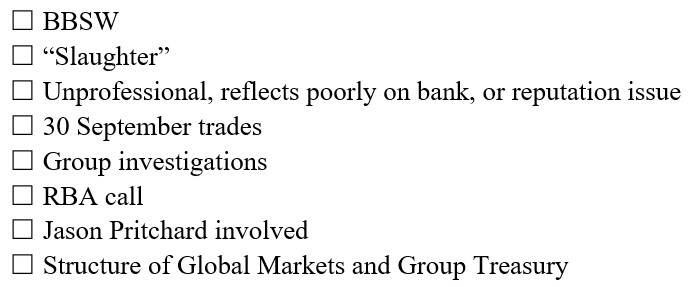
360 This tick-a-box exercise was repeated for each entry with the relevant box ticked if that element was present in the entry but otherwise left blank.
361 I will go through each entry shortly. However, at the outset some methodological limitations of the table may be observed. The first is that of sampling bias. The box entries omit topics on which Mr Alexiou was consistent thereby overemphasising the appearance of inconsistency. For example, mention of Mr O’Callaghan is not one of the boxes ticked although he is a consistent element in Mr Alexiou’s account. This is not to make too much of that point but merely to observe that atomising the evidence in this fashion may be apt to mislead.
362 The second point is related to the first. The table is decontextualised and, further, does not attempt to address the level of detail which might be appropriate for each communication. It is not the case that on every occasion it can be expected that Mr Alexiou gave a fulsome account. Some conversations may have called for a more abbreviated form, others a longer version. Further, it would be unnatural if Mr Alexiou’s account on each occasion involved a near identical recitation of his evidence in this Court so that each of the boxes nominated by the Bank would receive a tick. To the contrary, as I have said, it is to be expected that different occasions call for different levels of detail. Further, in the real world, accounts always vary. It can be expected, for example, that if Mr Alexiou had been unwavering in his production of the same version of the complaint on each occasion, it is likely that the Bank would then criticise the evidence as being too consistent to be plausible.
363 These are not reasons for dismissing the table’s contents out of hand. However, they underscore the necessity of obtaining a proper understanding of each communication.
Table entry #1: Mr Alexiou’s conversation with Mr Listorti on 17 July 2014
364 The first entry in the table is for a conversation that Mr Alexiou says that he had with Mr Listorti on 17 July 2014. I have already touched on that conversation above where I have accepted that a conversation of some kind took place on 17 July 2014 for it was that conversation which had provided the impetus for Mr Alexiou to approach Mr Pucci the next morning. However, it has not been necessary to this stage to touch upon the detail of that conversation (especially as Mr Listorti’s version of it is not in evidence due to his unavailability).
365 Mr Alexiou says that the meeting occurred on 17 July 2014 and began in Mr Listorti’s office before adjourning to a nearby bar. The gist of Mr Alexiou’s evidence is that Mr Listorti was tipping him off about the fact that he was one of the subjects of the Bank’s investigation and warning him that Mr Nigel Williams was ‘gunning for you’. Mr Alexiou’s evidence about the conversation extends over eight paragraphs from [205]-[212]. It is towards the middle of this conversation that Mr Alexiou then says this exchange took place:
Mr Alexiou: “How could I be on the list let alone top 5?”
Mr Listorti: “We have been throwing Bloomberg Chats back and forth across the boardroom table and discussing them, including some of yours. I have been trying to help Nigel understand the language in them. I was involved in an Italian bribery situation and court case while with Dresdner so I have experience of regulatory investigations.”
366 I have previously explained that Mr Listorti did have access to a list of 10 names which included Mr Alexiou’s and this provides some reason for thinking that Mr Alexiou’s account, although not precisely on all fours with the known facts, was sufficiently similar to indicate that something like this had happened. This was especially so when it was apparent that something had moved Mr Alexiou to email Mr Pucci the next morning.
367 Other topics touched on (according to Mr Alexiou) were possible future changes in responsibilities, Mr Listorti telling Mr Alexiou that his career could be salvaged, Mr Alexiou’s complaint to Mr O’Callaghan and lastly an odd inquiry from Mr Listorti as to whether Mr Alexiou was gay. It will be seen that on Mr Alexiou’s version of events this was a sufficiently long conversation to have involved a change of venue to a bar. It is in that context that Mr Alexiou’s evidence about the complaint to Mr O’Callaghan takes place. The evidence is as follows:
Me: “Have you been made aware that I raised a concern about BBSW around the 30 September 2011?”
Eddie Listorti: “No I haven’t.”
Me: “I thought that the set was higher than I expected and language like ‘slaughter’ was being used.”
Eddie Listorti: “‘Slaughter’ is all over everything.”
368 The Bank’s box tick field is as follows:
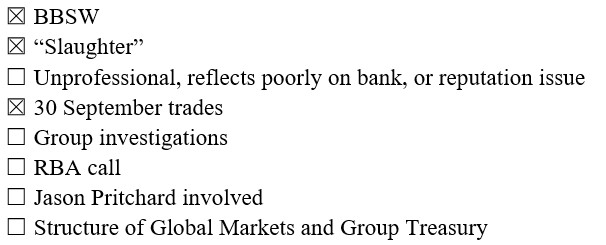
369 The nature of this conversation does not involve a recitation of a complaint. It is simply a question from Mr Alexiou to Mr Listorti as to whether he knew that he had made a complaint. It would have been odd for Mr Alexiou to have included into that simple question that he had had a meeting with someone from Group Investigations, or that the RBA had called, or that Mr Pritchard was involved, and it would similarly be odd for him to have started talking about the structure of Global Markets. I therefore do not accept that the fact that those matters were not mentioned in Mr Alexiou’s version of the conversation deleteriously affects his credit.
Table entries #2 and #3: Mr Alexiou’s conversation with Mr Pucci on 18 July 2014
370 The second entry for the table is the version in Mr Pucci’s affidavit of the conversation he says he had with Mr Alexiou on 18 July 2014. The third entry is the more fulsome version of that conversation that Mr Pucci gave under cross-examination. Including both in a table put forward as illustrating the many versions put forward by Mr Alexiou is, to an extent, problematic since these are two materially different versions of the same conversation from Mr Pucci. Perhaps this was not intended.
371 The portion of his oral testimony relied upon is as follows (T551.40-553.13):
Do you remember having a conversation with Mr Alexiou in July of 2014?---Yes.
Do you know when that took place?---No. Some time in July.
Have a rough date?---Somewhere between – somewhere in the middle of July, yes.
… Do you remember what was said?---Well, when he subsequently emailed me about having made a complaint in 2011 that involved an ex-cop, I thought that was curious, because when we had the conversation, he wasn’t specifically aware of who he had had a conversation with, and I had proactively tried to help him recollect who that might have been and said, “How about, you know, was he tall and bald ex-cop?” And he said, “Yes, possibly,” and then that information came through in the email. So I remember the conversation only in the context of the email.
… Do you remember anything else about the conversation?---I – not perfectly, but I think it might have been in person, in the Sydney office, but I just couldn’t tell you for sure. I think he was basically verbally advising me of – of this incident of – that he had had a conversation in 2011, and then, once he had done that verbally, he followed it up with the email.
All right. But he told you during that conversation that he had had a conversation with Mr O’Callaghan in 2011?---Yes.
Did he tell you the date?---I can’t remember exactly, no.
And what did he tell you about the nature of the conversation with Mr O’Callaghan?---He said that he had objected to Jason Pritchard’s use of “slaughter” and thought that was bad for ANZ, essentially.
And that’s what he told you on around about 18 July, was it?---Yes.
Anything else?---Well, he was wanting to know what had happened as a follow-up to that conversation he had had with Rob.
372 The relevant box ticks are as follows:
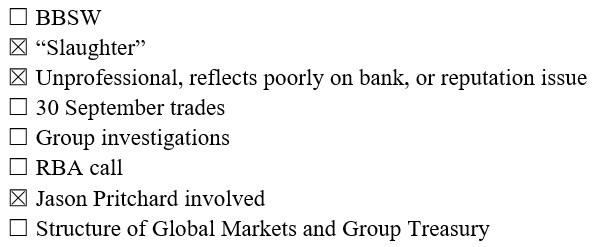
373 There are five points to make about this.
374 First, although indicated by ellipsis, the author of the table has omitted portions of Mr Pucci’s cross-examination on this issue. Some of what has been omitted contradicts the assertions the Bank makes about what was said. At [24] of his affidavit Mr Pucci said that he had mentioned Mr McGowan’s name to Mr Alexiou during the conversation but that the conversation had occurred before 9.33am. Paragraph 24 is as follows:
Prior to receiving the 18 July 2014 Email, I saw Etienne in the Sydney office. We had a discussion and he said words to the effect of I think I made a complaint to Rob and I met a guy with Rob who said they would look into it. I asked Etienne a number of questions about why he had spoken with Rob O'Callaghan in an attempt to identify that person. Although I do not now recall Etienne's precise response, I recall that he provided a physical description of a male employee, and that he said words to the effect that he worked in investigations at ANZ. The conversation continued in words to the following effect:
Me: Are you referring to David McGowan? Big, tall, bald bloke who looks like a cop?
Etienne: Yeah, maybe.
375 In the Bank’s table, the point is explicitly made that in the version of Mr Alexiou’s complaint in the third table entry (Mr Pucci’s second version), there was no mention made of Group Investigations. However, this is because the portion of the transcript in which Mr McGowan was mentioned has been omitted from the Bank’s quotation of the evidence. The relevant portion is at T554.17-555.29:
Now, just if you could have a look, please, at paragraph 24 of your affidavit. You see there, what you’ve done is you have set out your best effort at recalling that conversation?---Mmm.
And it says there:
The conversation continued in words to the following effect. And he says me, are you referring to David McGowan? Big, tall, bald bloke who looks like a cop?
?---Mmm.
I think before you said that he had said – sorry, that you attributed words to yourself in that conversation was a big, tall, bald bloke who was an ex-cop. Do you see the difference?---Yes, I – I’m saying looks like a cop versus who was, yes.
So when you wrote your affidavit you said that he had said – sorry, that you had said a bloke who looks like a cop?---Yes.
Okay. And this is something that you wrote in your affidavit you wrote back in November of 2023?---Yes.
I take it that you were quite careful when you wrote this affidavit?---Yes.
And you tried to give his Honour your best recollection of that conversation?---Yes.
It seems more likely, doesn’t it, that you used the expression a big tall bald bloke who looks like a cop, because that’s what you wrote in your affidavit?---Versus who is an ex-cop? Might be imprecise in recollecting versus that, but I don’t see a huge difference, but I – I think maybe “looks like a cop” sounds more like what I would have said, but – “or is an ex-cop”. I don’t think it’s a huge difference.
Well, it does make a difference, because if you go to paragraph 27 of your affidavit, you went and saw Mr McGowan, and you say – you asked him whether he had any recollection of the meeting with Etienne, and then you say:
I also told him that Etienne had said he was interviewed by an ex-cop when he first made the complaint to Rob O’Callaghan, in response to which David McGowan replied in words to the effect that he would never tell anyone that he was an ex-cop.
?---Yes?
And you say:
I told Etienne that David McGowan was a former policeman during my discussion with Etienne prior to receiving the 18 July 2014 email.
Do you see?---Mmm.
But back in paragraph 24, you don’t, in the way you have described the conversation, you don’t mention having told Mr Alexiou that Mr McGowan was an ex-cop?---Mmm.
Do you see the difference?---Yes.
So you just don’t have a recollection, do you?---No, I do recall referring to McGowan, either as a cop or “looks like a cop”.
But that’s all I’m pointing out to you is you don’t remember whether you said he was a cop or he looks like a cop?---No.
376 Mr Pucci did not retreat from his evidence at [24] that he told Mr Alexiou the name of Mr McGowan. In that circumstance, I do not accept that this exchange is evidence that Mr Alexiou had inconsistently failed to mention Mr McGowan. In any event, as I have explained earlier in these reasons, I do not accept Mr Pucci’s evidence that he spoke to Mr Alexiou before he sent the email.
377 Secondly, the Bank’s ticked boxes imply that the version Mr Pucci says that Mr Alexiou gave him omitted any reference to Friday 30 September 2011. However, this is because the Bank has omitted from the table the transcript at T553.1-553.4:
All right. But he told you during that conversation that he had had a conversation with Mr O’Callaghan in 2011?---Yes.
Did he tell you the date?---I can’t remember exactly, no.
378 This is, of course, about the conversation with Mr O’Callaghan (on 4 October 2011) and not the preceding Friday, 30 September 2011. However, the point is that Mr Pucci could not remember this detail with any exactitude (although noting he finished this answer, perhaps confusingly, with ‘no’). Further, the fact is Mr Pucci was not asked by the cross-examiner any questions about 30 September 2011 being discussed in that conversation so it is surmise how Mr Pucci would have answered that question had it been asked.
379 Thirdly, there is the further problem that this is Mr Pucci’s materially different second account of the complaint made by Mr Alexiou and it was proffered 11 years after the events in question. In a portion which the Bank did quote in the table Mr Pucci said that he ‘remember[ed] the conversation only in the context of the email’. It is unclear, therefore, how many of the suggested inconsistencies arise from what Mr Alexiou actually said and how many arise from what Mr Pucci is able to recall.
380 Fourthly, by its table, the Bank submits that Mr Alexiou had not mentioned the BBSW to Mr Pucci. However, it accepts that he did tell Mr Pucci that Mr Pritchard had been using the word ‘slaughter’. The Bank omits from its table Mr Pucci’s evidence at T553.15-25:
Because the word slaughter is a significant word to use on a trading floor, isn’t it?---Yes.
And an inappropriate one to use?---Yes.
In fact, it’s somewhat radioactive, isn’t it?---They’re crazy adjectives. I don’t know what you mean.
Because what it can do is it can suggest that somebody has a state of mind or an intention to engage in improper conduct in relation to the BBSW rate set; is that right?---Yes.
381 Thus, Mr Pucci understood that when Mr Alexiou referred to ‘slaughter’ he was referring to the slaughtering of the BBSW. This is unsurprising. I have explained above that Mr Pucci had been closely examining the whole issue of BBSW manipulation since June 2014. I therefore reject the Bank’s submission that Mr Alexiou’s account left out the BBSW. Making the assumption that Mr Alexiou did not actually mention it (a dubious assumption given the lapse of time), both men knew precisely what Mr Alexiou was talking about.
382 Fifthly, in light of these matters, I am not satisfied that the suggested differences between Mr Pucci’s two versions of the conversation and Mr Alexiou’s version in this Court provide a safe basis for reaching adverse views about Mr Alexiou’s credit.
Table entry #4: Mr Alexiou’s email to Mr Pucci on 18 July 2014
383 Here the Bank relied on Mr Alexiou’s email of 18 July 2014:
RE: “Group Investigations”
Fred,
I would like to see what was recorded by group investigations when I disclosed a concern I had in BBSW back in late 2011.
I was interviewed by someone from that group (ex cop from Melb) and was subsequently told by Rob O’c that my concern had been looked at and was ‘all fine’.
I am just wanting to check that this is the case, happy to discuss.
384 The box ticking was as follows:
385 The point of this email was to chase up an earlier complaint that had been made. I do not think that anything of particular significance emerges from the fact that Mr Alexiou did not include the whole of the complaint in the query. Further, even if there were not so, it would be quite unsound to consider the completeness of the version in the email without assessing alongside it the conversation that certainly occurred between Mr Pucci and Mr Alexiou later that day. Indeed, when that exercise is performed it can be seen that the only matters apparently not raised on the day were the call from the RBA (recalling in that regard that the word ‘slaughter’ certainly implied to Mr Pucci that what was being discussed was the slaughter of BBSW). Viewed in context, the email and Mr Pucci’s evidence of the conversation actually shows that all elements of Mr Alexiou’s complaint were included apart from the call to the RBA. I do not think it especially remarkable that Mr Alexiou omitted the call from the RBA. Thus I do not think that the fourth entry in the Bank’s table therefore provides a secure foundation for drawing adverse inferences about Mr Alexiou’s credit.
Table entry #5: Mr Alexiou’s section 19 examination on 15 August 2014
386 The fifth entry in the table is Mr Alexiou’s evidence to ASIC under a s 19 examination. I have already indicated that Mr Alexiou’s account to ASIC is materially different to his account in this Court. Mr Alexiou’s evidence to ASIC is a topic in its own right and I will deal with it separately later in these reasons.
Table entries #6 to #9: Mr Alexiou’s meeting with the Bank and Clayton Utz on 5 December 2014
387 These all concern the meeting between Mr Alexiou and his lawyers and the Bank and its external lawyers held on 5 December 2014. This meeting occurred at around 11.20am and is not to be confused with the meeting which occurred beforehand involving Mr Alexiou, his lawyers and Mr Santamaria and Mr Collins of the Bank.
388 The Bank has included in the table as separate versions the following:
the version of what Mr Alexiou said at this meeting given by Mr Alexiou in his affidavit;
the file note of Mr Slater from Clayton Utz of what was said at the meeting;
the file note of Mr Schneider from HWLE of what was said at the meeting; and
the file note of Ms White from HWLE of what was said at the meeting.
389 The three sets of solicitors’ file notes produce versions which were to an extent divergent (which is not surprising). Although the inconsistencies between the solicitors’ file notes appear to be presented as more evidence of the inconsistencies in Mr Alexiou’s evidence, I assume that this was an oversight and such a submission is not actually being advanced.
390 The Bank’s tick-a-box for each is as follows:
Mr Alexiou’s affidavit |
|
File note of Mr Slater (Clayton Utz) |
|
File note of Mr Schneider (HWLE) |
|
File note of Ms White (HWLE) |
|
391 It is obviously not sound to criticise Mr Alexiou for variations which appear between the three solicitors’ file notes (although this is what the Bank’s submissions entail). This rather suggests that those three tick-a-box exercises should be combined on the basis that if it is recorded in one file note that ‘X’ was said but not in another, then the likely inference is that ‘X’ was said. If this is done it will be seen that the only matter apparently not raised by Mr Alexiou during the meeting was the involvement of group investigations.
392 The questions which Mr Alexiou was being asked were not, however, about his complaint. They were about particular chat messages and what they signified. The point of the meeting was for the Bank to understand Mr Alexiou’s evidence insofar as it bore on the allegations the Bank was facing that it had attempted to manipulate the BBSW. The focus of the meeting was not on the fact of Mr Alexiou’s complaint to Mr O’Callaghan. Thus, as the file notes show, it was Mr Alexiou who raised his discussions with Mr O’Callaghan and the significance of Friday 30 September 2011 but he did this in response to questions about particular chat messages and the language in them such as ‘slaughter’ and ‘ram’. In an inquiry which was focussed on the extent to which personnel of Global Markets may have been implicated in market manipulation, the fact that Mr Alexiou had met Mr McGowan had no particular relevance. Given the context, I do not think that the failure of Mr Alexiou to mention Mr McGowan at this meeting is of particular significance. I do not accept that this omission adversely affects his credit.
Table entry #10: Mr Alexiou’s written response to ASIC on 22 May 2015
393 Next the Bank points to Mr Alexiou’s response to ASIC dated 22 May 2015. The context to this document is an email from ASIC to Mr Schneider dated 2 March 2015 which sought a written response to certain questions. The questions were detailed and were concerned with what Mr Alexiou knew about efforts to manipulate the BBSW at the Bank. Question 1 was as follows:
Whether Mr Alexiou is aware of the practice by staff at ANZ of trading Bank Bills and NCDs for the dominant purpose of trying to influence the BBSW Rate set on particular days (the practice). If yes…
394 Mr Alexiou’s written response was quite long. It gave an explanation of events in which he was careful not to say that the Bank had engaged in market manipulation. However, at one point under this heading he said this:
The practice(s) described above were an inherent part of the banking system when Mr Alexiou joined it. While at ANZ, Mr Alexiou has attempted to ensure that the Bank conducts itself in accordance with best practice in the manner, for example, set out below.
• Very shortly after joining the Bank, in the first week of September 2011, Mr Alexiou was confronted with language on the part of traders that was inappropriate (including, for example, slaughtering) which he regarded as unacceptable. He raised it with his superiors. He observed thereafter that the language ceased and Mr Alexiou did not observe any conduct which could have been described in those terms.
395 The Bank’s tick-a-box about this is:
396 The Bank’s table erroneously omits a ticked box for ‘slaughter’ which is clearly mentioned. I take this to be an oversight.
397 As with Mr Alexiou’s evidence to ASIC under s 19 examination, there is a large issue about this communication inasmuch as Mr Alexiou now says that he was aware that attempts were made to manipulate the BBSW. I will return to that aspect of this communication when considering the significance of Mr Alexiou’s volte face on this topic. However, I do not think that the fact that Mr Alexiou did not mention the detail of his 4 October 2011 complaint to ASIC is of much moment. In the context of what was being discussed, it would have been unnatural to include the detail of the complaint. I do not therefore accept that the inconsistencies pointed to by the Bank in its table adversely affect Mr Alexiou’s credit (leaving aside for now the much larger issue about Mr Alexiou now giving evidence in this Court which is inconsistent with his evidence to ASIC).
Table entry #11: Letter from Mr Alexiou’s lawyers to the Bank on 17 August 2015
398 The Bank next points to a letter written by the solicitors Mr Alexiou had engaged to deal with the Bank in relation to his employment position (Carroll & O’Dea). The letter was dated 17 August 2015. By this stage the Bank and Carroll & O’Dea were communicating about the Bank’s proposal to discipline him on the basis of the language of his chats. Much of this correspondence is concerned with the extent to which the Bank’s Code of Conduct was actually adhered to within Global Markets. The letter of 17 August 2015 is some 30 pages in length (excluding attachments) and was Mr Alexiou’s response to the Bank’s allegations that he had breached the Code of Conduct. At page 5 it addresses the Bank’s queries about Mr Alexiou’s understanding of the Code, the Use of Systems Policy and the ANZ Values. Under the subheading ‘Expectations under the Code’ there appears this paragraph:
First, our client observed the open and frequent use of the term ‘slaughter’ in relation to financial markets transactions carried out by ANZ. Our client believed that the use of this term was inappropriate and unprofessional. As such he reported his concerns to Robert O’Callaghan (as his line manager). Rather, than take our client’s concerns seriously, Mr O’Callaghan dismissively said to our client “we don’t use this language here”. To our client’s knowledge, Mr O’Callaghan took no steps to investigate our client’s claims or to implement measures to prohibit the use of this term.
399 The Bank’s tick-a-box exercise says this:
400 The context of this communication is that Mr Alexiou is pointing out that the use of inappropriate language in relation to financial markets transactions was very common in Global Markets. The point of this paragraph is to demonstrate that Mr Alexiou thought the use of ‘slaughter’ to be unprofessional and brought it to the attention of his line manager. In that context, it was simply not relevant to include the information now said to be missing. I do not accept that this adversely affects Mr Alexiou’s credit. The Bank’s tick-a-box exercise, was not apt to identify or a make a submission about the difference between Mr Alexiou’s account of his dealings with Mr O’Callaghan in the letter and what he presently says. For example, in the letter Mr Alexiou says that Mr O’Callaghan took no steps to investigate his claims. But his evidence in this case is that Mr O’Callaghan introduced him to Mr McGowan and subsequently reported back that the matter had been looked into and it was all in order.
Table entry #12: Mr Alexiou’s complaint in the Fair Work Commission on 22 September 2015
401 The Bank next relies upon Mr Alexiou’s Form F8 filed in the Fair Work Commission on 22 September 2015. The relevant portion is as follows:
9. After commencing employment with ANZ, the Applicant had cause to make oral complaints to senior ANZ staff in relation to his employment. These complaints included the following:
(i) Complaint to Robert O’Callaghan (Global Head of Fixed Income) in September 2011 about the use by ANZ employees of the word “slaughter” in relation to their activities, that expression carrying the implication that those employees were attempting to or considering unprofessional and unethical conduct in financial markets.
…
10. The Complaint to Mr O’Callaghan in September 2011 was not recorded by the Applicant. Mr O’Callaghan dismissed the complaint, first by saying, in response to the complaint “we do not use that language here” and then in March 2012 advising the Applicant that “the issue you raised has been looked into and everything is fine”.
402 This is a pleading of a general protections claim. It would have been wrong to include the evidence making good the general protections allegations in the pleading. I see no reason to criticise Mr Alexiou because his solicitors pleaded the matter succinctly (and in accordance with proper pleading principles).
Table entries #13 and #14: Mr Alexiou’s pleading in the original proceeding on 16 November 2015
403 The Bank then relies on Mr Alexiou’s statement of claim filed in his original (and subsequently discontinued) proceeding in this Court and his initial statement of claim in this proceeding. They do not plead Mr Alexiou’s case in terms of his evidence. I do not see any reason to criticise Mr Alexiou for this.
Table Entries #15 and #16: Mr Alexiou’s current pleading and affidavit
404 These are his current pleading and his first affidavit. Unsurprisingly they reflect the present state of his case. They therefore do not establish any inconsistency.
Conclusions on the Bank’s table of inconsistencies
405 Leaving aside the position of what Mr Alexiou told ASIC, none of the inconsistencies are impressive when context is brought to account. I do not think that considered as a whole they reflect adversely on this credit. The Bank submitted at [46] that Mr Alexiou ‘had repeatedly vacillated in his account of the “October 2011 Complaint”’ on the basis of its table. I reject this submission which is hyperbolic. It will also be necessary to conduct a more wholistic assessment of Mr Alexiou’s credit when all of the credit challenges have been considered. I will return to the suggested inconsistencies in that context. I would discourage the use of tables such as these in the future.
The Bank’s principal criticisms of Mr Alexiou’s evidence
406 These submissions are contained in the section headed ‘The applicant’s lay evidence – Etienne Alexiou’ which ran from RS [150]-[180]. These may be broken into the following categories of complaint:
(a) Rhetorical submissions: RS [150], [155], [156], [162] and [180]. These do not advance matters of substance and whilst I take them into account they do not call for any separate treatment.
(b) The relationship between Mr Alexiou’s evidence in this case and his evidence to ASIC: RS [151], [171]-[179].
(c) Mr Alexiou’s interview with the Bank on 5 December 2014: RS [154(a)] and [154(b)].
(d) Mr Alexiou’s chat messages: RS [151], [153] and [154(d)].
(e) The rate set on Friday 30 September 2011: RS [154(b)].
(f) Mr Alexiou’s general approach to his evidence: RS [152], [157], [158], [159], [160], [161], [163]-[170].
(g) Mr Alexiou’s demeanour: RS [152], [153], [154] and [154(c)].
The relationship between Mr Alexiou’s evidence in this case and his evidence to ASIC
407 Relevantly, Mr Alexiou had two formal encounters with ASIC. The first was his s 19 examination on 15 August 2014. The second was a formal written response provided to ASIC at a meeting on 22 May 2015 which answered questions asked of him by ASIC on 2 March 2015.
408 During the cross-examination of Mr Alexiou it was put to him that he had lied in both. It is a criminal offence under s 65 of the ASIC Act to obstruct or hinder a person in the exercise of the kinds of power that ASIC was using in its investigation into the BBSW affair. Further, under s 64(1)(b) it is an offence to give a statement in the course of a s 19 examination which is false or misleading in a material particular.
409 When challenged about what he had told ASIC Mr Alexiou invoked the privilege against self-incrimination in consequence of which I issued him with two certificates under s 128 of the Evidence Act. One certificate relates to the 22 May 2015 document, the other to the s 19 examination. The effect of those certificates is that any evidence given by Mr Alexiou under them cannot be used against him in other proceedings. On the grant of the certificates he gave evidence that what he had told ASIC was not true.
410 The Bank makes two categories of credit points about Mr Alexiou’s evidence. The first is the obvious one that he is not a witness of credit because he has admitted to lying in his response of 22 May 2015 and lying under oath to ASIC on 15 August 2014 during his s 19 examination. The Bank, however, has a second line of credit challenges which focus on some of the answers that Mr Alexiou gave in this Court about his evidence to ASIC. It is convenient to deal with these separately. I therefore deal with this topic as follows:
(1) the identification of the inconsistencies between Mr Alexiou’s evidence to this Court and his statements to ASIC on 15 August 2014 and 22 May 2015;
(2) credit challenges related to how Mr Alexiou gave evidence about this topic in this Court; and
(3) conclusions on the ASIC-related credit issues.
Mr Alexiou’s section 19 examination on 15 August 2014
411 During Mr Alexiou’s s 19 examination he was asked (ASIC T40.27):
Now, again, just at your time as head of mismatch, were you aware of a practice of people trying to trade in a way to influence the BBSW rate and where it would set?
412 Mr Alexiou gave many answers following this question. He volunteered the following information:
Without giving specific examples, there were a lot of conversations in the dealing room which featured language which Mr Alexiou regarded as ‘reasonably unprofessional and non-technical’ (ASIC T42).
The language was directed towards the rate set and included the phrase ‘slaughter the rate set’ (ASIC T42-43).
The person who used this language was Mr Pritchard and he did so openly in the dealing room (ASIC T42-43). Mr Alexiou heard it more than once and he heard it shortly after he arrived at the Bank (in August 2011) (ASIC T43-44).
Mr Alexiou was not comfortable with the language because he thought it was not professional and did not have a place in the dealing room and he was not comfortable with it from a reputational standpoint (ASIC T44-45).
Mr Alexiou did not know what slaughtering a rate set would actually ‘do, mean or entail’ but he agreed it was not good (ASIC T45).
The Bank had a reputational issue with the use of the language (ASIC T45).
Mr Pritchard intended his statements to be heard by many people (ASIC T45-46).
Mr Woodward might have heard it but he could not be sure (ASIC T46-47).
413 The examiner then pressed Mr Alexiou on whether the effect of this conduct might be expected to result in benefit to someone. This appears at ASIC T47.11-48.17:
Q. And would it follow that whatever impact he wants to have on the rate by those words, it would follow that it was in the hope that he would obtain, he or someone would obtain a benefit?
A. Privilege. I can't be sure. There’s a lot of theories we can draw from that, Colin.
414 Thus, what Mr Alexiou told the examiner was that Mr Pritchard was openly using the language of slaughter in the dealing room but he would not agree that this implied that anyone benefited or intended to benefit from it. That position may be contrasted with his evidence in this case that he now believed that efforts were being made to slaughter the rate set for the benefit of the Bank.
415 Under cross-examination, Mr Alexiou accepted the inconsistency. Mr Alexiou gave this evidence at T205.28-206.6 which was covered by a second s 128 certificate:
You were asked by Mr Luxford:
You took it seriously, didn’t you, when you heard it, that language to slaughter the rate set?
You answer:
I was not comfortable with that language.
That’s what you said?---Yes.
And then you say:
It’s not professional, and I don’t think it’s got a place in the dealing room.
You see that?---Yes.
And you don’t say there, “And I think it meant he intended to breach the Corporations Act”; that’s right?---Yes.
And if you were being – and if you honestly believed that that language indicated that intention, that’s what you would say in answer to that question, don’t you think?---Yes, you’re right.
And so what you said to ASIC was misleading in answer to that question. You would agree to that?---Yes.
416 Later in his s 19 examination, the examiner asked Mr Alexiou if his concerns about language and culture were more widespread than Mr Pritchard. Mr Alexiou said he thought that Mr Pritchard had quite a lot of influence on his direct reports and mentioned Mr Budrewicz. This exchange then followed (ASIC T105.6-106.1):
Q. What gave you concern?
A. That he was – privilege. That he was cast in a similar mould and similar language was most likely being used, you know, by him.
Q. And so - -
A. You're asking for specific examples though and I'm trying to think of specific examples and I can't think of a specific example right now.
Q. Were you worried that he was seeking to manipulate the market, for instance?
A, Privilege. Not particularly.
Q. So you were not concerned?
A. Not particularly, that he's manipulating markets, no. I think there was a bit of a view in – or that ANZ took that we had – or that they had this ability to sort of affect markets and that's why you have language from people like Jason about “slaughtering” and “ram”, but I don't see – I didn't see anything in particular that they had the ability to manipulate markets. Markets are pretty big, you know, so on a grand scale I didn't see anything that I thought we have this ability or these individuals, they're systemically manipulating markets, no.
417 Here Mr Alexiou told the examiner he did not observe anything to cause him to think that the Bank, or any individuals, had the ability to manipulate markets. Like the earlier statement to ASIC set out above, what Mr Alexiou said can be contrasted to his evidence before the Court in this case.
418 When this inconsistency was put to him in cross-examination, Mr Alexiou sought to explain it by differentiating between idiosyncratic and systematic intention to manipulate markets but ultimately accepted that what he told ASIC was misleading. Mr Alexiou gave this evidence under cross-examination at T211.20-212.17, T213.18-19 (which was also covered by a s 128 certificate):
And you didn’t say there to ASIC that the language they used showed an intention of conduct that could amount to a breach of the Corporations Act?---Not systematically, Ms Morgan.
I’m sorry. So you’re relying on your use of the word “systematically” there?---It was idiosyncratic.
I beg your pardon?---It was idiosyncratic.
What was?---Unduly affecting the rate set from time to time.
Right. Could you explain that, Mr Alexiou?---Yes. So in my experience, it didn’t occur – it occurred from – it didn’t occur every day. It did occur – I was concerned on a few occasions.
This is the 30 September – your reference to 30 September 2011 in your material?---Am I referring to that right now? Yes.
Yes?---Yes.
So when you say:
I didn’t see anything in particular that they had the ability to manipulate markets.
In this answer to the question, were you specifically excluding from your answer to ASIC there this more general proposition that it was idiosyncratic?---Yes, I was.
And that was conscious, was it?---Well, I consciously understood that they had manipulated markets on certain days. I understood that markets are big. I understood that it wasn’t possible for one bank to systemically manipulate markets.
But you didn’t say that to ASIC in answer to this question, Mr Alexiou. Did you?---I don’t think it was put particularly well. I don’t understand what you’re saying.
Are you saying that, at the time you were interviewed, or examined, by ASIC, you consciously understood they had manipulated on certain days?---I was particularly concerned about 30 September.
But you had that belief as at 15 August 2014; is that right?---Very much so.
And in answer to this question from ASIC, you did not give them that information; that’s correct?---No, I did not.
And you would agree that answer you have given is misleading?
…
So I will ask the question again, Mr Alexiou. You would agree that the answer you have given to this question to ASIC is misleading?---Yes.
419 I therefore accept that Mr Alexiou’s statements to ASIC in his s 19 examination is inconsistent with his evidence in this Court. Mr Alexiou’s evidence is that it is his evidence in this Court which is true.
Mr Alexiou’s response to ASIC on 22 May 2015
420 ASIC’s question to Mr Alexiou (in its email of 2 March 2015) had been whether he was ‘aware of the practice by staff at ANZ of trading Bank Bills and NCDs for the dominant purpose of trying to influence the BBSW Rate set on particular days (the practice)’. ASIC had used the defined term ‘the practice’ to refer to that practice. I have noted above that Mr Alexiou had been careful in his response to this question not to tell ASIC that he was aware of any such practice. However, the means by which he achieved this should be understood.
421 He began by describing a practice of which he said he was aware. Mr Alexiou’s account of this practice was as follows:
Response:
• The practice of which Mr Alexiou was aware is described below.
• Mr Alexiou understands the concept of a “practice” as systemic conduct whether authorised by the Bank or not.
• Mr Alexiou was not aware of any guidelines or requirements, the dominant purpose of which was to influence the BBSW rate set.
• The rate set process created by AFMA was designed to operate through the trading of bank bills and NCDs. This trading axiomatically determined the rate set on the day.
• The rate set process was created in a banking system which involved the use and trading of derivatives by the banks. There was always and remains an intimate relationship between the BBSW rate set and derivatives exposure.
• The trading window for the setting of the BBSW rate set became the period of highest liquidity for the trading of bank bills and NCDs.
• The Bank’s management of its derivatives exposure risk is related to the BBSW rate and has to be managed by taking it into account.
• The practice at all banks, including the ANZ, was to manage its risk in the most effective manner. The trading of bank bills and NCDs was inevitably involved in the management of this risk. At ANZ, Group Treasury determined the Bank’s liquidity requirements and communicated this to Global Markets, which bought or sold bank bills and NCDS to satisfy Treasury’s requirements. The timing of these transactions was intimately related to risk management in that Global Markets was duty bound to manage the risk in the most effective manner possible, i.e. time the transactions in a way to correspond with the Bank’s exposure to BBSW including from derivative settlements.
• Hence, the dominant purpose of trading bank bills and NCDs was to fund the Bank in a manner which managed its risk most effectively.
• It was a common practice in the market for those persons involved in the BBSW rate setting process to discuss which dates in a particular month were dates on which it was expected that the BBSW rate would be “neutral” (that is, expected to be neither higher nor lower), “higher” or “lower”. The existence of neutral, higher or lower periods was an inevitable result of the “early”/“late” structure of bank bills and NCDs. The lumpy trading at the beginning, middle and end of each month created regular identifiable movements in the rate set. Every bank would responsibly take into account these periods when determining their risk exposure. Discussions were held openly in the broker market on setting the start date for interest rate swaps and FRAs in the vast majority of transactions. Accordingly, it was not at all unusual for banks to position themselves as regards the BBSW rate set according to their historical experience of how the market moved on the BBSW rate on certain dates.
• Derivatives risk exposure therefore inevitably involved prepositioning the Bank’s exposure to correlate with these periods.
• The practice(s) described above were an inherent part of the banking system when Mr Alexiou joined it. While at ANZ, Mr Alexiou has attempted to ensure…
422 This was not the practice that ASIC was asking him about. Mr Alexiou’s response therefore draws a distinction between the practice he described and the practice ASIC was asking about. This becomes clear at heading 1c (‘Who at the ANZ participated in the practice’) where Mr Alexiou said this:
• Mr Alexiou is not aware of anyone who participated in the Practice (as defined in topic 1).
• As to the participation in the practice described by Mr Alexiou above, clearly the traders who participated and those identified in response to topic 1b were privy to, promoted and monitored the practice.
423 Mr Alexiou was cross-examined about the answer to the first bullet point. The first question was at T149.14-18:
So will you do me the courtesy of answering my question. Were you telling ASIC the truth or were you lying to ASIC?---Dot point 1 – 1(c), the first dot point, is not correct.
So you were lying to ASIC?---I didn’t think I was.
424 There then ensued substantial debate about s 128 of the Evidence Act at the end of which I granted a certificate under s 128. The cross-examination then continued at T157.7-8:
So in that dot point, Mr Alexiou, you were lying to ASIC; is that correct?---On reflection, I think I was, yes.
425 As the Bank pointed out in footnote 271 of its submissions Mr Alexiou’s evidence in his first affidavit was to the effect that the events surrounding Friday 30 September 2011 had led him to the opinion that the Bank had wished to affect the BBSW rate set by trading in a way which was intended to benefit it: [134]. Mr Alexiou also gave evidence that he formed the opinion in February 2013 that the Bank had attempted to influence where the BBSW rate set by entering into certain forward rate agreements and arranging the issuance of bank bills in the rate set window in a particular way. It has not been necessary up until now to expand on those events and it is not necessary to do so now. The point is that by the time Mr Alexiou gave his response to ASIC on 22 May 2015 it is evident, if Mr Alexiou’s current evidence is accepted, that he was well-aware of the practice of which he denied any knowledge to ASIC.
426 The next day Ms Morgan SC, for the Bank, returned to the topic of Mr Alexiou’s 22 May 2015 response. This exchange occurred at T166.39-167.3:
And I asked you that – sorry. I want to suggest to you that what happened yesterday is that in relation to your May 2015 responses to ASIC, you realised yesterday that your responses that you had given to ASIC were inconsistent with the case that you’ve brought against ANZ?---Yes.
And you had to decide yesterday whether to tell his Honour whether you were lying to ASIC or damage your case. That was the choice you were confronted with?---Not in my mind, Ms Morgan.
And what you decided to do was you chose to tell his Honour that you had lied to ASIC; that’s right? That’s the choice you made?---I chose to tell the truth, Ms Morgan.
427 Another exchange then occurred at T261.23-262.2:
In May 2015, you told ASIC that you were not aware that anyone within ANZ was engaging in trading to manipulate the BBSW rate set?---Ms Morgan, I don’t know how better to put it when you ask me “I told them”, than to respond that that is what this document says.
And what’s in this document was the truth?---I think we’ve already - - -
HIS HONOUR: You are covered by the certificate which has already been granted, Mr Alexiou?---Okay. So could I please give the context?
MS MORGAN: No. Answer my question, Mr Alexiou?---Could you repeat the question, please.
What was in that document – sorry – yes – what was in that document was the truth?---No.
You’re saying “no” now, and you said it was a lie on Tuesday, and you had to ask the court to protect you from incriminating yourself, because you realise now, and you realised on Tuesday, that the May 2015 response to ASIC was fundamentally inconsistent with your case against the bank; that’s right, isn’t it?---No.
Each time you’ve had to ask for a certificate to protect you from incriminating yourself, you had realised that what you had told ASIC was fundamentally inconsistent with your case against the bank; that’s right?---No.
And you thought it was better to say you lied or you misled ASIC than to tell the truth, because you want to win this case; that’s right?---No.
428 Mr Alexiou therefore finds himself in a situation of telling this Court he had formed the view that manipulation was taking place and of having told ASIC in his 22 May 2015 response that he was not.
Credit challenges related to how Mr Alexiou gave evidence about this topic in this Court
429 The first challenge related to the fact that Mr Alexiou did not annex to his affidavit his 22 May 2015 response to ASIC. On the first day of the trial Mr Alexiou was asked about this failure at T40.9-16:
And you haven’t attached to your affidavit, as part of your exhibit, either the list of topics or your written answers to the topics, have you?---This document is not attached, Ms Morgan.
And you didn’t do that, did you, Mr Alexiou, because this document truthfully and accurately reflected your views about ANZ and its BBSW rate setting practice in May 2015; that’s right?---I was doing my best to answer the questions that I was provided at this time.
430 I do not think that Mr Alexiou’s failure to annex a document to his affidavit says very much. In its submissions, the Bank says of the 22 May 2015 response that Mr Alexiou was ‘questioned extensively about its provenance, context and contents’ on the first day of the trial: RS [173]. No reference to where this appeared in the evidence was given. However, it may be that the Bank had in mind T28-47 where Mr Alexiou was cross-examined about the 22 May 2015 response. If this is what the Bank intended, then I accept that Mr Alexiou was extensively questioned about his 22 May 2015 response to ASIC on the first day of the trial.
431 This is a material conclusion because of a submission the Bank makes about Mr Alexiou’s evidence on the second day of the trial. Mr Alexiou was taken back to his 22 May 2015 response to ASIC at T145 and cross-examined about the distinction he drew between the practice ASIC was inquiring about and the practice he described in his response. At T145.45-146.7 this exchange occurred:
Yes. And you were not agreeing that you were – and you were saying, as far as that definition went, as a description of ANZ’s practices, no one that you knew at ANZ was involved?---I was – is that correct in here? I’m not – I’m not familiar with this document.
I’m happy if you need to read it more closely, Mr Alexiou. We went through it yesterday. Do you mean to say that you didn’t consider this document in the preparation of giving your evidence this week? Is that what you’re indicating?---I didn’t read this – I haven’t read this document for years.
432 The Bank submitted that this evidence was evasive, confused and unclear because he had been extensively questioned about it the day before. I accept this submission.
433 The second challenge related to his s 19 examination. I have explained above that Mr Alexiou’s evidence in this Court is inconsistent with his evidence to ASIC. Mr Alexiou was cross-examined extensively about elements of his present case which he did not tell ASIC from T178. At T181.21-27:
Mr Alexiou, do you have any explanation for why, at this point in the section 19, you did not tell ASIC of what you now say was your belief about Mr Pritchard engaging in trading that had the dominant purpose of influencing the BBSW rate set?---Yes.
And what’s that, Mr Alexiou?---On 7 August, I met with my lawyers Makdap.
I beg your pardon?---On 7 August.
434 There was then a debate about privilege. After that concluded the examination continued at T182.19-34:
Mr Alexiou, I asked you before the adjournment whether you had any explanation for why, at this point of your section 19, you didn’t tell ASIC what you now say was your belief that Mr Pritchard had engaged in trading that had the dominant purpose of influencing the BBSW rate set. And you said that you met with Eloise and Makdap. That was your answer?---Makinson d’Apice. The lawyers from Makinson d’Apice.
And you met with them on 7 August; is that right?---That’s correct.
And they gave you some advice, did they?---They did give me advice, yes.
And what was that advice?---I laid out for them the conduct of the 30 September rate set. Their advice was to be cautious in the section 19. Yes.
And are there any documents and file notes that record that advice that you were given, Mr Alexiou?---Yes.
435 The file note of the conference eventually found its way into evidence in the Supplementary Tender Bundle at pp. 844-845. The suggested advice to be cautious is not to be found in that file note.
436 Two issues arise from this. The first is that Mr Alexiou’s evidence about the solicitor’s advice seems not to have been made out. But for the second matter this might be allowed to pass on the basis that it is the sort of thing a solicitor might say to a client about to undergo a s 19 examination and so obvious and rudimentary that it might be left out of a file note. However, the second matter is that I agree with the Bank that there can be no warrant for thinking that any such advice from his solicitors would have provided a basis for giving false evidence to ASIC. I found Mr Alexiou’s evidence about this unconvincing and blameworthy to the extent that he sought to relocate the blame of giving false evidence on to his solicitors. That conclusion is not lessened because Mr Alexiou later accepted under cross-examination that his solicitors and counsel did not tell him to mislead ASIC or not answer the questions honestly: T220.21-221.3.
437 The third challenge also related to Mr Alexiou’s s 19 examination. Although Mr Alexiou ultimately accepted that he had misled ASIC, at several points in his evidence he did say that he had informed the examiners of his allegations of improper conduct in relation to the rate set. His evidence about this was at T215ff. He nominated the following passages in the examination transcript (using ASIC’s page numbering): ASIC T72.22, T64.9, T55.7 and T47.
438 The portion at ASIC T72.22-73.10 concerns a question about a chat message Mr Alexiou was shown earlier between Mr Collier and Mr Budrewicz:
Q. It doesn't say what they want about the rate.
They say:
We are trying to push the rate lower and then push it higher.
It’s nothing about want, it’s actually an articulation of what they’re going to do to push the rate in a certain direction and I would assume that they would want that because their positions are aligned that way?
A. Privilege. Yes, that's what I’m assuming too.
Q. This is a strategy of manipulating the BBSW, isn't it?
A. I'm assuming that --
Q. That's what this is referring to, a plan to --
A. Mmm.
Q. -- manipulate BBSW for their rate set, nothing more, nothing less?
439 Mr Alexiou accepted that this did not specifically refer to agreeing that the Bank was engaged in market manipulation (T216.20) but then took the cross-examiner to ASIC T64.9-20:
Q. So there is a deliberate communication path to time the issuance of paper to align with the interests of the derivative books?
A. Privilege. Categorically, there’s some conversations that go on in the bank that refer issuance to derivatives exposures, yes.
Q. Do you have a problem with that at all? Do you see a problem with that?
A. Privilege. When I joined I had reason to have some concern that it could lead to issues around us seeming to issue only because we have leverage in the market around --
440 Ms Morgan cross-examined Mr Alexiou at T216.40 to emphasise that Mr Alexiou had used the words ‘seeming to’ so as to paint a picture of perception rather than reality but Mr Alexiou denied this. My impression of this exchange is different to both parties. In my view, Mr Alexiou was doing his best to say to ASIC what he knew about the BBSW rate set without actually saying that the Bank had engaged in market manipulation. Mr Alexiou’s insistence that he did tell ASIC of the market manipulation discounts the evident attempts he was making not to say that. By the same token the Bank’s focus on the literal fact that Mr Alexiou never once crossed the line to make the allegation puts at nil the equivocal nature of his evidence.
441 The passage at ASIC T55 concerns Mr Alexiou’s complaint to Mr O’Callaghan and does not assist him. The passage at ASIC T47 must be read with the answer given at ASIC T48.2 which is an unequivocal denial that manipulation was taking place.
442 There are other examples but they either do not assist Mr Alexiou or they are cast in equivocal language.
443 It was put by the Bank that Mr Alexiou’s cross-examination in this Court showed that he stubbornly stuck to the idea that he had told the examiners about the misconduct when the evidence was to the contrary. For example, it was said that these responses were ‘strained, convoluted and self-serving’: RS [372(f)(i)]. This submission overlooks the equivocal nature of much of Mr Alexiou’s evidence to ASIC.
444 I think there is a credit point here but it is not the one the Bank made. Mr Alexiou’s attempts to point out that he had disclosed the market manipulation to ASIC were hampered by the fact of his own equivocation before ASIC. That equivocation was under oath and reveals a mind with a sophisticated grasp of the dilemma with which he was confronted (implicating his employer versus telling the full truth). Mr Alexiou chose the path of carefully chosen words which could be read different ways. Whilst the skill of the equivocation may be accepted, I do not think this reflects well on him at all. Ultimately the cross-examination led to him, to an extent, being hoist on his own petard.
445 Whilst I do not accept the Bank’s submission about what his cross-examination on his dealings with ASIC showed, I do reach the conclusion that Mr Alexiou, when provided with a motive to do so, is quite willing to speak at least half-truths and, on occasion, lie. It is a strong indication that his evidence is to be approached with considerable caution. I do not accept, however, as the Bank submitted that he is an out and out liar none of whose testimony can be accepted.
Conclusions on the ASIC-related credit issues
446 There remains then on this topic the fact that Mr Alexiou now admits that he misled ASIC. The Bank submits that it shows that he is a thoroughly discreditable witness. Again, however, this is overly simplistic. It shows instead that Mr Alexiou is quite capable of lying under oath. But this does not necessarily entail that all of his evidence is untrue although it certainly counsels great caution.
447 In seeking to unravel whether his account to ASIC was true (as the Bank submits) or whether his current version is true (as he submits) or whether both accounts are false (which is logically possible) it is useful to see what the independent evidence on this topic shows.
448 The independent evidence consists of:
(a) the contemporaneous chat messages passing between the traders on the day; and
(b) an analysis of whether anyone within Global Markets profited from positions in derivatives where the BBSW rate set on Friday 30 September 2011.
449 As to (a), I have examined the chat messages above. They show that Mr Mulcahy thought that the BBSW had been manipulated by the Bank on Friday 30 September 2011. This is a matter to be taken into account.
450 As to (b), both parties have put before the Court an analysis of whether the Bank profited from positions it had in 90-day bank bills by reason of where the BBSW rate set. However, as I have explained, neither party’s evidence is adequate for the purposes of determining whether the Bank or any desk within Global Markets profited from the events of Friday 30 September 2011 either from the perspective of actual bank bills or in derivatives thereof. This matter is therefore neutral.
Mr Alexiou’s interview with the Bank on 5 December 2014
451 I accept the Bank’s submission that at this meeting Mr Alexiou did not provide the version of events which he now advances and, indeed, that he said things which contradict what he now says. For example, at the meeting he said that he had assumed Mr Pritchard was joking when he said that he was going to slaughter the rate set and that whilst he initially had concerns about the events of Friday 30 September 2011 it ultimately set in a range which was ‘not miles away from expectation’. Mr Alexiou also told the Bank that where the rate set was ‘not a genuine issue. Not out of context as to where BBSW trading @ time’. This is quite different to what he now says.
452 I accept that this shows that Mr Alexiou has made prior inconsistent statements about the subject matter of this litigation.
Mr Alexiou’s chat messages
453 Mr Alexiou was cross-examined about a number of chat messages in which he had said things which the Bank in its submissions described as ‘offensive, derogatory and vulgar’. There is no issue in the proceeding as to whether the chats have that quality. Mr Alexiou does not dispute that the language of these chat messages engaged the Code of Conduct and Use of Systems Policy. His submissions about the chat messages depend instead on arguments such as estoppel and so forth. It was therefore no surprise when Mr Alexiou conceded early on that the language he had used was ‘inappropriate’ and that he understood that they could have been offensive.
454 The Bank criticised Mr Alexiou for making these concessions characterising it as an attempt ‘to short-circuit any detailed analysis of the chats and their contents’: RS [153]. I do not see the matter that way. The chats say what they say. Mr Alexiou’s evidence about whether he thought them offensive was of no utility. Since there are no factual issues about the contents of the chats or their legal significance, a detailed examination with Mr Alexiou of the chats and their contents was, subject to the question of Mr Alexiou’s credibility, irrelevant. Further, the fact that Mr Alexiou’s chats revealed, for example, sexist attitudes does not throw any light on whether he was a witness of truth.
455 Since Mr Alexiou’s views about the offensiveness of the chats is irrelevant, there is no issue of fact in this case which requires me to go through the chat messages for their own sake. However, the Bank does submit that some of Mr Alexiou’s answers to the questions he was asked about the chat messages do show him not to be a witness of credit.
456 The Bank drew attention to four chat messages to make this point.
The chat message with Mr Michell of BGC of 4 March 2012
457 This chat message was as follows:
03/01/2012 22:48:50 GEORGE MICHELL (BGC PARTNERS): I had trouble sleeping with the erection after watching that show!
03/01/2012 22:48:58 ETIENNE ALEXIOU (ANZ) i got laid!!!!
03/01/2012 22:49:04 GEORGE MICHELL (BGC PARTNERS): ur c unt
03/01/2012 22:49:12 ETIENNE ALEXIOU (ANZ): think all the hot men got Berry going
458 Mr Alexiou agreed that he had been out the evening before with Mr Michell, Mr Michell’s wife and his own wife. He added at T106.44 that they had been at a Mardi Gras cabaret. It was put to him that he had not previously mentioned the Mardi Gras cabaret and was trying to make it look like he ‘didn’t have any issues with the LGBTQI community’ which he denied: T107. He denied that he had added that element because he thought it was in his interests to do so. Here the Bank’s point was that Mr Alexiou was attempting to soften what it said was the homophobic nature of some of his chats. In its submissions, the Bank did not give me any references to where these allegedly homophobic chats were although it did give me a reference to T106.31-45. However, this appears to be an error.
459 The word ‘homophobic’ does not appear in Mr Alexiou’s cross-examination. Mr Alexiou was cross-examined about a chat message of his dated 13 March 2012:
03/13/2012 04:53:49 ETIENNE ALEXIOU (ANZ): u think its ok for boys school teachers to be gay
03/13/2012 04:54:07 GARFIELD LEE (CBA): yeah
03/13/2012 04:54:18 GARFIELD LEE (CBA): gay doesnt mean kiddy fiddler
03/13/2012 04:54:26 ETIENNE ALEXIOU (ANZ): got myself into trouble for implying that they are
03/13/2012 04:54:34 GARFIELD LEE (CBA): thats like is it ok for man to teach at girls school
03/13/2012 04:54:43 ETIENNE ALEXIOU (ANZ): yeah i guess
03/13/2012 04:55:18 MATT MULCAHY: i dont think they should be boarding masters
03/13/2012 04:55:36 ETIENNE ALEXIOU (ANZ): Says leadign the soggy sao session
03/13/2012 04:55:54 MATT MULCAHY: i also dont think guys should be in girls school
03/13/2012 04:56:24 ETIENNE ALEXIOU (ANZ): im nota fan
03/13/2012 04:56:53 ETIENNE ALEXIOU (ANZ): Says i like youngish hot women to teach my girls
03/13/2012 04:57:40 ETIENNE ALEXIOU (ANZ): with good dress sense
03/13/2012 04:58:36 ETIENNE ALEXIOU (ANZ): at least till 3rd class
03/13/2012 04:58:47 MATT MULCAHY: you have funny view on world
03/13/2012 04:59:16 ETIENNE ALEXIOU (ANZ): post 3rd class just good looking women , dont hv to be hot and young
03/13/2012 04:59:37 ETIENNE ALEXIOU (ANZ): and candress a bit worse
03/13/2012 05:00:07 ETIENNE ALEXIOU (ANZ): till high school whne i want those bookish looking mid age women with no style in the class
03/13/2012 05:00:22 ETIENNE ALEXIOU (ANZ): so the girls know its time to get serious
03/13/2012 05:01:07 GARFIELD LEE (CBA): when they are young, it's essentially childcare
03/13/2012 05:01:19 MATT MULCAHY: expensive childcare
03/13/2012 05:01:30 GARFIELD LEE (CBA): so you just want someone who will be good at that
03/13/2012 05:01:51 ETIENNE ALEXIOU (ANZ): hot youngish chick with style and a good smile
03/13/2012 05:02:07 MATT MULCAHY: flirts a bid at parent teacher?
03/13/2012 05:02:22 ETIENNE ALEXIOU (ANZ): yeah and doesn’t mind a drink
03/13/2012 05:02:22 MATT MULCAHY: touches your arm and laughs?
03/13/2012 05:02:36 ETIENNE ALEXIOU (ANZ): definately no kids
03/13/2012 05:02:57 ETIENNE ALEXIOU (ANZ): sometimes doesn’t wear undies to parent teacher
03/13/2012 05:03:36 ETIENNE ALEXIOU (ANZ): good cans
03/13/2012 05:04:12 ETIENNE ALEXIOU (ANZ): likes married guys
03/13/2012 05:04:31 GARFIELD LEE (CBA): problem with that is your wife will see her and hate her even more than women normally hate each other
03/13/2012 05:04:33 MATT MULCAHY: all this in narnia
03/13/2012 05:04:49 ETIENNE ALEXIOU (ANZ): [REDACTED] teaher is a 9
03/13/2012 05:04:55 MATT MULCAHY: big score
03/13/2012 05:04:58 MATT MULCAHY: never seen a 10
03/13/2012 05:05:07 MATT MULCAHY: reckon i have seen a few 9’s
03/13/2012 05:05:09 GARFIELD LEE (CBA): you will when you get older
03/13/2012 05:05:15 ETIENNE ALEXIOU (ANZ): blonde , great body , likes my kid
03/13/2012 05:05:18 MATT MULCAHY: just hard marker
03/13/2012 05:05:20 ETIENNE ALEXIOU (ANZ): solid 9
03/13/2012 05:05:32 MATT MULCAHY: should we invite her to lunch?
03/13/2012 05:05:54 ETIENNE ALEXIOU (ANZ): id eat lunch of her ass
03/13/2012 05:06:51 GARFIELD LEE (CBA): you ever eaten ass?
03/13/2012 05:06:56 ETIENNE ALEXIOU (ANZ): no
03/13/2012 05:06:59 MATT MULCAHY: bshite
460 Obviously this is unedifying. Mr Alexiou was then asked these questions:
Now, do you agree that what you said in this chat is offensive?---Now, yes.
It’s offensive to women?---Yes, Ms Morgan. It is.
It’s offensive to gay men?---It is.
It’s offensive to teachers?---Yes.
It’s disrespectful to [REDACTED] teacher?---Yes.
It’s disrespectful to primary school teachers?---Yes.
It’s disrespectful to teachers, whether they’re male or female?---Yes.
461 Making the assumption in the Bank’s favour that this should be characterised as homophobic, I do not accept its submission that it was this evidence that Mr Alexiou was trying to rebalance in the answer he gave about the Mardi Gras cabaret. This is because that evidence was given at T111 whereas the cabaret answer was given at T106.
462 The cross-examination on this chat then moved to the topic of Mr Alexiou’s wife. This exchange then occurred at T107.16-18:
Do you think it was appropriate to talk about your sexual relationship with your wife with Mr Michell on [4] March 2012?---I think it might be a matter for myself and my wife.
463 The Bank submitted that this showed that Mr Alexiou had feigned his offence at this question when he had already admitted that the chats were offensive and disrespectful to his wife.
464 I do not accept the Bank’s submissions about the 4 March 2012 chat. I do not think that the Mardi Gras cabaret reference was an attempt to burnish Mr Alexiou’s gay-friendly credentials. In relation to the questions about his wife, my impression was that Mr Alexiou was attempting to answer in the most dignified fashion he could muster in a deeply embarrassing moment for him in the witness box. I do not accept that this exchange says very much about Mr Alexiou’s credibility as a witness.
The chat message with Mr Lee of 29 September 2011
465 This chat message was as follows:
09/29/2011 06:35:35 GARFIELD LEE (CBA): I need viagra
09/29/2011 06:35:52 ETIENNE ALEXIOU (ANZ): where u get that from
09/29/2011 06:36:01 GARFIELD LEE (CBA): a pharmacist
09/29/2011 06:36:05 ETIENNE ALEXIOU (ANZ): ok
09/29/2011 06:36:10 ETIENNE ALEXIOU (ANZ): can i hv one
09/29/2011 06:36:19 GARFIELD LEE (CBA): from me?
09/29/2011 06:36:23 GARFIELD LEE (CBA): I don't have any
09/29/2011 06:36:29 ETIENNE ALEXIOU (ANZ): if ur getting some
09/29/2011 06:36:45 GARFIELD LEE (CBA): go to doc yourself and tell him your kok is broken
09/29/2011 06:36:52 ETIENNE ALEXIOU (ANZ): i dont want to
09/29/2011 06:36:57 ETIENNE ALEXIOU (ANZ): my whole family sees same gp
09/29/2011 06:37:05 ETIENNE ALEXIOU (ANZ): wierd
09/29/2011 06:37:07 GARFIELD LEE (CBA): hahah
09/29/2011 06:37:15 ETIENNE ALEXIOU (ANZ): next time im in there with the kids
09/29/2011 06:37:19 ETIENNE ALEXIOU (ANZ): and then with berry
09/29/2011 06:37:27 ETIENNE ALEXIOU (ANZ): feel strange
09/29/2011 06:37:29 GARFIELD LEE (CBA): will you use it to root berry?
09/29/2011 06:37:34 ETIENNE ALEXIOU (ANZ): yes
09/29/2011 06:37:40 GARFIELD LEE (CBA): so whats the problem?
09/29/2011 06:37:47 ETIENNE ALEXIOU (ANZ): wot if i don’t
…
09/29/2011 06:43:13 ETIENNE ALEXIOU (ANZ): sry top hear abt ur kok
09/29/2011 06:43:50 ETIENNE ALEXIOU (ANZ): wot did u do to it
09/29/2011 06:44:54 GARFIELD LEE (CBA): too much wacking probably
09/29/2011 06:45:07 ETIENNE ALEXIOU (ANZ): burnt it out
09/29/2011 06:45:12 ETIENNE ALEXIOU (ANZ): over revved
09/29/2011 06:45:12 GARFIELD LEE (CBA): I need a new one...retreads wont do
09/29/2011 06:45:31 GARFIELD LEE (CBA): my brain is fried too
09/29/2011 06:45:41 GARFIELD LEE (CBA): pleasure centres burnt out
09/29/2011 06:47:09 ETIENNE ALEXIOU (ANZ): too muany disco biscuits
09/29/2011 06:47:16 GARFIELD LEE (CBA): nah too much porn
09/29/2011 06:47:29 GARFIELD LEE (CBA): like I said....late starter with wack
09/29/2011 06:47:41 GARFIELD LEE (CBA): and hold over from not enough porn pre internet
09/29/2011 06:48:08 GARFIELD LEE (CBA): plus high sex drive and low interest from the ladies
09/29/2011 06:48:20 GARFIELD LEE (CBA): = broken kok by 38
09/29/2011 06:48:56 GARFIELD LEE (CBA): I can imagine anz and cba compliance guys reading this chat
09/29/2011 06:49:16 ETIENNE ALEXIOU (ANZ): mmm , not exactly sackable
466 Mr Alexiou was asked about his statement ‘sorry to hear about your kok’. Mr Alexiou was asked about the context for that statement at T78.18-79.27:
Do you recall now, sitting here, what the context of that was?---Yes.
And what was that?---So if I take you from the start of that day?
Just give it some context. That’s what you’ve said. You’ve said it’s like art; it’s contextual. So give that statement some context?---Okay. So in coming into work that day, a friend of mine, Matt Mulcahy, asked me how my wife was. I said she had been in tears all night. He asked if I was okay. He asked if I had called a mutual friend of ours, [REDACTED]. Garfield Lee came onto the chat. He had called me the night before. That went on. [REDACTED]. My wife was at [REDACTED] with an old friend of ours, [REDACTED]. About 10.25, she left the park - - -
Are you explaining the circumstances - - -?---That’s the context, Ms - - -
- - - of [REDACTED]?---That’s the context on the day.
Okay?---And then it went on, Ms Morgan. Same day. You’re asking for context.
No, I’m asking for context of you saying to Mr Garfield Lee - - -?---Yes.
- - - “Sorry to hear about your kok”?---Yes. So then that conversation continued – that was 8 am. The conversation continued through the day. By about the time of that conversation, was about 4.30. Prior to that, he had told me that he uses Viagra. He said he prefers Cialis. And that’s the context of him saying he has a broken cock. So he had some erectile dysfunction issue.
So does this help your recollection: Mr Lee says:
I need Viagra.
And you say:
Where do you get that from?
?---Yes.
And then you ask him:
Can I have one?
?---Yes.
And says:
If you’re getting some.
And he goes to the doctor yourself and tell him your cock is broken?---Yes.
And then you explain you don’t want to go because you go to the same GP as your whole family?---Yes.
Does that sound familiar?---That’s correct.
So this is all part of the context leading up to the question to Mr Lee; that’s right?---That is, yes.
467 The Bank submitted that this was nonsensical and had been offered in attempt to rehabilitate his image. I think this is likely to be correct. The tragic accident which befell [REDACTED] has nothing to do with this chat message and its only relevance appears to have been as an attempt to engender some sympathy. I do not think that this reflected well on Mr Alexiou’s credibility as a witness.
The chat message with Mr Lee of 20 October 2011
468 This chat message was as follows:
10/19/2011 21:56:46 ETIENNE ALEXIOU (ANZ): my peniss wud be constantly out of my pants
10/19/2011 21:56:55 GARFIELD LEE (CBA): it has been for a while
10/19/2011 21:56:59 ETIENNE ALEXIOU (ANZ): ha
10/19/2011 21:57:08 ETIENNE ALEXIOU (ANZ): down then up on fra
10/19/2011 21:57:08 GARFIELD LEE (CBA): just too small for most to notice
10/19/2011 21:57:22 GARFIELD LEE (CBA): yeah I switched some yesterday
469 Mr Alexiou was asked about this at T87. The context was the World Cup in Brazil. He was cross-examined to the following effect:
And what were you referring to there?---The World Cup in Brazil, I think. Is that correct?
You tell me?---I think it was.
What was it about the World Cup that meant your penis would be out of your pants, Mr Alexiou?---Ms Morgan, I accept that it’s inappropriate. It could have caused offence. I didn’t mean it to. It’s not literal. My penis would not have been out of my pants.
But what is it about your penis being constantly out of your pants which was meant to say something about the World Cup?---I don’t think there’s any relevance between the two. It’s somewhat absurd, Ms Morgan.
Well, what you said to ANZ Bank in August 2015 was that was meant to convey that you would enjoy being part of the World Cup as it would be an amazing experience. Does that sound familiar?---It does, yes.
So my question is, again, what is it about having your penis out of your pants constantly that would convey that sentiment?---I guess it’s trying to convey a sense of fun. I’m not - - -
That’s what’s fun to you?---No, Ms Morgan. It’s inappropriate. It could have been offensive. I accept that.
No, you have suggested it indicated that it would be fun. I’m just asking if that’s how you describe fun, having your penis out of your pants constantly?---No, Ms Morgan.
I’m not trying to be funny, Mr Alexiou. I’m asking you questions?---Ms Morgan – okay
470 I am not persuaded that this shows that Mr Alexiou’s answer that he was trying to convey a sense of fun is wrong or that the evidence was therefore evasive or nonsensical. Obviously, the exchange is in poor taste but that is a different issue.
The chat message with Mr Lee and Mr Mulcahy of 8 December 2011
471 This chat message was as follows:
12/08/2011 00:25:44 GARFIELD LEE (CBA): don't see me ramming japa whaling ships
12/08/2011 00:25:57 MATT MULCAHY (UBS): I like
12/08/2011 00:26:03 MATT MULCAHY (UBS): beer
12/08/2011 00:26:06 MATT MULCAHY (UBS): And rippers
12/08/2011 00:26:09 ETIENNE ALEXIOU (ANZ): ud torpedo a jap chick to
12/08/2011 00:26:09 GARFIELD LEE (CBA): yep
12/08/2011 00:26:31 ETIENNE ALEXIOU (ANZ): ramming speed straight at a jap bird
472 Mr Alexiou was cross-examined about this at T102.13-103.39:
And do you recall responding and saying you would “torpedo a Jap chick” too?---Yes, I do, Ms Morgan.
And do you recall saying:
Ramming speed straight at a Jap bird.
Do you recall that?---Yes, Ms Morgan.
You agree you’re describing in that chat a woman of Japanese heritage as a Jap chick or a Jap bird?---Yes, Ms Morgan.
You agree that is derogatory and disrespectful language?---I – yes, Ms Morgan, I do.
And does “torpedo a Jap chick” have some kind of sexual connotation?---I don’t recall thinking that at the time, but I understand that it could have that connotation, Ms Morgan.
What did you mean by it?---It was about a – sorry, Garfield had brought up a whaling ship. I think we all might recall that at the time there were various incidents involving Japanese whaling ships. It – I understand torpedo is phallic. And therefore it could be read that way. I accept that.
Well, I’m asking you what you meant?---I did not mean it to be taken as phallic. I understand it could be.
So what was it? Ramming, torpedoing, literally, like with a weapon? What could you possibly have meant? “Torpedo a Jap chick”: what could that possibly mean?---It’s in response to Garfield’s comment.
He refers to whaling ships?---Yes, he does.
You’re the one who brings up a Jap chick. You obviously meant it as a sexual reference, didn’t you, Mr Alexiou?---No, Ms Morgan.
There’s no other explanation for that use of that word. You have to accept that?---I understand it could have that meaning.
That’s the best – that’s all you’re prepared to accept; is that right? That someone else reading it would accept torpedo in relation to a woman doesn’t mean actually torpedoing her with a weapon; it means – it has a sexual connotation?---I understand the phallic reference, Ms Morgan.
You’ve said that, Mr Alexiou. I’m asking you a different question?---Perhaps you could repeat the question.
I won’t bother. Now, in your letter – sorry, I withdraw that. What about ramming speed straight at a Jap bird? Is that a sexual or a drug reference? What was that?---I don’t think it’s either, Ms Morgan.
What is it?---Again, it’s with reference to a whaling ship.
The Jap bird is the whaling ship or there’s another whaling ship that you haven’t referred to?---I think it’s within about six or seven lines of Mr Garfield’s comment about a whaling ship.
Yes, but you say Jap bird?---I do.
Yes. Not Jap whaling ship?---Yes, that’s right.
So “ramming speed straight at a Jap bird”: you’re talking about a woman of Japanese heritage; that’s right?---That’s the way it reads, Ms Morgan.
No, that’s what you’re saying, Mr Alexiou. What do you mean that’s the way it reads? What else – how else could you read it?---I accept that’s how it reads, Ms Morgan.
That’s the most you’re prepared to accept. You wrote those words, Mr Alexiou?---I did.
Yes. And the most you’re prepared to accept is someone reading them might think that they had a sexual or drug connotation in relation to a Japanese woman or a woman of Japanese heritage. Is that the most you’re prepared to accept?---It could, yes.
473 Mr Alexiou’s efforts to resist the obviously phallic nature of his remark were very unpersuasive and struck me as such at the time. It would have been better for Mr Alexiou to have admitted the obvious. I accept the Bank’s submission that this shows that Mr Alexiou gave false evidence in the witness box.
Mr Alexiou’s general approach to his evidence
474 The Bank also pointed to several other instances which it said showed that Mr Alexiou was less than candid in some of his answers. The first of these concerned evidence he had given to ASIC where he had been asked whether he thought there was anything wrong if Mr Pritchard had taken actions to slaughter the rate set. As noted above, Mr Alexiou had said that he did not actually know what slaughtering a rate set would do. The cross-examination continued and then at T204.11-14 this exchange occurred:
It’s helpful when you’re asked about, if there’s anything wrong with slaughtering the rate set, you don’t say that you believe that that’s exactly what Mr Pritchard meant when he said it?---I can’t know what was in Mr Pritchard’s mind when he said “slaughter”.
475 The Bank submitted at RS [152] that Mr Alexiou’s case had at its core the proposition that Mr Pritchard did indeed intend to affect where the BBSW rate set. It then submitted that the above answer was evasive. I accept this submission.
476 Secondly, the Bank submitted at RS [157] that Mr Alexiou did not give truthful answers but rather those which he thought best served his interests. For example, it was said that he frequently inserted critical dates, facts and phrases into his evidence which he thought were important to his case. I accept this criticism of Mr Alexiou’s evidence which may be compared with my earlier observation that he had a tendency for retrospective embroidery of his evidence. The Bank made allied criticisms of Mr Alexiou’s evidence at RS [158], [159], [160], [161], [163]-[170]. It is not necessary to set them out. I accept that they all show that Mr Alexiou was frequently opportunistic in his evidence and that in consequence his evidence is to be approached with significant caution.
Mr Alexiou’s demeanour
477 Mr Alexiou’s time in the witness box was certainly an ordeal for him. Whilst I am quite sure that some of the evidence he gave in this Court was not true, I did not come away from his evidence with the impression that his central account was necessarily false. Many of the untruths he uttered were misconceived efforts to make his account sound more precise or more complete. My impression is that Mr Alexiou values being perceived to be correct.
478 Consistent with that observation, Mr Alexiou was keen to impress upon me his intelligence and learning. For example, during his cross-examination he was asked some questions about an interview he gave to Mr Aaron Patrick of the Australian Financial Review about what he was doing with himself since leaving the Bank. During the interview, Mr Alexiou had mentioned that he had become a volunteer ethics teacher at an eastern suburbs primary school. This exchange then took place at T163.6-164.12:
You don’t think the conduct that has been revealed through this process would discourage from you taking on such a role?
MR WITHERS: I object.
MS MORGAN: I press the question, your Honour.
HIS HONOUR: I allow the question.
THE WITNESS: So from a moral, ethical perspective, no. A consequentialist – it’s a complex question. So Immanuel Kant might say that any – for instance, yesterday - - -
MS MORGAN: Mr Alexiou, I just want to know from your position right now - - -
HIS HONOUR: No, no. You asked him this question. I think you should let him answer it.
MS MORGAN: Okay. Sorry, that was disrespectful, your Honour. Of course.
Go on, Mr Alexiou?---Thank you. So the primary – this branch of ethics deals with normative ethics, rather than consequential. So it’s the branch of ethics that specifically deals with norms of behaviour. So going back, I think, as far as we would like to, it goes back to the question of what makes someone a good person, and that was first a question posed by Socrates, Plato and Aristotle, and they had a concept that no matter where you’re born, how capable you are, what opportunities you have, that if you live your life by a certain set of virtues, there’s a levelling in the playing field. So you can live a good life. That evolved from there, really, to Hobbes in The Leviathan, and he questioned whether people are naturally good or evil, and this is why it’s considered behavioural, normative, rather than consequential. His opinion was that we are born evil, and it’s through the civilising – civilising – the constructs around us that we conform, we behave, in a way – in civilised society in a good way. That was debated, and I probably next jump to Jean-Jacques Rousseau, who had a very different view. He thought we were born good.
HIS HONOUR: I think Ms Morgan’s question was - - -?---Sorry.
- - - the extent to which what was revealed yesterday would discourage you from taking the role?---Yes. So I am – I will get - - -
If you can bring it back to that, that would be good?---Yes, that’s coming precisely next. Sorry, your Honour. From there, we get to Immanuel Kant. Immanuel Kant said that any dishonesty is a slippery slope. So there is no room for any dishonesty. So the point, relevantly, I think, to your question was yesterday – your question was at the time of making that statement or my lawyers preparing that document - - -
MS MORGAN: I’m sorry. I don’t want to get into that. That’s not the question I was asking you, and we will get into that in a moment. The question I was talking about was the conduct that was revealed in the Bloomberg chats, and my question was you don’t think the conduct that has been revealed, which was the conduct in the Bloomberg chats, that this process would discourage you from taking on such a role?---No.
You don’t think that would discourage you?---No.
479 I think this was unfortunate. Mr Alexiou is obviously a highly intelligent man and this detour through political philosophy was not necessary to persuade me to that conclusion. However, its occurrence is consistent with the observations I have made in the preceding paragraph.
480 Whilst this approach to giving evidence is naturally to be deplored, the fact that Mr Alexiou certainly lied or embellished around the edges does not necessarily entail that his evidence about events at the centre of his case is not true. It does, however, require the exercise of considerable caution when assessing his evidence.
481 Over and above these problems with Mr Alexiou’s evidence, there are two areas which give rise to particular concern. These were the evidence he gave to ASIC and the answers he gave to Ms Morgan about his chat messages.
482 Dealing first with the chats, his cross-examination was an exercise in humiliation for Mr Alexiou. Some of the questions he was posed were so embarrassing and excruciating for him that, whilst one cannot condone the silly answers he proffered, one can perhaps understand his incoherence. An example of this is his evidence that the torpedo discussed above was somehow related to a whaling ship. I did have cause to wonder during the cross-examination whether there were perhaps somewhat human explanations for this response. Who, after all, would wish to be asked in a court room full of people what was intended by the word ‘torpedo’ (in the context of ‘a jap chick’) or whether he had said that he would ‘eat lunch off her arse’ in reference to his daughter’s primary school teacher: T102, T111.2.
483 Whilst I accept that the Bank was legitimately entitled to seek to damage Mr Alexiou’s credit by asking him about these matters, the cringeworthy aspect of this part of the cross-examination began towards its end to engender in me some small sense of sympathy for Mr Alexiou. I do not think that in any way this evidence was to Mr Alexiou’s credit, but I do not think it would be wise to conclude from it that he is thereby an inveterate liar.
484 In relation to Mr Alexiou’s evidence to ASIC, it is overly simplistic to say that he simply did not tell ASIC the truth. In a highly equivocal fashion, he told ASIC most of the central aspects of his current evidence albeit he stopped short of actually saying that he was aware that the Bank had been engaging in market manipulation (admittedly a very significant omission). At the time he gave this evidence he was an employee of the Bank and, to put it mildly, in a difficult situation. Implicating his employer in market manipulation was unlikely to be career enhancing but then neither was misleading ASIC. His equivocal answers were, I think, a function of Mr Alexiou’s unimpressive efforts to mediate these inconsistent forces. It remains the case, however, that there can be no escaping the conclusion that he either failed to inform ASIC of the fact that he was aware that members of the Global Markets division were engaged in the practice of rigging the BBSW (as he now contends) or that in now saying that he is lying (as the Bank contends).
485 Consequently, whilst I accept the Bank’s submission that this evidence shows that Mr Alexiou can give evidence which is false, I do not necessarily take away from this aspect of his evidence a more general sense that he must be lying about the substance of his case. Obviously, however, that remains a real risk.
Conclusions on credit
486 Mr Alexiou is a witness whose evidence must be approached with great care. He has admitted to lying on oath to ASIC and he gave answers which were not true in the witness box in this case. It is inevitable that he has lied on oath either to ASIC or to this Court. He was also opportunistic in his evidence and was prone to saying things which he thought would assist his case. However, despite Ms Morgan’s thorough and searching cross-examination I am not persuaded that the Bank’s attacks on his credit have been so altogether successful that I can simply disregard his evidence as if it had not been given. In particular, I was left with the impression during Mr Alexiou’s evidence that it was possible that the central elements of his account were true, embroidered as they unfortunately were.
487 It would not be appropriate to decide this case, however, on that sort of credit-based instinct. There are so many question marks over Mr Alexiou’s credit that recourse to the objectively available materials is inevitably necessary. There are real difficulties with accepting Mr Alexiou’s account where his evidence is not at least to some degree corroborated.
Part 5: The absence of Mr O’Callaghan and Mr McGowan
488 Mr Alexiou’s case about his October 2011 complaint has four parts:
(1) On Tuesday 4 October 2011, he complained to Mr O’Callaghan about Mr Pritchard’s unprofessional conduct in saying he was going to slaughter the BBSW rate set and asked that the trades during the rate set be looked into as he had received complaints from other banks. Mr O’Callaghan said that the matter would be looked into.
(2) On Wednesday 5 October 2011, he asked Mr Chase, the head of Business Management, whether the trades on Friday 30 September 2011 were being looked into and was told by him that they were.
(3) In about December 2011, Mr O’Callaghan introduced Mr Alexiou to Mr McGowan in his office in Sydney and told him that Mr McGowan was undertaking an internal investigation into his complaint. However, Mr Alexiou was not asked any questions by Mr McGowan at that time and did not see him again.
(4) In March 2012, Mr O’Callaghan informed him that the issue he had raised had been looked into and was all fine.
489 Neither Mr O’Callaghan nor Mr McGowan were called by the Bank to contradict this evidence. Mr Chase was called but recalls no such conversation (although he does not deny such a conversation).
490 The Bank submits that Mr Alexiou is a discreditable witness none of whose evidence can be accepted. As explained above, I do not accept that submission in its full breadth. However, I do not think that it would be safe to rely upon Mr Alexiou’s testimony in the absence of corroboration.
Corroboration?
491 The first question then is whether Mr Alexiou’s evidence is in anyway corroborated. At the outset it may be observed that the elements (1) to (4) above are intertwined. If Mr Alexiou did not make the complaint in (1) then it will follow readily that the events in (2)-(3) did not happen either. The same is also true to some extent in the opposite direction. If Mr Alexiou was introduced by Mr O’Callaghan to Mr McGowan and told by Mr O’Callaghan that Mr McGowan would be looking into his complaint, then it will follow that it is more likely Mr Alexiou did make the complaint to Mr O’Callaghan in the first place.
492 For that reason, it is useful to begin with (3), that is to say, Mr Alexiou’s evidence of having been introduced to Mr McGowan in Mr O’Callaghan’s office in December 2011 and having been told that Mr McGowan would be undertaking an internal investigation into his complaint.
493 On this topic, in addition to Mr Alexiou’s evidence there are the following matters:
(a) Documentary evidence in the form of Mr McGowan’s emails of 18 and 21 July 2014 that there was no record of any complaint by Mr Alexiou, that Mr McGowan’s Outlook calendar had no record of any meeting with Mr Alexiou and that Mr McGowan was not in Sydney in late 2011;
(b) Mr McGowan’s email of 21 July 2014 recording that ‘It didn’t happen the way EA describes it’;
(c) The fact that no internal investigation into Mr Alexiou’s complaint was conducted by Mr McGowan or Group Investigations; and
(d) Mr McGowan’s emails of 18 and 19 December 2014.
494 I have explained above that Mr McGowan’s email of 21 July 2014 (‘It didn’t happen the way EA describes it’) is ambiguous and that its ambiguity arises from the interaction between what it appears to say (which suggests that there was an ‘it’) and the surrounding contextual material (which is consistent with there being no ‘it’). Because of that ambiguity I have rejected the Bank’s submission that it is clear that Mr McGowan did not meet with Mr Alexiou. It would be clear but for the email of 21 July 2014.
495 As I have explained above, in order to conclude that Mr McGowan did not meet with Mr Alexiou and Mr O’Callaghan I would need to infer that his email of 21 July 2014 should be read as if it said ‘whatever happened, it did not happen the way he describes it’ rather than ‘It didn’t happen the way EA describes it’. I would also have to read ‘give me a call if you want go chat’ as if it said ‘Let me know if you want to chat about what to do next’. I accept that an inference is open that this is indeed what the email means. But an inference is also open that there was an ‘it’ and that Mr McGowan did meet with Mr Alexiou.
496 Although Mr McGowan says in his emails that his Outlook calendar showed that he was not in Sydney at the relevant time, that Outlook calendar was not put in evidence.
Jones v Dunkel: Mr McGowan
497 The next question is what, if anything, is the significance of the fact that the Bank did not call Mr McGowan as a witness. Mr Alexiou submits that I could more readily accept his evidence concerning Mr McGowan in circumstances where the Bank did not call him. The Bank submits that it was not necessary to call Mr McGowan because he was a former employee and because his version of events was demonstrable from the documents. The Bank says Mr Alexiou is seeking to use Jones v Dunkel to fill in gaps in his evidence: RS [317].
Former employee?
498 The Bank’s evidence concerning Mr McGowan’s availability as a witness is confined to Ms Tingate’s evidence that, to her knowledge, Mr McGowan no longer worked at the Bank. When Mr McGowan left, or in what circumstances or what the Bank’s dealings with him have been since were not put in evidence and I therefore know nothing more than that he is no longer employed by it.
499 There are statements by single judges of this Court which suggest a division of opinion on how the rule in Jones v Dunkel applies to third party witnesses who are former employees. There are some cases which say that the fact that a witness is a former employee does not by itself mean that the rule does not apply. Into this class may be put Crowley v Worley Ltd (No 2) [2023] FCA 1613; 171 ACSR 410 at [106] per Jackman J and Kaplan v State of Victoria (No 8) [2023] FCA 1092 at [412] per Mortimer CJ.
500 On the other hand, there is a line of cases which suggest that the fact that a third party is a former employee may mean that a Jones v Dunkel inference is not available. Into this class may be placed McFarlane as Trustee for the S McFarlane Superannuation Fund v Insignia Financial Ltd [2023] FCA 1628 at [127], [134] per Anderson J; Australian Securities and Investments Commission v Australian Lending Centre Pty Ltd (No 3) [2012] FCA 43; 213 FCR 380 (‘Australian Lending Centre’) at [153]; Stillwater Pastoral Company Pty Ltd v Stanwell Corporation Ltd [2024] FCA 1382 at [362] per SC Derrington J. None of statements in these cases is, however, couched in absolute terms. Indeed, Anderson J drew attention to a statement of Wigney J in Australian Competition and Consumer Commission v Colgate-Palmolive Pty Ltd (No 4) [2017] FCA 1590; 353 ALR 460 at [579] which was in these terms:
The mere fact that a potential witness has left the employ of the party may not, in and of itself, mean that the witness is no longer in the party’s camp, or provide a reasonable explanation for the party not calling the witness. Where, however, the initial relationship between the party and the witness has been severed, and there is no apparent ongoing relationship, there may be no reason to conclude that the witness is in the party’s “camp”…
501 And to similar effect see my own statement in Australian Lending Centre that ‘the point to be grasped is that a severance of the initial relationship may reduce or eliminate the availability of the Jones v Dunkel inference… This is unlikely to be an absolute proposition’ (at [153]).
502 Wigney J’s statement, with respect, draws attention to the fact that the explanation for why a witness is not called may be the same evidence that explains why the witness is not in the party’s camp. If so, then both lines of cases may be converging on the same point although their taxonomy differs. Put another way, the first line assumes that the former employee is in the camp of the party but leaves open the possibility that the evidence will explain why the former employee did not need to be called. The second line allows for the possibility that the former employee may never be in the party’s camp in the first place but still leaves the determination of that issue up to a decision made on the evidence. In practical terms, the two approaches may be unlikely to differ in outcome.
503 However, there is Full Court authority which suggests that it is the first line of authority which should be preferred. This is the decision of the Full Court in Australian Competition and Consumer Commission v PT Garuda Indonesia Ltd [2016] FCAFC 42; 244 FCR 190 at [368]-[369] per Dowsett and Edelman JJ; Yates J agreeing at [684]. In that case, (a different) Mr Evans had given evidence that Garuda’s witnesses were out of the jurisdiction and/or former employees. The primary judge had drawn the inference from the failure of Garuda to call these witnesses that he could more comfortably accept other evidence. On appeal, Garuda submitted that Mr Evans’s evidence had accounted adequately for its failure to call the witnesses. Dowsett and Edelman JJ said this at [369]:
We do not accept that Mr Evans’ affidavit accounted adequately for Garuda’s failure to call the witnesses. That the witnesses were out of the jurisdiction and/or no longer employed by Garuda would not necessarily explain the failure to call them. Further, there were other relevant considerations, such as the likely importance of their evidence, and of the issues in the case to which that evidence related. We have been told nothing about these matters. It was for the primary Judge to assess them. There is no basis for inferring that his Honour erred in attributing weight to Garuda’s failure to call these witnesses.
504 Although this consideration is not as detailed as in the first instance decisions referred to above, it is a Full Court statement and it was the basis of the decision of the Full Court to dismiss this aspect of Garuda’s notice of contention. It therefore represents part of the ratio decidendi of the decision. Consequently, I am bound as a matter of precedent to conclude that the mere fact that a witness is no longer employed does not necessarily explain the failure of a party to call that witness. Other matters must be taken into account too such as the importance of the evidence and the issues to which the evidence relates.
505 Taking that approach, the fact that Mr McGowan is a former employee of the Bank does not necessarily explain the Bank’s failure to call him. Other matters could potentially bear upon it such as: how long ago did Mr McGowan leave the Bank’s employment, what were the circumstances of his departure, what contact has the Bank had with him since and so forth. However, there is no evidence about any of these matters.
506 It was for the Bank to provide an adequate explanation for why it was not calling Mr McGowan. This is because it is the party asserting that such an explanation exists. The course of authority and commentary also support this proposition: Smith v Samuels (1976) 12 SASR 573 at 581 per Bray CJ; Australian Securities and Investments Commission v Rich [2009] NSWSC 1229; 236 FLR 1 at [457] per Austin J; Cross on Evidence (LexisNexis Australia) at [1215] footnote 307 where these authorities are cited.
507 I therefore do not infer that Mr McGowan was unavailable. Further, I am unable to find that the Bank had some other reason for not calling him unrelated to his availability. It was not said, for example, that he would be hostile to its interests and there is no evidence upon which such a finding could be based.
Is Mr McGowan’s position clear on the evidence?
508 Here the focus is on the need to identify the issue to which Mr McGowan’s evidence is relevant. That is determined by examining Mr Alexiou’s case. That case is at [152] and [153] of his affidavit. Relevantly, it is that Mr Alexiou had been introduced to Mr McGowan by Mr O’Callaghan in December 2011 and had been told by Mr O’Callaghan that Mr McGowan was undertaking an internal investigation into Mr Alexiou’s complaint. The meeting took place in Mr O’Callaghan’s office in Sydney. Mr McGowan did not ask him any questions and after this introduction Mr Alexiou did not hear from him again.
509 The case the Bank was required to meet was, therefore, that Mr McGowan had been present at a meeting in Sydney in December 2011 with Mr O’Callaghan and Mr Alexiou.
510 As I have explained above, the Bank sought to demonstrate that it was clear that Mr McGowan had never met with Mr Alexiou from documentary evidence. This evidence consisted of his emails of 18 and 21 July 2014 and 18 and 19 December 2014. I have explained already why I do not accept that these emails are sufficient to overcome the ambiguity in his other email of 21 July 2014 (‘It didn’t happen the way EA describes it! - give me a call if you want go chat’). I therefore reject the Bank’s submission that Mr McGowan’s position is clear on the evidence so that there is no room for the application of the principle in Jones v Dunkel.
Gap filling?
511 The Bank’s last point was that Mr Alexiou was seeking impermissibly to use Jones v Dunkel to fill in gaps in the evidence. The principle cannot, of course, be used in this way. At best, in a case such as the present, the principle merely allows, where an inference is already fairly available on the evidence, that it may be drawn more readily where the opposing party does not call the suggested witness.
512 As I have explained, the evidence concerning Mr McGowan is capable of sustaining two inconsistent inferences. One is that there was an ‘it’ and that there was some kind of interaction between Mr Alexiou and Mr McGowan. Mr Alexiou seeks the drawing of that inference. The other is that there was no such ‘it’ and that Mr McGowan never met Mr Alexiou. The Bank seeks the drawing of that inference.
513 Given the absence of Mr McGowan, I am not prepared to draw the second inference in favour of the Bank. I therefore make no finding that Mr Alexiou and Mr McGowan did not meet. It should be observed that the fact that that finding is not made does not entail a finding that the two men did meet.
514 Whether the inference Mr Alexiou seeks should be drawn will depend on whether his evidence establishes that he met Mr McGowan. As the Bank correctly submits, the Jones v Dunkel inference cannot do that work for him. I return to this issue after I have considered the position of Mr O’Callaghan.
Jones v Dunkel: Mr O’Callaghan
515 A final piece of the puzzle concerns the evidence of Mr O’Callaghan. Mr Alexiou submitted that I should more readily accept his version of events where the Bank did not call Mr O’Callaghan as a witness. To avoid the application of Jones v Dunkel to the position of Mr O’Callaghan the Bank made four submissions:
(a) Mr Alexiou had failed to put Mr O’Callaghan’s account before the Court and since his case was based on a conversation between Mr Alexiou and Mr O’Callaghan it was Mr Alexiou who should have attempted to elicit Mr O’Callaghan’s version of events before the Court.
(b) A file note of Mr Alexiou’s solicitor showed that Mr O’Callaghan had said that he did not recall the conversation which Mr Alexiou now puts forward.
(c) Mr O’Callaghan had departed the employment of the Bank and was known to have been involved in the matters which were the subject of ASIC’s investigation.
(d) Mr Alexiou’s invocation of Jones v Dunkel involved attempting to use the principle to fill gaps in the evidence.
516 As to (a), I am not disposed to see any force in this submission. Mr O’Callaghan is not in Mr Alexiou’s camp for the purposes of Jones v Dunkel.
517 As to (b), the Bank’s submission overstates the contents of the file note. The file note is a record of a meeting between Mr Alexiou’s then solicitor, Mr Schneider and, amongst others, ASIC’s lead investigator, Mr Luxford. Importantly, Mr O’Callaghan was not at this meeting. Mr Luxford is recorded as ‘CL’ in the file note and Mr Alexiou is referred to as ‘FB’ (the reasons for which need not detain these reasons). The relevant portion reads:
CL: Stuff FB gave about discussions
with Rob Callaghan not documented
& RC doesn’t recall it.
On bal believe what FB says –
is consistent with what ASIC has seen.
518 Contrary to the Bank’s submission this is not a file note which records a statement by Mr O’Callaghan. Rather, it is a file note which records a statement made by Mr Luxford. The Bank’s submission that the file note was ‘to the effect that Mr O’Callaghan did not recall the conversation with Mr Alexiou’ is not correct. It is to the effect that Mr Luxford said that Mr O’Callaghan could not recall ‘it’.
519 Thus understood the evidence is hearsay on hearsay. The fact that evidence is hearsay (or even hearsay on hearsay) does not mean that it has no probative force once it has been admitted into evidence either, as here, pursuant to an exception to the hearsay rule or, in other cases, because no objection was raised against its tender: Commissioner of Taxation v SNF (Australia) Pty Ltd [2011] FCAFC 74; 193 FCR 149 at [25] per Ryan, Jessup and Perram JJ, referring to Walker v Walker (1937) 57 CLR 630.
520 However, the fact that the evidence is hearsay on hearsay is not altogether irrelevant to the probative force it is to be attributed. Its probative force will depend on the nature of the hearsay evidence concerned. Thus, a certified transcript of a conversation is likely to be quite reliable but a note on the back of an envelope may be less so.
521 Whilst it may be accepted that Mr Schneider’s file note is the result of an honest and diligent effort on his part to record what was said at the meeting, the reliability of Mr O’Callaghan is not quite so clear cut. As Mr Pucci explained, Mr O’Callaghan was in it ‘up to his eyeballs’. As such, I do not think that it can be assumed that Mr O’Callaghan was necessarily honest in the version of events that he gave to Mr Luxford.
522 In that circumstance, I do not think that the file note provides reliable evidence of what Mr O’Callaghan’s evidence on the topic of Mr Alexiou’s complaint might be. I do not think that it provides a basis for avoiding the application of the principle in Jones v Dunkel.
523 As to (c), the Bank bears the onus of establishing that Mr O’Callaghan is not available to it. The only direct evidence on this topic elicited by the Bank came from Ms Tingate who said that she was aware that Mr O’Callaghan was no longer employed by the Bank. In an answer to a question from me, I was also told by Mr Withers SC that Mr O’Callaghan was alive and living in Sydney.
524 In the case of Mr McGowan, I have concluded that Ms Tingate’s evidence is not sufficient to discharge its burden of proving his unavailability as a witness. However, in the case of Mr O’Callaghan, there is additional, although not direct, evidence on this issue.
525 The evidence establishes that Mr O’Callaghan was the head of Fixed Income at the Bank and Mr Alexiou’s line manager at the relevant time. Moreover, he was the person in charge of the various desks which the Bank subsequently agreed before Jagot J had been involved in efforts to manipulate the BBSW. It may be readily inferred that he was the person who must be seen as bearing ultimate responsibility for whatever it is that had occurred.
526 Further, according to Mr Pucci, Mr O’Callaghan was in it ‘up to his eyeballs’. Mr Evans also gave evidence for the Bank that Mr O’Callaghan was involved in the matters which ASIC was investigating. This evidence is also borne out by the fact that Mr Schneider’s note shows that Mr Luxford interviewed Mr O’Callaghan. I therefore accept that Mr O’Callaghan was to some extent implicated in the BBSW affair which ASIC was investigating.
527 Other evidence in the case satisfies me that Mr O’Callaghan left the Bank in late March 2013. However, ASIC’s investigation into the BBSW affair began in mid-2012 following the LIBOR scandal in the United Kingdom.
528 It was on these bases that the Bank submitted that Mr O’Callaghan was not in its camp for the purposes of the rule in Jones v Dunkel. For the reasons I have given above, I do not accept that the mere fact that he is a former employee of the Bank, by itself, means that the principle is not applicable. Apart from Mr Alexiou, Mr O’Callaghan is the central witness in this litigation. The fact that he was not called left a large and obvious hole at the heart of the proceeding. I therefore proceed on the basis that he was important to the case’s resolution. Further, as I have said, I am not persuaded that Mr Schneider’s file note provides a secure foundation for thinking that Mr O’Callaghan’s testimony was not material.
529 I do not therefore accept the Bank’s submission that Mr O’Callaghan was not in its camp for the purposes of the rule in Jones v Dunkel.
530 However, I do accept that the evidence shows that the Bank has legitimate reasons for not calling Mr O’Callaghan and that its failure to do so is, in the relevant sense, explained. On this aspect of the debate, the Bank submits that in this case Mr Alexiou has in effect attempted to relitigate the substance of the BBSW investigation and, in that circumstance, it should not be obliged to call Mr O’Callaghan.
531 It may be accepted that Mr Alexiou has asserted an affirmative case that he had reasonable grounds to suspect that the Bank had engaged in market manipulation on Friday 30 September 2011. Mr O’Callaghan is a material witness in relation to that part of the case. However, Mr Pucci’s evidence that Mr O’Callaghan was in it ‘up to his eyeballs’ allows an inference to be drawn that Mr O’Callaghan’s testimony on that issue would not be helpful to the Bank. There is a real risk that his testimony may expose the Bank to a finding that it had in fact engaged in market manipulation on Friday 30 September 2011 which, I note, no findings I have made would prevent. Indeed, it is not difficult to imagine that Mr O’Callaghan’s evidence might potentially be more damaging than that depending on how far he decided to unburden himself. On the other hand, it is also not difficult to imagine that Mr O’Callaghan might be deeply uninterested in returning to this affair and may have trouble remembering anything about it at all. Nevertheless, the risk to the Bank is real.
532 I do not think that the Bank should be required to run that risk. This aspect of the matter persuades me that the Bank has discharged its burden of proving that it has an explanation for not calling Mr O’Callaghan. In that circumstance, I do not think that the principle in Jones v Dunkel should be applied to the position of Mr O’Callaghan.
533 As to (d), in light of that conclusion it is not necessary to consider this matter. Had it been necessary, however, I would not have accepted the submission.
Part 6: Should Mr Alexiou’s account of his October 2011 complaint be accepted?
534 For the reasons I have already given, I am not prepared to accept Mr Alexiou’s evidence unless it is independently corroborated by evidence which I do accept.
535 Mr Alexiou’s case is contradicted by the Bank’s evidence that there is no record of his having made the complaint.
536 Mr Alexiou’s case is contradicted by his failure to give his current account to ASIC at any time when it was conducting its investigation.
537 Mr Alexiou’s case is contradicted by his failure to give his current account to the Bank or its solicitors during their investigation.
538 Mr Alexiou’s case is supported by:
(a) the evidence that Mr Pritchard seems frequently to have said that he was going to slaughter or ram the rate set;
(b) the chat message of Friday 30 September 2011 which shows that the RBA did call Mr Morris on the day to inquire whether the Bank had a liquidity issue;
(c) the higher-than-expected rate at which the BBSW set on Friday 30 September 2011;
(d) the fact that Mr Mulcahy believed that Mr Alexiou had engaged in criminal misconduct in relation to the rate at which the BBSW set on Friday 30 September 2011 and the fact that Mr Mulcahy’s belief was conveyed to Mr Alexiou by Mr Lee;
(e) the fact that as a result of (a)-(d) Mr Alexiou had reasonable grounds for suspecting that the Bank had engaged in manipulation of the BBSW on Friday 30 September 2011;
(f) the fact that Mr Mulcahy’s allegation against him provided Mr Alexiou with a motive to make a complaint to Mr O’Callaghan about the conduct of Mr Pritchard to safeguard his own position should the trading events of the day later become an issue; and
(g) the file note of the meeting Mr Alexiou had with his solicitors on 7 August 2014 which does corroborate his current account to some extent.
539 While these matters leave me with a suspicion that Mr Alexiou may have made the complaint to Mr O’Callaghan, two matters prevent that suspicion from rising to the level of a belief on my part that it occurred.
540 These are, first, the absence of any evidence of the complaint in the Bank’s records despite the making of extensive searches. Subject to the question of Mr McGowan’s email of 21 July 2014, there is no obvious reason these records would be missing if the complaint had been made. Secondly, the absence of any useful evidence on either side about trading in 90-day bank bills and/or their derivatives on Friday 30 September 2011 including who traded what and when, what the profits were and which desks made them. Mr Alexiou’s case about this (and the Bank’s affirmative case that nothing happened at all), were both exercises in studied opacity. Ultimately, however, it is Mr Alexiou who alleges he complained to Mr O’Callaghan about these matters and it is he who must bear the brunt of this evidentiary deficiency first.
541 Having regard to all of these matters, I have come to the view that whilst it is possible that Mr Alexiou did make the complaint to Mr O’Callaghan, I am not able to be affirmatively satisfied that he did and hence cannot find this proved on the balance of probabilities.
542 It remains to deal with Mr McGowan’s email of 21 July 2014 (‘It didn’t happen the way EA describes it’). It is open to infer from this email that Mr Alexiou did meet Mr McGowan (which would be strongly corroborative of his case) but only if I draw the Jones v Dunkel inference in favour of Mr Alexiou that this is what the email means. Since I am not willing to draw the inference on the available evidence that Mr Alexiou did meet with Mr McGowan, the rule in Jones v Dunkel cannot be used to fill this gap. If I had thought that that inference was reasonably open on the evidence then I accept that the email could have been utilised to permit that inference to be drawn more confidently. However, that is not what has occurred.
543 For completeness, I have not overlooked that I have also concluded above that I should not draw an inference in favour of the Bank that Mr McGowan’s email of 21 July 2014 was consistent with no meeting between the two men having taken place. I have done so because the Bank did not call Mr McGowan and in reliance on the principle in Jones v Dunkel. There is no tension between that conclusion and my current conclusion that an inference should not be drawn in Mr Alexiou’s favour that the email shows that they did. The failure to draw an inference as to a state of affairs does not entail a finding that there is no such state of affairs. My conclusion that neither inference should be drawn entails only that what the email actually means remains unknown.
CHAPTER 3: THE FAIR WORK CASE AND WHISTLEBLOWER CASE
Part 1: Was the October 2011 complaint a whistleblower disclosure under the Banking Act?
544 Since I have concluded that Mr Alexiou has not proven that he did make the complaint to Mr O’Callaghan, this means that the primary premise upon which his cases under the FW Act, Banking Act and the Corporations Act rest is not made good. However, lest that conclusion be reversed on appeal, it is appropriate to make findings on the assumption that that fact was proven.
545 The relevant provision is s 52A of the Banking Act. It was not in dispute that for the purposes of s 52A the Bank is a body corporate which is an ADI (an authorised deposit-taking institution) or that Mr O’Callaghan was a person authorised by the Bank to receive whistleblower disclosures or a senior manager of that body corporate. Section 52A(1) and (2) provides:
52A Disclosures qualifying for whistleblower protection
(1) This section applies to a disclosure of information made by a person (the discloser) who is, in relation to a body corporate that is an ADI, an authorised NOHC or a subsidiary of an ADI or authorised NOHC, any of the following:
(a) an officer of the body corporate;
(b) an employee of the body corporate;
(c) a person who has a contract for the supply of services or goods to the body corporate;
(d) an employee of a person who has a contract for the supply of services or goods to the body corporate.
(2) The disclosure of the information by the discloser qualifies for protection under this Division if:
(a) the disclosure is made to any of the following:
(i) APRA;
(ii) an auditor, or a member of an audit team conducting an audit, of the body corporate or a related body corporate;
(iii) a director or senior manager of the body corporate or a related body corporate;
(iv) a person authorised by the body corporate to receive disclosures of the kind made; and
(b) the discloser informs the person to whom the disclosure is made of the discloser’s name before making the disclosure; and
(c) both:
(i) the information concerns misconduct, or an improper state of affairs or circumstances, in relation to the body corporate; and
(ii) the discloser considers that the information may assist a person referred to in paragraph (a) to perform the person’s functions or duties in relation to the body corporate or a related body corporate; and
(d) the discloser makes the disclosure in good faith.
546 There must therefore be a ‘disclosure of information’ by Mr Alexiou to Mr O’Callaghan: s 52A(1). Further, the information must concern ‘misconduct, or an improper state of affairs or circumstances’ in relation to the Bank (s 52A(2)(c)(i)) and it must be made in good faith (s 52A(2)(d)).
547 The Bank made a number of submissions as to why Mr Alexiou’s conversation with Mr O’Callaghan did not fall within s 52A. Some of these were directed to showing that the conversation did not occur in the terms Mr Alexiou suggests. I have dealt with these submissions elsewhere in these reasons. However, it also developed some submissions which turned on the operation of s 52A on the assumption that Mr Alexiou’s evidence (or some of it) was accepted. Those submissions give rise to the following issues to which I have added one additional issue which should also be addressed:
(a) Did Mr Alexiou provide ‘information’ to Mr O’Callaghan in terms of s 52A(1)?
(b) If he did, did the information pertain to ‘misconduct or an improper state of affairs’ in terms of s 52A(2)(c)(i)?
(c) If it did, did Mr Alexiou disclose the information in good faith in terms of s 52A(2)(d)?
548 The Bank did not submit that Mr Alexiou had failed to satisfy any other part of s 52A (for example, that he had failed to tell Mr O’Callaghan his name: s 52A(2)(b)) and attention may be confined to the above three points.
Did Mr Alexiou provide ‘information’ to Mr O’Callaghan in terms of s 52A(1)?
549 Section 52A uses the expression ‘a disclosure of information’. The Bank submits that the expression in s 52A should be given the same meaning given to the parallel whistleblower provision in the Corporations Act, s 1317AA(1). I will turn to s 1317AA in the next section. The sets of provisions differ to some extent. The principal, but not only, difference is that a disclosure under s 52A(1) must be made in good faith (s 52A(2)(d)) whereas a disclosure under s 1317AA(1) must be made on reasonable grounds and be in good faith (s 1317AA(1)(d)-(e)). I do not think that difference provides any warrant for construing the expression ‘a disclosure of information’ any differently for the two provisions.
550 In Mount v Dover Castle Metals Pty Ltd [2025] FCA 101; 173 ACSR 123 (‘Mount v Dover Castle’), Katzmann J concluded that the expression ‘a disclosure of information’ in 1317AA(1) required that there should be a disclosure of information as opposed to a disclosure of something which was not information or a request for something: [248]. Thus, there was no disclosure of information where there was merely a request for information or documents or a direction to do something. Further, the asking of questions at a meeting was also not a disclosure of information.
551 The analysis of Katzmann J involved assessing the integers of the alleged disclosure and determining whether each involved the provision of information. I think, with respect, there is a risk that by atomising a disclosure in this way that semantic content may be lost due to decontextualisation.
552 If I had found that Mr Alexiou had complained to Mr O’Callaghan as alleged, I would have found that the following elements of his account should be accepted:
(1) Mr Alexiou told Mr O’Callaghan that he heard Mr Pritchard say that he was going to slaughter the rate set. This is corroborated by Mr Pucci’s evidence that Mr Pritchard had been recorded on many occasions saying that and by the fact that there was a meeting between Mr O’Callaghan, Mr McGowan and Mr Alexiou whose subject matter was described in Mr Alexiou’s email of 18 July 2014.
(2) Mr Alexiou told Mr O’Callaghan that the RBA had called Mr Morris on 30 September 2011 to inquire whether the Bank had a liquidity problem. This is corroborated by the chat messages where such a call is mentioned.
(3) Mr Alexiou told Mr O’Callaghan that traders at other banks had complained to Mr Alexiou. This is corroborated by the chat messages.
(4) Mr Alexiou asked Mr O’Callaghan to look into the trades during the rate set window on Friday 30 September 2011. This is corroborated by the subsequent meeting with Mr McGowan which shows that some kind of an inquiry had at least been discussed between Mr Alexiou and Mr O’Callaghan.
(5) Mr O’Callaghan said that it would be. Again, this is corroborated by the subsequent meeting with Mr McGowan.
553 I would not have accepted the following elements:
(6) that Mr Alexiou told Mr O’Callaghan that he thought Mr Pritchard’s language was unprofessional. Although Mr Alexiou subsequently made statements to this effect in 2014 once the ASIC investigation was underway, I think unwise to use Mr Alexiou’s statements in 2014 as corroborative. This is particularly so where Mr Alexiou’s statement that Mr Pritchard’s language was unprofessional formed part of his torturous efforts to avoid implicating the Bank in market manipulation during his s 19 examination whilst simultaneously accepting that Mr Pritchard was loose in the dealing room saying he was going to slaughter the rate set;
(7) that Mr O’Callaghan said ‘We don’t use that term’; and
(8) that Mr Alexiou and Mr O’Callaghan had a discussion about the structure of Global Markets and Treasury.
554 Whilst it is possible that the balance of Mr Alexiou’s version of his conversation happened as he says, none of it is corroborated and, given the caution with which his evidence is to be approached, I cannot be affirmatively satisfied that these matters were said. I thus find the elements unproven.
555 Elements 4 and 5 are requests and did not involve the provision of information. Elements 1, 2 and 3 each involve the provision of information. Further, they are more than the sum of their parts. Treated together, it is clear that Mr Alexiou told Mr O’Callaghan that Mr Pritchard had said that he was going to slaughter the rate set and provided two reasons why there might be good reason to think that he had in fact done so (the inquiry from the RBA about whether the Bank had a funding problem and the complaints from other banks). On the face of it, this is information within the meaning of s 52A(1).
556 The Bank resisted this on the basis that the conversation was a normal workplace discussion between Mr Alexiou and his line manager about Mr Pritchard’s language and was therefore not a disclosure of information: RS [321], [334(a)]. I do not accept this submission for three reasons. First, this submission turns in part on Mr Alexiou’s evidence that Mr Pritchard’s language was unprofessional. However, I have not accepted that aspect of Mr Alexiou’s evidence and consequently this aspect of the Bank’s submission does not arise on the facts.
557 Secondly, that which is information does not cease to be such because it is provided in a normal workplace discussion.
558 Thirdly, in any event this was not a normal workplace discussion. It had the following exceptional features:
(a) a report to a line manager that another employee used language which might indicate that he was going to attempt to manipulate the rate at which the BBSW set which, if true, would constitute an attempt at market manipulation contrary to s 1041A of the Corporations Act, a serious criminal offence; and
(b) a report to a line manager that the central bank had called to inquire whether the Bank had a funding problem. Such an inquiry is an exceptional event on any view; large banks like the ANZ do not usually have funding problems requiring attention from the central bank.
559 Accordingly, I therefore find that elements 1, 2 and 3 above involved the disclosure of information to Mr O’Callaghan.
Did the information pertain to misconduct or an improper state of affairs in terms of s 52A(2)(c)(i)?
560 The Bank submitted that the information did not pertain to misconduct or an improper state of affairs ‘given the Applicant’s state of mind’: RS [332]. Here the submission was that Mr Alexiou’s complaint was only that Mr Pritchard’s language was unprofessional. I do not accept the submission because I am not satisfied that Mr Alexiou told Mr O’Callaghan that Mr Pritchard’s language was unprofessional.
561 For the reasons I have already given, what Mr Alexiou told Mr O’Callaghan was information which suggested a potential attempt by Mr Pritchard to engage in market manipulation. I conclude that the information disclosed to Mr O’Callaghan pertained to misconduct or an improper state of affairs within s 52A(2)(c)(i).
Was the disclosure made in good faith in terms of s 52A(2)(d)?
562 The Bank did not raise this as an issue however I consider that it should be briefly considered. I have found that Mr Alexiou’s motive for making the disclosure (if I had found it proven) was out of concern for his own position in circumstances where he had been accused of: (a) being the person who had pummelled the rate set on Friday 30 September 2011; (b) profiting thereby on a position in forward rate agreements; and, (c) engaging in criminal misconduct.
563 I do not think, however, that the fact that his motive was self-protection entails that the complaint was not made in good faith. It would be otherwise if Mr Alexiou had himself engaged in the misconduct. However, that is not the Bank’s case and, in fairness to Mr Alexiou, there is no evidence that he was involved in any efforts to manipulate the BBSW rate set on Friday 30 September 2011.
Conclusions
564 On the assumption that Mr Alexiou complained to Mr O’Callaghan I accept that Mr Alexiou would have made a disclosure of information to the Bank under s 52A(1) on Tuesday 4 October 2011. The information was that Mr Pritchard had said that he was going to slaughter the rate set and there were reasons to think that he may well have done so.
Part 2: Was the October 2011 complaint a whistleblower disclosure under s 1317AA of the Corporations Act?
565 Section 1317AA(1) is as follows:
A disclosure of information by a person (the discloser) qualifies for protection under this Part if:
(a) the discloser is:
(i) an officer of a company; or
(ii) an employee of a company; or
(iii) a person who has a contract for the supply of services or goods to a company; or
(iv) an employee of a person who has a contract for the supply of services or goods to a company; and
(b) the disclosure is made to:
(i) ASIC; or
(ii) the company’s auditor or a member of the audit team conducting an audit of the company; or
(iii) a director, secretary or senior manager of the company; or
(iv) a person authorised by the company to receive disclosures of that kind; and
(c) the discloser informs the person to whom the disclosure is made of the discloser’s name before making the disclosure; and
(d) the discloser has reasonable grounds to suspect that the information indicates that:
(i) the company has, or may have, contravened a provision of the Corporations legislation; or
(ii) an officer or employee of the company has, or may have, contravened a provision of the Corporations legislation; and
(e) the discloser makes the disclosure in good faith.
566 I did not understand it to be in dispute that s 1317AA(1)(a)-(c) were each satisfied. The debate was instead:
(a) whether any information had been disclosed for the purposes of s 1317AA(1); and
(b) if so, whether Mr Alexiou had reasonable grounds to suspect that the information indicated that the Bank had, or may have, contravened a provision of the Corporations legislation which includes the Corporations Act and ASIC Act.
567 For the reasons I have given in relation to s 52A of the Banking Act, I also accept that what Mr Alexiou told Mr O’Callaghan in elements 1, 2 and 3 above constituted information within the meaning of s 1317AA(1) and that the disclosure was made in good faith.
568 As to (b), the Bank repeated its submissions that Mr Alexiou’s complaint was limited to the unprofessional nature of Mr Pritchard’s language. However, as I have explained, I am not satisfied that Mr Alexiou said this. The Bank also submitted that Mr Alexiou did not have reasonable grounds to suspect that the matters he told Mr O’Callaghan indicated that the Bank had or may have contravened a provision of the Corporations legislation.
569 The Bank’s point here that Mr Tarraran’s evidence shows that the Bank had not profited from the rate set on Friday 30 September 2011 and Mr Alexiou’s evidence of what he had said to Mr O’Callaghan was in obvious tension with that. However, for the reasons I have given earlier, I do not accept that the Bank has proven that it did not profit from where the BBSW rate set on Friday 30 September 2011 because Mr Tarraran’s evidence makes no sense and, in any event, the real question is about the Bank’s derivatives position which the Bank’s evidence did not assay. As such I cannot find, as this submission requires me to do, that the Bank did not engage in market manipulation on Friday 30 September 2011. That being so, the ‘obvious tension’ with Mr Alexiou’s evidence is not obvious at all. I reject the submission.
570 I am therefore satisfied that in addition to being a disclosure under s 52A of the Banking Act Mr Alexiou’s disclosure to Mr O’Callaghan was also a disclosure under s 1317AA(1) of the Corporations Act.
Part 3: Did Mr Alexiou’s conversation with Mr O’Callaghan constitute the exercise of a workplace right under s 340(1)(a)(ii) of the Fair Work Act?
571 Relevantly, s 340(1)(a)(ii) of the FW Act prohibits a person from taking ‘adverse action’ against another person because that person exercised a workplace right. A workplace right is defined in s 341(1)(c) to include being ‘able to make a complaint or inquiry…(ii) if the person is an employee – in relation to his or her employment’.
572 Mr Alexiou says that the Bank took adverse action (including by dismissing him from its employment) because he complained to Mr O’Callaghan about Mr Pritchard’s use of the word slaughter. Three issues arise:
(a) Was Mr Alexiou’s disclosure of information to Mr O’Callaghan under s 52A of the Banking Act and s 1317AA of the Corporations Act a ‘complaint’ within the meaning of s 341(1)(c)?
(b) If it was a complaint, was it a complaint in relation to his employment within the meaning of s 341(1)(c)(ii)?
(c) Did Mr Alexiou exercise a workplace right by making the disclosure to Mr O’Callaghan in terms of s 340(1)(a)(ii)?
Was the disclosure on Tuesday 4 October 2011 a ‘complaint’ within the meaning of s 341(1)(c)?
573 In the context of s 341(1)(c)(ii) a ‘complaint’ has been held to be a communication which, whether expressly or implicitly, as a matter of substance, irrespective of the words used, conveys a grievance, a finding of fault or accusation: Heal v Sydney Flames Basketball Pty Ltd [2024] FCA 401 (‘Heal’) at [84] per Halley J and the authorities there collected.
574 Mr Alexiou’s disclosure to Mr O’Callaghan was as a matter of substance an accusation that Mr Pritchard had engaged in conduct which suggested that he was going to attempt to manipulate the BBSW and that this accusation was supported by the fact that (a) traders from other banks had complained about the trading events on Friday 30 September 2011 and (b) that the RBA had called to inquire whether the Bank had a funding problem. I therefore conclude that Mr Alexiou’s disclosure to Mr O’Callaghan was a complaint within the meaning of s 341(1)(c). If I had found the complaint proven, I would not have accepted the Bank’s submission that Mr Alexiou’s complaint did not concern a genuine grievance.
Was the complaint in relation to Mr Alexiou’s employment within the meaning of s 341(1)(c)(ii)?
575 The assumed finding is that Mr Alexiou spoke to Mr O’Callaghan because he had been accused of having pummelled the rate set on Friday 30 September 2011 and then profited from a position in forward rate agreements. As I have explained above, Mr Alexiou’s motive in speaking to Mr O’Callaghan was to safeguard his own position. It follows that Mr Alexiou’s disclosure to Mr O’Callaghan about Mr Pritchard, the call from the RBA and the complaints from traders at other banks about the trading events of Friday 30 September 2011 were in relation to his own employment, specifically, to protect his own employment.
576 It follows that Mr Alexiou’s complaint was in relation to his employment.
Did Mr Alexiou exercise a workplace right by making the disclosure to Mr O’Callaghan in terms of s 340(1)(a)(ii)?
577 There is a debate in the authorities about whether the phrase ‘is able to make’ in s 341(1)(c)(ii) requires there to be a right to make the complaint before the provision is enlivened. The competing views were examined by Rangiah J in SBP Employment Solutions Pty Ltd v Smith [2021] FCA 601 at [127]-[143]. It is not necessary to enter upon that debate, however, because it is clear that Mr Alexiou had the right to make the disclosures of information to Mr O’Callaghan, specifically, the right to make disclosures under s 52A of the Banking Act and s 1317AA of the Corporations Act.
578 I would not accept the broad proposition that where an employee is entitled to make a disclosure under these provisions that it follows, without more, that such a disclosure is a complaint within the meaning of s 341(1)(c)(ii). The disclosure may be unrelated to the employee’s employment and hence fail to satisfy the requirement that there be such a connection in s 341(1)(c)(ii). However, where the disclosure is made in connection with the employee’s employment, the disclosure will fall within the provision. The conclusion that whistleblowing statutes are capable of interacting with s 341(1)(c)(ii) in this way has been accepted in obiter remarks in PIA Mortgage Services Pty Ltd v King [2020] FCAFC 15; 274 FCR 225 at [17] per Rangiah and Charlesworth JJ. I respectfully agree with those remarks.
579 I conclude therefore that in making the disclosure to Mr O’Callaghan on 4 October 2011, Mr Alexiou exercised a workplace right within the meaning of s 340(1)(a)(ii).
580 Before turning to the factual, legal and procedural consequences of that conclusion it is necessary to deal with the other matters Mr Alexiou points to as also being disclosures by him of information under s 52A of the Banking Act and s 1317AA of the Corporations Act which constitute exercises by him of a workplace right.
Part 4: The other complaints
581 Mr Alexiou alleges that he made a number of other disclosures under the whistleblower statutes which were also complaints under s 341(1)(c)(ii) the FW Act.
The February 2013 complaint
582 Mr Alexiou says that in late February 2013 or early March 2013 he told Mr Went about a series of events which Mr Alexiou believed showed the Bank had profited from trading in BBSW derivatives because it had increased the supply of bank bills.
583 In his written submissions, Mr Alexiou said that he did not press this complaint as a separate whistleblower complaint but he did rely on it to show his willingness to raise issues of concern while he was at the Bank.
584 I regard the probative value of this evidence for that purpose to be marginal at best. In any event, I do not find it proved that the February 2013 complaint was made. Mr Went recalls no such conversation. There is no other corroborative material.
The 17 July 2014 complaint
585 This concerns Mr Alexiou’s evidence that he spoke to Mr Listorti the day before he emailed Mr Pucci on 18 July 2014. I have accepted some of Mr Alexiou’s evidence about this and, in particular, that Mr Listorti had tipped him off that his chat messages were being discussed within the Bank and that he was on a list of traders whose activities were being investigated. I have done so because it is evident that Mr Alexiou’s discussions with Mr Listorti provided the impetus for Mr Alexiou’s email the next morning of 18 July 2014 (and because the evidence shows that his name was on a list at this time and his position was being examined).
586 Mr Listorti was unable to give evidence for reasons which I have accepted were adequate. Mr Alexiou says in his evidence that during his conversation with Mr Listorti he told him that he had raised a concern about the BBSW around Friday 30 September 2011 which had concerned the fact that the rate had set higher than expected and that the word ‘slaughter’ was being used. Mr Alexiou accepted under cross-examination that he had passed on this information in hopes that Mr Listorti would look into whether there was a record that Mr Alexiou had made the October 2011 complaint.
587 Mr Alexiou’s version of events is corroborated to varying degrees by:
(a) the fact that he emailed Mr Pucci the next morning;
(b) the fact that his chat messages were being discussed inside Project Arrow by this stage;
(c) the fact that his name was on an internal list of 10 traders whose activities were being examined;
(d) the fact (not found but assumed for present purposes) that Mr Alexiou had made a disclosure about Mr Pritchard to Mr O’Callaghan on Tuesday 4 October 2011.
588 Although Mr Alexiou’s evidence is to be approached with considerable caution, on this occasion his version is corroborated by these matters. I conclude, if the complaint to Mr O’Callaghan had been proven, that Mr Alexiou did tell Mr Listorti that he raised a concern about the BBSW rate set on Friday 30 September 2011 which had been about the fact that the rate had set higher than expected and that the word ‘slaughter’ had been used.
589 I accept that this was information which was imparted to Mr Listorti by Mr Alexiou. I do not accept, however, that the information that he earlier raised a concern was itself information which concerned misconduct or an improper state of affairs in relation to the Bank within the meaning of s 52A(2)(c)(i) of the Banking Act. The fact that he had raised an earlier concern does not itself suggest misconduct or an improper state of affairs. Mr Alexiou’s statement did not therefore constitute a protected disclosure of information under s 52A(1) of the Banking Act.
590 For the same reason, I do not accept that the disclosure to Mr Listorti was a protected disclosure under s 1317AA.
591 Finally, telling Mr Listorti that he had made an earlier complaint does not itself constitute a complaint for it lacks the quality of being a grievance, a finding of fault or accusation necessary to satisfy the complaint requirement in s 341(1)(c) of the FW Act.
592 Whilst I would find that the 17 July 2014 complaint is factually established (if I had found the complaint to Mr O’Callaghan proven), I would not have accepted that it was a protected disclosure under either whistleblower statute or the exercise of a workplace right under s 340(1)(a)(ii) of the FW Act.
The 18 July 2014 complaint
593 Mr Alexiou relies on his email to Mr Pucci as being a further disclosure. Mr Alexiou accepted under cross-examination that he was not, in sending this email, asking Mr Pucci to investigate any conduct in 2011. He said, ‘I was asking for the record of my complaint’ (T191.26).
594 For the reasons I have given in relation to the conversation with Mr Listorti, I find that the email was not a protected disclosure under either whistleblower statute or the exercise of a workplace right under s 340(1)(a)(ii) of the FW Act.
The first ASIC disclosure on 15 August 2014
595 A disclosure of information to ASIC can be a protected disclosure of information under the Corporations Act because ASIC is expressly included as one of the potential recipients of such a disclosure by s 1317AA(1)(b)(i). However, it cannot be a disclosure under s 52A of the Banking Act since ASIC is not one of the specified possible recipients.
596 For there to be a disclosure of information there must be some information which is provided.
597 Resort to the s 19 transcript shows that Mr Alexiou told ASIC that he had heard Mr Pritchard say he was going to slaughter the BBSW and was uncomfortable with the language which he thought was unprofessional. He claimed not to know what slaughtering the rate set meant or would entail. He was careful, however, not to say that he thought that any manipulation of the BBSW had taken place. Thus, the only actual information provided by Mr Alexiou was that he had heard Mr Pritchard say that he was going to slaughter the BBSW.
598 I would accept, in principle, that a disclosure that Mr Pritchard had said that he was going to slaughter the BBSW would be a disclosure that the Bank may have contravened a provision of the Corporations legislation, namely, the prohibition on market manipulation in s 1041A of the Corporations Act, the prohibition on unconscionable conduct in s 12CC of the ASIC Act and the requirement to provide financial services efficiently, honestly and fairly in s 912A of the Corporations Act.
599 Despite Mr Alexiou’s evidence to Mr Luxford that he did not know what terms like ‘slaughter’ and ‘ram’ meant and the care he exercised in not explicitly saying that the Bank was engaged in market manipulation, I do not regard that aspect of his evidence to ASIC as true. This is because:
(a) The suggestion that a highly experienced BBSW derivatives trader did not know what slaughtering the BBSW meant is outlandish. Mr Alexiou knew exactly what this meant because Mr Mulcahy had already accused him of doing it shortly after on Friday 30 September 2011. Further, whilst employed by Deutsche Bank Mr Alexiou had heard Mr Pritchard say that he was about to ram the rate set. When cross-examined about this he said that he had not thought that Mr Pritchard could possibly have been serious. This demonstrates that at the time this occurred he knew exactly what slaughtering a rate set was since only if he knew that could he have dismissed it as not being serious.
(b) In this Court he accepted that the account he gave to ASIC was not true inasmuch as he had not told ASIC of his concerns that the Bank had engaged in, or attempted to engage in, market manipulation of the BBSW rate set.
600 That Mr Alexiou lied to ASIC about what he thought is, of course, regrettable. However, in the present context it is also irrelevant. The question of whether he had reasonable grounds to suspect that the Bank may have contravened the Corporations legislation is to be determined by reference to what he knew and not by what he said to ASIC. Facts were known to Mr Alexiou on Friday 30 September 2011 and its aftermath which gave him reasonable grounds to believe that the Bank had attempted to manipulate the BBSW. He still knew those matters when he spoke to ASIC. Telling Mr Luxford that Mr Pritchard had said he was going to slaughter the BBSW was susceptible to only one interpretation both by Mr Alexiou and by Mr Luxford even if, at the time, Mr Alexiou affected an implausible ignorance of what the term meant.
601 I therefore conclude that Mr Alexiou did make a disclosure to ASIC under s 1317AA during his examination by Mr Luxford. The first ASIC disclosure is established.
The October 2014 complaint
602 Mr Alexiou says that he formed the view that an employee in Global Markets was trading BBSW/LIBOR basis swaps to profit from inside information that he had obtained from Group Treasury that the Bank was preparing to issue a senior unsecured bond. He formed this view based on a conversation in mid-October 2014 with a second employee in Global Markets, Mr Lynch, who told him that the ‘grad’ in Group Treasury had told him in a chat message that Global Markets was pushing the BBSW/LIBOR swap market ahead of the issue of a USD senior unsecured bond. Mr Alexiou then raised the matter with Mr Pucci and Mr Chase. There is no dispute that Mr Alexiou did raise this matter with Mr Pucci and Mr Chase. Mr Pucci then began an investigation. The investigation involved a review of the chat and analyses of the Bank’s trading positions. It was concluded that no disciplinary action was required but improvements to internal controls could be made.
603 The Bank submits that this was not a protected disclosure of information (under s 52A or s 1317AA) for two reasons:
(a) Mr Alexiou was not disclosing information but only escalating a concern which had been raised with him by Mr Lynch. It was Mr Lynch who had made the disclosure and therefore not Mr Alexiou.
(b) Mr Pucci and Mr Chase were not authorised under the Bank’s Whistleblower Protection Policy to receive disclosures of reportable conduct for the purposes of s 52A of the Banking Act and s 1317AA of the Corporations Act. Further, they did hold a role designated under the Bank’s Fit and Proper Policy as a ‘senior manager’ for the purposes of ‘the applicable prudential standard’. What this submission actually means is explained below.
604 I do not accept (a). There is nothing in the language of s 52A(1) of the Banking Act which provides a basis for distinguishing between information which an employee obtains directly from information which is received from indirectly someone else. The information must satisfy the two requirements set out in s 52A(2)(c), namely, that it concerns misconduct, or an improper state of affairs, and that the discloser considers that the information may assist the person to whom the disclosure is made to perform their functions. The discloser must also have reasonable grounds for making the disclosure under s 52A(2)(d) and s 1317AA(1)(e).
605 I do not think that these provide a textual foundation for a limitation which prevents the provisions from applying to information that the discloser has acquired from another person. I note that a consequence of this conclusion is that as the information passes from one person to another it may involve fresh disclosures on each occasion, although this will depend on the identity of the recipient.
606 As to (b), at the time of Mr Alexiou’s disclosure Mr Pucci was both the Head of Compliance for Global Markets and for International and Institutional Banking. Mr Chase was the Global Head of Operational Risk & Assurance.
607 Section 1317AA allows a disclosure to be made to ‘a director, secretary or senior manager of a company’ (s 1317AA(1)(b)(iii)) or to ‘a person authorised by the company to receive disclosures of that kind’ (s 1317AA(1)(b)(iv)). Neither Mr Pucci nor Mr Chase were authorised to receive whistleblower complaints under the relevant policy so s 1317AA(1)(b)(iv) is inapplicable. Mr Alexiou then submitted that just because Mr Pucci (and to a lesser extent, Mr Chase) were not authorised under the Whistleblower Protection Policy did not matter because they were authorised to receive grievances more generally. I can see a plausible argument that a person such as Mr Pucci who was a senior member of the compliance department would be implicitly authorised to receive complaints in a more general sense. If it were the case that there was no Whistleblower Protection Policy so that there were no identified persons to whom such disclosures could be made, then I would accept that Mr Pucci would be a person authorised by the company to receive disclosures of that kind. However, where explicit provision has been made for protected disclosures I do not accept this to be so.
608 The question then is whether either was a ‘senior manager’ under s 1317AA(1)(b)(iii). That expression is relevantly defined in s 9 as follows:
senior manager:
(a) in relation to a corporation—means a person (other than a director or secretary of the corporation) who:
(i) makes, or participates in making, decisions that affect the whole, or a substantial part, of the business of the corporation; or
(ii) has the capacity to affect significantly the corporation’s financial standing;
609 Under this definition, Mr Pucci and Mr Chase were not senior managers. It follows that the disclosure which Mr Alexiou made to them was not a disclosure under s 1317AA(1) of the Corporations Act.
610 A similar analysis follows in the case of s 52A(1) of the Banking Act. Section 52A(2)(a)(iii) and (iv) are in materially the same terms as ss 1317AA(1)(b)(iii) and (iv) of the Corporations Act. Section 5 defines a senior manager this way:
senior manager of an ADI or an authorised NOHC or the Australian operations of a foreign ADI means a person who has or exercises any of the senior management responsibilities (within the meaning of the prudential standards) for the ADI or NOHC or for the Australian operations of the foreign ADI, as the case may be.
611 There is no evidence that Mr Pucci or Mr Chase exercised any senior management responsibilities within the meaning of the prudential standards. It is thus not shown that Mr Alexiou’s disclosure was a disclosure under s 52A(1).
612 The October 2014 complaint did not therefore involve the exercise of a right to make a complaint under either whistleblower regime. Section 341(1)(c)(ii) of the FW Act was not therefore engaged. It is not necessary to decide whether the October 2014 complaint was a ‘complaint’ within that provision.
The December 2014 complaint
613 Here Mr Alexiou relies upon his interview with Mr Collins (of the Bank), the Bank’s solicitors and his own solicitors on 5 December 2014. There is a degree of procedural uncertainty attending precisely what this complaint consists of. However, at its broadest the complaint appears to have two elements:
(a) a repetition of his earlier complaint to Mr O’Callaghan; and
(b) the expression of a view by Mr Alexiou at the meeting that a particular chat showed that Mr Budrewicz had stated that he wanted to ‘target a rate of 88’ and that this evidenced an intent to manipulate the BBSW.
614 Assuming in favour of Mr Alexiou that he is entitled to pursue (a), the various file notes of the meeting permit the drawing of an inference that Mr Alexiou did raise at the meeting the fact that Mr Pritchard had used the word ‘slaughter’ and that he had spoken with Mr O’Callaghan about this. However, for reasons I have already given, disclosing that he had already disclosed Mr Pritchard’s conduct to Mr O’Callaghan was not a disclosure of information concerning misconduct or an improper state of affairs for the purpose of either s 52A(1) of the Banking Act or s 1317AA(1) of the Corporations Act.
615 Leaving aside the whistleblowing statutes, his statement to this effect was also not capable of being a ‘complaint’ within the meaning of s 341(1)(c)(ii) of the FW Act because it was not a complaint in relation to his employment.
616 I therefore do not accept that the repetition of this matter at the 5 December 2014 meeting constitutes the making of a disclosure under either whistleblower statute or the exercise of a workplace right under s 340(1)(a)(ii) of the FW Act.
617 The conclusion just reached is premised on the assumption that Mr Alexiou did make a complaint to Mr O’Callaghan and therefore that what occurred at the 5 December 2014 meeting with the Bank and its solicitors was a repetition of a complaint already made. However, I have not in fact found that the initial complaint was made so this reasoning does not strictly follow unless that finding is reversed. However, Mr Alexiou had in fact mentioned his complaint to Mr O’Callaghan on other occasions such as, for example, in his email to Mr Pucci of 18 July 2014 so it remains the case that the statement at this meeting was just a repetition of information with which the Bank had already been provided.
618 As to (b), amongst other things, what occurred at the meeting was that Mr Alexiou was asked about various matters including a chat message dated 30 March 2011 between Mr Budrewicz (of Global Markets) and Mr Collier (of Group Treasury) in these terms:
03/30/2011 21:51:37 SEAN COLLIER (ANZ): Hi Bud ....sorry, didnt get back to you yest re tomorrow....the way we are looking, we are not going to have a heap of room to do too much extra into the set i would think....mainly as we are sitting well long cash for the next few days and still have ~1.5bn of internal repo with Jo that can obviously be unwound to top up cash.... the whole balance has been a bit of a mess the past few days with a truckload of corp activity and loads of stuff coming from offshore branches as well...
03/30/2011 21:55:59 MARK BUDREWICZ (ANZ): is there some way that we can issue and pass the cost on to us
03/30/2011 21:56:10 MARK BUDREWICZ (ANZ): for holding the extra cash
03/30/2011 21:58:01 SEAN COLLIER (ANZ): well happy to look at something like that.....understand ur situation.....if we took the simple view from what my book looks like, first qwuestion would be, why are you issuing when you have so much cash?..... having sdaid that, much does look like its shorter dated stuff and will head out by end of next week etc
03/30/2011 21:59:41 MARK BUDREWICZ (ANZ): i want to keep the set above 88 tomorrow
03/30/2011 22:00:23 SEAN COLLIER (ANZ): how large is ur possie?
03/30/2011 22:00:32 MARK BUDREWICZ (ANZ): 3bn
03/30/2011 22:16:14 MARK BUDREWICZ (ANZ): very difficult i know for you, but seems like we always end up loosing cash through the month
03/30/2011 22:16:59 SEAN COLLIER (ANZ): true...we have got a lump for mth end......guaranteed it will not all be with us in 10 days time
03/30/2011 22:34:32 MARK BUDREWICZ (ANZ): i am happy for us to compensate you for the holding cost, we would pay you rough ~19pts on say 500mio (equates to about 2.5k a day), rate set is about 3bn (72k a point), so if i can get the set higher by a point will be well worth it.
619 This chat occurred before Mr Alexiou joined the Bank. When asked about the chat message Mr Alexiou appears to have said that he did not like the language which was concerning because it targeted rates.
620 This was an expression of opinion not information. As such, it was not a disclosure under either whistleblower statute. Nor was it a complaint within the meaning of s 341 of the FW Act as it was not in relation to his employment.
621 It follows that the December 2014 complaint is not substantiated.
The second ASIC disclosure on 22 December 2014
622 In his pleading, Mr Alexiou says that at this meeting he disclosed the subject matter of his October 2014 complaint and the December 2014 complaint. In his submissions he also sought to advance a case that he had also disclosed the October 2011 and February 2013 complaint.
623 Mr Alexiou put in evidence his solicitors’ file notes of the meeting and says that it generally accords with his recollection. I do not accept that Mr Alexiou recalls the detail contained in the file note. In keeping with my general approach, I will act on his evidence about this meeting only to the extent that it is corroborated by the file notes. In light of that it is only necessary to examine the file notes.
624 There are two file notes, one by Mr Schneider and one by Ms White.
625 I do not accept that it is open to Mr Alexiou to advance a case that he disclosed the October 2011 complaint to ASIC in this meeting since this is outside the pleaded case.
626 I do not accept that it is open to Mr Alexiou to advance a case that he disclosed the February 2013 complaint to ASIC since it is outside the pleaded case.
627 In relation to the October 2014 complaint, the file notes do suggest that this may have been disclosed. The context of the meeting involved a discussion of whether Mr Alexiou could give an induced statement, i.e., a statement given out of co-operation with a view to obtaining leniency. Mr Alexiou then proceeded to disclose a number of matters to ASIC.
628 Under the heading ‘3rd Issue: Late Oct ‘14’ and next to the marginal notation ‘Pushing Bills LIBOR Market’ this appears in Mr Schneider’s note:
3rd Issue: Late Oct ’14.
Pushing bills LIBOR market | Neil Lynch stood up & referred to “pushing the market” – referred to compliance & governance Effect being to pre-hedge the deal |
Didn’t raise with Ellis, Lynch again. Raised with Compliance & Governance | Told note will be taken and FB’s name will be mentioned in notes “this time” CL: Provided copy of note FB: No. |
629 The file note indicates that Mr Alexiou told ASIC that he raised an issue in late October 2014 which involved Mr Lynch and Mr Ellis, Mr Lynch referring to ‘pushing the market’ which was related to LIBOR, the effect of what was done being to pre-hedge a deal, and that the matter had been referred to Compliance and Governance.
630 I am not satisfied that what this file note records as having been disclosed is the same as the October 2014 complaint. They seem to be different matters. I therefore conclude that Mr Alexiou did not disclose his October 2014 complaint to ASIC. In relation to his December 2014 complaint, Mr Alexiou made no submissions explaining how it was made to ASIC. There is nothing in the file notes which supports the idea that the December 2014 complaint was also disclosed to ASIC.
The February 2015 complaint
631 On 23 February 2015, Mr Alexiou and his lawyers met with Mr Santamaria and Mr Collins. At this meeting Mr Alexiou says that he did not accept that the reasons provided by the Bank for his standing down were genuine. That statement is characterised by him at §233 of the third further amended statement of claim as being the February 2015 complaint.
632 Mr Collins recalls that Mr Alexiou asked whether his employment status could be reviewed. He recalls Mr Alexiou being frustrated by the fact that he had been stood down. He does not give evidence that he heard Mr Alexiou say that the reasons for his standing down were not genuine. However, he does not deny that this was said.
633 Mr Santamaria took a file note of the meeting but he says that it is not a verbatim record of the meeting. Mr Santamaria does not recall Mr Alexiou saying that he thought the reasons for his standing down were not genuine. Such a statement does not appear in Mr Santamaria’s file note. Mr Santamaria says that Mr Alexiou’s statement, if made, was a strong one and it is likely that he would have included it in his file note if it had been made. This was because it was his usual practice to include notable statements made in his file notes. On the other hand, Mr Schneider’s file note records that ‘Don’t see my being stood down is so not distracted. Not a genuine reason for standing down’. This corroborates Mr Alexiou’s account.
634 Mr Alexiou’s account is corroborated by Mr Schneider’s file note. It is not corroborated by Mr Santamaria’s file note or the evidence of Mr Collins. It is contradicted by Mr Santamaria’s evidence about what his usual practice tells him about what his file note means. I can see no reason why Mr Schneider would record something which was not said. I therefore accept Mr Alexiou’s evidence that he complained to the Bank that the reasons for his standing down were not genuine. I find the February 2015 complaint proven.
635 Mr Alexiou’s case about the February 2015 complaint is that it was a complaint made in relation to his employment for the purposes of s 341 of the FW Act and hence involved the exercise of a workplace right. Mr Alexiou’s statement that he did not feel that the reasons for his standing down were genuine was a minor point in the scheme of the overall meeting which predominantly involved Mr Alexiou seeking to persuade Mr Santamaria, unsuccessfully, that he should be allowed to return to work. However, although it is certainly at the milder end of the spectrum the statement nevertheless conveyed a grievance or accusation, viz, that the Bank’s publicly expressed reasons for standing him down were false. Consequently, his statement did constitute a complaint within the meaning of s 341(1)(c)(ii): see Heal at [84] per Halley J (cited above). Further, since this complaint was about Mr Alexiou’s own employment I accept that it was a complaint in relation to his employment and therefore the exercise of a workplace right.
Conclusions on the various complaints
636 The October 2011 complaint is not established on the facts. If it had been it would have been a disclosure under both whistleblower statutes and the exercise of a workplace right under s 340(1)(a)(ii) of the FW Act because it was a complaint in relation to his employment under s 341(1)(c)(ii).
637 The disclosure to ASIC on 15 August 2014 is established. The disclosure to ASIC on 15 August 2014 was a disclosure under s 1317AA(1) of the Corporations Act. It was not a disclosure under the Banking Act (since it was made to ASIC). However, it was not the exercise of a workplace right under s 340(1)(a)(ii) of the FW Act because it did not concern his own employment.
638 The February 2015 complaint is established and involved the exercise of a workplace right.
639 None of the other disclosures are established. The finding that the February 2015 complaint was made is not dependent on whether the October 2011 complaint was made. It is therefore necessary to address the adverse action case in relation to this disclosure. It is convenient, at the same time, to address the adverse action case on the assumption that the October 2011 complaint had been proven.
Part 5: The alleged adverse action
640 Section 340(1) of the FW Act prohibits a person from taking adverse action against another person because they have exercised a workplace right, a term defined in s 341. In his submissions at [630], Mr Alexiou alleges that the following actions which the Bank took against him constituted adverse action in this sense:
(a) the decision to stand him down from employment on 19 November 2014;
(b) the issue of a press release by the Bank on 19 November 2014 (this is not actually included at [630] but in the interests of clarity it is convenient to address this at this point);
(c) sending of an email to Mr Jonathan Shapiro (of the Australian Financial Review) on 4 January 2015;
(d) the commencement of a disciplinary investigation into Mr Alexiou on about 23 June 2015;
(e) the termination of his employment on 1 September 2015; and
(f) the forfeiture of his deferred equities.
641 In its written submissions the Bank admits that (a), (e) and (f) were adverse action within the meaning of s 342. In relation to (b), the Bank submits that Mr Alexiou has not pleaded the press release as an element of his adverse action case. It denies that (c) or (d) can be adverse action.
642 It is useful to deal with the facts relating to (a)-(f) and determine, where necessary, whether each constituted adverse action.
The decision to stand Mr Alexiou down from employment on 19 November 2014
643 It is not in dispute that on 19 November 2014 the Bank stood Mr Alexiou down from his employment. The reasons for why the Bank took that decision are contested but need not presently be examined. The Bank admits that the standing down of Mr Alexiou was adverse action within s 342.
The issue of the press release on 19 November 2014
644 The same day that Mr Alexiou was stood down the Bank issued a press release. The press release contained a recitation of the ASIC inquiry and how seriously the Bank was taking it before quoting the Bank’s Chief Risk Officer, Mr Nigel Williams, to this effect:
In light of this, we are taking the precaution of having seven staff involved in markets trading step down pending completion of the investigation into practices to 2013.
645 The press release did not identify the traders.
646 The Bank submits that Mr Alexiou has not pleaded a case of adverse action based upon the press release. In his reply submissions, Mr Alexiou did not respond to this submission.
647 The fact of the press release is pleaded at §218 of the third further amended statement of claim. At §§219-220 it is pleaded that in issuing the press release the Bank intended to and did cause detriment to Mr Alexiou. The pleading of the adverse action claim begins at §318. At §318 various paragraphs of the earlier pleading are repeated including §§219-220. At §327A it is alleged that the ‘ANZ Media Comment’ was adverse action. However, the ANZ Media Comment is defined at §228G to be an email sent by Mr Ries to Mr Shapiro. It is not the same thing as the press release. There is in fact no allegation that the press release was adverse action. I therefore accept the Bank’s submission that the press release is not part of the pleaded case.
648 Since it is not alleged, it is not necessary to decide whether the issue of the press release was adverse action.
The ANZ media comment of 4 January 2015
649 The media comment case concerns an email sent by Mr Stephen Ries to Mr Jonathan Shapiro of the Australian Financial Review on 4 January 2015. The context to this email starts with the Bank’s press release of 19 November 2014 which had not named the seven traders who had been stood down. That press release had resulted in articles in the press later that day.
650 In the days that followed Mr Shapiro of the AFR believed that he had identified five of the traders. The names included Mr Alexiou’s. Mr Shapiro contacted the Bank on 28 November 2014 for comment, and its reply was that it could not confirm the names of individual traders.
651 On 4 January 2015, Mr Shapiro contacted Mr Ries to tell him he was going to run a story the next day naming Mr Alexiou and Mr Pritchard. Although the chain of events leading to Mr Ries’s email in response are contested, the email is not. It is as follows:
Subject: Traders
This is what Paul gave you back when you originally approached us. You can attribute this to a spokesman:
• We cannot comment on the individual staff members involved in markets trading referred to in our media release of 19 November.
• It’s important to bear in mind that the decision to stand people down was a precautionary measure and that no determination has been made by ANZ regarding any individual staff member.
• Those individuals remain ANZ employees having been stood down on full pay.
• As we indicated in our announcement, ASIC’s investigation is ongoing and may not be complete for some time. ANZ’s investigation is also ongoing and may take some time to complete.
I will give you a call shortly.
Regards
Stephen
652 Mr Alexiou’s pleading about this email is as follows (at §228H):
The ANZ Media Comment:
(a) did not characterise the Applicant as a whistleblower or a witness to relevant events in respect of the ASIC BBSW Investigation;
(b) failed to characterise the Applicant as a whistleblower or a witness to relevant events and thereby implied or portrayed the Applicant as a suspect or target of the ASIC BBSW Investigation;
(c) [Not used]
(d) [Not used]
653 So the prejudice alleged is that, whilst Mr Alexiou had in fact made disclosures, he was being made to appear as if he was a suspect or target of ASIC’s investigation.
654 I do not accept that Mr Ries’s email conveyed this. I therefore do not accept that it is capable of prejudicing Mr Alexiou.
The decision to commence a disciplinary investigation into Mr Alexiou
655 The question of how the decision to commence a disciplinary investigation was made and who made it is a contested matter. However, there was certainly such an investigation conducted by Mr Evans and it started life around 23 June 2015. Mr Alexiou pleads that it was the initiation of the disciplinary investigation which constituted adverse action which is clear from the pleading at §§244 and 328.
656 The relevant category of adverse action is that contained in item 1(b) of the table to s 342 which reads ‘injures the employee in his or her employment’. There are two components to this: there must be an injury to the employee and the injury must in his or her employment.
657 Mr Alexiou submitted that ‘the taking of disciplinary action is a recognised category of adverse action’ citing Lamont v University of Queensland (No 2) [2020] FCA 720 (‘Lamont’) at [76]. It is true that in that case Rangiah J accepted that the taking of disciplinary action against an employee could be an ‘injury’ but he went on to observe at [77]-[78] that that injury still had to be ‘in’ the employee’s employment so that (at [78]) ‘Not every injury that has a relationship with employment is necessarily an injury “in employment”’.
658 In Lamont the applicant had made a number of allegations including that he had been threatened with disciplinary action if he failed to delete references to various grievances he had from a performance appraisal document. (The concept of adverse action extends to threatening to do the matters in the table in s 342(1): see s 342(2)). Rangiah J found that the threat had injured the applicant: [592]. However, he did not make a finding that the applicant had been injured in his employment. He dismissed this part of the applicant’s case on the basis that the direction to remove the various grievances from the performance appraisal document was unrelated to the exercise of any workplace right by the applicant: [593]. So, in fact, Lamont does not resolve the issue of whether in that case, the threat of a disciplinary inquiry was an injury to the applicant ‘in his employment’.
659 Thus, whilst I accept that Lamont is authority for the proposition that the commencement of disciplinary inquiry can be an ‘injury’ to an employee (and was in that case), it does not resolve the question of whether it is an injury to the employee in his or her employment. I therefore reject Mr Alexiou’s submission that Lamont establishes that ‘the taking of disciplinary action is a recognised category of adverse action’. The case does not establish that at all.
660 I think that Mr Alexiou’s case is closer to Quirk v Construction, Forestry, Maritime, Mining and Energy Union [2021] FCA 1587; 398 ALR 39 where the applicants were union organisers who appeared on the Australian Broadcasting Corporation’s 7.30 program, a national current affairs program, during the Royal Commission into Trade Union Governance and Corruption and accused the union of being corrupt. They were then charged by summons by the union of gross misbehaviour. At [237] I observed that the charges had nothing to do with the performance of their duties as employees and that they remained employed whilst the charges were pending. On that basis it was concluded that the charges did not constitute any form of injury to them in their employment.
661 There may be cases where the commencement of a disciplinary process may impact the employee in their employment. A particular disciplinary process may, as a matter of fact, result in an immediate change in the workplace position of the employee. For example, a particular process may provide for the suspension of the employee on full pay whilst the investigation is on foot. However, absent some effect like that I remain of the view that injury to an employee in their employment only occurs at the end of such a disciplinary process and not at its beginning.
662 No such feature was pointed to by Mr Alexiou. As a matter of fact, Mr Alexiou had already been stood down for, so the Bank argues, unrelated reasons the previous November. As Rangiah J was willing to do in Lamont I would be prepared to draw an inference that the commencement of the investigation caused ‘injury’ to Mr Alexiou in that one can be sure it caused him distress. However, these injuries were not injuries ‘in his employment’ as required by item 1(b) of the table to s 342.
663 I therefore conclude that the commencement of the disciplinary investigation was not adverse action within the meaning of s 342(1).
The termination of Mr Alexiou’s employment on 1 September 2015
664 The Bank terminated Mr Alexiou’s employment on 1 September 2015. Termination of employment is an express category of adverse action in s 342 and the Bank accepts that it was adverse action.
The clawback of his deferred equities
665 On 3 September 2015, Mr Alexiou was informed that the Bank had decided to claw back his deferred equity in ANZ which had been allocated to him for the 2012 and 2013 performance years. The Bank accepts that this was adverse action.
666 He was also notified of a decision to withhold the payment of his 2014 bonus which had, to that point, only been awarded on a provisional basis. Mr Alexiou does not plead a case that this was adverse action and he does not advance such a case in his submissions. The relevant pleading is at §332. The pleading observes a distinction between the decisions to forfeit the deferred equity components of the 2012 and 2013 bonuses and the decision to withhold the final payment of the 2014 bonus at §254. Only the former is pleaded to be adverse action. The same can be seen in Mr Alexiou’s written submissions: AS [630], [686(a)], [695], [720].
Conclusions on adverse action
667 The February 2015 complaint is substantiated. It was a complaint in relation to Mr Alexiou’s employment and, therefore, the exercise of a workplace right. By suspending him from employment, terminating his employment and clawing back his 2012 and 2013 equity allocations the Bank took adverse action against Mr Alexiou. Mr Alexiou alleges that each of these actions was taken for reasons which included the fact that he had made the February 2015 complaint. The effect of s 361 of the FW Act is to deem the Bank to have taken the adverse action against him for that reason unless it proves otherwise.
668 The October 2011 complaint has not been substantiated. However, it is convenient to assume that it has and to ask whether, on that hypothesis, the Bank would have succeeded in discharging the burden placed upon it by s 361.
669 In both cases I consider the Bank’s case on what its motives were in Chapter 4 below. Before doing so, it is useful to explain Mr Alexiou’s case on victimisation under the Banking Act and Corporations Act.
Part 6: The alleged acts of victimisation
670 Mr Alexiou also puts a separate case that the Bank sought to victimise him for making his whistleblowing disclosures. Imposing detriment on persons because they have made whistleblowing disclosures is an offence and is accompanied by a statutory right to damages under ss 52C and 52D of the Banking Act and ss 1317AC and 1317AD of the Corporations Act. It is therefore necessary to determine whether Mr Alexiou suffered detriment in that sense. I do so on the assumption, contrary to my finding, that Mr Alexiou did complain to Mr O’Callaghan on 4 October 2011 and that this constituted a whistleblowing disclosure under both the Banking Act and the Corporations Act. I also do so on the basis of the finding I have made that Mr Alexiou did make a disclosure to ASIC on 15 August 2014 under the Corporations Act.
671 In his written submissions Mr Alexiou identified the following actions as the conduct causing him detriment (AS [554]-[559]):
(a) his suspension from employment on 19 November 2014;
(b) the issue of the press release on 19 November 2014;
(c) a comment made to the media on 4 January 2015;
(d) the termination of his employment on 1 September 2015;
(e) the withholding of his 2014 bonus; and
(f) the clawing back of his deferred equity allocated for the performance years 2012 and 2013.
672 I have dealt with these above except (b). I accept that each of the Bank’s actions that I have dealt with, apart from (c), caused Mr Alexiou detriment within the meaning of s 52C of the Banking Act and s 1317AC of the Corporations Act.
673 As to (b), I accept that the issue of the press release on 19 November 2014 caused Mr Alexiou detriment. Given the nature of the business his identification in the press was inevitable. Further, the effect of his identification was to associate him in the public mind with the BBSW rate setting scandal.
Part 7: The Chairman’s address
674 Mr Alexiou referred to Mr Gonski’s address at the Bank’s annual general meeting on 19 December 2017 as part of the factual background in his closing submissions. He said the effect of the address was to characterise him as being involved in the wrongdoing which the Bank had recently admitted to in its settlement with ASIC in November 2017. However, the Chairman’s address was not referred to in the substantive part of his submissions and I did not apprehend it to be a matter which Mr Alexiou relied on to prove his adverse action case or whistleblower case.
CHAPTER 4: THE BANK’S REASONS FOR TAKING ACTION AGAINST MR ALEXIOU
Part 1: Introduction
675 There are two separate inquiries involved here, one relating to the victimisation case under the whistleblower statutes and the other relating to the adverse action case under the FW Act.
676 In relation to the whistleblower statutes, the only substantive issue to be determined at a factual level is whether Mr Alexiou has established on the balance of probabilities that the reason the Bank took the steps which I have accepted caused Mr Alexiou detriment were done with the intention of causing him harm because he had made disclosures under the two statutes. This follows from the terms of ss 52C and 52D of the Banking Act and ss 1317AC and 1317AD of the Corporations Act. In both cases, a conclusion that the Bank did act in that way will constitute a criminal offence as well. Consequently, in determining whether Mr Alexiou has discharged his burden of proof at the balance of probabilities there must be taken into account the gravity of any finding that the Bank engaged in criminal misconduct: Evidence Act, s 140.
677 The relevant conduct by the Bank which I accept caused Mr Alexiou detriment was:
(a) his suspension from employment on 19 November 2014;
(b) the issue of the press release on 19 November 2014;
(c) the termination of his employment on 1 September 2015; and
(d) the clawing back of his deferred equity allocated for the performance years 2012 and 2013; and
(e) the withholding of his 2014 bonus on 3 September 2015.
678 Mr Alexiou must therefore prove at the civil standard that the Bank did each of these things with the intention of causing him detriment because he had made disclosures under the whistleblower statutes. There are two cases to consider:
(a) A case based on the October 2011 disclosure to Mr O’Callaghan under both the Banking Act and the Corporations Act; and
(b) The disclosure to ASIC in August 2014 under the Corporations Act.
679 As I will explain below, the version of his whistleblowing case which Mr Alexiou pursued at trial is not the one which he pleaded and I am satisfied he should not be permitted to run that case. He made no submissions in support of the pleaded whistleblower case. As a result, the whistleblower case will be dismissed.
680 In relation to the claim under s 341 of the FW Act, the burden of proof is reversed by s 361. Once the allegation is made that the Bank took adverse action against Mr Alexiou for a particular reason, it provides relevantly that ‘it is presumed that the action was, or is being, taken for that reason or with that intent, unless the person proves otherwise’. Mr Alexiou’s pleading alleges that the Bank took adverse action against him because he had a workplace right, had exercised a workplace right or proposed to exercise a workplace right. Section 361 does not reverse the onus of proof in relation to the question of whether an employer took adverse action. It also remains for Mr Alexiou to prove that he did exercise a workplace right.
681 I have found that:
(a) Mr Alexiou would have exercised a workplace right by making the disclosure to Mr O’Callaghan on 4 October 2011 if I had found that allegation substantiated;
(b) Mr Alexiou exercised a workplace right by complaining at the February 2015 meeting that the reasons he had been stood down were not genuine.
682 I have also found that the Bank took adverse action against Mr Alexiou by:
(a) standing Mr Alexiou down from employment on 19 November 2014;
(b) terminating Mr Alexiou’s employment on 1 September 2015; and
(c) clawing back Mr Alexiou’s deferred equity which had been allocated to him for the 2012 and 2013 performance years.
683 The Bank therefore bears the burden of proving that it did not take these steps because Mr Alexiou made the disclosure on 4 October 2011 or the February 2015 complaint. If it fails to discharge that burden, then the effect of s 361 is that it is presumed that it did take those steps because Mr Alexiou had exercised a workplace right.
684 Whilst it is conceptually important to understand the different legal trajectories of these two sets of distinct cases, from a factual perspective, the material is more easily approached in chronological order. Consequently, I will move through each of the found occurrences of adverse action and/or victimisation to make findings about the relevant states of mind.
685 Although I have concluded Mr Alexiou’s case about the press release is unpleaded in his adverse action claim I will nevertheless assess it lest a Full Court take a different approach. I will also make alternate findings about the media comment of 4 January 2015 and about the decisions to defer and ultimately withhold payment of his 2014 bonus. Mr Alexiou’s pleading of these matters are very difficult to follow.
686 The topics to be examined are therefore:
(a) His suspension from employment.
(b) The deferral of his 2014 bonus.
(c) The issue of the press release.
(d) The making of the media comment
(e) The termination of his employment.
(f) The clawing back of his deferred equity allocated for the performance years 2012 and 2013.
(g) The withholding of the payment of his 2014 bonus.
Part 2: The decision to defer Mr Alexiou’s bonus, the decision to stand Mr Alexiou down and the decision to issue the press release
687 The Bank’s affirmative case (under the FW Act) is that these decisions were all made by Mr Géczy and that he did not make any of them because Mr Alexiou had exercised a workplace right.
688 Mr Alexiou’s affirmative case under the whistleblower statutes has a pleaded component and an unpleaded component. The pleaded component is, in relation to these decisions to stand him down and issue the press release, that each had been made by the Bank with the intention of causing Mr Alexiou detriment because he had made the disclosures in October 2011 and August 2014 and in order to:
(a) make Mr Alexiou a scapegoat in relation to the ASIC investigation;
(b) discourage Mr Alexiou from being a witness for and assisting ASIC; and
(c) damage Mr Alexiou’s reputation and discredit him as a witness in support of any case that ASIC might bring against the Bank arising out of its investigation into the affair.
689 The allegations as to the Bank’s intention to cause him detriment are required by s 52C(1) of the Banking Act and s 1317AC(1) of the Corporations Act. He is also required to prove that the detriments were imposed on him because he had made the whistleblowing complaints (here, in relation to both statutes, his disclosure to Mr O’Callaghan) and the August 2014 disclosure to ASIC (in relation only to the Corporations Act). I return to Mr Alexiou’s pleaded whistleblower case shortly.
The unpleaded whistleblower case
690 Mr Alexiou pursued a somewhat different case in his closing submissions. The first step was that after his email to Mr Pucci of 18 July 2014 the Bank had conducted searches to see if it could locate any record of a disclosure by Mr Alexiou concerning the BBSW in late 2011. These searches did not result in the location of any record of such a disclosure. The second step was that Mr Santamaria, who chaired the Project Arrow steering group, was aware by November 2014 of this fact and had formed the view that Mr Alexiou’s email which said he had previously made a disclosure to Mr O’Callaghan was a concoction and that Mr Alexiou was a liar. The third step was that by November 2014 Mr Santamaria had therefore formed the view that Mr Alexiou’s employment was untenable. The fourth step was that Mr Santamaria then shared this view with the other members of the Project Arrow steering group thereby infecting each of them with his animus. Insofar as the three decisions made by Mr Géczy are concerned, the fifth step was that the true decision maker was not Mr Géczy but the Project Arrow steering group which was actuated by Mr Santamaria’s view that Mr Alexiou had made a false whistleblower complaint and that his continued employment was untenable.
691 The Bank objected in its closing submissions to Mr Alexiou being permitted to run such a case. Its basic point was that there was no pleading that the Bank (or any of its employees) ever had the (incorrect) view that Mr Alexiou was lying about making the disclosure to Mr O’Callaghan on 4 October 2011. Further, there was no pleading that this incorrect view was the reason the Bank failed to afford Mr Alexiou the protections afforded by the whistleblower statutes.
692 Mr Alexiou’s response to this pleading challenge turns on the terms of the whistleblower statutes. Since they are structurally the same for present purposes, attention may be confined to s 1317AC and 1317AD. Section 1317AD confers a right to compensation where a person contravenes s 1317AC(1). They provide:
1317AC Victimisation prohibited
Actually causing detriment to another person
(1) A person (the first person) contravenes this subsection if:
(a) the first person engages in conduct; and
(b) the first person’s conduct causes any detriment to another person (the second person); and
(c) the first person intends that his or her conduct cause detriment to the second person; and
(d) the first person engages in his or her conduct because the second person or a third person made a disclosure that qualifies for protection under this Part.
1317AD Right to compensation
If:
(a) a person (the person in contravention) contravenes subsection 1317AC(1), (2) or (3); and
(b) a person (the victim) suffers damage because of the contravention;
the person in contravention is liable to compensate the victim for the damage.
693 Section 1317AC(1)(b) requires Mr Alexiou to prove that the Bank’s conduct caused him detriment. I have already accepted that the three decisions here did cause Mr Alexiou detriment. Section 1317AC(1)(c) and (d) then require Mr Alexiou to prove that the conduct was engaged in with an intention to cause detriment and because he had made protected disclosures.
694 Mr Alexiou submits that there has been no change in his case. The disclosures, detriments and intentions he relies upon are the same and it remains his case that they were imposed because he had made the disclosures. Thus, the legal architecture of his case is identical to his pleaded case. The motivations of Mr Santamaria were to be seen as merely contextual to those legally essential elements.
695 Although Mr Alexiou does not concede this, it is clear that before the cross-examination of Mr Santamaria on day 11 of the trial he had not suggested that the Bank’s motives had been to victimise him because he had made a false complaint. Nevertheless, Mr Alexiou says that to take action against him on an erroneous view that he had concocted his disclosure to Mr O’Callaghan was still to take action against him because he made the disclosure. The disclosure was real and it did not lose its legal characteristics as a disclosure under the whistleblower statutes merely because the Bank erroneously believed it was a false disclosure. There may be force in this. Were it otherwise, the regime might be circumvented by the device of not believing the disclosure and then victimising the discloser for making a false complaint although cf. Mount v Dover Castle at [379] per Katzmann J. As will be seen, it is not necessary to resolve this.
696 In light of the findings made, attention may be confined to the disclosure to Mr O’Callaghan on 4 October 2011 which the pleading calls the October 2011 complaint (the same reason applies to the August 2014 and December 2014 disclosures to ASIC). Mr Alexiou’s pleaded case about it appears at §220:
In the premises pleaded in paragraphs [157] to [218] above, and by engaging in the conduct of the Standing Down, and the issuing of the Press Release, ANZ intended to cause detriment to the Applicant:
(a) because the Applicant had made the October 2011 Complaint;
…
in order to:
(e) to make the Applicant a scapegoat in relation to the ASIC BBSW Investigation;
(f) to discourage the Applicant from being a witness for and assisting ASIC;
(g) to damage the Applicant's reputation and discredit the Applicant as a witness in support of any case brought by ASIC against ANZ arising out of the ASIC BBSW Investigation;
(h) [Not used]
(i) [Not used]
(j) [Not used]
(k) [Not used]
(l) [Not used]
Particulars to sub-paragraphs (a)-(l) above
This intention is to be inferred from, and to be attributed to ANZ, as a consequence of ANZ's knowledge of the following facts, matters and circumstances:
…
(c) The Applicant repeats the facts, matters and circumstances pleaded in paragraphs [163]-[171] above in respect of the October 2011 Complaint, and the particulars thereto;
697 Paragraphs 163-171 are Mr Alexiou’s allegations about the events of Friday 30 September 2011 (including Mr Pritchard’s statements) and the disclosure to Mr O’Callaghan on 4 October 2011.
698 Fairly read, the pleading alleges that the Bank victimised Mr Alexiou because he had made the disclosure to Mr O’Callaghan. It does not allege that the Bank victimised Mr Alexiou because it erroneously thought that Mr Alexiou had not made the disclosure to Mr O’Callaghan (and then later concocted a story that he had).
699 There are three problems here.
700 The first is that the pleading does not adequately foreshadow to the Bank that the manner in which Mr Alexiou would seek to prove that the Bank had victimised him for his disclosure was by proving that the Bank had victimised him because it thought he had not made such a disclosure.
701 Mr Alexiou’s answer to this was that the Bank’s motives were not relevant to s 1317AC(1)(c) or (d). All that was relevant was its intention to cause detriment because of the making of the disclosure. In an earlier procedural round of this litigation, the Bank opposed the addition of what are now the missing subparagraphs (h) to (l). Those paragraphs were set out in the reasons for judgment in Alexiou v Australia and New Zealand Banking Group Limited (Application to Amend Pleading) [2025] FCA 7 at [42]. They were in these terms:
(h) to convey to ASIC that any wrongdoing was the unauthorised conduct of a limited number of employees, including but not limited to the Applicant and to encourage ASIC to investigate and or commence proceedings against the Applicant or the other of the Seven Stood Down Traders, rather than any more senior ANZ employees, or ANZ itself, where ANZ anticipated from September 2014 that proceedings were likely to be commenced by ASIC against either ANZ employees, or former employees of ANZ or both;
(i) to dissuade and discourage any employees of ANZ from assisting ASIC in the ASIC BBSW Investigation;
(j) to further ANZ’s strategy to deny any wrongdoing or attempted wrongdoing the subject of the ASIC BBSW Investigation;
(k) to characterise any attempted wrongdoing or attempted wrongdoing the subject of the ASIC BBSW Investigation as the unauthorised conduct of individual employees within the Global Markets Division of ANZ for which senior management and directors of the ANZ could not be held personally responsible; and or
(h)(l) to represent to ASIC, ANZ’s shareholders and the public that senior management and directors of ANZ had dealt with and disposed of the employees who were responsible for any contravening conduct or attempted contravening conduct the subject of the ASIC BBSW Investigation.
702 The Bank resisted these amendments on the basis that these motives did not satisfy the required mental element in s 1317AC(1)(c)-(d). I did not accept or reject that submission at the time but, on the assumption it was correct, concluded instead that the motives and intentions were bound up in each other and could not be so easily disaggregated (at [44]). I also concluded that they were relevant to the claim for aggravated damages (at [45]). Whilst the Bank had lost that pleading point, Mr Alexiou was not granted leave to amend his pleading because his delay in bringing the amendment application was unexplained (at [90]-[91]). In the final form of the pleading which was filed, these motives were left out.
703 It may be noted that the motives which are currently alleged in §220(e)-(g) are also susceptible to the same criticism for they allege motives separate from the intentions and rationales pleaded in §220(a)-(d). So far as the statutes are concerned, the allegation in §220(a)-(d) is legally sufficient because it contains an allegation of an intention to cause detriment because of the making of a disclosure or disclosures.
704 However, the current form of §220(e)-(g) cannot be ignored and is relevant to this debate. These paragraphs show that Mr Alexiou expressly signalled that he would, in addition to the necessary allegations in §220(a)-(d), also seek to prove the Bank had engaged in the victimisation conduct with the additional purposes set out in §220(e)-(g). In effect, he now seeks to add to that already pleaded list of purposes an additional motive, namely, to punish Mr Alexiou for making a false whistleblower complaint.
705 Given that Mr Alexiou’s pleading already sets out his case on motives in §220(e)-(g), I do not accept that the case he now seeks to advance falls within the case he has pleaded. Whilst the allegations in (e)-(g) are legal surplusage to the whistleblower claim (although not to the aggravated damages claim), they nevertheless set out, and therefore confine, his case on those matters.
706 I therefore accept the Bank’s submission that the false whistleblower case is outside Mr Alexiou’s pleaded case.
707 The second point concerns surprise. Mr Alexiou’s case up until the commencement of the cross-examination of Mr Santamaria on day 11 was that he had exercised a workplace right by making a whistleblower disclosure to Mr O’Callaghan on 4 October 2011 in consequence of which the Bank had taken adverse action against him for exercising that right and had victimised him for making the disclosure. The central component of the Bank’s defence to this was to deny that there had been any such complaint or disclosure. Part of the way it sought to do this was to prove that extensive internal searches had failed to turn up any trace of the complaint.
708 Mr Alexiou’s response to that at trial then sought to make a virtue out of the failure to locate any trace of the complaint. He did this by pointing to an email written by Mr Santamaria to the Bank’s chair, Mr David Gonski. In an earlier email Mr Santamaria had described Mr Alexiou as ‘quite calculating’ which had elicited a query from Mr Gonski as to what Mr Santamaria had meant by this. In an email dated 5 January 2015 Mr Santamaria had responded:
A few instances:
1. When he first came to our attention in the investigation, he produced a transparently false story that he had reported our trading strategies under our whistleblowing process.
2. When we stood him down and it made the press, he got his lawyers to write a letter threatening us with defamation etc.
3. When I met with him and his lawyers to reassure him we had not abandoned him, his lawyer immediately asked if we would stand ‘shoulder to shoulder’ with his client throughout. Perhaps a fair question but I said that, as far as I was concerned, we would always be guided by the need to keep the interests of the Bank paramount. In nearly all instances, this would mean the interests of his client and those of the Bank would align - but the paramount principle would apply.
4. He then wrote me a personal note, thanking me for arranging the meeting and wishing me and my family the best for Christmas. I wish I could have taken it at face value.
Hope that gives you some sort of picture, David.
Bob
709 Mr Alexiou now says that the fact no trace of his disclosure in October 2011 had been found provides the explanation for why Mr Santamaria formed the (erroneous) view that he had made a false complaint.
710 Under cross-examination to which objection on the grounds of relevance was taken, Mr Santamaria had agreed that at the time he sent the email it was a reasonable proposition that Mr Alexiou’s continued employment with the Bank was untenable (T599.15) and he went on to accept that he held that view in November 2014 (T690.38) (when the decisions under consideration were taken apparently by Mr Géczy).
711 Mr Alexiou’s case therefore became that once it was determined that he had made no disclosure to Mr O’Callaghan in October 2011 (contrary to his email of 18 July 2014), his future with the Bank was at an end. The steps which were taken against him (suspension, termination etc) were all taken because he made the disclosure to Mr O’Callaghan albeit they were taken on the misconceived basis that he had falsely made the disclosure up.
712 This is a substantive and, if I may say with respect, imaginative, case. It moves the focus of the case away from being about whether the relevant decision makers acted because of Mr Alexiou’s disclosure to Mr O’Callaghan to instead being whether they were actuated by Mr Santamaria’s view that Mr Alexiou was a liar who had made up the disclosure. Whether pleaded or not, this is trial by surprise with the surprise being launched on day 11.
713 The consequence of this surprise is the Bank’s affidavit evidence does not address the extent to which each decision maker was influenced by Mr Santamaria’s view that Mr Alexiou had made up his disclosure to Mr O’Callaghan. As I have already noted, Ms Morgan for the Bank objected to the questions which were asked of Mr Santamaria on the grounds of relevance. In my view, it would be unfair to permit Mr Alexiou to advance this case.
714 A third point is that the case is inconsistent with his currently pleaded case. At §220(a) Mr Alexiou pleads, in effect, that the reason that he was victimised was because he had made the October 2011 complaint. His new case is that he was victimised, not because he made the complaint, but because he made up the complaint.
715 For those reasons, it is not appropriate to entertain so much of Mr Alexiou’s case as is based upon Mr Santamaria’s view that he had made up the disclosure to Mr O’Callaghan.
716 That leaves Mr Alexiou’s pleaded case.
The pleaded whistleblower case
717 In his written submissions, Mr Alexiou did not advance a case about the three decisions made by Mr Géczy separate from the case he pursued arising from the supposed animus of Mr Santamaria. Since that case is not to be addressed, nothing has been put forward in support of his actually pleaded whistleblower case. I therefore reject the pleaded whistleblower case concerning the decisions to stand him down and to issue the press release.
718 When I have dealt with the same three decisions in the light of the claims under the FW Act, I will return to consider, on the assumption I have erred in not permitting Mr Alexiou to conduct a case based on the animus of Mr Santamaria, whether that case was substantiated on the evidence (noting my view that such an inquiry is not open).
719 It is then necessary to turn to the Bank’s affirmative case that the three decisions were made by Mr Géczy who had not made them because Mr Alexiou had exercised a workplace right by making the disclosure to Mr O’Callaghan.
The Bank’s affirmative case under the FW Act
720 Very broadly speaking the Bank’s case about this is as follows. Based on the evidence of Mr Collins, it says that by November 2014 there had arisen the question of whether the employees involved in ASIC’s investigation should be awarded their performance bonuses for the performance year ending 30 September 2014 (which was also the financial year for the Bank). Mr Collins had conceived of a traffic light system under which the 47 employees involved would be placed into red, amber or green categories depending on their degree of proximity to what might loosely be called the action. Having formulated this system, he then made an initial allocation into the various categories and this had included putting Mr Alexiou in the red category.
721 Mr Collins was not, however, the decision maker who was instead Mr Géczy, the Chief Executive Officer of the Bank’s International and Institutional Banking division (of which empire Global Markets was but a province). In early November 2014 Mr Géczy adopted Mr Collins’s traffic light system and allocated some employees, including Mr Alexiou, into the red category. He then attended a meeting with Mr Collins and others (including legal and human resources teams) to discuss this initial allocation. As a result of that meeting Mr Collins updated the traffic light analysis which Mr Géczy then reviewed and approved. This occurred shortly after the meeting. It was in this manner that the Bank says that the decision to defer Mr Alexiou’s 2014 bonus was made.
722 Mr Géczy then says that he also used the traffic light system to determine that any of the employees who had been categorised as red would also be stood down. This happened shortly after the meeting he had referred to in the preceding paragraph. Mr Géczy says that he had been considering taking this step since the early stages of the ASIC investigation.
723 Mr Géczy does not say who made the decision that a press release should be issued but he does say that he was provided with a draft of it and approved its contents. The press release was issued on 19 November 2014.
724 Mr Alexiou submits that Mr Géczy was not the decision maker and that the true decision maker was the Project Arrow steering group. There is some fuzziness in the evidence about the nature of the group. It seems that Project Arrow was formed in February 2014 to respond to ASIC’s investigation. A steering committee was formed to oversee that response. An email from Mr Daniel King to various people on 8 June 2014 proves that at that time there was also a senior oversight group chaired by Mr Santamaria with Mr Williams and Mr Géczy as members. In addition, there was the steering committee and beneath the steering committee, inevitably, a working group. The steering committee appears around this time to have consisted of Mr Collins, Ms Hone, Mr Listorti, Ms Smith, Mr Pucci and Mr King.
725 An Outlook calendar invite sent on 31 July 2014 by Mr Santamaria to a number of persons on both the oversight group and the steering committee suggests that by 14 August 2014 the two groups had merged into one and become a new steering committee. A meeting of this body was then scheduled for 8 September 2014. The persons on the steering committee then appear to have been: Mr Santamaria, Mr Williams, Mr Géczy, Mr Collins, Mr Evans, Mr Listorti, Ms Hone, Ms Harris, Ms Smith, Mr Manifold, Mr Gaudion, Ms Kilkenny, Mr De Vries, Mr Pucci, and Mr King. Mr Evans gave evidence at [30] that membership of the committee was smaller and he would have omitted Ms Smith, Mr Manifold, Mr Gaudion, Ms Kilkenny, Mr De Vries, Mr Pucci and Mr King. I am unable to account for this discrepancy which it is not necessary to resolve. It appears that the steering committee was advised by Mr Mavrakis and Mr Slater of Clayton Utz.
726 Mr Evans, who was on the steering committee, gave evidence at T927.18 that the steering committee held a lot of meetings. The charter for the committee, its agenda and its minutes are all subject to claims for privilege by the Bank which were either not challenged or upheld prior to the trial. There is thus no formal record before the Court of any of the steering committee’s activities.
727 Mr Alexiou submitted that the Court should infer that the steering committee was responsible for making collective decisions in respect of matters pertaining to the ASIC investigation and, in particular, for making decisions which directly affected him. The Bank accepts that the steering committee did make collective decisions regarding the Bank’s responses to the ASIC investigation. However, it submits that the steering committee did not make every decision in connection with the investigation and it did not make the decisions which Mr Alexiou alleges were adverse action, including the decision to stand him down on 19 November 2014 (recalling that Mr Alexiou has not pleaded a case based on the press release or a case based on the deferral of his 2014 bonus). The relevant decision maker was, according to the Bank, Mr Géczy.
728 However, it is not possible to consider the decision to stand Mr Alexiou down in isolation from the decision to withhold the payment of his bonus or the decision to issue the press release. As will be seen, these three decisions were all aspects of a single decision-making continuum.
729 The issue is whether the three decisions were made by Mr Géczy (as the Bank contends) or by the steering committee (as Mr Alexiou contends).
730 It is useful to begin with the documentary evidence which is available.
Documentary evidence
Ms Harris’s email of 5 November 2014
731 The remuneration discussion within the Bank intensified at the end of October 2014. On Friday 31 October 2014, Ms Harris sent an email with the subject line ‘Project Arrow - HR stakeholder weekly update’. Ms Harris was the Head of Human Resources for Global Markets and Loans. She was also a member of the steering group. The email said that the list of persons of interest had been finalised, provided an update on the status of interviews with those individuals and addressed the topic of remuneration. As to remuneration, the email relevantly said:
Rem
A big topic this week with the view that we would look to consider suspending FY14 rem outcomes payments and any equity due to vest in Nov until the review is completed.
There has been some concern in the business on the associated business risk with this decision predominately in Markets where we have the most individuals impacted by this decision.
[Privileged – LLP]
More to evolve on this over the coming days and we will keep you updated as soon as we have a decision from Susie, Nigel and Bob which should be finalised next Wed.
In the background we are preparing for both scenarios and will provide more detail on Monday.
Briefing
Shayne Elliott and Andrew Geczy ran a very short briefing with the individuals under review as a sign of support from ANZ and an acknowledgement of the difficult circumstances that this presents for all individuals. It also re-enforced this is a global review and is affecting all of the financial services industry. There was only one question raised in the session and post the session the biggest concern for people we have connected with was on the issue of what would be happening with this years rem. We have confirmed we would be able to share more at the esnd on next week.
732 The following Wednesday (5 November 2014), Ms Harris sent another email to a number of recipients which included Mr Yoram Finger and Ms Tingate.
733 The subject matter of the email is ‘Project Arrow - Update’. In the email, Ms Harris reported that she wished to share the outcomes of the latest discussion on the remuneration approach for Project Arrow from which Ms Susie Babani had just come. Ms Babani was the Group Chief Human Resources Officer and a member of the steering committee. The email is as follows:
I wanted to share with you the outcomes from the latest discussion on the Rem approach for Project Arrow which Susie has just come from.
The agreement at this stage has been made that we will look to categorise the 47 POI into 4 groupings. For our internal ease we shall call these A (Red) B (Amber) C (Green) D (ex emp). Pls note this is internal language for us only and will not be associated with any communications beyond the project group and yourselves.
The approach as at this evening:
Shayne C and Nick (Clayton Utz) will be developing and formalising the criteria & allocation of individuals into each group. This work will occur this evening and tomorrow morning.
A. People of interest, ASIC shortlist, patterns of behaviour that would highlight active involvement (may be around 10 individuals) - to be further confirmed
Rem Response: advise individuals of their Rem outcomes for FY14 & any equity due to vest but notify them that this will be on hold and subject to change depending on the outcomes of the review - no payments until cleared
B. Multiple chat examples, 3 or more incidents of inappropriate conduct - to be further confirmed
Rem Response - FY14 Rem outcomes will be paid with a claw back letter on the cash component should anything further arise from the review. We would hold any equity due to vest subject to the outcomes of the review
C. 1 or 2 minor chats and/or cleared by ASIC and/or not employed at the time or not located in the area at the time - to be further confirmed
Rem response - Paid as per normal process
D. Ex employees
Rem response - Suspend payment on equity due to vest
We need to understand the legalities around this and how best to manage - Yoram I will call you first thing in the morning to discuss and get your views
We need to understand the timing on this to confirm the latest we can advise the ex-employees of this outcome. Sharon will need your advice - will connect first thing tomorrow
We need to understand if any are scheduled for interviews - Caroline/Kathy, pls let me know schedule as it currently stands
Next steps
• My team will work on scripts and communication plan for both this week and next - this will be provided with the corresponding letters (Thanks Yoram we have all versions covered I believe)
• We will look to confirm names and associated treatment over the next 24 hours - this is to be confirmed by Shayen C, Susie, Nigel, Bob, BU Heads
• We will provide further update to you tomorrow on outcomes and the next steps
Thanks & don’t hesitate to reach out in need.
Regards
Kerrie
734 A number of aspects of this email are noteworthy. First, it is possible that Ms Babani had come from a meeting of the steering committee but this is by no means clear. But she had certainly come from some sort of meeting where there were multiple participants and which had resulted in agreement being reached on how the 47 employees involved were to be categorised.
735 Secondly, it will be seen that there were to be four categories, with the fourth category being ex-employees. The first three categories were given in parentheses the appellations ‘red’, ‘amber’ and ‘green’. Traffic lights are not mentioned.
736 Thirdly, Ms Harris asked that this classification not be distributed beyond the ‘project group’ and the recipients of the email.
737 Fourthly, Ms Harris then set out what the meeting had agreed should be the criteria for each category (which may be a report of what Ms Babani had told her). However, she also observed that ‘we need to understand the legalities around this and how best to manage’. Consistently with that observation she also said that Mr Collins and Mr Mavrakis (from Clayton Utz) ‘will be developing and formalising the criteria & allocation of individuals into each group. This work will occur this evening and tomorrow morning’.
738 An inference is available from this part of the email that the role of Mr Collins and Mr Mavrakis was to flesh out in some more detail the red, green and amber categories which she specified in the email and had brought from the meeting which Ms Babani had just attended. It is inconsistent with Mr Collins being the original author of the traffic light system. The initial idea had four categories and made no mention of traffic lights.
739 Fifthly, even at the stage of preliminary development, the people who had attended the meeting were aware that there were around 10 individuals who might fall into the red category but this was to be further confirmed. An inference may be available from this that the identity of the traders preceded the formulation of the red category.
740 Sixthly, Ms Harris’s team was going to work on preparing the scripts (to be read to the employees in the red category at an interview shortly before they left the building) and a communications plan. The communications plan seems to have involved a number of elements including communication to the rest of the Bank. It is not possible to determine as at this date whether it included issuing a press release.
741 Seventhly, the email finished by indicating that over the next 24 hours (i.e. by the end of 6 November 2014) the names of the employees in each category would be determined by Mr Collins, Ms Babani, Mr Williams, Mr Santamaria and the heads of the business units. This list is important and I will come back to it. It also said that their ‘associated treatment’ would be determined at the same time.
742 The Bank accepts that there was a meeting in early November 2014 but it does not accept that this meeting was a meeting of the steering committee. For example, at RS [484] it referred to it as the ‘early-November 2014 remuneration meeting’.
743 The email of 5 November 2014 provides evidence from which the following inferences may be drawn:
(a) There was a meeting of some kind on 5 November 2014.
(b) The topics broadly agreed at that meeting included:
(i) that 47 employees would be categorised using a red-amber-green system – with the expectation that around 10 employees would go into the red category;
(ii) the broad outline of the criteria for the red-amber-green classification; and
(iii) the employees in the red category would have their bonuses deferred.
(c) By the end of 6 November 2014, the names of the employees in each category and what their treatment would be were to be finalised.
The absence of an agenda for or meeting of the steering committee on 5 November 2014
744 The evidence includes a list of documents over which the Bank has successfully claimed privilege. The list includes agendas for, and minutes of, meetings of the steering committee. There are either agendas for or minutes of meetings of the steering committee held on the following dates:
1 September 2014 (a Monday);
8 September 2014 (a Monday);
22 September 2014 (a Monday);
27 October 2014 (a Monday);
17 November 2014 (a Monday);
24 November 2014 (a Monday); and
1 December 2014 (a Monday).
745 An inference is available that the steering committee generally met on Mondays. Since any agenda for or minutes of a meeting of the steering committee held on 5 November 2014 would plainly be a discoverable document, the fact that no such document has been discovered suggests that no such document exists. Since 5 November 2014 was a Wednesday it also seems unlikely, on the available information, that the steering committee would have met that day. I would therefore infer that whatever the meeting Ms Babani had been to before Ms Harris sent the email, it was not a meeting of the steering committee.
The John Connolly & Partners draft press releases produced by 10 November 2014
746 Mr Paul Edwards was at the relevant time the Group General Manager for Corporate Communications. Although he was unable to remember when he became involved in the ASIC BBSW investigation, he thought it was before November 2014. His evidence was directed to the preparation of the draft press release. He omitted from his affidavit any reference to the fact that the Bank had engaged Mr John Connolly of John Connolly & Partners, a well-known public relations firm, to assist in its communication strategy. However, he agreed under cross-examination that it had been retained. Mr Edwards’ evidence at T968 is that he was the source of the information provided to Mr Connolly. Mr Edwards also agreed at T967.30 that his principal source for the information he conveyed to Mr Connolly was Mr Santamaria.
747 It is clear by 10 November 2014 that Mr Connolly had provided Mr Edwards with three documents. The first, dated 10 November 2014 and marked ‘For Discussion’, was a draft media release entitled ‘Settlement Scenario’ and dealt with the situation that the Bank achieved a settlement with ASIC (which did not in fact happen until much later). It contains this passage:
ANZ today announced that it had reached a settlement with the Australian Securities and Investment Commission (ASIC) following an investigation into the Bank’s process for setting a wholesale interbank interest rate known as the Bank Bill Swap Rate (BBSW) between 2007 and 2012.
As part of the settlement, ANZ has agreed to enter into an Enforceable Undertaking and to pay $XX million in penalties relating to the conduct of staff who were found to have engaged in efforts to manipulate submissions to the BBSW rate setting process in order to benefit trading positions.
As a result of ANZ’s own internal review conducted with the assistance of a leading Australian law firm, XX staff from ANZ’s Global Markets business have been dismissed and the bonuses of XX staff have been impacted or subjected to claw-back.
748 Since I would infer that Mr Santamaria was the source of this information, it is open to infer that as at 10 November 2014 Mr Santamaria was entertaining the possibility that a settlement with ASIC might be reached that would involve an enforceable undertaking and that staff would be dismissed. I draw that inference.
749 The second document, also dated 10 November 2014, was a draft media release entitled ‘Leak Scenario – Traders Suspended’. The import of the leak scenario is the situation where the Bank was forced to react to the breaking of the news that it was being investigated by ASIC over the manipulation of the BBSW (which was not then public knowledge). The first four paragraphs read as follows:
ANZ today confirmed it had taken disciplinary action against a number of staff from ANZ’s Global Markets business as part of an investigation into the Bank’s process for setting a wholesale interbank interest rate known as the Bank Bill Swap Rate (BBSW) between 2007 and 2012.
The matter involves an ongoing investigation by the Australian Securities and Investments Commission (ASIC) as well as ANZ’s own internal review relating to the conduct of staff and efforts to manipulate submissions to the BBSW rate setting process in order to benefit trading positions.
This forms part of a wider investigation into the setting the interbank BBSW rate which to date has resulted in action by ASIC against three international banks operating in Australia.
As a result of disciplinary action by ANZ, XX staff have been stood down and the bonuses of XX traders have been impacted or are subject to claw-back.
750 From this one may infer that Mr Santamaria was aware the suspension of traders was something that was on the cards if news of the Bank’s involvement broke. I draw that inference.
751 The third document is undated but is entitled ‘Project Arrow – Communication Considerations’. It attaches to the two documents which are dated 10 November 2014 so it may be inferred it accompanied the other two documents of that date.
752 The paper recited the Bank’s communications approach as follows:
Positioning
• Legal settlement versus ASIC investigation
• Company took seriously and fixed the problem
• Own investigation
• Disciplined individuals
• Improved compliance process
• Demonstrate behaviour stopped in 2012 / this is a legacy issue
• Technical, compliance, and financial media story
Stakeholders
• Identify and narrowcast to key stakeholders in a low key way
• Government (Federal) - Chairman?
• International regulators in key markets (HK, Singapore)
• Investors
• Investor advisers
• Staff
• Media
Timing
• Senate Inquiry hearings
• G20
• AGM
• January
Messaging:
See draft releases – to be refined
753 It then presented for consideration two media strategies, the proactive and the reactive.
754 It may be inferred from this document that the Bank’s communications approach as at 10 November 2014 included the fact that it had ‘disciplined individuals’. Making an allowance for a certain degree of latitude necessary when reading documents such as these, it may be inferred that the disciplining of traders was something Mr Santamaria was contemplating as at 10 November 2014.
755 The pace of events picks up more or less at this time and, as will be seen, the Bank seems to have gone down the path of announcing that it was being investigated. So far as I am aware, there was no leak which prompted it to do so. Although there is no evidence about this, the only inference is that at some point someone decided that it would be best to announce that the Bank was the subject of an investigation by ASIC before news of that leaked and thereby, as Mr Connolly put it, control the narrative. Since such a decision was the heartland of the steering committee’s role, I infer that sometime after the date of Mr Connolly’s advice of 10 November 2014 and before 19 November 2014 (when the press release was issued) such a decision was formally taken by the steering committee. The only meeting of the steering committee held in that range was the meeting on 17 November 2014. As will become clear, even though it is likely that the formal decision was made at that time, the Bank was working towards that outcome before that time.
The email from Ms Tingate to Ms Harris dated 12 November 2014 at 4.20pm enclosing a spreadsheet entitled ‘Project Arrow Action Plan’
756 The first column of the spreadsheet is headed ‘Deliverables’ and is broken into several sections the first of which is entitled ‘Sign off on categorisation – Green, Amber, Red’. There are six columns in the spreadsheet but only three are used. The relevant portion is as follows:
1. Sign off on categorisation – Green, Amber, Red | Accountability | Support/Stakeholders |
Finalise outcome for each individual including decision to suspend red group | Bob Santamaria | Kerrie Harris/Shayne Collins |
ASIC – do they need to be consulted or informed | Bob Santamaria | Michelle Smith |
Group ER sign off on suspension cases | Yoram Finger | Kerrie Harris |
Explore other options to suspension - leave with pay? | Yoram Finger | Kerrie Harris |
757 There are a number of points to make. First, Ms Harris’s email of 5 November 2014 suggests that it is highly likely that Mr Collins and Mr Mavrakis fine-tuned the red, amber, green system on the evening of 5 November 2014 and the morning of 6 November 2014 after which it is likely to have been in its final form. Its final form is not in evidence as a result, as I understand it, of a claim for privilege.
758 There is no documentary evidence which throws any light on when the traffic light system was applied to the cohort of 47 employees to produce a draft list of the persons in the red category. However, the action plan suggests that this may have already occurred and that what remained was a process of finalising that outcome. The person who was proposed to be accountable for this decision-making process was said to be Mr Santamaria.
759 Secondly, it had been decided by this point that the red group would not only have their bonuses deferred but they would also be suspended. Accountability for the decision-making process remained with Mr Santamaria supported by Ms Harris and Mr Collins.
760 Thirdly, there was a question as to whether ASIC needed to be consulted about these decisions or whether they should be informed. An inference is available that the Bank was considering whether the deferral of remuneration for some of the traders and their standing down was something which ASIC either should be consulted about or informed of. Mr Santamaria was to be accountable for this decision too. A further inference is available that as at 12 November 2014 the decision to stand down the traders and defer their remuneration was something that potentially impacted on the Bank’s relationship with ASIC.
761 Fourthly, a decision whether the suspension would be with pay or without pay had not yet been made. Mr Finger would be responsible for this with the assistance of Ms Harris. Mr Finger was a lawyer working for the Bank who handled employment matters.
762 The fifth section of the spreadsheet concerned communications. It contained a field headed ‘Brief Comms/Investor Relations and prepare briefing document/response’. Whether this entry included the drafting of a press release is unclear. But by this date Mr Edwards had already done some work on this having procured two draft press releases from Mr Connolly two days before on 10 November 2014.
The email from Ms Harris to Ms Babani dated 12 November 2014 at 4.45pm enclosing another version of the spreadsheet entitled ‘Project Arrow Action Plan’
763 Ms Tingate had sent Ms Harris a version of the action plan spreadsheet at 4.20pm. Ms Harris then appears to have made some changes to it and then forwarded it to Ms Babani about 25 minutes later. The main difference between the two action plans is that accountability for the finalisation of the red-amber-green categorisation and the decision to suspend the members of the red group had been changed from Mr Santamaria to the ‘Steer Committee’ which I would infer was the steering committee.
764 An inference is available from this document that on 12 November 2014 there was a proposal afoot within the Bank to put responsibility for the final decision about which employees would be placed in the red category and stood down in the hands of the steering committee.
765 Under cross-examination at T710.35 Mr Santamaria accepted that this document indicated that he was involved in the decision to stand down the seven traders.
766 It appears that, by 12 November 2014, the decision had been made to defer for some employees the award of their bonuses for the 2014 performance year and this decision had been communicated outside of the steering committee and human resources team. This is illustrated by Mr Alexiou’s email to Ms Harris at 8.04pm on 12 November 2014 with subject ‘Comp discussion’, copying Mr Huston and Mr Listorti:
Kerrie,
For next week:
Can we inform employees who are having discretionary pay withheld that they can have a support person in the meeting?
If any employee is to sign an added provision re clawback of cash will we give them a period to accept that provision?
Thanks.
767 Ms Harris’s response to Mr Alexiou does not appear to be in evidence.
The email from Mr Santamaria to ASIC on 14 November 2014
768 Mr Santamaria sent an email to Ms Cathie Armour, a Commissioner of ASIC, on 14 November 2014 which said:
As part of our cooperation commitment, I want to reiterate that next week:
1. We are conveying bonus outcomes to the people on ASIC's list of interviewees.
2. We are likely to be standing down several staff in these parts of our business.
3. As a result of 2 above, one can reasonably expect that there will be media speculation on the investigations. Depending on the occurrence and content of any such speculation, the Bank may need to issue a media release.
Do not hesitate to contact me if you wish to discuss any aspect of these three matters.
The meeting of the steering committee on 17 November 2014
769 As I have already mentioned, the list of documents over which claims for privilege have been made (and upheld) includes the minutes and agenda for a meeting of the steering committee held on 17 November 2014. I infer that there was a meeting of the steering committee on that date. For the reasons I have given above, at this meeting it may also be inferred that the steering committee made a formal decision to proceed with a public announcement that it was being investigated by ASIC. There was no other meeting in November 2014 prior to 17 November 2014 and Mr Connolly’s strategic communications advice was not received by Mr Edwards until 10 November 2014.
770 An appreciation of that fact supports a view of the world in which the driving force of the events which then occurred on 19 November 2014 was not the deferral of the red group employees’ bonuses or their suspension but rather the Bank’s need to get on the front foot and announce that it was being investigated. Such a view, if correct, suggests that at least the suspension decisions were an integral part of the announcement process. Mr Connolly’s advice with its reference to a communications strategy which included disciplining employees shows this.
771 This is not so clear in the case of the bonus deferral decisions which, for timing reasons, had their own internal dynamic related to the need to award them within a reasonable period after the end of the financial year. However, the effect of announcing that employees had been stood down removed the difficulty of leaks by the affected traders consequent upon any deferral of their bonuses. Such an approach necessitated that the public announcement of the investigation, the suspension of employees and the deferral of their bonuses should all happen simultaneously. This is, in fact, what occurred. It is also consistent with Mr Géczy’s evidence (to which I will shortly turn).
The email from Ms Harris to Mr Géczy and others of 17 November 2014 at 9.46pm
772 It is apparent that by the time this email had been sent at 9.46pm a decision had already been made as to the identity of the traders in the red category. This is because in this email Ms Harris says that there were six persons in red, two in amber and 13 in green. It is also apparent that by this time a decision had actually been made that those in the red group would be suspended and would have their bonuses deferred. Relevant portions of Ms Harris’s email include:
• In Global Markets there are 6 x Red, 2 x Amber, 13 x Green
…
• The line manager 1:1 scripts for each category are attached for your information.
• The Red individuals will also receive notification that they will be suspended from their role at the same time. …
773 The attached scripts for the line managers to read to each employee in the red category at their upcoming interviews included the information that their bonus would be deferred. I would infer that final decisions to this effect had been made at the steering committee meeting during the course of the day, noting that the email was sent at 9.46pm.
The emails concerning the press release on 18 November 2014
774 It seems that on 17 November 2014 Mr Edwards had sent to John Connolly & Partners a draft press release and draft question and answer sheet. That firm provided its input on 18 November 2014. Mr Edwards sent around revised versions of the press release and the draft Q&A sheet to a large number of people including Mr Géczy. The revisions included revisions from persons other than John Connolly & Partners. Mr Edward’s emails make necessary the conclusion that the final form of the press release was the result of many hands.
775 An interesting feature of the press release is that it says that seven traders would be stood down whereas Ms Harris’s email of the day before says that there would be six. It is unclear by what mechanism this occurred or why. However, this anomaly would not persuade me that the decisions were not made by the steering committee.
The sign off by Mr Santamaria, the CEO Mr Mike Smith and the Chairman Mr Gonski on 19 November 2014
776 An email from Mr Edwards to a Mr Priestley encloses the final form of the press release and records that it had been approved by Mr Santamaria, Mr Smith (the Bank’s CEO) and Mr Gonski. The same email shows that it was circulated to the directors of the Bank. No doubt, the announcement was thought to be an aspect of the Bank’s continuous disclosure obligations. I will deal with Mr Géczy’s evidence that he approved the press release below.
Preliminary observations about the documents which are available
777 The documents all point to the steering committee deciding on 17 November 2014 that the Bank would announce the ASIC investigation publicly. It seems to me very likely that key personnel had already come to that view sometime after the receipt of Mr Connolly’s communications advice. The action plans suggest that the process was moving in that direction. However, the decision publicly to announce that it was being investigated by ASIC in relation to allegations that it had manipulated the BBSW was a momentous one for the Bank and I do not think it could possibly have happened without, at least, the steering committee making the decision. The fact that the press release was approved by the chair of the board, the Bank’s chief executive officer and its general counsel, Mr Santamaria, as well as being provided to the Bank’s directors (otherwise invisible in this affair) may be apt to suggest board approval but it is not necessary to pursue that thought further since neither party contended for that proposition. I will return shortly to the Bank’s ambitious contention that it was Mr Géczy who made the decision to issue the press release and Mr Géczy’s somewhat more tepid evidence that he approved it.
778 The documents also point to the conclusion that at the same meeting the steering committee made the formal decision about which employees would be placed in the red category and hence be suspended from employment and have their bonuses deferred. The second action plan says that this was what was going to happen. There is no subsequent document which suggests that a decision was made to change the accountable decision maker from being the steering committee.
779 Further, there is a distinct lack of documentary evidence for anyone else making the decision.
780 In particular, there is nothing in the documents which suggests that the decision to announce to the market the fact that the Bank was being investigated by ASIC was made by Mr Géczy and, with respect to Mr Géczy, that decision would appear to be far above his no doubt considerable pay grade. Likewise, whilst the documents reveal considerable focus on the need to finalise the suspension and deferral decisions there is no trace of any suggestion that the person who would be the accountable decision maker for those decisions was Mr Géczy.
781 A survey of the documents reveals that the highest Mr Géczy’s participation in the events between 4 November 2014 and 19 November 2014 can be put is that he was a recipient of several emails. But the evidence contains not a single email which was sent by him in this period and if he made the momentous decisions which the Bank now seeks to suggest he did, he seems to have done so without leaving any trace of his activities in the documentary record.
782 Given the number of emails which were being sent between various personnel at this time, it is certainly surprising that the decision to stand down the traders and defer payment of their bonuses seems to have been made in a way which left no trace. Further, whilst Mr Géczy was a member of the steering committee there is no evidence that he attended the meeting on 17 November 2014. His own evidence was that he attended its meetings ‘occasionally’.
783 If the case were to be decided by reference only to the documents I would therefore reach the conclusion that the decision to stand down Mr Alexiou, the decision to defer the payment of his 2014 bonus and the decision to issue the press release were all finally determined by the steering committee on 17 November 2014.
784 The Bank submitted, however, that the contemporaneous documentary record was not complete and that I should prefer instead the oral testimony of the witnesses which it called. In the next section, I consider this cluster of submissions and in the course of doing so it will be necessary to consider the evidence given by some of the Bank’s witnesses.
The Bank’s submissions about the documents
785 The Bank’s submissions were as follows.
786 First, as for the action plan, which in terms says that accountability for the colour categorisation and suspension decisions would be with the steering committee, the Bank dismissed this as ‘generalised evidence’ which should not be permitted to displace the testimony of its witnesses. Mr Géczy said that he made these decisions and, according to the Bank, this was corroborated by its other witnesses. One reading of the Bank’s submissions at [470] is that the witnesses who were said to corroborate Mr Géczy’s testimony, were Mr Collins and Mr Santamaria. Another reading, however, is that the corroboration submission continues on from [471] through to [497] in which case the corroborating witnesses include Mr Bellotti, Mr Williams and Mr Mavrakis although none of these persons actually testified.
787 Secondly, it submitted that the probative value of the action plan spreadsheet was low since it was unclear whether it was a draft or not or whether it reflected the views of the steering committee. Allied to that was the observation that the members of the steering group who had been cross-examined had not been asked any questions about this.
788 Thirdly, the Bank pointed to Mr Santamaria’s evidence under cross-examination at T710.28 -711.2 which it says showed that he did not think that the decision to stand down the traders was made at the ‘November 2014 meeting’ by which the submission meant the meeting which occurred on 5 November 2014.
789 Fourthly, it dismissed the significance of Ms Harris’s email of 5 November 2014 on the basis that it had been sent at a preparatory stage before Mr Collins had even begun the task of formulating the traffic light system.
790 I do not accept these submissions.
791 There are of course two action plans. It is the second one, generated on 12 November 2014, which nominates the steering committee as having responsibility for the colour categorisation and the decision to stand down particular employees. I do not regard this evidence as ‘generalised’. To the contrary, it is entirely specific. It identifies two decisions and indicates that the accountable entity for the decisions is the steering group (whereas the earlier version had said Mr Santamaria).
792 If the evidence was thought to be generalised or in need of explanation, one course would have been for the Bank to provide the action plan to the witnesses it called from the steering committee and ask them whether it was correct. As I will shortly explain, the Bank’s witnesses were not provided with any of the relevant documents relating to events in November 2014 and their affidavits were (or appear to be) exercises in pure recollection from events nearly a decade before.
793 In any event, if there is an even later version of the action plan where a different decision maker was substituted for the steering committee it is not in evidence. If such a decision was made (by someone), that decision too seems to be missing from the documentary record as does any trace of it. I therefore reject the submission that the action plan should be dismissed on the basis that it is ‘generalised’.
794 Turning then to the testimony upon which the Bank relies, the principal witness is, of course, Mr Géczy but his evidence takes as its point of departure the fact that Mr Collins provided him with the traffic light system. In the interests of clarity it is therefore more useful to begin with Mr Collins’s evidence.
Mr Collins
795 At the relevant time, Mr Collins was the Bank’s Group General Manager, Markets Risk and, as such, reported to the Bank’s Group Chief Risk Officer. He prepared an affidavit dated 20 November 2023, nine years after the events in question and was cross-examined on 7 October 2025, eleven years after those events.
796 There are some 20 annexures to Mr Collins’s affidavit which occupy around 400 pages. However, none of the annexures relate to the events leading up to the three decisions under consideration. The annexures to Mr Collins’s affidavit in fact include about 400 pages of manuals and organisations charts and some documents relating to cultural issues at the Bank. Thus, although the documents show that Mr Collins was centrally involved in the events of November 2014, he does not appear to have been shown any of the relevant documentary record. I will return to this issue later.
797 Mr Collins says that in November 2014 the Bank was due to notify employees of their performance and remuneration outcomes for the 2014 performance year ending on 30 September 2014. At [41] of his affidavit, he says that as a result of the ASIC investigation ‘performance bonuses to employees who were relevant to matters under investigation were awarded on a provisional basis’.
798 He says at [42] that, at a time he does not identify, he developed a set of criteria to be used to categorise employees initially for the purposes of deciding the remuneration impacts for employees within the scope of the ASIC investigation (and the Bank’s own internal review).
799 Mr Collins gave very precise evidence about the categories. Its precision can only be fully appreciated by setting out [43] of his affidavit:
A colour-coded set of three categories was devised into which each relevant current employee was separated and a further set of two categories into which each relevant former employee was separated. The categories for the then current employees were as follows:
(a) the “Red” category, which comprised those employees who either had been identified by ASIC as being relevant in the ASIC BBSW Investigation or, to the extent they had not been identified by ASIC, ANZ considered they were potentially of interest to ASIC based on their role and participation in multiple chats, emails and phone calls/transcripts. The proposed consequence for any employee classified as “Red” in respect of their remuneration outcome for the 2014 performance year ending on 30 September 2014 was that they would be notified of the cash and equity components of their incentive, but the incentives would not be finally awarded or granted. It was also proposed that any salary increase awarded to employees in the “Red” category would be deferred;
(b) the “Amber” category, which comprised those employees who were suspected of being involved in the matters being investigated by ASIC based on their participation in multiple chats, emails and phone calls/transcripts, or who had direct management responsibility for employees categorised as “Red”. The proposed consequence for any employee classified as “Amber” in respect of their remuneration outcome for the 2014 performance year ending on 30 September 2014 was that only the cash component of their incentive would be paid (but would be subject to clawback); and
(c) the “Green” category, which comprised those employees who had not been the subject of an examination by ASIC, employees who ANZ considered had been cleared by ASIC, or employees for whom there was no basis to suspect the employee was involved in the matters being investigated by ASIC. The proposed consequence for any employee classed as “Green” in respect of their remuneration outcome for the 2014 performance year ending on 30 September 2014 was that the employee would receive the cash and equity component of their incentive.
800 The email sent by Ms Harris on 5 November 2014 shows that there had been a meeting where a decision had been made that the employees would be allocated to four categories, three of which were given the colours red, amber and green. The criteria for the red category was given in a rough form and Mr Collins, with the assistance of Mr Mavrakis, had been given the task of formalising that system on the evening of 5 November 2014 and the morning of 6 November 2014. Mr Collins accepted under cross-examination that the criteria had been reduced to a document and signed off by ‘senior management’. I was told, however, that a claim by the Bank for privilege over this document had been upheld.
801 I do not accept that it is remotely possible that Mr Collins would be able to recall the traffic light criteria at the level of detail he has given. The options are:
(a) Mr Collins is lying about a recollection he does not have and has simply made this evidence up;
(b) Mr Collins spoke with someone before preparing his affidavit who told him what the criteria were; or
(c) Mr Collins refreshed his memory from one or more documents which were shown to him.
802 I discount (a) since I think it unlikely that Mr Collins would perjure himself in this way. I think (b) is unlikely too given the detail of the account. I conclude that it is more likely than not that Mr Collins refreshed his memory from one or more documents.
803 Having reached that conclusion, it would be open to infer that the document in question was the privileged criteria document to which Mr Collins referred. However, it is equally open to infer it was some other document where the criteria are set out and which, for whatever reason, is not in evidence. It is quite likely, for example, that at one point the criteria were part of an email over which, presumably, a claim for privilege has been made and upheld.
804 I can see no basis upon which I may choose between these. Consequently I proceed on the basis that Mr Collins has refreshed his memory from a document or documents unknown which may, but need not, include the privileged criteria document.
805 I do not think that I can conclude that Mr Collins’s account of the criteria is reliable when I am satisfied that his evidence is based on refreshed memory but where I have no access to the document or documents which have refreshed that memory. I therefore do not accept his evidence in [43].
806 Mr Collins also says that he made an initial categorisation for each employee and decided that Mr Alexiou should be placed in the red category. He proffers various reasons for this decision. He says that he made that decision for the following reasons at [45]:
In making the decision to include Etienne in the “Red” category, I took into account his management position within ANZ and his trading activity. While Etienne was not directly involved in trading bank bills and was trading at the long end risk of the balance sheet, he had oversight of the Mismatch Desk in his role, and his team was interacting closely with the Short Term Funding Desk (both of which were the focus of the ASIC BBSW Investigation). I also took into account that Etienne:
(a) was a participant in a number of Bloomberg chats that appeared relevant to the subject matter of the ASIC BBSW Investigation;
(b) was the direct line manager of an employee who featured prominently in Bloomberg chats between the Short Term Funding Desk and other employees specific to the rate set and issuance activity; and
(c) had management responsibilities relating to the short end of the rate set notwithstanding that he focused on longer duration outright and basis risk; and
(d) had been interviewed by ASIC as part of the ASIC BBSW Investigation.
807 Again, I do not accept that this can be anything other than evidence by way of refreshed memory. For the reasons I have given in relation to his evidence at [43] I am unable to conclude that Mr Collins’s evidence about his reasons for putting Mr Alexiou in the red category is reliable without seeing the material from which his memory has been refreshed.
808 Mr Collins then gives evidence at [47] that he attended a meeting on or about 6 November 2014 at which he presented his criteria and his recommendations as to allocation. He says that present at this meeting were Mr Géczy, Ms Babani, Mr Bellotti, Mr Listorti, Mr Williams and Mr Santamaria.
809 Pausing there, it will be recalled from the email of 5 November 2014 that a meeting on 6 November 2014 was contemplated. At its end and under the heading ‘Next Steps’ the email indicated that the persons who would attend would be Mr Collins, Ms Babani, Mr Williams, Mr Santamaria and the heads of the business units. The only difference between Mr Collins’s list and the list in Ms Harris’s email is the presence of Mr Listorti, Mr Bellotti and Mr Géczy. However, each of these was the head of a business unit so the lists are in fact the same.
810 Mr Collins’s version of the meeting (at [48]) is that the individual circumstances of employees was not discussed at this meeting but the basis for distinguishing between red, amber and green was discussed at a ‘general, abstract level’. He says that no final decision on categorisation was made at this meeting. Rather, he says that the final decision was made by Mr Géczy.
811 I accept that a meeting took place on 6 November 2014. Mr Collins’s account of it is, however, inconsistent with Ms Harris’s email which suggests that the purpose of the meeting was to confirm the names of the employees in each category and their associated treatment. The email suggests that actual decisions were to be made whereas Mr Collins says that no decisions were made and that the discussion was abstract and general with the decision being made later by Mr Géczy at some unspecified time. But Ms Harris’s email shows that the abstract and general discussion had already occurred at the meeting on 5 November 2014 which preceded her email of that date. That abstract and general discussion had resulted in the protean four category system set out in Ms Harris’s email and it was Mr Collins and Mr Mavrakis who overnight were to formalise the criteria and nominate the allocation of the employees. This suggests that there was no more general or abstract discussion to take place at the meeting which occurred on 6 November 2014.
812 As with Mr Collins’s evidence about the criteria and his decision to allocate particular employees to each category, it is obvious that Mr Collins has refreshed his memory from some document, the identity and nature of which is not known to me. Since his refreshed recollection is inconsistent with the email of 5 November 2014 and I am not aware of the contents of the document from which he has refreshed his memory, I do not accept that his evidence in [48] can be relied upon. Consequently, I do not accept it.
813 Mr Collins says at [51] that the traffic light system had been formulated for remuneration purposes but he was subsequently informed at some unspecified time by someone he did not identify that Mr Géczy had decided to stand down the employees who had been categorised as red. He said that he had no direct knowledge of that process. He gave no evidence about the issue of the press release. I accept this evidence save to the extent that it suggests that Mr Géczy made the decision to stand down the employees in the red category. That evidence is hearsay on hearsay, the interlocutor has not been identified and it is unclear when it is said to have occurred. This does not mean it has no probative force since hearsay evidence is not necessarily unreliable. However, given its nature its probative force is low.
814 It is next necessary to turn to Mr Géczy.
Mr Géczy
815 At the relevant time, Mr Géczy was the Bank’s Chief Executive Officer of International and Institutional Banking. Global Markets was a component of that part of the Bank. Mr Géczy gave evidence by means of an affidavit dated 16 November 2023 and was cross-examined. Mr Géczy was a member of the Project Arrow steering committee.
816 Mr Géczy annexed six documents to his affidavit. One of these is the final form of the press release dated 19 November 2014 and the others are all dated in August and September 2015 and have nothing to do with the three decisions under consideration. Mr Géczy’s account of the decision-making process is, like Mr Collins’s account, one which precedes entirely without reference to documents.
817 There are some parts of Mr Géczy’s evidence which I have no difficulty accepting. These are:
(a) he was a member of the steering committee;
(b) he attended its meetings ‘occasionally’;
(c) he was regularly informed about developments in the investigations by ASIC and the Bank.
818 Mr Géczy gives evidence at [12] that by November 2014 the time had come to award bonuses for the performance year ending 30 September 2014 and to tell employees of the outcome of their annual salary review. I accept this evidence. As I will expand upon below, it is likely that it was the fact that the question of bonuses had to be addressed within a reasonable time of the end of the banking financial year on 30 September 2014 which touched off the chain of events which ended with the public announcement of the ASIC investigation on 19 November 2014.
819 Mr Géczy then says that as the head of the business he had to consider whether the ASIC investigation should impact on that process. He described this as a ‘risk management process’ and, in consequence, engaged ‘the independent Risk function’ to design a suitable process.
820 One may say at the outset that this evidence is to a degree implausible. At this stage, the fact that the Bank was being investigated by ASIC was not public knowledge. If any of the employees under investigation were told that they were not being awarded their bonuses because they were being investigated by ASIC it was likely that the fact that the Bank was being investigated would not remain secret for long. At that point there would be a group of disenchanted employees with a motive to leak. The fact that Mr Connolly was asked in November 2014 to prepare a press release dealing with the leak scenario shows that this very outcome was contemplated within the Bank. And, as Mr Géczy said, he had been thinking about the communications issues well before November.
821 Further, there were difficulties associated with recovering any bonus paid to a trader if it were subsequently determined that the trader had engaged in misconduct, a matter which Mr Santamaria acknowledged at T688.1-3:
One of the purposes of this exercise was to make sure that employees didn’t get paid money that you then might have to try to recover if it was later found that they had engaged in misconduct?---Yes.
822 All of these matters were being driven by the timing necessity of determining the bonuses due for the 2014 performance year ending on 30 September 2014. As Mr Collins’s testimony said at T404.4-9:
We were going on what we observed, possibly feedback from ASIC in terms of persons of interest at their end, and we were on a particular timeframe in terms of allocation of 2014 bonuses and the vesting of those. So it was very much a time constraint.
823 It therefore seems unlikely that the question of bonuses and remuneration reviews for employees under investigation could ever have remained separated for long from the larger question of how the Bank was going to handle the public relations aspects of the ASIC investigation.
824 These considerations rather suggest, and the documents I have referred to above illustrate, that the decisions to go public with the investigation, to suspend some employees and to defer those employees’ bonuses were inevitably intertwined by the necessity of practical circumstance.
825 The bonuses could not be deferred without causing the investigation to become public. But if the Bank went public it needed to be seen to be doing something including disciplining employees. On the other hand, if the suspension of traders was publicly announced at the same time as the ASIC investigation, their bonuses could be determined but deferred, no difficulties of recovery would therefore ensue and the risk of leaks by disgruntled traders was rendered moot.
826 These interlocking concerns make it unlikely in my view that the picture attempted to be painted by the Bank of separate decisions to defer bonuses, suspend employees and announce the investigation can be correct. Rather, they suggest precisely the kind of decision which the steering committee was designed to oversee.
827 Thus whilst I accept that Mr Géczy is likely to have been involved in this process, I doubt very much whether it was plausible that he initiated the topic. Mr Géczy was no doubt usually the person who would oversee the determination of bonuses and remuneration reviews within his division. But the award of these bonuses was connected by fuse wire to much larger issues.
828 In any event, Mr Géczy then suggests the question of whether bonuses should be awarded was a risk management issue and he therefore engaged the ‘Risk function’ by which curious expression I infer he meant Mr Collins. He did not say what the risk to be managed was but I would infer it was the one identified by Mr Santamaria, viz, the difficulties that might lie in the future in seeking to recover from the traders any bonuses they had been paid if it were found that they had engaged in market manipulation.
829 According to Mr Géczy, the risk function, Mr Collins, had designed a set of criteria (Mr Géczy does not say when) based on a traffic light (red, amber, green) and Mr Collins, deploying the traffic light system, had also proposed the corresponding remuneration outcomes for the employees.
830 I have concluded above that the detailed evidence that Mr Collins has given specifying what the criteria were and explaining why he put Mr Alexiou in the red category are not reliable. There is also the not inconsiderable problem that Ms Harris’s email of 5 November 2014 appears to show that Mr Collins was not the author of the traffic light system and, indeed, as initially formulated there were four categories not three.
831 Since I do not think that Mr Collins created the traffic light system I do not think that Mr Géczy’s evidence that Mr Collins did create it is correct and I do not accept it. However, as I have explained, the email of 5 November 2014 does show that on that evening (and on the following morning) Mr Collins and Mr Mavrakis would have formalised the protean colour coding system conveyed to them from the meeting at which Ms Babani had been present on 5 November 2014. Further, the same email makes it likely that Mr Collins and Mr Mavrakis allocated employees into the three categories at the same time and presented the fruits of their labours at the meeting held the next day on 6 November 2014. This is, after all, what the email says.
832 I have indicated before that the email of 5 November 2014 shows that the purpose of the meeting on 6 November 2014 was to confirm the names of the persons in each group and their associated remuneration treatment. The email shows that Mr Géczy was expected to be at this meeting.
833 According to Mr Géczy, he attended a meeting in early November 2014 with Mr Collins and stakeholders from legal and human resources ‘to discuss the initial categorisation of employees and the proposed remuneration outcomes’. This can only be the meeting Mr Collins gives evidence as having happened on 6 November 2014 and which is confirmed by Mr Harris’s email of 5 November 2014.
834 The burden of Mr Géczy’s evidence about this meeting is that no decision was made at it. He does this obliquely by giving evidence that the topic was discussed at the meeting and then explicitly by saying at [16] that following the meeting Mr Collins updated the traffic light analysis which he then reviewed. After reviewing it he approved the final categorisation of the employees and the remuneration outcomes. He does not recall when he did this but it was shortly after the meeting.
835 This is slightly inconsistent with Mr Collins account inasmuch as Mr Collins says nothing about reviewing the categorisation after the 6 November 2014 meeting. However, it is entirely inconsistent with Ms Harris’s email of 5 November 2014 which indicates that a decision would be made within 24 hours.
836 Under cross-examination, Mr Géczy was asked about this meeting. He accepted at T796.42 and following that Ms Babani and Mr Williams were ‘involved’ in the decision to put employees into the red category. At T797 this exchange then occurred:
It’s fair to say, isn’t it, this decision to put people into red categories was one that was made by at least a subset of the steering committee?---I would have to recall who was on the steering committee. You would have to show me who was on the steering committee itself that was there, but certainly there was Nigel Williams who was a part of that committee. There was myself, and I’m pretty certain Susie Babani was on that committee.
All right. And when I said this decision was made by a subset of that committee, are you agreeing with me that at least those individuals were involved in this process as a subset of that committee?---No, I’m not.
All right. But certainly they were involved in the decision-making process. I think we agreed about that already?---I think they were certainly involved – they were people involved in thinking about what the steps were, but it was – the decision around – to categorise them and to do this, you know, independent risk, develop this methodology of thinking about how to categorise it, because we needed to think about what we were going to do on remuneration.
837 Later Mr Géczy seemed to say that the people at the meeting were not involved in the decision to stand down the red category employees:
You mentioned some people that were involved in the red categorisation. Collins, Williams, I think you said Babani?---Yes.
And possibly Mr Santamaria, but you’re not sure?---No.
All right. Were those kinds of – were those individuals also involved in this process of making the decision about standing down?---I think stand-down decision was my decision alone.
All right. But you must have consulted with other people about it?---I – I certainly probably made people aware that I was making that decision.
All right. And one of the people you made aware was Mr Santamaria, wasn’t it?---I don’t recall, but it wouldn’t surprise me if he saw an email that I did say that to him, that I was standing them down.
Okay. And did you go through a process where you alerted people in the steering committee about this decision?---I – I don’t – I don’t think I had to go through a process. I probably did alert people that I was going to make this. I probably reached out to people not on the steering committee and – and people on the steering committee. I don’t remember exactly who was on the steering committee, sir, so I can’t tell you about who I reached out to, but I’m certain that I pulled someone like Susie Babani, my head of HR, Anouk De Blieck. I would have – I would have mentioned it to Nigel Williams. I would have mentioned it – I would have. I’m conjecturising here. Once again, if you show me an email where I told people I’m doing a stand-down decision, I might see a list of who was on that, so - - -
It’s likely, isn’t it, that once you made that decision, you communicated it more broadly via email?---No idea, sir. I – I certainly would have picked up the phone to people and told them about it. I was on the same floor as Susie Babani and Nigel Williams. I could have just walked down the hall, sir.
All right. And by what other means could people have found out about it, do you know?---I could have called them.
But you don’t remember sending an email informing people that you - - -?---No, sir, I do not recall sending an email on it. I would have also – the other person I would have talked to about it would have been Paul Edwards, because he was our head of communications at the time.
838 There is no evidence of any email from Mr Géczy informing anyone of his decision.
839 It will be observed that Mr Géczy’s evidence about these matters under cross-examination diverged from his affidavit evidence. In his affidavit, he attended a meeting (on 6 November 2014), received an updated traffic light analysis from Mr Collins and then made both the categorisation decision and the decision to suspend employment all by himself. Under cross-examination, he accepted that the categorisation decision was made by him but other people were involved but he maintained that the standing down decision was his alone.
840 I do not think that one should necessarily be too critical of Mr Géczy’s account of this piece of fine detail. However, it does demonstrate the limitations of his evidence. He was asked to provide an account of events which occurred nearly a decade before without being given the benefit of any of the available contemporaneous documents. Many of the contemporaneous documents were ones over which the Bank has successfully claimed privilege (such as Mr Collins’s criteria document) but some of them were not. Mr Géczy could easily have been shown the action plan documents or Ms Harris’s email of 5 November 2014 to see if his memory was jogged thereby.
841 It is true that he could also have been asked questions of this kind under cross-examination. However, in terms of assessing the reliability of his unaided recollection, I do not think it really matters how it comes to be that Mr Géczy’s evidence to the Court came to be purely a superhuman act of recollection. The fact is that he was not taken to the contemporaneous documents and the consequence is that his recollection is unaided.
842 I am not satisfied that it would be safe to rely upon Mr Géczy’s unaided recollection, given the detail of the events in question and the length of time since they occurred, unless his evidence is corroborated by other reliable evidence which I do accept.
843 Before passing to the question of whether Mr Géczy’s evidence is corroborated by any other evidence, it is necessary briefly to touch upon his evidence concerning his third decision to approve the press release. The press release is, of course, the only contemporaneous document which Mr Géczy has referred to in his affidavit. He says that, by reason of his position, he was required to give his approval before the media release was issued. He does not say that he made the decision to issue it and it is quite clear that he did not. The press release was approved by the Bank’s chair, its chief executive officer and its chief general counsel. I do accept that Mr Géczy was one of a number of people who were asked for their input into the draft but no more. I do not accept therefore that Mr Géczy made the very significant decision to announce publicly that the Bank was under investigation by ASIC into suspicions it may have attempted to manipulate the BBSW.
844 Since I am satisfied that Mr Géczy did not make the decision to issue the press release, it is only therefore necessary to consider whether I should accept his evidence that he made the decision to put employees in the red category and the decision that those same employees should be stood down.
845 As I have said, I am not willing to act on Mr Géczy’s evidence about these matters unless it is corroborated by evidence which is reliable which I do accept. Mr Géczy’s version of events is not corroborated by any documentary material. There is not a single email from Mr Géczy making these decisions in the record and there are no emails which refer to Mr Géczy making the decisions. On the other hand, the email of 5 November 2014 and the second action plan strongly suggest that he did not make these decisions.
846 There being no documentary corroboration of Mr Géczy’s evidence, the next question is whether his version is corroborated by the evidence of any other witnesses. Mr Collins has given evidence that Mr Géczy made the categorisation decision and the decision to stand the traders down. As I have explained above, his evidence about this is of marginal probative value.
847 The Bank submitted that Mr Santamaria gave evidence that he did not make the standing down decision and that the rationale for the decision had been given by Mr Géczy (and Mr Bellotti) at the meeting on 5 November 2014. This submission appeared at RS [477].
848 It is notable that Mr Santamaria does not mention Mr Géczy in his affidavit. Further, since Mr Santamaria does not mention Mr Géczy in his affidavit he also does not say that Mr Géczy made the decision to stand down the traders.
849 Under cross-examination Mr Santamaria did say this at T606.19-607.11:
Who made the decision to stand him down?---I think it was a combined decision of Mr Bellotti and Mr Géczy.
I see. And they certainly consulted with you, didn’t they, in advance of making the decision?---I – there are moments you recall, and I’m pretty sure there was a meeting that I attended where it was reported by somebody – I don’t know – that the group of traders, the seven in particular, were very personally troubled by the investigation, and they were distracted from trading.
But no one, so far as you were aware, actually asked Mr Alexiou for his views about that before the decision to stand him down?---As far as I can recall, there wasn’t any such consultation with Mr Alexiou.
Okay. And so when did that meeting take place?---I – I don’t recall the date of that meeting, but I’m – I don’t recall the date of the meeting.
So Mr Géczy was there, and was Mr Bellotti there as well?---To the best of my recollection, they were both present, either in person or by telephone link.
And you were also present?---Yes.
Anybody else?---There were others there, and I suppose I remember this meeting because it was an extraordinary decision.
Right. Did you know who the others – can you identify any other people that were there?---No, I can’t.
May we take it, then, that during that meeting, people’s views were exchanged on whether it was the right decision to make to stand people down?---I – I don t recall the specifics of the discussion, Mr Withers. I – I just recall it being reported that various of the traders were distressed by the investigation by ASIC, and it was felt they were distracted from their job, and their job involved very substantial amounts of money, and it was either Mr Géczy or Mr Bellotti who said, “Well, I don’t want distracted people writing deals in our trading room.”
But you say it was a difficult decision to make to stand people down?---Yes.
There must have been an exchange of views during the course of that meeting about whether it was the right thing to do?---I – I simply don’t recall. You – you would think so.
850 So, Mr Santamaria’s view was that the decision was an extraordinary one. It is also clear that he recalled someone had reported at the meeting that the traders in question were stressed by the ASIC investigation and that either Mr Géczy or Mr Bellotti had said they did not want distracted traders working in the trading room. He gave similar evidence at T627.41-628.12.
851 Mr Santamaria was cross-examined further about this at T713.32. The immediate context was that he was being asked about whether he accepted that the issue of the press release would be very harmful to the traders who were stood down. In the answers which followed Mr Santamaria said that he had come to the view that the wrong decision had been made and that they should not have been stood down. However, the terms of his answer are instructive for the light they shed on the nature of the decision to stand down the employees:
And Mr Santamaria, you must have known that that would be very bad for them personally?---So let me give you an explanation. I’ve said to you in the last 24 hours there were times when you made decisions and it came back to judgment, and there was a whole range of severity of behaviours. I think I’ve said that to you in relation to various things. I look back on this, and I think we made a mistake. It’s not – doesn’t resolve how – whether it was right or wrong or where it was on the spectrum of grey. But none of the other banks did this, and I have forever thought, did we do the wrong thing there? But was there the prospect, as you’ve just asked me, that their names would come out? I can’t deny that.
Thank you for being forthright, Mr Santamaria. Do you think that you made a mistake because this disclosure was likely to ruin the careers of the individuals involved?---No. I still – while we were engaging with other markets experts, and I won’t say of any advice, but we had a very good legal team involved. I remained confident we would get through it and they would be reinstated and hopefully their careers would continue, but I can’t pretend how difficult this must have been for them personally, and that’s why we met with them every few months. But in answer to your question: I can’t deny that there must have been an impact on their careers, but I can’t say that they would never work again in markets.
All right?---If that’s what your question was.
Yes. We may need to draw a distinction between six of them and Mr Alexiou, because at this time, your view was, wasn’t it, that Mr Alexiou wasn’t likely to work for the bank again. This is November 2014?---Look, Mr Alexiou’s status vis-à-vis his communication with Fred Pucci about an alleged communication with Robert O’Callaghan, that was not dominating my thoughts. I won’t go into all the detail of what was dominating my thoughts, but that was just not at the forefront of my thinking.
All right. When you said before that this was a mistake, is what you were referring to is the act of standing down these employees; is that what you were referring to?---Yes. They were stood down primarily – it was Andrew Géczy and Steve Bellotti – because they were worried about them being distracted. Bellotti engaged his peers in the other bank. Either their traders were a lot more steadfast or they just decided they’re not going to do – follow suit.
852 Mr Santamaria’s evidence was that ‘we’ made a mistake in standing down the traders. They were stood down ‘primarily’ because Mr Bellotti and Mr Géczy were worried about the traders being distracted. But Mr Santamaria does not say that Mr Géczy was the person who made the decision to stand the traders down.
853 Mr Santamaria was a most impressive witness whose evidence I unhesitatingly accept.
854 However, I do not take from Mr Santamaria’s evidence that the decision to stand down the traders and to defer their bonuses was made by Mr Géczy and Mr Bellotti. To the contrary, his evidence reinforces the view that the decisions made in November 2014 were collective ones albeit that the views of Mr Géczy and Mr Bellotti were significant inputs. The fact that Mr Santamaria referred to the decision to stand down the traders as a decision ‘we’ made (and one which he now regretted) positions Mr Santamaria somewhat closer to this decision than the Bank’s submissions would allow.
855 It follows that Mr Géczy’s evidence that he made the decision about which traders were to be stood down and to have their bonuses deferred is not corroborated by Mr Santamaria’s evidence – it is undermined by it.
856 As I have mentioned above, the Bank also (perhaps) identified other corroborating witnesses as being Mr Bellotti, Mr Williams and Mr Mavrakis. However, none of these persons gave evidence so if that was the submission, I reject it.
857 For completeness, it is useful to recall the list of persons known to have been at the meeting of 6 November 2014 and to see if any gave relevant evidence about this matter. Ms Harris’s email of 5 November 2014 had suggested that within 24 hours there would be a meeting of Mr Collins, Ms Babani, Mr Williams, Mr Santamaria and the heads of the business units (i.e. Mr Géczy, Mr Bellotti and Mr Listorti) to determine the employees who would be stood down and the remuneration consequences. Only Mr Collins, Ms Babani, Mr Santamaria and Mr Géczy gave evidence. Since the evidence of Mr Collins and Mr Santamaria has been considered it therefore only remains to consider whether Ms Babani’s evidence corroborates Mr Géczy’s.
858 Ms Babani’s evidence was mostly concerned with the decisions to terminate Mr Alexiou’s employment the following year and to claw back his deferred shares. Like Mr Collins and Mr Santamaria she was able to say that she did not make the standing down decision or the decision to issue the press release. She did not say that she did not make the decision to defer the bonuses of the red category employees. Ms Babani was not cross-examined.
859 Ms Babani does not say that any of these decisions were made by Mr Géczy but rather only that she did not make any of them. In that circumstance, she does not corroborate Mr Géczy’s evidence although her evidence is formally consistent with it. I would have considered it to have corroborative value if Ms Babani had said that the two decisions were made by Mr Géczy but she did not say that.
860 In those circumstances, Mr Géczy’s evidence that he made the decisions to put particular traders in the red category, defer their bonuses and stand them down from employment is not corroborated apart from the evidence of Mr Collins which, as I have explained, is of low probative value.
861 Its low probative value is to be weighed against the other available evidence. The documentary record contains no evidence that Mr Géczy made the decisions and, to the contrary, suggests that the decision was collectively made on 6 November 2014.
862 The view that the decision was collective is consistent with a number of aspects of Mr Santamaria’s evidence. First, it is consistent with Mr Santamaria’s acceptance that the second action plan indicated that he was involved in the decision to stand down the traders. Secondly, the notion of collective decision making is consistent with Mr Santamaria’s evidence that ‘I look back on this, and I think we made a mistake’. If Mr Géczy had truly made the decisions (as he now claims) Mr Santamaria would have said that it was Mr Géczy who had made the mistake. Further, I doubt if Mr Géczy had truly been the decision-maker that Mr Santamaria would have observed, as he did at T713 with obvious candour and concern, ‘I have forever thought, did we do the wrong thing there’.
863 I therefore do not accept Mr Collins’s weakly probative evidence that Mr Géczy was the decision maker. Everything points in the opposite direction.
864 In those circumstances, Mr Géczy’s evidence is uncorroborated. For the reasons I have given, it would not be safe to rely upon Mr Géczy’s evidence that he made the decisions.
Conclusions about the decision-making process
865 I therefore reject the Bank’s first submission that the action plan should be disregarded because of the testimony of Mr Géczy or that Mr Géczy’s evidence is corroborated by the evidence of Mr Santamaria or Mr Collins.
866 The Bank’s second submission was that the probative value of the action plan spreadsheet was low since it was unclear whether it was a draft or not or whether it reflected the views of the steering committee. If there was a later final or draft version of the action plan it did not make it into the evidence. In the absence of that evidence, I infer that such a later version does not exist. I therefore infer that the second action plan was the final version, there not being any later versions and there being no evidence of any person making any decision to make an alteration to it. Contrary to the Bank’s submission, its probative value is not low but rather high. The document does not purport to represent the views of the steering committee so the Bank’s submission that it is not shown to reflect those views does not go anywhere.
867 The Bank’s third submission was that Mr Santamaria had said under cross-examination at T710.28 -711 that he did not think that the decision to stand down the traders was made at the ‘November 2014 meeting’. But that question was about the meeting held on 6 November 2014. Mr Santamaria was not asked, and he did not say, that the decision did not happen at the steering committee meeting on 17 November 2014.
868 The Bank’s fourth submission was that Ms Harris’s email of 5 November 2014 had little probative value since it had been sent at a preparatory stage before Mr Collins had even begun the task of formulating the traffic light system. This is an upside down view of the evidence. The email is documentary evidence that Mr Collins did not come up with the system at all but merely fined tuned a decision made by the meeting from which Ms Babani had come on 5 November 2014.
869 I therefore reject the Bank’s case about the decision-making process in November 2014. The rejection of its case leaves some matters unclear but some conclusions may nevertheless be drawn.
870 One may readily accept that as the head of the relevant business unit, the decision as to how the remuneration (including bonuses) of employees was to be handled would ordinarily be Mr Géczy’s. However, the position of employees under investigation brought to the fore concerns which subtended his business unit and, for the reasons I have given, affected the position of the entire Bank.
871 In an ordinary situation involving the determination of bonuses and remuneration, a decision made by Mr Géczy with the assistance of the heads of the relevant business units, Mr Bellotti and Mr Listorti, would be unremarkable. But the presence at the meeting of 6 November 2014 of Mr Collins (General Manager, Market Risks), Ms Babani (Chief Human Resources Officer), Mr Williams (Group Chief Risk Officer) and Mr Santamaria (Group General Counsel) signalled that this was not an ordinary decision. Mr Santamaria himself accepted that the decision was an ‘extraordinary’ one.
872 The presence of these very senior Bank personnel suggests, and the terms of Ms Harris’s email of 5 November 2014 confirm, that this was some kind of decision-making body whose membership included some of the most senior employees within the Bank. I say ‘some kind’ because it seems clear that by 6 November 2014 no formal decision had yet been made as to whether the Bank would publicly announce the fact that it was being investigated for suspected involvement in market manipulation. The communications strategy advice would not be received from Mr Connolly until 10 November 2014. Although privilege has been claimed over all of the steering committee’s deliberations, it is open to infer that it would not have decided to announce the ASIC investigation publicly in advance of the receipt of Mr Connolly’s advice which, it may be inferred, had not been sought by Mr Edwards recreationally or on a whim. The next steering committee meeting after Mr Connolly’s advice was received was not held until 17 November 2014. It may be inferred, and I do, that it was at that meeting that the decision to announce the ASIC investigation was formally taken.
873 It follows that on 6 November 2014 it was not known definitively whether the Bank was going to announce the ASIC investigation. And, indeed, it remained possible on 6 November 2014 that a different course might yet have been taken. As Mr Connolly’s strategy documents show, Mr Santamaria was still entertaining the possibility on 10 November 2014 that what might be announced was a settlement with ASIC. This is because of the evidence I have mentioned that the information utilised by Mr Connolly came indirectly from Mr Santamaria via Mr Edwards.
874 It is therefore likely that the decision taken on 6 November 2014 by the people present at the meeting was a contingent one which was dependant on the final decision about whether the Bank would seek to control the narrative by publicly announcing its predicament. The most likely explanation is that the Bank needed to be in the position to make an announcement that traders had been stood down if it decided to proceed down that path and all steps necessary to allow that course of action to be taken had to be done in advance.
875 At this point, one must return to the second action plan which indicates that the accountable body for these decisions was the steering committee. As I have said, it met on 17 November 2014. I think by then the decision to announce the inquiry was likely an accepted reality amongst the various personnel involved. However, given the interconnected nature of the decision to defer bonuses, stand down employees and inform the market that it was under investigation, it is inevitable that the decisions were formally made at the steering committee meeting on 17 November 2014. I so find.
Subsequent events
876 On 19 November 2014, the employees in question were told their bonuses would be deferred pending the outcome of the investigation and that they would be suspended on full pay. The press release was then issued which indicated that the Bank was under investigation by ASIC and had stood down seven traders. It did not mention that they had been stood down on full pay. As I have earlier explained, it was inevitable that the press release would eventually lead to the identification of the traders and, in Mr Alexiou’s case, this occurred on 5 January 2015.
What were the Bank’s motives for taking the three decisions?
877 The Bank’s case is that Mr Géczy made the three decisions. I have concluded that I should not accept his evidence which I do not regard as reliable. Further, the evidence satisfies me that the initial decision was made by a committee of persons who met on 6 November 2014 and that this initial decision was subject to the final decision of the steering committee which occurred at its meeting on 17 November 2014.
878 At §190 of his pleading Mr Alexiou alleged that the decision to stand him down and the decision to issue the press release were both made by the steering committee. In response, the Bank pleaded at §190 of its defence that the standing down decision was made by Mr Géczy. It does not explicitly plead that Mr Géczy made the decision to issue the press release but the case was conducted on both sides on the basis that this was the Bank’s case.
879 The Bank’s affirmative case that Mr Géczy made these decisions therefore fails.
880 It is explicit in what I have said above that the decisions to stand down Mr Alexiou, to defer his 2014 bonus and to issue the press release were made by the steering committee on 17 November 2014. The Bank did not attempt to prove why the steering committee made these decisions since it denied that it had made them. To the extent that it needed to do so for the purposes of its affirmative defences under s 361 of the FW Act, the Bank fails to prove why it took these three decisions. However, this conclusion goes nowhere. I have not found the October 2011 complaint substantiated. Whilst I have found the August 2014 disclosure to ASIC substantiated, it was not a complaint in relation to Mr Alexiou’s employment and hence did not involve the exercise of a workplace right. I have also found the February 2015 complaint substantiated. However, it occurred after these three decisions had been made and hence cannot, as a matter of temporal logic, have been the reason the steering committee made them.
881 In relation to his whistleblower claims, Mr Alexiou bears the onus of proof. I have concluded that he did not pursue his pleaded whistleblower case but he did pursue a new and unpleaded case based upon Mr Santamaria’s view that Mr Alexiou had made a false whistleblower complaint. I have concluded that that case should not be entertained. However, if it were to be entertained, the evidence does not satisfy me that Mr Santamaria, still less the steering committee, were actuated by Mr Santamaria’s view that Mr Alexiou had made a false whistleblower complaint. Likewise, the evidence cannot sustain the proposition that the steering committee was actuated by Mr Alexiou’s disclosure to ASIC in August 2014.
Part 3: The decision to make the ANZ media comment
882 The person who sent the email of 4 January 2015 was Mr Ries who was the Head of Media Relations at the Bank. Mr Ries gave evidence at [38] that at the time he sent the email he was not aware that Mr Alexiou had made the October 2011 complaint (i.e. the disclosure to Mr O’Callaghan on 4 October 2011). In his written submissions, Mr Alexiou said that his evidence ‘can largely be accepted’.
883 I agree. Mr Ries was cross-examined and was an impressive witness whose evidence I accept. I find that when he sent the email he was unaware that Mr Alexiou had made the disclosure to Mr O’Callaghan on 4 October 2011.
884 The sequence of events is as follows:
(a) A text message was sent by Mr Shapiro to Mr Ries’s phone at 2.13pm on 4 January 2015 informing him that the AFR would be running a story naming Mr Alexiou and Mr Pritchard as two of the traders who had been stood down.
(b) At 2.50pm a telephone discussion took place between Mr Ries and Mr Santamaria. Mr Santamaria could not recall the conversation but Mr Ries thought he had likely discussed what the Bank’s response would be with Mr Santamaria.
(c) Subsequently, Mr Ries sent the email which is said to constitute the media comment.
885 Mr Alexiou’s case was that it was open to Mr Santamaria to have told Mr Ries that he should tell Mr Shapiro that Mr Alexiou was a witness whose evidence included a whistleblower complaint. Because the email did not say this, it confirmed that Mr Alexiou’s involvement in the ASIC investigation was as a suspect or target.
886 I do not accept this case for two reasons. First, it would have been unlawful for Mr Santamaria to have disclosed to Mr Ries that Mr Alexiou had made a whistleblower complaint and equally unlawful for Mr Ries to have disclosed that to Mr Shapiro because s 1317AE(1)(e)(ii) of the Corporations Act makes it an offence to disclose the identity of a person who has made a whistleblower disclosure. It was therefore not open to Mr Santamaria to have told Mr Ries to tell Mr Shapiro that Mr Alexiou had made a whistleblower disclosure. Secondly, the fact remains therefore that Mr Ries knew nothing about Mr Alexiou’s disclosure to Mr O’Callaghan. It was not therefore possible that he sent the email to Mr Shapiro because Mr Alexiou had made that disclosure.
887 Even if the media comment was capable of prejudicing or being detrimental to Mr Alexiou, the adverse action and whistleblower cases would fail because I am satisfied that the media comment was not made because Mr Alexiou had made the October 2011 complaint (even if it had been substantiated), the disclosure to ASIC in August 2014 or the February 2015 complaint.
Part 4: The decision to commence the disciplinary investigation in relation to Mr Alexiou
888 I have concluded above that the decision to commence the disciplinary investigation in relation to Mr Alexiou on or around 23 June 2015 cannot constitute adverse action because whilst it no doubt constituted an ‘injury’ to Mr Alexiou, it was not an injury in his employment as required by item 1 of the table in s 342 (‘injures the employee in his or her employment’). Thus, his adverse action case in relation to the disciplinary investigation cannot succeed. However, the proposition that the commencement of the investigation did not constitute an injury in his employment is contestable and it is appropriate, in the event that I have erred in law in reaching that conclusion, to deal with the case on its merits notwithstanding my view of the effect of s 342.
The pleadings
889 Mr Alexiou’s pleaded adverse action case about the initiation of the disciplinary investigation appears at §328 where it is alleged that the ‘Disciplinary Investigation’ constituted adverse action. The expression ‘Disciplinary Investigation’ first appears in the pleading at §244. Paragraph 244 alleges that on or around 25 June 2015 the Bank advised Mr Alexiou that it had initiated a disciplinary investigation into breaches by him of the Code of Conduct and related policies in relation to his communications on the Bloomberg chat platform and his work email account. The pleading compendiously defines this as the ‘Disciplinary Investigation’.
890 At §329 Mr Alexiou then alleges (relevantly) that the reason the Bank took the adverse action which was the Disciplinary Investigation was because he had made the disclosure to Mr O’Callaghan on 4 October 2011 and the complaint about his standing down in February 2015.
891 The effect of that pleading is to enliven s 361. Section 361 only operates to impose an onus of proof on the Bank where ‘it is alleged that a person took, or is taking, action for a particular reason or with a particular intent’: s 361(1)(a). Here Mr Alexiou alleges that the action the Bank took was the Disciplinary Investigation initiated on or around 25 June 2015 and that the reason it did this was because he had made the disclosure to Mr O’Callaghan and the complaint about his standing down in February 2015. That allegation casts on the Bank the onus of proving that the Disciplinary Investigation was not undertaken because Mr Alexiou had made the disclosure to Mr O’Callaghan.
892 The Bank’s defence (pleaded at §329) is that the ‘Disciplinary Investigation’ was instigated for the reasons set out in a letter dated 25 June 2015. The expression 'Disciplinary Investigation’ appears to be a defined term but is not defined in the defence. I therefore infer that the Disciplinary Investigation referred to in the defence is a reference to that expression as defined in the third further amended statement of claim, i.e., the decision to commence the disciplinary investigation which was made on or around 25 June 2015. That letter was an invitation to Mr Alexiou to attend a meeting to discuss with the Bank’s head of compliance, Mr Evans, whether identified chat messages and emails constituted a breach of the Bank’s Code of Conduct and its Use of Systems Policy. I will return to this letter but for present purposes it may be observed that whilst it is consistent with a decision having been made to commence a disciplinary investigation it does not directly identify when that decision was made or who made it or why it was made. The Bank’s case about this appears to be that it should be inferred from the terms of the letter that the reason the decision was made to commence the disciplinary investigation was because whoever made the decision considered there to be reasonable grounds to do so because of the chats and emails.
The submissions
893 Mr Alexiou deals with this at AS [647]. His submissions elide the decision to commence the disciplinary investigation (pleaded to have occurred on or around 25 June 2015) with an earlier process known as the Code of Conduct Review. As will be seen, the evidence about the Code of Conduct Review is very thin reflecting, perhaps, the fact that Mr Alexiou’s pleaded adverse action case is concerned with the decision to commence the disciplinary investigation rather than the Code of Conduct Review. But the Code of Conduct Review is relevant to other parts of the case (such as the Bank’s explanation of its own decision-making processes), and the very thin explanation of it is a matter of some importance to which it will be necessary to return.
894 In any event, on the basis that the Code of Conduct Review was part of the disciplinary process commenced on or around 23 June 2015, Mr Alexiou observes, correctly, that there is no evidence of who made the decision to commence the Code of Conduct Review, still less any evidence explaining why that decision was made. He therefore submits that the Bank has failed to discharge the onus of proof cast upon it by s 361. He goes on to develop submissions whose endpoint is the proposition that the disciplinary process cannot have been commenced because of the language of Mr Alexiou’s chats and emails.
895 In its submissions, the Bank correctly observed the distinction between the Code of Conduct Review and the decision to commence the disciplinary process. The Bank identifies at RS [107] that there was a Code of Conduct Review which commenced in around April 2015. It says that it was during that review that the language of Mr Alexiou’s chats was reviewed. The Bank does not say who made the decision to conduct the Code of Conduct Review, why it was commenced, what its purposes were or who conducted it although it does say that Clayton Utz assisted in the process. The Bank also does not identify what the output of the Code of Conduct Review was.
896 Returning to the decision to commence the disciplinary investigation made on or around 23 June 2015, the Bank submits that as a consequence of the Code of Conduct Review, ‘ANZ decided in June 2015 to commence a disciplinary process in respect of [Mr Alexiou’s] conduct’: RS [116]. It says that this process was overseen by the Head of Compliance, Mr Evans, who was also appointed to determine the disciplinary consequences.
897 The Bank’s submissions are vague about who made the decision to commence the disciplinary investigation. It refers to the evidence of Ms Babani. She does not specifically recall when and how the decision was made. But she does recall discussing the matter with Mr Evans and Mr Williams, the Chief Risk Officer. She also recalls that given the seriousness of the conduct which had been disclosed by the Code of Conduct Review it was obvious that Mr Alexiou would have to be subjected to the Bank’s disciplinary processes. She thinks that other people she spoke to agreed. She also says that she and Mr Williams were both members of the Executive Committee and that both of them were involved in discussions that were occurring at this time about ‘appropriate next steps in light of the findings of the Code of Conduct of Review’.
898 In its submissions the Bank does not say that the Executive Committee was the decision maker although it does develop a submission designed to show that the fact that it called none of that Committee’s members apart from Ms Babani ought not be held against it. It concludes its submission by saying that the Court should find that the decision was made ‘as set out in the contemporaneous documents and confirmed by Ms Babani in her affidavit’. I take this to be a reference to the Bank’s pleaded defence that the reasons for the decision were set out in its letter of 25 June 2015 as supplemented by the evidence of Ms Babani.
899 In another part of its written submissions at RS [432(d)] the Bank advances the ambitious contention that it is clear that the decision to commence the disciplinary process was made by Ms Babani and Mr Williams ‘in consultation with the Executive Committee’.
The evidence
900 There was an initial Code of Conduct Review into the language used by the limited number of employees who were the subject of the BBSW investigations by ASIC and the Bank. It is convenient to refer to this class of employees as the ‘BBSW employees’. According to Mr Collins, the review commenced in around April 2015: [71]. The review included the seven traders who had been placed in the red category and stood down but it also included the employees in the amber and green categories together with some former employees. At the initial stage, it did not include any other employees within Global Markets or the Bank more widely. This was the effect of Mr Evans’s evidence at [79].
901 There is evidence from Mr Collins that during the Code of Conduct Review he read some of Mr Alexiou’s communications: [72]. It is open to infer that Mr Collins was involved in the Code of Conduct Review and I do so. The Bank submits that Clayton Utz assisted in the process (at RS [107]) and referred me to [83] of Mr Evans’s affidavit. That paragraph does not say that and, so far as I can see, Mr Evans does not mention Clayton Utz. I do not find this proven although it would be unsurprising.
902 The identity of the other persons who conducted the review cannot be determined on the evidence. Mr Evans says he was not ‘directly’ involved (at [34]) and Ms Babani says that she was not involved (at [10]) from which I would infer she was not involved directly, indirectly or otherwise. I unable to make any finding about what was constituted by Mr Evans’s indirect involvement.
903 There is limited evidence about the work output of the Code of Conduct Review. There is a spreadsheet which contains chats for eight employees (and does not include Mr Alexiou). The Bank pointed to this spreadsheet in the Confidential Supplementary Tender Bundle at page 157 to show that some lewd and offensive chats sent by Mr Morris were uncovered by the Code of Conduct Review. It does seem to show that. In any event, Mr Evans gives evidence at [82] that there were 45 BBSW employees who were subject to the Code of Conduct Review which I accept.
904 On or before 23 June 2015, an unidentified decision maker decided to initiate a disciplinary process for a subset of the 45 BBSW employees which was to be conducted by a person who was also not identified. There was also a decision, perhaps by the same person, that a person who was not identified should decide whether the remaining balance of the BBSW employees should also be subject to a disciplinary process. This is the import of Mr Evans’s evidence at [34]-[35].
905 On or around 23 June 2015 Mr Williams asked Mr Evans to fill the two disciplinary roles referred to in the preceding paragraph. Mr Evans would conduct the disciplinary process in relation to those BBSW employees that somebody had already decided to initiate. For these employees, Mr Evans’s views on whether a disciplinary process was warranted were irrelevant – he was simply to conduct a process already initiated. For the other employees, Mr Evans had a discretion as to whether a disciplinary process should be commenced.
906 The disciplinary process structure was, therefore, two tiered. The evidence is unclear as to who made either the decision that disciplinary action would be instigated against the first category or that Mr Evans would decide whether it should be instigated against the second. The evidence also does not disclose who the employees in the two categories were.
907 Mr Evans says that by the time he was asked to oversee these two distinct sets of disciplinary processes (on or around 23 June 2015), ‘a decision had been made to commence a disciplinary process in respect of some employees including Etienne’: [34]. But he does not say who made that decision. Mr Collins says that ‘A decision was subsequently made to commence a disciplinary process into Etienne’s conduct due to his potential breaches of the Code of Conduct and the ANZ Values and the Use of Systems Policy’: [73]. Like Mr Evans, Mr Collins eschews saying who made this decision. It is tolerably clear that Mr Evans, as Chief Compliance Officer, and Mr Collins, as Group General Manager of Market Risk, both know who made this decision.
908 Ms Babani’s evidence was more detailed but in substance no more satisfactory. She says that ‘Following the Code of Conduct Review, a disciplinary process was undertaken with respect to a number of employees whose communications were identified as involving potential breaches of the Code of Conduct or other policies’: [11]. She then goes on to say this at [11]-[13]:
11. …Those disciplinary processes were led by Mark Evans, Chief Compliance Officer. A number of employees including the Applicant (Etienne) were either subject to a disciplinary process or received informal counselling as a result of the Code of Conduct Review.
12. Given that the discussions and events which led to the commencement of the disciplinary process in relation to Etienne occurred eight years ago, I cannot remember the detail of each discussion in which I was involved with respect to the decision to commence a disciplinary process specifically against Etienne. I also do not specifically recall when and how the decision to commence a disciplinary process in relation to Etienne was made. However, I recall discussing the matter with Mark Evans and Nigel Willians, Chief Risk Officer. I also recall forming the view that, having regard to the seriousness of the conduct that had been identified through the Code of Conduct Review, it was obvious that the conduct of Etienne (as well as many other employees with respect to whom disciplinary processes were subsequently undertaken) had to be subject to ANZ’s disciplinary process. I recall that those with whom I discussed the matter agreed. In particular, Etienne’s communications contained sexual and offensive comments, were sent by Etienne while using ANZ’s systems, and were inconsistent with the principles of diversity, inclusion, equity and treating others respectfully.
13. Nigel Williams and I were both members of the Executive Committee (known as the “ExCo”) and involved in the discussions that were occurring at the time about appropriate next steps in light of the findings of the Code of Conduct Review. I considered the decision to commence a disciplinary process with respect to Etienne’s conduct to be the correct way forward and although I do not recall specifically when and how the decision was made, my recollection is that Nigel Williams agreed. Once a decision was made, I had no involvement in the conduct of the disciplinary process involving Etienne.
909 This evidence again does not explicitly say who made the decision although it hints that it might have been the Executive Committee without definitively committing to that position. Mr Williams would also seem to have had some involvement. Ms Babani’s choice of words is careful.
910 The Bank submitted at RS [544] that Ms Babani’s evidence established that ‘following the Code of Conduct Review, the Executive Committee discussed the appropriate next steps to address the issues in the course of the review’. No reference is given for this contention and Ms Babani says no such thing. What Ms Babani actually says at [13] is that she and Mr Williams were involved in discussions about the matter and that they were both members of the Executive Committee.
911 But the Bank’s privilege list does contain an email dated 15 June 2015 entitled ‘FW: Arrow: Code of Conduct review – next steps’ which appears to have been sent to Ms Babani. This tends to suggest that the Code of Conduct Review was related to Project Arrow.
912 The Bank’s submission is that it is clear that the decision to commence the disciplinary process was made by Ms Babani and Mr Williams ‘in consultation with the Executive Committee’. I do not accept this submission which overstates the effect of the evidence. I am certainly satisfied that Ms Babani and Mr Williams were involved to some extent in this decision to some degree in some unspecified way. Ms Babani says as much and Mr Williams was the one, after all, who asked Mr Evans to conduct the two processes which it had been decided would ensue.
913 But to know that Ms Babani and Mr Williams were involved in this decision is not to know who the decision-maker was. In particular, the fact that Ms Babani might have been one of the decision-makers does not assist in identifying which group of people made this decision. The Bank’s evidence about this is a study in obscurity.
914 I am therefore unable to make a finding as to the identity of the person or persons who made the decision that disciplinary action would be instigated against a subset of the BBSW employees although I am satisfied that Ms Babani and, possibly, Mr Williams were among the decision-makers. Since the decision seems to have been actioned in the case of Mr Alexiou by around 25 June 2015, I am prepared to infer that the decision was made some time not long before that date. Beyond that, however, it is not possible to go.
The reasons for the decision
915 Since the Bank has not proven who the decision-maker or decision-makers were, there are difficulties in identifying the reasons why the decision was taken.
916 The Bank’s pleaded case was that the reasons for the decision are set out in its letter to Mr Alexiou of 25 June 2015. That letter recites that the Bank had ‘reason to believe that you have breached the ANZ Code of Conduct and Ethics and the Use of Systems, Equipment and Information Policy’ before setting out extracts from the chats and emails and explaining why these may have contravened the policies.
917 The letter was written ‘signed by’ Mr Evans after he had received a bundle of chat messages and emails (which he no longer has) from somebody who he does not identify: [36], [40]. The privilege list suggests that Mr Evans (along with Mr Finger) received an email on 25 June 2015 from a Ms Dillo entitled ‘Letters for tomorrow’ and the same list suggests that she created two such letters on the same date. The list also includes another document created by Ms Dillo on 25 June 2015 entitled ‘Letter – E.Alexiou 25 June 2015.pdf’. I infer that the letter sent to Mr Alexiou on 25 June 2015 was not drafted by Mr Evans but instead provided to him for his signature; that is to say, his evidence that he signed the letter should be taken at face value. Of Ms Dillo’s role, nothing is known. Mr Finger was a lawyer working for the Bank who was involved in its employment matters.
918 I am not prepared to infer anything about the state of mind of an unidentified decision-maker on the basis of a letter whose primary authorship remains obscure. Even if something about the mental states of the unidentified decision-maker or makers could be inferred from the letter it could only be that they thought Mr Alexiou’s chats and emails may have contravened the various policies.
919 That, however, is the suspected infringement. It is not the reason that a decision was taken to do something about that infringement. The fact that Mr Evans was given a discretion in relation to the second category of BBSW employees as to whether to commence a disciplinary process shows that a suspicion of infringement did not necessarily entail the initiation of a disciplinary process.
920 Further, it is difficult to understand why Mr Evans was not trusted to make that same decision in relation to the first category of BBSW employees or why the decision-maker or makers decided to take upon themselves (whoever they were) a task for which Mr Evans, as Chief Compliance Officer, appears to have been pre-eminently well qualified to perform and, indeed, trusted to perform for all but the first category.
921 Why this was done makes little sense on what is before me. The oddity of the structure of the disciplinary process is a relevant matter. It is to be taken into account in deciding whether to draw the inference sought by the Bank from the terms of the letter of 25 June 2015 that the reason the unidentified decision-maker or makers initiated the disciplinary process in the case of Mr Alexiou was because they suspected that he might have infringed the Code and the other policies.
922 Two other matters bear on the issue of whether such an inference should be drawn. The first is the fact, disclosed by Mr Evans, that at the time he signed the letter of 25 June 2015, the Code of Conduct Review’s scope had been limited to the employees who had been the subject of the BBSW investigations. Mr Evans says this at [79]. This fact is apt to suggest that the disciplinary process was connected to the fact that this set of employees had been involved in the BBSW investigations. The sense of that connection is not diminished by the many Outlook notes which appear in the privilege list for 2015 with the heading ‘Arrow – Code of Conduct review’. Those entries suggest that the disciplinary process had something to do with the activities of the Project Arrow Group. As the Bank noted in its submissions at RS [82], it was not in dispute that the Project Arrow Steering Committee ‘made collective decisions regarding ANZ’s response to the ASIC BBSW Investigation’.
923 It is true that Mr Evans also says that after the disciplinary process commenced, he requested that the scope of the Code of Conduct Review be expanded to include other employees in Global Markets: [80]. Mr Evans says in the same paragraph that the Code of Conduct Review was accordingly expanded. He does not say who made that decision or when it occurred. His evidence was that he made the recommendation (without identifying to whom it was made) because ‘I saw that other Global Markets employees had participated in inappropriate behaviour but were not, at that time, part of the Code of Conduct Review’: [80]. Mr Evans does not say how he became of aware of this, when he became aware of it or by what means the expanded class was delineated.
924 However, as I explain in the next section, I do not accept Mr Evans’s evidence unless it is corroborated by evidence which I do accept. Nothing corroborates Mr Evans’s evidence that he recommended the expansion of the Code of Conduct Review because he became aware that other Global Markets employees had engaged in inappropriate behaviour. I therefore do not accept this aspect of his evidence.
925 In any event, as matters stood on 25 June 2015 when Mr Evans signed the letter, the two disciplinary processes which he was conducting were only into the BBSW employees. One may accept that Mr Evans was sufficiently astute to realise that the two disciplinary processes needed to be expanded if the potential perception was to be avoided that they were targeted at the BBSW employees. However, to accept that cannot erase the fact that on 25 June 2015 that was a potential perception.
926 The second item of evidence is the enforceable undertaking given by the Bank to this Court in the BBSW civil penalty proceeding against it. The undertaking was dated 20 November 2017. Paragraph 3.20 of the Bank’s enforceable undertaking may throw some light, limited perhaps, on Mr Williams’s role in relation to these matters (noting that Mr Evans reported to Mr Williams). The Bank undertook that its Group Chief Risk Officer (Mr Williams) would provide ASIC with a written confirmation that he was satisfied that these steps were taken in relation to employees relevant to BBSW:
3.19 ANZ has previously suspended employees who were involved in the subject matter of the Investigation (Previously Suspended Employees).
3.20 ANZ undertakes to, within two months of the Acceptance Date, provide to ASIC written confirmation from its Group Chief Risk Officer that he or she is satisfied that:
(a) those employees:
(i) who are Previously Suspended Employees who are employed by ANZ and are currently engaged in Trading Activities; or
(ii) on the Mismatch desk, Liquidity desk, and Rates Trading desks (being the desks identified as “Short Dated Securities”, “Swaps” and “Interest Rate Options”) who were trading Prime Bank Bills during the Relevant Period, and who are currently engaged in the issuance and trading of Prime Bank Bills; or
(iii) who were direct heads or direct supervisors of those desks during the Relevant Period
(collectively, the Relevant Employees),
are suspended from issuing or trading Prime Bank Bills unless and until they have actively and in good faith participated in a program of compliance training conducted by an appropriately qualified training provider (endorsed by an external industry expert) focused on compliance with the Corporations Legislation in respect of trading on markets for fixed income products and the issuance and trading of Prime Bank Bills;
(b) ANZ has undertaken a review of each Relevant Employees’ remuneration arrangements including the appropriateness of their base salary bonus settings and ANZ's entitlement to clawback and withhold bonuses in the event of misconduct;
(c) ANZ has considered, taking into account the Relevant Employees’ historical work performance and conduct and the Employees' training results in paragraph 3.20(a), the Relevant Employees' suitability for their existing role, including whether it might be appropriate to redeploy them to different roles; and …
927 The Previously Suspended Employees are the seven traders who were stood down on 19 November 2014. This suggests that by the time of the enforceable undertaking, Mr Williams was involved in ensuring that there were disciplinary consequences for any of the stood down traders who were still employed by the Bank. It is possible that the concern exhibited in the undertaking to satisfy ASIC that the Bank had taken particular internal actions in relation to those of the seven traders who remained on its books, arose only for the first time on or shortly before 20 November 2017. But that seems unlikely. The second action plan which had been attached to Ms Harris’s email to Ms Babani shows that, on 12 November 2014, there was active consideration being given to whether ASIC should be consulted about or notified of the identity of the traders in respect of whom a protean decision was even then in train to stand them down. When one adds to the picture the fact that it is not known why the steering committee decided to stand down the seven traders, it becomes difficult to be satisfied that ASIC’s interest in what happened to them was a new development on 20 November 2017.
928 In light of these various uncertainties, I am not prepared to draw any inference from the letter of 25 June 2015 about the purposes the unidentified decision-maker or makers had in deciding to commence the disciplinary process in relation to the first category of BBSW employees, including Mr Alexiou.
929 In that circumstance, I am unable to make any finding about who made the decision to commence the disciplinary process against Mr Alexiou or what the purposes of the person or persons who did so were.
Conclusions on decision to commence disciplinary investigation
930 If the decision to commence the disciplinary process had been adverse action and if Mr Alexiou’s complaint to Mr O’Callaghan had been substantiated, I would have concluded that the Bank had failed to discharge its burden under s 361 and it would therefore be presumed that it had acted for the reason alleged by Mr Alexiou, namely, because he had made the disclosure to Mr O’Callaghan. For the same reasons, since nothing is known about this decision, the Bank is unable to discharge its burden of proving that it did not instigate the disciplinary process because of the February 2015 complaint. However, these conclusions are immaterial when the decision to commence the disciplinary process did not constitute adverse action.
931 Earlier I have concluded that Mr Alexiou should not be permitted to pursue the new form of his whistleblowing case involving Mr Santamaria’s ‘transparently false’ email and I have noted that the pleaded whistleblowing case is not pursued. On the assumption that I am wrong about the former and that it is open to Mr Alexiou to conduct his unpleaded whistleblower case, it is necessary to make findings about it.
932 On that case, Mr Alexiou bears the burden of proving that those who made the decision to commence the disciplinary process did so because of Mr Santamaria’s view that he was a liar who had made up the complaint to Mr O’Callaghan and who had no future prospects of employment with the Bank. Here the problem which afflicts the Bank in relation to the adverse action case, now afflicts Mr Alexiou. It is unclear who the decision makers were and less clear still why they acted as they did. There is no basis on which I could find that the disciplinary process was instigated because of Mr Santamaria’s views.
Part 5: The decision to terminate Mr Alexiou’s employment
933 The decision to terminate Mr Alexiou’s employment was made by Mr Evans on 1 September 2015 and the fact that it had been made was communicated to Mr Alexiou by a letter of the same date. There is no dispute that the termination of Mr Alexiou’s employment constituted adverse action.
The pleadings
934 The Bank’s decision to terminate Mr Alexiou’s employment is alleged at §249. At §330 it is alleged that the termination was adverse action. At §331 it is alleged, inter alia, that the reason the Bank terminated his employment was because he had made the disclosure to Mr O’Callaghan on 4 October 2011.
935 However, the pleading makes other allegations about the termination decision. At §244B Mr Alexiou alleges that the disciplinary investigation was a pretence to identify a basis for Mr Alexiou’s termination when, as pleaded in §244A, his employment with the Bank had become untenable for the reasons given at §228X. At §228X, it is pleaded that in light of the matters pleaded at §§157-228V, the Bank had made his employment untenable by making the ANZ media comment (which, it will be recalled, was Mr Ries’s email to Mr Shapiro of 4 January 2015). Paragraphs 157-228V cover a lot of ground and it not useful to set them out. It is not useful because it is apparent that whatever they say, the basal allegation is that Mr Ries’s email to Mr Shapiro had made his employment with the Bank untenable. The pleaded reason why the disciplinary process was a pretence is therefore that Mr Alexiou’s employment with the Bank had become untenable after Mr Ries sent that email.
936 Where the allegation that the termination was a pretence fits into the adverse action case is unclear. Doing the best that one can, the allegation primarily seems to be a tributary which flows into the whistleblower case pleaded at §§254A and 254B and, specifically, into the allegations in those paragraphs that the Bank intended to cause Mr Alexiou detriment because he had made a whistleblowing complaint. Those allegations are said to be made ‘In the premises pleaded in paragraphs [157] to [254]…’. Cognate allegations are made in relation to the whistleblowing case in many parts of the pleading which use the same machinery and which, by cross-referencing large swathes of pleading, pick up §244B. However, none of the allegations have anything to do with the adverse action claim.
937 However, Mr Alexiou opens his allegations in relation to the adverse action case with §318 which ‘repeats’ §§157-254B and therefore includes in the adverse action claim the pretence allegation appearing at §244B. The Bank bears the legal burden of showing that Mr Evans did not make the termination decision because Mr Alexiou had made a disclosure to Mr O’Callaghan on 4 October 2011. Its defence at §331 is that he made the decision for the reasons set out in the letter signed by him on 25 June 2015. It would appear to follow that Mr Alexiou resists that case by making the claim that those reasons are a pretence. That understanding of the matter might suggest that the pretence allegation at §244B (or at least its repetition at §318) belongs in a reply.
938 Also relevant at this point are Mr Alexiou’s allegations about who constituted the corporate mind of the Bank for the termination decision. This appears at §190 where Mr Alexiou alleges that the Bank’s corporate mind for the decision to terminate his employment was:
(a) the committee known as Project Arrow. In light of earlier findings, I would interpret this to be the steering committee; or
(b) the steering committee, the chief executive officer of the Bank, the Executive Committee and the Bank’s board.
939 The Bank’s case is that Mr Evans was the decision-maker and that he made the decision for the reasons he set out in his letter of 1 September 2015. Although the Bank denied in its defence at §330 that the termination was adverse action it accepted in its written submissions that it was.
The submissions
940 At AS [448]-[461] Mr Alexiou submitted that the termination was the final step in a sham process with a pre-determined outcome for eight reasons:
(1) Although Mr Evans had signed the letter of 1 September 2015, it was not his letter and it was not known whose letter it was.
(2) The Court should find that Mr Evans merely implemented the views of others including Mr Santamaria, Mr Collins and Mr Williams.
(3) In his letter of 1 September 2015, Mr Evans had failed to give Mr Alexiou the benefit of mitigating factors which had applied to other employees.
(4) Mr Evans had also failed to consider the role of the Bank’s culture as a mitigating factor in Mr Alexiou’s favour.
(5) Mr Evans had wrongfully used Mr Alexiou’s contention that the Bank’s culture was a mitigating factor by concluding that this contention showed that Mr Alexiou was unwilling to be accountable for his actions.
(6) Since Mr Alexiou had submitted to Mr Evans that the culture of the Bank included the fact that Mr Alexiou had made the disclosure to Mr O’Callaghan on 4 October 2011, it followed also that Mr Evans had used the fact of that disclosure to conclude that Mr Alexiou was unwilling to be accountable for his actions.
(7) Mr Evans had said in the letter that Mr Alexiou’s misconduct warranted termination without notice. Since that remedy was only available in extreme cases such as theft, fraud, deception, assault or other criminal conduct, this statement was hyperbolic. The hyperbole reflected Mr Evan’s pre-determined mindset that Mr Alexiou was to be dismissed come what may.
(8) The fact that Mr Alexiou’s disclosure to Mr O’Callaghan on 4 October 2011 was a material or even decisive factor in Mr Evan’s decision to terminate his employment was demonstrated by the fact that Mr Morris, whose chats were worse than Mr Alexiou’s, received only a warning and underwent no clawback of his deferred bonus equity entitlements.
941 Mr Alexiou also developed a second set of submissions at AS [647] and following wherein he sought to characterise the disciplinary process as including the Code of Conduct Review. As I have explained, Mr Alexiou has not sought to impugn the Code of Conduct Review in his adverse action pleading and the Bank’s evidence about the adverse action case, legitimately, does not address that issue. It would not be fair, given the operation of s 361, now to permit Mr Alexiou to conduct such a case and I therefore disregard his submissions about this. However, just because the Bank was not obliged by s 361 to prove anything about the Code of Conduct Review, does not mean that the state of evidence about that review is irrelevant for all purposes. I return to this topic shortly when assessing whether it would be safe to rely upon Mr Evans’s evidence.
942 Turning to the Bank’s submissions, it argued that Mr Evans had been put in charge of the disciplinary processes on or around 23 June 2015 although it eschewed mentioning that it was Mr Williams who had done so: RS [550]. There was a meeting between a number of persons including Mr Alexiou and Mr Finger on 25 June 2015 in which it had been explained to Mr Alexiou by Mr Finger that Mr Evans would conduct the disciplinary process. This was also apparent from the letter Mr Evans had signed dated 25 June 2015. Whilst Mr Evans did discuss the disciplinary outcomes with other people, it was Mr Evans alone who made the ultimate decision to terminate Mr Alexiou’s employment: RS [551]. Mr Alexiou did not challenge this evidence and it was not put to Mr Santamaria or Mr Collins that they had sought to influence Mr Evans in the discharge of his functions: RS [552].
943 The Bank then submitted that the Court should accept Mr Evans’s affidavit evidence that he made the termination decision for reasons which essentially aligned with the reasons he gave in the letter of 1 September 2015. The language of the chats was in truth appalling and there was nothing surprising in the fact that Mr Evans concluded that they justified Mr Alexiou’s termination. Further, Mr Evans had terminated his employment with payment in lieu of notice which showed that he had shown Mr Alexiou some latitude.
944 The Bank also submitted that Mr Alexiou’s case, insofar as it was based on alleged deficiencies in Mr Evans’s conduct of the disciplinary process, did not make any sense. Assuming that there were such anomalies, this could not lead to the conclusion that the disciplinary process was a pretence.
The evidence: The sequence of events
945 It will be recalled from above that on or around 23 June 2015 Mr Williams asked Mr Evans to conduct a disciplinary process in relation to a subset of the BBSW employees (including Mr Alexiou). He also asked him to consider for himself whether disciplinary processes should be conducted in the case of the balance of BBSW employees in whose case the unknown decision-maker had not made a determination that there should be such a process.
946 As I have noted above, at some point after 23 June 2015, Mr Evans requested that the Code of Conduct Review be expanded to include chats of employees who had not been the subject to the BBSW investigations. Mr Evans does not say what the expanded scope was save that it included other Global Markets employees who had participated in inappropriate behaviour. As I have noted above, it is not altogether clear how Mr Evans came to know this and his evidence is uncorroborated.
947 After 23 June 2015, the Code of Conduct Review was expanded although who decided that this should occur or when it occurred or when it finished are all matters which dwell in the same place as the identity of the person or persons who decided to commence the disciplinary processes which followed it. Noting Mr Collins’s evidence that the original Code of Conduct Review had commenced in early April 2015 it seems to follow that the revised Code of Conduct Review must have been occurring in parallel with the two processes that Mr Evans was by then conducting.
948 According to Mr Evans, by the conclusion of the revised Code of Conduct Review, there were 97 employees whose positions had been considered. Mr Evans does not say when the revised Code of Conduct Review concluded. He does say, however, that the 97 Global Markets employees included some 45 who were the original BBSW employees: [82]. Of these 45 he says that he decided to conduct a disciplinary process in relation to 26. Because Mr Evans did not make the decision to conduct a disciplinary process into Mr Alexiou, he is not one of those 26 employees. The number of BBSW employees for whom Mr Evans was instructed to conduct a disciplinary is also unknown save that there was at least one.
949 Shortly after the call between Mr Williams and Mr Evans on Tuesday 23 June 2015, Mr Evans received a bundle of communications concerning Mr Alexiou although from whom he does not say. Although the decision to commence a disciplinary process against Mr Alexiou had already been made by an unidentified person or persons, Mr Evans agreed on inspecting the chats that Mr Alexiou had a case to answer. Under the decision-making structure in place, however, Mr Evans’s views about that were irrelevant. He was not tasked with deciding whether a disciplinary process should be instigated against Mr Alexiou but only with carrying it out. It is not clear to me why Mr Evans gave this evidence.
950 On Thursday 25 June 2015, Mr Evans ‘signed a letter’ to Mr Alexiou inviting him to a meeting to discuss extracts from his chat messages which were attached to the letter. As I have explained, Mr Evans was not the primary author of this letter.
951 The letter was not sent by mail. As it happens, a meeting took place on 25 June 2015 attended by Mr Santamaria, Mr Collins and Mr Finger, Mr Alexiou and his solicitor, Mr Punch. During this meeting, Mr Evans’s letter was hand delivered to Mr Alexiou. As I have mentioned above, it was at this meeting that Mr Finger told Mr Alexiou that Mr Evans would be conducting the disciplinary process.
952 On 26 June 2015, Mr Punch requested the copies of the primary documents referred to in Mr Evans’s letter which Mr Finger provided on 1 July 2015.
953 The letter of 25 June 2015 had invited Mr Alexiou to a meeting to discuss his chats and emails. However, there then ensued further correspondence the upshot of which was that that meeting did not proceed with the Bank instead agreeing to put its concerns in writing.
954 On 4 August 2015, Mr Evans ‘signed a letter’ setting out the Bank’s allegations against Mr Alexiou which Mr Alexiou responded to through Mr Punch on 17 August 2015. The list of documents over which privilege has been claimed includes a document entitled ‘Final 3 August 2015’ and an email from Mr Finger to a number of people including Mr Evans and Mr Santamaria of the same date. This tends to suggest that the person primarily responsible for drafting letters for Mr Evans to sign was probably Mr Finger.
955 On 1 September 2015, Mr Evans communicated to Mr Alexiou his decision to terminate his employment on notice with payment in lieu.
Mr Evans’s evidence
956 Much of what is significant about Mr Evans’s evidence lies in what he does not say. He described a three-stage process which resulted in his decision. First, there was a Code of Conduct Review. Mr Evans identifies this at [34] under the heading ‘Code of Conduct Review’. He says that the review was ‘in respect of conduct that was identified during a review of the use of ANZ’s communication systems by employees’. He does not say who made the decision to conduct the Code of Conduct Review, why that decision was made, who conducted the review, what the criteria which were applied in the course of the review were or what its eventual output was. But Mr Evans’s evidence does establish that the Code of Conduct Review was initially only into the BBSW employees.
957 Secondly, he says that prior to his involvement a decision was made that there would be a disciplinary process for some of the BBSW employees including Mr Alexiou. He does not say who made that decision and he does not seek to explain why it was taken.
958 Thirdly, he says that he then conducted the disciplinary process into Mr Alexiou and concluded at its end that the language of his chats and other matters, such as his attitude, justified the decision to terminate his employment.
959 Mr Evans said at [87] that he was the sole decision-maker in relation to the disciplinary process conducted by him in relation to Mr Alexiou. He said at [53] he was solely responsible for determining whether Mr Alexiou had breached the various policies. He made findings about that, and he did not seek the approval of others in doing so or in determining what the appropriate disciplinary outcome should be. That evidence is not inconsistent with Mr Evans consulting with others about his decision. Under cross-examination he agreed that in a number of cases, including Mr Alexiou’s, he did discuss the matter and obtain advice from others including Mr Santamaria, Mr Finger and Mr Collins: T851.41-43, T852.15-19.
960 In his affidavit, Mr Evans set out his reasons for making the termination decision. Under cross-examination he accepted as correct the proposition that the letter was his best efforts to document all the reasons that he had taken into account in forming the view that Mr Alexiou should be dismissed: T848.27-28.
961 Mr Evans also provided evidence in his affidavit about the aspects of the chats which he considered at the time showed Mr Alexiou’s conduct to be in breach of the various policies: [54]-[55]. At [56] he set out the matters he said he considered in making the decision to terminate.
962 I am not satisfied that Mr Evans could recall these matters at the level of detail he suggests given the passage of nearly a decade between the events in question and the date of his affidavit. I therefore do not accept his evidence at [54]-[56]. Mr Evans’s reasons for the decision are to be inferred only from the letter he signed on 1 September 2015 and the contemporaneous documents.
An assessment of Mr Evans’s evidence
963 I do not accept Mr Evans’s evidence that he made the decision to terminate Mr Alexiou’s employment for the reasons set out in his letter.
964 There are two reasons for this. First, the evidence the Bank has put before the Court in relation to the decision-making process culminating in Mr Alexiou’s termination has significant gaps in it. Without understanding how the whole decision-making process worked, I am not satisfied that it would be safe to rely on Mr Evans’s evidence about what happened at the tail end of that process. Secondly, Mr Evans’s evidence under cross-examination persuaded me that I should not accept his evidence unless it was corroborated by other evidence I do accept. These two matters are cumulative.
The Incomplete Picture
965 Mr Evans’s evidence erects a threefold process under which an initial decision was made to commence the Code of Conduct Review which eventually resulted in a list of names all of whom were BBSW employees. An unidentified person then decided that disciplinary processes would be initiated for some of these employees, including Mr Alexiou, which would be conducted by Mr Evans. Mr Evans then examined Mr Alexiou’s chats and, after receiving his submissions, decided to terminate his employment because of the language of the chats and because of his unwillingness to accept accountability for his actions.
966 The effect of this evidence is that Mr Evans merely had to look at what he was presented with and then decide what the consequences should be. Certainly, this is the picture painted in his affidavit.
967 The difficulty with the way the Bank has presented its evidence is that it has shrouded from view the initial decision to instigate the Code of Conduct Review. It is not known who made that decision or why. All that is known is that it was made in early April 2015 and that its only subjects were the BBSW employees. Mr Evans’s subsequent recommendation to an unidentified person that it should be broadened to include other employees of Global Markets does not erase this fact but, rather, underlines it.
968 Any assessment of Mr Evans’s evidence that he terminated Mr Alexiou’s employment because of the language of his chats, is rendered unsafe by my inability to know why the Code of Conduct Review was instigated or why the decision to instigate the disciplinary process against Mr Alexiou was taken.
969 If the Code of Conduct Review was instigated into the BBSW employees merely because it was their chats (and no-one else’s) which had been unearthed during the BBSW investigation and it was thought that something had to be done about the inappropriate use of communications systems thereby disclosed, then this strongly supports Mr Evans’s version of events.
970 On the other hand, if the Code of Conduct Review was instigated because the language of the chat messages provided a convenient mechanism for visiting upon the BBSW employees disciplinary consequences for their varying roles in the BBSW affair, then matters have a different complexion. On this view, the instigation of the Code of Conduct Review would be a mechanism by which disciplinary action purportedly directed at one species of misconduct (say, inappropriate communications) was being used as the pretext for action directed at another (say, involvement in the BBSW affair).
971 I have used the example of involvement in the BBSW affair as the discrimen for the imposition of the disciplinary action but there is no reason to think that other purposes might not also be able to be substituted. One possibility, suggested by Mr Alexiou, relates to his alleged complaint to Mr O’Callaghan (which I have not found proven). Another possibility, suggested by the terms of the Bank’s enforceable undertaking, is the purpose of satisfying ASIC that the Bank had visited consequences upon the traders who had been stood down. Another is that a particular employee had not been a ‘good leaver’, an expression which finds formal embodiment in the Bank’s ‘Conditions of Grant’ which, amongst other matters, prescribe the circumstances in which a former employee may be permitted to keep deferred shares in the Bank awarded as part of a bonus structure:
In certain pre-determined circumstances where your termination is classified as a ‘good leaver’ then unless the Board decides otherwise, any unvested [STI/TIPP] Deferred Shares will be retained and released at the original vesting date*.
972 If any of this family of origin stories for the Code of Conduct Review were to be correct, then it impacts on the plausibility of Mr Evans’s evidence that he terminated Mr Alexiou’s employment because of the language of his chats. Mr Evans gave evidence that he was not ‘directly’ involved in the Code of Conduct Review from which I would infer he was indirectly involved. This inference is open in circumstances where Ms Babani, speaking on the same topic, was able to say she was not involved in the Review without resort to Mr Evans’s equivocating qualification ‘directly’. Further, it should not be forgotten that Mr Evans was the Chief Compliance Officer, a member of the Project Arrow steering committee and had originally been the chair of the steering committee. He was not a minor participant in these events but one who, even on his own evidence, was proximate to where all the decisions were being made (whatever they were). It is not possible, therefore, to proceed on the basis that if any of the potential origin stories outlined above were true that he would not have known this.
973 Even so, the state of the evidence does not permit the drawing of any inferences about why the Code of Conduct Review was conducted or why it was decided that a disciplinary investigation would be instigated against Mr Alexiou. The Bank has successfully occluded these central events.
974 I have earlier concluded that the Bank was not obliged to meet an adverse action case in relation to the decision to commence the Code of Conduct Review because Mr Alexiou had not nominated it as one of the decisions he impugned. But in the context of assessing Mr Evans’s evidence the question is somewhat different. It is after all the Bank’s case that the decision-making structure was as follows:
(a) The instigation of the Code of Conduct Review into the BBSW employees (including Mr Alexiou);
(b) A decision that disciplinary processes would be commenced against some of those employees (including Mr Alexiou) to be overseen by Mr Evans;
(c) A decision that Mr Evans could decide for himself whether to instigate disciplinary processes for the balance of the BBSW employees; then
(d) Mr Evans’s decision to terminate Mr Alexiou’s employment.
975 It is the Bank (and Mr Evans) who have inserted into the evidentiary picture the fact of instigation of the Code of Conduct Review and the fact of the decision to instigate the disciplinary processes. But despite putting these two matters up as part of the decision-making process neither the Bank nor Mr Evans say who made the decisions or why they were made.
976 Yet it is by raising these matters that the Bank seeks to lend credibility to Mr Evans’s evidence that he terminated Mr Alexiou’s employment because of the language of his chats. By omitting to give evidence about why these important initiating decisions were taken or by whom, the Bank deprives me of the ability to assess the truth or otherwise of what Mr Evans says. In effect, I am confronted with only a third of the story.
977 I do not think that the Bank can have it both ways in this fashion. The conclusion I have reached is that in the absence of evidence about why the Code of Conduct Review was initiated or why disciplinary action was instigated against Mr Alexiou (or even who made those decisions), it would simply not be safe to rely on Mr Evans’s evidence about his reasons for terminating Mr Alexiou’s employment.
978 My impression that Mr Evans’s version of events had been truncated to obscure scrutiny of the substance of what took place, is borne out by my impressions of him as a witness which, for the reasons which follow, were not favourable.
Concerns about Mr Evans’s testimony
979 There were three matters which concerned me about Mr Evans’s testimony. Each is related to the fact that Mr Alexiou had raised in Mr Punch’s letter of 17 August 2015, the role of the Bank’s culture in his conduct. For example, Mr Punch’s letter said:
In particular our client observed that the actual accepted or ‘living’ code within ANZ Global Markets, was one in which the use of ‘inappropriate’ or ‘offensive’ language was not only tolerated but accepted and, indeed, entrenched within the Bank’s culture.
This was demonstrated by the fact that senior managers within ANZ Global Markets and other business units regularly used grossly offensive language face to face with their peers and subordinates, without apparent fear of sanction.
980 The first matter concerns the reasons given by Mr Evans for terminating Mr Alexiou’s employment. In doing so Mr Evans took into account, amongst other things, the fact that Mr Alexiou had raised the question of culture in Mr Punch’s letter. Mr Evans said:
I am, however, concerned that your responses reveal a lack of accountability in that you suggest that your behaviour should be viewed in light of others’ alleged behaviour which is inconsistent with the Code. You state that your “alleged conduct” should be considered in its overall context, in particular the actual accepted or “living” code within ANZ Global Markets which you say promotes behaviour inconsistent with the Code. I am concerned that you have sought to justify your behaviour in this way given ANZ’s expectation is that a leader at your executive level is responsible for setting the culture within the business and role modelling behaviours that are consistent with the Code of Conduct and ANZ’s Values.
981 From this, it is clear that Mr Evans did take into account the fact that Mr Alexiou had raised the question of culture. At T850.43-851.1 Mr Evans denied that this was so:
Now, what has actually happened – this is true, isn’t it – that far from actually conducting an investigation into the business unit in which Mr Alexiou operated in the period August 2011 to September ’13, you actually held it against him that he had raised culture in his own defence, didn’t you?---Absolutely not.
982 Contrary to this testimony, Mr Evans had said at [56(f)] of his affidavit that he had taken Mr Alexiou’s raising of the question of culture into account. There he had said that he ‘considered it to be inexplicable that he would engage in conduct that departed from those standards and then seek to justify his behaviour by reference to ANZ’s asserted culture’.
983 When Mr Evans was reminded of this paragraph, he responded that ‘It didn’t mean that I held that against him’ (T853.17) and that the position was that ‘I took it into consideration’ (T853.20). Mr Evans thereafter refused to accept that he had held this matter against Mr Alexiou although he eventually said that ‘I thought that supported my decision to terminate him’ (T854.7).
984 Whilst it is true that Mr Evans’s letter did say that the matter was being taken into account, it is not correct or realistic to say that he was not holding it against Mr Alexiou. To read the relevant portion of the letter is to see that this is so. I found this aspect of Mr Evans’s evidence and his unwillingness to accept the obvious unconvincing.
985 The second matter concerns Mr Evans’s evidence concerning a review which was being conducted at the same time into the question of culture. Mr Evans’s evidence about this was inconsistent. At T846.40-43 he could not specifically recall whether he had undertaken a process of investigating the culture that existed between August 2011 and September 2013 (‘I don’t specifically recall’). At T847.1-4 he was asked whether in connection with the disciplinary proceedings for Mr Alexiou he had made findings about the culture that existed in his business unit and answered that he had (‘We did do a review, yes’). At T847.6-7 he said that these findings had come up ‘in the code of conduct summary at the end of 2015 or something’. At T847.19-22 he accepted that this had not been completed at the time he had terminated Mr Alexiou’s employment. This is difficult to reconcile with the answer at T847.1-4 that in connection with the disciplinary proceedings against Mr Alexiou there had been such a review. Finally, at T851.16 he said that ‘we did not – I did not do a specific review on the culture within markets’. I found this evidence underwhelming.
986 The third matter concerns Mr Evans’s treatment of Mr Alexiou’s raising of the question of culture. Culture was relevant to Mr Evans’s function not only because Mr Punch had raised it but also because of the Bank’s own Unacceptable Behaviour Policy which ‘set out the principles that ANZ will apply when its standards of performance, behaviour and compliance are not met by employees’. Under a section headed ‘Consequences’ the following passage appears:
Although consequences should generally be consistent for the same type of Unacceptable Behaviour, there is no ‘one size fits all’ approach to deciding an appropriate consequence. Each case will require consideration of ‘all of the circumstances’. For instance, if the standard of behaviour was not clearly explained to the employee or there is a culture in the particular workplace to behaviour in a way that does not meet the expected standards, a less severe consequence may be appropriate.
987 In Mr Evans’s letter he dismissed the issue of culture on the basis in part that Mr Alexiou was an executive. But this assumes that the question of culture could not be relevant to any person in an executive position. It is difficult to see how Mr Evans could genuinely have arrived at that view when the review into the question of culture had not yet been completed. Further, if the culture of the executives inside Global Markets was one in which crass chat messages were the norm, then it is difficult to see how that this could be put aside simply because the persons involved were executives. If that was the culture, it had to be examined and if Mr Alexiou made that point, that point could not reasonably be brushed off on the basis that he was an executive. As is apparent from the passage set out from Mr Punch’s letter above, Mr Alexiou did in fact make the point that the culture existed amongst senior management.
988 As it happens, the spreadsheet which emerged from the initial Code of Conduct Review noted above bears upon this issue. Amongst the list of persons in that spreadsheet who used bad language in chat messages are at least three very senior positions in Global Markets. Without naming the individuals, the positions detected by the Code of Conduct Review included:
Global Head of TM & MC Risk (Grade 2.1);
Head of Group Funding (Grade 2.2); and
Head of ALM Mismatch Australia (Grade 2.1).
989 As will be seen later in these reasons, there were matters known within the Bank about the behaviour of Global Markets’ senior management which indicated that boorish behaviour started at the very top. The fact that a cultural review was underway underscores that the question of culture was regarded as material. The fact that very senior executives within Global Markets were implicated in bad language in chats showed that this material question concerned persons in executive positions. This was the point made by Mr Punch. It is, I think, difficult to see how Mr Evans could have been doing his job properly without looking into the issue of culture. The fact that he did not do so either means that he was incompetent or that his reasons concerning culture in the letter are not genuine. I am unpersuaded that Mr Evans was incompetent. I conclude that the proffered reason was not genuinely held by Mr Evans.
990 In light of these three matters, I do not think that it is safe to rely upon his evidence unless it is corroborated by other evidence which I do accept. I therefore do not accept the evidence he gives in his affidavit about the reasons why he terminated Mr Alexiou’s employment and I do not accept the contents of his letter of 1 September 2015.
Conclusions on termination decision
991 It is not therefore known why the Bank terminated Mr Alexiou’s employment. If Mr Alexiou had succeeded in proving that he had complained to Mr O’Callaghan about the conduct of Mr Pritchard and the events of Friday 30 September 2011, this would have entailed that Mr Alexiou succeeded on his adverse action case insofar as it concerns his termination.
992 That leaves Mr Alexiou’s 23 February 2015 complaint which, it will be recalled was his statement to Mr Santamaria (and others) that his reasons for being stood down were not genuine. Since I have found that complaint to have been proven, s 361 of the FW Act applies. Mr Alexiou alleges that the reasons for his termination included the fact that he made the 23 February 2015 complaint. Consequently, the Bank is required to show that it did not terminate Mr Alexiou’s employment for that reason. Mr Evans gave evidence at [63((f)] that he did not terminate Mr Alexiou’s employment because he had made the 23 February 2015 complaint. I have explained above that I do not accept Mr Evans’s evidence unless it is corroborated by evidence that I do accept.
993 Mr Evans’s evidence that he did not terminate Mr Alexiou’s employment because he had made the 23 February 2015 complaint is corroborated by two matters.
994 First, there is no evidence that Mr Evans was aware that Mr Alexiou had complained to Mr Santamaria on 23 February 2015 that the Bank’s ostensible reasons for standing him down were not genuine. Mr Evans was not himself at the meeting on 23 February 2015 which was attended instead by Mr Santamaria and Mr Collins. I have explained above that Mr Santamaria did not actually recall the remark being made and it was not recorded in his file note. However, it does appear in Mr Schneider’s file note. However, the fact that it was not recorded in Mr Santamaria’s file note does suggest that Mr Santamaria did not regard this statement as a significant matter which is consistent with Mr Santamaria’s evidence about his general practice in relation to file notes. I am not satisfied that it is plausible that Mr Evans became aware after 23 February 2015 of Mr Alexiou’s observation that the reasons for his standing down were not genuine. If he was not aware of it, he cannot have terminated Mr Alexiou’s employment on the basis of it.
995 Secondly, whilst it is possible to imagine a number of reasons why the Bank may have terminated Mr Alexiou’s employment which are not related to the language of his chat messages, the idea that he was terminated because he had complained that the ostensible reasons for his standing down were not genuine strikes me as unlikely. In the scheme of events, this statement was a trivial matter. Its trivial nature is underscored by the fact that Mr Santamaria did not record it in his file note (even though Mr Schneider did).
996 Because Mr Evans’s evidence at [63(f)] is corroborated by these two matters, I consider it appropriate to accept his evidence about the 23 February 2015 complaint. That being so, the Bank has succeeded in disproving Mr Alexiou’s allegation that his employment was terminated because he had made the complaint on 23 February 2015.
997 In relation to Mr Alexiou’s whistleblower claims, he would have borne the onus of proving that Mr Evans had been actuated by the fact that he had made that complaint. My conclusion that the reasons why Mr Evans acted as he did are not known, likewise means that that case must fail too. It is true that Mr Evans was aware that Mr Alexiou had raised with Mr Pucci the fact of his complaint to Mr O’Callaghan. This is because Mr Evans was one of the persons in the various email chains concerned with the Bank’s efforts to locate any documentary trace of that complaint. But the fact that Mr Evans was aware of this falls far short of proving that the reason he terminated Mr Alexiou’s employment was related to the fact of the complaint.
Part 6: The Bank’s deferred equity schemes and Mr Alexiou’s bonuses
998 The final parts of Mr Alexiou’s adverse action case concern, loosely speaking, the forfeiture of certain equity interests in the Bank which had been previously awarded together with the cancellation of his provisionally awarded 2014 bonus. The operation of the Bank’s deferred equity schemes and its interaction with the bonuses which were awarded to Mr Alexiou is unfortunately somewhat complex. The detail of it bears not only on his adverse action case but also upon his claim in contract. It is therefore necessary at this juncture to take a slight detour through the award of Mr Alexiou’s bonuses and the operation of the various deferred equity schemes which were involved.
The Bank’s Employee Share Acquisition Plan, the disputes which exist relating to the ESAP and the allocations to Mr Alexiou under it
999 Evidence about this was given by Ms Dargan who was not required for cross-examination and whose evidence I accept.
1000 The Bank conducted an Employee Share Acquisition Plan (‘ESAP’) which was operated pursuant to the ESAP Rules by a trustee. In some circumstances, employees could be allocated shares in the ESAP which would not be immediately available until a specified date. These were known as deferred shares. Deferred shares were allocated to the trustee on trust on the terms of the plan but could not be transferred to the employee until the specified date. When the specified day was reached, the shares were said to be vested. Once shares were vested the employee was entitled to have them transferred from the trustee into their own name. The conditions governing the payment of bonuses were set out in the ANZ Equity Grants – Conditions of Grant (the ‘Conditions of Grant’) which was made under the ESAP Rules.
1001 Relevant to this case are five allocations of deferred shares awarded to Mr Alexiou. On 28 August 2015 the Bank purported to claw back four of these five parcels of shares and it proceeded on the basis that since his employment had been terminated the fifth parcel was automatically forfeited. The extant disputes are:
(a) Whether the four clawback decisions constituted adverse action; and
(b) Whether the four clawback decisions and the forfeiture were in breach of contract (or make good the whistleblowing case).
1002 The following allocations under the ESAP to Mr Alexiou are relevant:
Tranche | Number of shares | Type | Grant date | Vesting date |
1 | 22,204 | 2012 STI | 12 Nov 2012 | 12 Nov 2014 |
2 | 24,694 | 2013 TIPP | 22 Nov 2013 | 22 Nov 2014 |
3 | 14,129 | 2012 LTI | 12 Nov 2012 | 12 Nov 2015 |
4 | 24,692 | 2013 TIPP | 22 Nov 2013 | 22 Nov 2015 |
5 | 24,692 | 2013 TIPP | 22 Nov 2013 | 22 Nov 2016 |
The performance year ending 30 September 2012
1003 For the performance year ending on 30 September 2012 Mr Alexiou was notified of his bonus by a letter dated 12 November 2012. Attached to the letter was a document entitled ‘2012 Remuneration Review’ which set out in a broad way the bonus structure. This document included the statement:
By accepting this allocation and receiving equity you are deemed to have:
- agree to these Conditions of Grant in respect of any equity allocated to you;
- agree to be bound by the Rules of the ANZ Share Acquisition Plan (for Share allocations) and ANZ Share Option Plan (for Right/Option allocations) as applicable (each as varied from time to time pursuant to the Rules of the relevant Plan) and the specific conditions set out in Section 1.
…
1004 The document concluded by informing Mr Alexiou that if he did not wish to accept the allocation he should tell Ms Dargan of this fact within three weeks.
1005 I agree that by accepting the equity allocations for 2012 without contacting Ms Dargan, Mr Alexiou agreed to be bound by the terms of the Rules of the ANZ Share Acquisition Plan and the specific conditions set out in Section 1 of the Conditions of Grant. There were in fact at least two Conditions of Grant. The first set out the conditions governing the allocation of Short Term Incentive (‘STI’) mandatory deferred shares. The second set out the conditions governing the allocation of Long Term Equity Plan (‘LTI’) deferred shares. In the 2012 year, Mr Alexiou received allocations under both the STI and LTI which are tranches 1 and 3 in the table above.
1006 Both sets of Conditions of Grant were enclosed in the letter and available on the Bank’s intranet and I am satisfied that they were incorporated into the contract created by Mr Alexiou’s acceptance of the Bank’s bonus offer in 2012.
1007 Both Conditions of Grant included further provisions whereby Mr Alexiou agreed to be bound by the Rules of the ESAP. Both also gave a brief explanation of the plan structure. When shares were allocated on a deferred basis the shares would be held by ANZEST Pty Ltd who was the trustee of the ESAP. Whilst the shares were deferred, they would be held in trust but would not vest. Once they had vested, the employee could notify the plan manager at the share registry and the shares would be transferred to the employee in their own name. Pausing there, the logic of this permitted that the trustee might continue to hold deferred shares which had now vested.
1008 Both had an identical contractual provision concerning the clawing back of deferred shares. It was in these terms:
In addition, your entitlement is subject to the Board’s on-going and absolute discretion to adjust performance-based components of remuneration (including previously deferred equity and/or deferred cash) downwards, or to zero at any time, including after the grant of such remuneration, where the Board considers such an adjustment is necessary to protect the financial soundness of ANZ or to meet unexpected or unknown regulatory requirements, or if the Board subsequently considers that having regard to information which has come to light after the grant of deferred equity/cash, the deferred equity/cash was not justified.
1009 An identical term also appears in both of Mr Alexiou’s employment contracts. The clauses do not draw a distinction between deferred shares which have vested and those which have not. Indeed, they are drawn sufficiently broadly that they would permit the recovery of shares (and cash) which had actually been transferred into the name of the relevant employee.
1010 In relation to the topic of forfeiture of shares on the termination of employment, the Conditions of Grant were relevantly identical (although one referred to the STI deferred shares whilst the other referred to the LTI deferred shares). The forfeiture clause for the STI deferred shares will therefore serve for present purposes and was in these terms:
Termination of Employment
The treatment of STI Deferred Shares on termination will be as follows unless the Board determines otherwise:
• In the case of dismissal for serious misconduct all vested and unvested STI Deferred Shares remaining in trust will be forfeited.
• In the case of resignation, all unvested STI Deferred Shares will be forfeited at termination (the date your employment ceases).
• Except as set out below, in the case of termination on notice, all unvested STI Deferred Shares will be forfeited at full notice termination date.
• In the case of retrenchment or retirement all unvested STI Deferred Shares will be released at the original vesting date*.
• In the case of death or total and permanent disablement, all unvested STI Deferred Shares will be released.
In certain pre-determined circumstances where your termination is classified as a ‘good leaver’, then, unless the Board decides otherwise, any unvested STI Deferred Shares will be retained and released at the original vesting date*.
1011 The reference to termination on notice directs attention to the termination of Mr Alexiou’s employment. The termination occurred on 1 September 2015 and was on 4 months’ notice with payment in lieu of that notice. Four months from 1 September 2015 was 1 January 2016. One of the parcels of deferred shares allocated to Mr Alexiou had a vesting date of 22 November 2015. If one takes the view that the termination was not on notice, then the operation of the first part of the clause would mean that that parcel was automatically forfeited on 1 September 2015 (the date of termination). On the other hand, if one takes the view that the termination was on notice (despite payment being made instead of notice being provided), then the second part of the clause applies so that this parcel of shares was not automatically forfeited having vested (on 22 November 2015) before the full notice termination date (1 January 2016). Ms Dargan for the Bank explained that the Bank had proceeded on the basis that this parcel had not been automatically forfeited and therefore needed to be clawed back.
1012 Under the letter of 12 November 2012, Mr Alexiou had received three allocations of deferred shares. The first and second were each of 22,204 shares and were awarded under the Short Term Incentive scheme. The first parcel was due to vest on 12 November 2013 and the second on 12 November 2014. The date when Mr Alexiou’s deferred equity interests came under close consideration was, as will be seen, 27 August 2015. The first parcel vested before that time and was no longer held in the ESAP by 27 August 2015. The second remained in the ESAP and was held by the trustee. A note in a recommendation made by Mr Evans on 27 August 2015 suggests that it had remained in the ESAP because it had been ‘held back’ as part of the BBSW investigation.
1013 This second parcel appears in the table above as tranche 1. As noted above, the Bank treated Mr Alexiou’s employment as having been terminated with notice on 1 January 2016. This parcel was treated as if it had vested and was not automatically forfeited on the termination day, 1 January 2016.
1014 The third parcel allocated to Mr Alexiou on 12 November 2012 was a parcel of 14,129 shares as part of the Long Term Equity Plan. This parcel had a vesting date of 12 November 2015. The Bank proceeded on the basis that Mr Alexiou’s employment was terminated on notice on 1 January 2016 and treated the parcel on the basis that it had vested and was not liable to automatic forfeiture.
1015 This parcel appears in the table above as tranche 3.
The performance year ending 30 September 2013
1016 By a letter dated 19 November 2013 Mr Alexiou was informed, inter alia, of the award to him by way of bonus of deferred shares. As with the 2012 letter, I am satisfied that Mr Alexiou’s acceptance of the allocations had the effect of creating a contract with the Bank on the terms of the Conditions of Grant which were referred to in documentation attached to the letter. In 2013 a new structure was in place known as the Total Incentives Performance Plan (‘TIPP’) mandatory deferred shares. Under this plan, any allocation would be split into thirds with a third vesting in each successive year.
1017 The relevant terms of the TIPP Conditions of Grant are, for the purposes of this litigation, the same as those in 2012; that is to say, there was provision made for forfeiture of unvested deferred shares held in trust in the case of termination on notice and provision for clawback in all cases.
1018 Under the TIPP, Mr Alexiou received the three allocations of deferred shares being parcels of shares of 24,694 (vesting on 22 November 2014), 24,692 (vesting on 22 November 2015) and 24,692 (vesting on 22 November 2016). A table prepared by Mr Evans on 27 August 2015 suggests that the third parcel vested on 12 November 2016 but this is wrong. The first parcel was due to vest on 22 November 2014 but had been held back from vesting (or from being transferred out of the TIPP) and was treated as liable to clawback. The Bank proceeded on the basis that the second parcel had vested by the date of his notified termination (1 January 2016) and therefore approached that parcel as being subject to clawback. The third parcel had not vested on the termination date of 1 January 2016 and was liable to clawback.
1019 These three parcels are referred to in the above table as tranches 2, 4 and 5.
The performance year ending 30 September 2014
1020 Although not referred to as part of any case concerning clawback or forfeiture (and therefore not appearing in the table above), this is as convenient a place as any to mention the position of Mr Alexiou’s deferred share allocations for the performance year ending 30 September 2014. It will be recalled from above that his bonus had been determined but that as a result of a decision made by the steering committee (for unknown reasons) the allocation of that bonus had been deferred. As will be seen, it was subsequently decided on 3 September 2015 (by Mr Géczy) that the 2014 bonus would be ‘withheld’. It has not been necessary up to this point to ponder what this expression means.
1021 A letter dated 12 November 2014 appears to have been prepared for Mr Alexiou detailing the award of his bonus. The bonus was to be $5 million. Part of this was to be by way of an allocation of deferred equity (in the TIPP scheme) to the value of $2,952,000. In the same manner as the 2012 and 2013 letters, the letter is expressed to be an offer by the Bank to Mr Alexiou to accept the deferred share allocations it contained.
1022 However, this letter was delivered by hand to Mr Alexiou by Mr Huston when he met with him, on 19 November 2014, to give him the bad news that he had been stood down and that his bonus was to be deferred. Mr Huston handed over the bonus offer of 12 November 2014 together with a letter signed by him dated 19 November 2014. The relevant portion of the letter reads as follows:
Firstly, ANZ will be deferring the vesting of any equity previously allocated to you until the investigations are closed.
Secondly, enclosed is your 2014 Remuneration Review letter dated 12 November 2014 which sets out any incentives and increases in TEC that ANZ has provisionally awarded to you following the 2014 performance year. ANZ has decided, however, to defer making a final decision in respect of any of the remuneration outcomes set out in the letter until the ASIC and ANZ investigations are closed and it is known whether there are any adverse findings against you.
Once the findings of the investigations are known, a decision will be made:
• in respect of the treatment of any existing deferred equity (if applicable to you); and
• in respect of your 2014 performance and remuneration review outcomes (including any increase in TEC, cash incentives and new grants of deferred equity that you may have been provisionally awarded as set out in the enclosed 2014 Remuneration Review letter).
1023 It was not suggested that the terms of this letter were incorrect so the position seems to be that the offer made by the Bank in its letter of 12 November 2014 was immediately withdrawn by its letter of 19 November 2014. In any event, there is no suggestion that any deferred shares in the ESAP were in fact allocated.
1024 Having identified what the deferred shares were, it is now convenient to return to Mr Alexiou’s adverse action case.
Part 7: The decision to claw back the 2012 and 2013 bonuses and to withhold the award of the 2014 bonus
1025 Mr Alexiou’s employment was terminated on 1 September 2015 with effect from 1 January 2016 with payment in lieu. On 3 September 2015 Mr Géczy sent Mr Alexiou a letter notifying him that:
(a) The allocations of deferred equity set out in tranches 1, 2, 3 and 4 in the table above had been clawed back (the 2012 STI, 2012 LTI and two of the 2013 TIPP allocations);
(b) The allocation of deferred equity set out in tranche 5 of the table above (the third 2013 TIPP allocation) had been forfeited due to the termination of his employment; and
(c) The bonus provisionally awarded to him on 19 November 2014 would not now be granted.
1026 Because it will be presently relevant, Mr Géczy also set out the clause in the Conditions of Grant (and in the employment contract) which allowed the Board to claw back deferred equity. But, in terms of the language of that clause, he did not identify any information which had come to light after the grants which the Board (or its delegate) considered meant that the grants were not justified. He did say that the clawback was ‘In light of the conduct for which your employment was terminated’. It will be necessary to return to what this means in due course.
1027 Although Mr Evans’s termination letter was dated 1 September 2015, the evidence concerning the clawing back of Mr Alexiou’s deferred equity components of his 2012 and 2013 bonuses, suggests that the decision was actually made on 28 August 2015.
1028 I take Mr Alexiou’s adverse action claim to be directed at point (a) of Mr Géczy’s letter since (b) did not involve any decision on the Bank’s part but was a legal consequence of his termination. Mr Alexiou’s adverse action case does not include Mr Géczy’s decision on 3 September 2015 not to grant his provisionally awarded 2014 bonus. Curiously, it is part of his whistleblower case.
The decision to claw back the 2012 and 2013 bonuses
1029 As to the clawback of his deferred shares, the matter proceeded as follows. The decision-making process by which the Bank could claw back deferred equity interests in this way was governed by a document known as the Clawback Review Guide. The guide specified that where a line manager had determined that unacceptable conduct had occurred and was considering what consequences should flow from that, the line manager should also consider whether there should be a downward adjustment of deferred equity. The test to be applied was to ask whether, if the unacceptable conduct had been known when the equity or cash bonus was awarded, whether it would have been awarded. Thus, the Clawback Review Guide posed for consideration the same question posed by the contractual provisions.
1030 If the line manager considered that downward adjustment was appropriate, this was discussed with their ‘HR Contact’. Any recommendation for a downward adjustment was to be supported by the Divisional CEO, Divisional Risk Officer (in consultation with the Divisional Head of Compliance and the General Manager of Human Resources). The recommendation was then to be provided to the Bank’s equity team who would then submit it to the Clawback Review Group. The recommendation was to be accompanied by a rationale explaining the recommendation.
1031 If the Clawback Review Group recommended that a deferred equity interest be adjusted downwards, it was then subject to final approval by the Chair of the Human Resources Committee, who held a delegation from the Board to make such a decision.
1032 In this case, this process was departed from to a certain extent. The person who was conducting the disciplinary process was not, as would be usual, Mr Alexiou’s line manager (Mr Huston) but instead Mr Evans, the Bank’s Chief Compliance Officer. According to Mr Evans, as a result of the disciplinary process he had conducted into Mr Alexiou, he had decided that he would make a clawback recommendation. He did so, as he explained at [68], because if Mr Alexiou’s misconduct had been known in 2012 and 2013 the bonuses would not have been awarded. This significant evidence of Mr Evans should be noted.
1033 Mr Evans then said that he was required to get the support of the divisional management team which consisted of Mr Géczy (the CEO of IIB), Mr Douglas Stolberg (the Chief Risk Officer of IIB) and Ms Anouk De Blieck (the General Manager, Human Resources, of IIB). He says that he had some discussions with them on 27 August 2015 but he does not recall the details. On the same day he sent an email to them which had several attachments. The email referred to the telephone discussion he had with each that morning and asked them to confirm their support for his clawback recommendation. The attached memorandum was entitled ‘Etienne Alexiou – Proposed Clawback of Deferred Equity’.
1034 Under the heading ‘Background’ Mr Evans set out a version of the disciplinary process which included only the events following 25 June 2015. He described in broad terms the misconduct alleged against Mr Alexiou and attached some of the chats. He briefly summarised Mr Alexiou’s defences of his conduct and then at page 2 he recorded that:
I have made the decision to terminate Etienne’s employment with notice effective on or around 31 August 2015 (with pay in lieu of 4 months’ notice).
1035 This was immediately followed by the heading ‘Claw Back of Deferred Equity’. Under that heading Mr Evans then said this:
I am recommending that, in light of Etienne’s conduct and the matters outlined above, 100% of his deferred equity is clawed back. Under the ANZ clawback protocols, any recommendation for clawback of remuneration requires the support of the relevant Divisional CEO, Divisional Chief Risk Officer and GM - Human Resources and is to be provided to the ANZ equity team for submission to the Clawback Review Group.
The equity to be clawed back is AU$2,406,132 (based on a share price of $28.07 as at 26 August 2015).
The equity automatically forfeited due to termination is AU$693,104 (based on a share price of $28.07 as at 26 August 2015).
1036 The only inference that can be drawn from this is that Mr Evans’s reasons for recommending the clawback of Mr Alexiou’s deferred shares were the same reasons he had decided that Mr Alexiou’s employment should be terminated; i.e. the language of the chats and Mr Alexiou’s unwillingness to accept accountability for his actions by raising the question of culture.
1037 However, as I have explained, I am not satisfied that it has been shown that the reasons for termination put forward by Mr Evans in the letter he would shortly send on 1 September 2015 represented his actual reasons for doing so. It follows that I cannot be satisfied that the reasons advanced in the recommendation by Mr Evans were his actual reasons for that decision either.
1038 That leaves the evidence that Mr Evans now gives at [68] of his affidavit. For the reasons already given I do not accept [68] since it is not corroborated. However, it seems likely that [68] is also false. At [68] Mr Evans sets out views similar to those found in his termination letter and the recommendation but to those he has now added a new element. He now says that he had this additional reason for making the recommendation:
If Etienne’s conduct had been known at the time the incentives were awarded (which it was not), my view was that those incentives would not have been awarded to him.
1039 One will search in vain to find this in any document produced in 2015. When I come to the breach of contract case, it will become apparent that this evidence was an attempt to solve the problem that Mr Evans’s recommendation failed to address itself to the correct question posed by both the contractual documentation (and the Clawback Review Guide).
1040 It is not possible that Mr Evans’s memory about this important matter has been refreshed from a document from 2015 for no documents in 2015 record that any person had at that time formed such a view. The choices therefore are these:
(a) Mr Evans has recalled at a distance of nearly eight years a highly technical state of mind he held on 28 August 2015 (his affidavit being prepared on 17 November 2023) and it was an oversight that he had failed to include it in his recommendation of 28 August 2015; or
(b) Mr Evans has no such recollection and [68] is false.
1041 If Mr Evans had held this opinion on 28 August 2015, it could only have been because he had understood that the opinion was contractually essential to the legality of the clawback. If he had understood that to be the case at that time, there is no reason why it would not have appeared in his recommendation since it would have been the centrepiece of that recommendation. The recommendation therefore shows that, as at 28 August 2015, Mr Evans did not understand what opinion the contractual provisions or the Clawback Review Guide required the Board (and derivatively Mr Evans) to form. If he did not understand that, then it is impossible that he could have addressed his mind to a question which he had in fact overlooked. If he did not address that question on 28 August 2015 because he was not aware of it, then he cannot have answered it either and, if he did not answer it, he cannot have formed the opinion he now claims to have held at that time. It seems likely therefore that [68] is false but in any event I would not accept [68] since it is uncorroborated.
1042 It follows that if Mr Alexiou had succeeded in proving that the October 2011 complaint had been made, I would have accepted that the Bank had failed to prove that Mr Evans had not made the clawback recommendation for that reason. However, for similar reasons to those given above, I am satisfied that whatever Mr Evans’s motives were in making the clawback recommendation it was unrelated to the fact that Mr Alexiou had complained to Mr Santamaria on 23 February 2015 that the Bank’s ostensible reasons for standing him down were not genuine.
1043 The recommendation had been circulated by Mr Evans to Mr Géczy, Mr Stolberg and Ms De Blieck on 27 August 2015 by email. Each responded to Mr Evans’s email on the following day, 28 August 2015 and confirmed that they supported the recommendation. Mr Géczy did so at 7.38am, Mr Stolberg at 7.40am and Ms De Blieck at 10.49am.
1044 Before obtaining their support, however, Mr Evans presented his recommendation to the Clawback Review Group (the ‘CRG’). This he did at 6.43pm on 27 August 2015. The CRG consisted of Mr Williams, Ms Babani and Mr Elliott. Mr Evans attached his recommendation memorandum. He noted that the Chair of the Human Resources Committee was available at 2pm on 28 August 2015 to approve any recommendation made by the CRG (recalling that it was the Chair who gave final sign off). His recommendation to the CRG was that, subject to receiving the support of divisional management, it should make the decision to clawback Mr Alexiou’s deferred equity.
1045 Mr Evans suggested that the decision to recommend clawback be done as a circular resolution (i.e. without a meeting). The recommendation was approved the next morning by Mr Elliott at 7.31am, Ms Babani at 7.47am and Mr Williams at 8.38am. There is the curiosity that the approval seems to have been forthcoming at 8.38am before Ms De Blieck signalled her support at 10.49am. However, nothing is suggested to turn on this.
1046 Following the CRG’s approval of the recommendation, an email was then sent from Ms Dargan to Mr Liebelt, the Chair of the Human Resources Committee, on 28 August 2015 at 11.27am. Her email attached the papers circulated to the CRG which included Mr Evans’s recommendation and a short set of slides. Mr Liebelt responded that he agreed with all the recommendations.
1047 Each of Mr Géczy, Mr Stolberg, Ms De Blieck, Ms Babani, Mr Elliott, and Mr Liebelt gave evidence. Mr Williams was not available for reasons which were beyond the control of the Bank: Alexiou v Australia and New Zealand Banking Group Limited (Subpoena) [2025] FCA 1238.
1048 It is useful to begin with the three Bank employees who supported the recommendation being taken to the CRG, Mr Géczy, Mr Stolberg and Ms De Blieck.
1049 Mr Géczy said that he had received Mr Evans’s recommendation and agreed with it. He also thought that the outcome was appropriate for the conduct that Mr Alexiou had been found to have engaged in. He also said that he did not single out Mr Alexiou. Whilst I have reservations about Mr Géczy’s evidence in light of his testimony concerning the events of November 2014, on this occasion it is not necessary to form a view about that and I am content to proceed on the basis that Mr Géczy supported the recommendation for the reasons he gives.
1050 Mr Stolberg read Mr Evans’s memorandum and was satisfied on the basis of it that the recommendation to the CRG should be made. There is no reason to doubt Mr Stolberg’s evidence.
1051 Ms De Blieck gave similar evidence to Mr Stolberg but she also thought, based on the contents of Mr Evans’s recommendation, that the materials showed that Mr Alexiou had breached the Code of Conduct in a serious way which justified the clawback. There is no reason to doubt Ms De Blieck’s evidence.
1052 Turning then to the members of the CRG itself, the position of Mr Williams is not known since he did not give evidence. As for Ms Babani, it was similar to Mr De Blieck’s. She had read Mr Evans’s recommendation and she agreed that Mr Alexiou had egregiously breached the Code of Conduct in a way which warranted the clawback of his deferred equity. I accept Ms Babani’s evidence.
1053 Mr Elliott gave similar evidence. He too saw Mr Evans’s recommendation and agreed that the Code of Conduct breaches were very serious and justified the clawing back of Mr Alexiou’s deferred equity. I accept Mr Elliot’s evidence.
1054 The penultimate step was the final approval by Mr Liebelt. His evidence was similar. He saw Mr Evans’s memorandum and he thought it was open to the CRG to make the recommendation to him that it had. For that reason, he approved it. I accept Mr Liebelt’s evidence.
1055 Subsequent to these events, Mr Géczy sent the letter to Mr Alexiou dated 3 September 2015 notifying him of this outcome.
1056 The decision-making process just described rested on Mr Evans’s recommendation. The prohibition in s 340 on taking adverse action for a proscribed reason rests on the Bank and not Mr Evans, or the CRG or Mr Liebelt. It is necessary therefore to remain alert to the possibility that the answer to the question of whether the Bank had a forbidden purpose in clawing back Mr Alexiou’s deferred equity may reside in the mind of more than one natural person: Wong v National Australia Bank Ltd [2022] FCAFC 155; 318 IR 148 at [26] per Katzmann, Charlesworth and O’Sullivan JJ. In this case, I am satisfied that if Mr Evans was actuated by a proscribed purpose in making his recommendation then the Bank will also have been actuated by that purpose. In that case, it will not matter that the CRG and Mr Liebelt may not themselves have known what Mr Evans knew. It follows that if Mr Alexiou had succeeded in proving that he had made the October 2011 complaint to Mr O’Callaghan, then the appropriate conclusion would have been that (a) the Bank had not proven that Mr Evans was not actuated by the fact of that complaint in making the clawback recommendation and (b) the Bank had not proven that it had not clawed back his deferred equity for that reason.
1057 In the case of the 23 February 2015 complaint, whilst I am satisfied that it was made, I am also satisfied that Mr Evans’s reasons for making the clawback recommendation were not related to the fact that this complaint had been made. The reasons for this are the same as those I have given above.
1058 In relation to Mr Alexiou’s new whistleblower case (on the assumption it should be entertained) this fails because he is unable to demonstrate that Mr Evans’s recommendation was made because Mr Santamaria thought that Mr Alexiou had made a false whistleblower complaint.
The decision to withhold Mr Alexiou’s 2014 bonus
1059 It will be recalled that Mr Géczy had decided in November 2014 that Mr Alexiou’s 2014 bonus should be determined but its payment deferred. The eventual decision not to pay the 2014 bonus was ultimately made by Mr Géczy on the recommendation of Mr Evans. There is an email from Ms Dargan to Mr Géczy of 28 August 2015 conveying Mr Evans’s recommendation that the $5 million bonus not be paid ‘[g]iven the circumstances Mark Evans outlined to you in his email yesterday’. This was a reference to the clawback recommendation that Mr Evans had made on 27 August 2015 to Mr Géczy and others. Mr Géczy says that he accepted this recommendation because he thought it was an appropriate consequence for the conduct that Mr Alexiou had engaged in.
1060 Since Mr Evans’s reasons for making the recommendation are not known and Mr Géczy’s evidence was that he accepted the recommendation, it cannot be known why this decision was actually taken.
1061 As I have said above, this was not part of the adverse action case.
1062 The whistleblowing case fails for the reasons already given.
The decision to forfeit tranche 5 of the deferred shares
1063 For the reasons I have given, there was no decision made to forfeit these shares which happened by operation of the contract on the termination of his employment.
CHAPTER 5: THE BREACH OF CONTRACT CASE
1064 As the Bank’s submissions correctly observed, the case pursued in Mr Alexiou’s written submissions was quite different to the case he pleaded. I propose to deal with the case he has explained and if, in so doing, I do not deal with all of his pleaded contractual case I should be understood as rejecting it because it was not supported by any submissions advanced.
1065 Mr Alexiou seems to advance two contract cases about his 2012 and 2013 bonus. The first is based on an express term whilst the second is based on implied terms.
Part 1: The express term case
1066 The first case is that whilst his contract of employment did countenance that a bonus might be reduced after it was awarded (or even after it had been paid), this was power vested in the Board and could only be exercised:
…if the Board subsequently considers that having regard to information which has come to light after the grant of the deferred equity/cash, the initial grant of deferred equity/cash was not justified.
1067 Although Mr Alexiou seems to have relied on both his contract of employment dated 23 June 2011 and his subsequent contract of employment dated 20 March 2013, the acts he alleges breached the contract all occurred in 2015 by which time it was the 2013 contract which was in force. I will therefore disregard his submissions insofar as they advance a case based on the 2011 contract.
1068 It may be accepted that the 2013 contract did contain an express term to the effect now advanced by Mr Alexiou. On its face, it appears to require the Board to form the view that ‘the initial grant of deferred equity/cash was not justified’ and to form that view in light of matters that have come to light since the initial grant. As I have earlier explained, the Board had an identical power in relation to Mr Alexiou’s deferred shares under the Conditions of Grant governing the STI, LTI and TIPP.
1069 The Bank submitted that Mr Alexiou’s case under his contract could not succeed because the matter was governed by the various Conditions of Grant. Since each of those contains an identical provision, this submission is pointless and therefore can be ignored.
1070 Mr Evans’s recommendation for the clawback of the deferred equity was contained in a memorandum dated 27 August 2015. The first page and half of the memorandum set out Mr Evans’s reasons for terminating Mr Alexiou’s employment which, in essence, were that he had sent chat messages in breach of the Bank’s policies. Following that it then set out Mr Evans’s reasons for clawing back his deferred equity. The relevant portion of the memorandum is in these terms:
Claw Back of Deferred Equity
I am recommending that, in light of Etienne’s conduct and the matters outlined above, 100% of his deferred equity is clawed back. Under the ANZ clawback protocols, any recommendation for clawback of remuneration requires the support of the relevant Divisional CEO, Divisional Chief Risk Officer and GM – Human Resources and is to be provided to the ANZ equity team for submission to the Clawback Review Group.
The equity to be clawed back is AU$2,406,132 (based on a share price of $28.07 as at 26 August 2015).
The equity automatically forfeited due to termination is AU$693,104 (based on a share price of $28.07 as at 26 August 2015).
Below is a table outlining the relevant deferred equity.
(table omitted)
1071 It will be observed that Mr Evans’s recommendation does not identify information which has come to light since the initial grants and he expresses no opinion on whether the initial grants would have been justified if that unidentified information had been available at the time of grant. Mr Evans’s recommendation was not in accordance with the clawback clause and was not sufficient to enliven it.
1072 Mr Alexiou agitated a number of arguments about what such a consideration would have required. For example, he submitted that it would have required an assessment of the language of his chats in 2012 and 2013 compared with those of other employees so as to address the culture stipulation in the policy. However, these submissions do not matter. The fact is that Mr Evans did not address the question posed by the contract and his recommendation did not equip those to whom it was made with the information which would be necessary to allow them to address it either.
1073 Mr Evans provided his legally flawed recommendation directly to the members of the CRG on 27 August 2015. In addition to that recommendation, the CRG also seems to have had before it a document created by Ms Sharon Christie entitled ‘Employee Equity Matters – Etienne Alexiou Clawback Review Group 27 August 2015 For Approval by Circular Resolution’. Ms Christie’s document sought this action from the CRG Group:
Approve (by circular resolution) that equity tranches 1, 2, 3 and 4 as shown in the table above, which were previously allocated to Mr Etienne Alexiou be clawed back due to behaviours & actions, which in the opinion of the Clawback Review Group are serious and warrant clawback, subject to confirmation by the Chair of the Human Resources Committee.
1074 As with Mr Evans’s initial recommendation, this approval did not say that because of information coming to light after the initial grant the deferred equity was not justified.
1075 The approval of the CRG seems to have come in the form of emails from Mr Elliott, Ms Babani and Mr Williams on 28 August 2015. In her affidavit at [17] Ms Babani says that she came to the view that Mr Alexiou’s communications were in breach of the Code of Conduct, the ANZ Values and the Use of Systems Policy. She did so on the basis of Mr Evans’s paper and its attachments. She was particularly influenced by the number of communications and their egregious contents. At [18] she then said ‘In light of Etienne’s conduct, which was identified after the equity was granted to him, I considered that the grants were not justified and therefore the clawback was an appropriate course of action’ (emphasis added). This is evidence that at least from Ms Babani’s perspective, that Mr Alexiou’s chats were not known about at the time of the grants and hence, implicitly, that this was information which had come to hand since the time of the grants. However, Ms Babani does not appear to have recorded this view in any document at the time and certainly not in the papers that were then communicated to Mr Liebelt. It is surprising perhaps that Ms Babani has recalled the contractual language in her affidavit so many years after the event, but she was not cross-examined and there is no basis on which this evidence may not be accepted.
1076 Thereafter the matter was referred rapidly for the attention of Mr Liebelt. He received his documents from Ms Dargan at around 11.27am that day. She enclosed for his attention a paper detailing the recommendation of the CRG and the papers which were before the CRG. As I have noted, the papers before the CRG did not identify any information within the meaning of the clawback clause or express any view on whether the grants would have been justified if that information had been known at the time of grant.
1077 The paper put before Mr Liebelt included a record of what the CRG had apparently decided in these terms:
The Clawback Review Group confirmed the following:
• That a robust process has been followed in arriving at the decision to terminate the employment of Mr Etienne Alexiou
• That the behaviour of Mr Etienne Alexiou was clearly in breach of the ANZ Code of Conduct & Ethics and the Use of Systems, Equipment and Information Policy
• That there were no dissenting views among the Clawback Review Group on these matters
1078 Whilst Ms Babani now says that she thought clawback was justified because his chats were discovered after the grants, it will be noted that this view of hers does not seem to have become the view of the CRG as recorded in the memorandum to Mr Liebelt.
1079 Further, as with all of the other paperwork, nowhere is it said that the decision to claw back the equity was being made ‘having regard to information which has come to light’ after the equity was granted. To the contrary, the focus of the CRG’s deliberations seems to have been that the clawback should occur ‘due to behaviours & actions, which in the opinion of the Clawback Review Group are serious and warrant clawback, subject to confirmation by the Chair of the Human Resources Committee’. This is a different opinion to the one required by the contract.
1080 Mr Liebelt appears to have replied to Ms Dargan at 12.09pm saying that he agreed with all of the recommendations. This decision was conveyed to Mr Alexiou by Mr Géczy’s letter of 3 September 2015 which, like all of the preceding paperwork does not identify the one matter which needed to be identified. However, for the first time Mr Géczy did at least identify the relevant terms of the provision. His letter is the only document in this series of events which does so.
1081 On the basis of the documentary evidence, it does not appear that any person involved in the decision, except perhaps Ms Babani, ever formed the view required by the contractual provisions that having regard to information which had come to light after the four grants of the deferred shares, that those grants were not justified.
1082 I have mentioned Mr Evans’s additional evidence on this topic at [68] which is likely false. It is worth observing that the inclusion of [68] in Mr Evans’s affidavit was, in any event, pointless. Even if Mr Evans had held the requisite view, his failure to include it in his recommendation means that the view remained uncommunicated to anyone else. Unsurprisingly, apart from Ms Babani, none of the other witnesses involved in the clawback decision gave evidence along the lines of [68].
Consideration of the express term case
1083 The first question is whether it is open to Mr Alexiou to pursue this case. The case is certainly advanced at AS [691]-[692] of his written submissions. The case pleaded is at §§258-261. This case is difficult to follow. However, I am not satisfied that Mr Alexiou has pleaded a case that no power to claw back the equity components of his 2012 and 2013 bonuses arose because the Bank had not formed the view that, having regard to information which had come to light after the four grants of those deferred shares, that those four grants were not justified.
1084 On the other hand, it is clear that the Bank was aware that Mr Alexiou was running this case. At RS [695] is said this:
The applicant’s case as articulated in his closing submissions is considerably less clear. It appears that the applicant now contends that ANZ breached the 2013 Contract because:
(a) insofar as the Forfeitures Decision is concerned:
(i) Mr Evans and the CRG did not give any consideration to whether “the initial grant of deferred equity was not justified”, because no consideration was given to the Offending Chats in the context of the culture within the Global Markets business unit at the time of the grant and the applicant’s performance in the 2012 and 2013 performance years: AS [691]; …
1085 This was not an accurate summary of the argument which appeared at AS [691]-[692] which was, in fact, in these terms:
691. It appears that ANZ purported to forfeit the deferred equity components of Mr Alexiou’s 2012 and 2013 Performance Bonuses pursuant to Subsequent Information Adjustment Terms of the 2011 and 2013 Contracts. However, the Subsequent Information Adjustment Terms only allowed ANZ to adjust previously granted deferred equity if the Board subsequently considers that having regard to information which has come to light after the grant of the deferred equity, the initial grant of deferred equity was not justified.
692. In the present case, it is clear that Mr Evans and the members of the Clawback Review Group focused exclusively on the offensive chats that had been identified in the Code of Conduct Review in deciding to forfeit the deferred equity. However, there is no evidence that Mr Evans (or anyone else) gave consideration to whether – in light of all the circumstances then known to the Board – “the initial grant of deferred equity was not justified”. Clearly, in order to do so, Mr Evans would need to have considered Mr Alexiou’s comments about the Bloomberg chats being considered in the context of the culture within the Global Markets team at the time. Similarly, Mr Evans would have needed to consider Mr Alexiou’s performance in 2012 and 2013. There is no evidence that he did so, nor is there any evidence that other members of the Clawback Review Group had regard to these matters.
1086 As I read this, the point was that no person had addressed their minds to the question which the contractual provisions required to be addressed. Although [692] develops an argument as to what would have needed to have been done to address that question, in context, what the submission is saying is that the question was not addressed for if it had been addressed it would have been necessary to deal with other matters.
1087 In the event, the Bank did not address the argument. In part this is because (at RS [697]) it thought that Mr Alexiou had made no serious attempt to articulate and establish his contractual claims in discharge of the burden on him to do so. At [707] it then turned to how it thought the breach of contract case in relation to the clawbacks worked beginning with the observation that Mr Alexiou’s case was predicated upon the CRG failing to discharge obligations to investigate certain factual matters. The Bank then proceeds to point out at [709] that the employment contract is irrelevant because the matter is governed by the Conditions of Grant (without pointing out that the employment contract and those conditions contain an identical term). For the reasons already given, this submission can be ignored. At [710]-[717] it then explains why any obligation on the CRG to investigate was misconceived. The Bank submits at [719] that the requisite state of satisfaction was reached for the reasons outlined at [624]-[669].
1088 The evidence for this particular topic is all before the Court and there is no additional evidence which is necessary. Although the case is not pleaded, I am satisfied that it was adequately notified in Mr Alexiou’s written submissions and that the Bank understood that it was being put. In these rather unusual circumstances, I think it is appropriate to entertain this claim by Mr Alexiou.
1089 The next question is whether the submission should be accepted. I think it should. Under both the contractual provisions the power only arose if the Board formed a particular state of satisfaction. No doubt that function of the Board could be delegated. The facts show that it was delegated to the CRG, subject to confirmation by non-executive director Mr Liebelt. The documentary record shows that because Mr Evans’s original recommendation overlooked addressing the state of satisfaction necessary to enliven the clawback power, no one in the decision-making process culminating in Mr Liebelt considered that question (apart perhaps from Ms Babani who seems not to have recorded this view anywhere). It follows that the satisfaction required by the contractual provisions was never formed and the power to claw back Mr Alexiou’s equity components of his 2012 and 2013 bonuses never arose. As such the clawing back was a breach of contract.
1090 This conclusion does not apply to the forfeiture of the tranche 5 in the table above. That tranche was automatically forfeited on the termination of his employment.
Part 2: The implied terms case
1091 Mr Alexiou submits that there were two terms implied into his employment contract. First, a term that the discretion conferred by the clawback provision would not be used capriciously, arbitrarily or unreasonably. Secondly, that the power would only be exercised in good faith.
1092 The submission is contained in a single paragraph and does not explain, as a matter of contract law, from where these implied terms arise. In relation to the proposition that these terms were breached the submission merely says that ‘The facts set out above…clearly involved ANZ exercising its contractual discretions unreasonably, and without giving proper and genuine consideration to Mr Alexiou’s interest’.
1093 This submission leaves it up to me to ascertain whether the suggested terms would be implied by law and to work out for myself whether the facts as found constitute breaches of those terms. I decline the invitation.
1094 It is then necessary to turn to that part of Mr Alexiou’s case which rests on waiver, estoppel and unconscionable conduct.
CHAPTER 6: THE ESTOPPEL CASE
Part 1: Introduction
1095 I will deal with the estoppel case advanced by Mr Alexiou in his written submissions rather than the somewhat more complex estoppel case which appears in the third further amended statement of claim. The former is included in the latter so there are no difficulties in doing so.
1096 The case alleged is one of promissory estoppel. Stripped to its essentials and interpreted with considerably more latitude than is probably warranted, the case is that the Bank is estopped from terminating Mr Alexiou’s employment, clawing back his deferred equity or withholding his 2014 bonus on the grounds that he breached the Code of Conduct or other policies. It is estopped from doing so because he had assumed that the Bank would not impose such a sanction if he breached the Code of Conduct or other policies and the Bank induced that assumption. It induced that assumption by making an unequivocal representation to him that it would not impose sanctions of that kind for those breaches. It made that representation by conduct. The conduct consisted of its failure to impose such sanctions on employees in the Global Markets division in the circumstances where serious breaches of the Code of Conduct and other policies by those employees were widespread prior to 2014.
1097 On this branch of the case the relevant key fact is that the Bank currently submits that it was entitled to terminate his employment because of the language of his chats.
1098 The elements of a promissory estoppel are generally accepted to have been laid out by Brennan J in Waltons Stores (Interstate) Ltd v Maher [1988] HCA 7; 164 CLR 387 (‘Waltons Stores v Maher’) at 428-429 per Brennan J:
In my opinion, to establish an equitable estoppel, it is necessary for a plaintiff to prove that (1) the plaintiff assumed that a particular legal relationship then existed between the plaintiff and the defendant or expected that a particular legal relationship would exist between them and, in the latter case, that the defendant would not be free to withdraw from the expected legal relationship; (2) the defendant has induced the plaintiff to adopt that assumption or expectation; (3) the plaintiff acts or abstains from acting in reliance on the assumption or expectation; (4) the defendant knew or intended him to do so; (5) the plaintiff’s action or inaction will occasion detriment if the assumption or expectation is not fulfilled; and (6) the defendant has failed to act to avoid that detriment whether by fulfilling the assumption or expectation or otherwise.
1099 Framed in those terms, what Mr Alexiou must show is that:
(a) Mr Alexiou assumed that the Bank would not exercise its legal right to terminate his employment, claw back deferred equity and cancel a bonus if he breached the Code of Conduct and other policies by using inappropriate language in chats;
(b) The Bank induced that assumption or acquiesced in it;
(c) Mr Alexiou acted in reliance upon the assumption that those sanctions for breaching the Code of Conduct would not be imposed upon him;
(d) The Bank knew or intended him to do so;
(e) Mr Alexiou’s actions would occasion detriment to him if the assumption induced by the Bank is not fulfilled; and
(f) The Bank has failed to act to avoid that detriment by failing to fulfil the assumption.
1100 These are to be considered in turn.
Part 2: Proposition (a) – Did Mr Alexiou assume that the Bank would not exercise its legal right to terminate his employment, claw back his deferred equity and cancel a bonus if he breached the Code of Conduct or other policies by sending inappropriate communications?
1101 The answer to this is that it is that he did. Mr Alexiou is an intelligent man. If he had thought in 2011-2013 that were he to breach the Code of Conduct or other policies by sending inappropriate communications in chats and emails that the consequence would be the termination of his employment, the clawing back of any deferred shares he held in the ESAP or the cancellation of a bonus which otherwise would have been awarded to him, he would not have done so.
Part 3: Proposition (b) – Did the Bank induce that assumption by Mr Alexiou?
1102 Mr Alexiou says that his assumption about enforcement of the Bank’s Code of Conduct was induced by representations it made to him. He says that the evidence shows that the Bank made four separate representations to him. Although he explains what these four representations are, the balance of his submission only refers to three of them and the fourth may be disregarded. The three representations about which submissions are made are said to have been these:
(a) There was a workplace culture within Global Markets of using coarse or lewd language when using the Bloomberg Chat Platform or work email to communicate with peers and colleagues at the Bank and it accepted such conduct, or was at least indifferent to it and would not impose any serious sanction (such as termination or forfeiture of bonuses and equity) for such behaviour even if it constituted a breach of the Code of Conduct (or other policies);
(b) The Bank allowed some limited and reasonable personal use of systems and equipment under certain conditions including that the personal use does not offend, does not interrupt or interfere with the performance of an employee’s duties or anyone else’s, does not cause a significant cost or drain on the Bank’s resources and is not otherwise in conflict with its values or interests or its customers’ interests. Further information regarding ‘no-go zones’ were set out in the Use of Systems and Equipment Policy; and
(c) The Bank rarely took steps to enforce its policies regarding professional conduct, and breaches of its Code of Conduct were accepted or tacitly authorised.
1103 In his submissions, Mr Alexiou does not suggest that he relied on the representation in (b). Consequently, no promissory estoppel case about the representation (b) can succeed. It too can be disregarded. There are therefore only two representations to consider, (a) and (c).
Some initial remarks about the representations in (a) and (c)
1104 The manner in which both representations are drawn dooms them from the outset.
1105 Representation (a) suffers from two problems. First, promissory estoppel prevents the unconscionable enforcement of legal rights. Where a representation is alleged, it must unequivocally indicate that some legal right will not be enforced: Allied Marine Transport Ltd v Vale do Rio Doce Navegacao SA (The Leonidas D) [1985] 1 WLR 925 at 941 per Robert Goff LJ; Legione v Hateley [1983] HCA 11; 152 CLR 406 at 435-437 per Mason and Deane JJ; Foran v Wight [1989] HCA 51; 168 CLR 385 at 410-11 per Mason CJ and 435-436 per Deane J.
1106 That means that one needs to be clear about what the legal right is that the representation suggests will not be enforced. The representation alleged in (a) does not proceed on that understanding of what equity requires. Indeed, most of it has nothing to do with the enforcement of legal rights at all. Thus, the fact that the Bank ‘accepted such conduct, or was at least indifferent to it’ is not an unequivocal intimation that some legal right would not be enforced.
1107 In fact, the only part of the representation which does deal with what the law of promissory estoppel regards as relevant is that part which says that the Bank ‘would not impose any serious sanction (such as termination or forfeiture of bonuses and equity) for such behaviour even if it constituted a breach of the Code of Conduct (or other policies)’.
1108 Focus on those words shows that the representation is not that the Code of Conduct (or other policies) would not be enforced for breaches of them but rather that, if they were enforced, no ‘serious sanction’ would thereafter be imposed. The open-textured word ‘serious’ is a member of the class of legal terms which Professor Endicott has referred to as ‘vague’: Vagueness in Law (Oxford University Press, 2000) at pp 31-33. The insuperable internal difficulties inherent in drafting a representation that is at once both vague and at the same time unequivocal will be immediately apparent. Those difficulties, insuperable as they are, may nevertheless explain the afterthought which then appears in parentheses ‘such as termination or forfeiture of bonuses and equity’. Those concepts are, it may be accepted, clear concepts capable of forming part of an unequivocal statement. However, their capacity to do so is irretrievably marred by the words ‘such as’ which indicate the presence not of a clearly delineated concept but, instead, of a class whose indistinct boundaries are a function of the inaccessible core of the genus they imply.
1109 Secondly, the representation in (a) combines in a conceptually chaotic fashion what the representation alleged is (that a legal right will not be enforced) with the circumstances which are said to give rise to that representation. The fact that there was a particular workplace culture in the Global Markets division cannot meaningfully be part of what induced Mr Alexiou to assume that no serious sanction would be imposed on him for breaching the Code of Conduct. Rather, it is how the Bank deployed the Code of Conduct in the context of that culture which may mean that it is now prevented from imposing serious sanctions for its breach. It is for that reason that expressions such as ‘the Bank accepted such conduct, or was at least indifferent to it’ are meaningless in the present context.
1110 This is not to say that the question of culture is irrelevant. It is rather merely to emphasise that it is not part of the representation. For promissory estoppel purposes, the legally relevant part of the representation is that the Bank would not impose serious sanctions for breaches of the Code of Conduct. The means by which that representation is to be proved appears to have two elements:
(a) The culture of the Global Markets division; and
(b) The extent to which the Bank enforced its Code of Conduct in relation to that culture.
1111 Those questions are not to be addressed in the abstract. Rather, they are to be considered as a set of circumstances from which a representation to Mr Alexiou can be distilled.
1112 In short, the way in which the promissory estoppel case based on representation (a) has been advanced is misconceived. For that reason, I reject the promissory estoppel case insofar as it is based on representation (a).
1113 Even so, I propose to consider this part of Mr Alexiou’s promissory estoppel case as it would have been if it had been properly drawn. I do so to ensure that all relevant factual matters are dealt with. I will treat the representation as being:
If an employee breached the Code of Conduct or other polices the Bank would not terminate their employment, clawback any deferred shares in the ESAP or withhold a bonus.
1114 The conduct from which this representation to Mr Alexiou is to be distilled consists of:
(a) The culture of the Global Markets division from 2011 to 2013;
(b) The extent to which the Bank enforced the Code of Conduct and other policies.
1115 That is how I will approach (a).
1116 Turning then to the representation in (c), it is more problematic than (a). A representation to the effect that ‘The Bank rarely took steps to enforce its policies regarding professional conduct, and breaches of its Code of Conduct were accepted or tacitly authorised’ cannot give rise to a promissory estoppel. The word ‘rarely’ in (c) is every bit as vague as the word ‘serious’ in (a) and the representation cannot satisfy the requirement that the representation be unequivocal. Further, even if it could, the resulting estoppel is unworkable. If the Bank were now to be held to that representation it would not mean that it could not take steps to enforce the Code of Conduct against Mr Alexiou for that would not be inconsistent with it doing so only ‘rarely’. For the representation he now advances to be falsified it would be necessary to show not only that the Bank had sought to enforce the Code of Conduct against him but that this was contrary to its promise only to do so rarely. The factual palette opened up by that requirement would necessitate a broader inquiry into whether the disciplining of Mr Alexiou was part of a larger enforcement process involving a sufficiently large number of personnel in Global Markets that it could be characterised as involving a departure from its promise to engage in enforcement only rarely.
1117 There may be some material capable of supporting a case of that kind. The scale of the disciplinary processes which came out of the Code of Conduct review might be capable of being seen in such a light. However, I did not apprehend that this was the case that Mr Alexiou was advancing. As such, I do not see how the representation in (c) is of any use to him even if it was an unequivocal statement. As in the case of (a), I will nevertheless deal with the relevant evidence.
1118 The evidence for both representations concerns the culture of Global Markets between 2011 and the end of 2013. Representation (a) directs attention to that aspect of the culture which concerns inappropriate language. Representation (c) directs attention to that aspect of the culture which was concerned with other instances of bad behaviour.
The culture of the Global Markets division between 2011 and late 2013
1119 It is necessary to examine bad language and bad behaviour separately although they are of course not entirely distinct.
Bad language
1120 Mr Alexiou submits that the evidence establishes that inappropriate and offensive language was commonplace in Global Markets from 2011 to 2013: AS [701(a)]. He instances many examples of employees in Global Markets using expletives and says that this kind of language was very common. The Bank’s witnesses – Mr Collins, Mr Huston and Mr Pucci – either do not recall the incidents involved or say that they were not present at them and each says that whilst expletives were occasionally used it was not as frequently as Mr Alexiou suggests.
1121 Whilst the parties’ evidence about this could be assayed in fine detail it ultimately reduces to having to choose between testimony that expletive language was very common or that it was occasional. Since these are matters of impression, I do not think that such an examination would result in much that is useful except an expletive laden judgment.
1122 More useful is what can be discerned from the objectively available material. That material includes the disciplinary processes which were undertaken in the wake of the wider Code of Culture Review recommended by Mr Evans. In his affidavit he explained at [35(a)] that his role had included reviewing the language used by employees on the Blomberg platform and in emails. Whether this is an accurate statement of the endeavour in which Mr Evans was actually engaged is a matter upon which I have previously commented. But whatever doubts one might have about that, it can certainly be accepted that Mr Evans did look into the language of the chats and emails within Global Markets in a detailed fashion.
1123 The outcomes of Mr Evans’s efforts are known. Mr Collins gave this evidence at T313.19-43:
Of the 88 in total, 25 of them were in the informal counselling category, 17 of them were in the warning category, and 11 of them were in the dismissal category. So on those numbers, only 32 out of 88 employees were cleared of any wrongdoing?---Yes.
And close to two-thirds either required informal counselling or a warning or dismissal; do you agree?---That – that would be what the report is telling me.
It must have been of concern to you that close to two-thirds of Global Markets personnel whose emails or chats formed part of this review fell into one of those three categories of counselling, warning or dismissal?---Yes, it was concerning at the time.
Because it suggested, didn’t it, widespread behavioural issues within Global Markets?---I certainly think in terms of the use of systems, you know, chats, use of systems and appropriate use of those relative to code of conduct, that’s, you know, there would be probably, in my day, 1200 employees in markets, so it’s certainly a large percentage.
It suggested, did it not, widespread behavioural issues in terms of communications?---Certainly for Bloomberg or Reuters chat.
Were widespread – sorry, your Honour?---Certainly - - -
Sorry, Mr - - -?---That’s all right. Certainly as it related to Bloomberg or Reuters chat, using those functions.
1124 There is no ambiguity about this. I find that in the period between 2011 and late 2013 the practice of using inappropriate language in chats and emails extended to about two-thirds of the workforce inside Global Markets. Further, it is difficult to see that the employees would use fewer expletives in their daily conversations in the dealing room than they did in their written ones. I conclude therefore that in the period between 2011 and late 2013 the use of bad language in Global Markets was widespread and extended to chats and emails. In the course of preparing these reasons I have read many chat messages and that conclusion is not in any way inconsistent with what I have seen.
Bad behaviour
1125 In his submissions, Mr Alexiou indicates at [715] footnote 631 that he relies on incidents occurring prior to 2014 being those set out at §135 of the third further amended statement of claim. This paragraph is not as clear on this issue as perhaps it should be (and neither, for that matter, is AS [715]). The Bank approached the matter on the basis that Mr Alexiou appeared to be relying on three incidents and I will approach it the same way.
1126 The incidents are:
(a) the trip to the strip club;
(b) the birthday cake incident; and
(c) the Hunter Valley incident.
1127 There are some factual disputes about each and it is necessary to deal with them individually.
The trip to the strip club
1128 In June 2011, just before Mr Alexiou was employed by the Bank in August 2011, he says he attended a meeting in a wine bar near Martin Place with Mr O’Callaghan, Ms Tingate and a Ms Towers. Mr Alexiou says that this was to be his final interview for the position on the mismatch desk but this is disputed by Ms Tingate (neither Ms Towers nor Mr O’Callaghan were called). According to Mr Alexiou the party then left the wine bar and went to a strip club known as the Men’s Gallery which, at the time, was conveniently located in the basement of the Bank’s Sydney headquarters on Pitt St in Sydney. This is also where Global Markets was located (in the headquarters, not in the strip club).
1129 Ms Tingate recalls an intermediate visit to a Chinese restaurant which Mr Alexiou does not recall and she thinks Mr Pritchard was present at the wine bar although she says he did not accompany them to the strip club. Mr Alexiou does not recall the presence of Mr Pritchard at any point in the evening, but he does not deny it either and in his submissions he accepted it.
1130 Mr Alexiou and Ms Tingate both agree that they ended up in the strip club with Ms Towers and Mr O’Callaghan and that Mr O’Callaghan bought some drinks. The Bank’s Code of Conduct dated 30 August 2010 contains this proscription:
Never entertain customers or clients or participate in ANZ activities or functions in a way that may damage ANZ’s reputation, for example, by consuming excessive alcohol or attending an inappropriate adult venue.
1131 I am satisfied that a strip club is an ‘inappropriate adult venue’. There is a threshold question whether this outing constituted ‘ANZ activities or functions’. The idea that it was an activity may be discarded leaving only the question of whether it was a function. All of the personnel present were Bank employees except Mr Alexiou who had not yet been hired. Mr Alexiou says that he was invited to the evening as his final interview. Ms Tingate disputes this and it is true she was not involved in Mr Alexiou’s employment. But Ms Towers certainly was and Mr Alexiou had met with Ms Towers only days before for a coffee at Australia Square to discuss the terms of his proposed contract. Further, it was Mr Pritchard who had earlier approached Mr Alexiou to see if he wanted the job in the first place. If Mr Alexiou was successful in his job application, Mr O’Callaghan would be his line manager.
1132 Mr Alexiou recalls filling out some forms in the wine bar. Ms Tingate says that she does not recall that but she also says that she spent most of her time talking to Mr Pritchard so this is not altogether surprising even accepting, as Ms Tingate said, that the wine bar was small. One ought also not to disregard in the assessment of the fine detail of this evening the fact that wine was in fact consumed at the wine bar, including by Ms Tingate, and consumed in sufficient quantities that a trip to a Chinese restaurant and a strip club ensued.
1133 Ms Tingate’s presence in the wine bar is explained by the fact that she and Ms Towers had both travelled from Melbourne to be in Sydney for unrelated work reasons. Ms Towers and Ms Tingate had agreed they would go out for dinner and it was on that footing that the two women had ended up in the wine bar for a pre-dinner drink.
1134 I can conceive of no reason for Mr Alexiou to be meeting Mr O’Callaghan and Ms Towers (or Mr Pritchard) if it was not in relation to his prospective employment. There is no evidence that they were social acquaintances who might catch up together for such a tipple. I accept that Ms Tingate was not herself professionally involved in this event but she became involved in it by tagging along with Ms Towers.
1135 Thus, I accept that the purpose of the meeting in the wine bar was a professional one concerned with Mr O’Callaghan’s decision of whether to hire Mr Alexiou. Although Mr Alexiou’s evidence is to be approached with great caution, a meeting of this group of people does not make any sense unless he is correct about this. The meeting in the wine bar was therefore a Bank function concerned with the decision of whether to hire Mr Alexiou. Its point was for Mr O’Callaghan to size Mr Alexiou up in a social setting.
1136 This hiring function then continued at the Chinese restaurant and thereafter at the strip club. The presence of Mr O’Callaghan, Ms Towers and Ms Tingate therefore involved each in a breach of the Code of Conduct. Ms Tingate eventually accepted this in cross-examination. She also accepted that Mr O’Callaghan’s conduct in taking Ms Tingate and Ms Towers to the strip club was conduct which did not involve treating either woman with dignity or respect and this, she agreed, also involved an additional contravention of the Code of Conduct on his part. She gave evidence that, with hindsight, she could now see that she should have raised the incident at the time so that it could be investigated.
1137 I accept Mr Alexiou’s submission that this incident demonstrated the existence of conduct within Global Markets which was in contravention of the Code of Conduct. Further, it was conduct carried out by Mr O’Callaghan who was the Global Head of Fixed Income, a senior management position within Global Markets, and who would soon be Mr Alexiou’s line manager.
The birthday cake incident
1138 On 7 June 2012 Ms Gaudry sent an email to Mr Pucci informing him that a white powdered substance had been found on the top of the toilet paper holder in the men’s bathroom. The email also explained some other matters. After consulting several people, it was ascertained that the white powder had not come from the roof tiles. The police were not summoned because of the small quantity. The Bank did not itself have testing facilities by which the nature of the white powder might be ascertained. A decision was made by Mr O’Callaghan to have the toilet cleaned. Because it will be relevant, it should be noted that Mr Chase was involved in the ensuing email chain.
1139 Mr Alexiou gave evidence that on a day in September 2011 it had been Mr Chase’s birthday. An allegation had been made to Mr Chase concerning the fact that a white substance had been found in the men’s bathroom on the occasion of his birthday. The nature of this allegation does not emerge from Mr Alexiou’s evidence. But he did recall that Mr Chase had responded to the allegation by saying ‘when I told Rob O’Callaghan he said, what a waste, someone should have sprinkled it on the birthday cake’.
1140 In his affidavit Mr Chase recalled the incident but denied making the remark attributed to him by Mr Alexiou. He also said that he did not see or participate in drug use at any time whilst employed by the Bank.
1141 Since Mr Alexiou’s evidence about this is denied by Mr Chase and I am not generally prepared to accept Mr Alexiou’s evidence unless it is corroborated, I do not find that the words attributed by Mr Alexiou to Mr Chase were said. Further, whilst there was a bathroom incident it was in 2012 and not 2011 as Mr Alexiou recalls. On the other hand, Mr Chase gave evidence that his birthday was 6 June.
1142 Even making the assumption that the white powdered substance was cocaine, I do not think that that would be sufficient to assist Mr Alexiou. As I understand his contention, it was that there existed within Global Markets a culture in which the use by traders of cocaine during office hours was tolerated. Mr Alexiou bears the burden of proving the existence of that culture at the civil standard and I would need to be rationally persuaded that the evidence that he has proffered is sufficient for that purpose. I am not persuaded that one episode of apparent cocaine use in a workplace bathroom is sufficient to prove a culture of cocaine use by traders during office hours.
The Hunter Valley incidents
1143 The Bank’s Global Capital Markets conference was held in the Hunter Valley which appears to have started with a dinner on the evening of 6 March 2013 and to have included some kind of social event on the evening of Thursday 7 March 2013. In addition to the Bank’s capital markets employees there were also present employees from JBWere including a young woman who I will call only ‘P’.
1144 There were two incidents at this conference both of which occurred following the dinner on 6 March 2013 welcoming the conference participants and involved Mr Bellotti who was the Managing Director of Global Markets.
1145 The first incident occurred at the end of the dinner. Mr Bellotti was in a group of people contemplating where to go after the dinner. He (and another male employee) then sexually harassed P by badgering her for her room number, blocking her from leaving and manhandling her. This ended when another Bank employee came to her aid and asked P whether she would like him to call security at which point Mr Bellotti and the other man backed off. P was still visibly upset in the following days. P then raised this with JBWere who raised it with the Bank.
1146 The second incident involved Mr Bellotti imbibing further after the dinner and then inviting three other staff members for a ride in his Porsche. These staff members included Mr Huston who would go on to replace Mr O’Callaghan. The party drove on to a golf course where they continued drinking. On the way back, Mr Bellotti performed one or two ‘donuts’ in his car. Mr Bellotti stayed up drinking until 4.30am notwithstanding that he was delivering the opening address to the conference that morning. His opening address was apparently very poor, a matter which would eventually find its way into some Board papers.
1147 Mr Bellotti was initially disciplined about the first incident involving his harassment of P but the Bank was not aware, at that time, of the incident involving the Porsche. It is apparent that none of the employees in the Porsche, including Mr Huston, felt under any obligation to report what had occurred. In any event, the disciplinary action imposed on Mr Bellotti for his behaviour culminating in the sexual harassment of P did not result in the termination of his employment.
1148 The evidence suggested, and it is not particularly surprising, that the second incident involving the Porsche, the donuts and Mr Bellotti’s associated bender were widely known within Global Markets. However, the Bank did not become aware of them until November 2015. A second disciplinary investigation was instigated but before Mr Bellotti was due to attend an ‘outcomes meeting’ scheduled for 18 November 2015, he resigned. The Board papers show that he was going to be terminated if he did not resign. Mr Bellotti forewent $7 million of deferred equity and lost a $7 million bonus.
1149 Given the seniority of Mr Bellotti’s position (he was senior to Mr O’Callaghan) this was very bad behaviour from a very senior person. If this was the conduct of the people at the top of Global Markets then it is not difficult to see what impact that was likely to have had on the culture of the (mostly) male employees beneath them. It paints a picture not only of unconstrained loucheness and irresponsibility but also of a culture where sexist behaviour towards women was normalised and where the sexism went as far as harassment. It has an air of impunity and entitlement about it.
1150 These events occurred in 2013. It is true that Mr Bellotti was disciplined for both incidents although in 2013 only in relation to P. This is relevant to whether Mr Alexiou can make good his representation in (c) about the frequency with which the Bank enforced its Code of Conduct. However, whether Mr Bellotti was disciplined or not, what one has at this conference is a snapshot of how senior management inside Global Markets behaved at the time.
1151 The sexist behaviour of Mr Bellotti aligns with Mr O’Callaghan’s taking of Ms Towers and Ms Tingate to the strip club. That alignment shows that, at least between 2011 and 2013, the senior managers in Global Markets were deeply sexist and it may be inferred that the culture they fostered was likely to have had the same quality. It may also be inferred that under Mr Bellotti and Mr O’Callaghan, a culture was fostered in which heavy drinking was normalised. That Mr Alexiou’s job interview was conducted, with the assistance of Ms Towers who was from Human Resources, in a wine bar, then a Chinese restaurant and finally at a strip club points to a radical departure from what most people would regard as normal in the workplace.
1152 In his evidence, Mr Alexiou said that he thought that there was a culture of toxic masculinity within Global Markets. In light of Mr Alexiou’s chat messages it is unavoidable that his evidence concerning this is riven by hypocrisy. But the fact that Mr Alexiou is a hypocrite about this does not logically entail that he is wrong and, on this occasion, I am satisfied that he is right. It is the inevitable conclusion given the evidence concerning the antics of Mr Bellotti and Mr O’Callaghan. The culture of Global Markets was, indeed, one of toxic masculinity.
Conclusions on the culture of the Global Markets division between 2011 and late 2013
1153 In this period, I find that expletives were pervasive in the Global Markets workplace both in open discussions and in chats and emails. I find that senior management openly engaged in excessive consumption of alcohol, at times reckless and dangerous conduct, sexist behaviour which did not by any means stop short of sexual harassment. The attitude to women that is revealed is particularly problematic.
1154 Since the fish rots from the head, I find that this culture permeated down to the traders for whom senior management was responsible and that the workplace was affected by it to a non-trivial degree. The boorish attitude to women is reflected in many of the chat messages which emerged from the Code of Conduct Review. I am unpersuaded that much is to be gained from the Bank’s submission that many of these communications were by men junior to Mr Alexiou. That merely proves that the culture had seeped all the way down in the manner I have described. However, I make no findings that there was a culture of drug use. This is not demonstrated by a single incident even assuming that Mr Alexiou has proven that illicit drugs were found on the Bank’s premises.
1155 It is then necessary to turn to the extent to which the Bank enforced its Code of Conduct and other policies in the context of this culture.
The extent to which the Bank enforced the Code of Conduct and other policies
1156 There are two issues involved here. The first involves a straightforward assessment of the Bank’s record of enforcing its Code of Conduct and other policies in Global Markets in the period 2011 to late 2013. The second is the extent to which Mr Alexiou was aware of those enforcement steps. It is convenient to deal with these together and only then to return to the significance for the estoppel case of those instances of enforcement which were not known to Mr Alexiou. It is not relevant in this assessment that after the end of 2013 it disciplined employees in relation to misconduct occurring during the period 2011 to the end of 2013. This is because the representation is said to have been made during that period.
1157 There are a number of instances in which the Bank disciplined its employees during this period.
1158 First, it disciplined Mr Bellotti in relation to his conduct towards P in April 2013. However, Mr Alexiou was not aware of this at the time.
1159 Secondly, no disciplinary investigation was opened into Mr O’Callaghan’s visit to the strip club with Ms Tingate, Ms Towers (and Mr Alexiou) and none of the employees were disciplined for it. I would infer that Mr Alexiou assumed that that was the case.
1160 Thirdly, nobody was disciplined over the white powder found in the men’s bathroom in June 2012. However, this is of little significance where it was not known who had left it there.
1161 Fourthly, the Bank terminated the employment of an employee working in foreign exchange in Singapore on 6 September 2013. According to Ms Tingate at [61], she provided human relations support during this process. The employee was terminated for using offensive language in Blomberg chats with an individual external to the Bank. The Bank submitted at RS [806(a)] that Mr Alexiou had received an email concerning this. The email chain is in footnote 1470. However, recourse to that email shows that this concerned the proposed termination of a different employee in February 2014. I do not find therefore that Mr Alexiou was aware of the termination on 6 September 2013. The email chain in February 2014 does show that Mr Alexiou was informed in that month that the language of chats was being used to terminate the employment of an employee working on the balance sheet desk in Hong Kong. It also shows that its interest in that employee’s chat messages was initially triggered by the detection of a chat which suggested the possibility that activities in the offshore market for Singapore dollars had affected the onshore market. However, a market analysis indicated that none of the transactions in question were related to attempts to influence the onshore market. Mr Alexiou said he was unaware of this matter but he received the email chain and that is difficult to accept. However, this does not matter because it lies outside the period between 2011 and the end of 2013.
1162 I am satisfied that during the relevant period, the Bank did discipline employees for using inappropriate language in chat messages but the evidence does not show that Mr Alexiou was aware of this at that time. The Bank also disciplined Mr Bellotti for his behaviour towards P although Mr Alexiou was not aware of this at the time either.
1163 The evidence cannot sustain the proposition that during the period 2011 to late 2013 the Bank did not enforce the Code of Conduct either in relation to the language used in chat messages or more broadly in relation to its enforcement for other Code of Conduct breaches such as sexual harassment.
1164 Having made those findings, the question then becomes whether the Bank, by enforcing the Code of Conduct in the way I have described, made to Mr Alexiou the viable version of representation (a) I have set out above. It will be recalled that that representation is in these terms:
If an employee breached the Code of Conduct or other polices the Bank would not terminate their employment, clawback any deferred shares in the ESAP or withhold a bonus.
1165 I do not think that the manner in which the Bank enforced the Code can have conveyed this to Mr Alexiou. I accept that Mr Alexiou saw (and indeed wrote) many chat messages in which inappropriate language was used and I accept that he was not aware at this time that the Bank did in fact terminate employees employment for that very reason.
1166 The position of the Bank in relation to Mr Alexiou at this time is that the Bank did and said nothing. It is possible, in some cases, to discern from silence an unequivocal representation. But this will only be because the surrounding context means that silence can have only one meaning. An example is Waltons Stores v Maher. There the failure of Waltons’ solicitors to inform Mr Maher that Waltons did not agree to amendments to the lease proposed by him when coupled with their letter of 7 November 1983, which said that that they would let them know the next day if this was not so, made reasonable Mr Maher’s assumption that the exchange of contracts was a mere formality.
1167 But more often silence will be consistent with a number of different positions. Where this is so, silence’s inherent ambiguity necessarily entails that an unequivocal representation cannot be taken to have been made by it. In this case, the Bank’s silence has that quality rather than the quality of the silence of Waltons’ solicitors in Waltons Stores v Maher. The fact that the Bank did not tell Mr Alexiou that it was actively enforcing its Code of Conduct and policies to terminate the employment of traders who used chats for inappropriate communications and that it was enforcing the Code of Conduct in cases of other serious misconduct is consistent with two positions on its part. It might, as Mr Alexiou now suggests, have meant that it was not enforcing the Code of Conduct or policies at all. But it is equally consistent with the fact that disciplinary processes were confidential to the employees involved so that its disciplinary machinery remained hidden from Mr Alexiou’s view.
1168 It is unavoidable, in that circumstance, that the rehabilitated version of representation (a) cannot have been conveyed to Mr Alexiou by the Bank’s silence.
1169 Nor do I think that representation (c) can have been conveyed. That representation, it will be recalled, is as follows:
The Bank rarely took steps to enforce its policies regarding professional conduct, and breaches of its Code of Conduct were accepted or tacitly authorised.
1170 But the same reasons which show why representation (a) could not have been conveyed also show that this representation cannot have been conveyed either. The fact that the Bank did and said nothing is consistent both with it taking such disciplinary steps but maintaining their confidentiality and with them not taking the steps at all. In addition to all its other very many problems, on the evidence representation (c) cannot have been conveyed.
1171 I should say for completeness that I am conscious of the large body of Code of Conduct material that the Bank provided its employees with including manuals, training modules and the like. These consistently reminded the employees that inappropriate communications in chat messages were contrary to the Code of Conduct. The Bank advanced phalanxes of this material in its submissions.
1172 However, I do not think that it is relevant. If, in fact, the Bank simply did not enforce its Code of Conduct and its employees knew that to be the case, then no amount of literature warning that it might do so would be capable of erasing that fact. In that scenario, the Bank’s actual conduct would show that its words were empty. On the other hand, if the Bank’s conduct did not convey such a representation, these materials do not matter.
1173 The remaining requirements for a promissory estoppel can be given a more abbreviated treatment.
Part 4: Proposition (c) – Did Mr Alexiou act in reliance upon the assumption that those sanctions for breaching the Code of Conduct would not be imposed upon him?
1174 I am satisfied that Mr Alexiou acted on the assumption I am sure he held. Thus, the formal answer to this is ‘yes’. But this does not matter where the Bank did not induce Mr Alexiou’s holding of that assumption. The fundamental problem is that Mr Alexiou made an assumption about how the Bank treated breaches of its Code of Conduct and other policies which was never correct and which was self-induced.
Part 5: Proposition (d) – Did the Bank know or intend him to do so?
1175 Nothing in the evidence suggests that the Bank intended its employees to think that the use of inappropriate language in chat messages would not have disciplinary consequences.
Part 6: Proposition (e) – Will Mr Alexiou’s actions occasion detriment to him if the assumption is not fulfilled?
1176 This question does not arise.
Part 7: Proposition (f) – Has the Bank failed to act or avoid that detriment by failing to fulfil the assumption?
1177 This question does not arise.
1178 For all of those reasons, Mr Alexiou’s case of promissory estoppel must be rejected.
CHAPTER 7: THE WAIVER CASE
1179 Mr Alexiou’s submissions about waiver were confined to AS [721] and I will confine my treatment of them to this single paragraph. The only submission made was that the waiver case should be accepted for the same reasons as the estoppel case. Mr Alexiou’s estoppel case was based on a representation by conduct. That case failed because of the equivocal nature of the Bank’s conduct. The waiver case fails for the same reason.
CHAPTER 8: THE UNCONSCIONABILITY CASE
1180 Mr Alexiou’s case about this had three steps. First, a lack of assistance where assistance is required is a category of accepted special disability for the purposes of the equitable doctrine of unconscionability. Secondly, by representing to him that it would not enforce the Code of Conduct against him it had placed him in a position of special disadvantage. Thirdly, that special disadvantage meant that he was not able to make a rational decision as to whether to use inappropriate language in his chat messages. It was therefore unconscionable for the Bank to exploit that special disability by terminating him for the language had used in his chats.
1181 Since the suggested representations were not made to Mr Alexiou, the argument fails at least at the second step. It is, in any event, highly unlikely that the relationship between a bank and a trader in derivatives on a salary with bonuses in excess of $5 million per year could ever be one involving a special disadvantage of the kind of contemplated in cases such as Blomley v Ryan (1956) 99 CLR 362. Mr Alexiou was not an aged parent, mentally deficient or dependent on the Bank for parental assistance in getting through life.
CHAPTER 9: THE ELECTION CASE
1182 Mr Williams, Mr Evans and Mr Collins were aware in June 2014 that Mr Alexiou had used language in his chat messages which was inappropriate. He submits that by standing him down on full pay pending the BBSW investigation, the Bank had made an unequivocal decision not to terminate his employment on the basis of the language of his chat messages.
1183 I am unable to grasp why the decision to stand Mr Alexiou down on 19 November 2015 involved a choice between terminating his employment on the basis of the language of his chats or suspending him whilst his role in the BBSW affair was investigated. Hence, I do not see how it could be an election.
1184 Further, Mr Williams, Mr Evans and Mr Collins only saw two of Mr Alexiou’s chats in June 2014 and there were in fact many more chats which had not yet come to light. Even if it were possible that the decision to stand down Mr Alexiou involved an election, it would only relate to those two chats.
CHAPTER 10: RELIEF
1185 Mr Alexiou has succeeded on his contract case, but not his adverse action case or whistleblower case. I deal with Mr Alexiou’s damages in contract in Part 2.
1186 I found that Mr Alexiou would have succeeded on his adverse action case in relation to his October 2011 complaint had I been satisfied that the October 2011 complaint was proven.
1187 Whilst I am satisfied that Mr Alexiou did complain to Mr Santamaria on 23 February 2015, I am also satisfied that Mr Evans did not take any steps against Mr Alexiou because of that complaint. In relation to the Bank’s decision to stand Mr Alexiou down, to issue the press release and to defer his 2014 bonus, these decisions all occurred in November 2014 and therefore antedate the date of the complaint, 23 February 2015.
1188 It is appropriate nevertheless to deal with Mr Alexiou’s damages in the adverse action case, should that conclusion be disturbed, in Part 1.
Part 1: Adverse action case
1189 The issues now to be determined concern Mr Alexiou’s claims for future economic loss, past economic loss and non-economic loss.
Future economic loss
1190 In relation to his adverse action case, I proceed on the assumption that the parts of Mr Alexiou’s case found proven are:
(a) The Bank took adverse action against him by standing him down from employment on 19 November 2014 and it did so because he exercised a workplace right.
(b) The Bank took adverse action against him by terminating his employment on 1 September 2015 and it did so because he exercised a workplace right.
(c) The Bank took adverse action against him by clawing back his deferred equity in the ESAP and it did so because he exercised a workplace right.
1191 The damages principles involved are s 545 of the FW Act.
Section 545 of the FW Act
1192 The findings in (a), (b) and (c) each constitute a contravention of s 340(1) which is a civil penalty provision. In such cases s 545(2)(b) of the FW Act authorises the Court to award compensation ‘for loss that a person has suffered because of the contravention’. This is to be done by assessing what would or might have occurred if the contraventions had not occurred. This is sometimes said to involve a consideration of the counterfactual but, by definition, the counterfactual does not exist since it did not happen. What is involved is instead a consideration of a counterfactual narrative being the Court’s best efforts to fashion an alternate reality in which the contraventions did not occur. The standard of proof in civil litigation is the balance of probabilities: Evidence Act, s 140. But this applies to facts in issue and the alternate reality or realities described by the counterfactual narrative do not involve facts which are susceptible to that kind of proof. Speaking in the context of a case of personal injury, Deane, Gaudron and McHugh JJ observed in Malec v JC Hutton Pty Ltd [1990] HCA 20; 169 CLR 638 at 643:
But questions as to the future or hypothetical effect of physical injury or degeneration are not commonly susceptible of scientific demonstration of proof. If the law is to take account of future or hypothetical events in assessing damages, it can only do so in terms of the degree of probability of those events occurring. The probability may be very high – 99.9 per cent – or very low – 0.1 per cent. But unless the chance is so low as to be regarded as speculative – say less than 1 per cent – or so high to be practically certain – say over 99 per cent – the court will take that chance into account in assessing the damages.
1193 This approach was applied to the assessment of damages under s 545(2)(b) by the Full Court in Maritime Union of Australia v Fair Work Ombudsman [2015] FCAFC 120 at [28] per Allsop CJ, Mansfield and Siopis JJ. In giving effect to this approach, it is to be borne in mind that what is involved is an estimate of what is fair and reasonable and that arithmetical precision may often enough not be possible: Todorovic v Waller [1981] HCA 72; 150 CLR 402 at 413 per Gibbs CJ and Wilson J.
1194 It is useful to begin with the facts.
Relevant facts
1195 Mr Alexiou was born in February 1973 and is presently 53 years of age.
1196 He obtained a Bachelor of Commerce (Accounting) from the University of New South Wales in 1995 and commenced work as a graduate accountant in the Treasury, Profit and Risk Monitoring team at Deutsche Bank. At Deutsche Bank he was employed as a trader then senior trader and finally between 2007 and 2010 he was a senior dealer principally in Australian dollar interest rate swaps. He left Deutsche Bank in September 2010 (aged 37) and took up employment with Barclays Capital as a senior dealer in Australian dollar derivatives. In May 2011, he was offered employment by the Royal Bank of Scotland as a senior trader with a guaranteed bonus of $2 million in addition to a fixed salary and a payment for an equivalent amount to his unvested equity at Barclays. He did not take this offer up. But he did use it in his negotiations over a cup of coffee with Ms Towers at Australia Square to which I have referred (and which occurred during the week of 6 June 2011).
1197 Mr Alexiou left Barclays in August 2011 (aged 38) to take up employment with the Bank as the Head of Mismatch Trading desk within Global Markets. The terms of his employment were at that time:
(a) Fixed remuneration of $425,000 per annum including salary and superannuation;
(b) Compensation for his forfeited unvested equity being deferred equity to a maximum of $1,880,720, a cash payment of $310,000 and compensation for a bonus foregone from Barclays paid as $850,000 in cash and $650,000 in deferred shares; and
(c) Eligibility to participate in the Bank’s bonuses schemes.
1198 Consequently, Mr Alexiou received for signing on at the Bank benefits whose value exceeded $3.6 million. The position he occupied at this time was graded as a Group 3 executive.
1199 On 16 October 2012, Mr Alexiou was invited by the Bank to attend the IIB G40 Leadership Program. The email described the program as being about IIB IMT’s ‘commitment to developing future leaders’ which was said to be for ‘a select number of Group 2-3 managers’. I take IIB to be a reference to the Institutional and International Banking division of which Global Markets was part. Participation in this program was offered to only 40 of the Bank’s employees.
1200 For the performance year ending 30 September 2012 Mr Alexiou received a bonus of $2,650,000 and a score of RPO2 for his good work performance.
1201 He remained in the position of the Head of Mismatch Trading until 12 December 2012 when the Bank promoted him to the position of the Head of Australian Balance Sheet Trading at the age of 39. He had been at the Bank for 16 months.
1202 During 2013 he graduated from the IIB G40 Leadership Program.
1203 On 8 March 2013, he was promoted to the position of Head of Balance Sheet Trading (Australia and New Zealand), aged 40. This was a promotion from a Group 3 executive to a Group 2.1 executive. It was his second promotion in 4 months.
1204 For the performance year ending 30 September 2013 he was awarded a bonus of $4 million.
1205 On 5 December 2013, he was promoted to the position of Global Head of Balance Sheet Trading. At the time he was still 40 years old and this was his third promotion in 12 months.
1206 In March 2014, Mr Alexiou and his wife purchased a home in Point Piper for $7.2 million with a mortgage of $4.5 million. The monthly repayments were $25,485.46 per month. At the time of the purchase the family lived in a home in Woollahra. It was the intention of Mr Alexiou and his wife to renovate the Point Piper house and live in the Woollahra home until the renovations were complete. Thereafter they had planned to let the Woollahra home. A development application was lodged in August 2014 and building plans and a quantity surveyors report were subsequently lodged. At some point in 2014 reputable architects were retained.
1207 In July 2014 Mr Alexiou was invited to attend the Executive Leadership Program. Only 24 employees were invited to this and it was the highest professional development program offered at the Bank.
1208 The Bank’s Board papers for 16 June 2014 included a report prepared by Ms Babani concerned with succession planning. At that time, the Managing Director of Global Markets was still Mr Bellotti whose terminal antics on the golf course were yet come to the attention of the Bank. Ms Babani’s report set out a list of four successors for Mr Bellotti. Mr Alexiou was the fourth potential successor and was deemed ready for the position once he had completed his current role and two other roles.
1209 On 19 November 2014, Mr Alexiou was stood down. At that time, he was provisionally awarded a bonus of $5 million.
1210 The development application for the Point Piper home was approved in early 2015. But at some point during the year, Mr Alexiou realised that his circumstances entailed that he could not afford the mortgage repayments and the Point Piper house was put on the market on 10 August 2015.
1211 Mr Alexiou remained stood down until 1 September 2015 when his employment was terminated. Shortly afterwards, the Bank withdrew his deferred 2014 bonus and clawed back his deferred equity.
1212 The Point Piper home was sold on 15 December 2015 for $7.55 million was which a little more than it had been purchased for. Mr Alexiou says that he would not have sold the Point Piper property if he had been able to service the mortgage. I accept that evidence which is consistent with the objective circumstances.
How long would Mr Alexiou have remained in employment?
1213 Mr Alexiou submits that he would have worked until he turned 60 in 2033. I accept that he intended to remain at the Bank for the long term which is consistent with his evidence that he liked his work. His employment record shows that he stayed for 16 years at Deutsche Bank. While his employment at Barclays was much shorter, he seems to have jumped at the opportunity of working at the Bank when approached by Mr Pritchard. Further, it is clear that he preferred to work for the Bank in preference either to Barclays or the Royal Bank of Scotland. Then there is the matter of his career progression. On any view, Mr Alexiou was on a sharply upward arc both in terms of promotion and in terms of remuneration. He was enjoying more professional success at the Bank that he had previously enjoyed. It is difficult to see reasons why, in the near term, Mr Alexiou would have wished for this state of affairs to have drawn to a conclusion.
1214 That is only in the near term, however. As will become apparent, had Mr Alexiou remained employed by the Bank I think it likely that he would have earned increasingly large sums of money which would quickly have made him a wealthy man. On the other hand, the work he was doing was extremely stressful. He explained in his affidavit the long hours he worked, the sleep deprivation he endured and the stress from which he suffered. I do not doubt these matters.
1215 Further, the workplace in which Mr Alexiou worked was Hobbesian. The enormous bonuses which could be won had their part to play in this. Their pursuit no doubt contributed to the – at least – martial language evident on the trading floor where, as the facts of this case show, the Dionysian urge to slaughter, pummel, smash or ram seems to have been a virtue worthy of public confession.
1216 It is certainly the case that Mr Alexiou embraced that culture. No other inference is open from the language of his chat messages. Further, it is not open to infer that Mr Alexiou was above the fray when it came to inappropriate personal behaviour as his own disciplining over an incident at a work function at the Tilbury Hotel demonstrates.
1217 That said, I am by no means persuaded that Mr Alexiou is cut from the same cloth as the smash, ram, pummel and slaughter set. To the contrary, my observation of him in the witness box was that he was a somewhat introverted man who was most likely simply trying to fit into the bear pit which was Global Markets. I doubt whether any of the culture was genuinely to his taste and I am sceptical that his chat messages reveal much about him beyond the fact that, running with the herd, he was willing to engage in excessive displays of puerile braggadocio in order to keep in with the likes of Mr Lee and Mr Mulcahy.
1218 The point for present purposes is that as he became wealthier and in less need of remuneration, it is unlikely that he would have wished to continue in this taxing line of work. Although I have described his evidence concerning normative ethics and Immanuel Kant as involving an over-anxious display of knowledge, it does nevertheless reveal an interest in topics which I do not think would have contributed to a desire in him long to linger with the likes of the Pritchards, Bellottis and O’Callaghans of the world.
1219 That being so, I do not think it is plausible that he would have remained in Global Markets (or any equivalent position with another employer) once he had generated sufficient capital to mean that this was no longer necessary. I think it is likely that he would have reached such a position by no later than 2023 at which point he would have retired from the markets to pursue other interests.
1220 It is possible that he may have stayed a little longer but is equally possible he may have left a little earlier. For the purposes of assessing his damages, I see those chances as being equal but opposite. When both are brought to account they cancel each other out. Put another way, the possibility of a diminution in his damages (caused by retirement before 2023) is countered by the possibility of an increase in his damages (caused by retirement after 2023). This means that it is appropriate to proceed on the basis that Mr Alexiou would have retired in 2023. Since I do not think that he would have retired before the end of the performance year, I find that had Mr Alexiou not been terminated he would have remained employed by the Bank until 30 September 2023 at the close of which day he would have retired.
The expert evidence
1221 Evidence was adduced on the question of how his damages should be calculated from Ms Lockyer on Mr Alexiou’s behalf and by Ms Kaye on the Bank’s behalf. Ms Lockyer is a remuneration professional with expertise in benchmarking remuneration for executives. Ms Kaye is a forensic accountant. Both were qualified to give the opinions they expressed. The data upon which Ms Kaye operated consisted of tables of data provided by Ms Cruz which had been generated from the Bank’s employment records. The relevant part of that data is confined to a single page. Ms Lockyer’s primary report was not prepared on the basis of this material.
1222 Mr Alexiou’s position was in Global Markets which was part of the International and Institutional Banking division. Ms Cruz provided data detailing how Group 2 executives in IIB were remunerated from 2014 to 2022. However, many positions in IIB do not involve trading and Ms Cruz felt that the cohort consisting of the Group 2 executives in Global Markets provided a closer fit to Mr Alexiou’s position for comparison purposes. She therefore collected data for the remuneration positions of those employees too. I did not apprehend either party to dissent from Ms Cruz’s decision.
Calculation of the future fixed component of Mr Alexiou’s remuneration
1223 Ms Kaye assessed Mr Alexiou’s likely fixed remuneration for the period through to August 2023 by reference to increases in the fixed component of salary for the person filling the position he vacated who she referred to as the incumbent. In some years, the position was not filled and the role was spread between two persons who were said to be double-hatting. If there was no incumbent for a particular year, Ms Kaye assessed the fixed remuneration in those years by reference to the fixed component for employees in the Markets division classified at Group 2 level (which was Mr Alexiou’s level). Ms Lockyer accepted that this was a reasonable approach. I conclude that this approach is reasonable and should be applied. Ms Kaye included in her report Table 7 as follows:
[REDACTED]
1224 On this basis, she concluded that through to 1 August 2023 Mr Alexiou would have earned $[REDACTED] which comprised $[REDACTED] in salary, $[REDACTED] in superannuation and $[REDACTED] in cash in lieu of superannuation. Why a payment of cash in lieu of superannuation was determined is not clear to me, but it may have something to do with the limits which exist on the making of concessional contributions in a given financial year. The Bank did not suggest that the superannuation component should not be paid to Mr Alexiou but instead to a nominated complying superannuation fund. In the absence of such a submission, it is not necessary to consider the considerable complexities which attend the legal nature of an employer’s obligation to make superannuation contributions.
1225 I therefore accept Ms Kaye’s figures. Her calculations included an award for the year 2015. However, Mr Alexiou was paid all of his fixed remuneration for 2015 since, when terminated on 1 September 2015, he was paid four months’ salary in lieu of notice. Further, the payment was at the higher rate which had been provisionally awarded to him on 19 November 2014 (notwithstanding that the Bank had indicated that this would not occur). I do not think therefore that the figure for 2015 should be included. Consistently with that conclusion Mr Alexiou accepted that his claims for increased salary and superannuation for the period between 19 November 2014 and 1 September 2015 should not be accepted. This concession should be extended to the four months where he was paid his salary in lieu of notice.
1226 Ms Kaye’s figures are also calculated by reference to a retirement date of 1 August 2023. As I have explained, the appropriate retirement date is at the end of the last day of the performance year, i.e., 30 September 2023. Subject to those adjustments, the approach of Ms Kaye is to be applied.
Calculation of the future incentive component of Mr Alexiou’s remuneration
1227 Ms Kaye approached the question of incentive payments by assessing the actual bonus awarded to the incumbent or, if there was no incumbent, applying the maximum bonus paid to Group 2 employees in the Global Markets business. Applying that approach, she arrived at the following bonus payments in the first column of Table 8:
[REDACTED]
1228 Ms Lockyer’s primary position was that Mr Alexiou’s outstanding level of achievement and the divisional performance of IIB, Mr Alexiou would have continued to receive a bonus of between $3 million and $5 million. If that were not thought appropriate, she agreed that it would be acceptable to approach the calculation of the bonus for years where the role was vacant in the manner advocated by Ms Kaye. But in the case of those years where the role was filled, she thought that it would be more appropriate not to use the bonus actually awarded to the incumbent but instead to apply the highest bonus which could have been awarded in that year.
1229 Mr Alexiou submitted that Ms Lockyer’s primary approach was preferable for the following reasons. First, Mr Alexiou’s performance bonus for the 2014 year of $5 million was in fact the [REDACTED] bonus awarded to any Group 2 executive in Global Markets in the period between 2015 and 2022 and was significantly [REDACTED] the others. Secondly, the median bonus for those executives in that period was $[REDACTED], the average $[REDACTED] and the 75th percentile was $[REDACTED]. Thirdly, in IIB the median was $[REDACTED], the average was $[REDACTED] and the 75th percentile was $[REDACTED]. Fourthly, the evidence showed that Mr Alexiou was a star and that this was accepted by Mr Huston, his line manager, under cross-examination:
Because prior to that, is it fair to say that he was a rising star within ANZ?---Very fair.
He had a lot of leadership potential?---Yes.
And you liked him?---I did.
Were you personally disappointed to see this happen to him?---Yes.
1230 I accept the first point.
1231 As to the second point, his invocation of the 75th percentile for the Global Markets cohort raises more questions than it answers. On its face it may appear to suggest that Mr Alexiou’s bonuses were far higher than those of this cohort. However, it really only shows that they were far higher than the 75th percentile. Without knowing what, say, the 90th and 95th percentiles show, it is not very useful.
1232 As to the third, Mr Alexiou’s invocation of the median, average and 75th percentile for Group 2 executives in IIB is not persuasive. As Ms Cruz explained, there were many non-trading positions in IIB which made it a less useful comparator for Mr Alexiou’s position than the positions in Global Markets which had an employee profile which was more similar to that of Mr Alexiou. Indeed, Mr Alexiou’s use of both the Global Markets’ and IIB’s figures makes Ms Cruz’s point with considerable clarity.
1233 In relation to Ms Lockyer’s primary position that the bonus should be assessed at between $3 million and $5 million, the Bank pointed out that this could not be reconciled with the 2020 year where the incumbent had received the highest rating but only a bonus of $[REDACTED]. The Bank’s point is sound. Ms Lockyer’s approach is falsified by what occurred in the 2020 year.
1234 The Bank also submitted that Ms Lockyer had not adjusted her figures for her fallback position which is true but goes nowhere where it is trivial to do so using Ms Cruz’s data.
1235 I accept Mr Alexiou’s submission that he was a rising star which is plainly supported on all available evidence. However, I would reject Ms Lockyer’s primary approach for two reasons. First, it is falsified for the performance year 2020 and therefore cannot be correct. Secondly, although she accepted that the bonus would lie between $3 million and $5 million and would fluctuate with the fortunes of the IIB division, she did not provide any mechanism by which the effects of those fluctuations might be assessed.
1236 In addition to Ms Lockyer’s evidence Mr Alexiou submitted that divisional performance should be ignored or given little weight. This was because he would have been awarded higher bonuses than were actually awarded to others because he was a rising star. He also submitted that actual divisional performance was not a useful comparator since his termination had adversely affected the division’s performance. Whilst I accept that Mr Alexiou was a rising star and this should be brought to account, I do not accept it is a reason for ignoring the available data and, in any event, as with Mr Lockyer’s approach it provides no mechanism by which this quality should be assessed. I do not accept Mr Alexiou’s submission that the divisional performance was not useful because it was generated without the benefit of his services. To accept that submission I would need to know much more about other employees and the performance of the division and Mr Alexiou’s role in that performance than I do.
1237 On the other hand, I do agree with Ms Lockyer’s alternate proposal that Mr Alexiou’s performance record means that in years where his role was filled, he should receive the bonus that the incumbent would have received had they received the maximum bonus. The table prepared by Ms Cruz which appears at page 540 of the Confidential Supplementary Tender Bundle sets those figures out. In relation to the years where the role was not filled, the same approach should be applied. This was Ms Kaye’s position and it was also Ms Lockyer’s in the event that her primary position was rejected (as it has been).
1238 It is not necessary to set out the individual maximum bonuses in each year. For the performance years 2015 to 2023 they total $[REDACTED].
Whether future economic loss should be discounted
1239 The amount that Mr Alexiou would have earned had his employment not been terminated is therefore the sum of his foregone fixed remuneration up to 30 September 2023 and his foregone bonuses determined in accordance with these reasons. The parties provided figures up to 1 August 2023 which will need to be updated to 30 September 2023. As will be seen, the bonuses would have been awarded as a mix of cash and deferred shares and the valuation of the deferred shares is attended by its own complexities. However, even at this stage it is apparent that with the application of pre-judgment interest the sum to be awarded is likely to be in excess of $25 million, possibly more.
1240 The Bank submitted that any such headline award needed to be discounted to account for the possibility that Mr Alexiou’s employment might have ended for unforeseen reasons before 30 September 2023. Mr Alexiou submitted that this was not necessary as it was now known as an historical fact that no misfortunes had befallen him during that period and he had remained fit for work.
1241 I do not accept Mr Alexiou’s submissions for a number of reasons. First, insofar as the vicissitudes of health are concerned, one cannot disregard that in the counterfactual Mr Alexiou would have continued to work long hours which left him sleep deprived and stressed. Such circumstances are not only likely to have caused him to retire sooner (as I have already concluded) but they are also inherently bad for one’s health. I am not persuaded that it can be assumed that his health trajectory in the counterfactual would necessarily have been as benign as it has been in reality.
1242 Secondly, it was not only bad health that might have befallen him. I have noted the jungle like nature of Global Markets. The rate of carnage was reasonably high. Whilst Mr Alexiou worked at the Bank, fate seems to have felled at least Mr Bellotti who was at the top of the food chain. Events such as the BBSW scandal are not unknown in the financial services industry and their ability to put a scythe through parts of the workforce is apparent. Further, I have referred earlier to instances where the Bank terminated an employee because of the language of their chat messages but where its initial interest appears to have been piqued by suspect trading activity. Without forming a view, it seems likely on reviewing the available material that where there was even a hint of market impropriety (whether substantiated or not) the Bank would often terminate an employee’s employment because of the language of their chat messages which was usually discovered in parallel at the same time. This was not an invariable practice and some traders were spared, but it does show that employment as a trader was precarious.
1243 Such a view of the trading room floor is borne out by other evidence. Here it is appropriate to return to the wisdom of Mr Lee and Mr Alexiou as disclosed in their chat message of 10 January 2012. The topic for discussion was the difference between the remuneration paths for lawyers and those for bankers. Having observed that a lawyer earned, to paraphrase Mr Alexiou’s robust turn of phrase, very little for the first eight years, he went on to say:
all about money
its a small positive of banking
u get paid early
then you get booted
lawyers gt ntg till they are 40
1244 It seems to me that I should accept the soundness of this observation.
1245 Thirdly, restructurings, corporate disasters and financial crises are events which stalk this industry.
1246 The possibility of such negative developments in Mr Alexiou’s career path must therefore be brought to account. However, as the High Court explained in Wynn v NSW Insurance Ministerial Corporation [1995] HCA 53; 184 CLR 485 at 497 per Dawson, Toohey, Gaudron and Gummow JJ, the concept of vicissitudes includes not only negative ones but also positive ones. In that regard, I propose to take into account as not very unlikely the fact that Mr Alexiou could have been promoted during this period and might have received even larger bonuses than those given to Group 2 executives.
1247 Whilst there is much to be said for the view that the security of tenure at Global Markets was more precarious than most ordinary workplaces, the benefits to be reaped were correspondingly higher. This was part of the quid pro quo of working as a trader in this environment. As such, I do not accept the Bank’s submission that it would be appropriate to increase the usual discount of 15% still further to reflect the insecurity in tenure. Mr Alexiou might well have faced an increased risk of premature industrial demise, but he also enjoyed the prospects of reaping potentially enormous pecuniary benefits whilst he remained employed. I consider these effects to cancel each other out when assessing the appropriate discount. The ordinary rate of 15% will be applied to the figures determined in the manner set out above.
How any bonus would have been awarded
1248 Ms Kaye examined the Bank’s Conditions of Grant for the years 2015 to 2022. Her view was that any bonus would have been paid in the following fashion:
(a) For the years 2015 to 2019, the first $80,000 would be paid in cash, 60% of the bonus above $80,000 would be paid in deferred shares and the remaining 40% in cash.
(b) For the years 2020 to 2022, 60% of the bonus would be paid in deferred shares and 40% in cash.
1249 Ms Kaye has also applied the approach in (b) to the year 2023 which was not suggested by either party to be inappropriate. Ms Lockyer approached the matter on the assumption in (a) that the $80,000 formed part of the 40% cash. However, this is not how the Conditions of Grant operated and I prefer Ms Kaye’s approach.
1250 I conclude that the bonuses I have identified would have been paid in the manner specified in (a) and (b) and the same approach is to be applied to the performance year 2023. The allocation date should in each case be the day in November in which the Bank actually allocated deferred equity.
How is the deferred equity component of the future bonuses to be approached?
1251 In the counterfactual, Mr Alexiou will have received on the allocation days for the years 2015 to 2023 allotments of deferred equity. The number of shares will be determined by dividing the amount of the bonus to be paid in deferred equity by the share price of the Bank on the allocation day. The question then arises as to how these parcels of deferred shares are to be valued now. The parties put up three possibilities:
(a) As at the date of their allocation. Under this scenario, the value of the allocation will be equivalent to the deferred equity component of the relevant bonus. This was the first approach of Ms Lockyer.
(b) As at their date of vesting. Each of the allocations had a vesting date which was the first, second or third anniversary of the allocation date. Here the thinking would be that as the deferred shares became available to be transferred into Mr Alexiou’s name he would have done so, and he would then have sold them. This was the first approach adopted by Ms Kaye.
(c) As at the date of 1 August 2023. Ms Kaye was instructed to assume that if Mr Alexiou had not sold his shares at their vesting date that he would have done so on 1 August 2023 (which was about the time that Ms Kaye began working on her report). It seems to me that I should treat this as being equivalent to them being sold as at the date of any judgment since there is nothing particularly special about 1 August 2023.
1252 I do not think that the date of allocation is the appropriate date. Since the shares could not be dealt with until they vested, it is difficult to see how this could be a plausible candidate for their value.
1253 As to the choice between (b) and (c), the resolution of this issue should be guided by what is likely to have happened in the counterfactual. I do not think that Mr Alexiou is likely to have held on to large parcels of the Bank’s stock until the date of the Court’s orders. Their retention would have represented a distinctly unbalanced portfolio. Mr Alexiou is financially sophisticated and it is unlikely that he would have regarded holding large quantities of the Bank’s stock as a useful deployment of his capital. Further, the purchase of the house in Point Piper and its inevitably expensive renovation would have required him to make calls on this capital. Those considerations make more likely (b). The value of the deferred shares is therefore to be calculated on the basis that each tranche of deferred equity would have been sold on the relevant vesting date.
How are the dividends on the deferred shares to be treated?
1254 Ms Dargan gave evidence at [83] that with the exception of the LTI grant for 2012 (not here relevant) the payment of dividends within the ESAP was compulsorily reinvested by way of the Bank’s Dividend Reinvestment Plan (‘DRP’). I therefore conclude that prior to the vesting date the dividends would have been paid by way of the DRP. Since I have concluded that Mr Alexiou’s deferred shares would, as to each tranche, have been disposed of at the vesting date, the question of how later dividend payments should be treated does not arise.
The Employee Share Offer shares
1255 In reply, Mr Alexiou clarified that he made no claim in relation to these shares.
1256 The above conclusions are sufficient to permit the calculation of Mr Alexiou’s future economic loss. It is then useful to turn to the claim for past economic loss.
Past economic loss
1257 The first item is Mr Alexiou’s bonus for the 2014 performance year of $5 million provisionally awarded on 19 November 2014 but subsequently withdrawn on 3 September 2015 following his termination. On the findings I have made, it is clear that if Mr Alexiou had not been stood down then this would have been paid in November 2014. The parties should proceed on the basis that it would have been paid on the actual allocation day in November 2014.
1258 It is not in dispute that the cash component would have been $2,048,000. The balance would have been paid in three tranches of deferred shares in the TIPP grant. The parties should proceed on the basis that they would have had vesting dates corresponding with the Bank’s actual allocation days in the years 2015, 2016 and 2017. The same approach as has been taken to future economic loss should be taken with these three tranches. They are to be valued as at their vesting dates when they would have been sold and dividends are to be accounted for under the DRP.
1259 There remain the tranches of deferred equity that were clawed back or automatically forfeited. These are the second tranche of the 2012 STI grant, the 2012 LTI grant and the three tranches of the 2013 TIPP grant. The same approach is to be taken. However, in the case of the 2012 LTI grant, Ms Dargan’s evidence establishes that the DRP was not compulsory and Mr Alexiou did not in fact opt into it. In its case, the dividends are to be treated as having been received in cash.
Adjustments
Interest up to judgment
1260 Where cash would have been paid to Mr Alexiou by way of salary or dividend from the 2012 LTI grant, there is to be an award of interest up to the date of judgment. In those cases where Mr Alexiou would have received the proceeds of sale of a tranche of deferred shares on their vesting date, there should be an award of interest up to judgment from the day those funds would have been received by him. The parties should proceed on the basis that this would have been 3 days after the vesting date (to allow for settlement delay).
Offsetting gains
1261 I accept the Bank’s submission, from which Mr Alexiou does not demur, that any revenues received by him following his termination during the period 1 January 2016 to 30 September 2023 need to be brought to account. Mr Alexiou’s damages should be reduced by reference to the table attached to the Bank’s submissions as Annexure B. This will include amounts after 30 September 2023. I consider this appropriate. If Mr Alexiou had remained at the Bank he would not have set up his private equity firm and it would not have seen any of its revenues. Whether those revenues occurred before or after 30 September 2023 is immaterial since none of them exists in the counterfactual.
Mitigation
1262 It is convenient to deal with this issue below since the facts concerning it overlap with those touching on reputation.
Non-economic loss
1263 There are two claims for non-economic loss: stress and harm to reputation.
Stress
1264 Mr Alexiou submitted that he had suffered considerable distress as a result of the Bank’s conduct. The relevant conduct consists of the adverse action which is standing him down, terminating his employment and clawing back his deferred equity.
1265 He did not submit that the clawing back of his deferred shares in breach of contract gave rise to an entitlement in contract for distress damages and the claim was pursued only under statute, relevantly, s 545 of the FW Act. The Bank accepted that an award of damages under s 545 could include a component for distress, shock, hurt and humiliation. However, it made the following points.
1266 First, there could be no award for distress in relation to Mr Alexiou’s family. I accept this in principle. However, having a dreadful home life caused by his termination is a matter which could have impacted on Mr Alexiou and not just his family. That said, Mr Alexiou did not give any evidence about this effect and there is no basis upon which it could be awarded.
1267 Secondly, the Bank submitted that there was no evidence which could support the claim for distress as there was no psychiatric evidence. It instanced a number of decisions in which claims for distress had succeeded where there was evidence of medical conditions. But it also proffered two examples where that was not so.
1268 The first was Fair Work Ombudsman v Foot & Thai Massage Pty Ltd (in liq) (No 8) [2024] FCA 483. In that case $30,000 was awarded for each member of a class of the massage therapists to whom threats had been made by their employer including that they would be returned to the Philippines or their families killed. There was no evidence of a medical kind. At [139] Katzmann J said that the amount claimed by the Ombudsman of $30,000 ‘may be understated’.
1269 The second was Whelan v Cigarette & Gift Warehouse Pty Ltd [2017] FCA 1534; 275 IR 285. In that case the applicant had been dismissed contrary to s 340 of the FW Act. Collier J accepted that this had been humiliating for him and that the humiliation had only been increased by sending a security guard to his home to recover the employer’s property. There was no medical evidence. Her Honour awarded $5,000 for distress.
1270 The Bank’s submission that there must be medical evidence to substantiate a claim for damages for stress is contradicted by the cases it cites. The Bank did not respond to Mr Alexiou’s invocation of the decision of Lee J in Transport Workers’ Union of Australia v Qantas Airways Limited (Compensation Claim) [2024] FCA 1216; 334 IR 187 at [208]. In that case, on a class action basis, his Honour awarded sums ranging from $30,000 to $100,000 to the unlawfully terminated baggage handlers taking into account various differences in their positions but not taking into account any medical evidence.
1271 I therefore conclude that medical evidence is not necessary to ground a case for damages for stress.
1272 In this case, I would put the level of stress to which Mr Alexiou was exposed as a result of the Bank’s conduct at the higher end. He was stood down for reasons which remain unknown. This had the consequence that he became associated publicly with the BBSW scandal and that consequence was foreseeable. Mr Alexiou then lingered on gardening leave for nine months before being terminated, his deferred equity clawed back and his 2014 bonus cancelled. He was then forced to abandon the renovation of the house in Point Piper and to sell it. His professional life was crushed and the trajectory of comfortable prosperity adjusted.
1273 I accept that this would have been profoundly distressing to him.
1274 Mr Alexiou sought the award of a sum of $250,000. Distressing as it was, that sum is too high, especially compared with sums that are awarded where medical harm has been suffered: cf. Richardson v Oracle Corp Australia Pty Ltd [2014] FCAFC 82; 223 FCR 334. An appropriate award in this case would be $50,000.
Reputation
1275 Mr Alexiou submitted that his reputation as a financial services professional had been ruined by the steps the Bank had taken against him. The Bank met this in two ways. First, it denied that the evidence supported such a conclusion. Secondly, it submitted that any reputational harm it had inflicted upon him was outflanked by the reputational harm Mr Alexiou had inflicted upon himself by the language he used in his chat messages. I reject both submissions.
Mr Alexiou’s reputation as a financial services professional
1276 The Bank’s decision to stand Mr Alexiou down foreseeably led to his identification in the press. When for the first time he was not at his Bloomberg terminal conversing and transacting with the traders at the other banks such as Mr Lee and Mr Mulcahy, those traders would have immediately drawn the conclusion he was one of the seven traders. Further, it may be inferred that those same traders, and other market participants, would thereafter have associated Mr Alexiou with the BBSW scandal. Once the Bank terminated his employment, the perception would have been that he had been fired because of that involvement. It is true that within the Bank efforts were afoot from April 2015 to terminate Mr Alexiou’s employment on the basis of the language of his chats but I have not found it proved that that was in fact the reason the Bank terminated his employment.
1277 At no point in these proceedings has the Bank sought to prove that Mr Alexiou was involved in efforts to manipulate the BBSW and I have seen no evidence that he did so apart from Mr Mulcahy’s allegation in the chat message of 30 September 2011 which Mr Alexiou immediately denied. In particular, I was not taken to any material which suggested that the Bank had ever formed the view that he was involved in the rate rigging scandal or any suggesting that it disciplined him on such a basis.
1278 No conclusion is open but to except that Mr Alexiou was not involved in attempting to manipulate the BBSW. In that circumstance, the actions the Bank took against him which had the foreseeable consequence of permanently associating his name with that scandal must have been particularly galling for him.
1279 Mr Alexiou’s evidence includes a number of press clippings about the affair. These include Mr Shapiro’s piece of 5 January 2015 which identified him and a similar piece in the Australian on 6 January 2015. I accept that this was very damaging to his reputation. It is true that Mr Géczy gave evidence that he thought that being associated with such a scandal did not prevent employment by another bank. However, this evidence was incredible and I do not believe it.
1280 That Mr Alexiou’s reputation was damaged in the serious way which I have accepted is demonstrated by his subsequent unsuccessful efforts to find employment after his termination. This evidence was as follows. First, he gave evidence concerning efforts he made to obtain employment as a proprietary trader at a firm called Propex. I am not satisfied that this episode advances his case on reputation. Secondly, he sought employment through an executive recruitment firm who specialised in the finance industry in November 2015. He was told that there was not much that they could do for him in banking. Thirdly, an effort to obtain employment with Millenium Capital fizzled out when it was unable to reach a conclusion on him as a trader through its due diligence processes. Fourthly, in late 2015 he applied for a role as a senior analyst at NAB but did not get an interview. Given his skillset, I infer that this was because of his profile. Fifthly, efforts to obtain employment through a financial services recruitment firm Collins Consulting Group in late 2015 were unsuccessful when they were unable to get him any interviews. Sixthly, upon having a coffee with the treasurer of Citibank he was told ‘I can’t see you finding a job at a bank’.
1281 It is true that Mr Alexiou has called no witnesses to say that their view of Mr Alexiou was diminished by his association with the BBSW scandal. It is also true that Mr Alexiou’s evidence about reputation could perhaps have been more fulsome. If that were the only evidence, I might have hesitated to act upon it. But when there is brought to account the Bank’s press release and the media coverage which followed it (culminating in the identification of Mr Alexiou as one of the traders involved in two national newspapers), damage to his reputation is obvious.
1282 In light of these matters, I find that Mr Alexiou’s reputation in the financial services industry was destroyed by the steps that the Bank took against him.
Did Mr Alexiou damage his own reputation with his chat messages?
1283 The Bank submitted that any reputational harm caused by its conduct was overcome by the reputational harm caused to Mr Alexiou by the language of his own chat messages. It said that once they ‘came to light’ they overtook any of the reputational harm it might have caused.
1284 As the Bank pointed out in meeting Mr Alexiou’s estoppel case, the Bank’s disciplinary processes were confidential. There is no evidence that Mr Alexiou has ever published the chats which is perhaps not surprising. How then did they emerge into the public glare? The chats first ‘came to light’ when the Bank filed its defence in Mr Alexiou’s first proceeding. It did so in response to §145 of Mr Alexiou’s statement of claim which was in these terms:
The Respondent took the said adverse action against the Applicant because the Applicant had a workplace right, had exercised a workplace right or proposed to exercise a workplace right contrary to the protections under section 340(1)(a)(i), (ii) and (iii) of the FW Act.
Particulars
(a) The making of the October 2011 complaint;
(b) The making of the February 2013 complaint;
(c) The making of the July 2014 inquiry;
(d) The making of the August 2014 complaint;
(e) The making of the October 2014 complaint;
(f) The making of the Media Release complaint;
(g) The making of the Stand Down complaint;
(h) The making of the May 2015 complaint;
(i) The making of the Grievance Policy complaint.
1285 The Bank’s pleaded defence at §145 was as follows:
The Respondent denies paragraph 145 of the Statement of Claim and further says that:
(a) the Applicant’s employment was termination because of the reasons stated in the termination letter dated 1 September 2015 (which is set out in full in Annexure A to this Defence); and
(b) the Respondent relies on the letter and its attachments for their full force, meaning and effect.
1286 Mr Evans’s letter of 1 September 2015 was then attached to the defence as annexure ‘A’ and that letter had annexed to it the chat messages on which Mr Evans had purported to rely.
1287 It is not self-evident that this was a regular pleading. The reasons the Bank had for terminating Mr Alexiou’s employment were facts which needed to be pleaded (Federal Court Rules 2011 (Cth) r 16.03) and it is doubtful that it was an adequate pleading to say that the reasons were set out in an attached letter. For example, this made it impossible to plead to the allegation in reply.
1288 Further, the reasons for the Bank’s decision were conditions of mind which were required to be properly particularised: r 16.43. Although §145(b) says that the Bank relied on the full force and effect of the ‘letter and its attachments’, it is unclear what the effect of the chats was which the pleader had in mind should be given their full force.
1289 Mr Ries gave evidence at T999.10 that he told a journalist before the defence was filed that the chat messages would be annexed to the defence. Mr Ries also said that he would probably have discussed that this was what he was proposing to do with Mr Elliot, the Bank’s then CEO. This exchange then occurred:
It’s a pretty ruthless strategy you had, wasn’t it?---We were defending the bank.
And that’s what matters?---Not necessarily. But, you know, there’s two sides to litigation.
1290 The Bank’s defence and Mr Alexiou’s chats were then the subject of press coverage. From Mr Ries’s evidence it may be inferred that this was what the Bank intended.
1291 The Bank further reacquainted Mr Alexiou with his chat messages when he was cross-examined extensively about them at the trial. Mr Alexiou has never suggested that the chat messages were not in breach of the Code of Conduct or other policies and the case has only ever been about whether Mr Evans’s reasons for termination were genuine. As such, the cross-examination of Mr Alexiou on his chat messages went to no issue but his credit. Section 102 of the Evidence Act provides:
102 The credibility rule
Credibility evidence about a witness is not admissible.
Note 1: Specific exceptions to the credibility rule are as follows:
• evidence adduced in cross‑examination (sections 103 and 104);
• evidence in rebuttal of denials (section 106);
• evidence to re‑establish credibility (section 108);
• evidence of persons with specialised knowledge (section 108C);
• character of accused persons (section 110).
Other provisions of this Act, or of other laws, may operate as further exceptions.
Note 2: Sections 108A and 108B deal with the admission of credibility evidence about a person who has made a previous representation but who is not a witness.
1292 But ‘admissible’ in the Evidence Act means admissible over objection and no objection was taken to the cross-examination. I have accepted above that some of Mr Alexiou’s answers about his chat messages were not to his credit.
1293 It is then necessary to return to the Bank’s submission that any harm to Mr Alexiou’s reputation caused by its conduct has been overtaken by the harm he caused to his own reputation by the language of his chats. I accept that the making public of the chat messages is likely to have contributed to him having a reputation as a stereotypically badly behaved banker with at least sexist attitudes to women. Whilst Mr Mulcahy, Mr Lee and Mr Alexiou seemed to use the word ‘gay’ in a fashion which was not intended as a compliment I am not satisfied that this déclassé drivel shows that Mr Alexiou was, as the Bank submitted, a homophobe. What is shown instead is puerility.
1294 But these harms to his reputation were a result not only of the words that he wrote but, equally importantly, of the fact that those words have now entered the public domain.
1295 In some circumstances, it may be possible to say when a suit by one party is commenced against another, that there may be certain inevitable consequences. If Mr Alexiou’s decision to sue the Bank under the FW Act (and other statutes) made legally necessary the utilisation of the content of his chat messages (rather than the fact of them) then there may be much to be said for the view that by bringing the suit, Mr Alexiou should be seen as being ultimately responsible for their entry into the public domain.
1296 However, I am not satisfied that the commencement of his suit made that legally necessary. Indeed, my impression is to the contrary. Neither the annexation of the chats to the Bank’s defence nor Ms Morgan’s searing exploration of their contents with Mr Alexiou were, in this sense, legally necessary. That is not in any way to suggest that the Bank was not entitled to conduct its defence in the robust and determined fashion that it did. As Mr Ries correctly observed, there are always two sides to any court case.
1297 But these matters remain relevant when the time comes to consider who it was who caused damage to Mr Alexiou’s reputation by utilising the chat messages. There is, I accept, a glib attraction to the idea that Mr Alexiou wrote the chat messages and therefore can be said to be the literal author of his own harm. But whilst I accept that it was Mr Alexiou who provided the ammunition for his own public execution, I do not accept that it can really be said that he either loaded the gun or pulled the trigger. To the contrary, his chat messages were made public by the Bank as part of an aggressive litigation strategy of increasing the frictional costs to him of pursuing the suit. The evidence of Mr Ries shows this. Those frictional costs were very high, no doubt, but I do not accept that Mr Alexiou was the one who imposed them.
1298 I therefore do not accept the Bank’s submission that any harm to Mr Alexiou’s reputation was self-inflicted by his authorship of his chat messages. In relation to his statutory causes of action, Mr Alexiou also pursued a claim for aggravated damages. Part of his asserted entitlement to damages of that kind was said to rest on the fact that the Bank had published his chat messages in his first, but subsequently discontinued, proceeding. I accept that it is likely that that publication harmed his reputation. Had Mr Alexiou recovered damages for his statutory causes of action, I would have awarded him $50,000 in aggravated damages to reflect that harm. He did not pursue as part of his claim for aggravated damages any submission concerning the manner in which the Bank conducted its defence at trial.
The appropriate award
1299 In the law of defamation, an award of damages serves three purposes which may overlap. These are consolation for personal distress and hurt caused by the publication, reparation for the harm done to a plaintiff’s reputation and vindication of that reputation: Carson v John Fairfax & Sons Ltd [1993] HCA 31; 178 CLR 44 at 60-61 per Mason CJ, Deane, Dawson and Gaudron JJ. This is not a defamation case but where damages for harm to reputation are sought under s 545 it seems to me that some guidance may be provided by those principles as long as care is taken to keep in mind the purposes of s 545 and its particular context.
1300 I have explained above that Mr Alexiou was not involved in the BBSW scandal. But he was made to appear as if he was. The main consideration is therefore vindication of his reputation from that slight. Having made an award to him for stress, there would be a risk of double recovery to award him damages of this kind for personal distress. In my view, an appropriate award for the damage to his reputation is $300,000.
Mitigation
1301 The question of mitigation arises only in the context of Mr Alexiou’s claims for economic loss. The Bank submits that Mr Alexiou failed to take reasonable steps to obtain employment or alternate income after his termination on 1 September 2015. I have surveyed Mr Alexiou’s efforts to obtain employment in his chosen industry above. The Bank submitted that these steps were not reasonable ones to have taken since they were the only steps he had taken in ten years. I do not accept this submission. It is apparent that because of the harm done to his reputation Mr Alexiou had become persona non grata in the banking industry and was not going to obtain employment in it. His acceptance of the obvious and his decision to set up his own private equity firm do not constitute a failure to take reasonable steps.
Part 2: Contract case
1302 The breach of contract case concerns only the clawing back of Mr Alexiou’s deferred shares which I have concluded was done in breach of both his employment contract and the terms of the relevant Conditions of Grant because the Bank had not formed the requisite state of satisfaction for it to be entitled to do so. In relation to that case, Mr Alexiou is ‘so far as money can do it, to be placed in the same situation, with respect to damages, as if the contract had been performed’: Robinson v Harman (1848) 1 Ex 850 at 855; 154 ER 363 at 365 per Parke B.
1303 There are two ways the contract might have been performed. First, the Bank might not have sought to claw back Mr Alexiou’s deferred shares at all. Secondly, it might have sought to clawback his deferred shares but only after first forming the requisite opinion required by the contractual provisions.
1304 The circumstances in Commonwealth v Amann Aviation Pty Ltd [1991] HCA 54; 174 CLR 64 (‘Amann Aviation’) might suggest some analogy with the current situation where a discount for the possibility that a contract might have been terminated validly was applied. However, the Bank did not develop a submission that I should, as in that case, discount any award of damages for breach of contract by the chance that Mr Evans might have formed the necessary opinion for the clawback process to operate validly.
1305 In Amann Aviation, the award of damages for repudiating the contract (by invalidly purporting to terminate it) was discounted by 20% to reflect the possibility that the Commonwealth might have utilised a different clause which gave it a separate right of termination. However, the facts showed that there were practical reasons why the Commonwealth might not have exercised that power and it was those matters which led to the discount being limited to 20%.
1306 It is the Bank which bears the burden of proving the extent of an appropriate discount to reflect the possibility that Mr Evans (and those to whom he made his recommendation) might have formed the view required by the contractual provisions. It did not advance such a submission which is a sufficient reason to reject it. In any event, an assessment of how probable it was that Mr Evans (or those above him) might have formed the prerequisite opinion necessitated by the contractual provisions would have required some consideration of:
(a) What the matters were which led Mr Evans to decide to terminate Mr Alexiou’s employment; and
(b) What impact those matters might have had on the decisions made in 2012 and 2013 to award to Mr Alexiou allotments of deferred shares if those matters had been known to those who made those decisions (i.e., the question which the contractual provisions required to be addressed).
1307 Since I have not accepted the Bank’s evidence about why Mr Evans acted as he did, it is not possible to embark upon an assessment of either matter. If the Bank had sought an Amann Aviation style reduction, I would have assessed it at 0%.
1308 Had the Bank not sought to claw back Mr Alexiou’s deferred shares at all, Mr Alexiou would have been entitled to deal with them on the vesting date. I think Mr Alexiou is likely to have sold them on the vesting date given, in this counterfactual, he was unemployed and had a mortgage on a new house to service. This should be calculated in the manner indicated above.
CHAPTER 11: CONCLUSIONS
1309 Mr Alexiou is entitled to judgment on his contract case. The parties should confer to determine the appropriate judgment sum in light of these reasons. Mr Alexiou’s adverse action and whistleblower claims should be dismissed. These reasons will be impounded for 14 days to permit the parties to consider whether any portions need to be redacted. The parties should bring in short minutes of order giving effect to these reasons within 14 days hereof which should include a timetable for submissions on costs limited to five pages with no annexures, tables, aides-memoire or any text in landscape format. The Bank should go first, Mr Alexiou second and the Bank should have a right of reply.
I certify that the preceding (1309) numbered paragraphs are a true copy of the Reasons for Judgment of the Honourable Justice Perram. |
Associate:
Dated: 18 September 2026


