

Federal Court of Australia
Save Wallum Incorporated v Clarence Property Corporation Limited (No 6) [2026] FCA 1365
File number(s): | NSD 872 of 2024 |
Judgment of: | KENNETT J |
Date of judgment: | 16 September 2026 |
Catchwords: | ENVIRONMENTAL LAW – where the applicant has foreshadowed an appeal of a primary judgment and seeks an extension of an interim injunction under s 475(5) of the Environment Protection and Biodiversity Act 1999 (Cth) (EPBC Act) to preserve the habitat of various threatened species under the EPBC Act – where respondents proffered undertakings – whether appeal would be rendered nugatory if interim injunction was not granted |
Legislation: | Environment Protection and Biodiversity Conservation Act 1999 (Cth) ss 18, 475(2) and 527E(2) |
Cases cited: | Barngarla Determination Aboriginal Corporation RNTBC v District Council of Kimba [2019] FCA 1585 Friends of the Gelorup Corridor Inc v Minister for the Environment and Water [2023] FCA 343 Frigger v Bank of Queensland [2022] FCA 707 JLS v Chief Executive of the Department for Child Protection (No 2) [2021] SASCA 152 Save Wallum Incorporated v Clarence Property (No 5) [2026] FCA 1315 Sun v Chen; Yu v Chen (No 2) [2026] NSWSC 884 |
Division: | General Division |
Registry: | New South Wales |
National Practice Area: | Administrative and Constitutional Law and Human Rights |
Number of paragraphs: | 36 |
Date of hearing: | 14 September 2026 |
Counsel for the Applicant: | Mr J Korman with Mr R Reynolds |
Solicitor for the Applicant: | Blair & Arthur Associates |
Counsel for the First and Second Respondents: | Ms J Davidson SC with Mr D Rowe |
Solicitor for the First and Second Respondents: | Sparke Helmore Lawyers |
ORDERS
NSD 872 of 2024 | ||
| ||
BETWEEN: | SAVE WALLUM INCORPORATED Applicant | |
AND: | CLARENCE PROPERTY CORPORATION LIMITED First Respondent BAYSIDE BRUNSWICK PTY LTD Second Respondent | |
order made by: | KENNETT J |
DATE OF ORDER: | 16 SEPTEMBER 2026 |
THE COURT NOTES THAT the respondents have given the following undertakings:
1. The respondents, whether by themselves, their servants, agents, contractors or howsoever will carry out monitoring and maintenance of the Wallum Froglet breeding ponds shown on Drawing EW_06 (Ponds) in accordance with the Revised Wallum Froglet Management Plan by Australian Wetlands Consulting Pty Ltd dated 15 February 2024 (Froglet MP) under the supervision of a suitably qualified ecologist, until such time as all performance criteria in the Froglet MP have been achieved (which must be signed off by the appointed ecologist).
2. If any final orders in these proceedings are overturned on appeal, and the respondents do not obtain an approval under Part 9 of the Environment Protection and Biodiversity Conservation Act 1999 (Cth) authorising the carrying out of the Ponds, the respondents, whether by themselves, their servants, agents, contractors or howsoever will reinstate any part of the Site where works to establish the Ponds have been carried out to the same condition it was before those works were carried out (to be signed off by a suitably qualified ecologist).
3. In circumstances where the applicant files an appeal from the final orders in Save Wallum Incorporated v Clarence Property (No 5) [2026] FCA 1315 by 5 October 2026, the respondents, whether by themselves, their servants, agents, contractors or howsoever, will only slash on the Site in the areas indicated in green on the map attached to these orders (Annexure A), until determination of the appeal.
Site means Lot 13 DP1251383 otherwise known as 15 Torakina Road Brunswick Heads NSW 2483
THE COURT ORDERS THAT:
1. The interlocutory application filed on 9 September 2026 be dismissed.
2. The applicant pay 75 percent of the respondents’ costs of the interlocutory application as agreed or assessed.
Note: Entry of orders is dealt with in Rule 39.32 of the Federal Court Rules 2011.
Annexure A
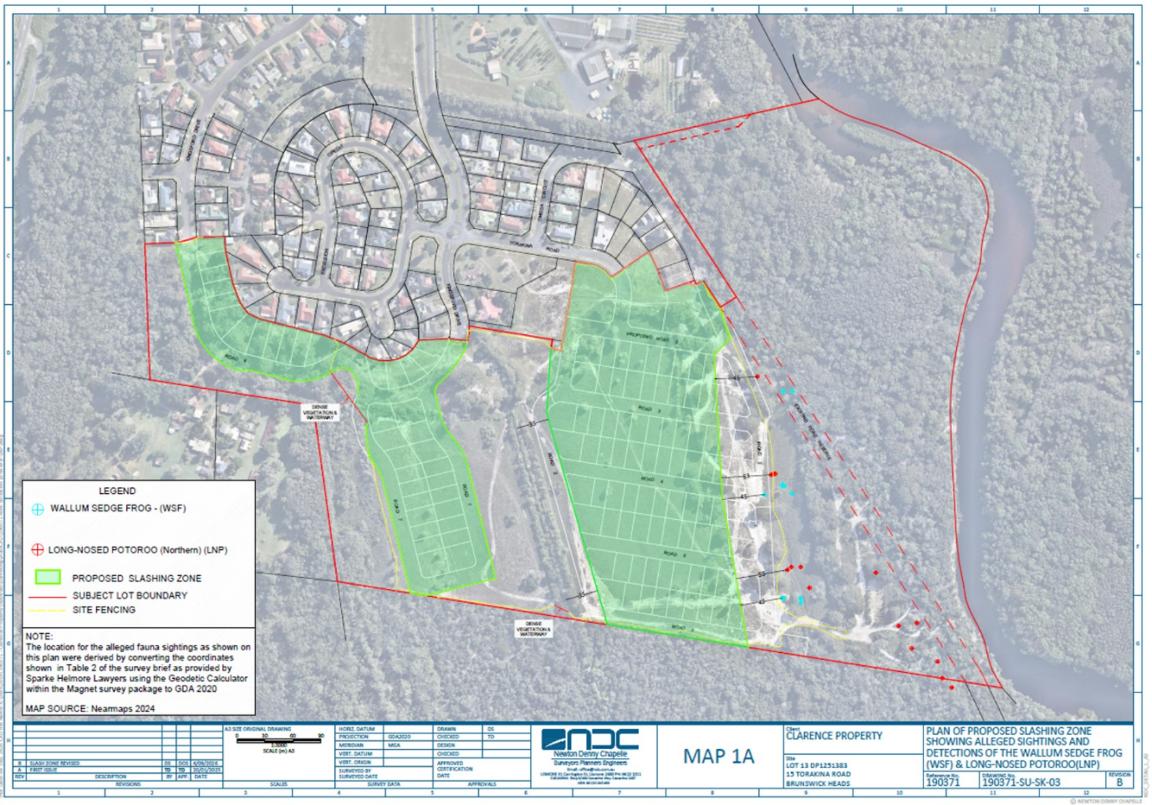
REASONS FOR JUDGMENT
KENNETT J:
Introduction
1 The respondents seek to develop a block of land (the land) on the outskirts of Brunswick Heads, NSW, for the construction of housing. The total area of the land is around 30 ha and the area proposed to be occupied by new residential development is around 12 ha.
2 By an originating application and statement of claim filed on 3 July 2024, the applicant sought an injunction under s 475(2) of the Environment Protection and Biodiversity Conservation Act 1999 (Cth) (the EPBC Act) to prevent the carrying out of any “Development Works” (a term defined in the statement of claim) on the land.
3 The injunction was sought on the basis that the Development Works would contravene s 18 of the EPBC Act because they did not have approval under that Act and would have a “significant impact” on listed threatened species. The species identified by the applicant (together “the relevant species”) and their respective categories under the EPBC Act were:
(a) Mitchell’s Rainforest Snail (MRS), which is listed as critically endangered;
(b) the Koala, which is listed as endangered;
(c) the Wallum Sedge Frog (WSF), which is listed as vulnerable;
(d) the Long-nosed Potoroo (LNP), also listed as vulnerable; and
(e) the South-Eastern Glossy Black Cockatoo (SEGBC), also listed as vulnerable.
4 In addition to the Development Works, an issue arose between the parties concerning slashing, mowing and whipper snipping of the land, which the respondents had carried out between June 2021 and January 2023. (There was evidence that previous owners had also undertaken slashing on the land and it had at one time been cleared for farming.) The applicant sought to restrain any further slashing on the basis that it would interfere with habitat critical to the survival of each of the relevant species or interfere with its recovery. Allegations along these lines were included in a further amended statement of claim filed on 30 September 2024, and a proposed injunction preventing the carrying out or authorising of slashing works was included in an amended originating application filed on the same day.
5 The substantive hearing took place before Perry J over 19 days between 21 February and 27 May 2025. A large body of documentary and expert evidence was adduced and there was extensive cross-examination of the experts. Her Honour delivered judgment on 7 September 2026, dismissing the amended originating application. Her Honour’s reasons (cited where necessary as “J”) run to 1,045 paragraphs. Her Honour did not deal separately with the controversy in relation to slashing, on the understanding that the issue fell away as a result of the findings she had made about the likely impact of the Development Works on the relevant species (J[1044]).
6 Restrictions on the carrying out of Development Works by the respondents were in place in the period leading up to the judgment of Perry J. Relevantly here:
(a) on 30 August 2024, Bromwich J made an order preventing the respondents from carrying out any of the Development Works until the determination of the proceeding with certain specified exceptions (none of which is presently relevant); and
(b) on 15 December 2025, Wigney J made orders noting an undertaking by the respondents not to carry out any further slashing, mowing or whipper snipping (not including the mowing or whipper snipping of specified parts of the land that are immediately adjacent to existing residential areas).
7 After delivering judgment, on 9 September 2026 Perry J made orders which in substance:
(a) continued the orders made by Bromwich J until 5 pm on 14 September 2026; and
(b) made an order to the same effect as the undertaking previously given in respect of slashing, mowing and whipper snipping also with effect until 5 pm on 14 September 2026.
8 The applicant filed an interlocutory application on 9 September 2026 seeking injunctions, substantially to the same effect as the orders that Perry J made on that day, pending the determination of an appeal which it proposed to file. The application came before me as Duty Judge on 14 September 2026. At the conclusion of the hearing on that day, I extended the orders that had been made on 9 September 2026 to 5 pm on 16 September 2026.
The approach to an interlocutory injunction pending appeal
9 The interrelated basic questions that must be addressed in deciding whether to grant an interlocutory injunction to protect the position of the appellant pending the determination of an appeal are the same as those which arise in the original jurisdiction: whether there is a real issue to be tried, and whether in all the circumstances the balance of convenience favours the grant of the injunction. However, the context is different and the questions therefore present themselves in a somewhat different way. The issues and the case law were usefully explored by Colvin J in Barngarla Determination Aboriginal Corporation RNTBC v District Council of Kimba [2019] FCA 1585 (Barngala). In Friends of the Gelorup Corridor Inc v Minister for the Environment and Water [2023] FCA 343, Banks-Smith J treated Barngala as a correct statement of the relevant principles and adopted the following summary of those principles at [18].
36. First, an injunction application in an appeal differs from an injunction application in a first instance proceeding insofar as the injunction may preserve appeal rights, but will, at the same time, prevent the operation of a determination of those rights that has already been undertaken (at [28]).
37. Second, the starting point is that a party is prima facie entitled to the fruits of a judgment, such that an applicant for an injunction seeking to restrain a successful party from enforcing a judgment must show special circumstances to justify a departure from the ordinary rule (at [29]-[32], [38]-[39]).
38. Third, while the general principles applicable to an application for injunctive relief at first instance remain relevant, an injunction pending an appeal is directed to protecting the integrity of an appeal right which brings a different perspective (at [33]-[35], [38]). In the context of an appeal consideration is required of whether:
(a) there is a sufficient likelihood of success in demonstrating error on the part of the primary judge (and the Court's assessment of the strength of the case on appeal will be influenced by the fact that there has been an adverse judgment at first instance); and
(b) the balance of convenience and justice favours the grant of relief. It may be helpful to look at the matter in terms of where the greatest risk of an injustice would lie if an injunction was granted and the claim ultimately refused compared to if an injunction was refused and the claim was ultimately upheld.
39. Fourth, as the injunction is to protect an appeal right, the appellant must be able to go so far as to show that refusal of the injunction would render the appeal nugatory by substantially depriving the appellant of the benefit of that right. If it does, the Court must evaluate the strength of the appeal as well as where the balance of convenience lies. An appeal based on grounds that are assessed as having considerable merit together with significant consequences for a respondent if deprived of the benefit of a judgment at first instance will not justify an injunction unless it can be demonstrated that the appeal right will be rendered nugatory if the injunction is not granted (at [36]-[37]).
40. Fifth, whether an appeal right would be rendered nugatory if an injunction were not granted is assessed in a practical way having regard to the consequences to the appellant if the appeal was to succeed in circumstances where the respondent had taken steps on the basis of the correctness of the decision of the primary judge (at [40]).
41. Sixth and taking account of the above, an applicant for injunctive relief pending the outcome of an appeal must demonstrate (at [39]):
(a) the ultimate benefit of a successful exercise of the appeal right is in jeopardy if there is no injunction;
(b) there is sufficient strength in the argument to the effect that there was error in the primary decision to contemplate a restraint upon its being given effect; and
(c) a sufficiently serious consequence for the applicant if an injunction was not granted to justify depriving a party until the outcome of the appeal is known of the benefit of what is a considered determination of the issues after a final hearing.
10 As to the concept of an appeal being rendered “nugatory”, it is useful also to set out what Colvin J said on that topic in Barngarla at [37].
There must be some threat to retaining the benefit of a right of appeal before an injunction should be granted in the name of protecting that right. Although the term nugatory is used, the cases contemplate the possibility that an injunction might be granted pending appeal based upon a significant impairment of the right of appeal. So, it is not necessary to demonstrate that the appeal will lack any purpose at all if an injunction were not granted. Rather, it must be shown that the circumstances that are likely to unfold if the injunction is not granted so compromise a right to reverse the primary decision if it is demonstrated to be correct that without an injunctive order, the appellant will have lost that unqualified right. The significant point for present purposes is that as the injunction is sought to protect an appeal right, an appellant who seeks an injunction pending an appeal must be able to go so far as to show that a refusal of the injunction would substantively deprive the appellant of the benefit of that right
11 Barngala has also been treated as setting out the correct approach by Logan J in Frigger v Bank of Queensland [2022] FCA 707 at [8], by the South Australian Court of Appeal in JLS v Chief Executive of the Department for Child Protection (No 2) [2021] SASCA 152 at [16] (Livesey P) and by the Supreme Court of New South Wales in Sun v Chen; Yu v Chen (No 2) [2026] NSWSC 884 at [53] (Muston J).
The proposed appeal
12 No notice of appeal has yet been filed, although the applicant’s solicitor deposed that she had been instructed to commence an appeal. The applicant’s legal representatives have so far had a relatively short time in which to consider very long and detailed reasons for judgment, and understandably therefore were only able to outline what they said would be a subset of the grounds to be advanced. The grounds that they foreshadowed were as follows.
(a) Perry J rejected the evidence of three of the applicant’s expert witnesses in a “blanket” way, for reasons that did not justify such rejection.
(i) Associate Professor Wardell-Johnson was “generally rejected” on the basis of criticisms of specific responses; a view that his knowledge and experience were inferior to certain subject matter experts (whereas his evidence was also rejected where he differed with the respondents’ witness Mr Robertson, whose qualifications were inferior); and a “theoretical approach” the merits of which were not evaluated.
(ii) Mr Milledge’s evidence had initially been excluded on the ground that he was not independent. That ruling was reversed, but then in substance reproduced by a finding that little weight could be put on his evidence unless it was corroborated.
(iii) Associate Professor Newell’s evidence was treated with “caution” overall, because he had previously advocated against the proposed development (but not on the applicant’s behalf) rather than on the basis of an assessment of that evidence.
(iv) It was also submitted that her Honour did not take a similar approach to two of the respondents’ witnesses who had pre-existing connections with aspects of the development.
(b) Her Honour erred in rejecting an argument that opinions expressed by the applicant’s experts could be given weight on the basis that they were supported by scientific literature, because the relevant publications were subject to limitations under s 136 of the Evidence Act 1995 (Cth) and could not be relied on as evidence of the truth of their contents.
(c) Associate Professor Wardell-Johnson and Associate Professor Newell referred to “metapopulation theory”, which holds that all populations of a threatened species need to be protected because the risks to specific local populations cannot be foreseen. Perry J rejected their evidence in this respect on grounds that it would undermine the test for a significant impact set out in the MNES Significant Impact Guidelines – which have no statutory status – and on the incorrect understanding that the proposition that a local population might become important said nothing about whether that population was important for the long term survival of a species.
(d) Perry J discounted the significance of recognised effects of urbanisation (including the attraction of rats, cane toads and brush turkeys) having erroneously held that the behaviour of future residents of the proposed development was “too remote” to be considered an “impact” of the Development Works for the purposes of s 527E(2) of the EPBC Act.
13 Senior counsel for the respondents did not concede that any of these proposed grounds of appeal would succeed and articulated coherent responses to them. Accepting that I have only heard a very brief foretaste of the argument on these grounds, I am not currently persuaded that any of them has strong prospects of being upheld.
14 Additionally, and significantly, acceptance of one or more of the proposed grounds of review would not in itself lead to the conclusion that her Honour’s ultimate conclusions in relation to whether there was a contravention of s 18 of the EBPC Act in relation to the relevant species were wrong. Determination of whether a “significant” impact was “likely” was necessarily evaluative. A Full Court, having identified error of the kinds being alleged here, would need to perform the evaluative exercise for itself or remit the matter to a single judge for that to be done.
15 The result is that it is not possible, at this stage, to identify any particular level of likelihood that the proposed appeal will be successful.
Would the appeal be rendered nugatory if no injunction is granted?
The Development Works
16 The development consent granted to the respondents by the Byron Shire Council (the Council) on 16 May 2023 imposes what Perry J described at J[119] as “a carefully structured, staged pathway requiring compliance with conditions at each stage before the Development can proceed to the next stage”.
17 The applicant’s submissions on the interlocutory application recount that the respondents have been issued with a subdivision works certificate only for “Early Stage 1”, which provides for “Environmental Works including Weed Control, Ecological Restoration and Planting Only to lots 521, 402 & 324”. Those lot numbers correspond to areas that are designated as “Management Zones” in the overall plan for the proposed development. The works forming part of Early Stage 1 are the only works which the respondents presently have consent to undertake. The “principal works” in this category that have not yet been undertaken (as the applicant puts it) are the construction of a number of artificial ponds (the frog ponds). Submissions concerning the balance of convenience in relation to this aspect of the proposed injunction therefore focused on these ponds.
18 The frog ponds are an aspect of the Revised Wallum Froglet Management Plan (dated February 2024) (the WF Plan) which the respondents were required to develop and which the Council approved. Their purpose is to provide habitat for the Wallum Froglet (WF), a species which is not listed as a threatened species under the EPBC Act but is listed under the Biodiversity Conservation Act 2016 (NSW) as vulnerable. The frog ponds are required by the WF Plan to be constructed and then monitored for three months before further stages of the proposed development are undertaken.
19 Construction of the frog ponds essentially has three aspects.
(a) Creation of depressions where none currently exist, which involves fairly substantial earthworks. These depressions are designed and sited so that they will at some times be partly inundated with groundwater and at other times hold rainwater. The base of each pond is to be laid with soil containing (and suitable for the growth of) sedge. There are to be associated earthworks, such as the creation of banks to stop uncontrolled runoff into the ponds, and fencing to control erosion.
(b) Removal of soil containing sedge from other parts of the land for placement in the frog ponds. The sedge is proposed to be taken from areas that will in due course be covered by housing if the proposed development is completed. These areas are a non-trivial, but nevertheless fairly small, proportion of the areas of sedge (which are actual or potential habitat for the WSF) currently existing on the land.
(c) Works associated with construction. Tracks for the movement of heavy machinery will lead to each work site. Spoil from the digging of the ponds is to be dumped in a confined area on part of the land that will in due course be covered by housing development if the development is completed.
20 There is overlap between the preferred habitats of the WSF and the WF, although the extent of that overlap was to some extent not agreed between the expert witnesses. The introduction to the WF Plan observed that the measures it proposed were “applicable to the [WSF] since they occur in the same Wallum habitat”. There is thus some potential for the frog ponds, once constructed, to provide habitat for the WSF where none presently exists, albeit at the cost of a small area of existing habitat being damaged by the removal of sedge and soil.
21 It can be assumed that the construction works will also disturb habitat that is suitable for the other relevant species, although no attempt was made to quantify this effect (other than a speculative submission that one of the areas proposed for construction of frog ponds was potentially suitable habitat for the MRS). The locations where WSF have actually been observed, and where diggings arguably made by LNP have been recorded, are all some distance from where the works to create the frog ponds are to occur. The proportion of the land that would be affected by the construction works is small.
22 The potential scenario that needs to be considered for present purposes is one where the applicant succeeds on the appeal and obtains a permanent injunction preventing the Development Works, but the frog ponds have been completed before that injunction is granted. At worst, the ponds will deteriorate without maintenance, fail to perform their function of providing frog habitat, and a small part of the site will have lost its natural vegetation at least in the short term. There is no indication that this would in itself have an impact on any of the relevant species.
23 In any event, these potential harms are significantly mitigated by an undertaking proffered by the respondents. The respondents have undertaken to:
(a) carry out the monitoring and maintenance of the frog ponds required by the WF Plan; and
(b) if the orders of Perry J are overturned (and no approval is obtained under the EPBC Act), reinstate the areas affected by works to establish the frog ponds to their former condition.
24 The appeal in relation to the Development Works therefore retains most if not all of its utility from the applicant’s point of view whether or not the proposed injunction is granted. Refusal of the injunction does not render the appeal “nugatory” in the sense discussed in the cases.
Slashing
25 I was informed that slashing (as distinct from mowing) is usually undertaken with a fairly large apparatus pulled behind a tractor. It usually does not cut plants particularly close to the ground and may miss areas where the apparatus cannot easily go. Because roots and stems are left in place, plants can readily regenerate. The evidence adduced by the applicant includes photographs taken since early 2023 (when slashing by the respondents ceased), said to show parts of the land. These demonstrate strong regrowth.
26 I was also referred to parts of the oral evidence before Perry J indicating that the regrowth of native plant species, and re-establishment of habitat suitable for one or more of the relevant species, begins almost immediately after slashing. The vegetation that grows in the years after slashing may well not be the same as what existed before, but it is valued by the applicant because thicker vegetation is beneficial for the LFP and some of the regenerating plant species are food sources for the SEGBC.
27 The main point that emerges for present purposes is that the effects of slashing on the relevant species are temporary. If the land constituted one of a handful of sites where a threatened species was found, and slashing was likely to kill individual animals or destroy their habitat (even temporarily), that would likely be significant. However, that was not said to be the case here. What emerges is that, if the vegetation is slashed in the next few months but further slashing is then prevented after a successful appeal, the process of regrowth on the land will have been retarded by three to four years compared to the current trajectory.
28 The respondents have also proffered an undertaking in this aspect of the case which substantially mitigates the potential adverse effects of refusing the injunction. The respondents undertake, if a notice of appeal is filed, to slash only designated areas of the land pending the determination of the appeal. Those areas, shown in green on a map provided by the respondents, comprise in effect the areas intended to be developed for housing (around 12 ha out of a total area of 30 ha). Most of the land will therefore be unaffected by slashing until the appeal is determined.
29 Refusal to grant the injunction in relation to slashing therefore does not render this aspect of the appeal nugatory in the relevant sense.
30 I note that the undertaking noted in the orders of Wigney J, referred to above at [6(b)], expressly exempted the mowing of some small areas of the land that are adjacent to existing residential areas. The new undertaking does not contain a similar carve-out. However, mowing is a distinct activity from slashing (undertaken with different equipment and more frequently). I do not understand the respondents to have undertaken to cease mowing the areas that are currently mown; nor do I understand them to have expressed any intention to mow other parts of the land. If further orders are needed to clarify the position, the parties should approach the Court.
Prejudice to the respondents
31 My conclusions above make it unnecessary to form any firm conclusions as to the effect of an interlocutory injunction on the interests of the respondents.
32 The grant of an injunction preventing work on the frog ponds would delay all stages of the development by a period equivalent to the time taken to prepare, hear and determine an appeal. There is evidence that the respondents are incurring significant costs associated with holding the land, particularly in relation to security. These costs, at least, would be increased by delay to a measurable extent and would not be recoverable.
33 More speculative suggestions were made on both sides. The respondents led evidence of an apprehension that construction costs would increase during the period of any delay occasioned by an appeal. The applicant sought to suggest (without evidence but by reference to official data) that the value of land was likely to increase significantly in future years, so that a delay in selling lots in the proposed subdivision would not hurt the overall interests of the respondents. I do not need to express a view on these suggestions. However, two points are worth noting. First, delay constrains the choices the respondents would otherwise have as to when to complete the development and when the sales of residential blocks are completed. The respondents have made a substantial investment in land – presumably at some cost in terms of interest – the profitable realisation of which would be delayed. Secondly, expectations about future movements in land values are very likely to have been taken into account in the business decisions the respondents have made about developing the land (including as to timing) as well as the decisions of those who have entered into contracts with the respondents to purchase lots.
34 I am satisfied that the grant of an injunction would impose a real economic detriment on the respondents. While the applicant has proffered the usual undertaking as to damages, I am doubtful as to whether the applicant has the resources to make good on that undertaking. However, this factor would probably not have been determinative if I had come to the conclusion that the refusal of an injunction would render part of the appeal nugatory.
Disposition
35 The interlocutory application will therefore be dismissed. My orders will also note the undertakings proffered by the respondents.
36 The interlocutory application has achieved some measure of success by prompting the respondents to give undertakings. However, I would probably have dismissed the application even in the absence of those undertakings. I will order that the applicant pay 75 percent of the respondents’ costs as agreed or assessed.
I certify that the preceding thirty-six (36) numbered paragraphs are a true copy of the Reasons for Judgment of the Honourable Justice Kennett. |
Associate:
Dated: 16 September 2026


