

FEDERAL COURT OF AUSTRALIA
TLAS Pty Ltd as trustee for the TLAS Trust v Arrowes Roading Safety Pty Ltd [2026] FCA 1356
File number(s): | VID 719 of 2024 |
Judgment of: | HESPE J |
Date of judgment: | 16 September 2026 |
Catchwords: | CONTRACTS – agreement for supply of an automatic cone truck – where purchaser claimed breach of warranty – where contractual terms took their meaning from the Australian Consumer Law (ACL) – whether the vehicle failed to meet guarantee of acceptable quality – whether failure of acceptable quality guarantee was a “major failure” – damages CONSUMER LAW – whether respondent vendor engaged in misleading or deceptive conduct in contravention of s 18 of the ACL – whether applicant relied on the alleged false representation |
Legislation: | A New Tax System (Goods and Services Tax) Act 1999 (Cth) s 11-20 Competition and Consumer Act 2010 (Cth) sch 2 (The Australian Consumer Law) ss 3, 18, 54, 236, 237, 243, 259, 260 Road Vehicle Standards Act 2018 (Cth) s 12 Vehicle Standard (Australian Design Rule 13/00 – Installation of Lighting and Light Signalling Devices on other than L-Group Vehicles) 2005 (Cth) app A Vehicle Standard (Australian Design Rule 42/04 – General Safety Requirements) 2005 (Cth) cll 11.1, 12.1, 18.1, 18.2 Vehicle Standard (Australian Design Rule 43/04 – Vehicle Configuration and Dimensions) 2006 (Cth) Acts Interpretation Act 1954 (Qld) s 32D Heavy Vehicle National Law Act 2012 (Qld) s 4 sch 1 (Heavy Vehicle National Law) ss 5, 59, 60, 84, 85, 89, 90, 93, 94 Heavy Vehicle National Law Application Act 2013 (Vic) s 4 Interpretation of Legislation Act 1984 (Vic) s 23 Road Safety Act 1986 (Vic) ss 3, 7 Transport Operations (Road Use Management) Act 1995 (Qld) sch 4 Heavy Vehicle (Vehicle Standards) National Regulation (Qld) sch 1 Road Safety Road Rules 2017 (Vic) r 304H Road Safety (Vehicles) Regulations 2021 (Vic) reg 294 Transport Operations (Road Use Management—Vehicle Registration) Regulation 2021 (Qld) ss 7, 10, 18 |
Cases cited: | Australian Competition and Consumer Commission v Mazda Australia Pty Ltd [2021] FCA 1493 Capic v Ford Motor Company (No 3) [2017] FCA 771 Clark v Macourt [2013] HCA 56; (2013) 253 CLR 1 Gurdag v BS Stillwell Ford Pty Ltd (1985) 8 FCR 526 H Lundbeck A/S v Sandoz Pty Ltd [2022] HCA 4; (2022) 276 CLR 170 Pro Teeth Whitening (Aust) Pty Ltd v Parliamentary Secretary to the Treasurer, David Bradbury MP [2013] FCA 1376 Vautin v BY Winddown, Inc. (formerly Bertram Yachts) (No 4) [2018] FCA 426; (2018) 362 ALR 702 Williams v Toyota Motor Corporation Australia Ltd [2024] HCA 38; (2024) 98 ALJR 1282 Yorke v Ross Lucas Pty Ltd (1982) 45 ALR 299; (1982) 69 FLR 116 |
Division: | General Division |
Registry: | Victoria |
National Practice Area: | Commercial and Corporations |
Sub-area: | Regulator and Consumer Protection |
Number of paragraphs: | 353 |
Date of hearing: | 25–26, 28 May 2026, 1 June 2026 |
Counsel for the Applicant: | Mr G Lubofsky |
Solicitor for the Applicant: | Sladen Legal |
Counsel for the Respondent: | Mr RJ Anderson KC and Mr M Wilkinson |
Solicitor for the Respondent: | HopgoodGanim Lawyers |
ORDERS
VID 719 of 2024 | ||
| ||
BETWEEN: | TLAS PTY LTD AS TRUSTEE FOR THE TLAS TRUST Applicant | |
AND: | ARROWES ROADING SAFETY PTY LTD Respondent | |
order made by: | HESPE J |
DATE OF ORDER: | 16 September 2026 |
THE COURT ORDERS THAT:
1. Within 21 days of the date of these orders:
(a) the parties are to provide the Associate to Hespe J with proposed draft orders giving effect to these reasons, including orders as to costs; and
(b) if the parties cannot agree on the form of orders as contemplated by Order 1(a) above, each party is to provide its proposed form of orders together with its submissions, not exceeding three pages in length with size 12 point font and 1.5 line spacing, to the Associate to Hespe J.
2. Any issue relating to the form of orders is to be determined on the papers.
Note: Entry of orders is dealt with in Rule 39.32 of the Federal Court Rules 2011.
REASONS FOR JUDGMENT
HESPE J:
INTRODUCTION
1 The applicant (TLAS) is a member of a group of privately owned entities (TLAS group) which operates a business of leasing traffic management and related equipment in Australia.
2 By its originating application, TLAS seeks orders that the respondent (Arrowes) provide a refund for, and compensation for, TLAS’s financial losses in respect of an Automatic Cone Truck vehicle (ACT vehicle) purchased by TLAS from Arrowes for $586,080 (inclusive of GST). The ACT vehicle is a single operator vehicle whose purpose is to automatically deploy and retrieve traffic cones which TLAS intended to lease out and thereby make profits.
3 TLAS’s claims, in essence, are that:
(a) Arrowes failed to meet a guarantee of acceptable quality because the ACT vehicle was not safe, was defective and/or was not fit for purpose and that the failure to meet that guarantee was a “major failure” (Warranty Claim); and
(b) Arrowes engaged in misleading or deceptive conduct and as a result TLAS suffered loss.
4 Although TLAS initially brought claims under the consumer guarantees in the Australian Consumer Law (the ACL) in sch 2 of the Competition and Consumer Act 2010 (Cth), those claims were abandoned during the hearing because TLAS was not a “consumer” for the purposes of the ACL. TLAS maintains its claims based on breach of an express contractual warranty and for misleading or deceptive conduct in contravention of s 18 of the ACL.
5 Although TLAS initially included loss of profits in its claims for loss and damage, that part of its claim was abandoned at closing submissions.
BACKGROUND
The ACT vehicle
6 The particular ACT vehicle the subject of this dispute (demonstrator ACT vehicle) is a medium Isuzu Truck approximately 9 m long, 2.3 m wide and 4 m high that has been modified by bolting to the chassis of the truck a structural frame that is fitted internally with specialised plant and equipment (ACT Plant). The ACT Plant is operated by the driver of the ACT vehicle and facilitates the automatic placement of traffic cones onto the road, or the automatic retrieval of cones from the road, on either the left or right side of the vehicle.
7 The ACT Plant includes the following:
(1) bay doors which open when the ACT vehicle commences operation to deploy or retrieve traffic cones and close when the ACT vehicle is not being operated to deploy or retrieve traffic cones;
(2) a cone storage area in which traffic cones are kept in seven rows of three stacks, each stack being 19 cones high (when full), totalling 399 cones;
(3) a metal gantry which:
(a) when the ACT vehicle is being operated to place cones on the road, moves down over the cones in the cone storage area, picks up a cone from each stack and deposits the three cones onto the conveyor belt (described below);
(b) when the ACT vehicle is being operated to collect cones from the road, moves down over three cones on the conveyor belt, picks up the three cones and deposits three cones onto the stack in the cone storage area;
(4) a conveyor belt which serves as the surface receiving the three cones from the gantry and which moves cones to the bay doors;
(5) a robotic gripper arm which extends outside the bay doors and which:
(a) when the ACT vehicle is being operated to place cones on the road, collects cones from the conveyor (one at a time) and places each cone onto the road at a set distance interval; and
(b) when the ACT vehicle is being operated to collect cones from the road, picks up cones from the road (one at a time) and places them onto the conveyor (to be re-collected by the gantry and placed back into the cone storage area);
(6) a Human Machine Interface (HMI) in the form of a touchscreen used by the operator to control some of the functions of the ACT Plant;
(7) a generator that provides power to the ACT Plant through an inverter;
(8) three external cameras that provide the driver-operator with different views of the surrounds of the ACT vehicle on monitor displays placed inside the driver cabin;
(9) sensors on the outside of the ACT vehicle to determine various parameters comprising:
(a) sensors which create an exclusion zone around the gripper arm. These sensors, when triggered, engage the interlock system that automatically de-energises the ACT Plant; and
(b) sensors which, when the ACT vehicle is being operated to collect cones, assist in aligning the gripper with traffic cones on the road so that the gripper grabs the cones in order to place them on the conveyor in the truck; and
(10) a variable message sign and arrow board attached to the rear of the ACT vehicle which can display messages such as a speed limit and the direction in which approaching traffic should travel.
The evidence before the Court
Lay evidence
8 TLAS adduced evidence from the following lay witnesses:
(a) Mr Lawson;
(b) Mr Howard; and
(c) Mr Williams.
9 Only Mr Lawson was called for cross-examination by Arrowes.
10 Arrowes adduced evidence from the following witnesses, each of whom was cross-examined by TLAS:
(a) Ms Ea; and
(b) Mr Peters.
11 The lay evidence provides context and background to the sale and operation of the demonstrator ACT vehicle but is otherwise of limited utility because the issues before the Court largely depend on an objective assessment of what a hypothetical purchaser might reasonably expect and because at least some of TLAS’s lay evidence related to claims for loss that were abandoned in closing submissions.
12 The Court accepts that the responses given by each of the witnesses in cross-examination were honest. Where the oral evidence conflicts with the affidavit evidence, the Court prefers the oral evidence. In the case of each witness, where the oral or affidavit evidence conflicts with the documentary evidence, the Court prefers the documentary evidence.
Mr Lawson
13 Mr Lawson is a director of TLAS and was the individual acting on behalf of TLAS in relation to TLAS’s purchase of the demonstrator ACT vehicle. Mr Lawson affirmed three affidavits.
14 Mr Lawson gave evidence about:
(a) the background to his interest in acquiring the demonstrator ACT vehicle;
(b) the circumstances surrounding TLAS taking delivery of the demonstrator ACT vehicle, including the training session conducted by Arrowes for TLAS on the expected date of delivery;
(c) his discussions with Ms Ea and Mr Peters;
(d) the issues that TLAS encountered in operating the demonstrator ACT vehicle from time to time; and
(e) Mr Peters’s two site visits to address issues with the demonstrator ACT vehicle.
15 Mr Lawson’s cross-examination was largely directed to TLAS’s claims for losses which were abandoned at closing submissions. The cross-examination of Mr Lawson revealed that Mr Lawson had very little understanding of the legal consequences of the ownership structure of the business he controlled.
Mr Howard
16 Mr Howard is an employee of the TLAS group who has responsibility for managing vehicles hired out by the TLAS group. Like other traffic management vehicles which the TLAS group holds for leasing, the demonstrator ACT vehicle was stored on Mr Howard’s property in Mount Evelyn in Victoria (the Mount Evelyn property) for a period.
17 Mr Howard gave evidence about the issues that had arisen in relation to the operation of the demonstrator ACT vehicle.
Mr Williams
18 Mr Williams, the brother-in-law of Mr Lawson, is the owner of the property at which the demonstrator ACT vehicle was located when tested by Dr Hope, the expert engaged by Arrowes for these proceedings.
19 Mr Williams gave evidence about the way in which Dr Hope tested the demonstrator ACT vehicle on 13 March 2025 and a conversation Mr Williams had with Dr Hope in which Mr Williams recalled Dr Hope saying the demonstrator ACT vehicle should not have been purchased by TLAS as it was “a prototype”. Mr Williams also gave evidence about the failure by Dr Hope to turn off the isolators when Dr Hope concluded his testing of the vehicle, leading to the batteries becoming flat.
Ms Ea
20 Ms Ea is a director of Arrowes and directly dealt with Mr Lawson in respect of TLAS’s purchase of the demonstrator ACT vehicle.
21 Ms Ea accepted in cross-examination that the particular ACT vehicle sold to TLAS was a demonstrator model. Although it had been constructed by Arrowes as a prototype, the demonstrator ACT vehicle sold to TLAS had been tested and by October 2022 had been modified, and its modified version was the basis for the ACT vehicles that went into final production. It was in that modified state that the demonstrator ACT vehicle was sold to TLAS. Ms Ea accepted that it was not accurate to describe the demonstrator ACT vehicle in the form that was sold to TLAS as a “prototype”.
22 Ms Ea had no training as an engineer.
Mr Peters
23 Mr Peters is a former employee of Arrowes. Mr Peters had been employed by Arrowes as an automation controls engineer. He had been involved in the development of the ACT vehicle. He was responsible for responding to TLAS’s complaints and queries in relation to how the demonstrator ACT vehicle functioned. Mr Peters carried out works on the demonstrator ACT vehicle in response to TLAS’s complaints and queries.
24 Mr Peters admitted that he had no actual recollection of events. His testimony was a reconstruction of events and, unless supported by or reflected in contemporaneous documents, is not reliable. The contemporaneous notes and documents prepared by Mr Peters are accepted by the Court as being accurate records of Mr Peters’s understanding at the time those documents were prepared.
25 In particular:
(1) Mr Peters’s evidence concerning the reason why a cone was knocked off the conveyor at the 27 April 2023 training session is not consistent with the contemporaneous video evidence. Mr Peters’s evidence was that the cone was knocked off because the cone had been left on the conveyor after the previous use of the demonstrator ACT vehicle. The conveyor should have been cleared of any cones before starting to operate the demonstrator ACT vehicle to retrieve and deploy cones. The contemporaneous video recording on the training day shows the conveyor to be clear of any cones at the start of the training session.
(2) Mr Peters gave evidence that during his inspection on 31 May 2023, he took Mr Lawson for a test drive and had a conversation with Mr Lawson. The contemporaneous evidence (in the form of a text message sent by Mr Lawson on 31 May 2023) discloses that Mr Lawson was interstate on 31 May 2023 and was unable to meet with Mr Peters in person.
(3) Mr Peters had no present recollection of events that were recorded in the video recordings.
(4) Mr Peters had no reliable recollection of the issues that Mr Lawson had raised in relation to the demonstrator ACT vehicle or the nature of the works Mr Peters had carried out on the demonstrator ACT vehicle.
Expert evidence
26 Each party provided reports from an independent expert:
(1) TLAS relied upon the evidence of Mr Murphy, an expert in automotive design and compliance assessment. As a signatory to the vehicle assessment signatory scheme in Victoria, Mr Murphy is an approved vehicle examiner, certified to approve modifications to heavy vehicles.
(2) Arrowes relied upon the evidence of Dr Hope, an expert in mechanical engineering.
27 In addition to the separate reports, the independent experts also provided two joint reports setting out the issues on which they agreed, the areas where they disagreed and the reasons for their disagreement. The experts gave oral evidence concurrently.
28 Where the evidence in the joint reports conflicts with the opinion evidence in the individual reports of each expert, the Court prefers the opinions expressed in the joint report. Where the oral evidence conflicts with the evidence in the written reports, the Court prefers the oral evidence.
THE FACTS
29 Based on the evidence, the Court makes the following factual findings.
30 TLAS is the corporate trustee of the TLAS Trust. Since 2021, Mr Lawson and his wife have been the directors of TLAS. In its capacity as trustee, TLAS conducts a business of leasing plant and equipment to a related entity, White Line Hire Pty Ltd, which on-hires that equipment to customers in connection with traffic management and major construction works.
31 Before relocating to Queensland in around July 2024, Mr Lawson and his wife lived in Victoria and TLAS conducted its business from Victoria. As noted above, at the relevant time, TLAS’s vehicles were stored on Mr Howard’s premises in Mount Evelyn, Victoria and customers collected and returned hire vehicles to the Mount Evelyn property.
32 Arrowes is in the business of designing and manufacturing road safety and traffic management equipment. Arrowes began developing the ACT vehicle in 2018. In October 2020, Arrowes released a prototype. From 2020, and over the next two years, Arrowes made improvements to the prototype following feedback from trials of the ACT vehicle in road construction projects.
33 A related entity, Arrowes IP Holdings Pty Ltd, was granted a patent on 1 December 2022 (with a priority date of 17 December 2019) over a “vehicle mounted system for deploying and retrieving traffic barriers”.
34 The ACT vehicle was “commercialis[ed]” (released for general sale) in October 2022.
35 In November 2022, Arrowes received an innovation award from the Major Transport Infrastructure Authority for the ACT vehicle.
36 Mr Lawson became aware of the ACT vehicle on around 14 December 2022. Mr Lawson considered that the ACT vehicle would be a desirable vehicle for TLAS to own for the purpose of hiring it out (to White Line Hire and then on to customers) as safety was a paramount consideration for those carrying out major construction works and the ACT vehicle would enable traffic cones to be laid without needing individuals to physically place cones on the road – the process could be performed mechanically by the ACT vehicle.
37 On 14 December 2022, Mr Lawson visited Arrowes’s website and saw an advertisement for ACT vehicles which were described as single operator vehicles that provided for the automated deployment and retrieval of traffic cones.
38 After visiting the website, Mr Lawson phoned Ms Ea to inquire about ACT vehicles and expressed interest in purchasing one with a view that it would be hired out for deployment on major highway or freeway roadworks projects, including the North East Link project in Melbourne. Mr Lawson was concerned about servicing the ACT vehicle “because of the apparent complexity of the robotic system and the fact that TLAS is based in Melbourne and Arrowes in Brisbane”. Mr Lawson informed Ms Ea that it was important that downtime be minimised because the ACT vehicle would be used on projects that were time critical and delays could lead to financial penalties being imposed on the TLAS group by customers. Ms Ea responded that the vehicle came with a one-year warranty and that issues could be fixed with the vehicle remaining in Melbourne.
39 Mr Lawson was eager to secure the first ACT vehicle sold and to be the first to offer the vehicle for roadworks construction projects. In his correspondence with Ms Ea prior to the purchase of the demonstrator ACT vehicle, Mr Lawson expressed the desire to “secure the first unit off the rank” and specifically asked “[w]ill delivery be before any other units are built?”.
40 When told that the price of an ACT vehicle was $652,080, Mr Lawson responded that the price was outside TLAS’s budget. Ms Ea informed Mr Lawson that there was a demonstrator model that had been trialled on the M80 Ring Road project in Melbourne, which was available for purchase at $586,000. Ms Ea told Mr Lawson that the demonstrator model would not be available for delivery until April 2023.
41 Mr Lawson was keen to purchase the demonstrator ACT vehicle and asked about payment terms. Ms Ea told Mr Lawson that to secure the vehicle, TLAS would need to pay a 30% deposit. Mr Lawson offered to pay a deposit of $50,000, which proposal Ms Ea accepted.
42 Late on 14 December 2022, Ms Ea sent an email to Mr Lawson, attaching a brochure in relation to the ACT vehicle and two quotes – one for the demonstrator ACT vehicle and one for a new build. The quotation specified that the new build ACT vehicle includes a “14T cab chassis” on an Isuzu truck whereas the demonstrator ACT vehicle included an “11T Isuzu cab chassis”. All other features were listed as being the same.
43 In a telephone conversation on 23 December 2022, Mr Lawson asked Ms Ea about the difference between the demonstrator and the new build ACT vehicle. Ms Ea replied that she would seek to speak to Arrowes’s engineers. Ms Ea responded by email that she had been reminded that unlike the new build, the demonstrator did not have a sign rack. She did not identify any other differences.
44 On 23 December 2022, Ms Ea sent Mr Lawson a draft sale agreement for the purchase of the demonstrator ACT vehicle. By email on 24 December 2022, Mr Lawson responded that he was going to amend the draft sale agreement to provide for the payment of a $50,000 deposit (as opposed to the 30% provided for in the draft contract).
45 On 26 December 2022, Mr Lawson signed and sent the revised agreement back to Arrowes and, on 28 December 2022, caused TLAS to pay the $50,000 deposit to Arrowes.
46 By text messages sent on 30 December 2022, 10 January 2023 and 23 February 2023, Mr Lawson asked Ms Ea whether he could inspect the demonstrator ACT vehicle in early March 2023. By text message in early March 2023, Ms Ea invited Mr Lawson to inspect the ACT vehicle and advised that she would be around until 19 March 2023. That time frame was not convenient to Mr Lawson.
47 Around early March 2023, Ms Ea and Mr Lawson orally agreed that the demonstrator ACT vehicle would be handed over to TLAS on 27 April 2023.
48 On 1 March 2023, Mr Lawson texted Ms Ea requesting an invoice for the demonstrator ACT vehicle for the purpose of TLAS obtaining finance for the purchase. On 2 March 2023, Ms Ea sent Mr Lawson an invoice for the demonstrator ACT vehicle.
49 On 9 March 2023, Mr Peters agreed with the operator of a signwriting business in Queensland that the demonstrator ACT vehicle would be made available to signwriters on 21 April 2023. On 20 April 2023, Mr Peters advised Mr Lawson that Mr Peters had confused his dates and the demonstrator ACT vehicle would not be available for signwriting to be applied to it the following day.
50 TLAS funded the balance of the purchase price for the demonstrator ACT vehicle by a vehicle finance loan from National Australia Bank, which paid that balance ($536,080) directly to Arrowes on 27 April 2023. The monthly repayment obligation imposed on TLAS by the National Australia Bank was $10,361.44.
51 On 27 April 2023, Mr Lawson and Mr Howard attended Arrowes’s premises in Brisbane to take delivery of the demonstrator ACT vehicle and attend a training session.
52 On the afternoon of 27 April 2023, Mr Peters took Mr Lawson, Mr Howard and a representative of one of the clients of the TLAS group for a demonstration of the demonstrator ACT vehicle on the road. Mr Lawson filmed the demonstration with a drone.
53 During that demonstration, the gripper knocked a cone off the conveyor. Mr Peters shut down the demonstrator ACT vehicle to remove the knocked cone and reposition it and restarted the vehicle.
54 Other issues arose during the demonstration, resulting in the testing being disrupted. One of those issues concerned the HMI screen freezing. Mr Peters and Mr Lawson had also noticed that the computer on the demonstrator ACT vehicle had not counted the number of deployed cones correctly. Mr Peters had to reset the cone count on the ACT vehicle computer.
55 Mr Peters said he would need to keep the demonstrator ACT vehicle overnight to work on it.
56 The next morning, Mr Peters sent Mr Lawson a text message saying that Mr Peters had fixed most of the issues that had arisen the previous day but that he had been unable to replicate some of the issues. Mr Peters told Mr Lawson that the work he had performed included software updates and that Mr Peters needed to monitor those updates.
57 Mr Lawson did not seek to re-test the demonstrator ACT vehicle on 28 April 2023 but received the user manual and quick start guide and took delivery of the vehicle. Mr Lawson, his wife and Mr Howard then drove the vehicle from Brisbane to Sydney in order to conduct a demonstration of the vehicle with a client of the TLAS group.
58 Mr Lawson had requested Mr Peters to modify the software on the demonstrator ACT vehicle to change the way pop-up messages were displayed on the HMI screen inside the vehicle. Mr Lawson tested the vehicle on 30 April 2023 and the pop-up messages did not disappear after “OK” was pressed on the screen. This resulted in the operator not knowing how to access the function buttons that sat behind the pop-up message.
59 On 1 May 2023, Mr Lawson and Mr Howard took the demonstrator ACT vehicle to a street in New South Wales to create a video recording of a test run of the vehicle in operation to upload to TLAS’s social media profiles. During the test run, the gripper knocked a cone off the conveyor in the same way as had occurred during the 27 April 2023 training session. The “computer” also froze. Mr Lawson reset the computer system.
60 On 2 May 2023, Mr Lawson and Mr Howard carried out a demonstration of the demonstrator ACT vehicle with a client of the TLAS group at a crash test facility in Sydney. Although Mr Lawson and Mr Howard saw the gripper repeatedly bumping a cone on the conveyor, the demonstration was completed in a manner Mr Lawson accepted “went quite well”.
61 Mr Lawson, his wife and Mr Howard then drove the vehicle to the Mount Evelyn property in Victoria.
62 In early May 2023, Mr Howard contacted Ms Ea in relation to the transfer of the registration of the demonstrator ACT vehicle to TLAS. At that time, Mr Howard was informed by Ms Ea that the demonstrator ACT vehicle was not registered in the name of Arrowes and that although Arrowes had in 2019 purchased the Isuzu truck that became the demonstrator ACT vehicle, the truck had remained registered in the name of Isuzu until Isuzu cancelled the registration after it learnt that the demonstrator ACT vehicle had been sold. There was no evidence before the Court of the date of the cancellation of Isuzu’s registration. As a result of the demonstrator ACT vehicle not then being registered, TLAS had to arrange a roadworthy certificate, obtain (through Arrowes) a copy of the vehicle assessment signatory scheme engineer’s certificate and arrange registration of the vehicle in Victoria. Following discussions with Ms Ea, Arrowes agreed to pay for the costs of re-registering the demonstrator ACT vehicle. The vehicle was registered in TLAS’s name by VicRoads on or around 22 May 2023.
63 On 13 May 2023, Mr Lawson and Mr Howard tested the demonstrator ACT vehicle, in advance of a proposed demonstration to a potential client on 16 May 2023. During the test run, the gripper froze and was stuck protruding outside of the vehicle. Mr Lawson rang Mr Peters, who told Mr Lawson that the problem sounded like a loose cable and instructed Mr Lawson to open the electrical box in the body of the vehicle to check for loose wires. Mr Lawson found a loose cable and reinserted it.
64 On the morning of 16 May 2023, Mr Lawson and Mr Howard noticed that the variable message sign at the rear of the vehicle was not working. An employee of Arrowes suggested the problem might be a loose cable.
65 TLAS was unable to use the variable message sign at the demonstration on 16 May 2023. At that demonstration, the gripper also failed to properly grip a cone and dropped a cone out of the vehicle and out of the cone deployment line.
66 On 18 May 2023, Mr Lawson sent an email to Ms Ea about the issues he was experiencing with the demonstrator ACT vehicle. The issues Mr Lawson identified were:
(1) Unidentified cables became loose which prevented use of the demonstrator ACT vehicle and use of the bay doors.
(2) During a demonstration for potential clients of TLAS, the gripper arm “threw” a cone out of the demonstrator ACT vehicle onto the road.
(3) An unidentified problem with the variable message sign occurred which Mr Howard fixed via the cables located in the cab of the ACT vehicle.
67 Ms Ea responded the following day. As part of her response, Ms Ea noted that “the [demonstrator] ACT [vehicle] has also travelled to Melbourne and back”.
68 On 22 May 2023, Mr Lawson exchanged text messages with Ms Ea about the variable message sign.
69 In an email sent on 23 May 2023, Ms Ea told Mr Lawson that Arrowes’s warranty was “ex-factory”, requiring TLAS to deliver the vehicle to Arrowes at TLAS’s cost to address issues. Mr Lawson responded that his understanding “prior to the purchase of the [demonstrator] ACT [vehicle]” was that Arrowes would fly someone to Victoria the next day if any problem arose with the demonstrator ACT vehicle.
70 Mr Lawson had arranged to demonstrate the demonstrator ACT vehicle to a potential client on 24 May 2023. That demonstration did not proceed because TLAS was experiencing issues with the demonstrator ACT vehicle.
71 By email sent on 29 May 2023, Ms Ea informed Mr Lawson that an Arrowes employee would inspect the demonstrator ACT vehicle at the Mount Evelyn property on 7 June 2023.
72 On 31 May 2023, having received from Arrowes the key to unlock the DVR box (containing the video recording device) in the demonstrator ACT vehicle, TLAS sent, by email to Arrowes, video footage of the demonstrator ACT vehicle operating to retrieve and deploy traffic cones.
73 On 31 May 2023, Mr Peters attended the Mount Evelyn property and carried out works on the demonstrator ACT vehicle over two days. The works included software updates. Mr Peters took the demonstrator ACT vehicle for a test drive. Upon returning to the Mount Evelyn property, Mr Peters told Mr Howard that Mr Peters had cut a corner between two trees at the front of the Mount Evelyn property, causing the top of the demonstrator ACT vehicle to collide with a tree. The outer panel of the demonstrator ACT vehicle was damaged, as was an external down-facing camera that was part of the demonstrator ACT vehicle’s video recording system. Mr Peters arranged for a replacement camera to be sent to Mr Howard for Mr Howard to install.
74 Upon finishing his visit on 1 June 2023, Mr Peters said that there were unresolved issues in relation to the HMI screen freezing and that he did not know why a cone had been dropped from the gripper during one of TLAS’s previous demonstrations.
75 On 7 June 2023, Mr Lawson received a report from Mr Peters based on Mr Peters’s attendance at the Mount Evelyn property. Mr Peters’s report relevantly recorded:
(1) Mr Peters had investigated issues relating to loose cables and connectors (which had been preventing use of the demonstrator ACT vehicle, including the bay doors), a cone being “thrown out” of the vehicle, the gripper bumping a cone and the variable message sign “not working”.
(2) Mr Peters did not observe any loose cables but added additional sealing to certain cables as a precaution.
(3) Mr Peters reviewed the recording of the incident where a cone was improperly gripped by the gripper from the conveyor, which resulted in the cone slipping out of the gripper. Mr Peters could not replicate the issue and implemented no changes to address this issue.
(4) Mr Peters reviewed the footage of the incident at the demonstration on 2 May 2023 where the gripper arm repeatedly bumped a cone which was on the conveyor. Mr Peters diagnosed the issue as being caused by the operator pressing the wrong button on the HMI screen after the interlock system was deliberately triggered as part of the demonstration. The operator at the time pressed “Reset Program” on the HMI screen instead of “Reset Error”. Mr Peters updated the software on 30 May 2023 and the demonstrator ACT vehicle worked “correctly” during tests on 1 June 2023.
(5) The variable message sign was fixed on 1 June 2023, after an electrical relay was replaced. Mr Peters also replaced a connector clip on an ethernet cable related to the variable message sign as a precaution.
76 On 12 June 2023, Mr Lawson carried out a demonstration of the demonstrator ACT vehicle to a potential client at the Mount Evelyn Secondary College carpark. The demonstrator ACT vehicle did not count cones correctly, the gantry only collected two (rather than three) cones from the stacks and the gripper froze outside the vehicle. The demonstration was cancelled partway through.
77 Mr Lawson texted Mr Peters about the issues experienced during the demonstration. The gripper had remained frozen outside the vehicle even though Mr Lawson had initiated the “reset program” function. Mr Peters advised Mr Lawson to shut down the demonstrator ACT vehicle and restart it. Although the gripper retracted, the cone count remained incorrect. The cone count was manually reset and then the HMI screen froze. After again resetting the program, Mr Lawson was able to drive the demonstrator ACT vehicle back to the Mount Evelyn property.
78 On 13 June 2023, Mr Peters gave Mr Lawson instructions to enable Mr Peters to remotely connect to the demonstrator ACT vehicle so that Mr Peters could perform some software modifications. Mr Howard took the demonstrator ACT vehicle for a test drive after those updates were completed. During that test run, the gantry did not operate properly and the HMI screen did not display buttons to enable functions to be selected.
79 On the evening of 13 June 2023, Mr Lawson had a telephone conversation with Ms Ea about the issues TLAS had experienced with the demonstrator ACT vehicle.
80 On 15 June 2023, Mr Peters and Ms Ea attended the Mount Evelyn property. Mr Peters worked on the demonstrator ACT vehicle in the morning and, at about 12.30 pm, went with Mr Lawson to test the vehicle on Tram Road, Mount Evelyn. During that testing, the HMI screen continued to freeze and the computer did not properly count cones after the emergency safety shutdown button had been pressed. Mr Peters’s handwritten notes from that day’s testing recorded the following issues:
(1) “Middle gantry not picking up cones in deploy”.
(2) “Gripper slipping”.
(3) “Adjust distance sensor to pick up cones” which Mr Peters expanded in oral testimony as referring to adjusting the range of the sensors located on the gripper arm.
(4) “Cone balancing in gantry stack uneven” which Mr Peters clarified in oral testimony as referring to the cone count becoming incorrect when the gantry picked up less than three cones.
(5) “HMI”.
(6) “gantry slipping – mechanical need to test”.
81 After returning from the testing, Mr Lawson asked Ms Ea if they could discuss the way forward. Ms Ea left the Mount Evelyn property for her hotel and did not return that day.
82 On 16 June 2023, Mr Peters continued to work on the demonstrator ACT vehicle. During further testing of the vehicle with Mr Lawson, the gripper did not properly grab hold of the cones when retrieving them from the ground and the HMI screen continued to freeze. The vehicle also continued to miscount the cones.
83 On the afternoon of 16 June 2023, Mr Peters adjusted the sensors for the gripper to address the issue of the arm not properly taking hold of the cones from the ground.
84 Mr Lawson met with Ms Ea on the afternoon of 16 June 2023. Mr Lawson told Ms Ea that because of the issues TLAS had experienced with the demonstrator ACT vehicle, TLAS did not consider the vehicle fit for purpose. Mr Lawson requested a refund of the purchase price and reimbursement for the costs TLAS had incurred in relation to the demonstrator ACT vehicle, including the interest TLAS had incurred on the vehicle finance loan with the National Australia Bank. Ms Ea did not agree.
85 On 19 June 2023, Mr Lawson and his wife carried out further testing of the ACT vehicle at the Mount Evelyn Secondary College carpark. During testing, the gantry only collected two (rather than three) cones and the gantry started going up and down continuously. The gripper continued to freeze after the “reset program” function was initiated and the demonstrator ACT vehicle was shut down. Following restart, a message appeared on the HMI screen stating that the system was trying to “rebalance the cone stack”, the gantry continued to collect the incorrect number of cones, the gantry froze and the gripper froze outside the vehicle.
86 On 21 June 2023, Mr Lawson emailed Ms Ea and Mr Peters informing them of the issues that had been experienced on 19 June 2023. Mr Peters responded on 26 June 2023 offering to attend on 2 July 2023 to carry out further works. Mr Lawson did not agree to Mr Peters returning. As matters transpired, Mr Peters did not carry out any further works.
87 On 22 June 2023, Mr Lawson received an email from Ms Ea attaching a report from Mr Peters from the visit of 16 June 2023. In that report:
(1) Mr Peters considered that the issue of the gantry not collecting the correct number of cones had been resolved.
(2) Mr Peters recorded that software updates require more than 50 hours of testing before being implemented and so onsite software updates are not usually recommended by Arrowes.
(3) Mr Peters observed that he resolved an instance of the HMI screen freezing by unplugging the network cable attached to the HMI screen then plugging the cable back in. Mr Peters attributed the HMI screen freezing in this instance to “data communication interference”.
88 Following the launch of the ACT vehicle to the market in 2022, Arrowes has sold the ACT vehicle to a number of purchasers, including KPI Construction Services, Main Roads Western Australia and Complete Traffic Services (Vic) Pty Ltd. In 2023, the ACT vehicle was recognised by the National Safety Awards of Excellence as Best WHS Commercial Product or Service.
89 As noted above, Ms Ea had identified the sign rack as a difference between the demonstrator model and the production model. This was a difference in terms of features. The evidence discloses that there were also mechanical differences. On the production model, the cone arm gripper sensors were located at the front of the gripper arm; on the demonstrator model, at the time of delivery, the cone arm gripper sensors had been placed at the rear of the gripper and were relocated to the front of the gripper by Mr Peters on his second site visit to the Mount Evelyn property. Another technical difference was the presence of an inverter in the demonstrator ACT vehicle whereas the production model obtained power directly from the onboard generator.
Sale Agreement
90 The sale of goods agreement (Sale Agreement) between TLAS as “Buyer” and Arrowes as seller (referred to in the agreement as “the Company”) comprised approximately three and a half pages and was in the following relevant terms:
91 “Products” was defined to mean:
the products manufactured by the Company and supplied to the Buyer. In this instance refers to the Automated Cone Truck demonstrator[.]
92 Pursuant to cl 2.1, “[t]he Buyer agrees to buy the Products from the Company on the terms and conditions of this Agreement.”
93 Clause 3.1 provided for title to the Products to pass to the Buyer upon the Buyer making full and complete payment of all amounts payable to the Company in respect of the Products as required under the agreement and risk in the Products to pass “from the time The Company dispatches the Products to the Buyer for delivery”.
94 The warranties relating to the Products were provided for in cl 4 in the following terms:
4.1 All the Products sold by the Company are covered by the Company’s usual 12 month warranty.
4.2 All the Products will have serial numbers through which the exact date of manufacture may be determined.
4.3 Warranty Limitation
(a) Our goods come with guarantees that cannot be excluded under the Australian Consumer Law. You are entitled to a replacement or refund for a major failure and compensation for any other reasonably foreseeable loss or damage. You are also entitled to have the goods repaired or replaced if the goods fail to be of acceptable quality and the failure does not amount to a major failure.
(b) To the full extent permitted by law, the warranties given under this agreement are the sole and exclusive warranties given by the Company in respect of the Products, and all other conditions and warranties which might otherwise be implied by any custom, fact or law are expressly excluded. The Company provides no further warranty of any kind whatsoever, express, implied, oral, written or otherwise, including, without limitation, warranties of merchantability fitness for a particular purpose, that the Products and/or services correspond with any samples or warranties arising by custom, trade, usage, promise, example or description. All of such warranties are expressly disclaimed by the Company.
95 Clause 5 provided for limitations of liability in the following terms:
5.1 Limitation
(a) Subject to clauses 5.2 and 5.4, any liability of the Company for any loss or damage, however caused (including by negligence of the Company), suffered by the Buyer in connection with this agreement is limited to the total amounts paid by the Buyer to the Company under this agreement in the previous 12 months.
(b) The limitation set out in clause 5.1(a) is an aggregate limit for all claims, wherever made.
5.2 Consequential Loss
Subject to clause 5.4, the Company is not liable for any Consequential Loss however caused (including by the negligence of the Company), suffered or incurred by the Buyer in connection with this agreement.
5.3 Seriousness of breach
For clarity, and without limiting clauses 5.1(a) and 5.2, the parties agree that clauses 5.1(a) and 5.2 are to apply in connection with a breach of this agreement, anticipated breach of this agreement and other conduct regardless of the seriousness or nature of that breach, anticipated breach or other conduct.
5.4 Competition and Consumer Act
If the Competition and Consumer Act 2010 (Cth) or any other legislation states that there is a guarantee in relation to good [sic] or services supplied by the Company in connection with this agreement and the Company’s liability for failing to comply with that guarantee cannot be excluded but may be limited, clauses 5.1 to 5.3 do not apply to that liability and instead the Company’s liability for such breach is limited at the option of the Company to the:
(a) replacement of the Products or supply of equivalent Products;
(b) repair of the Products; or
(c) payment of the cost of replacing the Products or of acquiring equivalent Products or of having the goods repaired
96 Pursuant to cl 6.1(a), the applicable law for the contract is the law of Queensland.
SUMMARY OF EXPERT EVIDENCE IN RELATION TO THE WARRANTY CLAIM
Mr Murphy
Qualifications
97 Mr Murphy is a Registered Professional Engineer (Mechatronic) with the National Engineering Register and has 17 years of experience in automotive engineering. Mr Murphy is an approved vehicle examiner for the purposes of the Vehicle Standards Bulletin 6, the National Code of Practice for Heavy Vehicle Modifications (VSB 6).
Instructions
98 Mr Murphy was instructed to prepare an initial report and two supplementary reports. Mr Murphy was instructed to respond in his supplementary reports to Dr Hope’s reports.
99 In so far as relevant to the Warranty Claim, Mr Murphy was initially asked to prepare a written report addressing three main issues:
What functions should a fully operable ACT be able to undertake?
Are there any defects in the ACT sold to TLAS by Arrowes … ?
If so:
what are those defects?
what is causing those defects?
are those defects consistent with ordinary “wear and tear” that would be expected for a vehicle of the same age and with the same history as the ACT vehicle?
are those defects capable of remedy and if so, how would any remedy be effected?
do those defects, either individually or cumulatively, constitute a “major failure” of the ACT?
do those defects constitute a breach of any safety standards?
100 Mr Murphy’s instructions included the following definition of “major failure”:
“major failure” means:
(a) the goods would not have been acquired by a reasonable consumer fully acquainted with the nature and extent of the failure; or
(b) the goods depart in one or more significant respects:
(i) if they were supplied by description—from that description; or
(ii) if they were supplied by reference to a sample or demonstration model—from that sample or demonstration model; or
(c) the goods are substantially unfit for a purpose for which goods of the same kind are commonly supplied and they cannot, easily and within a reasonable time, be remedied to make them fit for such a purpose; or
(d) the goods are unfit for a disclosed purpose that was made known to:
(i) the supplier of the goods; or
(ii) a person by whom any prior negotiations or arrangements in relation to the acquisition of the goods were conducted or made;
and they cannot, easily and within a reasonable time, be remedied to make them fit for such a purpose; or
(e) the goods are not of acceptable quality because they are unsafe;
(f) the failure is one of 2 or more failures to comply with a guarantee referred to in section 259(1)(b) that apply to the supply; and
(g) the goods would not have been acquired by a reasonable consumer fully acquainted with the nature and extent of those failures, taken as a whole.
101 There are difficulties with the manner in which the questions for Mr Murphy were framed in so far as they sought to elicit Mr Murphy’s opinion on the issue of a “major failure”. The manner in which the term “major failure” was defined for Mr Murphy used language similar to the language of the ACL (and in particular s 260) but somewhat inaccurately and without its full context. Ultimately the question of whether there is a “major failure” for the purposes of the contract is a question for the Court. The Court has attached no weight to the opinion purportedly expressed by Mr Murphy in relation to that ultimate issue.
102 Mr Murphy described the purpose of the demonstrator ACT vehicle as “to facilitate the automatic placement and retrieval of Traffic Safety ‘Cones’ onto the roadway at the left or right side of the moving vehicle.”
103 Mr Murphy adopted the following approach to assessing whether there was a “defect” with TLAS’s ACT vehicle:
(1) Mr Murphy identified a number of “use cases”, each of which described a scenario in which a user may use an ACT vehicle and described how an ACT vehicle was expected to respond.
(2) If the demonstrator ACT vehicle was unable to successfully complete a use case, it was considered by Mr Murphy to be “defective”.
104 Mr Murphy considered the use case to be passed if either:
(a) the cones were deployed and retrieved successfully and safely and without the need for the operator to carry out remedial tasks which were “not part of normal operation”; or
(b) the operator was required to carry out a remedial task and the operator was able to complete the task of deploying and retrieving cones safely and by following the user manual.
105 Mr Murphy considered a use case to be failed if:
(a) there was no procedure for the remedial action in the user manual;
(b) the remedial task exposed any person to “an uncontrolled hazard”; or
(c) the remedial action significantly disrupted the operation of the ACT in fulfilling the use case.
Testing performed by Mr Murphy
106 In preparing his initial report, Mr Murphy completed testing of the demonstrator ACT vehicle over three non-consecutive days in October 2024 at a crash testing site.
107 On the first day of testing, Mr Murphy tested the ability of the demonstrator ACT vehicle to place and pick up cones. Mr Murphy encountered an incorrect cone count in the first instance of use of the demonstrator ACT vehicle to pick up cones. Mr Murphy did not manually correct the incorrect cone count in the course of testing.
108 After using the demonstrator ACT vehicle to retrieve the cones placed during testing and with the 399th cone on the conveyor, the HMI screen displayed a message: “cone storage alert”. Mr Murphy pressed “OK” on the HMI screen but the error message repeatedly reappeared. This cycle was broken when Mr Murphy pressed “OK” then initialised the cone placement operation immediately. The gripper arm then gripped the 399th cone on the conveyor and the gantry picked up two (not three) cones from the cone storage area. After the gantry placed the two cones on the conveyor, the gantry attempted to pick up three cones from the cone storage area. The gantry failed to pick up any cones and began to raise and lower repeatedly without picking up cones from the cone storage area. Mr Murphy undertook several attempts at troubleshooting this error. After pressing the “Reset Program” button on the HMI screen, the HMI screen froze. This error was remediated by following the user manual’s “HMI Frozen” troubleshooting procedure thereafter. Mr Murphy subsequently used the demonstrator ACT vehicle to place cones then retrieve cones. During testing, Mr Murphy observed an instance where the cone gripper arm incorrectly aligned with the placed cones when in retrieval mode. Mr Murphy’s evidence was that this caused the gripper arm to incorrectly grip the retrieved cone and then fail to place the retrieved cone onto the conveyor. The retrieved cone struck the side of the conveyor and became lodged between the conveyor and the gripper arm.
109 On the second day of testing, Mr Murphy focused his testing on the “reliability” of the demonstrator ACT vehicle. After placing approximately 50 cones, a cable track fell from the guide channel. Mr Murphy returned the cable track to the guide channel and retracted the ACT Plant but ceased testing the demonstrator ACT vehicle on that day. Mr Murphy noted that because the cable track was damaged “no further testing [was] possible”.
110 On the third day of testing, some seven days later, Mr Murphy tested the sensors used to trigger the interlock system.
111 Mr Murphy was not provided with access to the control software coding at any point during his engagement as an expert witness.
Use cases
112 Mr Murphy described the primary use case as being the following:
(1) The ACT vehicle is requested to close a lane on a highway to allow for road maintenance work to be carried out.
(2) Operating the ACT vehicle with a single operator, cones are deployed along the middle lane marking of the highway.
(3) When complete, the ACT vehicle is to return to the depot or proceed to another location for a similar deployment task.
(4) Some hours later, the ACT vehicle is to return to the site to retrieve the cones and return to the depot.
113 Mr Murphy identified two secondary use cases. These were scenarios that might emerge as a result of the primary use case. The two secondary use cases were:
(1) The operator of the ACT vehicle entering the cone storage area of the vehicle to free a jammed cone or count cones as required by the user manual. To enter the cone storage area, the operator raises both bay doors, places a removable segment of flooring over the conveyor and enters the cone storage area.
(2) An individual approaching the ACT vehicle whilst it is in the process of deploying or retrieving cones.
114 Mr Murphy considered the first of these secondary use cases to be passed if the operator could “safely” enter the cone storage area.
115 Mr Murphy considered the second of these secondary use cases to be passed if the person approaching the ACT vehicle were “not exposed to any hazard while approaching the ACT [vehicle]”.
Primary use case – Operational defects identified by Mr Murphy
116 Mr Murphy observed “[m]any defects” during testing, noting that most of the testing time was spent in troubleshooting and rectification of the defects rather than “normal operation” of the demonstrator ACT vehicle.
117 Mr Murphy identified the following as the most significant defects he observed:
(1) The gripper freezing and failing to release traffic cones.
(2) The gripper knocking traffic cones off the conveyor. This was caused by the gripper failing to grip the cones properly.
(3) The demonstrator ACT vehicle not correctly recording the number of traffic cones released and therefore not retrieving cones properly.
(4) The demonstrator ACT vehicle failing to detect people in the exclusion zone while the ACT vehicle is in operation.
(5) The HMI screen freezing.
(6) The gripper knocking cones when collecting them or failing to sense where the cones are to pick the cones up.
118 Mr Murphy identified the following as defects that had been identified by TLAS in the past but that Mr Murphy concluded had been remedied prior to testing:
(1) Loose cables.
(2) The gripper throwing cones from the vehicle rather than holding them and placing them.
119 Mr Murphy categorised the “defects” which related to the ability of the demonstrator ACT vehicle to deploy and retrieve traffic cones into six categories.
(a) Cone retrieval system;
(b) Gantry functionality;
(c) Cable management system;
(d) HMI behaviour;
(e) Cone count data retention system; and
(f) HMI screen user interface software.
120 The “defects” identified by Mr Murphy were, using the phraseology of Perram J in Capic v Ford Motor Company (No 3) [2017] FCA 771 set out below at [224], strictly speaking, more in the nature of identified aberrant behaviours rather than identified root causes of aberrant behaviour.
Cone retrieval system
121 The ACT vehicle was intended to have the ability to make small alignment corrections to the gripper position to ensure that the gripper is correctly aligned with the cone to be retrieved. Without alignment corrections, the gripper may miss the cone. Although the driver of the ACT vehicle is required to position the gripper in proximity to the cone to be retrieved, the driver’s only means to do so is by manoeuvring the whole ACT vehicle. There is a limitation to the positioning accuracy that the driver can reasonably achieve by using the whole vehicle.
122 To make small alignment corrections, the ACT vehicle has a linear actuator which moves the gripper in the left–right direction. It is intended that in making the alignment corrections, the gripper can line up with a cone in order to retrieve it.
123 During Mr Murphy’s testing, the demonstrator ACT vehicle failed to make alignment corrections. This resulted in the gripper failing to properly grip the cone.
124 The demonstrator ACT vehicle system did not detect that the cone had been incorrectly gripped. As a result, the system continued to operate, jamming the cone against the side of the conveyor.
125 The user manual did not contain a procedure for removing a jammed cone from the gripper. The driver of the ACT vehicle would need to stop the operation and manually remove the cone.
126 Once the cone was removed, the system did not automatically retry the gripping procedure. As a result, the system incorrectly recorded the number of cones retrieved.
127 Because Mr Murphy was not able to examine the control software coding, he was only able to speculate as to the exact nature of the defect. He formed the view that the likely causes of the aberrant behaviour of the cone retrieval system were either:
(a) a fault in the sensor (so that the sensor did not properly detect the cone); or
(b) a fault in the control software (such that the control software did not interpret the sensor data correctly).
128 The relevant defects were therefore either a defective sensor or a software fault.
129 Applying Mr Murphy’s test, the primary use case was failed because the operator would be required to carry out remedial tasks that were not in the user manual. It is observed that the nature of the remedial task itself would also require the operation of the demonstrator ACT vehicle to be significantly disrupted if the remedial task had to be performed frequently.
130 Based on Mr Murphy’s analysis in his first report, having regard to the aberrant behaviour in the cone retrieval system, the demonstrator ACT vehicle may not be of acceptable quality because:
(1) The demonstrator ACT vehicle was not fit for the purpose for which goods of its kind are supplied (namely the deployment and retrieval of traffic cones on major roadworks projects) (using the language of s 54(2)(a) of the ACL).
(2) The demonstrator ACT vehicle was not free from defects (using the language of s 54(2)(c) of the ACL).
Gantry functionality
131 Mr Murphy observed aberrant behaviour in the gantry whereby the gantry rose and lowered continuously, without picking up a cone. Mr Murphy observed that sometimes the gantry did not lower itself enough to make contact with a cone. The gantry then rose and lowered again. The gantry again failed to lower enough to make contact with a cone and then rose again, with the cycle continuously repeating.
132 Mr Murphy considered that the aberrant behaviour in the gantry was likely caused by a fault in the control software but could not be definitive because he could not examine the software coding. Mr Murphy speculated that the gantry did not lower to the level necessary to make contact with a cone because the cone count was incorrect, leading the system to assume there were more cones on a stack than there were in fact. After lowering, the gantry rises but because it has not made contact with a cone, the system detects that the gantry has not engaged a cone and lowers again. Because the gantry once again does not lower to the level necessary to engage a cone, the gantry repeatedly rises and lowers.
133 Mr Murphy described the likely software fault in the following terms:
Control software is typically programmed as a series of instructions that are executed in sequence. If the last instruction in the sequence is to return to the first instruction if the cone is not collected, an endless loop can result.
The most common facility to prevent endless loops is by limiting the number of times a loop can be executed. While this may not solve the root cause of the defect, it does at least prevent it from perpetuating.
The defect could be remedied by correcting the control software fault and then updating the system.
134 Applying Mr Murphy’s test, the primary use case was again failed because the operator would be required to carry out remedial tasks that were not in the user manual.
135 Based on Mr Murphy’s analysis in his first report, having regard to the aberrant behaviour of the gantry, the demonstrator ACT vehicle may not be of acceptable quality because:
(1) The demonstrator ACT vehicle was not fit for the purpose for which goods of its kind are supplied (namely the deployment and retrieval of traffic cones on major roadworks projects) (using the language of s 54(2)(a) of the ACL).
(2) The demonstrator ACT vehicle was not free from defects (using the language of s 54(2)(c) of the ACL).
Cable management system
136 Electrical cables and pneumatic hoses are routed in the demonstrator ACT vehicle in a “cable track” located in an aluminium section mounted just below the roof. While Mr Murphy was operating the demonstrator ACT vehicle, the cable track broke and fell and the vehicle was rendered inoperable.
137 Mr Murphy identified two possible causes of the failure:
(1) The cable track may have been overloaded with cables and hoses.
(2) A small section of sealing material had become dislodged from the side door and this material had become entangled in the cable track, causing the track to jam and break.
138 Mr Murphy considered that the material becoming entangled in the cable track likely occurred after and as a result of the cable track breaking due to overload, rather than causing the break in the first place.
139 Mr Murphy did not consider the failure of the cable track to be due to wear and tear.
140 Mr Murphy’s evidence was that the defect could be remedied by replacing the cable track with a more robust design and repairing the door seals.
141 Applying Mr Murphy’s test, the primary use case was again failed by reason of the malfunctioning cable track because the operator would be required to carry out remedial tasks that were not in the user manual.
142 Based on Mr Murphy’s analysis in his initial report, the demonstrator ACT vehicle may not be of acceptable quality because it was not free from defects (using the language of s 54(2)(c) of the ACL) at the time of delivery, because of the cable track.
HMI behaviour
143 Mr Murphy observed the HMI screen repeatedly displaying a pop-up message that the cone storage was full despite the operator of the vehicle having acknowledged the message each time by pressing “OK”.
144 The ACT vehicle has a maximum capacity of 399 cones. After the ACT vehicle picks up the 399th cone and places it on the conveyor, the system displays a pop-up message that the cone storage is full and the system will not pick up any more cones. The driver can acknowledge the message by pressing the “OK” button on the HMI. Having acknowledged the message in this way, the pop-up window should disappear. Instead, Mr Murphy observed that the pop-up message then quickly reappeared. Pressing “OK” resulted in that message disappearing only for it to reappear again within a couple of seconds.
145 The reappearing pop-up message prevents the operator from accessing other functions on the HMI screen, including the transport mode which would enable the demonstrator ACT vehicle to be driven to another location.
146 Mr Murphy found that there was a workaround to the issue, which involved pressing the “OK” button and then quickly pressing another button in the background. The workaround was not set out in the user manual.
147 This issue with the HMI was likely caused by a programming fault in the control software. Mr Murphy could not examine the software coding, but speculated that it was likely that the software was programmed to monitor the cone count and display a message when the storage was full. The control software was likely to be missing an instruction to stop displaying the message upon the user acknowledging by pressing the “OK” button.
148 Mr Murphy considered that this defect could be remedied by correcting and updating the software.
149 Applying Mr Murphy’s test, the primary use case was again failed because to perform the workaround the operator would be required to carry out remedial tasks that were not in the user manual. The user manual recommended restarting the system. This remedial action would result in significantly disrupting the operation of the demonstrator ACT vehicle.
150 Based on Mr Murphy’s analysis, the demonstrator ACT vehicle may not be of acceptable quality because the vehicle was not free from defects (using the language of s 54(2)(c) of the ACL) by reason of the aberrant behaviour of messages on the HMI screen.
Cone count data retention system
151 The ACT vehicle keeps a count of the number of cones remaining in storage and of the number of cones deployed. Mr Murphy observed the cone count recorded in the system changed when the system was restarted after a shutdown, even though the actual number of cones in storage or deployed had not in fact changed. Mr Murphy also observed the cone count change unexpectedly during operation of the demonstrator ACT vehicle.
152 Mr Murphy considered that the ACT vehicle system used the cone count value to:
(1) Determine if the cone storage is full. (A message is displayed on the control panel if the storage is full.)
(2) Determine on which stack a cone should be placed after collection.
(3) As set out above, determine the height to which the gantry should be lowered to engage a cone from a stack.
153 Mr Murphy considered that the control software handled the counting of cones. Because there were no sensors in the cone storage area, the ACT vehicle system would not be able to determine the number of cones in the storage area by measuring the height of the cone stacks. The incorrect cone count was likely the result of a programming fault in the control software.
154 If the cone count was stored in the volatile (short-term) memory of the computer system, stored data is copied to the non-volatile (long-term) memory of the computer system when the system is powered down. Because the ACT vehicle did not have a shutdown procedure for the control software, unless the software was programmed to have another sort of trigger to copy the data from the volatile to non-volatile memory, the cone count would be lost when the system is shut down.
155 Mr Murphy considered that the cone count defect could be remedied by correcting and updating the control software.
156 Applying Mr Murphy’s test, the primary use case was again failed because the remedial action would result in significantly disrupting the operation of the demonstrator ACT vehicle by shutting it down, performing a manual cone count and updating the cone count number in the system.
157 Based on Mr Murphy’s analysis, the demonstrator ACT vehicle may not be of acceptable quality because of the failure to correctly count cones resulting in either:
(a) a need to stop operations to perform a manual cone count, resulting in a disruption to the operation of the demonstrator ACT vehicle meaning the vehicle is not fit for the purpose for which goods of its kind are supplied (using the language of s 54(2)(a) of the ACL); or
(b) the demonstrator ACT vehicle not being free from defects (using the language of s 54(2)(c) of the ACL).
HMI screen user interface software
158 In addition to not clearing the pop-up message relating to full cone storage, Mr Murphy observed the HMI screen periodically and unexpectedly freezing, turning grey and becoming non-responsive.
159 To recover, the demonstrator ACT vehicle system was required to be reset.
160 By the conclusion of oral testimony, Mr Murphy did not believe the HMI freezing issue to be caused by a hardware fault because the screen remained illuminated. Mr Murphy considered the likely cause to be a programming fault in the control software. Mr Murphy believed that the defect could be remedied by correcting the control software.
161 Applying Mr Murphy’s test, the primary use case was again failed because the remedial action would result in significantly disrupting the operation of the demonstrator ACT vehicle by shutting it down, performing a manual cone count and updating the cone count number in the system.
162 Based on Mr Murphy’s analysis, the demonstrator ACT vehicle may not be of acceptable quality due to the aberrant behaviour of the HMI screen because:
(a) to address the frozen HMI screen requires the demonstrator ACT vehicle’s operation to be significantly disrupted, making the vehicle not fit for the purpose for which goods of its kind are supplied (using the language of s 54(2)(a) of the ACL); or
(b) the demonstrator ACT vehicle was not free from defects (using the language of s 54(2)(c) of the ACL).
Secondary use cases – Safety defects
163 Mr Murphy identified what he considered to be “safety defects” arising from the design of the ACT vehicle. The secondary use cases related to these safety defects.
164 Mr Murphy identified the following categories of safety issues:
(1) Mechanical hazard posed by the gantry and gripper arm.
(2) Use of unsuitable sensors in the safety interlock system.
(3) Lack of a facility to release the gantry in the event of a person becoming entangled or trapped.
(4) The ACT vehicle being a single operator vehicle.
(5) No feedback to the operator that the system is in a safe state for the operator to enter the cone storage area.
(6) Insufficiently protected electrical appliance.
“Design defects”
165 Mr Murphy’s approach to identifying safety defects in the design of a vehicle can be gleaned from the following extracts of his Second Supplementary Report:
In my experience, this statement sums up one of the most fundamental challenges of design very well:
Its [sic] rather easy to design something to do what you want it to do. Its [sic] much harder to design something to not do what you don’t want it to do.
In my opinion, the most important thing that any system should not do is pose a safety hazard. …
[W]hile it is perfectly valid to use the typical use case for the purposes of deciding what the design should do, it is utterly flawed to use the typical use case to assess what the design must not do especially in terms of safety. …
When we assess the safety and compliance of the [demonstrator] ACT [vehicle], we must do it under the backdrop of all use cases not just the typical ones.
(Emphasis original.)
166 Mr Murphy concluded overall that “the ACT designers [had] not mitigated all of the risks posed by the ACT design”.
167 Mr Murphy considered the fact that the ACT vehicle was a single operator vehicle to be a design defect because he considered that a driver monitoring and operating the HMI screen while the ACT vehicle is moving to be distracting. Mr Murphy considered such driver distraction to be contrary to r 304H(1) of the Road Safety Road Rules 2017 (Vic). Rule 304H(1) provides:
(1) Subject to subrules (2) to (5), a person in a motor vehicle must not operate an inbuilt device, a mounted device or a motor bike helmet device while the vehicle is moving, or is stationary but not parked.
Penalty: 10 penalty units.
168 Mr Murphy also concluded that “the operational design of the [demonstrator ACT vehicle] is not conducive to the driver” adhering to public guidance published by the National Heavy Vehicle Regulator concerning driver distraction.
169 The experts in the joint reports distinguished between design defects and operational defects.
Mechanical hazard posed by the gantry and gripper arm
170 Mr Murphy considered that, by their movement, the gripper arm and gantry pose a risk of impact injury and create the following pinch, entrapment and entanglement points:
(1) The main pinch / entrapment points are:
(a) between the gripper and the bay door as the gripper moves in and out of the bay door;
(b) between the gantry and the conveyor as the gantry moves down;
(c) between the gripper’s pneumatic cylinders and the gripper apparatus as the gripper opens and closes;
(d) between the gripper apparatus and the electrical positioning motors;
(e) between the gantry and the cone storage area as the gantry moves between the cone storage area and the conveyor; and
(f) between the gantry and the bay door as the gantry moves between the cone storage area and the conveyor.
(2) The main entanglement points are:
(a) in the gantry; and
(b) in the gripper.
171 Mr Murphy observed that the demonstrator ACT vehicle does not display lights or warning tones in or around the cone storage area to indicate in advance that the gantry or gripper is about to move. Mr Murphy concluded that the ACT Plant poses a “mechanical hazard to persons in the vicinity of the machinery”. Mr Murphy observed that the demonstrator ACT vehicle does not have any physical barriers and the mechanical hazards are accessible by reach.
172 Mr Murphy observed that the demonstrator ACT vehicle did not have sensors to detect the presence of a person in the cone storage area or on the conveyor.
173 Mr Murphy concluded that the secondary use cases were not passed by reason of the mechanical hazards posed by the demonstrator ACT vehicle.
174 Mr Murphy concluded that the demonstrator ACT vehicle was not safe.
175 Mr Murphy’s opinion was that the mechanical hazards could be remedied by replacing the existing interlock and / or by “adding physical barriers”.
Use of unsuitable sensors in the safety interlock system
176 On the basis of his testing, Mr Murphy’s opinion was that the sensors designed to trigger the interlock system were “ineffective” because of their narrow field of view.
177 Mr Murphy considered the sensors to be inadequate resulting in the demonstrator ACT vehicle posing a safety risk to individuals in the vicinity of the vehicle. Mr Murphy considered the secondary use cases were not passed. Mr Murphy considered that the sensors should be replaced with “suitable alternatives”.
Lack of a facility to release the gantry in the event of a person becoming entangled or trapped
178 Mr Murphy observed that pressing the emergency stop button halted the movement of the gantry and gripper and mechanically locked them. Mr Murphy could not identify a means of manually releasing or reversing the movement to relieve the mechanical force. If an individual were trapped in the gripper or under the gantry, there was not a facility to release that individual absent cutting through the machinery.
179 Mr Murphy concluded that the secondary use cases were not passed.
180 Mr Murphy’s opinion was that a manual release cord or lever could be added so that, when pulled, the gantry or gripper released.
No feedback to the operator that the system is in a safe state for the operator to enter the cone storage area
181 Mr Murphy observed that the demonstrator ACT vehicle does not provide feedback for the operator that the ACT Plant is in a “safe state” for the operator to enter the cone storage area. Mr Murphy considered this absence to cause the ACT vehicle not to pass the secondary use cases.
Insufficiently protected electrical appliance
182 Part of the ACT Plant in the demonstrator ACT vehicle is an inverter. Mr Murphy observed that the inverter was mounted vertically which made it susceptible to water ingress. Mr Murphy identified sources of water which may ingress the inverter to be cooling ducts at each end of the demonstrator ACT vehicle body housing the ACT Plant and rain when the bay doors are open.
183 Mr Murphy considered that an “operator could conceivably be electrocuted by the inverter” and therefore that a secondary use case was not passed.
Dr Hope
Qualifications
184 Dr Hope is a Chartered Professional Engineer with Engineers Australia. Dr Hope is registered on the National Engineering Register. He has 28 years of experience in engineering failure analysis, accident investigation, personal injury investigation and engineering design and analysis.
Instructions
185 Dr Hope was initially instructed to prepare a report in reply to Mr Murphy’s report. The essential question Dr Hope was asked to address was whether the demonstrator ACT vehicle had any of the defects identified by Mr Murphy.
186 Dr Hope was also instructed to prepare three supplementary reports which addressed the supplementary reports of Mr Murphy.
187 In cross-examination Dr Hope was asked about his conversation with Mr Williams. Dr Hope recalled being curious as to why TLAS had purchased a prototype but did not recall the words of the conversation with Mr Williams. Dr Hope’s evidence was:
I was curious as to why [TLAS] wanted to be the first one to have it in a hire business. It didn’t seem like a good fit for a hire business, that you would want to have a bit – a better fit for a company that was already doing the kind of work that would need it and just bring it into your – bring it into your business.
188 The Court accepts Dr Hope’s evidence was given honestly and to the best of his recollection.
Dr Hope’s initial report
189 Dr Hope referred to TLAS’s ACT vehicle as the “Prototype ACT”. To the extent that Dr Hope considered or had been instructed that the ACT vehicle was a “prototype” as opposed to a “demonstrator” model, that factual instruction is not consistent with the evidence and was not a correct instruction. The demonstrator ACT vehicle sold to TLAS was the same model as the production version of the ACT vehicle subject to the differences identified above. It is not clear what, if any, effect that instruction had on the approach adopted by Dr Hope.
190 Dr Hope observed that both grippers (one on the driver’s side and the other on the passenger side) had been damaged and were bent, with the gripper on the driver’s side having suffered more damage than the gripper on the passenger side. The damage resulted in the gripper gripping the traffic cone in a higher location on the cone than the gripper would have in an undamaged condition. Dr Hope recommended that the grippers be adjusted.
191 Dr Hope did not consider that the secondary use cases identified by Mr Murphy were properly described as “use cases” because they did not concern the operation of the demonstrator ACT vehicle. Dr Hope considered the secondary use cases to be more accurately referred to as risk assessments. Dr Hope considered that in assessing the safety of the demonstrator ACT vehicle one should take into account all typical safety measures based on standard industry practices.
192 Much of Dr Hope’s initial report consisted of comments on specific paragraphs of Mr Murphy’s report. The Court finds this approach and those comments to be of minimal assistance.
193 Dr Hope did not consider something to be a defect if it could be fixed relatively easily or if the user manual contained a process for addressing the issue.
Joint reports
194 Dr Hope and Mr Murphy prepared two joint reports, the first of which was relevant to the Warranty Claim. The Second Joint Report was relevant to the claim concerning misleading or deceptive conduct and is discussed later.
195 The experts defined the term “defect” as an incorrect or missing functionality of the system. In other words, a defect was a function that was either missing or did not operate as intended. That definition does not accord with the meaning which Perram J ascribed to that term (in the context of s 54 of the ACL) because it conflates aberrant behaviour with the cause of that behaviour. The experts’ use of the term “defect” is used to connote a form of aberrant behaviour rather than the cause of that behaviour.
196 In their oral testimony, the experts agreed that a “prototype” generally refers to a proof of concept whereas a demonstrator is an example of a model that is in production.
First Joint Report
197 The First Joint Report was structured by reference to issues that had been identified for the experts to address. There is some artificiality in that structure.
198 Essentially, in the First Joint Report, as clarified by their concurrent oral evidence, Dr Hope and Mr Murphy agreed on the following concerning operational issues with the demonstrator ACT vehicle:
(1) The testing by Mr Murphy showed the driver’s side gripper failed to make alignment corrections. The vehicle system was not able to detect when a cone had been incorrectly gripped by the gripper. There was no explicit procedure in the user manual for the removal of a cone lodged in the gripper or jammed between the gripper and the demonstrator ACT vehicle. The most likely cause of the failure by the gripper to make alignment corrections was a misaligned sensor. The experts were agreed that the sensor which assists to guide the gripper arm into alignment could be realigned. The experts agreed that the damage to the gripper arm was not causative of the failure of the arm to make alignment corrections. The operator can identify a misalignment by looking at the video monitors or the mirrors. Lodged cones were not a common occurrence.
(2) The gantry engaged in aberrant behaviour by repeatedly lowering and raising without picking up a traffic cone. The experts agreed that this behaviour most likely arose because of an incorrect cone count.
(3) The cable track was broken. The experts agreed that the cable track required replacement.
(4) The pop-up message that the cone storage is full kept reappearing on the HMI screen notwithstanding the operator had clicked “OK” to acknowledge the message. This situation does not occur if the operator quickly selects another operation on the screen after clicking “OK”.
(5) The cone count data retention system did not always correctly keep count of the cones deployed or retrieved.
(6) The HMI screen froze (turning grey) unexpectedly.
199 In the First Joint Report, Dr Hope and Mr Murphy disagreed on the following:
(1) Whether the degree of concentration required by the driver / operator to correctly align the demonstrator ACT vehicle with a traffic cone in order to retrieve the cone was a design flaw because it distracted the operator from driving the vehicle. This point of disagreement reflects in part Mr Murphy’s view about the safety of a single operator ACT vehicle. Dr Hope’s disagreement that this issue constitutes a “design defect” was at least partly premised on the automatic alignment system working. Mr Murphy’s testing revealed that it was not properly working.
(2) Mr Murphy was of the view that the bent gripper arm did not contribute to the demonstrator ACT vehicle’s ability (or inability) to deploy and retrieve cones. Dr Hope considered that the damaged gripper (at least on the driver’s side) contributed to or was causative of the gripper failing to grip a cone properly and resulted in the cone colliding with the side of the conveyor. The experts agreed that the damaged arm arose from use of the demonstrator ACT vehicle and the evidence supports a finding that the damage occurred after the supply of the demonstrator ACT vehicle to TLAS.
(3) Whether the incorrect cone count issue was a “design defect”. Dr Hope considered that this was not a “design defect” because there was a procedure to correct the cone count.
(4) Whether the issue with the pop-up message reappearing on the HMI screen was a “design defect”. Dr Hope considered it was not a design defect because the pop-up message itself directs that another operation should be selected and the problem did not arise if that selection was made quickly after clicking “OK”.
200 The areas of disagreement about whether something is a “design defect” do not accord with the legal issue. The issue is not whether the incorrect cone count could be classified as a “design defect” but whether it resulted in the demonstrator ACT vehicle not being of acceptable quality.
201 In summary, the experts agreed that the demonstrator ACT vehicle at the time of testing exhibited aberrant behaviour that was caused by the following source defects (using the term “defects” in the sense ascribed to it by Perram J):
(1) Misaligned sensor for at least one of the grippers.
(2) Software programming issue resulting in the demonstrator ACT vehicle incorrectly counting cones.
(3) There was a broken cable track that required replacement. It was accepted by the experts that the breakage may have been caused by wear and tear though Mr Murphy’s first report considered that the cable track may not have been appropriate in the first place.
(4) The pop-up message reappearing on the HMI screen if the operator does not select another operation quickly after selecting “OK” was a product of the software programming.
(5) The freezing HMI screen was likely due to a software programming issue.
202 In so far as potential mechanical hazards were concerned, the experts agreed that:
(1) When the ACT vehicle is in operation to retrieve or deploy cones, each of the gantry and the gripper move automatically and without any warning being displayed.
(2) The existing exclusion zone system only detects persons who would be within the path of the extended gripper arm as illustrated in the following diagram provided by Mr Murphy:
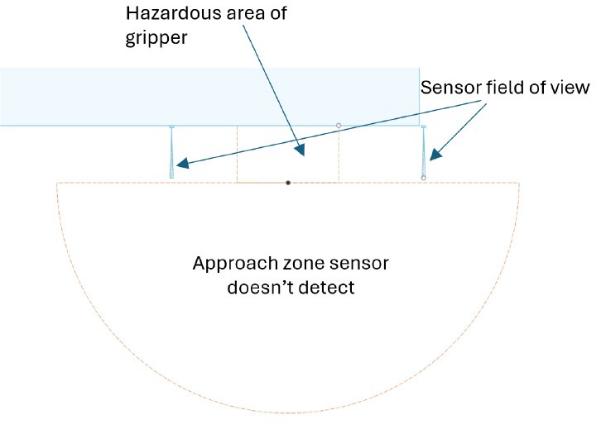
(3) Each of these hazards was disclosed in the user manual.
(4) It would be technically possible to install additional sensors to increase the size of the area in which a person would be detected. However, the sensors would need to be able to distinguish between vehicles (moving as part of the ordinary flow of traffic) and individuals. The experts disagreed as to whether this was reasonably practicable.
(5) The ACT vehicle did not have a facility to release the gantry if a person became entangled in it. The experts agreed that it was reasonably practicable to create a software update to add a software “reverse button” to the HMI screen that could reverse the gantry and that a hardwired electrical “reverse contact” button could also be added reasonably easily. The experts disagreed as to whether the lack of this facility ought to be characterised as a “design defect”.
(6) The ACT vehicle has lights in the operator cabin to indicate whether it is not safe to enter the cone storage area.
(7) The demonstrator ACT vehicle had a “design defect” in that the inverter was not protected from water ingress. A protective cover could readily be added.
(8) It was reasonable to expect that problems will arise in the demonstrator ACT vehicle due to its age and history of use.
203 The experts disagreed as to whether:
(1) The fact that the ACT vehicle was intended to be a single operator vehicle was a “design defect”. Mr Murphy was of the view that it was a design defect because he was of the view that one person could not safely perform the ACT vehicle tasks relating to cone deployment and retrieval while driving the vehicle. Mr Murphy considered that any matter or operation that distracted a driver from the task of driving the ACT vehicle resulted in the ACT vehicle being unsafe. Dr Hope was of the view that the ACT vehicle could be driven by a single operator safely. Dr Hope cited the slow speed of operation of the ACT vehicle at a mobile works (between 3.6 and 15 km per hour) and the fact of operating in a convoy as part of a traffic management plan in the context of performing roadworks.
(2) The safe state indication system was adequate. Mr Murphy was of the view that the safe state indication system should be simplified. Dr Hope was of the view that the existing feedback to the operator was sufficient.
204 The experts agreed that the ACT vehicle relieved an individual of the tasks of lifting and placing traffic cones on a road and thereby exposing that individual to road traffic hazards.
205 Whether any of the alleged mechanical hazards resulted in the demonstrator ACT vehicle not being as safe as a reasonable consumer fully acquainted with the state and condition of the demonstrator ACT vehicle would regard as acceptable and, if so, whether the mechanical hazards render the demonstrator ACT vehicle “unsafe”, is considered below.
WARRANTY CLAIM FOR MAJOR FAILURE
Construction of clauses 4.1 and 4.3
206 At hearing, the parties accepted that TLAS was not a consumer for the purposes of the Competition and Consumer Act 2010 (Cth) (because the demonstrator ACT vehicle had been acquired by it for the purposes of re-supply: s 3 of the ACL). The consumer protections provided for in the ACL did not apply.
207 Although the ACL did not directly apply, it was accepted by both parties that the Sale Agreement did provide a warranty, and that the term “major failure” used in cl 4.3 of the Sale Agreement has the same meaning as that term has in s 260 of the ACL.
208 The terms of cl 4 in referring to “failure” were drafted on the assumption that the ACL guarantees applied. The clause in referring to a “failure” is referring to a failure to meet a guarantee provided for in the ACL. So much is evident from the opening sentence of cl 4.3.
209 If clause 4.3 is to be given meaning notwithstanding the fact that the ACL was not applicable in the present case, the terms of cl 4.3 can only be understood by reference to the terms of the consumer guarantees provided for in the ACL and, in particular, the guarantee of acceptable quality. This is reinforced by the distinction drawn in the last sentence of cl 4.3(a) which refers to goods failing to be of “acceptable quality” and that failure not amounting to a “major failure”; which are ACL terms. As the High Court pointed out in H Lundbeck A/S v Sandoz Pty Ltd [2022] HCA 4; (2022) 276 CLR 170 at [51] (Kiefel CJ, Gageler, Steward and Gleeson JJ):
Parties to a written contract by which they contract in respect of statutory rights can ordinarily be taken to use statutory language according to its statutory meaning. To recognise as much is to recognise no more than that the statute is central to the matrix of fact within the context of which the common intention of the parties falls to be objectively determined. Absent reason to consider that the parties together intend language used in a statute to have some other meaning, there is no reason not to attribute to them a common intention to use that language according to its statutory meaning.
210 The term “major failure” is defined in s 260 of the ACL which provides:
(1) A failure to comply with a guarantee referred to in section 259(1)(b) that applies to a supply of goods is a major failure if:
(a) the goods would not have been acquired by a reasonable consumer fully acquainted with the nature and extent of the failure; or
(b) the goods depart in one or more significant respects:
(i) if they were supplied by description—from that description; or
(ii) if they were supplied by reference to a sample or demonstration model—from that sample or demonstration model; or
(c) the goods are substantially unfit for a purpose for which goods of the same kind are commonly supplied and they cannot, easily and within a reasonable time, be remedied to make them fit for such a purpose; or
(d) the goods are unfit for a disclosed purpose that was made known to:
(i) the supplier of the goods; or
(ii) a person by whom any prior negotiations or arrangements in relation to the acquisition of the goods were conducted or made;
and they cannot, easily and within a reasonable time, be remedied to make them fit for such a purpose; or
(e) the goods are not of acceptable quality because they are unsafe.
(2) A failure to comply with a guarantee referred to in section 259(1)(b) that applies to a supply of goods is also a major failure if:
(a) the failure is one of 2 or more failures to comply with a guarantee referred to in section 259(1)(b) that apply to the supply; and
(b) the goods would not have been acquired by a reasonable consumer fully acquainted with the nature and extent of those failures, taken as a whole.
Note: The multiple failures do not need to relate to the same guarantee.
(3) Subsection (2) applies regardless of whether the consumer has taken action under section 259 in relation to any of the failures.
211 “Major failure” is not defined in self-contained terms. For a defect to be characterised as a major failure, it must first be a defect that results in “a failure to comply with a guarantee referred to” in s 259(1)(b). The guarantees referred to in s 259(1)(b) are those provided for in Subdiv A of Div 1 of Pt 3-2 (other than ss 58 and 59(1)). Those guarantees are:
Guarantee as to the consumer’s right to undisturbed possession (s 52).
Guarantee that the goods are free from any security charge or other encumbrance (s 53).
Guarantee that goods are of “acceptable quality” (s 54).
Guarantee that goods are reasonably fit for any disclosed purpose and for any purpose for which the supplier represents that they are reasonably fit (s 55).
Guarantee that goods supplied by description correspond to that description (s 56).
Guarantee that goods supplied by reference to a sample or demonstration model correspond in quality to that sample or demonstration model (s 57).
212 Of these guarantees, it is the guarantee of acceptable quality that is of relevance in the present case. It is only if the supply of the demonstrator ACT vehicle did not satisfy the acceptable quality guarantee (within the language of s 54) that the issue of major failure arises. To the extent that the parties made submissions on the basis that the term “major failure” meant “major defect”, those submissions must be evaluated in light of the structure and language of s 260 of the ACL.
213 Given the language of cl 4.3, as explained above and in particular its use of the term “acceptable quality” and given that the parties have agreed that the term “major failure” takes its meaning from s 260 of the ACL, the term “acceptable quality” in cl 4.3 is to be construed in accordance with s 54 of the ACL.
214 Sections 54(2)–(3) define the concept of “acceptable quality” as follows:
(2) Goods are of acceptable quality if they are as:
(a) fit for all the purposes for which goods of that kind are commonly supplied; and
(b) acceptable in appearance and finish; and
(c) free from defects; and
(d) safe; and
(e) durable;
as a reasonable consumer fully acquainted with the state and condition of the goods (including any hidden defects of the goods), would regard as acceptable having regard to the matters in subsection (3).
(3) The matters for the purposes of subsection (2) are:
(a) the nature of the goods; and
(b) the price of the goods (if relevant); and
(c) any statements made about the goods on any packaging or label on the goods; and
(d) any representation made about the goods by the supplier or manufacturer of the goods; and
(e) any other relevant circumstances relating to the supply of the goods.
(Emphasis added.)
215 The term “defects” is not defined.
216 As the requirements in s 54(2) are stated cumulatively, it is necessary for the goods to have all the qualities identified in s 54(2) for the goods to attain the acceptable standard: Vautin v BY Winddown, Inc. (formerly Bertram Yachts) (No 4) [2018] FCA 426; (2018) 362 ALR 702 at [142(d)] (Derrington J). It follows that a failure to satisfy any one of those requirements results in goods not being of acceptable quality.
Relevant matters
217 Applying the framework of s 54 of the ACL, the standard of acceptable quality is to be assessed having regard to the matters identified in s 54(3). The matters include (relevantly):
the nature of the goods;
the price of the goods; and
representations made about the goods by the supplier.
218 The nature of the goods in the present case was a demonstrator ACT vehicle that included sophisticated plant and equipment. The chassis of the vehicle was five years old at the time of TLAS’s acquisition. The vehicle had been used for testing purposes on a major construction project.
219 Delivery of the demonstrator ACT vehicle occurred following a training demonstration which had not gone without issues arising in the use of the vehicle. A reasonable consumer would have been aware that there had been issues with the vehicle’s performance at the time of supply and been aware that, at the time of supply, further work had been performed on the demonstrator ACT vehicle.
220 The price of the demonstrator ACT vehicle was at a discount to a newly manufactured ACT vehicle. The reasonable purchaser of the demonstrator ACT vehicle would have been aware that the vehicle was not new and had been subject to wear and tear.
221 The demonstrator ACT vehicle was supplied with a user manual and quick start guide. Relevantly:
The user manual stated that only competent and qualified individuals may operate the demonstrator ACT vehicle.
The user manual noted that a risk assessment should be performed, identifying potential hazards prior to use and that each company job site would be different.
Potential hazards identified in the user manual were entanglement, uncontrolled energy release, heavy object and falling objects.
The user manual noted that personal protective safety equipment was required when operating and performing maintenance on the demonstrator ACT vehicle including that safety footwear and high visibility clothing are required while operating the demonstrator ACT vehicle.
An express warning was included in the user manual to ensure pneumatics “are in a safe state before working on the [demonstrator] ACT [vehicle]” and that the vehicle has automated systems that may move at any time.
In relation to updating the cone count, the user manual provided: “Make sure the vehicle is parked and in a safe state. Turn the [demonstrator] ACT [vehicle] and generator off to be safe”.
222 The reasonable purchaser of the vehicle would have been aware that the demonstrator ACT vehicle was a specialist form of plant and equipment intended to be operated by trained personnel in a workplace setting and that there were safety hazards that needed to be managed.
Acceptable Quality Guarantee
223 Before determining whether there has been a “major failure”, it is first necessary to determine that there has been a failure of the acceptable quality guarantee. That guarantee may be failed if the demonstrator ACT vehicle was not:
(1) as fit for the purpose for which it was supplied; and
(2) as free from defects; and
(3) as safe;
as a reasonable purchaser fully acquainted with the state and condition of the vehicle would regard as acceptable.
224 There is a distinction between goods being fit for purpose (s 54(2)(a)) and goods being free from defects (s 54(2)(c)). The distinction was explained by Perram J in Capic v Ford Motor Company (No 3) [2017] FCA 771 at [6]–[8] in the following terms:
… the unacceptable quality of a vehicle might be established simply by proving it suffered from a range of aberrant behaviours. To run such a case, it would not be necessary to explain why the vehicle suffered from these problems; it would be enough to show that it was not fit for driving (subsection 54(2)(a)) or was not safe (subsection 54(2)(d)). This [the consumer] might well prove simply by demonstrating that the vehicle was given to sudden powerlessness, violent shaking or other undesirable automotive behaviours.
… [the consumer] could also seek to prove that the vehicle contained a defect … within subsection 54(2)(c). But forensically this would be a more ambitious and difficult case because [the consumer] would take … the engineering burden of explaining what the problem with the transmission actually was.
So there is a distinction between the unacceptable quality of a vehicle being established, on the one hand, by its constellation of symptoms and, on the other, by proving the root cause of those symptoms.
225 Thus, the demonstrator ACT vehicle could be shown to be of unacceptable quality because it was not fit for the purpose of laying and retrieving traffic cones (by reason of its aberrant behaviours) or because it was not free of defects (by proving the root cause of those aberrant behaviours).
226 “Defects” in the context of motor vehicles is not limited to mechanical defects: Australian Competition and Consumer Commission v Mazda Australia Pty Ltd [2021] FCA 1493 at [128] (O’Callaghan J).
227 The inquiry posited by s 54(2) is a hypothetical one, as to what a reasonable consumer at the time of supply would regard as acceptable if the reasonable consumer was “fully acquainted with the state and condition of the goods”, including any “hidden defects”. The High Court in Williams v Toyota Motor Corporation Australia Ltd [2024] HCA 38; (2024) 98 ALJR 1282 at [33] (Gageler CJ, Gordon, Steward, Gleeson and Beech-Jones JJ) explained that at least in the context of a “hidden defect”, the inquiry involves:
attributing to a reasonable consumer, at the time of supply, later acquired knowledge of the defect that renders the goods below an acceptable quality. The attributed knowledge of the defect must be knowledge that would render a reasonable consumer “fully acquainted” with the true state and condition of the goods; it follows that this must include full knowledge of or acquaintance with the defect, including later acquired knowledge of the propensity of the defect to occasion adverse consequences and the nature of those consequences, even if understandings of those matters vary over the period of time leading up to the trial.
228 The High Court went on to observe at [34] that later acquired knowledge of the capacity to repair the defect or ameliorate its consequences, including when, how and at what cost those repairs or ameliorative steps could be undertaken, should also be attributed to the hypothetical reasonable consumer. Those matters are characteristics of the nature and seriousness of the defect and, in turn, the state and condition of the goods.
229 The starting point in ascertaining whether a good is of acceptable quality is the attribution of a full acquaintance with the state and condition of the goods, at the time of supply, to a reasonable consumer, including full knowledge of any hidden defect. In this hypothetical exercise, one must bring to account, at the time of supply, the best available information about the defect. The best available information will include all later acquired knowledge possessed at the time of trial.
230 To address the question posited by s 54(2), it is necessary to attribute, at the time of supply, to the hypothetical reasonable purchaser the following knowledge:
(1) Knowledge of the defects which in fact existed at the time of supply.
(2) Knowledge of whether the defects were repairable.
(3) Knowledge of when the capacity to repair would become known / available.
231 Each goes to the nature and seriousness of the defect at the time of supply.
232 Where the capacity to repair / remedy the defect would not be known or available for a period of time, the relevant hypothetical market is for goods that were defective and would remain defective for that period. Where the period is material, the goods are unlikely to be of acceptable quality.
233 As the High Court observed in Williams at [41]:
[Depending on the type of goods] it might be that the availability of a free and convenient repair within a short period of time after the time of supply is such that a reasonable consumer armed with that knowledge and having regard to the matters set out in s 54(3) would regard them as being of acceptable quality.
Findings on defects
234 Arrowes submitted that none of the matters identified at [201] was a defect and, in particular, that certain of those matters did not constitute a “design defect”, apparently adopting the definition of “defect” used by the experts as referring to “missing functionality”. This concept of “design defect” was submitted to be something distinct from “an operational defect”, with only the former capable of constituting a “failure” for the purposes of the warranty in cl 4.3. Arrowes further submitted that a fault was not a design defect if the user manual or operating instructions provided for a procedure to clear the fault.
235 As explained above, the distinction drawn by Arrowes is not accepted. Given that the parties proceeded on the basis that the term “major failure” takes its meaning from s 260 of the ACL there is no textual or contextual basis for distinguishing between an operational defect and a design defect in assessing whether there has been a failure of a guarantee of acceptable quality and whether that failure is a major failure. Furthermore, the Court does not accept that the mere fact that there is a procedure set out for addressing aberrant behaviour means that there is no defect in the demonstrator ACT vehicle. Recurring aberrant behaviour that might be addressed by a procedure that significantly disrupts the operation of the demonstrator ACT vehicle is indicative of an underlying fault that constitutes a defect.
236 The Court finds that each of the matters identified at [201] was a “defect” as that term is used in s 54(2)(c). In particular, the Court makes the following findings.
237 The demonstrator ACT vehicle’s sensor guiding the gripper of the driver’s side was misaligned. The Court does not accept that the misaligned sensor was not a “defect” because the driver of the vehicle can align the arm by manoeuvring the vehicle. The ACT vehicle was fitted with sensors that were intended to make fine alignments. The ACT vehicle is a large vehicle. To expect the driver to have to align the entire vehicle very close to a traffic cone without the assistance of properly functioning sensors is not realistic. Dr Hope’s opinion on this issue was premised on an assumption that the automatic alignment system was functional. That assumption was false.
238 On balance, the Court concludes that the sensor was misaligned at the time of supply to TLAS having regard to the performance of the demonstrator ACT vehicle at the training session and in the period from its acquisition by TLAS.
239 The damaged grippers were not defects in the demonstrator ACT vehicle at the time of supply. The damage to the arms arose after the time of supply.
240 The software fault that causes the demonstrator ACT vehicle to incorrectly record the number of cones deployed or retrieved is a defect as is the software fault that causes the cone count to be lost when the demonstrator ACT vehicle is shut down. The fact that the operator can manually count the cones and manually reset the cone count does not mean that there is no defect. The procedure for correcting the cone count recorded in the demonstrator ACT vehicle requires the operation of the vehicle to be disrupted. The procedure provided for in the user manual is not a practical solution to the management of a recurring issue of an incorrect cone count.
241 The specifications of the cable track that was installed on the demonstrator ACT vehicle suggest that it was not suitable for the weight of the cables that it was being required to hold. The Court considers that the broken cable track was attributable to a defect in installing a cable track that was not appropriate and that the effects of wear and tear from the age and use of the vehicle would have been less had a track more suitable to the weight of the cables been affixed in the first place.
242 The failure of the HMI screen to clear the pop-up message relating to the cone storage area being full was the result of a software defect because the workaround was not clear or intuitive. It is noted that TLAS’s further particulars of alleged defects does not identify the HMI screen pop-up message issue as one of the alleged defects.
243 Both experts agreed that the freezing HMI screen is a “defect”, or perhaps more accurately said, the HMI screen was the subject of aberrant behaviour.
244 The Court finds that on the balance of probabilities the issue with the freezing HMI screen existed at the time of supply to TLAS and, on the balance of probabilities, was attributable to a software programming defect rather than a hardware issue.
245 Based on these findings, the demonstrator ACT vehicle may not be of acceptable quality because either it was not fit for the purpose of laying and retrieving traffic cones (by reason of the aberrant behaviour) or because it was not free of defects. Whether the existence of the defects or the presence of aberrant behaviours rendered the demonstrator ACT vehicle not of acceptable quality must be considered having regard to what the reasonable consumer, armed with knowledge of any costs of and timing of the availability of any repair and having regard to the matters set out in s 54(3), would consider acceptable.
Availability of repair
246 The High Court in Williams recognised that, depending on the nature of the goods, the extent to which a repair is available can be relevant to determining whether a good is of acceptable quality.
247 In the circumstances of this case, the issue of a failure of the acceptable quality standard cannot be resolved separately from a consideration of the availability of repair for the alleged defects. Having regard to the specialist and complex nature of the demonstrator ACT vehicle in this case, if readily available inexpensive repairs were available within a short time, the fact that there were software related defects in the demonstrator ACT vehicle at the time of delivery does not of itself cause the supply of the demonstrator ACT vehicle to fail the acceptable quality standard. The fact that certain parts (such as the variable message sign) malfunctioned shortly after the time of delivery does not of itself cause the supply of the ACT vehicle to fail the acceptable quality standard if those parts could be replaced or repaired within a short time.
248 Based on the findings made above, it is necessary to consider the evidence relating to the availability of a repair for each defect as at the trial date and when that repair became available.
249 Based on the evidence, the Court makes the following findings in respect of the defects found:
(1) By the time of trial, it was known (by reason of the joint expert opinion) that it was possible to realign the sensors on the gripper arm to make alignment corrections. There is no evidence that Arrowes itself possessed knowledge of how to make that correction prior to the time of trial or was in a position to implement that correction prior to the date of trial. The attempts to take corrective action by Mr Peters had failed to address the issue. The experts had identified solutions to the non-aligning gripper arm. The Court finds that although that solution had not been identified by Arrowes between the time of delivery and the time of trial, the issue was capable of being remedied easily and within a reasonable time.
(2) The software fault causing the cone count to be lost or incorrectly recorded in the demonstrator ACT vehicle’s system was the reason for the aberrant behaviour of the gantry. Based on the evidence of Dr Hope, that software fault had been corrected in the production model of ACT vehicles at the time of trial. The repair for this defect was known and readily available at least at the time of trial and prior to the trial as the update was referred to in Dr Hope’s initial report dated 3 April 2025.
(3) The cable track was capable of ready remedy at the time of trial and was capable of rectification at all times on and from the date of delivery.
(4) The cause of the HMI screen freezing has not been ascertained with precision. Although the experts agree that the cause is likely a software fault, the precise diagnosis of that fault and the correcting code had not been formulated at the date of trial. Mr Peters’s attempts to remedy the fault had failed.
(5) TLAS’s statement of further particulars of alleged defects does not identify an issue with the pop-up messages on the HMI screen. Both experts agreed that this issue was caused by software programming. Although it is likely that a remedy for the pop-up message appearing was readily available, it had not been remedied by the time of trial and it is not clear whether a software update had been formulated to address the issue. The nature of the defect was such that a reasonable purchaser fully acquainted with the nature of the defect would have been aware of the availability of a workaround. While the existence of the workaround does not mean that the demonstrator ACT vehicle was free from defects, it does mean that a reasonable purchaser would not have regarded the defect as rendering the demonstrator ACT vehicle of unacceptable quality.
250 The issues in relation to the gripper freezing outside the vehicle had been addressed at the time of trial as had the issues relating to the gripper knocking cones off the conveyor (both had been addressed by Mr Peters over the course of 2023). The malfunctioning variable message sign attached to the rear of the vehicle had been repaired in May and June 2023.
251 Of the defects or aberrant behaviours to which no remedy had been implemented at the date of trial, there was at least one in respect of which no remedy had been formulated or the precise cause identified (the freezing HMI screen). A reasonable purchaser supplied with the demonstrator ACT vehicle in April 2023 with knowledge of the freezing HMI screen that was to be addressed by turning the demonstrator ACT vehicle off, thereby disrupting the operation of the vehicle, but to which no solution had been formulated by early 2026, would not regard the demonstrator ACT vehicle as being as free from defects nor as fit for purpose as that reasonable purchaser would regard as acceptable. It follows that the demonstrator ACT vehicle was not of acceptable quality.
Whether the demonstrator ACT vehicle is not of acceptable quality because of safety concerns
252 As a general matter, the concept of safety is concerned with the risk of injury. In its strictest sense, safety is the state of being safe or protected from or guarded against hurt in the sense of freedom from injury, hurt or danger (see Macquarie Dictionary (online) and Oxford English Dictionary (online)).
253 It is evident from the terms of the definitions in the ACL of acceptable quality and major failure that there is no binary distinction between safe and unsafe. The definition of acceptable quality in so far as it concerns safety recognises that safety is not an absolute standard – goods must be “as … safe … as a reasonable consumer fully acquainted with the state and condition of the goods (including any hidden defects of the goods) … would regard as acceptable” having regard to, amongst other things, “the nature of the goods”: s 54(2)–(3) of the ACL. As was observed in Pro Teeth Whitening (Aust) Pty Ltd v Parliamentary Secretary to the Treasurer, David Bradbury MP [2013] FCA 1376 at [66] (Rangiah J), there are many useful products that can cause some form of injury, regardless of any safety precautions that can feasibly be taken by the supplier. The standard of safety provided for in the acceptable quality guarantee recognises that there may be a risk of harm or injury that may be regarded as acceptable having regard to the kind of goods in question and how the goods might reasonably be expected to be used.
254 Construing the term “acceptable quality” concordantly with the ACL, it is noted that the ACL in s 54(6) provides that the standard of acceptable quality is not failed if the consumer to whom the goods are supplied fails to take reasonable steps to prevent them from becoming of unacceptable quality. In so far as the standard of acceptable quality requires goods to be safe, goods do not fail to meet that standard if the risk of harm arises due to a failure by the consumer to take reasonable steps to prevent that harm.
255 It is also implicit in the definition of “major failure” that not every failure to meet the standard of acceptable quality will be a “major failure”. It follows that not every failure to meet the standard of acceptable safety will necessarily result in the goods being “unsafe”. An example may be where goods that are not of a standard of acceptable safety can be readily and inexpensively made to an acceptable standard of safety.
256 In so far as safety is concerned, the concept of goods being safe in the context of an acceptable quality standard therefore entails an assessment of the acceptability of the risk of harm that may be caused by the goods. An assessment of risk as being of an acceptable level is easier to perform where there is an applicable prescribed safety standard for the particular good.
257 The nature of the good in this case is a vehicle that includes specialist plant and equipment. Whilst the experts referred to general guidance principles that apply to machinery generally, there is no specific safety standard applicable to the demonstrator ACT vehicle. In these circumstances, assessing whether the demonstrator ACT vehicle failed to meet the acceptable quality guarantee by reason of the vehicle not being as safe as that guarantee required and, if so, whether such failure resulted in a major failure by reason of the vehicle being unsafe requires the assessment and balancing of a broad range of factors, including the nature and extent of the risk of injury and the precautions that can be taken to reduce the risk of injury.
258 Merely because a good can be made safer through improvements to its design does not mean that it is unsafe if those improvements are not made. In the present case, the question is whether the level of safety risk (being the risk of injury or harm to an individual) is not acceptable having regard to the nature of the goods, the price paid for the goods and any operating instructions.
259 There is a level of safety risk inherent in any machinery that has moving parts and in any vehicle that is driven. The good purchased was a specialist vehicle intended for use in specialist commercial roadworks construction projects. The good was intended to be operated in a workplace context and was intended to be serviced and maintained by individuals with specialist knowledge. The user guide made it clear that the vehicle was intended to be operated by competent and qualified individuals. It also made clear that before using the demonstrator ACT vehicle the operator was expected to perform a risk assessment of the operating environment identifying potential hazards and to follow all additional safety requirements as provided for in a Safe Work Method Statement (as may be required by workplace health and safety authorities). There are potential hazards identified and requirements specified for personal protective equipment.
260 At least some of the safety risks relate to how the demonstrator ACT vehicle may be operated rather than result from the inherent design of the vehicle. Although they may not be eliminated, these risks may be managed by operational processes and procedures, such as increasing the number of vehicles in the convoy as part of a traffic management plan, maintenance processes and procedures, and the placing of safety warning signs or physical safety barriers when performing maintenance or repair work.
261 Other risks arose from individuals engaging in careless or reckless behaviours. Mr Murphy was of the view that a failure to address risks arising from individuals engaging in careless or reckless behaviours resulted in the ACT vehicle being unsafe. For example, Mr Murphy considered that in order to be regarded as safe, the ACT vehicle should have sensors protecting against a motorcyclist coming within 500 mm of the side of the vehicle in its operational mode, even though such sensors would only be effective to protect such a motorcyclist in limited circumstances. Mr Murphy considered that there was a “moral responsibility – when we design a safety relevant system” to design the system “to prevent people who were being stupid from hurting themselves”. In this respect, Mr Murphy’s approach is not consistent with the approach to acceptable quality in the ACL (and taken to be adopted by cl 4.3 in the present case). Section 54(6) provides that goods do not fail to be of acceptable quality if the consumer fails to take reasonable steps to prevent them from becoming of unacceptable quality. Accordingly, a purchaser of the demonstrator ACT vehicle is expected to take reasonable steps to ensure the demonstrator ACT vehicle is operated safely. The risks to motorcyclists can be ameliorated through use of traffic management, convoy vehicles and signage.
262 Mr Murphy’s approach to safety was to identify the risk of harm and consider whether it was possible for that risk of harm to be averted by altering the design or operation of the demonstrator ACT vehicle. If a solution or mitigation of the risk could be addressed by a change in design or by the use of available technology, Mr Murphy was of the view that the existing design was unsafe. Mr Murphy’s approach to risk minimised the scope for a balancing exercise of the kind embodied in a guarantee of acceptable quality as framed by the ACL. His philosophy was encapsulated in his oral evidence in the following sentence:
… if you can easily and conveniently implement something, even if you think you’re doing a good job elsewhere, you’re going to do it. Why not?
263 Mr Murphy’s approach to the identification of what he called safety defects is laudable but does not reflect the standard required by a guarantee of acceptable quality in the terms of the ACL. The Court accepts Mr Murphy’s evidence that there were improvements that could be made to the demonstrator ACT vehicle to reduce the risk of injury to those who use the demonstrator ACT vehicle without regard to the user manual and to those who do not take care in looking after their own safety in driving, walking or otherwise being around moving equipment on roadworks sites. But those facts of themselves do not necessarily support a conclusion that the demonstrator ACT vehicle was not as safe as a reasonable purchaser fully acquainted with the state and condition of the vehicle would regard as acceptable, particularly having regard to the specialist nature of the vehicle and its intended use and the fact that the reasonable consumer of the demonstrator ACT vehicle is expected to take reasonable steps to prevent risks to safety. Having regard to the disclosures made in the user manual, a reasonable purchaser of the demonstrator ACT vehicle fully acquainted with its state and condition, including its features, would expect the vehicle to be deploying and retrieving traffic cones in a controlled space to which access was managed by a traffic management plan.
264 The user manual contains specific warnings about entrapment risk and to never work on the vehicle whilst it is running. The absence of a release button to free a person trapped in the gantry is far from ideal in terms of design but of itself does not render the demonstrator ACT vehicle unsafe. A reasonable user of the demonstrator ACT vehicle would not enter the gantry area whilst the vehicle is in operation. Both experts agreed that the entrapment issue could be readily addressed by a software update to add a software “reverse button” to the HMI that could reverse the gantry. To the extent that the absence of a function to reverse the gantry causes the demonstrator ACT vehicle to not be as safe as a reasonable purchaser fully acquainted with the state and condition of the ACT vehicle would regard as acceptable, that failure of the acceptable quality standard can be remedied at a free or minimal cost.
265 The Court is not satisfied that the demonstrator ACT vehicle fails the acceptable quality guarantee because it is a single operator vehicle. The ACT vehicle is marketed as a single operator vehicle. It is intended to remove the need for manual placement of traffic cones in areas that are proximate to moving traffic as part of major roadworks projects. It is intended to be used as part of a roadworks site. The ACT vehicle was not intended to be used to deploy and retrieve traffic cones whilst being driven on an area that is open to the public without a traffic management plan in place. When deploying and retrieving cones, the ACT vehicle is intended to be operated at very low speeds and as part of a convoy of traffic management vehicles. When deploying or retrieving cones, the ACT vehicle is driven at speeds of between 3.6 km and 15 km per hour. It performs this function with a variable message sign which would be expected to be displaying a requirement for traffic to slow down. Given its industrial application, a reasonable consumer of the goods would be expected to have worksite safety protocols and plans in place and trained staff. A reasonable purchaser fully acquainted with the state and condition of the demonstrator ACT vehicle would regard the demonstrator ACT vehicle as being as safe as acceptable.
266 In so far as Mr Murphy refers to r 304H(1) of the Road Safety Road Rules 2017 (Vic) in support of his conclusion that the single operator design of the vehicle renders the ACT vehicle unsafe, the Court makes the following observations:
(1) Rule 304H applies to the use of a vehicle on a “road” which is defined relevantly as “an area that is open to or used by the public”.
(2) The evidence before the Court does not enable a finding to be made that the driver of the demonstrator ACT vehicle would be “operat[ing] an inbuilt device” in a manner contrary to r 304H(1). The evidence before the Court does not enable the Court to determine whether use of the HMI screen comes within an exception to r 304H(1) found in r 304H(2). The evidence before the Court does not enable a conclusion to be drawn that the use of the HMI screen by the driver to enter any text or to scroll nor whether, having regard to the function and purpose of the demonstrator ACT vehicle, the functions on the HMI screen can be said to be designed to assist a driver to operate the demonstrator ACT vehicle.
267 The Court is satisfied that the electrocution risk arising from the unprotected inverter renders the demonstrator ACT vehicle not of acceptable quality because the reasonable consumer fully acquainted with the state and condition of the demonstrator ACT vehicle would not regard the demonstrator ACT vehicle to be acceptably safe. However, as explained below, the issue in respect of the unprotected inverter is whether it can be easily and inexpensively remedied. Both the experts agree that it can be readily remedied by covering the inverter with a plastic cover.
Major failure
268 The failure of the acceptable quality guarantee by reason of the freezing HMI screen for which no remedy had been identified with sufficient precision at the time of trial was a major failure (within the meaning ascribed to that term by s 260 of the ACL) because:
(1) the demonstrator ACT vehicle was substantially unfit for the purpose for which vehicles of that kind are supplied (being the deployment of traffic cones on major roadworks projects) and there was no known remedy available within a reasonable time of the supply of the demonstrator ACT vehicle to make it fit for such a purpose. Absent a remedy, the issue with the HMI screen freezing required the demonstrator ACT vehicle system to be restarted, entirely disrupting its operation.
(2) a reasonable purchaser fully acquainted with the nature and extent of the failure of the acceptable quality standard would not have acquired the demonstrator ACT vehicle in circumstances where a remedy remained to be identified at the time of trial.
269 It appears to the Court that the demonstrator ACT vehicle can be operated in a sufficiently safe manner particularly if accompanied by a convoy of traffic management vehicles. Having regard to the circumstances in which the demonstrator ACT vehicle is to be used to deploy and retrieve cones, the Court is not satisfied that the risk of harm due to driver distraction because the demonstrator ACT vehicle is used by a single operator in deploying or retrieving renders the demonstrator ACT vehicle “unsafe”. The Court is also satisfied that maintenance work on the ACT vehicle can be performed in a manner that is sufficiently safe by erecting physical barriers and limiting access.
270 In so far as safety is concerned, it is possible for the demonstrator ACT vehicle to be made safer. Although the demonstrator ACT vehicle may not be “as safe” as is required for the acceptable quality guarantee, the issue to be considered in determining whether there has been a major failure of the acceptable quality standard under s 260(1)(e) is whether the demonstrator ACT vehicle is “unsafe”.
271 The electrocution risk arises to a person who is in the cone storage area because it is possible for water (including rainwater) to enter the inverter. The Court is not satisfied that the failure is a major failure because the failure of the acceptable safety standard can be readily remedied by adding a protective cover over the inverter. The risks created by the uncovered inverter do not result in a major failure because the demonstrator ACT vehicle is not unsafe in circumstances where it can readily and inexpensively be made safe. A reasonable purchaser fully acquainted with knowledge of the safety issue and the fact that a readily inexpensive solution was available would have been willing to acquire the demonstrator ACT vehicle but would have required Arrowes to implement the solution.
272 Because the Court has concluded that the HMI screen freezing is a major failure under s 260(1)(a), it is not necessary to consider whether the combined effect of non-major failures constitutes, in combination, a major failure.
273 Ultimately, the effect of the contractual warranties was to leave Arrowes to bear the risk of remediation of defects which, whilst present, rendered the demonstrator ACT vehicle unfit for purpose unless those issues could be easily resolved within a reasonable period of time. Although the experts concluded that the issue with the HMI screen was capable of resolution, the experts could not identify with precision the cause nor formulate the solution beyond expecting the solution to lie in a correction to the software coding. At the time of trial, the solution was not known. Because of the significant effect of the issue on the ability to use the demonstrator ACT vehicle for its intended purpose, pursuant to the contractual warranties, the risk of identifying the correct cause and implementing a solution when it becomes known rests with Arrowes as vendor.
274 By reason of the major failure of the acceptable quality guarantee, there being no other demonstrator ACT vehicle available for supply, TLAS is entitled to a refund of the purchase price, pursuant to cl 4.3(a) of the Sale Agreement. Arrowes is entitled to possession of the demonstrator ACT vehicle. The issue of compensation for loss or damage is addressed further below.
MISLEADING OR DECEPTIVE CONDUCT
275 Section 18 of the ACL provides:
A person must not, in trade or commerce, engage in conduct that is misleading or deceptive or is likely to mislead or deceive.
276 Relevantly, s 237 of the ACL provides:
(1) A court may:
(a) on application of a person (the injured person) who has suffered, or is likely to suffer, loss or damage because another person has engaged in conduct in contravention of a provision of Chapter 2, 3 or 4; …
make such order or orders as the court thinks appropriate against the person who engaged in the conduct, or a person involved in that conduct.
Note: The orders that the court may make include all or any of the orders set out in section 243.
277 Section 243 of the ACL sets out a non-exhaustive list of the types of orders a court may make under ss 237(1), 238(1) or 239(1).
278 The conduct that TLAS alleges was engaged in by Arrowes was the making of a representation. By its amended statement of claim, TLAS claims that Arrowes represented to TLAS that the demonstrator ACT vehicle “could be immediately lawfully operated on public roads” (Lawfulness Representation).
279 The representation was said to be made by:
the absence of any representation on Arrowes’s website as to the need to take further steps in order to lawfully use the demonstrator ACT vehicle on public roads;
the absence of any representation from any representative of Arrowes to any representative of TLAS prior to the entry into the Sale Agreement as to the need to take further steps in order to lawfully use the demonstrator ACT vehicle;
a statement from Ms Ea to Mr Lawson on around 14 December 2022 that the demonstrator ACT vehicle had been previously used as a demonstrator on the M80 Ring Road project; and
a statement from Ms Ea to Mr Lawson that the demonstrator ACT vehicle had encountered several “minor issues” on the M80 Ring Road project but that all of those issues had been resolved and there were no further outstanding issues with the demonstrator ACT vehicle.
280 TLAS claims that the Lawfulness Representation was misleading on the basis that the representation was untrue because TLAS alleges the demonstrator ACT vehicle “could not be lawfully driven” for the following reasons:
(1) TLAS alleges that the demonstrator ACT vehicle had been modified (by the installation of the ACT Plant) without approval of an approved vehicle examiner or the regulator. As such, use of the demonstrator ACT vehicle was prohibited by s 85(2) of the Heavy Vehicle National Law (which applies as a law of Queensland by reason of s 4 of the Heavy Vehicle National Law Act 2012 (Qld) and as a law of Victoria by reason of s 4 of the Heavy Vehicle National Law Application Act 2013 (Vic)).
(2) TLAS alleges that the modifications to the demonstrator ACT vehicle were not capable of obtaining approval because the ACT vehicle does not comply with the Australian Design Rules made under the Road Vehicle Standards Act 2018 (Cth).
281 TLAS seeks orders that the Sale Agreement be declared void under s 243 of the ACL by reason of TLAS’s reliance on the Lawfulness Representation in entering into the Sale Agreement and purchasing the demonstrator ACT vehicle, and seeks an order for damages and costs under s 236 of the ACL. TLAS also seeks an order in equity that the contract be set aside as void ab initio and equitable damages. In seeking this relief, TLAS contends that TLAS suffered loss or damage by reason of the making of the Lawfulness Representation and that it was appropriate to make an order that the contract was void because, had the Lawfulness Representation not been made, TLAS would not have entered into the Sale Agreement.
282 There was no dispute that if the Lawfulness Representation was made by Arrowes, it was made in the course of trade or commerce.
283 In support of its misleading or deceptive conduct claim, TLAS relied upon the evidence of Mr Murphy (in particular Mr Murphy’s First Supplementary Report and Second Supplementary Report). Arrowes relied upon the evidence of Dr Hope (in particular Dr Hope’s Second Supplementary Report and Third Supplementary Report). The Second Joint Report also was directed to the issues relating to the ability to lawfully drive the demonstrator ACT vehicle on which the experts agreed and disagreed.
Representation
284 By its written closing submissions, TLAS clarified that the alleged representation that the demonstrator ACT vehicle could immediately be lawfully “operated” was an alleged representation that the demonstrator ACT vehicle could be lawfully driven on public roads and lawfully used to deploy and retrieve cones on public roads. By contending that TLAS relied upon the alleged Lawfulness Representation in entering into the Sale Agreement, TLAS is understood to contend that the reference to “immediately” in that alleged representation was a reference to the ability to lawfully drive and operate the demonstrator ACT vehicle at the time of entry into the Sale Agreement.
285 The Court finds that there was an implied representation made to TLAS that the demonstrator ACT vehicle could be lawfully driven on public roads and that it was possible for the vehicle to be lawfully operated to deploy and retrieve cones. The Court does not find that a representation was impliedly made about the specific circumstances or conditions in which the use of the demonstrator ACT vehicle to deploy or retrieve cones would be lawful (ie whether on public roads for the purposes of any road traffic regulation) at the time TLAS took delivery of the demonstrator ACT vehicle. Arrowes (by its officers and agents) knew that Mr Lawson had come to collect the demonstrator ACT vehicle and would be driving it back to Victoria. They also knew that Mr Lawson proposed to offer the demonstrator ACT vehicle for hire for major roadworks projects. Having informed Mr Lawson that the demonstrator ACT vehicle had been used and tested on the M80 Ring Road project, there was an implied representation that it was possible to use the demonstrator ACT vehicle to deploy and retrieve cones lawfully.
286 The Court finds that the representation impliedly made concerned the lawful ability to drive and use the demonstrator ACT vehicle as at the date of delivery. The representation made to TLAS was not that a possible pathway to lawful operation existed. The demonstrator ACT vehicle either had the necessary approvals to enable it to be driven at the time of delivery or it did not. It was either possible for the demonstrator ACT vehicle to be lawfully used to deploy and retrieve cones at the time of delivery or it was not. Notwithstanding the parties’ lengthy submissions on the issue, whether it was possible for the demonstrator ACT vehicle to obtain the necessary approvals is not the issue. Contrary to the submissions of Arrowes, the fact that there may have existed at the time of delivery a pathway to gain the ability to lawfully operate the demonstrator ACT vehicle to retrieve and deploy cones does not address the truthfulness of the representation of the presently existing ability to lawfully drive and use the demonstrator ACT vehicle as at the date of delivery.
Was the representation misleading or deceptive?
287 The first issue is whether that representation was true.
288 TLAS contends that the demonstrator ACT vehicle could not be lawfully driven and operated to deploy or retrieve cones on the basis that:
(a) there were unapproved modifications made to the demonstrator ACT vehicle; and
(b) the demonstrator ACT vehicle did not comply with certain Australian Design Rules which applied to the vehicle.
289 TLAS relied upon evidence from Mr Murphy in support of its contention that the demonstrator ACT vehicle could not be lawfully driven or operated. Arrowes relied upon the evidence of Dr Hope.
Modifications
290 Part 3.3 of the Heavy Vehicle National Law is entitled “Modifying heavy vehicles”. (The Heavy Vehicle National Law was amended with effect from 1 August 2026 relevantly to repeal s 85. Section 85(2) was replaced by new s 18(1) of the Heavy Vehicle (Vehicle Standards) National Regulation (Qld).)
291 Sections 85(2) and (3) of the Heavy Vehicle National Law provide:
(2) A person must not use, or permit to be used, on a road a heavy vehicle that has been modified unless the modification has been approved by—
(a) an approved vehicle examiner under section 86; or
(b) the Regulator under section 87.
Maximum penalty—$3000.
(3) This section does not apply to a modification that complies with a code of practice prescribed by the national regulations for the purposes of this section, section 86 or 87 that expressly states that a modification of that type does not require approval.
292 It was not disputed that the demonstrator ACT vehicle was a heavy vehicle.
293 Section 84 defines “modification” in the following terms:
modification, of a heavy vehicle, means—
(a) the addition of a component to, or the removal of a component from, the vehicle; or
(b) a change to the vehicle from the manufacturer’s specification for the vehicle;
but does not include a modification to the vehicle that has been approved under the Road Vehicle Standards Act 2018, item 16(2) of Schedule 3 to the Road Vehicle Standards (Consequential and Transitional Provisions) Act 2018 of the Commonwealth or the Motor Vehicle Standards Act 1989 before the repeal of that Act.
294 The term “component”, as a standalone term, is not defined. However, the Heavy Vehicle National Law does:
(a) relevantly define “component”, of a heavy vehicle that is a combination, to relevantly mean “a component of any component vehicle of the combination”. A “combination” means “a group of vehicles consisting of a motor vehicle towing 1 or more other vehicles”; and
(b) draw a distinction between components of heavy vehicles and “equipment” (see ss 59, 60(2), 89(2), 90(4), 93(5) and 94(2)). “Equipment” is defined in s 5 in inclusive terms as including “tools, devices and accessories in the vehicle.”
295 Arrowes submitted that the plant and equipment affixed to the inside of the body mounting was not a component of the demonstrator ACT vehicle but was “equipment”. The correctness of that submission may be doubted. The language of the Heavy Vehicle National Law is “component of” or, in the case of equipment “tools, devices and accessories in the vehicle”. Contextually, a component is an item that has been affixed to or integrated into the vehicle. Whether that item so affixed may be described as an accessory is of no moment. Once affixed to the vehicle, an accessory becomes a modification. This is consistent with the view of both of the experts. On this reasoning, the demonstrator ACT vehicle was modified when the ACT Plant was installed.
296 The issue then arises as to whether the modification was approved.
Certificate of modification
297 The Court had before it an extract of a Certificate of Modification dated 5 September 2019 with the make and model, engine number and VIN / chassis number that corresponded to the demonstrator ACT vehicle purchased by TLAS. The description of the modification was “installation of body to vehicle. Enclosed”.
298 On the face of the certificate, the body mounted to the Isuzu chassis was approved on 5 September 2019. Unless in operation mode, the accessories affixed to the demonstrator ACT vehicle remain contained in the body mounting. Unless being operated to deploy and retrieve cones there is no component of the vehicle that sits outside the body mounting. The certificate is valid on its face.
299 Mr Murphy speculated in his second report that “perhaps” the ACT Plant had not been installed as at the date of the certificate based on the following:
The certificate only mentions “installation of body to vehicle” and does not mention the ACT Plant.
The certificate requires documenting “Description of modifications (in detail)”. In Mr Murphy’s opinion, completely omitting the installation of ACT Plant cannot be considered documenting “in detail”.
The certificate was issued with the vehicle having only 11 km on the odometer. This would have provided very little driving distance to actually carry out the tasks associated with installing and testing the ACT Plant.
The certification time is listed as only 30 minutes which in Mr Murphy’s view is precious little time to cover the inspection checks that are required.
300 In oral evidence Mr Murphy testified that the demonstrator ACT vehicle could only be lawfully driven on public roads when the gripper arms were retracted and the bay doors were closed if the ACT Plant were installed at the time the certificate of modification was issued.
301 Dr Hope’s oral testimony was that if the ACT Plant did exist in the body mount, it would have been part of the body modifications and therefore certified. Having not seen any reports or checklists from the individual who completed the certificate, Dr Hope’s evidence, with which Mr Murphy agreed, was that it is not possible to know whether the ACT Plant was inside the body mount at the time the certificate was issued.
302 In the Second Joint Report and in oral evidence, the experts agreed that they could not ascertain whether the ACT Plant was included when the certification of the body modification was issued. Although Mr Murphy speculated that, at the time the certificate relating to the modifications was issued, the ACT Plant had perhaps not been installed, his view could rise no higher than speculation. The Court did not have before it any evidence of the process by which that modification certificate had been applied for or issued. The facts relied upon by Mr Murphy to support his conclusion assume that the individual who assessed the modifications would have performed the assessing task in the same way that Mr Murphy would have. Mr Murphy presented as a very careful, considered and cautious individual. Whether the assessor who issued the certificate performed the assessing task in the same way as Mr Murphy would have cannot be known. The assessor for the certificate was not called to give evidence. Although called for cross-examination, Ms Ea was not asked about the dates on which the ACT Plant had been installed in the demonstrator ACT vehicle. Her evidence was only that the “prototype” was introduced to industry in October 2020. It is not possible to infer from that evidence when the ACT Plant was first installed in the vehicle.
303 In these circumstances, the Court is not satisfied that TLAS has discharged its onus of showing that, as at 5 September 2019, the ACT Plant had not been installed in the body mount of the demonstrator ACT vehicle. The experts did not inspect the vehicle for the purposes of assessing whether some additional certificate was required for modifications made, outside of the body mount modifications. The experts did not assess whether modifications had been made to the chassis.
304 It follows that TLAS has not discharged its onus of demonstrating that the modifications were not certified.
Compliance with Australian Design Rules
305 TLAS contends that the demonstrator ACT vehicle could not be lawfully driven on public roads or could not be used to deploy or retrieve cones on public roads because of non-compliance with the Australian Design Rules which applied to the demonstrator ACT vehicle.
306 TLAS relied upon s 60 of the Heavy Vehicle National Law and reg 294 of the Road Safety (Vehicles) Regulations 2021 (Vic).
307 Section 60(1) of the Heavy Vehicle National Law provides that “[a] person must not use, or permit to be used, on a road a heavy vehicle that contravenes a heavy vehicle standard applying to the vehicle”. A “road” for the purposes of the Heavy Vehicle National Law is “an area that is open to or used by the public and is developed for, or has as 1 of its uses, the driving or riding of motor vehicles”.
308 Regulation 294 of the Road Safety (Vehicles) Regulations 2021 (Vic) relevantly provides:
(1) A person must not—
(a) use on a highway a vehicle (whether or not registered) that does not comply with any standard for registration that is applicable to the vehicle, or that would be applicable if the vehicle were registered; or
(b) cause or permit to be used on a highway a vehicle (whether or not registered) that does not comply with any standard for registration that is applicable to the vehicle, or that would be applicable if the vehicle were registered.
Penalty: 20 penalty units.
309 “Standards for registration” is defined to mean in relation to a heavy vehicle “the heavy vehicle standards within the meaning of the Heavy Vehicle National Law (Victoria)”. Section 4 of the Heavy Vehicle National Law Application Act 2013 (Vic) applies as law in Victoria the Heavy Vehicle National Law and defines “Heavy Vehicle National Law (Victoria)” to mean the provisions applying to the jurisdiction of Victoria under s 4.
310 “Highway” is not defined in the Road Safety (Vehicles) Regulations 2021 (Vic) and therefore takes its meaning from the Road Safety Act 1986 (Vic): s 23 of the Interpretation of Legislation Act 1984 (Vic). This definition is set out further below.
311 Mr Murphy and Dr Hope agreed that the demonstrator ACT vehicle could be lawfully driven on public roads when the gripper was retracted and the vehicle was not being used to retrieve or deploy traffic cones.
312 In his First Supplementary Report, Mr Murphy concluded that the demonstrator ACT vehicle when configured in deploying and retrieving cones is not compliant with several Australian Design Rules in force under s 12 of the Road Vehicle Standards Act 2018 (Cth) and prescribed as “heavy vehicle standards” for the purposes of the Heavy Vehicle National Law by sch 1 to the Heavy Vehicle (Vehicle Standards) National Regulation (Qld).
313 Mr Murphy concluded that:
(1) The overall width of the demonstrator ACT vehicle was greater than the width limit set out in the Vehicle Standard (Australian Design Rule 43/04 – Vehicle Configuration and Dimensions) 2006 (Cth) when the gripper arm was extended.
(2) Taking into account the gripper arm when extended, the front and rear lights and rear retroreflectors on the demonstrator ACT vehicle are greater than 400 mm from the extreme outer edge of the demonstrator ACT vehicle as required in Appendix A to the Vehicle Standard (Australian Design Rule 13/00 – Installation of Lighting and Light Signalling Devices on other than L-Group Vehicles) 2005 (Cth) (ADR 13/00).
(3) The rear of the ACT vehicle does not have reflective tape for the full width of the demonstrator ACT vehicle, once the gripper has been extended as required by Appendix A to ADR 13/00.
(4) The views from the side mirrors of the demonstrator ACT vehicle are partially obstructed by the gripper during cone deployment or retrieval which does not meet cl 12.1 of Vehicle Standard (Australian Design Rule 42/04 – General Safety Requirements) 2005 (Cth) (ADR 42/04).
(5) The position of the HMI screen does not meet cll 18.1 or 18.2 of ADR 42/04 because the images on the screen were visible to the driver from the normal driving position. (The HMI screen displays images when the demonstrator ACT vehicle is in the process of deploying or retrieving traffic cones.)
(6) The gripper does not meet cl 11.1 of ADR 42/04 because the gripper has no apparent design impact protection, energy absorption or collapsibility to reduce to a minimum the risk of bodily injury to any person, when in use.
314 In the Second Joint Report Dr Hope agreed with Mr Murphy that the demonstrator ACT vehicle does not meet the requirements of the Australian Design Rules when in use deploying or retrieving cones.
Representation of lawfulness to drive on public roads
315 TLAS took delivery of the demonstrator ACT vehicle in Queensland.
316 Section 10(1) of the Transport Operations (Road Use Management—Vehicle Registration) Regulation 2021 (Qld) provides:
A person must not use, or permit to be used, a vehicle on a road that is not a registered vehicle.
Maximum penalty—80 penalty units.
317 Schedule 4 of the Transport Operations (Road Use Management) Act 1995 (Qld) relevantly defines a “road” as follows:
(b) an area that is—
(i) open to or used by the public and is developed for, or has as 1 of its uses, the driving or riding of motor vehicles, whether on payment of a fee or otherwise; …
(c) does not include an area declared under a regulation not to be a road.
318 Section 7 of the Transport Operations (Road Use Management—Vehicle Registration) Regulation 2021 (Qld) provides:
(1) A vehicle is a registered vehicle if—
(a) the vehicle is registered under this regulation in a person’s name; and
(b) the term of the vehicle’s registration has not expired under section 30.
(2) A vehicle is an unregistered vehicle if it is not—
(a) a registered vehicle; or
(b) a vehicle that is equivalently registered.
319 References to “person” include a reference to a corporation: s 32D(1) of the Acts Interpretation Act 1954 (Qld).
320 Section 18 of the Transport Operations (Road Use Management—Vehicle Registration) Regulation 2021 (Qld) relevantly provides:
(1) A vehicle is eligible for registration if—
(a) the vehicle complies with the vehicle laws applying to the vehicle; and
(b) the vehicle’s garage address is in Queensland.
321 “Vehicle law” is relevantly defined to include:
(a) if the vehicle is a heavy vehicle—any of the following under the Heavy Vehicle National Law (Queensland)—
(i) the heavy vehicle standards;
(ii) the mass requirements;
(iii) the dimension requirements; or …
322 The experts agreed that, whilst it was not operating to deploy or retrieve cones, the demonstrator ACT vehicle could be lawfully driven on roads that were open to the public. There is no evidence that, at the time of delivery, the demonstrator ACT vehicle was not registered. The evidence is that the vehicle had been registered and that registration was later cancelled by Isuzu. The evidence does not establish that the registration had been cancelled at the time of delivery of the demonstrator ACT vehicle. Shortly following its acquisition by TLAS, the demonstrator ACT vehicle had unconditional Victorian registration. TLAS has not established that, at the time of taking delivery, the demonstrator ACT vehicle was not capable of being driven on public roads.
Representation of lawfulness to deploy and retrieve cones
323 At the time of delivery, and as was made known to Arrowes, TLAS intended to drive the demonstrator ACT vehicle to Victoria and intended the demonstrator ACT vehicle to be used on projects in Victoria.
324 Section 7(1) of the Road Safety Act 1986 (Vic) provides:
(1) A person must not—
(a) use on a highway a motor vehicle or a trailer; or
(b) own a motor vehicle or a trailer which is used on a highway—
unless that motor vehicle or trailer is registered under this Part or exempted from registration under the regulations or is used as specified in a registration permit granted in accordance with the regulations.
325 “Highway” is defined in s 3(1) to mean “road or road related area”. “Road”, in turn, is defined to mean:
(a) an area that is open to or used by the public and is developed for, or has as one of its main uses, the driving or riding of motor vehicles; or
(b) a place that is a road by virtue of a declaration under subsection (2)(a)—
but does not include a place that is not a road by virtue of a declaration under subsection (2)(a);
326 “Road related area” means:
(a) an area that divides a road; or
(b) a footpath or nature strip adjacent to a road; or
(c) an area that is open to the public and is designated for use by cyclists or animals; or
(d) an area that is not a road and that is open to or used by the public for driving, riding or parking motor vehicles; or
(e) a place that is a road related area by virtue of a declaration under subsection (2)(a)—
but does not include a place that is not a road related area by virtue of a declaration under subsection (2)(a);
327 The experts were not in agreement as to whether the demonstrator ACT vehicle could lawfully be used to deploy and retrieve cones on public roads. The experts agreed that, when deploying and retrieving cones, the demonstrator ACT vehicle was wider than the Australian Design Rules permitted. Mr Murphy was of the view that the Road Safety Act 1986 (Vic) required that the demonstrator ACT vehicle have conditional registration in order to operate to deploy and retrieve cones and was of the view that conditional registration would not be granted because the demonstrator ACT vehicle was not safe. Dr Hope did not agree that conditional registration was required but, if it were required, Dr Hope considered that conditional registration would be granted.
328 The lawful ability to use the demonstrator ACT vehicle to deploy and retrieve cones depends on the circumstances in which the vehicle is being so used. Section 60(1) of the Heavy Vehicle National Law and reg 294 of the Road Safety (Vehicles) Regulations 2021 (Vic) apply to use of a vehicle on a road that is open to the public. TLAS contends that there can be no doubt that a part of a multi-lane road that is closed is nonetheless a road. Although Arrowes did not make submissions to the contrary, the Court notes that the definition of “road” refers to “an area”. If the area on which the demonstrator ACT vehicle is deploying and retrieving cones is not open to the public, and is not at the time of deployment or retrieval being used by the public, it may be difficult to see how the demonstrator ACT vehicle is being used on a “road” that is open to the public or used by the public. Furthermore, a new road that is in the process of being constructed cannot be said to be a road open to the public or used by the public.
329 Given that whether the demonstrator ACT vehicle must comply with the Australian Design Rules or be registered in order to be lawfully used to retrieve and deploy cones depends on the precise circumstances in which the demonstrator ACT vehicle is being used, it cannot be said that, at the time of deploying and retrieving cones, the demonstrator ACT vehicle was not capable of being used lawfully to deploy or retrieve traffic cones at all.
330 The Court has found that the representation that was made was that, at the time of delivery, the demonstrator ACT vehicle could be used lawfully to deploy and retrieve traffic cones. The representation as found was not that the demonstrator ACT vehicle could be used to do so lawfully on public roads. The ACT vehicle was marketed on the basis that it would be used as a form of specialist plant for a specific purpose rather than as a vehicle for general use by members of the public. It is not reasonable to expect that Arrowes would make a general representation to the effect that all potential issues that may arise in relation to compliance with road regulations in all or any circumstances had been addressed prior to delivery of the demonstrator ACT vehicle. Nor is such a representation to be inferred in circumstances where Arrowes did not know the details of the circumstances in which the demonstrator ACT vehicle was to be used to deploy and retrieve cones or the nature of any traffic management arrangements that would be in place at the time of such use.
331 The experts were agreed that the ACT vehicle could lawfully be driven to and from roadworks sites as at the date of delivery. The Court is not satisfied that it was not in any way possible for the demonstrator ACT vehicle to be lawfully used to deploy or retrieve cones, as at the date of delivery. In these circumstances it cannot be said that the Lawfulness Representation was false.
Reliance
332 There is also an issue of reliance. TLAS’s case was that it was appropriate to order that the contract was void because it relied upon the allegedly false representation in entering into the Sale Agreement.
333 Mr Lawson did not testify that he relied upon the Lawfulness Representation at the time of entering into the Sale Agreement. TLAS submits that, although there was no direct evidence of reliance, the reliance was to be inferred.
334 The evidence discloses that Mr Lawson was extremely keen to secure the purchase of the demonstrator ACT vehicle. He executed the agreement and paid a deposit without even inspecting the vehicle or viewing a demonstration of the vehicle. At the time he executed the agreement, Mr Lawson was keen to ensure that no other person would have a right to take delivery of the vehicle. Nor did TLAS seek confirmation of the transfer of registration or take steps to procure the transfer of registration prior to taking delivery of the vehicle. The Court is not satisfied that TLAS has discharged its onus of demonstrating that it relied upon the representation as to lawfulness in entering into the Sale Agreement.
Conclusion – misleading or deceptive conduct
335 For the above reasons, the Court is not satisfied that Arrowes engaged in misleading or deceptive conduct in the form of the conduct alleged by TLAS or that TLAS has demonstrated that it has suffered loss or damage by reason of Arrowes engaging in misleading or deceptive conduct in the form of the conduct alleged by TLAS. The Court is not satisfied that it is appropriate to make an order that the contract is void at all times.
336 For the above reasons, the Court is also not satisfied that it is appropriate to make an order for rescission of the Sale Agreement either in equity on the basis it was entered into pursuant to an innocent misrepresentation or under s 243 of the ACL for misleading or deceptive conduct.
DAMAGES
337 Having found that there was a major failure to comply with a guarantee of acceptable quality in the supply of the demonstrator ACT vehicle to TLAS, it is necessary to consider the issue of damages.
338 Two issues of construction of the Sale Agreement arise. The first relates to cl 4.3 and the second relates to cl 5.
339 Pursuant to cl 4.3 of the Sale Agreement, TLAS is entitled to a replacement or refund for a major failure. TLAS is therefore entitled to the refund it seeks.
340 Clause 4.3 also provides an entitlement to compensation “for any other reasonably foreseeable loss or damage”.
341 There is an issue between the parties as to how this phrase in the context of cl 4.3 is to be construed. TLAS contends that it is entitled to compensation for foreseeable loss or damage in respect of the demonstrator ACT vehicle. Arrowes contends that the reference to “any other foreseeable loss or damage” is a reference to loss or damage arising from the major failure.
342 Arrowes’s construction is to be preferred, having regard to the context. The phrase “any other reasonably foreseeable loss or damage” appears immediately after the conferral of the entitlement to “a replacement or refund for a major failure”. Read in context, the language of the clause, as a whole, links the entitlement to compensation for reasonably foreseeable loss or damage to damage or loss caused by the major failure.
343 The second construction issue relates to cl 5. There are two aspects which arise for consideration:
(a) Does the limitation in cl 5.1(a) apply?
(b) Does the exclusion in cl 5.2 apply?
344 Clause 5.1(a) provides that Arrowes’s liability for “any loss or damage, however caused” is limited to the total amounts paid by TLAS to Arrowes “under this agreement in the previous 12 months”. The clause does not identify when “the previous 12 months” is taken to commence. To give the clause meaning, and to read the clause consistently with cl 4.1 (which provides for the “usual 12 month warranty”), the phrase “previous 12 months” may be taken to refer to payments made within the 12 months prior to the delivery of the demonstrator ACT vehicle.
345 When the agreement is read as a whole, cl 5.1(a) does not apply to a “major failure” the subject of cl 4.3(a). Clause 4.3 provides for the compensation to be payable for a major failure. That entitlement is not expressed to be subject to any other clause (including cl 5.1(a)). Clause 5.1(a) makes no reference to cl 4.3 and is contrary to the language of cl 4.3. In these circumstances, cl 5.1 is to be construed as subject to cl 4.3 and does not confine the scope or operation of cl 4.3.
346 Clause 5.2 provides that “[s]ubject to cl 5.4” Arrowes is “not liable for any Consequential Loss however caused”. Clause 5.4 applies if the ACL states that there is a guarantee and Arrowes’s liability cannot be excluded but can be limited. The agreement does not define the term “Consequential Loss”. Clause 5.4 does not operate in the present case. The ACL does not apply to the supply in the present case because TLAS is not a consumer for the purposes of the ACL.
347 The issue which then arises is how cl 5.2 (which purports to exclude liability for “Consequential Loss”) is to be reconciled with cl 4.3 (which purports to confer an entitlement to compensation for “reasonably foreseeable loss or damage” in the case of a major failure). Clause 4.3 is not expressed to be subject to cl 5.2.
348 As a matter of construction of the contract as a whole, cl 4.3 should be taken to provide for the entitlement to compensation for a major failure. As cl 4.3 expressly confers an entitlement to compensation “for any other reasonably foreseeable loss or damage” for a “major failure”, cl 5.2 does not apply to exclude a liability for loss or damage that is consequential to the major failure. In other words, the exclusion in cl 5.2 applies only in circumstances that do not constitute a “major failure”.
349 Having found that TLAS’s claim based on misleading or deceptive conduct does not succeed, and no order for rescission is to be made, it follows that the issue of compensation is not to be assessed on the basis that the contract is void ab initio. In the circumstances of this case, the award of damages is to compensate TLAS for costs incurred as a result of the demonstrator ACT vehicle not being of acceptable quality. The underlying principle for the measure of damages at common law for a breach of contract was summarised by Crennan and Bell JJ in Clark v Macourt [2013] HCA 56; (2013) 253 CLR 1 at [26]–[27]:
26 The applicable principle, confirmed in Tabcorp Holdings Ltd v Bowen Investments Pty Ltd and traceable to Robinson v Harman, is that damages for breach of contract are to put the promisee, so far as money can do it, in the same situation as if the contract had been performed as promised. Different, even cumulative, heads of damage may be pleaded by a plaintiff, depending on the type of contract involved and the kinds of breach and damage occasioned, provided there is no double recovery.
27 In The Commonwealth v Amann Aviation Pty Ltd, Mason CJ and Dawson J said:
“‘expectation damages’, ‘damages for loss of profits’, ‘reliance damages’ and ‘damages for wasted expenditure’ are simply manifestations of the central principle enunciated in Robinson v Harman rather than discrete and truly alternative measures of damages which a party not in breach may elect to claim.”
Their Honours went on to observe that the corollary of the principle in Robinson v Harman is that a plaintiff is not entitled, by an award of damages for breach of contract, to be placed in a superior position to that in which he or she would have been had the contract been performed. The plaintiff's loss must be genuine and the expenses incurred in putting himself or herself in the position in which he or she would have been, had the contract been performed, must be reasonable. The onus of proof in respect of a claim for contract damages is on the plaintiff.
(Footnotes omitted.)
350 By the end of closing submissions, TLAS sought damages under the following headings:
(1) Fuel costs incurred in May 2023 and September 2024. The fuel costs incurred in May 2023 were related to transporting the ACT vehicle from the point of delivery in Brisbane to Victoria. These fuel costs were not causally connected to the major failure to comply with the guarantee of acceptable quality. Based on the evidence, it is not clear to what the fuel costs incurred in September 2024 related. In these circumstances, the Court is not satisfied that the fuel costs are causally related to the major failure of the supply of the demonstrator ACT vehicle to comply with the guarantee of acceptable quality and these costs are not to form part of the award for damages.
(2) Insurance costs. The costs of insurance were not causally connected to the major failure of the supply of the demonstrator ACT vehicle to comply with the guarantee of acceptable quality. These costs are not to form part of the award for damages.
(3) Costs related to the replacement of batteries depleted as a result of Dr Hope failing to properly turn off the vehicle following his testing of the vehicle. In so far as TLAS is concerned, these costs arise as a result of work performed in relation to the conduct of the proceedings. If the parties are unable to reach agreement about the battery related costs, they should be dealt with as part of the question of costs relating to the proceedings. These costs are not to form part of the award for damages.
(4) Storage costs (in the amount of $8,417.20 (inclusive of GST)) incurred from August 2023 to 5 June 2025 because the demonstrator ACT vehicle was unable to be used. TLAS adduced evidence of these costs in the form of tax invoices issued to TLAS. The storage costs are causally related to the major failure and are to form part of the award for damages.
(5) Registration renewal costs from May 2024. The costs of maintaining registration of the demonstrator ACT vehicle are not causally related to the major failure of the supply of the demonstrator ACT vehicle to comply with the guarantee of acceptable quality. They are costs arising from and related to TLAS’s ownership of the demonstrator ACT vehicle. These costs are not to form part of the award for damages.
(6) Interest paid under the equipment loan facility. The Court is not satisfied that the interest payable by TLAS on the loan to finance the purchase of the demonstrator ACT vehicle is loss or damage that is causally linked to a major failure to comply with a guarantee of acceptable quality in the supply of the demonstrator ACT vehicle to TLAS. The interest incurred was the result of the decision to finance the purchase of the demonstrator ACT vehicle by loan financing and not a direct consequence of the supply of a defective vehicle: see for example, Yorke v Ross Lucas Pty Ltd (1982) 45 ALR 299; (1982) 69 FLR 116 at 137–8 (Fisher J); Gurdag v BS Stillwell Ford Pty Ltd (1985) 8 FCR 526 at 535–6 (Forster J).
(7) Reimbursement payments made to Mr Howard. These reimbursement payments related to travel by Mr Howard in relation to the delivery of the demonstrator ACT vehicle to TLAS. They are not causally connected to the major failure of the supply of the demonstrator ACT vehicle to comply with the guarantee of acceptable quality. These costs are not to form part of the award for damages.
(8) Travel costs related to Brisbane training day expenses and Sydney travel (28 April–3 May 2023). These expenses related to travel in relation to the delivery of the demonstrator ACT vehicle to TLAS. They are not causally connected to the major failure of the supply of the demonstrator ACT vehicle to comply with the guarantee of acceptable quality. These costs are not to form part of the award for damages.
DISPOSITION
351 For the foregoing reasons:
(1) TLAS is entitled to:
(a) a refund of the purchase price paid by TLAS to Arrowes. Arrowes must issue any adjustment note or other document as required by the A New Tax System (Goods and Services Tax) Act 1999 (Cth) to reflect the refund; and
(b) damages for the consequential loss of the storage costs incurred in respect of the demonstrator ACT vehicle and as evidenced by the tax invoices dated 8 December 2024, 6 March 2025 and 6 June 2025. The amount to be awarded in respect of these costs is to take account of any entitlement TLAS had to an input tax credit for the GST component of the storage costs paid to the supplier of the storage service: s 11-20 of A New Tax System (Goods and Services Tax) Act 1999 (Cth).
(2) Arrowes is entitled to a return of the demonstrator ACT vehicle and to a transfer of the registration of the demonstrator ACT vehicle, at the expense of Arrowes.
352 The parties are to confer on the form of orders to give effect to these reasons, including costs.
353 In the event the parties are unable to reach agreement on the form of orders, the parties are to provide submissions on the proposed form of orders sought, with the issue to be determined on the papers. Timetabling orders will be made accordingly.
I certify that the preceding three hundred and fifty-three (353) numbered paragraphs are a true copy of the Reasons for Judgment of the Honourable Justice Hespe. |
Associate:
Dated: 16 September 2026


