

FEDERAL COURT OF AUSTRALIA
UIL (Singapore) Pte Ltd v Wollongong Coal Limited (No 5) [2026] FCA 1336
File number(s): | VID 312 of 2020 |
Judgment of: | BENNETT J |
Date of judgment: | 10 September 2026 |
Catchwords: | CONTRACTS – international sale of goods – alleged long-term coal sale agreements – whether agreements governed by the United Nations Convention on Contracts for the International Sale of Goods (CISG) – whether agreements sufficiently definite for the purposes of Article 14 of the CISG – whether goods, quantity and price identified or capable of determination – whether agreements imposed obligation to supply specified quantities of coal – construction of contractual documents – whether agreements constituted binding contracts or framework agreements – claim for damages for breach of contract. ESTOPPEL – whether Respondents estopped from denying validity and enforceability of agreements – whether assumption induced – reliance – detriment – unconscionability. CONSUMER LAW – misleading or deceptive conduct – alleged representations concerning future supply of coal and future commercial arrangements – whether representations made – whether representations as to future matters – whether reasonable grounds existed – loss and damage. INTERNATIONAL SALE OF GOODS – construction and operation of CISG – relationship between Articles 4, 8, 14 and 55 – role of domestic law in determining contractual validity – use of negotiations and subsequent conduct in contractual interpretation. PRACTICE AND PROCEDURE – alternative findings – consideration of termination and damages issues in event primary conclusions incorrect. |
Legislation: | Competition and Consumer Act 2010 (Cth) s 5, Sch 2 (Australian Consumer Law) ss 4, 18, 236 Evidence Act 1995 (Cth) Sale of Goods (Vienna Convention) Act 1986 (NSW) Sale of Goods (United Nations Convention) Act 1995 (Singapore) United Nations Convention on Contracts for the International Sale of Goods |
Cases cited: | Addy v Federal Commissioner of Taxation [2021] HCA 34; 273 CLR 613 Australian Securities and Investments Commission v Fortescue Metals Group Ltd [2011] FCAFC 19; 190 FCR 364 Bloom Lake General Partner Ltd. et al. v. Wordlink Resources Ltd (ICC International Court of Arbitration, Case No. 18209/VRO/AGF/ZF, 6 November 2014) Campbell v Backoffice Investments Pty Ltd [2009] HCA 25; 238 CLR 304 Codelfa Construction Pty Ltd v State Rail Authority of New South Wales [1982] HCA 24; 149 CLR 337 Coles Supermarkets Australia Pty Ltd v FKP Limited [2008] FCA 1915 Commonwealth Minister for Justice v Adamas [2013] HCA 59; 253 CLR 43 Construction, Forestry, Maritime, Mining and Energy Union v Personnel Contracting Pty Ltd [2022] HCA 1; 275 CLR 165 Downs Investments Pty Ltd v Perwaja Steel SDN BHD [2001] QCA 433; [2002] Qd R 462 Electricity Generation Corporation v Woodside Energy Ltd [2014] HCA 7; 251 CLR 640 Fauba France v Fujitsu Mikroelektronik, Cour d'appel de Paris (15th ch.), CLOUT Case 158, CISG-online 222, 22 April 1992 Forrest v Australian Securities and Investments Commission [2012] HCA 39; 247 CLR 486 Futuretronics International Pty Ltd v Gadzhis [1992] 2 VR 217 at 239 FX Group Holdings Pty Ltd v Perpetual Trustee Co Ltd as trustee of the CPEC 8 Trust A (formerly the CHAMP IV Trust A) (No 3) (substantive) [2025] NSWSC 1055 McVeigh v National Australia Bank Ltd [2000] FCA 187; 278 ALR 429 Mount Bruce Mining Pty Ltd v Wright Prospecting Pty Ltd [2015] HCA 37; 256 CLR 104 Mushroom Composters Pty Ltd v IS & DE Robertson Pty Ltd [2015] NSWCA 1 NBGM v Minister for Immigration and Multicultural Affairs [2006] HCA 54; 231 CLR 52 People’s Republic of China v Switzerland (China International Economic & Trade Arbitration Commission, CISG/1998/11, 25 December 1998) Prince Alfred College Inc v ADC [2016] HCA 37; 258 CLR 134 Simic v New South Wales Land and Housing Corporation [2016] HCA 47; 260 CLR 85 Sour cherries case I, District Court Neubrandenburg (Germany), (10 O 74/04, CISG-online 1190, 3 August 2005) |
Division: | General Division |
Registry: | Victoria |
National Practice Area: | Commercial and Corporations |
Sub-area: | Commercial Contracts, Banking, Finance and Insurance |
Number of paragraphs: | 485 |
Date of last submission/s: | 6 February 2026 |
Date of hearing: | 8-12 December 2025, 9-10 February 2026 |
Counsel for the Applicant: | M N C Harvey and K Weston-Scheuber; R L Garnett (9-10 February 2026) |
Solicitor for the Applicant: | HFW Australia |
Counsel for the Respondents: | C H Withers, N D Riordan and B Szabo |
Solicitor for the Respondents: | Thomson Geer |
ORDERS
VID 312 of 2020 | ||
| ||
BETWEEN: | UIL (SINGAPORE) PTE LTD Applicant | |
AND: | WOLLONGONG COAL LIMITED (ACN 111 244 896) First Respondent WONGAWILLI COAL PTY LTD (ACN 111 928 762) Second Respondent JINDAL STEEL AND POWER LIMITED Third Respondent | |
order made by: | BENNETT J |
DATE OF ORDER: | 10 September 2026 |
THE COURT ORDERS THAT:
1. The Applicant’s originating application be dismissed.
2. Subject to order 3 below, the Applicant pay the Respondents’ costs of the originating application.
3. If any party seeks a different costs order, it may within seven days of the date of these orders file and serve an outline of submissions and any affidavit material upon which it seeks to rely. In that event, the other parties may within a further seven days file and serve a responding outline of submissions and any responding affidavit material upon which they seek to rely, and (subject to further order) the issue of costs will be determined on the papers.
Note: Entry of orders is dealt with in Rule 39.32 of the Federal Court Rules 2011.
REASONS FOR JUDGMENT
BENNETT J:
[1] | |
[8] | |
[8] | |
[11] | |
[12] | |
[13] | |
[16] | |
[17] | |
[18] | |
[19] | |
[23] | |
[24] | |
[29] | |
[33] | |
[44] | |
[49] | |
[52] | |
[55] | |
[66] | |
[80] | |
[82] | |
[92] | |
[104] | |
[107] | |
[124] | |
[143] | |
[145] | |
[150] | |
[152] | |
[169] | |
[178] | |
4.3 Dispute in relation to alleged breach of the Settlement Deed by WCL | [200] |
[219] | |
[227] | |
[229] | |
[242] | |
[242] | |
[253] | |
[262] | |
[282] | |
[295] | |
[299] | |
[300] | |
9.1.1 Clause 1 | [301] |
9.1.2 Clause 2 | [321] |
9.1.3 Other clauses | [327] |
[329] | |
[343] | |
[346] | |
[349] | |
10. ARE THE CSAS SUFFICIENTLY “DEFINITE” FOR THE PURPOSES OF ARTICLE 14 OF THE CISG? | [352] |
[356] | |
[394] | |
[410] | |
[412] | |
[422] | |
[425] | |
[427] | |
[429] | |
[433] | |
[436] | |
[438] | |
[447] | |
13. DID THE RESPONDENTS ENGAGE IN MISLEADING OR DECEPTIVE CONDUCT? | [452] |
[458] | |
[459] | |
[466] | |
[479] | |
[481] | |
[485] |
INTRODUCTION AND SUMMARY OF CONCLUSIONS
1 This is a proceeding by which the Applicant, UIL (Singapore) Pte Ltd (UIL), seeks, among other things, damages for breach of agreements that were entered into between itself on the one hand, and Wollongong Coal Limited (WCL) (the First Respondent) and Wongawilli Coal Pty Ltd (the Second Respondent) on the other hand, for the sale of coal (the Coal Sale Agreements or the CSAs).
2 The Applicant’s place of business is Singapore, and the First and Second Respondents’ place of business is New South Wales. The Applicant asserts that in consequence, the United Nations Convention on Contracts for the International Sale of Goods (the Vienna Convention or CISG) applies.
3 WCL, Wongawilli and Jindal Steel and Power Limited (JSPL, the Third Respondent) (together, the Respondents) submit that the Vienna Convention does not apply, and that, in the alternative that the CISG does apply, the contracts upon which the Applicant relies were not sufficiently certain, complete or final so as to be enforceable. In the alternative to its claim for breach of contract, the Applicant claims that the Respondents each engaged in misleading or deceptive conduct in connection with the negotiations that led to the various agreements.
4 For the reasons explained in detail below, I have concluded in relation to the contractual claim that:
(1) The Vienna Convention does apply to the CSAs (see [242] – [294] below).
(2) The CSAs do not impose a contractual obligation to supply 500,000 metric tonnes (MT) of coking coal to UIL on the terms pleaded (see [300] – [350] below).
(3) The CSAs upon which the Applicant relies are not sufficiently definite in the sense required by the Vienna Convention to create a binding contract for the sale of goods (see [352] – [421] below).
(4) Even if the CSAs were sufficiently definite, I am satisfied that there would have been either minimal or no damage in the event of breach because:
(a) The CSAs were intended to be read with the JSPL Purchase Agreement to provide for back-to-back transactions without an entitlement to a margin for the benefit of UIL.
(b) The CSAs provided for the right to terminate, and I am satisfied that right would have been exercised (as explained at [438] – [450] below).
5 Separately, I do not accept that the Applicant has established that the Respondents are estopped from denying the CSAs were valid and binding (as explained at [424] – [435] below).
6 In relation to the misleading or deceptive conduct claims, I have concluded that:
(1) Neither the CSA Representations nor the Supply Representation were made (see [459] – [480] below).
(2) Even if they were made, little or no recoverable loss would be established for the reasons explained at [481] – [484] below.
7 It follows that the Originating Application dated 8 May 2020 is dismissed.
1. THE PARTIES AND EVIDENCE
1.1 The Applicant
8 UIL is a Singaporean company that carries on a commodities trading business. It was incorporated in 2009. UIL is part of the UD Group of Companies, the holding company of which is UD Trading Group Holding Pte Limited (UDT). Another subsidiary of UDT is Ushdev International Ltd (Ushdev) which is a publicly listed company in India.
9 UIL trades in ferrous and non-ferrous hard commodities. UIL is a “back-to-back trader” in that it operates as the intermediary between a seller and a buyer. It does not take physical possession of the products it purchases, and it is not the end user of the products it purchases. It buys and sells cargo from a range of countries including Singapore, India, Dubai, Australia, China, Hong Kong and Malaysia.
10 The Applicant called evidence from a number of witnesses, identified below.
1.1.1 Mr Arvind Prasad
11 Mr Arvind Prasad (Mr Prasad) is the managing director of Ushdev. Between 2012 and 2023, he held an advisory and management role in relation to UIL. Mr Prasad gave evidence of the relationship between UIL and WCL going back to at least May 2012. Mr Prasad made three witness statements (dated 18 December 2023, 4 April 2025 and 29 August 2025) and was cross examined at length.
1.1.2 Mr Prateek Gupta
12 Mr Prateek Gupta (Mr Gupta) is the Chairman of the UD Group and a director of UIL. He also made three witness statements in the proceeding (dated 18 December 2023, 4 April 2025 and 29 August 2025) and was cross examined.
1.2 The Respondents
13 The First Respondent, WCL, is a company with its headquarters in Australia. It was known as Gujarat NRE Coking Coal Limited (Gujarat Coking) until late February 2014. It is engaged in the business of mining and producing unwashed coking coal from its mine at Russell Vale, New South Wales (Russell Vale Colliery).
14 The Second Respondent, Wongawilli, is a company with its headquarters in Australia. It is and was at all times a subsidiary of WCL. It was known as Gujarat NRE Wonga Pty Limited until late February 2014. It is engaged in the business of mining and producing unwashed coking coal from its mine at Wongawilli, New South Wales (Wongawilli Colliery).
15 The Third Respondent, JSPL, is an Indian holding company of the Jindal Group of companies based in New Delhi, India. JSPL’s primary business is making steel and generating power from coal. JSPL is owned by Mr Naveen Jindal (Mr Jindal). In the latter half of 2013, Jindal Steel and Power (Mauritius) Ltd (JSPL (Mauritius)), a wholly owned subsidiary of JSPL, became the majority shareholder in WCL.
1.2.1 Mr Rajesh Bhatia
16 Mr Rajesh Bhatia (Mr Bhatia) was the CEO of Global Business at JSPL between 2013 and 2017. He affirmed one affidavit and was cross examined.
1.2.2 Mr Sanjay Sharma
17 Mr Sanjay Sharma (Mr Sharma) was the company secretary of WCL and Wongawilli from 2004, and was WCL’s Chief Commercial Officer between 2011 and 2015. He affirmed two affidavits and was cross examined.
1.3 Other relevant parties
18 The Gujarat NRE Group (the Gujarat Group) comprises an Indian parent company, Gujarat NRE India Pty Ltd (Gujarat India), and its subsidiaries, which include Gujarat NRE Coke Ltd (Gujarat Coke) and Gujarat Coking, which later became known as WCL. Mr Arun Jagatramka (Mr Jagatramka) was the Chairman and Managing Director of the Gujarat Group and also the Executive Chairman of WCL and its subsidiary, Wongawilli.
1.4 The Experts
19 Each party called expert evidence around issues concerning the nature of coal trading, the nature of the product at issue, the operation of the market, and other matters relevant to the identification of a price in the absence of a specific benchmark being referred to in the CSAs. Mr Peter Sceats (Mr Sceats) was called by UIL. He is the founder of the API Coal Indices, a leading benchmark in the international coal market, and has a background in coal and commodities trading. Mr Sceats gave evidence that a coal price was identifiable for coal produced by the WCL and Wongawilli mines for a 30-year period (being the projected life of the mines).
20 Mr Grant Burns (Mr Burns) was called by the Respondents. He has a background in coal production, marketing and trading and gave evidence as to his experience of trading coal, and the basic requirements of coal sale contracts (as he viewed them).
21 Both experts gave evidence about the nature of specifications of coal and how they impact on price, uses and marketability. They differed substantially over the ability (or not) to identify a price for the coal said to be the subject of the relevant agreements and I have given due weight to the opinions proffered within the scope of the experts’ relevant expertise in the manner that I have explained in further detail below.
22 Each expert was honest and experienced. However, both tended to proceed on the basis of a construction of the various agreements that was consistent with their instructions or their understanding of the evidence and by which I am not bound. I have afforded no weight to an opinion proffered by either expert that fell outside the scope of their expertise, particularly in relation to whether or not particular terms of an agreement had a particular effect, the subjective intention of the parties, or the assignability of contracts. However, I found the experts’ evidence to be of significance in relation to the identification of the qualities of coal necessary to have a sufficiently definite coal sale agreement, as well as the identification of any pricing benchmark that could be sensibly imported into the relationship between the parties.
2. THE FACTUAL BACKGROUND
23 In addition to the evidence identified above, the parties relied on a range of business records and other documents referring to the contracts between them. When read together, the materials outline a narrative which is only contentious in parts. Set out below is an outline of the relationship between the parties that is relevant to the issues in dispute in this proceeding. Where appropriate, I have made findings as to contested factual issues in the course of the narrative.
2.1 The relationship between UIL and WCL 2012 – 2013
24 In 2012, WCL (which was then known as Gujarat Coking) was an ASX-listed hard coking coal producer with a BSE/NSE-listed Indian parent company, Gujarat India. It was the owner of two underground coking coal mines in New South Wales, which it referred to as NRE No 1 and NRE Wongawilli. In an investor presentation from 2012, it said that its current unwashed coal production was 1.2 Mtpa (million tonnes per annum) and that was projected to increase to approximately 5.0 Mtpa by 2016. At the time, Mr Jagatramka was the Executive Chairman of Gujarat Coking. Its 2012 investor presentation records that WCL had successfully commenced longwall operations at both the NRE No 1 and Wongawilli mines. It said the mines had a potential life of over 30 years. It recorded that the two mines collectively had reserves of approximately 125 million tonnes and resources of over 650 million tonnes.
25 In early 2013, WCL’s majority shareholder and primary customer was Gujarat Coke. JSPL, through various subsidiaries, held approximately 20% of the issued share capital in WCL and did not appear to have any active role in that company or its subsidiaries.
26 In early 2013, WCL was in financial difficulty. It was taking steps to obtain funds.
27 On 12 March 2013, there was a meeting between representatives of WCL and UIL. Mr Gupta, Mr Prasad and Mr Ashwin Rathi (Mr Rathi), the Managing Director and CFO of Ushdev, met with PR Kannan (Mr Kannan), the CFO of WCL, and Mr Jagatramka. The meeting took place in Mumbai.
28 Mr Gupta gave evidence that WCL’s financing requirements were discussed at the meeting, and that UIL was interested in buying steel products and wind projects, while WCL wanted to obtain working capital and fixed capital for its coal operations. It appears that it was at this meeting that Mr Jagatramka proposed a coal purchase agreement to UIL and that the concept of a USD20 million advance sum from UIL to WCL was canvassed.
2.1.1 The 2013 Coal Purchase Agreement
29 On 25 March 2013, following some negotiation that is not presently relevant, UIL and WCL agreed on a transaction for the purchase of unwashed coking coal by UIL from WCL (the 2013 CPA). The agreement provided as follows:
(1) Delivery of the coal was to take place between 25 March 2013 and 30 June 2013 by way of a maximum of six shipments.
(2) The quantity was specified as 225,000 MT (+/- 10%).
(3) The price was specified as USD92 per metric tonne.
(4) UIL was to make an advance payment of USD20 million to WCL by 27 March 2013.
(5) WCL agreed to provide a pledge of over 150 million fully paid ordinary shares in its capital (held by Gujarat India) as security for payment for all the cargo shipped, equivalent to an amount of USD20 million (Security Shares). On 26 March 2013, Gujarat India executed a specific security deed formalising this arrangement (Specific Security Deed). The Specific Security Deed was effected by UIL taking control of the Security Shares through entering into a tripartite deed between Gujarat India, UIL and Argonaut Securities Pty Limited (Argonaut) (CHESS Tripartite Deed).
(6) The quality of coal and type of coal was specified as follows:
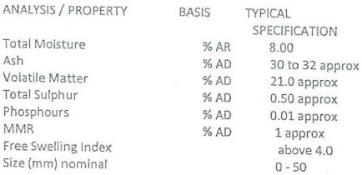
30 The 2013 CPA also included a “premium and penalty” clause which provided that if the total moisture of the product exceeded 8% on an “as received basis”, the weight for invoicing purposes would be reduced by the percentage by which the percentage of moisture content exceeded 8%, fraction pro-rata. Moreover, if the ash content exceeded 32% on an “air dried basis”, a penalty of USD1 per tonne would be applied for each 1% and fraction pro-rata that the ash content exceeded 32%.
31 By an amendment to the 2013 CPA dated 25 March 2013, the parties made clear that the ultimate buyer of the coal was Gujarat Coke.
32 On 27 March 2013, UIL made an advance payment of USD20 million to WCL as required under the 2013 CPA (the Advance Payment). Mr Prasad gave evidence that the purpose of the Advance Payment was to provide WCL with funds to produce the coking coal that it would sell to UIL. Much of the dispute which followed arose as UIL sought to recover the Advance Payment.
2.1.2 The failure of the 2013 CPA
33 No shipments of coal were arranged by early April 2013.
34 It is apparent that there were discussions between UIL and WCL in April, after the first shipment of coal had not materialised. There was a meeting between Mr Gupta and Mr Jagatramka on 8 April 2013. Mr Gupta recalled little of the meeting, however, a few days later, on 12 April 2013, Mr Jagatramka sent an email to Mr Gupta which recounted some of the history of discussions, and recorded that the attendees at the meeting had discussed WCL’s “urgent need of funds”, noting:
…we desperately needed the money within 2nd/3rd week of April to survive. It was not a matter of choice but the critical need to survive in the developed world where liquidation laws are very strict and even a [day’s] delay in legal/statutory payments could lead the company to liquidation.
35 At this stage, UIL was faced with the risk of losing its Advance Payment if a solution could not be found to WCL’s significant financial difficulties. At the same time, it may be observed that UIL was in a position of significant bargaining power when it came to negotiations with WCL.
36 On 10 May 2013, WCL sought an extension for compliance with the terms of the 2013 CPA. Mr Prasad gave evidence that he was content with the proposed extension, provided that WCL agreed to either supply the coal or return the Advance Payment by June 2013.
37 On 12 May 2013, Mr Jagatramka sent an email to UIL attaching a term sheet for investment in WCL. The term sheet also proposed a coal offtake agreement on the condition that UIL subscribed to the subscription shares and subscription bonds. The proposed coal offtake agreement was for a quantity of 500,000 MT of ROM Coal per annum over 10 years, with a price specified as 0.55 x Benchmark Rate. The “Benchmark Rate” was defined as follows:
"Benchmark Rate" shall mean the FOB rate per MT of Gooneyella prime hard coking coal for Japanese Steel Mills (JSM) for a calendar quarter and where the same is fixed for a period shorter than a calendar quarter then it shall be simple arithmetic average for all those periods falling during that calendar quarter.
38 This was the first time that a coal offtake arrangement which provided for a quantity of 500,000 MT of coal per year over a number of years was ventilated as a possibility.
39 WCL then sought various extensions for the payment of the Advance Payment.
40 However, by the end of June 2013, despite prompts in April, May and June, WCL had not delivered any coal to UIL under the 2013 CPA. On 29 June 2013, Ushdev’s Chief Operating Officer, Radha Rawat sent an email to Mr Jagatramka seeking an update on when shipments of coal could be expected by UIL. Mr Jagatramka responded the following day writing “we have a vessel which can be loaded next week whereby the [quantity] as desired may be shipped”.
41 The relevant cargo had still not been shipped by mid-July 2013. Due to these ongoing delays, UIL started to refer to potential legal action if either the coal, or a refund of the Advance Payment, was not received. On 16 July 2013, UIL sent a letter giving notice of default by Gujarat India, and seeking to have the Security Shares transferred to it (Tripartite Notice).
42 On 17 July 2013, lawyers acting on behalf of Gujarat India sent a letter to UIL, disputing that there was an event of default by WCL and arguing that the delivery period had been extended in accordance with the terms of the 2013 CPA. The letter also asserted that UIL failed to nominate vessels for the transport of the commodity and that such failure constituted a breach of a condition precedent to the shipping of any coal. The letter foreshadowed proceedings in this Court, including for injunctive relief.
43 Shortly after, UIL took steps to have the Security Shares transferred to it. However, it was ultimately persuaded to hold off on doing so on the basis that the full amount of the Advance Payment would be refunded by the end of July 2013.
2.1.3 The Override Deed
44 On 20 July 2013, following further negotiations, UIL and WCL agreed to a revised schedule of repayment of the Advance Payment. The revised payment schedule provided that WCL would pay UIL:
(1) USD4.5 million by 31 July 2013;
(2) a further USD4.5 million by 15 August 2013; and
(3) the balance of the Advance Payment plus interest (less any repayments made) by 31 August 2013.
45 UIL agreed to withdraw the Tripartite Notice and WCL agreed not to sell or deliver any coal under the 2013 CPA on the basis that UIL would be paid the full amount required by 31 August 2013. It was agreed that any payment default would result in the transfer of the Security Shares. These terms, and others, were recorded in a deed entered into on 25 July 2013 between Gujarat India, WCL, UIL, and Argonaut (the Override Deed).
46 The Override Deed permitted UIL and WCL to agree in writing for UIL to accept the transfer of coal delivered to UIL as purchaser at a price of USD92 per MT and otherwise on the terms set out in the 2013 CPA, but made clear that it was not obliged to do so.
47 On 1 August 2013, WCL provided 10 executed bills of lading to UIL dated 31 July 2013. Each bill of lading was for the carriage of 5,000 MT of “NRE A unwashed coking coal”. UIL accepted the bills of lading as a reduction of the USD4.6 million outstanding under the Override Deed.
48 Some other partial payments were made. However, the full amount outstanding was not paid in accordance with the Override Deed. On 18 September 2013, UIL gave notice under the Override Deed that an event of default had occurred and directed Argonaut to transfer the Security Shares to UIL. On 23 September 2013, Argonaut transferred the Security Shares to UIL’s trading account and UIL was appointed as the controller of the Security Shares.
2.1.4 The JSPL Offtake Agreement
49 During this time, JSPL became more involved in the management of WCL. On 1 July 2013, Mr Jagatramka sent an email to Mr Prasad and others at UIL attaching a WCL investor presentation. The presentation identified that JSPL was in a “strategic partnership” with WCL. That email also attached an Information Memorandum that explained that WCL had “entered into an off take agreement with [JSPL] for a period of 10 years wherein JSPL has an option to purchase at benchmark linked price an annual offtake of 700,000 MTPA of Run of Mine coal”. Mr Prasad accepted in cross examination that he became aware of the offtake agreement on 1 July 2013 upon reading the Information Memorandum.
50 The JSPL Offtake Agreement was executed on 29 July 2013. The Respondents place some reliance upon the detail included in the JSPL Offtake Agreement, including insofar as it:
(1) Defined the “product” to mean:
a) Run of Mine (ROM) crushed coal from Wongawilli seam of mines operated by Seller, which must meet the specification given in the Annexure A; and / or b) the Run of Mine (ROM) crushed coal from other seams of the mines operated by Seller, which must at least meet the specification given in the Annexure A and / or; c) any other Run of Mine (ROM) crushed coal produced from the Seller mines.
(2) Included a detailed formula for ascertaining the quantity of goods.
(3) Included a formula for determining the price to be payable, being FOB Price = Benchmark Rate x 0.55 in circumstances where the “FOB Price”:
as calculated above is inclusive of all taxes, duties, royalties and/or cess which the Seller is liable to pay to any Government or regulatory authorities till FOB at port Kembla or any other port in Australia (if the Parties mutually agree for any other port in Australia).
(4) Defined “Benchmark Rate” as follows:
1. If the Product meets the specification given in the Annexure A: benchmark rate shall mean the FOB rate of German Creek prime hard coking coal of Anglo American for Japanese Steel Mills (JSM) for a calendar quarter and where the same is fixed for a period shorter than a calendar quarter then it shall be simple arithmetic average for all those period falling during the calendar quarter. If the Benchmark Rate is no longer available, the Parties will mutually agree a new Benchmark Rate so as to establish a benchmark which is closest to the Benchmark Rate defined hereinabove. If the Parties do not agree on a new Benchmark Rate then the new Benchmark Rate will be determined under Article 6.
…
(5) Included an “Annexure A” which set out detailed product specifications of maximums for total moisture, ash, volatile matter, total sulphur, phosphorus, MMR, and CSN (terms which are all explained or defined at [362] – [363] below).
51 The relevance of these matters is considered in further detail below.
2.1.5 JSPL's increasing involvement in WCL
52 JSPL continued to increase its shareholding in WCL and would ultimately become the majority shareholder in WCL by 16 October 2013. In the lead up to it acquiring a majority shareholding, its increasing involvement in WCL became public knowledge. On 11 August 2013, having been informed of JSPL’s increasing involvement in WCL, Mr Gupta sought an immediate repayment of all outstanding funds to UIL, without further delay. That request was not acceded to, with Mr Jagatramka writing that no funds would be forthcoming from JSPL until at least mid-September 2013.
53 In October 2013, Mr Prasad met with Mr Bhatia in New Delhi. It appears that Mr Bhatia had taken over the negotiations that had previously been conducted by Mr Jagatramka.
54 The evidence is that at the meeting in October 2013, Mr Prasad and Mr Bhatia discussed UIL’s transactions with WCL. Mr Prasad gave evidence that he told Mr Bhatia that UIL was not interested in becoming a long-term shareholder in WCL and that UIL’s shares in WCL were only for security purposes.
2.1.6 Negotiations to resolve the dispute
55 On 12 October 2013, Mr Jindal, Chairman of JSPL, hosted a lunch meeting at his residence in Delhi. The lunch was attended by Mr Gupta, Mr Bhatia and others. In his first witness statement dated 17 December 2023, Mr Gupta said that he had a detailed recollection of the lunch because “the invitation was such a major event” and because:
Mr Jindal is a member of the largest steel-producing family in India and JSPL is the biggest steel-producing company globally. With coking coal being so critical to the production of steel, this business approach from Mr Jindal was very significant.
56 However, in his reply statement dated 28 August 2025, Mr Gupta said that “JSPL did not have any particular reputation of significance”. By the time of his cross examination, Mr Gupta said:
COUNSEL: I see. So in other words, do you say then that having lunch with Mr Naveen Jindal was not a particularly big deal; is that right?
MR GUPTA: I used to have lunch with a lot of people.
COUNSEL: I’m sure?
MR GUPTA: So it was not a very big deal.
COUNSEL: Just business as usual?
MR GUPTA: Absolutely. I never self-invited myself to his house; he invited me to his house.
COUNSEL: He invited you to his house, but you didn’t consider that to be particularly significant; is that right?---
MR GUPTA: Yes, because there was nothing on regards until then.
57 The apparent inconsistency was put to Mr Gupta in cross examination, with Senior Counsel for the Respondents noting that he had initially given evidence that the lunch invitation was something he had a detailed recollection about because it was such a major event, and had later given evidence that it was not a big deal of any kind. The following exchange occurred:
COUNSEL: You appreciate that’s completely different to what you’ve been telling her Honour so far today, don’t you?
MR GUPTA: Yes, slight variation.
COUNSEL: It’s not a slight variation. You know that. It’s completely inconsistent with what you’ve been saying so far today, isn’t it?---
MR GUPTA: I don’t agree completely.
COUNSEL: All right. You agree it is inconsistent with what you’ve been saying today to her Honour? Do you agree it’s inconsistent with what you’ve been telling her Honour so far today?
MR GUPTA: Slight variation, yes.
58 I do not accept that the shift in Mr Gupta’s evidence was a slight variation. It was a direct inconsistency which Mr Gupta failed to acknowledge. Observing him closely in the course of his evidence, I do not accept Mr Gupta’s attempt to reconcile the inconsistency. That is not to say that he was a dishonest witness, only that he sought to frame his evidence in a manner which he believed would benefit UIL’s prospects in the proceeding.
59 I am satisfied that Mr Gupta and UIL more generally perceived potential for commercial benefit from working with JSPL and that is the reason that it continued to explore commercial arrangements with JSPL, which it viewed as being of some value to it. This is consistent with Mr Gupta’s evidence that because JSPL had acquired a majority stake in WCL, UIL would reconsider its demands for repayment of the Advance Payment if the two groups would enter into a long-term arrangement.
60 On 23 October 2013, winding up proceedings were commenced against WCL in the Supreme Court of New South Wales (Winding Up Proceeding).
61 On around 24 October 2013, UIL sought payment of the amount that remained outstanding under the Override Deed, being USD14,136,624. UIL said it would return the Security Shares if the outstanding amount was paid by 31 October 2013. On 26 October 2013, Mr Jagatramka resigned as Executive Chairman of WCL. Mr Jasbir Singh (Mr Singh), a director of the JSPL Group, became the Chairman and Interim CEO of WCL.
62 The outstanding amount was not paid by 31 October 2013 and negotiations continued.
63 On 18 November 2013, Mr Prasad met with Mr Bhatia and Ravi Uppal, the Managing Director of JSPL (Mr Uppal). Mr Prasad later reported to Mr Gupta and Mr Rathi that at that meeting, he had been told that JSPL was “ok to offer offtake and marketing rights proportionate to their share holdings”, that JSPL was “planning to install a washery in Australia within a year”, and that “[their] own washery in India is expected to be ready by January [2014]”.
64 A washery is of some significance in the context of unwashed coking coal. The evidence was that most coking coal is washed at the point that it is mined. Unwashed coking coal (as the name suggests) is sold in an unwashed state. It is therefore washed by the ultimate user. This can only occur if the final user has a washing facility. The evidence was that it is less common for end users of coal to have their own washing facilities.
65 On 22 November 2013, UIL filed a notice of appearance in the Winding Up Proceeding. At around the same time, it commenced negotiations with potential purchasers of unwashed coking coal.
2.1.7 Negotiations concerning future coal supply
66 Over the following months, UIL negotiated with representatives of potential third-party purchasers of coking coal and simultaneously sought to negotiate a conclusion to its dispute with WCL. In the negotiations concerning the potential purchase of coking coal, it was contemplated that UIL would sell coal that it obtained from WCL to third-party purchasers. The negotiations involved the exchange of specifications, and the evidence suggests that at least one potential purchaser, Mr Bhat, would only make a bid when satisfied of the particular quality of the coking coal. In an email sent on 21 November 2013, Mr Bhat stated:
We can provide a bid once we have either a contractual spec or an actual cargo analysis at hand.
The typical spec sheet provided is ash 28 (and no idea about VM) while from past record we know ash can be as high as 36.... So the bid will have to be based on certain guaranteed quality, which needs to come from seller.
Please make us an offer basis guaranteed quality and your offer price - and we can get back to you with our bids. I think that is fair and normal practice.
67 On 3 December 2013, a representative of another potential purchaser also sought confirmation of the specifications prior to proceeding further with negotiations. It was Mr Prasad’s evidence that at this time in 2013, NRE / JSPL were the only companies selling unwashed coking coal (including, I interpolate, via WCL).
68 While there were discussions with third parties regarding potential purchases at this time, and coal samples were sent to some potential purchasers, it appears that the transactions did not ultimately proceed.
69 In December 2013, the applicant in the Winding Up Proceeding, RUS Mining Services Pty Ltd, was granted leave to withdraw from the Winding Up Proceeding (as was another creditor of WCL, the Office of State Revenue). UIL applied to be substituted as the applicant in the winding up application under s 465B of the Corporations Act 2001 (Cth).
70 In December 2013, Mr Prasad sought an indication from WCL as to whether a coal shipment was possible in January 2014. Mr Prasad was told that a shipment would not be possible in January and would probably also not be possible in February at the price previously indicated by UIL. Mr Prasad gave evidence that he was frustrated by WCL’s response but, somewhat inexplicably in light of the events set out above, said that he “saw an opportunity in the long-term to do business with WCL”. This is consistent with the views of Mr Gupta that I have explained at [59] above – the opportunity to do business with JSPL was clearly a matter of value to UIL.
71 It was Mr Gupta’s evidence that on or around 17 or 18 December 2013, he met with Mr Bhatia in Delhi at JSPL’s corporate office, and requested repayment of the outstanding amount of the Advance Payment. Mr Gupta recalled that Mr Bhatia had told him that he was unable to resolve the issue at that time. Mr Bhatia does not refer to this meeting in his affidavit, and neither was cross examined on this issue. At around the same time, on 17 December 2013, Mr Kannan, sent two coal offtake agreements to UIL for consideration.
72 On 14 January 2014, Mr Prasad and Ms Priya Chaturvedi (Ms Chaturvedi), Ushdev’s Head of Business Development, met with JSPL’s sales and marketing director, Mr Virendra Kumar Mehta, at JSPL’s office in New Delhi. Mr Prasad’s evidence was that during this meeting, they discussed the fact that UIL was looking to obtain a reliable source of pellets for export and that JSPL was expanding its capacity to produce pellets from 4.5 million tonnes per annum to 9 million tonnes per annum. Mr Prasad said that they agreed to work towards a long-term agreement for offtake of 1 to 2 million tonnes per annum, effective in the first quarter of the next financial year. He said that UIL was told that the coking coal that WCL had agreed to supply was a matter to be discussed with Mr Bhatia. Mr Prasad was not cross examined about this meeting.
73 Mr Prasad also said that some time prior to the meeting of 14 January 2014, Mr Gupta had told him that he and the Chairman of JSPL, Mr Jindal, had agreed that the organisations would work together to develop long-term, mutually beneficial relations.
74 On 17 January 2014, Mr Prasad sent an email to Mr Bhatia seeking to advance the negotiations regarding the supply of coal from WCL. The email said:
…during our meeting in Mumbai last week, we suggest that GNM and one entity of Ushdev enter into a General Sales Agency agreement for 100 percent of the produce of the GNM. We can work out arrangement in such a way that cargo can be further sold to parties identified/nominated by GNM on back to back basis.
We are already working with GNM team to market this product to Chinese consumers and if that works out we may look at formalizing the same through a [long term agreement]…
75 The reference to GNM in this context should be understood as a reference to Gujarat Coking (which became WCL). Mr Prasad said in his evidence that he was suggesting that WCL enter into a general sales agency agreement for 100% of its produce.
76 The issues concerning WCL’s repayment of the Advance Payment continued. On 22 and 24 January 2014, Mr Prasad sent email correspondence to Mr Bhatia which Mr Prasad said was intended to attempt to settle the disputes arising from WCL’s non-payment of the Advance Payment. A response was forthcoming on 29 January 2014, at which time Mr Bhatia sent an email with the subject heading “PLS SEE IF IT WORKS”. The email appears to contain the outline of a deal between the parties which bears some resemblance to what was apparently discussed in the meeting of 14 January 2014 and what was contained in the email of 17 January 2014, referred to above. The email of 29 January 2014 put the proposal in the following way:
1. X, Australia and Y, Singapore to enter into contract for sale and purchase of minerals. Under the contract a) the consignee in B/L will be Z, India so B/L will be made by X directly in the name of Z, India & original B/L will be given to Z, India only and b) payment will be made to X directly by the A, Mauritius.
2. Y and A, Mauritius to enter into contract for sale and purchase of coking coal which Y purchased from X.
3. Z and A to enter into contract for sale and purchase of coking coal which A purchased from Y.
4. X will issue commercial invoice in the name of Y and B/L in name of consignee i.e Z.
5. Y will make commercial invoice in the name of A at the time of issue of B/L.
6. A will make commercial invoice in name of Z.
7. Z will get the custom clearance in India on the basis of Commercial Invoice of A and B/L issued by X.
8. Z will make payment to A.
9. A will make payment to X.
10. Y to be given original Commercial Invoice issued by X and Photocopy of other documents.
77 Mr Prasad interpreted this email as a proposal as follows:
(a) WCL and UIL would enter into a contract for the sale of coking coal, pursuant to which:
(i) the consignee under the bill of lading would be the ultimate buyer; and
(ii) payment would be made to WCL directly by JSPL (Mauritius);
(b) UIL would enter into an agreement to sell coking coal to JSPL (Mauritius);
(c) the ultimate buyer would agree to buy the coking coal from JSPL (Mauritius);
(d) WCL would issue a commercial invoice in the name of UIL and a bill of lading in the name of the ultimate buyer;
(e) UIL would issue a commercial invoice in the name of JSPL (Mauritius) at the time the bill of lading was issued;
(f) JSPL (Mauritius) would make an invoice in the name of the ultimate buyer;
(g) the ultimate buyer would obtain clearance in India of the coking coal, relying on:
(i) the commercial invoice issued by JSPL (Mauritius); and
(ii) the bill of lading issued by WCL;
(h) the ultimate buyer would pay JSPL (Mauritius);
(i) JSPL (Mauritius) would pay WCL; and
(j) UIL would be given WCL’s commercial invoice and a photocopy of the other documents.
78 The proposed structure did not appear to make any provision for UIL to make any profit. It provided instead a process by which coal could be supplied through UIL. Mr Bhatia said that when he sent this email he considered it to be clear that the intention was that the arrangements would be “back-to-back”, that is, on the same commercial terms with no increase in the price.
79 Mr Prasad responded positively, although adding some changes, the most significant of which was that the funds paid by JSPL would go through the hands of UIL. Mr Prasad said in his witness statement that this was to ensure that UIL could deduct any sums owed to it by WCL and to enable UIL to charge a marginally higher cost to JSPL (Mauritius) for the coking coal, thus making a profit. However, the email correspondence did not refer to any suggestion of the imposition of an additional margin in express terms, and it is difficult to see what value there would be to JSPL in such an arrangement. As drafted in his email of 29 January 2014, the arrangement proposed by Mr Prasad was to simply substitute the recipient of the funds such that they were to be held in escrow until paid to the final recipient. Mr Bhatia responded on 1 February 2014 stating, “[as] discussed yesterday, we can do an escrow arrangement with a bank which shall be obliged to make any payments recd in that acct to GNM”.
3. DEVELOPMENT OF THE SETTLEMENT STRUCTURE
80 A range of moving parts were all in motion by the early part of 2014.
81 The negotiations concerning the dispute over the Advance Payment were happening while the Winding Up Proceeding remained on foot. That proceeding returned to the Supreme Court of New South Wales for directions on 3 February 2014. Around this time, drafts of various agreements were already circulating between the parties.
3.1 The first drafts
82 On 9 February 2014, Mr Prasad emailed Ms Chaturvedi, who he says he considered had trading experience relevant to the task. He asked her to “fill in the gaps” in the draft escrow agreement and the two draft sales agreements that were attached to his email. His email instructed that:
Quantity will be 1.5 Million Ton per annum Unwashed Coking Coal
Period of agreement shall be until End March 2015.
Extension and quantity to be mutually decided.
Delivery, Payment terms, Point of Delivery and Documentations shall be back to back.
83 The drafts were clearly quite early and lacking in essential detail.
84 At around the same time, a sample of coking coal was received by a potential third-party buyer in China with whom Mr David Sullivan (Mr Sullivan) of Trade Finance Corporation (TFC), a company which UIL had engaged to identify potential third-party buyers of coking coal, had been corresponding. Mr Sullivan continued to search for other potential third-party buyers of coal. On 3 March 2014, Mr Sullivan sent an email to Mr Prasad stating that he was “still working on market interest” and asked if the coal that was previously on offer remained available for export. Mr Prasad replied that the previously discussed cargo was not available, but that “coal of a similar spec is available”. Mr Sullivan then said “OK, so do you still require assistance to seek a regular perhaps long-term buyer?” to which Mr Prasad responded “[w]e do subject to right pricing”. Mr Sullivan responded saying, among other things, “[i]t seems few buyers around for this Unwashed coking coal”.
85 In late February 2014, there were roof falls along the longwall face of the Wongawilli Colliery. This affected the production from that colliery. Mr Prasad says he became aware of the collapse in February or March 2014.
86 By March 2014, the parties were nearing agreement on an escrow agent. UIL’s proposed agent, Citibank, explained its understanding of the arrangement in a fee proposal dated 6 March 2014, as follows:
Our current understanding of the transaction will be as follows: in order to mitigate counterparty risks in the course of buying coal from its supplier [WCL] (the “Supplier”), and on-selling the same to its buyer [JSPL] (“the Buyer”), there is a requirement for Citibank N.A, Singapore to act as Escrow Agent, to open and maintain an escrow account into which the sale proceeds will be paid by the Buyer on a monthly basis for each monthly shipment of coal. The escrow proceeds are then split between UIL and Supplier accordingly, on a monthly basis.
87 On 7 March 2014, Mr Prasad forwarded Citibank’s fee proposal for the escrow agreement to Mr Bhatia noting “[w]e plan to sign up with them if the arrangement is fundamentally ok with you. Cost of the facility is to our account”. Mr Azad Bhura of JSPL replied that the proposal “looks ok to us” and asked that the draft agreement be provided for their review.
88 On 10 March 2014, the Supreme Court of New South Wales made orders in the Winding Up Proceeding substituting UIL as the applicant in the winding up application. The negotiations between WCL and UIL continued, with the arrangement at that time being reflected in draft agreements exchanged between UIL and WCL.
89 On 14 March 2014, a revised draft of Citibank’s proposed escrow agreement containing changes sought by JSPL was exchanged. Among other things, the revised draft escrow agreement proposed to alter the procedure for the payment instruction. The proposed addition was:
[UIL] acknowledges and agrees that the Escrow Amount shall be released by the Escrow Agent in accordance with the sole instruction from [WCL] pursuant to this Agreement; and that only [WCL] can provide Payment Instructions to the Escrow Agent for releasing any funds from the Escrow Account pursuant to Clause 5.l(a) and other relevant provisions under this Agreement. [UIL] further acknowledges that Escrow Agent shall not be liable for releasing the Escrow Amount according to [WCL’s] instruction and that [UIL] have no right to claim against the Escrow Agent regarding any release of or dealing with the Escrow Amount as per [WCL’s] Payment Instruction; or
90 On 15 March 2014, Mr Prasad emailed Mr Bhatia, confirming that the escrow agreement from Citibank was ready to be signed along with the coal offtake agreements. The email also referred to additional steps that would be required “as part of our settlement proposal”, including:
(1) WCL would be required to refund USD3,731,881 to UIL. That amount represented the amount owing to UIL after it became the absolute owner of 150 million shares in WCL, treating them as being worth AUD0.08 per share.
(2) When these agreements were completed and the refund was received, UIL would withdraw from the Winding Up Proceeding.
91 At around the same time, UIL submitted its 5-year business plan to International Enterprise Singapore (IE Singapore). The business plan referred to substantial projected trading in coal, with a turnover of USD90 million projected for April 2014 – March 2015, and USD126 million for April 2015 – March 2016. The projections reached a turnover of USD358.09 million for the period April 2018 – March 2019. These projections formed the basis of UIL’s application for status under the Singaporean government’s “Global Trader Programme” (GTP) for the incentive period 1 April 2014 – 31 March 2019. UIL was ultimately awarded GTP status. This entitled UIL to a concessionary tax rate. The Respondents submitted that this tax advantage explains part of the commercial benefit which accrued to UIL: it permitted it to project trading of certain tonnages of coal and turnover, sufficient to entitle it to a 10% tax rate.
3.2 The next set of draft agreements
92 It is apparent that work continued on the draft agreements to settle outstanding disputes and commercial issues. On 18 March 2014, JSPL responded to Mr Prasad’s email referred to at [90] above with amended drafts of various agreements. They included:
(1) The draft agreement between WCL and UIL, for a period of 12 months. The draft agreement appears to have been based on a template for a contract for the sale of coal. However, in those parts which would ordinarily have had the quality, quantity or price inserted, instead there were references to those matters being decided by future negotiation. For example, clause 3 appeared in “mark-up” as follows:
3. QUANTITY, QUALITY PARAMETERS & ADJUSTMENTS
The Parties agree that the quantity and quality of the said Materials shall be mutually agreed between the parties from time to time as follows:
(2) Clause 4 was shown in “mark up” as follows:
4.1 The per metric tonne (Load Port) unit price of the said Materials sold shall be as decided by the parties from time to time based on the then prevailing market prices, the quality of the said Materials and the Shipping;
4.2 Terms of Delivery: CFR, any port
(3) Clause 6 was also significantly amended from the template in the following way:
The Parties agree that the shipping of the said Materials shall be made on the following terms and conditions as may be agreed by the parties and ultimate third party buyer of the said Materials from time to time. The Seller agrees that shipping documents shall be made in a manner to facilitate the delivery and title of the said Materials to the ultimate buyer. The Buyer shall inform in writing to the Seller, the particulars of the ultimate third party buyer:
(4) Clause 7 was almost entirely newly drafted:
7. PAYMENT TERMS
7. The payment terms for each shipment shall be as agreed by parties from time to time. The Buyer agrees that in the event the Buyer does not provide a letter of credit for the payment security, the Buyer shall ensure that the ultimate third party buyer shall deposit the amount in an escrow account and the operation and maintenance of the said escrow account shall be as agreed between the Seller and Buyer.
93 At the same time, a draft agreement between UIL and JSPL was exchanged. This included an entirely new clause 1 relating to “Quantity”, which provided:
During the Term of this Agreement, the quantity of the Product shall be decided by the Buyer and the Seller from time to time provided that the Buyer shall be obliged to purchase such quantities of the Product as the Seller has contracted with the party from whom Seller is purchasing the said Product, upon the specific written request of the Buyer. The Seller will disclose to the Buyer the party from whom Seller is purchasing the said product.
94 Clause 3 was materially altered in the same way that was seen in the draft set out above. Clause 4 was different. In the draft agreement between UIL and JSPL, it said:
4.1 The per metric tonne (Load Port) unit price of the said Materials Product sold shall be ; as decided by the parties from time to time based on the then prevailing market prices, the quality of the said Product and the shipping, provided however that the price for the said Product shall not exceed the price which is agreed between the Seller and the party from whom Seller is purchasing the said Product;
4.2 Terms of Delivery: CFR, Indian Port.
95 Clause 6 was amended in a similar, but not identical way. In the agreement between UIL and JSPL, the draft contemplated that clause 6 would read as follows:
The Parties agree that the shipping of the said Materials Product shall be made on the following terms and conditions as agreed between the Seller and Buyer. The Seller shall ensure that the party from whom Seller is purchasing the said Product makes the shipping documents and other documents to facilitate the delivery and title of the said Product to the Buyer. :
96 Likewise, clause 7 was different from the clause contemplated in the draft agreement between WCL and UIL. In the draft agreement between UIL and JSPL, clause 7 was drafted in the following way:
The Buyer will make payment either through letter of credit or to the account of the party from whom Seller is purchasing the said Product or to an escrow account of the Seller and the party from whom Seller is purchasing the said Product.
97 On 19 March 2014, Mr Bhatia sent an email to Mr Prasad seeking that interest and legal expenses not be charged as part of UIL’s settlement proposal.
98 On 26 March 2014, Mr Sankaranarayanan Anantharaman (Mr Anantharaman), President of Business Development at UIL, wrote to Mr Prasad, drawing his attention to a proposed board resolution for the opening of the escrow account provided by WCL, which included the following preamble:
[WCL] is trying to resolve a dispute with UIL (Singapore) Pte Ltd (“UIL”) for a payment claim of US $15 million approximately. For that purpose, the Company will be requiring an escrow agent and account in Singapore.
99 The proposed resolution was concerned with the appointment of Citibank as an escrow agent for funds to be deposited pursuant to a share purchase agreement entered into between WCL and UIL for the purpose of resolving the payment claim of USD15 million. It appears that this characterisation of the purpose of the escrow account alarmed UIL, and in response Mr Prasad said “[y]ou must tell them to remove or reword [the preamble]”. It is apparent that the proposed board resolution did not reflect the creation of an escrow account for an ongoing coal trading arrangement. Moreover, in his email of 26 March 2014, Mr Anantharaman set out what he said Mr Prasad told him was the expected turnover in the escrow account, saying:
Our Discussion with them is for purely buying of coal and selling to India and expecting a monthly turnover of 8 Million approximately as advised by you.
100 The expectation of a turnover of approximately USD8 million is said by the Respondents to be an important detail to understand the parties’ expectations at the time that the agreement was being negotiated.
101 On 26 March 2014, Mr Singh provided a revised version of the board resolution referred to above, which included the following new preamble:
The Company is entering into a trade relationship with UIL (Singapore) Pte Ltd (“UIL”) for coal sale and for that purpose; the Company will be requiring an escrow agent and account in Singapore.
102 There were, however, ongoing disputes over the wording of the escrow agreement. It appears that the wording could not be agreed, and so on 28 March 2014, Mr Prasad said that the escrow account approach should not be pursued.
103 On 31 March 2014, Mr Prasad wrote to Mr Bhatia saying, “since we have not been able to agree on the terms of the escrow agreement”, UIL had decided not to pursue the matter any further, and requested a refund of the amounts still owing to UIL by WCL. The total outstanding amount was calculated by UIL at that stage as USD14,560,681 including interest and legal expenses.
3.3 Negotiations pause
104 A few hours after payment was requested, still on 31 March 2014, Mr Singh emailed a number of people, including Mr Bhatia, (copying in Mr Prasad), providing a copy of the escrow agreement, signed by Mr Singh on behalf of Wongawilli and WCL. This prompted an email from Mr Prasad to Mr Bhatia on 1 April 2014 complaining about what he viewed as WCL’s high-handed approach. He said:
… There has been total disregard to the spirit of the relationship. The company first did not honor the coal off take agreements, diverted the cargo meant for us, did not honor multiple commitments made to refund the amount by GNM and it's previous management.
…
We have spent nearly two months just to finalize escrow agreement on various frivolous grounds while you have kept sending cargo meant to be delivered to us through this arrangement. Until I sent aforesaid mail, you maintained that terms of the escrow agreement was detrimental to your interest and hence not acceptable. I wonder what changed and the same terms became acceptable.
I am afraid that it is too late, we have lost heavily on this relationship and therefore, we do not wish to continue with this arrangement. We would like the entire amount (as mentioned in my previous mail) refunded without any further delay. We have advised our legal team to be on standby and be prepared to go ahead with the court proceedings, should we not receive the aforesaid refund before Friday, April 4, 2014.
105 It is apparent that Mr Prasad had, by this time, lost whatever patience or confidence he may have had in WCL or its associates.
106 The mines operated by WCL continued to produce coal in this period. However, as set out at [85] above, in late February 2014 there were roof falls along the longwall face of the Wongawilli Colliery, which meant that there was minimal production from that colliery in March and April 2014.
3.4 Negotiations re-commence
107 The evidence makes clear that after the email of 1 April 2014, Mr Prasad and Mr Bhatia attended a meeting on 5 April 2014 to discuss next steps. Mr Bhatia gave evidence that he did not recall that meeting. Given the existence of a contemporaneous email referencing the meeting (noted below) I accept that a meeting took place on about 5 April. That meeting is relied upon by the Applicant to support the notion that annual quantity and sales to non-JSPL clients were in contemplation. For such a significant meeting, Mr Prasad’s evidence about it was at a relatively high level:
On 5 April 2014, I attended a meeting with Mr Bhatia. Priya also attended. At the meeting, Mr Bhatia said that WCL and Wongawilli would deliver around one vessel (80,000 – 120,000 metric tonnes) per month, amounting to around 1 to 1.5 million metric tonnes of unwashed coking coal to UIL per annum. In my opinion, it was a critical feature of those discussions that UIL would sell coking coal from WCL and Wongawilli to JSPL via an escrow agreement. Additionally, UIL could sell the coking coal to its own clients, which did not include JSPL.
108 In his evidence, Mr Prasad does not give any detail around what was said to give him the impression that “UIL could sell the coking coal to its own clients, which did not include JSPL”.
109 The Applicant places significant weight upon a contemporaneous email that was sent by Mr Prasad to his colleagues (and not to any WCL or JSPL representatives) on 5 April 2014. It said:
We had a fruitful meeting with Jindal (Rajesh Bhatia) today.
As per plan, we will transfer shares from UIL to UDM @8cents per share (AUD)
UIL, Singapore will receive balance of the outstanding principal amount from GNM.
Interest and legal expenses will be shared 50:50
All coking coal from GNM will be sold thru UIL (ESCROW) perpetually. UIL can sell unwashed coal to non Jindal client.
We hope to close the issue in next week.
(Emphasis added.)
110 Given the chequered history of the negotiations to date, and the multiple misunderstandings and false starts, it is difficult to see how Mr Prasad could have had the confidence he professed to have in the email of 5 April 2014 that the arrangement would proceed, or that there was a commonality of understanding about it. No party suggests that there was written confirmation of any arrangement.
111 It is worth noting that the email does not make any statement as to the contemplation of a binding obligation to supply approximately 1 million MT per annum of unwashed coking coal, nor the obligation that WCL and Wongawilli would supply that volume, irrespective of the state of their own mines. It follows that the email of 5 April 2014 is not, on any view, an exhaustive or complete record of what was said between the parties. I do not consider it a reliable or complete record of the meeting. It is an internal note highlighting some aspects of Mr Prasad’s perceptions.
112 Both Mr Prasad and Mr Bhatia were examined about the 5 April 2014 meeting.
113 Mr Bhatia said he has no recollection of the meeting alleged. He said that he would not have made any assurances as to the production of the mine because of the issues as to production that were known at the time. He therefore denied that any arrangement was agreed or that any agreement in principle was concluded in the meeting of 5 April 2014. He kept no notes, and so was relying on his (dated) memory of that time. Consistent with the evidence of an honest witness, he readily and candidly accepted that there were matters that he could not recall, but he had a firm view he had not made the assurances that were attributed to him at that meeting by Mr Prasad. I consider that position is consistent with the overall negotiating attitude of JSPL at that time, which had included a number of points of friction and drawn out negotiations over (relatively) minor points of contention in the context of the escrow agreement. This conclusion is supported by my observations of Mr Bhatia’s approach and demeanour in the course of giving evidence in cross examination.
114 Mr Prasad was adamant that his email of 5 April 2014 accurately reflected what had been discussed. I return to the issue of the 5 April 2014 meeting below. However, it is appropriate to note that both parties agree that the agreement that was eventually reached differed from what was recorded in the email of 5 April.
115 On 8 April 2014, Mr Prasad responded to a question from Dhaval Shah (Mr Shah), a colleague of Mr Anantharaman who later took over the position of CEO of UIL, about whether there were likely to be upcoming coal trades and if so what the quantum of those trades would be, saying “[y]es. You can consider about 100000MT (value wise USD 8Million) per month for the entire year starting this month. We hope to sign off the agreement during this week”.
116 In cross examination, Mr Prasad was asked about this expectation, when read in combination with the email exchange (at [99] above) which indicated that a monthly turnover of USD8 million was expected for “purely buying of coal and selling to [JSPL]”. In cross examination, Senior Counsel for the Respondents suggested to Mr Prasad that when read together, this reflected an understanding that all of the funds moving through the escrow account would be for coal passed through to JSPL, and that was all of the coal that UIL would receive. When this proposition was put to Mr Prasad, he disagreed:
COUNSEL: What that tells her Honour is that all of your expectation as at 8 April 2014 was that all of the 100,000 metric tonnes of coal to be sold – to be obtained by UIL per month for the entire year would be onsold to Jindal; that’s right, isn’t it?
MR PRASAD: No. That is – that is where I am – I have a disconnect with you. When we talked about that time, it was that, you know, the quantity of one million tonne was associated with the supply which was from the two mines in Australia. In the contract which was between UIL (Singapore) to sell to JSPL, there was no quantity specified of 100,000 – or, rather, one million tonne. So – so when we are – when I’m talking about 100,000 metric tonne per month, I am talking about incoming cargo to UIL, not to onsell to JSPL, is what I’m clarifying.
117 There was a further email dated 8 April 2014 in which Mr Prasad asked Ms Chaturvedi and Sheetal Sharma, the then Head of Accounts at UIL, to review a draft deed of settlement and release. That email described what had been agreed in the following way:
We agreed to share the interest and legal expenses 50:50.
Due amount to be refunded by UIL Singapore by WCL
100% of coal supply from WCL to Jindal India thru the escrow agreement (perpetual)
Joint cooperation agreement between Jindal group and UD group for various products manufactured by Jindal group.
(Emphasis added.)
118 The suggestion in the 5 April email that excess coal was to be sold to third parties was missing from the 8 April email. In re-examination, Mr Prasad was asked to explain the potential disconnect between the 5 and 8 April 2014 emails. He said:
So – so what I understood in the email of 8 April, that 100 per cent of the supply of WCL to Jindal – whatever is going to Jindal is going through escrow perpetually, not – not to a third party, but whatever is going from WCL to Jindal will go through escrow, which is – which is one point. And on 5 April, the communication which I sent to Sheetal, here we talked about that all coking coal from GNM, that is, from the supplier, will be sold to – through UIL on perpetual basis. And UIL then have part of it – wherever – wherever it is going, but UIL can sell the part to non-Jindal client also, which is different. So they are two things. Escrow is basically for the coal which is going to Jindal, but 100 per cent in both the cases will go through us.
119 Nonetheless, none of these emails had the formality or care given to them that one would expect in inter partes negotiations where it was critical for both parties to focus upon the core aspects of the arrangement that they sought to conclude. It is important to note as a matter of context that these discussions were taking place following repeated failures by WCL to honour its agreements. It beggars belief that following discussions, and without having any written confirmation from WCL, an experienced businessman in the position of Mr Prasad would proceed on the basis that an agreement had been concluded, or even was likely to be concluded on any particular terms until they were finally signed. Having observed Mr Prasad give evidence, it is apparent that his evidence about certain events was liable to change depending on the way the question was asked. While I do not consider him dishonest, I consider that he is apt to re-frame matters in his own mind to make them match what he wishes had been said or what he believes ought to have been said.
120 Mr Prasad’s evidence was that UIL had considered converting the funds that WCL owed to it into a stake in that company, but had decided not to because they had agreed to enter into a long-term offtake arrangement from which both companies would profit over several years.
121 Having reviewed the evidence, I do not accept that an agreement of this kind was reached at the 5 April 2014 meeting, although I accept that the prospect of an ongoing commercial relationship remained a live possibility, and one that UIL in particular was keen to pursue. However, I do not accept that 5 April 2014 meeting led to an understanding of the commercial objectives of the parties, or a particular shape to the subsequent commercial negotiations.
122 It was or would have been spectacularly naïve of Mr Prasad to proceed on the basis of a single conversation in the absence of written confirmation of the position from WCL, given the history of disappointing conduct by WCL up to that time.
123 Nonetheless, it appears that Mr Prasad and UIL considered that the offtake agreements were part of the resolution of the dispute that had been ongoing at this stage for months. However, as the subsequent events demonstrate, there were substantial further negotiations that were yet to take place before anything was to be agreed. I do not accept that the 5 April 2014 meeting can be taken as evidence that the parties shared an understanding of UIL’s commercial objectives involving a binding contract for the supply of approximately 1 million MT of unwashed coking coal per annum or an arrangement that was clearly defined at all. It was a step in negotiations that were ultimately superseded by the exchange of drafts and information between the parties that were calibrated to reflect the parties’ intentions.
3.5 Finalisation of the draft agreements
124 A draft sale agreement was circulated on around 9 – 10 April 2014. This draft was reviewed by Ms Chaturvedi, who was at the same time reviewing the documentation that would become part of the broader suite of settlement documents, including the JSPL Purchase Agreement. On 14 April 2014, Ms Chaturvedi requested two amendments to what she referred to as the sale agreement. They were:
In pt 1 – add
1.5Million Metric Tons (+/-10%) P.A of unwashed coking coal
In pt - 2.1 Instead of existing we need to insert
“From the date of execution of this Agreement till termination and or cancellation by the either party to this Agreement, as the Parties may informed each other in writing … the Buyer shall purchase the said products”
125 Although it is not entirely clear, the reference to 1.5 million MT appears to have been directed to the quantity to be reflected across the coal sale/purchase arrangements then under review.
126 It is, in my view, significant that UIL sought the inclusion of the annual quantity in the sale / purchase documentation shortly before execution and that it had not been the subject of express reference in the written materials prior to that time. This supports the Respondents’ assertion that the parties had not discussed and reached agreement about that issue.
127 On 29 April 2014, a suite of draft documents was returned by UIL to WCL. That suite included:
(1) a draft escrow agreement;
(2) draft sale and purchase agreements between each of:
(a) UIL and JSPL (Draft JSPL Purchase Agreement);
(b) WCL and UIL (Draft WCL CSA); and
(c) Wongawilli and UIL (Draft Wongawilli CSA).
(3) a draft memorandum of understanding between UD Group and JSPL; and
(4) a draft deed of settlement and release,
(together, the Draft Settlement Documents).
128 Mr Prasad gave evidence that he considered that the Draft Settlement Documents represented “a real and valuable opportunity for UIL”, saying that he understood that the “draft sale and purchase agreements guaranteed the supply of a million metric tonnes of coking coal per annum from WCL and Wongawilli to UIL”.
129 By this stage, the proposed transaction had therefore crystallised into three sale and purchase agreements. The 1.5 million MT figure proposed on 14 April 2014 appears to have been reflected in the Draft WCL CSA and the Draft Wongawilli CSA by the inclusion of the quantity of 750,000 MT in each of those documents. The evidence does not disclose any written direction explaining the division between the two entities, but the aggregate of the two upstream quantities corresponded to the quantity contemplated in the proposed Draft JSPL Purchase Agreement, which strengthens the inference of a relationship between these agreements.
130 On 8 May 2014, Ms Chaturvedi wrote to Mr Prasad saying that:
The final execution version of escrow agreement is already signed.
I have attached the sale / purchase agreement that needs to be signed as MOU only covers iron ore pellets for shadeed.
The sale / purchase is for unwashed coking coal & is separate business and [Mr Gupta] insists that sale agreement must have approximate annual quantity & we have to sign this first and only then proceed with the other things.
131 Mr Prasad forwarded the final sale agreement to Mr Bhatia that same day. In the covering email, he said “[w]e now have all the five agreements in place for us to sign off except this issue of approximate quantity in unwashed coal agreements. Please look into this issue in light of the comments made by [Mr Gupta] below”.
132 Mr Bhatia said he was content to agree to the late amendments because he believed it was understood that the actual amount to be purchased from WCL and on-sold to JSPL, without any margin, was to be whatever the mines produced. I note that the request to include the “approximate annual quantity” did not involve a reference to a previously agreed or understood position. Nor was it characterised as any form of obligation in the correspondence.
133 The Respondents contended that an amount was inserted into the coal offtake agreements at UIL’s request because it required the quantity to be specified in order to obtain the concessionary tax rate under the GTP and that this supports its construction that it was not a guaranteed or fixed quantity requirement.
134 Mr Gupta gave evidence that he wanted a term included in the Draft WCL and Wongawilli CSAs specifying the annual quantity to be supplied to UIL because it was required for the business plan UIL had submitted to IE Singapore (referred to at [91] above). He said that UIL needed to be able to evidence the contractual quantity of coal that WCL and Wongawilli would supply to UIL each year. Mr Gupta’s evidence in re-examination was that the entitlement to concessionary status was dependent on both the volume of sales and the profit on those sales. The documents before me concerning the Global Trade Programme ask the applicant to provide information about a range of projected metrics in relation to different aspects of trade, including turnover, local attributable business spending, the number of trading professionals and employees involved. In respect of each product referred to, the volume traded and average price is specified. Coal is included, by reference to the “volume traded”. The projected amounts traded are projected to increase substantially after April 2015. The price was said to be the “total GTP qualifying physical trade turnover for this product, divided by the total volume of products traded)”. The documents put before the Court therefore do not support Mr Gupta’s contention that the concessionary status was dependent upon profit. References to turnover in the documents before the Court appear consistent with trades being carried out between UIL and JSPL on a back-to-back basis.
135 Mr Gupta also said that if UIL did not meet the projected turnover as reflected in the business plan, UIL risked losing its concessionary tax status and IE Singapore was entitled to claw back any tax that had not been payable under the GTP. The evidence before me is that the beneficial tax status was conferred. There is no evidence before me that it was ever revoked, or that any funds were in fact clawed back in light of the failure to generate the anticipated turnover or profit.
136 I am satisfied on balance that the late inclusion of the approximate annual quantity was largely for the purpose of enabling UIL to point to a particular commercial relationship with JSPL both to support its business planning and for the purposes of obtaining beneficial tax treatment.
137 Execution versions of the sale agreements and settlement deeds were exchanged on 10 May 2014. In those agreements, the volume of coal specified in each of the Draft JSPL Purchase Agreement, Draft Wongawilli CSA and Draft WCL CSA had been reduced. The executed JSPL Purchase Agreement now referred to 1 million MT, while the quantities specified in the executed WCL CSA and executed Wongawilli CSA were each reduced to 0.5 million MT. The evidence does not disclose any substantial written negotiation explaining either the insertion of those quantities or the reduction from the earlier 1.5 million MT / 750,000 MT figures.
138 Mr Bhatia’s evidence was that from his perspective, the arrangements did not create any binding agreement “as to volume or exclusivity”. He said that the documents were not drawn in accordance with standard commercial practice for definitive supply agreements, and that “…this was intended to reflect the flexible nature of the arrangements, namely the actual product of the mines and the supply needs of JSPL”.
139 The negotiations to date had been torturous and drawn out. The easy inclusion of a reference to an amount of coal (and then a change to that amount immediately prior to execution) without any significant discussion or negotiation is somewhat remarkable if, as is alleged by UIL, this resulted in a 30-year obligation upon WCL and Wongawilli to supply half a million MT of unwashed coking coal each, even if they were unable to do so from their own mines. In closing submissions the obligation was characterised by Senior Counsel for the Applicant as follows:
… come what may, WCL and Wongawilli had to sell us a million metric tonnes of coking coal. It doesn’t have to come from their own mines; they had to sell it to us. That’s what they were obliged to do.
140 Senior Counsel went on to say that even if the mine roof collapsed and WCL or Wongawilli were unable to produce enough coking coal from their own mines, “they can buy it from someone else and sell it on to us that way”. That is a significant obligation to be taken on, without any substantive discussion or negotiation.
141 Save for the Amendment Deed (as defined at [145] below), all of the agreements between the parties were to be signed simultaneously. Mr Gupta gave evidence that he required simultaneous execution because, given the history of dealings with WCL and negotiations with JSPL, he was aware that if the parties did not enter into the agreements at the same time, WCL and JSPL may not honour them. They were therefore connected in the respect that they were part of an overarching relationship in which there was, by this time, very little trust. However, the nature, extent and relevance of the connection between the agreements was contested between the parties and is a matter which I deal with in my analysis of the agreements, below.
142 Around the same time that the draft documents were being prepared, UIL maintained communication with Mr Sullivan about the potential to sell unwashed coking coal. Mr Prasad stated in this correspondence that the quantity would be subject to reconfirmation for specifications of coking coal.
3.6 Execution of settlement documents
143 By 16 May 2014, the parties had executed the following:
(1) a contract of sale between WCL and UIL (WCL CSA);
(2) a contract of sale between Wongawilli and UIL (Wongawilli CSA);
(3) a contract of sale between UIL and JSPL (JSPL Purchase Agreement);
(4) a deed of release and settlement (Settlement Deed);
(5) an escrow agreement (Escrow Agreement); and
(6) a memorandum of understanding (MOU),
(together, the Settlement Documents).
144 The WCL CSA and the Wongawilli CSA were relevantly the same, save in respect of a slight difference in clause two upon which nothing turns. In the reasons that follow, I will refer to both agreements as the CSAs, unless it is necessary to specify a particular agreement.
3.7 Amendment to the JSPL Purchase Agreement
145 On 16 May 2014, the JSPL Purchase Agreement was amended (the Amendment Deed). The Amendment Deed had a single clause, which was:
Though the Original Sale Agreement stipulated that the Quantity to be sold by Seller and Purchased by Purchaser will be 1.0 Million Metric Tons (+/-10%) P.A of unwashed coking coal, the Parties acknowledge and agree that the actual annual quantity of the Product purchased by the Buyer and sold by the Seller shall be the quantity which the Seller will purchase from WONGAWILLI COAL PTY LTD, a company incorporated under the laws of Australia, having its registered office at …. The Seller also confirms and agrees that the Product purchased by the Seller from WONGAWILLI COAL PTY LTD & Wollongong Coal Limited will be sold to Buyer only.
146 The Respondents argue that the Amendment Deed had the effect of making clear that any coal that UIL acquired from WCL or Wongawilli was required to be on-sold to JSPL, in relation to which UIL concedes that it was not entitled to earn a margin. However, UIL asserts that the effect of the JSPL Purchase Agreement (as amended by the Amendment Deed) was that there could be a surplus as between the amount UIL was entitled to purchase from WCL and Wongawilli and the amount JSPL decided to request from UIL, and that UIL was entitled to sell any such surplus amount to third parties for profit. UIL submitted that:
The balance of the 1 million MT of coking coal supplied to UIL by WCL and Wongawilli which JSPL did not request UIL to purchase could be on-sold by UIL to third party purchasers at a profit.
147 Mr Gupta’s evidence was that the amendment was made so that there was no obligation for JSPL to purchase a specific quantity of metric tonnes of coking coal from UIL. He said that the arrangement “was left fluid” and that “there was to be a level of trust been the parties”. He said that is why the schedule for shipments of coal under the CSAs were to be agreed by the parties from time to time. Accordingly, he said, that while WCL and Wongawilli were obliged to supply a total of 1 million MT to UIL under the two offtake agreements per year, UIL would only be obliged to supply that coal to JSPL if JSPL made a specific request for a quantity of coal. This explanation is generally inconsistent with the level of distrust which I consider by this time existed between the parties, and which is evident from Mr Gupta’s own evidence that the Settlement Documents were to be executed at the same time because he considered that WCL and JSPL may not honour the agreements if they were not entered into at the same time.
148 I do not accept that there was any trust between the parties at this time, and this contributes to my view that UIL’s explanation for the Amendment Deed is inconsistent with the intention of the parties. That view is fortified by the plain words of the Amendment Deed, which conclude with the words:
[UIL] also confirms and agrees that the Product purchased by [UIL] from [Wongawilli] and [WCL] will be sold to [JSPL] only.
149 Moreover, if UIL’s construction were correct, this would leave open the question of how much coal UIL would have available to on-sell each year, because that amount would depend on how much was requested by JSPL. On the Respondents’ construction, no such issue arises because the entire suite of agreements constituted a pass-through.
3.8 Settlement Deed
150 The execution of the Settlement Deed saw the conclusion of the dispute that had arisen following the provision of the Advance Payment. The Respondents assert that overall, the Settlement Deed provided for:
(1) confirmation of the earlier delivery to UIL of bills of lading in respect of 50,000 MT of coal with a value of USD4.6 million;
(2) UIL to be entitled to sell the Security Shares, with a total value of AUD12 million; and
(3) UIL to be paid USD2.64 million in cash, representing the sum of its legal costs and the shortfall sum it would be owed after taking ownership of the Security Shares.
151 Taken together, this involves the repayment of USD7.24 million and AUD12 million. The Respondents contended that this was intended to bring an end to the dispute between UIL and WCL as to the Advance Payment. They assert that the CSAs were part of a separate ancillary arrangement involving the JSPL Purchase Agreement, the Amendment Deed, the Escrow Agreement and the MOU. This issue becomes significant in the misleading or deceptive conduct case, to which I will return.
4. THE POST-SETTLEMENT COMMERCIAL RELATIONSHIP
152 After the Settlement Documents had been executed, the parties considered that they had an ongoing contractual relationship. Their understanding of the nature of the contractual relationship is illuminated by their conduct in relation to each other and third parties.
153 On 14 May 2014, Mr Shah of UIL asked Mr Prasad and Ms Chaturvedi when UIL could expect to be in a position to start trading coal. He said:
Now that the agreements have been signed between us and JSPL, by when can we start getting the trades as agreed.
We had considered the following: $8mn x 12 months for FY14-15 = USD 96 mn
April has gone already and we were working on our order book which needs to be submitted to Thomas/Anita.
So, do let us know by when will the trades be available.
154 At a similar time, representatives of TFC expressed that their clients had an interest in obtaining coal. In an email of 20 May 2014, just days after the execution of the CSAs, Ms Jamito of TFC emailed Mr Prasad: “[w]e came across a client that is interested in your unwashed coking coal, but is asking for some details for each of the coal”. The questions related to MMR, washability analysis, and volatile matter (all measures of coal quality, see further at [362] below). There was no immediate response, and Ms Jamito re-stated her inquiry on 30 May 2014.
155 Mr Prasad responded on 2 June 2014, providing some specification information about the coal available from the Russell Vale Colliery and stated that he had been informed that they “…will have stocks available from end July after the start of Longwall”. Mr Sullivan of TFC, responded the next day, saying:
We have been working on this for some time trying to find long term buyers of the Unwashed material.
I notice from recent meetings with UD people that nobody mentions this transaction, so is it something that you don't need help with any more
Have you know (sic) stopped your formal co-operation with the mine?
156 On 4 June 2014, Mr Prasad responded, saying that UIL “now have almost 100% of the coal off take from this mine with us and we also have back to back sales contract with users in India through a [long term agreement]…”. This appears to be a reference to the CSAs that had just been signed, which were said to be for coal offtake and in addition to a “back to back sales contract with users in India” (who could only be JSPL).
157 While there was correspondence with potential purchasers, that correspondence lacked any detail about the amounts of unwashed coking coal that was likely to be available – and importantly in this early stage after the execution of the documents, there is no correspondence directed to JSPL seeking an indication of the volume of coal that might be required by JSPL, so that the balance could be made available for sale. If an arrangement for the sale of a shortfall amount had just been concluded, then the failure to seek to identify what that shortfall might be is quite startling.
158 In his reply affidavit, Mr Prasad stated that Mr Bhatia had said in their discussions that JSPL did not have the capacity to receive 1 million MT of coking coal, and therefore it made commercial sense to sell the coal received from WCL and Wongawilli to third parties. In the course of cross examination, the following exchange occurred:
COUNSEL: Okay. So the evidence you're giving is that you were at the offices of JSPL some time between October and December 2013?
MR PRASAD: Yes.
COUNSEL: And you have a conversation with Mr Bhatia?---
MR PRASAD: Yes, yes. Hundred per cent.
COUNSEL: And Mr Bhatia said to you that JSPL was only going to use about 500,000 metric tonnes per year of the coal; is that right?
MR PRASAD: I don't know the exact number - I don't remember exact number now, but, yes, somewhere near half a million tonne.
COUNSEL: Around about half a million tonnes?
MR PRASAD: Yes.
159 However, when pressed for detail, Mr Prasad accepted that he had made an assumption as to the quantity of available coal, based upon his understanding of JSPL’s capacity to consume coal in its own facilities in India. The following exchange occurred:
COUNSEL: All right. But to be clear, the - what you believed - you say you believed about 500,000 or so being available was based on an assumption that you made about the 20 washing capacity of Jindal; is that right?
MR PRASAD: Yes.
160 The shift in Mr Prasad’s evidence, between a conversation that he says took place about excess capacity, and his ultimate evidence that he made an assumption as to the availability of that excess capacity, exemplifies the difficulty in relying upon his evidence and is consistent with Mr Prasad’s tendency to assume events based upon his (sometimes optimistic) expectations.
161 UIL explored various deals with mining and coal trading companies Itochu Corporation (Itochu) and Kyori Oremin Limited (Kyori). In correspondence sent by Mr Jayanta Mohapatra, a Senior Trader at Ushdev, to a representative of Itochu on 24 July 2014, purportedly summarising the content of a meeting between representatives of UIL and Itochu on 18 July 2024, there is a comment that:
Itochu is keen on offtake arrangement of Unwashed coking coal of Ushdev in Australia (WCL). Attached herewith CoAs of certain previous cargos. I have explained during the meeting about the rights of Ushdev on this mine and coal there of.
162 In relation to separate negotiations, a communication from Kyori regarding interest of Kyori’s business acquaintance in a contract with an annual quantity of unwashed coal, under which the acquaintance would consider setting up a washery, was provided to Mr Prasad on 25 August 2014. His response was:
[W]e can not guarantee long term off take as Jindals are going consume most of the coking coal in their own oven.
163 That response is not consistent with an expectation that there would be substantial coking coal available to UIL that it was free to sell to third parties. The response appears to have been given without consulting with JSPL as to whether there would be any surplus. This is a further indication that the parties collectively understood the obligation to provide unwashed coking coal to UIL was limited to amounts requested by JSPL.
164 As stated at [147] above, Mr Gupta’s evidence was that the JSPL Purchase Agreement did not include a specified quantity of unwashed coking coal because “[t]he arrangement was left fluid and there was to be a level of trust between the parties”. Similarly, Mr Gupta’s evidence was that the schedule for shipments of coal under the CSAs were to be agreed from time to time. He said he understood the CSAs and JSPL Purchase Agreement would operate so that:
…UIL had the capacity to sell the coal supplied by WCL and Wongawilli under the two offtake agreements on the open market. This would depend on the production levels of the two mines, which varied from time to time due to issues such as shutdowns, maintenance, and mine development. If UIL could not find purchasers for the coal supplied by WCL or Wongawilli, JSPL could be used as a “backstop” to purchase that coal from UIL for the same price for which it was supplied to UIL.
165 As I have observed at [148] above it is difficult, in light of the history of the relationship between the parties, to understand how matters relevant to the volume of coal could be left to trust. Particularly if, as UIL asserts, the contractual arrangements were worth tens of millions of dollars to it. It is also inconsistent to assert that the capacity to sell coal would depend on the production of the two mines, but the obligation to sell coal to UIL was not tied to any the production of those mines (see [140] above).
166 On 5 June 2014, WCL paid the settlement amount of USD2.64 million to UIL in accordance with the Settlement Deed. On 16 June 2014, UIL was granted leave to withdraw from the Winding Up Proceeding. The order itself was not provided as part of the evidence in this case, but the parties have proceeded on the basis that the order was made, and contemporaneous emails referring to the order have been received into evidence.
167 On 16 June 2014, Ms Chaturvedi emailed Mr Singh, asking for details about the shipment scheduled for June 2014. Mr Singh replied that no shipment was scheduled, and that he would revert to her as soon as a shipment was planned for JSPL. Mr Gupta emailed Mr Prasad that this was “unacceptable”, while Ms Chaturvedi reported via email that she had spoken to “Jasbir” (that is, Mr Singh), and that:
There have been no shipment since 4th April 2014.
Out of the two mines, one is facing some technical issues & the other is awaiting extraction approval. The issue is expected to be resolved by end June.
168 Mr Prasad gave evidence that “[a]s a consequence of these persisting issues at the mines, I was reluctant to push too hard for potential purchasers of unwashed coking coal, let alone long-term purchasers of the product”. Again, this assertion sits uneasily with the submission from UIL that the CSAs involved an obligation to supply the coking coal either from their own mines or elsewhere (see [139] – [140] above).
4.1 The operation of the CSAs
169 There followed an exchange of a contract. There was no negotiation as to price or any other aspect of the transaction. A version of the contract signed by UIL and a pro forma invoice were provided to JSPL on 27 June 2014.
170 On 4 August 2014, Mr Anantharaman emailed Mr Singh asking him to advise on shipment planning immediately, noting that UIL had already lost volumes for March – July 2014. Later that day, on 4 August 2014, Mr Gupta emailed Mr Singh and Mr Bhatia, copied to Mr Prasad stating:
…are we serious [about] the Wollongong arrangement?
Anant if we haven’t got offtake since 5[ ]months, why didn’t you escalate this???
171 At 4.11 am on 5 August, Mr Bhatia emailed Mr Gupta saying:
There has been no shipment after our formal agreement was signed. This will be the first one.
172 Later on 5 August, Mr Singh emailed Mr Prasad, Mr Anantharaman and Mr Gupta among others, enclosing a draft sales contract, with details that were said to be “per Escrow agreement” so that a shipment could be planned by the end of August or early September. Mr Prasad responded some hours later asking:
We already have a signed sales contract in place. Why again?
Please confirm if there has been any shipment made to India after signing the deed of settlement?
173 Mr Singh responded saying:
We have not received the signed copy of the sales contract. Therefore, it has been sent again for completing the documents and arranging for laycan period for shipment.
I can confirm that [n]o shipment has been made after signing deed of settlement.
174 A sales contract between WCL and UIL was executed on 5 August 2014. Pursuant to the contract dated 5 August, WCL agreed to sell 80,000 MT (+/- 10%) of “RV A unwashed coking coal in bulk” to UIL, and by a contract dated 18 August 2014, UIL agreed in writing to sell the same product on back-to-back terms to JSPL. The contracts of sale included the following specifications for the coal:
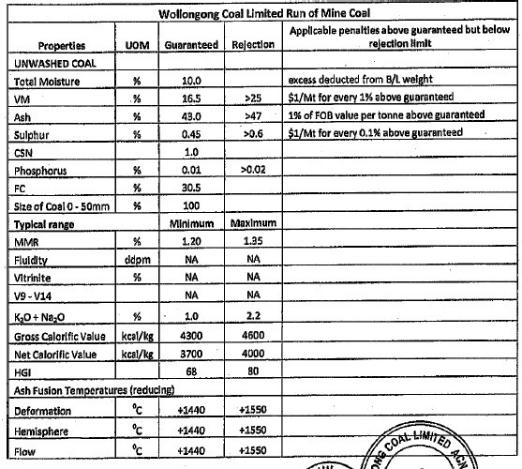
175 This agreement resulted in the first shipment said to have been made under or pursuant to the CSAs.
176 On 10 August 2014, Jindal Steel DMCC informed UIL of its target prices for billets and hot briquetted iron products and asked UIL to inform Jindal Steel DMCC of its interests or firm price ideas for both products.
177 The shipment of coal then took place on 11 September 2014. It generated no profit for UIL and occurred on a “pass through” basis, with the product ultimately being received by JSPL. The funds were routed through the escrow account that had been established. In internal JSPL correspondence, Mr Singh set out his understanding as follows:
For clarifications, the contract is between Wollongong Coal and UIL, Singapore. In turn UIL, Singapore is to sign the contract with JSPL… Payment is to be made to Escrow account of UIL who in turn shall make payment to us.
4.2 The Memorandum of Understanding
178 The MOU was executed along with the other Settlement Documents. It was expressly said to be non-binding. It contemplated UDT and JSPL entering into various agreements, including:
1. UD Group agrees to purchase unwashed coking coal from [WCL] and its subsidiary and the sale proceeds shall be routed through escrow arrangement with bank based in Singapore.
2. UD Group agrees to purchase 1 million MT of pellets from JSPL Group on annual basis and supply the same to its overseas customers.
3. UD Group will also supply 0.5 million MT of pellets to JSPL Group on annual basis to its work/plant located at Shadeed, Oman.
4. UD Group will buy up to 700,000 MT of billets on annual basis from JSPL Group from its plant located at Shadeed, Oman.
5. Subject to the Parties being satisfied with the technical and economic feasibility, UD Group and JSPL Group also propose to jointly invest in a down stream steel product manufacturing plant in India the details of which shall be worked out at a later date.
179 The MOU recorded that the parties “hereby agree” that UD and / or its assignees and JSPL or its assignees will execute “definitive agreements” with each other for effecting the transactions set out above “within 30 days from the execution of this MoU”.
180 The MOU forms a basis for the misleading or deceptive conduct claim to which I will return. However, at this stage, it is appropriate to note that after the execution of the MOU, UIL regularly engaged in correspondence with JSPL to attempt to commence negotiations under the MOU. Most of those communications involved John Short (Mr Short), CEO of UD Industrial Holdings Pte Ltd and Global Head of Ferrous for UD Trading and Holding Pte Ltd. Mr Short corresponded with Mr Ansari, CEO of JSPL Shadeed (Shadeed) to attempt to start the process of progressing the transactions contemplated by the MOU.
181 On 9 July 2014, Mr Short reported to Mr Prasad and others that there were significant challenges in the market. He said, “[p]ellet premiums are still strong”, noting that Shadeed itself was being impacted by increasing pellet demand and less supply, observing that:
Shadeed have been themselves aggressively scouring what is the relatively small spot intl DRI / BF pellet mkt directly.
182 On 11 June 2014, Mr Short emailed a further update to Mr Prasad, observing (errors in original):
KO is one of the qlties discussed during my meeting there in May. I thereafter back and forthed the spec / Shadeed's comments with Midrex (makers of shadeed's plant). If one takes JSPL pellets out of the blend, Midrex and I concur (albeit completely off the record - Midrex only promote pure DRI pellets for use in their equipment) KO should be suitable for 15-20% of Shadeed blend.
Caveat: the CCS level (which Ananth is discussing with Sev now)
We promised Rajesh a response today. We're not going to get an offer today. Friday would be more likely.
AP: perhaps you want to call him yourself and explain. I'll be in office to join that call if you want me on it, when we can discuss a litrle more on other pellet types, Assmang lump, billet etc ?
183 It is apparent that Mr Prasad considered that matters were progressing at the time: he emailed Mr Short on 12 June 2014 and reported that he had “…informed Rajesh Bhatia that we are working on a solution for his pellets/Lumps and will revert to him this week. He is okay with it. Let me know whenever you are ready to engage him again”. It was not until mid-July 2014 that Mr Prasad said he had any concerns that JSPL was not actively engaging with negotiations under the MOU. This suggests that he was content that prior to that time there was no cause for alarm. There were negotiations into July 2014 which Mr Prasad said were concerned with progressing the sale and purchase of pellets and billets.
184 By early August 2014, Mr Short sent an email referring to Mr Bhatia and Shadeed “getting hungrier” and therefore not being in a rush. The relevant portion of the email was:
[As we stated, I think over the weeks ahead Rajesh / Shadeed will be getting more and more hungry, so for strictly commercial reasons I’m not in a mad rush… ]
185 Mr Prasad’s evidence is that he understood this to mean that Mr Bhatia and Shadeed were being tough negotiators. A more natural reading of the email is that it was Mr Short who was being a tough negotiator: he observed Mr Bhatia and Shadeed “getting more and more hungry” and so it was Mr Short who was in no “mad rush” for strictly commercial reasons.
186 Not much turns on the correct reading of this email – one cannot conclusively identify what Mr Short was referring to, and Mr Prasad was not cross examined upon his understanding.
187 On 10 August 2014, Mr Short sent an email to Mr Prasad describing the prices being suggested by JSPL at that time as “laughable”. Mr Prasad took this to mean that the prices proposed by JSPL were not consistent with market prices. However, no evidence of the market prices in play at the time was adduced to make good this proposition.
188 On 11 August 2014, Mr Prasad sent an email to Mr Short referring to a meeting with Mr Bhatia on 9 August 2014, during which he recalled Mr Bhatia saying that JSPL did not have much to offer prior to October as they were planning a plant shut down in August and September 2014. At around the same time, on 11 August 2014, Mr Short sent an email to Dhiren Patel, Vice President & Head of Sales and Marketing at JSPL (among others) in which he outlined various proposals for Ushdev and Shadeed to cooperate in relation to iron ore.
189 In October 2014, there was a meeting between Mr Prasad and Mr Gupta from UIL on the one hand and Mr Jindal, Mr Uppal and Mr Bhatia from JSPL on the other. There is some discrepancy as to the location of the meeting, but it was not pursued in cross examination. Mr Prasad gave evidence that he did not recall precisely what was said at the meeting, but that Mr Jindal, Mr Uppal and Mr Bhatia said they were still interested in entering into contracts along the lines of the agreements contemplated in the MOU. Mr Prasad said that three proposed structures were discussed as follows:
(1) Joint acquisition of the Bhuwalka Steel Industries Limited steel plant near Mumbai, with billet supply from JSPL. Mr Prasad said that he and Mr Gupta told Mr Jindal, Mr Uppal and Mr Bhatia that this would be a good opportunity for JSPL to enter a new area where they did not already have a presence.
(2) A raw material long term agreement for UIL to supply USD100 million going up to USD500 million at any point in time to JSPL.
(3) A finished goods offtake for UIL to purchase USD100 million going up to USD500 million at any point in time, which UIL would then sell on to different countries and companies.
190 The evidence shows that there were negotiations on foot to progress some of the projects or ideas that were apparently discussed at the meeting in October 2014. There were ongoing discussions in October 2014 and UIL carried out work on the basis of those discussions.
191 However, by November and December 2014, the discussions had stalled and did not proceed. Mr Prasad says in his witness statement of 4 April 2025:
I cannot recall exactly, but to the best of my recollection both my colleagues’ and my, discussion with JSPL went cold and did not advance at all in November and December 2014 because JSPL was not engaging or cooperating.
(errors in original)
192 That evidence is conclusionary and lacks the specificity necessary for a finding to that effect.
193 In January 2015, Mr Prasad sought to contact Mr Bhatia to discuss a shipment of pellets being offered to UIL from Essar Steel Limited, a large steel manufacturing company.
194 Mr Prasad’s evidence was that by February 2015 he was becoming disillusioned with JSPL, and took the view that JSPL were not engaging with UIL to formalise agreements in the MOU. In an email sent by Mr Anantharaman to Mr Gupta on 19 February 2015, it was noted that since signing the CSAs on 9 May 2014, UIL had received only one cargo of 85,566 MT of unwashed coking coal.
195 On 3 March 2015, there having been no movement in negotiations, Mr Prateek Gupta wrote to JSPL representatives to make clear his dissatisfaction:
I am writing to you regarding the various personal & telephonic discussions on the settlement agreement we together envisioned and implemented almost a year ago for Wollongong Coal. We also contracted off take agreement of unwashed coal of 1 million ton per annum from Wollongong. Larger vision was to collaborate and work together in many complimentary area of business of both groups. Our teams have tried to work together on many such initiatives including mineral supply and off take of your products both for India and Shadeed plant.
However, in the end, no progress has been made in any of the identified areas. Contracted unwashed coking coal off take from Wollongong plant has also remained unfulfilled, by more than 95%. In the meanwhile, share price of Wollongong coal has eroded significantly resulting in further loss of capital for us.
Loss of business opportunity together with capital erosion is not a proposition we had bargained and therefore, would like to unwind the arrangement amicably. Please let me have your view on the way forward.
Naveenji, we are a much smaller group than yours & these kind of dead investments wld be catastrophic for us. As a proposition, I would really like that we are repaid the AUD 12Million which we settled against the shares of Wollongong, however, I am open to any other suggestion from your end.
I also take you back to a discussion had between us personally wherein your good self was kind enough to assure me an exit anytime at my investment cost.
196 Mr Prasad later forwarded this email to Mr Bhatia and asked if he had discussed it with Mr Jindal. No direct written response to the email was included in the evidence before me.
197 Nonetheless, in April 2015, there were some additional emails about potential trades. On 30 April 2015, Mr Short wrote to Mr Prasad (among others) and said that:
…Jindal’s capacity to compete with these levels looks supremely challenged. Even ESI are struggling; notwithstanding their cheaper gas, coking coal is at an 11 year low. If you map the economics of DRI iron ore + gas vs the junk ore and coke they can get away with in China, Chinese billet is undercutting even ESIs cost base.
198 Even though there are plainly commercial pressures operating upon JSPL, Mr Prasad says that he formed the view that JSPL had no interest in doing business with UIL because they had rejected all of its attempts to enter into binding agreements in accordance with the MOU. In his witness statement of 4 April 2025, Mr Prasad clarified his evidence, stating that JSPL “did not outright reject UIL’s many attempts to enter into agreements, but was uncooperative to the extent that it was not possible to finalise the agreements”.
199 I do not accept that Mr Prasad’s conclusion is supported by the evidence. There were long term discussions and negotiations between the parties. Those negotiations demonstrated a range of difficulties in the arrangements. There is no evidence sufficient to ground a significant finding to the effect that JSPL (or its related companies) were seeking to avoid entering into commercial arrangements or acting in accordance with the MOU. A more complete analysis is set out in considering that part of the claim, at section 13 below.
4.3 Dispute in relation to alleged breach of the Settlement Deed by WCL
200 On 20 March 2015, Mr Prasad emailed Mr Singh to ask him whether he would confirm the latest status on the proposed movement of unwashed coking coal, which UIL wanted to receive before the end of March 2015. On 20 March 2015, Mr Singh replied saying that WCL could deliver a shipment of coal within a laycan period of 15 – 20 April 2015.
201 On 29 March, Mr Prasad then emailed Mr Bhatia complaining of a breach by WCL of the Settlement Deed:
Very disheartening to note that our request for exit from Wollongong Coal is not being taken seriously. We were on verge of winding up Gujarat NRE Coking Coal (Wollongong Coal Ltd) to settle our claim. You approached us and presented a larger picture of two organisations (JSPL and UD Group) working together in various business areas including 100% off take of unwashed coking coal from Wollongong. We entered into a settlement agreement based on your specific representations and assurances.
You have breached the terms of our settlement agreement by not honouring the 1.0 Million ton coal off take agreement. Your prolonged silence is leaving us with no other options but to explore means to make our claim in leu of this breach.
Before we move forward on that path and in the spirit of our promoter's shared vision, we would once again request you to find an amicable settlement at earliest but not later than next week.
202 The Applicant asserts that this is clear evidence that UIL understood that there was a “1.0 [million tonne] coal [offtake] agreement” rather than a framework agreement, or agreement to agree.
203 On 9 April 2015, UIL issued a notice dated 6 April 2015 outlining a litany of complaints about WCL’s conduct. Without being exhaustive, it recounted that:
(1) Under the 2013 CPA, UIL had paid WCL the Advance Payment (in the amount of USD20 million) in return for delivery of 225,000 metric tonnes of coal to UIL on “FOB terms”.
(2) WCL failed to comply with its obligations under the 2013 CPA, and at WCL’s request, Gujarat India, Argonaut, UIL and WCL executed the Override Deed pursuant to which the parties released each other from their obligations under the 2013 CPA and WCL would simply repay the outstanding USD20 million in instalments.
(3) When JSPL acquired substantial shares in WCL in February 2014, the promise made by new management that the business relationship and trade between the parties would improve led to the execution of the Settlement Deed. It was said to be on this basis that UIL withdrew from the Winding Up Proceeding. It was said that “[i]n furtherance to the promises that the trade and business will improve with the new management”, WCL agreed with UIL under two separate sale agreements dated 9 May 2014 to supply during the Delivery Period (as defined in those agreements) approximately 1 million metric tonnes (+/- 10%) per annum of unwashed coking coal.
204 The notice then demanded that within 15 days of the notice being served on it, WCL:
(1) deliver the unwashed coking coal pursuant to the CSAs; and
(2) return the amount invested by UIL in WCL “with reasonable return computed at least at the interest rate prevalent in the market”.
205 Following the issuing of the notice, on 10 April 2015, a meeting took place between Mr Prasad and Mr Bhatia in Delhi. Mr Bhatia gave evidence that he had seen the notice referred to at [203] above prior to the meeting and was unhappy about the demands being made by UIL. He said that in his view “what was being demanded was not reflective of what had been agreed and what had occurred with the mines in the subsequent period”. Mr Prasad recalled that during the meeting Mr Bhatia said there was no point in talking if UIL was threatening legal action, but that after the meeting WCL ultimately sought to cooperate with UIL and offered to supply coal to UIL pursuant to the CSAs.
206 There followed further shipments of coal to UIL.
207 On 16 April 2015, the parties entered into a sale contract pursuant to which WCL agreed to sell 60,000 MT (+/- 10%) of “RV A unwashed coking coal in bulk”, and by a contract dated 7 April 2015, UIL agreed in writing to sell the same product on back-to-back terms to JSPL (the quantity was later increased on 10 May 2015). The first sale contract of 16 April 2015 included the following specifications for the coal:
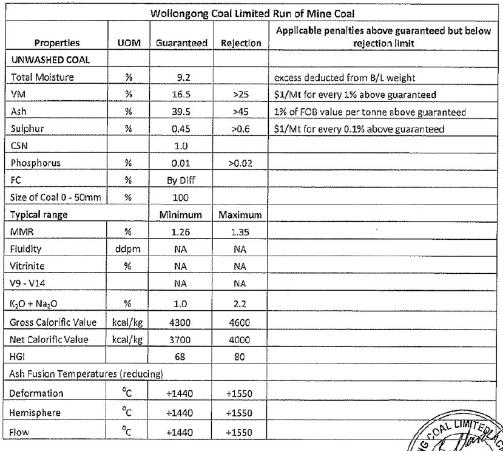
208 A further contract was entered into on 16 April 2015 pursuant to which Wongawilli agreed to sell 25,000 MT (+/- 10%) of “Wongawilli A unwashed coking coal in bulk”, and by a contract dated 7 April 2015, UIL agreed in writing to sell the same product on back-to-back terms to JSPL (the quantity was subsequently decreased on 10 May 2015). The second sale contract of 16 April 2015 included the following specifications for the coal:
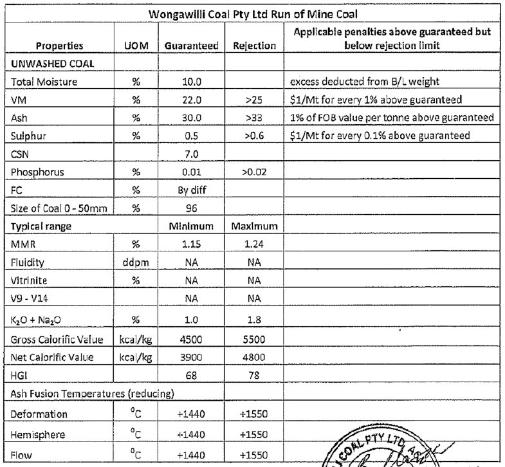
209 These agreements resulted in the second and third shipments said to have been made under or pursuant to the CSAs.
210 On 20 April 2015, WCL responded to UIL’s notice of 9 April 2015. In that response, WCL said (in part) that:
The terms of each of the [WCL] and Wongawilli sale agreements requires that each shipment must be agreed separately by the parties. Until such agreement has been reached in respect of each shipment of Material there is no binding obligation on either of [WCL] and Wongawilli to deliver any material to UIL.
211 Mr Prasad and Mr Gupta both gave evidence that this response surprised them. Mr Prasad said that had he known that the CSAs were invalid or not binding in the way that he thought they were he would have insisted that the documents be altered in order to make them binding. His evidence was that the point of entering into the Settlement Documents by on or around 16 May 2014 was to wipe out WCL’s debts and to establish a long-term and profitable trading relationship between the parties, which would continue to run while there was coal available to supply to UIL from the two mines. Once again, this perspective was challenged in cross examination, during which Mr Prasad accepted that UIL’s in-house lawyers were involved in the negotiation and preparation of the CSAs and provided UIL with adequate legal advice throughout the process. Mr Prasad also accepted that UIL had access to Allen & Overy in the relevant period, as they were providing advice in relation to the Settlement Deed. The Respondents have pointed to the failure of UIL to call any of its lawyers about the advice they had given to UIL about the effect of the CSAs.
212 In subsequent correspondence on 19 May 2015, Mr Bhatia declined to comment on the assertion by Mr Prasad that there was a commitment to sales of 1 million MT of unwashed coking coal, stating that there was “a misunderstanding on the subject”.
213 It appears that the dispute remained unresolved. Despite the evident divergence in views about the operation of the CSAs, on 26 June 2015, two further contracts were entered into pursuant to which WCL agreed to sell further coking coal to UIL, who agreed in writing by contracts dated 25 June 2015, to sell it on back-to-back terms to JSPL. Each contract for sale specified a price and quality, as well as penalties for variation from the specified qualities. Coal shipped in accordance with the agreements was in the amounts of 54,000 MT and 34,000 MT (+/- 10%) respectively.
214 These agreements resulted in the fourth and fifth shipments that were said to have been made under or pursuant to the CSAs.
215 All of the five shipments were made on back-to-back terms with the funds routed through the escrow account and the coal ultimately delivered to JSPL. Put another way, the five transactions which actually took place did so in accordance with the Respondents’ understanding of the way in which the CSAs were to operate.
216 No further shipments were made under the CSAs.
217 It is apparent that UIL felt aggrieved by WCL’s conduct, particularly because WCL’s share value had, by this stage, reduced. Thus, the shares which UIL had accepted in lieu of WCL’s outstanding USD20 million were now worth considerably less than at the time they were accepted. WCL at the time had transferred them to a related entity so the shares had not been sold on the open market.
218 On 13 August 2015, Mr Prasad wrote to Mr Bhatia noting the dilution in the value of the WCL shares and also said “[w]e have also been requesting you to look into the loss or revenue of UIL Singapore under the coal off take agreement with WCL but no effort has been taken by you thus far”. It is not clear if there was a response to this email, and the escrow account was closed at the request of UIL. There were difficulties in mine production around this time.
4.4 A further dispute
219 WCL further notified UIL that production at the Russell Vale Colliery would recommence by March 2016. Mr Prasad’s evidence was that he was hopeful that WCL and Wongawilli would “fulfil their obligation to supply an annual quantity of unwashed coking coal to UIL”. It is unclear how any such hope could have been maintained at this stage, given the history of the relationship between the parties set out above. Nonetheless, in June 2016, UIL and WCL engaged in negotiations regarding a further consignment of 80,000 MT of coal with a laycan of 15 – 25 July 2016 (although the date range later changed).
220 Mr Prasad gave evidence that he had a conversation with Mr Bhatia in which Mr Prasad suggested a change to the arrangement, “namely that JSPL pay a $USD1 margin per metric tonne for the coking coal it wanted to buy from UIL”. Mr Bhatia’s evidence is to the contrary. He states that he does not recall having this specific conversation with Mr Prasad but that he recalled UIL requesting a margin in 2016. His evidence was that he “would not have agreed to increase the price JSPL would otherwise pay for the coal or for any margin to be added”.
221 On 28 June 2016, a representative of WCL, Mr Devendra Vyas (Mr Vyas) emailed Mr Prasad, referring to Mr Prasad’s discussions with Mr Bhatia about proposed changes to the commercial arrangement. Based on this contemporaneous correspondence, I accept that, at the very least, Mr Prasad discussed proposed changes to the arrangement to accommodate a margin.
222 In this email, Mr Vyas notified Mr Prasad that “we understand that you are not interested in the trade on the existing terms and conditions and want to modify the terms and conditions which are not acceptable to us”. Mr Vyas nonetheless said that WCL would bear the cost of the escrow account (despite the understanding being that UIL would incur that cost), but otherwise requested that UIL “kindly adhere to the contracted terms and conditions”.
223 On 29 June 2016, Mr Shah responded on behalf of UIL, stating that UIL did not intend to modify the terms and conditions of the existing offtake agreements. Mr Shah then wrote:
We only want to [offer] a price of 26 US$ / MT FOB instead of 27 US$/MT FOB and have shown our willingness to buy if the offered price is acceptable to [WCL]. We reiterate that while offering a price of 26 US$/MT FOB we are not under any non-compliance under the offtake agreement…You may refer to clause 4.1 of the said agreement where it is mentioned that “the per metric tonne of the said Materials sold shall be decided by the Parties from time to time based on the then prevailing market prices, the quality of the said Materials and the shipping”. Thus, neither we denied to carry out the trade nor we failed to adhere to the existing terms and conditions of the Offtake Agreement... We are still willing to do the trade but only at the offered price of 26 US$/MT FOB
224 The transaction did not proceed. The exchange suggests that the parties had differing understandings of the nature and extent of the agreements that they had entered into.
225 On 6 March 2017, UIL sent a letter of demand to WCL, stating that WCL and Wongawilli had failed to comply with the terms of the CSAs. The letter complained that the value of the Security Shares had been both reduced and diluted, such that the transfer of the Security Shares did not mean that UIL recouped the Advance Payment. It was also alleged that UIL (or its subsidiary) lost trades of USD45,327,700 due to “false commitments made by your Company and your Company’s management”. UIL alleged it had incurred substantial losses because of WCL’s failure to comply with the CSAs.
226 On 4 April 2017, WCL responded (via its solicitors), asserting that the sale agreements were only agreements to agree and not enforceable in the manner suggested by UIL.
5. GENERAL OBSERVATIONS AS TO EVIDENTIARY MATTERS
227 The factual narrative outlined above is analysed in relation to the specific claims raised by the parties in their pleadings. Where they are relevant to specific matters, I have made relevant findings of fact in the course of the analysis above. However, it is convenient to set out my perceptions as to some of the matters which are generally relevant, or relevant to more than one issue as follows:
(1) First, critical events took place in 2013 – 2014. The effluxion of time is likely to have impacted the memories of the witnesses. For that reason, I have found contemporaneous documents to be an important source of evidence. So too are documents that were drafted with care and professional assistance (like the CSAs) or were actually exchanged between the parties, rather than internal notes or emails which may have lacked the care and reflection of more considered correspondence.
(2) Second, Mr Prasad was the person largely responsible for the negotiation of the CSAs on behalf of UIL. Having had the opportunity to observe him in cross examination, I formed the view that he tended to take a very optimistic (and in some instances a baseless) view of the effect of his discussions. Thus, while I do not consider him a dishonest witness, I do consider that he had a tendency to adopt a view of particular conversations that is not reliable, due to his optimism that a workable commercial outcome was what everyone wanted. In this respect, while I generally have a preference for contemporaneous documents, emails from Mr Prasad to others within his own organisation were, in my view, infected with the optimism which I observed in his oral evidence.
(3) Third, as a general matter, I consider that UIL wanted an ongoing commercial relationship with JSPL and considered that to be of value to it. This conclusion arises from the evidence of Mr Gupta and his excitement at the prospect of lunch with senior JSPL individuals, as well as the repeated engagement by UIL with WCL to seek to agree new and different commercial arrangements, despite the ongoing difficulties in their relationship.
228 It is in this overall context that I turn to consider the pleaded case.
6. THE PLEADED CASE
229 The claim is not a complex one. UIL alleges that it entered into the WCL CSA and the Wongawilli CSA on or about 9 May 2014. That is admitted. It is said that each agreement is subject to the Vienna Convention and that by reason of the terms of each agreement, WCL and Wongawilli respectively were each under an obligation to:
(1) deliver approximately 500,000 MT (+/-10%) of high ash, unwashed coking coal per annum and to transfer the property in such coking coal to UIL, under Article 30 of the Vienna Convention;
(2) hand approximately 500,000 MT (+/-10%) of high ash, unwashed coking coal per annum to a carrier for transmission to UIL or, alternatively, to place approximately 500,000 MT (+/-10%) of such coal per annum at UIL’s disposal at the Russell Vale Colliery, under Article 31(a) or (b), respectively, of the Vienna Convention;
(3) deliver approximately 500,000 MT (+/-10%) of high ash, unwashed coking coal within a year commencing on 9 May 2014 and within each year thereafter commencing on 9 May, under Article 33(b) of the Vienna Convention.
230 It is said that each relevant Respondent failed to supply the required quantity of coking coal per annum to UIL and that UIL has, in consequence, suffered loss and damage to be calculated under Article 74 of the Vienna Convention. The allegations are made in a relevantly similar way based on each of the CSAs.
231 The Respondents deny that the CSAs are legally binding agreements, or if they are, deny that they are contracts for the sale of goods because they are not concerned with the present sale of particular goods for a specified price. Instead, it is said, the CSAs provide a framework for future negotiations for the sale of coal and, if a separate agreement is reached, the sale and shipment of high ash, unwashed coking coal – but only where essential matters like quantity, quality, shipping conditions, price and payment terms were able to be agreed. In closing submissions, the Respondents argued that the fact that the CSAs did not provide for title in any goods to pass was one reason that the CSAs were not effective as contracts for the sale of goods. However, this matter was not pleaded, and so is not considered further below.
232 There is also a claim based on misleading or deceptive conduct. It is put as a “further or alternative” case to the contractual claim that is summarised above. It is based on the notion that UIL had a valuable chose in action against WCL (or Gujarat India) arising out of either:
(1) the 2013 CPA, and the failure of WCL to repay the Advance Payment, or
(2) the alleged failure to repay the funds under the Override Deed.
233 It is said that each of these choses in action were relinquished by the execution of the Settlement Documents. It is said that by negotiating and entering into the Settlement Documents, JSPL, WCL and Wongawilli represented that, in return for UIL agreeing to release its rights under various agreements and withdrawing from the Winding Up Proceeding, WCL and Wongawilli would each supply to UIL a total quantity of approximately 500,000 MT (+/-10%) per annum of high ash, unwashed coking coal pursuant to the terms of the WCL CSA and the Wongawilli CSA (the CSA Representations).
234 Separately, the Applicant pleads that JSPL, WCL and Wongawilli represented that JSPL (or its assignees) would enter into a long term arrangement with UDT, or its assignee (UD Entities), for:
(1) UD Entities to purchase coking coal from JSPL entities;
(2) UD Entities to purchase 1 million MT of pellets from JSPL entities per annum and supply the same quantity to its overseas customers;
(3) UD entities to supply 500,000 MT of pellets to JSPL entities on an annual basis to JSPL’s plant at Shadeed, Oman;
(4) UD entities to buy up to 700,000 MT of billets on an annual basis from JSPL entities from JSPL’s plant at Shadeed, Oman; and
(5) subject to the parties being satisfied with feasibility, UD entities and JSPL entities would jointly invest in a downstream steel product manufacturing plant in India,
(the Supply Representation).
235 The Supply Representation was said to arise entirely out of the MOU.
236 UIL alleges that it relied upon each of the CSA Representations and the Supply Representation in entering into the Settlement Documents, and:
(1) assumed that the WCL CSA and the Wongawilli CSA were valid and binding agreements;
(2) assumed that JSPL would agree to sell it pellets and billets in the quantities and periods set out in the Supply Representation; and
(3) agreed to release its rights under the UIL Agreements (as defined in the Settlement Deed) and discontinue the Winding Up Proceeding:
(a) without pursuing further negotiations with WCL, Wongawilli and JSPL to enter alternative agreements to the WCL CSA and the Wongawilli CSA; and
(b) on the basis that JSPL would agree to sell it pellets and billets in the quantities and periods set out in the Supply Representation.
237 It is said that the CSA Representations were misleading or deceptive in that WCL, Wongawilli and JSPL did not intend to comply with them at the time that they were made, or that they were representations as to future matters for which they did not have reasonable grounds at the time of the representation.
238 The Supply Representation is likewise said to be misleading or deceptive in that JSPL did not intend to comply with the Supply Representation at the time it was made, or was a representation as to a future matter for which they did not have reasonable grounds at the time of the representation.
239 UIL pleads that it has suffered loss and damage which it is entitled to recover under s 236 of the Australian Consumer Law (ACL). In addition, UIL seeks a declaration that the Settlement Deed is void pursuant to ss 237 and 243 of the ACL. An application for disgorgement of profits by JSPL was not pressed.
240 The Respondents deny the allegations, and assert that the representations were not made in Australia, and so do not fall within the ACL. They also plead that even if the Settlement Deed were set aside, the payments made would need to be called to account, and argued that but for the Settlement Deed, WCL would have been wound up, and UIL would not have been paid any dividends out of the winding up because WCL would have had insufficient net assets to satisfy unsecured creditors after secured creditors.
241 By way of reply, the Applicant joins issue with a range of matters relied upon by the Respondents and asserts that they are estopped from denying that the CSAs were valid and binding on the basis that they induced UIL to adopt the assumption that they were binding, and that assumption was relied upon by UIL to its detriment.
7. THE CONSTRUCTION OF THE COAL SALE AGREEMENTS
7.1 The Vienna Convention
242 A threshold issue identified by both parties is whether the CISG governs the CSAs and the JSPL Purchase Agreement (and its accompanying Amendment Deed).
243 By Article 1, the CISG (relevantly) applies to contracts of sale of goods between parties whose places of business are in different countries where each of those countries are contracting states to the CISG. It is not in dispute that the parties to the CSAs have places of business in different countries (Australia and Singapore respectively) and that both countries are contracting states to the CISG.
244 On 17 March 1988, the Commonwealth of Australia acceded to the CISG adopted at Vienna, Austria, on 10 April 1980. It has been implemented in uniform legislation of the states and territories of Australia. Relevantly for present purposes, pursuant to s 5 of the Sale of Goods (Vienna Convention) Act 1986 (NSW) (Vienna Convention Act), the CISG forms part of the law of New South Wales, chosen by the parties as the governing law for the CSAs pursuant to clause 18 of each of the CSAs.
245 The CISG has also been ratified by Singapore. JSPL is based in India (which is not a contracting state). The parties designated the laws of Singapore to govern the JSPL Purchase Agreement (and the Amendment Deed). The Respondents initially argued that the CISG applied to the JSPL Purchase Agreement (and the Amendment Deed) and the Applicant initially disagreed with that proposition. Both parties reversed their positions by the time of closing submissions.
246 The Applicant’s ultimate argument relied on Article 1(1)(b) of the CISG which states that the CISG applies to contracts of sale of goods between parties whose places of business are in different states when the rules of private international law lead to the application of the law of a contracting state. The relevant legislation in Singapore, being the Sale of Goods (United Nations Convention) Act 1995 (Singapore) provides that “[s]ub-paragraph (1)(b) of Article 1 of the Convention does not have the force of law in Singapore and accordingly the Convention will apply to contracts of sale of goods only between those parties whose places of business are in different States when the States are Contracting States” (s 3(2)). The Respondents ultimately assert that the effect of this provision is that the CISG does not apply to the JSPL Purchase Agreement (or the Amendment Deed) because India is not a contracting state. In oral submissions in closing, the Applicant submitted that the reservation in s 3(2) would only operate if it were being applied by a Court of Singapore. That view is not without controversy (see the divergent approaches identified in Schroeter UG, “Part IV: Final Provisions” in Schwenzer I and Schroeter UG (ed), Commentary on the UN Convention on the International Sale of Goods (CISG) (5th ed, Oxford University Press, 2022) (Schwenzer) at pp 1614 – 1615). Nonetheless, I consider that the better view is that the CISG does apply when private international law rules lead to the application of the law of a contracting state that has declared a reservation that it is not bound by Article 1(1)(b). That is because Article 1(1)(b) looks to whether the rules of private international law lead to the application of the “law of the contracting state”, not to how the law of that state would apply, if the dispute were occurring there. In this instance, the parties have chosen the law of Singapore which is a contracting state. Those laws are being applied in an Australian Court, which does not have a reservation of the kind applicable in Singapore. Accordingly, pursuant to Article 1(1)(b), the CISG does apply to the JSPL Purchase Agreement (and Amendment Deed).
247 The purpose of the CISG is to facilitate international trade through the harmonisation of domestic laws (United Nations, United Nations Conference on Contracts for the International Sale of Goods, Official Records, GAA Res 33/93, 33rd sess, 85th plen mtg, Agenda Item 114 (16 December 1978)).
248 The CISG is uniform, autonomous law that excludes the operation of domestic law rules wherever a matter of sales law is governed by the CISG (Hachem P, “Sphere of Application” in Schwenzer at p 20). However, this plainly begs the question of how to determine when a matter of sales law is governed by the CISG, and when it is not (and therefore is governed by local domestic law).
249 The Respondents argue that the CSAs were not themselves binding and enforceable contracts for the sale of coking coal. They argue that they were at best, agreements to agree (or “framework agreements”) and not sufficiently certain, complete or final as to be enforceable.
250 The Applicant argues that the CISG has a mechanism for determining issues of certainty, and that contracts for the sale of goods must be analysed within the framework of the CISG to determine if it applies.
251 The key reason this matters is that if the CISG applies, then different principles apply to the interpretation of contracts. Article 8 governs the matters to which the Court may have regard when interpreting a contract governed by it. In particular, Article 8 provides that statements made by and other conduct of a party relating to matters governed by the CISG are interpreted according to that party’s intention where the other party knew or could not have been unaware of what that intention was (CISG, Article 8(1)). If Article 8(1) does not apply, then statements made by and other conduct of a party are interpreted according to the understanding that a reasonable person of the same kind as the other party would have had in the same circumstance (CISG, Article 8(2)). Determining the actual intent of a party or the hypothetical understanding of a reasonable person requires due consideration to be given to all relevant circumstances of the case, including the negotiations, any practices which the parties have established between themselves, usages, and any subsequent conduct of the parties (CISG, Article 8(3)). This differs from the common law which generally:
(1) determines the meaning of a contract objectively by reference to its text, context and purpose (Simic v New South Wales Land and Housing Corporation [2016] HCA 47; 260 CLR 85 at [78] (Gageler, Nettle and Gordon JJ), citing Electricity Generation Corporation v Woodside Energy Ltd [2014] HCA 7; 251 CLR 640 at [35] (French CJ, Hayne, Crennan and Kiefel JJ));
(2) does not treat surrounding circumstances as admissible to assist in the interpretation of the contract (absent ambiguity) as explained in Codelfa Construction Pty Ltd v State Rail Authority of New South Wales [1982] HCA 24; 149 CLR 337 at 347 (Mason J) and reinforced in Mount Bruce Mining Pty Ltd v Wright Prospecting Pty Ltd [2015] HCA 37; 256 CLR 104 at [48] (French CJ, Nettle and Gordon JJ);
(3) determines the intention of the parties objectively, and not by reference to actual intention (Codelfa at 352 (Mason J; Stephen and Wilson JJ agreeing); and
(4) subject to exceptions, considers it impermissible to use post contractual conduct as an aid in the construction of the contract (Construction, Forestry, Maritime, Mining and Energy Union v Personnel Contracting Pty Ltd [2022] HCA 1; 275 CLR 165 at [176] (Gordon J)).
252 It follows that evidence that would have been inadmissible in a common law analysis (including evidence of the subjective intention of the parties in relation to contractual construction) was provisionally admitted in the course of the hearing subject to determination of whether the CISG applies. Both parties agreed with this approach.
7.2 Does the Vienna Convention Apply?
253 At the threshold level, the question is: does the common law of Australia apply to determining whether the CSAs may be described as “contracts of sale of goods” or is that question determined by reference to the criteria for validity in the CISG itself?
254 The source of the rights and obligations at issue is the Vienna Convention Act (see generally: NBGM v Minister for Immigration and Multicultural Affairs [2006] HCA 54; 231 CLR 52 at [61] (Callinan, Heydon and Crennan JJ)). Section 5 of the Vienna Convention Act adopts the CISG in full. Accordingly, the CISG must be construed in accordance with the principles of international law applicable to its construction (Addy v Federal Commissioner of Taxation [2021] HCA 34; 273 CLR 613 at [23] (Kiefel CJ, Gageler, Gordon, Edelman and Gleeson JJ); Commonwealth Minister for Justice v Adamas [2013] HCA 59; 253 CLR 43 at [32] (French CJ, Hayne, Crennan, Kiefel, Bell, Gageler and Keane JJ)). This approach gives significant weight to academic commentary.
255 In approaching the application of the CISG, the parties largely relied upon academic commentary concerning its operation, with the Applicant principally relying upon Schwenzer and Bridge MG, The International Sale of Goods (5th ed, Oxford University Press, 2023) (Bridge), while the Respondents relied principally on Heydon JD, Heydon on Contract: Particular Contracts (Sumner Publications, 2024) (Heydon). Both parties referred to various cases, or summaries of cases decided in various jurisdictions to which I will refer where relevant. As a general proposition those cases or case summaries, many of which are translations from reasons delivered in languages other than English, do not have the detail which a court in the common law tradition would generally anticipate.
256 It is convenient to first set out the relevant articles of the CISG. Article 1(1) of the CISG states (emphasis added):
This Convention applies to contracts of sale of goods between parties whose places of business are in different States:
(a) when the States are Contracting States; or
(b) when the rules of private international law lead to the application of the law of a Contracting State.
257 The Respondents assert that the CSAs are not legally effective contracts because they are uncertain and incomplete insofar as they leave critical matters for future agreement. The Respondents further assert in the alternative that, even if the CSAs are legally effective contracts, they are not “contracts of sale of goods” within the meaning of this clause, so that the CISG does not apply to them. It is appropriate to first consider whether the CSAs are legally effective contracts at all. If they are, then it would be necessary to consider whether they are contracts for the sale of goods.
258 The Applicant, by contrast, refers to Article 4, which states:
This Convention governs only the formation of the contract of sale and the rights and obligations of the seller and the buyer arising from such a contract. In particular, except as otherwise expressly provided in this Convention, it is not concerned with:
(a) the validity of the contract or of any of its provisions or of any usage;
(b) the effect which the contract may have on the property in the goods sold.
259 On its face, Article 4 makes clear that the CISG is not concerned with the validity of a contract, unless otherwise expressly provided in the CISG itself. The Applicant relies upon this provision in combination with Article 14.
260 The Applicant asserts that Article 14 of the CISG is a provision which provides for the validity of a contract insofar as it is concerned with “definiteness”. Article 14 states:
(1) A proposal for concluding a contract addressed to one or more specific persons constitutes an offer if it is sufficiently definite and indicates the intention of the offeror to be bound in case of acceptance. A proposal is sufficiently definite if it indicates the goods and expressly or implicitly fixes or makes provision for determining the quantity and the price.
(2) A proposal other than one addressed to one or more specific persons is to be considered merely as an invitation to make offers, unless the contrary is clearly indicated by the person making the proposal.
261 Article 14 must be read with Article 55 of the CISG, which states:
Where a contract has been validly concluded but does not expressly or implicitly fix or make provision for determining the price, the parties are considered, in the absence of any indication to the contrary, to have impliedly made reference to the price generally charged at the time of the conclusion of the contract for such goods sold under comparable circumstances in the trade concerned.
7.2.1 Academic commentary
262 The controversy in this case is whether a question of “certainty” (as variously described) is to be determined by the Australian common law as a precondition to a contract falling within the CISG, or whether the CISG itself supplies the requirements for validity.
263 Turning first to Article 4, Bridge (at p 655) explains the difficulty in the following way:
Different legal systems may define validity in different ways and to different extents. One possibility is to attempt to fashion transnational notions of public policy and related expressions, which might turn out to be a glacially slow process. Furthermore, in excluding validity, and in treating validity as an autonomous expression under the CISG, it does not necessarily follow that the CISG thereby adopts transnational notions of illegality based upon common international standards
264 In Schwenzer, the authors consider that the term “validity” must be interpreted autonomously using a functional approach in deciding from the perspective of the CISG, whether it intends to govern the question in dispute (Hachem P, “Sphere of Application” in Schwenzer at p 101). Schwenzer advocates a two-step process: first, identifying the factual subject matter for which a solution is necessary and second, determining whether the identified fact pattern raises legal issues that the CISG seeks to address (Hachem P, “Sphere of Application” in Schwenzer at p 101). Schwenzer argues that if the fact identified through this process is one that the CISG seeks to address, then domestic rules are displaced.
265 Heydon argues that the terms of Article 4(a) should be characterised as words of “breadth” and, accordingly, that validity for the purpose of Article 4(a) should be understood to include issues which in Australian domestic law render a contract void ab initio, as well as issues which render a contract unenforceable (Heydon at p 344). On that approach, it is said that Australian common law should apply to the question of whether such contracts are valid in the sense that they create legal obligations. On the Respondents’ case, this would involve considering whether the contract is sufficiently certain.
266 The Respondents assert that questions of “validity” have been understood to mean “any issue by which the domestic law would render the contract void, voidable [or] unenforceable” and that such matters are “generally left to the applicable national law” (UNCITRAL Digest of Case Law on the UN Convention on Contracts for the International Sale of Goods (1980) (the Digest) p 25). Thus, it is the Respondents’ contention that even if the CISG applied to determine the objective requirements for concluding a contract for the sale of goods, if there is a matter which would render the CSAs void, the CISG will not apply to that issue. On the Respondents’ case, a dispute about whether the CSAs are void or unenforceable for lack of certainty and completeness is a matter which under Australian law goes to the validity of the agreements themselves, and as such is a matter carved out from the CISG.
267 However, the following paragraph in the Digest identifies an issue with the Respondents’ analysis in the following way:
As far as formation of the contract is concerned, the Convention merely governs the objective requirements for concluding the contract. The issue of whether a contract is validly formed, however, is subject to the applicable national rules, except for those issues as to which the Convention provides exhaustive rules. Thus, issues such as capacity to contract, illegality and the consequences of mistake, duress and fraud are left to the applicable domestic law, as are those of misrepresentation and negligence. Where, however, one party errs concerning the quality of the goods to be delivered or the solvency of the other party, the rules of the otherwise applicable law give way to those of the Convention, since the Convention exhaustively deals with those matters. CISG also covers the plea of non-fulfillment of the contract as a defence to suspend the own performance.
(Emphasis added.)
268 In that passage, the Digest states that whether an issue is to be addressed by the CISG is to be determined in accordance with its terms. This is not any simple test based on whether the issue is one of voidability or unenforceability, but is consistent with the approach stated in Schwenzer and Bridge which focuses upon whether the substance of the issue said to be relevant to validity is governed by the CISG. If it is, then one is to assume that Parliament intended (in implementing the CISG) that the CISG applies to that issue as identified within the convention.
269 In Honnold JO and Flechtner HM, Honnold’s Uniform Law for International Sales under the 1980 United Nation Convention (5th ed, Kluwer Law International, 2021) (Honnold’s), the general principles in relation to Article 4 are explained in this way (at pp 96 – 97):
The fact that a domestic rule bears a label suggesting that the rule is or is not within the scope of the Convention’s coverage – labels such as “tort”, “contract” or (as will be discussed below) “validity of contract” or “property” – should not determine whether the rule is pre-empted. The substance of the domestic rule, rather than its label or characterization, determines whether it is displaced by the Convention. The crucial question is whether the domestic rule is invoked by the same operative facts that invoke a rule of the Convention. For example, a domestic rule with a label other than “contract” provides that a problem raised by facts A + B has result X; the Convention also addresses the problem raised by facts A + B and gives result Y. Does Article 4 provide that the Convention “is not concerned” with this problem? Certainly not… On the other hand, suppose that domestic law provides a remedy for situations not addressed in the Convention (e.g., the effect of a seller’s representation as to the quality of the goods which is not merely incorrect, but intentionally false). Because the Convention does not deal with these problems, domestic remedies are not excluded merely because they are characterized as “contract” rather than “tort”. In sum, access to domestic law in transactions governed by the CISG is neither broadened nor narrowed by the domestic law’s label or characterization.
(Emphasis added.)
270 On this analysis, the labels of “void / voidable / enforceable” are not determinative of the applicability of the CISG. That is because these are variable concepts in different jurisdictions, and it is apparent that the Parliament of New South Wales intended for the CISG to operate in accordance with its terms, and in a manner which promotes uniformity in its interpretation across signatory states (CISG, Article 7). Put another way, an issue of whether the contract is operative is excluded from the operation of the CISG, unless the operative facts necessary to establish the validity of the contract are expressly dealt with by the CISG itself.
271 This raises the question of whether the CISG displaces domestic law in relation to a lack of certainty. On this issue, Schwenzer and Honnold’s take different approaches. At the core of this issue is a consideration of Article 14, and whether that article deals with a matter that is necessary to establish the validity of the contract (in which case the CISG would apply) or does not (in which case the common law would be left undisturbed to apply to the question of whether the relevant agreements are sufficiently certain).
272 As to certainty in relation to price, Honnold’s argues that the CISG does not provide a requirement that a contract fix the price as a rule of validity, such that domestic law applies to determine if a contract that does not fix a price is valid. It says (at p 263):
Had Article 14(1) stated that "A contract of sale must fix or include provision for determining the price," it would be clear that it contained a rule of validity, but there is no such language making a price term mandatory in all contracts. …
The fact that Article 14(1) does not contain a rule rendering contracts without price provisions invalid does not necessarily mean that such contracts are always valid and enforceable. In the opinion of the author of the current edition of this Commentary, the fact that the Convention does not contain an express validity rule concerning such contracts clears the way, under Article 4, for the application of rules of domestic law that may render them invalid. Absent such a validity rule in applicable domestic law, however, it is clear that the parties in Example 14B have an enforceable contract of sale under the Convention despite their lack of agreement on price, and that the price is supplied by the rule in Article 55.
(Emphasis added.)
273 Footnote 21 on page 263 is illustrative:
Contra, Franco Ferrari, Article 14, 3, in Kroll/Mistelis/Perales Viscasillas Commentary at 230-231, where it is argued that "the validity exception in Art. 4(a) allows for recourse to domestic law only insofar as the ClSG itself does not deal with an issue, which, in the case at hand [i.e., contracts without a price provision] it does, given that the CISG governs the formation of contract exclusively." Part II of the Convention, however, contains exclusive rules governing the process of contract conclusion, but not the validity of the resulting contract. For example, a contract of sale formed precisely in accordance with the rules in CISG Part II which provides for the sale of narcotics prohibited under applicable domestic law is invalid and unenforceable. The same is true, it is submitted, for a contract concluded in accordance with the rules of Part II (or, where an Article 92 declaration comes into play, concluded in accordance with applicable domestic law) if it lacks a price term and applicable domestic law declares such a contract invalid. It is also submitted that this approach is more consistent with the drafting history of Articles 14 and 55 detailed infra in this Commentary on Article 14.
(Emphasis added.)
274 In this respect, Honnold’s contends that Article 14(1), sentence 2, contains a “safe harbour” provision that presumes certain offers to be sufficiently definite, but that offers outside the scope of that sentence are not invalid according to the terms of the CISG. Honnold’s contends that this interpretation is consistent with the drafting history of Articles 14 and 55 which reveals that the express qualifier that Article 55 only applies to a contract that “has been validly concluded” is intended to refer to a contract validly concluded under applicable domestic law (at pp 266 – 267).
275 Accordingly, Honnold’s concludes that the CISG does not render invalid a contract that does not fix price, if it can be shown that the parties intended to be bound by the contract. However, that is subject to the contract being valid under the applicable domestic law (at p 269). Honnold’s acknowledges that this position involves “a departure from uniformity”, but argues that it is of acceptable proportions (at p 627).
276 Schwenzer on the other hand takes the view that Article 14(1) provides
“an exhaustive regulation of the required minimum content (essentialia negotii) and its determination or determinability in offers and CISG contracts. Provisions of domestic law that pertain to the same matter (including provisions about the invalidity of indeterminate contracts) are thereby pre-empted” (Schroeter UG, “Formation of Contract” in Schwenzer at p 316). As to the minimum requirements, Schwenzer says (Schroeter UG, “Formation of Contract” in Schwenzer at p 314):
The basic prerequisite for an offer is a conduct by the offeror aiming at the conclusion of a contract with another person; Article 14(1), sentence 1 describes such conduct as ‘proposal for concluding a contract.’ According to this provision, such a proposal only constitutes an offer in the legal sense if it fulfils three minimum requirements: The proposal must have been made with the offeror’s intention to be bound in case of acceptance, and it must have a certain minimum content that is further elaborated on in Article 14(1), sentence 2. In addition, the proposal must usually be addressed to one or more specific persons; however, Article 14(2) clarifies that even a proposal made to the public may exceptionally constitute an offer. If at least one of these three minimum requirements is missing in a particular case, the proposal concerned does not result in the formation of a CISG contract even if it is ‘accepted’ by the offeree; on the contrary, such a proposal is regarded as a mere invitation to make offers (invitatio ad offerendum; see Article 14(2)).
(Emphasis added.)
277 Schwenzer expands on this view in the context of considering the validity of contracts that enable one party to determine the contract price or refer to the “price currently charged by the seller” as follows (Schroeter UG, “Formation of Contract” in Schwenzer at pp 338 – 339):
[85] Whether and to what extent domestic ‘validity’ rules (see Article 4, sentence 2(a)) may render such a unilateral power of determination [as to price] void and thereby prevent a proposal from being an offer depends on the regulatory purpose and focus of the domestic rule. Domestic provisions that declare contractual clauses of this kind invalid or void in order to sanction either an insufficient determinability of the contract’s content at the moment of contract formation or the use of a unilateral influence of one party on the contract’s content are as such pre-empted by Article 14(1), sentence 2, because the latter provision provides an exhaustive regulation of an offer’s required definitiveness. In contrast, domestic rules of law addressing the manner in which a unilateral power of determination has to be exercised, possible limits to the scope of contract clauses granting such a power, or the reasonableness of determinations made thereunder all remain applicable to CISG contracts, because autonomous standards drawn from general principles underlying the Convention (Article 7(2)) have not yet been developed with respect to these issues…
…
[87] As far as the validity of the contractual references to the ‘current price’ is concerned, the distinction outlined above (paragraph 85) applies here as well: domestic rules that impose general requirements with respect to the determinability of the price at the moment of contract formation, as eg French law in Articles 1108, 1591 of the French Civil Code, cannot be applied to CISG contracts, whereas domestic provisions governing the exercise of unilateral powers to determine the price or the unfairness of price determinations made remain applicable alongside the Convention.
(Emphasis added.)
278 Schwenzer acknowledges that the existence of an offer that fulfils the requirements of Article 14 is not an indispensable pre-requisite for a contract’s formation under the CISG because sales contracts can, at least in theory, also be concluded under the CISG in ways other than by offer and acceptance (for example, where – as permitted by Article 6 – the parties have derogated from the contract formation model of Articles 14 – 27 by expressly agreeing on a different contract conclusion procedure) (Schroeter UG, “Formation of Contract” in Schwenzer at pp 288, 313). Schwenzer observes that in practice such alternative methods of contract formation have been rare (Schroeter UG, “Formation of Contract” in Schwenzer at p 313).
279 Schwenzer also acknowledges that particular difficulties arise under the CISG when it comes to the consequences of offers made without a sufficiently determinable price due to the apparent inconsistency between Article 14(1), sentence 2 and Article 55. This inconsistency arises because Article 55 contemplates a valid contract without a determinable price, whereas Article 14(1), sentence 2, would on its face render such a contract invalid (Schroeter UG, “Formation of Contract” in Schwenzer at p 341). Unlike Honnold’s, however, Schwenzer does not consider that the effect of this apparent inconsistency is that Article 14 does not provide a rule of validity such that domestic law applies to determine if a contract that does not fix a price is valid. This is because Schwenzer argues that Articles 14 and 55 are not inconsistent, for the following reasons: (1) Article 55 only applies to price, so is not inconsistent with the minimum prerequisites of an offer as to the goods and quantity imposed by Article 14(1); (2) it may be possible to presume that Article 14(1), sentence 2, is satisfied because the parties impliedly adopted the price set by Article 55; and (3) the parties may impliedly derogate from Article 14, or satisfy the minimum prerequisites of Article 14 absent offer and acceptance, and still create a valid contract, in which case Article 55 will apply. Schwenzer says (Schroeter UG, “Formation of Contract” in Schwenzer at pp 343 – 344):
[99] In the author’s opinion, it is necessary to distinguish between various scenarios and circumstances. Article 55 is, of course, important where the CISG is to be applied without Part II (in accordance with Article 92) and the applicable domestic law permits a contract to be concluded without a price being determined. Furthermore, in many cases where no price has been indicated in the offer, it will be possible to identify a price that was determined ‘implicitly’, by applying rules of interpretation (Article 8). Where interpretation is necessary and there are no other specific indications, it may frequently be assumed that the market price referred to in Article 55 was intended by the parties. Above all in the case of an order for urgently needed spare parts (one of the examples where a clear specification of the price is likely to be missing), the offeror will proceed on the basis of the usual price when the contract is concluded. Article 55 does not directly apply here, but it serves as an interpretative guideline when establishing what has been proposed ‘implicitly’. That should also be acceptable to those who feared that economically stronger sellers would misuse their power, since, unlike Article 51 of the 1978 New York Draft, Article 55 now no longer refers to the prices generally charged ‘by the seller’ at the time of the conclusion of the contract, but applies an objective test.
[100] In many other cases, even though an offer satisfying Article 14(1) has not been made, a contract may still be considered as concluded because the parties implicitly derogated from Article 14(1), sentence 2 or because the contract - with the otherwise required essentialia negotii - was validly concluded by means other than offer and acceptance. Practices established between the parties and (exceptionally) international usages may also point to the price or indicate its implicit determination…
[101] Only in the remaining, presumably rather rare, cases in which an offer without a price is a vital component of the agreement, but interpretation of the offer points to neither a fixed nor a determinable price and the parties have not indicated their agreement by performing the contract or where, despite agreement being reached on other matters, no price is determinable under Article 55, will it have to be concluded that for lack of agreement no contract was formed. In general there can be no recourse to domestic law (which might nevertheless allow formation of a contract) via the conflict of law rules, because otherwise the Convention’s rules and their uniform application would be undermined.
280 In relation to the argument that the drafting history of Article 55 supports the view that the opening words refer to validity under domestic law, Schwenzer says (Mohs F, “Obligations of the Buyer” in Schwenzer at p 1076):
‘Validly concluded' refers to Article 14 which excludes any domestic requirements of a pretium certum. According to the drafting history of Article 55, the introductory words ‘validly concluded’ were meant to render the domestic law applicable so as to-secure the domestic requirement of a pretium certum. However, today, this reservation refers to Article 14 and not to the applicable domestic law. Because Article 14 protects the buyer from excessive prices by requiring a determined or determinable purchase price, domestic law requirements of a pretium certum are no longer required. Thus, domestic rules of validity concerning pretium certum are excluded by Article 14. The CISG also excludes any attack under domestic law for mistake or similar vitiating factors.
(Emphasis added.)
281 It is difficult to resolve the disagreement between Schwenzer and Honnold’s on this issue: the position in Honnold’s sits more comfortably with the opening words of Article 55 and its drafting history, but Schwenzer’s position seems to better accord with the general internationalist and uniformity principles of the CISG. I certainly do not accept that Articles 14 and 55 are inconsistent in the manner suggested by the Respondents. They must be given a coherent meaning.
7.2.2 Analysis
282 It is reasonably clear that by reason of Article 4, a matter going to the validity of a contract is not to be determined by the CISG unless it is expressly provided for.
283 Thus, the CISG would have no work to do in relation to a “contract” that was (for example) concluded under an operative mistake. That is because the CISG makes no provision for when a contract is concluded under a mistake, and it is plainly a matter which goes to the validity of the purported agreement. Heydon argues that “validity” in the CISG corresponds with common law meanings. The Respondents rely upon this to submit that certainty is a validity issue that is therefore excluded from the CISG and dealt with by the common law. I generally accept that certainty of contract could well be considered a matter going to the validity of a contract, but I do not accept that is the dispositive inquiry.
284 Article 14 is directly concerned with when a contract for the sale of goods is sufficiently “definite”. It identifies the key terms which it requires for a contract to be definite and so to be enforceable within its terms.
285 The use of terms to describe the elements of the validity of the contract are not necessarily used consistently in both the CISG and the common law. For example, Article 14 deals with the elements of an offer, and the second sentence of that article describes three features, quality, quantity and price that are relevant in determining whether the offer is “sufficiently definite” for the purposes of the CISG. At common law, those considerations are relevant to the contractual concept of certainty. When analysed substantively, Article 14 can be seen to deal with the common law contractual elements of validity (i.e. the existence of an offer and the element of certainty). Because both elements are “otherwise expressly provided for” in the CISG, those elements of validity fall within the remit of the CISG, and not the common law.
286 The Respondents argue that there is “no conflict” between Articles 4 and 14, and set out a four-step reasoning process which can be summarised as follows:
(1) First, if a defendant raises a plea in answer to a claim under the CISG, that puts in issue the validity of the contract, that is a question which Article 4(a) commands to be determined under the applicable domestic law.
(2) Second:
(a) if the relevant domestic law says that the contract is invalid, then no question of the application of the CISG arises, and the claim fails at that stage;
(b) if the question is answered by applicable domestic law to the effect that the contract is valid, Article 4 has no further work to do, and the claimant must then satisfy any other requirement necessary to engage the CISG, including those relating to formation. It is at this point that Article 14 would be engaged.
(3) Third, if the claimant can prove that the formation requirements under the CISG are satisfied, then the CISG will govern the claim.
(4) Fourth, if the claimant cannot prove that the formation requirements under the CISG are satisfied, then the claim will fall to be determined under domestic law (which in this case is not pleaded as an alternative).
287 The Respondents’ construction involves consideration of certainty at two separate points, first under the applicable domestic law, and then again if the contract is sufficiently certain pursuant to that law, under the requirements of Article 14 of the CISG. That approach is not consistent with the uniformity principle that applies to the CISG, because it introduces separate tests for certainty – a matter which is, in substance, dealt with by the CISG.
288 That approach would have the effect that the rules as to certainty of contract may easily differ between contracting states and would be inconsistent with the words of Article 4, which specifically preserve for the CISG matters that are “… otherwise expressly provided [for] in this Convention”. When viewed as a matter of substance, the CISG identifies the level of “definiteness” required for contracts to operate within its framework.
289 The Respondents’ approach is unnecessarily duplicative. There is no reason for the analysis as to whether a contract is relevantly certain to be carried out twice, at different stages. In circumstances where the CISG has adopted its own criteria for definiteness it would be strange for a separate, distinct criteria to be separately applied depending on the law of different contracting states.
290 The construction for which Schwenzer contends is, in my view, preferable: Article 14 does involve a rule of validity, and it sets out the requirements for a contract to be sufficiently definite so as to be valid.
291 While not strictly relevant, I do not consider that there is any relevant inconsistency between Articles 14 and 55. Article 55 identifies circumstances in which a party will be taken to have implicitly made provision for pricing, even where it has not done so for the purposes of Article 14. That is clear from the use of terms in Article 55 that reflect those used in Article 14. Article 14 says that a contract is sufficiently definite in respect of price where the parties have “expressly or implicitly fixe[d] or [made] provision for determining the…price”. Article 55 picks up on this wording and says that “[w]here a contract has been validly concluded but does not expressly or implicitly fix or make provision for determining the price…”, then the consequences in Article 55 follow. The use of mirror language between Articles 14 and 55 suggests that Article 55 operates where a contract is valid in accordance with Article 14 (other than in respect of price) to effectively deem a circumstance where the parties are taken to have implicitly fixed or made provision for determining the price. In Schwenzer, the authors note that “no binding contract exists if the parties do not intend to be bound unless the price is agreed at a later stage” (Mohs F, “Obligations of the Buyer” in Schwenzer at 1074). Applying Article 8 of the CISG (discussed below), I have concluded that the parties in this case understood that if there was no agreement in relation to price for each specific transaction, there would be no sale (see in particular the evidence of Mr Gupta at [308] – [309] below). I therefore consider that Article 55 does not apply to the CSAs.
292 Schwenzer refers to it as “difficult to handle”, where the parties leave the price to be agreed later, and ultimately fail to do so (Mohs F, “Obligations of the Buyer” in Schwenzer at 1074). The authors state that the CISG does not explicitly provide for a market price to be applied in such a case (unlike the United States Uniform Commercial Code for example). The authors assume that absent a pricing mechanism, domestic law would force parties to negotiate a price (Mohs F, “Obligations of the Buyer” in Schwenzer at 1074). That is not the way the case is put by the Applicant in the present instance.
293 Nonetheless, Article 55 does provide a further pathway by which the CISG effectively deems a price to have been implicitly agreed. However, importantly for this case, that can only occur where:
(1) there is no contrary indication; and
(2) where there actually is a price generally charged for the goods at the time the contract was concluded.
294 As will become apparent in the analysis below, a further reason that I am not satisfied that Article 55 applies in this case is that the Applicant has not persuaded me that there was actually a price generally charged for the goods at the time the contract was concluded.
8. INTERPRETIVE PRINCIPLES UNDER THE CISG
295 The analysis of instruments under the CISG involves Article 8. Article 8 of the CISG states:
(1) For the purposes of this Convention statements made by and other conduct of a party are to be interpreted according to his intent where the other party knew or could not have been unaware what that intent was.
(2) If the preceding paragraph is not applicable, statements made by and other conduct of a party are to be interpreted according to the understanding that a reasonable person of the same kind as the other party would have had in the same circumstances.
(3) In determining the intent of a party or the understanding a reasonable person would have had, due consideration is to be given to all relevant circumstances of the case including the negotiations, any practices which the parties have established between themselves, usages and any subsequent conduct of the parties.
296 Thus, Article 8 allows for the admission of both subjective and objective evidence in relation to the construction of contracts under the CISG in the manner that I have explained at [252] above. Similarly, Article 7(2) of the CISG provides that contracts are to be interpreted in accordance with relevant international standards. In this instance that includes the UNIDROIT Principles of International Commercial Contracts (UNIDROIT Principles). The UNIDROIT Principles provide, relevantly, that contracts are to be interpreted according to either the parties’ common intention or if none can be established, the meaning that reasonable persons would have given to it in the same circumstances.
297 It is important to note that these principles do not convert the subjective understanding of one party into the contractual agreement of the parties. Just because one party believed that they had struck an agreement with another party does not convert that belief into an actual agreement. However, Article 8 and / or the UNIDROIT Principles does render evidence of such beliefs admissible in a manner that would not be available in a common law claim.
298 Given my conclusion as to the applicability of the CISG and the consequential operation of interpretive principles, I accept that it is proper that the evidence that I provisionally admitted be admitted into evidence (other than where a particular direction under s 136 of the Evidence Act 1995 (Cth) has been made).
9. THE CONSTRUCTION OF THE SETTLEMENT DOCUMENTS
299 Leaving aside the question of whether the CSAs are sufficiently definite so as to have effect for the purposes of Article 14, it is first useful to consider how to construe the agreements, and in particular, whether or not they operated to impose the obligation of coal supply for which the Applicant contends. For the reasons that I have identified, this is to be done in accordance with the principles arising from the CISG, including as set out above.
9.1 What is the proper construction of the CSAs?
300 The recitals of each of the CSAs identify that the Seller (WCL and Wongawilli respectively) is willing to sell “high ash coking coal” on the terms and conditions that appear. “[H]igh ash coking coal” is referred to as the “Materials”. The recitals are followed by the words “now this memorandum of understanding is witnesseth and it is agreed between the parties as follows”. While this heading uses the language of “memorandum of understanding”, I do not place any real emphasis on those words – the CSAs were intended to be agreements between the parties, and not memorandums of understanding alone. The CSAs then recite that the “Seller herewith agrees to sell and deliver to the Buyer and the Buyer herewith agrees to purchase and take delivery from the Seller of the “said Materials” subject to the following terms and conditions”. These are introductory words that identify that the operative provisions are to follow and do not substantively impact the analysis.
9.1.1. Clause 1
301 Clause 1 is the central clause relied upon by the Applicant to assert that WCL or Wongawilli (as applicable) undertook an obligation to sell to UIL 500,000 MT (+/- 10%) of unwashed coking coal per year. It provides:
During the Term of this Agreement, the quantity of the Product shall be decided by the Buyer and the Seller from time to time provided that the Buyer shall be obliged to purchase such quantities of the Product as the Seller has contracted with the party from whom Seller is purchasing the said Product, upon the specific written request of the Buyer. The Seller will disclose to the Buyer, the party from whom Seller is purchasing the said Product.
Approximately 500,000.00 Metric Tons (+/-10%) P.A of unwashed coking coal
302 There are some interesting aspects to this clause:
(1) Strangely the word “Materials” is defined, but is not then incorporated in clause 1, which instead refers to “the Product”. In cross examination, Mr Prasad said that the wording was copied directly from the JSPL Purchase Agreement.
(2) All of the first part of clause 1 is consistent with a future agreement to purchase a mutually agreed amount of “Product”, as agreed “from time to time”.
(3) There is an exception, and that is where the Buyer, UIL, is required to buy such quantities of the coal as the Seller, (i.e. WCL) has contracted to buy. In that instance, WCL must disclose to UIL, the party from whom WCL is purchasing the “said Product’.
(4) The inclusion of the words “[t]he Seller will disclose to the Buyer, the party from whom Seller is purchasing the said Product” is said by the Applicant to indicate that third party sellers of coal were intended. This is said to be consistent with the notion that if the mines owned by Wongawilli and WCL were not able to supply the coal, then the coal would be supplied by purchasing it from other sources. The Respondents argue that the words were included as a drafting artefact that was carried across from the JSPL Purchase Agreement, and although it does mean that if WCL or Wongawilli purchased coal from someone else, it would have to disclose that to UIL, that was not a scenario that was actively contemplated by the parties. The Applicant also asserts that the fact that WCL had previously included a specific term in other agreements which specified the “Product” as coming from a particular mine, while the CSAs provided for the supply of “said Materials”, without identifying a mine was significant. It submitted that this supported its contention that the CSAs permitted coal could be purchased from any source. The lack of a definition in this respect simply adds to the lack of clarity over the terms of the agreement between the parties. It does not provide a basis to infer one meaning or another in the CSAs.
303 The first part of the clause is the operative part. It uses mandatory language associated with an actual obligation “the quantity of the product shall be…” or “…the Buyer shall be obliged to…” (emphasis added). Language of this kind makes clear that the quantity of the product will be determined from time to time, and that the clause does not impose a minimum or maximum amount.
304 The words at the end of the clause “[a]pproximately 500,000.00 Metric Tons (+/- 10%) P.A of unwashed coking coal” is not tied to the obligation to supply, and is directly inconsistent with the first part of the clause (which uses the mandatory language) that the quantity “shall be” decided from time to time. I accept that the word “approximately” is a reference to the 10% tolerance in the CSAs, however there are no other words in the clause suggesting that the figure of 500,000 MT involves the imposition of an actual obligation to supply that amount. When it is placed in direct contrast with the balance of the clause, the text makes clear that the obligation is imposed upon the first part of the clause (being the obligation to negotiate) and no such obligation arises in relation to this last line.
305 I accept that the inclusion of the words “the seller will disclose to the Buyer…” does not sit entirely comfortably with the Respondents’ construction. However, viewed as a whole, I do not consider that it impacts upon the operative terms of the clause.
306 Thus, a conventional reading would, in my view, result in the conclusion that the words of obligation prevail in identifying the actual obligation. That is, the obligation is tied to the negotiation and the future identification of the quality and quantity of the product. However, in the CISG context, this analysis must be carried out having regard to the broader range of matters that Article 8 and the UNIDROIT Principles permit, the Court to consider. In relation to the operation of clause 1, UIL contends that its intent in entering into the CSAs and the JSPL Purchase Agreement was to make a profit and that intent was known to the Respondents or the Respondents could not have been unaware of its intent (CISG, Article 8(1)), or alternatively a reasonable person of the same kind as the Respondents would have interpreted the Applicant as having this intent (CISG, Article 8(2)). This is said to support UIL’s construction that clause 1 operates to confer the obligation to supply 500,000 MT of high ash, unwashed coking coal per annum. In relation to UIL’s actual intention, the Applicant relies upon the evidence of Mr Prasad and Mr Gupta. They gave evidence that they understood that the CSAs imposed the obligation which it now seeks to impose.
307 The evidence of Mr Prasad causes difficulty for the Applicant. He generally lacked precision in his evidence. My observation of him under cross examination was that he was willing to make assumptions, or leaps of logic in support of his central understanding that UIL sought to make a profit (see for example [119] – [123], [158] – [160] above). To the extent his evidence is relied upon to establish an intention, it does not much assist the Applicant. In any event, it was clearly his understanding that there would have to be a negotiation about price, quality and quantity on each occasion. In cross examination, the following exchange occurred:
COUNSEL: Now, the way that you understood this would work is that you would – UIL would negotiate with Wollongong Coal and Wongawilli for each parcel of coal to be supplied. They would negotiate first of all the quantity and second of all the quality; is that right?
MR PRASAD: Yes, quality and quantity, and the price.
…
COUNSEL: Right. So you would have to engage in a process after this agreement of having a negotiation with Wollongong Coal and Wongawilli to agree upon the quantity, the quality and the price of the materials to be sold; is that right?
MR PRASAD: Yes.
COUNSEL: As and when – as and when they are ready with the cargo.
MR PRASAD: Yes.
COUNSEL: And it’s only at that point in time that you would know the specifications of the coal to be sold?
MR PRASAD: Yes.
308 Mr Gupta took the position further, accepting what is implicit in Mr Prasad’s evidence (although he was unwilling to accept it) that without agreement as to quality, quantity and price, there would be no shipment:
COUNSEL: And if those things could not be agreed – the quantity, the quality, the price and the payment terms – then there would not be a shipment; is that right?
MR GUPTA: No, ultimately all the shipments had to come to us.
COUNSEL: All right. But what happens if you couldn’t agree on the price or on the quantity or on the payment terms or the amount of coal to be shipped, then nothing would be shipped; that’s right, isn’t it?
MR GUPTA: That was not the spirit of the understanding.
COUNSEL: Okay. Well, mechanically, if you didn’t have specified in your contractual arrangements with Wollongong Coal and Wongawilli and JSPL the amount of coal and the quality of coal and the price in the agreements, then those things had to be negotiated?
MR GUPTA: Mechanically, yes, but mechanically also, if they didn’t want to inform us, we wouldn’t have a shipment.
COUNSEL: Right. But you still – if they did inform you, you would have to have a negotiation about price, quantity, amount and payment terms?
MR GUPTA: Mechanically, yes.
COUNSEL: Right?
MR GUPTA: But to be read along with what I’m also saying.
COUNSEL: Fine. But if you didn’t reach agreement on those items, then there would not be a shipment?
MR GUPTA: Correct. That’s when they proposed it, though.
COUNSEL: Sorry?
MR GUPTA: When we – that’s when we would know about it, and that’s when they proposed it.
COUNSEL: Right. But then you would have your negotiation and try to reach an agreement. But if you couldn’t reach an agreement, then nothing would be shipped?
MR GUPTA: Correct.
309 The Applicant asserts that these are matters that are relevant only to a specific shipment. However as Mr Gupta conceded, if no agreement was ever reached in relation to those matters, then no shipments would ever proceed. These are matters which are relevant to the question of whether the price was fixed or determinable pursuant to Article 14 of the CISG (as to which, see [394] – [409] below). However, it is also relevant to whether a person in the position of the parties actually understood, or ought reasonably have understood, that clause 1 of the CSAs imposed an obligation to supply 500,000 MT of high ash, unwashed coking coal per annum. The evidence in cross examination suggests that was not as clear as appeared in the evidence in chief of both witnesses.
310 The Applicant also relies upon the following matters in relation to its asserted subjective intention in support of its construction that the CSAs imposed the obligation referred to at [309] above:
(1) The Applicant relies upon various meetings at which it says the binding obligation to supply was discussed. The possibility of an offtake agreement such as the CSAs was said to have been raised in the past, on the basis of an obligation to supply 500,000 MT of coal per annum, for a period of 10 years with provision for a benchmark rate for price. The mere fact that an agreement was discussed once in one context as a possibility does not convert the agreement under consideration into one which incorporates those terms. Indeed, the preceding consideration of an arrangement for a finite term, with an express mechanism for price by reference to a benchmark is just as likely to have suggested that the omission of those elements from the CSAs intended a different kind of agreement. In this instance, I do not accept that earlier discussions about potential agreements are of any relevance at all.
(2) It is said that there was no mention of the notion that the CSAs were not binding, and this assertion was made by the Respondents for the first time in April 2015. I accept that the Respondents must have been aware that the CSAs were intended to be legally binding. Indeed, Mr Bhatia accepted in cross examination that the CSAs were binding agreements. His evidence was that the legally binding agreement that he intended to execute was one that would interpose UIL within the existing supply relationship between JSPL and Wongawilli or WCL when JSPL had a commercial need to purchase coal. He went on to say:
From my perspective, the arrangements did not create any binding agreement as to volume or exclusivity. The documents were not drawn in accordance with standard commercial practice for definitive supply agreements and this was intended to reflect the flexible nature of the arrangements, namely the actual production of the mines and the supply needs of JSPL. This flexibility was also reflected in the termination clauses of the WCL and Wongawilli Sale Agreements, which provided for each party to terminate the agreements in writing without cause.
The fact that the parties intended a binding contractual agreement is not sufficient to establish that the substance of the agreement was for the provision of 500,000 MT of high ash, unwashed coking coal per annum, or that the agreement was sufficiently definite (an issue that is addressed below). Thus, while the parties may have intended to enter into a binding commercial relationship, that is not sufficient to give rise to such a relationship on the specific contractual terms which UIL seeks to now enforce.
(3) It is also said that a reasonable person of the same kind as the Respondents would have interpreted the Applicant as having the intent that the CSAs be binding. It is said that there would be no commercial sense in the arrangements if they did not provide for UIL to make a profit – particularly where valuable rights were given up. It is said that the Respondents must have been aware of that intention for a range of reasons, including because there was correspondence between UIL and the Respondents in which UIL made inquiries regarding coal specifications on behalf of potential third-party purchasers and the fact that UIL paid the annual fee for the escrow account. However as set out at [150] – [151] above, the Settlement Documents, taken together, provided for a refund of a substantial portion of the Advance Payment. I have found that UIL considered the mere existence of a commercial relationship with JSPL to be of value – certainly one which it hoped to leverage into the future, including potentially, future coal sales, if agreement could be reached within the context of the new commercial relationship. Mr Prasad’s commercial optimism may have been relevant to this conclusion. Relevant to the present issue, I have found that UIL sought, and obtained, a taxation benefit from the inclusion of the estimated volume, and it was for this reason that the additional sentence was included in clause 1. In this respect, the subjective understanding of the parties was that the inclusion of the figure of 500,000 MT per annum was included to benefit UIL’s taxation position rather than to establish a volume obligation.
311 In this respect, I consider that the evidence of each of Mr Gupta and Mr Prasad is consistent with the conclusion that the parties subjectively understood that the CSAs alone were not sufficient to oblige the supply of coal by the Respondents and that further negotiations were essential to identify critical terms such as price and specifications of the coal.
312 The Applicant relies on pre-contractual dealings to suggest that because it had previously traded coal supplied by WCL for profit, this makes it easier to infer a profit-related commercial relationship between the parties. While I accept that the 2013 CPA shows that UIL had previously traded in coal through dealings with WCL, the differences in the structure of and the parties’ approach to these arrangements do not support the Applicant’s overall construction. In particular, the 2013 CPA adopted a more certain price provision, included specifications and was generally more detailed and clear as to the nature of the commercial relationship.
313 The Applicant further relies on post-contractual conduct to assert that the parties expected the CSAs to be legally binding. It also argues that the failure of WCL to immediately assert that the agreements did not impose an obligation to supply 500,000 MT of high ash, unwashed coking coal per annum should be taken as evidence that they did in fact believe that obligation to exist (and had that understanding at the time the CSAs were executed). I do not accept that any such inference can be drawn. The five transactions that occurred were conducted in a manner consistent with the Respondents’ construction (on back-to-back terms, with specific documentation for each transaction: see [215] above). Those transactions (and the correspondence surrounding them) do not support the conclusion that there was an operative understanding that a million MT of coking coal had to be shipped each year. Indeed, understood in context, the communications tend to show the opposite: each shipment was the subject of its own sale contract, invoices, bills of lading and shipping arrangements. The parties' communications in relation to those transactions were directed to the terms and performance of individual cargoes. They did not proceed on the footing that a fixed annual quantity remained owing under the CSAs and make no reference to any accumulating shortfall against a contractual requirement to supply 500,000 MT per annum.
314 The breach notice that was sent on 9 April 2015 (referred to at [203] above) was met with an assertion on 20 April 2015 that the terms of each shipment must be separately agreed, and that until such agreement had been reached in respect of each shipment, there was no binding obligation on WCL or Wongawilli to delivery any material to UIL.
315 The response to the board resolution referred to at [99] above is relied upon by the Applicant to assert that the correction to the resolution related to a supply agreement that went beyond the settlement of the dispute in relation to non-payment under the Override Deed, and was not subject to any “cap” on the profit that UIL could make from the arrangement. This is consistent with the construction for which the Respondents contend, which suggests a framework agreement under which there could be future coal sales negotiated. The ultimate wording of the resolution (referred to at [101] above) does not compel the conclusion that what was in the contemplation of both parties was an ongoing supply agreement of specific and definite terms over an indeterminate period.
316 The Applicant relies upon its own five year business plan (referred to at [91] above) recording certain volumes of coal being supplied to it by WCL and Wongawilli that would increase over time. This is consistent with the notion that a volume of coal was included in clause 1 at the last minute without express negotiation to facilitate a tax benefit to UIL based on projected volumes (see [131] – [136] above). Moreover, those estimates are consistent with coal being supplied on back-to-back terms without the freestanding obligation to supply 500,000 MT to UIL.
317 Overall, the extrinsic matters relied upon by the Applicant to import an obligation that WCL and Wongawilli actually supply 500,000 MT of high ash, unwashed coking coal (with a tolerance of +/- 10%) per annum do not do so.
318 The express words of clause 1 are the result of negotiation between the parties and can be taken to reflect their commercial intentions. This conclusion is supported by certain other aspects of evidence that is available only because of the operation of Article 8 of the CISG, for example:
(1) While UIL was engaged in some negotiations for the sale of coal to third parties, those negotiations did not proceed on the basis that there was no certain supply of 500,000 MT (or 1 million MT) of high ash, unwashed coking coal that had been secured (see [154] – [163] above).
(2) The five transactions which actually took place did so in accordance with the theory of the CSAs propounded by the Respondents (see [215] above).
(3) UIL considered that an ongoing commercial relationship with JSPL was of value to it (see [59] above).
319 The inclusion of an approximate amount does no more than reflect an expectation and not an obligation. This conclusion is fortified by, but not dependent upon, the history of the drafting of the provision which makes clear that the inclusion of the approximate volume was an afterthought, and not the subject of substantive negotiations (see [124] – [136] above).
320 Analysed in this way, the better view is that clause 1 does not impose an obligation upon WCL or Wongawilli to sell 500,000 MT of high ash, unwashed coking coal per annum in the manner pleaded by UIL. However, it is important to note that while the analysis of clause 1 is important to this conclusion, that clause must be placed in its overall contractual context, and considered more broadly. I therefore now turn to consider the balance of the terms of the CSAs.
9.1.2 Clause 2
321 Clause 2 is another provision that was the subject of dispute between the parties. It concerns the length of the agreement, and, on the Respondents’ case, a termination provision. It stated:
2.1 From the date of execution of this Agreement till termination and or cancellation by the (sic) either party to this Agreement, as the parties may inform each other in writing by giving three months notice (“the Notice”), the Buyer shall purchase the said Materials;
2.2 Delivery of the said Materials shall be made by the Seller during the period commencing from the execution of this Agreement till the first anniversary thereof (“Delivery Period”); and
2.3 The parties intend to co-operate in establishing the actual shipment dates on mutually agreed laycans to an ultimate buyer to be nominated by the Buyer.
(Emphasis added.)
322 The words in bold and underline above are included in the Wongawilli CSA, but not included in the WCL CSA. It is the only substantive difference between them. Clause 2 provides for delivery to be made during the period from the execution of the CSAs until the first anniversary thereof and sets out the parties’ intention to cooperate in establishing the actual shipment dates.
323 The Respondents assert that the clause operates as a termination provision. The Applicant denies that it does so.
324 The Applicant argues that clause 2.1, on its plain meaning, means that the CSAs operate until cancellation or termination. It asserts that this does not itself confer a right to terminate.
325 The words of clause 2.1 set out the manner in which “termination and or cancellation” will be effected, being “in writing”. In the Wongawilli CSA this is said to be effected “by giving three months notice”. On its face, that confers an entitlement to terminate, provided it is done so in writing (noting the “notice” requirements in clause 20 of both CSAs). The Applicant relies upon the existence of a specific right of termination in the liquidation clause (clause 11 of both CSAs). That clause operates in the event of bankruptcy, insolvency or other similar circumstances, and does not either expressly or impliedly exclude the plain reading of clause 2.1 that I have set out above.
326 I therefore consider that the CSAs include a term by which the parties could terminate the agreement on written notice. The Applicant asserts that this right (if found to exist) is subject to an obligation of good faith under Article 7(1) of the Vienna Convention. This issue is addressed at [443] below.
9.1.3 Other clauses
327 There are other operative clauses the CSAs, including:
(1) Clause 4, headed “price and terms of delivery of the said materials”. Clause 4.1 provides that “[t]he per metric tonne of the said Materials sold shall be as decided by the parties from time to time based on the then prevailing market prices, the quality of the said Materials and the shipping”. As observed at [395] – [399] below, clause 4.1 simply anticipates future negotiations and identifies the importance of a variety of factors to those negotiations, without making provision for a certain transaction to arise from them.
(2) Clause 5 provides that the “[q]uality of the said Materials shall be determined by any reputed independent surveyor, results to be final and binding for both parties, absent fraud or manifest error”. It specifies that the seller bears the cost of quality inspection and reporting. For the reasons explained at [385] below, clause 5 only has work to do where the parties agree that a transaction should proceed under the relevant CSA framework.
(3) Clause 6 provides that the “shipping of the said Materials shall be made on the terms and conditions as may be agreed by the parties and ultimate third party buyer of the Materials from time to time”. It goes on to state that “[t]he Seller agrees that shipping documents shall be made in a manner to facilitate the delivery and title of the said Materials to the ultimate buyer. The Buyer shall inform in writing to the Seller, the particulars of the ultimate third party buyer”. The difficulty for the Respondents is that on its construction, there was to be no third party buyer. It is therefore difficult to see the utility of the latter part of the clause. However, it is consistent with a framework agreement that the parties could in future sell to a third party (or another JSPL-related entity) if they decided it was appropriate to do so.
(4) Clause 7 provides that the “payment terms for each shipment shall be as agreed by parties from time to time”. It makes clear that UIL agreed that in the event it did not provide a letter of credit for the payment security, UIL would ensure that the ultimate third party buyer deposited the relevant amount in an escrow account and that the operation and maintenance of the said escrow account was to be as agreed between WCL or Wongawilli and UIL.
(5) Clause 8 concerns title and risk of loss. It provides that the risk of loss or damage to the “said Materials” passes from WCL or Wongawilli to UIL “progressively as the said Materials will be delivered on board the ship at the Load Port”.
(6) Clause 9 is a relatively standard Force Majeure clause.
(7) Clause 10 sets out a warranty that the said Materials be delivered by WCL or Wongawilli to UIL “free and clear of any liens, encumbrances or other claims of third parties”.
328 The balance of the clauses are relatively standard. The language and terms of the CSAs are relied upon generally by the Applicant to support the proposition that the CSAs are intended to operate as binding agreements. I accept that the parties intended that there would be a commercial relationship between them, but I do not accept that they intended to create a contract in the specific terms for which the Applicant contends. The way in which the commercial arrangement was to operate depends, in part, on the JSPL Purchase Agreement, and whether the CSAs and the JSPL Purchase Agreement (as amended) are to be read together.
9.2 JSPL Purchase Agreement
329 The JSPL Purchase Agreement was between UIL and JSPL. That agreement refers to “Unwashed Coking coal” as the “said Product” and provides that:
The Seller herewith agrees to sell and deliver to the Buyer and the Buyer herewith agrees to purchase and take delivery from the Seller of said Product subject to the following terms and conditions:
330 Once again, there are a number of features of this agreement that are worth noting:
(1) Clause 1 is in similar terms to clause 1 of the CSAs. It provides that during the term of the agreement, “the quantity of the Product shall be decided by [JSPL] and [UIL] from time to time provided that [JSPL] shall be obliged to purchase such quantities of the Product as [UIL] has contracted with the party from whom [UIL] is purchasing the said Product, upon the specific written request of [JSPL]”. It then states, “[UIL] will disclose to [JSPL], the party from whom [UIL] is purchasing the said Product”. There is then a reference to “1.0 Million Metric Tons (+/- 10%) P.A of unwashed coking coal”. The word “approximately” is missing. This appears to have caused concern so that clause 1 was almost immediately amended by clause 1 of the Amendment Deed as follows:
Though the Original Sale Agreement stipulated that the Quantity to be sold by [UIL] and Purchased by [JSPL] will be 1.0 Million Metric Tons (+/-10%) P.A of unwashed coking coal, the Parties acknowledge and agree that the actual annual quantity of the Product purchased by [JSPL] and sold by [UIL] shall be the quantity which [UIL] will purchase from WONGAWILLI COAL PTY LTD, a company incorporated under the laws of Australia having its registered office at 7 Princess Highway, Corrimal, cnr Bellambi Lane, New South Wales 2518, Australia and Wollongong Coal Limited, a company incorporated under the laws of Australia having its registered office at 7 Princess Highway, Corrimal, cnr Bellambi Lane, New South Wales 2518, Australia. [UIL] also confirms and agrees that the Product purchased by [UIL] from WONGAWILLI COAL PTY LTD & Wollongong Coal Limited will be sold to [JSPL] only.
(2) Clause 2 is relevantly identical to clause 2 in the Wongawilli CSA.
(3) Clause 3 is relevantly identical to clause 3 of the CSAs.
(4) Clause 4 tracks clause 4 in the CSAs, save that clause 4.1 includes the additional words “provided however that the price for the said Product shall not exceed the price which is agreed between [UIL] and the party from whom [UIL] is purchasing the said Product”. This reinforces the proposition that under the JSPL Purchase Agreement there was to be no profit.
(5) Clause 5 is substantively identical to clause 5 of the CSAs.
(6) Clause 6 concerns shipping conditions and differs from the equivalent clause of the CSAs. It provides:
The Parties agree that the shipping of the said Product shall be made on the terms and conditions as agreed between [UIL] and [JPSL]. [UIL] shall ensure that the party from whom [UIL] is purchasing the said Product makes the shipping documents and other documents to facilitate the delivery and title of the said Product to [JSPL].
(7) Clause 7 concerns “payment terms” and provides that JSPL will make payment either through “letter of credit or to the account of the party from whom [UIL] is purchasing the said Product or to an escrow account of [UIL] and the party from whom [UIL] is purchasing the said Product”.
(8) Clause 8 is substantively identical to clause 8 in the CSAs.
331 The Applicant asserts that the JSPL Purchase Agreement (as amended) does not permit UIL to make a margin on coal that was purchased by UIL from WCL or Wongawilli at JSPL’s request and on-sold to JSPL. However, it contends that the removal of the obligation on JSPL to purchase 1 million MT of unwashed coking coal per annum meant that there could be a surplus between the amount UIL was entitled to purchase from WCL and Wongawilli and the amount that JSPL decided to request from it. It was said that UIL was entitled to sell any such surplus amounts to third parties for profit.
332 The strength of this argument is entirely dependent upon the proposition that WCL and Wongawilli were obliged by the CSAs to each supply 500,000 MT of high ash, unwashed coking coal to UIL per annum (even if their mines did not produce that volume of coal, see [139] – [140] above) and then sell it to UIL so that UIL could sell it to third parties for profit.
333 The construction of the JSPL Purchase Agreement is impacted by the Amendment Deed. Importantly, clause 1 of the Amendment Deed provides that “[UIL] also confirms and agrees that the Product purchased by [UIL] from Wongawilli Coal Pty Ltd & Wollongong Coal Limited will be sold to [JSPL] only”.
334 The Applicant asserts that this does not foreclose the possibility that there would be coal produced by WCL and Wongawilli that exceeded the amounts required by JSPL. It argues that these words do not apply to coal purchased by UIL via the CSAs and that they apply only to coal transactions between UIL and JSPL at JSPL’s request which it is said, may have been obtained by UIL from a variety of sources, and not just from WCL and Wongawilli.
335 The Applicant’s case turns upon the CSAs. It argues that the JSPL Purchase Agreement is separate from them. The relevance of the Amendment Deed therefore depends on whether or not the JSPL Purchase Agreement is connected to the CSAs. If it is connected to the CSAs, and the amendment operates to clarify that all sales by WCL and Wongawilli (whether under the JSPL Purchase Agreement or the CSAs) were to be for the purpose of the materials ultimately being sold to JSPL, then the CSAs can be viewed as facilitating a pass through. If they are entirely separate, then one would not read the Amendment Deed as impacting any obligation under the CSAs.
336 For the reasons that I have already explained, I do not consider that the CSAs imposed an obligation on WCL and Wongawilli to supply 500,000 MT of high ash, unwashed coking coal (+/- 10%) each year. Nonetheless, I also consider that the CSAs and the JSPL Purchase Agreement are relevantly related and should be read together.
337 There is some doubt as to whether the common law would ordinarily treat the CSAs and JSPL Purchase Agreement as part of the same transaction for the purposes of construing them (see McVeigh v National Australia Bank Ltd [2000] FCA 187; 278 ALR 429 at [29] – [34] (Finkelstein J) and at [67] – [77] (Kenny J), noting the comments of Rees J in FX Group Holdings Pty Ltd v Perpetual Trustee Co Ltd as trustee of the CPEC 8 Trust A (formerly the CHAMP IV Trust A) (No 3) (substantive) [2025] NSWSC 1055 at [219] as to the appropriateness of the application of that principle).
338 However, as I have concluded at [245] – [246] above, the JSPL Purchase Agreement and the CSAs are both to be considered under the CISG. Accordingly, their interpretation is governed by Article 8 of the CISG. There are a number of matters which I consider indicate that the parties intended there to be, or a reasonable person of the same kind as the parties would have understood that there was, a connection between the two agreements which may be considered pursuant to Article 8 of the CISG, in particular:
(1) The Settlement Documents were all executed at the same time because none of the documents would be executed unless the others were. UIL was not willing to resolve its dispute with WCL unless it had the benefit of the CSAs, the MOU, the Escrow Agreement and the JSPL Purchase Agreement in addition to the Settlement Deed.
(2) The JSPL Purchase Agreement referred to a quantity of coal which corresponded to the quantity in the two CSAs, and when the quantity was altered in the JSPL Purchase Agreement, those quantities flowed through to the CSAs without any overt discussion. That is likely because it was understood that they were linked.
(3) The CSAs were drafted by reference to the JSPL Purchase Agreement, and parts of one were copied and pasted into the other, so that defined terms used in the JSPL Purchase Agreement are found in the CSAs, even though they are not otherwise used in those agreements.
339 That understanding arises despite the existence of entire agreement clauses in each of the JSPL Agreement and the CSAs. In circumstances where the CISG interpretive principles operate, I consider the better view is that the matters I have identified above lead to the conclusion that the agreements are to be understood as connected. The best point to the contrary is that the Amendment Deed postdated the CSAs and so cannot control the terms of the CSAs. However, in the context of the CISG, that point is less powerful. The CISG permits consideration of practices, usages and subsequent conduct of the parties in construing contracts to which it applies (Article 8(3)). It is therefore not the anathema that it might be to a common law claim to consider a subsequent amendment to a separate agreement. In any event, I do not accept that the Amendment Deed controls or modifies the CSAs, merely that the contemporaneous negotiation and execution lend support to the Respondents’ argument that the CSAs were intended to operate as part of a pass-through arrangement. It is not necessarily inconsistent with this conclusion that the parties could have used the CSAs to subsequently agree to further coal sales – if the other terms were agreeable. That is why framework agreements are helpful – they allow parties to have a standing understanding as to certain parts of the framework that the parties are generally content to have govern the transactions. That streamlined approach to matters can make it easier to actually conclude future negotiations.
340 I consider that on the balance of probabilities the parties intended (or a reasonable person of the same kind as the parties in the circumstances would have understood) that the agreements were relevantly linked.
341 This reinforces the conclusion that I have independently reached, that the CSAs do not impose an obligation upon the Respondents to supply 500,000 MT of high ash, unwashed coking coal per annum in the manner that the Applicant has pleaded. They are better understood as framework agreements, or agreements to agree.
342 The Applicant argued forcefully that it made no commercial sense for UIL to enter into the CSAs if there was no profit to be made. As I have explained however, I do not consider that in the absence of profit, the arrangement was devoid of value (or viewed by the Applicant as being devoid of value). The Settlement Deed, the shareholding, the cash payment, the ongoing relationship with JSPL and the tax advantages identified in the evidence each supplied commercial value independently of any entitlement to sell surplus coal for profit. They amply justified entry into the agreements which had little commercial risk of downside for the Applicant.
9.3 Memorandum of Understanding
343 The MOU is between UDT and JSPL. The MOU records that the UD Group and JSPL agreed to:
(1) Purchase unwashed coking coal from WCL and its subsidiary and the sale proceeds were to be routed through an escrow arrangement with a bank based in Singapore.
(2) Purchase 1 million MT of pellets from the JSPL Group (as defined in the MOU) on an annual basis and supply the same to its overseas customers.
(3) Supply 0.5 million MT of pellets to the JSPL Group on an annual basis to its work / plant located at Shadeed, Oman.
(4) Buy up to 700,000 MT of billets on an annual basis from the JSPL Group from its plant located at Shadeed, Oman.
344 The MOU also provided that “subject to the [p]arties being satisfied with the technical and economic feasibility, UD Group and JSPL Group also propose to jointly invest in a down stream steel product manufacturing plant in India the details of which shall be worked out at a later date”.
345 Those agreements were said by the MOU to be ones which would be the subject of “definitive agreement” within 30 days. The operation of the MOU is not the subject of a contractual dispute – it is relevant only to the misleading or deceptive conduct claim.
9.4 Settlement Deed
346 WCL and UIL entered into the Settlement Deed. It was plainly drafted with the assistance of lawyers, and was intended to bring to an end the dispute surrounding the Advance Payment. The recitals provide that “UIL and [WCL] wish to agree under the terms of this deed on the full and final satisfaction of any Claims UIL may have against [WCL] under the UIL Agreements”. The “UIL Agreements” was defined to mean the 2013 CPA, the Override Deed, the Specific Security Deed as amended by the Override Deed and the CHESS Tripartite Deed as amended by the Override Deed (UIL Agreements).
347 Clause 2.1(a) provided as follows:
Subject to clause (b) below, UIL irrevocably agrees and acknowledges that the:
(1) payment by [WCL] to UIL of the Settlement Amount in Immediately Available Funds within 5 Business Days of the Effective Date;
(2) delivery by [WCL] to UIL on 31 July 2013 of bills of lading in respect of 50,000 metric tonnes of coal with a value of USD$4,600,000 under the Coal Purchase Agreement, on a FOB basis; and
(3) execution by the parties of this deed,
will be full and final settlement of all Claims that UIL now has, but for the execution of this deed, against [WCL] and its Related Persons arising under the UIL Agreements and Proceedings.
348 In exchange, pursuant to clause 3.1, UIL agreed to immediately seek to have the Winding Up Proceeding relisted and dismissed or otherwise seek leave to discontinue the proceeding, while clause 4 provided for a release and indemnity and said that:
On receipt of the Settlement Amount in Immediately Available Funds, UIL… unconditionally and irrevocably releases and discharges [WCL] and [WCL’s] Related Persons from all Claims settled in accordance with clause 2.1 of this Deed…
9.5 Conclusion on construction
349 For the reasons that I have set out above, I have concluded that the CSAs do not operate to impose the obligations which the Applicant pleads have been breached. In particular, I do not accept that each of the CSAs imposed an obligation to supply 500,000 MT of high ash, unwashed coking coal per annum. It follows that the contractual claim must fail.
350 It also follows that even if the CSAs, read with the JSPL Purchase Agreement (as amended by the Amendment Deed), permitted UIL to sell coal to third parties if a surplus was available beyond JSPL’s requirements, that does not assist the Applicant because I have concluded that the CSAs themselves did not impose the anterior obligation to supply 500,000 MT of coking coal per annum.
351 Nonetheless, if I am mistaken in that analysis, I have separately considered whether the CSAs are sufficiently “definite” so as to constitute a contract for the sale of goods under the CISG. This issue is considered below.
10. ARE THE CSAS SUFFICIENTLY “DEFINITE” FOR THE PURPOSES OF ARTICLE 14 OF THE CISG?
352 I accept the Applicant’s submission that Article 14 of the CISG specifies the elements of a binding contract for the sale of goods. It requires the identification of the goods, price and quantity. In the context of this case, these three criteria are a necessary precondition to the existence of a binding contract under the CISG.
353 I do not accept the Respondents’ submission that the requirements under the CISG broadly correspond with the common law. I accept the Applicant’s submission that Article 14 of the CISG identifies the criteria for formation of a contract being goods, quantity and price. While uncertainty as to quality and delivery were also relied upon by the Respondents, I do not accept that they are validity requirements for the purposes of Article 14. However, in the context of unwashed coking coal, there is a relationship between the identification of the goods and the qualities possessed by those goods. That is explained in further detail below.
354 In relation to certainty of price, Article 14 provides for explicit or implicit provision of a price (including by operation of a provision for determination of the price). Article 55 provides a further process by which an implicit price can be identified in circumstances where no price is fixed or determinable as required by Article 14. The CISG has a lower threshold for certainty as it relates to price than is tolerated by the common law.
355 UIL carries the burden of proof for the existence of a valid offer because it is the party alleging that it exists (Schroeter UG, “Formation of Contract” in Schwenzer at p 340). Although because the Respondents actively assert that the goods, price and quantity are insufficiently specified, they bear the burden of demonstrating that insufficiency (Schroeter UG, “Formation of Contract” in Schwenzer at p 340).
10.1 Are the goods indicated?
356 Article 14(1), sentence 2, states that a contract for the sale of goods must “indicate” the goods to be sold. Schwenzer opines that this sets a stricter standard for the goods than for the other elements (price and quantity) (Schroeter UG, “Formation of Contract” in Schwenzer at p 323). Price and quantity will be sufficiently definite if the offer expressly or implicitly fixes or makes provision for determining the quantity and the price. Having said that, commentators have generally considered an implicit indication of the goods or a provision for determining them as being sufficient to satisfy Article 14 (Schroeter UG, “Formation of Contract” in Schwenzer at p 323).
357 Some academic commentary suggests that the indication of specific features of goods is not a necessary requirement by reason of Article 65. Thus, an offer for the sale of cars which mentions the brand and model, but leaves the ‘detailed colour and equipment’ to be determined later, is sufficiently definite for the purposes of the CISG (Schroeter UG, “Formation of Contract” in Schwenzer at p 324). The operation of the clause depends in part on the nature of the goods and how important the “specific features” are. For example:
(1) An offer to purchase lingerie that provided for the need for further discussions about the sizes of the pieces to be produced did meet the minimum standard (Schroeter UG, “Formation of Contract” in Schwenzer at p 324, footnote 106).
(2) By contrast, an agreement for the sale of “10,000 MT basic pig iron or foundry pig iron as to be mutually agreed, price to be mutually agreed as well” resulted in the conclusion that no contract was formed because of insufficient determinability of the goods (Schroeter UG, “Formation of Contract” in Schwenzer at p 324, footnote 109 citing, People’s Republic of China v Switzerland (China International Economic & Trade Arbitration Commission, CISG/1998/11, 25 December 1998) (Pig Iron Case).
358 However it is important to note that the Applicant did not rely on Article 65 and so it does not arise for determination. In any event, in this instance, the CSAs refer to “high ash coking coal” (recital (c)) and to “unwashed coking coal” (cl 1). While the word “Product” is also used in clause 1, when considered in context, it is a reference to unwashed coking coal or high ash coking coal. The question is whether or not this reference is sufficient to indicate the goods actually being sold pursuant to Article 14 of the CISG.
359 I accept that “high ash coking coal” and “unwashed coking coal” are synonyms for each other. However, it is useful to consider at the outset the nature of those terms. Coal is essentially fossilised wood. The evidence of Mr Sceats was to the effect that there are various ways that coal can be categorised, including based upon its use: metallurgical coal (used mainly in steel making (the type of coal the subject of the agreements in this proceeding)), or steam coal (used in power generation).
360 Coal washing is a process undertaken in a coal washery or coal preparation plant where coal is refined or cleaned of impurities. Washing coal increases the efficiency and quality of coal, which therefore increases its price. Mr Burns’ evidence, that was not controversial in this respect, was that most coking coal produced in Australia requires washing to bring ash levels down to a desirable level. Mr Burns explained that washing plants tend to be located at mine sites rather than consumption points due to the economics being better to reduce ash in the first place and reduce any associated increased freight costs that would otherwise remain with the coal.
361 The expert evidence makes clear that the nature of the goods being bought and sold under the relevant agreements is more detailed than a high-level description of “high ash coking coal” or “unwashed coking coal”.
362 Mr Sceats explained the top eight aspects of coal specification upon which metallurgical coal is largely traded:
(1) Calorific value or energy value: the amount of energy or heating value that can be liberated from the coal under laboratory conditions, measured in kilo calories per kilo (“K/cals”).
(2) Sulphur content: the majority of steam coals contain sulphur deposits in the region of 0.5 to 3 per cent. Mr Burns explained that sulphur is considered an impurity and can affect the quality of the product produced. The lower the sulphur content, the better.
(3) Ash: the ash content of coal is the non-combustible residue left after coal is burnt. It represents the bulk mineral matter after carbon, oxygen, sulphur and water have been driven off during combustion. Mr Burns explained that ash is considered an impurity, and that higher ash content increases steel production costs. Thus, the lower the ash content, the better from a sales perspective.
(4) Volatile matter: ease of ignition is measured by the volatile matter measurement of a coal’s specification. High volatile coals have a high ease of ignition rating. Mr Burns stated that generally, the lower this specification, the better.
(5) Total moisture: coal contains moisture that can be inherent or external. As most coal is dried before use, moisture content can impact the cost of shipping and preparing the coal before it is burnt as well as being a feature of the coal’s overall burn qualities. Mr Burns said, and I accept, that reducing moisture to an optimum level is required to improve efficiency, improve coke quality and reduce environmental pollution. Generally, the lower the moisture content, the better.
(6) Crucible Swelling Number (CSN): the number that defines, by reference to a series of standard profiles, the size and shape of the residue produced when a standard weight of coal is heated under standard conditions. Mr Burns explained that CSN demonstrates the ability for a coal to produce coke with high strength and density, which is desired. The higher the figure, the better.
(7) Mean Maximum Reflectance (MMR): a percentage of reflected light at a particular wavelength. The value of the MMR in coking coal varies in the range of 0.85 and 1.35 per cent. For obtaining blast furnace coke, MMR is considered optimal at about 1.2 per cent. Mr Burns says the higher the MMR, the better.
(8) Hardgrove Grindability Index (HGI): a measure for the grindability of coal. Grindability is an index, therefore it has no unit. The smaller the HGI, the harder the coal texture and less grindable the coal. Mr Burns explained that lower figures indicate more difficulty to pulverise while higher figures indicate relative ease, however very high figures can also indicate potential handling issues as a coal may powderise too easily.
363 Mr Burns also referred to phosphorus content as an important specification for coking coal. He explained that it is considered an impurity and above certain levels can reduce steel quality by reducing its strength, ductility and toughness. It can also have an impact on blast furnace maintenance efficiency and life span. The lower this specification, the better.
364 In each instance that coal was traded between the parties, or when any party was seeking an indication of the availability of coal, they sought information about specifications like those set out above. For example, in one of the sales concluded after entry into the CSAs, the following detail was provided:
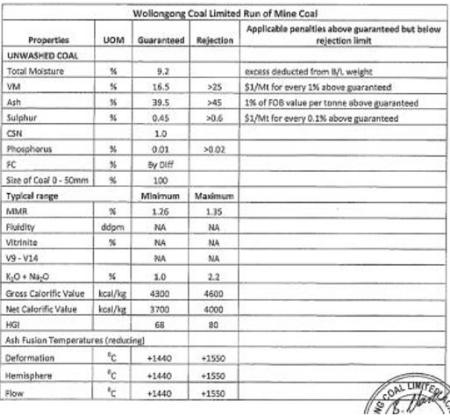
365 Penalties were said to apply where there is variation from particular specifications.
366 Mr Burns’ evidence is that in a typical international trade contract for the sale and supply of coking coal, the quality of coal is detailed by reference to a list of typical specifications, including those set out at [362] – [363] above. The different values for those specifications impact the price and utility of different coals.
367 Mr Sceats accepted that the CSAs could have been better expressed, but considered them commercially workable. He said that “quick and dirty” agreements and gaps in drafting are not unusual in the coal market and may preserve flexibility. However, he did not explain how the CSAs would operate if the parties failed to then agree upon the quality of a cargo. By contrast, Mr Burns explained that typical long-term agreements define the product through quality specifications and provide for price adjustments, rejection rights and other consequences for non-compliance. His opinion was supported by the other coal sale agreements in evidence before me. I therefore prefer Mr Burns' evidence on this issue.
368 Most of the variables identified at [362] above are used, in different ways, to determine the price and utility of coal. One of the price benchmarks upon which the Applicant relies, Platts, produces indices for ten Australian sources of hard coking coal which rely on at least CSR, volatile matter, total moisture, ash, sulphur, phosphorous and maximum fluidity.
369 Mr Burns’ evidence is that there are limited purchasers for unwashed coking coal due to its higher ash content.
370 While there is a limitation on reliance on different cases in the CISG context (not least because of the lack of detail in many of the cases about the precise circumstances of the case), there are nonetheless some instructive examples in the cases to which my attention was directed by the parties.
371 In the Pig Iron Case, there was a dispute over an agreement which provided:
From September 1996 onward the Seller will deliver 20,000 MT Basic Pig Iron and to be mutually agreed 10,000 MT either basic or foundry pig iron in lots of min 5,000 MT per month, price to be mutually agreed between parties, other terms and conditions as per this contract.
372 To the extent that the agreement was for “basic pig iron” it was considered to be only the price that was “not determined”, the goods, i.e. “basic pig iron” had been identified. The price was “to be mutually agreed”. The Arbitral Tribunal considered that according to Article 14(1) that should be regarded as a sufficiently definite proposal, constituting an offer. However, for the part of the agreement concerning “10,000 MT basic pig iron or foundry pig iron as to be mutually agreed, price to be mutually agreed as well”, the Arbitral Tribunal considered “it is not determined whether the subject matter is basic or foundry pig iron”. It concluded therefore that Article 14(1) of the CISG did not regard this as a sufficiently definite proposal, and it did not therefore constitute an offer. Because there was no offer, there was no acceptance of that part of the contract.
373 It is therefore not enough to simply identify even a small range of different goods: that fails to “indicate” the goods being sold. It is to be remembered that this is a contract for the sale of goods, not a contract for the sale of one of a series of options. What is not disclosed on the facts of the Pig Iron Case as reported is what was encompassed within the term “basic pig iron”, and whether it connotes a sufficient certainty of content to have an understood meaning. This generally renders the case of limited assistance to the present analysis. However, in the present case, the evidence discloses a substantial variety of purposes for different high ash coking coal, depending upon the nature of the product.
374 The evidence of Mr Burns was to the effect that specifications for the product being sold would be required to identify the product, even in long term agreements. Without the requisite specifications, he considered that it was not possible to know what was being sold. Moreover, the evidence supports the notion that in practice, specifications were exchanged on each occasion that coal actually changed hands (see for example the five transactions under the CSAs referred to at [174] and [207] – [214] above).
375 Mr Sceats gave contrary evidence. However, that evidence was not consistent with the evidence that was otherwise before me as to the circumstances in which coal was actually purchased and sold by the parties. I note that the expert evidence refers to the sale of branded coal. Branded coals have well-known quality specifications and are highly regarded as being reliable and consistent in quality, and so can be sold by specifying the coal as coal of that particular brand. The evidence in this case is that potential purchasers of Wongawilli and WCL coal generally sought specifications as a predecessor step to negotiating a price, suggesting it was not sold as a brand of coal.
376 In any event, given the Applicant’s contention that Wongawilli and WCL were required to sell coal from mines other than its own if they could not produce enough (see [139] – [140] above) this reinforces the need for specifications to identify the coal in question.
377 I therefore prefer the evidence of Mr Burns in relation to this issue. The mere reference to “high ash coking coal” or “unwashed coking coal” does not actually operate to indicate the goods being referred to in all of the circumstances of this case.
378 In the case of Bloom Lake General Partner Ltd. et al. v. Wordlink Resources Ltd (ICC International Court of Arbitration, Case No. 18209/VRO/AGF/ZF, 6 November 2014) (Bloom Lake), there was an agreement that one party would sell:
…7 million metric tons (WMT) of iron ore concentrate produced at the Bloom Lake Mine in Quebec (the "Material") every year for 7 years, starting from the commencement of commercial production at the Bloom Lake Mine.
379 The agreement included a pricing mechanism based on an annual benchmark pricing system. After the discontinuance of that system, a supplementary agreement was executed, replacing the pricing mechanism with a new mechanism, called the BLP Price Methodology, which was based on the Platts Steel Market Daily index pricing system (a published market-based index of various iron ore prices) (Bloom Lake at [2], [6]). This has obvious implications for the pricing issue to which I will return.
380 It is apparent that there were at least two aspects of the goods that were contractually stipulated that are important in that case:
(1) First, the minimum iron content of the material (being 66%). The contract provided for the “application of a penalty equal to twice the unit price per delivered metric ton of total cargo for each 1% [iron] below 66%” (Bloom Lake at [7]). It is thus clear that the contract in that case was not merely for “iron ore”, but for iron ore with a particularly specified content.
(2) Second, the iron ore had to come from the Bloom Lake mine in Quebec, as opposed to the construction of the CSAs advanced by UIL in this case which permits the coal to be sourced from anywhere.
381 In Bloom Lake, the Arbitral Tribunal looked to the substance of the agreement, and ignored those parts of the agreement which referred to it as a “distributor agreement” (at [82]). This approach illustrates the importance of considering the substance of the terms of the agreement over the use of any particular labels. However, it is critically distinguishable from this case, because the CSAs did not include any requirement that the unwashed, high ash coking coal have any particular specification, nor (on the Applicant’s construction) that it come from any particular mine.
382 The Applicant argued that "[p]recise specifications of the coal [was] not required for the goods to be sufficiently definite. The goods to be supplied are unwashed coking coal supplied by WCL and Wongawilli, respectively”. This argument sits uncomfortably with UIL’s simultaneous contention that the CSAs required each of WCL / Wongawilli to purchase high ash, unwashed coking coal if it was not produced by them. On such a construction, the Respondents could have supplied anything from anywhere that answered the description of high ash, unwashed coking coal. In that circumstance, the identity of WCL or Wongawilli as the vendor is not relevant to the identity of the coal and could not indicate anything about the likely specification of the goods.
383 The Applicant faintly relies upon clause 5 of the CSAs, which is said to establish a means of determining the quality of the coking coal through a third-party analysis. It provides:
5. QUALITY OF THE SAID MATERIALS
Quality of the said Materials shall be determined by any reputed independent surveyor, results to be final and binding for both parties, absent fraud or manifest error. The Seller shall bear and pay the aforesaid cost of quality inspection and report.
384 In other coal purchase agreements which led to the trading of coal between UIL and JSPL, a clause of this kind appears where specifications are included. It is evidently present where there is potential for dispute about whether those specifications have been met in what was actually shipped. It is consistent with a framework agreement that the process for resolving disputes about agreed specifications would be pre-arranged so that only the specifications need to be agreed – the process for resolving any dispute about whether they have been complied with in each transaction is specified in the overarching agreement. The specifications that were exchanged in various of the coal sales between the parties included (for example) penalties where moisture content was above a particular percentage.
385 Read in its overall context, clause 5 is concerned with determining whether the quality of the product meets the bargained for quality, rather than identifying that quality itself. That is consistent with a proper reading of clause 3, which contemplates that the quality of the coal will be a matter for negotiation, rather than imposed upon the parties.
386 Even assuming that the parties intended cargo-specific specifications to be agreed from time to time, clause 5 does not supply any objective mechanism by which specifications could be determined in the absence of agreement. It presupposes prior agreement as to the specifications. That does not itself cure the absence of agreed quality criteria.
387 On the Applicant’s construction, the parties had agreed to purchase 500,000 MT of high ash, unwashed coking coal from Wongawilli and WCL respectively, and that the quality of that coal could be of any kind – determined by the process in clause 5 – and that UIL would then pay the price determined by the use of an otherwise unidentified benchmark as part of a future negotiation.
388 However, in cross examination, Mr Gupta said that if quality (among other things) could not be determined, then there would be no shipment of coal. He did not refer to the use of clause 5 as a process for determining quality in the absence of agreement between the parties (see [308] below). This does not support the conclusion that the approach to clause 5 suggested by the Applicant is consistent with the parties’ intentions.
389 Mr Prasad gave similar evidence to the effect that for long term agreements, where production of coal had not yet taken place, specifications would be assessed once the coal was produced. He accepted that further negotiation would be required for each shipment after the quality became known.
390 Mr Burns gives evidence that without such specifications, a buyer would be uncertain of the type or quality of coal they are purchasing and would not be able to ascertain its suitability for particular uses, or its real value. His evidence was that:
Agreeing to a purchase contract without coal specifications is akin to purchasing a car without knowing what make, model, colour, size, or even propulsion type it may have and how much it will cost.
391 I find the analogy apt.
392 The evidence is that a diversity of products fall under the umbrella of “unwashed coking coal” or “high ash coking coal”. The goods have in common that they are coking coal, but their price, uses, and marketability are all heavily dependent upon their specifications.
393 It follows that in the circumstances of this particular coal, the general designation in the CSAs of “unwashed coking coal” or “high ash coking coal”, without even a minimum content of specifications being prescribed, is not sufficient to identify the goods being traded for the purposes of Article 14 of the CISG.
10.2 Is the price fixed or made determinable?
394 As will be apparent, there is some overlap between the analysis as to whether the goods were indicated, and whether the price was fixed or determinable. That is because the factors going to the variability of the price are connected in many ways to the variability within the category of “unwashed coking coal” or “high ash coking coal” that I have explained above. Because the price was related to the specifications of the coal, and those specifications were variable and not the subject of any meaningful control in the CSAs, the price was likewise variable and unable to be identified either implicitly or explicitly.
395 The Applicant relies upon clause 4.1 of the CSAs, which provides that:
The per metric tonne of the said Materials sold shall be as decided by the parties from time to time based on the then prevailing market prices, the quality of the said Materials and the shipping;
396 This is said to be a clause of a kind contemplated by Article 14(1) of the CISG. It is submitted by the Applicant that this clause makes the price “determinable” at the time of delivery of the goods and that is sufficient to satisfy Article 14(1).
397 The Applicant relies on certain cases to make good the proposition that providing for future negotiation as to price is sufficient to make the price determinable under Article 14(1). All such cases are fact dependent, and many are only reported with scant detail as to the circumstances surrounding the relevant contract, and the nature of the goods. However, a few observations may nonetheless be made:
(1) In Bloom Lake (referred to at [378] above), the Consolidated Agreement (and particularly the Annex to the Supplemental Agreement) specified a pricing mechanism which was based on a specific published benchmark pricing systems (first the VALE annual published benchmark price, and later the Platts Steel Market Daily index). It is critical in that case that there was a mechanism for the determination of the price, beyond an exhortation to a future negotiation which is necessarily uncertain in outcome. The Arbitral Tribunal in that case accepted that the parties were aware of the way that the pricing mechanism operated, and that they had acknowledged by their conduct that it was “contractually applicable for establishing the purchase price for the Material” (at [86]).
(2) In the Sour cherries case I, District Court Neubrandenburg (Germany), (10 O 74/04, CISG-online 1190, 3 August 2005) (Sour Cherries Case), one party had sent another a letter confirming a prior oral agreement for the sale and purchase of 400,000 jars of pitted sour cherries at a price “to be fixed during the season”. A dispute arose as to whether this price was fixed or determinable for the purposes of Article 14(1) of the CISG. The Court held that it was determinable. In that case. the Court noted that sour cherries are typical seasonal goods, the prices for which are typically determined on a season-by season basis (at [53]). While there is little detail regarding this finding, the Court also concluded that by their conduct, the parties evinced an intention that the price “to be fixed during the season” meant the seller’s seasonal price for the year 2003 (at [51]). Thus the concept of price was, on the facts of that case, determinable by reference to that metric. The case is useful as a counterpoint to the present case: pitted sour cherries are a seasonal product sold in a large number of circumstances, without a substantial number of specifications that change the nature and utility of that product. It may be contrasted with high ash, unwashed coking coal which on the evidence before me diverges significantly in terms of use, price and saleability, depending on the content of various specifications. In addition to all of those matters, the evidence does not support a conclusion of the kind that was reached in the Sour Cherries Case, i.e. that the parties meant that the price would be fixed at or around the seasonal or market price for any relevant year, or a particular benchmark.
(3) In Fauba France v Fujitsu Mikroelektronik, Cour d'appel de Paris (15th ch.), CLOUT Case 158, CISG-online 222, 22 April 1992, a French buyer ordered several batches of electrical components from a German seller. The buyer had accepted the price stated by the supplier, but requested that it be reduced if the market price dropped. The seller agreed that the price could be adjusted upwards or downwards, depending on market fluctuations. The buyer then changed its order several times, and a dispute arose. The Court concluded that the price was not rendered indeterminable for the purposes of Article 14(1). The full reasoning is not available. However, that case included actual prices for actual products as a starting point. The way in which the contractual relationship dealt with variations to those matters in the context of contractually permissible negotiations is a different matter. In addition, the complexity of pricing in this case, and the existence of a broader market in that case, provide an ample basis to distinguish it from the present analysis.
(4) In the Pig Iron Case, an agreement for the sale of 10,000 MT of basic pig iron “at a price to be mutually agreed” was held to provide for determination of the price in accordance with Article 14(1) of the CISG. However, as noted at [372] – [373] above, that case is generally lacking in relevant detail and is therefore, of limited assistance. The Applicant seeks to rely upon it in the context of definiteness as to price, to suggest that evidence that transactions proceeded under an agreement without any dispute as to price should be taken as evidence that price was determinable. It is not clear in that case that subsequent conduct and partial performance was part of the analysis in relation to determination of price. Even if that were not so, in this case the five transactions said to have been made under or pursuant to the CSAs all proceeded on a “pass through” basis, and each had a separate contract for the sale of the goods in question. They do not assist the Applicant to suggest that the pricing provision in the CSAs operated to identify a price for the purpose of those transactions. On the contrary, the five transactions are consistent with the Respondents’ case that the CSAs were umbrella or framework agreements which formed the basis of a commercial relationship within which other transactions could be more conveniently concluded.
398 Of the academic commentary on this issue, Schwenzer opines that contract clauses referring to the price currently charged by the seller will satisfy Article 14 (Schroeter UG, “Formation of Contract” in Schwenzer at p 338), and suggests that offers that fix the price or make provision for its initial determination, but furthermore provide for the price to be automatically adjusted or reviewed by or renegotiated between the parties at a later time, meet the requirements of Article 14(1) (Schroeter UG, “Formation of Contract” in Schwenzer at p 339). The present case does not concern a clause of that kind. Clause 4.1 of the CSAs does no more than identify factors relevant to future negotiations concerning price. Market price is one of the factors to be considered in future negotiations. It can be distinguished from those cases in which the “market price” or a particular benchmark is specified as the price. It is relevant to this conclusion that the same parties had previously agreed to a coal sale agreement which did specify a benchmark (the JSPL Offtake Agreement). The fact that the parties could, and in the past had, specified a specific benchmark, which was omitted in the CSAs, is a matter which tells against the Applicant’s construction in this case. The JSPL Offtake Agreement contemplated coal from mines other than those operated by the Respondents. In that situation, the JSPL Offtake Agreement stipulated that price was to be “mutually agreed between the parties”. It is said by the Applicant that if the JSPL Offtake Agreement was regarded by the parties as binding, then so too must the CSAs be binding. That is not the case. The fact is that the operative clause of the JSPL Offtake Agreement did contain a clear pricing mechanism. It is not an issue for resolution before this Court whether a hypothetical transaction relying upon the fallback provision for the sale of coal of unknown provenance would have been binding.
399 Clause 4.1 does not provide a criterion by which a price emerges if the parties fail to agree in the negotiation. Market price, quality and shipping are identified as relevant considerations, but no weighting, benchmark, formula, hierarchy or dispute-resolution mechanism is provided. The clause therefore identifies topics for negotiation by the parties, not a process or mechanism by which a price will actually be determined in the absence of another, subsequent agreement.
400 For the identification of the market price as part of this mechanism, the Applicant relied on the evidence of Mr Sceats. Mr Sceats’ evidence covered a range of topics. Insofar as it concerned the identification of a price for the coal to be sold under the CSAs, the Applicant relied upon it to assert that the price was readily ascertainable. However, there are a number of matters which I consider render Mr Sceats’ conclusions unsafe:
(1) First: Mr Sceats assumes that the coal under consideration is coal produced by the Russell Vale Colliery and the Wongawilli Colliery, despite the Applicant’s case proceeding on the basis that the CSAs were not necessarily tied to coal produced from those mines (see [139] – [140] above). This means that some of the assumptions underpinning Mr Sceats’ analysis are not consistent with the Applicant’s case or established on the evidence. It undermines the reliability of Mr Sceats’ opinions more broadly.
(2) Second: Mr Sceats uses Platts coal price reporting for all Australian Metallurgical Coal Grades for the period of 9 May 2013 to 25 August 2023 to identify a benchmark price. That data covers a number of different coal grades. Mr Sceats asserts there is only a small variation (on average 3.3%) between the prices across these grades over the period they are published. Mr Sceats appears to temper the average “All Platts” price (All Platts Price) by applying a uniform discount of 55%. The methodology adopted by Mr Sceats adopts that discount as a “conservative” measure, based (in part) on two offtake agreements between the parties that operated in 2013. While I accept that it is a conservative measure, which might be relevant to the identification of a conservative market price, it is not market price which the parties agreed that they would apply. Market price was one of the inputs into a foreshadowed negotiation in relation to price. Moreover, Mr Sceats places substantial reliance upon only two offtake agreements both dated July 2013 to identify the discount. This is a very small data set from which to draw such sweeping conclusions. Moreover, as I have already discussed, the fact that those agreements identified a benchmark and methodology for price determination is to be contrasted with the drafting choices made in the CSA, not included by unstated implication.
(3) Third: Mr Sceats is asked to opine on the price that WCL, Wongawilli and UIL would “have agreed for the supply of the outstanding quantity of 824,140 MT of Coking Coal” under the CSAs for the period 9 May 2014 to 8 May 2015. He applies the average All Platts Price, discounted by the figure identified, being 55%, to account for the difference between unwashed and washed coking coal and then asserts that the purchase price would be “$58.64”. This process is then undertaken for 30 years based on “the life of the mines”. There are a number of difficulties with this approach:
(a) The 55% figure is applied to explain the difference between unwashed and washed coking coal. However as noted above, while I accept that it is a “conservative” discount, I do not consider it was derived based on a broad or reliable methodology. It is therefore not clear why the parties would have adopted it at the time that they were applying clause 4.1 of the CSAs.
(b) For the reasons that I have already explained, Mr Sceats’ assumption that the contracts were to be on foot for 30 years (being the mine life) has not been established. This is a part of his analysis which is therefore unsupported.
(c) I accept the Respondents’ criticism of Mr Sceats’ analysis that there has not been any attempt to account for JSPL’s rights and requirements – proceeding on the basis that after the first year, all of the coal would have been available to UIL without restriction. UIL asserts that the Respondents did not produce any evidence in chief as to what volume of coal was required by JSPL at various times so that this approach was appropriate. The only evidence as to JSPL’s operational requirements was given by Mr Prasad on the basis of discussions with Mr Bhatia. As I have explained at [160] above, I considered Mr Prasad’s evidence about this issue to be unreliable. Even so, the contractual entitlement plainly existed (and is not relevantly contested) and so not accounting for it is an unacceptable omission in the circumstances of this case.
401 I therefore do not accept the methodology of Mr Sceats to identify what the parties “would have agreed” as the price. His methodology was not derived from the contractual text or any shared understanding of the parties. Rather, it represented his own reconstruction. That reconstruction is the core basis by which the Applicant seeks to demonstrate the workability of clause 4.1. Given the flaws in the methodology and the lack of support for the reconstruction on the facts of this case, I do not accept that the Applicant has established that clause 4.1 contained a mechanism capable of determining the price under Article 14(1) of the CISG.
402 That view is fortified by the approach taken by the parties in other agreements. In the 2013 CPA, a price was specified per metric tonne. Further, in the JSPL Offtake Agreement, a specific formula was provided and agreed.
403 The experts reviewed roughly 45 cargoes of coal produced at the Russell Vale and Wongawilli Collieries. A review of the sale prices actually achieved for that coal shows a variation of selling price of US$/MT between $14.00 and $125.00. This is consistent with the evidence of Mr Burns which is to the effect that while the coal produced at the Russell Vale and Wongawilli Collieries is mostly similar, it has in fact achieved differing price outcomes due to differences in the content of particular specifications (namely ash, sulphur and CSN). Mr Burns’ evidence, which I accept, is that the quality of the coal to be sold will affect its price. This opinion is supported by the contemporaneous correspondence which required confirmation of the specifications of the coal prior to any order being placed (see for example [66] – [67] and [154] – [155] above). In addition, the range of prices achieved for coal produced by the same mine (noted in Mr Burns’ report) operates to reinforce the significance of specifications in the process of identifying a price. It fortifies my view that a single ascertainable figure cannot be identified as part of any pricing mechanism provided by clause 4.1.
404 Moreover, Platts (or any other benchmark) could have been selected by the parties if they chose to indicate a price, or even a basis for the determination of a price that would link to a concluded transaction. However, they did not do so. To impose it by the side wind of what the parties would have negotiated goes beyond what the text of the CSAs allow, even when interpreted in accordance with Article 8 of the CISG.
405 The evidence of Mr Gupta (summarised at [308] above) is consistent with the conclusion that negotiations as to price and specification were required prior to each shipment, and that without such negotiations, there would be no shipment. That evidence is inconsistent with the existence of a mechanism capable of identifying price without requiring a further agreement.
406 Accordingly, I do not consider that the price is relevantly identified for the purposes of Article 14(1) of the CISG. I have considered whether this position is altered by Article 55. In addition to the factors that I have identified above, I do not consider that it is, because:
(1) The evidence does not establish that there was a price generally charged at the time of the conclusion of the CSAs for such goods sold under comparable circumstances, given the variabilities in product specifications to which I have referred.
(2) On the evidence before me, the Applicant has not established the existence of a price generally charged at the time that the contract was concluded for goods sold in comparable circumstances. In particular, it is not clear whether the transactions relied upon involved goods that were actually sold under comparable circumstances, and the evidence makes clear that there is significant price variability based on differing specifications.
407 As a result, Article 55 does not operate to cure the lack of price or a pricing mechanism in the CSAs. It is not simply that prices varied, but that the evidence does not support the conclusion that there was a commonly accepted price for coal of the kind contemplated by the CSAs from which a contractual price could be identified via Article 55. Thus, the price was not identified nor was it made determinable at a future time.
408 I accept the Respondents’ submission that in the context of the overall circumstances of this case, including the lack of a reference to an applicable benchmark (either explicit or implicit), the lack of any pricing mechanism, and the reference only to negotiation by reference to certain matters, the CSAs do not fix or make provision for determining the price pursuant to Article 14(1) of the CISG.
409 Even if the quality of the goods were identifiable, I do not think that the evidence supports the conclusion that a price was fixed or determinable for the purposes of Article 14(1). That is because of the lack of an identifiable pricing benchmark, the mechanism itself renders the process relevantly uncertain in the manner that I have identified above. However it is difficult to speculate about this analysis because the quality of the coal is not specified.
10.3 Is the quantity fixed or made determinable?
410 The question of whether the CSAs impose an obligation upon WCL and Wongawilli to supply 500,000 MT (+/- 10%) of high ash, unwashed coking coal per annum is relevant to the question of whether the CSAs fix or make provision for determining the quantity of goods to be sold in accordance with Article 14(1) of the CISG.
411 Given my conclusions as to validity as it relates to price and the goods, it is not necessary to carry out this analysis here. However, I note that my conclusions in relation to the construction of the CSAs explained above, would apply to this issue if it were necessary to do so.
10.4 Conclusions as to validity
412 For the reasons that I have set out above, I have concluded that the terms of the CSAs are not sufficiently definite to result in a valid offer capable of acceptance pursuant to Article 14 of the CISG. That is because they fail to meet the requirements in Article 14(1) in relation to the identification of the goods and their price. Accordingly, the CSAs do not constitute binding and enforceable contracts of sale of goods under the CISG.
413 If I am wrong as to the operation of the CISG, and the issue of validity is to instead be determined by the common law, then the position would be the same. Indeed at common law the position is much clearer and more easily identifiable. A contract in that context is uncertain where it leaves undetermined one of the terms which the law requires specifically to be agreed in order for the contract to be valid and enforceable. It may also be that a contract is uncertain because one of the essential terms is so vague as to be relevantly meaningless.
414 The principles were helpfully summarised in Mushroom Composters Pty Ltd v IS & DE Robertson Pty Ltd [2015] NSWCA 1 at [59] – [64] (Sackville AJA, Macfarlan and Gleeson JJA agreeing) including the observation (at [63]) that:
If the parties have not agreed on all essential terms, for example because they have left one such term to be settled by future agreement, the contract is incomplete no matter what the parties themselves may think: G. Scammell and Nephew Ltd v H.C. and J.G. Ouston [1941] AC 251 at 260 (Lord Russell of Killowen); O’Brien v Dawson [1942] HCA 8; 66 CLR 18 at 37 (Willams J, Rich J agreeing); Toyota Motor Corporation Australia Ltd v Ken Morgan Motors Pty Ltd [1994] 2 VR 106 at 170 (Tadgell J); Australian Securities and Investments Commission v Fortescue Metals Group Ltd [2011] FCAFC 19; 190 FCR 364 at [123]-[124] (Keane CJ); at [212] (Emmett J); at [223]-[227] (Finkelstein J) (an appeal to the High Court was allowed, but not on this point: Forrest v Australian Securities and Investments Commission [2012] HCA 39; 247 CLR 486).
415 In Australian Securities and Investments Commission v Fortescue Metals Group Ltd [2011] FCAFC 19; 190 FCR 364, Keane CJ (Emmett and Finkelstein JJ agreeing) recited many of the well-known authorities relevant to the issue (at [121] – [123]):
[121] A consideration of these arguments must begin with the proposition that a mere agreement to agree is not legally enforceable: Thorby v Goldberg (1964) 112 CLR 597 ;(2011) 274 ALR 731 at 770; Booker Industries Pty Ltd v Wilson Parking (Qld) Pty Ltd (1982) 149 CLR 600. An agreement to negotiate, unless clearly and unequivocally expressed, is rarely viewed differently: see Coal Cliff Collieries Pty Ltd v Sijehama Pty Ltd (1991) 24 NSWLR 1.
[122] It is well established that the courts strive to uphold bargains: Hillas & Company Ltd v Arcos Ltd [1932] All ER Rep 494. To that end, the courts will construe the terms of an agreement with an inclination to give effect to the intention of the parties, even if that intention has been obscurely expressed: Australian Goldfields NL (in liq) v North Australian Diamonds NL [2009] WASCA 98, esp at [6]–[8]. Further, the courts may, where circumstances permit, apply objective standards of reasonableness to prevent the intention of the parties being defeated. And where the want of an express provision in an agreement can be supplied by implying a term in order to give efficacy to the bargain, the courts will make the necessary implication: Electricity Corporation of New Zealand Ltd v Fletcher Challenge Energy Ltd [2002] 2 NZLR 433 at [64]–[67]; Moffatt Property Development Group Pty Ltd v Hebron Park Pty Ltd [2009] QCA 60.
[123] But where the parties have not agreed upon the content of essential terms and have not agreed upon the application of an objective standard to measure their obligations or to provide a mechanism to fix the content of essential terms (as by third party determination), it is no business of the courts to foist upon the parties a bargain which they have not made. The trial judge referred to the decision of the Court of Appeal in England in Pagnan SpA v Feed Products Ltd [1987] 2 Lloyd’s Rep 601 as supporting the proposition that a legally enforceable agreement may be made even where issues as to price and quantity of subject matter had not been agreed (at [294]). In this regard, his Honour erred. In Pagnan, price and subject matter had been agreed.
416 In Forrest v Australian Securities and Investments Commission [2012] HCA 39; 247 CLR 486, the High Court overturned this decision in relation to another issue. In doing so, it expressed what might be called doubts about the conclusion reached in that case in relation to the question of whether the contracts were binding (Forrest at [93] (Heydon J)). However, the general principles identified are not in dispute.
417 In Fortescue Metals, Finkelstein J considered it unnecessary to rule on whether the framework agreements created binding obligations in that case (at [220]) but did consider the “problem of incompleteness [that] arises when the parties have left an aspect of their bargain for later agreement” (at [224]). Noting that a contract to negotiate in good faith can in some circumstances result in a binding agreement, his Honour nonetheless said (at [225]):
Imposing an obligation (whether expressly or by implication) to negotiate open terms will not overcome all cases of incompleteness. It will not, for example, deal with the problem created where parties have not agreed on the important (some might say the essential) terms of their bargain. A good faith obligation to negotiate cannot make a fatally incomplete contract valid and enforceable.
418 His Honour considered that the nature of the contract was relevant to his analysis, noting (at [226] – [228]):
[226] The projects contemplated by the agreements were, on any view, complex multi-million dollar projects. The construction of port facilities would likely cost in excess of $1 billion. The construction of a railway line would cost around $1 billion. The construction of mines would cost several hundreds of millions of dollars. Yet almost nothing was agreed about the nature and extent of those projects. One would expect that it would require significant time, effort and expertise to resolve these matters and arrive at the appropriate terms.
[227] One missing element of each agreement is the price to be paid for the works. In construction contracts the price is of fundamental importance. If it is not agreed, or there is no agreed method of ascertaining it, there can be no bargain.
[228] The reason no price was agreed is the inevitable consequence of another major omission: the scope of the works were barely described, let alone defined. One agreement contemplates the construction of a railway line which would likely be several hundred kilometres in length. But the parties had not turned their mind to its type, design, or even the route over which the line would run. Each difference would carry a different cost structure. Another agreement contemplates the construction of a port. Yet there is no specification of the precise location, size or configuration of the port. Once again the cost differences for the various possibilities would be significant. Then there is the agreement for the construction of the mines. How many mines, of what type and where were they to be located? None of these issues had been worked out.
419 A similar issue arises in this case: the Applicant asserts that the parties agreed a binding multi-million dollar contract for the sale of coal over a 30 year period (without an entitlement to terminate at will, even on notice) but failed to identify the specifications of the goods that were being sold (and thus, their value, use or marketability) or their price, or a mechanism for identifying the price. It therefore cannot be cured simply by good faith negotiation. The nature, scope and complexity of the agreement alleged by UIL is inconsistent with the notion that the terms can be left on such an unclear basis as is apparent occurred in this case but remain binding.
420 The analysis as to the proper construction of the CSAs under common law which underpins this conclusion is relevantly the same as that set out above in relation to the CISG, save that to the extent that evidence of the subjective intention of the parties and other extrinsic evidence was included as part of that analysis, it is not a part of a common law analysis. I do not consider that the exclusion of any consideration of the subjective intention of the parties alters the analysis which I have set out in relation to the operation of the terms.
421 I am therefore satisfied that the CSAs were not binding agreements under either the common law or the CISG. They are therefore not enforceable in the manner asserted by the Applicant.
11. ESTOPPEL
422 The Applicant asserts that the Respondents are estopped from denying that the CSAs were valid and binding.
423 The Applicant asserts that at all relevant times, UIL assumed that the CSAs were valid and binding (the Assumption). It is said that the Respondents induced UIL to adopt the Assumption, and that UIL then acted in reliance upon it. This is said to be based on the evidence of Mr Prasad that he believed at all times that UIL had binding contracts with WCL and Wongawilli, that they were valid and active, and that WCL and Wongawilli had entered into agreements to sell UIL 1 million MT of coking coal per annum, and that he expected that they would perform those agreements. Mr Gupta gave evidence to similar effect.
424 As a preliminary issue, the Assumption pleaded does not take the issue very far. It is not the fact that the Applicant considered that it had a valid and binding agreement vis a vis WCL and Wongawilli, it is whether it had a valid and binding agreement of the kind that they seek to enforce in the proceeding.
11.1 Did UIL make the Assumption?
425 I do not consider that the evidence supports the conclusion that UIL subjectively believed that the CSAs compelled the provision of 1 million MT of unwashed coking coal per year for 30 years from any mine, even if Wongawilli or WCL did not produce sufficient coal. In particular:
(1) The evidence of each of Mr Prasad and Mr Gupta is clear that they understood that negotiations as to quality, quantity and price were required for each shipment, and, so far as Mr Gupta was concerned, that there would be no shipment without a successful conclusion to those negotiations (see [307] – [308] above).
(2) The evidence of Mr Gupta that he could not identify a specific index for high ash, unwashed coking coal undermines the contention that there was an index or benchmark that was well known such that it should be taken to have been understood as being referred to in the pricing provision of the CSAs, even in the absence of any express reference to it in the agreement, or the surrounding documents.
(3) There was a lack of express negotiation between the parties as to the term of the agreement when altering the draft CSAs from an explicit 12 month period. In light of the difficulties in negotiation, I consider it extremely unlikely that the alteration was intended to result in a change of the kind for which UIL contends.
(4) The reference to 500,000 MT of high ash, unwashed coking coal in each CSA was included without express negotiation as to that quantity (see [131] – [136] above). I consider it unlikely that these references reflected or were relied upon by UIL as guaranteed or fixed quantities given the lack of negotiation and evident distrust between the parties in the context of their ongoing dispute.
426 That is different from the belief that there was a commercial relationship in place. However, in the event I am mistaken as to this conclusion, and proceeding on the basis that the Assumption was in place, the question that arises is whether UIL’s Assumption was induced by the Respondents.
11.2 Was the Assumption Induced by the Respondents?
427 I do not accept that negotiating and entering into the CSAs either alone or in combination with the negotiations and entry into the Settlement Documents involved inducing the Assumption. That conclusion follows from the analysis of the terms of those agreements set out above, being that:
(1) The CSAs did not, in fact, impose the obligations for which UIL contends.
(2) There are no specific representations or conduct identified (beyond the terms of the agreements themselves) as giving rise to the Assumption. It is not sufficient to refer to the negotiations compendiously.
428 Even assuming that UIL adopted the Assumption, I am not satisfied that the Respondents induced the Assumption. For the reasons already given, the contemporaneous communications and transactional documents reveal continuing contemplation that matters of quantity, quality, pricing and shipment would require subsequent agreement. In those circumstances, I am not satisfied that the Respondents conveyed to UIL that the obligations now alleged had already been fixed in the manner contended by UIL.
11.3 Reliance
429 Each of the parties were well advised in their negotiations and there is no evidence of time pressure being applied by the Respondents. I consider that both parties had every opportunity to consider the effect of the draft agreements and to seek clarification.
430 As I have explained in the course of construing each of the agreements in question, I do not accept that the draft CSAs actually imposed the obligation for Wongawilli and WCL to supply coking coal in the manner alleged by the Applicant. It follows that even if the Assumption was made, I do not accept as a matter of evidence that the Applicant relied on the Assumption.
431 I am not satisfied that the Assumption was an operative or substantial cause of UIL’s conduct now relied upon as detrimental. The evidence demonstrates that UIL entered into the Settlement Documents for a range of commercial reasons, including the resolution of the dispute in relation to the Advance Payment, and the prospect of an ongoing commercial relationship with JSPL.
432 This view is fortified by my conclusion (expressed at [141] and [147] – [148] above) that there was a substantial level of distrust between the parties at the time that the CSAs were entered into. This makes it less likely, in my view, that the Applicant was simply relying upon any representations made by the Respondents. This also significantly undermines the notion that there was relevant unconscionability. Both parties were well represented, resourced, skilful and resourceful in commercial dealings. I do not consider that there was relevant reliance on the Assumption, or relevant unconscionability.
11.4 Other issues with the estoppel claim
433 It is said that in reliance on the Assumption, and to its detriment, UIL agreed to release its rights under the UIL Agreements and discontinue the Winding Up Proceeding. Mr Prasad and Mr Gupta gave evidence that UIL was otherwise on the verge of winding up WCL to settle the claim. It is said that the decision to redeem the shares in UIL and to convert the debt into equity was made in combination with the entry into the CSAs and the MOU with JSPL, and that UIL’s rights would otherwise not have been given up. This proposition does not sit easily with the obvious challenges in recovering an amount of that size from a company in liquidation who may (and on the evidence did) have other creditors who could have impeded recovery of the amount that UIL obtained.
434 In those circumstances and having regard to the parties' dealings as a whole, I am not persuaded that it would be unconscionable for the Respondents to deny the existence of the Assumption alleged by UIL.
435 The estoppel claim therefore does not succeed.
12. ADDITIONAL AND ALTERNATIVE ISSUES
436 The above analysis is sufficient to dispose of the contractual claim advanced by the Applicant. I am mindful however of the following comments of the majority (French CJ, Kiefel, Bell, Keane and Nettle JJ) of the High Court in Prince Alfred College Inc v ADC [2016] HCA 37; 258 CLR 134 at [113] (citations omitted):
It is a matter of long-standing practice in most trial courts that, where possible, all issues be the subject of adjudication. The practice is based upon the desirability of avoiding the need for a new trial in the event that an appeal on one issue is successful. However, as has been observed, it is no more than a rule of convenience. It is not something which should invariably be done without consideration of the appropriateness of that course of action in the circumstances of the case.
437 For the reasons that I have explained above, I have decided that the CISG applies to this dispute, and have construed the relevant agreements in accordance with that conclusion. It would be overly hypothetical to engage with all of the issues going to breach and damages that would arise in different ways had I construed the contracts differently. However, it is nonetheless useful to make some comments about issues relating to termination and damages, being issues that would only arise if I were wrong on all aspects of my analysis of the operation of the CSAs.
12.1 Term and Termination
438 If the CSAs were binding agreements requiring the provision of 500,000 MT of high ash, unwashed coking coal per annum, the Respondents assert that this obligation only extended for a 12 month period, and that there was a right to terminate, which would have been exercised.
439 I consider that clause 2.1 is properly understood as a termination clause (see the analysis at [325] – [326] above). That conclusion is reinforced by certain circumstances of the case that may be considered pursuant to Article 8 of the CISG, being the fact that clause 2.1 of the CSAs originally provided for a term of 12 months, but was amended so that this term was removed and the truncated clause 2.1 took its place. Again, without any express negotiation, it is unlikely in the extreme that the parties intended to remove the 12 month period and replace it with a 30 year (or indefinite) period without the right of termination apparent on the face of clause 2.1.
440 I accept the evidence of Mr Bhatia that he understood that there would be a right to terminate the CSAs without cause.
441 Accepting therefore that termination was possible on written notice, I accept the evidence of Mr Sharma that he would have recommended termination of the CSAs to WCL’s board of directors if the CSAs were binding in the manner which the Applicant alleges. In this respect his evidence was clear and unequivocal and not relevantly shaken in cross examination. It is consistent with, and fortified by, the difficulties that Wongawilli and WCL were having with their mines in the relevant period. There is force in the Applicant’s submission that Mr Sharma was not the ultimate decision maker, and that in the absence of evidence from the person with authority to terminate, either no inference should be drawn in the Respondents’ favour, or an adverse inference should be drawn. However, it is not Mr Sharma’s evidence alone that supports the conclusion that there would have been termination. I have found as a matter of fact that the Respondents did not intend to enter into binding contracts of the kind for which the Applicant now contends (see [311], [319] – [320] above) and that the mines were experiencing significant operational difficulties (for example see [85] and [106] above). It is consistent with the logic of those conclusions that, had the company understood that it had entered such contracts, it would have utilised the termination clause available to it.
442 I therefore consider that there was a termination clause in the CSAs. In the Wongawilli CSA that termination entitlement required 3 months’ notice, and I infer the same period into the WCL CSA, given the similarity between the agreements.
443 The Applicant asserts that the coal could have been supplied (because even if the mines did not produce the asserted required volumes, it could have been sourced from elsewhere) and there was therefore no basis for the Respondents, acting in good faith, to terminate the CSAs. It relies on Article 7(1) and (2) of the CISG to argue that the obligation of “good faith in international trade” (referred to in Article 7(1)) means that the Respondents could not terminate in the circumstances in which they found themselves, even when the mine had serious difficulties in producing coal. However, Schwenzer argues that the maxim of “observance of good faith in international trade” under Article 7(1) concerns the interpretation of the CISG only, and cannot be applied to individual contracts (Hachem P, “General Provisions” in Schwenzer at pp 142 – 143, and the commentary and cases cited at footnote 47). Thus, while the good faith obligation may operate on the obligation to mitigate loss under Article 77, it does not create a free-standing contractual obligation between the parties that does not otherwise arise under the CISG (see Hachem P, “General Provisions” in Schwenzer at pp 142 – 145).
444 Even if that were not so, I do not accept that the effect of the CSAs not specifying any period for the operation of the agreements means that they were ongoing, and only able to be terminated “if circumstances made it untenable” to continue with them. Moreover, the Applicant relies upon the “lengthy anticipated lifespan” of the mines to support the notion that the CSAs were intended to be ongoing for a long period – while simultaneously asserting that difficulties in coal production were not relevant because the Respondents could source the coal elsewhere. There is a tension between these two propositions: on the one hand linking the length of the contractual obligation to the life of the mines, and on the other, asserting that mine production was irrelevant to the obligation to provide the coal.
445 These matters reinforce the notion that the CSAs permitted termination by notice, the exercise of which was not otherwise prevented by an obligation of good faith.
446 Had it been necessary to determine the question, I would have concluded that the termination clause would have been exercised expeditiously, by August 2014 for the Wongawilli CSA (when the mine was transitioned into care and maintenance) and 19 November 2014 for the WCL CSA (when the Russell Vale Colliery project approval was modified).
12.2 Damages
447 Because I have determined that the CISG applies, any determination of damages would have been assessed under that instrument. Under Article 45(1)(b), if the seller fails to perform any of their obligations under a contract or the CISG, the buyer may claim damages as provided in Articles 74 – 77. Article 74 relevantly provides:
Damages for breach of contract by one party consist of a sum equal to the loss, including loss of profit, suffered by the other party as a consequence of the breach. Such damages may not exceed the loss which the party in breach foresaw or ought to have foreseen at the time of the conclusion of the contract, in the light of the facts and matters of which he then knew or ought to have known, as a possible consequence of the breach of contract.
448 The Respondents assert that the general words of Article 74 reflect an attempt to grapple with what in Australian law are known as the concepts of causation, consequential loss and remoteness of damage (citing Heydon at p 382). In Downs Investments Pty Ltd v Perwaja Steel SDN BHD [2001] QCA 433; [2002] Qd R 462, Williams JA said (at [48]):
Article 74 reflects the common law derived from Robinson v. Harman (1848)1 Ex. 850; 154 E.R. 363 and Hadley v. Baxendale (1854) 9 Ex. 341; 156 E.R. 145. As a basic proposition a party is entitled to recover no more than the nett benefit that it would have received had the contract been performed.
449 Because of my findings that the CSAs were capable of termination, and would have been terminated, there could be no damages after three months from the time that the CSAs would have been terminated. It is not now necessary to quantify damages until the expiry of those three months, however, for the sake of completeness, I note that:
(1) For the reasons explained at [336] – [341] above, I consider that the JSPL Purchase Agreement and the CSAs were to be read together, and that when read in that way, they were intended to operate as a “pass through” with no entitlement to a profit. While the parties were free to use their existing commercial relationship to more seamlessly enter into agreements for the supply of coal which could have entitled UIL to generate a profit, this was not a requirement of the arrangement.
(2) I do not accept the evidence as to the likelihood of calculations based on “churn”. There was a lack of contemporaneous evidence suggesting that the Applicant engaged in that practice. Mr Prasad was cross examined about the history of churn trading at UIL, and accepted that UIL had not previously engaged in churn trading in coal. I consider that evidence as to future churn trading is generally speculative and I do not accept it was UIL’s likely approach to trading coal.
(3) I have found that there was no generally applicable and accepted market price or index for high ash, unwashed coking coal which can be used to determine the price that UIL would have obtained if it had purchased unwashed coking coal had the CSAs been effective.
450 Accordingly, even if I accepted that the CSAs were binding in the manner suggested by UIL, I consider that they were capable of termination on notice, and as stated at [446] above, had it been necessary I would have concluded that the Wongawilli CSA and the WCL CSA would have been terminated by August and 19 November 2014 respectively. Assuming matters of breach in UIL’s favour, this would have led to a relatively short period of non-performance of the contract.
451 I turn next to consider the Applicant’s misleading or deceptive conduct claim.
13. DID THE RESPONDENTS ENGAGE IN MISLEADING OR DECEPTIVE CONDUCT?
452 The making of a statement as to a presently existing state of affairs, if false, may mean a party has engaged in misleading or deceptive conduct where that statement is embodied as a provision of a contract. It has been acknowledged by French CJ in Campbell v Backoffice Investments Pty Ltd [2009] HCA 25; 238 CLR 304 (at [35]) that:
Whether the proffering of a contractual document containing a false statement amounts to a misrepresentation or to misleading or deceptive conduct, is a matter of fact to be determined by reference to all the circumstances.
453 It is common ground that it is only in certain circumstances that contractual promises will carry representations as to fact or conduct which is otherwise actionable under s 18 of the ACL (Futuretronics International Pty Ltd v Gadzhis [1992] 2 VR 217 at 239 (Ormiston J)):
In my opinion the mere acceptance of the promise by a promisee cannot ordinarily be characterised as being led into error. In the usual case the consequence would be that the promisee has enforceable rights. It is hard to believe that normally any promisee with ordinary contractual rights would then describe himself as having been deceived or misled. It is only when it becomes apparent that the promise cannot be enforced, because, for example, it is either unenforceable or the promisee’s rights are valueless or diminished, that one may return to the original promise to inquire whether that promise was of so little substance that it can be concluded that the promisee was indeed misled or deceived in the first place, at the time of his acceptance of the promise. Thus it may then be seen that the promisor originally had no intention to perform his promise or that he originally had no capacity or ability to perform it.
454 In Coles Supermarkets Australia Pty Ltd v FKP Limited [2008] FCA 1915 (at [69], citing Futuretronics), Gordon J concluded that:
an express contractual promise or representation will constitute an actionable implied representation under s 52 of the TPA only if the party making the promise or representation had no intention or capability of carrying it out at the time it was made (ie the promisor had no reasonable grounds for making the promise). The questions which then arise are (1) what is the contractual promise in this case and (2) did the respondents have the intention and ability to carry it out at the time it was made.
455 In cases of this kind, the issue of misleading or deceptive conduct is assessed at the time that the conduct was engaged in: that is, at the time that the relevant contracts were entered into.
456 The Respondents deny that JSPL was engaging in trade or commerce or carrying on business in Australia. They further assert that conduct occurring outside Australia in terms of the execution of documents and meetings is beyond the territorial reach of the ACL. UIL relies upon s 5(1)(g) of the Competition and Consumer Act 2010 (Cth) (CCA) which relevantly extends the operation of the CCA to conduct outside of Australia by companies carrying on business in Australia. There are a range of indicators that are consistent with JSPL carrying on business in Australia, including:
(1) JSPL exercised effective control over Wongawilli and WCL, which involved substantial control over Australian mines and associated business operations.
(2) JSPL entered into various agreements with UIL that provided that the laws of NSW applied.
(3) Mr Bhatia, who negotiated the CSAs and other documentation entered into between WCL, Wongawilli and UIL, did so under the broad instruction of Mr Jindal and Mr Uppal, and was an officer of JSPL at the time he negotiated entry into the agreements on behalf of WCL and Wongawilli. In cross examination, he accepted that JSPL was engaging in business in Australia through its subsidiary JSPL (Mauritius) and Jindal Steel and Power (Australia) Pty Ltd.
457 Overall, I am satisfied that the ACL relevantly applied to JSPL in the context of the relevant transactions.
13.1 Were the asserted representations made?
458 The background to the making of the alleged representations is broadly set out at [29] – [151] above. In short:
(1) UIL and WCL entered into the 2013 CPA, by which WCL agreed to sell and UIL agreed to buy 225,000 MT (+/- 10%) of coking coal at a price of USD92 per metric tonne to be delivered during the period 25 March to 30 June 2013.
(2) The Advance Payment was made pursuant to this agreement.
(3) WCL did not honour the 2013 CPA.
(4) After protracted negotiations the Override Deed was entered into. That deed was to provide for the repayment of the outstanding portion of the Advance Payment.
(5) The Applicant asserts that WCL did not honour the Override Deed. Gujarat India agreed to indemnify UIL for all losses incurred by UIL arising out of WCL’s non-payment. No payment was made by Gujarat India.
(6) Further negotiations were entered into which resulted, ultimately, in entry into the Settlement Documents. It is some of these documents that are said to contain the representations, set out below.
(7) It is relevant that for part of these negotiations, WCL was directly threatened with the Winding Up Proceeding. For a time, UIL was the applicant in those proceedings, and, had the negotiations not concluded in a manner that it was satisfied with, it could have proceeded with the winding up (although its own recovery is likely to have been adversely impacted by that step). I accept that both parties had incentive to reach a resolution to avoid WCL being wound up (see [433] above).
13.1.1 The CSA Representations
459 The CSA Representations are said to be that in return for UIL agreeing to release its rights under the UIL Agreements, in accordance with the terms of the Settlement Deed, and discontinuing the Winding Up Proceeding:
WCL and Wongawilli would each supply to UIL a total quantity of approximately 500,000 MT (+/- 10%) per annum of Coking Coal pursuant to the terms of the [WCL CSA] and [Wongawilli CSA].
460 The particulars to the allegation assert that the CSA Representations were written and contained in the CSAs. While the submissions and some parts of the pleading refer to negotiations between the parties, no other extraneous materials are relied upon as establishing the representations themselves. It must be possible therefore to identify the representations on the face of the CSAs themselves. It is relevant in this respect that the CSAs were contractual in nature, and would have been understood as such by the parties.
461 I have already analysed the CSAs in detail above. Under either the CISG or the common law, they do not involve an agreement to supply approximately 500,000 MT of high ash, unwashed coking coal per annum. It follows that I do not accept that the CSA Representations were made. This conclusion is reinforced by the failure to identify with sufficient definiteness the quality and price of any coal to be supplied.
462 As noted in the authorities, the core issue in a misleading or deceptive conduct case based upon contractual representations is the intention of the representing party at the time the representation was made. Because I have concluded that the representation was not made, it follows that the requisite intention was also not present. For the sake of completeness, I note that having carefully considered the circumstances surrounding the negotiation of the Settlement Documents above, I consider that Mr Prasad was generally overly-optimistic in his business dealings. In the evidence that he gave, he tended to overstate the certainty of certain matters, and underplay areas of ambiguity (see [119] – [123], [160] and [227(2)] above). It may be that he (and consequently UIL) believed that they had entered into an important commercial arrangement, but it does not follow that the understanding was shared, or that it was induced by representations made by the Respondents.
463 Finally, it should be noted that what underpins the CSA Representations is that UIL gave up its entitlement to recoup the Advance Payment in exchange for the CSAs (among other things). The difficulty with that asserted arrangement is that it does not take into account the overall suite of agreements entered into by the parties.
464 The Settlement Deed provided for confirmation of earlier delivery from WCL to UIL of bills of lading in respect of 50,000 MT of coal worth USD4.6 million, as well as an entitlement for UIL to sell the Security Shares (valued at the time at approximately AUD12 million) and payment by WCL to UIL of USD2.64 million in cash. Taken together, this involves the repayment of USD7.24 million and AUD12 million. Without any evidence as to the exchange rate between Australian and US dollars at the time in which the transactions were concluded, it may be seen that UIL recovered close to the value of the Advance Payment. Noting the evidence of Mr Bhatia that there were unsecured creditors who would have likely ranked ahead of UIL in their entitlement to recovery, this likely represents a substantially better recovery for UIL than what would have occurred if WCL went into liquidation. That is not to say that the CSAs did not have value. They had value in at least two respects: first, they created a commercial relationship between UIL and JSPL. As I have found earlier in these reasons, this was a relationship which UIL considered to be of value to it at the time. Second, there was also a tax benefit which UIL was able to obtain from the Singaporean government (see [131] – [136] above) which was also of some value. Taken together, I do not accept the proposition that the settlement of the dispute over the Advance Payment must be taken to involve a commercial relationship worth several hundred millions of dollars (on UIL’s construction).
465 It follows that the misleading or deceptive conduct case in relation to the CSA Representations fails.
13.1.2 The Supply Representation
466 The Supply Representation is said to be that:
JSPL or its assignees (JSPL entities) would enter into a long-term arrangement with UD Trading, or its assignees (UD entities), for:
(i) UD entities to purchase Coking Coal from JSPL entities;
(ii) UD entities to purchase 1 million MT of pellets from JSPL entities per annum and supply the same quantity to its overseas customers;
(iii) UD entities to supply 0.5 million MT of pellets to JSPL entities on an annual basis to JSPL’s plant at Shadeed, Oman;
(iv) UD entities to buy up to 700,000 MT of billets on an annual basis from JSPL entities from JSPL’s plant at Shadeed, Oman;
(v) subject to parties being satisfied with feasibility, UD entities and JSPL entities would jointly invest in a downstream steel product manufacturing plant in India
467 The representations are said to be contained within the MOU. The MOU is summarised at [178] – [179] above.
468 The representations must be considered in their full context. That includes a term to the effect that the MOU “will remain non-binding on both Parties unless and until the execution of the aforesaid definitive agreements” (emphasis added).
469 The MOU itself contemplates that the agreements that the parties anticipated may not be entered into – so much is clear from the use of the phrase “unless and until” the execution of the “definitive agreements”. Even the use of the phrase “memorandum of understanding” connotes a preliminary and non-binding document which records a present understanding.
470 Thus, read in totality, I do not accept that the representation was made that JSPL (or its assignees) would enter into the agreements mentioned in the MOU. That proposition is expressly negatived by the clear contemplation of subsequent negotiation, and the potential that agreement would not be reached at all. That potential was express in the words “unless and until” but is also implicit in the use of an MOU in place of a “definitive agreement” that expressly required further negotiation, which might not eventuate.
471 If it were the case that the Supply Representation was made, it would be necessary to consider whether, at the time it was made, JSPL had no intention or capability of carrying it out (i.e. the promisor had no reasonable grounds for making the promise) (Coles at [69]).
472 UIL argue that it should be inferred that at the time of making it, JSPL did not intend to comply with the Supply Representation because:
(1) JSPL did not enter into any binding agreements for the supply of billets and pellets; and
(2) it failed to properly engage in negotiations regarding the supply of billets and pellets.
473 I do not accept that the fact that no agreement was ultimately entered into can, without more, lead to an inference that the intention to do so was missing at the time the asserted representation was made.
474 The failure to properly engage in negotiations is not supported by the evidence. There were negotiations for a long period after the execution of the MOU. These are summarised at [180] – [199] above. It is apparent that UIL was not satisfied with their progress, but that meaningful negotiations were ongoing until at least October 2014.
475 Mr Bhatia’s evidence was that he and JSPL were trying to find ways for JSPL and UIL to work together. He denied that he (and JSPL) were making it difficult to enter into a deal for billets and pellets. He noted that the prices for billets and HBI products being suggested by Jindal Steel DMCC were legitimate target prices (despite Mr Short’s doubts, summarised at [187] above). Mr Bhatia’s evidence was:
As at May 2014, JSPL had the capacity to supply the quantities of billets and the pellets referred to in the MOU. The document was drafted as a non-binding Memorandum of Understanding because still there were matters to be determined between the parties.
… I deny that JSPL did not intend to comply with what was stated in the MOU at the time the MOU was signed.
476 He went on to say that:
I deny that JSPL was making it difficult to enter into a deal for billets and pellets.
477 Mr Bhatia was not cross examined about these statements. There is no basis in the contemporaneous evidence to doubt them. As outlined above, Mr Prasad’s evidence was that there was never a refusal from JSPL to negotiate – he simply inferred that they were not willing to do so. In the context of the negotiations that had taken place, and the various barriers and issues that had been identified in the course of those discussions, I do not consider that conclusion to be well founded. I therefore accept Mr Bhatia’s evidence that there was no intention of JSPL to fail to engage properly with negotiations for any binding agreement for the relevant supplies, and nor, as a matter of fact, did they fail to do so.
478 It follows that the misleading or deceptive conduct case in relation to the Supply Representation fails.
13.2 Representations as to future matters
479 The Applicant pleads “further and alternatively” that the CSA Representations and the Supply Representation were representations with respect to future matters within the meaning of s 4 of the ACL. The Respondents deny that the representations were made and plead in the alternative that if they were made then there were reasonable grounds for doing so as follows:
(1) In relation to the CSA Representations, the Respondents rely upon the fact that at the time the CSAs were entered into, each of WCL and Wongawilli were engaged in the business of mining coking coal, had the necessary permits and authorisations to do so, had sufficient reserves of coking coal and had recently received substantial capital injections from JSPL and its related entities.
(2) In relation to the Supply Representation, the Respondents rely upon the fact that JSPL (including through its related entities, subsidiaries and suppliers) had sufficient resources to enable them to make good on each of the matters said to have been represented, and did in fact engage in substantial negotiations relating to the matters the subject of the Supply Representation at the time the MOU was entered into.
480 For the reasons that I have explained above, I do not accept that either the CSA Representations or the Supply Representation were made. It is not necessary or appropriate to consider in the alternative whether, if they were made, there was a reasonable basis for them, because it is simply too hypothetical to do so.
13.3 Damages for misleading or deceptive conduct
481 I have concluded that the misleading or deceptive conduct case in relation to both the CSA Representations and Supply Representation have failed. If I were wrong about that, damages would be measured by what would have occurred, had UIL not entered into the Settlement Documents and discontinued the Winding Up Proceeding.
482 The Applicant’s primary damages claim relies on a claim of loss of opportunity, namely to enter into agreements with WCL and Wongawilli that were binding. The Respondents contend that the relevant counterfactual when considering loss for the Applicant’s misleading or deceptive conduct claim is the position UIL would have been had it not entered into the Settlement Deed and instead continued the Winding Up Proceeding. The Applicant asserts that this is not the correct comparator, and that it would have negotiated with WCL, Wongawilli and JSPL and insisted upon entry into sales contracts that were binding. I do not accept that the Respondents would have entered into such agreements, and the terms of any such hypothetical agreements remain unclear. It is said that the Respondents would not have allowed WCL to be wound up, because they required it to remain in existence to continue proceedings commenced by WCL and Wongawilli against Gujarat Coke for approximately USD63 million. The Respondents argue that UIL would have ranked behind secured creditors and not recovered much, if anything if the winding up had proceeded. Both therefore claim a strong bargaining position. Both positions are speculative. The evidence does not establish either and it is not possible to second guess the way that negotiations would have proceeded if different terms were under consideration. I therefore do not accept that the parties would have been forced into an agreement on the Applicant’s terms. Accordingly, the Applicant has not established any loss or damage based on a claim of loss of opportunity to enter into binding agreements, even if it could establish a contravention.
483 It follows that it is most likely that WCL would have been wound up and that, consistent with the evidence of Mr Bhatia, the amount of UIL’s recovery may have been impacted by the claims of secured creditors. This would need to be accounted for in a damages analysis.
484 Alternatively, the Applicant claims to have lost USD13.4 million by entering into the release under the Settlement Deed in respect of its choses in action. It would be necessary, in any loss analysis to bring to account the amounts actually paid under the Settlement Documents. UIL had a claim for money in the amount of USD13.4 million (due under the Override Deed) which was exchanged for the Security Shares (which were sold to a related company for a stated consideration of AUD12 million). In addition, it is not in dispute that a payment of USD2.64 million was made on or about 5 June 2014. These amounts would all be accounted for in a damages analysis. The Applicant argued in their closing submissions that there had been some dilution in the value of the Security Shares that ought to be accounted for. Dilution of this kind was not pleaded, and it is not necessary in the context of my findings above to deal with it further.
14. CONCLUSION
485 It follows that the Originating Application dated 8 May 2020 is dismissed. I will order that the Applicant pay the Respondents’ costs of the proceeding, subject to any contrary application.
I certify that the preceding four hundred and eighty-five (485) numbered paragraphs are a true copy of the Reasons for Judgment of the Honourable Justice Bennett. |
Associate:
Dated: 10 September 2026


