

FEDERAL COURT OF AUSTRALIA
Hilton International Australia Pty Ltd v Commissioner of Taxation (No 2) [2026] FCA 1325
File number: | NSD 565 of 2023 |
Judgment of: | YOUNAN J |
Date of judgment: | 9 September 2026 |
Catchwords: | TAXATION – schemes to which Pt IVA of the Income Tax Assessment Act 1936 (Cth) applies – cancellation of tax benefit obtained by the applicant under s 177F – whether transaction comprised a scheme under s 177A(1) – whether applicant obtained a tax benefit in connection with the scheme under s 177C(1)(a) – where amount not included in assessable income of the taxpayer – whether alternative postulates reasonable under s 177CB – reconstruction approach under s 177CB(3) – reasonableness assessed by consideration of the economic and commercial substance of the scheme – multiple reasonable alternative postulates – whether dominant purpose of entering into or carrying out the scheme was to obtain a tax benefit under s 177D – objective determination of dominant purpose – whether extraneous events are relevant to purpose – appeal dismissed EVIDENCE – whether opinion evidence admissible under s 79 of the Evidence Act 1995 (Cth) – whether evidence inadmissible due to non-compliance with rr 23.11 and 23.13 of the Federal Court Rules 2011 (Cth) – admitted as expression of witness’s belief only under s 136 of the Evidence Act |
Legislation: | Evidence Act 1995 (Cth) ss 76, 79, 136 Income Tax Assessment Act 1936 (Cth) ss 177A(1), (5), 177C(1)(a), (2), 177CB, 177D(1), (2), 177F(1)(a), (2) Income Tax Assessment Act 1997 (Cth) ss 102-5, 104-520(3), 719-5, 719-20, 719-50, 719-60, 719-65, 719-75, 719-555(1), (2), 719-565, 719-570(1), (2) Taxation Administration Act 1953 (Cth) ss 14ZZO(b)(i), 280-100, 284-145 Tax Laws Amendment (Countering Tax Avoidance and Multinational Profit Shifting) Act 2013 (Cth) Sch 1 item 10 Federal Court Rules 2011 (Cth) rr 23.11, 23.13 Explanatory Memorandum, Tax Laws Amendment (Countering Tax Avoidance and Multinational Profit Shifting) Bill 2013 (Cth) |
Cases cited: | Allied Pastoral Holdings Pty Ltd v Commissioner of Taxation [1983] 1 NSWLR 1 British American Tobacco Australia Services Ltd v Federal Commissioner of Taxation [2010] FCAFC 130; 189 FCR 151 Buzadzic v Commissioner of Taxation [2024] FCAFC 50 Commissioner of Taxation v Consolidated Press Holdings Ltd [2001] HCA 32; 207 CLR 235 Commissioner of Taxation v Guardian AIT Pty Ltd ATF Australian Investment Trust [2023] FCAFC 3 Commissioner of Taxation v Hart [2004] HCA 26; 217 CLR 216 Commissioner of Taxation v Peabody [1994] HCA 43; 181 CLR 359 Commissioner of Taxation v PepsiCo Inc [2025] HCA 30; 424 ALR 294 Commissioner of Taxation v Sleight [2004] FCAFC 94; 136 FCR 211 Commissioner of Taxation v Spotless Services Limited [1996] HCA 34; 186 CLR 404 Commissioner of Taxation v Trail Bros Steel & Plastics Pty Ltd [2009] FCA 1210 D’Emden v Pedder [1904] HCA 1; 1 CLR 91 Dunn v Shapowloff [1978] 2 NSWLR 235 Federal Commissioner of Taxation Macquarie Bank Ltd [2013] FCAFC 13; 210 FCR 164 Federal Commissioner of Taxation v Ashwick (Qld) No 127 Pty Ltd [2011] FCAFC 49; 192 FCR 325 Federal Commissioner of Taxation v Cassaniti [2018] FCAFC 212; 266 FCR 385 Federal Commissioner of Taxation v Trail Bros Steel & Plastics Pty Ltd [2010] FCAFC 94; 186 FCR 410 Futuris Corporation Ltd v Commissioner of Taxation [2010] FCA 935 Giris Pty Ltd v Commissioner of Taxation [1969] HCA 5; 119 CLR 365 Hart v Federal Commissioner of Taxation [2018] FCAFC 61; 261 FCR 406 Herron v HarperCollins Publishers Australia Pty Ltd [2022] FCAFC 68; 292 FCR 336 Merchant v Commissioner of Taxation [2024] FCA 498 Mineralogy Pty Ltd v Sino Iron Pty Ltd (No 5) [2015] FCA 571 Minerva Financial Group Pty Ltd v Federal Commissioner of Taxation [2024] FCAFC 28; 302 FCR 52 Mylan Australia Holding Pty Ltd v Commissioner of Taxation (No 2) [2024] FCA 253 New South Wales v Commonwealth [2006] HCA 52; 229 CLR 1 RCI Pty Ltd v Commissioner of Taxation [2011] FCAFC 104 Vincent v Commissioner of Taxation [2002] FCAFC 291; 124 FCR 350 |
Division: | General Division |
Registry: | New South Wales |
National Practice Area: | Taxation |
Number of paragraphs: | 335 |
Date of last submission: | 23 October 2025 |
Date of hearing: | 12–15 May 2025 |
Counsel for the Applicant: | D McInerney KC with L Molesworth and A Haskett |
Solicitor for the Applicant: | Ashurst Australia |
Counsel for the Respondent: | K Deards SC with D Hume |
Solicitor for the Respondent: | MinterEllison |
ORDERS
NSD 565 of 2023 | ||
| ||
BETWEEN: | HILTON INTERNATIONAL AUSTRALIA PTY LTD Applicant | |
AND: | COMMISSIONER OF TAXATION Respondent | |
order made by: | YOUNAN J |
DATE OF ORDER: | 9 September 2026 |
THE COURT ORDERS THAT:
1. The appeal under s 14ZZ of the Taxation Administration Act 1953 (Cth) against the objection decision dated 21 April 2023, be dismissed.
2. The applicant pay the respondent’s costs, as agreed or assessed.
Note: Entry of orders is dealt with in Rule 39.32 of the Federal Court Rules 2011.
REASONS FOR JUDGMENT
YOUNAN J:
1. INTRODUCTION
1 By notice of appeal filed 19 June 2023, the applicant (Hilton International Australia Pty Ltd) (HIA) appeals against a decision made by the respondent (the Commissioner of Taxation) to disallow HIA’s objection to a notice of amended assessment, by which an amount of AUD 173,300,032.00 was included in HIA’s assessable income for the year of income ending 31 December 2015 (IY2015).The inclusion of that amount in HIA’s assessable income resulted from the Commissioner’s cancellation of a purported tax benefit HIA was said to have obtained in the course of the sale of the sole share in Admiral Holdings Australia Pty Ltd (AHA), a company related to HIA that owned a 5-star hotel located at 488 George Street, Sydney (the Hotel). The central issue in this dispute is whether the Commissioner, in making that decision, was correct to apply Pt IVA of the Income Tax Assessment Act 1936 (Cth) (ITAA 1936) in respect of the transaction.
2 The genesis of this proceeding is a determination made by a delegate of the Commissioner on 1 December 2020, under s 177F(1)(a) of Pt IVA of the ITAA 1936, that AUD 173,300,032.00 was to be included in HIA’s assessable income for IY2015, as a tax benefit referable to an amount that had not been included in HIA’s assessable income in IY2015 (the Determination). The delegate further determined, under s 177F(2) of the ITAA 1936, that the amount was to be deemed to be included in the assessable income of HIA under s 102-5 of the Income Tax Assessment Act 1997 (Cth) (ITAA 1997).
3 On 7 December 2020, the Commissioner issued a notice of amended assessment for HIA’s assessable income in IY2015 which included the AUD 173,300,032.00 as a net capital gain not included in the previous IY2015 assessment (the Amended Assessment).
4 On 8 February 2021, HIA lodged an objection to the Determination and Amended Assessment seeking that they both be cancelled, set aside, or withdrawn.
5 On 21 April 2023, the Commissioner disallowed HIA’s objection and provided reasons for his decision (the Objection Decision). The Commissioner found Pt IVA of the ITAA 1936 applied to the transactions for the sale of the Hotel, and that he was entitled to cancel the identified tax benefit of HIA pursuant to s 177F because:
(1) the transactions (i.e., the Actual Sale, described below) comprised a “scheme”, as defined by s 177A of the ITAA 1936;
(2) HIA obtained a “tax benefit” in connection with the scheme, as set out in ss 177C and 177CB of the ITAA 1936, in comparison to a number of alternative postulates (discussed below in section 6.4 of these reasons) which the Commissioner determined would have had the same substantial result as the scheme, but which would not have allowed HIA to avoid including the AUD 173,300,032.00 net capital gain in its assessable income; and
(3) the dominant purpose of one or more of the persons who entered into, or carried out, the scheme was to enable HIA to obtain the tax benefit, applying the factors in s 177D of the ITAA 1936.
6 These reasons will proceed to determine the proper application of these three preconditions to the Commissioner’s exercise of the discretion in s 177F of the ITAA 1936, after canvassing the relevant background to the Objection Decision, the applicable legislative framework and the evidence on which the parties rely.
7 In the Objection Decision, the Commissioner further disallowed HIA’s objections in respect of penalties imposed under s 284-145 of the Taxation Administration Act 1953 (Cth) (TAA) and shortfall interest charge under s 280-100 of the TAA. However, these aspects of the Objection Decision have been the subject of separate proceedings before the Administrative Review Tribunal, and will not be considered in these reasons.
2. BACKGROUND
8 HIA is a subsidiary company ultimately owned by Hilton Worldwide Holdings, Inc., a company incorporated in the United States of America (US), which is the parent company of the Hilton Group of companies. Hilton Group was founded in 1919, when Conrad Hilton opened the first Hilton hotel in Cisco, Texas. It is one of the largest hospitality groups in the world.
9 The Hotel in Sydney opened in or around 1974, and was continuously operated by Hilton Group from that time, having originally been held pursuant to a lease agreement entered into by Hilton Hotels of Australia Pty Ltd (HHA). In 2000, Hilton Group purchased the land on which the Hotel is situated and the buildings within which the Hotel operated, for approximately AUD 180 million.
10 From 2001, the freehold interest in the Hotel was held by three Hilton Group entities:
(1) Admiral I Pty Ltd (ACN 098 860 498) (70% ownership);
(2) Admiral II Pty Ltd (ACN 098 860 505) (16.25% ownership); and
(3) Admiral III Pty Ltd (ACN 098 860 523) (13.75% ownership).
(Together, the Admiral Entities).
11 The Admiral Entities were each directly owned by Admiral Investments Pty Ltd (AIPL) and were ultimately owned by Hilton Worldwide Holdings, Inc.. From at least January 2004, HHA managed and operated the Hotel through an agency arrangement with the Admiral Entities.
12 Between 2002 and 2005, Hilton Group redeveloped the Hotel into a mixed-use office, hotel, carpark and health club complex. In July 2005, the Admiral Entities sold the office building and car park of the Hotel to a third party for AUD 120 million. These funds were initially lent to UK entities in Hilton Group. On 1 August 2006, the funds were lent to Hilton PCB S.à.r.l (a Luxembourg entity in the Hilton Group).
13 After 2004, Hilton Group globally underwent a number of ownership changes. In 2007, Hilton Group was bought out by Blackstone Real Estate Partners. In connection with this acquisition, the Hotel was pledged as collateral for mezzanine financing facilities. A “stack” or “chain” of 13 US Delaware limited liability companies (US LLCs) was established to provide the security arrangements. The US LLCs were interposed between AIPL and the Admiral Entities, as part of the security arrangements. The US LLCs were intermediate holding companies that had no active role in Hilton Group’s Australian business.
14 In 2013, Blackstone relisted the head company in Hilton Group, Hilton Worldwide Holdings, Inc., through an initial public offering (IPO). From 2013–14, Hilton Group undertook a global restructure known as the “Global Corporate Realignment”.
15 On 12 March 2014, Hilton International Australia Holding Pty Ltd (HIAH) was incorporated, with HIA as its 100% shareholder. On 26 June 2014, HIA sold HIAH to Hilton International Co. for AUD 1.00. On 1 July 2014, HIAH was acquired by Hilton Worldwide Manage Limited, a UK company indirectly owned by the US entity Hilton International Holding Corporation (HIHC). Also on 1 July 2014, HIA sold to HIAH its shares in companies indirectly holding HHA, which held LivingWell Australia Pty Ltd (LivingWell) and various business assets associated with maintaining the business of the Hotel, including property, plant, equipment and contracts.
16 On 24 June 2014, AHA was incorporated with one share and HIA as its 100% shareholder. On 27 June 2014, AHA was sold by HIA to HIHC for AUD 1.00. On 1 July 2014, AHA and HIA entered into a “Share Sale and Purchase Agreement”, pursuant to which AHA acquired all ordinary shares in AIPL (and consequently, all entities below, i.e., the US LLCs and Admiral Entities which owned the freehold interest in the Hotel) for consideration of AUD 303 million, to be satisfied by issue of a promissory note. This amount was described as a “good faith estimate” of the consideration as at the date of agreement that could be adjusted thereafter by mutual written agreement. In November 2014, following a further valuation of shares in AIPL, the parties agreed for the consideration to be increased to AUD 444 million. In February 2015, this was increased to AUD 602 million. These adjustments occurred because the parties had overlooked an intercompany note between HHA and the Admiral Entities of approximately AUD 158 million when conducting the initial valuations.
17 On 29 June 2014, Hilton Group’s Australian tax consolidated group was changed to a Multiple Entry Consolidated (MEC) group, under Pt 3-90 of the ITAA 1997. A MEC group consists of two or more Australian resident “eligible tier-1” (ET-1) companies (and any wholly owned Australian subsidiaries), which are wholly owned by a foreign “top company”: ss 719-5, 719-20, 719-50 of the ITAA 1997. The head company of a MEC group is an ET-1 company that is appointed jointly by all the ET-1 companies in the group: ss 719-60, 719-65, 719-75 of the ITAA 1997.
18 HIA, AHA and HIAH became ET-1 companies of the MEC group, each of which were at this time wholly owned subsidiaries of Hilton Worldwide Holdings, Inc as the foreign top company. (This was not expressly identified in the parties’ submissions; it is the result of the application of the definition in s 719-20 of the ITAA 1997.) HIA was appointed as the provisional head company of the MEC group.
19 The outcome of the 2014 restructure is set out in the following diagram:
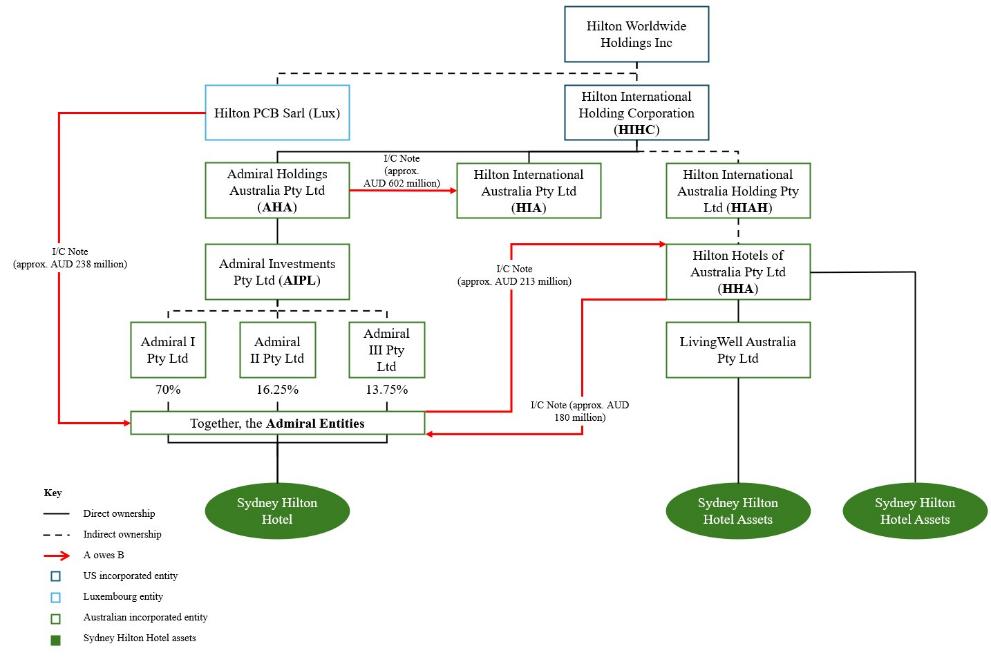
2.1 Events preceding the Share Sale Agreement
20 Hilton Group considered selling the Hotel as early as July 2012, when HIA appointed Deloitte Tax Advisers to canvas various options for disposing of the Hotel, including an asset sale, and an entity sale (of the Admiral Entities). In July 2014, Hilton Group commenced investigations into selling the Hotel under the project name “Project Opera”.
21 In November 2014, Bright Ruby Resources Pte Ltd (Bright Ruby) (a Singapore company) was identified as a potential purchaser of the Hotel.
22 In November to December 2014, HIA offered the Hotel for sale via an Information Memorandum and a Financial Pack. Selected bidders for the Hotel were invited to propose mark-ups to the draft agreement for the sale of the Hotel.
23 On 24 December 2014, Hilton Group applied to the Foreign Investment Review Board for authorisation of a proposed restructure to facilitate a potential sale to a third party. In January 2015, Hilton Group sought stamp duty relief from the New South Wales Office of State Revenue in respect of the proposed internal restructure, which was intended to consolidate the assets relating to the Hotel into a single corporate entity to make the potential sale of the Hotel easier to facilitate and manage.
24 On 30 January 2015, Bright Ruby submitted a formal expression of interest, and negotiations commenced between Hilton Group and Bright Ruby for the sale of the share in AHA, to dispose of the Hotel.
25 On 6 February 2015, the Admiral Entities and HHA terminated the existing hotel management agreement and commenced a new hotel management agreement (HMA) in its place (pursuant to which HHA had management rights in respect of the Hotel). This was designed to put in place a long-term hotel management agreement that Hilton Group believed was favourable and “operator-friendly”, prior to the sale of the Hotel.
26 On 16 February 2015, Bright Ruby submitted a bid to purchase the Hotel for AUD 441 million, through its subsidiary Glory Property III Investment Pty Ltd (GP III). On 23 February 2015, GP III and Hilton Worldwide, Inc entered an exclusive dealing agreement to provide for a period of negotiating a share sale agreement and further variations to the hotel management agreement.
27 Hilton Group then underwent a pre-sale restructure. On 25 February 2015, Hilton Worldwide International Luxembourg Holding S.à.r.l. (HWIH or New LuxCo) was incorporated in Luxembourg with HIHC as its 100% shareholder.
28 On 25 February 2015, HHA and LivingWell transferred (a majority of) Hotel assets to the Admiral Entities for, in the case of HHA, AUD 11,162,070.70 (offsetting a portion of the existing AUD 179,876,623.47 receivable from HHA), and in the case of LivingWell, nominal value (AUD 1.00).
29 On 26 February 2015, HIHC made various contributions to HWIH, including to transfer its sole share in AHA, and all its shares in HIA, to HWIH.
30 On 1 March 2015, by way of a “Business Sale and Purchase Agreement”, AHA acquired from the Admiral Entities the freehold estate comprising the Hotel, and the business assets that had been transferred from HHA and LivingWell, for consideration of AUD 425 million. AHA paid the total consideration of AUD 618,754,417.00 (which included accounts receivable, and “all other Assets”) by issuing a loan note to Admiral Entities (which was later cancelled). The Admiral Entities, AHA and HHA entered a “Deed of Novation”, dated 1 March 2015, which novated the hotel management agreement from the Admiral Entities to AHA. AHA then sold its shareholding in AIPL to HIA for AUD 1.00.
31 The following diagram sets out the group structure and key assets and liabilities after the 2015 pre-sale restructure, as a result of which HWIH (New LuxCo) owned AHA, the proposed sale vehicle holding all the Hotel assets:
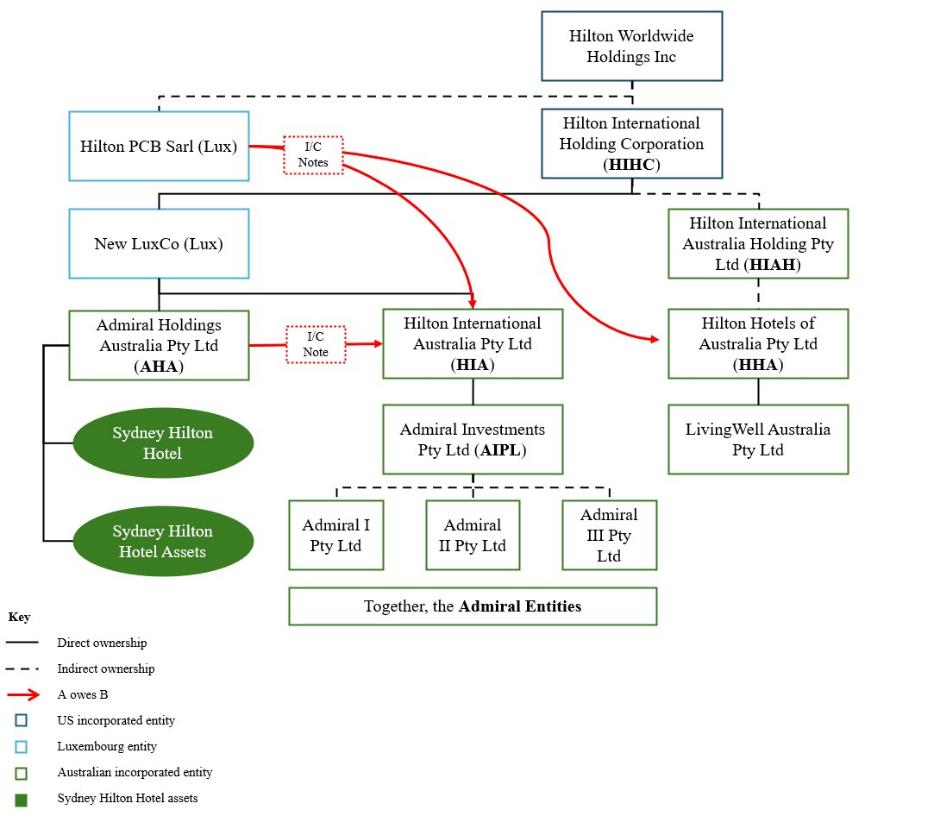
32 On 7 April 2015, two Hilton Group executives (Mr Habib Enayetullah, Senior Vice President of Real Estate and Asset Management of Hilton Group, and Mr Gisle Sarheim, Senior Director of Real Estate and Asset Management of Hilton Group) sought approval from the Hilton Investment Committee for the sale of the Hotel, by way of an Investment Committee memorandum (IC memorandum). The IC memorandum outlined the following “Tax Matters”:
The sale is structured as the sale of shares in a Hilton subsidiary, AHA, and the repayment of an inter-company note. As a result, of the AUD 442 million purchase price, AUD 420 million is allocated to the repayment of the inter-company note (a non-taxable event), leaving AUD 22 million for the sale of shares of AHA which would attract a capital gains tax in Australia. Therefore, the total tax impact of the sale is estimated at AUD 8 million.
33 The request further set out the following benefits from the sale:
i. Capitalizes on favorable market conditions to exit an owned asset at an exceptionally low yield
ii. Locks in a 50 year management contract with a long term owner under operator-friendly terms
iii. Minimal tax impacts from the transaction, thereby maximizing proceeds to pay down corporate debt
iv. The proposed Buyer is actively seeking to purchase additional hotels. The transaction would develop a basis for a long-term relationship from which future management opportunities could occur
34 On 14 April 2015, the Investment Committee approved the sale.
2.2 The Share Sale Agreement
35 On 29 April 2015, HWIH (as seller) and Hilton Worldwide Limited (as seller guarantor) entered into a Share Sale Agreement with GP III (as purchaser) and Glory Property II Investment Pty Ltd (a related entity of GP III, as purchaser guarantor), for the sale of HWIH’s share in AHA. In consideration for the sale, HWIH received approximately AUD 29 million, and declared a net capital gain of approximately AUD 21 million. The Share Sale Agreement also provided that GP III would repay a debt owed by AHA to HIA in the form of an intercompany note, worth approximately AUD 420 million.
36 On 1 July 2015, the following occurred in accordance with the Share Sale Agreement:
(1) HWIH transferred 100% of its shareholding (one share) in AHA to GP III (with the result that AHA ceased to be a member of the MEC group);
(2) GP III paid to HWIH AUD 29,021,785.50 (AUD 22 million purchase price, plus adjustment for net tangible assets (NTAs) of AUD 7,021,785.50) for the acquisition of AHA;
(3) AHA issued 404,820,000 shares for AUD 1.00 per share to GP III;
(4) GP III, on behalf of AHA, paid AUD 420 million directly to HIA to discharge the intercompany note that AHA owed to HIA, extinguishing AHA’s liability under the intercompany note; and
(5) all transferring employees (other than those who were visa holders) were transferred from HHA and LivingWell to GP III.
37 The above events form part of the Actual Sale, which is defined below at paragraph [70].
38 The parties agreed that, leaving aside Pt IVA, HIA made no taxable gain in the Actual Sale. Instead, the Actual Sale resulted in HWIH (the Luxembourg company not part of the MEC group of which HIA was provisional head) returning a net capital gain of approximately AUD 21 million in the 2015 year (being the AUD 29 million capital proceeds from the sale of the share in AHA minus HWIH’s cost base of the share in AHA at 1 July 2015).
3. LEGISLATIVE FRAMEWORK: PART IVA OF THE ITAA 1936
39 Part IVA of the ITAA 1936 creates a framework through which the Commissioner can cancel tax benefits obtained by a taxpayer. The Full Court in Vincent v Commissioner of Taxation (2002) 124 FCR 350 at [81] (Hill, Tamberlin and Hely JJ), described Pt IVA as:
…the general anti-avoidance provision designed to protect the revenue from what may be called schemes which bear on their face and by reference to the circumstances in which they are entered into or carried out the predominant stamp of tax avoidance.
40 The version of the ITAA 1936 on which the parties relied in the joint bundle of authorities and which will be referred to in these reasons is the version in force as at 31 December 2015. In that version (which is relevantly equivalent to the version of the ITAA 1936 in force at the time of the sale of AHA to GP III), s 117F of Pt IVA of the ITAA 1936 relevantly provides:
177F Cancellation of tax benefits etc.
(1) Where this Part applies to a scheme in connection with which a tax benefit has been obtained, or would but for this section be obtained, the Commissioner may:
(a) in the case of a tax benefit that is referable to an amount not being included in the assessable income of the taxpayer of a year of income—determine that the whole or a part of that amount shall be included in the assessable income of the taxpayer of that year of income; or …
…
(2) Where the Commissioner determines under paragraph (1)(a) that an amount is to be included in the assessable income of a taxpayer of a year of income, that amount shall be deemed to be included in that assessable income by virtue of such provision of this Act as the Commissioner determines.
41 As stated, there are three conditions that must be satisfied for Pt IVA to apply to a scheme, and thus for the power in s 177F(1) to be exercised by the Commissioner:
(1) the identification of a “scheme” (s 177A);
(2) that a taxpayer has obtained a “tax benefit” in connection with the scheme (ss 177C, 177CB, and 177D(3)); and
(3) that the dominant purpose of the person, or one of the persons, who entered into or carried out the scheme (or any part of the scheme) was to enable the taxpayer to obtain a tax benefit (s 177D(1) read with s 177A(5)), having regard to the eight factors set out in s 177D(2).
42 The Commissioner submits that under s 14ZZO(b)(i) of the TAA, HIA bears the onus of establishing that the Amended Assessment was excessive, or otherwise incorrect, and what the assessment should have been. This is on the basis that “the facts relating to the correct taxable income are peculiarly within the taxpayer’s knowledge”: Buzadzic v Commissioner of Taxation [2024] FCAFC 50 at [8] (Bromwich, Abraham and McEvoy JJ). What is contentious is what HIA must do to discharge that onus: see Commissioner of Taxation v PepsiCo Inc [2025] HCA 30; 424 ALR 294 at [205]–[212] (Gordon, Edelman, Steward and Gleeson JJ).
4. EVIDENCE
43 Subject to rulings and concessions made on objections to evidence, the parties relied on the following evidence. HIA read:
(1) the affidavits of Mr Enayetullah, sworn on 19 December 2023 and 13 September 2024, and their exhibits (HME-1, HME-2 and HME-3); and
(2) the affidavits of Mr Dean Dransfield, hotel consultant, affirmed on 20 December 2023 and 16 September 2024 (and their exhibits, DD-4, DD-6 and DD-7), which each annexed an expert report written by Mr Dransfield of the same date as the respective affidavit.
44 The Commissioner read the affidavit of Mr David Harper, a chartered surveyor, dated 3 July 2024 (and its exhibit, DH-1), which exhibited an expert report written by Mr Harper of the same date.
45 The parties tendered the joint expert report of Mr Dransfield and Mr Harper, dated 10 December 2024.
4.1 Mr Enayetullah’s evidence – Opinion/FCR r 23.11 objection
46 Mr Enayetullah, who was responsible for the recommendation to the Investment Committee to sell the Hotel, was cross-examined at the hearing regarding his evidence as to his involvement in the sale process and, to a lesser extent, his opinion on alternatives to the Actual Sale.
47 The Commissioner objected to certain parts of Mr Enayetullah’s affidavits (as recorded in the consolidated objections document provided by the parties and marked MFI-4) on the basis that:
(a) The evidence is opinion evidence in breach of the rule in s 76, and does not conform with the exception in s 79 of the Evidence Act 1995 (Cth); and
(b) The evidence does not qualify as an expert report that complies with r 23.13 of the Federal Court Rules 2011 (Cth) (FCR), for the purposes of r 23.11 of the FCR.
(Together, ‘opinion objection’).
48 There is no suggestion that the evidence should be excluded (although the Commissioner acknowledged that his objection arises at the anterior stage of admissibility). Rather:
(a) The Commissioner proposes that the evidence be admitted as evidence of the witness’s belief; and
(b) HIA proposes that the evidence be admitted as opinion evidence based on specialised knowledge as per s 79 of the Evidence Act (with appropriate adjustment to weight).
49 Section 79 of the Evidence Act is an exception to the opinion rule where the witness has specialised knowledge based on their training, study or experience, but only insofar as the evidence of the opinion of that person is wholly or substantially based on that knowledge.
50 Rule 23.13 of the FCR prescribes the contents of an expert report, including notably that the report must set out separately each of the factual findings or assumptions on which the expert’s opinion is based, and the reasons for each of the expert’s opinions: r 23.13(e) and (g) of the FCR. A compliant expert report is a condition to allowing a party to call an expert to give evidence at trial: r 23.11 of the FCR (subject to any dispensation under r 1.34 of the FCR).
51 Evidently, there is a connection between the operation of both rules (rr 23.11 and 23.13 of the FCR) regarding the importance of stating the basis of the relevant opinion, in order to evaluate the opinion.
52 I do not consider that the evidence in Mr Enayetullah’s affidavits to which objection is taken, is “evidence of an opinion […] that is wholly or substantially based on [Mr Enayetullah’s] knowledge”, such as to qualify it as an exception (s 79(1) of the Evidence Act) to the opinion rule (s 76 of the Evidence Act).
53 For the same reason that the evidence does not comply with s 79 of the Evidence Act, it does not comply with r 23.13 of the FCR. I accept that non-compliance with r 23.13 does not “automatically” render the evidence inadmissible: Herron v HarperCollins Publishers Australia Pty Ltd (2022) 292 FCR 336 at [496]–[498] (Lee J). However, I do not consider that the relevant non-compliance with r 23.13 can be dismissed as a ‘defect in form’: cf. Mineralogy Pty Ltd v Sino Iron Pty Ltd (No 5) [2015] FCA 571 at [11] (Edelman J).
54 The defect in question relates to the “factual basis rules” that apply under s 79 of the Evidence Act, which rules are recited by Lee J in Herron (at [500]) as follows:
(1) are the facts and assumptions on which the expert’s opinion is founded disclosed (assumption identification rule)? (2) is there evidence admitted, or to be admitted before the end of the tendering party’s case, capable of proving matters sufficiently similar to the assumptions made by the expert to render the opinion of value (proof of assumptions rule)? and (3) is there a statement of reasoning showing how the facts and assumptions relate to the opinion stated to reveal that that opinion is based on the expert’s specialised knowledge (statement of reasoning rule)?
55 As his Honour explains at paragraph [503], the flaw in the evidence (relevantly, the failure to identify all the facts upon which the evidence was based) compromises the Court’s ability to evaluate the opinion expressed.
56 The flaw is not cured by a general statement of the “specialised knowledge” or experience of the witness, “extensive” though it may be. The qualification of the statement of Mr Enayetullah’s opinion in various parts of his affidavits with the epithet “in my experience” (without more) highlights the difficulty. What is missing is the connective tissue between the stated experience and the stated opinion.
57 The Commissioner’s opinion objection is upheld. Those parts of Mr Enayetullah’s affidavits to which the opinion objection is made, are admitted as an expression of the witness’s belief only: s 136 of the Evidence Act.
4.2 Expert evidence
58 Mr Dransfield and Mr Harper gave concurrent evidence, and were cross-examined, at the hearing regarding their evidence on the relative commercial advantages and disadvantages of the Actual Sale and the alternative postulates that are discussed below.
59 Each party claimed that their expert witness presented with more relevant experience and expertise than the witness of the opposing party.
4.2.1 Mr Harper’s experience
60 Mr Harper is a chartered surveyor with over 25 years experience in the hotel industry. He is the managing director of Leisure Property Services Ltd, a specialised hospitality consultancy, and the Head of Property Services for Hotel Partners Africa, which consults on hotel development in Africa. Mr Harper gave evidence that the geographic areas he most often covered through Leisure Property Services Ltd were the United Kingdom, Europe, the Caribbean, the Middle East and Africa, although he has worked on or made personal investments in projects involving hotels in a number of Australian cities including Sydney, Melbourne (both in 2002), Sunshine Coast (in 2022), Brisbane, Perth, and Adelaide. HIA put to Mr Harper that he did not have specialisation in undertaking hotel sales or negotiating hotel management agreements in the Australian industry, and Mr Harper accepted that he has not had a specialisation in Australia since 2005 nor had he given expert evidence in Australia before. However, Mr Harper testified that there is no significant difference between Australia and the rest of the world in relation to hotel transactions, which he says share common features.
61 The Commissioner submits that Mr Harper has more expertise than Mr Dransfield in two critical respects: first, regarding structuring a sale of a hotel to appeal to international buyers, given his international profile and specific experience with Asian buyers; and second, advising on sale and manage-back transactions (which is the form of transaction that the Actual Sale too. Mr Harper gave two examples in his expert report of sale and manage-back transactions he has worked on, both in the United Kingdom.
4.2.2 Mr Dransfield’s experience
62 Mr Dransfield is the managing director of Dransfield Hotels & Resorts (Dransfield & Co Pty Ltd), having previously worked as a chartered accountant. Mr Dransfield gave evidence of two sale and manage-back transactions that he worked on, one being the “leading” transaction of that kind occurring around 30 years ago, and another occurring around the time of the Actual Sale regarding the Next Hotel in Brisbane. The Commissioner put to Mr Dransfield that the Next Hotel transaction was in fact a sale and lease-back transaction, which was said to be different. In response, Mr Dransfield said that the Australian market does not distinguish between sale and lease-back transactions, and sale and manage-back transactions. However in further cross-examination, Mr Dransfield accepted that Hilton Group draws a distinction between the two, and later appeared to accept that they were “alternative methods”. The Commissioner submits that, unlike Mr Harper, Mr Dransfield has no direct experience in sale and manage-back transactions, which is a deficit in his ability to examine the Actual Sale.
4.3 Joint Aide-Memoire
63 The parties tendered eight documents, which were marked for identification. Key among these is the parties’ Joint Aide-Memoire, handed up on 15 May 2025, outlining the operation of the capital gains tax (CGT) and the tax consolidation rules as applied in this case, which was not in dispute. I treat the computations contained in that document as agreed facts.
64 As explained in the Joint Aide-Memoire, when an entity that is not a member of a MEC group sells shares in an ET-1 company (“reset interests”), the entity’s tax cost in those shares is determined by subdiv 719-K of the ITAA 1997: s 719-555(1) of the ITAA 1997. This may arise where, for instance, the foreign top company (which, as a foreign company, is not part of a MEC group) disposes of an ET-1 company (i.e., the ET-1 company leaves the MEC group).
65 In this case, the application of subdiv 719-K to the sale by HWIH (a Luxembourg entity) of its 100% shareholding in AHA (an ET-1 company in Hilton Group’s MEC group), is not in dispute.
66 The object of subdiv 719-K is to allocate part of the total “pool” of tax cost in all reset interests in ET-1 companies in the MEC group to the selling entity’s reset interests in the relevant ET-1 company: s 719-555(2). The allocation under subdiv 719-K is made according to the market value of the shares in the relevant ET-1: s 719-570(1). The remainder of the pool is allocated to the other reset interests by their number: s 719-570(2). The amount so allocated is then used for CGT purposes or for the purposes of any other relevant provision (for instance, in relation to CGT Event A1, discussed below): s 719-565 of the ITAA 1997.
5. IDENTIFICATION OF A SCHEME
5.1 Legal principles
67 “Scheme” is defined in s 177A(1) of the ITAA 1936 as follows:
scheme means:
(a) any agreement, arrangement, understanding, promise or undertaking, whether express or implied and whether or not enforceable, or intended to be enforceable, by legal proceedings; and
(b) any scheme, plan, proposal, action, course of action or course of conduct.
68 The definition of “scheme” is broad and is not necessarily limited to the “step” that produces the tax benefit: British American Tobacco Australia Services Ltd v Federal Commissioner of Taxation (2010) 189 FCR 151 at [30] (Dowsett, Jessup and Gordon JJ).
5.2 The Actual Sale constituted a “scheme”
69 Both parties accept that the transactions identified by the Commissioner (which, together, constitute the Actual Sale) constitute a “scheme” within the meaning of s 177A of the ITAA 1936.
70 The events that comprise the Actual Sale are as follows (the Scheme):
(1) On or about 25 February 2015, HHA and LivingWell transferred the Hotel’s associated business assets to the Admiral Entities for consideration of AUD 11,162,071.00.
(2) On 1 March 2015:
(a) the Admiral Entities sold to AHA the “Business” and “Assets”, described in the Business Sale and Purchase Agreement (including the intercompany note issued by Hilton PCB in favour of the Admiral Entities, with a balance of AUD 193,754,411.62), for a total purchase price of AUD 618,754,417.00, payable and paid by the provision of a promissory note, or promissory notes, in that amount;
(b) the Admiral Entities (and the 13 interposed US LLCs and AIPL) used the intercompany note (recording an amount owing from AHA to the Admiral Entities) of AUD 618,754,417.00 (and amounts paid by reason of it) to pay dividends and make capital returns up the ownership chain to AHA. Following this, the intercompany note was cancelled;
(c) AHA assigned to HIA the intercompany note receivable owing by Hilton PCB (see step 2(a)); and
(d) AHA disposed of 100% of its interest in AIPL to HIA for AUD 1.00.
(3) On 29 April 2015, HWIH entered into the Share Sale Agreement with GP III to dispose of its shareholding in AHA to GP III, pursuant to the terms provided therein.
(4) On 1 July 2015:
(a) “Completion” under the Share Sale Agreement occurred;
(b) HWIH transferred 100% of its shareholding (one share) in AHA to GP III for AUD 29,021,785.50 (being AUD 22 million plus an NTA adjustment of AUD 7,021,785.50); and
(c) GP III paid AUD 420 million directly to HIA (on behalf of AHA) for the purpose of satisfying the intercompany note under which AHA owed monies to HIA.
(5) Following Completion, a series of intra-group transactions were carried out to assign or repay and/or loan the amounts received by HWIH and HIA on Completion to the wider Hilton Group. In particular, HIA loaned approximately AUD 384 million, and HWIH loaned approximately AUD 28 million, to HIC Racing (Chiswick) Limited, a UK company in the Hilton Group, which then distributed the AUD 412 million to HIC Hotels USA Corporation for use in repayment of external debts.
(6) The Scheme was entered into or carried out by any one or more of the following Hilton Group entities: AHA, the Admiral Entities, Hilton PCB, AIPL, the 13 US LLCs, HWIH and HIA.
71 I accept that the Actual Sale satisfies the broad definition of a “scheme” in s 177A(1) of the ITAA 1936. While the individual transactions comprising the Actual Sale are capable of constituting a “scheme”, that was not in issue. There was no contest that (all of) the individual transactions took place.
72 I accept that events that occurred prior to (and after) the Scheme, in particular the prior allocation of debt and the subsequent novation of contracts, may be relevant to an assessment of the Scheme relative to the alternative postulates and to ascertain its purpose. The parties’ respective positions on this issue are discussed in more detail below. Events following shortly after the Scheme include that: first, once owned by GP III, the Hotel and business assets were transferred on 28 July 2015 from AHA to a trust set up by GP III, and AHA was wound up, consistent with the indications given by Bright Ruby prior to the Actual Sale that it would do so; and second, in 2022 Bright Ruby on-sold the Hotel to another third party by way of an asset sale.
6. DID HIA OBTAIN A TAX BENEFIT?
6.1 Legal principles
73 Section 177C(1)(a) of the ITAA 1936 defines the obtaining of a tax benefit as inter alia an amount not being included in the taxpayer’s assessable income where that amount would have, or might reasonably be expected to have, been included had the scheme not been carried out. The provision requires the scheme to be compared to a counterfactual, or alternative postulate, to determine the expected tax outcome had the scheme not been carried out.
74 Section 177C relevantly provides:
177C Tax benefits
(1) Subject to this section, a reference in this Part to the obtaining by a taxpayer of a tax benefit in connection with a scheme shall be read as a reference to:
(a) an amount not being included in the assessable income of the taxpayer of a year of income where that amount would have been included, or might reasonably be expected to have been included, in the assessable income of the taxpayer of that year of income if the scheme had not been entered into or carried out; or
…
(2) A reference in this Part to the obtaining by a taxpayer of a tax benefit in connection with a scheme shall be read as not including a reference to:
(a) the assessable income of the taxpayer of a year of income not including an amount that would have been included, or might reasonably be expected to have been included, in the assessable income of the taxpayer of that year of income if the scheme had not been entered into or carried out where:
(i) the non-inclusion of the amount in the assessable income of the taxpayer is attributable to the making of an agreement, choice, declaration, agreement [sic], election, selection or choice [sic], the giving of a notice or the exercise of an option (expressly provided for by this Act or the Income Tax Assessment Act 1997) by any person, except one under Subdivision 126-B, 170-B or 960-D of the Income Tax Assessment Act 1997;
…
75 The Full Court in Federal Commissioner of Taxation v Trail Bros Steel & Plastics Pty Ltd (2010) 186 FCR 410 at [25]–[26] (Dowsett and Gordon JJ, Edmonds J agreeing at [62]) observed:
[25] The legislation requires a comparison between the relevant scheme and an alternative postulate: Hart 217 CLR 216 at [66].
[26] The alternative postulate requires a “prediction as to events which would have taken place if the relevant scheme had not been entered into or carried out and that prediction must be sufficiently reliable for it to be regarded as reasonable” (emphasis added). “A reasonable expectation requires more than a possibility”: Lenzo 167 FCR 255 at [122] citing Peabody 181 CLR at 385. The question posed by s 177C(1) is answered on the assumption that the scheme had not been entered into or carried out: Lenzo 167 FCR 255 at [121].
76 This passage has been endorsed as the correct application of s 177C even following the introduction of s 177CB into the ITAA 1936: see Commissioner of Taxation v Guardian AIT Pty Ltd ATF Australian Investment Trust [2023] FCAFC 3 at [155] (Hespe J, Perry and Derrington JJ agreeing at [1], [2]); see also PepsiCo at [209] (Gordon, Edelman, Steward and Gleeson JJ). The decision of the High Court in PepsiCo was handed down on 13 August 2025, after the conclusion of the hearing in this matter. Both parties provided supplementary submissions in October 2025 addressing the significance of PepsiCo to the present proceeding, and the High Court’s reasoning will be referred to in detail below.
77 The Tax Laws Amendment (Countering Tax Avoidance and Multinational Profit Shifting) Act 2013 (Cth) (Amendment Act 2013) made a number of significant amendments to Pt IVA of the ITAA 1936, including the introduction of s 177CB and the substitution of a new s 177D, commencing 29 June 2013 but with application to schemes entered into on or after 16 November 2012: item 10 of Sch 1 to the Amendment Act 2013; Explanatory Memorandum, Tax Laws Amendment (Countering Tax Avoidance and Multinational Profit Shifting) Bill 2013 (Cth) (Explanatory Memorandum) at 3, 5 [1.7].
78 Section 177CB relevantly provides:
177CB The bases for identifying tax benefits
(1) This section applies to deciding, under section 177C, whether any of the following (tax effects) would have occurred, or might reasonably be expected to have occurred, if a scheme had not been entered into or carried out:
(a) an amount being included in the assessable income of the taxpayer;
…
(2) A decision that a tax effect would have occurred if the scheme had not been entered into or carried out must be based on a postulate that comprises only the events or circumstances that actually happened or existed (other than those that form part of the scheme).
(3) A decision that a tax effect might reasonably be expected to have occurred if the scheme had not been entered into or carried out must be based on a postulate that is a reasonable alternative to entering into or carrying out the scheme.
(4) In determining for the purposes of subsection (3) whether a postulate is such a reasonable alternative:
(a) have particular regard to:
(i) the substance of the scheme; and
(ii) any result or consequence for the taxpayer that is or would be achieved by the scheme (other than a result in relation to the operation of this Act); but
(b) disregard any result in relation to the operation of this Act that would be achieved by the postulate for any person (whether or not a party to the scheme).
…
79 In relation to the exposition in Trail Bros, it should be noted that:
(1) The reference to “more than a possibility” refers to the requirement of a reasonable expectation, and pertains to the reliability of that expectation.
(2) The reference to “more than a possibility” is consistent with, but does not equate to, a probability.
(3) In that context, the reference to an “expectation” is not synonymous with a likelihood, but rather a supposition.
80 I do not read the reference to “an alternative postulate” (emphasis added) by Gummow and Hayne JJ in Commissioner of Taxation v Hart (2004) 217 CLR 216 at [66] as suggesting the comparison is to be made in relation to only one possible alternative. That view is reinforced by their Honours’ reference to drawing a conclusion about purpose from the matters identified in s 177D(b) (which since the Amendment Act 2013 have been contained in s 177D(2)), which “will require consideration of what other possibilities existed” (emphasis added) (at [66]). This analysis is relevant to whether the analysis of a tax benefit admits of more than one (reasonable) alternative postulate, which I address further below.
81 HIA bears the onus of proving that it did not obtain a tax benefit in connection with the scheme (PepsiCo at [205] (Gordon, Edelman, Steward and Gleeson JJ)), and therefore satisfying the Court of what might reasonably be expected to have occurred in the absence of the scheme. That onus will not be discharged by simply showing that the Commissioner’s alternative postulates are unreasonable: RCI Pty Ltd v Commissioner of Taxation [2011] FCAFC 104 at [130] (Edmonds, Gilmour and Logan JJ); Guardian at [156] (Hespe J); PepsiCo at [210]–[211] (Gordon, Edelman, Steward and Gleeson JJ).
6.1.1 Annihilation and reconstruction: approaches to identifying a reasonable alternative
82 Section 177CB of the ITAA 1936 applies to the Scheme. It is relevant to deciding under s 177C(1)(a) whether an amount being included in a taxpayer’s assessable income (a tax effect) “would have occurred”, or “might reasonably be expected to have occurred”, if a scheme had not been entered into or carried out: s 177CB(1)(a). Those two hypotheticals under s 177C(1) are alternative bases for identifying whether a tax benefit has thereby been obtained: Explanatory Memorandum at [1.74].
83 The approaches to be followed when assessing alternative postulates on either of those bases are reflected in s 177CB(2) and (3). Those subsections provide as follows:
177CB The bases for identifying tax benefits
…
(2) A decision that a tax effect would have occurred if the scheme had not been entered into or carried out must be based on a postulate that comprises only the events or circumstances that actually happened or existed (other than those that form part of the scheme).
(3) A decision that a tax effect might reasonably be expected to have occurred if the scheme had not been entered into or carried out must be based on a postulate that is a reasonable alternative to entering into or carrying out the scheme.
84 The Explanatory Memorandum refers to s 177CB(2) as the “annihilation approach”, and explains at [1.78] and [1.80] that:
[1.78] This provision makes it clear that, when postulating what would have occurred in the absence of the scheme, the scheme must be assumed not to have happened — that is, it must be ‘annihilated’, ‘deleted’ or ‘extinguished’. Otherwise, however, the postulate must incorporate all the ‘events or circumstances that actually happened or existed’.
…
[1.80] Under this approach, a taxpayer will have obtained a tax benefit in connection with a scheme if it can be demonstrated that a relevant tax effect would have flowed, as a matter of law, from the application of the taxation law to the facts remaining once the scheme is assumed away, that is, a tax effect less advantageous to the taxpayer than the tax effect secured by the taxpayer in connection with the scheme.
85 The Explanatory Memorandum refers to s 177CB(3) as the “reconstruction approach”, explaining at [1.87]–[1.89] that:
[1.87] Such a postulate will necessarily require speculation about the state of affairs that would have existed if the scheme had not been entered into or carried out. This may include speculation about the way in which connected transactions would have been modified if they had had to accommodate the absence of the scheme.
[1.88] Under this approach, a taxpayer will obtain a tax benefit in connection with a scheme if it can be demonstrated that a relevant tax effect would have flowed, as a matter of law, from the application of the taxation law to the alternative postulate; again, a tax effect that is less advantageous to the relevant taxpayer than the tax effect secured by the taxpayer in connection with the scheme.
…
[1.89] A reconstruction approach is an effective way to identify a tax benefit in relation to a scheme that achieves substantive non-tax results and consequences. In these cases, simply annihilating the scheme would be inconsistent with the non-tax results and consequences sought for the taxpayer by the participants in the scheme.
86 The reconstruction approach is appropriate when a scheme occurs within and facilitates a broader transaction, so long as the reconstruction produces a postulate with the same non-tax results and consequences as were in fact achieved by the broader transaction: Explanatory Memorandum at [1.113]–[1.116].
87 In the present case, given that the Scheme was part of a broader transaction that achieved substantive non-tax consequences and commercial aims of Hilton Group, it is the reconstruction approach and not the annihilation approach that is appropriate for the assessment of alternative postulates. Rather than asking what would have occurred had the Scheme not been entered into or carried out, the Court will consider what might reasonably be expected to have occurred, applying s 177CB(3) rather than subs (2). The parties were in agreement as to this approach.
6.2 Identifying a “reasonable alternative” to the scheme
88 The parties dispute the identification in s 177CB(3) of the ITAA 1936 of “a reasonable alternative” to entering into or carrying out the scheme, for the purposes of deciding under s 177C(1)(a) whether a tax effect might reasonably be expected to have occurred. HIA contends that the Court’s task is to identify a single alternative postulate, being the commercially preferable alternative, that is reasonably expected to have occurred. The Commissioner says that the task is to consider all of the alternative postulates that meet the statutory criterion of being reasonable, which reflects the reality that for most commercial transactions, there will be different ways for a taxpayer to achieve commercial purposes or objectives.
89 HIA contends that the essential task of identifying an alternative postulate did not change as a result of the introduction of s 177CB. Rather, it is said that s 177CB(3) formalises the High Court’s conclusion in Commissioner of Taxation v Peabody (1994) 181 CLR 359 at 385, which HIA construes as being that a finding as to the existence of a “tax benefit” requires satisfaction as to a “prediction as to the events which would have taken place if the relevant scheme had not been entered into or carried out and the prediction must be sufficiently reliable for it to be regarded as reasonable”.
90 HIA relies on this passage in Peabody to contend that there can be only one reasonable alternative that “would have” taken place absent the Scheme. However, this passage from Peabody was a response to the Commissioner’s contention in that case that the purchaser of shares might reasonably be expected to have been a certain party had there been no devaluation of shares. Only one postulate was proffered by the Commissioner in that case. In that regard, the High Court cited (at fn 42) the decision of Mahoney JA in Dunn v Shapowloff [1978] 2 NSWLR 235 at 249, where his Honour was concerned with the question of whether the officer of a company had a reasonable or probable ground of expectation of the company being able to pay a debt (at 243D-E, 249E). Once again, only one postulate was in contention. I see nothing in the conclusion of the High Court in Peabody at 385 that precludes a prediction whereby more than one event (or alternative) would have, or might reasonably be expected to have taken place, assuming that the events are not mutually exclusive. It is to be remembered that the “alternative” that is the subject of s 177CB(3) is an alternative to the scheme.
91 Furthermore, the High Court’s conclusion in Peabody at 385 rests on an iteration of the ITAA 1936 prior to the insertion of s 177CB in 2013. In other words, the High Court in Peabody was construing s 177C(1)(a), but not by reference to s 177CB. This is significant. While both provisions draw upon the notion of an expectation (with which the High Court was concerned in Peabody at 385), s 177CB introduced the notion of “a postulate that is a reasonable alternative” as a means of gauging that expectation. Whether or not s 177CB is a “codification” of Peabody is a pointless ‘chicken-and-egg’ debate. The Court’s task in any event is to construe the statutory language, and not the language of the High Court on the supposition that such language has been codified in the text of the statute.
92 What must be “reasonable” in s 177CB(3) qualifies both the expectation and the alternative. However, what would have occurred or might reasonably be expected to have occurred in the absence of the scheme (for the purposes of s 177C) is ascertained by reference to a postulate that is a reasonable alternative to the scheme (s 177CB(3)). HIA seeks to import into the analysis an imputation of ‘probability’, but that does not necessarily follow from a reference to expectation. A similar point was made in PepsiCo in relation to a “reasonable expectation” after citing Peabody at 385: see [209], fn 230. The prediction requires “more than” a mere possibility. There is no mandate of probability. The only measure of reliability of the prediction is the notion of reasonableness.
93 Moreover, the possibility of more than one reasonable alternative was countenanced in PepsiCo at [207] (Gordon, Edelman, Steward and Gleeson JJ) in an exposition of the use of the word “must” in s 177CB(3): i.e., “reaching a decision that a ‘tax effect’ … might reasonably be expected to have occurred if the scheme had not been entered into or carried out ‘must’ be based and only based on a postulate or postulates that is or are ‘reasonable’” (emphasis added). A similar acknowledgment is made in PepsiCo at [96] (Gageler CJ, Jagot and Beech-Jones JJ), in contemplation of a “range of potential reasonable alternative postulates”.
94 That “particular regard” must be had to the substance of the scheme per s 177CB(4)(a)(i), including the commercial and economic substance, in determining whether a postulate is a reasonable alternative, does not alter that analysis. HIA submits that the reasonable alternative postulate should “correspond to” the commercial and economic substance of the scheme. That language is borrowed from the Explanatory Memorandum at [1.106]. It is explained in PepsiCo at [95] (Gageler CJ, Jagot and Beech-Jones JJ) that this is to be understood “as indicating no more than that a reasonable alternative postulate, in its commercial and economic substance or essence, should generally accord with the scheme, in its commercial and economic substance or essence” (emphasis added).
95 HIA goes further to submit that for a postulate to be “reasonable” as required by s 177CB(3), it should exhibit “the same substance” and “achieve the same results as found in the Scheme” (emphasis added), relying on PepsiCo at [224] (Gordon, Edelman, Steward and Gleeson JJ). However, the proposition is not stated by their Honours as one of principle, but rather as a finding of fact in response to the Commissioner’s position in PepsiCo that the alternative postulates for which he contended exhibited “the same commercial and economic substance as that which he contended subsisted under the [scheme]”, including receipt of the same property and payment of the same amounts (at [217]). Their Honours otherwise endorsed the statement of principle of the Full Court below regarding correspondence to the substance of the scheme (at [218]).
96 HIA submits that the task for this Court is to determine which, if any, of the alternative postulates provided by the parties satisfies the requirement of reasonableness in s 177CB(3), and constitutes “the prediction” as to the events which would have taken place had the scheme not been entered into or carried out. In addition to Peabody (at 385), HIA relies on the Full Court’s observation in RCI at [130], that:
Even if a taxpayer establishes that the Commissioner’s counterfactual is unreasonable, it will not necessarily follow that he has established that the assessment is excessive. That is because the issue is not whether the Commissioner puts forward a reasonable counterfactual or not; it is a question of the Court determining objectively, and on all of the evidence, including inferences open on the evidence, as well as the apparent logic of events, what would have or might reasonably be expected to have occurred if the scheme had not been entered into. Thus, even if a taxpayer establishes that the Commissioner’s counterfactual is unreasonable, that will not discharge the onus the taxpayer carries if the Court determines that the taxpayer would have or might reasonably be expected to have done something which gave rise to the same tax benefit.
97 I do not consider that this passage lends support to HIA’s construction of s 177CB(3).
98 HIA submits that it does not need to establish that none of the Commissioner’s postulates are reasonable. This seems at odds with HIA’s submission that it must show that its alternative postulate (Alternative Postulate 3) is the most likely to have occurred (i.e., the “most reasonable” or “preferred”). Once one introduces gradations of an evaluative concept like reasonableness, one promulgates an exercise of discounting alternatives on the basis that they are “less reasonable”. The distinction between “less” and “not” reasonable is inscrutable in this context. The exercise masks the imposition of other concepts (like “commercial”). In any event, HIA accepts that discounting other possibilities is inherent to the predictive exercise.
99 It is not in contest that whether there is a tax benefit in connection with the Scheme is to be established as an objective fact; that is, based on all of the evidence, including inferences open on the evidence, as well as the apparent logic of events: Peabody at 382; PepsiCo at [204], [211] (Gordon, Edelman, Steward and Gleeson JJ). HIA submits that the role of identifying the alternative postulate is to quantify the tax benefit, and that if the Court permits any number of alternative postulates to be identified, there will be cases where they give rise to different tax benefits, each with a different quantum. It is not evident that such a “potential conclusion” is objectionable per se. The immediate role of the alternative postulate is to assist in determining whether a particular tax benefit (or effect) would have occurred or might reasonably be expected to have occurred, if a scheme had not been entered into or carried out, i.e., to expose the scheme.
100 HIA says that the absence of a statutory discrimen between the available postulates would give rise to “taxation by discretion”, or an arbitrary exaction without definitive criteria upon which it is to be imposed, and that such a construction of s 177CB “could not be correct”.
101 In Giris Pty Ltd v Commissioner of Taxation (1969) 119 CLR 365, the discrimen between the applicable sections of the Income Tax Assessment Act 1936-1965 (Cth) was the Commissioner’s view as to the unreasonableness of applying one rather than the other to the particular taxpayer in respect of the year of income in question: at 372 (Barwick CJ). The provisions in question were held by majority to be constitutionally valid (cf. 383–5, per Windeyer J, joining the majority with some hesitation on the basis that “the idea of reasonableness seems to be here amorphous”). In the present case, the reasonableness of any postulate is “measured, in accordance with s 177CB(4), by reference to the substance of the scheme, and any result or consequence for [the] taxpayer achieved by the scheme”: PepsiCo at [212].
102 In relying on Giris, HIA does not appear to contend for the invalidity of s 177CB, but rather to argue that the Commissioner’s construction of s 177CB “could not be correct”. However, the proper construction of s 177CB either is or is not constitutionally invalid. One cannot construe s 177CB tendentiously. In that regard, so far as different constructions of a provision are available, a construction is to be selected which, so far as the language of the provision permits, would avoid, rather than result in, a conclusion that the section is invalid: New South Wales v Commonwealth (2006) 229 CLR 1 at [355] (Gleeson CJ, Gummow, Hayne, Heydon and Crennan JJ); see also D’Emden v Pedder (1904) 1 CLR 91 at 119–120 (Griffith CJ delivering judgment for the Court).
103 There is also an air of artificiality about HIA’s pseudo-constitutional argument.
104 The Commissioner submits that the question posed by ss 177C(1)(a) and 177CB is as follows: “is there a reasonable alternative postulate in which a taxpayer’s assessable income would have been higher?”. This construction is supported by the reference in s 177CB(3) to “a reasonable alternative”, rather than “the reasonable alternative”. On this construction, which I consider to be correct, the Court is to look at all of the alternative postulates proposed by parties and ask whether one or more is “reasonable”. Of the alternatives determined to be “reasonable”, the Court then considers whether the taxpayer’s income would have been higher under each alternative. If the taxpayer’s income would have been higher under more than one alternative, then the highest point indicates the extent of the disparity between the scheme and “a reasonable alternative”, and therefore the extent of the tax benefit in relation to the scheme.
6.3 Substance and consequences of the Scheme
105 In determining whether a postulate is a reasonable alternative, the Court must have “particular regard” to the substance of the scheme and any result or consequence for the taxpayer that is or would be achieved by the scheme: s 177CB(4)(a) of the ITAA 1936. However, the Court must disregard any result in relation to the operation of the ITAA 1936 that would be achieved by the alternative postulate: s 177CB(4)(b) of the ITAA 1936.
6.3.1 Evidentiary contest
106 Noting s 177CB(4)(a), and following the guidance in PepsiCo at [212] described above, before assessing the reasonableness of each alternative postulate proposed by the parties, it is necessary to first identify, as the reference point for that assessment, the substance of the Scheme and any result or consequences for the taxpayer (HIA) achieved by it. It was said in PepsiCo at [215] that “the central question is the economic and commercial substance of the Scheme, as distinct from its legal shape or form”, which reflects the same statement in the Explanatory Memorandum at [1.103].
107 HIA ultimately described in oral submissions the substance of the Scheme as “the sale of a share of a company that owns all the assets of the business”, and submits that in this case the form of the Scheme as a share sale cannot be ignored in identifying its substance. By contrast, the Commissioner submits that the substance of the Scheme was “the external sale of the Hotel, valued at AUD 442 million, while retaining a 50 year [hotel] management agreement”.
108 In determining the economic and commercial substance of the Scheme and its consequences for HIA, it is useful to look to the expert evidence of Mr Dransfield and Mr Harper. That evidence also has utility in the (subsequent) evaluation of the alternative postulates proposed by the parties (vis-à-vis the relative benefits of the Scheme) and the purpose of the Scheme.
109 Mr Dransfield gave evidence that the substance of, and commercial objectives achieved by, the Scheme from the perspective of the Hilton Group entities, included the following:
(1) presenting a market acceptable sale structure to the market;
(2) a successful sale of the Hotel at a fair price and ideally at the best possible price, whilst also retaining long term management rights over the Hotel on favourable hotel management agreement terms;
(3) a quick sale taking advantage of a buoyant market; and
(4) the efficient deployment of the sale proceeds within the Hilton Group, including repatriation of funds up the group chain (e.g. intercompany loan repayments).
110 The Commissioner accepted that the commercial objectives of the Scheme included obtaining a good price, in a quick sale, with minimum risk.
111 Mr Dransfield gave evidence that the structure of the Scheme was market practice, and that it worked to secure a high price for Hilton Group, on favourable terms, within a short period of time. In Mr Dransfield’s view, the Scheme was the most commercially preferable manner of selling the Hotel for the following reasons:
(1) the sale of AHA as a “clean skin” entity with an embedded hotel management agreement in place was a sensible business strategy, and achieved Hilton Group’s commercial objectives of obtaining a long-term hotel management agreement and a quick sale at a high price;
(2) the transaction provided Hilton Group with the best chance of preserving the favourable terms of the existing hotel management agreement, which was internally agreed between AHA as owner and HHA as manager, rather than with an arm’s length third-party owner;
(3) the use of AHA as a “clean skin special purpose vehicle” in the Scheme is far more palatable to purchasers generally, as some purchasers would not transact with a “tainted” or “aged” entity; and
(4) the success of Hilton Group’s strategy was evident from the final terms of the sale, and the hotel management agreement in particular.
112 Mr Harper gave evidence that the Scheme was not market practice, as most hotel transactions in Australia are sold as asset transactions.
113 Mr Harper said that AHA was not a “clean skin” entity or “NewCo”, because it was incorporated in June 2014 and was over one year old at the time of the transaction. In Mr Harper’s opinion, to classify as a “NewCo”, an entity would typically be between one and six months old, and would have no corporate history. Mr Harper highlighted AHA’s relatively complex debt structure, which, in his opinion, is not something a potential purchaser would expect to see in a “NewCo”.
114 Mr Harper gave evidence that it was clear that the purchaser found AHA’s debt structure to be unusual and added to their requirement for due diligence. The significant level of debt, the fact the debt was recently introduced to AHA, and the complexity of the restructure, all raised red flags to the purchaser.
115 It is not necessary to resolve the debate between the expert witnesses as to whether the terms of the hotel management agreement were in line with the market or were favourable to Hilton Group. The distinction is artificial if one accepts, as the evidence suggests, that the Hotel was sold in a “seller’s market”. As the Commissioner accepts, above-market performance is consistent with Hilton Group’s strong bargaining position.
6.3.2 Preferred evidence
116 The Commissioner submits that Mr Dransfield was not supplied by HIA with information that was necessary for him to form a reliable opinion on critical issues, and that he did not make inquiries of HIA to obtain that information. That information included a large volume of documents from the “data room”, an online document sharing space used by the parties to the Actual Sale, including: documents relating to the corporate restructure, such as a restructure memorandum summarising the intended sale structure, and the Deed of Termination dated 1 March 2015 by which the existing tax sharing agreement between HIA and other members of the consolidated tax group was brought to an end in favour of the MEC group; the Asset Transfer Deed dated 25 February 2015, by which the Hotel business assets of HHA and LivingWell were transferred to the Admiral Entities; the intercompany term note agreements creating the debts owed by AHA in favour of each of the Admiral Entities, and the balance sheet of AHA dated 1 March 2015, which set out the liabilities of AHA; and the Supplemental Agreement to the intercompany loan agreement between HIA and AHA dated 1 March 2015, which gave rise to the ultimate value of the loan that was paid out by Bright Ruby on behalf of AHA at the time of the Actual Sale (together, the omitted documents).
117 Mr Dransfield relied on an assumption that any significant information (raised in emails between Bright Ruby and Hilton Group) would have been included in the data room.
118 Mr Dransfield accepted that it was his normal practice when dealing with data rooms for a transaction to look at the data room index, identify those documents that he considered relevant to the questions asked of him, and then review those documents in the material that was briefed to him. Mr Dransfield said that he did not realise that more than a quarter of the data room had been left out of the materials briefed to him. Having since seen some of them, Mr Dransfield did not accept that a review of the omitted documents was important to his opinions at the time they were formed.
119 Mr Dransfield accepted that when he was reviewing the material and preparing his expert reports, he was less concerned to work out how a potential purchaser of the Hotel might approach or react to the complexity caused by the restructure that prepared AHA as the sale vehicle, because he looked at what the purchaser actually did and the fact that they proceeded with the sale notwithstanding any complexity.
120 There was a degree of assumption about Mr Dransfield’s evidence, which crystallised at the point at which he stated that he did not make any further enquiry about in-person and email discussions between Bright Ruby and Hilton Group (and other parties) which he was aware had occurred in the course of sale negotiations, in order to inform his opinion as to each party’s views of the transaction at the time. Instead, he relied on the fact that several days after those discussions a purchase offer was made by Bright Ruby for AUD 440 million, with the transaction concluding “unusually” quickly, to satisfy himself that the content of the discussions between the parties was not material to his opinion, saying: “I wasn’t looking for problems that didn’t exist”.
121 Mr Dransfield accepted that he had not known prior to the hearing that Bright Ruby had in the course of negotiations indicated to Hilton Group that there were aspects of the restructure that were unusual, particularly complex, and of some concern such as to push back on the hotel management agreement. Mr Dransfield appears to have acknowledged that the information was material to his opinion, at least insofar as (he says) it affirms his opinion.
122 Mr Dransfield was clear that the two things he looks at are the final standing of the hotel management agreement and the final standing of the transaction as a whole. What he described as “commercial posturing” throughout negotiations was otherwise not relevant to his opinion, as opposed to the timing of the transaction, which was fast, and the number of changes to the hotel management agreement, which were very few and not commercially significant.
123 Mr Dransfield did not give a clear answer when asked whether it was relevant for him to know what transpired in discussions between Bright Ruby and Hilton Group. He acknowledged that he was looking to see “if there was more to it than appeared at face value”, and whether an issue had arisen “that was different to [his] expectations about the type of transaction they were trying to effect”. He gave evidence that “normally” if an email is significant, it is put in the data room, and that he “just didn’t see materials like that”.
124 Mr Dransfield acknowledged that he thought AHA only had one debt at the time of sale, and that this was the basis of his opinion that AHA was a “clean skin” entity that did not have significant or potential unknown liabilities. When asked about AHA’s debt history, Mr Dransfield responded with an assumption about AHA’s debt history on the basis that it had “a very short history” and that “[he] didn’t imagine it had other debts that wouldn’t be disclosed in the balance sheet” (which he did not review). Mr Dransfield acknowledged that he did not make any inquiries about other historical debts, of which he was not aware.
125 The Commissioner submits that Mr Dransfield wrongly thought that the only debt in AHA’s history was that paid out by Bright Ruby, and that he failed to appreciate that AHA had also assumed AUD 600 million worth of debt related to the Admiral Entities, as part of the 2014 restructure. Accordingly, the Commissioner submits that Mr Dransfield was not in a position to conclude that AHA had a relatively simple debt structure (nor to reject Mr Harper’s contrary conclusion), and was not in a position to know how AHA’s debt structure might have affected negotiations.
126 Mr Dransfield was not briefed about the interactions between Bright Ruby and Hilton Group, including those concerning the debt of AHA, Hilton Group’s corporate restructure, and the hotel management agreement. The Commissioner submits that this means Mr Dransfield was unable to identify the number of red flags, or “false red flags” raised by Bright Ruby during negotiations because of the debt in AHA.
127 The crux of the Commissioner’s submission is that Mr Dransfield was unable to reach an informed view about whether there was an alternative way to achieve the same, or a better, outcome than through the Scheme. It is submitted that this affected the reliability of his opinion on the relative merits of the alternative postulates.
128 In assessing the substance of the Scheme, the Commissioner focused on the selection of AHA in late 2014 (and implementation in 2015) as the sale vehicle. The Commissioner submits that the 2014 restructure which preceded the Scheme is an important part of AHA’s history, as it drove the selection of AHA as the sale vehicle. The Commissioner submits that this formed the tax benefit, but also created “commercial problems”, including additional due diligence, frustration from the purchaser, and additional warranties included in the Share Sale Agreement. The Commissioner submits these difficulties reached a “zenith” when the purchaser’s adviser was threatening to advise Bright Ruby not to complete the sale (and to purchase the asset, being the Hotel, instead).
129 The Commissioner submits that the fact that Bright Ruby immediately disposed of AHA after acquiring it further evidenced the problems caused by the substance of the sale.
130 The Commissioner submits there were ways of structuring the sale that would have better achieved the commercial objectives identified by HIA (i.e., to sell the Hotel at a good price, quickly, with a long-term hotel management agreement, while minimising cost and risk).
131 I accept the Commissioner’s challenge to the reliability of the evidence of Mr Dransfield, resulting from the fact that he did not consider the omitted documents in reaching his opinion regarding the commercial substance of the Scheme and relative merit or reasonableness of the alternative postulates, which documents were relevant to, and therefore had the potential to inform, his opinion. I place greater weight on the evidence of Mr Harper in that regard as a result.
6.3.3 Conclusion
132 I consider that the substance of the Scheme comprises the sale of the Hotel real property and all accompanying business assets in the context of a strongly performing real estate market to a third party within a short timeframe and with limited risk or transactional expenses, in exchange for substantial value, achieving the repayment of intercompany loans, allowing the corporate group of the taxpayer HIA to repay external debts, and retaining within the corporate group long term management rights over the Hotel.
133 Contrary to HIA’s submission, I do not consider the form of the sale – by way of share sale – a necessary part of the substance of the Scheme. Rather, the chosen form of transaction is relevant to the purpose underlying the Scheme. The form of the sale is to be distinguished from other features of the sale – notably the relatively quick and cheap execution of the Scheme with minimal risk; the achievement of the goal of reducing intercompany debt and raising capital to reduce external debt; and the retention of long term management rights – which were integral to its commercial character. These are the features against which the alternative postulates are to be compared when assessing the relative merit of those postulates.
6.4 Alternative postulates
134 The parties relied on the reconstruction approach under s 177CB(3).
135 To that end, the parties identified four alternative postulates, three by the Commissioner and one by HIA, which they respectively contend reflect the tax effects that might reasonably be expected to have occurred had the Scheme not been entered into or carried out.
136 HIA submits that the alternative postulate it identified, Alternative Postulate 3, is a sufficiently reliable prediction of what “would have happened in the absence of the Actual Sale” (noting that s 177CB(3) asks what “might reasonably be expected to have occurred” absent the Scheme), and is the only “reasonable alternative” before the Court for the purposes of s 177CB(3).
6.4.1 AP1: Asset sale to GP III
137 In Alternative Postulate 1 (AP1), the Commissioner envisages the Admiral Entities disposing of the Hotel through an asset sale to GP III for approximately AUD 449 million. The Commissioner sets out the following steps:
(1) the Admiral Entities, LivingWell and HHA collectively sell the Hotel and business assets directly to GP III for AUD 449,021,785.50 (being the AUD 442 million of payments by GP III provided for under the Share Purchase Agreement plus the NTA adjustment of AUD 7,021,785.50). Consideration between the vendor entities is split:
(a) HHA – AUD 11,162,070;
(b) LivingWell – AUD 1.00; and
(c) the balance of AUD 437,859,714.50 to the Admiral Entities, in their respective proportions;
(2) HHA applies its share of the consideration (AUD 11,162,070) to partially repay the existing intercompany note it owed to the Admiral Entities;
(3) the Admiral Entities assign part of the intercompany note receivable from Hilton PCB to HHA to satisfy the existing intercompany note they owed to HHA;
(4) the Admiral Entities distribute their share of the sale proceeds plus the amount of the loan repayment from HHA (total AUD 449,021,784.50) and the intercompany note receivable from Hilton PCB (AUD 193,754,411.62) up the ownership chain to AHA;
(5) AHA assigns the intercompany note receivable from Hilton PCB to HIA and uses part of the distribution proceeds (AUD 420 million) to repay the balance of the existing intercompany note it owed to HIA;
(6) AHA loans the remaining cash (AUD 29,021,784.50) to HIC Racing in exchange for a USD denominated note;
(7) AHA disposes of its shareholding in AIPL to HIA for nominal value;
(8) AHA distributes the note receivable from HIC Racing (AUD 29,021,784.50) to HWIH; and
(9) AHA is wound up.
6.4.1.1 Capital gain
138 The parties agreed in the Joint Aide-Memoire that under AP1, HIA might reasonably be expected to have generated a capital gain of AUD 179,159,714.50. After applying capital losses of AUD 5,859,682.00 from prior years under s 105-2 of the ITAA 1997, the net capital gain generated as a consequence of AP1 is AUD 173,300,032.50, which is the amount thereby not included in HIA’s assessable income for IY2015 and the value of the tax benefit the Commissioner says HIA obtained by virtue of entering into the Scheme rather than the course described in AP1.
139 HIA’s net capital gain under AP1 is calculated as follows:
Capital proceeds from sale of assets (excluding depreciating assets) | $437,859,714.50 |
Less cost base of assets (excluding depreciating assets) | ($258,700,000.00) |
Capital gain | $179,159,714.50 |
Less carried forward capital losses | ($5,859,682.00) |
HIA’s net capital gain | $173,300,032.50 |
6.4.1.2 HIA’s position – Additional cost and risk to management agreement
140 HIA submits that an asset sale was considered by Hilton Group prior to the Actual Sale, and rejected. HIA submits that evidence of “[t]he taxpayer’s rejection of an alternative at the relevant time is important evidence in determining what would have occurred in the absence of the scheme”: Guardian at [164] (Hespe J), citing Federal Commissioner of Taxation v Ashwick (Qld) No 127 Pty Ltd (2011) 192 FCR 325 at [153(12)] (Edmonds J, Bennett and Middleton JJ agreeing at [1], [208]). That may be so, but the reason for rejection is more telling.
141 HIA submits that AP1 makes the transaction more complex because it necessitates multiple vendors. HIA submits that transferring assets and liabilities from five different Hilton Group entities (i.e., the three Admiral Entities, HHA and LivingWell), as well as business contracts, permits and licenses, to an arms’ length third-party purchaser would have been significantly more complicated than the Actual Sale, being through AHA as a single entity. Mr Dransfield gave evidence that the asset sale contemplated in AP1 would have potentially required five sales contracts as well as a master contract, each potentially requiring auditing and verification, adding additional complexity to the sales process. Mr Harper agreed that an asset sale through multiple vendors makes the transaction more complex, and that “you would avoid it where you could”.
142 HIA submits that an asset sale would have necessitated renegotiating relevant contracts with the new third-party purchaser (GP III) and transferring intangible assets (i.e., leases, deeds of easement, and repair warranties), which would require counterparty consent. HIA submits that this would have involved novating or assigning almost 40 supplier agreements and seven leases to the third-party purchaser, increasing transaction risk, prolonging due diligence and potentially depressing the sale price.
143 It was not in dispute that the stamp duty on AP1 would be approximately AUD 400,000 more than in the other alternatives, which HIA submits would make AP1 less attractive to potential buyers. Mr Harper’s evidence, however, is that this increased liability is too small to make a difference to the price that potential purchasers would be prepared to pay.
144 HIA submits that AP1 disregards Hilton Group’s strategic objective of establishing and maintaining favourable management rights over the Hotel through a hotel management agreement prior to the sale. HIA submits that an asset sale would have placed the purchaser in a stronger negotiating position, and risked eroding the hotel management agreement terms that Hilton Group deemed essential and which Mr Enayetullah believed to be favourable, including the “unusually long” 50-year term and constraints on termination (for underperformance).
145 HIA’s position was supported by the evidence of Mr Enayetullah that: (a) he believed “embedding” the hotel management agreement into the sale structure was of fundamental importance, as it strengthened Hilton Group’s bargaining position; and (b) the changes to the agreement negotiated by the purchaser would have been “vastly more significant as an asset sale”. Mr Enayetullah’s evidence proceeded on the assumption that the terms of such an agreement would need to be negotiated from scratch as part of a sale process alternative to the Actual Sale.
146 On the assumption that new terms of the hotel management agreement would be negotiated (by way of a new agreement or deed of novation for the existing agreement), Mr Dransfield gave evidence that an asset sale under AP1 is likely to have resulted in a far less favourable hotel management agreement outcome for Hilton Group, and would have caused a longer, more risky, and more complex sale process. This is on the basis that AP1 presents more opportunities for a prospective purchaser to request amendments to the agreement, “as it puts the vendor into a defensive posture”.
147 In Mr Dransfield’s opinion, above market terms were less likely under an asset sale in which the terms of the hotel management agreement were up for negotiation. Furthermore, Mr Dransfield gave evidence that under a share sale, items are typically negotiated by exception, whereas under an asset sale, issues concerning each asset and liability are considered individually, and in greater detail.
148 Mr Dransfield gave evidence that, while an asset sale contemplated in AP1 would be generally acceptable to most purchasers, some purchasers may consider it less preferable than a “clean skin” entity sale. In Mr Dransfield’s view, a share sale is a simpler transaction (due to its lower transactional costs and reduced risk), which may have appealed to the profile of a buyer seeking a quick and simple transaction with the deployment of capital “away from the home country”.
6.4.1.3 Commissioner’s position – Enlarges the bidding pool for a trophy asset in a seller’s market, achieving the same commercial terms
149 In response to HIA’s submission that elements of AP1 would have created unnecessary and unfavourable complexity, the Commissioner submits that the following elements also occurred in the Actual Sale:
(1) an internal asset sale, in which the Admiral Entities identified their assets and novated contracts to a single Hilton Group entity, AHA;
(2) the novation of contracts (in relation to the internal asset sale, which was not complete by the time of the entity sale to Bright Ruby) and re-employment of employees;
(3) obtaining counterparty consents for novation; and
(4) the negotiation of “relevant contracts”, including the hotel management agreement. The Commissioner submits that Bright Ruby identified where it wanted changes, the parties negotiated, and a negotiated solution was reached.
150 By tendering evidence of a detailed asset list within the data room for the Actual Sale, the Commissioner undermined the veracity of Mr Dransfield’s opinion that an asset sale like AP1 would be more complex than a share sale by requiring a more detailed item-by-item identification and negotiation of business assets. The Commissioner submits that this asset list reflects that the Actual Sale did require due diligence by the purchaser to identify and assign the assets that were part of the Hotel business, such that AP1 would not be more burdensome. The Commissioner submits that, rather, the Scheme created additional steps beyond those set out in AP1 because the Actual Sale required Bright Ruby to conduct due diligence in respect of two internal asset sales that formed part of the pre-sale restructure (from HHA and LivingWell to the Admiral Entities, then from the Admiral Entities to AHA) as well as for the Actual Sale.
151 Additionally, the Commissioner submits that asset sales were market practice in Australia at the time, and the experts agreed that there is a predominance of asset sales of hotels in Australia. Relying on the evidence of Mr Harper, the Commissioner submits that an asset sale may have enlarged the bidding pool, thus advancing HIA’s commercial interests of obtaining a higher price on more favourable terms. The Commissioner points out that when Bright Ruby sold the Hotel in 2022, it did so by way of an asset sale.
152 The Commissioner submits that an asset sale by an Australian company is likely to have reduced the transactional friction he says was caused by the use of a Luxembourg company as the seller.
153 The Commissioner submits that there is no contemporaneous documentary evidence that any person within Hilton Group was of the view that an asset sale would, or might have, any of the drawbacks submitted by HIA in this proceeding. The Commissioner identifies that Hilton Group was in fact seeking in some ways to emulate the sale of the Sydney hotel ‘Sheraton on the Park’, which occurred shortly prior to the sale of the Hotel and which had been sold by an asset sale with a long-term hotel management agreement on broadly similar terms as those sought by Hilton Group. This is supported by the evidence of Mr Harper and Mr Enayetullah that the ‘Sheraton on the Park’ was the most comparable transaction to the Actual Sale of the Hotel, although Mr Harper accepted that the two hotels were not of the same value and were “different beasts”. Mr Dransfield resisted as “invalid” the comparison to the ‘Sheraton on the Park’, being an asset of different value and in light of differences between the two transactions, although he said that an asset sale would have been acceptable to most buyers of the Hotel and that purchasers generally prefer asset sales.
154 Finally, the Commissioner submits that, regardless of the transactional structure adopted, Hilton Group was negotiating from a position of strength, as it was selling a trophy asset in a seller’s market. The Commissioner submits that this meant it could dictate essential, non-negotiable aspects of the sale, including as to the terms of the hotel management agreement.
155 The Commissioner’s submission is supported by Mr Harper’s evidence that AP1 was a reasonable and realistic transaction vehicle that could have been used by HIA to secure a sale, with a sale and manage-back agreement. In Mr Harper’s opinion, HIA could have achieved the same hotel management agreement terms under AP1 as those agreed in the Actual Sale, and the complexity of the structure would not have deterred buyers. Mr Harper does not foresee that “cherry picking” only certain parts of the assets Hilton Group sought to sell would have been an issue (whatever the transaction vehicle chosen to sell the Hotel) given the strength of the seller’s position.
156 Mr Harper further indicates that it is theoretically possible that an asset transaction would have generated additional interest from other potential buyers, potentially increasing the sale price. However, Mr Harper did not think an asset sale would have generated a higher sale price, given that the international entity buyers were probably the more aggressive purchasers in the market at that time.
157 As such, Mr Harper concluded that AP1 was a suitable structure that would have allowed a sale and manage-back agreement on terms that were not commercially different from those in the Actual Sale.
158 The Commissioner submits that the contemporaneous evidence contradicts Mr Enayetullah’s evidence that the embedding of a hotel management agreement into the sale was important to the sale, would reduce negotiation by the purchaser, or was something that was proffered as a core part of the transaction at the time of the sale. For example, the Commissioner pointed to contemporaneous records that showed that notwithstanding the “embedded” agreement (i.e., executed), there were, in Mr Enayetullah’s own words, “quite challenging” negotiations by which Bright Ruby sought “wholesale changes” to the agreement, forcing Hilton Group to adopt coercive negotiation tactics (i.e., threatening to ‘pull the deal’) to preserve their desired hotel management agreement terms. Mr Harper’s evidence likewise challenged this account, suggesting that it is unlikely the hotel management agreement would be negotiated from scratch even in the case of an asset sale, and that the ability to “embed” a hotel management agreement into the transaction is not impacted by the choice of transactional vehicle; it would have been just as likely for Hilton Group to pursue under an asset sale based on the advice it had received from its sales broker.
6.4.1.4 Conclusion
159 The detailed asset list within the data room for the Actual Sale exposes HIA’s description of the Actual Sale as an oversimplification. I do not accept that an asset sale is likely to have engendered a greater degree of complexity as compared with the Actual Sale, especially considering the use of a Luxembourg company as the seller in the Actual Sale.
160 I accept that an asset sale was market practice in Australia at the time, and that the Hilton Group was selling a trophy asset in a seller’s market. I accept that an asset sale may have enlarged the bidding pool and thereby the potential for a higher price (although this was not likely given the more aggressive international entity buyers in the market at the time), on more favourable terms, including the terms of a sale and manage-back agreement. The sale of the ‘Sheraton on the Park’ supports this.
161 As I have explained, it is not necessary that the alternative postulate be the (most) reasonable alternative.
162 Accordingly, with particular regard to the substance of the Scheme and the consequences for HIA that are or would be achieved by the Scheme (as identified above), I accept that AP1 is a reasonable way of achieving the commercial purposes or objectives of the Scheme, and is thereby a reasonable alternative to entering into or carrying out the Scheme, for the purposes of s 177CB(3).
6.4.2 AP2: Share sale to GP III through AIPL
163 In Alternative Postulate 2 (AP2), the Commissioner proposed the sale of the Hotel by way of a share sale of AIPL to GP III for AUD 449 million. The steps are as follows:
(1) HHA and LivingWell transfer the Hotel’s associated business assets to the Admiral Entities for consideration of AUD 11,162,071.00;
(2) the Admiral Entities sell the following assets to AIPL:
(a) the Hotel and business assets (including the going concern business) for AUD 425 million;
(b) the intercompany note receivable from Hilton PCB to the Admiral Entities for AUD 193,754,411.62; and
(c) all other assets for AUD 5.38,
with the consideration being an intercompany note of AUD 618,754,417.00 payable by AIPL to the Admiral Entities;
(3) the intercompany note of AUD 618,754,417.00 is used by the Admiral Entities and the 13 US LLCs to pay dividends and make capital returns up the ownership chain to AIPL. At this point, the intercompany note of AUD 618,754,417.00 payable by AIPL to the Admiral Entities is cancelled;
(4) AIPL uses the AUD 193,754,411.62 intercompany note receivable from Hilton PCB to pay a dividend and/or make a capital return from Hilton PCB to HIA;
(5) AIPL disposes of 100% of its shareholding in the top-tier US LLC, HLT-Owned VII Holding LLC (with the 12 other US LLCs and the Admiral Entities “beneath”), to HIA for AUD 1.00;
(6) AHA enters into the Share Sale Agreement with GP III to dispose of its shareholding in AIPL to GP III but with the following changes to the terms:
(a) the purchase price is AUD 442 million plus or minus the NTA adjustment (in this case, AUD 7,021,785.50); and
(b) with AIPL being debt-free, there is no obligation on GP III to cause the repayment of any existing intra-Hilton Group debt at Completion;
(7) on 1 July 2015:
(a) Completion under the Share Sale Agreement occurs;
(b) AHA transfers its share(s) in AIPL to GP III;
(c) GP III pays AUD 449,021,785.50 to AHA;
(8) AHA uses part of the sale proceeds to extinguish its AUD 420 million liability to HIA under an existing intercompany note (whilst the Commissioner in his reasons for the Objection Decision listed the value of this liability as AUD 420,000,00077, the “77” is an apparent mistake, in light of the value ascribed to the same liability elsewhere in the decision);
(9) AHA loans the remaining cash (AUD 29,021,785.50) to HIC Racing in exchange for a USD denominated note (whilst the Commissioner in his reasons for the Objection Decision listed the value of this remaining cash as AUD 29,021,784.50, the “4.50” is an apparent mistake in light of the total proceeds received by AHA ending in “5.50”);
(10) AHA distributes the note receivable from HIC Racing to HWIH; and
(11) AHA is wound up.
6.4.2.1 Capital gain
164 The parties agree that under AP2, HIA might reasonably be expected to have generated a capital gain of AUD 179,159,714.50. After applying capital losses of AUD 5,859,682.00 from prior years under s 105-2 of the ITAA 1997, the net capital gain generated as a consequence of AP2 is AUD 173,300,032.50, which is the amount thereby not included in HIA’s assessable income for IY2015, and the value of the tax benefit the Commissioner says HIA obtained by virtue of entering into the Scheme rather than the course described in AP2.
165 HIA’s net capital gain under AP2 is calculated as follows:
Capital proceeds from sale | $449,021,785.50 |
Less cost base | ($269,862,071.00) |
Capital gain | $179,159,714.50 |
Less carried forward capital losses | ($5,859,682.00) |
HIA’s net capital gain | $173,300,032.50 |
166 The cost base of AUD 269,862,071.00, against which the capital proceeds are reduced, is calculated by reference to the allocable cost amount of AHA, being the terminating value of AHA’s assets (AUD 145,400,000 (acquisition costs) + AUD 105,000,000 (refurbishment costs) + AUD 8,300,000 (building additions) + AUD 11,162,071 (business assets)): Div 711 of the ITAA 1997. As noted above, the calculation of the net capital gain is not in dispute.
6.4.2.2 HIA’s position – Not a market-acceptable sale structure given high risk factors
167 HIA submits that AP2 would have failed to meet the same commercial objectives as the Actual Sale. This is because, first, it would have been more complex and difficult to sell AIPL, which had a long corporate history, having been incorporated in November 2001. HIA submits that this means that a purchaser of AIPL would reasonably be expected to have had concerns about purchasing an entity with an extensive history because of the need for additional financial, legal and tax due diligence. HIA submits that this would have resulted in additional complexity and costs to both HIA and the potential purchaser.
168 Second, HIA submits that those concerns would reasonably be expected to have had adverse effects on the commercial terms on which HIA could have undertaken the sale. HIA submits these consequences might include potential purchasers seeking additional warranties and indemnities, reducing the consideration offered, or seeking to extract concessions in relation to the terms of the hotel management agreement.
169 HIA’s submission is supported by Mr Dransfield’s evidence that AP2 would not have been a sale structure acceptable to the market. In Mr Dransfield’s opinion, AIPL is not a market-acceptable sale vehicle because of the combination of high-risk factors, including:
(1) the age of AIPL, being 14 years old at the time of the sale;
(2) the 13 mezzanine entities which sat beneath AIPL and the related borrowing transactions and lender securities that had been taken over by these entities; and
(3) the potential exposure to consolidated tax group liabilities as a result of AIPL being party to Hilton Group’s tax sharing agreement. This could be a contingent liability for the purchaser, which may require reporting in its annual accounts.
170 In Mr Dransfield’s view, an entity sale for a “tainted aged” entity will generally be rejected by prospective buyers as an unacceptable risk, despite any warranties and indemnities that may be proffered by the vendor. This is because the purchaser would still be liable for the contingent liabilities of the acquired vehicle in the first instance.
171 Mr Dransfield gave evidence that the lack of market acceptance for AP2 would have likely resulted in a “radically reduced” buyer market, a reduced level of competition and the potential exclusion of higher priced bidders. In Mr Dransfield’s opinion, a sale of AIPL would not have been acceptable to any reasonable commercial party, regardless of: (i) whether the Hotel could be considered a ‘trophy hotel’; (ii) the sale taking place in a seller’s market; (iii) whether the buyer was domestic or international; and (iv) any proffered vendor warranties and indemnities.
172 HIA submits that Mr Harper’s evidence also discredits AP2 in that he said that if he were engaged to sell the Hotel, he would have tried to persuade Hilton Group not to use AIPL as a sale vehicle. In HIA’s submission, this is fatal to AP2.
6.4.2.3 Commissioner’s position – Sale of an established entity reduces transactional friction
173 The Commissioner submits that HIA’s case against AP2 is based on the flawed assumption that AP2 involved the sale of an entity with legacy liabilities, but the Actual Sale did not. The Commissioner submits that AHA, the sale entity in the Scheme, held the legacy liabilities of the Admiral Entities, by reason of the agreed assumption of those liabilities under the Business Sale and Purchase Agreement. Those liabilities accrued since at least 2001, when the Admiral Entities started holding freehold interest in the Hotel. This submission is supported by the opinion of Mr Harper that AHA was not a true “NewCo” or a “clean skin” entity (as he would define it), as it was over a year old and had existing history; had been part of existing restructuring arrangements; and had taken on liabilities of “underling companies”.
174 Mr Harper agreed with Mr Enayetullah that an “OldCo” is generally less attractive as a transactional vehicle than a “NewCo”, but said he believed it would still be possible for the sale of the Hotel through AIPL to achieve the same commercial outcomes – particularly given it was a ‘trophy hotel’ sold in a seller’s market, drawing on his own experiences advising on a number of successful “OldCo” entity sales. Nonetheless, his evidence is that even though it would have been acceptable to potential buyers it would not have been the preferred option because it created greater complexity and greater transactional risk for the purchaser.
175 The Commissioner submits that in the Actual Sale, the purchaser of AHA faced the difficulty of buying a company holding liabilities that were derivative of liabilities as between the Admiral Entities and third parties. The Commissioner submits that this meant that AHA had the economic risk of the Admiral Entities’ liabilities, without controlling the ultimate legal relations between the Admiral Entities and the third parties which had generated those liabilities. In that way, AHA was the effective insurer of the Admiral Entities’ third-party liabilities. This submission is supported by the evidence that Bright Ruby questioned the debt structure in AHA, including the amount for which it purchased AIPL that seemed to undervalue AIPL’s assets, and the consequences arising from an intercompany note held by the Admiral Entities. Mr Harper said that the recent introduction of significant debt to AHA was a “red flag”. Overall, the Commissioner relies on these matters to submit that the Scheme was not preferable to AP2, implying that AP2 would be a reasonable alternative to it.
176 Finally, the Commissioner submits that a share sale by an Australian company, as envisaged by AP2, is likely to have reduced the transactional friction caused by the use of a Luxembourg company (HWIH) as the seller.
6.4.2.4 Conclusion
177 On the basis that the sale vehicle in the Scheme was not a true “NewCo” (i.e., AHA had legacy liabilities), I accept that it would have been possible for the sale of the Hotel through AIPL to achieve the same commercial objectives or outcomes as the Scheme, particularly given the status of the Hotel as a trophy asset in a seller’s market.
178 For the same reasons that implicate the use of AHA as the sale vehicle, including greater complexity and transactional risk for the purchaser, this alternative would not have been the preferred option. This is reflected in Mr Harper’s evidence that he would have tried to persuade Hilton Group not to use AIPL as a sale vehicle. In my view, that evidence does not undermine AP2 as a reasonable alternative to the Scheme, although it suggests that it is a less attractive (reasonable) alternative.
179 As it is not necessary that the alternative postulate be the (most) reasonable alternative, I accept that AP2 is a reasonable alternative to entering into or carrying out the Scheme for the purposes of s 177CB(3).
6.4.3 AP4: Share sale to GP III through a new entity
180 In Alternative Postulate 4 (AP4), the Commissioner proposes a share sale of a “NewCo” to GP III for AUD 449 million, in which:
(1) Hilton Group undertakes an internal restructure where the “Business” and “Assets” (including the hotel management agreement) are transferred or novated to the Admiral Entities;
(2) a new entity is incorporated (SaleCo). The Admiral Entities transfer or novate the “Hotel”, “Business” and “Assets” (including the hotel management agreement) to SaleCo in exchange for 425 million shares at AUD 1.00 per share (totalling AUD 425 million) in SaleCo in proportion to their percentage holdings in the “Hotel”, “Business” and “Assets”.
(3) the Admiral Entities enter into a contract to sell their shares in SaleCo to GP III for AUD 449,021,785.50 (being the AUD 442 million value plus the NTA adjustment of AUD 7,021,785.50);
(4) the Admiral Entities use the sale proceeds to repay various intercompany debts up the chain of entities in Hilton Group (both within Australia and globally); and
(5) AHA disposes of its shareholding in AIPL to HIA for nominal value.
6.4.3.1 Capital gain
181 The parties agree that, under AP4, the net capital gain HIA might reasonably be expected to have generated is identical to that under AP2, being AUD 173,300,032.50, which is calculated in the same way as for AP2, above.
6.4.3.2 HIA’s position – Inefficient without achieving commercial objectives
182 HIA submits that, like AP1 and AP2, AP4 would not have achieved the same non-tax outcomes and commercial objectives as the Actual Sale and is not a reasonable alternative to it. HIA submits that AP4 would have involved additional cost and time associated with the incorporation of a new entity, without any mitigating benefit with respect to the due diligence required from the purchaser’s perspective.
183 HIA submits that there is no commercial benefit of incorporating a new entity when AHA was a pre-existing entity that was effectively a new company at the time of the Actual Sale, given it had no third-party trading history. Instead, HIA submits that the creation of SaleCo would have introduced the unnecessary risks of delay and further resistance to the terms of the hotel management agreement.
184 Finally, HIA submits that AP4 is not consistent with market practice in Australia.
185 HIA’s submission is supported by Mr Dransfield’s evidence that the only difference between AP3 and AP4 is the relative age of AHA and SaleCo at the time of the transaction and the period of membership of the HIA consolidated tax group, which is not a material difference.
186 However, in Mr Dransfield’s opinion, the creation of SaleCo as a special purpose sale vehicle, as contemplated in AP4, is not market practice in Australia, in particular whereby SaleCo is incorporated after the marketing of the Hotel for sale had already commenced. As such, it may have delayed the transaction, introducing additional unnecessary completion risk. For this reason, Mr Dransfield prefers AP3 (examined below) to AP4.
6.4.3.3 Commissioner’s position – Sale of “NewCo” unencumbered by existing or historic debt
187 The Commissioner contends that AP4 is the (most) commercially preferable alternative postulate.
188 The Commissioner submits that AP4 has all the asserted benefits of the Scheme, without the complication of a substantial intra-Hilton Group debt that needed to be paid out. The absence of this complication means that due diligence would have been simpler in AP4 than in the Scheme.
189 The Commissioner rejects HIA’s submission that AP4 would have involved additional cost and time in incorporating a new entity, in circumstances where Hilton Group constitutes a major corporate group with hundreds or thousands of entities globally, and with a demonstrated willingness and ability to incorporate new entities when appropriate. The financial and time cost of incorporating a new entity could hardly be material, it is said, given the complexity of the restructure undertaken and considering the AUD 442 million value of the deal.
190 The Commissioner submits that HIA’s submission that AHA was “effectively a new company” at the time of sale, is misleading in that it conceals the fact that AHA was a company which had, at the time of the Actual Sale, engaged in hundreds of millions of dollars in transactions, to create the debt structure which gave rise to the tax benefit.
191 In response to HIA’s submission that AP4 was not “market practice”, the Commissioner submits that in accordance with the expert evidence, asset sales, not entity sales, were market practice at the time. As such, the particular format of the entity sale being not market practice is not determinative (and, if it were determinative, then that would simply “point towards AP1”).
192 Finally, the Commissioner submits that a share sale by an Australian company is likely to have reduced the transactional friction caused by the use of a Luxembourg company as the seller, for the reasons identified below in section 6.4.4.4.
193 The Commissioner’s submissions are supported by the evidence of Mr Harper, who said that SaleCo would be a “NewCo” in the truest sense, as it would have no trading history and would be unburdened by debt or potential tax sharing liabilities. In Mr Harper’s opinion, due diligence on the new entity would be the easiest of all the entity options presented as Alternative Postulates, and simpler than that required in the Actual Sale.
6.4.3.4 Conclusion
194 On the basis of the Commissioner’s cost/benefit analysis of AP4, I accept that it is a reasonable alternative to the Scheme. While it is not necessary to decide (for the reasons I have outlined above and in view of my consideration of AP3, outlined below), I accept the Commissioner’s (alternative) submission that, in view of its relative simplicity, AP4 is the (most) reasonable alternative.
6.4.4 AP3: Share sale to GP III through AHA
195 In Alternative Postulate 3 (AP3), HIA contemplates a share sale of AHA to GP III for AUD 449 million. In AP3, the Admiral Entities, LivingWell and HHA transfer the Hotel and business assets to AHA and, subsequently, HWIH sells 100% of its shares in AHA (on a debt-free basis) to GP III for AUD 449,021,785.50. The particular steps are as follows:
(1) HHA and LivingWell transfer the Hotel’s associated business assets to the Admiral Entities for consideration of AUD 11,162,071;
(2) the Admiral Entities sell to AHA the following assets:
(a) the Hotel and business assets (including the going concern business) for AUD 425 million;
(b) the intercompany note receivable from Hilton PCB to the Admiral Entities for AUD 193,754,411.62; and
(c) all other assets for AUD 5.38;
with consideration being an intercompany note of AUD 618,754,417.00 payable by AHA to the Admiral Entities;
(3) the intercompany note of AUD 618,754,417.00 is used by the Admiral Entities, the 13 US LLCs interposed between the Admiral Entities and AIPL, and AIPL to pay dividends and make capital returns up the ownership chain to AHA, at which point, the intercompany note of AUD 618,754,417.00 payable by AHA to the Admiral Entities is cancelled;
(4) AHA assigns the AUD 193,754,411.62 intercompany note receivable from Hilton PCB to HIA by way of part repayment of an intercompany note from HIA to AHA, reducing the balance outstanding under that note to about AUD 418 million;
(5) AHA sells its shareholding in AIPL to HIA for AUD 1.00, leaving AHA as the proposed sale vehicle, holding all of the Hotel assets and being party to a hotel management agreement with HHA, while having divested itself of all of the historical group companies;
(6) AHA issues additional share capital to HWIH in exchange for a term note issued by HWIH in the amount of AUD 420 million;
(7) AHA fully repays the term note between AHA and HIA by assigning the term note issued by HWIH to HIA, such that no intercompany liability remains between AHA and HIA;
(8) HWIH enters into the Share Sale Agreement with GP III to dispose of its shareholding in AHA to GP III but with the following changes to the terms:
(a) the purchase price is AUD 442 million plus or minus the NTA adjustment (which, in this case, would be +AUD 7,021,785.50); and
(b) with AHA being debt-free, there is no obligation on GP III to cause the repayment of any existing intra-Hilton Group debt at completion;
(9) on 1 July 2015:
(i) Completion under the Share Sale Agreement occurs;
(ii) HWIH transfers its shares in AHA to GP III;
(iii) GP III pays AUD 449,021,785.50 to HWIH; and
(10) subsequently, HWIH loans AUD 413,021,784.50 to HIC Racing, being the total of AUD 29,021,784.50 (which was in fact loaned by HWIH to HIC Racing in the Actual Sale) and AUD 384 million (which was in fact loaned by HIA to HIC Racing in the Actual Sale but, under AP3, is loaned by HWIH to HIC Racing).
6.4.4.1 HIA’s position – Only reasonable alternative to the Scheme as it achieves all commercial objectives
196 HIA submits that had the Actual Sale not been entered into or carried out, it might reasonably have been expected that AP3 would have been entered into or carried out. HIA submits that unlike AP1, AP2 and AP4, AP3 is consistent with the commercial objectives of Hilton Group. Accordingly, HIA submits that AP3 is the only sufficiently reliable prediction of what might reasonably be expected to have happened in the absence of the Actual Sale.
197 HIA submits that there are two principal reasons why AP3 is a “sufficiently reliable” alternative to the Actual Sale. First, it might reasonably be expected that any alternative to the Actual Sale would have involved a disposal of the Hotel by way of an entity sale transaction, using an existing company with a limited history (which according to HIA would be a “clean skin” entity).
198 HIA submits that the entity sale contemplated by AP3 is a simple, common and “market acceptable” transaction structure that could be implemented relatively easily and quickly, to achieve the transfer of numerous assets comprising a substantial and complex going concern in a single transaction, particularly as compared to an asset sale (i.e., AP1) or the sale of a “tainted entity” (i.e., AP2).
199 HIA submits that it was commercially important to Hilton Group to use a simple transaction structure because of its potential to be more attractive to potential buyers. HIA submits that an entity sale was important to Hilton Group because it best suited Hilton Group’s commercial objective of retaining valuable rights under a long-term hotel management agreement.
200 Second, HIA submits that AP3 avoids the following “commercially unappealing” features of AP1, AP2 and AP4:
(1) the transactional inefficiencies associated with an asset transfer, as proposed by AP1;
(2) impediments which would arise in the AP1 asset sale to Hilton Group’s ability to negotiate a favourable long-term hotel management agreement;
(3) risks that would have arisen if an entity with a long history had been used as the sale vehicle, as proposed by AP2, including additional due diligence, more extensive warranties and indemnities, and concluding a hotel management agreement on less favourable terms; and
(4) the unnecessary additional cost and time associated with incorporating a new entity, as proposed by AP4, which would have an added risk of completion delay.
201 HIA relies on Mr Dransfield’s evidence that unlike the other alternative postulates, AP3 is the only scenario that would have achieved all of Hilton Group’s commercial objectives under the Scheme.
6.4.4.2 Commissioner’s position – Complicated debt history causes transactional friction, akin to Scheme
202 The Commissioner submits that AP3 should be rejected for two reasons: first, the complexity of the postulate means that it is not preferable as a reasonable alternative; and second, AP3 itself is a Pt IVA scheme and accordingly, it cannot be considered an alternative postulate. The second reason is addressed further below.
203 In relation to the first reason, the Commissioner submits that the complexity of the pre-sale steps required by AP3 would, or might reasonably be expected to, have created friction in the sale transaction. First, AP3 involves a complicated intra-Hilton Group debt structure, involving debt obligations of AHA to three legacy entities within Hilton Group, which would not be fully discharged before the sale. The legacy debt structure in the sale entity undermines the objective of creating a new entity. The Commissioner submits that the pre-sale discharge of the debt structure would have depended on the efficacy of dividends and capital returns through at least 13 offshore entities, and the cancellation of an intra-Hilton Group note. However, the Commissioner submits that HIA has not explained the concept and legal significance of “cancelling” an intra-group debt.
204 Second, the Commissioner submits that the pre-sale discharge of the debt structure also appears to depend on AHA having the benefit of a (AUD 193 million) chose in action, which it assigned for value to another Hilton Group entity.
205 The Commissioner further submits that AHA was not a “clean skin” entity. Were AP3 to be implemented, AHA would necessarily have the additional history implicit in the steps set out in HIA’s description of AP3. In this scenario, AHA would be a “tainted” entity.
206 Mr Harper gave evidence that AP3 has no specific disadvantages, as compared with the Actual Sale, which he said was almost identical except for the absence of debt in AHA at the time of the sale. Mr Harper believes that AP3 is a reasonable alternative which Hilton Group could have used to sell the Hotel. He explained that as no debt would be put into AHA, due diligence would have been slightly simpler, given this was something Bright Ruby had questioned as part of the Actual Sale.
207 The question of whether a postulate is a reasonable alternative is difficult to segregate from the question whether it can be a reasonable alternative. Nevertheless, the Commissioner has drawn a distinction between the two questions. Putting aside the question whether AP3 is a Part IVA scheme, I accept Mr Harper’s evidence that the complexity of AP3 is mitigated by the absence of debt in AHA at the time of the sale. In that regard, I find that it is a reasonable alternative to the Actual Sale (assuming that it can be so).
6.4.4.3 Can an alternative postulate be a Pt IVA scheme?
208 The Commissioner’s second reason for rejecting AP3 as an alternative postulate because it is itself a Pt IVA scheme, raises two questions to be addressed: (i) is it possible for an alternative postulate to be disregarded on the basis that it is a Pt IVA Scheme?; and (ii) is AP3 a Pt IVA scheme?
209 The Commissioner submits that it is not permissible for a party to propose an alternative postulate which itself meets the criteria of being a Pt IVA scheme (the dominant purpose of which is to obtain a tax benefit): Futuris Corporation Ltd v Commissioner of Taxation [2010] FCA 935 at [113] (Besanko J) citing Commissioner of Taxation v Trail Bros Steel & Plastics Pty Ltd [2009] FCA 1210 at [52] (Greenwood J); Hart v Federal Commissioner of Taxation (2018) 261 FCR 406 at [94]–[96] (Robertson, Wigney and Steward JJ).
210 HIA rejects this contention and says that an alternative postulate cannot be disregarded solely because Pt IVA could putatively apply to it. HIA says that the authorities that the Commissioner relies on fall under the “old” Pt IVA (i.e., pre-s 177CB), and retain their relevance only “where the statute so provides”, such that the propositions in those authorities on which the Commissioner relies have been superseded by the introduction of s 177CB(4)(b).
211 Both parties agree that s 177CB(4)(b) mandates that the impact of the ITAA 1936 must be disregarded in reaching a conclusion on whether a postulate is a reasonable alternative for the purposes of s 177CB(3).
212 On that basis, HIA maintains that the anti-avoidance provisions of Pt IVA are to be disregarded in assessing whether AP3 is a “reasonable alternative”. HIA contends that the Commissioner’s view is based on an incorrect application of s 177CB and should be rejected.
213 HIA relies on the Explanatory Memorandum, which explains that s 177CB(4)(b) is intended to make it clear that alternative postulates should not be rejected as unreasonable postulates on the grounds that the tax costs involved in undertaking those postulates (including denial of the tax benefit impugned by the Commissioner) would have caused the parties to either abandon or indefinitely defer the schemes and/or the wider transactions of which they were a part: Explanatory Memorandum at [1.121].
214 However, closer consideration of the Explanatory Memorandum does not support HIA’s construction. The Explanatory Memorandum explains that s 177CB was introduced after a number of decisions adverse to the Commissioner whereby taxpayers could circumvent Pt IVA by saying that the alternative postulates were not reasonable because they would involve substantial tax costs: Explanatory Memorandum at [1.31]-[1.32], [1.53], [1.62], [1.72]. The concern underlying the amendments was essentially to prevent taxpayers avoiding Pt IVA by saying that absent the scheme they would have also avoided tax: Explanatory Memorandum at [1.62]. In that regard, allowing a Pt IVA scheme to be used as a postulate would be antithetical to the Part’s aims.
215 Viewed in that way, the intention of s 177CB(4)(b) is to prevent postulates from being found unreasonable simply because they would impose high tax and so render the overall transaction commercially unsound, or in other words fail to meet the commercial objectives of or correspond to the commercial substance of the scheme. This is clear in the example given at Explanatory Memorandum [1.121] that postulates should not be rejected as unreasonable on the ground of the tax cost arising from the denial of the tax benefit impugned by the Commissioner. In other words, if an alternative postulate involves the imposition of the very tax amount that the taxpayer sought by the scheme to avoid, the imposition of that tax cost and whatever hardship it alone might cause to the commerciality of the transaction does not make that postulate unreasonable as an alternative to the scheme: see Explanatory Memorandum at [1.53]. The imposition of that tax cost in the alternative postulate should not be a reason for Pt IVA to not apply.
216 Viewing s 177CB(4)(b) as driven by that intent, there is nothing to suggest that s 177CB(4)(b) requires that a tax-avoidance purpose underlying an alternative postulate be disregarded in assessing its reasonableness as an alternative to the scheme; such a purpose is not a “tax [cost]” to be disregarded.
217 It is to be remembered that s 177C(1)(a) calls for a comparative exercise by which to measure any tax benefit in connection with a scheme. The postulates in s 177CB(3) are necessarily a foil to the scheme. The comparative exercise cannot be undertaken if the foil reflects the scheme, including its purpose.
218 As the Commissioner submits, s 177CB(4)(b) has no role to play in the comparison required by s 177C(1)(a) (between the tax effect of the scheme and that of the counterfactual), but only in the determination under s 177CB(3) of whether the postulate is (disregarding tax costs involved in carrying out the postulate) a reasonable alternative to the scheme.
219 It is difficult to see how a Pt IVA scheme (with a dominant tax-avoidance purpose) might be “a reasonable alternative to entering into or carrying out the scheme” for the purpose of identifying the tax effect that might reasonably be expected to have occurred in the absence of the scheme.
220 It is paradoxical to assume that the scheme had not been entered into or carried out (the premise of s 177C(1)(a)) on the basis that another scheme had been entered into or carried out.
221 Furthermore, the use of a Pt IVA scheme as a comparator does not (and cannot) answer the question as to what amount might reasonably be expected to have been included in the assessable income of the taxpayer if the scheme had not been entered into or carried out, for the purposes of s 177C(1)(a). That is because it leads to a potentially interminable inquiry where the tax effect of one scheme is measured by reference to the tax effect of another scheme. The tax effect of the comparator scheme would, in turn, inevitably be measured by the same methodology in ss 177C and 177CB.
222 As such, the use of a postulate that itself meets the definition of a Pt IVA scheme as a comparator circumvents the purpose and design of s 177C in identifying the tax benefit that might reasonably be expected to have occurred in the absence of a scheme. I am therefore satisfied that when undertaking the assessment called for by s 177CB(3), the Court should not have regard to a postulate that meets the description of a Pt IVA scheme.
6.4.4.4 Is AP3 a Part IVA scheme?
223 Once it is accepted that a Pt IVA scheme cannot be used in the comparative analysis required by s 177C(1)(a), another difficulty arises. How does one assess whether an alternative postulate is itself a Pt IVA scheme (with a dominant tax-avoidance purpose), without engaging in the same comparative counterfactual exercise for which the alternative postulate is proffered, and without assessing its purpose under s 177D? The Commissioner submitted that the proper approach is to compare the proposed alternative postulate to the other alternative postulates (to which the original scheme is compared), i.e., using those other postulates as a foil.
224 HIA bears the onus of demonstrating that the alternative transaction it has postulated would not have been subject to Pt IVA (see Hart v Federal Commissioner at [96] (Robertson, Wigney and Steward JJ)), in the same way that it bears the onus of demonstrating that the alternative postulate it proffers is reasonable.
225 I accept the Commissioner’s characterisation of AP3 and the Scheme as “two sides of the same coin”. The difference between the two is that, in AP3, the debt is replaced by share capital just before the sale, which increases the cost base, and reduces what would otherwise be a gain of AUD 173 million (in the Australian entity) to a gain of AUD 113 million (in the foreign entity).
226 The Actual Sale had the effect of depressing the capital proceeds from the sale of the shares in AHA to GP III, which in turn had the effect of depressing the capital gain. The parties agree that HWIH’s net capital gain in the Actual Sale was calculated as follows:
AHA share value (based on the sale price) (A) | $29,021,786 | |
Estimated HIA MEC group market value (B) | $668,000,000 | |
AHA proportion of value (C = A/B) | 4.34% | |
HIA MEC group cost base (D) | $102,696,609 | |
Capital proceeds | Capital proceeds under CGT event A1 (F) | $29,021,786 |
Less cost base | AHA cost base at 1 July 2015 (E = (C x D) + incidental costs) | ($8,011,503) |
HWIH’s net capital gain | (F – E) | $21,010,283 |
227 Accordingly, the Actual Sale resulted in HWIH returning a net capital gain of AUD 21,010,283 in IY2015.
228 The Commissioner submits that the effect of the debt AHA owed to HIA was to reduce the cash payment for the shares, and thus the capital proceeds, to AUD 29 million.
229 The Commissioner submits that AP3 would have had the effect of increasing the cost base of the shares in AHA, which would also have had the effect of depressing the capital gain. The parties agree that HWIH’s net capital gain would be calculated as follows under AP3:
AHA share value (based on the sale price) (A) | $449,021,786 | |
Estimated HIA MEC group market value (B) | $1,088,000,000 | |
AHA proportion of value (C = A/B) | 41.27% | |
HIA MEC group cost base (D) | $804,908,394 | |
Capital proceeds | Capital proceeds under CGT event A1 (F) | $449,021,786 |
Less cost base | AHA cost base at 1 July 2015 (E = (C x D) + incidental costs) | ($335,738,559) |
HWIH’s net capital gain | (F – E) | $113,283,227 |
230 Accordingly, AP3 would have resulted in HWIH returning a net capital gain of AUD 113,283,227 in IY2015. In both the Actual Sale and AP3, the parties agree that excluding the operation of Pt IVA, HIA made no taxable gain.
231 The Commissioner submits that the increased cost base of shares in AHA is the effect of the pre-sale restructure that is inherent in AP3 due to the following events:
(1) the selection of AHA, an ET-1 company of Hilton Group’s MEC group;
(2) AHA incurring debt to buy the underlying Hotel assets;
(3) AHA being capitalised with AUD 420 million to repay the debt; and
(4) AHA being sold to GP III for AUD 442 million.
232 The Commissioner submits that in AP3, the cost base upon which CGT is calculated increases substantially due to the capitalisation that occurs in event (3) above. The Commissioner submits that in AP3, the internal debt “works its magic” in the same way as in the Actual Sale, but on the cost base rather than the capital proceeds.
233 The Commissioner submits that the selection of AHA, an ET-1 company, as the sale vehicle is critical to AP3 (and the Scheme) for the following reasons:
CGT Event L5 does not occur
(1) When the shares in a subsidiary member of a consolidated group (or MEC group) are sold to a third-party purchaser, CGT Event L5 can occur. In CGT Event L5, the head company (of the MEC group) makes a capital gain determined in accordance with s 104-520(3) of the ITAA 1997. However, the fact that AHA was an ET-1 company, rather than a lower-tier subsidiary of HIA’s MEC group means that the transfer of the shares in AHA does not crystallise CGT Event L5. In this way, the calculation of the gain (which would have included an amount representing the debt) is avoided.
CGT Event A1 occurs
(2) Under AP3, the capitalisation that occurs to repay the debt immediately before the sale has the effect of increasing the cost base, which results in a substantially lower gain than would be the case under CGT Event L5.
(3) Under the Scheme, the debt is not taken into account in calculating the capital proceeds for CGT Event A1, which are AUD 29 million as opposed to AUD 442 million.
234 It is to be remembered that the occurrence or non-occurrence of these events was agreed as between the parties. The potential for these events to occur or not occur, as the case may be, in relation to the other postulates, undermines the utility of their consideration as a basis for a comparative analysis.
235 In addition, however, the Commissioner submits that, as in the Scheme, the use of the Luxembourg company (HWIH) as the seller of the shares would cause issues in the sale process. In the Scheme, the interposition of a foreign entity (HWIH) as the seller necessitated, first, additional warranties being given (cl 11.2, Sch 3) and risk mitigation measures provided for (cl 4.1) in the Share Sale Agreement; and second, a ‘seller’s guarantor’ being involved in the transaction to secure HWIH’s ability to meet its obligations under the Share Sale Agreement (specifically, the warranties and indemnities) (cl 19.2), which GP III identified as a “key issue” on 16 February 2015 in the course of negotiations and then negotiated as a term (cl 8 of Sch 1) of the exclusive dealing agreement between GP III and Hilton Worldwide, Inc dated 23 February 2015.
236 For these reasons (and notwithstanding that CGT Event A1 may occur in relation to AP2, AP3 and AP4, and CGT Event L5 may not occur in relation to the other postulates), AP3 may be characterised as a scheme with “the same tax avoidance hallmarks” (as the Scheme) to which Pt IVA could apply.
6.5 Conclusion: AP1, AP2 and AP4 are reasonable postulates
237 Each of AP1, AP2 and AP4 is a reasonable alternative postulate to the Scheme. I accept Mr Harper’s evidence that they all would have concluded in a successful sale, with no adverse impact on the terms agreed in the Actual Sale, given the strength of the market and the desirability of the Hotel.
238 HIA has not satisfied me that AP3 is a reasonable alternative postulate to the Scheme because I have found that it is a Pt IVA scheme. I find that if I am wrong about Pt IVA applying to AP3, it would otherwise be a reasonable alternative to the Scheme on the basis of Mr Harper’s evidence that AP3 is less complex than the actual transaction by virtue of removing the debt (and thus, due diligence would have been simpler). I also accept Mr Harper’s evidence that there are no specific disadvantages with AP3 as a transactional vehicle for the sale beyond the disadvantages of the Actual Sale (involving a relative “OldCo” with a one year transaction history and debt structure). However, even if contrary to my conclusion I found AP3 to be a reasonable alternative postulate, HIA has not satisfied me that AP3 would be the single preferred alternative, which on its case is the necessary standard.
239 That is because, if it were necessary to decide, I consider that AP4 is the preferred reasonable alternative postulate, on the basis that it is the simplest of the entity options for a purchaser to complete and with the least due diligence. I accept the evidence of both Mr Harper and Mr Dransfield that the asset sale in AP1 would involve additional complexity due to the involvement of multiple vendors, and I consider that AP4 would be a preferable option to AP1 on that basis. AP4 might reasonably be expected to have maximised the number of potential buyers, without presenting any material difference in the terms agreed in relation to the hotel management agreement (as any option would have had key terms “embedded” in the transaction). It is not necessary for me to reach a conclusion on whether ss 177CB(3) and 177C(1)(a) require the identification of a single reasonable alternative postulate, because in any case I have found that there is at least one reasonable alternative postulate to the Scheme.
240 As AP1, AP2 and AP4 are reasonable alternatives to entering into or carrying out the Scheme within the meaning of s 177CB(3), and for the purposes of s 177C(1)(a), I find that HIA obtained a tax benefit. That is, had the Scheme not been entered into or carried out, HIA as provisional head company of the MEC group might reasonably be expected to have recorded the net capital gain the parties agreed would result from each of AP1, AP2 or AP4, with this amount being included as part of HIA’s assessable income. Accordingly, by entering into or carrying out the Scheme instead of those reasonable alternatives, HIA obtained a tax benefit within the meaning of s 177C(1)(a) because that amount was not included in its assessable income.
7. WAS HILTON GROUP’S DOMINANT PURPOSE IN CARRYING OUT THE SCHEME TO OBTAIN A TAX BENEFIT?
241 Having identified a tax benefit obtained by HIA in relation to the Scheme, the final question is whether, having regard to the matters in s 177D of the ITAA 1936, the Scheme (or any part thereof) was entered into or carried out for the dominant purpose of obtaining a tax benefit in connection with the Scheme.
7.1 Legal principles
242 Section 177D of the ITAA 1936 relevantly provides:
177D Schemes to which this Part applies
Scheme for purpose of obtaining a tax benefit
(1) This Part applies to a scheme if it would be concluded (having regard to the matters in subsection (2)) that the person, or one of the persons, who entered into or carried out the scheme or any part of the scheme did so for the purpose of:
(a) enabling a taxpayer (a relevant taxpayer) to obtain a tax benefit in connection with the scheme; or
(b) enabling the relevant taxpayer and another taxpayer (or other taxpayers) each to obtain a tax benefit in connection with the scheme;
whether or not that person who entered into or carried out the scheme or any part of the scheme is the relevant taxpayer or is the other taxpayer or one of the other taxpayers.
Have regard to certain matters
(2) For the purpose of subsection (1), have regard to the following matters:
(a) the manner in which the scheme was entered into or carried out;
(b) the form and substance of the scheme;
(c) the time at which the scheme was entered into and the length of the period during which the scheme was carried out;
(d) the result in relation to the operation of this Act that, but for this Part, would be achieved by the scheme;
(e) any change in the financial position of the relevant taxpayer that has resulted, will result, or may reasonably be expected to result, from the scheme;
(f) any change in the financial position of any person who has, or has had, any connection (whether of a business, family or other nature) with the relevant taxpayer, being a change that has resulted, will result or may reasonably be expected to result, from the scheme;
(g) any other consequence for the relevant taxpayer, or for any person referred to in paragraph (f), of the scheme having been entered into or carried out;
(h) the nature of any connection (whether of a business, family or other nature) between the relevant taxpayer and any person referred to in paragraph (f).
243 Accordingly, Pt IVA of the ITAA 1936 only applies to a scheme if the person(s) who entered into or carried out the scheme (or any part of it) did so for the purpose of enabling the taxpayer “to obtain a tax benefit in connection with the scheme”: s 177D(1).
244 As stated in s 177A(5), a reference to a scheme being entered into or carried out by a person for a particular purpose, is to be read as including a reference to the scheme being entered into or carried out for two or more purposes, of which that particular purpose is the dominant purpose.
7.1.1 An objective inquiry
245 Section 177D requires an objective determination of purpose. This is evident in the matters to which regard must be had in s 177D(2).
246 As the Full Court explained in Minerva Financial Group Pty Ltd v Federal Commissioner of Taxation (2024) 302 FCR 52 at [61]–[65] (Besanko, Colvin and Hespe JJ):
[61] Part IVA and in particular the conclusion to be drawn under s 177D is not drawn by looking only at the consequences of what was done or by comparing the tax consequences of what was done with the tax consequences of another possible transaction that achieved different commercial outcomes. It is a conclusion to be drawn by reference to the eight factors applied to the totality of the scheme considered in its wider context.
[62] The question posited by s 177D is directed at the objective determination of the purpose of a party. It is not a question of causation. Part IVA does not pose a “but for” test. It is not enough, in the application of s 177D, to consider whether a taxpayer would have entered into the putative scheme “but for” the tax benefit postulated: British American Tobacco Australia Services Ltd v Federal Commissioner of Taxation (2010) 189 FCR 151 at [46]; Federal Commissioner of Taxation v Citigroup Pty Ltd (2011) 193 FCR 380 at [49]. The requisite dominant purpose is not to be drawn merely because, as a matter of objective fact, it is to be concluded that “but for” the tax benefit, another course of action would have been adopted. Part IVA does not require that a taxpayer choose a form of transaction which results in the most tax or more tax being payable.
[63] The Explanatory Memorandum to the Bill which originally enacted Pt IVA is set out extensively in the reasons of Callinan J in Hart at [86]. As the EM makes apparent, and consistent with the statutory text, it is the features of the scheme and its surrounding circumstances which are objectively examined through the s 177D factors. It is not an examination of the subjective purpose or subjective motive of any party to the scheme.
[64] The purpose of a party is an objective conclusion to be reached from the objective assessment of the s 177D factors, each of which is directed at objective facts. The s 177D factors are directed at examining what was done (the scheme’s substance and form), how it was done (the manner in which the scheme was entered into and carried out), when it was done (timing) and the consequences of what was done. It is through an examination of those objective matters that a conclusion as to why it was done is to be drawn.
[65] Purpose directs attention to object or aim. It is concerned with the reason why something has occurred or been allowed to occur. The objective dominant purpose of a party to a scheme (such as an action or course of action) that has enabled a person to obtain a tax benefit is determined by regard to what has happened and evaluating why it has happened. Obtaining the tax benefit is not enough. Desiring the tax benefit is not enough. The obtaining of the tax benefit must have been the main object or aim of what is said to be the scheme when viewed objectively in its surrounding context.
(emphasis added)
247 It is possible to confuse the nature of the inquiry with the quality of the evidence that is relevant to consider in that inquiry. An objective inquiry does not preclude reliance on evidence of what was said or considered, but its relevance must be measured against the “eight identified objective matters” in s 177D(2): Hart at [65] (Gummow and Hayne JJ). That provision does not permit an inquiry into the subjective motives of those who entered into or carried out the scheme: Hart at [65] (Gummow and Hayne JJ); Minerva at [68] (Besanko, Colvin and Hespe JJ). Such an inquiry would substitute, and circumvent, the inquiry under s 177D.
7.1.2 Events before the Scheme
248 In ascertaining the purpose of entering into and carrying out the Scheme, it may be relevant to consider events that are not part of the Scheme, including, in this case, the allocation of debt in the course of the 2014 restructure, which occurred prior to the Scheme. The Commissioner submits that the debt that was incurred in 2015 as part of the Scheme “allowed the 2014 debt to work its magic on the capital gain”. HIA, on the other hand, submits that the 2014 allocation of debt to AHA is extraneous to the Scheme, and that it is impermissible to draw in extraneous steps to imply a tax avoidance purpose to a scheme. HIA says that while regard can be had to matters or steps extraneous to the scheme in considering the eight factors in s 177D(2), the purpose for which those extraneous steps were entered into is not relevant to the question of the purpose for which the scheme is entered into or carried out.
249 As already noted, Hilton Group had considered selling the Hotel as early as July 2012, when HIA appointed Deloitte Tax Advisers to canvas various options for disposing of the Hotel, and the allocation of debt to AHA in the course of the 2014 restructure occurred against this backdrop. In this case, I consider that there is an inextricable link between the historical event and the event that is part of the Scheme, which sheds light on the purpose of the Scheme. There is no inconsistency in looking to the wider transaction in order to understand and explain the Scheme, and the eight matters listed in s 177D(2): Commissioner of Taxation v Consolidated Press Holdings Ltd (2001) 207 CLR 235 at [96] (Gleeson CJ, Gaudron, Gummow, Hayne and Callinan JJ).
7.2 Hilton Group’s dominant purpose in carrying out the Scheme
250 HIA maintains that it cannot be said that the dominant purpose of entering into, or carrying out, the Scheme was to enable HIA to obtain a tax benefit as each step of the Scheme “made sense” independently of the purported tax benefit.
251 The submission is not (nor need it be) that HIA would have proceeded as it did irrespective of the tax benefit.
252 The fact that a particular commercial transaction is chosen from a number of alternative courses of action because of the tax benefit associated with its adoption (leading the taxpayer to pay less tax by choosing one transaction over another) does not of itself mean that there must be an affirmative answer to the question posed by s 177D: Hart at [15] (Gleeson CJ and McHugh J), [53] (Gummow and Hayne JJ); Guardian at [207] (Hespe J, Perry and Derrington JJ agreeing at [1], [2]); Ashwick at [189] (Edmonds J, Bennett and Middleton JJ agreeing at [1], [208]); Merchant v Commissioner of Taxation [2024] FCA 498 at [382] (Thawley J).
253 The statutory regime is directed at tax avoidance arrangements that “are blatant, artificial or contrived”: Mylan Australia Holding Pty Ltd v Commissioner of Taxation (No 2) [2024] FCA 253 at [418] (Button J).
7.2.1 Manner in which the scheme was carried out: s 177D(2)(a)
254 HIA submits that the manner in which the Hotel was disposed of (i.e., by a sale of the share in AHA) supports the conclusion that the Actual Sale was for the purpose of the commercial result that it achieved, rather than a tax consequence resulting from the sale.
255 HIA submits that the sale of the sole share in AHA to dispose of the Hotel assets was “a relatively simple and administratively straightforward way to achieve [Hilton Group’s] commercial objectives”. Mr Enayetullah gave evidence that Hilton Group’s objective in selling the Hotel by way of a sale of the share in AHA was to realise the value of the Hotel in a strongly performing Sydney real estate market, and facilitate the ongoing operation of the Hotel under the “Hilton flag”, while retaining long-term management rights. His evidence is that Hilton Group’s key objectives during the sale also included facilitation of: (a) the distribution of the proceeds of sale in accord with intra-group arrangements; and (b) repayment of external debt.
256 In cross-examination, Mr Enayetullah said that his strategy was to embed the hotel management agreement as an executed contract in order to avoid or reduce negotiation. The Commissioner submits that this strategy was not mentioned in any contemporaneous documents (prior to the exclusive dealing arrangement, in which it was indicated for the first time that there was any limit on negotiation). Furthermore, it is submitted that the hotel management agreement (entered into by the Admiral Entities and HHA on 6 February 2015) was not in place when Hilton called for tenders (in or around November to December 2014), noting that the Information Memorandum was issued in November 2014, in which the sale was expressed to be with the benefit of a long-term hotel management agreement (without reference to it being non-negotiable). To the extent that HIA sought to rely on Mr Enayetullah’s evidence of his intentions for the Actual Sale, HIA accepts that those subjective intentions are not determinative of the purpose for which the Scheme was carried out.
257 However, HIA says that the absence of evidence (in a contemporaneous document) supporting what Mr Enayetullah said in cross-examination is not equivalent to the contradiction of evidence in an affidavit. That will depend on the circumstances of the omission. In circumstances where the contemporaneous documents canvass the commercial objectives of a transaction, it is reasonable to infer that an objective not stated – particularly one that is now stated to be of central importance – is an objective not held. This proposition stands even if the document or documents do not purport to be comprehensive or exhaustive.
258 As to contemporaneous evidence of Hilton Group’s strategy to embed a hotel management agreement in the sale terms, HIA pointed to an email from Mr Enayetullah on 3 October 2014 where the preferred broker for the sale was identified on the basis of “lessons learned” by the broker’s involvement in the Sheraton on the Park hotel transaction, including a suggestion to “go with a non-negotiable but reasonably market [H]MA”. I do not accept that this brief second-hand recount of a statement from the broker reflects an objective underpinning the Scheme imbued with the importance that the objective is now stated to have.
259 HIA submits that AHA was the logical entity in which to consolidate the Hotel assets, given it was a recently established entity without an extensive trading history, and it “indirectly owned” the relevant real property.
260 HIA explains the virtue of an entity sale by reference to the holding structure, which was a “mess”. In particular:
(1) the freehold interest in the Hotel was held by three separate entities (the Admiral Entities);
(2) HHA operated the Hotel under an agency agreement in which it was not entitled to management fees;
(3) HHA held essential business assets associated with the Hotel (e.g., property, plant and equipment, and third-party contracts); and
(4) LivingWell (as a subsidiary of HHA) operated a health club at the Hotel and held member contracts and licences with personal trainers.
261 Furthermore, the Australian group had various intragroup debts that Hilton Group wished to repay, where possible.
262 Finally, HIA submits that the manner of the Actual Sale was more commercial as compared to the alternative postulates proposed by the Commissioner, given:
(1) AP1, at minimum, would have involved five vendors;
(2) AP2 would have involved the sale of an old and unsuitable vehicle; and
(3) AP4 would have involved the creation and interposition of a wholly new entity.
263 The Commissioner submits that the selection of an ET-1 company, with a substantial intra-Hilton Group debt to be discharged by the purchaser, was a central feature of the Scheme, which had no evident commercial benefit other than a tax benefit.
264 The Commissioner submits that HIA’s characterisation of the Scheme — centrally, as the sale of a share in AHA — fails to reflect other steps taken by Hilton Group which generated the favourable tax outcome.
265 The Commissioner submits that contrary to HIA’s contention that AHA was “a recently established entity without an extensive trading history”, AHA carried the liabilities of the Admiral Entities and had carried out hundreds of millions of dollars of debt transactions prior to the Actual Sale.
266 The Commissioner submits that the structure of the sale created transactional friction. For example, the purchaser inquired into why the sale of the vehicle was encumbered by the intra-Hilton Group debt and according to a draft internal memorandum from Mr Enayetullah dated 22 March 2015, required “extensive discussions” to understand the pre-sale restructure, and the use of the Luxembourg entity (as explained above in section 6.4.4.4). The Commissioner submits that this suggests that the structure was directed not to a commercial end, but rather a tax purpose.
267 The Commissioner relies on the IC memorandum, which explains that: “[f]or tax reasons, the transaction is structured as a sale of shares in a Hilton subsidiary and repayment of an inter-company note”. The Commissioner submits that the IC memorandum evidences that the structure of the sale of the Hotel was explained by the tax benefit that emerged from selling an entity carrying intra-Hilton Group debt.
268 HIA submits that the Court should not place any weight on the existence of internal communications about potential tax results expected to arise from a significant commercial transaction, as these “subjective considerations” distract from the objective analysis required under s 177D.
269 The Commissioner submits that this evidence cannot be dismissed as a “subjective consideration”, as submitted by HIA, as it provides a distinct challenge to Mr Enayetullah’s recollection of the reasons for the structuring, on which HIA relies.
270 The IC memorandum may challenge Mr Enayetullah’s recollection of the commercial objectives of the Scheme, but it does not answer the question posed by s 177D.
271 The characterisation of the Scheme as the sale of one share in AHA fails to reflect the complexity of the Actual Sale. That complexity is demonstrated in the increased due diligence and “transactional friction” occasioned by the 2014 and 2015 restructures, and in particular, the selection of an ET-1 company as the sale vehicle by HWIH, a Luxembourg company, with a legacy of inter-company debt, resulting in the inclusion of additional warranties in the Share Sale Agreement. Any comparison with the complexity, and ultimately, commerciality of the alternative postulates, should be seen in that light.
7.2.2 Form and substance of the scheme: s 177D(2)(b)
272 This factor requires consideration of whether the substance of the scheme (seen in terms of the outcome achieved) corresponds with its chosen form: Federal Commissioner of Taxation Macquarie Bank Ltd (2013) 210 FCR 164 at [263] (Middleton and Robertson JJ). A difference between the form of the scheme and its commercial or economic substance may give rise to an inference that a party to the scheme had a dominant purpose of obtaining a tax benefit: Commissioner of Taxation v Sleight (2004) 136 FCR 211 at [81]–[82] (Hill J, Hely J agreeing at [247]).
273 HIA submits that the substance of the Scheme is the same as its form.
274 HIA submits that the substance of the Scheme was the disposal of the Hotel and its related business assets by Hilton Group, in circumstances where Hilton Group retained management rights in relation to the Hotel under a favourable long-term agreement, which HIA submits was a central component of the transaction. As explained above, HIA ultimately described in oral submissions the substance of the Scheme as “the sale of a share of a company that owns all the assets of the business”. HIA frames the Scheme in the following terms:
Upon AHA ceasing to be a member of the Hilton Group, HWIH received the market value of the sole share in AHA and HIA received payment of the pre-existing intercompany term note outstanding between AHA and HIA pursuant to the terms of an agreement was [sic] negotiated at arm’s length between two independent parties.
275 The Commissioner submits that the substance of the Scheme was the external sale of the Hotel, valued at AUD 442 million, while allowing HIA to retain a 50-year hotel management agreement. The Commissioner submits that the way the Scheme was structured through an entity sale of AHA was not part of the substance of the Scheme.
276 The Commissioner submits that the form of the Scheme involved the creation of a substantial intra-Hilton Group debt in an ET-1 company, a cash payment of AUD 29 million, and the subsequent repayment of the intra-Hilton Group debt owed by the sale vehicle in the amount of AUD 418 million.
277 The Commissioner submits that the AUD 44.2 million deposit paid under the Share Sale Agreement, which was calculated by reference to the value of the entire deal (AUD 442 million), was greater than the cash payment for the shares (AUD 29 million).
278 The Commissioner submits that the purchaser’s enquiry into the reason for encumbering the sale vehicle with debt was a commercial recognition of the disconnect between form and substance. It is apparent from correspondence prior to the sale completion – including a letter sent on behalf of GP III to the Treasury dated 16 April 2015, which states that “[t]he Vendor requires that the acquisition be structured through the acquisition of the shares in [AHA]” – that the choice of transaction structure was driven by Hilton Group. This is also apparent from the fact that Bright Ruby indicated to Hilton Group and to the Foreign Investment Review Board before the sale structure was approved by the Investment Committee that it would not retain AHA as an ongoing entity in its own structure and would conduct a post-acquisition restructure transferring the Hotel and assets to a trust after the sale, and then have AHA wound up, which it did.
279 These matters also demonstrate that the purchaser was not obtaining any particular advantage from the sale structure: see Hart at [71] (Callinan J). Furthermore, it is not apparent that the commercial advantages that HIA says it obtained from the Scheme ensued from the choice of AHA as the sale vehicle, specifically, as opposed to Hilton Group’s bargaining position.
280 In my view, there is a disparity between the way the Scheme was structured and the commercial outcome achieved, between its form and substance, which point towards a tax-avoidance purpose underlying the Scheme.
7.2.3 The time that the scheme was entered into and the length of the period during which the scheme was carried out: s 177D(2)(c)
281 HIA submits that the existence of favourable market conditions at the time Hilton Group pursued the Actual Sale supports a finding that its dominant purpose was unrelated to obtaining an Australian tax benefit.
282 HIA submits that the length of the period during which the Actual Sale was carried out was consistent with the commercial objectives that it achieved. HIA submits that the Actual Sale commenced with the transfer and consolidation of the assets comprising the Hotel to a single entity (AHA), after Hilton Group determined to dispose of the Hotel. HIA submits that the Actual Sale was concluded expeditiously upon completion of the sale of the sole share in AHA by HWIH, as might reasonably be expected in an ordinary, competitive, commercial market.
283 The Commissioner submits, and I accept, that favourable market conditions at the time of the sale bolstered Hilton Group’s market power, weighing against the inference sought by HIA that alternative sale structures would have emboldened the purchaser to seek to renegotiate the hotel management agreement. The Commissioner submits that there is nothing in the contemporaneous assessments of the brokers who sought to be involved in the sale to suggest that the precise sale structure may have affected the sale period. The Commissioner submits that the contemporaneous documents do not suggest that due diligence time periods would have differed depending on the chosen sale structure. The Commissioner submits that this weighs against the inference sought by HIA that the Scheme was preferable to the alternative postulates.
284 I accept that the length of the period during which the Scheme was carried out, should be viewed in light of the pre-sale internal restructure. That restructure “to ready the Hotel for sale”, which was said to be directed to making the sale vehicle more attractive, was not completed before the sale occurred. The consolidation of third party contracts into one entity required the novation of agreements, which was not finalised at the time of the sale, as evidenced by Schs 12 and 23 to the Share Sale Agreement.
285 Viewed in light of its precursors, the Actual Sale did not proceed as “expeditiously” as HIA suggests. However, I consider that the timing at which the conduct of the Scheme occurred says little, if anything, about the dominant purpose of the Scheme: see Minerva at [96]–[97] (Besanko, Colvin and Hespe JJ). In the present context, this is a neutral factor.
7.2.4 The result in relation to the operation of the ITAA 1936 that would be achieved by the scheme: s 177D(2)(d)
286 Section 177D(2)(d) of the ITAA 1936 requires consideration of the result that would be achieved by the scheme in relation to the operation of tax laws if Pt IVA was not applied. This factor has little utility in isolation from other factors. Its utility is often found in a comparison of the tax outcomes of the scheme with other outcomes achieved by the scheme: Minerva at [100] (Besanko, Colvin and Hespe JJ).
287 The Australian tax consequences of the Scheme were that HWIH realised a capital gain of approximately AUD 21 million, which it returned in its assessable income for IY2015, whereas HIA made no taxable gain. HIA accepts that the obligation imposed on GP III to repay an AUD 420 million debt owed by AHA to HIA did not attract a tax liability for HIA.
288 HIA submits that it must be assumed for the purposes of the analysis that there might have been an amount of income that would be, or might reasonably be expected to be, included in the assessable income of HIA under either AP1, AP2 or AP4. However, HIA submits that the fact that other ways of disposing of the Hotel could have resulted in larger gains by HWIH, or other entities in Hilton Group, does not advance the analysis for the purposes of s 177D(2)(d). HIA also submits that these potential results are less significant than the other results produced by the Actual Sale.
289 HIA submits that this factor does not support a conclusion about purpose, because it is not enough merely to point to the fact that less tax has been paid under the form of a transaction that was selected and executed: see Guardian at [208] (Hespe J, Perry and Derrington JJ agreeing at [1], [2]). That proposition is not in dispute (insofar as it is not determinative of the conclusion of purpose).
290 The Commissioner submits that if AP1, AP2 or AP4 is found to be a reasonable counterfactual, then the effect of the Scheme was the substantial reduction of the assessable income of HIA. The Commissioner submits that this factor permits consideration of the quantum of the tax benefit, which in this case was significant, in the order of AUD 173 million. However, this submission appears to be a different way of saying the same thing.
291 The inference of a dominant tax purpose is not drawn from the quantum of the tax benefit obtained. This factor, of itself, is of little utility in my assessment of the requisite purpose.
7.2.5 Any change in the financial position of the relevant taxpayer, and the financial position of any person connected with the relevant taxpayer, resulting from the scheme: s 177D(2)(e) and s 177D(2)(f)
292 These factors require consideration of any economic or financial consequences of the Scheme: first for the relevant taxpayer, HIA (s 177D(2)(e)), and second for those persons connected with HIA (s 177D(2)(f)). Since the financial consequences of the Scheme for HIA and the consequences for Hilton Group entities connected to HIA were closely related (and noting that the parties’ submissions did not neatly differentiate between them), it is convenient to consider these factors together: see Minerva at [102] et seq. The requirements of s 177D(2)(e) are set out in Merchant at [384] (Thawley J), in terms that apply equally to s 177D(2)(f):
The matter in s 177D(2)(e) requires consideration of the overall financial impact of the scheme and whether the resulting change in financial position indicates that the dominant purpose of a person entering into or carrying out the scheme was to obtain a tax benefit. In doing so, it is generally necessary to take into account the other possibilities that may have been open to the parties at the relevant time: Macquarie Bank at [211]; Guardian AIT at [211].
293 HIA submits that the Scheme resulted in Hilton Group obtaining a number of important financial, legal and economic advantages. In particular, HIA submits that the steps taken to consolidate the Hotel assets into a single “clean skin” company were beneficial to the marketing of the Hotel, especially when compared to a sale of disparate assets by five separate entities, or the sale of a seasoned company. HIA submits that this strategy was instrumental in achieving both a strong sale price for the Hotel assets and the result of GP III accepting terms of the hotel management agreement that were favourable to Hilton Group (or more specifically to HHA as the ongoing operator of the Hotel).
294 HIA further submits that the Scheme reduced transactional costs by:
(1) avoiding a potentially lengthy and complex process of obtaining third-party consents and renegotiating material contracts;
(2) minimising the need for extensive due diligence, and warranties and indemnities; and
(3) leveraging the use of an existing company in the group, thereby enabling Hilton Group to avoid the time and cost involved in incorporating and capitalising a new company.
295 HIA submits that the Scheme permitted the efficient and expeditious use of the sale proceeds received by HWIH, and the loan repayment received by HIA, to repay external debt within Hilton Group. Hilton Group used the funds received by HWIH and HIA on completion to immediately repay external loans owed by a non-Australian entity, thereby mitigating finance and transaction costs.
296 HIA submits that its change in financial position and that of connected entities in Hilton Group are reflected by the economic and commercial substance of the Actual Sale, rather than by any tax benefit obtained, such that this is not a basis for finding a dominant tax-avoidance purpose.
297 The Commissioner submits that, save for tax benefits, the Scheme resulted in a financial position which was not materially different from (or better than) the reasonable alternatives (being AP1, AP2 or AP4) – viz., Hilton Group was paid AUD 442 million. The Commissioner submits the key difference between the Scheme and the alternatives is that under the Scheme, most of the cash went to someone other than HWIH as the vendor. It was HIA (as the obligee in respect of the intra-Hilton Group debt) that received the AUD 420 million bulk of the payment from GP III for the sale, which represents a substantial benefit going to a person other than the vendor.
298 The Commissioner submits that Bright Ruby was “slightly worse off” under the Scheme than an asset sale because it needed to incur transaction costs to get the Hotel business into its desired post-sale structure. This could have been achieved as part of an asset sale.
299 Rebutting each of HIA’s points, the Commissioner submits that the Scheme:
(1) did not avoid the process of obtaining third party consents and renegotiating material contracts;
(2) did not minimise the need for due diligence, warranties and indemnities, but rather increased the need for warranties and indemnities, in part because of the interposition of the Luxembourg entity and the legacy liabilities in AHA (as explained above); and
(3) while HIA used an existing company in the group and did not require the step of incorporating a new company, it did not avoid the need for capitalisation. The Commissioner submits that it was instead the capitalisation of AHA via intra-Hilton Group debt that led to the complexity of the Scheme.
300 The complexity of the Scheme is understated by HIA. It is to be remembered that the logic of cleaning up the “mess” of the holding structure was not posited for its own sake, but on Mr Enayetullah’s evidence, for the purpose of the sale of the Hotel on favourable terms. That logic is not borne out by the evidence, in that it is not clear that the terms of the sale (or of the hotel management agreement more specifically) would have been materially less favourable had it been conducted through AP1, AP2 or AP4. It is not enough to say that favourable terms were achieved, unless one can isolate cause from effect.
301 HIA has not demonstrated that any commercial advantages of the Scheme were not otherwise achieved by the reasonable alternatives which have been identified, namely AP1, AP2 or AP4. I do not accept that the change in financial position of HIA and Hilton Group is reflected in the “economic and commercial” substance of the Actual Sale, as opposed to the tax benefit obtained by HIA. Rather, the change to the financial status of the relevant taxpayer, HIA, resulting from the Scheme, is a repayment of the debt owed to it and receipt of AUD 420 million without any increase in assessable income. Accordingly, I consider that the factors in s 177D(2)(e) and (f) weigh towards a dominant tax-avoidance purpose underlying the Scheme.
7.2.6 Any other consequence for the relevant taxpayer, or for any person connected with the relevant taxpayer, of the scheme having been entered into or carried out: s 177D(2)(g)
302 This factor should be taken to refer to non-financial and non-fiscal consequences of the Scheme: Macquarie Bank at [283] (Middleton and Robertson JJ).
303 HIA submits that there are no other relevant consequences of the Scheme having been entered into or carried out.
304 The Commissioner submits that the Scheme created transactional risk because:
(1) the purchaser was faced with purchasing an entity loaded with a substantial intra-Hilton Group debt, and prior debt transactions;
(2) it involved a departure from market practice by way of the use of an entity sale, rather than an asset sale, which the expert evidence established was the predominant form of hotel sales in Australia at the relevant time;
(3) it involved the sale of an entity which had assumed a role as “insurer” of the Admiral Entities’ legacy liabilities; and
(4) it involved the use of a Luxembourg entity as the seller.
305 I accept that the Scheme engendered this risk, and viewed in context of the manner in which the Scheme was carried out, as well as the form and substance of the Scheme, this weighs in favour of the requisite purpose.
7.2.7 The nature of any connection between the relevant taxpayer and any person connected with the relevant taxpayer: s 177D(2)(h)
306 HIA submits that AHA, HIA, AIPL and HWIH were all members of the same economic group, and GP III was an unrelated third party. HIA submits that in “isolation this circumstance is at best neutral”: Ashwick at [203] (Edmonds J, Bennett and Middleton JJ agreeing at [1], [208]).
307 HIA submits that the connection between AHA, HIA, AIPL and HWIH was one of common control, which need not point to a dominant purpose of obtaining a tax benefit, but rather served to facilitate the efficient and commercially advantageous disposal of the Hotel by the Actual Sale.
308 The Commissioner submits that the consequence of the connection between the various entities involved in the transaction was that HIA was able, without difficulty, to load debt into AHA as a precursor to the sale.
309 I accept that the connection between the various entities is a neutral factor, in that it facilitated the structure of the Scheme, and therefore assumes its complexion from the assessment of that structure.
7.3 Conclusion on dominant purpose
310 Having considered the eight identified matters in s 177D(2) of the ITAA 1936, I am of the view that the dominant purpose of HIA in entering into and carrying out the Scheme was for HIA to obtain a tax benefit in relation to the Scheme. While it is not necessary to make any findings as to the purpose of other involved entities of Hilton Group, and the persons through whom they acted, I observe that not all elements of the Scheme were conducted by HIA. That is not an impediment to my finding about the purpose of HIA to the extent that it did enter into and carry out the Scheme.
311 In reaching this conclusion, some of the factors are more significant than others. The manner in which the Scheme was carried out, as well as the disparity between the form and substance of the Scheme, in particular, indicate that the dominant purpose of entering into the Scheme was not “the commercial advantages secured by the Actual Sale”, as contended by HIA.
312 That is not to deny that there were commercial advantages to the Scheme. However, the presence of a discernible commercial end does not determine the question posed by s 177D: Hart at [64] (Gummow and Hayne JJ).
313 I accept that the Actual Sale was structured in a way to achieve the most desirable taxation result. However, that does not provide an answer to the question posed by s 177D. I have drawn a conclusion about the purpose of those who entered into or carried out the Scheme from the eight identified objective matters, for the following reasons.
314 First, HIA has not demonstrated that the stated commercial objectives could only be secured by the Actual Sale (as distinct from the reasonable alternatives), or that they were in fact secured by reason of the structure of the Scheme. HIA has not demonstrated that consolidation of the Hotel and its business assets into a single entity for sale, and elimination of pre-existing intra-group debt of AHA as part of the sale, was more attractive to buyers. It is significant that Bright Ruby raised concerns about this debt prior to the sale, informed Hilton Group prior to the sale structure being approved by the Investment Committee that it would not retain AHA and would transfer the Hotel assets to a trust structure after the sale, and then did so and wound up AHA immediately after the sale.
315 Second, a review of the eight factors in s 177D(2) demonstrates a complexity to the Scheme that belies its stated purpose. That is, the complexity is not explained by reason of the commercial objectives that are said to justify the Scheme.
316 In particular, HIA has not demonstrated that the ultimate outcome or commercial end sought (in terms of a quick sale on favourable terms, with long-term hotel management rights) ensued as a result of the manner in which the Scheme was entered into or carried out. I do not accept that the structure of the Scheme, by way of a share/entity sale, was market practice at the time. To the contrary, the experts agreed that there is a predominance of asset sales of hotels in Australia. Mr Harper suggested that the debt structure of AHA as the sale vehicle was “unusual”. Similarly, in an internal memorandum dated 22 March 2015, Mr Enayetullah acknowledged that the deal was “unusual” as it did not proceed as an asset sale. In any event, customary or not, there is evidence that the structure of the Scheme was not accepted by the purchaser without at least some pushback or concern.
317 I accept that Hilton Group secured a high price, on favourable terms, within a short period of time. However, I do not accept that the specific structure of the Scheme is the cause of that effect. Mr Dransfield’s assessment in that regard appeared to be based on a view of AHA as a “clean skin special purpose vehicle”, which was not borne out by the evidence of its relatively complex debt structure, which Mr Harper considered raised “red flags” to the purchaser. The completion of the sale notwithstanding these concerns suggests that HIA was in a strong market position. There is no evidence to suggest that the structure of the Scheme – and in particular the selection of AHA as the sale vehicle – was the winning formula.
318 HIA relies on Mr Harper’s evidence that the complexity of the structure did not deter the purchaser from purchasing the Hotel. Evidently, it did not. Mr Harper also gave evidence that the transactional vehicle did not impact negotiations of the main commercial points of the hotel management agreement, and did not lead to unmanageable requirements for warranties and indemnities. However, in opining that the transactional vehicle did not prove to be a barrier to the transaction occurring, Mr Harper indicated that this was because “it was a trophy asset being sold in a seller’s market”. This is the winning formula. Mr Harper’s evidence in that regard begs the question as to why, when the strength of Hilton Group’s bargaining position suggests it had choices as to how to structure the transaction, it was considered necessary or desirable to proceed by way of the particular transactional vehicle of the Scheme. In the end, that choice did not prevent the sale, but the amount of due diligence required by the purchaser was significant, and, if the objective was to make the transaction as efficient as possible, then AHA with its debt complications and potential tax liabilities, “was not the optimal solution” in Mr Harper’s assessment.
319 HIA says that there was no evidence of any “pushback” from any buyer about selecting AHA. There are two responses to this submission. First, whether it is classified as pushback, hesitation or caution, I take the queries Bright Ruby raised in relation to the 2014 restructure to indicate that AHA was not the obvious sale vehicle from a commercial perspective. Second, the immediate transfer of the Hotel and assets to GP III’s trust structure and winding up of AHA by the purchaser demonstrates that it was not an attractive component of the transaction from the perspective of the buyer. HIA says that Bright Ruby had its own tax reasons for doing this. That does not alter the analysis.
320 HIA suggests an internal logic to the structure of the Actual Sale. It says that the Hotel’s holding structure was a “mess”, and that it needed to be tidied up in order to present the Hotel for resale. That argument proceeds on the assumption that the sale was to take place as an entity, rather than an asset, sale. It is not apparent that an asset sale would require such restructuring. Furthermore, the evidence does not support that the sale benefitted from the restructure, in the sense of achieving better terms. The evidence of Bright Ruby’s concerns over the structure with a view to eliminating AHA immediately after the sale, suggests otherwise. It suggests that Bright Ruby considered AHA superfluous to its commercial needs.
321 The Scheme was recommended to the Investment Committee as the chosen transactional form “[f]or tax reasons” in the IC memorandum, with the memorandum stating that the “proposed sale represents an excellent opportunity to exit an owned asset in a tax-efficient manner”, and that the “tax structuring provides for minimal tax leakage in the proposed transaction to maximize use of proceeds to pay down corporate debt”. The Investment Committee approved the sale in that form, without reasons for that approval beyond referring to the IC memorandum. Presumably, that approval was provided for the reasons provided in the IC memorandum. The statement regarding “tax reasons” for the Scheme was explained by Mr Enayetullah in cross-examination as being an incentive to the Investment Committee.
322 The statement of a tax purpose cannot be used in substitution for the objective inquiry into the requisite purpose. However, the absence of the professed rationale for the structure of the Scheme in contemporaneous documents, and in particular, the IC memorandum to the Investment Committee seeking approval of the sale, undermines that rationale. While the IC memorandum refers to the opportunity to “lock in a 50 year HMA under operator-friendly terms and conditions”, it does so in the context of “favorable market conditions”, and not as an adjunct of an entity sale.
323 I give little weight to what HIA sought to characterise as contemporaneous evidence of a strategy being formulated that is consistent with the professed objectives of the Scheme, being the second-hand recount in an email from Mr Enayetullah of a suggestion from the sales broker to “go with a non-negotiable, but reasonably market” hotel management agreement.
324 In ascertaining the dominant purpose of the Scheme, it is relevant to consider the absence of statements from the contemporaneous evidence that support the professed commercial drivers of the Scheme, either at all or as a matter of the emphasis that HIA now gives them. Emphasis is important is ascertaining the requisite purpose, as a particular course of action may be both tax-driven and bear the character of a rational commercial decision: Commissioner of Taxation v Spotless Services Limited (1996) 186 CLR 404 at 416 (Brennan CJ, Dawson, Toohey, Gaudron, Gummow and Kirby JJ). HIA does not deny that the Scheme engendered certain tax advantages.
325 HIA relies on the proposition of Hunt J in Allied Pastoral Holdings Pty Ltd v Commissioner of Taxation [1983] 1 NSWLR 1 at 10, cited with approval by Steward J in Federal Commissioner of Taxation v Cassaniti (2018) 266 FCR 385 at [88(2)], that it is not obligatory for a taxpayer, in order to discharge their burden of proof, to call all material witnesses and to produce all material documents that support their position. That may be accepted in determining the sufficiency of evidence. The point here is different, and Steward J alluded to it at [88], being the necessity to scrutinise evidence given by the taxpayer. It is not, as HIA puts it, the absence of corroboration. It is, rather, that the contemporaneous documents do not bear out the importance that HIA now places on the stated rationale of the Actual Sale. That is relevant to the ascertainment of dominant purpose.
326 The evidence demonstrates that Mr Steve Standefer, Head of Global Tax of Hilton Group, was “involved in determining which entity to sell” because his analysis was critical to the “hold vs. sale analysis”. This was explained on the basis that Mr Standefer led the 2014 restructure, and that the decision was made in consultation with Mr Enayetullah, although the content of that consultation was not disclosed in the affidavit evidence. This evidence does not go so far as to establish that Mr Standefer, or the tax group, was the architect of the Scheme, although he may have been responsible for a part of it, viz., the selection of the sale vehicle. In any event, it says little more than that the tax drivers were important. It does not, in itself, establish that the tax drivers were paramount.
327 I have taken the same approach in relation to emails between Mr Sarheim, and Mr Neil Patmore, Senior Regional Finance Director, Australian and New Zealand, of Hilton Group in October 2014, where it is indicated that the question whether an entity sale would take place was “being driven by a tax consideration” being vetted with the Australian authorities; and a due diligence report commissioned by Hilton Group and prepared by Ashurst on 12 November 2014, in which it is indicated that the structure of the proposed transaction “is subject to tax advice”. At that stage, no hotel management agreement was in place. This was not entered into until 2015.
328 In my view, the form of the Scheme (viz., the selection of an ET-1 company with substantial debt, a cash payment of AUD 29 million and repayment of debt in the amount of AUD 420 million) does not accord with its commercial substance (viz., the sale of the Hotel for a good price, with a long-term management agreement). It is important not to identify the substance of the Scheme in terms of its structure, as that would belie any comparison with its form. There is much paraphernalia in the Scheme, which, in light of the “transactional friction” that it created, is not adequately explained by reference to the stated commercial objectives of the Scheme. The resulting “transactional friction” was not merely commercial posturing or negotiation.
329 The quantum of the tax benefit is a significant amount. However, in isolation, it says little, if anything, about Hilton Group’s purpose in carrying out the Scheme: PepsiCo at [229] (Gordon, Edelman, Steward and Gleeson JJ); Minerva at [65] (Besanko, Colvin and Hespe JJ). I do not accept that it weighs in favour of the requisite purpose, in the sense of adding to the reasons why the requisite purpose is made out. Such is to answer one’s question by starting with the conclusion. However, I accept that, in the context of the manner in which the Scheme was carried out, such a windfall (being the outcome of the Scheme) is consistent with the requisite purpose.
330 Accordingly, it cannot be said, as HIA submits, that each of the steps that comprise the Actual Sale are explicable as rational commercial steps to present a commercially attractive package to market, by which the Hotel could be sold with management rights attached that were favourable to the growth of Hilton Group’s fee business (being Hilton Group’s management and franchise business).
331 HIA argues that the factual findings in PepsiCo at [230] regarding the three “significant features” of the Scheme “bears comparison to the present case”. Those features in PepsiCo were that: (i) the scheme was the product of an arms-length negotiation between experienced and large commercial enterprises; (ii) the price payable for beverage concentrate was not disproportionately high and was paid to an Australian resident taxpayer; and (iii) the scheme followed broadly a pre-existing and entirely commercial way of doing business.
332 First, transposition is an artificial exercise. The majority accepted that these features were “[c]ritical facts, unique to these appeals”: PepsiCo at [219] (Gordan, Edelman, Steward and Gleeson JJ).
333 Second, I do not in any event accept the suggested comparison for the following reasons:
(1) While the Actual Sale was an arms-length transaction, it was structured through numerous related party steps that caused “friction” (as explained above); preceded by a pre-sale restructure that was undertaken by Hilton Group with no participation from the arms-length purchaser; and subsequently restructured by the purchaser immediately after the sale.
(2) Unlike PepsiCo, there is no contest in the present case as to the apportionment or allocation of consideration in the Actual Sale. The issue is with the manner or form of the transaction.
(3) The evidence in the present case suggests that AP1, AP2, or AP4 would have delivered the same “outstanding outcome” due to Hilton Group’s market position, particularly in the context of AP4 as a “clean skin” “NewCo” which stands in contrast to the chosen sale vehicle of the Actual Sale. It must be remembered that the Court in PepsiCo was not presented with multiple reasonable alternative postulates.
8. CONCLUSION
334 For the foregoing reasons, the Commissioner did not err in exercising the power in s 177F of Pt IVA of the ITAA 1936 to cancel a tax benefit of the applicant, HIA, and include an amount of AUD 173,300,032.00 in the Amended Assessment of HIA’s assessable income for IY2015, because:
(1) the Actual Sale comprised a scheme, as that term is defined in s 177A(1) of the ITAA 1936;
(2) the applicant (HIA) as provisional head company of Hilton Group’s MEC group obtained a tax benefit, as that term is defined in s 177C(1)(a) of the ITAA 1936, by virtue of the non-inclusion of the amount of AUD 173,300,032.00 in its assessable income for IY2015; and
(3) the dominant purpose of entering into, or carrying out, the Scheme was to obtain a tax benefit in connection with the Scheme, having regard to the matters in s 177D(2) of the ITAA 1936.
335 Accordingly, the appeal from the Objection Decision should be dismissed, with costs.
I certify that the preceding three hundred and thirty-five (335) numbered paragraphs are a true copy of the Reasons for Judgment of the Honourable Justice Younan. |
Associate:
Dated: 9 September 2026
ANNEXURE A – GLOSSARY OF TERMS
Term | Definition |
Actual Sale | Transaction fulfilled pursuant to the Share Sale Agreement |
Admiral Entities | Admiral I Pty Ltd (ACN 098 860 498), Admiral II Pty Ltd (ACN 098 860 505) and Admiral III Pty Ltd (ACN 098 860 523) |
AHA | Admiral Holdings Australia Pty Ltd, a company that owned the Hotel immediately prior to the Actual Sale |
AIPL | Admiral Investments Pty Ltd, a company that owned the Admiral Entities |
Amended Assessment | Notice of amended assessment for HIA’s assessable income for the year of income ending 31 December 2015, dated 7 December 2020 |
Amendment Act 2013 | Tax Laws Amendment (Countering Tax Avoidance and Multinational Profit Shifting) Act 2013 (Cth) |
AP1 | Alternative Postulate 1, involving an asset sale of the Hotel |
AP2 | Alternative Postulate 2, involving an entity sale of AIPL |
AP3 | Alternative Postulate 3, involving an entity sale of AHA under different conditions |
AP4 | Alternative Postulate 4, involving an entity sale of a newly incorporated company |
Blackstone | Blackstone Real Estate Partners |
Bright Ruby | Bright Ruby Resources Pte Ltd, the parent company of GP III |
CGT | Capital gains tax |
Commissioner | Commissioner of Taxation, the respondent |
data room | An online document sharing space used by the parties to the Actual Sale |
Determination | Determination made on 1 December 2020 by a delegate of the Commissioner, under s 177F(1)(a) of the ITAA 1936, that AUD 173,300,032.00 was to be included in HIA’s assessable income of that income year as a tax benefit that had not been included in HIA’s assessable income in IY2015 |
ET-1 | “eligible tier-1” company |
Explanatory Memorandum | Explanatory Memorandum, Tax Laws Amendment (Countering Tax Avoidance and Multinational Profit Shifting) Bill 2013 (Cth) |
GP III | Glory Property III Investment Pty Ltd, the subsidiary of Bright Ruby that bought the share in AHA from HWIH |
HHA | Hilton Hotels of Australia Pty Ltd, an Australian company that owned business assets of the Hotel prior to the Actual Sale |
HIA | Hilton International Australia Pty Ltd, the applicant and provisional head company of the MEC group |
HIAH | Hilton International Australia Holding Pty Ltd, an Australian company that owned HHA and LivingWell prior to the Actual Sale |
HIC Racing | HIC Racing (Chiswick) Limited, a UK entity in the Hilton Group |
HIHC | Hilton International Holding Corporation, a US company that owned HIA, AHA and HIAH after the pre-sale restructure |
Hilton Group | Group of companies of which Hilton Worldwide Holdings, Inc. is the parent company |
Hilton PCB | Hilton PCB S.à.r.l, a Luxembourg company |
HMA | Hotel management agreement |
Hotel | 5-star hotel located at 488 George Street, Sydney |
HWIH | Hilton Worldwide International Luxembourg Holdings S.à.r.l., the Luxembourg company that sold the share in AHA to GP III in the Actual Sale |
IC memorandum | Memorandum to the Investment Committee dated 7 April 2015 from Mr Habib Enayetullah and Mr Gisle Sarheim, seeking approval for the sale of the Hotel |
Investment Committee | Hilton Investment Committee |
IPO | Initial public offering |
ITAA 1936 | Income Tax Assessment Act 1936 (Cth) |
ITAA 1997 | Income Tax Assessment Act 1997 (Cth) |
IY2015 | The year of income ending 31 December 2015 |
LivingWell | LivingWell Australia Pty Ltd, an Australian company that owned business assets of the Hotel prior to the Actual Sale |
MEC group | Multiple Entry Consolidated tax group, under Pt 3-90 of the ITAA 1997 |
NTA | Net tangible assets |
Objection Decision | Decision of the Commissioner dated 21 April 2023, disallowing HIA’s objection to the Amended Assessment |
omitted documents | Documents from the data room which, in the Commissioner’s submission, were not provided to Mr Dransfield by HIA |
opinion objection | Commissioner’s objection to certain parts of Mr Enayetullah’s two affidavits |
reset interests | When an entity that is not a member of a MEC group sells shares in an ET-1 company |
SaleCo | The newly incorporated entity sale vehicle in AP4 |
Scheme | Conduct of the Actual Sale accepted by the parties as meeting the definition of “scheme” in s 177A(1) of the ITAA 1936 |
Share Sale Agreement | The agreement dated 29 April 2015 between HWIH (as seller), Hilton Worldwide Limited (as seller guarantor), GP III (as purchaser) and Glory Property II Investment Pty Ltd (a related entity of GP III, as purchaser guarantor), for the sale of HWIH’s share in AHA |
TAA | Taxation Administration Act 1953 (Cth) |
tax effect | An amount being included in a taxpayer’s assessable income, considered in the context of s 177C of the ITAA 1936 |
US LLCs | The “stack” or “chain” of 13 US Delaware limited liability companies |


