

FEDERAL COURT OF AUSTRALIA
Australian Securities and Investments Commission v Venture 5 Group Pty Ltd [2026] FCA 1278
File number(s): | NSD 1081 of 2025 |
Judgment of: | JACKMAN J |
Date of judgment: | 31 August 2026 |
Catchwords: | CORPORATIONS – declarations of contravention of civil penalty provisions and Credit Code – quantum of penalty – where defendant company proposed contracts containing unfair terms – where defendant company relied on unfair terms in small amount credit contracts – where contraventions caused loss or damage to consumers – where contravening systems were developed and implemented by senior management – reduction in penalty because of co-operation with ASIC – agreed penalty of $3.5 million ordered – unfair terms declared void – permanent injunction ordered restraining defendant company from relying on the unfair terms or any substantially similar terms in small amount credit contracts – variations to unfair terms ordered – adverse publicity order made |
Legislation: | Australian Securities and Investments Commission Act 2001 (Cth) Evidence Act 1995 (Cth) Federal Court of Australia Act 1976 (Cth) National Consumer Credit Protection Act 2009 (Cth) Australian Securities and Investments Commission Regulations 2001 (Cth) National Consumer Credit Protection Regulations 2010 (Cth) |
Cases cited: | Australian Building and Construction Commissioner v Construction, Forestry, Mining and Energy Union [2018] HCA 3; (2018) 262 CLR 157 Australian Building and Construction Commissioner v Pattinson [2022] HCA 13; (2022) 274 CLR 450 Australian Competition and Consumer Commission v Cement Australia Pty Ltd [2017] FCAFC 159; (2017) 258 FCR 312 Australian Competition and Consumer Commission v Coles Supermarkets Australia Pty Ltd [2015] FCA 330; (2015) 327 ALR 540 Australian Competition and Consumer Commission v Get Qualified Australia Pty Ltd (in liq) (No 3) [2017] FCA 1018 Australian Competition and Consumer Commission v Mercedes-Benz Australia/Pacific Pty Ltd [2022] FCA 1059; (2022) 163 ACSR 645 Australian Competition and Consumer Commission v Murray Goulburn Co-operative Co Ltd [2018] FCA 1964 Australian Competition and Consumer Commission v Samsung Electronics Australia Pty Ltd [2022] FCA 875 Australian Competition and Consumer Commission v Yazaki Corporation [2018] FCAFC 73; (2018) 262 FCR 243 Australian Securities and Investments Commission v AGM Markets Pty Ltd (In Liq) (No 4) [2020] FCA 1499; (2020) 148 ACSR 511 Australian Securities and Investments Commission v ANZ Banking Group Limited [2023] FCA 256 Australian Securities and Investments Commission v Auto & General Insurance Company Limited [2025] FCAFC 76; (2025) 309 FCR 473 Australian Securities and Investments Commission v Bendigo and Adelaide Bank Ltd [2020] FCA 716 at [84]–[91] (Gleeson J) and Australian Securities and Investments Commission v Bank of Queensland Ltd [2021] FCA 957; (2021) 155 ACSR 468 Australian Securities and Investments Commission v BHF Solutions Pty Ltd (No 2) [2023] FCA 787; (2023) 168 ACSR 512 Australian Securities and Investments Commission v Commonwealth Bank of Australia (No 2)[2021] FCA 966 Australian Securities and Investments Commission v National Australia Bank Ltd [2025] FCA 947 Australian Securities and Investments Commission v Vanguard Investments Australia Ltd (No 2) [2024] FCA 1086 Australian Securities and Investments Commission v Westpac Banking Corporation (No 3) [2018] FCA 1701; (2018) 131 ACSR 585 Australian Securities and Investments Commission v Westpac Banking Corporation [2019] FCA 2147 Chief Executive Officer of the Australian Transaction Reports and Analysis Centre v Westpac Banking Corporation [2020] FCA 1538; (2020) 148 ACSR 247 Commonwealth v Director, Fair Work Building Industry Inspectorate [2015] HCA 46; (2015) 258 CLR 482 Construction, Forestry, Mining and Energy Union v Cahill [2010] FCAFC 39; (2010) 269 ALR 1 Flight Centre Ltd v Australian Competition and Consumer Commission (No 2) [2018] FCAFC 53; (2018) 260 FCR 68 Forster v Jododex Australia Pty Ltd (1972) 127 CLR 421 McDonald v Australian Building and Construction Commissioner [2011] FCAFC 29; (2011) 202 IR 467 NW Frozen Foods Pty Ltd v Australian Competition and Consumer Commission [1996] FCA 1134; (1996) 71 FCR 285 Singtel Optus Pty Ltd v Australian Competition and Consumer Commission [2012] FCAFC 20; (2012) 287 ALR 249 Trade Practices Commission v CSR Ltd [1990] FCA 762 Volkswagen Aktiengesellschaft v Australian Competition and Consumer Commission [2021] FCAFC 49; (2021) 284 FCR 24 |
Division: | General Division |
Registry: | New South Wales |
National Practice Area: | Commercial and Corporations |
Sub-area: | Commercial Contracts, Banking, Finance and Insurance |
Number of paragraphs: | 171 |
Date of hearing: | 31 August 2026 |
Counsel for the Plaintiff: | Mr L T Livingston SC with Mr J L Clark |
Solicitor for the Plaintiff: | MinterEllison |
Counsel for the Defendant: | Mr P Travis |
Solicitor for the Defendant: | RBG Lawyers |
ORDERS
NSD 1081 of 2025 | ||
| ||
BETWEEN: | AUSTRALIAN SECURITIES AND INVESTMENTS COMMISSION Plaintiff | |
AND: | VENTURE 5 GROUP PTY LTD ACN 156 288 078 Defendant | |
order made by: | JACKMAN J |
DATE OF ORDER: | 31 AUGUST 2026 |
GLOSSARY
In these Declarations and Orders:
(a) A reference to the ASIC Act is a reference to the Australian Securities and Investments Commission Act 2001 (Cth).
(b) A reference to the ASIC Regulations is a reference to the Australian Securities and Investments Commission Regulations 2001 (Cth).
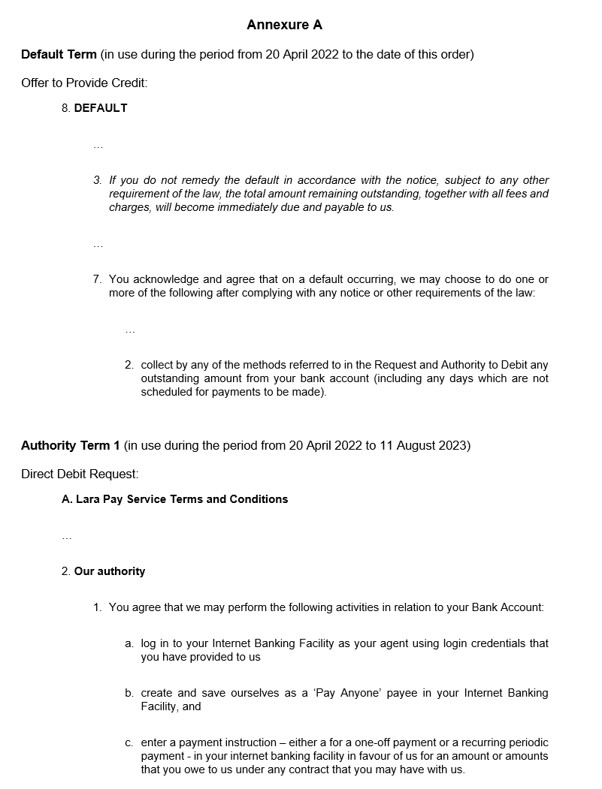
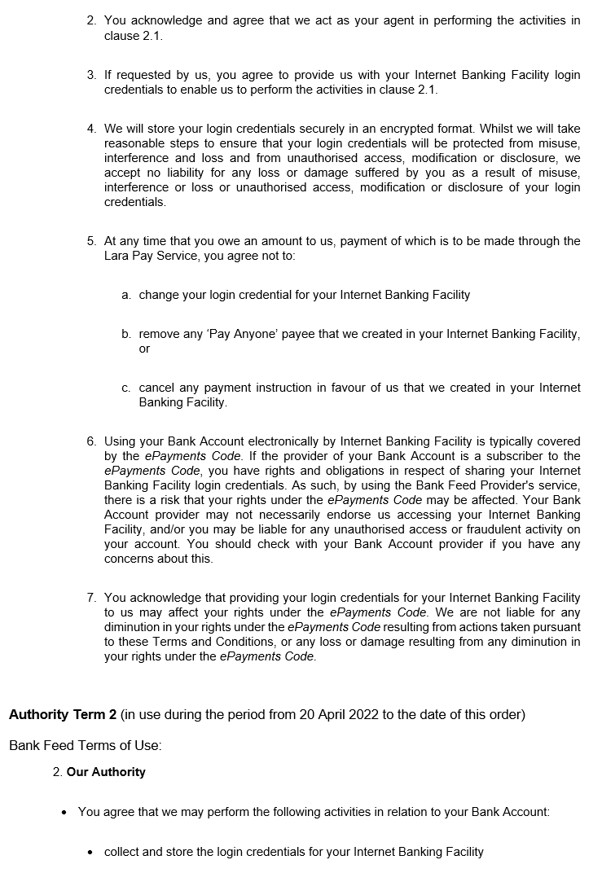
(c) A reference to Authority Term 1 is a reference to clause 2 of the Lara Pay Service Terms and Conditions within the Direct Debit Request and is set out in Annexure A to these Orders.
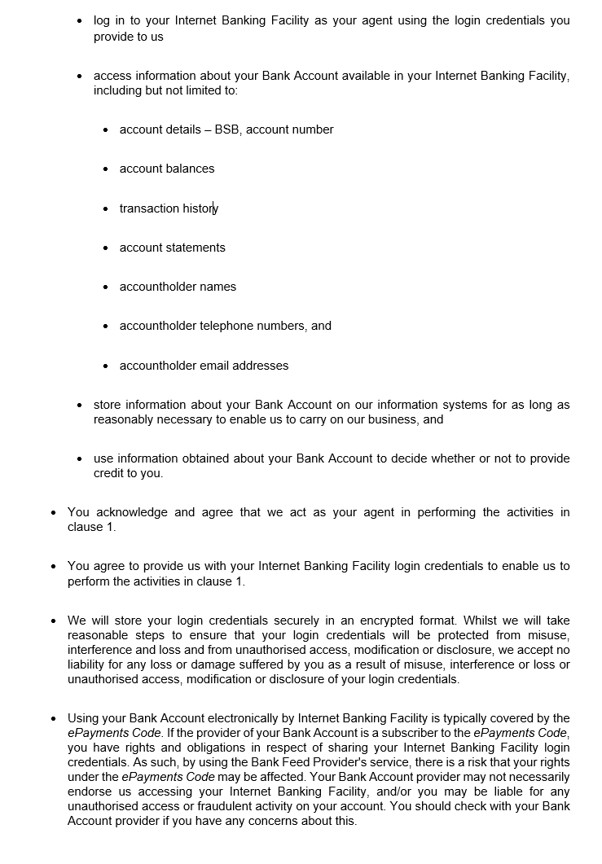
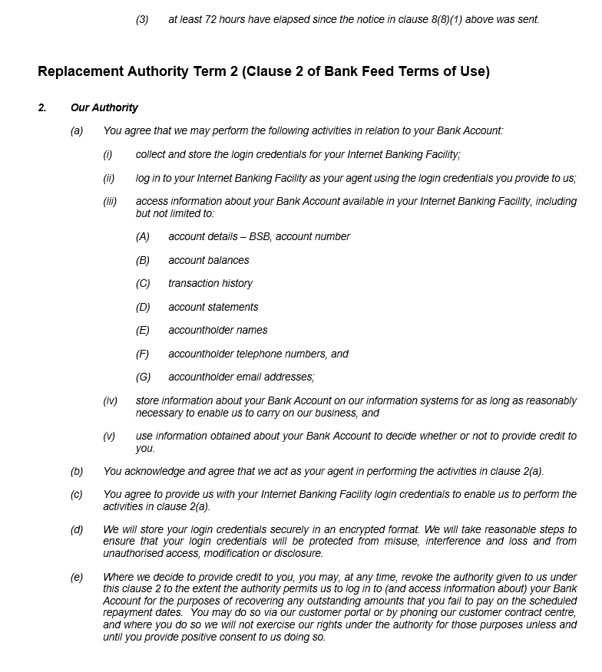
(d) A reference to Authority Term 2 is a reference to clause 2 of the Bank Feed Terms of Use and is set out in Annexure A to these Orders.
(e) A reference to the Credit Code means the National Credit Code (being Schedule 1 to the National Consumer Credit Protection Act 2009 (Cth)).
(f) A reference to a SACC means a “small amount credit contract” within the meaning of s 5 of the National Consumer Credit Protection Act 2009 (Cth).
(g) A reference to the Consumer SACCs is a reference to each SACC:
(i) entered into on and from 20 April 2022 to and including the date of these orders;
(ii) between the Defendant and any consumer who is a Non-Party (as defined in s 12BA of the ASIC Act);
(iii) which meets the definition of a consumer contract in s 12BF(3) of the ASIC Act; and
(iv) which incorporates the following documents:
A. an Offer to Provide Credit;
B. a Direct Debit Request (which incorporates various Direct Debit Service Agreements including, during the period up to and including 11 August 2023, the Lara Pay Service Terms and Conditions); and
C. a Bank Feed Terms of Use.
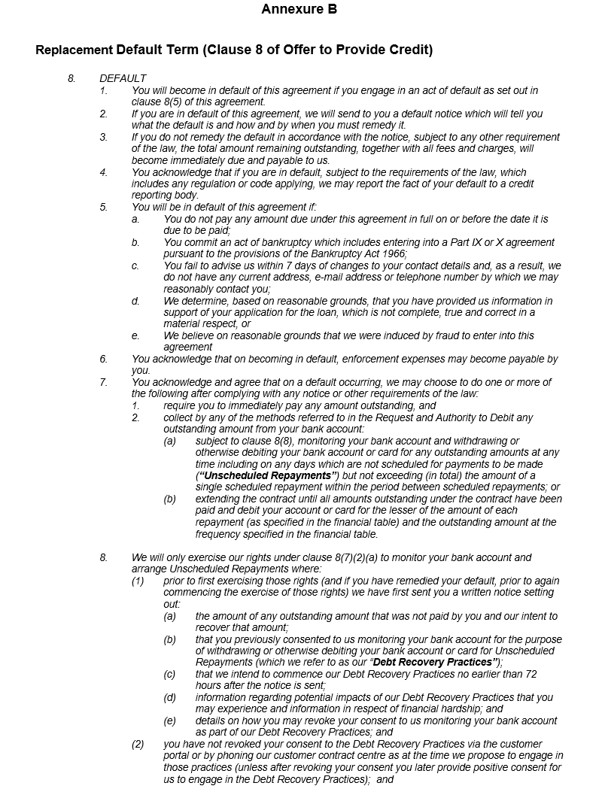
(h) A reference to Default Term is a reference to clauses 8.3 and 8.7(2) of the Offer to Provide Credit and is set out in Annexure A to these Orders.
(i) A reference to the FCA Act is a reference to the Federal Court of Australia Act 1976 (Cth).
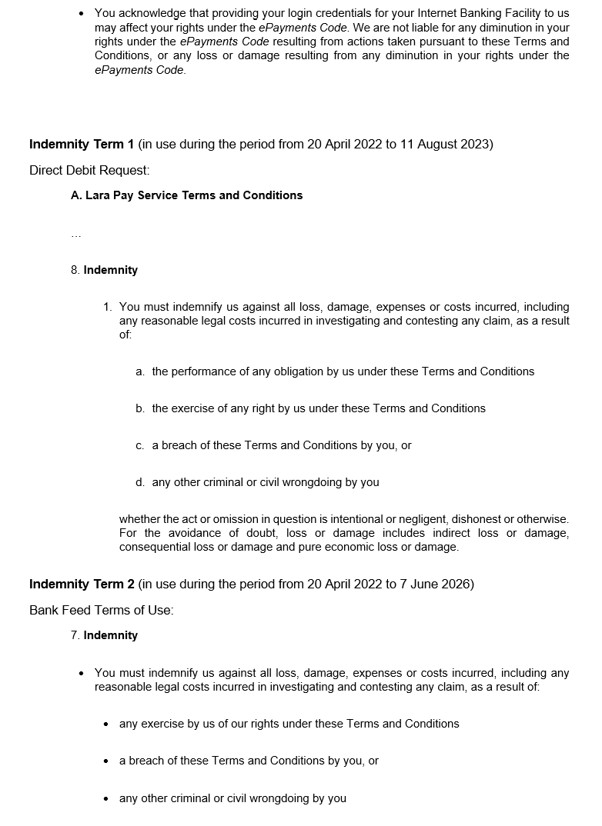
(j) A reference to Indemnity Term 1 is a reference to clause 8.1 of the Lara Pay Service Terms and Conditions within the Direct Debit Request and is set out in Annexure A to these Orders.
(k) A reference to Indemnity Term 2 is a reference to clause 7 of the Bank Feed Terms of Use and is set out in Annexure A to these Orders.
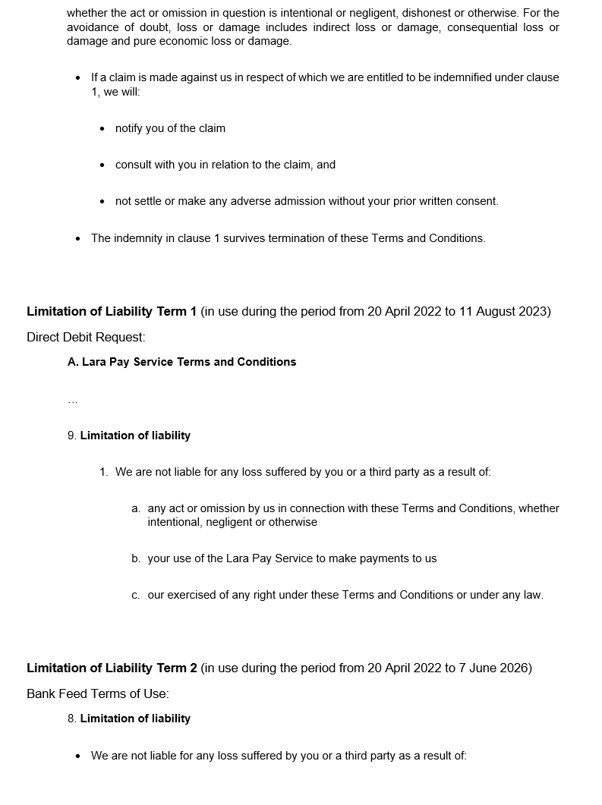
(l) A reference to Limitation of Liability Term 1 is a reference to clause 9.1 of the Lara Pay Service Terms and Conditions within the Direct Debit Request and is set out in Annexure A to these Orders.
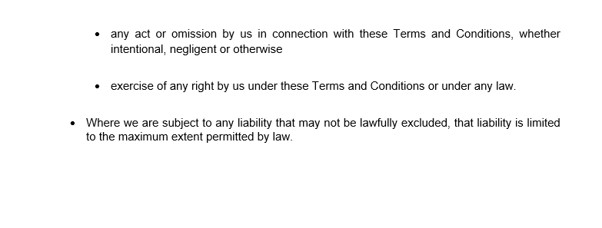
(m) A reference to Limitation of Liability Term 2 is a reference to clause 8 of the Bank Feed Terms of Use and is set out in Annexure A to these Orders.
THE COURT DECLARES:
1. Pursuant to s 12GND(1) of the ASIC Act, that each of the following terms, in each Consumer SACC in which that term was incorporated, is an unfair term within the meaning of s 12BG(1) of the ASIC Act:
(a) the Default Term;
(b) Authority Term 1;
(c) Authority Term 2;
(d) Indemnity Term 1;
(e) Indemnity Term 2;
(f) Limitation of Liability Term 1; and
(g) Limitation of Liability Term 2.
2. By operation of s 12BF(1) of the ASIC Act and pursuant to s 12GNB(1) of the ASIC Act, or alternatively pursuant to s 21 of the FCA Act, each of the Default Term, Authority Term 1 and Authority Term 2 is void 14 days from the date of these orders in each Consumer SACC in which the relevant term was incorporated.
3. Pursuant to ss 12GNB(1) and 12GNC(a)(ii) of the ASIC Act, or alternatively pursuant to s 21 of the FCA Act, that each of the Indemnity Term 1, Indemnity Term 2, Limitation of Liability Term 1, and Limitation of Liability Term 2 is void ab initio in each Consumer SACC in which the relevant term was incorporated.
4. Pursuant to s 12GBA(1) of the ASIC Act, that the Defendant contravened s 12BF(2A) of the ASIC Act on 189,676 occasions in relation to the Consumer SACCs during the period from 9 November 2023 to 7 June 2026, because on 47,419 occasions, the Defendant proposed and made a contract that:
(a) was a consumer contract (within the meaning of s 12BF(3) of the ASIC Act);
(b) was a standard form contract (within the meaning of s 12BK of the ASIC Act);
(c) was a financial product (within the meaning of s 12BAA of the ASIC Act and Regulation 2B of the ASIC Regulations); and
(d) contained four terms which were unfair terms (within the meaning of s 12BG(1) of the ASIC Act), namely: the Default Term, Authority Term 2, Indemnity Term 2, and Limitation of Liability Term 2.
5. Pursuant to s 12GBA(1) of the ASIC Act, that the Defendant contravened s 12BF(2A) of the ASIC Act on 870 occasions in relation to the Consumer SACCs during the period from 8 June 2026 to 30 June 2026, because on 435 occasions, the Defendant proposed and made a contract that:
(a) was a consumer contract (within the meaning of s 12BF(3) of the ASIC Act);
(b) was a standard form contract (within the meaning of s 12BK of the ASIC Act);
(c) was a financial product (within the meaning of s 12BAA of the ASIC Act and Regulation 2B of the ASIC Regulations); and
(d) contained two terms which were unfair terms (within the meaning of s 12BG(1) of the ASIC Act), namely the Default Term and Authority Term 2.
6. Pursuant to s 12GBA(1) of the ASIC Act, that the Defendant contravened s 12BF(2C) of the ASIC Act on at least 658,245 occasions in relation to the Consumer SACCs during the period from 9 November 2023 to 30 June 2026 because on 658,245 occasions the Defendant applied or relied on, or purported to apply or rely on, the Default Term and the Authority Term 2 (which were unfair terms within the meaning of s 12BG(1) of the ASIC Act) in a contract that:
(a) was a consumer contract (within the meaning of s 12BF(3) of the ASIC Act);
(b) was a standard form contract (within the meaning of s 12BK of the ASIC Act); and
(c) was a financial product (within the meaning of s 12BAA of the ASIC Act and Regulation 2B of the ASIC Regulations).
7. Pursuant to s 21 of the FCA Act, that the Defendant contravened s 87(2) of the Credit Code on 67,545 occasions on which s 87 of the Credit Code applied during the period from 11 March 2021 to 6 June 2023, by failing in each case to give a defaulting debtor a notice complying with s 87(3) of the Credit Code within 14 days of a first direct debit default occurring.
THE COURT ORDERS:
8. Pursuant to s 12GBB(3) of the ASIC Act, that the Defendant pay to the Commonwealth a pecuniary penalty in the amount of $3.5 million in respect of its contraventions of s 12BF(2A) and s 12BF(2C) of the ASIC Act referred to in paragraphs 4 to 6 above.
9. That the defendant is to pay the pecuniary penalty in order 8 above in the following instalments:
(a) a sum of $1.5 million to be paid within 30 days of the date of these orders;
(b) a sum of $1 million to be paid by 30 June 2027; and
(c) a sum of $1 million to be paid by 30 June 2028.
10. Pursuant to s 12GD of the ASIC Act, or alternatively pursuant to s 23 of the FCA Act, that the Defendant be permanently restrained, whether by itself, its servants, agents or otherwise, from applying or relying on, or from or purporting to apply or rely on, the Default Term, Authority Term 1, Authority Term 2, Indemnity Term 1, Indemnity Term 2, Limitation of Liability Term 1 and Limitation of Liability Term 2, or any term in substantially the same terms, in any SACC entered into from 14 days from the date of these orders.
11. Pursuant to ss 12GNB(1) and 12GNC(b) of the ASIC Act, or alternatively pursuant to s 12GNF(2)(d) of the ASIC Act, each Consumer SACC incorporating the Default Term and/or Authority Term 2 be varied with effect from the date that is 14 days from the date of these Orders by:
(a) replacing the Default Term with the Replacement Default Term specified in Annexure B; and
(b) replacing Authority Term 2 with the Replacement Authority Term specified in Annexure B.
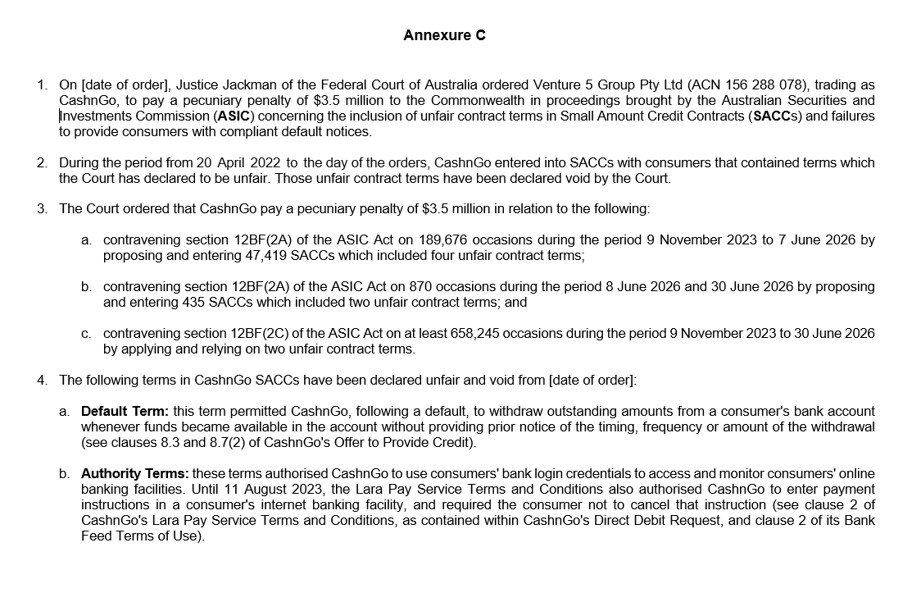
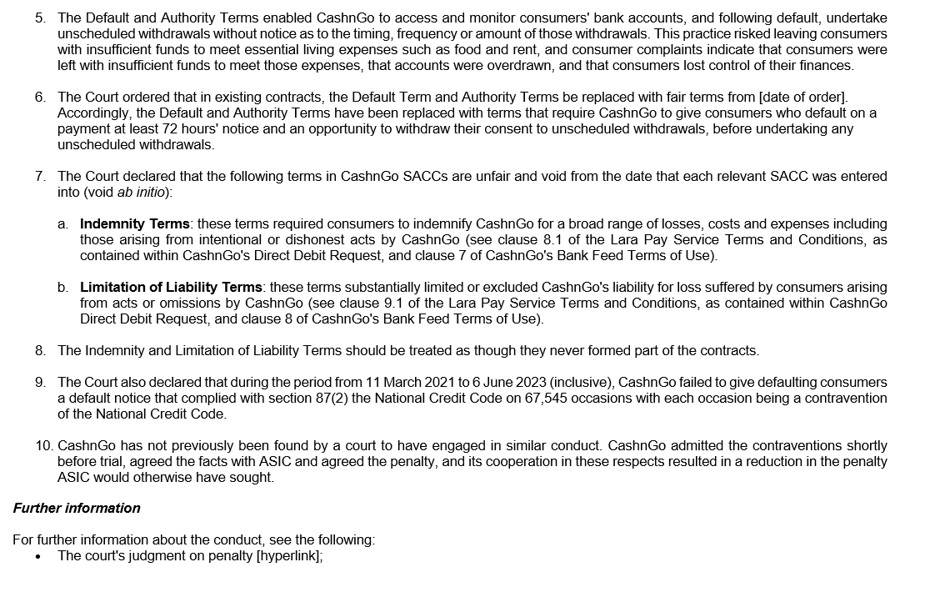
12. Pursuant to s 12GLB of the ASIC Act, that the Defendant publish, or cause to be published within 14 days of the date of these orders and remaining for a period of 90 days from the first date of publication, in a prominent place on the home page of the Defendant’s website (being www.cashngo.com.au) a notice in the form contained in Annexure C.
13. That the Defendant is to pay the Plaintiff’s costs of the proceeding, fixed in the amount of $100,000, within 30 days of the date of these orders.
Note: Entry of orders is dealt with in Rule 39.32 of the Federal Court Rules 2011.
PENAL NOTICE ENDORSEMENT PURSUANT TO RULE 41.06 TO: Venture 5 Group Pty Ltd (ACN 156 288 078) IF YOU (BEING THE PERSON BOUND BY THIS ORDER): (A) REFUSE OR NEGLECT TO DO ANY ACT WITHIN THE TIME SPECIFIED IN THIS ORDER FOR THE DOING OF THE ACT; OR (B) DISOBEY THE ORDER BY DOING AN ACT WHICH THE ORDER REQUIRES YOU NOT TO DO, YOU WILL BE LIABLE TO IMPRISONMENT, SEQUESTRATION OF PROPERTY OR OTHER PUNISHMENT. ANY OTHER PERSON WHO KNOWS OF THIS ORDER AND DOES ANYTHING WHICH HELPS OR PERMITS YOU TO BREACH THE TERMS OF THIS ORDER MAY BE SIMILARLY PUNISHED. |
REASONS FOR JUDGMENT
JACKMAN J:
Introduction
1 The Plaintiff, the Australian Securities and Investments Commission (ASIC), commenced this proceeding against Venture 5 Group Pty Ltd trading as CashnGo (CashnGo), seeking, amongst other things, declarations of contraventions of the Australian Securities and Investments Commission Act 2001 (Cth) (ASIC Act) and Schedule 1 to the National Consumer Credit Protection Act 2009 (Cth) (NCCP Act), namely the National Credit Code (Credit Code), pecuniary penalty orders, injunctions, and orders that certain contract terms are void or void ab initio.
2 The parties made joint written submissions as to the contraventions, and their remedial consequences, including the amount of an agreed penalty. The parties have also agreed to a Statement of Agreed Facts and Admissions (SAFA), for the purpose of s 191 of the Evidence Act 1995 (Cth), and rely on the SAFA in support of the relief jointly sought by the parties. The orders which I have made are those propounded jointly by the parties. These reasons adopt the defined terms used in the orders and in the SAFA.
3 This proceeding concerns CashnGo’s supply of credit to consumers in the period since 20 April 2022 pursuant to small amount credit contracts as defined in the NCCP Act (SACCs), which ASIC alleged, and CashnGo admits, contained unfair contract terms. From 9 November 2023, CashnGo’s making of and reliance on SACCs containing unfair contract terms constituted civil penalty contraventions. ASIC also alleged, and CashnGo also admits, that CashnGo failed to give default notices to consumers that contained information required by the Credit Code.
4 ASIC alleges, and CashnGo admits (SAFA [3]), that:
(a) during the period from 20 April 2022 to 7 May 2025 (being the Relevant Period as defined in the SAFA), it entered into 201,674 SACCs with 85,603 consumers with a value of $207,818,051, which each contained unfair contract terms (within the meaning of s 12BG(1) of the ASIC Act) that are void under s 12BF(1) of the ASIC Act;
(b) during the period from 9 November 2023 to 7 June 2026, it entered into 47,419 SACCs, each containing four unfair contract terms and so giving rise to 189,676 contraventions of s 12BF(2A) of the ASIC Act;
(c) during the period from 8 June 2026 to 30 June 2026, it entered into 435 SACCs, each containing two unfair contract terms and so giving rise to 870 contraventions of s 12BF(2A) of the ASIC Act;
(d) during the period from 9 November 2023 to 30 June 2026, it relied on, or applied, two of the unfair contract terms (the Default Term and Authority Term 2 as defined at[14] below) to undertake the Unscheduled Withdrawals Practice (defined at [31] below) on 658,245 occasions (of which 534,144 were unsuccessful and 124,101 were successful), in contravention of s 12BF(2C) of the ASIC Act; and
(e) during the period from 11 March 2021 to 6 June 2023, it failed to give a defaulting debtor a notice that complied with s 87(3) of the Credit Code, within 14 days of the first direct debit default, which affected 53,057 consumers in relation to 67,545 SACCs, in contravention of s 87(2) of the Credit Code.
5 The various time periods of the admitted contraventions above are explained by the following:
(a) on 9 November 2023, ss 12BF(2A) and (2C) of the ASIC Act came into effect, which (when read with s 12GBA(6)(aa)) relevantly have the effect of imposing civil penalties for proposing and relying on unfair contract terms;
(b) by 8 June 2026, CashnGo removed the Indemnity Term 2 and Limitation of Liability Term 2 (defined at [14] below) from its SACCs; and
(c) the parties agreed to use a 30 June 2026 cut off to calculate the number of contraventions although CashnGo has continued to provide SACCs containing the Default Term and Authority Term 2 (pending the orders made today for replacement terms).
6 ASIC does not press its claim in relation to unconscionable conduct, and accordingly does not seek any relief or penalties in regard to paras 11 to 13 and 14, in so far as they relate to the unconscionable conduct allegation, of the Amended Originating Process filed on 21 May 2026.
7 The parties seek orders as to relief from the Court in an agreed form, which I have adopted, and which are in summary:
(a) declarations that the seven unfair contract terms are void and that four of those terms are void ab initio;
(b) declarations of contravention of ss 12BF(2A) and 12BF(2C) of the ASIC Act and s 87(2) of the Credit Code;
(c) an order for the Default Term and Authority Term 2 to be replaced with proposed replacement terms;
(d) a pecuniary penalty in the total amount of $3.5 million paid in instalments in respect of CashnGo’s contraventions of ss 12BF(2A) and 12BF(2C) of the ASIC Act;
(e) a permanent injunction prohibiting CashnGo from applying or relying on the unfair contract terms or equivalent terms;
(f) an adverse publicity order; and
(g) costs.
The Contravening Conduct
8 CashnGo holds an Australian Credit Licence and provides SACCs to consumers in Australia. In doing so, it enters into those SACCs as a credit provider and engages in the provision of credit within the meaning of ss 204 and 3(1) of the Credit Code: SAFA [10].
9 During the Relevant Period, CashnGo entered into 201,674 SACCs with 85,603 consumers and, in the period following the Relevant Period up to 30 June 2026, a further 8,800 SACCs were entered into with 6,139 consumers: SAFA [19].
10 CashnGo offered those SACCs to consumers on the following terms (SAFA [20]):
(a) loan amounts of between $300 and $2,000;
(b) that the loan was repayable over terms of between two and six months; and
(c) that the fees payable by the consumers comprised:
(i) an establishment fee of 20% of the amount borrowed; and
(ii) a monthly fee of 4% of the amount borrowed (including the establishment fee).
11 By way of illustration, a consumer seeking a loan of $1,000 cash for a term of six months would pay a $200 establishment fee and monthly fees of $48 (4% of the total $1,200 borrowed), such that over the six-month term the amount to be repaid would total $1,488, assuming they did not default or incur any $30 default fees.
12 CashnGo's SACCs were, and continue to be, comprised of the following standard form contractual documents (SAFA [16]):
(a) Offer to Provide Credit;
(b) Direct Debit Request (which incorporates various Direct Debit Service Agreements); and
(c) Bank Feed Terms of Use.
13 Taking the contract suite as a whole, there were four versions of the contract suite in place across the period:
(a) from 20 April 2022 to 11 August 2023, CashnGo’s SACCs comprised:
(i) the Bank Feed Terms of Use at pages 45 to 52 of the SAFA;
(ii) the Direct Debit Request at pages 57 to 67 of the SAFA; and
(iii) the Offer to Provide Credit at pages 84 to 98 of the SAFA.
(b) from 12 August 2023 to 8 November 2023, CashnGo’s SACCs comprised:
(i) the Bank Feed Terms of Use at pages 45 to 52 of the SAFA;
(ii) the Direct Debit Request at pages 68 to 72 of the SAFA; and
(iii) the Offer to Provide Credit at pages 84 to 98 of the SAFA.
(c) from 9 November 2023 to 7 June 2026, CashnGo’s SACCs comprised:
(i) the Bank Feed Terms of Use at pages 45 to 52 of the SAFA;
(ii) the Direct Debit Request at pages 73 to 76 of the SAFA; and
(iii) the Offer to Provide Credit at pages 99 to 105 of the SAFA.
(d) from 8 June 2026 to 30 June 2026, CashnGo’s SACCs comprised:
(i) the Bank Feed Terms of Use at pages 53 to 56 of the SAFA;
(ii) the Direct Debit Request at pages 77 to 83 of the SAFA; and
(iii) the Offer to Provide Credit at pages 106 to 115 of the SAFA.
14 CashnGo’s SACCs contained the following contract terms (the specific terms are extracted at Annexure A of the orders) during the following periods of time hereafter referred to collectively as the Contract Terms (SAFA [21]–[25]):
(a) cll 8.3 and 8.7(2) of the Offer to Provide Credit (being the Default Term) from at least 20 April 2022 to date;
(b) cl 2 of the Lara Pay Service Terms and Conditions, as contained within the Direct Debit Request (being Authority Term 1) from at least 20 April 2022 to 11 August 2023;
(c) cl 2 of the Bank Feed Terms of Use (being Authority Term 2) from at least 20 April 2022 to date;
(d) cl 8.1 of the Lara Pay Service Terms and Conditions, as contained within the Direct Debit Request (being Indemnity Term 1) from at least 20 April 2022 to 11 August 2023;
(e) cl 7 of the Bank Feed Terms of Use (being Indemnity Term 2) from at least 20 April 2022 to 7 June 2026;
(f) cl 9.1 of the Lara Pay Service Terms and Conditions, as contained within the Direct Debit Request (being Limitation of Liability Term 1) from at least 20 April 2022 to 11 August 2023; and
(g) cl 8 of the Bank Feed Terms of Use (being Limitation of Liability Term 2) from at least 20 April 2022 to 7 June 2026. Authority Term 1 and Authority Term 2 are together referred to as the Authority Terms; Indemnity Term 1 and Indemnity Term 2 are together referred to as the Indemnity Terms; and Limitation of Liability Term 1 and Limitation of Liability Term 2 are together referred to as the Limitation of Liability Terms.
15 Each of the SACCs that CashnGo entered into with consumers was and is (SAFA [17]):
(a) a “consumer contract”, within the meaning of s 12BF(3) of the ASIC Act and for the purposes of s 12BF(1) of the ASIC Act;
(b) a “standard form contract”, within the meaning of s 12BK of the ASIC Act and for the purposes of s 12BF(1)(b) of the ASIC Act;
(c) a “financial product”, within the meaning of s 12BAA(7)(k) of the ASIC Act and reg 2B of the Australian Securities and Investments Commission Regulations 2001 (Cth) and for the purposes of s 12BF(1)(c)(i) of the ASIC Act; and
(d) a contract for the supply, or possible supply, of services that are “financial services”, within the meaning of s 12BAB(1)(b) of the ASIC Act and for the purposes of s 12BF(1)(c)(ii) of the ASIC Act.
16 CashnGo’s website promoted its SACCs including by statements to the effect that (SAFA [31]):
(a) it provided “Fast Cash Loans Up To $2,000”;
(b) its loan application process was wholly online, easy, effortless and “takes about 5 minutes” to complete;
(c) its approval process was even quicker with the “Outcome in Seconds…”;
(d) its main focus was to serve a segment of the market to whom banks were unwilling to provide credit because of “regularity [sic] scrutiny” and the banks’ risk appetite;
(e) it would not reject an application for credit simply due to a consumer’s bad credit history, stating that “[a]t CashnGo, we provide cash loans for bad credit” and that it was committed to helping such consumers obtain the finance they needed;
(f) it outlined that CashnGo “…are more interested in your current financial situation than issues you may have encountered in the past” and that it understood that a consumer’s prior financial problems should not impact on their future; and
(g) CashnGo was “there for [consumers]” when they needed to borrow money quickly whilst in a “sticky situation”.
17 Consumers applied to CashnGo for a SACC through an online portal accessed through CashnGo’s website (SAFA [33]). The assessment of loan applications was a predominantly automated, algorithm-based system (SAFA [32(a)]).
18 During the application process, CashnGo required consumers to either provide their internet banking login details and passwords (Login Credentials) or, for the small number of consumers whose financial institutions were incompatible with CashnGo’s use of Login Credentials, to connect their bank account to a third-party service provider called Basiq. Either process enabled CashnGo to extract transaction data from the consumer’s bank account (SAFA [34]–[37]).
19 When consumers applied for a SACC loan, CashnGo used the consumer’s Login Credentials, or Basiq, to access the consumer’s bank account transaction data for the previous 90 days to determine whether the relevant SACC would be unsuitable for the consumer (SAFA [41]–[42]). After a consumer’s loan was approved, CashnGo retained access to the consumer’s bank account transaction data either through the consumer’s Login Credentials (where provided) or through Basiq (SAFA [39]). CashnGo used this access to transaction data to identify funds in the consumer’s account and conduct unscheduled direct debit withdrawals to recover overdue amounts, as described further below.
20 CashnGo’s lending criteria were set out in its Underwriting Policy (as updated from time to time), which identified the loan assessment “rules” that were implemented via algorithms in CashnGo’s system and applied automatically by that system to each loan application (SAFA [44]–[45]). Some “rules” set out the circumstances in which CashnGo’s system would automatically decline a loan application. Other “rules” set out the circumstances in which a loan application would need to be assessed by CashnGo’s loan processing officers (SAFA [44]).
21 CashnGo’s thresholds for an automatic decline of the loan did not necessarily prevent consumers from obtaining SACCs where those consumers had low incomes (including those with income solely comprised of Centrelink payments), or spent a significant amount of their income on gambling (prior to 18 August 2024, up to 50% of a consumer’s income or a Problem Gambling Severity Index (PGSI) greater than 4, where gambling transactions totalled between 30% and 50% of the consumer’s income and, from 18 August 2024, up to 30% of a consumer’s income could be spent on gambling or their PGSI was not greater than 4), and/or had defaulted on previous SACCs, including, for a new employed customer, up to 3 SACC defaults in the past 45 days and entered into 1 other SACC in the past 90 days (SAFA [45]).
22 In addition to applying the “rules” in the Underwriting Policy to determine whether the loan would be approved, CashnGo’s system also automatically conducted an Equifax credit check on loan applicants and calculated an internal risk score to determine whether to lend and, if so, the maximum loan amount to lend (SAFA [48]–[50]).
23 CashnGo had an automated communications system (SAFA [73]–[74]) that sent a default notice to a consumer when the consumer first defaulted on a Scheduled Repayment. This “default notice” was attached to an email that was sent to the consumer and was in the form of Form 11A (as set out in Sch 1 to the National Consumer Credit Protection Regulations 2010 (Cth) (the Regulations)). However, due to a system update, from on or about 11 March 2021 to on or about 6 June 2023, that attachment was deleted from the automated communication (SAFA [102]–[103]).
24 As a result, the emails sent by CashnGo to consumers notifying them of the default did not expressly include the following mandatory information as required by Form 11A (SAFA [104]):
(a) a suggestion that the consumer contact their financial institution or change their direct debit arrangements via their credit provider;
(b) a warning that action may be taken against the consumer if the default in payment persists;
(c) an offer of an opportunity to “discuss your situation” or to vary a contract;
(d) avenues to review a decision, by supplying contact details and methods for lodging AFCA complaints; or
(e) a telephone number for a free and independent financial counsellor (specifically 1800 007 007) to explore debt management.
25 The emails did include other information required by Form 11A, namely a company phone number as an avenue for support, a request that the consumer contact the credit provider, the amount that the consumer was in arrears at the time of the default, a warning that fees and charges were accumulating, and a link to the consumer’s account with CashnGo (SAFA [104(a)]). The consumer’s account provided a warning that action may be taken against a consumer if the default in payment persists and a mechanism to enable the consumer to vary a contract (SAFA [105]).
26 On or about 6 June 2023, CashnGo reinstated provision of a default notice in the form of Form 11A.
27 At all material times, CashnGo applied and relied on the Default Term and the Authority Term 2 in its debt recovery practices. From 9 November 2023, that application and reliance became the subject of civil penalty contraventions.
28 After entering into a SACC, CashnGo sent an email to consumers outlining their full repayment schedule, including the dates and amount of all future repayments (Scheduled Repayments) (SAFA [51]). The repayment schedule was also accessible to consumers via an online portal on CashnGo’s website (SAFA [52]). Consumers could request to amend their repayment schedule (SAFA [53]).
29 As indicated at [19] above, where a consumer’s loan was approved, CashnGo retained access to the consumer’s bank account and could extract transaction data during the term of the loan either through the consumer’s Login Credentials (where provided) or through Basiq (SAFA [39]).
30 Thereafter, in the event of a default by a consumer in accordance with their repayment schedule, CashnGo applied and relied on the Authority Term 2 to monitor the consumer’s bank account on an hourly basis for the purpose of identifying when funds were available in a consumer’s account and initiating transactions to recover overdue amounts (SAFA [27], [56]–[57]).
31 To recover such overdue amounts, CashnGo applied and relied on the Default Term and Authority Terms which permitted CashnGo’s machine-based algorithm to use the consumer’s Login Credentials, or Basiq, to monitor the consumer’s bank account every hour to enable CashnGo to recover overdue amounts as follows:
(a) by making and/or attempting to make withdrawals from the consumer’s bank account, as soon as funds were identified in the consumer’s bank account, and outside of the repayment schedule (Unscheduled Withdrawals) without giving the consumer any prior notice of the timing, amount or frequency of those Unscheduled Withdrawals or attempted Unscheduled Withdrawals;
(b) by CashnGo making and/or attempting to make Unscheduled Withdrawals of amounts that would be likely to leave the consumer with insufficient funds to meet necessary living expenses and, in some cases, cause the consumer’s account to be overdrawn and to be charged a fee by their bank; and
(c) by CashnGo making and/or attempting to make such Unscheduled Withdrawals repeatedly for so long as the consumer was behind in their repayment schedule, as soon as the consumer received funds into their bank account and:
(i) until 6 August 2022, until the whole of the overdue amounts was repaid; and
(ii) after 6 August 2022, until the whole of the overdue amounts was repaid but with the amount withdrawn during a repayment frequency (being the time between Scheduled Repayments) limited to the value of a single Scheduled Repayment, irrespective of the total amount overdue.
(together, the Unscheduled Withdrawals Practice) (SAFA [27]).
32 CashnGo’s automated system for monitoring and withdrawing funds from a consumer’s bank account in the event of default or non-payment had the following features (SAFA [58] and [63]):
(a) the system was configured to identify all loans with repayments, whether due or overdue, as at any given day and then queue requests to fetch bank account balances for all such accounts;
(b) the system used an algorithm designed to ensure a payment would not be attempted if:
(i) the account balance was less than $20 at the time the account balance was obtained (Threshold Condition); and
(ii) the account balance would become less than $5 if the withdrawal was processed based on the account balance at the time the balance check was performed (Minimum Balance Condition); and
(c) the algorithm ran automatically on CashnGo’s computer systems without human intervention.
33 CashnGo’s automated system was configured to take the following amounts as part of any Unscheduled Withdrawal, following a consumer defaulting on a Scheduled Repayment (SAFA [69]):
(a) if there were sufficient funds available in the consumer’s bank account to cover the whole of the overdue repayment, the full amount would be taken, provided that the Minimum Balance Condition was met;
(b) if the available funds in the consumer’s bank account were less than the overdue repayment, an amount less than the overdue repayment would be taken, provided that, according to CashnGo’s system, the Threshold Condition and the Minimum Balance Condition were satisfied;
(c) the process described in sub-para (b) above would be repeated until such time as the total overdue amount was satisfied, subject to sub-paras (d) and (e) below;
(d) up until 6 August 2022, where there was more than one overdue repayment owing, if the consumer’s available balance exceeded the total amount overdue, the whole of the overdue amounts would be collected by the processes described in sub-paras (a) to (c) above; and
(e) after 6 August 2022, when there was more than one overdue repayment owing, the automated system was limited so that, during a single repayment frequency (being the time between Scheduled Repayments), the amount deducted by the processes described in sub-paras (a) to (c) above was limited to the value of one overdue Scheduled Repayment, irrespective of the total amount overdue.
34 For example, if a consumer missed a Scheduled Repayment of $200 and consequently had an overdue amount of $200 under the loan, CashnGo’s automated system thereafter performed hourly checks of the consumer’s bank account to determine if the Threshold Condition was satisfied (i.e. the account had $20 or more in it). If, at the time such an hourly check was performed, the consumer’s account balance was $150, CashnGo’s automated system would withdraw $145 from the consumer’s bank account so as to leave $5 in accordance with the Minimum Balance Condition. Thereafter, CashnGo’s automated system continued to perform hourly checks of the consumer’s account balance for the purpose of withdrawing the remaining $55 that was overdue, subject to the limit implemented after 6 August 2022 set out at [33(e)] above.
35 CashnGo’s automated system withdrew funds from a consumer’s bank account by issuing a payment instruction to a third-party payment processor which, in turn, caused the funds to be debited from the consumer’s bank account and remitted to CashnGo (SAFA [55]).
36 In practice, the algorithm did not always operate in the manner sought to be achieved by the Threshold Condition (such that processing of CashnGo’s payment instruction could occur when the account balance was less than $20) or the Minimum Balance Condition (such that the processing of a payment instruction could result in the balance of the account falling below $5) (SAFA [59]). This is because it was possible for a payment instruction to be executed at a time when the conditions were satisfied but, when the payment instruction was subsequently processed, the balance of the relevant account no longer met those conditions (SAFA [59]). The precise timing of when a payment instruction was processed depended upon the speed with which those instructions were processed by the providers of payment systems which CashnGo used. The speed with which payments could be processed ranged from immediate processing up to several days (SAFA [67] and [70]).
37 In such circumstances, CashnGo’s Unscheduled Withdrawals could (and at times did) (SAFA [70]):
(a) result in the consumer being left with less than $5 in their account;
(b) result in the consumer’s account being overdrawn; or
(c) be reversed by the bank such that CashnGo did not obtain the funds from the consumer.
38 By virtue of the automated system above, CashnGo made Unscheduled Withdrawals from consumers’ bank accounts on dates and in amounts outside of a consumer’s repayment schedule (SAFA [71]). CashnGo’s system also made repeated Unscheduled Withdrawals until repayment of the overdue amount was satisfied, subject to [33(e)] above.
39 CashnGo sent consumers who had missed a Scheduled Repayment, on or about the 5th day after the Scheduled Repayment was due, notice indicating that CashnGo would attempt to withdraw the repayment again in the coming days and sent further automated emails and text messages to such consumers thereafter (SAFA [73]–[74]). Other than the emails referred to in SAFA [73], the SMS and email communications sent by CashnGo did not provide consumers with any prior notice of the timing, amount or frequency of any Unscheduled Withdrawals (SAFA [76]). Further, a consumer may have been subject to an Unscheduled Withdrawal in the period immediately following a Scheduled Repayment date, but before receiving any of CashnGo’s emails or text messages (SAFA [77]). CashnGo did inform consumers by email or text message after it had successfully made an Unscheduled Withdrawal (SAFA [78]).
40 The extent to which CashnGo engaged in the Unscheduled Withdrawals Practice, including the numbers of consumers left with only nominal funds following an Unscheduled Withdrawal, is set out in relation to the matters relevant to penalty below.
Unfair Contract Terms
Applicable Legal Principles
41 The principles applicable to the unfair contract terms regime in the ASIC Act (and the equivalent regime in the Australian Consumer Law) were recently summarised in Australian Securities and Investments Commission v Auto & General Insurance Company Limited [2025] FCAFC 76; (2025) 309 FCR 473 at [27]–[39] (O’Bryan and Cheeseman JJ, with whom Derrington J relevantly agreed at [4]). The following principles affirmed in those reasons are applicable to the present case.
42 First, a contractual term is unfair if it satisfies the three elements or conditions in s 12BG(1) of the ASIC Act concerning the substantive effect of the term, which is to be assessed as at the date of the contract. Section 12BG(1) provides:
A term of a contract referred to in section 12BF is unfair if:
(a) it would cause a significant imbalance in the parties’ rights and obligations arising under the contract; and
(b) it is not reasonably necessary in order to protect the legitimate interests of the party who would be advantaged by the term; and
(c) it would cause detriment (whether financial or otherwise) to a party if it were to be applied or relied on.
43 Second, the requirement of significant imbalance (in s 12BG(1)(a)) is met if a term is so weighted in favour of a supplier as to tilt the parties’ rights and obligations under the contract significantly in the supplier’s favour. That assessment requires consideration of the relevant term together with the parties’ other rights and obligations under the contract.
44 Third, the legitimate interests of a supplier (as referred to in s 12BG(1)(b)) will depend upon the nature of their business and the context of the contract as a whole. The requirement that the term be “reasonably necessary” in order to protect a party’s legitimate interests requires consideration of the proportionality of the term against the interest being protected and the alternatives that were available to the party imposing the term.
45 For the purposes of s 12BG(1)(b) of the ASIC Act, a term of a contract is presumed not to be reasonably necessary in order to protect the legitimate interests of the party who would be advantaged by the term, unless that party proves otherwise: s 12BG(4).
46 Fourth, the requirement that the term would cause detriment to a party if it were to be applied or relied on (in s 12BG(1)(c)) does not require proof that a party has suffered detriment; it only requires proof that detriment would exist in the future as a result of the application or reliance on the term. Detriment extends beyond financial detriment to other forms of detriment.
47 Fifth, in adhering to the requirement to take into account the extent to which the term is transparent, it is necessary to consider how a lack of transparency may affect the three elements in s 12BG(1), being the statutory definition of “unfair”. The greater the imbalance or detriment inherent in the term, the greater the need for the term to be expressed and presented clearly. Further, a lack of transparency in the terms of a consumer contract may be a strong indication that there is a significant imbalance in the rights and obligations of the parties under the contract.
48 In determining whether a contract term is unfair, s 12BG(2) provides that the Court may take into account such matters as it thinks relevant, but must take into account the following:
(a) the extent to which the term is transparent (as defined in s 12BG(3)); and
(b) the contract as a whole.
Default Term
49 The Default Term would cause a significant imbalance in the parties’ rights and obligations arising under the SACC (within the meaning of s 12BG(1)(a)) in that it (SAFA [81]):
(a) authorises CashnGo to collect funds, or to attempt to deduct the outstanding repayment or the entire loan amount, from a consumer’s bank account repeatedly, even if the consumer would be left without sufficient funds to meet their necessary living expenses;
(b) exposes defaulting consumers to CashnGo’s ongoing right of, and actions for, recovery of the entire loan amount at the times, and by the method, chosen by CashnGo;
(c) does not limit the timing, number or frequency of collections that CashnGo may undertake to recover outstanding funds, leaving the consumer with otherwise no ability to control or direct the deductions, or attempted deductions, from their bank account without breaching their contractual obligations; and
(d) does not require CashnGo to give a consumer any notice of the exercise of its rights under the Default Term, or of any attempted or actual collections of the outstanding funds.
50 The Default Term is not reasonably necessary to protect CashnGo’s legitimate interests within the meaning of s 12BG(1)(b) (SAFA [82]). Further, in circumstances where CashnGo does not seek to prove otherwise, the presumption in s 12BG(4) takes effect in accordance with its terms. Thus, the Default Term is both presumed, and established by an admitted fact, not to be reasonably necessary to protect CashnGo’s legitimate interests.
51 CashnGo has a legitimate interest in ensuring its SACCs contain appropriate contractual entitlements to recover amounts owing in the event of default. However, it is common ground that it was not reasonably necessary to confer contractual rights of the breadth identified at [49] above, particularly the breadth of the discretion as to the timing, manner, amount, number and frequency of withdrawals, to protect that legitimate interest.
52 If the Default Term were to be applied or relied on, it would cause detriment (whether financial or otherwise) within the meaning of s 12BG(1)(c) to many (but not all) consumers who default on a SACC held with CashnGo because, particularly having regard to the Authority Terms (see [55]–[60] below), it would result in those consumers likely losing control over their own finances, and their right to control their own finances, by having money deducted from their account without notice as to the timing, amount or frequency of the deductions, and/or suffering financial hardship (SAFA [83]).
53 For those with limited funds in their account, the Default Term (particularly having regard to CashnGo’s right to monitor consumers’ accounts under the Authority Terms) risked leaving consumers with insufficient funds to meet essential living expenses, and consumer complaints indicate that consumers were left with insufficient funds to meet essential living expenses (SAFA [109]–[114]). CashnGo’s application and reliance on the Default Term to conduct the Unscheduled Withdrawals Practice is explained at [27]–[39] above. The Default Term had the practical effect of permitting CashnGo to subordinate other calls on a consumer’s funds to the consumer’s obligation to repay CashnGo. Consumers could be, and were in some instances, left without funds to pay for essential needs such as food and accommodation.
54 There is nothing in the balance of the contractual terms that alleviates the unfairness of the Default Term.
Authority Terms
55 Each of the Authority Terms would cause a significant imbalance in the parties’ rights and obligations arising under the SACC in that (SAFA [84]):
(a) the consumer is required to authorise CashnGo to collect and store the consumer’s Login Credentials, or information permitting access to their account through Basiq, without any limitations except “as long as reasonably necessary to enable us to carry on our business”;
(b) access to a consumer’s bank account information is permitted to be used by CashnGo (amongst other things) to monitor that account so as to determine when funds were deposited so that, as soon as funds were detected, CashnGo could initiate a payment instruction to withdraw an amount informed by the balance of the account;
(c) the consumer has no recourse under the SACC to prevent CashnGo using its access to the consumer’s bank account, including (but not limited to) undertaking the Unscheduled Withdrawals Practice; and
(d) until 7 June 2026, the consumer had no recourse under the SACC to compensation from CashnGo for any loss or damage suffered by a consumer as a result of misuse, interference, or loss, or unauthorised access to, or modification or disclosure of, the consumer’s Login Credentials.
56 Each of the Authority Terms is not reasonably necessary to protect CashnGo’s legitimate interests within the meaning of s 12BG(1)(b) (SAFA [85]). By s 12BG(4), each of the Authority Terms is presumed not to be reasonably necessary in circumstances where, having regard to its admission, CashnGo does not seek to prove otherwise.
57 If applied or relied on, the Authority Terms would cause detriment (whether financial or otherwise) within the meaning of s 12BG(1)(c) (SAFA [86]):
(a) to many (but not all) of the consumers who defaulted under their SACCs because they would likely lose control over their own finances, and the right to manage their own finances, and/or suffer financial hardship, particularly having regard to the operation of the Default Term; and
(b) to all consumers because CashnGo expressly disclaims liability for misuse, interference or loss, or unauthorised access to, or modification or disclosure of, the consumer’s Login Credentials.
58 Having regard to the Default Term, the Authority Terms enabled CashnGo to recover overdue amounts from a consumer’s bank account as soon as funds were identified in it (see the discussion at [27]–[39] above of CashnGo’s application and reliance on the Authority Terms to conduct the Unscheduled Withdrawals Practice). This is because ongoing monitoring of a consumer’s bank account transactions, on an hourly basis, permitted CashnGo (unilaterally and without giving the consumer any prior notice of the timing, frequency or amount of the debit) to withdraw funds from the account as soon as they were deposited or available (SAFA [2], [27], [61]–[78], [83]). This practice risked leaving consumers with insufficient funds to meet essential living expenses. Consumer complaints to CashnGo indicate that this occurred to consumers, causing distress when consumers unexpectedly found they had insufficient funds to meet essential living expenses. Five examples of consumer complaints are provided at [110]–[114] of the SAFA. This had the effect of subordinating other calls on a consumer’s funds to the consumer’s obligation to repay CashnGo.
59 The nature and extent of the significant imbalance (s 12BG(1)(a)) and the consumer detriment (s 12BG(1)(c)) that, at the time of contracting, would be caused by the Default Term and the Authority Terms (both separately and having regard to the operation of the other term) may be seen in the limitation on the autonomy of consumers to manage their financial affairs, including their ability effectively to prioritise competing financial commitments. CashnGo, an unsecured creditor, thereby obtained a significant contractual benefit (in the form of a degree of control over a defaulting consumer’s bank account) exercisable immediately and without warning, through hourly algorithmic monitoring of the account, as soon as funds became available. The consumers thereby, and to that extent, could lose the freedom to plan and choose how and when to use the funds in their bank accounts.
60 There is nothing in the balance of the contractual terms that alleviates the unfairness of the Authority Terms.
Indemnity Terms
61 Each of the Indemnity Terms would cause a significant imbalance in the parties’ rights and obligations arising under the SACC because they operate so broadly, including even if CashnGo’s act or omission is intentional, negligent or dishonest, and because there is no equivalent indemnity in favour of the consumer (SAFA [87]).
62 The Indemnity Terms are not reasonably necessary to protect CashnGo’s legitimate interests within the meaning of s 12BG(1)(b) (SAFA [88]). Again, the presumption in s 12BG(4) applies.
63 The Indemnity Terms would cause detriment to consumers, within the meaning of s 12BG(1)(c), if they were to be applied or relied on, by reason of their financial impost (SAFA [89]). For example, each Indemnity Term would compel a consumer to indemnify CashnGo for any penalties or costs incurred by CashnGo in litigation involving the exercise of its right to conduct the Unscheduled Withdrawals Practice. Further, consumers would be required to indemnify CashnGo even in respect of CashnGo’s conduct that was intentional, negligent or dishonest.
64 There is nothing in the balance of the contractual terms that alleviates the unfairness of the Indemnity Terms.
Limitation of Liability Terms
65 Each of the Limitation of Liability Terms would cause a significant imbalance in the parties’ rights and obligations arising under the SACC within the meaning of s 12BG(1)(a) because they operate so broadly, including even if CashnGo’s act or omission is intentional or negligent, and because there is no equivalent limitation of liability in favour of the consumer (SAFA [90]).
66 The Limitation of Liability Terms are not reasonably necessary to protect CashnGo’s legitimate interests within the meaning of s 12BG(1)(b) (SAFA [91]). Again, the presumption in s 12BG(4) applies.
67 The Limitation of Liability Terms would cause detriment to consumers, within the meaning of s 12BG(1)(c), if they were to be applied or relied on, because they would prevent consumers from enforcing their rights including for intentional or negligent acts by CashnGo which cause loss and damage to consumers (SAFA [92]). This is particularly significant in circumstances where CashnGo was permitted to retain consumers’ Login Credentials and to access their bank accounts.
68 There are examples of unfair contract terms in s 12BH(1) of the ASIC Act which “may” be unfair. These include, in s 12BH(1)(k), “a term that limits, or has the effect of limiting, one party’s right to sue another party”. The Limitation of Liability Terms, consistently with this example, limit the right of consumers to sue CashnGo.
69 There is nothing in the balance of the contractual terms that alleviates the unfairness of the Limitation of Liability Terms.
Transparency
70 Although consumers were directed to read and consent to the contractual documents during the online application process (by ticking check boxes stating such), CashnGo’s online portal did not require the consumers to click on and view the contractual documents themselves prior to doing so (SAFA [28]–[29]).
71 Other than by their inclusion in the contractual documents, CashnGo did not disclose the content or effect of any of those terms to consumers prior to the commencement of the loan or at all. Having regard to the breadth and practical effect of the terms, the length of the contractual documents comprising the SACCs, and the fact that the online application process did not require consumers to view the contractual documents, each of the contract terms was not and is not transparent within the meaning of s 12BG(3). They were certainly not sufficiently transparent to alleviate or avoid the unfairness of the terms.
72 The parties submit, and I accept, that a reasonable reader of the Authority Terms or the Default Term would not have understood that they authorised CashnGo, through hourly algorithmic monitoring of the consumer’s bank account, to deduct funds from the account as soon as funds were identified in it, without any prior notice of the timing, amount or frequency of the deduction, including potentially before the consumer had an opportunity to see that funds had been deposited into their account, and even if this would result in only nominal funds remaining in the account.
73 Having regard to the extent of the imbalance and detriment inherent in the Authority Terms and the Default Term, there was a need for the practical effect of the terms to be expressed and presented clearly. For a contracting party to choose to bargain away control over their bank account, there should have been a greater degree of transparency as to the terms’ practical effect. Further, the lack of transparency reinforces the existence of a significant imbalance in the rights and obligations of the parties under the contract.
74 The lack of transparency in the expression and presentation of the Default Term and the Authority Terms likewise rendered less transparent the practical effect and breadth of the Indemnity Terms and the Limitation of Liability Terms. The parties submit, and I accept, that the Indemnity Terms and the Limitation of Liability Terms do not prominently, clearly, or in a way that would be readily understood, disclose that the consumer is obliged to indemnify CashnGo against all loss, and that CashnGo is not liable for any loss suffered by the consumer (or any third party, including any person who is financially dependent on the consumer or any creditor of the consumer), as a result of CashnGo’s Unscheduled Withdrawals Practice, including by misuse of a consumer’s Login Credentials.
Declaratory Relief
75 The parties seek declarations pursuant to ss 12GNB, 12GND and 12GBA of the ASIC Act, and s 21 of the Federal Court of Australia Act 1976 (Cth) (FCA Act).
Declaration pursuant to ss 12GND and 12GNB of the ASIC Act that the Contract Terms are void and void ab initio
76 The parties seek:
(a) a declaration pursuant to s 12GND(1) of the ASIC Act, that the Default Term, Authority Term 1, Authority Term 2, Indemnity Term 1, Indemnity Term 2, Limitation of Liability Term 1, and Limitation of Liability Term 2, when contained in SACCs entered into between CashnGo and consumers during the period from 20 April 2022 to the date of the Court’s orders, is an unfair term within the meaning of s 12BG(1) and is accordingly void by operation of s 12BF(1); and
(b) a declaration pursuant to either s 12GNB(1) of the ASIC Act (when read with s 12GNC(a)(ii) of the ASIC Act) or s 21 of the FCA Act, that each of the Indemnity Term 1, Indemnity Term 2, Limitation of Liability Term 1, and Limitation of Liability Term 2 is void ab initio.
77 As the Default Term and Authority Terms have been relied upon by CashnGo to collect money lawfully owed to CashnGo, the parties do not seek an order that those terms be declared void ab initio.
78 Section 12GND(1), when read with s 12GND(3), relevantly empowers a Court, on application by ASIC, to declare that a term of a consumer contract, that is a standard form contract and a financial product, is an unfair term.
79 The requirements for making a declaration pursuant to s 12GND of the ASIC Act were considered in both Australian Securities and Investments Commission v Bendigo and Adelaide Bank Ltd [2020] FCA 716 at [84]–[91] (Gleeson J) and Australian Securities and Investments Commission v Bank of Queensland Ltd [2021] FCA 957; (2021) 155 ACSR 468 at [75]–[79] (Banks-Smith J). Those requirements are equally applicable to the Court’s power to make a declaration pursuant to ss 12GNB(1) and 12GNC(a) of the ASIC Act.
80 Section 12GNB(1) of the ASIC Act provides that:
(1) Without limiting the generality of section 12GD, if:
(a) a person:
(i) engaged in conduct (the contravening conduct) in contravention of a provision of Subdivision BA, C or D; or
(ii) is a party to a contract who is advantaged by a term (the declared term) of the contract in relation to which the Court has made a declaration under section 12GND; and
(b) the contravening conduct or declared term caused, or is likely to cause, a class of persons to suffer loss or damage; and
(c) the class includes persons who are non‑parties in relation to the contravening conduct or declared term;
the Court may, on the application of ASIC, make such order or orders (other than an award of damages) as the Court thinks appropriate against a person referred to in subsection (2) of this section.
Note: The orders that the Court may make include all or any of the orders set out in section 12GNC.
81 The Court must not make an order under s 12GNB(1) unless the Court considers that the order will redress (in whole or in part), or prevent or reduce, the loss or damage suffered or likely to be suffered, by the non-parties in relation to the declared term: s 12GNB(3). The Court need not make a finding about which persons are non-parties in relation to the declared term or the nature of the loss or damage suffered, or likely to be suffered, by such persons: s 12GNB(8). The concept of loss and damage as it appears in remedial legislation of this nature is given a broad meaning. Given the detriment associated with the Contract Terms described above and the loss and damage to consumers described below, the parties submit, and I accept, that the Court can at the very least be satisfied that the requirement in s 12GNB(3)(b) is met and accordingly the Court has the power to make orders under s 12GNB(1).
82 Section 12GNC of the ASIC Act relevantly provides that the Court may make under s 12GNB(1) an order against a person declaring the whole or any part of a contract made between the person and a non-party to have been void ab initio or void at all times on and after such date as is specified in the order (which may be a date that is before the date on which the order is made): s 12GNC(a)(ii).
83 The parties submit, and I accept, that it is appropriate to make the proposed declarations under ss 12GNB and 12GND of the ASIC Act for the following reasons:
(a) There is a significant legal controversy in this proceeding which is being resolved. The proposed declarations relate to conduct that contravenes the ASIC Act and the matters have been identified and particularised by the parties with precision.
(b) It is in the public interest for the proposed declarations to be made and ASIC, as the statutory authority responsible for enforcing the ASIC Act, has a genuine interest in seeking the declarations.
(c) There is utility in making each of the declarations insofar as:
(i) the declaration pursuant to s 12GND that the impugned terms are unfair serves to enliven the Court’s power pursuant to both s 12GNB(1) (when read with s 12GNC(a)(i)) and s 21 of the FCA Act, to declare that those terms are void pursuant to s 12BF(1); and
(ii) the declaration pursuant to ss 12GNB(1) and 12GNC(a)(ii) has the consequence that the impugned unfair terms are void ab initio.
(d) CashnGo is a proper contradictor insofar as its contracts are the subject of the proposed declarations and so has an interest in opposing them being made.
(e) The declarations are sought by consent: the Court will not usually refuse to give effect to terms of settlement by declining to make orders where they are within jurisdiction and not objectionable.
Declaration pursuant to s 12GBA(1) of the ASIC Act that CashnGo contravened s 12BF(2A)
84 Pursuant to s 12GBA(1) of the ASIC Act, ASIC may apply to a Court for a declaration that a person has contravened a civil penalty provision, specifying the mattes in s 12GBA(4).
85 Pursuant to s 12GBA(6)(aa) of the ASIC Act, s 12BF(2A) of the ASIC Act is a civil penalty provision.
86 Section 12BF(2A) applied with effect from 9 November 2023 and provides that a person contravenes that subsection if (relevantly):
(a) the person makes a contract;
(b) the contract is a consumer contract;
(c) the contract is a standard form contract;
(d) the contract is either a financial product or a contract for the supply, or possible supply, of financial services;
(e) a term of the contract is unfair; and
(f) the person proposed the unfair term.
87 As stated at [15] above, each of CashnGo’s contracts was a consumer contract, a standard form contract and a financial product.
88 As stated at [13] above, each of CashnGo’s contracts contained the Contract Terms, which CashnGo has admitted are unfair within the meaning of s 12BG(1), and that CashnGo proposed those terms for inclusion in each of its contracts.
89 Accordingly, the parties seek declarations that:
(a) CashnGo has contravened s 12BF(2A) of the ASIC Act on 189,676 occasions because during the period from 9 November 2023 to 7 June 2026, CashnGo entered into 47,419 SACCs with consumers containing each of the Default Term, Authority Term 2, Indemnity Term 2, and Limitation of Liability Term 2, in circumstances where CashnGo had proposed each of those unfair contract terms; and
(b) CashnGo has contravened s 12BF(2A) of the ASIC Act on 870 occasions, because during the period from 8 June 2026 to 30 June 2026, CashnGo entered into 435 SACCs with consumers containing each of the Default Term and Authority Term 2 in circumstances where CashnGo had proposed each of those unfair contract terms.
The parties seek two separate declarations of contravention because CashnGo removed the Indemnity Term 2 and Limitation of Liability Term 2 from SACCs from 8 June 2026, but the Default and Authority Terms remain in the contracts.
Given CashnGo removed the Indemnity Term 2 and Limitation of Liability Term 2 from its contracts on 7 June 2026, in order to calculate the number of contraventions of s 12BF(2A) from 9 November 2023 to 30 June 2026, the parties have prepared the calculations in the following table, which I accept. The table reflects the number of admitted contraventions of s 12BF(2A):
Period of time | Instances | Unfair terms proposed | Number of contraventions |
9 November 2023 to 7 June 2026 | 47,419 SACCs entered | Four (Default Term, Authority Term 2, Indemnity Term 2 and Limitation of Liability Term 2) | 47,419 x 4 = 189,676 |
8 June 2026 to 30 June 2026 | 435 SACCs entered | Two (Default Term and Authority Term 2) | 435 x 2 = 870 |
It should be noted that on 11 August 2023, CashnGo removed indemnity Term 1 and Limitation of Liability Term 1 from the standard form contracts, but Indemnity Term 2 and Limitation of Liability Term 2 continued to be included until 7 June 2026.
90 Making a declaration of contravention under s 12GBA(1) is a precondition to making a pecuniary penalty order under s 12GBB.
Declaration pursuant to s 12GBA(1) of the ASIC Act that CashnGo contravened s 12BF(2C)
91 Pursuant to s 12GBA(1) of the ASIC Act, ASIC may apply to a Court for a declaration that a person has contravened a civil penalty provision specifying the matters in s 12GBA(4).
92 Pursuant to s 12GBA(6)(aa) of the ASIC Act, s 12BF(2C) of the ASIC Act is a civil penalty provision.
93 Section 12BF(2C) relevantly states that a person contravenes that section if:
(a) the person applies or relies on, or purports to apply or rely on, a term of a contract; and
(b) the contract is a consumer contract or small business contract; and
(c) the contract is a standard form contract; and
(d) the contract is either a financial product or a contract for the supply, or possible supply, of financial services; and
(e) the term is unfair.
94 As explained above, CashnGo applied and relied on the Default Term and Authority Term 2 to conduct the Unscheduled Withdrawals Practice during the period from 9 November 2023 to the present, as follows:
(i) in respect of the Authority Term 2 each time it monitored a consumer’s bank account balance following that consumer missing a Scheduled Repayment; and
(ii) in respect of the Default Term each time it made an Unscheduled Withdrawal in the manner described above (SAFA [99]).
95 As stated at [15] above, each of CashnGo’s SACCs was a consumer contract, a standard form contract and a financial product.
96 As stated at [13] above, each of CashnGo’s SACCs contained the Default Term and the Authority Term 2, which CashnGo has admitted are unfair within the meaning of s 12BG(1).
97 Accordingly, the parties seek a declaration, which I regard as appropriate, that CashnGo has contravened s 12BF(2C) on at least 658,245 occasions, because from 9 November 2023 to 30 June 2026, CashnGo made or attempted to make an Unscheduled Withdrawal on 658,245 occasions (124,101 of which were successful) in reliance on the Default Term and Authority Term 2 (SAFA [3(d)]).
98 Making a declaration of contravention under s 12GBA(1) is a precondition to making a pecuniary penalty order under s 12GBB.
Declaration pursuant to s 21 of the FCA Act that CashnGo contravened s 87(2) of the Credit Code
99 The parties seek a declaration pursuant to s 21 of the FCA Act, which I regard as appropriate, that CashnGo contravened s 87(2) of the Credit Code on 67,545 occasions during the period from 11 March 2021 to 6 June 2023, by failing to give a notice to a debtor, within 14 days of the first default occurring, which was in accordance with s 87(3) and the Regulations (SAFA [107]).
100 I am satisfied that CashnGo has contravened s 87(2) of the Credit Code, on the following grounds:
(a) If a debtor authorises a payment of an amount for a credit contract, by direct debit, a default occurs, and it is the first occasion that default has occurred, a credit provider must, in accordance with ss 87(2) and 87(3) of the Credit Code, give the debtor a notice, within 14 days, which contains the information prescribed under the Regulations (SAFA [100]).
(b) Regulation 85 of the Regulations states that to comply with s 87(3) of the Credit Code, a credit provider must provide a notice that is in the form of Form 11A (which is set out in Sch 1 to the Regulations) (SAFA [101]). Form 11A requires that certain information be provided to a debtor.
(c) Between 11 March 2021 and 6 June 2023, CashnGo did not provide all of that information, as indicated at [24]–[25] above.
(d) Accordingly, CashnGo failed to give 53,057 consumers, in relation to 67,545 SACCs, a notice which complied with Form 11A, in contravention of s 87(2) of the Credit Code (SAFA [106]).
101 Section 87(2) of the Credit Code creates an offence and is not a civil penalty provision. Accordingly, ASIC seeks a declaration of contravention under s 21 of the FCA Act.
102 While the discretion to grant declarations conferred by s 21 of the FCA Act is broad, it has been held that the discretion should only be exercised where the question is real and not theoretical, the person raising it has a real interest to raise it, and there is a proper contradictor, being someone who has a true interest to oppose the declaration even though that party ultimately consents to it: Australian Securities and Investments Commission v ANZ Banking Group Limited [2023] FCA 256 at [49] (O’Bryan J), citing Forster v Jododex Australia Pty Ltd (1972) 127 CLR 421 at 437–38 (Gibbs J).
103 In that case, O’Bryan J held at [51]:
The making of declarations should have some utility: see Rural Press Ltd v Australian Competition and Consumer Commission (2003) 216 CLR 53 (Rural Press) at [95] (Gummow, Hayne and Heydon JJ). However, this does not necessarily require a litigant to seek consequential relief in connection with the subject matter of the declaration: see, e.g. Australian Securities and Investments Commission v Australian Lending Centre Pty Ltd (No 3) (2012) 213 FCR 380 at [271] (Perram J); Australian Securities and Investments Commission v AMP Financial Planning Pty Ltd (No 2) [2020] FCA 69; 377 ALR 55 (AMP Financial Planning) at [143] (Lee J). In the context of proceedings brought by a regulatory body, declarations relating to contraventions of legislative provisions are likely to be appropriate where they serve to record the Court’s disapproval of the contravening conduct, vindicate a regulator’s claim that the respondent contravened the provisions, assist a regulator to carry out its duties, and deter other persons from contravening the provisions: Australian Competition and Consumer Commission v Construction, Forestry, Mining and Energy Union [2006] FCA 1730; ATPR 42-140 at [6] (Nicholson J), and the cases there cited.
104 The parties submit, and I accept, that it is appropriate in this case to make the proposed declaration of contravention of s 87(2) of the Credit Code because:
(a) First, CashnGo has admitted the contravention on the basis of agreed facts as set out in the SAFA, in particular at SAFA [100]–[107].
(b) Second, the questions raised by the declaration are real and not hypothetical or theoretical.
(c) Third, ASIC has a real interest in raising the question that is the subject of the declaration. The declaration will serve to record the Court’s disapproval of the contravening conduct, will assist ASIC to carry out its duties, and will deter other credit providers from contravening the provision.
(d) Fourth, the proceeding in this aspect relates to a contravention of the Credit Code, which is concerned with the protection of the public and the promotion of strong consumer protections. CashnGo’s conduct may have been inadvertent, but the failure to provide compliant notices persisted for over two years, which means consumers were without the protection afforded by s 87(2) of the Credit Code for that time.
(e) Fifth, there is a proper contradictor. CashnGo has contravened the Credit Code, and notwithstanding the SAFA, has an interest in opposing the relief.
Penalties
105 The parties seek an order pursuant to s 12GBB(3) of the ASIC Act that CashnGo pay an aggregate penalty in the sum of $3.5 million to be paid in instalments in respect of its contraventions of ss 12BF(2A) and 12BF(2C) of the ASIC Act.
Applicable Legal Principles
106 Section 12GBB(3) empowers the Court to impose a pecuniary penalty upon a person who has contravened a civil penalty provision, provided a declaration has been made under s 12GBA of the ASIC Act that the person has contravened the provision. The Court may order the person to pay a penalty that the Court considers is appropriate, but not more than the maximum amount specified in s 12GBCA of the ASIC Act.
107 As mentioned above, each of ss 12BF(2A) and 12BF(2C) is a civil penalty provision. Accordingly, the Court has the power to impose the penalty sought by the parties.
108 Pursuant to s 12GBCA(2) of the ASIC Act, the pecuniary penalty applicable to the contravention of a civil penalty provision by a body corporate is the greatest of:
(a) 50,000 penalty units;
(b) if the Court can determine the benefit derived and detriment avoided because of the contravention – that amount multiplied by 3; and
(c) either:
(i) 10% of the annual turnover of the body corporate for the 12-month period ending at the end of the month in which the body corporate contravened, or began to contravene, the civil penalty provision; or
(ii) if the amount worked out under sub-paragraph (i) is greater than an amount equal to 2.5 million penalty units – 2.5 million penalty units.
109 Pursuant to s 4AA of the Crimes Act 1914 (Cth), the value of a penalty unit was:
(a) $313 between 9 November 2023 and 6 November 2024; and
(b) $330 between 7 November 2024 and 30 June 2026,
and, on that basis, the maximum penalty calculated under s 12GBCA(2)(a) is:
(c) $15.65 million for each of CashnGo’s contraventions between 9 November 2023 and 6 November 2024; and
(d) $16.5 million for each of CashnGo’s contraventions between 7 November 2024 and 30 June 2026.
110 With respect to s 12GBCA(2)(b), the parties submit, and I accept, that it is not possible to determine the benefit derived and detriment avoided because of CashnGo’s contraventions. Accordingly, para (b) is not applicable.
111 With respect to s 12GBCA(2)(c), the maximum penalty is capped by paragraph (c)(ii) at 2.5 million penalty units which equals $782.5 million (between 9 November 2023 and 6 November 2024) and $825 million (between 7 November 2024 and 30 June 2026). In respect of paragraph (c)(i), the calculation is to be made by reference to CashnGo’s annual turnover for the 12-month period commencing on 1 December 2022 (as the contraventions began on 9 November 2023, being the date that each of ss 12BF(2A) and 12BF(2C) came into force). CashnGo’s total revenue for FY2023 (financial year ending 30 June 2023) was $45,265,109 and for FY2024 (financial year ending 30 June 2024) was $19,871,956 (SAFA [126]). Taking the mid-point between those revenue figures (to approximate the 12-month period ending on 30 November 2023) and dividing it by 10, the maximum penalty for CashnGo under para (c) is $3.256 million for each contravention.
112 As the amounts calculated under para (a) are each greater than the amount calculated under para (c), the maximum penalties calculated under s 12GBCA(2)(a) are those that are applicable.
113 Section 12GBB(5) of the ASIC Act requires the Court to take into account four specific matters and all other relevant matters. The four specific matters are: (i) the nature and extent of the contravention; (ii) the nature and extent of any loss or damage suffered because of the contravention; (iii) the circumstances in which the contravention took place; and (iv) whether the person has previously been found by a court (including a court in a foreign country) to have engaged in any similar conduct.
114 The proper approach to making declarations and orders proposed by consent in a civil penalty proceeding, and the public interest in doing so, was explained in Commonwealth v Director, Fair Work Building Industry Inspectorate [2015] HCA 46; (2015) 258 CLR 482 (FWBII) at [58], where the High Court said that, subject to the Court being sufficiently persuaded of the accuracy of the parties’ agreement as to facts and consequences, and that the penalty which the parties propose is an appropriate remedy in the circumstances thus revealed, it is consistent with principle and highly desirable in practice for the Court to accept the parties’ proposal and therefore impose the proposed penalty.
115 The principles that apply where the parties to a civil penalty proceeding have settled that proceeding and agreed and jointly proposed a penalty to the Court were outlined by the Full Court in Volkswagen Aktiengesellschaft v Australian Competition and Consumer Commission [2021] FCAFC 49; (2021) 284 FCR 24 at [125]–[127] and [129] (Wigney, Beach and O’Bryan JJ) as follows (and applied in Australian Competition and Consumer Commission v Mercedes-Benz Australia/Pacific Pty Ltd [2022] FCA 1059; (2022) 163 ACSR 645 at [4] (Middleton J); Australian Competition and Consumer Commission v Samsung Electronics Australia Pty Ltd [2022] FCA 875 at [74] (Murphy J)):
[125] First, the Court must be persuaded that the penalty proposed by the parties is appropriate…
[126] Second, if the Court is persuaded of the accuracy of the parties’ agreement as to facts and consequences, and that the agreed penalty jointly proposed is an appropriate remedy in all the circumstances, it would be highly desirable in practice for the Court to accept the parties’ proposal and therefore impose the proposed penalty…
[127] Third, in considering whether the agreed and jointly proposed penalty is an appropriate penalty, it is necessary to bear in mind that there is no single appropriate penalty. Rather, there is a permissible range of penalties within which no particular figure can necessarily be said to be more appropriate than another. The permissible range is determined by all the relevant facts and consequences of the contravention and the contravener’s circumstances. An agreed and jointly proposed penalty may be considered to be “an” appropriate penalty if it falls within that permissible range… It is unlikely to be considered an appropriate penalty if it falls outside that range.
…
[129] Fourth, in considering whether the proposed agreed penalty is an appropriate penalty, the Court should generally recognise that the agreed penalty is most likely the result of compromise and pragmatism on the part of the regulator, and to reflect, amongst other things, the regulator’s considered estimation of the penalty necessary to achieve deterrence and the risks and expense of the litigation had it not been settled… The fact that the agreed penalty is likely to be the product of compromise and pragmatism also informs the Court’s task when faced with a proposed agreed penalty. The regulator’s submissions, or joint submissions, must be assessed on their merits, and the Court must be wary of the possibility that the agreed penalty may be the product of the regulator having been too pragmatic in reaching the settlement…
116 The purpose of a civil penalty regime is primarily, if not solely, the promotion of the public interest in compliance with the provisions of the relevant Act by the deterrence, specific and general, of further contraventions: Australian Building and Construction Commissioner v Pattinson [2022] HCA 13; (2022) 274 CLR 450 (Pattinson) at [9], [15] and [31] (Kiefel CJ, Gageler, Keane, Gordon, Steward and Gleeson JJ); Australian Building and Construction Commissioner v Construction, Forestry, Mining and Energy Union [2018] HCA 3; (2018) 262 CLR 157 (ABCC) at [87] (Keane, Nettle and Gordon JJ).
117 The specific and general deterrent effect is achieved by attempting “to put a price on contravention that is sufficiently high to deter repetition by the contravener and by others who might be tempted to contravene the Act”: FWBII at [55]. In ABCC (at [116]), Keane, Nettle and Gordon JJ described that price as the “sting or burden” of the penalty.
118 The penalty “must be fixed with a view to ensuring that the penalty is not such as to be regarded by [the] offender or others as an acceptable cost of doing business” and “those engaged in trade and commerce must be deterred from the cynical calculation involved in weighing up the risk of penalty against the profits to be made from contravention”: Singtel Optus Pty Ltd v Australian Competition and Consumer Commission [2012] FCAFC 20; (2012) 287 ALR 249 (Singtel) at [62]–[63] (Keane CJ, Finn and Gilmour JJ).
119 A penalty is not to be fixed by reference to its proportionality to the seriousness of the contravening conduct, because that reflects an objective of retribution that has no place in a civil penalty regime. Rather, the Court should ensure that the penalty imposed is proportionate in the sense that it strikes a reasonable balance between deterrence and oppressive severity in the particular case: Pattinson at [10], [40]–[43] and [46].
120 The maximum penalty is but one yardstick that ordinarily must be applied, among other factors: Pattinson at [53]–[54]. What is required is a “reasonable relationship between the theoretical maximum and the final penalty imposed”: Pattinson at [10]. That relationship is established where the maximum penalty does not exceed what is reasonably necessary for specific and general deterrence of future contraventions of a like kind by the contravener and by others: Pattinson at [10]. This may be established by reference to the circumstances of the contravener and the contravening conduct: Pattinson at [55]. The matters relevant to determining the appropriate penalty go to the objective nature and seriousness of the contravening conduct, and the particular circumstances of the contravener, including the following non-exhaustive factors identified by French J in Trade Practices Commission v CSR Ltd [1990] FCA 762 at [42], which overlap with the statutory factors set out above (described in Pattinson by the majority at [19] as not constituting a rigid catalogue of matters for attention):
(a) the nature and extent of the contravening conduct;
(b) the amount of loss or damage caused;
(c) the circumstances in which the conduct took place;
(d) the size of the contravening company;
(e) the degree of power it has, as evidenced by its market share and ease of entry into the market;
(f) the deliberateness of the contravention and the period over which it extended;
(g) whether the contravention arose out of the conduct of senior management or at a lower level;
(h) whether the company has a corporate culture conducive to compliance with the Act, as evidenced by educational programs and disciplinary or other corrective measures in response to an acknowledged contravention; and
(i) whether the company has shown a disposition to cooperate with the relevant regulator in relation to the contravention.
121 The Full Court has repeatedly emphasised that, although similar contraventions should incur similar penalties, the differing circumstances of individual cases mean that a penalty in one case cannot dictate the penalty in a later case. As a result, comparisons with previous penalties will rarely be useful: Flight Centre Ltd v Australian Competition and Consumer Commission (No 2) [2018] FCAFC 53; (2018) 260 FCR 68 at [69] (Allsop CJ, Davies and Wigney JJ); NW Frozen Foods Pty Ltd v Australian Competition and Consumer Commission [1996] FCA 1134; (1996) 71 FCR 285 at 295-296 (Burchett, Carr and Kiefel JJ). The purpose of any comparison with other cases is consistent application of principle, not numerical consistency: McDonald v Australian Building and Construction Commissioner [2011] FCAFC 29; (2011) 202 IR 467 at [23]–[25] (North, McKerracher and Jagot JJ).
122 In cases where there are a large number of contraventions, the theoretical maximum penalties may be so high as to become “practically meaningless”: Australian Securities and Investments Commission v Vanguard Investments Australia Ltd (No 2) [2024] FCA 1086 at [110] (O’Bryan J); Australian Securities and Investments Commission v National Australia Bank Ltd [2025] FCA 947 (NAB) at [59] (Neskovcin J). Nevertheless, the theoretical maximum penalties are of some relevance in a general sense in that they highlight the seriousness of the conduct in question: NAB at [59]; Australian Securities and Investments Commission v AGM Markets Pty Ltd (In Liq) (No 4) [2020] FCA 1499; (2020) 148 ACSR 511 at [38]–[40] (Beach J).
123 Multiple contraventions may be treated as one or more “courses of conduct” where there is an interrelationship between the legal and factual elements of each of the offences; see Construction, Forestry, Mining and Energy Union v Cahill [2010] FCAFC 39; (2010) 269 ALR 1 (Cahill) at [39] (Middleton and Gordon JJ). Whether separate contraventions should be treated as a course of conduct is a factually specific inquiry having regard to the circumstances of the case: Cahill at [39] (Middleton and Gordon JJ).
124 The “course of conduct” principle is a “tool of analysis” which can, but need not, be used in any given case: Cahill at [39]–[42] (Middleton and Gordon JJ); Singtel at [53]; Australian Competition and Consumer Commission v Cement Australia Pty Ltd [2017] FCAFC 159; (2017) 258 FCR 312 at [421]–[424] (Middleton, Beach and Moshinsky JJ); Australian Securities and Investments Commission v Westpac Banking Corporation (No 3) [2018] FCA 1701; (2018) 131 ACSR 585 (Westpac No 3) at [132] (Beach J); Australian Competition and Consumer Commission v Murray Goulburn Co-operative Co Ltd [2018] FCA 1964 at [29] (Beach J); Australian Competition and Consumer Commission v Yazaki Corporation [2018] FCAFC 73; (2018) 262 FCR 243 (Yazaki) at [234]–[235] (Allsop CJ, Middleton and Robertson JJ).
125 Where the Court treats multiple contraventions as a single course of conduct, it does not follow that the maximum penalty for the course of conduct is limited to the maximum penalty for a single contravention, or that the Court must impose the cumulative total of each of the penalties: Australian Competition and Consumer Commission v Coles Supermarkets Australia Pty Ltd [2015] FCA 330; (2015) 327 ALR 540 at [15]–[16], [20] (Allsop CJ); Australian Competition and Consumer Commission v Get Qualified Australia Pty Ltd (in liq) (No 3) [2017] FCA 1018 at [37] (Beach J); Yazaki at [234]–[235]. Rather, the course of conduct principle is a tool to assist the Court in arriving at the appropriate penalty for the contraventions, and the Court retains its discretion to impose the penalty that best reflects the seriousness of the conduct taken as a whole.
126 In determining the appropriate penalty for multiple related contraventions, the Court will also have regard to the “totality” principle, as a final check of whether the cumulative total of the penalty is just and appropriate and not excessive having regard to the totality of the relevant contravening conduct: Australian Securities and Investments Commission v Westpac Banking Corporation [2019] FCA 2147 at [272], [308] (Wigney J); Westpac No 3 at [162]. The totality principle enables the Court to consider whether the final penalty is in proportion to the nature, quality and circumstances of the conduct involved. The Court may apply the principle to alter the final penalties to ensure that they are just and appropriate: Chief Executive Officer of the Australian Transaction Reports and Analysis Centre v Westpac Banking Corporation [2020] FCA 1538; (2020) 148 ACSR 247 at [69] (Beach J).
Nature and extent of the contraventions
127 CashnGo’s contraventions involved the inclusion of four distinct unfair contract terms in SACCs with consumers and its application and reliance on the Authority Term 2 and the Default Term to engage in the Unscheduled Withdrawals Practice to recover overdue amounts from defaulting consumers. By those unfair terms, CashnGo obtained and exercised a substantial degree of practical control over the timing, amounts and frequency by which overdue repayments were recovered from consumers following default. This had the practical effect of allowing CashnGo to subordinate other calls on a consumer’s funds to the consumer’s obligation to repay CashnGo which could leave consumers without funds to pay for essential needs such as food, accommodation, or medical expenses.
128 CashnGo engaged extensively in the Unscheduled Withdrawals Practice. During the period from 9 November 2023 to 30 June 2026, it attempted to make 658,245 Unscheduled Withdrawals (SAFA [3(d)]). Of those attempts, 124,101 were successful in that funds were withdrawn from the relevant consumer’s bank account (SAFA [3(d)]). The value of those successful Unscheduled Withdrawals was $9,433,583 (SAFA [123]).
129 Of the 227,148 SACCs on foot during the period from 20 April 2022 to 7 May 2025, 112,948 experienced at least one default (with many experiencing multiple defaults) and 87,869 were subject to at least one successful Unscheduled Withdrawal (with many experiencing multiple successful Unscheduled Withdrawals) (SAFA [115]).
130 The contraventions of s 12BF(2A) of the ASIC Act in respect of the Indemnity Term 2 and the Limitation of Liability Term 2 occurred from 9 November 2023 to 7 June 2026, being a period of more than two and a half years. The contraventions of ss 12BF(2A) and 12BF(2C) of the ASIC Act in respect of the Default Term and the Authority Term 2 commenced on 9 November 2023 and are ongoing.
Loss or damage suffered by the contraventions
131 CashnGo’s application of, and reliance on, the Authority Term 2 and Default Term to engage in the Unscheduled Withdrawals Practice risked leaving consumers with insufficient funds to meet essential living expenses and consumer complaints indicate that this occurred to consumers (SAFA [109]–[114]).
132 The extent of consumer harm is impossible to quantify precisely. However, data compiled by CashnGo recorded each successful Unscheduled Withdrawal which occurred during the period from 20 April 2022 to 7 May 2025 and provides an indication, for 47,290 of the consumers concerned, of the amount that would be expected to be left in the relevant consumer’s bank account following the Unscheduled Withdrawal.
133 That data, which recorded that 53,650 unique CashnGo consumers and 76,362 unique CashnGo SACCs experienced successful Unscheduled Withdrawals during the Relevant Period, includes expected-balance data for 47,290 of those consumers (SAFA [117]–[118]). That data reveals that 37,893 of those consumers subject to Unscheduled Withdrawals were expected to be left with an account balance of $5 or less following an Unscheduled Withdrawal on at least one occasion (SAFA [118]). Of those, 17,160 consumers experienced such an event on at least three occasions and 9,844 experienced such an event on at least five occasions (SAFA [118]).
134 CashnGo states that it did not rely on the Indemnity Terms or Limitation of Liability Terms and ASIC does not have evidence to the contrary. If those terms were applied or relied upon, they would cause detriment to relevant consumers (SAFA [108]).
Circumstances of the contraventions
135 The contravening conduct was serious. The conduct subject to the imposition of pecuniary penalties extended over the period from 9 November 2023 to the present day. That conduct has impacted a very large number of consumers. The nature of the impact on consumers had the potential to be significant, as demonstrated in the consumer complaints referred to in SAFA [110]–[114].
136 The unfair terms were incorporated into CashnGo’s standard form contracts, and the Unscheduled Withdrawals Practice was implemented through CashnGo’s automated systems, as part of its ordinary debt recovery processes. Those systems were developed by a senior manager, Johnny Hajjar, who worked closely with George Hajjar, CashnGo’s Managing Director, Hardship Officer and Compliance Officer (SAFA [13]–[14]). The business was also owned, through Venture 5 Holdings Pty Ltd, by George Hajjar and, from 6 December 2022, by Amal Hajjar who is Johnny and George Hajjar’s mother (SAFA [12] and [15]).
137 The contraventions occurred in connection with the provision of SACCs to consumers seeking access to relatively small sums of money on an urgent basis and who may have been unable to obtain credit from mainstream lenders. CashnGo expressly marketed its products to consumers who required funds quickly and to consumers with poor credit histories (SAFA [31]). In those circumstances, the unfair contract terms and the Unscheduled Withdrawals Practice operated against consumers, some of whom were likely to be vulnerable to financial hardship arising from unexpected and ongoing withdrawals from their bank accounts.
Prior findings of contraventions
138 CashnGo has not previously been found by a Court to have engaged in any similar contravening conduct (SAFA [128]).
Size and financial position
139 CashnGo’s annual revenue and profits from the financial year ending 30 June 2023 to the financial year up to 31 May 2026 are as follows (SAFA [126]):
Financial Year | Total Revenue | Total Expenses | Net profit before tax | Impairments | Net assets | Dividends paid |
Year ending 30 June 2023 | $45,265,109 | $29,102,608 | $16,162,501 | $15,490,698 | $26,426,304 | $0 |
Year ending 30 June 2024 | $19,871,956 | $15,953,592 | $3,918,364 | $12,724,018 | $3,275,414 | $26,270,000 |
Year ending 30 June 2025 | $9,269,628 | $6,751,726 | $2,517,902 | Unknown | $179,231 | $5,000,000 |
Year up to 31 May 2026 | $4,283,952 | $3,404,435 | $879,517 | Unknown | $1,058,748 | N/A |
140 CashnGo’s net assets in FY2023 were $26.4 million, which declined to $1.06 million as at 31 May 2026. That reduction is explained by the (SAFA [126]–[127]):
(a) the payment of a dividend to the shareholder in FY2024 of approximately $26.3 million which was declared during ASIC’s investigation but before its conclusion and the commencement of these proceedings; and
(b) the payment of a dividend to the shareholder in FY2025 of approximately $5 million, which was declared before this proceeding was commenced.
141 Given CashnGo’s current financial position, the parties have proposed that the $3.5 million penalty be payable in instalments over a two-year period, and I regard that arrangement as appropriate.
State of mind
142 There is no evidence that CashnGo intended to contravene ss 12BF(2A) and 12BF(2C) of the ASIC Act. However, at least the Default and Authority Terms included in CashnGo’s standard form contracts, and the Unscheduled Withdrawals Practice, were essential aspects of CashnGo’s business model which operated as designed by senior management.
143 Moreover, CashnGo was aware of complaints by consumers regarding the impacts of the Unscheduled Withdrawals Practice in the nature of those referred to in [110]–[114] of the SAFA (SAFA [124]). Four of the five example complaints referred to in the SAFA at [110]–[114] predated the commencement of CashnGo’s civil penalty contraventions. Further, since at least the commencement of this proceeding on 30 June 2025, CashnGo has also been aware of the nature of ASIC’s concerns. Thereafter, CashnGo:
(a) continued and continues to engage in the contravening conduct, insofar as it continues to include, apply and rely on the Default Term and Authority Term 2 (SAFA [25] and [119]); and
(b) until 7 June 2026, continued to engage in the contravening conduct, insofar as it continued to include the Limitation of Liability Term 2 and Indemnity Term 2 in its SACCs.
Benefit
144 It is not possible to quantify precisely the benefit derived or the detriment avoided from the contravening conduct (SAFA [120]).
145 The Unscheduled Withdrawals Practice increased CashnGo’s revenues and reduced its costs associated with collections from consumers. However, the Unscheduled Withdrawals Practice also caused additional costs to be incurred by CashnGo associated with addressing consumer complaints (SAFA [121]).
146 The total value of the Unscheduled Withdrawals during the period from 20 April 2022 to 7 May 2025 was $33,853,088, broken down as follows (SAFA [122]):
(a) for the period from 1 July 2024 to 7 May 2025: $3,254,944;
(b) for the financial year ended 30 June 2024: $8,608,655;
(c) for the financial year ended 30 June 2023: $19,588,552; and
(d) for the year 20 April 2022 to 30 June 2022: $2,400,937.
147 The total value of the Unscheduled Withdrawals made by CashnGo during the period from 9 November 2023 to 30 June 2026 was $9,433,583 (SAFA [123]).
Involvement of senior management
148 George Hajjar is the founder and Managing Director of CashnGo (SAFA [13]). He has been a director and secretary of the company since 15 March 2012. From November 2022, his mother, Amal Hajjar, has also been a director and secretary of the company (SAFA [11] and [15]).
149 At all material times, CashnGo’s sole shareholder was and continues to be Venture 5 Holdings Pty Ltd. Since 6 December 2022, Amal Hajjar has been the sole shareholder of Venture 5 Holdings Pty Ltd. Prior to that date, George Hajjar was the sole shareholder of Venture 5 Holdings Pty Ltd (SAFA [12]).
150 At all material times, George Hajjar has been CashnGo’s Hardship Officer and Compliance Officer (SAFA [13]). His brother, Johnny Hajjar, is a senior manager and the person at CashnGo responsible for developing CashnGo’s automated systems that were used to engage in the Unscheduled Withdrawals Practice and worked closely with George Hajjar (SAFA [14]).
151 At all material times, George and Johnny Hajjar were senior managers of CashnGo and were aware of each of the terms which were included in CashnGo’s SACCs and the Unscheduled Withdrawals Practice undertaken in reliance on those terms (SAFA [124]). George Hajjar was aware of complaints made by consumers regarding the impacts of the Unscheduled Withdrawals Practice in the nature of those referred to in the SAFA at [110]–[114] (SAFA at [124]).
152 Accordingly, the contraventions were not the result of isolated conduct by junior employees. They arose from systems, contractual terms and practices of CashnGo’s senior management and directors.
Compliance culture
153 The SAFA does not address CashnGo’s compliance practices with respect to the preparation of the contractual terms of its SACCs or its Unscheduled Withdrawals Practice. Similarly, the SAFA does not address CashnGo’s current compliance practices with respect to its obligations under the ASIC Act or the NCCP Act.
Cooperation
154 After ASIC commenced the present proceedings against CashnGo on 30 June 2025, CashnGo (SAFA [125]):
(a) on 12 September 2025, in filing its response to ASIC’s Concise Statement, admitted that it had contravened s 87 of the Credit Code, but otherwise denied ASIC’s allegations of contravention;
(b) requested that ASIC participate in a mediation in respect of ASIC’s allegations, on 23 September 2025 and again on 25 November 2025, in which ASIC agreed to participate on 26 November 2025;
(c) agreed with ASIC a statement of agreed facts which was filed on 6 February 2026;
(d) participated in a mediation with ASIC on 20 March 2026 and 17 April 2026;
(e) on 8 June 2026, following service of ASIC’s evidence on 1 May 2026, amended its response to ASIC’s Concise Statement to admit that the Limitation of Liability Term 1, Limitation of Liability Term 2, Indemnity Term 1 and Indemnity Term 2 were unfair contract terms within the meaning of s 12BG(1) of the ASIC Act, and that it had thereby contravened s 12BF(2A) of the ASIC Act, and removed the Indemnity Term 2 and Limitation of Liability Term 2 from its SACCs effective from that date; and
(f) on or around the date the SAFA was filed on 3 August 2026, and shortly before the trial was due to commence on 31 August 2026, admitted that the Authority Term 1, Authority Term 2 and Default Term were unfair contract terms within the meaning of s 12BG(1) of the ASIC Act, and were applied or relied upon by CashnGo to engage in the Unscheduled Withdrawals Practice in contravention of s 12BF(2C) of the ASIC Act.
155 Having regard to the above matters, CashnGo’s disposition to cooperate with ASIC has resulted in a reduction in the penalty which would otherwise have been sought by ASIC.
Conclusion on penalty
156 Having regard to all relevant matters, the parties submit, and I accept, that an aggregate penalty of $3.5 million to be paid in three instalments across a two-year period reflects an appropriate penalty that is sufficient to deter CashnGo and others from like contraventions without being oppressive.
157 CashnGo’s revenue and profit have declined in recent years (SAFA [126]). CashnGo has indicated that based on its current financial position, the soonest that it can pay the agreed $3.5 million penalty is in accordance with the following timetable. ASIC has agreed with CashnGo to the payment of the penalty on these terms:
(a) $1.5 million to be paid within 30 days of judgment being handed down;
(b) $1 million to be paid by 30 June 2027; and
(c) $1 million to be paid by 30 June 2028.
Other Relief
Variation of CashnGo’s contractual terms
158 The parties seek an order under s 12GNB(1) when read with s 12GNC(b) of the ASIC Act, or alternatively s 12GNF(2)(d) of the ASIC Act, varying CashnGo’s SACCs, with effect from 14 days from the date of the Court’s orders, such that each of the Default Term and Authority Term 2 is replaced with the terms specified in Annexure B to the orders which I have made today. I regard that order as appropriate.
159 Section 12GNB(1) when read with s 12GNC(b) permits the Court, on application by ASIC, to make such order or orders (other than an award of damages) it deems appropriate:
(a) varying such a contract in such manner as is specified in the order; and
(b) if the Court thinks fit, declaring the contract or arrangement to have had effect as so varied on and after such date as is specified in the order.
160 Section 12GNF(1) permits the Court, on application by ASIC, to make such order or orders (other than an award of damages) it deems appropriate:
(a) to prevent an unfair contract term (declared term) that is the same, or substantially similar, in effect to the declared term from being included in any future contract; or
(b) to redress, in whole or in part, loss or damage that has been caused, or to prevent or reduce loss or damage that is likely to be caused, to any person by a similar term that is included in any existing contract.
161 Without limiting s 12GNF(1), the orders that the Court may make against a party to the contract who is advantaged by the unfair contract term relevantly include an order:
(a) varying an existing contract as specified in the order: s 12GNF(2)(d)(i); and
(b) if the Court thinks fit, declaring the contract to have had effect as so varied on and after such date as is specified in the order (which may be a date that is before the date on which the order is made): s 12GNF(2)(d)(ii).
Injunction
162 The parties submit, and I accept, that, pursuant to s 12GD of the ASIC Act, or alternatively pursuant to s 23 of the FCA Act, CashnGo should be permanently restrained from applying or relying on, or from purporting to apply or rely on, the Default Term, Authority Term 1, Authority Term 2, Indemnity Term 1, Indemnity Term 2, Limitation of Liability Term 1, or Limitation of Liability Term 2 in each of the SACCs which it has entered into with consumers or in any SACCs in substantially the same terms.
163 Section 12GD(1) permits the Court to grant an injunction in such terms as it determines to be appropriate if satisfied that, relevantly, a person has engaged in conduct that constitutes a contravention of Pt 2 Div 2 of the ASIC Act (which contains ss 12BF(2A) and 12BF(2C)). The power to grant an injunction restraining a person from engaging in conduct may be exercised whether or not it appears to the Court that the person intends to engage again, or to continue to engage, in conduct of that kind: s 12GD(5)(a).
164 The injunctive power under s 12GD (and equivalent statutory injunctive powers in the context of a regulatory regime) is remedial in that it is designed to minimise the risk of further damage to the public and is not limited by considerations relevant to the grant of injunctive relief in equity: Australian Securities and Investments Commission v BHF Solutions Pty Ltd (No 2) [2023] FCA 787; (2023) 168 ACSR 512 at [96] (Halley J).
165 In this case, there are three reasons why the discretion to grant an injunction should be exercised:
(a) First, there were a very high number of civil penalty contraventions, at least 848,000, over more than two and a half years, with the Default Term and Authority Term 2 continuing to be included in CashnGo’s SACCs to facilitate the Unscheduled Withdrawals Practice, despite the commencement of this proceeding.
(b) Second, any repeat of the contravening conduct is likely to cause widespread consumer harm which calls for CashnGo to be subject to more onerous burdens, in particular contempt of court, in relation to future conduct.
(c) Third, the orders are sought by consent.
Adverse publicity order
166 The parties also submit, and I accept, that, pursuant to s 12GLB of the ASIC Act, CashnGo should be ordered to publish on the home page of its website a notice stating its contraventions and the amount of penalty it is ordered to pay. The form of that adverse publicity order, as agreed between the parties, is Annexure C to the orders which I have made today.
167 Section 12GLB(1) permits the Court to make an adverse publicity order in relation to a person who, relevantly, has been ordered to pay a pecuniary penalty under s 12GBB of the ASIC Act. An adverse publicity order means an order that requires the person to disclose, in the way and to third parties specified in the order, such information as is so specified and to publish, at the person’s expense and in the way specified in the order, an advertisement in the terms specified in, or determined in accordance with, the order: s 12GLB(2).
168 The purpose of an adverse publicity order under s 12GLB is twofold:
(a) first, it has a punitive purpose by representing “a condign curial response to what has occurred”; and
(b) second, to inform the public, protectively, as to the fact of the contravening conduct and to aid in the enforcement of primary orders, so as to prevent repetition of contravening conduct.
See Australian Securities and Investments Commission v Commonwealth Bank of Australia (No 2)[2021] FCA 966 at [12]–[17] (Lee J).
169 The parties submit, and I accept, that each of these purposes is served by the proposed adverse publicity orders against CashnGo.
170 The parties further submit, and I accept, that the adverse publicity order has a corrective and deterrent purpose. CashnGo submits that because the number of SACCs CashnGo is entering into and its financial performance are both declining, the adverse publicity order could further persuade potential consumers of CashnGo’s products to seek alternate finance. CashnGo therefore submits that the adverse publicity order forms part of the total burden imposed on CashnGo by these orders, and is a matter properly taken into account in assessing the appropriateness of the pecuniary penalty. I accept those submissions. The parties nevertheless jointly submit, and I accept, that the proposed penalty of $3.5m is appropriate in all the circumstances.
Costs
171 The parties agree that CashnGo is to pay ASIC’s costs of the proceeding in an amount of $100,000 to be paid within 30 days of orders being made.
I certify that the preceding one hundred and seventy-one (171) numbered paragraphs are a true copy of the Reasons for Judgment of the Honourable Justice Jackman. |
Associate:
Dated: 31 August 2026


