

Federal Court of Australia
Gilla on behalf of the Yugunga-nya People v State of Western Australia (No 5) [2026] FCA 1255
File numbers: | WAD 29 of 2019 WAD 230 of 2020 WAD 110 of 2022 |
Judgment of: | BANKS-SMITH J |
Date of judgment: | 31 August 2026 |
Catchwords: | NATIVE TITLE – overlapping native title determination applications – claims brought by both the Yugunga-nya and Gingirana claim groups – where trial adjourned pending ongoing mediation – where necessary to proceed to formal determination – whether either or both of the Yugunga-nya and Gingirana claim groups have native title rights and interests in the overlap area – where ancestors of both claim groups part of Western Desert society – whether ancestors of either or both groups held rights and interests in the overlap area at effective sovereignty – whether either or both claim groups presently possess native title rights and interests in the overlap area under traditional laws and customs – whether either or both claim groups by their traditional laws and customs have a connection with the overlap area NATIVE TITLE – where both claim groups have consent determinations recognising native title rights and interests over respective areas adjacent to overlap area – reference to consent determinations NATIVE TITLE – extinguishment – construction – s 47B of the Native Title Act 1993 (Cth) – whether s 47B applies to disregard prior extinguishment where subsisting mining leases cover parts of unallocated Crown land– whether ‘lease’ in s 47B(1)(b)(i) includes a mining lease – whether mining lease for a particular purpose within meaning of s 47B(1)(b)(ii) – whether areas ‘occupied’ by claimants |
Legislation: | Evidence Act 1995 (Cth) ss 60, 72, 78A, 191 Native Title Act 1993 (Cth) ss 13, 47B, 61, 62C, 67, 82, 86, 87, 87A, 223, 225, 241, 242, 243, 245, 253 Federal Court Rules 2011 (Cth) rr 34.119-34.123 Mining Act 1978 (WA) ss 71, 82, 97 |
Cases cited: | ADCO Constructions Pty Ltd v Goudappel [2014] HCA 18; (2014) 254 CLR 1 Akiba on behalf of the Torres Strait Islanders of the Regional Seas Claim Group v State of Queensland (No 2) [2010] FCA 643; (2010) 204 FCR 1 Alcan (NT) Alumina Pty Ltd v Commissioner of Territory Revenue [2009] HCA 41; (2009) 239 CLR 27 Alyawarr, Kaytetye, Warumungu, Wakay Native Title Claim Group v Northern Territory of Australia [2004] FCA 472 Atkins on behalf of the Gingirana People v State of Western Australia [2017] FCA 1465 Attorney-General v Helicopter-Tjungarrayi (Ngurra Kayanta & Ngurra Kayanta #2) [2018] FCAFC 35; (2018) 260 FCR 247 Australian Education Union v Department of Education and Children’s Services [2012] HCA 3; (2012) 248 CLR 1 Banjima People v State of Western Australia [2015] FCAFC 84; (2015) 231 FCR 456 Billy Patch and Others on behalf of the Birriliburu People v State of Western Australia [2008] FCA 944 Bodney v Bennell [2008] FCAFC 63; (2008) 167 FCR 84 Certain Lloyd’s Underwriters Subscribing to Contract No IH00AAQS v Cross [2012] HCA 56; (2012) 248 CLR 378 CG (Deceased) on behalf of the Badimia People v State of Western Australia [2015] FCA 204 Clarrie Smith v State of Western Australia [2000] FCA 1249; (2000) 104 FCR 494 Commissioner for Railways (NSW) v Agalianos (1955) 92 CLR 390 Commissioner of Taxation v Consolidated Media Holdings Ltd [2012] HCA 55; (2012) 250 CLR 503 Croft on behalf of the Barngarla Native Title Claim Group v State of South Australia [2015] FCA 9 Daniel v State of Western Australia [2003] FCA 666 De Rose v State of South Australia [2002] FCA 1342 De Rose v State of South Australia [2013] FCA 687 De Rose v State of South Australia (No 2) [2005] FCAFC 110; (2005) 145 FCR 290 Dempsey on behalf of the Bularnu, Waluwarra and Wangkayujuru People v State of Queensland (No 2) [2014] FCA 528 Dimer on behalf of the Marlinyu Ghoorlie Claim Group v State of Western Australia (No 6) [2025] FCA 1641 Drill on behalf of the Purnululu Native Title Claim Group v State of Western Australia [2020] FCA 1510 Drill on behalf of the Purnululu Native Title Claim Group v State of Western Australia (No 2) [2022] FCA 1538 Drury on behalf of the Nanda People v State of Western Australia [2020] FCAFC 69; (2020) 276 FCR 203 Eringa, Eringa No 2, Wangkangurru/Yarluyandi and Irrwanyere Mt Dare Native Title Claim Groups v The State of South Australia [2008] FCA 1370 Esso Australia Pty Ltd v The Australian Workers’ Union [2017] HCA 54; (2017) 263 CLR 551 Far West Coast Native Title Claim v State of South Australia (No 7) [2013] FCA 1285 Fortescue Metals Group v Warrie on behalf of the Yindjibarndi People [2019] FCAFC 177; (2019) 273 FCR 350 Gilla on behalf of the Yugunga-nya People v State of Western Australia (No 4) [2022] FCA 1377 James on behalf of the Martu People v State of Western Australia [2002] FCA 1208 King on behalf of the Eringa Native Title Claim Group v State of South Australia [2011] FCA 1386 Lennon on behalf of the Antakirinja Matu-Yankunytjatjara Native Title Claim Group v The State of South Australia [2011] FCA 474 Mabo v Queensland (No 2) (1992) 175 CLR 1 Malone on behalf of the Western Kangoulu People v State of Queensland (No 3) [2022] FCA 827 Members of the Yorta Yorta Aboriginal Community v Victoria [2002] HCA 58; (2002) 214 CLR 422 Moses v Western Australia [2007] FCAFC 78; (2007) 160 FCR 148 Muir on behalf of the Manta Rirrtinya People v State of Western Australia [2018] FCA 1388 Murray on behalf of the Yilka Native Title Claimants v State of Western Australia (No 5) [2016] FCA 752 Murray on behalf of the Yilka Native Title Claimants v State of Western Australia (No 6) [2017] FCA 703 Narrier v State of Western Australia (No 2) [2017] FCA 104 Narrier v State of Western Australia [2016] FCA 1519 Nona on behalf of the Badulgal, Mualgal and Kaurareg Peoples (Warral & Ului) v State of Queensland (No 5) [2023] FCA 135 Northern Territory of Australia v Alyawarr, Kaytetye, Warumungu, Wakaya Native Title Claim Group [2005] FCAFC 135 (2005) 145 FCR 442 Northern Territory v Griffiths [2019] HCA 7; (2019) 269 CLR 1 Palmanova Pty Ltd v Commonwealth of Australia [2025] HCA 35 Project Blue Sky Inc v Australian Broadcasting Authority (1998) 194 CLR 355 Ross on behalf of the Cape York United #1 Claim Group v State of Queensland (No 40) (Massy and Breakfast Creeks boundary dispute) [2026] FCA 980 Rubibi Community v State of Western Australia (No 7) [2006] FCA 459 Sampi on behalf of the Bardi and Jawi People v State of Western Australia [2010] FCAFC 26 Starkey on behalf of the Kokatha People v State of South Australia [2018] FCAFC 36; (2018) 261 FCR 183 Starkey v State of South Australia [2014] FCA 924 State of Western Australia v Fazeldean on behalf of the Thalanyji People (No 2) [2013] FCAFC 58; (2013) 211 FCR 150 State of Western Australia v Sebastian [2008] FCAFC 65; (2008) 173 FCR 1 Stock on behalf of the Nyiyaparli People v State of Western Australia (No 5) [2018] FCA 1453 Stuart v South Australia [2025] HCA 12 Stuart v State of South Australia [2023] FCAFC 131; (2023) 299 FCR 507 SZTAL v Minister for Immigration and Border Protection [2017] HCA 34; (2017) 262 CLR 362 The Lardil Peoples v State of Queensland [2004] FCA 298 Tjungarrayi v Western Australia [2019] HCA 12; (2019) 269 CLR 150 Wandarang, Alawa, Marra and Ngalakan Peoples v Northern Territory of Australia [2000] FCA 923; (2000) 104 FCR 380 Ward v State of Western Australia (No 3) [2015] FCA 658 Warrie (formerly TJ) (on behalf of the Yindjibarndi People) v State of Western Australia [2017] FCA 803 Western Australia v Ward [2002] HCA 28; (2002) 213 CLR 1 Western Bundjalung People v Attorney General of New South Wales [2017] FCA 992 WF (Deceased) on behalf of the Wiluna People v State of Western Australia [2013] FCA 755 Williams, on behalf of the Gingirana #3 Native Title Claim Group v State of Western Australia [2026] FCA 279 Yankunytjatjara/Antakirinja Native Title Claim Group v The State of South Australia [2006] FCA 1142 |
Division: | General Division |
Registry: | Western Australia |
National Practice Area: | Native Title |
Number of paragraphs: | 1144 |
Date of hearing: | 8-9 and 13-18 August 2022, 12-13 October 2022 and 23-24 October 2023 |
Date of last submissions: | 31 July 2026 (Yugunga-nya applicant) |
For WAD 29 of 2019: | |
Counsel for the Applicant: | Ms TL Jowett SC with Mr C Gregory |
Solicitor for the Applicant: | Sam Hegney Solicitors, PBC Legal & Consultancy Services |
Counsel for the State of Western Australia: | Mr GJ Ranson SC |
Solicitor for the State of Western Australia: | State Solicitor’s Office |
Solicitor for Sandfire Resources Limited: | DLA Piper Australia |
For WAD 230 of 2020: | |
Counsel for the Applicant: | Mr SJ Wright SC with Ms VE Long-Droppert |
Solicitor for the Applicant: | Central Desert Native Title Services Ltd |
Counsel for the State of Western Australia: | Mr GJ Ranson SC |
Solicitor for the State of Western Australia: | State Solicitor’s Office |
Solicitor for Sandfire Resources Limited: | DLA Piper Australia |
Solicitor for Southern Cross Pipelines Australia Pty Ltd, Southern Cross Pipelines (NPL) Australia Pty Ltd and APA GGT Pty Limited: | Ashurst Perkins Coie Australia |
For WAD 110 of 2022: | |
Counsel for the Applicant: | Ms TL Jowett SC with Mr C Gregory |
Solicitor for the Applicant: | Sam Hegney Solicitors and PBC Legal & Consultancy Services |
Counsel for the State of Western Australia: | Mr GJ Ranson SC |
Solicitor for the State of Western Australia: | State Solicitor’s Office |
Solicitor for Southern Cross Pipelines Australia Pty Ltd, Southern Cross Pipelines (NPL) Australia Pty Ltd and APA GGT Pty Limited: | Ashurst Perkins Coie Australia |
ORDERS
WAD 29 of 2019 | |
BETWEEN: | EVELYN GILLA, WILLIAM ‘BILL’ SHAY, LEONIE GENTLE, RUSSELL LITTLE, AUDREY SHAR, TROY LITTLE, ROBYN KELLY, ELAINE KING, NATHANIEL BANN AND LEONARD BARNARD ON BEHALF OF THE YUGUNGA-NYA PEOPLE PART B Applicant |
AND: | STATE OF WESTERN AUSTRALIA (and others named in the Schedule) First Respondent |
WAD 230 of 2020 | |
BETWEEN: | SLIM WILLIAMS, CLIVE SAMSON AND JAMES MORRY COPPIN ON BEHALF OF THE GINGIRANA #4 NATIVE TITLE CLAIM GROUP Applicant |
AND: | STATE OF WESTERN AUSTRALIA (and others named in the Schedule) First Respondent |
WAD 110 of 2022 | |
BETWEEN: | EVELYN GILLA, WILLIAM ‘BILL’ SHAY, LEONIE GENTLE, AUDREY SHAR, TROY LITTLE, ROBYN KELLY, ELAINE KING ON BEHALF OF THE YUGUNGA-NYA PEOPLE #2 PART B Applicant |
AND: | STATE OF WESTERN AUSTRALIA (and others named in the Schedule) First Respondent |
order made by: | BANKS-SMITH J |
DATE OF ORDER: | 31 AUgust 2026 |
THE COURT ORDERS THAT:
1. The parties consult in relation to all matters that may be pertinent to a proposed form of determination to give effect to these reasons.
2. The proceedings be listed for a case management hearing on a date to be fixed in consultation with the parties.
3. The parties have leave to approach Senior Judicial Registrar Daniel to assist in the consultation process required under order 1.
Note: Entry of orders is dealt with in Rule 39.32 of the Federal Court Rules 2011.
Table of Contents
REASONS FOR JUDGMENT
BANKS-SMITH J:
PART A – INTRODUCTION
Overlap claim
1 These proceedings involve competing claims by the Yugunga-nya and Gingirana claim groups for recognition of their native title rights and interests over an area in the far west of the Western Desert region of Western Australia.
2 Both the Yugunga-nya and the Gingirana are members of the well-recognised Western Desert society, with their law characterised by the Tjukurrpa, a term encompassing stories and Dreamings but also establishing the rationale for social principles, religious practice and decision-making.
3 The Yugunga-nya claim group is named for Mt Yagahong and the ‘mother emu’ associated with it. Mt Yagahong is south-east of Meekatharra and situated within the existing Yugunga-nya determination area.
4 The Gingirana claim group is named for the Gingirana claypan, within the existing Gingirana determination area, and said to be a place of the marlu (hill kangaroo) that camped at the Gingirana claypan during its travels.
5 It follows that these claim group names do not represent a group or clan that were said to exist and were known by those names at effective sovereignty. Rather, they are names used to identify the claim groups that have sought recognition of native title under the Native Title Act 1993 (Cth).
6 The overlap area in issue is bordered to the south in part by an area the subject of a consent determination that recognised the native title rights of the Yugunga-nya. It is bordered to the north by an area the subject of a consent determination that recognised the native title rights of the Gingirana. I refer to these as the Yugunga-nya Determination and the Gingirana Determination respectively, and they are addressed further below. The overlap area is shown in the map at Attachment 1.
7 The prior consent determinations are important, as the Court has already recognised that the respective claim groups have native title rights and interests possessed under the traditional laws acknowledged, and the customs observed, by them; and that they have a connection with the land the subject of their respective determinations. However, the central question for determination by the Court in these proceedings is whether either or both claim groups are to have native title rights and interests recognised in the overlap area.
8 Where (as here) there are competing claims to the same country, there are a number of ways in which such a dispute is resolved by the Court. Where none of the claim groups prove connection each claim will fail. Where only one claim is established, that group will be recognised as holding native title over the area. However, if more than one group succeeds in establishing native title over the disputed area, the Court may recognise shared native title held by competing groups. It might be found that they co-exist over the whole, or having regard to findings made by the Court, the groups might be invited to agree fixed boundaries.
9 The Yugunga-nya and the Gingirana’s respective positions in this matter were essentially binary. Each said they had native title rights and interests in the overlap area and that the other did not. Although the Gingirana acknowledged the potential for a finding of shared native title, they did not suggest that the Court should draw internal boundaries. The State accepted the expert evidence to the effect that both the Yugunga-nya and the Gingirana hold native title rights and interests in the overlap area. The State suggested that a determination could recognise that descendants of identified apical ancestors from both claim groups hold native title. Alternatively, it submitted, the Court could fix an internal boundary that marked where each group held native title.
10 The Gingirana provided by way of submission a draft determination which included various alternative positions. However, it was the Yugunga-nya’s express submission that any determination should not be made until after these reasons are published. They submitted that there should be an opportunity for the parties to consider the effect of the reasons and, if necessary, make submissions as to the precise drafting of any native title determination. The State’s position was consistent with the Yugunga-nya’s submission.
Summary of outcome
11 I have determined that the descendants of certain identified apical ancestors of both the Yugunga-nya and the Gingirana have native title in the overlap area.
12 The Yugunga-nya apical ancestors who may be relied upon for descent lines are Annie Wilba and Dolly Ward (Bootha).
13 The Gingirana apical ancestors who may be relied upon for descent lines are siblings Stumpy Atkins (Yanangara), Bluey Atkins (Parnapuru) and Billy Atkins (Parnapuru); Minmi Clancy; siblings Molly Long and Sandy Clause; Polly Wongi Telfer; and Timmy Patterson (deceased).
14 As this was not an outcome anticipated in any substance by either the Yugunga-nya or the Gingirana, who ran mutually exclusive cases, it will be necessary for the parties to consider these reasons and address certain matters before any final determination of native title can be made by the Court.
15 I have also rejected the argument put forward by the Gingirana as to the construction of s 47B of the Native Title Act and mining leases (unallocated Crown land and extinguishment).
Three respective proceedings
16 The procedural history is long and not without complexities.
17 In October 1996 the Yugunga-nya claim group brought various applications for the determination of native title rights. An application that included the overlap area was made on 20 October 1999. A connection report for the purpose of progressing the claim was prepared in around 2018. On conversion to an electronic file, the application was given file number WAD 29 of 2019 (Yugunga-nya No 1).
18 On 6 October 2020 the Gingirana applicant filed an application (WAD 230 of 2020) for the determination of native title rights over the overlap area (Gingirana claim).
19 On 17 August 2021 the area the subject of Yugunga-nya No 1 was split into Parts A and B, as it became apparent that the area the subject of Part A was progressing towards a consent determination.
20 On 2 November 2021 I made a consent determination recognising the Yugunga-nya claim group as the native title holders in relation to the Yugunga-nya No 1 Part A area: Gilla on behalf of the Yugunga-nya People v State of Western Australia (No 3) [2021] FCA 1338 (Yugunga-nya Determination).
21 Attachment 2 (extracted from the Yugunga-nya Determination) shows the Part A determination area, with the Part B excluded area hatched (which excludes the overlap area).
22 As to Part B, the Yugunga-nya applicant filed a second application on 30 May 2022 for those excluded areas, including the overlap area (WAD 110 of 2022) (Yugunga-nya No 2).
23 The Yugunga-nya No 2 claim was then split into Parts A and B by consent orders made 20 June 2022, with Part B encompassing the overlap area.
24 By consent, the Court ordered that insofar as they overlap, these three claims be heard together pursuant to s 67(1) of the Native Title Act. Section 67(1) provides in effect that where two or more proceedings relate to native title determination applications that cover (in whole or in part) the same area, the Court must to the extent practicable deal with the applications in the same proceeding.
25 Accordingly, by this proceeding, the Yugunga-nya and the Gingirana each seek determinations of native title over the overlap area. Each resists the claim of the other. The State considers that both groups have native title rights and interests over the overlap area.
26 In Atkins on behalf of the Gingirana People v State of Western Australia [2017] FCA 1465 (Barker J) (Gingirana Determination) the Court recognised native title rights and interests were held by the Gingirana people over the determination area to the north of the overlap area. The application was commenced in 2003. The proceeding addressed what were at the time referred to as the Gingirana #1 and the Gingirana #2 applications, but is generally referred to in these reasons as the Gingirana Determination or Gingirana #1, depending on the context.
27 A third application (Gingirana #3) was filed in July 2021 over a parcel of land to the north-east of the area the subject of the Gingirana Determination, partially alongside the south-eastern border of the Nharnuwangga native title claim area (described below). The Gingirana #3 application has not yet been determined: see Williams, on behalf of the Gingirana #3 Native Title Claim Group v State of Western Australia [2026] FCA 279 (Jackson J). I return to this at [61] below.
References to the applicants and claim groups
28 In these reasons, and unless necessary to be more particular for context, I will generally refer to the Yugunga-nya claim group or applicant as ‘the Yugunga-nya’ and similarly to the Gingirana claim group or applicant as ‘the Gingirana’. This is consistent with the approach of the parties. This shorthand is not intended to obscure the need in any determination to take considerable care in describing both the claim group and their claimed native title rights and interests.
Participating respondents
29 Both Sandfire Resources Limited and a group of respondents comprising Southern Cross Pipelines Australia Pty Ltd, Southern Cross Pipelines (NPL) Australia Pty Ltd and APA GGT Pty Limited provided pre-trial evidence and made submissions in relation to extinguishment of native title rights and interests (Part N of these reasons), but otherwise did not participate in the trial or in relation to the question of who holds native title rights and interests. I note that the Yugunga-nya have interests under an Indigenous Land Use Agreement (Non-overlapping area) made with Sandfire Resources and registered on the Register of Indigenous Land Use Agreements on 21 September 2021.
Time to judgment
30 Leaving aside preservation evidence taken in 2015, the evidence for this hearing was heard primarily in 2022 and was followed by a deferred mediation process during 2023: Gilla on behalf of the Yugunga-nya People v State of Western Australia (No 4) [2022] FCA 1377. Closing submissions were heard towards the end of 2023. Unfortunately, despite the concerted efforts of the parties, they were unable to resolve how native title rights might be recognised over the overlap area.
31 I acknowledge that because of other trial commitments and concurrent judgment writing obligations, considerable patience has been shown by the parties in awaiting these reasons. Regrettably, it is often the case that ongoing work on longer draft judgments is curtailed, picked up and put down, often repeatedly, in order to accommodate and prioritise other listings, hearings and judgments. The urgency, complexity and scale of each matter and judgment varies. I have apologised to the parties for the time it has taken to finalise this particular judgment. I have always understood the very real importance of this matter to them. I also acknowledge that the importance of finalising a native title determination is potentially heightened, now that the jurisprudence in relation to native title compensation claims has further developed with the publication of two substantial compensation judgments in 2026.
Description of the overlap area
32 As depicted in Attachment 1, the overlap area is adjacent to part of the northern boundary of the Yugunga-nya Determination area and adjacent to the southern boundary of the Gingirana Determination area. According to the National Native Title Register, the overlap area is approximately 4,039 square kilometres in size.
33 It is otherwise bordered to the east by the Wiluna Determination: WF (Deceased) on behalf of the Wiluna People v State of Western Australia [2013] FCA 755 (McKerracher J). A relatively short part of its western boundary abuts the Nharnuwangga Determination area: Clarrie Smith v State of Western Australia [2000] FCA 1249; (2000) 104 FCR 494 (Madgwick J) (on behalf of the Nharnuwangga, Wajarri and Ngarla People).
34 The Nharnuwangga Determination is the only one of the adjoining claims which was not determined on the basis that the native title holders were members of the Western Desert society.
35 Part of the eastern boundary of the overlap area follows the Rabbit Proof Fence. Much of the overlap area lies within the Ned’s Creek pastoral lease. The area includes the sites Karrikuta (Grasscutter Well, also referred to as Grasscutter), Ned’s Creek, Mibbeyean Pool, New Springs and Mubulkuta Spring (also referred to as No 2 Government Well).
36 The expert anthropologists retained in this matter by the Yugunga-nya and Gingirana applicants agreed that the overlap area is at the ‘extreme fringes’ of the respective countries of each claim group.
Prior determinations
37 Part of the Gingirana Determination area is included in the map at Attachment 1. It can be seen north of the blue boundary line for the overlap area, and extending over the Three Rivers, Marymia and Kumarina pastoral leases. Part of the area the subject of the Yugunga-nya Determination is identified to the south, adjoining in part the overlap area and surrounding the excised Yugunga-nya No 1 Part B hatched area.
38 The Court is entitled to have regard to the prior consent determinations for the adjacent areas under s 86(1)(c) of the Native Title Act. It is in fact appropriate to do so. They provide a written and public record identifying the native title holders and the nature of their rights held in the area. The determinations were before the Court and referred to by the parties. The content and effect of orders are to be taken into account.
39 Having said that, the reasons of the Court published in consent determinations are not ‘findings’ of the nature of findings in a litigated outcome, and are not to be treated as such. Rather, they reflect the process under s 87 and s 87A of the Native Title Act, whereby after negotiation, each party accepts that there is credible evidence supporting recognition of native title.
40 However, the reasons are important in that they generally provide a record or summary of anthropological evidence accepted by the parties and the Court as ‘credible’. To ignore them is to diminish the importance of the consent determination process and the significant role it plays in providing a voice and structure by which Aboriginal and Torres Strait Islander people may assert and resolve issues of native title without adversarial litigation.
41 I will return in Part C below to the High Court decision in Stuart v South Australia [2025] HCA 12 (Stuart HC). However, I note that at [178]-[181] Jagot J emphasised that because of a prior consent determination over adjacent land, it had already been determined that (relevantly) the Arabana people had a normative system of traditional laws and customs by which they had a connection to the adjacent area. That is, the existence of their traditional laws and customs and its capacity to confer native title were already established and the Court was entitled to take this into account and confine its inquiries to the other issues that required determination.
42 Applying this to the present applications, the consent determinations have necessarily recognised that each of the Yugunga-nya and Gingirana claim groups have a normative system of traditional laws and customs which has the capacity to confer native title. I am entitled to take this into account, but must determine the position in relation to the overlap area.
43 The orders made and reasons published in relation to each of the Yugunga-nya and Gingirana consent determinations provide important context for what is to follow, and so it is appropriate to provide a summary of each.
Yugunga-nya Determination
44 The Yugunga-nya Determination at its western edge includes the towns of Meekatharra and Cue, roughly defined by the Great Northern Highway. The eastern boundary follows the Rabbit Proof Fence. It covers approximately 21,035 square kilometres. It is mainly covered by pastoral leases and mining tenements, with some large areas of unallocated Crown land.
45 Under the Yugunga-nya Determination it was recognised that the native title holders are those Aboriginal persons who:
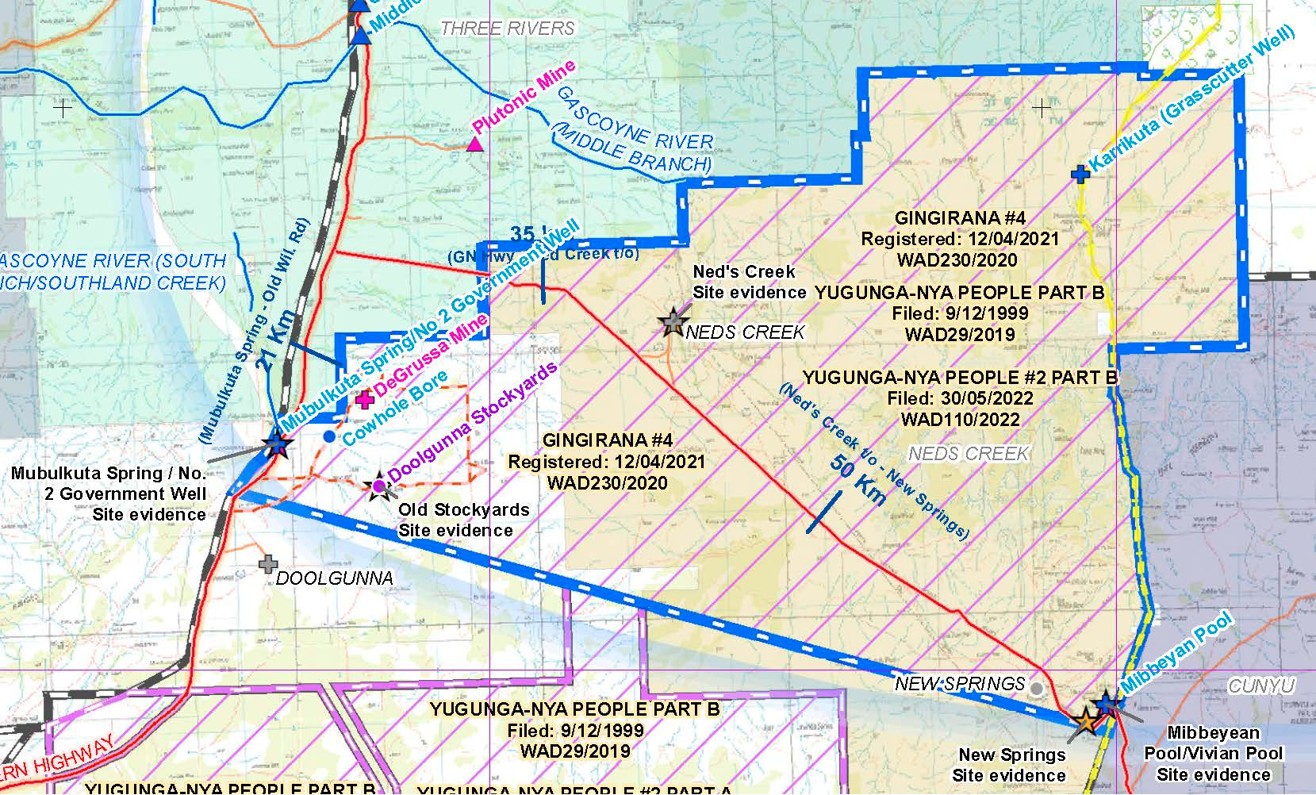
Under the traditional laws and customs of the Western Desert, have a spiritual connection to the claim area and the Tjukurpa associated with it on the basis of one or more of the following:
i. the claim area is his or her country of birth (also reckoned by the area where his or her mother lived during the pregnancy); or
ii. he or she has traditional geographical and religious knowledge of the claim area through a long-term association with the area; or
iii. he or she has an affiliation to the claim area through a parent or grandparent with a connection to the claim area as specified in sub-paragraphs (i) or (ii) above;
and
who are recognised under the traditional laws and customs by the other native title holders as having rights in the claim area.
This [at 2 November 2021] includes:
(a) the descendants of Annie Wilba, Dolly Ward Bootha and Jimmy Wheelbarrow; and
(b) the following sibling set (where living) and their descendants:
Bert Dorizzi, Love Fraser (nee Dorizzi), Frank Dorizzi, Kevin Dorizzi, Quilla Dorizzi, Shirley Thorn (nee Dorizzi), Celia Martin (nee Dorizzi), Valerie Dorizzi, Ernest Dorizzi, Patricia Dorizzi and Richard Dorizzi.
46 The nature and extent of the native title rights and interests were determined to be:
(a) in relation to exclusive areas, the right to possession, occupation, use and enjoyment of those areas to the exclusion of all others; and
(b) in relation to all other areas, the non-exclusive rights to:
(i) access, remain in and use those areas
(ii) access and take the resources in those areas; and
(iii) protect places, areas and things of traditional significance in those areas.
47 It is useful to extract some of the paragraphs of the joint submissions filed in support of the consent determination (recorded at [19] of the reasons in the Yugunga-nya Determination):
45 The Yugunga-Nya people are members of a society united in and by acknowledgment of a shared body of laws and customs from which their rights and interests in the Determination Area are derived. The Yugunga-Nya people acknowledge and observe a body of laws and customs which has demonstrably evolved from the traditional laws and customs transmitted from and acknowledged by their ancestors who occupied the Determination Area at effective sovereignty, while still retaining all of the features of that traditional system.
…
47 The system of law and custom under which people are affiliated to country, and which has been maintained and transmitted from generation to generation, since prior to effective sovereignty, and by reasonable inference since prior to the declaration of sovereignty in Western Australia in 1829, is held at the regional societal level. The rights and interests in land and waters which are distributed throughout the community of Yugunga-Nya native title holders are derived from this body of traditional laws and customs.
48 The relevant society for the purposes of the Yugunga-Nya Application is the Western Desert society. The Yugunga-Nya claimants follow the system of traditional law and custom that is shared with other members of the Western Desert Cultural Bloc (WDCB). This society is characterised by ‘multiple pathways’ to acquiring rights and interests in land and waters and the importance of Tjukurpa in governing social and political relations between its members.
49 The Yugunga-Nya Application shares a number of similarities with the Gingirana native title determination to its north and the Wiluna and Tjiwarl native title determinations to its east, in that:
(a) all the claims were brought on the basis that the claimants are part of a broader Western Desert society;
(b) there are 'multiple pathways' to acquiring rights and interests in the land and waters of the claim area;
(c) there has been a migration to the west by the apical ancestors over time; and
(d) the Tjukurpa/Tjukurrpa underpins the observance of traditional laws and customs.
50 The Yugunga-Nya people hold rights and interests in the Determination Area under their system of traditional law through the ‘multiple pathways’ system of the WDCB. While birth may be the principal source for ‘core’ rights in country there are other avenues through which people gain rights in country, most notably long-term occupation when accompanied by intimate knowledge of the land and its religious geography.
51 [Anthropologist] McCaul states that:
From a functionalist anthropological model, the emphasis on birth, as well as the provision of numerous other criteria, can be explained as an adaptation to an extremely harsh environment in which movement and a broad extent of rights and interests are essential to survival.
52 Ron Shay (deceased) responded to the question of why he considered the claim area to be his country by saying ‘Because I was born here and grew up around here’. Bill Shay supported this view by stating ‘It's from your mother and father. Where you were born and reared up. They tell you, “that's your country”.’
…
55 McCaul notes that in this region ‘[l]inguistic identity appears to be secondary to the connections of the people to the country encompassed within a given claim area, a fact that reflects what seems to have been a particularly high fluidity of identity labels in this area even by Western Desert standards.’
56 The Yugunga-Nya people share with their neighbours to the north and east a belief in the Tjukurpa. Observance of the Tjukurpa requires the Yugunga-Nya people to maintain and protect significant sites in the Determination Area including places imbued with spiritual or cosmological significance. Such places include birth and burial places of claimants’ forebears as well as important Tjukurpa sites, and law grounds of various kinds. It is common for important Tjukurpa places to be associated with age and gender prohibitions which highlight the importance accorded to transmission of cultural knowledge and ongoing respect for the traditions held by the senior generation.
48 The State had satisfied itself as to the cogency of the evidence relied upon, including that of the anthropologists, and confirmed that it considered the materials relied upon demonstrated to the requisite standard that the Yugunga-nya had native title rights and interests in the relevant area. The role and obligations of the State are vital in such applications: Western Bundjalung People v Attorney General of New South Wales [2017] FCA 992 at [17], [20] (Jagot J).
49 The consent determination regime does not necessarily require the Court to receive evidence as if in trial as to whether the legal requirements for proving native title must be met. The joint submissions, as is often the case in such matters, provided the principal source for my assessment at the time that I was satisfied that a determination recognising native title rights and interests in the terms agreed by the parties should be made: Yugunga-nya Determination at [38]-[42].
Gingirana Determination
50 The area the subject of the Gingirana Determination is approximately 12,153 square kilometres, south of Newman and north-west of Wiluna.
51 Under the Gingirana Determination it was recognised that the native title holders for the area are those Aboriginal persons who:
… hold in common the body of traditional law and culture governing the area the subject of the Determination and who, as at the date of the Determination:
(a) are descended from the following people, and who, in terms of traditional law and custom, are associated with the Determination Area:
(i) siblings, Yanangara/Stumpy Atkins, Parnapuru/Bluey Atkins and Parnapuru/Billy Atkins;
(ii) Minmi/Minnie Clancy;
(iii) siblings, Ninkungka/Annie Leake and Jiriji/Wallaby Wallace;
(iv) siblings, Molly Long and Midjibunku/Sandy Clause;
(v) Polly Wongi Telfer;
(vi) siblings, Jeanie and Mimi;
(vii) siblings, Jilawarra/Rosie Green, Ngunyupunku/Minnie and Yanyun/Bob Barber; and
(viii) Timmy Patterson; or
(b) have a personal connection to the Determination Area through their own birth and/or the birth of their ancestors on the Determination Area or possession of traditional cultural knowledge of the Determination Area, by which they claim the rights and interests and that claim is recognised by the wider group of native title holders according to their traditional decision making processes. Persons in this category include:
(i) Mara Kuju (Norman Thomson);
(ii) Stan Hill; and
(iii) Lindsay Crusoe.
52 Subject to certain qualifications, the nature and extent of the native title rights and interests were determined to be:
(a) in relation to exclusive areas, the right to possession, occupation, use and enjoyment of those areas to the exclusion of all others; and
(b) in relation to all other areas, non-exclusive rights being:
(i) the right to access, remain in and use that part;
(ii) the right to access, take and use the resources of that part for any purpose;
(iii) the right to engage in spiritual and cultural activities in that part;
(iv) the right to maintain and protect places of significance on that part; and
(v) the right to receive a portion of any traditional resources (not including minerals or petroleum) taken from land or waters by Aboriginal people who are also governed by Western Desert traditional laws and customs.
53 The Court received substantial evidence in the Gingirana proceedings before matters progressed to a consent determination. Preservation evidence had been taken. For the purpose of the consent determination, a joint submission was filed and, as in the case of the Yugunga-nya Determination, the State set out the basis upon which it considered the material was sufficient to establish that there was a credible basis to demonstrate that the Gingirana claimants and ancestors have native title rights and interests in the relevant area.
54 Justice Barker set out the following in the Gingirana Determination reasons:
[15] The Gingirana claimants belong to a system of laws and customs often referred to as the Western Desert Cultural Bloc (WDCB). It is significant that the determination area is surrounded on its eastern and western boundaries by the following four native title determinations, three of which were determined on the basis that the native title holders are also members of the WDCB: …
…
[17] As members of the WDCB, many Gingirana claimants hold native title rights in Birriliburu and some in Wiluna and Martu. Consistent with the Birriliburu, Wiluna and Martu determinations, it is agreed that a central feature of the belief system of members of the WDCB, including the Gingirana claimants, is Tjukurrpa (sometimes spelt Jukurrpa), which can be understood as ‘the Dreaming’ or ‘the Law’. Tjukurrpa encompasses all aspects of the lives of members of the WDCB, and a fundamental belief in the Tjukurrpa provides an understanding of all that is. Tjukurrpa significantly is the source of the laws and customs to which claimants adhere, and governs their religious practices, social rules, rights and interests to the land and waters, and all aspects of their lives.
[18] Gingirana claimants have an intimate knowledge of the WDCB system of law and custom, which remains vital for them. This includes an extensive knowledge of Western Desert dreaming tracks and associated sites, stories and songs, and their importance in the context of the broader Western Desert (with associated restrictions on women, young men and children). Gingirana claimants accept the responsibility which attaches to acquisition of knowledge both in relation to land and generally, and the need to transmit that knowledge to younger generations. They have a system of kinship, under which roles and responsibilities are known and acknowledged (including, for example, in relation to ritual, marriage, death/burial). Appropriate behaviour is expected, and sanctions for breaches exist under traditional laws and customs.
[19] Whilst it is acknowledged that none of the Gingirana claimants presently live permanently on the determination area, their decision to live in close proximity to it means they continue to give effect to their traditional laws and customs by:
(a) visiting and maintaining a physical association with country; and
(b) continuing to acknowledge and observe traditional laws and customs, through the retention, performing and passing on to their children and grandchildren of their traditional songs, stories and knowledge of sites forming part of the Tjukurrpa associated with country.
Claims over overlap area consistent with prior determinations
Yugunga-nya overlap claim
55 The claim group for the Yugunga-nya’s claim to the overlap area is largely identical to the description of the Yugunga-nya claim group recognised in the Yugunga-nya Determination. Relevantly, the persons said to hold native title in the overlap area are similarly the descendants of Annie Wilba and Dolly Ward (Bootha). Initial reliance by the Yugunga-nya on the inclusion of the descendants of Jimmy Wheelbarrow and the Dorizzi sibling set was withdrawn in closing submissions.
56 The native title rights and interests claimed by the Yugunga-nya in relation to the overlap area are also the same as those in the Yugunga-nya Determination.
Gingirana overlap claim
57 Subject to two caveats, the description of the Gingirana claim group for the overlap area is identical to the description of the Gingirana claim group recognised in the Gingirana Determination.
58 First, the persons referred to in the overlap proceeding as ‘custodians’ are different to those referred to in the Gingirana Determination. This is because two of the three identified custodians have passed away and, according to the Gingirana, the men now identified in the overlap claim have taken over their responsibility as custodians. The three named custodians for the Gingirana claim are Mr Jimmy Williams (known as ‘Man Behind the Gun’), Mr Paul (Junior) Morgan and Mr Stanley Hill (deceased).
59 Second, the apical ancestors listed for the purpose of identifying descent lines are the same as those identified in the Gingirana Determination, although by the time of closing submissions the Gingirana contended that the apical ancestor ‘Myarli’ should be added to the list of ancestors.
60 The Gingirana contend that the overlap area is subject to the same native title rights and interests determined in the Gingirana Determination (and the rights claimed are described consistently in the current application and the Determination respectively). They contend that there is no difference in the traditional laws and customs relating to those areas (save for the effect of certain extinguishing acts and the existence of particular ‘other interests’).
An interpolation – Williams, on behalf of the Gingirana #3
61 The parties were invited to file supplementary submissions to address Stuart HC, because it was delivered after closing submissions were filed in this matter. The Yugunga-nya accepted the invitation. In their supplementary submissions, the Yugunga-nya also made submissions about Williams, on behalf of the Gingirana #3 to the effect that it undermines the weight I might otherwise accord to the adjacent Gingirana Determination.
62 The Yugunga-nya submitted that in Williams, on behalf of the Gingirana #3, Jackson J found that the native title rights and interests asserted by the claim group and described identically to those now claimed by the Gingirana #4 claim group, were in fact ‘reciprocal’ rights and not core rights, and his Honour ‘was not satisfied that they amounted to native title rights and interests within the meaning of s 223(1) of the Native Title Act’.
63 This submission is misleading in several respects. The reasons in Williams, on behalf of the Gingirana #3 make it clear (at [70]) that no findings were being made. The submission footnotes the asserted ‘finding’ to a passage that discusses legal principles, and does not address the specifics of the Gingirana #3 claim. The upshot of Williams, on behalf of the Gingirana #3 was that the limited evidence that had been provided in support of the consent determination was insufficient to satisfy Jackson J that the rights being claimed by the Gingirana #3 claim group were native title rights and interests. His Honour made it clear (at [75]) that he was declining to make the consent determination on the basis of the materials then before the Court, but that nothing in the reasons foreclosed reliance on further evidence and submissions. That was expressly noted in the orders themselves.
64 Further, to the extent that the submission ambiguously suggests that the native title rights and interests being claimed in Gingirana #3 are identical to those being claimed in this proceeding, that is incorrect. The rights claimed by the Gingirana #3 claim group are quite different: see Williams, on behalf of the Gingirana #3 at [27].
65 All of which means that Williams, on behalf of the Gingirana #3 has no relevance to this proceeding.
Naming conventions
66 I asked representatives of the parties to inform me of the manner in which the respective groups wished me to refer to deceased and other witnesses. I have attempted to comply with that protocol as far as practicable.
67 Apart from when first introduced in these reasons, I have referred to the apical ancestor Billy Atkins as ‘Billy Atkins (Parnapuru)’ and his son Mr Billy Atkins (deceased) as ‘BA’.
68 Generally I have referred to the deceased witnesses (including those who gave preservation evidence) by their full name when first mentioned, and subsequently by their initials. Relevantly, in addition to BA, this applies to Mr Timmy Patterson (deceased) (TP); Mr Frankie Wongawol (deceased) (FW); and Mr Stanley Hill (deceased) (SH).
69 Similarly, for other witnesses, I have referred to them by their full name when first mentioned or when otherwise appropriate for context, and have subsequently used the honorific Mr and Ms with the respective surname (as requested). However, due to there being several family groups with members sharing the one surname, for clarity it has been necessary to generally use full names. Therefore, I have used the full names Bill Shay, Patrick Shay and Clinton Shay, and Jimmy Williams and Slim Williams as appropriate.
Agreement that Western Desert society hold native title rights and interests in the overlap area
70 The parties agreed that a regional Western Desert society existed at the time of effective sovereignty. So much has been accepted in numerous determinations relating to the Western Desert society (sometimes referred to as the Western Desert Cultural Bloc).
71 The parties agreed that, subject to extinguishment, native title rights and interests exist in the whole of the overlap area, and that the persons who hold native title in that area are members of the Western Desert society.
72 Members of the Western Desert society acquire ‘ownership’ rights or native title rights and interests in accordance with multiple pathways. These multiple pathways are a unique characteristic of the Western Desert society and are expanded upon below.
73 The parties also agreed that the Yugunga-nya and the Gingirana are part of Western Desert society. So much has also been recognised in the prior determinations.
74 What is presently in issue is which members of the Western Desert society have native title interests in the overlap area: that is, whether they are held by the Gingirana, the Yugunga-nya or both. There is no suggestion that other claimant groups currently assert native title rights and interests in the overlap area.
The parties’ contentions as to how native title should be recognised
Yugunga-nya position
75 The Yugunga-nya submitted that they have native title rights and interests in the whole of the overlap area through descent from the named ancestors Annie Wilba and Dolly Ward (Bootha), who acknowledged and observed a body of traditional laws and customs, including obtaining rights to country through descent and place of birth, so having rights and interests in, and a connection to, the overlap area. The descendants of Annie Wilba and Dolly Ward (Bootha) have continued to acknowledge and observe traditional laws and customs under which they possess rights and interests, and continue to have a physical and spiritual connection with the overlap area.
76 The Yugunga-nya submitted, in effect, that the Gingirana are only visitors to the overlap area, and any connection that their descendants may have had with the overlap area has been lost.
Gingirana position
77 The Gingirana submitted that they have native title rights and interests in the whole of the overlap area through descent from their named ancestors and through having maintained a physical and spiritual connection to the overlap area under the laws and customs of the Western Desert society, from sovereignty to the present. In that regard they submitted that the overlap area is indistinguishable from the adjoining Gingirana Determination area.
78 The Gingirana claim was put on the basis that there is a linguistic subgroup of the Western Desert society called ‘Putijarra’. The word Putijarra was said to describe each of a dialect, an area of country associated with that dialect and people associated with the dialect and country. The Gingirana claim group contend that the overlap area is part of Putijarra country, along with the area the subject of the Gingirana Determination and parts of other surrounding native title determinations, including the Wiluna Determination, the Birriliburu Determination (Billy Patch and Others on behalf of the Birriliburu People v State of Western Australia [2008] FCA 944 (French J)) and the Martu Determination (James on behalf of the Martu People v State of Western Australia [2002] FCA 1208 (French J)). I deal in more detail with the expanse of country said to be Putijarra country in Part G below.
79 The Gingirana contend that under the laws and customs of the Western Desert society applicable to the overlap area, the Putijarra have an ancestral connection to Putijarra country going back to sovereignty. It was said that Putijarra people have rights and interests by descent from those apical ancestors named in the application. It was at times unclear how the reliance on Putijarra added to reliance on descent from the identified apical ancestors. However, I will return to this.
80 In addition to rights obtained by descent, the Gingirana contend that other members of the Western Desert society (referred to as custodians) may obtain native title rights and interests in the overlap area under the applicable laws and customs through possession of traditional cultural knowledge of the overlap area. Those rights are obtained by recognition of the person’s connection by Putijarra people and do not pass by descent.
81 The Gingirana submitted that the Yugunga-nya have not established that their apical ancestors Annie Wilba and Dolly Ward (Bootha) had rights in the overlap area under the laws and customs of the Western Desert society, or that if they did have such rights, they have not established that such connection has been maintained. They submitted that although there is some evidence of physical activity on the overlap area by members of the Yugunga-nya claim group, that does not satisfy the requirement of connection.
Alternative cases
82 The Yugunga-nya in their concise statement on connection said that if, contrary to its primary case, at effective sovereignty the overlap area belonged to ancestors of both the Yugunga-nya and the Gingirana (that is, that it was shared country), and the Yugunga-nya and the Gingirana or a subset of them have maintained a connection to the overlap area in accordance with their traditional laws and customs, then both the Yugunga-nya and the Gingirana have rights and interests in the overlap area.
83 The Gingirana applicant also put forward an alternative case that they currently speak for the overlap area, but that some descendants of Annie Wilba and Dolly Ward (Bootha) may be recognised as native title holders. That is, it was accepted that if the Court did not accept its primary case impugning the position of the Yugunga-nya, then it was open to the Court to find shared native title, although it placed qualifications on this submission.
84 Neither alternative case was developed in any detail and as said above, the Yugunga-nya and the Gingirana presented their cases very much as fixed to a binary position.
The State’s position
85 The State submitted that having heard the lay and expert evidence, and having reviewed the closing submissions of the applicants, members of both claim groups hold native title in the overlap area in accordance with the traditional laws and customs of the Western Desert society and that the elements of s 223 of the Native Title Act are met.
86 In those circumstances, it submitted, the Court might make a determination of native title in two different ways.
87 First, it could involve recognition that descendants of listed apical ancestors from both claim groups hold native title pursuant to identified multiple pathways under the traditional laws and customs of the Western Desert society. Questions of which persons may hold which rights in which areas could then be determined intramurally.
88 Second, based on the evidence at trial, it would be open to the Court to draw a boundary identifying the respective parts of the overlap area where members of each claim group hold native title. Such a course would recognise that evidence from each group as to connection was stronger in relation to certain parts of the overlap area.
Structure of reasons
89 I have attempted in Part A to set the scene for what follows and deal with certain procedural matters. In Part B I record the trial process and introduce the evidence, including the expert anthropological evidence. Part C collects the guiding principles. In Part D I introduce aspects of Western Desert society, as they underlie much of the evidence to follow.
90 Parts E and F address the evidence, including expert evidence and genealogies, relating to descent lines of the claim group members and the respective identified apical ancestors.
91 Parts G and H deal with two discrete matters relating to the Gingirana claim, being the relevance of the Putijarra language and the (belated) expansion of their original claim area by extension of the southern boundary.
92 Parts I and J address in detail the evidence relating to connection, including contemporary connection by both claim groups with the overlap area. Whilst these matters were addressed in some detail, there was no perfect way to organise the extensive evidence adduced in this proceeding. Nor were the approaches of the respective applicants consistent in the order or manner in which they approached the evidence. I generally collected the evidence under the headings of physical connection and spiritual connection, but that division is at times artificial and there is inevitable overlap.
93 Part K addresses a further discrete issue, being the role of Gingirana ‘custodians’ in holding native title rights.
94 Part L compiles the conclusions of the experts, recorded by way of their (largely agreed) answers to certain propositions.
95 In Part M I set out my conclusions in relation to native title rights and interests, and the application of s 223 of the Native Title Act, and address the procedural steps that should follow.
96 And finally, in Part N I deal with the discrete construction question raised by the Gingirana as to occupation of unallocated Crown land within the overlap area and the application of s 47B of the Native Title Act.
PART B – HOW THE TRIAL UNFOLDED
Applicants
97 The persons authorised by the claim group to be the Yugunga-nya applicant (as defined by s 253 and read with s 61(2) and s 62C of the Native Title Act) for the discrete overlap claim are Ms Evelyn Gilla, Mr William ‘Bill’ Shay, Ms Leonie Gentle, Ms Audrey Shar, Mr Troy Little, Ms Robyn Kelly and Ms Elaine King. Bill Shay and Ms Kelly gave evidence in the proceeding.
98 The persons authorised by the claim group to be the Gingirana applicant for the overlap claim are Mr Slim Williams, Mr Clive Samson and Mr James Coppin. Slim Williams gave evidence in the proceeding.
99 No question as to the proper authorisation of the applicants arose.
Preservation evidence
100 The witness statements and transcripts of preservation evidence taken in the earlier Gingirana Determination proceeding were tendered under s 86(1)(a)(i) of the Native Title Act (‘Evidence and findings in other proceedings’) without objection.
101 Relevantly, transcripts of evidence given by TP, FW, BA, Ms Miriam Atkins and Ms Grace Ellery were tendered, along with their witness statements and certain photos.
102 Gender-restricted separate witness statements and transcripts of evidence given by TP and FW in that proceeding were also received into evidence without objection, and subject to certain orders restricting access to them.
103 Transcript extracts of evidence given by SH in 1999 for the purpose of the Nharnuwangga Determination were also tendered without objection.
Lay evidence
104 In general, I will deal with relevant lay evidence progressively in these reasons when addressing the issue to which it primarily relates. It is useful however, to provide an overview of the hearing including the time spent on country. Certain sites and features are referred to in the summary and are explained further in the reasons. I use the expression Court party to refer to not only those involved officially on behalf of the Court but the travelling group as a whole, which included Yugunga-nya and Gingirana representatives, counsel, legal representatives, transcribers and support staff.
105 The Court initially sat in Perth for opening submissions and to hear lay evidence from SH (Gingirana) and Ms Kelly (Yugunga-nya).
106 Malcolm O’Dell (legal representative of the Gingirana applicant) also gave evidence in Perth. This evidence related to the various boundaries for the Gingirana claims, but also to an abuse of process interlocutory application and submission made by the Yugunga-nya in relation to the alleged late filing of the Gingirana claim, a claim which was (properly) later withdrawn once evidence relating to the cause of the delay had been given and further submissions had been made.
107 The Court party then travelled to Newman for six days of lay evidence, some taken on country and some taken at the town site.
108 The on country evidence was taken at five locations, each of which can be seen in the following map of the overlap area:
109 The five locations, moving west to east across the map, were Mubulkuta Spring (No 2 Government Well), Doolgunna Station old stockyards, Ned’s Creek site, and (to the south) New Springs and Mibbeyean Pool.
110 I note generally that many sites reference the names of former or current pastoral leases. For example, depending on context, a reference in evidence to ‘Ned’s Creek’ might be a reference to the Ned’s Creek Station site where evidence was taken or the Ned’s Creek pastoral lease. A reference to ‘Doolgunna’ may be a reference to any of the former Doolgunna Station pastoral lease, the Doolgunna Station homestead site or its old stockyards. ‘Three Rivers’ is the name of the pastoral lease that spans part of the western side of the Gingirana Determination area and crosses the western boundary into the Nharnuwangga Determination area. The Three Rivers Station site is located on the Nharnuwangga side.
Mibbeyean Pool
111 On the first day, the Court party travelled south from Newman on the Great Northern Highway, stopping at a viewing site to observe Cardawon Hill and Katjarra (the Carnarvon Ranges, north of the overlap area), before continuing to Mibbeyean Pool (a distance of some 335 km by road).
112 At Mibbeyean Pool, evidence was given by Bill Shay, Mr Colin Peterson and Mr Raymond Wingo on behalf of the Yugunga-nya, and by Ms Lena Long on behalf of the Gingirana. They gave evidence of camping near Mibbeyean Pool, and using the pool and its surrounds for swimming, hunting, cooking and washing.
New Springs
113 The Court party then drove to the site of New Springs, where gender-restricted evidence was given by Slim Williams (Gingirana). New Springs is closely associated with the emu (karlaya) Tjukurrpa.
Ned’s Creek Station
114 The Court party then travelled to Ned’s Creek, where evidence was given by Ms Ellery and Slim Williams.
Mubulkuta Spring/No 2 Government Well
115 On the second day the Court party travelled to No 2 Government Well, which is close to the Great Northern Highway. Evidence was given by Bill Shay, Mr Kelly, Mr Peterson and Clinton Shay (Yugunga-nya). Male gender-restricted evidence was given by Jimmy Williams, Mr Darren Farmer and Slim Williams (Gingirana). I was present for this evidence (orders restricting access to the transcript were subsequently varied by consent to permit access by female counsel, experts, transcribers and my associates).
Doolgunna Station stockyards and breakaway
116 The hearing continued at the old Doolgunna stockyards, where Mr Kelly and Ms Kelly (Yugunga-nya) gave evidence.
117 The Court party then travelled to a site referred to as the ‘breakaway’. The site is associated with two Tjukurrpa stories: the kangaroo (pikurta) and a Tjukurrpa about two mystery men (Wati Kutjarra). Mr Peterson pointed out hills at this site and discussed matters with the men who had been through the law.
Newman
118 Over the next four days witnesses gave the remaining lay evidence at Newman House in Newman.
119 Witnesses who gave evidence at Newman on behalf of the Yugunga-nya were Bill Shay, Mr Kelly, Mr Peterson, Clinton Shay, Patrick Shay and Mr Wingo.
120 Witnesses who gave evidence at Newman on behalf of the Gingirana were Slim Williams, Jimmy Williams, Ms Ellery, Ms Long, Mr Bruce Richards, Ms Noreena Kadibil, Mr Farmer and Ms Kate George.
121 All lay witnesses referred to above were cross-examined.
General comment on credibility and reliability of lay witnesses
122 The Gingirana made no challenges to the credibility of the lay witnesses. The Yugunga-nya pointed to only a small number of purported issues, referring to Mr Farmer and SH. In addition to observing all of the witnesses give evidence, I kept detailed notes at the time they gave evidence and I have referred to those notes as well as the transcript when considering their evidence. I have made some specific comments about Mr Farmer below. I have not been critical of SH’s evidence. Subject to those limited comments, it is my view that each of the witnesses gave evidence honestly and diligently. I have included additional short comments about some of the witnesses in the body of my reasons. There was no suggestion that any witness was doing anything other than attempting to give an accurate and reliable account of the matters they addressed. There were minor conflicting points of detail but they were of little consequence in the context of the whole, and unsurprising in the context of evidence given about events or conversations that sometimes occurred many years previously. Otherwise, it can be taken that I accept the evidence of the lay witnesses to which I refer.
Expert evidence
Introduction
123 It has long been recognised that anthropological evidence is important in native title cases. As Mansfield J observed in Alyawarr, Kaytetye, Warumungu, Wakay Native Title Claim Group v Northern Territory of Australia [2004] FCA 472 at [89]:
… Not only may anthropological evidence observe and record matters relevant to informing the court as to the social organisation of an applicant claim group, and as to the nature and content of their traditional laws and traditional customs, but by reference to other material including historical literature and anthropological material, the anthropologists may compare that social organisation with the nature and content of the traditional laws and traditional customs of their ancestors and to interpret the similarities or differences. And there may also be circumstances in which an anthropological expert may give evidence about the meaning and significance of what Aboriginal witnesses say and do, so as to explain or render coherent matters which, on their face, may be incomplete or unclear.
124 In October 2022 anthropologists gave concurrent expert evidence in Perth over the course of two days and were cross-examined. Mr Kim McCaul was called by the Yugunga-nya, and Dr Heather Lynes was called by the Gingirana. Both experts had provided written reports, but also met in conference and provided a Joint Report (dated 1 September 2022) and supplementary reports, all of which were adduced in evidence. Both experts in deploying their specialised knowledge had access to and evaluated historical diaries and writings of amateur and professional ethnographers, historical records and genealogies. Both anthropologists also observed the witnesses giving their lay evidence prior to preparing the Joint Report and participating in the concurrent expert evidence session.
125 Additionally, Dr Scott Cane was appointed by the Court as an independent anthropological expert and was requested to inquire into and provide a report on gender-restricted evidence relevant to the applicants and the overlap area. Dr Cane’s report, dated 4 August 2022, was tendered without objection and no cross-examination was sought.
Kim McCaul
126 Mr McCaul has been an applied anthropologist since March 2000. He has provided both anthropological and linguistic expertise to many entities, both private and public, involved in native title determinations. He has worked on various Western Desert native title claims, including those reflected in the determinations recorded in De Rose v State of South Australia (No 2) [2005] FCAFC 110; (2005) 145 FCR 290 (De Rose (No 2)); De Rose v State of South Australia [2013] FCA 687; King on behalf of the Eringa Native Title Claim Group v State of South Australia [2011] FCA 1386; Eringa, Eringa No 2, Wangkangurru/Yarluyandi and Irrwanyere Mt Dare Native Title Claim Groups v The State of South Australia [2008] FCA 1370; Yankunytjatjara/Antakirinja Native Title Claim Group v The State of South Australia [2006] FCA 1142; Lennon on behalf of the Antakirinja Matu-Yankunytjatjara Native Title Claim Group v The State of South Australia [2011] FCA 474; Starkey v State of South Australia [2014] FCA 924; and Far West Coast Native Title Claim v State of South Australia (No 7) [2013] FCA 1285.
127 Although those determinations related to areas in South Australia, Mr McCaul has also prepared reports for the purpose of the Nyiyaparli Determination recorded in Stock on behalf of the Nyiyaparli People v State of Western Australia (No 5) [2018] FCA 1453 (north of the Gingirana Determination area). In that context, Mr McCaul conducted fieldwork with senior Martu men including Mr Peterson. He also spoke with BA. Mr McCaul has worked on issues relating to the Yugunga-nya claim at various times since 2014.
128 Mr McCaul conducted research for the purpose of the Yugunga-nya Determination over two periods. He conducted a preliminary field trip and initial review of the ethnohistorical material in 2014. He was then re-engaged by the Yamatji Marlpa Aboriginal Corporation (YMAC) in 2015 to prepare a substantial report and conducted further field trips in 2017 and 2018. Mr McCaul prepared an anthropology report dated December 2019 for the purpose of the Yugunga-nya Determination (2019 Report). In preparing this report, Mr McCaul had access to copies of field notes taken by YMAC’s in-house anthropologists from as early as 1999. Mr McCaul was also assisted by Mr Craig Allsop (a former YMAC anthropologist who had been responsible for liaising with the Yugunga-nya claimants since 2014).
129 Mr McCaul’s 2019 Report formed part of the material considered by the parties, including the State, for the purpose of the joint submission filed in support of the consent determination. The report is expressly referenced in the consent determination (Yugunga-nya Determination at [17]), together with a Tjukurrpa Dreaming map and explanation, genealogies and a s 47A and s 47B occupation report dated 27 January 2021 (Extinguishment Report). Relevantly, Mr McCaul did not deal in detail with the apical ancestor Dolly Ward (Bootha) in his 2019 Report, as he was informed of her inclusion for the purpose of the Yugunga-nya Determination late in the piece.
130 All of these documents were tendered in this proceeding and the primary source for Mr McCaul’s evidence in this proceeding was his 2019 Report.
131 A supplementary 2022 Report dated 7 October 2022 was also admitted (with one objection conceded).
132 Other resources in evidence in this proceeding included Mr McCaul’s document ‘Key Data for the Yugunga-nya and Gingirana overlap area’, which compiled extracts of material relied upon by Mr McCaul to form his opinions relating to the overlap area; and a bundle of his field notes for the period 2014 to 2018.
Heather Lynes
133 Dr Lynes is similarly an experienced expert anthropologist. She holds a PhD in social anthropology and was employed by Central Desert Native Title Services (CDNTS) from 2011 to 2016. Dr Lynes has worked with numerous Aboriginal groups and people in the Central Desert region, including some with connections to the Gingirana Determination area and the overlap area. Dr Lynes has undertaken regular fieldwork to document connection to country and has worked as a consultant anthropologist for several land councils and native title service providers in Western Australia. Most of the native title claims that Dr Lynes has worked on have been for members of the Western Desert society.
134 In particular, Dr Lynes assisted Dr William Kruse with his research for the Gingirana #1 claim. She spent a week in 2014 undertaking a field trip for that purpose, visiting various places on the original claim area, but also travelling down to Grasscutter and travelling through the overlap area, including travelling from Wiluna to Katjarra. During the field trip Dr Lynes was accompanied by Dr Kruse, TP, FW, BA, Ms Long, Ms Atkins and some of the younger Gingirana claimants. Dr Lynes at the time had the primary role of taking down women’s information and working on the genealogies for the claim group. I consider it significant that Dr Lynes worked with Dr Kruse. She refers to Dr Kruse’s work extensively, and as she had the experience of working with him, I consider she was well-placed to assess his reports as reliable.
135 In 2016 Dr Lynes also assisted Dr David Martin and Dr Ron Brunton with the joint expert report prepared on behalf of the Gingirana #1 applicant for the purpose of the Gingirana Determination.
136 In 2021 Dr Lynes was contracted to provide expert evidence in this Gingirana claim. For the purpose of her report and evidence in this proceeding, Dr Lynes had access to the previous work that had been undertaken for the Gingirana #1 claim, including the field notes and reports of Dr Kruse and Mr Sean Calderwood of the CDNTS and other literature regarding the Aboriginal peoples of the area, including extracts of the work of the well-recognised Daisy Bates, Ronald and Catherine Berndt, Norman Tindale and Phillip Jud Epling, AP Elkin and Ken Liberman. Dr Lynes had access to a linguistic report of Mark Clendon prepared for the Gingirana #1 claim and a connection report prepared by Prof Robert Tonkinson. Prof Tonkinson worked with Martu people who spoke several different dialects (including Putijarra) for the purpose of the Martu Determination. Dr Lynes also conducted video interviews with two senior claimants (Ms Atkins and Ms Long).
137 Dr Lynes’ 2021 Report was dated July 2021. Her supplementary 2022 Report was dated 30 September 2022.
138 In summary, Dr Lynes had access to field notes spanning a period of some 17 years for the purpose of preparing her reports.
Scott Cane
139 Dr Cane is an experienced anthropologist who has worked closely with Western Desert Aboriginal people since 1980. He has prepared connection material and opinions in relation to Western Desert people and their neighbours outside the Western Desert including the Spinifex People, Tjurabalan, Badimia, Ngaanyatjarra and Gibson Desert Peoples. He has also co-authored a monograph on land use and resources in homelands across the Western Desert. It was not in issue that Dr Cane had sufficient specialised knowledge of Western Desert traditional laws and customs to provide an opinion on the information provided by the Aboriginal men to whom he spoke.
140 Dr Cane was asked to address specific questions about the nature, content and observance of male gender-restricted laws and customs and their effect on native title rights and interests in the overlap area.
141 For the purpose of his report, Dr Cane travelled on country and met separately with Gingirana and Yugunga-nya men, recording his conversations.
The Joint Report and genealogies
142 The experts were provided with materials which included court documents, genealogies and exhibits from previous native title determinations. Both Mr McCaul and Dr Lynes undertook desktop research and attended the on country hearing of evidence before conferring and providing the Joint Report.
143 Mr McCaul and Dr Lynes addressed 16 propositions to guide their conferral and produced the Joint Report setting out their opinions on each proposition. There were very few areas of difference. The Joint Report was invaluable in reducing areas of conflict between the experts, albeit that it remains for the Court to make the ultimate findings. I will deal with the propositions in due course.
144 In total, 12 genealogies were tendered for the various apical ancestor groups. Some amendments were incorporated, but in the end there was no objection to their admission or dispute between the anthropologists in relation to those genealogies. They form the framework for much of the descent information included in the reasons below.
Closing submissions
145 There ensued a long pause while the parties, with the benefit of the evidence, attempted again to resolve their determination applications for the overlap area by consent. When that approach regrettably failed, the hearing recommenced, with closing submissions delivered in Perth in October 2023.
PART C – STATUTORY FRAMEWORK AND PRINCIPLES
‘Native title rights and interests’ – s 223 of the Native Title Act
146 Section 13(1)(a) of the Native Title Act provides that an application may be made to this Court for a determination of native title in relation to an area for which there is no approved native title.
147 Section 225 of the Native Title Act provides that a determination of native title is a determination of whether native title exists in a particular area, and, if it does exist, a determination of who the persons or groups are who hold native title and, relevantly, the nature and extent of the native title rights and interests in relation to the determination area.
148 The expression native title or native title rights and interests is defined in s 223 of the Native Title Act. Relevantly, s 223(1) provides:
223 Native title
Common law rights and interests
(1) The expression native title or native title rights and interests means the communal, group or individual rights and interests of Aboriginal peoples or Torres Strait Islanders in relation to land or waters, where:
(a) the rights and interests are possessed under the traditional laws acknowledged, and the traditional customs observed, by the Aboriginal peoples or Torres Strait Islanders; and
(b) the Aboriginal peoples or Torres Strait Islanders, by those laws and customs, have a connection with the land or waters; and
(c) the rights and interests are recognised by the common law of Australia.
149 As observed by the High Court in Stuart HC at [18], elements of the definition are based on the decision in Mabo v Queensland (No 2) (1992) 175 CLR 1 (Mabo (No 2)) and have remained constant since the Native Title Act was passed.
150 And as stated by the High Court in Northern Territory v Griffiths [2019] HCA 7; (2019) 269 CLR 1 at [23]:
The first and second of those characteristics – that native title is a bundle of rights and interests possessed under traditional laws and customs and that, by those laws and customs, Aboriginal peoples have a connection with the land or waters – reflect that native title rights and interests have a physical or material aspect (the right to do something in relation to land or waters) and a cultural or spiritual aspect (the connection with the land or waters).
151 Numerous authorities have considered the elements of s 223. As the principles were not relevantly in contention between the parties, I will focus on a number of key decisions that have provided guidance as to how s 223 is to be understood and applied, particularly Western Australia v Ward [2002] HCA 28; (2002) 213 CLR 1; Members of the Yorta Yorta Aboriginal Community v Victoria [2002] HCA 58; (2002) 214 CLR 422; Bodney v Bennell [2008] FCAFC 63; (2008) 167 FCR 84; and Stuart HC.
152 The plurality of the High Court in Stuart HC (Gageler CJ, Gordon, Edelman, Gleeson and Beech-Jones JJ) referred to the two inquiries required by the provision. Referring to Ward, it said (at [19], footnotes omitted):
The question in any given case is a question of fact that requires not only the identification of the laws and customs said to be traditional laws and customs but, ‘no less importantly, the identification of the rights and interests in relation to land or waters which are possessed under those laws or customs’. The outcome of these inquiries may well depend on the same evidence as is used to establish connection of the relevant peoples with the land or waters because the connection required by s 223(1)(b) is a connection with the land or waters ‘by those laws and customs’. Thus, there are two inquiries required by s 223(1): first, identification of the traditional laws and customs and the identification of the rights and interests possessed under those traditional laws and customs and, second, identifying the connection with land or waters by those laws and customs.
Traditional laws acknowledged and traditional customs observed
153 The High Court in Yorta Yorta described how the traditional laws and customs owe their origin to a normative system that existed before sovereignty, a system which possesses normative rules that give rise to rights and interests in relation to land and water. Without such normative quality, ‘there may be observable patterns of behaviour but not rights or interests in relation to land or waters’ (at [42]-[43], Gleeson CJ, Gummow and Hayne JJ).
154 As further explained by the Full Court in Bodney at [47] (Finn, Sundberg and Mansfield JJ):
Because it is the normative system that is the source of the rights and interests, it is necessary in order to prove native title that the normative system has had a continuous existence and vitality since sovereignty. If that normative system has not existed throughout that period, the rights and interests which owe their existence to that system will have ceased to exist: Yorta Yorta … at [47]. It is therefore necessary for native title claimants to show that the normative system that existed at sovereignty is substantially the same as the one that exists today. If it is not, then any rights and interests are not ‘possessed under the traditional laws acknowledged and traditional customs observed.’
155 However, as confirmed in Stuart HC (at [21]), some change, adaption or interruption of traditional law or custom will not necessarily deny a native title claim. It was said in Yorta Yorta at [83]:
The key question is whether the law and custom can still be seen to be traditional law and traditional custom. Is the change or adaptation of such a kind that it can no longer be said that the rights or interests asserted are possessed under the traditional laws acknowledged and the traditional customs observed by the relevant peoples when that expression is understood ... ?
156 In undertaking this assessment, it is not necessary under s 223 to establish that the present-day Aboriginal society maintains particular features of the society at sovereignty. As Barker J explained in CG (Deceased) on behalf of the Badimia People v State of Western Australia [2015] FCA 204 at [358]:
… But, depending on the evidence led in any case, the absence of a range of indicators of such a classical Aboriginal ‘society’ does not necessarily mean that there is not today a body of persons united by their acknowledgement of traditional laws and observance of traditional customs under which they possess rights and interests in relation to their traditional country. A group of claimants, for example, may be extremely cross-cultural in the 21st century, that is to say, have their feet firmly planted in a broader Australian post-sovereignty society and live a contemporary life outside a claim area, and still maintain a connection to their traditional country in a way that meets the requirements of the s 223 definition of native title.
157 However, because the specific content of laws and customs may have changed over time, it is necessary to identify the laws and customs at sovereignty and at the present day: Stuart HC at [21].
Connection with the land or waters
158 The connection required by s 223(1)(b) is connection by the laws and customs. In this context ‘by’ means ‘through the agency or efficacy of’ (Stuart v State of South Australia [2023] FCAFC 131; (2023) 299 FCR 507 at [300] (O’Bryan J) (Stuart FC)). It does not need to be a physical connection. As explained in Stuart HC at [22]:
… The nature of the ‘connection’ will depend on the ‘laws and customs’. That is, if the laws and customs demonstrate that connection with the relevant land and waters is generally by undertaking physical acts of acknowledgment or observance within the area of those land and waters, then establishing a connection may depend on whether such acts were performed. But equally, if the laws and customs demonstrate that connection may be established other than by physical acts of acknowledgment or observance within the relevant area, then such acts may not be necessary to demonstrate ‘connection’.
159 The High Court in Stuart HC (at [25]) expressly endorsed the summary of the principles that emerge primarily from Ward and Bodney as stated by O’Bryan J in Stuart FC at [290]. I respectfully extract O’Bryan J’s summary in full:
(a) Paragraphs (a) and (b) of s 223(1) involve two inquiries: in the one case for the rights and interests possessed under traditional laws and customs and, in the other, for connection with land or waters by those laws and customs (Ward at [18] and Bodney at [165]). Each element is sourced in the traditional laws acknowledged and the traditional customs observed by the claimants in question (Bodney at [165]). The connection required by paragraph (b) is not by the claimants’ rights and interests in the land or waters in question, but by their laws and customs acknowledged and observed (Bodney at [165]).
(b) The connection which Aboriginal and Torres Strait Islander peoples have with ‘country’ is essentially spiritual: Ward at [14]. The majority in Ward further explained (at [64]):
In its terms, s 223(1)(b) is not directed to how Aboriginal peoples use or occupy land or waters. Section 223(1)(b) requires consideration of whether, by the traditional laws acknowledged and the traditional customs observed by the peoples concerned, they have a ‘connection’ with the land or waters. That is, it requires first an identification of the content of traditional laws and customs and, secondly, the characterisation of the effect of those laws and customs as constituting a “connection” of the peoples with the land or waters in question. No doubt there may be cases where the way in which land or waters are used will reveal something about the kind of connection that exists under traditional law or custom between Aboriginal peoples and the land or waters concerned. But the absence of evidence of some recent use of the land or waters does not, of itself, require the conclusion that there can be no relevant connection.
(c) As the required connection of the claimants to the land or waters in question is by the traditional laws and customs acknowledged and observed, it is necessary to show that the acknowledgment and observance of the laws and customs must have continued substantially uninterrupted from the time of the assertion of British sovereignty in the sense explained in Yorta Yorta (Bodney at [168], [179]).
(d) In Bodney, the Full Court cited with approval (at [166]) the earlier observation of the Full Court in Northern Territory v Alyawarr, Kaytetye, Warumungu, Wakaya Native Title Stuart v State of South Australia (2005) 145 FCR 442 (Alyawarr) at [111] that connection ‘involves the relationship of the relevant community to its country defined by laws and customs which it acknowledges and observes”. The laws and customs themselves characteristically will presuppose or envisage direct connections with land or waters or will, if acknowledged and observed, link community members to each other and to the land or waters in a complex of relationships (Bodney at [169]). Further, laws and customs that connect claimants to land or waters need not be exclusively ones that give the claimants rights and interests in the land or waters (Bodney at [169]).
(e) Connection to land or waters may have subsisted at a spiritual and/or cultural level notwithstanding that the claimants have not been able to maintain a presence on substantial parts of their traditional lands or waters (Bodney at [172]).
160 The relevance of continued connection at a spiritual or cultural level was expanded upon by O’Bryan J in Stuart FC at [294]:
In some cases, a finding that traditional laws and customs confer rights and responsibilities on a community or person in respect of land or waters may also establish that the community or person is connected to their country in a way that satisfies s 223(1)(b): De Rose at [305] and De Rose v South Australia (No 2) (2005) 145 FCR 290 (De Rose No 2) at [113]. As noted earlier, s 223(1)(b) is not directed to how Aboriginal peoples use or occupy land or waters (Ward at [64]) and connection may still be substantially maintained with land at a spiritual and/or cultural level notwithstanding a community’s physical absence from that land (Bodney at [172]; De Rose No 2 at [62]-[64]). As stated by the Full Federal Court in Worimi v Worimi Local Aboriginal Land Council (2010) 181 FCR 320 at [87]:
It is self-evident that a community or group of Aboriginal persons may have an ongoing connection with land, even though their access to, or use of, that land is restricted or spasmodic; that connection may be mainly spiritual rather than physical; it may have evolved over time to a less specific use of all or many parts of that land; it may not involve physical access to each and every part of the land …
161 The definition of native title rights and interests in s 223(1) does not require that all members of a given group have continued to acknowledge and observe traditional laws and customs. Rather, the relevant question is whether the group, as a whole, has sufficiently acknowledged and observed the relevant traditional laws and customs: De Rose (No 2) at [58] (Wilcox, Sackville and Merkel JJ). In State of Western Australia v Sebastian [2008] FCAFC 65; (2008) 173 FCR 1, the Full Court (Branson, North and Mansfield JJ) stated (at [84]) that:
… The body of laws and customs under which native title rights and interests are possessed by a group of persons does not require that each member of the group has precisely the same knowledge of those laws and customs or that each member of the group fully comprehends in precisely the same way as each other member of the group how those laws and customs operate. …
162 I also acknowledge the comprehensive enunciation of the principles provided by O’Bryan J in Dimer on behalf of the Marlinyu Ghoorlie Claim Group v State of Western Australia (No 6) [2025] FCA 1641 at [126]-[148].
Task to be undertaken
163 Having regard to the text of s 223 and these principles, the manner in which the questions to be addressed were identified in Stuart HC (and by O’Bryan J in Stuart FC, endorsed by Jagot J in Stuart HC at [190]).
164 The present-day focus of s 223(1) of the Native Title Act requires the Court to consider the laws and customs of the present-day claim group and to ascertain whether, under those laws and customs, the members of the claim group possess rights and interests in the claim area and, by those laws and customs, have a connection to the claim area. If they do, the Court then asks whether those laws and customs can be said to be traditional: Dimer at [149], citing relevantly Yorta Yorta at [85]; Croft on behalf of the Barngarla Native Title Claim Group v State of South Australia [2015] FCA 9 at [640] (Mansfield J); Starkey on behalf of the Kokatha People v State of South Australia [2018] FCAFC 36; (2018) 261 FCR 183 at [46(d)] (Reeves J, White J agreeing); Stuart HC at [28].
Different groups can hold native title over the same area
165 As is apparent, the principal claims of each of the Yugunga-nya and the Gingirana are binary in nature. Neither recognises the claims of the other. In such circumstances, there is always a prospect that either claim might fail. For example, in Dimer, O’Bryan J recognised the native title of the Marlinyu Ghoorlie over the whole claim area and rejected a competing claim by the Karratjibbin. However, in light of the State’s submission as to potential outcomes ([87]-[88] above), I observe that a number of determinations have recognised that competing groups may hold rights in a contested area together.
166 In The Lardil Peoples v State of Queensland [2004] FCA 298, Cooper J determined a single sea claim of the Lardil, Yangkaal, Kaiadilt and Gangalidda peoples over the Wellesley Islands. Each claim group was recognised as holding their own country. Further, it was determined that native title in certain areas was held by more than one group. For example, it was determined that native title rights and interests over the of land and waters of Allen, Little Allen and Horseshoe Islands, were shared equally between with the Yangkaal, Kaiadilt and Gangalidda peoples.
167 In answering separate questions the subject of Drill on behalf of the Purnululu Native Title Claim Group v State of Western Australia [2020] FCA 1510, Mortimer J recognised, through assessing the apical ancestors for a contested area, that both the Purnululu group and the Gajangana Jaru group held native title rights and interests over land and waters within the Purnululu National Park in the East Kimberley. The parties were required to confer after reasons were published as to the terms of the proposed determination. The matter ultimately proceeded to determination of native title by way of a single consent determination, in which boundaries and areas of shared non-exclusive title were fixed: Drill on behalf of the Purnululu Native Title Claim Group v State of Western Australia (No 2) [2022] FCA 1538 (Mortimer J).
168 In Nona on behalf of the Badulgal, Mualgal and Kaurareg Peoples (Warral & Ului) v State of Queensland (No 5) [2023] FCA 135, native title over certain Torres Strait Islands was claimed by competing groups. The result was that Mortimer J recognised the native title of the Badulgal and Mualgal as joint, exclusive, native title to the exclusion of the Kaurareg. The parties were given time to propose orders about what steps should be taken to finalise a determination.
169 In Ross on behalf of the Cape York United #1 Claim Group v State of Queensland (No 40) (Massy and Breakfast Creeks boundary dispute) [2026] FCA 980, both the Umpila and the Lama Lama claimed exclusive native title over the area. Neither proved their binary position. It was determined by Mortimer CJ that native title was held over the whole disputed area communally by the descendants of named apical ancestors, a group embracing both sets of claimants.
170 As far as my searches have revealed, leaving aside mediated agreements or consent determinations, the Court has not apportioned contested country by itself drawing and imposing a dividing boundary over an overlap area. Rather, the approach taken where there is a Court finding of shared native title is to encourage the parties to confer and determine a position by way of consent determination that has regard to the reasons. Even where the Court is not determining native title by way of separate questions, there are examples of this approach. See, for example, Murray on behalf of the Yilka Native Title Claimants v State of Western Australia (No 5) [2016] FCA 752 at [2479] (McKerracher J)
171 There is no doubt that to the extent native title rights and interests are recognised by two groups over the same area, practical issues may arise. See, for example, Murray on behalf of the Yilka Native Title Claimants v State of Western Australia (No 6) [2017] FCA 703 (McKerracher J) (whether there should be one or two determinations and whether there should be one or two prescribed body corporates); and Drury on behalf of the Nanda People v State of Western Australia [2020] FCAFC 69; (2020) 276 FCR 203 (Mortimer, White and Colvin JJ) (whether the Court has the discretion to determine that there should only be one prescribed body corporate where each group nominates a separate prescribed body corporate). It is not necessary to address such issues further at this point.
172 The Yugunga-nya in this case sought to warn the Court that a finding that native title rights were held by both groups would result in in-fighting and further disputes. However, my task is to apply the statutory provisions and make findings having regard to the evidence. I cannot exercise a discretion or meld an outcome simply for the purpose of seeking to avoid personal or social dispute.
Issues relating to proof
173 Section 82 of the Native Title Act provides that the Court is bound by the rules of evidence, except to the extent that the Court otherwise orders, and expressly permits the Court to take account of the cultural and customary concerns of Aboriginal and Torres Strait Islander peoples in the conduct of proceedings under the Native Title Act. These powers are reflected in r 34.119 to r 34.123 of the Federal Court Rules 2011 (Cth). It was not in issue that these rules and powers applied during the proceeding.
174 Section 72 and s 78A of the Evidence Act 1995 (Cth) provide for the admissibility of evidence about the existence and content of the traditional laws and customs of an Aboriginal or Torres Strait Islander group, as an exception to the hearsay and opinion rules.
175 Such provisions reflect the unusual nature of litigation under the Native Title Act. As observed in State of Western Australia v Fazeldean on behalf of the Thalanyji People (No 2) [2013] FCAFC 58; (2013) 211 FCR 150 (Allsop CJ, Marshall and Mansfield JJ) at [34]:
… litigation under the Native Title Act is not ordinary private inter partes litigation. Sought to be vindicated are rights of a communal nature based on occupation and a physical and spiritual connection between land and people that has endured for possibly millennia. The vindication is not only for the living in the claim group, but for their ancestors and for generations to come. …
176 Native title litigation must still be conducted and determined in accordance with the civil standard of proof. The Court must be satisfied that a case is proved on the balance of probabilities. However, it has been recognised in many native title cases that applicants face unique problems of proof, and that it accordingly is necessary to draw inferences.
177 As Mortimer J observed in Drill at [13]:
… the Court’s answers to the Separate Questions depend on reaching a view about what, on the evidence before it, are more likely than not to be the facts. That is what the civil standard “balance of probabilities” means. The Court does not decide what the “truth” is in any absolute sense. The Court is not in that sense the arbiter of history. The Court decides whether the party who must prove the necessary facts has shown the facts it contends for are more likely than not to have existed. In circumstances which involve the level of historical reconstruction that these Separate Questions do, that is not only all that is required; it is all that can reasonably be expected. This exercise is carried out on the basis of the evidence adduced, and inferences which can reasonably be drawn from that evidence. The Court must assess what, reasonably and rationally, can be made of the evidence before it. It does so from a more objective perspective than that brought by the parties, and for that reason, it may well see some evidence as persuasive although one party does not. Conversely, it may see other evidence as unpersuasive, although a party, its expert or the claim group members find that evidence persuasive. Even where the task is challenging, and the evidence pulls in different directions (as it does in many of the factual issues to be resolved in these separate questions), the Court’s function is to make a decision, and to decide if the party with the onus of proof has discharged it.
178 The drawing of appropriate inferences was also explained by O’Loughlin J in De Rose v State of South Australia [2002] FCA 1342 at [570]:
I am of the view that, having regard to the nature of evidence that is prevalent in native title cases (being only oral histories of cultures supplemented to a very limited degree by occasional rock art and artefacts) I would be entitled to draw the necessary inferences in favour of the claimants, provided there was a proper foundation for me to do so: see the remarks of Kirby P (as he then was) in Mason v Tritton at 588. That is, if I were to be satisfied that the claimants currently have a connection with the claim area through traditional laws and customs observed and acknowledged, and the best evidence available provides some support for the presence of that connection in the past (traceable by various means such as ancestors, marriage, migration and incorporation and even tribal disputes and wars), it might be open to me to make a finding of substantial maintenance of continuity of connection from sovereignty to the date of the application for a determination of native title; this might even be so notwithstanding significant gaps in the chronology in the historical timeline for the claim area. To place any higher burden of proof on the claimants, who have a wholly oral tradition that reaches back reliably no further than three or (in a few cases) four generations, would be manifestly oppressive.
179 As noted, Mr McCaul and Dr Lynes referred to reports or works of other anthropologists or ethnographers, some of which recorded opinions and some of which recorded factual matters. Accordingly, it is necessary to say something about the hearsay nature of information relied upon by the experts in their own reports. This is so notwithstanding the fact that there were very few objections maintained by any of the parties to either lay or expert evidence in this proceeding. Further, some third-party reports were separately admitted into evidence by consent.
180 The observations of the Full Court in Bodney are important. The Court observed that under the common law rules of evidence, experts were entitled to rely upon reputable publications as a basis for their opinions and could give evidence about the matters stated in such publications, notwithstanding that the publications constituted hearsay. The Court explained:
[92] Before the Evidence Act it was well established that experts are entitled to rely upon reputable articles, publications and material produced by others in the area in which they have expertise, as a basis for their opinions. In Borowski v Quayle [1966] VR 382 at 386 (Borowski) Gowans J, quoting Wigmore on Evidence 3rd ed, vol 2 at 784-785, said that to reject expert opinion because some facts to which the witness testifies are known only upon the authority of others, 'would be to ignore the accepted methods of professional work and to insist on finical and impossible standards'. Experts may not only base their opinions on such sources, but may give evidence of fact which is based on them. They may do this although the data on which they base their opinion or evidence of fact will usually be hearsay information, in the sense they rely for such data not on their own knowledge but on the knowledge of someone else. The weight to be accorded to such evidence is a matter for the court. See generally Borowski at 385-387, PQ v Australian Red Cross Society [1992] 1 VR 19 at 34-35, H v Schering Chemicals [1983] 1 WLR 143 at 148-149, Millirrpum v Nabalco Pty Ltd (1971)17 FLR 141 at 161-163 and Jango (No 4) at [8].
[93] There is nothing in the Evidence Act that displaces this body of law. The Australian Law Reform Commission, on whose report the Act was based, said:
Under existing law hearsay evidence that is admissible for a non-hearsay purpose is not excluded, but may not be used by the court as evidence of the facts stated. This involves the drawing of unrealistic distinctions. The issue is resolved by defining the hearsay rule as preventing the admissibility of hearsay evidence where it is relevant by reason only that it would affect the court’s assessment of the facts intended to be asserted. This would have the effect that evidence relevant for a non-hearsay purpose – eg to prove a prior consistent or inconsistent statement, or to prove the basis of the expert’s opinion – will be admissible also as evidence of the facts stated.
See Interim Report No 26, Evidence (1985) vol 1 at para 685.
181 In Malone on behalf of the Western Kangoulu People v State of Queensland (No 3) [2022] FCA 827, O’Bryan J, having referred to the common law position, said:
[40] As further observed by the Full Court in Bodney (at [93]), there is nothing in the Evidence Act that displaces this body of law. Indeed, itis accommodated by s 60(1) of the Evidence Act which provides that the hearsay rule does not apply to evidence of a previous representation that is admitted because it is relevant for a purpose other than proof of an asserted fact. Under that provision, hearsay basis material referred to in an expert report is rendered admissible for the purpose of showing the basis or foundation for the opinions expressed in the report: Quick v Stoland Pty Ltd (1998) 87 FCR 371 at 377 per Branson J and 382 per Finkelstein J; Neowarra at [38] per Sundberg J. Unlike the position at common law, hearsay evidence admitted under s 60 is admitted for all purposes (including proof of a fact asserted in such evidence): Lee v R (1998) 195 CLR 594 at [39]-[40]. The Court may, however, exclude such hearsay evidence under s 135 of the Evidence Act if its probative value is substantially outweighed by the danger that the evidence might be unfairly prejudicial to a party, might be misleading or confusing or might cause or result in undue waste of time. The Court may also limit the use to be made of such hearsay evidence under s 136 if there is a danger that a particular use of the evidence might be unfairly prejudicial to a party or might be misleading or confusing.
[41] The above principles have been considered and applied in the context of anthropological evidence adduced in native title proceedings on many occasions: see for example Daniels; Lardil, Kaiadilt, Yangkaal, Gangalidda Peoples v Queensland [2000] FCA 1548 (Lardil); Harrington-Smith; Neowarra; Jango v Northern Territory (No 2) [2004] FCA 1004 (Jango No 2); Risk; Bodney; TJ (on behalf of the Yindjibarndi People) v Western Australia (No 3) [2015] FCA 1359 (Yindjibarndi); and Miller v South Australia (Far West Coast Sea Claim) (No 3) [2022] FCA 466 (Miller).
[42] In a number of cases, respondents have sought orders under s 136 of the Evidence Act that certain hearsay material relied upon by an expert anthropologist be admitted for the limited purpose of showing the foundation for the anthropologist’s report (and not admitted for the purposes of proving the facts asserted in the hearsay material). In Lardil, the hearsay material comprised statements made by members of the native title claim group who were living at the time of the trial and who were either not called to give evidence or who were called to give evidence and did not give evidence in terms of the statements contained in the reports. Cooper J declined to make the order, but observed (at [26]):
… s 60 does not give to the hearsay evidence a weight or cogency which the circumstances do not warrant. The absence of an order under s 136 of the Act does not prevent the respondents from contending that in the circumstances of this case, the hearsay statements should be given little or no weight and should not be relied upon. Relevantly, those circumstances include the fact that no attempt has been made to tender original evidence of the contents of the hearsay statements when the witnesses gave evidence, the failure to call some witnesses at all, and that fact that certain oral evidence in inconsistent with the previous hearsay statement.
182 In short, guided by such authorities, to the extent that admissible hearsay evidence was before me (whether pursuant to s 60 or s 72) by way of anthropological evidence without objection, its probative value still fell to be considered in all of the circumstances.
183 Finally, I note that several maps were put before witnesses and other maps were annexed to reports. Although the Native Title Act contemplates precise boundaries for mapping claim areas, it must be recalled that it is not to be expected that connection will be expressed by Aboriginal people by reference to boundaries corresponding to lines in maps. Rather, as described by Mortimer J in Dempsey on behalf of the Bularnu, Waluwarra and Wangkayujuru People v State of Queensland (No 2) [2014] FCA 528 at [131], Aboriginal claimants may describe their country by reference to geographical and topographical features, to seasonal changes in the land or to shared boundaries with other groups spread across large areas of land, rather than by fence lines or maps.
PART D – WESTERN DESERT TRADITIONAL LAWS AND CUSTOMS
Western Desert society
184 As noted above, it is not in issue that the Yugunga-nya and the Gingirana are members of the Western Desert society.
185 The features of the traditional laws and customs of Western Desert society have been discussed in a number of authorities, including Narrier v State of Western Australia [2016] FCA 1519 at [371]-[387] (Mortimer J) (Narrier (No 1)).
186 Two features are of particular importance. They can be conveniently, but not exhaustively, described as the centrality of the Tjukurrpa and the recognition of ‘multiple pathways’ to native title rights and interests.
The Tjukurrpa
187 Dr Cane in his report stated that the theory of the Tjukurrpa and the rights derived from it stand in conjunction with those laws and customs that confer utilitarian rights of physical possession, use and occupation of land, such as birth and descent. That is, rights derived from association with the Tjukurrpa and knowledge of its religious narrative in country might lead to rights such as decision-making, but other aspects of native title rights and interests are derived from other pathways such as descent, including in combination with association with the Tjukurrpa.
188 There are particular Tjukurrpa spirits and associated stories, not considered spirits in a western sense, but considered, as Mr McCaul described it as ‘real beings’.
Multiple pathways
189 As explained in Narrier (No 1) at [377], there are ‘multiple pathways’ to native title rights and interests:
One of the key features of Western Desert society which differs from other Aboriginal societies is the way that individuals and groups gain association with, and rights and interests in, particular areas of land. It is not simply by descent, whether biological or adoptive. It is broader than that – hence the expression used frequently by Dr Sackett in his evidence of ‘multiple pathways’ to rights and interests in land and waters. A person may acquire rights and interests by conception or birth on country, growing up or initiation on the country, or the acquisition of knowledge through long residence. Rights and interests may also be acquired in ways more familiar in other Aboriginal societies: namely, descent from a person who has the requisite connection. A landholding group for a particular area is determined through a shared association amongst the group members with sites associated with the Tjukurrpa in particular parts of the land and waters.
‘Putijarra’ as a pathway?
190 The emphasis by the Gingirana throughout the trial on the Putijarra dialect and its role in establishing connection suggested at times that they relied on association with the Putijarra dialect as one of these multiple pathways to holding rights and interests, without more. Indeed, it was not until reply closing submissions that the Gingirana clarified their position, submitting that:
[T]he G#4 applicant does not advance a case that native title is held by all persons who identify as Putijarra simply because the Overlap Area is and was Putijarra country. The G#4 applicant relies upon the laws and customs of the Western Desert society, in particular the ‘multiple pathways’ to acquiring rights in land … Nevertheless… identification as a Putijarra person and identification of particular country as Putijarra country may be relevant to determining the geographical extent of a particular estate group’s country.
191 For present purposes, it is enough to note that the Gingirana’s Form 1 application, where it identifies in Attachment A the apical ancestors and categories of native title holders, does not specifically tether the apical ancestors or their descendants to Putijarra.
192 I return to this in Part G below.
When was effective sovereignty in the overlap area?
193 It was an agreed fact that the date of sovereignty in relation to Western Australia is 2 May 1829. However, the progressive impact of colonisation did not reach the relevant part of the Western Desert areas until later that century.
194 ‘Effective sovereignty’ operates as a practical measure: Stuart HC at [29]. It permits an assessment of the period from when a claim group may have been exposed to European settlement.
195 In their Form 1 application the Yugunga-nya stated that the date of effective sovereignty in the relevant area was approximately 1890, being the time of the first gold rush in the region. This position is consistent with the joint submission filed for the purpose of the Yugunga-nya Determination and extracted at [19] of the reasons in that determination. The joint submission stated:
Effective sovereignty refers to the approximate year or years by which the acknowledgement and observance of traditional laws and customs by any Aboriginal peoples then occupying the Determination Area are likely to have been materially affected by the presence or activities of non-Aboriginal people on or near to the Determination Area. In the Yugunga-nya claim area, effective sovereignty was approximately 1890, the date of the first gold rush in the region.
196 The State in its opening submissions identified the period of effective sovereignty as between 1890 and 1900. It did so on the basis that it was during this period that the significant impacts of colonisation were felt in the overlap area due to the discovery of gold at Peak Hill, near the western boundary of the overlap area. The Gingirana did not refer to any particular year, but its submissions were not inconsistent with effective sovereignty being linked to the time of the gold rush.
197 The linking of effective sovereignty to the gold rush is an objective and persuasive manner by which to assess when the native title holders for the overlap area were exposed to European settlement. This position was put consistently by the parties and was also consistent with the determinations over the adjacent areas. I therefore accept and proceed on the basis that effective sovereignty in the area of the overlap area was around the period 1890 to 1900.
198 The State opened on the basis that the situation just prior to effective sovereignty as it pertained to the Aboriginal inhabitants of the overlap area can be inferred to have been the situation at sovereignty. The other parties neither challenged nor augmented this approach. However, native title jurisprudence recognises that without evidence to the contrary the ‘generally available inference’ is that the patterns of Aboriginal people’s occupation and use of land from sovereignty until ‘effective sovereignty’ remained largely the same: Stuart HC at [29] (plurality); [170] (Jagot J); Fortescue Metals Group v Warrie on behalf of the Yindjibarndi People [2019] FCAFC 177; (2019) 273 FCR 350 at [197]-[202] (Jagot, Robertson, Griffiths, Mortimer and White JJ); Narrier (No 1) at [129]. I draw this inference in this case.
The Yugunga-nya and Gingirana have the same traditional laws and customs
199 The experts in their Joint Report agreed that at effective sovereignty and through to the present day, the Yugunga-nya claim group and their ancestors and the Gingirana claim group and their ancestors largely have had the same traditional laws and customs, involving features of the normative system of Western Desert society.
200 Relevantly, the experts agreed that members of the Yugunga-nya and Gingirana claim groups speak named dialects of the (unnamed) Western Desert language, maintain beliefs in the same Tjukurrpa, and take part in a shared ceremonial life. They recognise multiple pathways to rights in country including ancestral birthplace and own birthplace, long association and religious knowledge of country and descent from an ancestor who had those connections to the country in question. A conception place is not regarded by either group as a source of rights in country. They are members of groups who adapted to an arid landscape by normalising widespread movement across several estates and the ability to establish connections to new estates that give rise to transmissible rights and interests.
How might an overlap area be dealt with under Western Desert laws and customs?
201 The expert anthropologists provided insight into how two groups might deal with land that overlaps the fringes of their respective country.
202 Mr McCaul explained that as the scenario would not involve a Native Title Act environment, there would be no drawing of boundaries or lines. If both groups had interests, then there might potentially be a contest at different points about whose area it is:
People may well access the area at different times, you know, say there’s two mobs that have their core areas here, Kajarra say and Mount Yagahong say for argument’s sake, and at different times people travel around, this mob comes down to use the area and goes back and this mob comes up and so in a practical enjoyment there’s no issue and then perhaps during ceremony time there might be arguments about who are the right people to sing those songs. There might be contestation. One group might have a stronger leader at a certain time, another group might have a stronger leader in another time. Probably there would be within each group certain individuals, you know, sub-sections of each group that have, for whatever reason, their connections. Their grandfather always went to that place or that person’s – you know, uncle say in this case, like the Davis’s used to use that area so the challenge on the one hand for us, you know, for the legal system to make sort of hard and fast rules in the Western Desert and the strength on the other hand for the Western Desert system when it was existing in its own right, is that there is a lot of this flexibility and its ability for people to kind of co-exist and make things work in certain situations. So I think as long as nobody comes and draws a line, [it] probably wouldn’t have been that much of an issue. People would have accessed country and not really worried that much.
203 Mr McCaul agreed with the proposition that it is possible, given the at times individual nature of people’s rights and interests in the Western Desert, for different people to essentially be asserting rights and interests in the same land at the same time but by appealing to different references.
204 Dr Lynes agreed with Mr McCaul’s evidence in this regard.
PART E – RIGHTS AND INTERESTS BY DESCENT
205 As noted, it is part of the traditional laws and customs of the Western Desert society that rights and interests in country may be obtained by descent.
206 Many of the witnesses claimed a descent line to an apical ancestor, and their evidence was important, not only for this reason but because they were able to give evidence of the transmission of knowledge by parents and grandparents about elements of their custom and law.
207 Because this section includes the first substantial introduction of the claim group witnesses, I will provide some general observations about them, as well as focusing on their family connection. Other evidence given by them relating to connection is addressed later in the reasons.
208 What follows is evidence drawn from a statement of agreed facts (tendered on behalf of the parties), oral evidence given by the witnesses, preservation evidence, the reports of the expert anthropologists and the genealogies tendered through them.
Yugunga-nya claim group witnesses and descent lines
209 The Yugunga-nya applicant identifies the apical ancestors as Annie Wilba and Dolly Ward (Bootha). Their particular history is addressed in Part F. There was evidence linking claim group witnesses to both Annie Wilba and Dolly Ward (Bootha). In the Yugunga-nya Determination it was determined that descendants of Annie Wilba and Dolly Ward (Bootha) were recognised as having native title rights in the adjacent claim area.
Mr Bill Shay (descent line from Annie Wilba)
210 Bill Shay was born at Youna Downs in 1944. His mother was Agnes Davis. Agnes’ mother was Annie Wilba. Bill Shay’s father was Harry Shay. Bill Shay’s sister Ms Evelyn Gilla is still living but his other siblings (Ron Shay, Rex Shay and Winnie Gentle (nee Shay)) have passed away.
211 Bill Shay married Ms Adeline Gilla, and they have three children, Patrick Shay, Rhonda Shay and Clinton Shay.
212 Mr Peterson (see below) was married to Bill Shay’s sister Ms Evelyn Gilla.
213 Bill Shay said that his country, and the country of his sister Ms Evelyn Gilla and his other siblings, is around the Mt Yagahong area, including Ned’s Creek and Doolgunna. Bill Shay said that the country at Ned’s Creek and Doolgunna belonged to the Shays, Gentles, Littles and the Shars.
214 As to these other family names, Bill Shay said the Littles and the Shars are his cousins, being his mother Agnes’s sister’s children. He said the Kellys are his mother’s sister’s children.
215 Bill Shay said he and his siblings were born in the bush and scrub around Hillview and Youno Downs Station. Youno Downs is to the east of Meekatharra, past Mt Yagahong, and is in Bill’s country.
216 Bill Shay recalled coming up with the name ‘Yugunga-nya’ for the claim group with his siblings in around 1996, named after Mt Yagahong. Mt Yagahong can be seen in Attachment 1 in the area south-west of the overlap area.
217 Exhibit 25 (Yugunga-nya genealogy 1) records Bill Shay’s grandmother as the apical ancestor Annie Wilba.
218 Bill Shay gave evidence in a forthright and, at times, humorous manner, and was able to provide a useful level of detail about certain matters, such as hunting and cooking customs.
Mr Clinton Shay (descent line from Annie Wilba)
219 Clinton Shay is one of the three children of Bill Shay and Ms Adeline Gilla.
220 Clinton Shay grew up in Meekatharra and went to school there. He has been through the law. He moved away from Meekatharra after his first child was born and now lives in Geraldton.
221 Clinton Shay gave evidence that he has rights in the overlap area including the right to speak for that country from the old people. He said the old people for the area include his great-grandmother Annie Wilba (whom he referred to as Granny Sing), and Dolly Ward (Bootha). Clinton has a right to speak for country through Annie Wilba. He was told this by his aunties, uncles and father. Clinton said that his father does not speak about his grandparents or great-grandparents, but he did tell him about Annie.
222 Exhibit 25 (Yugunga-nya genealogy 1) records Clinton Shay as a descendant of the apical ancestor Annie Wilba.
223 Clinton Shay was an impressive witness, calm and sincere and emphatic about those matters as to which he had personal knowledge.
Mr Patrick Shay (descent line from Annie Wilba)
224 Patrick Shay is also one of the three children of Bill Shay and Ms Adeline Gilla. Clinton Shay is his brother. Annie Wilba is his great-grandmother. Patrick was born in Perth in 1973 but grew up in Meekatharra and has been through the law. He has lived most of his life in Meekatharra or in the Parnngurr Aboriginal Community, formerly known as Cotton Creek (about 370 km east of Newman, on Martu and Ngurrara country, and within the Karlamilyi National Park). Patrick Shay said he was told by his uncles and father that he could speak for parts of the overlap area.
225 Exhibit 25 (Yugunga-nya genealogy 1) records Patrick Shay as a descendant of the apical ancestor Annie Wilba.
Mr Raymond Wingo (descent line from Annie Wilba)
226 Mr Wingo is connected to Annie Wilba by the Shay line. His mother is Alison Gentle. Alison’s mother was Winnie Gentle (sister of Bill Shay and referred to also as Winifred Shay). Winnie’s mother was Agnes Davis. Agnes’s mother was Annie Wilba.
227 Mr Wingo was born at Meekatharra hospital in 1985. He also identifies as Wadjari on his father’s side. He has a younger brother, Denver Wingo. Mr Wingo is married with five children. Mr Wingo has been through the law.
228 Winnie Gentle was born on the west side of Mt Yagahong. Mr Wingo asked his grandmother Winnie about Annie Wilba, but Winnie would not say her name. However, he heard about Annie from his mum and aunties. He said that Winnie attained rights to country because it was passed down from ancestors to her.
229 Exhibit 25 (Yugunga-nya genealogy 1) records Mr Wingo as a descendant of the apical ancestor Annie Wilba.
230 Mr Wingo was a younger witness who gave evidence in a genuine and earnest manner.
Mr Robert Kelly (descent line from Dolly Ward (Bootha))
231 Mr Kelly is connected to Dolly Ward (Bootha). Dolly is his great-grandmother. Dolly’s daughter Ivy Ward is his grandmother. His father is Robert Kelly (Ward) Snr.
232 Although the parties agreed by way of the statement of agreed facts that Dolly Ward (Bootha) was born next to Mt Yagahong, the ethnographic evidence suggested she was born near Lake Violet Station, pastoral lease east of Wiluna. Leave was granted under s 191(2) of the Evidence Act for such evidence to be adduced.
233 Ivy Ward was born on Hillview Station, close to Mt Yagahong, around 1918 (the Hillview pastoral lease is to the south of the portion of the Yugunga-nya Determination area depicted in Attachment 1).
234 According to government records, Ivy Ward was removed to a settlement in 1931 and subsequently sent to work on various stations around the Yugunga-nya Determination area. Ivy worked at Munarra Station and at the hospital at Nannine Station.
235 In 1947, Ivy married Robert ‘Bob’ Kelly, a man from Wiluna. Ivy and Bob had three children, Mavis, Albert and Roderick, who were all born in Meekatharra.
236 Ivy was previously married to a man named Billy Nicholls, who owned Sherwood Station. Ivy and Billy had two children, Robert Ward and Barbara Ward, who were both born in Meekatharra.
237 When Ivy married Bob Kelly, Robert Ward changed his name to Robert Kelly (Snr). Ivy died in 1985 or 1986.
238 Robert Kelly (Snr) is Mr Kelly’s father. Mr Kelly’s mother was a Wajarri woman who was born on Belele Station. Mr Kelly and his younger brother were born in Port Hedland, while his sister, Gillian Kelly, was born in Mount Magnet.
239 Mr Kelly has a daughter, Ms Kelly, who also gave evidence, and a son.
240 Exhibit 26 (Yugunga-nya genealogy 2) records Mr Kelly’s great-grandmother as the apical ancestor Dolly Ward (Bootha).
241 I have made some comments about Mr Kelly and Ms Kelly together below.
Ms Robyn Kelly (descent line from Dolly Ward (Bootha))
242 Ms Kelly is also descended from Dolly Ward (Bootha). Dolly is her great great-grandmother. Her great-grandmother was Ivy Ward. Her grandfather was Robert Kelly (Snr), known to her as Pop Bing. Ms Kelly’s father is Mr Kelly (Jnr).
243 Ms Kelly was born in Port Hedland and lived in Meekatharra until she was in year 2, when the family moved to Carnarvon. Ms Kelly stayed in Carnarvon until she was 18. She has a daughter.
244 As noted above, Ex 26 (Yugunga-nya genealogy 2) records Mr Kelly as a descendant of the apical ancestor Dolly Ward (Bootha). It is an agreed fact that Mr Kelly is the father of Ms Kelly, so that Ms Kelly is also a descendent of the apical ancestor Dolly Ward (Bootha).
245 Ms Kelly gave evidence that she had always been told that she had rights to country that came from her ancestors.
246 It is important to say something about the manner in which each of Mr Kelly and Ms Kelly gave evidence. It is fair to say that Ms Kelly was more confident and definitive in her evidence. On the other hand, Mr Kelly, the source of information passed onto Ms Kelly, was more vague in relation to some of those recollections and appeared (understandably) nervous about the court process, but sincere in his attention and answers.
247 Ms Kelly described herself as curious about her past. She was a younger witness and it was apparent to me that she sees herself as a young leader in her community and someone who has responsibility to assist in obtaining and passing on knowledge of her people. She said at one point that she would like to sit with the old women and be able to learn, because they know the old stories and the ways. She said, ‘that to me would be something that I would definitely want to do and it would be an honour to be able to do that, and to be able to gain that understanding and that skill and that knowledge from the oldies’.
248 Ms Kelly was also keen on country to point things out to me, particularly at the Doolgunna site.
249 I have taken into account that Ms Kelly was clearly advocating for the Yugunga-nya. However, that does not mean of itself that I should discount her evidence. It does mean that I have been careful in assessing her evidence. She answered questions asked of her after listening closely. She sought to clarify questions with counsel from time to time. She had clear recall of certain matters (such as visits to the overlap area over the years, and a story about a dog chain which I extract below) and in light of her relative youth and curiosity about her history, I consider this to be unsurprising. I have found her evidence to be more precise than that of her father on some matters. I consider Mr Kelly’s recollection of some matters may have faded over time, and I observed that he found parts of the questioning process somewhat confusing. These are not criticisms that go in any way to Mr Kelly’s credibility or the general reliability of his evidence, but I observed that he found the process of giving evidence more challenging than Ms Kelly and his recall was not as exact.
Mr Colin Peterson (no descent line)
250 Mr Peterson (Tomorrow Tomorrow) does not claim to be a member of the Yugunga-nya claim group. However, he is a very senior Western Desert law man and the State submitted he could be viewed as a custodian for the Yugunga-nya. He is the father of some of the Annie Wilba descendants and gave important evidence relating to the old people and the Western Desert culture.
251 Mr Peterson is from the Kunawarritji group. His country is around the Canning Stock Route Well 36 to Well 33.
252 Mr Peterson went to Jigalong mission as a small child, and then worked at many stations around Jigalong, Roy Hill and Ethel Creek.
253 Mr Peterson was married to Ms Evelyn Gilla (Bill Shay’s sister and descended from the apical ancestor Annie Wilba). They had five children (Rebecca, Bernice, Helen, Colin (deceased) and Richard). At the hearing, Mr Peterson also said he has a raising daughter, Jocelyn. After Ms Evelyn Gilla and he met, Mr Peterson moved to Carnegie and Wongawol stations and they also lived on the Meekatharra reserve.
254 Mr Peterson said his children have rights in Yugunga-nya country because of their grannies and uncles. He referred to Ms Evelyn Gilla’s uncles Clarrie Davis and Sid Davis. He said their country was from, ‘the freshwater tank up north’, clarified as near Kumarina, and Three Rivers country, then over towards Wiluna to Mibbeyean Pool in the east, and south to Cogla Downs. Mr Peterson said the overlap area is ‘the Shay boys and Evelyn’s country’ because the old people said that, and all the old people (their fathers and grandparents and uncles) ‘been walking around there’.
255 Mr Peterson was a forthright and charismatic witness with a clear and deep knowledge of the matters about which he was questioned. As with Bill Shay, his humour and pride were apparent. A lighter moment in the Newman hearing occurred when he explained the reason for his name ‘Tomorrow Tomorrow’. A suitably edited version is that he was always promising to return ‘tomorrow, tomorrow’.
Gingirana claim group witnesses and descent lines
256 As noted above, the Gingirana have both ‘descendant’ and ‘custodian’ categories listed in their application as native title holders.
257 They submitted that all named apical ancestors held rights in the overlap area at effective sovereignty. The evidence relating to each is addressed in Part F.
258 In the Gingirana Determination the named apical ancestors (apart from ‘Myarli’) were recognised as having native title rights in the adjacent claim area.
259 This section addresses the descent lines of present claim group members.
Mr Bruce Richards – contested descent line from Myarli
260 Mr Richards is not a descendant of any of the apical ancestors listed in the Gingirana application and previously was not recognised by Dr Lynes as a member of the claim group. However, during the course of the hearing it was apparent that in giving evidence Mr Richards considered he was part of the claim group, causing Dr Lynes to undertake further investigation of his genealogy. Dr Lynes spoke to each of Mr Richards, Ms Long, Ms Atkins and Ms Christine Clause after he gave his evidence, to clarify his genealogy.
261 Mr Richards has had native title rights and interests recognised in the area around Mangkali, in the far eastern portion of the Birriliburu Determination (east of the Gingirana Determination area) and going into the Manta Rirrtinya Native Title determination (Muir on behalf of the Manta Rirrtinya People v State of Western Australia [2018] FCA 1388 (Charlesworth J)), an area at the junction of the Little Sandy Desert and the Great Victoria Desert in the Central Desert region of Western Australia. Mr Richards has been through the law and goes to law meetings.
262 Mr Richards was born on Jundee Station to the east of Wiluna in 1954 or 1955 where his parents worked for the Ward family pastoralists. As a child he was at the mission at Wiluna. He went to school at Karalundi, and then college in Perth before returning to Wiluna to work. He now lives in Leonora.
263 Mr Richards’ mother is Ruby Parker (Ruby Jackson). Mr Richards did not know where she was born. Ruby lived on Granite Peak Station, to the east of the Gingirana Determination area, and Pope Reserve when Mr Richards was growing up, and so he grew up in that area. Mr Richards’ social or raising father was Paddy Richards, who was born east of Mangkali claypan (in the far eastern portion of the Birriliburu Determination area) and walked in from Mangkali to Wiluna. His biological father was Jackie Parker.
264 Dr Lynes’ inquiries indicated that the name of his grandmother had been listed by Joseph Birdsell as a name described by Dr Lynes as ‘Myarli’. Mr Birdsell and Mr Epling had apparently travelled through the area in 1952 or 1953 and taken relevant genealogies in Wiluna. There was no mention of Myarli’s associations with country. She was not marked as deceased. It was said that she was ‘Mardyl’, which Dr Lynes said would now be translated as Martu. Mr Richards did not know his grandmother or her name. In terms of his genealogy, Mr Richards understood his mother had associations with the Well 6 and Well 9 areas of the Canning Stock Route (north-east of the Gingirana Determination area) and Granite Peak Station. He also said his mother’s country goes right down to Cunyu and New Springs, all around Mibbeyean Pool and ‘all around there’. He said her country was up around Jigalong, which was Martu country, but she travelled around.
265 Mr Richards’ evidence was that he was Putijarra through his mother and Mantjintjarra through Paddy Richards. Jackie Parker was from Paraburdoo.
266 Mr Richards’ relationship with the listed apical ancestor in the Gingirana application was said to be that he and his brother lived on and off with Margaret Long and her children, including Ms Long, when they were young children. There was some evidence that suggested that Ruby Parker was also a cousin sister of sorts to Molly Grey (Molly Craig), who was the daughter of Stumpy Atkins. Dr Lynes was unable to link a biological relationship between Ruby Parker and Molly Grey.
267 However, according to the Gingirana, while Mr Richards’ family do not come within the existing Gingirana claim group description, the determination should nevertheless include the descendants of ‘Myarli, mother of Ruby Parker nee Jackson’.
268 Dr Lynes prepared an additional genealogy that showed Mr Richards’ descent line, with Myarli as apical ancestor and (relevantly) mother of Ruby Parker. Ruby Parker is depicted as the mother of Mr Richards (Ex 48, Gingirana genealogy 9).
269 For reasons given in Part M below, I have not been satisfied that Myarli is an ancestor for the overlap area, and accordingly I am unable to find that Mr Richards has rights and interests in the overlap area by descent from Myarli.
Ms Grace Ellery (descent line from Billy Atkins (Parnaparu))
270 Ms Ellery gave evidence that she was born in 1951 at Billanooka Station, north of Jigalong. She said she gets her country through her mother and grandparents.
271 Ms Ellery’s mother was Daisy Charles, a Putijarra woman. Daisy was born on Balfour Downs, north of Beyondie in ‘probably’ Nyiyaparli country.
272 Ms Ellery’s raising father was Charlie Charles, a Putijarra man. Ms Ellery’s biological father is Bill Ellery.
273 When Ms Ellery was growing up, her family (including her two brothers) spoke Putijarra. Ms Ellery said her grandmother’s family moved from Putijarra country around Blue Hills and Wiluna to missions and other places, but she was not sure why they left.
274 Ms Ellery’s grandfather was the named apical ancestor Billy Atkins (Parnapuru), and her grandfather’s sister was the named apical ancestor Stumpy Atkins, who had a daughter Molly Grey. Molly was one of the girls who walked up the Rabbit Proof Fence, as recorded in the movie of the same title. Ms Ellery grew up with Molly around Jigalong. After going to school in Nullagine, Ms Ellery travelled and trained as a camp nurse before settling in Yandeyarra, where she met her husband (a Nyamal man, now deceased) and raised her four children (she has 14 grandchildren).
275 Ms Ellery said her son Mr James Coppin, who is a member of the Gingirana applicant in this proceeding, went through the law at Jigalong and her other son Mr Graham Coppin went through on his father’s side at Warralong.
276 Exhibit 44 (amended Gingirana genealogy 1) records that Ms Ellery’s grandfather is Billy Atkins (Parnapuru).
Mr Jimmy Williams (custodian)
277 Jimmy Williams (Ngungnoo, or ‘Man Behind the Gun’) is recorded as a custodian in the Gingirana application. He was born in the bush west of Lake Disappointment (to the far north-east of the overlap area) but was brought into Jigalong mission as a baby and grew up there. Jimmy Williams was given the birth date of 1 August 1946. Lake Disappointment is on the eastern side of the Canning Stock Route.
278 Jimmy Williams met Mr Peterson when they were both at Jigalong. He went through the law in Jigalong.
279 Jimmy Williams identifies as a member of the Kurajarra language group and as a Martu man.
280 Jimmy Williams is married to Ms Kadibil (connected to the apical ancestors Minmi Clancy and Jeanie) and they have five children. He resides at Cotton Creek (Parnngurr), the community he started when he moved away from Jigalong in the late 1970s.
281 Jimmy Williams said his traditional country is around Cotton Creek. His mother’s country is around Well 23 on the Canning Stock Route. Jimmy Williams said that his father’s name was Womba Williams. Both his parents grew up in the desert. His father walked to Balfour Downs Station (north of Jigalong) and kept walking on a track towards Jigalong. He said his father is from the north side of Lake Disappointment, and Jimmy still looks after that area. He said he still takes his children and grandchildren and wife there to camp. He said they are Kartujarra people. His mother saw a white person for the first time when walking on the track with his father.
282 Jimmy Williams said that he got the name ‘Man Behind the Gun’ because that is what the young people called him while he was teaching them about the law.
283 Jimmy Williams said that he teaches people the law wherever the law is. This might include Cotton Creek, Punmu, Jigalong, Warralong, Yandeyarra, communities out from Tom Price (including Bellary), Wiluna, Warburton and Warakurna.
284 Dr Lynes gave evidence that knowledge for that area was passed on to Jimmy Williams by senior men, who believed that he was best person to hold that knowledge until such a time as Slim Williams and other men (who were younger) were able to take that on. Dr Lynes said it was explained to her that other Putijarra men were able to take that knowledge on, and Slim Williams was one of those identified to take it on in due course.
Ms Noreena Kadibil (descent line from Minmi Clancy and Jeanie)
285 Ms Kadibil was born in Wiluna on 3 February 1955. She grew up at Lake Violet with her parents, sisters Lizzie and Margaret, and brother Jerry, but they moved to Meekatharra after the death of her father.
286 Ms Kadibil’s mother was Daisy Kadibil, one of the ‘Rabbit Proof Fence’ Aboriginal girls who walked from the Moore River Native Title Settlement back to Jigalong.
287 Daisy’s Martu name is ‘Kadjibil’, which came to be pronounced ‘Kadibil’. Daisy is known to have had two sisters, Bessie (deceased) and one who died young and was unnamed.
288 Ms Kadibil’s father is Peter Yatjuwunga (spelling adopted from the genealogies), who passed away in Perth after being taken there when he was struck by lightning. Peter’s mother was the named Gingirana apical ancestor Jeanie, who lived at Lake Violet Station with Ms Kadibil and her family when she was growing up, but died when Ms Kadibil was around six or seven years old. Jeanie’s country was the Carnarvon Ranges ‘around Katjarra and the Tjulkujarra claypan’. Peter Yatjuwunga’s father (name unknown according to genealogies) is buried at Kalium Mine. Ms Kadibil said he died at Tjulkujarra because he was too old to go to Jigalong, but her father stayed there with him until he died.
289 According to Ms Kadibil, both Daisy Kadibil and Peter Yatjuwunga identified as Putijarra and spoke Putijarra. Ms Kadibil also speaks Putijarra.
290 Daisy’s mother was Minmi Clancy, named as an apical ancestor in the Gingirana application. Ms Kadibil said that Daisy’s father was a white man from the Canning Stock Route.
291 Ms Kadibil also said that Minmi was not fully Nyiyaparli, and was Putijarra, but had been with the Nyiyaparli people and learned to speak as a Nyiyaparli. She said Minmi’s country is around the Carnarvon Ranges (Katjarra). Ms Kadibil said Minmi did not call herself Nyiyaparli. Minmi told Ms Kadibil that her parents were both from Katjarra.
292 Ms Kadibil’s grandmothers Jeanie and Minmi both lived at Lake Violet when she was there as a child.
293 Ms Kadibil said (in effect) that she is a claim group member for the Birriliburu Determinations (through her father) as well as the Gingirana Determination, Gingirana #3 and the overlap claim. She could not remember which part of her family is an old person for the Gingirana #3 area. Ms Kadibil was asked in cross examination how she was a claim group member for the Gingirana Determination and she said that it was through her grandfather and grandmothers (Minmi and Jeanie).
294 Exhibit 36 (Gingirana genealogy 2) records that Ms Kadibil’s maternal grandmother was Minmi Clancy. Exhibit 40 (Gingirana genealogy 6) records that Ms Kadibil’s paternal grandmother was Jeanie.
295 Ms Kadibil was a quietly-spoken woman who clearly retained considerable knowledge and took care with her answers.
Mr Slim Williams (descent line from Minmi Clancy and Jeanie)
296 Slim Williams was born in Jigalong on 17 March 1975. His biological mother is Ms Kadibil. His biological father is Jimmy Williams. As noted, Jimmy Williams is Kurajarra and is not Putijarra.
297 Slim Williams identifies as Putijarra on his mother’s side and Kurajarra on his father’s side.
298 Slim Williams’ grandmother on his mother’s side is Daisy Kadibil, and his grandfather is Peter Yatjuwunga. Slim Williams’ great-grandmothers are Minmi Clancy and Jeanie.
299 Slim Williams spent time when young on a station near Jigalong, before being taken south to a station near Ilgarari Creek where he lived with his grandmothers. When he was around 10 years old, he moved with his father to Cotton Creek on his father’s country and attended school. He then went to boarding school at the Karalundi School, and at around age 15 went through the law at Jigalong. Slim has four children. He was a knowledgeable witness who gave his evidence in a measured manner.
300 Consistent with the genealogies relating to Ms Kadibil, Ex 36 (Gingirana genealogy 2) records that Slim Williams is a descendant of the apical ancestor Minmi Clancy and Ex 40 (Gingirana genealogy 6) records that Slim Williams is a descendant of the apical ancestor Jeanie.
Ms Kate George (descent line from Polly Wongi Telfer)
301 Ms George was born on 1 September 1950 at 494 mile peg on the Rabbit Proof Fence, via Peak Hill. Her mother was Yibbie George, a Putijarra woman, born in Wiluna. Yibbie George’s mother was Polly Wongi Telfer. According to Ms George, Polly lived in the area of Beyondie but left once to go to Wiluna, returning with Yibbie when she was a baby. Polly lived around Beyondie Station until her death.
302 Ms George identifies as Putijarra through her mother Yibbie George and grandmother Polly Wongi Telfer.
303 Yibbie George was taken by the police to the Moore River Native Settlement in 1923 but returned to Beyondie and stayed there most of her life. Yibbie married a white man, Robert Stanley George, who took up the Beyondie pastoral lease.
304 Ms George’s mother and some of her siblings remained on Beyondie Station or nearby Kumarina until the early 1990s. Ms George is the youngest of 10 siblings. She was taken to Perth when she was around three years old, together with three of her sisters, aged eight, six and five at the time. Her mother worked for periods at the Meekatharra hospital where the nursing staff would write letters for her to her daughters. They were sometimes able to spend weekends together in Perth.
305 After Robert George died, Yibbie George and one of Ms George’s brothers became the station owners but Beyondie Station was subsumed by another station and lost during the 1980s. They travelled towards Newman and camped outside the town, at Kumarina. Ms George said they were not allowed to enter the town at that time. The Yibbie Ranges (within the Gingirana Determination area, near Beyondie and east of the Rabbit Proof Fence) are named for her mother, but she considers her mother’s country to be not just around those hills but ‘all of that country’, including Beyondie and further down the Rabbit Proof Fence towards Wiluna.
306 Ms George completed her formal education in Perth and obtained a law degree from the Australian National University. She has spent over 40 years providing consulting services to Aboriginal communities, government and the corporate sector, both nationally and internationally. She has been based in Perth since the early 1990s but has spent considerable time in Jigalong and the West Pilbara. Ms George was a confident witness who listened carefully and gave her evidence in a restrained and objective manner.
307 Exhibit 38 (Gingirana genealogy 4) records Ms George as the granddaughter of the named apical ancestor Polly Wongi Telfer.
Ms Lena Long (descent line from Molly Long)
308 Ms Long was born in the bush near Well 7 on the Canning Stock Route. Although she was given a birth date of 3 March 1950 by a Wiluna Mission, she thinks she is probably 10 years older than that, as she recalls when Robert Menzies visited the Karalundi Mission ‘in a shiny car’ in 1950. She thinks she was maybe 10 years old at that time.
309 Ms Long’s mother was Margaret ‘Mumga’ Long, who was born at Carnegie Station.
310 Ms Long travelled to Granite Peak Station as a baby with her mother on horseback. Her mother worked at Granite Peak and that is where Ms Long grew up, until she went to school in Wiluna. She then went to school in Karalundi for a short while before starting work in Sandstone. She occasionally visited Meekatharra but has spent time primarily in Sandstone and around Wiluna.
311 Exhibit 37 (Gingirana genealogy 3) records the named apical ancestor Molly Long as the mother of Margaret Long, and so identifies Ms Long as the granddaughter of Molly.
312 Ms Long was a knowledgeable and confident witness who was able to provide clear evidence on the matters she was asked to address.
SH (formerly included as a custodian but descent line from Billy Atkins (Parnapuru))
313 SH is the son of Allaron Hill and Lily Hill. Lily Hill was a Wajarri woman. Allaron Hill was the son of Henry Hill (who identified and was identified by others as Nharnuwangga) and Julie Mason.
314 There was some debate as to whether SH has a descent line, brought about by the decision of the Gingirana to identify him in the application as a custodian.
315 However, work undertaken by Dr Lynes squarely placed him as descended from the same line as the apical ancestor Billy Atkins (Parnapuru). By the time Dr Lynes gave evidence the relevant genealogy (Ex 44, amended Gingirana genealogy 1) had been amended to record SH as a descendent of the Atkins family. Dr Lynes placed him in the genealogy as a descendant through Julie Mason, the daughter of Billy Atkins (Parnapuru) and an unnamed woman. Dr Lynes was unsure as to why the Gingirana claimants initially included him only as a custodian.
316 Mr McCaul also said he had an understanding that SH had a descent line to one of the Gingirana ancestors and is a claim group member by descent.
317 To the extent there were challenges by counsel for the Yugunga-nya to SH’s status as a custodian, they fell away in light of the revised agreed genealogy identifying his descent from the apical ancestor Billy Atkins (Parnapuru).
318 SH grew up around Meekatharra and stations to the west of the overlap area. He went to school at Karalundi Mission, where he learnt the Mantjiltjarra language, and then went to school in Perth before returning to work with his father on stations to the west of the overlap area.
319 Exhibit 44 (amended Gingirana genealogy 1) now records SH as a descendant of the named apical ancestor Billy Atkins (Parnapuru).
Mr Darren Farmer (neither descent line nor named custodian)
320 Mr Farmer was born in Wiluna in 1970. His father was Gordon Farmer (Kurl Kurl), born in the bush at Yiril before the Second World War. Mr Farmer’s mother was Joan Brand, born in the bush at Karlamilyi in the Martu Determination area.
321 Mr Farmer claims to be a custodian for the overlap area although he is not listed as such in the Gingirana application. He is not a member of the claim group. There is no reliance by the Gingirana on any connection between Mr Farmer and any apical ancestor or custodian. However, he is a wati, an initiated man of the Western Desert. He went through the law at Kiwirrikurra and then again in Jigalong and at Tjuntjuntara. He provided evidence about Gingirana laws and customs.
322 There were some aspects of Mr Farmer’s evidence that suggested he saw it as his role in advocating for Gingirana to question the motives of others. This was not helpful and nor have I found that any of the witnesses approached their role in the trial with an inappropriate agenda. The main example was where Mr Farmer suggested in evidence that a Yugunga-nya witness might have been supporting the Yugunga-nya case for financial reasons. This was not put to the witness and I reject it. This criticism of Mr Farmer has not diminished the regard I have had to other useful parts of his evidence, although I have been cautious in evaluating it.
Apical ancestors where no descendant witnesses gave evidence
323 TP was recognised as an apical ancestor in the Gingirana Determination. He was originally included as a custodian but by the time of the determination was identified (and recognised) as an apical ancestor. The Yugunga-nya sought to make something of this change but I do not give it any weight. Whatever the position when the Gingirana #1 applicants filed their application, the evidence was such that the claim group and the Court recognised TP as an apical ancestor by the time of the Gingirana Determination.
324 TP was involved in the research for the Gingirana Determination. Dr Lynes said he held knowledge for the country which he had been given by members of the Long family and other senior men. Dr Lynes’s evidence was that by the time of the Gingirana Determination it was very certain amongst the claim group members that TP should be acknowledged as someone who was not just a custodian, and that his whole family through him had rights and interests in that country. TP has at least one descendant, his son Mr Brian Arnott.
325 There was no contemporary evidence before the Court from the descendants of the remaining identified Gingirana apical ancestors, being Annie Leake (Ninkungka) and Wallaby Wallace (Jiriji), and siblings Rosie Green (Jilawarra), Minnie (Ngunyupunku) and Bob Barber (Yanyun).
326 The absence of any evidence from descendants of these named apical ancestors does not of itself deny recognition of these persons as apical ancestors, but has relevance to whether the burden of proof can be met.
PART F – APICAL ANCESTORS AND THE OVERLAP AREA
327 A question to be addressed is whether the respective claim groups have established that their named apical ancestors had rights and interests in the overlap area at effective sovereignty. Proof of a physical geographic connection is not necessarily required, although both the Gingirana and Yugunga-nya highlighted geography in their submissions, and it remains relevant. Noting the difficulty of proving the historic position, addressing this question involves consideration of the expert and lay evidence and the inferences that can properly be drawn. However, it must be borne in mind that by the Yugunga-nya Determination and the Gingirana Determination, the apical ancestors named in the respective applications for the overlap area have already been recognised as having rights in the respective adjacent country the subject of those determinations.
Yugunga-nya claim group apical ancestors
Annie Wilba
328 The genealogy relied upon and accepted by the experts (Ex 25) records Annie Wilba as apical ancestor, with five children to four different men. Her daughter Agnes, who married Harry Shay, is key to the Shay and Gentle descendant lines discussed above. Her daughter Grace, who married Richard Little, is key to the Little descendant line. Annie’s daughter Ethel married Jack Shar, and is key to the Shar descendant line. Annie’s sons Sid Davis and Clarrie Davis were also referred to by various witnesses.
329 In his 2019 Report Mr McCaul explained that Annie’s descendants are generally grouped under their current family names in everyday discourse. He said the Shays, Littles, Shars and Gentles are the most active and readily defined families of the claim group (referring to the broader claim group for the area that includes both the Yugunga-nya Determination area and the overlap area). They essentially form a single ‘family of polity’, described by Peter Sutton (cited by Mr McCaul) as an organisation formed by those who share recognised descent from a particular ancestor or closely-related ancestors. They are ‘kin groups of enduring and central importance to the conduct of Aboriginal business’.
330 The evidence did not establish where Annie Wilba was born. There was conflicting information compiled by Mr McCaul as to her likely birthplace, with some suggesting it was the area that became Yandil Station, south of what is now the overlap area (north-west of Wiluna) but on the eastern edge of the (now) Yugunga-nya Determination area. But in Mr McCaul’s opinion, based on the views of a number of people he had interviewed, it seemed more likely that Annie came from the Carnarvon Ranges/Blue Hills area, just to the north-east of the overlap area. Mr McCaul took into account that the name ‘Blue Hills’ seemed to be used by some of the people he spoke to in a general sense to map various people to country in the area of the Carnarvon Ranges (Katjarra) and Blue Hills pastoral lease. These places are close to each other but not the same, and Mr McCaul agreed that Blue Hills is a pastoral lease and Indigenous settlement.
331 Mr McCaul also referred to notes of an interview by Allister Hill (former YMAC primary researcher) with the Aboriginal informant Tony Green, in which Tony Green conveyed that Annie Wilba’s mob ‘used to have a run from Blue Hill, Yandil, passing over Mt Yugong (Mt Yagahong), through to Cogla Downs’ (Yandil is on the eastern boundary of the Yugunga-nya Determination area adjacent to the Paroo pastoral lease, while Cogla Downs is in the southern area of the Determination area). Mr McCaul explained that a ‘run’ is an area that people regularly moved along or traversed. Before colonisation it was for resource use. Later they moved up and down to work on various stations.
332 Winnie Gentle told Mr Hill that her people’s mob came from ‘Blue Hills then went down though Peak Hill, Bilyuin Pool, then to Nannine where they dispersed’. During Mr McCaul’s research TP and Ms Long told him that Annie was from the Carnarvon Ranges or Blue Hills area. TP himself was from that area. Mr McCaul also spoke to Mr Peterson, who suggested that Annie Wilba came from the Blue Hills area.
333 Mr McCaul took into account the existence of some contrary information. He noted that Ms Evelyn Gilla had at one time said Annie was from Yandil, but later denied this. Evidence from the informant Eileen Peters was to the effect that Annie had come from Wongawol (and I note Wongawol Station is east of Wiluna, in the Wiluna Determination area), but Mr McCaul said such evidence could be reconciled with other evidence. He had been told by one of the people he spoke to during his research, Creamy Allison, that ‘Agnes and them’ (but meaning Annie) had come from Blue Hills but fled to Wongawol ‘when Tommy Mullins was shooting everyone’ and that Wongawol was a stop on the journey by Agnes’s mother and others from Blue Hills. Creamy Allison said that Agnes Shay had told him that.
334 As to when Annie Wilba was born, Mr McCaul noted that a Department of Native Affairs family history card indicated that it was estimated that her first-born, Sid Davis, had an estimated birth year of 1914. Other documentary evidence indicated Agnes was second-born and born in 1920. Mr McCaul considered it appropriate to assume having regard to this information that Annie Wilba was born sometime between 1889 and 1899, which would put her in the same generation as Dolly Ward (Bootha), for whom there is an estimated birth date of 1890 (see below).
335 Mr McCaul considered that Annie Wilba probably died relatively young, as not even the oldest of the informants to whom he spoke remembered her. A record from 1942 records her as deceased.
336 The evidence of movement and runs through the area from north of the overlap area in the Carnarvon Ranges to south near (now) Cogla Downs is not geographically inconsistent with movement through or presence in the overlap area.
337 Both Mr McCaul and Dr Lynes accepted that there was a plausible oral history that supported the view that Annie Wilba came from the Blue Hills area close to Katjarra, having regard to this body of evidence.
338 The experts also agreed that there is plausible oral history of Annie Wilba’s long association with the overlap area.
339 Under cross-examination, both experts expanded upon the basis of their opinion as to Annie Wilba’s association with the overlap area.
340 Mr McCaul said in relation to the overlap area:
Well, there’s the, the Tony Green statement … about coming from Blue Hills, Yandal, Cogla Downs, Mt Yagahong, that – obviously I mean when I hear that I don’t think that’s what - that’s what that’s for, right, it’s kind of the zone that they moved up and down and it would include certainly parts of this overlap area. Also, when I would ask people like Bill Shay or Colin Peterson, you know why is this your country up here, why, why is that both your country. One of the answers, among other factors would be, because of, for Bill, for example, ‘because of my old granny, she travel up and down here’ and from Colin, I’m pretty sure he made similar comments about – so they always referenced, both of them always referenced Sid Davis and Clarrie Davis. I know Bill would say ‘my old uncles, they were always up here, this is their country’ and then ‘my old granny’ and, yeah, I’d have to double-check but I’m pretty sure Colin would say a similar thing, ‘Evelyn’s granny, she move up, she moved around here.’
341 Dr Lynes said:
So the basis of my opinion on that goes back to Mr McCaul’s report and the various references in his report to Alister Hill and the other Yamatji anthropologists’ references to Annie Wilba having been from Blue Hill and having connections down through – Yandal, sorry, and then down to Cogla Downs. Obviously the Cogla Downs part was not part of my concern at this point but I found it plausible to think that somebody who had come from the Blue Hills area and had gone through the Yandal area most likely had some sort of relationship in the overlap area if, as was the case during the lay evidence, that her descendants were saying that they were always told that that was her country so putting those – the current evidence together with the ethnographic evidence made that plausible for me.
342 Mr McCaul was cross-examined as to information recorded by Mr Birdsell (who collected data in around 1952 or 1953) that Annie was Wajarri, and that Mr Birdsell or Mr Epling may have spoken to Sid Davis. Mr McCaul was asked if it would be unlikely that the record was inaccurate if it came from Annie’s son. Mr McCaul replied:
No, not necessarily because – I mean there’s a number of instances that I know of where Tindale spoke with, literally spoke with the individual he identified as a certain tribal identity and when I speak with those people’s descendants they all – and like children, like not like grandchildren, great-grandchildren, but children, they will be very adamant that’s completely wrong and this person, you know, came from a different area or so on. So it’s very hard to know. Obviously we have to rely on these records to a certain extent and they’re often very valuable but the nature of the work that – sort of the short time that often Tindale, Birdsell, Epling spent with people, the nature of the communication difficulties, all kinds of factors contribute to the fact that errors can arise like that. So, you know, I’m not – so I’m intrigued for example. Sid Davis seems to have played a very important role in the 40s and 50s from what I can glean from the – there was an anthropologist who did a … work down in the 50s around Meekatharra and he gets mentioned a few times and he seems to have been an important ceremonial leader and he does seem to have played a role, we could say perhaps sort of on both sides in the Western Desert and in the, you know, Three Rivers area where he gets … named a lot which I considered to have been Wajarri country back in those days. So it is possible that there is some Wajarri connection there that we don’t understand but I don’t – I don’t think it was through his mother and it’s certainly a connection that is very firmly disputed by people like Bill Shay when I suggested to him – I put this record to him and say what about people saying – he used, you know, very strong words to say he was not that, you know, he’s Wanmulla like us ,..
343 Mr McCaul also made the following observations in relation to questions to the effect that Annie and the Shay family may be Wajarri:
I don’t think [David Green’s] comment [that the Shay family are Wajarri] would have made me think about Annie Wilba’s place of origin because that was never – no other – nobody ever proposed that she came from anywhere else than that area that I talked about … Blue Hill and the people that did have anything to say about it right. I think the – I mean, I don’t know if I make anything of that in my report but the – the thing about the Shays is that they have all married with Wajarri people so Bill’s wife is Wajarri, his brother Rex’s wife was Wajarri, Evelyn Gilla was married to Colin Peterson but also to – she also had a Wajarri husband and so their kids are all both Wajarri and Wanmulla, [they] have both those connections and I think in that sense sometimes people may paint them in that way as, you know, living right there on the edge going over to their spouse’s country which is Wajarri country. So that’s kind of how I hear that. You know, they’re kind of Wajarri almost because it’s sort of on that edge but I – it certainly didn’t prompt me to question, you know, [the Shays] very clear explicit statement about their identity, how they identified their mother, how they identified their mother’s parents. It was very consistent so I do not see the reason to doubt that.
344 Mr McCaul did not suggest that an association with Blue Hills was sufficient of itself to establish an association with the overlap area. His opinion was not formed on such a limited basis.
345 He also took into account that the life experience of many descendants in terms of their residence had been mainly around Cue, Meekatharra and Hillview, in the southern part of the Yugunga-nya Determination area. However, he observed that there was also evidence of intergenerational visitations, use, and knowledge that appeared to maintain a connection to the overlap area across the generations.
346 The experts agreed that descendants of Annie Wilba have well documented ancestral connections in Sid Davis and Clarrie Davis based on their long association (demonstrated through passed on knowledge of the overlap area and documented residential proximity, such as Three Rivers Station) to the area.
347 Mr McCaul had met a descendant of each of Sid Davis and Clarrie Davis, who were part of the Yugunga-nya claim group (presumably the original claim group).
348 Dr Lynes’ evidence was that she had never heard Annie Wilba referred to as Putijarra.
Dolly Ward (Bootha)
349 The experts agreed that there is a plausible oral history of Dolly Ward (Bootha)’s long association with the overlap area as well as ethnographic documentation of her being born at Lake Violet Station (east of Wiluna). Mr McCaul provided limited information about Dolly Ward (Bootha) in his 2019 Report, for reasons already explained. He acknowledged that he had not undertaken as much consistent work with the descendants of Dolly Ward (Bootha) as he had undertaken with the descendants of Annie Wilba. However, he provided additional information during the expert conclave, and the following is extracted from both those sources.
350 Dolly Ward’s Aboriginal name was Burta (Bootha) and she has been referred to as Bootha by contemporary informants who usually associate her with Cue, where she lived in a camp for many years before her death. Mr McCaul recorded that Mr Liberman, who had spoken to Dolly in 1976, estimated her birth date as around 1890. According to her granddaughter Mavis Curley, Dolly was from the region that encompasses Sandstone, Wiluna and Cue. This accords with information recorded from Tony Green that Dolly Ward (Bootha) came from around the Wiluna area.
351 Dolly spent around 40 years near Hillview Station. Government files document Dolly having been on Hillview in 1938, 1945/1946 and 1947. SH was told that Dolly raised Annie Wilba’s kids after Annie passed away (and Ms Kelly was told the same thing).
352 Tony Green has also previously said that Dolly Ward (Bootha), Riliya King and Annie Wilba were all ‘sisters in the black fella way all belonged to Blue Hill, Yandil and Cogla Downs’ (Mr McCaul records this as information given by Tony Green to Mr Hill (former YMAC primary researcher)).
353 In his report, Mr McCaul concluded that in his opinion, it is clear that Annie Wilba and Dolly Ward (Bootha) were classificatory sisters who came to live in the Yugunga-nya Determination area as young people from Wiluna and the Blue Hills area, and that they mainly lived on the claim area (in context the adjacent Yugunga-nya Determination area), which in Western Desert laws and customs was a valid pathway to rights and interests.
354 Mr McCaul said:
We know that Dolly was born around Wiluna. That at some point when they were young they were east, over at Wongawol, and there was a lot of murders by white people of Aboriginal people happening around Wongawol and people fled again. And that they then ended up in Meekatharra. There are bits and pieces to that story that don't sort of make sense but, you know, it's really also conjecture.
355 Mr McCaul stated that he located a record of Dolly Ward (Bootha) identifying herself in the 1970s when she was interviewed near Cue by Mr Liberman. She identified her language as ‘Ngana’ which Mr McCaul believes was misheard. Mr McCaul (based on his reading of Dr Sackett’s Wiluna report) considered the reference was actually to ‘Nganawonga’, which is a recurring identity label around the Wiluna area.
356 Mr McCaul said in oral evidence that Dolly came from the Lake Violet area and had moved west as a young woman, but also spent time at Hillview Station (in the Yugunga-nya Determination area). Although this is some distance, Mr McCaul considered such distances similar to the scale of Annie Wilba’s run, going from Blue Hills or Carnarvon Ranges (Katjarra) down to Cogla Downs. He said that travelling such distances were ‘fairly regular scales for people to move around and consider their area’.
357 Mr McCaul also took into account Mr Kelly’s evidence to the effect that he was taken to the overlap area by old people who seemingly were taken up there by their old people. Mr McCaul said having regard to the inferences that Dolly Ward (Bootha) was from the Wiluna area and to her movements, it was consistent with the movements of other people that she would have been in the overlap area.
358 Dr Lynes referred to a number of matters that taken together persuaded her that there was plausible oral history of Dolly Ward (Bootha) having a long association with the overlap area. She referred to the ethnographic record (evidence from Mr Liberman that Dolly had country in the Lake Violet area and that her identity of ‘Ngana’ came from the Wiluna area) and the evidence of Mr Kelly and Ms Kelly that they had always been told parts of the overlap area were their country.
359 It is apparent that the experts placed weight on the evidence of Mr Kelly and Ms Kelly.
360 Mr Kelly was asked where Dolly Ward (Bootha) might have travelled. He said that she was in a partnership with SH from Peak Hill and they would have travelled together ‘around that country’ between Mt Yagahong and Peak Hill. He said:
ROBERT KELLY: From Peak Hill my father looked at both directions north and south back in the day and he told me that that was my great grandmother's country. And that's looking out south-east from Peak Hill and then north-east.
MR GREGORY: North-east and south-east. And did that include the country that we went to yesterday?
ROBERT KELLY: Yeah.
MR GREGORY: And so which country was that again?
ROBERT KELLY: That's up around Ned’s Creek.
MR GREGORY: Alright. And also closer down to the Sandfire Mine.
ROBERT KELLY: Yeah.
MR GREGORY: Yes. And that was …
ROBERT KELLY: From Ned’s Creek right back south to Mount Yagahong.
MR GREGORY: To Mount Yagahong, yes. And did you ever meet Dolly?
ROBERT KELLY: When I was little, yes. I don't have much memories of her but the last time I seen her alive was in Cue.
361 Mr Kelly said his father told him that No 2 Government Well was part of Dolly Ward (Bootha)’s home.
362 Ms Kelly gave evidence that she had been told that ‘Granny Bootha’ was not related to Annie Wilba, but they called each other sisters and Granny Bootha reared up Annie’s children.
363 Ms Kelly gave evidence that her father (Mr Kelly) always told her where their country was, and that he was taught by his father. She said:
[her father] said he stood up near Peak Hill with his father and his father pointed out facing east way. He reckons this is your country from up near Three Rivers all the way back down to around Mount Yagahong way, this is your grandmother’s country, this is your country, and my father has done the same to me.
364 Ms Kelly said that her father had told her, when he took her to the overlap area, that it was their country, that it was Granny Bootha’s country.
365 She said the knowledge was passed down from generation to generation, and they ‘have not known any different’:
We've been told by the old people and I've been told by old people that aren't related to us that come from Wiluna way, that Tjiwarl mob, that that is my grandmother's country. And I've not known any different, and nor has my father.
…
I don't know the specifics but the old people that I've sat down and – to find out information about my family, like Pop Albert and Pop David Green and Pop Creamy, they've all said that, ‘That is your grandmother's country all the way up near Doolgunna’.
366 Ms Kelly gave further evidence about what her father had been told about Dolly Ward (Bootha)’s country:
ROBYN KELLY: …My father was told by his father that [Dolly’s country] goes up to Three Rivers and our land would go up the Three Rivers way and then cut back down through Ned’s Creek down to New Springs. Well, Mibbeyean Pool.
MR WRIGHT: And when you say come down – cut through Ned’s Creek, are you referring there to the Ned’s Creek Pastoral Station, as in the pastoral homestead, or to the creek itself?
ROBYN KELLY: I'm referring to the creek but that area, if you know what I mean. Like, you can refer to Ned’s Creek and put a dot there, but it's also surrounding area.
MR WRIGHT: And you said down to Mibbeyean Pool?
ROBYN KELLY: Yes, that's correct. So – yes, where the old Wiluna – well, where the Wiluna road goes down and meets the fence line.
…
MR WRIGHT: Oh. The fence line being the old Rabbit-Proof Fence?
ROBYN KELLY: Yes.
MR WRIGHT: So that country through there you think is part – was part of Dolly's country?
ROBYN KELLY: Yes. That's what we were told.
MR WRIGHT: And that area that is a bit further up the fence line, as in up heading north - can you see on the map there's a place there called Grasscutter Well?
ROBYN KELLY: Yes.
MR WRIGHT: Yes. And so would it be right that that's outside of Dolly's country?
ROBYN KELLY: No.
MR WRIGHT: You think Grasscutter Well is in Dolly's country?
ROBYN KELLY: Yes. My father had been told many stories of his father – from his father but he's also travelled in this area and going all the way up into that area as well. My grandfather and my uncles used to – not my uncles, my Pops, my dad's uncles, used to live up – live up and work in there and travel up all the way through there and come back down into Meeka and …
MR WRIGHT: And when you say ‘live up’ in that area, where were they living? Was that on Doolgunna Station?
ROBYN KELLY: I would have to say Doolgunna Station, because that's where my Pop Rod was working at one stage, so – but my Pop Bing, he wouldn't have lived up in there. He would've done a lot of travelling up in there but he did a lot of work, ranging all the way to Port Hedland. He was a working man. He worked everywhere. Worked down into Wiluna as well.
MR WRIGHT: So do you have any understanding of where, heading east, your great grandmother Dolly's country ended?
ROBYN KELLY: I was just told that the – ended at the fence line.
MR WRIGHT: Being the Rabbit-Proof Fence.
ROBYN KELLY: Yes.
MR WRIGHT: And, to your understanding, is that a traditional boundary, that Rabbit-Proof Fence?
ROBYN KELLY: I would call it a traditional boundary if it didn't have the fence but it has a fence so, yes, but long before wadjellas came along, the old people walked those ways and that's how they've got the waterways, the pools, the wells, and that's how white fellas were able to build along there and had water sources.
367 I note that Three Rivers Station is adjacent to the north-west boundary of the overlap area. It spans part of the Gingirana Determination area and part of the Nharnuwangga Determination area (see Attachment 1). Peak Hill is in the Nharnuwangga Determination area, almost directly west of the south-west boundary of the overlap area.
368 Ms Kelly said that Peak Hill is outside their country. As to Three Rivers, she explained that when her father speaks of it and says what her grandfather has told him, Three Rivers ‘isn’t in it – but it’s up near it because the old black fella way, we didn’t follow the highways. We didn’t follow the roads. They weren’t our boundaries. What our boundary were - were rivers, it was – yeah, the waterways, the breakaways, all of those things. It was physical – physical sites’.
369 Ms Kelly said that her grandfather (who she called Pop Bing) was born in Meekatharra but he grew up ‘out Hillview Station way’ with Nan Dolly (Ward) and Nanna Ivy. She said her grandfather had told her father a story that out near Mt Yagahong there is a chain around a tree:
– and it's still there to this very day – a chain that has his dog collar. He had a little dog that stayed out there with him, and it's left there around an old tree.
370 Ms Kelly said Dolly Ward (Bootha) did not live in the overlap area, but she travelled around, including living at Meekatharra, Hillview and Cue.
Gingirana claim group apical ancestors
Siblings Stumpy Atkins (Yanangara), Bluey Atkins (Parnapuru) and Billy Atkins (Parnapuru)
371 As explained by Dr Lynes, the Atkins group is a large family and so associated with multiple locations. The generation of sibling apical ancestors were living a traditional lifestyle, occupying locations in the area but slowly making their way to settlement at Jigalong. All were associated with the Katjarra area, just east of the Gingirana Determination area. Based on the ages of their children and grandchildren, the siblings must have been born before the turn of the twentieth century.
372 Billy Atkins (Parnapuru) was also associated with Durba Springs (Well 16) further north along the Canning Stock Route, and the Blue Hills area next to Katjarra. There was some suggestion from BA that his father was born at Durba Springs, but Dr Lynes considered the evidence from both Ms Ellery and Ms Atkins to the effect that he was born in the Blue Hills/Katjarra area was more likely. Later in his life Billy Atkins (Parnapuru) was associated with areas further down the Canning Stock Route and moving through ‘the area’, including moving through the area of the Gingirana Determination and moving to live at Jigalong, where he passed away.
373 Dr Lynes said BA spoke of associations with the overlap area through his father Billy Atkins (Parnapuru):
[BA] claims that his father knew all the stories for the country between the Canning Stock Route and MaryMia, called the ‘Putijarra stories’. [BA] explained he started learning about the country around MaryMia, Beyondie and all of the Putijarra country’ when he was young and travelling around with his parents between Jigalong and Wiluna.
374 Dr Lynes recalled that in Dr Kruse’s research he noted that BA had specifically mentioned Grasscutter as part of that country, and that it was ‘really really’ Putijarra country.
375 BA also said in his 2015 witness statement for the Gingirana Determination:
My country is Putijarra country. Putijarra country goes to Beyondie Station, Kumarina, Three Rivers, including Middle Branch, up to New Springs. This is now on Ned's Creek Station, close to the Wiluna native title area. On the other side [west], it is Nyiyaparli. There's lots of languages around Putijarra country and I can tell when I go into someone else's country because of it. Putijarra country meets up with Nyiyaparli country near the highway [Great Northern Highway].
376 SH provided further information about the Billy Atkins (Parnapuru) descent line. He said that his grandmother Julie Mason was a Putijarra person born on Putijarra country. Julie Mason had a sister called Topsy Mason, who told SH stories about Putijarra, where his grandmother came from. SH heard stories about Julie and Topsy walking around south of Sandfire [mine], up to Cardawon [Hill], along Middle Branch (inside western boundary of Gingirana Determination area), South Branch (Mubulkuta Spring) and going back towards Ned’s Creek.
377 SH’s father, Allaron Hill, was the son of Julie Mason and Henry Hill. SH’s father went across Ned’s Creek way and kept visiting that area all the time, which was his country on his mother’s side. In cross-examination, SH was asked to draw on a laminex map the Putijarra boundary, as he understood it to be. SH drew an area with a blue marker (enhanced in the below extract). He explained that the area was his family’s country and that his father and Topsy Mason told him it was his country. The area included Mubulkuta Spring, the northern part of Doolgunna and the majority of Ned’s Creek Station. The map drawn by SH is consistent with what he told Mr McCaul – namely that Ned’s Creek Station is Putijarra (Ex 22 [807]). It can be seen, however, by comparison with the overlap area boundary (depicted more clearly at [108] above), that SH did not include the eastern part of the overlap area in his ‘map’.
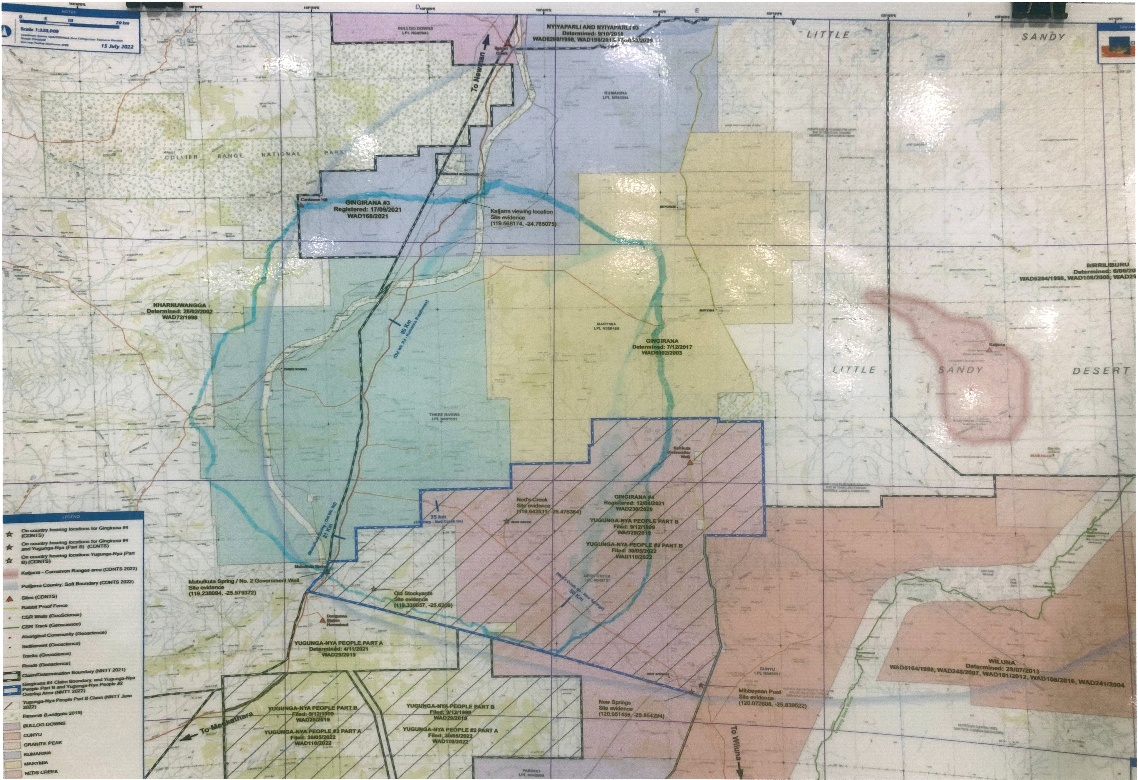
378 According to Ms Ellery, Stumpy Atkins was born near Three Rivers Station, possibly within the Gingirana Determination area. Ms Ellery said that she had been to Ned’s Creek with Stumpy Atkins. Ms Ellery also said in her 2015 witness statement for the Gingirana Determination that:
Mum [Daisy Charles] said that her father [Billy (Parnapuru)] came from that country, from the Blue Hills area. My grandfather's country came west from there towards Kumarina, Mary Mia and Three Rivers Stations...
My grandfather Billy (and his brother, Bluey and sister, Stumpy) got his country probably from his father or mother's father, way back. Maybe it was from my great- great grandfather. Billy belonged to that country and spent time there while he was growing up. He knew the places and the stories for the country. His knowledge has been handed down, so it keeps going. Mum knew the country and never forgot about it. I know this because she told me stories about it.
...
I have travelled through the Gingirana claim area many times. I've visited my country with my family a number of times. I've been to Mary Mia and to the Rabbit Proof Fence. I've also been to Three Rivers Station, Ned's Creek Station and Bulloo Downs, just to have a look around. Over a long time, I have been telling my kids about our family history and connection to that whole area, including the Gingirana area.
379 According to Ms Atkins, her father Bluey Atkins (Parnapuru) was born at Katjarra. Ms Atkins said:
My father, Bluey Atkins, used to talk about this country, Putijarra country. He told stories about the country. The old people used to come and talk about it. Mara Kuju's (Norman Thomson's) father, and other Putijarra people used to come and stay with my father, then go back. They used to tell good stories about when they were out on country.
380 Other descent witnesses, including Daisy Charles and Ms Atkins described the area of their country in earlier witness statements in differing ways, a fact that Dr Lynes said was to be expected having regard to Western Desert laws and customs. However, what is apparent on the evidence relied upon by Dr Lynes is that the Atkins apical ancestor siblings had some geographical connection with land extending to Mubulkuta Spring, the northern part of Doolgunna, most of Ned’s Creek Station, New Springs and Grasscutter, within the overlap area.
381 According to Dr Lynes, all of the descendants of the three Atkins siblings are understood to hold some rights and interests in the entirety of the Gingirana Determination area, as well as the overlap area, due to being members of the (Putijarra) families who held responsibility for the country the subject of these two areas (as well as the western portion of the Birriliburu Determination area) before, at, and after the time of effective sovereignty.
Minmi Clancy
382 Minmi Clancy’s country was an area called Ngankari, which is right on the edge of the Carnarvon Ranges (Katjarra), and according to Dr Lynes was identified by her granddaughter Ms Kadibil as Putijarra country. Dr Lynes relied on earlier evidence from Ms Kadibil to the effect that her mother Daisy and grandmother Minmi travelled in areas east of the Rabbit Proof Fence, including the Carnarvon Ranges, Mt Essendon (Pulu) and Beyondie (the latter two being within the Gingirana Determination area). Daisy and Minmi also spent time on Beyondie Station.
383 Slim Williams (son of Ms Kadibil) provided further information to the effect that his family was responsible for Putijarra country, including areas south of Mt Essendon which were within the overlap area. He said that this country contains Tjukurrpa for which he and other Putijarra people are responsible. Dr Lynes cited such information in her 2021 Report, stating that it was provided by Slim Williams to Nadisha Senasinghe (an anthropologist employed by CDNTS) and recorded in an unpublished anthropological report entitled ‘Gingirana Native Title Claim: Registration Test Anthropological Report’. Although the Senasinghe report was not in evidence, I assume Dr Lynes would not have relied upon it unless satisfied that it was a credible source (Bodney). I also note that Dr Lynes worked with Ms Senasinghe and so was in a position to assess the reliability of her report. Dr Lynes stated that Jimmy Williams also told Ms Senasinghe that Putijarra people were looking after the country contained in the overlap area.
384 Dr Lynes also gave more direct evidence about Slim Williams. She said he actively looks after the Gingirana Determination area and the overlap area, and he referred to travelling regularly with his family from west to east along the Ned’s Creek Road on their way to Katjarra, bringing along younger members to ‘ensure transfer of knowledge’. Dr Lynes was satisfied that Minmi’s traditional country encompassed the overlap area, and said her view was strengthened by continued knowledge of the Tjukurrpa relevant to the overlap area (as referred to by Slim Williams) and his ongoing practice of sharing of the Tjukurrpa.
Siblings Molly Long and Sandy Clause (Midjibunku)
385 Dr Lynes explained that, although the location of the older generation was further east, apical ancestor siblings Molly Long and Sandy Clause were understood to hold rights and interests further west due to more recent occupation of the area as time passed, and as people started to move towards settlements like Wiluna and Jigalong.
386 Molly Long and Sandy Clause had their country along the lower Canning Stock Route between Wells 6 and 9 and out to Katjarra (Carnarvon Ranges) (all in the Birriliburu Determination area). TP went some way to explaining how areas of country expanded. He described how Molly Long and Sandy Clause came to expand the area that was considered their country, including into the Gingirana Determination area and the overlap area, through living on, working on and raising a family on Beyondie Station.
387 Molly Long had three children, Paddy, Sally and Margaret. TP is Paddy Long’s (adopted) son. TP explained that Paddy showed him around Putijarra country including places on Three Rivers Station and Middle Branch and other areas that are within the Gingirana Determination area, indicating movement and area of rights and interests further west.
388 Sandy Clause lived and worked on Beyondie Station and passed on a lot of his knowledge about Beyondie to TP. TP also said in his preservation evidence that Sandy, along with TP’s grandfather’s brother, took him (TP) to Katjarra and told him that he had to take on looking after Putijarra country and law.
389 Ms Long is Molly Long’s granddaughter. She gave evidence of a strong physical connection with Mibbeyean Pool in the overlap area, including being told directly by Molly that it was on the pathway from Wiluna up to Jigalong (consistent with the evidence of runs given by Mr McCaul). Ms Long was told of Putijarra people going there camping and for holidays.
Polly Wongi Telfer
390 I have discussed Ms George’s evidence above. Ms George is the granddaughter of Polly Wongi Telfer. This family has an association with the Yibbie Ranges and Beyondie Station. Ms George’s mother, Yibbie George, grew up on Beyondie until the age of 13 when she was taken by the police to Moore River Native Settlement. After a period of time, she returned to Beyondie and was on the station, or in that area for most of her life.
391 Ms George understands her mother’s traditional country to be in the area around Beyondie, with connections going both north and in a south-easterly direction, including Ned’s Creek. Ms George was born on Beyondie Station, but was taken away at a young age. She recalls going back to Beyondie to visit when she was 18 years old, and many times since.
Siblings Jeanie and Mimi
392 Jeanie and Mimi were associated with the Carnarvon Ranges and a site just east of the Carnarvon Ranges called Ngankari. Jeanie had two sons, Willy Ward and Peter Yatjuwunga (Edjurrong) (also referred to as Peter Yarjurnga or Yadjunga, according to Dr Lynes) who were also known to have an association with that area and Lake Beyondie in the Gingirana Determination area. Peter Yatjuwunga was Slim William’s grandfather. Mimi had a daughter called Watji Roe who was born at Beyondie Station.
393 Jeanie moved to Lake Violet Station with Daisy Kadibil. The family is also associated with the overlap area through Slim Williams’ ongoing descent line to the area (through Minmi Clancy). The descendants of Peter Yatjuwunga are the same as the descendants of Minmi Clancy, as Peter was married to Minmi’s daughter, Daisy Kadibil.
TP
394 TP was introduced at [323]-[324] above.
395 There was detailed preservation evidence from TP by way of a witness statement and transcript extracts, prepared for the purpose of the Gingirana Determination.
396 Dr Lynes had met TP on the field trip with Dr Kruse. Dr Lynes concluded that TP was born by the Rabbit Proof Fence on Marymia Station, within the Gingirana Determination area, while his mother was walking from Jigalong to Wiluna. The homestead is a little way away from where he was born, which was near to where ‘the old Meekatharra school bus broke down’. The bus is apparently still sitting along the fence.
397 TP’s parents were picked up from Durba Springs (near Well 17, far to the north-east of the overlap area in the Martu and Ngurrara Determination area) and brought into Wiluna because ‘the government wanted people to come in from the desert’. His biological parents did not possess country within the claim area (confirmed by Dr Lynes). TP did not know any of his grandparents.
398 TP’s mother later married Paddy Long, who grew TP and his sisters up. Paddy was a Putijarra man whose country was around Beyondie Station, Katjarra, Well 6 and Well 7 on the Canning Stock Route (see [387] above). TP called Paddy his father and Paddy called TP his son. TP followed Paddy for country. Paddy’s mother was Ms Long’s grandmother (Ex 37, Gingirana genealogy 3 (for Molly Long)).
399 TP lived at Beyondie Station as a child for some years with his parents. His parents told him they went to Beyondie Station because it was close to Katjarra and their country, and there was good food there. They worked at Beyondie and still hunted and collected bush tucker. TP said that when he was born, the mob travelled up from Wiluna on to Cunyu Station (abutting the eastern boundary of the overlap area, in the Wiluna Determination area), then over past the old Thaduna copper mine (which is within the overlap area and near Ned’s Creek site), then north up into the Gingirana Determination area and up the Rabbit Proof Fence.
400 TP was later moved to Jigalong for school. He met BA there. He went through the law there.
401 The following extracts from Dr Lynes’ 2021 Report, in which she cites extracts from TP’s witness statement for the Gingirana Determination area, are informative:
67 Timmy Patterson provided an enormous amount of evidence during the 2015 Preservation Evidence Hearing for the Gingirana Native Title Claim …. His demonstrated knowledge of country within the entirety of the Gingirana and Gingirana Areas amounts to a lifetime of living and learning the sacred landscape of that country. Of one significant Tjukurrpa [Jukurrpa] that travels through both the Gingirana and Gingirana Areas, TP stated the following:
A very important Putijarra jukurrpa story in the claim area is about Pikurta. He's a type of marlu (kangaroo). He's a hill kangaroo. Pikurta travels from the other side of Mt Newman, Roy Hill. Putijarra takes him over from Kumarina, through Gingirana Claypan and Three Rivers, and we take him all the way to the old Lorna Glen Station, which is south-east of the claim area. The old men know where he travels, and they know where he stops. They can see the signs of where he's travelled; it might be a camp at a rockhole, or it might be some trees or other things. Where he stops are places that the old men know about. Pikurta might stop to get water at a soak or a clay pan or just because he needs a rest. Pikurta came very close to Mubulkuta, then travelled east to Karrikuta (Grasscutter Well), Lake Nabberu and then to Katjarra. He kept going after Katjarra.
Grasscutter Well is within the Gingirana Claim Area.
68 Timmy Patterson summed up his connection to all of “Putijarra country” in the region of the Claim Area as follows:
I am one of the people who have the Law for Putijarra country – Middle Branch, Kumarina Station, Beyondie Station, Marymia Station, the top part of Ned’s Creek Station going all the way to Katjarra, Well No. 5 on the Canning Stock Route and Windich Springs on the stock route as well. I am one of the people holding that country because I was born there, I was growing up around there, and I know the stories for that country.
69 Finally, Timmy Patterson has been passing his knowledge onto his son, Brian Arnott, who is also a wati [initiated man], as well as other younger men from the identified Putijarra families for the Claim Area. Although TP, himself, is now quite old and infirm, he has assured that the next generation of men are prepared to take the country on when he passes.
402 TP in his preservation evidence witness statement from 2015 also said the following (emphasis added):
51 That place near the Rabbit Proof Fence where I was born didn't belong to my parents. It wasn't their ngurra. They came from up along the Canning Stock Route. But I was born on that Rabbit Proof Fence and I was in that area when I was growing up. Under Putijarra Law, my country, my ngurra includes the country all around that place where I was born. My country, my ngurra also includes the country that belonged to my father, Paddy Long. I also know the other places on Putijarra country. I've been to those places and I have been given the stories and the Law for those places. I can speak for them and have to look after them.
52 Under Putijarra Law, ngurra is the area that is your home or heartland - it's the area that you take most responsibility for. Your ngurra can be the place that you were born, if you were born in the bush like I was. Your ngurra can be your mum's ngurra or dad's ngurra, which is passed on to you. Your ngurra can also be your grandfather's ngurra or grandmother's ngurra. You must take responsibility for your ngurra and look after that area.
53 I have the jukurrpa stories for the whole claim area, my ngurra. I know the jukurrpa stor ies and that means I have jobs to do for the country. I've got to look after it. I am what in Putijarra language we call a kanugarra - I am someone who holds the country and looks after it. That's straight under Putijarra Law. All the desert areas are the same.
403 It is apparent from this evidence that TP claimed rights by descent from Paddy Long (his stepfather, son of Molly Long) but also because he was born in the Gingirana Determination area.
404 Dr Lynes in her 2021 Report concluded that TP had rights by descent from Paddy Long, but the Gingirana in their trial submissions focused on the fact that TP was born in the Gingirana Determination area and in terms of traditional laws and customs was associated with the Gingirana Determination area and the overlap area by that pathway.
Siblings Rosie Green, Minnie and Bob Barber
405 No descendants of the siblings Rosie Green (Jilawarra), Minnie (Ngunyupunku) and Bob Barber (Yanyun) gave evidence in this proceeding.
406 Dr Lynes obtained information about the family from some of the witnesses. She said that according to senior claimants, Rosie Green, Minnie and Bob Barber were three Putijarra siblings who originally came from the country around Nyankari (near Mt Salvado) and Canning Stock Route Well 6, in the western portion of the Birriliburu Determination area. They remember the siblings living in the Beyondie and Rabbit Proof Fence area of the Gingirana Determination area.
407 Dr Lynes noted in her 2021 Report that Rosie Green and Minnie were seen by people like Ms Long as people who had shared information with them about Ned’s Creek. I note that Ms Long did not provide any evidence about Rosie Green at the hearing, and to the extent she gave evidence about a ‘Minnie’, it was unclear to whom she was referring and was ambiguous.
408 According to Mr Liberman’s 1976 report (relied upon by Dr Lynes), Bob Barber was born at Wiluna and identified as Putijarra. Dr Lynes recorded that Bob had children with several women, one of whom was recorded as living at Three Rivers Station during the 1950s and 1960s. Bob and his family wound up in Cue and Meekatharra and most of his descendants continue to live there today.
409 During the 1950s and 1960s, Rosie lived at Three Rivers Station with her husband, a Putijarra man called Mr Green. TP said in his witness statement that Rosie Green’s mob were among the right people to speak for the Gingirana Determination area. TP said that ‘Old Rosie’ was out at Three Rivers Station and spoke Putijarra, even when she lived in Jigalong.
Annie Leake (Ninkungka) and Wallaby Wallace (Jiriji)
410 Siblings Annie Leake (Ninkungka) and Wallaby Wallace (Jiriji) were depicted as apical ancestors in Gingirana genealogy 5 (Ex 39). According to TP (as told to Dr Kruse), Wallaby Wallace was a Putijarra man who came from country in the eastern portion of the Gingirana Determination area and the western portion of the Birriliburu Determination area. Wallaby was thought to be 65 years old in 1953, suggesting he was born before effective sovereignty for the overlap area.
411 Historically there was some confusion as to Wallaby Wallace’s genealogical descendants, due to the use of the term ‘grandfather’, but according to Dr Lynes it became apparent that Wallaby Wallace was a classificatory or step-grandfather to BA and Ms Atkins (confirmed by a witness statement of Ms Atkins). He was the father of Lucy Wallace Gibbs and Peter Wallace, a relationship also depicted in a 1953 genealogy drawn by Mr Epling while in Wiluna.
412 Dr Kruse had gained some knowledge about Lucy Wallace Gibbs from Brian Samson, a Kartujarra/Manyjilyjarra/ Putijarra man from around Cotton Creek, which Dr Lynes relied upon in her 2021 Report. Lucy was born on Three Rivers Station, a portion of which is within the Gingirana Determination area. Other State Record Office information supported the fact that Wallaby Wallace and his family lived on Three Rivers Station in the 1950s and 1960s. Wallaby Wallace was referred to by Jimmy Williams as ‘really Putijarra’ and an old man who knew ‘everything’. Jimmy also associated Wallaby with Three Rivers Station.
413 FW stated that Wallaby Wallace told him about the Pikurta (hill kangaroo) Tjukurrpa.
414 Wallaby’s sibling Annie Leake is remembered by Ms Long as a ‘Putijarra really’ woman.
415 Ms Long’s evidence was that Annie Leake walked around with her grandmother, Molly Long. According to Mr Liberman, who interviewed Annie Leake in 1976 for the Aboriginal Sites Department (report made available to Dr Lynes), Annie Leake was born on Glen Ayle Station (east of the Rabbit Proof Fence, within the Birriliburu Determination area). Informants remembered her children, particularly her daughter Gladys Leake as a Putijarra woman who stayed at the old camp on the north side of the road to Beyondie Station (in the Gingirana Determination area).
Myarli
416 I have discussed above the position of proposed apical ancestor Myarli, who the Gingirana claim should be added as an apical ancestor, with a descent line to Mr Richards.
417 According to Dr Lynes, no living person recognised the name ‘Myarli’ when Dr Lynes collected genealogical information on Mr Richards’ ancestors.
418 Mr Richards gave evidence that Ruby Parker was Putijarra and came from Jigalong. Dr Lynes gave evidence that having spoken to Mr Richards and from reading the Birriliburu genealogical information compiled by Dr Sackett, she understood that his family was connected to Wells 6 and 9 on the Canning Stock Route and the Granite Peak Area. Dr Lynes said that Dr Sackett identified that area as part of the Putijarra language area within the Birriliburu claim (counsel for the Yugunga-nya observed that Granite Peak and Wells 6 and 9 are a long way from the overlap area).
419 Mr Richards’ genealogy was not in evidence when he was cross-examined, although no request was made for him to be recalled.
420 Mr Richards said his mother was Putijarra from up around Jigalong and her country was ‘all around here’. It was apparent in his cross-examination that Mr Richards was uncertain about the (approximate) boundaries where his mother had travelled. He said Putijarra country was ‘right back to the Rabbit Proof Fence’ and that Kate (presumably Ms George) had told him ‘that’s your fellas’ country there’. He said his old people told him Ned’s Creek was Putijarra. He said he went through the area with Dr Kruse. He said Mibbeyean Pool was Putijarra. Mr Richards did not provide further evidence about his mother that might assist in relation to Myarli’s history, or further information about Myarli herself. That is not a criticism of Mr Richards, but is no doubt a consequence of the difficulties faced by applicants in relying on oral histories of events that occurred over 100 years previously, and the late inclusion of Myarli in the genealogies.
Dr Lynes’ conclusion on apical ancestors
421 In relation to each of sibling groups Stumpy, Bluey and Billy Atkins (Parnapuru), Molly Long and Sandy Clause, and Jeanie and Mimi, Dr Lynes concluded each apical ancestor is understood to hold rights and interests in the overlap area, which is to properly be regarded as an extension of the Gingirana Determination area, due to being members of the Putijarra families who held responsibility for these areas before and after effective sovereignty. Their descendants all possess rights and interests in the overlap area via descent from the respective sibling groups whose traditional country, gained through birth and long association, encompassed the overlap area. This connection is strengthened via the gaining of ceremonial and first-hand knowledge of sites on the country, and is said to be recognised by the wider Aboriginal jural public.
422 In the case of siblings Annie Leake and Wallaby Wallace and Rosie Green, Minnie and Bob Barber, and in the case of Polly Wongi Telfer, Dr Lynes’ conclusion was the same, save that there was no reliance on strengthening of the connection via the gaining of ceremonial and first-hand knowledge of sites.
423 In the case of TP, the conclusion was the same except that Dr Lynes concluded that his descendants possess rights and interests via descent from Paddy Long, as well as from TP’s own birth in the Gingirana Determination area.
Gingirana – two further issues
424 There are two important matters that require further consideration. The first is the Gingirana’s focus on Putijarra and the relevance of the dialect to the connection issue for the overlap area. The second, observing that much of the preservation evidence was given at a time when the Gingirana claim did not push into the overlap area, is to assess the extent to which such evidence (and other evidence) assists the Gingirana in asserting rights in relation to the overlap area with its extended southern boundary.
PART G – THE OVERLAP AREA AND THE PUTIJARRA DIALECT
General
425 Dr Lynes explained that the overlap area is understood by the Gingirana and herself to be an extension of the Gingirana Determination area; the families connected to the country within the overlap area are the same as the families connected to the Gingirana Determination area, and those families are connected to both areas for reasons that include the association of the Putijarra dialect with each area.
426 The Putijarra dialect was recognised as a Western Desert dialect in the native title determinations in each of the Gingirana Determination (at [2] of the reasons), the Birriliburu Determination (at [16] of the reasons) and the Martu Determination (at p 29 of Sch 3).
427 One of the maps included by Dr Lynes in her 2021 Report identified (by a soft blue line) an oval-shaped area that was said to indicate the area of Putijarra country, as seen below:
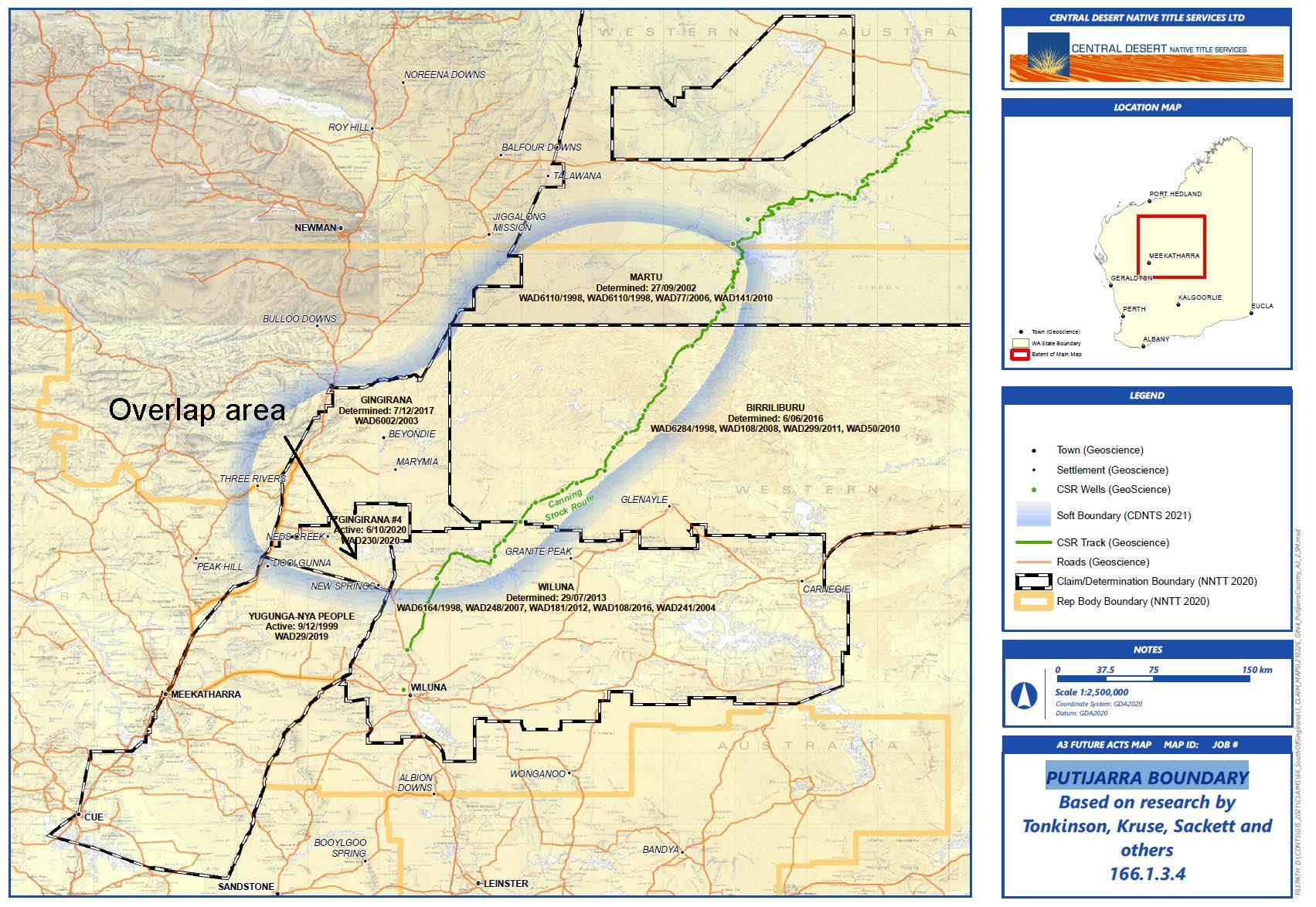
428 I have added an arrow to Dr Lynes’ map to assist with locating the overlap area. The ‘Putijarra area’ as a whole includes parts of Martu, Birriliburu and Gingirana Determination areas and the overlap area. In particular, large areas to the east of the Gingirana Determination area were considered Putijarra.
429 Dr Lynes explained that the map was developed when she was exploring the areas where Putijarra people identified country associated with the Putijarra dialect. In undertaking this task, Dr Lynes had reference to the Martu connection report prepared by Prof Tonkinson, a Birriliburu connection report written by Dr Sackett and various Gingirana anthropology reports written by Dr Kruse. Dr Lynes also reviewed preservation evidence transcripts. CDNTS’s internal anthropologist (Mr Sean Calderwood) looked at the same sources referred to by Dr Lynes and sought to create a map that encompassed those areas. Dr Lynes confirmed that the area outlined on the map was consistent with her understanding of Putijarra country.
430 The only witness who gave evidence during the hearing that spoke Putijarra was Ms Ellery. That was not her only language. A video of Ms Ellery speaking Putijarra apparently indicated that she also used words of another dialect when speaking Putijarra. Dr Lynes explained that Western Desert people speak multiple dialects of an (unnamed) Western Desert language, and that people can travel to different Western Desert centres and often understand other dialects.
431 When asked to explain the significance of the ‘Putijarra’ label, Dr Lynes said that the word refers to a dialect that is still spoken, although not by as many who once spoke it, but that it also refers to places on country where people who spoke that language once lived in a traditional manner.
432 Dr Lynes guarded against conflating the idea or notion of language or dialect group territory and rights and interests in country, observing that although there exists a belief that dialects were instilled in the country during the Dreaming/Tjukurrpa, the dialects did not have hard and fast boundaries but rather were transitional. In her 2022 Report, Dr Lynes (referring to and endorsing the work of anthropologist Prof Alan Rumsey) said:
Rumsey is trying to make clear that language, or in this instance dialect names appear to have a clear identification with territory for Aboriginal Australians. It’s not possible to delineate completely distinct groups of people based on the languages they speak. [As he states] ‘The links between people and languages are secondary links, established through the grounding of both in the landscape’.
To my mind, the relevance of the above discussion can be summed up in stating that the primary relationship we need to focus on, as researchers involved with Native Title matters, is the traditionally recognised links between people and country which give rise to rights and interests under traditional law and custom.
433 Mr McCaul expanded on the difficulty of using labels for groups, places or languages in Western Desert society, where the approach is somewhat idiosyncratic. People may be referred to by the language they speak or where they live and so may be described in a number of ways by different people. There is a difficulty in matching language consistently to groups of people and to land. Mr McCaul explained the tenure system in the Western Desert is different to many other areas, in part because of fluidity of movement due to drought and aridity. People would move away from dry desert areas to desert areas with more consistent permanent water (Mr McCaul noted the literature suggested Mibbeyean Pool might be one of those places).
434 This capacity to move led to a ‘great mixing of people from different dialects coming together’ with new generations of owners arising more regularly, and the need to constantly navigate ‘being different but the same’. People would interrelate and come together, for example in initiation ceremonies. People had the capacity to establish connections to land in ways not necessarily seen elsewhere.
435 This is consistent with Dr Lynes’s observation that ethnohistorical sources are not consistent across time as to a specific dialect-identified group being in only one place and holding rights and interests only in that one place.
436 Mr McCaul did agree, however, that even with this fluidity of movement in the Western Desert, and fluidity over time as to different labels, the concept of identifying a group of people with an area of land using a dialect or language label is established across the ethnographic record. An example is seen in the work of Prof Tonkinson in relation to the Martu Determination, which identified (for example) one area that was associated with the Putijarra dialect. He also accepted, when the proposition was put to him, that in the current understanding or practice of traditional laws and customs in the Western Desert, people do identify groups of people with particular country using a dialect label.
437 Dr Lynes said that the idea of Putijarra country does not preclude other people who are not Putijarra from having rights and interests in the same area.
438 However, even accepting the area depicted in the map is Putijarra country, the question still arises, in the context of sovereignty, as to when this separate dialect or group was identified, and whether it extended back to the time of effective sovereignty.
Early ethnography of the overlap area at the time
439 The limitation on reliability and weight that might be given to the work of the early ethnography undertaken by Ms Daisy Bates has been addressed elsewhere (for example, Narrier (No 1) at [463]-[493]).
440 The early ethnography of Ms Bates identifies the Waianwonga and Ngaiuwonga (or Ngajawonga) dialect groups in, or in close proximity to, the overlap area. For the purpose of the Gingirana Determination, the expert anthropologists Dr Brunton and Dr Martin concluded that the groups living in the south-west of the claim area were most likely Waianwonga (considered to be part of a non-Western Desert society) or a mix between Western Desert and non-Western Desert groups. Ms Bates associated this group with at least the north-western portion of what is the overlap area. Ngaiawongga and Ngajawonga are considered to be dialect groups that were part of the Western Desert society and associated by Ms Bates with the eastern portion of the overlap area.
441 According to Mr McCaul, Ms Bates’ material indicates that the Ngajawonga were associated with (amongst other places) Katjarra (Carnarvon Ranges) and Mibbeyean Pool.
442 However, the expert anthropologists and other anthropologists that have considered the overlap area and surrounding areas agree that it is almost impossible to say with certainty which dialect groups were in occupation of the overlap area at sovereignty (Proposition 3, Ex 13.3 p 55 and ts 1378-1379). Therefore, this limited ethnographic record, which identifies certain dialects on the western side and other dialects on the eastern side of those areas, does not resolve the issue of association with the overlap area at sovereignty.
443 The weight to be given to such ethnographic evidence falls to be considered in the context of the other lay and expert evidence before the Court.
444 As Dr Lynes explained, there is little historical ethnographic evidence for the overlap area and so it was necessary for the experts to piece together information from different sources.
More recent ethnography
445 During the expert conclave senior counsel for the State spent some time working through ethnographic resources relied upon by Dr Lynes.
446 Dr Lynes was asked about Prof Tonkinson’s 1978 published text, ‘The Mardu Aborigines: Living the Dream in Australia’s Desert’, which was referred to by Dr Lynes for the purpose of her 2021 Report (an extract was in evidence).
447 In the second chapter of his text, ‘Europeans and the Mardu Response: 1900-1990’, Prof Tonkinson focused on the westward movement of the Mardu out of the desert, with ‘the majority’ settling in Jigalong. According to Prof Tonkinson, the spread of the pastoral frontier from the west towards their country, the building of the Canning Stock Route (a thousand-mile chain of wells connecting northern pastoral areas to Wiluna, surveyed and built between 1906 and 1909) and the building of the Rabbit Proof Fence (completed in 1907) all led to contact between the Mardu and non-Aboriginals and movement out. Jigalong was not the first point of contact for most Mardu, though, because there were a few outlying pastoral leases on the most travelled route in from the desert. Prof Tonkinson stated:
Most of the Nyiyabarli, who were the traditional inhabitants of the Jigalong area, had already drifted to sheep and cattle stations further west when Mardu began to arrive at Jigalong in the 1930s. As elsewhere, there was still high mobility between Jigalong, surrounding stations, and the desert, but as further groups of desert immigrants arrived, a more settled community of Mardu was taking shape.
448 Dr Lynes generally agreed that the pattern of movement reflected desert people being attracted into Jigalong after it was established in 1907 but particularly around the 1930s, and that there was a trend of migration in a westerly and southerly direction from the desert during the twentieth century. However, acknowledging that the rate of movement in was more rapid by the 1930s, Dr Lynes noted that it was known that other people (including Molly Craig) came into Jigalong at an earlier time, and that some of those persons are part of the Gingirana claim group.
449 Prof Tonkinson also prepared a map, based on his works in the 1960s. The map reflects certain dialect areas (see [436] above – reference to this work by Mr McCaul). Prof Tonkinson noted he was based in Jigalong so his work reflected the perspective of those people at Jigalong. In any event, the map identifies a Putijarra area around Wells 16, 17 and 18 on the Canning Stock Route, at least 100 km north-east of the overlap area.
450 In an extract from the Martu connection report prepared in 2001 for the Martu Determination (which was in evidence), Prof Tonkinson referred to nine dialect-named territories that he had identified, one of which was Putijarra, but it is placed at Durba Hills, south of Lake Disappointment, more or less around the same area of Wells 16, 17 and 18. This is consistent with a map annexed to his report.
451 As Dr Lynes had previously explained, her work relied in a significant way on the work of Dr Kruse. She clearly considered Dr Kruse’s work to be important and reliable. Dr Kruse’s 2012 report for the Gingirana Determination (which was in evidence) included a Tonkinson map from 1966 which outlined a Putijarra area (spelt relevantly ‘budijarra’), again to the south-west of Lake Disappointment. Under cross-examination, Dr Lynes stressed that Prof Tonkinson’s work was Jigalong-centric and also concerned with the vicinity of Lake Disappointment; that although he would have spoken to some claimants at Jigalong who were Putijarra, his work does not necessarily include the perspective of people who came from Wiluna.
452 Dr Lynes accepted, however, that Prof Tonkinson’s work indicated that he associated Putijarra with the area to the north-east of the overlap area, and he did not in any positive way put them further south-west or anywhere else. She accepted that Prof Tonkinson’s work was consistent with there being fluidity in people’s ideas about where different groups of families belong, about where Putijarra country was located, and that such views can change over time. Dr Lynes also accepted that such fluidity is to be expected as far as Western Desert laws and customs are concerned.
453 Mr McCaul’s view as to the fluidity of labels and geographic areas was consistent with Dr Lynes evidence.
454 This exchange between senior counsel for the State and Dr Lynes was informative:
MR RANSON: … if you were to ask Putijarra people where is Putijarra country and explore that issue with them, would their belief be that it's always been that way. Let’s assume, for example, that we were to agree that it may have shifted and that in relation to a particular place it has shifted, as a matter of objective reality, would the people nevertheless have processed that in a way that they would say, and quite possibly completely believe, that it had always been that way, it's permanent.
DR LYNES: There’s certainly a fair possibility that that could be the case. The reasoning behind that is similar to what Mr McCaul was talking about before in the fact that while the notion of the tjukurrpa or the dreamtime is seen as something that has always been from the beginning of time, there’s also a fluidity to the tjukurrpa wherein, you know, new songs, new parts of the story are added or revealed, I should say, over time and so it's certainly likely that when a shift occurs that it's remembered as something that has always been the case.
MR RANSON: So there’s an ideology of permanence but that might not be the reality.
DR LYNES: I would say that the notion of permanence fits within their cosmology and so that is a likely outcome.
455 Dr Kruse included in his 2012 report Tindale ‘Tribal’ maps from 1940 and 1974. The 1940 map does not mention Putijarra (by that or any similar spelling). The 1974 map shows a ‘Potidjara’ area just south of Lake Disappointment.
456 Mr McCaul provided some further information about Mr Tindale and twentieth century expeditions in the area. He said that only Mr Birdsell and Mr Epling were involved in the 1952-1953 expedition to Meekatharra, Wiluna and Jigalong. Mr Tindale joined them later in the Kimberley. He also came to Western Australia in 1966 but did not travel to this area. Mr McCaul said Mr Tindale also visited in 1938, but he did not go near this Western Desert area. Mr McCaul concluded that Mr Tindale in his writing was largely basing his view on information he was given by others (potentially Mr Birdsell, Mr Epling and borrowing from Ms Bates and other earlier ethnographers).
457 Dr Kruse’s conclusion having regard to the ethnography was:
The above brief summary of some of the relevant historical material suggests that establishing the identity of the traditional owners in the [Gingirana #1] claim area at the time of sovereignty is exceptionally difficult to do with any accuracy and that a conclusive opinion is perhaps not possible. The contemporary researcher can only draw inferences from the material about where a group may have been located at the time of sovereignty. That western desert people migrated west into the Murchison-Gascoyne following sovereignty (and perhaps before) further complicates the situation. However, the material can be used to establish the existence of certain groups over time, including Putijarra speaking people, and also their spatial relationship to other groups (including perhaps extrapolating to the period of sovereignty).
458 Dr Lynes also confirmed that she assisted Dr Brunton and Dr Martin in relation to the Gingirana #1 connection report (although focussing on the important issue of the ‘frontier’ of the Western Desert) and that they did not identify the south of the Gingirana #1 claim area with the label Putijarra.
459 Dr Lynes agreed in relation to the overlap area that having regard to the earlier ethnography it is ‘too hard really’ to answer the question as to whether the Putijarra dialect or another dialect was associated with the overlap area. Dr Lynes agreed that there was no support in the twentieth century ethnography for the Putijarra dialect being associated with the overlap area.
460 It is also important to note that in their Joint Report, Dr Lynes and Mr McCaul agreed that at effective sovereignty land tenure across areas (including the overlap area) was centred on local groups rather than linguistic units. More than one group, potentially speaking different dialects, could potentially have rights and interests in the one area. Further, they agreed that the ethnohistorical sources do not say anything linking dialect with who is responsible for Tjukurrpa in the overlap area (Proposions 2 and 3, extracted in Part L below).
The impact of the absence of probative evidence
461 The State submitted that having regard to the expert evidence, the Court should not find that the overlap area was associated with the Putijarra people or dialect at sovereignty. I foreshadow that in Part M I make this finding, after providing reference to some additional evidence. However, I acknowledge this finding now because of the frequent references by the Gingirana to Putijarra country or a person being ‘Putijarra’ in the evidence referred to below. That evidence remains relevant but is to be viewed in context.
462 There is no doubt that during the course of the twentieth century members of the Gingirana claim group have come to identify as Putijarra. The label was used in different ways – for language, country and descent lines. Recalling that the label ‘Gingirana’ was chosen in relatively recent times, it is unsurprising that there were other ways in which the ‘society’ of Aboriginal people with rights and interests in the area referred to themselves and their ancestors. It is also unnecessary for me to decide either when ‘Putijarra’ came to be recognised as a ‘group’ or the scope of the boundaries of Putijarra country as recognised by the Aboriginal people. The task in assessing the Gingirana claim is narrower and focused on the overlap area.
463 Regardless of the label ‘Putijarra’, returning to the membership of the native title holder group as identified in the Gingirana application, the principal pathway relied upon is descent from identified ancestors. The Gingirana claim group members in their evidence from time to time refer to each other and their ancestors as Putijarra and to country they contend is associated with their ancestors as Putijarra country, and it can be accepted that this identification is important to the Gingirana, and reinforces their relationship with each other and geographic areas. The evidence is important in this regard. But of itself the label does not answer the questions raised by s 223 of the Native Title Act. It is not enough to be called or recognised as ‘Putijarra people’ or that the overlap area be referred to as ‘Putijarra country’. It remains necessary to look beyond those labels and consider the underlying descent relationships, and associations and connections with the overlap area.
464 For this reason, it is not fatal to the Gingirana claim that I find that they have not established that there was a Putijarra dialect associated with the overlap area at the time of effective sovereignty. It is open to find that the Gingirana hold native title in the overlap area in accordance with the traditional laws and customs of the Western Desert society regardless, and, relevantly, by descent from the identified apical ancestors said to be associated with the overlap area. Similarly, the fact that an Aboriginal person otherwise associated with the overlap area at the time of effective sovereignty was not associated with the Putijarra dialect will not, of itself, prevent a finding that their descendants have native title rights and interests in the overlap area.
465 So much accords with the ultimate opinions of both Dr Lynes and Mr McCaul.
466 Regardless, the label of Putijarra can usefully be seen as the manner in which the modern day family groups refer to each other and their ancestors. For the reason given by Dr Lynes ([452] above), it is unsafe to assume that the language label was used by native title holders in that manner at or around effective sovereignty.
PART H – THE EXPANSION OF THE SOUTHERN BOUNDARY
467 Although it does not greatly assist in resolution of the position at effective sovereignty, the circumstances that led to the Gingirana claim group seeking to expand the southern boundary to the overlap claim are informative.
468 The Gingirana application that culminated in the Gingirana Determination in 2017 was filed in 2003. However, it was apparent from the evidence that after the application was filed there remained disquiet amongst the Gingirana claim group about the extent of the southern boundary of the claim area.
Dr Kruse’s proposed new boundary
469 In exploring this issue, Dr Lynes relied heavily upon the work of Dr Kruse, including his 2012 report on connection for the Gingirana Determination. In his report, Dr Kruse included a proposed new Gingirana claim boundary based on his research to date.
470 Importantly, this boundary took in a portion of what is now the overlap area (relevantly the blue line to the south of the existing southern Gingirana Determination boundary below).
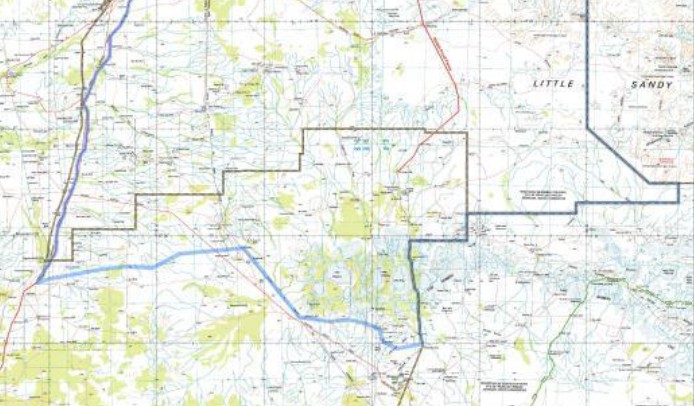
471 Dr Kruse explained his reasoning for the new boundary in his report. He ultimately concluded that the area that is now the subject of the Gingirana Determination is an area that the claimants believe to have been Putijarra country since before sovereignty, but he recommended an expansion of the claim’s boundaries to include further areas that the claimants believe were also Putijarra country at sovereignty.
472 Dr Kruse noted that the Gingirana claimants’ evidence indicates that their rights and interests cease, or ‘give way to the rights of others’ on the west, south-west and north-west borders of the Gingirana Determination area (that is, implicitly, not to the same extent to the south where the overlap area is situated).
473 Dr Lynes cited an extract from Dr Kruse’s notes from 2020 in which he stated:
Drawing a line east from Mumbulkuta (Mumbulgudda), to Pluntonic Mine, Grasscutter, and Lake Nabberu, there is a lot of evidence for it being Putijarra or Purununjarra/Putijarra country. Based on previous research, it would seem likely that was the case from sovereignty.
474 Dr Lynes noted that this description includes ‘the entirety of the [overlap] area’.
Malcolm O’Dell’s evidence
475 Mr O’Dell gave evidence about the circumstances in which the overlap area came to be the subject of the Gingirana claim.
476 Mr O’Dell formerly worked as a lawyer in the native title practice area at Perth law firm Dwyer Durack. He had extensive experience ‘on the western flank of the Central Desert region’. He had come across the term ‘Putijarra’ before, particularly in relation to the Martu people. He commenced work for the Ngaanyatjarra Council (a predecessor to CDNTS) in 2004, about a year after the Gingirana #1 southern boundary was drawn for the purpose of that application, and started to assist with that and other claims in the area. Although he was not involved in the drawing of the original southern boundary, he understood that there had been difficulties in obtaining permission (required at that time) to act in relation to what is now the overlap area, because another representative body (now YMAC) was already acting in that area for the Yugunga-nya under a written agreement.
477 The location at the time was bounded on all sides by other claims or determinations, but a number of Putijarra people expressed concern about both the northern (Nyiyaparli side) and the southern (Yugunga-nya side) boundaries of the Gingirana claim. After negotiations with the Nyiyaparli claim group, the Gingirana claim group were able to secure some amendments to the northern boundary.
478 However, concerns about the southern boundary remained. For example, Mr O’Dell had conversations with Alan Charles and BA in which they told him that the southern boundary should include Ned’s Creek Station.
479 Mr O’Dell said that the Gingirana claimants raised issues with the southern boundary ‘quite forcefully’. In addition to the problem with lodging a new claim over an area in which YMAC was already acting, there was the more pressing issue of ongoing dispute with the State over the extent of the Western Desert boundary. From around 2009 onwards, the Gingirana claim group were making strong representations about dealing with the southern boundary, and so Dr Kruse was engaged to conduct more research into that area, having regard to the work he had already undertaken for the larger claim area. This led to the 2012 Kruse report and map referred to by Dr Lynes.
480 Mr O’Dell said that the 2012 Kruse report and map was part of the iterative process in coming to understand the southern boundary.
481 The pressing issue of the Western Desert boundary was resolved for practical purposes by the 2016 decision in Narrier (No 1) regarding the Tjiwarl claim group, an area south and west of the Wiluna Determination area. After this decision, the focus could shift to the southern boundary issue, when resources were available.
482 A field trip was undertaken by Mr O’Dell in 2020 with some of the Gingirana claimants, including Jimmy Williams, Mr Morgan, Mr Farmer and Slim Williams. The purpose of the trip was to try and log the southern boundary for the extended claim area. The map of the track log was used at the authorisation meeting for the Gingirana claim.
483 Following the trip, the boundary for the purpose of the Gingirana claim boundary was settled, based on the track log of the 2020 field trip. Mr O’Dell considered that to be the culmination of work and to be the final and best boundary. As is apparent from the map at Attachment 1 the southern boundary of the overlap area is drawn as a straight line. Mr O’Dell explained that the straight line between the two points is not a traditional boundary, but rather a ‘line of best fit’ of where the traditional country was said to be.
484 Mr O’Dell added that in his opinion the map by Dr Kruse was not a final boundary for the Gingirana claim:
… I don’t think this is a final boundary. I think this was research in 2012, it’s a work in progress. Researchers don’t go out once and say this is a boundary. It’s an ongoing process, it’s a developing process. You go out with more than one group. You’d go out with men from the north, men from the south. You’d come up with a composite view on things. You don’t just say you go with this one people and deal with it on that day. At the beginning of the process that’s what you’d do to bring together at the end of the process, so all of the information that had been accumulated over a number of years in that area was brought to bear on this trip at the end of the process.
485 When asked about why the line does not follow traditional sites, Mr O’Dell explained that boundaries of claim areas are determined in various ways, including as a line of best fit:
The boundaries – I mean, you know, look at all the boundaries around there. They follow pastoral leases, they follow land lots, there’s no traditional boundary – you know, the boundary between Gingirana and Birriliburu, is a straight line. It’s not a traditional boundary. Boundaries are determined by clusters of sites, or sites and stuff like that, and then you wrap a line of best fit around that, so that’s what this is. It’s a line of best fit, so to suggest that you know, you step across a boundary, one minute you’re in, and one minute you’re not, it’s a little bit – it’s not the way it works, but you’ve got a map somewhere, so you try and work out a line of best fit.
486 When asked why the ‘line’ does not just connect sites, Mr O’Dell said:
Well, the end points do. Obviously the line in between doesn’t, but it also needs to encompass other things. It’s not just the sites. It’s the location of you know, where people grow up. It encompasses most of Ned’s Creek Station which was something of concern to people. Your Honour will hear evidence about people driving up and going through Ned’s Creek.
487 Slim Williams was also asked about the straight line boundary for Gingirana, and he said that it was pushed to match up to New Springs to keep the cultural side inside the Gingirana clan.
488 There was a body of other evidence collected by Dr Kruse and referred to in his field notes that contributed to the basis of Dr Lynes’ conclusion that Putijarra country extends to the southern boundary of the overlap area.
489 The following is a selection of evidence quoted by Dr Lynes in which claimants who identified as Putijarra gave evidence of ‘their country’ which extended to the overlap area or geographic areas within that area:
• Me and my family always travel through that southeast part of Gingirana to get to Katjarra, which is the main place for us Putijarra mob. We travel along the Ned’s Creek track or on that Marymia track. All that country is part of my ngurra so I don’t need to ask anyone to travel through there. (Slim Williams Witness Statement 2017)
• Mr P, Neds Creek - Green Dragon, Rooneys Mine, Thaduna Mine [all old mines on Neds Creek station]. Horse and cart man, Putijarra, Jimmy Green (deceased) mixed up with Atkins, Kaddibul families. [conversation was about Jimmy Green being associated with places near those mines and being a Putijarra man]. (Kruse 2020: from Fieldnotes 2008)
• Yangara, I can talk here, cunyu, grasscutter, beyondie because my country. Purngurr not my country, I can’t talk for that country... (Kruse 2020: from Fieldnotes 2010)
• I am one of the people who have the Law for Putijarra country – Middle Branch, Kumarina Station, Beyondie Station, Marymia Station, the top part of Ned’s Creek Station going all the way to Katjarra, Well No. 5 on the Canning Stock Route and Windich Springs on the stock route as well. I am one of the people holding that country because I was born there, I was growing up around there, and I know the stories for that country. (TP Witness Statement 2017)
• ... main Putijarra claim is Mary Mia, Kumarina, Rabbit Proof Fence, east, little bit Ned Creek, Grasscutter. Ned’s Creek road mostly Wajarri but little bit Putijarra near Wiluna, Thaduna Coppermine. (FW and TP in Kruse 2012)
• The land on the kakarra (east) side of the [Gingirana] claim area, around Katjarra, is also Putijarra, but the land yulpari (south) of the claim on Ned's Creek Station is a bit mixed up between Putijarra and Puranujarra. (TP Witness Statement 2015)
• Putijarra country also includes the top bit of Ned's Creek Station, but we haven't claimed that one yet because we need to talk to those families that have got a claim over that area first. (TP Witness Statement 2015)
• Grasscutter, Brian said Allan Charles always said that Grasscutter should be in the claim [Gingirana]. (Kruse 2020: from Fieldnotes 2010)
• I asked if some areas of the claim were “really really” Putijarra country and “family country where people been wandering around”? Then men said yes Beyondie, kumarina – Beyondie Bluff – along the rabbit proof fence - grasscutter – east to the Carnarvon Ranges and some places a bit to the west of Beyondie... (Kruse 2020: 6, from Fieldnotes 2010)
• My country is Putijarra country. Putijarra country goes to Beyondie Station, Kumarina, Three Rivers, including Middle Branch, up to New Springs. This is now on Ned's Creek Station, close to the Wiluna native title area (BA Witness Statement 2015).
490 The following transcript of preservation evidence taken in 2015 was also relied on by Dr Lynes in her 2021 Report:
MR KEELY: Just – just roughly for the moment, Timmy, how far does the Putijarra country go?
TIMMY PATTERSON: The boundary.
MR KEELY: We’ve seen the boundary up in the north.
TIMMY PATTERSON: Right down to the Mubulkuta, wherever that spring is.
MR KEELY: Right down to the spring?
TIMMY PATTERSON: Yes.
MR KEELY: And I think you gave a name.
TIMMY PATTERSON: Mubulkuta, you know?
MR KEELY: Mubulkuta?
TIMMY PATTERSON: Yes, but - - -
MR KEELY: So, right down there - - -
TIMMY PATTERSON: Yes.
MR KEELY: - - - and then going east, how far does the Putijarra country go?
TIMMY PATTERSON: It goes to Ned’s Creek.
MR KEELY: Going to - - -
TIMMY PATTERSON: Ned’s Creek.
MR KEELY: - - - Ned’s Creek?
TIMMY PATTERSON: Yes.
MR KEELY: And that’s a station?
TIMMY PATTERSON: Yes, a station there or homestead.
MR KEELY: What about Katjarra, is that Putijarra or outside?
TIMMY PATTERSON: Putijarra.
MR KEELY: Putijarra?
TIMMY PATTERSON: Yuwa.
PART I –– PHYSICAL CONNECTION
491 I now turn to set out evidence of the conduct, beliefs and behaviours, both physical and spiritual, of the respective Yugunga-nya and Gingirana claim groups. Assessment of this evidence is relevant to the question of connection.
492 However, an assessment of all such evidence (including the prior determinations over the adjacent land) also informs the identification and characterisation of the laws and customs currently acknowledged and observed by the respective Yugunga-nya and Gingirana claim groups, and a determination of whether the laws and customs are traditional (as explained in Yorta Yorta).
493 Bearing in mind the observation of the experts that the overlap area is at the fringes of country for each group, it is unsurprising that the extent and probative value of some of the evidence faded as the areas within the overlap area being considered were more removed from the respective determined claim areas. It is also unsurprising that boundaries and borders might be somewhat contested and confused. This provides context for the evidence.
Yugunga-nya
Mubulkuta Spring (No 2 Government Well)
494 Most of the evidence relating to physical connection with this site came from the Shay family.
495 Bill Shay said that he first went to No 2 Government Well as a small boy with his parents, family, uncles and aunties. They hunted around there, and camped there for a few nights. His sisters and brothers went with them. His parents would cook and feed him and his brothers and sisters with kangaroo, emu, and anything else they hunted. He learned how to cook from them and the ‘old people’. His family hunted ‘all over the country’ around there whenever they needed a feed, and got goanna, kangaroo, porcupine, witchetty grubs and coglas (bush pear).
496 Bill Shay said he would come to the area quite often as his parents ‘journeyed along’ and they didn’t stay in one place.
497 Bill Shay said the pool used to be a spring. His old people told him about it. He was not allowed near the spring when he was young because there was a water snake living there, although it is no longer there because it was disturbed. He said there was a special tree near the pool that had marks on it indicating where people had been and where the snake stopped.
498 He said he brings his children and grandchildren to No 2 Government Well, although they now come ‘in style, in a motor car’. They ‘pull up, go wherever – come down here and have a look at the waterhole and move on’.
499 Bill Shay said that he had been to No 2 Government Well with his brother, Ronnie Shay (deceased). He said that Ronnie had brought him there in the past.
500 Bill Shay had been to No 2 Government Well as recently as two or three months before the hearing, when he had been kangaroo shooting with a few boys. He considered his ngurra to be around No 2 Government Well.
501 Clinton Shay gave evidence at No 2 Government Well. He said he had been there ‘plenty of times’ with his father, who told him not to go near the creek. Clinton Shay said that the old people told the children not to go down to the pool because the water snake was there and if they went too close, ‘you’d be gone, disappear’. He said that he always listened to his father and the old people who said that if people disobeyed their elders and went near the pool, they could get sick from country. His father said that the spirits in the country, might make people sick and that there were many spirits in the bush. Clinton Shay said that the ‘little Wutartji’ used to ‘come and stop in the hill, and the children would not go and play around’, because if they did ‘those little fellows would take them away’.
502 Clinton Shay said the water snake was called bimara and that he was not around in the area anymore. As Clinton got older, the water at the site changed and dried up, and he was able to go there because the bimara had gone.
503 Clinton Shay said he still visited No 2 Government Well although not since he had been living in Geraldton (he had been living and working in Geraldton for about 10 years at the time of giving evidence). He said that if he goes to Karratha, he stops off at No 2 Government Well, but that is not very often. He also has to go through No 2 Government Well to go on law business, and he stops off there on his way.
504 Patrick Shay said his father and uncles taught him about No 2 Government Well. He also referred to the water snake, and said it had been there years ago, but it got disturbed and went off. He said his father and uncles told him this.
505 Mr Kelly gave evidence at No 2 Government Well. He said that his father had told him about the area and that it was part of his grandmother’s home (Dolly Ward (Bootha)). Mr Kelly referred to some photos in his evidence. They included a photo of Mr Kelly’s mother (Doreen Stevens), brother (Malcolm Kelly), and Tommy Burns (who according to Mr Kelly used to live and work at Three Rivers Station in the 1950s and 1960s) in the area of No 2 Government Well. There was also a photo (when Mr Kelly was five or six years old) of Mr Kelly, his brother, sister and mother and Tommy Burns while camping at No 2 Government Well. Another photo, which he thought might have been from the same trip, showed his father, Tommy Burns and Mr Kelly as a child. He said they would camp there often, more than once a year although he could not be sure.
506 Mr Kelly referred to a number of other photos of family members (and people he did not recognise) which Mr Kelly thought might have been taken at Peak Hill, No 2 Government Well or Three Rivers. Mr Kelly explained his uncertainty about these on the basis that his sister had gathered photos together and sent them to him.
507 Mr Peterson gave evidence at No 2 Government Well. He said that he had been mustering for Three Rivers Station around the area and went to No 2 Government Well during that time. He also used to go there when he travelled up and down from Meekatharra and Newman.
508 Mr Peterson said that a lot of old people told him that old Aboriginal people went to No 2 Government Well in the past. He was able to describe those people as including Ms Evelyn Gilla’s two uncles (Sid and Clarrie Davis), and people living at the Three Rivers Station. They told him the area was important. The old people camped at No 2 Government Well and hunted around there. Mr Peterson said that Ms Evelyn Gilla (his former wife and Bill Shay’s sister) talked about the place, and told him that the area was her grandfather’s and grand uncles’ and was their area for travelling. He was asked if there was a Tjukurrpa site there, what would happen if someone wanted to build a mine there, and what he and the Shays and Gentles would say about that. In response, Mr Peterson said that they would have to ask the Gentles and the Shays if they wanted to mine there.
Doolgunna
509 Ms Kelly gave evidence that she recalled her father (Mr Kelly) taking her camping in Doolgunna when she was younger. She could not remember exactly when, but they would pull in and go camping in the overlap area when they travelled down from Port Hedland.
510 Ms Kelly said that she had been camping in the overlap area numerous times with her father and family, in at least 2016, 2017, 2018 and 2019.
511 Various photos were tendered, taken at different times when Ms Kelly and her family camped in and around Doolgunna. Photos included some taken around 2018 when Ms Kelly went camping with her daughter, Mr Kelly and her mother at Doolgunna. When asked what she was doing there, she said ‘We went out on country with dad. Dad was just teaching us country, showing us, showing my daughter’.
512 Ms Kelly referred to another photo from August 2019, when she and her family camped in the overlap area across the road from Doolgunna, and cooked up a feast because they were going to bury Pop Albert, and ‘that’s what [they] do’. She said ‘we go back out on country and we ground ourselves and gather our thoughts and prepare ourselves for sorry time’.
513 Another photo was taken when Ms Kelly had been camping with her sisters and her father near white quartz country near Doolgunna. There was an old windmill there. Ms Kelly said her father would tell them memories of his father, Pop Bing. Many things triggered her father’s memory of times he visited country with Pop Bing. He also talked about Pop Roderick (‘Pop Rod’) who used to work on Doolgunna Station. Ms Kelly said that Pop Bing ‘would’ve done a lot of travelling up in [Doolgunna Station] but he did a lot of work, ranging all the way to Port Hedland…he worked everywhere’.
514 Ms Kelly said that she had been camping with her daughter and father out on country again in 2019 ‘south of Cow Hole Bore’ where there is an old road that goes past the old Doolgunna shearing shed. They camped there and walked down a creek, where her father told them stories and told them to pay respects to the dreamtime rainbow serpent:
by grabbing a bit of sand and then you cast it into the river and you say who you are and where you come from and who your ancestors are, and he also passed that down to my daughter as well.
515 Ms Kelly said she wanted to bring the Court to Doolgunna (in the overlap area) because it was where she had come with her father. He had showed her and her daughter the country and had told them a bit about bush tucker.
516 Ms Kelly has also spent time in the overlap area when she worked for the Sandfire mine, where she was a machine operator for Central Earthmoving, which is part of Yagahong Alliance, a joint venture set up by Ron Shay (deceased). The evidence of being in the overlap area for work reasons is of a different character to other evidence given by Ms Kelly about her connection to country, but it is relevant in explaining her geographic familiarity with the area.
517 Ms Kelly knew from her father that he had gone hunting in the overlap area with his father a lot when he was a kid, catching kangaroo, emus, goannas, and all the traditional bush tucker (I deal with Mr Kelly’s own evidence below). Ms Kelly stated that her father had shown her and her sister and brother how to look for bush tucker, such as the cogla and the bimba. Her grandmother Nana May (Mavis Curley) also taught them when they were little kids, and her Aunty Elaine showed her how to get the bimba. She said she felt strongly about ‘capturing our connection and our history and culture and our stories, food, and sharing it with the next generation and making sure my daughter and my nieces and nephews know’. She said that her father has told her of places not to go around up in the overlap area, including one area which he said belongs to the old people, and so people should pay their respects and not mess with it.
518 Mr Kelly said that he was 15 or 16 years old when his father pointed out his country to him. I have referred to some of Mr Kelly’s evidence about this trip above in the context of pointing out Dolly Ward (Bootha)’s country.
519 It is sufficient here to note that Mr Kelly said that Dolly Ward (Bootha) used to show Mr Kelly’s father around places like out the back of Doolgunna. He said they spent a lot of time out there, and that Dolly and Ivy Ward (Dolly’s daughter) took Mr Kelly’s father out there. Mr Kelly said that he took his daughters out to country to show them, so that they could teach their kids and grandkids that Doolgunna was part of their country ‘and never lose sight of it and safe, keep it close’. He said this is important to him because he will not be around forever and that they ‘just got to pass it on’.
520 Mr Kelly had also worked at the Sandfire mine and was often out camping on country. He said he worked at the mine in order to be ‘close to home’, and that as he was ‘a part of this country’ and a part of his great-grandmother’s country, and as the mining was coming to a close, he thought he should be around country to help rehabilitate it. Mr Kelly said that when he has time off from work at Sandfire, he would go prospecting and he wanders as far as he can, including on the overlap area, on Doolgunna Station and Ned’s Creek. He does not go hunting, but takes a detector with him everywhere.
521 Turning to the Shays, Bill Shay said that he worked on Doolgunna Station mustering sheep with his brothers, including Ron Shay (deceased).
522 Separately, Mr McCaul gave evidence in his Extinguishment Report about the connection of Ron Shay (deceased) to Doolgunna (extracted below).
523 Bill Shay said that he has done heritage surveys for the mines, including around Ned’s Creek Station and on Doolgunna. He said he has taken Clinton Shay’s boys out on country all around Doolgunna and ‘showed them the country, shoot kangaroos or whatever we come to get’.
524 Clinton Shay said that he was told by his uncles and his father that the Doolgunna and Ned’s Creek country belonged to ‘most of my Shay family’. He had taken his children around country just like his father had done for him, and he taught them the same things that he had been taught. He said his father took his children all around Doolgunna and back down to Bulloo Station ‘and down’.
525 Clinton Shay hunts on Doolgunna regularly. He said that he worked at the Sandfire mine on Doolgunna for five or six years and he would go on country when he had a break from work. He said that his father, and his uncles, Ron Shay (deceased) and Rex Shay (deceased), showed him around the homestead at Doolgunna, and the area around No 2 Government Well. He said he ‘grew up being shown stuff’.
526 Patrick Shay stated that he had surveyed on Ned’s Creek and Doolgunna with his father and other people from the Yugunga-nya claim group. He goes hunting on Doolgunna and Ned’s Creek, whenever he has time. He goes there for hunting and camping with his family and sometimes they make a camp wherever there’s wood, shade or water.
527 Mr McCaul in his Extinguishment Report said the following in relation to Doolgunna Station:
20 The main individual associated with Doolgunna was the now deceased Ron Shay, the eldest of the senior Shay siblings. Ron had worked on Doolgunna as a young man (i.e. in the 1950s). Because of this and because of his age, people consistently referred me to him at the mention of Doolgunna (e.g. McCaul 2014-2021 :20, 44, 74). The first time I met him in 2014, Ron had just been on a heritage survey across Doolgunna station (McCaul 2014-2021 :3).
21 Trevor Shay (T-Shay) is a son of Ron’s brother Rex Shay (also deceased).He spoke fondly about Doolgunna, describing it as “good country”, and stated that he would like an outstation up there (McCaul 2014-2021 :73). He explained that it is an area he sometimes goes to hunt because there is water (and thus game) there (McCaul 2014-2021 :74 & 76).
22 T-Shay’s son Corben Harris lives in Wiluna. As a result he sometimes uses the Wiluna North Road, that cuts through the northern part of the Yugunga-Nya claim area, to access both Neds Creek and Doolgunna Stations for hunting. Like his father he described Doolgunna as “good countryside”. Corben, who is an initiated man, also told me that there are important cultural sites on the station (McCaul 2014-2021 :98).
23 Ron Shay’s youngest brother Bill Shay also explained that there are a few permanent waterholes on Doolgunna that make for good hunting (McCaul 2014-2021 :85). He says he does not often go up there as he prefers to stay closer to Meekatharra to save fuel. But he will go to Doolgunna sometimes (McCaul 2014-2021 :96). I did not visit Doolgunna with Bill, but his familiarity with the station was implicit when he told me about the waterholes and the existence of rock art in the breakaways on that station (McCaul 2014-2021 :85)
24 I also spoke with the brothers Andrew and Terrance Gentle. They are grandsons of Winnie Shay, a deceased sister of Ron, Rex and Bill. They affirmed that they regularly hunt on Doolgunna, and also just drive around to "check on things". They mentioned that they keep an eye out for the activities of the mining companies in the area. They will raise complaints with the companies if they see that drill holes have been located too close to creeks and pools, or are not properly capped. They also spoke of regularly participating in cultural heritage surveys on this station, during which they consider it their responsibility to protect important sites and move artefacts out of harm’s way.
25 During fieldwork, my only visit to Doolgunna was with claimants Rex Shay and Bill Shay's son Joe (Patrick) Shay (as well as non-claimants Colin Peterson and Timmy Patterson). Joe does not know the station well, but he did tell me about a waterhole on the side of the road where the karlaya tjukurpa (emu dreaming) comes through (McCaul 2014-2021 :64). He also told me that his brother Clinton regularly hunts across Doolgunna. Clinton spoke with Carmen Cummings, anthropologist with Yamatji Marlpa Aboriginal Corporation (YMAC). In her fieldnotes, Cummings notes that Clinton told her about the fact that you can get especially fat grey kangaroos around the Doolgunna homestead (Cummings 2009:7). When I spoke with Clinton for this report, he averred that he hunts on Doolgunna regularly.
26 In summary, a few short interviews establish that at least three generations of claimants visit Doolgunna for hunting on an ongoing basis. Claimants also visit it to make sure the country is not being damaged by other land users and to maintain knowledge of cultural sites.
528 Finally, I note that Mr Wingo was told by the old people that Doolgunna was an important place.
Ned’s Creek
529 Bill Shay said he had worked on Ned’s Creek Station for five or six months mustering cattle and that he went all over Ned’s Creek, and ‘you never stop in one place’. He had done surveys on the station. When he was asked whose country was up there at Ned’s Creek and Doolgunna, Bill Shay said, ‘belong to the Shays, Gentles, the Littles and the Shars’.
530 Patrick Shay said that he went hunting on Ned’s Creek, although the station owner would not let them take a gun onto the property.
531 Mr Kelly said that his uncle, Roderick Kelly, used to work at the station at Ned’s Creek in the mine. In evidence was a photo of Mr Kelly, his father, and his eldest daughter, Clara, with a goanna taken ‘on the [Ned’s Creek] road…to get up to Mibbeyean Pool’. His father had shot the goanna and they had eaten it, out in the bush on Ned’s Creek Station.
532 Mr Peterson’s evidence provided a better picture of why Ned’s Creek was said to be of significance to the Yugunga-nya. He explained that the old people walking from Wiluna to Mibbeyean Pool would cut through to see people at Ned’s Creek Station and Three Rivers Station (he described them as ‘old Ngapurtja’, an Inawangka man, and an old lady, who had been on Three Rivers). The old people would then travel north through Marymia and on to Beyondie, ‘and then keep going’ to Jigalong. They would follow that same pathway before the Rabbit Proof Fence was built. Mr Peterson said that Bill Shay’s brother worked on Ned’s Creek, as did Clarrie Davis, who was Ms Evelyn Gilla’s uncle. Mr Peterson said he helped the Yugunga-nya do the surveying around Ned’s Creek. He said he helped the Yugunga-nya because they were family and he is well-known for the people. Mr Peterson said that while surveying he ‘tells the boys and the anthropologists where to go and where not to go’.
533 Mr Peterson was asked who were the right people to look after the Ned’s Creek area when he passed. He responded that it was ‘the Yugunga-nya people’. He named Bill Shay’s family, including Clinton Shay, Patrick Shay and Mr Wingo. Mr Peterson said he was teaching the young men about country and ceremony.
534 Mr Wingo said that his old grannie Winnie Shay told him that her mother’s side were at Ned’s Creek and that her mother had taken her there.
Mibbeyean Pool/New Springs
535 Bill Shay, Mr Peterson and Mr Wingo gave evidence at Mibbeyean Pool.
536 Bill Shay said that he remembers going to Mibbeyean Pool when he was small with his family. He could not remember the last time he went there (apart from a few weeks before the hearing to help someone who had been bogged). He agreed it was a safe place for him as he had been ‘all around there’, so he knew the country. He said they used to have a swim around the pool and went hunting for goannas and witchetty grubs, and would get water from the pool and turtles for food. They could also get a nest of ‘cockies’ and pigeons around there. They caught the turtles by grabbing them by the necks and they cooked them in the fire on their shell. With emus, they would pluck the feathers, cut it up, stitch it up with a stick, and then place it in the fire. They take the fat from the emu home or they would rub it on skin to keep it moist. They would share emu with family and get eggs by climbing trees. They would share the food ‘amongst the crowd, to family that you got there’. He added ‘anybody who wants a piece well you give it to them…it could be a stranger that’s hungry’. Bill Shay said that if he arrived late at Mibbeyean Pool he would camp there, but if he wanted to move on, he would move on. Sometimes he went there with his brothers.
537 Mr Peterson had been to Mibbeyean Pool many times. He had been surveying there with ‘some boys from Meekatharra’. As noted above in his evidence relating to Ned’s Creek, he said that when the old people had been walking up and down from Wiluna, they stopped at Mibbeyean Pool. He said he had done the same thing during ceremony time with the special boys. Mr Peterson said people also stop at New Springs to get tucker and water. He brought the young Shay boys there and taught them the places to protect. He said he took them there to show them country four times. He said he taught them about how the old people said ‘when we finish, you fellas got to look after this area’. He said he was told by the old people he had to look after the area.
538 Mr Wingo said that the first time he went to Mibbeyean Pool was with his grandmother Winnie Shay when he was eight years old. They camped and hunted there. His grandmother said that she had been taken there by her mother and had been told it was her country by her old people. Winnie Shay taught him how to get sweet potato around the area, as well as kangaroo, goanna, and other food. Mr Wingo said there is a lot of food around the area that is good for eating, such as birds, frogs, pigeon, and honey ants. Mr Wingo swam in the pool when he was little and used to fill up a billy can from it to make tea.
539 Mr Wingo said there are also uncles who go to Mibbeyean Pool, including Andrew Gentle, and other younger men including ‘Terrence, Stuart, Butta [Gentle], young Andrew, Wade’. He said that a lot of people from Wiluna come through the area and to Mibbeyean Pool, including Corben Harris (whose father was a Shay). Mr Wingo said he had been told that when those boys went to Mibbeyean Pool they hunted food and camped and would bring their families.
540 Mr Wingo said that since his grandmother first took him to Mibbeyean Pool, he had been back a few times, as he often camped at Paroo Station about 200 km away when he was doing sandalwood work. He had not yet taken his children to Mibbeyean Pool as he did not have a suitable car, but he said that if he did, he would take them camping like his grandmother had done with him, and he would take them camping through Three Rivers and Ned’s Creek, and would want to teach them the knowledge he got from the old people.
541 Mr McCaul provided some limited evidence about Mibbeyean Pool. When reporting on an adjacent area (UCL 028) in his Extinguishment Report, he said at [85]:
When I visited the nearby Mibbeyean Pool with Rex Shay, Joe Shay, Colin Peterson and Timmy Patterson, they told me that the area was associated with the kitikiti (euro), which links it with restricted initiatory law.
Grasscutter
542 Ms Kelly said she understood Grasscutter to be Dolly Ward (Bootha)’s country. She said that it had been passed down to her and that Dolly’s country used to end heading east at the Rabbit Proof Fence line (which she understood previously to be the area of a form of boundary where people walked). She said her Pop Rod was working on Doolgunna Station and used to travel up into that area and that others like her Pop Bing and her dad’s uncles travelled through there, not just for work but ‘because it’s their traditional country’.
543 Mr Peterson said that Grasscutter was a place people travelled through on their way from Wiluna to Beyondie and up to Jigalong. He did not know who should speak for Grasscutter now.
544 Bill Shay gave evidence that he had probably been to Grasscutter but could not recall. He stated that he could have been there mustering cattle.
Gingirana
Mubulkuta Spring (No 2 Government Well)
545 TP and FW gave preservation evidence at Mubulkuta Spring on 26 March 2015.
546 TP said the first time he went to Mubulkuta Spring was when he was a stockman, but he said he went there ‘for the rest of his life’ when he was travelling up and down. He had been there a lot of times.
547 When asked about who he thought of as looking after the place at that time, TP responded that the Shay people used to look after it but that, ‘Well, today, only us lot come down here’. TP was asked ‘But if you're looking at who really has responsibility for this place, whose job is it to look after this place?’. He replied ‘Well, us lot, we keep coming’.
548 The experts were asked by counsel to assist in understanding what TP is likely to have intended by this evidence. Mr McCaul expressed reservations about assuming who, in addition to himself, TP was referring to. It was suggested by counsel for the Gingirana that TP was asserting that it was the Gingirana who had the job of looking after Mubulkuta Spring. Mr McCaul explained that he had some reservations about interpreting TP’s evidence as stating this, partly because he was not sure who TP was referring to in the context apart from himself, and because in 2020, when Mr McCaul went to Mubulkuta Spring with TP (and others), TP had not said similar things. From an anthropological perspective, he said this contrast complicated matters. Regardless, Mr McCaul considered that TP had a connection to Mubulkuta Spring and had some physical experience or lived experience in that area.
549 Dr Lynes, who had read TP’s evidence, understood it to mean that members of the Gingirana claim group have the right to speak for that area.
550 FW said he first travelled to Mubulkuta Spring in an old Buick truck as a young man ‘walking around’. He went down the old road to Ned’s Creek and stopped at Mubulkuta Spring on his way to holiday at Three Rivers.
551 Dr Kruse visited Mubulkuta Spring with FW, TP, Pikarti Tommy Watson and Ricky Atkins. I infer the site was deliberately visited as somewhere where the Gingirana could impart knowledge to Dr Kruse.
552 SH stayed around No 2 Government Well when he was a kid in the 1960s. SH’s grandmother (Julie Mason) and her sister (Topsy Mason) used to walk up and down Putijarra country, and Mubulkuta Spring was around the area they visited. Throughout his life SH visited Mubulkuta Spring four or five times. When he visited, he camped and hunted there.
553 I have referred in Part H to Mr O’Dell’s field trip in June 2020 with Jimmy Williams, Mr Morgan and Slim Williams and others into the overlap area. During that trip the group visited Mubulkuta Spring. Jimmy Williams said in his oral evidence that he knew it was Putijarra country because old people told him that when they were singing the [Tjukurrpa] song. There was some potentially conflicting evidence given by Jimmy Williams, some of it during a gender-restricted session, as to whether the Shays were the right people for Mubulkuta. On balance, I do not consider that Jimmy Williams conceded that area was looked after only by the Shays or was Shay country. His evidence on this issue was equivocal at best. It seemed to me that by his evidence Jimmy Williams was allowing for the fact that other people might say different things (including the Shays) but that he considered the area, having regard to his contemplation of the Tjukurrpa, to be Putijarra.
554 Ms Long remembered going with Mr O’Dell for a meeting at Mubulkuta Spring, although she had never heard that site name before and never had anything else to do with it. She said she heard TP ‘and them’ saying that it belongs to the Putijarra.
555 In the 20 years prior to the hearing, whenever Mr Richards drove past Mubulkuta, he would always go there when he was ‘going through’.
Doolgunna
556 SH had been around the Doolgunna area. About three or four years before he gave his evidence he went back to Doolgunna off and on with the CDNTS for surveys. He said when he visited for surveys he camped at Doolgunna and visited Sandfire [mine area].
557 Slim Williams remembers that when he was schooling in Karalundi Mission in the 1980s, his uncle Jerry Kadibil would come back and forth to visit them from Doolgunna Station, where he worked. Slim Williams said he does not need permission from anyone to hunt or camp around Ned’s Creek or the northern part of Doolgunna. Slim Williams recalled that Mr Morgan knew the area of Doolgunna when he was on the 2020 field trip with Mr O’Dell. That was the first time Slim Williams had been to the homestead site. Slim said that Putijarra people who have passed on, as well as ‘most of the people here’ like his father and his uncle had been going down to Ned’s Creek and the northern part of Doolgunna.
558 Slim Williams said that he saw when he was on the trip with Mr O’Dell that his father Jimmy Williams knew the tracks around there well. Jimmy Williams worked at Doolgunna Station for two or three years from when he was 19 or 20 years old.
Ned’s Creek
559 Dr Lynes observed that up to the present day, Aboriginal people with recognised connection to the overlap area and their families continue to exercise rights in the form of regular excursions for day trips and camping, as well as work-related trips and duties. In particular Dr Lynes relied on the evidence of TP and Slim Williams.
560 TP said that ‘old people from Wiluna they travel that Ned’s Creek way through to Katjarra’.
561 FW recalled that Allaron Hill, SH’s father, came to Ned’s Creek and walked around. He also worked there, but FW said that Allaron Hill did not speak for that country.
562 BA used to work across many of the stations in the area. He could work there regardless of whether it was his country. He worked on Ned’s Creek Station, with the ‘white fella Kenny Hall’, whose family still holds the station. BA referred to Putijarra country as including New Springs on Ned’s Creek Station (‘Putijarra country goes to Beyondie Station, Kumarina, Three Rivers, including Middle Branch, up to New Springs’).
563 Ms Ellery gave evidence that she recalled camping at Ned’s Creek Station when she was young. She was taken on a trip by her mother (Daisy Charles) and her grandfather Bluey Atkins’ sister, Stumpy Atkins. They wanted to show her their country, which was country for her mother and the Atkins siblings. Ms Ellery said it wasn’t their main area but their area was all around there. On Ned’s Creek Station they looked around for bush tucker and ate bush foods and seeds, and killed goannas, and hunted with a kangaroo dog. Jack (Stumpy Atkins’ husband who Ms Ellery called grandfather) told her there were places not to go and she understood there was a Dreaming story that was a men’s story.
564 Ms Ellery’s mother told her that her own mother and father brought her to the country around Ned’s Creek Station before she was born. The old people told Ms Ellery where Putijarra country was. They told her Putijarra country is all around Ned’s Creek, ‘even around Mibbeyean Pool, around, all over’.
565 Ms Ellery said she has told her children about their family history and connection to that area. Ms Ellery also collected plants from Ned’s Creek for a book she wrote on Putijarra plants. A photo was tendered of Ms Ellery with a munaya, or native plum, taken on the side of Ned’s Creek Road and she said there were lots of those fruit trees around that area. Similarly a photo of Ms Ellery with a wanari, or mulga, taken by Ned’s Creek Road was in evidence. Ms Ellery said she continues to travel through the Ned’s Creek area for funerals and at law time. She said her son and grandsons have visited Ned’s Creek Station, and they have been ‘around there everywhere’ doing heritage surveys. There are some things she cannot tell her sons about places but she understands that they know about them from other older people who have told them, like Slim Williams and his father.
566 SH gave evidence of the stories he heard about where his mother and her sister Topsy used to walk around, including south of Sandfire [a reference to the (now) mine site], Mubulkuta and Ned’s Creek.
567 SH accompanied John Roach who was working for the Aboriginal Protection Board on field trips which included Ned’s Creek Station and east to the Rabbit Proof Fence, to ‘show him the place’.
568 SH also visited Ned’s Creek Station when he was young. He went there with his mother and father to visit a man Dick Yugimurra (who he knew as Putijarra) who used to stay there. When they visited, SH and his parents would stay down the river with people walking the Rabbit Proof Fence up and down between Jigalong and Wiluna. He remembered watching the people perform a corroboree one night.
569 SH said he had travelled down Ned’s Creek Road five or six times. He went back to look after country and visit some of the area on his grandmother’s side. He said he ‘Got to do that right thing for them and for yourself as well, and come back’. When SH visited the country around where Ned’s Creek Road runs through, he went off the road and did some hunting. He looked for emu eggs when they were in season in April, May and June.
570 Slim Williams uses Ned’s Creek Road, adjacent to where the site evidence was given at Ned’s Creek Station. He said the road goes east and extends through to Katjarra. When Slim Williams passes through Ned’s Creek and heads out to Katjarra, he hunts on Ned’s Creek for kangaroo, turkey and emu. He does not hunt near the homestead on the Ned’s Creek pastoral lease, but about 10 or 20 km up the road. He said that he does not need permission from anyone to hunt around Katjarra, Ned’s Creek, or Doolgunna because he has been told that it is Putijarra country. If Slim saw a person from another Aboriginal group out on Ned’s Creek hunting, he would tell them, ‘Don’t go here and there, don’t start hunting around because it’s a sacred area’, and he would redirect them. He said there are songlines through Ned’s Creek and ‘we want to keep it and remain as it is’. Slim provided further gender-restricted evidence about law, ceremonies, songlines and Tjukurrpa when passing through Ned’s Creek.
571 Slim knows the pastoralist at Ned’s Creek Station. An older member of the pastoralist family (‘old Kenny Hall’), who has since died, knew Slim’s grandmothers Molly and Daisy.
572 Mr Richards gave evidence that he has hunted in the bush at Ned’s Creek Station, but not at the homestead site. He had family members who had worked on stations around the area. Mr Richard’s growing father, Paddy Richards, worked at New Springs and Ned’s Creek Station. Mr Richards’ mother, Ruby Parker, had a brother called Scotty who used to work at Cunyu and New Springs. Mr Richards’ uncle, Dusty Stevens, also worked around Ned’s Creek. Mr Richards has continued to stop at Ned Creeks Station but really when just passing through on the way to his mother’s country at Katjarra.
573 Ms Kadibil said her old people were mainly from Katjarra but they told her they were walking around Blue Hills and Ned’s Creek, and ‘round that area’. Ms Kadibil said she still drives through Ned’s Creek on the way to Katjarra and on the way to Wiluna. Her grandmothers Jeanie and Mimi did not take her to Ned’s Creek, but they told her about hunting around there for the pikurta (hill kangaroo), the marlu (plain kangaroo) and ‘whatever they used to catch’. Ms Kadibil said she heard stories from her grandmother and her mother and father about her old people hunting around Ned’s Creek and almost to New Springs. She remembers when she was young and when she went through the Ned’s Creek area, the family would pull up and have lunch there before going on to Wiluna.
574 Ms Long said she had never lived around the Ned’s Creek area but she travels through Ned’s Creek Road to go to Katjarra and to get from Wiluna to Jigalong. When travelling through Ned’s Creek, if Ms Long sees a kangaroo then she will stop to get it but otherwise she keeps travelling.
575 Ms George’s evidence was that she still goes to visit Beyondie when she can, and that her mother, brothers, sister and her siblings’ children have all maintained a good relationship with the area. Her sister knows Raelene Hall (one of the people who runs Ned’s Creek Station) as they are both writers, and Ms George hears through her sister about what is happening, how the country is going and when the rain comes. Ms George said she takes an ongoing interest in those things and that she would like to have the chance to live out there one day.
576 Mr Farmer gave evidence that he goes out to Blue Hills, Windich Spring, Katjarra, and travels through Ned’s Creek and Cunyu and all different Putijarra country with Mr Morgan, and has done so ‘pretty much most of [their] lives’. Mr Farmer said he has been with Jimmy Williams through country in Ned’s Creek, through Cardawon, Katjarra and Blue Hills.
577 There was some controversy between the parties as to whether Jimmy Williams had ever been to Ned’s Creek, having regard to Mr Farmer’s reference to being on Ned’s Creek with Jimmy Williams. I am not persuaded by Mr Farmer’s limited evidence that Jimmy Williams did anything on Ned’s Creek Station, other than potentially pass through it on the way to Three Rivers. On balance, Jimmy Williams’ evidence was to the effect that he had not been there, but that he mustered across Doolgunna and went up to Three Rivers and travelled to Jigalong. Whether or not that meant he went through Ned’s Creek from Doolgunna was unclear. I proceed on the basis that Jimmy Williams may have passed through Ned’s Creek Station from Doolgunna but that otherwise he did not have a physical connection with Ned’s Creek Station. Jimmy Williams’ evidence was that he now tracks the Tjukurrpa. In particular, I am persuaded by Jimmy Williams’ evidence at trial:
Well, I never worked at Ned’s Creek but I know the – so I don't know the place but I know by song, you know?
Mibbeyean Pool/New Springs
578 Ms Long gave evidence of a relatively strong physical connection with Mibbeyean Pool. She first went there when she was about five years old. She was taken there by her Mum and Dad. While she was there, she camped and hunted for food. When Ms Long was living at Kutkabubba community for work and ‘sandalwooding’ (pulling up sandalwood to be picked up and sent off) for Kenny Farmer (a relation on her father’s side), she often used to go to Mibbeyean Pool whenever she got a break from working. Ms Long and others who were sandalwooding came out and camped at Mibbeyean Pool. Her cousin, Johnny, erected a bough shed for them to camp under which can still be seen on the site today. They would do some cooking. She would hunt for kangaroos and galahs, and wash in the pool.
579 Ms Long said she goes back to Mibbeyean Pool with her family to camp and hunt. When Ms Long takes kids to Mibbeyean Pool she shows them bush tucker. She says there are plenty of seeds and bush yams there. The last time Ms Long went to Mibbeyean Pool her family hunted a couple of goannas and cooked them at the pool. Ms Long did not consider she needed to get permission from any Aboriginal people to hunt at Mibbeyean Pool.
580 Ms Long’s grandmother, Molly Long, told her that Mibbeyean Pool was a pathway from Wiluna up to Jigalong. Ms Long heard about Putijarra people living at Mibbeyean Pool, making camps there and going there for holidays. Old Ingebong (a Putijarra man who lived at Blue Hills) told Ms Long that Mibbeyean Pool was Putijarra country. She said he talked about people walking through Mibbeyean Pool, travelling down from Jigalong on their long trips and stopping and camping there on their way to Wiluna.
581 Ms Ellery said she had been to Mibbeyean Pool but could not recall when. She said the old people told her it was Putijarra country ‘all around here, even around Mibbeyean Pool’.
582 Mr Richards has been to Mibbeyean Pool lots of times. Every time he comes through the area he ‘always pulls up in there to have a look’. Mr Richards has been going there ever since he was young, right up until the time of his evidence. He has done a lot of camping and hunting there.
583 When Ms Kadibil was going to school in Wiluna, they used to take the kids out for a day trip to Mibbeyean Pool to do some hunting and swimming. Whenever there is a funeral on at Wiluna, Ms Kadibil passes through Ned’s Creek and Mibbeyean Pool on the way.
584 When SH was around 18 years old, his father was a caretaker at New Springs Station. SH worked with his father there cleaning and fixing windmills and cleaning out the wells. SH stayed at New Springs for around six months. While he was working with his father on New Springs Station they did some hunting down where the pool is and along the west side of the Rabbit Proof Fence. They would hunt for kangaroos, and gather bush tucker like coglas and pink flowers that grow on the flats.
585 Mr O’Dell said that when he travelled with TP and other old [Gingirana] men, they went up Ned’s Creek Road and to a location around New Springs. When they got to the location around New Springs, the old [Gingirana] men started singing the song for the Tjukurrpa through there and referred to it as Putijarra country. Slim Williams said that New Springs is a sacred site.
Grasscutter
586 SH recalled visiting Grasscutter with his father in the 1960s. He said there are yams at Grasscutter. He saw them there when he visited with John Roach in the 1980s. He said that was the best place to get yams. He had not been back there since.
587 Slim Williams said he knows the area around Grasscutter. He has been to Grasscutter for law business. When he is passing through Grasscutter to get to Katjarra, he pulls up and talks about the Tjukurrpa and shows the young ones. He said the Tjukurrpa was the same one as from Mubulkuta, and that it’s the one ‘we keep getting worried about’ and ‘practice the thing’ every year. He said he drives through when he has meetings, goes out on surveys or goes to visit country.
We always, you know, if the men’s we always stop. If we travelling with ladies, we don’t stop. We just, you know, just tell stories like, you know. Just say that this is where Grasscutter is.
Counsel - So if you’re travelling just with men you will stop and maybe tell the stories about that place?
Yep.
588 Mr Richards has been to Grasscutter. He drives through and looks at country, and does some hunting. He said they are always hunting when they travel.
589 Mr Farmer has stopped at Grasscutter for men’s business. He has visited there with Billy Patch and BA.
590 When Mr Peterson was asked during the hearing who are the right people to speak up for Grasscutter he said he didn’t know, but referred to some of the Gingirana witnesses:
I can't tell you this. They got to sort themself out because Atkins involved in it, Sampson involved in it, and all them, and this [Lena Long] involved in it, you see I can't tell you.
Travel between Wiluna and Jigalong
591 There were frequent references by the Gingirana witnesses to travel occurring up and down from Katjarra in the Carnarvon Ranges to Jigalong, and from Wiluna to Jigalong, including via Katjarra.
592 They said such movement often followed the Rabbit Proof Fence which runs through the overlap area near Grasscutter and down to Mibbeyean Pool.
593 Dr Lynes described the Rabbit Proof Fence as a travelling route for men’s law: it starts at Jigalong, goes through Marymia near where TP was born, goes not far from Grasscutter, then goes close to Mibbeyean Pool and then down close to Wiluna.
594 Katjarra, although within the Birriliburu Determination area, is close to the eastern border of the Gingirana Determination area. It is approximately 60 km from the overlap area. The closest part of the Carnarvon Ranges area and Kanatukul (where Slim Williams said there was a law ground) is approximately 40 km from the overlap area.
595 TP said he did ranger work out of Jigalong and they go out on country with young people and teach them about how to look after it. He said that there is a ranger camp at Katjarra, which is Putijarra country in the Birriliburu Determination area and to the east of the Gingirana Determination area. He said the rangers cross into the Gingirana Determination area where there are no stations and do some work there. TP had been along the whole of the Canning Stock Route as a ranger.
596 TP said he had been to Ilgarari Creek (in the north-west corner of the Gingirana Determination area) when he was young with his father and mother’s mob when travelling on a wagon and packhorse from Wiluna to Jigalong. TP also described a route taken by people when travelling from Wiluna to Jigalong via Katjarra, following the Rabbit Proof Fence. He said that people travel on from Wiluna getting a shortcut to Jigalong through the Rabbit Proof Fence and where there are spring wells. He said Katjarra is important because when the old people travel, they go from there until they hit the Rabbit Proof Fence and use that route to go to Wiluna, or use a Ned’s Creek shortcut.
597 FW said he lived on and worked all around the country that makes up the Gingirana Determination area. He was a boy when he went to Katjarra for the first time. He went to Katjarra with his father and mother and some of the rest of his family from Well No 6 on the Canning Stock Route (which was relatively close to Katjarra). He went there ‘a lot of times’ when he was growing up and saw Putijarra people like Bluey and Stumpy Atkins who camped there.
598 FW said that Putijarra people used to walk from the stations around Wiluna to Jigalong and would stop at Katjarra along the way. He walked across to the fence from Katjarra to Jigalong to go to ceremonies. At holiday times and some other times, lots of people went to Katjarra to live around there for a while. People used to travel to places to meet up with other people and do law business or corroborees that everyone would go to. FW was at Katjarra with his father and mother when there was law business going on, as there was an old law ground there. FW said that in the old days and before his time, lots of Aboriginal people used to go to Katjarra because there was good water there, and the Putijarra mob got to ‘talk to the hill and let the water out’. There is a spring on top called Yalgok. Mobs who were not Putijarra could not get the water, and they would ‘move on’.
599 BA gave evidence that when he was young, he used to travel to Katjarra and around Putijarra country and back to Jigalong. BA also stated that old people would walk up and down from Wiluna to Jigalong for law business and stop at Katjarra to camp and hunt along the way. He also told the story of the water coming down at Katjarra when people sang to it in Putijarra language.
600 Ms Ellery’s mother also talked about Katjarra. Ms Ellery’s mother told her that there are lots of Dreamings there, and that it is a really important area. She said that people lived at Blue Hills because Katjarra was close by. People from Jigalong and Wiluna visited them and went backwards and forwards. Ms Ellery is connected to that area through her mother, her grandfather (Billy Atkins (Parnapuru)) and her Aboriginal father. Ms Ellery’s mother told her that people used to live out at Katjarra in the old days and that they would keep moving but they might camp for a while at Katjarra.
601 Ms Atkins said that old Putijarra people used to pass through Katjarra area when they were walking between Jigalong and Bondini (near Wiluna) for law business. Along the Rabbit Proof Fence, where people used to walk along, are wells and rock holes. Ms Atkins has been to Katjarra many times. She said that senior Putijarra people sing out at Katjarra to send the water down. Ms Atkins said that it is good to go back to country and make sure it is being looked after. She said that the rangers help to look after the country and people stop in on their way from Newman to Wiluna.
602 When this collective evidence about travel routes is considered in conjunction with the relevant maps, an inference can safely be drawn that some of the routes used included travel over the overlap area. The focal point of Katjarra places people in the vicinity of the Gingirana Determination area and the overlap area. The emphasis on use of the Rabbit Proof Fence as a route supports a history of people travelling in and out of the Gingirana Determination area, as well as travelling through the eastern part of the overlap area.
PART J – SPIRITUAL CONNECTION
The evidence about Tjukurrpa
603 Both the Yugunga-nya and the Gingirana made submissions about spiritual connection that focused on the Tjukurrpa. Some of the lay evidence in relation to the Tjukurrpa was male gender-restricted. For this reason, the report of Dr Cane was obtained. Dr Cane was able to provide a more fulsome report on the Tjukurrpa, without disclosing particular gender-restricted evidence.
604 Dr Cane was asked to identify (1) whether there were traditional laws and customs, including stories, beliefs and practices acknowledged and observed by initiated Aboriginal men who are members of the Western Desert society, which are subject to gender restrictions under their laws and customs, and that relate in whole or in part to the overlap area. If the answer was yes, Dr Cane was asked to then (2) describe those stories, beliefs or practices. He was also asked to (3) explain in what manner, and to what extent, such restrictive laws and customs indicate there are traditional laws and customs that gives rise to rights and interests in the overlap area, the nature of those rights and interests and who holds them within the overlap area.
605 Dr Cane was unable to provide an openly available report that contained gender-restricted material. However, in order to convey the proper meaning of the information he has recounted in his report, Dr Cane gained permission from the men he interviewed to use certain necessary details, terms and labels.
606 Further, Dr Cane noted that Western Desert laws can be observed and adhered to without knowing the sacred, restricted, detail of the narratives that give rise to them:
Many people are unaware of those details but observe and adhere to the laws and customs of the Western Desert society nonetheless, knowing that senior qualified men and women hold the necessary knowledge and authority to maintain and direct the operational processes of society.
607 In other words, access to restricted sacred details is not essential for an understanding of the body of laws and customs that may give rise to native title rights and interests in the overlap area.
608 Dr Cane conducted a field trip in July 2022, meeting with informants from both claim groups. Dr Cane said in his report:
11 Conversations with the men progressed easily and productively. I have enough knowledge of Western Desert traditional law and custom to be able to confidently understand, integrate and assess the information provided by the men I spoke to.
12 Representatives from Gingirana were Slim Williams, Junior (Paul) Morgan, Darren Farmer, Jonathon Atkins, Murph Williams, Shirterk Williams, Dion Patch. Consistent with my understanding of the operation of traditional law and custom, Shirterk Williams and Dion Patch did not speak during the conversation. This is due to their age. In addition, the older men deferred to Paul (Junior) Morgan when dealing with more sensitive cultural matters. This deference is consistent with traditional law and custom in so far as those with greater restricted religious knowledge have greater status and power than those with less. There is, in this sense, a hierarchy of right holding.
13 Representatives from Yugunga-Nya were Raymond Wingo, Colin Peterson, Patrick Shay and Clinton Shay. These men deferred to Colin Peterson in relation to more sensitive matters of myth and land (for the same reasons just given). Similarly, consistent with traditional law and custom, the elderly father (Bill) of Patrick and Colin voluntarily removed himself from the conversation before it began. He is an elderly, but uninitiated man, and accordingly to Western Desert tradition could not participate in discussions about restricted religious information with the initiated men.
609 In the sections that follow I collect extracts of the lay and expert evidence that assist in understanding the respective approaches to the Tjukurrpa.
Yugunga-nya and the Tjukurrpa
Karlaya (emu)
610 For the purpose of the Yugunga-nya Determination, Mr McCaul prepared a Dreaming map that mapped the paths of the Tjukurrpa having regard to the collective knowledge he had obtained to create ‘an illustration of the available information’. The map was in evidence, together with an explanation of pathways. It indicated the Karlaya came from Mt Gould, west of the Yugunga-nya Determination area, went across to the border of the overlap area, entering the overlap area around Mubulkuta Spring (No 2 Government Well) then travelled south to Mt Yagahong where it met another Tjukurrpa, being the Wati Kutjara and Papa (two men and dog), ‘a crucial Western Desert story’. The word ‘Karlaya’ is the Western Desert term for emu. Acknowledging that stories travel across areas, but taking these matters into account, Mr McCaul considered the Karlaya Tjukurrpa to be a Western Desert Tjukurrpa.
611 Whilst the Gingirana suggested that the Karlaya connected to Mt Yagahong was a Wajarri Tjukurrpa, this suggestion cannot be accepted once Mr McCaul’s evidence is taken into account. Mr McCaul concluded that Karlaya is more broadly recognised as a Western Desert Tjukurrpa.
612 Dr Cane considered Karlaya was a sacred songline for both groups, although placed by the Gingirana and the Yugunga-nya differently, and he considered the stories were not confined to the overlap area but extended great distances.
Wati Kutjarra (two men)
613 At the breakaways near the Sandfire mine on Doolgunna Mr Peterson referred to a story about the Wati Kutjarra. Although there are stories involving the Wati Kutjarra in other places, Mr McCaul had not heard of the story relating to that area before. It was not a story referred to by other Yugunga-nya witnesses.
614 However, Mr McCaul also observed it was a restricted story, which perhaps limited his knowledge of it. He said in his 2019 Report:
None of the claimants, and only one other non-claimant [Mr Peterson] I spoke with referred to the Wati Kutjara association. At this stage I consider it more likely that this is due to the cultural restrictions surrounding that story than to ignorance about it on behalf of the people I spoke with.
615 As to the Gingirana, TP in his preservation evidence referred to the Wati Kutjarra (two goanna men). He said this story comes from the Nyiyaparli side:
That Nyiyaparli mob hand him over to us near that llgarari Outstation and Putijarra mob take him on from there. Wati Kutjarra goes across the claim area, stopping at different places to Katjarra, and he keeps going from there.
616 TP’s reference to ‘claim area’ was in context a reference to the Gingirana Determination area, rather than expressly including the overlap area.
617 The Gingirana denied in their submissions that the story was connected to the overlap area.
618 There was limited unrestricted evidence that the Gingirana knew of this story. Mr Peterson said that Jimmy Williams and Slim Williams would know about the song or stories from learning about it at law business. Jimmy Williams said in his evidence that he was not aware of the story that Mr Peterson talked about at the breakaways, but was interested in finding out more. He also said that he had seen it and ‘knew what it was when he seen it’, and that he did not want to say he did not know about it. It seemed to me that Jimmy Williams was reluctant to provide a clear response to this line of questioning. I infer this may be because it is a restricted story. Mr Farmer said he was not aware of the story but accepted that Mr Peterson was a senior law man and that others might know about the story.
619 Dr Cane stated in his report that there are various interactions between the kangaroo and emu Tjukurrpa and the Wati Kutjarra, and that the Gingirana men referred to the ‘Two Men’ meeting with the Tjukurrpa at various places. Dr Cane also said that ‘Gingirana men confirmed Emu was associated within the [overlap area] (through its interaction with Wati Kutjarra)’. Thus it is apparent that the senior Gingirana men have some knowledge of the Wati Kutjarra. However, Dr Cane’s explanations of the interactions left it unclear as to whether the Wati Kutjarra were involved with the emu or kangaroo inside or only in proximity to the overlap area (some place names were clearly outside). Dr Cane said:
There are various interactions here with the Two Men entering travelling from the northeast. Their travels are complicated and their influence pervasive.
…
The Two Men myth sees two prince-like beings travelling the desert performing good, necessary and heroic deeds. They are central to the organisation and establishment of the initiation ritual and create what is a moral charter for Western Desert people.
…
The Two Men ultimately reside in the sky from where they watch to ensure that proper social and religious protocols are followed by people on earth.
620 I accept on the basis of Mr Cane’s evidence that both the Yugunga-nya and the Gingirana knew of Wati Kutjarra stories, but there was insufficient evidence that the stories featured in the Gingirana narrative in a manner linked geographically to the overlap area. To the extent it was a story for the Yugunga-nya and related to the breakaways near Doolgunna, it appears to have been of less significance than other stories, having regard to fact that evidence was largely limited to that from Mr Peterson. Acknowledging that an absence of geographic link does not deprive the stories of significance, I do not consider the Wati Kutjarra story added to the central theme considered by Mr Cane regarding restricted evidence and traditional laws and customs.
Wutartji
621 Mr McCaul described his understanding of Wutartji as follows:
These are considered as people, living in certain parts of country. And there's kind of rules. I guess often – I think people talked about in evidence – around that coexistence. How do we peacefully coexist? We don't want to offend these people because, even though, you know, they are kind of like human in that they can be physical, but they're also not. They can travel really fast and they can surprise you at night; they can torment you; they can haunt you. So you have to behave appropriately. So there is a – there's certain behavioural rules that flow out of the understanding that these Wutartji, in this case, you know, live in certain types of country on the – in the Yugunga-nya determination and claim areas.
622 Mr McCaul said that the Wutartji dictate what people do on country. He said that, for example, Bill Shay and the younger generation are always very cautious about going to the breakaways. They have an idea that if they misbehave by damaging country, being reckless, and four-wheel driving over places, that they may face retribution from the Wutartji.
623 I note that Dr Lynes had not heard of the Wutartji stories in the context of desert groups before hearing the oral evidence in this case, although she had come across them in the Pilbara. Dr Lynes said that she got the impression from those who gave evidence about the Wutartji, that the Wutartji were of a spiritual realm but very real in people’s lives.
624 A number of Yugunga-nya witnesses gave evidence about the Wutartji and to the effect that the Wutartji resided relevantly in the caves on Doolgunna.
625 Mr Peterson said that the Wutartji live everywhere in the breakaways. He said they live in a cave and have got their little family that they look after, like Aboriginal people.
626 Mr Peterson said the Wutartji can make people sick anytime. He said that if a person picks up something from the hill and takes it they will get sick. For example around the mine, a miner might get tormented for taking the rock, and will not be able to sleep.
627 Mr Wingo said that the Wutartji live everywhere; in everybody’s country, in the hills, in the caves. He learnt that the Wutartji are in caves from his old people on both sides of his family. He does not go into the caves because the spirits (old people, all the family) might be in there. Mr Wingo could not talk about the spirits because he said we might break down on the road or they might show themselves, and we would get sick.
628 Mr Wingo said that he learnt about the Wutartji by seeing them, and that they can be cheeky. He said that it was hard to tell stories of when he has seen Wutartji because it is ‘secret stuff’.
629 Bill Shay referred to a Wutartji story when he saw the ‘little fellas’ but he said it was his secret story that he could not tell. He said that ‘they’re hard little Wutartjis’, they look after him, are still with him, and they go to his house.
630 Clinton Shay said he had heard of the little Wutartji. He said that Mr Peterson was right when he talked about them being around the breakaways, and that they were most probably in the hills and ranges, but he did not know off the top of his head about the Wutartji being on Doolgunna.
631 As noted above at [501], Clinton Shay said that when he was a kid, those little fellows used to come stop in the hill, and if they did, you did not go and play around as they would take you away. You do not go to the breakaways if you have been told not to go there. He said that he does not go near the caves in the breakaways. He said he did not know what would happen if someone went near the caves in the breakaways and said that it is up to the person whoever goes there, ‘that is their problem’.
632 Clinton Shay said that the Wutartji can be good, too. His family always see them when they go home. It is ‘up to the little fellows if they want to show themselves to you’. He said that he taught his kids about the Wutartji and told them not to disturb any country.
633 Clinton Shay said that some days if they got too much when they were out hunting at Doolgunna he left things for the Wutartji. He left stuff behind to keep the peace with the family, country and everybody.
634 Patrick Shay said his family told him about the Wutartji. He said the breakaways belong to the Wutartji. He said that you do not go into the Wutartji’s backyard and disturb things.
635 Mr Kelly said the Wutartji are everywhere, including the Port Headland area and out Wiluna way. He said that he knows a little bit about the Wutartji, but that he has not been hassled by them because he does not go close enough. He said that he knows to stay away because his father told him.
636 Ms Kelly referred to the ‘little Wutartji’ as being tormenting, cheeky and very active. She said they are also known as little hairy men. Ms Kelly said that as a child she was told stories of people seeing them. She said they are found in the breakaways, the caves, but that they are all over country, they look after country.
637 Ms Kelly said there are certain areas that you are not meant to go. If you go, hairs will stand up on the back of your neck and you will get a really eery, bad feeling, and you will just know you are not meant to be there.
638 In contrast, there was limited evidence that the Gingirana knew of the Wutartji. Mr Farmer said that he had heard about the Wutartji, and that it means ‘the little men’, who stay in the caves and the hills all the time. He said he would find similar things in his mother and father’s country, but they are called Tjidikalka.
639 The Gingirana suggested that ‘Wudatji’ (alternate spelling of Wutartji) are not part of the Western Desert Tjukurrpa but are a common belief in the Geraldton and Pilbara regions, and that accordingly they are not evidence of a connection to the overlap area in particular. They made a similar submission in relation to the bimara (addressed immediately below).
640 In response to this, the Yugunga-nya submitted:
… The fact that bimara or wutartji are known by other Aboriginal groups throughout Australia disregards the fact that the evidence given in these proceedings related directly to the existence of those spirits at specific sites within the [overlap area]. There is no suggestion that bimara or wutartji are not spiritual creatures or are not based on traditional knowledge. The evidence about the bimara was evidence that the bimara had once resided at the waterhole at No.2 Government Well. It was evidence of the marks on a tree at No.2 Government Well specific to the spiritual serpent snake. The evidence about the wutartji was evidence that the wutartji resided in the caves on Doolgunna. This is clear evidence not just of knowledge of specific locations within the OA, but of a spiritual connection to those locations within the [overlap area]. …
Bimara/Gilla
641 Gilla and bimara are both words used to describe a water snake. According to Mr Wingo, gilla is the word for water snake in the Martu language, and bimara is the term in the Wajarri language.
642 Mr McCaul referred to there being several sites around the Yugunga-nya Determination area where there are gilla (water snakes) resident in water holes. For example, he said that Bill Shay took him to a waterhole near Meekatharra and said there used to be a gilla there, but it was destroyed. Ms Evelyn Gilla said that when she was a little girl it was still there, and she was told not to go there and how to behave around that place.
643 Dr Lynes said that she would not necessarily regard the spirituality and the behaviour of people towards a sacred snake as ‘spiritual connection’. She said ‘there’s places all over the desert’ where people will know of water snake sites. However, she accepted that the water snakes are part of the Tjukurrpa and dictate what happens around the waterhole in terms of laws and customs that inform behaviours.
644 Mr McCaul said that for the Yugunga-nya, the gilla is a real being and people have spoken about seeing it and how scary it was. He said that the term Tjukurrpa can cover a range of things and suggested that the gilla falls within the domain of spirituality for this community of people.
645 There was evidence of the bimara directly related to the overlap area.
646 Bill Shay spoke about a water snake down near the pool at No 2 Government Well but he did not know its name. He said the water snake lived in the pool but went away when he got disturbed.
647 Clinton Shay also spoke about the water snake that used to be in the pool. He said that he was told not to go down to the pool as a child because of the water snake. He said if they got too close, ‘you’re gone’ and ‘you won’t come back’.
648 Patrick Shay referred to the water snake at No 2 Government Pool that got disturbed and went away. He said his fathers and uncles told him about it. Patrick Shay also said that when you go to a pool that has a water snake in it, you ‘chuck a bunna’ (sand) in it. He said that his elders told him about doing that, and to always first throw sand into a strange pool, otherwise ‘the water snake will take you’.
649 Mr Wingo also said that if you go to a pool you show respect to the water snake by ‘chucking the sand in’ so that ‘he know who you are’.
650 Mr Peterson also referred to strike marks on a tree at the site, which he said were related to the snake that lived there.
651 Mr McCaul and Dr Lynes both accepted (Proposition 14 below) that there was strong evidence at No 2 Government Well of the transmission of Tjukurrpa knowledge of an unrestricted nature, for example, knowledge of the bimara.
652 As noted, the Gingirana submitted that beliefs in water snakes inhabiting water holes is common across Aboriginal Australia. The Gingirana sought to diminish any significance of the bimara in the overlap area: see above at [640].
Some general Yugunga-nya evidence about Mibbeyean Pool
653 Mr Wingo said Mr Peterson taught him there are three Dreamings at Mibbeyean Pool: Karlaya, Marlu and Pikurta.
654 According to Mr McCaul, on a visit to Mibbeyean Pool with Rex Shay (deceased), Joe Shay, Mr Peterson and TP, Mr McCaul was told by them that the area was associated with kitikiti (euro), linking the area with restricted initiatory law.
Gingirana and the Tjukurrpa
655 The Gingirana witnesses referred to two main Tjukurrpa stories (kangaroo and emu) said to be associated with the Gingirana Determination area and the overlap area (some of the evidence of TP has already been referred to in Part F above).
Kangaroo (pikurta, marlu or kirti-kirti)
656 According to TP, there are different hill kangaroo stories.
657 TP said that the pikurta is a mythological hill kangaroo which travelled from Roy Hill in the Nyiyaparli Determination area. The track of the pikurta is gender-restricted. He said of the pikurta:
The old men know where he travels, and they know where he stops. They can see the signs of where he's travelled; it might be a camp at a rockhole, or it might be some trees or other things. Where he stops are places that the old men know about. Pikurta might stop to get water at a soak or a clay pan or just because he needs a rest. Pikurta came very close to Mubulkuta, then travelled east to Karrikuta (Grasscutter Well), Lake Nabberu and then to Katjarra. He kept going after Katjarra.
…
There is a place near the main road, quite a way yulpari (south) of Middle Branch, called Mubulkuta. There is a spring there and the place is looked after by the Shay and other families. Those families are not Putijarra. The boundary of Putijarra country, my ngurra, is just near that place. A Putijarra jukurrpa from the north, Pikurta, travelled really close to Mubulkuta.
658 TP said he remembered Yibbie George talking about rock holes on the Beyondie road (in the Gingirana Determination area). He later learned that about the pikurta Tjukurrpa in that area. There was other information about the pikurta he could not state. TP said there were songs for the pikurta in mixed language but for men only.
659 It is apparent from the preservation evidence transcript that the Court sat at Mubulkuta Spring at one point. TP referred to the marlu kangaroo coming down from the Gingirana claypan through Three Rivers shearing shed (where there was water at the Gascoyne River), and zig-zagging, then hearing a different language to the west. He went ‘Oh, better not keep on going’, and turned around at Mubulkuta Spring and went back to Middle Branch and Grasscutter, a bit east of the old copper mine [Thaduna] on Ned’s Creek Station.
660 FW said he knew the business for that Tjukurrpa. Based on the transcript, he was clearly reluctant to say anything else. This part of FW’s evidence was gender-restricted and it is not necessary to say more about it.
661 Separately, FW said that it was Wallaby Wallace who told him about the pikurta story (the path through the Gingirana Determination area and the overlap area) (preservation evidence unrestricted transcript). Dr Lynes also referred to FW’s evidence in this regard.
662 BA in his written preservation evidence referred to a number of Tjukurrpa going through the ‘Gingirana country’, including the marlu. In oral evidence he said he has to look after the country where they had been talking (in context a reference to Mubulkuta). He said he has a connection to the country because the old people gave it to him.
663 Jimmy Williams said the pikurta was the Tjukurrpa he follows and that he knows about it. He learned about it and he passes it on.
664 Mr Richards was reluctant to speak about the Tjukurrpa for cultural reasons. He said, however, that one travelled across the overlap area from No 2 Government Well. There was some inconsistency in his evidence about the track of the Tjukurrpa compared with the evidence of others. I do not consider it surprising that there were some inconsistencies in explaining geographic paths, but prefer the weight of the combined and more consistent evidence of TP, BA and Slim Williams as to the path of the pikurta.
665 Slim Williams explained the pathway of the pikurta and its language, and said ‘that’s how we got our songs and dances’. Slim Williams gave detailed restricted evidence about the pikurta Tjukurrpa. He said it was an important one. It was connected to ceremonies and passing on of knowledge. Slim Williams said that they practise the song and dance for it – they are ‘not going to give it away’.
Karlaya (emu) – three stories
666 There were three emu Tjukurrpa stories referred to in the evidence by Gingirana witnesses.
667 The first involves an emu that travelled from north of the overlap area, through Mubulkuta Spring and to New Springs. From there it travelled north until it met the pikurta on Ned’s Creek Station, and turned around and went south again to near Wiluna and Lake Way, south east of the overlap area, and continued east. Jimmy Williams referred to it being near New Springs, then moving and seeing the red kangaroo and going back, travelling towards Wiluna. Slim Williams gave restricted evidence consistent with this summary. It was suggested to him in cross-examination that TP had not referred to this story, and such ‘omission’ by a senior law man suggested it might not be true: I do not draw this inference. I do not know what was put to TP or whether there was something in the manner of questioning of TP that apparently did not elicit information about the particular emu story.
668 The second was referred to in preservation evidence, and involved an emu that travelled through the Gingirana Determination area to Katjarra. TP said (in unrestricted evidence) that there were two emu stories near the Gingirana Determination area. He referred to an emu going past Doolgunna Station, and travelling across the station but not stopping. He also said there is an emu that goes to Katjarra. TP said the Plutonic mine (in the south-east of the Gingirana Determination area) was built right along the Tjukurrpa, and interferes with the line of the Dreaming. This made TP worry. He worried about the country even when he wasn’t there.
669 The third Gingirana emu story relates to the place Cardawon, outside the Gingirana Determination western boundary (on or near the Gingirana #3 claim area) and south-west from Kumarina Roadhouse. There the Wati Kutjarra caught and cooked an emu and threw away its toenail, creating Cardawon Hill.
Wati Kutjarra (two goanna men)
670 I have dealt with this above insofar as it is addressed by the Gingirana’s evidence.
The reference to preservation evidence in the Gingirana Determination
671 It should be noted that Barker J in the Gingirana Determination recited the following preservation evidence at [20] (‘jukurrpa’ being another spelling for Tjukurrpa), and it follows that his Honour was satisfied that it was sufficiently credible and reliable to be accepted for the purpose of the determination:
[20] During the preservation evidence hearing, all the witnesses explained the significance of the law to Gingirana claimants. In particular, Mr Patterson explained in his witness statement as follows:
The jukurrpa is the story – the Law – about Putijarra country. It has been passed down from the old people. It started in the beginning – in the dreamtime. Jukurrpa makes special places. From the dreamtime, we pass it on from generation to generation. It is still alive today. Men have their jukurrpa, and ladies have their own jukurrpa – men can’t talk about ladies stuff and ladies can’t talk about the men’s side. For some jukurrpa, both men and women share the knowledge. Some parts of law business are for men, some parts of law business are for women and some parts are for everyone together. This is our Putijarra Law, and we are still following that.
I’ve got the jukurrpa stories for the claim area. I can’t say too much about them in public, but I can say a little bit. The jukurrpa stories each have their own song, their own dance and their own mark. For long-distance jukurrpa, the songs are sung in different languages, block to block.
[21] Similarly, Nabberu Wongawol (deceased) explained in his witness statement:
Everyone has to respect the jukurrpa. The jukurrpa is the story about country – it’s the Law. When I talk about jukurrpa, I mean all the places, special sites and tracks that were left by the dreaming. The jukurrpa is what created the country; it’s still alive today and we have to respect it. It has been there since the beginning. Wati (initiated men) have the job of looking after country and in particular looking after the country where there are special men’s places and dreaming stories – the jukurrpa.
There is lots of jukurrpa in the Gingirana claim. I know about the men’s jukurrpa.
[22] Mr Atkins (Yungara) said the following about the law in his witness statement:
I learnt about the jukurrpa [dreamings] that is in this country. The jukurrpa tells me where all the waterholes and other important places in the country are.
I have a lot of jukurrpa for this Gingirana country. The Wati Kutjarra [Two Goanna Men] travels through this country, and the Marlu (Kangaroo) too. There’s also the Nyii Nyii [Zebra Finch], Tjakulukulu (Seven Sisters) and Karlaya (Emu) jukurrpa that goes through this country. The Wati Kutjarra travels right through the Well No 17 on the Canning Stock Route. The Marlu travels down from the north and travels through the Gingirana claim across the Gascoyne River and beyond. It turns east and goes through the Rabbit Proof Fence on that Wongawol country on the other side of Blue Hills.
[23] Ms Atkins provided an insight into women’s law in her witness statement as follows:
I know about one jukurrpa in Putijarra country, the Seven Sisters story. This travels from Roebourne to South Australia. The old man was chasing after the women, and they flew away. He was trying to catch one of them. They went around Putijarra country and when they saw the man still coming, they flew up and away. They travelled a long way to the east. This is a ladies’ story, but it is okay for it to be talked about in front of men.
[24] Similarly Ms Ellery provided an understanding of gender specific law in her witness statement:
Jukurrpa means ‘dreamtime’, the time when the dreaming were travelling about the country. There are quite a lot of dreaming stories from the Gingirana claim area.
Two really important dreamings from the claim area are only for the men to talk about, mainly the old men. I know the names of these dreamings, Wati Kutjarra and Pikurta, but I am not allowed to say anything about the story or the places in those stories. Under our Law, I’m not allowed to know these things or to ask about them. I’d be in big trouble with the men if I learnt anything about these dreamings or if I tried to speak about them. The men would get very upset. I wouldn’t do it. All the other Putijarra ladies are the same. Everybody knows the rules. My sons know about those stories.
Dr Cane’s report on the Tjukurrpa
672 Dr Cane said:
Marlu (Kangaroo) is a highly significant and very long Western Desert religious narrative. It cycles around the entire Western Desert (covering a distance of at least 6,000km) and transforms a number of times on its journey (which the Gingirana men described as ‘this one been reborn’) and mixes with other beings on its journeys. The story is identified as both Marlu (Red Kangaroo) and as Pikarrta (Euro or Hill kangaroo also identified as Kanyalya and Kirtikirti, by both Gingirana and Yugunga-Nya men) because the former transforms into the latter (on the margins of the Overlap Area) before travelling through and demarcating the linguistic and territorial boundary between the Western Desert and their western neighbours.
673 The Gingirana men told him (with specific geographic and behavioural details omitted):
That dreaming went through here [Overlap Area] and that’s the [Western Desert] boundary that we want to keep. That boundary. Marlu [Red Kangaroo, but actually Hill Kangaroo] Tjukurrpa just went through see. We want to protect that thing. Right through [to the highway there] No 3 Well [western margin of the Overlap Area]. He came right through here. We want to protect that thing see. And we want to push that [native title] boundary so we can keep that Tjukurrpa inside. And we’ve got that line towards the other one. Ancestral, cultural responsibility. That’s part of us and we got that and we are really strong on that.
674 Dr Cane said the Yugunga-nya men accounted for marlu similarly, noting:
Marlu [Red Kangaroo] … same one, goes to Minnie Creek. .... Marlu he travel down other side. This one [mythic being in Overlap Area is] Hill Kangaroo. We follow this one. Pikarrta, Kanyalya is the same [name, also]. Kirtikirti.
675 Dr Cane concluded that the Gingirana men have greater (but not exclusive) religious authority and associated religious based rights in relation to the marlu Tjukurrpa within the overlap area.
676 Dr Cane concluded that the converse appeared to be true for the emu mythology, with which the Yugunga-nya men identified most forcefully, and after which the identity of their claim group is configured. Dr Cane said the association of Mt Yagahong with the emu Tjukurrpa is ‘of enormous importance’.
677 Dr Cane observed that the emu narrative is not confined to the overlap area but extends great distances. He said that the Yugunga-nya or Gingirana do not possess the narratives exclusively, but the narratives ‘lock both groups into the great Western Desert polity’.
678 Dr Cane said the Yugunga-nya men noted the extensive travels of the emu and made implicit reference to the overlap area, telling him (with original edits):
Emu came from the other side [South]. Big Hill. You’ve never seen it. That’s Kalaya. Yarkawl turn[s] back and went south. Kalgoorlie way. But the song line still goes, right through South Australia [a fragment of the songline is sung]. Same one [as in South Australia] same one you see in the sky at night. The Tjukurrpa here, all up there. That’s why they still there living today. From up there [sky]. That’s why all these boys [initiated men] talking for their right. Yarkawl [=Yagahong=Yungunga-Nya]. For the country and the Tjukurrpa to see, that goes through here. They got it, see. What’s in your land, what went through our area … Kalaya. Emu [sign language]. Yakawn. Emu … in the songline it goes right through, for all them. Emu, Kangaroo, Kirtikirti, Wati Kutjara.
679 Dr Cane said that the Gingirana men also hold the story and articulate it in a similar manner. They described particular locational details in the vicinity of Meekatharra, and Kumarina and, as a consequence of interaction with the Wati Kutjara myth, associate the myth with the overlap area. The Gingirana men said ‘Emu is in the Area … Emu goes through there, he’s another traveller too’.
680 Dr Cane confirmed that the emu Tjukurrpa was associated within the overlap area (through its interactions with Wati Kutjara (Two Men) but while the Yugunga-nya men clearly asserted that the emu Tjukurrpa was a key justification for asserting rights and interests in the overlap area, ‘the evidence recorded regarding its connection with the area is less explicit in that regard’.
681 Dr Cane concluded that both kangaroo and emu mythologies interact with a third major Western Desert myth, the Wati Kutjara (Two Men).
682 Dr Cane said:
There are various interactions here with the Two Men entering travelling from the northeast. Their travels are complicated and their influence pervasive. The Gingirana men, for example, say the Two Men travelled to (specific locations have been removed from the account):
…. [just south of the Overlap Area, the Two Men] went through there and went to meet another Kangaroo at [place]. That two Hill Kangaroo, one from north and one from here. And Wati Kutjara went along [place]. That Hill Kangaroo he meet him there. And turned around came back. He came back to Kalyaywagal, Kalyaywagal [Emu] next to [place] south. They spear the Kalyaywagal, the Emu. Emu Tjukurrpa goes through [place]. That’s west of Meekatharra. Miika. That’s [place]. . Malu there. He’s bigger than Ayres Rock. And after he come through …, he went to [Overlap Area and into Wiluna native title determination area at] [place] and close up [place]. He’s been travelling. . Wati Kutjara speared the Emu [and] threw it [part of the Emu] and he [the part] turned into a rock – that’s the hill west side of [place, but associated with the Overlap Area].
The detail here is approximate but sufficient to give the reader a sense of the complexity and integration of the religious narratives in and around the Overlap Area. The Two Men myth sees two prince-like beings travelling the desert performing good, necessary and heroic deeds. They are central to the organisation and establishment of the initiation ritual and create what is a moral charter for Western Desert people. … The Two Men ultimately reside in the sky, from where they watch to ensure that proper social and religious protocols are followed by people on earth.
Dr Cane’s conclusion on assessing connection
683 Again recognising there was no cross-examination, I place significant weight on Dr Cane’s report and include below extracts from his conclusions in relation to the third part of his report. As noted above, in that part Dr Cane was asked to explain in what manner, and to what extent, such restrictive laws and customs indicate there are traditional laws and customs that gives rise to rights and interests in the overlap area, the nature of those rights and interests and who holds them within the overlap area. Although the extracts are somewhat long, the content is important, having regard to the task required in assessing the present-day nature of connection (as confirmed in Stuart HC). Dr Cane concluded as follows:
73 In answer … it might be useful to summarise what I know about the religious, and hence restricted, dimension of Western Desert traditional law and custom so as to explain the basis and nature upon which restricted elements of religious tradition give rise to rights and interests in land. There is no question in my mind that the Gingirana and Yugunga-Nya representatives I spoke to recognise the paramount social and political importance of restricted religious knowledge in the determination of rights in land, and the following account seeks to explain the reasoning and basis upon which those rights and interest might be understood in relation to the Overlap Area.
74 In my view there is a dynamic between the utilitarian needs of subsistence and the political requirements of social life that is determined by the traditional law acknowledged and the customs observed by the Western Desert people in relation to their land. This dynamic applies to both Yugunga-Nya and Gingirana informants in relation to the Overlap Area. Those customs and traditions allow the acquisition, recognition and activation of rights in land, its natural resources and its sacred places.
75 Central to that traditional law is an association with and understanding of Tjukurrpa (or Dreaming) – the ‘law’ and the right giving religious property of the claim group. The rights are contingent on the Tjukurrpa are acquired through the personal link between informants and the metaphysical character of the claim area, and are empowered through their acquired knowledge of the metaphysical content of country. The accumulation of religious law is the primary mechanism through which social and territorial rights are articulated and given force. As such the Tjukurrpa constitutes the political theory and framework for discourse about, and decision making in relation to, land and activities that take place on the land. Accordingly, the theory of the Tjukurrpa and the rights derived from it stand in important conjunction to the traditional laws and customs that confer utilitarian rights of physical possession, use and occupation of land, such as birth and descent.
…
78 The traditional laws and customs that allow territorial inheritance are accompanied by a potential ritual inheritance (the Tjukurrpa of the territory realised through ritual imbuement, birth, initiation and ceremonial learning) which accords different social, territorial and religious rights in country for claimants who are male, female, young, older, initiated and uninitiated. Importantly, in regard to the Overlap Area, rights derived from association with the Tjukurrpa and knowledge of its religious narratives in country are not rights of territorial possession per se, but rights of a socio-political kind, derived from theology, transformed from territorial religiosity into a socio-political dialogue from which the right to command authority and respect in society and society’s relationships with land is acquired and asserted. It appears to me that it is the space of socio-political dialogue that current conflicts associated with the overlapping claims are situated. That conflict does not, in my opinion, deny observance and adherence to traditional law and culture but rather it speaks to its interpretation and application.
79 Religious rights are rights of a political kind and allow those senior in and knowledgeable of Tjukurrpa to carry authority in relation to matters of religion relating to land and society. Senior men and senior women are thus the primary decision makers in the society and the senior right holders in land. Their sociopolitical capacity is strongest in their own country and is expanded regionally through the company of other senior lawmen and lawwomen who share knowledge of the Tjukurrpa and country within which that Tjukurrpa is expressed – although the strength of associated right decreases in inverse proportion to the rights of others as one moves further away from ‘own country’ and the country of one’s countrymen. I think that element of dissipation complicates the definition and management of right holding in the Overlap Area, and is further complicated because the Overlap Area is equidistant from extant Gingirana and Yugunga-Nya native title determination areas.
80 There is, I think it is fair to say, a degree of cooperative and competitive interest amongst members of both groups in regard to the metaphysical and physical property of the Overlap Area that is both driven, satisfied and antagonised by the variable social relationships between the claim groups. That interplay is affected and accommodated through traditions that allow claimants, somewhat paradoxically, to assert regional autonomy (through descent), anticipate regional dependence (through sociocentric kinship), argue a degree of autonomy (through birth) and express mutual and consensual (and in this case, conflicted) authority in land through the shared religious property of the Tjukurrpa. The ebb and flow of the socio-territorial balance is provided for as a consequence of one’s biological, social and ritual relationships enriched by the traditions of birth and descent. These traditions provide a social counterbalance but also create social conflict where individual interests in country are stacked against each other and not mediated and negotiated in the face of broader social allegiance and exposure to traditional law and custom observed and adhered to by regional members of Western Desert society: the Federal Court is not a traditional Western Desert place of conflict resolution (although it is invariably the last destination of resolution).
81 Both law and land are generally seen as indivisible as a consequence of the interrelationship between the traditional laws and customs that variously give both individuals and groups of individuals mutual and differential rights in the same and different parts of the land. The focus of competition v. companionship in relation to land, its resources and religious property vary from circumstance to circumstance but are invariably activated through restricted religious knowledge and physical connection to country.
82 It is not easy to be selective in the definition of these rights – or the delineation of the customary mechanisms that give precedence to one right over another - or the rights of one person (or group of people) over another in relation to land. The system is essentially one of flexibility grounded in sociability so that, in general, each member of society has (and had in the past) an equal chance of social opportunity and economic survival. There is something amorphous about the traditional law and custom of the society to which the Yugunga-Nya and Gingirana belong in this regard, so the tenurial system is better understood as a product of the complicated components of the system that define it. One can, however, for the sake of convenience and clarity, categorise that system in terms of the rights and interests derived from the Tjukurrpa that say:
1 The right to make decisions is derived from knowledge of and association with the Tjukurrpa and is incrementally activated through ritual participation in revelatory ceremonies and by increased knowledge of the Tjukurrpa.
2 The right to access and control access is derived from descent and knowledge of the Tjukurrpa.
3 The right to protect areas of cultural significance in country is derived from descent, and association with and knowledge of the Tjukurrpa.
4 The right to participate in ceremonial activity is derived from biological descent, sociocentric kinship, seniority, initiation, and ongoing commitment to knowledge of and association with the restricted doctrines of the Tjukurrpa.
83 In summation, the claimants to the Overlap Area, whether identified as Gingirana or Yugunga-Nya, claim to be right holders to the Overlap Area on the basis of:
1 Recognition by other claimants as descendants from ancestral occupants of the Overlap Area according to Western Desert traditional law and custom.
2 Having senior men and women holding sufficient restricted religious knowledge that relates to the Overlap Area and is continuous with and extends from the Overlap Area into the greater Western Desert.
84 There is nothing in the evidence I heard from Yugunga-Nya and Gingirana men that conflicts with the perspective outlined here or the traditional laws and customs that gives rise to it. It is forcibly apparent that restricted laws and customs are central to Yugunga-Nya and Gingirana social status and political power and their respective capacity to exercise meaningful rights in land. Those rights are, as summarised above, authoritative in nature and determine who can make decisions in relation to the Overlap Area, who can access and control access to the Overlap Area, and who can participate in ceremony and protect places of religious significance in the Overlap Area.
85 Those who hold such authoritative rights are senior men and women within both communities so that there is a community of qualified decision makers and spokespeople (of varying capacity) that sits within and is fundamentally independent from the loose linguistic appellations of Gingirana and Yugunga-Nya. Such labels are nebulous at best and, however expressed, amounted to a however expressed, amounted to a very weak social institutions before effective sovereignty. Rights in land were never encapsulated by linguistic or geographic labels, but rather by religious knowledge, association, advancement, companionship and kinship. It is, in my opinion, within this amalgamated socio-cultural space that the rights and interest of the Gingirana and Yugunga-Nya may be disentangled and durably realigned, not as either Yugunga-Nya or Gingirana but as members of Western Desert society whose rights are conditioned through traditional laws and customs relating to ancestry and religious knowledge and advancement.
Comments on the relevance of Tjukurrpa from Dr Lynes and Mr McCaul
684 Both Dr Lynes and Mr McCaul had the benefit of Dr Cane’s report.
685 Dr Lynes understood that members of the Gingirana believe that the Tjukurrpa put the language into country.
686 Dr Lynes explained that knowledge of Tjukurrpa (surface knowledge or deeper, for example) would vary depending on gender, age and the levels of law that a person has been through. Responsibility for a section of the Tjukurrpa pathway might be given to certain persons for culturally appropriate reasons. Mr McCaul explained in relation to a Tjukurrpa pathway that:
There … are the songs [that] track the travels of the Tjukurrpa being, and it will come into certain - as it traverses through sites for which certain groups of men are responsible, they will lead the singing and will kind of have a sequence of sites usually across a certain stretch for which they are the ones that sing, and then it gets handed on to another group of men. Now, all the men … can know those songs. It’s more about who’s in charge at that moment of singing, and part of the communal process is precisely for the men present to learn the songs so everybody can take care of - the responsibility to take care of that important ceremony. But as it - as certain places are named and sung, it will be the people who are recognised as the owners for those places who will lead the singing for those places.
687 However, the experts agreed that knowledge of Tjukurrpa, including knowledge of Tjukurrpa songs, does not of itself give rights in land. According to Mr McCaul:
… many men may have that knowledge and that itself doesn't give you land ownership rights without other factors. … it's a contextual thing so on the one hand being a senior person in the law and also having other amounts of context can give you higher authority for particular places in country but by itself having such knowledge doesn't equate [to], ‘Oh he knows the story so he's the owner for that area’.
688 An example was provided by Dr Lynes’ reference to Dr Kruse’s work, and his assessment of the position of Mr Brian Samson:
The evidence from senior initiated claimants, particularly Yungara Billy Atkins, [TP], Pikarti Tommy Watson, is that Mr Samson has some commonly known ceremonial knowledge of the country but it's not enough to speak with authority in the claim area or to claim membership of the group on that basis.
689 When asked if knowledge of Tjukurrpa was necessary to maintain connection Mr McCaul said:
… I think there are multiple levels of connection in Aboriginal society and Tjukurrpa knowledge is an expression of connection to area. But I think we have had this conversation before, by itself you know, it’s not necessarily the sole factor. Equally its absence does not mean that there is … a lack of connection. If there are other elements, such as my parents took me here, their parents took them here, they told me to behave in certain ways around the country and to look after it and those kinds of things, they’re all elements of connection. So there’s this sort of a multi-faceted process.
690 Dr Lynes added that a person with ancestral association with added layers of occupation or knowledge might not have the same suite of rights as somebody who has an ancestral connection and knowledge of the Tjukurrpa, but they would still have rights. Mr McCaul agreed:
[T]hey definitely would have different rights, because they couldn’t speak for the stories, the place for example. They might have to absent themselves in certain context, as Bill Shay had to do because he’s not an initiated man. Whether he does or doesn’t know the Tjukurrpa, I don’t know, but he certainly wouldn’t talk about it. And so, in certain contexts, such as you’re speaking about ritual law here when conducting a ceremony, he would not be involved in that. In terms of accessing the land, using the resources, even protecting the land against a mining company and these sort of things, he still would have those rights and extend that he can.
691 And as Dr Lynes further explained:
It’s rare to hear a Western Desert person speaking under traditional law and culture to outright deny someone’s rights when they have asserted that they do have an ancestral connection to an area. But what I have heard is more of a process of, well you’ve got to sit in the back or you’ve, you know, you can’t speak up for that area loudly because you don’t – you haven’t been here or don’t, you know, know the Tjukurrpa for it, but we’ll accept you to maybe be part of this and sit back quietly.
692 Finally, and for completeness, I note that the Gingirana provided as an attachment to their closing submissions a Tjukurrpa ‘route map’. It was not in evidence. The map had not been provided in advance to counsel or witnesses for comment, and as requested by the Yugunga-nya, as its reliability was not able to be tested I have not had regard to it.
Possession of sacred objects not sufficient to establish an indisputable connection to country
693 Dr Lynes was not shown sacred objects, as they are gender-restricted. Dr Lynes was aware that there was a collection of sacred objects taken to Wiluna, where there is a storehouse. Her knowledge was limited to the fact that such objects move around the desert at various times, and have been brought to different parts of the desert.
694 Mr McCaul was able to add that:
The objects are essentially manifestations of the Tjukurrpa and contain, for want of a better word, a kind of energy that is particular to whatever Tjukurrpa they represent or they are embodied – they embody. And so they – when they are presented to – during ceremony, it's the like the people that are witnessing them are exposed to this energy of this particular Tjukurrpa. That's one use of them.
That's a way of, in a sense, imparting knowledge through direct experience, as a sort of a concept of – unlike our learning through, you know, studying texts and books and so on, a lot of Aboriginal learning is about experience, and experiencing, you know, witnessing something or being exposed to something.
The idea is that knowledge is imparted. So by witnessing a ceremony it's expected that you understand something that you didn't understand before without somebody explaining the sort of ins and outs of it to you. The same with the object.
So that's one tool, sort of a revelatory tool. There are also objects that are used specifically for different kinds of practices, like rainmaking, increase ceremonies of different types, you know, to, sort of, imbue life in the land, certain species, that kind of thing.
695 The experts agreed, however, that object possession by itself does not mean a person has rights in an area (Proposition 15 below). If a claimant is entitled to hold certain objects, that might speak to their recognition as someone who holds rights in the area – but it does not establish them.
696 Dr Cane also provided evidence about sacred objects. This is one part of his report where I accept, based on the opinion of Mr McCaul, that some caution is required.
697 Dr Cane stated that both Yugunga-nya and Gingirana men recognise the importance of sacred objects as a ‘symbolic proof of physical and metaphysical connection to country’. He added:
These objects are typically identified as Tarraku, Miilmiil, Tjakulu and Ngurluing on the regional terminology. All terms reference danger and extreme sanctity. The terms can refer to in situ stone features (such as naturally metamorphosed rocks seen as sacred and belonging to ancestral beings); sacred locations and mobile carved, polished, rubbed and pigmented rock and engraved artefacts. These are highly sacred and restricted.
698 Dr Cane said the existence of mobile sacred objects is universally valued throughout the Western Desert. A cache of such sacred objects is held at Wiluna and cared for by the Gingirana men, a small selection of which were shown to Dr Cane during the discussions for his report. Dr Cane noted that in his experience, artefacts such as those he viewed enter the cultural record as products of restricted ceremonial learning.
699 Dr Cane said the Gingirana men described the sacred objects to him as follows:
All the design represent different parts of the countryside. They represent Tjukurrpa, and plant and animal life. Country. It will tell you who speaks for that country, cause that is the design for that country. The pattern. Each is recognisable and indicates country and people. Evidence here … these are what gives us the right [to speak for the Overlap Area]. It’s all there. The country, the connections.
700 The Yugunga-nya men also described sacred objects and their importance as symbols and manifestations of the Dreaming to Dr Cane. They referred to them as Tjurrtin and also referred to in situ sacred objects in country as left by ancestral creative beings.
701 Dr Cane noted that the Yugunga-nya men did not have mobile sacred artefacts of the kind held by the Gingirana men, as a consequence of the historical removal of artefacts to museums by colonial settlers. He stated that the absence of such artefacts does not indicate that the Yugunga-nya have a different religious tradition to the Gingirana, or that they do not have any religious based ancestral rights in the overlap area. In fact, he concludes that the Yugunga-nya men forcefully retain a belief in the value and importance of such ritually endowed objects.
702 Dr Cane offered an opinion as to the relevance of certain objects being called ‘Putijarra’ by the Gingirana men and their linkage to particular stories. Mr McCaul challenged this opinion, stating:
Dr Cane’s report leaves it in my view quite ambiguous as to what exactly the objects relate to. … I am not sure why Dr Cane assumes that a ‘Putitjarra object would logically represent the kangaroo mythology. I assume that Putitjarra dialect speakers had or have objects for other stories, and also that there are people who have objects related to the kangaroo mythology who are not Putitjarra speakers.
703 Mr McCaul said in his 2022 Report that the sacred objects area is a difficult topic to research due to the restrictions surrounding them. He understood there to be different types of sacred objects based on his understanding of the ethnographic literature:
… Some represent travelling ancestors and themselves travel widely around the desert (e.g., Wallace 1977:86). Others represent sites and I understand were often hidden near those sites in pre-sovereignty times. Today they are usually kept at store houses like
the one in Wiluna (which presumably also houses the travelling objects when they are in town).
704 Without specific knowledge about the sacred objects shown to Dr Cane, Mr McCaul said it was difficult to assess what ‘owning and controlling the [objects] means in terms of rights and interests in land’.
705 I accept Mr McCaul’s caution and his submission that there is ambiguity in Dr Cane’s report. Dr Cane linked ownership of objects by the Gingirana to a greater right to speak ‘in the overlap area’ than the Yugunga-nya. Having regard to Mr McCaul’s evidence, I consider Dr Cane’s statement to be too broad. The Yugunga-nya’s rights to speak in some areas may carry less weight than the Gingirana’s rights, depending on the area and the relevant mythology in question. I am not persuaded Dr Cane’s evidence should be accepted to the extent it purported to refer to the Gingirana having greater rights over the whole overlap area. However, I accept Dr Cane’s conclusion that it is a normal part of Western Desert laws and customs that people have different types of rights and a ‘variable force of rights’ depending on factors such as gender and ritual participation, but:
Traditional rights in country still exist, as they always have, in qualified company with others.
PART K – GINGIRANA CUSTODIANS
706 The Gingirana identified three persons who they said hold native title rights and interests as custodians, being SH, Jimmy Williams and Mr Morgan. The position of SH changed during the course of the trial, as discussed above, and (as I ultimately find) he may be considered as a person who held native title rights and interests by a descent line.
707 The question for present purposes is therefore limited to Jimmy Williams and Mr Morgan.
708 The Yugunga-nya challenged the concept of a custodian as holding native title rights and interests.
709 However, there have been determinations which have recognised that native title rights and interests are held by particular persons identified formally or otherwise as ‘custodians’.
710 In the Birriliburu Determination over land adjoining the Gingirana Determination area, also a Western Desert society area, it was recognised (at Sch 3) that native title holders included descendants of identified apical ancestors, and:
persons generally acknowledged by them as having rights in part or all of the Determination Area through kinship, marriage, conception, birth, high ritual knowledge or responsibility for sites, including, at the time of this determination [identified persons].
711 As French J explained (emphasis added):
[20] The association of individuals and groups with particular areas of country comes about through a variety of mechanisms. These include conception, birth, growing up or initiation on the country, acquisition of knowledge through long residence or descent from a person who has had such a connection. Landholding groups are not patrilineally-patrilocally structured. The members of the groups are landholders through their shared association with and to the land. The groups are open and inclusive so people have potential access to a number of areas through the mechanisms mentioned above.
[21] There are still living senior claimants connected to country by one or more of these means. Various of the custodians specifically named in Schedule 3 to the Determination have rights in country because they are recognised as particularly knowledgeable. The movement away from the proposed determination area as a result of European settlement has resulted in group membership and rights being asserted primarily through descent from a parent or grandparents associated with the country. There are now more fixed family group associations with country.
712 In the Gingirana Determination (at Sch 2, (b)), it was recognised by Barker J that those persons who hold in common the body of traditional law and culture governing the area the subject of the determination included persons descended from identified apical ancestors, but also those persons who (emphasis added):
… have a personal connection to the Determination Area through their own birth and/or the birth of their ancestors on the Determination Area or possession of traditional cultural knowledge of the Determination Area, by which they claim the rights and interests and that claim is recognised by the wider group of native title holders according to their traditional decision making processes.
713 It is apparent that recognition by the wider group that a person possesses traditional cultural knowledge is a recognised pathway for a particular person to hold native title rights and interests, in (at least) parts of the Western Desert society including the nearby Birriliburu Determination area and the adjoining Gingirana Determination area (acknowledging that both were consent determinations).
714 Dr Lynes referred in her 2021 Report to both Jimmy Williams and Mr Morgan and their position as custodians as follows:
Jimmy Williams and Paul/ Junior Morgan were not identified on the Gingirana Native Title Determination as custodians, due to the fact that Miparl [FW] and Norman Thompson were holding those positions at that time. Both men have since passed away, and Jimmy and Paul have been recognised as stepping into the role (Senasinghe 2020; no page number). Jimmy Williams is the father of claimant Slim Williams, and is recognised as a senior Martu wati who has consistently helped to look after Putijarra country throughout his life (having been married to a Putijarra woman) (Kruse 2011, 2012). Paul/Junior Morgan is also a senior Martu wati, based in Wiluna, and his cultural authority for the [overlap area] has been confirmed by senior claimants (Senasinghe 2020; no page number).
715 I have set out certain evidence relating to Jimmy Williams above at [277]-[284]. In particular, there was evidence that Jimmy Williams teaches people the law across large areas of country. More particularly, Dr Lynes gave evidence that knowledge was passed on to Jimmy Williams by senior men, who believed that he was the best person to hold that knowledge until such time as Slim Williams and other younger men were able to take that on. Dr Lynes said it was explained to her that other Putijarra men were able to take that knowledge on, and Slim Williams was one of those identified to take it on in due course.
716 Jimmy Williams was present and gave gender-restricted evidence during the trial. Evidence from other Gingirana claimants indicates that they acknowledge Jimmy Williams as a senior lawman. Mr Richards referred to Jimmy Williams as an elder who ‘teaches up people’. SH referred to Jimmy Williams as an ‘early elder’ that has been ‘put through the men’s law’ and had been taught about the law. Senior lawmen are given sections (areas of country) that they can talk about and hand down to the younger generation. SH said that Jimmy Williams is a senior lawman who taught his sons and nephews about the law and how to follow the right way. Patrick Shay also considers Jimmy Williams to be a senior lawman.
717 Jimmy Williams was also part of the field trip undertaken by Mr O’Dell in 2020 for the purpose of logging the southern boundary for the extended claim area.
718 While Mr Morgan did not give evidence, the Gingirana claimants provided evidence about his knowledge and seniority as a custodian. In particular, Slim Williams considered Mr Morgan to have knowledge of the Doolgunna area and the Tjukurrpa line through there. Ms Ellery said that Mr Morgan is a custodian because ‘he knows the place, knows the country. She said, ‘he comes into help, just he knows things about’. Ms Long said she understands Mr Morgan to be a senior lawman, and that she respects him as such. Ms Kadibil, when speaking about her husband, Jimmy Williams, and Mr Morgan said they are both ‘well known’ and that the old people taught them about the Tjukurrpa sites where the Dreamtime went through. She said the ‘old people used to show them and these two they well known for that.’ Mr Farmer considered Mr Morgan to be more senior than him and said that Mr Morgan taught Mr Farmer about Tjukurrpa country. Mr Farmer said that he and Mr Morgan have travelled around country through places like Blue Hills, Windich Spring, Katjarra, Ned’s Creek, Cunyu and all ‘different Putijarra country’ for ‘pretty much most of their lives’.
719 Mr Morgan was among the male representatives for Gingirana that met with Dr Cane for the purposes of providing gender-restricted evidence. Dr Cane noted that the older men deferred to Mr Morgan when dealing with more sensitive cultural matters. According to Dr Cane, this deference is consistent with traditional laws and customs, as those with greater restricted religious knowledge have greater status and power than those with less.
720 Mr Morgan was also on the field trip undertaken by Mr O’Dell with some Gingirana applicants for the purpose of logging the southern boundary for the extended claim area. Mr Morgan, along with Jimmy Williams and Slim Williams, chose the people who went on the trip with Mr O’Dell.
721 The experts in their Joint Report concurred that rights derived from authority and high levels of knowledge of the Tjukurrpa and its religious narratives are not rights of territorial possession, but men with such authority and knowledge may have the right and obligation to speak for places of religious significance and ensure their protection. As Dr Lynes explained, custodial rights are not the type of rights that get passed on to descendants necessarily, but rather arise from within the domain of men’s ritual. See Proposition 15 below.
722 Subject to addressing the requirement of s 223 below, I am satisfied on the basis of the above evidence that both Jimmy Williams and Mr Morgan fall within the description of custodian as utilised by the Gingirana, and that ‘custodianship’ is a recognised pathway by which identified persons might have native title rights and interests in the area.
723 The Gingirana did not put forward Mr Farmer as a custodian in their application, nor adduce evidence suggesting that he was recognised by others as such, and accordingly I have not sought to make any finding in that regard.
PART L –THE EXPERTS’ PROPOSITIONS AND CONCLUSIONS
724 As noted, Mr McCaul and Dr Lynes conferred following the lay evidence and prepared the Joint Report which addressed 16 propositions. It is convenient to reproduce those propositions and the responses given by the experts. Some of their conclusions are already included in the reasons, but it is appropriate to include this expert evidence as it forms part of the information I have taken into account for the purpose of my conclusions.
Proposition 1
725 The first proposition is that at effective sovereignty and through to the present day, the members of the respective Yugunga-nya and Gingirana claim groups and their ancestors largely have had the same traditional laws and customs, and those laws and customs involve a number of key principles that are broadly shared across neighbouring groups in the Western Desert.
726 The experts agreed as follows:
They all speak named dialects of the (unnamed) western desert language, maintain beliefs in the same Tjukurrpa, and take part in a shared ceremonial life. They recognize “multiple pathways” to rights in country including ancestral birthplace and own birthplace, long association and religious knowledge of country and descent from an ancestor who had those connections to the country in question. They are members of groups who adapted to an arid landscape by normalising widespread movement across several estates and the ability to establish connections to new estates that give rise to transmissible rights and interests.
Proposition 2
727 The second proposition is that that the traditional system of land tenure at effective sovereignty was centred on local groups, known in the anthropological literature as ‘patriclans’ or ‘estate groups’, as opposed to social or linguistic units, that held rights and interests across the overlap area.
728 The experts agreed as follows:
Agree, the land was owned by estate groups, otherwise known as local groups but with the qualification that patriclans do not apply. The ownership of land could be established on the basis of one’s own birthplace and an ancestral birthplace, long association and, religious knowledge of country, and descent from an ancestor who had those connections to the country in question.
A local group was associated with a specific territory and a specific dialect. More than one local group, potentially speaking different Western Desert dialects could have rights and interests in any specific territory. Dialects in the Western Desert are dependent on who is naming or using the dialect, as dialect names were not absolute, but context dependent.
729 Dr Lynes said that there existed or exists a belief that various dialects were instilled in country during the Tjukurrpa. These dialect territories did not have hard and fast boundaries, but rather were zones of transition. She said she is aware of examples from the ethnography where the distinction between Western Desert and non-Western Desert languages are marked through Tjukurrpa stories.
730 Mr McCaul acknowledged that there is a belief that language was instilled in country during the Tjukurrpa. However, he was not aware of any examples where the distinction between Western Desert and non-Western Desert languages is marked through the Tjukurrpa.
731 The evidence of Dr Lynes and Mr McCaul relevant to this proposition was developed during oral evidence, as noted in Part G above, and this summary should be read subject to Part G.
Proposition 3
732 The third proposition is that the ethnohistorical sources are generally consistent about local land-holding groups comprising persons who speak and/or identify with various dialects of Western Desert languages, who are responsible for Tjukurrpa within the overlap area.
733 Both experts disagreed with this proposition. They said:
The ethnohistorical sources are not generally consistent about local land-holding groups comprising persons who speak and/or identify with various dialects of Western Desert language within the overlap area, and the ethnohistorical sources do not say anything about who is responsible for Tjukurrpa within the overlap area.
Proposition 4
734 The next four propositions specifically consider the Yugunga-nya.
735 The fourth proposition is that from the time of effective sovereignty to the present, members of the Western Desert society enjoyed traditional rights and interests in the Yugunga-nya Determination area and overlap area. Some of the present-day Yugunga-nya claim group are the descendants of some of these Western Desert people.
736 The experts agreed with this proposition.
Proposition 5
737 The fifth proposition is that that the overlap area is part of the land and waters over which the Western Desert people held rights and interests since effective sovereignty and that some members of the present-day Yugunga-nya claim group are the descendants of some of these Western Desert people.
738 The experts agreed with this proposition.
Proposition 6
739 The sixth proposition is that current members of the Yugunga-nya claim group have an ancestral connection to the overlap area (the proposition referred to the claim area but it was confirmed during the experts’ conclave that it should be a reference to the overlap area).
740 The experts agreed with this proposition, but with the following qualifications:
1 descendants of Annie Wilba have well documented ancestral connections in Sid Davis and Clarrie Davis based on their long association (demonstrated through passed on knowledge of the overlap area and documented residential proximity (i.e. Three Rivers Station) to the area). There is plausible oral history of Annie Wilba’s long association within the claim area as well as her being born around Blue Hill, an area with which many of the Gingirana #4 claimants are associated as well;
2 descendants of Dolly Ward have a plausible oral history of her long association with the claim area as well as ethnographic documentation of her being born at Lake Violet Station and having been acknowledged by Putijarra people as having a common identity; and
3 there is no evidence to suggest that descendants of Jimmy Wheelbarrows or members of the Dorizzi family have an ancestral connection to the overlap area.
Proposition 7
741 The seventh proposition is that the traditional Western Desert laws and customs acknowledged and observed by the Yugunga-nya claim group include descent-based as well as other connection pathways including spiritual-based (including birthplace, conception place and mythological links) connection to country, which give rise to rights and interests in that country.
742 The experts agreed, but with the qualification that conception place is not referred to as a source of rights to country.
Proposition 8
743 The eighth proposition is that the laws and customs which give rise to rights and interests in country are the same in the overlap area as in the Yugunga-nya determination area, and thus give rise to the same rights and interests.
744 The experts agreed with this proposition.
Proposition 9
745 The next five propositions specifically concern the Gingirana claim group.
746 The ninth proposition is that from the time of effective sovereignty to the present, members of the Western Desert society enjoyed traditional rights and interests in the Gingirana Determination area and overlap area, and that some of the present Gingirana #4 claim group are the descendants of some of these Western Desert people.
747 The experts agreed.
748 Mr McCaul noted that he had the understanding that SH had a descent line to one of the Gingirana apical ancestors based on a fieldwork interview with him, although he did not know the exact details.
749 Dr Lynes added the qualification that custodians would not have been included in this group, with SH being an exception as he is a descendant of Billy Atkins (Parnapuru) even though, mistakenly, he had not been shown as such in the genealogies at the time.
750 As discussed at [314]-[317], SH was subsequently recognised by the experts as having a descent line in the amended Gingirana genealogy 1.
Proposition 10
751 The tenth proposition is that the overlap area is part of the land and waters over which Western Desert people held rights and interests since effective sovereignty, and some of the present-day members of the Gingirana #4 claim group are descendants of some of these Western Desert people.
752 The experts agreed with this proposition.
Proposition 11
753 The eleventh proposition is that current members of the Gingirana #4 claim group have an ancestral connection to the overlap area.
754 The experts agreed.
755 Mr McCaul agreed with the proposition on the basis of a plausible oral history of long association, based on the documented geographic proximity of the apical ancestors at Three Rivers, Carnarvon Ranges, the lower part of the Canning Stock Route and Marymia Station. He distinguished the position of Mr Morgan and Jimmy Williams, as they do not have ancestral connection to the area (and are listed only as custodians in the Gingirana application).
756 Dr Lynes also noted the exception of Mr Morgan and Jimmy Williams, but said that otherwise there was a plausible oral history of the claimants’ ancestral connection through long association which has been documented by Dr Kruse, as well as in the preservation evidence for the Gingirana Determination, and the lay evidence in the hearing for the overlap area. Dr Lynes added that this includes documented residential proximity to the overlap area for several ancestors.
Proposition 12
757 The twelfth proposition is that the traditional Western Desert laws and customs acknowledged and observed by the Gingirana #4 claim group include descent-based as well as other connection pathways including spiritual-based (including birthplace, conception place, and mythological links) connection to country, which gives rise to rights and interests in that country.
758 The experts agreed, with Dr Lynes providing a qualification that conception place may not be a significant pathway for connection to country. Mr McCaul accepted Dr Lynes’ qualification.
Proposition 13
759 The thirteenth proposition is that the laws and customs which give rise to rights and interests in country are the same in the overlap area as in the Gingirana Determination area, thus giving rise to the same rights and interests.
760 The experts agreed with this proposition.
Proposition 14
761 The fourteenth proposition is that the evidence suggests that different family groups and individuals from each claim group have differing connections to the different parts of the overlap area, and these connections give rise to varying rights and interests in the overlap area.
762 The experts agreed with the following interpretation based on fieldwork data and formal court evidence:
Yugunga-Nya
There was very little explicit evidence from the Yugunga-Nya claimants regarding the north-eastern portion of Ned’s Creek essentially north-east of the Ned’s Creek homestead. There is strong evidence at No 2 Well of multi-generational presence on and enjoyment of the area from both the descendants of Annie Wilba and Dolly Ward as well as of the transmission of Tjukurrpa knowledge of both an unrestricted nature (e.g bimara), and restricted nature confined to the initiated members of the descent groups.
Likewise there was strong evidence at Mibbeyean Pool of inter-generational presence on and enjoyment of the area from the descendants of Annie Wilba, and indicative evidence that initiated members of the claim group know the Tjukurrpa story for the area.
There was strong evidence of inter-generational presence and knowledge of Doolgunna Station including cultural sites by descendants of Annie Wilba and Dolly Ward.
Gingirana #4
Members of the family group (descendants of the siblings Yanangara/ Stumpy Atkins, Parnaparu Bluey Atkins, and Parnaparu Billy Atkins) gave strong evidence of multi-generational connections to the northern area of Ned’s Creek. In addition, Billy Atkins himself provided strong evidence of knowledge of the Tjukurrpa and ongoing practice of, and sharing of the Tjukurrpa for, the northern portion of the overlap area during fieldwork with Dr William Kruse and Dr Heather Lynes.
Likewise the descendants of Minmi Clancy and descendants of Jeannie and Mimi gave strong evidence of multi-generational connections to the northern area of Ned’s Creek, as well as knowledge of the Tjukurrpa for the entirety of the overlap area and ongoing practice of and sharing of the Tjukurrpa.
The descendants of Molly Long and Sandy Clause displayed strong evidence of multi-generation connections to the Mibbeyean Pool area.
The descendants of Polly Wongi Telfer gave evidence of a transmitted sense of familial connection to the Ned’s Creek area.
Timmy Patterson, through his preservation evidence, gave strong evidence [of] connections to the northern part of Ned’s Creek station, as well as knowledge of the Tjukurrpa for the entirety of the overlap area (including Mubulkuta / No2 Well) and ongoing practice of and sharing of the Tjukurrpa.
Descendants of Ninkunga and Jiriji Wallaby Wallace and the descendants of Siblings Jilawarra/ Rosie Green, Ngunyupunku/ Moyupunku/ Minnie, and Yanyum/ Bob/ Barber did not give any evidence, but other claimants recognized these families as having descent and cultural links to the overlap area through stories shared by the older generations of these family groups.
As to the custodians Jimmy Williams and Paul Morgan Junior, we address this in the following proposition.
Proposition 15
763 The fifteenth proposition is that rights derived from authority and high levels of knowledge of the Tjukurrpa and its religious narratives in country are not rights of territorial possession per se.
764 The experts agreed that in terms of the sacred geography of Western Desert country, men with such authority and knowledge may have the right and obligation to speak for places of religious significance and ensure their protection.
765 Mr McCaul noted that such rights and obligations do not get passed on to descendants but are idiosyncratically acquired over decades of ritual participation and acquisition of ritual authority. He did not consider himself to have sufficient data to evaluate the significance of the sacred objects shown to Dr Cane (and referred to in Dr Cane’s report) in relation to any rights and interests in land that control over such objects may bestow either in the overlap area, or any other part of Western Desert country associated with the pikurta story.
766 Dr Lynes noted that custodians Jimmy Williams and Mr Morgan are said by the men involved in the Gingirana claim to have ritual authority in the overlap area under Western Desert laws and customs due to the possession of certain sacred objects which are thought to represent an ‘indisputable connection to country and its mythology’ (as noted by Dr Cane in his report). Dr Lynes added that custodial rights are not rights that are passed on to descendants necessarily, but rather arise from within the domain of men’s rituals.
767 I note that the response to Proposition 15 and the opinions in relation to sacred objects should be read having regard to the analysis of the evidence on this topic at [684]-[705] above, including the cross-examination of the experts after the Joint Report had been provided.
Proposition 16
768 The final proposition is that the overlap area is at the extreme fringes of the respective countries of each claim group.
769 The experts agreed with this proposition.
PART M – CONCLUSIONS ON NATIVE TITLE RIGHTS AND INTERESTS
Preliminary
770 I now turn to my key findings and conclusions for the purpose of s 223(1) of the Native Title Act.
771 The written submissions of the Yugunga-nya and the Gingirana parties were replete with dense cross-references to particular extracts of evidence that it was said either supported or undermined the respective cases. I have carefully considered the written submissions, but have not considered it necessary to refer to each and every matter asserted or cross-referenced. As should be apparent from the above reasons, I have had close regard to all the evidence including that of the experts in their individual reports and the Joint Report.
772 I have also carefully considered the gender-restricted evidence. It has not been necessary to set out its content in the reasons, other than in general terms, as Dr Cane’s report has amply addressed it and the factual matters the subject of the oral evidence were not relevantly inconsistent with what was said by Dr Cane. Dr Cane’s report was useful and, acknowledging there was no cross-examination, I have taken it into account (subject to some qualifications I have noted).
773 I found the evidence from Dr Lynes and Mr McCaul extremely helpful. Both were familiar with the issues and the material, and displayed a high level of commitment to understanding the discrete issues relating to the overlap area. I also consider they gave their evidence in an objective manner. The fact that in their Joint Report they agreed on most of the propositions revealed that they were open to, and listened to, the evidence of witnesses called by the respective claim groups. They adjusted their findings where appropriate. They did not proceed on the basis that they were aligned to any particular case. Indeed, although it was apparent during the hearing that there was contest between the respective parties, the experts found much common ground.
774 The Yugunga-nya submitted that Mr McCaul had greater familiarity with the area because of his long-term involvement, including with the application that resulted in the Yugunga-nya Determination. On the other hand, it was said, Dr Lynes was briefed on behalf of the Gingirana later, after Dr Kruse’s prior involvement, and had less personal contact with the various witnesses. It is correct that Dr Lynes’ involvement commenced later, but she had been on the field trip with Dr Kruse, and she had the benefit of all of Dr Kruse’s work, which she had clearly read and absorbed. It has not been necessary in any event to prefer the evidence of one expert over another in any relevant sense: they were largely in agreement. I accept the evidence of both and have been guided by their research. I have accepted and applied their conclusions, save for where I have not been satisfied of certain matters to the requisite standard of proof for the purposes of trial (I identify those matters below). I am grateful to both for the assistance provided by their reports and evidence at trial.
Native title rights and interests at effective sovereignty
775 I addressed in Part D the date of effective sovereignty for the overlap area. For the reasons given, I accept that effective sovereignty in the area of the overlap area was around the period 1890 to 1900, and that the situation just prior to effective sovereignty as it pertained to the Aboriginal inhabitants of the overlap area can be inferred to have been the situation at sovereignty.
776 For either or both of the Yugunga-nya or the Gingirana to succeed in their claim, I must be satisfied that it is more than likely that there was a ‘society’ united in and by its acknowledgment and observance of a body of laws and customs giving the members rights and interests in the overlap area. I use the word ‘society’ in a conceptual rather than technical sense, cognisant of the care that must be taken with this word: Northern Territory of Australia v Alyawarr, Kaytetye, Warumungu, Wakaya Native Title Claim Group [2005] FCAFC 135; (2005) 145 FCR 442 (Alyawarr FC) at [78] (Wilcox, French and Weinberg JJ).
777 I take into account agreement as to some of these matters. As noted in Part A, the parties agreed that a regional Western Desert society existed at the time of effective sovereignty; that native title rights and interests exist in the overlap area; that the persons who hold native title in that area are members of the Western Desert society; and that each of the Yugunga-nya and the Gingirana are part of the Western Desert society.
778 I take into account that the experts agreed that at effective sovereignty and through to the present day, the Yugunga-nya and their ancestors and the Gingirana and their ancestors largely have had the same traditional laws and customs, involving features of the normative system of Western Desert society.
779 Further, as recognised in the respective consent determinations, each of the Yugunga-nya and the Gingirana have a normative system of traditional laws and customs by which they have connection to country, and this system has the capacity to confer native title.
780 The State described the overlap area at effective sovereignty as a transition zone between Western Desert and non-Western Desert societies, where members of both societies may have held rights and interests. The importance of this submission is that it recognises that Aboriginal people from different ancestral families or groups may have been associated with the overlap area at effective sovereignty, albeit that now only those the subject of these claims say that such association continues.
781 The experts placed Western Desert people who are ancestors of some of the respective claim group members in or around the overlap area at about the time of effective sovereignty. So much was agreed (Propositions 5 and 9) but I will shortly turn to the evidence about the apical ancestors in more detail.
782 The experts acknowledged movement of Western Desert people as part of an adaption to the arid environment (Proposition 1) and so their movement from adjacent areas into and through the overlap area is readily explicable.
783 The experts considered that native title in the area was held by groups but that different groups speaking different Western Desert dialects could have rights and interests in any specific territory (Proposition 2). They agreed that the groups were not ‘social or linguistic units’.
784 The expert anthropologists agreed that it is almost impossible to say with certainty which dialect groups were in occupation of the overlap area at sovereignty. I do not consider that the Gingirana have established that the overlap area was occupied by persons who were associated by way of a shared Putijarra dialect (and so, it follows, the Gingirana have not established that Yugunga-nya apical ancestors cannot be considered to have had rights and interests in the overlap area because they do not share identification with the Putijarra language). I have not found the role of the Putijarra language to be a reliable indicator of native title rights and interests. In coming to this conclusion, I have given significant weight to the opinions of the experts (see Part G), but have also had regard to the Gingirana lay evidence, in which witnesses frequently referred to their ancestors or family members generically as Putijarra, and similarly referred to places within the overlap area as Putijarra.
785 A difficulty with the use of the label Putijarra was that it was not clear when it came into use in relation to ancestors associated with the overlap area. The Gingirana submitted that it could be inferred that Putijarra was a language group at effective sovereignty associated with the overlap area, because people have subsequently used that term and between generations. I accept that may be so from some time in the twentieth century (having regard to the evidence of, for example, TP), but there is no sound basis to reject or diminish the value of the expert evidence and reach a different finding.
786 In reaching this conclusion, I have also had regard to the map of Putijarra country at [427]. However, the map serves to emphasise the size of the area considered to be Putijarra, and highlights the risk that references to Putijarra may not be confined to any association with the overlap area.
787 I also note that the opinion of Dr Cane was that ‘rights in land were never encapsulated by linguistic or geographic labels’ at effective sovereignty, but rather through religious knowledge and association (amongst other things).
788 I have also had regard to the references by Gingirana witnesses to Putijarra as the label was used by ancestors in the manner that it is used today. I found the evidence of Dr Lynes (at [454] above) instructive as to the ideology of perceived permanency: that is, shifts that are likely to be assumed to have always been the reality. I consider that Gingirana witnesses may genuinely believe that there was a language group of Putijarra people associated with the overlap area at effective sovereignty and from that time. However, there is insufficient probative evidence to allow me to draw such an inference.
789 That is not to say that evidence about the significance of Putijarra was not important. It supported the evidence of Gingirana descent lines and mutual recognition, particularly as witnesses gave evidence about having been taught Putijarra by some of their ancestors. The descriptor ‘Putijarra’ often seemed to be used by the witnesses as a shorthand label for those Gingirana family or claim group members who claim and are mutually recognised by each other as having native title rights and interests in the overlap area and substantial surrounding areas.
790 The fact that I have not found post-effective sovereignty identification with the Putijarra language useful in determining native title does not alter the outcome for the Gingirana. Putting aside reliance on any particular linguistic label, it is apparent that consistent with Western Desert laws and customs, at effective sovereignty there were Tjukurrpa associated with the overlap area and that knowledge (including site-specific knowledge) about them has endured, through knowledge handed down from ancestors by word of mouth and common practices.
791 Similarly, knowledge that certain persons had rights in the overlap area at effective sovereignty as ‘their country’ has endured. It should be remembered that (most of) these identified ancestors have been recognised as having rights in country at effective sovereignty in areas immediately adjacent to the overlap area.
792 However, it is necessary to consider the basis upon which the identified apical ancestors in these claims are said to be associated with the overlap area at effective sovereignty (acknowledging again that the experts, who have had regard to the ethnohistorical material and lay evidence are in agreement in this regard). These are the earliest known ancestors who are claimed to have held native title rights and interests in the overlap area, and from whom the parties claim to have acquired native title rights and interests by descent.
793 In this regard the facts differ from those the subject of Stuart HC, where the primary judge found that the relevant overlap area was Arabana country at the time of sovereignty. This meant that the issue reduced to one of the substantial continuity of the connection of the Arabana with the overlap area by their traditional laws and customs, which the consent determination for the adjacent land had determined continued to be acknowledged and observed by the Arabana and by which they continued to have connection with the adjacent land (as recognised by the consent determination for the adjacent land: Stuart HC at [185] (Jagot J)). In contrast, I must address the issue of rights and interests in the overlap area at effective sovereignty.
794 In Part F above I set out relevant evidence about the apical ancestors and the overlap area. Unless I have qualified it, it can be taken that I accept the evidence that has been set out in that section. As I observed (at [327]), assessing the association of apical ancestors with the overlap area at effective sovereignty involves considering the expert and lay evidence and the inferences that can properly be drawn, having regard to the difficulties faced by applicants in establishing an historic position.
Yugunga-nya apical ancestors
Annie Wilba
795 Having regard to the matters at [328]-[348], I agree with the experts’ opinion (Proposition 6) that there is a plausible oral history of Annie Wilba’s long association with the overlap area. I accept Mr McCaul’s opinion that Annie Wilba was born in around 1889-1899. An inference can safely be drawn that at that time there was a ‘run’ from north of the overlap area in the Carnarvon Ranges to the south, including through the overlap area. I accept Mr McCaul’s opinion that this run existed before colonisation, and was based on people moving to find resources (presumably food and water). It was a zone that people moved through, up and down.
796 The preponderance of evidence is that Annie Wilba was from the Blue Hills area, and a conclusion that she travelled on this ‘run’ makes sense geographically. Descendants (Bill Shay) referenced Annie Wilba and her children (Sid Davis, Clarrie Davis) being always up around this country, and being told it was her country.
797 I accept Mr McCaul’s rejection of the suggestion in some of the ethnohistorical reports that Annie Wilba may have been Wajarri. He explained that there have been marriages between the members of the Shay family and Wajarri people (for example, Ms Evelyn Gilla was married to Mr Peterson), but nothing that the Shays said made him question their consistent statements about how they identified their mother (Agnes Shay) or her mother (Annie Wilba). Mr McCaul also took into account the evidence of intergenerational visits, use and knowledge about the overlap area, and passed on knowledge about the overlap area.
798 It follows that I reject the Gingirana’s submission that the evidence did not establish on the balance of probabilities that Annie Wilba came from the Blue Hills area, nor that she had rights in the overlap area.
Dolly Ward (Bootha)
799 Having regard to the matters at [349]-[370], I agree with the experts’ opinion that there is a plausible oral history of Dolly Ward (Bootha)’s long association with the overlap area (and again see Proposition 6). Dolly Ward (Bootha) and Annie Wilba were born at much the same time. It is interesting that there was evidence that Dolly Ward (Bootha) and Annie Wilba knew each other (‘sisters’), and that Dolly Ward (Bootha) brought up Annie Wilba’s children after she passed away. This is so even though Dolly Ward (Bootha) was born east of Wiluna. This speaks to the respective ‘runs’ to which Mr McCaul referred, and Dolly Ward (Bootha)’s movement west as a young woman. He said such runs were often over large distances. Both Annie and Dolly came to live for lengthy periods in the Yugunga-nya Determination area (Hillview Station).
800 In light of them being ‘classificatory sisters’ and living in the same area for long periods, there is a sound basis upon which it can be inferred that they recognised each other as having a common identity and rights in their country, not only in the Yugunga-nya Determination area but including in the overlap area.
801 Mr McCaul also took into account the evidence of Mr Kelly and his daughter Ms Kelly. Both spoke of being told by their ancestors of where Dolly Ward (Bootha)’s country was. They were taken to the overlap area by people who themselves had been taken to the overlap area. Ms Kelly was clear in her evidence that Dolly’s country included (what was) part of Doolgunna and over to the Rabbit Proof Fence and Mibbeyean Pool, and that the old people ‘walked those ways’. Mr Kelly (who had met Dolly) had been told that her country included part of Ned’s Creek including near the (later) Sandfire mine, No 2 Government Well and down into the Yugunga-nya Determination area. Ms Kelly said that knowledge about her grandmother’s country was passed down from generation to generation who visited the area and they ‘have not known any different’. Mr Kelly’s evidence supported this.
802 Dr Lynes agreed with Mr McCaul’s opinion.
803 I do not accept the Gingirana submission that the Yugunga-nya failed to meet their onus in establishing that the named ancestors had a connection to the overlap area at effective sovereignty. Mr McCaul acknowledged that parts of the history are ‘patchy’ but I do not find that surprising, having regard to the nature of the task.
804 At around effective sovereignty there were Yugunga-nya apical ancestors (Annie Wilba and Dolly Ward (Bootha)) living in traditional ways around the overlap area, visiting it and moving through it to secure resources. Knowledge that it was their country was passed on from generation to generation, primarily through two families, being the Shays and the Kellys. Although they did not live on the overlap area, they lived for parts of their respective lives in areas close to it. On balance, I am satisfied that the Yugunga-nya have met their onus in this regard.
Gingirana apical ancestors
805 Before moving to the Gingirana identified ancestors, it is necessary to again refer to the manner in which witnesses identified themselves and country as Putijarra. The term was used to refer to a geographic area far larger than the Gingirana Determination area and the overlap area, as the map at [427] indicates. Therefore, in considering the evidence care must be taken to test any assumption that a reference to a Putijarra area is a reference to either the Gingirana Determination area or the overlap area.
806 The term does assist in matching geographical areas to those areas over which a determination of native title is now sought. For example, the evidence that the southern boundary should be extended to include the overlap area ‘because it is Putijarra’ was clearly the manner by which the Gingirana explained not only that the geographic area considered Putijarra extended into the overlap area, but that the right people for the country were the nominated apical ancestors who the claim group also identify as Putijarra.
807 I have borne this context in mind in assessing the evidence, whilst also keeping in mind the fact that native title rights and interests may exist in an area without a physical connection.
808 Again, it is important to acknowledge that all the below apical ancestors have been recognised as holding native title rights and interests in the proximate Gingirana Determination area (apart from Myarli).
809 I also note that the experts in their Joint Report agreed that Western Desert people enjoyed traditional rights and interests in the Gingirana Determination area and the overlap area, and that the Gingirana apical ancestors are some of these Western Desert people (Proposition 9 read with Proposition 11).
Siblings Stumpy Atkins (Yanangara), Bluey Atkins (Parnapuru) and Billy Atkins (Parnapuru)
810 There was a considerable body of evidence about the Atkins family group. It includes the matters referred to at [371]-[381] above.
811 The preservation evidence of BA was important, as he was only one generation removed. He spoke of what he knew from his father, Billy Atkins (Parnapuru), who BA remembered although he died when BA was young. BA said his father’s country included areas such as Grasscutter, and New Springs now on Ned’s Creek Station. He said all the old people have to make decisions, ‘that’s the proper way’. If you haven’t learned about country, you shouldn’t be making decisions, but ‘it’s still your country’. He said his country is Putijarra country; that Putijarra country goes to Beyondie Station, Kumarina, Three Rivers, including Middle Branch, up to New Springs; and Ned’s Creek Station, close to the Wiluna Determination area. He said:
I learnt about the jukurrpa [dreamings] that is in this country. The jukurrpa tells me where all the waterholes and other important places in the country are…
There was some trouble on the stock route; people were getting shot, but I'm not really sure why. It was a very long time ago. When I was very young, I travelled with my mother and father to Mary Mia Station. With my family, I camped right through this country, up the Rabbit Proof Fence, from Mary Mia right up to Jigalong. My father knew all the stories for this country. He followed these stories. They were Putijarra stories, and some parts of those stories were for men only. These stories helped us find food and water and told us where we could camp.
812 The direct evidence of Ms Ellery was important in relation to Stumpy Atkins. She had visited Ned’s Creek with Stumpy Atkins. She also said her own mother (Daisy Charles) knew the country ‘and never forgot it’ because she told her stories about it; and although some of the evidence related to the adjoining Gingirana Determination area, there were various references within it to Ned’s Creek Station.
813 Ms Atkins, daughter of Bluey Atkins (Parnapuru), recalled her father telling stories about ‘this country, Putijarra country’. In context this may well have been a reference to the broader Gingirana Determination area, but it is unclear. In any event, as Dr Lynes explained, all members of the Atkins siblings are understood to be members of the Putijarra families who have held responsibility for both the Gingirana Determination area and the overlap area since before and after the time of effective sovereignty. There appears in this expert evidence to be confirmation from Dr Lynes that the members of the apical families identified by the Gingirana mutually recognise each other as having such responsibilities.
814 I am satisfied that the Atkins siblings may be accepted as having had rights and interests in the overlap area at effective sovereignty.
Minmi Clancy
815 I also accept that there was persuasive evidence as to Minmi’s rights and interests including in the overlap area at effective sovereignty. I referred to this evidence at [382]-[384] above. Minmi was likely born towards the very end of the 1900s (allowing for the birth of subsequent generations Daisy Kadibil, Ms Kadibil and Slim Williams). The ancestral descent line from Minmi through to Slim Williams was clear and I accept the experts’ joint opinion that there was strong evidence of Minmi’s long association with the Gingirana Determination area and the adjoining overlap area.
Siblings Molly Long and Sandy Clause
816 There was strong direct evidence from Ms Long that her grandmother, Molly, had told her about Mibbeyean Pool, and that it was on the pathway from Wiluna to Jigalong, associating Molly with the overlap area. Some of this evidence is collected at [385]-[389], and is further referenced in Part I. Ms Long was likely born in around 1940 (despite her birth certificate). It can be inferred that Molly was probably born towards the end of the 1800s and so around the time of effective sovereignty (acknowledging it was possibly later). There was evidence from TP about the movement of this sibling family west into the Gingirana Determination area and the overlap area, expanding the area of ‘their country’, country for which, according to Dr Lynes, they were recognised as being members of a family with responsibility for those areas.
817 I am satisfied on the balance of probabilities that this sibling group held traditional rights and interests in the overlap area from the time of effective sovereignty.
Polly Wongi Telfer
818 Much of the evidence relating to this family group (see [301]-[307], [390]-[391] above) related not to Polly Wongi Telfer, but to her daughter, Yibbie George (Ms George’s mother). Yibbie George had a strong association with Beyondie in the Gingirana Determination area.
819 However, Ms George gave evidence that her mother’s country and her grandmother’s country was in the area of Beyondie and further south, with connections going both north and south-east, including into the Ned’s Creek area.
820 Yibbie George was taken by the police to Moore River Settlement when she was about thirteen years old (in 1923) but later returned to Beyondie.
821 Ms George was removed from Beyondie Station at age three as part of the Stolen Generation.
822 This intergenerational removal inhibited access to country, and has diminished the occasions on which Ms George was able to learn and experience more about the connection of her grandmother and mother to country. As Ms George said, because she was taken away, she did not have many opportunities to ‘have the great long conversations’. She has learned other things at family meetings where senior claimants have been present.
823 I acknowledge that the evidence in relation to Polly Wongi Telfer’s association with the overlap area is more limited than for some of the other apical ancestors. However, I place weight on Ms George’s evidence that she was told that her grandmother’s country extended into the Ned’s Creek area. I take into account TP’s evidence that Yibbie George was very knowledgeable about Putijarra country (and the family identify as Putijarra). I take into account Dr Lynes’ opinion that the Gingirana claimants recognise that country including the Gingirana Determination area and the overlap area is country for Polly Wongi Telfer and belongs to her descendants. Dr Lynes concluded that Polly Wongi Telfer and Yibbie George gained rights in the country before, at and after the time of effective sovereignty through association, and such country is understood to belong to their descendants through traditional Western Desert laws and customs. Mr McCaul did not challenge this opinion.
824 On balance, I accept that Polly Wongi Telfer is one of the Western Desert people who held traditional rights and interests in the overlap area from the time of effective sovereignty.
Siblings Jeanie and Mimi
825 As is apparent from [392]-[393] above, there was limited evidence about Jeanie and Mimi. Some of the Gingirana claimants referred to them as Putijarra ladies. Both experts were satisfied that there was strong evidence by their descendants of connection to parts of the overlap area, but this evidence did not resolve the question of the position at effective sovereignty.
826 The evidence placed Jeanie and Mimi as coming from the Carnarvon Ranges area.
827 Ms Kadibil’s father is Peter Yatjuwunga. Jeanie was Peter’s mother. According to Ms Kadibil, Jeanie lived at Lake Violet Station with Ms Kadibil and her family when she was growing up, but died when Ms Kadibil was around six or seven years old. According to Dr Lynes, Jeanie had another son, Willy Ward, who had no children. Willy Ward and Peter Yatjuwunga were said to be associated with Beyondie and the Carnarvon Ranges. Mimi had a daughter, Watji Roe, who ended up at Jigalong, but had no children of her own.
828 This limited information does not provide a sufficient foothold in the evidence to an association of either Jeanie or Mimi with the overlap area. It is not sufficient evidence to properly draw a backward-looking inference.
829 However, this outcome is mitigated for the Gingirana in that the descendants of Peter Yatjuwunga are the same as the descendants of Minmi Clancy, as Peter was married to Minmi’s daughter, Daisy Kadibil. I have already referred to the evidence of Slim Williams in this regard.
TP
830 I have discussed the position of TP, who was an important Gingirana senior lawman, at [323]-[324], [387]-[388] and [394]-[404].
831 Dr Lynes concluded that TP has a descent line from the apical Molly Long, and this was not challenged. Molly Long is the mother of Paddy Long. Paddy Long was TP’s stepfather and growing father. TP is included in Ex 37, Gingirana genealogy 3 (for descendants of relevantly Molly Long).
832 TP believed that he was born around 1950. He was born around Marymia Station in the Gingirana Determination area and has rights by birth in that area. Relevantly, he said the area extended to Ned’s Creek (and so into the overlap area). He said:
I am one of the people holding that country because I was born there, I was growing up around there, and I know the stories for that country.
833 He apparently had a clear memory of things he had learned and had been told by his parents about things that had occurred earlier in time. His parents had walked the Rabbit Proof Fence many times travelling between Wiluna and Jigalong. There were soakages near the fence and people used to hunt along the way. There were meeting places and corroborees held near the fence. He had knowledge of all the Tjukurrpa for the area, evidence that he gave but that was also confirmed by Dr Lynes.
834 TP is in a different category to the other apical ancestors. He is included by the Gingirana because of his birth in an area that the Gingirana submitted extends into the overlap area. He is therefore the start (apical) of a new descent line. I accept that TP has rights and interests possessed through a pathway of birth on the area, in accordance with traditional Western Desert laws acknowledged and customs observed.
835 However, accepting Dr Lynes’ opinion, he also has rights by descent from the apical Molly Long and her son Paddy Long.
Siblings Rosie Green, Minnie and Bob Barber
836 I refer to this sibling group at [405]-[409] above. There was very limited evidence about these siblings. Dr Lynes said that Rosie Green and Minnie were seen by people like Ms Long as people who had shared information about Ned’s Creek. However, Ms Long did not give this evidence at trial and Dr Lynes did not refer to it in her written report.
837 TP gave some limited evidence about Rosie, but it was in the context of the Gingirana Determination area. In the end, the evidence that Rosie spoke Putijarra, having regard to the large area recognised as Putijarra country ([427] above), and the evidence that at some time in the 1950s she had been on Three Rivers Station, does not satisfy me to the requisite standard that this sibling group had an association with the overlap area at effective sovereignty.
838 I acknowledge that the experts in their Joint Report state that ‘other claimants recognised these families as having descent and cultural links to the overlap area through stories shared by the older generations’ but I was unable to find sufficient probative evidence to support a conclusion that an association by these apical ancestors with the overlap area existed at or after effective sovereignty.
Siblings Annie Leake and Wallaby Wallace
839 Similarly, the evidence in relation to any association, physical or otherwise, to the overlap area for these claimed sibling apical ancestors was thin. I have referred to it at [410]-[415] above. Wallaby was linked to the Three Rivers Station area in the 1950s and 1960s and there was some evidence that he passed on the story of the pikurta Tjukurrpa (which travelled across large areas). There was limited evidence about his daughter, Lucy. The evidence linked her to Three Rivers Station.
840 The evidence about Annie Leake was similarly general.
841 As was the case with Rosie Green, Minnie and Bob Barber, I acknowledge that the experts in their Joint Report state that ‘other claimants recognised these families as having descent and cultural links to the overlap area through stories shared by the older generations’ but I was unable to find sufficient probative evidence to support a conclusion that there was an association by these apical ancestors with the overlap area. Nor was there material from any family member from which I could properly draw a backward-looking inference.
Myarli
842 Whilst the evidence of Mr Richards provided considerable insight into the law and culture of the Gingirana, I regret that I am unable to find that Myarli was an apical ancestor with an association with the overlap area. There was so very little evidence about her, perhaps a product of the issue arising late in the trial.
A comment – the result is different to the consent determinations
843 The Yugunga-nya during the course of the trial withdrew their claim that native title rights and interests in the overlap area were held by descendants of Jimmy Wheelbarrow or members of the Dorizzi family. The apical ancestors that may be relied upon for descent lines (subject to present-day connection) were therefore reduced to Annie Wilba and Dolly Ward (Bootha).
844 Similarly, as a result of my findings, the list of Gingirana apical ancestors that may be relied upon by descent is reduced to siblings Stumpy Atkins (Yanangara), Bluey Atkins (Parnapuru) and Billy Atkins (Parnapuru); Minmi Clancy; siblings Molly Long and Sandy Clause; Polly Wongi Telfer and TP.
845 These lists therefore vary from those the subject of the Yugunga-nya Determination and the Gingirana Determination respectively. This is a product of the different evidentiary standard of proof that applies in pursuing a litigated determination, rather than agreeing matters by consent determination. The words of Dr Cane reproduced at [683] above in this regard are pertinent: ‘The Federal Court is not a traditional Western Desert place of conflict resolution (although it is invariably the last destination of resolution)’.
846 I note again in this context the observation of Mortimer J in Drill at [13] as to the impossibility of determining ‘truth’ through a litigated outcome.
Nature and content of rights and interests
847 It is necessary for the purpose of s 223 of the Native Title Act to identify those rights and interests which are possessed under traditional laws and customs.
848 As observed in Stuart HC, the outcome of inquiries as to the nature of rights and interests may well depend on ‘the same evidence as is used to establish connection of the relevant peoples with the land or waters because the connection required by s 223(1)(b) is a connection with the land or waters ‘by those laws and customs’’.
849 I set out in Part A the respective rights and interests recognised in the Yugunga-nya Determination and the Gingirana Determination. Dr Lynes and Mr McCaul agreed that the laws and customs that give rise to rights and interests in country are the same in the overlap area as those recognised in the Yugunga-nya Determination and the Gingirana Determination, and so give rise to the same respective rights and interests in the overlap area (Propositions 8 and 13).
850 It is useful to set out the relevant respective rights and interests claimed in the current applications here, because a comparison reveals that they are similar, but not identical (in contrast to the position in Ross at [863]).
851 The Yugunga-nya in their concise statement describe their non-exclusive rights and interests in the overlap area as:
(a) the right to access, remain in and use the area;
(b) the right to access and take the resources in the area; and
(c) the right to protect places, areas and things of traditional significance in the area.
852 The Gingirana in their concise statement describe their non-exclusive rights and interests in the overlap area as:
(a) the right to access, remain in and use that part;
(b) the right to access, take and use the resources of that part for any purpose;
(c) the right to engage in spiritual and cultural activities in that part;
(d) the right to maintain and protect places of significance on that part; and
(e) the right to receive a portion of any traditional resources (not including minerals or petroleum) taken from land or waters by Aboriginal people who are also governed by Western Desert traditional laws and customs.
853 Mr McCaul in his 2019 Report addressed rights and interests although not necessarily labelled in the same manner as in the Yugunga-nya Determination, and (self-evidently) without regard to the particular evidence pertaining to the overlap area. Dr Lynes in her 2021 Report addressed the Gingirana rights and interests referred to at (a), (b), (c) and (d). However, little attention was paid by the parties to the different descriptions of the rights and interests. This was no doubt partly because of the previous recognition of rights and interests in the respective consent determinations and the ultimate agreement of the experts (Propositions 8 and 13). However, presumably also because of the binary approach to their respective cases, no submissions were made by the Yugunga-nya or the Gingirana about whether differences in the respective descriptions of the native title rights and interests were of the nature of form over substance, or of more significance, or how rights and interests might be dealt with in the event of an outcome that relevantly accepted the claims of both groups.
854 In this case, the connection evidence for both groups informed the nature of the rights and interests now possessed under traditional laws acknowledged and customs observed.
855 Accordingly, I will return to this issue once I have considered the issue of connection.
Descendants
856 In Part E, I set out the evidence that I accept established that the identified claim group members for both the Yugunga-nya and the Gingirana have a descent line to an apical ancestor as claimed (excluding each of Mr Farmer, Jimmy Williams and Mr Richards). The evidence provided by these witnesses assisted in relation to identifying the relevant apical ancestors but also greatly informed the connection issues.
Disruption
857 One aspect of potential ‘disruption’ should be addressed, and this is the focus by the Gingirana on Putijarra as a language identifier. For reasons given, I was not satisfied that Putijarra was associated with the overlap area in a manner that assisted in determining who the native title holders are for that area. The label and group-identification appears to have been something that developed during the twentieth century, with witnesses possibly assuming (and genuinely believing) that the label always applied to a certain group of people who were thereby associated with the overlap area. I accept there is a current practice to this effect.
858 I do not consider that this twentieth century emphasis on the descriptor reflects the loss of any particular features of the society at sovereignty. Ultimately, despite their focus on Putijarra, the Gingirana rely primarily on descent as a pathway to native title. They have addressed that pathway, and the outcome reflects it.
859 As mentioned above, the identification of a person as Putijarra may well assist in establishing connection by assisting in understanding familial or other relationships. It is clearly an important label for many of the witnesses. It remains, for example, a manner by which descendants of Gingirana apical ancestors and family members indicate mutual recognition (both past and present) of others who hold native title rights and interests by descent in relevant areas. It does not reflect a change in the underlying pathways relied upon.
The present-day Yugunga-nya
The framework
860 I will first consider whether the Yugunga-nya are to be considered an identifiable community, the members of whom are identified by one another as members of the community living under its laws and customs: Dimer at [2039]-[2041], citing Mabo (No 2) at 61 and Sampi on behalf of the Bardi and Jawi People v State of Western Australia [2010] FCAFC 26 at [45].
861 Having regard to Stuart HC (particularly at [19]), I will then consider the laws observed and customs acknowledged and the rights and interests possessed (now), and ask whether those laws and customs are ‘traditional’: that is, acknowledging what was said in Yorta Yorta (at [46]-[47]) about laws and customs that owe their origin to the normative society at effective sovereignty but are passed from generation to generation, usually by word of mouth and common practice.
862 I will then consider whether the Yugunga-nya have a connection with the overlap area by (because of) those traditional laws and customs.
Do the Yugunga-nya have an identifiable community?
863 There was no dispute between the Yugunga-nya claim group members who gave evidence that they recognised each other as members of the group or community who had rights in the overlap area as a result of their descent from either Annie Wilba or Dolly Ward (Bootha), who are both recognised as having rights under traditional laws and customs of the Western Desert with the area through a long-term association with it.
864 The name ‘Yugunga-nya’ is not the traditional name of a group, but a name adopted for the purpose of native title proceedings. Having regard to the evidence, the community is not the ‘Yugunga-nya people’ but the group of people who are descendants of those identified Western Desert apical ancestors. They recognise each other as having a shared body of laws and customs from which they have rights transmitted from those apical ancestors. Their group and their connection with each other through descent from one or other of those ancestors had also been recognised by the Yugunga-nya Determination. Mr McCaul described the Shays, Littles, Shars and Gentles as essentially forming a single ‘family of polity’. There was no challenge to the respective genealogies relating to Annie Wilba or Dolly Ward (Bootha) or to the identification of the respective descendants included in them.
865 I will separately address the Gingirana and the question of their ‘identifiable community’. However, I foreshadow that there is insufficient evidence to support there being one identifiable community by which the Yugunga-nya and the Gingirana mutually recognise each other as members of the one community holding native title over the overlap area. The primary case of each group was that their rights did not accommodate the other.
What does the evidence tell us about the Yugunga-nya laws and customs?
866 The evidence on behalf of the Yugunga-nya demonstrates that their ‘community’ continue to acknowledge and observe a number of laws and customs. The evidence collected below is gathered from the evidence set out above in Part E to Part J. There is inevitably a degree of overlap and repetition in referring to some of the evidence by way of the following themes, although I have attempted to distil the evidence of particular relevance.
Rights held by descent
867 A number of witnesses spoke of holding rights and interests because they are descendants of their ancestors who held rights and interests in the overlap (and other) areas. They referred to other witnesses or family members similarly holding rights through descent.
868 Clinton Shay said his rights come from the old people, including his great-grandmother Annie Wilba. He said Dolly Ward (Bootha) was also an old person from the area. He said he was told by his uncles and father that Doolgunna and Ned’s Creek belong to most of the Shay family. Patrick Shay said he was told by his father he could speak for country. Mr Wingo said his grandmother Winnie Gentle attained rights in country because they were passed down from ancestors to her. Ms Kelly said she had always been told she had rights to country from her ancestors. Her father told her that the overlap area was their country and Granny Bootha’s country. Mr Peterson, although not claiming rights himself, said that his children have rights ‘because of their grannies and uncles’ and that the overlap area belonged to the Shay boys and Ms Evelyn Gilla because their fathers and grandparents and uncles had been ‘walking around there’.
869 Mr Kelly said in effect that he was taken to the area by the old people who were taken there by their old people. He said Dolly Ward (Bootha) used to show his father around, and he now takes his kids ‘out somewhere’ and to show them that Doolgunna was part of their country, and that they ‘just got to pass it on’.
870 This evidence confirmed the current Yugunga-nya understanding of rights obtained by descent and that such rights had been carried down in that manner over generations. Their knowledge that rights were obtained by descent was also handed down over generations.
Rights to hunt and use resources
871 Bill Shay said he would go to No 2 Government Well as a small boy and go hunting with his family. They would cook and eat kangaroo, emu and anything else they hunted. They would eat witchetty grubs and bush pears. More recently before the trial he had been kangaroo shooting in the area. Bill Shay said he had taken Clinton Shay and his boys on country all around Doolgunna and they would shoot kangaroos. Bill Shay also spoke of hunting for goannas, emus and turtles around Mibbeyean Pool, and using emu fat to keep skin moist.
872 Clinton Shay said he worked on Doolgunna at the Sandfire mine for five or six years but would hunt regularly on breaks from work.
873 Patrick Shay said he goes hunting and camping with his family on Ned’s Creek (without a gun) and Doolgunna.
874 Mr Kelly said he went camping in the overlap area when he was young, ‘more than once a year’. Ms Kelly said her father told her that he had gone hunting in the overlap area a lot when he was young, catching kangaroo and emus and bush tucker. Mr Kelly does not hunt now but goes out with a metal detector. He recalled his father shooting and eating a goanna on Ned’s Creek.
875 Mr McCaul referred to three generations of claimants visiting Doolgunna for hunting on an ongoing basis (acknowledging this was said in relation to the Yugunga-nya Determination but Doolgunna straddles both areas).
876 Mr Peterson said the old people camped around No 2 Government Well and hunted around there.
877 Ms Kelly said she had been camping around Doolgunna at various times, including quite regularly from 2016. Her father taught her and her brother and daughter about bush tucker and they knew how to look out for it. She said her Nan May also taught her about bush tucker.
878 Mr Wingo explained how his grandmother taught him about gathering sweet potato and other food in the Mibbeyean Pool area, and that other uncles and younger men also went there.
879 This evidence revealed use of the land for hunting, visiting, camping, food and collection of resources by present-day members of the Yugunga-nya, but also by their ancestors. They were able to travel across the overlap area and use its resources. Knowledge of hunting and cooking techniques, and sources of bush tucker, was passed down between generations.
Rights and interests within the area
880 There was ample evidence consistent with the Yugunga-nya having rights and interests across the overlap area, albeit that some of the evidence was stronger for some areas than others, and acknowledging the artificiality of hard boundaries with adjacent areas. There were some particular areas where there was no contemporary evidence of use, but there was evidence of activities around and across the overlap area.
881 The key markers that boundaries of the Yugunga-nya country extended into and across the overlap area included the evidence from the Shay family members about their visits and stories relating to No 2 Government Well. Mr Kelly also gave evidence about this site.
882 There was extensive evidence from Mr Kelly and Ms Kelly about camping, walking through, and using and working in the Doolgunna area, some of which clearly related to the part of the old Doolgunna pastoral lease that falls within the overlap area. I acknowledge that both Mr Kelly and his daughter were in the area for work at times, but that did not diminish their evidence about being there for other reasons, and Mr Kelly’s evidence that he wanted to work there to be close to country added to this sense of physical connection to this area. Mr Kelly liked to work at the mine to camp on country and be ‘close to home’. Mr Kelly said he wanders as far as he can on the overlap area, including over Doolgunna Station and Ned’s Creek. Mr Kelly said Dolly Ward (Bootha) used to show his father around places like Doolgunna. Again, Mr McCaul acknowledged the connection of generations of Shays to Doolgunna.
883 There was evidence from Mr Wingo, Mr Peterson, Bill Shay, Patrick Shay and Mr Kelly about Ned’s Creek. Some of the evidence reflected ‘passing through’, but it would be artificial to minimise the cumulative effect of the evidence. There was evidence of camping, people walking through, visiting and travelling through Ned’s Creek, and that the Yugunga-nya were recognised as being people who look after Ned’s Creek.
884 This evidence revealed the Yugunga-nya connection to the western side of the overlap area.
885 Moving to the eastern boundary, there was evidence of generational patterns of stopping at Mibbeyean Pool and that it was place for camping and learning. In particular, Bill Shay, Mr Peterson and Mr Wingo gave evidence about this part of the overlap area. Mr McCaul also linked it with a restricted story for the Yugunga-nya.
886 The evidence of links with the northern part of the overlap area was more limited, although Ms Kelly provided evidence about Grasscutter, including that her grandfather and uncles used to travel up to Grasscutter, not just for work but because it was their traditional country. She had been told it was Dolly Ward (Bootha)’s country.
887 Thus, although some of the contemporary witnesses had a closer relationship with certain parts of the overlap area, they referred to common geographic markers on the outer areas of the overlap area that pointed to the whole of the area within those markers being country over which they hold rights and interests: No 2 Government Well in the south-west, then north and east over and through parts of the old Doolgunna pastoral lease area, through Ned’s Creek to Mibbeyean Pool on the south-east edge, and up the Rabbit Proof Fence to the area of Grasscutter and surrounds.
888 The Yugunga-nya witnesses recognised the stronger interests of some of their ancestors or current family members in certain parts of the overlap area but their evidence did not reflect exclusivity between members but rather an intermural understanding of rights and a communal title across the whole.
Knowledge and protection of Tjukurrpa and significant sites
889 I have set out in Part J evidence of particular relevance to this topic, including the expert evidence.
890 The knowledge of the Tjukurrpa and its relevance to the overlap area remained relatively strong amongst the witnesses, despite intergenerational change. Dr Cane’s report painted this picture, and the lay evidence supported it. Dr Cane’s field trip with some of the contemporary witnesses gave him a first-hand opportunity to hear about and observe what he described as traditional laws and customs relating to sacred and restricted matters in practice, including by the manner in which certain people deferred to others to provide information, or removed themselves from conversations as appropriate.
891 Mr McCaul explained that the Karlaya (emu) story was a sacred songline for both groups, and I accept this evidence. Dr Cane explained why this was an important story for the Yugunga-nya.
892 I have addressed the Wati Kutjarra spirits and explained why I consider their stories of less weight and importance than other Tjukurrpa stories and spiritual knowledge (at [613]-[620] above).
893 A number of Yugunga-nya witnesses spoke of the Wutartji and maintained beliefs that they can cause sickness or other effects (Mr Peterson, Mr Wingo, Bill Shay, Clinton Shay, Patrick Shay, Mr Kelly, Ms Kelly). Some of the stories were located in the breakaways and hills, but more relevantly, when they were within the overlap area the witnesses had regard to them. That is, the geographic ‘location’ of the Tjukurrpa stories did not necessarily restrict where their impact or importance was felt. As the Yugunga-nya submitted, there might be knowledge of presence of Wutartji in specific locations, but even without such knowledge, there could be a spiritual connection with those locations. The evidence of the contemporary witnesses supported this.
894 Bill Shay spoke of the need to look after the area around the breakaways and not damage the country, or they would face retribution from the Wutartji. Mr Wingo said their cars might break down.
895 There was other evidence of Tjukurrpa stories related to the overlap area. Some contemporary witnesses gave evidence about the bimara (water snake) (Bill Shay, Clinton Shay, Patrick Shay, Mr Wingo and Mr Peterson) and the experts placed this story and the transmission of both restricted and unrestricted Tjukurrpa knowledge at No 2 Government Well. There was more limited evidence of restricted stories at Mibbeyean Pool. There was evidence witnesses were told to stay away from where the snake was (Ms Evelyn Gilla to Mr McCaul, Clinton Shay).
896 Ms Kelly also gave evidence of being told there were certain places she could not go.
897 There was evidence that stories of the Tjukurrpa have been handed down. Patrick Shay relayed how his fathers and uncles told him about the bimara. Some stories were restricted and only handed down depending upon gender or initiation. Some stories were relayed by Mr Peterson to younger men (for example, Mr Wingo said he learned the stories from Mr Peterson).
898 Some contemporary witnesses were reluctant to disclose information about the Tjukurrpa stories. The report of Dr Cane assisted with disclosing issues of spiritual connection or knowledge and practice about the Tjukurrpa more generally in a manner that did not offend gender restrictions. Having regard to his opinion I note:
(a) neither the Yugunga-nya nor the Gingirana possess narrative relating to the Tjukurrpa exclusively;
(b) the narratives are not confined to the overlap area, but extend over it (with many Tjukurrpa stories travelling great distances);
(c) the emu story for the Yugunga-nya was associated with the overlap area, although less explicitly than some other stories;
(d) the custom of descent gives identifiable families ‘the right to possess, use and occupy country and exploit its resources and assert and theologise its Tjukurrpa’;
(e) Dr Cane was of no doubt that the contemporary Yugunga-nya and Gingirana witnesses to whom he spoke recognised the social and political importance of restricted religious knowledge in the determination of rights and interests in land (not possession of country), with individuals possessing different social, territorial or religious rights depending on matters such as gender and initiation;
(f) traditional laws and customs allow territorial inheritance but are accompanied by a potential ritual inheritance;
(g) rights of decision-making (including as to participation in ceremonial activity, and control of access) derive from association with and knowledge of the Tjukurrpa, and vary according to matters such as seniority;
(h) decision-making rights dissipate the further one moves away from one’s own country into other country; and
(i) there is ‘shared religious property’ in the Tjukurrpa.
899 I conclude that Mr McCaul and Dr Lynes accurately synthesised and summarised the position, having considered Dr Cane’s report and the lay evidence, by confirming that knowledge of the Tjukurrpa does not of itself give rights in land, but the suite of rights possessed by a person who has native title in (relevantly) the overlap area may vary according to knowledge of the Tjukurrpa. Knowledge of Tjukurrpa is an expression of connection to country but not of itself determinative ([687]-[691] above). Absent possession of the suite of rights, someone may have to ‘sit in the back’ or might not be able to speak up for a particular area – but they are not thereby denied native title.
900 The evidence supports a finding that the Yugunga-nya have retained knowledge of Tjukurrpa for the overlap area. They express ongoing strong beliefs in the stories and their importance, and recognise an internal hierarchy as to who can speak to such stories, and the need for permission from elders as to certain places where they can or cannot go. They spoke of bad things happening if certain Tjukurrpa spirits are not recognised and rules followed. They spoke of some areas within the overlap area as ‘important’ with reference to gender-restricted evidence. They referred to only some people being able to speak for areas. They knew about and passed on stories of the Tjukurrpa tracks.
Are the laws and customs traditional?
901 There was a body of evidence about the transmission of knowledge and practices from ancestors.
902 Mr McCaul referred to the evidence of intergenerational visitations, use and knowledge that appeared to maintain a connection to the overlap area across the generations. Mr McCaul and Dr Lynes agreed that there was passed on knowledge of the overlap area and documented residential proximity to the overlap area.
903 Ms Kelly said knowledge was passed down from generation to generation. She said her father would go on country with her and her daughter and would teach them about country. Her father taught them about throwing sand in the river and saying who you are and who your ancestors are. Her father taught her about the places not to go, including one belonging to the old people.
904 Mr Kelly said he took his daughters out to country to show them, so that they could teach their kids and grandkids that Doolgunna was part of their country ‘and never lose sight of it and safe, keep it close’. He said this is important to him because he will not be around forever and that they ‘just got to pass it on’.
905 Bill Shay said he takes his children and grandchildren to No 2 Government Well.
906 Clinton Shay said he takes his children around country just as his father had done with him and taught them the same things he had been taught.
907 Mr Peterson said he took the young Shay boys and the ‘special boys’ (in context the boys going through customary learning and law) to Mibbeyean Pool and New Springs and that ‘the old people’ told him he had to look after the area, and he passed that on.
908 Mr Wingo expressed the desire to take his children through the area and take them camping through the area and teach them the knowledge he got from ‘the old people’.
909 Mr McCaul and Dr Lynes agreed that at effective sovereignty and through to the present day, the members of the Yugunga-nya and Gingirana claim groups and their ancestors largely have had the same traditional laws and customs, and those laws and customs involve a number of key principles that are broadly shared across neighbouring groups in the Western Desert. They agreed that those traditional laws and customs include beliefs in the same Tjukurrpa and descent from ancestors with connection to country.
910 Taking into account the expert opinions and the lay evidence, I infer and find that the laws and customs relating to Tjukurrpa, spiritual knowledge, sacred and restricted matters, and transmission by descent have their origin in normative rules that formed part of Western Desert society that existed at effective sovereignty, and have been passed down from generation to generation, by word of mouth and practices.
911 The contemporary evidence supports this as an ongoing practice, and the evidence of people such as Mr Kelly reveals it was the practice of their ancestors. Claim members learned things from their parents, grandparents and the ‘old people’.
912 Similarly, claim members learned that particular country including the overlap area was the country of their parents, grandparents and so on because that information was handed down to them, generation after generation. They learned that it was their country because it was their ancestors’ country.
913 Claim members learned about hunting and cooking and the physical limits of ‘their’ country by being told as much by older family members, and by being included in camping and visits to the overlap area where their parents and grandparents (and in some cases, Mr Peterson) taught them how to do things and showed them places of significance.
914 In this way traditional laws and customs endured and survived.
Present connection with the overlap area by those laws and customs
915 I am satisfied that the Yugunga-nya have a connection with the overlap area by means of those traditional laws and customs.
916 In this case there is evidence of both a physical and spiritual connection with the overlap area that has been maintained by the descendants of the apical ancestors. Because the Yugunga-nya have not lived on the overlap area, evidence of physical connection is of a more limited nature than may be the case in other determinations, but it is sufficient.
917 There is some overlap between the evidence that reflects physical and spiritual connection and those ‘categories’ should not be considered as cumulative or prescriptive. Attention should always return to the meaning of ‘connection’ as explained in Stuart HC at [22]; Alyawarr FC at [111]; and the cases collected in Stuart FC at [290]. Further, it is not necessary that a claim group establish that each member has continued to acknowledge and observe laws and customs in precisely the same way or understands them in precisely the same way. It is sufficient to have regard to the conduct of the relevant claim group as a whole: De Rose (No 2) at [58]. This is the approach I have applied in assessing the evidence.
918 I have set out in Part I evidence relating to physical connection. I have collected some of it again immediately above (‘What does the evidence tell us about the Yugunga-nya laws and customs?’). In particular, I am satisfied that there is evidence about past and ongoing conduct and activities across the overlap area; hunting, gathering food, visits, camping, teaching, sharing information about sites, taking children and grandchildren to country and so on. I am satisfied that there is such evidence, in varying degrees, in relation to the whole overlap area; from No 2 Government Well in the south-west, then north and east over and through parts of the old Doolgunna pastoral lease area, though Ned’s Creek to Mibbeyean Pool on the south-east edge, and up the Rabbit Proof Fence to the area of Grasscutter and surrounds. It is not necessary to establish physical connection over each and every part of the relevant land within the overlap area: Stuart FC at [294].
919 The physical connection reflects the laws and customs by which the Yugunga-nya hunt on and use resources, observe cultural practices and pass on knowledge within the overlap area, and the present-day exercise of those rights. The evidence supports a conclusion that there has been a history of continued physical connection to country that endures today.
920 Similarly, the evidence I have referred to in this section about the continued regard for the knowledge and protection of the Tjukurrpa, the belief in spirits and the need to speak for and protect sites (and avoid other sites) reflects a continued and present-day spiritual connection with country, including the overlap area, through recognition and practice of laws and customs.
921 It follows that I am satisfied that the descendants of the Yugunga-nya apical ancestors hold native title in the overlap area.
The present-day Gingirana
922 I adopt the same framework for considering the position of the Gingirana.
Do the Gingirana have an identifiable community?
923 There was similarly no dispute between the Gingirana claim members who gave evidence that they recognised each other as members of a family group or identifiable community who had rights in the overlap area by descent. As with the Yugunga-nya, ‘Gingirana’ is not the name of a ‘people’ but rather a constructed label used for, amongst other things, this proceeding. It is necessary to look behind that label. The contemporary witnesses recognised each other as descendants of identified apical ancestors, and having a shared body of laws and customs. They also recognised each other as Putijarra, but as I have concluded, I am not satisfied that the Gingirana have established that there was a Putijarra dialect associated with the overlap area at effective sovereignty.
924 Regardless of the label, the principal pathway relied upon is descent from identified ancestors, a matter ultimately clarified by the Gingirana in their reply submissions. Although they referred to multiple pathways, the focus of their case on native title was on descent lines. They also had in common the recognition of identified custodians as holding rights and interests (leaving aside Mr Farmer).
925 There was no challenge within the group as to the identity or recognition of the apical ancestors, or the inclusion of the respective descendants or custodians.
926 There was some evidence in Dr Cane’s report of recognition by the Yugunga-nya that the Gingirana had the same rules and the old people (Gingirana ancestors) ‘used to come here and sing too’ and share the same water. It was also apparent to me during the trial that there was a considerable degree of mutual respect exhibited between certain of the witnesses for the respective groups. However, these matters do not support there being one identifiable community by which the Yugunga-nya and the Gingirana recognise each other as members of the one community holding native title over the overlap area.
What does the evidence tell us about the Gingirana laws and customs?
927 The evidence collected by way of the themes below is gathered from the evidence set out above in Part E to Part K.
Rights held by descent
928 There were various references to native title being obtained by descent, and again this pathway was confirmed in the expert evidence and the Gingirana Determination for the adjacent area.
929 Dr Lynes gathered TP’s evidence, including that he was born in the Gingirana Determination area and so has rights ‘all around there’; that a person’s country can be passed on to them from their parents or grandparents; and that in TP’s case he also claimed rights by descent from Paddy Long.
930 Mr McCaul said that SH was a claim group member by descent (from Billy Atkins (Parnapuru)).
931 Dr Lynes referred to BA being associated with the overlap area though his father, Billy Atkins (Parnapuru) who ‘knew all the stories’. BA said he has a connection to country where they had been talking (Mubulkuta Spring) because the old people gave it to him.
932 SH said he was told by his father and Topsy Mason (his grandmother’s sister) that the area was his family’s country and his country.
933 There was other evidence from current claim members about receiving knowledge and passing it on. For example, Ms Ellery said that she was told things by her grandmother about her country and that she hands down knowledge of country to her children.
934 I am satisfied that the evidence confirmed that there has been and continues to be law or custom that rights are obtained by descent, and are carried down through the generations in that manner.
Rights to hunt and use resources
935 SH said he hunted and camped around Mubulkuta Spring and had been there four or five times. SH also went to the Doolgunna area to conduct surveys, but camped and visited the area at the same time. When SH visited country travelling through Ned’s Creek Road he would go hunting and collect emu eggs. He also hunted around the Mibbeyean Pool area with his father, hunting for kangaroos and gathering bush tucker.
936 Slim Williams said he does not need permission from anyone to hunt or camp around Ned’s Creek Station or the northern part of Doolgunna (the northern part being within the overlap area). He hunts for kangaroo, turkey and emu. He does not need permission from anyone to hunt because he has been told it is his country. He said his father and uncles had been going up and down Ned’s Creek and the northern part of Doolgunna. He knew that his father Jimmy Williams knew the tracks there well.
937 Dr Lynes observed that up to the present day the Gingirana families continued to exercise rights in the Ned’s Creek Station area in the form of regular excursions, day trips and camping, relying in particular on the evidence of TP and Slim Williams.
938 Ms Ellery gave evidence of looking for bush tucker on Ned’s Creek Station, killing goannas and hunting. She continued to collect plants from around the area.
939 Ms Kadibil’s grandmother and parents told her about old people hunting around Ned’s Creek and almost to New Springs.
940 Ms Long said she could stop for a kangaroo when travelling through Ned’s Creek, although she had never lived around that area. She would hunt for kangaroos and galahs and wash at Mibbeyean Pool, and she still goes back to hunt and camp there with her family. She does not need permission to hunt there. She has shown her family bush tucker, such as seeds and bush yams.
941 This evidence revealed a practice of use of the overlap area for hunting, camping, food and the collection of bush tucker by contemporary members of the Gingirana and their ancestors.
Rights and interests within the area
942 The map drawn by SH of Putijarra country included only part of the overlap area. It does, however, include Ned’s Creek Station down to the southern boundary, including Mubulkuta Spring. SH was told stories about his grandmother Julie Mason walking around south of Sandfire [mine], to Mubulkuta Spring (No 2 Government Well) and back towards Ned’s Creek.
943 I do not put any great weight on the fact that SH’s map excluded the eastern side of the overlap area as Putijarra. That is, I am asked by the Yugunga-nya to infer that the failure to include the eastern side as Putijarra meant that SH did not consider it was part of the area over which the Gingirana assert native title. I consider this to be an example of different witnesses providing different evidence in relation to some details, and in circumstances where there was a body of other evidence that addressed other parts of the overlap area. There are other witnesses (especially Ms Long) who addressed the eastern part, as did BA. BA specifically mentioned Grasscutter as part of his country to Dr Kruse.
944 Dr Kruse’s evidence, cited by Dr Lynes, makes the point that the southern boundary of the Gingirana Determination area had been challenged by the Gingirana for some time, who informed him it should be pushed further south into what is now the overlap area. Mr O’Dell’s evidence was to a similar effect. There was sufficient concern for Mr O’Dell to conduct the field trip with some of the Gingirana claimants, the result of which was the mapping of the current southern overlap boundary, taking in both Mubulkuta Spring, Ned’s Creek and Mibbeyean Pool.
945 Dr Lynes concluded that the Atkins apical ancestor siblings had some geographical connection with land extending to Mubulkuta Spring, the northern part of Doolgunna, most of Ned’s Creek, New Springs and Grasscutter. Dr Lynes said their descendants are understood to hold rights and interests in these areas.
946 TP had travelled to Mubulkuta Spring many times. Taking into account TP’s evidence (including some ambiguity as discussed), I do not conclude that the Gingirana were solely responsible for the area, but I am satisfied that they had a link with it, as confirmed by the evidence of Jimmy Williams (who said he had been told as much by the old people). The restricted evidence confirmed that the Gingirana had Tjukurrpa stories connected to the area. SH had also visited Mubulkuta Spring four or five times throughout his life.
947 Dr Lynes also identified a body of evidence from Dr Kruse’s field notes and preservation evidence, including references by TP, FW and BA to Ned’s Creek, Grasscutter and New Springs.
948 BA, Ms Ellery, SH and Slim Williams all gave evidence about visiting and using the Ned’s Creek Station area. Ms Ellery was told it was her country by her mother and Stumpy Atkins. She was told her country went to Mibbeyean Pool, ‘around, all over’.
949 SH said he went back to the Ned’s Creek area to look after country and visit the area on his grandmother’s side.
950 Ms Long gave strong evidence of an association with Mibbeyean Pool, including being told information directly by Molly Long to the effect it was on her pathway from Wiluna to Jigalong. Ms Long was told that people went camping and on holidays in that area, and also was taken there herself from around the age of five. Ms Kadibil also gave some limited evidence about hunting and swimming at Mibbeyean Pool.
951 Jimmy Williams did not have a strong physical connection with Ned’s Creek but he retained a spiritual connection with it – he knew the Tjukurrpa for the area.
952 Slim Williams said that New Springs is a sacred site, and this was consistent with Mr O’Dell’s evidence that when he travelled with TP and other Gingirana men to the area, the old men stopped and started singing a song for the Tjukurrpa there.
953 Slim Williams gave strong evidence of a connection to Grasscutter, as a site for the Tjukurrpa. He goes there when he visits country. He stops when he is with men and they talk about the Tjukurrpa and show the young ones. Mr Peterson (a Yugunga-nya witness) seemed to accept that there was a Gingirana connection to Grasscutter, although he could not talk about it; he referred to the Atkins family and Ms Long in this context.
954 I assessed the evidence about travel by the Gingirana ancestors and witnesses between Wiluna and Jigalong above, and concluded that there was a travel route that passed through the overlap area, supporting a history of people travelling in and out of the Gingirana Determination area and through the eastern part of the overlap area.
955 The cumulative effect of this evidence is that the Gingirana witnesses maintain a strong connection to the eastern part of the overlap area, particularly Mibbeyean Pool and Grasscutter. However, I am also satisfied that they retain a connection across the whole of the overlap area (acknowledging that it is not necessary to prove continuing physical connection at all times or across each part of the overlap area to establish connection: Akiba on behalf of the Torres Strait Islanders of the Regional Seas Claim Group v State of Queensland (No 2) [2010] FCA 643; (2010) 204 FCR 1 at [552] (Finn J)).
956 Although some of the contemporary witnesses had a closer relationship with certain parts of the overlap area, as with the Yugunga-nya, they referred to common geographic markers on the outer areas of the overlap area that pointed to the whole of the area within those markers being country over which they hold rights and interests: Mubulkuta Spring (No 2 Government Well) in the south-west, then through parts of the old Doolgunna pastoral lease area, through Ned’s Creek to Mibbeyean Pool on the south-east edge, and up the Rabbit Proof Fence to the area of Grasscutter and surrounds.
957 The Gingirana witnesses similarly recognised the stronger interests of some of their ancestors or current family members in certain parts of the overlap area (for example, BA, Ms Ellery, SH and Slim Williams for Ned’s Creek, Slim Williams for Grasscutter, Ms Long for Mibbeyean Pool) but their evidence as a whole reflected an intermural understanding of rights and that it was their country across the whole.
Knowledge and protection of Tjukurrpa and significant sites
958 I refer to what I have said above in relation to the Yugunga-nya on this topic, insofar as I have set out and accepted the opinion evidence of Dr Cane, Mr McCaul and Dr Lynes (at [889]-[891], [898]-[899], and see Part J generally).
959 As noted, Mr McCaul and Dr Lynes concluded and agreed that knowledge of the Tjukurrpa does not of itself give rights in land, but the suite of rights possessed by a person who has native title in (relevantly) the overlap area may vary according to knowledge of the Tjukurrpa; knowledge of Tjukurrpa is an expression of connection to country but not of itself determinative.
960 A number of Gingirana witnesses spoke of the Tjukurrpa stories in relation to the overlap area. There was evidence of the pikurta travelling through the overlap area (TP). There was evidence of the marlu travelling around Mubulkuta Spring and to Grasscutter (TP). There were songs for the pikurta (TP). FW’s preservation evidence referred to a path through the Gingirana Determination area and the overlap area. As I have already addressed, TP’s evidence about Mubulkuta Spring was equivocal but Mr McCaul considered that TP had a connection to Mubulkuta Spring and had some physical experience or lived experience in that area. Slim Williams gave detailed evidence about the pikurta.
961 Dr Cane concluded that the Gingirana men associated with and had greater religious authority in relation to the marlu Tjukurrpa within the overlap area.
962 Jimmy Williams and Slim Williams gave evidence of the emu Tjukurrpa that travelled through the overlap area, from Mubulkuta Spring to New Springs. TP also referred to another emu story going through Doolgunna.
963 In summary, there was ample evidence of Tjukurrpa stories, known by and important to the Gingirana, connected to the overlap area and its surrounds. The contemporary Gingirana men knew some of those stories and were responsible for passing on knowledge. Slim Williams gave restricted evidence about his role. Further, custodians had a role in looking after the Tjukurrpa. Jimmy Williams gave unrestricted evidence about this: that he (and FW in the past) is one of the people who has to look after the Tjukurrpa, sing the songs for the Tjukurrpa and track them. The women knew that it was not for them to know about such things (Ms Ellery). It was for the men to pass on the stories to their sons.
964 It is apparent that in varying degrees the sites of Mubulkuta Spring and New Springs were of spiritual significance to the Gingirana, and it is therefore not surprising that they were included in the extended southern boundary as a result of Mr O’Dell’s field trip (and these sites were also of spiritual significance to the Yugunga-nya). The Tjukurrpa tracks pass near and beyond such sites.
965 The evidence supports a finding that the Gingirana have retained knowledge of and responsibility for Tjukurrpa for the overlap area. They express ongoing knowledge about and beliefs in the stories and their importance, and recognise an internal hierarchy as to who can speak to them. They knew about and passed on stories of the Tjukurrpa tracks. Depending on levels of knowledge, different people may have different responsibilities and decision-making powers. This includes and allows for the role of custodians in contemporary Gingirana laws and customs. I have dealt separately with the question of sacred objects at [705]. However, I repeat and accept Dr Cane’s conclusion that it is a normal part of Western Desert laws and customs that people have different types of rights and a ‘variable force of rights’ depending on factors such as gender and ritual participation.
966 In terms of contemporary laws and customs, Dr Cane’s conclusion is important:
There is no question in my mind that the Gingirana and Yugunga-Nya representatives I spoke to recognise the paramount social and political importance of restricted religious knowledge.
Are the laws and customs traditional?
967 There was a body of evidence about the transmission of knowledge and practices between ancestors and to the present-day claim group members.
968 TP said he knew all the Tjukurrpa for the area and passed his knowledge on to his son, as well as other younger men (as reported by Dr Lynes).
969 Dr Lynes said that knowledge for the overlap area was passed on to Jimmy Williams by senior men, who believed he would hold that knowledge until young Gingirana men were able to take it on.
970 Dr Lynes explained that Slim Williams travelled regularly to the overlap area bringing along younger family members to ‘ensure transfer of knowledge’, and she noted that there was a continued knowledge of the Tjukurrpa relevant to the overlap area.
971 Ms Ellery said that she was told by Stumpy Atkins’ husband that there were places not to go, and she understood there were Dreaming stories associated with them.
972 Ms Ellery said that she has told her children and grandchildren about their connection to the Ned’s Creek area. She understands that there are some things she cannot pass on, but her sons know them from other people, like Slim Williams and his father, who have told them. Ms Ellery has written a book about the plants of the Ned’s Creek area.
973 Ms Long said she goes back to hunt and camp at Mibbeyean Pool with her family, and has shown her family bush tucker, such as seeds and bush yams.
974 Slim Williams said he knows the areas where other Aboriginal people could not go, he knows the sacred areas, and he knows how to re-direct people. He knows the songlines though Ned’s Creek Station. He knows the stories for the pikurta and the importance of passing on knowledge, so that their customs are not ‘given away’.
975 It is apparent from Dr Cane’s contemporary evidence that younger people such as Shirtek Williams did not speak during his field trip with informants, and that older men deferred to those with greater religious knowledge, conduct consistent with Dr Cane’s understanding of the operation of traditional laws and customs.
976 I observe again that Mr McCaul and Dr Lynes agreed that at effective sovereignty and through to the present day, the members of the Yugunga-nya and Gingirana claim groups and their ancestors largely have had the same traditional laws and customs, and those laws and customs involve a number of key principles that are broadly shared across neighbouring groups in the Western Desert. They agreed that those traditional laws and customs include beliefs in the same Tjukurrpa and descent from ancestors with connection to country.
977 Taking into account the expert opinions and the lay evidence, I infer and find that the laws and customs relating to the Gingirana Tjukurrpa, spiritual knowledge, sacred and restricted matters, and transmission by descent have their origin in normative rules that formed part of Western Desert society that existed at effective sovereignty, and have been passed down from generation to generation, by word of mouth and practices.
978 The contemporary evidence supports this as an ongoing practice. The Gingirana claim members learned things from their parents, grandparents and the ‘old people’, and learned that it was their country because it was their ancestors’ country.
979 The Gingirana witnesses learned about hunting, camping and local plants from their older family members, and did not need permission to hunt or take food across the overlap area. They knew which parts of country, and particularly the importance of areas which they claim as in effect the southern-most markers of their claimed country (Mubulkuta Spring and Mibbeyean Pool), having learned about them from older family members.
980 In this way, as with the Yugunga-nya, traditional laws and customs endured and survived.
Present connection with the overlap area by those laws and customs
981 I am satisfied that the Gingirana have a connection with the overlap area by means of those traditional laws and customs.
982 The comments I have made in relation to the Yugunga-nya at [916]-[917] apply equally to the Gingirana.
983 I again refer to the evidence set out in Part I, this time insofar as it relates to the Gingirana.
984 In particular, I am satisfied that there is evidence about past and ongoing conduct and activities across the overlap area; hunting, gathering food, visits, camping, teaching, sharing information about sites, taking children and grandchildren to country and so on. I am satisfied that there is such evidence, in varying degrees, in relation to the whole overlap area; from No 2 Government Well in the south-west, then north and east over and through Doolgunna and in particular across Ned’s Creek as far as to Mibbeyean Pool on the south-east edge, and up the Rabbit Proof Fence to the area of Grasscutter and surrounds. I accept that the physical connection was stronger in relation to the northern part of Ned’s Creek but there was still sufficient physical connection, and spiritual connection, in relation to the proposed southern boundary sites so as to satisfy me of ongoing connection with the overlap area as a whole.
985 The physical connection arises out of continued observance of traditional laws and customs by which the Gingirana hunt, camp, visit and use resources, observe cultural practices and pass on knowledge within the overlap area. The evidence supports a conclusion that there has been a history of continued physical connection to country that endures today. The Gingirana have rights and interests in the overlap area because of (by reason of) the continued observation of those traditional laws and customs.
986 Similarly, the evidence I have referred to in this section about the continued regard for the knowledge and protection of the Tjukurrpa, and the need to speak for some sites and avoid others, reflects a continued and present-day spiritual connection with country, including the overlap area, through recognition and the practice of laws and customs.
987 It follows that I am satisfied that the descendants of the Gingirana apical ancestors identified at [844] hold native title in the overlap area (that is, descendants of siblings Stumpy Atkins (Yanangara), Bluey Atkins (Parnapuru) and Billy Atkins (Parnapuru); Minmi Clancy; siblings Molly Long and Sandy Clause; Polly Wongi Telfer and TP).
988 As to the custodians, I refer to the evidence and observations in Part K above. As reflected in the Gingirana Determination, it has already been recognised that the traditional laws and customs of the Gingirana encompassed recognition of rights and interests held by identified persons with authority and high levels of knowledge of the Tjukurrpa. So much is also consistent with Dr Lynes and Mr McCaul’s opinion acknowledging the fact that such rights were derived and recognised in terms of the sacred geography of Western Desert country. The evidence (including from Ms Kadibil) indicates that both Mr Morgan and Jimmy Williams (born in around 1946) were taught by ‘the old people’ and that they are highly regarded as holding knowledge for the overlap area (see in particular [718]). Dr Lynes gave evidence that knowledge for that area was passed on to Jimmy Williams by senior men. Dr Cane observed deference to Mr Morgan in accordance with traditional laws and customs ([719]).
989 Because such rights and interests are not founded in descent from apical ancestors, it is more difficult to infer that the custodian pathway has continued since effective sovereignty in relation to the overlap area, but I am willing to do so having regard to the opinion of the experts and the fact that particular knowledge and spiritual connection of the Tjukurrpa associated with the area has been retained and passed on by the old people to (relevantly) both Mr Morgan and Jimmy Williams. For example, I infer, having regard to his given birth year, that the ‘old people’ who passed on knowledge to Jimmy Willimas may well have been alive, or were given knowledge themselves by people who were alive, at around the turn of the century. There was ample evidence that Mr Morgan and Jimmy Williams continue to have ritual authority and pass on knowledge for the overlap area.
990 Therefore, I am also satisfied that the named custodians Jimmy Williams and Mr Morgan have rights and interests in the overlap area but of a more limited nature, being to speak for places of religious significance and ensure their protection, and that those rights and interests have arisen and are held because of the continued observance of traditional laws and customs. I am not satisfied that they would only hold such rights if they possessed sacred objects. Their connection to the overlap area is established.
Who holds the native title?
991 There is a sufficiently clear picture from the evidence that the Yugunga-nya apical ancestors Annie Wilba and Dolly Ward (Bootha) were amongst those Aboriginal persons who held title in the overlap area at effective sovereignty according to Western Desert laws and customs. The group who are the descendants of those ancestors now hold native title. These family groups are generally related and acknowledge each other and do not purport to hold native title individually, but communally.
992 However, there is also a sufficiently clear picture from the evidence that the identified Gingirana apical ancestors were also amongst those Aboriginal persons who held title in the overlap area at effective sovereignty according to Western Desert laws and customs. The group who are the descendants of those ancestors now also hold native title. These family groups are generally related and acknowledge each other and do not purport to hold native title individually, but communally (and the custodians hold more limited rights).
993 Indeed, the experts agreed that the identified Yugunga-nya and Gingirana descendants are descended from members of the Western Desert society who enjoyed traditional rights and interests in the overlap area from effective sovereignty.
994 Because of the mutually exclusive nature of their claims, neither the Yugunga-nya nor the Gingirana gave attention to how native title might be held together if I found that both groups held native title in the overlap area. Their only submissions were those put at a general level in the alternative and referred to in Part A at [82]-[84] above.
995 It will be necessary for the parties to consider these reasons and address a number of matters that arise before any determination of native title can be made (a practical outcome that was foreshadowed). The Court has not been sufficiently addressed about these matters to enable further conclusive findings to be made.
996 First, there needs to be consideration as to how native title is to be held under a single determination.
997 Second, and relatedly, the parties must address whether, leaving aside custodians, any pathway other than descent continues to be relied upon. This arises because of the difference between the manner in which the Form 1 applications respectively described the prospective native title holders and the manner in which the cases were pursued, with focus directed to the descent pathway.
998 Third, the question arises as to custodians. It was suggested by the State that Mr Peterson might be recognised as a custodian. I cannot advance this unless it is something the Yugunga-nya seek to pursue. Separately, the parties need to address generally the question of recognition of custodians in a single native title determination.
999 I wish to briefly address one matter raised by the Yugunga-nya in their supplementary submissions, so that it does not take on undeserved attention in future discussions between the parties.
1000 The Yugunga-nya asserted that there was a difference in the manner in which native title holders were described in the Gingirana Determination and the description in the current claim (thereby submitting, I assume, that this should reduce the regard given to the Gingirana Determination). The Yugunga-nya submitted that the term ‘associated’ (which was used in the present Gingirana application) is used in contradistinction to ‘connection’ (which the Yugunga-nya said was used in the Gingirana #1 application for the Gingirana Determination). There is no difference in the use of terms as asserted. The Form 1 for the current claim relevantly states (emphasis added):
1. The native title claim group comprises those Aboriginal people who hold in common the body of traditional law and culture governing the area the subject of the claim and who:
(a) are descended from the following people, and who, in terms of traditional law and custom, are associated with the area concerned:
…
1001 This same wording is used in the Gingirana Determination at Sch 2 of the determination and at [10] of the reasons (see [51] above). The Yugunga-nya in both the Yugunga-nya Determination and their Form 1 for this application use the word ‘associated’ in a similar context. The Yugunga-nya’s assertion falls away.
What is the nature and extent of the native title?
1002 As foreshadowed, the question also arises as to the nature and extent of the native title. I set out above the (relatively) slight differences in the manner in which such rights and interests were set out in the respective concise statements. Little attention was paid by the parties to the different descriptions of the rights and interests, no doubt because of their binary approaches to the litigation, but also potentially because of the previous recognition of rights and interests by the respective consent determinations and the ultimate agreement of the experts. I was not sufficiently addressed on this issue to make any findings.
1003 The parties will need to consider how rights and interests are to be recognised in a single determination.
Some comments on next steps
1004 It is apparent that the Yugunga-nya, the Gingirana and the State will need to reflect on these reasons, as well as any issues around exclusivity and tenure, in the hope that they can agree the terms of a determination.
1005 Rather than say more at this stage about the form of any determination, I will allow the parties a reasonable opportunity to consider the matters relevant to the form of a determination in light of the findings I have made.
1006 The Court will provide Registrar support for this process.
1007 In the interim, a case management hearing will be scheduled on a date to be fixed so that the parties may propose further orders they consider appropriate to give effect to these reasons.
1008 In light of the Yugunga-nya warning as to the ‘personal or social dispute’ to which an outcome such as this might lead, it is important to recall the evidence of Mr McCaul about what might occur absent proceedings such as these:
… so the challenge on the one hand for us, you know, for the legal system to make sort of hard and fast rules in the Western Desert and the strength on the other hand for the Western Desert system when it was existing in its own right, is that there is a lot of this flexibility and its ability for people to kind of co-exist and make things work in certain situations. So I think as long as nobody comes and draws a line, [it] probably wouldn’t have been that much of an issue. People would have accessed country and not really worried that much.
1009 Dr Cane, too, provided useful commentary:
[T]he Federal Court is not a traditional Western Desert place of conflict resolution (although it is invariably the last destination of resolution).
…
It is, in my opinion, within this amalgamated socio-cultural space that the rights and interest of the Gingirana and Yugunga-Nya may be disentangled and durably realigned, not as either Yugunga-Nya or Gingirana but as members of Western Desert society whose rights are conditioned through traditional laws and customs relating to ancestry and religious knowledge and advancement.
1010 The strength of flexibility within the Western Desert system and the ability for competing interests to be resolved intramurally should be borne steadily in mind as the parties take the next steps of conferral.
PART N – SECTION 47B AND EXTINGUISHMENT
Agreed statement on extinguishment
1011 The parties and the participating respondents exchanged and conferred about competing statements of issues in relation to extinguishment for the overlap area. On 13 July 2022 the State filed an Agreed Statement of Issues, which contained a summary of the agreed position on extinguishment of native title rights and interests reached by the parties. I have attached a copy of the Agreed Statement as Attachment 4 to these reasons.
1012 Having regard to the Agreed Statement, it is apparent that a narrowing of issues was achieved, and this continued until the end of the trial.
1013 It is accepted that the grant of historical Oil Prospecting Authority 26H for a five-year period in 1921 was inconsistent with, and extinguished, any exclusive native title rights and interests over the whole of the overlap area (including the areas identified now as unallocated Crown land). This accepted position has its foundation in the fact that historical Oil Prospecting Authority 26H was considered by Barker J in Ward v State of Western Australia (No 3) [2015] FCA 658 at [26], [179] and [199]-[200] and was found to have been validly granted and to have had that extinguishing effect.
1014 Other interests referred to in the Agreed Statement relevant to the question of extinguishment over parts of the overlap area (such as the non-exclusive pastoral lease for Ned’s Creek Station, roads etc) are not presently in issue.
1015 I also note for completeness that the Yugunga-nya no longer pressed its challenge to the validity of seven mineral titles (identified at [6] of the Agreed Statement). The State has conceded occupation in certain areas of unallocated Crown land for the purpose of s 47B, to which I will return. I acknowledge and endorse Sandfire Resources’ submission that prior to any determination there should be a further ‘tenure sweep’.
1016 The fact that there are areas of unallocated Crown land within the overlap area directs attention to s 47B of the Native Title Act.
Section 47B and when prior extinguishment is disregarded
1017 Within or adjoining the boundaries of the overlap area are certain areas of vacant Crown land, parts of which are the subject of mining leases. Section 47B of the Native Title Act, headed ‘Vacant Crown land covered by claimant applications’, provides when prior extinguishment of native title over vacant Crown land is to be disregarded.
1018 Section 47B therefore has the beneficial purpose of preserving native title rights or interests in relation to certain areas from historic extinguishment by prior interests. However, there are express limitations on its operation, which are not to be construed widely, aimed at minimising the impact of native title determinations on areas that are covered by certain interests: see generally Tjungarrayi v Western Australia [2019] HCA 12; (2019) 269 CLR 150 (discussed in detail below); Alyawarr FC at [187]; and Banjima People v State of Western Australia [2015] FCAFC 84; (2015) 231 FCR 456 at [81], [91], [97]-[98] (Mansfield, Kenny, Rares, Jagot and Mortimer JJ) (Banjima FC).
1019 For ease of reference, I include the text of s 47B:
47B Vacant Crown land covered by claimant applications
When section applies
(1) This section applies if:
(a) a claimant application is made in relation to an area; and
(b) when the application is made, the area is not:
(i) covered by a freehold estate or a lease; or
(ii) covered by a reservation, proclamation, dedication, condition, permission or authority, made or conferred by the Crown in any capacity, or by the making, amendment or repeal of legislation of the Commonwealth, a State or a Territory, under which the whole or a part of the land or waters in the area is to be used for public purposes or for a particular purpose; or
(iii) subject to a resumption process (see paragraph (5)(b)); and
(c) when the application is made, one or more members of the native title claim group occupy the area.
Prior extinguishment to be disregarded
(2) For all purposes under this Act in relation to the application, any extinguishment, of the native title rights and interests in relation to the area that are claimed in the application, by the creation of any prior interest in relation to the area must be disregarded.
Note: The applicant will still need to show the existence of any connection with the land or waters concerned that may be required by the common law concept of native title.
Effect of determination
(3) If the determination on the application is that the native title claim group hold the native title rights and interests claimed:
(a) the determination does not affect:
(i) the validity of the creation of any prior interest in relation to the area; or
(ii) any interest of the Crown in any capacity, or of any statutory authority, in any public works on the land or waters concerned; and
(b) the non-extinguishment principle applies to the creation of any prior interest in relation to the area.
Renewals and extensions of leases
(4) For the purposes of paragraph (1)(b), if, after a lease covering an area expires or is terminated, the lease is bona fide renewed, or its term is bona fide extended, the area is taken to be covered by the lease during the period between the expiry or termination and the renewal or extension.
Defined expressions
(5) For the purposes of this section:
(a) the creation of a prior interest in relation to an area does not include the creation of an interest that confirms ownership of natural resources by, or confers ownership of natural resources on, the Crown in any capacity; and
(b) an area is subject to a resumption process at a particular time (the test time) if:
(i) all interests last existing in relation to the area before the test time were acquired, resumed or revoked by, or surrendered to, the Crown in any capacity; and
(ii) when that happened, the Crown had a bona fide intention of using the area for public purposes or for a particular purpose; and
(iii) the Crown still had a bona fide intention of that kind in relation to the area at the test time.
1020 The general approach to s 47B was set out by the Full Court in Banjima FC, citing Alyawarr FC, as follows:
[88] The construction of s 47B should be approached having regard to the Preamble to the NTA, which forms part of that Act (see s 13(2)(b) of the Acts Interpretation Act 1901 (Cth)) which stated:
where appropriate, the native title should not be extinguished but revive after a validated act ceases to have effect.
…
[91] As Wilcox, French and Weinberg JJ held in Alyawarr at [187], the purpose of s 47B is beneficial. They explained the reason for a narrow construction of s 47B(1)(b)(ii) of the identified purpose of an affectation to which the provision applied as follows:
[187] The purpose of s 47B is beneficial. The qualification on its application in s 47B(1)(b)(ii) is no doubt intended to minimise the impact of native title determination applications on areas set aside by proclamation or otherwise under statutory authority for public or particular purposes. That limitation should not be construed more widely than is necessary to achieve its purpose. A proclamation for a broadly expressed purpose which encompasses a variety of potential but unascertained uses is not a proclamation for a particular purpose. The term ‘public purposes’ may arguably encompass a land use planning purpose which is met by establishing a framework or condition for the allocation of private rights such as the grant of residential or commercial leases in a township. Alternatively, it may be construed as referring to purposes of a public nature such as the creation of reserves for public works or recreation or environmental protection. A narrower construction accords with a comprehensible policy that, in the public interest, prior extinguishment which might obviate public exposure to compensation claims or a future act process should be continued in force. It is not necessary in aid of the narrower construction to define its outer limits here. It is sufficient to say that the mere proclamation of a townsite, which might comprise largely private property holdings by lease or otherwise, does not define public purposes or a particular purpose within the meaning of s 47B(1)(b)(ii).
…
[97] The definition of a claimant application, which incorporates by reference the definition of native title determination application under s 61(1) of the NTA, itself requires that it be made ‘in relation to an area’, so the additional words repeating that expression in s 47B(1)(a) must be used to narrow the focus of each paragraph in s 47B(1)(b), and of s 47B(1)(c), to each particular parcel of land and waters individually covered by the claimant application and to which s 47B is alleged to apply. And, the use of the expression ‘the whole or a part of the land or waters in the area in s 47B(1)(b)(ii) reinforces the narrowing effect of ‘in relation to an area’ in s 47B(1)(a).
[98] In other words, the exclusion from the beneficial operation of s 47B(2) effected by each paragraph in s 47B(1)(b) should be given a narrow reading so that the exclusion will apply only in respect of each particular parcel of land or waters that falls within the express words. Thus, native title will be treated, for the purposes of s 47B, as having been extinguished only in respect of each freehold or leasehold estate, and each particular part of land or waters subject to an affectation referred to in s 47B(1)(b)(ii), and each set of interests referred to in s 47B(1)(b)(iii) and (5)(b), and s 47B(2) will not operate to affect that status.
1021 Particular construction issues are addressed further below.
1022 The areas where s 47B of the Native Title Act may apply were agreed by the parties (Agreed Statement, Annexure A [5]) and are the following: UCL areas designated 798, 799, 815, 816, 817, 818, 819, 874, 026, 027 and 028.
1023 Mining leases M52/597, M52/1046 and M52/1071 have their boundaries within UCL 817 (part of M52/1046 also extends into the area the subject of the Gingirana Determination). Certified copies of the mining leases obtained from the Department were in evidence by an affidavit of Mr Philip Ramsay filed on behalf of the State.
1024 The following map (part Ex 19) shows the location of the UCL areas and the mining leases. It is not possible to sensibly reproduce a map to a size that clearly shows all UCL areas. Accordingly, I have added arrows to this map, to indicate more clearly the whereabouts of each of the mining leases, UCL 817 (hatched) and UCL 028 (to the east).
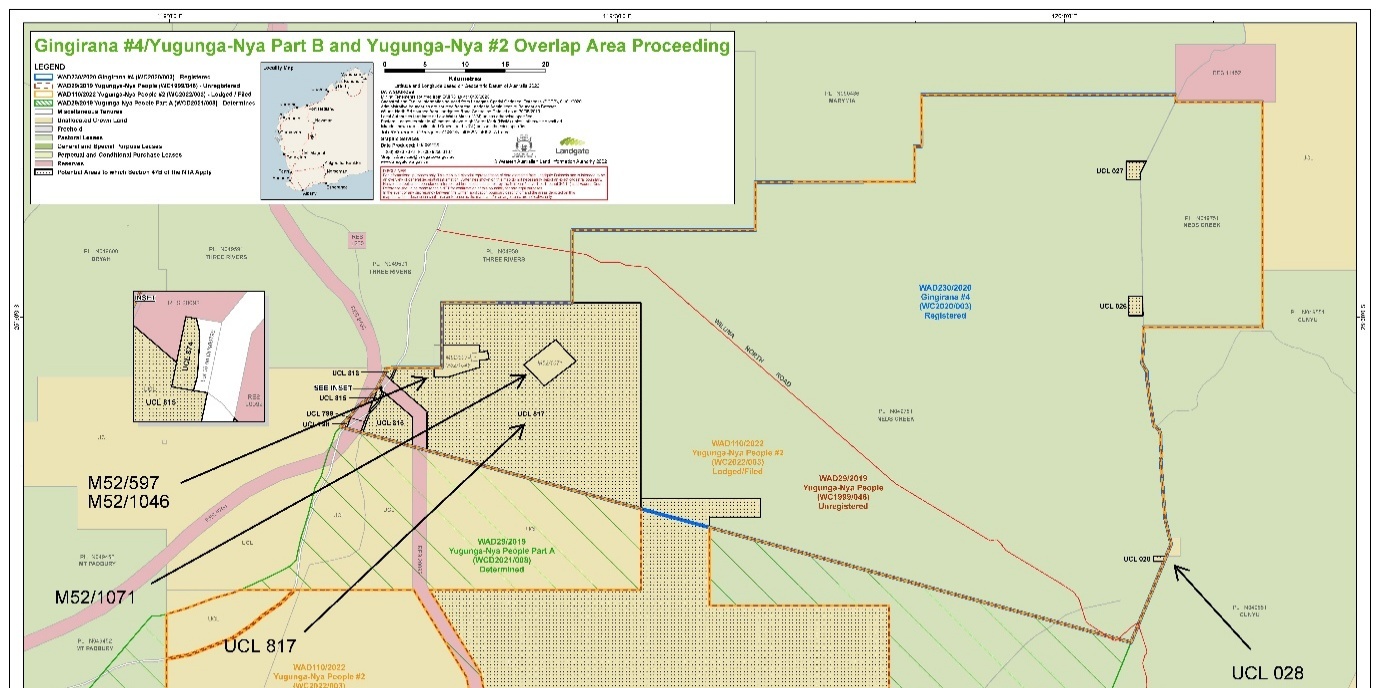
The issues
1025 Some elements of the operation of s 47B(1)(b) were not in issue. For example, it was accepted that the relevant application date for each application in this proceeding was 6 October 2020 for the Gingirana and (around) 30 May 2022 for the Yugunga-nya.
1026 The three remaining issues distilled to these:
(1) In s 47B(1)(b)(i), does the reference to a lease include a mining lease? If ‘yes’, then s 47B(2) cannot operate to disregard prior extinguishment in relation to each mining lease area.
(2) If a mining lease is not within the terms of s 47B(1)(b)(i), is a mining lease in any event a permission or authority, relevantly made by the State, under which part of the land in the area is to be used for a particular purpose within the meaning of s 47B(1)(b)(ii)? Again, if ‘yes’, then s 47B(2) cannot operate to disregard prior extinguishment in relation to each mining lease area.
(3) As to those areas not caught by a s 47B(1)(b) exclusion, did a member of the claim group ‘occupy’ the relevant area at the date the native title determination application was made, within the meaning of s 47B(1)(c)? If ‘yes’, s 47B(2) will operate to disregard the prior extinguishment of native title.
Principles of statutory construction
1027 In considering how the text of s 47B is to be understood, I have had regard to the well-recognised principles of statutory construction.
1028 That is, the meaning of a provision must be determined by reference to the language of the instrument viewed as a whole: Project Blue Sky Inc v Australian Broadcasting Authority (1998) 194 CLR 355 at [69]. But context is a guide to meaning: Commissioner for Railways (NSW) v Agalianos (1955) 92 CLR 390 at 397; and Project Blue Sky at [69]. Therefore, the statutory text must be considered in its context, including legislative purpose, legislative history and extrinsic materials: Alcan (NT) Alumina Pty Ltd v Commissioner of Territory Revenue [2009] HCA 41; (2009) 239 CLR 27 at [47]; Commissioner of Taxation v Consolidated Media Holdings Ltd [2012] HCA 55; (2012) 250 CLR 503 at [39]; SZTAL v Minister for Immigration and Border Protection [2017] HCA 34; (2017) 262 CLR 362 at [14]; Palmanova Pty Ltd v Commonwealth of Australia [2025] HCA 35 at [5].
1029 As to the importance of purpose and policy, Gageler J said in Esso Australia Pty Ltd v The Australian Workers’ Union [2017] HCA 54; (2017) 263 CLR 551 (at [71], citing Project Blue Sky at [69]):
Difficult though it is, the constructional choice can and must be made in the application of workaday interpretative methodology. Nothing simpler or more sophisticated is involved than attempting sympathetically to determine which construction of the contested statutory text better fits the context of the statutory scheme of which that text forms part. Linguistic indications are important. More important is the ‘purpose and policy’ reasonably attributed to the provision within the statutory scheme.
1030 However, the search for the purpose of a provision is to be derived from the legislation. The purpose is not to be derived from an assumption about a desired policy or operation of the provision, which is imputed to the legislature, and then characterised as a statutory purpose: Certain Lloyd’s Underwriters Subscribing to Contract No IH00AAQS v Cross [2012] HCA 56; (2012) 248 CLR 378 at [26]; and Australian Education Union v Department of Education and Children’s Services [2012] HCA 3; (2012) 248 CLR 1 at [28].
1031 Identifying a purpose of the legislation as a whole does not mean that every provision has that purpose: ADCO Constructions Pty Ltd v Goudappel [2014] HCA 18; (2014) 254 CLR 1 at [29]. For example, in ADCO it was accepted that workers compensation legislation had a beneficial purpose, but that did not mean that every provision was to be construed beneficially in favour of the worker. The purpose of the relevant provision must be identified.
1032 With these principles in mind, I turn to the three issues.
First issue – meaning of ‘freehold estate or a lease’
1033 The State contended that the reference to ‘lease’ in s 47B(1)(b)(i) includes a mining lease, and that so much is an orthodox position in native title determinations. The Yugunga-nya agreed with this construction. The Gingirana contended that on its proper construction the word ‘lease’ in s 47B(1)(b)(i) has a specific meaning which is ‘lease (other than a mining lease)’ and that such an interpretation accords with the beneficial purpose of the Native Title Act by broadening the circumstances where prior extinguishment may be disregarded.
1034 Part 15 of the Native Title Act is headed ‘Definitions’. Division 3 of Pt 15 is headed ‘Leases’. Section 241 states that ‘This Division contains definitions relating to leases’.
1035 Section 242 of the Native Title Act provides:
242 Lease
(1) The expression lease includes:
(a) a lease enforceable in equity; or
(b) a contract that contains a statement to the effect that it is a lease; or
(c) anything that, at or before the time of its creation, is, for any purpose, by a law of the Commonwealth, a State or a Territory, declared to be or described as a lease.
References to mining lease
(2) In the case only of references to a mining lease, the expression lease also includes a licence issued, or an authority given, by or under a law of the Commonwealth, a State or a Territory.
1036 Section 243 of the Native Title Act provides:
243 Lessee
(1) Subject to subsection (2), the expression lessee includes any person who, by assignment, succession, sub lease or otherwise, acquires, enjoys or is entitled to exercise any of the interests under the lease of a lessee (including of a person who is a lessee because of another application or applications of this section).
Lessee of certain mining leases
(2) In the case of a lease that is a mining lease because of subsection 242(2) (which covers licences and authorities given by or under laws), the expression lessee means:
(a) the person to whom the licence mentioned in that subsection was issued, or the authority so mentioned was given; or
(b) any person who, by assignment, succession or otherwise, acquires or enjoys the licence or authority or is entitled to exercise rights under the licence or the authority.
1037 Section 245(1) relevantly defines a ‘mining lease’ as ‘a lease (other than an agricultural lease, a pastoral lease or a residential lease) that permits the lessee to use the land or waters covered by the lease solely or primarily for mining’. References to the words ‘mining lease’ also incorporate the extended meaning that operates by s 242(2).
1038 The definition of ‘lease’ in s 242(1) is inclusive.
1039 In Ward, the High Court held that the definition of ‘lease’ in s 242(1) includes a mining lease granted under s 71 of the Mining Act 1978 (WA) (at [288], [298]-[299]). So much was acknowledged by the High Court by reference to Ward in Tjungarrayi at [47] (Gageler J) and at [117], [122] (Gordon J). The Gingirana accept that ‘lease’ in s 242(1) includes the mining leases presently in issue (by s 242(1)(c)), and that they fall within the s 245(1) definition.
1040 The parties in these proceedings referred to the High Court’s consideration of these provisions in Tjungarrayi. An important distinction is that the interests in question in Tjungarrayi were not mining leases but mineral exploration licences and petroleum exploration permits (referred to for convenience as exploration tenements). Those exploration tenements did not fall within the terms of s 242(1)(c). They would only be ‘picked up’ as mining leases by s 242(2).
1041 The effect of s 242(2) is to provide an extended definition of ‘lease’ to include other interests, being licences issued, or an authority given, by or under a law of the Commonwealth, a State or a Territory. However, this extended definition applies in the case ‘only of references to a mining lease’ in the Native Title Act.
1042 Although the issue before the High Court in Tjungarrayi was whether each of the exploration tenements was a ‘lease’ within the meaning of s 47B(1)(b)(i), the outcome was determined by the threshold question of whether the extended definition of ‘lease’ in s 242(2) applied only when the express words ‘mining lease’ were used in the Native Title Act, or whether it also applied when the word ‘lease’ was taken to include a mining lease.
1043 It was held (by the plurality of Kiefel CJ, Bell, Keane and Edelman JJ, and by each of Gageler J and Gordon J writing separately), that the exploration tenements were not leases because s 47B(1) does not contain a reference to ‘mining lease’, and did not expand the meaning of lease in s 47B(1) beyond the meaning set out in s 242(1).
1044 That conclusion meant that the High Court did not have to otherwise determine whether ‘lease’ in s 47B(1)(b)(i) by the inclusive definition of ‘lease’ in s 242(1) includes a mining lease; or whether instead the word ‘lease’ in s 47B(1)(b)(i) has a particular and limited meaning that excludes a mining lease (Tjungarrayi at [38]). However, the reasons of the High Court in Tjungarrayi provide considerable assistance. Each of Gageler J, Nettle J and Gordon J addressed the meaning of ‘lease’ in s 47B(1)(b)(i) and whether the s 242(1) definition applies. Justice Gageler described this as the ‘logically anterior argument’ (at [42]).
1045 Importantly, the plurality in Tjungarrayi described the purpose of s 47B at [2] as follows:
In particular, s 47B provides that any historic extinguishment of native title rights and interests is to be disregarded for the purposes of a claim for a determination of native title rights and interests over vacant Crown land. However, by virtue of s 47B(1)(b)(i),
the provision does not apply if the relevant area of land is ‘covered by a … lease’. These appeals raise for consideration the meaning of the word ‘lease’ in this context.
1046 Justice Gordon similarly described its purpose at [113] (footnotes excluded):
Section 47B(2) of the Native Title Act, under the headings ‘Vacant Crown land covered by claimant applications’ and ‘Prior extinguishment to be disregarded’, provides that, for all purposes under the Native Title Act in relation to a claimant application over vacant Crown land, any extinguishment of native title rights and interests in a claim area by the creation of any prior interest in relation to the area must be disregarded. That is, when determining, under s 225 of the Native Title Act, whether native title exists in relation to a particular area of vacant Crown land, the historic extinguishment of the native title by any prior interest is to be ‘ignored’ [footnote to Australia, House of Representatives, Native Title Amendment Bill 1997, Explanatory Memorandum, p 69 [5.60]]. However, in certain circumstances, the historic prior interests are not to be ignored.
1047 And her Honour said further at [132] (with original emphasis):
… Section 47B is ‘a statutory mechanism designed to allow native title claimants who are in occupation of vacant Crown land to overcome the effect of past extinguishment and have their claim determined by the court [footnote to Australia, House of Representatives, Native Title Amendment Bill 1997, Explanatory Memorandum, p 68 [5.56]]. Section 47B(1)(b) identifies a field of exclusions from that general proposition. That is, it identifies with precision (in sub-paras (i)-(iii)) those competing interests which exist, at the time that the application for determination of native title is made, that permit the prior extinguishment to continue while that competing interest exists.
1048 As Gageler J observed at [44], the principle that beneficial legislation is to be construed beneficially is a manifestation of the more general principle that all legislation is to be construed purposively; the principle assists in making constructional choices between competing interpretations that are textually available. His Honour continued at [45]:
The principle legitimately weighs in favour of a construction which gives s 47B wider application if and to the extent that a constructional choice is open on the text of the NTA. That is how the principle was appropriately applied in Alyawarr.
1049 Having carefully considered the detailed submissions of the State and the Gingirana on this construction issue, I consider the word ‘lease’ in s 47B(1)(b)(i) includes the mining leases, and the claim groups cannot rely on s 47B(2) insofar as the UCL areas the subject of the mining leases are concerned. Each of Gageler, Nettle and Gordon JJ addressed in further detail the application of the s 242(1) inclusive meaning of ‘lease’ in s 47B(1)(b)(i). To the extent the High Court addressed it, I prefer the reasons of Gageler J and Gordon J as to the application of the s 242(1) inclusive meaning of ‘lease’ in s 47B(1)(b)(i) to the contrasting observations of Nettle J (see below).
1050 The starting point is the text. There is nothing in the text of s 47B(1)(b)(i) that suggests ‘lease’ is to bear a meaning other than that provided by the statutory definition in s 242(1). Once the Ward position is accepted (which it must be) and having regard to s 242(1)(c), absent some reason to find otherwise, it follows that the unqualified reference in s 47B(1)(b)(i) to ‘freehold estate or a lease’ includes the three identified mining leases in this case.
1051 I am not satisfied that there is a reason to find otherwise. Rather, there are a number of reasons that support the construction I prefer by revealing a coherent interpretation that does not require the insertion of words in the text.
1052 First, as explained by Gordon J in Tjungarrayi, s 242(2) is intended to ensure that where the expression ‘mining lease’ is used, licences or authorities to mine are treated in the same way as a mining lease (at [127]-[131]). This is achieved through the drafting technique of an extended meaning of ‘mining lease’ that applies only where the textual reference to a ‘mining lease’ is used. As Gordon J observed, this drafting technique is used elsewhere in the Native Title Act (footnotes excluded):
[121] … Section 242(2) operates in a similar way to s 226(1), which alters the meaning of ‘act’ in references to an act affecting native title and in other references in relation to native title. In each provision, the meaning of the word affected – ‘lease’ or ‘act’ – is changed when that word is used in a particular phrase or context in the Native Title Act.
[122] Section 242(1) and (2) operate in the same way. The word ‘lease’, when used on its own in the Native Title Act, includes, among other things, those instruments declared by law to be a lease [s 242(1)]. An instrument declared or described as a mining lease by law is a ‘lease’ that satisfies s 242(1).
[123] But ‘lease’ as it appears in the expression ‘mining lease’ has an extended meaning that includes licences issued, and authorities given, by a law of the Commonwealth, a State or a Territory, by reason of s 242(2). Thus, where the expression ‘mining lease’ is adopted in the Native Title Act, it captures a number of different kinds of instruments.
1053 This technique does not inform the meaning of ‘lease’ in s 47B(1)(b)(i). Nothing in s 242(2) operates to limit the meaning of ‘lease’ in s 47B(1)(b)(i) or to exclude or limit the application of the s 242(1) definition.
1054 Second, there are a number of examples in the Native Title Act where the formula ‘a lease (other than a mining lease)’ is used. Examples of use of the formulae ‘a lease (other than a mining lease)’ or ‘where the lease is not a mining lease’ in the Native Title Act were cited by Gordon J in Tjungarrayi at [131, fns 127-128]: s 21(3)(a), s 23B(2)(c)(viii), s 24IC(4)(c), s 43A(2)(a)(i), s 232A(2)(e)(i), s 232B(3)(g), s 246(1), s 230(b) and s 232C(b)(i). The formula is not used in s 47B(1)(b)(i). It follows that if there were an intention to exclude leases that are mining leases from s 47B(1)(b)(i), there was a standard formula used by and available to the drafters of the Native Title Act. It was not employed, consistent with there being no such intention.
1055 Third, it would also be odd to qualify ‘lease’ in s 47B(1)(b)(i) to exclude a mining lease in circumstances where it is likely that a mining lease would in any event fall within s 47B(1)(b)(ii), and where s 47B(1)(b)(ii) has the effect that less extensive interests, such as a permit or authority, will be sufficient to defer the historic extinguishment of native title being disregarded.
1056 Fourth, if the statutory definition in s 242(1) does not apply to s 47B(1)(b)(i), then it would leave open the question of what ‘lease’ in fact means in s 47B(1)(b)(i) (Gageler J in Tjungarrayi at [43]). Or if the definition otherwise applies (that is, other than in relation to mining leases), how is that construction supported and are there other parts of the definition that do or do not apply? These approaches introduce uncertainty in contrast to the coherent alternative.
1057 Having considered the text and legislative history of the Native Title Act, Gageler J concluded that ‘[t]he unqualified use in s 47B(1)(b)(i) of the term [lease] defined in s 242 for the purposes of the whole of the NTA is indicative of a legislative choice that the definition in s 242 is to apply’ (at [46]). Justice Gordon similarly concluded that ‘s 47B(1)(b)(i) refers to a ‘lease’, which by its terms, includes a mining lease that satisfies the requirements of s 242(1)’ (at [135]).
1058 Whilst the parties rightly proceeded on the basis that what was said by Gageler J and Gordon J in Tjungarrayi was obiter dicta, it is considered dicta of the majority of the three judges who considered the issue, and I respectfully consider it persuasive and apply it. I also note that RD Nicholson J in Daniel v State of Western Australia [2003] FCA 666 at [959] stated that ‘s 47B has no effect upon leases, including pastoral leases, grazing leases and mining leases: subs 47B(1)(b)(i)’ (acknowledging that the extent to which the matter was in issue is unclear – and noting this aspect was not disturbed on appeal).
1059 The Gingirana submitted that I should construe ‘lease’ where used in s 47B(1)(b)(i) as if it reads ‘lease (other than a mining lease)’. They relied on a number of matters, including Nettle J’s conclusion to that effect in Tjungarrayi. His Honour, having considered the legislative history, concluded that s 47B(1)(b)(i) permits of a constructional choice between a meaning which ‘would allow the non-extinguishment principle to operate in relation to vacant Crown land affected by a mining lease and a meaning which would not’ (at [106]). His Honour considered the exclusion of mining leases from s 47B(1)(b)(i) would give effect to the first and preferred choice. In doing so it appears that Nettle J considered there to be an apparent conflict between the non-extinguishing nature of a mining lease, and the potential for any extinguishing effect to fall outside the scope of s 47B(2).
1060 Justice Nettle’s approach does not align with the observations of Gordon J who similarly considered the legislative history and the non-extinguishment regime (at [127]) and came to the conclusion at [132] that I have extracted above, by focusing on the particular objective and text of s 47B.
1061 Respectfully, s 47B is directed at historic extinguishment. A concise example of its application in the context of (first) a reservation for a particular purpose and (second) a perpetual crown lease is provided by Olney J in Wandarang, Alawa, Marra and Ngalakan Peoples v Northern Territory of Australia [2000] FCA 923; (2000) 104 FCR 380 at [139]:
The only parts of the claim area which have been the subject of a prior act which extinguishes all native title are the road corridors excluded from [Crown lease] CLP 346 and the stock route area. When the application was made none of these areas was covered by a freehold interest or a lease. The roads were however areas of land dedicated for a public purpose whilst the stock route area was covered by a reservation or condition under which the land is to be used for a particular purpose, namely a route for the passage of travelling stock. In the circumstances the roads and the stock route area are covered by s 47B(1)(b)(ii). In any event there is no evidence to suggest that the areas in question were, at the time the application was made, occupied by one or more members of the native title claim group. … As the lease [CLP 346] has been held to be valid, s 47B can have no application to the land covered by it, the whole of that land having been covered by a lease when the application was made. Accordingly, the extinguishing effect of prior interests in the land covered by CLP 346, notably the extinguishing of any prior exclusive rights of possession, occupation and use of the land, is unaffected. …
1062 The application of the non-extinguishment principle to a mining lease or any other interest existing at the time of the relevant native title application falls to be addressed by other provisions of the Native Title Act, which are not inconsistent with the specific area of operation of s 47B. I accept the State’s submission that nothing in s 47B suggests the criterion of whether the particular lease or permission or authority is non-extinguishing operates to otherwise qualify the words of the text in s 47B, read with s 242(1).
1063 The State’s challenge to Nettle J’s approach (and the State acknowledged that that his Honour apparently did not have the benefit of submissions on the point) was based on his Honour’s focus on the ‘non-extinguishing feature’ of a mining lease. The State reasoned that: (first) even assuming that every mining lease has the defining feature of non-extinguishment, other interests such as authorities or permissions within the terms of s 47B(1)(b)(ii) may well not be of that nature, but can operate to exclude the operation of s 47B(2); and (second) the grant of pre-1975 mining leases (that is, leases granted prior to the enactment of the Racial Discrimination Act 1975 (Cth)) partially extinguished native title to the extent of any inconsistency, and in Western Australia many pre-1975 mining leases continued to be in effect when native title claims were made.
1064 To support this latter point, the State referred in its submissions to a bundle of native title determinations where s 47B was expressly said to apply, so that any extinguishment over a nominated UCL area by the creation of a prior interest was to be disregarded except to the extent that an area was covered by nominated mineral leases. The nominated mineral leases were said to have commenced between 1965 and 1970 and were current as at the respective native title application dates (I will not set out the descriptions: it is sufficient to note they were referenced at footnote 91 of the State’s closing submissions and the grant dates of the respective mineral leases are a matter of public record). In short, according to the State, not all mining leases have the defining feature of non-extinguishment, and accordingly the focus on such feature was misplaced in construing the provision.
1065 Leaving aside the reliance on Nettle J’s reasons, other matters referred to by the Gingirana viewed cumulatively similarly have failed to persuade me that their contended construction of ‘lease’ in s 47B(1)(b)(i) is correct.
1066 Reference to other definitions of ‘lease’, including those provided by common law, does not serve to bring clarity in circumstances when ‘lease’ is defined within the Native Title Act. This is especially so when the statutory definition of ‘lease’ in fact encompasses interests beyond those that might be considered a lease at common law.
1067 The collocation of ‘freehold estate’ and ‘lease’ of itself does not justify interpreting ‘lease’ in a narrow manner that excludes all leasehold interests other than those which confer exclusive possession. As noted above, once it is contended that the statutory definition does not apply, another question arises as to what kind of leasehold interests are intended to be captured by ‘lease’ when used in s 47B(1)(b)(i)? This approach produces uncertainty. And, if it is only mining leases that were to be excluded and the s 242(1) definition otherwise applied, it would have been easy for the drafters to adopt the formula used elsewhere. A construction that requires that the meaning ‘lease (other than a mining lease)’ be inferred when that formula is expressly used elsewhere would be surprising. Similarly, if some distinction was to be drawn between a lease that grants exclusive or non-exclusive rights, such distinction could have been accommodated.
1068 I do not accept the submission that there is an intention revealed by the statutory text that all mining interests (including mining leases, authorities and licences) fall to be considered having regard to the operation and conditions provided by s 47B(1)(b)(ii). The text does not support that submission. The natural manner in which the section operates is to consider whether the relevant interest at the time of the application is captured by s 47B(1)(b)(i). If so, then that is the end of the inquiry for the area in question. If not, attention moves to s 47B(1)(b)(ii) and so on. However, as Gordon J observed in Tjungarrayi at [133] (footnotes excluded):
…It may be that, on a given set of facts, a particular right or interest is captured by more than one paragraph of a provision. Or, in others, it may be that the particular right or interest is ‘cut off’ at an early stage of the provision (where the paragraphs are cumulative). But if a particular right or interest is not – on the facts of the case – captured by any of the paragraphs of a provision, then it is not captured.
1069 The Gingirana submitted that mining leases are treated differently to freehold estates and some common law leases when it comes to determining their extinguishing effect under other provisions of the Native Title Act. So much may be accepted but it distracts attention from the task of construing s 242(1) and s 47B (with its particular purpose) according to their terms and in accordance with the recognised principles. Nor is it apparent how the submission that mining leases may be granted over other interests (such as freehold) assists with the task.
1070 For the reasons I have given above, I consider s 47B(1)(b)(i) is coherently understood without adding additional text. Returning to the principles, the construction of the contested statutory text which better fits the context of the statutory scheme is that which applies the s 242(1) definition, rather than leaving open what might be included or excluded by a bespoke interpretation of ‘lease’. To repeat Gordon J’s dicta at [132]:
… [Section s 47B(1)(b)] identifies with precision (in sub-paras (i)-(iii)) those competing interests which exist, at the time that the application for determination of native title is made, that permit the prior extinguishment to continue while that competing interest exists.
1071 Rather than providing a precise and certain regime, the approach propounded by the Gingirana requires the inference of additional text and leaves scope for uncertainty and ambiguity.
1072 Further, although such an outcome potentially reduces rather than expands the circumstances in which native title claimants are entitled to have historical extinguishment disregarded, resort to a ‘beneficial’ construction is premised on there being a constructional choice open on the text. As Gageler J said in Tjungarrayi at [46] (footnotes excluded):
To attempt to apply the principle to exclude application of the definition of ‘lease’ in s 242 to the term ‘lease’ in s 47B(1)(b)(i), however, is to stretch the principle too far. To be borne in mind is that ‘no legislation pursues its purposes at all costs’ and that ‘it frustrates rather than effectuates legislative intent simplistically to assume that whatever furthers the statute’s primary objective must be the law. The unqualified use in s 47B(1)(b)(i) of the term defined in s 242 for the purposes of the whole of the NTA is indicative of a legislative choice that the definition in s 242 is to apply.
1073 It is therefore not necessary to determine the State’s alternative argument that if the mining leases were not captured by s 47B(1)(b)(i), they would be captured by s 47B(1)(b)(ii), and so regardless fall within one of the disqualifying categories specified in s 47B(1)(b). I will deal with this argument only briefly.
Second (alternative) issue – ‘particular purpose’
1074 Section 47B(1)(b)(ii) refers to the grant of a ‘reservation, proclamation, dedication, condition, permission or authority’. Relevantly, under this alternative argument the question is whether the relevant UCL areas covered by the mining leases are covered by a ‘permission or authority’ made under the Mining Act or the Mining Regulations 1981 (WA) and under which the whole or part of the land is to be used for a particular purpose.
1075 The Gingirana conceded that the relevant mining leases permitted the parts of UCL 817 to which they applied to be used for a particular purpose, being mining. However, they contended that none of the mining leases satisfy the disqualifying condition that the land ‘is to be used’ for mining.
‘Is to be used’ imports the need for an intention
1076 The Full Court in Alyawarr FC was concerned with the proclamation of a townsite and whether the Crown’s intention was to use the land for that purpose. So much is apparent from the extract cited in Banjima FC to which I have referred above (at [1020]).
1077 The Full Court in Alyawarr FC also considered the meaning of the words ‘is to be used’ in s 47B(1)(b)(ii) at [188] (emphasis added):
The second constructional question turns on the requirement that to attract the exemption from the operation of s 47B the proclamation must be one under which the land or waters which it covers ‘is to be used’ for the specified purposes. The words ‘is to be used’ import the need to identify some intention to use the subject land for the requisite purpose or purposes. The question that arises is whether that intention is to be gleaned by reference to the terms of the proclamation and its constating legislation as an intention fixed for the duration of the proclamation or whether it is to be ascertained as a matter of fact at the time of the application for a native title determination. The evidence suggests that there is little or no prospect of the Hatches Creek townsite ever becoming a town. The proclamation is in effect a dead letter even though it was said by the Northern Territory to have the effect of defeating the beneficial operation of s 47B in this case. Nevertheless although the first interpretation can yield artificial results, it does provide an objective basis for determining the question of the imputed intention associated with the proclamation. The alternative approach would require factual inquiry into whether there has been, at the time of the application, an effective abandonment, attributable to the Crown, of any intention to implement the proposed purposes of the proclamation. The latter construction is not to be preferred.
1078 The Gingirana and the State agreed, applying Alyawarr FC, that the intention as to how land the subject of a mining lease is to be used is to be ascertained by reference to the terms of the mining lease and its constating legislation as an intention fixed for the duration of the mining lease. However, they otherwise disagreed on the construction of the provision.
1079 The Gingirana contended that ‘is to be used’ is to be understood as ‘is required to be used’, and that nothing in the mining leases compelled the holders to undertake mining. In particular they drew on the decision in Banjima FC by analogy.
Mining leases not comparable with an exploration licence
1080 In Banjima FC, the Full Court was concerned with the grant of exploration licences, and held that they did not fall within s 47B(1)(b)(ii) (emphasis added):
[112] … A mere permission or authority to enter and be upon land or waters coupled with a discretionary power to determine when, and in what particular way and at what place that permission or authority might be exercised cannot, of itself, amount to a use of the land that is capable of extinguishing or partially extinguishing native title. No mechanical work for exploration purposes could be carried on without a further grant of permission or authority by the State.
[113] At most, the licensee had permission or authority to be physically present on or above the land or waters at any time or location and to look at and take samples of anything that could be examined without mechanical assistance for the purpose of exploration. The licensee derived no immediate benefit from the permission or authority to explore the land or waters. The licensee could not work, or do more than take samples of, the land or waters. The licences gave the licensees no interest in the land or right to use it: Australian Softwood Forests Pty Ltd v Attorney General (NSW); Ex rel Corporate Affairs Commission (1981) 148 CLR 121 at 130-132 per Mason J.
[114] It follows that the Mining Act and the terms of the licences, including the conditions incorporated in them by that Act, did not require the lands and waters to which they applied to ‘be used for public purposes or for a particular purpose’. Rather, the licences amounted to a mere permission or authority to explore for minerals, including from the air. While the permission or authority in the licences extended to the whole of UCL areas 7 and 9 and part of UCL area 42, it did not identify any particular area or period of time, beyond the term of the licence, in which exploration had to occur. The licensee was not obligated to explore the whole of the licensed area. Thus, the whole licensed area was not to ‘be used’ for any particular purpose under the licence, far less did the licences require the licensee to use that entire area for the purpose of exploration. Nor did the licences require any identified portion of the licensed area to ‘be used’ for any particular purpose. …
1081 These passages from Banjima FC must be read in context. The Full Court had rejected a submission that, as a matter of construction, a mere permission or authority to use the land was enough to meet the disqualifying condition under s 47B(1)(b)(ii), and proceeded to consider whether the factual circumstances of the case met the description ‘is to be used’. It was in this context that the Full Court contrasted the exploration licences allowing use of the land with an instrument requiring use of the land. Although the Full Court used the illustrative language of of a ‘requirement’ or ‘obligation’ to indicate that such language might have confirmed that the area ‘is to be used’ for a particular purpose, I do not consider the Full Court determined that ‘is to be used’ imparts a requirement to use or is to be understood as meaning ‘is required to be used’. Whether or not such language is used in a grant will form part of the consideration of the particular factual scenario in issue, but its absence is not, in my view, decisive.
1082 Further, the text of s 47B(1)(b)(ii) does not support such a construction, having regard to the usual principles. It would be odd, for example, to refer to a ‘permission or authority’ to use land but then by implication include a ‘requirement’. If a requirement to use land for a particular purpose is to be inferred, the inclusion of words such as ‘permission’ or ‘authority’ to do so would appear otiose.
1083 And as Gordon J observed in Tjungarrayi at [115], the Full Court accepted in Attorney-General v Helicopter-Tjungarrayi (Ngurra Kayanta & Ngurra Kayanta #2) [2018] FCAFC 35; (2018) 260 FCR 247 (North, Jagot and Rangiah JJ) that petroleum exploration permits are capable of constituting a permission or authority under which land is to be used for a particular purpose, but not on the facts of the case:
[115] … However, their Honours held that ‘[g]iven the nature of the actual physical works to the land appear[ed] to be relatively confined (two exploration wells) and the land the subject of the permits authorised to be used [was] large’, their Honours were not satisfied that the permits before the Court could be characterised as ones under which the whole or any part of the land was to be used for the particular purpose of exploring for petroleum, and therefore that the permits did not engage s 47B(1)(b)(ii). …
1084 Her Honour also said, when contrasting the position with a mining lease:
[134] … for present purposes, it is sufficient to note that the words ‘permission or authority’ in s 47B(1)(b)(ii) are intended to reflect the fact that less extensive interests [than a mining lease], such as a permit or authority, made or conferred in the context of the remainder of s 47B(1)(b)(ii), will be sufficient to defer the fact that historic extinguishment of the native title by any prior interest is to be ‘ignored’.
1085 The task required, and as discussed in Alyawarr FC, is to identify an intention to use, demonstrated objectively. There is a spectrum between ‘permission’ and ‘requirement’ and whether on the facts an intention is demonstrated will depend on the circumstances.
1086 Accordingly, it is necessary to have regard to the certified copies of the mining leases obtained from the Department and in evidence, but also the prescriptive requirements of the Mining Act and the terms of the mining leases, as set out in Form 8 of Sch 1 to the Mining Regulations. Each certified copy notes not only the holder of the mining lease, its term and area but a record of conditions, rent and expenditure (the latter being consistent with conditions).
1087 The State’s submissions as to the requirements of the Mining Act were as follows:
Pursuant to the provisions of the Mining Act 1978 (WA) … and the conditions applicable to the mining leases, the lessees are required to use the land in respect of which the leases are granted for mining purposes. The mining leases are not ‘for a broadly expressed purpose which encompasses a variety of potential but unascertained uses.’ [citing Alyawarr at [187]]. To the contrary, the holders of the Mining Leases must undertake their respective mining operations in accordance with the prescriptive requirements set out in a mining proposal or a mining statement and mineralisation report [citing s 74(ca) of the Mining Act and s 25AA of the Mining Regulations] which accompanied the application for mining leases M52/1046 and M52/1071 in particular, and which subsequently became conditions of approval [referred to in the conditions of those two mining leases in evidence]. [Then] Section 70O of the Mining Act defines a mining proposal as a document that contains information about proposed mining operations in a form required by the guidelines, contains information of the kind required by the guidelines about proposed mining operations in, on or under the land in respect of which a mining lease is sought or granted and contains a mine closure plan. The requirements of the constating legislation are prescriptive and onerous.
M52/597 was an earlier application for the grant of a mining lease (the application was first made in 1996) prior to the Mining Amendment Act 2004 (WA) commencing on 10 February 2006. This mining lease was granted subject to a condition that no mining commences until a mining proposal has been approved by the Director of the then Department of Mining and Petroleum’s Environment Division in accordance with s 82A(2) of the Mining Act.
1088 The State referred in oral submissions relevantly to s 82 and s 97 of the Mining Act. Section 82(1) is of particular relevance, in that it sets out a number of covenants and conditions, including to use the land only for mining purposes in accordance with the Mining Act:
82 Covenants and conditions of lease
(1) Every mining lease shall contain and be subject to the prescribed covenants by the lessee and in particular is taken to be granted subject to the conditions that the lessee shall —
(a) pay the rents and royalties due under the lease at the prescribed time and in the prescribed manner;
(b) use the land in respect of which the lease is granted only for mining purposes in accordance with this Act;
(ba) arrange and pay for a survey of such land within the prescribed time and in the prescribed manner;
(bb) where the lease is surrendered in part, arrange and pay for a re-survey of such land within the prescribed time and in the prescribed manner;
(c) comply with the prescribed expenditure conditions applicable to such land unless partial or total exemption therefrom is granted in such manner as is prescribed;
[(ca) deleted]
(d) not transfer or mortgage a legal interest in such land or any part thereof without the prior written consent of the Minister, or of an officer of the Department acting with the authority of the Minister;
(e) lodge, in the prescribed manner, such periodical reports and returns as may be prescribed;
(ea) furnish to the Minister such geological samples obtained in the course of operations conducted by the lessee under the lease as the Minister may request;
(f) promptly report in writing to the Minister details of all minerals of economic significance discovered in, on or under the land the subject of the mining lease;
[(ga) deleted]
(g) be liable to have the lease forfeited if —
(i) the lessee contravenes any of the covenants or conditions to which the lease is subject; or
(ii) the lessee fails to comply with any requirement under section 103AV(1) or 115B(2) in relation to the lease; or
(iii) a report required under paragraph (e) or section 115A(2) in relation to the land the subject of the lease is not filed in accordance with this Act.
1089 Section 97 of the Mining Act provides for forfeiture of a mining lease for breach of the lessee’s covenants to pay rent and royalties or those covenants under s 82.
1090 The Gingirana submitted that even if I concluded that mining leases M52/1046 and M52/1071 were captured by s 47B(1)(b)(ii), it did not follow that the result would be the same for M52/597. As addressed by the State, M52/597 was an application for the grant of a mining lease effected prior to the Mining Amendment Act 2004 (WA), in contrast to M52/1046 and M52/1071 and was granted subject to a condition that no mining was to commence until a mining proposal was approved. The Gingirana contended that the effect of the grant was that no mining was to occur (and so there could be no intention that it would) unless and until an approval was granted. This submission minimises the purpose and effect of the conditional grant and artificially isolates it from the concomitant approval process and the purpose of the approval process. I do not consider the distinction relied upon by the Gingirana to be compelling.
1091 An intention that the three respective areas be used for mining is apparent, in my view. All mining lease grants were made in the context of legislation that anticipated mining activities and prescribed how they were to be regulated and supervised. Having regard to the statutory context at the time of each of the grant dates, the intention to use the land the subject of the mining lease for mining is evident. The highly regulated statutory processes envisaged and the covenants and obligations on the holders of a mining lease, all directed at the specific purpose and outcome of mining, are far removed from some broad permission to carry out some unascertained use.
1092 The statutory context under which the grant of the mining leases occurred is consistent with and indicates an intention at the relevant time that the land the subject of the mining leases ‘is to be used’ for mining, even if there is a possibility that mining may not occur by reason of some intervening event or otherwise.
1093 Therefore, if I am wrong in finding that the mining leases are captured by s 47B(1)(b)(i), I would have found that they are in any event captured by s 47B(1)(b)(ii).
Third issue – occupation
1094 Turning to s 47B(1)(c), apart from the areas the subject of mining leases M52/597, M52/1046 and M52/1071, the claim groups may be entitled to the benefit of s 47B(2) provided they satisfy the requirement of occupation set out in s 47B(1)(c).
The temporal element
1095 As noted above, the relevant application date for each application in this proceeding was 6 October 2020 for the Gingirana and 30 May 2022 for the Yugunga-nya.
1096 The State submitted that although it is not necessary for evidence to be adduced demonstrating each area was occupied precisely on the application day, a moderate degree of rigour needs to be attached to the temporal element of ‘occupation’ under s 47B, so that evidence needs to be led to support an inference that a member or members of the claim group in fact occupied each relevant area at the application date.
1097 It submitted that evidence that the area was occupied during the relevant year or regularly over a period that is likely to have included the application date might be sufficient; but in contrast, evidence tending to show occupation of the area only several years earlier or later than the application date is unlikely to be sufficient (citing Narrier (No 1) at [1268], where the fact that a witness had lived in a caravan for eight months in the early 1990s was not considered occupation consistent with the provision, where the application dates were 2011 and 2015 (at [1162])). As said in Moses v Western Australia [2007] FCAFC 78; (2007) 160 FCR 148 at [216] (Moore, North and Mansfield JJ), the occupation must be contemporaneous rather than historical.
What is the area?
1098 Each of the State, the Yugunga-nya and the Gingirana proceeded on the basis that each UCL was to be treated as a separate ‘area’ for the purpose of s 47B. This was made expressly clear by the State and the Gingirana, and as to the Yugunga-nya, the inference arose from the manner in which they addressed the evidence by UCL area.
1099 This approach is consistent with that described in Banjima FC at [97]-[98] and extracted at [1020] above.
1100 The State and the Gingirana did not agree as to whether the occupation that is to be established for the purpose of s 47B(1)(c) is occupation of the whole, rather than only a part, of the relevant UCL parcel in respect of which, but for s 47B, native title rights and interests would be extinguished. In this regard the parties by the Agreed Statement identified the relevant areas over which the beneficial operation of s 47B may apply to the separate UCL sites.
1101 The State referred to the reasons in Rubibi Community v State of Western Australia (No 7) [2006] FCA 459 (Merkel J) at [72]:
… the occupation that must be established for the purposes of s 47B(1)(c) must also be an occupation in respect of the whole, rather than merely a part, of the particular area in respect of which, but for s 47B, native title rights would be extinguished: see Neowarra [2003] FCA 1402 at [758]-[760].
1102 The Full Court in Moses proceeded on this basis: at [214], as did Mortimer J in Narrier v State of Western Australia (No 2) [2017] FCA 104 (Narrier (No 2)) at [20], [32].
1103 The Gingirana rely on a passage from Warrie (formerly TJ) (on behalf of the Yindjibarndi People) v State of Western Australia [2017] FCA 803 at [286] (Rares J):
… the Court is not constrained to limit its consideration to whether the applicant establishes a claim over all that it contends for under ss 47A or 47B. Rather, the Court can find as a matter of fact and degree that one or more members of a claim group occupied a portion, but not all, of land and waters in ‘an area’ that is in dispute in the proceedings, to which s 47B(2) will apply: cf. Moses 160 FCR at 199-200 [215]-[216].
1104 On appeal in Fortescue Metals Group v Warrie on behalf of the Yindjibarndi People [2019] FCAFC 177; (2019) 273 FCR 350 (Jagot, Robertson, Griffiths, Mortimer and White JJ), Robertson and Griffiths JJ in their joint reasons referred to this part of Rares J’s decision, and cited Narrier (No 2), but found it unnecessary to determine whether or not Rares J had taken too broad a construction of ‘area’, because on the facts any such error was immaterial: at [489], Jagot and Mortimer JJ agreeing at [1], White J agreeing at [529].
1105 Here, too, it is not necessary to determine this particular question, as to the extent occupancy is established (see below), it is established over the whole of the relevant UCLs within the overlap area (leaving aside the mining lease areas). However, had it been necessary to determine the issue, I would have followed the line of authority relied upon by the State, noting that in any event in order to satisfy the test of occupation, it is not necessary to establish a particular physical presence on each and every part of a subject area (so much is apparent from Moses, addressed immediately below). Further, much will turn on how areas said to be the subject of s 47B are identified in any particular application.
‘Occupy’
1106 Occupation of an area for the purpose of s 47B(1)(c) is different to ‘connection’ under s 223(1). For the reasons I have given, I have found the requisite connection to the overlap area. It does not follow that occupation is established for the purpose of s 47B(1)(c).
1107 The parties referred to the Full Court’s examination of the meaning of ‘occupation’ in Moses:
[215] In considering the respective contentions, and in the light of the authorities which have been discussed, we propose to apply the following general approach. It is largely a matter of common sense, but is founded upon the words of s 47A and s 47B in their context and as considered in the authorities:
(1) to ‘occupy’ an area for the purposes of ss 47A and 47B of the NTA involves the exercise of some physical activity or activities in relation to the area;
(2) to ‘occupy’ an area does not require the performance of an activity or activities on every part of the land;
(3) to ‘occupy’ an area does not necessarily involve consistently or repeatedly performing the activity or activities over part of the area;
(4) to ‘occupy’ an area does not require constant performance of the activity or activities over parts of the area; it is possible to conclude that an area is occupied where there are spasmodic or occasional physical activities carried on over the area;
(5) to occupy an area at a particular time does not necessarily require contemporaneous activity on that area at the particular time; it is possible to conclude that an area of land is occupied in circumstances where at the time the application is made there is no immediately contemporaneous activity being carried on in the area;
(6) the fact of occupation does not necessarily entail a frequent physical presence in the area; for example, the storage of sacred objects on the area or the holding, from time to time, of traditional ceremonies on the area may constitute occupation for the purposes of the NTA: see, e.g. Rubibi Community v Western Australia (2001) 112 FCR 409 at [182];
(7) evidence to establish occupation need not necessarily be confined to evidence of activities occurring on the particular area; it may be possible to establish that a particular area is occupied by reference to occupation of a wider area which includes the particular area: Risk [2006] FCA 404 at 890;
(8) occupation need not be ‘traditional’: Rubibi (No 7) [2006] FCA 459 at [84];
(9) whether occupation has been made out in a particular case is always a question of fact and degree.
[216] The word ‘occupy’ is not defined in the NTA. It has a common meaning of being established in a place. In contemporary society, a person may occupy all of a house even though that person does not regularly enter every room and may never have entered a particular room or a particular part of a room; a pastoralist may occupy all of the area of a pastoral lease even though that person does not regularly visit every part of the area of the pastoral lease and may never have visited parts of it or have used parts of it for pastoral purposes: see eg per Lord Denning in Newcastle City Council v Royal Newcastle Hospital [1959] AC 248 at 255. In ss 47A and 47B, as the authorities point out, the context requires that the word ‘occupy’ denotes some physical presence or activity by one or more members of the claim group from time to time, not necessarily continuously, and a presence or activity in the area so that as a matter of practicality that presence or activity involves the assertion of being established over the area itself. The occupation must be contemporaneous rather than historical. If the native title rights and interests over the area were exclusive, so there was a right to control access to the area, the exercise of the right to exclude strangers from the area would indicate its occupation. To occupy an area under the NTA, given its purposes and context, involves the exercise of possessory rights over the area, but the exercise of those rights does not require their continuous exercise, or their exercise at the precise time of the application because the occupation of which ss 47A and 47B speak is a state of affairs which must exist rather than the precise activity which illustrates the existence of the state of affairs.
1108 The Yugunga-nya submitted that based on the evidence in their connection case in relation to the area that was formerly Doolgunna Station but within the overlap area, they have proven occupation over the areas of UCL 816, UCL 817, and UCL 819 for the purposes of s 47B(1)(c), as at the relevant date. They submitted that based on the connection evidence they had also proven occupation over UCL 028 (near Mibbeyean Pool). The Yugunga-nya do not press the benefits of s 47B in relation to UCL 026 and UCL 027.
1109 The Gingirana claimed that they had established occupation over each of the UCL areas.
1110 The State accepted on the basis of the evidence that the Yugunga-nya have established occupation over those parts of the former Doolgunna Station now identified as UCL 815, UCL 816, UCL 817 and UCL 874 (aside from the mining lease areas and an area of road dedication, being Lot 16 on Deposited plan 409799).
1111 The State accepted that the Gingirana have established occupation over UCL 027 (near Grasscutter).
1112 Otherwise, the State submitted that the claim groups had failed to establish occupation.
1113 I will first deal with the UCL areas where the State accepts occupation has been established and then deal with the areas where occupation is contested.
UCL 815, UCL 816, UCL 817 and UCL 874
1114 These parcels are all in the south-west corner of the overlap area, located on the former Doolgunna pastoral lease. Part of the largest, UCL 817, includes the areas of the relevant mining leases. UCL 874 is the area of Mubulkuta Spring.
1115 There was evidence about the Yugunga-nya’s history of inter-generational association, physical presence and contemporary visits to the Doolgunna area. The Yugunga-nya did not address occupation evidence other than to rely on the connection evidence, but within that evidence it was demonstrated that claim group members worked on the area, visited it and camped nearby.
1116 Members of the Shay families (Patrick Shay, Clinton Shay) were regular visitors to Doolgunna more or less at the time the applications were made. Both referred to actively visiting, camping and hunting on Doolgunna. The regularity of their visits and the qualitative nature of the evidence supports a finding of occupation. Their evidence extended to regular visits to Mubulkuta Spring. The evidence of Mr Kelly and Ms Kelly as to activities on Doolgunna was also strong, particularly in the period 2016 to 2019 but with some evidence of apparently more contemporary visits. However, it is sufficient that Patrick Shay and Clinton Shay provided evidence of occupation, and there was also restricted evidence that supported this (references provided in the State’s written submissions).
1117 Unsurprisingly, the evidence relevant to occupation was not as strong in relation to some parts of those respective UCLs, but as recognised in Moses, evidence to establish occupation need not necessarily be confined to the particular area; it may be possible to establish that a particular area is occupied by reference to occupation of a wider area which includes the particular area.
1118 These four UCLs are close in proximity. As the State’s position suggested, it would be artificial to find that occupation was satisfied on one of these four UCLs but not another. The physical activities of the Shay brothers (relevantly) crossed large parts of this particular region of the south-west corner of the overlap area.
1119 The Gingirana submitted (in the alternative and contrary to their primary case) that if the Yugunga-nya have native title in that area, then the Yugunga-nya have satisfied the test of occupation for those UCLs.
1120 I am satisfied and agree with the State that members of the Yugunga-nya occupied UCL 815, UCL 816, UCL 817 and UCL 874 within the meaning of s 47B(1)(c) of the Native Title Act (subject to portions covered by the mining leases and relevantly Lot 16 on Deposited Plan 409799).
1121 Section 47B is not applicable to the mining lease areas for the reasons already given. Even if that were wrong, the evidence did not establish occupation. There was some very general evidence about (for example) Mr Kelly and Clinton Shay walking through parts of the mining lease areas, but as a matter of fact and degree, such matters did not establish occupation by the Yugunga-nya within the Moses principles. Ms Kelly, for example, said she would never camp or hunt on the mining lease itself.
UCL 027
1122 UCL 027 is a small area, in very close proximity to Grasscutter. The State submitted that although the evidence did not establish occupation on or around the date of the application, there was evidence that demonstrated a pattern of regular visitation by members of the Gingirana claim group and a sense of being established in the area. The qualitative nature of the evidence was sound. I accept the State’s submission. The Gingirana evidence in relation to occupation of this area including in recent times was stronger than in relation to other UCL areas.
1123 In particular, the evidence of Slim Williams (see [953]) satisfies me that a member of the Gingirana occupied UCL 027 within the meaning of s 47B(1)(c) of the Native Title Act.
No occupation by the Yugunga-nya in other UCL areas – UCL 028, UCL 798, UCL 799, UCL 818 and UCL 819
1124 Mibbeyean Pool is close to UCL 028 but it is not within it. This is a small site. There was no evidence of contemporary use of UCL 028 by any claim group member. Although the Yugunga-nya submitted that it was only ‘a close walk’ from Mibbeyean Pool, it would be no more than speculation to say that there was use of UCL 028 in a manner that meets the meaning of ‘occupation’.
1125 As to UCL 798, UCL 799, and UCL 818, there was no specific or sufficient evidence of occupation by a Yugunga-nya claim member of these relatively small portions of land.
1126 UCL 819 is the top northern part of the former Mooloogool pastoral lease which overlaps part of the southern boundary of the overlap area. It abuts Doolgunna (barely) on its western boundary, but the relatively small part within the overlap area is properly described as east of Doolgunna. There was insufficient evidence of activities or any conduct specifically on or sufficiently near UCL 819 by any claim member to establish occupation within the meaning of s 47B(1)(c). Its limited proximity to Doolgunna was insufficient to meet the threshold required for occupation.
No occupation by the Gingirana in other UCL areas – UCL 798, UCL 799, UCL 815, UCL 816, UCL 817, UCL 818, UCL 819, UCL 874, UCL 026, UCL 028
1127 The Gingirana relied on their evidence as a whole in support of their occupation claim for all UCLs.
1128 Whilst I have found that the Gingirana have a connection with the overlap area as a whole within the meaning of s 223 of the Native Title Act, so including the Doolgunna area to the south-west, as the Court made clear in Moses, whether occupation is established is a different question, and is one of fact and degree.
1129 Whilst the Gingirana submitted that I should take into account the nomadic lifestyle of the Western Desert people, ‘occupation’ requires that an evidentiary threshold be met as at the time of the application and having regard to at least the conduct or activities of a Gingirana claim group member. It is not enough to speculate generally based on a nomadic lifestyle. Nor is it enough to make a finding based on the fact that people were ‘in the general area’.
1130 The Gingirana relied on the evidence of or about SH. They submitted there was evidence of him camping on Doolgunna and of a plan to meet Clinton Shay after a shift at Sandfire mine (evidence given by Clinton Shay). It was submitted that SH was established in the general area that includes all the UCLs, particularly in light of his family’s connection to the overlap area over many years. The Gingirana also relied on the fact that SH undertook surveys in the Gingirana Determination area at some point but camped around the old Doolgunna homestead site (south of the overlap area border) and ‘visited UCL 817’ at that time. I was invited to infer that such surveys took place shortly before the Gingirana claim application in this matter was filed.
1131 I have had regard to all of these matters, but I am not satisfied that the quality of this evidence is such as to establish occupation of the UCLs by SH on behalf of the Gingirana. SH’s own evidence about camping on Doolgunna suggested it was perhaps in the 1960s. In cross-examination, he said his last trip to the overlap area was three or five years beforehand, across Ned’s Creek Road on his way to a funeral. I am asked to speculate about the purpose of the visit by SH to meet Clinton Shay, and the temporal and geographic link to surveys for the Gingirana Determination area is weak. Such general and limited evidence of camping or visits by SH of itself would not persuade me that the Gingirana occupied UCL 817 or the other UCLs in issue. The evidence relied upon about SH on Doolgunna is non-specific as to purpose or time. This is not a criticism of SH; I consider he was a thoughtful and reflective witness.
1132 The evidence of visits by Gingirana claim group members to Mubulkuta Spring, in UCL 874, is of a different nature, because it was clearly an important location to the Gingirana initiated men (restricted evidence cross-referenced in the State’s submissions). I accept that it is open to have regard to spiritual, cultural and social connection with the land in evaluating the nature of activities over the land, and whether they constitute ‘occupation’. However, although there was evidence of knowledge and custom relating to Mubulkuta Spring, and I have referred above to some of that evidence (at [545]-[555]), there was very little evidence of any visits, presence or activities on the site by the Gingirana men and no persuasive evidence as to timing.
1133 I take into account that Mr Richards said he went to Mubulkuta Spring when he drove through (although it was unclear when that was). I take into account that Slim Williams had been there, although apparently not often, for cultural reasons, and potentially that was in more recent times. Had there been more specific evidence of when such visits might have been, there may have been a case established for occupation, but regrettably, despite restricted evidence being given on site, this kind of detail was not explored.
1134 The only evidence of a visit that had any temporal connection in times relevant to the date of the application was Mr O’Dell’s field trip in June 2020 with Jimmy Williams, Mr Morgan and Slim Williams and others into the overlap area, including to Mubulkuta Spring. However, as observed by Mortimer J in Narrier (No 1), a visit to a site (in that case with the CDNTS) in connection with the hearing of a proceeding is a visit of a special nature. Her Honour said ‘visits of that kind cannot indicate occupation within the terms of s 47B’ (at [1262]). A visit of that kind is not ‘an ordinary visit’ to which a witness was accustomed (at [1242]).
1135 I accept the Gingirana submission that her Honour was not purporting to conclude that a visit to a site with anthropologists or lawyers could never indicate or be relevant to occupation. However, there was nothing put to me about the visit with Mr O’Dell that would set it apart from the type of visit to which Mortimer J was referring, and I have no reason to come to a different view in this case. Despite acknowledging the importance of the area for the Gingirana, a matter reflected in my overall findings, and leaving aside the field trip, I am not satisfied having regard to the facts that there is evidence placing a Gingirana claim member or members in UCL 874 at around the time of the application, and accordingly occupation by the Gingirana is not proved in this regard.
1136 It follows from my findings in relation to UCL 817 and UCL 874, and in the absence of any other evidence more particularly addressing UCL 815 and UCL 816 that occupation by the Gingirana is similarly not established in relation to those UCLs.
1137 Nor is it established in relation to UCL 028, despite its proximity to Mibbeyean Pool, for the same reasons that applied in relation to the Yugunga-nya. There was insufficient evidence to persuade me otherwise.
1138 Nor was there any evidence by the Gingirana in relation to UCL 026, UCL 798, UCL 799, UCL 818 or UCL 819 that would establish their occupation. General assertions as to travel over the overlap area were not sufficient.
Where occupation established by one group only
1139 A submission was made by the State in oral closing addresses to the effect that the members of one claim group who cannot establish occupation in an area cannot rely on its occupation by another claim group for the purpose of satisfying the s 47B(1)(c) limb and so to have the benefit of s 47B(2). The submission was said to be based on the text of s 47B(1) which (when read with s 47B(2)), was said to limit the disregarding of prior extinguishment to a particular application (relevantly, on its case, the Yugunga-nya application).
1140 The Gingirana made an ‘alternative’ submission to the effect that if they did not succeed in relevantly establishing occupation, but the Yugunga-nya succeeded in doing so, then the Gingirana can rely on Yugunga-nya’s occupation for the purpose of s 47B, because under s 47B(2) the disregarding of prior extinguishment is ‘for all purposes’.
1141 The Court has not been sufficiently addressed about this issue to enable conclusive findings to be made. To the extent the issue has practical significance, and the parties are unable to resolve it, it may be necessary for further limited submissions to be heard.
CONCLUSION
1142 The parties will require a reasonable opportunity to consider the matters relevant to the form of a native title determination in light of the findings I have made.
1143 The Court will provide Registrar support for this process.
1144 In the interim, a case management hearing will be scheduled on a date to be fixed so that the parties may propose further orders they consider appropriate to give effect to these reasons.
I certify that the preceding one thousand one hundred and forty four (1144) numbered paragraphs are a true copy of the Reasons for Judgment of the Honourable Justice Banks-Smith. |
Associate:
Dated: 31 August 2026
Attachment 1 – Map of area
(Overlap area marked with blue border)
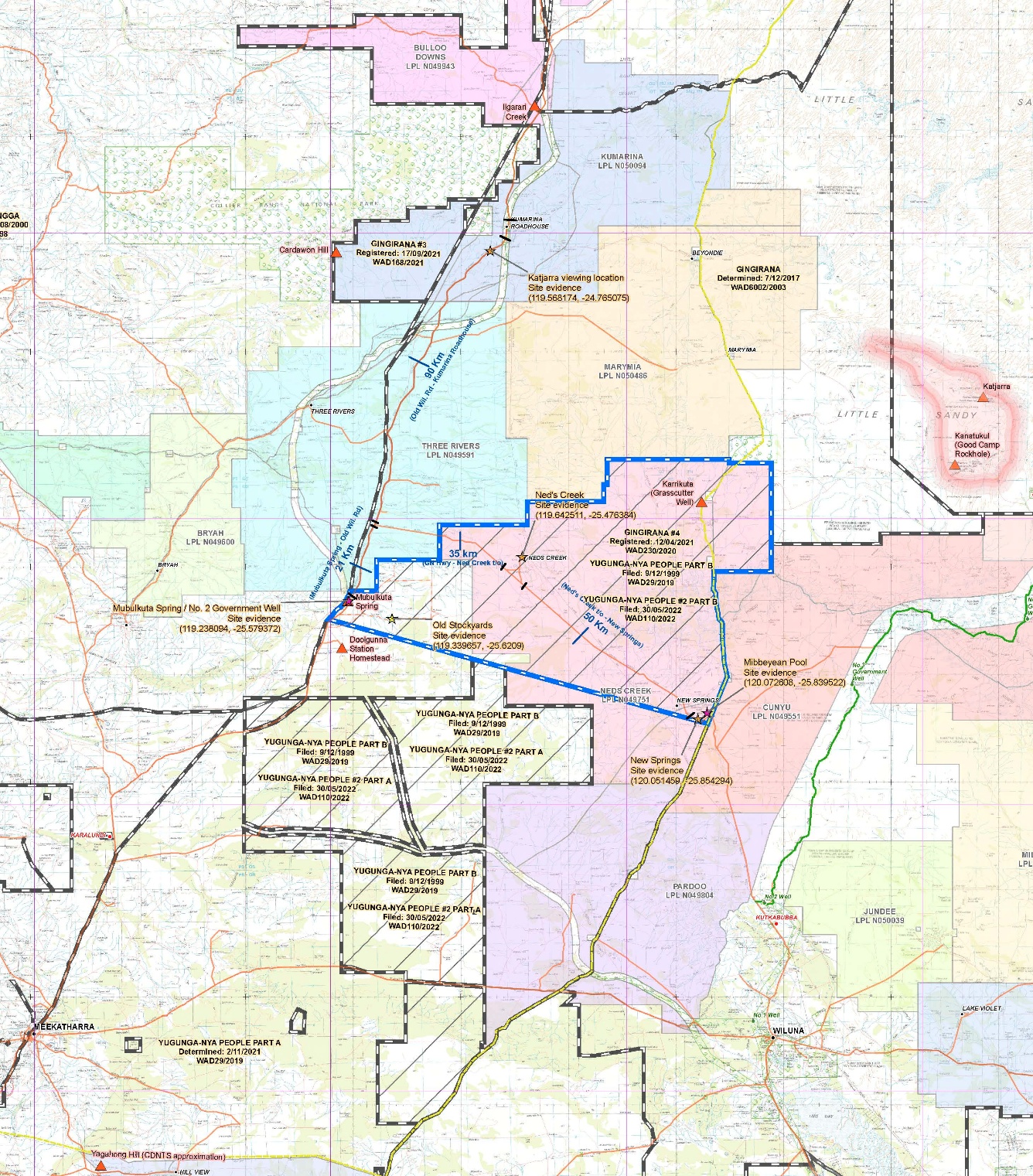
Attachment 2 - Yugunga nya Part A Determination area
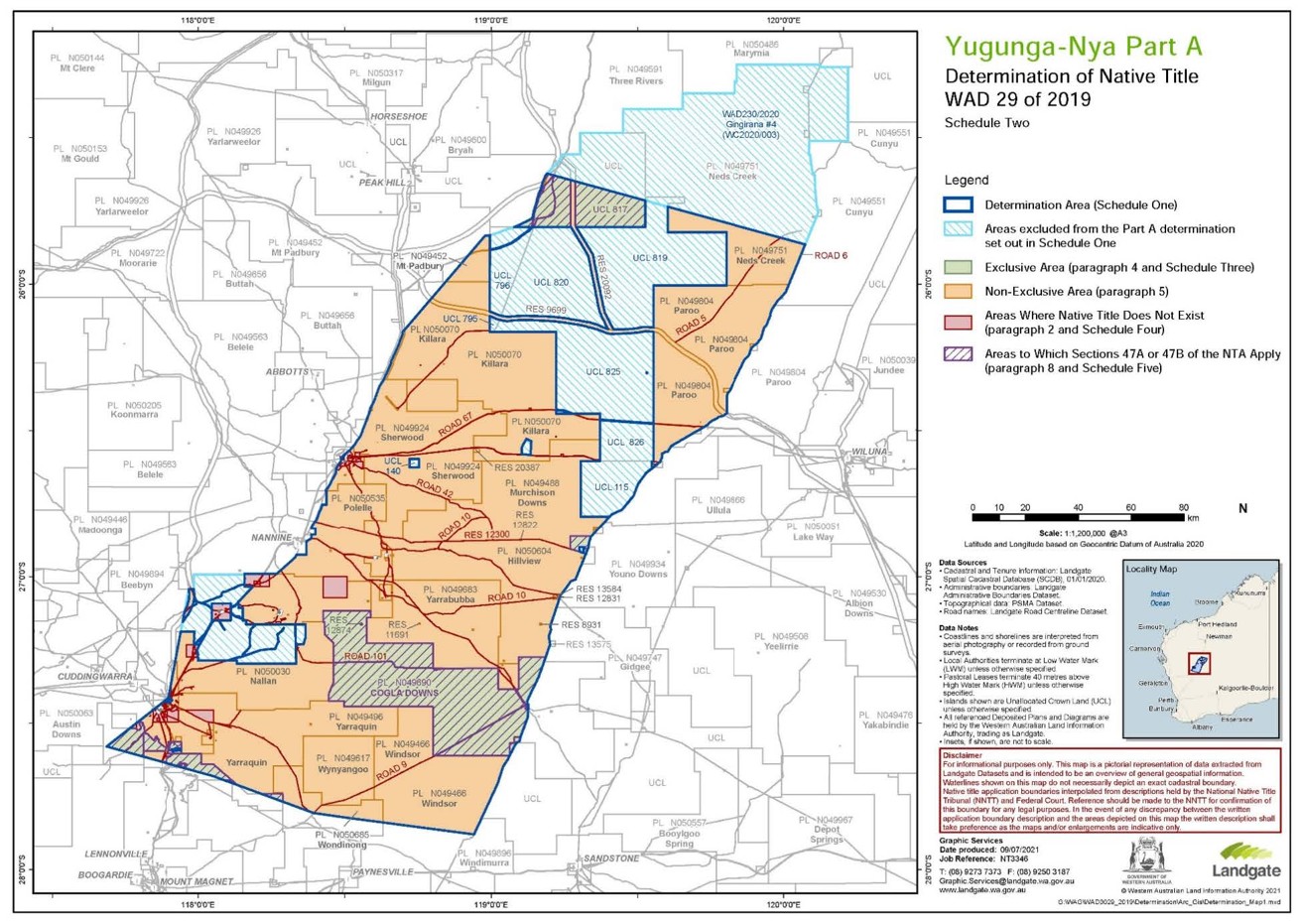
Note: • Yugunga-nya Part A determination area outlined in dark blue • Areas excluded from Yugunga-nya Part A determination hatched in light blue |
Attachment 3 – Gingirana Determination area
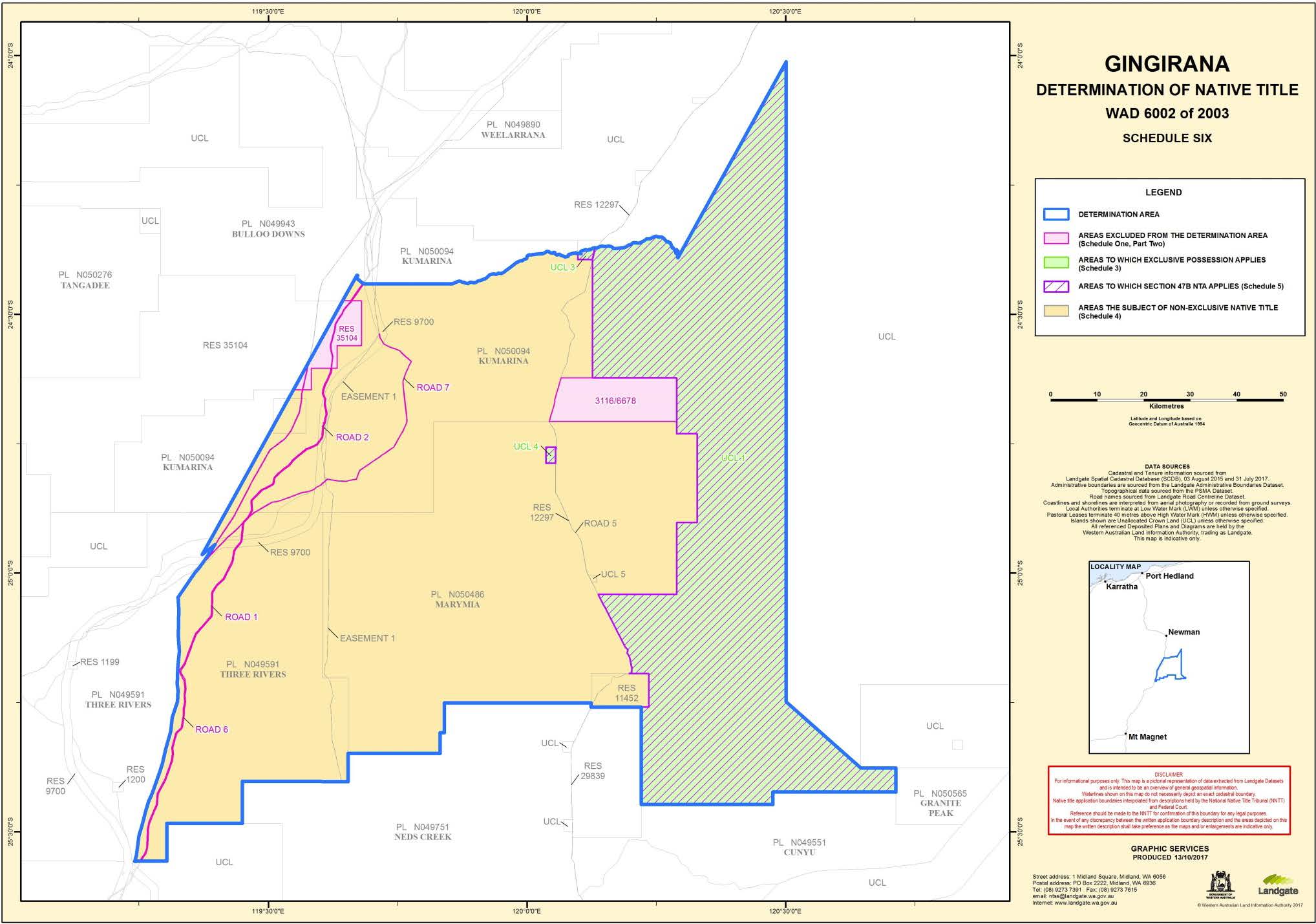
Attachment 4 – Agreed Statement of Issues on Extinguishment
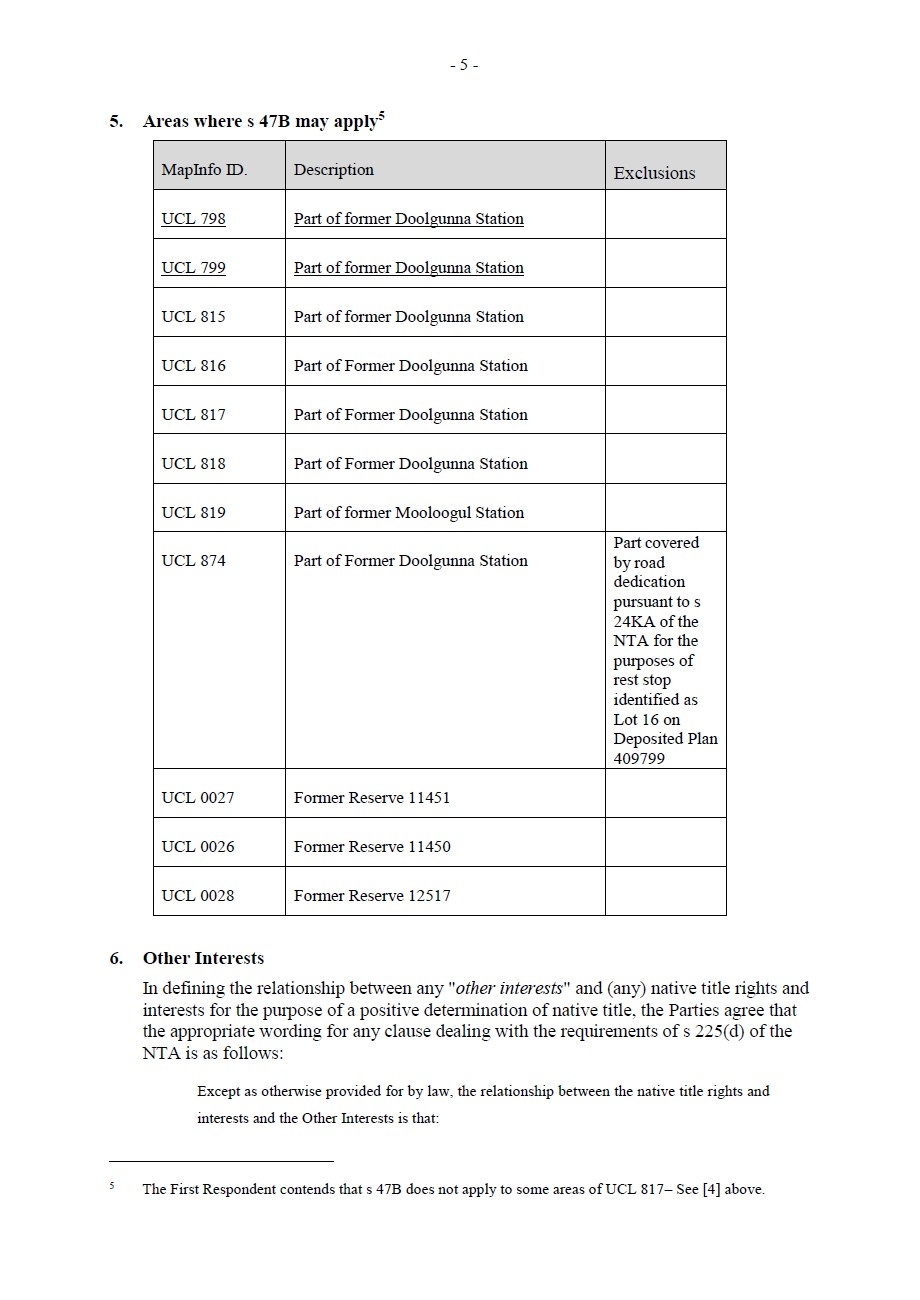
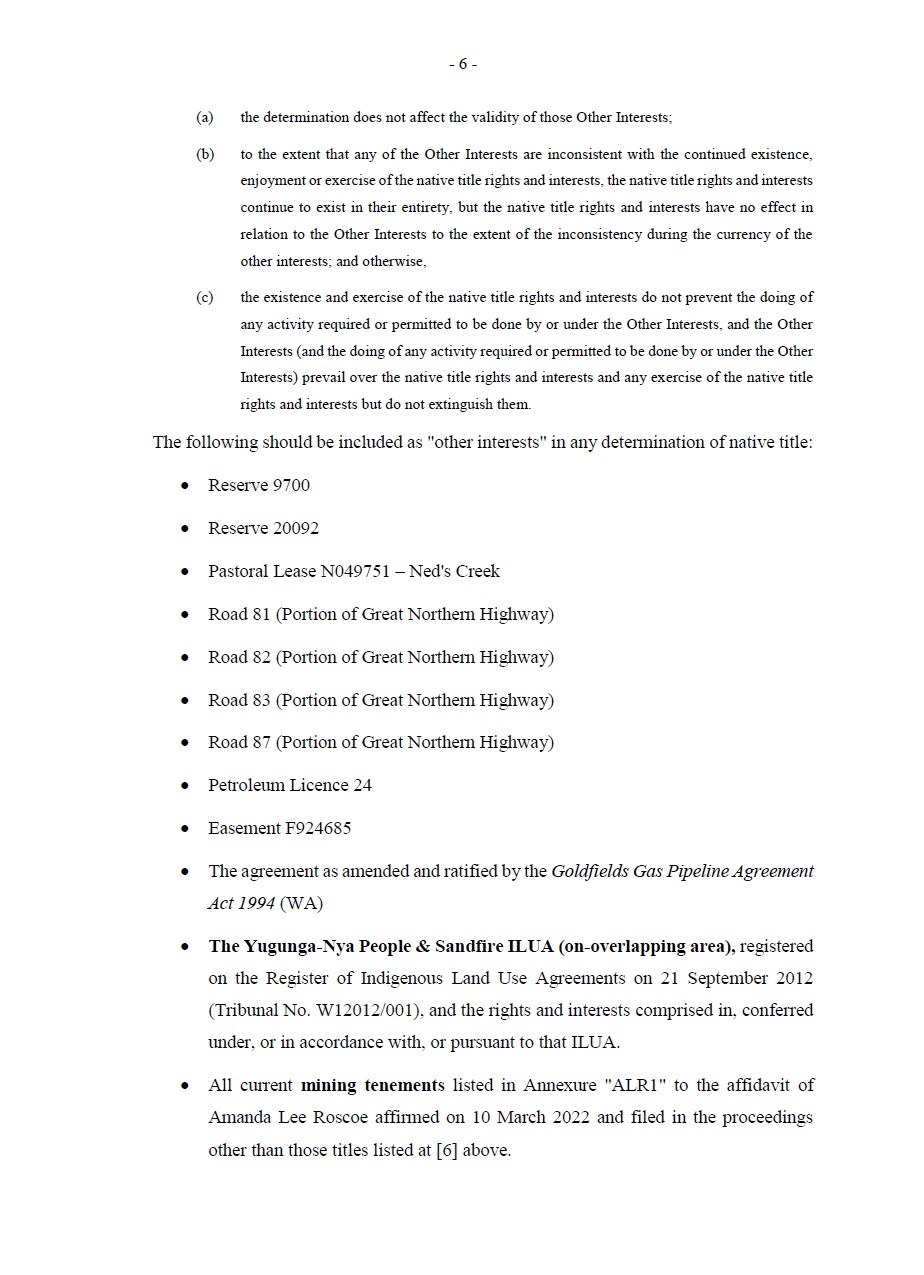
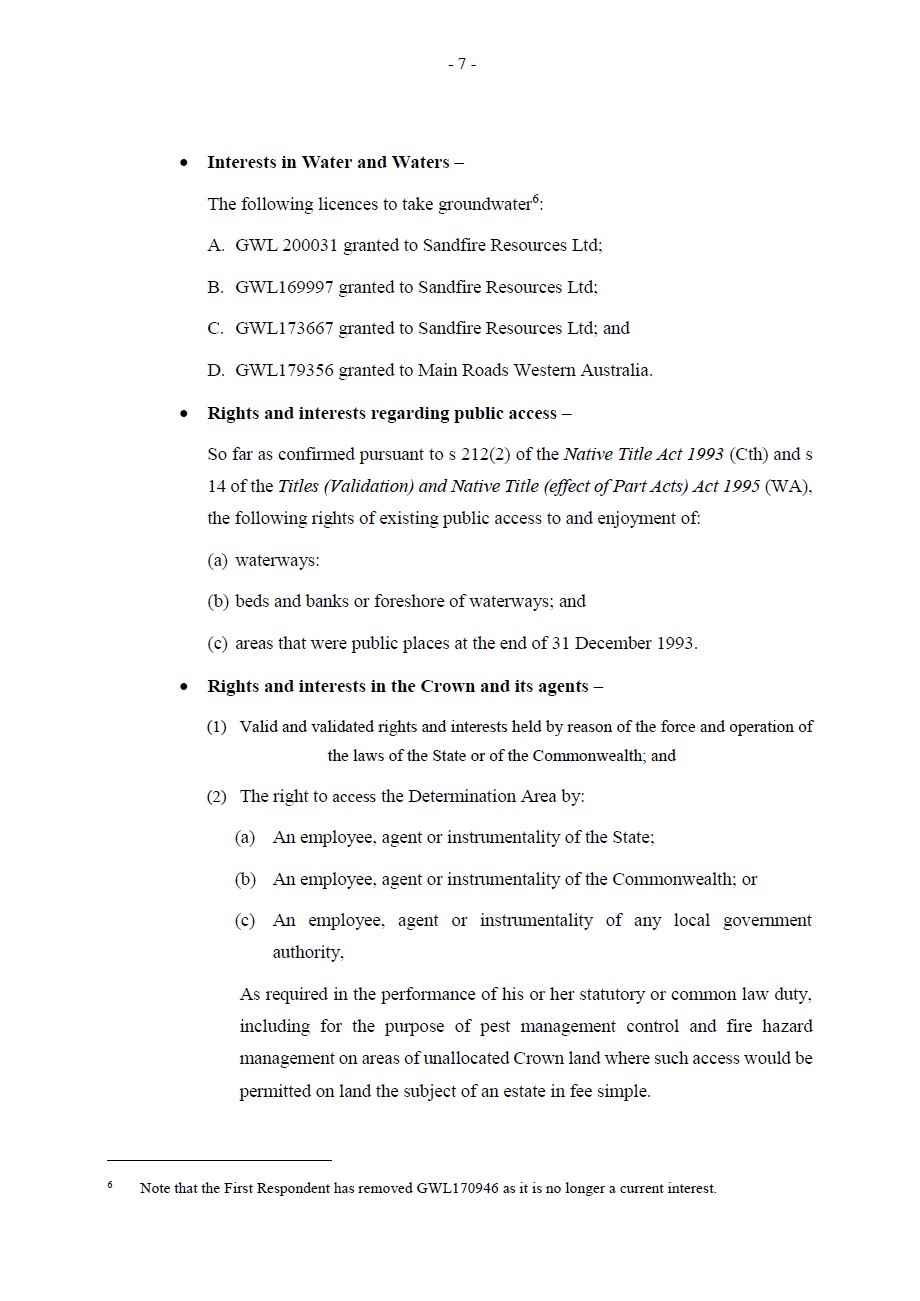
SCHEDULE OF PARTIES
WAD 29 of 2019 | |
Respondents | |
Second Respondent | SHIRE OF MEEKATHARRA |
Third Respondent | SHIRE OF MOUNT MAGNET |
Fourth Respondent | SANDFIRE RESOURCES LIMITED |
Fifth Respondents | CLYDE KENNETH HALL AND LIONEL JOHN HALL |
Sixth Respondent | J A W FORD |
Seventh Respondent | JB AND SB HAYES (YOOTHAPINA STATION) |
Eighth Respondents | TOM STANLEY JACKSON AND BARBARA WENDY JACKSON |
Ninth Respondent | TELSTRA CORPORATION LIMITED |
WAD 230 of 2020 | |
Respondents | |
Second Respondent | APA GGT PTY LIMITED |
Third Respondent | PEAK MINERALS LIMITED |
Fourth Respondent | SANDFIRE RESOURCES LIMITED |
Fifth Respondent | SOUTHERN CROSS PIPELINES (NPL) AUSTRALIA PTY LIMITED |
Sixth Respondent | SOUTHERN CROSS PIPELINES AUSTRALIA PTY LTD |
WAD 110 of 2022 | |
Respondents | |
Second Respondent | SHIRE OF CUE |
Third Respondent | YAMATJI MARLPA ABORIGINAL CORPORATION |
Fourth Respondent | CLYDE KENNETH HALL |
Fifth Respondent | LIONEL JOHN HALL |
Sixth Respondent | APA GGT PTY LIMITED |
Seventh Respondent | PHILIP ARTHUR BOX |
Eighth Respondent | SOUTHERN CROSS PIPELINES (NPL) AUSTRALIA PTY LIMITED |
Ninth Respondent | SOUTHERN CROSS PIPELINES AUSTRALIA PTY LTD |


