

Federal Court of Australia
Pfizer Ireland Pharmaceuticals Unlimited Company v Samsung Bioepis Co., Ltd (Infringement and Validity) [2026] FCA 1244
File number(s): | NSD 331 of 2022 |
Judgment of: | BURLEY J |
Date of judgment: | 27 August 2026 |
Catchwords: | PATENTS – patent relating to the large scale production of proteins and polypeptides in cell culture for a therapeutic use – infringement – validity PATENTS – infringement – construction of claims – meaning of “medium containing glutamine” and “cumulative” – where two allegedly infringing processes – where one process accepted to infringe integer – second process does not infringe on preferred construction – infringement of integer also considered on alternate constructions to that found – infringement found for some batches on alternate constructions PATENTS – infringement - whether cell culture would reach a maximum possible viable cell density within a percentage range if maintained under a first set of culture conditions – infringement not found PATENTS – validity – inventive step – whether use of a medium with the characteristics specified involved an inventive step – common general knowledge alone and in combination with three prior art documents – all but one of the asserted claims lack an inventive step PATENTS – validity – fair basis – claims fairly based PATENTS – validity – inutility – promise of the invention – whether specification contains promises asserted by respondents – whether promise met – ground not established PATENTS – validity – sufficiency – not considered on construction PATENTS – validity – clarity – ground not established PATENTS – validity – best method – ground not established PATENTS – amendment application – where substantive amendment application withdrawn – where unopposed correcting amendments pressed – s 105 of the Patents Act 1990 (Cth) – correcting amendments allowed |
Legislation: | Patents Act 1990 (Cth) ss 7(2), 7(3), 18(1)(b)(ii), 18(1)(c), 40(2)(a), 40(3), 102, 102(3), 105 |
Cases cited: | Aktiebolaget Hässle v Alphapharm Pty Limited [2002] HCA 59; 212 CLR 411 Allsop Inc v Bintang Ltd [1989] FCA 428; 15 IPR 686 Apotex Pty Ltd v Warner-Lambert Company LLC (No 2) [2016] FCA 1238; 122 IPR 17 AstraZeneca AB v Apotex Pty Ltd [2015] HCA 30; 257 CLR 356 AstraZeneca AB v Apotex Pty Ltd [2014] FCAFC 99; 226 FCR 324 Austal Ships Pty Ltd v Stena Rederi Aktiebolag [2005] FCA 805; 66 IPR 420 Banque Commerciale S.A., En Liquidation v Akhil Holdings Ltd [1990] HCA 11;169 CLR 279 Boehringer Ingelheim Animal Health USA Inc v Zoetis Services LLD (No 2) [2024] FCA 291 Caffitaly System S.p.A v One Collective Group Pty Ltd [2020] FCA 803; 154 IPR 1 Commercial Union Assurance Company of Australia Ltd v Ferrcom Pty Ltd (1991) 22 NSWLR 289 Coopers Animal Health Australia Ltd v Western Stock Distributors Pty Ltd [1986] FCA 359; (1987) 15 FCR 382 CPC Patent Technologies Pty Ltd v Apple Pty Ltd [2025] FCA 489 Cytec Industries Inc. v Nalco Company [2021] FCA 970; 162 IPR 202 ESCO Corporation v Ronneby Road Pty Ltd [2018] FCAFC 46 Generic Health Pty Ltd v Bayer Pharma Aktiengesellschaft [2014] FCAFC 73; 222 FCR 336 Gilead Sciences Pty Ltd v Idenix Pharmaceuticals LLC [2016] FCA 169; 117 IPR 252 GlaxoSmithKline Consumer Healthcare Investments (Ireland) (No 2) Ltd v Generic Partners Pty Ltd [2018] FCAFC 71; 264 FCR 474 H Lundbeck A/S v Alphapharm Pty Ltd [2009] FCAFC 70; 177 FCR 151 Hytera Communications Corporation Ltd v Motorola Solutions Inc [2024] FCAFC 168; 308 FCR 68 Interlego AG v Toltoys Pty Ltd [1973] HCA 1; 130 CLR 461 Jadwan Pty Ltd v Rae & Partners (A Firm) [2020] FCAFC 62; 278 FCR 1 Jones v Dunkel [1959] HCA 8; 101 CLR 298 Jupiters Ltd v Neurizon Pty Ltd [2005] FCAFC 90; 65 IPR 86 Jusand Nominees Pty Ltd v Rattlejack Innovations Pty Ltd [2023] FCAFC 178; 300 FCR 408 Kimberly-Clark Australia Pty Ltd v Arico Trading International Pty Ltd [2001] HCA 8; 207 CLR 1 Les Laboratoires Servier v Apotex Pty Ltd [2016] FCAFC 27; 247 FCR 61 Lockwood Security Products Pty Ltd v Doric Products Pty Ltd (No 2) [2007] HCA 21; 235 CLR 173 Lockwood Security Products Pty Ltd v Doric Products Pty Ltd [2004] HCA 58; 217 CLR 274 Merck Sharp & Dohme Corporation v Wyeth LLC (No 3) [2020] FCA 1477; 155 IPR 1 Motorola Solutions, Inc. v Hytera Communications Corporation Ltd (Liability) [2022] FCA 1585; 172 IPR 221 Neurim Pharmaceuticals (1991) Ltd v Generic Partners Pty Ltd (No 2) [2019] FCA 154; 139 IPR 424 Nichia Corporation v Arrow Electronics Australia Pty Ltd [2019] FCAFC 2; 175 IPR 187 Novartis AG v Bausch & Lomb (Australia) Pty Ltd [2004] FCA 835; 62 IPR 71 Pfizer Ireland Pharmaceuticals v Samsung Bioepis AU Pty Ltd [2017] FCAFC 193; 257 FCR 62 Pfizer Ireland Pharmaceuticals v Samsung Bioepis AU Pty Ltd (No 2) [2019] FCA 657 Pfizer Ireland Pharmaceuticals v Samsung Bioepis AU Pty Ltd (No 3) [2021] FCA 1428 Pfizer Ireland Pharmaceuticals v Samsung Bioepis AU Pty Ltd (No 4) [2024] FCA 678; 180 IPR 678 Pfizer Overseas Pharmaceuticals v Eli Lilly & Co [2005] FCAFC 224; 225 ALR 416 R D Werner & Co Inc v Bailey Aluminium Products Pty Ltd [1989] FCA 57; 25 FCR 565 Sandvik Intellectual Property AB v Quarry Mining & Construction Equipment Pty Ltd [2017] FCAFC 138; 348 ALR 156 Sanofi v Amgen Inc (No 3) [2025] FCA 387 Stefanovski v Digital Central Australia (Assets) Pty Ltd [2018] FCAFC 31; 368 ALR 607 Welch Perrin & Co Pty Ltd v Worrel [1961] HCA 91; 106 CLR 588 Wellcome Foundation Ltd v VR Laboratories (Aust) Pty Ltd [1981] HCA 12; 148 CLR 262 Zoetis Services LLC v Boehringer Ingelheim Animal Health USA Inc [2024] FCAFC 145; 306 FCR 19 |
Division: | General Division |
Registry: | New South Wales |
National Practice Area: | Intellectual Property |
Sub-area: | Patents and associated Statutes |
Number of paragraphs: | 796 |
Date of last submission: | 17 October 2025 |
Date of hearing: | 5, 8–12, 15, 17 September 2025; 7–9 October 2025 |
Counsel for the Applicants: | Ms C L Cochrane SC with Ms M Evetts and Ms J McKenzie |
Solicitor for the Applicants: | Norton Rose Fulbright Australia |
Counsel for the First and Second Respondents: | Mr J S Cooke SC with Mr D B Larish and Ms J A McKenna |
Solicitor for the First and Second Respondents: | Ashurst Perkins Coie Australia |
Counsel for the Third, Fourth, Fifth, Sixth, Seventh and Eighth Respondents: | Ms K J Howard SC |
Solicitor for the Third, Fourth, Fifth, Sixth, Seventh and Eighth Respondents: | Corrs Chambers Westgarth |
ORDERS
NSD 331 of 2022 | ||
| ||
BETWEEN: | PFIZER IRELAND PHARMACEUTICALS UNLIMITED COMPANY First Applicant PFIZER AUSTRALIA PTY LTD Second Applicant | |
AND: | SAMSUNG BIOEPIS CO., LTD First Respondent SAMSUNG BIOEPIS AU PTY LTD ACN 611 890 094 Second Respondent MERCK, SHARP & DOHME CORP (and others named in the Schedule) Third Respondent | |
AND BETWEEN: | SAMSUNG BIOEPIS CO., LTD (and others named in the Schedule) First Cross-Claimant | |
AND: | PFIZER IRELAND PHARMACEUTICALS UNLIMITED COMPANY Cross-Respondent | |
order made by: | BURLEY J |
DATE OF ORDER: | 27 AUGUST 2026 |
THE COURT ORDERS THAT:
1. The parties confer and provide to the chambers of Justice Burley draft short minutes of order giving effect to these reasons and proposing directions for the further conduct of the proceedings, including in relation to any outstanding issues concerning costs, by 4pm on 24 September 2026.
2. Until further order, these reasons for judgment not be disclosed to any person other than to those persons who are the subject of appropriate confidentiality undertakings as agreed between the solicitors acting for the parties.
3. The parties confer and provide to the chambers of Justice Burley a copy of these reasons for judgment indicating the paragraphs or parts thereof which are said to contain confidential information, by 4pm on 10 September 2026.
Note: Entry of orders is dealt with in Rule 39.32 of the Federal Court Rules 2011.
REASONS FOR JUDGMENT
[1] | |
[1] | |
[14] | |
[16] | |
[24] | |
[26] | |
[27] | |
[31] | |
[39] | |
[52] | |
[59] | |
[73] | |
[81] | |
[85] | |
[89] | |
[89] | |
[116] | |
[146] | |
[148] | |
[163] | |
[163] | |
[167] | |
[177] | |
[183] | |
[233] | |
[236] | |
[240] | |
[243] | |
[250] | |
[252] | |
[252] | |
7.2 Alternative findings on the basis of the Pfizer construction | [256] |
[257] | |
[258] | |
[262] | |
[271] | |
[276] | |
[298] | |
[302] | |
[319] | |
7.2.7 Conclusions in relation to the medium containing glutamine integers on the hypothesis that Pfizer’s construction is correct | [322] |
[323] | |
[323] | |
[327] | |
[333] | |
[334] | |
[347] | |
8.5.1 Effect of temperature shift and whether cells were transitioning to the stationary phase | [350] |
[356] | |
[380] | |
[388] | |
[388] | |
[392] | |
[422] | |
[437] | |
[447] | |
[465] | |
[478] | |
[488] | |
[488] | |
[493] | |
[506] | |
[538] | |
[551] | |
[568] | |
[568] | |
[586] | |
[595] | |
9.6.4 Consideration of lack of inventive step in the light of DelaCruz | [640] |
[652] | |
[653] | |
9.6.4.3 The inventiveness of dependent claims 5, 7, 8 and 33 | [659] |
9.6.4.4 The inventiveness of dependent claims 37, 38, 39, 40, 42, 45, 46 and 49. | [660] |
[673] | |
[682] | |
[684] | |
[684] | |
[689] | |
[697] | |
[697] | |
[699] | |
[704] | |
[710] | |
[732] | |
[733] | |
[741] | |
[741] | |
[744] | |
[746] | |
[757] | |
[759] | |
[778] | |
[794] |
BURLEY J:
1. INTRODUCTION
1.1 The proceedings
1 Pfizer Ireland Pharmaceuticals and Pfizer Australia Pty Ltd (collectively Pfizer) bring proceedings against eight respondents for the infringement of asserted claims 1, 2, 5, 7, 8, 33, 37–40, 42, 45, 46 and 49 of patent no. 2005280034, which is entitled “Production of polypeptides” and which is concerned with the production of proteins and polypeptides that have a therapeutic use. The priority date of the patent is 27 August 2004. The patent expired on 26 August 2025.
2 The protein of interest in the proceedings is etanercept, which is a dimeric fusion protein consisting of the extracellular ligand-binding portion of the human tumor necrosis factor receptor 2 (TNFR-2) linked to the Fc portion of IgG1. It is useful for the treatment of autoimmune disorders including rheumatoid arthritis.
3 Pfizer Ireland is the patentee and Pfizer Australia is its exclusive licensee. Pfizer markets a product containing etanercept under the name ENBREL.
4 Pfizer contends that the respondents have infringed the asserted claims by the production of biosimilar products containing etanercept referred to as the BRENZYS Products which are registered on the Australian Register of Therapeutic Goods (ARTG) and the Pharmaceutical Benefits Scheme (PBS). Pfizer seeks declarations of infringement, injunctions restraining further infringement, delivery up of infringing products, and pecuniary relief in the form of damages or an account of profits.
5 The respondents are Samsung Bioepis Co Ltd, Samsung Bioepis AU Pty Ltd, Merck, Sharp & Dohme Corp, Merck Sharp & Dohme (Australia) Pty Ltd, Organon LLC, Organon Pharma Pty Ltd, Arrow Pharmaceuticals Pty Ltd and Arrow Pharma Pty Ltd. They contend that the methods used to produce etanercept do not fall within the scope of the claims. They also contend that the asserted claims are invalid.
6 On 28 July 2023 Pfizer filed an amended interlocutory application to amend the patent by narrowing the scope of the claims (narrowing amendments) and also to correct what it contends are clerical errors or obvious mistakes (correcting amendments). Pfizer contended that both the asserted claims and certain claims resulting from the narrowing amendments were infringed. On the seventh day of the hearing, Pfizer abandoned its application to make the narrowing amendments. The respondents do not oppose the correcting amendments.
7 A Statement of cross claim was filed by four of the respondents, being Samsung Bioepis Co Ltd, Samsung Bioepis AU Pty Ltd, Organon LLC and Organon Pharma Pty Ltd. For present purposes it is not necessary to distinguish between the respondents and the cross-claimants and in these reasons I continue to refer to the cross claimants as “the respondents”.
8 The respondents initially pleaded additional grounds, but by the time of closing submissions the grounds of invalidity relied upon were:
(1) Lack of inventive step based on the common general knowledge and also (separately):
(a) US Patent No 2003/0087372 published on 8 May 2003 (DelaCruz);
(b) US Patent No 6,656,466 published on 2 December 2003 (Etcheverry) in combination with US Patent No 5,122,469 published on 16 June 1992 (Mather);
(2) Lack of fair basis;
(3) Inutility;
(4) Insufficiency;
(5) Lack of clarity or definition; and
(6) Failure to disclose best method.
9 The infringement and validity of the patent in suit are determined by reference to the Patents Act 1990 (Cth) in the form before the passing of the Intellectual Property Laws Amendment (Raising the Bar) Act 2012 (Cth) (Raising the Bar Act).
10 Orders were made on 2 April 2024 providing that issues of liability for patent infringement would be heard separately and before issues of quantum of any relief to be granted. As the patent in suit expired on 26 August 2025, injunctive relief is no longer relevant.
11 These proceedings follow from the grant of orders for preliminary discovery arising from the decision of the Full Court of the Federal Court in Pfizer Ireland Pharmaceuticals v Samsung Bioepis AU Pty Ltd [2017] FCAFC 193; 257 FCR 62 (Allsop CJ, Perram and Nicholas JJ). Following that decision, the parties continued to dispute the scope of the discovery for several years and orders were made following the decision in Pfizer Ireland Pharmaceuticals v Samsung Bioepis AU Pty Ltd (No 2) [2019] FCA 657 (Burley J). After further disputation, the question of preliminary discovery was reventilated in 2021 and the respondents were required to provide some additional discovery: Pfizer Ireland Pharmaceuticals v Samsung Bioepis AU Pty Ltd (No 3) [2021] FCA 1428 (Burley J). Further discovery was also ordered in the present proceedings in 2024: Pfizer Ireland Pharmaceuticals v Samsung Bioepis AU Pty Ltd (No 4) [2024] FCA 678; 180 IPR 678 (Burley J).
12 Ms CL Cochrane SC appeared with Ms M Evetts and Ms J McKenzie for Pfizer, Mr JS Cooke SC appeared with Mr DB Larish and Ms JA McKenna for the first and second respondents, and Ms KJ Howard SC appeared for the third to eighth respondents.
13 The parties and their legal representatives went to considerable lengths to assist the court in reducing the number of issues and distilling them to their narrowest essence. They, and their legal representatives, are to be congratulated on this approach.
1.2 Summary of conclusions
14 For the reasons set out more fully below I conclude:
(1) That the infringement case must fail because Pfizer has not established that at least one essential integer (being integer 1.8 of claim 1) is present in the process used to manufacture the etanercept in the BRENZYS Products.
(2) Pfizer has also failed to establish that integer 1.6 of claim 1 is present for one of the processes used to make a number of the batches of etanercept.
(3) With the exception of claim 2, the asserted claims lack an inventive step;
(4) Otherwise, the respondents have failed to establish that the asserted claims are invalid for lack of fair basis, inutility, insufficiency, lack of clarity or lack of definition or failure to disclose the best method.
15 I will make orders that the parties confer and provide short minutes of order giving effect to these reasons by 24 September 2026. I will also suppress these reasons for judgment on an interim basis other than to those persons who are the subject of appropriate confidentiality undertakings, and order the parties to confer and agree upon a suitably redacted form of these reasons for publication, by 10 September 2026.
1.3 The expert witnesses
16 Matthew Croughan was called by Pfizer. He is a chemical engineer specialising in bioprocess development, scale-up and manufacturing. He holds a Bachelor of Science and a PhD in chemical engineering, the latter of which he completed at Massachusetts Institute of Technology in 1988. Between 1988 and 1998 he worked at Genentech, Inc, in San Francisco, California, during which time he gained experience in media design, including enriching media and limiting waste product accumulation, fluid dynamics and fed batch cell culture. He worked as a bioreactor scale-up expert and was responsible for optimising the scale-up of cell culture bioreactors to produce commercial quantities of proteins of interest. In 1995, as a senior engineer, he was the chief scientist on Genentech’s design team for, to his knowledge, the world’s largest and most automated animal cell culture facility. He led the team that optimised existing manufacturing processes across product streams to eliminate unnecessary variations and minimise plant construction costs. Since 1998 he has consulted with large and small companies in the field of bioprocess development, scale up and manufacturing and has worked on a range of projects from biopharmaceutical proteins to vaccines, biofuels, cell and gene therapies and cellular agriculture.
17 Pfizer relied on three affidavits given by Dr Croughan. In his affidavit of 5 February 2025, he detailed his career and experience, gave a brief summary of the technical background to production of polypeptides in cell culture, and gave a summary of the patent and the proposed amended patent. He was provided with confidential documents produced by the respondents in the proceedings which concern the two manufacturing processes by which the BRENZYS Products are produced, and addressed these documents in a confidential annexure to his first affidavit. He gives his opinion, based on those documents, that both processes meet all of the requirements of the asserted claims, in both amended and unamended form.
18 In his affidavit of 22 May 2025, Dr Croughan responds to the evidence of Dr Jennie Mather, one of the expert witnesses called by the respondents. He addresses Dr Mather’s summary of the common general knowledge, the hypothetical task that Dr Mather was asked to perform for the purposes of the respondents’ case of lack of inventive step, being to explain how she would have gone about “producing a fusion protein, such as etanercept, at large scale before the priority date” and then addresses the pleaded prior art and comments in more detail on the patent, responding to points made by Dr Mather. In a confidential annexure to his second affidavit, he also addresses further confidential documents commented on by Dr Mather. In his affidavit of 26 June 2025, Dr Croughan replies to further evidence given by Dr Mather, evidence given by Professor Mahler on the question of infringement, and further confidential documents.
19 Jennie Mather was called by the respondents. She is a consultant in biologics development and manufacturing. She has a Bachelors degree in Arts and Biology and a PhD related to DNA binding proteins in meiotic cells which was conferred by the University of California, San Diego. She began working with mammalian cell cultures in 1975 and between 1975 and 1978 developed a serum-free medium for optimal growth of cells from low density to high density. From 1979 to 1984 she was joint Assistant Professor at the Rockefeller University, and from 1984 until 1998 she worked at Genentech first as a Senior Scientist in the process sciences division where she was involved in designing cell culture production processes. She was promoted in 1988 to Staff Scientist and led a team helping to design cell culture production medium and process parameters for various recombinant protein products. During this time she obtained experience working with large scale commercial cell cultures, working closely with the “scale-up” team at Genentech to develop mammalian cell culture production processes in large-scale fermenters. In 1994 she and her team moved to the Research Division of Genentech, working to produce improved cell lines and continuing to develop optimised media for recombinant protein production.
20 In 1999, Dr Mather left Genentech and founded her own company, Raven Biotechnologies, Inc, where she supervised the raising and screening of thousands of monoclonal antibodies against cancer antigen targets and was also involved in the development and optimisation of proprietary serum-free media formulations. In 2008, Raven was acquired by another company.
21 The respondents rely on three affidavits given by Dr Mather. In the first, given on 19 December 2024, she details her career and experience and how she has stayed up to date in her technical field, gives an overview of the development and production of therapeutic proteins and cell culture, and explains various terms used in the art. She was also asked how she would have gone about producing a fusion protein, such as etanercept, at large scale before the priority date, including the cells she would have used, the media she would have used and the conditions she would have applied during the production phase. She provided a review of the DelaCruz, Etcheverry and Mather patents, and other prior art documents no longer relied upon by the respondents. She then reviews the patent in suit and provides an explanation of her understanding of the specification and the asserted claims before comparing those claims with the outcome of her performance of the task set for her. Her evidence concludes with the consideration, in a confidential annexure, of information supplied by Pfizer on discovery and considering whether it contains information not disclosed in the patent that she considered “important to the performance of the purported invention”. In her affidavit of 21 April 2025, Dr Mather responds to various paragraphs of Dr Croughan’s first affidavit. In her affidavit of 18 June 2025 she replies to parts of Dr Croughan’s second affidavit.
22 Stephen Mahler was called by the respondents. He is a professor of chemical and biological engineering at the University of Queensland. He holds a Bachelor of Science and a PhD in Biochemistry from the University of Queensland, the latter of which he obtained in 1989. From 1989 to 2006 he lectured at the School of Biotechnology and Biomolecular Sciences at the University of New South Wales. From 2007 until 2016 he was associate professor in the School of Chemical Engineering at the University of Queensland. In 2016 he was appointed professor at the same school. Since 1986 he has been involved in a number of projects concerning the discovery, research and development of biologic medicines, including bioprocess development.
23 Professor Mahler was provided with Dr Croughan’s first affidavit and asked to comment on parts of it, focussing particularly on Dr Croughan’s opinion that the processes used for the production of the BRENZYS Products fall within the “mpVCD integer” of the asserted claims, which I refer to in further detail below.
1.4 Joint expert reports
24 The expert witnesses met and conferred about areas of dispute between them arising from their affidavit evidence. They collaborated in the production of two joint expert reports. The first is dated 3 August 2025 and involved each of Dr Croughan, Dr Mather and Professor Mahler. It is concerned primarily with the construction of the mpVCD integer and the question of whether the methods used by the respondents include that integer. The second joint expert report is dated 5 August 2025 and involved only Dr Croughan and Dr Mather, and concerned a broader range of issues in dispute.
25 Each of the experts participated in the provision of concurrent evidence and was cross examined. Subject only to specific comments that I make during the course of these reasons, I found that each of the experts was skilled in their field and all did their best to assist the Court.
2. PRIMER OF BACKGROUND COMMON GENERAL KNOWLEDGE
26 In order to understand the terms of the patent it is necessary for the Court to place itself in the position of the person skilled in the art possessed of the knowledge known to those in the art as at the priority date. Accordingly, I begin by setting out a summary of the common general knowledge. This has been drawn from the “Combined Technical Primer and CGK Summary” prepared by the parties on the basis of the affidavit evidence of Dr Mather, which was reviewed and marked-up by Dr Croughan and subsequently further reviewed and marked-up by Dr Mather. This represents a baseline for the common general knowledge of those skilled in the art as at the priority date (despite being expressed in the present tense). It includes some mark-up which reflects areas of disagreement between the experts. My rulings in relation to these areas of disagreement will be apparent from what follows.
2.1 Production of therapeutic proteins
27 The patent concerns the production of therapeutic polypeptides and proteins through cell culture. In this process, living cells containing the gene encoding the protein of interest are cultured in conditions suitable for the cells to grow and produce the protein. The cells grown can be genetically engineered to produce recombinant proteins or polypeptides of interest, including therapeutic proteins. The term “cell culture” is used informally by chemical engineers and cell biologists to refer to a process where the host cell is an animal or insect cell. Using cell culture to produce therapeutics is a sub-category of the field of bioprocessing.
28 Production of therapeutic proteins involves gene expression, being the process by which genetic information is translated into functional proteins in living cells. Gene expression involves transcribing deoxyribonucleic acid (DNA) to ribonucleic acid (RNA) within the cell nucleus, which is then used as a template to assemble the amino acid chains forming the protein. The protein may then undergo additional modifications (such as folding) or have components added (such as carbohydrates).
29 The production of therapeutic proteins using cell culture involves four stages:
(1) cell line development which involves selection of host cell, transfection of gene into host cell, clone selection and generation of a stable master cell bank;
(2) upstream processing which involves the scale-up of a cell bank and protein production. It includes initial stages where cells are thawed from a frozen cell bank and grown to sufficient numbers to allow for the production of a sufficient amount of the protein of interest;
(3) downstream processing which concerns the harvest of protein and purification. It focusses on the harvest of that protein including isolating the protein from other components in the cell culture, purifying the protein and formulating the protein for use as a therapeutic product; and
(4) product characterisation and formulation.
30 For the purposes of these proceedings, the primer focused on (1) cell line development (detailed in section 2.2) and (2) upstream processing (detailed in sections 2.3–2.8 below).
2.2 The host cell and choosing a cell line
31 The host cell is the workhorse for the production of therapeutic proteins, and is responsible for the expression, production and in many cases, secretion of the protein of interest. The choice of host cell depends on a number of factors, including the nature and complexity of the target protein, and the ease of manipulating the host's genome, culturing the cell, and removing the host cell proteins away from the purified therapeutic protein.
32 Non-mammalian host cells, such as bacteria, yeast and insect cells, may be used for simple proteins. These cell types have the advantage of growing to high cell densities quickly because they multiply more frequently compared with animal cells, with relative ease and at a relatively low cost. However, non-mammalian cells cannot perform the folding, assembly and post-translational modifications required for biologic activity of many larger and more complex therapeutic proteins. For this reason, mammalian cells are typically used to carry out production of larger and more complex therapeutic proteins. Mammalian cells also secrete the protein into the media, making the downstream harvesting process easier and cheaper. Mammalian cell culture is comparatively more complex and costly in the upstream process for various reasons, including because the cells are more susceptible to damage from physical elements (such as fluid flows) in large scale cell culture, have more complex nutritional needs, and must be grown within specific temperature ranges.
33 The most commonly used mammalian cell lines for large scale therapeutic protein production are Chinese hamster ovary (CHO) cells, because they have been extensively studied and characterised. CHO cells are considered to be robust, adaptable to serum-free culture, relatively easily transfected with foreign DNA, and able to carry out efficient and consistent expression, post-translational modification and protein secretion. Most therapeutic proteins approved by regulatory authorities are produced in CHO cells.
34 In cell culture, cells are grown in two ways: as adherent cells, which must be anchored to a substrate for proliferation, or as non-adherent cells, which proliferate in suspension. Non-adherent cells are optimal for therapeutic protein production, as the scale-up process is more straightforward for suspension cell culture. CHO cells can be grown as either adherent or non-adherent cells and can be adapted to proliferate in suspension.
35 “Fusion proteins”, or “chimeric proteins”, are a type of therapeutic protein created through the joining of two genes that code for separate proteins to create a fusion protein with properties or functionality derived from both of the original proteins.
36 As noted above, transfection of the gene into the host cell is part of the initial cell line development process. However, each host cell will integrate different numbers of the gene at different locations within its genome. This means that a preferred cell line must be chosen from the transfected host cells. The gene of interest can also be amplified in the transfected cell, resulting in multiple gene copies per cell, which may increase productivity but decrease genetic stability of the cells. For therapeutic gene production, the preferred cell line will be one that is highly productive and stable. This is an important step, as regulatory authorities require therapeutic proteins to be produced from a single cell line.
37 One common method for selecting a cell line with high productivity is the limiting dilution method. In this process, a suspension of transfected host cells is diluted to very low cell densities and then transferred to single cell “wells”, such that each single cell may be propagated, screened and assayed to identify which cells express the highest protein levels. The products of the highly productive cells lines are then analysed for stability, quality, growth rates and growth densities. Based on this analysis, a number of preferred single-cell derived cultures, called “clones”, are selected. The clones are then further tested for stability to ensure consistency for large scale therapeutic production. Once the stable and highly productive lead clones have been identified, they are each preserved in their own research banks, and further testing is performed to compare the clones and select a top clone.
38 Upon selection of a top clone, a Master Cell Bank is grown from the top clone’s research bank, which then becomes the stock of genetically uniform cells that will be used for clinical or commercial production. Vials of the Master Cell Bank are frozen and extensively tested for stability and potential contaminants, for example viruses, prior to use. Working Cell Banks are derived from the Master Cell Bank for the manufacture of therapeutic proteins.
2.3 Cell culture, feeding and by-products
39 The aim of industrial cell culture is to provide an environment that enables production of the therapeutic protein with suitable quality at the cost and production targets. This environment is created in vitro using the cell bioreactor and the medium. Together, they provide an appropriate temperature, pH, oxygen and carbon dioxide supply, nutrient and vitamin supply, protection from toxic agents, and the hormones and growth factors that control the cell’s state of growth.
40 Cell culture protein production methods typically fall into one of three primary modes of operation: batch, fed batch and perfusion (the latter being less relevant to these proceedings).
41 Batch culture is the simplest mode of operation, in which, generally, all components are included in the media at the start of the culture. Batch cultures typically run for around 5 to 8 days, over the course of which the protein of interest and by-products such as ammonia and lactate accumulate in the media. Batch culture is not commonly used for large scale therapeutic protein production, because the cell densities and protein titre (being the concentration of the target protein) produced are lower.
42 Fed batch culture involves active supplementation (or “feeding”) of the culture with nutrients and/or other media components (the “feed” or “feed medium”) in addition to the cell culture medium in the bioreactor at the start of the culture (or basal medium). The feed media are added to the cell culture as they are consumed and depleted over time, according to a “feeding strategy” formulated to maximise cell density and prolong culture longevity to increase protein titre. Feed media is typically added to the cell culture by way of concentrated solution, which limits the feed volume required to replenish nutrients. Feed media typically contains amino acids and an energy source, such as glucose, which may be added as one concentrated feed solution or as separate solutions.
43 The feed media can support additional cell growth and support the cells to produce protein for a longer period before the rate of cell death exceeds the rate of cell growth. Like batch culture, by-products such as ammonia and lactate also accumulate in the media in addition to the target protein.
44 Fed batch cultures typically run for around 14 days, and fed batch animal cell culture is the most commonly used mode of operation for large scale therapeutic protein production. Fed batch culture avoids depletion of essential nutrients and excessive accumulation of toxic by-products, in order to produce protein with suitable quality at the cost and production targets (being the primary goal of industrial fed batch culture). Higher cell densities can typically be achieved in fed batch cultures compared to batch cultures.
45 In fed batch culture, the components of the cell culture media are consumed by the cells during cell growth and protein production, particularly glucose and glutamine. The by-product of glucose consumption is lactic acid, and the by-product of glutamine consumption is ammonia and in some cases lactic acid. If the amount of nutrients available to the cells is limited, this will often limit cell growth.
46 Eventually, cell growth in fed batch cultures will be limited due to by-products produced in cellular metabolism, as well as other factors such as carbon dioxide accumulation, nutrient limitation, and hyperosmotic stress related to nutrient feeds and base additions to control pH. These can be detrimental to cell growth, viability, protein production and product quality. A balance is required between maintaining cell growth and viability and the by-product accumulation, which is achieved by avoiding excessive accumulation of harmful by-products while ensuring that sufficient levels of essential nutrients are supplied. What is considered “excessive” can depend on a number of factors.
47 As noted above, two of the key by-products of cellular metabolism are lactate and ammonium.
48 Lactate is produced by cells through the metabolism of glucose, and generally faster-growing cells will produce more lactate than slower-growing cells. Cells grown in very low concentrations of glucose will convert a lower percentage of the glucose into lactate, compared to the same cells grown in high concentrations of glucose. A portion of the glucose will also be metabolised into carbon dioxide. High concentrations of lactate are detrimental to cells, and increased lactate will increase the medium’s osmolarity and decrease the culture pH, which are both factors that need to be tightly controlled to avoid cell metabolism changes and cell death. The level of lactate that may be detrimental will vary, but in CHO cells this is typically levels from 20 mM or higher. In industrial cell culture, the level of lactate considered acceptable will also depend on whether, despite lactate accumulation, there is sufficient cell growth and productivity to produce the protein with suitable quality at cost and production targets.
49 One strategy to avoid excessive lactate accumulation is to start with a very low glucose level and then feed glucose in very small amounts over the course of the culture. The control of glucose at these very low levels requires an automatic feedback control system which allows for frequent sampling, withdrawal, testing and feeding. Such systems have been achieved in laboratory-scale bioreactors but have not been implemented as part of large-scale animal cell culture processes. Other strategies include lowering culture temperature, lowering culture pH, and using cell lines that consume lactate.
50 Ammonium is produced by the spontaneous degradation of glutamine in cell culture media and the metabolism of glutamine by the cells. Glutamine is one of two primary energy sources for cells (the other being glucose) and is generally added to cell culture to support high levels of cell growth and protein production, despite the detrimental impact caused by ammonium accumulation. Some cell lines can produce their own glutamine under certain conditions. The amount of ammonium produced by a cell depends on the cell culture medium composition. Cells grown in high glutamine concentrations will utilise glutamine at a higher rate than their physiological need for glutamine.
51 High concentrations of ammonium are detrimental to cells for various reasons. The level of ammonium that may be detrimental varies between different cell lines and different clones derived from the same cell line. As with lactate, in industrial cell culture the level of ammonium considered acceptable will also depend on whether, despite ammonium accumulation, there is sufficient cell growth and productivity to produce the protein with suitable quality at cost and production targets. A common strategy to reduce ammonium accumulation is to use lower starting concentrations of glutamine, and feed glutamine in smaller amounts.
2.4 Physical environment
52 The physical conditions of the cell culture process must be tightly controlled to achieve sufficient cell viability and density, maximise product titre and maintain acceptable product quality. Most mammalian cell cultures are grown at 37 °C, being the core body temperature of humans. Growing cells at a temperature that is too high is more detrimental than a temperature that is too low. Cells can tolerate temperatures at 10 to 20 °C below normal, or even extremely cold temperatures such as -80 °C, for fairly long periods of time. However, they will grow slowly, if at all, at these temperatures.
53 pH regulation is essential for mammalian cell survival, as pH is important for maintaining the appropriate ion balance, optimal function of cellular enzymes, and optimal binding of hormones and growth factors to cell surface receptors. Even transient changes in pH can alter cell metabolism, which can lead to cell death (though small changes in pH generally do not lead to cell death).
54 pH regulation in a small-scale laboratory setting is done through various buffering systems, most of which use a bicarbonate-CO2 system as a major component. The CO2 interacts with water to decrease the pH, and the concentration of bicarbonate may be increased to neutralise the CO2’s effects. Other buffers included in most media formulations are phosphate buffers.
55 In large scale cell culture, the regulation of pH is done through automated pH monitoring and control systems utilising pH sensors and feedback control, and the addition of acid or base to maintain pH in the desired range. The pH needs to be monitored through the cell culture process, because accumulation of metabolic by-products (such as lactate and ammonium) will impact pH.
56 Osmolality refers to the concentrated mass of particles dissolved in solution (such as nutrients in media) relative to the mass of the solvent (measured as total molar amount per kg, i.e. milliosmoles/kg or mOsm) – essentially, how concentrated the medium is. Osmotic pressure will increase over time in fed batch cultures as nutrient rich feed medium is added. Addition of any acids or bases for pH control will also impact osmolality. Salts (including NaCl), bases and glucose are the major contributors to medium osmolality although amino acids may also contribute significantly. Altering osmolality significantly, that is by more than 50 mOsm, will almost always affect cell growth and function in some way. In these reasons, reference is made also to osmolarity. This refers to the number of solute particles dissolved in 1 L of solution.
57 All mammalian cells require oxygen for metabolism and produce CO2 as a by-product. Oxygen is diffused into the medium, and CO2 is removed from the cell culture through aeration.
58 The supporting environment must also protect the cells in culture from any stress that might kill them directly, set off natural genetic programs leading to death, or cause mutations or other changes. In industrial cell culture, the focus is on whether stress is causing excessive cell death, rather than the biological mechanisms causing cell death. However, some cell death is to be accepted as inevitable, balanced against growth and productivity to achieve the aim of producing the therapeutic protein with suitable quality at cost and production targets. Fed-batch production cultures are often harvested at a final viability of 70 to 90% (i.e., with some cell death).
2.5 Cell Culture Media
59 A cell culture medium provides essential nutrients that are incorporated into dividing cells and any therapeutic protein they produce. It consists of an aqueous solution of nutrients and other components to support cell growth and production of the target protein in a suitable bioreactor environment. It typically includes glucose as an energy source, glutamine as a carbon source, other amino acids (including “essential” amino acids the cells cannot produce themselves), vitamins, insulin, lipids, and inorganic compounds such as NaCl, trace elements and minerals. A medium can be defined, where every component is known and fully characterised, or undefined, where the medium contains substances or mixtures of substances not completely characterised including serum and peptones. Undefined media was sometimes used in older processes for protein production.
60 There are a variety of ways of preparing cell culture medium. Particularly at very large scales (e.g. 10,000 L), it is rare to purchase liquid batch media as a whole and instead more common to prepare a media solution from powders containing some media components and, if needed, add other components before or after the medium has been placed in the production bioreactor. Relevant considerations to preparing a medium include whether the media component dissolves under basic or acidic conditions, that glutamine tends to degrade over time and so may be separately added to the batch medium in the bioreactor, and that some media components have a tendency to stick to filters and so may be added after filtration steps. Media can also be optimised for different purposes, such as for a particular cell type, cell line or cell clone, protein to be produced, or a culture need such as very high density.
61 Basal or batch media formulations refer to the fresh medium in a bioreactor prior to inoculation. There are a number of commercially available basal media formulations used in laboratory cell culture. However, these media are not widely used for cell culture in an industrial setting. Typically, companies engaged in large scale cell culture have their own media or purchase enhanced forms of the older media formulations from commercial vendors.
62 Basal media used in laboratory and industrial settings typically contains at least the following components:
(a) A carbohydrate (sugar) source, most commonly glucose, to provide an energy source for cells;
(b) Amino acids, which are the building blocks of protein and are either categorised as “essential” (being the amino acids that the cells cannot produce on their own and therefore must be added) or “non-essential” (being those that can be made by the cells);
(c) Vitamins, which are essential for cell replication;
(d) Lipids and/or lipid precursors, such as fatty acids, which are necessary for metabolism and act as a precursor for components required for cells growth. Lipids are important for cell mass and are critical to the development of cell membranes, and most media contain a mixture of fatty acids and sometimes more complex lipids such as cholesterol;
(e) Inorganic ions, such as manganese, magnesium, sodium and potassium, which play a significant role in maintaining the osmolality of the medium but must be in optimal ratios to each other to avoid adverse impacts;
(f) Trace elements, such as copper, zinc and selenium, being small metal ions essential for cell growth which act as “helper compounds” that assist in biochemical reactions;
(g) pH buffers, which are used in laboratory settings in addition to the bicarbonate-CO2 system outlined above, which prevent large variations in pH levels. Examples include phosphate buffers and complex organic buffers; however, at large scale due to the use of pH sensors and feedback control systems, complex organic buffers are not used; and
(h) other components, such as detergents and surfactants, polyols and nucleic acid precursors.
63 Problems associated with the use of serum in cell culture have led to the development of serum-free chemically defined media, where each of the components is specifiable and of known chemical structure. Almost all therapeutic protein production employs serum-free media. The experts in this proceeding disagreed as to whether serum-free media eliminated or only lowered inconsistencies and contamination risks associated with animal products, but agreed that this was an advantage of it, as was avoiding the cost of sourcing animal serum. Serum-free chemically defined media are often described as “enriched media”. Instead of serum, the media are enriched with increased amounts of nutrients, including amino acids, and products which provide for cell growth.
64 The experts agreed that it is common practice to modify basal media to improve cell growth. While there was not clear agreement on how media might be modified, they agreed that this might be done by adding components, reducing components, or increasing the amount of components already in the media. By way of example, if cells are being grown at high densities and are very lactogenic (i.e., the cells rapidly turn the medium acidic) and are thus depleting the glucose at a rapid rate, the addition of more glucose to the medium may improve growth and prolong viability.
65 As noted above, fed batch culture is most commonly used for large scale therapeutic protein production. The primary purpose of feed media is to replenish depleted nutrients required for cellular growth and protein production, and is typically added to the cell culture by way of a concentrated solution to limit the volume required. Feed media typically contains amino acids and an energy source, such as glucose, which may be added as one concentrated feed solution or as separate solutions. If glutamine is fed, it is usually added as a separate feed solution but may sometimes be added as part of a multi-component feed.
66 As noted above, media can be optimised for different purposes, such as for a particular cell type, cell line or cell clone, protein to be produced, or a culture need such as very high density. Optimising the media can lead to increased growth, protein secretion, viability and phenotypic stability. While there was not clear consensus between the experts, it appears to be accepted that in industrial cell culture, due to limitations on time and resources and the need to reach process development targets, media may not be optimised to fullest extent possible.
67 Two alternative approaches to media optimisation are:
(1) Sequentially performing dose-response curves on each component, selecting the optimal concentration range, and then re-testing. This is done as an iterative process, using the desired end-point (e.g. protein titre if the optimisation goal is to maximise protein secretion) to screen; or
(2) Changing many media components simultaneously as part of each new experimental condition tested. This risks adding unnecessary nutrients or exceeding the safe limits of certain components. If issues arose when optimising by this method that indicate an issue with an individual media component, the dose-response curve approach noted above could be applied.
68 The best results for media optimisation are achieved through a combination of both approaches. An example of a dose-response curve figure for a screen to optimise media for protein secretion by CHO cells is below. In the figure, lines A, B and C represent different components, and the graph shows the impact on cell numbers of differing concentrations.
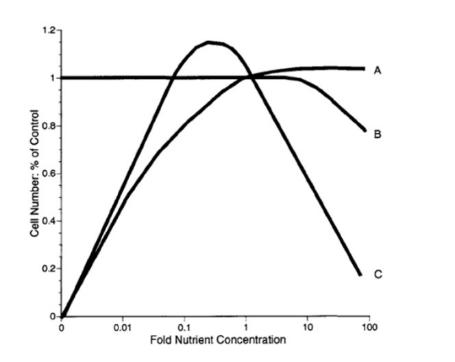
69 Optimising the media not only involves the starting medium, but also the feed medium. For example, a component with a narrow optimal range (such as component C in the dose-response figure above) should not all be added at the start of the culture, but would instead be added over the course of the culture to keep the concentration within the optimal range.
70 As noted above, excessive quantities of certain components such as glucose and glutamine can contribute to the production of by-products that are detrimental to cell culture. Media optimisation must be done with a view to managing these unwanted by-products, and managing other factors such as carbon dioxide, nutrient limitation, and hyperosmotic stress. Other considerations when optimising amino acid concentrations in media include:
(1) Balance between amino acids;
(2) Inherent properties of amino acids, such as low solubility, that may limit the amino acid concentration that can be provided in the initial medium; and
(3) Form of amino acids, as different forms have different inherent properties.
71 Small optimisations to the medium can lead to significant increases in therapeutic protein titre. For this reason, medium optimisation is essential in the development of a process for producing a therapeutic protein at a large scale, and is routinely carried out.
72 Media optimisation studies can be undertaken in simple laboratory culture vessels such as plates, shake flasks and spinners. While these do not exactly reproduce performances at large scales, they do provide key leads for subsequent investigations, which are done in “validated scale down models”. These are miniature versions of a large-scale bioreactor wherein cell culture performance has been proven to match or at least closely match that in large-scale bioreactors. Validated scale down models allow for fed batch cell cultures to be grown to much higher cell densities than in simple laboratory culture vessels, meaning the full impact of medium optimisation studies can be observed.
2.6 Scale-up
73 Cell cultures are conducted in culture vessels of varying size and complexity. However, the scales used in laboratory cell culture are not sufficient for large scale industrial production of therapeutic proteins, which may need to produce kilogram quantities of purified protein per year in order to meet market needs. This is achieved in specialised large-scale fermenters, also called bioreactors, which range in size from 100 L to 25,000 L.
74 Production bioreactors have complex systems which enable bioprocessing engineers to monitor and control the environment the cells are growing in. These include online pH, temperature and oxygen monitoring probes as well as offline detection systems to determine the concentrations of various media, components and by-products including glucose, glutamine, ammonia, lactate, oxygen and carbon dioxide.
75 Viable cell density (VCD), being the number of live cells in cell culture per mL, total cell density (TCD), being the number of viable and non-viable cells, and cell viability are typically monitored via offline testing and sometimes monitored via online detection systems such as capacitance probes. Manual or automated adjustments can be made to certain cell culture conditions.
76 Cells are grown to a sufficiently high density before being added to the production bioreactor. The scale-up process for therapeutic protein production involves progressively increasing the volume of the culture medium, in equipment designed to be scalable, generally using the following steps:
(a) A small number of cells are removed from a frozen cell bank;
(b) A 1-10 mL vial of working cell bank cells is thawed and seeded in a small shake flask or spinner and incubated with media to support cell growth, and over a period of days the cells are transferred to progressively larger shake flasks and smaller bioreactors with fresh media (called a “seed train” or “inoculum train”), which supports further cell growth while avoiding over-diluting the cell culture with medium;
(c) The cells are transferred to the N-1 bioreactor, being the bioreactor prior to the production bioreactor which grows the cells to approximately 1.5 to 5 million cells per mL;
(d) Finally, the production bioreactor is inoculated with cells from the N-1 bioreactor, typically between 0.4 to 1 million cells per mL. The inoculum commonly also includes cell culture fluid from the N-1 bioreactor including substances secreted by the cells, such as glutamine. However, in some instances, a media exchange occurs where cells are washed before inoculation to remove waste products and N-1 bioreactor medium components.
77 The following diagram was taken from Mather J and Roberts P, Introduction to Cell and Tissue Culture (Plenum Press, 1998) at 200. It shows a schematic overview of the scale-up process for a large scale production at 12,000 L.
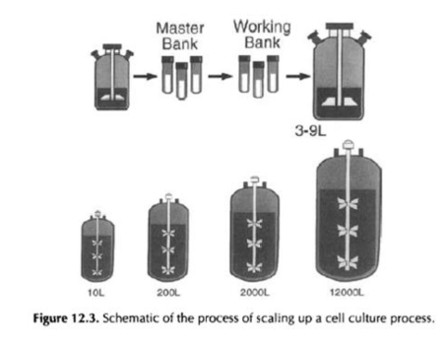
78 A cell’s requirements for growth and protein production remain generally the same regardless of the volume of medium within which they are suspended, meaning the basic principles of cell culture remain the same at all scales. However, scale-up involves engineering analysis and design – for example, the propellor size and speed and possibly shape will differ depending on the volume of the vessel. There are also differences in the hydrodynamic environment at large scale versus small scale, such as shear (force generated by fluid flow) and mixing. High cell density in a large volume bioreactor will also require adjustment of the sparging rate of oxygen addition and CO2 removal. Other considerations at large scale include media formulation and solubility at larger quantities, pH control and mixing of all components of the cell culture.
79 Given the scalability of cell culture processes and the time and cost to optimise at large scale, initial optimisation is typically done at laboratory scale. Culture conditions and the media can be optimised at this scale, as noted above. However, laboratory scale systems do not have automatic monitoring and feedback control of critical culture variables such as pH and dissolved oxygen, and so typically cannot support the full extent of cell growth possible in high density feed batch cultures up to 10 to 20 million cells/mL or more. This means that development and optimisation must ultimately be done in bioreactors with these automatic control capabilities. Bioreactors as small as 2 to 3 L can serve as good, but not perfect, scale down models. As noted above, culture conditions are not always (and cannot always be) optimised at laboratory scale, and so typically adjustments continue to be made to culture conditions during scale-up, which is one reason why companies may conduct studies at intermediate scales of 10 to 2,000 L in facilities called pilot plants.
80 For industrial therapeutic protein production, reproducibility is a primary goal and warrants thorough optimisation of the process at small and large scales and through repeated testing at larger scales. Process validation runs at scale are required for regulatory approval.
2.7 Cell growth phases
81 Cell growth rates and properties are critical to the design of a cell culture process. There are a number of phases of cell growth in a cell culture process, including the following:
(a) Lag phase, in which the cell numbers do not increase, or cell growth is low, as cells recover from subculture and inoculation and adapt to the culture environment. In a well-run production cell culture, there should be no or minimal lag phase, because the production bioreactor is typically inoculated with cells from the N-1 bioreactor that are still in the exponential growth phase.
(b) Log phase (sometimes referred to as the growth phase), in which the cell number increases exponentially. The length of the log phase is generally determined by the seeding density and the cell growth rate. In a production cell culture, after the inoculation of the production bioreactor, the cells are kept in exponential growth phase for a period of days, with sufficient nutrients to support continued cell growth. After the exponential growth phase, the growth rate slowly reduces until the maximum cell density is hit. In a traditional batch or fed-batch system, growth-limiting factors such as accumulation of ammonium, lactic acid by-products and CO2, limited nutrients, and osmotic pressure will eventually cause the growth rate to slow.
(c) The cells are usually shifted to the production phase before the maximum cell density is achieved, with the timing depending on the cell line and the process parameters. This shift causes the cells to focus on protein production over cell growth. This terminology is common in bioprocess engineering.
(d) Plateau phase (sometimes referred to as the stationary phase or pseudo-plateau phase), in which attached cells become confluent (i.e. all of the cells are in contact with surrounding cells), and the growth rate stops or slows. In attached cultures, this is due to the phenomenon of contact inhibition. In suspension cultures, cells do not become contact inhibited but rather reach a pseudo-plateau in which cell death and growth is in balance, resulting in stable culture density. During this phase, the cell density achieves a level suitable for the production phase noted above at (c), namely that it can produce large quantities of the protein of interest. However, if culture conditions change the entire culture may undergo rapid death.
(e) “Death” phase, in which the rate of cell death exceeds the rate of cell growth, due to one or more of the growth-limiting factors causing the rate of cell death to exceed the rate of cell growth. Cell cultures producing therapeutic proteins are typically not allowed to enter into an extended “death” phase, as cell death results in an increase in cellular components being released into the media which may be detrimental to the quality of the therapeutic protein.
82 A well-run production cell culture does not necessarily follow all four of these phases and may exhibit only the log (exponential growth) and plateau (stationary) phases, as well as possibly the “death” phase.
83 Most cells grown in culture die via apoptosis or necrosis. Apoptosis is an active programmed cell death that exhibits specific morphological traits, including nuclear condensation and fragmentation, maintenance of organelle and membrane integrity, and gross cell shrinkage.
84 There are a variety of well-known techniques for determining cell viability, many of which rely on a breakdown in cell membrane integrity measured by the uptake of a dye to which the cell is normally impermeable (such as trypan blue, a charged dye commonly used for this purpose). Using this method, the number of viable cells per unit volume of medium (the viable cell density or VCD), and the viability of the culture (the percent of viable cells as a proportion of all living and dead cells), can be obtained.
2.8 Biphasic cell culture and temperature shifts
85 Highest titres are achieved when cell growth is maximised, death is minimised and/or specific productivity (the rate of protein expression per cell and time unit, in picograms per cell-day) is maximised. Recombinant protein production methods typically employ biphasic culturing strategies, which involve the use of two distinct phases for cell culturing: first, optimising culture conditions for cell growth and biomass accumulation, and second, optimising culture conditions for protein production. Biphasic methods can also reduce the accumulation of toxic by-products by changing cell metabolism.
86 In biphasic methods, the shift from the first to the second phase can be achieved by changing a condition which shifts the cell from the growth to the production phase (see [81(b), (c)] above). This is most commonly achieved by a reduction in temperature, but other methods include changing the cell culture pH, a sudden large increase in osmolality, or using chemical inductants, which are compounds that can be used to enhance protein production, typically at the expense of culture viability and cell growth. Cells may still grow during the production phase, although at a lower rate, for a period after the shift has been induced.
87 As noted above, a reduction in temperature will slow the growth of the cells, slow nutrient consumption, and may increase or prolong protein production, among other effects both beneficial and not beneficial.
88 The timing of a phase shift is usually determined during development of a platform process, which is a process used to manufacture a large number of similar products. When developing a platform process, manufacturers will often investigate a broad range of process variables including temperatures shift timing. They may also determine the maximum viable cell density that could be achieved in the absence of a phase shift, to help optimise shift timing. The timing of the temperature shift is most commonly determined by reference to the VCD and is generally implemented when the VCD is high but has not yet reached the maximum, to ensure that cell viability will remain high during the production phase. Generally, this is when the VCD reaches 50–75% of the maximum VCD absent any shift in temperature. The maximum can be determined by way of small-scale experiments. The extent of the temperature reduction can also be determined by way of small-scale experiments, and a reduction from 37°C to as low as 30°C is common.
3. THE PATENT
3.1 The specification
89 The patent is entitled “Production of polypeptides”.
90 Under the heading “Background of the Invention” the specification notes that proteins and polypeptides have become increasingly important as therapeutic agents and that in most cases they are produced in cell culture from cells that have been engineered or selected to produce high levels of the protein or polypeptide of interest. It provides that control and optimisation of cell culture conditions is “critically important” for successful commercial production of proteins and polypeptides.
91 The Background goes on to say that many such proteins and polypeptides are made in a “batch” or “fed-batch” process, where cells are cultured for a period of time and then the culture is terminated and the produced protein or polypeptide is isolated. The amount and quality of protein or polypeptide produced can be dramatically affected by the conditions of the cell culture. The Background gives an example of traditional batch and fed-batch culture processes often resulting in the production of metabolic waste products that have detrimental effects of cell growth, viability and production or stability of the protein or polypeptide of interest. It says that while efforts have been made to improve such production, there remains a need for additional improvements.
92 In addition, the Background says that significant effort has been invested in the development of “defined media”, being media assembled from known individual components and lacking serum or other animal byproducts, for use in culturing cells, particularly mammalian cells. The expert evidence reveals that concerns were prevalent at the priority date about mad cow disease (bovine spongiform encephalopathy) such that the use of animal serum or other animal products was to be avoided. The Background continues, noting that cell growth characteristics can be very different in defined media as contrasted with serum-derived media and that there is a particular need for the development of improved systems for producing proteins and polypeptides by cell culture in defined media.
93 Under the heading “Summary of the Invention” the specification then says:
[0005] The present invention provides an improved system for large scale production of proteins and/or polypeptides in cell culture. For example, the present invention provides commercial scale (e.g., 500 L or more) culture methods that utilize a medium characterized by one or more of: i) a cumulative amino acid amount per unit volume greater than about 70mM; ii) a molar cumulative glutamine to cumulative asparagine ratio of less than about 2, iii) a molar cumulative glutamine to cumulative total amino acid ratio of less than about 0.2; iv) a molar cumulative inorganic ion to cumulative total amino acid ratio between about 0.4 to 1; or v) a combined cumulative amount of glutamine and asparagine concentration per unit volume greater than about 16 mM….
(Emphasis added)
94 It may be noted that this is the first point when five medium characteristics are identified. They are repeated elsewhere in the specification and in the independent claims.
95 In the same paragraph, the specification continues with an explanation of the meaning of “cumulative”:
… One of ordinary skill in the art will understand that “cumulative”, as used above, refers to the total amount of a particular component or components added over the course of the cell culture, including components added at the beginning of the culture and subsequently added components. In certain preferred embodiments of the invention, it is desirable to minimize “feeds” of the culture over time, so that it is desirable to maximize amounts present initially. Of course, medium components are metabolized during culture so that cultures with the same cumulative amounts of given components will have different absolute levels if those components are added at different times (e.g., all present initially vs. some added by feeds).
96 The specification notes that according to the invention, use of a medium as described “allows high levels of protein production and lessens accumulation of certain undesirable factors such as ammonium and/or lactate” (at [0006]).
97 The specification adds that one skilled in the art will understand that the media formulations of the invention encompass both “defined” and “non-defined media” ([0007]). As noted above, the primer states that a “defined” medium is where every component of the medium is known and fully characterised, whereas an “undefined” medium is where the medium contains substances or mixtures of substances that are not completely characterised, including serum and peptones. Undefined media may or may not include serum or bovine products. The specification notes that in certain preferred embodiments of the invention, the culture medium is a defined medium “in which the composition of the medium is known and controlled” ([0007]).
98 The specification notes that in certain preferred embodiments of the invention, the culture methods include changing the culture from a first set of culture conditions to a second set of culture conditions at a particular point in the process in order to achieve a metabolic shift of the cells. In some embodiments, this change is performed when the culture has reached about 20%–80% of its maximal cell density, and in some embodiments this change is said to involve changing the temperature, or temperature range, at which the culture is maintained.
99 The specification then provides (p 2a lines 1–17):
In an aspect of the present invention, there is provided a method of producing a polypeptide in a large-scale production cell culture comprising the steps of:
providing a cell culture comprising;
mammalian cells that contain a gene encoding a polypeptide of interest, which gene is expressed under condition of cell culture; and a medium containing glutamine and having a medium characteristic selected from the group consisting of: (i) a cumulative amino acid amount per unit volume greater than 70mM, (ii) a molar cumulative glutamine to cumulative asparagine ratio of less than 2, (iii) a molar cumulative glutamine to cumulative total amino acid ratio of less than 0.2, (iv) a molar cumulative inorganic ion to cumulative total amino acid ratio between 0.4 to 1, (v) a combined cumulative amount of glutamine and asparagine per unit volume of greater than 16mM, and combinations thereof;
maintaining said culture in an initial growth phase under a first set of culture conditions for a first period of time sufficient to allow said cells to reproduce to a viable cell density within a range of 20% - 80% of the maximal possible viable cell density if said culture were maintained under the first set of culture conditions;
changing at least one of the culture conditions, so that a second set of culture conditions is applied;
maintaining said culture for a second period of time under the second set of conditions and for a second period of time so that the polypeptide accumulates in the cell culture.
(Emphasis and formatting added)
100 The above passage may be regarded as a consistory clause which matches the terms of claim 1.
101 It will be seen that the methods concern the large scale production of polypeptide, in a cell culture in a medium with any of characteristics (i) to (v) or certain combinations of them, which involves an initial growth phase in a first set of culture conditions (“growth phase”) and then a second set of culture conditions or accumulation phase that follows the growth phase, the second set of culture conditions being maintained for a period of time so that the polypeptide accumulates in the cell culture. Further aspects of the invention are then described.
102 Under the heading “Brief Description of the Drawings” the specification gives a general description of 76 figures which consist of graphs and diagrams.
103 Under the heading “Definitions” the specification provides definitions of a number of terms used in the claims, some of which were the subject of dispute in the course of the expert evidence and in submissions. The following definitions are particularly relevant:
[0090] “Batch culture”: The term “batch culture” as used herein refers to a method of culturing cells in which all the components that will ultimately be used in culturing the cells, including the medium (see definition of “medium” below) as well as the cells themselves, are provided at the beginning of the culturing process. A batch culture is typically stopped at some point and the cells and/or components in the medium are harvested and optionally purified.
[0091] “Bioreactor”: the term “bioreactor” as used herein refers to any vessel used for the growth of a mammalian cell culture. The bioreactor can be of any size so long as it is useful for the culturing of mammalian cells… the term “production bioreactor” as used herein refers to the final bioreactor used in the production of the polypeptide or protein of interest. The volume of the large-scale cell culture production bioreactor is typically at least 500 liters and may be … 12,0000 liters [sic, which is likely to be intended as 12,000] or more…
…
[0094] “Culture”, “Cell culture” and “Mammalian cell culture”: These terms as used herein refer to a mammalian cell population that is suspended in a medium (see definition of “medium” below) under conditions suitable to survival and/or growth of the cell population. As will be clear to those of ordinary skill in the art, these terms as used herein may refer to the combination comprising the mammalian cell population and the medium in which the population is suspended.
[0095] “Fed-batch culture”: The term “fed-batch culture” as used herein refers to a method of culturing cells in which additional components are provided to the culture at some time subsequent to the beginning of the culture process. The provided components typically comprise nutritional supplements for the cells which have been depleted during the culturing process. A fed-batch culture is typically stopped at some point and the cells and/or components in the medium are harvested and optionally purified.
…
[00101] “Medium”, “Cell culture medium”, “Culture medium”: These terms as used herein refer to a solution containing nutrients which nourish growing mammalian cells. Typically, these solutions provide essential and non-essential amino acids, vitamins, energy sources, lipids, and trace elements required by the cell for minimal growth and/or survival. The solution may also contain components that enhance growth and/or survival above the minimal rate, including hormones and growth factors. The solution is preferably formulated to a pH and salt concentration optimal for cell survival and proliferation. The medium may also be a “defined media” – a serum-free media that contains no proteins, hydrolysates or components of unknown composition. Defined media are free of animal-derived components and all components have a known chemical structure.
104 The next part of the specification is entitled “Detailed Description of Certain Preferred Embodiments”. It commences with the observation that the invention provides improved systems for the production of proteins and/or polypeptides by cell culture. It describes that any polypeptide that is expressible in a host cell may be produced in accordance with the present invention, such as enzymes, receptors, antibodies or hormones. It states that production of antibodies is of particular interest given the large number of antibodies in use or under investigation for use as pharmaceutical agents. One preferred embodiment is for the antibody to be expressed as a monoclonal antibody (mAbs) of various types (such as chimeric or human). Other classes of polypeptides shown to be effective as pharmaceutical agents include receptors, growth factors and other signalling molecules and G-protein coupled receptors (GPCRs).
105 The specification then provides a passage relevant in the context of the best method ground of revocation:
[00135] In general, practitioners of the present invention will selected [sic] their polypeptide of interest, and will know its precise amino acid sequence. The techniques of the present invention have been successfully applied to production of diverse polypeptides including, for example a human monoclonal antibody directed to growth and differentiation factor 8 (Examples 1, 3, 4, 7-14), humanized anti-Lewis Y antibody (Examples 5 and 6), anti-ABeta (Example 15) and a dimeric Fc-fusion protein of tumor necrosis factor receptor (Example 16), indicating that the present invention will be useful for expression of a variety of different polypeptides and proteins. Any given protein that is to be expressed in accordance with the present invention will have its own idiosyncratic characteristics and may influence the cell density or viability of the cultured cells, and may be expressed at lower levels than another polypeptide or protein grown under identical culture conditions. One of ordinary skill in the art will be able to appropriately modify the steps and compositions of the present invention in order to optimize cell growth and/or production of any given expressed polypeptide or protein.
(Emphasis added)
106 The reference in this passage to a dimeric Fc-fusion protein of tumor necrosis factor receptor in Example 16 is to etanercept, which as noted above is the protein of interest used in the BRENZYS Products and Pfizer’s product ENBREL.
107 The specification observes that it will be clear to those of ordinary skill in the art that genetic control elements may be employed to regulate gene expression of the polypeptide or protein ([00136]) and provides some examples of control elements ([00136]–[00140]). It refers to methods suitable for introducing into mammalian host cells nucleic acids to achieve expression of the polypeptides or proteins of interest, noting that they are well known in the art ([00141]–[00142]) and goes on to observe that any mammalian cell or cell type susceptible to cell culture, and to expression of polypeptides, may be used in accordance with the present invention ([00144]) providing some examples (including CHO cells) ([00144]–[00147]).
108 Under the sub-heading “Cell Culture Phase”, the specification addresses procedures for producing a polypeptide:
[00148] Typical procedures for producing a polypeptide of interest include batch cultures and fed-batch cultures… A persistent and unsolved problem with traditional batch and fed-batch cultures is the production of metabolic waste products, which have detrimental effects on cell growth, viability and production of expressed polypeptides. Two metabolic waste products that have particularly detrimental effects are lactate and ammonium, which are produced as a result of glucose and glutamine metabolism, respectively. In addition to the enzymatic production of ammonium as a result of glutamine metabolism, ammonium also accumulates in cell cultures as a result of non-metabolic degradation over time. The present invention provides an improved method of large-scale production of polypeptides that minimizes the detrimental effects of ammonium and lactate by slowing and even reversing the accumulation of these waste products in cell cultures… In certain preferred embodiments of the present invention, the cells are grown in batch or fed-batch systems.
109 The specification next addresses media. It says at [00149] that traditional media formulations, including some commercially available formulations, have contained relatively high levels of glucose and glutamine in comparison to other amino acids because they have been thought to be required in abundance as the primary metabolic energy sources for the cells. However, rapid consumption of these nutrients leads to the accumulation of lactate and ammonium. In addition, high initial levels of glucose and glutamine and the subsequent accumulation of lactate and ammonium result in high osmolarity, which is often detrimental to cell growth, cell viability and the production of polypeptides. It continues:
[00150] The present invention provides a variety of media formulations that, when used in accordance with other culturing steps described herein, minimize and even reverse accumulation of lactate and ammonium. Media formulations of the present invention that have been shown to have beneficial effects on cell growth and/or viability or on expression of polypeptide or protein include one or more of… [here the five medium characteristics are set out and the definition of “cumulative” set out in [0005] of the patent is repeated] … One of ordinary skill in the art will understand that the media formulation of the present invention encompass both defined and non-defined media.
110 In this regard, the specification observes at [00151] that traditional media formulations begin with a relatively low level of total amino acids in comparison with the media formulations of the invention, referring as an example to a traditional cell culture medium known as DME-F12 which has a total amino acid content of 7.29 mM. It goes on to say:
(a) In relation broadly to medium characteristic (i) (at [00151]):
… In certain embodiments of the invention, the amino acid concentration in the culture media is preferably greater than about 70mM. More preferably still, the media formulations of the present invention contain amino acid concentrations greater than about 70mM in the starting media. It has been shown that… in this range, cell density and titer are increased throughout the growth period of the culture (see Example 13).
(b) In relation broadly to medium characteristic (ii) (at [00152]):
Additionally, in certain embodiments of the present invention, the molar ratio of glutamine to asparagine in the culture media is reduced compared to other commercially and non-commercially available media. Preferably the molar ratio of glutamine to asparagine in the culture media is less than about two.
(c) In relation broadly to medium characteristic (iii) (at [00153]):
Additionally, in certain embodiments of the present invention, the molar ratio of glutamine to total amino acids in the culture media is reduced compared to other commercially and non-commercially available media. Preferably the molar ratio of glutamine to total amino acids in the culture media [is] less than about 0.2.
(d) In relation broadly to medium characteristics (ii) and (iii) the specification goes on to say (at [00154]):
An interesting and unexpected result of lowering the molar ratio of glutamine to asparagine or to the total concentration of amino acids in the starting media according to the present invention was that in addition to an observed decrease in the accumulation of ammonium, a decrease in the accumulation of lactate was seen as well. In certain embodiments, the accumulated levels of ammonium and lactate are not only lower than those in control cultures, but in fact actually decrease after an initial accumulation (for example, see Examples 3 and 7).
(e) In relation broadly to medium characteristic (iv), after referring to a known culture medium in which the molar ratio of total inorganic ions to total amino acids is between 1 and 10, the specification says (at [00155]):
… In another preferred embodiment of the present invention, the molar ratio of total inorganic ions to total amino acids in the culture medium is reduced even further, to between about 0.4 to 1. As shown in Example 13, reducing this ratio from 1.75 to approximately 0.7 results in a marked increase in cell density and production of expressed polypeptide or protein throughout the growth period of the culture.
(f) In relation to a medium characteristic similar to, but not the same as, medium characteristic (v) the specification says (at [00156]):
In another preferred embodiment of the present invention, the culture medium contains a combined glutamine and asparagine concentration of between about 16 and 36 mM. As shown in Example 14, Table 22, media which contain… this range exhibit higher titers of expressed polypeptide than media which contain a combined total glutamine and asparagine outside this range…
111 The specification continues by referring to various methods of preparing mammalian cells for production of proteins or polypeptides ([00159]–[00163]), the maintenance of the cell culture at an initial growth phase ([00164]–[00170]), and then at the end of the initial growth phase the shifting at least one of the culture conditions so that a second set of culture conditions is applied and a metabolic shift occurs in the culture ([00171]).
112 In this regard, the specification provides (at [00171]):
… A metabolic shift, accomplished by, e.g., a change in the temperature, pH, osmolality or chemical inductant level of the cell culture, may be characterised by a reduction in the ratio of a specific lactate production rate to a specific glucose consumption rate… the timing of the culture shift will be determined by the practitioner of the present invention, based on polypeptide or protein production requirements or the needs of the cells themselves.
113 The specification then addresses the subsequent production phase, which occurs once the conditions of the cell culture have been shifted, where the cell culture is maintained under a second set of culture conditions conducive to the survival and viability of the cell culture and appropriate for expression of the desired polypeptide or protein at commercially adequate levels. The final subject addressed in this section of the specification is monitoring culture conditions, to allow the practitioner to determine whether the cell culture is producing recombinant polypeptides or proteins at suboptimal levels or whether the culture is about to enter into a suboptimal production phase.
114 The specification then addresses, under separate headings, the isolation of expressed polypeptide and the preparation of pharmaceutical formulations.
115 Seventeen examples are then set out.
3.2 The examples
116 The specification provides 17 examples which refer to numerous figures.
117 Example 1 is entitled “Enhanced Medium 1 for anti-GDF-8 Fed-batch Process”. The objective is described as the development of a batch media for the production of proteins of interest in large-scale bioreactors that requires minimal feeds, to overcome drawbacks of traditional fed-batch processes (at [00203]). CHO cells engineered to express a monoclonal antibody against growth and differentiation factor 8 (called “anti-GDF-8 cells”) were tested in different batch media called Medium 1, Medium 2 and Medium 3.
118 The specification records that for flask experiments, anti-GDF-8 cells were grown in shake flasks and passaged three times. For bioreactor experiments, anti-GDF-8 cells were grown over 12 days, supplemented daily after day 5. For the first 4 days, cells were grown at 37 ⁰C and on day 5, cells were shifted to 31 ⁰C (at [00205]).
119 Table 1 provides detailed information about the compositions of each of Mediums 1, 2 and 3. As an example, below are the listed amino acid levels for each medium:
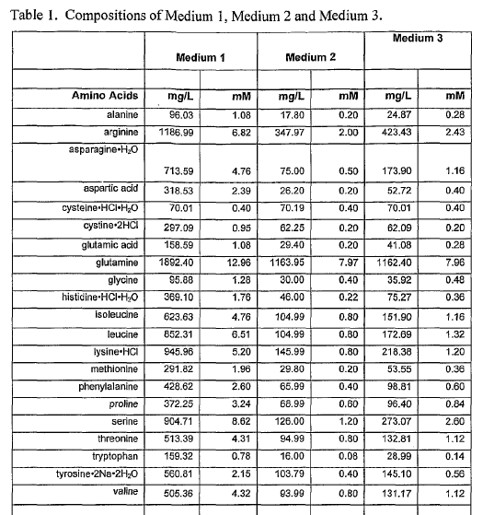
120 Similar detail (in mg/L and mM or μM) is given (to two decimal places) for 11 listed vitamins, 9 inorganic salts, 12 trace elements and 8 “other components”.
121 The results record that the cells in Mediums 1 and 2 in flasks had comparable growth rates, and that in bioreactors, Medium 1 exhibited a significant increase in final cell density, viability and titre over Medium 3 (at [00207], [00208]). Other observations are also recorded.
122 Example 2 is entitled “Development of concentrated feed medium (Medium 5) for anti-GDF-8 cells in fed-batch process”. It describes the iterative development of a concentrated feed medium for use in a fed-batch process that led to Medium 5, the composition of which is set out in Table 7 of the patent. The uncontradicted evidence of Dr Croughan is that Medium 5 is used as the feed medium in in subsequent examples in the patent in two forms, one with glutamine (in Examples 3, 5, 10, 11, 12, 14 and 15) and one without glutamine (in Examples 3, 5, 8, 9, 10, 13, 14 and 15). In all examples where Medium 9 is used as the batch medium and a specific feed is identified, that feed is Medium 5.
123 Example 3 is entitled “Glutamine Starvation Fed-batch Process for anti-GDF-8 Cell Culture”. The example begins:
[00225] CHO cells require glutamine in the starting media to survive. Traditionally, initial glutamine levels are high and glutamine is fed daily after day 5 until the end of the fed-batch process. Traditional fed-batch processes normally result in high lactate and ammonium levels in the cell cultures, which are known to have inhibitory effects on cell growth, cell density and recombinant protein expression. Fed-batch processes in which glucose is slowly added to the culture have been shown to lower lactate production and improve cell growth, cell density and recombinant protein expression. However, prior art methods for manipulation of glucose addition are not practical for large-scale manufacturing. Here, by utilizing culture media with lower starting levels of glutamine and eliminating glutamine from the feed, it is shown that lower levels of ammonium and lactate are produced, leading to increased cell viability. Additionally, in glutamine-starved cultures, recombinant protein expression is increased and final osmolarity is reduced.
124 The example investigates the effect of low levels of glutamine on cell culture performance, growing anti-GDF-8 cells over 12 days in Medium 1 in 1 L bioreactors and testing them across three fed-batch processes using: a “no glutamine feed” process, which used a starting batch medium containing 13 mM of glutamine and a daily feed from day 5 of Medium 5 with no glutamine; a “glutamine starvation” or “low glutamine” process, which used a starting batch medium containing 4 mM of glutamine and a daily feed of Medium 5 from day 5 with no glutamine; and a control process, which used a starting batch medium containing 13 mM glutamine, a 5 mM feed of glutamine on day 4 and a daily feed from day 5 of Medium 5 in its original formulation containing 37.5 mM of glutamine.
125 At [00239], the results report that decreased glutamine levels are beneficial to cell cultures by reducing the amount of ammonium production, increasing cell viability and increasing titre of expressed anti-GDF-8 antibody. Also, in the starved cultures, low lactate levels were observed, possibly due to the decreased glucose consumption rate. Decreased ammonium and lactate levels were also reported to have the effect of reducing total osmolarity, and it is noted that elevated osmolarity is known to have inhibitory effects on cell growth and viability. A further reported benefit of the low initial glutamine and the elimination of glutamine feeds is that there is reduced ammonium produced as a result of non-enzymatic glutamine degradation in stored media. Eliminating glutamine in the feed is also said to simplify the process of culturing anti-GDF-8 cells.
126 Figures 3–12 are referred to in the context of Example 3: [00229]–[00238].
127 Example 4 is entitled “Iron dose response of anti-GDF-8 cells in Medium 1 and Medium 2”, and describes an iron dosing experiment conducted to determine the optimum iron levels for cell growth in Medium 1.
128 Example 5 is entitled “Substitution of Glutamate for Glutamine in the Bioreactor Process”. In it, three experiments were performed to test the effects of substituting glutamate for glutamine in an anti-Lewis Y cell culture process. The experiments were performed in 10 L bioreactors. The results state that on average the titre was higher in bioreactors fed with glutamate.
129 Example 6 is entitled “Substitution of Glucose and Glutamine in the Anti-Lewis Y Cell Culture Process” and was for the purpose of testing the effects of this substitution on the feed media listed in Table 11 in the culturing of anti-Lewis Y cells. An article entitled “Antibody-targeted chemotherapy with the calicheamicin conjugate hu3S193-N-acetyl gamma calicheamicin dimethyl hydrazide targets Lewisy and eliminates Lewisy-positive human carcinoma cells and xenografts” by Bogheart et al is cited. The experiment was conducted in 250 mL shake flasks. The batch medium was Medium 2 and the flasks were fed with Medium 6 (the composition of which is in Table 11) on days 3 and 4, and subsequently on days 5–13 were fed with the feed solutions set out in Table 12, being modified Medium 6 where glucose was substituted for galactose in some cases, and/or glutamine was also substituted with glutamate, asparagine and glycylglutamine.
130 Example 7 is entitled “Evaluation of a Glutamine Starved Batch Process for the Production of anti-GDF-8”. The specification says that typical fed-batch production methods require multiple feeds over the culture period which are designed to replace nutrients in the medium that may have been depleted by the cells or have degraded during the batch. However, these feeds create complications when the process is scaled up to be used in larger reactors, such as the need for an “impeller jump” (a stirring mechanism depicted in Figure 24). Further, the feeds dilute the amount of anti-GDF-8 already secreted into the culture and therefore affect the harvest titre. The specification says:
[00261] Glutamine is one of the most important reasons that a fed-batch approach is used since it is not stable at 37⁰C and it had been thought that it needed to be replenished during a batch culture. However, results of Examples 2, 5 and 6 in which a glutamine starvation strategy was tested, showed a significant increase in productivity compared to a control reactor that was fed glutamine. This result was combined with the batch process to create a glutamine starvation batch process that was tested in this Example.
131 The experiment was conducted in 1 litre bioreactors where the temperature of all cultures was maintained at 37 ⁰C for the first four days and on the fourth day lowered to 31 ⁰C and maintained at this point for the duration of the batch (at [00262]. The compositions of the media used (Medium 7, Medium 8 and Batch media) are set out in Table 13.
132 The results reported include the conclusion at [00270] that combining a batch process with a glutamine starvation strategy resulted in a 40% improvement in productivity over the control fed-batch process for anti-GDF-8 cells. This was said to be attributable to two factors: first the starvation increasing productivity either directly or because it keeps ammonia and lactate levels very low, and secondly in the absence of feeds, the titre is not diluted during the batch.
133 Example 8 is entitled “Effects of Glutamine and Asparagine concentrations in batch media on anti-GDF-8 cell culture process” and investigates the effects of using different concentrations of glutamine and asparagine in the batch medium. The example notes that in Examples 2, 5 and 6 it was demonstrated that glutamine starvation conferred benefits on fed-batch cultures in two cell lines, including increased cell growth, cell viability and titre as well as decreased production of lactate and ammonium. It notes that “[a]sparagine also seems to play a role in batch media”: at [00271].
134 Anti-GDF-8 cells were cultured in 1 litre bioreactors in Medium 9 (as set out in Table 14), modifying it with differing concentrations of glutamine and asparagine (as set out in Table 15). Figures 30–33 show the cell growth of anti-GDF-8 cells, anti-GDF8 titre, lactate levels and ammonium levels throughout the course of the experiments. The specification states that under all experimental conditions, 4 mM glutamine is better than 1 mM glutamine at all the asparagine levels tested: at [00274].
135 Example 9 is entitled “Effects of Glutamine and Asparagine concentrations in batch media on anti-GDF-8 cell culture process”. The example begins by saying that Example 8 demonstrated that Medium 9 containing an initial concentration of 4 mM glutamine performs better than media containing 1 mM glutamine, regardless of asparagine levels, and that Example 9 demonstrates the effect of media containing 13 mM glutamine levels and various asparagine levels: at [00275].
136 Anti-GDF-8 cells were cultured for 12 days in 1 L bioreactors in Medium 9 modified with differing concentrations of glutamine and asparagine (as per Table 16). The cultures were incubated at 37 ⁰C for the first 3 days and shifted to 31 ⁰C on day 4. On day 7, the cultures were fed once with Medium 5 lacking glutamine. Cultures were measured periodically for cell density, cell viability, lactate, ammonium levels and glutamine levels, anti-GDF-8 titre, and osmolarity: at [00276].
137 The specification says that Figures 34–40 show the cell growth, percent viability, lactate levels, ammonium levels, glutamine levels, anti-GDF-8 titre and osmolarity (respectively).
138 Example 10 is entitled “The effect of asparagine and cysteine levels on the observed decrease in lactate and ammonium levels in anti-GDF-8 cells cultured in Medium 9”. It tests whether the levels of asparagine and cysteine in Medium 9 were responsible for the observed decreases in lactate and ammonium levels at the end of the cell culture: at [00279]. The specification concludes that the difference in the asparagine and cysteine levels between was not responsible for the observed decrease in lactate and ammonium levels at the conclusion of the culture process in Medium 9 that was not starved for glutamine: at [00284].
139 Example 11 is entitled “The effect of amino acid and vitamin levels on the observed decrease in lactate and ammonium levels in anti-GDF-8 cells cultured in Medium 9”. It tests whether differences in amino acids and vitamin concentrations between Medium 1 and Medium 9 are responsible for the observed decrease in lactate and ammonium levels at the end of the culture process in Medium 9: at [00284]. The example concludes that increased amino acid levels are probably not responsible for the decreases observed, but added vitamins, hydrocortisone and putrescine, trace elements E and iron may be responsible: at [00286].
140 Example 12 is entitled “The effect of vitamin, trace elements E and iron levels on the observed decrease in lactate and ammonium levels in anti-GDF-8 cells cultured in Medium 9”. It notes the conclusion in Example 11 that increased levels of vitamins, hydrocortisone and putrescine, trace elements E and iron in Medium 9 relative to Medium 1 may be responsible for the decrease in lactate and ammonium levels. In Example 12, these components were tested individually and in combination to determine which, if any, were responsible for the observed decrease. The example concludes that of all the conditions tested, only Medium 9 containing 13 mM glutamine and Medium 1 containing trace elements E exhibited decreased levels of lactate and ammonium (and for Medium 1 this might be due to the cell density at the temperature shift): at [00290]. Medium 9 containing 13 mM glutamine exhibited higher titre than any of the Medium 1 formulations: at [00291].
141 Example 13 is entitled “Comparison of Mediums 1, 3 and 9 on cell growth and anti-GDF-8 titer”, and was performed to measure the differences in cell growth and titre using Mediums 1, 3 and 9. It concluded that anti-GDF-8 cells cultured in Medium 9 exhibited the highest cell density and titre, whereas Medium 3 exhibited the lowest cell density and titre, and refers to Figures 57 and 58 in this regard: at [00294]. The example states that this result “indicates that it is better to provide the media components in the starting media rather than supplying them through multiple feeds”. It also concludes that “providing amino acids in concentrations greater than about 70 mM provide[s] superior results than providing amino acids in concentrations less than about 70 mM”, and that “providing amino acids in concentrations greater than about 70 mM in the starting media results in the highest cell densities and titers”.
142 Example 14 is entitled “Statistical analysis of optimum total glutamine and asparagine levels in Medium 9 for anti-GDF-8 cell culture in Bioreactors”. Statistical analysis, or “T-tests”, were conducted on final titres to determine the optimum level of glutamine alone and combined glutamine and asparagine. The results of the example indicate that higher titres were observed in cultures grown in Medium 9 containing between 2 and 15 mM glutamine and between 16 and 36 mM combined glutamine and asparagine, compared to cultures grown in media with levels outside these ranges: at [00296].
143 Example 15 is entitled “Effects of Medium on Cell Culture”, and investigated the performance of three cell culture medium variations at intermediate scale utilising high density seed cultures. The results indicated that reduced glutamine levels were better than elevated ones for cell growth, viability, reduced lactate and ammonium levels and titre. They also found that balanced (batch) medium was better than rich medium, and that cultures from high density inoculum exhibited higher final titre than those from low density inoculum: at [00300]. The example also states that the results suggested that “there may be some scale sensitivity with [Medium 1 with high Gln]”, but later medium formulations containing less glutamine were not sensitive to scale in these experiments: at [00301].
144 Example 16 is entitled “Production of TNFR-Ig using Medium 9”, and involves seeding CHO cells expressing a particular dimeric fusion protein (being etanercept) at high density from a perfusion bioreactor and diluting in Medium 9 for the production bioreactor step. Figures 66–72 show cell growth, cell viability, residual glucose, glutamine levels, lactate concentration, ammonium concentration, and relative product titre (respectively). The example notes that under the range of minor modifications to the process, all conditions yielded good cell growth, high cellular viability, and high overall final titre: at [00303].
145 Finally, Example 17 is entitled “Comparison of Large and Small-scale Culture Conditions”, and concerned determining whether the size of the culture affected relevant culture characteristics by growing anti-GDF-8 cells in small-scale 1 L bioreactors and large-scale 6000 L bioreactors. Figures 73–76 show cell density, titre, lactate levels and ammonium levels (respectively), and the example notes that “there were no relevant differences between the 6000 L large-scale and 1 L small-scale cultures for these characteristics”, concluding that the example shows that the size of the culture does not impact cell density, titre, lactate levels and ammonium levels when cultures are subject to the same growth conditions: at [00306].
3.3 The claims
146 Claim 1 of the patent is as follows (integers added):
1.1 A method for producing a polypeptide
1.3 in a large-scale production cell culture, comprising the steps of:
1.4 providing a cell culture comprising:
1.5 mammalian cells that contain a gene encoding a polypeptide of interest, which gene is expressed under condition of cell culture; and
1.6 a medium containing glutamine and
1.7 having a medium characteristic selected from the group consisting of:
1.7.1 (i) a cumulative amino acid amount per unit volume greater than 70 mM,
1.7.2 (ii) a molar cumulative glutamine to cumulative asparagine ratio of less than 2,
1.7.3 (iii) a molar cumulative glutamine to cumulative total amino acid ratio of less than 0.2,
1.7.4 (iv) a molar cumulative inorganic ion to cumulative total amino acid ratio between 0.4 to 1,
1.7.5 (v) a combined cumulative amount of glutamine and asparagine per unit volume of greater than 16mM, and combinations thereof
1.8 maintaining said culture in an initial growth phase under a first set of culture conditions for a first period of time sufficient to allow said cells to reproduce to a viable cell density within a range of 20% - 80% of the maximal possible viable cell density if said culture were maintained under the first set of culture conditions;
1.9 changing at least one of the culture conditions, so that a second set of culture conditions is applied;
1.10 maintaining said culture for a second period of time under the second set of conditions and for a second period of time so that the polypeptide accumulates in the cell culture.
147 I set out the balance of the asserted claims in dispute below (again with integers added):
Claim 2
2.1 A method of producing a polypeptide
2.2 in a large-scale production cell culture comprising the steps of:
2.3 providing a cell culture comprising;
2.4 mammalian cells that contain a gene encoding a polypeptide of interest, which gene is expressed under condition of cell culture; and
2.5 a medium containing a molar cumulative glutamine to cumulative asparagine ratio of less than 2; and
2.6 said medium containing glutamine;
2.7 said medium having two medium characteristics selected from the group consisting of:
2.7.1 (i) a medium containing a cumulative amino acid amount per unit volume greater than 70 mM,
2.7.2 (ii) a molar cumulative glutamine to cumulative total amino acid ratio of less than 0.2
2.7.3 (iii) a molar cumulative inorganic ion to cumulative total amino acid ratio between 0.4 to 1,
2.7.4 (iv) a combined cumulative amount of glutamine and asparagine per unit volume of greater than 16 mM, and combinations thereof;
2.8 maintaining said culture in an initial growth phase under a first set of culture conditions for a first period of time sufficient to allow said cells to reproduce to a viable cell density within a range of 20%-80% of the maximal possible viable cell density if said culture were maintained under the first set of culture conditions;
2.9 changing at least one of the culture conditions, so that a second set of culture conditions is applied;
2.10 maintaining said culture for a second period of time under the second set of conditions and for a second period of time so that the polypeptide accumulates in the cell culture.
Claim 5
5.1 The method of claim 1,
5.2 wherein the initial glutamine concentration of said medium is less than or equal to 4 mM.
Claim 7
7.1 The method of claim 1,
7.2 wherein the total cumulative amount per unit volume of glutamine of said medium is less than or equal to 4 mM.
Claim 8
8.1 The method of claim 1,
8.2 wherein glutamine is only provided in the initial medium at the beginning of the cell culture.
Claim 33
33.1 The method of claim 1,
33.2 wherein said medium comprises a medium containing glutamine and
33.3 having a medium characteristic selected from the group consisting of:
33.3.1 (i) a starting amino acid concentration greater than 70 mM,
33.3.2 (ii) a molar starting glutamine to starting asparagine ratio of less than 2, and
33.3.3 (iii) a molar starting glutamine to starting total amino acid ratio of less than 0.2,
33.3.4 (iv) a molar starting inorganic ion to starting total amino acid ratio between 0.4 to 1,
33.3.5 (v) a combined starting glutamine and starting asparagine concentration greater than 16 mM, and combinations thereof.
Claim 37
37.1 The method of claim 1,
37.2 wherein the cumulative total amount of histidine, isoleucine, leucine, methionine, phenylalanine, tryptophan, tyrosine, and proline per unit volume in said medium is greater than approximately 25 mM.
Claim 38
38.1 The method of claim 1,
38.2 wherein the cumulative total amount of histidine, isoleucine, leucine, methionine, phenylalanine, tryptophan, tyrosine, and proline per unit volume in said medium is greater than approximately 35 mM.
Claim 39
39.1 The method of claim 1,
39.2 wherein said medium has a medium characteristic selected from the group consisting of:
39.2.1 (i) a cumulative total amount of histidine per unit volume greater than approximately 1.7 mM;
39.2.2 (ii) a cumulative total amount of isoleucine per unit volume greater than approximately 3.5 mM;
39.2.3 (iii) a cumulative total amount of leucine per unit volume greater than approximately 5.5 mM;
39.2.4 (iv) a cumulative total amount of methionine per unit volume greater than approximately 2.0 mM;
39.2.5 (v) a cumulative total amount of phenylalanine per unit volume greater than approximately 2.5 mM;
39.2.6 (vi) a cumulative total amount of proline per unit volume greater than approximately 2.5 mM;
39.2.7 (vii) a cumulative total amount of tryptophan per unit volume greater than approximately 1.0 mM; and
39.2.8 (viii) a cumulative total amount of tyrosine per unit volume greater than approximately 2.0 mM.
Claim 40
40.1 The method of claim 1,
40.2 wherein the cumulative total amount of serine per unit volume in said medium is greater than approximately 10 mM.
Claim 42
42.1 The method of claim 1,
42.2 wherein the cumulative total amount of asparagine per unit volume in said medium is greater than approximately 12 mM.
Claim 45
45.1 The method of claim 1,
45.2 wherein the cumulative total amount of calcium pantothenate per unit volume in said medium is greater than approximately 20 mg/L.
Claim 46
46.1 The method of claim 1,
46.2 wherein the cumulative total amount of nicotinamide per unit volume in said medium is greater than approximately 25 mg/L.
Claim 49
49.1 The method of claim 1,
49.2 wherein the cumulative total amount of thiamine hydrochloride per unit volume in said medium is greater than approximately 35 mg/L.
4. THE PERSON SKILLED IN THE ART
148 The principles concerning the identification of the person skilled in the art were not in dispute, with the parties submitting that the description provided in CPC Patent Technologies Pty Ltd v Apple Pty Ltd [2025] FCA 489 at [93] (Burley J) provided a summary:
Persons skilled in the art, or skilled addressees of the patents, will be those likely to have a practical interest in the subject matter of the invention. The notional skilled reader may be an individual or a team, whose combined skills would normally be employed in the art in interpreting and carrying into effect instructions such as those which are contained in the document to be construed. Put another way, the skilled addressee is a notional person who may have an interest in using the products or methods of the invention, making the products of the invention, or making products used to carry out the methods of the invention either alone or in collaboration with others having such an interest; Catnic Components v Hill & Smith Ltd [1982] RPC 183 at 242 (Diplock LJ); General Tire & Rubber Co v Firestone Tyre & Rubber Co Ltd [1971] 7 WLUK 130; [1972] RPC 457 at 485 (Sachs LJ); Aristocrat Technologies Australia Pty Limited v Konami Australia Pty Limited [2015] FCA 735; (2015) 114 IPR 28 at [26] (Nicholas J); Pharmacia LLC v Juno Pharmaceuticals Pty Ltd [2022] FCA 92; (2022) 165 IPR 200 at [111] (Burley J); Hanwha Solutions Corporation v REC Solar Pte Ltd [2023] FCA 1017; (2023) 180 IPR 315 at [86] (Burley J).
149 Dr Croughan and Dr Mather agreed in their joint expert report that the purpose of the invention described in the patent is to create improved processes for production of therapeutic proteins (polypeptides) via large-scale cell culture. In the first joint expert report, all of the experts agreed that it takes a team of people to successfully conduct research and development leading to the large-scale production of polypeptides for therapeutic use and that a broad range of expertise is required. Within the team will be scientists and bioprocess engineers with expertise in biochemistry, molecular biology, cell biology and large-scale production of therapeutic proteins. They also agreed that a multidisciplinary and cross-disciplinary approach is required to ensure that the team has the requisite skills to cover “all aspects of bioprocess development and scale-up, ultimately for the large-scale production of polypeptides”.
150 In submissions, Pfizer contends that, for the purposes of the patent, all members of the team described above are not equal and that the patent is primarily directed to the bioprocess engineers on the team, because the patent is concerned with large scale therapeutic protein production that occurs in large volume bioreactors rather than in the laboratory, and it is the bioprocess engineers who are ultimately responsible for the issues specific to large scale production. Further, Pfizer submits that the calculations referred to in the patent and required by the claims are the responsibility of the bioprocess engineers, whose training involves emphasis on stoichiometry and calculating mass balances, ratios and cumulative measurements and who take a more “mathematical perspective”. In this context Pfizer submits that the evidence of Dr Croughan, as the only bioprocess engineer giving evidence, should be preferred to the evidence of Dr Mather and Professor Mahler. In closing oral submissions, senior counsel for Pfizer made a further submission that Professor Mahler was not at all part of the team, and the team was instead made up of a bioprocess engineer holding the primary role and a “cell culture person” in a secondary role.
151 The respondents dispute this approach and contend that each of a cell biologist (such as Dr Mather), a scientist with expertise in bioprocess development (such as Professor Mahler) and also a bioprocess engineer (such as Dr Croughan) have an interest in using the methods of the invention in collaborations with others. The respondents initially contended that the patent is primarily directed to a cell biologist with cell culture media design expertise, such as Dr Mather but modified that approach to submit that the preferable position is that each of the experts form part of the relevant notional team and that for the purposes of identifying the person skilled in the art it is unnecessary to determine that one is more central to the other.
152 The issue between the parties is largely directed to a forensic challenge that each makes to the relevance of the expertise of the other’s witnesses. Somewhat unusually, in this case the experts on each side are not directly matched according to their training and experience. That is to say, it is not the case that both parties called bioprocess engineers, or that both parties called cell biologists; rather, while all the experts worked within the same broad field, they each covered specific areas of expertise and training.
153 Dr Croughan has spent his career as a bioprocess engineer. His training and experience over 40 years concerns the commercial large-scale production of recombinant proteins in mammalian cell culture. Dr Mather has over 40 years’ experience as a cell biologist and in designing cell culture media. Professor Mahler’s experience lies in biotechnology and bioprocess engineering focusing on understanding and analysing cell growth data factors that affect cell growth and cell growth phases.
154 The primer demonstrates the close interrelationship between cell biology and the development of therapeutic proteins using cell culture, referring to the importance of selection of the mammalian host cell, the generation of a stable master cell bank, the scale-up of the cell bank, and the different cell growth phases involved in cell culture. It also refers to the significance of by-products of cellular metabolism (such as lactate and ammonium) and the problems caused by the accumulation of these by-products in cell cultures.
155 Turning to the patent, as noted above, the Background section of the patent identifies the importance of control and optimisation of cell culture conditions for successful commercial production of proteins and polypeptides (at [0002]) and the particular need for the development of improved systems for producing proteins and polypeptide by cell culture in defined media (at [0004]). Whilst both the Summary of the Invention and the claims define the invention by reference to an improved system for “large scale production” of polypeptides, it is apparent that the underlying biology of the cell culture, being the biology of the mammalian cells containing the gene encoding the polypeptide of interest (including the cells’ selection, their metabolic behaviour, and how they might respond to changes in the cell culture), represents a significant part of the invention. In this context, it may be noted that at [0006] of the patent the use of the medium of the claims “allows high levels of protein production and lessens accumulation of certain undesirable factors such as ammonium and/or lactate”. Production of the protein and by-products such as ammonium and lactate relates to the cells’ metabolic activity, which requires an understanding of the biology of the cells in the culture.
156 Furthermore, at [00149] and [00150] of the patent, various media formulations are identified, one aspect of which concerns the effects of high initial levels of glucose and glutamine on cell growth and the adverse effects of subsequent accumulation of lactate and ammonium. It is apparent when one considers the disclosure of the growth phases and culture conditions that a cell biologist will have a significant interest in the working of the invention.
157 Some of the examples in the patent were conducted in laboratory-scale shake flasks rather than bioreactors. For instance, Example 6 concerned testing the effects of substituting glucose and glutamine in feed media when culturing cells, and the experiment was performed in 250 mL shake flasks (at [00251]–[00252]). Example 1 also involved experiments conducted in both flasks and bioreactors. Where bioreactors were used in other experiments, these were often “small scale” bioreactors; for instance, Examples 3, 7, 8, 9, 10, 11, 12, 13 and 14 specify the use of 1 L bioreactors. Furthermore, Example 17 provides a comparison of large and small-scale culture conditions and draws the conclusion that the size of the cell culture (in a comparison between 1 L and 6000 L bioreactors) does not impact cell density, titre, lactate levels and ammonium levels when the cultures are subject to the same growth conditions.
158 When one has regard to the disclosure of the specification and the uncontested common general knowledge in the primer, it is apparent that persons interested in the subject matter of the invention will include those represented by each of the three experts called to give evidence. As I have noted above, it is clear from the specification of the patent and its examples that when developing large-scale processes, expertise on the underlying biology of the cell culture is required. It is not immediately apparent that any one expert is to have particular primacy in this regard and I would not at the point of identifying the skilled team attribute a weight or preference towards the skills of one or the other.
159 In her oral evidence Dr Mather explained that she was hired to work at Genentech in 1984 for her expertise in media development and serum-free media development. From 1984 to 1994 she was engaged with a scale-up team in that company working to increase the titre of the target polypeptides to make commercially viable products. Her involvement concerned the media formulation for the fermenter based production process, which went to about 13,000 litres in volume. During the course of her work, in 1990, Dr Mather was named as an inventor of a medium called “Super Medium”, which is a medium used – with various additions – in the patent in suit.
160 In cross examination, it was suggested to Dr Mather that innovation in the production of commercially viable proteins moved from cell biology and protein biochemistry, to a need for biochemical engineering. Dr Mather credibly refuted that suggestion, noting that over the years development moved from the production of proteins in bacteria to the production of proteins in mammalian cells. She said:
What was added was the necessity to understand and use mammalian cells. These are much more delicate. They have much as – as Dr Croughan and I have agreed in – in the affidavits and – they have much more complex requirements to grow them. Some of those include engineering requirements, like very – very careful control of temperature, but certainly media and media composition, it’s much more complex than what’s required for bacterial production.
161 In my view the specification of the patent makes plain that it would be erroneous to identify a preferred or primary area of expertise within the accepted group of experts who (the witnesses agree) would form the notional team. In this context, I reject the general submission that the evidence of Dr Croughan is to be preferred over the evidence of Dr Mather.
162 Accordingly, I find that the person skilled in the art is a team that may include a cell biologist, a scientist with expertise in bioprocess development, and a bioprocess engineer. Each of the expert witnesses is qualified by reason of their scientific training and experience to give evidence going to the disclosure of the patent. It will be a matter for further consideration whether or not one witness is better equipped, by reason of their training and experience, to give evidence on one particular topic or another. To the extent necessary, I address that question during the course of these reasons.
5. CLAIM CONSTRUCTION
5.1 Introduction
163 The primary issue in dispute in relation to construction arises from the meaning of the words “a medium containing glutamine” in the context of integer 1.6 and the word “cumulative” in the context of integer 1.7 of claim 1. Related issues concern the meaning of “provided in the initial” in integer 8 and “starting” in integer 33.3.
164 The evidence suggested that the parties were at odds as to the meaning of several other terms including the word “approximately” as it appeared in claims 37 to 40, 42, 45, 46 and 49, “inorganic ion” as it appeared in claims 1, 2 and 33 and “changing at least one of the culture conditions” as those words appear in claim 1. However, the first was not pressed in closing submissions. The second and third are addressed separately in the context of a validity challenge on the basis of lack of clarity (and which I address in section 13 below). Accordingly, this section only addresses the construction of integers 1.6 and 1.7 and the related issues.
165 The principles relevant to claim construction are not in dispute and are well known. Many are summarised in Jupiters Ltd v Neurizon Pty Ltd [2005] FCAFC 90; 65 IPR 86 at [67] (Hill, Finn and Gyles JJ):
…
(i) the proper construction of a specification is a matter of law: Décor Corp Pty Ltd v Dart Industries Inc (1988) 13 IPR 385 at 400;
(ii) a patent specification should be given a purposive, not a purely literal, construction: Flexible Steel Lacing Company v Beltreco Ltd (2000) 49 IPR 331 at [81]; and it is not to be read in the abstract but is to be construed in the light of the common general knowledge and the art before the priority date: Kimberley-Clark Australia Pty Ltd v Arico Trading International Pty Ltd (2001) 207 CLR 1 at [24];
(iii) the words used in a specification are to be given the meaning which the normal person skilled in the art would attach to them, having regard to his or her own general knowledge and to what is disclosed in the body of the specification: Décor Corp Pty Ltd at 391;
(iv) while the claims are to be construed in the context of the specification as a whole, it is not legitimate to narrow or expand the boundaries of monopoly as fixed by the words of a claim by adding to those words glosses drawn from other parts of the specification, although terms in the claim which are unclear may be defined by reference to the body of the specification: Kimberley-Clark v Arico at [15]; Welch Perrin & Co Pty Ltd v Worrel (1961) 106 CLR 588 at 610; Interlego AG v Toltoys Pty Ltd (1973) 130 CLR 461 at 478; the body of a specification cannot be used to change a clear claim for one subject matter into a claim for another and different subject matter: Electric & Musical Industries Ltd v Lissen Ltd [1938] 56 RPC 23 at 39;
(v) experts can give evidence on the meaning which those skilled in the art would give to technical or scientific terms and phrases and on unusual or special meanings to be given by skilled addressees to words which might otherwise bear their ordinary meaning: Sartas No 1 Pty Ltd v Koukourou & Partners Pty Ltd (1994) 30 IPR 479 at 485-486; the Court is to place itself in the position of some person acquainted with the surrounding circumstances as to the state of the art and manufacture at the time (Kimberley-Clark v Arico at [24]); and
(vi) it is for the Court, not for any witness however expert, to construe the specification; Sartas No 1 Pty Ltd, at 485–486.
166 The expert evidence going to questions of construction was given by Dr Croughan and Dr Mather. As noted, they cooperated to produce a joint expert report and gave concurrent oral evidence on the subject matter.
5.2 Background
167 The dispute concerns what glutamine must be taken into account when considering the integers 1.6 and 1.7 of claim 1. They are repeated here for convenience:
…
1.6 a medium containing glutamine and
1.7 having a medium characteristic selected from the group consisting of:
1.7.1 (i) a cumulative amino acid amount per unit volume greater than 70 mM,
1.7.2 (ii) a molar cumulative glutamine to cumulative asparagine ratio of less than 2,
1.7.3 (iii) a molar cumulative glutamine to cumulative total amino acid ratio of less than 0.2,
1.7.4 (iv) a molar cumulative inorganic ion to cumulative total amino acid ratio between 0.4 to 1,
1.7.5 (v) a combined cumulative amount of glutamine and asparagine per unit volume of greater than 16mM, and combinations thereof
…
168 I refer to (i) to (v) in integer 1.7 collectively as the medium characteristics, and to integer 1.6 as the medium containing glutamine integer.
169 The following short points provide background context.
170 The process of scale-up to industrial production of target polypeptides formed part of the common general knowledge to which I have referred above in the primer in section 2.6. Part of that process involves taking a small number of cells from a frozen cell bank, thawing them and moving progressively up the seed train to the N-1 bioreactor (being the bioreactor prior to the production bioreactor) and thereafter to the production bioreactor. The production bioreactor is inoculated with the cells and the inoculum from the N-1 bioreactor, being the material that is transferred across with the cells. The inoculum will commonly include cell culture fluid from the N-1 bioreactor, including substances secreted by the cells while in the N-1 bioreactor, as well as the medium in which the cells were suspended in in the N-1 bioreactor. In some instances, a media exchange occurs where cells are washed before inoculation to remove waste products and N-1 bioreactor medium components.
171 The production bioreactor will contain the batch medium (also called basal medium) before the cells and inoculum from the N-1 bioreactor is added to it. In a fed-batch process, there will also be feed medium added during the course of the cell culture.
172 Glutamine may be “endogenous”, being glutamine that has been produced and secreted by the cells, or “exogenous”, being glutamine that has been added. Glutamine may be secreted by the cells into the N-1 bioreactor and carried across in the inoculum, or secreted by the cells while they are in the production bioreactor.
173 While it was framed in different ways throughout submissions, the dispute between the parties effectively concerns the extent to which integers 1.6 and 1.7 require that the person skilled in the art take into account glutamine found in the production bioreactor from the following sources:
(1) added as part of the basal or feed medium in the N-1 bioreactor and carried across in the inoculum to the production bioreactor;
(2) secreted by the cells whilst in the N-1 bioreactor and carried across in the inoculum to the production bioreactor;
(3) added to the production bioreactor as part of the basal medium;
(4) added to the production bioreactor as part of the feed medium;
(5) secreted by the cells while in the production bioreactor; or
(6) detected in the production bioreactor as a result of contamination from unknown sources.
174 Pfizer contends that for the purpose of determining whether or not a method involves a cell culture which is a “medium containing glutamine” within integer 1.6, any source of glutamine listed in (1)–(6) above must be taken into account. However, when calculating the cumulative amounts for the purposes of the individual medium characteristics within integer 1.7, Pfizer contends that only that which is physically added to the production bioreactor is to be taken into account, which it submits is glutamine present in the inoculum when added to the production bioreactor (being (1) and (2)) and glutamine in the feed or basal media (being (3) and (4)).
175 The respondents contend that only glutamine deliberately added to the production bioreactor during the cell culture should be taken into account for all purposes, which means that glutamine in the basal medium and glutamine in the feed medium within (3) and (4) is taken into account, but not the other potential sources.
176 Both parties called upon the meaning of “cumulative” in aid of their respective positions.
5.3 The submissions
177 Pfizer submits that the “medium containing glutamine” of integer 1.6 is to be construed in accordance with the definition of “medium” such that it is a medium that contains glutamine from any source, including glutamine added from the N-1 bioreactor during inoculation or glutamine secreted or otherwise released by cells during the production phase. It submits that one of the key aspects of the invention is the discovery that very low glutamine levels, coupled with high concentrations and ratios (relative to glutamine) of amino acids, results in high levels of polypeptide production. Accordingly, it would be antithetical to ignore, in particular, glutamine present in the cell culture from particular sources, as the amount of glutamine available to cells (regardless of source) is highly relevant to the invention. Pfizer submits that the examples of the patent show endogenous glutamine being secreted throughout the cell culture and glutamine being carried over from the N-1 bioreactor, referring for example to Figures 38 and 44, and notes that these figures provide data which would allow for calculation of the cumulative amount of glutamine including endogenous or carried over glutamine. It further supports its argument by reference to aspects of the common general knowledge, which it says show that glutamine is essential for cell growth and should not be ignored or excluded from the definition of “medium containing glutamine” regardless of its source, and that whether or not a component is added “deliberately” (i.e. as part of the medium) or via the inoculum is not a relevant consideration. Pfizer notes that Dr Mather and Dr Croughan agreed that the inoculum could form up to 20% of the total volume of the production bioreactor, and accordingly it would not be sensible to ignore the glutamine content of such a substantial part of the production bioreactor’s volume. It also refers to the normal usage of the word “medium” by Dr Mather and Dr Croughan.
178 Pfizer submits that in contrast with claim 1, claim 8 is limited to a medium in which glutamine is only provided in the initial medium at the beginning of the cell culture, which will include glutamine contained in the batch media or any cell culture fluid carried over from the N-1 bioreactor, but not glutamine secreted by the cells during production in the production bioreactor or added in feed media during the course of the production culture (that is, not as part of the basal medium). For the same reasons, it also submits that the language used in claim 33 of “starting” concentrations and ratios include glutamine and other amino acids in the batch media as well as those added at inoculation.
179 Pfizer submits for integer 1.7 that the definition of “cumulative” is such that the calculations identified in medium characteristics (i) to (v) must take into account the components contained in the inoculum transferred from the N-1 bioreactor to the production bioreactor. It submits that nothing in the specification teaches that “cumulative” should exclude those components and that the patent does not specify that the skilled addressee must wash the cells from the N-1 bioreactor to remove the spent media before inoculation, which would be a logical step if the inoculum components were intended to be excluded. If the patent intended this, Pfizer submits that it would say so. At most, it submits that the specification says at [00162] that it “may also be” desirable to wash the cells, thereby recognising that if the cells are not washed, medium components transferred from the N-1 bioreactor into the production bioreactor with the inoculum should be accounted for in the medium characteristic calculations.
180 Pfizer submits that the person skilled in the art would take the transferred inoculum components into account when making the medium characteristic calculations, relying on evidence given by Dr Mather that she would take those amounts into account when performing such a calculation if she had the measured values of those components being carried across and the volume of inoculum. It also relies on the content of a textbook by Wei-Shou Hu, titled Cell Culture Bioprocess Engineering (Hu text) to support that proposition, submitting that it teaches that failing to account for volume change in material balance was a common mistake in fed batch culture analysis. Pfizer submits that while one would have to test the inoculum prior to transfer to know the quantities of the components (and hence be able to take them into account in the calculations), these quantities could be readily determined or indeed estimated, and simply because one chose not to determine them did not mean that a narrower construction should be adopted.
181 The respondents submit that claim 1 requires a medium containing glutamine with one or more of the medium characteristics and that, contrary to the construction propounded by Pfizer, integers 1.6 and 1.7 do not contemplate two different approaches to assessing the amount of components present. In this sense, the respondents submit that the phrase “medium containing glutamine” in integer 1.6 is not to be construed in isolation from the medium characteristics and the “medium containing glutamine” is to be understood more narrowly than simply a medium that has glutamine in it (regardless of source), and instead refers only to glutamine which is deliberately added either by way of the batch medium initially placed in the production bioreactor or by feed media added during the production culture. The respondents submit that glutamine (or any other component) secreted by the cells in the production bioreactor, or carried over from the N-1 bioreactor, is not to be taken into account when construing the claim as they do not form part of the batch or feed media formulations.
182 In relation to integer 1.7, the respondents submit that “cumulative” does not include any components carried over from the N-1 bioreactor in the inoculum. They submit that the term “medium” is used throughout the specification to refer to formulated batch and feed media provided to nourish the cells in the production bioreactor and the medium characteristics (i) to (v) are referred to as “media formulations”. The specification does not refer to endogenous or carried over glutamine, or any other component, from the N-1 bioreactor, or the amounts of these. The respondents submit that one of the purposes of the invention is to provide a controlled medium having concentrations which are calculable by reference to precisely defined amounts or ratios of specific components, which have claimed boundary limits (including to one decimal place in some instances), and the approach of Pfizer would result in imprecision. They note that Dr Croughan conceded in cross-examination that it was not common or routine to do a spent media analysis for all amino acids in the inoculum, and that the patent did not address this calculation. The respondents further submit that the teaching of the specification supports their construction.
5.4 Consideration
183 For the following reasons I consider that the word “medium” as used in claim 1 refers to the formulated batch and feed medium only. The consequence of this construction is that to satisfy the “medium containing glutamine” integer, glutamine must be contained in the formulated batch or feed medium, and to satisfy the “medium characteristics” integer, the relevant components of the medium characteristic must have been added as part of the formulated batch or feed medium. In other words, “medium” does not refer to the N-1 bioreactor inoculum carried across to the production bioreactor, or any cell secretions or contaminants in the production bioreactor.
184 First, the method of claim 1 is for producing a polypeptide in a large-scale production cell culture and includes as a first step providing a cell culture in accordance with integers 1.5, 1.6 and 1.7. Integer 1.5 requires that the cell culture include mammalian cells that contain a gene encoding a polypeptide of interest as described. Integers 1.6 and 1.7 require that the cell culture include a medium containing glutamine and having a medium characteristic selected from the group of (i) to (v).
185 The word “medium” is a term that is known and understood by the person skilled in the art, albeit it can be used broadly or specifically in different contexts. However, it is also a term that is defined in the specification. It is that definition that must be applied in construing the claim: Kimberly-Clark Australia Pty Ltd v Arico Trading International Pty Ltd [2001] HCA 8; 207 CLR 1 at [15]; Welch Perrin & Co Pty Ltd v Worrel [1961] HCA 91; 106 CLR 588 at 610; Interlego AG v Toltoys Pty Ltd [1973] HCA 1; 130 CLR 461 at 478–9.
186 The definition in the specification is as follows, at [00101]:
“Medium”, “Cell culture medium”, “Culture medium”: These terms as used herein refer to a solution containing nutrients which nourish growing mammalian cells. Typically, these solutions provide essential and non-essential amino acids, vitamins, energy sources, lipids, and trace elements required by the cell for minimal growth and/or survival. The solution may also contain components that enhance growth and/or survival above the minimal rate, including hormones and growth factors. The solution is preferably formulated to a pH and salt concentration optimal for cell survival and proliferation. The medium may also be a “defined media” – a serum-free media that contains no proteins, hydrolysates or components of unknown composition. Defined media are free of animal-derived components and all components have a known chemical structure.
187 It will be seen that at its broadest, the term refers to a solution containing nutrients which nourish growing mammalian cells. However, the definition encompasses the use of the term “medium” in a more specific sense which is directed to a deliberate and curated medium developed for the optimisation of cell growth and survival. This is apparent from the words that follow, which provide, as a part of the definition, an instruction that the solution of the medium may contain components that enhance growth and the survival of cells and that the medium is preferably formulated to an optimal pH and salt concentration, and that the medium may be a “defined media” where no components of an unknown composition (such as serum or other animal-derived components) are included.
188 In each case it will depend on the context in which the term is used in order to understand what the patent intends. However, as I discuss below, it is apparent that much of the specification is directed towards the analysis and development of specific media, the component parts of which are carefully defined in the claims.
189 Secondly, medium characteristics (i) to (v) each require a “cumulative” amount or ratio to be calculated of one or more of glutamine, amino acids generally, inorganic ions or asparagine. The term “cumulative” is defined in the specification at [0005]:
One of ordinary skill in the art will understand that “cumulative”, as used above, refers to the total amount of a particular component or components added over the course of the cell culture, including components added at the beginning of the culture and subsequently added components. In certain preferred embodiments of the invention, it is desirable to minimize “feeds” of the culture over time, so that it is desirable to maximize amounts present initially. Of course, medium components are metabolized during culture so that cultures with the same cumulative amounts of given components will have different absolute levels if those components are added at different times (e.g., all present initially vs some added by feeds).
(Emphasis added)
190 The definition confines the word to refer to the total amount of a particular component added over the course of the cell culture. Pfizer properly accepts that those cumulative amounts cannot include endogenous substances secreted into the production bioreactor by the cells. Furthermore, it is apparent from the final sentence of the definition that the definition distinguishes between “absolute levels” and “added” amounts, with only the latter to be considered when determining cumulative amounts.
191 In my view, it would be incongruous for the “medium containing glutamine” of integer 1.6 to include glutamine secreted in the production bioreactor (or otherwise present as a contaminant) within consideration of the “medium”, but exclude those sources of glutamine when calculating the cumulative amounts for integer 1.7. It is more cogent for both integers to be assessed by reference to the same understanding of what is said to be part of the “medium”; that is, for the medium characteristics to have the same components as the medium containing glutamine. As the respondents put it, the phrase “medium containing glutamine” in integer 1.6 should not be construed in isolation from the medium characteristics. There is only one medium under consideration in the method of claim 1.
192 A related difficulty with Pfizer’s construction is that the person skilled in the art may find themselves to infringe claim 1 even though they have deliberately created a cell culture with no glutamine added to the media designed and used in the process. That could occur if, as Pfizer submits, a secretion or contaminant of glutamine was detected in the production bioreactor and yet medium characteristics (i) or (iv) (and potentially others) which do not require the presence of glutamine were satisfied.
193 Thirdly, the disclosure of the specification as a whole tends to suggest that glutamine that may be incidentally present in the production bioreactor, either by way of secretions, contaminants, or carried over in the inoculum, is not relevant to the invention as described and claimed. The specification makes no reference to the inoculum and does not appear to take it into account in its disclosure of the invention. In my view, that is because the inoculum was not considered by the inventors to be relevant to the invention disclosed. Rather, accuracy and precision in the formulation of the media is achieved by reference to those quantified components that are added in the basal medium or the feed media. Below, I briefly survey the specification in this respect.
194 Cell culture protein production methods of the type addressed in the patent primarily concern batch and fed batch methods: at [0003]. As noted, batch culture is the simplest method of operation, where all components are included in the media at the start of culture and no supplementation occurs during the process. The patent later defines “batch culture” to refer to a method of culturing cells in which all “the components” that will ultimately be used in culturing the cells, including the medium, as well as the cells themselves, are provided at the beginning of the culturing process: at [0090]. At this point the specification does not make any reference to the medium including any inoculum carried over from the N-1 bioreactor. A “fed-batch culture” is defined to refer to a method of culturing cells in which additional components are provided to the culture at some point subsequent to the beginning of the culture process. The provided components typically comprise nutritional supplements for the cells which have been depleted during the culturing process: at [0095].
195 In describing the cell culture phase, the patent refers to typical procedures for producing a polypeptide of interest including batch culture and fed-batch cultures: at [00148]. Batch processes are said to traditionally comprise inoculating a large-scale production culture with a seed culture of a particular cell density, growing the cells under conditions conducive to cell growth and viability, harvesting the culture when the cells reach a specified cell density and purifying the expressed polypeptide. Fed-batch culture procedures include the additional step of supplementing the batch culture with nutrients and other components that are consumed during the growth of the cells.
196 The patent names several traditional commercially available media formulations, and notes that these formulations have contained relatively high levels of glucose and glutamine in comparison to other amino acids, which can lead to the accumulation of lactate and ammonium as those nutrients are consumed: at [00149]. It discloses that the invention provides a variety of media formulations that, when used in accordance with the culturing steps described, minimise and even reverse accumulation of lactate and ammonium. It states that media formulations of the present invention have been shown to have beneficial effects on cell growth, viability or on expression of polypeptides or proteins of interest when they have one or more of the medium characteristics (i) to (v): at [00150]. This paragraph of the specification includes a repetition of the definition of “cumulative” (as set out at [0005]) and serves to emphasise the connection between a “media formulation”, which consists of defined components, and the medium characteristics. Further, in this section of the specification, the phrase “starting media” is used a number of times when describing a media formulation with one of the medium characteristics (see, for example, [00151]).
197 Later examples provide, as I have noted in my review of the examples in the patent, media formulations that provide detail of the components in the media to two decimal places (see, for instance, Example 1 in section 3.2 above, which contains a table setting out the compositions of Medium 1, Medium 2 and Medium 3). That suggests that considerable precision is attended to the disclosure of the invention by reference to specific media. It tends to favour the view that where the specification intends to emphasise important aspects of the method used, it does so. Yet, as I have noted above, it is silent on any reference to be made of the inoculum, secretions or contaminants.
198 After describing the media in more detail, the specification refers to “Providing a mammalian cell culture” at [00159]–[00163]. It refers to the well-known processes for identifying expression of the polypeptide of interest in the host cell and propagating the cell in culture by well-known methods, and then upscaling the process through bioreactors of increasing volume before seeding the production bioreactor. At [00162] the specification notes that the cells may be grown to the desired density before seeding the production bioreactor, saying:
… In one embodiment of the present invention, the cells may be removed from the supernatant, for example, by low-speed centrifugation. It may also be desirable to wash the removed cells with a medium before seeding the next bioreactor to remove any unwanted metabolic waste products or medium components. The medium may be the medium in which the cells were previously grown or it may be a different medium or a washing solution selected by the practitioner of the present invention.
199 There was expert agreement that the cells in Example 16 of the specification were washed, but there is otherwise no further reference to the process of washing in the specification.
200 The specification then refers at [00163] to seeding of the production bioreactor with cells “diluted to an appropriate density” (in a preferred embodiment being diluted into the same medium that will be used in the production bioreactor, but alternatively another medium or solution depending on the needs and desires of the practitioner or cell requirements), and thereafter the various growth phases. No mention is made of a calculation to determine any dilution of the concentration of the basal medium components caused by addition of the inoculum.
201 There are other signs that the inoculum dilution factor is irrelevant to the invention as described. One is that in Example 7 at [00260] of the specification, it states that the use of a batch process “would allow inoculation of the bioreactor at full volume, instead of at a partial volume so as to accommodate the feeds, which would remove the necessity of an impeller jump and greatly reduce any dilution effect on productivity” (emphasis added). Dr Mather considered, and I accept, that this passage indicates that any dilution caused by inoculum is not to be accounted for because the batch medium comprises the “full volume” of the cell culture prior to inoculation in a batch process, and the batch and feed media together comprise the “full volume” in a fed batch process.
202 Further, in Example 13, Mediums 1, 3 and 9 are compared for cell growth and anti-GDF titre under different feeding conditions. Table 22 summarises the media tested, setting out the “starting” and “total” amino acid amounts for each media and feed combination tested. Dr Mather’s interpretation of the table is that the “total” amino acid amounts are calculated with no reference to any dilution of the media components of the batch medium when the inoculum is added. Dr Croughan also accepted in his review of the examples that the “total” amounts of amino acid in Table 22 “were calculated without account for any dilution to the concentration of the media components of the batch medium when the inoculum is added” (emphasis in original).
203 However, Dr Croughan gave evidence that this was not how he calculated total amounts and was not how he considered it was typically done by others in the field at the relevant date. He says that one reason why the dilution may not have been taken into account in Example 13 was because the example was conducted in 1 L bioreactors, rather than the large volumes used for large-scale production. In his view, the fact that Example 13 does not take dilution into account “does not mean that the patent does not require dilution to be taken into account when the invention is performed on large scale”, and accordingly he would understand the claims to require calculations to take dilution of the basal media components due to the inoculum into account.
204 In support of his view, Dr Croughan refers to [00294] of the specification, which states that “providing amino acids in concentrations greater than about 70 mM in the starting media results in the highest cell densities and titers (compare Medium 9 vs. Medium 1)”. He notes that the “starting” amino acid amounts for Mediums 9 and 1 are both greater than 70 mM if calculated by reference only to batch media (being recorded as 91.4 mM and 78 mM respectively in Table 22), and claims that they are more accurately 70 mM if allowance is made for dilution of the batch media by the inoculum. In his opinion, this confirms that the patent requires dilution by the inoculum to be accounted for.
205 Dr Mather disagrees with Dr Croughan on these matters on the basis that considering an inoculum dilution factor without knowing the composition of the inoculum is mathematically illogical. She accepted in concurrent evidence that if the quantity of components of the inoculum were known, then one could make a calculation that included both the measured amounts of components and the dilution effect, which would be appropriate and accurate. This is consistent with her affidavit evidence that “[i]t is not logical to account for the volume of one thing without also accounting for the amount of components within that volume”. In the joint expert report, she notes that adopting Dr Croughan’s approach of including components in the N-1 inoculum in calculations only when the amount of such components is known leads to inconsistencies and confusion as the cumulative total will differ for a given run depending on whether the inoculum component amounts are known or not. Specifically in relation to Dr Croughan’s interpretation of [00294] of the patent, she notes that it does not refer to any inoculum dilution factor, nor does the balance of the patent, and notes that the (undiluted) figure given for “starting” amino acid amounts for Medium 1 is 78 mM, which is indeed “about 70 mM” as stated. I prefer the view of Dr Mather in this regard, which more accurately reflects the approach set out in the specification.
206 Further, Dr Mather and Dr Croughan agreed that the patent specification does not provide formulations for any of the N-1 media in the examples. They agree that any amount of a component in the N-1 bioreactor inoculum would have to be determined experimentally at the end of the N-1 bioreactor run. Dr Croughan agreed that there is no reference to the experimental determination of the components of the N-1 bioreactor run in the patent using spent media analysis.
207 In my view, these matters provide an indication that the inventors did not consider that the inoculum was relevant to the invention. In this regard, the insouciance of the disclosure as to whether or not the cells were washed to remove any unwanted metabolic waste products or medium components, as mentioned at [00162], is demonstrated by the fact that washing is not otherwise mentioned even though, as the experts agreed, washing may have occurred in Example 16. The apparent irrelevance of whether cells were washed or not before seeding also tends to indicate that the content of the inoculum is not relevant to the invention as disclosed and claimed.
208 Pfizer submits that the cells are “agnostic as to the source of glutamine” and notes that the particular medium used in the N-1 bioreactor could affect the performance of the production bioreactor; however, if this was of concern I consider that the specification would have been more emphatic that either a wash step, or an experimental determination of the N-1 inoculum’s component quantities, was required. It does not do so.
209 In summary, the specification contains no real disclosure of the relevance or role of any secreted amino acids (or other secreted components) in the invention. Nor does it refer to the role of any carried over components from the N-1 bioreactor inoculum into the production bioreactor for the purposes of cell growth. Nor does it refer to contaminants (except to say that appropriate care should be taken to minimise contamination when removing small aliquots of culture in order to monitor cell culture conditions: at [00184]). Regardless of whether it was possible or conventional to calculate those inoculum components experimentally prior to their transfer to the production bioreactor, this is not a step that I consider to have been contemplated in the specification.
210 Fourthly, Pfizer’s reliance on Figures 38 and 44 of the patent does not assist in its argument. Pfizer relies on these figures to support the proposition that the specification discloses endogenous glutamine being secreted throughout the cell culture and glutamine being added from the N-1 bioreactor. In my view, this obscure reference does not do so in any meaningful way. Figures 38 and 44 merely show a non-zero amount of glutamine prior to its exhaustion (around days 6 and 4 respectively) in the context of Examples 9 and 10. Dr Croughan stated that these figures shows that glutamine levels subsequently increased over the course of the cell culture due to secretion by the cells. I accept that Figures 38 and 44 show small increases in glutamine levels after days 6 and 4. However, as Dr Mather noted, the explanation of the results of the experiments in the body of the specification does not refer to glutamine levels except to say that glutamine “is exhausted in all the cultures at approximately the same time” in respect of Figure 38 in Example 9, which appears to be around day 6. This tends to confirm that the patentee places no significance on any small increases in these levels following those points. Dr Mather observed that the amounts of glutamine recorded in the figures are so marginal that they may reflect errors in sampling or measurement. Although Dr Croughan relies on the figures in support of a contrary view and disputed that these measurements were marginal, having regard to the disclosure of the specification as a whole, I do not consider that these figures support Pfizer’s argument. I consider that the person skilled in the art would conclude that these marginal measurements of endogenous glutamine, to the extent disclosed by Figures 38 and 44, were not relevant to the calculation of the medium characteristics or the invention as disclosed in the specification.
211 Nor do I consider that the language of dependent claims 8 and 33 supports Pfizer’s construction. Claim 8 provides:
The method of claim 1, wherein the glutamine is only provided in the initial medium at the beginning of the cell culture.
212 Fifthly, Pfizer submits that claim 8 may be contrasted to the “medium containing glutamine” in integer 1.6 of claim 1, as claim 8 is limited to a medium in which glutamine is provided in the initial medium at the beginning of the cell culture, being in the basal media or any cell culture fluid carried over from the N-1 bioreactor at inoculation. It contends that claim 8 excludes the addition of glutamine in feeds or glutamine which is secreted by cells during the production culture, because the integer is concerned only with glutamine that is provided in the initial medium. Pfizer contends that the words “provided… at the beginning of the cell culture” in claim 8 must be given work to do, by following a construction which takes the inoculum into account and excludes secretions. However, in my view this does not advance the debate further. Claim 8 limits the scope of the claim to a process where glutamine is added at the beginning of the cell culture (that is, as part of the basal medium) whereas the medium characteristics of claim 1 may take into account glutamine added subsequently (as part of a feed batch). The words of claim 8 are still given work to do where claim 1 does not encompass glutamine secreted in the production bioreactor, as they also exclude glutamine contained in the formulated feed media.
213 Pfizer makes a similar argument in relation to claim 33, which refers to medium characteristics (i) to (v) but with “starting” concentrations or ratios of amino acids. For the same reason, the language of that claim does not support Pfizer’s argument.
214 The consequence of the construction that I have preferred is that “medium containing glutamine” (integer 1.6) should be understood to refer to glutamine contained in either the formulated basal or feed media, but does not refer to glutamine secreted by the cells or carried over in inoculum from the N-1 bioreactor.
215 I now turn to arguments specific to the matters to be taken into account when considering the “cumulative” amounts referred to in the medium characteristics in integer 1.7.
216 Medium characteristic (i) is that there be a cumulative amino acid amount per unit volume greater than 70 mM. To calculate this amount the sum of the amounts of the particular media components in moles are divided by the sum of the volumes added. Medium characteristic (ii) is that there be a molar cumulative glutamine to cumulative asparagine ratio of less than 2. This limits the glutamine amount to being no more than twice the amount of asparagine. Medium characteristic (iii) is that there be a molar cumulative glutamine to cumulative total amino acid ratio of less than 0.2. Accordingly, the cumulative amount of glutamine must be less than 20% of the cumulative total amino acid amount. Medium characteristic (iv) is that there be a molar cumulative inorganic ion to cumulative total amino acid ratio of between 0.4 to 1 (i.e., 40% to 100% of the cumulative total amino acid amount). An ion is an individual atom or molecule having a net electrical charge (whether positive or negative), and as noted in the primer inorganic ions play a role in maintaining the osmolality of the medium. Medium characteristic (v) is that there be a combined cumulative amount of glutamine and asparagine per unit volume of greater than 16 mM, and combinations thereof. This sets a minimum threshold for the combined glutamine and asparagine amount.
217 The dispute concerns what should be taken into account when determining whether these measurements are satisfied. Untutored, one would understand the word “cumulative” to mean the total amount present of the subject (“2. formed by or resulting from accumulation or the addition of successive part or elements”: Macquarie Dictionary (online)). However, the patent supplies its own definition which refers to the “total amount of a particular component or components added over the course of the cell culture, including components added at the beginning of the culture and subsequently added components” (emphasis added). The reference to a “particular” component or components tends to indicate that the components under consideration are those that are deliberately selected for inclusion. That view is supported by the words following the definition at [0005] which eschew medium components which are metabolised during the cell culture, distinguishing cumulative amounts from absolute amounts:
… Of course, medium components are metabolized during culture so that cultures with the same cumulative amounts of given components will have different absolute levels if those components are added at different times (e.g., all present initially vs some added by feeds).
218 These aspects of the definition lead me to the view that the components to be taken into account in the calculations of characteristics (i) to (v) are those components identified in the basal (batch) or subsequent feed media, if a fed batch method is used, each of which is a selected component of the medium. The expert evidence demonstrates that it is those components that are carefully selected and added by those skilled in the art in order to ensure that the cell culture functions in accordance with the specifications of the production requirements.
219 As I have noted, Pfizer accepts that the definition of “cumulative” precludes inclusion of secreted glutamine (or any other secreted components) within the cell culture in the production bioreactor but contends that because the content of the N-1 bioreactor inoculum is added to the production bioreactor, the content of the inoculum should be included in the calculations.
220 In my view, that approach does not account for the other language of the definition, the language of the claim insofar as it concerns the medium characteristics themselves or the disclosure of the specification as a whole.
221 First, as I have noted, the inoculum consists of cells grown to the requisite density in a medium in the N-1 bioreactor. The growing cells make secretions of various types, including amino acids. The exclusion of such secretions from the definition of “cumulative”, by way of the words “added”, provides an indication that these are not to be taken into account, regardless of where they are generated, whether in the production bioreactor or the N-1 bioreactor. In this regard, I note Dr Croughan gave evidence in his first affidavit that he considered that the definition of “cumulative” totals encompass components that are added by humans and that “cumulative totals do not track the products of cellular metabolism over time in the cell culture”, including glutamine secreted during cell culture. Despite this distinction, he considers that glutamine secreted in the N-1 bioreactor is to be included in cumulative totals, as it is “added” to the production bioreactor by humans as part of the inoculum transfer. In my view, this is not a logically consistent approach.
222 Secondly, the mathematical exercise stipulated by each of medium characteristics (i) to (v) requires knowledge of precise amounts of the relevant components.
223 Calculation of cumulative amounts per unit volume (as the medium characteristics require) calls for both the total amount of the component added and the total volume to be taken into account. As Dr Mather said in her affidavit evidence:
[108] … It is not logical to account for the volume of one thing without also accounting for the amount of components within that volume. Accordingly, calculation of cumulative amounts per unit volume requires that both the component amounts and the volume be known quantities… the composition of the inoculum is usually not known and therefore is not considered in calculating total amounts of components added to the bioreactor…
[109] In the field of cell biology and cell culture, the calculation of cumulative (or total) amounts per unit volume of media components reflects the total quantity of the component(s) supplied to the culture, normalised by the total volume of starting and feed media. In this manner, the calculation provides a measure of the total quantity of a specified component that is intentionally supplied to the culture system through the starting and feed media… the composition of the cell culture fluid at the end of the culture in the N-1 bioreactor will be different each time the process is run. Cumulative totals of nutrients in fed batch production should be precise, consistent and reproducible. For these reasons, the inoculum is not considered in the calculation of cumulative amounts per unit volume.
224 I accept this evidence. At a number of points during argument, Pfizer challenged the expertise of Dr Mather to give evidence on this subject, contending that Dr Croughan rather than Dr Mather is the relevant expert to speak to cell culture in the context of large-scale manufacturing. However, as a cell biologist who has worked alongside large-scale manufacturing teams, Dr Mather is well suited to give evidence going to the requirements of media in order to sustain cells and cell growth, in both small and large-scale production contexts. In my view this is within her area of expertise, which she demonstrated in oral evidence by providing cogent answers to questions going to technical matters. Dr Mather’s observation that it does not make sense to account for the volume of one thing without also accounting for the amount of components within that volume is, with respect, logical and unimpeachable. As she said in her oral evidence, the person skilled in the art:
… would have to know the exact amounts of all the other components that you use to calculate those ratios, and you can’t do that if you’re bringing it in from a media that cells have been growing in for four days, five days, whatever. You don’t know what’s left in there or what has been put in there by the cells.
(Emphasis added)
225 Dr Mather’s reference to “bringing it in from a media” is to the inoculum in which, over a period of days the cells have been growing in, consuming metabolites and producing waste materials.
226 Dr Mather’s evidence is supported by evidence concerning the steps required to understand what is contained in the inoculum from the N-1 bioreactor, a subject to which I now turn.
227 Both experts agreed that that one is unable to determine the cumulative amounts of amino acids unless a spent media analysis is done on the N-1 bioreactor inoculum. It was not common or part of the routine work in the field as at the priority date to conduct a spent media analysis for all amino acids in the inoculum.
228 Further, the patent specification provides no teaching in this respect. In the second joint expert report, Dr Croughan and Dr Mather agreed that:
… one cannot determine the cumulative amounts in the claims based on the Patent specifications if the components carried over to the production bioreactor during inoculation were included in the definition of cumulative for two reasons. Firstly, the Patent does not provide formulations for any of the N-1 media in any of the examples. Secondly, the component amount in the inoculum conditioned medium at the end of the N-1 run would have to be determined experimentally to be accurately added to the “cumulative” total for any specified component and for total AAs. For the Examples in the Patent, no such component data is provided for any of the N-1 cultures.
(Emphasis added)
229 This agreement serves to reinforce that the specification makes no disclosure of how cumulative amounts of secreted products may be ascertained. While Dr Croughan gave evidence that in his experience it was common to measure the level of some components in the inoculum using commonly available equipment such as NOVA bioprocess analysers, to measure all the amino acids and other components a spent media analysis would need to be performed, which in his experience “was rarely done as part of routine experimentation or manufacturing operations”, as I have noted above.
230 Thirdly, turning from the language of the claim, the disclosure of the specification supports the interpretation that I have preferred. I have discussed this in detail above. The patent makes no reference to the inoculum and does not take it into account in disclosing the invention. In my view, that is because the inoculum was not considered by the inventors to be relevant to invention disclosed. Rather, accuracy and precision in the formulation of the media is achieved by reference to those components that are added in the basal or feed media.
231 Fourthly, to the extent that Pfizer relies on the Hu text to support its construction of “cumulative”, I find it unpersuasive. The meaning of the defined word “cumulative” must be construed in accordance with the definition in the specification. Pfizer submits that the Hu text teaches that forgetting to account for volume change in material balance was a common mistake in fed batch culture analysis. However, as Dr Mather notes in her evidence, it would be illogical to account for the volume change without any quantification of the components in the inoculum.
232 Finally, the respondents submit that Dr Mather’s approach to the inoculum accords with that of the inventors, not Dr Croughan’s. In this regard the respondents rely on an email chain where, they submit, Dr Mather’s calculations for DelaCruz medium A with 5 mM glutamine, which did not take into account the inoculum, accord with similar calculations made by persons within Pfizer for calculating the medium characteristics, including an inventor of the patent. The email chain is relied upon as an admission by Pfizer or the inventor that they too did not take into account the inoculum when calculating the medium characteristics. I doubt that an internal email chain within Pfizer, even including in it statements by an inventor, may be used as an admission by Pfizer in any formal sense. At best, it might represent an additional opinion given by an expert in the field, unaffected by the forensic context of the litigation. However, given the conclusion I have set out above, it is unnecessary for me to determine this point or to take the emails into account. An objective review of the specification in light of the common general knowledge supports the construction put forward by the respondents.
6. INTRODUCTION TO THE INFRINGEMENT CASE
233 Pfizer contends that the respondents have infringed the asserted claims by reason of their involvement in the manufacture of the BRENZYS Products. The respondents deny infringement.
234 The methods of production of the BRENZYS Products are confidential to the respondents and have been the subject of suppression orders throughout the proceedings and throughout the preliminary discovery proceedings.
235 The respondents have used two processes to produce the BRENZYS Products, designated as Process A and Process B. They contend that:
(1) Process A does not possess the maximum possible viably cell density (or mpVCD) integer of any of the asserted claims or the additional integer of claim 5. However, if it is found that the mpVCD integer is present in the production of any of the Process A batches, then the respondents accept that all of the features of the asserted claims are present for Process A (except asserted claim 5, unless its additional integer is also found to be present).
(2) Process B does not possess:
(a) The mpVCD integer (and hence does not infringe all asserted claims); or
(b) The medium containing glutamine integer (and hence does not infringe all asserted claims).
(3) If, contrary to (2), a particular batch made using Process B satisfies the mpVCD integer and the medium containing glutamine integer, then the respondents accept that the integers of claims 1, 33, 37–40, 42, 45, 46 and 49 will be present.
(4) However, they deny that the following claims would be infringed by these batches because the Process B batches would in any event not possess:
(a) The glutamine medium characteristics integers of claims 2, 5, 7 or 8 (which require cumulative amounts of glutamine); or
(b) The “glutamine is only provided in the initial medium” integer of claims 5 or 8 (which require a particular initial concentration of glutamine).
6.1 The admissions
236 The confidential pleadings indicate that the etanercept of the BRENZYS Products was until about September 2016 made by the respondents by way of Process A and thereafter has been made using Process B. Differences in the methods of making etanercept according to these different processes are material to the infringement arguments.
237 The respondents admit that both of the processes involved the following steps:
(a) A CHO cell line transfected with an etanercept expression vector is serially incubated with Growth Medium which involves the cell culture (i.e. CHO cells and medium) and Growth Medium being added, in shake flasks of increasing volume (from one x 250 mL to eight x 3 L flasks), followed by cultivation, which involves the cell culture (i.e. CHO cells and medium) and Growth Medium being added, in a number of seed train bioreactors of increasing volume (from 60 L to 3,750 L) to allow for cell growth (wherein the Growth Medium is different for Process A and Process B, with the Process A Growth Medium containing [REDACTED] of L-glutamine).
(b) Cell culture (i.e. CHO cells and medium) from the 3,750 L seed train bioreactor, and Growth Medium are added to a 15,000 L production bioreactor.
(c) The cells in the 15,000 L production bioreactor are cultivated for approximately 14 days. The temperature in the 15,000 L production bioreactor is maintained at 37 ⁰C for the first six days followed by a shift down to 30 ⁰C (the temperature shift step), which temperature is maintained through to the end of cultivation.
(d) Nutrient Feed Medium is added to the 15,000 L production bioreactor daily between days 2 and 13.
(e) Etanercept is produced by the CHO cells and secreted into the medium in the 15,000 L production bioreactor and harvested.
238 The respondents also make admissions as to the contents of the Growth Medium and the Nutrient Feed Medium that is used in Process A and Process B.
239 The respondents additionally admit that in each of Process A and Process B there is a change of at least one culture condition, so that a second set of culture conditions is applied; and that second set of culture conditions is maintained for a second period of time so that the polypeptide accumulates in the cell culture. This change in culture conditions to generate a second set of culture conditions arises from the temperature shift step.
6.2 Identifying Process A and Process B
240 The relevant difference between Process A and Process B is that for Process A, the batch media (referred to as the Growth Medium above) in the production bioreactor prior to inoculation contained glutamine. In contrast, for Process B, the batch media in the production bioreactor prior to inoculation does not contain glutamine. This gives rise to the dispute concerning whether the medium containing glutamine integers of the asserted claims are present in the Process B batches. As noted, there is a dispute in relation to both Process A and Process B as to whether the mpVCD integer is present.
241 For Process A, there were:
(1) 9 batches manufactured for regulatory purposes. These are referred to in the submissions as the 2013 batches;
(2) 2 commercial batches where the drug substance made was incorporated into the BRENZYS Products and imported into Australia. These are referred to as the 2016 batches.
242 For Process B, there were:
(1) Five validation or regulatory batches (Biogen regulatory batches) and 29 commercial batches (Biogen commercial batches) manufactured by Biogen Idec (BI) in Denmark. These are referred to generally as the Process B Biogen batches;
(2) Ten process validation or regulatory batches (SBL regulatory batches) and 21 commercial batches (SBL commercial batches) manufactured by Samsung BioLogics (SBL) in South Korea, which are referred to generally as the Process B SBL batches. While one of these batches (Batch 3104085 (N)) was a regulatory batch, it was used for the Australian commercial market such that it is treated as a commercial batch.
6.3 A pleading dispute
243 In closing submissions a dispute emerged as to whether or not Pfizer is able to rely on an infringement argument in relation to the Process A regulatory batches (i.e., the 2013 batches), should Process A be found to infringe but not Process B. The respondents contend that there is no pleaded case that the regulatory batches constitute an infringement of the asserted claims. They submit that paragraphs 33 and 34 of Pfizer’s Second Further Amended Statement of Claim confine its case to acts of exploitation in Australia by importing, offering for sale and supplying the BRENZYS Products, and the Process A regulatory batches do not fall within these pleadings. They also argue that, as a matter of statutory construction, there are no acts of exploitation related to the products produced by the Process A regulatory batches in Australia.
244 Pfizer contends that there is such a pleading, which is confined to a plea for damages arising from the springboard doctrine should the Court find that Process A infringes the patent. It says this pleading is set out in the Confidential Annexure to its Second Further Amended Statement of Claim.
245 For the reasons below I consider that Pfizer’s case is sufficiently pleaded.
246 Paragraph 52 of the Second Further Amended Statement of Claim alleges generally that Pfizer has suffered loss by reason of the respondents’ conduct as pleaded. In the particulars provided, Pfizer says:
If Process B does not infringe the 034 Patent (which is denied) but Process A does, the Respondents [sic, Applicants] are entitled to springboard damages in respect of the substantial loss and damage they have nevertheless suffered by the exploitation of the AU Brenzys Products containing etanercept manufactured using Process B for the reasons pleaded in paragraphs 37B to 37E of the Confidential Annexure.
247 Paragraphs 37B to 37E of the Confidential Annexure (which forms part of the Second Further Amended Statement of Claim) allege that the etanercept in the BRENZYS Products until around September 2016 was manufactured by way of Process A and that since that date has been manufactured by way of Process B. It alleges (and the respondents admit) that Process B was developed by optimising Process A and that registration of the BRENZYS Products on the ARTG was obtained by establishing biosimilarity to ENBREL. The pleading further alleges that following registration on the ARTG and acceptance on the PBS, the respondents updated their submissions to the TGA, describing the manufacturing process of Process B. The respondents admit that following registration they did submit descriptions of Process A and Process B to the TGA, and also that the TGA approved the use of Process B to manufacture etanercept for the BRENZYS Products in January 2017.
248 In my view, these paragraphs make tolerably clear that Pfizer relies on the regulatory process as a means of establishing that, if infringement is found for Process A but not Process B, it is entitled to seek springboard damages arising from the use of the Process A in the development of Process B.
249 Accordingly, I accept that Pfizer is entitled to assert a case of infringement based on the Process A regulatory batches and seek a finding of infringement in this regard (to the extent relevant to its relief claim). While evidence was put forward concerning the Process B regulatory batches, these were not in issue on infringement.
6.4 Additional Process B batches and the notation
250 I have earlier in these reasons referred to the various decisions made by the Court in relation to Pfizer’s applications for preliminary discovery (see section 1.1 above). The respondents have properly accepted their obligation to provide continuing discovery. They continued to do so until the patent expired. Some of the discovery given concerns Process B batches that were made after Dr Croughan gave his affidavit evidence. This point was raised prior to and also during the course of the hearing, and at the parties’ request on 17 September 2025 I made an order including the following notation:
(a) If the Court finds that none of the Process B commercial batches for which the parties’ expert witnesses have provided independent expert analysis in this proceeding with respect to the [mp]VCD Integer (the Process B Commercial Batches) satisfy the [mp]VCD Integer, then it follows that the Court would find that none of Process B commercial batches 3176381, 3176366 and 3179719 (the New Batches) satisfy the [mp]VCD integer.
(b) If the Court finds that one or more of the Process B Commercial Batches satisfy the [mp]VCD Integer, then the parties will, within 21 days of the Court’s judgment, confer as to the necessary procedural steps in respect of the expert analysis required (if any) to apply the Court’s findings in relation to the [mp]VCD Integer to the New Batches.
251 This was a sensible manner in which to ensure that the hearing was not delayed by the introduction of new evidence concerning those batches.
7. THE MEDIUM CONTAINING GLUTAMINE INTEGER
7.1 Introduction
252 As I have noted, there is no dispute that the Process A batches satisfy the medium containing glutamine integer, being integer 1.6 of claim 1. That is because the method of Process A involves the addition of glutamine in the Growth Medium with the consequence that on both my preferred construction of integer 1.6 and on the construction propounded by Pfizer, the integer is satisfied. There is also no dispute that one or other of the medium characteristics of integer 1.7 is met. Consequently, the respondents accept that (subject to the mpVCD integer and validity issues) the Process A batches infringe claims 1, 2, 7, 8, 33, 37–40, 42, 45, 46 and 49.
253 Although the respondents advance a further argument to the effect that there is a reason why claim 5 (which is dependent on claim 1) may not be infringed, concerning the initial concentration of glutamine in the basal medium, it is not necessary to consider that claim separately in circumstances where, subject only to the question of infringement of the mpVCD integer and the validity of the claims, the Process A batches are in any event produced by a method that infringes claim 1.
254 The position in relation to the Process B batches is also clear on the basis of my preferred construction of integer 1.6. For those batches the method used involves no addition of glutamine in either the basal medium or the feed medium. There is no dispute that for Process B, no glutamine is intentionally included in the formulated basal medium or feed medium. Glutamine was replaced with hypoxanthine and thymidine, which play the role of glutamine and their optimised concentrations resulted in a similar growth profile and product quality compared with Process A. The consequence is that integer 1.6 is not met on my preferred construction, which refers only to the contents of the formulated basal and feed media, and the infringement case fails.
255 However, in deference to the detailed arguments advanced by the parties, I consider below the question of infringement on the alternative assumption that Pfizer’s construction of integer 1.6 is correct. This comes down to a batch-by-batch analysis of the Process B batches for the presence of glutamine, which I conduct below. There is no dispute that if integer 1.6 is established then (subject to the mpVCD integer and the validity issues) one or other of the medium characteristics of integer 1.7 is present, and consequently claims 1, 33, 37–40, 42, 45, 46 and 49 are infringed by the Process B batches because each of these claims include embodiments in which the medium characteristic(s) do not refer to cumulative amounts of glutamine.
7.2 Alternative findings on the basis of the Pfizer construction
256 In the event that my construction of the medium containing glutamine integer is incorrect, below I address the alternative arguments of the parties on the basis that Pfizer’s approach to the construction of the medium containing glutamine integer is correct.
7.2.1 Introduction to alternative findings
257 Pfizer contends that the medium containing glutamine integer is to be determined by reference to one or other of:
(1) glutamine in the medium added from the N-1 bioreactor during inoculation and glutamine secreted by cells during the production culture (Pfizer’s first argument);
(2) glutamine added from the N-1 bioreactor during inoculation but not glutamine secreted by cells during the production culture (Pfizer’s second argument); or
(3) glutamine found in the batches irrespective of its potential source, whether from an unknown contaminant or otherwise (contaminant argument).
7.2.2 The evidence
258 Pfizer obtained orders for the preliminary discovery of documents. After the commencement of these proceedings, the respondents gave discovery. In compliance with their discovery obligations, the respondents produced documents going to the processes used to create the etanercept in each of the impugned batches. Those documents include references to metabolite (including glutamine) data in the N-1 bioreactor and production bioreactor records for the Process B SBL commercial and regulatory batches. However, no such data was included in documents discovered for the Process B Biogen commercial batches, and no N-1 bioreactor data concerning glutamine was provided for the Process B Biogen regulatory batches because, as I understand it, no such documents exist.
259 Exhibit H is a confidential document that provides a list of all of the Process B batches (SBL commercial, SBL regulatory, Biogen commercial and Biogen regulatory) with the available glutamine measurements recorded in it. It provides a convenient summary of relevant information and formed the basis upon which many of the arguments between the parties were conducted and around which Dr Croughan and Dr Mather gave evidence.
260 For each of the 31 SBL batches (21 commercial and 10 regulatory) the following measurements are relevantly recorded in Exhibit H:
(1) The day 4 glutamine measurement for the N-1 bioreactor, being the glutamine measurement taken at the end of the N-1 bioreactor process (end of N-1 bioreactor readings);
(2) The Equilibrated Medium Sampling (EMS) measurement recorded in the production bioreactor, being a glutamine measurement of the batch medium in the production bioreactor prior to inoculation from the N-1 bioreactor;
(3) The Post-Inoculation Sample (PIS) measurement recorded in the production bioreactor, being the glutamine measurement taken after the production bioreactor has been seeded with the cells and inoculum from the N-1 bioreactor;
(4) Following inoculation, daily glutamine measurements for days 1 to 14 of the production bioreactor process.
261 Exhibit H contains no data on glutamine levels for any of the Biogen commercial batches. It does, however, include measurements of glutamine in the production bioreactor for the Biogen regulatory batches taken from day 2 to day 14 of the production bioreactor process. However, it does not have EMS or PIS measurements for these batches.
7.2.3 Pfizer’s first argument
262 Pfizer’s first argument is that the medium containing glutamine integer (integer 1.6) requires consideration of any glutamine in the medium added from the N-1 bioreactor during inoculation and any glutamine secreted by cells during the production culture. If glutamine is present in the production bioreactor by way of either or both of these mechanisms, on Pfizer’s position the integer is satisfied.
263 On this construction, Pfizer contends that all batches for which glutamine data has been discovered (including the Process B SBL commercial batches) have this integer, because glutamine was secreted by the cells into the medium during production in the production bioreactor. It contends that the batches for which no glutamine data was provided (being the Process B Biogen commercial batches) will have this integer if the Court is prepared to infer that for those batches, glutamine was secreted into the medium by the cells during production in the production bioreactor. It submits that this inference is supported by the glutamine data available for all of the other Process B batches, the fact that Processes A and B use the same CHO cell line, that this CHO cell line was observed to secrete glutamine in Process A, and that it was observed to do so in the development of Process B.
264 The respondents do not raise any substantive arguments in opposition to this point, beyond rejecting Pfizer’s construction of “medium containing glutamine” as including glutamine secreted in the production bioreactor as already discussed.
265 Pfizer’s submission is supported by the evidence insofar as it concerns the SBL batches and is apparent from Exhibit H, which shows that by day 14 of the production bioreactor process, for all of the SBL batches there were positive readings for glutamine.
266 Insofar as the Biogen batches are concerned, Pfizer’s submission is supported by the limited data available. For the five Biogen regulatory batches for which there was data, Exhibit H demonstrates that consistently from day 4 to day 14 of the production bioreactor process, there are positive readings for the presence of glutamine.
267 Pfizer submits that it should be inferred that the Biogen commercial batches would also have recorded glutamine in the production bioreactor which had been secreted by the cells during production. I accept that this inference may be drawn. It is supported by several matters. First, that each of the Biogen commercial batches was made by the same validated Process B as each of the Biogen regulatory batches, the SBL regulatory batches and the SBL commercial batches, each of which recorded glutamine in the production bioreactor by day 14 of the production process. Secondly, Dr Croughan gives evidence, which does not appear to be challenged, that there is a strong correlation between the available culture condition profiles for the Biogen and the SBL batches. Thirdly, the five Biogen regulatory batches were manufactured at the same site as the 29 Biogen commercial batches and it may be inferred that they were made using materially the same process and yielded materially the same results.
268 Accordingly, if Pfizer’s first argument (being that glutamine secreted into the production culture or carried over in the N-1 inoculum is sufficient to satisfy integer 1.6) were to have been accepted, I find the facts have established infringement of claim 1 in favour of Pfizer in respect of all of the Process B commercial batches.
269 Pfizer correctly notes that it does not follow that integer 8.2 is satisfied, given its construction concedes that glutamine secreted into the production culture is not glutamine “provided in the initial medium at the beginning of the cell culture”. For integer 8.2 to be satisfied on its construction, Pfizer must show that glutamine was either carried across from the N-1 bioreactor in the inoculum or otherwise present in the initial batch medium.
270 In closing submissions, Pfizer advanced a further argument, supported by supplementary written submissions, that the Court should draw inferences adverse to the respondents having regard to the fact that no documents produced on discovery record glutamine data for the Process A or Process B Biogen commercial batches. In light of my primary conclusion above it is unnecessary to address this point at length, save to say that I reject it. There is no suggestion that the respondents have failed to meet their discovery obligation. The respondents were under no compulsion to take data or create documents supportive of Pfizer’s case. The reasoning in neither Jones v Dunkel [1959] HCA 8; 101 CLR 298 or Gilead Sciences Pty Ltd v Idenix Pharmaceuticals LLC [2016] FCA 169; 117 IPR 252 at [515] (Jagot J) supports the proposition that in such circumstances inferences may be drawn in favour of the party seeking to prove infringement and against the party resisting that contention. I consider the parties’ supplementary submissions on inferences further at later points in these reasons.
7.2.4 Pfizer’s second argument
271 Pfizer’s second argument is not so easily answered in its favour. In the alternative to its first argument being accepted, Pfizer contends that should the Court find that the medium containing glutamine integer includes glutamine carried across in the inoculum from the N-1 bioreactor, but not glutamine secreted by the cells in the production bioreactor, infringement is still established for a number of the batches.
272 The respondents expose an ambiguity in Pfizer’s position, because it is not clear whether Pfizer contends that the glutamine to be taken into account from the N-1 bioreactor inoculum includes glutamine that has been secreted by the cells into the N-1 bioreactor, or only glutamine from the basal or feed media formulations used in the N-1 bioreactor. If it is the latter, then the respondents correctly submit that this argument cannot succeed. That is because the evidence demonstrates that there is no glutamine in any of the media formulations used in the N-1 bioreactor. I accept that point, but I do not consider that it is Pfizer’s argument.
273 Pfizer’s second argument concerns a construction where the medium containing glutamine integer includes within its scope glutamine carried over from the N-1 bioreactor in the inoculum, including that which is secreted by the cells while they are in the N-1 bioreactor, but not glutamine secreted by cells in the production bioreactor.
274 To this argument, the respondents submit that on the balance of probabilities, the Court should find that the Process B commercial batches do not satisfy this construction or alternatively that Pfizer has not discharged its onus of establishing infringement on the basis of this construction.
275 It is necessary in addressing these arguments to address Exhibit H in further detail. In it, the SBL batches are identified by letters, from A to ZE. For convenience, I refer to those, rather than the formal batch numbers.
7.2.4.1 SBL commercial batches
276 In relation to the 21 Process B SBL commercial batches, the parties couched their submissions by reference to the results recorded in Exhibit H. The 21 batches may be divided into two parts for the purpose of explaining the submissions and results. The 10 SBL Batches are batches D, G, H, V, X, Y, Z, ZA, ZB and ZC, and the 11 SBL Batches are A, B, C, E, F, N, T, U, W, ZD and ZE.
277 For the 10 SBL Batches, Exhibit H indicates that there was no glutamine recorded at the end of N-1 bioreactor readings and no glutamine recorded in the PIS reading (i.e. immediately post-inoculation of the production bioreactor). From this I conclude that no glutamine was present in the production bioreactor at the start of the production process, regardless of source. In particular, I conclude that there was no glutamine carried over from the N-1 bioreactor in the inoculum.
278 This conclusion is supported by the fact that the formulation of the basal medium used in these batches contains no glutamine because, for Process B, glutamine was replaced by the use of hypoxanthine and thymidine.
279 Pfizer submits that, for the 10 SBL batches, it should be inferred that glutamine is added to the production bioreactor from the N-1 bioreactor at inoculation. It bases this submission on several strands of argument. First, it reiterates the submissions made in support of its first argument regarding secreted glutamine, noting that it is in not in dispute that some CHO cells can produce their own glutamine, that Process A and Process B use the same CHO cell line, and that CHO cell line was observed to produce and secrete excess glutamine in Process A. Secondly, Pfizer submits that Exhibit H indicates that the 11 SBL Batches did record glutamine being present either at the end of the N-1 bioreactor process or in the PIS measurement (as will be discussed further below), and it should therefore be inferred that the 10 SBL Batches do also. Thirdly, Pfizer submits that the machines used to measure glutamine were calibrated by the Respondents to record a zero measurement for any glutamine readings below either 0.2 mM (for the NOVA BioProfile 400 machine) or 0.10 mM of glutamine (NOVA FLEX2 machine). Pfizer submits that because of this calibration, it cannot be concluded that a zero measurement means that no glutamine was present. It notes that for the 11 SBL batches, the glutamine measurements at the end of the N-1 bioreactor process and the PIS measurements were very close to these calibration limits – for example, the glutamine measurements were between 0.11 and 0.6 mM when measured by the NOVA FLEX2 machine which had a calibration limit of 0.10 mM. Pfizer’s argument in this regard is that there may have also been glutamine present in the 10 SBL batches, but the machine calibration limits were set too high to detect it. Finally, Pfizer submits that the respondents elected to not adduce any evidence from a person with direct knowledge of Process B.
280 It is trite to observe that Pfizer bears the onus to establish on the balance of probabilities that the impugned processes infringe the asserted claims. The standard of proof requires an actual persuasion of the fact sought to be proved. As the Full Court said in Jadwan Pty Ltd v Rae & Partners (A Firm) [2020] FCAFC 62; 278 FCR 1 at [444] (Bromwich, O’Callaghan and Wheelahan JJ):
… In order for a fact to be proven on the balance of probabilities, the Court must have an actual persuasion of its existence. A mere mechanical comparison of probabilities independent of any belief in its reality, cannot justify a finding of a fact: Briginshaw v Briginshaw [1938] HCA 34; 60 CLR 336 at 361 (Dixon J). See also, Communications, Electrical, Electronic, Energy, Information, Postal, Plumbing and Allied Services Union of Australia v ACCC [2007] FCAFC 132; 162 FCR 466 at [31] (Weinberg, Bennett and Rares JJ). And the Court does not simply choose between alternatives on the ground that one is more likely. What must be demonstrated is a reasonable and definite inference: Bradshaw v McEwans Pty Ltd (1951) 217 ALR 1 at 5 (Dixon, Williams, Webb, Fullagar and Kitto JJ), cited in Luxton v Vines [1952] HCA 19; 85 CLR 352 at 358 (Dixon, Fullagar and Kitto JJ).
281 I am not satisfied to this standard that there is sufficient information to warrant the inference being drawn. As I have noted, Process B has been modified from Process A and it substitutes other components for glutamine in the formulated media used both for the N-1 bioreactor and the production bioreactor. In this regard, although Dr Croughan gave evidence that he “expected” that glutamine would be produced by the CHO cells the question of whether or not they did so in the N-1 bioreactor for any given batch is a matter for empirical evidence. There is no suggestion in the evidence adduced that glutamine would inevitably be produced in the N-1 bioreactor. The evidence of Dr Mather is that the Process B cell culture media used throughout the entire cell culture process, including the inoculum preparation and seed train culture media and the starting and feed media used in the production bioreactor, do not include glutamine among their components.
282 More fundamentally, Pfizer sought, by reference to the evidence of Dr Croughan, to contend that a zero reading of glutamine as set out in Exhibit H does not mean that there is no glutamine present, but rather that the reading was below detection limits of the devices used to measure glutamine which, he considered, were likely to be set at a level that is above zero.
283 Dr Croughan supported this view by reference to two protocol documents produced on discovery, entitled “Operation and Maintenance of Metabolite Analyzer” and “Operation and Maintenance of Metabolite Analyzer (FLEX2)”, which he was asked by the solicitors for Pfizer to review and comment on. The two instruments used to analyse metabolites (including measuring glutamine) were the NOVA BioProfile 400 and the NOVA FLEX2. For the NOVA BioProfile 400, Dr Croughan observed that the documents directed that glutamine measurements between 0.2 mM and 6.0 mM are to be treated as “true positive results” and should be recorded, but measurements outside of this range should not be recorded. Similarly, for the NOVA FLEX2 he observed that glutamine measurements of between 0.10 mM and 6.00 mM were considered “true positives” and should be measured.
284 It is true that these protocols provide that those taking measurements should record a zero measurement where the reading is below the threshold prescribed. But I have great difficulty in accepting the further evidence of Dr Croughan that it is likely that there is glutamine present even though zero measurements have been recorded. In cross-examination, Dr Croughan somewhat reluctantly accepted that where a zero measurement was recorded, it could have in fact meant that no glutamine was present. Plainly, as a matter of logic, a zero reading on the devices could either mean that there was in fact no glutamine present or that there was some glutamine detected but that the amount was below the detectable limit. I consider that Dr Croughan, particularly in relation to questions of construction and infringement, tended to slip from the role of expert to that of an advocate in support of Pfizer’s case. This is particularly clear in this aspect of his evidence. Where a zero reading is recorded, plainly one does not know one way or the other whether some very small amount glutamine below the prescribed amount was present; however, that does not then mean that it is likely that glutamine was present. That is particularly so where both the end of N-1 bioreactor and PIS readings taken are recorded as zero.
285 Nor do I consider that one may draw an inference as to the levels of glutamine in the N-1 bioreactor or the production bioreactor on the basis that no witness was called by the respondents to give evidence about this general subject. There is no suggestion that the respondents failed to fulfil their obligations to give discovery. The evidentiary and legal onus lies on Pfizer to establish its infringement case. It is not a matter in which positive inferences to fill a gap in evidence may be drawn.
286 On the matter of inferences, Pfizer referred to Commercial Union Assurance Company of Australia Ltd v Ferrcom Pty Ltd (1991) 22 NSWLR 289 at 418–9, in which it was held that in instances where a party has failed to ask questions of a witness-in-chief on a particular topic, the court should not draw inferences on that topic in favour of that party who failed to put forward that evidence. Pfizer also referred to Gilead at [515], in which Jagot J accepted a submission that inferences should not be drawn from documents to assist a party where that party had failed to call any member of its team that might have been able to evidence explaining the documents insofar as they are not self-explanatory. However, in relation to the 10 SBL batches it is not the respondents that seek an inference to be drawn in their favour. Rather, it is the case that for these batches there was a zero glutamine measurement recorded at the end of the N-1 bioreactor process and in the PIS reading, and Pfizer is seeking an inference that despite these results glutamine was nevertheless present in the production bioreactor.
287 In my view, the better analysis for each of the 10 SBL Batches is that a zero glutamine measurement being recorded for both the end of N-1 bioreactor process readings and the PIS readings makes clear that Pfizer has not demonstrated that there is glutamine secreted into the inoculum by the cells while in the N-1 bioreactor, or added as part of the basal medium, if (contrary to the conclusion that I have reached) glutamine carried over from the N-1 bioreactor is to be taken into account. Accordingly, for the 10 SBL batches, if Pfizer’s second construction argument was accepted (being that glutamine carried across from the N-1 bioreactor should be accounted for, but not glutamine secreted directly into the production bioreactor) I would not find that integer 1.6 was satisfied for these batches and hence infringement is not established.
288 In relation to the 11 SBL Batches, these may be broken into parts for the purpose of analysis.
289 Batches E, F, U and W record a positive measurement of glutamine in the end of N-1 bioreactor readings, but zero glutamine both in the EMS (i.e. production bioreactor prior to inoculation) and PIS (i.e. production bioreactor immediately after inoculation) readings. Although the detection of some glutamine at the end of the N-1 bioreactor readings suggests that some glutamine was then present, the zero readings for the PIS casts doubt on whether this glutamine made it into the production bioreactor after inoculation. In my view the evidence is not sufficiently strong to warrant drawing an inference that glutamine was present in the production bioreactor following inoculation.
290 In relation to batches A, B, C, T and ZE, the results reported in Exhibit H indicate that there is a positive measurement of glutamine in each of the end of the N-1 bioreactor readings, the EMS and the PIS readings, with the exception of batch C which has an end of N-1 bioreactor reading of zero.
291 For batches A, B, T and ZE, these results are sufficient for me to conclude that Pfizer has discharged its onus, as a positive glutamine measurement has been recorded for the production bioreactor immediately following inoculation (i.e. PIS).
292 The respondents argued that the positive EMS readings for batches A, B, C, T and ZE indicated that glutamine was present in the production bioreactor prior to inoculation due to contamination, and consequently the positive glutamine recording for the PIS was also likely the result of contamination. They submit that for these batches, Dr Croughan agreed in cross-examination that most of the PIS reading was likely to be the result of contamination of the production bioreactor prior to inoculation indicated by the EMS reading, given the similarity of glutamine levels recorded in the EMS and PMS. The respondents submit that contaminant glutamine should not be taken into account, and consequently these batches did not infringe given the glutamine in the production bioreactor was all (or likely all) contaminant glutamine. Pfizer, on the other hand, submits that contaminant glutamine should be taken into account, including for other batches that have positive EMS readings.
293 Below in section 7.2.5, I reject Pfizer’s argument that contaminant glutamine should be included for the purposes of satisfying integers 1.6 and 8.2. With regards to the respondents’ argument, I note that for batches A, B, T and ZE, there is also a positive glutamine reading recorded at the end of the N-1 bioreactor process. The relevance of this was clear on cross-examination of Dr Croughan in relation to these batches:
DR CROUGHAN: Well, most of it would certainly be from the EMS contribution, but some of it could be from the N-1.
MR COOKE: You just don’t know one way or the other in relation to the N-1 because it’s so small.
DR CROUGHAN: Well, you know you’ve got a positive reading on the N-1, so that is contributing some glutamine to the production culture.
(Emphasis added)
294 The fact that there is a non-zero glutamine reading at the end of the N-1 bioreactor process for these batches indicates that it is likely some of that glutamine was carried over and contributed to the positive PIS reading, even if a portion of that positive PIS reading is also due to contamination (as indicated by the positive EMS reading). I accept (on the basis of Pfizer’s second construction) that for batches A, B, T and ZE the readings support the case advanced by Pfizer that there is likely to be some glutamine carried over to the production bioreactor from the N-1 bioreactor inoculum.
295 However, for batch C there is an anomaly in that the end of the N-1 bioreactor reading is zero (signifying no glutamine) and there are readings of 0.32 mM and 0.33 mM respectively for the EMS and PIS. Dr Croughan concluded that the PIS reading was likely to be the result of contamination of the bioreactor indicated by the positive EMS reading, and not as a result of glutamine in the N-1 bioreactor inoculum given that the N-1 bioreactor reading was zero. I accept this to be the case for batch C because of the zero reading for the end of the N-1 bioreactor process, which distinguishes it from the arguments I rejected above by the respondents in relation to positive EMS readings for batches A, B, T and ZE. Accordingly, I find that batch C does not fall within Pfizer’s second argument.
296 In relation to batches N and ZD, Exhibit H shows a positive glutamine reading for the end of the N-1 bioreactor process and PIS measurements, and a zero glutamine reading for the EMS measurement. These results satisfy me that Pfizer has established its case in relation to this batch. The respondents raise a separate argument in relation to these two batches, that the positive PIS measurement is due to glutamine secreted into the production bioreactor after inoculation but before the PIS measurement was taken, or for another reason was not due to carried over glutamine. In support of this argument, they refer to Dr Croughan’s approach to calculating the diluted amounts of components when transferred from the N-1 bioreactor to the production bioreactor. It was suggested to Dr Croughan in cross-examination that the glutamine values recorded in the PIS measurement for batches N and ZD did not align with the values obtained if his approach was applied to the Exhibit H data. Dr Croughan rejected this, noting that the values obtained using his approach were reasonably close to those recorded (for example, a calculated 0.32 mM compared to a recorded 0.23 mM for the batch N PIS measurement). I accept that there are some discrepancies between Dr Croughan’s expected PIS measurements for batches N and ZD based on his calculations, and those actually recorded. However, consistent with my conclusions above, the fact that there is a non-zero glutamine reading at the end of the N-1 bioreactor process for these batches indicates that it is likely some of that glutamine was carried over and contributed to the positive PIS reading. Accordingly, I accept (on the basis of Pfizer’s second construction) that for batches N and ZD the readings support the case advanced by Pfizer that there is likely to be some glutamine carried over to the production bioreactor from the N-1 bioreactor inoculum.
297 I also reject a general argument advanced by the respondents that there is a “general uncertainty” as to the results recorded in Exhibit H for glutamine measurements on day 4 of the N-1 bioreactor and the PIS measurements, by reference to further examples of Dr Croughan’s dilution calculations being inconsistent with the recorded glutamine measurements, such that they may be regarded as wholly unreliable.
7.2.4.2 Biogen commercial batches
298 I now turn to the Process B Biogen batches in the context of this alternative argument.
299 Pfizer adduced no evidence concerning the Process B Biogen commercial batches because there is no recorded glutamine data for any of these batches. Pfizer submits that the Court should infer that glutamine was added to the cell culture medium from the N-1 bioreactor at inoculation of the production bioreactor, for the same reasons put in relation to the 10 SBL commercial batches and outlined above.
300 I have declined to draw the inferences sought in relation to the 10 SBL batches. The position is even less in favour of drawing such inferences in the case of the Process B Biogen commercial batches. Unlike for the SBL commercial batches, in relation to which I have found there were some batches where glutamine was carried across from the N-1 bioreactor, there is no evidence to support that contention that for any of the Biogen commercial batches. Furthermore, the evidence in relation to the SBL commercial batches demonstrates that it is by no means established that for all batches there will be glutamine present in the N-1 bioreactor inoculum – as to which my reasoning above applies.
301 Accordingly, I am not satisfied that Pfizer has established the presence of this integer for the Process B Biogen commercial batches on the basis of the alternative argument advanced.
7.2.5 Pfizer’s third argument: the contaminant issue
302 Pfizer contends that for SBL commercial batches A, B, C, T, ZA and ZC the Court ought to find that both integers 1.6 and 8.2 are satisfied on the basis that for these batches the EMS glutamine readings are not zero, and hence “contaminant” glutamine must have existed in the batch medium in the production bioreactor prior to inoculation. It notes Dr Croughan’s evidence that this could be due to cross-contamination from other media or as an unknown contaminant of listed components such as other amino acids. It submits that “irrespective of the potential source of the glutamine, it cannot be denied that the batch medium for these batches contained glutamine”.
303 The respondents raised a pleading point concerning this argument. They contend that the allegation that the medium containing glutamine integer (and integer 8.2) may be satisfied by “contaminants” has not been pleaded and ought not to be advanced as it is unfair to the respondents. As I have noted above, the respondents also argued that to the extent positive EMS readings for certain batches indicated contaminant glutamine in the batch medium, then any glutamine recorded in the PIS was due to contamination and was not carried over in the N-1 bioreactor inoculum, and consequently should not be taken into account. I have dealt with that argument above in relation to the relevant batches.
304 Pfizer disputes that the pleading is not sufficient to provide notice of the case that it intended to run and otherwise contends that the respondents had sufficient notice of the case that it wished to advance.
305 In my view the pleadings do not disclose the “contaminants” case sought to be adduced with sufficient clarity to permit it to be advanced as part of Pfizer’s infringement case. The Second Further Amended Statement of Claim pleads that for both Process A and Process B the medium of the 15,000 L production bioreactor contains glutamine because glutamine is produced endogenously by CHO cells and it is released by those CHO cells by secretion during the life of the cells or cell lysis upon cell death. It also pleads in the alternative that the medium of the 15,000 L production bioreactor contains glutamine because the cell culture (i.e. CHO cells and medium) added to the 15,000 L production bioreactor from the 3,750 L seed train bioreactor contains glutamine as a result of cell secretions in the 3,750 seed train bioreactor or one of the earlier vessels in the seed train.
306 Nowhere does the Second Further Amended Statement of Claim disclose reliance on any glutamine in the production bioreactor for Process B other than glutamine produced by secretion in the production bioreactor or alternatively when the inoculum from the N-1 bioreactor is added to the production bioreactor. The pleading draws attention not only to the fact of glutamine being present, but also the cause of its presence.
307 Pfizer drew attention to paragraphs 37K–37U of the Second Further Amended Statement of Claim to support a broader pleaded case but in my view those paragraphs do no more than refer generally to batch records. The “contaminant” argument is not articulated. Accordingly, in my view the pleaded case is not clear on the argument that Pfizer now wishes to advance.
308 In the alternative, Pfizer relied on the expert evidence of Dr Croughan to support a contention that the point was sufficiently raised to put the respondents on notice of the case that it intended to run regarding positive EMS readings and contaminants being within the scope of infringement. It also refers to a document handed up in the course of opening oral submissions which was marked MFI-A (the inferences document) which records the findings and inferences that Pfizer sought to draw from the evidence of the Process B batches, to which I have already referred to above.
309 Turning first to the inferences document, in submissions my attention was particularly drawn to [9] of that document. The SBL commercial batches Pfizer identifies in its submissions as relevant to the contaminant argument are referred to in [9(b)(i)] and [9(b)(ii)]. In particular, [9(b)(i)] states that for two of the batches, “the recorded data shows that the batch medium in the production bioreactor contained glutamine” (i.e. there was a positive EMS reading). However, the inferences sought in relation to those batches did not refer to “contaminants” but rather, that glutamine was added to the culture medium from the N-1 bioreactor at inoculation. No inference was sought for the batches referred to at [9(b)(ii)] as the recorded data showed the glutamine for both the end of the N-1 bioreactor and PIS readings. In other words, none of the inferences sought in this document provide notice to the respondents that an argument based on the cause of the presence of the glutamine lay in the contaminants theory.
310 Dr Croughan in his evidence in chief refers to low readings of glutamine present in the starting batch medium before inoculation from the N-1 bioreactor and says:
… The source of the glutamine in the starting (batch) medium, pre-inoculation, is unclear. In my view, that glutamine could possibly have arisen through cross-contamination from other media containing glutamine or, more likely, as an unknown contaminant of listed component(s) in the batch medium such as other amino acids. I have seen unknown contaminants a few times and cross-contamination once in batch medium, I have never definitively known either of these issues to happen with glutamine…
311 Dr Croughan also refers to readings noted by Dr Mather where she observes that for a number of the Process B SBL batches, glutamine is recorded in the production bioreactor post-inoculation in circumstances where no glutamine was detected at the end of the N-1 cell culture. Pfizer also referred to [137(b)] of Dr Croughan’s first affidavit, in which he observes that:
The Process B SBL batch records indicate that glutamine was present in the production culture at various times during each production cell culture … five Process B SBL batch records showed detectable levels of glutamine in the medium after the Culture Medium was batched in the bioreactor and before inoculation from N-1…
312 The unexplained presence of glutamine is relied upon by Pfizer by reference to the evidence of Dr Croughan that the NOVA BioProfile 400 and the NOVA FLEX2 devices used to measure glutamine are likely to be accurate and not recording false positives (as Dr Mather contended).
313 However, as I understand the argument now being put by Pfizer, it contends that the contaminant issue represents yet another way to construe the medium containing glutamine integer that expands the source of the glutamine to be taken into account. In effect, it contends that glutamine from any and every potential source, including contamination, is relevant to ascertaining the requirement of the integer.
314 That is not my understanding of how the arguments pleaded and advanced in opening arguments were run. It is not to the point that the experts engaged on the question of whether or not glutamine detected was present or was a contaminant. The point is that the respondents were not notified that glutamine present as a contaminant would be relevant to the integer in the way now contended by Pfizer.
315 I accept the submission advanced by the respondents that they would have conducted their case differently had they been aware that this point was to be run. They would have called expert evidence to address that point. No stone was left unturned in this litigation, and the two pleaded reasons for the presence of glutamine (being carry-over and secretion) were thoroughly explored. I am satisfied that, had the respondents been put on notice that there was a third reason (contamination) being advanced to explain the presence of glutamine, that too would have been more thoroughly explored.
316 It is a fundamental characteristic of the adversarial system that trials are conducted on the basis of the issues the parties agitate in the pleadings and, as a general rule, relief is confined to that claimed or available on those pleadings. Ordinarily, an applicant is only entitled to obtain judgment on the case advanced before the Court. That is an emanation of the underlying principles of natural justice accorded to all litigants before the Courts: Stefanovski v Digital Central Australia (Assets) Pty Ltd [2018] FCAFC 31; 368 ALR 607 at [63] (McKerracher, Robertson and Derrington JJ). In Banque Commerciale S.A., En Liquidation v Akhil Holdings Ltd [1990] HCA 11;169 CLR 279 at 286–7, Mason CJ and Gaudron J noted that observance of the rules of pleading is intended to facilitate the fair determination of the real issues in dispute between the parties, and is not an end in itself. In each case a practical assessment is to be made to determine whether or not a case has proceeded in a manner that is fair to the parties.
317 Whilst Dr Croughan and Dr Mather engaged on the subject of the glutamine measurements in the context of the six Process B SBL commercial batches identified, nowhere did Pfizer foreshadow the argument that it now wishes to put and I do not consider that it is fair to permit it to be advanced as part of Pfizer’s infringement case.
318 To a large extent, the inability to put the contaminant point does not advance the case beyond that already put by Pfizer, which is that the medium containing glutamine integer is addressed where glutamine is introduced to the production bioreactor as part of the inoculum transferred from the N-1 bioreactor, or where glutamine is produced via cell secretions directly into the production bioreactor. As I have found that neither is relevant to the construction of the medium containing glutamine integer, the presence of small amounts of glutamine by way of contamination (i.e. not intentionally forming part of the formulated batch medium) would similarly be irrelevant.
7.2.6 The medium characteristics
319 As I have noted above in section 7.1, the respondents accept that if the Process B batches are found to satisfy integer 1.6 then (subject to the mpVCD integer and validity issues) these batches infringe claims 1, 33, 37–40, 42, 45, 46 and 49 because those claims include embodiments in which the medium characteristic(s) do not refer to cumulative amounts of glutamine.
320 However, the respondents deny that, even if integer 1.6 is established, the medium characteristics integers for claims 2, 5 or 7 and the “glutamine is only provided in the initial medium” integer of claim 8 are satisfied, given each of these claims require cumulative amounts of glutamine or a particular initial concentration of glutamine. I understand this to be denied because the amount of glutamine carried over in the inoculum cannot be calculated, meaning the amount of glutamine for “cumulative” or “initial medium” purposes is uncertain.
321 Given my consideration of the outcomes should Pfizer’s constructions be accepted is already a hypothetical, as on my construction none of the Process B batches infringe integer 1.6, I do not think it is necessary for me to address the respondents’ secondary arguments concerning claims 2, 5, 7 and 8.
7.2.7 Conclusions in relation to the medium containing glutamine integers on the hypothesis that Pfizer’s construction is correct
322 For the reasons given above:
(1) If Pfizer’s first construction had been accepted, all of the Process B batches possess the medium containing glutamine integer (i.e., that glutamine carried over in the inoculum from the N-1 bioreactor and glutamine secreted directly into the production bioreactor together satisfy integer 1.6);
(2) If Pfizer’s second construction argument had been accepted, batches A, B, T, N, ZD and ZE possess the medium containing glutamine integer (i.e., that glutamine carried over in the inoculum from the N-1 bioreactor but not secreted directly into the production bioreactor satisfies integer 1.6) but am not satisfied for the balance of the impugned batches;
(3) I am not satisfied that Pfizer’s third construction argument is open to it on the pleadings.
8. THE MAXIMUM POSSIBLE VIABLE CELL DENSITY INTEGER
8.1 Introduction
323 It will be recalled that claim 1 provides for a method of producing a polypeptide in a large-scale production cell culture including the steps of first, providing a cell culture of certain components including mammalian cells containing a gene encoding the polypeptide of interest (integer 1.5) and a medium containing glutamine and having a medium characteristic selected from a group (integers 1.5–1.7); secondly, maintaining the culture in an initial growth phase under a first set of culture conditions for a period of time (integer 1.8); thirdly, changing at least one of the culture conditions so that a second set of culture conditions is applied (integer 1.9); and finally, requiring that the culture be maintained for a second period of time under the second set of conditions so that the polypeptide accumulates in the cell culture (integer 1.10).
324 The maximum possible viable cell density integer, defined earlier as the mpVCD integer, concerns the second of these steps.
325 I repeat integer 1.8, for convenience:
maintaining said culture in an initial growth phase under a first set of culture conditions for a first period of time sufficient to allow said cells to reproduce to a viable cell density within a range of 20%–80% of the maximal possible viable cell density if said culture were maintained under the first set of culture conditions;
326 A substantial dispute arises as to whether or not the respondents’ impugned batches were made in accordance with this integer. The central dispute concerns whether, at the time of the temperature shift in the impugned batches, the VCD of the cell cultures was within 20% to 80% of the mpVCD that would have been achieved if the cell cultures were maintained under the first set of culture conditions.
8.2 Background science
327 During the growth (or log) phase, cell numbers increase exponentially in the production bioreactor, following which the growth rate of cells slowly reduces until the maximum cell density is hit. Cells are usually shifted to the production phase before that maximum is achieved and the timing of the shift out of growth phase into production phase is dependent on the cell line and the process parameters. The benefit of the shift out of the growth phase is that it causes the cells to focus on protein production over cell growth, which is why the period after the shift is commonly called the “production phase”. The highest titres are reached when growth is maximised, cell death is minimised and specific productivity (the rate of expression) of the polypeptide of interest is maximised.
328 Biphasic cell cultures involve the use of two distinct phases for cell culturing. In the first, culturing conditions are optimised for cell growth and biomass accumulation. In the second, culturing conditions are optimised for protein production. Biphasic culturing methods are able to reduce the accumulation of toxic by-products by changing cell metabolism.
329 The shift from the first to the second phase of culture conditions can be achieved by changing a condition which shifts the cells from the growth to the production phase. This was most commonly achieved by a reduction in temperature. Mammalian cells are typically grown at 37 ⁰C but can be grown more slowly at lower temperatures. A reduction in temperature will slow the growth of the cells, slow nutrient consumption and was understood to increase or prolong protein production.
330 The timing of a phase shift was usually determined during platform process development. Manufacturers commonly investigated a broad range of process variables, including the timing of any temperature shifts and the subsequent target temperatures. They also may determine the maximum viable cell density that could be achieved in the absence of a phase shift, to help optimise the shift timing.
331 The timing of the temperature shift was most commonly determined by reference to the VCD and was generally implemented when the VCD was high, but had not yet reached the maximum because switching the temperature before the maximum VCD ensures that cell viability will remain high during the production phase. If the temperature shift is applied at or close to the maximum VCD, the cells may die at a faster rate. A higher rate of cell death is to be avoided because it reduces protein production, but also because lysed cells release unwanted toxins.
332 It was generally known that the temperature shift should take place when the VCD reaches 50%–75% of the maximum VCD. The maximum VCD can be determined through small-scale experiments.
8.3 The impugned processes
333 The following facts are of relevance to framing the dispute and apply to the Process A and Process B batches:
(1) The cells were cultivated in a production bioreactor for 14 days, following which downstream processing and harvesting steps commence.
(2) The temperature shift took place on day 6 and was from 37 ⁰C to 30 ⁰C. It is accepted that this is a change to at least one of the first set of culture conditions.
(3) Nutrient feed levels for the culture changed on a daily basis between days 0 and 6. Documents produced by the respondents provide details of the changes and levels of nutrients provided.
(4) The VCD was recorded on each day of the cell culture, and those records are available for all of the batches. Two of the experts used this data to calculate the growth rates of the cells. Dr Croughan calculated growth by reference to specific net growth rate over daily intervals. Professor Mahler calculated growth by reference to VCD rate of change. Both parties rely on the VCD data and the expert calculations of the growth rates.
(5) Although experiments could have been conducted by Pfizer to determine the mpVCD, they were not. Nor did the respondents discover any documents which disclose the mpVCD for the impugned batches.
(6) To come within the requirement of being greater than 20% of the mpVCD, the mpVCD cannot be greater than 5 times the VCD on day 6. There is no dispute that this was the case for the Process A and Process B batches.
(7) The core question is therefore whether the temperature shift on day 6 occurred at a time when the VCD is still below 80% of the mpVCD; or in other words, the mpVCD must be at least at least 1.25 times the VCD on day 6. To put it another way, the mpVCD must be between 1.25–5 times the VCD on day 6, in order for the VCD on day 6 to be 20%–80% of the mpVCD.
8.4 The submissions
334 Pfizer submits that sufficient data has been provided by the respondents to demonstrate that the growth rates before and after the temperature shift on day 6, as represented by the VCD, indicate that the requirements of the mpVCD integer are satisfied. It relies on the methodology of Dr Croughan to show this which involves three steps. First, one must ascertain the specific daily growth rate of the cells. As part of this analysis, Dr Croughan identified two growth correlations. The first was exponential growth, when cells are growing at their fastest rate, from days 0 to 3 for most batches, but extending from days 0 to 4 for others. Pfizer refers to these as “exponential growth correlations”. The second was logarithmic growth, in which the cells continue to grow but at a decreasing rate, which Pfizer refers to as a “logarithmic correlation” from days 3 to 6 or days 4 to 6. Dr Croughan extended the logarithmic curve he had applied to the day 3–6 data points to extrapolate the cell growth over the course of the production culture (i.e. from day 7 onwards) had the temperature shift not occurred. He determined the regression coefficients (R2) for the extended logarithmic curve (being the fraction of the variation in the data that the correlation accounts for), and gave the view that they were high, indicating that it was appropriate to use the logarithmic growth correlation to extrapolate the mpVCD. Dr Croughan supports his opinion that the cell growth would continue along this logarithmic curve – and the cell density increase – absent the temperature shift, by reference to section 4.4.4 of the BIIB602-D Characterisation Report prepared by BI which relates to Process A and is entitled “Characterisation of Etanercept Cell Culture Process” and dated 19 February 2014.
335 Secondly, Dr Croughan considered growth limiting factors that may reduce cell growth over time – such as osmolality, lactate, ammonia and pCO2, assuming that the initial conditions were maintained after day 6, including maintaining the day 5 feed which he considered to be part of the first set of culture conditions, and necessary to support additional cell growth that would be expected if the temperature shift did not occur. Dr Croughan concludes that of these factors, only osmolality needs to be considered. He calculated the increase in osmolality which occurred based on the actual feed schedule, and then also calculated the increase in osmolality that he expected would occur if the day 5 feed was maintained (rather than following the actual schedule).
336 Thirdly, Dr Croughan accounted for the impact of this increased osmolality caused by the continuation of the day 5 feed (assuming no temperature shift). Dr Croughan did this by:
(a) extrapolating the logarithmic curve based on day 3 to day 6 cell growth, described in step 1 above, to predict subsequent cell growth and daily growth rates from day 7 on with no temperature shift and continuation of the day 5 feed;
(b) applying a linear reduction in growth rate identified in Zhu et al (a study in which Dr Croughan was involved) to the extrapolated growth rates from step 1, in order to predict the reduced daily growth rate caused by the increased osmolality determined in the second analytical step above;
(c) based on these extrapolated daily growth rates, determining the predicted daily VCD from day 7 onwards, which, Pfizer submits, shows that after day 9, cell growth declines at a faster rate and no longer follows the logarithmic correlation.
337 Pfizer submits that these calculations demonstrate that the mpVCD integer is met for all Process A and Process B batches, with the exception of Process B batch 3153640 (being one of the SBL commercial batches, named batch A in Exhibit H), with the mpVCD of at least 1.25 times the VCD on day 6 being achieved for the Process A commercial batches at around day 8 and for Process B sometime between day 7.5 and day 8.5.
338 Pfizer submits that Dr Croughan’s evidence, and in particular the above calculations, should be preferred over that of Professor Mahler and Dr Mather and provides a detailed critique of their evidence.
339 The respondents’ primary position is that the court should find, on the balance of probabilities, that Processes A and B do not satisfy the mpVCD integer as the VCD was above 80% of the mpVCD when the temperature shift occurred.
340 In essence, the point made is that the VCD had already reached 80% of its maximum potential before the temperature shift on day 6. They say that this is clear from the fact that there was a slowing in the rate of growth between days 5 and 6, consistent with a transition of the cell culture from the growth phase to the stationary phase, and so even had the temperature shift not occurred, the cell growth had already slowed down significantly and moved out of the growth phase.
341 The respondents’ secondary position is that, as a threshold point, the experts agreed that mpVCD can be determined experimentally. However, Pfizer chose not to conduct experiments which could have been conducted at relatively minor expense. This, it submits, is a powerful matter which militates against Pfizer having discharged its onus of proof, citing Jusand Nominees Pty Ltd v Rattlejack Innovations Pty Ltd [2023] FCAFC 178; 300 FCR 408 at [145]–[146] (per Perram J, Nicholas and McElwaine JJ agreeing). The respondents submit that the evidence reveals that experiments could have been conducted to definitively answer the question of whether the integer is met, the evidence relied upon by Pfizer is insufficient and that this should weigh against a finding that Pfizer has discharged its onus.
342 Returning to their primary position, the respondents submit that the VCD data for the impugned batches demonstrates that the rate of cell growth significantly decreased between days 5 and 6 and that this decrease is consistent with the cell cultures transitioning to the stationary phase before the temperature shift occurred on day 6. They submit that the experts agreed that the cell cultures underwent a metabolic shift on day 5 and at that point in time the cells were transitioning out of the exponential growth phase into the stationary phase which, they submit, is consistent with three other indicia: first, there being a [REDACTED] decrease in feed volume on day 6 compared to day 5, because the cells no longer needed higher levels of nutrients; secondly, the lactate levels in the culture peaked on day 5 and fell sharply before the temperature shift, because the cells produce lactate in the growth phase and consume it in the stationary phase; and thirdly, the temperature shift experiments conducted by BI show that the cells were committed to transitioning to the stationary phase before day 6 and the growth trajectory would not reverse.
343 The respondents rely on the evidence of Professor Mahler and Dr Mather, who took different approaches to the mpVCD integer question. Unlike Dr Croughan, neither of them took the approach of extrapolating the actual data to determine what VCD might have been reached had the temperature shift not occurred.
344 Professor Mahler took what the respondents describe as a “two-level approach” in which he first analysed the actual VCD data for days 0–6 from one day to the next and calculated the VCD daily rate of change (i.e. the difference in VCD between each day). He then applied a fourth order polynomial curve fit to the actual VCD data from days 0–6, and to the VCD rate of change. Secondly, he analysed supplementary data, such as metabolic waste levels and the temperature shift experiments, to understand the biology of the cell culture and used this to draw conclusions as to the trajectory of cell growth.
345 Dr Mather looked at the data as a whole to identify trends. She identified a consistent, overall trend in cell growth and rate of change of VCD over time with a slowdown of cell growth from around day 5. She also considered the temperature shift experiments. Dr Mather agreed with Professor Mahler’s approach because he relied on the available experimental data as a whole and also because his two-level approach supported her own conclusions that the cells are transitioning to the stationary phase at around day 5.
346 The respondents criticised the approach of Dr Croughan.
8.5 Overview of the expert evidence
347 Dr Croughan considers that where, as here, the manufacturer has not determined mpVCD for particular cell lines, it is possible to estimate this using data from production batches by identifying and applying the growth rate prior to shifting culture conditions based on the results in production data and taking account of possible growth limiting factors, such as nutrient deprivation, waste product inhibition and/or changes in other culture parameters such as osmolality in the cell culture. I have outlined Dr Croughan’s approach in summarising Pfizer’s submissions, but below I provide some further details of his analysis and the other experts’ responses to it.
348 Dr Croughan first considered the documents produced in relation to Process A and formed the view that two culture conditions – temperature and nutrient feeds – are changed during the initial growth phase on day 6. He considered that the temperature shift from 37 ⁰C to 30 ⁰C has the effect of shifting the cell culture to the production phase and reducing cell growth. He states that the nutrient feed was stated in the documents to be reduced because the temperature shift reduces cell growth, and that this also has the effect of limiting VCD. For relevant purposes his comments in relation to Process A apply also to Process B, and he states that he used the same steps to estimate mpVCD for both processes. Given that the same general approach was used by Dr Croughan to estimate mpVCD for Process A and B, I address his approach and criticism of it for both processes unless a distinction was made by the experts.
349 In his third affidavit, Dr Croughan noted that some typographical errors in the batch record data had been recorded in the calculations and graphs annexed to his first affidavit. He also noted that some other errors in the glutamine data recorded for the 2013 regulatory batches had been identified by Dr Mather. He repeated his calculations and analysis with the corrected data and annexed the updated graphs to his third affidavit, noting that “For the purposes of reading my First Affidavit, all references to Confidential Exhibit MSC-8 can now be understood as references to Confidential Exhibit MSC-25”. Nothing turns on these differences. The experts gave oral evidence and were cross-examined by reference to the updated graphs in Confidential Exhibit MSC-25.
8.5.1 Effect of temperature shift and whether cells were transitioning to the stationary phase
350 Dr Croughan considered that the effect of the temperature shift may be seen from the figure below, which plots the VCD for the production cell cultures in the 2013 and 2016 batches from the Process A batch records. This, he considers, demonstrates that cell growth starts to slow after day 5 with a more significant reduction after the temperature shift on day 6:
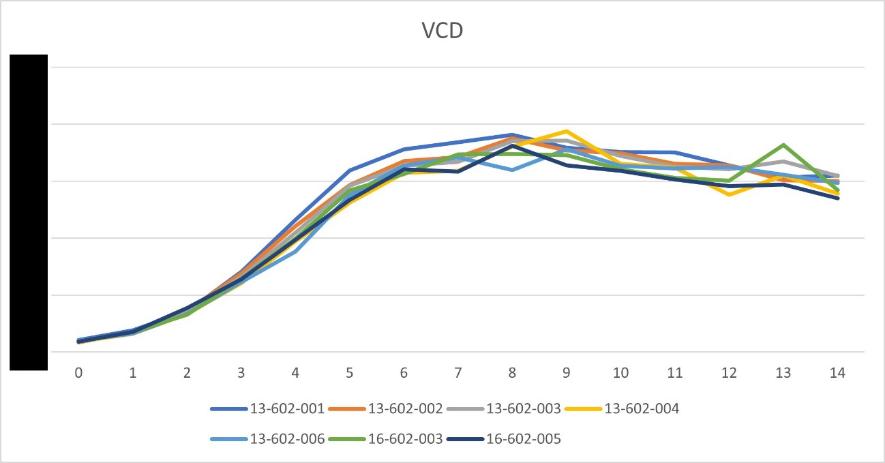
351 Dr Mather agrees that the data indicates that the VCD rate of change starts to slow after day 5. She also plots the VCD for the Process B batches, and notes that consistent with the Process A batches plotted by Dr Croughan the VCD rate of change also slows by day 5. She considers that the slower rate of growth after day 5 indicates that for both Process A and Process B the cell cultures are entering a pseudo-plateau phase before the temperature shift occurs on day 6. In that phase, she says cell growth and cell death are in balance, resulting in a stable culture density, but the culture is staying relatively constant as cell growth and death are equal – that is, the cell density is no longer increasing. Dr Mather considers that this is significant, because in her view, once a cell culture enters the pseudo-plateau phase, it will not return to a population growth phase unless there is a significant change to the culture conditions to induce substantial growth.
352 There is a measure of agreement between the experts on this point. Whilst the temperature shift occurs on day 6, the growth rate changes on day 5. They agree that a metabolic shift occurs at that point. They disagree as to its significance. Dr Croughan does not consider that the cells are reaching a stationary or plateau phase at the day 5 point. Rather, he considers that there is a slowing of the rate of growth which is best described as a movement from an exponential phase to a logarithmic phase of growth, however he emphasises that cell growth continues between days 5 and 6. Dr Mather and Professor Mahler consider that there is a slowing of the rate of growth that cannot be reversed without favourable culture conditions, as the cells have started transitioning into the stationary phase after day 5 prior to the temperature shift.
353 Dr Croughan supports his view as to the effect of the temperature shift by reference to the Characterisation Report, which as noted above related to Process A, and which relevantly says:
4.4.4 Temperature Shift Timing
Temperature shift is a well-controlled parameter and the likelihood of temperature shift timing changing from the clinical campaign to the PVR campaign was low. However, we still collected data in the event temperature shift were delayed or if there were future desires to change it. We performed temperature shifts at four, five, six (control), seven and eight days. Though the agitation shifts and fixed daily feeds were designed for Day 6 temperature shift conditions, we used the same agitation shift and feed schedule for all temperature shift conditions.
Changing the temperature shift day greatly affected cell growth, viability, and metabolism. In general, shifting earlier improved viability but reduced VCDs. Shifting later increased peak VCDs but led to low viability. The change in cell mass led to different metabolic profiles; later shifts consumed more glucose. However, the lactate profile was similar among the conditions.
(Emphasis added)
354 Dr Croughan gives evidence that this section indicates to him that the Process A cell culture will achieve a higher peak VCD if the initial culture temperature were maintained beyond day 6 and the feed schedules were adjusted to ensure adequate nutrients. Dr Mather and Professor Mahler dispute that this is the correct construction of the Characterisation Report and other reports from BI, which were prepared in the development of the Process A batches. I refer to this in more detail in section 8.6.4 by reference to the temperature shift experiments below.
355 Another issue in dispute between the experts was the relevance of lactate. In his evidence in chief, Dr Croughan notes that for the 2013 Process A batches, the lactate concentration plateaus around day 5 and begins to fall sharply before the temperature shift. He gives his view that this indicates that the cells have started to consume lactate corresponding to a metabolic shift. However, he did not consider that the lactate levels indicated that the cells were transitioning from one phase to another. As I note below in section 8.6.5 by reference to the lactate data, Professor Mahler and Dr Mather consider that the lactate profile supports their position that by the time of the temperature shift the cells had already started transitioning into the stationary phase.
8.5.2 Dr Croughan’s analysis and criticism
356 In his first affidavit Dr Croughan describes four steps that he takes in his calculations to determine the mpVCD for the Process A 2016 batches, which are reflected in Pfizer’s submissions as outlined above. Here, I provide some further detail of the approach taken by Dr Croughan, and summarise the criticisms of his approach by the other two experts.
357 First, Dr Croughan analyses for each batch, the VCD over the course of the production cell culture to determine the specific growth rate of the cells per day, and from this identifies two growth correlations. The first is from days 0 to 3 which he considers reflects exponential growth. The second is that after day 3 cell growth begins to reduce on a logarithmic correlation, which he considers is likely to be because of the accumulation of lactate and ammonia as well as the increase in osmolality in the first four or five days of the cell culture. He determines the regression coefficient (R2) for exponential and logarithmic curve fits applied to the data, being the fraction of the variation in the data that the correlation accounts for (the closer R2 is to 1, the closer the daily VCD data points conform to the regression lines). He then provides the following graph for the 2016 batch 16-602-003, showing exponential and logarithmic curves fit to the VCD data for the growth correlations he has identified:
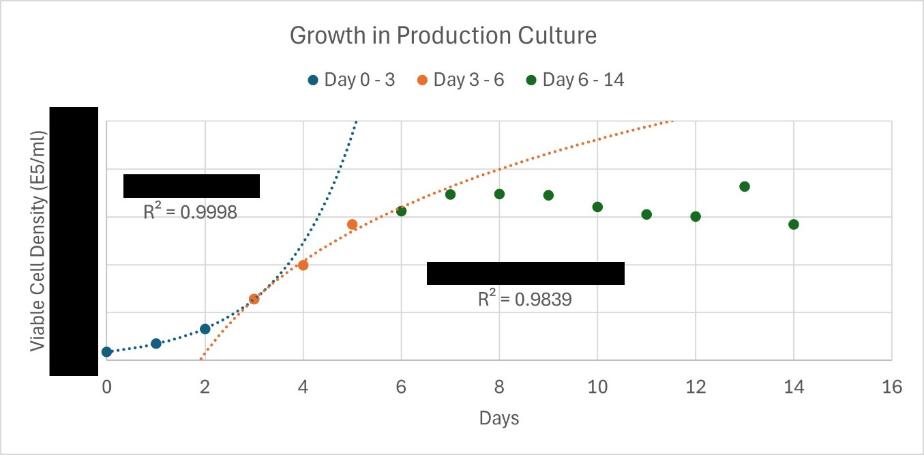
358 Secondly, Dr Croughan determines the increase in osmolality (using 2013 batch data, as he could not locate osmolality, lactate or ammonia data for the 2016 batches) caused by the daily feed schedule and calculates the increase in osmolality that he expects would occur if the day 5 feed was continued past day 6, and plots the expected difference in osmolality between the current feed schedule and maintaining the day 5 feed schedule. He also gives some reasoning as to why he considers it is appropriate to maintain the day 5 feed in calculating the mpVCD.
359 Thirdly, he takes into account the impact of the osmolality increase caused by additional nutrient feed medium added to the cell culture from day 6 onwards, assuming no temperature shift to have occurred on day 6 and that sufficient nutrients are provided. He considers that if those assumptions are made, the cells will continue to grow at the same declining rate as identified in the graph above. On that basis, he extrapolates the logarithmic curve fit from the first part of his calculations, and then to account for increased osmolality from day 6, he applies the linear reduction in growth rate identified in Zhu to the extrapolated growth rates to predict the reduced daily growth rate caused by the increased osmolality.
360 Dr Mather and Professor Mahler criticise Dr Croughan’s decision to proceed on the assumption of a day 5 nutrient feed needing to be maintained in order for the cell culture to reach the mpVCD. I refer to this in section 8.6.3 below.
361 Fourthly, based on the extrapolated and reduced growth rates he calculated in step three, Dr Croughan estimates VCD from day 7 onwards had there been no day 6 temperature shift. He considers that for the 2016 batches, cell growth from day 3 to about day 9 follows a logarithmic growth correlation similar to growth from days 3 to 6, assuming no temperature shift or feed reduction. After about day 9, cell growth declines at a faster rate and no longer follows the logarithmic correlation. He plots this for batch 16-602-003 as follows, where the data points for day 6 onwards are the estimated VCD based on Dr Croughan’s extrapolated growth rates:
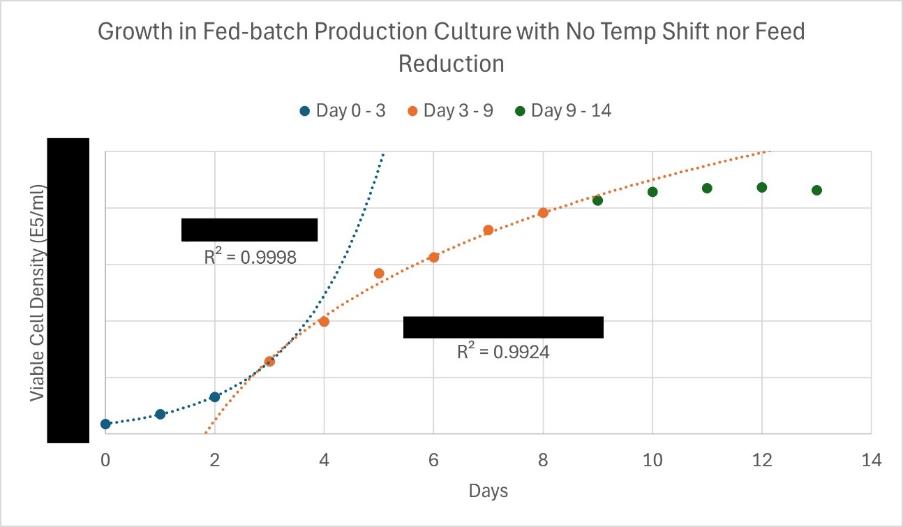
362 His calculations show that the 2016 batches exceed 1.25 of the day 6 VCD at around day 8, and hence would satisfy the mpVCD integer.
363 In his first affidavit, Dr Croughan adopts the materially same methodology for the Process B batches, subject to some nuances (for example, given there was no osmolality data for the Process B Biogen batches, he applied the average of the osmolality data for the Process B SBL batches).
364 Dr Croughan’s calculations showed that the Process B batches, with the exception of batch 3153640 which is batch A of the SBL batches, exceed 1.25 of the day 6 VCD at between about day 7.5 and day 8.5. By way of example, he plots the estimated VCD for batch 18-602E-027 below. On this basis, he considers that all of the Process B batches with the exception of batch 3153640 meet the mpVCD integer.
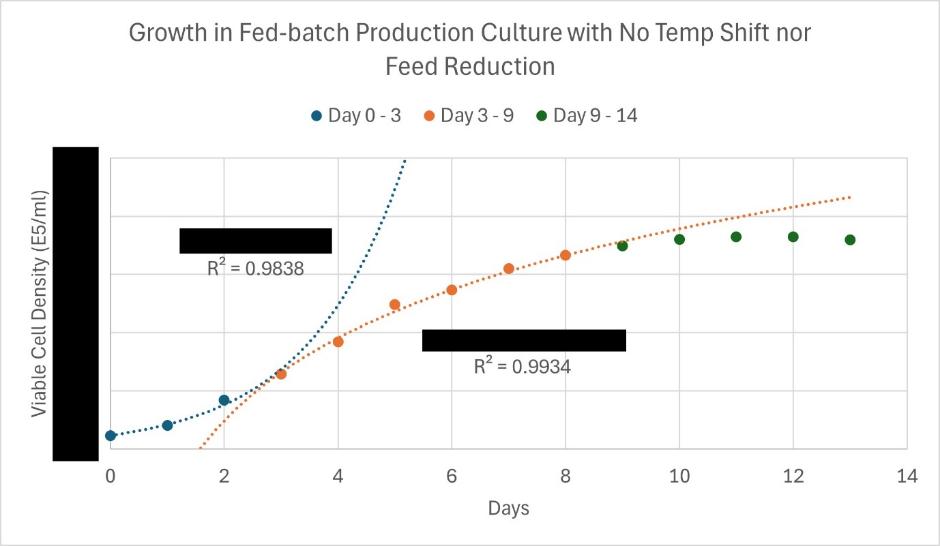
365 As I have noted, Dr Mather and Professor Mahler were critical of the approach adopted by Dr Croughan. Dr Mather also identified errors in some of the data recorded and used by Dr Croughan for his calculations. In Dr Croughan’s affidavit in reply, he notes that criticism and, as I have noted above, prepared a new Confidential Exhibit MSC-25 which replicates or replaces the calculations in his first affidavit. He also notes the evidence given by Dr Mather that there is a “pseudo-plateau” phase before the temperature shift on day 6 and Professor Mahler’s comments that there is an “inflection point” at around day 5 after which the cell cultures are transitioning to the stationary phase. He undertook further analyses of the data and sets out his results in detail in Exhibit MSC-25.
366 In relation to the Process A batches, he notes that the average daily VCDs for all batches follow an exponential curve from day 0 to day 3 and a logarithmic curve between day 3 and day 6. He notes that when an exponential curve was fitted to the daily VCD measurements for these batches, the R2 coefficients were very close to 1 (indicating an accurate fit). Further, he notes that after the temperature shift on day 6, the graphs show that the cells continue to grow between day 6 and day 8, which shows him that the cells were not entering a stationary phase at day 5.
367 In relation to the Process B batches, Dr Croughan gives the revised opinion that the average VCD data for the commercial batches follow an exponential curve from day 0 to day 3, with an R2 value of 0.9995 for an exponential curve fit for those days. However, the average VCD data for the Process B commercial batches for day 3 to day 6 does not follow the logarithmic curve as well as for Process A, having an R2 value of 0.9725 (as compared to 0.9941 for the Process A commercial batches). This was one of the criticisms advanced by the other experts, who considered that a logarithmic curve fit between days 3 and 6 overestimated the growth rate of the cells between days 5 and 6. In light of the criticisms advanced by Dr Mather and Professor Mahler in this regard, Dr Croughan set to one side the averaging across all the Process B commercial batches and instead divided the Process B commercial batches into two groups.
368 For the first group, which consists of 26 of the 47 Process B commercial batches (26 Batches Group), Dr Croughan observed that the average VCD for day 6 was [REDACTED] or more than the day 5 VCD, and applying the logarithmic curve fit to these batches gave an R2 value of 0.9903, being closer to the curve fit accuracy observed for the Process A batches. Also, he notes that a graph plotting the average VCD for this group shows that there is clearly cell growth between day 5 and day 6, after which the cell growth diminishes, following the temperature shift. As a result, for the 26 Batches Group, he does not accept that the cells have moved to a stationary phase. He adds:
In any event, cells in culture are typically not irreversibly “committed” to stationary phase and will, subject to growth-limiting factors, resume or increase cell growth if provided with sufficient nutrients to do so. Cells in death phase, such as after Day 9, are typically unable to resume growth (even if given nutrients).
(Emphasis in original)
369 Dr Croughan concludes that the logarithmic curve fit for days 3 to 6 used in his first affidavit provides an appropriate model for estimating the mpVCD of the 26 Batches Group. The graph he relies upon for this group is as follows:
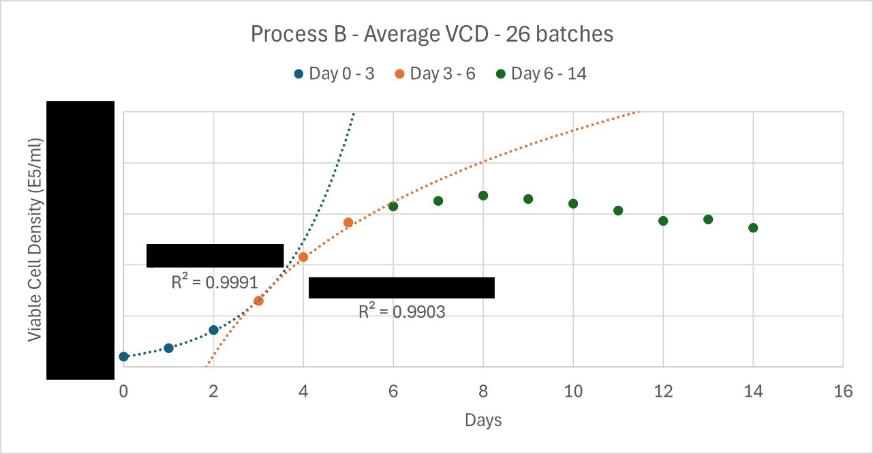
370 For the second group, which consists of 21 of the 47 Process B batches (the 21 Batches Group), Dr Croughan notes that the day 6 VCD was within a margin of about [REDACTED] or less, and sometimes lower, than the day 5 VCD. He accepts that the average VCD for this group, when plotted, does not provide as good a fit to the logarithmic curve than for the 26 Batches Group or the Process A batches, with an R2 of 0.9349 and no growth between days 5 and 6. However, he notes that there is growth between day 6 and day 8 and relies on the following graph plotting the average VCD for the 21 Batches Group:
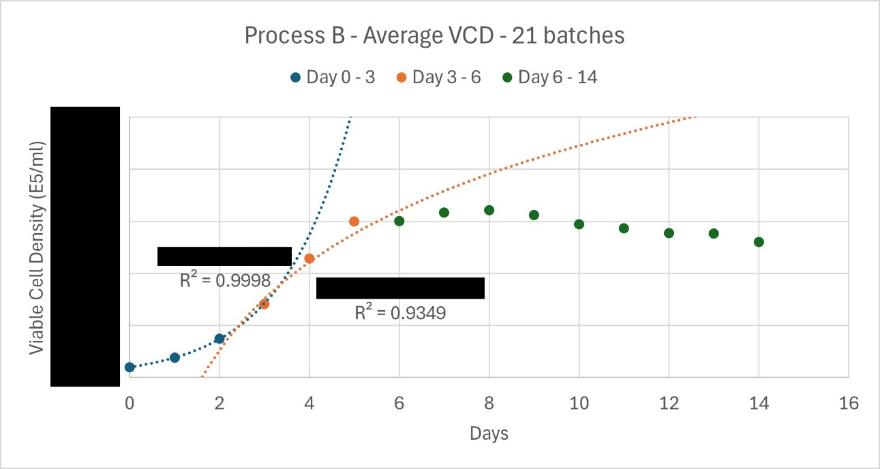
371 Professor Mahler disagrees with Dr Croughan’s process of analysis and his conclusions in relation to Process A and Process B. He considers that the data from the batch records shows that there is an inflection point around day 5, after which the rate of cell growth decreases and the cells are committed to entering a stationary phase, and that this occurs while the temperature is still at 37 ⁰C. He considers that in order for the mpVCD to reach at least 1.25 times the VCD on day 6 in the absence of a temperature shift, the cells would need to have a further inflection point – with an increase in growth – after day 6, or alternatively remain in the exponential phase prior to day 6. In his view, the exponential growth phase of the cell culture extends beyond day 3 and includes at least day 4, and Dr Croughan’s application of a logarithmic curve to the VCD data from days 3 to 6 does not sufficiently take into account the inflection point at around day 5 which shows the initial slowing of the rate of cell growth from then. He does not consider that it is valid to use a logarithmic curve to predict the VCD from day 7 onwards in the absence of the temperature shift.
372 Professor Mahler produced a spreadsheet of the VCD measurements on days 0 to 6 of the production bioreactor for all commercial batches (VCD spreadsheet). For each batch Professor Mahler calculated the daily change in VCD and provided a graph showing:
(a) the VCD measured on each day and a polynomial (order 4) line of best fit (shown by a blue line); and
(b) the rate of change of VCD and a polynomial (order 4) line of best fit (shown by a grey line).
373 In his affidavit evidence, Professor Mahler considered that the data showed three phases: (i) a lag phase following inoculation in which the rate of cell growth is low; (ii) an exponential phase, being the phase of maximal cell growth; and (iii) a stationary phase, where cell growth reaches a plateau and the rate of cell growth is equal to the rate of cell death. He considered that the inflection point is at around day 5 (before the temperature shift) because the line of best fit for the VCD rate of change (i.e. the grey line in his polynomials) reaches a plateau at that point, with minor variations between batches.
374 Professor Mahler considers additional support for this view may be drawn from the lactate concentration data for the 2013 batches. He explains that in CHO cell cultures, lactate is produced during the exponential or growth phase as the high energy demands of the cells are met through oxidative phosphorylation and conversion of pyruvate (produced by glycolysis) to lactate. Typically, there is a peak of lactate concentration at the end of the exponential phase after which the concentration of lactate rapidly decreases. Lactate production in CHO cell cultures slows towards the end of the exponential growth phase and the transition to the stationary phase, leading to a net consumption of lactate in the stationary phase.
375 Professor Mahler refers to the lactate data provided for the Process A 2013 batches to support his view that the lactate concentration data shows a peak in lactate concentration at around day 5, followed by a sharp decline, which is consistent with Dr Croughan’s observations about the lactate profiles summarised above at [355]. Professor Mahler notes that the sharp decline in lactate coincides with the inflection point in the VCD. In this context, he disagrees with Dr Croughan’s view that lactate concentration does not need to be specifically considered. I refer to the dispute over the relevance of the lactate data in section 8.6.5 below.
376 Fundamentally, Professor Mahler disputes the appropriateness of the approach of Dr Croughan in relying solely on VCD data to fit an exponential curve and then a logarithmic curve to the cell growth, and then extrapolating from that logarithmic curve. Professor Mahler’s preference is to identify growth trends based on VCD data and established phases associated with CHO cell culture, and also take into account other data such as levels of key metabolites and the implications with respect to cell growth throughout the cell culture bioprocess. In this regard, he would not rely solely on R2 values from curve fits to justify the identification of different growth trends in a cell culture. Even so, in the VCD spreadsheet for the purpose of engaging with Dr Croughan, Professor Mahler calculates regression values for fitting exponential curves to the VCD data for the commercial batches measured on days 0 to 3 (Dr Croughan’s model) and 0 to 4 (Professor Mahler’s model) and found the average R2 value for his model showed an exponential correlation across all batches analysed of 0.9907, with a standard deviation of 0.0091. He considered that this high R2 value was consistent with his view that the exponential correlation more appropriately fit the data from days 0 to 4 (as opposed to days 0 to 3).
377 Professor Mahler also disagrees with Dr Croughan that the data is best represented with a logarithmic correlation from days 3 to 6, or his extrapolation of that logarithmic curve fit to predict the VCD from day 7 in the absence of the temperature shift.
378 As I have noted above, in the VCD spreadsheet, Professor Mahler reproduces for each impugned batch, first, an analysis of VCD and VCD rate of change from days 0 to 6 together with a graph that plots the VCD data points fitted with a fourth order polynomial curve (blue line below), and the rate of VCD change that he has calculated for each day also fitted with a fourth order polynomial curve (grey line below). The graphs also include an orange line, which represents the VCD required to be reached on day 6 in order to satisfy the mpVCD integer. As I have noted above, Professor Mahler’s polynomials do not seek to extrapolate the expected VCD had the temperature shift not occurred; rather, they plot the VCD data available up to the temperature shift on day 6. Taking an example from the first page of the VCD spreadsheet which was the subject of some of the oral evidence, in respect of batch 16-602-003, the graph prepared by Professor Mahler is:
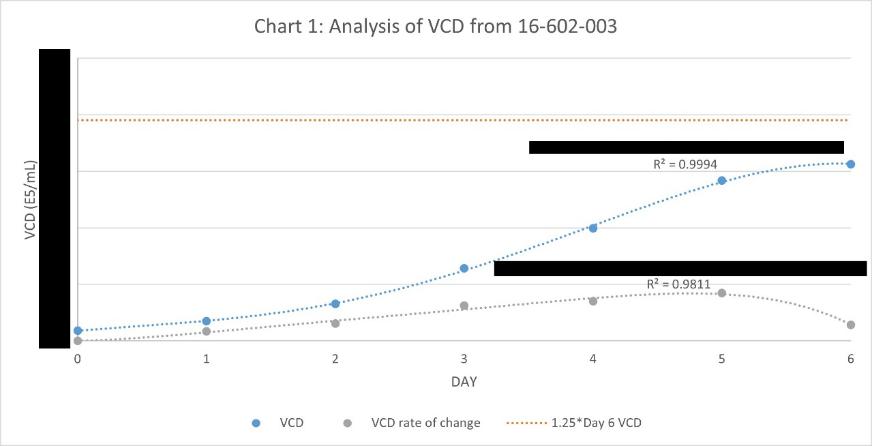
379 Professor Mahler explained that a polynomial is a way of plotting data where it is not linear, showing the “best fit” of a curve through the data points. He explains that polynomials can take any shape depending on the data one is trying to fit them to – they can flex and bend to fit the data. As stated above, the blue line in Professor Mahler’s graphs plots the VCD against the day. The grey line shows the rate of change of VCD for each day – in other words, the rate of change of the blue line. His interpretation of these graphs was summarised in oral evidence:
And from that particular graph there, you can see that – if you look at the blue line, you can – you can see that there is an inflection point somewhere around after day 4, “inflection point” meaning the – the curve is changing direction. Now, that inflection point is manifested in the grey line, where it actually changes direction. So you can see that after day 4, between – or after day 4, into day 5, probably day 5 here, it’s showing that’s where the inflection point is and this is where the growth rate is actually decreasing quite rapidly… so growth rate is decreasing at day 6… what it’s showing is that at day 5 and 6 you get this rapid slowdown – between 5 and 6, and what’s happening is that the line is actually starting to parallel [the red line]… for that blue line to actually reach the red line, which would be 1.25 of day 6… that blue line has to hit that red line somewhere between day 7, 8, maybe 9… There has to be another inflection point in the other direction – in the upward direction to hit that red line, and that would be manifested in the grey line, where instead of going down, it would come back up… all my plots, they’re very similar. They show that that… that line… can’t hit that red line…
8.5.3 The experts’ approaches to the nutrient feed
380 In developing his extrapolation approach, Dr Croughan addresses the second component of his model, which takes into account the nutrient feed.
381 In his first infringement affidavit, Dr Croughan observes that in addition to the temperature shift, another condition that is changed on day 6 for Process A is the amount of nutrients available to the cell culture. He refers to section 4.3.4 of the BIIB602-D Cell Culture Development Report, which relates to Process A and identifies that feeds were growth-based and that the daily fixed feed amounts were determined based on average cell growth. He says that this indicates to him that the daily feed schedule was designed to support average cell growth only. He also gives the opinion that the feed schedule was designed to support only reduced cell growth after the temperature shift on day 6, meaning that the feed schedule from day 6 on will not support higher growth. In this regard he notes that the schedule reduces feed from day 4 ([REDACTED]) to day 5 ([REDACTED]) which he considers “likely reflects the slight decrease in growth rate apparent on Day 5”. He acknowledges that this reduction in growth rate prior to the temperature shift needs to be taken into account in estimating mpVCD and says that a feed schedule of less than day 4 should be applied when calculating mpVCD, because continuing with a feed schedule based on day 4 would result in overfeeding and an adverse increase in osmolality. He notes that the feed for day 6 was about [REDACTED] lower than for day 5.
382 In order to estimate the mpVCD, Dr Croughan considered that it was necessary to determine the peak VCD that can be achieved if the cell culture temperature is maintained at 37 ⁰C and the nutrient feed is maintained sufficient to support cell growth. He proceeds on the assumption that for estimating the mpVCD as if a temperature shift has not occurred, the day 5 feed rate should be continued.
383 He explains his reasoning for making this assumption on the following basis:
(1) Maintaining the feed schedule of day 5 is consistent with maintaining a “first set of culture conditions” as required by integers 1.8 and 1.10 of claim 1;
(2) It is necessary to provide the cells with sufficient nutrients to maintain cell growth, however this must be balanced against the corresponding increase in osmolality that can limit growth if too high;
(3) The reduction in growth rate prior to the temperature shift must be taken into account in estimating mpVCD, such that the feed schedule of less than day 4 should be applied; and
(4) His calculations confirm that the amount of additional feed added to the production bioreactor after day 5, on his assumption of continuing the day 5 feed, would provide sufficient nutrients to support the predicted cell growth.
384 Dr Mather does not consider that the nutrient feeds are changed for the purpose of bringing about a metabolic shift, but rather the Process A and Process B nutrient feed levels change on a daily basis based on the expected needs of the cells for each day. In other words, the feed rates are responsive to growth rates. She does not consider that maintaining the day 5 feed is part of maintaining the “first set of culture conditions”, as Dr Croughan contends.
385 In this regard, Dr Mather notes that for Process A and Process B, feed levels are increased for days 1, 2 and 3 up to the highest feeds on day 4 (ranging from [REDACTED], for Process A) and day 5 (ranging from [REDACTED], for Process A) and then more dramatically reduced following the day 6 temperature shift (ranging from [REDACTED], for Process A).
386 Accordingly, Dr Mather disagrees with Dr Croughan’s assumption that the day 5 nutrient feed levels should be continued for day 6 and subsequent days in order to estimate the mpVCD, or that by doing so Dr Croughan takes an approach which is consistent with the requirement in claim 1 of “maintaining a first set of culture conditions”.
387 Dr Croughan gives the opinion that the feed schedule from day 6 onwards was designed to support only reduced cell growth after the temperature shift on day 6, and would not support higher cell growth. He says that to estimate the mpVCD, it is necessary to maintain the first set of culture conditions with a feed schedule that supports continued growth in the absence of a temperature shift. He considers that part of the “first set of culture conditions” is maintaining sufficient feeds to support growth, and therefore if the feed schedule is followed and the day 6 feed accordingly reduced, this would constitute a change to the first set of culture conditions, even if the temperature was not shifted. He notes in his affidavit evidence, “Whilst different levels of feed could have been chosen to be fed to the cells, for the purposes of my calculations, I chose a daily feed level equal to day 5…” for the reasons set out in (1) to (4) above.
8.6 Consideration
8.6.1 Introduction
388 The factual dispute between the parties is about whether, at the time of the temperature shift from 37 ⁰C to 30 ⁰C on day 6 of the respondents’ production bioreactor cultures, the VCD for the cultures was within the range of 20%–80% of the mpVCD that would have been achieved had the first set of culture conditions been maintained – that is, had the temperature shift not occurred (and, potentially, had a higher nutrient feed been maintained).
389 There is VCD data available for each day of the respondents’ processes. It is graphed in the evidence of Dr Croughan and shows that the VCD continues growing until around day 6, when the temperature shift is applied, at which point growth stops and VCD remains stable, as the cells have been shifted to the production phase by the temperature change.
390 Below are the VCD measurements for each day of the production bioreactor, as graphed in Dr Croughan’s evidence:
(a) Process A batches, which has already been extracted above in section 8.5.1 but is repeated here for ease of reference:
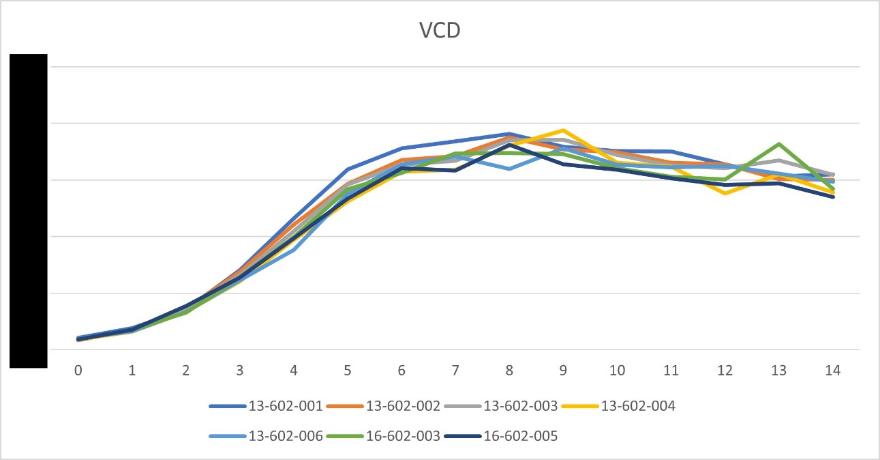
(b) Process B – Biogen batches:
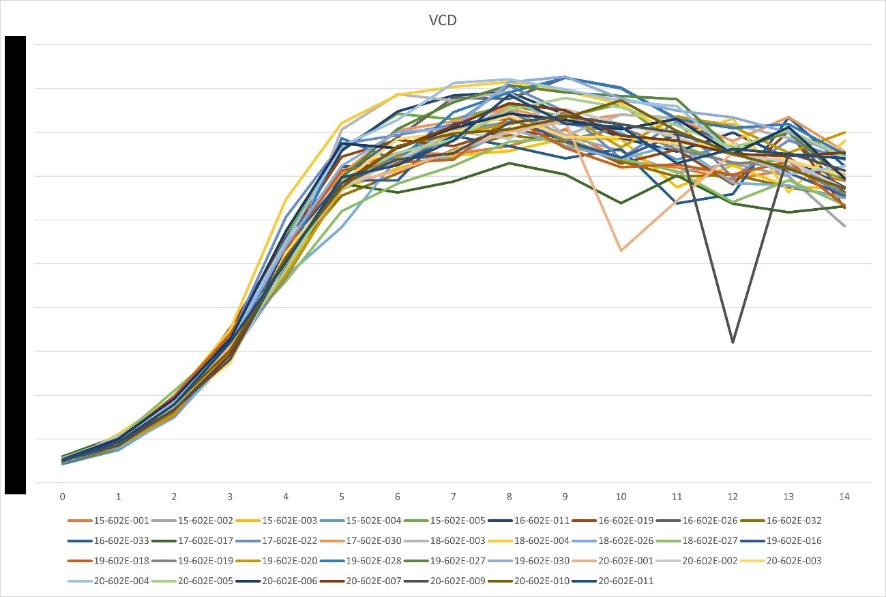
(c) Process B – SBL batches:
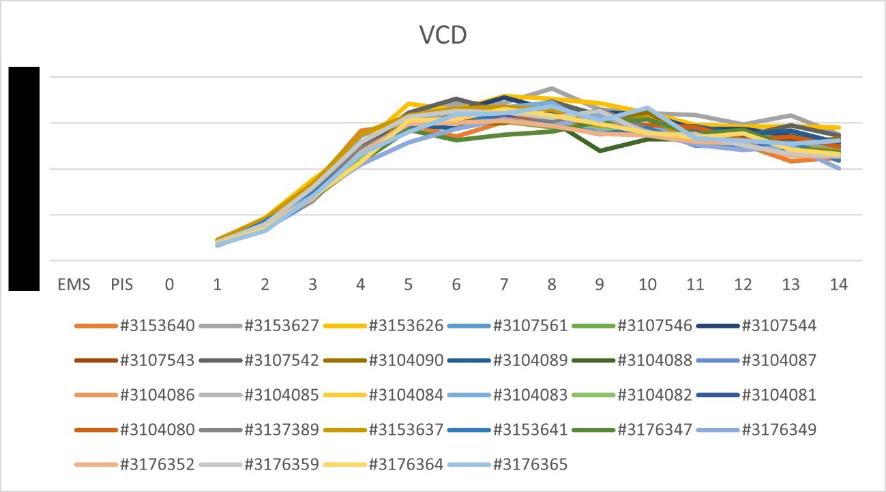
391 In order to demonstrate the presence of the integer, as noted above, Dr Croughan created graphs which extrapolate the hypothetical growth in VCD after day 6 if the temperature shift had not been applied and the feed volume not reduced. The respondents challenge the validity of the extrapolation and offer alternative analyses through the evidence of Dr Mather and Professor Mahler. Much of the debate concerns whether or not there is a slowdown in growth of VCD from day 5 such that it cannot be said that the logarithmic curve postulated by Dr Croughan is appropriate. Dr Mather and Professor Mahler consider that the cells are transitioning into a stationary phase prior to the temperature shift, and so would not have continued growing sufficiently to reach the required VCD at day 6 had the temperature shift not occurred.
8.6.2 Dr Croughan’s extrapolation
392 The approach of Dr Croughan was to apply an exponential curve fit to the available VCD data for days 0 to 3 and a logarithmic curve fit to days 3 to 6. In this way, he extrapolates from the logarithmic curve fit how VCD growth would appear for days 7 and following had the first set of conditions not been changed (noting that he also applies a linear reduction from Zhu to the extrapolated growth rates, to account for increased osmolality). On the basis of that extrapolation, he predicts when the mpVCD will be reached and that, in the case of each impugned batch, the temperature shift takes place at a time when the VCD is between 20% and 80% of the maximum VCD likely to be reached had the first set of culture conditions not been changed.
393 Exponential and logarithmic functions are particular mathematical equations that, when applied to data, assume a particular shape. An exponential curve demonstrates exponential growth; that is, it plots a continuous doubling of growth. Curve fitting involves choosing a mathematical function, such as an exponential or logarithmic function, that best fits a set of data points and applying it to those data points. Once the function has been applied to the data, one can determine how accurate or close the fit it is by reference to the R2 coefficient of the resulting equation. Dr Croughan looked at the VCD data and considered that it was displaying an exponential growth correlation. He verified this by fitting an exponential curve to the VCD data and considering how closely the data correlated with that exponential function (that is, how close to 1 the R2 coefficients for the resulting curve-fit equation were). Although there was some dispute as to when the period of exponential growth ceased (to which I refer below), there was ultimately no real disagreement between the experts that the cells in the impugned batches went through an exponential growth phase and thereafter moved to a different phase. It is the nature of that next phase that forms the primary basis for the dispute.
394 It might be noted there is a biological relevance to the change from exponential growth to a different form of growth. As Dr Mather, a cell biologist, observed:
… if the cells are growing – as cells normally grow, they will grow on an exponential curve. If the – the – the cell numbers in the population deviate from that curve, then something else is happening. Either their cells are dying faster or maybe because of metabolic waste build-up or whatever. So any deviation from that exponential curve says something else is happening in that culture other than just cell growth.
395 Dr Croughan referred to cell biology at various points in his affidavit evidence, noting the different cell growth phases, particularly the exponential growth phase, and also discussing the relevance of other data such as lactate profiles (which he said indicated the cells had begun to consume lactate corresponding to a “metabolic shift” before day 6). However, when it came to modelling the expected VCD if the temperature had not shifted, he tended to consider that the only relevant factor to take into account is the available VCD data points, and placed less reliance on other indicators of what was happening in the cell culture. In my view, this is an unrealistic approach, particularly where the VCD data available for each batch is limited to 3–4 data points for each of the exponential and logarithmic correlations identified. Whilst the VCD data and trends it follows when plotted are undoubtedly important, given that the cells are living organisms, knowledge of how and why they are behaving in a certain way is also important. As I have noted, despite his protestations that only cell numbers matter in the analysis, Dr Croughan himself referred to cell biology when it suited his arguments, most notably when he chose to infer that the decline in the rate of growth at day 5 was because the nutrient feed was too low and the cells were “starving”. I address that point in the next section.
396 Dr Croughan’s use of the logarithmic curve to extrapolate VCD for days 7 onwards, had the temperature shift not taken place, was the subject of criticism. Like an exponential curve fit, a logarithmic curve fit involves applying a particular mathematical equation to a set of data. A logarithmic curve will typically have a parabolic shape which is initially steep and then flattens out, the steepness and position of which changes according to the data it is fit against.
397 In producing the graph with the logarithmic curve, Dr Croughan looked to see if the data followed a mathematical relationship with logarithmic growth, and upon observing that it did he applied a logarithmic function to the VCD data points to create the curve fit. By curve fitting the first three data points with an exponential function, and the day 3 to 6 data points with a logarithmic function, Dr Croughan produced a graph which involved a combination of an exponential curve and a logarithmic curve where there is a “handover” from exponential to logarithmic growth.
398 In closing submissions, the respondents refer to the graphs produced by Dr Croughan in Exhibit MSC-25 showing the average VCD for all of the Process A regulatory and commercial and Process B commercial batches (prior to Dr Croughan splitting the Process B batches):
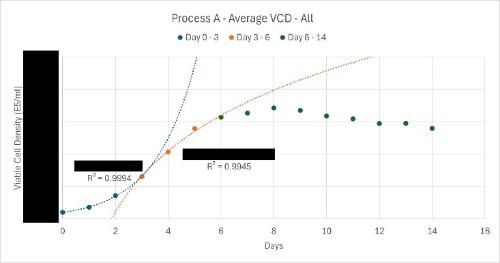
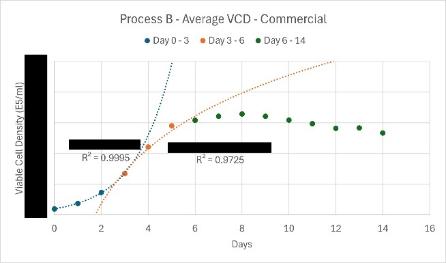
399 For these graphs, the handover from exponential to logarithmic is on the fourth data point (at about day 3) with the logarithmic curve depicted in orange. As noted above, after applying the logarithmic curve fit and determining it was appropriate, he then adjusted the curve using the Zhu linear reduction to account for increased osmolality, which he then used to extrapolate the mpVCD.
400 For the following reasons, I am not persuaded that Dr Croughan’s logarithmic curve fit against the day 3 to 6 data points is a reliable indication of likely cell growth.
401 First, the VCD data demonstrates that there is a downward trend in cell growth between days 5 and 6. Professor Mahler calculates the VCD rate of change for all days for each commercial batch. Dr Croughan calculates specific net growth rate over daily intervals for all days. Below is an extract from a document handed up in closing submissions, showing these calculations. It demonstrates that, regardless of whether Professor Mahler’s or Dr Croughan’s approach is accepted for calculating the change in cell growth rates, for each of the ten batches listed, there was a significant reduction in the rate of growth of the cells between days 5 and 6 (the red line denotes the temperature shift). This was also the case for all of the other commercial batches in the table (noting that Professor Mahler’s VCD rate of change calculations were not done for some batches which were produced in subsequent discovery). The green shading indicates positive cell growth; however, even where there is still positive cell growth on days 6, 7 or 8 (or later), the growth is at a significantly decreased rate than on day 5.

402 The decreasing trend at this point is not sufficiently accommodated in Dr Croughan’s logarithmic graph extrapolations. While the logarithmic curve by its nature does flatten out as it follows a log function, reflecting a decrease in the rate of VCD change, it does not properly reflect the sharp decline in the rate of VCD change between days 5 and 6. For example, in cross-examination it was pointed out to Dr Croughan that for batch 16-602-003 (first row of the above table), while there was a significant decrease in specific net growth rate from day 5 ([REDACTED]) to day 6 ([REDACTED]), his extrapolation then estimated the specific net growth rate between days 6 and 7 (had there been no temperature shift and the feed maintained) as [REDACTED]. Given that for this batch, under the first set of culture conditions, there was a consistent decrease in the specific net growth rate from days 3 to 6, I am not satisfied that had the first set of culture conditions been maintained, the specific net growth rate would have markedly increased between days 6 and 7 (as Dr Croughan’s calculations would indicate). While I note that the specific net growth rate did in fact increase between days 6 and 7 when the temperature shift occurred for this batch, as can be seen in the table above, this was by a very small margin ([REDACTED]) and such an increase did not consistently occur across the batches as can be seen in the table above.
403 It was accepted by Dr Croughan in cross-examination that, when applied to the data, his logarithmic curve fits tended to underestimate the VCD on day 5 and overestimate the VCD on day 6. This can be seen in the graphs showing the logarithmic curve fits extracted above at [398]: the orange line runs below the day 5 data point, and above the day 6 data point, for both the Process A batches and the Process B commercial batches.
404 I also note Professor Mahler’s affidavit evidence in this regard, in which he observed that the R2 coefficients for Dr Croughan’s logarithmic curve fits (against days 3 to 6) were lower than the R2 coefficients for the exponential curve fits (against days 0 to 4), indicating in his view that the logarithmic function was a less appropriate choice to reflect the trend in cell growth:
As I stated in paragraph 49 above, I would not rely solely on R2 values to justify the identification of different growth trends in a cell culture. However, as Dr Croughan places reliance on R2 values, I note for completeness that the average R2 value for the Days 3 to 6 logarithmic correlation is 0.9546, and the standard deviation is 0.0657 (see the spreadsheet entitled "VCD Data Analysis" in Confidential Exhibit SMM-6). This is a lower average R2 value, and a higher standard deviation, compared with the average R2 value and standard deviation of the exponential correlation from Days 0 to 4.
405 When challenged about this, Dr Croughan tended to deflect. In his answering affidavit evidence, he said this was not a valid comparison, and noted that Professor Mahler did not propose any alternative correlation for days 3 to 6 which could be used to predict the VCD without a temperature shift. When asked whether, looking at the specific net growth rate calculation from day 5 to day 6, that rate of change is consistent with a marked decrease in the VCD rate of change between those days (which it in fact is; see the first row above for batch 16-602-003) Dr Croughan said:
… if I look at the data between day 5 and 6 and 6 and 7 and 7 and 8, those are all positive which means it’s not in a stationary phase. The data between 6 and 7 is actually higher than between 5 and 6 which means its growing faster on your point by point basis after day 6 when its supposedly entering a stationary phase.
406 However, the point is not that there is still some positive growth, or that the rate of growth might marginally increase from days 6 to 7; it is that the rate of growth between days 5 and 6 prior to the temperature shift has markedly decreased. As the observation made by Dr Mather quoted at [394] above makes clear, the data demonstrates that something is happening within the culture between days 5 and 6 such that there is a significant slowing of growth. It will not reach the stationary phase until the growth rate is equal to death rate, but there is a significant downward trend in growth that neither Dr Croughan’s modelling nor his evidence explains.
407 Secondly, I have concerns that the approach of Dr Croughan relies on too few data points to be reliable.
408 Dr Croughan’s mathematical modelling depends on there being a clear demarcation between the end of the exponential and the start of the logarithmic phases. This he described as the “handing of the baton” where the first correlation ends and the second starts. However, when pressed with the detailed evidence, he accepted that for ten of the batches (being Biogen commercial batches 16-602E-011, 16-602E-026, 17-602E-022, 18-602E-026, 19-602E-030, 20-602E-002, 20-602E-003 and 20-602E-009, and SBL commercial batches 3153627 and 3153640) it is statistically more likely that the exponential correlation or curve for the batch extends to day 4 rather than stopping at day 3 and that for two batches (being Biogen commercial batches 20-602E-010 and 17-602E-030) there was insufficient data for him to determine if the exponential curve for the batch extended to day 4 rather than stopping at day 3.
409 This gives rise to a first difficulty which is that for at least those batches listed above, only three data points were relied upon to define the logarithmic curve. This brings into question whether the curve is, even on Dr Croughan’s evidence, an accurate representation of the data.
410 When it was put to Dr Croughan that a curve fit using three data points would not be very reliable or accurate, he disagreed, saying “I would have to actually do that analysis”. In fact no analysis as to the accuracy of a logarithmic curve fit to only three data points was done.
411 Professor Mahler considered that it would be difficult to make a reliable or meaningful curve if reliant on only three data points and Dr Mather considered that the more data points available, the more significant the conclusion is and noted that “of course, you can’t go to less than three because a straight line fits any two points”.
412 Dr Croughan did not model any batches on the basis that the “hand over” to the logarithmic curve was from day 4, not day 3 (i.e. using only the day 4, 5 and 6 data points to fit the logarithmic curve). In this context, he accepted that if he were to apply a logarithmic curve to the day 4, 5 and 6 data points only, the resulting fit of the logarithmic equation would be different as compared to a logarithmic curve fit with data from days 3 to 6. He said it would be hard to say how different the curve fit would be until the analysis is performed.
413 Professor Mahler’s evidence, which I accept, is that if one could only curve fit a logarithmic correlation through three points, the R2 value would likely drop below a value where the curve has meaning such that one could reliably or meaningfully extrapolate it to get a value for later days, a point with which Dr Mather agreed.
414 Pfizer submits that the oral evidence of Professor Mahler confirmed that although a day 0 to day 4 (as opposed to day 0 to day 3) exponential growth correlation was more appropriate for some batches, this did not affect whether the mpVCD integer was satisfied on Dr Croughan’s modelling. However, in the questioning upon which Pfizer relies, Professor Mahler was asked to assume an exponential correlation from days 0 to 4 and assume a logarithmic correlation from day 4 onwards, “so adopting the orange curve” and in that context “the orange curve is going to start higher up the blue curve”. He accepted the proposition that if those assumptions were adopted, then the same conclusion would be reached. However, that does not address the fact that, as Dr Croughan accepted, if the logarithmic curve was only being fit with the data points from day 4 onwards, the calculations would have to be re-done – it would not be the same curve in evidence, but rather a different one. In that sense, Professor Mahler properly agreed to make the assumption that he was asked to make, and agreed to the proposition put, but the answer is mathematically meaningless, because the same curve would not apply. Nor does this address the difficulty of relying on only three data points.
415 Thirdly, regardless of whether the exponential curve finishes on day 3 or day 4, in the graphical representations relied upon by Dr Croughan he uses the same data point (on day 3 or day 4) to signify VCD in the exponential phase and also in the logarithmic phase. Dr Croughan explained this by reference to his passing of the baton analogy, where he said “at that point, they’re the same speed, and the hand-off subsequently slows down and keeps on slowing down, actually. But right at that point, they’re the same speed”.
416 Professor Mahler explained the difficulties he had with this approach:
PROF MAHLER: … My point is that – my point is that the first point used in that logarithmic correlation is actually an exponential phase point, and if you’ve only got a few points in that curve, it’s skewing it towards a higher growth than what it should. And this is what I mean about the cell culture dynamics. And it’s a bigger story than that. But I just don’t – I just don’t think it’s valid to include a point, the first point, in a logarithmic correlation where that point is actually not in a logarithmic – where it’s exponential – where it’s shown to be in – it’s shown to be a part of exponential growth.
MS COCHRANE: It’s right, isn’t it, Professor Mahler, that what we have here is a population that is growing but the data that we’ve been provided is data taken only once a day; that’s right, isn’t it?
PROF MAHLER: Yes.
MS COCHRANE: Yes, and so in those circumstances what you’re trying to do is to work out what’s really happening in that system in a continuum, aren’t you?
…
PROF MAHLER: But this is why I disagree, because we talked about designating between zero and three days as the exponential phase for all batches. Now, that’s a hard cutoff. Now, if you have a hard cutoff of three days, what’s to say that the exponential phase is not transgressing across that line and approaching four days? So in other words – and we also showed the other today that some of those batches have exponential phase on four – it carries into four days. By the same token, if the exponential phase carries into four days, wouldn’t some of it transgress into between days 4 and 5? What I’m saying is that – is that it’s not valid to use exponential phase data points for that logarithmic correlation because – because half of – between 25 percent and 50 percent could be points that are actually in exponential phase.
MS COCHRANE: Yes. Thank you. Well, I suggest to you that you are taking not a practical approach to this, given that we have got – only have records taken each day in circumstances where this is a continuous culture.
PROF MAHLER: This is the whole reason why I don’t think it’s an appropriate way to analyse the data. That’s my whole position.
(Emphasis added)
417 I accept as valid the criticisms made by Professor Mahler of the approach taken by Dr Croughan in this regard.
418 Fourthly, as noted above at [365]–[370], following criticisms of Dr Croughan’s approach by Dr Mather and Professor Mahler, Dr Croughan separated his analysis for the 26 Batches Group and the 21 Batches Group and redid his calculations using the average VCD for each of those different groups.
419 Dr Croughan agreed that for the 21 Batches Group the average VCD growth was almost zero or negligible between days 5 and 6. He agreed that for eight of those batches, cell growth dropped between days 5 and 6. Ultimately, Dr Croughan concluded that using his approach, the evidence that the mpVCD integer is satisfied for the 21 Batches Group is weaker than for the 26 Batches Group because his logarithmic curves do not fit the data as well as for the 26 Batches Group.
420 Dr Croughan’s approach of dividing up the data sets drew criticism from Professor Mahler and Dr Mather. Professor Mahler explained that there is a trend in the data for both the Process A batches and Process B batches of a slowdown in growth at around day 5, even though each batch is slightly different. In each case, however, the rate of growth for day 5 is higher than for day 6. Dr Mather summarises the difficulty:
This is exactly why I like to look at the data as a whole because, as Dr Mahler said, there are trends. There are some instances when one point or another or one run or another seems to be outside the trends. I don’t like pulling out the ones that don’t agree with my hypothesis and saying, “These are a poor fit. There must be a problem,” and taking the ones that do and saying “These are a good fit. This must be true.” There is an equal probability that any one of those numbers is slightly different from “reality”.
421 I am troubled by the decision of Dr Croughan to break down the data sets in order to produce graphs that fit with his theory. As Professor Mahler said in the joint expert report in any large data set such as the data associated with Process A and Process B, the data should be examined and assessed in totality, identifying the trends that are indicated by the actual data available. Breaking the data into subsets, extrapolating it and excising data that does not reflect a preferred trend (or hypothesis) is not consistent with that approach. Professor Mahler gives the opinion that rather than dividing the batches into subgroups and speculating upon the reasons for discrepancies, the VCD data should be examined in totality, and trends identified in growth and change in VCD.
8.6.3 The nutrient level assumption
422 As I have outlined above in section 8.5.3, one of the areas of dispute between the experts concerned whether it was appropriate for Dr Croughan to maintain the day 5 nutrient feed as part of the “first set of culture conditions” when extrapolating data to determine the mpVCD.
423 Pfizer submits that the slowing in growth rate of the cells on day 5 may be due to insufficient nutrients feed rather than any transition to a stationary phase. It contends that the fixed feed levels selected for use in the process may have led to underfeeding of the cells. It also submits that even if there was a transition to the stationary phase on day 5, the experts accept that cells in transition can revert to the exponential phase if there is a significant change to culture conditions to induce substantial growth. The respondents contend that the slowdown in cell growth rate between days 5 and 6 is not explained by insufficient nutrients. Rather the reduction in feed levels is a consequence of the slowdown in the rate of growth between days 5 and 6.
424 In oral evidence the experts were taken to Dr Croughan’s methodical examination of the VCD data for each of the impugned batches. The parties were content to refer mainly to batch 16-602-003, being one of the Process A commercial batches, as an example.
425 For that batch, the day 5 feed was [REDACTED], whereas the day 6 feed was [REDACTED]. In his calculations to extrapolate mpVCD, Dr Croughan assumed that the feeds remain at [REDACTED] for days 6 to 13 and also assumed that there is no temperature shift. However, in days 1 to 6 of the actual feed schedule, the feed amounts vary from day to day (being, respectively, [REDACTED] [REDACTED] [REDACTED] [REDACTED] [REDACTED] and [REDACTED] for days 1 to 6).
426 The Biogen documentation did not explain how it arrived at the feed levels. Dr Croughan disputed that there was any link between cell growth rates and feed levels but under cross-examination expressed the view that the Biogen documentation recorded that feeds were in proportion to the increase in “integral viable cell days” expected over the next interval of growth. This, he said, is a process engineering term, which refers to a function of the cell density over the next interval, multiplied by the amount of time, and is reflective of how many nutrients the cells are going to take up. However, he accepted, as the figures reflect, that there was a reduction in cell growth between day 5 and day 6, notwithstanding that the feed level on day 5 was high.
427 As to the cause of the decrease in cell growth, Dr Croughan could not say, and when it was put to him that the higher nutrient feed on day 5 was not sufficient to prevent the marked decrease in growth, he responded:
You don’t know the basis by which – what’s controlling the cell growth rate here. That’s not thoroughly investigated. As Dr Mahler discussed, there’s some buildup of metabolites, lactic acid and ammonia, which may be impacting it, so I wouldn’t necessarily say that’s related to the feed amount. I would comment that the feeds are based on average growth so that – they don’t adjust the feeds to the growth in any particular culture.
(Emphasis added)
428 Dr Mather disagreed and considered that the Biogen documentation explained the approach to feeding. She referred to the Cell Culture Development Report which concerned the development of Process A.
429 In that document, Biogen says of the feeding strategy for Process A:
Daily feeds up to Day 13 were growth-based, determined using the chemically-defined media platform feeding template. Since the temperature shift on Day 6 results in reduced cell growth afterwards, the feeding was correspondingly reduced after Day 6.
…
The fixed feed amounts were determined based on average cell growth. However, there is often variability in cell culture processes; cells can grow better or worse than average trends. Thus, having a fixed feed could potentially lead to overfeeding or underfeeding depending on cell growth of that particular batch. Therefore, we performed overfeeding and underfeeding robustness experiments centered on the average fixed feed…
…
For the most part, overfeeding and underfeeding did not affect cell growth or viability (Figure 4-5) …
(Emphasis added)
430 Dr Mather relied on the statement in the document that daily feeds up to day 13 were “growth based” as a direct indication that feed amounts were based on growth rates and that they were adjusted to a lower amount in day 6, before the temperature shift, because of averaged lower growth rates, concluding that the reduction of feed from day 5 to day 6 was a growth-based determination.
431 Dr Croughan provided an unpersuasive response to defend his position. He said that “they do actually discuss integral viable cell calculations in the Biogen documents”, but does not point to where in the documents this occurs. I consider that to be something of a retreat from his more emphatic position first advanced, which was that the Biogen documents stated that integral viable cell days were used. He does later refer to a figure plotting “cumulative integral cell growth” in the Biogen documentation. His response, however, failed to address the direct statement in the Biogen Document that the feed rate was growth based. He did note that the feed volumes for the first few days of the culture are comparatively low, despite these being the days with the highest growth rates, indicating that feed volumes are not linked to growth. However, ultimately he conceded that there “may be a growth rate adjustment. I don’t know what that was. I mean, it’s too bad that Biogen didn’t disclose that, or – Samsung probably knows what it is…”. His final position was that “clearly, the feeds are primarily based on integral viable cell days… Then there’s some minor adjustment that has to do with how fast those cells are growing”.
432 Professor Mahler agreed with Dr Mather, providing a cogent explanation:
Well, if you look at day 5, day 5 is 37 degrees. Day 5 gets quite a lot of feed. It gets – it gets the second-highest feed level. It has got everything going for it in terms of it should be having a high growth rate, but does it? No, it doesn’t. What happens is the growth rate actually turns down quite significantly. Now the basis for giving day 6, the day 5… growth [sic, feed] amount was because of the slowdown between 4 and 5. Now, the slowdown is even more between days 5 and 6. That’s one point. The second point is that the temperature shift – once the temperature shift happens, what we just read there was the growth will slow. Growth is already slowing. The metabolic shift that has happened at day 5, the metabolism has changed…
433 At a later point in oral evidence, Dr Mather and Dr Croughan agreed that the feed levels were determined by first looking at a series of control bioreactors in which the feed was based on cell growth, and averaging those bioreactor results to fix a daily feed percentage. Once this daily feed percentage was determined, it was implemented as a fixed-feed schedule. In other words, while the feed levels were determined experimentally by looking at cell growth in test bioreactors, they were then fixed at a percentage and not adjusted for each batch – however, they were initially determined based on growth.
434 One further aspect of the nutrient feed issue discussed by the experts was the feed robustness experiments detailed in the Cell Culture Development Report for Process A. These are detailed as follows, in the same extract from section 4.3.4 quoted above:
… we performed overfeeding and underfeeding robustness experiments centered on the average fixed feed. The average feed schedule was set as 100%. For the overfeed condition, the daily feed percentage was increased by 10% for 110% feeding. For the underfeed conditions, the daily feed percentages were reduced by 10% for 90% feeding and 20% for 80% feeding…
For the most part, overfeeding and underfeeding did not affect cell growth or viability… However, underfeeding slightly lowered titer and increased NGNA while overfeeding had no deleterious effects. Therefore, we decided to implement 105% feeding for the clinical manufacturing campaign…
435 Dr Mather considered that the “overfeeding” in the feed robustness experiments indicates that even if feed volumes were increased, as Dr Croughan contended was required, there was no change to the VCD growth. Professor Mahler also noted that when feed robustness was discussed in the Characterisation Report, it was observed that “Over-feeding by greater than 10% led to depressed growth, higher ammonium, and higher osmolality compared to the control condition, which was also undesirable”. In response, Dr Croughan observed that the purpose of the experiments was not to determine mpVCD, and stated that the overfeeding performed in these experiments was only by small percentages of 10% or 20% which was still not enough feed to predict mpVCD.
436 In my view, the Cell Culture Development Report tends to support the view expressed by Dr Mather and Professor Mahler that the decrease in growth rate prior to the temperature drop on day 6 is not explained by a reduction in the feed levels. This tends to undermine the theory advanced by Dr Croughan that, in his hypothetical approach, if the feed levels for day 5 are maintained for days 6 onwards, there will continue to be growth of the VCD.
8.6.4 Temperature shift experiments
437 Both parties call in aid to support their arguments references to experiments relating to the timing of the temperature shift as set out in two documents produced by BI which I have referred to above, being the Characterisation Report and the Cell Culture Development Report. Both documents relate to Process A.
438 Pfizer submits that Dr Croughan’s expectation that the cells would continue to grow, and the VCD would continue to increase, if the temperature shift did not occur, is supported by the temperature shift experiments described in this documentation. However, Pfizer also submits that the temperature shift experiments are “of no value” in assessing whether the mpVCD would actually be met, because they are not designed for this purpose. On the other hand, the respondents contend that the temperature shift experiments support their position.
439 The passage in the Characterisation Report relied upon by Pfizer is set out above at [353]. The Cell Culture Report provides additional information in section 4.3.1 “Temperature Shift”. It was to these passages that Dr Croughan referred to in his first affidavit.
440 The relevant passage from the Characterisation Report is as follows:
Changing the temperature shift day greatly affected cell growth, viability, and metabolism. In general, shifting earlier improved viability but reduced VCDs. Shifting later increased peak VCDs, but led to low viability. The change in cell mass led to different metabolic profiles; later shifts consumed more glucose…
(Emphasis added)
441 Beneath this passage are four graphs as follows:
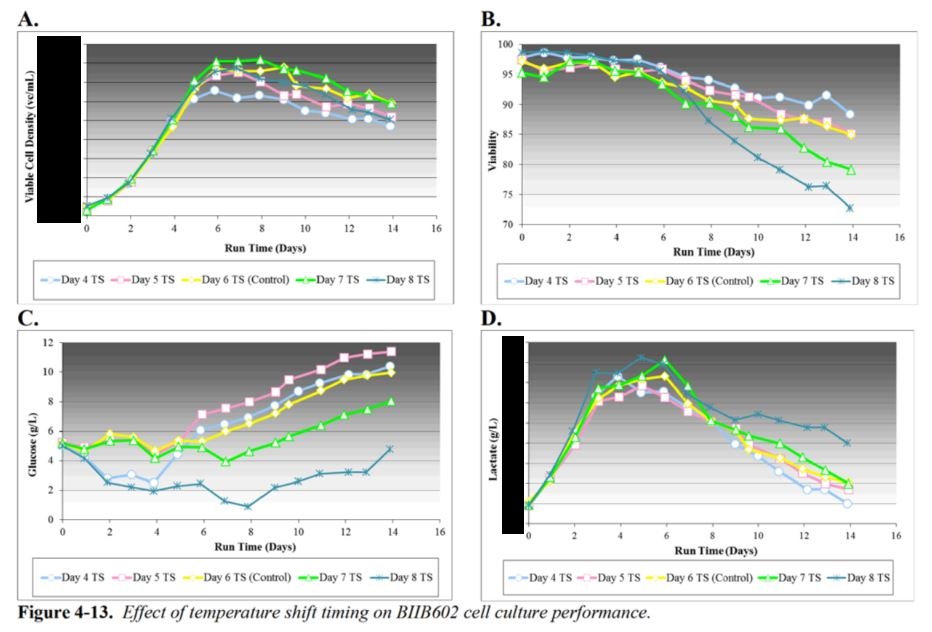
442 The tests involved performing temperature shifts on days 4, 5, 6 (being the control), 7, and 8 of the production cell culture. The same fixed daily feed schedule that was used for a day 6 temperature shift was used for all temperature shift conditions tested. Pfizer relies on the evidence of Dr Croughan to the effect that, as a consequence of underfeeding for those cultures where the temperature shift was delayed (from day 6 to day 7 or 8), the cells did not receive adequate nutrients to support cell growth, rendering the results of the experiments meaningless. In this regard, Dr Croughan considered that the first two sentences quoted above indicate that the production cell culture of Process A will achieve a higher peak VCD if the initial culture temperature were maintained beyond day 6 and the feed schedules were adjusted to ensure adequate nutrients.
443 There is no dispute that the graphs depict five experiments in which the temperature shift takes place on days 4, 5, 6, 7 and 8 respectively. Dr Croughan agreed in his oral evidence that looking at Figure A (plotting VCD against time) for the day 8 experiment (the results of which are reflected in the dark blue line), the VCD levels were slowing between days 5 and 6 and plateau after that, with the maximum VCD being reached on day 7 for that experiment.
444 Dr Mather and Professor Mahler both consider that the temperature shift experiments show that there is no difference in VCD or cell growth rates regardless of whether the temperature shift occurred on day 6, 7 or 8. Professor Mahler gives the opinion in the joint expert report that these experiments reinforce his position that the cells were already transitioning to the stationary phase before the temperature shift. Similarly, Dr Mather observes that even when delaying the temperature shift to day 8, the cell cultures did not reach an mpVCD which would infringe, and in fact the VCD values were already dropping by day 8. In oral evidence, Dr Mather considered that that this experiment is useful because the same amount of feed is being provided between days 5 to 8 but the VCD has not changed noticeably between those days for either the day 7 (bright green line) and day 8 (dark blue line) experiment; rather, it flattens out. She observes that for the experiment where the temperature shift is at day 8, the first set of conditions appear to be very similar and that the highest cell number is achieved on day 6.
445 In response to these opinions, Dr Croughan gave the view that the temperature shift experiments “were not determined to calculate the maximum possible viable cell density”, and instead were concerned with “trying to figure out the impact of this variability in operations”. He says they were “not validly designed experiments to determine that number [the mpVCD]” because they failed to adequately feed the cells, and hence they do not support Dr Mather and Professor Mahler’s position that the mpVCD would not be reached. Dr Mather agreed in oral evidence that the temperature shift experiments were not done to determine the mpVCD, however, she noted that it was “the best we can do with the data we have” and the experiments are still useful for considering cell growth had the temperature not been shifted at day 6.
446 Overall, while I accept that their purpose was not to determine mpVCD and that they used the same fixed feed schedule, these experiments tend to suggest that the cells were declining in growth prior to the temperature shift on day 6. Whilst that does provide some support for the position of the respondents, it has only a tangential bearing on the ultimate issue, which is concerned with the data from the impugned batches. I do not consider that it provides the support which Dr Croughan seeks to derive from this document insofar as he contends that the plateau and decline in levels of cell growth from day 5 onwards are because the feed levels are insufficient and so the cells are starving.
8.6.5 Lactate data
447 The parties disagree as to the relevance of the lactate profiles for the Process A and Process B batches, when assessing growth in VCD. The position of Professor Mahler is that the profile of lactate production and consumption across the batches is consistent with the inflection point around day 5 demarking a transition from the exponential phase to the stationary phase. He considers that the metabolic shift from producing to consuming lactate is something that can be used as an indicator of whether the growth in the cell population is slowing down.
448 Pfizer submits that there is no accepted correlation between lactate production and consumption on the one hand and when CHO cells begin to shift from the exponential growth phase to the stationary phase. The respondents dispute this point.
449 Professor Mahler draws on graphs of the lactate levels for each of the Process A and Process B batches, showing that there was a peak in lactate production prior to the temperature shift, as an indicator that the cells had moved from a lactate production phase to a lactate consumption phase. Dr Croughan disagrees that this is the correct approach to defining phases. He contends that phases should not be defined by metabolism or the metabolic products of the cells, but by reference to cell counts alone.
450 The lactate profiles of the production bioreactor runs were prepared by Dr Croughan and are contained in Exhibit MSC-25 for:
(a) the Process A batches:
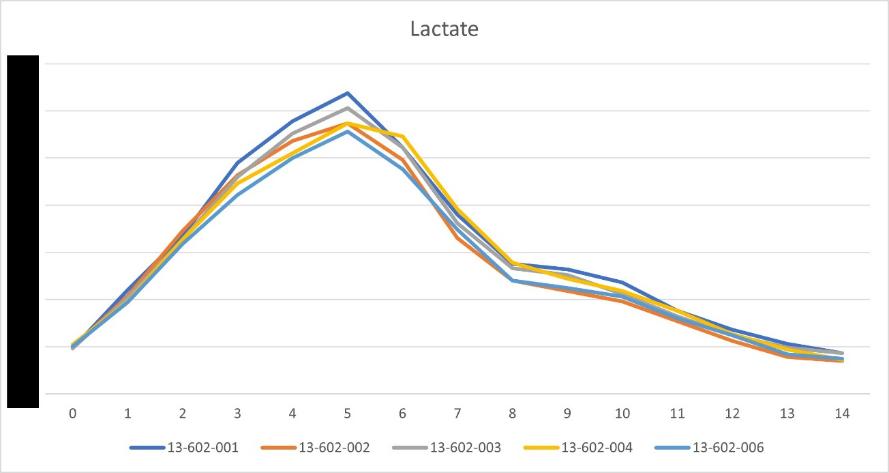
(b) the Process B SBL batches (there are no equivalent profiles for the Process B Biogen batches, because Dr Croughan was not able to locate lactate data in the batch records for these batches):
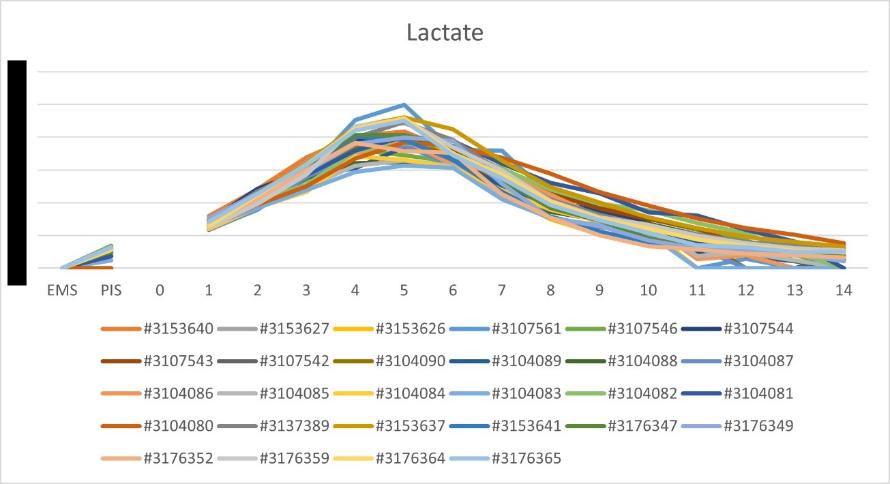
451 Professor Mahler gives the opinion that these lactate profiles indicate that the cell cultures must have been transitioning to the stationary phase around day 5, because the lactate levels started decreasing at this point as the lactate was being consumed. He notes that it is generally accepted that ideally for CHO cell cultures, lactate is produced in the exponential phase as a by-product of fuelling growth, and is consumed by the cells during the stationary phase. Dr Croughan does not dispute that, for Process A, lactate concentration plateaus at around day 5 and begins to fall sharply before the day 6 temperature shift. He discounts this change in his consideration of the mpVCD integer. In his view, because the lactate concentration drops before the temperature shift, maintaining the 37 ⁰C temperature after day 6 (and maintaining nutrient levels) will not affect this trend. Accordingly, he considers that he does not need to account for lactate in his extrapolation of the VCD data in the same way he accounted for osmolality (using the Zhu linear reduction).
452 More relevantly for the current issue, Dr Croughan disputes that there is an accepted correlation between lactate production and consumption in a CHO cell culture on the one hand and a shift from the exponential growth phase to the production phase on the other. He considers that the average VCD data for the Process A batches and Process B commercial batches shows a continued increase in VCD between day 5 and day 8 despite the metabolic shift in lactate concentration occurring at around day 5. He refers to a further Biogen document, titled “Cell Culture Process Characterization Report for SB4_B/BIIB602-E” (Process B Characterisation Report) as demonstrating that there is no absolute connection between the phase of growth and the consumption and production of lactate.
453 In concurrent evidence, Dr Croughan and Professor Mahler debated the relevance of an article entitled “Multivariate analysis of cell culture bioprocess data–Lactate consumption as process indicator” (Le H et al, (2012) 162 Journal of Biotechnology 210–223) (“Le et al”). Dr Croughan considered that it shows that lactate production or consumption cannot be used to reliably characterise the phase of growth of cells. Professor Mahler considered that it supports his view.
454 Figure 2 in Le et al reports differences in performance as indicated by the final antibody concentration (or titre), viable cell density and lactate concentration across 243 production runs. It does so by reference to the following metrics, and shows the top 20% runs in red and bottom 20% runs in blue: (a) distribution of the final titre; (b) variation in VCD; (c) variation in lactate consumption; (d) correlation between final lactate concentration and the final titre. Figure 2 is extracted below:
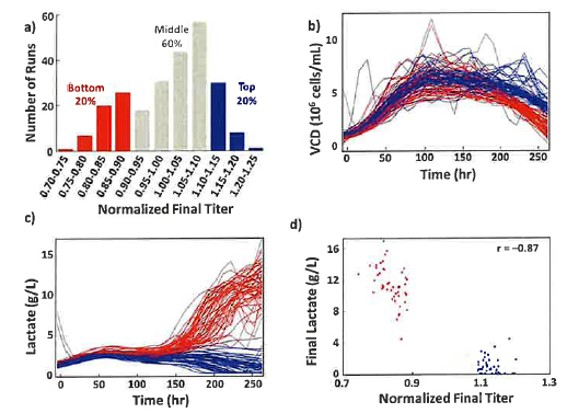
455 Professor Mahler considers that for the blue lines (top 20% runs) in the lactate profiles in graph (c), the lactate peaks at around 60–65 hours and then starts to be consumed. By contrast, for the red lines (bottom 20% runs), the lactate increases throughout the bioreactor runs. The performance of the cell lines shown in graph (d) demonstrates that the titre for the blue (top 20%) runs is much higher than the titre for the red (bottom 20%) runs, and the blue runs had much lower final lactate levels than the red runs. He considers that what these graphs demonstrate is that the most favourable cell lines are the ones that have the lactate consumption phenotype (i.e., the blue runs which consumed the lactate and kept it to low levels throughout the process), as these lines are showing high productivity.
456 Dr Croughan observes that despite Le et al dividing between underperforming (red) and overperforming (blue) bioreactor runs in the figures (a) to (d), the same CHO cell line was used for all of the production bioreactor runs. As he puts it, even though a cell line was chosen with the lactate consumption phenotype, sometimes it expresses that phenotype and sometimes it does not – in other words, the blue runs are when the cells are behaving well and expressing that phenotype, and the red runs are when they are not. Some cells will make lactate in the stationary phase and others will consume lactate in the exponential phase. It follows, in his opinion, that it does not always hold that cells produce lactate in the exponential growth phase and consume it after that. Furthermore, he observes that for graph (b), the stationary or decline phase is determined by the VCD for the second half of the graph. He notes that even though the red runs had increasing lactate levels in the second half of the time period, there was still a clear decline in VCD for those red runs for that same time period. He says this shows why cell culture phases should be defined by the cell count, not by the production or consumption of lactate.
457 Professor Mahler draws a parallel between the results for Process A and Process B in the present case and Le et al. He considers it to be clear that for these processes, the cells that the respondents chose to develop are those with a lactate consumption phenotype because the lactate profiles for Processes A and B (extracted above at [450]) are all consistent across both processes, and they start to produce lactate during the exponential phase up until day 5 and then start to consume. He concludes that this is consistent with the Le et al at Figure 2, where for the blue runs, once the lactate peaks there is a decrease in VCD growth as the cultures transition to the stationary phase.
458 It is apparent from Le et al that there may be variability in results concerning lactose production and consumption even for the same CHO cell line. In that sense, Dr Croughan is correct to point out that Le et al cuts both ways and a given cell line may not behave consistently. However, the point made by Professor Mahler is that where a CHO cell line has been selected and rigorously tested to confirm that it performs in such a way that it produces lactose during the exponential phase and consumes it during the stationary phase, then a peak in lactose production may be indicative of a transition between those phases.
459 The common general knowledge demonstrates that it was known practice in the field to carefully select cell lines in order to meet the requirements for protein production. It is apparent from the debate to which I refer below that this practice has continued. In accordance with that, the gravamen of Le et al, as extracted from the Abstract, is as follows:
Both product titer and the final lactate level were shown to be predicted accurately when data from the early stages of the production scale were employed… The parameters contributing most significantly to the prediction accuracy were related to lactate metabolism and cell viability in both the production scale and the inoculum train. Lactate consumption… was shown to be a prominent factor in determining the final outcome of production-scale cultures. The results suggest possible opportunities to intervene in metabolism, steering it towards the type with a strong propensity towards high productivity…
(Emphasis added)
460 Professor Mahler considers that the consistent result demonstrated by the lactate profiles for the Process A and Process B batches is that the cell phenotype developed for those cultures is one that maximises the production of lactate during the exponential phase and its consumption during the stationary phase. Although that conclusion requires an assumption on the part of Professor Mahler, he notes in the joint expert report that it is a generally accepted assumption made in order to maximise longevity of CHO cell cultures and product titre. He also refers to a different article annexed to Dr Croughan’s affidavit evidence and authored by him (Freund NW and Croughan MS, “A Simple Method to Reduce both Lactic Acid and Ammonium Production in Industrial Animal Cell Culture” (2018) 19 International Journal of Molecular Sciences 385), in which Professor Mahler says this profile of lactate consumption is shown in the following excerpt:
Our new method was inspired partly by the observation that many fed-batch processes exhibit periods of lactate consumption or net lactate production… These periods generally occur later in culture, after the exponential growth phase, often after lactate has accumulated to levels of at least 2-4 g/L or higher…
461 In his affidavit evidence, Dr Croughan said in relation to this paper that “cell clones are often chosen at least partly on the basis of having a lactate consumption phenotype”, but emphasises that some chosen do not and continue to produce lactic acid after the exponential phase, or produce no lactate acid during the exponential phase if grown using a particular type of technology.
462 Although Dr Croughan eschews any reference to cell metabolism in identifying phases and prefers to define phases by reference to cell count alone, I am persuaded that the underlying activity or metabolism of the cells in the production bioreactor should be taken into account in predicting what is likely to happen for the purposes of the mpVCD integer. Dr Mather succinctly put it in her oral evidence when referring to the lactate levels for Process A:
But certainly, as the graph showed, in these conditions with these cells and these media, we seem to be getting a consistent metabolic shift around this time that corresponds with the levelling off of cell growth and levelling off of population growth, I should say.
463 In cross-examination Professor Mahler was taken to chapter 3 (“Kinetics of Animal Cell Cultivation”) in a 1995 textbook entitled “Fundamental & Applied Aspects of Animal Cell Cultivation”, of which Professor Mahler was one of six authors (Exhibit D). In it, the authors state that the inhibitory nature of lactate and ammonia has been the subject of “considerable debate”, and that additions of lactate and ammonia have not conclusively proven any significant inhibition of cell growth or antibody production, “particularly if the additions are gradual and the levels kept below 30 mM lactate for cell growth, 40 mM lactate for antibody production and 8 mM ammonia”. It was put to Professor Mahler that this supports Dr Croughan’s view that a change from lactate production to consumption does not necessarily inhibit further cell growth. Professor Mahler did not accept that proposition at the level of generality at which it was put. He noted that whether lactate was inhibitory to further cell growth would depend on the cell line, and referred to the specific data available which shows a correlation between the slowdown in VCD growth and the change from lactose production to consumption. He adhered to his position that the correlation tends to support the view that the cells in the production bioreactor are transitioning to the stationary phase prior to the temperature shift.
464 Overall, while I do not consider it to be decisive by any means, I am satisfied that the lactate profiles of the Process A and B batches tend to support a view that the cell culture has started transitioning into the stationary phase at around day 5.
8.6.6 Professor Mahler’s polynomials
465 Above, I have summarised the analysis undertaken by Professor Mahler in relation to the VCD and VCD rate of change for the impugned batches. In short, for each batch Professor Mahler calculated the VCD rate of change for days 0 to 6, and plotted on the same graph the VCD data for each day and the VCD rate of change for each day. He fitted each of these datasets with a fourth order polynomial curve: a blue line for the VCD data, and a grey line for the rate of change in the VCD data. Professor Mahler’s polynomials do not seek to extrapolate the expected VCD had the temperature shift not occurred. Rather, they plot the VCD data available up to the temperature shift on day 6. An example of one of these graphs is extracted above at [378]. He concludes from these graphs that there is an “inflection point” in the grey line (VCD rate of change) at around day 5, which shows that the growth rate has started to decrease rapidly between days 5 and 6.
466 Pfizer advances a number of criticisms of the approach taken by Professor Mahler. They submit:
(1) first, that the polynomial correlations do not differentiate between cell culture growth phases;
(2) secondly, that the polynomials do not model cell growth and so Professor Mahler’s analysis in his VCD spreadsheet is meaningless for predicting mpVCD, including modelling growth where there is no temperature shift on day 6;
(3) thirdly, that the polynomials cannot support a finding that cell growth in Process A and Process B batches experiences an “inflection point” on day 5; and
(4) fourthly, that the reliability of Professor Mahler’s evidence is undermined because he purposefully did not model the exponential growth phase of the cells using an exponential correlation.
467 Pfizer further submits that Professor Mahler’s evidence is unreliable in a number of respects including that polynomial analysis is not an approach accepted by those working in the field, citing works written by Professor Mahler and also the Hu text.
468 The respondents defend the position of Professor Mahler.
469 I am not persuaded that Professor Mahler’s analysis set out in his VCD spreadsheet, including the polynomials, should be ignored, or that his evidence in that regard has been discredited. The polynomial curves must be considered in the context of their limited purpose. Professor Mahler does not use the polynomial curves in the same way that Dr Croughan uses his exponential and logarithmic curve as a predictive tool to ascertain cell growth had the temperature shift not occurred, and whether the mpVCD integer is satisfied. Rather the polynomials are used to describe what the available VCD data shows. While Pfizer appears to advance this as a criticism, Professor Mahler does not at any point purport to claim that the polynomials can or should be used to extrapolate the mpVCD. As Professor Mahler says in his first affidavit, he plots the actual VCD measured on each of days 0 to 6 and applies a polynomial line of best fit to this data. He gives the opinion that graphical representations of VCD data against time can provide information on the dynamics of cell cultures and that:
Polynomial curve fits to data are useful when the relationship between the independent variable (Days) and dependent variable (VCD) is non-linear, and assist in identifying overall trends in population cell numbers over time. Exponential and logarithmic correlations can yield more specific information on cell growth.
470 In this context Professor Mahler relies on the polynomial curves in the VCD spreadsheet to identify the disputed aspect of Dr Croughan’s evidence, which is that a logarithmic curve accurately describes what is happening in the production bioreactor after day 5, and particularly between days 5 and 6. No extrapolation is required to do so, because the temperature shift occurs after this on day 6. The data presented by Professor Mahler in the VCD spreadsheet shows the trend in the rate of growth for each of the impugned batches. From looking at the rate of growth graphed against time, it can be seen that there is a marked drop in the rate of growth between days 5 and 6. That is the trend in the data upon which he relies. In that regard, given Professor Mahler’s aim is not to predict the VCD had the temperature shift not occurred, but rather to determine what the trend in cell growth is prior to the temperature shift, it is appropriate that he does not apply exponential or logarithmic functions, both of which presuppose a particular growth pattern.
471 Pfizer criticises Professor Mahler’s polynomial curves because they do not model cell growth and so cannot form the basis for predicting the mpVCD in the event that there is no temperature shift in accordance with the mpVCD integer. However, that was not the purpose of the polynomial curves used by Professor Mahler. They were to show the trends in VCD rate of change prior to the temperature shift. By graphing the VCD rate of change, Professor Mahler was able to identify the point at which the data demonstrates a slowing of the rate of growth of cells. It is in this context that the particular challenges advanced by Pfizer to the evidence of Professor Mahler must be considered.
472 First, Pfizer submits that the polynomial analysis for cell growth is not an approach accepted by those working in the field and that by contrast, Professor Mahler is a co-author of both a text book (Exhibit D) and also an article (Exhibit E) in which exponential and logarithmic correlations are drawn.
473 The criticism that Professor Mahler used and described exponential and logarithmic correlations in his published work does not go far. In his oral evidence he freely accepted that this was so. Nowhere in his evidence in the present proceedings does he contend that such correlations may not be drawn where appropriate data to support them is available, and indeed agrees in cross-examination that “the logarithmic [correlation] can look at the transition”. The gist of his criticism of Dr Croughan’s approach is that there is insufficient data in these circumstances to justify the approach taken of fitting and extrapolating a logarithmic curve and, furthermore, that the extrapolated logarithmic curve produced in this instance is not supported by other available data.
474 Further, as I have noted, Professor Mahler’s reliance on polynomial curves is not to predict cell growth if there was no temperature shift, but to represent graphically the trends in the available VCD data, including the downturn in VCD rate of change between days 5 and 6. In fact, he noted in concurrent evidence that ultimately the polynomial was not even necessary – one could see the that the growth was slowing just by plotting the VCD rate of change against the time, but the polynomial gives an idea of where the sharp downturn in growth occurs. It is this, together with the nutrient feed and lactate data, that informed his conclusions in relation to the mpVCD integer. The evidence does not support the proposition that polynomial curves may not be so used, despite Dr Croughan’s trenchant criticism of them.
475 Secondly, Pfizer criticises Professor Mahler’s polynomial curves on the basis that they all rely on one data point (presumably referring to the inflection point on the grey curve plotting the change in VCD against time) to demonstrate that the cells were transitioning to a stationary phase between days 5 and 6. In this regard, it contends that his conclusions are unreliable and ignore that the remaining VCD data (on day 7 and onwards) showed continued growth of VCD at 30 ⁰C in circumstances where all of the experts agreed that two-point correlations are meaningless. This criticism loses its sting when one appreciates, as Dr Croughan and Pfizer accept, that there is no dispute that the rate of cell growth was slowing from day 5 to day 6. The point of difference between the experts was not the fact of slowing, but the likely consequence. Pfizer adopts Dr Croughan’s view that the rate of slowing would be arrested if the cells were provided with sufficient nutrients and so, despite the significant reduction in the rate of cell growth, once properly fed, the slowing would be arrested and the cells would continue to grow to meet the mpVCD. For the reasons set out in relation to the nutrient level assumption and in relation to Dr Croughan’s extrapolation approach more generally, I have rejected that contention. In any event, I note that while Professor Mahler focuses on the inflection point in the VCD rate of change in his analysis, this is not accurately described as a “single data point conclusion”. Professor Mahler is considering the growth across the first six days of the cell culture, and identifying that there is a marked decrease in that growth that begins on day 5. That is not, in my view, drawing a conclusion from a single data point – it is observing a trend that occurs over time across seven data points.
476 Finally, Pfizer submits that Professor Mahler’s evidence is inherently unreliable because he fell into error in his evidence given in the preliminary discovery application, where he concluded that the cells were in a lag phase between day 0 and day 2. It submits that Professor Mahler accepted in cross-examination that the aim of his evidence was to show that none of the Process A and Process B batches met the mpVCD integer and that he used polynomial curves to do so. Insofar as this is a submission that Professor Mahler’s evidence should be disbelieved because he tailored his evidence to arrive an at outcome that he did not in his professional opinion consider to be correct, I reject it. That proposition was not put to Professor Mahler. Nor do I think that it is supported by the content or manner in which he gave his evidence. I found Professor Mahler to be a knowledgeable and skilled expert in the field who did his best to assist the Court.
477 Insofar as Pfizer submitted that Dr Mather was not qualified to give evidence in relation to the mpVCD integer because the evidence shows that large-scale cell production methods are not matters within her area of expertise, I reject that criticism. The particular skillset of the process engineer on the one hand (such as Dr Croughan) and the cell biologist on the other (such as Dr Mather) have been the subject of consideration in relation to the identity of the person skilled in the art (see section 4 above) where I conclude that the cell biologist and process engineer both have a role in the skilled team. I do not consider that the different skills of each are such that the cell biologist is not qualified to comment on or give opinions in relation to the presence or absence of the mpVCD integer. As I have noted earlier, Dr Mather convincingly explains that in a system where cells are cultured and reproduced, it is not only important to know what is happening with the data but also to know why it is happening. My observation of Dr Mather in the witness box and her many interactions with Dr Croughan indicate to me that whilst each has strengths in different areas, Dr Mather was well able to engage as a cell biologist on matters relevant to the mpVCD integer. I decline to reject her evidence on that topic.
8.7 Conclusion
478 It is necessary for me to be persuaded on the balance of probabilities, for each of the impugned batches, that if the cell culture had been maintained in an initial growth phase under a first set of culture conditions for a period of time it would have grown to a VCD within a range of 20% to 80% of the mpVCD had that first set of conditions been maintained. I am not so persuaded.
479 Pfizer presents a case on the basis of the data available from discovery provided by the respondents. That data does not measure the mpVCD. As a result, Pfizer must rely on the VCD data. This leads Dr Croughan to make several assumptions as to what might happen in the production bioreactor if no temperature shift takes place and nutrient feed was maintained at the day 5 levels.
480 The assumption that if the nutrient feed is maintained at the day 5 level then growth will continue is not well supported by the data, which shows a marked and consistent slowing of growth from day 5. Nor is it explained by reference to the development or apparent purpose of the feed schedule as set out in the supporting documentation relied upon by Dr Croughan. Nor is it supported by the evidence going to the cell biology which indicates that once the cells move from the exponential growth phase to a slowing rate of growth as they transition into the stationary phase, they are unlikely to reverse that trend without a change in conditions (of which there was none at day 5 when the marked downturn in growth commenced). Further, the lactate data supported the position that the cells had started moving into the stationary phase.
481 In my view Dr Croughan does not give a satisfactory explanation for ignoring the downward trend in VCD rate of change demonstrated by the data, whereas Professor Mahler and Dr Mather, drawing from a broader range of indicia, do suggest a credible alternative. In this regard, I consider that Dr Croughan’s treatment of the data by plotting a logarithmic curve from days 3 or 4, and then extrapolating it to predict mpVCD under the first set of culture conditions, is unpersuasive.
482 Taken collectively, for the reasons more fully explained above, I am not satisfied that Pfizer has discharged the onus that lies upon it.
483 Having reached this conclusion I turn briefly (and perhaps unnecessarily) to arguments in relation to onus.
484 The respondents submit that Pfizer could easily and less expensively have provide its case on the mpVCD integer by conducting experiments, citing Jusand at [145]–[146]. I do not consider that the passage cited serves to usher into law the proposition that an adverse inference may be drawn where a party bearing the onus fails to conduct an experiment. Rather, the primary judge and the Full Court in Jusand simply observe that the available expert evidence did not persuade them that the conclusion sought should be drawn. Had other evidence been led – such as experimental evidence – that conclusion might have been different.
485 That is the position here.
486 Pfizer submits that insofar as the respondents criticise the evidence of Dr Croughan for relying on the available data, that criticism is “foreclosed” because the respondents have failed to explain why they did not produce documents on discovery indicating the testing of mpVCD or other VCD data. Pfizer appears to rely on the principles in Jones v Dunkel and Gilead in support of that proposition, which I have referred to above in section 7.2.3. It must be rejected. As I noted above, there is no suggestion that the respondents have failed to meet their discovery obligations and no obligation on the respondents that they conduct tests or produce data of the type sought by Pfizer.
487 Accordingly, I conclude that Pfizer has not established that the respondents use a method in accordance with integer 1.8 of claim 1 for any of the Process A or B batches. I have in section 7.1 above concluded that the medium containing glutamine integer (integer 1.6) of claim 1 is not satisfied in relation to the Process B batches. The consequence is that the infringement case must be dismissed.
9. LACK OF INVENTIVE STEP
9.1 Introduction
488 The respondents plead that the invention claimed in the asserted claims is not a patentable invention within s 18(1)(b)(ii) of the Patents Act as it was obvious and did not involve an inventive step in light of the common general knowledge alone or in light of the common general knowledge together with the following documents in accordance with s 7(3):
(a) US Patent No. 2003/0087372 published on 8 May 2003 (DelaCruz);
(b) US Patent No. 6,656,466 published on 2 December 2003 (Etcheverry) in combination with US Patent No. 5,122,469 published on 16 June 1992 (Mather patent).
489 In their closing submissions, the respondents refine their case by contending that the asserted claims lack an inventive step in several different ways. They contend that lack of inventive step is established either based on (a) the common general knowledge together with DelaCruz; (b) the common general knowledge alone based on the “Super Medium” and “Enhanced Super Medium” in the Mather patent; (c) the common general knowledge alone based on the modified F12-DMEM medium; or (d) if the Court finds that the person skilled in the art would not have used one or both of the Super Medium or the Enhanced Super Medium based on the common general knowledge alone, the common general knowledge considered together with the Mather patent combined with Etcheverry.
490 I have found above in sections 6–8 that none of the asserted claims are infringed by the methods used by the respondents to produce the BRENZYS Products. The patent expired on 26 August 2025. Accordingly, the commercial significance of the validity challenge is somewhat diminished.
491 The respondents rely on the evidence of Dr Mather in support of their case. Pfizer relies on the evidence of Dr Croughan.
492 Pfizer accepts that if claim 2 is found lacking an inventive step then each of claims 1, 5 and 33 will also lack an inventive step. It also accepts that if claim 38 lacks an inventive step then claim 37 will also lack an inventive step. Otherwise, it maintains the independent validity of the balance of the asserted claims.
9.2 The relevant law of inventive step
493 The following paragraphs reproduce a summary of the relevant law of inventive step set out in Merck Sharp & Dohme Corporation v Wyeth LLC (No 3) [2020] FCA 1477; 155 IPR 1 at [246]–[256] (Burley J).
494 Section 18(1)(b)(ii) of the Patents Act provides that an invention is a patentable invention for the purposes of a standard patent if the invention, so far as claimed in any claim, involves an inventive step when compared with the prior art base as it existed before the priority date of that claim.
495 Sub-sections 7(2) and (3) provide:
(2) For the purposes of this Act, an invention is to be taken to involve an inventive step when compared with the prior art base unless the invention would have been obvious to a person skilled in the relevant art in the light of the common general knowledge as it existed in the patent area before the priority date of the relevant claim, whether that knowledge is considered separately or together with the information mentioned in subsection (3).
(3) The information for the purposes of subsection (2) is:
(a) any single piece of prior art information; or
(b) a combination of any 2 or more pieces of prior art information;
being information that the skilled person mentioned in subsection (2) could, before the priority date of the relevant claim, be reasonably expected to have ascertained, understood, regarded as relevant and, in the case of information mentioned in paragraph (b), combined as mentioned in that paragraph.
496 By s 7(2) an hypothetical person skilled in the art, notionally possessed with the common general knowledge as it existed before the priority date, must find the invention to be obvious, whether or not the common general knowledge is supplemented by prior art information within s 7(3): AstraZeneca AB v Apotex Pty Ltd [2015] HCA 30; 257 CLR 356 (AstraZeneca (HC)) at [18] (per French CJ).
497 The law concerning the requirement for an inventive step reflects a balance of policy considerations in patent law of encouraging and rewarding inventors without impeding advances and improvements by skilled, non-inventive persons: Lockwood Security Products Pty Ltd v Doric Products Pty Ltd (No 2) [2007] HCA 21; 235 CLR 173 (Lockwood No 2) at [48] (Gummow, Hayne, Callinan, Heydon and Crennan JJ). The cases over the years have made a number of statements as to what is required to answer the “jury question” of whether or not an invention is obvious. It is a question of fact. The question is not what is obvious to a court, but depends on analysis of the invention as claimed having regard to the state of the common general knowledge, any information relied upon for the purpose of s 7(3), and the approach taken to it by the person skilled in the art: Lockwood No 2 at [51].
498 As a basic premise, the question is always “is the step taken over the prior art an ‘obvious step’ or an ‘inventive step’”? This is often an issue borne out by the evidence of the experts: Lockwood No 2 [52]. Whilst the question remains one for the courts to determine, the courts do so by reference to the available evidence, including that of persons who might be representative of the skilled person in the art: AstraZeneca (HC) at [70] (Kiefel J, as her Honour then was). Various formulations of the question have been set out in the cases. In R D Werner & Co Inc v Bailey Aluminium Products Pty Ltd [1989] FCA 57; 25 FCR 565 at 574 Lockhart J said that there must be “some difficulty overcome, some barrier crossed”. A “scintilla of invention” is sufficient to support the validity of a patent: Aktiebolaget Hässle v Alphapharm Pty Limited [2002] HCA 59; 212 CLR 411 (Aktiebolaget Hässle v Alphapharm (HC)) at [48] (per Gleeson CJ, Gaudron, Gummow and Hayne JJ). In Allsop Inc v Bintang Ltd [1989] FCA 428; 15 IPR 686 at 701 the Full Court (Bowen CJ, Beaumont and Burchett JJ) noted that for the invention to be inventive, it must be “beyond the skill of the calling”.
499 Although identified as a single person, it is established that the person skilled in the art may be a composite or team of persons: General Tire & Rubber Co Ltd v Firestone Tyre & Rubber Co Ltd [1971] 7 WLUK 130; [1972] RPC 457 at 485. The hypothetical construct represented by that notional team is intended as an aid to the Court in addressing the “hypothetical question of whether a person, with the same knowledge in the field and aware of the problem to which the patent was directed, would be led directly to the claimed invention”: AstraZeneca (HC) at [70].
500 In AstraZeneca (HC) French CJ noted at [15] that relevant content was given to the word “obvious” by Aickin J in Wellcome Foundation Ltd v VR Laboratories (Aust) Pty Ltd [1981] HCA 12; 148 CLR 262 at 286, where Aickin J posed the test:
whether the hypothetical addressee faced with the same problem would have taken as a matter of routine whatever steps might have led from the prior art to the invention, whether they be the steps of the inventor or not.
501 At [15] French CJ (with whom Gageler and Keane JJ and Nettle J agreed) explained:
The idea of steps taken "as a matter of routine" did not, as was pointed out in AB Hässle, include "a course of action which was complex and detailed, as well as laborious, with a good deal of trial and error, with dead ends and the retracing of steps". The question posed in AB Hässle was whether, in relation to a particular patent, putative experiments, leading from the relevant prior art base to the invention as claimed, are part of the inventive step claimed or are "of a routine character" to be tried "as a matter of course". That way of approaching the matter was said to have an affinity with the question posed by Graham J in Olin Mathieson Chemical Corporation v Biorex Laboratories Ltd. The question, stripped of references specific to the case before Graham J, can be framed as follows:
"Would the notional research group at the relevant date, in all the circumstances, which include a knowledge of all the relevant prior art and of the facts of the nature and success of [the existing compound], directly be led as a matter of course to try [the claimed inventive step] in the expectation that it might well produce a useful alternative to or better drug than [the existing compound]?"
That question does not import, as a criterion of obviousness, that the inventive step claimed would be perceived by the hypothetical addressee as "worth a try" or "obvious to try". As was said in AB Hässle, the adoption of a criterion of validity expressed in those terms begs the question presented by the statute.
(Citations omitted, square brackets in original)
502 The approach proposed by Graham J in Olin Mathieson Chemical Corporation v Biorex Laboratories Ltd [1970] RPC 157 to which French CJ refers is often referred to as the “modified Cripps question”.
503 The application of the modified Cripps question was addressed in Generic Health Pty Ltd v Bayer Pharma Aktiengesellschaft [2014] FCAFC 73; 222 FCR 336, where the Full Court said at [71] (Besanko, Middleton and Nicholas JJ):
We do not think that the plurality in Alphapharm were saying that the reformulated Cripps question was the test to be applied in every case. Rather, it is a formulation of the test which will be of assistance in cases, particularly those of a similar nature to Alphapharm. The plurality did not reject as an alternative expression of the test the question whether experiments were of a routine character to be tried as a matter of course (The Wellcome Foundation Limited v VR Laboratories (Aust) Proprietary Limited (1981) 148 CLR 262, at 280-281, 286, per Aickin J). We do not think there is a divide here in terms of whether an expectation of success is relevant between a test which refers to routine steps to be tried as a matter of course and the reformulated Cripps question. It is difficult to think of a case where an expectation that an experiment might well succeed is not implicit in the characterisation of steps as routine and to be tried as a matter of course. On the other hand, we think a test formulated in terms of worthwhile to try was firmly rejected by the High Court in Alphapharm (see also Pfizer, at 476, [287], per French and Lindgren JJ [Pfizer Overseas Pharmaceuticals v Eli Lilly and Co (2005) 225 ALR 416]). The fact (if it be the fact) that the position in the United States may have shifted does not affect the binding nature of what the plurality said in Alphapharm.
(Emphasis added)
504 In Nichia Corporation v Arrow Electronics Australia Pty Ltd [2019] FCAFC 2; 175 IPR 187 (per Jagot J, Besanko and Nicholas JJ agreeing) the Full Court picked up on the emphasised passage in concluding that, in finding that there were “a number of unknowns” and that the patentee “did not know” that a combination would produce a satisfactory result within the claim, the primary judge strayed from “the test of steps taken in an expectation that they might well produce the invention or a useful result towards a test of an expectation of knowing that steps will produce a useful result based on predictive capacity” (emphasis added) (at [88]–[89]). The relevant test is expecting that the steps may well work, rather than knowing that steps will or would or even may well work (at [99]).
505 In relation to having multiple avenues to try, in Nichia the Full Court adopted as orthodox the statement of Laddie J in Brugger v Medic-Aid Ltd [1996] WLUK 122; RPC 635 at 661:
…if a particular route is an obvious one to take or try, it is not rendered any less obvious from a technical point of view merely because there are a number, and perhaps a large number, of other obvious routes as well. If a number of obvious routes exist it is more or less inevitable that a skilled worker will try some before others. The order in which he chooses to try them may depend on factors such as the ease and speed with which they can be tried, the availability of testing equipment, the costs involved and the commercial interests of his employer. There is no rule of law or logic which says that only the option which is likely to be tried first or second is to be treated as obvious for the purpose of patent legislation.
9.3 The evidence in chief of Dr Mather
506 Dr Mather was asked first to provide an overview of the development and production of therapeutic proteins as at the priority date, being 27 August 2004. Dr Croughan answered that evidence, and Dr Mather further reviewed his answer, and their collective response, with minor parts of disagreement, formed the basis of their common general knowledge summary much of which I have set out in the primer in section 2 above.
507 After providing that background, Dr Mather was asked to answer the task which was:
… how [she] would have gone about producing a fusion protein, such as etanercept, at large scale before the Relevant Date, including the cells [she] would have used, the media [she] would have used, and the conditions [she] would have applied during the production phase.
508 Much of her response is not the subject of dispute from Dr Croughan.
509 Dr Mather knew of the therapeutic protein etanercept before August 2004 and was aware that it was a tumor necrosis factor (TNF) inhibitor, initially indicated for rheumatoid arthritis and marketed under the name ENBREL. She was aware TNF is a family of cytokines implicated in the immune response and that induction of cellular responses mediated by TNF is initiated by TNF’s binding to specific cell receptors, known as TNFR1 and TNFR2. Dr Mather also knew that etanercept was a significant therapeutic protein and was a first in class therapeutic protein for autoimmune disorders, although she had not worked on it or in its production before. She considered that the task requires production at large scale. As etanercept was indicated for the treatment of autoimmune disorders, which have relatively large patient populations, Dr Mather understood that large scale production was warranted and she would have gone about developing a production process at the scale of between 10,000 to 12,000 litres of suspension culture.
510 Dr Mather notes that by August 2004, CHO cells were the most commonly used cells for large scale therapeutic protein production and had been extensively studied and characterised. Accordingly, she would select CHO cells as the host cell.
511 It would be necessary for the gene of interest to be transfected into the host cell. She would, in concert with the molecular biologist in the team, undertake the transfection process and prepare the cell line expressing the etanercept as the desired fusion protein and then assess the transfected cell lines to identify stable and highly productive lead clones.
512 Dr Mather gives evidence that she would develop a fed batch process to be run for at least 7 to 10 days, given the increased cell densities and protein titres achievable with fed batch mode of operation. The 7 to 10 day duration would be necessary, in Dr Mather’s opinion, to get the cell density and titre to appropriate levels.
513 When it came to the medium, Dr Mather considered that a serum-free medium would be chosen for a number of reasons which have been referred to above in section 2, including biosafety concerns. She would use an enriched medium, being a medium enriched with nutrients and components necessary for increased growth, including a high concentration of amino acids, which are necessary so that high cell density, and therefore increased production, can be reached.
514 In their concurrent evidence, Dr Mather and Dr Croughan agreed that each of the steps of transfecting the CHO cells, selecting and preparing the best clones, and the selection of a fed batch process a serum-free medium for use were uncontroversial and would be taken as a matter of course by the skilled team. Those steps form part of the agreed common general knowledge.
515 There is also no controversy that the skilled team would use a biphasic cell culture process with a temperature reduction after the initial growth phase when the VCD of the culture reached between 50% and 75% of the mpVCD absent a temperature reduction.
516 The selection of details concerning the type and qualities of the medium represent the focus of the controversy between the experts.
517 In relation to the contents of the basal medium, in her evidence in chief, Dr Mather gives evidence that she considered that the F12-DMEM medium would be a “good starting point” being a medium originally devised for growing cells in defined serum-free conditions which subsequently became commercially available for use in growing cells at low or high densities, with or without serum.
518 As F12-DMEM medium is serum-free, she would add amino acids to the basal medium and would test levels of amino acids, other than glutamine, increased by 2, 5 and 10 fold. She would not increase the glutamine concentration to this level as she was aware that it would lead to increased ammonium production which is detrimental to cell culture. Instead, she would adjust the level of glutamine to 500 mg/L for each of the tested mediums.
519 Dr Mather provides a table which extracts a list of the amino acid amounts for the F12-DMEM medium from a textbook that she co-wrote entitled Introduction to Cell and Tissue Culture, and adds columns to the list including the concentrations for that medium with the amino acid levels increased by 2, 5 and 10 times.
520 Dr Mather would then conduct what she describes as routine small-scale experiments involving: (1) growing the lead clones in each of the three media under identical culture parameters; and (2) assessing the impact of the different media on parameters, including cell viability, VCD, specific productivity and titre, as well as quality attributes such as biological activity.
521 Next, Dr Mather would determine the appropriate amounts of glucose and, separately, amino acids, to be added and the timing of the addition by conducting routine small-scale experiments to assess the depletion rates of these components, which would involve taking measurements of the remaining concentration of each individual component within the cell culture medium at the beginning of the cell culture, at peak cell viability (up to 90% viability) and again when cell viability drops to 50% or less.
522 Dr Mather would also determine the content and timing of the feeds using standard media optimisation techniques and knowledge that she considered were part of the common general knowledge.
523 The agreed common general knowledge provides details of the process of media optimisation which may be regarded as reflecting the routine approach, which I have set out in section 2 of these reasons. In short, it was known that it was necessary to optimise media to secure increased growth, protein secretion, viability and phenotypic stability. Two different approaches to media optimisation formed part of the routine approach, which may involve a combination of both to achieve the best results:
(a) sequentially performing dose-response curves on each component, selecting the optimal concentration range and then re-testing. This is done as an iterative process, using the desired end-point (for example, protein titre if the optimisation goal is to maximise protein secretion) to screen; or
(b) changing many media components simultaneously as part of each new experimental condition tested. This risks adding unnecessary nutrients or exceeding the safe limits of certain components. If specific issues arose in relation to an individual media component then the approach in (a) may be used by performing dose-response curves for that component.
524 The process of optimisation involves the basal medium and also the feed medium. It was known that a component with a narrow optimal range should not be added at the start of the culture but would instead be added over the course of the culture to keep the concentration within the optimal range.
525 It was known that excessive quantities of certain components, such as glucose and glutamine, could contribute to the production of by-products that are detrimental to cell culture. Media optimisation was done with a view to managing these unwanted by-products and managing other factors such as carbon dioxide, nutrient limitation and hyperosmotic stress.
526 It was also known that small optimisation adjustments to the medium can lead to significant increases in therapeutic protein titre, which is why it is essential in the development of a process for producing a therapeutic protein at a large scale.
527 Media optimisation studies can be undertaken in simple laboratory culture vessels such as plates, shake flasks and spinners. The results provide key leads for subsequent investigations which are done in validated scale down models, which are miniature versions of large-scale bioreactors and which allow for fed batch cell cultures to be grown to much higher cell densities than in simple laboratory culture vessels so that the full impact of medium optimisation can be observed.
528 Dr Mather gives evidence that in order to avoid ammonium accumulation in the medium she would use lower starting concentrations of glutamine, and feed glutamine in small amounts and at a controlled rate, or not at all. Alternatively, she might use increased amounts of alternative nitrogen sources, such as asparagine, in order to reduce glutamine concentration in the cell culture media. She would test amino acid feeds both with reduced glutamine levels and with no glutamine. Whilst she would not necessarily have been able to predict the ideal parameters in advance of those experiments, the experiments would have identified those parameters. This aspect of her evidence is controversial.
529 Dr Mather then gives evidence of the pH, temperature and osmolality conditions she would employ, and that she would scale-up to 1–10 L to check various parameters and for the final selected clone, would scale-up to 10,000 L or 12,000 L. She would characterise the quality attributes of the resulting product, including biological activity and glycosylation profile.
530 Dr Mather considered that she would have been able successfully to develop a cell culture process that produces a fusion protein such as etanercept at large scale using steps that were routine to the skilled team, before August 2004.
531 After describing these steps, Dr Mather gives evidence that she would have conducted literature searches as part of her response to the task. She identifies and describes in detail the contents of several documents, the only ones of which are now relevant being DelaCruz, Etcheverry and the Mather patent.
532 For DelaCruz, Dr Mather was asked to explain what she would have understood from the disclosure of that document and what she would have done in relation to the task based on the disclosure in DelaCruz when coupled with information and knowledge that she considered to be well known and generally accepted in the field as at August 2004. She was asked to perform the same exercise in relation to Etcheverry and the Mather patent and what she would have done to combine the information disclosed in Etcheverry and Mather.
533 Dr Mather was then asked to consider the disclosure of the patent in suit and provide her interpretation of its terms. After doing so, she was asked by the solicitors representing the respondents to compare her approach to the task with the patent, and in particular, the claims of the patent.
534 In relation to the medium characteristics (being those characteristics defined earlier in these reasons as identified in claim 1 and elsewhere as (i) to (v)), Dr Mather prepared a spreadsheet annexed to her affidavit as Annexure JPM-14 which compares the medium characteristics against seven different media arising from her discussion of the common general knowledge and the prior art documents being:
(a) F12-DMEM x 2;
(b) F12-DMEM x 5;
(c) F12-DMEM x 10;
(d) DelaCruz Medium A;
(e) DelaCruz Medium A 5 mM glutamine;
(f) DelaCruz Medium A 4 mM glutamine; and
(g) the Super Medium disclosed in the Mather patent.
535 Dr Mather gives the opinion that, by reference to JPM-14, a number of the medium characteristics of the asserted claims are satisfied by the media identified in (a) to (g), and provides comments referable to each of the claims.
536 Dr Mather notes that the media calculations in JPM-14 are based on the starting media and do not include feed media. She says that for most of the medium characteristics which are satisfied by the starting media, those characteristics will remain satisfied when the feed media is taken into account and that for a number of them where the medium characteristics are not satisfied by the starting media, they will be so satisfied when the feeds are taken into account, which she then explains in further detail.
537 Dr Croughan responded in some detail to the evidence of Dr Mather. I refer to his evidence in the following section. In reply to Dr Croughan’s answering evidence, Dr Mather provided her responsive opinions to which I refer where necessary below. In her responsive affidavit Dr Mather refers to a further medium arising from the disclosure of the Mather patent which she describes as the “Enhanced Super Medium”, being a modified version of the Mather Super Medium. She gives the opinion that it was generally well known in the field by August 2004. This medium was not included in JPM-14 and so Dr Mather prepared a supplementary spreadsheet comparing it against the quantitative medium characteristics in the claims, which she annexed as Annexure JPM-25. This document was subsequently merged with JPM-14 and tendered as Exhibit 3, to which I refer in more detail below.
9.4 The evidence in chief of Dr Croughan
538 Dr Croughan was asked to respond to the evidence of Dr Mather in relation to her approach to the task. In substance, there is a large measure of agreement between the experts, as I note above. Dr Croughan disagrees that the culture medium and the physical conditions could be developed and tested at small scale for use in large scale production, as in his view the results of small-scale laboratory studies do not represent cell culture performance at large scale and further investigations are required, including validated scale-down models. He agrees that he would have worked with the skilled team to identify suitable clones, and then to test these clones in small-scale experiments using shake flasks and/or spinners with a number of different commercially available batch media, the aim being to identify lead clones based on cell growth, cell viability, titre and possibly cell line stability as well as a characterisation studies. He would then have tested clones in fed batch cultures in shake flasks and/or spinners using a dozen or so combinations of enriched batch and feed media that were commercially available. In each of these experiments, he would have included tests using the Super Medium described in the Mather patent, having become aware of that medium during his time working at Genentech in the 1990s and which he considers was generally well known (though he qualifies this by saying he, and others in the field, would not have expected that the Super Medium would have been broadly useful across all cell lines and proteins). After conducting the experiments in shake flasks/spinners he would have continued with similar experiments in small (2 to 3 L) bioreactors and would extend these experiments to 12 to 15 days.
539 After choosing a top clone he, like Dr Mather, would employ a fed-batch process, choosing a serum-free medium enriched with nutrients and components necessary for cell growth, including a high concentration of amino acids, as the basal medium. He would start with commercially available enriched media and the Super Medium. Unlike Dr Mather, he would not have selected the F12-DMEM medium as a basal medium without making significant adjustments to increase the levels of amino acids. He does agree that the approach taken by Dr Mather of increasing only the levels of amino acids, other than glutamine, by 2, 5 and 10 fold “strikes [him] as reasonable”. However, he would not have adopted the approach of increasing every component of F12-DMEM (other than glutamine) by those multiples, given the impact of increased osmolality. He also specifies further disagreements in relation to the modification of the F12-DMEM media.
540 In relation to the feeding protocol, Dr Croughan gives evidence that the commercially available basal media were typically supplied together with feed media and recommended feed protocols, and he would start with those. However, if he were developing a feed medium and feeding protocol himself, he would have based it on a ‘top-down’ method of taking the basal medium (in this case, the Super Medium) and multiplying the amounts of certain components in it by a multiplication factor to account for components consumed by cells during the culture process, which would be typically a factor of 2 or 3. He would adopt a typical feeding protocol of feeds amounting to 25% of the final volume if fed twice or 16.7% of the final volume if fed three times during the cell culture process, meaning that the culture would start at 50% of its final volume and reach 100% by the end of the feeds. If this process did not result in any promising feeds or protocols, or if he had sufficient time and resources, he would also have inoculated the cells with the Super Medium in a small bioreactor and conducted spent media analyses to determine what media components should be fed.
541 Dr Croughan disagrees with Dr Mather where she says that she would test amino acid feeds with reduced glutamine levels and with no glutamine added in the feed. In particular, he gives evidence that he would not have tested amino acid feeds with no glutamine, noting that glutamine is essential for good cell growth and polypeptide production and as at August 2004 he considered that it was undesirable for glutamine levels to reach zero in the cell culture process, and considered that this was a commonly held view by those in the field. He would typically have tested basal media with from 4 mM to 8 mM of glutamine, and added small amounts of glutamine (2 mM to 4 mM) to the cell culture during feeds at regular intervals to ensure that the glutamine level never reached zero. He disagreed with Dr Mather that an approach of not adding glutamine was generally taken in the field.
542 Dr Croughan gives evidence that if he had identified media that, with the top clone, achieved within 50% of his titre target then he would have taken steps to further optimise that basal medium and the feeds to try and reach at least 100%. If he was unable to achieve 50% of the target, he would have concluded that there was a problem with the chosen cell line and would have sought to improve it or choose a new cell line.
543 In this regard, he gives evidence that if developing a large-scale cell culture process using commercially available enriched media, he would have started with basal media without glucose and glutamine to enable him to adjust and control the amounts of both in the cell culture. He would also reduce the amount of sodium chloride in the media to reduce starting osmolality and enable him to add more amino acids. If using commercially available media, as noted above, he would have started with the feed and feeding protocol suggested by the supplier. If developing a large-scale cell culture process using the Super Medium as the batch medium, he would have tested a number of feeds and feeding protocols in small bioreactors and have identified a feed and feeding protocol based on his titre target for further optimisation.
544 Dr Croughn disagrees with Dr Mather’s evidence that while she would not have been able to predict the ideal parameters of the glucose and amino acid feeds, the experiments she undertook would identify those parameters. His view is that the experiments could, at most, have identified parameters that might have been worthwhile to test and further develop and optimise in a bioreactor with automatic feedback control.
545 Dr Croughan generally agrees that he would have tested within the ranges of pH, osmolality, temperature and temperature conditions proposed by Dr Mather, disagreeing only as to matters within the range.
546 In terms of scale up, Dr Croughan and Dr Mather disagree as to process, when the proposed clones and media would be tested at different scales, and the need to have a low initial seeding density.
547 After responding to Dr Mather’s evidence, the solicitors for Pfizer asked Dr Croughan to consider a modified task being:
…whether [he] expects that [he] might well have been able to produce, and separately, whether a team consisting of people of average skill in their respective fields of expertise… would expect that they might well have been able to produce, a better process for large-scale production of a fusion protein compared to the cell culture processes that existed at the Relevant Date.
(Emphasis added)
548 Dr Croughan then gave a general opinion that to produce a better process (which he defines as roughly two times or more increase in product titre compared to existing processes) the steps that he would have taken would not have been standard or routine, and that he did not consider that this would be achieved using standard processes.
549 Dr Croughan then gave evidence about each of the prior art documents to which Dr Mather was referred.
550 Dr Mather responded to the affidavit of Dr Croughan, and both experts produced a joint expert report which addressed their differences.
9.5 The submissions
551 The respondents submit that although it may have required some experimentation, the evidence establishes that developing a suitable fed batch process was a matter of routine. Referring to the agreement reached between the experts in their joint report and also by reference to their agreement going to much of the common general knowledge, the respondents submit that with the exception of the medium characteristics (i) to (v) as set out in claim 1 (and in other of the asserted claims), the steps in the method claimed in the asserted claims would have been followed as a matter of course, leaving the only issue in dispute to be whether the presence of particular medium characteristics in the claimed combinations lacked an inventive step.
552 The respondents then focussed their submissions on the outcome of the disclosure of each of DelaCruz, Etcheverry and Mather.
553 For DelaCruz, the respondents submit that in producing etanercept in response to the task, the person skilled in the art would have been directly led to test Medium A with 4 mM glutamine concentration as a basal medium, where Medium A was one of the two media compared in DelaCruz’s Example 1, and DelaCruz teaches that glutamine levels of less than 5 mM reduce byproduct accumulation. In so doing they would have conducted testing which followed DelaCruz’s preference, expressed at [0020] and [0036], that glutamine is added in the starting medium and preferably not through feeds during culturing.
554 As to the feeds, the respondents submit that the evidence of Dr Mather and Dr Croughan demonstrates that there are two alternative (but obvious routes) to their design. The first involves testing and determining appropriate amounts feed suitable to the culture based on the common general knowledge. The second is to adopt the “preferred batch feed” described in DelaCruz at [0127] which, they submit, involved the use of no glutamine. The respondents submit that both of these alternatives are consistent with the agreed common general knowledge to the effect that in fed batch culture, nutrients and other media components are added to the cell culture as they are consumed or depleted over time. They are formulated and a feeding strategy is implemented in order to maximise cell density and prolong culture longevity in order to increase protein titre. Feed media is typically added to the cell culture by way of a concentrated solution which limits the feed volume needed to replenish the nutrients. Feed media typically contains amino acids and an energy source, such as glucose.
555 The respondents submit that when using Medium A with 4 mM glutamine, the skilled team would have followed the common general knowledge approach of performing a temperature (or other) shift when the cell density was 50% to 70% of the mpVCD.
556 The respondents then submit that the approach so described yields the outcome that the asserted claims lack an inventive step. On the construction of integers 1.5 and 1.6 that I have accepted to be correct, the glutamine to be taken into account in considering each of the integers is that which is included in formulated basal media or the feed, but not glutamine carried over from the inoculation or arising by any other reason (including secreted or contaminant glutamine).
557 On that basis, the respondents make submissions about the satisfaction of the medium characteristics. They submit that the basal Medium A with 4 mM glutamine, without feeds, falls within each of medium characteristics (i) to (iv) and that, for a fed-batch process involving feeds without glutamine, at least each of medium characteristics (i)–(iii) will be satisfied when the feeds are taken into account.
558 The respondents then refer separately to each of the remaining dependent asserted claims, contending that each lacks an inventive step by reference to the common general knowledge and DelaCruz.
559 The respondents then refer to the “common general knowledge alone”. They contend that the experts agreed that the Mather patent was common general knowledge and that accordingly they are able to rely on all of its contents as forming part of the common general knowledge. They submit that based on its disclosure, the person skilled in the art would have tested the Super Medium and the Enhanced Super Medium variant as part of the routine steps in selecting a medium. Whilst the experts agreed that they would test the Super Medium, the respondents accept that only Dr Mather gave evidence she would have used the Enhanced Super Medium, but submit that Dr Croughan’s explanation for not agreeing was “idiosyncratic” and would not reflect the approach of the person skilled in the art. The respondents then address the medium characteristics in the asserted claims on the basis of the use of those media.
560 As an alternative to the use of the Enhanced Super Medium and the Super Medium, the respondents contend that the skilled team would have conducted testing using the F12-DMEM medium based on the common general knowledge, and submit that this also provides a route by which it may be concluded that the claimed invention lacks an inventive step.
561 Finally, the respondents rely on a combination of the common general knowledge, the Mather patent and Etcheverry. They note that the Etcheverry patent refers to the Mather patent and the Super Medium, and contend that Dr Croughan accepted in cross-examination that he would not have discarded Etcheverry.
562 Pfizer submits that the evidence going to lack of inventive step given by Dr Mather should be approached with caution. It submits that Dr Mather was not appropriately qualified to give evidence about the approach of the person skilled in the art on obviousness, both for the reasons Pfizer has previously given regarding cell biologists not being the addressee of the patent, and then further noting that she is inventive, being a leading research cell biologist who was named one of the top ten innovators in 2002 and is a named inventor on over 200 patents.
563 Pfizer submits that the changing nature of the evidence given by Dr Mather is not reflective of obviousness, contending that in her first affidavit, Dr Mather considered only the F12-DMEM medium but did not suggest the Super Medium was relevant unless it arose from taking a combination of Etcheverry and the Mather patent, and she did not refer to the Enhanced Super Medium at all in her evidence in chief, never suggesting that either medium arose from the common general knowledge alone. It submits that the notion that the super medium might be common general knowledge came from Dr Croughan, which was then used by Dr Mather to suggest that the Enhanced Super Medium was also common general knowledge and was something she would have tested.
564 Pfizer submits that Dr Mather sought to change her approach to feeds during the course of her oral evidence. It submits that in her evidence in chief, Dr Mather said that she would have devised a feeding regimen based on experiments, and then after hearing the cross examination of Dr Croughan, said that she would have regard to [0127] and [0148] of DelaCruz when devising feeds, only to alter that approach again when confronted with her change of position.
565 Aside from these criticisms of Dr Mather, Pfizer submits that the lack of inventive step case must fail at the outset because it is predicated only on the respondents’ construction of “cumulative”, which does not involve calculations including components carried over from the N-1 bioreactor and the effect of the volume added. That submission falls away given the conclusion that I have reached on construction for integers 1.6 and 1.7, which is aligned with the respondents’ position.
566 If, as I have found, the respondents’ construction is to be accepted, Pfizer next submits that the fallacy of the respondents’ inventive step case is that it is not sufficient for the respondents to establish that developing a “suitable” fed batch process is a matter of routine. The invention disclosed in the patent is more than developing an optimised feed medium and feeding protocol for any given cell line to hit titre and product quality targets, but rather it involved “developing a new method of producing a polypeptide at large scale that achieved better titers beyond those targets”. This, Pfizer submits, is reflected in the examples in the patent, referring to Example 14 specifically. A process had already been developed for the production of etanercept which achieved sufficient yields for the purposes of obtaining regulatory approval, but the patent concerned a better method of producing etanercept which offered “substantially greater yields” which involved a medium with certain medium characteristics. For this reason, Pfizer submits that the task given to Dr Mather was flawed. It was not enough for the person skilled in the art to devise a process for producing a fusion protein such as etanercept, with no clear titre results specified. It was necessary for a “better” process to be developed. In this regard, Pfizer notes that Dr Mather rejected Dr Croughan’s opinion that a “better” process would require a 2 times increase in titre production. In any event, Pfizer submits that what the respondents seek to characterise as “routine” is instead a 1–2 year research project, which tests a large number of variables, where Dr Mather could not predict what the variables are, let alone which ones she would ultimately use. It submits that this is not analogous to the dose ranging studies of AstraZeneca (HC), but rather is akin to a complex, detailed and laborious approach of the type found not to be obvious in Aktiebolaget Hässle v Alphapharm (HC) at [58]. It also submits that there would be no expectation of success, given the variability of the approaches taken by Dr Mather, and that the evidence does not establish that each approach would actually arrive at the claimed invention.
567 Pfizer then criticises the approach taken by the respondents (and Dr Mather) to each of DelaCruz, the Mather patent, F12-DMEM and the combination of Etcheverry and the Mather patent.
9.6 Lack of inventive step in the context of DelaCruz
9.6.1 The disclosure of DelaCruz
568 DelaCruz is entitled “Methods of culturing animal cells and polypeptide production in animal cells”. The invention is said to relate to a method of improving the expression of polypeptides in mammalian cell culture systems and in particular is directed to methods of culturing such cells under conditions such as high glucose levels, where environmental and nutritional conditions are controlled and adjusted for optimal results. The invention is also said to relate, inter alia, to polypeptides and pharmaceutical compositions containing polypeptides, and to methods of culturing animal cells in a fed batch cell culture and the overall enhancement of yield from use of such cultures.
569 In the “Background of the Invention” section, the specification refers to the general development of recombinant DNA technology and the utility of polypeptides which can be produced in recombinant cell cultures ([0002]). Reference is made to techniques being developed for enhancing cell growth and polypeptide production by using genetically modified animal cells ([0003]). It refers to the fact that several research groups have looked at the effects of osmolality on cell growth and polypeptide production ([0003]) and others have discussed the effect of glucose concentration on cell growth and polypeptide production ([0004]). It refers to two United States patents that describe improved methods of producing polypeptides by controlling osmolality via control of glucose and glutamine concentration during the process including by controlling osmolality via glucose and glutamine control, which can then control production of potentially detrimental metabolic waste products, such as lactic acid, during culturing. These methods can curtail the increase of osmolality due to accumulation and neutralization of waste products and subsequent replacement of consumed glucose, describing the use of relatively low amounts of glucose in the culture medium, for example, less than about 1 g/L ([0005]). The specification notes that current methods of producing antibodies tend to focus on use of adaptive control strategies or using glucose and glutamine substitutes to limit by-product accumulation, which can be difficult to implement and increase production costs ([0006]). Accordingly, it states there is a need to provide improved and cost-effective methods of growing animal cells that can produce the desired polypeptides ([0007]).
570 Under the heading “Summary of the Invention”, the specification refers to the need to provide improvements to methods for cultivating cells to produce polypeptides, particularly for large scale production ([0008]). The specification refers to general methods that are said to be in accordance with the invention followed by a description of five aspects of the invention.
571 The first general disclosure is of a method of producing a polypeptide in a cell culture comprising:
[0010] (a) growing in a cell culture medium animal cells that contain an isolated nucleic acid encoding a desired polypeptide, and
[0011] (b) culturing the animal cells in a cell culture medium such that they express the polypeptide, wherein glucose is added at the beginning of said culturing or during said culturing to create a glucose concentrations [sic] in the medium of greater than 10 g/L during at least some point of the culturing.
572 Another general disclosure is of a method of growing animal cells in fed batch cell culture comprising growing in a cell culture medium animal cells that contain a nucleic acid encoding a desired polypeptide, and culturing the animal cells in a cell culture medium, wherein glucose is added at the beginning of said culturing or during said culturing to create a glucose concentration during at least some point of said culturing of greater than 10 g/L ([0015]).
573 The first aspect of the invention is described to be a method of producing a polypeptide in a cell culture that includes growing the animal cells in a medium and culturing in a production phase the animal cells in a cell culture medium such that the cells express the polypeptide. Glucose is said to be added to the medium at the beginning of culturing or during culturing to create a glucose concentration in the medium of greater than 10 g/L during at least some point of culturing ([0016]).
574 Embodiments of this aspect are then described in the paragraphs that follow. In a paragraph relied upon by the respondents, the specification says:
[0020] In other embodiments, the concentration of glutamine in the medium during culturing is less than about 5 mM, and preferably no glutamine is added to the medium during culturing. In place of or in addition to glutamine, glutamate can optionally be added to the medium during culturing such that the concentration of glutamate is from about 1 to and including about 10 mM during at least a portion of culturing. A ratio of glutamate concentration to glutamine concentration in the cell culture medium is preferably at least 2:0.5.
(Emphasis added)
575 Further embodiments, including three preferred embodiments, are described in [0021]–[0028]. In [0022] the specification provides that a batch feed comprising cell culture nutrients including glucose is added during culture in one or more increments. This feed may be the sole source of glucose or be used to supplement glucose added by other methods. It also specifies preferred timings for the batch feed to be added.
576 The second to fourth aspects of the invention are described at [0029]–[0031] and are not presently material.
577 A fifth aspect is introduced at [0032] which is said to provide a method of growing animal cells in fed batch cell culture, including growing animal cells in a cell culture medium, and culturing the animal cells in the medium in a polypeptide production phase, wherein glucose is added at the beginning of culturing or during said culturing to create a glucose concentration during culturing of greater than 10 g/L.
578 Embodiments of this aspect are then described from [0033] to [0045]. In a manner similar to [0020], in [0036] the specification refers to an embodiment (within the fifth aspect) where the concentration of glutamine in the medium during culturing is less than about 5 mM and preferably no glutamine is added to the medium during culturing. In place of or in addition to glutamine, glutamate can be added in the same ratio of at least 2:0.5. In [0038] an embodiment of the fifth aspect is described in that a batch feed is added during culturing in one or more increments and the batch feed can be the sole source of glucose or be used to supplement glucose added by other methods, similar to [0022].
579 After describing the figures, the specification provides a description of the preferred embodiments and the method of carrying out the invention.
580 Somewhat later in the specification is the heading “Cell Culture Procedures”, followed by a summary of various mammalian cell culture procedures useful for practising the invention. The cell culture growth phase is described under this heading at [0106] to [0114]. In [0109] reference is made to US Patent No. 5,122,469, which is the Mather patent, the contents of which are incorporated by reference into the specification of DelaCruz, which provides that the disclosure “may be used as culture media for the host cells”.
581 The specification then, under the sub-heading “Polypeptide Production and the Cell Culturing Phase”, refers to four discoveries that led to the invention. The first is that a significant positive effect on production arose by the use of high concentrations of glucose in the culturing phase ([0124]). A second significant culturing discovery concerned the use of increased ratios of glutamate to glutamine in the culturing medium, which enabled exploitation of the higher glucose concentrations to maintain desired osmolality ([0125]). A third discovery concerned temperature shifts employed during culturing, which in combination with high glucose levels and glutamine and glutamate ratios, enhance polypeptide production ([0127]).
582 A fourth discovery received some attention in the evidence:
[0127] A fourth discovery involved use of one or more additions of concentrated nutrient mixtures (“batch feed”) to an existing viable cell culture during the early and mid-production culturing phases. In particular, addition of one or two batch feed mixtures to the production vessel containing the cells, maintained cell viability and productivity. According to the invention, a preferred batch feed had initial media components in concentrated form (e.g., 4-fold concentrated), which when added to the production vessel restored between 30-40% of the original basal amount of the media components (e.g., 30% of original peptone, greater than 100% glucose and 100% trace elements). In certain embodiments, selected components will be omitted or their concentrations (e.g., glutamine) will be reduced in the batch feed to ensure that final concentrations of such components in the production vessel are within desired ranges.
(Emphasis added)
583 There are also several examples of the practice of the invention in the specification. In all examples, CHO cells are used, which have been genetically engineered to secrete recombinant anti-tissue factor antibody using a dhfr/methoxrexate selection method ([0144]).
584 Table 1 provides compositions of Medium A and Medium B. It is Medium A that the respondents rely upon in their submissions. The specification notes that these are serum-free low-protein cell culture growth media, based on a mixture of HAM’S F12 and DMEM media, and that the media were used in the experiments disclosed with some of the components, specifically glutamine and glutamate, being varied ([0145]).
585 Four other examples, each consisting of a set of experiments, are described following which the specification provides at [0171]:
The present invention allows for reduced levels of glutamine, e.g., less than 5 mM, to be used in a cell culturing medium, thereby reducing lactate and ammonium ion accumulation. Surprisingly, the present invention allows an increased level of glucose without causing an increase in by-product accumulation. The higher glucose levels result in increased osmolality and enhanced polypeptide (e.g. antibody) productivity and antibody quality.
9.6.2 The submissions in relation to DelaCruz
586 As I note above, the respondents contend that the person skilled in the art would have been directly led to test Medium A with 4 mM glutamine as a basal medium. In doing so they would have conducted testing that follows the preference expressed in [0020] and [0036] of DelaCruz for glutamine to be included only in the starting medium and not any feeds. As to the feeds to be implemented, the person skilled in the art would have come up with their own feeds based on the conduct of routine experiments. Alternatively, they would have used the preferred batch feed described at [0127], with initial media components other than glutamine in concentrated form. The respondents submit that either approach to feeds is consistent with the common general knowledge. They submit that when using Medium A with 4 mM glutamine, the basal medium formulation (without feeds) would fall within (i), (ii), (iii) and (iv) of the medium characteristics.
587 By reference to Exhibit 3, the respondents rely on Dr Mather’s calculation that the basal medium that the skilled team would use when performing the task having regard to DelaCruz (i.e. Medium A with 4 mM of glutamine) before feeds would be in accordance with the table to which I refer in section 9.6.3 below.
588 On the basis of Dr Mather’s calculations, they contend that this basal (or starting) medium (without feeds) is within each of medium characteristics (i) to (iv), and that for a fed-batch process involving feeds without glutamine, at least each of medium characteristics (i) to (iii) will still be satisfied when feeds are taken into account.
589 Pfizer submits that in relation to medium characteristic (i), the central teaching of DelaCruz is that the use of “abnormally” high levels of glucose in the initial and feed media results in higher yield and reduced by-product accumulation. It submits that the invention of DelaCruz is centred around the creation and maintenance of this high glucose level, and it is in this context that it teaches the use of reduced glutamine – that is, it is not teaching to use low levels of glutamine in the absence of high glucose levels, given the mutual interactions of these culture parameters. Pfizer says that the experts only agreed the person skilled in the art would have followed the recommendation in [0020] of adding no glutamine if they were testing the very high glucose levels in DelaCruz.
590 Pfizer submits that Dr Mather in her calculations does not account for the higher use of glucose taught by DelaCruz, given Medium A contains no glucose, and that insofar as Dr Mather suggests the use of reduced glutamine without a concomitant increase in glucose, she (and the respondents) misinterpret DelaCruz. It submits that had glucose been added to basal Medium A and in feeds, as it contends is taught, then the volume would increase without increasing the amino acid concentration, and consequently the cumulative amino acid amount per unit volume may be less than 70 mM and medium characteristic (i) would not be satisfied.
591 It next submits that DelaCruz teaches the use of feeds to maintain cell viability and productivity (at [0148]) but there is no meaningful disclosure of the composition of any feed medium. As a consequence, Dr Croughan’s evidence is that he would not have been able to replicate the experiments described in DelaCruz. However, Pfizer submits that DelaCruz does teach that at [0127] and [0148] that the addition of the feeds resulted in an increase of more than 100% glucose concentration, where Medium A contains no glucose. It follows that Dr Mather’s calculations, which do not take into account added glucose, are inaccurate and underestimate the proportion of glutamine by not accounting for dilution due to high levels of glucose in feeds.
592 Pfizer makes two further submissions regarding feeds and medium characteristic (i). It criticises the cross-examination of Dr Croughan in which the respondents argue he accepted that he could have come up with his own feeds for Medium A with 4 mM glutamine for a number of reasons. It then also submits that Dr Mather, in oral evidence, accepted that one could not determine whether the addition of feeds would mean the medium characteristics were satisfied, because the feeds were not disclosed. It submits that her oral evidence was that she would feed high concentrations of glucose without amino acids, which contradicts her written evidence that the addition of concentrated amino acid feeds would increase cumulative amino acid amounts per unit volume, and consequently her evidence does not support the conclusion that medium characteristic (i) would be met by the basal medium of Medium A with 4 mM glutamine with feeds being taken into account.
593 For medium characteristics (ii) and (iii), Pfizer repeats its submission that the respondents must establish that the skilled team would not feed glutamine and relies on the evidence of Dr Croughan that it was common general knowledge to start with 4–8 mM glutamine in the basal medium and add 2–4 mM in the feeds. It notes that despite significantly varying the components in the basal media for different approaches, Dr Mather did not then adopt a different approach to feeding (for example, by feeding glutamine) depending on the initial basal medium components, which it submits undermines her evidence. It also says her approach to glutamine concentrations in the basal medium was inconsistent between approaches and so should be discounted, and disputes that it was in fact common general knowledge at the time to use low levels of glutamine and supplement these with other sources such as asparagine or glutamate. It further submits that Dr Mather’s approach to the tasks was inconsistent with this proposition in any event, giving examples of where she did not increase glutamate or asparagine levels to account for lower glutamine concentrations.
594 Pfizer also submits that the disclosures in DelaCruz do not assist the respondents, as the evidence does not support the contention that the skilled team would follow the preference expressed for glutamine to be included only in the starting medium, disputing that this is the teaching of DelaCruz. In this regard, it repeats its submission that DelaCruz only teaches the use of low levels of glutamine when high levels of glucose are used. Further, Pfizer submits that Dr Mather’s evidence does not establish that she would follow the teaching of DelaCruz at [0020] or [0036] and only use glutamine in the starting medium.
9.6.3 Analysis of DelaCruz in the context of the task
595 The dispute concerning the obviousness case as advanced by reference to DelaCruz focussed on the steps that the skilled team would have taken primarily in relation to the medium characteristics. There is no dispute that the skilled team would have ascertained DelaCruz and regarded it as relevant to the task in accordance with the requirements of s 7(3) of the Patents Act.
596 The experts agree that they would have conducted testing using Medium A with 4 mM glutamine as a basal medium, based on the disclosure of DelaCruz. The point of departure is whether the medium so used would satisfy or more of the medium characteristics (including once feeds are taken into account).
597 The calculations by Dr Mather are set out in Exhibit 3 which provides a table showing the components of the basal medium for DelaCruz (and each of the other media relied upon) and her calculations for each media in relation to the medium characteristics (i) to (v). The respondents rely on the figures in that table which for Medium A with 4 mM glutamine are:
Medium Characteristic | Calculation |
(i) a cumulative amino acid amount per unit volume greater than 70 mM | 71.01 |
(ii) a molar cumulative glutamine to cumulative asparagine ratio of less than 2 | 0.94 |
(iii) a molar cumulative glutamine to cumulative total amino acid ratio of less than 0.2 | 0.06 |
(iv) a molar cumulative inorganic ion to cumulative total amino acid ratio between 0.4 to 1 | 0.40 |
(v) a combined cumulative amount of glutamine and asparagine per unit volume of > 16 mM | 8.28 |
598 Taking into account only the basal medium using the DelaCruz Medium A with 4 mM glutamine, each of the medium characteristics (except (v)) is met, as is shown by the table above. Dr Mather gives general evidence in her first affidavit that for most of the medium characteristics which are satisfied by the starting media, she considers that those characteristics will remain satisfied when feeds are taken into account, and proceeds to explain this further in relation to each of the medium characteristics. I refer to this as “general evidence” because Dr Mather does not undertake any quantitative investigation in relation to each of the individual media as to how a specific feed schedule will affect the final outcome; that is, her calculations in Exhibit 3 are only undertaken for the basal media. This became a point of contention, particularly in relation to medium characteristic (i). I address each of the medium characteristics in further detail below.
599 Medium characteristic (i) requires that the medium have a cumulative amino acid amount per unit volume greater than 70 mM.
600 As discussed in section 5.4 above at [216] (claim construction), the experts agreed in the joint expert report that in order to determine a cumulative amount per unit volume it is necessary to take into account the sum of the molar amounts of the particular media components added via starting and feed media, divided by the total volume added in litres (although there was disagreement concerning whether the volume of the inoculum should be taken into account in this calculation, which was contended by Dr Croughan to dilute the concentrations of components in the basal medium).
601 Pfizer’s primary contention for medium characteristic (i) is that Dr Mather’s approach and calculation does not take into consideration the teaching of DelaCruz that high levels of glucose are to accompany the reduction in glutamine that is taught. In this regard, Exhibit 3 demonstrates that no glucose is included within the basal Medium A with 4 mM glutamine.
602 The question then becomes whether the large amounts of glucose which would have to be fed to follow the teaching of DelaCruz would alter the final concentration of amino acids in the basal and feed media, putting it below the 70 mM amount per unit volume required by medium characteristic (i). This turns on whether or not the evidence supports the proposition, advanced by the respondents, that the addition of feeds in accordance with the teaching of DelaCruz is likely to result in the cumulative amino acid amount per unit volume remaining above 70 mM, in circumstances where the amount per unit volume in the basal medium is 71.01 mM.
603 The affidavit evidence of Dr Mather addresses this point in general terms. Dr Mather gives the opinion first, that the addition of concentrated amino acid feeds during cell culture will increase the cumulative amino acid amount per unit volume, with the consequence that media that contain greater than 70 mM of amino acids per unit volume in the basal medium will also have a cumulative amino acid amount per volume greater than 70 mM when feeds are taken into account. Secondly, she gives the opinion that basal media that do not contain greater than 70 mM cumulative amino acids per unit volume may reach or exceed this requirement when feeds are taken into account.
604 In his written evidence in response, Dr Croughan does not dispute the first opinion, other than to say that when calculating whether the medium characteristics of the patent in suit would be met by the other media, the volume of the inoculum must be taken into account by applying a dilution factor, which I set to one side given the construction I have adopted. Dr Croughan confirmed in oral evidence that his evidence in [149(b)] of his second affidavit was concerned with Dr Mather’s second opinion, rather than the first.
605 In relation to the second opinion, Dr Croughan says that whether or not a cumulative amino acid amount per volume will be greater than 70 mM when feeds are taken into account is a matter for experimental evidence.
606 There was ultimately no dispute between the experts that DelaCruz taught that a feed could be used with no glutamine provided that large amounts of glucose were also used.
607 While he gave affidavit evidence that he would not have been able to replicate the experiment in DelaCruz because there was no disclosure of the feed medium composition, Dr Croughan accepted in cross-examination that he could have come up with a feed formulation and feeding protocol to use with Medium A with 4 mM glutamine prior to August 2004. He also accepted that in so doing, he would have taken into account the recommendation in DelaCruz that there be no glutamine added to the medium during culturing (i.e. in the feed), provided he was also testing with high glucose levels given his position that the patent “is all about high glucose”. However, Dr Croughan did not consider an approach of feeding zero glutamine to form part of the common general knowledge. By contrast, Dr Mather stated in her affidavit evidence that she did not consider that reducing or eliminating the use of glutamine in the feed was unusual, and that not feeding glutamine was a common strategy. She considered that it formed part of the common general knowledge. She, like Dr Croughan, also considered that DelaCruz taught that the culture was able to tolerate large amounts of glucose without causing damage and this is what she would incorporate in the feeding approach.
608 As I note later in these reasons, I am not persuaded that the evidence supports the proposition that it was common general knowledge that zero glutamine may be used in the feed. But, importantly, DelaCruz taught that this approach may be used.
609 The teaching of DelaCruz also includes, at [0127], that the preferred batch feed had initial media components in “concentrated form (e.g., 4-fold concentrated)”. This accords with the agreed common general knowledge which, in relation to feed media, was that it is typical to add a concentrated solution to the cell culture, which has the benefit of limiting the feed volume needed to replenish the nutrients. Such feed media was known typically to contain amino acids and an energy source such as glucose. These components may be added together as one concentrated feed solution or as separate solutions (for example, one amino acid solution and one glucose solution). As noted, the teaching of DelaCruz is in accordance with that approach, save that high levels of glucose are taught. At [0128], DelCruz states that “glucose can be added as pure glucose or as part of e.g., a batch feed”.
610 Accordingly, it was ultimately the case that there was no dispute between the experts that by adopting the teaching of DelaCruz, they would use Medium A with 4 mM glutamine as the basal medium and that the feed taught would include no glutamine and higher levels of glucose.
611 The question raised by Pfizer is whether a feed that includes the higher levels of glucose so taught would lead to the result that medium characteristic (i) would remain satisfied after feeds, because the per unit volume of amino acids would decrease with additional volume from the fed glucose. Pfizer argues that the addition of significant amounts of glucose in feeds would increase the volume of the basal and feed media together, without increasing the amino acid amounts, resulting in medium characteristic (i) not being satisfied after feeds are taken into account. The question then becomes, does Dr Mather’s evidence that the cumulative amino acid amount per volume would remain above 70 mM after feeds remain true when the high level of glucose required to be fed is taken into account?
612 The respondents contend that in his oral evidence Dr Croughan conceded that the amino acid amounts per unit volume would remain above 70 mM post-feeds, and that accordingly I can be satisfied that medium characteristic (i) is met. For the following reasons I am not so satisfied.
613 First, it was put to Dr Croughan in cross-examination at transcript page 601:
MR LARISH: Yes. Okay. So back to where we were and by reference [to] the 71.01 in DelaCruz medium A with four millimolar glutamine, if that is being fed with the concentrated feed, its correct, isn’t it, that the cumulative amino acid amount would remain over the 70 millimolar?
DR CROUGHAN: Most likely, yes.
(Emphasis added)
614 Dr Mather agreed with the proposition, which accorded with her general evidence in chief to the effect that for most of the medium characteristics which are satisfied by the starting media, those characteristics will remain satisfied when feeds are taken into account.
615 But Dr Croughan’s evidence must be understood in context.
616 In the lead-up to this question being asked, Dr Croughan accepted that feed media was typically added to the cell culture by way of a concentrated solution which included amino acids “plus other substances”. He agreed to refer to this form of feed as the “concentrated feed”. He was also then asked to assume that the “concentrated feed” was the same as the one he agreed he could have come up with for Medium A with 4 mM glutamine at the relevant date.
617 The question that he was asked at transcript page 601 does not identify what is to be included in the “concentrated feed” and, most particularly, whether it includes the additional amounts of glucose identified in DelaCruz. Dr Croughan had earlier rejected the proposition that once one takes feeds into account the cumulative amino acid per unit volume will remain over 70 mM, saying “No, you don’t know the impact of the feeds; they need to be specified”. Dr Croughan’s evidence, albeit given after being asked the above question, was that a feed with glucose does not have amino acids in it, and so glucose feeds would be separate to the “concentrated feed” about which he was asked in the question above. This is apparent from the following passage of evidence at transcript page 622:
MR LARISH: Yes, and so if we add that feed to the basal medium, the cumulative amount of total amino acids from the basal medium will at least remain the same, but in all likelihood would go up; correct?
DR CROUGHAN: With regard to the calculations around that particular feed, there’s often other feeds you add, like concentrated glucose solutions or, maybe, trace elements, and so that’s going to increase the volume without increasing the amino acid concentration.
MR LARISH: Yes, but the feed has amino acids – concentrated amino acids in it, doesn’t it?
DR CROUGHAN: The one feed does, not – a feed with glucose doesn’t have amino acids in it.
MR LARISH: But taking into account the feeds that you would typically add, you would expect that the cumulative total amount of amino acids from the basal medium, per unit volume, would go up; correct?
DR CROUGHAN: I said in the – in this particular case, where you have a highly enriched batch media and you add concentrated feeds with amino acids, then, yes, it would typically go up, not by much.
(Emphasis added)
618 Secondly, Dr Croughan’s evidence that the concentrated amino acid feed would not necessarily be the only type of feed added to the medium accords with the disclosure of DelaCruz and also the common general knowledge. Feed media was known typically to contain amino acids and an energy source such as glucose. The agreed common general knowledge was that these components may be added together as one concentrated feed solution or as separate solutions (for example, one amino acid solution and one glucose solution). As I have noted above, at [0128] DelaCruz states that “glucose can be added as pure glucose or as part of e.g. a batch feed” (emphasis added). I also note that in her affidavit evidence as summarised at [521] above, Dr Mather stated in relation to her approach to the task that she would feed glucose and amino acids separately. She also noted in the joint report that “[t]he DelaCruz patent refers to… glucose levels being fed separately [0128]”.
619 Accordingly, when Dr Croughan agreed to the question above at transcript page 601, I do not consider that this amounted to a concession that once all feeds had been added, the cumulative amount of amino acids per unit volume would remain above 70 mM. It was, to my view, an appropriately made concession that after some feeds containing amino acids and other substances were fed, the concentration of amino acids would remain above the 70 mM threshold. This does not then amount to a concession that medium characteristic (i) would continue to be met after all feeds are taken into account.
620 Thirdly, once it is accepted, as in my view it should be, that the weight of the evidence indicates that the volume of the basal media will be increased by virtue of adding the feed media, then the assumption that the amino acid concentration will remain about 70 mM becomes less safe. Medium characteristic (i) requires a calculation of the cumulative amino acid amount per unit volume as being greater than 70 mM, which requires an understanding of the total volume of the basal and feed media (on my construction, not including the inoculum volume). I accept as well based Dr Croughan’s concern that one simply does not know what the effect of the addition of high glucose feeds will be on the volume, but that it is likely to increase the volume without necessarily increasing the amino acid amounts to the same degree, with the result that the concentration of 71.01 mM is likely to be reduced. Dr Mather did not in her affidavit evidence directly address this point, beyond stating that in her view the use of concentrated amino acid feeds would put the cumulative total amount above the starting amount.
621 Accordingly, I am not satisfied that the respondents have established that the skilled team would, using the common general knowledge and applying the teaching in DelaCruz, directly arrive at medium characteristic (i).
622 Medium characteristic (ii) requires a molar cumulative glutamine to cumulative asparagine ratio of less than 2. This limits the amount of glutamine to being no more than twice the amount of asparagine. Unlike medium characteristic (i), it is a molar ratio of glutamine to asparagine, rather than a “per unit volume” concentration, and so is not dependent on the overall volume of the basal and feed media in the same sense.
623 Dr Mather’s calculation is that, based on the basal medium of Medium A with 4 mM glutamine, the cumulative glutamine to asparagine ratio would be 0.94. I have explained above why the skilled team, applying the teaching of DelaCruz, would elect to use a feeding protocol that does not involve the addition of glutamine. The consequence, as Dr Mather opined, is that the cumulative ratio of glutamine to asparagine would be reduced upon those feeds (assuming there is some asparagine in the feeds, and if not the ratio would remain the same) with the consequence that the addition of feeds would not increase the ratio to above the limit set by medium characteristic (ii).
624 Pfizer repeats its submission in relation to medium characteristic (i) to the effect that the respondents have not established that glutamine would not be fed. They refer to Dr Croughan’s written evidence in this regard that it was common practice to feed 2 mM to 4 mM glutamine in feeds, which they say he maintained in cross-examination. I have noted above that based on the teachings in DelaCruz, Dr Croughan ultimately agreed that he would have taken into account the recommendation in DelaCruz that there be no glutamine added to the medium during culturing (i.e. in the feed) (see [607] above), accordingly this criticism may be set to one side.
625 Pfizer also submits that the ratios as calculated by Dr Mather – including feeds – would not be within medium characteristic (ii), because the skilled team would have conducted testing with low glutamine only when very high levels of glucose are used. However, that proposition is not supported by the evidence of Dr Croughan, who, like Dr Mather, was aware that high levels of glucose were to be included in the feeds:
MR LARISH: Yes. If you weren’t feeding glutamine or were – if you weren’t feeding glutamine, then that number necessarily will remain below two; correct?
DR CROUGHAN: That’s right. If there was, yes, no feeds – no glutamine in any of the feeds – that number wouldn’t go up. Right.
626 Dr Croughan’s agreement conforms with logic and is plainly correct.
627 Accordingly, I am satisfied that the respondents have established that the skilled team would, using the common general knowledge and applying the teaching in DelaCruz, directly arrive at medium characteristic (ii).
628 Medium characteristic (iii) requires a molar cumulative glutamine to cumulative total amino acid ratio of less than 0.2, which in other words limits the cumulative glutamine amount to less than 20% of the cumulative total amino acid count. Like medium characteristic (ii), this is a molar ratio of glutamine to amino acids, rather than a “per unit volume” concentration. Dr Mather’s calculation in Exhibit 3 is that the ratio for Medium A with 4 mM glutamine is at 0.06. For the same reasons given in relation to medium characteristic (ii), the experts agreed that where the ratio remained below 0.2 in the basal medium, it would remain below that level where no glutamine is included in the feed.
629 Accordingly, I am satisfied that the respondents have established that the skilled team would, using the common general knowledge and applying the teaching in DelaCruz directly arrive at medium characteristic (iii).
630 In closing submissions, the respondents did not put a case that relied on the fulfillment of medium characteristics (iv) or (v) in respect of DelaCruz.
631 I now turn to consider some of the dependent claims.
632 Claim 5 is dependent on claim 1 and requires that the initial glutamine concentration of the medium be less than or equal to 4 mM. This is met by Medium A with 4 mM glutamine. In this regard, there is no need to consider the content or effect of the feed medium given claim 5 only refers to the initial concentration.
633 Claim 7 is dependent on claim 1 and requires that the total cumulative amount per unit volume of glutamine of the medium be less than or equal to 4 mM. The evidence to which I have referred above supports the proposition that where there is no glutamine in the feed media, then this integer is satisfied for the use of Medium A with 4 mM glutamine, as the cumulative total amount of glutamine per unit volume would necessarily be less than or equal to 4 mM having regard to the fact that the starting level of glutamine in the basal media is 4 mM.
634 Claim 8 is dependent on claim 1 and requires that the glutamine only be provided in the initial medium at the beginning of the cell culture. For the reasons given, I also conclude that the skilled team engaged in the task is likely to arrive at a medium possessing this characteristic.
635 Claim 33 is also dependent on claim 1 and refers to starting concentrations in accordance with medium characteristics (i) to (v). For this claim there is no need to take into account the consequences of any feed, given it only concerns starting concentrations. Accordingly, I also conclude that the skilled team engaged in the task is likely to arrive at each of medium characteristics (i), (ii) and (iii) in accordance with claim 33 for the same reasons given above in relation to claim 1.
636 The position in relation to dependent claims 37–40, 42, 45, 46 and 49 is not as clear. I deal with these claims in the section below.
637 Claim 2 is an independent claim that shares a number of the integers of claim 1. For ease of reference, I repeat it below (within integer numbers added):
2.1 A method of producing a polypeptide
2.2 in a large-scale production cell culture comprising the steps of:
2.3 providing a cell culture comprising;
2.4 mammalian cells that contain a gene encoding a polypeptide of interest, which gene is expressed under condition of cell culture; and
2.5 a medium containing a molar cumulative glutamine to cumulative asparagine ratio of less than 2; and
2.6 said medium containing glutamine;
2.7 said medium having two medium characteristics selected from the group consisting of:
2.7.1 (i) a medium containing a cumulative amino acid amount per unit volume greater than 70 mM,
2.7.2 (ii) a molar cumulative glutamine to cumulative total amino acid ratio of less than 0.2,
2.7.3 (iii) a molar cumulative inorganic ion to cumulative total amino acid ratio between 0.4 to 1,
2.7.4 (iv) a combined cumulative amount of glutamine and asparagine per unit volume of greater than 16 mM, and combinations thereof;
2.8 maintaining said culture in an initial growth phase under a first set of culture conditions for a first period of time sufficient to allow said cells to reproduce to a viable cell density within a range of 20%-80% of the maximal possible viable cell density if said culture were maintained under the first set of culture conditions;
2.9 changing at least one of the culture conditions, so that a second set of culture conditions is applied;
2.10 maintaining said culture for a second period of time under the second set of conditions and for a second period of time so that the polypeptide accumulates in the cell culture.
638 It will be seen that medium characteristic (ii) from claim 1 is included as integer 2.5 and that the medium defined by integers 2.2 to 2.7 additionally requires that two of the medium characteristics listed in integers 2.7.1 to 2.7.4 be included, those being respectively the same as medium characteristics (i), (iii), (iv) and (v) from claim 1.
639 My conclusions above indicate that the respondents have not established that the skilled team would, using the common general knowledge and applying the teaching in DelaCruz, directly arrive at a method in accordance with claim 2, because, although they would directly arrive at medium characteristics (ii) and (iii), they would directly not arrive at (i), (iv) or (v).
9.6.4 Consideration of lack of inventive step in the light of DelaCruz
640 The respondents’ case is that the skilled team equipped only with the common general knowledge and DelaCruz would arrive at the invention claimed in the asserted claims by performing the task and without the exercise of inventive ingenuity.
641 Pfizer advances several general arguments that must be addressed. First, Pfizer contends that the task given to Dr Mather is incorrectly framed. It submits that a fundamental fallacy of the respondents’ case is that it is not sufficient for them to establish that developing a “suitable” fed batch process is a matter of routine. Rather, it submits that the relevant task is to develop a new method of producing a polypeptide at large scale that achieved “better titers”, contending that this is what the patent achieves. The respondents submit that Dr Mather was asked the relevant legal question on the basis that the patent is directed to systems for “large scale production of proteins and/or polypeptide”. They submit that there was little disagreement between the experts in the response to the task and, in concurrent session, the experts agreed that their approaches were “pretty similar” and any differences were not “all that material”. In response to Pfizer’s contention that the task should have concerned creating a “better process”, the respondents submit that the asserted claims do not require the process to be “improved” (that is, a process may infringe regardless of whether it is a “better process” or not). Secondly, the claims do not include within the scope of the monopoly “better titers” or the production of two times the known amount of titre, as Pfizer suggests is a necessary part of the task. The Summary of the Invention provides that its aim is to provide for an “improved system for large scale production” (at [0005]). Ultimately, as I note below, the question for evaluation is whether or not the invention as claimed lacks an inventive step over the common general knowledge and the prior art documents. In my view Pfizer erects an artificial hurdle by requiring a quantification of the “task” at the production of a doubling of the titre to be achieved.
642 Pfizer next contends that the evidence of Dr Mather must be approached with caution or rejected on several bases. One is that she is too inventive. In this regard, I accept that Dr Mather has demonstrated inventive capacity. As much may be inferred from the fact that she is a named inventor on over 200 patents. However, that inference does not carry with it the inevitable consequence that her evidence as given in this case is to have diminished or no weight. It is the opinions that she expresses that are of relevance and whether or not they involve a leap that is not representative of the approach taken by the uninventive notional skilled team. There is a very significant measure of agreement between the experts as to the common general knowledge and in many respects there is significant agreement between Dr Mather and Dr Croughan as to approach. There is also a large measure of agreement as to the approach to the task of developing a method for the production of etanercept. When asked about any difference in their approaches in approaching the task set for Dr Mather, she gave evidence that in her view she and Dr Croughan are describing similar processes, she relying more on back-and-forth between actual data sets that can be acquired at small scale and testing those at large scale, and Dr Croughan oriented more towards speed, testing fewer batch media combinations but more feed media combinations. As Dr Croughan said:
It’s a very minor difference. Otherwise, I would expect it to be pretty similar approaches. Many things she said I agree with. So I don’t really consider the differences all that material.
643 In considering what the hypothetical but uninventive skilled team would do, the evidence of Dr Mather will be of assistance, but neither she nor Dr Croughan is an avatar for that hypothetical construct and their particular opinions weigh in the mix but are not determinative.
644 Pfizer next submits that Dr Mather’s approaches to the task varied considerably throughout the course of her written and oral evidence, and led her to consider multiple alternative routes and multiple different media combinations. In her first affidavit, she nominated her approach to the task by reference to the F12-DMEM medium and did not suggest use of the Super Medium until she had considered Etcheverry and the Mather patent. After Dr Croughan gave evidence that the Super Medium was common general knowledge, she suggested that not only it, but also the Enhanced Super Medium, could be tested. Pfizer submits that this demonstrates that the skilled team would not be directly led as a matter of course to try the claimed invention with an expectation of success, as well as indicating that Dr Mather’s evidence was unreliable.
645 I do not consider that anything turns on this. Dr Mather was asked to engage in the artificial task required by the operation of s 18 and s 7 of the Patents Act and so considered sequentially a number of alternative approaches. This commenced by reference to what she understood to be the common general knowledge alone and then by reference to the disclosures of various prior art documents. In her reply evidence, she responded to Dr Croughan’s view that the Super Medium formed part of the common general knowledge and agreed with his view in this regard. I do not consider that the fact that Dr Mather considered various alternative routes in itself is an indicium of inventiveness. Each approach is to be considered separately.
646 In a connected argument, Pfizer also contends that Dr Mather’s approach to the task was not “routine” but rather a 1-2 year research project which tests a large number of unpredictable variables, and as such is complex, detailed, laborious and requires “a good deal of trial and error, with dead ends and the retracing of steps”, citing Aktiebolaget Hässle v Alphapharm (HC) at [58]. As I have noted above, the experts were largely in agreement as to the approach to be taken, including the amount of time it would require. When asked how long he expected his approach task would take, Dr Croughan said he might be slightly faster, but “Not actually that much faster than what [Dr Mather] mentioned”. It is apparent from the evidence that the skilled team is comprised of highly qualified people – mostly with PhD level qualifications – who routinely engage in significant and time consuming tasks. The duration of the task does not of itself demonstrate inventiveness.
647 Pfizer also submits that Dr Mather sought to change her approach concerning feeds during her oral evidence. In this regard, it was submitted that Dr Mather for the first time relied on [0127] and [0148] of DelaCruz after hearing evidence from Dr Croughan during his cross examination about these paragraphs. However, Dr Mather refers to those paragraphs in her first affidavit (at [195]). I do not consider that this criticism is well founded.
648 Pfizer also submits that the obviousness case advanced by the respondents is dependent on their construction of “cumulative” and integers 1.5 and 1.6 of claim 1, and there is no alternative obviousness case advanced on the premise that Pfizer succeeds in its construction. Whilst the respondents dispute this point, as I have noted above it is not necessary for me to address this argument because I have found that the glutamine to be taken into consideration when having regard to the medium characteristics is only that prescribed for the formulated basal and feed media.
649 I now turn to consider whether the respondents have established that any of the asserted claims lacks an inventive step in light of the common general knowledge and the disclosure of DelaCruz. The findings that follow draw on the findings set out in sections 9.6.1–9.6.3 above in the light of the common general knowledge set out in section 2 above.
650 On the basis of the matters to which I have referred, I consider that the uninventive skilled team as at the priority date would as a matter of course have arrived at each of the elements of the method claimed in claim 1, except for medium characteristics (i), (iv) and (v). In this regard, I note that it is relatively uncontroversial that arriving at a method possessing the steps of the method in claim 1, with the exception of the constitution of the medium characteristics in integer 1.7, would be comfortably within the skill of the calling and would be arrived at as a matter of routine within the authorities. This was not the subject of significant contest between the experts and was implicitly accepted in the submissions advanced by Pfizer, which made no argument to the contrary.
651 The dispute between the parties focussed primarily upon three issues, being whether the notional skilled but uninventive team would have arrived at:
(1) one or more of the medium characteristics of integer 1.7 and hence the inventiveness of claim 1;
(2) the invention in independent claim 2;
(3) the invention as claimed in claims 5, 7, 8 and 33 all of which are dependent on claim 1; and
(4) the invention claimed in the remaining claims dependent on claim 1, being claims 37, 38, 39, 40, 42, 45, 46 and 49.
I address each in turn below.
9.6.4.1 The inventiveness of claim 1
652 In relation to the first issue, I find that the uninventive skilled team, faced with the same problem as that considered in the patent as at the priority date, would have taken as a matter of routine steps from the prior art – including DelaCruz – to the invention so claimed in claim 1 with the consequence that that claim lacks an inventive step. For the reasons given in section 9.6.3 above, I am satisfied that the skilled team would have arrived at a medium possessed of each of medium characteristics (ii) and (iii) as a matter of routine by following the teaching of DelaCruz. Accordingly, I am satisfied that integer 1.7, and consequently claim 1, lacks an inventive step.
9.6.4.2 The inventiveness of claim 2
653 Claim 2 is the same as claim 1, except it requires medium characteristic (ii) to be satisfied and two further of the remaining medium characteristics to also be satisfied. I explained in section 9.6.3 why I am not satisfied that the skilled team would, by applying the teaching of DelaCruz and the common general knowledge, have arrived at a medium containing glutamine that had medium characteristic (i) (being integer 2.7.1 of claim 2).
654 The question then arises as to whether or not the skilled team would as a matter of routine nonetheless have arrived at a medium including medium characteristic (i). To do so would involve moving beyond the teaching of DelaCruz and an independent decision being made that the amount of glucose added to the basal and feed media does not alter the cumulative amino acid amount per volume such that it is less than 70 mM. The respondents did not advance an alternative case based on the premise that the skilled team would take such a step – focussing their argument on the contention that the application of DelaCruz directly led to that outcome. Based on the case so advanced, I am not satisfied that the skilled team would have done so. Accordingly, the respondents have not demonstrated that claim 2 lacks an inventive step by reference to DelaCruz.
655 As I have otherwise only found that medium characteristics (ii) and (iii) would be arrived at by means of DelaCruz and the common general knowledge, claim 2 is not met unless a third medium characteristic (being one of medium characteristics (iv) and (v)) is also arrived at.
656 The respondents did not advance a case that relied on the fulfillment of medium characteristics (iv) or (v) in respect of DelaCruz. While the respondents noted in their closing submissions that Dr Mather’s calculations for Medium A with 4 mM glutamine before feeds satisfied medium characteristic (iv), they only contended that “at least each of medium characteristics (i)-(iii) will be satisfied when feeds are taken into account”. I also note that in her affidavit, Dr Mather stated in relation to medium characteristic (iv) that:
Inorganic ions are typically not supplemented during cell culture in the way that amino acids are. This means that the cumulative inorganic ion to cumulative total amino acid ratio may decrease when feeds are taken into account.
657 According to Dr Mather’s calculations, the inorganic ion to total amino acid radio for the starting Medium A with 4 mM glutamine is 0.40, and the range required by medium characteristic (iv) is between 0.4 and 1. Given Dr Mather’s evidence that the ratio may decrease when feeds are taken into account, I consider it is unlikely that medium characteristic (iv) would be met by Medium A with 4 mM glutamine after feeds are accounted for.
658 Medium characteristic (v) requires a combined cumulative amount of glutamine and asparagine per unit volume of greater than 16 mM. According to Dr Mather’s calculations, medium characteristic (v) would not be met by Medium A with 4 mM glutamine. While her affidavit evidence states that medium characteristic (v) might be met after feeds are taken into account for media that do not initially satisfy the characteristic, I am not persuaded that this would occur for Medium A with 4 mM glutamine, particularly where DelaCruz teaches that the feeds are to contain no glutamine.
9.6.4.3 The inventiveness of dependent claims 5, 7, 8 and 33
659 In relation to the third issue, for the reasons explained in section 9.6.3, I am also satisfied that each of claims 5, 7, 8 and 33 lack an inventive step.
9.6.4.4 The inventiveness of dependent claims 37, 38, 39, 40, 42, 45, 46 and 49.
660 I now turn to consider the fourth issue, which is whether the remaining dependent claims lack an inventive step, being claims 37, 38, 39, 40, 42, 45, 46 and 49.
661 The respondents submit that none of the additional integers set out in these claims serves to confer an inventive step on the method of claim 1. In this regard they submit that unless the dependent claim adds an additional feature to render the combination of the dependent claim inventive, the dependent claim also lacks an inventive step, citing Merck at [836], Caffitaly System S.p.A v One Collective Group Pty Ltd [2020] FCA 803; 154 IPR 1 at [118]–[121] (Nicholas J), and Boehringer Ingelheim Animal Health USA Inc v Zoetis Services LLD (No 2) [2024] FCA 291 (Boehringer (No 2)) at [26], [60] (Rofe J).
662 First, the respondents submit that each of the amino acids identified in claims 37–40 and 42, and vitamins identified in claims 45, 46 and 49, forms part of Medium A with 4 mM glutamine. They refer to Exhibit 3, being Dr Mather’s calculations in this regard, although I note that while each of the amino acids and vitamins specified in the claims are present they are not present in the amounts required. Second, they contend that it was routine to optimise components at the priority date, one known approach being to perform dose response curves on each component and select optimal concentration ranges for each and then retest. The respondents submit that this testing, when undertaken by the skilled team on Medium A with 4 mM glutamine, may have led to increasing concentrations of the relevant amino acids and vitamins. Thirdly, they submit that the specification does not suggest that the inclusion of these claimed minimum concentrations of the amino acids and vitamins is somehow inventive or that there was any technical significance of these components meeting the amounts specified in the claims, Dr Croughan’s evidence being that at the priority date those working in the field would have been able to identify appropriate amounts of the components referred to.
663 Pfizer submits that there is no basis upon which the Court could find that these claims lack an inventive step. It submits that there is no principled basis upon which the assessment of a dependent claim should be any different to the assessment of an independent claim and that the task remains the same for both. It submits that it is axiomatic that if the particular amino acids and vitamins of the dependent claims are present in Medium A but not at the levels claimed, then the person skilled in the art would not have been directly led as a matter of course to try a method with levels that high. In this regard it observes that the levels claimed are in many cases significantly different to those disclosed in DelaCruz Medium A, and refers to the evidence of Dr Mather that the minimum amounts of calcium pantothenate, nicotinamide and thiamine hydrochloride in claims 45, 46 and 49 are “relatively high” and that each component will interact with glutamine differently, which it submits tends to indicate that the role of these additional components is not “technically meaningless”. Further, Pfizer submits that, contrary to the respondents’ position, there is no legal requirement for any particular scientific or technical justification to be given in a specification for a limiting feature of a claim. Dr Croughan’s evidence that these claim requirements are not technically meaningless is, in this regard, Pfizer submits, telling. Further, Pfizer submits that the respondents mischaracterise Dr Croughan’s evidence when they submit that his evidence is that he would have been able to identify appropriate amounts of these components. Pfizer says that is because his evidence is that he would do so by following the teaching of the patent, and so says nothing about whether the skilled team at the relevant time would have been able to do so. It also contends that a flaw in the respondents’ arguments in this regard is that they switch between contending that the amounts in the claims are obvious or technically meaningless, and that an integer cannot be one or the other depending on the approach taken.
664 It may be accepted that it is the combination of all of the integers of a claim that must be shown to lack an inventive step. The addition of an integer to a dependent claim does not alter that requirement. However, where a claimed invention is otherwise obvious, it may well be that the obviousness of the invention remains even if further bells or whistles are added to it. As Rofe J observed in Boehringer (No 2) at [13]:
The claims of the Applications proceed in familiar fashion with a progressive narrowing of the invention claimed, “the patentee hoping that somewhere along the line he may find a claim sufficiently narrow to be valid and sufficiently wide to catch an infringer”: Dean, Sir Arthur, “Claiming Clauses” (1949) 4 Res Judicatae 144 at 148, quoted in Rehm Pty Ltd v Websters Security Systems (International) Pty Ltd (1988) 11 IPR 289 at 294 (per Gummow J).
665 Nonetheless, as her Honour also observed at [22]:
It is not correct to consider whether the particular integer added in the narrower, dependent claim adds anything inventive to the invention claimed in the broader, independent claim. It is not permissible to treat the additional integer in isolation, since inventiveness is to be determined by considering the combination as a whole: Lockwood Security Products Pty Ltd v Doric Products Pty Ltd (2007) 235 CLR 173 at [69] (per Gummow, Hayne, Callinan, Heydon and Crennan JJ). However, nor is it correct to conclude that a dependent claim is necessarily obvious just because the broader claim on which it depends is obvious: Lockwood at [150]-[168].
666 In Boehringer (No 2) it was found that adding an additional antigen to the combination of a non-inventive vaccine would not involve an inventive step (at [26]) and so rendered a dependent claim obvious. In Merck I found that a claim that adds 13 serotypes to a combination did not confer any inventive step in circumstances where the evidence indicated that the challenges facing the skilled formulator did not arise from the selection of the serotypes or their particular identity but rather from particular stability issues irrespective of the particular serotypes involved (at [836]). In Caffitaly, the relevant findings going to the dependent claims were that the specification of certain physical features to a single serve coffee cartridge reflected a simple design choice that was well within the skills of the non-inventive design engineer (at [119]), was a choice that was necessary based on the particular design chosen (at [120]), or that merely involved the selection of the size of exit holes that must logically be smaller than the average size of the coffee particles to ensure that they do not flow out into the coffee (at [121]).
667 Claims 37 and 38, as I have noted above, are dependent on claim 1 and provide the additional integer that the cumulative total amount per unit volume of eight named amino acids in the medium is greater than approximately 25 mM (claim 37) or 35 mM (claim 38). The patent provides no indication as to the relevance of the particular minimum quantity of the amino acids chosen. None of the examples refers to them as a separate group or identifies any advantage arising from the selection of a cumulative amount of 25 mM of those amino acids or indeed, the selection for claim 38 of a minimum of 35 mM. I note that, in oral submissions, Pfizer observed that Example 16 of the patent shows that Medium 5 and Medium 9 with feeds met the thresholds for these claims (and the other dependent claims) but this provides no information relevant to the selection of minimum thresholds nominated in the claim. I accept that the patentee is not obliged to indicate where an inventive step lies. That is a task for the Court aided by evidence of what the person skilled in the art having regard to the common general knowledge and the invention as claimed would consider.
668 Dr Mather gives evidence that there is nothing included within the examples of the patent to indicate any technical significance of having this combination of amino acids exceeding the values in claims 37 and 38 of 25 mM and 35 mM respectively, and she is not aware of it having any technical significance. Nor does she understand from the disclosure of the specification that there is any technical significance of having the specified amino acids exceed the claimed thresholds in claim 39. She states that the use of minimum cumulative total thresholds permits a wide range of amounts of the specified amino acids to be added, at a wide range of times during the culture.
669 Dr Mather makes the same observations separately in relation to the additional components added to the method of claim 1 by dependent claims 40 (the cumulative total amount of serine per unit volume in said medium is greater than approximately 10 mM), 42 (the cumulative total amount of asparagine per unit volume in said medium is greater than approximately 12 mM), 45 (the cumulative total amount of calcium pantothenate per unit volume in said medium is greater than approximately 20 mg/L), 46 (the cumulative total amount of nicotinamide per unit volume in said medium is greater than approximately 25 mg/L) and 49 (the cumulative total amount of thiamine hydrochloride per unit volume in said medium is greater than approximately 35 mg/L).
670 Dr Croughan’s evidence in response is in omnibus form. He says at [145] of his second affidavit:
At Mather 1 [314], [316] and [318], Dr Mather states that “the breadth of what is encompassed by the medium characteristics in [claims 37 to 39, claims 40 and 41 and claims 45, 46 and 49] renders them technically meaningless”. I disagree with this statement for the reasons set out at paragraph 98 above. Further, as at the Relevant Date, I would have been able to identify, and consider that others working in the field would have been able to identify, appropriate (including non-toxic) amounts of the components referred to in these claims.
(Bold emphasis added)
671 The cross-referenced paragraph 98, and other paragraphs to which that paragraph refers, provide no explanation for why Dr Croughan considers the parameters in those claims to be technically meaningful in the context of the invention claimed in the patent. His response may be characterised as an explanation that the person skilled in the art takes care in the selection of components to be included within defined mediums and that, in a final medium formulation, every ingredient is meaningful. As much may be accepted. Otherwise, the emphasised passage serves to demonstrate that the integers added by these claims provide no features to make the invention otherwise inventive. They are mere bells and whistles. Contrary to the submission advanced by Pfizer, I do not accept that the passage emphasised represents a statement as to how he would address the meaning of the word “approximately” in those dependent claims were he following the teachings of the patent. That question was addressed in earlier paragraphs of his affidavit evidence.
672 Accordingly, I am satisfied that the combinations represented by claims 37, 38, 39, 40, 42, 45, 46 and 49 (each of which is dependent on claim 1) are no more inventive than claim 1 itself and accordingly I find that each lacks an inventive step.
9.7 The balance of the inventive step case
673 The respondents advance three additional alternative lack of inventive step cases. I have addressed in some detail the primary case advanced by the respondents, which relied on DelaCruz. Given that the patent has expired and that I have found that none of the asserted claims have been infringed, there is limited utility in addressing the remaining alternative inventive step cases in detail and so I address them below in short form. For each alternative, the respondents adopt the same approach, namely that the relevant patent (or the common general knowledge) discloses components that enable the skilled team to produce a basal medium which has one or more of the medium characteristics once the feed (which does not contain glutamine) is taken into account.
674 First, the respondents advance a case by reference to the Mather patent and two media they contend are disclosed in that patent, the “Super Medium” and the “Enhanced Super Medium”.
675 In their closing submissions they produce the following table comparing the medium characteristics with the basal medium for each:
Medium Characteristic | Super Medium | Enhanced Super Medium |
(i) a cumulative amino acid amount per unit volume greater than 70 mM | 64.56 | 81.59 |
(ii) a molar cumulative glutamine to cumulative asparagine ratio of less than 2 | 2.80 | 2.20 |
(iii) a molar cumulative glutamine to cumulative total amino acid ratio of less than 0.2 | 0.17 | 0.13 |
(iv) a molar cumulative inorganic ion to cumulative total amino acid ratio between 0.4 to 1 | 2.39 | 1.89 |
(v) a combined cumulative amount of glutamine and asparagine per unit volume of > 16 mM | 14.92 | 15.99 |
676 It will be seen that the basal Super Medium alone only meets medium characteristic (iii), and the basal Enhanced Super Medium meets the requirements of medium characteristics (i) and (iii).
677 The respondents submit that medium characteristics (i) and (iii) will be met for the for the Super Medium when feeds are taken into account and that for the Enhanced Super Medium, medium characteristics (i) and (iii) will remain satisfied and medium characteristics (ii) and (v) will also be satisfied once the feeds are taken into account.
678 With the exception of medium characteristics (i) and (v), this submission depends upon the assumption that the common general knowledge includes the proposition that the skilled team would not include glutamine as a part of the feed. In this respect the respondents rely on Dr Mather’s evidence that the skilled team before the priority date would as a matter of course have considered choosing to add no glutamine in the feed. While I have accepted that DelaCruz taught the feeding of no glutamine, whether this otherwise formed part of the common general knowledge was a disputed proposition, with Dr Mather giving evidence in support of it and Dr Croughan disputing it. In circumstances where there is a conflict between the experts and no objective evidence to support the respondents’ position, I am not satisfied that the respondents have discharged their onus in this regard.
679 Accordingly, I do not accept that after feeds medium characteristic (iii) would remain met for the Super Medium (meaning only medium characteristic (i) would be met), or that medium characteristics (ii) and (iii) would be met for the Enhanced Super Medium (meaning only medium characteristics (i) and (v) would be met). For this reason, the case advanced in relation to the Super Medium and the Enhanced Super Medium rises no higher than that advanced in relation to the DelaCruz case.
680 The position is no better in relation to the F12-DMEM medium. In this regard, the respondents contend that the basal medium, being the F12-DMEM medium wherein the level of amino acids (other than glutamine) and vitamin levels would be increased by 10-fold, would meet medium characteristic (iii) if feed were taken into account and if it did not include glutamine. For the reasons given above, this case must also fail.
681 The position in relation to the final alternative case advanced by the respondents, which relies on a combination of the Mather patent, and Etcheverry and the common general knowledge does not improve the position. Etcheverry is used by the respondents as a vehicle to introduce the Super Medium and the Enhanced Super Medium in the event that they do not separately form part of the common general knowledge. No further information is relied upon to address the feed. Accordingly, this too does not improve the case advanced by the respondents in relation to DelaCruz.
9.8 Conclusion in relation to lack of inventive step
682 For the reasons given above, I find that the respondents have demonstrated that claims 1, 5, 7, 8, 33, 37, 38, 39, 40, 42, 45, 46 and 49 lack an inventive step in light of the common general knowledge and DelaCruz. They have not done so in relation to claim 2.
683 The inventive step challenge based on the further three alternative bases advanced by the respondents fails.
10. FAIR BASIS
10.1 The submissions
684 The respondents plead that the asserted claims are not fairly based on the matter described in the specification and do not comply with s 40(3) of the Patents Act which, in the form relevant to these proceedings, provided:
The claim or claims must be clear and succinct and fairly based on the matter described in the specification.
685 Although the particulars of lack of fair basis in the pleadings extend more broadly, the case advanced in closing submissions is confined to claims 5, 7, 8, 37–40, 42, 46 and 49 (contested claims). There is no allegation of lack of fair basis maintained in respect of claims 1, 2 or 33.
686 The respondents submit first, that the contested claims travel beyond the matter disclosed in the specification because they are to a range or class which is broader than the more limited subset described in the body of the specification, citing Pfizer Overseas Pharmaceuticals v Eli Lilly & Co [2005] FCAFC 224; 225 ALR 416 at [276] (French and Lindgren JJ), Coopers Animal Health Australia Ltd v Western Stock Distributors Pty Ltd [1986] FCA 359; (1987) 15 FCR 382 at 390–1 (Wilcox J), and Sanofi v Amgen Inc (No 3) [2025] FCA 387 (Sanofi v Amgen No 3) at [259] (Nicholas J). Secondly, they submit that insofar as the Court accepts the construction advanced by Pfizer of “medium containing glutamine” and “cumulative”, then none of the asserted claims is fairly based because there is no disclosure in the specification relating to endogenous (secreted) glutamine, the inoculum or the calculation of glutamine (or any other component) in the inoculum. As I have not found in favour of Pfizer’s construction of these terms, it is unnecessary for me to address this argument.
687 Pfizer submits that the contested claims are fairly based for three reasons. First, as dependent claims they serve to narrow the scope of claim 1 and accordingly are no less fairly based than claim 1, which is not challenged. Secondly, the respondents advance no expert evidence in support of the position that there is no real and reasonably clear disclosure of the invention or to explain why those claims are said to travel beyond the disclosure of the specification. Thirdly, Pfizer submits that the invention is directed to a process of large-scale production of polypeptides with high titres and the specification describes, in a general sense, the invention as claimed including the dependent claims. Although there is no consistory clause for any of the contested claims, Pfizer submits that the examples disclose embodiments falling within the dependent claims and refers to Example 16 as demonstrating that embodiments falling within the contested claims are present.
688 Finally, Pfizer refers to the decision of the Full Court in GlaxoSmithKline Consumer Healthcare Investments (Ireland) (No 2) Ltd v Generic Partners Pty Ltd [2018] FCAFC 71; 264 FCR 474 (GSK) at [167]–[168] (Middleton, Nicholas and Burley JJ) in answer to the citation of Eli Lilly and as considered in Sanofi v Amgen No 3.
10.2 Consideration
689 In Lockwood Security Products Pty Ltd v Doric Products Pty Ltd [2004] HCA 58; 217 CLR 274 (Lockwood No 1) the High Court set out the requirement within s 40(3) of the Patents Act at [69]:
“Real and reasonably clear disclosure". Section 40(3) requires, in Fullagar J's words, "a real and reasonably clear disclosure." But those words, when used in connection with s 40(3), do not limit disclosures to preferred embodiments.
"The circumstance that something is a requirement for the best method of performing an invention does not make it necessarily a requirement for all claims; likewise, the circumstance that material is part of the description of the invention does not mean that it must be included as an integer of each claim. Rather, the question is whether there is a real and reasonably clear disclosure in the body of the specification of what is then claimed, so that the alleged invention as claimed is broadly, that is to say in a general sense, described in the body of the specification."
Fullagar J's phrase serves the function of compelling attention to the construction of the specification as a whole, putting aside particular parts which, although in isolation they might appear to point against the "real" disclosure, are in truth only loose or stray remarks.
(Bold emphasis added)
690 As I noted in Merck at [496], fair basis involves a comparison between the claims made in the patent and what is disclosed in the specification in order to determine whether there is a real and reasonably clear disclosure of the invention claimed, or whether the invention claimed travels beyond the invention described. The enquiry as to the disclosure of the body of the specification is whether broadly, in a general sense, it describes the invention as claimed: Lockwood No 1 at [69]. This involves consideration of what the specification discloses as a matter of substance.
691 Often, what the patentee considers to be the invention as disclosed and around which the claims are cast is set out in one or more consistory clauses; Lockwood No 1 at [10]. In the case of the patent of the present proceedings, claims 1 and 2 are the subject of consistory clauses which are set out in [0008]. There is no equivalent consistory clause in the balance of the specification for any of the contested claims.
692 The central point made by the respondents is that none of the contested claims is fairly based because they claim medium characteristics in respect of which there is no real and reasonably clear disclosure in the specification, and most particularly in combination with the features of claim 1 on which they depend. This is in circumstances, they submit, where all of the contested claims are dependent on claim 1, which is not confined in its scope to the production of any specific polypeptide or protein (such as etanercept) but to all polypeptides.
693 The respondents characterise the dispute with Pfizer as being one of legal argument – they assert that the breadth of the contested claims is not disclosed in the body of the specification and then contend that they are accordingly not fairly based.
694 However, in my respectful view, the validity of a complex patent is not so easily to be cast to one side for want of fair basis. The question of a real and reasonably clear disclosure is a matter of substance. It depends on consideration of whether or not the combination represented by claim 1 in combination with the additional integers in the contested claims is in substance disclosed. The fact that the contested claims are narrower in scope than claim 1 (which is conceded to be fairly based) suggests that they too are fairly based, although that is not determinative; see the analysis in AstraZeneca AB v Apotex Pty Ltd [2014] FCAFC 99; 226 FCR 324 at [416]–[422] (Besanko, Jessup, Foster, Nicholas and Yates JJ). The respondents did not in their submissions refer to any expert evidence to address this issue.
695 I do not consider it safe, untutored by expert evidence, to conclude that the ranges claimed in the balance of the contested claims are not disclosed as part of the disclosure of the invention in the balance of the specification. In my view, it is not for the Court to fish around in the entrails of a complex patent to ascertain what, to the person skilled in the art, is the alleged invention if the party seeking to establish a lack of fair basis has elected not to do so itself. The fact is that the evidentiary onus lies on the respondents and they have not discharged their onus.
696 Accordingly, the lack of fair basis case must be dismissed.
11. LACK OF UTILITY
11.1 Introduction
697 Section 18(1)(c) of the Patents Act requires that the invention, so far as claimed in any claim, be useful. The respondents plead that the invention fails that standard because, despite the two promises made in the specification that the claimed methods will first, provide improved protein production (production promise) and secondly, provide a reduction in ammonium and/or lactate (metabolic waste promise), inventions made in accordance with the asserted claims will not meet those promises.
698 The focus of the respondents’ challenge is on claim 1 and the usefulness of the medium characteristics, contending that the balance of the claims will stand or fall on that analysis. Pfizer accepts that if claim 1 lacks utility then so too do claims 37, 38, 39, 40, 42, 45, 46 and 49. However, it contends that claims 2, 5, 7, 8 and 33 are useful even if claim 1 is not. In relation to claims 5 and 7, Pfizer submits that none of the submissions made by the respondents apply to these claims, which place limits on glutamine concentrations. Otherwise, Pfizer does not separately address claims 2, 8 or 33 in respect of utility.
11.2 The submissions
699 The respondents submit that the patent promises that the claimed methods will result in the production of high levels of proteins or polypeptides (that is, the production promise) and the minimising of the accumulation of metabolic waste products, including ammonium and lactate (the metabolic waste promise). They submit that these promises together amount to a “composite promise” such that a failure to meet either will render the asserted claims lacking in utility, citing ESCO Corporation v Ronneby Road Pty Ltd [2018] FCAFC 46 at [239] (Greenwood, Rares and Moshinsky JJ).
700 The respondents submit that the asserted claims are very broad, none being limited by result (unlike claims 24–27 and 34) with claim 1 only requiring that the medium meet one (or more) of the medium characteristics, claim 2 only requiring that medium characteristic (ii) and two (or more) of medium characteristics (i), (iii), (iv) and (v), and, other than claim 7, the claims involve no limit to the cumulative amount of glutamine per unit volume.
701 The respondents advance several arguments in support of their case. First, they contend that the experts agreed that many media formulations that fall within the asserted claims would not provide the promised improvements. This, they submit, is of itself fatal. Secondly, medium characteristics (i)–(v) do not limit the total cumulative amount per unit volume of glutamine, and so one could, for example, infringe claims 1 or 2 by having a total cumulative amount per unit volume of 10–12 mM glutamine. This amount was tested in the patent and would mean that the medium falls within medium characteristic (v), which requires a minimum concentration of glutamine and asparagine of over 16 mM per unit volume. However, the respondents point out that having a total cumulative amount per unit volume of 10–12 mM glutamine would not meet the metabolic waste promise as the experts agreed that it would not minimise the accumulation of ammonia. Thirdly, the specification discloses embodiments of the asserted claims that do not meet the metabolic waste promise. In this regard, the respondents refer to Examples 9 and 12 and the results reported there. Fourthly, claim 1 and dependent claims can be satisfied by medium characteristic (i) alone – without (ii)–(v). Accordingly, there is no restriction on the amount of glutamine relative to the concentration of other components such as asparagine or the total amino acids (i.e., characteristics (ii) and (iii) respectively), which the respondents say the patent attributes to decreased ammonium and lactate. As a result, the metabolic waste promise might not be met if glutamine is present at very high levels, despite this satisfying claim 1. Finally, the respondents submit that none of the asserted claims requires that medium characteristic (i) be satisfied, which they say is the condition to which the patent attributes the production promise, with the result that a medium satisfying (ii)–(v) but not (i) will fail to meet that promise but could still fall within the claims.
702 Pfizer accepts that the patent provides for improved processes for production of therapeutic proteins (or polypeptides) in large-scale cell culture by increasing yields of therapeutic proteins and in that sense accepts the production promise, but does not accept that the specification makes the metabolic waste promise, submitting that increased yields will be in part due to decreasing lactate and/or ammonia levels but are is also achieved in other ways such as by avoiding aggregation. As a consequence, the mere fact that one of the media formulations falling within the scope of the claims is shown to have higher levels of lactate and/or ammonium, does not make good the ground of inutility.
703 Pfizer submits that the claims would not be construed by the person skilled in the art as including within their scope processes that have poor yields of therapeutic proteins or high lactate or ammonia levels. It submits that these are not reasonable implementations of the claims and nothing in the language of the claims points to such useless constructions. Whilst Pfizer accepts that the medium characteristics of the claims do not have upper bounds, it contends that the person skilled in the art would neither construe nor implement them in a way that led to the invention not working, such as by using high levels of glutamine. It refers to Dr Croughan’s evidence about using a medium with 24 mM glutamine, which was that he would not do so. Pfizer further notes Dr Mather’s evidence being that a reasonable way of implementing the claim would be to engage in optimisation within its bounds, seeking to achieve the advantages for the particular cell line of interest (being high titre and low metabolic waste products) and, due to the variability of clones, this would have to be done for each different clone. Dr Mather further agreed that whilst lactate and ammonium will have detrimental effects at high levels, different cell lines and different clones of cell lines can have very different tolerances of lactate and ammonium levels. Pfizer also refers to Dr Croughan’s evidence, which it says indicates that there is no general rule that an ammonium concentration above 2 mM will be detrimental.
11.3 The relevant law
704 A claim will lack utility if, by its proper construction, the skilled person is compelled to make something that does not meet the promise, or otherwise fails to work.
705 This was explained by Bennett J in Austal Ships Pty Ltd v Stena Rederi Aktiebolag [2005] FCA 805; 66 IPR 420:
[235] In Welch Perrin at 602, the alleged lack of utility was that the claims were so general that an unworkable machine could be made in conformity therewith, although a most useful machine could also be made within the claim. Menzies J, at 601, considered the principle that all within the scope of the claim must be useful if the claim is not to fail for inutility. His Honour refined the principle in Norton and held that a specification should not be ‘construed in a way that any sensible person would appreciate would lead to unworkability when by construction it could be given a more limited meaning’ (at 602).
[236] It is apparent that in Washex Machinery at 18, Stephen J was of the view that the claim did not need to specify a limitation that was common knowledge in the art for that limitation to apply. Further, to postulate ‘a quite purposeful adoption’ of a form which would obviously malfunction was ‘not an appropriate mode of testing validity of a patent specification’.
[237] In Martin Engineering Co v Trison Holdings Pty Ltd (1989) 14 IPR 330 at 336-338 (‘Martin Engineering’), Burchett J discussed lack of utility, both in the sense of the claims asserting a monopoly, over the useful and the non-useful and also in the failure of the range of claimed devices to fulfil the promise of the specification, to overcome the identified problem. As to the former, Burchett J accepted that if, on its correct construction a claim asserts a monopoly in respect of something useful and also in something not useful, the patent is bad. However, his Honour observed that Norton was decided on the proper construction of the claims. Burchett J distinguished the reasoning [in] Norton in cases where the words of the claim were not ‘clear words’ (at 337 – 338). Rather than adopt Lord Greene’s concept of a rigid separation of claim and body of the specification, his Honour said that the claims are not to be construed without regard to the specification of which they form part. He also affirmed the necessity to consider the claims as would the person skilled in the art desirous of making use of the invention. This included ‘limitations dictated by common sense after a perusal of the whole of the specification including the claims’ (at 338). That approval is, in my opinion, consistent with proper claim construction in Australia.
[238] Austal accepted that a claim should not be construed so as to arrive at a ridiculous or concocted result but submitted that both Martin Engineering and Welch Perrin accepted the correctness of Norton. I must say, this is not how I read those decisions. Rather, it seemed to me that Norton was distinguished and a different statement of principle adopted.
(Bold emphasis added, italics in original)
706 This passage was cited with approval in H Lundbeck A/S v Alphapharm Pty Ltd [2009] FCAFC 70; 177 FCR 151 at [217] by Bennett J, with whom Middleton J agreed at [250], and has subsequently been adopted as correct in Sandvik Intellectual Property AB v Quarry Mining & Construction Equipment Pty Ltd [2017] FCAFC 138; 348 ALR 156 by the Full Court (Greenwood, Rares and Moshinsky JJ) at [193].
707 As I noted in Merck at [441], the outcome of Sandvik on its facts illustrates the approach. There, the Court was concerned with claims to an extension drilling system that used extension rods and included a drive chuck for driving the outside surface of a coupling. The chuck had faces to engage with the coupling such that the extension rods could be driven. Claims 1–3 included no limitation as to the means by which the rods were driven. Claim 4 was construed to require that the rods had a hexagonal or round cross-section. The primary judge had found on the evidence that a rod with a round profile would not work in a chuck. The consequence was that claim 4 was correctly found by the primary judge to lack utility (at [201]–[202]). However, claims 1 to 3 did not lack utility. Even though the invention claimed in claim 4 fell within the scope of those claims, the Full Court found that the skilled addressee would not read claims 1 to 3 as including extension rods with a round end (at [203]).
708 To similar effect is the analysis in Apotex Pty Ltd v Warner-Lambert Company LLC (No 2) [2016] FCA 1238; 122 IPR 17 (Apotex) at [169] where Nicholas J said:
It is often said that the principle that a claim is bad if it is wider than what is useful is one that must be applied with great caution. As Blanco White explains at para 4–409:
It follows from what has been said that it is often a convenient test of the utility of the invention contained in a claim to consider whether the claim includes forms of the invention which are not useful, but that this test must be applied with very great caution. The function of a claim is to delimit the monopoly given by the patent, not to give instructions for the working of the invention, and it is consequently not necessary that the claim should contain these instructions; even the body of the specification is required to contain only those instructions that the reader cannot supply for himself. It would be unreasonable to expect the claims to contain more. A distinction should accordingly be drawn between cases in which the invention claimed is not useful unless an additional feature or features be added to those claimed (the claim then being invalid), and cases where the qualifications and expedients necessary to make the article claimed work can be, and on a true construction of the claim are, left to the reader to supply for himself. Since in cases where the reader can make the thing work the courts tend wherever possible to construe claims as requiring him to do so, it is not in practice enough to ask whether the claim includes things that are not useful; it is necessary to ask also whether there is anything in the language of the claim positively pointing to some useless construction. The successful utility attacks are nearly always in cases of that sort. Examples are: where a claim specifies two alternative processes or constructions of mechanism, of which only one is useful; or the claim specifies the use of any of a group of chemical compounds, and it is not substantially true that all will work; or the claim includes a series of constructions, and only certain members of the series are useful; or more generally, the claim contains a limitation directed to a particular feature and further limitation of that same feature is needed for utility; or the feature needed for effective working is expressly made optional-as when it is added by a subsidiary claim.
It does not follow that a broad claim is invalid merely because some subsidiary claim within it lacks utility: for the invention the subject of the subsidiary claim may be intended to attain some result additional to the main object to which the broader claim is directed.
(Footnotes omitted; TA Blanco White, Patents for Inventions, 5th ed. Stevens & Sons, London, 1983)
(Emphasis added)
709 This passage was followed in Motorola Solutions, Inc. v Hytera Communications Corporation Ltd (Liability) [2022] FCA 1585; 172 IPR 221 at [352]–[353] (Perram J) and endorsed by the Full Court on appeal: Hytera Communications Corporation Ltd v Motorola Solutions Inc [2024] FCAFC 168; 308 FCR 68 at [389], [392], [398] (Beach, O’Bryan and Rofe JJ).
11.4 Consideration
710 The case advanced first requires consideration of the promises asserted. In this regard, the submissions of the respondents are sparse as to the origin of the asserted production promise and metabolic waste promise. Both are expressed in stark terms: that the claimed methods will result in (a) producing high levels of protein/polypeptide, and (b) minimising the accumulation of metabolic waste products including ammonium and lactate.
711 I do not accept that the specification contains the promises as so asserted. The agreement between the experts in the joint expert report cited by the respondents is that the patent provides improved processes for the production of proteins (polypeptides) by increasing yields of proteins, and that it does this in part by decreasing lactate and/or ammonia levels. The passage of the specification from [00151] to [00156] (relevantly set out in section 3.1 above) identifies different advantages of different of the medium characteristics. The specific observations in those paragraphs do not amount to promises that may be regarded as applying to every embodiment of the invention. That was not the evidence of either Dr Mather or Dr Croughan. Further, it becomes apparent from the two examples selected by the respondents that the specification itself teaches and demonstrates that the person skilled in the art should not expect that at all levels all of the advantages so identified will be the outcome.
712 It is true that the experts in their joint report agree that “[m]any media formulations could be devised that would meet the specifications [which I understand to be a reference to the medium characteristics] but not provide the promised improvements” (emphasis added). They have different explanations for this.
713 Dr Croughan gave evidence that:
… the use of cumulative values in the claims allows for a wide variety of batch medium formulations and feed medium formulation, as well as feeding schedules and amounts. In my opinion, the description of medium characteristics in the Patent (see e.g., [00151]–[00157]), and the Examples … provide me, and others to whom the patent is primarily addressed, with important information and clear direction to create improved processes for production of therapeutic proteins (polypeptides) via large-scale cell culture and thus the advantages I refer to…
714 Whereas Dr Mather expresses the view that:
… some [of the possible formulations] would meet specifications but give little or no improvement in yield of product, and others would undoubtedly prove detrimental to cell growth and/or product titer. While the most obvious of these detrimental formulations might be discarded using common general knowledge, not all could be so identified…
715 The tenor of Dr Mather’s evidence demonstrates that it is important to have regard to the nature of the invention disclosed and claimed. It is not confined to the development of a method for any one particular clone but is a general method. As Dr Mather noted in her oral evidence, different cell lines and different clones of cell lines can have a very different tolerance. As Dr Mather said:
… If I could just explain, because this has come up again and again, and it’s critical. When we say that things are different and have different requirements for growth or for production, and we said that, well, different clones will have different requirements, different cell lines will have different requirements. That’s all true, but it’s not to the same extent. Two clones from the same line will be more similar than two lines from the same cell type from different labs, which will be more similar than two cell lines from different organs in the animal, which will be more similar than cells from different species of animal, which are much more similar than cells from, say, bacteria and mammalian cells. So how close you can get to your – your optimum starting point will depend on how close the description – how good the description is for something that is related, and the more closely related to what you’re trying to work on, the better.
716 Dr Mather accepted that a reasonable way of implementing the claim is to engage in routine optimisation to try to achieve the advantages for the particular cell line or protein of interest, agreeing that the person skilled in the art would find a starting point within the bounds of the claim seeking the advantages of high titre and low metabolic waste products. As she said:
And depending on, as Dr Croughan mentioned, the time that they had and what the – the target goals were, they would do further optimisation in an iterative fashion through a sort of short form, where you compare groups of things together and find out which group – the way the – the patent did, comparing medium 1 and medium 3. They’re changing lots of things at once and seeing which comes up better.
717 In this context, the acceptance by the experts in a general sense that many media formulations could be devised that meet the requirements of the medium characteristics but not provide the promised improvements is not, as the respondents submit, the end of the matter. The claims must be considered as a whole and in the context of the skills of those in the art. As noted in the above authorities, it is necessary to consider the claims as would the person skilled in the art desirous of making use of the invention, including “limitations dictated by common sense after a perusal of the whole of the specification including the claims”: Austal Ships at [237].
718 The respondents’ next point is that medium characteristics (i) to (v) do not limit the total cumulative amount per unit volume of glutamine. Dr Croughan gave evidence that a level of glutamine in the double digits may or may not minimise the production of ammonium, saying that at times one sees glutamine tested at 10–12 mM levels – those not being “completely crazy” levels to test, as opposed to using 24 mM or higher levels of glutamine which, he considered, would be very unusual. Dr Mather agreed, saying:
You would certainly be not minimising ammonium, and it – it would be causing problems to product quality at that point, if – if your product was an antibody or – or a chimeric antibody.
(Emphasis added)
719 The emphasised reference to the nature of the product serves to demonstrate that the disclosure of the specification and the claims under consideration leave it to the person skilled in the art to apply the invention disclosed to a range of cell cultures utilising mammalian cells containing the gene encoding the polypeptide of interest which, as Dr Mather repeats here and emphasises in the passage set out earlier, will have a bearing on the tolerances of the medium. It is apparent that the experts understood that 24 mM would be excessive regardless of the cell culture, and would not use it, however the exact threshold of what constituted “too high” levels of glutamine might depend on the antibody.
720 The next point advanced by the respondents is that the specification discloses embodiments of the asserted claims which do not meet the metabolic waste promise. In this regard, they point to Examples 9 and 12 of the patent.
721 As a starting point, Dr Croughan’s evidence supports the proposition that ammonia levels above 2 mM were generally considered by those in the art to be detrimental in cell culture and may have negative effects on cell growth and productivity. That is a minimum level below which the ammonia would cause no problems, and above which some problems may arise. However, as Dr Croughan’s evidence indicates, not every level of ammonia above 2 mM will necessarily be unacceptable.
722 In relation to Example 9, the respondents refer to Table 16 of the patent which shows, for Medium 9 used as batch media, various levels of glutamine and asparagine including (for Reactor 3) a glutamine level of 13 mM and asparagine level of 20 mM. The results depicted in Figure 37 show ammonium levels of anti-GDF-8 cultures with the results for different levels of glutamine and asparagine, including the Reactor 3 combination. They show that the ammonium level for the Reactor 3 combination is the highest of the those tested, as is confirmed in [00278], at about 10.5 mM of ammonium on day 5, and 11 mM of ammonium on day 6. The specification reports at [00278] that, among all of the conditions tested, “only Medium 9 containing 13 mM glutamine and 20 mM asparagine showed significant adverse effects on cell growth and titer”.
723 The respondents submit that this demonstrates, on the face of the specification, that embodiments of the asserted claims do not meet the metabolic waste promise. They submit that the medium used in Reactor 3 in Example 9 satisfies the requirements of each of medium characteristics (i), (ii), (iii) and (v) of claim 1 (which was agreed by Dr Croughan in his oral evidence), but nonetheless showed a high level of ammonia to the point where it has adverse effects on growth and titre.
724 However, the evidence of Dr Croughan was that Figures 34 and 39 of the patent show that cell growth and titre of all tested conditions performed reasonably well, although the 13 mM glutamine and 20 mM of Reactor 3 performed the worst in relative terms as a result of which he considered that the levels used may be too high a concentration of asparagine to glutamine to use with the clone tested in Example 9.
725 In relation to Example 12 of the patent, the respondents direct attention to Table 20 and Figure 55.
726 Example 12 includes Table 20, which identifies seven media used, the first six of which have medium characteristics (i), (ii), (iii) and (v). Figure 55 demonstrates that five of these media have unacceptable levels of ammonium. Of the last media in the table, the specification at [00291] says:
Medium 9 containing 13 mM glutamine exhibited higher anti-GDF-8 titer than any of the Medium 1 formulations.
727 The respondents submit that this example also demonstrates that there are embodiments which fall within the asserted claims that do not meet the metabolic waste promise.
728 In my view, these two examples serve to demonstrate the error of approach of the respondents insofar as they characterise the “metabolic waste” promise as being applicable to the whole of the invention as claimed. It is apparent that the person skilled in the art would not regard such a promise as being made so broadly in circumstances where the specification itself demonstrates that it is not met in every scenario. The better view is that the specification teaches, in relation to metabolic waste products, that the person skilled in the art may juggle parameters of the medium to minimise unwanted waste products.
729 Finally, the respondents advance a further argument based on the logic of all of the asserted claims, which do not require that medium characteristic (i) be met. They submit that [00151] provides that the so-called production promise is only met by satisfying medium characteristic (i) and that it is only by that means that cell density and titre are increased. Accordingly, the respondents submit that the claims must lack utility because a method may fall within medium characteristics (ii)–(v), without satisfying medium (i) and hence not producing the promised increase in titre. The respondents make a similar argument that claim 1 and dependent claims only require embodiments to satisfy medium characteristic (i) (and not necessarily the other medium characteristics), and hence they do not restrict the amount of glutamine relative to the concentration of other components which is what the patent attributes to decreased ammonium and lactate. Hence, they say those embodiments, while falling within claim 1, do not meet the metabolic waste promise.
730 However, it is apparent from reviewing the specification as a whole that the promise of increased titre is not confined to circumstances where medium characteristic (i) is met. The summary of the invention, details of which are set out in section 3 above, provides at [0005] a more general description that identifies each of the medium characteristics and then in [0006] makes the promise which the experts understood to have been made. Although the respondents rely on the oral evidence of Dr Croughan to support their position, I do not consider, read as a whole, that it does so. I have noted above that, in relation to the metabolic waste promise, the specification teaches that the person skilled in the art may juggle parameters of the medium to minimise unwanted waste products, and hence I do not consider that the fact that claim 1 may be satisfied by medium characteristic (i) alone indicates that the patent does not meet the metabolic waste promise.
731 Accordingly, I do not consider that the lack of utility ground is established.
12. LACK OF SUFFICIENCY
732 The respondents plead that the patent does not fully describe the invention and does not comply with s 40(2)(a) of the Patents Act. In their opening and closing submissions, the respondents make clear that this ground of invalidity is advanced only if Pfizer’s construction of the “medium containing glutamine” or “cumulative” in the context of the asserted claims is accepted. As I have not adopted Pfizer’s construction of those terms, it is unnecessary to consider this ground.
13. LACK OF CLARITY
733 The respondents plead that eight terms used in the claims lack clarity. In closing submissions, they have abandoned several and having regard to my findings in relation to construction, only two clarity points remain.
734 The first concerns the meaning of the phrase “maintaining said culture in an initial growth phase under a first set of culture conditions for a first period of time”.
735 All experts agreed that integer 1.9 (“changing at least one of the culture conditions, so that a second set of culture conditions is applied”) means changing any one of a number of conditions (for example, temperature; addition of inductants; a large, sudden increase in osmolarity, etc) at a stated time at, or after, day 1 of the production culture.
736 Notwithstanding this agreement, the respondents contend that the phrase “maintaining said culture in an initial growth phase under a first set of culture conditions” in the mpVCD integer is unclear on the basis that some conditions, such as feed, change daily and so do not represent a “set of conditions” because the set of conditions should be fixed. Pfizer contends that the “first set of culture conditions” is a reference to the set of conditions applicable to the culture in which are such as to maintain the initial growth phase and will change according to needs of the cells in order to keep them in the initial growth phase.
737 I accept the submission advanced by Pfizer.
738 The second concerns the term “inorganic ions”. In their joint report, Dr Mather and Dr Croughan say of the term as used in the patent:
We both understand inorganic ions to mean the components of any salt that is not an organic molecule. A salt (e.g., NaCl) is a combination of 2 charged ions. An inorganic ion is an individual inorganic charged element or molecule (e.g., Na+ and Cl-).
739 Despite this agreement, the respondents contend that the term lacks clarity because of a dispute between the experts as to whether a prior art reference in the patent (at [00155]) includes ions from sources other than bulk inorganic ions. This is in the context of a dispute about whether medium characteristic (iv) is met for the purposes of infringement. I do not consider that this difference of opinion reflects a lack of clarity of the term but a dispute as to how inorganic ions are to be taken into account in determining cumulative amounts.
740 This ground must be dismissed.
14. LACK OF BEST METHOD
14.1 Introduction
741 The respondents plead that the patentee did not describe the best method of producing a polypeptide in a large-scale production culture in accordance with the claimed invention known to it at the time of filing the application for the patent, such that the patent does not comply with s 40(2)(a) of the Patents Act.
742 In the particulars appended to this ground, the respondents contend that the purported best method of performing the invention is described in Example 16 of the patent, and then set out various aspects of Example 16 which are not described or specified and which the patentee is said to have known at the time of the filing of the patent which was 26 August 2005.
743 In closing submissions, the respondents rely on confidential documents produced on discovery by Pfizer to demonstrate that the patentee was aware of two methods of performing the invention, being the SFB8 Method and the Fixed Cell Culture Method, at the time of filing and that each indicate that important parameters of the invention were known to Pfizer but not disclosed in Example 16 or elsewhere in the patent for the production of etanercept.
14.2 Relevant law
744 In Cytec Industries Inc. v Nalco Company [2021] FCA 970; 162 IPR 202, I said of the requirement for best method:
[152] The best method requirement provides a safeguard against a patent applicant holding back information in its possession with a view to getting the benefit of a patent monopoly without conferring on the public the full consideration for the grant of that monopoly: Pfizer Overseas Pharmaceuticals & Ors v Eli Lilly & Co [2005] FCAFC 224; 225 ALR 416 at [374] (French and Lindgren JJ) and [408] (Crennan J agreeing); see also Les Laboratoires Servier v Apotex Pty Ltd [2016] FCAFC 27; 247 FCR 61 at [64] (Bennett, Besanko and Beach JJ).
[153] The starting point of the factual enquiry is to ascertain “the invention”. This is the embodiment which is described and around which the claims are drawn (cf the invention so far as claimed in any claim): see Kimberly-Clark at [21] (Gleeson CJ, McHugh, Gummow, Hayne and Callinan JJ); Sandvik Intellectual Property AB v Quarry Mining & Construction Equipment Pty Ltd [2017] FCAFC 138; 126 IPR 427 at [94] (Greenwood, Rares and Moshinsky JJ).
[154] In GlaxoSmithKline Consumer Healthcare Investments (Ireland) (No 2) Limited v Generic Partners Pty Limited [2018] FCAFC 71; 264 FCR 474 (Middleton, Nicholas and Burley JJ), the Full Court said:
[185] The best method requirement has a long history in patent law which predates the introduction in 1932 of s 25(2)(j) into the Patents and Designs Act (1907) (UK) which made it a distinct statutory ground of revocation. As Fletcher Moulton LJ explained in Vidal Dyes Syndicate Ltd v Levenstein Ld. [1912] 29 RPC 245 at 269:
It is settled law that a patentee must act towards the public uberrimȃ fide, and must give the best information in his power as to how to carry out the invention. He is therefore bound to tell the public all the steps that can advantageously be taken in carrying out the invention.
[186] The patent applicant is required to disclose information not already known to the skilled addressee by way of the common general knowledge that is required to perform the invention in the best manner known to the patent applicant as at the date the complete specification is filed.
[187] Whether there has been a failure to make the required disclosure is essentially a question of fact. Every case will depend on its own facts including the nature of the invention, and the significance of what is and what is not disclosed. And like many other questions that arise in relation to the interpretation of a patent specification and the scope of its disclosure, the question whether there has been sufficient disclosure of the best method should be addressed in a practical and common sense manner. It is also necessary to have regard to the public policy justification that supports the best method requirement.
[155] The patent applicant is not entitled to withhold information that is necessary to enable the skilled addressee to perform the invention in accordance with the best method merely because the skilled addressee could ascertain such information by routine experiment. There is a great deal of experimentation which, although routine and not requiring the application of any ingenuity, may be time consuming and expensive. For the patent applicant to withhold information which it knows is necessary to perform the invention in accordance with the best method merely because the information could be obtained by routine experimentation is inconsistent with what Fletcher Moulton LJ described as settled law; that the patentee is required to give the best information in its power as to how to carry out the invention: see GlaxoSmithKline at [191]. Whether or not it will be open to the patent applicant to not disclose relevant information on the basis that it is available to the skilled addressee by routine experimentation will depend on the importance of the information in question, the practicality of disclosing it, and the extent of the burden imposed on the skilled addressee who is left to rely upon routine experimentation: GlaxoSmithKline at [192].
[156] In Servier the Court was concerned with whether or not the patentee had satisfied the obligation to disclose the best method by generally disclosing that the arginine salt was prepared according to “a classical method of salification of organic chemistry”, but failing to disclose the specific salification method that was used to make the claimed arginine salt.
[157] The Full Court in GlaxoSmithKline repeated (at [189]) the following paragraphs in Servier, which provide a useful explanation of the correct approach:
[134] Perindopril arginine is generally a more stable product than perindopril erbumine and the claim is not to a specific form of the arginine salt. If Servier knew of a method that provides a form of the salt with the characteristics exemplified in the Patent, which characteristics provided the stated advantages of the invention over the prior art, it was incumbent on it to provide that method. This would relieve the skilled worker from making the choices within those necessarily made or available in a classical salification. The disclosure of the method known to Servier would not only have relieved the skilled addressee of confronting blind alleys and pitfalls which may not be uncommon in a general sense but also, and importantly, would tell the skilled addressee the methodology to achieve the form that obtains the result which constitutes the invention, that is increased stability and storage length. While claim 1 does not refer to any particular form of perindopril arginine, crystalline or otherwise, if Servier had a method that produced a product that was at least sufficiently crystalline or in a sufficiently good form so that it could be used in the API for the tablets used in the stability study described in the specification, that is precisely what should have been disclosed.
[135] Accepting that there was no lack of sufficiency, the mere fact that a complete specification described a method which conveyed sufficient information to a skilled addressee to enable him or her to work the invention does not necessarily satisfy the Patentee’s additional obligation to describe the best method. The patentee has an obligation to include aspects of the method of manufacture that are material to the advantages it is claimed the invention brings.
[136] In the present circumstances, the inventor, Mr Damien, had not characterised the products of the two methods that he utilised but he did know that those methods created the arginine salt in a useable form and, as a person skilled in the art, he knew that there were many alternatives available from which to choose. As the skilled worker, he knew that the method of classical salification was sensitive to choices such as the choice of solvent. He knew that some were likely not to be as good as others. That is consistent with the expert evidence, although it was not specifically put to Mr Damien.
[137] The method of making the perindopril arginine affects the form of that compound and that of the properties of the compound itself, including its stability and usability of formulation. Its making can also involve unnecessary choices and difficulties.
745 See also Zoetis Services LLC v Boehringer Ingelheim Animal Health USA Inc [2024] FCAFC 145; 306 FCR 19 at [15] (Perram, Nicholas and Downes JJ):
Section 40(2)(aa) requires disclosure of the best method known to the patentee of performing the invention. The nature and extent of the disclosure required depends on the nature of the invention itself: Sandvik Intellectual Property AB v Quarry Mining & Construction Equipment Pty Ltd [2017] FCAFC 138; 126 IPR 427 (‘Sandvik’) at 461 [115(c)] per Greenwood, Rares and Moshinsky JJ; Les Laboratoires Servier v Apotex Pty Ltd [2016] FCAFC 27; 247 FCR 61 (‘Servier’) at 88 [108] per Bennett, Besanko and Beach JJ. The nature of the invention is to be discerned from the invention as described in the whole of the specification: Sandvik at 461 [115(d)]; Servier at 91 [124]. The effect of s 40(2)(aa) is that where a patent applicant knows of a method which permits the invention to be more satisfactorily performed, the patent applicant must disclose that method in the specification: Servier at 78 [64]. There is a controversy in the authorities as to whether the relevant date at which this question is to be posed is the date of the filing of the application or the date of the grant: see Servier at 121–122 [259]–[262]. That controversy has no relevance to this appeal since Boehringer’s best method case before the primary judge was based on what was contained in the specification filed with the application and thus satisfies both approaches.
14.3 The submissions
746 The starting premise of the respondents’ case is that Example 16 of the patent sets out the purported best method for the production of etanercept and that the documents concerning the SFB8 Method and the Fixed Cell Culture Method demonstrate that there are significant omissions of details that were known to Pfizer and ought to have been disclosed in the patent to enable the person skilled in the art to work the invention.
747 The respondents submit that omitted from the specification of the patent, and in particular Example 16, is the following detail (rendered in bold) that was known to the patentee by reason of its development of the SFB8 Method:
Batch Medium 9 together with a 5% feed volume of Medium 5 lacking glutamine on days 2, 4 and 7 (or otherwise days 2, 4, 7 and 9);
temperature shift from 37 ⁰C to 30 ⁰C on day 1;
4 mM HMBA and 2 mM NaB (or otherwise, 2 mM HMBA and 1 mM NaB) on day 1;
pH: [REDACTED]; oxygen levels: [REDACTED]; and starting osmolality: [REDACTED] [REDACTED].
748 Similarly, the respondents submit that the patentee omitted to disclose the following information (in bold) that was known to it by reason of its development of the Fixed Cell Culture Method:
Batch Medium 9 [REDACTED] [REDACTED] [REDACTED] [REDACTED] [REDACTED] [REDACTED] [REDACTED] [REDACTED] [REDACTED] [REDACTED] [REDACTED];
[REDACTED] [REDACTED] [REDACTED] [REDACTED] [REDACTED] [REDACTED] [REDACTED] [REDACTED] [REDACTED] [REDACTED] [REDACTED];
[REDACTED] [REDACTED] [REDACTED] [REDACTED] [REDACTED] [REDACTED] [REDACTED] [REDACTED] [REDACTED] [REDACTED];
[REDACTED] [REDACTED] [REDACTED] [REDACTED] [REDACTED] [REDACTED] [REDACTED] [REDACTED] [REDACTED] [REDACTED] [REDACTED];
[REDACTED] [REDACTED].
749 The respondents submit that the non-disclosure of any of the information above provides a basis for the Court to find that the ground of failure to disclose best method is made out.
750 In relation to the SFB8 Method, the respondents first submit that the amount and timing of the use of chemical inductants has been omitted from the specification when Pfizer was aware of the optimal amounts and timing of their addition to use. While Figure 66 discloses a temperature shift on day 1, the timing and amounts of the chemical inductants are not disclosed. This is material to obtaining the high titres described in Example 16, the respondents relying on the evidence of Dr Mather who considered that adding inductants is a big change to the cells, as it changes “everything”, including growth, production and death rates. The respondents also submit that the patent does not disclose the timing of the addition of inductants in Example 16, notably whether they were added with the temperature shift or otherwise (which may be relevant to inducing a metabolic shift).
751 Next, the respondents submit that, unlike the other examples in the patent, Example 16 omits to provide information about pH, oxygen levels, and osmolality, and submits that the documents concerning the SFB8 Method disclose that for Example 16 a pH of [REDACTED], oxygen levels at [REDACTED], and starting osmolality at about [REDACTED] were used (as well as chemical inductants). They submit that inferences cannot be drawn from the other examples in the patent about these levels, relying on Dr Mather’s evidence that the person skilled in the art would have noted that Example 16 differs in significant ways to the other examples, including because it concerns a fusion protein while the other examples concern monoclonal antibodies. They submit that the undisclosed conditions are material to achieving the advantages of the invention, particularly the high titres shown in Example 16 and that disclosure of these matters would have provided the person skilled in the art with a useful starting point for optimisation.
752 In relation to the composition and volume of feeds to the production culture, the respondents submit that, unlike for the other examples in the patent, none of the feed medium formulations or volumes are disclosed for Example 16 and that the only information disclosed to the person skilled in the art is that the feed medium contained glucose but not glutamine. The respondents note that the specification discloses several feed media formulations that have this characteristic, including Medium 5 (without glutamine), Modified Medium 6 and Modified Medium 8, and accordingly the feed medium used in Example 16 cannot be inferred. Even if one did infer that one of these three media was used, they submit that the experimentation required to test them and adopt a feeding strategy would be routine but extensive, time consuming and expensive. Further, the respondents submit that it cannot be said that the feed medium is immaterial, as it is necessary to calculate the cumulative medium characteristics and feeds are required in cell culture to sustain survival of the cells. Feed volume is also important and undisclosed for Example 16, with the respondents contending that Figure 66 provides insufficient information to discern a feed volume of 5–8%, as was Dr Croughan’s evidence.
753 In relation to the Fixed Cell Culture Method, the respondents submit that the discovered documents demonstrate that the patentee performed further experimentation following the development of the SFB8 Method, and identified an optimal clone (clone 41) [REDACTED] [REDACTED] [REDACTED] [REDACTED] [REDACTED] [REDACTED] [REDACTED] [REDACTED] [REDACTED] [REDACTED] [REDACTED] [REDACTED]. The asserted claims require mammalian cells that contain a gene encoding a polypeptide of interest. As a result, the person skilled in the art must start by preparing the mammalian cells to perform the claimed methods. The respondents note that Example 16 does not disclose the genetic sequence of the clone used; they accept that clone 41 was not used in Example 16, but say that it remains relevant that the clone and its genetic sequence were not disclosed. Even if the person skilled in the art did not have access to that clone, they submit that disclosure of the sequence would provide the person skilled in the art with a starting point to develop a similar clone, thereby reducing the experimentation required in relation to cell line development, which Dr Mather said may take over a year. The respondents submit that the patentee itself conducted further experiments to confirm the reproducibility of the Medium 9 based process [REDACTED] [REDACTED] [REDACTED] [REDACTED] [REDACTED] [REDACTED] [REDACTED] [REDACTED] [REDACTED] [REDACTED] [REDACTED] [REDACTED] [REDACTED] [REDACTED] [REDACTED] [REDACTED] [REDACTED] [REDACTED] [REDACTED] [REDACTED] [REDACTED] [REDACTED] [REDACTED] [REDACTED] [REDACTED] [REDACTED] [REDACTED]. The respondents submit that Dr Croughan was unable to discern the parameters for the Fixed Cell Culture Method.
754 Pfizer submits that the respondents must fail at the outset because they fail correctly to characterise the nature of the invention, which provides improved processes for production of polypeptides in large scale cell culture by increasing yields of therapeutic proteins, including by decreasing ammonia and lactate levels and avoiding aggregation. The best method relevant to these advantages was a process of production that used a batch medium of Medium 9 in accordance with Table 14 of the patent, and feeds using Medium 5, where the cell culture was maintained under a first set of culture conditions until the cells reached a range of 20%–80% of the mpVCD, followed by a second set of conditions so that the polypeptide could accumulate in the cell culture. This, Pfizer submits, is the information material to the implementation of the invention and is disclosed in the patent. In this regard, Pfizer submits that the respondents also impermissibly focus only on Example 16 and disregard the information disclosed in the earlier examples, yet the invention as disclosed and claimed is not confined to etanercept and each of the examples provides important information about the optimal feed and batch medium.
755 Pfizer submits that the patent examples teach that the best medium is Medium 9 and the best feed is Medium 5. Every time Medium 9 is used in the examples, it is with Medium 5 feeds and the combination repeatedly shows good performance, but optimal volume and timing of feeds will vary and needs to be optimised depending on the cell line and clone selected. Pfizer submits that none of the list of discrete parameters that the respondents submit are missing are material to the implementation of the invention, because those parameters will always need to be optimised to account for the inherent variability that arises between cell lines, the particular equipment used and the particular polypeptide or TNFR-Ig that is to be produced. Accordingly, those parameters will always vary. This also applies to inductants, and Pfizer submits that differences between concentrations of inductants made little difference as to titre. In addition, pH, oxygen and osmolality will vary from clone to clone and routine optimisation will be necessary for each clone.
756 [REDACTED] [REDACTED] [REDACTED] [REDACTED] [REDACTED] [REDACTED] [REDACTED] [REDACTED] [REDACTED] [REDACTED] [REDACTED] [REDACTED] [REDACTED] [REDACTED] [REDACTED] [REDACTED] [REDACTED] [REDACTED] [REDACTED] [REDACTED] [REDACTED] [REDACTED] [REDACTED] [REDACTED] [REDACTED] [REDACTED] [REDACTED] [REDACTED] [REDACTED] [REDACTED] [REDACTED] [REDACTED] [REDACTED] [REDACTED] [REDACTED] [REDACTED] [REDACTED] [REDACTED] [REDACTED] [REDACTED] [REDACTED] [REDACTED] [REDACTED] [REDACTED] [REDACTED] [REDACTED] [REDACTED] [REDACTED] [REDACTED] [REDACTED] [REDACTED] [REDACTED] [REDACTED] [REDACTED] [REDACTED] [REDACTED] [REDACTED] [REDACTED].
14.4 Example 16
757 For the purposes of this argument it is convenient to set out Example 16, which is entitled “Production of TNFR-Ig using Medium 9”.
Materials and Methods
[00302] CHO cells expressing a dimeric fusion protein consisting of the extracellular ligand-binding portion of the human 75 kilodalton (p75) tumor necrosis factor receptor (TNFR) linked to the Fc portion of IgG1 (“TNFR-Ig cells”) were seeded at high density from a perfusion bioreactor and diluted to 3x10⁶ viable cells/ml in Medium 9 for the production bioreactor step.
Results and Conclusions
[00303] Figures 66, 67, 68, 69, 70, 71 and 72 show cell growth, cell viability, residual glucose, glutamine levels, lactate concentration, ammonium concentration, and relative product titer, respectively. Under the range of minor modifications to the process, all conditions yielded good cell growth, high cellular viability, and high overall final titer.
[00304] For all the conditions of this experiment, the metabolic inhibitory byproduct lactate was either consumed, or the concentration plateaued, suggesting that lactate production was arrested. Similarly, for the inhibitory metabolite ammonium, levels rose initially, but at some time after the temperature shift the ammonium started to be consumed by the cells. In this Example, the TNFR-Ig cell cultures were subject to the chemical inductants sodium butyrate, and HMBA.
758 It is relevant to note that Figure 66 is entitled “Growth of cells expressing TNFR-Ig under various experimental conditions”, and sets out cell growth over time for seven production runs with different levels of inductants and other different experimental conditions. Figure 67 is entitled “Viability of cells expressing TNFR-Ig under various experimental conditions”, and shows cell viability for the same production runs. Figure 68 is entitled “Residual glucose in cultures of cells expressing TNFR-Ig under various experimental conditions” for the same production runs. Figure 69 is entitled “Glutamine levels in cultures of cells expressing TNFR-Ig under various experimental conditions” for the same production runs. Figure 70 is entitled “Lacate concentration in cultures of cells expressing TNFR-Ig under various experimental conditions” for the same production runs. Figure 71 is entitled “Ammonium levels in cultures of cells expressing TNFR-Ig under various experimental conditions” for the same production runs. Figure 72 is entitled “TNRF-Ig relative titer under various experimental conditions” for the same production runs.
14.5 Consideration
759 For the following reasons I am not satisfied that the respondents have established this ground of revocation.
760 First, the invention as described and claimed is not, as the respondents contend, simply to a method for producing etanercept in the form of TNFR-Ig cells in a large-scale production cell culture. It is, as the Summary of the Invention and the broadest claim (claim 1) indicates, a method of producing a polypeptide in a large-scale production cell culture with certain steps involved including the selection of mammalian cells containing a gene encoding a polypeptide of interest, a medium containing glutamine with one or more of the medium characteristics, the mpVCD integer and a production phase under the second set of conditions. As the experts agreed, the invention provides improved processes for production of therapeutic proteins (polypeptides) in large scale and is not confined to or focussed upon etanercept. As I have noted above in the context of inutility, the invention as disclosed and claimed is not confined to the development of a method for any one particular clone but is a general method.
761 Accordingly, the respondents unduly narrow the nature of the invention described and claimed by seeking to confine it to a method for the production of etanercept.
762 Secondly, I have noted earlier in these reasons that the experts were in agreement that difference within cell lines and clones within cell lines will have a bearing on the parameters to be optimised. The invention is not confined to the use of a CHO cell line, although it states that CHO cell lines are used in a particularly preferred embodiment (at [00144]). Indeed, the patent at [00144] states that “[a]ny mammalian cell or cell type susceptible to cell culture, and to expression of polypeptides, may be utilized in accordance with the present invention”, and gives non-limiting examples including (in addition to CHO cells) human retinoblasts, monkey kidney cells and buffalo rat liver cells. Within CHO cell lines, details of the particular cell line and specific clone selected for the expression of the polypeptide of interest will vary because they contain differences in their genetic material. Those differences affect the conditions under which the cells will grow and reproduce and therefore affect the overall product titre as Dr Mather noted in the passage set out in [715] above.
763 Dr Croughan gave evidence, which I accept, that there are a lot of things that will have to be optimised to make and select a particular clone of a CHO cell. He gives evidence that the skilled team would have no difficulty generating their own CHO cell and as a result, a lot of things will have to be customised to the particular clone selected such as the particular molarity range, the oxygen level and the pH level. He gives evidence that standard ranges for these considerations would likely work, and following some experiments once could have a process ready to scale up within a year. Dr Mather agreed that the skilled team would not be starting with the same CHO cell, and while it would be useful to be told something about it, that was “certainly not necessary, because you won’t be using it”.
764 Thirdly, the evidence demonstrates that a person wishing to work the invention would need to do so by selecting their own cell line and subsequently identifying and choosing a top clone of the cell line, following the common general knowledge for this process set out in section 2.2 above. If they decided to use a CHO cell, they would need to determine a candidate clone for the expression of the polypeptide of interest. The patent is not directed towards the development of a particular clone for expression, but a method of large scale production of polypeptides in cell culture for the cell line and clone chosen. Accordingly, details such as pH, osmolality and oxygen level, the optimal parameters of which vary from clone to clone, are not details that would be required to be set out in the specification. The respondents submitted in response to this that the additional information from the SFB8 Method would still provide significant assistance as a starting point for further optimisation, especially given the skilled team would be using CHO cells. However, as I have noted, while they are a preferred embodiment, the invention is not limited to use of CHO cells. It is not a requirement of disclosing the best method that this patent specify the optimal conditions for every possible cell line that might be used for each polypeptide or protein to which the invention might be applied.
765 Fourthly, there is a dispute between the parties as to how much information is supplied in the patent about the feeds for the best method. There is no dispute that the preferable basal medium to use as disclosed in the specification is Medium 9, or that Medium 9 was used in relation to Example 16. However, the respondents submit that there is no disclosure of the feed medium used for Example 16. Pfizer submits that the skilled reader would understand that Medium 5 was used as the feed medium with Medium 9 across all the other examples, and hence would have understood it to also be used in Example 16.
766 Dr Croughan gives evidence that, based on the teaching of the specification, he would use Medium 9 with Medium 5 feeds as it “repeatedly shows good performance in many examples in the patent”. In seeking to implement the invention he would try various versions of that combination at various levels of feeds, such as 5% and 8%. The complete composition of Medium 9 is set out in Table 14 of the specification. In the examples, where Medium 9 is used and a specific feed is identified, that feed is Medium 5.
767 Dr Mather gave oral evidence about Example 14, which is entitled “Statistical analysis of optimum total glutamine and asparagine levels in Medium 9 for anti-GDF-8 cell culture in Bioreactors”. Table 23 in this example lists 19 experimental conditions and end results for anti-GDF-8 cells grown in Medium 9. All except the last four entries use 5% by volume Medium 5 feed lacking glutamine, and four involve use of Medium 9 in a form as disclosed in Table 14 with 4 mM glutamine and 20 mM asparagine. Dr Mather accepted that the titre results for these four bioreactors were “not bad titres”, but noted they had variable results.
768 Example 13, which is entitled “Comparison of Mediums 1, 3 and 9 on cell growth and anti-GDF-8 titer”, compares different batch and feed media and confirms that the combination of Medium 9 and a feed at day 6 of Medium 5 without glutamine at 5% by volume was the best performing combination, noted in [00294] to exhibit the highest cell density and titre. Examples 8, 9, 10, 11 and 12 each provide comparative data with results about the use of different mediums with modifications. In each, Medium 9 was used together with Medium 5, subject to some modifications.
769 I consider that in developing a cell line and clone in order to perform the invention disclosed in the specification, the skilled team would understand that the data set out in the specification concerning Medium 9 together with a feed using Medium 5 (without glutamine) taught that this combination provided a useful step along the way towards implementing the invention. Given the differences between particular cell lines and clones within cell lines, the skilled team would in any event be obliged to conduct tests in order to optimise production, but sufficient information is supplied to enable them to do so and they have information in relation to the preferred media based on their understanding of the disclosure of the specification.
770 The respondents submit that the significant differences between Example 16 and the other examples is such that the information about composition and volume of feeds (and other culture conditions) drawn from elsewhere in the specification is of no utility. In this regard they note that Example 16 concerns a fusion protein while the other examples concern monoclonal antibodies. However, the evidence of Dr Mather does not support that submission. She accepted (as do the respondents), that the teaching in the other examples provides the basis for determining that Medium 9 is the most favourable and that would be a good place to start for the goal of producing high levels of etanercept. I consider that the skilled worker would also conclude that the teaching in the specification that Medium 9 plus feeding Medium 5 (without glutamine) is the most favourable would also be a good place to start if seeking to implement Example 16.
771 Finally, in relation to the feed volume, I am not persuaded that a failure on the part of the specification to disclose specific information about the precise volume of feeds supplied in relation to Example 16 is material. This is again something that is sensibly left to the skilled team implementing the invention in relation to its selected cell line and clone.
772 Next, the respondents complain that Example 16 does not provide sufficient information about chemical inductants used, including their amount and timing. The respondents observe that at [00304] the specification says that the Example 16 cell cultures were subjected to the chemical inductants sodium butyrate (NaB) and HMBA, but Example 16 provides no details of the experimental conditions in which they were used. This is, they submit, even though the three experimental conditions using inductants (being “hi seed”, “lower levels of inductants” and “std seed”) were shown in the figures to have obtained the highest titres. They submit that the failure to disclose the amount and timing of the chemical inductants is material to obtaining the advantages of the invention, particularly the high titres described in Example 16, and note that for the SFB8 Method and the Fixed Cell Culture Method the type and level of inductants used is shown.
773 I am unable to accept this submission. The evidence of Dr Croughan is that what inductants are used, the concentrations of them and when they should be added, will need to be optimised for each clone. Knowing the amounts of inductants that were fixed by the patentee for clone 41 (as used in the Fixed Cell Culture Method) would not assist him in developing a production process for a different clone. He considered that Example 16 demonstrates that chemical inductants can be used to improve titre, and he would test using HMBA and NaB based on the results of Example 16 and, depending on his results, would then adjust further using standard experimentation based on his own experience. Dr Croughan also considered that Figures 66 to 72 each provide information about the performance of the inductants. In this regard he relied on the key to each figure. I set out Figure 66 below:
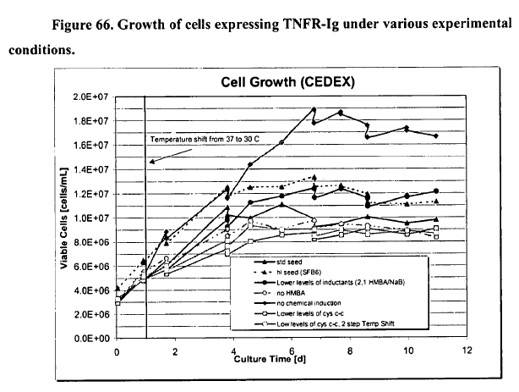
774 It will be seen that the key provides for one line of the graph there are “Lower levels of inductants (2,1 HMBA/NaB)”, and two other experimental conditions graphed are “no HMBA” and “no chemical induction”. Dr Croughan interpreted these to mean that the first is testing the growth of cells where 2 mM HMBA and 1 mM sodium butyrate are used as inductants, and gave evidence that based on the results of Example 16 he would try those levels. Dr Mather disputed that “2,1 HMBA/NaB” should be understood to mean 2 mM and 1 mM respectively of HMBA and NaB, considering that it could be a ratio of 2:1 by volume, moles or weight, in which case no levels are provided.
775 I do not think that much turns on this dispute. The specification provides an indication of the inductants used and that they may be successful at increasing titre production. The person skilled in the art would therefore know to try them. They may work for a given cell line and clone, but there is no guarantee that they will.
776 Finally, the respondents contend that Example 16 ought to have included the genetic sequence of the clone used by the patentee. The high point of the respondents’ submission is that even if the person skilled in the art did not have access to clone 41 itself, disclosure of its genomic sequenced would provide the person skilled in the art with a starting point to develop a similar clone, thereby reducing the experimentation required in relation to cell line development which can take over a year. However, as I have noted above, the fact is that the skilled team seeking to implement the invention would not have access to the particular clone used by the patentee. As Dr Mather said in her evidence:
Actually… they would not be starting with the same CHO. It would be nice to know whether it’s a line that’s capable of producing glutamine or not. In this example, they didn’t tell us. So it would be – it would be useful to tell us something about it, but it’s certainly not necessary, because you won’t be using it.
777 Accordingly, the challenge to the validity of the asserted claims based on s 40(2)(a) of the Patents Act fails.
15. AMENDMENT OF THE PATENT
778 By interlocutory application dated 25 August 2022, Pfizer Ireland Pharmaceuticals (which for convenience I will refer to as “Pfizer” in this section, noting that where used elsewhere “Pfizer” refers to both applicants) sought orders for the amendment of the patent. The amendments were described in opening submissions by Pfizer as falling into two categories: “narrowing amendments” which were to narrow the scope of the claims and consequential amendments to the specification, and “correcting amendments” which were to correct obvious or clerical errors.
779 Notice of the amendments has been provided to the Commissioner of Patents pursuant to s 105(3) of the Patents Act and the Commissioner has notified that the amendments prima facie meet the requirements of s 102. The Commissioner did not appear at the hearing. The amendments were duly advertised and no party other than the respondents has come forward to oppose the amendments.
780 The respondents filed a Third Amended Statement of Grounds and Particulars in Opposition to the Amendment Application, dated 7 September 2025. At trial, the respondents made clear that they did not oppose the correcting amendments but did oppose the narrowing amendments.
781 On day seven of the trial, senior counsel for Pfizer indicated that Pfizer intended to withdraw its application to make the narrowing amendments and to press only the correcting amendments. That course was not opposed by the respondents. The consequence is that in closing submissions Pfizer advanced submissions in support of the correcting amendments with no opposition from the respondents.
782 Section 105 of the Patents Act provides:
105 Amendments directed by court
(1) In any relevant proceedings in relation to a patent, the court may, on the application of the patentee, by order direct the amendment of the patent, the patent request or the complete specification in the manner specified in the order.
(2) An order may be made subject to such terms (if any) as to costs, advertisements or otherwise, as the court thinks fit.
(3) The patentee must give notice of an application for an order to the Commissioner, who is entitled to appear and be heard, and must appear if the court directs.
(4) A court is not to direct an amendment that is not allowable under section 102.
(5) The patentee must file a copy of an order within the prescribed period.
(6) On the filing of a copy of an order, the patent, patent request or complete specification is to be taken to have been amended in the manner specified in the order.
783 By s 105(4), the Court is not to direct an amendment that is not allowable under s 102 of the Patents Act.
784 Section 102 relevantly provides that an amendment is not allowable if, as a result of the amendment, the specification would claim matter not in substance disclosed in the complete specification as filed; or, if the amendment is after the relevant time (being after the specification is accepted), it would mean that (a) a claim would not in substance fall within the scope of the claims of the specification before amendment, or (b) the specification would not comply with ss 40(2) or (3) of the Patents Act. Section 102(3) provides that s 102 does not apply to an amendment for the purpose of correcting a clerical error or an obvious mistake made in, or in relation to, a complete specification.
785 The discretion arising under s 105 of the Patents Act is broad and exercised by reference to a number of guiding principles, as explained in several authorities: see Neurim Pharmaceuticals (1991) Ltd v Generic Partners Pty Ltd (No 2) [2019] FCA 154; 139 IPR 424 at [107] (Nicholas J). These principles were summarised in Les Laboratoires Servier v Apotex Pty Ltd [2016] FCAFC 27; 247 FCR 61 at [243] (Bennett, Besanko and Beach JJ).
786 Pfizer submits that the amendments sought are in the nature of clerical errors and obvious mistakes which are not sought to cure any actual or potential invalidity, being a circumstance where, it submits, the Court would be disposed to exercise the discretion with leniency, as noted by the Court on other occasions, citing Novartis AG v Bausch & Lomb (Australia) Pty Ltd [2004] FCA 835; 62 IPR 71 at [66] (Merkel J).
787 They support this contention by reference to the affidavit of Associate Professor Christopher Marquis, a biochemical engineer at the University of New South Wales. Associate Professor Marquis was awarded a PhD in Biochemical Engineering in 1994 and has since then been employed as an academic at the School of Biotechnology and Biomolecular Sciences at the University. He has held the position of Associate Professor since 2016.
788 Associate Professor Marquis was asked to review an extract of pages from the patent and, focussing on Example 8 and Example 15, identify whether there were any obvious mistakes in the examples and if so, identify what they are and their corrections. In response he identified:
(1) that small changes should be made to Tables 14 and 27 to correct references from “cysteine.2HCl” to “cystine.2HCl”; and
(2) that the note under Table 26 should refer to Medium 11, not Medium 12.
789 Pfizer also relies on the evidence of Thomas Pringot, a patent attorney employed by Pfizer Inc, which is the parent company of Pfizer Ireland Pharmaceuticals. He gives evidence of typographical errors relating to the concentrations of an inorganic ion in Table 1 when it was being transcribed from the priority document, and further typographical or transcription errors to Table 23.
790 Pfizer also submits that a reference to and description of “etanercept” in [00123] of the patent is redundant as that term does not appear elsewhere in the patent and an amendment addresses the removal of that reference.
791 I am satisfied that the corrections sought to be made to the patent are in the nature of the correction of clerical errors or obvious mistakes. I am also satisfied that they do not transgress the requirements of s 102 of the Patents Act.
792 Although it is many years since the patent was filed and the patent has been asserted against the respondents, I do not consider that the amendments have any material bearing on the scope or content of the rights that it confers.
793 Although the patent has expired and although I have found that some of the asserted claims lack an inventive step, given that other claims remain valid, it is appropriate that I make orders for the amendment of the patent in the form sought. Accordingly, I will allow the correcting amendments to be made.
16. DISPOSITION
794 For the reasons set out above I have concluded that the infringement case advanced by Pfizer must fail. I have also concluded that, with the exception of claim 2, the asserted claims are invalid for want of inventive step, but otherwise rejected the invalidity arguments advanced by the respondents. The correcting amendments should be allowed.
795 Much of the material concerning the respondents’ processes considered in relation to the question of infringement is the subject of suppression orders. So too are the materials produced by Pfizer in relation to the best method ground of invalidity. Accordingly, in the first instance these reasons will be published only to those persons who are the subject of appropriate confidentiality undertakings to enable the parties to confer and agree upon a suitably redacted form of these reasons for publication.
796 I will make directions for the parties otherwise to confer and prepare short minutes of order giving effect to these reasons.
I certify that the preceding seven hundred and ninety-six (796) numbered paragraphs are a true copy of the Reasons for Judgment of the Honourable Justice Burley. |
Associate:
Dated: 27 August 2026
SCHEDULE OF PARTIES
NSD 331 of 2022 | |
Respondents | |
Fourth Respondent: | MERCK, SHARP & DOHME (AUSTRALIA) PTY LTD ACN 000 173 508 |
Fifth Respondent: | ORGANON LLC |
Sixth Respondent: | ORGANON PHARMA PTY LTD ACN 637 107 512 |
Seventh Respondent: | ARROW PHARMACEUTICALS PTY LTD ACN 605 909 911 |
Eighth Respondent: | ARROW PHARMA PTY LTD ACN 605 909 920 |
Cross-Claimants | |
Second Cross-Claimant: | SAMSUNG BIOEPIS AU PTY LTD ACN 611 890 094 |
Third Cross-Claimant: | ORGANON LLC |
Fourth Cross-Claimant: | ORGANON PHARMA PTY LTD ACN 637 107 512 |


