FEDERAL COURT OF AUSTRALIA
Toyota Jidosha Kabushiki Kaisha v OZI4x4 Pty Ltd (No 3) [2026] FCA 1215
File number: | VID 951 of 2023 |
Judgment of: | WHEELAHAN J |
Date of judgment: | 27 August 2026 |
Catchwords: | TRADE MARKS — claim of trade mark infringement under s 120 of the Trade Marks Act 1995 (Cth) – where the first applicant is the registered owner of several trade marks and the second applicant is an authorised user of those marks – where the first respondent operated a business of selling aftermarket four-wheel drive accessories – whether the first respondent infringed the registered trade marks by importing counterfeit products bearing the marks – the first respondent infringed the marks affixed to products which it imported for the purposes of resale – the first respondent did not infringe the mark affixed to products imported into Australia to be delivered directly because the course of trade ceased before arrival of the goods to the consumer – the first respondent did infringe the marks by advertising goods by reference to the marks – compensatory damages for loss of reputation awarded in respect of the counterfeit products – nominal damages awarded in respect of the advertising – compensatory and additional damages awarded against the first respondent – whether the second respondent was a joint tortfeasor – the second respondent was not a joint tortfeasor because he was not sufficiently personally involved in the infringing sales and advertisements CONSUMER LAW — claim for damages for misleading and deceptive conduct and false or misleading representations – whether the first respondent represented that it or its products had the sponsorship or approval of or an affiliation with the applicants or that the products were those of the applicants or manufactured to standards authorised by the applicants – the representations were conveyed and were false – damages awarded against the first respondent – whether the second respondent was involved in the contraventions – the second respondent was involved because he was directly or indirectly knowingly concerned in the conduct constituting the contraventions – damages awarded against the second respondent TORTS — claim for compensatory and exemplary damages for the tort of passing off – the first respondent engaged in passing off by selling the counterfeit products – the first respondent did not commit the tort of passing off by its advertising because the applicants did not establish that any damage was caused by the advertising – compensatory and exemplary damages awarded against the first respondent – whether the second respondent was a joint tortfeasor – the second respondent was not a joint tortfeasor because he was not sufficiently personally involved in the passing off CONTRACT — claim for damages for breach of contract – where the parties entered into a settlement and release agreement to conclude prior proceedings – where the agreement jointly bound the respondents to cease and forever desist from selling or offering for sale products bearing the first applicant’s trade marks – whether the respondents breached the agreement – the respondents breached the agreement and are jointly liable for any loss – compensatory damages awarded concurrently against both respondents |
Legislation: | Competition and Consumer Act 2010 (Cth) Sch 2, ss 2, 18, 29, 33, 232 and 236 Copyright Act 1968 (Cth) ss 36 and 101 Corporations Act 2001 (Cth) s 471B Federal Court of Australia Act 1976 (Cth) ss 5, 23 and 51A Patents Act 1990 (Cth) s 13 Trade Marks Act 1905 (Cth) s 72 Trade Marks Act 1955 (Cth) s 6 Trade Marks Act 1995 (Cth) ss 6, 7, 8, 17, 20, 120, 122, 126 and 133 Trade Practices Act 1974 (Cth) ss 52 and 75B Federal Court Rules 2011 (Cth) rr 22.02 and 41.06 Trademarks Act 1985 (Can) s 20 Trade Marks Act 1998 (Sing) s 27 Trade Marks Act 1938 (UK) s 68 Trade Marks Act 1994 (UK) s 10 |
Cases cited: | Ambulance Service (NSW) v Deputy Commissioner of Taxation (Cth) [2002] FCA 1023; 50 ATR 496 Anchorage Capital Master Offshore Ltd v Sparkes [2023] NSWCA 88; 111 NSWLR 304 Aristoc Ltd v Rysta Ltd [1945] AC 68 Aristocrat Technologies Australia Pty Ltd v Global Gaming Supplies Pty Ltd [2016] FCAFC 22; 329 ALR 522 Austral v Northern Territory [2026] HCA 20 Australian Competition and Consumer Commission v Google LLC (No 2) [2021] FCA 367; 391 ALR 348 Australian Competition and Consumer Commission v High Adventure Pty Ltd [2005] FCAFC 247 Australian Competition and Consumer Commission v Z-Tek Computer Pty Ltd (1997) 78 FCR 197 Australian Securities and Investments Commission v AGM Markets Pty Ltd (in liq) (No 4) [2020] FCA 1499; 148 ACSR 511 Bed Bath 'N' Table Pty Ltd v Global Retail Brands Australia Pty Ltd [2025] HCA 50; 426 ALR 518 Big River Timbers Pty Ltd v Stewart (1999) 9 BPR 16,605 Brother Industries Ltd v Dynamic Supplies Pty Ltd [2007] FCA 1490; 163 FCR 530 Campomar Sociedad Limitada v Nike International Ltd [2000] HCA 12; 202 CLR 45 Cantarella Bros Pty Ltd v Lavazza Australia Pty Ltd (No 3) [2023] FCA 1258; 181 IPR 313 Cantarella Bros Pty Ltd v Lavazza Australia Pty Ltd [2025] FCAFC 12; 184 IPR 27 Cessnock City Council v 123 259 932 Pty Ltd [2024] HCA 17; 281 CLR 39 Coca Cola Co v All Fect Distributors Ltd (1999) 96 FCR 107 Concrete Constructions (NSW) Pty Ltd v Nelson (1990) 169 CLR 594 Davis v Russell McVeagh McKenzie Bartleet & Co [1994] 2 NZLR 175 Dunlop Rubber Co Ltd v AA Booth & Co Ltd (1926) 43 RPC 139 E and J Gallo Winery v Lion Nathan Australia Pty Ltd [2010] HCA 15; 241 CLR 144 Elwood Clothing Pty Ltd v Cotton On Clothing Pty Ltd [2009] FCA 633; 81 IPR 378 Esquire Electronics Ltd v Roopanand Bros [1991] RPC 425 Estex Clothing Pty Ltd v Ellis and Goldstein Ltd (1967) 116 CLR 254 Fanatics, LLC v FanFirm Pty Ltd [2025] FCAFC 87; 426 ALR 367 FanFirm Pty Ltd v Fanatics, LLC [2024] FCA 764; 183 IPR 1 Gray v Motor Accident Commission (1998) 196 CLR 1 Hashtag Burgers Pty Ltd v In-N-Out Burgers, Inc [2020] FCAFC 235; 385 ALR 514 ICI Australia Operations Pty Ltd v Trade Practices Commission (1992) 38 FCR 248 Independent Oil Industries Ltd v Shell Company of Australia Ltd (1937) 37 SR (NSW) 394 Insurance Commissioner v Joyce (1948) 77 CLR 39 James Minifie & Co v Edwin Davey & Sons (1933) 49 CLR 349 James v The Commonwealth (1939) 62 CLR 339 JR Consulting & Drafting Pty Ltd v Cummings [2016] FCAFC 20; 329 ALR 625 Keller v LED Technologies Pty Ltd [2010] FCAFC 55; 185 FCR 449 Killer Queen LLC v Taylor [2024] FCAFC 149; 306 FCR 199 King v Hoare (1844) 13 M & W 494; 153 ER 206 Kuhl v Zurich Financial Services Australia Ltd [2011] HCA 11; 243 CLR 361 Lamb v Cotogno (1987) 164 CLR 1 Madden v Seafolly Pty Ltd [2014] FCAFC 30; 313 ALR 1 Mark Foy’s v Davies Co-op & Co Ltd (1956) 95 CLR 190 Mentmore Manufacturing Co Ltd v National Merchandising Manufacturing Co Inc (1978) 89 DLR (3d) 195 Microsoft Corp v Auschina Polaris Pty Ltd (1996) 71 FCR 231 Nokia Corporation v Mai [2003] FCA 924; 59 IPR 413 Nokia Corporation v Truong [2005] FCA 1141; 66 IPR 511 Norwich Pharmacal Co v Customs and Excise Commissioners [1972] RPC 743; [1974] AC 133 Oakley, Inc v Franchise China Pty Ltd [2003] FCA 105; 58 IPR 452 Optical 88 Ltd v Optical 88 Pty Ltd [2011] FCAFC 130; 197 FCR 67 Parkdale Custom Built Furniture Pty Ltd v Puxu Pty Ltd (1982) 149 CLR 191 PDP Capital Pty Ltd v Grasshopper Ventures Pty Ltd [2021] FCAFC 128; 285 FCR 598 Pioneer Kabushiki Kaisha v Registrar of Trade Marks (1977) 137 CLR 670 Planet Fisheries Pty Ltd v La Rosa (1968) 119 CLR 118 Playboy Enterprises International Inc v Hong [2004] FCA 1205; 63 IPR 533 Productivity Partners Pty Ltd v Australian Competition and Consumer Commission [2024] HCA 27; 281 CLR 338 Rakman International Pty Ltd v Trafalgar Group Pty Ltd [2022] FCA 464; 166 IPR 264 Reckitt & Colman Products Ltd v Borden Inc [1990] 1 WLR 491 Red Bull Australia Pty Ltd v Sydneywide Distributors Pty Ltd [2001] FCA 1228; 53 IPR 481 Redbubble Ltd v Hells Angels Motorcycle Corporation (Australia) Pty Ltd [2024] FCAFC 15; 303 FCR 100 Roadshow Films Pty Ltd v iiNet Ltd [2012] HCA 16; 248 CLR 42 Rock Solid Industries International (Pty) Ltd v Ozi 4X4 Pty Ltd [2025] FCA 334 Rookes v Barnard [1964] AC 1129 Root Quality Pty Ltd v Root Control Technologies Pty Ltd [2000] FCA 980; 177 ALR 231 Rural Press Ltd v Australian Competition and Consumer Commission [2003] HCA 75; 216 CLR 53 Saville Perfumery Ltd v June Perfect Ltd (1939) 58 RPC 147 Scandinavian Tobacco Group Eersel BV v Trojan Trading Company Pty Ltd [2016] FCAFC 91; 243 FCR 152 Secretary, Dept of Home Affairs v CRS20 [2025] FCAFC 3; 307 FCR 190 Seiko Epson Corporation v Calidad Pty Ltd [2017] FCA 1403; 133 IPR 1 Self Care IP Holdings Pty Ltd v Allergan Australia Pty Ltd [2023] HCA 8; 277 CLR 186 Solahart Industries Pty Ltd v Solar Shop Pty Ltd (No 2) [2011] FCA 780; 282 ALR 43 Sony Computer Entertainment Australia Pty Ltd v Saleh [2001] FCA 717 Sporte Leisure Pty Ltd v Paul’s International Pty Ltd (No 3) [2010] FCA 1162; 275 ALR 258 Sydneywide Distributors Pty Ltd v Red Bull Australia Pty Ltd [2002] FCAFC 157; 234 FCR 549 Taylor v Killer Queen LLC [2026] HCA 5; 428 ALR 388 Thompson v Australian Capital Television Pty Ltd (1996) 186 CLR 574 Thunderbird Products Corporation v Thunderbird Marine Products Pty Ltd (1974) 131 CLR 592 Toyota Jidosha Kabushiki Kaisha v Ozi4x4 Pty Ltd (Leave to proceed) [2025] FCA 981 Toyota Jidosha Kabushiki Kaisha v Ozi4x4 Pty Ltd [2023] FCA 1361 Toyota Jidosha Kabushiki Kaisha v OZI4X4 Pty Ltd [2025] FCA 768 Truong Giang Corp v Quach [2015] FCA 1097; 114 IPR 498 TS & B Retail Systems Pty Ltd v 3Fold Resources Pty Ltd (No 3) [2007] FCA 151; 158 FCR 444 Universal Music Australia Pty Ltd v Cooper [2005] FCA 972; 150 FCR 1 Upmann v Elkan (1871) LR 12 Eq 140; 7 Ch App 130 Upmann v Forester (1883) 24 Ch D 231 Vitaco Health IP Pty Ltd v AFI Cosmetic Pty Ltd (No 3) [2024] FCA 598 Ward Group Pty Ltd v Brodie & Stone Plc [2005] FCA 471; 143 FCR 479 WD and HO Wills (Australia) Ltd v Rothmans Ltd (1956) 94 CLR 182 WEA International Inc v Hanimex Corporation Ltd (1987) 17 FCR 274 Wingate Marketing Pty Ltd v Levi Strauss & Co (1994) 49 FCR 89 Xiamen Huadian Switchgear Co Ltd v Powins Pty Ltd [2022] FCA 1159; 169 IPR 77 XL Petroleum (NSW) Pty Ltd v Caltex Oil (Australia) Pty Ltd (1985) 155 CLR 448 Yorke v Lucas (1985) 158 CLR 661 Zippo Manufacturing Co v Jaxlawn Pty Ltd [2011] FCA 1125 David Kitchin et al, Kerly’s Law of Trade Marks and Trade Names (14th Ed, Sweet & Maxwell, 2005) Explanatory Memorandum to Intellectual Property Laws Amendment (Raising the Bar) Bill 2011 Glanville Williams, Joint Obligations (Butterworth & Co, 1949) Heydon JD, Leeming MJ, Turner PG, Meagher, Gummow and Lehane’s Equity Doctrines & Remedies (5th ed, LexisNexis Butterworths Australia, 2015) Working Party to Review the Trade Marks Legislation, Recommended Changes to the Australian Trade Marks Legislation (July 1992) |
Division: | General Division |
Registry: | Victoria |
National Practice Area: | Intellectual Property |
Sub-area: | Trade Marks |
Number of paragraphs: | 235 |
Date of hearing: | 19-20 August 2025 |
Counsel for the Applicants: | Mr S M Rebikoff SC and Mr A J Middleton |
Solicitor for the Applicants: | Clayton Utz |
Counsel for the Respondents: | The respondents did not appear |
ORDERS
VID 951 of 2023 | ||
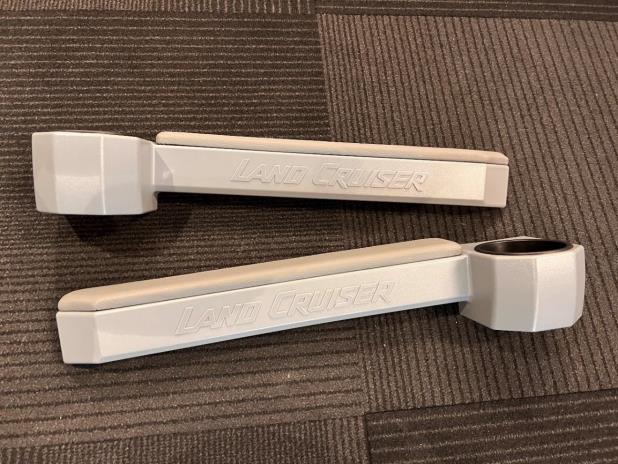
| ||
BETWEEN: | TOYOTA JIDOSHA KABUSHIKI KAISHA First Applicant TOYOTA MOTOR CORPORATION AUSTRALIA LIMITED Second Applicant | |
AND: | OZI4X4 PTY LTD (ACN 636 996 417) First Respondent HUSS SAFI Second Respondent | |
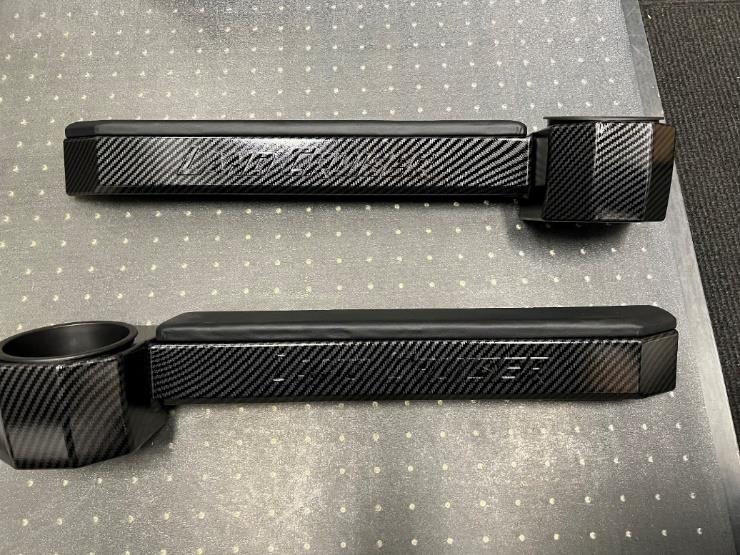
order made by: | WHEELAHAN J |
DATE OF ORDER: | 27 August 2026 |
THE COURT ORDERS THAT:
1. There be judgment for the applicants against the first respondent in the sum of $171,180, which sum includes pre-judgment interest of $4,800.
2. There be judgment for the applicants against the second respondent in the sum of $21,180, which sum includes pre-judgment interest of $4,800.
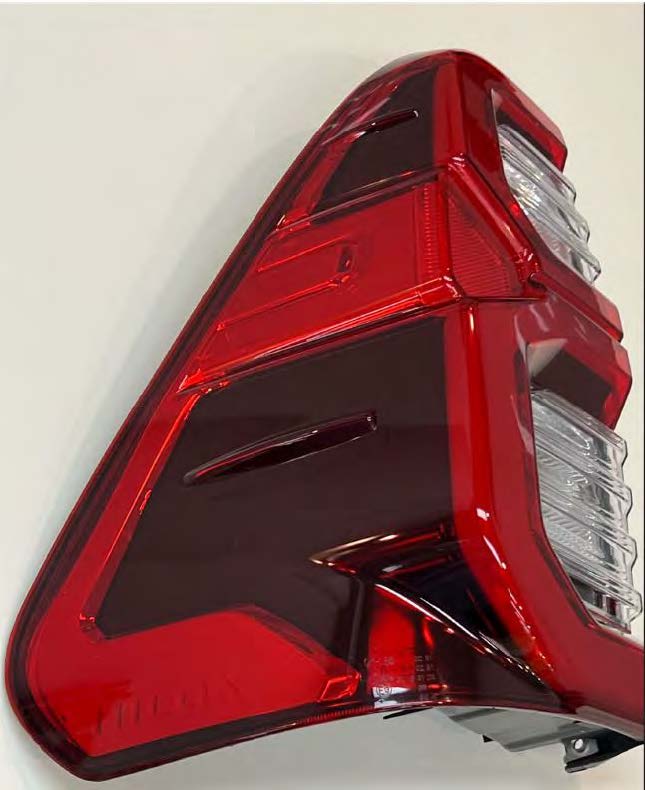
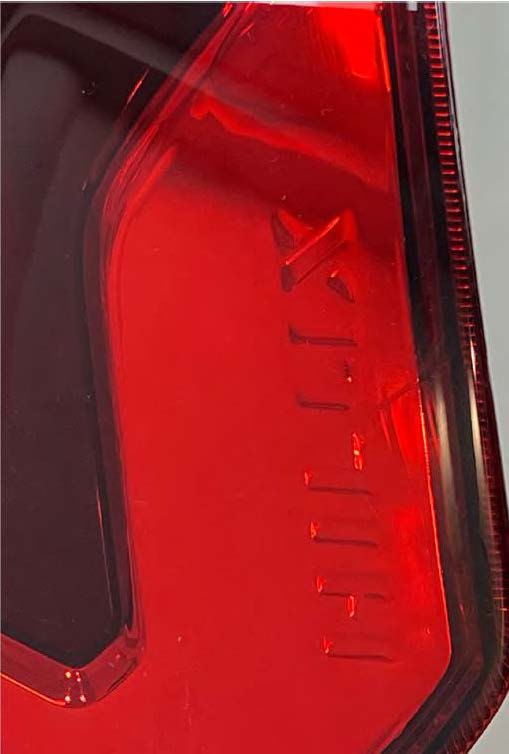
3. The second respondent be permanently restrained from aiding, abetting, counselling, procuring or being directly or indirectly knowingly concerned in any false representation to the public in trade or commerce in contravention of sections 18, 29(1)(a), 29(1)(g), 29(1)(h) and 33 of the Australian Consumer Law in Schedule 2 to the Competition and Consumer Act 2010 (Cth) (ACL) that:
(a) the parts or accessories sold by any business associated with the second respondent are products of the applicants;
(b) the parts or accessories sold by any business associated with the second respondent have the sponsorship or approval of the applicants;
(c) any business associated with the second respondent has the sponsorship or approval of, or an affiliation with, the applicants; or
(d) the parts or accessories sold by any business associated with the second respondent have been manufactured to the standards authorised or approved by the applicants.
4. The respondents pay the applicants’ costs of the proceeding in a lump sum to be assessed by a Registrar of the Court.
5. The costs of the preparation by the applicants of a hard copy court book for the use of the second respondent at the trial be assessed on an indemnity basis.
6. For a period of 10 years, pursuant to ss 37AF and 37AG of the Federal Court of Australia Act 1976 (Cth) and on the ground that it is necessary to prevent prejudice to the proper administration of justice, the publication or other disclosure of Confidential Annexure KG-23 to the affidavit of Kylie Graham dated 21 November 2024 be prohibited other than to:
(a) the Court;
(b) the applicants and their legal representatives (solicitors and counsel); and
(c) the second respondent.
THE COURT DECLARES THAT:
7. The first respondent infringed the first applicant’s registered trade marks by:
(a) importing, distributing, offering for sale, supplying and selling motor vehicle parts and accessories bearing the sign HILUX; and
(b) offering for sale and selling motor vehicle parts and accessories using the signs TOYOTA and HILUX.
8. By importing, distributing, offering for sale, supplying and selling motor vehicle parts and accessories bearing the signs TOYOTA, HILUX, and LAND CRUISER the first respondent in trade or commerce represented to the public in contravention of sections 18, 29(1)(a), 29(1)(g), 29(1)(h) and 33 of the ACL that:
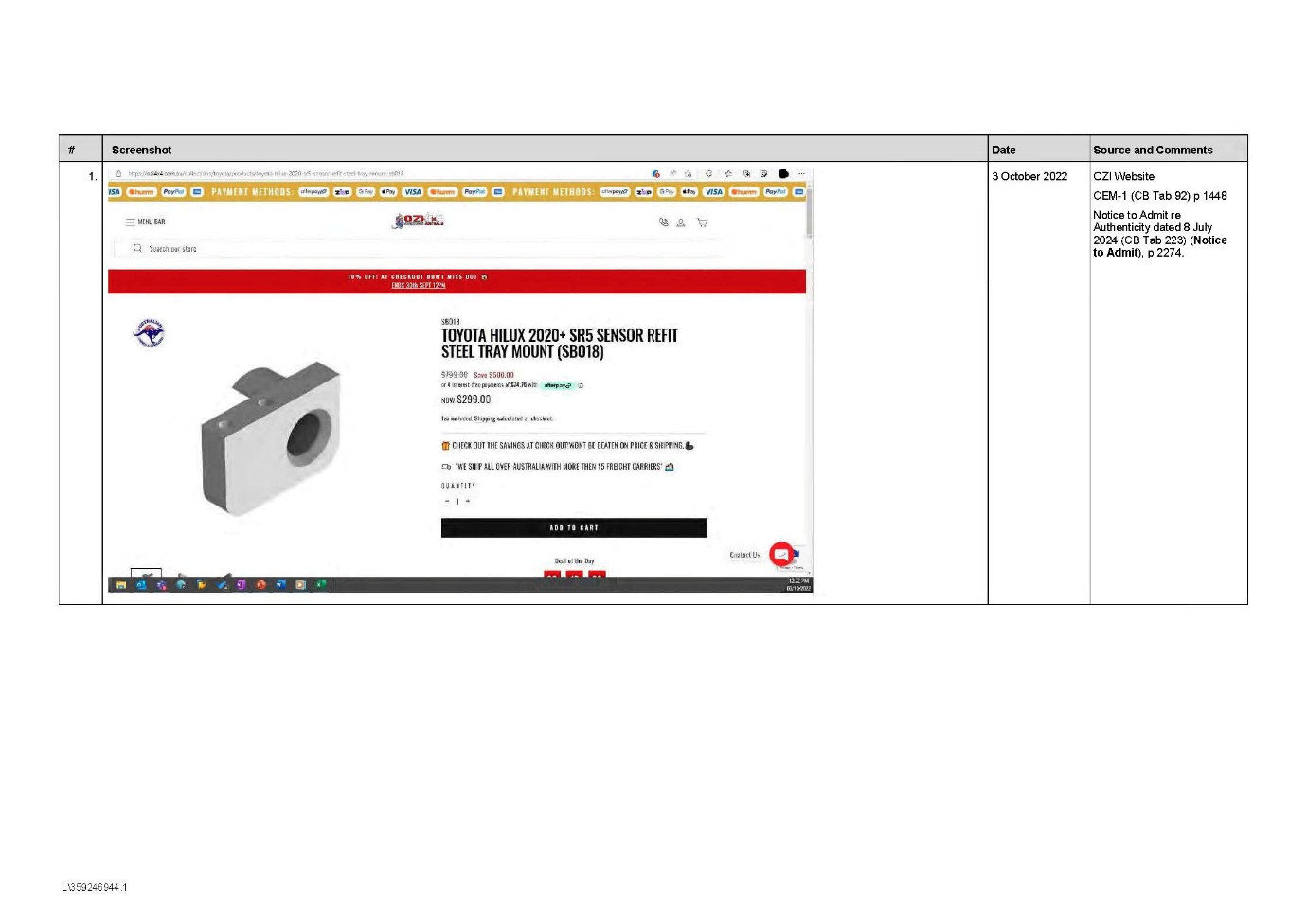
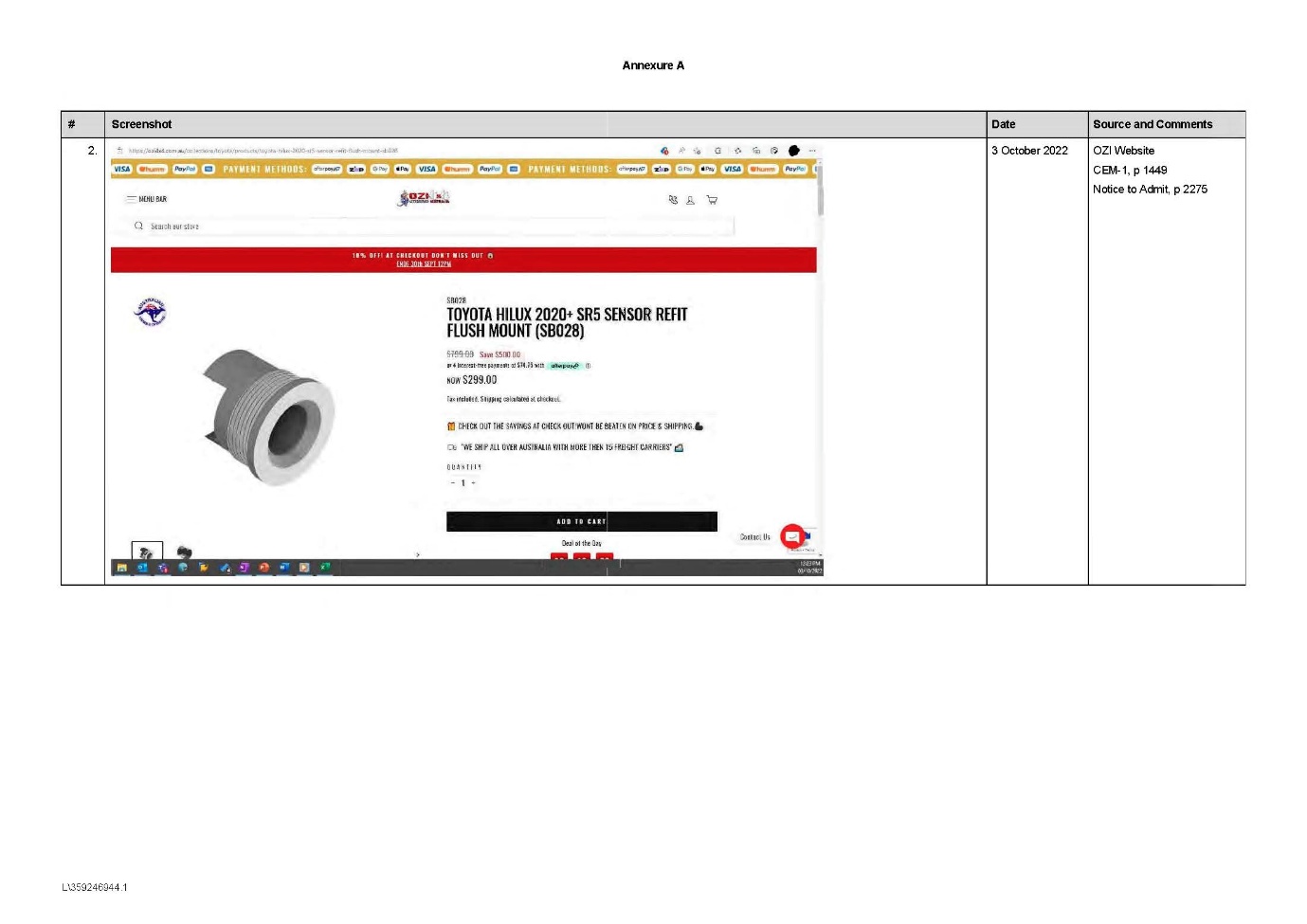
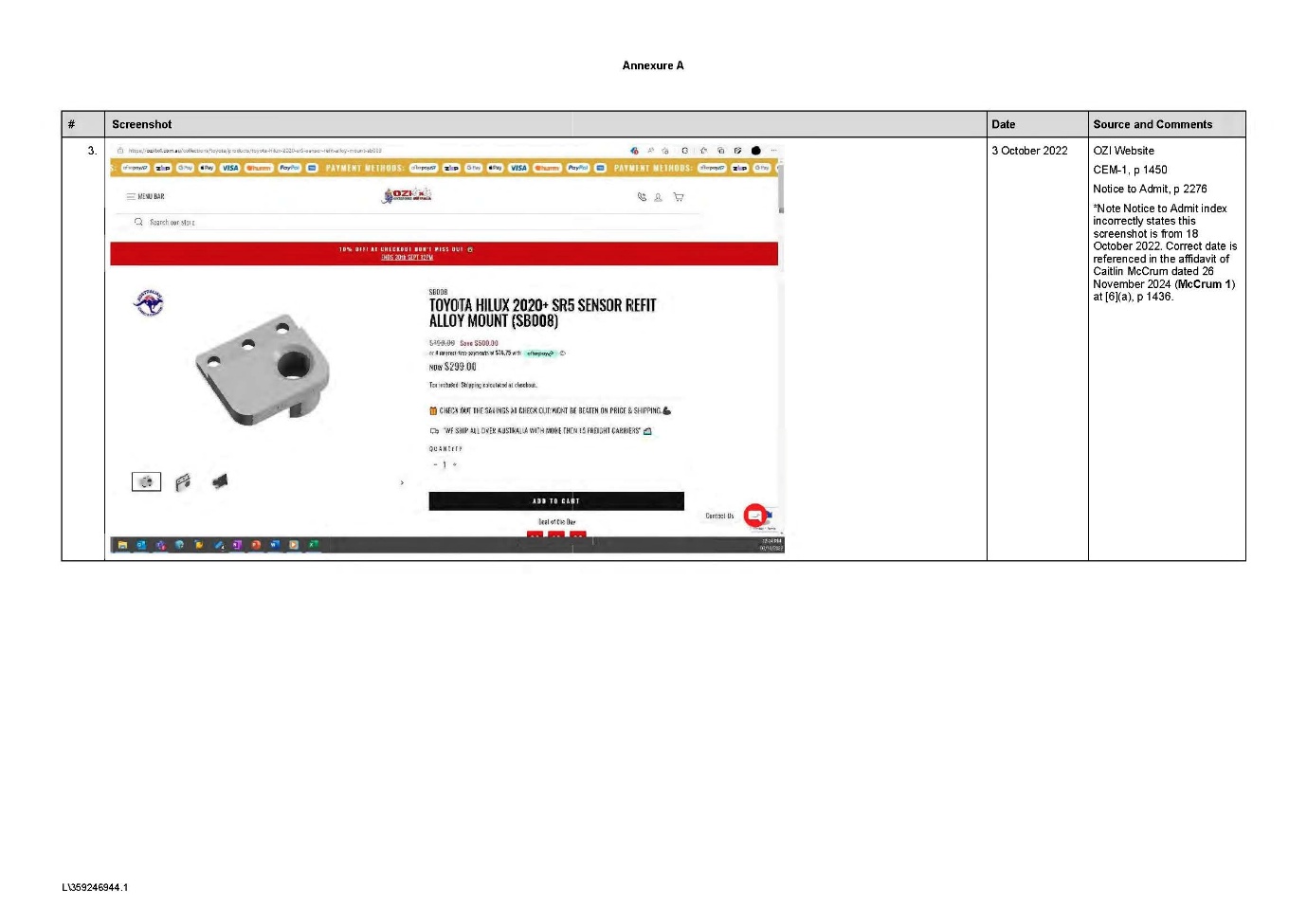
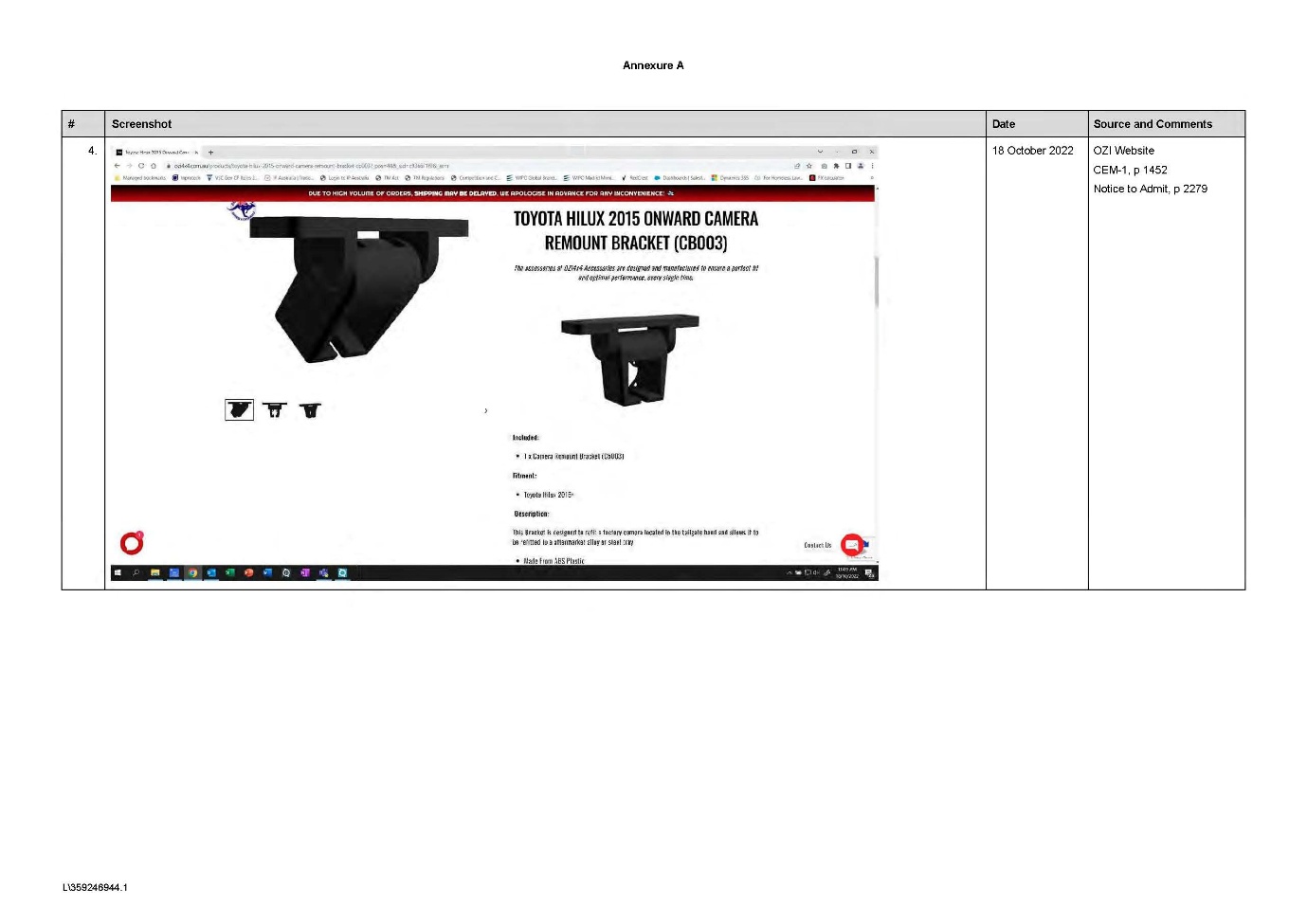
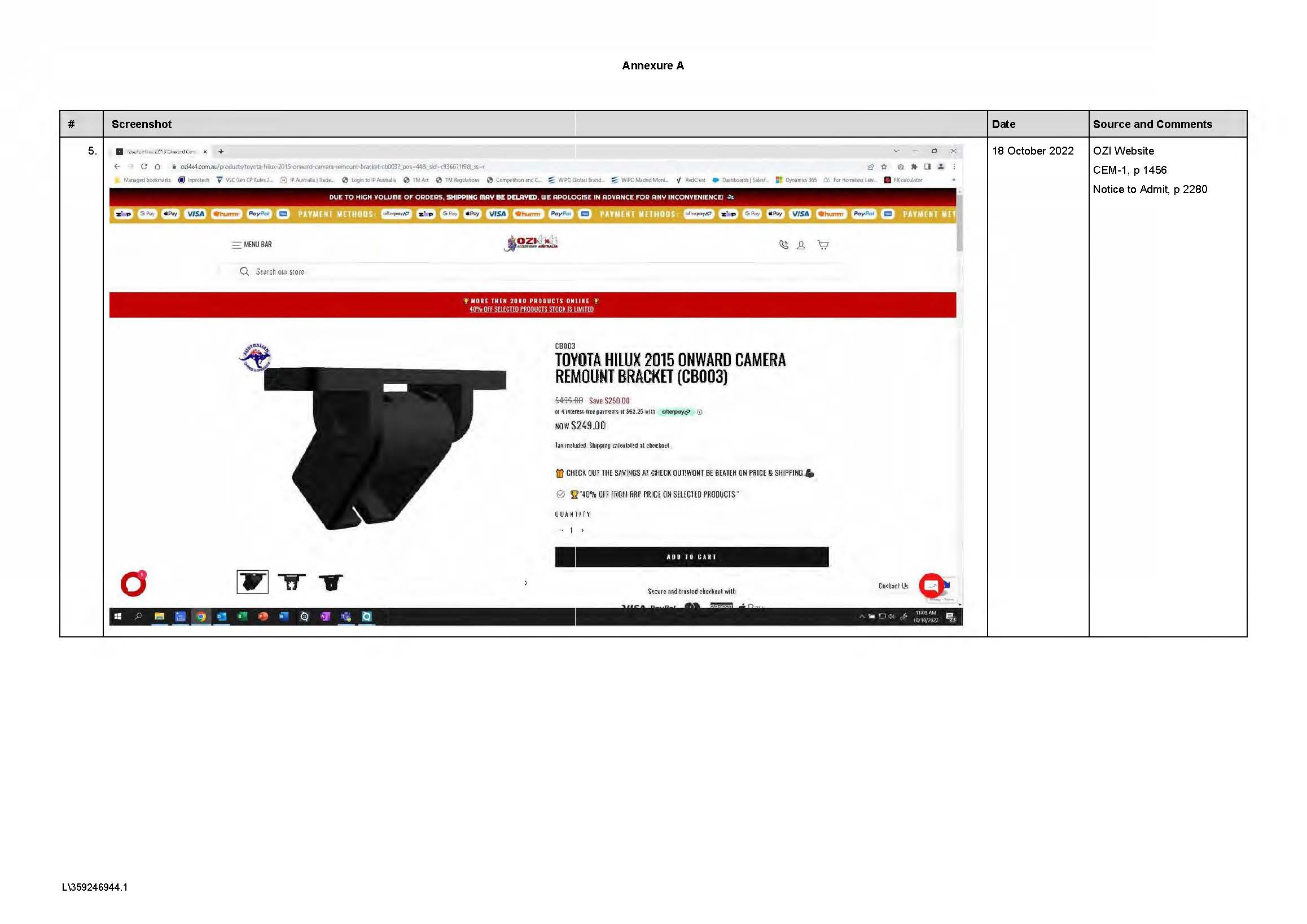
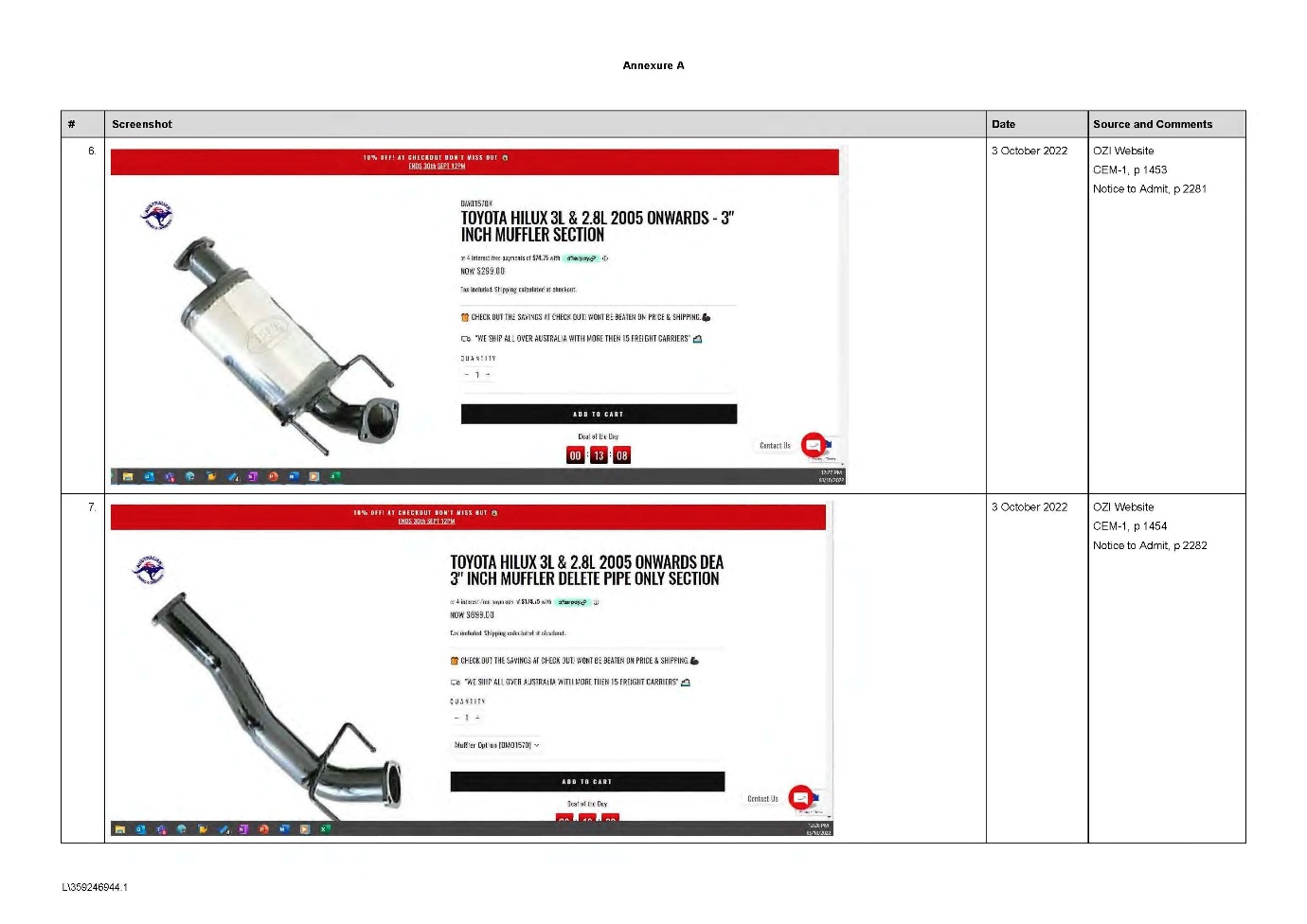
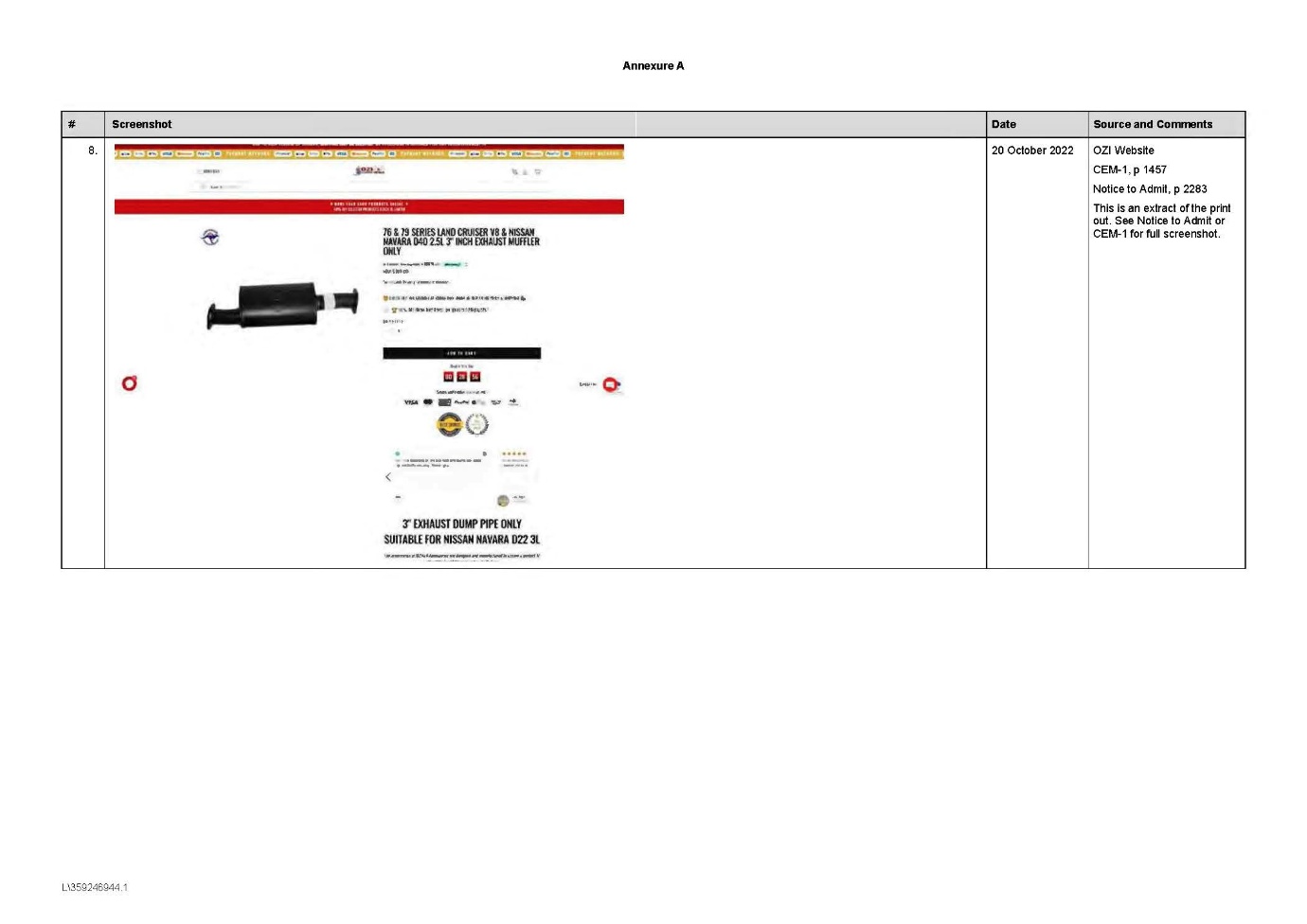
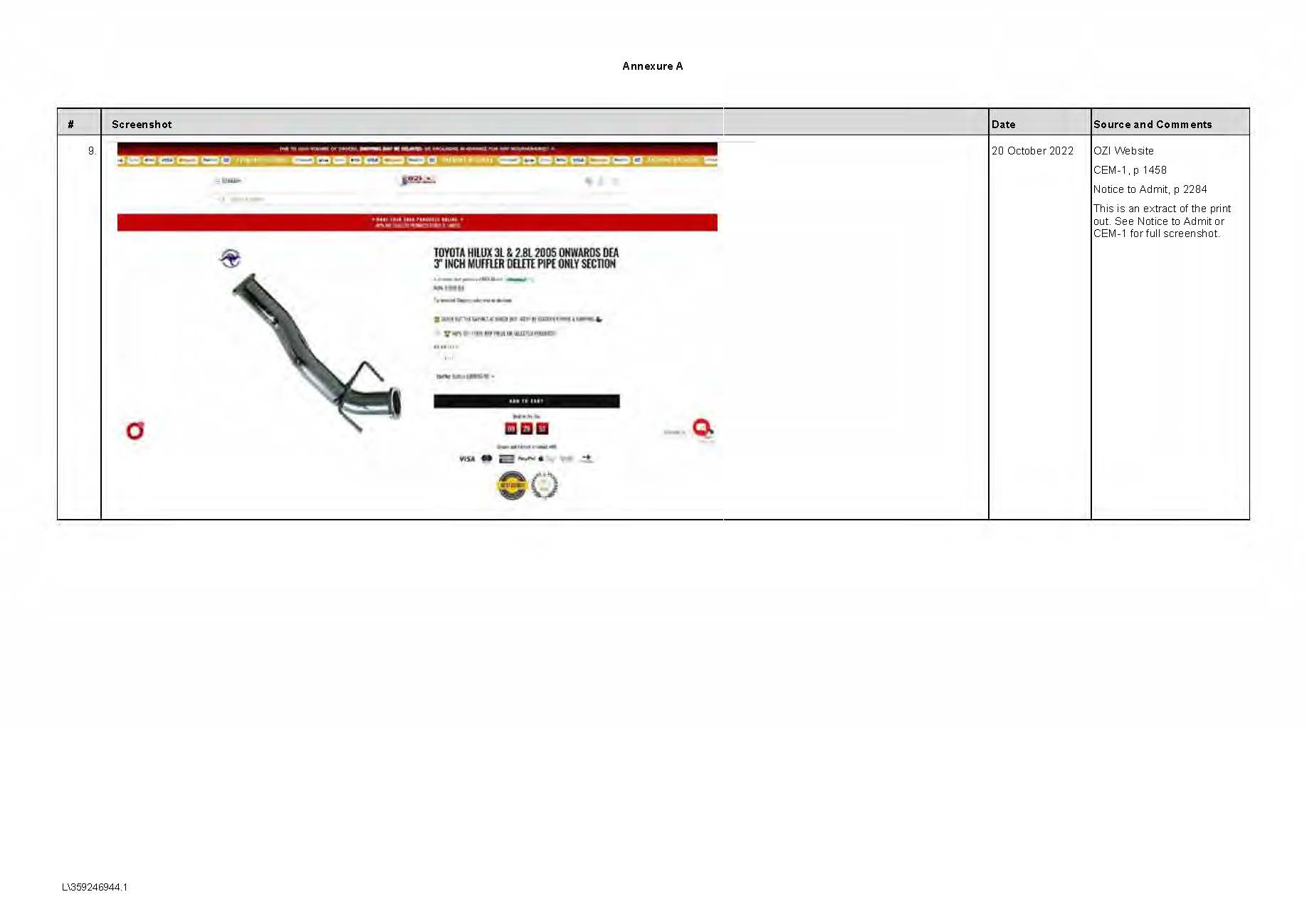
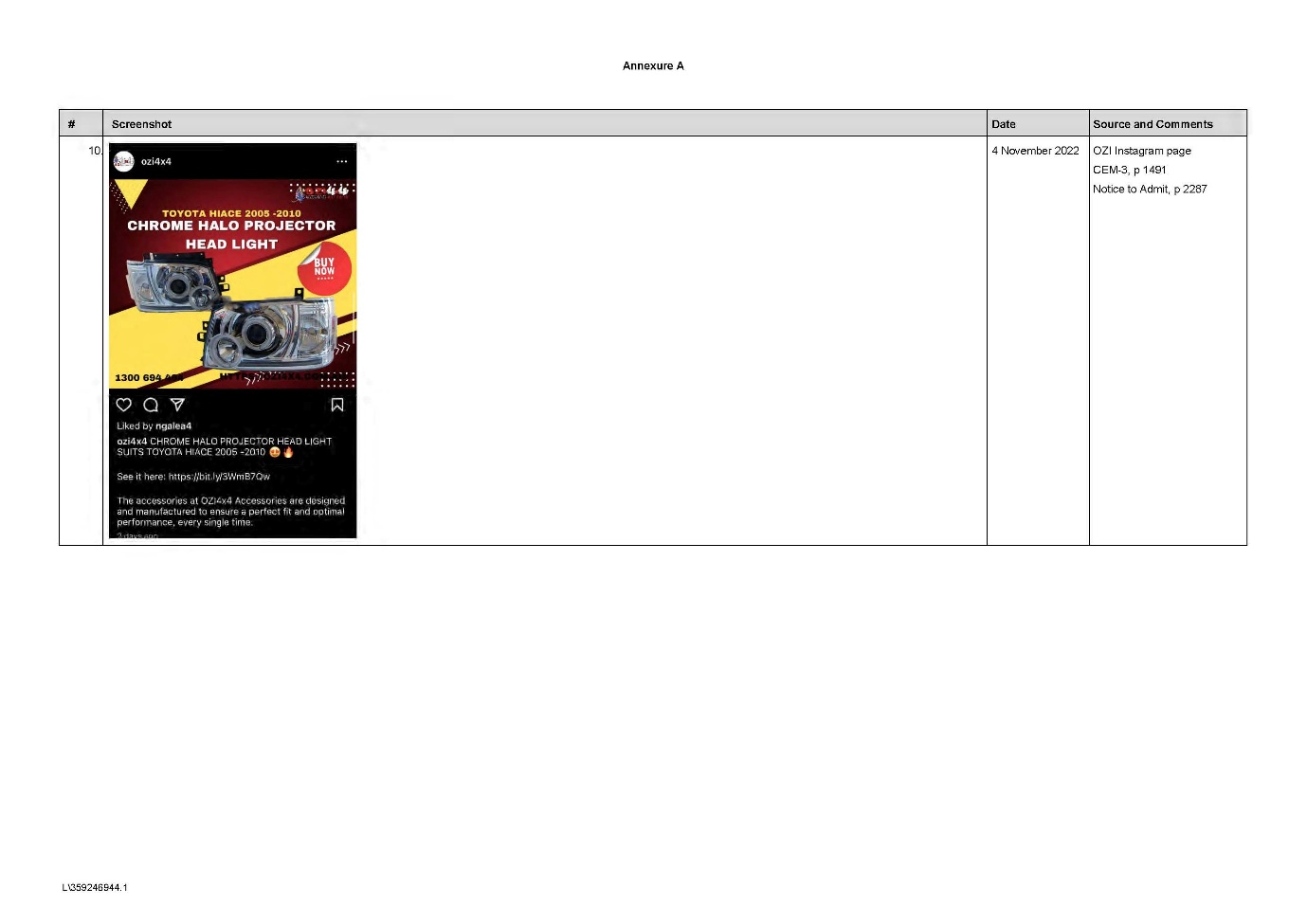
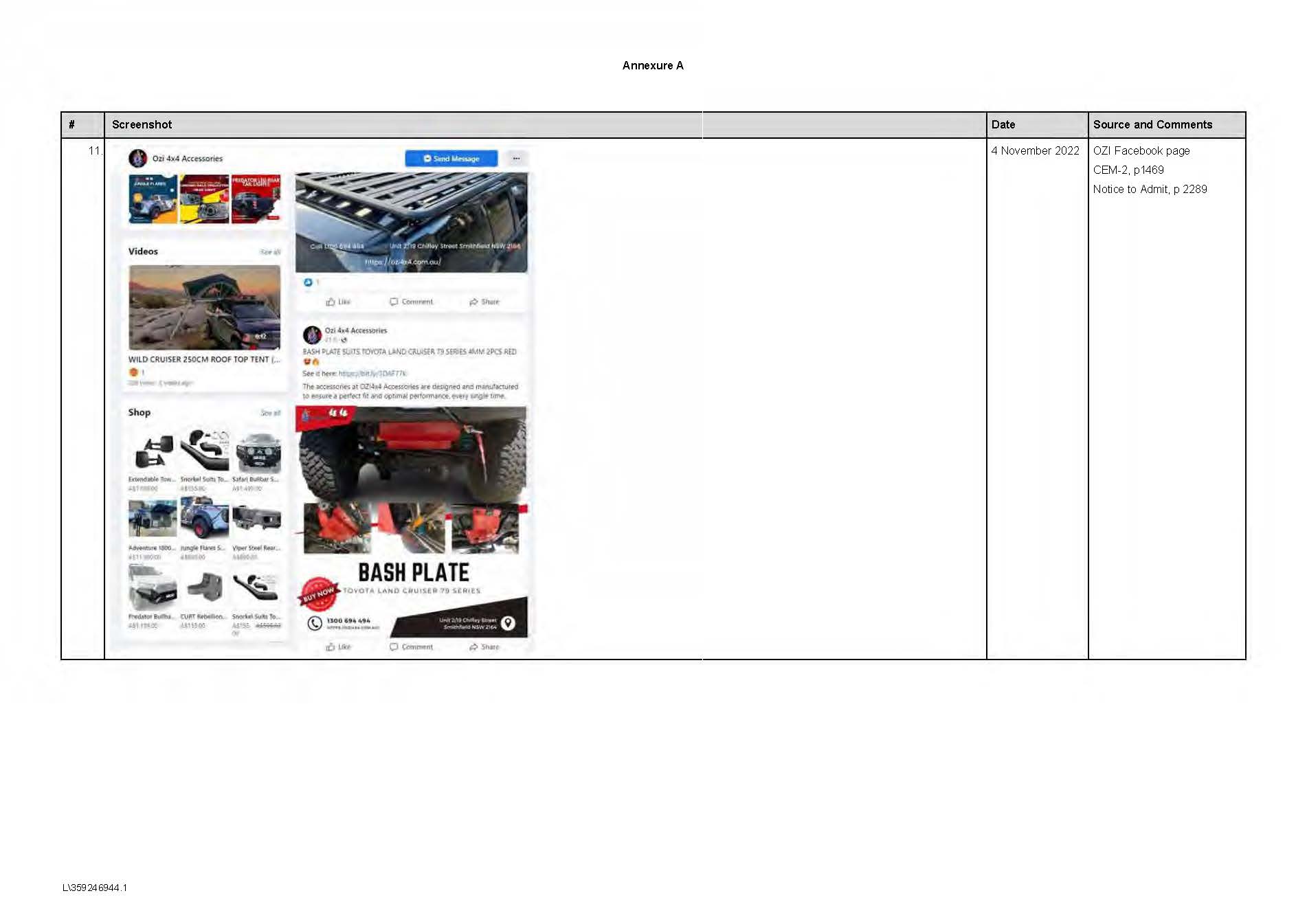
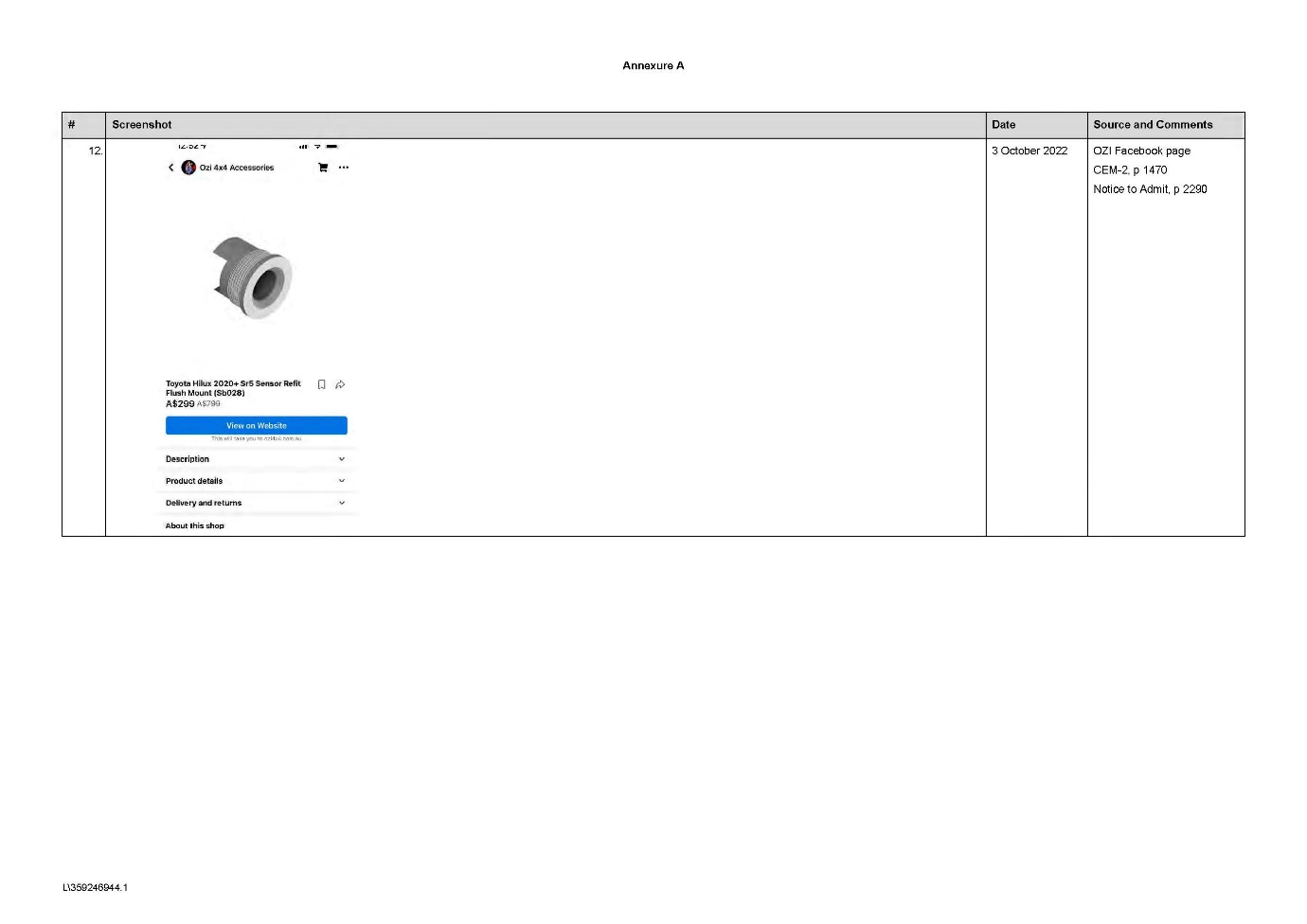
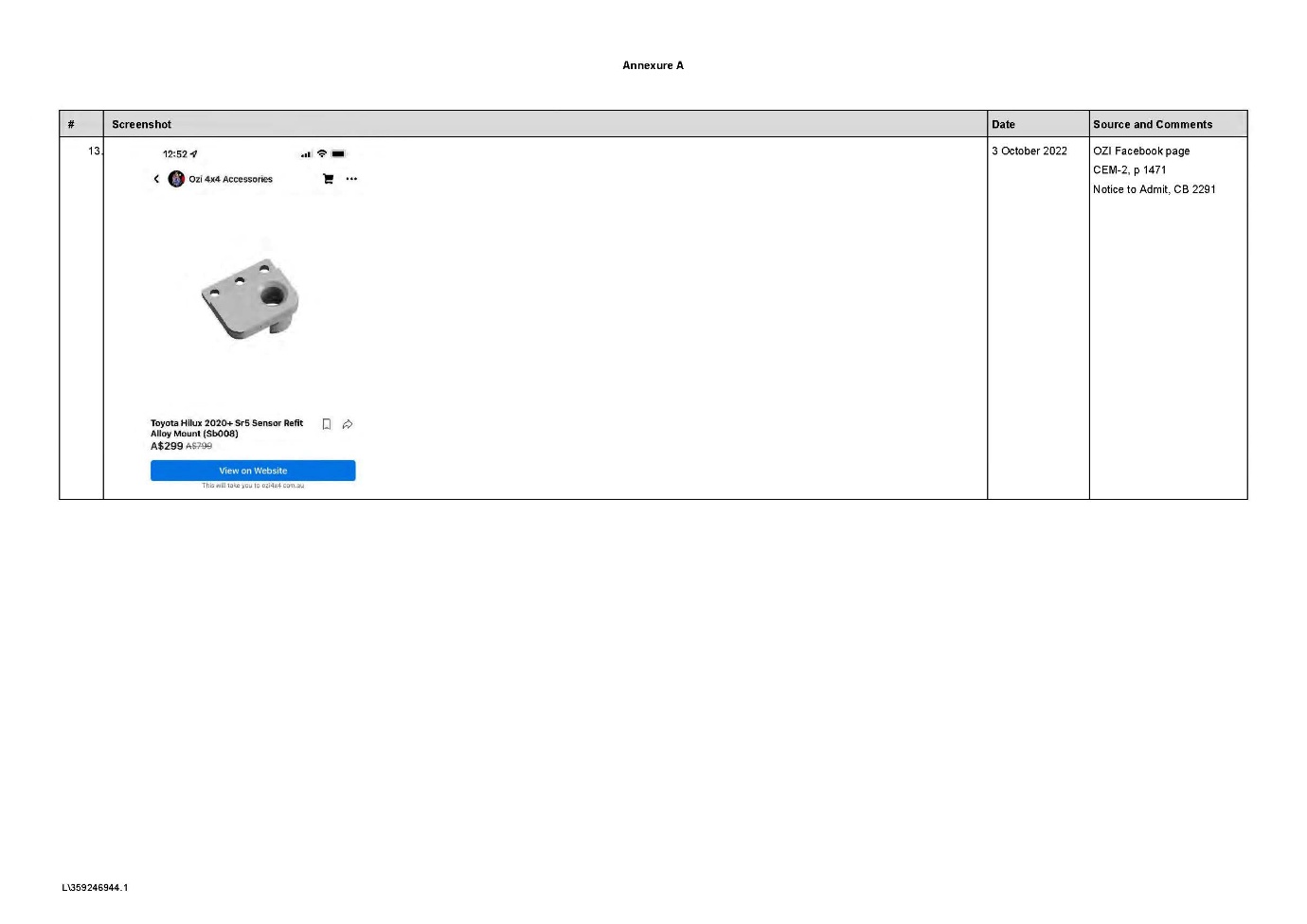
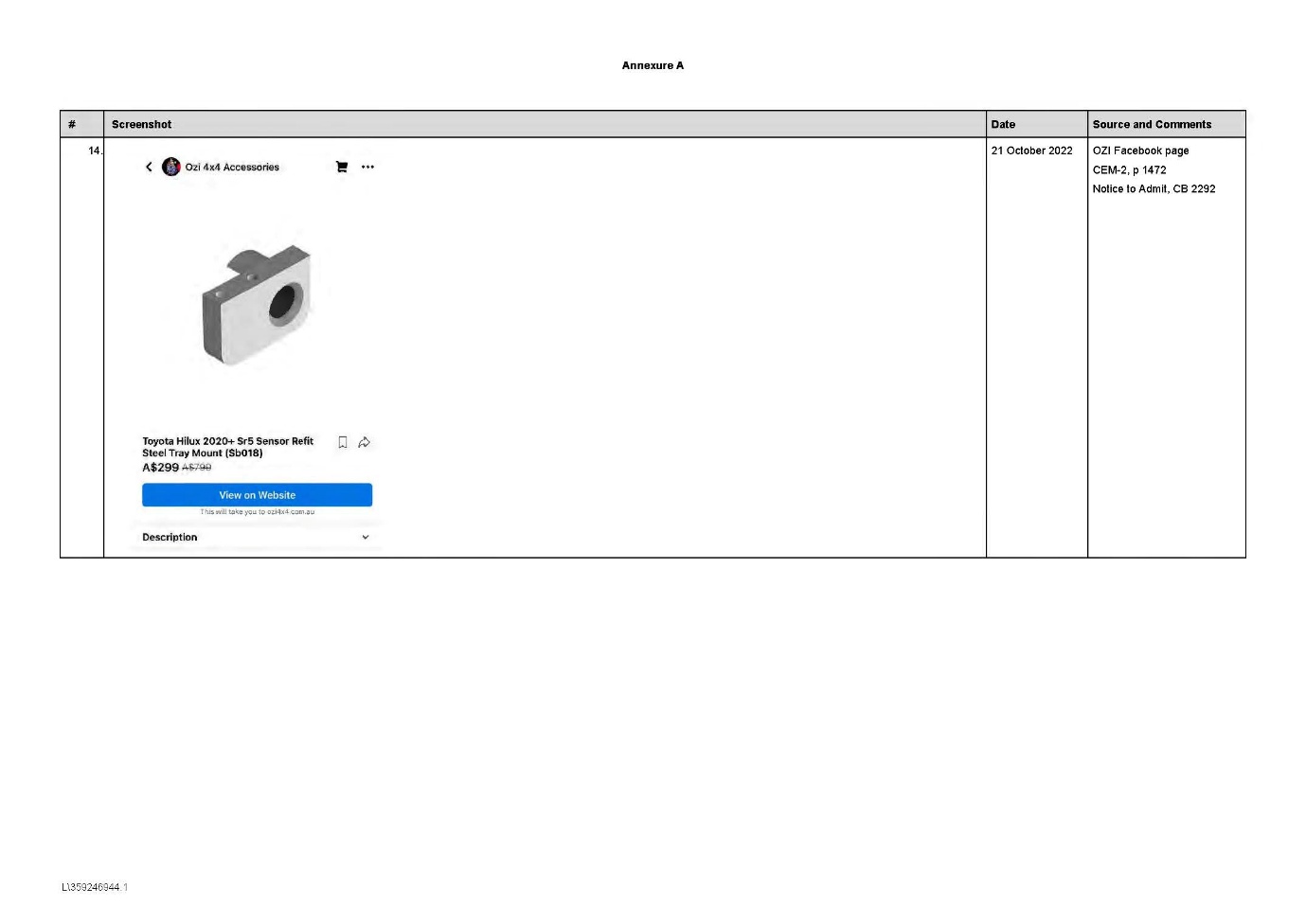
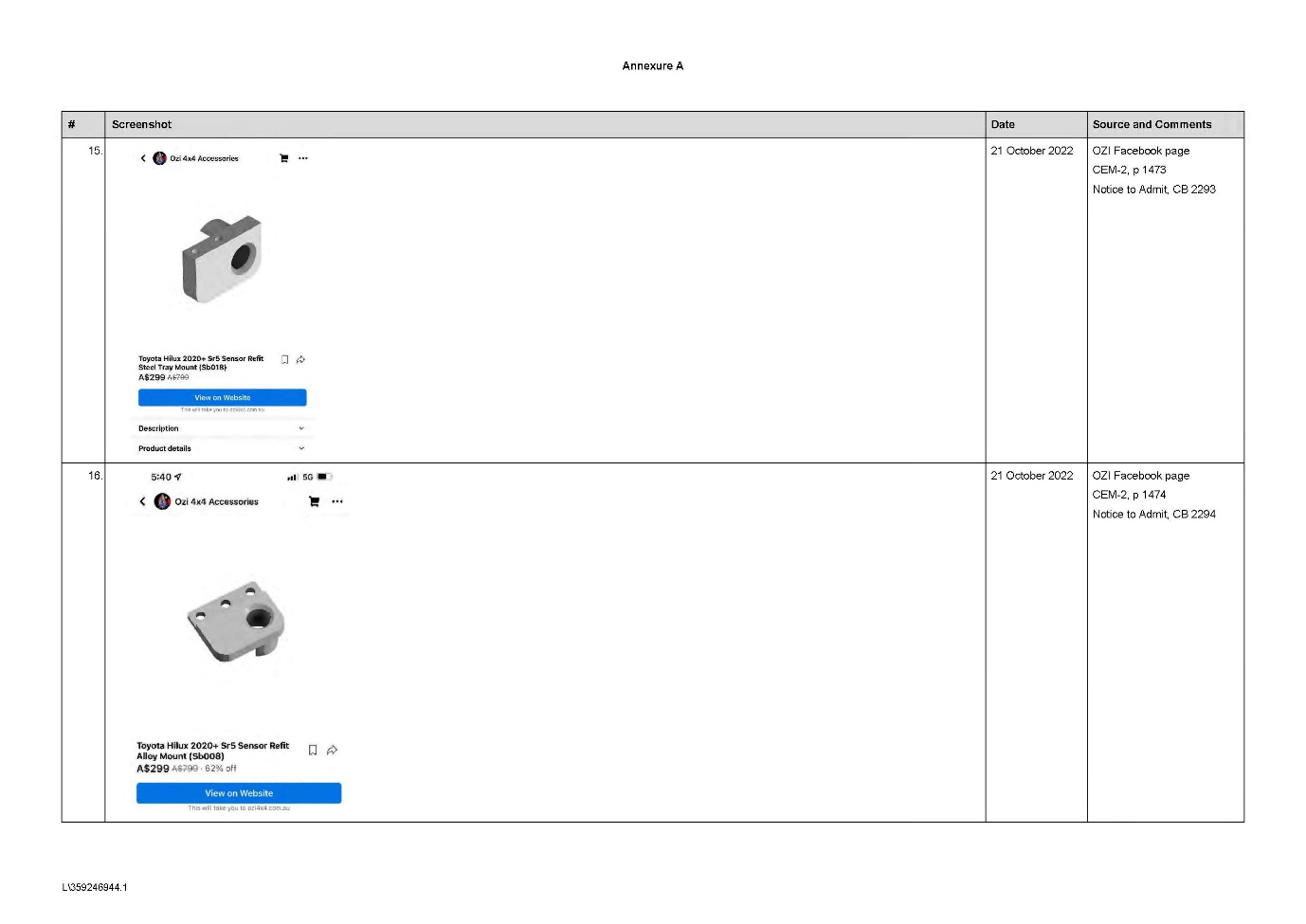
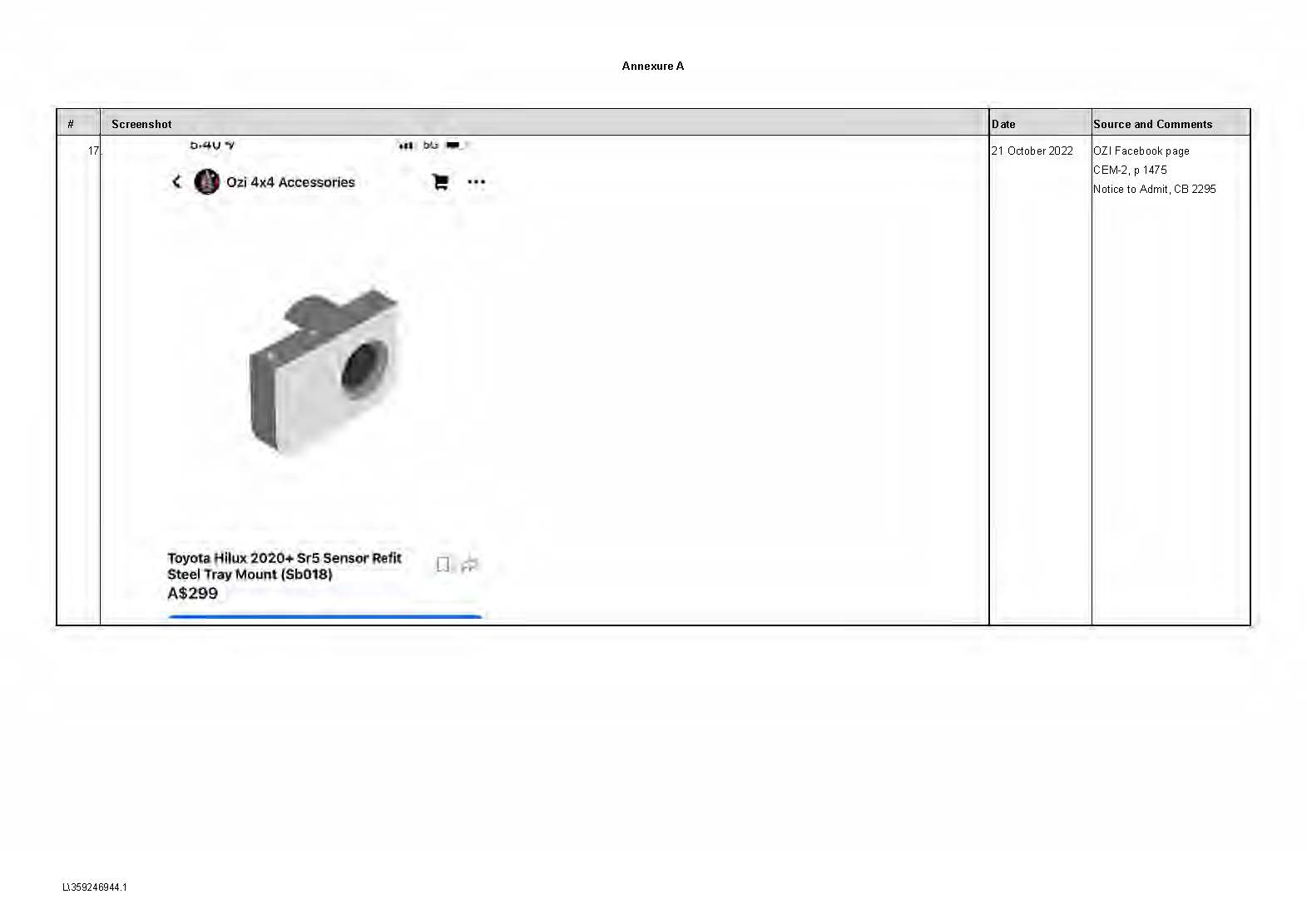
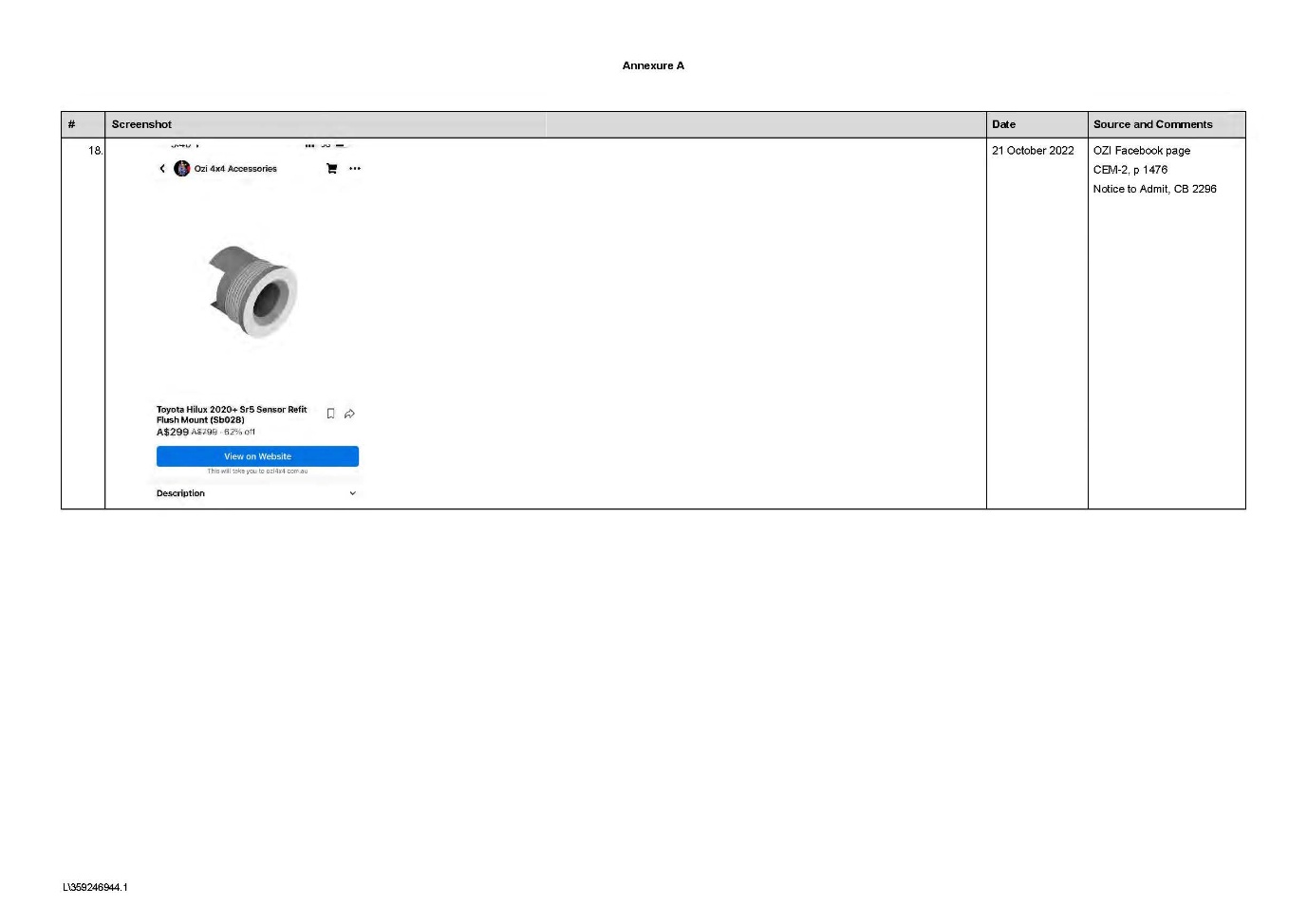
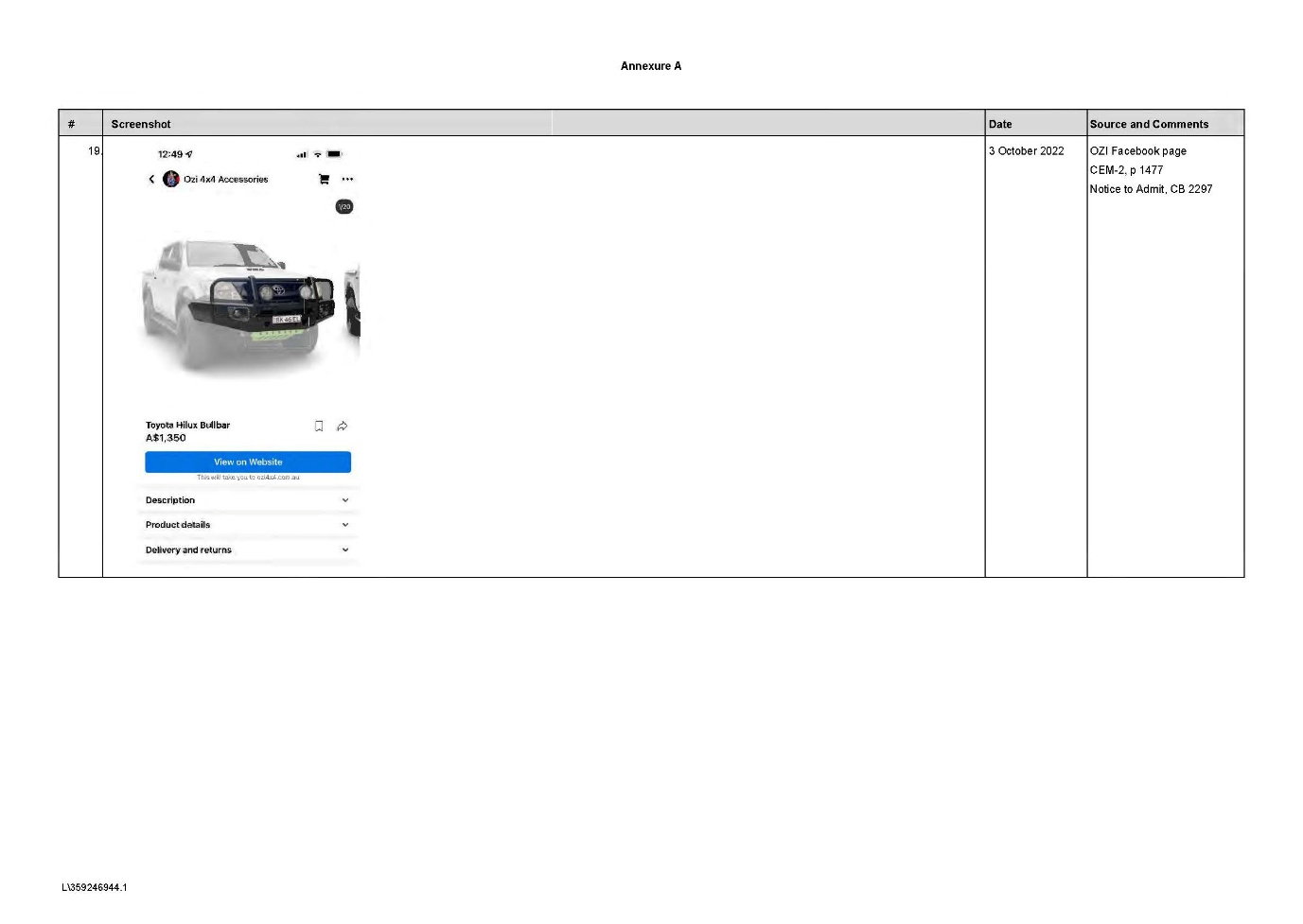
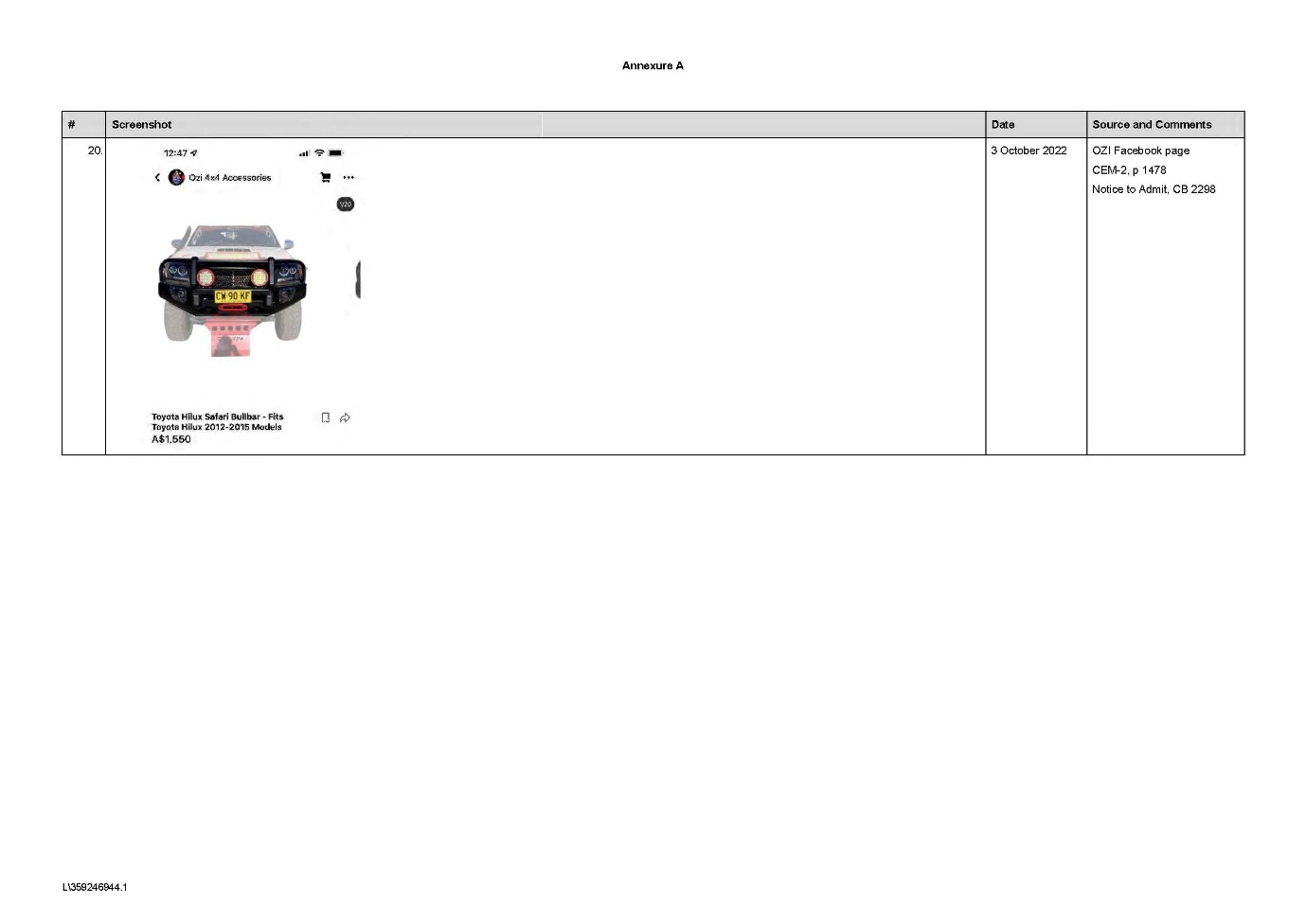
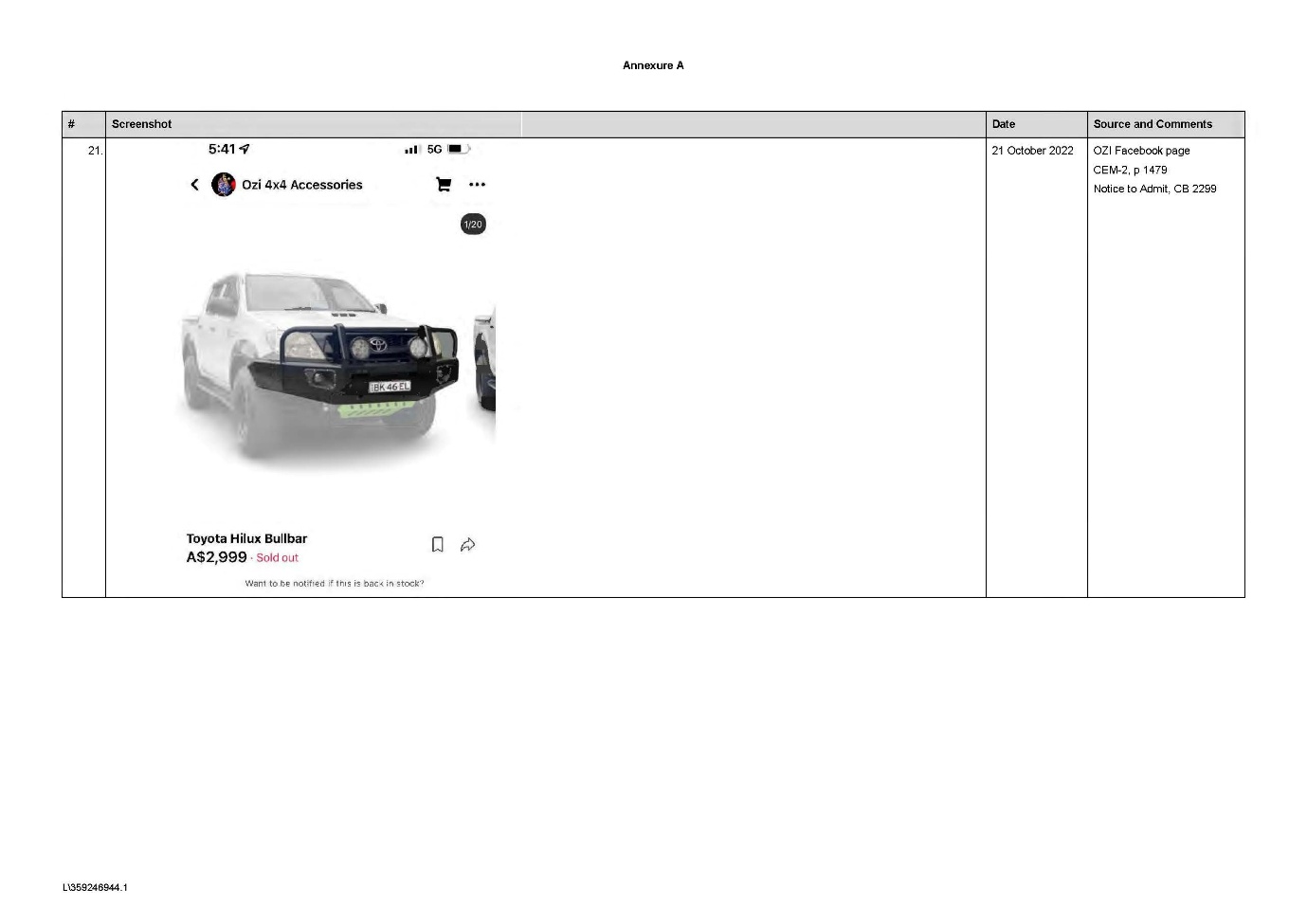
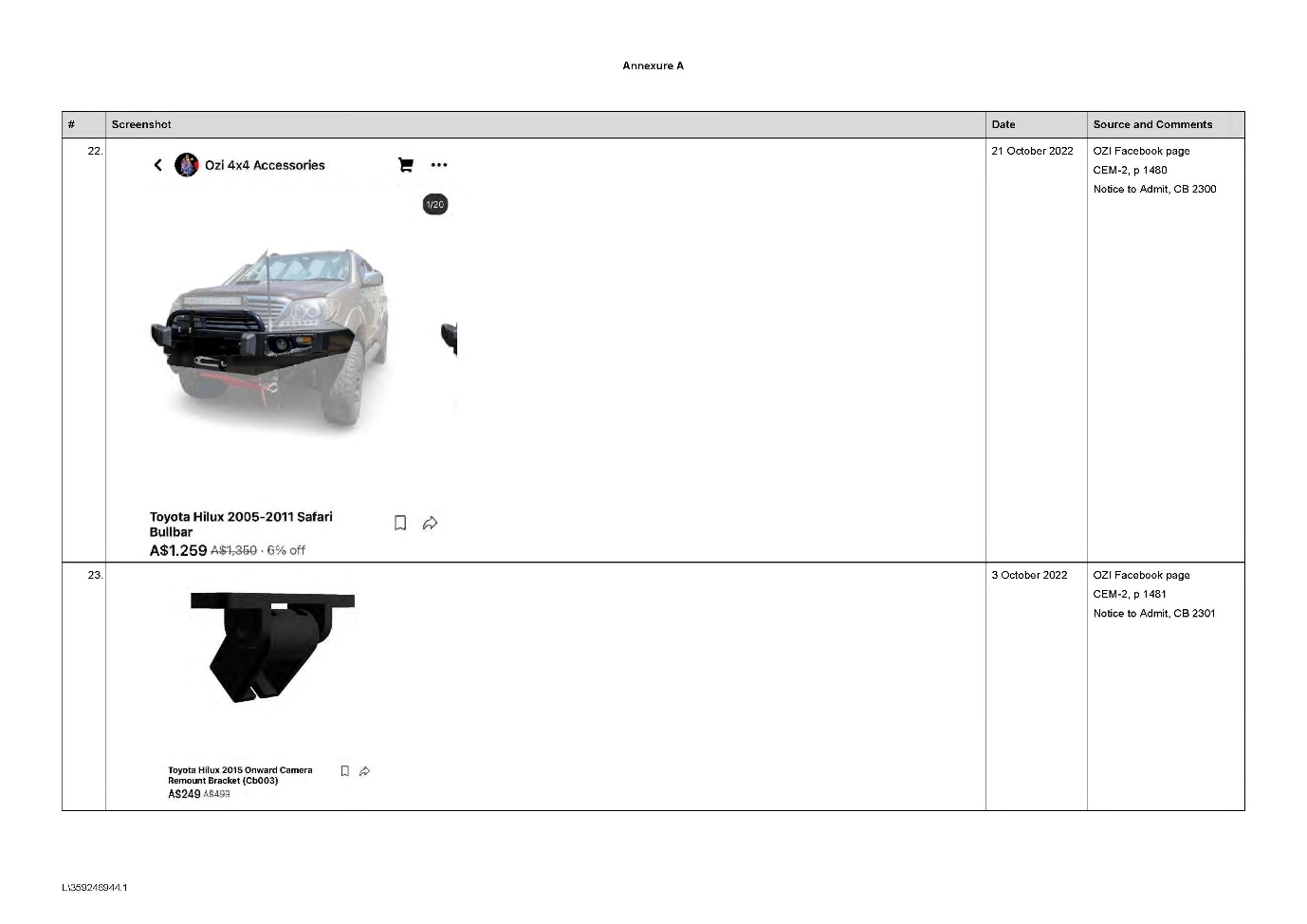
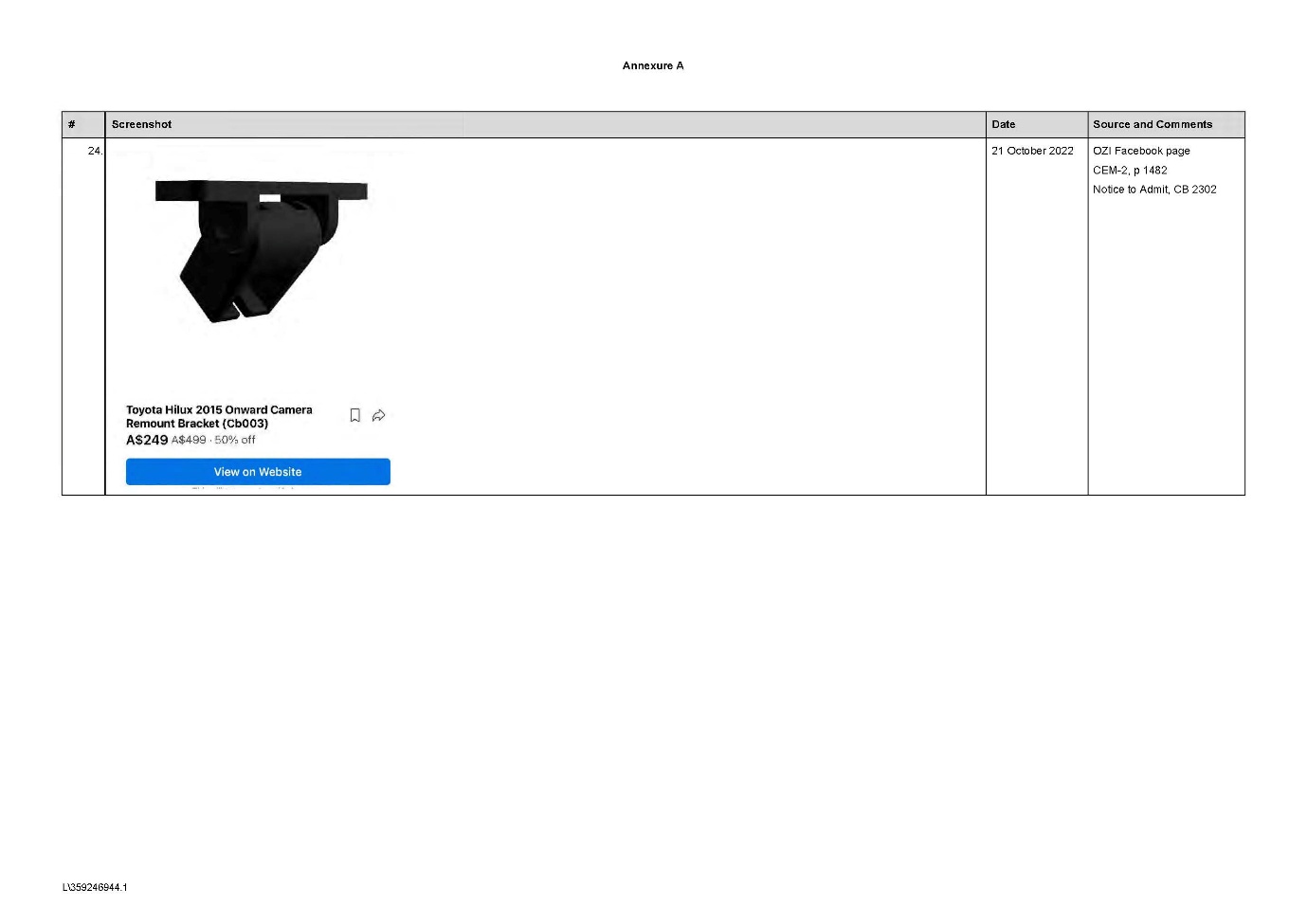
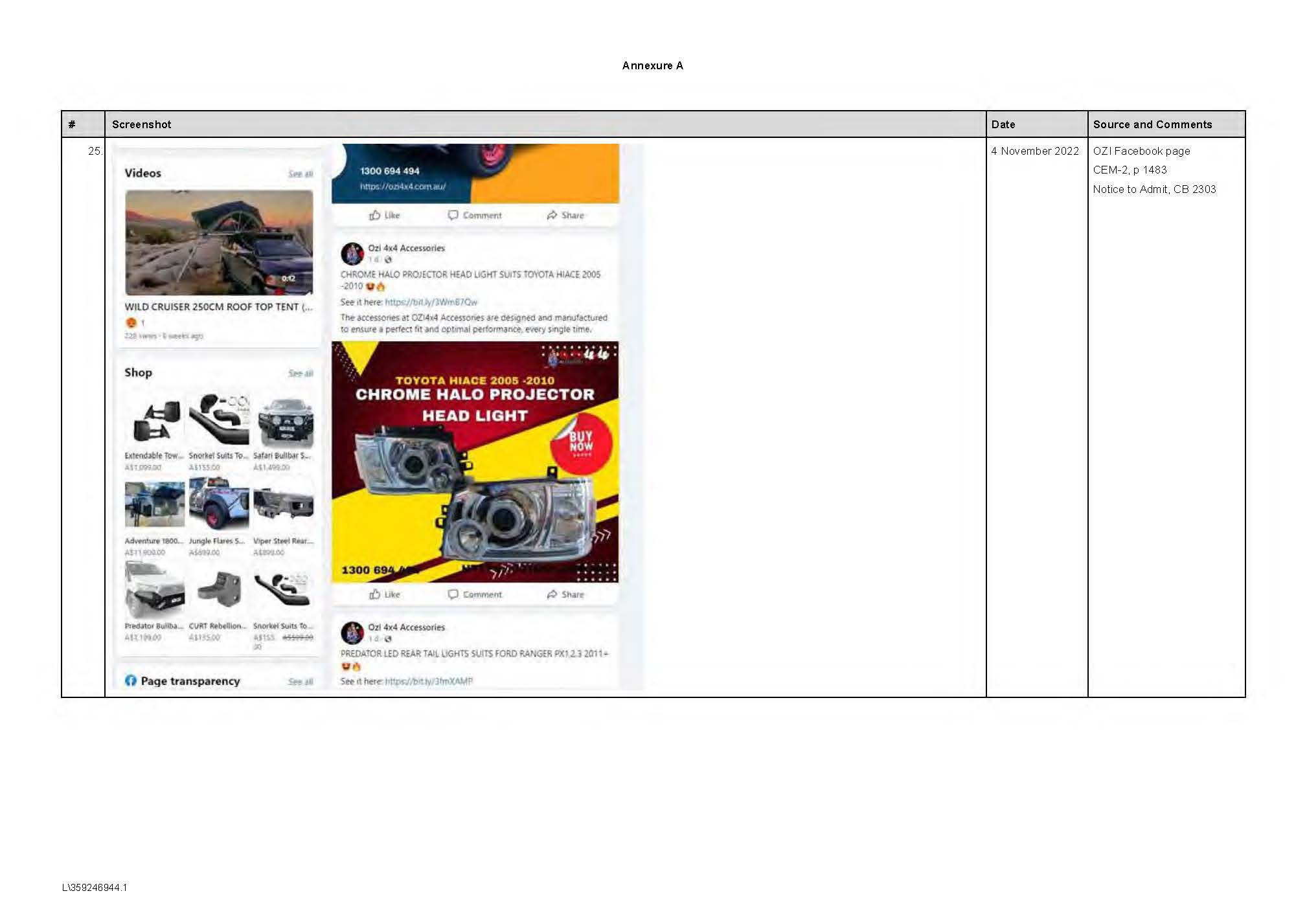
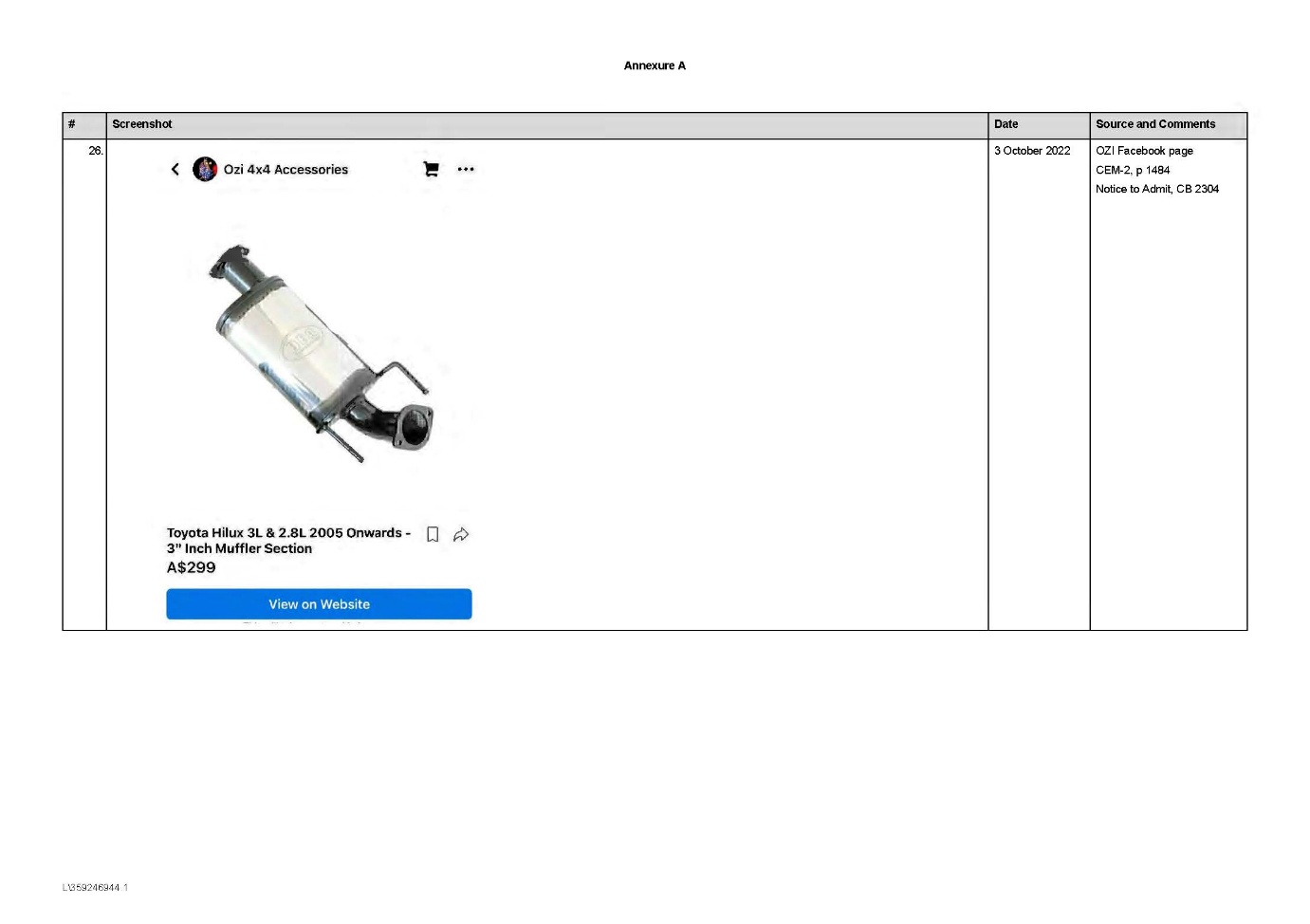
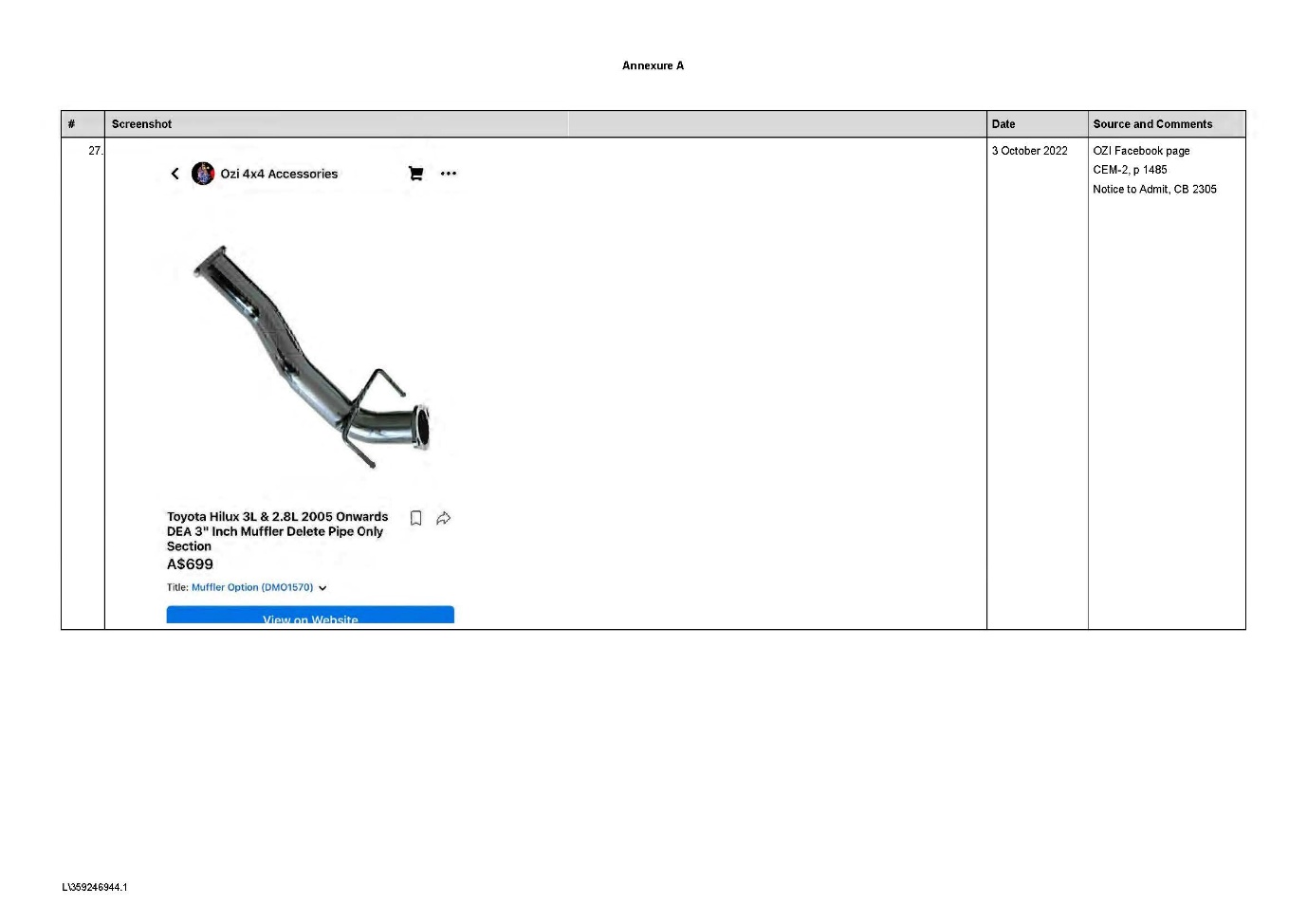
(a) the motor vehicle parts or accessories sold by the first respondent are products of the applicants;
(b) the motor vehicle parts or accessories sold by the first respondent have the sponsorship or approval of the applicants;
(c) the first respondent has the sponsorship or approval of, or an affiliation with, the applicants; and
(d) the motor vehicle parts or accessories sold by the first respondent have been manufactured to the standards authorised by the applicants.
9. The second respondent was directly or indirectly knowingly concerned in the contraventions described in declaration 8 except the contraventions relating to the importation, sale and supply of counterfeit tail lights bearing the mark HILUX.
Note: Entry of orders is dealt with in Rule 39.32 of the Federal Court Rules 2011.
REASONS FOR JUDGMENT
WHEELAHAN J:
1 The first applicant (Toyota Japan) is the registered owner of several trade marks, including the word marks TOYOTA, HILUX, LAND CRUISER, LANDCRUISER PRADO, PRADO, KLUGER, HIACE and the logo mark set out below –

2 Each of the trade marks is registered in respect of goods within Class 12 with reference to automobiles, or motor cars, or motor vehicles. In addition, the logo mark and the word marks TOYOTA, HILUX, LAND CRUISER, PRADO, KLUGER and HIACE are registered in respect of parts and accessories, and the word mark LANDCRUISER PRADO is registered in respect of “motor cars and structural parts thereof”.
3 The second applicant (Toyota Australia) is the authorised user in Australia of the trade marks: see Trade Marks Act 1995 (Cth), s 8. The respondents have admitted that since at least 2007 Toyota Australia has been a wholly owned subsidiary of Toyota Japan and has been licensed to use the trade marks.
4 The first respondent, OZI4X4 Pty Ltd (In Liquidation) (ACN 636 996 417), operated a business involving the sale of aftermarket four-wheel drive vehicle accessories. Sales were conducted online from a website (the OZI website) at www.ozi4x4.com.au and also from business premises at Yennora and then Smithfield, and then Minchinbury, New South Wales. The first respondent also at times operated from other premises. The second respondent, Mr Huss Safi, was the sole director of the first respondent.
5 The applicants allege that the first respondent imported, advertised, offered for sale, and sold goods by reference to the Toyota name and trade marks. The applicants claim that goods in which the respondents dealt included counterfeit products bearing Toyota trade marks. The applicants seek relief against the respondents for trade mark infringement, misleading and deceptive conduct, and the making of false representations in trade or commerce in contravention of the Australian Consumer Law (ACL), passing off, and breach of an agreement in settlement of a previous proceeding brought by the applicants against the respondents. The second respondent is alleged to be liable as an accessory for the claimed contraventions of the ACL, as a joint tortfeasor for trade mark infringement and the common law tort passing off, and as a party to the settlement agreement relating to the previous proceeding which the applicants claim has been breached. The applicants seek declarations, injunctions, common law and statutory damages, statutory additional damages, and common law exemplary damages.
The conduct of the trial
6 The respondents initially defended the proceeding. They filed a defence, they participated in case management and interlocutory hearings, they participated in a mediation, and they filed an affidavit of Mr Safi for the purposes of evidence at trial.
7 On 9 July 2025, the respondents’ lawyers filed a notice of ceasing to act. On 16 July 2025, the first respondent was wound up by order of the Supreme Court of Victoria. Mr Safi continued to defend the proceeding, including by appearing by video-link at case management hearings on 6 and 15 August 2025. Although the proceeding was commenced in the Victoria District Registry, I determined that the venue of the trial should be Sydney because Mr Safi was self-represented and was the subject of bail conditions that precluded him from leaving New South Wales. I informed Mr Safi at the case management hearing on 15 August 2025 that if he wished to defend the proceeding, he would have to attend the hearing in person in the court in Sydney and that I would not give him leave to appear remotely. I informed Mr Safi that if he did not appear at the hearing the matter may proceed in his absence.
8 Upon the matter being called at the commencement of the trial neither respondent appeared. Upon application being made by the applicants I granted them leave to proceed against the first respondent pursuant to s 471B of the Corporations Act 2001 (Cth): Toyota Jidosha Kabushiki Kaisha v Ozi4x4 Pty Ltd (Leave to proceed) [2025] FCA 981.
9 Senior counsel for the applicants confirmed at the outset of the trial that the applicants sought to prosecute their claims on an undefended basis rather than seeking judgment upon default of appearance by the respondents.
The evidence read to the Court and tendered by the applicants
10 The applicants’ affidavit evidence was constituted by the affidavits of six witnesses –
(1) An affidavit of Christopher David Schlicht affirmed 30 October 2024. Mr Schlicht is a legal practitioner and principal of Phillips Ormonde Fitzpatrick Lawyers, who gave evidence of one trap purchase.
(2) An affidavit of Adam Chambers affirmed 31 October 2024. Mr Chambers is the Managing Director of Pinkerton Consulting & Investigations (AU) Pty Ltd, an investigative services provider who gave evidence of eight trap purchases.
(3) An affidavit of Mark Paul Rochman sworn 31 October 2024. Mr Rochman is the Director of Veritas Adjusting Pty Ltd, a loss adjusting and investigative services provider. He, with Mr Darshan Singh Paul, gave evidence of three trap purchases.
(4) An affidavit of Darshan Singh Paul affirmed 1 November 2024. Mr Paul is a Director of Darlan Pty Ltd, trading as The Find Group, an investigative services provider. He gave evidence, with Mr Rochman, of three trap purchases.
(5) An affidavit of Kylie Graham affirmed 21 November 2024. Ms Graham is the Manager of Commercial Vehicle and Brand Communications for the Second Applicant. She gave evidence of the applicants’ reputation and relating to the damage alleged by the applicants.
(6) Three affidavits of Caitlin Emily McCrum sworn 26 November 2024, 7 July 2025 and 11 August 2025. Ms McCrum is a solicitor from Clayton Utz, the solicitors for the applicants. She gave evidence of the procedural history of the matter and some issues arising in relation to leave to continue the proceeding against the first respondent, and the activities of the first respondent and another company, OZI4X4 Australia Pty Ltd, of which Mr Safi is the sole director. Ms McCrum also gave oral evidence of the service of the Notices to Admit and Notices of Dispute in the proceeding.
11 Parts of Mr Safi’s affidavit evidence were tendered as admissions. Several other documents were tendered including notices to admit, the corresponding notices of dispute, evidence of service of notices to admit, and other sundry documents including TikTok videos published by Mr Safi.
Findings of primary fact
12 The liquidator of the first respondent foreshadowed that the first respondent did not intend to appear at the trial, and as I have mentioned Mr Safi did not appear. Therefore, there was no cross-examination, and the respondents did not adduce any evidence. Because the respondents did not appear there were no contested issues of fact at trial. The following are my findings based upon admissions by the respondents and the evidence adduced by the applicants.
Overview
13 There are three categories of activities by the first respondent which are the subject of the applicants’ causes of action –
(a) the importation for supply of counterfeit armrests bearing the LAND CRUISER trade mark;
(b) the importation for sale and supply of counterfeit tail lights bearing the HILUX trade mark; and
(c) advertisements published on the internet, including on social media sites and the OZI website, in which the first respondent advertised goods such as bull bars, mufflers, and sensor mounts using the Toyota name and trade marks.
14 The applicants referred to the armrests and tail lights which are the subject of their claims as the Counterfeit Products, and the goods which are the subject of the impugned advertising by the first respondent as the Impugned Aftermarket Products.
Trap purchases of the armrests
15 In October 2022, Mr Darshan Paul purchased from the OZI website using an alias, “Paul Blackman”, a pair of side door armrest cupholders. This was a trap purchase. The armrests were advertised on the website as –
SIDE DOOR ARMREST CUPHOLDER SUITS TOYOTA LAND CRUISER 70 SERIES (ONLINE ONLY)
16 There was a separate notation on the website over a photograph of a vehicle accompanied by pictures of the armrests as follows –
FOR TOYOTA LAND CRUISER 70 SERIES
17 The online advertisement included the code “E194579836206” to identify the armrests.
18 The applicants do not allege that the advertising of the armrests on the website constituted infringing conduct by the first respondent.
19 On 20 October 2022, the armrests were delivered by carrier to an address in Victoria that had been nominated by Mr Paul in the order. The armrests were packaged in a box which was wrapped in white plastic packaging to which was affixed an address label. The armrests themselves bore in raised letters the words “LAND CRUISER” –
20 In February 2023, Mr Paul purchased from the OZI website, using the alias “Paul Blackman”, a second pair of side door armrest cupholders which were described as “carbon fibre”. This was another trap purchase. The armrests were advertised on the website as –
CUP HOLDER CARBON FIBRE SUITABLE FOR TOYOTA LAND CRUISER 79, 78, 76, 75, 70 (ONLINE ONLY)
21 The online advertisement included the code “ACC-E384754865554” to identify the second pair of armrests.
22 On 21 February 2023, the armrests were delivered by carrier to the address in Victoria which had been nominated in the order. The armrests were packaged in a white box which was wrapped in clear plastic packaging to which was affixed an address label. Like the first pair of armrests, these armrests also bore in raised letters the words “LAND CRUISER” –
Trap purchases of the tail lights
23 On 7 October 2022, in another trap purchase Mr Paul purchased from the OZI website a pair of tail lights. Again, Mr Paul used an alias, “Paul Blackman”, for the purchase. The tail lights were advertised on the website as –
OEM TAIL LIGHTS SUITS TOYOTA HILUX 2015-2022
24 The applicants do not allege that the advertising of the tail lights on the website constituted infringing conduct by the first respondent.
25 The first respondent used Shopify as its online platform for its website sales. The first respondent’s Shopify records confirm the order for the tail lights by a Paul Blackman on the online store and record steps that were taken such as picking the stock, labelling the package, and despatching the goods via a carrier. The records include the stock keeping unit (SKU) code “HO-HLUX-5003” to identify the tail lights.
26 On 20 October 2022, the tail lights were delivered by carrier to the address in Victoria that Mr Paul nominated in the order. The tail lights were delivered in a cardboard box to which was affixed an address label. The tail lights bore in embedded letters the word “HILUX” –
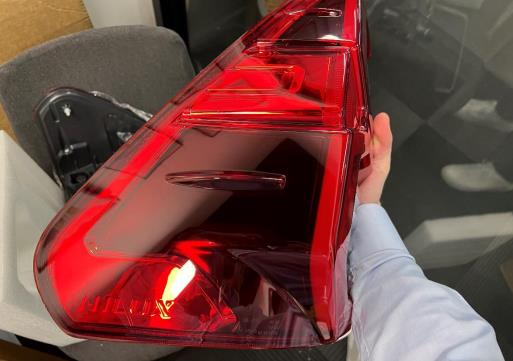
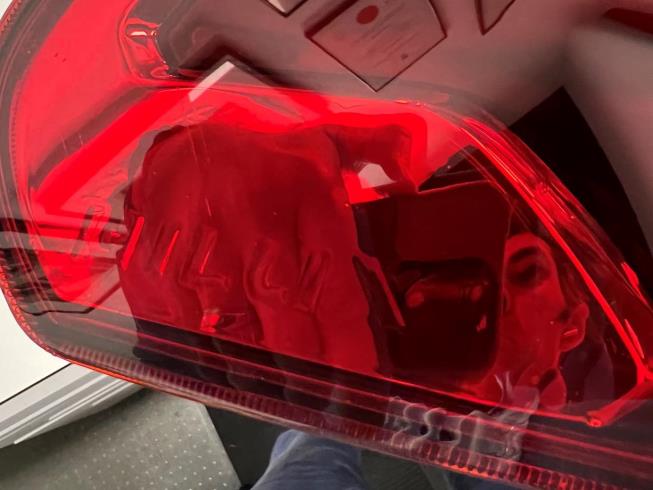
27 On 25 October 2022, an agent engaged by the applicants purchased a pair of tail lights over the counter from the first respondent’s premises in Smithfield, New South Wales. The sale is recorded in an invoice that was issued to the agent and in the first respondent’s records that were produced and tendered. The invoice included the code “HO-HLUX-5003”. The second pair of tail lights were packaged in a brown cardboard box with a label stating, “OEM Tail Lights Suits Toyota Hilux 2015-2022”. The second pair of tail lights also bore the word “HILUX” in embedded lettering –
Sales of the Counterfeit Products to members of the public
28 There is not a complete record of the first respondent’s sales of the Counterfeit Products in evidence before the Court. Apart from the two trap purchases, the first respondent’s Shopify records evidence the following sales of tail lights bearing the SKU code “HO-HLUX-5003” –
Date | Order No | |
(1) | 2 March 2022 | 9652 |
(2) | 12 May 2022 | 11592 |
(3) | 22 July 2022 | 13698 |
(4) | 14 August 2022 | 14517 |
(5) | 27 August 2022 | 15013 |
(6) | 8 September 2022 | 15387 |
(7) | 3 October 2022 | 16033 |
(8) | 19 October 2022 | 16422 |
(9) | 22 October 2022 | 16471 |
(10) | 25 October 2022 | 16509 |
29 As to the armrests, the first respondent’s Shopify records in evidence record the following online sales of armrests with the code “E194579836206” that are in addition to the trap purchase of that item by “Paul Blackman” –
Date | Order No | |
(1) | 5 November 2022 | 16776 |
(2) | 9 November 2022 | 16895 |
(3) | 10 November 2022 | 16934 |
(4) | 15 November 2022 | 17070 |
(5) | 18 November 2022 | 17178 |
(6) | 21 November 2022 | 17263 |
30 Having regard to the identity between the product codes of the above items and those that were the subject of the trap purchases, I am satisfied that these items were the same products that were the subject of the trap purchases and that they also bore the applicants’ trade marks.
31 The applicants sought discovery from the respondents of their sales records, and in particular their Shopify records in relation to the Counterfeit Products. By an order made 2 June 2025 the respondents were ordered to make discovery of, inter alia, documents that were specified in a notice to produce and also –
All documents evidencing or recording the ordering, importation, supply or sale of the following products in the period 1 October 2021 to 3 September 2024:
(a) tail lights for HiLux vehicles; and
(b) armrests for Land Cruiser vehicles.
32 In response to a notice to produce, on 3 June 2025 the respondents produced an email from Shopify to Mr Safi dated 24 May 2025 evidencing the cancellation of the Shopify account accompanied by a claim by the respondents that they could no longer access the Shopify account. The applicants sought leave to serve a subpoena on Shopify, which is based in Singapore, requiring production of documents but leave was refused: Toyota Jidosha Kabushiki Kaisha v OZI4X4 Pty Ltd [2025] FCA 768 (Hill J).
33 Mr Safi also filed an affidavit dated 16 July 2025 in which he stated, inter alia –
6. After receiving the orders, I again tried to find the documents in the notice to produce. However, I could not find the documents. In June 2023 we moved the business from Smithfield to Unit1/40 Sterling Road, Minchinbury NSW 2770. During the move, we lost a lot of documents. Some computer things were also lost during the move.
7. I confirm that I provided my lawyers all the documents that I could find relating to the notice to produce. I do not have access to other documents.
8. I do not have any documents evidencing or recording the communications for discovery documents other than what I have already provided.
9. Because of the court proceedings, I am financially restrained. I do not have an income anymore as my business is winded up on 16 July 2025.
34 The applicants submitted that this evidence was patently false and dishonest. I am not minded to find that Mr Safi’s evidence was dishonest when it is not necessary to determine that issue. It is sufficient for me to say that I am not persuaded in all the circumstances to accept Mr Safi’s claims about the failure to produce documents when Mr Safi failed to appear at the hearing of the proceeding and thereby deprived the applicants of an opportunity to cross-examine him. I am satisfied that there were more relevant documents than the respondents produced, and that fact enables me to infer that there was a likelihood of more sales of infringing goods than those that are the subject of the available direct evidence.
35 The evidence shows that the first respondent continued to sell the armrests after the respondents were placed on notice of the presence of the LAND CRUISER mark on the armrests that were the subject of the trap purchase in October 2022. The applicants sent a letter of demand dated 27 October 2022 to which the respondents’ solicitors replied on 11 November 2022 asserting that “since receipt of your correspondence, Ozi has immediately ceased the sale of this item”. However, the Shopify records show that sales of the armrests continued and were made both after 27 October 2022 (the date of the letter of demand) and after the respondents’ response on 11 November 2022 until at least February 2023 when the first respondent sold a carbon fibre version of the armrests to the trap purchaser. The respondents’ solicitors’ reply of 11 November 2022 also contained admissions that there had been sales of 20 pairs of armrests (referred to in the letter as “cupholders”) and sales of 15 tail lights, which I interpret to be 15 pairs of tail lights.
36 The evidence also shows that the two trap purchases of armrests are not recorded in the documents discovered and produced by the respondents. This leads me to be satisfied that the records produced by the respondents are not complete.
37 In the above circumstances, I am satisfied that there were likely to be more sales of the Counterfeit Products by the first respondent than those which were recorded in the Shopify records that are in evidence. The pattern of sales in combination with the failure to produce additional documents on discovery and in response to a notice to produce supports an inference that there were sales of Counterfeit Products that extended beyond the periods covered by the records in evidence which included at least the sales of the carbon fibre armrests in respect of which the respondents did not produce any documents evidencing sales. The respondents’ failure to appear at the hearing to dispute the claims and to lead contradictory evidence from Mr Safi, who is a party to this proceeding, strengthens these inferences: Kuhl v Zurich Financial Services Australia Ltd [2011] HCA 11; 243 CLR 361 at [63] (Heydon, Crennan and Bell JJ); Insurance Commissioner v Joyce (1948) 77 CLR 39 at 49 (Rich J). However, beyond this, I am not able to quantify the precise extent of sales that were not the subject of direct evidence.
Sources of the Counterfeit Products
38 The applicants tendered parts of an affidavit of Mr Safi dated 16 May 2025 as admissions by the respondents. In paragraphs 4, 5, and 7 of the affidavit Mr Safi described the first respondent’s practice in relation to the importation of goods that it ordered from suppliers in China. The practice included instances where the goods were shipped directly from the suppliers in China to the ultimate purchasers without the first respondent coming into possession of the goods –
4. The First Respondent used two main suppliers for motor vehicle parts, XL Holding Group Co Ltd, based in Changzhou China, and Shenzhen Top China Imp & Exp Co Ltd, based in Shenzhen China (‘Suppliers’).
5. The agreements between the First Respondent and its Suppliers were partly oral and partly in writing. There was no formal contract between the First Respondent and its Suppliers. The First Respondent would submit an order. The goods would then be shipped from China. The First Respondent would communicate with its Suppliers primarily via WECHAT, a Chinese instant messaging app.
…
7. There are two different ways that the First Respondent sells motor vehicle parts. It will either receive goods directly from its Suppliers and ship the parts to the end customer within Australia, or the items will be shipped directly from the Supplier to the customers. In the latter cases, neither the First Respondent, nor I, ever have possession of the parts.
Source of the counterfeit Hilux tail lights
39 Documents produced on discovery by the respondents and tendered at the hearing support an inference that XL Holding Group Co Ltd trades using the name HW Offroad Inc and that it has a website, www.hw4x4.com. The applicants tendered what purported to be a series of summaries of wholesale sales to the first respondent of various 4x4 parts and accessories by HW Offroad Inc that was produced on discovery. The items include 5 pairs of tail lights for a 2021 Hilux bearing the same product code as the online purchase effected by Mr Paul on 7 October 2022. Adjacent to the entry for the Hilux tail lights under the heading “Remark” are the words, “Had Logo as previously advised”. There is no date attributed to this wholesale sale or to the remark and I am unable to infer the dates. By a letter dated 11 November 2022, the respondents’ then solicitors stated that the tail lights were acquired from the manufacturer in China, HW Offroad Inc, and that they were sold in store by the first respondent directly to customers.
40 On the basis of the retail and wholesale sale records and the admissions in the respondents’ solicitors’ letter to which I have referred I find that the first respondent purchased the tail lights from HW Offroad in China and imported them and held them at its premises. The first respondent thereby came into possession of the goods. One pair of tail lights was sold online and was despatched by the first respondent and delivered by carrier. A second pair was sold from the first respondent’s retail premises at Smithfield. Other pairs of the tail lights were sold by the first respondent, which included at least those identified at [28] above and number at least 15 pairs, being the admission made by the respondents’ solicitors.
Source of the armrests
41 Stickers affixed to the boxes containing the sets of armrests the subject of the trap purchases that were delivered to the address in Victoria state that they were made in China and identified the manufacturer as Guangzhou Pudan Auto Products Co Ltd.
42 The first respondent did not discover its Shopify records in relation to the orders for the two pairs of armrests the subject of the trap purchases. However, records for other purchases of similar armrests were discovered and tendered. Those other orders stated that the armrests were shipped from a “third party warehouse”, and there was an entry in the timeline for one order stating, “please drop ship”. I am not able to make a finding as to the identity of the first respondent’s supplier which despatched the goods but based on the representations in Mr Safi’s affidavit of 16 May 2025 that was tendered, I infer that it was one of the first respondent’s suppliers in China. Upon the foundation of this evidence, I infer that upon Mr Paul placing the two orders for the armrests on the first respondent’s website, the first respondent ordered the armrests from its supplier in China which then despatched the goods to the address in Victoria. By this process, the first respondent discharged its obligation to deliver the goods. This is a process known as “drop shipping” in which the retail seller does not obtain physical possession of the goods. The other pairs of armrests sold in this way include those identified at [29] above, and number at least 20 pairs, being the admission made by the respondents’ solicitors.
Advertising of the Impugned Aftermarket Products
43 In October and November 2022, the first respondent advertised, promoted, and offered for sale on the OZI website, its Facebook page, and its Instagram page, motor vehicle parts and accessories under or by reference to the Toyota trade marks. The relevant goods were sensor mounts, camera remount brackets, bull bars, mufflers, headlights and bash plates. Screenshots of such pages were in evidence, and their authenticity and dates were admitted by the respondents by their failure to dispute the applicants’ notice to admit the documents dated 8 July 2024. A typical example of a screenshot is set out below –
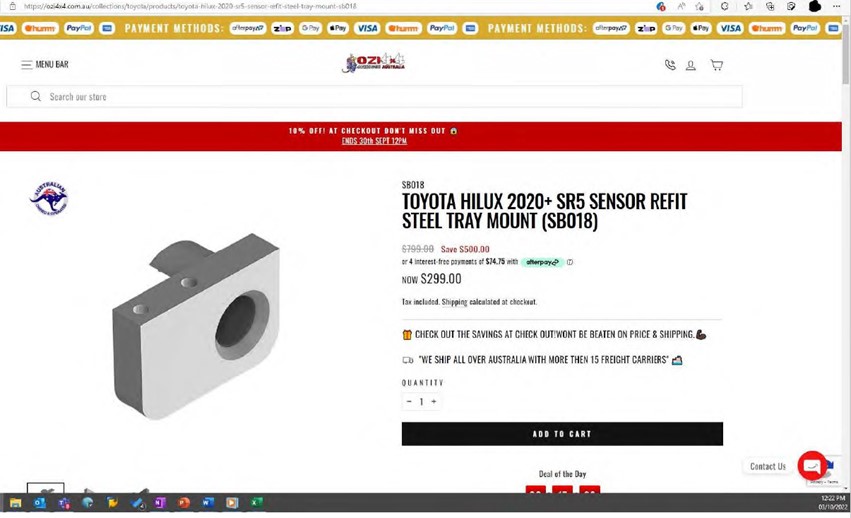
44 The other screenshots describe parts for sale on the first respondent’s website using the terms “TOYOTA HILUX”, “TOYOTA HIACE”, or “LAND CRUISER”, which are comprised of Toyota registered trade marks and are set out in the schedule to this judgment. The dates of the screenshots are noted in the schedule.
Sales of the Impugned Aftermarket Products
45 I was not taken in submissions to any direct evidence of any individual sales of Impugned Aftermarket Products. The applicants’ case at trial focussed on the advertising of those products rather than their sale.
Other admissions by the respondents
46 There were a number of other admissions made by the respondents that were brought about by a notice to admit facts which I find was served by email on 8 July 2024 and to which the respondents did not file a notice of dispute within the 14-day period prescribed by r 22.02 of the Federal Court Rules 2011 (Cth). Although they did serve a notice of dispute out of time on 30 August 2024, the respondents made no application for an extension of time or application to withdraw the admissions. Based upon the respondents’ admissions, I make the following further findings –
(1) The first respondent was not and has never been an authorised dealer of the applicants’ parts and accessories.
(2) The parts and accessories supplied by the first respondent since 2019 were not manufactured by or with the licence of the applicants.
(3) The first respondent imported the parts it supplied to consumers from entities in China, including XL Holding Group Co Ltd based in Changzhou China (also known as HW Offroad), and Shenzhen Top China Imp & Exp Co Ltd, based in Shenzhen China.
(4) The way in which the first respondent supplied its products was either through receiving the goods from its suppliers in China and on-selling them to customers or by arranging for the goods to be sent to customers directly by those suppliers.
47 The respondents made further admissions as a result of the service by the applicants of a further notice to admit dated 16 August 2024 and the respondents’ response by notice of dispute dated 30 August 2024. Some of the admitted facts relate to supplies that were the subject of earlier proceedings, and which are relied on for the purposes of claims for additional and exemplary damages. In relation to the primary claims of infringement that are the subject of this proceeding the facts which the respondents did not dispute, and which are therefore admitted, are –
(1) On or around 4 October 2022, the first respondent supplied an armrest bearing the LAND CRUISER trade mark to a customer via the OZI website.
(2) On or around 4 October 2022, the first respondent supplied tail lights bearing the HILUX trade mark to a customer via the OZI website.
(3) On 25 October 2022, the first respondent supplied tail lights bearing the HILUX trade mark to a customer at the Smithfield premises.
(4) On or around 10 February 2023, the first respondent supplied an armrest bearing the LAND CRUISER trade mark to a customer via the OZI website.
The first proceeding and the settlement agreement
48 This is the second proceeding that the applicants have commenced against the respondents in relation to alleged trade mark infringement and misleading and deceptive conduct. The first proceeding was VID136 of 2021. The first proceeding concerned bash plates, snorkels, and grilles that the applicants alleged bore Toyota trade marks. The parties settled the first proceeding and entered into a settlement and release agreement dated 1 October 2021 (the settlement agreement).
49 Under clause 1.2(b) of the settlement agreement obligations imposed on two or more persons were imposed on them jointly and severally –
an obligation or liability assumed by, or a right conferred on, 2 or more persons binds or benefits them jointly and severally;
50 Under clause 2.1 of the settlement agreement the respondents agreed to pay the applicants the sum of $145,000 by 12 equal instalments. The recitals to the settlement agreement provided that the respondents denied the allegations made against them. Relevant to this proceeding, subclauses 8(a) and (b) of the settlement agreement provided as follows, where the respondents to this proceeding were defined as the “OZI Parties” –
The OZI Parties must:
(a) cease and forever desist from promoting for sale, offering for sale, displaying for sale, advertising for sale and/or selling or supplying (including online) motor vehicle parts, fittings or accessories bearing any Toyota Trade Mark (or any trade mark that is substantially identical with or deceptively similar to any of the Toyota Trade Marks);
(b) cease and forever desist from promoting for sale, offering for sale, displaying for sale, advertising for sale and/or selling or supplying (including online) aftermarket motor vehicle parts, fittings or accessories under or by reference to any Toyota Trade Mark (or any trade mark that is substantially identical with or deceptively similar to any of the Toyota Trade Marks) unless:
(i) the OZI Parties do so in good faith to indicate the intended purpose of the goods; and
(ii) the trade mark is preceded by the words “suitable for” or “compatible with” in text that is the same size as, and equally prominent as, the trade mark; and
…
51 Clause 14.7 of the settlement agreement then provided –
Each party must do or cause to be done all things necessary or reasonably desirable to give full effect to this agreement and the transactions contemplated by it (including the execution of documents).
52 Subsequently, and as contemplated by the settlement agreement, the Court granted injunctive relief by consent: see Toyota Jidosha Kabushiki Kaisha v Ozi4x4 Pty Ltd [2023] FCA 1361 at [7] to [9]. The orders were made after the respondents had completed the instalment payments. The conduct alleged by the applicants in this proceeding occurred before the injunctions were made, and therefore there is no allegation that the respondents contravened the Court’s orders.
53 However, the applicants relied on conduct that was the subject of their claims in the first proceeding to support their claims for additional damages under the Trade Marks Act and exemplary damages at common law. That course was expressly contemplated by clause 3(b) of the settlement agreement, which provided –
For the avoidance of doubt, notwithstanding the release in clause 3(a), if either of the OZI Parties, their directors, officers, employees, agents or Related Bodies Corporate engage in any unlawful conduct contrary to the interests of the Toyota Parties after the date of this agreement, Toyota will not be precluded from relying on the conduct the subject of the Proceeding in order to seek orders for additional damages, exemplary damages and/or special costs orders in any subsequent court proceedings.
54 The allegations in the first proceeding included that on various dates between February 2020 and January 2021 the respondent supplied goods bearing the applicants’ trade marks, including the word marks TOYOTA, HILUX, LAND CRUISER and TRD.
55 There was no allegation in the amended statement of claim in this proceeding that either of the applicants was registered as the owner of, or was authorised to use the word mark TRD, and it was not the subject of the admissions that the applicants sought in their notice to admit dated 8 July 2024. Further, ownership or infringement of the mark TRD was not the subject of any term of the settlement agreement that would constitute an admission by the respondents. My attention was not directed to any evidence that either of the applicants was the owner of, or authorised user of the word mark TRD. I therefore exclude from my findings of trade mark infringement the applicants’ claims that the first respondent infringed that alleged mark.
56 Based upon admissions taken to have been made by the respondents as a consequence of the applicants’ notices to admit dated 8 July 2024 and 16 August 2024, I make the following findings –
(1) On 7 February 2020, the first respondent supplied a bash plate bearing the HILUX word mark to a customer at the first respondent’s premises at Yennora, New South Wales.
(2) On 14 February 2020, the first respondent supplied a snorkel bearing the HILUX word mark to a customer at the Yennora premises.
(3) On 11 September 2020, the first respondent supplied a grille bearing the TOYOTA logo mark to a customer at the Yennora premises.
57 By their notice of dispute dated 30 August 2024 the respondents disputed four supplies –
(1) On 4 September 2020, the first respondent supplied a snorkel bearing the HILUX trade mark to a customer at the Yennora premises.
(2) On or around 8 October 2020, the first respondent supplied a snorkel bearing the HILUX trade mark to a customer via the OZI website.
(3) On 9 January 2021, the first respondent supplied a bash plate bearing the TRD trade mark to a customer at the Smithfield premises.
(4) On 9 January 2021, the first respondent supplied a grille bearing the TRD trade mark to a customer at the Smithfield premises.
58 However, the first two supplies were the subject of unchallenged evidence and I find that they occurred. I have not considered the third and fourth supplies because as I have explained above I do not take account of the applicants’ claims for infringement of the TRD mark. Based on a surveillance report of an investigator that was annexed to the affidavit of Adam Chambers affirmed 31 October 2024, I find that on 4 September 2020 the first respondent supplied a snorkel bearing the HILUX mark to a customer at its Yennora premises. I also find based upon photographic images in the report that Mr Safi who was identified by a staff member as “the boss” was personally involved in the sale and spoke with the customer about how to install the snorkel. I make this finding because I recognise Mr Safi, who appeared before me at two case management hearings.
59 Based upon the evidence in the affidavit of Mr Christopher David Schlicht affirmed 30 October 2024, I find that on 12 October 2020, the first respondent supplied a snorkel bearing the HILUX mark to a customer that had been ordered on 8 October 2020 on the OZI website.
60 Based upon the respondents’ admission as a result of its failure to respond within time to the applicants’ notice to admit dated 8 July 2024, I find that the parts and accessories referred to at [56], [57], and [59] above were not manufactured by or with the licence of the applicants.
Trade mark infringement
61 The definition of “trade mark” in s 17 of the Act is as follows –
A trade mark is a sign used, or intended to be used, to distinguish goods or services dealt with or provided in the course of trade by a person from goods or services so dealt with or provided by any other person.
Note: For sign see section 6.
62 A “sign” is defined by s 6 of the Act as follows –
sign includes the following or any combination of the following, namely, any letter, word, name, signature, numeral, device, brand, heading, label, ticket, aspect of packaging, shape, colour, sound or scent.
63 Under s 6(1) of the Act the phrase “use of a trade mark in relation to goods” has the meaning given by s 7(4) under which the phrase is defined as follows –
use of a trade mark in relation to goods means use of the trade mark upon, or in physical or other relation to, the goods (including second-hand goods).
64 I observe that the phrase “use of a trade mark in relation to goods” is not deployed in terms in the Trade Marks Act: cf, Self Care IP Holdings Pty Ltd v Allergan Australia Pty Ltd [2023] HCA 8; 277 CLR 186 (Self Care) at [23]. Compare the Trade Marks Act 1955 (Cth) where the definition of “trade mark” referred to use of a trade mark “in relation to goods” and where s 6(2)(b) provided –
references to the use of a mark in relation to goods shall be construed as references to the use of the mark upon, or in physical or other relation to, goods.
65 Under s 20 of the Act the registered owner has the exclusive right to use the trade mark and to authorise its use and has the right to obtain relief under the Act if the trade mark has been infringed.
66 Under s 120(1) of the Act, a person infringes a registered trade mark if the person “uses as a trade mark” a sign that is substantially identical with, or deceptively similar to, the trade mark in relation to goods or services in respect of which the trade mark is registered. Use of a sign “as a trade mark” is an essential element of infringement: Self Care at [7]. As the facts in Self Care in relation to the registered mark “Botox” illustrate, a trader may publish text that includes another trader’s registered mark without thereby using the mark as a trade mark: see Self Care at [24], [52]. Whether a sign is used, or is intended to be used, as a trade mark is assessed objectively and may be informed by surrounding context. Context may include “the way in which the words have been displayed, and how the words would present themselves to persons who read them and form a view about what they connote”: Self Care at [24]. Intention is not relevant: Self Care at [24]. Therefore, a trader may use a mark as a trade mark without any knowledge that it is doing so in a particular market: E and J Gallo Winery v Lion Nathan Australia Pty Ltd [2010] HCA 15; 241 CLR 144 (E and J Gallo) at [51] (French CJ, Gummow, Crennan and Bell JJ).
67 The applicants submitted, citing Nokia Corporation v Mai [2003] FCA 924; 59 IPR 413 (Nokia) at [46] to [52] (Kenny J), that –
It is well-established that in order to use a trade mark simply in order to convey the impression that the goods are suitable for use with the goods of the registered owner of the trade mark, specific language is needed, such as a clear statement that the goods are “suitable for use on Toyota Hilux”.
68 To the extent that the applicants’ submission was directed to the question of use of a sign as a trade mark I do not accept the submission. Trade mark use is a question of fact and not law. Each case must be determined on its own facts having regard to the context surrounding the use of the sign as explained in Self Care at [24]. There can be no universal rule that particular words are required in order to avoid a finding of trade mark use. Further, in Nokia Kenny J at [46] to [52] was addressing the defence under s 122(1)(c) of the Trade Marks Act which operates to defeat a claim of infringement and proceeds on the premise that there has been use of a mark as a trade mark. It was in that context that Kenny J observed at [47] that the authorities established that it will be difficult to make out the defence in the absence of words such as “suitable for use with” or “suitable in”.
69 For the purposes of s 120(1) of the Act the elements of use on the one hand, and substantial identity or deceptive similarity on the other, are not to be conflated: Self Care at [60]. Use of a sign “as a trade mark” is use of the mark as a badge of origin in the sense that it indicates a connection in the course of trade between goods and the person who applied the mark to the goods. Use as a trade mark is not concerned with whether the sign indicates a connection between the alleged infringer’s goods and those of the registered owner of the trade mark: Coca Cola Co v All Fect Distributors Ltd (1999) 96 FCR 107 at [19] to [20] (Black CJ, Sundberg and Finkelstein JJ), cited in Self Care at [60].
In the course of trade
70 The requirement in s 120(1) of the Act that an infringing sign be used as a trade mark imports the requirement that this occur to distinguish goods dealt with or provided “in the course of trade” as a result of the definition of “trade mark” in s 17. This construction is consistent with recommendation 22A of the report of the Working Party to Review the Trade Marks Legislation titled Recommended Changes to the Australian Trade Marks Legislation dated July 1992, which recommended that infringing use occurs where a person in the course of trade uses a sign. Whether a sign is used or is intended to be used as a trade mark to distinguish goods dealt with or provided “in the course of trade” has been considered by the authorities in a number of contexts. Many of the authorities concern the question whether the registered owner of a trade mark has used the mark “in the course of trade” for the purpose of preserving registration.
71 While I regard the phrase “in the course of trade” in s 17 of the Act as bearing its ordinary meaning which is shaped by its context, the authorities afford illustrations and illuminate the meaning of the expression: cf, Ambulance Service (NSW) v Deputy Commissioner of Taxation (Cth) [2002] FCA 1023; 50 ATR 496 at [37] (Allsop J). In that regard, in Oakley, Inc v Franchise China Pty Ltd [2003] FCA 105; 58 IPR 452, Drummond J observed at [29] that the term “trade” in the context of the phrase in s 17 is undoubtedly a wide one which encompasses a wider range of commercial transactions than the actual sale and purchase of marked goods. Ultimately, what constitutes use of a sign as a trade mark is a question of fact that requires an evaluative judgment to be made in each case: see Rakman International Pty Ltd v Trafalgar Group Pty Ltd [2022] FCA 464; 166 IPR 264 at [537] (Yates J).
72 In James Minifie & Co v Edwin Davey & Sons (1933) 49 CLR 349 the appellants applied the trade mark of a Singapore buyer to bags of flour that were prepared for export to be shipped from Melbourne. The respondent claimed that the mark closely resembled its own registered Australian mark and was successful in establishing that the mark was used in the course of trade by the appellants in Australia by applying it to the bags of flour for the purpose of export trade. Dixon J held at 361 –
In the present case, the application of the Singapore mark to the goods is for the purpose of identifying them and it is done pursuant to an agreement for sale. It is essentially a commercial use of the mark, and, although as between the appellants and the merchants at Singapore, it was not intended to signify anything and to no one was it intended to represent or suggest that either the respondents or the appellants were associated with the goods, nevertheless it was affixed in Australia to the goods as and for a merchandise mark.
73 In Aristoc Ltd v Rysta Ltd [1945] AC 68 (Aristoc) the question in issue was whether a company which repaired stockings and applied its mark to the repaired goods had used a trade mark, which was defined by s 68(1) of the Trade Marks Act 1938 (UK) as “a mark used or proposed to be used in relation to goods for the purpose of indicating or so as to indicate a connexion in the course of trade [emphasis added] between the goods” and the person having the right to use the mark.
74 At 102, Lord Wright stated –
“Trade” is a very wide term: it is one of the oldest and commonest words in the English language. Its great width of meaning and application can be seen by referring to the heading in the Oxford English Dictionary. But it must always be read in its context. That gives it the special connotation appropriate to the particular case. In the Act of 1938 the context shows that “trade” refers to selling or otherwise trading in the goods to which the mark is applied.
75 At 97, Lord Macmillan stated –
A connexion with goods in the course of trade in my opinion means, in the definition section, an association with the goods in the course of their production and preparation for the market. After goods have reached the consumer they are no longer in the course of trade. The trading in them has reached its objective and its conclusion in their acquisition by the consumer.
(Emphasis added.)
76 The House of Lords held that the respondent company that repaired stockings did not trade in stockings, but effected repairs on other people’s goods and therefore a mark that it applied to the repaired goods did not qualify as a “trade mark” as defined because the repairs did not amount to trade in the goods.
77 The High Court’s decision in WD and HO Wills (Australia) Ltd v Rothmans Ltd (1956) 94 CLR 182 (WD and HO Wills) concerned the removal from the Register of two trade marks registered in the name of the appellant in relation to cigarettes which contained the words “Pall Mall”. The removal was sought on the ground that there had been no bona fide user of the mark for a consecutive period of three years. Under s 72 of the Trade Marks Act 1905 (Cth), use for this purpose was defined to mean “use of a trade mark in respect of the goods in respect of which it is registered for the purposes of trade” (emphasis added). Quantities of cigarettes were ordered by American companies operating in Australia and by individuals in Australia and were shipped to Australia by parcel post. The purchases were paid from funds in American bank accounts. The cigarettes bore the trade mark “Pall Mall” together with the following words on the packets –
Made in U.S.A. for the proprietors in Australia, W. D. & H. O. Wills (Australia)Ltd.
78 The Court (Dixon CJ, McTiernan, Williams, Webb and Taylor JJ) held at 187 to 188 and 191 that the cigarettes were purchased and paid for in the United States and that the transactions were completed in the United States when the goods were consigned to the purchasers. The appellant took no part in the importation. The cigarettes were imported for consumption and not for sale, and therefore the trade mark was not used in Australia for the purposes of trade in the goods, because trading in the goods had concluded in the United States. That was the decisive point: owing to the terms of the transaction there was no use of the trade mark in Australia for the purposes of trade.
79 In Estex Clothing Pty Ltd v Ellis and Goldstein Ltd (1967) 116 CLR 254 (Estex) the question in issue was whether an overseas manufacturer of clothing continued to use its trade marks on clothing which was sold in England to Australian retailers which then offered the clothing for retail sale in Australia bearing the manufacturer’s trade marks on tags and labels that were attached to the clothing. At 266 to 267 Windeyer J at first instance addressed the question of use in the course of trade in the following terms –
But when it is said that a trade mark is used to distinguish the goods of one man from those of another, that abbreviated statement obviously does not refer to the goods of the owner of the mark in the sense of goods which he owns or possesses. After the goods have been sold by him his mark may still, using the definition of trade mark in the Act, be used in relation to those goods for the purpose of indicating a connexion in the course of trade between them and him, the registered proprietor of the mark. The manufacturer who sells goods, marked with his mark, to a warehouseman, wholesaler or retailer does not, in my view, thereupon cease to use the mark in respect of those goods. The mark is his property although the goods are not; and the mark is being used by him so long as the goods are in the course of trade and it is indicative of their origin, that is as his products. Goods remain in the course of trade so long as they are upon a market for sale. Only when they are bought for consumption do they cease to be in the course of trade. The concepts upon which the case turns are economic, commercial, business concepts concerning the marking and marketing of goods, rather than the provisions of the Sale of Goods Act concerning the passing of property.
(Emphasis added.)
80 On appeal, the Full Court (Barwick CJ, McTiernan, Taylor and Owen JJ) affirmed Windeyer J’s decision at first instance, holding at 271 that the use of the mark on the clothing for retail sale in Australia was use by the manufacturer, stating –
By the Act a trade mark means “a mark used or proposed to be used in relation to goods for the purpose of indicating, or so as to indicate, a connexion in the course of trade between the goods and a person who has the right, either as proprietor or as registered user, to use the mark, whether with or without an indication of the identity of that person” and “use” in s. 23 must be understood in this context. Its denotation is not limited by any concept of the physical use of the tangible object and we have no doubt that when an overseas manufacturer projects into the course of trade in this country, by means of sales to Australian retail houses, goods bearing his mark and the goods, bearing his mark, are displayed or offered for sale or sold in this country, the use of the mark is that of the manufacturer.
(Emphasis added.)
81 In E and J Gallo, French CJ, Gummow, Crennan and Bell JJ at [46] cited the passage from the reasons of Windeyer J in Estex set out at [79] above with approval but omitting the last sentence. See also the concurrence of Heydon J at [87]. As with Estex, the registered owner of the trade mark in E and J Gallo used its mark in Australia by projecting the mark into the course of trade in Australia. The Court held at [51] that such use did not depend on whether the owner knowingly projected the goods into the Australian market. There are two features of the case that give colour to the Court’s reasoning. The first is the finding at [50] that the registered owner had sold the goods to a German trader without any limitation as to their destination. The second is the observation at [51] that an owner of a trade mark registered under the provisions of the Trade Marks Act can be taken, in general terms, to have an intention to use that trade mark on goods in Australia.
82 In Seiko Epson Corporation v Calidad Pty Ltd [2017] FCA 1403; 133 IPR 1 at [311], Burley J recorded without comment that both parties to the proceeding had relied on the following passage from Kerly’s Law of Trade Marks and Trade Names (14th Ed) at [14-025] as a correct statement of the law in this country –
A question arises as to whether the offending sign needs to be visible at the point of sale. It is submitted that this is not a requirement, provided that when the sign does become apparent it is understood to be a sign used in the course of trade in relation to the relevant goods.
83 Paragraph [14-025] of Kerly (14th Ed) goes on to state –
This follows from the wide definition of “use” in s 103(2) of the 1994 Act and the express provision that use of a sign includes use of the sign on business papers, presumably including such items as receipts.
84 In the 17th edition of Kerly the corresponding passage appears at [16-018] and includes the following addition –
… the test is whether, when the sign does become apparent, it is understood to be a sign used in the course of trade in relation to the relevant goods.
85 The citations for the above proposition include the decision of the appellate division of the Supreme Court of South Africa in Esquire Electronics Ltd v Roopanand Bros [1991] RPC 425. That case concerned pirated video tapes where the trade mark in question was shown on screen upon playing the video tape. An argument was advanced that there was no use by the alleged infringer because there was no visual representation of the mark because it appeared only when the video was played by the consumer. Nicholas AJA rejected this argument, drawing upon the origins of trade mark law found in the common law, citing authority that referred to Roman law principles relating to delict, and stating at 439 –
I do not think that this argument has any merit. The modern law of trade mark infringement is statutory, but its origins are to be found in the common law rule that it is an actionable wrong, ie, a delict, to filch the trade of another by imitating the name, mark or device by which that person has acquired a reputation for his goods (see Policansky Bros. Ltd. v. L. & H. Policansky 1935 A.D. 89 at 97). A delict is committed not only by the actual perpetrator, but by those who instigate or aid or advise its perpetration. …
…
In the present case Executive Video produced the video cassettes and disposed of them, knowing and intending that they would be put to use for the purpose for which they were purchased or hired and that such use would necessarily involve the visual representation of the trade mark. In the circumstances, it is idle to contend that Executive Video is innocent of infringement.
86 The decision of the Full Court in Fanatics, LLC v FanFirm Pty Ltd [2025] FCAFC 87; 426 ALR 367 (Fanatics) shows that Australian authority is to a different effect. Fanatics requires close attention. In its concluding remarks at [304], the Full Court referred to the “byzantine complexity” of the proceeding. I will isolate one area of disputation which concerned the infringement of trade marks in relation to goods sold online. In addressing the Full Court’s reasons, I have had regard to the primary judge’s reasons because they set out the relevant factual background in more detail: see FanFirm Pty Ltd v Fanatics, LLC [2024] FCA 764; 183 IPR 1 at [180] to [200] (Rofe J).
87 The respondent to the appeal was registered as the owner of two trade marks which included the word mark “FANATICS”. For present purposes, the claimed infringements included the use of the word mark on or in relation to branded clothing that was sold online. The clothing included a Hawthorn Football Club shirt purchased online from the AFL Store at www.aflstore.com.au, and a Kansas City Chiefs hoodie purchased online from Rebel Sport at www.rebelsport.com.au. The Rebel Sport site stated on its “Frequently Asked Questions” page that while the goods were purchased from Rebel Sport, they were sent from a Fanatics warehouse and that the goods were not held by Rebel Sport in Australia.
88 The Hawthorn Football Club shirt arrived in packaging that was labelled “Fanatics Button-up Shirt”. The shirt had attached to it a swing tag on which was written in the lower half of the tag in plain print the words “Fanatics Button-up Shirt”. These words were printed below a prominent colour AFL logo and above other details and a bar code. It does not appear that the word “FANATICS” was otherwise stitched into or applied to the Hawthorn shirt.
89 The Kansas City Chiefs hoodie was the subject of evidence to which Rofe J referred at [189] to [191] that the product page for the hoodie on the Rebel Sport website showed a logo on the inside of the hoodie at the back that was branded “FANATICS” and that under “PRODUCT INFO”, the hoodie was described as being “Fanatics Branded”. Rofe J stated that the hoodie as tendered had a care label sewn into the garment that referred to FANATICS International and FANATICS (Germany). These references to the evidence were noted by the Full Court at [40] to [41] of its judgment. Rofe J also referred at [194] to the Fanatics marks printed on the inside neck of a t-shirt and included a photograph depicting the same.
90 One of the issues on appeal was whether the use of the Fanatics marks on various care labels, packaging barcodes, swing tags or postage packaging (information labels) could be described as “trade mark use” within the authorities. The Full Court stated at [45] that on appeal the appellant did not dispute that where the FANATICS word mark appeared stitched into the inside collar of a shirt the finding of trade mark use was properly made.
91 For two reasons the Full Court held that the use of the Fanatics name on information labels did not constitute trade mark use. The first reason, which the Full Court held at [68] was sufficient to allow the appeal, was that in the context of an online purchase the first time at which a purchaser saw the information labels was after the goods were delivered, and that by that time the course of trade had ceased. The Full Court at [66] rejected a submission by the respondent that goods remain in the course of trade where, in the online context, the consumer has an opportunity to return them after they are received. The Full Court held that the stimulus that leads a consumer to purchase an item online is the material presented to them on the relevant website promoting the sale and that it was at that point that there will be trade mark use. In arriving at this conclusion, the Full Court at [64] cited the passage from the judgment of Windeyer J in Estex which I set out at [79] above noting that it had been approved by the High Court in E and J Gallo at [46]. The Full Court held at [65] that once goods are bought for consumption they cease to be in the course of trade, stating –
Put another way, from that point they cease to perform the task of distinguishing the goods of the registered owner from the goods of others. That is because upon the completion of a retail sale, the goods are no longer on the market.
92 The second independent ground on which the Full Court held that the use of the Fanatics marks did not constitute use as trade marks was that the information labels otherwise would not have been regarded objectively by a reasonable consumer as involving the use of the word “Fanatics” as a trade mark. That was because the use of the word on the care labels and on the postal packaging was not use as a trade mark, and because the words “Fanatics Button-Up Shirt” on the swing tag on the Hawthorn Football Club shirt was in the context of much more prominent marks and was merely descriptive of the style of shirt: see [72] to [75]. The second ground of the Full Court’s decision is not relevant to the present case.
Importation in the course of trade
93 The applicants submitted that the conduct of the first respondent in effecting the drop shipping of the counterfeit Land Cruiser armrests involved importation of the goods bearing the impugned marks which itself constituted use of the mark as a trade mark in the course of trade. In other jurisdictions, infringement is defined in trade mark legislation to include importation of goods under or in association with the sign: Trade Marks Act 1994 (UK), s 10(4)(c); Trademarks Act 1985 (Can), s 20(1)(b); Trade Marks Act 1998 (Sing), s 27(4)(c). There is no provision of the Australian Trade Marks Act that expressly deems importation to be an infringing act. However, s 133(2) of the Act, which concerns seizure of goods by the Comptroller-General of Customs, assumes that a trade mark may be infringed by the importation of goods to which a mark is applied –
133 Comptroller-General of Customs may seize goods infringing trade mark
(1) This section applies to goods manufactured outside Australia that:
(a) are imported into Australia; and
(b) are subject to customs control under the Customs Act 1901.
(2) If goods to which this section applies:
(a) have applied to them or in relation to them a sign that, in the opinion of the Comptroller-General of Customs, is substantially identical with, or deceptively similar to, a notified trade mark; and
(b) are goods in respect of which the notified trade mark is registered;
the Comptroller-General of Customs must seize the goods unless he or she is satisfied that there are no reasonable grounds for believing that the notified trade mark is infringed by the importation of the goods.
(Emphasis added.)
94 There are references to the importation of goods constituting infringement in the judgment of Aickin J in Pioneer Kabushiki Kaisha v Registrar of Trade Marks (1977) 137 CLR 670 (Pioneer) at 688. Aickin J referred to Estex and then stated –
It was not necessary in that case to consider whether the retailer also used the mark because the only relevant question was whether the registered proprietor himself had used the mark in Australia. There is no doubt that if the retailer had on the same basis imported goods other than those of the registered proprietor but bearing its mark, he would have used the mark by infringing it. This is established by W.D. & H.O. Wills (Australia) Ltd. v. Rothmans Ltd. (43) (Fullagar J.) (44) (Full Court), where it was held that the only trade in the goods took place in the United States of America, because the importer was a consumer, not a trader. However in its joint judgment the Court observed (45): “If a purchaser instead of smoking the cigarettes had attempted to resell the packets he would of course have used the trade mark and would have been liable to be sued for infringement under s. 53 of the Trade Marks Act.” Thus if Pioneer Australia had done no more than import the goods and sell them by retail it would have used the mark, but in fact it did much more as the evidence referred to above demonstrates.
(Footnotes omitted.)
95 It is important to read the above observations carefully and in context. The references to importation by a retailer constituting trade mark use are to importation for the purposes of subsequent retail sale. The question raised by this proceeding is different. The question is whether the importation of goods bearing an infringing mark for the purpose of fulfilling a completed retail sale by delivering the goods to the consumer constitutes use of the mark to distinguish goods dealt with or provided in the course of trade.
96 In Sony Computer Entertainment Australia Pty Ltd v Saleh [2001] FCA 717 (Sony), Lindgren J addressed the question whether the importation of CD-ROMs bearing trade marks constituted infringement of the applicant’s registered trade marks. Lindgren J stated at [39] that s 133 contemplated that an importation may, but will not necessarily, constitute an infringement, but noted that statements could be found which might be thought to support the general proposition that all importations are infringements, citing Pioneer at 688 (Aickin J). Lindgren J stated that whether importation in a particular case constitutes an infringement depends on whether, in all the circumstances of the case, the importation satisfies the terms of s 120(1) of the Act. Lindgren J held at [40] that there had been an infringement because the respondent had imported the CD-ROMs as part of a business activity with the intention of selling them or otherwise dealing with them commercially and that the respondent knew that the CD-ROMs bore the trade marks.
97 In Playboy Enterprises International Inc v Hong [2004] FCA 1205; 63 IPR 533 (Playboy Enterprises) Lindgren J returned to give greater consideration to the question whether the importation for sale of goods bearing a counterfeit mark is a use of the mark in infringement of a registered trade mark. His Honour reviewed the authorities and texts, placing particular weight on Upmann v Forester (1883) 24 Ch D 231, Dunlop Rubber Co Ltd v AA Booth & Co Ltd (1926) 43 RPC 139, and James Minifie & Co v Edwin Davey & Sons (1933) 49 CLR 349. His Honour concluded at [44] –
The single judge authorities and the texts to which I have referred consistently hold that to import goods bearing a sign for the purpose of sale or other commercial exploitation in the country in question, is to use that sign as a trade mark, notwithstanding that the goods have remained at the dock or the airport. This is so, even though in special circumstances such as those of Upmann v Forester, the result may appear harsh to the importer. It is for an appellate court to depart from a line of authority so well established.
(Emphasis added.)
98 The decision of Lindgren J in Playboy Enterprises on this point has been cited favourably in subsequent cases: Brother Industries Ltd v Dynamic Supplies Pty Ltd [2007] FCA 1490; 163 FCR 530 at [51] (Tamberlin J); Sporte Leisure Pty Ltd v Paul’s International Pty Ltd (No 3) [2010] FCA 1162; 275 ALR 258 at [92] (Nicholas J); Zippo Manufacturing Co v Jaxlawn Pty Ltd [2011] FCA 1125 (Zippo). In Zippo, Gordon J addressed a shipment of cigarette lighters where the shape acted as a badge of origin which would be seen by the customer prior to purchase. At [12] Gordon J accepted a submission that the importation of a product containing an infringing shape is a trade mark infringement even if the product has not yet been presented in the course of trade, citing Playboy Enterprises at [44].
The Counterfeit Products
99 The above summary of authorities demonstrates that the cases are fact-sensitive, and the statements of principle must have regard to the questions that were in issue and the context in which the statements of principle were made: see Scandinavian Tobacco Group Eersel BV v Trojan Trading Company Pty Ltd [2016] FCAFC 91; 243 FCR 152 (Scandinavian Tobacco) at [46] (Besanko, Yates and Nicholas JJ). Likewise, in this case the resolution of the question whether the first respondent used the words HILUX and LAND CRUISER that were placed on the goods dealt with or provided in the course of trade turns on the facts.
100 I have found that the two pairs of armrests and the two pairs of tail lights that were sold by the first respondent bore the stylised marks LAND CRUISER and HILUX. The marks were not descriptive of the goods but were signs used to indicate the origin of the goods. The signs were substantially identical with the corresponding registered word marks for the purpose of s 120(1) of the Trade Marks Act and they were affixed to goods that were within the same class as the registered marks. The goods were not products manufactured or distributed by the applicants but were counterfeit products that the first respondent procured from suppliers in China.
The HILUX mark
101 I find that the first respondent used the mark HILUX as a badge of origin on the two pairs of counterfeit tail lights dealt with or provided in the course of trade which it imported for the purposes of retail sale and which it sold from its own stock to the trap purchasers. By extension, I make the same finding in relation to the sales to the public identified at [28] and [40] above and also in relation to additional sales of the tail lights that I infer likely took place but which cannot be accounted for as a result of the respondents’ failure to discover relevant records: see [37] above.
102 Because I have found that the tail lights were imported by the first respondent and supplied from its stock in Australia no further analysis is required in relation to the question of use of the mark as a badge of origin in the course of trade. The word HILUX that was placed on the goods functioned or was objectively intended to function as an indicator of origin: Wingate Marketing Pty Ltd v Levi Strauss & Co (1994) 49 FCR 89 at 136 (Gummow J), cited in E and J Gallo at [52]. Use of a mark on an article sold in Australia is “the clearest case of use” in the course of trade: Thunderbird Products Corporation v Thunderbird Marine Products Pty Ltd (1974) 131 CLR 592 at 601 (Jacobs J). The first respondent’s conduct also falls within the considered obiter of Aickin J in Pioneer at 688 that the importation of goods bearing a trade mark for the purposes of retail sale would constitute use of the mark: see also, Scandinavian Tobacco at [41], [44] and [56]. The fact that the mark on the tail lights might not be observed until the goods are purchased and opened does not detract from the use of the mark as a trade mark by the mere importation of the goods in the course of trade: Cantarella Bros Pty Ltd v Lavazza Australia Pty Ltd (No 3) [2023] FCA 1258; 181 IPR 313 (Cantarella) at [374] and [381] (Yates J), the appeal from which was dismissed in Cantarella Bros Pty Ltd v Lavazza Australia Pty Ltd [2025] FCAFC 12; 184 IPR 27, but noting that the Full Court at [168] referred to the question of use considered by Yates J at [374] and [381] only in passing in relation to the question of costs. I also note that the decision of Yates J in Cantarella was cited by the Full Court in Fanatics at [146], [193], and [209], but not in relation to the question of use in the course of trade which it addressed at [63] to [68].
The LAND CRUISER mark
103 More complex considerations arise in relation to the armrests bearing the mark LAND CRUISER which were drop shipped to purchasers with the consequence that they did not pass into the possession of the first respondent but were sent directly to the purchasers by the first respondent’s third party supplier: cf, Ward Group Pty Ltd v Brodie & Stone Plc [2005] FCA 471; 143 FCR 479 at [54] (Merkel J); Redbubble Ltd v Hells Angels Motorcycle Corporation (Australia) Pty Ltd [2024] FCAFC 15; 303 FCR 100 at [50] to [51] (Perram and Downes JJ, Nicholas, Burley and Rofe JJ at [242] agreeing) (Redbubble). The applicants did not allege that the terms of the OZI website on which the Land Cruiser armrests were advertised for sale constituted infringing conduct. The question that arises is whether the sale, importation, and delivery of the armrests in those circumstances bearing the words LAND CRUISER on the goods was a use of those words on goods dealt with or provided “in the course of trade” as a sign to indicate the origin of the goods.
104 There is a distinction which the authorities require between the supply of goods by the first respondent over the counter in Australia, and the importation and delivery of goods by carrier from the first respondent’s supplier in China. Although the use of a trade mark is a question of fact, the Full Court’s decision in Fanatics gives colour to the ordinary meaning of “in the course of trade”. As I have explained in greater detail above, the Court in Fanatics found that the application of the “FANATICS” trade mark to care labels and swing tags attached to products which were sold online and delivered to consumers in Australia did not occur in the course of trade, applying the statements of Windeyer J in Estex and Lord Macmillan in Aristoc to the effect that the course of trade concludes once the goods reach the purchaser. That finding is also consistent with WD and HO Wills, where the High Court said of the cigarettes to which the Pall Mall trade mark had been applied, at 188 –
After the cigarettes had been purchased, paid for and consigned to the purchasers from the United States to be carried by ship or post or by some other means of conveyance to Australia the purchasers were alone interested in the goods.
…
The cigarettes were not imported for sale. They were imported for consumption …If a purchaser instead of smoking the cigarettes had attempted to resell the packets he would of course have used the trade mark and would have been liable to be sued for infringement …
(Emphasis added.)
105 The application of the phrase “in the course of trade” by the Full Court in Fanatics to the facts in that case leads to a like result that the presentation of the LAND CRUISER mark upon delivery of the armrests to the purchasers was not use to distinguish goods dealt with or provided in the course of trade because the course of trade had concluded. As an extension of this reasoning, I find that the importation of the armrests was not a use of the mark in the course of trade because the armrests were not imported for the purpose of any subsequent display or sale or other activity where the sign LAND CRUISER would be used as a mark. As I have sought to demonstrate, the statements of principle in the cases on importation such as Pioneer, Sony, Playboy Enterprises, and Zippo were made in the context of importation for the purpose of some subsequent use of a sign as a trade mark. In this case, the only candidate for subsequent use would be the presentation and inspection of the mark on the goods by the purchasers, which based on the Full Court’s decision in Fanatics I find did not constitute trade mark use.
106 The applicants sought to confine Fanatics to its facts, suggesting that it was contrary to cases where importation and delivery of goods bearing a registered mark has been found to constitute infringement even where the goods are never unpackaged and the trade mark never seen. The applicants referred in particular to Lindgren J’s finding in Playboy Enterprises that importation can constitute an infringing use even where there is no further sale. However, as the applicants accepted, whether importation does constitute an infringing use will depend on the circumstances in which it occurs: Sony at [39]. As I have identified, the finding in Playboy Enterprises arose where the importation occurred “for the purpose of sale or other commercial exploitation in the country in question” even if no such sale ultimately occurred: at [44]. This conclusion followed from a finding of fact that the respondent in that case intended to resell the imported goods: Playboy Enterprises at [12].
107 It is important to bear in mind that importation was the use relied on by the applicants in submissions as constituting the infringement. There were aspects of the first respondent’s conduct which occurred in Australia while the armrests remained in the course of trade but which did not involve any infringing use of the trade mark. For example, the goods were advertised for sale, sold to the retail purchaser, and ordered from the wholesale supplier in Australia. However, as the applicants correctly conceded, the goods were not sold by reference to the trade mark and there was therefore no infringing use in the respondent’s conduct in relation to those aspects of the transaction.
108 In seeking to overcome these difficulties for their case, the applicants submitted that the correct approach in determining whether an infringement occurred in the course of trade was to assess each “occasion of trade” as a whole: E and J Gallo at [51]. I do not accept that submission. The phrase cited by the applicants must be understood in the context of the relevant issue in E and J Gallo, which involved goods being offered for sale and sold at physical stores in Australia where all the elements of the “occasion of trade” took place in the same place at the same time. It does not invite a generalised characterisation of a multifaceted transaction to determine whether the allegedly infringing use occurred in relation to the goods while they were still in the course of trade. Further, the language of the statutory prohibition fixes attention on the conduct of the alleged infringer, not the occasion of trade. Merely advertising goods for sale by reference to a trade mark may constitute a use of that mark without an occasion of trade occurring at all. The correct approach therefore is to identify conduct occurring in Australia which amounts to an infringing use of the mark in relation to goods while they are in the course of trade.
109 The applicants submitted that taking a segmented approach to the transaction would lead to artificial distinctions between substantially similar transactions, including relevantly that a retailer which drop ships goods bearing a mark identical to a registered trade mark would not infringe the registered mark, but one which imported and re-sold the same goods would. On the applicants’ submission this segmented approach would permit a seller to engineer a situation whereby no infringement occurs because the goods never pass into the possession of the seller. I am not persuaded that any unjustifiable or absurd difference in outcome arises from the application of this approach. The differences in outcome are a product of the requirement that to constitute infringement the use of a mark must be in the course of trade, and that under the Australian legislation use of a mark is not deemed to include the mere importation or delivery of goods bearing the mark without some other accompanying or contemplated use of the mark in the course of trade.
Advertising the Impugned Aftermarket Products
110 The Impugned Aftermarket Products that the applicants allege the first respondent advertised on the internet using the applicants’ trade marks were –
(a) sensor refit mounts;
(b) camera remount brackets;
(c) mufflers and exhaust pipe components;
(d) projector headlights;
(e) bash plates; and
(f) bull bars.
111 As I have mentioned, the screenshots on which the applicants rely are set out in the schedule to this judgment. The screenshots are numbered 1 to 29. The substance of the respondents’ admissions, to which I referred earlier, is that none of the products sold by the first respondent were Toyota products in that they were not manufactured by or with the licence of the applicants.
112 In order to establish trade mark infringement, the applicants must establish that the first respondent used the marks in relation to goods dealt with or provided in the course of trade as a trade mark, that is, to indicate a connection between the goods and those of the registered owner of the trade mark: see [66] to [68] above.
113 The first respondent used the marks “Toyota” and “Hilux” as the description of some of the goods (eg, “Toyota Hilux 2020+ SR5 Sensor Refit Flush Mount” or “Toyota Hilux Bullbar”). In other instances, the words were used immediately adjacent to a description of the goods (eg, “Toyota Hiace 2005-2010, Chrome Halo Projector Headlight”). Having regard to the different contexts in which the words were used, I have come to different conclusions on the question of trade mark use in the advertisements.
114 I am not satisfied that the advertisements depicted in the screenshots numbered 8, 10, 11, and 25 used the words Toyota or Hilux or Hiace or Land Cruiser as trade marks. Taking the items in turn –
(1) Screenshot 8 is of a webpage which depicts a muffler with reference to a 76 and 79 series Land Cruiser and a Nissan Navara. Objectively, the webpage conveys that the muffler is suitable for both Toyota and Nissan vehicles, which are from competing manufacturers, and does not employ the words “Land Cruiser” as a badge of origin.
(2) Screenshot 10 is of an Instagram page which depicts a pair of chrome halo projector headlights below the words “TOYOTA HIACE 2005-2010”. The text below the picture of the headlights conveys in express terms that the headlights are suitable for Toyota Hiace models manufactured over this period. Also below the picture is the following text –
The accessories at OZI4x4 Accessories are designed and manufactured to ensure a perfect fit and optimal performance, every single time.
Read fairly and as a whole the Instagram page objectively conveys that the headlights are aftermarket products that fit a Toyota Hiace for the years 2005 to 2010 and does not use the words “Toyota” or “Hiace” as a badge of origin.
(3) Screenshot 11 is of a Facebook page which advertises a bash plate. The text above the picture of the bash plate fitted to a vehicle states expressly that the bash plate suits a Toyota Land Cruiser 79 series. As with the Instagram page depicting the headlights, the Facebook page for the bash plate includes the following text –
The accessories at OZI4x4 Accessories are designed and manufactured to ensure a perfect fit and optimal performance, every single time.
Read fairly and as a whole the Instagram page objectively conveys that the bash plate is an aftermarket product that fits a Toyota Land Cruiser 79 series and does not use those words as a badge of origin.
(4) Screenshot 25 is a Facebook page which depicts projector headlights that suit a Toyota Hiace. For the same reasons I have given in relation to screenshot 10, the Facebook page does not use the words “Toyota” or “Hiace” as a badge of origin.
115 The result is that I am not satisfied that the first respondent used the words “Hiace” or “Land Cruiser” in the advertisements as trade marks. Otherwise, I am satisfied in relation to the balance of the advertisements depicted in the other screenshots that the first respondent used the words “Toyota” and “Hilux” as badges of origin in the course of trade.
116 In relation to use of the trade marks by publication on the pages of the OZI website and social media accounts, for the most part there was no direct evidence that the screenshots in evidence had been viewed other than at the request of the applicants’ solicitors for the purposes of the applicants’ preparation of this proceeding. In Redbubble at [50] to [52] Perram and Downes JJ (Nicholas, Burley and Rofe JJ at [242] agreeing) referred to such publications as “trap viewing” and doubted whether they constituted infringement or authorised use of the mark. Redbubble concerned what was described at [52] as an “overseas website”. The present case is not like Redbubble because the OZI website and social media pages were clearly directed to consumers in Australia and some of the social media advertisements attracted “likes”. By its website and social media pages the first respondent in the course of trade offered goods for sale to consumers in Australia using the infringing marks. That situation is indistinguishable from the situation referred to in Redbubble at [60] of a bricks and mortar store where goods are offered for sale. Trade mark use does not depend on whether any consumers actually look at the shelves where the goods were located. The Full Court held that an argument that there was no trade mark infringement in that situation would be hopeless. Applying that obiter, I hold that there was trade mark use by the first respondent by the composition and uploading of the impugned web and social media pages that offered goods for sale that were plainly targeted to Australian consumers.
117 In relation to those instances where trade mark use has been established, I find that for the purposes of s 120 of the Trade Marks Act, the marks were substantially identical with the relevant registered word marks, “TOYOTA” and “HILUX”. The fact that the registered marks are capitalised does not detract from the substantial identity of the marks used in the advertisements. In the alternative, I find that the marks used in the advertisements so nearly resemble the registered marks that they are deceptively similar to the registered marks. I find, by application of the principles referred to in Self Care at [26] to [32], that the use of the marks in the advertisements would likely have deceived or caused confusion to the notional buyer with an imperfect recollection of the registered word marks in the sense that there would have been a real, tangible danger of deception or confusion occurring in the way explained in Self Care at [32].
118 Because the respondents did not appear at the trial they did not advance any reliance on the defence in s 122(1)(c) of the Trade Marks Act, and nor did they plead s 122(1)(c) or good faith as a material fact in their defence to the applicants’ statement of claim.
Contraventions of the ACL
119 By their amended statement of claim the applicants allege that the first respondent by its conduct in importing, advertising, promoting, offering for sale, selling and supplying the Counterfeit Products and the Impugned Aftermarket Products, made the following representations in trade or commerce –
(a) the Counterfeit Products and the Impugned Aftermarket Products are products of Toyota Japan and/or Toyota Australia;
(b) the Counterfeit Products and the Impugned Aftermarket Products have the sponsorship or approval of Toyota Japan and/or Toyota Australia;
(c) the first respondent has the sponsorship or approval of, or an affiliation with Toyota Japan and/or Toyota Australia; and
(d) the Counterfeit Products and the Impugned Aftermarket Products have been manufactured to the standards authorised or approved by Toyota Japan and/or Toyota Australia.
120 The applicants allege that each of the representations was false because –
(a) the Counterfeit Products and the Impugned Aftermarket Products are not products of Toyota Japan and/or Toyota Australia;
(b) the Counterfeit Products and the Impugned Aftermarket Products do not have the sponsorship or approval of Toyota Japan and/or Toyota Australia;
(c) the first respondent does not have the sponsorship or approval of, or an affiliation with Toyota Japan and/or Toyota Australia; and
(d) the Counterfeit Products and the Impugned Aftermarket Products have not been manufactured to the standards authorised or approved by Toyota Japan and/or Toyota Australia.
121 As a result, the applicants allege that the first respondent engaged in misleading and deceptive conduct in contravention of s 18 of the ACL and made false representations in contravention of ss 29(1)(a), 29(1)(g), 29(1)(h) and 33 of the ACL.
122 In Self Care, the Court stated at [80] that determining whether a person has breached s 18 of the ACL involves four steps –
Determining whether a person has breached s 18 of the ACL involves four steps: first, identifying with precision the “conduct” said to contravene s 18; second, considering whether the identified conduct was conduct “in trade or commerce”; third, considering what meaning that conduct conveyed; and fourth, determining whether that conduct in light of that meaning was “misleading or deceptive or … likely to mislead or deceive”.
(Footnotes omitted.)
123 As to the first step referred to in Self Care at [80], the applicants in their submissions characterised the relevant conduct in the following terms –
importing and selling the Counterfeit Products bearing the Toyota Trade Marks, and using those trade marks in the advertising of the Impugned Aftermarket Products in a manner that suggests that marks identify the source of the goods …
124 This characterisation fixes upon the aspects of the first respondent’s conduct which the applicants submitted conveyed the pleaded representations. However, the applicants also correctly submitted that the Court must have regard to whole of the first respondent’s conduct: Self Care at [82].
125 As to the second step, Mason CJ, Deane, Dawson and Gaudron JJ stated in Concrete Constructions (NSW) Pty Ltd v Nelson (1990) 169 CLR 594 at 603 to 604 that the terms “trade or commerce” are “terms of common knowledge of the widest import”, encompassing “conduct which is itself an aspect or element of activities or transactions which, of their nature, bear a trading or commercial character”. It is relevant to observe that whether conduct was in “trade or commerce” for the purpose of the ACL is a broader field of inquiry than whether a trade mark was used to distinguish goods dealt with or provided “in the course of trade” for the purposes of the Trade Marks Act. I consider that the sale and delivery of goods bearing misleading or counterfeit marks is conduct in trade or commerce for the purposes of the ACL. Specifically, I conclude that the supply of the Counterfeit Products and the advertising of the Impugned Aftermarket Products for sale was conduct of the first respondent in trade or commerce.
126 As to the third step, the applicants submitted that the respondents’ conduct conveyed the pleaded representations objectively to a representative member of the relevant class of persons. To determine whether the first respondent’s conduct conveyed these representations, it is necessary to “characterise, as an objective matter, the conduct viewed as a whole and its notional effects, judged by reference to its context, on the state of mind of the relevant person or class of persons”: Self Care at [82]. This objective analysis allows for the consideration of a range of reasonable reactions to the conduct by ordinary and reasonable members of the class: Self Care at [83], approving Australian Competition and Consumer Commission v Google LLC (No 2) [2021] FCA 367; 391 ALR 348 at [92] to [94] (Thawley J). Because there might be a range of reasonable responses, an inquiry into whether conduct is misleading or deceptive or likely to mislead or deceive does not require that there be one correct notional answer, such as occurs in the application of the single meaning rule in the law of defamation.
127 The applicants submitted that the relevant class of persons was “those members of the public searching for motor vehicle parts or accessories for Toyota vehicles (either online or through a physical store)”. I accept this classification in relation to the Impugned Aftermarket Products and the tail lights. However, because the armrests were only available online, and in submissions the applicants did not rely on the online advertising of the Counterfeit Products, a person could only see the marks placed on those products and therefore be misled in the manner submitted by the applicants if he or she made a purchase. Accordingly, the relevant class in relation to the armrests is those members of the public who would in fact purchase the armrests online.
128 There are differences between a claim of trade mark infringement and a claim of contravention of s 18 of the ACL. Trade mark infringement occurs where a mark is used as a trade mark and there is a substantial identity with or a deceptive similarity to a registered mark. Because infringement is concerned with the use of the mark it is irrelevant that an alleged infringer by means other than its use of the mark makes clear that there is no connection between its business and that of the trade mark owner: Mark Foy’s v Davies Co-op & Co Ltd (1956) 95 CLR 190 at 205 (Williams J), citing Saville Perfumery Ltd v June Perfect Ltd (1939) 58 RPC 147 at 161 (Lord Greene MR); Self Care at [33]. On the other hand, a claim of contravention of s 18 of the ACL, as with the tort of passing off, invites attention to the conduct of the alleged infringer viewed as a whole: Self Care at [33], [82]; Parkdale Custom Built Furniture Pty Ltd v Puxu Pty Ltd (1982) 149 CLR 191 at 199 (Gibbs CJ); Bed Bath 'N' Table Pty Ltd v Global Retail Brands Australia Pty Ltd [2025] HCA 50; 426 ALR 518 at [37] to [41] (Gageler CJ, Gordon, Edelman, Jagot and Beech-Jones JJ).
129 As to the fourth step referred to in Self Care at [80], the Counterfeit Products bore marks that were substantially identical with the corresponding registered trade marks. I find that reasonable members of the notional classes of persons would likely be misled by the presentation of those marks into thinking that the products were those of the applicants, or one of them, and that they had the approval or sponsorship of the applicants or one of them, and that the products had been manufactured to standards authorised or approved by the applicants or one of them. It is not necessary that all reasonable persons within the notional class be misled in each of these ways: I find that there is a likelihood that a cohort of reasonable members of the notional class would have been misled in one or more of these ways. In relation to the representation that the first respondent had the sponsorship or approval of, or an affiliation with Toyota Japan or Toyota Australia, I am persuaded to find that this representation would have been conveyed to reasonable members of the notional class in the sense that the affiliation or sponsorship was such that the first respondent was an authorised seller of genuine goods. In relation to the Counterfeit Products, each of the representations was false. As a consequence, I find that the first respondent in trade or commerce engaged in misleading and deceptive conduct in contravention of s 18 of the ACL and made false representations in contravention of ss 29(1)(a), 29(1)(g), 29(1)(h) and 33 of the ACL.
130 As to the advertising of the Impugned Aftermarket Products, I have had regard to the whole of the first respondent’s conduct, which directs attention to the context in which the first respondent published the words “Toyota” and “Hilux” in the advertisements. My findings in relation to the claimed representations arising from the advertising of the Impugned Aftermarket Products align with my findings in relation to trade mark use. I am not satisfied that the first respondent made the representations or engaged in misleading or deceptive conduct in relation to the advertisements depicted in screenshots 8, 10, 11 and 25. My reasons are those that I have given at [114] above. However, I am satisfied that the representations alleged by the applicants were conveyed by the first respondent by the balance of the screenshots. I find that there is a likelihood that a cohort of reasonable members of the notional class to whom the advertising was directed would have been misled in one or more of the ways alleged by the applicants and to which I referred at [119] above.
The tort of passing off
131 While the provisions of the ACL are concerned largely with the protection of consumers, the tort of passing off protects a trader against injury to goodwill: Campomar Sociedad Limitada v Nike International Ltd [2000] HCA 12; 202 CLR 45 at [108] (the Court).
132 The elements of the common law action for passing off are often expressed in terms of the principles essayed by Lord Oliver in Reckitt & Colman Products Ltd v Borden Inc [1990] 1 WLR 491 at 499, where his Lordship framed the elements as follows –
The law of passing off can be summarised in one short general proposition—no man may pass off his goods as those of another. More specifically, it may be expressed in terms of the elements which the plaintiff in such an action has to prove in order to succeed. These are three in number. First, he must establish a goodwill or reputation attached to the goods or services which he supplies in the mind of the purchasing public by association with the identifying “get-up” (whether it consists simply of a brand name or a trade description, or the individual features of labelling or packaging) under which his particular goods or services are offered to the public, such that the get-up is recognised by the public as distinctive specifically of the plaintiff’s goods or services. Secondly, he must demonstrate a misrepresentation by the defendant to the public (whether or not intentional) leading or likely to lead the public to believe that goods or services offered by him are the goods or services of the plaintiff. … Thirdly, he must demonstrate that he suffers or, in a quia timet action, that he is likely to suffer damage by reason of the erroneous belief engendered by the defendant’s misrepresentation that the source of the defendant’s goods or services is the same as the source of those offered by the plaintiff.
133 As to the first element of the cause of action, the applicants have established by evidence and by admissions taken to have been made by the respondents that they have a large and valuable reputation in their trade marks in Australia.
134 As to the second element, it is necessary to distinguish between the sales of the Counterfeit Products and the advertising of the Impugned Aftermarket Products. The sales of the Counterfeit Products fall into two categories. The first is the sales of the tail lights and the armrests to the trap purchasers. Those sales did not mislead anyone as to the source of the goods and therefore did not injure the applicants’ goodwill. However, I find that the other sales of the Counterfeit Products to which I referred at [28] to [34] involved misrepresenting to the public the source of the goods for the reasons I have given in relation to the claims of misleading and deceptive conduct. I make the same finding in relation to the advertisements for the Impugned Aftermarket Products which I have held were misleading or deceptive.
135 As to the third element, I am satisfied that the applicants have suffered damage as a result of sales of the Counterfeit Products to members of the public. The level of those sales cannot be quantified reliably. In closing submissions, the applicants identified the loss as being damage to reputation in the nature of probable diminution in value of the brand. I will address this issue further when assessing damages. However, the applicants have not established any actual damage in relation to the advertising of the Impugned Aftermarket Products and therefore no completed tort of passing off has been established in respect of that conduct. That is because it was not part of the applicants’ case that any sales of those products had taken place, and in submissions the applicants did not allege that the advertising of the Impugned Aftermarket Products had resulted in reputational damage.
Liability of the second respondent, Mr Safi
136 The applicants alleged that Mr Safi is personally liable on three bases. First, the applicants alleged that Mr Safi is liable as a joint tortfeasor with the first respondent in its trade mark infringement and passing off. Secondly, the applicants alleged that Mr Safi is liable as an accessory to the first respondent’s contraventions of the ACL because he was “involved” in the contraventions within the meaning of s 2 of the ACL. The word “involved” is a defined term that picks up the type of accessorial liability provisions that were considered in Yorke v Lucas (1985) 158 CLR 661. Thirdly, the applicants alleged that Mr Safi was jointly liable with the first respondent for breach of the settlement agreement.
137 The factual foundation for the applicants’ claims of personal liability of Mr Safi in their pleadings was that, as part of the business operations of the first respondent, Mr Safi was responsible for ordering the products to be imported and sold by the business, including products bearing the applicants’ trade marks, and was personally involved in sales of products to customers bearing the trade marks, communicating with customers and suppliers of the goods sold by the first respondent (including goods bearing the applicants’ trade marks), directing and managing the day to day activities of the employees of the first respondent, appearing in advertising on social media for the first respondent and was the registrant contact of the domain name for the OZI website.
138 In submissions, the applicants relied on the following features of the evidence –
(a) Mr Safi was the sole director of the first respondent and held 50% of its shares during the relevant period;
(b) Mr Safi was the principal of the business and was solely responsible for decisions as to its management in his capacity as the ‘boss’;
(c) Mr Safi received profits derived from the business, including its infringing sales;
(d) Mr Safi was the registered contact for the domain name for the website which was identified as being “Powered by Huss & J”, and through which most of the infringing products were advertised and sold;
(e) Mr Safi gave directions to staff in relation to the OZI website;
(f) Mr Safi dealt directly with suppliers and was responsible for ordering the products of the business, including the Counterfeit Products;
(g) Mr Safi was personally involved in advertising the business, including on social media where he appeared as the alter ego of the business;
(h) Mr Safi was frequently present at the business, including when infringing sales were made, and oversaw how the business operated day to day;
(i) Mr Safi was personally involved in a number of the sales of infringing products, either by processing the sale or by dealing with the customer in relation to the fulfilment of the order;
(j) Mr Safi was a party to the previous proceeding involving allegations by the applicants of trade mark infringement, and was aware of the applicants’ rights and their concern in relation to the conduct of the business;
(k) Mr Safi was party to the settlement agreement and undertook to do or cause to be done all things necessary or reasonably desirable to give full effect to the agreement (clause 14.7); and
(l) by reason of the matters set out above, at all times Mr Safi had the power to take steps to prevent the infringing conduct, including by insisting that suppliers not supply infringing products and directing staff to take reasonable steps to ensure that products were not advertised in a misleading way by reference to the Toyota Trade Marks or supplied to customers if they bore the Toyota Trade Marks.
139 When taken together the evidence generally supported the applicants’ submissions in relation to the factual basis on which they alleged Mr Safi was personally liable –
(1) Mr Safi must be taken to have actual knowledge of the previous claims of infringement by Toyota, because he executed the settlement agreement.
(2) The ASIC records show that Mr Safi was the sole director and held 50% of the shares in the first respondent during the relevant period.
(3) In an online promotional video Mr Safi appeared dealing with a customer and was portrayed as “the big boss”. Mr Safi appeared in other online promotional videos and a video that he published on TikTok that was recorded on 29 January 2025 in which he was disparaging of the applicants and their solicitors for commencing proceedings. Those videos conveyed the impression that Mr Safi identified himself with the business, and that he was the person in charge of the business.
(4) Mr Safi gave directions to staff about the performance of their duties and was responsible for decisions such as the approval of Bitcoin as a means of payment.
(5) The first respondent’s Shopify records show that Mr Safi was involved with one large order (#13698) which included approving custom sales as part of the order, entering shipping details, liaising with the customer, and dealing with customer dissatisfaction including in relation to a pair of Hilux tail lights.
(6) Mr Safi dealt with suppliers. Documents that were annexed to Mr Safi’s affidavit of 16 May 2025 included –
(a) a quotation from a supplier dated 4 May 2023 which named Mr Safi as the contact person for billing and supply; and
(b) WeChat communications between Mr Safi and a supplier in November and December 2023 (at about the time of, and shortly after this proceeding was commenced) seeking confirmation that snorkels to be supplied would not have a Toyota logo.
(7) Mr Safi was personally involved in the sale of products that the applicants alleged infringed their trade marks, which were the subject of the previous proceeding, as demonstrated by –
(a) a report of a trap purchase of a grill and snorkel in September 2020 which included an image of Mr Safi and reported that Mr Safi was introduced as “the boss” who interacted with the investigator;
(b) a report of a trap purchase of a bash plate on 23 April 2020 which records a conversation between the investigator who purchased the product and “Huss”;
(c) an email chain in September 2020 which shows Mr Safi’s direct involvement in an attempted trap purchase of a snorkel.
(8) Mr Safi was nominated as the Registrant Contact Name for the OZI website.
(9) A message from July 2023 that was annexed to Mr Safi’s affidavit dated 16 May 2025 showed that he directed staff in relation to the content of the website, including on that occasion to change the text from “suits” Toyota to “suitable for” Toyota.
(10) An extract from the OZI website contained the words, “Powered by Huss & J”.
140 Relying on the above factual premises, the applicants submitted that Mr Safi is personally liable as a joint tortfeasor for the infringements committed by the first respondent. The applicants submitted that a director may incur liability as a joint tortfeasor where the director makes use of a corporation as an instrument whereby infringement is perpetrated. They submitted that Mr Safi had “close personal involvement” in the infringing conduct. They further submitted that, once put on notice of the applicants’ rights, Mr Safi had a duty to ensure that goods were not dealt with in breach of those rights, citing Nokia Corporation v Truong [2005] FCA 1141; 66 IPR 511 at [40] (Crennan J). The applicants submitted that Mr Safi was at least recklessly indifferent to the prospect of infringing conduct, and that this made him a joint tortfeasor.
141 Without separately developing the elements of accessorial liability under the ACL, the appellants submitted that for the same reasons Mr Safi was relevantly “involved” in the first respondent’s contraventions of the ACL.
142 I will address first the questions whether Mr Safi is liable as a joint tortfeasor for trade mark infringement and passing off. I will then address the question whether Mr Safi has a statutory liability as an accessory under the ACL. Thirdly, I will address whether the respondents are liable in contract in respect of a breach of the settlement agreement.
Liability of Mr Safi as a joint tortfeasor
143 The basis of liability as a joint tortfeasor at common law was stated in Thompson v Australian Capital Television Pty Ltd (1996) 186 CLR 574 at 580 to 581 –
As was said in The “Koursk”, for there to be joint tortfeasors “there must be a concurrence in the act or acts causing damage, not merely a coincidence of separate acts which by their conjoined effect cause damage”. Principal and agent may be joint tortfeasors where the agent commits a tort on behalf of the principal, as master and servant may be where the servant commits a tort in the course of employment. Persons who breach a joint duty may also be joint tortfeasors. Otherwise, to constitute joint tortfeasors two or more persons must act in concert in committing the tort.
(Footnotes omitted.)
144 These principles are applicable to the applicants’ claim in passing off, which is a common law tort. Liability as a joint tortfeasor at common law is joint liability as a principal for the same wrong: XL Petroleum (NSW) Pty Ltd v Caltex Oil (Australia) Pty Ltd (1985) 155 CLR 448 (XL Petroleum) at 455 to 466 (Gibbs CJ). Thus, instigators or procurers of a tort such as negligence are liable for the same cause of action: Anchorage Capital Master Offshore Ltd v Sparkes [2023] NSWCA 88; 111 NSWLR 304 (Anchorage Capital) at [273] to [300] (Ward P, Brereton JA and Griffiths AJA). This may be contrasted with the separate tortious liability that may arise for procuring the commission of other legal wrongs, as discussed in James v The Commonwealth (1939) 62 CLR 339 at 367 to 369 (Dixon J) and Independent Oil Industries Ltd v Shell Company of Australia Ltd (1937) 37 SR (NSW) 394 at 414 (Jordan CJ).
145 Under s 120 of the Trade Marks Act, infringement occurs where a person “uses” as a trade mark a sign that is substantially identical with, or deceptively similar to the registered trade mark in question. Several of the defences in s 122 are also concerned with “use”. In Optical 88 Ltd v Optical 88 Pty Ltd [2011] FCAFC 130; 197 FCR 67 at [53] Cowdroy, Middleton and Jagot JJ stated that “the legislative scheme is inconsistent with the imposition of personal liability for trade mark infringement on agents of corporations unless the agent has somehow made the use his or her own by acting other than in the capacity of agent”. Further, under s 120 of the Trade Marks Act infringement does not extend to authorising an infringing use and nor are there any express accessorial liability provisions relating to trade mark infringement such as those found under the ACL and other legislation: see PDP Capital Pty Ltd v Grasshopper Ventures Pty Ltd [2021] FCAFC 128; 285 FCR 598 at [64] to [75] (Jagot, Nicholas and Burley JJ). Compare the Copyright Act 1968 (Cth), ss 36, 101; the Patents Act 1990 (Cth), s 13; and the ACL, ss 2, 236.
146 However, it has long been the case that patent infringement, copyright infringement, and trade mark infringement have been treated as civil wrongs that are tortious in nature where persons who act in concert with an infringer, or who induce or procure an infringement, may be liable as joint tortfeasors: see WEA International Inc v Hanimex Corporation Ltd (1987) 17 FCR 274 at 283–284 (Gummow J); Roadshow Films Pty Ltd v iiNet Ltd [2012] HCA 16; 248 CLR 42 at [100] (Gummow and Hayne JJ). Factors that may support a finding of joint liability for trade mark infringement have been discussed by the Full Court in several cases, including Keller v LED Technologies Pty Ltd [2010] FCAFC 55; 185 FCR 449, JR Consulting & Drafting Pty Ltd v Cummings [2016] FCAFC 20; 329 ALR 625 (JR Consulting), Aristocrat Technologies Australia Pty Ltd v Global Gaming Supplies Pty Ltd [2016] FCAFC 22; 329 ALR 522 (Aristocrat Technologies), Hashtag Burgers Pty Ltd v In-N-Out Burgers, Inc [2020] FCAFC 235; 385 ALR 514 (Hashtag Burgers), and Killer Queen LLC v Taylor [2024] FCAFC 149; 306 FCR 199 (Killer Queen). Killer Queen was reversed on appeal to the High Court on a different issue in Taylor v Killer Queen LLC [2026] HCA 5; 428 ALR 388, but at trial level it remains persuasive authority in relation to its account and application of the principles relating to the liability of joint tortfeasors for trade mark infringement: see Secretary, Dept of Home Affairs v CRS20 [2025] FCAFC 3; 307 FCR 190 at [126] (Moshinsky, Bromwich and Sarah C Derrington JJ).
147 The following general principles of joint liability were identified in Aristocrat Technologies at [141] to [143] (Nicholas, Yates and Wigney JJ), citing with approval the first instance decision of Tamberlin J in Universal Music Australia Pty Ltd v Cooper [2005] FCA 972; 150 FCR 1 at [135] to [136]. Two or more persons may be liable as joint tortfeasors where there has been a common design to participate in or procure an act of trade mark infringement. There must be some common design. Mere assistance in or contribution to an act of infringement is not sufficient. There need not be express agreement; tacit agreement is sufficient. It is not necessary to show a common design to infringe; it is enough if the parties combine to secure the doing of acts which in the event prove to be infringements. Thus, it is sufficient to show that trade mark infringement occurred as a result of concerted action.
148 The principles relating to the circumstances in which the directors of a company may be liable for trade mark infringement as joint tortfeasors with the company were discussed in JR Consulting at [336] to [352] (Bennett, Greenwood and Besanko JJ) and were cited with approval by the New South Wales Court of Appeal in Anchorage Capital at [293].
149 The Full Court in JR Consulting addressed the nature and quality of involvement by a director that is necessary to render the director a joint tortfeasor. The Court cited the decision of Le Dain J giving the judgment of the Canadian Federal Court of Appeal in Mentmore Manufacturing Co Ltd v National Merchandising Manufacturing Co Inc (1978) 89 DLR (3d) 195 and the decision of Finkelstein J in Root Quality Pty Ltd v Root Control Technologies Pty Ltd [2000] FCA 980; 177 ALR 231, stating at [342] to [343] –
342 … In Root Quality Pty Ltd v Root Control Technologies Pty Ltd (2000) 177 ALR 231; 49 IPR 225; [2000] FCA 980 (Root Quality), Finkelstein J, like Le Dain J, thought that purpose was an important consideration. His Honour seemed to focus on a reasonably high threshold of involvement on the part of the director. His Honour put both matters this way at [146]:
The director’s conduct must be such that it can be said of him that he was so personally involved [emphasis added] in the commission of the unlawful act that it is just that he should be rendered liable. If a director deliberately takes steps to procure the commission of an act which the director knows is unlawful and procures that act for the purpose of causing injury to a third party, then plainly it is just that liability should be imposed upon him.
[343] However, at [146], his Honour also observed that “lesser conduct may suffice” and an example of lesser conduct is a director acting with reckless indifference to whether his company’s act was unlawful and would cause harm. His Honour said that such conduct “may also suffice” although in the end it would depend, as all cases do, upon the facts of each particular case.
(Emphasis in original other than as indicated.)
150 In a later case, Finkelstein J confirmed his Honour’s view that, for the purpose of these principles, knowledge includes wilful blindness: TS & B Retail Systems Pty Ltd v 3Fold Resources Pty Ltd (No 3) [2007] FCA 151; 158 FCR 444 at [187].
151 The Full Court in JR Consulting considered the different formulations of principle in the lines of authority. The key points in JR Consulting appear at [335], [350] and [351], which were cited with approval by the Full Court in Killer Queen at [104] to [105] –
335. As a matter of foundation principle then, in order for a director to be regarded as a joint tortfeasor with the company of which he or she is a director, there must be concurrence in the acts of both the company and the director causing the damage rather than coincidence of roles comprised of the company as an entity doing something and a director discharging duties as a director of the company doing that thing. This may be the implicit principled source of the notion articulated in the line of authority to the effect that the director must act, engage, so as to “make” the tort of the company “his or her own”, that is, a demonstrated concurrence in the acts giving rise to the civil wrong causing the damage in suit rather than a coincidence of rolls.
…
350. We suspect that there is ultimately not a great deal of difference between these lines of authority as the director must be shown to have directed or procured the tort and the conduct must, clearly enough, go beyond causing the company to take a commercial or business course of action or directing the company’s decision-making where both steps are the good faith and reasonable expression of the discharge of the duties and obligations of the director, as a director. The additional component required is a “close personal involvement” in the infringing conduct of the company and inevitably the quality or degree of that closeness will require careful examination on a case by case basis. That examination might show engagement by the director of the kind or at the threshold described by Finkelstein J in Root Quality at [146] (as earlier discussed) which would undoubtedly establish personal liability in the director or a less stringent degree of closeness (perhaps described as “reckless indifference” to the company’s unlawful civil wrong causing harm), yet sufficiently close to demonstrate conduct of the director going beyond simply guiding or directing a commercial course and engaging in (perhaps vigorously) decision-making within the company as a director.
351. Ultimately, the question, on the facts, is what was the conduct of the director said to go beyond the proper role of director so as to descend into the realm of “close personal involvement”?
(Emphasis in original.)
152 The applicants submitted that where a person has been put on notice of infringement, the person has a duty to see that the infringing goods are not dealt with in breach of the proprietor’s rights, citing the decision of Crennan J in Nokia Corporation v Truong at [40], which in turn cited the judgment of Buckley LJ in the Court of Appeal in Norwich Pharmacal Co v Customs and Excise Commissioners [1972] RPC 743 (Norwich Pharmacal) at 771. The judgment of Buckley LJ is also reported with the decision of the House of Lords on appeal at [1974] AC 133 at 145 to 146. It is important to have regard to what Buckley LJ said and the issue that was under consideration in Norwich Pharmacal, which was whether the appellant was entitled to discovery in equity from the respondents of the names of importers of goods that were alleged to infringe the appellants’ patent in circumstances where there was no other cause of action alleged against the respondents. In the course of considering that question, Buckley LJ adverted to the principle that a person in possession of goods might be the subject of a duty enforceable in equity not to allow the goods to pass out of the person’s possession or control, even if by passing the goods on the person might not infringe the patent or trade mark, citing Upmann v Elkan (1871) LR 12 Eq 140; 7 Ch App 130. Upmann v Elkan concerned a shipment of cigars held at a warehouse bearing fraudulent trade marks where it was held that the warehouse company was not privy to the infringement but was amenable to other relief including disclosure of the identities of the consignors. The decision in Upmann v Elkan does not directly inform common law principles relating to liability for trade mark infringement as a joint tortfeasor. However, the fact that a person who is able to control a company’s conduct has been put on notice of infringing conduct may be relevant to ascertaining whether, by the application of the principles referred to in JR Consulting, the person has knowledge of subsequent infringing conduct, or is recklessly indifferent to it, such that it can be concluded that the person is a joint tortfeasor.
153 A finding that company directors are joint tortfeasors in a trade mark infringement with a company of which they are directors might more easily be made in cases where the trade mark infringement lies at the heart of the way in which the company carries on its business. That was the situation in Hashtag Burgers where the appellants adopted the infringing mark as a trade mark for the company’s burger business where the company was, in effect, the directors’ alter ego and the directors alone made the decision to use the infringing mark. This is not such a case. In this case there are three discrete areas of activity that are alleged to constitute trade mark infringement and passing off –
(a) the importation and sale of the counterfeit Hilux tail lights;
(b) the sale, importation and delivery of the counterfeit Land Cruiser armrests; and
(c) the advertising of the Impugned Aftermarket Products.
154 There is no doubt on the evidence that it is open to infer that Mr Safi was capable of exercising control over the first respondent’s business transactions. In support of that inference, I accept the submissions of the applicants which I summarised at [138] above, and I refer to the features of the evidence which I summarised at [139] above. Of particular significance is the combination of –
(a) Mr Safi’s actual knowledge of the previous infringements that were the subject of the first proceeding;
(b) the contractual obligations that Mr Safi assumed under the settlement agreement which inform his degree of knowledge;
(c) the control that Mr Safi was capable of exercising over the business of the first respondent as its sole director;
(d) the evidence that Mr Safi had some actual involvement in sales and ordering transactions and over the content of the OZI website, which informs his capacity to oversee the impugned transactions and advertising so as to prevent trade mark infringement or passing off;
(e) the fact that under Mr Safi’s control the first respondent continued to sell infringing goods after its receipt of a letter of demand from the applicants’ solicitors; and
(f) the contents of Mr Safi’s TikTok video recorded on 29 January 2025 in which he was disparaging of the applicants for commencing these proceedings and in which he conveyed a spirited approach to the applicants’ enforcement of their intellectual property rights.
155 I have concluded that the evidence falls short of establishing a close personal involvement by Mr Safi in the ordering or supply of the Counterfeit Products and the advertising of the Impugned Aftermarket Products on the first respondent’s website that is sufficient to make Mr Safi himself a joint infringer of the trade marks or a joint actor in the tort of passing off. I will address the three categories of infringement and passing off in turn.
The counterfeit Hilux tail lights
156 There was evidence that Mr Safi was personally involved in sales of many products, such as those portrayed in the first respondent’s promotional videos, and the sale of a snorkel that was the subject of one of the trap purchase reports. There was also evidence that Mr Safi was personally involved in one sale of a pair of Hilux tail lights, the order for which was placed on 22 July 2022, and which was recorded in the first respondent’s Shopify records as order #13698. The Shopify records contain detailed notes for order #13698 which is item (3) in the table that I set out at [28] above. The tail lights formed part of a larger order. The tail lights are identified in the order by the SKU HO-HLUX-5003, which is the same SKU associated with the trap purchases of tail lights bearing the HILUX mark. I infer in the absence of any contradictory case advanced by the respondents that the tail lights that were sold as part of this order also bore the HILUX mark. The entries in the Shopify records show the following for order #13698 –
(a) on 22 July 2022 Mr Safi approved a discount on the order and was responsible for entering the shipping details, with one of the items discounted being the tail lights;
(b) on 23 July 2022 Mr Safi sent an order receipt by email and a point-of-sale receipt by SMS to the purchaser;
(c) the photographs within the Shopify records of the various goods that were despatched to the customer depict them packaged in boxes;
(d) a refund sought by the customer in-store on 5 August 2022 on several items forming part of the order (not the tail lights at this point) on the basis that the items did not fit his vehicle;
(e) representations in the entry on 5 August 2022 that the customer had been dealing with Mr Safi in relation to the purchase;
(f) a direction entered on 6 August 2022 by Mr Safi that there be no refund because there was nothing wrong with the items;
(g) a complaint recorded in an entry on 19 October 2022 by the customer that the tail lights had water damage, and that the customer requested a replacement pair; and
(h) photographs taken by the customer of the faulty tail lights installed on his vehicle, but noting that the resolution of the photographs does not enable identification of the HILUX mark.
157 There was some basis in the submission of the applicants that the transaction record for the sale of the Hilux tail lights as part of order #13698 supported their claim that Mr Safi was liable as a joint tortfeasor. However, the evidence does not go so far as to support a finding that Mr Safi had a close personal involvement in the infringement, as distinct from personal involvement in the sale transaction. For instance, the evidence is insufficient to support a finding that Mr Safi was responsible for the first respondent selling the tail lights knowing that they bore the HILUX mark, or that he was wilfully blind to that fact. I am not persuaded to find that the cryptic undated remark on the summary of wholesale purchases to which I referred at [39] supports that inference. It does not appear that Mr Safi picked or despatched the goods, and it appears that the tail lights were sold in a sealed box as with the other goods the subject of the order. The evidence of the trap purchases shows that it would likely be necessary to open the boxes in which the tail lights were packaged and to remove the lights from the box and from the protective packaging surrounding the lights to observe the HILUX marks that they bore.
158 The report for the over-the-counter trap purchase of the tail lights on 25 October 2022 included photographs of two of the first respondent’s sales staff neither of whom appeared to be Mr Safi. There was otherwise no other evidence sufficient to support a finding that Mr Safi knew that the tail lights were being sold bearing an infringing mark or that he was wilfully blind to that fact. Further, while there was some evidence that could support an inference that Mr Safi was personally responsible for ordering the tail lights from the first respondent’s supplier, the evidence does not establish that he ordered the tail lights with knowledge that they bore the infringing mark.
159 There appear to have been several people within the first respondent’s business who were involved in the sale and fulfilment of orders as shown by such of the first respondent’s Shopify records as were in evidence. While I acknowledge that the evidence of orders and sales was likely incomplete, and that the failure by the first respondent to produce documents and the failure by Mr Safi to give evidence are capable of justifying a robust approach to proof, I am not persuaded to find that Mr Safi had the degree of personal involvement in the infringements that would be necessary to support a finding that he was a joint tortfeasor in relation to the counterfeit Hilux tail lights.
The counterfeit Land Cruiser armrests
160 The liability of Mr Safi as a joint tortfeasor in relation to the counterfeit armrests is relevant only to the tort of passing off because I have found that there was no trade mark infringement in relation to the armrests. Because the armrests were drop shipped, I am not persuaded to find that Mr Safi had knowledge that they bore the LAND CRUISER mark until he was notified of that fact by the letter of demand from the applicants’ solicitors dated 27 October 2022. The first respondent’s online advertisements for the armrests on 4 October 2022 and 10 February 2023 displayed pictures of the armrests without any trade mark applied to them being visible. But the letter of demand from the applicants’ solicitors specifically drew attention to the counterfeit armrests that were the subject of the trap purchase on 4 October 2022, attaching photographs showing the LAND CRUISER mark.
161 In response to the letter of demand, in a letter dated 11 November 2022 the respondents’ solicitors stated, inter alia –
i. This product is dropshipped directly to the customer. At no time did our clients obtain possession of this product. At no time were our clients aware, nor could they have been aware, that this product bore the words ‘Land Cruiser’.
ii. From our clients’ knowledge as experienced sellers of motor vehicle parts, fittings and accessories, it is unusual for a cupholder to bear any logo.
iii. Prior to OZl4x4 Pty Ltd (OZI) dropshipping this product, our clients were informed by the third-party seller (who is not a partner, associate or otherwise of our clients) that the products did not bear any logos, whether of your clients or otherwise. OZI would not have dropshipped this product had it been aware of it bearing the words ‘Land Cruiser’.
iv. Since receipt of your correspondence, OZI has immediately ceased the sale of this item.
…
162 I find that the instructions underlying the above response were given by Mr Safi who was the sole director of the first respondent and one of the parties on whose behalf the response was made. I find that Mr Safi had actual knowledge from this point that the armrests that had been sold by the first respondent bore the words “LAND CRUISER”, and that he had the capacity to require that sales of the armrests cease. As I will discuss later, in the absence of any contradictory evidence, these findings are sufficient for the purposes of the ACL contraventions to make Mr Safi a person who was involved in the first respondent’s conduct in making subsequent sales of the armrests. However, I am not persuaded to find that Mr Safi himself passed off the armrests such as to make him a joint tortfeasor when – even taking a robust approach to proof – there is insufficient evidence to support a finding that Mr Safi was personally responsible for processing the orders and effecting the sales.
The online advertising of the Impugned Aftermarket Products
163 In relation to the online advertising of the Impugned Aftermarket Products, there was evidence that Mr Safi was capable of directing others in relation to the content of the first respondent’s online advertising. For instance, there was an undated and apparently incomplete document produced by the respondents and tendered by the applicants which appeared to refer to the first respondent’s advertising and the Hilux tail lights which stated –
Hello Sue
Toyota Has again sent us a legal document that we have breached please get donna to check all Toyota Products each collection and product one by one making sure it says (Product name Suitable For Toyota Model) same as the description title must say (Suitable For)
We also need to advise any product she is advertising for Toyota must say suitable.
Please ask donna to asap to start on this
Any product from Joyce which is the tail light must be checked as they have advised it has a logo on the bottom of the tail light.
HO-HLUX-5003 - D21015036 - D210150036
Joyce this product has Hilux writing on the bottom of it.
164 There is other evidence from which it can be inferred that “Joyce” was a representative of one of the first respondent’s suppliers. While this document is undated, I infer from the use of the word “again” and the reference to the tail lights that it was sent after the respondents received the applicants’ solicitors’ letter of demand dated 27 October 2022.
165 It is relevant that the screenshots of the advertisements that are the subject of the applicants’ claims in this proceeding are more extensive than those that were annexed to the letter of demand, and that not all the screenshots annexed to the letter of demand became the subject of the applicants’ claims. I am not persuaded to find that Mr Safi was responsible for the actual composition of the first respondent’s online advertising, and the evidence suggests that he was not but that others were. The fact that the website stated, “Powered by Huss & J”, and the fact that Mr Safi was the registered contact for the domain name for the website do not alone or in combination with other evidence demonstrate a close personal involvement with the infringing conduct, which turned on the actual terms of the online advertisements.
Liability of Mr Safi as an accessory under the ACL
166 Liability for an injunction under s 232 of the ACL and for damages as an accessory under s 236 of the ACL may attach to a person who was “involved” in a contravention. Under s 2 of the ACL –
involved: a person is involved, in a contravention of a provision of this Schedule or in conduct that constitutes such a contravention, if the person:
(a) has aided, abetted, counselled or procured the contravention; or
(b) has induced, whether by threats or promises or otherwise, the contravention; or
(c) has been in any way, directly or indirectly, knowingly concerned in, or party to, the contravention; or
(d) has conspired with others to effect the contravention.
167 The cognate provision in s 75B of the Trade Practices Act 1974 (Cth) was considered in Yorke v Lucas (1985) 158 CLR 661. What is required to engage s 2 is that the person is an intentional participant with knowledge of the essential elements that constitute the contravention. Wilful blindness is sufficient to constitute knowledge. In relation to the making of a false representation alleged to give rise to misleading or deceptive conduct, knowledge or the means of knowledge of facts that would render a representation false does not suffice. What is required is knowledge of the falsity of the representation: Anchorage Capital at [329] to [330] (Ward P, Brereton JA and Griffiths AJA), cited with approval in Productivity Partners Pty Ltd v Australian Competition and Consumer Commission [2024] HCA 27; 281 CLR 338 (Productivity Partners) at [81] to [83] (Gageler CJ and Jagot J), [153] (Gordon J), [269] (Edelman J), and [360] (Beech-Jones J). However, it is not necessary to show that the person knew that the conduct or the false representations constituted a contravention: Rural Press Ltd v Australian Competition and Consumer Commission [2003] HCA 75; 216 CLR 53 at [48] (Gummow, Hayne and Heydon JJ); Productivity Partners at [72] to [84] (Gageler CJ and Jagot J), [148] to [149] (Gordon J), [203] (Edelman J), and [352] (Beech-Jones J).
168 There are differences between the statutory concept of being “involved” in a contravention of the ACL, and liability as a joint tortfeasor for passing off or trade mark infringement. In the latter case, there must be some concurrence in the acts of infringement by the alleged joint tortfeasor to make the wrong his or her own. In relation to accessorial liability under the ACL, the necessary degree of involvement is framed by the statute and is less stringent extending, for instance, to being directly or indirectly knowingly concerned in the contravention. This difference is illustrated by authority. In Red Bull Australia Pty Ltd v Sydneywide Distributors Pty Ltd [2001] FCA 1228; 53 IPR 481 (Red Bull), Conti J at first instance held at [75] that while the director of a company had a close personal involvement in a contravention of s 52 of the Trade Practices Act such as to make him liable as an accessory under s 75B, he was not a joint tortfeasor with the company in the tort of passing off because there were other family members of the director involved with the company. Conti J distinguished Microsoft Corp v Auschina Polaris Pty Ltd (1996) 71 FCR 231 where at 246 Lindgren J held that the director of a “one man company” was liable as a joint tortfeasor because although the company was the importer and seller of goods which infringed the applicant’s copyright, all the conduct constituting the infringement was that of the director. An appeal and cross appeal from Conti J’s decision in Red Bull was dismissed: Sydneywide Distributors Pty Ltd v Red Bull Australia Pty Ltd [2002] FCAFC 157; 234 FCR 549. The Full Court gave effect to the difference between statutory accessorial liability under the Trade Practices Act and common law liability as a joint tortfeasor for passing off, holding that while there could be little doubt that the evidence justified the inference that the director was knowingly concerned in the company’s contravention of s 52, the distribution of the infringing product was undertaken by, and in the name of the company and there was no basis for asserting that the director himself passed off the product: [164] (Weinberg and Dowsett JJ).
169 Because of the centrality of knowledge and intention to liability as an accessory under the ACL, it is still necessary that Mr Safi be at least wilfully blind or recklessly indifferent to the facts constituting the contravention. As a result of this requirement, I have made different findings in relation to the three categories of contravention that are alleged.
170 In relation to the counterfeit Hilux tail lights, for the same reasons supporting my rejection of Mr Safi’s liability as a joint tortfeasor with the first respondent for trade mark infringement and passing off I am not satisfied that the evidence supports a finding that Mr Safi had sufficient knowledge of facts of the first respondent’s infringement of the ACL, where knowledge includes reckless indifference or wilful blindness. As I have mentioned, the counterfeit Hilux tail lights were packaged in boxes and the infringing marks would not have been apparent until opened. There is no direct evidence of any sales of the counterfeit Hilux tail lights after the letter of demand from the applicants’ solicitors dated 27 October 2022 (see [28] above), and even taking a robust approach to proof I am unable to infer that there were any.
171 I take a different view in relation to the sales of the counterfeit Land Cruiser armrests. I find that Mr Safi had knowledge that the armrests bore the LAND CRUISER mark after he was notified of that fact by the letter of demand from the applicants’ solicitors dated 27 October 2022. The letter of demand specifically drew attention to the counterfeit armrests that were the subject of the trap purchase on 4 October 2022, attaching photographs showing the LAND CRUISER mark. I find that Mr Safi had actual knowledge from this point that the armrests bore the words “LAND CRUISER”, that he had the capacity to require that sales of the armrests cease, and that he failed to do so. In the absence of any contradictory evidence from Mr Safi, these findings are sufficient to make Mr Safi a person who with relevant knowledge, which includes wilful blindness and reckless indifference, was directly or indirectly knowingly concerned in the first respondent’s contraventions of the ACL that occurred as a result of the supply of the counterfeit Land Cruiser armrests.
172 I also find that Mr Safi has an accessorial liability under the ACL for such of the first respondent’s online advertisements of the Impugned Aftermarket Products that I have found contravened the ACL. I draw the inference that Mr Safi was directly or indirectly knowingly concerned in the contraventions because –
(1) Mr Safi was squarely on notice of the first respondent’s history of infringing advertising because of the prior proceedings and settlement agreement. In particular, cl 8(b) prohibited the respondents from promoting or offering for sale products by reference to Toyota trade marks, except where the words “suitable for” or “compatible with” were used in equally prominent font.
(2) As I have found at [163] above, it is plain from the material discovered by the respondents that Mr Safi was capable of exercising, and did in fact exercise, control over the content of the business’ website and social media pages.
(3) A TikTok video depicting Mr Safi recorded on 29 January 2025 demonstrates that he took a cavalier approach to the applicants’ rights and their efforts to enforce and protect them.
(4) In light of these circumstances, the fact that the advertising was uploaded and was accessible gives rise to an inference that Mr Safi was recklessly indifferent to the content of the advertising, which he knew may infringe the applicants’ rights.
(5) The second respondent’s failure to appear and give evidence at the proceedings gives rise to a further inference that he would not have been assisted by any evidence he gave on the topic, which fortifies my conclusions.
Joint liability of the respondents under the settlement agreement
173 I set out the relevant terms of the settlement agreement at [49] to [51] above. I am satisfied that the first respondent breached clauses 8(a) and (b) of the settlement agreement by its conduct in promoting for sale, offering for sale, displaying for sale, and advertising for sale the Impugned Aftermarket Products. Although I am not satisfied that the advertisements depicted in screenshots numbered 8, 10, 11, and 25 in the schedule to this judgment used the applicants’ trade marks as trade marks, I am satisfied that in breach of the settlement agreement the first respondent offered those products for sale without the marks being preceded by the words “suitable for” or “compatible with” in text that was the same size as, and equally prominent as the trade marks. However, in the case of the screenshots numbered 11 and 25 the word “suits” preceded the word “Toyota” in text that was the same size, with the result that I consider those breaches to be technical in nature.
174 I am also satisfied that the first respondent supplied the Counterfeit Products bearing the applicants’ trade marks in breach of clauses 8(a) and (b) of the settlement agreement and that the first respondent is liable for those breaches.
175 As to the liability of Mr Safi, by operation of clause 1.2(b) of the settlement agreement the obligations bound the respondents jointly and severally. This attracts the following statement of Parke B in King v Hoare (1844) 13 M & W 494; 153 ER 206 at 210, which is cited in Glanville Williams, Joint Obligations (Butterworth & Co, 1949) at 34 to 35 –
A joint and several bond, … though on one piece of parchment or paper, in effect comprises the joint bond of all, and the several bonds of each of the obligors, and gives different remedies to the obligee.
176 The different remedies to which this passage alludes are that in the case of a joint and several obligation it is not necessary to join all obligors to a proceeding alleging breach, which is a point discussed by Glanville Williams in Joint Obligations at 33 to 35 and 60. But an obligation may be enforced as a joint obligation if all joint promisors are joined to the action, which is the position in this case.
177 The same point was made by the New South Wales Court of Appeal in Big River Timbers Pty Ltd v Stewart (1999) 9 BPR 16,605 at 16,608 –
The guarantee is explicit in its assertion that the promises made by the two guarantors are joint and several. With joint and several liability, there is one joint obligation and as many several obligations as there are joint and several promisors. This means that this particular guarantee is in effect three contracts, one by each of the two several promisors and one by the two jointly (Williams, Joint Obligations pp 34–5).
178 Therefore, the joint and several obligations in clause 8 of the settlement agreement consisted of three separate promises to cease and desist: one by the first respondent, one by Mr Safi, and one jointly. Mr Safi is liable for breaches of the joint obligation, whether committed by him personally or not. That is the nature of a joint obligation.
Remedies
179 The applicants seek the following relief –
(a) damages, including additional and exemplary damages;
(b) declarations;
(c) injunctions directed to Mr Safi;
(d) an order for delivery-up; and
(e) costs.
180 I will consider each head of relief in turn.
Damages
181 Because they have been unable to ascertain the extent of the respondents’ sales of infringing products, the applicants did not press for any damages in respect of lost sales but advanced a claim for injury to reputation. This was an understandable position because even a liberal application of the facilitation principle would not enable findings to be made about the exact extent of infringing sales: cf, Cessnock City Council v 123 259 932 Pty Ltd [2024] HCA 17; 281 CLR 39 at [127] to [168] (Edelman, Steward, Gleeson and Beech-Jones JJ). Further, the applicants did not seek any damages for any injury to reputation as a result of the online advertising of the Impugned Aftermarket Products.
Trade mark infringement
182 In relation to trade mark infringement the power to award damages under s 126 of the Trade Marks Act, includes a power to award an additional amount if the Court considers it appropriate to do so having regard to the following matters specified in s 126(2) –
(a) the flagrancy of the infringement; and
(b) the need to deter similar infringements of registered trade marks; and
(c) the conduct of the party that infringed the registered trade mark that occurred:
(i) after the act constituting the infringement; or
(ii) after that party was informed that it had allegedly infringed the registered trade mark; and
(d) any benefit shown to have accrued to that party because of the infringement; and
(e) all other relevant matters.
183 I accept the unchallenged evidence adduced by the applicants of Kylie Graham, Manager of Commercial Vehicle and Brand Communications based in Port Melbourne, as to the applicants’ reputation amongst consumers in Australia for quality, durability, and reliability which extends to genuine Toyota parts and accessories. I accept the evidence that the applicants devote substantial resources to designing, engineering, testing and promoting their genuine parts and accessories. I accept the unchallenged evidence that genuine Toyota parts are manufactured to a very high standard and from quality materials to ensure durability and reliability once fitted to a Toyota vehicle. I find that as a result of these attributes of the applicants’ business they enjoy a good reputation in the marketplace for quality and reliability.
184 The evidence conveys that the first respondent sold the counterfeit Hilux tail lights in pairs. The price of the tail lights was $499. There was an admission in correspondence by the respondents’ solicitors that 15 tail lights were sold, which I construe as a reference to 15 pairs of tail lights. Having regard to the respondents’ failure to produce complete business records, I find that the admission of 15 sales is not a reliable representation, and that there were likely more sales than 15.
185 There was no precise evidence of any quantifiable effect on the applicants’ reputation of the infringing conduct that I have upheld, namely the importation and sale of the counterfeit Hilux tail lights. However, for the purposes of assessing general damages for injury to reputation evidence of that quality is not necessary: Elwood Clothing Pty Ltd v Cotton On Clothing Pty Ltd [2009] FCA 633; 81 IPR 378 at [34] (Gordon J); Madden v Seafolly Pty Ltd [2014] FCAFC 30; 313 ALR 1 at [112] to [117] (Rares and Robertson JJ). I do have to be satisfied that there was some damage to the applicants’ reputation on the balance of probabilities, but in assessing loss I bear in mind that the difficulties in assessing damages are in part a product of the fact and nature of the first respondent’s infringement and the respondents’ failure to produce complete business records.
186 I find that the sales of the counterfeit tail lights diminished the value of the applicants’ trade marks and was calculated to diminish demand for genuine Toyota parts and accessories. In making this finding I accept the unchallenged evidence of Ms Graham that in light of the reputation for quality, reliability and safety that the applicants have built in respect of genuine Toyota parts and accessories, damage to the applicants’ reputation is likely to be caused if non-genuine parts and accessories are sold as if they are genuine, and that the promotion of such non-genuine parts and accessories as associated with Toyota Japan or Toyota Australia diminishes the exclusivity of genuine Toyota parts and accessories that are sold by authorised Toyota dealers to the Australian market. An example of how that may occur is the evidence of the complaint to the first respondent of water damage to the counterfeit tail lights that were sold to one customer to which I referred at [156(g)] above.
187 The applicants sought damages for injury to reputation in the sum of $50,000 but I note that this related to the sales of both the counterfeit Hilux tail lights and the counterfeit Land Cruiser armrests whereas I have upheld the applicants’ trade mark claim only in relation to the tail lights. The applicants sought to draw comparisons between this case and the award of compensatory damages in Rock Solid Industries International (Pty) Ltd v Ozi 4X4 Pty Ltd [2025] FCA 334 (Anderson J). However, I will not engage in that exercise. Injury to reputation is not a commodity, and every case is necessarily unique. Moreover, judgments about damages “are not to be overborne by what other minds have judged right and proper for other situations”: Planet Fisheries Pty Ltd v La Rosa (1968) 119 CLR 118 at 125 (Barwick CJ, Kitto and Menzies JJ).
188 A claim by a company of damage to its trading reputation is ultimately a claim for financial loss as a result of the diminution of the value of its goodwill. On the evidence before me, an award of damages for injury to reputation in the sum of $50,000 as sought by the applicants is excessive. Doing the best I can, as a measure of compensation I assess the applicants’ claim for general damages against the first respondent for trade mark infringement referrable to the counterfeit Hilux tail lights in the global sum of $10,000.
189 In relation to the trade mark infringement that I have upheld in relation to the Impugned Aftermarket Products, no damages for lost sales or damage to reputation were sought by the applicants. I assess damages for those infringements in the nominal sum of $20 for each infringing advertisement, bringing about a total of $340. I have arrived at this figure by excluding the advertisements in screenshots 8, 10, 11 and 25 and the screenshots which are duplicates of other screenshots showing the same advertisement in the same location.
190 I accept the applicants’ submission that it is appropriate to make an award of additional damages against the first respondent for trade mark infringement. Deterrence is the consideration that looms large in this case. The need for deterrence is both specific and general and is directed to the objective that any compensatory damages for trade mark infringement should not be simply a cost of doing business. In relation to these considerations, I gratefully adopt the following summary of Rofe J in Vitaco Health IP Pty Ltd v AFI Cosmetic Pty Ltd (No 3) [2024] FCA 598 at [98] to [100] –
98 Section 126(2) of the TMA and s 115(4) of the CRA both set out five relevant matters to which the Court must have regard in determining whether to award additional damages. The matters to which the Court must have regard under s 115(4) of the CRA are not in the nature of preconditions which must be satisfied in order to make the award: Futuretronics.com.au Pty Ltd v Graphix Labels Pty Ltd (No 2) (2008) 76 IPR 763 at [17] (per Besanko J); QAD Inc v Shepparton Partners Collective Operations Pty Ltd (2021) 159 IPR 285 at [145] (per Thawley J (affirmed on appeal in Shepparton Partners Collective Operations Pty Ltd v QAD Inc [2021] FCAFC 206 (per Greenwood, Jagot and Rofe JJ)). The statutory factors set out in that section do not exhaust all relevant matters for consideration, but they do indicate the considerations to which Parliament turned its attention.
99 Wigney J considered the relevant principles in Truong Giang Corporation v Quach (2015) 114 IPR 498 at [133]–[139]. His Honour noted that given the similarity of s 126(2) of the TMA to s 115(4) of the CRA, it is relevant to consider the principles that have been applied in the copyright context.
100 Section 126(2) of the TMA is not a general grant of a power to award any damages the Court thinks fit but is instead a power circumscribed by the concept of deterrence; that is to say, the damages under s 126(2) are awarded not to compensate loss but to make infringement unattractive: Halal Certification Authority Pty Limited v Scadilone Pty Limited (2014) 107 IPR 23 at [99] (per Perram J). The concept of deterrence encompasses both specific deterrence of repetition of the conduct by the infringer and, by their example, general deterrence of other would-be infringers: QAD Inc at [152] (per Thawley J). An award of additional damages ought to deter an infringer from seeing the risk of liability as simply a “cost of doing business”: Truong at [130] (per Wigney J) quoting the Explanatory Memorandum to the Intellectual Property Laws Amendment (Raising the Bar) Act 2012 (Cth).
191 It is pertinent to refer to two paragraphs from the Explanatory Memorandum to the Intellectual Property Laws Amendment (Raising the Bar) Bill 2011 which Rofe J cited. In relation to additional damages for trade mark infringement the Explanatory Memorandum stated at 113 –
Additionally, stakeholders have submitted that many counterfeiters do not maintain sufficient business records to enable a satisfactory calculation of ordinary damages or an account of profits: purely nominal damages may be regarded by counterfeiters as merely the ‘cost of doing business’, rather than an effective deterrent. The absence of additional damages under the Trade Marks Act limits the ability of a court to provide an effective deterrent to intentional counterfeiting.
The amendment remedies these problems by giving the court the discretion to award additional damages. This aligns the remedies for trade mark infringement with other forms of intellectual property. It permits the court to provide a substantial deterrent and to mark its disapproval of flagrant infringement.
(Footnote omitted.)
192 To the extent that the purpose of s 126(2) of the Trade Marks Act requires elaboration, the Explanatory Memorandum identifies that one of the mischiefs to which the subsection is directed is counterfeiters who do not maintain sufficient business records, which is similar to the position of the first respondent here.
193 An award of additional damages against the first respondent is appropriate on the following grounds –
(a) the first respondent engaged in infringing conduct from 2020 to 2023;
(b) this proceeding is the second occasion on which the applicants have sought remedies against the first respondent for trade mark infringement involving the advertising and sale of goods using the first applicant’s trade marks (noting that at [55] I have excluded the TRD mark);
(c) in relation to the subject-matter of the first proceeding, by reference to my findings of fact at [56] to [60] the first respondent sold goods bearing the TOYOTA and HILUX marks thereby infringing those marks;
(d) notwithstanding the terms of the settlement agreement, a little over a year later the first respondent engaged in similar conduct by importing and supplying goods bearing the HILUX mark and by advertising non-genuine aftermarket products using the applicants’ marks as trade marks;
(e) the sum of $145,000 (inclusive of costs) that the respondents paid under the terms of the settlement agreement was apparently ineffective to deter the first respondent from further infringements;
(f) Mr Safi’s TikTok video recorded on 29 January 2025 displayed a cavalier approach by the respondents to the applicants’ trade mark rights and their endeavours to enforce them;
(g) while the first respondent has been wound up, there is evidence that a new business run by Mr Safi commenced under a similar name, OZI4X4 Australia, and that Mr Safi was the sole director and shareholder of OZI4X4 Australia Pty Ltd which operates from the same premises in Minchinbury from where the first respondent operated;
(h) when the applicants’ solicitor typed in the URL for the OZI website, it redirected her to another website, https://ozi4x4australia.com.au/ which included an online store for 4X4 accessories advertised as being suitable for Toyota vehicles, which displayed several images of Mr Safi, and in respect of which Mr Safi was the Registrant Contact for the domain name;
(i) I therefore find that Mr Safi’s new company continued to sell accessories for Toyota branded vehicles and there remains a strong need to deter it and him from engaging in similar conduct, particularly given this is not the first time that the OZI business has been found to have infringed intellectual property rights;
(j) although the first respondent has been wound up, is not likely to trade again, and may be unable to pay its debts, an award of additional damages still has significant utility as a measure of general deterrence, including deterrence of Mr Safi and any other company with which he is associated in the same way a civil penalty imposed on an insolvent company has utility: Australian Competition and Consumer Commission v High Adventure Pty Ltd [2005] FCAFC 247 at [11] (Heerey, Finkelstein and Allsop JJ); Australian Securities and Investments Commission v AGM Markets Pty Ltd (in liq) (No 4) [2020] FCA 1499; 148 ACSR 511 at [34] to [35] (Beach J) and the cases cited therein.
194 In relation to the last point, I note that s 471B of the Corporations Act provides that while a company is wound up in insolvency or by the Court a person cannot proceed with enforcement process (as defined) in relation to the property of the company.
195 On the other hand, I was taken to some communications that suggest that Mr Safi took steps after this proceeding was commenced to communicate with the first respondent’s suppliers in relation to the presence of Toyota marks on goods. These communications do not disclose their full context. One series of chat messages between Mr Safi and a person identified as “ZY” in December 2023 stated –
ZY: Also you need me check if have logo on product, I have to check one by one to guarantee everything avoid your headache.
Mr Safi: What if you just open 1 box / per Make / Model?
Toyota is the most important
Other makes and models no issue
This manufacturer you have makes logo for Toyota last time they said no logo for Toyota then gave Toyota logo.
196 In another incomplete series of chat messages between Mr Safi and ZY in December 2023 Mr Safi stated, apparently in relation to an order for snorkels –
Mr Safi: Is your snorkel container finished?
ZY: No, if cancel all snorkels with logo, left 10 cbm. But you said can go in some.
Mr Safi: No Toyota with logo is allowed
Any product which is Toyota related that has any logo is not allowed
197 I have taken the above communications into account but they do not substantially ameliorate the need for deterrence in this instance.
198 The applicants sought additional damages under s 126(2) of the Trade Marks Act in the sum of $300,000. This is excessive. Taking all the considerations into account and having regard particularly to the objects of specific and general deterrence, I assess an appropriate sum for additional damages payable by the first respondent in relation to the trade mark infringements that I have upheld to be $100,000.
Contraventions of the ACL
199 In relation to the ACL claims, I assess compensatory damages on the same basis advanced by the applicants in relation to trade mark infringement, namely, to compensate them for damage to reputation, but noting that no loss to reputation was claimed in relation to the advertisements for the Impugned Aftermarket Products. However, in relation to the ACL claims there are the additional claims relating to the counterfeit Land Cruiser armrests. Taking those supplies into account, including the supplies that are likely not recorded in the first respondent’s records, I assess damages against the first respondent in the global sum of $16,000.
200 Mr Safi is liable as an accessory only in relation to the counterfeit Land Cruiser armrests sold from the time he received the applicants’ solicitors’ letter of demand dated 27 October 2022. I assess compensatory damages against him in the sum of $4,000 for which he has a concurrent liability with the first respondent.
201 No exemplary or additional damages are available in respect of the ACL contraventions.
Passing off
202 I assess compensatory damages for passing off against the first respondent on the same basis and in the same sums as the ACL claims where I have found that the applicants suffered damage in relation to the supplies of the counterfeit Hilux tail lights and the counterfeit Land Cruiser armrests, but not as a result of the advertisements for the Impugned Aftermarket Products where no damage to reputation was claimed. Therefore, compensatory damages against the first respondent for passing off are assessed in the global sum of $16,000. Overall, the liability for passing off overlaps with the liability for trade mark infringement, the ACL claims and breach of contract because it arises out of the same transactions.
203 The applicants sought exemplary damages, which are available at common law for the tort of passing off. An award of exemplary damages is intended to punish a wrongdoer for conduct showing a conscious and contumelious disregard of the claimants’ rights and to deter the wrongdoer from committing like conduct again: XL Petroleum at 471 (Brennan J); Lamb v Cotogno (1987) 164 CLR 1 at 9 (Mason CJ, Brennan, Deane, Dawson and Gaudron JJ). However, this formulation is not exhaustive: Gray v Motor Accident Commission (1998) 196 CLR 1 at [14] (Gleeson CJ, McHugh, Gummow and Hayne JJ). Deterrence, both general and specific, as well as denunciation are important features in determining that an award of exemplary damages is justified: Austral v Northern Territory [2026] HCA 20 at [114] (Gordon, Edelman, Gleeson, Jagot and Beech-Jones JJ). Exemplary damages should be awarded if, but only if, the sum to be awarded for compensation is inadequate to punish the wrongdoer for its conduct and to deter the wrongdoer from repeating it: Rookes v Barnard [1964] AC 1129 at 1228 (Lord Devlin), cited in Austral v Northern Territory at [113]. There is no necessary proportionality between the assessment of compensatory damages and the assessment of exemplary damages: XL Petroleum at 471 (Brennan J). Owing to the distinct purpose of an award of exemplary damages they may be assessed in an amount many times more than the former.
204 In determining whether the first respondent’s conduct was in contumelious disregard of the applicants’ rights it is to be borne in mind that the first respondent’s liability to the applicants for the tort of passing off is a direct liability and that it is the totality of the first respondent’s conduct that falls for examination. It is not necessary to identify some employee or director of the first respondent whose individual conduct is to be characterised as showing a conscious and contumelious disregard of the applicants’ rights, although such conduct, if demonstrated, would be relevant to characterising the first respondent’s conduct. The objects of specific and general deterrence to which an award of exemplary damages may give effect, when directed to the conduct of corporations, will be achieved by inducing corporations to arrange their affairs and their business systems so that the wrongdoing does not occur.
205 There are different views as to whether outside defamation cases the conduct of litigation, such as default in making discovery, may be taken into account in making an award of exemplary damages: compare Davis v Russell McVeagh McKenzie Bartleet & Co [1994] 2 NZLR 175 at 178 to 181 (Henry J), Truong Giang Corp v Quach [2015] FCA 1097; 114 IPR 498 at [138] (Wigney J, relating to additional damages), and Xiamen Huadian Switchgear Co Ltd v Powins Pty Ltd [2022] FCA 1159; 169 IPR 77 at [449] (Halley J) and the cases cited therein. I need not address the issues of principle that are involved because the applicants did not maintain reliance on their claim that the respondents’ failure to make proper discovery provided additional support for an award of exemplary damages. At least in relation to statutory additional damages under the Trade Marks Act, it would appear that infringing conduct may be coloured by subsequent conduct which may inform the need for deterrence that arises as a result of the infringement.
206 I am satisfied that the first respondent’s conduct in passing off by selling the counterfeit Hilux tail lights and the counterfeit Land Cruiser armrests warrants an award of exemplary damages for the same reasons an award of additional damages is appropriate. Specific and general deterrence are the key considerations, but also condemnation of the first respondent’s flagrant conduct in the face of earlier attempts by the applicants to enforce their rights. The award of compensatory damages against the first respondent is insufficient to mark the Court’s condemnation of the first respondent’s conduct and to act as an effective deterrent. I assess exemplary damages against the first respondent for passing off in the sum of $100,000, which to the extent of $50,000 I adjudge to be concurrent with the statutory additional damages that relate to the counterfeit Hilux tail lights.
Breach of contract
207 I assess damages for breach of contract jointly against the first respondent and Mr Safi in the sum of $16,380, being compensation for loss of commercial reputation and goodwill and nominal damages of $380 in relation to the advertising of the Impugned Aftermarket Products. Nominal damages in respect of the breach of contract are higher than in respect of trade mark infringement because the terms of the contract capture screenshots 8 and 10, which I have found did not constitute trade mark infringement. These losses were not remote and must have been objectively in the contemplation of the parties when the settlement agreement was entered into given its terms and evident purpose. This award against the first respondent is concurrent with the other awards for trade mark infringement, contraventions of the ACL, and passing off to the extent of $16,340 because it arises from the same conduct.
208 Exemplary damages are not available for breach of contract: Gray v Motor Accident Commission at [13].
Summary
209 In summary, I have awarded damages in the following sums. By way of explanation, the judgment sums reflect the fact that the awards for statutory additional damages and common law exemplary damages are concurrent to the extent of $50,000 because both relate to the counterfeit Hilux tail lights, and the awards of compensatory damages for trade mark infringement, contraventions of the ACL, passing off and breach of contract are also concurrent –
First respondent | Second respondent | |
Trade mark infringement | $10,000 in compensatory damages $340 in nominal damages $100,000 in additional damages | No liability |
ACL contraventions | $16,000 in damages | $4,000 in damages |
Passing off | $16,000 in compensatory damages $100,000 in exemplary damages, $50,000 of which is concurrent with the award of additional damages for trade mark infringement | No liability |
Breach of contract | $16,380 in damages concurrently with the awards for trade mark infringement, contraventions of the ACL and passing off to the extent of $16,340 | $16,380 in damages jointly with the first respondent |
Judgment sums net of interest: | $166,380 | $16,380 |
Pre-judgment interest
210 By their originating application the applicants sought interest pursuant to statute. Subsection 51A(1) of the Federal Court of Australia Act provides that in any proceeding for the recovery of money the Court shall, upon application, order that there be included in a sum for which judgment is given an amount for interest between the date when the cause of action arose and the date when judgment is entered. The rate of interest and the period over which interest is to be calculated are left to the Court’s discretion. The Court also has power to include a sum for interest in a lump sum in lieu of calculating interest. Interest is not to be included in relation to any amount awarded for exemplary or punitive damages: s 51A(3)(c). Additional damages under the Trade Marks Act are a form of punitive damages.
211 Under the guidance in the Court’s Practice Note on Interest on Judgments (GPN-INT), interest on damages should be calculated by reference to a rate that is 4% above the applicable Reserve Bank of Australia cash rate from time to time, as published on the Federal Court website.
212 The injury to the applicants’ reputations accrued over time during the period in which the Counterfeit Products were sold and the Impugned Aftermarket Products were advertised. Taking a conservative but broad-brush approach, I assess pre-judgment interest in respect of compensatory damages of $16,380 from 1 January 2023 until judgment in the lump sum of $4,800.
Declarations
213 Given the complexity of these reasons, it is appropriate to make declarations to capture the Court’s findings of wrongdoing against the respondents. The applicants accepted that a declaration in relation to passing off served no utility. I have revised the declarations proposed by the applicants to reflect my findings in relation to trade mark infringement –
1. The first respondent infringed the first applicant’s registered trade marks by –
(a) importing, distributing, offering for sale, supplying and selling motor vehicle parts and accessories bearing the sign HILUX; and
(b) offering for sale and selling motor vehicle parts and accessories using the signs TOYOTA and HILUX.
214 In addition, to the extent that the declarations sought by the applicants relate to contraventions of the ACL, they are appropriate to record the Court’s disapproval of the contravening conduct and to deter others from contravening the statutory provisions. I have revised the declarations proposed by the applicants to reflect my findings in relation to contraventions of the ACL –
2. By importing, distributing, offering for sale, supplying and selling motor vehicle parts and accessories bearing the signs TOYOTA, HILUX, and LAND CRUISER the first respondent in trade or commerce represented to the public in contravention of sections 18, 29(1)(a), 29(1)(g), 29(1)(h) and 33 of the ACL that:
(a) the parts or accessories sold by the first respondent are products of the applicants;
(b) the parts or accessories sold by the first respondent have the sponsorship or approval of the applicants;
(c) the first respondent has the sponsorship or approval of, or an affiliation with, the applicants; and
(d) the parts or accessories sold by the first respondent have been manufactured to the standards authorised by the applicants.
3. The second respondent was directly or indirectly knowingly concerned in the contraventions described in declaration 2 except the contraventions relating to the importation and sale of counterfeit tail lights bearing the mark HILUX.
Injunctions
215 In this proceeding there are three potential sources of power to grant injunctions –
(a) s 232 of the ACL;
(b) s 126 of the Trade Marks Act; and
(c) s 23 of the Federal Court of Australia Act 1976 (Cth).
216 The applicants do not seek an injunction against the first respondent, accepting that there is unlikely to be utility in doing so given that it is in liquidation.
217 The first injunction sought by the applicants is directed to preventing further infringements of the applicants’ trade marks and is in the following terms –
The Second Respondent be permanently restrained from directing, procuring or entering into a common design in respect of:
(a) the importation, distribution, offering for sale, supply or sale of motor vehicle parts and accessories bearing the signs TOYOTA,  , HILUX, LAND CRUISER, or HIACE (Toyota Trade Marks); or
(b) the offering for sale or selling of motor vehicle parts and accessories using the Toyota Trade Marks.
218 Because I have found that Mr Safi was not a joint tortfeasor in respect of the first respondent’s trade mark infringements, I am not able to find that there is any risk of repetition of infringement by him: cf, Redbubble at [194] (Perram and Downes JJ), and [249] to [250] (Nicholas, Burley and Rofe JJ). It might have been open to the applicants to apply to join Mr Safi’s new company, OZI4X4 Australia Pty Ltd as an additional respondent and to seek a permanent quia timet injunction against it, but that would probably have resulted in a vacation of the trial date and additional costs and delay. Further, I consider that the terms of the injunction sought against Mr Safi are ambiguous and too broad and in the exercise of my discretion I would not make it. The applicants’ interest in protecting the goodwill that attaches to the property in their trade marks will, to some extent, be met by orders made against Mr Safi pursuant to s 232 of the ACL to which I now turn.
219 The second injunction sought by the applicants is directed to preventing further breaches of the ACL by the second respondent and is in the following terms –
The Second Respondent be permanently restrained from aiding, abetting, counselling, procuring or being directly or indirectly knowingly concerned in any representation to the public in contravention of sections 18, 29(1)(a), 29(1)(g), 29(1)(h) and 33 of the ACL that:
(a) the motor vehicle parts or accessories sold by any business associated with the Second Respondent are products of the Applicants;
(b) the motor vehicle parts or accessories sold by any business associated with the Second Respondent have the sponsorship or approval of the Applicants;
(c) any business associated with the Second Respondent has the sponsorship or approval of, or an affiliation with, the Applicants; or
(d) the motor vehicle parts or accessories sold by any business associated with the Second Respondent have been manufactured to the standards authorised or approved by the Applicants.
220 The power of the Court to grant an injunction under the ACL is as follows –
232 Injunctions
(1) A court may grant an injunction, in such terms as the court considers appropriate, if the court is satisfied that a person has engaged, or is proposing to engage, in conduct that constitutes or would constitute:
(a) a contravention of a provision of Chapter 2, 3 or 4; or
…
(c) aiding, abetting, counselling or procuring a person to contravene such a provision; or
…
(e) being in any way, directly or indirectly, knowingly concerned in, or party to, the contravention by a person of such a provision; or
…
(4) The power of the court to grant an injunction under subsection (1) restraining a person from engaging in conduct may be exercised:
(a) whether or not it appears to the court that the person intends to engage again, or to continue to engage, in conduct of a kind referred to in that subsection; and
(b) whether or not the person has previously engaged in conduct of that kind; and
(c) whether or not there is an imminent danger of substantial damage to any other person if the person engages in conduct of that kind.
221 Subsection 232(4) has the effect that the Court need not be satisfied that the second respondent intends to engage or has previously engaged in the conduct which is the subject of the injunction, or that there is an imminent danger of substantial damage to the applicants if he does so. However, those matters are not irrelevant. To the contrary, the presence of the factors mentioned in s 232(4)(a)-(c) is likely to be relevant to deciding whether to grant an injunction: ICI Australia Operations Pty Ltd v Trade Practices Commission (1992) 38 FCR 248, 256 to 257 (Lockhart J) and 267 (Gummow J). Further, the terms of the injunction should demonstrate a sufficient nexus with the contravention and be designed to prevent a repetition of the contravening conduct: Australian Competition and Consumer Commission v Z-Tek Computer Pty Ltd (1997) 78 FCR 197, 202 to 203 (Merkel J).
222 I have found that the second respondent was involved in the contraventions of the ACL constituted by selling one of the Counterfeit Products, namely the LAND CRUISER armrests, and advertising the Impugned Aftermarket Products. There is evidence that the second respondent is continuing to conduct the same business through a new corporate entity. This is the second set of proceedings brought by the applicants in relation to the conduct of the second respondent’s business, and I have found that the second respondent breached the settlement agreement which resulted from the first set of proceedings. The second respondent has also exhibited a cavalier attitude towards the applicants’ attempts to enforce their rights. These matters establish a sufficient risk that the second respondent may be involved in the making of the same false or misleading representations which I have found contravened ss 18, 29(1)(a), 29(1)(g), 29(1)(h) and 33. It follows that I am satisfied that there is a need to prevent and deter a repetition of the conduct which is closely related to the conduct the subject of these proceedings.
223 Further, the terms of the injunction are appropriately confined to restraining the contravening conduct established in this case because they are limited to the participatory involvement in the same representations found to be false in relation to the sale of the same type of goods, being “parts or accessories”.
224 I will therefore grant the injunction under s 232 of the ACL substantially in the form proposed by the applicants but with some slight variations.
Delivery up
225 The applicants sought an order for delivery up of goods which, in its revised form, was as follows –
The Respondents deliver up to the Applicants on oath all motor vehicle parts and accessories in the nature of stock or display products in their possession, power, custody or control bearing the Toyota Trade Marks.
226 The term “Toyota Trade Marks” was defined in the proposed orders to mean the signs TOYOTA, HILUX, LAND CRUISER or HIACE. In relation to marks on goods I have found there to be trade mark infringement only in relation to the sign HILUX.
227 The statutory remedies under s 126 of the Trade Marks Act are not exhaustive of the Court’s other powers in relation to trade mark infringement. An order for delivery up is an equitable remedy which is discussed in Heydon JD, Leeming MJ, Turner PG, Meagher, Gummow and Lehane’s Equity Doctrines & Remedies (5th ed, LexisNexis Butterworths Australia, 2015), at [28-045]. Under s 5(2) of the Federal Court of Australia Act this Court is a court of law and equity and therefore has power to make an order in equity for delivery up of infringing goods: Solahart Industries Pty Ltd v Solar Shop Pty Ltd (No 2) [2011] FCA 780; 282 ALR 43 at [13] (Perram J).
228 I decline to make the proposed order for delivery up in circumstances where: (1) no injunction has been sought against the first respondent because it would lack utility; (2) I have not found that Mr Safi is liable for infringement as a joint tortfeasor and I have therefore not granted an injunction against him specifically in relation to trade mark infringement; (3) OZI4X4 Australia Pty Ltd, which might be supposed to be entitled to possession of any stock, is not a party to this proceeding; and (4) the order sought is much broader than the relevant infringements that I have upheld, which are confined to the counterfeit Hilux tail lights.
Costs
229 Costs should follow the event. The applicants sought their costs of the proceeding on an indemnity basis. The applicants submitted that costs on an indemnity basis was appropriate given the repeated failures of the respondents to comply with Court orders, the dishonest attempt by Mr Safi to excuse that failure, and Mr Safi’s failure to attend the trial or comply with the Court’s orders in relation to the lead up to the trial, despite knowing that the applicants’ legal representatives would be travelling to Sydney to conduct the trial in order to accommodate his inability to attend the trial in Melbourne. The applicants submitted that this was a clear example of a litigant conducting the litigation in an unreasonable way which would justify the award of indemnity costs.
230 I am not persuaded to make a general order for costs against the respondents on an indemnity basis, which would have an air of punishment about it. Nor am I persuaded to make a blanket finding of dishonesty against Mr Safi in relation to the discovery issues for the reasons I have given at [34] above. In relation to the venue of the final hearing, it was appropriate to conduct the hearing in open court in Sydney so that the respondents could attend and appear at the hearing if they wished to. Having regard to the Court’s decision to conduct the final hearing in Sydney rather than in Melbourne, the hearing costs incurred by the applicants in these circumstances should be recoverable to the extent that they were fairly and reasonably incurred in the conduct of the litigation: see the definition of “costs as between party and party” in the Dictionary to the Federal Court Rules. The quantification of those costs will be a matter for the Registrar.
231 Further, this is not a situation where the applicants were always bound to succeed on all claims raised in the proceeding. There have been several issues that have required careful consideration and claims on which the applicants have not succeeded, being the claims of trade mark infringement in relation to the counterfeit Land Cruiser armrests and the claims of joint liability of Mr Safi. This is no criticism of the applicants. The claims were argued with fairness and with care by counsel for the applicants and in a manner that assisted the Court.
232 However, I will make one special order as to costs. I will order that the applicants be entitled to recover on an indemnity basis the costs of their production of the hard copy court books that were prepared for the assistance of Mr Safi. These costs were wasted upon Mr Safi’s failure to appear at the hearing.
233 I will order that the applicants’ costs be assessed in a lump sum by a Registrar of the Court.
Conclusions
234 The sealed order will have an endorsement as required by r 41.06 of the Federal Court Rules.
235 I will also address the continuation of the interim non-publication orders that were made to prevent prejudice to the proper administration of justice by protecting the applicants’ commercially sensitive information.
I certify that the preceding two hundred and thirty-five (235) numbered paragraphs are a true copy of the Reasons for Judgment of the Honourable Justice Wheelahan. |
Associate:
Dated: 27 August 2026
Schedule