FEDERAL COURT OF AUSTRALIA
Australian Competition and Consumer Commission v eHarmony, Inc [2026] FCA 1208
File number(s): | VID 708 of 2023 |
Judgment of: | HORAN J |
Date of judgment: | 25 August 2026 |
Catchwords: | CONSUMER LAW – misleading or deceptive conduct – false or misleading representations about goods or services – where respondent provided online dating services through website and mobile phone apps – where consumers could register as “Basic” members with limited access to features of Platform – where paid subscription as “Premium” member was required to obtain full access to Platform – where Basic member was unable to view unblurred profile photographs or exchange multiple text messages with other members – whether false or misleading representations that consumers could engage in “free dating” – where six-month, 12-month and 24-month subscription plans were advertised as “from $x / month” – where additional mandatory fee was charged in respect of monthly payments – whether false or misleading representations with respect to price of services – where Premium subscriptions were subject to automatic renewal for 12-month term at regular price – whether false or misleading representations in relation to subscription period – whether sufficient disclosure of automatic renewal at time of purchase – whether false or misleading representations that consumers could subscribe to Premium membership for one-month period – whether false or misleading representations that Premium membership could be cancelled during subscription period – contravention of ss 18, 29(1) and/or 34 of the Australian Consumer Law. CONSUMER LAW – specification of single price for goods or services – where six-month, 12-month and 24-month subscription plans were advertised as “from $x / month” – whether representation with respect to part of price without prominently specifying single price – contravention of s 48 of the Australian Consumer Law. |
Legislation: | Competition and Consumer Act 2010 (Cth) s 6(2)(a), Sch 2 (Australian Consumer Law) ss 18, 29(1)(b), 29(1)(g), 29(1)(i), 29(1)(m), 34, 48 Evidence Act 1995 (Cth) ss 136, 140, 191 Trade Practices Act 1974 (Cth) ss 53C, 55, 55A Explanatory Memorandum, Trade Practices Amendment (Australian Consumer Law) Bill 2010 (No 2) (Cth) Explanatory Memorandum, Trade Practices Amendment (Clarity in Pricing) Bill 2008 (Cth) Explanatory Memorandum, Trade Practices Amendment Bill 1977 (Cth) Paris Convention for the Protection of Industrial Property, opened for signature 20 March 1883, 828 UNTS 305 (entered into force 7 July 1884, as revised on 14 July 1967) |
Cases cited: | ASIC v Rent 2 Own Cars Australia Pty Ltd [2020] FCA 1312; (2020) 147 ACSR 598 Australian Competition and Consumer Commission v AirAsia Berhad Company [2012] FCA 1413 Australian Competition and Consumer Commission v Birubi Art Pty Ltd [2018] FCA 1595 Australian Competition and Consumer Commission v Coles Supermarkets Australia Pty Ltd [2014] FCA 634; (2014) 317 ALR 73 Australian Competition and Consumer Commission v Cornerstone Investment Aust Pty Ltd (in liq) (No 4) [2018] FCA 1408 Australian Competition and Consumer Commission v Dell Computers Pty Ltd (2002) 126 FCR 170 Australian Competition and Consumer Commission v Employsure Pty Ltd [2021] FCAFC 142; (2021) 392 ALR 205 Australian Competition and Consumer Commission v GlaxoSmithKline Consumer Healthcare Australia Pty Ltd [2019] FCA 676; (2019) 371 ALR 396 Australian Competition and Consumer Commission v Google LLC (No 2) [2021] FCA 367; (2021) 391 ALR 346 Australian Competition and Consumer Commission v Jetstar Airways Pty Limited [2015] FCA 1263 Australian Competition and Consumer Commission v Kogan Australia Pty Ltd [2020] FCA 1004; (2020) 145 ACSR 609 Australian Competition and Consumer Commission v Magnamail Pty Ltd [2026] FCA 969 Australian Competition and Consumer Commission v Meriton Property Services Pty Ltd [2017] FCA 1305; (2017) 350 ALR 494 Australian Competition and Consumer Commission v Pest Free Australia [2004] FCA 527 Australian Competition and Consumer Commission v RSA Express Pty Ltd [2026] FCA 722 Australian Competition and Consumer Commission v Telstra Ltd [2025] FCA 93 Australian Competition and Consumer Commission v TPG Internet Pty Ltd (2013) 250 CLR 640 Australian Competition and Consumer Commission v TPG Internet Pty Ltd (2020) 278 FCR 450 Australian Competition and Consumer Commission v TPG Internet Pty Ltd [2011] FCA 1254; [2011] ATPR 42-383 Australian Competition and Consumer Commission v Turi Foods Pty Ltd (No 4) [2013] FCA 665 Australian Competition and Consumer Commission v Valve Corp (No 3) [2016] FCA 196; (2016) 337 ALR 647 Australian Competition and Consumer Commission v viagogo AG [2019] FCA 544 Australian Competition and Consumer Commission v We Buy Houses Pty Ltd [2017] FCA 915 Bodum v DKSH Australia Pty Ltd [2011] FCAFC 98; (2011) 280 ALR 639 Brick Lane Brewing Co Pty Ltd v Torquay Beverage Co Pty Ltd [2023] FCA 66; (2023) 170 IPR 195 Briginshaw v Briginshaw (1938) 60 CLR 336 Butcher v Lachlan Elder Realty Pty Ltd (2004) 218 CLR 592 Campomar Sociedad, Limitada v Nike International Ltd (2000) 202 CLR 45 Care A2 Plus Pty Ltd v The a2 Milk Co Ltd (No 2) [2026] FCA 475 Concrete Constructions (NSW) Pty Ltd v Nelson (1990) 169 CLR 594 Demagogue Pty Ltd v Ramensky (1992) 39 FCR 31 Doherty v Traveland Pty Ltd (1982) 2 TPR 419 Ducret v Chaudhary’s Oriental Carpet Palace Pty Ltd (1987) 16 FCR 562 Forrest v Australian Securities and Investments Commission (2012) 247 CLR 486 Given v Pryor (1979) 39 FLR 437 Global Sportsman Pty Ltd v Mirror Newspapers Ltd (1984) 2 FCR 82 Google Inc v Australian Competition and Consumer Commission (2013) 249 CLR 435 Homart Pharmaceuticals Pty Ltd v Careline Australia Pty Ltd [2017] FCA 403; (2017) 349 ALR 598 Kraft Foods Group Brands LLC v Bega Cheese Ltd [2020] FCAFC 65; (2020) 377 ALR 387 Medical Benefits Fund of Australia Ltd v Cassidy (2003) 135 FCR 1 Mildura Fruit Juices Pty Ltd v Bannerman (1983) 67 FLR 1 Miller & Associates Insurance Broking Pty Ltd v BMW Australia Finance Ltd (2010) 241 CLR 357 Murphy v Victoria (2014) 45 VR 119 National Exchange Pty Ltd v Australian Securities and Investments Commission [2004] FCAFC 90; (2004) 49 ACSR 369 Nationwide News Pty Ltd v Australian Competition and Consumer Commission (1996) 71 FCR 215 PDP Capital Pty Ltd v Grasshopper Ventures Pty Ltd [2020] FCA 1078; (2020) 154 IPR 68 R v Australian Industrial Relations Court; ex parte CLM Holdings Pty Ltd (1977) 136 CLR 235 Rhone-Poulenc Agrochimie SA v UIM Chemical Services Pty Ltd (1986) 12 FCR 477 SAP Australia Pty Ltd v Sapient Australia Pty Ltd [1999] FCA 1821; (1999) 169 ALR 1 Schindler Lifts Australia Pty Ltd v Debelack (1989) 89 ALR 275 Self Care IP Holdings Pty Ltd v Allergan Australia Pty Ltd (2023) 277 CLR 186 Shahid v Australasian College of Dermatologists (2008) 168 FCR 46 State Government Insurance Corporation v Government Insurance Office of New South Wales (1991) 28 FCR 511 Taco Company of Australia Inc v Taco Bell Pty Ltd (1982) 42 ALR 177 Tobacco Institute of Australia Ltd v Australian Federation of Consumer Organisations Inc (1992) 38 FCR 1 TPG Internet Pty Ltd v Australian Competition and Consumer Commission (2012) 210 FCR 277 Trade Practices Commission v J & R Enterprises Pty Ltd (1991) 99 ALR 325 Trivago NV v Australian Competition and Consumer Commission [2020] FCAFC 185; (2020) 384 ALR 496 viagogo AG v Australian Competition and Consumer Commission [2022] FCAFC 87 |
Division: | General Division |
Registry: | Victoria |
National Practice Area: | Commercial and Corporations |
Sub-area: | Regulator and Consumer Protection |
Number of paragraphs: | 508 |
Date of hearing: | 2–6 June 2025 |
Counsel for the Applicant: | Dr O Bigos KC, Ms C Cunliffe and Ms R Kelly |
Solicitor for the Applicant: | Norton Rose Fulbright |
Counsel for the Respondent: | Mr M Hodge KC and Mr G Kozminsky |
Solicitor for the Respondent: | Baker McKenzie |
ORDERS
VID 708 of 2023 | ||
| ||
BETWEEN: | AUSTRALIAN COMPETITION AND CONSUMER COMMISSION Applicant | |
AND: | EHARMONY, INC Respondent | |
order made by: | HORAN J |
DATE OF ORDER: | 25 AUGUST 2026 |
THE COURT ORDERS THAT:
1. By 8 September 2026, the parties file and serve agreed or, if not agreed, competing proposed orders to give effect to these reasons, and for the further disposition of the proceeding.
2. By 22 September 2026, if the parties are unable to agree on the proposed orders referred to in order 1, the parties are to file and serve written submissions limited to 5 pages in support of the orders proposed by that party.
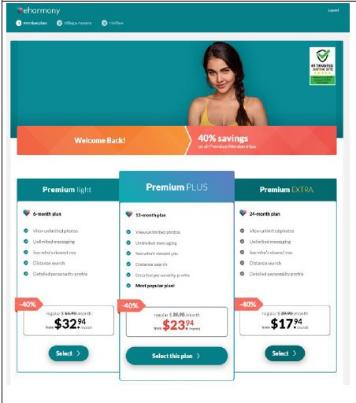
Note: Entry of orders is dealt with in Rule 39.32 of the Federal Court Rules 2011.
REASONS FOR JUDGMENT
HORAN J:
INTRODUCTION
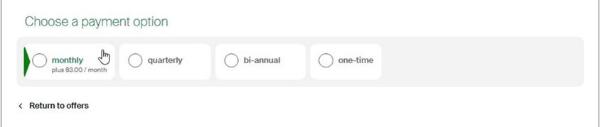
1 The respondent, eHarmony Inc, is a company based in the United States that provides online dating services, including to consumers in Australia. Those services are accessed by consumers on the eHarmony Platform, which comprises a website and mobile phone “apps”. The eHarmony Platform offers two levels of “membership”: a free “Basic” membership, and paid “Premium” memberships with subscription periods of varying lengths (six, 12 or 24 months). A person with a Basic membership is unable to access certain features of the eHarmony Platform which require the purchase of a subscription to Premium membership.
2 By this proceeding, the Australian Competition and Consumer Commission (ACCC) alleges that, since at least August 2019, eHarmony has contravened various provisions of the Australian Consumer Law (ACL), which is contained in Sch 2 to the Competition and Consumer Act 2010 (Cth).
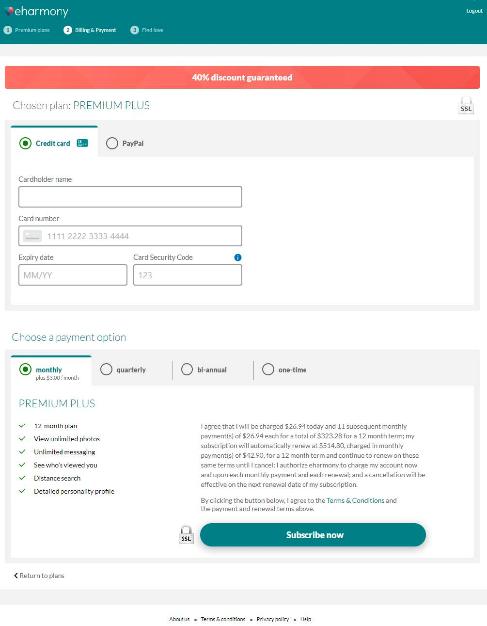
3 In broad terms, the alleged contraventions concern representations made and conduct engaged in by eHarmony in trade or commerce relating to the features and benefits of the eHarmony Platform that are accessible with a Basic membership; the pricing of Premium memberships; the automatic renewal of Premium memberships after the expiry of the initial subscription period; the length of subscription periods available; and the ability to cancel subscriptions.
4 More particularly, the ACCC alleges as follows.
(a) Free Dating Representations: It is alleged that, in contravention of ss 18, 29(1)(b), (g) and 34 of the ACL, eHarmony misled consumers by representing that they could engage in “free dating”, in the sense of ongoing communication with other people on the eHarmony Platform for the purposes of developing a romantic relationship free of any charge, in circumstances where a paid subscription to a Premium membership was required in order to access key features of the Platform. The ACCC alleges that a person with a free Basic membership was unable to “date” other members of the eHarmony Platform due to the limited functionality associated with a Basic membership, including limits on the ability to send and receive messages and an inability to view unblurred profile photographs of other members.
(b) Monthly Price Representations: It is alleged that, in contravention of ss 18 and 29(1)(i) of the ACL, eHarmony made false or misleading representations with respect to the price payable per month for Premium subscriptions, without stating that an additional mandatory fee was charged if the consumer chose to pay by monthly (or quarterly or bi-annual) instalments, rather than by a one-time upfront payment.
(c) Single Price Not Specified: It is alleged that, in contravention of s 48 of the ACL, eHarmony made representations with respect to an amount that would constitute a part of the consideration for the supply of services, without specifying the single price for those services in a prominent way and as a single figure.
(d) Automatic Renewal Conduct: It is alleged that, in contravention of ss 18 and 34 of the ACL, eHarmony misled consumers in relation to the length of the subscription period, which would automatically renew for a period of 12 months unless steps were taken by the consumer prior to the end of the six, 12 or 24-month subscription period under the selected plan.
(e) One-month Representations: It is alleged that, in contravention of ss 18, 29(1)(b) and 34 of the ACL, eHarmony made false or misleading representations that consumers could subscribe to a Premium membership with a subscription period of one month, in circumstances where subscriptions were only available for six, 12 or 24-month periods.
(f) Cancellation Representations: It is alleged that, in contravention of ss 18 and 29(1)(m) of the ACL, eHarmony made false or misleading representations that consumers were able to cancel a Premium membership after signing up, when cancellation was not effective until the next renewal date and consumers were not relieved of the obligation to pay for the remainder of the subscription period nor refunded any amounts paid for the balance of the subscription period.
5 Orders were made for a separate hearing on liability in advance of any hearing on relief. The parties have filed concise statements and exchanged particulars. On 17 May 2024, the parties signed a joint Statement of Agreed Facts (SOAF) setting out facts agreed between them for the purposes of s 191 of the Evidence Act 1995 (Cth). The SOAF includes annexures containing screenshots of webpages and embedded videos that were accessible at relevant dates on the eHarmony website or apps, and various iterations of the eHarmony Terms and Conditions at different times. The parties subsequently signed a Supplementary Statement of Agreed Facts (SSOAF) dated 30 May 2025, which primarily addresses certain changes that were made to relevant aspects of the eHarmony website from July 2024.
6 At the hearing, the ACCC relied on the affidavits of five consumer witnesses. The ACCC also relied on an affidavit of Masooma Saberi affirmed on 23 May 2024, which sets out the results of searches for various terms through the FAQ page on eHarmony’s website, and an affidavit of Georgia Bradley affirmed on 29 April 2025, which exhibits various pages from eHarmony’s website in relation to the importance of profile pictures in online dating.
7 In response, eHarmony relied on two affidavits of Gareth Mandel, its former Chief Operating Officer and Managing Director, affirmed on 1 July 2024 and 30 May 2025 respectively, and two affidavits of Marissa Bustamante, Business Data Analyst at eHarmony, affirmed on 1 July 2024 and 22 May 2025 respectively. Each of Mr Mandel and Ms Bustamante gave oral evidence and was cross-examined at the hearing.
8 In summary, I have reached the following conclusions in relation to the claims made by the ACCC.
(a) By representing that users could engage in “free dating” by registering as a Basic member, eHarmony conveyed to the ordinary and reasonable consumer that it was possible to use the Platform free of charge to engage in ongoing communications with other eHarmony members for the purposes of developing a romantic relationship. Given the limited features available on a Basic membership, it was not possible to “date” other members of the eHarmony Platform without upgrading to a paid Premium membership. Accordingly, eHarmony engaged in conduct that was misleading or deceptive, or likely to mislead or deceive, in contravention of s 18 of the ACL. This conduct also involved contraventions of s 29(1)(b) and (g) and s 34 of the ACL.
(b) Prior to July 2024, by advertising six-month, 12-month and 24-month subscription plans at prices expressed as “from $x / month”, eHarmony made false or misleading representations that the plans could be purchased by paying the stated amount on a monthly basis, in circumstances where monthly instalments attracted an additional mandatory fee. This amounted to misleading or deceptive conduct in contravention of s 18 of the ACL, and false or misleading representations with respect to the price of the services in contravention of s 29(1)(i) of the ACL. However, from July 2024, the relevant pages of the eHarmony website no longer represented that subscription plans could be purchased by monthly payments of the stated amount.
(c) eHarmony contravened s 48(1) of the ACL by making representations with respect to the monthly prices payable for six-month, 12-month and 24-month subscription plans without also specifying, in a prominent way and as a single figure, the single price for the services under each subscription plan.
(d) In relation to the alleged Automatic Renewal Conduct, the relevant pages on the eHarmony website contained the dominant message and conveyed the impression that the Premium membership subscription plans were only for specified periods of finite duration (either six, 12 or 24 months). This was false or misleading, in so far as the subscription was subject to automatic renewal for a 12-month term at the regular undiscounted price, unless the member took certain steps to disable automatic renewal before the end of the subscription period. eHarmony thereby engaged in misleading or deceptive conduct in contravention of s 18 of the ACL. This also amounted to conduct that was liable to mislead the public as to the nature, characteristics, suitability for purpose or quantity of services in contravention of s 34 of the ACL.
(e) By representing that consumers could subscribe for Premium membership for a period of one month, eHarmony engaged in misleading or deceptive conduct in contravention of s 18 of the ACL, and made false or misleading representations that its services were of a particular standard, quality, value or grade in contravention of s 29(1)(b) of the ACL, and engaged in conduct that was liable to mislead the public as to the quantity of its services in contravention of s 34 of the ACL.
(f) By stating that there was an “opportunity to withdraw after signing up”, eHarmony represented that a subscription as a Premium member could be cancelled during the subscription period. As cancellation was only effective at the end of the subscription period, without any refund or waiver of amounts paid or payable in respect of the balance of the period, that representation was false or misleading in contravention of ss 18 and 29(1)(m) of the ACL.
THE EHARMONY PLATFORM
9 eHarmony provides online dating services to consumers in the United States, Canada, the United Kingdom and Australia. At relevant times, consumers in Australia could access those dating services either by visiting the eHarmony website (https://eharmony.com.au) or by using eHarmony’s applications for Android or iOS (Apple) devices (eHarmony Apps). The appearance and navigation of the eHarmony Platform differed between desktop or laptop versions and mobile or tablet versions of the website.
The eHarmony homepage
10 A representative screenshot of the homepage on the eHarmony website between 1 November 2019 and around 10 November 2023 is reproduced at Annexure A. A representative screenshot of the eHarmony homepage on the website from around 11 November 2023 to 17 May 2024 is reproduced at Annexure B. While the content of the homepage remained essentially consistent throughout this period, it was differently presented before and after 10 November 2023.
11 The homepage and other pages on the eHarmony website included embedded promotional videos entitled “Introducing the new eharmony experience” (from at least 1 November 2019 to 30 March 2023), “#1 TRUSTED DATING APP” (from 31 March 2023 to 8 November 2023), and “Get Who Gets You” (from 9 November 2023 to 15 May 2024), each of which was of a 20 to 30-second duration and depicted various features of the eHarmony Platform. The depictions in the videos highlighted the use of the eHarmony Apps on mobile phones.
Registering as Basic member
12 In order to join eHarmony and use its services, consumers were required to register for a Basic membership, which involved completing an online compatibility quiz and creating a dating profile. The SOAF included a video that provided an illustration of this process.
13 From the homepage on the eHarmony website, the consumer was prompted to provide some basic information in relation to whether they had tried online dating before, what kind of relationship they were looking for (casual, serious, or “[n]ot sure, just browsing”), their gender and the gender of the person for whom they were looking, their email address, and a password. The consumer could then press a “Join now” button, above which it was stated: “By clicking below to register, you confirm that you agree to our Terms & Conditions and you have read and understood our Privacy Policy”.
14 The consumer was taken to a webpage that introduced eHarmony’s “Compatibility Quiz”, on which it was stated:
When you know yourself, finding a partner becomes that much easier. Over the next few minutes, we’ll ask you questions about yourself and what makes you happy in relationships. This is the starting point for compatibility-based matching on eharmony.
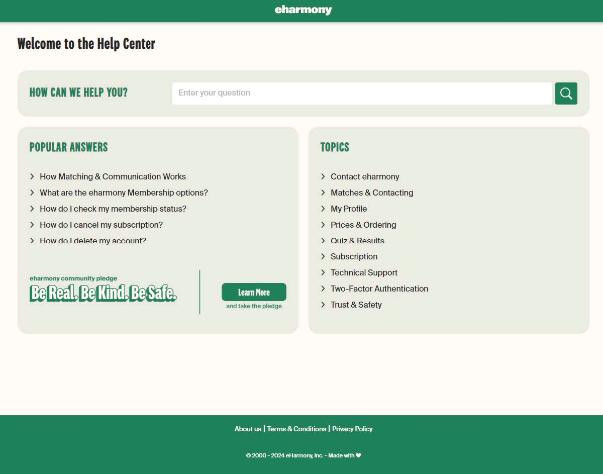
The following page stated that most people take 10 to 20 minutes to complete the quiz and said that: “We’ll help see how you’re compatible with other eharmony members based on your quiz results”.
15 The compatibility quiz involved a detailed questionnaire comprising around 80 multiple choice questions covering a broad range of topics. In addition to the consumer’s reasons for wanting a relationship and what was important to them in romantic relationships, the quiz included questions relating to the consumer’s lifestyle, values, interests, preferences, expectations, goals, views about sexuality or marriage, habits (including smoking and drinking), and hobbies. The questions ranged from general to specific. Some of the questions required the consumer to engage in a measure of self-reflection about matters such as the reasons why they were single, whether they were happy with their physical appearance, or what their friends and family thought of them. One section of the quiz involved the consumer being presented with a series of graphic images or symbols in pairs and being asked to select in each case “the first one that appeals to you”. Another section asked the consumer to select from a range of reactions to various hypothetical social scenarios.
16 Many of the questions in the compatibility quiz appear to have been designed to gauge the consumer’s personality and psychological attributes, which is consistent with evidence given by Mr Mandel that the quiz and its associated algorithm were “underpinned by research-based psychology”. Using the answers to the compatibility quiz as inputs to its algorithm, eHarmony matched users by producing a “compatibility score” based on “important commonalities and differences that people can have which are predictive of success in a relationship”. The answers were also used to build the user’s dating profile, which he or she was then encouraged to edit and supplement.
17 After completing the compatibility quiz, the consumer was taken to a screen on which they were required to enter personal details such as their name, date of birth, gender, occupation, height, education level, religion and ethnicity. Some of these fields (such as birthday, annual income and postcode) were to be used only for account purposes rather than being made visible to other users.
18 The consumer was invited to submit a profile photograph, with accompanying observations that “eharmony members that upload photos are 2x more likely to get a message”, and “[w]ith a photo you will receive up to 4 times more contact requests”. The process concluded with the consumer being presented with a choice of question prompts to answer, and asked to provide a description of themselves and what they were looking for in a relationship or their idea of an ideal partner.
19 Upon the completion of the registration process, the consumer became a Basic member. While Basic membership was free, it had less functionality and features than a paid Premium membership. A Basic membership enabled the user to:
(a) access their own unique homepage from which they could:
(i) edit their dating profile;
(ii) see lists of other members with whom they had been “matched” – that is, other members that the eHarmony algorithm had identified as scoring relatively high on compatibility with the member based on responses to the compatibility quiz and members’ match preferences (such as age range); and
(iii) review the text contained in the profiles of their matches, which usually included the person’s first name, age, job and interests, and may have also included information on the person’s hobbies, education, religion, languages, sporting interests, and favourite television shows, movies, music or books;
(b) view blurred profile photos of each match (where a photo or photos had been provided by that user);
(c) send up to three “likes” to each member with whom they matched;
(d) send one “virtual smiley face” symbol to each match;
(e) send one “icebreaker” image-based conversational prompt to each match;
(f) receive unlimited “likes”, “smiles” and “icebreakers” from each match;
(g) between 1 November 2019 and 19 June 2023, read one initiating text message from an unlimited number of Premium members, and send one responsive text message to an unlimited number of Premium members; and
(h) since 20 June 2023, read one initiating text message from an unlimited number of members (whether Basic or Premium), and send one initiating or responsive text message to an unlimited number of members (whether Basic or Premium).
20 The SOAF included screenshots and videos that demonstrated the functions and features available to Basic members through the eHarmony website at relevant times, including their unique homepage, “Discover” page, “Likes” page, “Messages” page, personality profile, and “Edit Profile” page. (The “Discover” page and the “Likes” page were introduced in around April 2023, replacing previous pages with similar functionality.) A representative screenshot of a Basic member’s “Personality profile” page during the SOAF period is reproduced at Annexure C.
21 In broad terms, a Basic member could navigate these website pages to see the profiles of other members with whom they had been matched (with blurred profile photos), to send “likes” to those members, to see who had sent “likes” to them, to view their own personality profile (based on their responses to the compatibility quiz), and to add or amend details on their profile.
22 When a Basic member viewed the profile of another user, they would be able to see a range of personal characteristics and information that the user had chosen to include on their profile, which could include first name, age, occupation, an introductory description, place of residence, body type, ethnicity, educational background, languages, travel preferences, marital status and children, drinking or smoking habits, exercise habits, interests and hobbies (including sports and music), and blurred photos (if any photos had been uploaded by that user).
23 A Basic member could also see a “compatibility score” for each match, which was broken down by reference to specific personality traits under categories described as “How do we communicate?”, “What characterizes us?”, “How do we organise everyday life?” and “What is our driving force?”, each of which was displayed graphically on a “pinwheel”. Under corresponding tabs, the page displayed comparative scores of the member and the matched user in respect of each of the relevant personality traits.
24 However, Basic membership did not provide full access to all of the features of the eHarmony Platform, which required an upgrade to a paid Premium membership. In particular, only a Premium member was able to view unblurred photos on another member’s profile, and to send and receive unlimited messages to and from other members.
25 In the screenshots and videos contained in the SOAF, each of the pages accessible by Basic members displayed prominent notices in respect of upgrading or signing up to Premium membership, often with accompanying offers of discounted rates. Various features unavailable to Basic members were often indicated by an invitation to upgrade to Premium, such as the ability to view unblurred photos, the ability to filter matches according to particular interests, the ability to view members who had visited their profile, or the ability to send further messages.
Purchasing a Premium membership
26 In order to purchase a Premium membership, a consumer must have first registered for a Basic membership. In other words, only a Basic member could become a Premium member by purchasing a subscription for an initial period of either six, 12 or 24 months.
27 The SOAF contained screenshots and videos depicting the process of purchasing a Premium membership on a desktop or laptop computer, on a mobile device, and through the iOS version of the eHarmony App (iOS App). The process involved the following steps.
28 The consumer first navigated to a Subscription Page on which they were able to select a plan by reference to the length of the subscription period – for example, a six-month plan referred to as “Premium light”, a 12-month plan referred to as “Premium PLUS”, or a 24-month plan referred to as “Premium EXTRA”.
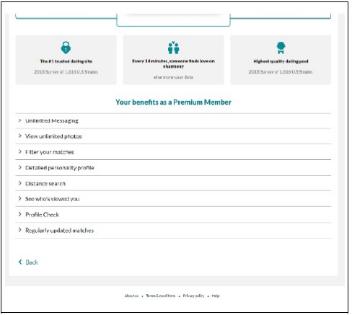
(a) Apart from the length of the plan and the advertised price, the listed features of these plans were identical – namely, “View unlimited photos”; “Unlimited messaging”; “See who’s viewed you”; “Distance search”; and “Detailed personality profile”. Below the plan options, the Subscription Page listed these and several other features under the heading “Your benefits as a Premium Member”.
(b) The prices for each of the plans were advertised as “from” a stated amount per month – that is, “from $x / month” – which was higher for a six-month plan and lower for a 24-month plan.
(c) The advertised prices also displayed any applicable “discount” offered, such as “40% savings”, with a label “–40%” and a “regular” price per month in strike-through formatting.
29 A representative screenshot of the desktop or laptop version of the Subscription Page on the eHarmony website version is reproduced below (see also Annexure D):
30 For consumers accessing the eHarmony Platform on a desktop or laptop computer, after the consumer had selected a subscription plan, they were taken to a Payment Page and prompted to enter their credit card or PayPal details, and to choose a “payment option” of either monthly, quarterly, bi-annual, or one-time payment. The bi-annual payment option was not relevant, and was therefore not shown, for the Premium Light (six-month) plan.
31 A representative screenshot of the desktop or laptop version of the Payment Page on the eHarmony website is reproduced below (see also Annexure E):
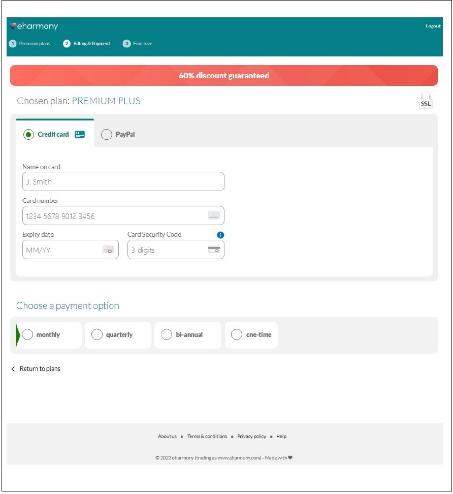
32 The payment options displayed on the Payment Page were “dynamic”, in that additional text was shown when the consumer moved or “hovered” the cursor over each of the payment frequency tabs or buttons. For payment frequencies other than “one-time” payment, the text revealed details of an additional fee that would be charged if that particular option was selected. The additional text stated “plus $3.00/month” for the monthly option, “plus $2.00/month” for the quarterly option, and “plus $1.00/month” for the bi-annual option. There was no mandatory fee (and no additional text) for one-time payments.
33 A screenshot of how the additional fee would appear once a consumer’s cursor was placed over a payment frequency option is reproduced below (see also Annexure F):
34 Once a consumer selected a payment option by clicking the relevant button, a tab appeared beneath that button listing some key features of the selected plan, beside which there were two paragraphs of text that set out the amount or amounts that the consumer would be charged for the initial subscription and upon its automatic renewal until the subscription was cancelled by the consumer, and referred to eHarmony’s terms and conditions. The paragraphs were displayed in a relatively small font, immediately above a prominent “Subscribe now” button. I will refer to these paragraphs as the Disclosure.
35 In the sample screenshot for the desktop or laptop version, which related to the Premium Plus (12-month) plan and the monthly payment option, the Disclosure stated:
I agree that I will be charged $26.94 today and 11 subsequent monthly payment(s) of $26.94 each for a total of $323.28 for a 12 month term; my subscription will automatically renew at $514.80, charged in monthly payment(s) of $42.90, for a 12 month term and continue to renew on these same terms until I cancel; I authorise eharmony to charge my account now and upon each monthly payment and each renewal; and a cancellation will be effective on the next renewal date of my subscription.
By clicking the button below, I agree to the Terms & Conditions and the payment and renewal terms above.
36 A screenshot of the Payment Page after the consumer had selected a payment option, including the Disclosure, is reproduced below (see also Annexure G):
37 The subscription process was similar for consumers who accessed the eHarmony website on a mobile or tablet device, although the presentation or appearance of each of the relevant steps differed. One particular difference was that, in the light of the display constraints on mobile or tablet devices, the consumer was required to enter payment information (such as credit card details) on a separate screen, before progressing to another page to select a payment frequency option. Each of the options on the mobile or tablet version stated the additional fee for the payment frequency in static text (i.e., there was no need to hover over a particular payment frequency option to reveal the associated fee). The Disclosure and the “Subscribe now” (or “Pay with PayPal”) button were revealed once the consumer had selected a payment option.
38 Screenshots of the mobile or tablet version of the Subscription Page, the payment methods page, the payment frequency options page, and the confirmation page on the eHarmony website are reproduced in Annexure H. These screenshots also represent the purchase process for consumers using the Android eHarmony App, who were directed to the mobile version of the eHarmony website when purchasing a Premium membership.
39 The process for purchasing a Premium membership using the iOS App was comparable to the process on the mobile or tablet version of the eHarmony website. However, prior to March 2022, consumers using the iOS App were shown a different purchase process and could only purchase a Premium membership with a one-time payment. This remained the case for approximately 50% of consumers using the iOS App between March and December 2022. Such consumers are outside the scope of the ACCC’s allegations in relation to the Monthly Price Representations, Single Price Not Specified or Automatic Renewal Conduct. Representative screenshots of the relevant pages for the purchase of a 12-month Premium membership subscription through the iOS App (in a format relevant to this proceeding) are reproduced in Annexure I.
40 In about July 2024, eHarmony made several changes to the purchase process (the July 2024 changes). Relevantly:
(a) The Subscription Page was amended so as to add the words “when making a one-time upfront payment” below the text stating “from $x / month” as the advertised price for each of the plans, and above the button to select the plan. Immediately below the plan options, the following words were added:
Total plan price depends on your payment frequency – select a plan for more details. Plans automatically renew for 12 months at regular rates unless you cancel.
A representative screenshot of the desktop or laptop version of the Subscription Page from July 2024 is reproduced in Annexure J.
(b) On the Payment Page, the Disclosure was amended so that the total price of the initial subscription and the renewal price were each displayed in a bold and underlined font. A representative screenshot of the desktop or laptop version of the Payment Page from July 2024 is reproduced in Annexure K.
41 After a consumer completed their purchase of a Premium membership subscription plan, they were sent an order confirmation email. Examples of these emails were exhibited to the affidavits of the consumer witnesses. Among other things:
(a) After thanking the consumer for placing their order, the email stated:
As a Premium Member, you may now contact other members and make full use of the eharmony service. The Premium Membership features include:
• Unlimited communication with your matches;
• View match photos;
• View full list of visitors to your profile;
• And specify the radius of your search.
(b) The email set out a “[s]ummary of your purchase”, including details of the plan, any discount, the subscription price, the payment frequency, and the payment method.
(c) The email included a heading “Automatic Renewal of your subscription”, under which the consumer was informed of the date to which their “current Premium Membership” would run, and that “[t]o ensure that you have uninterrupted service, your subscription is scheduled to automatically renew” on a specified date for a 12-month term at a specified price, and would continue on the same terms “until you cancel”. The email went on to state:
Of course, you may cancel the automatic renewal of your Premium Membership at any time up to the day prior to the start of the next renewal period. Please make sure to provide us with the email address you used to register the eharmony service or your profile ID in any such cancellation request.
For additional information on cancelling automatic renewal, please refer to the Data & Settings page in your eharmony profile. For additional information about eharmony’s policies, please review our Terms and Conditions.
Automatic renewal
42 Under the eHarmony Terms and Conditions, a Premium membership would be automatically renewed at the end of the initial subscription period for a default renewal period of 12 months, irrespective of the length of the initial subscription period. The subscription price for the renewed term was the regular price from the initial subscription period, but without any applicable discount. Accordingly, the total renewal price was in some cases higher than the total price for the initial subscription period, depending on the length of the initial subscription period (which may have been shorter) and any applicable discounts for that period (which would not be applied to the renewal period).
43 On receipt of a request from a Premium member, eHarmony would disable automatic renewal for their membership so that the subscription would not renew on the next renewal date. Such a request had to be made by the consumer at least 24 hours before the renewal date, either by sending an email or a letter, or by speaking to an eHarmony customer care representative by telephone, or by contacting eHarmony through the Platform.
44 If a consumer sought to cancel their subscription before the end of the subscription period (or any renewal period), they were typically not refunded any amounts already paid for the remaining portion of that period nor relieved of their obligation to pay further instalments for the remainder of that period. However, as discussed further below, a request to cancel a subscription would ordinarily result in eHarmony taking steps to disable automatic renewal for that consumer’s Premium membership, such that their subscription would not renew at the end of the current subscription period.
45 Renewals on the earlier version of iOS App were set to the same period as the initial subscription period, and did not automatically renew for 24-month memberships. This was the case for all users of the iOS App prior to March 2022, and about half of such users between March and December 2022. In such circumstances, the ACCC does not make the Automatic Renewal Conduct allegation for those consumers who subscribed using the earlier format of the iOS App.
Terms and Conditions
46 The Terms and Conditions on which eHarmony provided its services were accessible on the eHarmony website and within the eHarmony Apps.
47 On the eHarmony website, there were hyperlinks to the Terms and Conditions in the footer at the bottom of the homepage, in the text above the “Join now” button on the homepage, at the bottom of each page of a member’s profile after they had logged in, in the footer of each page in the process of purchasing a Premium membership, and in the Disclosure above the “Subscribe now” button on the Payment Page (see paragraph 36 above).
48 From around February 2022, a “Portable Document Format” (PDF) version of the Terms and Conditions was available for download on the eHarmony website.
49 In the eHarmony Apps, there were hyperlinks to the Terms and Conditions on the sign-up screen, on the log-in page (after selecting “settings” and “further information”), and (for the iOS App) in the Disclosure above the “Subscribe now” button.
50 After a consumer had purchased a Premium membership, they were sent a confirmation email which included an attachment containing a PDF version of the Terms and Conditions, and a hyperlink to the Terms and Conditions on the eHarmony website.
51 The Terms and Conditions were updated from time to time, and various iterations were applicable to consumers at different times during the period from 1 November 2019 to 17 May 2024.
SEO webpages
52 At relevant times, the eHarmony website comprised hundreds or thousands of webpages, many of which were not part of what Mr Mandel referred to as the “standard user journey” or “standard user flow”. A large number of those pages were designed as “search engine optimisation” (SEO) pages.
53 The role of SEO pages was described by Mr Mandel as being “to appear toward the top of the search results of a user on a third party search engine, such as Google or Microsoft Bing”, thereby forming part of “a digital marketing strategy to increase the visibility of the brand’s website in organic, non-paid search engine results to attract more through-traffic”. Accordingly, the content of such pages was written with the search engine algorithms in mind, in that it was “designed to use combinations of words which match frequently used search terms and other factors those algorithms prioritise so as to appear higher in search results”.
54 As was explained by Mr Mandel in his affidavit:
Generally speaking, eharmony’s SEO strategy is to create, often via third party publishers, a large number of pages to be published on the eharmony website which contain content which is believed to be attractive to major search engines in hopes that those pages will appear “above the fold”, meaning within the field of view, or in the top section, of the first page of search results of a user. Having eharmony pages appear “above the fold”, or even “below the fold” but on the first page of search results, is desirable because it increases visibility of the eharmony website and can attract more visits to the eharmony Platform.
55 Ultimately, SEO pages were designed so as “to create a path to the pages that are part of the standard user flow”, so that those users who visit any particular SEO page “all end up funneling into the standard user flow” for registration as a Basic member and upgrading to a Premium membership, as described above.
56 Examples of SEO pages included the Free Dating Pages, as well as a range of pages directed to specific classes of users, such as the Thai Dating Page.
Free Dating Pages
57 The Free Dating Pages are central to one of the primary aspects of the ACCC’s case. These pages took a slightly different form at various times during the relevant period. In broad terms, they portrayed eHarmony as a “free dating site” and as providing a “free dating experience”. The content of these pages, and whether they contained false or misleading representations or involved conduct that was misleading or deceptive, will be considered in greater detail below.
FAQ pages, Help Centre and Tour pages
58 The eHarmony website contained a frequently asked questions (FAQ) section and a “Help” section (Help Centre), each of which was accessible by clicking a hyperlink displayed in the navigation panel at the bottom of each public page on the website.
59 The FAQ landing page contained a list of questions divided into different topics, each of which was displayed in a separate box. The topics included “Membership and Costs”, “Sign Up Process”, “Compatibility Quiz and Personality Profile”, “Profile”, “Matches”, “Communication”, “Payment”, “Safety”, “About eharmony”, and “Contact eharmony”.
60 The FAQ landing page also included a search box that utilised predicative text to enable users to find particular FAQ pages which addressed common questions about eHarmony’s services. When the consumer entered text into the search box that matched a part of the title of any particular FAQ page, a dropdown menu or list of search results would be displayed, allowing the user to select and click through to the FAQ page addressing the relevant question. The FAQ search function used auto-completion so that suggested queries would be displayed as the consumer typed matching terms or phrases into the search box.
61 A representative screenshot of the FAQ landing page as it appeared from around 25 January 2022 to 17 May 2024 is reproduced at Annexure L.
62 The Help Centre contained “free text” search functionality, which would display the Help Centre pages that contained any of the search terms entered by the user, or related variations or derivations of those words. The page also set out a short list of “popular answers” and “topics”. For example, if the user searched for the term “renew” or “account”, they would be presented with pages that contained terms such as “renew”, “renewal” or “account” in their title or in the body of the article.
63 Representative screenshots of the Help Centre landing page from 1 November 2019 to around 11 February 2024, and from around 12 February 2024 to 17 May 2024, are reproduced at Annexure M.
64 There were several versions of the Tour page during the period covered by the SOAF, the content of which was broadly consistent. The Tour page set out an explanation of the eHarmony Platform, including (relevantly) a table setting out a comparison of the features of Basic membership and Premium membership respectively.
Number of customers
65 For the period from 5 November 2019 to 21 February 2024, there were approximately 1,225,295 registrations for Basic memberships from Australian consumers using the eHarmony Platform. Approximately 237,668 of those registrations purchased a Premium membership, of which approximately 73% were purchased using the mobile website, 20% were purchased using the desktop or laptop version of the eHarmony website, and 6% were purchased using the iOS App.
66 These numbers were updated in Ms Bustamante’s affidavit for the period from 5 November 2019 to 6 June 2024, during which 1,317,895 users registered for a Basic membership, and 258,956 registered for a Premium membership. Of the users who registered for a Premium membership, 63.15% used the mobile website, 20.37% used the desktop website, and 16.43% used the iOS App.
THE ALLEGED CONTRAVENTIONS
67 The ACCC alleged that, on multiple occasions since at least August 2019, eHarmony made representations and engaged in conduct in contravention of ss 18, 29(1), 34 and 48 of the ACL. The alleged contraventions, as articulated in the ACCC’s further amended concise statement dated 10 January 2025, fall into the following categories.
Free Dating Representations
68 The ACCC alleged that the eHarmony website included public pages stating that consumers could engage in “free” dating on the eHarmony Platform, thereby representing that members could engage in ongoing communication with other people on the Platform for the purposes of developing a romantic relationship free of charge, and did not prominently disclose or clearly indicate on those pages that only a Basic membership was free of charge or that it was necessary to subscribe to a paid Premium membership in order to access key features of the Platform.
69 It is not in dispute that the alleged Free Dating Representations were made in trade or commerce. The ACCC alleged that, on each occasion that the Free Dating Representations were made to a consumer, eHarmony:
(a) engaged in conduct that was misleading or deceptive or likely to mislead or deceive in contravention of s 18 of the ACL;
(b) in connection with the supply or possible supply of services or in connection with the promotion of the supply of services, made false or misleading representations that the Basic membership was of a particular quality in contravention of s 29(1)(b) of the ACL, or had certain performance characteristics or benefits in contravention of s 29(1)(g) of the ACL; and/or
(c) engaged in conduct that was liable to mislead the public as to the nature, characteristics or suitability of the Basic membership in contravention of s 34 of the ACL.
Monthly Price Representations
70 The ACCC alleged that the Subscription Page displayed incorrect headline statements of the price payable per month for each of the six-month, 12-month and 24-month plans, thereby representing that a consumer could purchase a Premium membership subscription for the advertised monthly price, without disclosing that an additional mandatory fee was charged if the consumer chose to pay monthly, quarterly or bi-annually. The ACCC alleged that this additional fee was only disclosed “in small font on a later page” after the consumer had selected a plan and had entered (or been prompted to enter) payment details.
71 The ACCC alleged that the Monthly Price Representations were not corrected by the July 2024 changes that were made to the Subscription Page (see paragraph 40 above), which still did not disclose the additional mandatory fee.
72 It is not in dispute that the alleged Monthly Price Representations were made in trade or commerce. The ACCC alleged that, on each occasion on which the Monthly Price Representations were made to a consumer, or alternatively each time a consumer viewed the Subscription Page which did not disclose the additional mandatory fee, eHarmony:
(a) engaged in conduct that was misleading or deceptive or likely to mislead or deceive in contravention of s 18 of the ACL; and/or
(b) in connection with the supply or possible supply of services or in connection with the promotion of the supply of services, made false or misleading representations with respect to the price of Premium memberships in contravention of s 29(1)(i) of the ACL.
Single Price Not Specified
73 The ACCC alleged that the Subscription Page did not display the total price payable for the initial subscription period as a single figure, but rather a “from $x / month” price for each of the six-month, 12-month and 24-month plans. The ACCC alleged that the total price payable was only disclosed as a single price on a later screen, after the consumer had chosen the payment frequency, and was displayed “in small font, within a paragraph that included other information such as cancellations and automatic renewal information, and a link to eHarmony’s terms and conditions”. From about July 2024, the total price was bolded and underlined.
74 It is not in dispute that the representations made in relation to the price of Premium memberships were made in trade or commerce. The ACCC alleged that such representations were made in connection with the supply, the possible supply, or the promotion of the supply to another person of services of a kind ordinarily acquired for personal use or consumption. The ACCC alleged that, each time such representations were made to a consumer, eHarmony made representations with respect to an amount that, if paid, would constitute a part of the consideration for the supply of services, without specifying the single price for the services in a prominent way and as a single figure, in contravention of s 48 of the ACL.
Automatic Renewal Conduct
75 The ACCC alleged that, until about July 2024, the Subscription Page displayed only the prices and periods of the initial subscription period, and not the fact that the subscription was subject to automatic renewal, nor the period for which and the price at which the subscription would be renewed.
76 The ACCC alleged that the fact of automatic renewal, the renewal period and the renewal price were only disclosed “in small font in a paragraph of text, which appeared late in the purchase process” (i.e. within the Disclosure on the Payment Page) after the consumer had entered or was prompted to enter payment details and had selected a payment frequency. Further, the ACCC alleged that the inclusion of the words “one-time” as a payment option “reinforced that by selecting any of the payment frequencies, the user would pay only for the chosen subscription period of 6, 12 or 24 months”. The ACCC alleged that the only other way a consumer could learn of the clauses in the standard form agreement in relation to automatic renewal was to click on a hyperlink to eHarmony’s Terms and Conditions that was displayed in small font either in the Disclosure or at the bottom of some pages on the eHarmony website.
77 In such circumstances, the ACCC alleged that eHarmony did not prominently disclose that Premium memberships were automatically renewed for a further subscription period after the initial subscription period expired, unless steps were taken by the consumer to turn off automatic renewal prior to the end of the initial subscription period, and engaged in conduct that gave or was likely to give consumers the impression or understanding that the subscription period was only six, 12 or 24 months.
78 The ACCC alleged that the July 2024 changes to the Subscription Page and the Disclosure on the Payment Page (see paragraph 40 above) did not correct the position.
79 The ACCC alleged that, each time that a consumer viewed the pages of the eHarmony website or the eHarmony Apps that constituted the process to upgrade to Premium membership, eHarmony:
(a) engaged in conduct in trade or commerce that was misleading or deceptive or likely to mislead or deceive in contravention of s 18 of the ACL; and/or
(b) engaged in conduct in trade or commerce that was liable to mislead the public as to the length of the subscription period – and hence the nature, characteristics, suitability for purpose, or quantity of the Premium membership – in contravention of s 34 of the ACL.
One Month Representation and Cancellation Representation
80 The ACCC alleged that, from at least around September 2019 to around May 2023, some public pages on the eHarmony website displayed statements to the effect that consumers could subscribe to a Premium membership for one month, in circumstances where it was not possible to purchase a one-month subscription.
81 Further, the ACCC alleged that, from at least August 2019 to 27 October 2021, a public page on the eHarmony website displayed a statement that “there is still an opportunity to withdraw after signing up if you have second thoughts”, thereby representing to consumers that they would have an opportunity to cancel their subscription after signing up. The ACCC alleged that this representation was reinforced by other statements such as “TRY BEFORE YOU BUY – AND NO PRESSURE TO SIGN UP”.
82 As discussed above, cancellation of a Premium membership subscription was not effective until the end of the subscription period (i.e. the next renewal date), and consumers who sought to cancel their subscription after signing up were not relieved of the obligation to pay for the remainder of the six-month, 12-month or 24-month period, and were not refunded any amounts paid for the unused portion of their subscription.
83 It is not in dispute that the alleged One Month Representation and Cancellation Representation were made in trade or commerce.
84 The ACCC alleged that, each time the One Month Representation was made to a consumer, eHarmony:
(a) engaged in conduct that was misleading or deceptive or likely to mislead or deceive in contravention of s 18 of the ACL.
(b) in connection with the supply or possible supply of services or in connection with the promotion of the supply of services, made false or misleading representations that services were of a particular standard, quality, value or grade, in contravention of s 29(1)(b) of the ACL; and/or
(c) engaged in conduct that was liable to mislead the public as to the nature, characteristics or suitability for purpose of the Premium membership, in contravention of s 34 of the ACL.
85 The ACCC alleged that, each time the Cancellation Representation was made to a consumer, eHarmony:
(a) in connection with the supply or possible supply of services or in connection with the promotion of the supply of services, made false or misleading representations concerning the existence or effect of a right, in contravention of s 29(1)(m) of the ACL; and/or
(b) engaged in conduct that was misleading or deceptive or likely to mislead or deceive in contravention of s 18 of the ACL.
Alleged harm suffered
86 In relation to alleged harm, the ACCC alleged in its concise statement that:
eHarmony’s conduct deprived consumers, including vulnerable consumers, of the opportunity to make informed decisions about whether to register with eHarmony for a Basic Membership, whether to purchase the Premium Membership and, if so, over what subscription period. eHarmony’s conduct may have led consumers to believe they were purchasing a subscription at a lower price than was the case, and to be unaware that their subscription would be automatically renewed, requiring them to pay for additional subscription periods. Some consumers who engage with dating websites and apps may be emotionally vulnerable and susceptible to misleading marketing claims and subscription traps.
87 As mentioned above, the questions of liability were heard separately and in advance of any hearing on relief.
eHarmony’s response
88 In its concise statement in response dated 21 February 2025, eHarmony denied that it made false or misleading representations, or engaged in misleading or deceptive conduct, in breach of the ACL.
89 By way of overview, eHarmony alleged that the ACCC had failed to identify the relevant class to whom the statements were made, failed to consider relevant context, adopted an artificially narrow approach to the formulation of alleged representations, and mischaracterised its advertising of the Basic membership. Thus, eHarmony contended in its response:
When the statements identified by the ACCC are viewed in their full context, with regard to the knowledge and experience of an ordinary consumer, the statements were not, and were not likely to be, false, misleading or deceptive. That conclusion is reinforced when regard is had to the standard user journey and purchase flow on the Platform.
90 In particular, eHarmony contended that the features of its free Basic membership were made clear and that, before a consumer could purchase a Premium membership, they were informed in a clear manner of the price (including the total price) of the subscription; the subscription period; the fact that the subscription would automatically renew unless cancelled; the renewal period and the price payable on renewal; and the fact that any cancellation would be effective on the next renewal date.
91 In response to the alleged Free Dating Representations, eHarmony contended that it was made clear that only the Basic membership was free and that this membership had less features than a paid Premium membership. Relying on “the context of the whole of the public pages of the website”, eHarmony alleged that “the essence of what was conveyed was that the Basic membership provided members with the opportunity to experience, for free, eharmony’s online dating Platform, but with fewer features than a Premium user”. The context on which eHarmony relied included various pages in the FAQ and Tour sections of the eHarmony Platform on which the features and uses of the Basic membership were addressed, including limited messaging functionality and the ability to see only basic profile information. Further, eHarmony alleged that the website pages on which the alleged Free Dating Representations were made “did not form part of the standard user journey and never appeared on the apps”.
92 In response to the alleged Monthly Price Representations, eHarmony contended that the statement “from $x / month” on the Subscription Page could not be divorced from its proper context, including an understanding of the “purchase flow”. That is, consumers who saw the statement “from $x / month” on the Subscription Page would be told, upon selecting a payment frequency and before confirming their subscription, that they would incur an additional monthly fee if they elected to pay monthly, quarterly or bi-annually. eHarmony contended that this disclosure “was prominent and would have been seen by a user without a user paying close attention”. Such consumers would already be Basic members and would have been using the eHarmony Platform. Further, eHarmony relied on the July 2024 changes to the Subscription Page.
93 In response to the Single Price Not Specified allegations, eHarmony contended that s 48 of the ACL was not engaged, in circumstances where the total price payable by a user could not be calculated until they had chosen the payment frequency, which was a necessary input in the calculation. Once the payment frequency had been selected, the user was told the total price of the subscription in the Disclosure above the “Subscribe now” button (on the Payment Page). eHarmony also relied on the July 2024 changes to the Subscription Page and the Payment Page.
94 In response to the alleged Automatic Renewal Conduct, eHarmony relied on the Terms and Conditions, which were accessible on the eHarmony website including from the user’s homepage and from the Payment Page, and in particular clause 13 which relevantly provided:
13. **RENEWALS**.
IN ORDER TO PROVIDE CONTINUOUS SERVICE, EHARMONY AUTOMATICALLY RENEWS ALL PAID SUBSCRIPTIONS FOR THE SERVICES ON THE DATE SUCH SUBSCRIPTIONS EXPIRE UNLESS YOU CANCEL AT LEAST 24 HOURS BEFORE THE END OF YOUR CURRENT TERM. WE ALWAYS COMMUNICATE RENEWAL PERIODS TO YOU, BEFORE YOU FINALIZE THE PURCHASE OF YOUR SUBSCRIPTION, UPON CONFIRMATION OF PURCHASE, AND AS OTHERWISE REQUIRED IN YOUR JURISDICTION. …
95 In addition to the Terms and Conditions, eHarmony contended that the fact that Premium memberships were automatically renewed was prominently disclosed as part of the purchase flow, including in the Disclosure on the Payment Page, and on various pages on the eHarmony Platform, including in the Help Centre. Further, eHarmony relied on the order confirmation emails sent to and received by Premium members after purchasing a subscription, which contained a reminder about automatic renewal and attached a PDF version of the Terms and Conditions.
96 In response to the alleged One Month Representation, eHarmony accepted that two pages on the eHarmony website were inadvertently not updated when its one-month Premium membership offering ended in around September 2019. However, eHarmony alleged that those pages “were not part of the typical user journey”, and did not appear on the eHarmony Apps. Further, eHarmony said that it was necessary for the statements to be read in context, including that the Subscription Page offered Premium memberships on a six, 12 or 24-month basis with no option to select a one-month membership, and that the alleged One Month Representation did not have a tendency to mislead users.
97 In response to the alleged Cancellation Representation, eHarmony contended that the relevant statements on which the ACCC relied were directed to the free Basic membership, and did not have a tendency to mislead users given the standard purchase flow and the remainder of the eHarmony Platform, including the Disclosure and the Terms and Conditions. The statements relied on by the ACCC also did not appear on the eHarmony Apps. Before being able to subscribe to a Premium membership, users were clearly told that any cancellation would be effective on the next renewal date of their subscription.
98 Finally, eHarmony denied that the ACCC was entitled to the relief claimed in its originating application and further amended concise statement, and denied that there was any harm to consumers as alleged by the ACCC.
Exclusion of certain consumers
99 Prior to March 2022, consumers using the eHarmony iOS App were shown a different purchase process, under which they could only purchase a Premium membership by making a one-time payment, and were not presented with the option of paying by monthly, quarterly or bi-annual instalments. Accordingly, those consumers were not charged any mandatory additional fee for instalment payments. This was also the case for approximately 50% of consumers using the iOS App between March and December 2022.
100 Further, under the earlier format of the iOS App, there were no automatic renewals for 24-month subscriptions, and other renewals were set to the same period as the initial subscription period (either six or 12 months).
101 The earlier format of the iOS App is not relevant to this proceeding and, as a consequence, the ACCC does not make the Monthly Price Representations, Single Price Not Specified and Automatic Renewal Conduct allegations in relation to consumers who used that purchase process.
THE EVIDENCE
102 In addition to the SOAF and SSOAF, the parties adduced the following evidence.
Consumer witnesses
103 The ACCC relied on the affidavits of five consumer witnesses. Pursuant to confidentiality orders made on 12 November 2024, the names of these witnesses have been replaced with the pseudonyms “Consumer A” to “Consumer E”.
104 Some general observations may be made about the use to which this evidence is put. Evidence that individual consumers or members of the public were actually misled by particular statements or representations is neither essential nor conclusive in establishing contraventions of the relevant prohibitions of the ACL: see Australian Competition and Consumer Commission v Coles Supermarkets Australia Pty Ltd [2014] FCA 634; (2014) 317 ALR 73 at [45] (Allsop CJ); Brick Lane Brewing Co Pty Ltd v Torquay Beverage Co Pty Ltd [2023] FCA 66; (2023) 170 IPR 195 at [37] (Stewart J). In so far as it is necessary to evaluate the objective meaning of ordinary English words in the mind of an ordinary and reasonable consumer, the question is ultimately one for the Court. While evidence that individual consumers have been led into error by a respondent’s conduct might be capable of strengthening an inference that is otherwise independently open, such testimonial evidence has no “statistical significance” and its utility may be limited: State Government Insurance Corporation v Government Insurance Office of New South Wales (1991) 28 FCR 511 at 529 (French J); Homart Pharmaceuticals Pty Ltd v Careline Australia Pty Ltd [2017] FCA 403; (2017) 349 ALR 598 at [32] (Burley J); Australian Competition and Consumer Commission v viagogo AG [2019] FCA 544 at [24] (Burley J); PDP Capital Pty Ltd v Grasshopper Ventures Pty Ltd [2020] FCA 1078; (2020) 154 IPR 68 at [521] (Markovic J).
105 None of the consumer witnesses was cross-examined and, in that sense, their evidence was unchallenged. Nevertheless, orders were made under s 136 of the Evidence Act to limit the use of identified portions of their affidavits or the exhibits thereto, in that those portions are not to be used for hearsay purposes to prove the truth of the representations contained therein, but are admitted only as evidence of the witness’s perception of matters or evidence of what the witness said.
106 More generally, eHarmony submitted that the evidence of each of the consumer witnesses did not engage with the specific case that had been pleaded by the ACCC, and therefore could not be relied upon to strengthen any inference that the alleged conduct would have or was likely to have misled the ordinary and reasonable consumer or was liable to mislead the public. For example, the consumer witnesses generally did not state that they had viewed or relied on particular statements or representations that were made on the pages on which the ACCC relied. Further, eHarmony submitted that there was no basis on which it could be said that the consumer witnesses were representative of users of the eHarmony Platform in general.
107 With those caveats in mind, the affidavit evidence of the consumer witnesses may be broadly summarised as follows.
Consumer A
108 Consumer A signed up to eHarmony in about July 2022, after seeing eHarmony’s advertising in the course of online research about dating sites. She noticed eHarmony’s statement that “every 14 minutes someone finds love” and, having had friends who had previously used eHarmony and recommended it as an online tool for dating, thought that it would be a good option for making connections.
109 Consumer A registered as a Basic member, setting up a profile and completing the compatibility questionnaire. She said that she “thought with the free membership it would be possible to communicate with other members”, but she realised after using the iOS App that her ability to communicate or make connections with other members was limited. She stated that she “expected the free service to be more than what it was”, and that “[i]t seemed pointless because the information available through other members’ profiles was limited and other members’ profile pictures were blurred”.
110 After receiving discounted offers to upgrade her subscription, Consumer A paid for a six-month Premium membership on around 31 July 2022, for a one-time discounted payment of $155.64. She chose a six-month subscription because “that was the best value deal”, and because a longer subscription might lead to a “wasted period of membership” if she met someone quickly. Consumer A could not recall having noticed any terms or conditions when she signed up to eHarmony. She said that she would not have read or reviewed the Terms and Conditions, because she expected that any significant or important terms would have been highlighted during the purchase process. In particular, she was not aware at the time that there was a term regarding automatic renewal. After she purchased the Premium membership, she received a “welcome” email and an order confirmation email from eHarmony, which she looked at quickly but did not read in detail.
111 Consumer A used the Premium membership for a couple of months, but without “meeting the kinds of people I was looking for”. As a result, she decided to remove her profile and delete the iOS App from her mobile phone. She said that she thought that she had closed her account and was no longer a member of eHarmony. However, on 1 February 2023, her credit card was charged with an amount of $478.80 from eHarmony. Believing that this was an unauthorised transaction, Consumer A proceeded to cancel her credit card. She subsequently received emails from eHarmony stating that her Premium membership was due and demanding payment of an amount of $478.80. An email from eHarmony Customer Service asked her to log into her account to pay the “outstanding balance” or, if her account had already been deleted, to reply to the email so that eHarmony could send instructions on how to pay off the total balance.
112 Consumer A then checked the email from eHarmony confirming her purchase of a Premium membership and noticed with “surprise” the reference to automatic renewal. She said that she had not appreciated that the subscription would automatically renew, and would have taken steps to cancel automatic renewal if she had known that she was required to do so. Consumer A asked eHarmony to cancel the renewal of her Premium membership, asserting that she had “been disengaged from Eharmony for months and months as it was not a great experience and I did NOT wish to continue my subscription”. This request was refused by eHarmony, who subsequently referred the matter to a debt collection agency.
113 While eHarmony confirmed that automatic renewal had now been turned off on Consumer A’s subscription, it advised her that the automatic renewal “feature” was not cancelled automatically if a member stopped using the service and that, “[i]n order for a member to prevent the subscription from getting renewed automatically, they need to contact the Customer Service Department in order to request the same”.
114 Consumer A gave evidence about the personal impact of her experience with eHarmony.
Consumer B
115 Consumer B signed up to a Basic membership on the desktop version of the eHarmony website in late 2022 or early 2023, after having seen advertisements online and possibly on television. He said that he knew that eHarmony offered paid subscriptions, and thought that this made it more likely that members would be genuine and looking for a partner. However, he considered at the time that the prices for Premium membership were too expensive. While he expected that the free Basic membership would be more limited, he still expected some functionality “in terms of being able to speak with other people” and he “expected to be able to see new people and have a chat”. However, he regarded the Basic membership as “effectively unusable because I could not actually date anyone”, stating that he did not find out about the limitations such as blurred profile photographs and limited messaging until after he had signed up, and that he “felt deflated because I had spent time and effort completing the questionnaire and setting up my profile”. He stopped using his Basic membership after several weeks, but found it difficult to find out how to delete his eHarmony profile.
116 Sometime later, around his birthday, Consumer B received an email from eHarmony advertising a special promotional offer of a 50% discount on Premium memberships. The link in the email took Consumer B to a payment page. On the day after his birthday, using a desktop computer, Consumer B purchased a six-month Premium membership subscription for a one-time payment of $149.70. While Consumer B received a confirmation email, he regarded it as a “standard confirmation letter” setting out the price and duration of the subscription, and did not “scroll down” to see the reference to automatic renewal. Consumer B said that, if he had been aware of automatic renewal, he would have put it in his diary and “would have made sure the membership did not automatically renew”. Consumer B said that he did not usually read terms and conditions “because I trust that in Australia any important terms, like auto renewal charges, will be highlighted on the sign-up page or there will be some other way to make me aware of it, without having to read terms and conditions”.
117 Within one month of signing up to Premium membership, Consumer B met a genuine partner and stopped using eHarmony. He expected that he would revert to Basic membership at the end of his subscription period. On 9 January 2024, he was “shocked” to receive an email from eHarmony about an outstanding payment of $598.80 in respect of the automatic renewal of his Premium membership. He had not received any reminders or notifications that automatic renewal would occur.
118 Consumer B subsequently contacted eHarmony Customer Care and sought to terminate his membership and to be released from the outstanding amount. In an email to eHarmony, Consumer B said that he had not used the service since July 2023, and that he had “completely forgotten about the subscription” and was not aware that it would be automatically renewed. In response, eHarmony stated that “[s]ubscriptions renew automatically to provide our customers with uninterrupted service” and that, in accordance with the purchase agreement, “all subscription plans renew for a 12-month term without any discount offer regardless of initial purchase length”. The email from eHarmony Customer Care continued:
I would like to share that we do not send renewal reminder email to our members residing in Australia and they do not have an option to disable the Automatic Renewal feature within their account. In order to prevent their subscription from getting renewed automatically, they need to contact the Customer Service Department at least 24 hours prior to the renewal date, with a written consent to cancel their subscription.
We also provided you this information under an order confirmation which was sent to you via email after the purchase of your subscription. Also, this feature does not get cancelled automatically if a member stops using our service.
119 Accordingly, eHarmony advised that it was unable to cancel Consumer B’s subscription and that, while automatic renewal had now been disabled on his account, the outstanding payment remained due. The matter was subsequently referred by eHarmony to an external debt collector.
120 Consumer B stated that his experience had taken a “huge toll” on him, causing significant stress and disruption.
Consumer C
121 Consumer C signed up with eHarmony in November 2023, based on recommendations from friends and having seen eHarmony advertisements. She used the iOS App on her iPhone, but could not recall whether she had completed the sign-up process within the iOS App or had been directed to the eHarmony website. Her impression was that eHarmony was a “good quality dating platform, because it was based on in-depth profiles and compatibility matching”.
122 As Consumer C was cost-conscious, she wanted to sign up for the free Basic membership in order “to try it out”. She had expected to be able to see other user’s photos, and to communicate with other members, at least if paid members had initiated the conversation. She took “about an hour” to complete the compatibility quiz for her profile. After creating her profile, she realised that she “couldn’t do the things that [she] had expected”, and that she could not see other users’ photos or exchange messages with them. She attempted to find information on the differences between Basic and Premium memberships, but said that she found it difficult to do so through the eHarmony website. She said: “I came to the conclusion that with Basic I couldn’t do anything useful to actually date someone and that if I wanted to send messages to people and see their photos, I had to upgrade to Premium”.
123 Consumer C wanted a monthly subscription, and “chose the monthly option, thinking that if I cancelled within the month, I would only be billed until the end of that month and my subscription would be cancelled after that”. She saw a discounted monthly price of $25.99, and did not notice any mention of an additional fee, nor that there was a minimum 12-month commitment or a dollar amount based on such a commitment. She did not recall having seen any wording about cancellation, and did not click on the hyperlink to the terms and conditions. Because she was under the impression that she was purchasing only a monthly subscription for $25.99, she did not think that she needed to read the terms and conditions. She subsequently noticed from her banking transactions that the amount she was debited was $3.00 more than what she thought she was paying for the month.
124 After using the Premium membership for about nine days, Consumer C decided to cancel her subscription. She sent an email to eHarmony requesting that her subscription be cancelled. In response, eHarmony informed her that it would cancel the automatic renewal of her subscription, but that she was still required to pay the remaining 11 instalments of her subscription, the total price of which amounted to $563.85. She said that she was shocked that she owed that amount for signing up to a 12-month subscription, in relation to which the 50% discount had only been applied to the first month. Consumer C unsuccessfully sought to be released from her future payments. After she failed to pay the next two monthly instalments, eHarmony advised Consumer C that access to her account had been restricted and that the entire balance of the subscription ($537.90) was due in full. The matter was subsequently referred by eHarmony to an external debt collection agency.
125 Consumer C stated that her experience with eHarmony had caused her a lot of stress and anxiety.
Consumer D
126 Consumer D signed up to a Basic membership on the eHarmony website using her laptop in April 2020, after seeing advertising including television commercials, and performing internet searches for online dating services. In relation to the latter, the search results included “a blurb for eHarmony which said the site offered [a] ‘free dating site for Australian singles’”. Consumer D said that one of the reasons that she signed up to the Basic membership was because eHarmony advertised “free dating”, based on which she anticipated being able to explore the website or service to see if it was appropriate for her, and expected that she “could make connections, communicate and go on dates by setting up meetings either virtually or in person”. Consumer D provided screenshots referring to “free dating” which she said reflected the eHarmony advertisements that she saw before signing up.
127 Consumer D said that, once she started using eHarmony, she realised that the services available were limited, and it became apparent to her that she “could not date anyone” using the Basic membership. She received notifications that she had matches with other members, but was unable to see clear photos and could not communicate with other users. Consumer D considered that she would not date someone “without knowing what they looked like or anything about them”. She said that she had expected to have “some level of ability to interact with other people” when using the free Basic membership.
128 As a result, Consumer D considered paying for a Premium membership. She received offers or promotions from eHarmony to upgrade her membership. Before purchasing a subscription, she attempted to find out whether there was a “cooling off” period. In response to a webform inquiry, eHarmony directed Consumer D to a link to its Terms and Conditions, but did not directly answer the question about cooling off periods. After reading the terms and conditions, Consumer D understood that there was a three-day cancellation period under clause 12(c). On 14 April 2020, she purchased a six-month Premium membership for a discounted price of $233.61.
129 After trying the Premium membership for a couple of days, Consumer D decided that she wanted to cancel the service within the three-day cooling off period. She sent an email to eHarmony requesting a full refund of the amount that she had paid. In response, eHarmony advised Consumer D that the “3-day cancellation policy only applies to users in specific states, as stated in our Terms and Conditions” (i.e. named States within the United States of America). Consumer D said that she was “irate” at eHarmony’s response, given that she had specifically sought information about the cooling off period and had attempted to read the Terms and Conditions to which she had been directed, which she described as “very disjointed and incoherent”, including in relation to what was applicable to an Australian consumer.
130 In response to Consumer D’s complaints, eHarmony offered a 50% refund of the amount she had paid for the Premium membership “as a one-time courtesy”.
131 Consumer D stated that her experience with eHarmony had made her irritated. She was not satisfied with the 50% refund, and stated that she “would not have engaged with their subscription had [she] been aware that the 3-day cooling off period did not apply to [her] prior to signing up”.
Consumer E
132 Consumer E signed up for a Basic membership on 4 May 2023 through the eHarmony website on his desktop computer, based on a recommendation from a work colleague. He said that he did not immediately complete the compatibility quiz, and was sent emails from eHarmony asking him to finish the quiz and offering discounts on selected Premium memberships. On 14 May 2023, Consumer E decided to sign up for a six-month Premium membership through the promotional link in one of these emails, selecting the “one-time payment” option for $89.70. He took this wording to mean “that when the subscription period came to an end, my eHarmony account would drop back to the free Basic Membership”, and expected that he would be able to delete his profile if he did not want to continue using eHarmony.
133 While Consumer E received the order confirmation email, he did not feel that it was necessary for him to read the Terms and Conditions because what he had purchased was confirmed at the beginning of the email. He also did not read the entirety of the order confirmation email at that time. He thought that the Terms and Conditions would be “a long, legalistic document that would ultimately not be relevant to [his] experience on eHarmony”.
134 Before the end of the subscription period, Consumer E decided that he no longer had any need for eHarmony. He did not think that he needed to take any steps to cancel his membership, as he had made a one-time payment. He said that he did not see any terms or any mention of automatic renewal prior to purchasing the Premium membership, and did not receive any reminders or communications from eHarmony to alert him to automatic renewal. If he had been informed that his subscription was going to renew automatically for a whole year, Consumer E said that he would have made sure to disable automatic renewal.
135 On 24 and 28 November 2023, Consumer E received emails from eHarmony stating that he had an outstanding payment of $358.80. When Consumer E attempted to delete his profile on the eHarmony Platform, his account access had been restricted. Consumer E said that he did not wish to pay eHarmony $360 just in order to be able to delete his account, and felt as though he was being held to ransom. He said that he was “very annoyed” when he was told that his subscription had automatically renewed, and thought that it was “absurd” that eHarmony was “chasing” him for over $300.
Gareth Mandel
136 Mr Mandel was the Chief Operating Officer (COO) of eHarmony between December 2019 and October 2024. Together with the Chief Financial Officer (CFO), Mr Stefan Schulze, and the Chief Customer Officer (CCO), Mr Carlos Robles, Mr Mandel had “oversight of the whole eharmony business”, including its operations in Australia. Each of the COO, the CFO and the CCO also held the title of Managing Director. In his first affidavit, Mr Mandel described himself as having been “responsible for the revenue operations of the company, branding, personnel strategy and corporate strategy”.
137 Mr Mandel undertook undergraduate and post-graduate degrees in the United States, completing a Bachelor of Arts majoring in political science in 2007 and a Master of Arts in Psychology and Evaluation in 2013, before obtaining a Master of Business Administration in 2017.
138 Between December 2010 and October 2017, after having spent several years as a litigation assistant in the New York office of an international law firm, Mr Mandel worked for a succession of businesses across different industries in the United States, in which he was variously involved in ecommerce revenue operations, product design, customer service, supply chain logistics, market research, and developing analytics in relation to marketing and customer acquisition and retention. Each of these roles focused on online or digital services, including pricing and payment options for online services and subscription businesses.
139 Mr Mandel worked for eHarmony in various roles from October 2017. Initially, he was Director of Product Marketing. In August 2018, he became Senior Director – Strategy, Analytics & CRM (which refers to customer relationship management). In June 2019, he assumed a new role as Vice President – Strategy, Operations & Integration, before becoming COO and Managing Director in December 2019. In October 2024, Mr Mandel left eHarmony to focus on personal matters and take a career break.
Mr Mandel’s affidavits
140 In his first affidavit dated 1 July 2024, Mr Mandel claimed to have expertise in a range of fields, including the provision of online services to consumers; how online platforms are built (at a conceptual level); pricing and payment options for online services and subscription businesses; online dating and the “competitive landscape for online dating services”; consumer behaviour and interactions with websites and apps (particularly “in the online dating space”); online marketing including the use of SEO pages (at a conceptual level); and measurement methods for online services. Mr Mandel expanded on his experience and expertise in his second affidavit dated 30 May 2025.
141 Ultimately, eHarmony primarily relied on Mr Mandel’s evidence as relevant to the internal understanding within eHarmony as to the nature and operation of its business, including in so far as that understanding informed or shed light on the rationale for its business decisions or the design of the Platform. In particular, senior counsel for eHarmony disclaimed reliance on Mr Mandel’s affidavits as opinion evidence about, for example, the actual understanding or perceptions of consumers, or the impression that would be conveyed to the ordinary and reasonable consumer of eHarmony’s services.
142 While the ACCC initially objected to some parts of Mr Mandel’s affidavits on the ground of relevance, the parties were content to adopt a pragmatic approach by which the affidavits were admitted into evidence with questions of relevance and weight to be addressed by way of submissions.
143 One exception was an aspect of Mr Mandel’s affidavits dealing with the development of the compatibility quiz and its underlying algorithm. The ACCC objected to paragraph 35 of Mr Mandel’s first affidavit on the ground of relevance, and Exhibit GMM-2 to Mr Mandel’s second affidavit (comprising an article dated 21 June 2024 on the “Parship Group” letterhead entitled “eharmony compatibility origins”) on the grounds of relevance and hearsay. That evidence was admitted as provisionally relevant under s 57 of the Evidence Act, subject to the admission of further evidence about the provenance of the algorithm and the research on which it was based. Although this evidence is fairly peripheral to the issues raised by the present case, I consider that it is relevant to Mr Mandel’s knowledge or understanding of the compatibility quiz and the basis on which eHarmony identifies matches for its users. Exhibit GMM-2 is admitted into evidence on that basis, but subject to a limitation that it may not be used for a hearsay purpose (i.e. to prove the truth of the representations contained therein).
144 Mr Mandel sought to distinguish eHarmony from other online dating services, as well as from “offline” or in-person dating services more generally (including matchmaking, speed dating, or group dating). He considered that the benefits of online dating included a wider potential dating pool which could improve the prospects of finding a potential match and a meaningful relationship. Mr Mandel also described online dating with eHarmony as “a more approachable way [for many people] to start their dating journey”, by which users were able “to gradually equip themselves with sufficient information about potential matches to make the process less overwhelming or daunting”. Members could “get a lot of information upfront about several potential matches”, giving them “a significant head-start in their dating journey over face-to-face dating”, before they engaged in any interaction which could “deepen the connection”.
145 Mr Mandel said that, in contrast to many other online dating services which focused on “low-intent flings, one-night stands, or shorter term relationships” or facilitated matches “primarily through physical appearance (including predominantly picture-based matching services)”, eHarmony was “intended to be a place for people who are serious about their goal of finding a relationship” and focused on “authenticity and what brings people together for deeper connections”. Thus, Mr Mandel stated that “[o]ur members choose eharmony over other service providers because they are committed to finding a meaningful long-term relationship based on compatibility, in a safe and secure environment”. As discussed above, this is to be treated as evidence of eHarmony’s perspective, rather than direct evidence of the views held by consumers.
146 In this context, Mr Mandel emphasised the importance of the compatibility quiz which members were required to complete immediately after signing up to eHarmony, before being asked to provide other profile information or to upload any photos. The compatibility quiz was used by eHarmony “to discover more about the user and what matters to them”, and to enable eHarmony to build the user’s profile (which the user was then encouraged to enhance with additional information) and to find matches for them.
147 Mr Mandel noted that a Basic member was able to view the profile information of other users, together with the “compatibility score” for each user with whom they were matched. In order to recommend potential matches, the algorithm used by eHarmony looked at “important commonalities and differences that people can have which are predictive of success in a relationship”. While geographical proximity was not itself a factor in the compatibility score, it was reflected in the manner in which potential matches were displayed to a user.
148 Mr Mandel considered that, from eHarmony’s perspective, the concept of dating describes “a mindset where a person who is single is open to the possibility of meeting someone”. By completing the compatibility quiz and setting up a profile, a user “start[ed] their dating journey by exploring themselves” and their goals and taking the time to browse potential matches and consider what they might want in a partner.
149 Mr Mandel said that eHarmony placed a significant focus on the “trust and safety” of its members. To this end, eHarmony had developed systems to prevent “fake” or “scammer” accounts, and “to detect suspicious behaviour and flag accounts as non-genuine”. In this regard, the compatibility quiz also served as a mechanism to deter scammers and to prevent “bots”, by acting “as an intent signal that our members are willing to dedicate time and effort to their online dating journey”.
Mr Mandel’s oral evidence
150 Mr Mandel was cautious in giving his evidence in cross-examination, and at times appeared resistant to providing direct answers to questions that were put to him. However, a far greater issue with his oral evidence arose from the limits of his knowledge about relevant aspects of eHarmony’s operations, particularly in relation to matters concerning customer relations (including responses to inquiries and complaints made by consumers) and the specific content of pages on the eHarmony website at any particular time. In respect of the former, Mr Mandel said that this was the responsibility of the Customer Care Team and the CCO, Mr Robles. In respect of the latter, Mr Mandel stated that he was responsible for the eHarmony business, but not “the Platform”, and that the SEO marketing manager was responsible for the content of SEO pages (such as the Tour page). Thus, despite having been put forward as having “expertise” in and “oversight” of the whole of the eHarmony business, there were questions about the details of the eHarmony Platform which he was unable to answer.
151 There was nevertheless no general challenge to the credibility of Mr Mandel, save that the ACCC submitted that particular aspects of his oral evidence should not be accepted – namely, his insistence that it was possible to find a relationship through a Basic membership, and his position that three-day free trials of Premium memberships were compatible with eHarmony’s rationale for preventing cancellations of Premium memberships within the subscription period.
152 By and large, the issues relating to liability in the present case do not turn on any forensic questions arising from the evidence of Mr Mandel. To a significant extent, there is either agreement or common ground between the parties as to the relevant features of the eHarmony Platform and the representations made on the eHarmony website and the eHarmony Apps during the relevant period. The alleged contraventions do not depend on establishing any intention on the part of eHarmony or its representatives.
153 Mr Mandel accepted that users would take around 10 to 20 minutes to complete the compatibility quiz in order to sign up as a Basic member. While he did not agree that such an investment of time was designed to make users more likely to continue with the eHarmony Platform, he accepted that the quiz was a “mechanism to engage” consumers, through which eHarmony obtained personal information about users and their dating preferences. Mr Mandel agreed that such information was valuable to eHarmony, at least in so far as its goal was to find matches. While he did not agree that the quiz was important for “lead generation” or marketing, he accepted that Basic members would receive emails from eHarmony encouraging them to sign up to Premium membership, unless they had opted out of such communications.
154 Despite the limits on communications that could be sent or received by Basic members, Mr Mandel disagreed with the proposition that a Basic membership did not enable the consumer to find a relationship or allow for the development of “deep connections”. He accepted that, “in some instances”, an important part of the dating process was seeing how the other person looked, and that the eHarmony website included several pages that reinforced the importance of photographs and provided tips on taking and selecting profile pictures. Mr Mandel accepted that one of the reasons that eHarmony prevented Basic members from seeing unblurred photos of other members was to encourage users to upgrade to Premium membership, but did not agree that Basic membership was a “teaser” in order to market Premium memberships.
155 Mr Mandel agreed that a user could navigate directly from the eHarmony homepage to sign up as a Basic member by completing the compatibility quiz, without seeing other pages on the eHarmony Platform such as the Tour page. He also agreed that the goal of SEO pages was to appear at the top of internet search results when people searched for various keywords, including “free dating”. From those search results, the consumer would be taken directly to the relevant SEO page, without seeing any information that might appear elsewhere on the website. He accepted that some users would sign up to become a member of eHarmony through visiting the SEO pages, although he could not say how many did so. However, he denied that the SEO pages were designed to be the starting point of the user flow for consumers. Mr Mandel stated that, as he was not an SEO manager, he was unable to speak to whether the words “free dating” had been used in SEO pages because consumers were attracted to the eHarmony Platform by the ability to date for free.
156 Mr Mandel accepted that three-day trials of Premium membership were used by eHarmony as a tool for marketing and engagement. During the three-day period, the user would have full access to the features of Premium membership, and would appear as a Premium member to other users. Mr Mandel accepted that such a user would not have made a financial commitment, and that it was possible to use the trial period to view unblurred photos of potential matches and decide whether they were interested based only on “looks” (i.e. physical appearance). However, he resisted the proposition that this undermined eHarmony’s rationale for its approach to the cancellation of Premium memberships, namely that allowing members to cancel at any time would involve “a real trade-off for the trust and safety of our members as well as the overall customer experience”.
157 In his affidavit, Mr Mandel stated that eHarmony wanted “to create a platform where our members know that when they are interacting with a potential match, that that person is equally committed to the process and is also looking to find something more serious”, and that the financial commitment of a Premium membership acted as a “vetting process”. Nevertheless, Mr Mandel maintained in his oral evidence that, by “going to the effort” of taking a three-day free trial, the user was still “committing” to a Premium membership.
158 In relation to automatic renewal, Mr Mandel stated that eHarmony had commenced sending renewal reminders in around November 2023, at which time amendments were made to the Terms and Conditions. Mr Mandel was not responsible for the wording of those amendments, but was generally aware of the decision at a “strategic” level. In re-examination, Mr Mandel explained that the renewal reminders were introduced as a result of guidance that had been issued by credit card providers to merchants.
Marissa Bustamante
159 Ms Bustamante is employed by eHarmony as a Business Data Analyst at its office in Los Angeles in the United States of America. In 2015, she completed a Bachelor of Arts, Music and Mathematics, at the University of California. She has worked for eHarmony since April 2023 as its business data analyst across Australia, the United States of America, Canada and Great Britain. In that role, Ms Bustamante is responsible for answering questions from colleagues in different departments regarding various “metrics” tracked by eHarmony, by extracting data and information from its internal systems and analysing that data in order to create reports and calculations which “provide insight” in relation to potential changes or past impacts, and inform decision-making within the eHarmony business.
Ms Bustamante’s affidavits
160 In her affidavit affirmed on 1 July 2024, Ms Bustamante explained the process that she uses to generate reports from eHarmony’s data systems. In general, she chooses which “datapoints” she wants to see and specifies the applicable parameters (such as country, date, and so on), and then uses the information obtained from the system to create graphs, tables or reports.
161 As stated by eHarmony in its closing submissions:
Mrs Bustamante’s role was to enable eHarmony to tender documents comprising reports and data contained on internal systems which could not be presented without using those systems to export the information into Excel spreadsheets and then exhibiting those spreadsheets to an affidavit. Mrs Bustamante’s evidence allowed eHarmony to rely [on] s 48(1)(d) of the Evidence Act 1995 [(Cth)].
162 Ms Bustamante exhibited the following reports in relation to eHarmony’s services in Australia during the relevant period.
Report 1: Number of registrations and subscriptions
163 Between 5 November 2019 and 6 June 2024, the number of users from Australia who registered for a Basic membership was 1,317,895.
164 During the same period, 258,956 Australian users registered for a Premium Membership. Most (63.15%) of those users purchased a Premium membership using eHarmony’s mobile website, with the balance subscribing using the desktop website (20.37%) or the iOS App (16.43%).
Report 2: Number of registrations and subscriptions per year
165 The number of registrations for Basic memberships and subscriptions for Premium memberships from Australian users in the period between 5 November 2019 and 16 June 2024 can be broken down by year as follows:
Calendar Year | Basic | Premium |
2019 (part) | 41,523 | 7,655 |
2020 | 267,897 | 54,660 |
2021 | 254,761 | 56,338 |
2022 | 281,655 | 59,625 |
2023 | 327,750 | 56,546 |
2024 (part) | 152,379 | 25,525 |
Report 3: Number of users whose Premium membership automatically renewed
166 In respect of users in Australia who purchased a Premium subscription between 5 November 2019 and 27 June 2024, the number of users whose membership automatically renewed (during that period) was 44,856. There were also 7,148 users whose subscription was automatically renewed on two or more occasions during the relevant period.
167 An issue was raised as to how these figures had been calculated, in the light of an apparent discrepancy between the total figure given for the “full period” and the sum of the figures given in respect of each separate year from 2020 to 2024. In re-examination, Ms Bustamante sought to explain that the totals were directed to the number of distinct users over the full period, which was “not the sum of the unique counts per year”.
168 In her affidavit (as clarified in her oral evidence-in-chief), Ms Bustamante compared this data with Report 1 and stated that around 17.23% of users who purchased a Premium membership for the first time during the period had their subscription automatically renewed, and around 2.75% of such users had their subscription automatically renewed more than once. These figures appear to have been derived by dividing the number of first-time and subsequent automatic renewals respectively by the total number of Premium subscriptions (noting, however, that the periods used in Report 1 and Report 3 do not perfectly align), although I note that such a calculation produces slightly different figures of 17.32% and 2.76% respectively.
169 Report 3 covers automatic renewals that occurred in the period 5 November 2019 and 27 June 2024, in relation to Premium subscriptions that were purchased during that period (the applicable “filters” being “First Order Date between 11/5/2019 and 6/27/2024” and “Auto Renewal Order Date between 11/5/2019 and 6/27/2024”). It would therefore seem that this report does not necessarily include Premium subscriptions that were purchased during the period and were automatically renewed after 27 June 2024.
Report 4: Number of consumers who turned off automatic renewal
170 In respect of Premium members in Australia who subscribed in the period between 6 November 2019 (5 November 2019 having been excluded “due to data quality issues”) and 26 June 2024, there were 160,560 users who “unsubscribed” before their automatic renewal date. Of those users, 48,954 did so within seven days after purchasing their Premium subscription, 28,194 did so between 8 and 30 days after subscribing, and the balance did so 31 days or more after purchase.
171 In her affidavit, Ms Bustamante compared this data with the number of subscribers in Report 1, and concluded that “for consumers in Australia who purchased a Premium membership between November 5, 2019 to June 26, 2024, around 62% switched off automatic renewal before their subscription automatically renewed a first time”. Again, the period used in Report 1 did not perfectly align with the period covered by Report 4. Further, Ms Bustamante conceded in cross-examination that this report did not distinguish between customers who had requested eHarmony to cancel their subscription and those who had specifically requested that automatic renewal be switched off. In other words, it was not possible to tell from Ms Bustamante’s evidence why automatic renewal had been disabled for particular customers.
172 In her second affidavit affirmed 22 May 2025, Ms Bustamante sought to address and clarify an apparent discrepancy between the statement in paragraph 33 of her first affidavit that “around 17.23%” of first-time Premium subscriptions purchased between November 2019 and June 2024 were automatically renewed, and the statement in paragraph 36 of her first affidavit that “around 62%” of such members switched off automatic renewal within the initial subscription period. In so far as the latter statement might have been taken to suggest that the rate of automatic renewal of Premium subscriptions was in fact around 38%, Ms Bustamante stated:
While it might appear otherwise, there is no inconsistency between the two paragraphs. The users referred to in paragraph 36 of my First Affidavit include users whose initial subscription term had not expired. Many of those users would have turned off automatic renewal after June 2024 but before their initial subscription term expired. The automatic renewal rate for users (i.e. the number of subscriptions that in fact automatically renew) is far closer to 17.23%.
173 As mentioned above, it would appear that the users referred to in paragraph 33 of Ms Bustamante’s first affidavit, and which were the subject of Report 3, would also have included users who purchased a Premium membership for the first time between 5 November 2019 and 6 June 2024 whose initial subscription term had not yet expired.
Report 5: Time to click through the upgrade process on the eHarmony website
174 In respect of the period between 5 November 2019 to 13 June 2024, the average times taken by Australian users who purchased a Premium membership to move through the Subscription Page and the Payment Page on the eHarmony website were as follows.
(a) The average time from landing on the Subscription Page to selecting a plan and landing on the Payment Page was 56 seconds.
(b) The average time from landing on the Payment Page and landing on the page to which the user is taken immediately after clicking the “Subscribe now” button was three minutes and 36 seconds.
175 Ms Bustamante stated that, in order to avoid skewing the data when calculating these averages, she had excluded “outlier consumers” who had not completed the steps within 20 minutes, based on a premise that those users were likely “to have been interrupted during the upgrade process, or abandoned that process, but have not properly closed the upgrade screen on their device”. The report also did not include data for users who upgraded using the iOS App, due to the limitations of eHarmony’s data systems.
176 Ms Bustamante set out the results of her data analysis in the following graphs, which set out the times spent by users on the Subscription Page (which was referred to as the “Offers” page) and the Payment Page (which was referred to as the “Methods” page) and on both pages, broken down into one-minute bands. She explained in her oral evidence that the total number of Premium members covered in each graph was different because some users did not complete the full process within a particular session, such that the number decreased as one moved through the process.
177 In relation to the average time of three minutes and 36 seconds between landing on the Payment Page and clicking the “Subscribe now” button (which was covered in the second graph headed “Methods to Address”), Ms Bustamante drew the conclusion that “[t]his indicates that, on average, Australian consumers spent around that amount of time reading the [Payment Page], inputting their payment details, and selecting a payment frequency”. As discussed below, that conclusion was challenged by the ACCC.
Report 6: Page views for certain pages of the eHarmony website
178 Ms Bustamante obtained data for the number of page views of particular SEO pages in the period between 5 November 2019 and 6 June 2024, and the number of occasions on which those page views had been immediately followed by registrations of a Basic membership.
(a) For the Free Dating Page, there were 68,964 page views, from which there were 15,640 subsequent Basic membership registrations.
(b) For the Thai Dating Page, there were 2,709 page views, from which there were 280 subsequent Basic membership registrations.
(c) For the “12 Golden Rules” webpage (12 Golden Rules Page), there were 1,635 page views, from which there were three subsequent Basic membership registrations;
(d) For the “Widow Dating” webpage, there were 926 page views, from which there were 88 subsequent Basic membership registrations.
179 It should be noted that the data obtained by Ms Bustamante related only to registrations that were immediately preceded by viewing the relevant SEO page, and did not account for the possibility that users might have registered for a Basic membership after having seen the SEO pages (such as the Free Dating Page) on a previous occasion.
180 Ms Bustamante also provided figures for the proportion of total registrations for a Basic membership (from Report 1) that were preceded by “an impression” of each of the particular SEO pages. For example, the 15,640 registrations that were immediately preceded by viewing the “Free Dating” webpage represented 1.19% of the total number of Basic membership registrations during the relevant period. The significance of that figure for the purposes of eHarmony’s liability for the alleged contraventions is open to debate. On one view, such evidence might be more relevant to the number of any contraventions that might be established, and therefore an issue going to penalty.
181 While the proportion of Basic membership registrations that resulted from page views of the relevant SEO pages might appear to be relatively small, it cannot necessarily be treated as immaterial or insignificant. Further, when expressed as a proportion of page views that proceeded to registration as a Basic member, around 22.7% of users who viewed the Free Dating Page navigated directly to sign up for a Basic membership.
Report 7: Page views for the eHarmony Terms and Conditions
182 For the period between 5 November 2019 and 17 May 2024, there were 346,592 unique page visitors to the Australian Terms and Conditions page on the eHarmony website. This was broken down into the following time periods, which corresponded to successive iterations of the applicable terms and conditions:
Date Range | Unique page visitors |
5.11.19 to 22.6.20 | 22,241 |
23.6.20 to 25.3.21 | 36,895 |
26.3.21 to 1.11.21 | 20,230 |
2.11.21 to 27.2.22 | 12,322 |
28.2.22 to 29.6.22 | 10,530 |
30.6.22 to 28.11.22 | 13,756 |
29.11.22 to 6.11.23 | 159,055 |
7.11.23 to 29.2.24 | 46,529 |
1.3.24 to 17.5.24 | 25,034 |
183 Ms Bustamante explained that these figures did not “paint a full picture”, in that they did not include the number of views of the Terms and Conditions “where those terms were emailed to members in PDF form and that document was then opened and viewed”. I note that such instances would only occur after the user had purchased a Premium membership and were sent an order confirmation email. Further, putting to one side ad hoc experiences of the consumer witnesses, there was no evidence about how often users opened or read the Terms and Conditions attachment after receiving the order confirmation email.
Report 8: Number of three-day free trial offers sent to Basic members
184 In the period between 1 December 2019 and 27 June 2024, eHarmony sent 2,855,060 emails containing three-day free trial offers to 816,890 unique users in Australia. During that period, 62% of users who registered as Basic members had received at least one three-day trial offer email.
Report 9: Proportion of users signing up via PayPal
185 Between 11 May 2019 and 6 June 2024, there were 60,206 purchases of Premium memberships by Australian users that were made using PayPal as the payment method, which represented around 23% of the total purchases during that period.
Report 10: Amount of fees refunded or waived
186 In the period between 5 November 2019 and 13 June 2024, eHarmony provided $9,306,144 to Australian consumers in chargebacks, credits (including refunds) or write-offs. The overwhelming majority of this amount (approximately $8.92 million) comprised credits or refunds that were either deducted or waived from amounts owing or were paid back to the customer. The balance involved “chargebacks” (amounts that a customer has taken back themselves, for example, by calling their bank and disputing the charge) or “write-offs” (being amounts that were written off when there was no chance that the customer would pay).
Report 11: “Success stories”
187 In the period between 5 November 2019 and 27 June 2024, eHarmony received 120,685 responses to an optional survey that was sent to Premium members in Australia after their membership expired or they requested the cancellation of their automatic renewal, which asked whether the user had found a partner on eHarmony. Around 20% of those unique survey respondents (comprising around 10% of Premium memberships) reported that they had found a partner on eHarmony.
Report 12: Demographics of the average Australian eHarmony member
188 Ms Bustamante prepared a spreadsheet that provided a breakdown of certain demographic attributes (age, gender and educational level) of users who completed the compatibility quiz and registered as Basic members, and users who subsequently purchased a Premium membership. From those figures, Ms Bustamante drew the following conclusions:
(a) the most frequently occurring age bracket for Premium members is 35 to 39 years old; and
(b) the most frequently occurring highest level of education for Basic and Premium members (combined) is a university or college degree.
189 To provide context for these conclusions, which were a matter of contention between the parties, it is necessary to set out the detailed breakdown contained in the spreadsheets.
(a) In respect of the educational level of Basic members:
Education | Test Finished # | Percentage |
No formal qualifications | 35,789 | 3.76% |
Did not complete high school | 14,033 | 1.47% |
O-level/GCSE qualification | 139 | 0.01% |
A level/AS level/Higher (or equivalent) | 409 | 0.04% |
Vocational/technical college qualification | 370 | 0.04% |
High school | 321,987 | 33.83% |
Technical/vocational school | 127,989 | 13.45% |
University/college degree(s) | 449,208 | 47.20% |
University degree(s) | 1,859 | 0.20% |
Other | 12 | 0.00% |
(b) In respect of the educational level of Premium members:
Education | Order FT # | Percentage |
No formal qualifications | 6,934 | 2.67% |
Did not complete high school | 3,143 | 1.21% |
O-level/GCSE qualification | 18 | 0.01% |
A level/AS level/Higher (or equivalent) | 64 | 0.02% |
Vocational/technical college qualification | 53 | 0.02% |
High school | 77,215 | 29.77% |
Technical/vocational school | 42,335 | 16.32% |
University/college degree(s) | 129,444 | 49.90% |
University degree(s) | 183 | 0.07% |
Other | 5 | 0.00% |
(c) In respect of the age of Basic members:
Age Group | Test Finished # | Percentage |
00 | 68 | 0.01% |
<18 | 158 | 0.02% |
18-24 | 141,096 | 14.82% |
25-29 | 109,955 | 11.55% |
30-34 | 115,461 | 12.13% |
35-39 | 117,501 | 12.35% |
40-44 | 112,660 | 11.84% |
45-49 | 105,867 | 11.12% |
50-54 | 93,379 | 9.81% |
55-59 | 67,474 | 7.09% |
60-64 | 44,358 | 4.66% |
65-69 | 24,574 | 2.58% |
70-74 | 12,185 | 1.28% |
75-79 | 5,082 | 0.53% |
80-84 | 1,395 | 0.15% |
>=85 | 582 | 0.06% |
(d) In respect of the age of Premium members:
Age Group | Order FT # | Percentage |
00 | 27 | 0.01% |
<18 | 19 | 0.01% |
18-24 | 18,514 | 7.14% |
25-29 | 23,044 | 8.88% |
30-34 | 30,752 | 11.86% |
35-39 | 36,265 | 13.98% |
40-44 | 36,083 | 13.91% |
45-49 | 35,529 | 13.70% |
50-54 | 30,710 | 11.84% |
55-59 | 21,437 | 8.26% |
60-64 | 13,761 | 5.31% |
65-69 | 7,682 | 2.96% |
70-74 | 3,636 | 1.40% |
75-79 | 1,463 | 0.56% |
80-84 | 376 | 0.14% |
>=85 | 96 | 0.04% |
190 Thus, while the most frequently occurring age bracket for Premium members was 35-39 years old (13.98%), this was only slightly higher than the numbers of Premium members in surrounding age brackets ranging from 30 years old to 54 years old. In such circumstances, it is difficult to draw any conclusion from that data as to the “typical” age of users who purchase a Premium subscription on eHarmony.
191 Similarly, while the most frequently occurring education level for eHarmony members is “university/college degree(s)” or “university degree(s)”, comprising 47.40% of Basic members and 49.97% of Premium members, slightly more than half of eHarmony members have a lower level of education (e.g. vocational/technical college, high school, or no formal qualifications).
Report 13: Registrations and subscriptions around users’ birthdays
192 In the period between 5 November 2019 and 27 June 2024, around 6% of users who registered for a Basic membership, and around 5.8% of users who purchased a Premium membership, did so during the week of their birthday or in the week before or after their birthday.
193 I interpose that this report appears to have been prepared in response to the evidence given by Consumer B, who stated that he had received a promotional offer from eHarmony around his birthday, and purchased a Premium membership on the day after his birthday.
Report 14: Rate of automatic renewal for first-time Premium subscribers
194 In her second affidavit affirmed on 22 May 2025, Ms Bustamante exhibited a further report that showed the rate of automatic renewal in respect of first-time Premium subscriptions by Australian users for the periods from 1 January 2021 to 31 December 2021 (20.48%) and from 1 January 2022 to 31 December 2022 (18.23%), reflecting an average automatic renewal rate of about 19.32% over those periods.
195 Ms Bustamante did not include equivalent data for 2023 or 2024, on the basis that some users who subscribed after 1 January 2023 would not have reached the end of their initial subscription period “so the automatic renewal rate for all users who signed up in that period cannot be known”.
Number of views of promotional videos
196 Ms Bustamante provided the following data as to the number of views of eHarmony promotional videos available on YouTube:
(a) “Introducing the new eharmony experience” (SOAF, Annexure 1.11, 1 November 2019 to 30 March 2023) – around 27,000 views (as at 14 June 2024);
(b) “#1 TRUSTED DATING APP” (SOAF, Annexure 1.12, 31 March 2023 to 8 November 2023) – around 16,000 views (as at 18 June 2024); and
(c) “eharmony | Get Who Gets You” (SOAF, Annexure 1.13, 9 November 2023 to 15 May 2024) – around 394 views (as at 14 June 2024).
197 For such purposes, the data does not distinguish between views of the promotional videos from an embedded link on the eHarmony website and views of those videos directly on the YouTube platform.
Ms Bustamante’s oral evidence
198 Ms Bustamante’s reports were prepared in response to instructions that she was given by or on behalf of eHarmony. While the preparation of the reports involved the application of technical skills, they largely comprised the presentation of data that was extracted or obtained by interrogating eHarmony’s systems in accordance with the instructions given to Ms Bustamante. As such, the reports did not themselves involve or require the expression by Ms Bustamante of any expert opinion. Ms Bustamante did not disclose the instructions that she was given in connection with the preparation of her affidavit or the reports. It does not appear that she was responsible for formulating the various “business questions” that were the subject of each of the reports, although she may have been required to make decisions as to the manner in which the relevant data was obtained and presented, including the parameters and filters applied as set out in the “Access Info” tab of each spreadsheet.
199 While Ms Bustamante also came across as quite cautious in giving her evidence, and somewhat wary of elaborating on her answers to questions in cross-examination, I accept that she was attempting to answer questions honestly and truthfully, and to the best of her abilities.
200 In cross-examination, Ms Bustamante was questioned about the reason for the different periods used across each of the reports. For example, Report 1 covered the period from 5 November 2019 and 6 June 2024, Report 2 covered the period from 5 November 2019 and 16 June 2024, and Report 3 covered the period from 5 November 2019 and 27 June 2024. Ms Bustamante accepted that the periods were not “perfectly aligned”, and that she had not explained in her affidavit why the different time periods had been chosen. In re-examination, Ms Bustamante clarified that the periods were explained by the different dates on which she had received instructions or extracted data for each of the reports. Regardless of the date on which the reports were generated or prepared, it was not explained why a consistent end-date could not have been chosen for the time periods covered by each report. Nevertheless, it is not clear that the minor differences in the time periods are capable of having a material effect on any conclusions that are sought to be drawn from the reports.
201 In relation to Report 4, Ms Bustamante said that she had not been aware of eHarmony’s practice of cancelling automatic renewal when a user made a request to cancel their subscription, and agreed that the report did not identify such users or distinguish them from those who specifically asked for automatic renewal to be switched off.
202 In general, Ms Bustamante did not exclude users of the old iOS App when preparing her reports. She was not aware of some of the differences affecting those users, including the different approach to renewals.
203 In respect of Report 5, which dealt with the time spent by users on the Subscription Page and the Payment Page, Ms Bustamante agreed that she could have set out the mode (most commonly occurring) or the median (middle) values as opposed to the average (or mean) duration. She conceded that, where the distribution of data is skewed by outliers, the mode or the median might give a better reflection of the “typical” consumer. Ms Bustamante also agreed that she could have extracted the precise values or identified the length of time in smaller units. For example, more than 140,000 users spent less than one minute on the Subscription Page, but this was capable of being divided into shorter intervals (0-10 seconds, 10-20 seconds, 20-30 seconds, etc.).
204 For the Payment Page, Ms Bustamante agreed that the mode or median would probably be shorter than the average duration of three minutes and 36 seconds; for example, the mode might have been between one and two minutes, and the median might have been between two and three minutes. Further, she accepted that it was not possible to ascertain what the user was actually doing during that time, nor how much attention they were paying to the content on the page. Ms Bustamante conceded that it could not be assumed that a consumer was paying extra care to the Payment Page simply because they spent longer on that page.
205 Ms Bustamante was not aware that the text that appeared on the Payment Page was not static, and agreed that Report 5 did not show how long a user spent on that page after particular text appeared dynamically. In particular, she had not been asked to provide data on the length of time that consumers spent on the Payment Page after they had selected a payment frequency option (upon which the Disclosure would have been shown).
206 In respect of Report 7, Ms Bustamante agreed that the number of page visits to eHarmony’s Terms and Conditions page did not indicate how long the user had spent on that page, nor whether or not the user had registered as a Basic member or subscribed as a Premium member. She agreed that the figure could include users who visited the page after having subscribed, such as where they encountered a problem with their subscription, or page visits by staff within eHarmony.
207 In respect of Report 11, which dealt with “success stories”, it was put to Ms Bustamante that the 24,009 survey respondents who indicated that they had found a partner represented less than 10% of total Premium members, and she accepted that “the number of people who wrote on the survey that they had found a partner in eHarmony is about a little under 10 per cent of the total number of people who had placed an order during the period”. It remains the case that the proportion of survey respondents who reported having found a partner was 20%, and the outcomes for those who did not respond to the survey were unknown. It may be observed that eHarmony did not issue similar surveys to Basic members, and there was no available information about whether any Basic members had successfully found a partner on eHarmony.
208 In respect of Report 14, which dealt with the rate of automatic renewal of first-time Premium subscriptions that were purchased in 2021 and 2022, Ms Bustamante accepted that she could have included data “with a greater level of precision” so as to include users who had subscribed for a six-month or 12-month plan in 2023 and 2024 and whose initial subscription period had ended prior to the end of the relevant period covered by the SOAF. She also agreed that she had not explained why she did not include data for subscriptions in 2019 and 2020. Ms Bustamante accepted that a substantial proportion of the Premium members who subscribed during the relevant period were not included in Report 14, which affected the reliability of her calculations as to the rate of automatic renewal by reference only to 2021 and 2022 subscriptions.
The ACCC’s further evidence
209 In addition to the affidavits of the consumer witnesses, the ACCC relied on affidavits from two of its legal advisers:
(a) an affidavit of Masooma Saberi affirmed on 23 May 2024; and
(b) an affidavit of Georgia Bradley affirmed on 29 April 2025.
Ms Saberi’s affidavit
210 Ms Saberi accessed eHarmony’s FAQ webpage on 22 May 2024, and carried out searches by entering a range of words into the search bar, namely “auto”, “automatic”, “renew”, “renewal”, “cancel”, “subscribe”, “subscription” and “end”. No results were found for those search terms other than “subscription” and “end”.
211 The search for “subscription” produced an item in a drop-down menu with the title “Why do I need to buy a subscription to see photos on eharmony?”. The search for “end” produced items in a drop-down menu with the titles “Is eharmony LGBT friendly?” and “How do I change my gender on eharmony?” It may be inferred that those results were produced because the titles to the FAQ pages contained either a word or a combination of letters that corresponded to the search term.
Ms Bradley’s affidavit
212 Ms Bradley accessed several pages on the eHarmony website on 20–21 March 2025:
(a) an article dated 6 September 2023 with the title “Which profile pics are most likely to get you a date?”;
(b) an article dated 7 February 2025 with the title “Let Your Dating Profile Pictures Do the Hard Work for You”;
(c) a page in the FAQ section with the title “Facts about the eharmony photo approval”;
(d) a page in the FAQ section with the title “Tips for creating a great eharmony profile”; and
(e) a page in the Tour section with the title “8 Tips to Have the Best Dating Photos”.
213 Each of those pages addressed the importance of profile pictures in online dating, and provided guidance in relation to taking or selecting profile pictures. This evidence is relevant to the alleged Free Dating Representations, and is addressed further below.
APPLICABLE LEGAL PRINCIPLES
Misleading or deceptive conduct (ACL, s 18)
214 Section 18 of the ACL provides:
18 Misleading or deceptive conduct
(1) A person must not, in trade or commerce, engage in conduct that is misleading or deceptive or is likely to mislead or deceive.
(2) Nothing in Part 3‑1 (which is about unfair practices) limits by implication subsection (1).
Note: For rules relating to representations as to the country of origin of goods, see Part 5-3.
215 There are four steps involved in determining whether a person has breached s 18 of the ACL, each of which involves “quintessential question[s] of fact”: see Self Care IP Holdings Pty Ltd v Allergan Australia Pty Ltd (2023) 277 CLR 186 at [80]–[84] (Kiefel CJ, Gageler, Gordon, Edelman and Gleeson JJ).
(a) First, the conduct said to contravene s 18 must be identified with precision, by asking both “what is the alleged conduct?” and “does the evidence establish that the person engaged in the conduct?”: Self Care at [80]–[81]; see also Google Inc v Australian Competition and Consumer Commission (2013) 249 CLR 435 at [89] (Hayne J). The description of the conduct at this stage of this analysis “should be sufficiently comprehensive to expose the complaint, because it is that conduct that will ultimately, as a whole, be determined to be or not to be misleading or deceptive”: Self Care at [82].
(b) Second, it must be determined whether the identified conduct was “in trade or commerce”: Self Care at [80]. This refers to conduct by a person towards consumers or other persons with whom the first person has or may have dealings in the course of activities or transactions that of their nature “bear a trading or commercial character”: Concrete Constructions (NSW) Pty Ltd v Nelson (1990) 169 CLR 594 at 604 (Mason CJ, Deane, Dawson and Gaudron JJ); Murphy v Victoria (2014) 45 VR 119 at [77], [89]–[92] (Nettle AP, Santamaria and Beach JJA).
(c) Third, it is necessary to consider the meaning that the conduct conveyed to its intended audience, including whether any particular representation that is alleged to have been made is established by the evidence: Self Care at [80]–[81].
(d) Fourth, it is necessary to determine whether the conduct in the light of that meaning was “misleading or deceptive” or was “likely to mislead or deceive”, that is, whether it has the tendency to lead into error: Self Care at [80]–[81]; Australian Competition and Consumer Commission v TPG Internet Pty Ltd (2013) 250 CLR 640 at [39] (French CJ, Crennan, Bell and Keane JJ) (TPG Internet (HC)). The relevant question is “whether the impugned conduct, viewed as a whole, has a sufficient tendency to lead a person exposed to the conduct into error (that is, to form an erroneous assumption or conclusion about some fact or matter)”: Kraft Foods Group Brands LLC v Bega Cheese Ltd [2020] FCAFC 65; (2020) 377 ALR 387 at [236] (Foster, Moshinsky and O’Bryan JJ). It is not necessarily sufficient that the conduct causes confusion or uncertainty: Taco Company of Australia Inc v Taco Bell Pty Ltd (1982) 42 ALR 177 at 201 (Deane and Fitzgerald JJ); Google Inc at [8] (French CJ, Crennan and Kiefel JJ); Australian Competition and Consumer Commission v TPG Internet Pty Ltd (2020) 278 FCR 450 (TPG Internet (FC 2020)) at [22(d)] (Wigney, O’Bryan and Jackson JJ). Further, there must be a sufficient causal link between the conduct and the error on the part of the person exposed to the conduct: viagogo AG at [15] (Burley J), referring to SAP Australia Pty Ltd v Sapient Australia Pty Ltd [1999] FCA 1821; (1999) 169 ALR 1 at [51] (French, Heerey and Lindgren JJ); see also TPG Internet (HC) at [39] (French CJ, Crennan, Bell and Keane JJ).
216 The last two steps “require the court to characterise, as an objective matter, the conduct viewed as a whole and its notional effects, judged by reference to its context, on the state of mind of the relevant person or class of persons”: Self Care at [82]. Where the conduct was directed to the public or part of the public, as opposed to identified individuals, this characterisation “must be undertaken by reference to the effect or likely effect of the conduct on the ordinary and reasonable members of the relevant class of persons” to whom the conduct was directed, where that class of persons “may be defined according to the nature of the conduct, by geographical distribution, age or some other common attribute, habit or interest”: Self Care at [83]; see also Campomar Sociedad, Limitada v Nike International Ltd (2000) 202 CLR 45 at [101]–[103] (the Court). In relation to conduct involving the making of representations, it is necessary “to identify the intended audience for the impugned statements and the message or messages conveyed to that audience”: Forrest v Australian Securities and Investments Commission (2012) 247 CLR 486 at [36] (French CJ, Gummow, Hayne and Kiefel JJ). For such purposes, as the High Court stated in Self Care at [83]:
It is necessary to isolate an ordinary and reasonable “representative member” (or members) of that class, to objectively attribute characteristics and knowledge to that hypothetical person (or persons), and to consider the effect or likely effect of the conduct on their state of mind. This hypothetical construct “avoids using the very ignorant or the very knowledgeable to assess effect or likely effect; it also avoids using those credited with habitual caution or exceptional carelessness; it also avoids considering the assumptions of persons which are extreme or fanciful”. The construct allows for a range of reasonable reactions to the conduct by the ordinary and reasonable member (or members) of the class.
(Citations omitted.)
217 In some cases, the test has been couched as whether a significant (or “not insignificant”) proportion of the relevant class of persons to whom the conduct was directed were misled or deceived, or were likely to have been misled or deceived. However, particularly where the case is not founded on evidence that persons were actually misled, “[t]o speak of a reasonable member of a class necessarily implies that one is speaking of a significant proportion of that class”: National Exchange Pty Ltd v Australian Securities and Investments Commission [2004] FCAFC 90; (2004) 49 ACSR 369 at [23] (Dowsett J), see also at [70] (Jacobson and Bennett JJ); Bodum v DKSH Australia Pty Ltd [2011] FCAFC 98; (2011) 280 ALR 639 at [206]–[209] (Greenwood J, with whom Tracey J agreed). Further, the existence of such a test, at least as a discrete requirement, has been doubted: see TPG Internet (FC 2020) at [23]–[24] (Wigney, O’Bryan and Jackson JJ); Trivago NV v Australian Competition and Consumer Commission [2020] FCAFC 185; (2020) 384 ALR 496 at [192]–[193] (Middleton, McKerracher and Jackson JJ); Care A2 Plus Pty Ltd v The a2 Milk Co Ltd (No 2) [2026] FCA 475 at [404]–[405] (Rofe J).
218 Although the characterisation is objective and is based on a hypothetical construct of the ordinary or reasonable consumer, the meaning and effect of the identified conduct nevertheless “cannot be determined without a close and careful analysis of the facts”, so that “the facts of and evidence in the particular case are all important”: Forrest at [69] (French CJ, Gummow, Hayne and Kiefel JJ).
219 It is not an element of a contravention of s 18 of the ACL that the person acted with an intention to mislead or deceive: TPG Internet (HC) at [56] (French CJ, Crennan, Bell and Keane JJ); TPG Internet (FC 2020) at [22(b)] (Wigney, O’Bryan and Jackson JJ). Where such an intention is present, an inference might be more readily drawn that conduct is misleading or deceptive or likely to mislead or deceive: TPG Internet (HC) at [55] (French CJ, Crennan, Bell and Keane JJ); Campomar at [33] (the Court). In the present case, however, the ACCC did not allege or rely on any intention to mislead on the part of eHarmony.
220 A statement or representation may be misleading or deceptive if it is false, as well as in circumstances where it is incomplete or inaccurate, or conveys a false impression: Australian Competition and Consumer Commission v RSA Express Pty Ltd [2026] FCA 722 at [20] (Derrington J); National Exchange at [36] (Dowsett J), [49]–[52] (Jacobson and Bennett JJ). At least in some circumstances, silence may be capable of amounting to misleading or deceptive conduct if there is a reasonable expectation that the existence of a fact would be disclosed, giving rise to an erroneous assumption or conclusion by a member of the relevant class of persons: Australian Competition and Consumer Commission v Telstra Ltd [2025] FCA 93 at [61]–[63] (Snaden J); Rhone-Poulenc Agrochimie SA v UIM Chemical Services Pty Ltd (1986) 12 FCR 477 at 489–490 (Bowen CJ); Demagogue Pty Ltd v Ramensky (1992) 39 FCR 31 at 32 (Black CJ).
221 As mentioned above, the impugned conduct must be viewed as a whole and by reference to its context, including both “the immediate context – relevantly, all the words in the document or other communication and the manner in which those words are conveyed, not just a word or phrase in isolation – and the broader context of the relevant surrounding facts and circumstances”: Self Care at [82]; see also Coles Supermarkets at [41] (Allsop CJ). The context “may include consideration of the type of market, the manner in which such goods are sold, and the habits and characteristics of purchasers in such a market”: viagogo AG at [17] (Burley J). It may also include any relevant disclaimers or explanations: see, e.g., Butcher v Lachlan Elder Realty Pty Ltd (2004) 218 CLR 592 at [39], [49]–[51] (Gleeson CJ, Hayne and Heydon JJ). Nevertheless, the “dominant message” conveyed to an ordinary or reasonable consumer will be important: TPG Internet (HC) at [45], [52]–[53] (French CJ, Crennan, Bell and Keane JJ); Coles Supermarkets at [42] (Allsop CJ).
222 In particular, as Allsop CJ stated in Coles Supermarkets at [47], after referring to observations made by Hill J in Tobacco Institute of Australia Ltd v Australian Federation of Consumer Organisations Inc (1992) 38 FCR 1 at 50:
Where advertising material uses simple phrases and words evoking attractive notions, but without necessarily precise meaning, ambiguity or reasonably available different meanings may well arise. Context and the “dominant message” will be important. If one or more of the reasonably available different meanings is misleading, the conduct may well be misleading or deceptive, or false and misleading.
In RSA Express at [22], Derrington J cited this passage and added that “[i]t may be that the observations of Allsop CJ will also apply to the use of simple words and phrases evoking attractive, albeit potentially ambiguous or imprecise, notions on a website”.
223 Where a “headline” representation is sought to be qualified by other material, the qualifying material must be sufficiently prominent to prevent the overall impression created by the headline representation from being misleading: Australian Competition and Consumer Commission v Jetstar Airways Pty Limited [2015] FCA 1263 at [39] (Foster J); see also Medical Benefits Fund of Australia Ltd v Cassidy (2003) 135 FCR 1 at [37], [41] (Stone J); Australian Competition and Consumer Commission v Valve Corp (No 3) [2016] FCA 196; (2016) 337 ALR 647 at [214] (Edelman J); Australian Competition and Consumer Commission v GlaxoSmithKline Consumer Healthcare Australia Pty Ltd [2019] FCA 676; (2019) 371 ALR 396 at [33] (Bromwich J).
224 Conduct may be misleading or deceptive in contravention of s 18 of the ACL “at the point where members of the target audience have been enticed into ‘the marketing web’ by an erroneous belief engendered by an advertiser, even if the consumer may come to appreciate the true position before a transaction is concluded”: TPG Internet (HC) at [50] (French CJ, Crennan, Bell and Keane JJ); see also SAP Australia at [51] (French, Heerey and Lindgren JJ).
225 In so far as s 18 of the ACL extends to conduct that is “likely to mislead or deceive”, it is sufficient to establish that there is a real or not remote chance or possibility that a member of the relevant class of persons would be misled or deceived: Global Sportsman Pty Ltd v Mirror Newspapers Ltd (1984) 2 FCR 82 at 87 (Bowen CJ, Lockhart and Fitzgerald JJ); TPG Internet (FC 2020) at [22(a)] (Wigney, O’Bryan and Jackson JJ). As the plurality observed in Forrest, an objective characterisation of what was conveyed by the conduct to an ordinary or reasonable member of the target audience might be “apt to answer both whether conduct is misleading or deceptive and whether it is likely to mislead or deceive”: Forrest at [59] (French CJ, Gummow, Hayne and Kiefel JJ) (emphasis in original); see also Australian Competition and Consumer Commission v Google LLC (No 2) [2021] FCA 367; (2021) 391 ALR 346 at [119] (Thawley J).
226 In order to establish a contravention of s 18 of the ACL, it is unnecessary to prove that a member or members of the relevant class of persons was actually misled or deceived by the conduct: Google Inc at [6] (French CJ, Crennan and Kiefel JJ). Evidence that a person in fact formed an erroneous conclusion is admissible and may be given weight: Taco Bell at 202 (Deane and Fitzgerald JJ); Coles Supermarkets at [45] (Allsop CJ). However, such evidence is neither essential nor conclusive, and the question whether conduct is misleading or deceptive, or likely to mislead or deceive, remains one for determination by the court based on an objective characterisation of the conduct: Taco Bell at 202–203; TPG Internet (FC 2020) at [22(c)] (Wigney, O’Bryan and Jackson JJ).
False or misleading representations about goods or services (ACL, s 29(1))
227 Section 29(1) of the ACL relevantly provides:
(1) A person must not, in trade or commerce, in connection with the supply or possible supply of goods or services or in connection with the promotion by any means of the supply or use of goods or services:
…
(b) make a false or misleading representation that services are of a particular standard, quality, value or grade; or
…
(g) make a false or misleading representation that goods or services have sponsorship, approval, performance characteristics, accessories, uses or benefits; or
…
(i) make a false or misleading representation with respect to the price of goods or services; or
…
(m) make a false or misleading representation concerning the existence, exclusion or effect of any condition, warranty, guarantee, right or remedy (including a guarantee under Division 1 of Part 3-2) …
228 Each of the paragraphs in s 29(1) of the ACL proscribes the making of a “false or misleading representation” of a particular kind. A representation that is alleged to contravene s 29(1) must be identified with precision, taking into account what was said and done against the background of all surrounding circumstances: Australian Competition and Consumer Commission v Employsure Pty Ltd [2021] FCAFC 142; (2021) 392 ALR 205 at [90] (Rares, Murphy and Abraham JJ); Campomar at [100] (the Court).
229 It is generally accepted that there is no material difference between the concepts of “false or misleading” for the purposes of s 29(1) and “misleading or deceptive” for the purposes of s 18 of the ACL: TPG Internet (FC 2020) at [21] (Wigney, O’Bryan and Jackson JJ); Employsure at [88] (Rares, Murphy and Abraham JJ); Self Care at [84]. However, there are some differences between the two provisions: see generally Google LLC (No 2) [102]–[120] (Thawley J).
230 Section 29 deals with “representations”, as opposed to “conduct” more generally. Nevertheless, a representation can be implied from words or conduct, and might even be constituted by silence in conjunction with a reasonable expectation of disclosure: Given v Pryor (1979) 39 FLR 437 at 440–441 (Franki J); Australian Competition and Consumer Commission v Cornerstone Investment Aust Pty Ltd (in liq) (No 4) [2018] FCA 1408 at [559] (Gleeson J); Google LLC (No 2) at [109] (Thawley J); Rhone-Poulenc at 489–490 (Bowen CJ); Demagogue Pty Ltd at 32 (Black CJ).
231 In order to contravene s 29(1), a representation must be actually false or misleading. Unlike s 18, s 29 does not expressly refer to representations that are “likely to mislead”: Google LLC (No 2) at [110]–[111] (Thawley J); Employsure at [89] (Rares, Murphy and Abraham JJ). Accordingly, it may not be sufficient to establish only that there is a real chance or possibility that a member of the class of persons to whom the representation is directed might be led into error, if it cannot be demonstrated on the balance of probabilities that such a person would actually be misled. It nevertheless remains the case that the concept of a “misleading” representation is judged by reference to ordinary or reasonable consumers, at least where the representation is made to the public or a section of the public.
232 Section 29 is located in Pt 3-1 of the ACL, which is about unfair practices. In contrast to s 18 of the ACL (contained in Pt 2-1), a pecuniary penalty may be imposed for a contravention of s 29(1): ACL, s 224(1)(a)(ii). Section 151 of the ACL also creates parallel criminal offences in similar terms.
233 Section 29(1)(b) proscribes false or misleading representations “that services are of a particular standard, quality, value or grade”. For such purposes, “quality” has been given a wide meaning that encompasses any attribute, property or special feature, including in comparison with other services of a similar kind: Ducret v Chaudhary’s Oriental Carpet Palace Pty Ltd (1987) 16 FCR 562 at 576–577 (Ryan J); see also ASIC v Rent 2 Own Cars Australia Pty Ltd [2020] FCA 1312; (2020) 147 ACSR 598 at [202]–[206] (Greenwood J). The term “standard” may have a narrower connotation that is concerned with the level or degree of excellence or quality: Ducret at 577 (Ryan J). The same might be said in relation to “grade”. Ultimately, each of the words used in s 29(1)(b) are to be construed by reference to their ordinary meaning, and their application will involve questions of fact. Further, the terms are not mutually exclusive and may overlap.
234 Section 29(1)(g) relevantly proscribes false or misleading representations that goods or services have “performance characteristics, … uses or benefits”. This has been construed as signifying “something that the services can do or something that can be done with the services, or perhaps some consequence of having received the services”: Australian Competition and Consumer Commission v We Buy Houses Pty Ltd [2017] FCA 915 at [40] (Gleeson J), referring to Australian Competition and Consumer Commission v Pest Free Australia [2004] FCA 527 at [15] (Emmett J).
235 Section 29(1)(i) proscribes false or misleading representations with respect to the price of goods or services. The “price” of goods or services is relevantly defined in s 2 as “the amount paid or payable (including any charge of any description) for their acquisition” or, if such an amount is not specified because the goods or services are acquired as part of a transaction for which a total amount is paid or payable, either the lowest amount for which the goods or services could reasonably have been acquired or their value at the time of the transaction.
Misleading conduct as to the nature etc. of services (ACL, s 34)
236 Section 34 of the ACL provides that “[a] person must not, in trade or commerce, engage in conduct that is liable to mislead the public as to the nature, the characteristics, the suitability for their purpose or the quantity of any services”.
237 A contravention of s 34 can attract a pecuniary penalty under s 224(1)(a)(ii) of the ACL, and the same conduct may also involve a criminal offence against s 156 of the ACL.
238 While the term “mislead” in s 34 carries a similar meaning to that in s 18, the prevailing view is that the concept of “liable to mislead” in s 34 applies to a narrower range of conduct than the phrase “likely to mislead or deceive” in s 18, in that the former requires an actual probability that the public would be misled: Coles Supermarkets at [44] (Allsop CJ), referring to Trade Practices Commission v J & R Enterprises Pty Ltd (1991) 99 ALR 325 at 338–339 (O’Loughlin J); see also, e.g., Australian Competition and Consumer Commission v Meriton Property Services Pty Ltd [2017] FCA 1305; (2017) 350 ALR 494 at [191] (Moshinsky J); viagogo AG at [22] (Burley J); Australian Competition and Consumer Commission v Birubi Art Pty Ltd [2018] FCA 1595 at [60], [127], [144], [154], [162] (Perry J).
239 The higher standard or threshold for impugned conduct under s 34 has been explained primarily by reference to the penal consequences of a contravention of that provision, rather than turning on the ordinary meaning of the phrase “liable to mislead”: J & R Enterprises at 338–339 (O’Loughlin J); Australian Competition and Consumer Commission v Turi Foods Pty Ltd (No 4) [2013] FCA 665 at [79] (Tracey J); cf. Schindler Lifts Australia Pty Ltd v Debelack (1989) 89 ALR 275 at 283 (Pincus J), stating that, while it was conceivable that the word “liable” in s 55 of the Trade Practices Act (the predecessor to s 33 of the ACL) connoted a different degree of probability from the word “likely”, the difference was “not sufficiently great to warrant s 55 being given separate treatment”.
240 The relevant conduct must be directed towards “the public”. As O’Loughlin J said in J & R Enterprises (at 347–348), in relation to the predecessor provision contained in s 55A of the Trade Practices Act 1974 (Cth):
The word “public” is not to be taken as meaning the world at large or the whole community. There will be a sufficient approach to the public if, first, the approach is general and at random and secondly, the number of people who are approached is sufficiently large. In dealing with the phrase “invitation to the public”, Barwick CJ said in Lee v Evans (1964) 112 CLR 276 at 285:
…the basic concept is that the invitation, though maybe not universal, is general; that it is an invitation to all and sundry of some segment of the community at large. This does not mean that it must be an invitation to all the public either everywhere, or in any particular community.
The approach adopted by O’Loughlin J was recognised in the extrinsic materials to s 34 of the ACL: see Explanatory Memorandum, Trade Practices Amendment (Australian Consumer Law) Bill 2010 (No 2) (Cth), [6.206].
241 The question whether the class of persons to whom conduct is directed is sufficiently large and general to constitute “the public” or a segment thereof will turn on the facts and circumstances in each particular case.
242 In Shahid v Australasian College of Dermatologists (2008) 168 FCR 46, the respondent College made statements in a handbook provided to candidates for the position of trainee registrar in dermatology. In concluding that representations contained in the handbook were not addressed to the public within the meaning of the predecessor provision to s 34 of the ACL, Jessup J (with whom Branson and Stone JJ relevantly agreed) said (at [206]):
However, I consider that it would be artificial to treat the representations as though they were addressed to “the public”. I accept, of course, that the concept of “the public” is, in an appropriate context, narrower than the world at large, and narrower even than all persons who, for example, live or work within a particular area. I would accept that a representation might be regarded as being addressed to the public in the relevant sense notwithstanding that the potential users of the services in question were, in the nature of things, few in number. I have in mind, for example, a representation made in an advertisement for services of a very specialised kind. It would be the generality of the range of persons to whom the representation was addressed, rather than the practical likelihood of many of them being interested in acting upon the representation, that would justify the conclusion that it was addressed to the public: see Lee v Evans (1964) 112 CLR 276 and J & R Enterprises 99 ALR at 347-348. However, in the present case the representations were not made to the public at all. They were made to medical practitioners who enquired about, or showed an interest in, becoming Fellows of the College, and even then only to such practitioners as had passed the Part 1 examination or its equivalent. In this respect I would add that, in their endeavour to persuade us that s 55A was activated in the circumstances of the present case, counsel for the appellant referred to no evidence as to the public availability of the training handbooks, or to the public accessibility of the College’s website, from which the appellant downloaded at least some of those handbooks; and his Honour made no findings on these questions. In the circumstances, I do not think it has been established as a matter of fact that the representations upon which the appellant sued were addressed to the public for the purposes of s 55A of the Trade Practices Act.
243 In Google LLC (No 2), Thawley J distinguished Shahid and reached a different conclusion in relation to representations that were made to users of mobile devices regarding the retention and use of personal location data when using Google services such as Google Maps. His Honour found that representations to Google Account holders were made to the “public” for the purposes of s 34 of the ACL. Unlike the statements made in Shahid to persons who had passed an examination as a step to becoming a member of the College, the representations were made to anyone who had a Google Account as “a service that was available freely to all”: Google LLC (No 2) at [132]. Justice Thawley found (at [133]):
Most members of the public were entitled to become Google Account holders. It may be that there were some age restrictions, but that can be put to one side. I am satisfied that Google Account holders constituted a sufficient “segment of the community at large” for this requirement to be satisfied: Lee v Evans (1964) 112 CLR 276 at 285; [1965] ALR 614 (Barwick CJ). I am satisfied that, if s 33 or s 34 is otherwise shown to have been breached in relation to Scenarios 2 and 3, the requirement that the relevant conduct mislead “the public” is satisfied.
244 In We Buy Houses, Gleeson J concluded (at [288], [513]) that representations had been made to the “public” within the meaning of s 34 to the extent that they were made on webpages or in a book that was made available for distribution to consumers and given to persons who attended free seminars conducted by the respondent. However, while “[a] large cross-section of the public attended free seminars and [paid] boot camps” and “the representations were made to that section of the public that was in attendance” (at [404]), Gleeson J was not satisfied that the representations made in contexts other than the publicly available book and webpages “were addressed to the public in the relevant sense”: at [513]. It may be noted that approximately 3,400 consumers had attended the free seminars and approximately 2,000 consumers had paid to attend boot camps during the relevant period: at [7].
245 In Meriton Property Services, Moshinsky J (at [214]) found that the element of “the public” in s 34 of the ACL was satisfied in relation to statements made on the TripAdvisor website in circumstances where the website “was available to the public generally”.
246 In the present case, eHarmony submitted that, in order for conduct to be liable to mislead “the public” within the meaning of s 34 of the ACL, the relevant approach to the public was required to be both general and at random, and that s 34 was therefore “not concerned with representations made to a closed class of persons who are members of a particular group or who are already using a particular service”.
247 In support of that submission, eHarmony relied on “matters of historical context”, in so far as the predecessor provision (s 55A of the Trade Practices Act) was enacted to reproduce for “services” a prohibition that was already contained in s 55 of the Trade Practices Act in respect of “goods”, which had in turn been introduced to implement Australia’s international obligations under the Paris Convention for the Protection of Industrial Property, opened for signature 20 March 1883, 828 UNTS 305 (entered into force 7 July 1884, as revised on 14 July 1967): see generally R v Australian Industrial Relations Court; ex parte CLM Holdings Pty Ltd (1977) 136 CLR 235 at 242 (Mason J); Mildura Fruit Juices Pty Ltd v Bannerman (1983) 67 FLR 1 at 4–7 (Franki J). It was submitted that the meaning of “the public” in ss 33 and 34 of the ACL should be construed consistently with Art 10bis(3) of the Paris Convention, which was concerned with preventing unfair competition.
248 Article 10bis of the Paris Convention provides as follows:
Article 10bis
(1) The countries of the Union are bound to assure to nationals of such countries effective protection against unfair competition.
(2) Any act of competition contrary to honest practices in industrial or commercial matters constitutes an act of unfair competition.
(3) The following in particular shall be prohibited:
1. all acts of such a nature as to create confusion by any means whatever with the establishment, the goods, or the industrial or commercial activities, of a competitor;
2. false allegations in the course of trade of such a nature as to discredit the establishment, the goods, or the industrial or commercial activities, of a competitor;
3. indications or allegations the use of which in the course of trade is liable to mislead the public as to the nature, the manufacturing process, the characteristics, the suitability for their purpose, or the quantity, of the goods.
249 While eHarmony accepted that the category of acts covered by the third example in Art 10bis(3) was concerned with deception of the public, it nevertheless submitted that such conduct was “an example of unfair competition because it may attract customers to the representor’s goods at the expense of goods of a competitor”. Accordingly, eHarmony submitted that “[t]he historical context lends support to the notion that the word ‘public’ requires a general approach to the public which is random in nature”, and “demonstrates that the purpose of the provision is to prevent statements designed to bring the public into the use of the goods (or services) by way of diversion from a competitor’s goods (or services)”.
250 The ACCC, on the other hand, submitted that there is no warrant to construe s 34 by reference to the Paris Convention, in circumstances where that provision (unlike s 33 and its predecessor provision) did not rely on the external affairs power in s 51(xxix) of the Constitution. This is reflected in s 6(2)(a) of the Competition and Consumer Act, which specifically carves out s 33 (but not s 34) from the extended application of the Act to persons other than corporations based on other heads of constitutional power (such as s 51(i) and (xxxix) or s 122 of the Constitution): cf. Trade Practices Act, s 6(2)(a), in relation to former s 55. The distinction in relation to the legislative powers relied on to enact ss 55 and 55A respectively was also reflected in the headings to each of those provisions, in that the subject of the former (but not the latter) was described as “misleading conduct to which Industrial Property Convention applies”.
251 While I accept that former s 55A of the Trade Practices Act and current s 34 of the ACL were not enacted to implement Australia’s international obligations under the Paris Convention, and did not rely on the external affairs power under s 51(xxix) of the Constitution, the legislative intention was to apply to services a similar prohibition to that applicable in relation to goods: Explanatory Memorandum, Trade Practices Amendment Bill 1977 (Cth), para 29; Explanatory Memorandum, Trade Practices Amendment (Australian Consumer Law) Bill 2010 (No 2) (Cth), [6.24], [6.204]–[6.205]. In such circumstances, in my view, “the public” in each of ss 33 and 34 of the ACL should be given a consistent meaning: cf. Google LLC (No 2) at [225] (Thawley J), treating ss 33 and 34 as “alternatives” in relation to goods and services respectively.
252 However, this does not necessarily require each of those provisions to be confined to circumstances in which the approach to the public can be described as “random”, at least if that is meant to suggest that the conduct must be directed to the world at large or the community as a whole. Rather, it is sufficient if the class of persons to whom the conduct is directed is sufficiently large and general to be properly characterised as a segment of the public: see, e.g., Australian Competition and Consumer Commission v Magnamail Pty Ltd [2026] FCA 969 at [386]–[391] (Downes J).
253 As discussed further below, statements made on pages of the eHarmony website that are publicly accessible can be regarded as being directed to the public or a segment of the public. In respect of those statements that were made to Basic members concerning the purchase of a Premium membership, such as the representations made on the Subscription Page or the Payment Page, a question arises as to whether the class of persons to whom such statements were directed constitutes a segment of the public for the purposes of s 34 of the ACL. On the one hand, persons who have a Basic membership constitute a large segment of the community, which is open to any member of the public to join. On the other hand, all such persons must have previously registered and created an account as a Basic member, which will invariably (or at least ordinarily) have required completion of the compatibility quiz.
254 In so far as the relevant conduct must be liable to mislead the public “as to the nature, the characteristics, the suitability for their purpose or the quantity of any services”, Moshinsky J stated in Meriton Property (at [195]):
The expressions “nature”, “characteristics” and “suitability for their purpose” are not defined in the Australian Consumer Law. In my opinion, they are to be given their ordinary meaning, in the context of the consumer protection purpose of the provisions. The word “nature” is defined in the Macquarie Dictionary (6th ed, 2013) as meaning (among other things) “the particular combination of qualities belonging to a person or thing by birth or constitution; native or inherent character” and “character, kind, or sort”. See also Spunwill Pty Ltd v BAB Pty Ltd (1994) 36 NSWLR 290 at 302. The word “characteristic” is defined as meaning (as a noun) “a distinguishing feature or quality”. Different views have been expressed as to whether the word “characteristics” in s 33 (or its predecessor, s 55 of the Trade Practices Act) is limited to the internal constitution or utility of goods, or also extends to the manner of their creation: see Snowdale at [528]–[535]; cf Australian Competition and Consumer Commission v Turi Foods Pty Ltd (No 4) [2013] FCA 665 at [124]–[129]. … The word “suitability” is defined by reference to the adjective “suitable”, which is defined as meaning “such as to suit; appropriate; fitting; becoming”.
255 The phrase “quantity of any services” is capable of encompassing a misleading representation as to the length of time that particular services are provided: see Doherty v Traveland Pty Ltd (1982) 2 TPR 419 (Fisher J), in relation to the duration of an advertised travel tour.
Specification of single price (ACL, s 48)
256 Section 48(1) of the ACL provides:
(1) A person must not, in trade or commerce, in connection with:
(a) the supply, or possible supply, to another person of goods or services of a kind ordinarily acquired for personal, domestic or household use or consumption; or
(b) the promotion by any means of the supply to another person, or of the use by another person, of goods or services of a kind ordinarily acquired for personal, domestic or household use or consumption;
make a representation with respect to an amount that, if paid, would constitute a part of the consideration for the supply of the goods or services unless the person also specifies, in a prominent way and as a single figure, the single price for the goods or services.
257 For such purposes, the single price must be “at least as prominent as the most prominent of the parts of the consideration for the supply”, with the exception of contracts that provide for the supply of services for the term of the contract and for which periodic payments are to be made: s 48(5), (6).
258 The term “single price” is defined in s 48(7), which (omitting the subjoined examples) provides:
(7) The single price is the minimum quantifiable consideration for the supply of the goods or services at the time of the representation, including each of the following amounts (if any) that is quantifiable at that time:
(a) a charge of any description payable to the person making the representation by another person unless:
(i) the charge is payable at the option of the other person; and
(ii) at or before the time of the representation, the other person has either deselected the charge or not expressly requested that the charge be applied;
(b) the amount which reflects any tax, duty, fee, levy or charge imposed on the person making the representation in relation to the supply;
(c) any amount paid or payable by the person making the representation in relation to the supply with respect to any tax, duty, fee, levy or charge if:
(i) the amount is paid or payable under an agreement or arrangement made under a law of the Commonwealth, a State or a Territory; and
(ii) the tax, duty, fee, levy or charge would have otherwise been payable by another person in relation to the supply.
259 As noted above, “price” is relevantly defined in s 2 of the ACL as the amount paid or payable (including any charge of any description) for the acquisition of goods or services.
260 A contravention of s 48 can attract a pecuniary penalty under s 224(1)(a)(ii) of the ACL, and potentially may involve a criminal offence against s 166.
261 Section 48 of the ACL is contravened if:
(a) a person makes a representation in connection with the supply or possible supply of goods or services of a kind ordinarily acquired for personal, domestic or household use or consumption;
(b) the representation is made in trade or commerce;
(c) the representation is with respect to an amount that, if paid, would constitute a part of the consideration for the supply of goods or services; and
(d) the person does not also specify, in a prominent way and as a single figure, the single price for the goods or services.
262 To be considered “prominent”, the single price must stand out so as to “strike the attention”, “be conspicuous”, “be easily seen” or “be very noticeable”: TPG Internet Pty Ltd v Australian Competition and Consumer Commission (2012) 210 FCR 277 (TPG Internet (FC)) at [88], [128], [130]-[131] (Jacobson, Bennett and Gilmour JJ), approving and upholding Australian Competition and Consumer Commission v TPG Internet Pty Ltd [2011] FCA 1254; [2011] ATPR 42-383 (TPG Internet (PJ)) at [126], [130] (Murphy J). Section 48 is directed at the mischief of component pricing, enabling consumers to identify the price that they will pay and to compare prices between like products or services so as to make informed purchasing decisions: see the Explanatory Memorandum, Trade Practices Amendment (Clarity in Pricing) Bill 2008 (Cth), p 3.
263 As Tracey J stated in Australian Competition and Consumer Commission v AirAsia Berhad Company [2012] FCA 1413 at [31], “[t]he principal vice to which s 48 is directed is the seductive effect of a quoted price which is lower than the actual amount which the consumer will have to pay in order to receive the relevant service”, such that “the consumer may well be attracted to a transaction which he or she would not otherwise have found to be appealing and grudgingly pay the additional imposts rather than go to the trouble of withdrawing from the transaction and looking elsewhere” (but cf. TPG Internet (FC) at [131] (Jacobson, Bennett and Gilmour JJ), cautioning against putting an “impermissible gloss” on the provision).
264 Section 48 is not directly concerned with misleading representations: compare Australian Competition and Consumer Commission v Dell Computers Pty Ltd (2002) 126 FCR 170 at [19] (Branson J), in relation to former s 53C of the Trade Practices Act. Rather, the provision is concerned with representations that are explicitly confined to a part of the consideration for the supply of goods or services, without disclosing the minimum quantifiable consideration for that supply at the time that the representation is made, including any applicable charges or fees that are payable (other than optional charges that the purchaser has deselected or has not requested).
265 In viagogo AG v Australian Competition and Consumer Commission [2022] FCAFC 87 (viagogo AG (FC)), the appellant operated a ticket exchange website through which tickets for live events could be bought and sold. Among other things, the appellant was found to have contravened s 48 of the ACL by making representations as to the prices of tickets exclusive of further fees payable without also specifying, in a prominent way and as a single figure, the ticket price that included the additional fees: viagogo AG (FC) at [15] (Yates, Abraham and Cheeseman JJ).
266 The representations considered in viagogo AG (FC) had been made at a particular stage of the process of selecting and acquiring tickets, namely, on the “Delivery Page” on the viagogo Australian website, after the purchaser had selected the tickets and entered his or her details, and before proceeding to payment and review: viagogo AG (FC) at [29], [74], [77]–[78]. The price per ticket was described on the Delivery Page as a “SUBTOTAL”, above the words “+ Booking, Handling and VAT fees”, which “made it sufficiently clear that the price indicated was not likely to be the whole price to be paid”: ibid. at [74], [77]. However, the purchaser was not notified of the amount of the additional fees until the final Review Page, after having entered his or her credit card details on the Payment Page prior to completing the transaction: ibid. at [61]. The amount of the Booking Fee was known once the purchaser had selected the number of tickets to be purchased, and the VAT (if applicable) was able to be calculated once the purchaser had entered their personal details (including their location).
267 In such circumstances, the primary judge in viagogo AG held that the Booking Fee and the VAT were amounts that should have been included in the single price, being the minimum quantifiable consideration for the supply: viagogo AG at [182]–[183] (Burley J). The subsequent disclosure of the total price on a page that was displayed later in the course of the transaction was not sufficient to comply with the requirements of s 48(1) of the ACL. The primary judge relevantly observed that a “prohibited representation may be made in the course of a transaction where at the end of the dealing the single price is revealed”, noting that a user may choose to exit the ticketing process before completing the transaction, and stated that “[t]he apparent purpose of s 48 is to ensure that such a purchaser is apprised of the relevant information as to price in a clear manner when the relevant information becomes available”: viagogo AG at [185], [188] (Burley J).
268 This conclusion was upheld by the Full Court on appeal: viagogo AG (FC) at [118]–[121] (Yates, Abraham and Cheeseman JJ). In rejecting the appellant’s argument that the price specified on the Delivery Page was the whole price for the supply of the ticket, as distinct from the additional fees and charges set by the appellant for its services as an operator of the marketplace, the Court stated (at [121]):
Section 48 is not concerned with the identity of the person or persons who set the price of particular goods or services. It is concerned with the making of a representation with respect to price (or consideration) in connection with the supply of goods and/or services. It is directed to preventing the making of representations as to price which if paid, would constitute only part of the consideration for that supply, at a time when it is known that the total price will include additional amounts, which amounts are similarly known. viagogo’s reliance on the fact that a third party set the price of the ticket is misplaced. viagogo offered the ticket for sale on its website. viagogo made representations as to the price payable which did not state the whole of the price payable. When it did so, the whole of the price payable was either known to it or was ascertainable. It follows that in making the Part Price Representation, viagogo contravened s 48 of the ACL.
Onus of proof
269 The ACCC has the onus of proving the alleged contraventions on the balance of probabilities, taking into account the nature of the cause of action, the subject matter of the proceeding, and the gravity of the matters alleged: Evidence Act, s 140.
CONSIDERATION
Free Dating Representations
270 In essence, the ACCC alleged that eHarmony made false or misleading representations that users who joined as Basic members were able to “date” other members free-of-charge, in circumstances where those users were unable to view unblurred pictures on other members’ profiles and were unable to engage in ongoing conversations or other communications with other members. The ACCC submitted that this was false or misleading, and was likely to mislead or deceive, in that “dating” on the eHarmony website was possible only if the user purchased a six-month, 12-month or 24-month subscription as a Premium member, upon which he or she would be able to see other members’ photographs, exchange multiple text messages with other members, and enjoy other key features of the eHarmony Platform.
Identifying the conduct
Free Dating Page
271 There were four successive iterations of the Free Dating Page on the eHarmony website during the relevant period:
(a) the first iteration was available between November 2019 and 13 May 2020 (SOAF, Annexure 1.3);
(b) the second iteration was available between 14 May 2020 and 25 September 2021 (SOAF, Annexure 1.4);
(c) the third iteration was available between 26 September 2021 and 5 December 2023 (SOAF, Annexure 1.5);
(d) the fourth iteration was available between 6 December 2023 and March 2024 (SOAF, Annexure 1.6).
272 As well as being found in the results of internet searches, each of these pages was accessible by clicking a hyperlink in the footer on eHarmony’s homepage, either “FREE DATING” (from November 2019 to around 10 November 2023) or “Free Dating Sites” (from around 11 November 2023 to March 2024).
273 The Free Dating Page was removed from the Australian eHarmony website in around March 2024.
274 The first iteration of the Free Dating Page featured a prominent box towards the top of the page with the heading “START free TODAY”, in which the word “free” was displayed in a prominent font colour and style, above an interactive menu in which the user could provide basic details about their first name, gender, dating preference, and location, before selecting a button with the label “let’s go”. The following text appeared directly underneath this box:
FREE DATING SITE FOR AUSTRALIAN SINGLES
• Join and review your matches for free
• Matches based on deep-down compatibility
• Every 14 minutes, someone finds love on eharmony
275 The page then included the following text:
Try eharmony for free
Is eharmony free? Well, not if you want to experience our richest features but if you’re just curious then sign up for free first. This is a fantastic opportunity for you to dip your toes in the eharmony waters without any pressure to commit.
Get a feel for how it works and review the people eharmony matches you with. There’s no obligation, no pressure. It’s safe, it’s free, and it’s fun.
Join today to find your perfect match.
Why we are different
Other free dating sites in Australia make you trawl through hundreds of pictures and profiles in an often-frustrating search for someone you might like. There’s no point in getting messages from someone in the wrong city if you don’t want to travel, or starting to chat simply because you’re both fans of Aussie rock music – you only get so far before realising it’s unlikely you’ve met the love of your life.
At eharmony we learn about you and what you are looking for, and then we apply decades of research into what makes a long-lasting, happy, successful relationship.
What separates eharmony from other free dating apps is that we eliminate the guesswork by narrowing down your search using the information you provided in our Relationship Questionnaire. Then we deliver a select group of matches to you each day – people with shared interests, values and core personality traits that we know form the basis of great relationships and you decide whether or not you’d like to kick-start communication.
Instead of spending ages communicating with someone to find out if you have anything in common – the default experience with free online dating – with eharmony that box has been ticked from the start.
You can tailor your preferences to include things like location, how far you’re willing to travel and whether you’d consider moving for the right partner, whether you’re comfortable with a smoker or not and the importance of religious faith.
And that’s why smart Australian singles are signing up to eharmony: the experience beats even the best free dating sites. They realise that with online dating you get what you pay for and with us you’re paying for a unique and premium service.
Register for eharmony now and fill out the Relationship Questionnaire for free to start reviewing your matches.
Let others know you’re interested
After you’ve completed the questionnaire and assembled your personality profile, you can select a subscription package that suits your budget and gives you full access to all eharmony’s features, such as:
• See who has visited your profile
• View photos
• Send open, unlimited messages to your matches
When a profile catches your eye, you can reach out to potential dates by sending a “smile”, a quick way of saying “I may be interested”, which a match can respond to with a multiple choice or a free form answer. This allows you to give your matches the hint you’re interested in chatting and maybe meeting them. Remember, it’s free to register.
Try before you buy – and no pressure to sign up
We love our site and want you to enjoy it too, which is why we encourage you to sign up for free, review your matches and get to know us a little better.
We offer subscription plans that are a perfect fit too. Whether you want to subscribe for a month or a year, there’s a range of options available. And when you choose to join, there is still an opportunity to withdraw after signing up if you have second thoughts.
Australia – a land of opportunity
We’ve helped thousands of singles across Australia in their search for love. It doesn’t matter where you live, there is a special someone out there for you.
Check out the stories from some of the many happily matched couples eharmony has brought together.
Who knows, one day you might be sharing your relationship success with others.
What have you got to lose?
Join now
276 The second iteration of the Free Dating Page was in materially identical terms, but in a different format and appearance.
277 The third iteration of the Free Dating Page contained a similar interactive box with the words “START free TODAY” and “JOIN NOW”, but with the following accompanying text:
FREE DATING SITE IN AUSTRALIA: EHARMONY IS YOUR BEST CHOICE
You may not think of a free dating site when you think about places to find your next relationship, but you should. More and more Australians are choosing to date online every year – in fact, data from Relationships Australia says that it’s the second-most popular way to meet people, after introductions by friends and family. Over 4.5 million Australians use free dating sites or apps like eharmony to find their partner. This way of dating not only save you time and money, it can help you find people you wouldn’t ordinarily meet for reasons of geography. With a free dating Basic Membership, you can give the site a whirl and see if it’s right for you.
GO BEYOND SIMPLE SWIPES WITH OUR FREE DATING EXPERIENCE
While you might think of eharmony as just another free dating site, it’s not. At eharmony, we believe compatibility and connection are the cornerstones a successful relationship. Making sure you find someone you can connect with right from the beginning is a key part of the eharmony process.
When you sign up you’ll be asked to take a detailed personality quiz and eharmony’s unique Compatibility Matching System will use your responses to find someone whose personality and values match your own. You can then check out your matches and send a smile to get the conversation going! And this dating experience is all a part of our eharmony free trial.
Here are some of the reasons so many people turn to eharmony as their free dating site:
• We make our members feel safe and respected on our platform. We are the No 1 most trusted dating app [footnote and citation omitted]
• We have a time-tested Compatibility Matching System that has helped over 2 million people find love
• We’re consistently rated as one of the best free dating site for serious relationships
• We have a very large and diverse Membership
• We save you time and energy by only connecting you with people we think you’d have a good chance of building a relationship with
POWER UP YOUR FREE DATING JOURNEY
While eharmony still offers a lot to anyone looking for a free dating site in Australia, you can choose to supercharge your search for love with a premium membership. Some of the many additional features offered to premium members include:
• View Unlimited matches
• Enhanced search
• The ability to see all your matches’ photos
• Unlimited communication
• Detailed personality profile
EHARMONY MAKES FREE DATING EASIER AND MORE FUN
eharmony is a service with proven results. So we generally encourage members who are serious about finding the special someone to eventually upgrade to our Premium Membership, once they’ve gotten a good idea of how much we can do for them. However our free dating package, the Basic Membership, still lets you experience the benefits of our services and Compatibility Matching System.
Basic Membership includes:
• Access to millions of relationship-minded singles
• Unlimited matches
• Access to some our versatile communication tools: Smiles, Icebreaker & Greetings
• Limited messaging
Unlike any other leading free dating site that leaves you to find your own way, eharmony is with you every step of your relationship journey until you find that person you’re meant to be with. But why not come and see for yourself? Find your next relationship with one of the world’s most trusted free dating site. Sign up for a free eharmony account today.
278 The fourth iteration of the Free Dating Page was in materially identical terms to the third iteration, but in a different format and appearance, and with the addition of a by-line “by eharmony Editorial Team – October 26, 2021”.
279 The promotional video “Introducing the new eharmony experience” (SOAF, Annexure 1.11) was embedded at the bottom of the second and third iterations of the Free Dating Page, alongside the words “HOW FREE DATING WORKS WITH EHARMONY” and a button labelled “JOIN FREE TODAY”. The embedded video depicted the eHarmony App being used to display matches with unblurred profile pictures (including the text “Quality … and Quantity: You’ll see all of your highest quality matches, starting from day one”), and a woman viewing an exchange of text messages with another member. The video concluded with a slide displaying the statement “eharmony: Start free today”.
280 The promotional video “#1 Trusted Dating App” (SOAF, Annexure 1.12) was embedded at the bottom of the fourth iteration of the Free Dating Page, also alongside the words “How free dating works with eharmony” and a button labelled “Join free today”. The embedded video depicted the eHarmony App being used to view a compatibility analysis, matches with unblurred profile pictures, and a conversation involving the exchange of multiple text messages between members to arrange an in-person dinner date.
Thai Dating Page
281 The Thai Dating Page was accessible on the eHarmony website in the period between around 4 July 2023 and March 2024. The page was headed “Find the right Thai Dating opportunities”, and its content was tailored towards dating in Thai culture.
282 Relevantly to the present proceeding, the Thai Dating Page contained the following text:
How to enjoy free Thai dating with us today
• Sign up on our site for free or download our app
• Complete our Compatibility Quiz. This gives a deep insight into the inner you, what drives you, your relationship style and your lifestyle
• Set up your profile. Our profiles are designed to quickly get to the heart of the person while explaining what makes you compatible and things you have in common
• Find the most compatible singles in your Discover section. You can further filter it based on Compatibility Score, age range, country, ethnicity, education, desire for children, religion and so much more
• When you find someone who sparks your interest, reach out with a text or Icebreaker. Our focus on user safety and highly responsive customer support helps with a secure, authentic and respectful interactions while you’re on our platform.
It’s that easy.
283 The Thai Dating Page contained the embedded promotional video entitled “#1 Trusted Dating App” (SOAF, Annexure 1.12), alongside the words “How Thai dating works with Eharmony” and a button labelled “Join free today”.
FAQ, Tour and Help Centre pages
284 There were other pages accessible on the eHarmony website during the relevant period, including the Tour page, various FAQ pages and the Help Centre, on which information was provided about the Platform.
285 On the Tour page in the period from around 25 February 2021 to 6 December 2023 (SOAF, Annexure 3.1), information about memberships was set out in the following table:
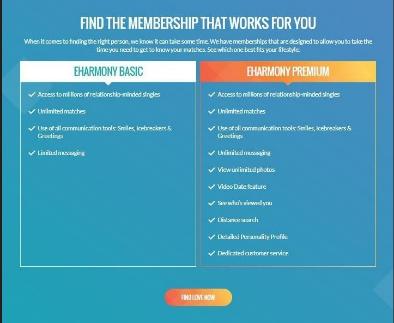
286 Between the heading (“Find the membership that works for you”) and the table, the following text appeared: “When it comes to finding the right person, we know it can take some time. We have memberships that are designed to allow you to take the time you need to get to know your matches. See which one best fits your lifestyle.”
287 The table then listed (with a “tick” or checkmark) the following features of “EHARMONY BASIC”:
• Access to millions of relationship-minded singles
• Unlimited matches
• Use of all communication tools: Smiles, Icebreakers & Greetings
• Limited messaging
288 This was in comparison to the listed features of “EHARMONY PREMIUM”:
• Access to millions of relationship-minded singles
• Unlimited matches
• Use of all communication tools: Smiles, Icebreakers & Greetings
• Unlimited messaging
• View unlimited photos
• Video Date feature
• See who’s viewed you
• Distance search
• Detailed Personality Profile
• Dedicated customer service
289 The Tour page in the period from around 7 December 2023 to 6 March 2024 (SOAF, Annexure 3.2) contained similar information in a different format, including the following table comparing the features of Basic and Premium memberships:
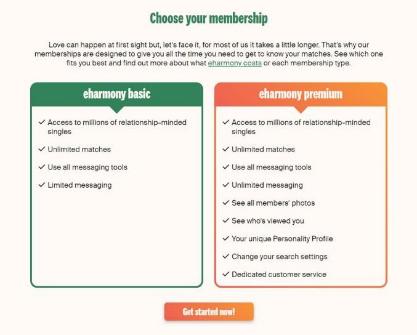
290 This table also appeared on the Tour page in the period from around 7 March 2024 until 17 May 2024 (SOAF, Annexure 3.3).
291 In the period between around 25 January 2022 and 17 May 2024, the FAQ landing page on the eHarmony website (SOAF, Annexures 3.4 and 3.5) contained topics on membership and costs and the sign-up process, including the following questions: “What are the eharmony membership options?”; “What is free what do I have to pay for on eharmony?”; “Is eharmony free?”; “It is worth subscribing to eharmony?”; “Why is eharmony so expensive?”; “How long is eharmony free?”; and “Can you pay for 1 month on eharmony?”.
292 From around 27 January 2022, the FAQ page “What are the eharmony membership options?” (SOAF, Annexure 3.6) distinguished between Basic membership and Premium membership:
eharmony Basic Membership
Everyone who joins eharmony starts off with a Basic membership. This free membership now includes unlimited matches and the ability to send and receive Smiles, Icebreakers and Likes. You can also respond to a first message, browse anonymously, and see recent visitors to your profile. Try it now – it’s absolutely free!
eharmony Premium Membership
If you’ve tried our Basic features and feel ready to begin your search for a real relationship, it’s time to upgrade to a Premium membership. This gives you access to eharmony’s full suite of features, including unlimited matches and messaging, enhanced search, and the ability to see all your matches’ photos.
Finding a new relationship shouldn’t be rushed and to make sure you get the time you need, we offer Premium memberships in 6-, 12-, or 24-month plans.
The same information (with some minor differences in terminology, such as references to “partner suggestions” or “suggested partners” instead of “matches”) was contained on an equivalent page in the Help Centre (SOAF, Annexure 3.20).
293 From around 27 January 2022, the FAQ page “What is free what do I have to pay for on eharmony?” (SOAF, Annexure 3.7) contained the following text:
What is free what do i have to pay for on eharmony?
Joining the eharmony community is absolutely free. After completing our Compatibility Quiz, you’ll be able to review any matches within the Match Preferences you specify. As a Basic Member, you can view basic profile information about your matches at no charge. You only pay when you’re ready to take the next step, which usually involves viewing your matches’ photos and sending personalised communications.
Your search for a great relationship has never been easier. By becoming an eharmony Premium Member, you’re enlisting the No 1 Trusted Dating Site as your partner. With unlimited matches, enhanced search features, unlimited communication, exclusive dating content and more, eharmony can help you find your match. When you become a Premium Member for the first time, you will also receive a comprehensive Individual personality report. This is a highly personal analysis of the results of your eharmony test, with individually tailored tips on finding a partner and building a relationship.
Our membership terms and pricing are also available on the Subscription page, which is accessed by clicking the “Upgrade to Premium” button from your Welcome Page once logged into your account.
294 From around 27 January 2022, the FAQ page “Is eharmony free?” (SOAF, Annexure 3.8) contained the following text:
Is eharmony free?
Joining the eharmony community is absolutely free. After completing our Compatibility Quiz, we’ll show you all your potential matches in your Discover list. Thereafter, we’ll show you all new members we think would make a good match. As a Basic Member, you can view basic profile information of other members at no charge. You only pay when you’re ready to take the next step and communicate with all of the members available to you and see their photos.
Your search for a great relationship has never been easier. By becoming a Premium Member on eharmony, you're enlisting the #1 Trusted Dating App as your wingman or wingwoman. With unlimited matches, enhanced search features, viewing photos, unlimited communication, exclusive dating content, and much more, eharmony can help you find your match.
Our membership terms and pricing are also available on the Subscription page, which is available by clicking the “Upgrade to Premium” button from your Welcome Page once logged into your account.
The same information (with some minor differences in wording) was contained on an equivalent page in the Help Centre (SOAF, Annexure 3.21).
295 From around 1 July 2022, the FAQ page “Why is eharmony so expensive?” (SOAF, Annexure 3.9) contained the following text:
Why is eharmony so expensive?
When asked why is eharmony so expensive we tell people that the process of finding real love and connection is an investment in your overall happiness, wellbeing and quality of life. With an eharmony membership, you'll benefit from our 20+ years of experience in helping millions of people find real love and learn more about yourself in the process. By joining eharmony, you’re joining a high-quality, highly engaged community, and a trusted dating environment. Our members are everything to us, and we're here to support you during every step of your dating journey.
And don’t forget, it’s free to sign up as a way for you to know eharmony before you fully commit – kind of like dating before a relationship.
296 From around 1 July 2022, the FAQ page “How long is eharmony free?” (SOAF, Annexure 3.10) contained the following text:
How long is eharmony free?
eharmony is free to sign up, and there is no charge for Basic Membership.
With Basic membership you can see all your member profiles and filter within the Member Preferences you specify once you complete the Compatibility Quiz. In addition, you can view primary profile information about other members, send and receive Smiles and Icebreakers, and respond to a first message at no charge. Furthermore, you can browse anonymously and see who has recently visited your profile.
While there are benefits to being a Basic member, such as no time limit under this membership, there are far more advantages when you upgrade to Premium. You can find a more detailed description of the memberships here.
The hyperlink in the final sentence took the user to the FAQ page “What are the eharmony membership options?”.
297 From around 18 October 2022, the FAQ page “Can you pay for 1 month on eharmony?” (SOAF, Annexure 3.11) contained the following text:
Can you pay for 1 month on eharmony?
While you can’t pay for 1 month on eharmony you can sign up for our Basic Membership Plan, which gives you limited access to our full suite of features, including unlimited matches and messaging.
In addition, we also periodically offer free trials to new members.
298 The Help Centre contained information on various topics including how to turn off automatic renewal, how to cancel a subscription or delete an account, and the eHarmony membership options (SOAF, Annexures 3.13 to 3.21).
Was the conduct misleading or deceptive, or likely to mislead or deceive (ACL, s 18)?
The meaning of “free dating”
299 The ACCC’s pleaded case is that, by stating that consumers could engage in “free” dating, eHarmony represented that members could engage in ongoing communication with other people on the eHarmony Platform for the purposes of developing a romantic relationship free of charge.
300 In response, eHarmony relied on the “full context” of the relevant statements in relation to “free dating”, including in particular the references to the different features associated with Basic membership and Premium membership respectively. Further, eHarmony submitted:
The word “dating” says nothing about how an online match-making platform will function. No basis is alleged for why an ordinary and reasonable consumer would assume that the platform would offer a particular form of unlimited functionality because of the descriptor “free dating”.
301 The headline representation on which the ACCC relies is the description of the eHarmony Platform as a “free dating site”. This was prominently stated towards the top of each iteration of the Free Dating Page. Each of those pages exhorted the viewer to “START free TODAY”, with some visual emphasis being given to the word “free”.
302 In the first and second iterations of the Free Dating Page, the text repeatedly compared eHarmony to other “free dating sites” or “free dating apps”, and distinguished eHarmony from “the default experience with free online dating”. In the third and fourth iterations, the headings portrayed eHarmony as the best choice for a “free dating site in Australia”, and referred to the “free dating experience” or “free dating journey” with eHarmony, stating that “eHarmony makes free dating easier and more fun”.
303 In comparing eHarmony with other “free dating sites” or “free dating apps”, the first and second iterations of the Free Dating Page referred to deciding “whether or not you’d like to kick start communication” with people selected based on “shared interests, values and core personality traits that we know form the basis of great relationships”. The page contrasted “the default experience with free online dating” which involved “spending ages communicating with someone to find out if you have anything in common”, stating that “with eHarmony that box has been ticked from the start”. All of this was in the context of promoting the experience of “signing up” to eHarmony as beating “even the best free dating sites”.
304 The third and fourth iterations referred to “online” dating as “the second-most popular way to meet people”, stating that “[o]ver 4.5 million Australians use free dating sites or apps like eharmony to find their partner”, and that a user can save time and money with “[t]his way of dating”. It was asserted that “[w]ith a free dating Basic Membership, you can give the site a whirl and see if it’s right for you”, explicitly associating the concept of “free dating” with a Basic membership.
305 In setting out some of the reasons why users “turn to eharmony as their free dating site”, the third and fourth iterations of the page declared that “[w]e’re consistently rated as one of the best free dating site [sic] for serious relationships”. While also referring to additional features offered to Premium members, the third and fourth iterations nevertheless stated that “eharmony still offers a lot to anyone looking for a free dating site in Australia”, and “our free dating package, the Basic Membership, still lets you experience the benefits of our services and Compatibility Matching System”. Again, there was an explicit reference to Basic membership as a “free dating package”.
306 After listing some of the features included in Basic membership (including “limited messaging”, but without any elaboration of the nature or extent of such limits), the third and fourth iterations concluded with a statement that “[u]nlike any other leading free dating site that leaves you to find your own way, eharmony is with you every step of your relationship journey until you find that person you’re meant to be with”, inviting users to “[f]ind your next relationship with one of the world’s most trusted free dating site”. These statements gave the overall impression that the eHarmony Platform could be used by members as a free dating site in order to find a person with whom they could develop a romantic relationship.
307 Further, the second to fourth iterations of the Free Dating Page contained an embedded video immediately next to the statement “HOW FREE DATING WORKS WITH EHARMONY” with a button inviting users to “JOIN FREE TODAY”. While this promotional video was also made available on other website pages including the homepage, as well as on third-party platforms such as YouTube, it was presented here in the specific context of explaining “how free dating works”. An ordinary or reasonable consumer who viewed the embedded video on the Free Dating Page would be given the impression that the features depicted in the video were consistent with those available for free on the eHarmony Platform, and would not necessarily be aware that the video was available on other webpages. For present purposes, the number of times that the video was viewed by particular consumers from the Free Dating Page is immaterial.
308 The concept of “dating” encompasses a range of different meanings in different contexts, and can be conducted both in online and “in person” settings. The ordinary meaning of the noun “date” includes, relevantly, a social engagement with a person in whom one has a romantic interest: Oxford English Dictionary (online) (OED), “date”, meaning 8.a; Macquarie Dictionary (online), “date”, meaning 6. In that context, “dating” refers to the practice of arranging or going on dates with such a person or persons. When used in the context of a “dating service”, it generally connotes a service through which clients can meet one another for romantic purposes, or which introduces single men and women to each other with a view to finding a romantic partner or companion: OED, “dating”, meaning c.2.a; Macquarie, “dating service”. A particular type of dating service may be offered through “dating sites” (or “dating apps”), which may be defined as “a website [or app] set up for the purpose of facilitating meetings between people who are looking for a potential partner for a relationship”: Macquarie, “dating site”.
309 There does not appear to be any room to dispute that the core meaning of “dating” in the present context involves the activity of seeking to find a person with whom one can develop a connection leading to a relationship of a romantic nature. This can encompass searching for potential “dates”, engaging in communications with such persons to form connections and ascertain whether there is mutual interest in pursuing a relationship, and developing any such relationships through ongoing communication or social engagements.
310 I accept that the process of dating, particularly in the context of a dating service, might commence with activities such as preparing a profile for a dating site, or reviewing the profiles of other users of the dating site, including those who have been identified as potential “matches”. Such activities may form part of the dating “journey”, to borrow a term used by Mr Mandel in his evidence. Nevertheless, to describe dating as a “journey” does not require the conclusion that any part of that journey can itself be regarded as “dating” in the ordinary sense. For example, simply providing information or answering a quiz in order to receive a “personality profile” would not itself be described as “dating”. Nor would being provided with a list of persons that might be potential “matches”, without being able to make contact or communicate with those persons.
311 I therefore place little weight on Mr Mandel’s evidence about eHarmony’s internal understanding of the concept of dating as “a mindset where a person who is single is open to the possibility of meeting someone”, or as a “journey” that starts with its users “exploring themselves, their own goals, opening themselves up to the possibility of finding a meaningful relationship and ultimately understanding who they are and what they may be looking for or bringing with them to the dating experience”. This is all well and good, but it does not capture the ordinary understanding or the full meaning of “dating” to a reasonable consumer.
312 Further, and in any event, the particular context of the Free Dating Page reinforced the concept of “dating” as encompassing the goal of finding a romantic partner and forming a relationship with that person. More generally, this is central to the manner in which eHarmony views and promotes its Platform, for example, as “a place for people who are serious about their goal of finding a relationship”, and which “focuses on authenticity and what brings people together for deeper connections”: first Mandel affidavit, [26].
313 In the present context, the class of consumers to whom the representations are directed comprises persons who use, or might be interested in using, online dating services. Although the eHarmony website is generally accessible to any member of the public with access to the internet, the relevant class is more specific than the public at large: cf. Jetstar Airways at [30]–[31], [161]–[164] (Foster J). It nevertheless comprises a wide segment of the community, as reflected in the number of Australian consumers who registered for a Basic membership during the relevant period. As the ACCC submitted, the class encompasses ordinary people from all walks of life with a broad range of age, level of education, occupation, and other personal circumstances: compare Jetstar Airways at [166] (Foster J).
314 I do not accept eHarmony’s submission that the ordinary and reasonable or “representative” member or members of this class of consumers would have “a high degree of both computer literacy and educational attainment relative to the Australian population taken as a whole”. In this day and age, the fact that persons use the internet to buy goods or services through a website or mobile device does not confine the class of consumers of eHarmony’s services to any particular demographic, even accepting that the representative consumer can be assumed to have knowledge of the internet and the capacity to conduct searches and navigate websites: see viagogo AG at [110] (Burley J); Jetstar Airways at [168] (Foster J). The data presented by Ms Bustamante did not support any conclusion about the “typical” characteristics of eHarmony’s members – for example, while many are tertiary educated, just as many are not, and members’ ages are fairly evenly spread with most being between 18 and 59 years old.
315 Consumer D gave evidence that one of the reasons she signed up to eHarmony was because it advertised “free dating”, having conducted searches on Google for “online dating” services, and that she had expected that she would be able to “make connections, communicate and go on dates by setting up meetings either virtually or in person”. Consumer B and Consumer C each gave evidence of similar expectations of “free dating” with a Basic membership, including being able to see other members’ photos and to communicate or have conversations with other members.
316 While I have had regard to the evidence of the consumer witnesses, I do not rely on their evidence to establish the ordinary meaning of “free dating” or the overall impression that would be conveyed to an ordinary and reasonable consumer by the Free Dating Representations. As discussed above, the evidence of such consumer witnesses does not have any statistical significance. Further, each of the witnesses did not always identify the specific conduct or representations on which their understanding or beliefs about the features of eHarmony’s Basic membership were based. Nevertheless, the expectations that were held by the consumer witnesses are consistent with my conclusions as to what a hypothetical representative member of the relevant class of persons would understand from eHarmony being advertised or promoted as a “free dating” site.
317 I therefore find that, subject to the consideration set out below of contextual matters on which eHarmony relied, the representations that eHarmony was a “free dating” site would convey the dominant message or impression to an ordinary and reasonable consumer that it was possible to sign up for a membership with eHarmony free of charge in order to use their services to find other persons with whom they might develop a romantic relationship, including by searching for and engaging in communications with such persons.
Immediate and broader context
318 In denying the alleged “free dating” representations, eHarmony relied on the content of the Free Dating Pages as a whole, submitting that those pages disclosed and accurately described the features of Basic membership and Premium membership. In particular, eHarmony argued that the ACCC was seeking “to string together a series of decontextualised statements found on SEO pages which were infrequently viewed”.
319 The number of times that the SEO pages were viewed is not directly relevant to the question whether or not those pages gave rise to contraventions of the relevant provisions of the ACL. Irrespective of whether SEO pages such as the Free Dating Page formed part of what Mr Mandel described as the “standard user flow”, such pages were intentionally designed to appear in internet search results in order to attract traffic to those pages on the eHarmony website. In other words, one of the purposes of the SEO pages, including the Free Dating Page, was to draw consumers into the eHarmony Platform. In addition, the Free Dating Page could also be viewed by clicking a hyperlink in the footer on other pages of the eHarmony Platform. Once there, it was possible for a user to navigate directly to the registration process and the compatibility quiz, and there was evidence that some users had in fact viewed the Free Dating Page immediately before registering as a Basic member.
320 The first and second iterations of the Free Dating Page contained some statements to the effect that a “free” membership did not provide access to all of the features of the eHarmony Platform, and might be treated as providing a “trial” or preview of the services offered by a Premium membership. There were statements to the effect that a user could join (for free) and start reviewing their matches, which might be regarded as literally true, albeit arguably incomplete. In particular, the pages contained the following statements which provided context to the description of eHarmony as a “free dating” site:
Try eharmony for free
Is eharmony free? Well, not if you want to experience our richest features but if you’re just curious then sign up for free first. This is a fantastic opportunity for you to dip your toes in the eharmony waters without any pressure to commit.
Get a feel for how it works and review the people eharmony matches you with. There’s no obligation, no pressure. It’s safe, it’s free, and it’s fun.
Join today to find your perfect match.
…
Try before you buy – and no pressure to sign up
We love our site and want you to enjoy it too, which is why we encourage you to sign up for free, review your matches and get to know us a little better.
321 The first and second iterations also referred to some of the features that were available with a subscription package, including viewing photos and sending “open, unlimited messages to your matches”, and suggested that “with online dating you get what you pay for and with us you’re paying for a unique and premium service”.
322 On the other hand, the pages did not always draw a bright line between “free” registration and the experience available on a Premium membership subscription, and the limitations of Basic membership were not directly or clearly specified. In so far as the pages stated what could be done (such as joining or registering, reviewing matches, and deciding whether or not to “kick-start communication”) they did not highlight what could not be done (such as viewing unblurred photos or exchanging more than one message with another member).
323 Similarly, the third and fourth iterations of the Free Dating Page contained express references to the additional features offered to Premium members, including “[t]he ability to see all your matches’ photos” and “[u]nlimited communication”. Conversely, the listed features of Basic membership included “[l]imited messaging”. There was also a description of the “free dating experience” as “a part of our eharmony free trial”, which included taking the compatibility quiz, following which the user could “check out your matches and send a smile to get the conversation going”.
324 Again, those references did not necessarily qualify or correct the impression given by the repeated usage of the term “free dating” as discussed above. The ordinary and reasonable consumer can be taken to have been put on notice that there were different levels of membership, and that Premium members enjoyed more features and fewer limitations than Basic members. But that would not necessarily mean that the limits on what could be done with a Basic membership were such that it was not possible to pursue or engage in some form of “dating” in relation to other members of the eHarmony Platform, including by contacting other members and engaging in some degree of ongoing communication with a view to forming a romantic relationship.
325 Accordingly, while the Free Dating Pages contained some factually accurate statements about the distinction between Basic and Premium memberships and some of the features available with a Premium membership, those statements did not displace the overall impression and dominant message that a person could engage in “free dating” by joining eHarmony and registering as a Basic member, without any charge or payment. As Jacobson and Bennett JJ stated in National Exchange at [50]–[51]:
A document which, when read as a whole, is factually true and accurate may still be capable of being misleading if it contains a potentially misleading primary statement which is corrected elsewhere in the document but without the reader’s attention being adequately drawn to the correction.
The principle which applies to those cases is that the qualifying material must be sufficiently prominent or conspicuous to prevent the primary statement from being misleading; see Medical Benefits Fund of Australia Ltd v Cassidy [2003] FCAFC 289 at [35]–[38] (per Stone J with whom Mansfield J agreed); see also J D Heydon, Trade Practices Law, Law Book Co, Sydney, 1989, at [11.730].
In the present case, the limitations on Basic membership are neither clearly nor prominently disclosed in the Free Dating Pages.
326 Nor is the dominant message from the Free Dating Pages capable of being qualified or corrected by other information disclosed elsewhere on the eHarmony website, such as the FAQ section, the Tour page or the Help Centre.
327 First, a user might not visit those pages before registering as a Basic member. As mentioned above, there was evidence that some consumers proceeded to the registration process immediately after having viewed the Free Dating Page, and it is conceivable that other consumers might have viewed the Free Dating Page on a previous occasion before completing the registration process but without having visited other relevant pages on the eHarmony website. In such circumstances, it is not open to rely on the content of the other pages as part of the broader context in which eHarmony made the Free Dating Representations, without any evidentiary basis on which to conclude that a consumer would have looked at those pages before registering for a Basic membership. It is speculative to assume that a representative consumer would have explored the eHarmony website or searched for specific information about the features of Basic and Premium memberships before joining eHarmony by signing up as a Basic member.
328 Secondly, the information set out in those other pages did not clearly or prominently qualify the dominant message conveyed by the Free Dating Representations.
(a) On the Tour page, the table comparing Basic membership and Premium membership features disclosed that the former had “limited messaging”, but without specifying the nature or extent of those limits. It was not expressly stated that a Basic member could not see profile pictures or photos of other members, other than by possible inference from the positive statements that a Premium member could “[v]iew unlimited photos” or “[s]ee all members’ photos”. I do not consider that an ordinary and reasonable consumer would examine and analyse the table in such a manner as to draw that inference.
(b) The FAQ page “What are the eharmony membership options?” was more explicit in stating that Basic membership included the ability to send and receive “Smiles, Icebreakers and Likes”, as well as being able to “respond to a first message”, whereas Premium membership gave access to “unlimited matches and messaging, enhanced search, and the ability to see all your matches’ photos”. Similar statements about the features of Basic membership were made on the FAQ page “How long is eharmony free?”. Nevertheless, I do not consider that these specific and abridged references to the limited features available with a Basic membership are sufficient to dispel the overall impression arising from the Free Dating Representations.
(c) Similarly, the FAQ pages “What is free what do I have to pay for on eharmony?” and “Is eharmony free?” each contained statements that a Basic member could view basic profile information about their matches at no charge, and would only pay when “ready to take the next step” which would involve sending communications with other members and viewing their photos. While factually accurate, these statements are not sufficient to qualify or correct the overall impression from the Free Dating Representations.
(d) Further, on the FAQ page “Why is eharmony so expensive?”, the free registration is described “as a way for you to know eharmony before you fully commit – kind of like dating before a relationship” (emphasis added). This analogy compares Basic membership to the early stages of “dating”.
329 For these reasons, I do not consider that the ACCC’s case on the Free Dating Representations is based on a “legal construct divorced from reality”, as was submitted by eHarmony. Nor do I accept that this involves an attempt to “reverse engineer” the ordinary meaning of “free dating” by reference to the limitations on Basic membership. Rather, there is a real possibility that consumers will have viewed the Free Dating Page and formed an overall impression that it was possible to “date” other members of the eHarmony Platform free of charge by registering as a Basic member.
330 The ACCC also relied on the Thai Dating Page as containing the Free Dating Representations. That page included a section setting out a series of steps that could be taken “to enjoy free Thai dating with us today”. Those steps covered signing up for free, completing the compatibility quiz, setting up a profile, finding and filtering matches, and finally “reach[ing] out with a text or Icebreaker” when the user found someone who sparked their interest. In my view, the immediate context of the explanation accompanying the reference to “free Thai dating” would be likely to qualify any impression that might otherwise arise as to the features available with Basic membership. That is, the relevant text on the Thai Dating Page elaborated what was encompassed in “free Thai dating” with eHarmony, in a manner which explicitly stopped short of ongoing communications beyond reaching out with a text or “Icebreaker”. Accordingly, unlike the Free Dating Pages considered above, I do not consider that the Free Dating Representations as alleged by the ACCC are established by the Thai Dating Page.
The conduct was misleading or deceptive
331 In so far as eHarmony represented to consumers that it was possible for a user to engage in “free dating” by joining eHarmony free of charge, that representation had a tendency to lead an ordinary and reasonable consumer to assume or conclude that they would be able to use eHarmony for free in order to find other persons with whom they might develop a romantic relationship, including by engaging in ongoing communications with such persons. For the following reasons, I consider that such an assumption or conclusion was erroneous. Accordingly, the conduct was misleading or deceptive, or likely to mislead or deceive, in contravention of s 18 of the ACL.
332 From the perspective of an ordinary and reasonable consumer, the heavy emphasis on the concept of “free” in direct association with the word “dating” was designed to give a strong impression that the eHarmony Platform could be used to pursue the activity of dating other users of the Platform without any charge or payment.
333 As Gleeson J stated in Cornerstone at [561]:
There are numerous authorities which emphasise that the word “free” has a particularly strong attraction and unless adequately qualified it can readily produce a wrong understanding: see, for example, TPC v Optus Communications Pty Ltd (1996) 64 FCR 326. When marketing goods or services, qualifications need to be prominently and clearly spelled out so that the “magnetism” of the word “free” may be properly understood by a consumer: see Nationwide News Pty Ltd v Australian Competition and Consumer Commission (1996) 71 FCR 215 at 228.
334 In Nationwide News Pty Ltd v Australian Competition and Consumer Commission (1996) 71 FCR 215 at 225, Lindgren J observed that “[o]ffers of free goods or services have been much used in advertising, no doubt because of their capacity to attract business”, noting that “it is common knowledge that the ultimate purpose of commercial advertising is to confer financial benefit on the offeror of the ‘free’ goods or services, often by persuading the offeree to purchase other goods or services from it”. After referring to a number of cases that “demonstrate judicial recognition of the propensity of the word ‘free’ in advertising to mislead or deceive”, Lindgren J stated that “[a]ny respect in which goods or services offered as ‘free’ may not be free should be prominently and clearly spelled out so that the magnetism of the word ‘free’ is appropriately qualified”: ibid. at 228.
335 In the present case, the issue is not so much whether Basic membership was in fact properly represented as being free of charge, but whether such membership truly offered a form of “dating” in the sense in which that term would be understood by an ordinary and reasonable consumer to whom the representations were directed. While the question is not whether the term “free” was itself misleading, the prominent use of that term in conjunction with the word “dating” was likely to attract attention and to draw an ordinary and reasonable consumer into registering with the eHarmony Platform.
336 I accept the ACCC’s submission that it was not possible to use the eHarmony Platform as a Basic member, free of charge, to “date” other members by engaging in ongoing communications for the purposes of developing a romantic relationship.
337 There were strict limits on the nature and extent of communications that could be sent or received by a Basic member. Prior to 20 June 2023, a Basic member could only read a single initiating text message from any Premium member, and send a single text message in response. While a Basic member could send and receive “likes”, “smiles” or “icebreaker” images, he or she could not send an initiating text message to another member (including any potential “matches”). While these restrictions were slightly relaxed from 20 June 2023, so as to allow a Basic member to send a single initiating text message to another member, it remained impossible to exchange messages on an ongoing basis. In my view, the imposition of those limits on conversing with other members is incompatible with the concept of “dating”, in that it would thwart any ability for a Basic member to explore or develop connections with another member in pursuit of a romantic relationship.
338 These limitations were compounded by the inability to view unblurred pictures or photographs on other members’ profiles. While viewing profile pictures is not necessarily essential to the concept of online dating, eHarmony nevertheless places considerable emphasis on such photographs as a key aspect of the dating process on the eHarmony Platform. This is so notwithstanding the evidence given by Mr Mandel that eHarmony seeks to prioritise “deeper connections” beyond physical appearance or attractiveness. Several editorial articles on the eHarmony website provided guidance to members on taking and selecting photographs to be included on their profile. Although those articles were accessed after the period covered by the SOAF, I infer that they are generally representative of eHarmony’s approach to the importance of profile pictures in online dating, including on the eHarmony Platform. This was not denied or contradicted by Mr Mandel in the course of his cross-examination. The choice of photographs was treated by eHarmony as an aspect of making an impression and attracting connections with other members. The restriction on viewing unblurred photos operated as a further constraint on the ability of a Basic member to engage in “free dating” on the eHarmony Platform by forming connections and communicating with other members with a view to developing a relationship of a romantic nature.
339 This is consistent with the evidence given by some of the consumer witnesses as to their expectations when signing up to Basic membership, although that evidence suffered from the limitation that it did not clearly identify the precise basis on which such expectations were formed. Consumer B said that he expected that Basic membership would provide “more than what was offered”, particularly “in terms of being able to speak with other people”, and was “effectively unusable because [he] could not actually date anyone”. Consumer C said that she expected that she would be able to see other users’ photos and to communicate or “have a conversation” with them, at least if paid members messaged her first. Consumer D expected that she would be able to “make connections, communicate and go on dates by setting up meetings either virtually or in person”. In each case, the witness only realised the limitations of a Basic membership after signing up and starting to use the eHarmony Platform.
340 A consumer would discover the features (and limitations) of a Basic membership after they had joined as a member, and before purchasing any Premium membership subscription. However, by that time, the consumer would already have been enticed into eHarmony’s “marketing web” (see TPG Internet (HC) at [50]), having invested significant time in completing the compatibility quiz and setting up their dating profile, and having provided eHarmony with their personal information and contact details. Mr Mandel accepted that such information is valuable to eHarmony. Among other things, it enabled eHarmony to market Premium membership to those consumers, by sending them discount offers or three-day trial subscriptions.
341 For completeness, I do not consider that the Free Dating Representations can be justified or rationalised by reference to the possibility that a Basic member might be offered a three-day trial of Premium membership. The “free dating” representations were directed to the features of Basic membership, conveying that a Basic member could engage in “dating” free of charge on the eHarmony Platform for an indefinite period, rather than potentially receiving an offer of temporary access to the features of Premium membership on a complimentary basis for a brief and finite period. The evidence suggests that three-day “free trial” offers were made to users who had already signed up as Basic members, and that they were used as a marketing tool to encourage those users to upgrade to a Premium membership. As such, the three-day trial offers neither met nor dispelled the conduct by which eHarmony represented through the Free Dating Page that it was possible for a Basic member to “date” other members on the eHarmony Platform free of any charge.
342 Far from providing an experience that can properly be described as “dating”, Basic membership enabled the user to see only limited features of the eHarmony Platform. A Basic member would be tantalised with a list of other members with whom they had been “matched”, but unable to see unblurred profile photographs of those members or to exchange more than one “personalised” text message with any other member in whom they might have an interest. In order to progress or develop any form of relationship with another member, it was necessary to upgrade to a Premium membership. In this regard, Mr Mandel conceded that one of the reasons that eHarmony prevented Basic members from seeing unblurred pictures was to encourage or incentivise customers to become Premium members. The same might be said in relation to the other limitations on communications between Basic members and other members. In this way, Basic membership essentially served as a gateway to subscription as a Premium member. Rather than functioning as a “free dating site”, eHarmony was an online subscription-based dating service on which limited features (such as compatibility matching) could be tried for free.
343 No weight can be placed on Mr Mandel’s evidence that these matters (i.e., the inability of a Basic member to see unblurred pictures of other members or to have unlimited communication with other members) had not been raised as significant issues by eHarmony’s users. Notwithstanding that Mr Mandel expected that he would be made aware of any “critical issues” raised by eHarmony’s users, he was not responsible for responding to customers nor for eHarmony’s policies or guidelines for dealing with issues raised by customers. Further, the question whether the Free Dating Representations were misleading or deceptive does not depend on the existence of customer complaints.
Did eHarmony make false or misleading representations that Basic membership was of a particular quality or had certain performance characteristics or benefits (ACL, s 29(1)(b), (g))?
344 In its closing submissions, eHarmony accepted that the Free Dating Representations would fall within ss 29(1)(b) and (g) of the ACL, if it were found that they were false or misleading as alleged by the ACCC.
345 The Free Dating Representations were made in trade or commerce and in connection with the supply or possible supply of services by eHarmony to the users of the eHarmony Platform, or in connection with the promotion of the supply or use of such services. The representation that a Basic member could engage in dating free of charge was concerned with a property or feature of the services provided by eHarmony, and therefore was a representation that those services were of a particular “quality” within the meaning of s 29(1)(b) of the ACL. Further, the representation concerned the performance characteristics, uses or benefits of such services within the meaning of s 29(1)(g) of the ACL.
346 For the reasons set out above, the Free Dating Representations were false or misleading, and therefore gave rise to contraventions of s 29(1)(b) and (g) of the ACL.
Was the conduct liable to mislead the public in relation to the nature, characteristics or suitability of Basic membership (ACL, s 34)?
347 For the purposes of s 34 of the ACL, eHarmony accepts that the Free Dating Representations were made to the public, and that they were representations “as to the nature, characteristics, suitability for their purpose or the quality” of the services provided by eHarmony.
348 Accepting that s 34 of the ACL requires demonstration of an actual probability that the public would be misled by the relevant conduct, I am satisfied that the Free Dating Representations were liable to mislead the public, for the reasons set out above. Accordingly, the representations contravened s 34 of the ACL.
Monthly Price Representations
349 The ACCC alleged that eHarmony contravened ss 18 and 29(1)(i) of the ACL by making false or misleading representations in relation to the monthly price payable for a Premium membership.
350 The alleged contravening conduct comprised statements made on the Subscription Page that a six-month, 12-month or 24-month subscription could be purchased for a price expressed as “from $x / month”, which is alleged to have represented that consumers could purchase a Premium membership for the advertised amount payable on a monthly basis. If the consumer chose to pay monthly, however, he or she would be charged an additional mandatory fee that was not disclosed on the Subscription Page. The additional fee was only disclosed on the Payment Page, after the consumer had selected a subscription plan.
351 The following screenshot is representative of the relevant part of the Subscription Page on the eHarmony website, as it appeared prior to July 2024. For the 12-month (Premium Plus) plan, the stated price was “from $23.94 / month”.
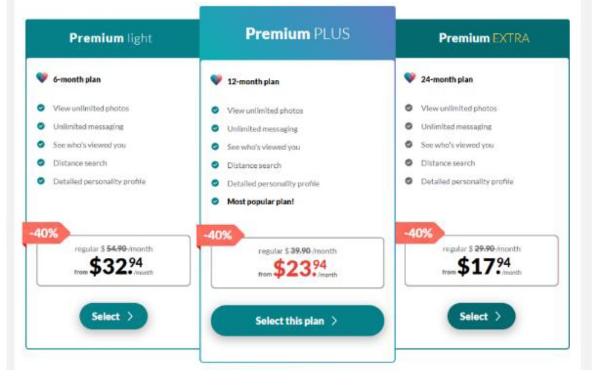
352 By pressing the “Select this plan >” button, the user was taken to the Payment Page, where he or she was prompted to enter credit card or PayPal details and asked to choose a payment frequency option. Other than “one-time” payment, each of the payment frequency options would dynamically disclose an additional monthly fee when the cursor was hovered over that option. The dynamic text would disappear when the cursor was moved away from the payment option. The following screenshot is representative of the relevant part of the Payment Page, showing the dynamic text “plus $3.00 / month” for the monthly payment option:

Users who hovered over the other payment frequency options would have seen similar text in the form of “plus $2.00 / month” for the quarterly option and “plus $1.00 / month” for the bi-annual option. No additional text appeared when hovering over the “one-time” option.
353 If the monthly payment option was selected, the additional text comprised in the Disclosure would be displayed above the “Subscribe now” button: see paragraph 36 above. This relevantly included a statement in the following terms: “I agree that I will be charged $26.94 today and 11 subsequent monthly payment(s) of $26.94 each for a total of $323.28 for a 12 month term”. The amount of $26.94 payable each month over the 12-month subscription period was higher than the amount stated on the Subscription Page of “from $23.94 / month”. While the Disclosure set out the monthly payments and total price for the subscription plan, the user was not provided with an “order summary” that separately identified the “base price” (as stated on the Subscription Page) and the additional mandatory fee.
354 Similar, but lower, additional fees were payable for the quarterly or bi-annual options. While those additional fees were also expressed in the form “plus $x / month”, they were payable on a three-monthly or six-monthly basis depending on the option chosen. The only circumstance in which a user could avoid an additional fee was by choosing the “one-time” payment option, under which a single up-front payment was made for the entire six-month, 12-month or 24-month subscription period.
355 Similar information was displayed in a slightly different format on mobile or tablet devices. After selecting a plan on the Subscription Page, and entering credit card or PayPal details on a payment methods screen, the user would be required to choose a payment option on a separate screen, which appeared as follows:
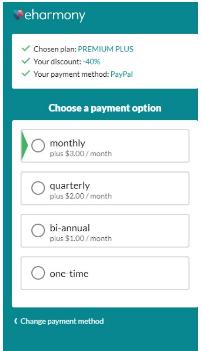
Thus, on the mobile or tablet version of the Payment Page, the additional fees for all of the payment options were disclosed without any need to “hover” over each option. After selecting one of the payment options, the Disclosure would be displayed above the payment button.
356 The July 2024 changes introduced additional words to the Subscription Page, which stated the price of each plan as from a specified dollar figure per month “when making a one-time upfront payment”, and added the following below the listed subscription plans: “Total plan price depends on your payment frequency – select a plan for more details”. These additional words were in a very small sized font relative to most of the other text on the page, particularly when compared to the prominent statement of the monthly price itself. A representative screenshot of the relevant part of the Subscription Page as it appeared on the desktop or laptop version of eHarmony website from July 2024 is as follows:
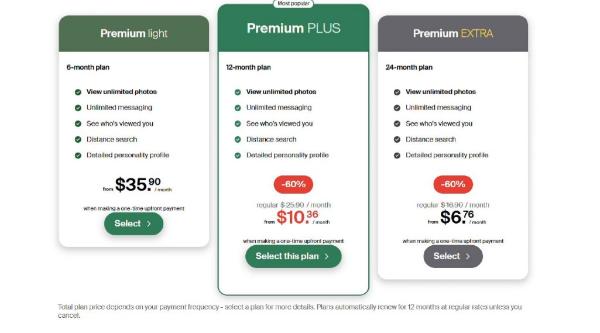
357 The equivalent part of the Subscription Page as it appeared from July 2024 on the mobile or tablet version of website is as follows:
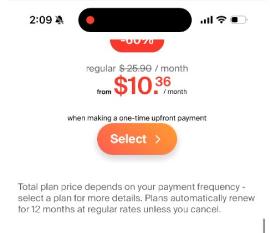
358 The ACCC submitted that the statements made on the Subscription Page amounted to a representation that a consumer could purchase a Premium membership subscription “by paying the stated amount per month”. This was said to be false or misleading, and as having a tendency to lead the consumer into error, because it was not possible to purchase a Premium membership by making a monthly payment of the amount stated on the Subscription Page. Rather, if the consumer elected to pay on a monthly basis, he or she would incur an additional undisclosed fee of $3.00 per month. In so far as the additional fee was subsequently disclosed on the Payment Page, by hovering over or selecting the monthly payment frequency option, the ACCC submitted that “[t]he reference to the fee was not sufficiently clear or prominent to correct the dominant impression conveyed by the monthly price statement on the Subscription Page, and in any event came too late”.
359 The ACCC submitted that these alleged contraventions were not fixed by the July 2024 changes to the Subscription Page, which continued to display a monthly price that was not available to consumers without disclosing the additional fee. The ACCC submitted that the additional words on the Subscription Page from July 2024 were “not sufficiently clear or prominent to correct the dominant impression conveyed by the monthly price statement”.
360 In response, eHarmony submitted that the alleged contravention turned on the meaning conveyed by the phrase “from $x / month” on the Subscription Page, and that the ACCC’s case ignored the effect of the word “from”. Rather than stating the amount that was payable each month for the subscription, eHarmony submitted that the phrase “from $x / month” referred to the minimum cost of the service shown on a monthly basis. On this approach, the ordinary and reasonable consumer would understand that the stated amount was the lowest possible cost per month, as opposed to the amount payable per month, noting that the phrase included the word “from” and did not include words such as “pay” or “payable”. The presentation of Premium membership subscriptions in that manner enabled consumers to compare the cost of different plans with subscription periods of different lengths. The inclusion of the word “from” would be understood to reflect a conditional statement, indicating the bottom end of a range of possible prices for a subscription period of a given length.
361 Further, eHarmony submitted that the relevant statement on the Subscription Page should not be considered in isolation from its context, including the fact that users were taken to the Payment Page “within seconds” after selecting a Premium membership plan, at which time the additional fee was disclosed by hovering over or selecting a payment frequency option. After selecting a payment frequency, the total price and the amount of any instalments were disclosed to the user. eHarmony submitted that those disclosures were temporally connected to the alleged Monthly Price Representation on the Subscription Page, as part of the process of purchasing a Premium membership. Referring to the use of the “>” symbol in the button on the Subscription Page (“Select this plan >”), eHarmony submitted that it was “artificial and unrealistic to desegregate each step in the sign-up process when in truth, it is one dynamic unitary process”.
362 Accordingly, eHarmony submitted that a consumer would not be led into error by the price statements made on the Subscription Page, and that it was possible for a user to purchase a subscription plan at the monthly cost advertised on that page by proceeding to choose the “one-time” payment option.
363 In relation to period from July 2024, eHarmony submitted that the case advanced by the ACCC was untenable in the light of the changes that had been made to the Subscription Page.
364 The alleged contraventions arising from the Monthly Price Representations raise a number of issues.
(a) What meaning was conveyed by the words “from $x / month” in relation to the Premium membership plans shown on the Subscription Page?
(i) Did those words convey to an ordinary and reasonable consumer that the relevant plan could be purchased for a monthly payment in the amount stated, as opposed to a statement as to the effective cost of the plan on a monthly basis?
(ii) What was conveyed to an ordinary and reasonable consumer by the use of the word “from”?
(b) Was any impression created by the words “from $x / month” on the Subscription Page capable of being qualified or corrected by the disclosures that were subsequently made on the Payment Page?
365 The ACCC relied on the decision in Jetstar Airways. In that case, Foster J held that low-cost passenger airlines had engaged in misleading or deceptive conduct by making representations about the price of specific airfares, without disclosing that a booking and service fee was payable unless certain payment methods were chosen by the purchaser.
366 Jetstar Airways involved an online booking process by which customers navigated through a series of webpages on which information about particular flights was progressively disclosed. In relation to the conduct of one of the airlines (Jetstar), specific fares in relation to specific flights were displayed on a “Select Flights” webpage with a listed dollar figure, but the existence and quantum of the booking and service fee was not disclosed until a subsequent “Payment” webpage: Jetstar Airways at [54(e), (i), (j), (k)]. Justice Foster found that this amounted to a representation “that the specific dollar figure for the fares displayed on those pages was a firm figure subject to factoring in the price of choices subsequently made by the consumer in respect of the services to be provided” (such as baggage and seating choices and other extras), but “[t]hat qualification on firm fare price did not encompass incorporating the booking and service fee in due course, at the very end of the process”: ibid. at [180]. Accordingly, the representation was held to be misleading or deceptive, or likely to mislead or deceive: ibid. at [181]. The falsity of the representation was not corrected until the disclosures made on the payment webpage, which revealed the existence and quantum of the booking fee and the circumstances in which the fee could be avoided: ibid. at [182].
367 Several other aspects of the decision in Jetstar Airways may be noted. First, in relation to statements made on Jetstar’s homepage which displayed prices for selected fares as “from” a particular dollar figure (i.e. “from $x”), together with an asterisk directing the customer to a note on the same page in which certain terms and conditions were set out, Foster J found that “Jetstar did not represent by anything displayed on the home page that any particular flight could be undertaken for any specific price”: Jetstar Airways at [177]; see also at [105]–[109], [188], in relation to “from” prices stated in emails (with accompanying disclosure of the booking and service fees). Secondly, after changes were made by Jetstar to bring forward the disclosure of the booking and service fee so as to coincide with the specification of prices for particular flights, Foster J found that the alleged representations in relation to the price of the fares without the booking and service fee were no longer made by Jetstar: ibid. at [56]–[57], [185]–[186].
368 For similar reasons, Foster J rejected the case against the other airline (Virgin) in relation to its website, finding that there had been adequate disclosure of the booking and service fee when displaying fares for specific flights: Jetstar Airways at [190]–[194]. In relation to the Virgin website homepage, on which fares were also displayed as “from” a particular dollar figure, his Honour stated (at [193]):
I do not think that Virgin made any representation on the home page of its website to the effect that the “from” fares displayed on that home page were firm fares which would be charged for any particular flight. Given the layout and text displayed on that home page, it seems to me that all that is being said by Virgin on that webpage is that, depending upon choices yet to be made by the consumer, the fares in the category described might be obtainable at the dollar figure displayed. As was submitted by Senior Counsel for Virgin, all that was stated was a base fare, which was itself expressed to be subject to conditions. No rational person could reasonably have concluded that that base fare would apply regardless of the payment method used or other choices made by the consumer.
369 On the other hand, Virgin was found to have contravened ss 18(1) and 29(1) of the ACL in relation to its mobile site, on which the existence and quantum of the booking and service fee were not plainly disclosed until the very end of the booking process: Jetstar Airways at [195]–[198].
370 While the findings made in Jetstar Airways illustrate the application of the relevant principles in an analogous context, the design of different websites and online purchase processes is likely to be bespoke, and the nature of the market and the relevant class of consumers will also differ from case to case. The outcome must ultimately depend on the facts and circumstances of each particular case, rather than being governed by findings made in other cases on different facts.
371 The purchase process on the eHarmony Platform is arguably less complicated than the online booking processes considered in Jetstar Airways. Nevertheless, the parties sought to highlight certain features by reference to that case, including whether or not the Subscription Page represented the price of each subscription plan as a “firm figure” to the exclusion of any additional mandatory fees that might be charged in respect of particular payment frequencies or payment methods, and the effect of displaying prices as “from” a stated amount.
372 The relevant conduct in the present case comprised the statements made on the Subscription Page that a particular subscription plan could be purchased for an amount expressed as “from $x / month”. The following observations may be made about the form and appearance of those statements.
(a) The amount was displayed in a significantly larger font and (for 12-month plans) coloured orange or red, in a manner that stands out from the surrounding text on the page. In the representative examples that were the subject of evidence, a precise amount was specified (e.g. $23.94), rather than a round figure.
(b) The amount was expressed as being “from” a particular dollar figure per month. On the other hand, the “regular” price (that is, before an applicable discount) was stated immediately above in a smaller font as a particular dollar figure per month, without the word “from”.
(c) While the amount was expressed on a monthly basis (as denoted by “/ month”), there is some potential ambiguity as to whether or not the amount was payable each month. As eHarmony submitted, the text does not include the word “payable” or “payment”. Nevertheless, the meaning conveyed by the statement is not necessarily confined to the express words used, and it remains necessary to determine how the statement would reasonably be understood in its overall context.
(d) It was clear from the “Select this plan >” button that, once the user selected a subscription plan, he or she would be taken to another page, presumably for the purpose of entering payment details and ultimately completing the purchase.
373 The use of the word “from” conveyed that the amount was not an invariable or “firm” price for the selected plan, but rather the lower end of a range. It was a conditional statement that envisaged the possibility that the final price might be higher, depending on choices yet to be made by the customer. Nevertheless, it encompassed a representation that there were at least some circumstances in which the selected plan was available at the stated amount.
374 As developed in oral submissions, the ACCC’s case focuses on an alleged representation that it was possible to subscribe for the selected plan by paying the stated amount on a monthly basis. This involves a slight refinement of the case advanced in the ACCC’s further amended concise statement, in so far as it was alleged that the Monthly Price Representations were false because an additional mandatory fee was charged if the consumer chose to pay quarterly or bi-annually, as well as monthly. However, if a user was contemplating payment other than on a monthly basis, such as by quarterly or bi-annual payments, the statement on the Subscription Page could only be understood as referring to the monthly cost of the selected plan. In such circumstances, the word “from” might foreshadow that the cost may be higher (i.e. an additional fee may be charged) for different payment options.
375 Accordingly, the ACCC’s case hinges on whether the statement “from $x / month” had a tendency to lead an ordinary and reasonable consumer to assume that the selected plan could be purchased by agreeing to pay the specified amount each month during the subscription period, as opposed to setting out the effective cost of the subscription on a monthly basis. Such a statement would be false, as the choice of the monthly payment frequency option would result in an additional fee of $3.00 per month. Subject to the effect of the disclosures made on the Payment Page, this would amount to a false or misleading representation with respect to the price of goods or services, and would involve conduct that is misleading or deceptive or is likely to mislead or deceive, in contravention of ss 18(1) and 29(1)(i) of the ACL.
376 In my view, the meaning conveyed to an ordinary and reasonable consumer by the relevant statements on the Subscription Page is that the user can purchase the selected plan for the specified price payable on a monthly basis. At that point in the purchase process, there had been no reference to differing payment frequencies, and nothing to suggest that the price or cost of a Premium subscription might vary depending on the payment frequency chosen by the user. The word “from” would alert the user to the possibility that the price for the selected plan might be higher in some (unspecified) circumstances, other than by reference to the length of the subscription period (which was governed by the selected plan). However, the word “from” did not itself indicate that a higher amount might be charged for monthly payments, as opposed to the possibility of additional fees or charges in respect of other variables, such as the choice of payment method (e.g. credit card payments).
377 In this regard, Mr Mandel’s evidence about eHarmony’s purpose in charging instalment fees has little relevance to the meaning conveyed to the ordinary and reasonable consumer by the statements on the Subscription Page. Mr Mandel sought to explain that eHarmony provided its customers with a choice of payment frequencies to suit their circumstances, and that the additional fees were charged to compensate eHarmony “for various costs and risks associated with offering deferred payment options”. However, the statements on the Subscription Page are not concerned with the choice of payment frequencies or the cost of deferred payments. The question is not one of justification of the additional fees, but rather their non-disclosure.
378 An ordinary and reasonable consumer would focus on the prominent specified dollar figure as the price at which the selected plan could be purchased, payable on a monthly basis. Many such consumers are likely to be price sensitive, as is reflected in the heavy emphasis given to the discounts offered on the “regular” price. The quantum of the additional fee for monthly payments relative to the price of the subscription plan cannot be regarded as insignificant. For example, if a 12-month subscription was advertised at a price of “from $23.94 / month”, the customer would not reasonably expect that the subscription would involve monthly payments of $26.94, representing an increase of over 12.5%. I note that this is consistent with evidence that was given by Consumer C. Such a difference in the price or cost of Premium membership might have a material bearing on the decisions made by the consumer, including whether or not to select a plan and proceed to the Payment Page.
379 In so far as eHarmony sought to draw a comparison with the findings made by Foster J in Jetstar Airways in relation to the promotion of fares priced as “from” a particular dollar figure, the representations made in that case were accompanied by disclosures about the additional fees, including the booking and service fee, on the same webpage or in the same email. In the present case, prior to July 2024, the words “from $x / month” on the Subscription Page were not qualified by any disclosure that an additional fee would be payable for monthly payments, nor that additional fees may be payable for different payment frequencies.
380 The subsequent disclosures made on the Payment Page did not negate the representations made on the Subscription Page about the monthly price of each Premium subscription plan.
(a) Although the user was able to navigate directly to the Payment Page upon clicking the “Select this plan >” button, that did not mean that the representations on the Subscription Page were “fleeting” in duration, nor that those representations were qualified by whatever was stated on subsequent pages. As Foster J stated in Jetstar Airways at [174], the user could view and digest the information displayed on each webpage at whatever pace he or she chooses. The evidence in the present case suggests that the time spent by users on the Subscription Page was often around one minute or more. The content and appearance of that webpage were operative on the mind of the user before deciding to select a plan and to proceed to the next stage of the purchase process.
(b) At least on the desktop or laptop version of the website, the Payment Page did not immediately disclose the additional fee attached to each of the payment frequency options. Rather, the existence and quantum of the additional fee would only be revealed if and when the user hovered over or selected a particular payment option.
(c) On the desktop or laptop version, it cannot be assumed that the user would see the amount of the additional fee in respect of every payment option before selecting one of the options, unless he or she consciously navigated the cursor over each of the payment options to view the “dynamic” text before making a selection. For example, a user who immediately proceeded to select the monthly payment option would see the additional fee of “$3.00 / month”, but would not become aware that a lower fee was payable for the quarterly or six-monthly options, and that no fee was payable for one-time payment option.
(d) The additional fee payable for a particular payment option (such as monthly) would be disclosed when the user hovered over or selected that option. Further, the Disclosure above the “Subscribe now” button included a statement of the total subscription price and the amount of each payment, inclusive of any additional fee (albeit without separately identifying the amount of that fee).
(e) The mobile site differed from the desktop version, in so far as the additional fees associated with all of the payment options were disclosed on the first screen of the Payment Page. Again, that did not erase the effect of the misrepresentations made on previous pages.
(f) While I am prepared to accept that the falsity of the representations on the Subscription Page was ultimately “corrected” by the disclosures made on the Payment Page, this does not prevent those representations from amounting to a contravention of ss 18(1) and 29(1) of the ACL: compare Jetstar Airways at [182].
381 The position was different, in my view, after the July 2024 changes were made to the Subscription Page. In particular, those changes brought forward the disclosure of the existence of instalment fees and dispelled any possible understanding of the words “from $x / month” as referring to monthly payments.
(a) First, the statement “from $x / month” was qualified by the addition of the words “when making a one-time upfront payment”. In circumstances where the shortest subscription plan offered was for a six-month period, the only possible interpretation of the statement “from $x / month” would be as a reference to the effective cost of the plan on a monthly basis. This negated any impression that the stated dollar figure could be paid each month, and implied that the monthly cost would be higher if paid in instalments.
(b) Secondly, this was supported by the additional paragraph beneath the plan options stating that the “[t]otal plan price depends on your payment frequency”, with an invitation to “select a plan for more details”. Although the additional text was in a much smaller font and was less prominent than other text on the Subscription Page, I consider that it was sufficient to prevent the Monthly Price Representations from being made as alleged by the ACCC.
382 It follows that the ACCC has established that eHarmony contravened ss 18 and 29(1)(i) of the ACL in the period from November 2019 to July 2024, by making false or misleading representations on the Subscription Page in relation to the monthly price payable for a Premium membership.
Single Price Not Specified
383 The ACCC alleged that the statements made on the Subscription Page as to the price of Premium membership subscription plans also contravened s 48(1) of the ACL, by making a representation with respect to an amount that constituted a part of the consideration for the supply of services without prominently specifying the “single price” for the services.
384 It is not in dispute that the services supplied by eHarmony are of a kind ordinarily acquired for personal, domestic or household use or consumption within the meaning of s 48 of the ACL, and that the statements made on the eHarmony website were made in trade or commerce.
385 In essence, the ACCC contended that the statement that a Premium membership plan could be purchased for “from $x / month” identified an amount that would constitute a part of the consideration for the selected plan, without specifying the minimum quantifiable consideration comprising the total price for the six-month, 12-month or 24-month subscription period. For example, a 12-month subscription plan was promoted as “from $23.94 / month”, whereas the minimum quantifiable consideration for that plan at the time that the representation was made was $287.28 (for the entire 12-month subscription period).
386 The alleged contravention of s 48 of the ACL is not directed to the non-disclosure of the additional fee payable for the monthly, quarterly or bi-annual payment options. In other words, the ACCC did not contend that the additional fee was included in the minimum quantifiable consideration comprising the “single price” for the relevant Premium membership subscription plan. This was on the basis that the additional fee was a charge payable at the option of the purchaser who, at or before the time of the representation, had not expressly requested that the charge be applied: see s 48(7)(a) of the ACL.
387 In response, eHarmony submitted that the statements made on the Subscription Page did not amount to a representation with respect to an amount that, if paid, would constitute a part of the consideration for the supply of services. Accordingly, those statements did not attract the requirement to specify the single price for the services.
(a) Firstly, eHarmony contended that, because of the word “from”, there was no representation with respect to a definite amount that, if paid, would form part of the consideration. Rather, what was represented was the bottom end of a range. In such circumstances, eHarmony submitted that s 48 of the ACL was not engaged.
(b) Secondly, eHarmony contended that an ordinary and reasonable consumer would understand the statements as referring to the effective cost of the subscription on a monthly basis, rather than an amount that was payable each month.
(c) Thirdly, eHarmony contended that the total price payable could not be ascertained until the user chose the payment frequency option on the Payment Page. Upon making that selection, the total price of the subscription was prominently stated in the Disclosure together with (and no less prominently than) the amount of any instalment payments, inclusive of any additional fee.
388 As I have concluded above, prior to July 2024, the statements made on the Subscription Page stating the price of Premium membership subscription plans as “from $x / month” would be understood by an ordinary and reasonable consumer as referring to the minimum amount payable each month for the selected plan, as opposed to an expression of the effective cost of the plan on a monthly basis. A monthly payment for a six-month, 12-month or 24-month plan would constitute a part of the consideration for the supply of services during the subscription period: compare TPG Internet (FC) at [9]–[10], [130]–[132] (Jacobson, Bennett and Gilmour JJ), where the “single price” included monthly fees over a six-month contract together with a set-up fee and other charges.
389 I do not consider the inclusion of the word “from” prevented the statements from making a representation with respect to an amount that, if paid, would constitute a part of the consideration for the subscription plan. The word “from” indicated that the specified amount was a minimum payment, and that a higher amount or additional charges might be payable in certain circumstances. However, this did not mean that the specified amount would not form a part of the consideration, nor did it preclude the single price from being ascertained as the minimum quantifiable consideration at the time of the representation.
390 In particular, I do not regard viagogo AG as standing for any general proposition that s 48(1) of the ACL cannot apply to a representation with respect to the price of goods or services as being “from” a specified dollar figure. The homepage in viagogo AG advertised tickets for different events with a “From A$X” price. In that context, the specified dollar figure indicated the price of the cheapest ticket available from among a range of tickets, rather than a component of the price of any particular ticket to the relevant event. It was only on a subsequent webpage that the price of the chosen ticket was displayed as a “subtotal”, together with a reference to additional charges for “Booking, Handling and VAT”.
391 In some circumstances, the role played by the word “from” may be analogous to words indicating that additional amounts may be payable for particular services, in a similar manner to phrases such as “plus fees and charges”. Thus, the word “from” can be consistent with an indication that the amount specified is not the whole consideration for the supply of the services, but only a part of that consideration. That is so in the present case, where the inclusion of “from” did not contemplate any variability in the monthly price of a subscription plan of a given length, but rather foreshadowed the possible imposition of additional fees. It remained possible to quantify the minimum price of the services supplied under that subscription plan.
392 Accordingly, when making a representation on the Subscription Page with respect to the price per month of a subscription plan, s 48(1) of the ACL required eHarmony also to specify the single price for the services supplied under the plan in a prominent way and as a single figure. At the time those representations were made, the single price would not include any additional fees for monthly, quarterly or bi-annual payments, because those charges were optional and would not yet have been either deselected or expressly requested by the customer. The single price would be the minimum quantifiable consideration for the supply of the services under the relevant subscription plan, comprising the total amount payable in respect of the subscription period (before any optional additional fees or charges).
393 As the Subscription Page did not include any specification of the single price for each of the subscription plans, there is no issue as to the manner in which that single price was displayed. The total price for the subscription was specified in the Disclosure on the Payment Page, including any additional fees for instalment payments, but this was not capable of curing any earlier contravention of s 48(1) of the ACL arising from the representations made on the Subscription Page: see viagogo AG (FC) at [79]. The ACCC did not allege that the Payment Page itself gave rise to any contravention of s 48(1) of the ACL. Accordingly, the prominence of the specification of the single price on the Payment Page is not in issue.
394 I therefore find that eHarmony contravened s 48(1) of the ACL in the period from November 2019 to July 2024, by making representations on the Subscription Page with respect to the monthly price payable for a Premium membership subscription without also specifying, in a prominent way and as a single figure, the single price for the subscription.
395 For the reasons set out above, after the July 2024 changes, the statement “from $x / month” on the Subscription Page would have been reasonably understood as referring to the effective cost of the subscription on a monthly basis, if the customer made a “one-time” upfront payment. From July 2024, it was made clear on the Subscription Page that the total price for each subscription plan was dependent on payment frequency. On one view, this suffered from the same vice as the representations about price to which s 48 of the ACL is directed, in so far as it failed to specify the minimum quantifiable consideration for the supply of services under the subscription plans. Nevertheless, if “from $x / month” is understood as referring to the effective cost of the services rather than an amount actually paid for the services, there is a question whether that statement makes “a representation with respect to an amount that, if paid, would constitute a part of the consideration for the supply of the … services” within the meaning of s 48 of the ACL.
396 While the position is not beyond doubt, the preferable view is that s 48(1) of the ACL can apply to a representation with respect to the cost of goods or services by reference to a component unit of those goods or services, whether or not this represents a discrete amount payable under the contract for the supply of the goods or services. The language in s 48(1) is concerned with a hypothetical payment (“if paid”) rather than an actual payment (e.g. “when paid”). For example, if a one-kilogram bag of flour was advertised at a price per 100 grams, this would also require the “single price” for the goods to be prominently specified, even if it were not possible to pay separately for 100 grams.
397 Accordingly, the statements on the Subscription Page from July 2024 that a subscription plan cost “from $x / month” when making a one-time upfront payment were representations with respect to an amount that, if paid, would constitute a part of the consideration for the supply of services under the subscription plan. By failing to specify the single price for the services under the plan, being the minimum quantifiable consideration for the supply of those services at the time of the representation, eHarmony contravened s 48(1) of the ACL.
Automatic Renewal Conduct
398 The ACCC alleged that consumers were misled by eHarmony into believing that the Premium membership subscription period was six, 12 or 24 months, in circumstances where it was not prominently disclosed by eHarmony that Premium memberships were automatically renewed for a further subscription period after the initial subscription period expired.
399 In its further amended concise statement, the ACCC alleged that eHarmony had engaged in the following conduct.
(a) Prior to July 2024, the Subscription Page displayed the plans and prices in respect of the initial subscription period of six, 12 or 24 months, and did not disclose that the subscription was subject to automatic renewal (including the renewal period and renewal price). The renewal period and renewal price were only disclosed in small font on the Payment Page after the consumer had selected a payment frequency and had entered (or been prompted to enter) their payment details.
(b) After the July 2024 changes, the Subscription Page contained a statement that “[p]lans automatically renew for 12 months at regular rates unless you cancel”, and the renewal price stated in the Disclosure on the Payment Page was underlined and in bold font. Nevertheless, the ACCC maintained that automatic renewal was not prominently disclosed after the July 2024 changes.
400 The ACCC alleged that eHarmony had thereby “engaged in conduct that gave or was likely to give consumers the impression or understanding that the subscription period was 6, 12 or 24 months, whereas the subscription period was longer (through automatic renewal) unless steps were taken by the consumer to turn off automatic renewal prior to the end of the period”.
401 In so far as the ACCC’s case was based on an allegation that, through automatic renewal, the subscription period was “longer” than the initial period of six, 12 or 24 months, eHarmony submitted that this involved a “conceptual fallacy” by equating renewal for a further subscription period with a continuation or extension of the initial subscription period. In oral submissions, senior counsel for eHarmony argued that this “elided the distinction between what is the subscription period and what happens at the end of the subscription period”. Further, eHarmony disputed whether the ACCC had properly pleaded a case based on misleading or deceptive conduct by silence or non-disclosure, as opposed to express representations: cf. Miller & Associates Insurance Broking Pty Ltd v BMW Australia Finance Ltd (2010) 241 CLR 357 at [5] (French CJ and Kiefel J), recognising that silence or non-disclosure can be relied upon as “an element of conduct, including other acts or omissions, said to be misleading or deceptive”.
402 The present case was conducted by the concise statement method, rather than by formal pleadings. While concise statements are not governed by the rules of pleading, they serve the purpose and function of summarising the key facts and disclosing the key issues in dispute between the parties, so as to provide notice to opposing parties of the case sought to be made against them. To that end, a concise statement or a concise response may be read together with any further particulars filed by the parties, and in the light of the submissions and evidence relied upon.
403 The alleged Automatic Renewal Conduct was articulated in the ACCC’s further amended concise statement as comprising the representations made on the Subscription Page about the subscription plans, the non-disclosure of automatic renewal on the Subscription Page, and the manner in which automatic renewal was disclosed on the Payment Page. Based on that conduct, the ACCC alleged that consumers were likely to have an “impression or understanding” that the subscription was for a period of six, 12 or 24 months only, and would not automatically renew by default at the end of that period.
404 In its concise statement in response, eHarmony relied on the disclosure of automatic renewal in the Terms and Conditions, which were accessible from a member’s homepage, the Subscription Page, and from hyperlinks throughout the purchase process, including in the Disclosure. Further, eHarmony relied on the express references in the Disclosure to automatic renewal, the renewal period and the renewal price, along with information about automatic renewal contained on other webpages on the eHarmony Platform (such as the Help Centre). In respect of the period since July 2024, eHarmony relied on the changes made to the Subscription Page and the Payment Page in relation to the disclosure of automatic renewal.
405 In its further amended concise statement in reply, the ACCC denied that the fact of automatic renewal was prominently disclosed in the Terms and Conditions or as part of the “purchase flow”.
406 The parties subsequently exchanged requests for further and better particulars, which relevantly included particulars in relation to the Automatic Renewal Conduct (for example, eHarmony requested particulars of the ACCC’s allegation that the hyperlinked Terms and Conditions did not adequately disclose the renewal period and the renewal price).
407 In my view, eHarmony had sufficient notice of the case advanced by the ACCC based on the alleged conduct comprising the representations made by eHarmony on the Subscription Page and the Payment Page in relation to the length of the subscription period, including whether there was adequate disclosure of automatic renewal on those pages or elsewhere (such as the Terms and Conditions or other pages on the eHarmony Platform).
Identification of the conduct
408 On the Subscription Page, consumers were offered a choice between three subscription plans, each for a finite subscription period of either six, 12 or 24 months, which were described as “Premium light”, “Premium PLUS” and “Premium EXTRA” respectively. The features of each plan were headed by the words “6-month plan”, “12-month plan” or “24-month plan” alongside a distinctive multi-coloured heart symbol. The listed features were otherwise identical for each subscription plan, apart from the addition of “Most popular plan” in respect of the Premium PLUS plan. The Premium PLUS plan was also displayed in a larger and more prominent box so as to stand out from the other two plans. The offered discounts were highlighted both in the heading (e.g. “40% savings on all Premium Memberships”) and in the prices displayed for each plan (e.g. “–40%” and strikethrough of the regular price).
409 Prior to July 2024, the Subscription Page did not contain any reference to renewal, nor any other reference to what would occur at the end of the period covered by the selected plan. After the July 2024 changes, a paragraph in small grey font underneath the subscription plans included the following sentence: “Plans automatically renew for 12 months at regular rates unless you cancel.”
410 On the Payment Page, consumers were prompted to enter their payment details, and to choose a payment frequency option. The payment options comprised “monthly”, “quarterly”, “bi-annual” and “one-time”. Any discount offered was again highlighted in a red-coloured banner towards the top of the Payment Page.
411 Upon the selection of a payment option, the Disclosure was set out above a large teal-coloured “Subscribe now” button, alongside a list of the key features of the selected plan in the same terms as on the Subscription Page, commencing with a reference to the length of the subscription period (i.e. “6-month plan”, “12-month plan” or “24-month plan”).
412 After referring to the instalment amounts and the total price of the selected plan, the Disclosure invited the user to agree that his or her subscription would automatically renew for a 12-month term at a specified price charged in specified instalments, and would continue to renew on the same terms until cancelled by the user. The Disclosure stated that any cancellation would be effective on the next renewal date of the user’s subscription. The Disclosure stated that, by clicking the “Subscribe now” button, the user agreed to the Terms and Conditions (to which a hyperlink was provided) and to “the payment and renewal terms above”.
413 The payment frequency in respect of any automatic renewal was specified in the Disclosure. However, the user was not provided with any option in relation to the payment frequency for the renewal period. The various screenshots and videos that were the subject of evidence suggest that the payment frequency chosen by the customer for the initial subscription plan was carried over to any renewal period.
(a) Thus, if the user had chosen the monthly payment option for his or her selected plan, the Disclosure referred to automatic renewal at a price charged in monthly instalments. For such purposes, the regular undiscounted monthly price would be applied, plus the $3.00 monthly instalment fee – e.g. in respect of the 12-month plan advertised as “from $23.94 / month” and charged in 12 monthly instalments of $26.94 for a total of $323.28, the renewal was charged in monthly instalments of $42.90 (i.e. the “regular” price of $39.90 plus $3.00), at a total price of $514.80.
(b) Alternatively, if the user had chosen one-time payment, they would be charged an upfront single payment upon the automatic renewal of their subscription for the default 12-month renewal period. For example, if the user had chosen the one-time payment option in respect of an initial six-month plan at a discount of 40% or more, that user would be charged an upfront payment upon automatic renewal for a further 12 months at the regular price without any discounts.
414 In relation to the desktop or laptop version of the eHarmony website, the degree of prominence of the Disclosure relative to the surrounding features of the Payment Page can be viewed in the screenshot reproduced at paragraph 36 above. On the one hand, the text comprised in the Disclosure is displayed in a relatively small font size, and the layout and colours are used to draw the eye of the consumer to the listed features of the selected plan and the “Subscribe now” button. On the other hand, the Disclosure is set out in two discrete paragraphs directly above the “Subscribe now” button, commencing with the words “I agree …”.
415 In relation to the mobile or tablet version of the eHarmony website, the degree of prominence of the Disclosure can be viewed in the screenshot reproduced in Annexure H. The Disclosure appears on a separate payment confirmation page, between the selected payment frequency option and the payment button.
416 After the July 2024 changes, the total price of the initial subscription period and the total price of the automatic renewal period were set out in the Disclosure in bold and underlined font.
417 If the consumer were to click on the link to the Terms and Conditions, they would be taken to a detailed “agreement” setting out the terms and conditions of service. There were various iterations of the Terms and Conditions in use during the relevant period covered by the SOAF. For example, in the version of the Terms and Conditions that was in place between 5 November 2019 and 22 June 2020:
(a) Clause 2(c) relevantly provided that eHarmony offered “6, 12, and 24-month Premium Memberships which automatically renew for consecutive 12 month terms (or other term lengths, as agreed-upon by you during the purchase process) unless prohibited by applicable law”, and that “[c]ancellation of auto-renewal must be initiated at least 24 hours before the end of your current term”.
(b) Clause 13 dealt with renewals, and was printed or displayed in red font in some formats (including the PDF version and the online version after December 2023) in contrast to the balance of the document which was in black and white. A representative example of clause 13 as in place between 5 November 2019 and 22 June 2020 was in the following terms:
13. **RENEWALS**.
IN ORDER TO PROVIDE CONTINUOUS SERVICE, EHARMONY AUTOMATICALLY RENEWS ALL PAID SUBSCRIPTIONS FOR THE SERVICES ON THE DATE SUCH SUBSCRIPTIONS EXPIRE UNLESS YOU CANCEL AT LEAST 24 HOURS BEFORE THE END OF YOUR CURRENT TERM. WE ALWAYS COMMUNICATE RENEWAL PERIODS TO YOU, BEFORE YOU FINALIZE THE PURCHASE OF YOUR SUBSCRIPTION, UPON CONFIRMATION OF PURCHASE, AND IF APPLICABLE IN YOUR JURISDICTION, IN AN EMAIL REMINDER AT LEAST 30 DAYS PRIOR TO THE EFFECTIVE RENEWAL DATE. BY ENTERING INTO THIS AGREEMENT, YOU ACKNOWLEDGE THAT YOUR ACCOUNT WILL BE SUBJECT TO THE ABOVE-DESCRIBED AUTOMATIC RENEWALS. IN CONNECTION WITH ANY RENEWAL, YOU AGREE AND AUTHORIZE US TO CHARGE YOU APPLICABLE CHARGES, INCLUDING APPLICABLE INSTALLMENT FEES, SALES OR OTHER RELATED TAXES TO WHICH YOUR SUBSCRIPTION MAY BE SUBJECT AND WHICH MAY VARY FROM TIME TO TIME. IN ALL CASES, IF YOU DO NOT WISH YOUR ACCOUNT TO RENEW AUTOMATICALLY, PLEASE FOLLOW THE DIRECTIONS SET OUT UNDER "CANCELLATIONS AND ACCOUNT HOLDS" SECTION ABOVE.
418 There were no material changes to those clauses in subsequent versions of the Terms and Conditions during the relevant period until the revision on 7 November 2023, when clause 13 was amended so as to add a prospective obligation to remind members before their subscription was automatically renewed:
IF YOU PURCHASE A SUBSCRIPTION ON OR AFTER THESE TERMS TAKE EFFECT, WE WILL PROVIDE YOU WITH A RENEWAL REMINDER APPROXIMATELY 15 DAYS BEFORE YOUR RENEWAL. IF YOUR SUBSCRIPTION RENEWS ON OR AFTER THESE TERMS TAKE EFFECT, WE WILL PROVIDE YOU WITH A RENEWAL REMINDER APPROXIMATELY 15 DAYS BEFORE YOUR SUBSEQUENT RENEWAL.
An earlier form of clause 13 in some previous versions of the Terms and Conditions had provided for an email reminder to be given prior to renewal “if applicable” in the relevant jurisdiction.
419 The clause in the Terms and Conditions dealing with renewals did not itself specify any renewal period. Clause 2(c) referred to automatic renewal for “consecutive 12 month terms”, subject to agreement during the purchase process to different renewal term lengths. The Terms and Conditions did not address the payment frequency that would be applicable in respect of any renewal period.
420 By way of additional context, eHarmony submitted that the automatic renewal of Premium membership subscriptions was disclosed on other pages on the eHarmony Platform, including the following pages within the Help Centre, each of which was located under the topic of “Subscription” (SOAF, Annexure 3.15).
(a) On the topic of turning off automatic renewal, a page in the Help Centre relevantly stated (SOAF, Annexure 3.17):
HOW DO I TURN OFF AUTOMATIC RENEWAL?
You can turn off your account’s automatic renewal feature and by doing so, your subscription will expire at the end of its term. Keep in mind that once your subscription expires, you will lose the ability to read and write custom messages with members and view their photos. So, before turning it off, we ask that you consider giving our unique process the opportunity and time to work for you.
For subscriptions purchased on the web, you will need to contact Customer Care to have your automatic renewal feature disabled. You can get in touch with our team either by the chat function on this page or by emailing us below.
Specific instructions were given for subscriptions purchased through the Apple Store or the Google Play App (Android).
(b) The Help Centre page on cancelling a subscription relevantly stated (SOAF, Annexure 3.18):
HOW DO I CANCEL MY SUBSCRIPTION?
Keep in mind that once your subscription expires, you will lose the ability to read and write custom messages with matches and view their photos. So, before requesting to turn it off, we ask that you consider giving our unique process the opportunity and time to work for you.
For subscriptions purchased on the web
Please contact eharmony with your request to turn off the automatic renewal.
Again, specific instructions were given for subscriptions purchased through the Apple Store or the Google Play App (Android).
(c) The Help Centre page on checking membership status relevantly stated (SOAF, Annexure 3.19).
HOW DO I CHECK MY MEMBERSHIP STATUS?
You can review the details of your Premium Membership by going to your Data & Settings page within your account. From there you can review:
• Membership term length
• Date of purchase
• How to cancel your membership (turn off the auto-renewal feature)
To access the Data & Settings page:
1. Log into your eharmony account
2. Click the dropdown menu at the top-right of the screen next to your picture
3. Click the “Data & Settings” link
(d) From around 27 January 2022, the same information was contained on the FAQ page “How do I check my eharmony membership status?” (SOAF, Annexure 3.12).
421 Further, after purchasing a Premium membership subscription, the user was sent a confirmation email that expressly referred to automatic renewal, and attached a copy of the Terms and Conditions. The order confirmation email contained a heading “Automatic Renewal of your subscription”, under which it was stated that the user’s “current Premium membership” would run until a specified date, and that, “[t]o ensure that you have uninterrupted service, your subscription is scheduled to automatically renew” on that date for a 12-month term at a specified price, and “continues on these same terms until you cancel”. The confirmation email also informed the user that automatic renewal could be cancelled “at any time up to the day prior to the start of the next renewal period”, and directed the user to the “Data & Settings” page in their profile for additional information on cancelling automatic renewal.
422 As mentioned above, the ACCC relied on the affidavit of Ms Saberi, who gave evidence that (as at 22 May 2024), she did not find any results when she searched the FAQ pages for the search terms “auto”, “automatic”, “renew”, “renewal”, “cancel” and “subscribe”.
Was the conduct misleading or deceptive, or likely to mislead or deceive (ACL, s 18)?
Pre-July 2024
423 At least prior to July 2024, the Subscription Page represented to the relevant class of consumers that they could select between Premium membership plans with a finite duration of either six, 12 or 24 months. It was not possible to subscribe to a Premium membership for a single month, nor from month to month. Without more, an ordinary consumer would not reasonably expect that the selected plan would be automatically renewed for a further period of 12 months, irrespective of the particular plan that had been selected by the consumer.
424 Although eHarmony maintained that the Subscription Page said nothing about renewal, that illustrates rather than avoids the vice. The consumer was offered a choice of fixed-term plans to subscribe for the features comprised in Premium membership for what appeared to be a finite period, as opposed to an ongoing subscription with discounted pricing for an introductory period. Further, it did not form part of eHarmony’s case that any distinction was to be drawn between the “plan” and the underlying subscription; on the contrary, eHarmony itself sought to distinguish between the initial subscription period and what occurred at the end of that subscription period. This is also consistent with the SOAF, in which it was relevantly agreed that “Premium memberships renewed automatically after the initial subscription period for a default renewal period of 12 months” (emphasis added).
425 The question is whether the impression conveyed by the Subscription Page that a consumer was selecting a subscription of a finite length was qualified or corrected by the subsequent disclosures on the Payment Page, or by other information provided in the purchase process or elsewhere on the eHarmony website.
426 For these purposes, the class of persons to whom the relevant conduct was directed comprised consumers in Australia who had registered a Basic membership on the eHarmony Platform. As discussed above, this was a large and highly diverse class of persons, which was not confined to any narrow demographic group. Any adult person with internet access (whether by desktop/laptop or mobile/tablet) could register as a Basic member by providing their personal details and completing the compatibility quiz. During the period from 5 November 2019 to 6 June 2024, there were around 1.3 million registrations for Basic membership, and approximately 260,000 Premium membership subscriptions were purchased. The evidence suggests that Basic members encompassed a wide range of ages and different educational levels.
427 The nature of online dating services is such that, in many cases, the user may not have an ongoing need for those services beyond the selected subscription period, either because they have been successful in finding a romantic partner within that period, or because they have otherwise exhausted their search and discontinued their use of the service. This general proposition was illustrated by the evidence of the consumer witnesses. The purchase process was focused on the selection of a subscription plan primarily by reference to the length of the subscription period, and on the choice as to the frequency with which payments were made during that period. The user was not required to direct their attention to any similar selection or choice in relation to renewal.
428 It is common ground that, depending on the term of the selected subscription plan and any applicable discounts, the total price for any renewal may be higher than the total price for the initial subscription. In some cases, the difference might be significant – for example, a six-month subscription purchased with a discount of 50% would be renewed for a 12-month period at the regular price, resulting in a renewal price that would be four times (i.e. 400%) the price of the original subscription. Further, if the original subscription was purchased with a “one-time” payment, the renewal price would be charged in its entirety upon the end of the subscription period. The possibilities can be illustrated by the following examples:
(a) Consumer A subscribed to a six-month plan with a 35% discount, selecting a “one-time” payment of $155.64. The subscription was automatically renewed for a 12-month term for $478.80, payable as a single upfront payment.
(b) Consumer B subscribed to a six-month plan with a 50% discount, selecting a “one-time” payment of $149.70. The subscription was automatically renewed for a 12-month term for $598.80, payable as a single upfront payment.
(c) Consumer D subscribed to a six-month plan with a 35% discount, selecting a “one-time” payment of $233.61. The subscription would have been automatically renewed for a 12-month term for $718.80, payable as a single upfront payment. However, Consumer D was dissatisfied with the experience of Premium membership, and requested cancellation and a refund within several days after purchasing the subscription.
(d) Consumer E subscribed to a six-month plan with a 50% discount, selecting a “one-time” payment of $89.70. The subscription was automatically renewed for a 12-month term for $358.80, payable as a single upfront payment.
(e) The annexures to the SOAF included examples of the Disclosure in which:
(i) a 12-month subscription for a total price of $323.28 (payable monthly) would be automatically renewed for 12 months at a total price of $514.80 charged in monthly instalments;
(ii) a six-month subscription for a total price of $164.70 (“one time” payment) would be automatically renewed for 12 months for a price of $658.80;
(iii) a 12-month subscription for a total price of $208.32 (payable monthly) would be automatically renewed for 12 months at a total price of $466.80 charged in monthly instalments.
429 Each of Consumer A, Consumer B and Consumer E gave unchallenged evidence to the effect that they first became aware of automatic renewal after they received notice that the renewal price had been charged or that there was an outstanding balance due on their account. In each case, they had stopped using their eHarmony membership before the end of the initial subscription period, and believed that their Premium membership would cease or revert to Basic membership at the end of that period. While I have had regard to this evidence, it is not determinative of the question whether an ordinary and reasonable consumer would be misled or deceived by eHarmony’s conduct into an erroneous understanding or assumption that their subscription would not be automatically renewed at the end of the initial subscription period.
430 The ACCC also relied on evidence of communications between eHarmony and Australian consumers in July 2021, January 2022 and July 2022 in which consumers had raised issues concerning automatic renewal, including refund requests and complaints about being charged for automatic renewal without prior notice. Those communications were contained in spreadsheets produced by eHarmony in response to a notice under s 155 of the Competition and Consumer Act. The spreadsheets were subject to a limitation under s 136 of the Evidence Act by which, save for any admissions made by eHarmony, they may not be used as evidence as to the truth of any representations contained in the communications. Accordingly, in so far as the communications involved complaints by consumers about automatic renewal, they establish that eHarmony received such complaints but cannot be relied on as evidence of the underlying facts that were the subject of the complaints. This limits the weight that can be given to the complaints when making findings about the understanding of an ordinary and reasonable consumer: cf. Australian Competition and Consumer Commission v Kogan Australia Pty Ltd [2020] FCA 1004; (2020) 145 ACSR 609 at [59]–[60], [87] (Davies J).
431 I accept that concerns were raised by some eHarmony members about unanticipated charges in respect of the automatic renewal of their subscriptions, and that eHarmony was aware of those concerns, without making any findings about the particular circumstances giving rise to those concerns in any individual case. I note that eHarmony’s awareness of such issues was also evidenced by its internal guidelines on refunds, which specifically addressed the circumstances of refund requests in the context of automatic renewal. The fact that complaints were made about automatic renewal cannot be taken too far, particularly in establishing whether or not consumers were aware at the time that they purchased the subscription that it would be automatically renewed by default if no steps were taken to request cancellation. For instance, it is possible that some consumers might have felt aggrieved because they had forgotten about their subscription and had not been reminded to “turn off” automatic renewal before the end of the subscription period.
432 The central question is whether an ordinary and reasonable member of the relevant class of consumers would have been misled, or was likely to have been misled, by eHarmony’s conduct to assume or conclude that they were purchasing a Premium membership for the selected subscription period only, without any associated obligation in relation to automatic renewal of the subscription for a further period in default of any steps being taken to request the cancellation of their Premium membership at the end of the subscription period.
433 The test is objective, and excludes “extreme or fanciful” assumptions and the effect or likely effect of the conduct on persons who are very ignorant or very knowledgeable, or habitually cautious or exceptionally careless: Self Care at [83]. Further, any erroneous assumption or conclusion must be causally linked to the conduct that has a tendency to lead an ordinary and reasonable member of the relevant class into error: TPG Internet (HC) at [39].
434 The ACCC submitted that, based on the Subscription Page and the Payment Page, “[a]n ordinary and reasonable consumer would expect that the subscription would be only for the period that the consumer selected, and that eHarmony would disclose prominently, prior to purchase, if the subscription were to automatically renew at the end of the subscription period”. In this regard, the ACCC relevantly submitted:
(a) Such an impression arose from the selection of a subscription plan for a finite period, and the requirement to make choices about the payment method and payment frequency by reference to those specified periods. The impression was reinforced by the words “one-time” in the payment frequency options.
(b) The Disclosure on the Payment Page was in a small, light grey font, and was not prominent. The consumer’s eyes would be drawn elsewhere on the Payment Page and not to the paragraphs comprised in the Disclosure. Apart from clicking the “Subscribe now” button, the consumer was not required separately to acknowledge or indicate that they had read and agreed to the Disclosure.
(c) An ordinary and reasonable consumer was unlikely to read the Terms and Conditions, and was not required to acknowledge that they had done so. The Terms and Conditions were lengthy and complex, and some clauses were applicable only to consumers outside Australia. Clause 13, dealing with renewals, did not itself inform the consumer about the applicable renewal period or the renewal price.
(d) No inference should be drawn from the average time spent by consumers on the Payment Page. While the average time was around 3 ½ minutes, most consumers spent between one and two minutes on that page, some of which could be explained by the time involved in locating and entering payment or credit card details. Further, the Disclosure was not displayed until after the consumer had chosen a payment frequency option.
(e) The reasonable expectation that automatic renewal would be prominently disclosed was strengthened in circumstances where the subscription was renewed for a 12-month period at the regular undiscounted price, so that the amount payable on renewal was often substantially higher than the price of the selected subscription plan. Further, at least until around November 2023, the subscription was renewed without any prior reminder, and was unable to be cancelled or refunded once it had been automatically renewed.
435 In response, eHarmony submitted that the Subscription Page “said nothing about renewal”, and did not make any representation about what would occur at the end of the subscription period. Accordingly, unlike cases such as TPG Internet (HC), there was no prominent statement or primary representation that required qualification. The only statement about what occurred after the initial term was made in the Disclosure, which informed the consumer that there was automatic renewal. In such circumstances, eHarmony submitted that any impression arising from the Subscription Page could only have lasted until the Disclosure was displayed. In so far as consumers were told that they were signed up for a period of six, 12 or 24 months, that statement was true – while members could not cancel before the end of the subscription period, they could choose whether or not to renew beyond that period (at least in the sense that they could decide to disable automatic renewal before the next renewal date).
436 In this regard, eHarmony relied on evidence that less than 20% of Premium membership subscriptions were automatically renewed, and that the majority of Premium members had “turned off” automatic renewal (accepting that this included members who had requested that their subscription be immediately cancelled), suggesting that users were adequately informed and aware that their membership would be automatically renewed at the end of the subscription period. In relation to those members whose subscriptions were automatically renewed, eHarmony submitted that it could be inferred they were aware of automatic renewal at the time of purchase but had “made an informed choice to wait and see how they found the Premium service to decide whether they wished to renew or not”.
437 eHarmony contended that the paragraphs comprising the Disclosure, which were set out immediately above the “Subscribe now” button, were “there to be read” before the consumer subscribed to a Premium membership: cf. Butcher at [49] (Gleeson CJ, Hayne and Heydon JJ). The data regarding the length of time spent by users on the Payment Page (an average of three minutes and 36 seconds) was said to be “consistent with the objective likelihood that consumers thought about what they were signing up for” on that page. In relation to the use of the word “one-time” as a payment option, eHarmony submitted that this related to payment frequency and had nothing to do with the subscription period. Finally, eHarmony submitted that it was irrelevant that the subscription could be automatically renewed for a different period and at a non-discounted price.
438 Ultimately, the issue comes down to whether there was sufficient disclosure of automatic renewal such that ordinary and reasonable consumers would not erroneously assume or conclude that they were purchasing a subscription plan for a specified finite period only.
439 If there were no mention at all of automatic renewal on the Subscription Page and the Payment Page (or on any other relevant pages on the eHarmony Platform), I consider that the representations made on those pages would convey a false impression as to the length (and cost) of the subscription. To describe a subscription as a “6-month plan”, “12-month plan” or “24-month plan” would be materially incomplete and inaccurate if it was not also disclosed that the subscription was subject to automatic renewal for a further period or periods. This would give rise to a false or misleading representation about the features of the subscription plan, which would be reinforced by the reference to the “one-time” payment option.
440 The question is therefore whether the disclosure of automatic renewal, including the renewal period and price, on the Payment Page was sufficiently prominent to qualify or correct the impression that would be conveyed to an ordinary and reasonable consumer by the presentation of subscription plans with fixed periods of finite duration at discounted prices. This question is finely balanced.
441 In circumstances where the subscription plans on offer were differentiated by length, the question at the forefront of the consumer’s mind at that point of the purchase process would be: “How long do I want to subscribe as a Premium member?”. Having regard to the strong impression arising from the selection of a subscription plan period (which correlated to the monthly price of each subscription plan), together with the significant length and cost of any renewal (i.e. for a fixed 12-month term without any discounts applicable to the selected subscription plan), the existence and scope of automatic renewal ought to have been clearly and unequivocally drawn to the consumer’s attention before completing their purchase.
442 For such purposes, it would not ordinarily be sufficient for the disclosure of automatic renewal to be buried in fine print on the relevant webpages, or contained in detailed terms and conditions that were set out elsewhere. In the present case, I consider it unlikely that an ordinary and reasonable consumer would navigate to the Terms and Conditions from the Payment Page, or that such a consumer would closely read the Terms and Conditions before they purchased a Premium membership subscription. Accordingly, for the purposes of s 18 of the ACL, the mere inclusion of a hyperlink to the Terms and Conditions does not necessarily fix the ordinary and reasonable consumer with notice of the existence of automatic renewal, let alone the details of the renewal period and price. In any event, clauses 2(c) and 13 of the Terms and Conditions themselves contemplated that the renewal period would be communicated to the user in the purchase process (e.g. “in the subscription plan page, before you finalize the purchase of your subscription, upon confirmation of purchase, and in the body of any special promotions sent to our users”), and relevantly provided that the user would be charged “applicable installment [sic] fees … to which your subscription may be subject and which may vary from time to time”.
443 Further, while I accept that persons who upgrade to a Premium membership will have already registered as Basic members and would have some familiarity with the eHarmony Platform, such persons would not necessarily have explored the eHarmony website in order to obtain information about the terms and conditions of Premium membership, including in particular the position in relation to automatic renewal. Information about automatic renewal was not readily accessible by searching the FAQ pages using such terms and, unless a member was specifically looking for information about renewal or cancellation, it is unlikely that they would have navigated to the relevant pages within the Help Centre. Those pages were more likely to have been viewed by persons who had already upgraded to Premium membership and were looking for information about their subscription.
444 Accordingly, in my view, the question in the present case turns on the adequacy of the Disclosure in drawing the existence and terms of automatic renewal to the attention of the consumer.
445 In this regard, while the hypothetical construct of the ordinary and reasonable consumer excludes the extremities of the very ignorant or exceptionally careless, it remains necessary to take into account the likely degree of knowledge or sophistication of the target audience of the impugned conduct. As I have found above, the relevant class of consumers in the present case comprises persons who use online dating services, including in particular those who have already registered as Basic members with eHarmony: see above at paragraphs 313–314, 426. This is a large and wide class, many of whom might be relatively unsophisticated and not hyper-vigilant in relation to any unexpected obligations associated with their subscription beyond the period and price of their selected plan. Further, there is room for a range of reasonable reactions to the impugned conduct by the ordinary and reasonable member or members of that class.
446 It should be emphasised that the question whether eHarmony engaged in misleading or deceptive conduct is not itself determined by reference to any perceived unfairness in the terms on which subscriptions are automatically renewed, although such matters can inform an assessment of whether the disclosure of automatic renewal was sufficient in the circumstances.
447 Thus, the manner in which Premium membership subscriptions are renewed – usually at a significantly higher price, for a lengthy period that cannot be cancelled until the next renewal date, without any prior reminder, with no choice or flexibility as to the renewal period or payment frequency, and irrespective of whether or not the account is in active use – might be capable of being regarded as disproportionately unfavourable to consumers and productive of harsh outcomes. Given the nature of the subscription and the terms on which it is renewed, the justification or rationale that is ostensibly provided by eHarmony for automatic renewals, namely “to provide continuous service” or “[t]o ensure that you have uninterrupted service”, is somewhat unconvincing. Further, the relative ease of the online process of purchasing a Premium membership subscription can be contrasted with the steps required to disable or “turn off” automatic renewal – namely, by sending an email or letter to eHarmony; speaking to a Customer Care representative via telephone; or otherwise taking steps to contact eHarmony via the Platform (e.g. by using the “chat” function).
448 However, the present case does not involve any claim under Pt 2-3 of the ACL in respect of an unfair term of a consumer contract, being a term that would cause a significant imbalance in the parties’ rights, is not reasonably necessary in order to protect the legitimate interests of the party who would be advantaged by the term, and would cause detriment (whether financial or otherwise) to a party if it were to be applied or relied on: see ACL, s 24(1).
449 The claim that eHarmony’s conduct in relation to automatic renewals involved a contravention of s 18 of the ACL turns on whether that conduct had a tendency to lead an ordinary and reasonable consumer into error as to the features of the subscription, and in particular the fact that the subscription would be automatically renewed for 12-month periods at the regular undiscounted price unless and until the consumer took steps to cancel their subscription with effect from the next renewal date.
450 While the Disclosure was not lengthy, it was displayed in small type at the very end of the purchase process that commenced on the Subscription Page, before proceeding to the entry of payment details and the selection of a payment frequency on the Payment Page. This was the first occasion in the purchase process on which there was any mention of automatic renewal, the renewal period or the renewal price. Although it is likely that the ordinary and reasonable consumer would notice the Disclosure, that does not mean that such a consumer would closely scrutinise or ponder the text contained therein. Given its relative lack of prominence, the presence of the Disclosure would not necessarily displace the impression arising from the purchase of a selected subscription plan for a fixed and finite period, as conveyed by the Subscription Page and reinforced by the repetition of the listed features of the subscription plan, including the length of the subscription period, alongside the Disclosure.
451 In my view, it is likely that an ordinary and reasonable consumer would focus primarily on the completion of their purchase by clicking the “Subscribe now” button, without reading in full the Disclosure or appreciating that it sought their agreement to their subscription being automatically renewed by default for a 12-month period at the regular undiscounted price. For example, it is conceivable that the details about automatic renewal might potentially get “lost” in or confused with the information about the instalments and total price in respect of the initial subscription period under the selected plan. This is borne out by the evidence of Consumer A, Consumer B and Consumer E, who did not notice the reference to automatic renewal in the Disclosure when they purchased a Premium membership subscription. It is also consistent with the evidence about the number of Premium subscriptions that were automatically renewed. While it can be accepted that some consumers may have read and understood the Disclosure, there remains a real chance that ordinary and reasonable consumers would have been led into error.
452 I note that it is difficult to draw too much from the data obtained by Ms Bustamante in relation to the rate of automatic renewal of Premium subscriptions. The evidence that automatic renewal was “switched off” in around 62% of Premium subscriptions purchased between 5 November 2019 and 26 June 2024 included members who requested the cancellation of their subscription without necessarily being aware that it would otherwise have been automatically renewed. In respect of those members who specifically requested that automatic renewal be disabled, it is not possible to say whether they knew about automatic renewal at the time of purchase, or subsequently became aware that they needed to take steps to disable automatic renewal (for example, from the order confirmation email or from other information on the eHarmony website). In any event, this still leaves a large number of members whose subscription was automatically renewed (somewhere in the vicinity of around 20% of Premium subscriptions), and I consider that it is unlikely that all or most of those renewals involved a conscious election on the part of the member.
453 The purchase process did not include any separate acknowledgment by the consumer that they had read and accepted the terms set out in the Disclosure, for example by requiring the consumer to check a discrete box. Rather, the consumer was treated as having agreed to the payment and renewal terms set out in the Disclosure “[b]y clicking the button below”. This button was denoted simply as “Subscribe now”, in the context of the user having selected a subscription plan of finite duration and chosen a payment frequency option in respect of their selected plan. To conflate the step of acknowledging and agreeing to the “renewal terms” with the step of completing the purchase of a selected subscription plan makes it more difficult to ascertain whether the consumer would have been aware at the time of purchase of the terms on which the subscription would be renewed.
454 I have not placed any reliance on the evidence about the length of time spent by users on the Payment Page before completing their purchase, and I am unable to draw any inference about what users might have been doing during that time. In particular, there was no evidence as to how long the Disclosure was usually displayed after consumers had chosen a payment frequency option and before clicking the “Subscribe now” button. While the average time spent on the Payment Page was three minutes and 36 seconds, most consumers will have spent considerably less time on that page (for example, the median was likely to be between two and three minutes), some of which might have involved the entry of payment details.
455 I have ultimately formed the view that the disclosure of the renewal terms on the Payment Page was insufficient to qualify the strong impression that the subscription was only for the finite period of the selected plan. In so far as the Disclosure contained information about automatic renewal, this came very late in the purchase process, after the impression had been firmly established that the subscription plan was for a fixed period at a prominently advertised price. The subscription period and the discounted price were displayed far more prominently and given far greater emphasis than the renewal terms set out in the Disclosure. When selecting a subscription plan of a given length, the consumer was not made aware that this would limit the period during which the discounted price would be applicable and that any renewal of the subscription would revert to the regular price. By the time that the Disclosure was shown, the consumer would have already selected their subscription plan and period, chosen a payment frequency, and (most likely) entered their payment details, all without any mention of future renewal. While it was theoretically possible for a consumer to revisit their choices, it is highly unlikely that they would do so at that late stage.
456 In my view, the fact that a Premium subscription plan was automatically renewed on a non-refundable annual subscription at a higher undiscounted price was a significant matter that should have been disclosed more prominently and at an earlier point in the purchase process, in order to qualify or correct the impression that the selected subscription plan was for a finite period. The failure to do so had a tendency to lead an ordinary and reasonable consumer erroneously to assume or conclude that they were purchasing a Premium membership subscription for a fixed period, without automatic renewal on more disadvantageous terms at the end of that period.
457 Although there were differences in the presentation of the Payment Page on the mobile or tablet version of the eHarmony website, including the appearance of the Disclosure, I do not consider that those differences warrant a different conclusion. While the entry of payment details and the choice of payment frequency occupied separate screens, the timing of the Disclosure was comparable to the desktop or laptop version of the website, at the conclusion of the purchase process. When the Disclosure was displayed, it occupied a greater proportion of the mobile or tablet screen and, unlike the desktop or laptop version, was not accompanied by a list of the features of the selected plan. Nevertheless, the name of the selected plan and the applicable discount were identified at the top of the screen, and the predominant aspects of the screen were the payment options (including “one-time”) and the payment button.
458 It remains necessary to consider the order confirmation email that was sent to members after purchasing a Premium membership subscription. That email set out a summary of the purchase (including the selected plan, applicable discount, subscription price, payment frequency and payment method), before providing information about automatic renewal under a separate heading. For example, the email sent to Consumer A relevantly stated:
Automatic Renewal of your subscription
Your current Premium Membership will run until 30/01/2023 (timezone: PST).
To ensure that you have uninterrupted service, your subscription is scheduled to automatically renew on 30/01/2023 (timezone: PST) for a 12 month term at 478.80 AUD, payable in one-time payment(s) of 478.80 AUD and continues on these same terms until you cancel.
Payments for auto-renewing subscriptions are processed using the same payment method unless you update this information prior to renewal.
Of course, you may cancel the automatic renewal of your Premium Membership at any time up to the day prior to the start of the next renewal period. Please make sure to provide us with the email address you used to register to the eharmony service or your profile ID in any such cancellation request.
For additional information on cancelling automatic renewal, please refer to the Data & Settings page in your eharmony profile. For additional information about eharmony’s policies, please review our Terms and Conditions.
The email also attached a PDF copy of the Terms and Conditions, and provided a link to a page on the eHarmony website where the Terms and Conditions were set out. Consumer A gave evidence that she looked at this email quickly when she received it, but did not read it in detail. Consumer B and Consumer E gave evidence to similar effect – essentially, that they stopped reading the email after seeing the details of the price and duration of the subscription plan.
459 As the order confirmation email was not sent until after the purchase was completed, it is not directly relevant to the question whether the ordinary and reasonable consumer was led into error at the time of purchasing a Premium membership subscription. The email might be relevant to the consequences of any erroneous assumption or conclusion, including whether any such error would have subsisted at the time that the subscription was automatically renewed, or would have prevented the consumer from taking steps to turn off automatic renewal before the end of the subscription period. To some extent, the relevance of the confirmation email might be governed by whether the harm is characterised as the entry into an agreement that provides for automatic renewal by default (i.e. unless steps are taken to disable the renewal or cancel the subscription with effect from the end of the subscription period), or the fact that the subscription is automatically renewed pursuant to such an agreement.
460 Accordingly, in respect of the period prior to July 2024, I find that the conduct of eHarmony in relation to automatic renewal was misleading or deceptive, or likely to mislead or deceive, in contravention of s 18 of the ACL.
Post-July 2024
461 The Subscription Page was amended from July 2024 to include the statement: “Plans automatically renew for 12 months at regular rates unless you cancel”. Did the inclusion of this statement qualify or correct the impression that the Premium membership subscription plans were of finite duration for the selected period only?
462 The additional disclosure on the Subscription Page was in very small type, and was significantly less prominent than the presentation of the subscription plans and their differentiation by reference to the length of the subscription period. The text appeared separately and beneath the graphic boxes summarising the features of each of the subscription plans, within the borders of which the “Select >” or “Select this plan >” buttons were highlighted. There was nothing to connect the additional disclosure to the listed features of each subscription plan, such as an asterisk after the statement as to the length of the plan. The first sentence of the additional disclosure dealt with the different topic of total plan price and payment frequency.
463 In my view, an ordinary or reasonable consumer would be likely to select one of the plans before or without reading or absorbing the disclosure on the Subscription Page about automatic renewal. Accordingly, I am not satisfied that the additional statement on the Subscription Page was itself sufficient to displace the dominant message that the consumer was choosing a subscription plan with a finite duration of either six, 12 or 24 months.
464 The July 2024 changes also amended the Disclosure on the Payment Page so that the total price of both the initial subscription and the automatic renewal period were emphasised with bold and underlined font. It may be accepted that this made it more likely that an ordinary and reasonable consumer might notice the dollar figures contained in the Disclosure. Nevertheless, those amounts remained less prominent than the discounted monthly prices that were advertised on the Subscription Page. In the light of the timing of the Disclosure at the conclusion of the purchase process, and its relative lack of prominence, I find that the July 2024 changes did not qualify or correct the impression conveyed through the purchase process in relation to the length and cost of the subscription.
Conclusion on misleading or deceptive conduct
465 It follows that the ACCC has established that eHarmony engaged in conduct that was misleading or deceptive or was likely to mislead or deceive in relation to the length of Premium membership subscription plans, and the automatic renewal of subscriptions.
Was the conduct liable to mislead the public in relation to the nature, characteristics, suitability for purpose, or quantity of services comprising Premium membership (ACL, s 34)?
466 The relevant class to whom the conduct was directed comprised persons who had previously registered with eHarmony as Basic members, and who were considering upgrading to Premium membership. There were no particular qualifications or eligibility requirements to obtain Basic membership, apart from completing the online compatibility quiz, and the evidence indicates that a large number of Australian consumers were Basic members, with over 1.3 million registrations between November 2019 and 6 June 2024.
467 In such circumstances, the class of Basic members is analogous to the Google Account holders that were considered to constitute a segment of the public in Google LLC (No 2) at [132]–[133] (Thawley J). They do not comprise a narrow or sectional group with a specialised interest, like the medical practitioners to whom training materials were provided in Shahid. The eHarmony website was freely accessible by the public. Even assuming that registration as a Basic member was required in order to view the Subscription Page and the Payment Page, the better view is that the class of persons to whom those pages were directed comprised a sufficient segment of the community to constitute a section of “the public” within the meaning of s 34 of the ACL.
468 It is not in dispute that, for the purposes of s 34 of the ACL, the length of the subscription period and the automatic renewal of subscriptions were matters that related to the nature, characteristics, suitability for purpose, or quantity of the services comprising Premium membership.
469 As explained above, I consider that eHarmony engaged in conduct in relation to automatic renewal that was misleading or deceptive, or likely to mislead or deceive. However, in order to establish a contravention of s 34 of the ACL, it is necessary to demonstrate an actual probability that the public, or a section or the public, would be misled as a result of that conduct. In making any such finding, it is necessary to take into account that a contravention of s 34 attracts a pecuniary penalty: Evidence Act, s 140(2); Turi Foods at [79] (Tracey J); see generally Briginshaw v Briginshaw (1938) 60 CLR 336 at 361–363 (Dixon J).
470 The parties’ submissions in relation to s 18 of the ACL focused on issues concerning whether eHarmony’s conduct in relation to automatic renewal was misleading, rather than on questions concerning the degree of likelihood that an ordinary and reasonable consumer would have been misled by that conduct. It is common ground that a contravention of s 18 of the ACL can be established if the conduct is “likely to mislead or deceive”, in that there is a real chance or possibility that an ordinary and reasonable consumer would be misled or deceived. As s 34 requires proof of an actual probability that the public would be misled, a contravention of s 18 of the ACL, at least on the basis that conduct was “likely to mislead or deceive”, does not inevitably lead to a finding that the same conduct amounted to a contravention of s 34 of the ACL.
471 For the reasons set out above, I am satisfied that the Automatic Renewal Conduct was misleading or deceptive, or likely to mislead or deceive, within the meaning of s 18 of the ACL, on the basis that ordinary or reasonable consumers would have been led into error by that conduct. For the same reasons, I consider that the conduct was liable to mislead the public for the purposes of s 34 of the ACL. That is, I am satisfied that there is a probability that members within the relevant class of consumers, acting reasonably, were misled as to the nature, characteristics, suitability for purpose, or quantity of the services comprised in a Premium membership subscription. While it remains possible that some reasonable consumers might have read the Disclosure or the Terms and Conditions with greater care, so as not have been misled as to automatic renewal, that is ultimately a matter relevant to penalties: cf. Google LLC (No 2) at [227], [273] (Thawley J).
472 Accordingly, having regard to all of the circumstances, I find that eHarmony engaged in conduct that was liable to mislead the public as to the nature, characteristics, suitability for purpose, or quantity of any services in contravention of s 34 of the ACL.
One Month Representation and Cancellation Representation
Identifying the conduct
One Month Representation
473 The ACCC alleged that eHarmony contravened ss 18, 29(1)(b) and 34 of the ACL from at least around September 2019 to around May 2023 by making false or misleading representations that consumers could subscribe to a Premium membership for a period of one month.
474 Until 27 October 2021, the first and second iterations of the Free Dating Page included the statement: “Whether you want to subscribe for a month or a year, there’s a range of options available”. This statement was removed on 27 October 2021 after the ACCC drew the webpage to eHarmony’s attention. The Free Dating Page was entirely removed in March 2024.
475 Until around May 2023, the 12 Golden Rules Page contained the statement: “Of course, you might want to start with a one month subscription to give us a try …”. This statement was removed in around May 2023, after the ACCC drew the webpage to eHarmony’s attention. The 12 Golden Rules Page was entirely removed in March 2024.
476 The relevant webpages were accessible on the website only, and not on the eHarmony Apps.
477 While one-month Premium memberships had previously been offered by eHarmony until around September 2019, they were not available after that date. When the one-month Premium membership offering ended, the Free Dating Page and the 12 Golden Rules Page were not updated to reflect that change.
478 I note for completeness that, from around 18 October 2022, the FAQ section on the eHarmony website included a page entitled “Can you pay for 1 month on eharmony?”, which relevantly stated:
While you can’t pay for 1 month on eharmony you can sign up for our Basic Membership Plan, which gives you limited access to our full suite of features, including unlimited matches and messaging.
In addition, we also periodically offer free trials to new members.
Cancellation Representation
479 The ACCC alleged that, from at least August 2019 to 27 October 2021, eHarmony contravened ss 18, 29(1)(m) and 34 of the ACL by making false or misleading representations that Premium memberships could be cancelled within the subscription period.
480 Until 27 October 2021, the first and second iterations of the Free Dating Page included the following statement, under the heading “Try before you buy – and no pressure to sign up”:
And when you choose to join, there is still an opportunity to withdraw after signing up if you have second thoughts.
481 The relevant webpage was accessible on the website only, and not on the eHarmony Apps.
482 The ACCC submitted that, contrary to this statement, a Premium member did not have an “opportunity to withdraw after signing up”. It is an agreed fact that Premium members who sought to cancel their subscription were typically not relieved of the obligation to pay instalments for the remainder of their subscription period, nor were they entitled to a refund of any amounts already paid in respect of that period. In effect, any cancellation was only effective at the end of the subscription period or the next renewal date.
Was the conduct misleading or deceptive, or likely to mislead or deceive (ACL, s 18)?
One Month Representation
483 In its closing submissions, eHarmony contended that the alleged contraventions arising from the One Month Representation were “at the margins”, in circumstances where there was nothing to suggest that any person had read or relied on the relevant statements. In relation to the 12 Golden Rules Page, eHarmony argued that “only a few hundred users” had visited the relevant page each year, and only a handful of users had registered for a Basic membership immediately after visiting that page.
484 While it was not in dispute that the statements were made on the webpages during the relevant period, eHarmony submitted that this had been “by reason of an administrative oversight” after it ceased offering one-month subscriptions in September 2019, following which the references to such memberships were not removed from “two webpages of many hundreds to thousands”. It was further submitted that the statements should be considered in the context of the entire eHarmony website, including the Subscription Page which did not refer to one-month subscriptions. In such circumstances, eHarmony submitted that it was unlikely that an ordinary and reasonable consumer would have been led into error, and that at most the statements “may have confused users”.
485 In my view, the One Month Representation was false or misleading, in that it had a tendency to lead an ordinary and reasonable consumer to erroneously assume or conclude that it was possible to purchase a Premium membership subscription for a period of one month. Particularly in relation to the Free Dating Page, it is possible that some consumers may have navigated to the Subscription Page after having seen and read that statement. Notwithstanding that the Subscription Page offered six-month, 12-month and 24-month subscription plans, those consumers would nevertheless have been drawn further into the “marketing web” on an erroneous assumption that one-month subscriptions were available.
486 Accordingly, I find that the One Month Representation amounted to conduct that was misleading or deceptive, or likely to mislead or deceive, contrary to s 18 of the ACL.
Cancellation Representation
487 Again, eHarmony contended that there was no suggestion that any person had read or relied on the alleged Cancellation Representation, and that the ACCC’s claim was “at the margins”. It was submitted that the Free Dating Page was a single SEO page that was not part of the “standard user journey”.
488 There was a live issue between the parties as to the proper meaning of the statements made in relation to the “opportunity to withdraw after signing up”. The question is whether this should be construed as a reference to “signing up” as a Basic member, rather than subscribing for a Premium membership. If so, then the ACCC would not have established that eHarmony made the alleged representation that a Premium membership subscription could be cancelled before the end of the subscription period.
489 The Free Dating Page contains references to both Basic membership and Premium membership. Some references to “signing up” or “joining” are clearly connected to Basic membership – e.g. “sign up for free first”, or “[j]oin today to find your perfect match” (under the heading “Try eharmony for free”). There are also references to “registering” as a Basic member – e.g. “[r]egister for eharmony now and fill out the Relationship Questionnaire for free to start reviewing your matches”, or “[r]emember, it’s free to register”.
490 However, the Free Dating Page also contemplates the possibility of paid Premium membership subscriptions. Under the heading “Let others know you’re interested”, the page states that, after the user has completed the questionnaire and assembled a personality profile, the user “can select a subscription package that suits your budget and gives you full access to all eharmony’s features”. Some of the features of Premium membership are listed (including viewing photos and sending unlimited messages). However, the next paragraph appears to be directed to Basic membership, referring to the ability to “reach out to potential dates by sending a ‘smile’” and free registration.
491 The critical statement appears in the following context:
Try before you buy – and no pressure to sign up
We love our site and want you to enjoy it too, which is why we encourage you to sign up for free, review your matches and get to know us a little better.
We offer subscription plans that are a perfect fit too. Whether you want to subscribe for a month or a year, there’s a range of options available. And when you choose to join, there is still an opportunity to withdraw after signing up if you have second thoughts.
(Emphasis added.)
492 The statement is apt to cause confusion. The first paragraph under the heading clearly uses the words “sign up” in connection with Basic membership, consistently with their earlier usage in the paragraph under the heading “Try eharmony for free”. However, the words “sign up” in the heading “Try before you buy – and no pressure to sign up” cannot sensibly be read as meaning registering for Basic membership, but must mean taking some step after having “tried” before buying. In other words, there is no pressure to “sign up” after having registered or joined as a Basic member. In the second paragraph, the first two sentences that precede the alleged Cancellation Representation introduce the topic of subscriptions for a Premium membership. The following sentence then refers to choosing “to join” and, critically, states that “there is still an opportunity to withdraw after signing up if you have second thoughts” (emphasis added).
493 Although the words “join” and “sign up” were used elsewhere on the Free Dating Page to refer to registration as a Basic member, the usage was not completely uniform, as shown by the reference to “no pressure to sign up” (as a Premium member). The alleged Cancellation Representation was made in a paragraph that dealt primarily with subscription plans, such that the words “when you choose to join” are naturally understood as appertaining to the choice from the range of subscription plans on offer. Further, it is difficult to give any sensible meaning to “an opportunity to withdraw” in connection with Basic membership, in circumstances where a Basic member had not yet made any financial commitment. It was not suggested that this could be explained as a reference to the deletion of a Basic member’s account on the eHarmony Platform.
494 Accordingly, I consider that an ordinary and reasonable consumer would understand the relevant statement as referring to an ability to “withdraw” from or cancel their Premium membership subscription if they had “second thoughts”. Further, this would be understood as an entitlement to cancel either without any charge, or at least without any ongoing charges or liability in respect of the balance of any subscription period.
495 In so far as eHarmony submitted that other information was available on the eHarmony website in relation to the cancellation of subscriptions, that information would not necessarily have been viewed by a consumer before signing up as a Basic member or purchasing a Premium membership subscription. While the Disclosure stated that a cancellation would be effective on the next renewal date, this was only disclosed late in the process of purchasing a subscription. Otherwise, a consumer would not be aware of the position in relation to cancellation and refunds unless they had read clause 12 of the Terms and Conditions, which provided that the subscription would terminate at the end of the subscription term for which the user had paid, and that the user would not receive any refund for any unused days of that subscription period. However, it cannot be assumed that a consumer would have read the Terms and Conditions before navigating to the Subscription Page to commence the process of purchasing a subscription.
496 Accordingly, I find that the Cancellation Representation amounted to conduct that was misleading or deceptive, or likely to mislead or deceive, contrary to s 18 of the ACL.
Did eHarmony make false or misleading representations that services were of a particular standard, quality, value or grade (ACL, s 29(1)(b))?
497 For the reasons set out above, I find that the One Month Representation was false or misleading.
498 The parties joined issue on whether the One Month Representation was one that the services comprised in a Premium membership subscription were “of a particular standard, quality, value or grade” within the meaning of s 29(1)(b) of the ACL.
499 In this regard, eHarmony argued that the ACCC’s reliance on s 29(1)(b) was “inapposite”, and submitted:
It is true that the term “quality” in s 29(1)(b) extends to “the virtues, attributes, properties and special features” of the thing, such as the number of kilometres travelled by a car. However, it still requires that the relevant representation concern a particular “attribute, property, special feature” of the good or service to be supplied. So, in the context of a credit contract, the terms of an interest rate will be a matter that goes to the “quality” of the financial service to be provided, because the interest rate of a loan is an essential attribute of the loan contract [Rent 2 Own Cars at [208] (Greenwood J)]. In the context of an online dating service, such an attribute may be, for example, the algorithm which is used to match users or the particular compatibility criteria which are used. By contrast, the length of time that an online dating service contract operates for is not an attribute, property, special feature or character of the dating service.
500 Although the concepts in s 29(1)(b) are not mutually exclusive, the focus in the present case is on the term “quality”, or possibly “value”, as opposed to the “standard” or “grade” of the services. While the statutory language refers to services being “of” a particular quality, it is common ground that s 29(1)(b) applies to a representation that services have an attribute, property or special feature. As Greenwood J observed in Rent 2 Own Cars at [208]–[209], a representation in relation to a “critically important matter” concerning the services to be provided can be regarded as going to “the very quality” of those services, and a representation that suggests that the services have a value to a party that they do not have can be regarded as going to the value of the services.
501 In the present case, the length of the subscription period is a central feature of the subscription plans offered by eHarmony. In such circumstances, I consider that the representation that it was possible to subscribe to a Premium membership for a period of one month was a representation that the services were of a particular quality within the meaning of s 29(1)(b) of the ACL.
502 Accordingly, the One Month Representation amounted to a false or misleading representation that services were of a particular quality, or alternatively a particular value, in contravention of s 29(1)(b) of the ACL.
Did eHarmony make false or misleading representations concerning the existence, exclusion or effect of any condition, warranty, guarantee, right or remedy (ACL, s 29(1)(m))?
503 eHarmony conceded that the Cancellation Representation concerned the existence of a right within the meaning of s 29(1)(m).
504 I therefore find that the Cancellation Representation amounted to a false or misleading representation concerning the existence or effect of a right, in connection with the supply or possible supply of services or in connection with the promotion by any means of the supply or use of services, in contravention of s 29(1)(m) of the ACL.
Was the conduct liable to mislead the public in relation to the nature, characteristics, suitability for purpose or quantity of services comprising Premium membership (ACL, s 34)?
505 It was accepted by eHarmony that the One Month Representation was made to the public for the purposes of s 34 of the ACL, and was related to the “quantity” of services comprised in Premium membership subscription.
506 I am therefore satisfied that it is probable that members of the public would have been misled by the One Month Representation as to the quantity of services comprising Premium membership, and that the One Month Representation amounted to conduct that was liable to mislead the public in contravention of s 34 of the ACL.
CONCLUSION
507 For the reasons set out above, the ACCC has succeeded in establishing the liability of eHarmony in respect of the alleged conduct comprised in the Free Dating Representations, the Monthly Price Representations, the Single Price Not Specified, the Automatic Renewal Conduct, the One Month Representation and the Cancellation Representation.
508 I will hear from the parties on the appropriate form of orders to reflect the findings and conclusions set out in these reasons, and as to costs.
I certify that the preceding five hundred and eight (508) numbered paragraphs are a true copy of the Reasons for Judgment of the Honourable Justice Horan. |
Associate:
Dated: 25 August 2026
ANNEXURE A (EHARMONY HOMEPAGE FROM 1 NOVEMBER 2019 TO AROUND 10 NOVEMBER 2023)
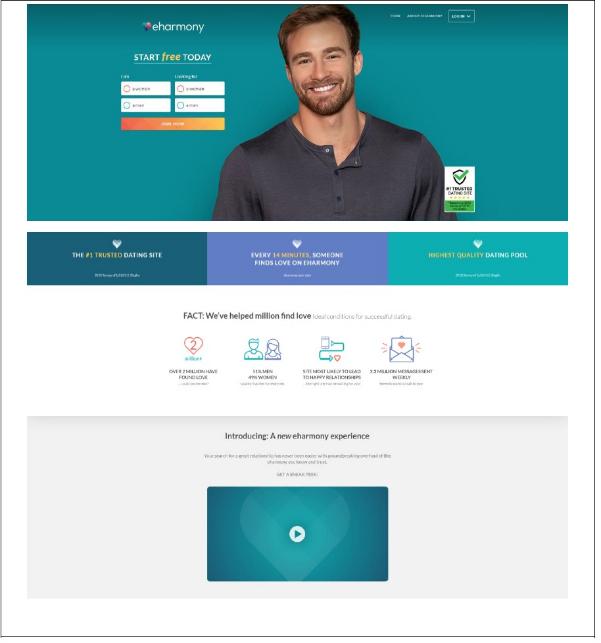
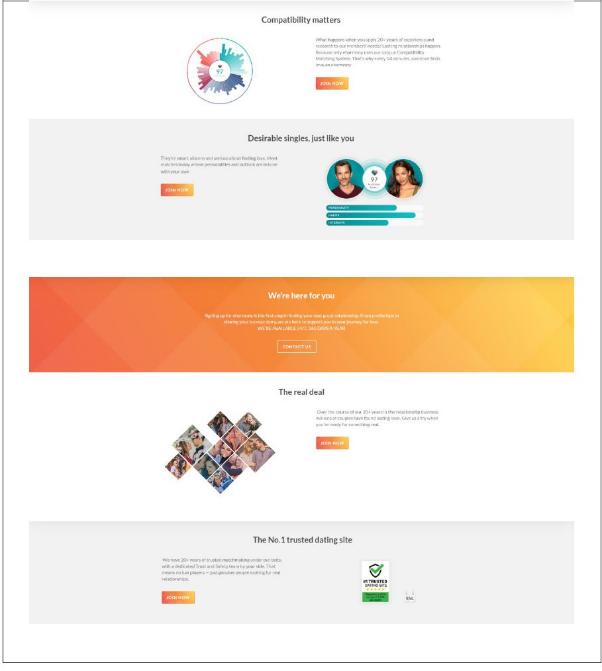
ANNEXURE B (EHARMONY HOMEPAGE FROM AROUND 11 NOVEMBER 2023 TO 17 MAY 2024)
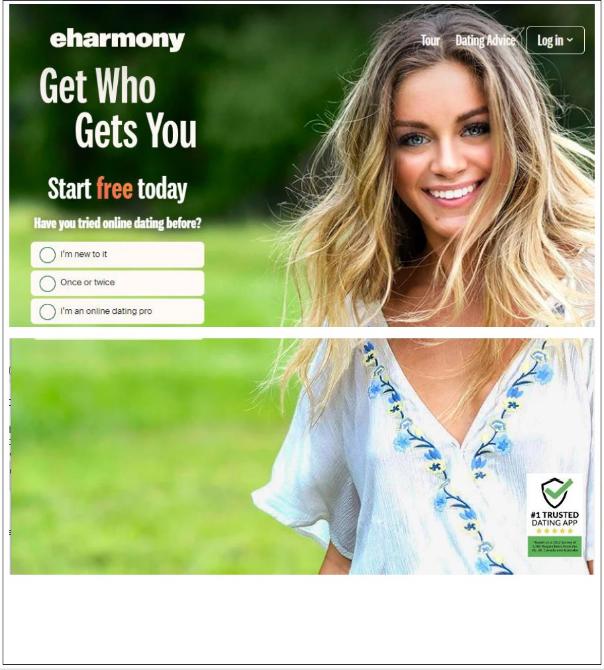
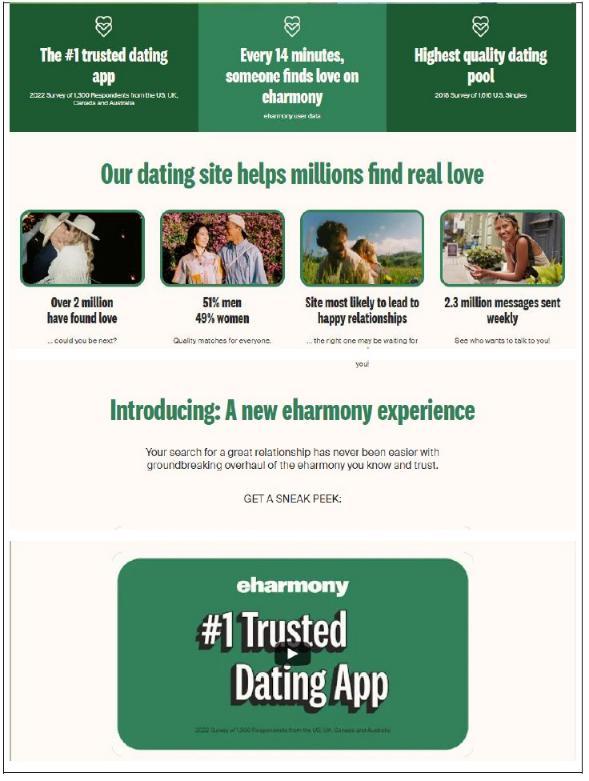
ANNEXURE C (BASIC MEMBER’S PERSONALITY PROFILE PAGE)
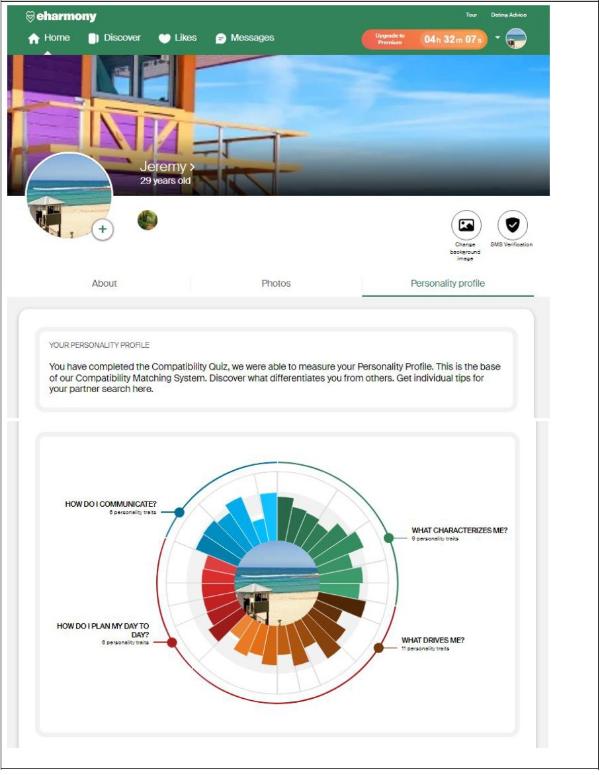
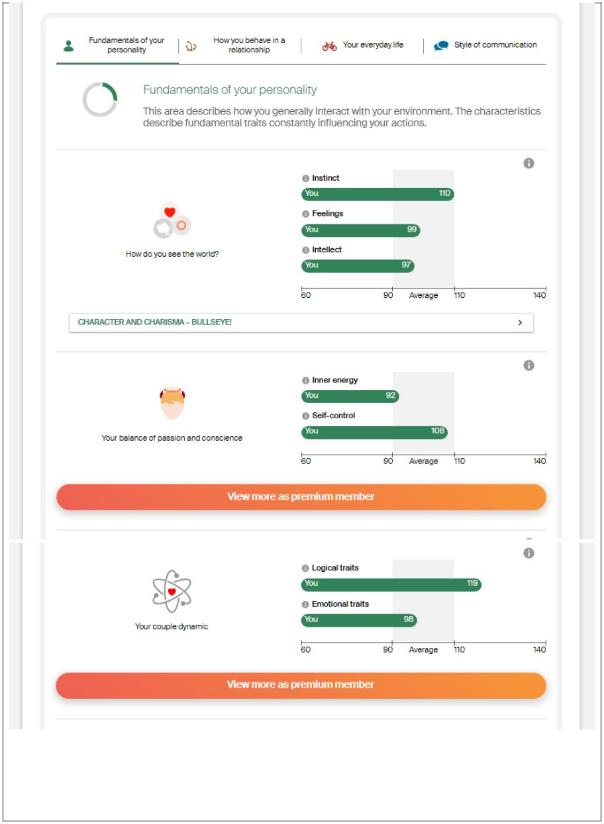
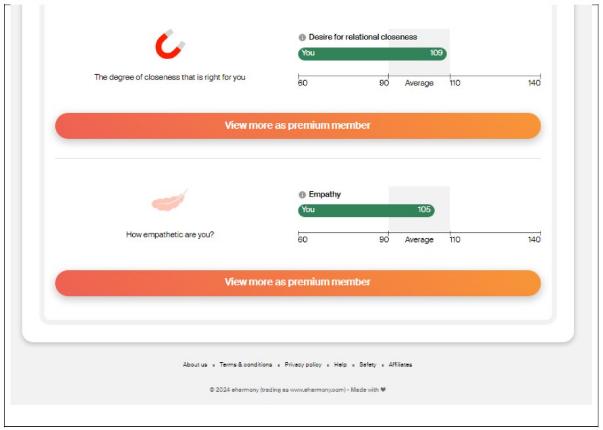
ANNEXURE D (SUBSCRIPTION PAGE – LAPTOP/DESKTOP VERSION)
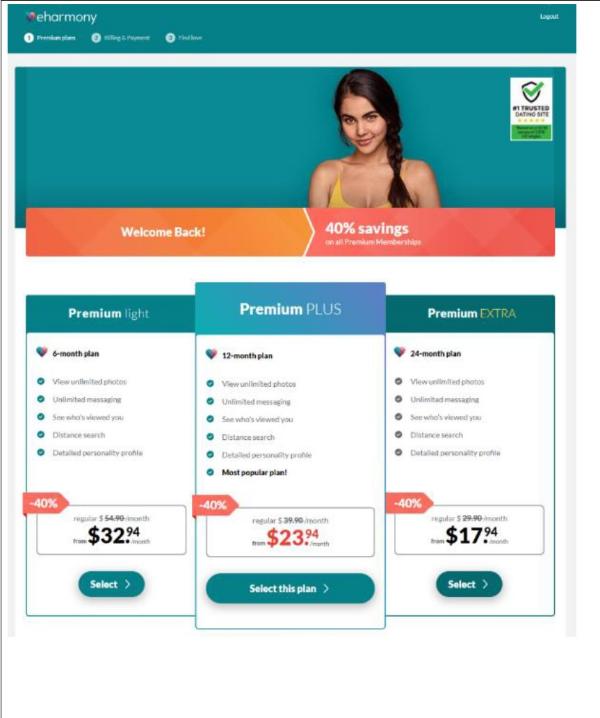
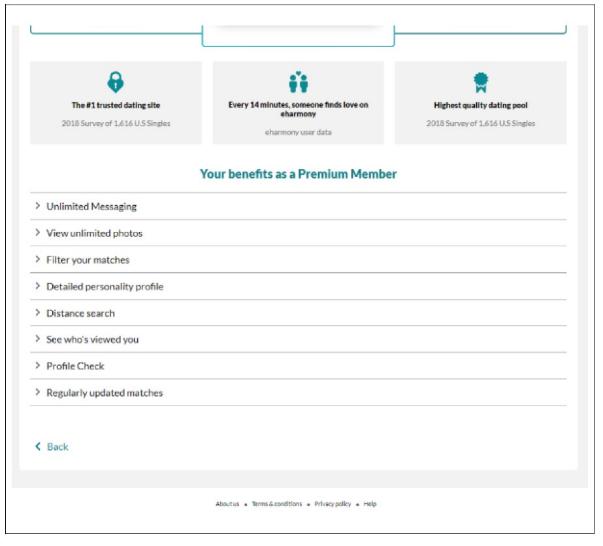
ANNEXURE E (PAYMENT PAGE – LAPTOP/DESKTOP VERSION)
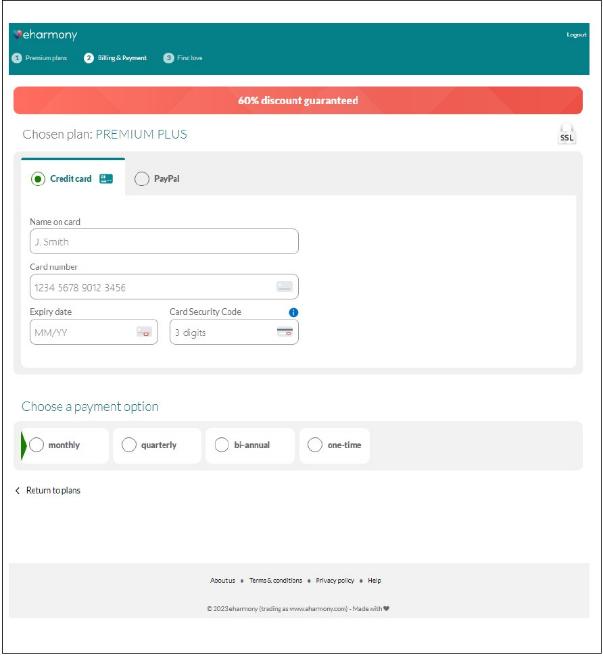
ANNEXURE F (PAYMENT PAGE – CURSOR PLACED OVER PAYMENT FREQUENCY)
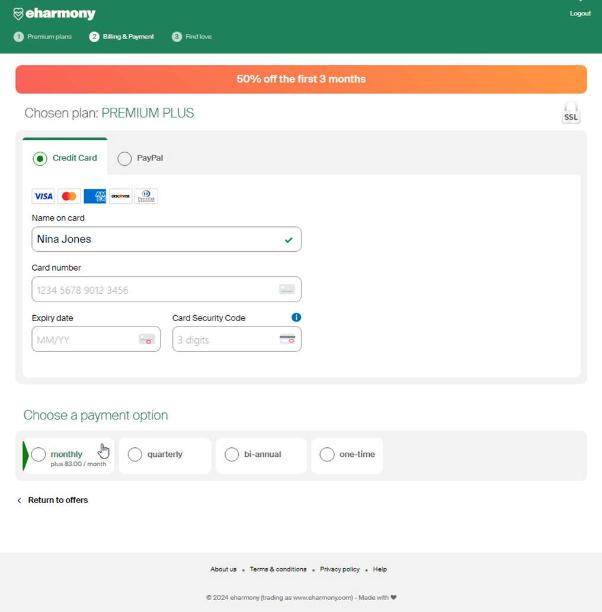
ANNEXURE G (PAYMENT PAGE – PAYMENT FREQUENCY OPTION SELECTED)
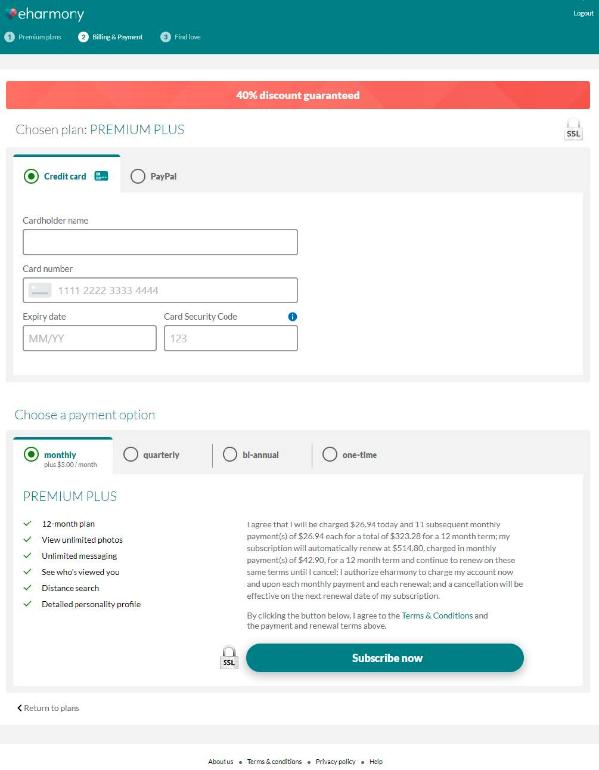
ANNEXURE H (PURCHASE PROCESS – MOBILE OR TABLET VERSION OF THE WEBSITE)
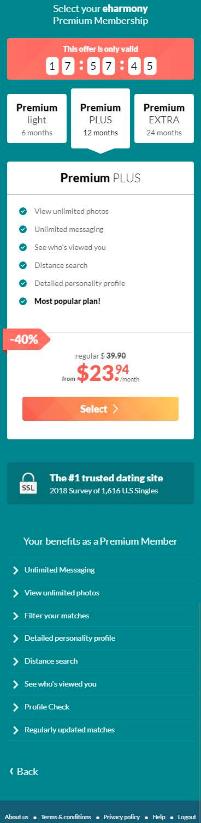
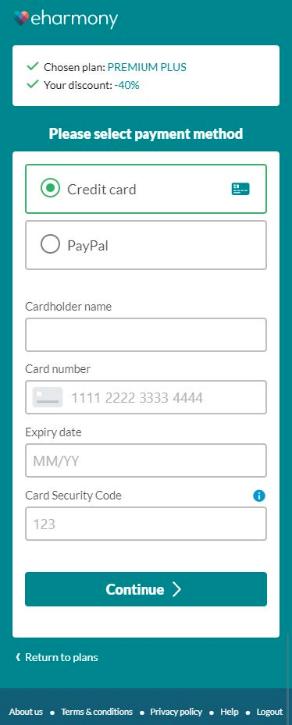
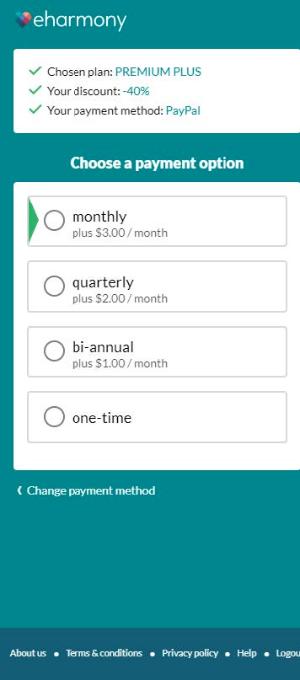
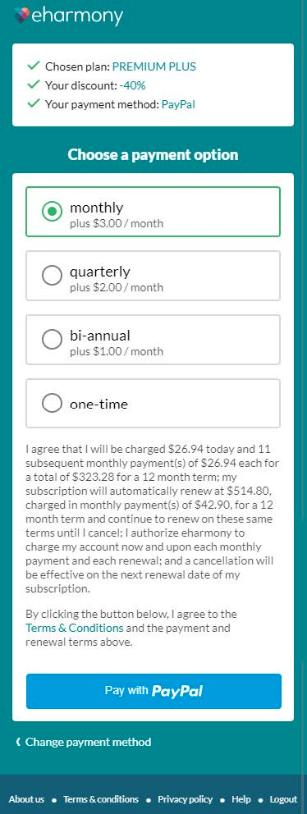
ANNEXURE I (PURCHASE PROCESS – IOS APP)
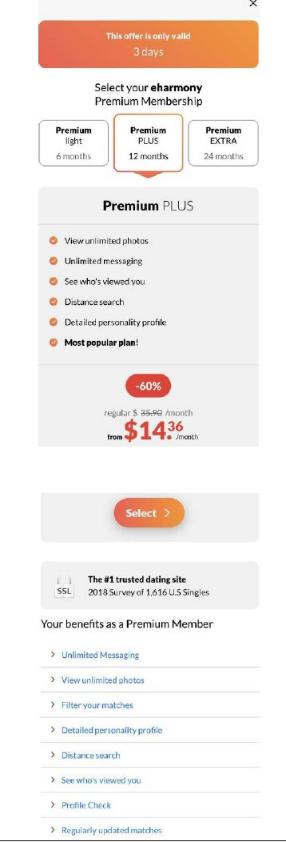
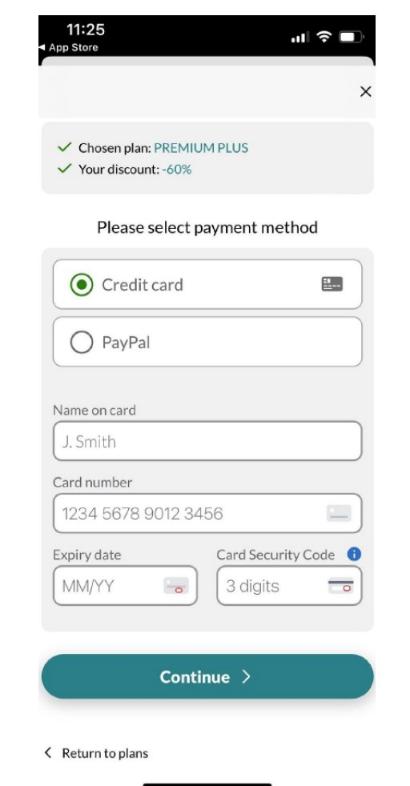
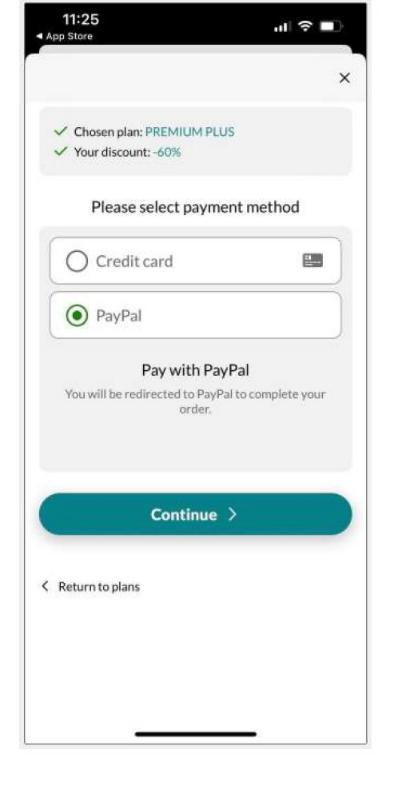
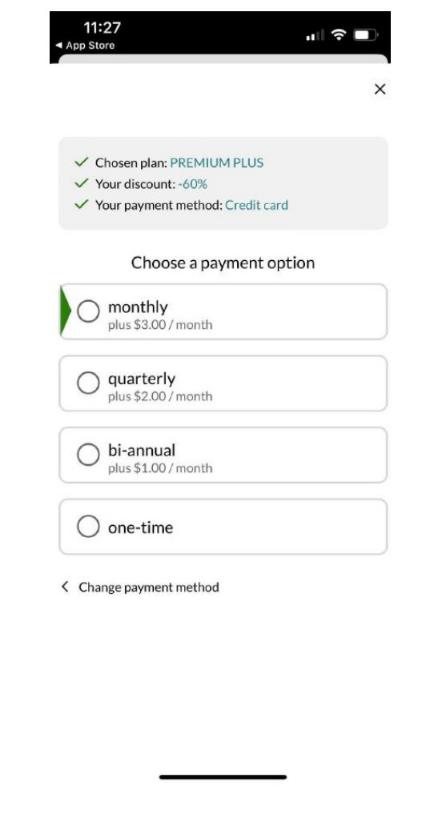
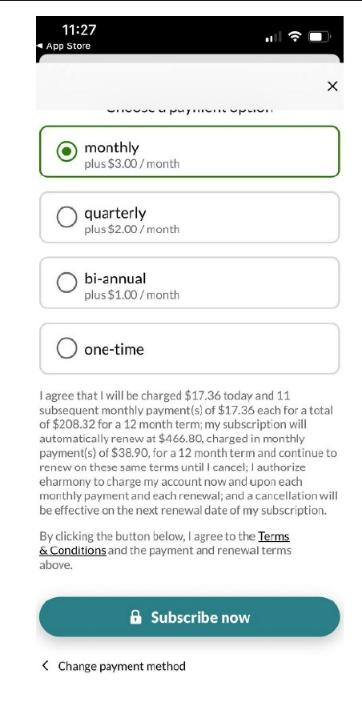
ANNEXURE J (SUBSCRIPTION PAGE FROM JULY 2024 – LAPTOP/DESKTOP VERSION)
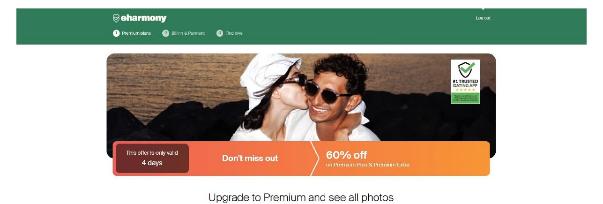
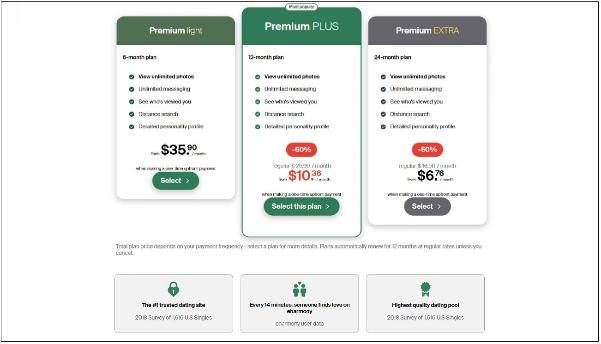
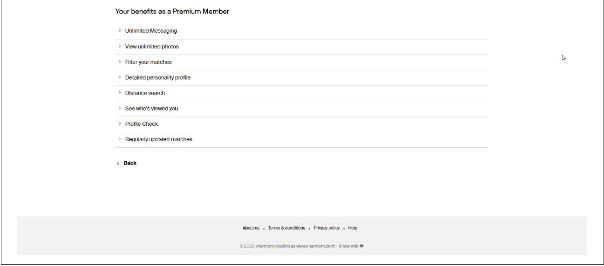
ANNEXURE K (PAYMENT PAGE FROM JULY 2024 – PAYMENT FREQUENCY OPTION SELECTED)
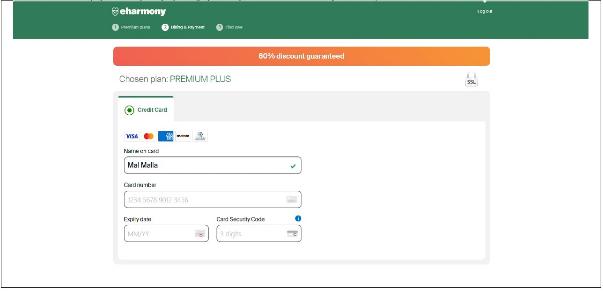
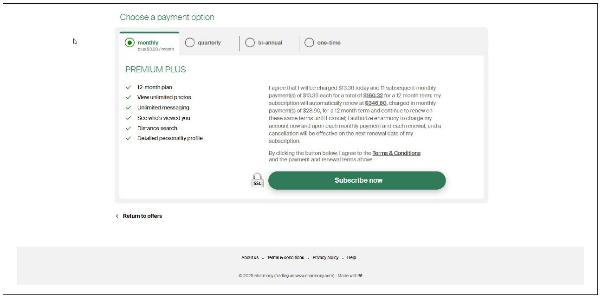
ANNEXURE L (FAQ LANDING PAGE FROM AROUND 25 JANUARY 2022 TO 17 MAY 2024)
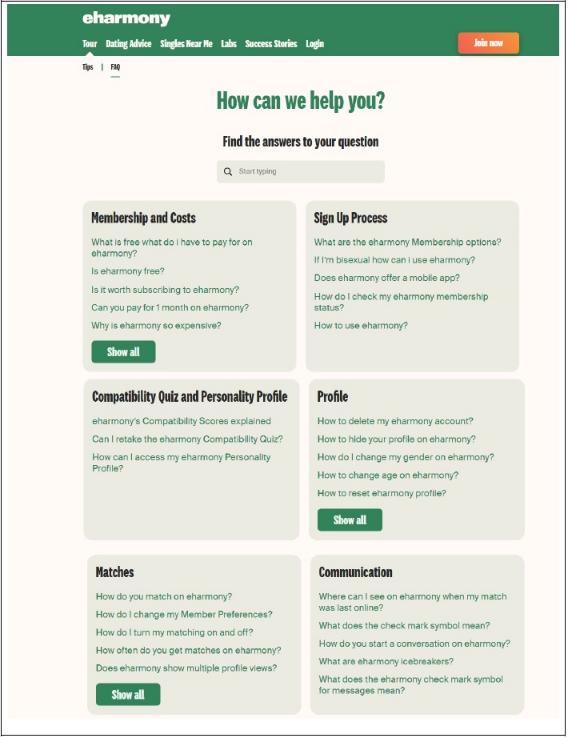
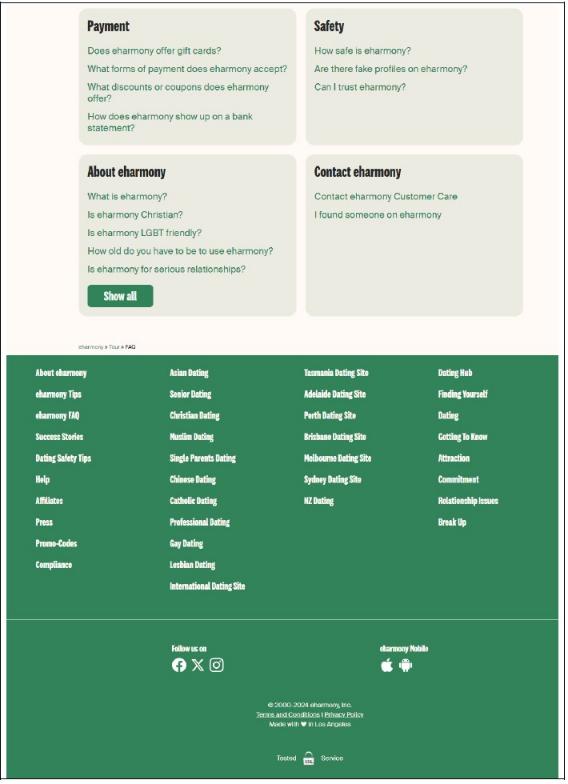
ANNEXURE M (HELP CENTRE LANDING PAGE)
Help Centre landing page from 1 November 2019 to around 11 February 2024
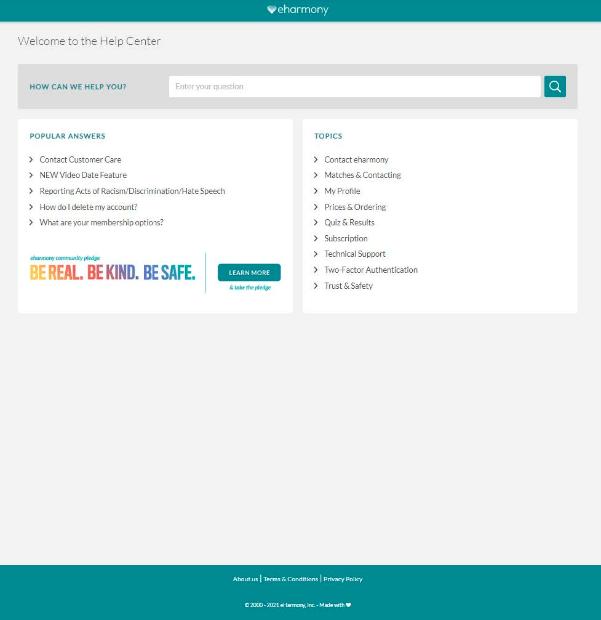
Help Centre landing page from around 12 February 2024 to 17 May 2024